Ambani security scare: NIA to take over probe into death of Mansukh Hiren

The Maharashtra Anti-Terrorism Squad (ATS) had been probing the case and had registered a case of murder, criminal conspiracy and destruction of evidence against an unknown person in connection with Hiran’s death.

The National Investigation of Agency (NIA) will take over the investigation into the death of Mansukh Hiren, the owner of the vehicle found outside the residence of Mukesh Ambani with gelatin sticks and a threat letter.

The Maharashtra Anti-Terrorism Squad (ATS) had been probing the case and had registered a case of murder, criminal conspiracy and destruction of evidence against an unknown person in connection with Hiren’s death. Now, the case has been handed over to the NIA.

The NIA is already investigating the Antilia bomb scare case and role of Assistant Police Inspector Sachin Waze.

Hiren’s body was found in a creek near Mumbra, after which an accidental death report was filed at Mumbra police station in Thane.

Hiren’s wife has accused Waze of involvement in her husband’s suspicious death.

On Friday night, NIA took Waze to the spot where the explosives-laden Scorpio was found near industrialist Mukesh Ambani’s residence, and recreated the crime scene as part of its probe.

recorded at the spot on the day of the incident was Waze, although it is being confirmed.

U.S. Senator Asks Lloyd Austin To Raise Concerns About Eroding Democratic Values During Visit To India

In a letter, Bob Menendez asks the Secretary of Defence to raise India’s planned purchase of the Russian S-400 missile defense system.

Saying the Indian government is moving away from democratic values, the Chairman of the Senate Foreign Relations Committee Bob Menendez has written to U.S. Secretary of Defense Lloyd Austin asking him to raise concerns about democracy and India’s purchase of the S-400 Russian missile defence system during his visit to New Delhi. Mr. Austin is expected to meet Defence Minister Rajnath Singh and senior national security officials between March 19 and 21 when he is in New Delhi.

“I would like to see the U.S.-India partnership grow, but we must acknowledge that the partnership is strongest when based on shared democratic values and the Indian government has been trending away from those values,” Mr. Menendez says in the letter dated March 17.

“I also expect that you will raise the administration’s opposition to India’s reportedly planned purchase of the Russian S-400 missile defense system,” he writes.

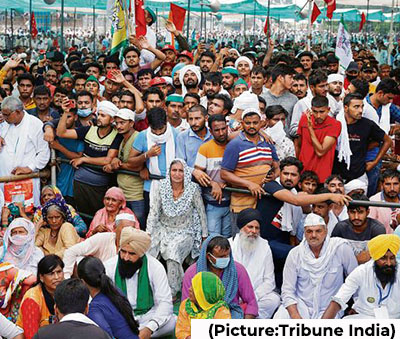
Among his concerns, Mr. Menendez cites a crackdown on journalists and critics of the government, its handling of the farmer protests and the use of sedition laws and the Citizenship (Amendment) Act (CAA).

‘Deteriorating democracy’

“The Indian government’s ongoing crackdown on farmers peacefully protesting new farming laws and corresponding intimidation of journalists and government critics only underscores the deteriorating situation of democracy,” Mr. Menendez says.

 “Moreover, in recent years, rising anti-Muslim sentiment and related government actions like the Citizenship (Amendment) Act, the suppression of political dialogue and arrest of political opponents following the abrogation of Article 370 in Kashmir, and the use of sedition laws to persecute political opponents have resulted in the U.S. human rights group Freedom House stripping India of its ‘Free’ status in its yearly global survey,” he says.

India’s purchase of S-400 for just under $5.5 billion could attract sanctions under a 2017 law: the Countering America’s Adversaries Through Sanctions Act (CAATSA). The Trump administration’s repeated message was that sanction waivers are not automatic and decided on a case by case basis. Congress forced the Trump administration’s hand in December last year by requiring it to sanction Turkey for purchasing the S-400. In 2018, China was sanctioned for purchase of Russian equipment.

Sanctions on the cards

While India is not a treaty ally of the U.S. and is increasing its purchase of U.S. arms — mitigating circumstances as per U.S. law — the Menendez letter suggests that sanctions are still — at least in theory — an option as India is expected to take delivery of the S-400 later this year.

It reads: “India’s planned purchase of the Russian S-400 missile defense system is also a matter of concern. I recognize that India is not a U.S. treaty ally and has historical ties with the Soviet and Russian militaries. However, if India chooses to go forward with its purchase of the S-400, that act will clearly constitute a significant, and therefore sanctionable, transaction with the Russian defense sector under Section 231 of CAATSA.”

Mr. Menendez says the U.S. should seek to partner India on issues such as climate change and China but while doing so, it cannot let its “democratic values fall away”.

He also asks Mr. Austin to “make clear” to New Delhi that all areas of India-U.S. cooperation are contingent on India’s adherence to democratic values.

(Courtesy: The Hindu)

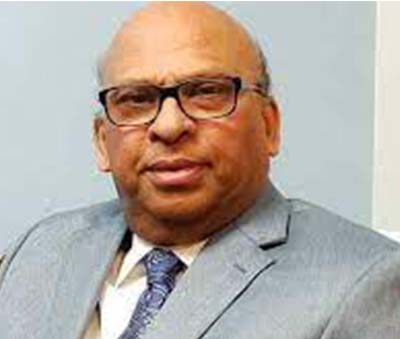
Dr. S.S. Lal, The First NRI Candidate in Kerala, Promising To Lead the State to Progress, Peace and Unity

Dr. S.S. Lal, a UDF candidate and a world renowned healthcare expert, is contesting the Assembly elections from Kazhakkoottam Constituency, Thiruvananthapuram, in the ensuing Kerala Assembly elections.

Dr. SS Lal, has been nominated as a UDF candidate to contest at the upcoming Assembly elections from Kazhakkoottam Constituency, Thiruvananthapuram, in the ensuing Kerala Assembly elections. As an internationally well known medical professional and public health specialist, who worked in international organizations such as WHO, as a social activist, educationist, and writer, Dr. Lal embodies the great values and leadership of the state of Kerala and India needs at this critical time in India’s history.

The electorate of this southern Indian constituency in the state of Kerala is around 2 lakhs. CPM has a very large following among the poor and the fisher folk. Kadakapall Surendran of CPM  is the current MLA and Minister. BJP also has a large following.  Surendran, BJP President contested from here last time and cornered around 40,000 votes. The educated and professionals in techno park, University, medical establishments may not go by political affiliations. One lakh votes could be an ideal target i.e. around 50 % of the electorate. House to house campaigning especially among the poor and institutional campaigning would be required. This constituency represents almost all major communities, including Christians, Moslems, and Hindus who are equally strong here.

Although Dr. S. S. Lal has been away from India on international assignments, he is not an “imported candidate” as he has been always connected with Thiruvananthapuram District. Since his childhood, he has left behind his own historical imprints wherever he stepped in. He completed his primary education at Government School, Pettah, Thiruvananthapuram, and at St. Joseph’s School. He holds an MBBS from the Medical College, Thiruvananthapuram, and a Master’s (M.P.H.) degree in Public Health from the Sree Chitra National Institute. He has achieved Ph.D. from the world-renowned Leiden University in the Netherlands. He has been a regular winner of state-level literary competitions since his school days. He has published two novels and several short stories in later periodicals. The story continues.

Leadership is an individual’s ability to lead, inspire, and guide to transform other individuals, groups, organizations, or society for a good cause. These qualities are immensely embedded in an uncorrupted doctor-cum-politician, Dr. S.S. Lal. Undoubtedly, we have the proud moment that an American NRI gets a prominent political party seat in the Kerala assembly elections. For Dr.S.S.Lal moves wherever his ideologies are politically correct, as he is a dedicated politician hidden inside a health expert.

Dr. Lal has been active in leadership and social work, and  was elected Chairman of the University College and Medical College, Thiruvananthapuram. He has also been a member of the Senate of the University of Kerala. He was the Secretary of the Kerala Medicos Association and the President of the Kerala House Surgeons Association. He was the Founding President of the Kerala Junior Doctors Association and the Founding Chairman of the Confederation of Medicos and Junior Doctors. Worked in leadership at the state and national levels of the I.M.A. Lal is the founder of the I.M.A.’s State Level Doctors Club and the I.M.A. Women’s Wing (WIMA). He is the Founding Secretary of the Kerala Doctors Trust and the Doctors Village.

His initiatives on  several health projects like The ‘Act Force,’ which trained taxi-autorickshaw drivers to provide first aid to road accident victims,  has helped thousands of people affected by road accidents. This pattern was later successfully repeated in various parts of the country. Many villages and old age homes were adopted with the help of doctors’ organizations. The village of Kallar, which rescued several other students on the day of several medical students’ death in a landslide, was thus adopted.

Dr: S.S. Lal is an internationally known public health expert. He has served as a senior official of the World Health Organization and some other international organizations in various countries, including India, and held position as  Professor and Head of the Department of Public Health at the Global Institute of Public Health, Thiruvananthapuram;  Vice-Chairman of a Global Committee of the World Health Organization and a member of several other committees.

His International work in Geneva and the United States has primarily led to suppressing tuberculosis, AIDS, and malaria in various countries in Asia, Europe, Africa, and South America.

His first job at the World Health Organization was in 1999. He became an official in the system set up by the World Health Organization to provide technical assistance to the TB program in the country. He later served as New York’s Health Commissioner. Dr. Lal was selected to the first sixteen-member team of CDC Director Dr. Thomas R. Frieden. Dr.Lal was initially responsible for the team for Kerala, southern Tamil Nadu, and Lakshadweep.

Lal is a visiting Faculty Member at several international research institutes and universities, including the International Tuberculosis Research Institute in Tokyo; and Adjunct Professor at the Global Institute of Public Health, Thiruvananthapuram. He is a reviewer of scientific publications such as the World Health Organization’s Bulletin and the British Medical Journal.

Lal was the first doctor to present a series of health programs on Indian television. The weekly health program, ‘Pulse,’ which aired on the Asianet channel since its inception, quickly attracted a lot of attention. Launched in 1993, Lal aired over 500 episodes in a row till 2003. He was also a regular guest on All India Radio. He has been a columnist since the first issue of Mathrubhumi Health Magazine in 1997. He was a long-time columnist for the Delhi edition of Manorama newspaper from 2004.. For a long time, he was the editor and columnist of the health magazine ‘Our Health’. ‘He manages the ‘Rounds’ column in the Kerala Kaumudi newspaper. He continues to write in medical journals and other periodicals. He has published over four hundred scientific articles.

Dr. Lal is the recipient of numerous prestigious awards:  like the National Award in 1995 for his outstanding performance in implementing health schemes in the country. In 2005,  IMA’s most prestigious ‘Ranbaxy – IMA Award, and  the IMA’s own ‘Dr. Menda Memorial Award’, Best Television Health Program Presenter,  Rotary Award in 1998 for her work in the field of polio eradication. He has visited more than eighty countries as part of his international career in the field of health.

Until last year, he was the Director of the Infectious Diseases Unit in charge of the Tuberculosis Division at Family Health International, an American international health organization based in the U.S. capital, Washington, DC. From 2013 to 2018, he was the Global Director of the Tuberculosis Unit of the international organization Path in the United States. Dr. Lal has published several short stories and two novels. Lal is a blogger and photographer who is constantly interacting on Facebook through writing.

At present Dr. Lal is the President of All India Professional Congress at Kerala, and vibrant in the media and with his personal participation in channel discussions and active in social issues.

His eminent leadership as the President of Indo American Press Club is continuously uplifting the organization in its various activities in USA and Canada.

Abundantly enriched with his characteristics of honesty, integrity and confidence, Dr.Lal  is an ideal candidate who deserves to win so that he can fight for the common man, cleanse current politics, work towards providing a clean and corruption-free administration, and spearhead exponential socio-economic and technological development of Kerala and India, sure enough to make us proud with an exceptional international impact.

Dr. Lal may be a UDF candidate. However, irrespective of political affiliations, he is an ideal candidate who deserves to win in order to represent the interests of the common man, who can cleanse the current politics, work towards providing a clean and corruption-free administration, and spearhead exponential socio-economic and technological development of Kerala and India, making an international impact. In this post-COVID scenario his candidature becomes all the more relevant. As an expatriate Keralite and Indian, he is aware of the problems of the NRIs and NRKs and he will fight for their just causes. But above all he will use their  expertise and resources for Kerala’s and India’s development.

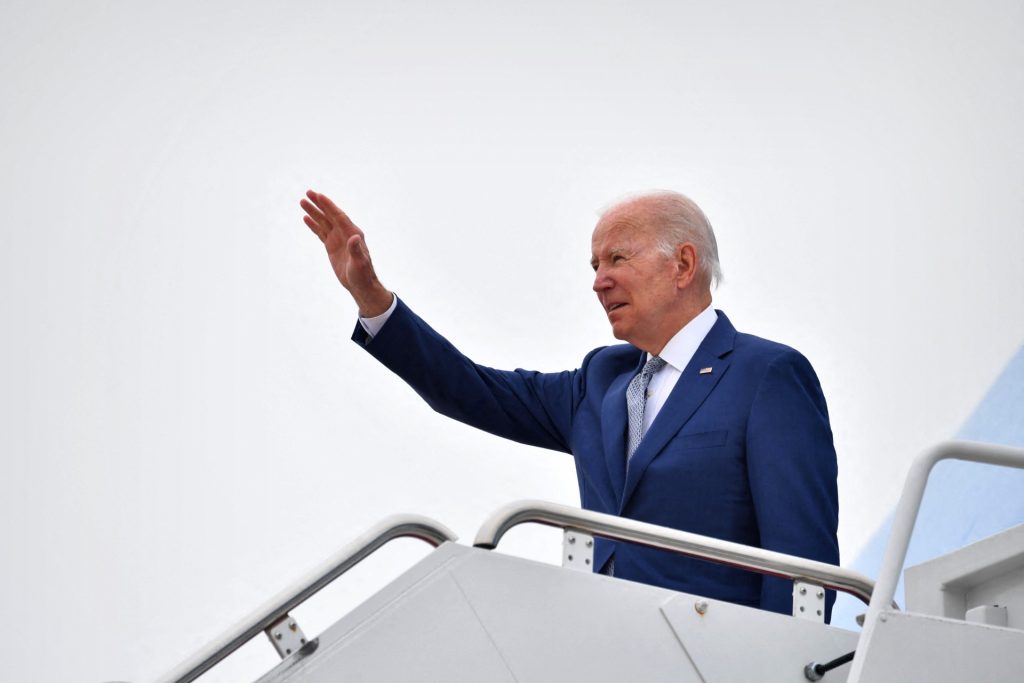
Biden Aims For “Independence From This Virus” By 4th of July

President Joe Biden pledged in his first prime-time address to make all adults eligible for vaccines by May 1 and raised the possibility of beginning to “mark our independence from this virus” by the Fourth of July.

One year after the nation was brought to a near-standstill by the coronavirus, President Joe Biden pledged in his first prime-time address to make all adults eligible for vaccines by May 1 and raised the possibility of beginning to “mark our independence from this virus” by the Fourth of July. He offered Americans fresh hope and appealed anew for their help. Speaking in the White House East Room Thursday night, Biden honored the “collective suffering” of Americans over the past year in his 24-minute address and then offered them a vision for a return to a modicum of normalcy this summer. “We are bound together by the loss and the pain of the days that have gone by,” he said.

“We are also bound together by the hope and the possibilities in the days in front of us.” He predicted Americans could safely gather at least in small groups for July Fourth to “make this Independence Day truly special.” But he also cautioned that this was a “goal” and attaining it depends on people’s cooperation in following public health guidelines and rolling up their sleeves to get vaccinated as soon as eligible. Only that, he said, can bring about an end to a pandemic that has killed more than 530,000 Americans and disrupted the lives of countless more. “While it was different for everyone, we all lost something,” Biden said of the sacrifices of the yearlong-and-counting pandemic.

The speech came just hours after Biden signed into law a $1.9 trillion relief package that he said will help defeat the virus, nurse the economy back to health and deliver direct aid to Americans struggling to make ends meet. Some cash distributions could begin arriving in the bank accounts of Americans this weekend. “This historic legislation is about rebuilding the backbone of this country,” Biden said as he signed the bill in the Oval Office. Most noticeable to many Americans are provisions providing up to $1,400 in direct payments and extending $300 weekly emergency unemployment benefits into early September. Also included are expanded tax credits over the next year for children, child care and family leave — some of them credits that Democrats have signaled they’d like to make permanent — plus spending for renters, food programs and people’s utility bills. In his Thursday night address, Biden said that as vaccine supplies continue to increase, he will direct states and territories to make all adults eligible for vaccination by May 1.

The U.S. is expecting to have enough doses for those 255 million adults by the end of that month, but Biden warned the process of actually administering those doses would take time, even as his administration looks to instill confidence in the safety of the vaccines to overcome hesitance. “Let me be clear, that doesn’t mean everyone’s going to have that shot immediately, but it means you’ll be able to get in line beginning May 1,” he said.

Biden announced an expansion of other efforts to speed vaccinations, including deploying an additional 4,000 active-duty troops to support vaccination efforts and allowing more people — such as medical students, veterinarians and dentists — to deliver shots. He is also directing more doses toward some 950 community health centers and up to 20,000 retail pharmacies, to make it easier for people to get vaccinated closer to their homes.

Biden added that his administration is planning to launch a nationwide website to help people find doses, saying it would address frustrations so that there would be “no more searching day and night for an appointment.” Even as he offered optimism, Biden made clear that the July 4 timetable applied only to smaller gatherings, not larger ones, and requires cooperation from Americans to continue to wear face coverings, maintain social distancing and follow federal guidelines meant to slow the spread of the virus in the near term. He also called on them roll up their sleeves to get vaccinated as soon as they’re eligible. This is “not the time to not stick with the rules,” Biden said, warning of the potential for backsliding just as the nation is on the cusp of defeating the virus. “I need you, the American people,” he added. “I need you. I need every American to do their part.”

Biden’s initial prime-time speech was “a big moment,” said presidential historian and Rice University professor Douglas Brinkley. “He’s got to win over hearts and minds for people to stay masked and get vaccinated, but also recognize that after the last year, the federal government hasn’t forgotten you.” Biden’s remarks were central to a pivotal week for the president as he addresses the defining challenge of his term: shepherding the nation through the twin public health and economic storms brought about by the virus.

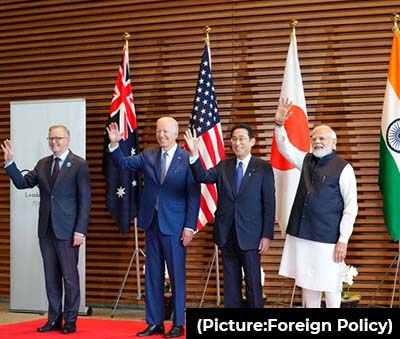
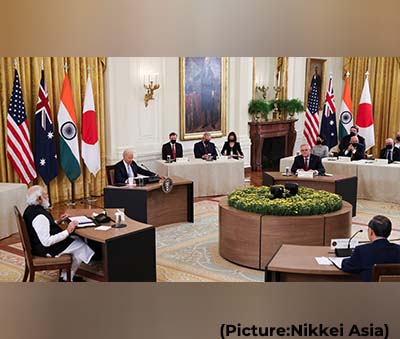
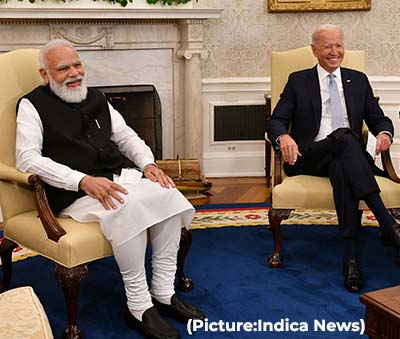
India Joins Quad Leaders, Committing To Free, Open, Secure And Prosperous Indo-Pacific Region

Quad Leaders from Australia, India, Japan and the US “a group of democratic nations dedicated to delivering results through practical cooperation”  coordinated rapid humanitarian assistance and disaster relief to people in need.

“To strengthen our quest for a region that is open and free, we have agreed to partner to address the challenges presented by new technologies and collaborate to set the norms and standards that govern the innovations of the future,” the leaders of the four-nation Quad said in a statement here on Friday, March 12th. The Quad leaders in the summit on Friday vowed to strive for a “free, open and inclusive” region unconstrained by “coercion”.

In an opinion piece in The Washington Post after holding the first Leaders’ Summit of Quadrilateral alliance, Prime Minister Narendra Modi, US President Joe Biden, Australian PM Scott Morrison and Japanese PM Yoshihide Suga asserted that all countries should be able to make their own political choices, free from coercion.

Australia, India, Japan and the US “a group of democratic nations dedicated to delivering results through practical cooperation”  coordinated rapid humanitarian assistance and disaster relief to people in need, they wrote. “Now, in this new age of interconnection and opportunity throughout the Indo-Pacific, we are again summoned to act together in support of a region in need,” they said.

Reaffirming that they are striving to ensure that the Indo-Pacific is accessible, dynamic and governed by international law and bedrock principles such as freedom of navigation and peaceful resolution of disputes, and free from coercion, sending a clear message to China which is flexing its muscles in the region and beyond. They said the governments of India, Japan, US and Australia have worked closely for years, and now for the first time in “Quad” history, they convened as leaders to advance meaningful cooperation at the highest level.

The virtual Quad summit took place as China and India are involved in a military standoff along the Line of Actual Control (LAC) in eastern Ladakh since May last year. China is also engaged in hotly contested territorial disputes in both the South China Sea and the East China Sea. In the East China Sea, Japan has maritime disputes with China.

The leaders of the 4 nations said the cooperation, known as “the Quad,” was born in crisis. It became a diplomatic dialogue in 2007 and was reborn in 2017. “In December 2004, the continental shelf off the coast of Indonesia shifted two meters, creating one of the largest tidal waves in modern history and a nearly unprecedented humanitarian crisis around the Indian Ocean. With millions displaced and hundreds of thousands killed, the Indo-Pacific region sounded a clarion call for help. Together, our four countries answered it,” they wrote.

Prime Minister Narendra Modi said that the quadrilateral grouping of the U.S., India, Japan and Australia has “come of age” as he attended the first Quad leaders’ summit virtually. The grouping is being seen as a united front to counter China’s imperialistic aggression and expansion through trade and military occupation. Modi started his speech by declaring, “It is good to be among friends.” The four countries, he said, “are united by our democratic values and our commitment to a free, open and inclusive Indo-Pacific.”

The agenda of the summit — covering areas like vaccines, climate change and emerging technologies — makes the Quad a force for global good, he said. Describing Quad as a positive vision, the prime minister said that it is an extension of India’s ancient philosophy of ‘Vasudhaiva Kutumbakam,’which regards the world as one family. “We will work together closer than ever before for advancing our shared values and promoting a secure, stable and prosperous Indo-Pacific,” Modi said.

Quad, he added, “is an important pillar of stability in the region.” Modi’s statement was welcomed by a lot of India watchers in the U.S. Former U.S. diplomat and Harvard academic Nicholas Burns praised the move, tweeting, “Today’s first-ever Quad leaders meeting – of the US, India, Japan and Australia – is a big deal. Led by the President of the United States Joe Biden, these four can lead on vaccine distribution, strengthen democracies in the region and limit China’s assertiveness.”

There are reports that India will produce Johnson & Johnson’s single-dose Covid vaccine shot as part of the first Quad initiative. The project will be financed by Japan and the U.S., while Australia will use its logistics capability to ship the vaccines to Southeast Asia and Pacific countries.

“Against this backdrop, we are recommitting to a shared vision for an Indo-Pacific region that is free, open, resilient and inclusive. We are striving to ensure that the Indo-Pacific is accessible and dynamic, governed by international law and bedrock principles such as freedom of navigation and peaceful resolution of disputes, and that all countries are able to make their own political choices, free from coercion,” they wrote.

COVID-19 Vaccine Rollout By India Has ‘Rescued The World’ From Pandemic

India is called the pharmacy of the world during the COVID-19 pandemic.The rollout of the COVID-19 vaccines by India in collaboration with leading global institutions has ‘rescued the world’ from the deadly coronavirus.


The rollout of the COVID-19 vaccines by India in collaboration with leading global institutions has ‘rescued the world’ from the deadly coronavirus and the contributions by the country must not be underestimated, a top American scientist has said.

India is called the pharmacy of the world during the COVID-19 pandemic with its vast experience and deep knowledge in medicine. The country is one of the world’s biggest drug-makers and an increasing number of countries have already approached it for procuring coronavirus vaccines.

Dr Peter Hotez, Dean of the National School of Tropical Medicine at Baylor College of Medicine (BCM) in Houston during a recent webinar said that the two mRNA vaccines may not impact the world’s low and middle income countries, but India’s vaccines, made in collaboration with universities across the world such as BCM and the Oxford University, have “rescued the world” and its contributions must not be underestimated.

During the webinar, “COVID-19: Vaccination and Potential Return to Normalcy – If and When”, Dr Hotez, an internationally-recognised physician-scientist in neglected tropical diseases and vaccine development, said that the COVID-19 vaccine rollout is ‘India’s gift’ to the world in combating the virus.

India’s drugs regulator gave emergency use authorization to Covishield, produced by Pune-based Serum Institute of India after securing license from British pharma company AstraZeneca, and Covaxin, indigenously developed jointly by Hyderabad-based Bharat Biotech and Indian Council of Medical Research scientists. The webinar was organized by Indo American Chamber of Commerce of Greater Houston (IACCGH).

“This is something very special and I see it myself because I’m on weekly teleconferences with our colleagues in India, you make a recommendation, and within days it’s done and not only done, but it’s done well and with incredible rigor and thought and creativity,’ Dr Hotez said, stressing that he felt compelled to make this statement because ‘India’s huge efforts in combating global pandemic is a story that’s not really getting out in the world.’ Dr Hotez, considered as the authority on vaccinations, is working on an affordable coronavirus vaccine in collaboration with Indian pharmaceutical companies.

There is increasing evidence that vaccines not only “interrupt symptomatic illness and keep you out of the hospital” but halts asymptomatic transmission as well. However, the troubling news is that the vaccines work well against the UK B.1.1.7 variant, which is now accelerating across the US, but doesn’t work quite as well against the variant coming out of South Africa.

It is likely that all the vaccines will require a booster for two reasons: the durability of protection for the vaccines is unknown and to create an added immune response that’s better tailored towards the South African variant.

Consul General of India in Houston, Aseem Mahajan, along with a distinguished panel of doctors participated in this webinar, that tracked the possibilities of a return to some semblance of normality due to the accelerated roll out of vaccines across the country.

Appreciating Dr. Hotez for commending India’s efforts in getting vaccines to the world, Consul General Mahajan, said, “in keeping with “our tradition of sharing with the world,” India has exported vaccines to many countries across the world.

India has provided 56 lakh doses of coronavirus vaccines under grants assistance to a number of countries. The vaccines were sent to Sri Lanka, Bhutan, Maldives, Bangladesh, Nepal, Myanmar and Seychelles.

There has also been a boost in the collaborative medical partnerships emerging between the US and India during this pandemic. In addition, India is one of the fourth largest destinations in Asia for medical devices manufacturing and many US companies have expressed interest in collaborating on this front,’ Mahajan said.

IACCGH Founding Secretary/Executive Director Jagdip Ahluwalia said that “India’s response to the COVID crisis, as acknowledged by Dr Hotez, falls in line with Chamber’s vision. Since its inception, 21 years ago, India would be a future global player in key areas like technology, medicine, manufacturing and international trade. This belief has been proved time and again particularly in the last decade.’ Chamber President Tarush Anand expressed pride that India has risen to this global challenge by leveraging the brilliance of its scientific community and extensive manufacturing capabilities in the most efficient manner to help the world recover from a deadly pandemic.

Describing vaccines as “one of the highest expressions of science in pursuit of humanitarian goals,” Chief Radiation Oncology Officer and moderator Dr Vivek Kavadi noted that over 28 million people had contracted the virus in the US and more than half a million Americans had tragically died. Lives and businesses had been upended but the breakthrough on the vaccine front has been one reason for cautious optimism.

More than 73 million vaccine doses have been administered to date, 15 per cent of the population has received 1 dose while 7 per cent have received both doses, Dr Kavadi said.

U.S. Defense Secretary Lloyd Austin’s Visit to India to Further Strengthen Defense Cooperation

U.S. Secretary of Defense Gen. Lloyd J. Austin is scheduled to visit India from March 19 to March 21 to further strengthen bilateral defense cooperation. It will be the first high-level visit by someone from the U.S. after Joe Biden took over as the president on Jan. 20.

During his visit, Austin is expected to meet Indian Defense Minister Rajnath Singh and other senior dignitaries in the government. The visit will take place a week after the first ever Indo-Pacific Quad summit on March 12, which will be attended virtually by the heads of states of India, the U.S., Australia and Japan. The U.S. defense secretary will also visit Japan and South Korea.

“Both sides are expected to discuss ways to further strengthen bilateral defense cooperation and exchange views on regional security challenges and common interests in maintaining a free, open and inclusive Indo-Pacific region,” the defense ministry said in a statement.

Discussions regarding defense cooperation would also focus on how both countries could consolidate military-to-military cooperation and defense trade and industry cooperation.

Austin’s visit to India as part of his first overseas travel emphasizes the strength of the India-U.S. strategic partnership.

India has inked defense deals worth $18 billion with the U.S. since 2007. In the near future, a deal worth $3 billion for 30 armed drones from the U.S. to be used by all the three forces is likely to be signed. As per plans, India will be acquiring 30 MQ-9 Reaper – 10 each for the three services.

The procurement is being done as India is facing a war-like situation on two fronts – Pakistan and China. These MQ-9B Predator drones are manufactured by San Diego, Calif.-based General Atomics. The MQ-9B has an endurance of 48 hours and a range of over 6,000 nautical miles.

It comes with nine hard-points, capable of carrying sensors and laser-guided bombs besides air-to-ground missiles. During the Aero India show in Bengaluru last month, the U.S. Defense Attache in India, Rear Admiral Eileen Laubacher, had stated that the U.S. is looking forward to enhancing bilateral relations with India and also to work together to tackle evolving space threats.

She had said: “As we build out our own space force, re-establish the space command, we look forward to wide-ranging cooperation with India and the defense space agency. It is imperative that we both work together in this emerging domain as space threats evolve.”

Referring to the growing Chinese assertiveness and emerging threats for the Indo-Pacific region, Laubacher had said: “Today we are seeing an increasingly provocative set of behavior throughout the Indo-Pacific, from the Taiwan Strait to the South China Sea, to India’s borders high in the Himalayas. These actions threaten the norms of international conduct, the norms which India and the U.S. uphold resolutely.”

US Secretary Of State To Look Into Case Of 83-Yr-Old Fr. Stan Swamy, Held In Custody

US Secretary of State Antony Blinken has said that he would look into the case of an 83-year-old Catholic priest, Stan Swamy, held in custody in India on allegations he was linked to Maoists. Responding to a request from a member of the House of Representatives while he was testifying before the House Foreign Affairs Committee, Blinken asked for more information and said: “We’ll look into it.”

Juan Vargas, who is the vice chair of the House International Economic Policy and Migration Subcommittee, told Blinken while questioning him that it was “incredible injustice” that Swamy, who was arrested by the National Investigation Agency, has been in jail for over 130 days.

Swamy belongs to the Jesuit order of priests and Vargas said that he had himself been a member of that society. He was arrested in Ranchi and taken to Maharashtra and detained in a Pune jail under the Unlawful Activities Prevention Act (UAPA) on allegations that he participated in the activities of the banned Communist Party of India-Maoist.

The case relates to a celebration by Dalits on January 1, 2018, in Koregaon-Bhima near Pune, which was followed by violence that left one person dead. Swamy has been an activist for tribal and Dalit rights.

Earlier in his testimony to the Committee on President Joe Biden’s Priorities for US Foreign Policy, Blinken said that in furtherance of its aims, “we held the first ministerial meeting of the Quadrilateral Security Dialogue between us, Japan, Australia, and India, and we will hold a leader-level summit this week on Friday”.

China was the dominant theme during the hearing with Blinken declaring, “Our relationship with China, the biggest geopolitical test of the 21st century”. Repeatedly questioned about Biden’s comment when asked on a CNN programme about Beijing treatment of the Uighur Muslim minority that “culturally, there are different norms that each country and their leaders are expected to follow”, Blinken reiterated that he considers there was a “genocide” of the Uighurs and the US would continue to speak out forcefully against it.

U.S.-China Meetings in Alaska

The Biden administration’s diplomatic engagement with Asia will intensify this week with a series of meetings featuring top U.S. officials and their counterparts across the Pacific. Following a visit to Japan and South Korea with Secretary of Defense Lloyd Austin, Secretary of State Antony Blinken will travel to Alaska along with National Security Advisor Jake Sullivan for a high-profile meeting with Chinese officials Wang Yi and Yang Jiechi. These gatherings follow President Joe Biden‘s participation in last week’s virtual Quadrilateral Security Dialogue (Quad) meeting with the leaders of Japan, Australia, and India.

Below are remarks from Daniel Russel, Asia Society Policy Institute vice president for international security and diplomacy and former assistant U.S. secretary of state, on the upcoming U.S.-China meeting in Alaska. Please feel free to quote from them in your coverage:

“A joint meeting with the Chinese by the secretary of state and national security advisor is not without precedent. In the Obama administration, when the U.S hosted the Strategic and Economic Dialogue in Washington, the secretary and national security advisor typically held an informal dinner for the senior Chinese representative the evening before the talks. Those conversations were far more open, candid, strategic, and useful than most of the scripted exchanges that took place during the official delegation meetings.

“Meeting with foreign officials outside of either capital allows the visitor to focus on the meeting and frees the host from the distraction of regular duties. This was the logic behind the decision to organize an informal first meeting at Sunnylands between President Obama and newly selected Chinese president Xi Jinping in 2013. They were able to have extended and in-depth meetings and conversations over meals without the formalities and distractions. If senior Chinese officials came to Washington they would be expected to meet with their embassy, business groups, legislators, think tanks, and other U.S. officials.

“The Alaska venue is significant because in addition to being the place where the secretary of state’s plane normally refuels en route home from Asia, it is the westernmost part of the United States and draws attention to the fact that the U.S. is very much a Pacific nation – not merely a visitor to the Asia-Pacific as the Chinese often imply.”

“The timing is significant because it comes immediately on the heels of the first-ever Quad summit and the Biden administration’s first high-level, in-person consultations in key Asian-allied capitals. This signals that its emphasis on allies, partners and democratic governments doesn’t mean the administration is ignoring China.”

“The fact that both Blinken and Sullivan already know their Chinese counterparts and have extensive experience with past dialogues is an asset – this will not be their first rodeo. Their close relationships with Biden mean they speak with authority, and their history as close colleagues prevents Chinese ‘forum shopping’ between the State Department and the White House.”

“This meeting is a chance for top foreign policy officials from the two countries to begin a strategic discussion of the respective world views and priorities of each side – to explain and to listen to each other. We should regard this meeting as an exploratory exchange, rather than a negotiation that resolves outstanding problems. The Anchorage meeting is far more likely to serve as an initial level-set for the two sides to think through their strategies than it is to launch any type of structured bilateral dialogue.”

An Indian Citizen’s Musings

As a citizen of the country I felt it has to be conveyed to them. Modi ji, there is no point in shouting standing in a stage and asking question that what is achieved in 60 years. Dont think that the citizen of our country are fools. You are a Prime Minister of a country which was under British rule for more than 200 years. The people were living just like slaves. Congress came to power in 1947 after independence started with zero. There was nothing in this country except the garbages left out by the British.

India didn’t even had the resourse to produce even a pin since Britishers left India. The electricity was available only for 20 villages across the country. Telephone facility was available only for 20 rulers (kings) in this country. There was no drinking water supply. There was only 10 small dams. No hospitals, no educational institutions. No fertiliser, no feeds, no water supply for cultivation. There was no job & only starvation in the country. There was many infant death. Very few military staff in the border. Only 4 planes, 20 tankers & fully open borders on all 4 sides of the country. Very minimum roads & bridges. Empty exchequer. Nehru came power in these circumstances.

What is India after 60 years?

World’s largest army. Thousands of war planes, tankers. Lakhs of industrial institutions. Electricity in all villages. Hundreds of electic power stations. Lakhs kilometre of national highways & over bridges. New railway projects, Stadiums, super speciality hospitals, most of the Indian households with television, telephone for all the countrymen. All infrastructure to work in and outside the country, Banks, Universities, AIMS, IITS, IIMS, Nuclear weapons, sub-marines, nuclear stations, ISRO, Navarathna Public sector units.

Indian Army barging till Lahore years back? Split Pakistan into 2 pieces ? 1 lakh of military & commanders surrendered to Indian army? India started exporting minerals & food items ? Bank nationalization by Mrs. Indira Gandhi? Computer introduces to India & many job opportunities in India and outside the country? You have become PM using information technology?

When you took over as the PM, India was the top 10 economies in the world? Apart from this, GSLV, Mangalyan, Monorail, Metro rail, International airports, Prithvi, Agni, Naag, Nuclear submarines….all these were achieved before you became PM.

Please do not come to people asking what The Congress Party has achieved in 60 years.

Please tell people what you have achieved in the last 6 ½ years except changing names, doing statue and cow politics, failed demonetisation, poorly executed GST, and making people stand in long queues. Hypocrite BJPians opposed FDI like anything and now BJP is supporting FDI shamelessly.. BJP is selling India to Ambani and Rafale deal to Anil Ambani’s 2-month old company over HAL owned by government of India is a prime example of it.. BJP made petrol, diesel, and LPG price go up by putting more tax, while the price of crude oil became cheaper.. Modi government through SBI in the form of fine collected whopping Rs 1771 crore for not able to maintain minimum balance from the poor people of India. Vikas is happening for Amit Shah’s son, Amit Shah, Shaurya Doval, Ambanis, Adani, baba Ramdev’s Patanjali group, and the people who sponsors BJP.. 3000 crores have been spent by BJP to clean river Ganga, this corruption each and everyone can find out by taking a dip in river Ganga..

(PS This is not an advertisement for the congress campaign. I’m not a congress supporter. I’m just an informed voter who feels it is an insult to his intelligence each time the current government says our country has been no good over the last 60 years!)

India’s Degraded And Downgraded Democracy

“The offence of sedition cannot be invoked to minister to the wounded vanity of the governments,” declared the judge while ordering bail for the 22-year-old climate change activist Disha Ravi, who was arrested recently, accused of working with the activist Greta Thunberg to undermine the Indian government — an outrageous fiction. Their only “crime” was expressing support for the farmers’ protest.

But the decision in Ravi’s case has much wider implications. It was a rare but welcome instance of the judiciary standing up to the Indian government’s increasingly authoritarian tactics.

The judge came down heavily against the use of sedition charges against activists and journalists. Under Prime Minister Narendra Modi, sedition charges have been deployed as a clear tool of intimidation. A report by the organization Article 14 shows that 96 percent of sedition cases filed against 405 Indians for criticizing politicians and government officials were registered after 2014, when Modi assumed power.

So it didn’t really come as a surprise when the latest Freedom House democracy report degraded India from “free” to “partly free.” The report noted that the government and “its state-level allies continued to crack down on critics during the year, and their response to covid-19 included a ham-fisted lockdown that resulted in the dangerous and unplanned displacement of millions of internal migrant workers. The ruling Hindu nationalist movement also encouraged the scapegoating of Muslims, who were disproportionately blamed for the spread of the virus and faced attacks by vigilante mobs.”

The report’s conclusion is a scathing indictment. “Rather than serving as a champion of democratic practice and a counterweight to authoritarian influence from countries such as China, Modi and his party are tragically driving India itself toward authoritarianism,” the report says.

Of course the Indian government — which has now dismissed criticism from the United Nations and Amnesty International, which was forced to shut down in the country — rushed to attack the report as “misleading, incorrect and misplaced.”

But the government offered few specifics in its rebuttal. That’s because the steady decline of Indian democracy is impossible to deny, and emphasizing PR-friendly stories of economic growth won’t mark that reality anymore. The V-Dem Institute, based in Sweden, also downgraded India’s classification from “world’s largest democracy” to “electoral autocracy” in its latest report.

The same day Freedom House released its report, tax officials raided the home of the filmmaker Anurag Kashyap and the actress Taapsee Pannu. Both have been fiercely critical of the arrests of students and activists and have also expressed support for the farmers’ protest. The duo stands out for deciding to raise their voices for social justice, defying the comfortable silence and denial prevailing among most Bollywood stars.

Indian movie stars and athletes are often deployed to promote government policies and amplify propaganda. It helps cement their popularity. So when Thunberg, along with celebrities such as Rihanna and Meena Harris, tweeted in solidarity with the farmers’ protest, the entire powerful ecosystem of government supporters started attacking them for wanting to “destabilize” India.

But many of those high-profile supporters have been silent about the Freedom House downgrade. It’s more convenient to pick fights with celebrities than actually contend with the fact-based reality that India’s vibrant democracy is descending into totalitarianism. A top Indian movie star who enjoys cult status told me early in the year that his blood boils seeing activists and students being thrown behind bars, but that he feared that expressing support would bring retaliation from the government, such as the launching of fictitious investigations against him. His fears are not without merit. The raid on Kashyap and Pannu was a clear message. It’s not just the film industry that has been neutralized and co-opted — critics in the Indian media are also being identified and monitored.

The Indian news magazine Caravan just published an investigation about how Indian ministers actively discussed ways of neutralizing “negative influencers” critical of the government. “Some negative influencers give false narratives and discredit the Government. These need to be constantly tracked so that proper and timely response can be given,” the report reads.

The Freedom House report highlighted what Indian activists and independent journalists have known for a long time. What the citizens of Kashmir, who are vilified in their own land, have known for a long time. What students and dissidents fighting each day to uphold India’s democratic traditions have known for a long time. What Muslims who feel orphaned in a country their forefathers helped built with their blood and sweat have known for a long time.

My hopes for this country, as a journalist and as a Muslim, are being crushed each day. But like many Indians who have cherished the dream of this inclusive plural nation, I see the Freedom House report as an important historical document. I hope it provides solace to the young and the restless and the disillusioned, even while our own people, our media, our popular figures decide to ignore the truth. Some seem to be reveling in the criticism like a badge of honor.

But the world is indeed watching.

Freedom House Report Declaring India Only A “Partly Free” Democracy A Recognition Of Reality Say Indian Americans

Indian American Muslim Council (www.iamc.com) an advocacy group dedicated to safeguarding India’s pluralist and tolerant ethos today expressed its concurrence with the annual report of Freedom House, the Washington-based pro-democracy think tank which designated India as only a “partly free,” democracy. Freedom House is a preeminent think tank in the US with significant influence on the discourse around American foreign policy.

The report on the global political rights and liberties, downgraded India, numerically the world’s largest democracy, from “Free” to “Partly Free” while highlighting a steady erosion of democracy increasingly manifested through pressure on human rights groups, the intimidation and harassment of journalists and academics, policies that target and harm religious minorities, particularly Muslims, and the politicization of the Indian judiciary.

“Under Modi, India appears to have abandoned its potential to serve as a global democratic leader, elevating narrow Hindu nationalist interests at the expense of its founding values of inclusion and equal rights for all,” said the Freedom House report titled “Democracy under Siege.”

The report reflects the worst four year decline in India’s Freedom House ranking- in 2018 it was 77th, the next year it was 75, in 2020 71 and in 2021 it is 67. The report referred in detail to atrocities against Muslims highlighting the fact that “the ruling Hindu nationalist movement also encouraged the scapegoating of Muslims, who were disproportionately blamed for the spread of the virus and faced attacks by vigilante mobs.”

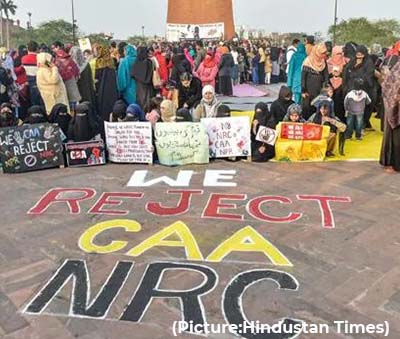
“Last year, the government intensified its crackdown on protesters opposed to a discriminatory citizenship law and arrested dozens of journalists who aired criticism of the official pandemic response. Judicial independence has also come under strain; in one case, a judge was transferred immediately after reprimanding the police for taking no action during riots in New Delhi that left over 50 people, mostly Muslims, dead,” said the Freedom House report.

In December, Uttar Pradesh, India’s most populous state, approved a law that prohibits forced religious conversion through interfaith marriage, which critics fear will effectively restrict interfaith marriage in general; authorities have already arrested a number of Muslim men accusing them of “forcing” Hindu women to convert to Islam.

The report situates India’s status as part of a global shift in the balance between democracy and authoritarianism. It warns that India’s “fall from the upper ranks of free nations” could have damaging consequences for the prospect of world’s democratic standards.

“Rather than serving as a champion of democratic practice and a counterweight to authoritarian influence from countries such as China, Modi and his party are tragically driving India itself toward authoritarianism,” it said.

“The alarming report of the Freedom House is not surprising given the rapidly escalating situation in India that has gotten alarm bells ringing across the United States and other Western European democracies,” said Ahsan Khan, President of IAMC.

Various American newspapers and magazines have questioned if India could still be called a democracy given Mr. Modi’s persecution of free speech and dissent and targeting of its minorities. The Editorial Board of the Washington Post in February called into question India’s status as a democracy, highlighting the clampdown on dissent, especially in reference to the arrest of a 22-year-old climate and animal rights activist Disha Ravi. Similarly, the NYT and the Economist in the past questioned Mr. Modi’s pretense of a democratic government.

“Arresting those who have expressed dissent, on false and fabricated charges is pervasive. Merely giving a speech or protesting, legitimate rights of citizens under the Constitution, can land people in jail,” said Mr. Khan while highlighting the situation of student leader Umar Khalid and anti-CAA protester Gulfisha, both of whom are in jail on fabricated charges.

“Many experts in the United States have raised concerns that India’s rapid transformation into a fascist state is following a genocidal trajectory, against Muslims, minorities as well as Hindus opposed to the Hindutva movement,” added Mr. Khan.

IAMC is dedicated to promoting the common values of pluralism, tolerance, and respect for human rights that form the basis of the world’s two largest secular democracies – the United States and India.

During Historic Visit To Iraq, Pope Francis Calls Extremism As ‘Betrayal Of Religion’

During Pope Francis’s four-day tour of Iraq across six cities is Francis’ first trip outside Italy since the coronavirus pandemic began, the Pontiff touched down in Baghdad on Friday, March 5th where he was met by Iraqi Prime Minister Mustafa al-Kadhimi.  In a speech after being welcomed by Iraqi President Barham Salih, Pope Francis said he was very pleased to come to Iraq, which he described as the “cradle of civilization.” In his address to the nation, ravaged by two decades of war, violence and deaths, he said, “May the clash of arms be silenced… may there be an end to acts of violence and extremism, factions and intolerance!” he said.

“Iraq has suffered the disastrous effects of wars, the scourge of terrorism and sectarian conflicts often grounded in a fundamentalism incapable of accepting the peaceful coexistence of different ethnic and religious groups.”

Francis later met with clerics and other officials at a Baghdad church that was the site of a bloody 2010 massacre. He returned to Baghdad on Saturday afternoon and celebrated Mass at the Chaldean Cathedral of Saint Joseph.

About 10,000 Iraqi Security Forces personnel are being deployed to protect the Pope, while round-the-clock curfews are also being imposed to limit the spread of Covid. Iraq’s PM Mustafa al-Kadhimi greeted him at the airport, with a red carpet, Iraqis in national dress and songs from a largely unmasked choir. Hundreds of people lined the airport road as the Pope’s convoy, heavily chaperoned by police motorcycles, left for the city.

Visiting Ur, the ancient Iraqi city where Jews, Christians and Muslims believe their common patriarch Abraham was born, Pope Francis denounced extremism as a “betrayal of religion.” The Pope visited Ur on Saturday, the second day of the first ever papal visit to Iraq. Addressing a meeting of inter-faith leaders, Francis condemned the violence that has plagued Iraq in recent years and called for friendship and cooperation between religions.

“All its ethnic and religious communities have suffered. In particular, I would like to mention the Yazidi community, which has mourned the deaths of many men and witnessed thousands of women, girls and children kidnapped, sold as slaves, subjected to physical violence and forced conversions,” he said.

Covid and security fears have made this his riskiest visit yet, but the 84-year-old insisted he was “duty bound”. He also said Iraq’s dwindling Christian community should have a more prominent role as citizens with full rights, freedoms and responsibilities. He is hoping to foster inter-religious dialogue – meeting Iraq’s most revered Shia Muslim cleric – and will celebrate Mass at a stadium in Irbil in the north.

Francis also praised the recovery efforts in Northern Iraq, where ISIS terrorist destroyed historical sites, churches, monasteries and other places of worship. “I think of the young Muslim volunteers of Mosul, who helped to repair churches and monasteries, building fraternal friendships on the rubble of hatred, and those Christians and Muslims who today are restoring mosques and churches together,” he said.

Pope Francis delivered his speech at Our Lady of Salvation. “We are gathered in this Cathedral of Our Lady of Salvation, hallowed by the blood of our brothers and sisters who here paid the ultimate price of their fidelity to the Lord and his Church,” the pontiff said.

The speech calling for cooperation between religions came just hours after the Pope held a historic meeting with revered Shia Muslim cleric Grand Ayatollah Ali al-Sistani in the holy city of Najaf. The 45-minute papal meeting with the 90-year old al-Sistani — who rarely appears in public — represented one of the most significant summits between a pope and a leading Shia Muslim figure in recent years.

During the meeting, broadcast on al-Iraqiya state TV, al-Sistani thanked Francis for making an effort to travel to Najaf and told him that Christians in Iraq should live “like all Iraqis in security and peace, and with their full constitutional rights,” according to a statement released by the Grand Ayatollah’s office.

The Pope in turn thanked al-Sistani and the Shia Muslim community for “[raising] his voice in defense of the weakest and most persecuted, affirming the sacredness of human life and the importance of the unity of the Iraqi people,” according to a statement from the Holy See.

Iraq has imposed a total curfew for the entirety of the four-day papal visit to minimize health and security risks. Francis is scheduled to leave Iraq on Monday.

Francis has met with leading Sunni cleric Grand Imam Sheikh Ahmed al-Tayeb on several occasions in the past, famously co-signing a 2019 document pledging “human fraternity” between world religions.

Pope Francis, during his historic visit to Iraq, addressed an interfaith gathering of Iraq’s religious and ethnic groups in Ur, said to be the birthplace of Abraham, the common patriarch for Jews, Christians and Muslims. He drove home the need for respect and unity, and he used the opportunity to condemn violent religious extremism.

Pope Francis traveled to the ruins of the ancient city of Ur, considered the cradle of civilization, to remind people that what binds them is more powerful than what divides. Faithful from the Christian, Muslim, Yazidi and Mandean communities were present Saturday. The pope reinforced his call for inter-religious tolerance and fraternity during the first-ever papal visit to Iraq, where religious and ethnic divisions and conflict have torn apart the social fabric for decades.

Indeed, the Christian population in the Middle East has been falling: The Christian share of the overall population in Egypt, Iraq, Israel, Jordan, Lebanon, Syria and the Palestinian territories decreased from 10% in 1900 to 5% in 2010, according to a Pew Research Center estimate published in 2014. Christians in the region tend to be older than Muslims, have fewer children and are more likely to emigrate — and that was before widespread persecution of Christians in northern Iraq and Syria between 2014 and 2017 by the group that calls itself the Islamic State.

In Iraq specifically, Christians made up less than 1% of the population as of 2010, according to Pew Research Center estimates. Among Christians in Iraq at that time, an estimated 41% were Catholic, 41% were Protestant and 17% identified with Orthodox Christianity.

Pope Francis’ trip to Iraq this weekend has been described by the Vatican as an effort to encourage the Arab country’s dwindling Christian community and strengthen ties with Muslims.

Indian-Americans Are Taking Over US: Biden

Indian-Americans are taking over the US, President Joe Biden said while congratulating Swati Mohan, the NASA engineer, who guided the Mars rover Perseverance to a soft landing on the Red Planet.

“It’s amazing. Indian of descent Americans are taking over this country. You, my Vice President, my speechwriter Vinay. But I tell you what, thanks. You guys are incredible,” he said during a virtual meeting to congratulate Mohan and others on the NASA Jet Propulsion Laboratory (JPL) team that landed the Perseverance on Mars.

“One of the reasons why we’re such an incredible country is we’re such a diverse country. We bring the best out of every single solitary culture in the world here in the US of America. And we give people an opportunity,” Biden said of the immigrants.

Mohan, who proudly displays her Indian identity with a bindi on her forehead, said: “Being able to work with this incredibly diverse talented team that has become like a family, spending years creating our own technological marvel has been a privilege.”

The NASA engineer said that she had been inspired as a child to get into space exploration by watching the Star Trek TV series where a “fantastical, really, really close knit team” was working together for sole purpose of exploring space “and understanding new things and seeking new life”.

Vandana “Vandi” Verma is the Chief Engineer for Robotic Operations for the Mars 2020 Perseverance rover, the largest, most advanced rover NASA has sent to another world touched down on Mars Feb.18, after a 203-day traversing 293 million miles.

Biden’s Vice President is Kamala Harris and his director of speech writing is Vinay Reddy, who is one of more than 20 Indian-Americans named to senior positions in his administration.

Two Indian women astronauts have gone to space, Kalpana Chawla, who was killed on her second mission aboard the Space Shuttle Challenger that broke up in 2003, and Sunita Williams, who has been a commander of the International Space Station.

Astronaut Raja Chari belongs to the Artemis team from which the next members of future expeditions will be selected. He is to command the SpaceX Crew-3 mission set for September.

When JPL Director Michael Watkins introduced Mohan, Biden said: “Hey Doc, how are you?”

Mohan said she was well and as she began to thank him for taking the time to speak to them, he cut her off, saying,:” Are you kidding me? What an honor this is, what an incredible honor this is” (for him to speak to her).

After mentioning the achievement of Indian-Americans, he told her: “Did you want to say something? I’ll be quiet.”

Mohan said she hoped that Perseverance would be able to find new life on Mars. She recalled to him the moments before the Perseverance landed on the Red Planet: Although it was going pretty smooth, the team was “really nervous and, frankly, terrified until we got through those final seven minutes”.

Mohan, who guided the rover safely to a soft landing, said: “To be able to call ‘touchdown’ safely, to see those first images come back from Mars, to see the place where we have never been able to go to on Mars before and go there — reach there for the express purpose of seeking out new life just made it feel like I was living in a dream.”

Biden replied: “I tell you what, you feel like you live in a dream, you’ve created a dream for millions and millions of young kids young Americans. You restored a dose of confidence in the American people. They were beginning to wonder if we are still the country we always believed we were. You guys did it. You guys gave a sense of America’s back. It’s astounding what you did. You should not underestimate it.”

Taking a dig at his predecessor Donald Trump, Biden said that he had heard of a head of state who wondered what had happened to the US. “They used to be so proud to do great things. And here they can’t even deal with a coronavirus. It matters because democracies have to demonstrate they can run efficiently. We have never ever, ever failed to meet a call. We’ve set our mind to it. And we’ve done it together. And that’s what you all show. So, it goes way beyond the whole notion of what you just recently did,” he added.

Mohan said that there was “the thrill of all the scientific discoveries that are yet to come and what Perseverance can actually find — and hopefully find those signs of past life on Mars”. Under Mohan’s guidance, Perseverance slowed down from a speed of nearly 20,000 km per hour with retrorockets and a parachute to about 3 kmph to touch down at the Jezero Crater on Mars about 224 million miles away from Earth on February 18. (IANS)

New Face Of Great Indian Economy: An Exclusive Interview with DR. Swati V Kulkarni Consulate General Of India at Atlanta

Meticulously rebuilding and reshaping a great democratic nation need the dedicated efforts of politicians and diplomats who reflect the characteristics and features of the progress of their motherland on international platforms, and weaving vibrant relationships globally.


Indian Consulate General at Atlanta USA, Dr. Swati Vijay Kulkarni, with her exciting initiatives, demonstrates her dedication to uplift the greatness of India and bestow unparalleled benefits to the Indian community.


Dr. Swati Vijay Kulkarni is a career diplomat who holds an M.B.B.S. (Bachelor of Medicine and Bachelor of Surgery) degree from the prestigious Government Medical College, Nagpur, India. She joined the Indian Foreign Service in 1995.


In a recent interview with her, she revealed how much she is ambitious, energetic, and looking for ways to help people.Her achievements, background, and personality can be evident from the concrete answers provided for the questions of national importance, especially during the Covid-19 pandemic hit a developing nation like India, and how successful the Indian government is able to combat and control the disaster.


Q : How far Indian diplomacy is successful in expediting the Covid vaccination programs in India and other foreign countries in distress?

On January 16, we launched the world’s largest vaccination drive. The vaccination drive has been planned in a phased manner. The Phase 1 work is in progress. As of date, i.e., February 17, 2021, we have vaccinated over 9.42 million people, mostly frontline and health workers. The 2nd Phase is starting shortly. It will give priority to people over 50 years and those with co-morbidities. Both the phases will vaccinate about 300 million people, almost the entire America minus 32 million or so. This will fast-track our economic recovery.

The launch of ‘Vaccine Maitri’ in January has been a landmark in our diplomacy. In accordance with the Honorable Prime Minister’s commitment to deploy vaccine production and delivery capacity for the benefit of all humanity, vaccines have been delivered to 25 countries as of February 17, 2021. So far, we have delivered about 16.5 million doses. A limited quantity of vaccines has initially been supplied as grant assistance/as a gift as our commitment to neighborhood first policy and our commitment to special relationships. Rest supplied on a commercial basis. Our exports have taken place to Bhutan, Maldives, Nepal, Bangladesh, Myanmar, Mauritius, Seychelles, Sri Lanka, Bahrain, and other countries like Brazil, Morocco, Saudi Arabia, South Africa, Canada, and others. Forty-nine more countries will be supplied shortly. By doing this, we reinforced our image of brand India as the ‘pharmacy of the world.’ We demonstrated in practical terms our intent of being good international citizens and responsible stakeholders in global healthcare supply chains. Our COVID response needs to be seen in the context of

‘ Aatmanirbhar Bharat’- where we have come out with not one but two made in India corona vaccines to protect humanity. You may recall that we earlier supplied made in India Hydroxychloroquine, Paracetamol, PPE, RT-PCR test kits, etc., to our international friends. Our Hon’ble PM says: “Wherever India has capabilities, the benefits have reached the entire world.”


 Q: How far the last few years of the Government machinery pushed the economy of India to higher levels, and how positive is the latest Union Budget?

As far as our economic fundamentals are concerned, our economy is forecasted to contract by 7.7 % in 2020-2021. It will witness a sharp recovery of 10-12 % in 2021-2022. So, we will witness a V-shaped recovery. During early COVID, we saw interim measures such as liquidity infusion and direct cash transfers. We gave free cooking gas to over 80 million families, free food grains to about 800 million. Then we saw the launch of structural reforms – Aatmanirbhar Bharat 1.0, 2.0, and 3.0 – i.e., reforms in growth sectors in agriculture, power, defense, civil aviation, mining, etc., reforms are introduced in the MSME sector with the focus on manufacturing, fast Track Investment Clearance through Empowered Group of Secretaries, New Education Policy, Tax Policy- Transparent Taxation- Honoring The Honest including Product Linked Incentive Scheme in over ten sectors. So, it was a crisis period for us, but an opportunity was taken to usher in five-mini budgets to bring in essential reforms that have been long overdue.

In fact, during the pandemic, we have seen certain positive developments. India’s foreign exchange reserves rose to an all-time high of more than US$ 586 billion, and external debt decreased by US$ 2 billion -we are expected to see a current account surplus after a gap of 17 years. FDI inflows were nearly US $ 50 billion in the last financial year as compared to US$ 44 billion in the year 2019. We added a record number of 12 start-ups to the Unicorn list the previous year with a valuation of over US $ 1 billion. Most significantly, India, for the first time, entered the top 50 innovative economies.

Our recent historic budget needs to be seen against this backdrop. Union Budget itself carries forward this process of reforms and other initiatives. It focuses on healthcare and wellness, universal water supply, voluntary vehicle scrapping, infrastructure, skilling, education, innovation – basically on holistic, inclusive development and a mantra of Minimum Government and Maximum governance.


Q: What is the impact of the  Farmers protest in India, and how distressing it is  to the overall growth- in-progress?

As you are aware, the Parliament of India, after a full debate and discussion, passed reformist legislation relating to the agricultural sector as our Government is committed to the socio-economic empowerment of the farmers. These reforms give expanded market access and provide greater flexibility to farmers. They also pave the way for economically and ecologically sustainable farming. A tiny section of farmers in parts of India has some reservations about these reforms. Union Ministers have been part of the negotiations, and eleven rounds of talks have already been held. The Government has even offered to keep the laws on hold and offer iterated by no less than India’s prime minister. It is miserable to see vested interest groups trying to enforce their agenda on the farmers’ protests and derail them. The vandalization of the Red Fort on Republic Day was a deplorable and anti-national act. Some of these vested interest groups have also tried to mobilize international support against India. Instigated by such fringe elements, Mahatma Gandhi statues have been desecrated in parts of the world. This is extremely disturbing for India and civilized society everywhere. Indian police forces have handled these protests with utmost restraint and have taken all these violent incidents seriously. It may be noted that hundreds of men and women serving in the police have been physically attacked and stabbed, and seriously wounded in some cases.

We want to emphasize that Government is committed to resolving the impasse within our democratic ethos and polity framework.

Motivated campaigns shall not succeed. We have self-confidence today to hold on to our own. This India will push back any propaganda.


Q In view of the new US administration, what are our priorities?

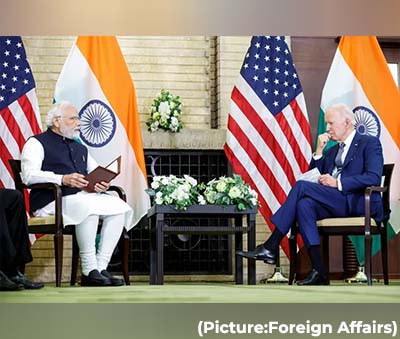
India’s global partnership with the US continues to deepen across the extraordinary breadth. There are many dimensions to our relationship, and it has assumed new significance in the changing world. Our co-operation is expanding at all fronts. Trade is growing. With the new administration in Washington, both sides will carry forward this momentum, especially in post-pandemic recovery. Our countries’ leadership had a telephone conversation on two occasions – one in November 2020 and another at the beginning of this month. Both the leaders have agreed to work closely to advance our comprehensive partnership built on shared values and common interests. The dialogue at the Ministerial and official level too continues for enhanced diplomatic consultation and coordination.

The priority area is to work on Healthcare and wellness front to contain the pandemic and promote access to vaccines on a fast-track basis. Other significant areas of India-US collaboration are digital, innovation, IT & start-Up; Education & Knowledge partnerships, clean energy including LNG & Solar and defense & related sectors.


Q How far India is supportive to Paris Climate Accord and what are the strategies in action?

India remains committed to the goals of the Paris Climate Accord. We know that climate change requires an integrated and comprehensive approach. India, therefore, has included climate action strategies in its national and developmental agenda. India has also demonstrated leadership by creating the International Solar Alliance and the Coalition for Disaster Resilient Infrastructure. Our solar energy production will reach 450 GW by 2030 as we expect to cross 220 GW in the next two years. Our National Clean Air Program aims to reduce greenhouse emissions by 20-30% in the next four years. Several other initiatives like safe drinking water for all by 2024, planting more trees, using LED lamps, promoting electric vehicles, creating Smart cities and green transport networks will help us to reduce the impact of climate change.


No doubt Dr. Swati Kulkarni has offered deep insights into her perspective on important topics through the analysis of their crisp responses. Best wishes to her all endeavors that make India Great again.

Government Of India Is Now Requiring Overseas Citizens Of India To Have Special Permit For Journalism & Research

In a stunning development for Overseas Citizens of India, the Ministry of Home Affairs issued a notification on March 4 dramatically altering the compact between OCIs and the Indian state. This notification, which is issued under Section 7B of the Citizenship Act, 1955, supersedes three earlier notifications issued on April 11, 2005, January 5, 2007, and January 5, 2009, which laid down the rights of the OCIs.

In addition to classifying OCIs as “foreign nationals”, the new notification introduces a series of new restrictions that dramatically curtails the rights and liberties of OCIs in India. These restrictions include a requirement for OCIs to secure a special permit to undertake “any research”, to undertake any “missionary” or “Tablighi” or “journalistic activities” or to visit any area in India notified as “protected”, “restricted” or “prohibited”.

In addition, the notification now equates OCIs to “foreign nationals” in respect of “all other economic, financial and educational fields” for the purposes of the Foreign Exchange Management Act, 2003 although past circulars by the Reserve Bank of India under FEMA will hold ground. This reverses the position that has held for the last 16 years wherein OCIs were equated to Non-Resident Indians rather than “foreign nationals” for the purposes of their economic, financial and educational rights.

OCIs can however continue to purchase land (other than agricultural land), pursue the profession of medicine, law, architecture and accountancy and seek parity with Indian citizens with regard to airfares and entry fee to monuments and parks. OCIs can also continue to seek enrolment in Indian educational institutions on par with NRIs but not for seats reserved exclusively for Indian citizens.

OCIs have been pushing for implementation of rights on par with Indian citizens, especially in claiming seats in educational institutions through competitive exams. “There are multiple cases pending in courts in Karnataka, where OCIs have laid claim to seats reserved for Indian citizens. So things had to be clarified further,” a Home Ministry official said. The notification in the Gazette last week granted OCIs the right of multiple entry lifelong visa to India for any purpose; exemption from registration with the Foreigners’ Regional Registration Officer (FRRO) for any length of stay in India; and parity with Indian nationals in the matter of domestic air fares, entry fees to monuments and public places.

It also said that OCI cardholders will enjoy parity with Non Resident Indians (NRIs) in adoption of children, appearing in competitive exams, purchase or sale of immovable property barring agricultural land and farmhouses, and pursuing professions such as doctors, lawyers, architects, and chartered accountants.

However, many of these rights have been subjected to certain restrictions. The notifications says that the right of multiple entry lifelong visa for “any purpose” can be enjoyed provided the OCI obtains a special permission from “the competent authority” or the FRRO “to undertake research; to undertake any Missionary or Tabligh or Mountaineering or Journalistic activities; to undertake internship in any foreign Diplomatic Missions or foreign Government organizations in India or to take up employment in any foreign Diplomatic Missions in India; to visit any place which falls within the Protected or Restricted or prohibited areas as notified by the Central Government or competent authority”.

The restrictions on missionary and Tablighi activities on foreigners and OCIs have existed since the 90s when the latter were known as Persons of Indian Origin (PIO). In February 2018, the government published broad guidelines for Indian visa wherein it mentioned the restrictions on foreigners and OCIs from engaging in Tablighi activity.

The “OCI cardholder shall not be eligible for admission against any seat reserved exclusively for Indian citizens” In respect of all other economic, financial and educational fields not specified in this notification or the rights and privileges not covered by the notifications made by the Reserve Bank of India under the Foreign Exchange Management Act, 1999 (42 of 1999), the OCI cardholder shall have the same rights and privileges as a foreigner,” the notification said.

  • The central ministry of home affairs has notified new rules that require Overseas Citizen of India (OCI) to take special permission from the government if they want to be involvedin journalistic, missionary or “Tabligh” activities in the country.
  • India provides OCI statues to certain Indian-origin foreign nationals. They have parity with Non-Resident Indians in purchase or sale of immovable properties other than agricultural land, in appearing for the entrance tests such as National Eligibility cum Entrance Test, and in inter-country adoption of Indian children, among others.
  • The ministry, in its notification issued on Thursday, said the OCI cardholders are entitled to get multiple entry lifelong visa for visiting India for any purpose but “required to obtain a special permission or a special permit from the Foreigners Regional Registration Officer or the Indian Mission to undertake research and to undertake any missionary or Tabligh or mountaineering or journalistic activities”. News agency PTIquotes a home ministry official as saying that these rules were part of the ‘brochure’ published in 2019 but were recently consolidated and notified.
  • In 2019, the central government had revoked the Overseas Citizen of India (OCI) card of author and journalist Aatish Taseer, days after Time magazine published a critical story, headlined “India’s Divider in Chief”, on Prime Minister Narendra Modi and the general election.
  • The home ministry then said he had “concealed the fact that his late father was of Pakistani origin”. Aatish, a UK national, is the son of assassinated Pakistan politician Salman Taseer and Indian journalist Tavleen Singh.

Judicial defeats

Most of these new restrictions have likely been inspired by the defeats suffered by the government in various cases filed by OCIs before the judiciary. Take for example, the new requirement for OCIs to apply for a special permit to undertake any missionary activities. This restriction has been introduced to undercut a judgment by Justice Vibhu Bakru of the Delhi High Court wherein he came down heavily on the Ministry of Home Affairs for cancelling the OCI card of an American-Indian doctor on the grounds that he was engaged in “evangelical and subversive activities” while offering free medical services to the needy and the poor in Bihar.  In that judgment, Justice Bakru made it clear that there was no restriction preventing OCIs from engaging in religious activities.

Similarly, the restrictions on OCIs competing for seats reserved for Indian citizens is meant to undercut a judgment of the Karnataka High Court by Justices BV Nagarathna and NS Sanjay Gowda declaring that OCI students will be treated as Indian citizens for the purposes of admission to professional courses.

Lastly, the Ministry of Home Affair’s assertion that OCIs are foreign nationals and not Indian citizens is most likely inspired by ongoing litigation before the Delhi High Court wherein an OCI has sought a declaration from the court that OCIs enjoy fundamental rights just like Indian citizens.

The requirement for OCIs to take a special permit to engage in journalistic activities has likely been motivated by right-wing ideologues like Subramaniam Swamy who has been targeting journalists like The Wire’s Siddharth Vardarajan because of their foreign citizenship. There are several other next generation OCIs who work as journalists in India and whose future will now be under a cloud if the Ministry of Home Affairs decides to deny them the required permit to continue working as journalists in India.

This notification by the Ministry of Home Affairs is not surprising. For some time now, the Ministry of Home Affairs has dedicated its efforts to reduce the concept of OCIs to a glorified long-term visa programmer rather than implement it as a dual citizenship program, as was the intent of Parliament when then Home Minister LK Advani piloted the Citizenship (Amendment) Act, 2003, through Parliament.

The “Statement of Objects & Reasons” accompanying this Bill, which lays down the intent of the government at the time of introducing a bill in Parliament and which can legitimately be used by the judiciary to discern the legislative intent, stated the following:

“Subsequently, the High Level Committee on Indian Diaspora constituted by the Central Government, inter alia, recommended the amendment of this Act to provide for the grant of dual citizenship to persons of Indian origin belonging to certain specified countries. The Central Government has accordingly decided to make provisions for the grant of dual citizenship.”

Advani in his introductory speech had clarified once again that the entire purpose of the Bill was to introduce dual citizenship for the Indian diaspora. It is therefore disingenuous for the Ministry of Home Affairs to now claim through a recent notification the claim that OCIs are foreign nationals. This argument is all the more absurd when viewed in light of the fact that the phrase OCI literally has the phrase “Indian citizen” in its title.

Lastly, it bears noting that the entire concept of OCIs was brought through the Citizenship Act, 1955, which is a legislation specifically meant to regulate the concept of Indian citizenship. There are separate laws like the Foreigners Act, 1946 and the Foreign Exchange Management Act, 2003, which deal exclusively with foreigners and their rights in India.

The fact that Parliament sought to locate OCIs in the Citizenship Act and not the Foreigners Act or FEMA is sufficient proof that Parliament wanted OCIs to be Indian citizens.

Editors Guild Of India Is Concerned About New Media Ethics Code, Says, ‘It Undermines Media Freedom’

Nearly a week after the Centre’s notification of the Information Technology (Intermediary Guidelines and Digital Media Ethics Code) Rules, 2021, the Editors Guild of India (EGI) has said these regulations will “fundamentally alter” and put “unreasonable restrictions” over digital media and therefore urged the government to take back these rules.

In the name of controlling an “unfettered social media,” the EGI said that the government cannot “overwhelm India’s constitutional safeguards for free media.” The new rules, “fundamentally alter how publishers of news operate over the Internet and have the potential to seriously undermine media freedom in India,” it added.

The guild also expressed concerns over the overwhelming power that the reforms grant the government. “They empower the Union Government to block, delete, or modify published news anywhere in the country without any judicial oversight and mandate all publishers to establish a grievance redressal mechanism,” the EGI statement read.

In creating the new reforms, the EGI said, the government did not consult stakeholders and therefore it must “put the rules in abeyance and conduct meaningful consultation with all stakeholders.” The Centre on February 25 notified new guidelines for intermediaries in “soft touch oversight” rules, saying these were needed to hold social media and other companies accountable for “misuse and abuse”.

The rules called for a three-tier regulation mechanism for OTT platforms like Netflix, YouTube, etc and required them to self-classify their content into five categories based on age suitability. The Centre’s announcement came amid a debate in the country to regulate digital platforms after Amazon Prime’s series “Tandav” stirred a controversy for allegedly insulting Hindu deities.

Biden Issues High Alert On China; Vows To Deepen India Partnership With India

Issuing a high alert about the growing dangers to the international system from China, President Joe Biden has called for building alliances with like-minded countries and said the US will deepen its ties with India.

The Interim National Security Guidance he released on Wednesday singled out China as the only “competitor” capable of mounting a sustained challenge with its multifarious capabilities to the international order.

He said in the document that the US will support China’s neighbours and declared, “We will deepen our partnership with India.”

Introducing the document, he said it would “convey my vision for how America will engage with the world” and guide his administration while Washington begins work on a new National Security Strategy.

He sketched a vision of a cooperative of democracies to face China, which “has rapidly become more assertive”.

He called Beijing “the only competitor potentially capable of combining its economic, diplomatic, military, and technological power to mount a sustained challenge to a stable and open international system”.

To counter this as well as the challenge from Russia, the US will have to “promote a favorable distribution of power to deter and prevent adversaries from directly threatening the United States and our allies, inhibiting access to the global commons, or dominating key regions”, he said.

“We can do none of this work alone. For that reason, we will reinvigorate and modernise our alliances and partnerships around the world,” he said.

“Our democratic alliances enable us to present a common front, produce a unified vision, and pool our strength to promote high standards, establish effective international rules, and hold countries like China to account,” he said.

Envisaging the framework for the alliance of democracies to face the China challenge, he said, “Beyond our core alliances, we will also double down on building partnerships throughout the world, because our strength is multiplied when we combine efforts to address common challenges, share costs, and widen the circle of cooperation.”

Biden drew attention to the risk from China’s “One Belt, One Road” initiative that seeks to bring countries around the world, especially developing nations, under its economic dominance.

To counter this Chinese programme, he said, “We will support China’s neighbours and commercial partners in defending their rights to make independent political choices free of coercion or undue foreign influence. We will promote locally-led development to combat the manipulation of local priorities.”

China has set debt traps by making loans to countries for infrastructure projects that they cannot pay back in the long term and then has sought to take control of them.

Biden also said, “Terrorism and violent extremism, both domestic and international, remain significant threats.”

At its core, though, the guidance is his own version of a kinder, gentler America First that seeks to strengthen the US the unparalleled world leader.

“America is back. Diplomacy is back. Alliances are back. But we are not looking back,” he said.

“The United States must lead by the power of our example, and that will require hard work at home — to fortify the founding pillars of our democracy, to truly address systemic racism, and to live up to our promise as a nation of immigrants,” he said.

“Our success will be a beacon to other democracies, whose freedom is intertwined with our own security, prosperity, and way of life.”

Earlier on Wednesday, Secretary of State Antony Blinken outlined the Biden administration’s foreign policy emphasizing “that American leadership and engagement matter”.

In his address on “Foreign Policy for the American People”, he said, “Whether we like it or not, the world does not organize itself. When the US pulls back, one of two things is likely to happen: either another country tries to take our place, but not in a way that advances our interests and values; or, maybe just as bad, no one steps up, and then we get chaos and all the dangers it creates. Either way, that’s not good for America.”

On the economic front, Blinken echoed one of former President Donald Trump’s constant refrains: “We will fight for every American job and for the rights, protections, and interests of all American workers.” He also portrayed China as the main challenge to the US and world and stressed building alliances to meet it. (IANS)

Vanita Gupta’s Nomination As US Associate Attorney-General Meets With Mixed Response From Conservatives

After the Indian-American cabinet nominee, Neera Tandon withdrew her nomination last week, , the focus is now on Vanita Gupta, who is soon to face the Senate for confirmation as the third highest-ranking official in the Justice Department. Conservatives are split on Gupta, a civil rights lawyer, with two groups fighting it out with TV ads — one rallying against attacks on her by another.

President Joe Biden has nominated Gupta to be the associate attorney-general and the Senate is take up her confirmation – a requirement for senior administration positions – on March 9.

The first salvo came from the Judicial Crisis Network with an ad campaign accusing her of being soft on crime. In a reference to the Black Lives Matter protests against police brutality that sometimes turned violent last year, the group’s ad said, “When our cities burned Gupta could’ve stood for law and order, for victims. Instead, she advocated to let convicts out of jail.”

However, it also coincided with the Covid-19 pandemic and her suggestion to release some of the low-level criminals only echoed that of former President Donald Trump’s Attorney General William Barr, who wanted to ease crowding inn jails to ease overcrowding that could spread the disease. According to media reports, the Network spent $800,000 on the campaign.

Now, the Defending Democracy Together (DDT) organization is countering it with a campaign ad of its own that is on YouTube and is set to air on TV. Urging her nomination, the ad said, “Don’t let Washington play politics with the nomination of Vanita Gupta.”

It said that she “has been building bridges across partisan divides, she has the broad backing of law enforcement” and has the support of leading conservatives.

DDT is a group of Republican conservatives who have opposed Trump. Its directors include former New Jersey Governor Christine Todd Whitman and Linda Chavez, the highest-ranking woman among former President Ronald Reagan’s White House staff.

Gupta will need the support of all the 50 Democrats in the evenly-divided Senate to get her nomination approved – or will have to get Republican support if anyone from her party defects.

Tanden’s nomination to be the director of the Office of Management and Budget is stalled because one Democrat, Joseph Manchin, announced that he will not vote for her citing her intemperate statements and tweets attacking both Republicans and Democrats.

While a leftist group, Roots Action, has campaigned against Tanden, who had attacked the leftist Senator Bernie Sanders among others, the Democrats and other liberals are solidly behind Gupta.

The Wall Street Journal reported that a petition against Gupta was being circulated by some Republican state attorneys-general.

Countering that campaign and the one by the Network campaign labelling Gupta soft on crime, three groups of law enforcement officials – Fraternal Order of Police, Major County Sheriffs of America and Federal Law Enforcement Officials Association have come out to support her.

During his Senate hearings Merrick Garland, who was confirmed as the attorney-general, faced hostile questions about Gupta from Republican Senator Mike Lee.

Garland vouched for her saying, “I regard her as a person of great integrity and a person dedicated to the mission of the department, particularly equal justice under the law.”

Gupta was the principal deputy assistant attorney-general and head of the Civil Rights Division in former President Barack Obama’s administration.

She made her mark as a newly-minted lawyer by winning the release of 38 people, most of them African-Americans, who had been wrongly convicted by all-White juries on drug charges in a Texas town and also got them $6 million on compensation. (IANS)

100 Days of Rage and Resistance! 248 Lives Lost!

The historic and globally recognized farmers’ movement, which entered into an electrifying phase with the ‘Delhi Chalo’ Call on 26th Nov, completes 100 days today. The movement continues to challenge the notorious ‘Three Farm Acts’ that would herald unprecedented levels of corporate control over agriculture, nullifying the mandi system, diminishing the significance of the Minimum Support Prices (MSP) and opening up the possibility of alienation of farmlands to big corporations. Landowning farmers, marginal farmers and agricultural workers, in particular women across all categories, stand to lose by these laws. In addition, this will lead to a general increase of dominance of big corporates such as the Adanis and Ambanis over rural governance and agriculture, enhancing the already existing “Company Raj”.

For more than 7 months, the entire nation witnessed farmers across the country on the streets, raising their voice against these laws that would permanently jeopardize their already precarious situation and also eventually disband the public distribution system (PDS). Diverse sections of civil society and concerned citizens extended support at many places. The farmers and farm workers of Punjab, a state which not only thrives on agriculture but also one that has a long history of farmer unionism have been leading since Day 1.

Under the leadership of the Samyukta Kisan Morcha, consisting of over five hundred farmers’ organizations across the country, along with the All India Kisan Sangharsh Co-ordination Committee (AIKSCC), the farmers arrived at the borders of Delhi in late November, with thousands of tractors from Punjab. They staged historic sit-ins at Singhu, Tikri and Ghazipur throughout the cold winter months. The farmers have also staged roadblocks and rail blockades, peacefully and democratically to communicate their points to the largely unresponsive government and the middle-class power holders in India’s cities.

However, the Govt., continuing its anti-people and authoritarian approach, refused to listen to the farmers who complained that they were never consulted in the process of enactment of these laws, despite being the primary stakeholders. The Govt, its right-wing affiliates and lapdog media houses made multiple attempts to vilify the farmers’ movement, spread fake narratives, clamp down on the protest, inflict injury, undertake arrests etc. The Centre even imposed a de facto economic and transportation blockage of Punjab. However, none of these modes of repression worked in the face of the tremendous resistance of the farming-toiling class.

With their increased participation and leadership, the women farmers and elderly farmers also gave a befitting reply to the disparaging and misogynist comments by that CJI, asking why they were ‘kept’ in the protest. The central role played by women farmers in keeping the movement alive at the borders of Delhi, in the villages of Punjab and elsewhere is awe-inspiring.

Over the months, the movement snowballed across the length and breadth of the country, intensifying the demand for a complete repeal of the three Farm Acts and the Electricity Bill, calling for a legally guaranteed MSP for all crops, for slashing of diesel prices and the implementation of the Swaminathan Committee Report (in particular C2+50). The government’s refusal to accept the farmers’ demands, despite repeated meetings, eventually strengthened the struggle and over the last two months, the movement took wings throughout Western Uttar Pradesh, Uttarakhand, Haryana and Rajasthan. Multiple maha-panchayats and rallies have been convened, in which lakhs of people participated, with the inspiring presence of women in some of them. Today, the protestors have blocked major roads leading to Delhi and resolved to continue their struggle till the demands are met.

As we extend our solidarity, we deeply appreciate the historic achievements of the movement so far. Within Punjab, it has been able to galvanize the non-farming sections and create a region-wide political churning against centralized pro-corporate Hindutva rule. The movement has brought back the “farmer” at the heart of the political discourse, as a category of people pitted against corporate rule. This is an important achievement in times when we stand in real danger of Hindutva-corporate rule being normalized.

Unsurprisingly, and significantly, such a political process has promised to heal the religious polarization in Western Uttar Pradesh and Haryana which the Bharatiya Janata Party (BJP) had engineered through communal riots in 2013, from which it had reaped massive electoral benefits. The Govt was also forced to enter into multiple rounds of consultations with the farm unions, although it was never sincere in its commitment to understand and address the core issues. The pressure from the movement made the Govt announce shelving of the Electricity Amendment Bill and the Ordinance to ‘Check Air Quality Deterioration in NCR’, which sought to impose heavy fines on the farmers. Even the Supreme Court had to take cognizance of the protests and stayed away from interfering with the farmers’ right to agitate peacefully.

Recently, the movement has been able to enlist the support of several non-BJP political parties and the central trade unions – by extending solidarity to the latter’s stance against the Labour Codes – and joined the No Vote to BJP Campaign that has been going on in election-bound Bengal. In other words, the farmers’ movement has moved towards building a cross section social movement and weaved alliances with social movements, trade unions and political parties, in order to throw up a potent political opposition to the BJP’s anti-federal, Hindutva/corporate rule.

NAPM salutes all the farmers of the country and in particular those camping at Delhi for 100 days, braving the biting cold and the cold-hearted government.  We respectfully remember each of the 248 farmers whose lives were lost in the past few months, only because of this callous regime. We firmly believe that it is high time the entire nation stood resolutely by the farmers who are fighting a crucial battle for the present and the future generations.

(The above statement was issued by National Alliance of People’s Movements)

Expanding US Supreme Court

The Biden administration has created a bipartisan commission to study reforms within the Supreme Court as well as a broader review of the court system and the House of Representatives’ Judiciary Committee recently held hearings on the need for more federal judges and other court reforms.

Ryan Vacca, a professor at the University of New Hampshire Franklin Pierce School of Law with an expertise in federal judiciary reform, and who recently advised the House in advance of the hearing, is available to discuss the problems plaguing the federal judicial system, how and why previous efforts have failed, arguments for and against court packing, and how the reforms might be structured to avoid past problems.

“For the commission to succeed and actually solve the serious problems plaguing the federal judiciary, the most important thing the commission can do is to understand how and why previous efforts have failed and to devise a plan to overcome those barriers,” said Vacca.

Vacca points out that the federal judiciary serves as a critical part of the foundation of the American republic and reform has never come easily or quickly. As co-author of an article in the California Law Review, Revisiting and Confronting the Federal Judiciary Capacity “Crisis”: Charting a Path for Federal Judiciary Reform, he details the history of reform efforts; analyzes the data on federal court caseloads and performance; explores the political, institutional, and human causes of the logjam; and offers an antidote to overcome these hurdles—a commission that recommends reforms that do not go into effect for a decade, which he refers to as the “2030 Commission.” By delaying implementation of the recommendations, the commission members and other stakeholders, like members of Congress and current judges, are effectively working behind a veil of ignorance that enables them to fairly focus on the best interests of future generations of citizens, judges and practitioners while still drawing on their own experiences.

What Is In For You In The $1.9 Trillion COVID-19 Relief Bill Congress Passed?

The Democrat controlled US House of Representatives approved a massive $1.9 trillion coronavirus relief package, advancing President Joe Biden’s top agenda item and providing more resources to schools and businesses, boost funding for vaccinations and testing, and grant financial relief to Americans across the country.

Democrats passed the measure early Saturday morning, Feb. 27th in a party-line vote, with Republicans united against the bill calling for slimmer, more-targeted relief. All but two Democrats supported the bill in the 219-212 vote, and no Republicans backed the package.

Democrats have advanced the coronavirus legislation using the budget reconciliation process, in a bid to avoid the Senate’s 60-vote threshold and pass their package with a simple majority of votes, given the slim 50-50 divide in the upper chamber.

The Senate is expected to take up the legislation next week, after the chamber’s parliamentarian ruled that Democrats could not include a $15 minimum wage in the proposal over budgetary concerns. “This started almost a year ago,” House Majority Leader Steny Hoyer, D-Md., said of the pandemic ahead of the House vote. “Today’s vote is a crucial step in our fight to defeat COVID-19.”

The American Rescue Plan would provide $1,400 stimulus checks to millions of Americans across the country and extend federal unemployment benefits through the summer. It would also provide hundreds of millions of dollars in aid to state and local governments, schools and vaccine and COVID-19 testing efforts — in addition to nutritional and child care assistance.

While Democrats and the White House have touted public polls showing broad bipartisan support for the measure, and the endorsements of state and local GOP leaders, House Republicans are expected to vote against the bill as a bloc. For weeks, they have argued that Democrats’ proposal is too expensive and ignores the $4 trillion in coronavirus relief approved by Congress last year, some of which remains unspent.

“This isn’t a relief bill,” House Minority Leader Kevin McCarthy said Friday. “It takes care of Democrats’ political allies while it fails to deliver for American families.” Americans “want us to actually work together, to come together and solve the problems in a bipartisan way,” Rep. Anthony Gonzalez, R-Ohio, said on the House floor. “I think that message was clear. And the more the majority ignores it, the shorter their majority will be.”

Biden had briefly engaged with a group of 10 Senate Republicans pushing an alternative to his plan, but rejected their $600 billion counteroffer as too meager, arguing it did not meet the moment and would cut spending on key programs included in his legislation.

Senate Budget Committee Chairman Bernie Sanders, I-Vt., and Finance Committee Chairman Ron Wyden, D-Ore., announced they would offer an amendment to the budget bill, once it comes over from the House, that would penalize “large, profitable corporations” through the elimination of tax deductions” if those companies do not raise the minimum wage for their workers to “at least $15 an hour.” The two chairmen also said that measure would offer incentives to small businesses to raise worker wages.

House Speaker Nancy Pelosi said Democrats would still “absolutely” pass the package without the minimum wage increase, and members of the caucus reaffirmed their commitment to the issue on Friday. “I’m not going to stop till we get it,” Rep. Debbie Dingell, D-Mich., said Friday.

Look at some highlights of the legislation:

  • The legislation provides a rebate that amounts to $1,400 for a single taxpayer, or $2,800 for a married couple that files jointly, plus $1,400 per dependent. Individuals earning up to $75,000 would get the full amount as would married couples with incomes up to $150,000.
  • The size of the check would shrink for those making slightly more with a hard cut-off at $100,000 for individuals and $200,000 for married couples.
  • Some Republicans want to cut the size of the rebate as well as the pool of Americans eligible for it, but Biden has insisted on $1,400 checks, saying “that’s what the American people were promised.” The new round of checks will cost the government an estimated $422 billion.
  • Under current law, most taxpayers can reduce their federal income tax bill by up to $2,000 per child. The package moving through the House would increase the tax break to $3,000 for every child age 6 to 17 and $3,600 for every child under the age of 6.
  • The legislation also calls for the payments to be delivered monthly instead of in one lump sum. If the secretary of the Treasury determines that isn’t feasible, then the payments are to be made as frequently as possible.
  • Also, families would get the full credit regardless of how little they make in a year, even just a few hundred dollars, leading to criticism that the changes would serve as a disincentive to work. Add in the $1,400 per individual checks and other items in the proposal, and the legislation would reduce the number of children living in poverty by more than half, according to an analysis from the Center on Poverty and Social Policy at Columbia University.
  • The legislation would send $350 billion to state and local governments and tribal governments. While Republicans in Congress have largely objected to this initiative, Biden’s push has some GOP support among governors and mayors.
  • Many communities have taken hits to their tax base as millions of people have lost their jobs and as people stay home and avoid restaurants and stores to prevent getting COVID-19. Many areas have also seen expenses rise as they work to treat the sick and ramp up vaccinations.
  • But the impact varies from state to state and from town to town. Critics say the funding is not appropriately targeted and is far more than necessary with billions of dollars allocated last spring to states and communities still unspent.
  • The bill calls for $130 billion in additional help to schools for students in kindergarten through 12th grade. The money would be used to reduce class sizes and modify classrooms to enhance social distancing, install ventilation systems and purchase personal protective equipment. The money could also be used to increase the hiring of nurses, counselors and to provide summer school.
  • Spending for colleges and universities would be boosted by $40 billion, with the money used to defray an institution’s pandemic-related expenses and to provide emergency aid to students to cover expenses such as food and housing and computer equipment.
  • The bill provides another round of relief for airlines and eligible contractors, $15 billion, so long as they refrain from furloughing workers or cutting pay through September. It’s the third round of support for airlines.
  • A new program for restaurants and bars hurt by the pandemic would receive $25 billion. The grants provide up to $10 million per entity with a limit of $5 million per physical location. The grants can be used to cover payroll, rent, utilities and other operational expenses.
  • The bill also provides another $7.25 billion for the Paycheck Protection Program, a tiny fraction of what was allocated in previous legislation. The loans are designed to help borrowers meet their payroll and operating costs and can potentially be forgiven.
  • Expanded unemployment benefits from the federal government would be extended, with an increase from $300 a week to $400 a week. That’s on top of what beneficiaries are getting through their state unemployment insurance program.
  • The bill provides money for key elements of the Biden administration’s COVID-19 response, while also trying to advance longstanding Democratic priorities like increasing coverage under the Obama-era Affordable Care Act.
  • On “Obamacare,” it dangles a fiscal carrot in front of a dozen states, mainly in the South, that have not yet taken up the law’s Medicaid expansion to cover more low-income adults. Whether such a sweetener would be enough to start wearing down longstanding Republican opposition to Medicaid expansion is uncertain.
  • The bill provides $46 billion to expand federal, state and local testing for COVID-19 and to enhance contract tracing capabilities with new investments to expand laboratory capacity and set up mobile testing units. It also contains about $14 billion to speed up the distribution and administration of COVID-19 vaccines across the country.

RAISING THE MINIMUM WAGE

  • The bill would gradually raise the federal minimum wage to $15 per hour by June 2025 and then adjust it to increase at the same rate as median hourly wages. However, that provision is not expected to survive in the final bill. The Senate parliamentarian ruled that it cannot be included in the COVID-19 economic relief package under the process Democrats chose to undertake to get a bill passed with a simple majority.

Biden had predicted such a result. Still, the ruling was a stinging setback for most Democratic lawmakers who had said the higher minimum wage would increase the pay for millions of Americans. The nonpartisan Congressional Budget Office had projected the new federal minimum wage would lift some 900,000 people out of poverty once it was fully in place. But Republicans said the mandatory wage hikes would make it harder for small businesses to survive and they pointed to the CBO’s projection that about 1.4 million jobs would be lost as employers looked for ways to offset their higher personnel costs.

Saudi Crown Prince Approved Operation To Kill Jamal Khashoggi

Saudi Arabia’s crown prince approved the operation that led to the brutal 2018 death of journalist Jamal Khashoggi, the U.S. intelligence community said in a report released Friday.

President Biden has been critical of Saudi Arabia and the report is expected to further harm the increasingly fraught relations between the two longtime allies. He said Friday that he will hold Saudi Arabia accountable for human rights abuses.

“We assess that Saudi Arabia’s Crown Prince Muhammad bin Salman approved an operation in Istanbul, Turkey, to capture or kill” Khashoggi, said the report by the Office of the Director of National Intelligence.

“Since 2017, the crown prince has had absolute control of the kingdom’s security and intelligence organizations, making it highly unlikely that Saudi officials would have carried out an operation of this nature without the crown prince’s authorization,” it added.

Shortly after the report was released, Director of National Intelligence Avril Haines gave an exclusive interview to NPR.

“The fact that the crown prince approved that operation … is likely not to be a surprise,” she told NPR’s Mary Louise Kelly. “I am sure it is not going to make things easier, but I think it’s also fair to say that it is not unexpected.”

Asked how this might affect the U.S.-Saudi relationship, she said: “I think there will be ways to weather the various storms that we have in front of us.”

Meanwhile, Saudi Arabia said it rejected completely “the negative, false and unacceptable” finding of the U.S. intelligence community, adding “that the report contained inaccurate information and conclusions.”

The basic facts of the killing have long been clear. Khashoggi, 59, was a Saudi citizen living in Northern Virginia and writing columns for The Washington Post that were often critical of the Saudi monarchy. He was killed during a visit to the Saudi Consulate in Istanbul on Oct. 2, 2018. His body was dismembered, and his remains have never been found.

Saudi Arabia initially denied knowledge of what happened to Khashoggi. But in the face of intense international pressure, the kingdom blamed his death on “rogue” security officials. However, the crown prince’s involvement in the killing has long been suspected.

Two months after Khashoggi’s death, in December 2018, then-CIA Director Gina Haspel returned from a trip to Turkey and briefed Senate leaders on her findings. The senators emerged from that meeting convinced that the crown prince was responsible.

Crown Prince Mohammed bin Salman “is a wrecking ball. I think he is complicit in the murder of Khashoggi in the highest possible level,” said Sen. Lindsey Graham, R-S.C.

In a 2019 report, U.N. human rights investigator Agnes Callamard said Khashoggi “has been the victim of a deliberate, premeditated execution, an extrajudicial killing for which the state of Saudi Arabia is responsible under international human rights law.”

The U.N. report said a 15-member team of Saudi agents flew to Istanbul specifically to meet Khashoggi. The team included a forensic doctor and people who worked in the crown prince’s office.

The U.S. intelligence report released Friday says seven of the team members were part of the crown prince’s “elite personal protective detail.” It says that group, called the Rapid Intervention Force, “exists to defend the crown prince” and “answers only to him.”

“We judge that members of the RIF would not have participated in the operation against Khashoggi without Mohammed bin Salman’s approval.”

Saudi courts have sentenced five men to death for Khashoggi’s murder, but the sentences were later reduced to 20 years. Three other men received lesser sentences.

Biden has already made it clear that he plans to take a more critical position toward Saudi Arabia, which has had close ties with many U.S. presidents, including President Donald Trump.

Trump’s first foreign trip as president was to Saudi Arabia in 2017, where he described the kingdom as a regional leader and praised it for the billions of dollars the Saudis spend on U.S. weapons.

During last year’s presidential campaign, Biden called Saudi Arabia a “pariah” and was critical of its human rights record and its intervention in Yemen’s civil war, which has contributed to one of the world’s worst humanitarian crises.

“The president’s intention, as is the intention of this government, is to recalibrate our engagement with Saudi Arabia,” White House press secretary Jen Psaki said Wednesday. Psaki said earlier this month that Biden would conduct relations with Saudi Arabia “counterpart to counterpart.”

“The president’s counterpart is King Salman,” Psaki said. Biden said he has read the intelligence report produced by the Office of the Director of National Intelligence, which oversees all 18 of the U.S. intelligence agencies.

According to the White House, Biden spoke by phone Thursday with King Salman. They discussed a range of issues, and Biden “affirmed the importance the United States places on universal human rights and the rule of law.”

Shortly after the report was released, U.S. Secretary of State Antony Blinken said the U.S. is imposing “visa restrictions on 76 Saudi individuals believed to have been engaged in threatening dissidents overseas, including but not limited to the Khashoggi killing.”

The U.S. Treasury also announced sanctions against the Rapid Intervention Force and Ahmad Hassan Mohammed al Asiri, the former deputy head of Saudi Arabia’s General Intelligence Presidency, who it says was “assigned to murder” the journalist. The designation blocks all property and interests in property they own in the U.S. It also freezes their relevant property “in the possession or control of U.S. persons.”

Analysts who follow Saudi Arabia say that the king, 85, has been in poor health for years and that the crown prince, 35, is the driving force in the kingdom. Friday’s announcement of U.S. sanctions conspicuously did not include the crown prince.

The U.S.-Saudi partnership has often been described as transactional. The U.S. has long imported Saudi oil and relied on the kingdom’s output to help stabilize world oil prices. The Saudis, in turn, buy U.S. weapons in bulk and view the U.S. as its main protector. The two countries have also cooperated in counterterrorism efforts against radical Islamist groups such as al-Qaida.

But critics say the U.S. and the Saudis share little in terms of values. Many U.S. administrations have been all but silent on Saudi Arabia’s lack of democracy, the restrictions it places on women and its human rights violations.

The Obama and Trump administrations assisted the Saudi military campaign in Yemen against the Houthis, a group backed by Iran. But with no military solution on the horizon, and the impoverished country shattered by years of war, the Biden administration says it will press the Saudis to find a diplomatic solution in Yemen.

US Debt Soars To $29 Trillion, Owes India $216 Billion

The US, the world’s largest economy, owes India USD 216 billion in loan as the country’s debt grows to a record USD 29 trillion, an American lawmaker has said, cautioning the leadership against galloping foreign debt, the largest of which comes from China and Japan.

In 2020, the US national debt was USD 23.4 trillion, that was USD 72,309 in debt per person. “We are going to grow our debt to USD 29 trillion. That is even more debt owed per citizen. There is a lot of misinformation about where the debt is going. The top two countries we owe the debt to are China and Japan, not actually our friends,” Congressman Alex Mooney said.

“We are at global competition with China all the time. They are holding a lot of the debt. We owe China over USD 1 trillion and we owe Japan over USD 1 trillion,” the Republican Senator from West Virginia said on the floor of the US House of Representatives as he and others opposed the latest stimulus package of USD 2 trillion.

In January, US President Joe Biden announced a USD 1.9 trillion coronavirus relief package to tackle the economic fallout from the pandemic, including direct financial aid to average Americans, support to businesses and to provide a boost to the national vaccination programme.

“The people who are loaning us the money we have to pay back are not necessarily people who have our best interest at heart. Brazil, we owe USD 258 billion. India, we owe USD 216 billion. And the list goes on the debt that is owed to foreign countries,” Congressman Mooney said.

America’s national debt was USD5.6 trillion in 2000. During the Obama administration, it actually doubled.

“Since the eight years Obama was President, we doubled our national debt. And we are adding another—projected here—a completely out of control debt-to-GDP ratio,” he said urging his Congressional colleagues to consider this national debt issue before approving the stimulus package.

“So I urge my colleagues to consider the future. Don’t buy into the—the government has no money it doesn’t take from you that you are going to have to pay back. We need to be judicious with these dollars, and most of this is not going to coronavirus relief anyway,” he said.

Congressmen Mooney said that things have gone completely out of control. The Congressional Budget Office estimates an additional USD 104 trillion will be added by 2050. The Congressional Budget Office forecasted debt would rise 200 per cent.

“Today, as I stand here right now, we have USD 27.9 trillion in national debt…That is actually a little more than USD 84,000 of debt to every American citizen right here today,” Mooney said.

India Claims At UNHRC, It Showed Utmost Respect To Protesting Farmers, Engaged In Dialogue

India’s Ambassador Indra Mani Pandey, Permanent Representative of India, said that the India has set a goal of doubling the income of farmers by 2024.  Farmers raise slogans during a protest against the new farm laws, at the Delhi-Ghazipur border in New Delhi on Thursday. (ANI Photo)

The government has shown the utmost respect for protests by farmers and has remained engaged in dialogue with them to address their concerns pertaining to the farm laws, said India on Friday.

Speaking at the General Debate on Oral Update of the High Commissioner at the 46th Session of Human Rights Council, Ambassador Indra Mani Pandey, Permanent Representative of India, said that the India has set a goal of doubling the income of farmers by 2024. The purpose of enacting three Farm Acts is to enable farmers to realise better price for their produce and enhance their income.

“The Government of India has set a goal of doubling the income of farmers by 2024. The purpose of enacting three Farm Acts is to enable farmers to realise better price for their produce and enhance their income. It will particularly benefit small farmers and offer more choices to those farmers who opt for them. The Government has shown utmost respect for protests by farmers and has remained engaged in dialogue with them to address their concerns,” Pandey said.

U.S. Trade Report Calls ‘Make In India’ Policy As “Trade Restrictive”

The U.S. tried to resolve “long-standing market access impediments affecting U.S. exporters” with India during 2020, says the 2021 President’s Trade Agenda and 2020 Annual Report — an annual report submitted by the U.S. Trade Representative (USTR) to Congress. The report terms India’s policies “trade-restrictive” and saying the “Make in India” campaign epitomises the challenges to the trade relationship.

“While India’s large market, economic growth, and progress towards development make it an essential market for many U.S. exporters, a general and consistent trend of trade-restrictive policies have inhibited the potential of the bilateral trade relationship. Recent Indian emphasis on import substitution through a “Make in India” campaign has epitomized the challenges facing the bilateral trade relationship,” the report says. The Make in India campaign was launched by Prime Minister Modi in 2014 to incentivise production in India.

The report describes the Trump administration’s revocation of India’s preferential trading status under the Generalised System of Preferences (GSP) program in June 2019 and the ensuing discussion to achieve a mini trade deal (“package”) throughout 2020.

“U.S. objectives in this negotiation included resolution of various non-tariff barriers, targeted reduction of certain Indian tariffs, and other market access improvements. The United States also engaged with India on an ongoing basis throughout 2020 in response to specific concerns affecting the full range of pressing bilateral trade issues, including intellectual property (IP) protection and enforcement, policy development affecting electronic commerce and digital trade, and market access for agricultural and non-agricultural goods and services,” the report said.

These issues remain unresolved, leaving inconclusive, negotiations that lasted until close to the end of the Trump administration.

In a country-wise section on Digital Service Tax (DST), a Section 301 investigation on India’s DST, which began in June last year, is highlighted. The investigation is ongoing, as per the report.

India finds a total of 179 mentions in the report which is over 300 pages long. Many of the mentions are in a chapter on trade enforcement activities — describing disputes brought by the U.S. at the World Trade Organization (WTO).

Is the USA Fit to Rejoin the UN Human Rights Council?

A month into Joe Biden’s presidency, the U.S. has rejoined nearly all the multilateral institutions and international commitments that it withdrew from under Trump. These include the World Health Organization and the Paris Climate Accords.

Most recently, on February 8th, the U.S. announced it would also rejoin the United Nations Human Rights Council (HRC) as an observer. The U.S.’ role in the human rights forum looks different than it did four years ago in light of its recent track record on civil liberties.

The HRC has two primary functions: to draft and adopt new standards for human rights and to conduct investigations into specific human rights issues. In 2018, U.S. Ambassador to the UN Nikki Haley and U.S. Secretary of State Mike Pompeo announced that the U.S. would be leaving the HRC, claiming that it was a barrier to any genuine global human rights protection. The U.S. had two primary grievances.

First, that the HRC has an “unconscionable” and “chronic bias” against Israel. And second, that the HRC’s membership criteria allows chronic human rights abusers to have a seat on the Council. Neither of which are entirely baseless claims.

Israel remains the only country-specific agenda item covered at every HRC meeting and Russia, China, and Eritrea — to name a few — all currently hold seats on the Council and have some of the worst human rights records in the world.

On Monday, the HRC’s 47 member states met for its 46th session, it’s third time meeting since the beginning of the pandemic. The further decline of political and civil rights as enshrined in international law will be an unavoidable hot topic.

The CIVICUS Monitor which rates UN member states’ track records of upholding the legal tenets of freedom of expression, freedom of peaceful assembly and freedom of association finds that 30 of the Council’s full member states routinely and severely restrict these rights.

And in the case of its newest observer state, the USA was recently downgraded to the Monitor’s third worst civic space rating of ‘Obstructed’. The body is a long way off from adequately representing its values.

In the case of the USA, the rating change and decline in rights is reflected by the police response to the Black Lives Matter (BLM) protest movement. During protests in 2020, law enforcement detained thousands of demonstrators, used teargas and projectiles to disperse crowds, and attacked journalists, despite the fact that most wore media credentials.

President Trump and other authority figures encouraged police officers to respond forcefully and, in some cases, requested such violent actions for their own benefit. In a perfect example of this, the Attorney General ordered the use of teargas against peaceful protesters so that President Trump could have a photo-op in front of a church.

While the BLM protests may have made the decline in civic freedoms abundantly clear, this rating change represents a longer deterioration of political and civil rights.

In response, in June the HRC unanimously passed a mandate that called for a report on ‘systemic racism’ targeted at individuals of African descent. Philonise Floyd, the brother of George Floyd, whose murder at the hands of white police officers began the mass protests, called on the human rights body to examine the U.S.’ history of racial injustice and police brutality.

In the end, the final resolution passed by the HRC called for an investigation of systemic racism globally and regrettably did not single out the U.S.

While Biden has rejoined the HRC as an observer, the U.S. must win elections in October 2021 if it wants to regain its seat on the Council. In 2019, Biden said, “American leadership on human rights must begin at home” and — in some ways — it has.

The BLM protests have sparked a degree of state and local level police reform, and Biden has made a commitment to achieving racial equity. While the U.S. should focus on improving freedoms within its borders, it should also not exempt itself from becoming a full member of the HRC again in October.

Former President Barack Obama ran for a seat on the Council because he believed the U.S. could do more to advance human rights as a member of the body. This turned out to be true— the U.S. supported the creation of several important international commissions of inquiry to investigate human rights violations.

If the rationale by Trump was that leaving the council would do more for human rights than holding a seat, it’s clear that this has not come to fruition. Whether it is freedom of speech or the right to peacefully protest, today more of the world’s population lives in ‘Closed’, ‘Repressed’ or ‘Obstructed’ countries as compared to four years ago, finds the CIVICUS Monitor.

Leadership is needed at the UN Human Rights Council on these issues, but it must come from those that have a full seat at the table and have a demonstrated track record of upholding their commitments. The U.S. is currently disqualified on both accounts. Credibility and moral leadership must come from somewhere else.

Instead, the U.S. must support other member states that are leading by example on these issues. Seven members of the HRC — Denmark, Germany, Uruguay, Netherlands, Marshall Islands, and Czechia — are rated ‘Open’ by the CIVICUS Monitor, the highest civic space rating a country can achieve.

These countries are adequately representing the values that the HRC is committed to defending. While there are surely other issues at the HRC that the U.S. will prove influential, the country is far from the inspirational example it often likes to present itself on these world stages.

At the current session of the HRC, which began on February 22nd, the U.S. should champion these members who have made meaningful progress on civil liberties and be prepared to take a backseat on issues that it so obviously falls short on.

Kevin Rudd on The Avoidable War: The Decade of Living Dangerously

“The Avoidable War: The Decade of Living Dangerously,” a collection of Asia Society President Kevin Rudds essays, articles, and speeches on the events of 2020, is now available for download at the Asia Society Policy Institute (ASPI) website. The collection is the third volume in ASPI’s annual Avoidable War series, which features Rudd’s analysis into the key trends affecting the world.

Rudd’s works provide insight into the devastating events of 2020, a year destined to be remembered as a major global inflection point — from the COVID-19 pandemic, through an implosion of multilateral governance, and to the impact on China’s domestic political economy. He shows how the year illustrated the true extent of our globalized, interconnected world, revealed dysfunction present in our institutions of national and international governance, and unmasked the real level of structural resentment, rivalry, and risk present in the world’s most critical great power relationship — that between the United States and China.

These essays, articles, and speeches — some originally published in The Wall Street Journal, The Economist, and Foreign Affairs — offer an invaluable resource for observers wishing to reflect on a tumultuous year as well as understand the forces shaping the years to come.

Download the complete collection here. Read the first volume of The Avoidable War here and the second volume here.

Renaming World’s Largest Cricket Stadium After PM Modi, Elicits Criticism

India renamed the world’s largest cricket stadium after Prime Minister Narendra Modi on Wednesday last week, a move that drew criticism from many. The name change to the Narendra Modi Stadium was unveiled at the 132,000-seat venue formerly known as Sardar Patel Stadium in Ahmedabad, in the western state of Gujarat, where India are playing England in the third match of a four-game test series.

The site on the outskirts of Ahmedabad, Modi’s political home town in the state of Gujarat, was recently rebuilt as the world’s largest cricket venue with capacity for 110,000 spectators. Modi has sought to use a slate of signature projects — such as building the world’s tallest statue and remaking India’s parliament — to project himself as the country’s most transformative and powerful prime minister in decades.

“It’s quite stunning,” said Ronojoy Sen, a senior research fellow at the National University of Singapore and author of a book on the history of sport in India. He argued that “the symbolism — the largest, the biggest, the best — being built in Ahmedabad” was central to Modi’s political brand. “This is the first time in my memory at least that a living Indian [prime minister] has named a stadium after themselves,” he added. The stadium was previously named after Sardar Patel, a leading figure in the independence movement and one of Modi’s political heroes.

“World’s largest stadium dedicated to the world’s largest personality!,” Priti Gandhi, a BJP spokeswoman, said in a tweet. Others said the decision reflected a cult of personality surrounding Modi. “The people of Gujarat will not bear this insult to Sardar Patel,” said Hardik Patel, president of the opposition Congress party in the state.

Sardar Patel was India’s first interior minister, long revered for his tough approach on national issues. Authorities have named the larger complex surrounding the stadium after him. Dedicating sports stadiums to former prime ministers is common in India, but renaming such a high-profile venue for a sitting leader is rare.

Many of India’s public institutions and projects have been named after members of the Congress’ Nehru-Gandhi dynasty that governed India for decades and which Modi’s party long criticized as the dominance of one family.

“Both the BJP and Congress are busy perpetuating political branding,” Sanjay Jha, a former Congress official and political commentator, said. Archit Khare, a 29-year-old student at the game, said: “I don’t know why it has been changed. Sardar Patel is more iconic. Sardar Patel was the iron man of India, it should have remained.”

Gaurav Pandhi, who runs social media for the opposition Congress party, called it the “heights of narcissism . . . Megalomaniac!” Modi served as chief minister of Gujarat before his ascent to the premiership in 2014. The newly rebuilt stadium hosted Donald Trump when he visited India last year, but its debut as a cricket venue was delayed by the coronavirus pandemic. The name change was revealed only a couple of hours before the start of the third test match on England’s tour of India. The ground was at half capacity on Wednesday, hosting about 50,000 fans, thanks to a precipitous nationwide drop in Covid-19 infections.

Joe Biden Unveils Plan To Help 11Million Immigrants Obtain Permanent Status

President Joe Biden’s proposed bill with the objective of long delayed and much debated immigration overhaul, known as the U.S. Citizenship Act of 2021, was introduced in US Congress on Thursday, February 18th, kicking off what will likely be one of his most difficult legislative challenges.

The legislation includes an eight-year path to citizenship for most of the roughly 11 million immigrants living illegally in the U.S., bolsters the nation’s refugee and asylum systems and calls for additional technology to be used to help secure the southern border. The citizenship path is not conditional on the implementation of border security measures, which had been a trade-off included in past immigration bills designed to earn Republican support.

Some, including farmworkers and people brought to the country as children — so-called Dreamers — will get an immediate path to permanent residency or a “green card,” allowing them to work legally. Others addressed include thousands of people in the United States under temporary protected status (TPS) due to violent upheavals or natural disasters in their home countries.


Biden announced on January 20, his first day in office, that he would pursue comprehensive reforms to immigration laws to lay out a more “humane” and “just” system. Biden called the policy reforms “long overdue” and said they were aimed at reversing the “misguided policies” of his predecessor Donald Trump, who mounted a hardline effort to halt illegal immigration, slash legal immigration and drive out undocumented immigrants, even those in the country for decades.


The new proposal aims to give legal protections to millions of people, mostly from Mexico and central America, who have lived in the country for many years, with homes, businesses and US-born children and grandchildren. “Immigration is an irrefutable source of our strength and is essential to who we are as a nation,” Biden said in a statement. “This is an important first step in pursuing immigration policies that unite families, grow and enhance our economy, and safeguard our security,” he said.


Democratic Senator Bob Menendez, a leading backer of the legislation, has said, many of the immigrants work in the farm, food, and healthcare industries that have been essential during the Covid-19 pandemic, while risking higher rates of coronavirus infection and death. Menendez called on Democrats to take advantage of their narrow control of both houses of Congress to push through the legislation.


“This blatantly partisan proposal rewards those who broke the law, floods the labor market at a time when millions of Americans are out of work, fails to secure the border, and incentivizes further illegal immigration,” said Republican Representative Jim Jordan.

Illegal immigrants in the country would have an eight-year process to get citizenship. A similar amnesty during Republican President Ronald Reagan’s administration in the 1980s legalized about 3.5 million illegal immigrants.


A major focus is the Dreamers, people brought to the United States illegally as children who grew up here. Biden was vice president in the administration of President Barack Obama, who sought citizenship for Dreamers, only to be forced to compromise with Republicans for short-term measures. Biden also wants a more forgiving policy at the border, ending Trump’s “zero tolerance” approach and reuniting families separated by it.


Among other things, this bill addresses issues that are fundamental to the wellbeing of South Asian communities, including language that:


· Creates an earned roadmap to citizenship for all 11 million undocumented immigrants, providing  Dreamers, TPS holders, and some farmworkers with an expedited three-year path to citizenship, and giving all other undocumented immigrants an eight-year path.

· Reforms the family-based immigration system to keep families together by recapturing visas from previous years to clear backlogs, including spouses and children of green card holders as immediate family members, and increasing per-country caps for family-based immigration. It also eliminates discrimination against LGBTQ+ families, provide protections for orphans, widows and children, and allows immigrants with approved family-sponsorship petitions to join family in the U.S. on a temporary basis while they wait for green cards.

· Updates the employment-based immigration system, eliminating per-country caps, improving access to green cards for workers in lower-wage industries, giving dependents of H-1B holders work authorization, and preventing children of H-1B holders from aging out of the system. The bill also creates a pilot program to stimulate regional economic development, and incentivizes higher wages for non-immigrant, high-skilled visas to prevent unfair competition with American workers.

· Supports asylum seekers and other vulnerable populations by eliminating the one-year deadline for filing asylum claims, reducing asylum application backlogs, increasing protections for U visa, T visa, and VAWA applicants, including by raising the cap on U visas from 10,000 to 30,000.

Trump Loses Battle In Supreme Court, Unable To Prevent Release Of Tax Returns To NY Prosecutor

In a significant defeat for Donald Trump, the US Supreme Court on Monday declined to step in to halt the turnover of his tax records to a prosecutor in New York City. Considered a massive blow to Trump, the highest court has cleared the way for a New York prosecutor to obtain former President Donald Trump’s tax returns. Trump has fiercely fought to shield his financial papers from prosecutors. The documents will be subject to grand jury secrecy rules that restrict their public release.

The ruling is a bitter loss for Trump, even if the tax records are shielded from public disclosure, after he consistently argued that the subpoena issued by Manhattan District Attorney Cyrus Vance was overbroad and issued in bad faith. It means that the grand jury investigation into alleged hush money payments and other issues will no longer be hampered by Trump’s fight to keep the documents secret.  The ruling was issued without comment or noted dissent. Vance celebrated the order, saying in a tweet, “The work continues.”


Last July, the Supreme Court, voting 7-2, rejected the Trump’s broad claims of immunity from a state criminal subpoena seeking his tax returns and said that as president he was not entitled to any kind of heightened standard unavailable to ordinary citizens. The justices sent the case back to the lower court so that the president could make more targeted objections regarding the scope of the subpoena.


In October, a federal appeals court said “there is nothing to suggest that these are anything but run-of-the-mill documents typically relevant to a grand jury investigation into possible financial or corporate misconduct.”

Trump’s tax records were once the holy grail of US political and investigative reporting, after he refused to follow common practice and release them during his run for president in 2016.

In September, under the headline “Trump taxes show chronic losses and years of tax avoidance”, the New York Times published sensational details, among them that Trump paid just $750 in federal income tax in 2016 and 2017.

Trump’s personal lawyers then took the case back to the Supreme Court, urging the justices to put the lower court ruling on hold while the justices considered whether to take up the appeal.


“The subpoena is geographically sprawling, temporally expansive, and topically unlimited –all attributes that raise suspicions of an unlawful fishing expedition,” William Consovoy wrote. “Even if disclosure is confined to the grand jury and prosecutors,” he said “once the documents are surrendered” confidentially “will be lost for all time.”


The subpoenas span documents from January 2011 to August 2019, including his tax returns, from Trump’s long time accounting firm, Mazars. The documents relate to the Trump Organization’s employment of Trump’s former lawyer, Michael Cohen and hush money payment Cohen allegedly made to two woman who claimed to have had extramarital affairs with Trump.

Having left the White House on 20 January, Trump has lost the legal protections of office. He faces jeopardy on multiple fronts.

In New York, on top of the investigation by the Manhattan district attorney, the state attorney general, Letitia James, is investigating the Trump Organization.

In Georgia, prosecutors are investigating Trump’s attempts to strong-arm local Republican officials into overturning his election defeat.

Trump has also been sued for inciting the attack on the US Capitol on 6 January, when a mob of his supporters sought to stop the counting of electoral college votes. Lawmakers were threatened and five people died, one an officer of the Capitol police.

India ‘Critical Partner’ For US In Meeting Indo-Pacific Challenge: Pentagon

US Defence Secretary Lloyd Austin considers India “a critical partner” for meeting the challenges in the Indo-Pacific region and gives priority to ties with it, according to Pentagon Spokesperson John Kirby.


“The secretary is prioritising this relationship, wants to see it continue to grow and develop and to get stronger,” Kirby said on Wednesday at a news briefing in Washington.


“He looks very much looking forward to working on initiatives to do just that,” Kirby said in reply to a reporter’s question about Austin’s views on relations with India.

Austin considers India “a critical partner, especially when you consider all the challenges in the Indo-Pacific region,” he added.


Austin spoke last month with India’s Defence Minister Rajnath Singh and “emphasised the Department’s commitment to the US-India Major Defence Partnership, observing that it is built upon shared values and a common interest in ensuring the Indo-Pacific region remains free and open”, the Pentagon said.


President Joe Biden announced the formation of the new strategy task force so that “we can chart a strong path forward on China-related matters” during a visit to the Pentagon last week.


“We need to meet the growing challenges posed by China to keep the peace and defend our interests in the Indo-Pacific and globally,” he said. (IANS)

Neera Tanden, Biden’s Nominee For US Budget Office Runs Into Senate Opposition

President Joe Biden’s Indian-American nominee for a cabinet post is at risk of not getting the Senate’s approval after a Democratic Senator announced he would not vote for her.

Sen. Joe Manchin, D-W.V., a key moderate Democrat, announced Friday he would oppose President Joe Biden’s nominee to run the Office of Management and Budget, throwing her nomination into jeopardy.  Appointments of members of the cabinet and senior officials have to be confirmed by the Senate.


“Her overtly partisan statements will have a toxic and detrimental impact on the important working relationship between members of Congress and the next director of the Office of Management and Budget,” he said.

A loyalist of former Democratic Party presidential candidate Hillary Clinton, she had alienated both Republicans and Democrats with her caustic tweets which have now come back to haunt her.

Although a final Senate vote on Tanden’s nomination has yet been scheduled, Manchin’s opposition could scuttle her confirmation because of the Senate’s 50-50 split between Republicans and Democrats. She would need to pick up at least one vote from a Republican and for Vice President Kamala Harris to break a potential tie to secure the simple majority needed for confirmation.

The White House signaled it would press ahead with Tanden’s confirmation. It seems unlikely that any Republican would support her nomination in the evenly divided 100-member Senate.

GOP Senators Susan Collins of Maine and Mitt Romney of Utah will vote against confirming Neera Tanden to lead the Office of Management and Budget, further putting Tanden’s nomination in peril in the evenly divided Senate.

“Congress has to be able to trust the OMB director to make countless decisions in an impartial manner, carrying out the letter of the law and congressional intent. Neera Tanden has neither the experience nor the temperament to lead this critical agency,” Collins said in a statement. “Her past actions have demonstrated exactly the kind of animosity that President Biden has pledged to transcend.”

The defeat of Tanden’s nomination would mark the first defeat for Biden in the Senate, which has so far approved seven appointees with the support of many Republicans. They include the secretaries of state, defense, treasury and homeland security. It would also point to the rough road ahead for Biden in keeping all the 50 Democrats in his fold to get the budget and some other legislation through.


“You wrote that Susan Collins is the worst, that Tom Cotton is a fraud, that vampires have more heart than Ted Cruz. You called leader McConnell: Moscow Mitch and Voldemort, and on and on,” he said. As an adviser to the Clinton campaign, Tanden had made personal attacks on Sanders.


She faced an embarrassing situation when she appeared before the Senate Budget Committee, which is chaired by Senator Bernie Sanders, an independent aligned with the Democrats who had run for that party’s presidential nomination against Hillary Clinton in 2016.


Tanden has apologized for her tweets telling the Senate Homeland Security Committee last week, “I deeply regret and apologize for my language and some of my past language.” At that committee’s hearing, Republican Senator Rob Portman brought up some of her tweets.


She admitted, “I must have meant them, but I really regret them.”

Sanders has not indicated how he would vote, but during the hearing the leftist leader grilled her about the donations of 33 million the Centre for American Progress that she headed had received from big business.


Tanden, who leads the Center for American Progress, a liberal think tank, faces a steep battle to confirmation, as her history of combative tweets targeting senators on both sides of the aisle rankled Republicans, in particular.

The Maine Republican also criticized Tanden’s decision to delete tweets before President Biden announced her nomination last year, saying the move “raises concerns about her commitment to transparency.” Tanden has admitted to deleting more than 1,000 tweets in November 2020 around the time Biden had named her to be OMB director.

However, Biden stood firmly by Tanden saying a firm “No”, when reporters asked him if he would withdraw her nomination. His Spokesperson Jen Psaki said, “Tanden is an accomplished policy expert who would be an excellent Budget Director and we look forward to the committee votes next week and to continuing to work toward her confirmation through engagement with both parties.” Senate Majority Leader Chuck Schumer said Sunday he is working to “find the extra votes” to carry her across the finish line.


If her nomination were to be approved by the Senate, she would be the second Indian-American to serve on the US cabinet. The first was Nikki Haley, who was given a cabinet rank by Trump when she was the US permanent representative to the United Nations

Indian Jesuit’s Fears Over Planted Evidence Gain Ground

An elderly Indian Jesuit priest languishing in jail on a treason charge has sought a copy of his laptop hard drive after a US-based digital laboratory reported that a hacker had planted incriminating evidence in the computer of another accused in the same case.

Father Stan Swamy, 84, is among 16 people accused of collaborating with a banned Maoist group to organize violence in the Bhima Koregaon area of Maharashtra after a clash there killed one person and injured several on Jan. 1, 2018.


The National Investigation Agency (NIA), a federal anti-terror combat agency, arrested Father Swamy on Oct. 8 and remanded him in custody in a jail in Mumbai, the capital of Maharashtra. His bail applications have been repeatedly rejected.

“Father Swamy has sought a cloned copy of his laptop and hard drive, which the NIA should have given him following his arrest, but to no avail,” Father A. Santhanam, who is closely following the case, told UCA News on Feb. 14.


Father Swamy’s counsel presented a detailed argument before the NIA court on Feb. 12 for his demand for a cloned copy of the laptop and hard drive. The court directed the lawyer to approach the NIA office.

The court also heard another bail application of the priest but the NIA, which continues to investigate the case, sought time until Feb. 16 to submit the case diary to help the court decide on bail.


Father Santhanam, a Jesuit lawyer practicing in southern India, regretted that the NIA was obstructing the bail demand of Father Swamy, who is suffering from Parkinson’s disease among other age-related health issues.


Before his arrest, Father Swamy had expressed concern that investigators could manipulate his computer, which they confiscated from him, to plant proof of his collaboration with Maoists and other allegations against him.


His fears gained ground as Arsenal Consulting, a Massachusetts-based digital forensic laboratory, said on Feb. 11 that a hacker had planted incriminating evidence in the computer of Rona Wilson, among the accused in the case.


The US firm analyzed an electronic copy of Wilson’s laptop and concluded that an attacker used malware to infiltrate the laptop and plant documents on it.

The attacker created a hidden folder and at least 10 incriminating letters were delivered into it without the knowledge of Wilson, who is also languishing in jail like Father Swamy.


The NIA arrested Wilson and accused him of colluding with Maoist rebels in conspiring to assassinate Indian Prime Minister Narendra Modi, mostly based on the incriminating documents.


The unidentified attacker, the report said, used malware to control and spy on the laptop. Subsequently, Wilson received emails that appeared to be from a fellow activist urging him to click on a link to download an innocuous statement from a civil liberties group. But this link deployed the malicious software that allowed a hacker to access Wilson’s computer.


The report shows how the attacker had retained access to Wilson’s computer for over 22 months, starting June 13, 2016, and used a remote access facility for planting the incriminating letters while conducting the surveillance on his activities without Wilson getting a hint of it.


The forensic lab also found that the malware logged Wilson’s keystrokes, passwords and browsing activity, raising doubts about the credibility of the NIA evidence against those arrested.


Rights groups say all the 16 arrested are rights workers who at some point criticized or opposed policies of the federal government run by the pro-Hindu Bharatiya Janta Party (BJP).


Two top academies to Govt: new webinar rules could halt all scientific discussion

A recent order, issued on January 15 asks all government entities, including publicly funded educational institutions and universities, to “seek approval” of the respective “administrative Secretary” for organizing any “online/virtual international conferences/seminars/training etc”.


India’s two largest and oldest science academies have written to the Ministry of Education — and the third is considering joining in — to say that its recent order mandating institutions to seek Government clearance for all webinars could “lead to a complete halt of all topical scientific discussions” and “impede” the interest of science among the young.


The Indian Academy of Sciences, the Indian National Academy of Sciences and the National Academy of Sciences, India, together include more than 2,500 of India’s top scientists. The first two have sent separate letters to Union Education Minister Ramesh Pokhriyal seeking withdrawal of these “blanket restrictions.” Sources said the third is considering supporting this petition.


The order, issued on January 15 — in the wake of new procedure notified by the Ministry of External Affairs last November — asks all government entities, including publicly funded educational institutions and universities, to “seek approval” of the respective “administrative Secretary” for organizing any “online/virtual international conferences/seminars/training etc”.


It also says that the Ministry, while granting permission to hold such events, must ensure that the subject matter of the event did not relate to the “security of the State, border, northeast states, UT (union territory) of J&K, Ladakh, or any other issues which are clearly/purely related to India’s internal matters”.


Earlier, organisers needed political clearance for foreign guest speakers at (non-virtual) seminars to come to India but no prior approval was needed for the subject on which they were speaking. There was also no specific category banned as “India’s internal matters.”

In his letter to Pokhriyal, Partha Majumder, president of Indian Academy of Sciences, said: “The Academy strongly believes that security of our nation needs to be protected. However, imposing a blanket requirement for obtaining prior permission to organize virtual scientific meetings or training programmes ‘which are clearly/purely related to India’s internal matters’ – without defining what is meant by ‘India’s internal matters’ – is too constraining for the progress of science in India.”


Majumder, one of India’s most distinguished bio-statisticians and the founding director of Kalyani-based National Institute of Biomedical Genomics, said the order did not even define “India’s internal matters” or make it clear what was meant by “international” in the context of online events.


“Even if all speakers and trainers are scientists of Indian institutions, it is possible for scientists from institutions outside of India to listen to a lecture delivered online, ask questions and participate in discussions. It is unclear to the Academy, whether such events will be considered an ‘international’ (one), and prior clearance needs to be sought. If so, it is tantamount to obtaining clearance for all collective scientific events, which will lead to a complete halt on all topical scientific discussions within India, since a large number of applications would be waiting for approval at any point of time and timely clearance of applications will not be obtained,” Majumder wrote.


His letter also points out that the order is applicable only to government institutions. “This imposes a severe constraint on scientific pursuits in public, but not in private institutions. The Academy considers this inappropriate,” he wrote.


Speaking to the media, Majumder said webinars and online events had opened new horizons for the country’s scientists, especially the younger ones and students. “It used to be extremely difficult to invite a Nobel laureate, for example, for your event. For the webinars, however, even smaller and lesser known institutes can invite and listen to the most renowned subject experts.”


But the new rules, he wrote, “will impede the growth of educational opportunities and interest in science for the younger generation in India.”


Chandrima Shaha, a biologist at the Delhi-based National Institute of Immunology who is president of the Indian National Science Academy, told The Indian Express: “On behalf of Indian National Science Academy, I have also sent a letter to the Education Minister, supporting the ideas expressed in Majumder’s letter.” Majumder said he would not seek government approval for the upcoming events that he was organizing.


“We are doing a series of events on Gandhian science. These do not involve any discussion on internal matters, as I understand it, or any other thing mentioned in the government order. So, there is no need to seek prior approval,” he said.


Majumder’s letter was copied to K Vijay Raghavan, Principal Scientific Advisor to the Government of India and Sanjay Dhotre, Minister of State for Education. The Indian Express contacted the offices of Raghavan and Pokhriyal but they were unavailable for comment.

In Dereliction of Duty, 43 Republican Senators Fail to Convict Trump of Insurrection, Violence, and Trying to Overturn 2020 Election Results

The Senate spent nearly a week hearing arguments and counter arguments, after US House of Representatives overwhelmingly voted to impeach Donald Trump and sent the Article of Impeachment charging the 45th US President of Insurrection, Violence, Falsehood and seeking to overturn the election results of 2020 by sending violent  mobs to attack US officials and elected members of the US Congress Senate on January 6th , when a mob invaded the US Capitol seeking to stop the final certification of Joe Biden’s election victory.

Trump was charged with incitement of insurrection. For three days last week, House managers laid out a devastating case for conviction. Methodically, meticulously they detailed the former president’s effort to undermine and overturn a free and fair election, culminating with his fomenting an attack on Congress that resulted in the deaths of five people, and very nearly more. Mr. Trump spun lies and conspiracy theories to defraud and destabilize his followers. He told them that their votes had been stolen. He made them believe that everyone had betrayed them, from local officials to the media to the Supreme Court. He convinced them that the only way to save their nation was to “fight like hell.” Mr. Trump whipped his loyalists into a rage, summoned them to Washington, pointed them at Congress and then retreated to the safety of the White House to enjoy the show.

Donald Trump went on trial in the Senate, accused of setting the stage for that event, and was acquitted on Saturday, February 13th. All 50 Democrats and seven Republicans voted against Trump, but that fell short of the 67 votes needed to convict him. 43 Republican Senators chose falsehood and stood to support Trump, fearing backlash from Trump and his ardent supporters in the Republican Party.

House impeachment managers wove together horrifying videos, some seen publicly for the first time—along with Trump’s speeches and tweets around the election and its aftermath—to present a timeline of a president who pushed a big lie that the election was rigged, helped assemble and ignite an angry crowd and sent it toward the Capitol, just as Congress was doing its constitutional duty.

Rep. Jamie Raskin of Maryland, the lead impeachment manager, told reporters after the trial that most Republicans believed the managers had proven their case, even if they voted to acquit on constitutional grounds. “We have a clear and convincing majority of members of Congress that the President actually incited violent insurrection against the union and against the Congress,” Raskin said.  “Mitch McConnell clearly feels that Donald Trump remains a huge problem for the Republican Party, even if he has been disgraced in the eyes of the country. That is not my jurisdiction, and I really don’t have anything to say about that. They will have to deal with the political dynamics within their own party.”

If you fail to hold him accountable, it can happen again. This was the heart of the prosecution’s argument in the ongoing impeachment trial of Donald Trump. It is a plea for the senators charged with rendering a verdict not to limit their concerns solely to the events of Jan. 6, when a mob of Trump supporters sacked the U.S. Capitol, but also to act with an eye toward safeguarding the nation’s future. To excuse Mr. Trump’s attack on American democracy would invite more such attempts, by him and by other aspiring autocrats. The stakes could not be higher. A vote for impunity is an act of complicity. It is unfortunate that the country finds itself at this place at this moment, American pitted against American. But there is no more urgent task than reentering the nation’s political life as peaceful and committed to the rule of law.

In the moments after former President Donald Trump was acquitted by the Senate for a second time in a little more than a year, Senate Minority Leader Mitch McConnell rose to speak. In a speech on the Senate floor Saturday, Senate Minority Leader Mitch McConnell condemned Trump’s actions before and during the riot, but he was among the Republicans who voted to acquit on the grounds, disputed by many legal experts, that the Senate doesn’t have the power to try former officials. His message was clear: the former President could not be the future of the Republican Party.

The House managers’ case added much to what we knew of the riot, wrote SE Cupp. “From the bloodcurdling calls from Capitol police, begging for backup as an angry, violent mob breached the Capitol, to the stunning footage of Officer Eugene Goodman diverting Sen. Mitt Romney of Utah away from an imminent threat of danger, to video of Vice President Mike Pence being hurriedly evacuated, and affidavits revealing rioters ‘would have killed Mike Pence if given the chance,’ it is all unspeakably awful and somehow even worse than we knew.”

“Former President Trump’s actions preceding the riot were a disgraceful dereliction of duty,” McConnell said on the floor Saturday. “Anyone who decries his awful behavior is accused of insulting millions of voters. That is an absurd deflection,” McConnell added. “Seventy-four million Americans did not invade the Capitol. Hundreds of rioters did. Seventy-four million Americans did not engineer the campaign of disinformation and rage that provoked it. One person did. Just one. ”

Many G.O.P. senators made clear heading into this trial that — whether out of fear, fealty or both — they still aren’t prepared to cross Mr. Trump and risk alienating his cultlike following. At moments, some were visibly shaken by the evidence being presented, but a handful were so committed to telegraphing their disdain for the process that they couldn’t be bothered to watch the House managers’ presentation. They doodled or played on their phones or simply averted their eyes as the horror unfolded.

This abdication of duty is heartbreaking for the nation. It isn’t just that these senators are putting the interests of a single man ahead of the interests of the nation; it’s also a tacit admission that the only constituents that many Republicans consider worth representing are their most partisan supporters. These lawmakers see themselves less as public servants committed to the common good than as party functionaries serving tribal interests.

Even as McConnell voted that Trump was not guilty Saturday for inciting an insurrection — raising constitutional and specific legal objections — McConnell’s words underscored the challenge for the Republican Party going forward. They are torn between two competing interests: sticking with Trump enough to woo supporters for themselves and erasing Trump’s dangerous final days from the GOP’s legacy.

“Time is going to take care of that, some way or another,” Sen. Chuck Grassley, a Republican from Iowa who voted to acquit, said when asked if Trump should be the future of the party. “But remember in order to be a leader you’ve gotta have followers. So we’re going to find out whoever leads, but everyone is going to be involved, we’re a big tent.”

“I think he is probably not likely to ever be President of the United States again based on what is going on right here right now,” said Sen. Kevin Cramer, a North Dakota Republican who voted to acquit Trump. “I think the impeachment process has been damaging because people have seen repeated images of how awful that night was and how inappropriate his response was. While it does not meet the standard in my view of inciting insurrection, it will have had that damaging effect.”

Sen. Pat Toomey of Pennsylvania, another Republican who voted guilty, argued Saturday that Trump’s reputation has been badly damaged. “It was a bipartisan vote. It was the biggest bipartisan vote there ever was,” said Toomey, who is not running for reelection in 2022. “And a majority of senators believed that he was guilty. Not the two-thirds necessary to actually convict by our constitutional standards, but that is an extremely powerful rebuke. And that doesn’t go away. And the American people are aware of what he did.”

“The then-President knew that the crowd he had summoned was prone to violence,” wrote Doug Jones, a former US senator from Alabama. “He even retweeted some of their posts and amplified their violent and divisive rhetoric. This was a crowd ready to start a revolution in Trump’s name, and he knew it.”  Even though he was acquitted, “this was far from a triumph for Trump,” David Axelrod wrote. “Though he avoided sanction, the trial imposed a more enduring penalty on him by laying bare for the world and history his craven role in orchestrating the seditious mayhem at the Capitol.”

The Democratic House impeachment managers may not have convinced 17 Republicans to convict Trump for inciting an insurrection, but Republican senators were clearly shaken watching videos of members — and Trump’s own vice president — fleeing for safety as Trump did little to quell the rioters.

In his response to the failed impeachment of Trump,  President Joe Biden said that the “substance of the charge is not in dispute,” and noted the bipartisan nature of the vote, with seven Republicans voting with Democrats to find Trump guilty. “While the final vote did not lead to a conviction, the substance of the charge is not in dispute. Even those opposed to the conviction, like Senate Minority Leader McConnell, believe Donald Trump was guilty of a ‘disgraceful dereliction of duty’ and ‘practically and morally responsible for provoking’ the violence unleashed on the Capitol.”


Reimagining Diplomacy in the Post-COVID World An Indian Perspective | Opinion

We enter 2021, hoping to put the COVID-19 pandemic behind us. While each society has dealt with it uniquely, global diplomacy will nevertheless focus on common concerns and shared lessons. Much of that revolves around the nature of globalization.

Our generation has been conditioned to think of that largely in economic terms. The general sense is one of trade, finance, services, communication, technology and mobility. This expresses the interdependence and interpenetration of our era. What COVID, however, brought out was the deeper indivisibility of our existence. Real globalization is more about pandemics, climate change and terrorism. They must constitute the core of diplomatic deliberations. As we saw in 2020, overlooking such challenges comes at a huge cost.

Despite its many benefits, the world has also seen strong reactions to globalization. Much of that arises from unequal benefits, between and within societies. Regimes and dispensations that are oblivious to such happenings are therefore being challenged. We must ensure that this is not about winners and losers, but about nurturing sustainable communities everywhere.

COVID-19 has also redefined our understanding of security. Until now, nations thought largely in military, intelligence, economic, and perhaps, cultural terms. Today, they will not only assign greater weight to health security but increasingly worry about trusted and resilient supply chains. The stresses of the COVID-19 era brought out the fragility of our current situation. Additional engines of growth are needed to de-risk the global economy, as indeed is more transparency and market-viability.

Multilateral institutions have not come out well from this experience. Quite apart from controversies surrounding them, there was not even a pretense of a collective response to the most serious global crisis since 1945. This is cause for serious introspection. Reforming multilateralism is essential to creating effective solutions.

Fashioning a robust response to the COVID-19 challenge is set to dominate global diplomacy in 2021. In its own way, India has set an example. That it has done by defying prophets of doom and creating the health wherewithal to minimize its fatality rate and maximize its recovery rate. An international comparison of these numbers tells its own story. Not just that, India also stepped forward as the pharmacy of the world, supplying medicines to more than 150 countries, many as grants.

As our nation embarks on a mass vaccination effort, Prime Minister Narendra Modi‘s assurance that it would help make vaccines accessible and affordable to the world is already being implemented. The first consignments of Made in India vaccines have reached not only our neighbors like Bhutan, Maldives, Bangladesh, Nepal, Mauritius, Seychelles and Sri Lanka but partners far beyond like Brazil and Morocco.

Other key global challenges today deserve similar attention. As a central participant in reaching the Paris agreement, India has stood firm with regard to combating climate change. Its renewable energy targets have multiplied, its forest cover has grown, its bio-diversity has expanded and its focus on water utilization has increased. Practices honed at home are now applied to its development partnerships in Africa and elsewhere. By example and energy, Indian diplomacy is leading the way, including through the International Solar Alliance and the Coalition for Disaster Resilient Infrastructure initiatives.

The challenge of countering terrorism and radicalization is also a formidable one. As a society, long subjected to cross-border terrorist attacks, India has been active in enhancing global awareness and encouraging coordinated action. It will be a major focus in India’s diplomacy as a non-permanent member of the Security Council and in forums like FATF and G20.

Among the takeaways from the COVID-19 experience has been the power of the digital domain. Whether it was contact tracing or the provision of financial and food support, India’s digital focus after 2014 has yielded impressive results. The “work from anywhere” practice was as strongly enhanced by COVID-19 as the “study from home” one. All these will help expand the toolkit of India’s development programs abroad and assist the recovery of many partners.

2020 also saw the largest repatriation exercise in history–the return home of more than 4 million Indians. This alone brings out the importance of mobility in contemporary times. As smart manufacturing and the knowledge economy take deeper root, the need for trusted talent will surely grow. Facilitating its movement through diplomacy is in the global interest.

A return to normalcy in 2021 will mean safer travel, better health, economic revival and digitally driven services. They will be expressed in new conversations and fresh understandings. The world after COVID-19 will be more multi-polar, pluralistic and rebalanced. And India, with its experiences, will help make a difference.

(Dr. S. Jaishankar is the minister of external affairs of India and author of “The India Way: Strategies for an Uncertain World.” The views expressed in this article are the writer’s own.)


Bollywood’s Ever Green Rajiv Kapoor Passes Away

The evergreen Bollywood star, Rajiv Kapoor passed away on Feb. 9 after a massive heart attack. He was 58. For the first time in 31 years (his last released films were “Zimmedaaar” and “Aag Ka Dariya” in 1990), he was gearing up for a new film. He was set to return in “Toolsidas Junior,” starring Sanjay Dutt.

The Ashutosh Gowariker-produced film has been slated for release this year. Gowariker said he has wrapped shoot for the production. “Rajiv was so affable and played his part with much fun and ease. Will miss him deeply,” he tweeted as condolence. The filmmaker added that he had been “a fan from his “Ram Teri Ganga Maili days,” Kapoor’s most well-known film. Think Rajiv Kapoor and you are thinking “Ram Teri Ganga Maili.” The legendary Raj Kapoor cast his youngest son opposite Mandakini in the 1985 film, which went on to be a blockbuster.

In a career that actively spanned less than a decade, Rajiv Kapoor had a handful of releases following “Ram Teri Ganga Maili.” Notable among these were “Zalzala” (1988), “Hum To Chale Pardes” (1988), “Shukriyaa” (1988), “Lava” (1985), “Zabardast” (1985), and his debut film “Ek Jaan Hain Hum” (1983). Almost all of these were no-shows.

Many feel Rajiv couldn’t really emerge from the shadow of his illustrious lineage — from grandfather Prithviraj Kapoor and father Raj Kapoor to elder brothers Randhir and Rishi Kapoor. There were his iconic uncles Shashi and Shammi Kapoor too, besides maternal uncles Rajendra Nath and Prem Nath.

“Ram Teri Ganga Maili” would emerge one of the biggest hits of the eighties, as well as Raj Kapoor’s career as a filmmaker.

It will also, over the decades, draw automatic recall primarily due to the shot of Mandakini under a waterfall in a white sari. Rajiv, it would seem, stands burdened under the sizzling glamor of his co-star despite putting up a fine act in the film.

Perhaps it was the unassuming trait that Rajiv exuded on the screen and off it that let others steal his thunder. In the eighties, when ‘loud’ was the operative word on the Bollywood screen, Rajiv would seem too much of a misfit, a gentleman on screen. He was mostly the loverboy, gentle and kind. Even in action multi-starrers as “Zalzala” (1988), a Bollywoodised Wild West potboiler, he was the affable soul despite character cliches.

People have noted the ‘Shammi Syndrome’ about Rajiv in his heydays, particularly in the way he danced, smiled, turned towards the camera. Being a younger version of Shammi Kapoor was a legacy that set him apart, in an era when Mithun Chakraborty reigned the dance floor with his break dance, Jeetendra was still going strong with his white shoes and Jumping Jack groove, and Govinda was slowly rising in popularity with his maverick moves.

However, the Shammi Syndrome, which catapulted Shammi Kapoor himself to the zenith of popularity till the sixties, might have become too retro for the eighties crowd that was by and large blinded by larger-than-life, over-the-top masala.

Many would draw quick parallels between Rajiv Kapoor and Kumar Gaurav, sons of Illustrious fathers who flaunted dashing looks and started out on a high note only to reach stagnation point soon enough. Rajiv Kapoor would share a significant likeness with Kumar Gaurav beyond the obvious traits. Both these industry kids, at some level, somehow seemed subconsciously not too attached with the very idea of fame. They came across as some sort of forsakers of the world of glamor. Maybe growing up amidst a plenitude of glamour does that to you.

Moving Beyond Paris, India Steps Up Its Climate Ambitions

Five years after the Paris Agreement, India is among the few developing countries that are not only meeting their “green” targets but are aspiring to more ambitious climate goals.

At the recent Climate Ambition Summit, Prime Minister Narendra Modi articulated the Indian approach. He said that we must set our sights “even higher”, even as we do not lose sight of the past. He added that India would not only achieve its Paris Agreement targets, but would exceed them.

At the U.N. Climate Action Summit in 2019, Modi said that an ounce of practice is worth more than a ton of preaching. We are taking practical steps across all areas, including energy, industry, transport, agriculture and protection of green spaces, in our whole-of-society journey to become a leader in climate action and climate ambition.

India recognizes that climate change cannot be fought in silos. It requires an integrated, comprehensive and holistic approach. It requires innovation and adoption of new and sustainable technologies. Conscious of these imperatives, India has mainstreamed climate in its national developmental and industrial strategies.

Energy is at the center of all climate strategies. We believe India has become a clean energy powerhouse and is a leader in energy transition from carbon dioxide-producing sources to renewables and non-fossil-fuel sources.

We intend to keep harnessing India’s renewable energy potential. Our renewable energy capacity is the fourth largest in the world and the capacity expansion being undertaken is also one of the largest in the world. The bulk of this will come from the cleanest energy source, the sun.

We are seeing progress already. We initially committed to 175 GW of renewable energy capacity by 2022. We have gone further and expect to cross 220 GW in the next two years. We have an even more ambitious target of 450 GW by 2030.

We are working to ensure that 40% of electric power in India is from non-fossil fuel sources by 2030. This clean energy push goes hand-in-hand with a parallel effort to reduce the emissions intensity of our economy by 33-35% (from 2005 levels) by 2030.

The Ujala scheme – a national drive to use LED lamps – is reducing CO2 emissions by 38.5 million tonnes every year. The Ujjwala scheme, under which over 80 million households have been provided access to clean cooking gas, is one of of the largest clean energy initiatives in the world.

Climate action and sustainability is being brought into government schemes across multiple sectors. Our Smart Cities Mission is working with 100 cities to help them become more sustainable and adaptable to the challenges of climate change. The National Clean Air Programme aims to reduce air pollution (PM2.5 and PM10) by 20-30% in the next four years.

The Jal Jeevan Mission, which aims to provide safe and adequate drinking water through individual household tap connections by 2024 to all households in rural India, has a strong sustainability focus.

More trees are being planted and degraded land is being reclaimed to create a carbon “sink” that can absorb 2.5-3 billion tonnes of CO2.

We are also working rapidly to create a green transport network, to offset a sector known for its polluting emissions particularly in our big cities.

India is building next-generation infrastructure such as mass transit systems, green highways and waterways. A national electric mobility plan is creating an e-mobility ecosystem with the aim to have over 30% of all vehicles on India’s roads to be electric.

These initiatives are for our own good as India is among the countries most vulnerable to the impact of climate change.

We recognise there is still a long way to go but these efforts are already paying dividends. India’s emission intensity has reduced by 21% over the period 2005-2014. Over the next decade, we are expecting even greater reductions.

India intends to be a responsible global citizen in the climate space. We are not only going beyond our Paris Agreement commitments. We are adopting innovative instruments to further international cooperation in climate action.

We have created international organisations like the International Solar Alliance and the Coalition for Disaster Resilient Infrastructure that are working on creating global low-carbon pathways. More than 80 countries have joined the International Solar Alliance, making it one of the fastest-growing international bodies.

This combination of national action and responsible international citizenship makes India unique amongst developing countries and is placing it on the path to realise its ambitions to be a leader in thought and action on climate.

(Harsh Vardhan Shringla is Foreign Secretary of India. Views expressed are personal. Any views expressed in this opinion piece are those of the author and not of the publication).

How Do Indian Americans View India?

Indian Americans are now the second-largest immigrant group in the United States. Their growing political influence and the role the diaspora plays in Indian foreign policy therefore raises important questions—about how Indian Americans view India, the political changes underway there, and the course of U.S.-India relations.

Since coming to power in 2014, Indian Prime Minister Narendra Modi has made outreach to the far-flung Indian diaspora a signature element of his government’s foreign policy. Modi’s courtship of the diaspora has been especially notable in the United States, where the Indian American population has swelled to more than 4 million and has become the second-largest immigrant group in the United States.1

In two separate, large rallies on U.S. soil—in 2014 and 2019—Modi sought to highlight the achievements of the diaspora, outlining the many ways in which they can support India’s interests from afar while underscoring their increasingly substantial economic, political, and social influence in the United States.

These high-octane gatherings, however, naturally lead to a series of questions: How do Indians in America regard India, and how do they remain connected to developments there? What are their attitudes toward Indian politics and changes underway in their ancestral homeland? And what role, if any, do they envision for the United States in engaging with India?

Despite the growing media attention showered on the Indian diaspora and the Indian government’s enhanced outreach, many of these questions remain unanswered. This study seeks to remedy this gap. The analysis is based on a nationally representative online survey of 1,200 Indian American adult residents—the Indian American Attitudes Survey (IAAS)—conducted between September 1 and September 20, 2020, in partnership with the research and analytics firm YouGov. The survey has an overall margin of error of +/- 2.8 percent.

The data show that Indians, by and large, remain deeply connected to their homeland. But the intensity of this connection and the precise channels through which it operates vary greatly across the Indian American population. Indian Americans hold mixed opinions on the present trajectory of Indian democracy. While a bare majority appear largely supportive of Modi and his government, a significant minority is not. While Indian Americans tend to have more conservative opinions on policy issues in India than on those in the United States, they are less pro-Modi compared to Indians living in India and less conservative in their views.

On foreign policy, Indian Americans endorse efforts to deepen ties between Washington and New Delhi and share broadly negative views of China. However, they are more split on how far the two countries should go in confronting China.

This study is the second in a series on the social, political, and foreign policy attitudes of Indian Americans. The major findings are briefly summarized below.

  • Indians who are not U.S. citizens overwhelmingly welcome the prospect of citizenship. Twenty-three percent of IAAS respondents reside in the United States but are not U.S. citizens. However, 80 percent of them indicate that they would like to become naturalized U.S. citizens if afforded the opportunity.
  • Indian Americans enjoy diverse connections to India.One in two Indian Americans feels personally connected to India. This connection—strongest among members of the community born outside of the United States—manifests itself through personal, cultural, and political links.
  • Indian Americans are divided about India’s current trajectory. Respondents are nearly evenly split as to whether India is currently on the right track or headed down the wrong track. Indian Americans are especially concerned about the challenges government corruption and slowing economic growth pose to India’s future.
  • The Bharatiya Janata Party (BJP) is the most popular political party among Indian Americans. One-third of respondents favor the ruling BJP while just 12 percent identify with the Congress Party. However, two in five Indian Americans do not identify with an Indian political party—suggesting an arms-length relationship to everyday politics in India.
  • Indian Americans hold broadly favorable views of Modi. Nearly half of all Indian Americans approve of Modi’s performance as prime minister. This support is greatest among Republicans, Hindus, people in the engineering profession, those not born in the United States, and those who hail from North and West India.
  • Indian Americans’ policy views are more liberal on issues affecting the United States and more conservative on issues affecting India. Regarding contentious issues such as the equal protection of religious minorities, immigration, and affirmative action, Indian Americans hold relatively more conservative views of Indian policies than of U.S. policies.
  • Indian Americans heavily rely on online sources for news about India.Fifty-four percent of respondents report using online sources to follow news about India. YouTube, Facebook, and WhatsApp are among their most popular social media platforms. Although Indian Americans heavily rely on social media, they do not view it as particularly trustworthy relative to traditional news sources.
  • Indian Americans are broadly supportive of the U.S.-India relationship. A plurality of Indian Americans believes that current levels of U.S. support for India are adequate, while a large majority hold unfavorable opinions of China. However, Indian Americans are divided about U.S. efforts to strengthen India’s military as a check against China. Foreign-born Indian Americans and those who identify as Republicans are more supportive of U.S. efforts to support India militarily than their U.S.-born and Democratic counterparts.

Freedom Of Expression Under Stress In World’s Largest Democracy

Indian politics, as elsewhere, is truly a mixture of positives and negatives. The discussion now is about whether the negatives outweigh the positives in India.

The talk about Indian farmers’ struggle against three contentious agrarian laws has already entered the realm of politics. The fear of being unpopular has forced the government to put checks on social media, provoking debates about tolerance and freedom of expression.

These are not the issues. The real issue is India’s negative international image because of a chaotic, nasty, sectarian turn the country is taking against the backdrop of the continuing farmers’ struggle.

What began a few years back as a cry of religious minorities, including Christians, Muslims and deprived Dalits, is now global anguish, covert and overt, against the suppression of freedom of expression in the world’s largest democracy.

Those who admire India’s Prime Minister Narendra Modi, who does not hide his pro-Hindu preferences, claim that everyone seems to love seeing Modi as a punchbag. He is not only responsible for bringing his party to power but his government is also blamed for setting the Hindu-majority nation on a path of sectarian despotism.

The criticism of the Modi government is now universal. Many progressive and conservative people, from the US government to Barbadian pope star Rihanna Fenty, have taken to social media to criticize the government over the farmers’ struggle, which the government insists is India’s internal matter.

But some of those tweets and remarks came from surprising quarters. They included international celebrities and lawmakers from countries like Canada and the United Kingdom. Even Swedish climate campaigner Greta Thunberg has had her say.

Meena Harris, a niece of US Vice President Kamala Harris, tweeted: “We all should be outraged by India’s internet shutdown and paramilitary violence against farmer protesters.”

India’s Foreign Ministry responded that, before people rush to comment on such matters, “we would urge that the facts be ascertained and a proper understanding of the issues at hand be undertaken.”

It added: “The temptation of sensationalist social media hashtags and comments, especially when resorted to by celebrities and others, is neither accurate nor responsible.”

The government statement also said that “some of these vested interest groups” have also tried to “mobilize international support against India.”

But is it justified to make so much hype about a few tweets? Modi and his supporters are known for turning criticism against their party and government into anti-national activities. The government, often accused of pushing Hindu hegemony, did precisely the same this time too.

Twitter was served with a notice for “unilaterally unblocking” some 100 handles that the federal government wanted to be blocked for spreading violence and hatred in the country.

What does this bring us to? Socialist leader Ram Gopal Yadav says the strong impression is that the government of the day is against dissent.

There are other issues at hand. The attempt to choke dissent also raises questions about the government’s idea of democracy, freedom of expression, justice, development and commitment to work for the Indian poor.

Government spokesman Anurag Srivastava told a virtual media briefing that India and the United States are vibrant democracies with shared values.

He then referred to the vandalism at the Red Fort on Jan. 26, India’s republic day, during a rally of protesting farmers. It evoked “similar sentiments and reactions in India as did the incidents on the Capitol Hill” on Jan. 6. Both countries are addressing the violence according to their laws, he said.

This statement has significance, and the message is simple. If Americans are so touchy over the Capitol Hill misadventure, how could the Western world make such a fuss about India handling the agitation in Delhi with a firm hand?

Protesting farmers say the Jan. 26 violence in Delhi was engendered by Modi’s political party — the Bharatiya Janata Party (BJP) — to weaken their struggle.

The farmers are continuing their protest even after the government agreed to suspend the three controversial farm laws for 18 months. But farmers want the government to repeal the laws, saying they are meant to help big corporate houses at the expense of small and medium-level farmers.

The government was nervous, but once violence happened, triggered by whosoever, the government got back its rhythm. The idea is perhaps to impose some gag order on the flow of information.

In the process, the BJP claims a conspiracy that even international celebrities want to corner Modi. But such talk has very few takers.

However, the prime minister’s critics feel India’s image has taken a beating, especially after the government allegedly tried to corner those who often attack the government.

Modi will do well to realize that his ambitions of emerging as a global leader, or at least an Asian leader, will take a beating if he is dubbed as anti-democratic and, worse, someone who wants to gag social media.

The views expressed in this article are those of the author and do not necessarily reflect the official editorial position of UCA News.


Is India Moving Towards A Four-Day Work Week?

The proposed new labor codes could provide companies with the flexibility of four working days in a week, even as the working hours limit of 48 hours for a week will remain “sacrosanct”, Labor and Employment Secretary Apurva Chandra said

As the government finalizes the rules for the new labour codes, the Labour Ministry is now considering giving flexibility to companies to have four working days instead of five or six.

The proposal: The proposed new labor codes could provide companies with the flexibility of four working days in a week, even as the working hours limit of 48 hours for a week will remain “sacrosanct”, Labour and Employment Secretary Apurva Chandra said on Monday.

This implies that there will be longer working hours if the working days are reduced. For instance, a four working day week will have to meet the 48-hour weekly work hours, resulting in daily shifts of 12 hours, which will correspondingly reduce if there is five-day or six-day working week.

When and how will this be rolled out: The Ministry of Labour and Employment is likely to complete the process to finalise the rules for four labour codes soon. The provision of flexibility to have reduced working days of four days in the labour code rules will mean that companies will not require prior government nod to enact it.

The Labor Secretary, however, clarified that having a reduced number of working days does not mean a cut in paid holidays. Therefore, when the new rules will provide flexibility of four working days, it would imply three paid holidays.

“It (working days) could come down below five. If it is four, then you have to provide three paid holidays…so if it has to be a seven day week, then it has to be divided into 4, 5 or 6 working days,” Chandra said.

The rulemaking process is already underway and likely to be completed in the coming week. “All stakeholders are also consulted in framing of rules. This ministry would soon be in a position to bring into force the four Codes, viz., Code on Wages, Industrial Relations, Occupational Safety, Health and Working Conditions (OSH) and Social Security Codes,” Chandra had said.

The labour ministry had envisaged implementing the four labour codes from April 1 this year in one go. The ministry is in the final leg of amalgamating 44 central labour laws into four broad codes on wages, industrial relations, social security and OSH. The ministry wants to implement all four codes in one go.


Writer Ramachandra Guha Says, India Is In The Grip Of Dictatorship

Several activists, including noted writer Ramachandra Guha, took part in a protest in front of Mysuru Bank circle in Bengaluru on Monday condemning the Delhi police arresting 22-year-old city based Climate change activist, Disha Ravi.

While participating in the protest against, Guha said: “Now I can say that the country is in the grip of dictatorship. I condemn this arrest.”

He added that those young boys and girls who have taken activism seriously are afraid of coming out. “Such a scenario existed when I was in my college days, during Emergency time,” he said.

He wondered if the young girl who is standing with farmers rights and environmental rights is arrested simply because she is opposed to the state.

“With her arrest, this government is sending a loud and a clear signal to youngsters of this country that you cannot have a mind of your own, unless that is in sync with the government’s policies,” he charged.

Quoting former prime minister Atal Bihari Vajpayee, Guha said the Union government could have first spoken with the activist instead of simply arresting her. “Vajpayee once said, those who speak with their pen, must be first spoken to. But this government is not following him at all. By this standard, I can safely say, if (Balagangadhar) Tilak and (Subhas Chandra) Bose, (Chandrashekhar) Azad were to be alive today, they too would be behind bars and facing sedition charges. This is worse than the colonial regime,” he said.

He added that by arresting her the union government has shown how vindictive it can be. “Only paranoid rulers have behaved in such a manner in the past,” he said and warned youngsters those who are silent should come out in the open to oppose such repressive actions of government.

“You (youngsters) might be thinking that keeping quiet is an option, let me tell you it is not. They must oppose such repression. As today it might be a case Disha or other activists, but there is no guarantee that it can not happen to others,” he said

He added that the country seems to be heading for personification of a cult person, one of conformism and obedience. “This won’t do good for the country. We need vibrant democracy youths, who should learn to question the government and leaders,” he said. (IANS)


Is India’s social justice paradigm under threat?

In a letter written by Fr. Stan Swamy SJ, from the prison, said, “Dear friends: Peace! Though I do not have many details, from what I have heard, I am grateful to all of you for expressing your solidarity support. I am in a cell approximately 13 feet x 8 feet, along with two more inmates. It has a small bathroom and a toilet with an Indian commode. Fortunately, I am given a western commode chair. Varavara Rao, Vernon Gonsalves, and Arun Ferreira are in another cell. During the day, when cells and barracks are opened, we meet with each other. From 5.30 pm to 06.00 am and 12 noon to 03.00 pm, I am locked up in my cell with two inmates. Arun assists me to have my breakfast and lunch. Vernon helps me with bath. My two inmates help during supper in washing my clothes and give massage to my knee joints. They are from very poor families. Please remember my inmates and my colleagues in your prayers. Despite all odds, humanity is bubbling in Taloja prison.”

One may genuinely wonder why this 83-year-old Jesuit Priest afflicted with Parkinson’s disease, who has dedicated his entire life for the upliftment of the poor, is languishing in jail! What horrific deed has he committed to warrant such a treatment from the authorities?  It says a lot more about today’s political climate in India than the fate of one single old frail man who had to approach the Bombay special court for permission to use a straw and sipper cup because of his disability. The National Investigation Agency (NIA), which arrested Mr. Fr. Stan, has sought 20 days’ time from the court to respond!

There is truly little doubt that his arrest is a political witch hunt. He is known for his staunch defense on behalf of the indigenous tribal people across the tribal belt and advocated fiercely for their land rights. His work in terms of educating people about their rights and helping to pass laws to protect the land rights of the tribal population is quite phenomenal. Article 13 (3) (a) of the Indian constitution empowers the tribal people to assert their traditional self-rule in those areas inhabited by them. These constitutional provisions are remarkably like the treaties governing Indian reservations in the United States.

For long, the Modi Government has wanted to diminish these rights in favor of corporates or other vested interests. In May 2016, the BJP Government passed two legislations that enabled the transfer of tribal land to commercial interests.  That legislation set in motion a struggle (Pathalgadi movement) between the tribal people and the government, resulting in a brutal crackdown by the authorities. Moreover, the movement was branded as anti-national, and hundreds of people were arrested and charged under the sedition laws.

The government went another step further and linked the movement to ‘Maoists,’ which is labeled as anti-national and dedicated to the overthrow of the elected governments. Fr. Stan, who has been a vocal critic of the government policies and defender of the tribal rights over these lands, was also charged with plotting the government’s violent overthrow.  To bolster their case, NIA, in their charge sheet, accused Fr. Stan as responsible for the violence in Bhima Koregaon in Maharashtra in 2017. He was not present in the rally celebrating British and Dalit forces’ victory over Brahmin Peshwas.

Historically, the BJP/RSS strategy resisted real enlightenment for the oppressed people. The feudalistic and casteist mindset under which they operate detests any individual or group that educates and inspires people from those impoverished conditions of their rights and privileges. Their anti-conversion campaign is often seen as camouflage to prevent the Tribal population like this one in Chhattisgarh ever learning of their true worth as human beings but condemning them forever in a subservient role to the upper echelons of society. What Fr. Stan has done was to help this vulnerable population demand equal justice and freedom from servitude.

Unfortunately, it is a Jesuit priest, and any person in India, whether journalists, writers, artists, religious leaders, students, or even politicians, can be branded as anti-nationals or terrorists if they dare to speak out against Prime Minister Modi or the BJP government’s crony capitalist policies.  A common tactic is to brand all peace activists as a front inspired by ‘Maoists’ or Christian missionaries. By arresting Fr. Stan, they are also conveying a message that even a Church can be branded as anti-national to the great delight of the Sangh Parivar organizations.

This branding is quite expansive now as we learn that 13th February 2021 marks the civil rights lawyer and activist Sudha Bharadwaj’s 900 days in detention. She took cases that many other attorneys refused to touch and represented workers wrongfully dismissed by companies, illegally evicted villagers from their land, and women who alleged sexual assault by security forces.

According to a Washington Post report, Police raided her house and took computers and phones, and demanded passwords for email accounts. Then they arrested Bharadwaj under an anti-terrorism statute accusing her of a plot to commit violent actions. Since 2018, Sudha and 15 other activists, writers, and lawyers have been arrested under the draconian Unlawful Activities Prevention Act (UAPA) and accused them of having links with the ‘Maoist’ group.  In a charge filed remarkably similar to Fr. Stan’s, it has been alleged that she and other human rights defenders conspired to incite Dalits in Bhima Koregaon village in Pune, Maharashtra. It fits a pattern now where many people across the country are getting arrested who are either critics of the government policies or outspoken advocates for India’s most disadvantaged, whether they are indigenous tribal peoples or Dalits.

Born in Boston to a distinguished economist, she went to IIT Kanpur to study Mathematics. Later, she moved to an iron mining ore town in Chhattisgarh and supported worker’s rights and safety while challenging land acquisition by major corporations and seeking justice for extrajudicial killings by police officers.  Bharadwaj has denied the charges and said it was “totally concocted’. Obviously, these arrests appear to be an affront to the rule of law and infringing of the citizen’s constitutional rights.  It has been said that a right without a remedy is no right at all.

According to press reports, Sudha’s health situation continues to deteriorate in prison. The 59-year-old suffers from diabetes, hypertension, and heart disease, making her susceptible to Covid-19 in the cramped prison. Her bail plea is being rejected, and she has been denied books and Newspapers in jail. Her father passed away during her time in jail. In January, the UN Human Rights office expressed serious concern about the human rights defenders’ detention and urged the Indian authorities to immediately release the detainees. According to Michele Bachelet, the UNHCHR commissioner expressed concern over using ‘vaguely defined laws’ to silence activists and government critics.

These two cases illustrate that India’s social justice paradigm is in danger. The regressive forces are busy staging a counter-revolution to destroy the social justice pillars: Freedom, Equality, Justice, and fraternity. Fr. Stan Swamy and Sudha Bharadwaj represent that social justice paradigm created and nurtured by modern India’s founding fathers.  To those NRIs who demonstrated in the Streets in the U.S fighting for the release of Arnab Goswamy, an arrogant exclusionist, may I say that your silence on the detention of Stan Swamy and Sudha Bharadwaj is quite deafening!

(Writer is a former Chief Technology officer of the United Nations. The views expressed here are that of the author)

Indian Jesuit’s Fears Over Planted Evidence Gain Ground

An elderly Indian Jesuit priest languishing in jail on a treason charge has sought a copy of his laptop hard drive after a US-based digital laboratory reported that a hacker had planted incriminating evidence in the computer of another accused in the same case.

Father Stan Swamy, 84, is among 16 people accused of collaborating with a banned Maoist group to organize violence in the Bhima Koregaon area of Maharashtra after a clash there killed one person and injured several on Jan. 1, 2018.

The National Investigation Agency (NIA), a federal anti-terror combat agency, arrested Father Swamy on Oct. 8 and remanded him in custody in a jail in Mumbai, the capital of Maharashtra. His bail applications have been repeatedly rejected.

“Father Swamy has sought a cloned copy of his laptop and hard drive, which the NIA should have given him following his arrest, but to no avail,” Father A. Santhanam, who is closely following the case, told UCA News on Feb. 14.

Father Swamy’s counsel presented a detailed argument before the NIA court on Feb. 12 for his demand for a cloned copy of the laptop and hard drive. The court directed the lawyer to approach the NIA office.

The court also heard another bail application of the priest but the NIA, which continues to investigate the case, sought time until Feb. 16 to submit the case diary to help the court decide on bail.

Father Santhanam, a Jesuit lawyer practicing in southern India, regretted that the NIA was obstructing the bail demand of Father Swamy, who is suffering from Parkinson’s disease among other age-related health issues.

Before his arrest, Father Swamy had expressed concern that investigators could manipulate his computer, which they confiscated from him, to plant proof of his collaboration with Maoists and other allegations against him.

His fears gained ground as Arsenal Consulting, a Massachusetts-based digital forensic laboratory, said on Feb. 11 that a hacker had planted incriminating evidence in the computer of Rona Wilson, among the accused in the case.

The US firm analyzed an electronic copy of Wilson’s laptop and concluded that an attacker used malware to infiltrate the laptop and plant documents on it.

The attacker created a hidden folder and at least 10 incriminating letters were delivered into it without the knowledge of Wilson, who is also languishing in jail like Father Swamy.

The NIA arrested Wilson and accused him of colluding with Maoist rebels in conspiring to assassinate Indian Prime Minister Narendra Modi, mostly based on the incriminating documents.

The unidentified attacker, the report said, used malware to control and spy on the laptop. Subsequently, Wilson received emails that appeared to be from a fellow activist urging him to click on a link to download an innocuous statement from a civil liberties group. But this link deployed the malicious software that allowed a hacker to access Wilson’s computer.

The report shows how the attacker had retained access to Wilson’s computer for over 22 months, starting June 13, 2016, and used a remote access facility for planting the incriminating letters while conducting the surveillance on his activities without Wilson getting a hint of it.

The forensic lab also found that the malware logged Wilson’s keystrokes, passwords and browsing activity, raising doubts about the credibility of the NIA evidence against those arrested.

Rights groups say all the 16 arrested are rights workers who at some point criticized or opposed policies of the federal government run by the pro-Hindu Bharatiya Janta Party (BJP).

On 9th Annual Tibetan Independence Day A Protest Against Chinese Occupation Outside The Chinese Consulate In New York

NEW YORK, February 13th—Today, Tibetans around the world celebrated Tibetan Independence Day, a commemoration of when the 13th Dalai Lama and the Tibetan people restored Tibet as a sovereign nation and proclaimed Tibetan independence after the failed invasion of the Manchu army.

Despite China’s brutal occupation, Tibetans inside Tibet, continue to reclaim Tibet through their protests against Chinese rule. The recent news of Chinese police murdering 19-year-old monk, Tenzin Nyima, for a non-violent protest calling for Tibetan Independence exemplifies just how severe the situation is inside Tibet. Tibetans in exile stand in solidarity with their compatriots inside Tibet by holding February 13th protests and by raising the Tibetan flag. Under Chinese Communist rule, even the mere possession of the flag can result in imprisonment, torture or worse. Therefore, Tibetans in exile who have the freedom to raise this flag do so to show China that they cannot extinguish the longing of Tibetans to be free. The #RaisetheTibetanFlag campaign saw hundreds of people around the world proudly display their Tibetan flag on social media.

In New York, Tibetans and supporters gathered outside the Chinese Consulate to raise Tibetan National Flag as a sign of protest to mark this historic day. Proclamation of Tibetan Independence was read by activists at the event and protesters chanted “Free Tibet, End to the Chinese occupation. Long live His Holiness Dalai Lama”.

“By publicly commemorating our proud history as an independent nation – a history that the Chinese government has spent over 70 years trying to erase from the global consciousness – we are reclaiming our past for future generations while strengthening our struggle so that His Holiness the 14th Dalai Lama and all Tibetans can one day reunite in a free Tibet,” said Tashi Lamsang, President of RTYC New York and New Jersey.

“In occupied countries, observing independence day is a powerful expression of a people’s desire for freedom. Despite Chinese brutal occupation and their systematic attempt to erase the history, culture, and unique identity of the Tibetan people, Tibetans in Tibet, especially the new generation are reclaiming and securing the truth about Tibet’s history and increasing their calls for freedom.” Lobsang Tseten, Campaign Associate, Students for a Free Tibet.

On February 13, 1913, the great 13th Dalai Lama and the Tibetan people restored Tibet as a sovereign nation and proclaimed Tibetan independence after the failed invasion of the Manchu army. To mark this historic day, on February 13th, 2013, the global Tibet movement observed the centennial of the Declaration of Tibetan Independence by His Holiness the 13th Dalai Lama. Since then, February 13th has been celebrated worldwide by organizing flag raising ceremonies, exhibitions, lobbying events, and other creative actions to put a spotlight on Tibet’s independent past. This year marks the 9th anniversary of the celebration of Tibetan Independence day.

The New York event was organized jointly by Regional Tibetan Youth Congress New York and New Jersey and Students for a Free Tibet.

How America Changed During Donald Trump’s Presidency

Donald Trump stunned the political world in 2016 when he became the first person without government or military experience ever to be elected president of the United States. His four-year tenure in the White House revealed extraordinary fissures in American society but left little doubt that he is a figure unlike any other in the nation’s history.

Trump, the New York businessman and former reality TV show star, won the 2016 election after a campaign that defied norms and commanded public attention from the moment it began. His approach to governing was equally unconventional.

Other presidents tried to unify the nation after turning from the campaign trail to the White House. From his first days in Washington to his last, Trump seemed to revel in the political fight. He used his presidential megaphone to criticize a long list of perceived adversaries, from the news media to members of his own administration, elected officials in both political parties and foreign heads of state. The more than 26,000 tweets he sent as president provided an unvarnished, real-time account of his thinking on a broad spectrum of issues and eventually proved so provocative that Twitter permanently banned him from its platform. In his final days in office, Trump became the first president ever to be impeached twice – the second time for inciting an insurrection at the U.S. Capitol during the certification of the election he lost – and the nation’s first chief executive in more than 150 years to refuse to attend his successor’s inauguration.

Trump’s policy record included major changes at home and abroad. He achieved a string of long-sought conservative victories domestically, including the biggest corporate tax cuts on record, the elimination of scores of environmental regulations and a reshaping of the federal judiciary. In the international arena, he imposed tough new immigration restrictions, withdrew from several multilateral agreements, forged closer ties with Israel and launched a tit-for-tat trade dispute with China as part of a wider effort to address what he saw as glaring imbalances in America’s economic relationship with other countries.

Many questions about Trump’s legacy and his role in the nation’s political future will take time to answer. But some takeaways from his presidency are already clear from Pew Research Center’s studies in recent years. In this essay, we take a closer look at a few of the key societal shifts that accelerated – or emerged for the first time – during the tenure of the 45th president.

Deeply partisan and personal divides

Trump’s status as a political outsider, his outspoken nature and his willingness to upend past customs and expectations of presidential behavior made him a constant focus of public attention, as well as a source of deep partisan divisions.

Even before he took office, Trump divided Republicans and Democrats more than any incoming chief executive in the prior three decades.1 The gap only grew more pronounced after he became president. An average of 86% of Republicans approved of Trump’s handling of the job over the course of his tenure, compared with an average of just 6% of Democrats – the widest partisan gap in approval for any president in the modern era of polling.2 Trump’s overall approval rating never exceeded 50% and fell to a low of just 29% in his final weeks in office, shortly after a mob of his supporters attacked the Capitol.

Republicans and Democrats weren’t just divided over Trump’s handling of the job. They also interpreted many aspects of his character and personality in fundamentally opposite ways. In a 2019 survey, at least three-quarters of Republicans said the president’s words sometimes or often made them feel hopeful, entertained, informed, happy and proud. Even larger shares of Democrats said his words sometimes or often made them feel concerned, exhausted, angry, insulted and confused.

The strong reactions that Trump provoked appeared in highly personal contexts, too. In a 2019 survey, 71% of Democrats who were single and looking for a relationship said they would definitely or probably not consider being in a committed relationship with someone who had voted for Trump in 2016. That far exceeded the 47% of single-and-looking Republicans who said they would not consider being in a serious relationship with a Hillary Clinton voter.

Many Americans opted not to talk about Trump or politics at all. In 2019, almost half of U.S. adults (44%) said they wouldn’t feel comfortable talking about Trump with someone they didn’t know well. A similar share (45%) said later that year that they had stopped talking politics with someone because of something that person had said.

In addition to the intense divisions that emerged over Trump personally, his tenure saw a further widening of the gulf between Republicans and Democrats over core political values and issues, including in areas that weren’t especially partisan before his arrival.

In 1994, when Pew Research Center began asking Americans a series of 10 “values questions” on subjects including the role of government, environmental protection and national security, the average gap between Republicans and Democrats was 15 percentage points. By 2017, the first year of Trump’s presidency, the average partisan gap on those same questions had more than doubled to 36 points, the result of a steady, decades-long increase in polarization.

On some issues, there were bigger changes in thinking among Democrats than among Republicans during Trump’s presidency. That was especially the case on topics such as race and gender, which gained new attention amid the Black Lives Matter and #MeToo movements. In a 2020 survey that followed months of racial justice protests in the U.S., for instance, 70% of Democrats said it is “a lot more difficult” to be a Black person than to be a White person in the U.S. today, up from 53% who said the same thing just four years earlier. Republican attitudes on the same question changed little during that span, with only a small share agreeing with the Democratic view.

On other issues, attitudes changed more among Republicans than among Democrats. One notable example related to views of higher education: Between 2015 and 2017, the share of Republicans who said colleges and universities were having a negative effect on the way things were going in the U.S. rose from 37% to 58%, even as around seven-in-ten Democrats continued to say these institutions were having a positive effect.

One of the few things that Republicans and Democrats could agree on during Trump’s tenure is that they didn’t share the same set of facts. In a 2019 survey, around three-quarters of Americans (73%) said most Republican and Democratic voters disagreed not just over political plans and policies, but over “basic facts.”

Much of the disconnect between the parties involved the news media, which Trump routinely disparaged as “fake news” and the “enemy of the people.” Republicans, in particular, expressed widespread and growing distrust of the press. In a 2019 survey, Republicans voiced more distrust than trust in 2o of the 30 specific news outlets they were asked about, even as Democrats expressed more trust than distrust in 22 of those same outlets. Republicans overwhelmingly turned to and trusted one outlet included in the study – Fox News – even as Democrats used and expressed trust in a wider range of sources. The study concluded that the two sides placed their trust in “two nearly inverse media environments.”

Some of the media organizations Trump criticized most vocally saw the biggest increases in GOP distrust over time. The share of Republicans who said they distrusted CNN rose from 33% in a 2014 survey to 58% by 2019. The proportion of Republicans who said they distrusted The Washington Post and The New York Times rose 17 and 12 percentage points, respectively, during that span.3

In addition to their criticisms of specific news outlets, Republicans also questioned the broader motives of the media. In surveys fielded over the course of 2018 and 2019, Republicans were far less likely than Democrats to say that journalists act in the best interests of the public, have high ethical standards, prevent political leaders from doing things they shouldn’t and deal fairly with all sides. Trump’s staunchest GOP supporters often had the most negative views: Republicans who strongly approved of Trump, for example, were much more likely than those who only somewhat approved or disapproved of him to say journalists have very low ethical standards.

Apart from the growing partisan polarization over the news media, Trump’s time in office also saw the emergence of misinformation as a concerning new reality for many Americans.  Half of U.S. adults said in 2019 that made-up news and information was a very big problem in the country, exceeding the shares who said the same thing about racism, illegal immigration, terrorism and sexism. Around two-thirds said made-up news and information had a big impact on public confidence in the government (68%), while half or more said it had a major effect on Americans’ confidence in each other (54%) and political leaders’ ability to get work done (51%).

Misinformation played an important role in both the coronavirus pandemic and the 2020 presidential election. Almost two-thirds of U.S. adults (64%) said in April 2020 that they had seen at least some made-up news and information about the pandemic, with around half (49%) saying this kind of misinformation had caused a great deal of confusion over the basic facts of the outbreak. In a survey in mid-November 2020, six-in-ten adults said made-up news and information had played a major role in the just-concluded election.

Conspiracy theories were an especially salient form of misinformation during Trump’s tenure, in many cases amplified by the president himself. For example, nearly half of Americans (47%) said in September 2020 that they had heard or read a lot or a little about the collection of conspiracy theories known as QAnon, up from 23% earlier in the year.4 Most of those aware of QAnon said Trump seemed to support the theory’s promoters.

Trump frequently made disproven or questionable claims as president. News and fact-checking organizations documented thousands of his false statements over four years, on subjects ranging from the coronavirus to the economy. Perhaps none were more consequential than his repeated assertion of widespread fraud in the 2020 election he lost to Democrat Joe Biden. Even after courts around the country had rejected the claim and all 50 states had certified their results, Trump continued to say he had won a “landslide” victory. The false claim gained widespread currency among his voters: In a January 2021 survey, three-quarters of Trump supporters incorrectly said he was definitely or probably the rightful winner of the election.

New concerns over American democracy  

Throughout his tenure, Donald Trump questioned the legitimacy of democratic institutions, from the free press to the federal judiciary and the electoral process itself. In surveys conducted between 2016 and 2019, more than half of Americans said Trump had little or no respect for the nation’s democratic institutions and traditions, though these views, too, split sharply along partisan lines.

The 2020 election brought concerns about democracy into much starker relief. Even before the election, Trump had cast doubt on the security of mail-in voting and refused to commit to a peaceful transfer of power in the event that he lost. When he did lose, he refused to publicly concede defeat, his campaign and allies filed dozens of unsuccessful lawsuits to challenge the results and Trump personally pressured state government officials to retroactively tilt the outcome in his favor.

The weeks of legal and political challenges culminated on Jan. 6, 2021, when Trump addressed a crowd of supporters at a rally outside the White House and again falsely claimed the election had been “stolen.” With Congress meeting the same day to certify Biden’s win, Trump supporters stormed the Capitol in an attack that left five people dead and forced lawmakers to be evacuated until order could be restored and the certification could be completed. The House of Representatives impeached Trump a week later on a charge of inciting the violence, with 10 Republicans joining 222 Democrats in support of the decision.

Most Americans placed at least some blame on Trump for the riot at the Capitol, including 52% who said he bore a lot of responsibility for it. Again, however, partisans’ views differed widely: 81% of Democrats said Trump bore a lot of responsibility, compared with just 18% of Republicans.


Even as he repeatedly cast doubt on the democratic process, Trump proved to be an enormously galvanizing figure at the polls. Nearly 160 million Americans voted in 2020, the highest estimated turnout rate among eligible voters in 120 years, despite widespread changes in voting procedures brought on by the pandemic. Biden received more than 81 million votes and Trump received more than 74 million, the highest and second-highest totals in U.S. history. Turnout in the 2018 midterm election, the first after Trump took office, also set a modern-day record.

Pew Research Center surveys catalogued the high stakes that voters perceived, particularly in the run-up to the 2020 election. Just before the election, around nine-in-ten Trump and Biden supporters said there would be “lasting harm” to the nation if the other candidate won, and around eight-in-ten in each group said they disagreed with the other side not just on political priorities, but on “core American values and goals.”

Earlier in the year, 83% of registered voters said it “really mattered” who won the election, the highest percentage for any presidential election in at least two decades. Trump himself was a clear motivating factor for voters on both sides: 71% of Trump supporters said before the election that their choice was more of a vote for the president than against Biden, while 63% of Biden supporters said their choice was more of a vote against Trump than for his opponent.

A reckoning over racial inequality

Racial tensions were a constant undercurrent during Trump’s presidency, often intensified by the public statements he made in response to high-profile incidents.

The death of George Floyd, in particular, brought race to the surface in a way that few other recent events have. The videotaped killing of the unarmed, 46-year-old Black man by a White police officer in Minneapolis was among several police killings that sparked national and international protests in 2020 and led to an outpouring of public support for the Black Lives Matter movement, including from corporations, universities and other institutions. In a survey shortly after Floyd’s death in May, two-thirds of U.S. adults – including majorities across all major racial and ethnic groups – voiced support for the movement, and use of the #BlackLivesMatter hashtag surged to a record high on Twitter.

Attitudes began to change as the protests wore on and sometimes turned violent, drawing sharp condemnation from Trump. By September, support for the Black Lives Matter movement had slipped to 55% – largely due to decreases among White adults – and many Americans questioned whether the nation’s renewed focus on race would lead to changes to address racial inequality or improve the lives of Black people.

Race-related tensions erupted into public view earlier in Trump’s tenure, too. In 2017, White nationalists rallied in Charlottesville, Virginia, to protest the removal of a Confederate statue amid a broader push to eliminate such memorials from public spaces across the country. The rally led to violent clashes in the city’s streets and the death of a 32-year-old woman when a White nationalist deliberately drove a car into a crowd of people. Tensions also arose in the National Football League as some players protested racial injustices in the U.S. by kneeling during the national anthem. The display prompted a backlash among some who saw it as disrespectful to the American flag.

In all of these controversies and others, Trump weighed in from the White House, but typically not in a way that most Americans saw as helpful. In a summer 2020 survey, for example, six-in-ten U.S. adults said Trump had delivered the wrong message in response to the protests over Floyd’s killing. That included around four-in-ten adults (39%) who said Trump had delivered the completely wrong message.

More broadly, Americans viewed Trump’s impact on race relations as far more negative than positive. In an early 2019 poll, 56% of adults said Trump had made race relations worse since taking office, compared with only 15% who said he had made progress toward improving relations. In the same survey, around two-thirds of adults (65%) said it had become more common for people in the U.S. to express racist or racially insensitive views since his election.

The public also perceived Trump as too close with White nationalist groups. In 2019, a majority of adults (56%) said he had done too little to distance himself from these groups, while 29% said he had done about the right amount and 7% said he had done too much. These opinions were nearly the same as in December 2016, before he took office.

While Americans overall gave Trump much more negative than positive marks for his handling of race relations, there were consistent divisions along racial, ethnic and partisan lines. Black, Hispanic and Asian adults were often more critical of Trump’s impact on race relations than White adults, as were Democrats when compared with Republicans. For example, while an overwhelming majority of Democrats (83%) said in 2019 that Trump had done too little to distance himself from White nationalist groups, a majority of Republicans (56%) said he had done about the right amount.

White Republicans, in particular, rejected the idea of widespread structural racism in the U.S. and saw too much emphasis on race. In September 2020, around eight-in-ten White Republicans (79%) said the bigger problem was people seeing racial discrimination where it doesn’t exist, rather than people not seeing discrimination where it really does exist. The opinions of White Democrats on the same question were nearly the reverse.

A defining public health and economic crisis

Every presidency is shaped by outside events, and Trump’s will undoubtedly be remembered for the enormous toll the coronavirus pandemic took on the nation’s public health and economy.

More than 400,000 Americans died from COVID-19 between the beginning of the pandemic and when Trump left office, with fatality counts sometimes exceeding 4,000 people a day – a toll more severe than the overall toll of the terrorist attacks of Sept. 11, 2001, or the bombing of Pearl Harbor on Dec. 7, 1941. Trump himself contracted the coronavirus in the home stretch of his campaign for reelection, as did dozens of White House and campaign staff and members of his family.

The far-reaching public health effects of the virus were reflected in a survey in November 2020, when more than half of U.S. adults (54%) said they personally knew someone who had been hospitalized or died due to COVID-19. The shares were even higher among Black (71%) and Hispanic (61%) adults.

Nurses and health care workers mourn and remember colleagues who had died of COVID-19 outside Mount Sinai Hospital in Manhattan in April 2020. (Johannes Eisele/AFP via Getty Images)

At the same time, the pandemic had a disastrous effect on the economy. Trump and Barack Obama together had presided over the longest economic expansion in American history, with the U.S. unemployment rate at a 50-year low of 3.5% as recently as February 2020. By April 2020, with businesses around the country closing their doors to prevent the spread of the virus, unemployment had soared to a post-World War II high of 14.8%. Even after considerable employment gains later in the year, Trump was the first modern president to leave the White House with fewer jobs in the U.S. than when he took office.

The economic consequences of the virus, like its public health repercussions, hit some Americans harder than others. Many upper-income workers were able to continue doing their jobs remotely during the outbreak, even as lower-income workers suffered widespread job losses and pay cuts. The remarkable resiliency of U.S. stock markets was a rare bright spot during the downturn, but one that had its own implications for economic inequality: Going into the outbreak, upper-income adults were far more likely than lower-income adults to be invested in the market.

The pandemic clearly underscored and exacerbated America’s partisan divisions. Democrats were consistently much more likely than Republicans to see the virus as a major threat to public health, while Republicans were far more likely than Democrats to see it as exaggerated and overblown. The two sides disagreed on public health strategies ranging from mask wearing to contact tracing.

The outbreak also had important consequences for America’s image in the world. International views of the U.S. had already plummeted after Trump took office in 2017, but attitudes turned even more negative amid a widespread perception that the U.S. had mishandled the initial outbreak. The share of people with a favorable opinion of the U.S. fell in 2020 to record or near-record lows in Canada, France, Germany, Japan, the United Kingdom and other countries. Across all 13 nations surveyed, a median of just 15% of adults said the U.S. had done a good job responding to COVID-19, well below the median share who said the same thing about their own country, the World Health Organization, the European Union and China.


At a much more personal level, many Americans expected the coronavirus outbreak to have a lasting impact on them. In an August 2020 survey, 51% of U.S. adults said they expected their lives to remain changed in major ways even after the pandemic is over.

Looking ahead

The aftershocks of Donald Trump’s one-of-a-kind presidency will take years to place into full historical context. It remains to be seen, for example, whether his disruptive brand of politics will be adopted by other candidates for office in the U.S., whether other politicians can activate the same coalition of voters he energized and whether his positions on free trade, immigration and other issues will be reflected in government policy in the years to come.

Some of the most pressing questions, particularly in the aftermath of the attack on the Capitol and Trump’s subsequent bipartisan impeachment, concern the future of the Republican Party. Some Republicans have moved away from Trump, but many others have continued to fight on his behalf, including by voting to reject the electoral votes of two states won by Biden.

The GOP’s direction could depend to a considerable degree on what Trump does next. Around two-thirds of Americans (68%) said in January 2021 that they would not like to see Trump continue to be a major political figure in the years to come, but Republicans were divided by ideology. More than half of self-described moderate and liberal Republicans (56%) said they preferred for him to exit the political stage, while 68% of conservatives said they wanted him to remain a national political figure for many years to come.

Joe Biden, newly sworn in as the 46th president, signs documents at the U.S. Capitol formalizing his Cabinet and sub-Cabinet nominations on Jan. 20, 2021. (Jim Lo Scalzo/Pool/AFP via Getty Images)

For his part, Joe Biden has some advantages as he begins his tenure. Democrats have majorities – albeit extraordinarily narrow ones – in both legislative chambers of Congress. Other recent periods of single-party control in Washington have resulted in the enactment of major legislation, such as the $1.5 trillion tax cut package that Trump signed in 2017 or the health care overhaul that Obama signed in 2010. Biden begins his presidency with generally positive assessments from the American public about his Cabinet appointments and the job he has done explaining his policies and plans for the future. Early surveys show that he inspires broad confidence among people in three European countries that have long been important American allies: France, Germany and the UK.

Still, the new administration faces obvious challenges on many fronts. The coronavirus pandemic will continue in the months ahead as the vast majority of Americans remain unvaccinated. The economy is likely to struggle until the outbreak is under control. Polarization in the U.S. is not likely to change dramatically, nor is the partisan gulf in views of the news media or the spread of misinformation in the age of social media. The global challenges of climate change and nuclear proliferation remain stark.

The nation’s 46th president has vowed to unite the country as he moves forward with his policy agenda. Few would question the formidable nature of the task.

(Courtesy: Pew Research)

The Impact of the U.S. Re-engaging with the World Health Organization

Newswise — The United States will begin participating in an international collaboration to distribute COVID-19 vaccines more equitably around the world after President Joe Biden reversed the Trump administration’s withdrawal from the World Health Organization on his first day in office.

Richard Marlink, the director of Rutgers Global Health Institute, discusses the impact COVAX, the global collaboration to accelerate the development, production, and equitable access to COVID-19 tests, treatments, and vaccines, will have on ending the COVID-19 pandemic and strengthening global health.

What is the significance of the U.S. move to reverse its withdrawal from the World Health Organization?

Part of it is symbolic. It was one of the very first acts of Biden’s presidency, and that sends an important message that the U.S. is prioritizing global health and a multilateral approach.

But in practical terms, the U.S. contributes significant funding and leadership resources to the World Health Organization. Historically, the U.S. has been the WHO’s largest donor. We are in the worst pandemic the world has seen in 100 years, and we will need all the world’s strongest resources to pull ourselves out of it.

One very concrete example is that the U.S. has finally agreed to participate in COVAX, which is co-led by the WHO. This commitment by the U.S. will strengthen efforts to distribute vaccines in countries that otherwise have no or very limited access.

COVID-19 has killed more people in the U.S. than in any other country, and most U.S. citizens are not yet vaccinated. Why is it a good thing to divert attention and resources to other countries?

There are two very good reasons to do this: one altruistic and the other selfish. First of all, it’s the right thing to do. All lives are valuable; someone who was fortunate enough to be born in a wealthy country should not have better access to health and quality health care than one who was not.

Second, the lack of a global vaccine strategy actually lengthens the pandemic. It is not possible to eradicate a virus this infectious in just one country. SARS-CoV-2 and its variants have demonstrated that they are fast, efficient travelers. As long as this virus continues infecting people, it will continue mutating, creating the more infectious variants. That puts all of us at risk. We won’t be protected until all countries are protected.

Given the criticisms the World Health Organization has faced for its response to the pandemic, is staying involved ultimately going to benefit the U.S.?

U.S. participation makes the World Health Organization stronger and gives us a seat at the table in creating important solutions, now and for the future. What improvements can we make to our pandemic alert system? How do we prepare for the next pandemic? How do we build resilience?

With the rate of global travel and instant worldwide communication we have today, unilateralism is not only ill-advised; it’s impossible. We’re all breathing the same air, so to speak. And infectious diseases are just one example of how global health issues affect us all.

What other issues are most in need of worldwide solutions?

Well, first, the impact of this pandemic will go far beyond the more than the 100 million people infected. By the time it’s over, how many businesses will have closed? How many more people will be food insecure or suffering mental health impacts? How many children will have suffered education losses because virtual education wasn’t a viable option for them, and how many will have dropped out? These are far-reaching problems with long-term effects on health in every country.

Second, there are the issues that existed long before the pandemic, and have even grown worse during the pandemic. Disparities in access to health care, or to the conditions necessary for good health, are limiting entire communities — and many countries — from realizing their potential. These disparities have economic and social costs, not to mention the fact that it is heartbreaking to know that there are places in the world where people are dying of completely curable and preventable conditions.

The U.S. can and should be a leader in solving these problems. The best way to do that is to work with the primary organization that’s set up to address human health across all borders, worldwide. Most health problems know no borders. We are all in this together.

Americans Open To Biden’s Approach To Crises

Two weeks into a new administration, a majority of Americans say they have at least some confidence in President Joe Biden and his ability to manage the myriad crises facing the nation, including the raging coronavirus pandemic.

Overall, 61% approve of Biden’s handling of his job in his first days in office, according to a new poll from The Associated Press-NORC Center for Public Affairs Research. Though the bulk of Biden’s support is from fellow Democrats, about a quarter of Republicans say they approve of his early days in office.

Even at a moment of deep national divisions, those numbers suggest Biden, as with most of his recent predecessors, may enjoy something of a honeymoon period. Nearly all modern presidents have had approval ratings averaging 55% or higher over their first three months in office, according to Gallup polling. There was one exception: Donald Trump, whose approval rating never surpassed 50% in Gallup polls, even at the start of his presidency.

Biden’s standing with the public will quickly face significant tests. He inherited from Trump a pandemic spiraling out of control, a sluggish rollout of crucial vaccines, deep economic uncertainty and the jarring fallout of the Jan. 6 riot on Capitol Hill. It’s a historic confluence of crises that historians have compared to what faced Abraham Lincoln on the eve of the Civil War or Franklin Delano Roosevelt in the depths of the Great Depression.

Biden’s advisers know that the new president will be quickly judged by Americans on his handling of the pandemic, which has killed more than 450,000 people in the U.S. He’s urgently pressing Congress to pass a $1.9 trillion relief package that would include funds for vaccine distribution, school reopening and state and local governments buckling under the strain of the pandemic.

“We have to go big, not small,” Biden told House Democrats on Tuesday. He’s signaled that he’s open to trimming his $1.9 trillion proposal but not as far as some Republicans are hoping. A group of GOP senators has put forward their own $618 billion package.

About three-quarters of Americans say they have at least some confidence in Biden’s ability to handle the pandemic, while about a quarter have hardly any. Still, that confidence is measured — no more than about 4 in 10 say they have “a great deal” of trust in Biden to handle any issue asked about in the poll.

From the start, Biden has sought to differentiate his approach to the pandemic, and governing as a whole, from Trump’s. He’s empowered public health officials and other experts, putting them at the forefront of briefings on COVID-19 and other policy issues, unlike the former president, who often clashed with members of his coronavirus task force.

According to the AP-NORC survey, about 8 in 10 have at least some trust in Biden to incorporate the advice of experts and advisers into his decision-making. Roughly three-quarters have a great deal or some confidence in Biden’s ability to effectively manage the White House.

A December AP-NORC poll showed that Americans identified the pandemic and the economy as their top priorities for the U.S. government in 2021. The two issues are directly linked, with the pandemic battering businesses across the country and creating economic uncertainty as states and cities grapple with public health restrictions.

About two-thirds of Americans say they have at least some confidence in Biden’s ability to handle the economy and jobs. That’s similar to his ratings from the public on his approach to health care, race relations and climate change.

In his first two weeks in office, Biden has signed a blizzard of executive orders on those policy priorities and others, largely aimed at undoing actions of the Trump administration. Among them: rejoining the Paris climate accord, pausing new oil and gas leases on public lands and reversing a Trump-era travel ban on people from several majority-Muslim countries.

But executive actions are inherently limited in scope, and Biden needs Congress to step in to help him pass the more sweeping aspects of his agenda. He has the narrowest of Democratic majorities in both the House and the Senate, meaning he’ll either need some Republican support for his agenda or have to push through rule changes that would allow legislation to pass with fewer votes.

Just 20% of Americans say they have a great deal of confidence in Biden’s ability to work with Republicans in Congress, though another 45% say they are somewhat confident.

Tom Tierney, 65, of Richland, Washington, voted for Biden in November and said he’s skeptical about Republicans’ willingness to work with the new president. He urged Biden to not waste time if GOP leaders are holding up his agenda.

“I think that Biden’s going to have to eventually play hardball and say, you know what, you guys don’t really want to compromise,” said Tierney, who described himself as a moderate independent.

Biden was already facing enormous headwinds after winning the election, but the crises facing the country escalated after the Jan. 6 riot at the Capitol. The insurrection revealed the extent to which Trump’s false attacks on the integrity of the election had resonated with his supporters and the threat that posed to the nation’s democratic institutions.

In his inaugural address, Biden noted both the durability and the fragility of American democracy, a particularly pointed message given that he was speaking from the same Capitol steps that had been overrun by the pro-Trump mob just two weeks earlier.

A majority of Americans — 70% — say they think Biden respects the country’s democratic institutions. Miguel Castillo, 39, of Columbus, Georgia, voted for Trump in 2020 and hasn’t been impressed with Biden’s opening moves. Yet he said he’s hopeful for the sake of the country that the new president succeeds.

“Whatever he does, it affects all of us as Americans,” Castillo said. “I hope that his presidency is a good presidency. I don’t wish him to fail. I honestly do not. ”

The AP-NORC poll of 1,055 adults was conducted Jan. 28-Feb. 1 using a sample drawn from NORC’s probability-based AmeriSpeak Panel, which is designed to be representative of the U.S. population. The margin of sampling error for all respondents is plus or minus 3.8 percentage points.

(Picture: AP News)

Uttarakhand Glacier Bursts, Disrupts Life, Many Die, Dozens Missing

A glacial break reported in the Tapovan-Reni area of Chamoli District of Uttarakhand in India has likely led to massive flooding in Rishiganga river on Sunday, damaging houses and the nearby Rishiganga hydro project. Close to 150 people were reported missing with seven bodies recovered by rescue teams, and over 35 people were trapped in a tunnel blocked by debris at an NTPC project.

Uttarakhand glacier burst Live Updates: In the aftermath of the Uttarakhand glacier burst, 19 bodies have been recovered till now, Uttarakhand DGP Ashok Kumar said on Monday. As of this morning, 32 people from the first tunnel and 121 people from the second were missing and rescue operations to recover people still trapped in the tunnels are underway.

A multi-agency rescue operation including — Indo-Tibetan Border Police (ITBP) and National Disaster Response Force (NDRF) — is in full swing to release people still stuck in the tunnels. The forces have cleared 90 meter stretch of debris in the big tunnel at Tapovan till now, with about 100 meters of clearing still left to do.

At least 18 people are dead and 200 missing after a piece of a Himalayan glacier fell into a river and triggered a huge flood in northern India.

The floodwaters burst open a dam and a deluge of water poured through a valley in the state of Uttarakhand. Most of the missing are believed to be workers from two hydro power plants in the area.

Hundreds of troops, paramilitaries and military helicopters have been sent to the region to help with rescue efforts.  Experts are investigating – it is not yet clear what caused the glacial burst.

To take stock of the situation, Uttarakhand Chief Minister Trivendra Singh Rawat Monday visited Chamoli district and said that saving lives was their first priority. Speaking to media persons, Rawat said that they would be successful in clearing the entire debris stretch by today evening. Yesterday, Rawat  announced Rs 4 lakh financial assistance each for the families of those killed in the mishap.

The glacier burst took place at the Rishiganga power project  after a portion of Nanda Devi glacier broke off in Tapovan area of Joshimath in Uttarakhand’s Chamoli district on Sunday morning and damaged the Rishiganga dam on Alaknanda river.

Speaking to news agency ANI, CM Rawat informed that a joint team of NDRF, SDRF and the Army is conducting a rescue operation. Briefing on the rescue work being carried out, he said the team has reached the 130-metre mark in Tapovan tunnel and it may take 2-3 hours to reach the T-point. Rawat added that efforts are underway to safely rescue those stuck in the tunnel.

Prime Minister Narendra Modi is in constant touch with the state government since the tragedy struck and has assured all possible help for Uttarakhand, said Chief Minister Trivendra Singh Rawat on Monday, while adding that he himself is monitoring the relief work. Speaking to PTI, he said the Centre as well as many states have offered help.

Ration kits are being being provided by the Uttarakhand government to those displaced from their homes, the CM informed. Asserting that priority is to save lives and rehabilitate displaced people, he said economic loss as a result of the tragedy will be ascertained in due course.

Uttarakhand Chief Minister Trivendra Singh Rawat informed that preliminary estimates show around 200 people missing, while bodies of around 11 people have been found. Speaking to PTI, he said comprehensive analysis is being undertaken to find reasons of incident and build plan to avert future tragedy. He said breaking of glacier seems to have caused the Chamoli tragedy and added that experts from DRDO, ISRO and other agencies being roped in.

Govt. of India Wants Restraint On Farmers Issue by Foreigners

Here is a Press Statement on recent comments by foreign individuals and entities on the farmers’ protests February 03, 2021, issued by the Consulate of India in New York:

“The Parliament of India, after a full debate and discussion, passed reformist legislation relating to the agricultural sector. These reforms give expanded market access and provided greater flexibility to farmers. They also pave the way for economically and ecologically sustainable farming. A very small section of farmers in parts of India have some reservations about these reforms.

“Respecting the sentiments of the protestors, the Government of India has initiated a series of talks with their representatives. Union Ministers have been part of the negotiations, and eleven rounds of talks have already been held.

“The Government has even offered to keep the laws on hold, an offer iterated by no less than the Prime Minister of India. Yet, it is unfortunate to see vested interest groups trying to enforce their agenda on these protests, and derail them. This was egregiously witnessed on January 26, India’s Republic Day.

“A cherished national commemoration, the anniversary of the inauguration of the Constitution of India, was besmirched, and violence and vandalism took place in the Indian capital. Some of these vested interest groups have also tried to mobilise international support against India.

“Instigated by such fringe elements, Mahatma Gandhi statues have been desecrated in parts of the world. This is extremely disturbing for India and for civilised society everywhere. Indian police forces have handled these protests with utmost restraint.

“It may be noted that hundreds of men and women serving in the police have been physically attacked, and in some cases stabbed and seriously wounded. We would like to emphasise that these protests must be seen in the context of India’s democratic ethos and polity, and the efforts of the Government and the concerned farmer groups to resolve the impasse. Before rushing to comment on such matters, we would urge that the facts be ascertained, and a proper understanding of the issues at hand be undertaken. The temptation of sensationalist social media hashtags and comments, especially when resorted to by celebrities and others, is neither accurate nor responsible.” #IndiaTogether #IndiaAgainstPropaganda New Delhi February 03, 2021.

(Picture: Indian Express)

Biden Administration Withdraws Yale Admissions Lawsuit Alleging Discrimination Against Asian Americans

In another reversal of Trump-era policy, the Biden administration Feb. 3 dropped its discrimination lawsuit against Yale University that alleged the Ivy League school was illegally discriminating against Asian American and white applicants. Federal prosecutors said the Justice Department’s underlying investigation, aimed at ensuring Yale complies with federal anti-discrimination laws, continues.

The government accused Yale in October of violating civil rights laws because it “discriminates based on race and national origin in its undergraduate admissions process, and that race is the determinative factor in hundreds of admissions decisions each year.” The investigation stemmed from a 2016 complaint by the New Jersey-based Asian American Coalition for Education coalition against Yale, Brown and Dartmouth. Yale said its practices comply with decades of Supreme Court precedent and that it looks at “the whole person” when deciding which applicants to admit.

“We were part of the Asian American Coalition for Education in Harvard Case and the Indian Americans students would like to see equal opportunity with students of other races, period,” said Dr. Thomas Abraham Chairman of the Global organization of People of Indian Origin.  “We have no problem, if African and Hispanic students are given due considerations to increase their admission rate, however, in the open competition, all races should be treated equally,” Dr. Abraham added.

A department spokesperson said in a statement that it was dropping the suit “in light of all available facts, circumstances, and legal developments” but didn’t specify further. The government also notified Yale that it had withdrawn its determination letter that the university discriminated based on race and national origin. Yale was gratified and pleased by those two developments, spokesperson Karen Peart said.

But Swan Lee, a co-founder of the group behind the complaint, called it “a racist decision because it preserves discrimination in education. It’s a setback in our fight against racial discrimination against Asian Americans in education.”

The change in administrations brought an end to the suit, but the challenge to college admissions policies that take race into account is alive in a case against Harvard’s practices. The challengers have lost at each round in the lower courts, but their appeal is expected in the coming weeks at the Supreme Court, where a conservative majority may well be more receptive.

“The challenge to race-based affirmative action in higher education will continue regardless of any change in the Department of Justice,” said Edward Blum, the president of Students for Fair Admissions, which filed the lawsuit against Harvard. The department, under President Donald Trump, had backed the challenge in the lower courts.

The Yale investigation also found that the university used race as a factor in multiple steps of the admissions process and that Yale “racially balances its classes.”

The Supreme Court has ruled colleges and universities may consider race in admissions decisions but has said that must be done in a narrowly tailored way to promote diversity and should be limited in time. Schools also bear the burden of showing why their consideration of race is appropriate.

“I am totally shocked by the Biden DOJ’s hasty decision to drop the Yale lawsuit, only eight days after President Biden signed an executive order claiming to combat anti-Asian discrimination,” said Yukong Zhao, the president of the Asian American Coalition for Education.

But the decision was lauded by other civil rights groups, including one run by the Biden administration’s incoming assistant attorney general for civil rights.

“It has been proven in the courts that race-conscious admissions programs are lawful, and Black students and other students of color who come from all walks of life can rest a little easier knowing our government is looking to lift them up, not divide and suppress,” said David Hinojosa, director of the Educational Opportunities Project at the Lawyers’ Committee for Civil Rights Under Law. The group’s president, Kristen Clarke, is Biden’s nominee to run the Justice Department’s civil rights division.

Biden’s Justice Department is working to undo Trump policies, including “zero tolerance,” the immigration policy that was responsible for family separations. Also on Feb. 3, the Supreme Court agreed to requests from the Biden administration to put off arguments in two challenges to Trump-era policies involving the U.S.-Mexico border wall and asylum-seekers as Biden works to change the policies that had been challenged in court.

(Associated Press writers Mark Sherman, Collin Binkley in Boston, and Dave Collins in Hartford, Connecticut, contributed to this report.)

What Biden’s Foreign Policy ‘Reset’ Really Means

US President Joe Biden has delivered his first foreign policy speech since taking office. He framed it as a reset after four years of Donald Trump’s America First agenda, pledging to reinvest in alliances and diplomacy, and emphasizing democratic values.  Here are some takeaways:

Standing up to Russia

Shortly after Biden started his speech, he delivered a quote designed to make a headline: “I made it clear to President [Vladimir] Putin, in a manner very different from my predecessor, that the days of the United States rolling over in the face of Russia’s aggressive actions… are over.”  It was the starkest of contrasts with Trump, who seemed to go out of his way to avoid criticizing the Russian president.

Biden nodded to the value of engaging with Moscow on areas of mutual interests, such as preventing nuclear war – the two leaders have just agreed to extend their last remaining arms control treaty. But he pledged to hold Vladimir Putin to account on cyberattacks and election interference, and called for the release of the Russian opposition leader Alexei Navalny.

This White House is ready to use the bully pulpit against the Kremlin. But any actions it takes will be building on those of the Trump administration, which continued to penalise Russia on everything from cyberattacks to poison attacks despite Trump’s reticence.

Iran is no longer the root of all evil

Biden’s speech was notable for what he didn’t say: he made no mention of Iran. The silence was almost jarring, given how relentlessly Trump’s Secretary of State Mike Pompeo railed against Tehran as the root of all evil in the Middle East.

That’s not to say the Biden administration doesn’t see Iran as a matter of “great urgency”. It calculates that the Islamic Republic has come much closer to the “break out” point of being able to make a nuclear bomb since Trump pulled out of the deal restricting Iran’s nuclear programme – a deal which Biden has said he’s willing to resurrect.

His administration is still figuring out how to do that. But in the meantime, he’s not looking at the region through the prism of Iran.  Most notably, he announced an end to support for Saudi Arabia’s military offensive in Yemen. Pompeo emphasised that Yemen’s Houthi rebels, against which Riyadh is fighting, were backed by Iran. Biden emphasises that the war has created the world’s worst humanitarian catastrophe.

A different ‘America First’

Biden may disagree with Trump about America’s place in the world, but he still puts Americans first. He and his officials talk about a foreign policy that benefits US workers, that protects their jobs and wages.

“There’s no longer a bright line between foreign and domestic policy,” Biden said. “Every action we take in our conduct abroad, we must take with American working families in mind.” That will influence his trade policies.

He also returned to a vision of the United States as an immigrant nation, pledging to accept more refugees: he said he would increase the number to 125,000 a year after Trump whittled it down to 15,000. And he acknowledged that conduct at home had an impact on the promotion of what he sees as American democratic values, to which he is committed.

But he put a positive spin on recent violence over election fraud alleged by his predecessor, saying Americans are better equipped to unite the world in fighting to defend democracy “because we have fought for it ourselves”.

Foreign policy man

Trump’s first visit to a government organisation was the CIA, and he only got to the state department more than a year after he took office.

So Biden’s decision to start with the state department was a signal of support to foreign service officers who Trump regarded as part of the “Deep State” out to undermine him. And to the world, that America was “back”, ready to resume its engagement with allies to tackle mutual problems in multilateral settings, which has become a bit of a mantra with the Biden team.

But the visit was also an expression of who Biden is, a former senator and vice president steeped in decades of foreign policy experience. “I’ve just been trying to keep up,” said his Secretary of State Antony Blinken, who’s worked with him for some 20 years.

The president will be consumed with pressing domestic issues, but he has an abiding interest in foreign affairs and he went out of his way to underline his commitment to diplomacy.

(Picture: The Financial Times)

Ensure Democracy Norms: US Congress Members Tell India

For the first time since the farmers’ protests began late last year, top US Congress members in the India Caucus have asked the Indian government to ensure that norms of democracy are maintained and the protesters are allowed to demonstrate peacefully with access to the Internet.

US Democratic Congressman Brad Sherman, Co-Chair of the Congressional India Caucus, said that he convened a meeting with his Republican Co-Chair, Congressman Steve Chabot, and Vice-Chair Congressman Ro Khanna to speak with India’s Ambassador to the US, Taranjit Singh Sandhu, regarding farmers’ demonstrations in India.

This was the first meeting of the India Caucus, the largest country-specific caucus in the US House of Representatives, on the issue. “I urged the Indian government to make sure that the norms of democracy are maintained and that protesters are allowed to protest peaceably and to have access to the Internet, and to journalists. All friends of India hope that the parties can reach an agreement,” Sherman said.

Sandhu tweeted, “Detailed discussions on varied issues with the leadership of the House Caucus on India and Indian Americans for the 117th Congress. Look forward to working closely with them to further strengthening India-US ties.” Sources told the media that the US Congress members had discussed a “range of issues”, including the farmers’ issues.

On internet restrictions at the protest sites, the US administration had said on February 4 that it recognises that “unhindered access to information, including the Internet, is fundamental to the freedom of expression and a hallmark of a thriving democracy”.

Washington’s remarks about internet restrictions is not new to India. The previous administration under Trump had raised the issue of internet shutdowns in the context of Jammu and Kashmir after the revocation of Art 370. While Sandhu has met many US Congressmen and women in the last few months, this is his first interaction with a group of Congress members on the farmers’ protests.

Earlier, US Congressman Steve Cohen had said that India is the largest democracy in the world and free speech is one of the finest hallmarks of democracy. “I am closely watching the #FarmersProtests with concern about potential attacks on freedom of speech including cuts to internet service and state-sponsored violence,” he tweeted.

Another Congressman, Eric Swalwell of the Democratic Party, had tweeted, “The USA and India were built by small farmers, diversity, and democracy. We cannot stray from our shared values… India must commit to peace, negotiate with small farmers, restore internet access, and reject discrimination.”

Earlier, the Ministry of External Affairs had, in a statement issued on February 3 slamming “celebrities and others” for their comments in support of farmer protests, said that any protests must be seen in the context of India’s democratic ethos and polity, and the ongoing efforts of the government and the farmer groups concerned to resolve the impasse. On internet access, the statement said, “The temporary measures with regard to internet access in certain parts of the NCR region were …understandably undertaken to prevent further violence.”

In December 2019, Democratic Congressmen and women had been critical of India’s positions on J&K and the CAA-NRC. That had led to an unusual step that had raised a few eyebrows in Washington, when Union External Affairs Minister S Jaishankar cancelled his scheduled meeting in December last year with the influential Congressional committee on foreign affairs because it had Indian-American Congresswoman Pramila Jayapal, who introduced the resolution urging India to lift all restrictions imposed in J&K after revoking Article 370. This had prompted Kamala Harris, who is now Vice President, to also support Jayapal.

(Picture: Business Standard)

India Slips To 53rd Spot In EIU’s Democracy Index

India has slipped two places below to 53rd position in the 2020 Democracy Index’s global ranking, according to The Economist Intelligence Unit, which said the “democratic backsliding” by authorities and “crackdowns” on civil liberties has led to a further decline in the country’s ranking.

Norway topped the report titled “Democracy in sickness and in health?”, with Iceland, Sweden, New Zealand and Canada making up the top five. India’s overall score fell from 6.9 in 2019 to 6.61 in the Index that provides a snapshot of the current state of democracy worldwide for 167 countries.(PTI)

However, India is ranked higher than most of its neighbouring countries. India’s overall score fell from 6.9 in 2019 to 6.61 in the Index that provides a snapshot of the current state of democracy worldwide for 167 countries. “With mounting pressure on India’s democratic norms, India’s score fell from a peak of 7.92 in 2014 to 6.61 in 2020 and its global ranking slipped from 27th (in 2014) to 53rd as a result of democratic backsliding” under the current regime, The Economist Intelligence Unit (EIU) said.

Out of 167 countries, the Democracy Index classifies 23 countries as full democracies, 52 as flawed democracies, 35 as hybrid regimes and 57 as authoritarian regimes. India has been classified as a ‘flawed democracy’ along with countries such as the US, France, Belgium and Brazil.

The EIU report said that in India and Thailand, “democratic backsliding by the authorities and crackdowns on civil liberties led to a further decline in their global rankings”. It further alleged that the Narendra Modi-led government has “introduced a religious element to the conceptualization of Indian citizenship, a step that many critics see as undermining the secular basis of the Indian state.”

‘The authorities’ handling of the coronavirus pandemic led to a further erosion of civil liberties in 2020,’ the report said. Among India’s neighbours, while Sri Lanka, at 68th rank, is classified as a flawed democracy, Bangladesh (76), Bhutan (84) and Pakistan (105) are classified in the ‘hybrid regime’ category. Afghanistan is ranked 139th and classified as an ‘authoritarian regime’ in the index.

“In India, the image of the prime minister, Narendra Modi, resonates with an aspiring middle class, and Mr Modi has also maintained the support of business. But Mr Modi is not unassailable; a lack of attention to the rural economy has fuelled anti-government protests by farmers. In his term, moreover, job growth has been poor, institutional reforms have been slow to come, and those that have been passed have been poorly implemented. So far, Mr Modi has managed to deflect criticism, but his party, the Bharatiya Janata Party (BJP)—the largest in the ruling National Democratic Alliance (NDA) coalition—will be contesting the 2019 elections on a weak footing at state level. Having also lost the support of many small regional parties, the coalition could fail to gain a clear majority in parliament,” the report stated in the year 2019, when India ranked as 49th.

“In India, the ruling National Democratic Alliance (NDA) coalition has struggled to maintain its dominance in state elections. To some extent, this is in fact a reflection of the strength of the country’s democratic institutions, which has yielded upsets for the government, despite various coercive tactics used by the ruling Bharatiya Janata Party (BJP) to consolidate power,” it had said in the previous report.

The Asia and Australasia region includes top-scoring New Zealand, which retained its fourth position in the global ranking (out of 167 countries), and persistent laggard North Korea at the bottom of the global ranking in 167th place, the EIU said in a statement.

The region’s overall score fell in 2020, but it now has five “full democracies” with Japan, South Korea and Taiwan moving up the rankings compared with 2019. Australia retains its “full democracy” status and high ranking (9th). Japan and South Korea both returned to the “full democracy” fold for the first time since 2014. Taiwan attained “full democracy” status for the first time following a spectacular jump up the rankings.

Despite these upgrades, Asia’s average regional score deteriorated to its lowest level since 2013 as official measures taken to combat the coronavirus pandemic led to some of the most severe constraints on individual freedoms and civil liberties in the world, the EIU said. China, Singapore and others went much further than the rest of the world in tracking and policing their citizens and locking them down in response to the COVID-19 pandemic, it said.

Modi And Joe Biden To Strengthen Peace & Security In Indo-Pacific Region, India Has High Hopes Ties with U.S. Will Deepen Under Biden

  • Prime Minister Narendra Modi on Monday spoke to U.S. President Joe Biden. It was the first conversation between the two leaders since Mr. Biden took office on January 20.  “We discussed regional issues and our shared priorities. We also agreed to further our co-operation against climate change. President Biden and I are committed to a rules based international order. We look forward to consolidating our strategic partnership to further peace and security in the Indo-Pacific region and beyond,” said Mr. Modi in a message after the call.

The reference to the “rules based international order” is consistent with U.S. Secretary of State Antony Blinken’s telephonic talk with Yang Jiechi, his counterpart in Beijing. Mr. Blinken said during the weekend that the U.S. will “stand up” for democratic values and “hold Beijing accountable for its abuses of the international system”.

The conversation between the Indian PM and the U.S. President was held in the backdrop of a series of messages from American celebrities in support of the ongoing protest by the Indian farmers against the new farm laws. Following the crackdown against the farmers, the U.S. State Department had come out on February 4 in support of the right to peaceful protests by the farmers.

This was followed by the comment from Congressman Brad Sherman, co-chair of the India Caucus, in the U.S. House of Representatives who urged the Indian government to ensure “norms of democracy” are maintained while the farmers are allowed to protest peacefully. He also supported the farmers’ right to access the Internet.

India has high hopes its ties with the United States will deepen under President Joe Biden, who was a key proponent of the 2008 civil nuclear deal between the countries and whose new administration includes several Indian Americans.

Key officials in Biden’s administration have already begun dialing their Indian counterparts. Last week, External Affairs Minister S. Jaishankar spoke with U.S. Secretary of State Antony J. Blinken, reiterating their commitment to their strategic partnership, and India’s Defense Minister Rajnath Singh spoke to new U.S. Defense Secretary Lloyd Austin.

The 2008 nuclear accord paved the way for the supply of U.S. hi-tech equipment which India wanted along with the technology and ended India’s isolation after it conducted nuclear tests in 1998 and refused to sign the Nuclear Non-proliferation Treaty. The United States is also supporting India’s entry into the Nuclear Suppliers Group, a move that has been blocked by China.

With an American of Indian descent in Vice President Kamala Harris and more than 20 Indian Americans in key roles in the Biden administration, India is hoping to maintain a significant economic, security and defense bilateral partnership.

Despite an unpredictable foreign policy, the Trump administration had consistently supported India’s emergence as a leading global power and a partner in maritime security and intelligence to counter China’s influence in the Indo-Pacific region.

In diplomatic parlance, the bilateral relations between the world’s two largest democracies are a rare bipartisan success. A strong political affinity and a tactical convergence of interests to counter China drive the relationship, experts say.

India sits at the center of the strategic architecture the U.S. envisions for the Indo-Pacific region, the new theater of power play between Washington and Beijing. “I think the Trump administration has carried that forward, including the concept of an Indo-Pacific, and to make sure that we were working with India so that no country in the region, including China, could challenge its sovereignty, and also working on concerns that we share about terrorism,” Blinken said during his confirmation hearings.

India’s immediate worry is a 9-months-long military standoff with China along their disputed border in eastern Ladakh. Tens of thousands of soldiers are facing each other at friction points in the region in sub-zero temperatures. “China is the big elephant in the room,” said Gurcharan Das, a writer.

The 2+2 dialogue between the defense and foreign ministers and the Quad grouping comprising the U.S., Japan, Australia and India have enabled a greater strategic consultation and cooperation.

As the Biden administration unfolds its foreign policy agenda, India will be watching for and assessing any changes. “That Indian and U.S. interests coincide regarding the need to contain Chinese aggression is obvious, but there are uncertainties about the precise direction that the incoming Biden administration will adopt vis-à-vis China,” said Vivek Katju, a former diplomat.

“There is a compelling need for the Modi government to have an honest interaction with the Biden administration on China, though ultimately, India has to rely on its own capabilities to meet the Chinese threat,” he said.

With a more hard-nosed foreign policy and the world’s seventh-biggest economy with nearly 1.4 billion people, the Modi government has worked to elevate India’s stature.

Even as it ramps up its military ties with the U.S., India is trying to navigate its defense relationship with Russia and an energy relationship with Iran despite the threat of U.S. sanctions.

During the Trump presidency, the U.S. and India concluded defense deals worth over $3 billion and bilateral defense trade increased from near zero in 2008 to $15 billion in 2019.

(Picture: Tribune India)

Trump Impeachment In Senate Begins On Tuesday

No American president has been impeached twice. Nor has any in 245 years faced two impeachment trials, the second one while no longer in office. Donald Trump’s historic second impeachment trial is opening on Tuesday with a sense of urgency. Democrats want to hold the former president accountable for the violent U.S. Capitol insurrection. And Republicans want it over as fast as possible.

It comes just over a month since the deadly Jan. 6 riot. Senate leaders are still working out the details, but it appears there will be few witnesses, and Trump has declined a request to testify.  Holed up at his Mar-a-Lago club in Florida, the former president has had his social media bullhorn stripped from him by Twitter, without public comments since leaving the White House.

House managers prosecuting the case are expected to rely on the trove of videos from the siege, along with Trump’s incendiary rhetoric refusing to concede the election, to make their case. His new defense team has said it plans to counter with its own cache of videos of Democratic politicians making fiery speeches. The House impeached Trump Jan. 13 on the charge of inciting insurrection.

Trump has been accused of inciting the 6 Jan attack on the Capitol by a crowd of his supporters. But members of his Republican party are mostly standing by him.  What’s the case against him and what are the chances of a conviction?

Leading Republican Liz Cheney has suggested that Donald Trump could be criminally investigated for his role in provoking the siege on the US Capitol last month. Speaking on Fox News yesterday, the third most senior Republican in the House of Representatives referenced the “massive criminal investigation” under way in the US, saying it would look at “everyone who was involved” and that “people will want to know what the president was doing”.

Her comments come as the Senate prepares to begin Trump’s historic second impeachment trial, with arguments set to commence on Tuesday. The former president is accused of inciting the Capitol insurrection, which left five people dead, the building looted and smashed, and Senators cowering behind furniture.

The outcome looks inevitable, with Republicans expected to acquit Trump regardless of the merits of the case. But even if it doesn’t result in his conviction, the trial will bring to light previously-unknown details of the attack, with Democratic impeachment managers expected to present new video footage and eyewitness testimony. David Smith looks at the differences between Trump’s first and second trials, and what to expect as the event unfolds this week.

The ultimate outcome of the trial does not appear to be in doubt: Trump will be acquitted by the Senate for the second time, falling well short of the two-thirds votes needed for conviction.

But that doesn’t mean the next week — and possibly two — will be without drama as the House impeachment managers recount the destruction caused in the deadly January 6 riot and argue that Trump was the one who incited the insurrectionists to ransack the US Capitol.

House Democrats on Thursday sought testimony from Trump himself at the trial, a move that was swiftly rejected by Trump’s legal team. Democrats are unlikely to subpoena the former President and risk a drawn-out legal battle, feeling they can make their case that he incited the rioters without his testimony, just as they swiftly impeached him for “incitement of insurrection” one week after the January 6 riots.

The trial could take longer than expected, after a leading member of Trump’s defence team asked that proceedings are halted during the Sabbath so that he can meet his obligations as an observant Jew. David Schoen wrote to senior figures in both the Democratic and Republican party to ask that the trial is postponed from 5.24pm on Friday until Sunday, apologizing for any inconvenience but explaining “the practices and prohibitions are mandatory for me … so I have no choice”.

(picture: Reuters)

A Devious Conspiracy to Destabilize India

The despicable act of aggression on the world famous ‘Laal Kilaa’ (‘Red Fort’) in Delhi on the auspicious January 26 ‘Republic Day’ is as deplorable as the attack on the U.S. ‘Capitol’ building in Washington D.C. This was an assault on India’s consciousness as a union. It was obvious that the anti-national separatist elements had taken inspiration from ‘Trump & his henchmen’ for their criminal modus operandi. The offensive incidence had nothing to do, whatsoever, with the new ‘Farm Bill’ introduced by the government nor it had the face of the farming community. It was all the part of the devious conspiracy, not only to give bad name to the Sikhs community who formed the chunk of the protesting farmers, but also, to alienate them from Indian diaspora and then realize the twisted dream of separatist ‘Khalistan’ that no one wants to be part of in reality. It is worth noting that some of the notorious media-outlets who are perennially opposed to everything that Modi-government does, stroked, aided and abated false news items with vengeance, to keep the farming-bill impasse unresolved. 

Overall, although the separatist conspirators did not succeed in their objective, this day will remain in infamy in the history of India. This is bound to overshadow Sikh’s legacy as gallant, nationalistic, enterprising community whom the rest of India held in high esteem. There is no denying that what happened on Jan.26 at ‘Laal Kilaa’ seemed to be the failure of the Government to safeguard this symbol of Indian Democracy, in spite of overwhelming advance knowledge. Was the ‘intelligence bureau’ naïve enough to believe farmer leader’s false assurances of peaceful demonstration? Were security forces hands were administratively tied to take any actions against the impending danger? Nobody knows. 

The Farmer’s protest was hijacked by the antinational and the separatist element long before it even began in Delhi. From the beginning, the video-clips of how lavishly the so-called ‘poor farmers’ were being nurtured and cared for, had started making rounds on the ‘social-media’. It confirmed people’s suspicion of well-financed lobby of the enemies of the state that went beyond the borders of the country. They included not only Pakistan, ‘Khalistan-separatists’, but also, the opposition political parties and Kashmiri-separatists. All along they were bent upon denying and destroying all the good things that were happening in the country. Everyone on social-media has seen video-clips of people coming out of the mosques and immediately donning Sikh turbans to join the protesters. Here we cannot discount the role played by Canada’s PM Justin Trudeau whose cabinet picks include three Sikh Ministers with alleged ties to separatist ‘Khalistanis’. Prestigious ‘The Economist’ recently had an article that said, “PM N. Modi’s farm reforms could turn India into food export Power-House”. This is definitely not in the best interests of farming economy of Canada whose majority part is the Sikh community. Trudeau, to his political ends, has not only pampered the separatists Sikhs in Canada who are rich, but also, confirmed his unwarranted support to the hardliners. Reportedly, there were rallies by ‘Khalistan’ elements on Jan.26 in some of the major cities of the world, including in NYC. It is no secret that ‘Shaheenbaug’ protest for CAA was, in large part, financed by ISI of Pakistan. The farmer’s protest was no different. In this case there was infusion of political agendas of the notorious ‘troika’ – separatist-Khalistan, opposition-parties & Pakistan’s ISI. Many ordinary farmers were too gullible to get sucked into the devious designs of this ‘troika’ before they realized what was happening. By that time, the protesters had lost all the credibility for the issues affecting them. ‘Troika’ needed some drastic act to resurrect themselves in the eyes of the farmers.  

The conspirators expected Modi government to react with bullets but that is where they went wrong. Nothing of that sort, happened. The rest of the India charitably separated the extremist ‘troika’ from the rest Sikh community with restrained understanding. If the government and the people had reacted otherwise as it happened in 1984, it would have been very divisive. Modi-Government, smart as it is, did not take the bait. It not only let the whole anarchist coalition exposed themselves to the world, but also, to let the Sikh community introspectively soul search what their ‘identity’ should be. Lot of Sikhs have now realized that their identity as peaceful, pious and socially generous has been, once again misappropriated by the external and internal wasted interests. Since the war on terrorism, Sikhs have been the victims of the westerner’s misguided glare to look at them with suspicion. The ‘Laal Kilaa’ incidence is not going to be helpful unless, the Sikh community with all the help they can get from other communities completely discard extremist elements from within and rebuild and reacquires their noble status. Although the majority in India have been hurt, they are, nevertheless, anxious to willingly embrace them as their ‘Brethren”. As one of the Sikh philosophers once said, “Without Hinduism, Sikhism has no roots and without Sikhism Hinduism has no fruits”

Military Takes Control Of Myanmar; Aung San Suu Kyi Reported Detained

A coup in Myanmar has left the military in control under a one-year state of emergency, while the country’s de facto leader Aung San Suu Kyi and other senior politicians have been detained. Here’s a look at what could be behind the military’s actions.

Myanmar military television says the military is taking control of the country for one year, while reports say many of the country’s senior politicians including Aung San Suu Kyi have been detained. 

 The military-owned Myawaddy TV made the announcement this morning and cited a section of the military-drafted constitution that allows the military to take control in times of national emergency. 

 Monday was supposed to be the first day of a new session of Parliament following November elections that Suu Kyi’s party won in a landslide — and that the military-backed party did poorly in. The military has claimed widespread irregularities on voter lists could have led to fraud in that vote, though the election commission said there was no evidence to support those claims. 

But the announcement on military-owned Myawaddy TV of the takeover cited the government’s failure to act on the allegations as part of the reason for the move. It also said the government’s failure to postpone the elections despite the coronavirus pandemic was behind it. 

The military maintains its actions are legally justified, and the announcement cited an article in the constitution that allows the military to take over in times of emergency, though Suu Kyi’s party’s spokesman and many outsiders have said it’s effectively a coup.

Some experts expressed puzzlement that the military would move to upset the status quo — in which the generals continue to hold tremendous power despite progress toward democracy in recent years. 

But some noted the looming retirement of Senior Gen. Min Aung Hlaing, who has been commander of the armed forces since 2011 and who was put in charge on Monday.

“There’s internal military politics around that, which is very opaque,” said Kim Jolliffe, a researcher on Myanmar civilian and military relations. “This might be reflecting those dynamics and might be somewhat of a coup internally and his way of maintaining power within the military.”

The takeover is a sharp reversal of the partial yet significant progress toward democracy Myanmar made in recent years following five decades of military rule and international isolation that began in 1962. The military has assigned Vice President Myint Swe, a former military officer, as head of the government for one year. 

 It was a shocking fall from power for Suu Kyi, who led the democracy struggle despite years under house arrest and won a Nobel Peace Prize for her efforts. But she has faced sharp global criticism in recent years for siding with the Burmese military on the persecution and forced exodus of Rohingya Muslims from the country. Her appearance at the International Court of Justice, where genocide was alleged, as an apologist for the military led to calls for her Nobel prize to be withdrawn.   

 Suu Kyi’s National League for Democracy released a statement, saying the military’s actions were unjustified and went against the constitution and the will of voters. The statement urged people to oppose Monday’s “coup” and any return to “military dictatorship.”

 International condemnation has been swift, including from new U.S. Secretary of State Anthony Blinken, who expressed “grave concern and alarm” over the reported detentions. 

(Picture: North East Now)

Farmers Back At Protest Camp Outside New Delhi After Deep Challenge To PM Modi

Tens of thousands of farmers who stormed the historic Red Fort on India’s Republic Day are again camped outside the capital after the most volatile day of their two-month standoff left one protester dead and more than 300 police officers injured. 

 The protests demanding the repeal of new agricultural laws have grown into a rebellion that is rattling Prime Minister Narendra Modi’s government, reports Ashok Sharma from New Delhi.


Their brief takeover of the 17th-century fort, which was the palace of Mughal emperors, played out live on Indian news channels. The farmers, some carrying ceremonial swords, ropes and sticks, overwhelmed police. In a profoundly symbolic challenge to Modi’s Hindu-nationalist government, the protesters who stormed Red Fort hoisted a Sikh religious flag.

UN Expects India’s Economy To Recover By 7.3% This Calendar Year

The United Nations sees the Indian economy recovering by 7.3 per cent this calendar year after a coronavirus-driven fall of 9.6 per cent last year. The UN’s World Economic Situation and Prospects 2021 report released on Monday said that “despite drastic fiscal and monetary stimulus” India’s gross domestic product (GDP) fell because of lockdowns and other containment efforts that “slashed domestic consumption without halting the spread of the disease.”

India’s GDP growth was forecast to dip in 2022 calendar year to 5.9 per cent, according to the report.

China, where the Covid-19 pandemic started and spread bring the rest of the world to its knees, was the only major economy to have grown last year, registering a 2.4 per cent increase last and is forecast to grow by 7.2 per cent this year and by 5.8 per cent next year, according to the report.

The global economy shrank by 4.3 per cent last year and is forecast to grow by 4.7 per cent this year and 5.9 per cent the next.

UN’s Chief Economist Elliot Harris said, “The depth and severity of the unprecedented crisis foreshadows a slow and painful recovery.”

He warned against the temptation to impose excessive fiscal austerity while the world recovers from the pandemic.

“As we step into a long recovery phase with the roll out of the vaccines against Covid-19, we need to start boosting longer-term investments that chart the path toward a more resilient recovery,” he said.

He said that the world now needed “a redefined debt sustainability framework, universal social protection schemes, and an accelerated transition to the green economy.”

The World Bank earlier this month forecast India’s economy to fall by 9.6 per cent during the current financial year but recover by 5.4 per cent next financial year if there is wide vaccination against the disease and it is contained.

Compared to this, according to the UN estimates made on a fiscal basis for India, its economy was estimated to fall by only 5.7 per cent in 2020-21 and increase by 7 per cent in 2021-22 and 5.6 per cent in 2022-23. The International Monetary Fund is set to release on Tuesday its report on the economic scenario with growth forecasts. (IANS)

(Pictuire: Jhalak.com)

India Uses Muscle Power To Silence Voices of Journalists

India continues to use “force” to silence the media across the nation. Journalists around the nation are being silenced when they write/report about policies nof the government that are not democratic and not in the interests of the larger public. 

The FIRs were filed across three BJP-ruled states against Congress MP Shashi Tharoor, India Today journalist Rajdeep Sardesai, National Herald’s senior consulting editor Mrinal Pande, Qaumi Awaz editor Zafar Agha, The Caravan magazine’s editor and founder Paresh Nath, its editor Anant Nath and executive editor Vinod K. Jose, and one unnamed person. On Saturday night, the Delhi police also filed a similar case.

The Uttar Pradesh Police has registered an FIR against journalist Siddharth Varadarajan, the founding editor of The Wire, for “provocative” tweets over the death of a Rampur farmer during the tractor rally in Delhi on Republic Day. The FIR, registered by the Rampur police, invoked Sections 153-B (imputations, assertions prejudicial to national integration) and 505(2) (inciting for violence) of the Indian Penal Code, Varadarajan said in a tweet. 

The tweet referred to the FIR had quoted the grandfather of the deceased farmer alleging that one of the doctors who conducted the autopsy told him that the man died of a bullet injury, along with a link to the full story. The Wire article included statements by the police and doctors rejecting the claims. Varadarajan described the FIR as “malicious prosecution”.

The development follows FIRs against television journalist Rajdeep Sardesai; National Herald’s senior consulting editor Mrinal Pande; Caravan’s editor and founder Paresh Nath, its editor Anant Nath and executive editor Vinod K Jose; and Qaumi Awaz’s editor Zafar Agha for ‘misleading’ tweets on the death of the farmer. 

 “This is a clear case of overreach by the police and administration of the state governments which allowed the registration of the FIRs. If sedition charges are going to be invoked at the drop of the hat, where will we head to?” T.K. Rajalakshmi of the IWPC told The Wire.

The sedition cases that have been slapped on journalists for sharing “unverified” news during the farmers’ tractor rally in Delhi on January 26 reeks of a conspiracy, observed a host of media and journalists’ bodies at a press conference on Saturday.

The joint press meeting was organized by the Press Club of India (PCI), the Editors’ Guild of India, the Press Association, the Indian Women’s Press Corps (IWPC), the Delhi Union of Journalists and the Indian Journalists Union, which was packed with the country’s best known journalists.

The FIRs have been filed in relation to the reporting of the farmers’ tractor rally, held on January 26 in Delhi, in which some early reports had suggested that a young farmer had died from a police bullet. Later, it was claimed that he died because his tractor overturned.

The PCI has expressed shock over criminal charges being pressed against journalists even as a reliable post mortem report in the case has not yet come out. “This is a pathetic excuse on the part of the concerned state governments. In a moving story, things change on a regular basis. Accordingly, the reporting reflects the circumstances, when large crowds are involved and the air is thick with suppositions, suspicions, and hypotheses, there can sometimes be a divergence between earlier and later reports. It is criminal to ascribe this to motivated reporting, as is sought to have been done,” the PCI said in a statement.

There are writers and media personnel, human rights defenders and activists, academics and others, from every corner of the country, who despite all odds, face fascists fearlessly. They are the ones genuinely concerned about what is happening in the country today, writes Cedric Prakash in “Facing Fascists Fearlessly. 

The Editors Guild of India had termed the FIRs an “attempt to intimidate, harass, browbeat, and stifle the media”, and demanded their immediate withdrawal.

Biden Signs 42 Executive Orders To Lead US Forward Amid Crisis

In his efforts to undo the many actions former President Trump had taken, President Joe Biden hasn’t wasted any time setting his agenda into motion through a flurry of executive actions that address everything from Covid-19 to the climate crisis. 

While his administration continues the plodding work of coordinating with Congress on more ambitious policy goals, Biden has inked 42 executive actions thus far. See them all here organized by topic.

Health care

‘Executive Order on Strengthening Medicaid and the Affordable Care Act.’ Reopens enrollment on HealthCare.gov from February 15 through May 15, and directs federal agencies to reexamine policies that may reduce or undermine access to the Affordable Care Act.

‘Memorandum on Protecting Women’s Health at Home and Abroad.’ Rescinds the “Mexico City Policy,” a ban on US government funding for foreign nonprofits that perform or promote abortions.

The memorandum also directs the US Health and Human Services Department to immediately move to consider rescinding the Trump administration rule blocking health care providers in the federally funded Title X family planning program from referring patients for abortions, according to the Biden administration.

Environment

‘Executive Order on Tackling the Climate Crisis at Home and Abroad.’ Seeks to cement the climate crisis at the center of US foreign policy and national security. Most notably, it directs the secretary of the interior to pause on entering into new oil and natural gas leases on public lands or offshore waters.

The order also:

Instructs Director of National Intelligence Avril Haines to prepare a national intelligence estimate on the security implications of the climate crisis and directs all agencies to develop strategies for integrating climate considerations into their international work.

Establishes the National Climate Task Force, assembling leaders from across 21 federal agencies and departments.

Commits to environmental justice and new, clean infrastructure projects.

Kicks off development of emissions reduction target.

Establishes the special presidential envoy for climate on the National Security Council.

‘Executive Order on Establishing President’s Council of Advisors on Science and Technology.’ Reestablishes the President’s Council of Advisors on Science and Technology. Moving forward, the council will advise Biden on policy that affects science, technology and innovation.

‘Memorandum on Restoring Trust in Government Through Scientific Integrity and Evidence-Based Policymaking.’ Charges the director of the Office of Science and Technology Policy with responsibility for ensuring scientific integrity across federal agencies.

Agencies that oversee, direct or fund research are tasked with designating senior agency employees as chief science officers to ensure agency research programs are scientifically and technologically well founded.

‘Paris Climate Agreement.’ Rejoins the Paris climate accord, the landmark international agreement signed in 2015 to limit global warming.

‘Executive Order on Protecting Public Health and the Environment and Restoring Science to Tackle the Climate Crisis.’ Cancels the Keystone XL pipeline and directs agencies to review and reverse more than 100 Trump actions on the environment.

Equity

‘Executive Order On Advancing Racial Equity and Support for Underserved Communities Through the Federal Government.” Rescinds the Trump administration’s 1776 Commission, and directs agencies to review their actions to ensure racial equity.

‘Executive Order on Preventing and Combating Discrimination on the Basis of Gender Identity or Sexual Orientation.’ Prevents workplace discrimination on the basis of sexual orientation or gender identity.

‘Memorandum Condemning and Combating Racism, Xenophobia, and Intolerance Against Asian Americans and Pacific Islanders in the United States.’ Acknowledges the rise in discrimination against Asian Americans and Pacific Islanders in the past year, directing HHS to consider issuing guidance on best practices to improve “cultural competency, language access and sensitivity toward AAPIs” in the federal government’s Covid-19 response.

The memorandum also directs the Department of Justice to partner with Asian American and Pacific Islander communities to prevent hate crimes and harassment.

‘Executive Order on Reforming Our Incarceration System to Eliminate the Use of Privately Operated Criminal Detention Facilities.’ Directs the attorney general not to renew federal contracts with private prisons.

‘Memorandum on Redressing Our Nation’s and the Federal Government’s History of Discriminatory Housing Practices and Policies.’ Directs the Department of Housing and Urban Development to review the Trump administration’s regulatory actions for their effects on fair housing and to then “take steps necessary” to comply with the Fair Housing Act.

‘Memorandum on Tribal Consultation and Strengthening Nation-to-Nation Relationships.’ Recommits federal agencies to “engage in regular, robust and meaningful consultation with Tribal governments.”

‘Executive Order on Enabling All Qualified Americans to Serve Their Country in Uniform.’ Reverses the Trump administration’s ban on transgender Americans joining the military.

Economy

‘Executive Order on Ensuring the Future Is Made in All of America by All of America’s Workers.’ Strengthens Buy American rules by closing loopholes and reducing waivers granted on federal purchases of domestic goods.

‘Executive Order on Protecting the Federal Workforce.’ Restores collective bargaining power and worker protections for federal workers, and lays the foundation for a $15 minimum wage.

‘Executive Order on Economic Relief Related to the COVID-19 Pandemic.’ Calls for assistance to those who are struggling to buy food, missed out on stimulus checks or are unemployed.

‘Pausing Federal Student Loan Payments.’ Extends the existing pause on student loan payments and interest for Americans with federal student loans until at least September 30.

‘Extend Eviction and Foreclosure Moratoriums.’ Extends the existing nationwide moratorium on evictions and foreclosures until at least March 31.

Covid-19

‘Proclamation on the Suspension of Entry as Immigrants and Non-Immigrants of Certain Additional Persons Who Pose a Risk of Transmitting Coronavirus Disease.’ Reinstates Covid-19 travel restrictions for individuals traveling to the United States from Brazil, the Schengen area, the United Kingdom, Ireland and South Africa.

‘Memorandum to Extend Federal Support to Governors’ Use of the National Guard to Respond to COVID-19 and to Increase Reimbursement and Other Assistance Provided to States.’ Directs the Federal Emergency Management Agency to expand reimbursement to states to fully cover the cost for National Guard personnel and emergency supplies.

‘Executive Order on a Sustainable Public Health Supply Chain.’ Accelerates manufacturing and delivery of supplies for vaccination, testing and personal protective equipment.

‘Executive Order on Establishing the COVID-19 Pandemic Testing Board and Ensuring a Sustainable Public Health Workforce for COVID-19 and Other Biological Threats.’ Establishes the Pandemic Testing Board to expand US coronavirus testing capacity.

‘Executive Order on Improving and Expanding Access to Care and Treatments for COVID-19.’ Establishes a preclinical program to boost development of therapeutics in response.

‘Executive Order on Ensuring a Data-Driven Response to COVID-19 and Future High-Consequence Public Health Threats.’ Enhances the nation’s collection, production, sharing and analysis of coronavirus data.

‘Create more vaccination sites.’ Directs FEMA to create federally supported community vaccination centers.

‘Executive Order on Supporting the Reopening and Continuing Operation of Schools and Early Childhood Education Providers.’ Directs the Department of Education and HHS to provide guidance for safely reopening and operating schools, child care providers and institutions of higher education.

‘Executive Order on Protecting Worker Health and Safety.’ Calls on the Occupational Safety and Health Administration to release clear guidance on Covid-19 and to decide whether to establish emergency temporary standards, and directs OSHA to enforce worker health and safety requirements.

‘Executive Order on Promoting COVID-19 Safety in Domestic and International Travel.’ Requires mask-wearing in airports and on certain modes of transportation, including many trains, airplanes, maritime vessels and intercity buses. International travelers must provide proof of negative Covid-19 tests prior to coming to the US.

‘Executive Order on Ensuring an Equitable Pandemic Response and Recovery.’ Creates the Covid-19 Health Equity Task Force to help ensure an equitable pandemic response and recovery.

‘National Security Directive on United States Global Leadership to Strengthen the International COVID-19 Response and to Advance Global Health Security and Biological Preparedness.’ A presidential directive to restore America’s leadership, support the international pandemic response effort, promote resilience for future threats and advance global health security and the Global Health Security Agenda.

‘Executive Order on Protecting the Federal Workforce and Requiring Mask-Wearing.’ Launches a “100 Days Masking Challenge” asking Americans to wear masks for 100 days. Requires masks and physical distancing in federal buildings, on federal lands and by government contractors, and urges states and local governments to do the same.

‘Letter to His Excellency António Guterres.’ Stops the United States’ withdrawal from the World Health Organization, with Dr. Anthony Fauci becoming the head of the delegation to the WHO.

‘Executive Order on Organizing and Mobilizing the United States Government to Provide a Unified and Effective Response to Combat COVID-19 and to Provide United States Leadership on Global Health and Security.’ Creates the position of Covid-19 response coordinator, reporting directly to Biden and managing efforts to produce and distribute vaccines and medical equipment.

Census

‘Executive Order on Ensuring a Lawful and Accurate Enumeration and Apportionment Pursuant to the Decennial Census.’ Requires noncitizens to be included in the census and apportionment of congressional representatives.

Immigration

‘Preserving and Fortifying Deferred Action for Childhood Arrivals.’ Strengthens DACA after Trump’s efforts to undo protections for undocumented people brought into the country as children.

‘Proclamation on Ending Discriminatory Bans on Entry to the United States.’ Reverses the Trump administration’s restrictions on US entry for passport holders from seven Muslim-majority countries.

‘Executive Order on the Revision of Civil Immigration Enforcement Policies and Priorities.’ Undoes Trump’s expansion of immigration enforcement.

‘Proclamation on the Termination of Emergency With Respect to the Southern Border of the United States and Redirection of Funds Diverted to Border Wall Construction.’ Halts construction of the border wall by terminating the national emergency declaration used to fund it.

‘Reinstating Deferred Enforced Departure for Liberians.’ Extends deferrals of deportation and work authorizations for Liberians with a haven in the United States until June 30, 2022.

Ethics

‘Executive Order on Ethics Commitments by Executive Branch Personnel.’ Requires executive branch appointees to sign an ethics pledge barring them from acting in personal interest and requiring them to uphold the independence of the Department of Justice.

Regulation

‘Modernizing Regulatory Review.’ Directs the White House Office of Management and Budget director to develop recommendations to modernize regulatory review and undoes Trump’s regulatory approval process.

(Courtesy: CNN’s Kate Sullivan, Christopher Hickey, Curt Merrill, Janie Boschma and Sean O’Key contributed to this report. Picture: ABC.COM)

India’s Human Rights Situation Is Very Serious Says UN Special Rapporteur

The Indian American Muslim Council (IAMC), an advocacy organization dedicated to safeguarding India’s pluralist and tolerant ethos, today launched a report titled, “Crushing Dissent: 2021 Status Report on Human Rights in India,” detailing human rights abuses in India. At the launch of this report, UN Special Rapporteur Ms. Mary Lawlor called upon the Indian government to immediately release 16 human rights defenders who have been imprisoned on charges of terrorism in the ‘Bhima-Koregaon Case’.  


“These people should not be in jail. They are our modern-day heroes and we should all be looking to them and supporting them and demanding their release,” Mary Lawlor, UN Special Rapporteur on the Situation of Human Rights Defenders, said on Thursday.


Along with Father Stan Swamy, the octogenarian Jesuit priest against whose “arbitrary detention” in this case she has already written to the Indian Government, Ms. Lawlor said 15 others jailed in the same case must also be released.


Ms. Lawlor while read out the names of the imprisoned rights activists who have worked to uphold the rights of the others should be acknowledged and they are Surendra Gadling, Rona Wilson, Sudhir Dhawale, Mahesh Raut, Vernon Gonsalves and Arun Fereria; Supreme Court lawyer Sudha Bharadwaj; authors Gautam Navlakha and Anand Teltumbde; poet Varvara Rao; academicians Hany Babu and Shoma Sen; and theater artistes Ramesh Gaichor, Sagar Gorkhe and Jyoti Jagtap.


The so-called Bhima-Koregaon case refers to violence at a public meeting called three years ago by low-caste Hindus at a village known as Bhima-Koregaon in Maharashtra state. Several civil rights investigations have established that upper caste Hindus allied with India’s ruling party, Prime Minister Narendra Modi’s BJP, carried out the violence. Police have, however, targeted human rights defenders, who deny their involvement.  


Ms. Lawlor, whose three-year term as UN Special Rapporteur began last May, also called out the Unlawful Activities (Prevention) Act (UAPA), under which the Bhima-Koregaon accused have been charged, as among the “several prominent pieces of legislation that would appear on paper and in practice to undermine rights contained in the covenant and the work of human rights defenders.”


Amendments to the UAPA made in 2019, which granted “greater powers” to designate individuals as terrorists “despite the definition of a terrorist act not being precise or concrete,” failed to “comply with the principles of legal certainty,” Ms. Lawlor said.


“This has opened up the Act, which was already being used to target human rights defenders, to greater abuse. In 2020, it continued to be applied against human rights defenders with the extremely damaging effect of conflating the defense of human rights with terrorist activities,” Ms. Lawlor said, adding, there was “a very concerning deterioration of the environment for defending human rights” in India.


Saying that India’s human rights “situation is very serious,” Ms. Lawlor said she sent “six communications” to the Indian Government since May to “convey our concerns on human rights issues”. India had responded to just one. In June she wrote to the Indian Government raising concerns over the arrest of 11 human rights defenders for protesting the Citizenship (Amendment) Act. “However, this communication has gone unanswered.”

She added: “Defending human rights is not terrorism. We need to get that message out over and over again.” Noted human rights defender Teesta Setalvad said “among human rights defenders who are today incarcerated, besides those mentioned by Mr. Lawlor, we have a list of almost 23 very young and dynamic human rights defenders incarcerated in post February 2020 anti-Muslim pogrom in Delhi. Among the 23, almost 19 happened to be young Muslims activists, who actually came into the forefront of leadership to resist the draconian citizenship Amendment Act. These young activists were deliberately targeted by the state because of their clarity, courage and determination.

“The lower caste (the untouchables) have been singularly targeted for thousands of years and subjected to othering and discrimination by the dominant caste. Then, it is the Muslim community who is facing discrimination and marginalization for the last 40 years. And since the 1990s, Indian Christian community has also been subject to this kind of othering. added Teesta. 

The Indian Government had arrested Father Stan Swamy only because he had worked for four decades for the uplift of the poor tribal people in Jharkhand state, Father Cedric Prakash, a Jesuit priest and a human rights defender, said. Fr. Swamy became an obstacle for successive governments who, “in collusion with vested interest, especially those who deplete the forests of the precious resources, like the mining mafia, the timber merchants,” wanted to wrest control of the forests from the tribal people.

“Fr. Swamy was fighting for the release of more than 3000 tribal youth, struggling for their rights, accompanying them in their legal battles, and so on.” Former Australian Senator Lee Rhiannon said “the notion that India is a great secular democracy has become a cloak to conceal the extent of the injustice.” The foundation on which is India’s judiciary, parliamentary and education systems have been “extensively eroded” as Mr. Modi’s government’s “passing discriminatory laws, neutralizing judges and cultivating a BJP controlled police force is at an advanced stage.”

 IAMC National General Secretary Mohammad Jawad said “This exhaustive report’s coverage of all the aspects — from the sedition laws and hate speech, to national security legislation and the criminalization of dissent, from the questions on the independence of the judiciary to the dilution of labor laws and the universal health policies — demonstrates how the Modi government is set to undo decades of positive and progressive work in India.” IAMC will share the 2021 Human Rights report, “Crushing Dissent”, with members of US Congress, the White House, the Department of State, the National Security Council, think-tanks, the US academia and research community and the civil rights activists and NGOs, he added. 

(Picture: Telegraph India)

How Many Senators Will Vote To Convict Donald Trump?

Now that Donald Trump has been impeached for an historic second time, attention turns to the Senate where, according to the Constitution, a trial will begin. The big question is—unlike last year when only one Republican Senator voted to convict Trump on charges resulting from his phone call with the President of Ukraine—will there be 17 Republican senators willing to vote to convict Trump?

Let’s start with what we know. Senator Ben Sasse (R-NE) is the only senator who has said clearly that he is open to convicting Trump. Senator Mitt Romney (R-UT) voted to convict last year when Trump was impeached over his phone call with the Ukrainian president. The charges in this impeachment are equally if not more serious, so it seems likely that he too may vote to convict. Senator Lisa Murkowski (R-AK) and Senator Patrick Toomey (R-PA) have also made statements signaling that they’ve had enough of Trump. Murkowski just wants him out, saying “He has caused enough damage,” and Toomey thinks he committed impeachable offenses but is unsure whether impeachment makes sense this close to the end of the Trump presidency.

So if all four of these senators ended up voting to convict Trump, 13 others would have to join to have him convicted. Most of the other senators are keeping their opinions close, and for good reason. A lot could change between now January 19th, which is the earliest the Senate could begin a trial. If the violence we saw on January 6th is repeated it will probably move some more Republicans towards voting for conviction. If they listen to President Trump’s belated requests for “NO violence, NO lawbreaking and NO vandalism of any kind,” the air may go out of the conviction balloon.

The senators who are most likely to stick with Trump are the ones planning to run for the 2024 Republican presidential nomination. Senator Ted Cruz (R-TX) could fall into that camp. If he opposes conviction he may well inherit the Trump base—especially if Trump is convicted and the Senate votes to prohibit him from running again. So as much as Cruz may, in his heart of hearts, want Trump out of the picture, he will almost certainly vote against conviction. It is likely that most of the potential 2024 candidates will make the same calculation.

Then there is the pool of senators who just got re-elected in 2020 and who will therefore not face re-election until 2026—a lifetime in politics. Chief among these is Majority Leader Mitch McConnell, who is reported to be “livid” with Trump and who is not whipping his colleagues to vote against conviction. McConnell is now 78 years old. He may decide that this is his last term in office and end up voting for conviction. What McConnell does will have a definitive impact on his colleagues. If he continues to signal his desire to rid the Republican Party of Trump it is likely that others will follow. For instance, Senator Susan Collins (R-ME) won a 9-point victory over her Democratic challenger while Trump was losing the state of Maine to Biden by 9 points. She clearly does not need to fear revenge from the Trump base. If McConnell sends out strong signals for conviction others may follow, concluding that they are doing the Republican Party a favor by getting rid of Trump, thus enabling the party to turn the page on a contentious and chaotic era.

All in all there are 16 Republican senators who did not vote to sustain the pro-Trump objections to the Electoral College roll call and who are not up for re-election until 2026.[1] In voting to confirm Biden’s election they have already broken with Trump—will they go all the way and vote to convict him or will they decide to limit the fury in the base of the party and refrain from voting to convict? It would only take thirteen of the Republican senators in this group (not counting Ben Sasse) to join Lisa Murkowski, Mitt Romney, Ben Sasse and Pat Toomey in voting with the Democrats to convict Donald Trump.

And there may be more. As we went into the impeachment vote in the House of Representatives, we knew of six members who were going to vote for the Democrats. By the end of the day there were ten who crossed over.

In the past week Donald Trump’s support has been shrinking by the moment. In the end, if 17 Republican senators vote to convict it will probably be because of the way Trump has conducted his presidency, indulging his autocratic beliefs and treating others with legitimate claims to power as if they were groundskeepers at one of his golf clubs. As Majority Leader Hoyer said in the final moments of debate on the floor of the House: “Donald Trump demands absolute loyalty and gives none in return.” More than anything else that may be his undoing.

(Picture: ABC News)

In Inaugural Address, Biden Stresses Unity and truth

There are two kinds of inaugurations. For some, the theme is “Let us continue”; for others, “Let us begin anew.” Rarely has the latter seemed more apt—or necessary. It was a foregone conclusion that newly sworn-in President Joe Biden would speak of unity and democracy in his inaugural address. From the very beginning, these were the themes of his presidential campaign, and he adhered to them in the face of pressure from pundits and politicians to change course.

“We come together as one nation,” Biden declared. “Democracy has prevailed.” We have much to repair, much to restore, much to build, much to heal–and much to gain. But we cannot do it while divided against ourselves. “My whole soul is in this—bringing America together,” he said. It is time to end our “uncivil war.”

Mr. Biden acknowledged that calls for unity in our current circumstances can sound naïve, and he worked to dispel this impression. “The forces that divide us are real,” he said. But he reminded us that this has often been so throughout our history.

Calls for national unity at inaugurations are nothing new, of course—most memorably by Abraham Lincoln in 1861. Back then, however, the better angels of our nature were not strong enough to avert a disastrous civil war. Now, two weeks after an unprecedented assault on the Capitol by an insurrectionary mob of its own citizens, the new president faces a similar challenge—to avert conflict and to build anew on what we have in common.

But there was another, newer theme in President Biden’s inaugural address—an invocation of truth as the foundation of unity. The reason is clear: never has truth been more necessary, or more endangered. “There is truth and there are lies,” he told us. Lies told for profit and for power.” And then he promised, “I will always level with you.”

A new beginning takes more than rhetoric and promises, of course. It will require governing with full awareness of our differences—and with the fact that we are closely as well as deeply divided. The Senate is evenly divided; the House, nearly so. President Biden may be able pass a handful of bills with the support of only his own party. For the rest, bipartisanship is more than a slogan; it will be a necessity.

This morning, the Republican and Democratic leaders of the House and Senate joined Joe Biden as he attended mass at St. Matthews Cathedral. And although President Trump was absent from the inaugural ceremonies, Vice President Mike Pence and the only other former Republican President, George W. Bush, were present. In the months to come, Biden’s Oval Office should welcome leaders of both parties, and a wide swath of America. Only then will Biden be able to make good on his hopes to end this “uncivil war” that for too long has pitted us against one another.

(Picture: Yahoo News)

US To Operationalize India As Major Defense Partner: Austin

US Secretary of Defense nominee, Lt Gen Lloyd Austin (retd) has said that he would further operationalize India’s major “Major Defense Partner” status.

During his confirmation hearing in Congress, the former US Central Command chief was asked on how he would enhance the overall defense relationship between the US and India and what priorities would he establish.

Austin said: “If confirmed, my overarching objective for our defence relationship with India would be to continue elevating the partnership. I would further operationalise India’s ‘Major Defence Partner’ status and continue to build upon existing strong defence cooperation to ensure the US and Indian militaries can collaborate to address shared interests.”

“I would also seek to deepen and broaden our defence cooperation through the Quad security dialogue and other regional multilateral engagements,” he added.

On Pakistan, Austin said: “I understand Pakistan has taken constructive steps to meet US requests in support of the Afghanistan peace process.”

Austin said that Pakistan has also taken steps against anti-Indian groups, such as Lashkar-e-Taiba and Jaish-e-Mohammed, although this progress is incomplete.

“Many factors in addition to the security assistance suspension may impact Pakistan’s cooperation, including Afghanistan negotiations and the dangerous escalation following the Pulwama terrorist attack,” he said.

On the Afghanistan issue, Austin said that Pakistan is an essential partner in any peace process in Afghanistan. “If confirmed, I will encourage a regional approach that garners support from neighbours like Pakistan, while also deterring regional actors, from serving as spoilers to the Afghanistan peace process,” he added.

Austin said Pakistan will play an important role in any political settlement in Afghanistan. “We also need to work with Pakistan to defeat al Qaeda and the Islamic State Khorasan Province (ISIS-K) and to enhance regional stability,” he said.

Austin said he will press Pakistan to prevent its territory from being used for terrorist purposes. “If confirmed, I will press Pakistan to prevent its territory from being used as a sanctuary for militants and violent extremist organisations.”

Continuing to build relationships with Pakistan’s military will provide openings for the United States and Pakistan to cooperate on key issues, Austin said. (IANS)

(Picture: POLITICO)

Joe Biden Inaugurated As The 46th President

Joseph Robinette Biden Jr. took the oath of office during a solemn ceremony on Wednesday, January 20th as the 46th president of the United States, followed by a powerful inaugural address in which he emphasized the importance of democracy and unity. 

Kamala Harris, the daughter of immigrants from Jamaica and India, was administered the oath of office as the US Vice President becoming the first woman, Black person, and first Asian-American to serve in the position, on the same day as thousands attended the event in person and millions watched the ceremony online and social media.  

President Biden gave his first presidential address to Americans on Wednesday in a star-studded Inauguration Day event that went unattended by his predecessor. Biden emphasized themes of unity and recovery in his inaugural address, saying, “We must end this uncivil war that pits red against blue.”

Now that President Biden has taken office, he faces the reality of governing in the middle of a pandemic with narrow majorities in Congress and a lengthy list of policy goals. Biden unveiled a coronavirus road map on Thursday with 10 executive orders that focus on boosting vaccinations, wearing masks, testing and treatments. Biden signed a range of executive orders on Wednesday that include revoking a permit for the Keystone XL oil pipeline, reversing a travel ban from several largely Muslim and African countries, and rejoining the Paris climate accord.

Biden’s call for unity bears significance in the aftermath of Capitol riots when his predecessor, Donald Trump, egged on his supporters to storm the Capitol building, leading to five deaths. In an apparent reference to the tumultuous period of transition, Biden said the country has learnt that democracy is “precious” and “fragile.”

In his remarks, Biden promised to help the nation heal, both from the ongoing coronavirus pandemic as well as from political rifts that had deepened considerably during the term of former President Donald Trump.

“Today we celebrate the triumph not of a candidate, but of a cause: the cause of democracy. The people — the will of the people has been heard, and the will of the people has been heeded,” Biden said. “To overcome these challenges, to restore the soul and secure the future of America requires so much more than words. It requires the most elusive of all things in a democracy: unity.”

Here are 10 memorable quotes from Biden’s speech:

  1. “This is America’s day, this is democracy’s day, the day of history and hope. Today we celebrate a triumph, not of a candidate, but of a cause. We have learned again that democracy is precious democracy is fragile. At this hour my friends, Democracy has prevailed.”
  2. “I know speaking of unity can sound to some like a foolish fantasy these days. I know the forces that divide us are deep and they are real. I also know they are not new.”
  3. “Our history has been a constant struggle between the American ideal that we all are created equal and the harsh ugly reality that racism, nativism, fear, demonisation have long torn us apart. The battle is perennial, and victory is never assured.”
  4. “Through civil war to the Great Depression, World War, 9/11…our better angels have always prevailed. And each of these moments…enough of us have come together to carry all of us forward…we can see each other not as adversaries but as neighbours…we can treat each other with dignity and respect”
  5. “For without unity, there’s no peace, only bitterness and fury. No progress, only exhausting outrage. No nation, only state of chaos…this is our historic moment of crisis and challenge…unity is the path forward.”
  6. “And today, we marked the swearing-in of the first woman in the American history elected to national office – vice president Kamala Harris. Don’t tell me things can’t change.”
  7. “Here we stand just days after a riotous mob thought they could use violence to silence the will of the people, to stop the work of our democracy, to drive us from this sacred ground. It did not happen. It will never happen. Not today, not tomorrow, not ever. Not ever.”
  8. “To all of those who did not support us, let me say this. Hear me out as we move forward. Take a measure of me and my heart. If you still disagree, so be it. That’s democracy. That’s America. The right to dissent peaceably…is perhaps this nation’s greatest strength.”
  9. “Recent weeks and months have taught us a painful lesson. There is truth and there are lies. Lies told for power and profit. Each of us has a duty and a responsibility as citizens, as Americans, especially as leaders … to defend the truth and defeat the lies.”
  10. “Here’s the thing about life. There’s no accounting for what fate will deal you. Some days when you need a hand. There are other days when we are called to lend a hand. That’s how it has to be. That’s what we do for one another.


(Picture: Irish Times)

WHO’s Rare Rebuke Of China On Covid

The World Health Organization took the rare step of criticizing China on Tuesday, using its first press conference of the new year to express disappointment that Beijing has still not given permission to United Nations investigators to probe the origins of the coronavirus pandemic. 

WHO Director-General Tedros Adhanom Ghebreyesus told reporters that several scientists on the U.N. agency’s team researching the pandemic’s source had left their home countries on Monday and Tuesday, after the Chinese government had agreed to allow their entry. But while team members were en route, Tuesday, the WHO was told that Chinese officials had not yet finalized the necessary permissions for their arrival, Dr. Tedros said. 

Some members were still waiting for visas, said Mike Ryan, executive director of WHO’s emergencies program, and at least one member has begun returning home.

China played down World Health Organization (WHO) concern about a delay in authorisation for a visit by team of experts looking into the origins of the coronavirus pandemic, saying arrangements were being worked out.

The head of the WHO, Tedros Adhanom Ghebreyesus, said on Tuesday he was “very disappointed” that China had not authorised the entry of the team for the investigation, which he said was a WHO priority. “We are eager to get the mission underway as soon as possible,” he said. 

The coronavirus disease was first detected in the Chinese city of Wuhan in late 2019 and has since spread around the world.

Much remains unknown about its origins and China has been sensitive about any suggestion it could have done more in the early stages of the pandemic to stop it.

Foreign ministry spokesperson Hua Chunying, told a regular news briefing in Beijing that the problem was “not just about visas” for the team.

Asked about reports that the dates had been agreed upon, she said there had been a “misunderstanding” and the two sides were still in discussions over the timing and other arrangements and “remain in close communication”.

“There’s no need to overinterpret this,” she said. 

China’s experts were also busy dealing with a renewed spurt of coronavirus infections, with many locations entering a “wartime footing” to stop the virus, she said.

The delay by Chinese authorities fuels concern that Beijing is obstructing international efforts to trace the origins of a pandemic that has now killed over 1.8 million people worldwide.

The 10-strong team of international experts had been due to set off in early January as part of a long-awaited mission to investigate early cases of the disease.

China has been seeking to shape the narrative about when and where the pandemic began, with senior diplomat Wang Yi saying “more and more studies” showed that it emerged in multiple regions.  WHO emergencies chief Mike Ryan has previously called this “highly speculative”. 

China has also dismissed criticism of its handling of early cases although some including US President Donald Trump have questioned its actions during the outbreak.

The WHO, too, has been criticised for being too deferential to China through the course of the pandemic, and has been blamed by other countries for initially downplaying the severity of the crisis. Trump said last year that the superpower would terminate its relationship with the WHO unless it “demonstrated independence” from China. The US President also called for a “transparent” investigation and criticised the terms under which Chinese experts conducted a first phase of research.

The mission is due to be led by Peter Ben Embarek, the WHO’s top expert on animal diseases that cross the species barrier, who went to China on a preliminary mission last July.

Nature and Nurture: How the Biden Administration Can Advance Ties With India

As the administration of Joseph R. Biden Jr. is set to begin in the United States, the U.S.-India relationship is facing new tests. Biden, who deemed India a “natural partner” on the campaign trail, will have the task of upgrading a mature relationship at a time of new global dynamics and challenges.

A new Asia Society Policy Institute (ASPI) issue paper, “Nature and Nurture: How the Biden Administration Can Advance Ties with India,” outlines the competing pressures currently shaping U.S.-India relations.

In the paper, ASPI Associate Director Anubhav Gupta provides a blueprint for how the incoming U.S. administration can advance bilateral ties to the next level, nurturing Biden’s idea of a “natural” relationship. Presenting a series of 10 recommendations to strengthen the U.S.-India partnership, the paper suggests that a Biden administration:

  • Expand the scope of the relationship to elevate health, digital, and climate cooperation.
  • Turn the page to a positive commercial agenda that emphasizes reform and openness.
  • Renew U.S. leadership and regional consultation in the face of China’s rise.
  • Emphasize shared values as the foundation of the relationship.

The paper also argues that a growing convergence between the views of New Delhi and Washington regarding Beijing will continue to facilitate a stronger security partnership. However, “despite the increasing convergence with New Delhi on the China threat, Washington should not take for granted that a deeper strategic alignment is inevitable,” Gupta writes.

At the same time, the coronavirus pandemic has devastated both economies and strengthened support for economic nationalism, which may impede stronger commercial cooperation and the two nations’ ability to take on China. Gupta observes that “at a time when the United States and India are starting to decouple from the Chinese economy, they unfortunately have not found ways to draw closer together commercially.” With India embarking on a new campaign of “self-reliance,” an ambitious commercial agenda may be out of reach; however, Gupta argues that “Biden should not shirk from setting an optimistic tone for the relationship that deviates from the recriminations of the past four years.”

Moreover, Gupta notes that a further weakening of democratic norms in India could raise difficult questions for Biden. The incoming U.S. administration “will have to walk a tightrope of emphasizing shared values and standing up for democratic ideals while ensuring that it does not alienate important partners like India in the process.”

(A new issue paper from the Asia Society Policy Institute)

Indian Farmers, We Need Not Fail!

The government and the farmers remain unchanged in their positions. For the eighth time, the farmers ordinance were discussed with the leaders of the farmers’ organizations. But the Central government washed their hands by saying that they let the Supreme Court decide on the issue.The panel, which will be nominated by the Supreme Court, will hold further deliberations. 


Supreme Court orders non-implementation of agricultural law The Supreme Court also directed the formation of an expert committee on agricultural law. The Center has asked for one day to decide the members of the expert committee. The Chief Justice also directed that the venue where the farmers are currently protesting should be changed. The court also directed that adults, women, and children withdraw from the strike. The court had earlier told the central government that it did not want to spill farmers’ blood. The court also said it was responsible for preventing the bloodshed. The apex court said it knew how to decide the matter


Representatives of the farmers’ strike ask if the discussions with the government could not yield any solution, what is the solution if it is discussed with the Supreme Court Committee? Farmers’ organizations are also confirming that the struggle is not over until the rules are upheld, and they have not stopped the protest.


On the other hand, supporting the farmers over the three farm laws, the Congress on Saturday said the Prime Minister should resign if he can’t repeal the laws and depend on the Supreme Court to break the deadlock with farmers. Incidentally, with the next round of deliberations among the representatives of both sides on January 15th, the opposition party Congress has decided to conduct Kisan Adhir Diwas [Farmer’s Rights Day] holding protest marches, dharnas, and petition Governors to annul the farm laws.


“The Constitution has not given the responsibility of framing the laws to the Supreme Court but to the Parliament of India. If this government is incapacitated to discharge this responsibility, then the Modi government has no moral authority to remain in power even for a minute,” Congress communication chief Randeep Surjewala added.


The central government is misleading the farmers declaring that the new laws are good for farmers.”Our stand is unequivocal — we want a legal guarantee for minimum support prices (MSPs) for farm produce, besides revoking all the three farm laws. If our demands are not fulfilled, we will continue with our agitation indefinitely,” Mr. Singh said.


The Sikh people are fighting to defeat the new agrarian laws that are not farmer-friendly, not wanted by the farmers, and implemented only for the corporates. All Indians, and all future generations, will have to pay bribes to corporates and work for them, of course.


Farmers are gearing up to intensify their strike after the eighth failed talks with the central government. The farmers’ decision is to block the Palwal Manesar highways. The farmers said that the tractor would march to the four borders of Delhi, and the Desh Jagran campaign will continue for two weeks. The question arises as to what is next as the farmers are not ready to accept the conditions put forward by the government or the government is not ready to accept the demands of the farmers. But the farmers are adamant that they will not back down from their stand. 


Joginder Singh, president of the Bharatiya Kisan Union (Ugrahan), one of the largest outfits in Punjab, alleged that The government has been trying to justify the laws by saying that several farmers’ unions are supporting them, but this is only an attempt to weaken the ongoing movement and divert attention. “The government intends to establish a parallel platform to weaken the ongoing agitation.”


Punjabi actor Gurpreet Ghuggi at Singhu meeting protesting farmers, said, “This fight is of the ‘zameerdar’ (one with a conscience) the farmers have rejected the three farm laws, so you (Centre) should also reject it now.”


It is also alleged that some middlemen, commission agents & political leaders with vested interests are running this movement. The farm laws are meant to favor the farmers, but eventually, the new reforms are likely to hurt the peasants and be controlled by few corporates.


Despite the cold and rain, many are arriving at the border. The farmers have decided to hold a tractor rally led by women. With elections looming in four states and one union territory, the central government will try to end the peasant agitation as soon as possible.


Under a Blanket Challenge, AIYF youngsters at Thrissur, Kerala could collect 5000 new blankets they are sending to the Farmers on strike in the shivering cold weather in New Delhi.


Recently, Indo American Press Club hosted two Zoom Conferences with Ambassador Pradeep Kapur’s active participation, Mr. Khanderao Kand (Director of FIIDS USA, Yogesh Andlay, Co-founder of Polaris and Nucleus, Dr. Nishit Choksy, Berkeley, MI and another one with the leadership of Mr. N.K.Premachansran MP, Mr. P.C. Cyriac IAS, Dr. Ejaz Ghani ( Lead Economist at World Bank), Prof. M.D. Nalappat (Vice-Chair Manipal Advanced Research Group) analyzed the damaging Farmers Ordinance’s various features and how the laws are destroying the traditional agricultural system in India.


Media projection is more important on the Farmers’ agitation in India. As a responsible media club, Indo American Press Club is prompted to impact the mainstream western media for global narrative,” Ambassador Pradeep Kumar Kapoor said while presiding over the Zoom Meeting hosted by Indo-American Press Club (IAPC) on “What’s the truth behind the Indian Farmers Protest?”


Mr. Vimal Goyal, CPA, and industrialist from Long Island, NY, expressed a different perspective on economic considerations. He affirmed that the latest one is the most comprehensive farmers bill, as the farmers were left behind with no recognitions so far. He believed that this bill is going to promote the abundance of rice and wheat. He also mentioned that the poor farmers do not have resources for e-commerce or transporting facilities, and hence they have to resort to the greedy private middlemen.


For every grain produced by the peasantry, the leading share goes to the corporates without making a fair profit to the toiling masses. Today there is no Mahatmaji, no Nehru to lead a second freedom struggle. If the opponents were foreigners then, today the enemies are inside the democratic republic. It is not easy to fight and win against them.


If farmers fail today, in future we may to have to pay the price for the air we breathe, by leasing the entire atmosphere above India to the monopolies. If we fail today, we will have to lease out all the rivers flowing through the nation to the monopolies and even pay for the water we drink. It’s time to respond.

(Picture Courtesy” Gulf Today)

Tibetans in Exile Vote to Elect New Government

Even after 70 years of Tibet’s occupation by China, ethnic Tibetans across the globe, who mostly follow Lamaism, are determined to maintain their independence.

Based in neighboring India, the Tibetan government in exile has started the election process for its new Tibetan parliament-in-exile, called the Central Tibetan Administration (CTA) scheduled to be sworn in on May 30.

The first round of elections, in which Tibetans across the world participated, ended on Jan. 3 and the results are expected on Feb. 8. According to the election commission, the final list of candidates is expected on March 21 and the general elections are scheduled for April 11.

Braving the pandemic, thousands of diaspora Tibetans took part in the ongoing polls to elect the next Sikyong (president) and new members of parliament.

Tibetans in countries including Belgium, the Netherlands, France and Spain also cast their votes on Jan. 3. According to the Central Tibetan Administration (CTA) election commission, of the total 80,000 voters, 56,000 reside in India, Nepal and Bhutan, while 24,000 live in other countries.

Eight candidates are in fray for Sikyong, including representative of the Dalai Lama in New Delhi and former CTA home minister Kasur Dongchung Ngodup, former representative of Dalai Lama to North America Kelsang Dorjee Aukatsang, former speaker of the Parliament-in-exile Penpa Tsering and incumbent deputy speaker Acharya Yeshi Phuntosok.

Incumbent Sikyong Lobsang Sangay was the first elected political leader of exiled Tibetans. An individual can serve only two terms as a Sikyong.

Around 150 candidates are vying for 45 seats of members of parliament—10 representatives from each of the traditional provinces of Tibet – U-Tsang, Dhotoe and Dhomey; two from each of the four schools of Tibetan Buddhism and the pre-Buddhist Bon religion.

Tibet, called “the roof of the world” occupies a vast area of plateaus and mountains in Central Asia, including Mount Everest. Tibet is on a high plateau—the Plateau of Tibet—surrounded by enormous mountain masses. The relatively level northern part of the plateau is called the Qiangtang; it extends more than 800 miles (1,300 km) from west to east at an average elevation of 16,500 feet (5,000 metres) above sea level.

Before the 1950s Tibet was largely isolated from the rest of the world. It constituted a unique cultural and religious community, marked by the Tibetan language and Tibetan Buddhism. Tibet’s incorporation into the People’s Republic of China began in 1950 and has remained a highly charged and controversial issue, both within Tibet and worldwide. Many Tibetans (especially those outside China) consider China’s action to be an invasion of a sovereign country, and the continued Chinese presence in Tibet is deemed an occupation by a foreign power.

William Burns, Architect Of India-US Nuclear Deal Is Named CIA Chief

US President-elect Joe Biden on Monday named William Burns, who guided the nuclear deal between India and the US but is a strong critic of Prime Minister Narendra Modi, to be the Director of the Central Intelligence Agency.

A former Deputy Secretary of State and a senior director for Near East and South Asian affairs at the National Security Council, and now the President of the think tank Carnegie Endowment for International Peace, he emphasised the importance of relations with India while criticising Modi over Kashmir and the Citizenship Amendment Act.

But he has also acknowledged that “outsiders” cannot resolve these issues.

“I continue to believe strongly in the wisdom of the strategic investment that America and India have made in each other’s success over the past two decades,” Burns wrote last year in an article in The Atlantic magazine.

Recalling his role in bringing about the landmark agreement, he wrote: “I was the diplomat charged with completing the US-India civil-nuclear dealing the summer and fall of 2008.”

The agreement reached while Manmohan Singh was the Prime Minister and George W. Bush the US President enables the two countries to cooperate on civilian nuclear projects and India to have broader access to nuclear technology and materials.

Burns recalled strong-arming European allies to go along with the exemption for India from the Nuclear Supplier Group to enable it to get access to nuclear material and equipment.

“This was about power, and we were exercising it – hardly endearing ourselves to groggy (European) partners, but impressing our Indian counterparts with the strength of America’s commitment to get this done,” he wrote.

As the US grapples with the rise of China and its hostility to Washington’s treaty allies in Asia, Burns will have to balance his nation’s strategic priorities with his personal attitude to Modi and India that he expressed as the head of a liberal think tank.

The announcement of the appointment by Biden’s transition office mentioned the threat from China.

It said, “Whether it’s cyber attacks emanating from Moscow, the challenge China poses, or the threat we face from terrorists and other non-state actors, he has the experience and skill to marshal efforts across government and around the world to ensure the CIA is positioned to protect the American people.”

Drawing on his experience of working with New Delhi, he wrote in what could be his roadmap for relations between New Delhi and Washington emphasising continuity saying that it was bigger than the ties between President Donald Trump and Modi.

“For India and the US to maximise the return on their investments, we must take a long view, keeping in mind why this strategic bet was made in the first place: our common democratic values, a long-term vision of economic openness, and a growing confidence in each other’s reliability,” he wrote in the Atlantic article published last year around Trump’s visit to India.

He criticised both Trump and Modi saying, “As intolerance and division in both societies erode their democracies, I fear that the leaders may reinforce each other’s worst instincts.”

But Trump will be gone next week and Biden will take over with resets of international and domestic issues.

“A battle for the idea of India is under way, between the tolerant constitutional convictions of its founders and the harsher Hindu majoritarianism that has lurked beneath the surface,” Burns said.

It is “testing India’s democratic guardrails in much the same way that the Trump era is testing America’s” but “either struggle will not be settled by outsiders – but both will shape the nature of Indian-American partnership in the years ahead,” he wrote.

In criticising Modi and the BJP, he listed the revocation of Article 370 of the Indian Constitution that gave a special status to Kashmir, the CAA that he asserted “discriminates against Muslims seeking refuge in India”, feeding “tensions over disputed religious sites” and “pressures against critical journalists and academics”.

He wrote that Modi like Trump is “skilled in the business of political showmanship, with a keen eye for the vulnerabilities of established elites, and for the dark art of stoking nativist fires”.

Burns was also executive secretary of the State Department and special assistant to then Secretaries of State Warren Christopher and Madeleine Albright, and minister-counselor for political affairs at the US embassy in Moscow. (IANS)

(Picture Courtesy: The New Indian Express)

Trump Will Skip Biden’s Inauguration

President Donald Trump will leave Washington next Wednesday morning just before President-elect Joe Biden’s inauguration to begin his post-presidential life in Florida. Refusing to abide by tradition and participate in the ceremonial transfer of power, Trump will instead hold his own departure ceremony at Joint Base Andrews in Maryland before his final flight aboard Air Force One.

Officials are considering an elaborate send-off event reminiscent of the receptions he’s received during state visits abroad, complete with a red carpet, color guard, military band and even a 21-gun salute, according to a person familiar with the planning who spoke on condition of anonymity ahead of a formal announcement. 

Trump will become only the fourth president in history to boycott his successor’s inauguration. And while he has said he is now committed to a peaceful transition of power — after months of trying to delegitimize Biden’s victory with baseless allegations of mass voter fraud and spurring on his supporters who stormed the Capitol — he has made clear he has no interest in making a show of it.

He has not invited the Bidens to the White House for the traditional bread-breaking, nor has he spoken with Biden by phone. Vice President Mike Pence has spoken with his successor, Vice President-elect Kamala Harris, calling her on Thursday to congratulate her and offer assistance, according to two people familiar with the call. Pence will be attending Biden’s inauguration, a move Biden has welcomed.

While Trump spends the final days of his presidency ensconced in the White House, more isolated than ever as he confronts the fallout from the Capitol riot, staffers are already heading out the door. Many have already departed, including those who resigned after the attack, while others have been busy packing up their offices and moving out personal belongings — souvenirs and taxidermy included.

On Thursday, chief of staff Mark Meadows’ wife was caught on camera leaving with a dead, stuffed bird. And trade adviser Peter Navarro, who defended the president’s effort to overturn the election, was photographed carrying out a giant photo of a meeting between Trump and Chinese President Xi Jinping. (Staff are allowed to purchase the photographs, said White House spokesman Judd Deere.) Also spotted departing the West Wing: a bust of Abraham Lincoln.

Stewart D. McLaurin, the president of the White House Historical Association, said he had reached out to the White House chief usher, who manages the building’s artifacts with the White House curator, because of questions raised by the images.

Trump Impeached For 2nd Time By US Congress For Insurrection When Will Senate Begin Impeachment Trial?

The United States House of Representatives voted to impeach President Donald Trump on Wednesday, January 13th for inciting a deadly riot at the U.S. Capitol on January 6th, condemning Trump’s behavior and blamed him for sparking the insurrection.

The House voted 232 to 197 to impeach Trump. Ten Republicans joined the Democratic effort – including Rep. Liz Cheney of Wyoming, the third-ranking House Republican – making it the most bipartisan impeachment in US history. 

“The president bears responsibility for Wednesday’s attack on Congress by mob rioters,” said House Republican Leader Kevin McCarthy, R-Calif., while warning that a second Trump impeachment would further divide America.

According to the format for impeaching a sitting president, The House introduces and passes the articles of impeachment, but the Senate is where the person being impeached faces a trial — and potential punishment. 

A more consequential vote awaits later this month in the Senate, where Trump’s party is hardly rallying to his side. Senate Democratic Leader Chuck Schumer said the Senate will proceed with a trial and hold a vote on Trump’s conviction. Senate Democratic Leader Chuck Schumer said the Senate will proceed with a trial and hold a vote on Trump’s conviction:

“A Senate trial can begin immediately, with agreement from the current Senate Majority Leader to reconvene the Senate for an emergency session, or it will begin after January 19th. But make no mistake, there will be an impeachment trial in the United States Senate; there will be a vote on convicting the president for high crimes and misdemeanors; and if the president is convicted, there will be a vote on barring him from running again. The president of the United States incited a violent mob against the duly elected government of the United States in a vicious, depraved and desperate attempt to remain in power. For the sake of our democracy, it cannot and must not be tolerated, excused, or go unpunished.”

Senate Majority Leader Mitch McConnell, R-Ky., hasn’t ruled out convicting Trump, giving fellow Republicans cover if they choose that option. That step could ultimately prevent Trump from holding public office again. McConnell said Wednesday that the chamber could take up the issue at its “first regular meeting following receipt of the article from the House.” But he said a trial couldn’t be held before Trump’s term expires at noon Jan. 20. The Senate next meets on Tuesday. “Even if the Senate process were to begin this week and move promptly, no final verdict would be reached until after President Trump had left office,” McConnell said.

Majority Leader Mitch McConnell, who is reported to be “livid” with Trump and who is not whipping his colleagues to vote against conviction. McConnell is now 78 years old. He may decide that this is his last term in office and end up voting for conviction. What McConnell does will have a definitive impact on his colleagues. If he continues to signal his desire to rid the Republican Party of Trump it is likely that others will follow. For instance, Senator Susan Collins (R-ME) won a 9-point victory over her Democratic challenger while Trump was losing the state of Maine to Biden by 9 points.

Since the House passed just one article of impeachment, rather than the two the chamber passed during Trump’s first impeachment in 2019, a Senate trial could be shorter, said a source familiar with the impeachment trial plans, but who wasn’t authorized to speak publicly. The source added that witnesses would likely be part of the trial but cautioned that lawmakers were just beginning their work and would be having daily meetings to discuss strategy. One reason Democrats want to hold a trial even after Trump leaves office is to bar him from future office, if he’s convicted. But conviction requires two-thirds –or 67 votes – in the closely divided Senate.

Senator Ben Sasse (R-NE) is the only senator who has said clearly that he is open to convicting Trump. Senator Mitt Romney (R-UT) voted to convict last year when Trump was impeached over his phone call with the Ukrainian president. The charges in this impeachment are equally if not more serious, so it seems likely that he too may vote to convict. Senator Lisa Murkowski (R-AK) and Senator Patrick Toomey (R-PA) have also made statements signaling that they’ve had enough of Trump. Murkowski just wants him out, saying “He has caused enough damage,” and Toomey thinks he committed impeachable offenses but is unsure whether impeachment makes sense this close to the end of the Trump presidency.

So if all four of these senators ended up voting to convict Trump, 13 others would have to join to have him convicted. Most of the other senators are keeping their opinions close, and for good reason. A lot could change between now January 19th, which is the earliest the Senate could begin a trial. If the violence we saw on January 6th is repeated it will probably move some more Republicans towards voting for conviction. 

If they listen to President Trump’s belated requests for “NO violence, NO lawbreaking and NO vandalism of any kind,” the air may go out of the conviction balloon. In the past week Donald Trump’s support has been shrinking by the moment. In the end, if 17 Republican senators vote to convict it will probably be because of the way Trump has conducted his presidency, indulging his autocratic beliefs and treating others with legitimate claims to power as if they were groundskeepers at one of his golf clubs. As House Majority Leader Hoyer said in the final moments of debate on the floor of the House: “Donald Trump demands absolute loyalty and gives none in return.” More than anything else that may be his undoing 

“The president of the United States incited a violent mob against the duly elected government of the United States in a vicious, depraved and desperate attempt to remain in power,” Schumer said. “For the sake of our democracy, it cannot and must not be tolerated, excused, or go unpunished.”

(Picture Courtesy: Boston Globe)

World Reacts to US Capitol Riots

On January 6, 2021, while members of Congress met to certify the election of Joe Biden as the next president of the United States, a pro-Trump mob — urged on by the president — stormed and occupied the Capitol in Washington, D.C. The insurrection was met with shock around the country and the world.

Below, Brookings experts on foreign policy explain how the dramatic events are being viewed globally.

Madiha Afzal (@MadihaAfzal), David M. Rubenstein Fellow in the Center for Middle East Policy and the Center for Security, Strategy, and Technology: The official reaction in Pakistan was limited to the foreign ministry, which issued a relatively bland statement saying it was watching the events in Washington, and that it hoped for the situation to normalize soon and not to impact the presidential transition.

The public reaction was louder — and many-layered. People were watching closely, certainly. There was shock at the images of the insurrection in Washington unfolding on their screens. Some noted that past statements that American officials made on political transitions in Pakistan would be more applicable to the United States at this point. But at the same time, there was strong resistance to simple comparisons between the United States and countries like Pakistan. There was a sense that America had to reckon with its problems rather than indulge in a facile takedown of other countries at its own moment of crisis. And Pakistani meme-makers went to work — juxtaposing pictures of the pro-Trump extremists who stormed the Capitol next to right-wing extremists in Pakistan who have caused major destruction in the streets of Islamabad during sit-ins, very close to the seat of government.

All in all, it seems clear that these images will linger in the minds of those abroad. And that means that there will be a need for greater humility and sensitivity as America deals with issues of democracy around the world, including in countries like Pakistan.

RanjAlaaldin (@ranjalaaldin), Nonresident Fellow in the Center for Middle East Policy: The insurrection has empowered nefarious actors in Iraq, the militia groups and criminal enterprises who thrive when America’s democracy becomes imperiled. That has deadly implications for the local population. Away from the glare of the international media, it is the progressives and moderates in unstable and conflict-stricken countries like Iraq that suffer, both in the short and long term. Iraq’s protest movement has made a brave push for democratic values and good governance, at great cost to the wider civilian population and in the face of powerful Iran-aligned death squads and paramilitary groups. The rioting in Washington on January 6 will empower these groups as they look to exploit the insurrection to mount additional violent crackdowns against protesters and civil society. Some in Iraq also wish to use the January 6 events to distort and undermine the fundamental international norms and democratic principles that large swathes of the Iraqi population have embraced, but that ruling elites have struggled to implement. America’s failure to practice what it preaches has limited consequences at home, where democratic and law enforcement institutions are still strong and effective, but the consequences for others elsewhere around the world can be deadly and devastating.

MarsinAlshamary (@MarsinRA), Post-Doctoral Fellow in the Foreign Policy program: In Iraq, the public is seeing parallels between the Washington, D.C. insurrection and their own experience with politics in the last 17 years. Iraqi social media is flooded with comedic takes on the events in Washington, which make direct comparisons between Iraqi and American political figures. For example, Iraqis are recalling an event in 2016 when the followers of Muqtada al-Sadr overtook the Iraqi parliament, although that event was unrelated to election results. In a tweet, Sadr wrote: “We have always told you that Western democracy is misleading and artificial.”

Other Iraqi political elites, particularly those not allied with the U.S., have reacted in a similar way to leaders of authoritarian countries who were eager to expose the pitfalls of American democracy and double standards. More balanced analysis of the events in Washington point to the fact that democratization is always a work in progress and should never be taken for granted. In the future, the U.S. would be well-advised to approach democratizing states with less hubris and to recognize that the social divisions that make governance difficult in Iraq are similar to the unaddressed social and racial inequalities that plague American society.

Célia Belin (@celiabelin), Visiting Fellow in the Center on the United States and Europe: The events this week have been intensely covered by French media and followed by a French public mostly staying at home under COVID-19 restrictions. On social media, they expressed incredulity and shock, but also dismay at the underperformance of law enforcement, and the perceived amateurism of the rioters. Compared to other European countries, official reactions came in relatively late in the day and did not directly lay the blame on President Trump. French President Emmanuel Macron issued an unusual video in front of U.S., French, and European Union flags, where he expressed solidarity and faith in the resiliency of American democracy. He stressed the common threats facing democracies such as France and the United States, echoing a favored theme.

Marine Le Pen, leader of the far-right National Rally, deplored the events and recognized Biden as the president-elect. But her camp continues to express support for Donald Trump and spread conspiracy theories regarding fraud allegations and antifa rioters. She also denounced censorship of Trump on social media, which the vice president of the National Rally called “digital totalitarianism.” Jean-Luc Mélenchon, of the far-left France Insoumise, suggested that this was a natural backlash in response to the U.S. “organizing coups” and “rigging elections” abroad. Some French have compared the violence of the riot in the Capitol to the Gilets Jaunes (yellow vest) protests, in particular the 2018 vandalizing of the Arc de Triomphe. In the context of a tense pre-presidential campaign season, many French view the political divisions and violence plaguing America as harbingers of conflicts to come in their own country.

Charles T. Call (@call4pax), Nonresident Senior Fellow in the Center for Security, Strategy, and Technology and the Latin America Initiative: The sight of the U.S. Capitol being invaded by a mob sparked diverse reactions among Latin Americans, including horror, sympathy, and familiarity. One common reaction was to dismiss the notion of American exceptionalism. The United States showed itself to have much in common with other countries that have experienced instability, racism, and authoritarianism. Correspondingly, many used the occasion to criticize the moralizing tone of U.S. policy toward the region, noting that preaching about democracy and human rights will ring hollow. Some denounced the centuries-old “Monroe Doctrine,” which had been re-embraced by the Trump administration. Humorous memes about banana republics and the U.S. role in perpetrating coups swept through social media.

On the other hand, Latin American commentators also expressed sadness and sympathy with the plight of the United States. Already concerned about the rise of authoritarian populism in the region, pro-democracy advocates in the region see the urgency of the fight against white nationalism and extremism in the United States. There is little question that the fate of political movements in the United States affects the region, and the disquiet felt by North Americans is also being felt by Latin Americans.

Vanda Felbab-Brown (@VFelbabBrown), Senior Fellow in the Center for Security, Strategy, and Technology: Mexican President Andrés Manuel LópezObrador remains one of the world’s few leaders who has not condemned the violence on Capitol Hill. Under the guise of non-interference in other countries’ affairs, he stated: “We’re not going to intervene in these matters, which are up to the Americans to resolve.” Yet at the same time, this very week, he offered asylum to Julian Assange, clearly prepared to interfere in U.S. justice issues.

Despite the invectives President Trump has levied against Mexican people, LópezObrador has maintained a sort of friendship with Donald Trump, a relationship based on the Trump administration’s willingness to ignore Mexico’s faulty policies and backsliding in a range of issues. LópezObrador issued an oblique statement in response to questions about the mob aggression on Capitol Hill, saying: “We hope there will be peace, that democracy, which is the people’s power, will prevail.” That can be read between the lines as an endorsement of Trump’s tactics of street protests and thuggery, something LópezObrador, a fellow populist, employed in order to protest and try to reverse his electoral defeat in 2006. The Mexican president also criticized Facebook and Twitter for banning Trump for his incitement of the violence.

LópezObrador’s lack of condemnation is all the more significant given the Mexican government’s recent actions: LópezObrador refused to congratulate Joe Biden on his electoral victory and recently announced that he would not attend Biden’s inauguration. And last month, he eviscerated U.S.-Mexican security cooperation. LópezObrador is setting up a posture of a very cold shoulder, bordering on hostility, toward the incoming Biden administration.

Lindsey W. Ford (@lindseywford), David M. Rubenstein Fellow in the Center for East Asia Policy Studies: The images of an armed mob attacking the U.S. Capitol sent shock waves through allied capitals. In Canberra, Australian officials expressed dismay over the violent attack, but were quick to affirm their faith in the resilience of America’s democratic institutions and the strength of the American people. This support from U.S. allies is not merely an offering of friendship. It reflects the recognition that the resilience of the American system and America’s exercise of democracy at home has implications for the exercise of democracy abroad. As one Australian scholar argued this past week: “American democracy matters too much for us to remain silent.”

Yet this past week’s events also reminded U.S. allies that the power of America’s example can cut both ways. Over the past few months, President Trump’s disinformation campaign spread to Australia’s shores as well. Conservative media outlets echoed President Trump’s talking points. Members of parliament shared social media posts spreading U.S. conspiracy theories. Australian Prime Minister Scott Morrison is now under fire to denounce these statements from members of his party.

Australia and the United States have fought side-by-side to defend democracy for decades. In the past few years, both countries have both been on the forefront of global efforts to fight disinformation and authoritarianism abroad. But this past week should serve as a powerful reminder that these efforts cannot be divorced from the need to protect democratic institutions at home.

Ryan Hass (@ryanl_hass), Senior Fellow in the John L. Thornton China Center and the Center for East Asia Policy Studies: The January 6 insurrection in Washington, D.C., provided powerful ammunition to Chinese propagandists that long have sought to delegitimize democracy as a dangerous Western conceit that lacks solutions for 21st-century societal challenges. Chinese media outlets broadcast images of mayhem inside the American Capitol to a domestic audience to buttress a narrative of America as a country in descent, plagued by deep divisions and a broken political system. Externally, official Chinese media outlets used news of the insurrection to make the case that the greatest threat the United States faces is itself, not China. When the day began January 6, one of the major news stories was the arrest of over 50 pro-democracy leaders in Hong Kong. The insurrection in Washington, D.C., deflected international attention away from this deeply troubling development. The images of insurrectionists occupying America’s legislative seat of power will be part of the Chinese official media’s playback loop for a long time to come. The incoming Biden administration will need to take early and durable steps to chip away at a solidifying perception in Beijing that the United States has lost its capacity for self-correction.

Kemal Kirişci (@kemalkirisci), Nonresident Senior Fellow in the Center on the United States and Europe: The images from the storming of the Capitol by a pro-Trump mob attracted reactions from all around the world. The Turkish response raised some eyebrows. The Ministry of Foreign Affairs called “on all parties in the U.S. to maintain restraint and prudence,” as if the winners of an extensively scrutinized election were on par with sore losers, ready to disregard all institutions and norms of a democratic country. It then went on to advise “Turkish citizens in the U.S. to avoid crowded areas and places where protests are taking place,” mirroring standard U.S. State Department travel advisories for U.S. citizens visiting countries facing disturbances (including a recent one for Turkey).

A second response came from the speaker of the Turkish parliament in the form of a tweet expressing the belief that problems can “always be solved within law and democracy,” adding: “As Turkey, we have always been in favor of the law and democracy and we recommend it to everyone.” Since those statements, “law and democracy” in the U.S. has prevailed, setting the scene for a peaceful transfer of power. The disingenuity of the calls coming from a country listed as “not free” by the Freedom House’s annual study of political rights and civil liberties worldwide is self-evident.

More striking is the wording of these statements. They are an almost verbatim translation of the statements issued by the U.S. government as the Turkish parliament was attacked by F-16s during a military coup attempt in July 2016 — suggesting sarcasm rather than genuine concern.

Suzanne Maloney (@maloneysuzanne), Vice President and Director of the Foreign Policy program: For Iran’s leaders, the dramatic developments in Washington offered tantalizing vindication of their long-held narrative about the failure of liberal democracy and the inevitable decline of the West. Supreme Leader Ayatollah Ali Khamenei used the episode to deride American politics as a “fiasco,” adding that “today, the U.S. and ‘American values’ are ridiculed even by their friends.” Hossein Dehqan, a former defense minister and aspiring presidential candidate, sneered on Twitter that the “architect of all riots, coup d’etats, and color revolutions” now had its own Congress “overtaken by protesters.”

Elsewhere, pro-government social media highlighted the apparent hypocrisy of American public diplomacy during times of turbulence within Iran. Some made derisive comparisons between the death of a woman who joined in the attack on the Capitol and Neda Aghasoltan, whose murder became a symbol of Tehran’s vicious repression of its 2009 protests. However, the effectiveness of the government’s propaganda is unclear; in a televised discussion, several activists challenged the seeming approval of the upheaval at the Capitol against the condemnations of Iranian protesters.

Wednesday’s scenes of frenzied crowds scaling the walls of the U.S. Capitol and overrunning security to wreak havoc in the halls of American power evoked memories of the 1979 seizure of the U.S. Embassy in Tehran. Iran’s descent in mob violence did not end well. The embassy takeover facilitated the full descent of the revolution’s democratic aspirations into an authoritarian theocracy and generated a bitter standoff with Washington that continues today. At a time when tensions between the two countries are at a discomfiting high, the unrest and political polarization in the United States only intensifies the dangers.

Michael O’Hanlon (@MichaelEOHanlon), Senior Fellow and Co-Director for the Center for Security, Strategy, and Technology: I am not tracking any one country or region in particular; my esteemed colleagues do that much better than I can, and I take seriously what they say about the concerns around the world. However, I am more relaxed than some on this issue. While January 6 was a terrible day for our nation, it was also a sobering day that has already produced a partial correction. Moreover, the nation has made huge mistakes before — think Vietnam, for example, or the early conduct of the Iraq war — and recovered internationally. Other countries do not make their decisions about alliances and other such grave matters of war and peace, or economic alignment, based on popularity contests or any expectation that the United States is unblemished. Had Trump won reelection, that would have been serious. But this domestic tragedy, however scary, will soon be placed in a larger context. Based on its geography, its demographics, its Constitution, and its power, the United States will still enjoy much the same position in future world affairs as it has had in the recent past, I predict.

Bruce Riedel, Senior Fellow in the Center for Middle East Policy: Saudi Arabia and the Gulf states closely watched the riot at the U.S. Capitol on January 6. The Saudi media covered the story extensively; Qatar’s Al Jazeera was even more fixated on the dramatic attack and the condemnation of President Trump that has ensued. The Saudis have been very supportive of Trump since 2016, especially after they were implicated in the murder of journalist Jamal Khashoggi. Riyadh is very concerned that the new administration is going to reassess ties with the kingdom for the worse. With President Trump leaving under the shadow of inciting violence against Congress, their alarm is all the more unsettling for the royals closest to Trump and his family. Crown Prince Muhammad bin Salman is especially vulnerable, given his role in reportedly orchestrating Khashoggi’s death and in the Yemen war. He can expect nothing like the complete support he got from the Trump, and he will face skeptical scrutiny from the Biden team and the new Congress. The Saudis are right to be worried by their four years of close association with a man now tainted as both a loser and a violent threat to the rule of law.

Natan Sachs (@natansachs), Fellow and Director of the Center for Middle East Policy: The scenes in Washington on January 6 were deeply troubling for America and, by extension, for its standing in the world and for the very image of democracy worldwide. The most important aspect is clear: an attempt, incited by a sitting president, to disrupt the core constitutional process of transfer of power. There is a major silver lining here: Congress reconvened, and there is value in the symbolism of Vice President Mike Pence himself officially confirming the victory of Joe Biden and Kamala Harris. And yet the images were striking and reached across the globe. America was unable to conduct what should be regular and boring business without mayhem sent from 1600 Pennsylvania Avenue. Moreover, as more than one foreign observer said to me: If the United States cannot even protect the office of the speaker of the house, or the dais in the House of Representatives chambers, from rioters clad in Viking helmets, what has happened to America’s basic capacity to govern its affairs? This comes, of course, after four years of domestic turmoil and amid a remarkable and continuing failure of the U.S. government to deal with the COVID-19 pandemic. Here too, the silver lining is important. Despite all the gloating on official media in Russia, China, and Iran, the United States institutions did prevail. The “city upon the hill” shines less brightly today, but it’s still standing, if in need of a major cleanup.

ConstanzeStelzenmüller (@ConStelz), Senior Fellow in the Center on the United States and Europe: In Germany, Chancellor Angela Merkel made unusually frank comments on the day after the storming of the Capitol: She spoke of “disturbing images” that had made her “furious and also sad.” Laying the blame squarely at the feet of the president, she said “I greatly regret that president Trump did not concede his defeat in November — or yesterday,” and she added that this had “created the atmosphere in which such violent events become possible.” The country’s president, Frank-Walter Steinmeier, was even more forthright; he called the protesters “an armed mob, incited by a sitting president.” However, he also reminded Germans that QAnon believers had attempted to storm the Reichstag building in Berlin in August. Daniel Brössler, a commentator for the German daily SüddeutscheZeitung, reminded readers that democracy in Germany has also been under attack from right-wing forces in Germany. He wrote: “Germany‘s democracy owes its existence to the U.S. Now it owes them solidarity, no less than after the attacks of 9/11. Including for its own sake. The notion that German democracy could survive without its American counterpart is absurd.”

(Picture Courtesy: People.com)

India To Chair 3 Key Subsidiary Bodies Of UNSC

Beginning its eighth term, India, as a non-permanent member of the UNSC on Monday with the stated objective of raising its voice against terrorism, speaking for the developing world and bringing human-centric inclusive solutions to matters of global peace and security, will Chair three important Committees of the United Nations Security Council.

“Happy to announce that Flag of India #India will be chairing 3 key subsidiary bodies of @UN #SecurityCouncil during #IndiainUNSC (2021-22): Taliban sanctions committee, #CounterTerrorism committee (for 2022), #Libya sanctions committee,” TS Tirumurti, Inbdia’s Envoy to the UN tweeted.

Tirumurti said the Taliban Sanctions Committee has always been a high priority for India. “The Taliban Sanctions Committee, also called the 1988 Sanctions Committee, has always been a high priority for India. Chairing this Committee at this juncture will help keep the focus on the presence of terrorists and their sponsors, threatening the peace process in Afghanistan,” Tirumurti said a video message attached with the tweet.

The Libya Sanctions Committee is a very important subsidiary body of the council, which implements the sanctions regime, including a two-way arms embargo on Libya, an assets freeze, a travel ban, measures on illicit export of petroleum. “We will be assuming the Chair of this Committee at a critical juncture when there is an international focus on Libya and on their peace process,” Tirumurti said in a video message.

India will also chair the Counterterrorism Committee in 2022, which coincides with the 75th Anniversary of India’s Independence. It was formed in September 2001 soon after the tragic terrorist attack of 9/11 in New York. India had chaired this committee in the Security Council in 2011-12. “The chairing of this Committee has a special resonance for India, which has not only been at the forefront of fighting terrorism, especially cross-border terrorism but has also been one of its biggest victims,” said Tirumurti.

India won the eighth term in an election last June securing 184 of the 192 votes cast. It was last on the council in a two-year term ending 2012. Its previous terms were 1950-1951, 1967-1968, 1972-1973, 1977-1978, 1984-1985 and 1991-1992.

(Picture Courtesy: Indian Mission at UN)

PravasiBharatiyaSamman Awards-2021 Given to 30 Luminaries

Suriname President ChandrikapersadSantokhi, Curacao Prime Minister Eugene Rhuggenaath and New Zealand minister PriyancaRadhakrishnan were among 30 NRIs, and Indian-origin people and organizations who were conferred the PravasiBharatiyaSamman Award on Saturday, January 9th.

President Ram NathKovind, who delivered the valedictory address on the third and final day of the 16th PravasiBharatiya Divas celebrations, presented the awards at a virtual event.

The PravasiBharatiyaSamman Award (PBSA) is the highest honour conferred on overseas Indians. PBSA is conferred by the Hon’ble President of India as part of the PravasiBharatiya Divas Convention on Non-Resident Indians, Persons of Indian Origin or an organization/institution established and run by the Non-Resident Indians or Persons of Indian Origin in recognition of their outstanding achievements both in India and abroad.

The 16th edition of the PravasiBharatiya Divas (PBD) Convention was held virtually on 9th January 2021. A Jury-cum-Awards Committee with Vice President M. Venkaiah Naidu as the chairman and External Affairs Minister S Jaishankar as the vice chair and other distinguished members from various walks of life considered the nominations for the PravasiBharatiyaSamman Awards, 2021, and unanimously selected the awardees, the External Affairs Ministry said in a statement.”The awardees represent the vibrant excellence achieved by our diaspora in various fields. Several countries have been represented for the first time among the awardees,” it said.

MukheshAghi, president and CEO of US-India Strategic Partnership Forum, was also among the awardees.In an acceptance speech on behalf of all awardees, MrAghi said this award represents the very best of India from all over the world linking our ‘janambhumi’ (homeland) with our ‘karambhumi’ (the country where one works).”The Indian diaspora is changing the world in a gentle way. From Sciences to Academia, Arts, Politics, Philanthropy and even Hollywood, the range of contribution for the diaspora community has been immense.

The awardees also included Dr. Rajani Chandra D’Mello (Azerbaijan), BaburajanVavaKalluparambilGopalan (Bahrain), Jamal Ahmad (Botswana), JanakiramanRavikumar (Cameroon), Debashish Chaudhuri (Czech Republic), Mohammed HuseinHasanaliSardharwala (Ethiopia), BalasubramanianRamani (Germany), Lal LokumalChellaram (Hong Kong), Dr. (Prof.) MuralidharMiryala (Japan), Rajib Shaw (Japan), SalilPanigrahi (Maldives), Ravi Prakash Singh (Mexico), Mohan Thomas Lazarus Pakalomattom (Qatar), Arvind Phukan (US), Nilu Gupta (US) and SudhakarJonnalagadda (US).

Four organizations — NGO Cultural Diversity for Peaceful Future in Armenia, Sai Prema Foundation in Fiji, Indian Cultural Association in Nigeria, Federation of Indian Associations of New York, New Jersey and Connecticut — were also awarded for community service and their work for promoting cultural ties.

Joe Biden Certified By Congress As Next United States President

The US Congress has certified Joe Biden as the next president of the US, hours after an insurgent mob loyal to Donald Trump stormed the Capitol in what lawmakers condemned as an attempted insurrection aimed at overturning the results of an American election.

After weeks of speculation and uncertainty, US Congress has formally validated Joe Biden’s presidential election victory on a day that saw a time-honored ceremony become a nightmare of unprecedented political terror.The House and Senate certified the Democrat’s electoral college win early in the hours of Jan. 7thafter a violent throng of pro-Trump rioters spent hours running rampant through the Capitol.

After claiming he would “never concede” during a rally hours earlier, President Donald Trump admitted defeat in the November 3 election for the first time, following the vote count.A statement from Trump following the certification said there would be an “orderly transition” to a Biden administration “even though I totally disagree with the outcome of the election, and the facts bear me out.

Congress voted down challenges to reject Biden’s wins in Arizona and Pennsylvania, based on spurious claims of widespread voter fraud. The House rejected the challenge to the Arizona result by a vote of 303-122 and the Senate voted it down 93-6. The Pennsylvania challenge was voted down 282-138 in the House and 92-7 in the Senate.

A majority of House Republicans voted to overturn the Pennsylvania result, despite no evidence of significant voter fraud in the state and multiple failed court challenges in past weeks. Attempts by House Republicans to object to the electoral slate in Georgia, Michigan, Nevada and Wisconsin failed to garner support from a senator and were not considered.

Earlier in the day, rioters for hours roamed the marbled halls of Congress shouting: “We want Trump.” Amid the bedlam, one woman was fatally shot, DC police confirmed. The building was placed on lockdown, and the DC mayor imposed a rare 6pm curfew, as national guard troops were activated.The outcome had never been in doubt, but had been interrupted by rioters who forced their way past metal security barricades, broke windows and scaled walls to fight their way into the Capitol building.

Vice-President Mike Pence, in declaring the final vote totals behind Mr Biden’s victory, said this “shall be deemed a sufficient declaration of the persons elected president and vice-president of the United States”.

(Picture Courtesy: VOX)

Voices Supporting Trump Impeachment Grows

Support continues to grow among Democrats for impeaching President Trump over the Capitol riot and a new Republican senator indicated openness to such a step, while the president remained out of public view and authorities charged more rioters, the Wall Street Journal reported on Sunday.

“An expanding number of House Democrats had signed onto an article of impeachment by Saturday that a trio of House Democrats plan to introduce on Monday. Their single article of impeachment focuses on Wednesday’s violent breach of the Capitol complex and accuses the president of inciting an insurrection,” WSJ wrote.

Democrats in the House of Representatives plan to introduce misconduct charges on Monday that could lead to a second impeachment of Trump, sources familiar with the matter said. “If the President does not leave office imminently and willingly, the Congress will proceed with our action,” House Speaker Nancy Pelosi said in a statement.

From Ilhan Omar and Alexandria Occasio-Cortez to Congresswoman Ayanna Pressley, Democrats banded together to call for Trump’s impeachment to ensure he can never run for office again. One of its authors, Rep. David Cicilline (D., R.I.), said Saturday on CNN that they now have 185 Democratic supporters and hope to get some Republicans as well, up from more than 150 on Friday as fallout from the deadly riot at the Capitol continued. “We have a responsibility to hold him accountable and take this action,” Mr. Cicilline told CNN.

It is not only Democrats who want Trump impeached, but a growing number of Republicans also have sought his removal before he is officially scheduled to leave office on January 20th. “We are witnessing absolute banana republic crap in the United States Capitol right now,” Mike Gallagher, a Republican representative from Wisconsin, tweeted, adding an appeal to Trump: “You need to call this off.”

Sen. Lisa Murkowski became the first Republican U.S. senator to say Trump should resign immediately, and Republican Ben Sasse said he would “definitely consider” impeachment. Senator Pat Toomey, a conservative supporter of Trump said on Sunday: “I think the best way for our country is for the president to resign and go away as soon as possible,” Toomey said on NBC’s “Meet the Press,” calling Trump’s behavior since the election “outrageous.” Toomey said he did not think there was time for impeachment with only 10 days left in Trump’s term, and noted there did not appear to be consensus to use the Constitution’s 25th Amendment to strip Trump of his powers.

Republican Trump, who has falsely contested the validity of Democrat Joe Biden’s Nov. 3 presidential victory, praised and egged on his supporters before they laid siege to the Capitol, where lawmakers were certifying the Electoral College vote for Biden.

The chaotic scenes unfolded after Trump addressed thousands of protesters and repeated unfounded claims that the election was stolen from him. Five people died and 64 were arrested as protesters forced their way into the building. Under pressure on Thursday, Trump took a more conciliatory tone – promising a smooth transfer of power and calling for ‘healing and reconciliation.’


Even though Trump has only two weeks in office, people pointed out that keeping him in office for even this period could put the country in danger. The New York Times columnist Brett Stephens said in an opinion piece, “To allow Trump to serve out his term, however brief it may be, puts the nation’s safety at risk, leaves our reputation as a democracy in tatters and evades the inescapable truth that the assault on Congress was an act of violent sedition aided and abetted by a lawless, immoral and terrifying president.”

Fifty-seven percent of Americans want President Donald Trump to be immediately removed from office after he encouraged a protest this week that escalated into a deadly riot inside the U.S. Capitol, according to a Reuters/Ipsos poll. An overwhelming majority of Democrats support impeachment, Republicans apparently much more supportive of Trump serving out the final days of his term, which ends on Jan. 20.

A Reuters/Ipsosnational public opinion survey, conducted Thursday and Friday, showed that seven out of 10 of those who voted for Trump in November opposed the action of the hardcore supporters who broke into the Capitol while lawmakers were meeting to certify the election victory of Democrat Joe Biden.Nearly 70% of Americans surveyed also said they disapprove of Trump’s actions in the run-up to Wednesday’s assault. At a rally earlier in the day, Trump had exhorted thousands of his followers to march to the Capitol.

Seventy-nine percent of adults, including two-thirds of Republicans and Trump voters, described the participants as either “criminals” or “fools.” Nine percent saw them as “concerned citizens” and 5% called them “patriots.”The Reuters/Ipsos poll was conducted online, in English, throughout the United States. It gathered responses from 1,005 American adults, including 339 who said they voted for Trump. The results have a credibility interval, a measure of precision, of 4 percentage points.

It was unclear whether a significant number of other Republicans would follow suit. Republican leaders have urged the Democratic-led House not to initiate impeachment proceedings for a historic second time against Trump. A few Republicans have joined Democrats’ call for Vice President Mike Pence to exercise the 25th Amendment to remove Trump. Pence has opposed the idea, an adviser said.

CNN reports suggest that Vice President Mike Pence has not ruled out an effort to invoke the 25th Amendment and wants to preserve the option in case President Donald Trump becomes more unstable. Quoting a source close to the vice president, CNN reported that there is some concern inside Pence’s team that there are risks to invoking the 25th Amendment or even to an impeachment process, as Trump could take some sort of rash action putting the nation at risk.

(Picture Courtesy: WSJ)

FIA-Tristate Honored With ParavasiBharatiyaSamman Award

The Federation of Indian Associations of New York, New Jersey & Connecticut (FIA-Tristate), was conferred with the prestigious recognition of the PravasiBhartiyaSamman on the 16th PravasiBhartiya Divas (PBD) held on Jan.9,t, 2021 for its outstanding community service. The 16th edition of the PravasiBharatiya Divas was inaugurated by Prime Minister Narendra Modi on Jan. 9 in New Delhi. The theme of the convention, aimed at encouraging Indian diaspora to be part of socio-economic development in India, was “Contributing to Aatmanirbhar Bharat.”


The PravasiBharatiyaSamman Award is the highest honor conferred on a non-resident Indian, Person of Indian Origin; or an organization or institution established and run by non-resident Indians or Persons of Indian Origin, who have made significant contribution in better understanding of India abroad, support India’s causes and concerns in a tangible way, community work abroad, welfare of local Indian community, philanthropic and charitable work, etc. During the PBD convention, select eminent Indian diaspora members are awarded the PravasiBharatiyaSamman Awards in the presence of Hon’ble President of India, Shri Ram NathKovind.


“We are very proud, humbled and thankful to be the recipient of the PravasiBhartiyaSamman,” President Anil Bansal said.  “It is the recognition of hard and selfless work of so many people in the FIA family. This award is for the exceptional and meritorious contribution to India, the Indians for social and humanitarian causes.  We at FIA have been totally dedicated to serving the interest of India and Indian diaspora in the USA. I have no doubt that under the new leadership of Ankur Vaidya, we will expand our footprint and activities immensely in future. This award certainly gives us the encouragement and incentive to reach for the stars. Thanks India, our motherland and Jai Hind,” a statement issued by FIA stated here.

“It is truly a moment of pride for FIA and for me to witness this prestigious recognition bestowed upon FIA,” Chairman Ankur Vaidya said. “I take this opportunity to thank the founders and patriarchs, some of them are on our board who dedicated a lifetime in serving the community through the organization and when told of the news had tears of joy. The timing has a cryptic hint in it having lost Ramesh Patel to COVID when we had already rolled our sleeves to prepare for the golden jubilee grandeur celebration, we still continued and faced the worst times in history, we managed with the motivated team and Ramesh Patel’s spirit and soul to show us light and inspiration, the magic worked.  I know he would be ecstatic. A big thank you to Rohit Korat, Srujal Parikh, and Alok Kumar for their contribution to make this FIA dream a reality.  Anil Bansal’s presidency has created history and full credit to him, his executive team and a big thank you and salute to the diplomatic community who took the message of our work back to the motherland.  This is only the beginning and bigger and better things are coming, stay tuned… God bless the USA and Bharat Mata ki Jai!”


The Federation of Indian Associations (FIA) of the tri-state area of New York, New Jersey and Connecticut is one of the largest esteemed umbrella organizations in the Indian community. It represents over one million strong and vibrant Asian-Indians who provide significant grass root support and assistance. Established in the year 1970, the FIA has blossomed into a commendable organization that has become an effective mouthpiece and mobilizer for the community.


Due to COVID-19 pandemic, over 11 events, including Ambassador Taranjit Singh Sandhu’s reception, events surrounding FIA’s flagship India Day Parade, women empowerment celebration, Long Island Diwali Gala, visa assistance camps, among other events had to be called off.


While facing the dire impact of the pandemic, including on its fundraising activities, FIA has continued with the challenges faced, to serve and uplift the community in these unprecedented times. Among the unique initiatives introduced during the challenging year were assistance to first responders which included serving meals in local hospitals and to NYPD, including front line heroes, hot meals in the International Diwali Soup Kitchen Drive in the U.S.and India, Bi-Weekly Diaspora newsletter which will complete one year in January 2021; historic flag hoisting ceremony at Times Square on India’s Independence Day, accommodation assistance in partnership with the Consulate General of India in New York to find accommodations for the students from India who were stranded in the U.S. due to COVID-19 travel ban;  OCI & visa Town Hall; and several other events on the hybrid as well as exclusively virtual platforms. For its work during the pandemic, the FIA, along with its core members, was recognized as COVID Heroes by Brooklyn Borough President, Hon. Eric Adams.

Indian Americans Express Shock At Trump-Incited Attack on US Capitol

The Indian American community has expressed shock and is dismayed at the events that unfurled on Wednesday, January 6th on Capitol Hill.  Supporters of President Donald Trump breached one of the most iconic American buildings, US Capitol, engulfing the nation’s capital in chaos after Trump urged the mob of rioters and domestic terrorists to fight against the ceremonial counting of the electoral votes that would confirm President-elect Joe Biden’s win.

The rioters first breached exterior security barriers, and video footage showed protesters gathering and some clashing with police near the Capitol building. Soon, after breaching through barricades and security checkpoints, the protesters were inside the building — forcing lawmakers to go into lockdown.

The violent mobsters went door to door waving Confederate flags, looting the offices of senators and congressmen and repeating the false rhetoric that the president has spread since November — that Trump was the real winner of the election.

Smoke grenades were used on the Senate side of the Capitol, as police worked to clear the building of rioters. Windows on the west side of the Senate were broken, and hundreds of officers amassed on the first floor of the building.

The Capitol police officer in the House chamber told lawmakers that they may need to duck under their chairs and informed lawmakers that protesters were in the building’s Rotunda. Lots of House members were seen wearing gas masks as they moved between Capitol buildings. Members were calling family to say they were OK.

As the minutes turned to hours of violence, politicians called on Trump to instruct his supporters to leave the Capitol. In a Twitter video that was later removed, Trump told them to go home, but repeated that the election was “stolen” from him and said he “loved” the protesters.

The chaos on Capitol Hill, in which a police officer and four others died, has been widely condemned by both Democrats and Republicans. “Our democracy is under unprecedented assault, unlike anything we have seen in modern times,” President-elect Joe Biden said. He described it as “an assault on the citadel of liberty, the Capitol itself.”

Mitch McConnell, the Senate Republican leader, was right when he finally stood up to Trump and warned the Senate that legislative moves to overrule voters by excluding some states in the Electoral College count “would damage our republic forever.”

Dr. SampatShivangi, president of the Indian American Forum for Political Education and a delegate for Trump, and a veteran leader of AAPI, called the events as “shameful, shocking and unprecedented in the history of once upon a beacon of democracy on the planet. Even though I am a strong Republican and longtime serving US Republican Party delegate for the last four Republican Party conventions, I would not support a bit in any fashion. Now with all that carnage, President Trump has promised for smooth transfer of power on January 20th and with that in mind it is time for healing and I feel President elect Biden and VP elect Ms. Harris should be magnanimous to accept that offer and initiate the first few steps in that process that will bring sanity and respect that US has lost in the world community,” Dr. Shivangi added.

Dr. Navin C. Shah, Founder and former President of AAPI, said, “The unlawful entry and banalization of the Capitol Hill, the temple of the US democracy is totally unacceptable. These culprits be immediately caught and brought to justice. The authorities of the Capitol Hill complex should  take  urgent actions to inhibit such a mob violence.” Dr. Shah calls for “cool minds of leaders and law makers prevail to have a peaceful transfer of power and address the serious issues, like Corvid 19, unemployment  and poor economy, challenging millions of our citizens. For over 200 years the US has survived with the rule of law and constitution and it will go on successfully for many centuries to come.”

Dr. HetalGor, a Board Certified OB GYN in the state of New Jersey described the events as “Unconstitutional, Unbelievable, Unimaginable, and Unpatriotic.”  Pointing that in the midst of pandemic, a rally was called on the day of electoral vote certification “with the sole purpose of stopping the count,” dr. Gor said, “Years of brainwashing, spreading misinformation, without any evidence calling election rigged when most judges have confirmed no irregularities, instigating the crowd to march to Capitol was home grown terrorism. Months back telling white supremacy groups to stand by, putting pressure on Vice President Pence to act unlawfully & unconstitutionally: all this for a selfish man’s injured pride. One man has caused so much damage to this country, bringing it shame, despair, dividing people, abusing power, disgracing the office. He is not only fit to be a president but an American .He should be impeached, the least we can do. In spite of all the obstacles , democracy prevailed,” added Dr. Gor.

Dr. Thomas Abraham, Chairman of the Global Organization of People of Indian Origin, condemned the behavior of the rioters as “deplorable that the President of the United States of America who lost the election incited his supporters to use violence and riots inside the Capital Building, the cradle of democratic institution, so as to keep his power and continue as the President. President Trump should have gracefully accepted the election results and hand over the power in a smooth transition.”

KhanderaoKand, Director of Foundation for India and Indian Diaspora Studies (FIIDS) USA, Founder of Global Technology Professionals Association (GITPRO), said, “I am shocked and saddened to see the unruly and violent protest in Washington DC. This is one of the worst un-democratic moment in the history of the world’s longest democracy.”

Mr. Anil Bansal, President of FIA (NY, NJ & CT) said, “As a non-white American, what I saw on my 65th birthday was no gift. Watching the dramatic visuals of thousands of Trump supporters, storming the US Capitol, my first reaction was to compare the stark difference between how the Black Lives Matter activists were treated versus the trump supporters. For the first time, I understood the word, “White Privilege.”

KanchanaPoola, past President of New York Tamil Sangam, lamented the lack of law and order  on 1/6/2021, “which will go down in the history as the worst act by citizens, encouraged by a
sitting President who is unfit to be the leader,  whose false claims of stolen votes.” Quoting a CNN reporter, who called Trump “A Sore Looser” Ms. Poola reminded of what President George Bush said: “Trump has made the most powerful country into a Banana Republic. But in those countries he would be removed immediately- but as long as these Republicans are in majority at Congress he will get away with it. Hope the Republicans learnt a lesson loyalty is not earned when they allow an unfit-man at the helm. Hope the Republicans have the back bone to do the right thing for the great country USA claims to be.”

Dr. Mathew Joys, Vice Chair of Indo-American Press Club, called the riots by Trump supporters, including some of Indian origin as “unfortunate.” Stating that it may be common for political, cultural, and religious rallies to be held to display the country’s flag in which they were born and raised. We have seen Malayalees carrying the Indian flag at the recent Democrat rallies and violent BLM rallies.The Indian flag was flown at the Capitol Building by a man I knew personally. Participating in such a Rally or bearing an Indian National Flag, only be viewed as a demonstration of our solidarity to the party or to the nation that feeds us.”

GunjanRastogi, past president of IALI and currently serving as the president of NIAASC described the event on Jan 6th as “Absolutely despicable and a stain on this country’s history.” Stating that  Republicans and Trump supporters “prioritized party allegiance over acknowledging President Trump for who he truly is – a liar who has continually incited violence through his words and tweets” she called on all Americans – Republicans and Democrats alike – “must wake up and start electing officials based on character and actions, not for their associated party. President Trump must be held accountable for causing this unforgivable assault on the Capitol.”

Trump, who lost the Nov. 3 election by about seven million votes, called on his supporters on Wednesday to march on Congress, telling them at a rally that “you will never take back our country with weakness.”

What the pro-Trump rioters attacked was not only a building but also the Constitution, the electoral system, our democratic process. They humiliated the United States before the world and left America’s enemies chortling. They will be remembered as Benedict Arnolds.

Whatever a president’s rhetoric, he betrays the Constitution when he oversees a campaign to overturn a free election guaranteed by that Constitution, and when he galvanizes rioters to overpower our democratic process.

Trump summoned supporters to Washington and unleashed them as rioters on the Capitol as the Electoral College votes were being counted. “Be there, will be wild,” he tweeted. “Let’s have trial by combat,” his lawyer Rudy Giuliani told a rally of Trump supporters shortly before they stormed the Capitol. So pro-Trump crowds dismantled security fences and invaded the Capitol. You can call them rioters or terrorists or coup plotters, but they were not Making America Great Again.

A Reuters/Ipsos national public opinion survey, conducted Thursday and Friday, showed that seven out of 10 of those who voted for Trump in November opposed the action of the hardcore supporters who broke into the Capitol while lawmakers were meeting to certify the election victory of Democrat Joe Biden. Nearly 70% of Americans surveyed also said they disapprove of Trump’s actions in the run-up to Wednesday’s assault. At a rally earlier in the day, Trump had exhorted thousands of his followers to march to the Capitol.

The stunning display of insurrection was the first time the US Capitol had been overrun since the British attacked and burned the building in August of 1814, during the War of 1812, according to Samuel Holliday, director of scholarship and operations with the US Capitol Historical Society.


(Pictures Courtesy: LA Times & Business Standard)

Winning 2 Seats in Georgia Run Off, Democrats to take Control of US Senate

Democrats won control of the US Senate after Jon Ossoff joined his Georgia colleague Raphael Warnock in beating Republican incumbents in run-off elections, giving incoming president Joe Biden control of both houses of Congress.
Democratic challengers Jon Ossoff and Raphael Warnock have defeated Georgia’s two incumbent Republican U.S. senators in the state’s runoff elections, the Associated Press said Wednesday, in a development that gives their party effective control of the Senate.
Ossoff and Warnock were projected the winners over Sens. David Perdue and Kelly Loeffler by the AP following campaigns that drew massive spending and worldwide attention because the runoffs were set to determine the balance of power in Washington. The AP called the race for Warnock over Loeffler first, at about 2 a.m. Eastern, then followed with the call for Ossoff over Perdue on Wednesday afternoon.
Republicans controlled 50 seats in the Senate following November’s elections and would have remained the majority party in the 100-seat chamber with just one win in Georgia. But instead Democrats picked up two seats and now are set to run the Senate.
The pair of Democratic wins in Georgia mean a 50-50 split in the Senate, effectively giving Democrats control of the chamber since Vice President-elect Kamala Harris will be able to cast tie-breaking votes.
Ossoff, at 33, will be the youngest member of the Senate when he is sworn into office. Ossoff, a CEO of a London-based investigative documentary company, entered the national political scene four years ago when he narrowly lost a special election in Georgia 6th Congressional District in a race that drew national attention, making it the most expensive House election at the time. Perdue, 71, was first elected to the senate in 2014. Prior to being elected to Congress, Perdue was a businessman who worked for companies like Reebok, PillowTex, a North Carolina textile company and Dollar General.
Warnock made history with his election win, becoming the first Black Democrat elected as a U.S. senator from a state in the South and only the 11th Black senator in the history of the nation. He becomes the first Democrat to win a U.S. Senate race in Georgia in 20 years.
“To everyone out there struggling today, whether you voted for me or not, know this,” Warnock said as he declared victory in a video from his home. “I hear you, I see you, and every day I’m in the United States Senate, I will fight for you. I will fight for your family.”
President-elect Joe Biden’s incoming administration and the Democratic-run House of Representatives now won’t face the same checks on their policy priorities that they would have faced with a Republican-controlled Senate, though analysts have said the slim Democratic majority in the chamber could mean more power for moderate senators from either party.

Mob Inflamed By Trump, Storms US Capitol

The U.S. Capitol was put on lockdown on Wednesday, January 6th as crowds protesting President-elect Joe Biden’s victory breached security barricades while Congress was debating the certification of his electoral win over President Donald Trump.
Angry supporters of President Donald Trump stormed the U.S. Capitol in a chaotic protest aimed at thwarting a peaceful transfer of power, forcing US lawmakers to be rushed from the building and interrupting challenges to Joe Biden’s Electoral College victory.
The riots on the historic Capitol Building began after Trump vowed to he would “never concede” and urged the massive crowd to march to the Capitol where hundreds had already gathered under tight security. “We will never give up,” Trump told his noontime rally.
President Trump falsely repeated the claims that he is the rightful winner of the Presidential election, as he stood inside a bulletproof box addressing masses of followers. President Trump said: “You don’t concede when there’s theft involved. Our country has had enough and we will not take it anymore.”
Trump has spent much of his time since the November presidential election trying to contest the result by presenting an argument of voter fraud.  However, the President hasn’t yet been able to provide any evidence to support his inflammatory claims.
The US Congress and Senate had begun the solemn procedure of certifying a new president, in an extraordinary joint session to confirm the Electoral College results and President-elect Joe Biden’s victory.
The deliberations inside were still in their early stages when they were overcome by raucous demonstrations outside, as protesters who clashed with police entered the building, shouting and waving Trump and American flags. They abruptly interrupted the proceedings in an out-of-control scene that featured eerie official warnings directing people to duck under their seats for cover and put on gas masks.
The proceedings in both the Chambers were disrupted and the lawmakers including Vice President Pence and Speaker Nancy Pelosi were escorted to safer locations for fear of their safety, while the House and Senate, along with several Office Buildings on the Hill were evacuated.
House members inside the Chamber were instructed to pull out the gas masks from underneath their seats and be prepared to put them on, according to police.
With mounting pressure from several officials and lawmakers from his own party, over two hours after the rioters invaded the Capitol, President Donald Trump, in a video message, told his supporters to “go home” while continuing to keep up false attacks about the presidential election,
Trump opened his video, saying, “I know your pain. I know your hurt. But you have to go home now.” He also went on to call the supporters “very special.” Trump told the rioters: “We can’t play into the hands of these people. We have to have peace. So go home. We love you. You’re very special.”

Trump Backs Down, Signs Covid Stimulus Package

Responding to multiple calls and prompting s from leaders from both the political Parties, President Donald Trump, finally signed into law a major coronavirus stimulus/survival package along with an annual spending bill on December 27th night, avoiding a government shutdown before a Monday night deadline.
Trump has railed against the $900 billion coronavirus relief bill and a $1.4 trillion government funding bill since Congress approved it, demanding $2,000 checks and cutting out foreign aid. But on Sunday evening after days of being lobbied by allies, Trump decided to sign the bill and not leave office amid a maelstrom of expired benefits and a government shutdown.
The Bill was voted upon nearly a week ago, and millions were awaiting Trump’s signature, as millions of Americans have temporarily lost their unemployment benefits after President Donald Trump failed to sign the Covid relief bill into law.
US President-elect Joe Biden had warned of “devastating consequences” if Mr Trump continued to delay signing but the Saturday deadline has now passed. Republicans both privately and publicly tried to sway Trump to change his mind after days of attacks on the bill.

After careful negotiations among congressional leaders and Treasury Secretary Steven Mnuchin, Trump threatened to blow up the deal — which his own administration negotiated and indicated he would support. More than $2 trillion was at stake, including badly needed pandemic aid for programs like unemployment and food assistance.
The package worth $900bn was approved by Congress after months of difficult negotiations and compromises. Trump said, he wanted to give people bigger one-off payments.
The bill includes the payment of $600 to Americans earning less than $75,000 a year. Mr Trump said, he wants Americans to receive $2,000 but Republicans in Congress refused to agree to the change.
The coronavirus economic relief is part of a $2.3tn spending package that includes $1.4tn for normal federal government spending. A partial government shutdown would have begun on Tuesday, had Trump still not signed the bill. About 14 million Americans would have been affected by a lapse in unemployment benefit payments and new stimulus cheques.
What did Biden say?
In a strongly worded statement published on the transition website on Saturday, Mr Biden described Mr Trump’s refusal to sign the bill as an “abdication of responsibility”.
“It is the day after Christmas, and millions of families don’t know if they’ll be able to make ends meet because of President Donald Trump’s refusal to sign an economic relief bill approved by Congress with an overwhelming and bipartisan majority,” Mr Biden said.
He praised the example of members of Congress in compromising and reaching a bipartisan agreement, adding: “President Trump should join them, and make sure millions of Americans can put food on the table and keep a roof over their heads in this holiday season.”
What’s Trump position?
On Twitter earlier, the president had reiterated his objection to the bill, saying: “I simply want to get our great people $2000, rather than the measly $600 that is now in the bill.”
The coronavirus aid relief bill – with the larger budget bill rolled in – overwhelmingly passed the House of Representatives and Senate on Monday but, a day later, Mr Trump issued an implied veto threat, describing the package as a “disgrace” full of “wasteful” items.
He baulked at the annual aid money for other countries in the federal budget, arguing that those funds should instead go to struggling Americans.
Mr Trump’s decision to bat the measure back to Capitol Hill stunned lawmakers since he has largely stayed out of negotiations for a coronavirus aid bill that had stalled since last July.
His top economic adviser, Treasury Secretary Steven Mnuchin, had proposed the $600 payments early this month, and many have questioned why the president waited until now to object.
“I will sign the omnibus and Covid package with a strong message that makes clear to Congress that wasteful items need to be removed. I will send back to Congress a redlined version, item by item, accompanied by the formal rescission request to Congress insisting that those funds be removed from the bill,” Trump said on Sunday night.
The president also said the Senate would soon begin work on ending legal protections for tech companies, examining voter fraud and boosting the check size for direct payments. The current Congress ends in six days.
“I applaud President Trump’s decision to get hundreds of billions of dollars of crucial COVID-19 relief out the door and into the hands of American families as quickly as possible,” said Senate Majority Leader Mitch McConnell in a statement that did not mention the commitments Trump said the Senate has made.
“To vote against this bill is to deny the financial hardship that families face and to deny them the relief they need,” Speaker Nancy Pelosi said previously in a statement.
On Sunday, Sen. Bernie Sanders (I-Vt.), who had pressed for higher stimulus checks, urged Trump to sign the bill, saying on ABC’s “This Week” that “the suffering of this country will be immense” if the president fails to sign the bill before the shutdown deadline.
But even if the House passes $2,000 stimulus checks, the GOP-controlled Senate is not expected to take up the legislation. The chamber will hold a pro forma session Monday morning and is scheduled to return Tuesday to begin the process of overriding Trump’s veto of the annual defense bill.

The Truth Behind The Indian Farmers Protests: Experts Weigh In At Webinar By IAPC

“Media projection is more important on the Farmers’ agitation in India; and as a responsible media club, Indo American Press Club is prompted to impact the mainstream western media for global narrative,” Ambassador Pradeep Kumar Kapoor said while presiding over the Zoom Meeting hosted by Indo-American Press Club (IAPC) on “ What’s the truth behind the Indian Farmers Protest?” on Saturday 26th December 2020.
Since 26 November, farmers have been protesting outside Delhi’s borders, demanding the Farm Bills’ repeal. Indo American Press Club hosted several Zoom Meetings on this complex current issues facing the nation, with vibrant participation by diplomats and political analysts from different parts of the world.
Dr. Joseph Chalil, Chairman of Indo American Press Club introduced and welcomed the invited guest speakers. In his introductory remarks, Dr. Chalil shared with the audience about some of the initiatives under the new leadership, including the series of discussions by world renowned experts from around the world on several current topics including Indo-US Relationship under Biden-Harris administration.
Ambassador Pradeep Kapur, a Best Selling Author of Beyond Covid 19 Pandemic and former Ambassador of India to Chile and to Cambodia, and Secretary at the Indian Ministry of External Affairs, was the chair leading the discussions. In his initial observations, he said that the struggle of the Indian farmers has gained much global attention, but remain uncompromised. Instead of holding on the ‘no discussions, until repealing all the bill’ both the farmers and the government need direct discussion for an amicable settlement.
Mr. Yogesh Andley; Director, WHEELS Charitable Foundation, Co-founder of Nucleus Software, explained the background of APMC and the evolution of Mandis nearly 50 years ago. He educated the audience as to how the rice and wheat procured at Rs.18 or Rs.19 reaches at Rs.35 at retail level, but distributed at Rs.2 or Rs.3 providing food security to millions of Indians. He also expressed the fear of the farmers that the private sector may buy at higher prices in the beginning, but lower down the prices dangerously.
Mr. Khanderao Kand, Director of the Foundation for India and Indian Diaspora Studies (FIIDS), a Washington DC-based think tank working on India and Indian-related studies on socioeconomic, political and international security matters, elaborated about how the Indian situation has changed from a poor country to an exporter of food products like rice and wheat. He condensed the view that the Indian government is not closing the ‘Mandis’, but encouraging to open more local markets in each village. He stated that the farmers are afraid that the new laws will lead to contract farming and losing their farmlands to few corporates eventually.
Mr. Vimal Goyal; CPA and also industrialist from Long Island, NY expressed a different perspective on economic considerations. He affirmed the view that the latest one is the most comprehensive farmers bill, as the farmers were left behind with no recognitions so far. He was of the opinion that this bill is going to promote the abundance of rice and wheat. He also mentioned that the poor farmers do not have resources of e-commerce or transporting facilities, and hence they have to resort on the greedy private middlemen, most often.
Dr. Nishit Choksi; a world renowned Interventional Cardiologist from Michigan raised the question who is actually leading the protest- the poor farmers or the greedy middlemen or dalaals?. He narrated the history that no development happened in Punjab or Haryana during the last 30 years, even though many rivers and dams are provided years back. According to him, these laws are nothing new, but good for the nation: the government should properly educate the farmers.
Mr. Narender Kapoor expressed his views to escalate the importance of the situations rather than concentrating on academic discussions. He alerted that the movement and agitation shall not be vulnerable to hijacking.
Dr. Shyam Klvekar from London urged that we need more communication with end-users. Many of the participants raised different questions and were answered by the learned panelists. Ambassador Pradeep Kumar Kapoor summarized the salient features of the diplomatic and analytical discussions.
Dr. Renee Mehrra, a tenacious broadcaster with a burning passion and one of the most prominent broadcast journalists in the tri-state area was the moderator of the event balancing the various issues and views expressed by the participants. The zoom meeting was concluded with the vote of thanks expressed by Ajay Ghosh, Founder President and Present Director of IAPC.

Trump Honours Modi With Legion of Merit Award

Prime Minister of India, Narendra Modi was presented with the highest degree Chief Commander of the Legion of Merit on Monday, December 21st in Washington, DC. The award is given only to the Head of State or Government. Modi was given the award in recognition of his steadfast leadership and vision that has accelerated India’s emergence as a global power.
US President Donald Trump on Monday presented the prestigious Legion of Merit to Prime Minister Narendra Modi for his leadership in elevating strategic partnership of the two countries and emergence of India as a global power.

India’s Ambassador to the US, Taranjit Singh Sandhu, accepted the award on behalf of the prime minister from the US National Security Advisor Robert O’Brien at the White House.
President Trump “presented the Legion of Merit to Indian Prime Minister Narendra Modi for his leadership in elevating the US-India strategic partnership,” O’Brien said in a tweet. Modi was presented with the highest degree Chief Commander of the Legion of Merit which is given only to the Head of State or Government.

He was given the award in recognition of his steadfast leadership and vision that has accelerated India’s emergence as a global power and elevated the strategic partnership between the United States and India to address global challenges.

O’Brien in another tweet said that Trump also presented the Legion of Merit to Australian Prime Minister Scott Morrison and the former Japanese Prime Minister Shinzo Abe. The awards were received by their respective ambassadors in Washington DC.

President Trump “awarded the Legion of Merit to Japanese Prime Minister Shinzo Abe for his leadership and vision for a free and open Indo-Pacific,” he said.

Trump awarded the Legion of Merit to Australian Prime Minister Scott Morrison for his leadership in addressing global challenges and promoting collective security, O’Brien tweeted.
The United States is the latest country to confer its highest award to the Indian prime minister. Other awards include Order of Abdulaziz Al Saud by Saudi Arabia in 2016, State Order of Ghazi Amir Amanullah Khan (2016), Grand Collar of the State of Palestine Award (2018), Order of Zayed Award by United Arab Emirates (2019), Order of St Andrew by Russia (2019), Order of the Distinguished Rule of Nishan Izzuddin by Maldives (2019.

UN Urges World Leaders to Declare ‘Climate Emergency’ at Virtual Climate Summit

Global climate leaders took a major stride towards a resilient, net zero emissions future today, presenting ambitious new commitments, urgent actions and concrete plans to confront the climate crisis.

World leaders should declare a “climate emergency” in their countries to spur action to avoid catastrophic global warming, UN Secretary-General Antonio Guterres said in opening remarks at a climate summit on Saturday.

On the fifth anniversary of the 2015 Paris Agreement, more than 70 world leaders are due to address the one-day virtual meeting in the hope of galvanizing countries into stricter actions on global warming emissions.

Guterres said that current commitments across the globe did not go “far from enough” to limit temperature rises. “Can anybody still deny that we are facing a dramatic emergency?” Guterres said. “That is why today, I call on all leaders worldwide to declare a State of Climate Emergency in their countries until carbon neutrality is reached.”

The summit showed clearly that climate change is at the top of the global agenda despite our shared challenges of Covid-19, and that there is mutual understanding that the science is clear.

Climate destruction is accelerating, and there remains much more to do as a global community to keep the global temperature rise to 1.5 degrees Celsius.

However, the summit showed beyond doubt that climate action and ambition are on the rise. The announcements at or just before the summit, together with those expected early next year, mean that countries representing around 65 per cent of global CO2 emissions, and around 70 per cent of the world’s economy, will have committed to reaching net zero emissions or carbon neutrality by early next year.

These commitments must now be backed up with concrete plans and actions, starting now, to achieve these goals, and the summit delivered a surge in progress on this front.

The number of countries coming forward with strengthened national climate plans (NDCs) grew significantly today, with commitments covering 71 countries (all EU member states are included in the new EU NDC) on display. As well as the EU NDC, a further 27 of these new and enhanced NDCs were announced at or shortly before the summit.

A growing number of countries (15) shifted gears from incremental to major increases. Countries committing to much stronger NDCs at the Summit, included Argentina, Barbados, Canada, Colombia, Iceland, and Peru.

The leadership and strengthened NDCs delivered at the summit mean “we are now on track” to have more than 50 NDCs officially submitted by the end of 2020, boosting momentum and forging a pathway forward for others to follow in the months ahead.

Saturday’s announcements, together with recent commitments, send the world into 2021 and the road to the Glasgow COP26 with much greater momentum. The summit showcased leading examples of enhanced NDCs that can help encourage other countries to follow suit – particularly G20 countries.

Following this Summit, 24 countries have now announced new commitments, strategies or plans to reach net zero or carbon neutrality. Recent commitments from China, Japan, South Korea, the EU and niw Argentina have established a clear benchmark for other G20 countries.

Britain Prime Minister Boris Johnson said: “Today we have seen what can be achieved if nations pull together and demonstrate real leadership and ambition in the fight to save our planet.

“The UK has led the way with a commitment to cut emissions by at least 68 per cent by 2030 and to end support for the fossil fuel sector overseas as soon as possible, and it’s fantastic to see new pledges from around the world that put us on the path to success ahead of COP26 in Glasgow.

“There is no doubt that we are coming to the end of a dark and difficult year, but scientific innovation has proved to be our salvation as the vaccine is rolled out. We must use that same ingenuity and spirit of collective endeavour to tackle the climate crisis, create the jobs of the future and build back better.”

China and India vowed to advance their commitment to lower carbon pollution at the summit. President Xi Jinping was one of the first leaders to address the virtual conference and he said China will boost its installed capacity of wind and solar power to more than 1,200 gigawatts over the next decade. Xi also said China will increase its share of non-fossil fuels in primary energy consumption to around 25% during the same period. And “China always honors its commitments,” Xi promised.

Prime Minister Narendra Modi said India was ramping up its use of clean energy sources and was on target to achieve the emissions norms set under the 2015 Paris agreement. India, the second-most populous nation on Earth and the world’s fourth-largest greenhouse gas emitter, is eyeing 450 gigawatt of renewable energy capacity by 2030, Modi said.


Pakistan Markets Hindu, Christian Women as ‘Concubines’: U.S. Official Says

US Ambassador-at-Large for International Religious Freedom Samuel D. Brownback claimed that Pakistan is marketing Hindu and Christian women as “concubines” and “forced brides” to China.

Talking to reports last week, the top US diplomat for religious freedom said that one of the sources of “forced brides” for the Chinese men is “religious minorities, Christian and Hindu women, being marketed as concubines and as forced as brides into China”.

That was happening “because there’s not effective support and there’s discrimination against religious minorities that make them more vulnerable,” he said.

He mentioned this as one of the reasons for designating Pakistan as a country of particular concern (CPC) under the International Religious Freedom Act.

Because of the one-child policy imposed by China for decades, there is an acute shortage of women given the cultural preference for boys leading to Chinese men importing women from other countries as brides, mistresses and laborers.

The U.S. Commission on International Religious Freedom had recommended placing India also on the CPC list, citing among other issues the Citizenship Amendment Act (CAA), but Secretary of State Mike Pompeo rejected the suggestion when he announced the designations Dec. 7.

Brownback, however, said that Washington was watching the Indian situation closely and “these issues have been raised in private discussions at the government, high government level, and they will continue to get raised.”

The CAA expedites citizenship for Hindus, Christians, Buddhists and Sikhs fleeing religious persecution in neighboring Islamic or Muslim majority countries but does not prevent Muslims from getting citizenship after following the usual procedures.

The U.S. has a legal provision similar to the CAA which is known as the Specter Amendment that is tucked into the budget bill giving asylum to some non-Muslim minorities from Iran, while pointedly excluding Muslim.

Asked by a Pakistani reporter if there was a double standard in Pompeo giving Pakistan the CPC designation and not India, Brownback said that while in Pakistan, a lot of the actions against minorities are taken by the government, that was not the case in India.

“Pakistan has half of the world’s people that are locked up for apostasy or blasphemy,” he said.

He said that in India, some of the actions like the CAA are taken by the government but there are others like “much of its communal violence” and then when they take place, “we try to determine whether or not there has been an effective police enforcement, judicial action after communal violence takes place.”

“That doesn’t mean that we don’t have problems with the statute (CAA),” he said. “The violence is a problem. We will continue to raise those issues. Those are some of the basis as to why Pakistan continues to be on the CPC list and India is not,” he said.

“These are issues that people spend a great deal of time reviewing and we review extensively the situation in Pakistan, in both countries,” added Brownback, whose formal title is Ambassador-at-Large for International Religious Freedom.

Answering an American reporter’s question as to why Pompeo did not follow the USCIRF recommendation to designate India as a CPC, Brownback said, “I can’t go into the decision-making process that the Secretary went through.”

But, he said, Pompeo is “well aware of a lot of the communal violence that is happening in India as well as aware of the statutes that have been enacted and some of the issues associated with the (Prime Minister Narendra) Modi government and, as I said, he has raised at the highest level, but just decided at this point in time not to place them on a CPC or a special watch list.”

Brownback said that there were also “several recommendations made by the commission that the secretary did not follow, and this was one of them.”

Pompeo did not follow the recommendations to designate Russia and Vietnam as CPCs. In addition to Pakistan, Pompeo put China, Myanmar, Eritrea, Iran, Nigeria, North Korea, Saudi Arabia, Tajikistan and Turkmenistan on the CPC list.

College of Electors Choose Biden-Harris As Next US President & Vice Prtesident

Over five weeks after the General Election where President-elect Joe Biden and Vice President-Elect Kamala Harris secured over 80 million votes, defeating incumbent Donald Trump, Biden-Harris secured 306  electoral college votes to officially clinch the presidency, a major milestone that he reached as electors  met in all 50 states and the District of Columbia to cast their ballots, awarding him the state’s electoral college votes at their meetings Monday in every state capital. .

The meeting of electors is the major step in the Electoral College process to affirm the general election results. In the US Presidential Election system, while the voters cast their ballots for president more than a month ago, the electoral college members are required by law to vote for president and vice president on the first Monday after the second Wednesday in December, which this year was December 14th.

It takes 270 electoral votes of the 538 available to become president. Biden-Harris won 306 Electoral College votes while Trump received 232.

The US Constitution gives the electors the power to choose the president, and when all the votes are counted.  The results will now be sent to Washington, and tallied in a Jan. 6th joint session of Congress over which Vice President Mike Pence will preside. On Jan. 20th, Joe Biden and Kamala Harris will be administered the oath of office by John Roberts, Chief Justice of the US Supreme Court.

The way in which America formally chooses its president stands in stark contrast to how most of the world’s democracies select leaders. Heads of government are either directly elected by voters or by a parliamentary system in which the party winning the most seats in a national assembly selects the head of state. Complications can arise, such as the need to form coalitions, and, as the age old saying goes, politics makes strange bedfellows.

The Electoral College has come under  criticism in recent times, as many detractors of the system hope, this is the beginning of the end of a system that twice this century has vaulted the loser of the popular vote to the presidency. This year’s race provides the latest motivation for change to supporters of the National Popular Vote Interstate Compact. It would compel member states to award their electoral votes to the winner of the nationwide popular vote. So far, 15 states and the District of Columbia have signed on. Advocates hope, perhaps unrealistically, that it will be in place by the next presidential election, reports suggest.

The spotlight on the Electoral College process has been especially intense this year because President Donald Trump has refused to concede the election and has continued to make baseless allegations of fraud,

This development is a crushing blow to President Trump’s controversial and unprecedented attempts to block Biden’s victory in the Electoral College by filing longshot lawsuits and pressuring lawmakers in battleground states to overturn millions of legal votes.

Biden, Harris Named TIME’s 2020 ‘Person Of The Year’

TIME magazine has named Joe Biden and Kamala Harris 2020’s Person of the Year. The two made history this year when they beat Donald Trump in a bitter election that put him in a small club of presidents who served only one term. Harris on that day became the country’s first female, first Black and first South Asian vice president-elect.

“For changing the American story, for showing that the forces of empathy are greater than the furies of division, for sharing a vision of healing in a grieving world, Joe Biden and Kamala Harris are TIME’s 2020 Person of the Year,” wrote Time editor-in-chief Edward Felsenthal.

Zoom CEO Eric Yuan was named Businessperson of the Year. The video chat service spiked in popularity amid a health crisis that forced people to work and learn from home.  In the category of Guardians of the Year, Time named activists Assa Traoré, Porche Bennett-Bey and racial-justice organizers; frontline health workers fighting the pandemic; and Dr. Anthony Fauci.

Time magazine’s tradition of singling out an especially influential person started in 1927, launching as Man of the Year. The name was later changed to Person of the Year, which is bestowed on an individual, a group, a movement or an idea that had the most influence in the past year. In 2006, Time named “You” as Person of the Year to recognize the millions of people who contribute to content on the internet. Not everyone who made the cut wielded positive influence. Adolf Hitler, for example, was Man of the Year in 1938. In 2019, Time picked young climate activist, Greta Thunberg.

The shortlist unveiled earlier last weekwas a clear reflection of the year’s most dramatic events. Biden, Trump, Frontline Health Care Workers and Dr. Fauci and the Movement for Racial Justice were all major characters in a tumultuous year that included a deadly pandemic, social unrest over racial injustices and a contentious election.

NBA star LeBron James was named Athlete of the Year and Korean pop group BTS was Entertainer of the Year, both of which were revealed on NBC’s “Today” show Thursday morning. The Person of the Year was introduced in a special prime time broadcast on the network, marking the first time that NBC has partnered with the magazine’s Emmy-winning Time Studios on coverage of this scale for Person of the Year.

Actors Issa Rae and Matthew McConaughey kicked off the hour-long, star-studded event that included appearances by Vanessa Bryant, John Cena, Yo Yo Ma, BTS and H.E.R. Bruce Springsteen presented the Person of the Year.

Time expanded its Person of the Year franchise last year by introducing four additional categories including Businessperson of the Year. The decision came after Salesforce (CRM) CEO Marc Benioff and his wife Lynne Benioff bought Time in 2018 from magazine conglomerate Meredith Corp (MDP), which had acquired Time Inc. in 2017.

In a statement, Time’s editor-in-chief Edward Felsenthal wrote: “For changing the American story, for showing that the forces of empathy are greater than the furies of division, for sharing a vision of healing in a grieving world, Joe Biden and Kamala Harris are TIME’s 2020 Person of the Year.”

Biden is the 10th President-elect to achieve the title, but his selection marks the first time a President-elect and Vice President-elect have shared the cover together, The Hill news reported.Former Presidents Calvin Coolidge, Herbert Hoover and Gerald Ford are the only US Presidents never named “Person of the Year”.

Amidst Pandemic, Poverty, Indian PM Lays Foundation For New Parliament Building

Prime Minister Narendra Modi on Thursday laid the foundation stone of the new Parliament building which will be equipped with all modern audio visual communication facilities and data network systems — making it a symbol of Atmanirbhar Bharat.

Modi also performed ‘Bhoomi Poojan’ for the construction of the four-storied new Parliament building, one of the most magnificent buildings in the country, would be built in an area of 64,500 square meter at an estimated cost of Rs. 971 crore.

While laying the foundation stone for the new Parliament Building for India, Modi said the new Parliament building, for which the ground-breaking ceremony was held, would channel and reflect the aspirations of 21st century India.

Each Member of Parliament would also be provided with a 40 square metre office space in the redeveloped Shram Shakti Bhawan, construction for which is slated to be completed by 2024. The new Parliament building has been designed by HCP Design and Management Pvt Ltd Ahmedabad and the construction would be carried out by Tata Projects Ltd, keeping the needs and requirements for the next 100 years in mind.

Critics say the 200 billion rupees ($2.7bn) that the Hindu-nationalist government is reportedly spending on the vast project could be better directed to fighting COVID-19 and repairing the pandemic-battered economy. The project has also run into legal trouble with several petitions in India’s top court questioning its validity on the grounds of land and environmental rules. The Supreme Court on Monday expressed unhappiness over the government’s rush to inaugurate the project before it had considered the pleas.

The ceremony was attended by Lok Sabha Speaker Om Birla, Deputy Chairman of the Rajya Sabha Harivansh, Union Minister Hardeep Puri and Pralhad Joshi along with senior members of the Union Cabinet, diplomats, and Members of Parliament. The ceremony included an all-faith prayer as well, while priests from the Sringeri Math, Karnataka, did the rituals.

“The new building will be the amalgamation of the new and the ancient, and reflects also the spirit of fostering change in oneself adapting to changing circumstances,” said Modi. “Our Constitution was framed and given to us in the current parliament building and it is the repository of much of our democratic legacy but it is important to be realistic as well. Over the last 100 years, several modifications have been made to the current building to the point where even the building requires rest. Which is why the decision was taken to construct a new Parliament building”.

The Prime Minister spoke of some of the new features added to the new building, including a space where people from constituencies could meet their MPs on visiting the building, something lacking in the current building.

The building will have a seating capacity for 888 members in the Lok Sabha chamber with an option to increase to 1,224 members during Joint Sessions. Similarly, the Rajya Sabha Chamber would have a seating capacity for 384 members.

India’s glorious heritage too will find a place in the building. Artisans and sculptors from all over the country would contribute to and showcase India’s cultural diversity in the building.

Modi called upon MPs to keep the spirit of optimism alive around democracy by being always accountable to people and the Constitution. He spoke of the spirit of conversation and dialogue, quoting the first Guru of the Sikhs, Guru Nanak Devji: “as long as the world exists, conversations must continue”, noting that it was the spirit of democracy, a comment significant with regard to the stalled negotiations between his own government and agitating farmers groups over three farmer-specific laws passed by Parliament in the last session. While there could be disagreements, there cannot be space for disconnect, he pointed out.

While pointing out that many nations felt Indian democracy would not last, the country had proven naysayers wrong, especially because of the ancient roots of democracy in India as elaborated in the concept of the 12th century Anubhava Mantapam set up by Basaveshwara; a 10th century stone inscription in a village near Chennai, describing a panchayat mahasabha and its elaborate rules, including the need for members to disclose their income; and the ancient republics of the Lichchavis and Shakyas.

“As a nation we must pledge to keep the spirit of democracy and public service alive,” he observed. “The day isn’t far when the world acknowledges that India is the mother of democracy,” he added.

Due for completion in 2022, when India marks 75 years of independence from Britain, the much larger new parliament will replace an old building that the government says is showing signs of “distress”. Designed by British architect Edwin Lutyens in the early 20th century, the current Parliament building is the commanding centerpiece of the British Raj, with the adjoining grand Rajpath boulevard, the president’s residence, government offices, the national museum and the India Gate war memorial.

Trump Says, He Will Leave White House If….

Donald Trump has said he will leave the White House if Joe Biden is formally confirmed as the next US president.  Answering reporters’ questions for the first time since losing the 3 November vote, Trump insisted, however, that “this race is far from over”. He has refused to concede, citing unsubstantiated claims of voter fraud. Individual states are currently certifying their results, after Joe Biden was projected as the winner with an unassailable lead.

The Democrat leads Trump 306 votes to 232 under the electoral college system that is used to pick US presidents.  The tally is far more than the 270 needed to win, and Mr Biden also leads the popular vote by more than six million. Electors will meet to formalize the result on 14 December, with Mr Biden due to be sworn in as president on 20 January.

The president and his supporters have lodged a number of legal challenges over the election, but most have been dismissed. Earlier this week, Mr Trump finally agreed to allow the formal transition to President-elect Biden’s team to begin, following several weeks of uncertainty. The decision means Mr Biden is able to receive top security briefings and access key government officials and millions of dollars in funds as he prepares to take over.

Why is Trump refusing to admit defeat?

Following a video call with military personnel on the Thanksgiving holiday on Thursday, Mr Trump faced questions from reporters at the White House. He was asked whether he would agree to leave the White House if he lost the electoral college vote. “Certainly I will, certainly I will and you know that,” he said.

However, the president went on to say that “if they do [elect Joe Biden], they made a mistake”, and suggested he may never accept defeat. “It’s going to be a very hard thing to concede because we know there was massive fraud,” he said, an allegation he has stood by without offering proof.

It is not a requirement for Mr Trump to concede in order for Mr Biden to be sworn in as the 46th US president. Trump did not say whether he would run for president again in 2024, or whether he would attend Mr Biden’s inauguration.

The normally routine process of transitioning from one president to another and confirming the result has been derailed by President Trump’s refusal to concede.  Under the US electoral system, voters do not directly choose the next president. Instead, they vote for 538 officials, who are allocated to American states based on their population size.

Explaining the Electoral College and which voters will decide who wins

The electors almost always vote for the candidate who won the most votes in their states, and although it is possible for some to disregard the voters’ pick, no result has ever been changed this way.

Trump also said that he was planning to hold a rally in Georgia on Saturday in support of two Republicans in key runoff elections that will decide which party controls the Senate. The elections in Georgia are due to be held on 5 January.

What’s the latest from Biden?

The president-elect celebrated a quiet Thanksgiving on Thursday, as coronavirus cases in the US continue to rise. “This year, our turkey will be smaller and the clatter of cooking a little quieter,” Mr Biden and his wife Jill said in an op-ed published by CNN. “Like millions of Americans, we are temporarily letting go of the traditions we can’t do safely.

“It is not a small sacrifice. These moments with our loved ones – time that’s lost – can’t be returned. Yet, we know it’s the price of protecting each other and one we don’t pay alone.”

“We’re at war with a virus, not with one another”: President-elect Biden calls on Americans to unite against Covid-19

Earlier this week, Mr Biden urged Americans to hold smaller celebrations, saying: “I know that we can and will beat this virus.” He has said that tackling the pandemic will be his main priority when he takes office.

Biden has already nominated a number of top officials for when he takes over and said that co-operation from the White House over the transition had been “sincere”.

Speaking in his hometown of Wilmington, Delaware, on Wednesday, he said that the US “won’t stand” for any attempt to derail the election. Americans “have full and fair and free elections, and then we honor the results,” he said.

President Trump said on Thursday that he would leave the White House if the Electoral College formalized Joseph R. Biden Jr.’s election as president, even as he reiterated baseless claims of fraud that he said would make it “very hard” to concede.

Taking questions from reporters for the first time since Election Day, Mr. Trump also threw himself into the battle for Senate control, saying he would soon travel to Georgia to support Republican candidates in two runoff elections scheduled there on Jan. 5. When asked whether he would leave office in January after the Electoral College cast its votes for Mr. Biden on Dec. 14 as expected, Mr. Trump replied: “Certainly I will. Certainly I will.”

A day later, Mr. Trump appeared to backtrack somewhat, falsely asserting on Twitter that Mr. Biden “can only enter the White House as President if he can prove that his ridiculous ‘80,000,000 votes’ were not fraudulently or illegally obtained.” Mr. Trump added that Mr. Biden has got “a big unsolvable problem!” But as courts shoot down Mr. Trump’s legal challenges, that statement would seem to more aptly describe his own plight.

Speaking in the Diplomatic Room of the White House after a Thanksgiving video conference with members of the American military, the president insisted that “shocking” new evidence about voting problems would surface before Inauguration Day. “It’s going to be a very hard thing to concede,” he said, “because we know that there was massive fraud.”

But even as he continued to deny the reality of his defeat, Mr. Trump also seemed to acknowledge that his days as president were numbered. “Time is not on our side,” he said, in a rare admission of weakness. He also complained that what he referred to, prematurely, as “the Biden administration” had declared its intention to scrap his “America First” foreign policy vision.

Asked whether he would attend Mr. Biden’s inauguration, as is customary for a departing president, Mr. Trump was coy. “I don’t want to say that yet,” the president said, adding, “I know the answer, but I just don’t want to say.”

Neera Tanden To Be Nominated to Head Powerful Office of Management and Budget

President-elect Joe Biden’s pick to lead the powerful White House budget office generated early controversy Monday, with Neera Tanden emerging as an immediate target for conservatives and Republican lawmakers.

Tanden, 50, has regularly clashed with the GOP in a manner that Republicans say will complicate her Senate confirmation process. Several GOP senators said Monday that she could run into trouble during confirmation hearings, warning that her “partisan” background could make it hard for her to win Republican support.

The two Senate Republicans poised to lead committees that would hold Tanden‘s confirmation hearings declined to commit to doing so. One of them – Sen. Rob Portman, R-Ohio, who is in line to chair the Senate Homeland Security and Governmental Affairs Committee – also said he hopes that Biden will decide not to formally nominate Tanden.

“The concern I have is both judgment, based on the tweets that I’ve been shown, just in the last 24 hours . . . and it’s the partisan nature,” said Portman, a former Office of Management and Budget director himself. “Of all the jobs, that’s one where I think you would need to be careful not to have someone who’s overtly partisan.”

The other potential committee chairman who would oversee Tanden‘s hearings, Sen. Lindsey Graham, R-S.C., chuckled when asked about Tanden on Monday, noting that she in the past has had a lot to say about him. He also declined to commit to hearings for her, saying only that senators will “cross that bridge when we get there.”

Sen. John Thune, R-S.D. told reporters, “I’m not disqualifying anybody, but I do think it gets a lot harder obviously if they send someone from their progressive left that [is] kind of out of the mainstream.” Mick Mulvaney, President Donald Trump’s first budget director, told Fox News that Tanden had very little chance of being confirmed.

Tanden would not be the first recent OMB nominee to face a contested Senate confirmation. Mulvaney was narrowly approved; 51 senators voted to confirm him for the post. Democrats broadly opposed Mulvaney because of his past efforts to slash the budget and his role in a previous government shutdown. Mulvaney even received a “no” vote from Sen. John McCain, R-Ariz. But Republicans controlled the Senate during Mulvaney’s confirmation, making his passage a bit easier.

A loyal Democrat with decades of senior policy-making experience, Tanden has been tapped by Biden to lead the White House Office of Management and Budget (OMB), which plays a crucial role in setting the president’s economic agenda and approving agency policies. She would be the first woman of color to lead the budget office.

She was a close ally of former secretary of state Hillary Clinton and served as a senior adviser to President Obama’s Department of Health and Human Services, where she helped draft the Affordable Care Act. She most recently served as president of the Center for American Progress (CAP), a left-leaning think tank with deep ties to Democratic policy-makers. The OMB plays a pivotal role in the White House because of its role in setting the federal budget and clearing new regulations.

“She’ll be well situated to play hard,” said Dean Baker, a liberal economist. “Tanden is obviously an inside player, but she has been around Washington and will be smart on pushing stuff in ways that get through.”

If confirmed to lead the OMB, Tanden would be one of the central economic voices in the Biden administration, along with Janet Yellen, the former Federal Reserve chairwoman chosen to lead the Treasury Department; Cecilia Rouse, a Princeton University economist chosen to lead the White House Council of Economic Advisers; and Brian Deese, a BlackRock executive named to lead the White House National Economic Council. All but Deese would require Senate confirmation.

Sen. John Cornyn, R-Texas, a member of the Senate GOP leadership, said he did not see any reason why he would oppose Yellen, but he called Tanden Biden’s “worst nominee so far.”

“I think, in light of her combative and insulting comments about many members of the Senate, mainly on our side of the aisle, that it creates certainly a problematic path,” he said Monday.

Tanden would be required to go through two Senate confirmation hearings – one through the Budget Committee and the other through the Homeland Security and Governmental Affairs Committee. The OMB is a rare Cabinet position in which nominees have to file their tax returns to the committees for review.

The daughter of Indian immigrants, Tanden was raised by a single mother who relied on government assistance programs before attending the University of California at Los Angeles and Yale University’s law school.

“After my parents were divorced when I was young, my mother relied on public food and housing programs to get by,” Tanden tweeted Monday. “Now, I’m being nominated to help ensure those programs are secure, and ensure families like mine can live with dignity. I am beyond honored.”

Tanden held prominent policy positions in the administrations of Presidents Bill Clinton and Barack Obama, and her resume played a role in her selection to lead the OMB. She has denied playing a role in Clinton’s welfare policy, which many Democrats now view as a mistake. At the Center for American Progress, Tanden also helped push the party left on budget and spending issues, though she initially expressed openness to cutting Social Security and Medicare along with many other Washington liberals at the time.

And if Tanden gets the job, she will have to work with Congress to get the budget through. She was one of the vehement critics of Trump and has said his “actions and words are tearing the country apart, and it falls upon every government official of both parties and every citizen to reject his call.”

A Yale law graduate, Tanden had earlier worked for former President Bill Clinton’s campaign and went on to work at the White House as an associate director for domestic policy and as an adviser to Hillary Clinton. When Hillary Clinton ran successfully for senator, Tanden was her deputy campaign manager and became her legislative director after her election.

Meanwhile, a loyalist to President Donald Trump who was connected to efforts to spread conspiracy theories about President-elect Joe Biden has been put in charge of the Pentagon transition effort and will oversee coordination with the incoming Biden-Kamala Harris administration.

CNN reports that Kash Patel, a former aide to Republican Rep. Devin Nunes who currently serves as chief of staff to Acting Secretary of Defense Christopher Miller, will lead the transition in the Pentagon.

While it is not unusual for someone in that job to take a leading role in the transition effort, two defense officials told CNN that Patel will likely come under scrutiny from many inside the Pentagon who are watching to see how cooperative he may be with the Biden team, the report notes.

IOC USA Revamps And Inducts New Faces TO BOOST THE ORGANIZATION

In a bold move to boost the Indian Overseas Congress, USA, six new Secretaries and a new Chapter President were appointed to strengthen the organization.   IOC, USA has been continuously taking various steps to re enforce and augment the organization to meet its obligations and responsibilities, particularly to its membership and the Indo-American community in the USA.

Even during the lockdown brought about the Covid 19 pandemic, with the advent and popularity of the Zoom platform, IOC, USA has had numerous meetings with its membership and with invited dignitaries from India who not only spearheaded the meetings as guest speakers but also gave valuable insight and advice of the developments at the AICC.   IOC, USA

has sprung ahead significantly under the dynamic leadership of Dr. Sam Pitroda. The six Secretaries who received letters of appointment were: Mr. Nikhil Thagadur, Mr. Rajan Padavathil, Mr. Hirenkumar M. Patel, Mr. Rajdeep Singh Sandhu, Mr. Gurinderpal Singh, and Mr. Anurag Gawande. Mr. Amey Duduskar was appointed new Chapter President of Maharashtra Chapter.

Each of the appointees had demonstrated their keen interest in serving IOC, USA, and had individually recruited dozens of new members to augment the organization’s strength. Their prior experience and involvement with the party’s policies and goals make these appointees valuable members whose support and contribution could provide significant strength and impetus further to invigorate the forward thrust of the organizational initiatives.

Congratulating the appointees, the Chairman of the Indian Overseas Congress Department of AICC, Dr. Sam Pitroda, wished them success in their new undertakings and advised them tovisualize and seek solutions to problems and obstacles in using modern technology while bearing in mind the new needs of the post Covid 19 world.   Secretary-in-charge, Indian Overseas Congress of AICC, Mr. Himanshu Vyas wished the appointees well and was very encouraged by their interest to serve IOC, USA. He believed that the new team possessed a great deal of potential and expected to receive strong support from them. The vice-Chairman, Mr. George Abraham, felicitated the appointees and emphasized the importance of their IT knowledge and experience and impressed upon them to use it to its maximum. President Mr. Mohinder Singh Gilzian, who was delighted at the prospects of the appointees’ added strength, said that he was very hopeful of the value of the contribution that they are capable of making and looked forward to working with them closely.   Secretary-General, Mr. Harbachan Singh, who played an important role in the appointment process, was encouraged by their enthusiasm. He congratulated the appointees and advised them to work in unison as part of the team.

Felicitations and expressions of good wishes poured in from various senior officials of IOC, USA. They included Senior Vice President, Mr. Phuman Singh Ibrahimpur, Senior Vice President Mr. Ravi Chopra, General Secretary, Mr. Rajendar Dichpally, General Secretary R. Jayachandran , General Secretary Narinder Singh Mundar, General Secretary Sophia Sharma, Vice President Ms. Malini Shah, Vice President Pradeep Samala, Vice-President Jose George, Vice President Harpal Singh Tanda, Vice-President Paul Karukappally and various Chapter Presidents and Committee Chairs.

(By Harbachan Singh, Secretary-General, IOCUSA 917-749-8769)

Trump’s Attorney General Barr Denies Voter Fraud In Us 2020 Election

Attorney General William Barr said Tuesday the Justice Department has not uncovered evidence of widespread voter fraud that would change the outcome of the 2020 presidential election.

His comments come despite President Donald Trump’s repeated claims that the election was stolen, and his refusal to concede his loss to President-Elect Joe Biden.

In an interview with The Associated Press, Barr said U.S. attorneys and FBI agents have been working to follow up specific complaints and information they’ve received, but they’ve uncovered no evidence that would change the outcome of the election. “To date, we have not seen fraud on a scale that could have affected a different outcome in the election,” Barr told the AP.

The comments are especially direct coming from Barr, who has been one of the president’s most ardent allies. Before the election, he had repeatedly raised the notion that mail-in voter fraud could be especially vulnerable to fraud during the coronavirus pandemic as Americans feared going to polls and instead chose to vote by mail.

Last month, Barr issued a directive to U.S. attorneys across the country allowing them to pursue any “substantial allegations” of voting irregularities, if they existed, before the 2020 presidential election was certified, despite no evidence at that time of widespread fraud. That memorandum gave prosecutors the ability to go around longstanding Justice Department policy that normally would prohibit such overt actions before the election was certified. Soon after it was issued, the department’s top elections crime official announced he would step aside from that position because of the memo.

The Trump campaign team led by Rudy Giuliani has been alleging a widespread conspiracy by Democrats to dump millions of illegal votes into the system with no evidence. They have filed multiple lawsuits in battleground states alleging that partisan poll watchers didn’t have a clear enough view at polling sites in some locations and therefore something illegal must have happened. The claims have been repeatedly dismissed including by Republican judges who have ruled the suits lacked evidence. Local Republicans in some battleground states have followed Trump in making similar unsupported claims.

Trump has railed against the election in tweets and in interviews though his own administration has said the 2020 election was the most secure ever. Trump recently allowed his administration to begin the transition over to Biden, but has still refused to admit he lost.

The issues Trump’s campaign and its allies have pointed to are typical in every election: Problems with signatures, secrecy envelopes and postal marks on mail-in ballots, as well as the potential for a small number of ballots miscast or lost.

But they’ve also requested federal probes into the claims. Attorney Sidney Powell has spun fictional tales of election systems flipping votes, German servers storing U.S. voting information and election software created in Venezuela “at the direction of Hugo Chavez,” – the late Venezuelan president who died in 2013. Powell has since been removed from the legal team after an interview she gave where she threatened to “blow up” Georgia with a “biblical” court filing.

Barr didn’t name Powell specifically but said: “There’s been one assertion that would be systemic fraud and that would be the claim that machines were programmed essentially to skew the election results. And the DHS and DOJ have looked into that, and so far, we haven’t seen anything to substantiate that,” Barr said.

He said people were confusing the use of the federal criminal justice system with allegations that should be made in civil lawsuits. He said such a remedy for those complaints would be a top-down audit conducted by state or local officials, not the U.S. Justice Department.

“There’s a growing tendency to use the criminal justice system as sort of a default fix-all, and people don’t like something they want the Department of Justice to come in and ‘investigate,’” Barr said. He said first of all there must be a basis to believe there is a crime to investigate.

“Most claims of fraud are very particularized to a particular set of circumstances or actors or conduct. They are not systemic allegations and. And those have been run down; they are being run down,” Barr said. “Some have been broad and potentially cover a few thousand votes. They have been followed up on.”

Under Biden, The United States Should Be There For Its Neighbors In The Western Hemisphere

The Biden administration should pay particular attention to the Western Hemisphere in setting its foreign policy priorities for the next four years. Central and South America, and Caribbean nations, have long been comparatively sleepy in U.S. foreign policy circles. And while the Trump administration, at times, directed its focus to the region — to Venezuela and Cuba, in particular — there remains significant potential to advance important U.S. strategic interests with but a few relatively low-cost, discreet, tailored actions, that would seemingly align with President-Elect Biden’s foreign policy world view.

Here, I do not purport to present a comprehensive policy for the hemisphere, which must address things like transnational criminal organizations, counter-narcotics policy, and energy and environmental issues. Leaving aside that important discussion for now, there are key signals that the Biden administration can send right out of the gate on democracy issues, economic development and immigration policy, trade, and more.

A premium on democracy

As a first step, the Biden administration should try to bring countries in Central and South America, and the Caribbean, into the aspirational coalition of democracies initiative. Doing so would signal renewed American attention on the institution of democracy with our regional neighbors, many of whom are suffering from a marked decline in democratic norms and ideals. The region’s mixed response to the COVID-19 pandemic has likely exacerbated this decline.

Establishing and jealously protecting relationships between the United States and Latin American democracies would alert the more authoritarian leaders in the region — like in Venezuela, Nicaragua, Cuba, and increasingly Brazil — that this administration will place a premium on its relationship with democratic partners. This should help shape the whole of future regional interactions and transactions.

Improving U.S. policies on economic development and immigration

Next, the administration should pursue new ways, beyond the Alliance for Prosperity and América Crece, for the United States to help enhance economic development in the region.

Improving economic conditions will help check the seemingly constant challenge posed by irregular out-migration, especially as the effects of global climate change continue to exacerbate the risk of such migration. Moreover, economic development could serve as an important counter-balance to China’s Belt and Road Initiative (BRI) and its growing aspirations throughout the region.

While admittedly a bit axiomatic, improving economic conditions — especially in Central and South America, though also in the Caribbean — would address a significant “push” factor for migrants fleeing their respective countries, usually for the United States. This is particularly true of the so-called “Northern Triangle countries” of El Salvador, Guatemala, and Honduras. Irregular migration from these countries — and others in the region, including increasingly Mexico — to the United States appears to indeed be a persistent issue, despite a near singular focus on it from the outgoing Trump administration.

A new Biden administration might see similar numbers of irregular migrants arriving at the U.S. land border as the Trump administration saw in its initial months (and really, throughout its tenure). As a result, it could very well find itself with an all-consuming foreign policy challenge that prevents it from addressing other important issues.

In such a situation, a Biden team would likely face strong pressure from its political left flank to immediately and aggressively unwind — or at a minimum, not apply — Trump-era immigration policies. These policies, not counting the public health measures at the border in response to COVID-19, include of course the wall construction, the Migrant Protection Protocols (MPP), the third-country asylum rule, and the network of Asylum Cooperative Agreements, all of which the outgoing Trump administration used to great effect to deny entry, execute removals, and facilitate the transportation of arriving migrants to other countries. This issue is complicated by U.S. public opinion: A large portion of Americans apparently continue to support at least the ends achieved by such policies, especially during the pandemic, thus creating the condition where rapidly fielding a feasible solution to a fresh surge of migrants at the border may well prove both operationally and politically untenable.

So, as they say, the best defense is a good offense, which makes it critical for a new Biden administration to take the initiative to improve the economic conditions of our regional neighbors. It should do so rapidly, especially as a Biden presidency in and of itself likely creates its own not insignificant immigration “pull” factor. While this initiative may not stop all of the inevitable flow to the U.S. southwest border, clearly articulating this goal may help mitigate the numbers involved.

(By Michael Sinclair at Brookings)

UN Special Session on COVID-19 To Begin This Week

The UN General Assembly is holding a Special Session on the Covid-19 pandemic at the level of Heads of State and Government on 3 and 4 December.. It took more than a year of discussions to overcome the opposition of certain states, notably the United States and President Donald Trump.

BRUSSELS, Nov 30 2020 (IPS) – The holding of this Special Session (the 37th in the history of the UN) is of considerable importance. It is a unique opportunity to define and implement joint actions at the global level to fight the pandemic in order to ensure the right to life and health for all the inhabitants of the Earth. As the President of the UN General Assembly wrote in his letter of convocation: “Let us not forget that none of us are safe until we are all safe”.

This is a historic moment. The future of the UN is at stake, and above all the capacity of our societies to give life a universal value free from any subordination to market, economic and power “reasons”.

Health, life, is not a question of business, profits, national power, domination or survival of the strongest. The right to health for all is not only a question of access to care (medicines, vaccines….).

This special session is also very important because it represents a great opportunity for us citizens. It encourages us to express our priorities and wishes, to put pressure on our elected leaders so that their decisions comply with the constitutional principles of our States and with the Universal Declaration of Human Rights and the Declaration of the Rights of Peoples.

As the Agora of the Inhabitants of the Earth, we have already intervened in September with the UN Secretary General in defense of a health policy without private patents for profit and free of charge (under collective financial responsibility.

On 23 October, at the WTO (World Trade Organisation) level, the “rich” countries of the “North” (United States, European Union, Norway, Switzerland, United Kingdom, Australia, Japan…) rejected the request made by South Africa and India, supported by the WHO (World Health Organisation) and other countries of the South, to temporarily suspend the application of patent rules in the fight against Covid-19.

The suspension was intended to allow people in impoverished countries fair and effective access to coronavirus treatment. We deeply deplore it. With this rejection, the aforementioned countries have flouted the political and legal primacy of the right to health according to the rules and objectives set at the international level by WHO over the “logics” and market interests promoted by WTO. This is unacceptable.

Is humanity at the beginning of the end of any global common health policy inspired by justice, responsibility and solidarity?

Inequalities in the right to health have worsened as part of a general increase in impoverishment. According to the biennial Poverty and Shared Prosperity Report of the World Bank the COVID-19 pandemic is estimated to push an additional 88 million to 115 million people into extreme poverty this year, with the total rising to as many as 150 million by 2021.1

The vaccine market is valued at about $29.64 billion in 2018 and is expected to grow to $43.79 billion at a CAGR of 10.3% through 2020. The sector is marked by a high degree of concentration: four major pharmaceutical groups dominated in 2019 in terms of turnover generated by the marketing of vaccines.

Leading the way is the British company GlaxoSmithKline, followed by the American Merck and Pfizer, with 7.3 and 5.9 billion euros respectively, and then the French company Sanofi with over 5.8 billion euros last year.

The concentration of vaccine production is also impressive. Europe currently accounts for three-quarters of global vaccine production. The rest of the production is divided mainly between North America (13%) and Asia (8%). In Europe, there are pharmaceutical giants such as Roche, Novartis and Bayer.

The resulting social fractures from above-mentioned trends make it more difficult to implement measures and actions in line with common, shared objectives, in the interest of all, especially the weakest who are at risk.

The spirit of survival and nationalist, racist and class divisions have been reinforced. With a few exceptions, the commodification and privatisation of health systems have contributed to the transfer of decision-making powers to private global industrial, commercial and financial subjects.

National political powers, which are responsible for the processes of commodification and privatisation, are less and less able to design and impose a global and public health policy in the interest of the world’s population.

Mainstream narratives, values, choices and regulation practices must change

The world situation is dramatic. This does not mean that it’s impossible to reverse to-day’s trends. Here below we mention the solutions that Agora of the Inhabitants has submitted to the attention of the president of the UN General Assembly in view of the Special Session on Covid-19.

Our proposals were the subject of a consultation with associations, groups, movements and citizen networks during the month of November. We have received 1,285 signed personal emails of support from 53 countries.

First, the Special Session must strongly reaffirm the principle that the health of all the inhabitants of the Earth is the greatest wealth we possess. Health matters, health is a universal right. It should not belong only to those who have the power to purchase the goods and services necessary and indispensable for life. Our States must stop spending almost 2 trillion dollars a year on armaments and wars.

The health of 8 billion human beings and other living species is more important than the power of conquest and extermination. To this end, it is necessary to change the priorities of global finance by investing in the economy of global public goods (health, water, knowledge/education.

The Special Session should: – propose the creation of a public cooperative financial fund for health, as an integral part of a Global Deposits and Consignments Fund for Global Public Goods; – commission UNIDIR or a commission of independent experts to submit a study report on immediate reductions in military expenditure and the reconversion of its allocation to the development, production and distribution of public goods and services in the health and related fields of water, agro-food and knowledge.

Second, universal rights to life imply that the goods and services indispensable for life should no longer be subject to private appropriation nor to exclusive collective appropriation. Therefore it is necessary to build the common future of all the inhabitants of the Earth by promoting and safeguarding the common public goods and services indispensable for life.

Water, health, seeds, housing and knowledge and education, are the most obvious common public goods. They cannot be dissociated from universal rights. Patents on life (and artificial intelligence) are a strong example of the dissociation between goods that are indispensable for life, such as medical care goods (infrastructure, medicines, and so on) and the right to life.

Hence, we propose:

  • to recognise that health (goods and services) is a global common public good that must be safeguarded, protected and valued by the community, under the responsibility of democratically elected public authority institutions, at the different levels of societal organisation of human communities, from the local to the global community of life on Earth;
    • approve the abandonment for the period 2021-2023 of application of the rules concerning patents on living organisms, in particular on all the tools for combating the Covid-19 pandemic (diagnostics, treatment, vaccines). The monopolies left to patent holders have no relevant social, ethical, economic and political value. To this end, the Member States of the United Nations and its specialised agencies, representatives of all the peoples and citizens of the Earth, commit themselves, for want of anything better, to use as of now existing instruments of international law such as compulsory licensing;
    • decide to set up a global Task Force, under the aegis of the UN, to revise the legal-institutional regime of intellectual property in the Anthropocene, the aim of which would be to abandon the principle of the patentability of living organisms for private and profit-making purposes and to define a new global regime on intellectual property in the light also of the experience accumulated in recent years in the field of artificial intelligence.

Third, it is of fundamental importance to abandon submission to the dictates of “In the name of money”. “You are not profitable? You are not indispensable. In any case, your life is not a priority”. It is not because a person is not profitable for the capital invested that he or she is no longer indispensable. Being without purchasing power does not mean becoming without rights. Life is not money. Living beings are not commodities, resources for profit.

To this end, the Special Session should:

  • highlight the need for the re-publicization of scientific research (basic and applied) and technological development. The pooling of knowledge and health protocols, medicines and vaccines must be part of the immediate measures to be taken. In this perspective;
    • propose the approval of a Global Compact on Science for Life and Security for all the inhabitants of the Earth;
    • to convey in 2022 a UN world conference on the global common public goods and services. The current mystifying use of the concept of ‘global public goods’ in relation to Covid-19 vaccines underlines the urgency and importance of the proposal.

Fourth, a global health policy requires a global political architecture capable, above all, of outlawing predatory finance. The “global security” of the global public goods in the interests of life for all the inhabitants of the Earth can be achieved by creating global institutions with corresponding competences and powers.

The Earth inhabitants do not need new winners, new global conquerors. They need world leaders and citizens who are convinced that the future of life on Earth requires a new and urgent Global Social Pact for Life. In 25 years’ time, the UN will celebrate the centenary of its founding.

The Special Session must make it clear that there can no longer be a debate on small adjustments to the global regulatory model known as “multilateralism”.

The Special Session should:

  • recognise Humanity as an institutional subject and key actor in the global politics of life. The opening of a Global Common House of Knowledge, based on the existing pooling of knowledge, experiences, technical tools (case of Costa Rica concerning health…) will be a significant concrete step forward;
    • propose the urgent creation of a Global Public Goods and Services Security Council, starting with health, water and knowledge.

It is time for governments and citizens to get or regain common control of health policy. The Special Session must set the record straight. The right to health for all is not only a question of (economic) access to care (medicines, vaccines…) but, more, a question of building the human, social, economic (such as employment…), environmental and political conditions that shape an individual and collective healthy state.

(By Riccardo Petrella from IPS, an Italian national living in Belgium is Emeritus Professor, Catholic University of Louvain (Belgium), with Honorary Degrees (Honoris Causa) from eight universities in Sweden, Denmark, France, Canada, Argentina and Belgium. His research and teaching fields have been regional development, poverty, science and technology policy and globalization.)

Kamala Harris Makes History as First Woman and Woman of Color as Vice President of USA

The greatest democracy on earth took over 250 years to elect a female to be the Vice President. And, justifiably so, the first woman, who has made the cut, breaking the barriers and the glass ceilings that prevented any female from being elected to the office, is none other than the first time Senator from California, an first Indian American and Black American candidate, Kamala Harris. When Joe Biden, President-Elect gives his first speech to Congress, his first words promise to be memorable: “Madame Vice-President”.

The historic 2020 election, held among a pandemic that has impacted almost every aspect of our lives, did not deter the nearly 150 million Americans from casting their ballots, the highest ever voter turn out in any US election, helped win Biden-Harris ticket to the White House on November 3rd, 2020.  With millions of votes still to be counted, the Biden-Harris ticket has received the most votes ever – more than 75 million – in the history of America’s elections.

When Kamala Devi Harris enters 1 Observatory Circle, the official home of the Vice President in January 2021, she will have achieved many firsts: The first woman, the first person of Indian descent, the first African-American, the first with Jamaican heritage, the first daughter of immigrants to hold that office

Joe Biden, who has been declared the winner of the 2020 US presidential election by the media, marveling at her string of firsts, said on Saturday: “Once again, America has bent the arc of the moral universe towards justice. It’s long overdue.”

Her multi-racial background gives her a degree of identity fluidity to navigate American society riven by race and ethnicity. Harris’ lightning fast political rise and her triumph marks a high point for women of color in politics at an anxious time in American society. Harris, 55, is a California senator, the daughter of a Jamaican father and an Indian mother. She is also a former prosecutor, whose grilling of Trump’s appointees and unflappable cool has transported her to Democratic Party stardom.

Harris won her first election in 2003 and became San Francisco’s district attorney. In 2010, she became the first woman of color to be elected California’s attorney general. Harris was elected to the US Senate in 2016. The historic nature of Harris’ candidacy has underlined her every stump speech, and Harris handled the pressure with a certain confidence that comes from years of tough questioning and tons of preparation.

Surrounded by the unmistakable aura of a historic campaign, the Harris candidacy has had some remarkable moments since August. First came Harris’ introduction to America, during the Democratic National Convention. There, Harris framed the election as a race that hinges, among other things, on the fighting spirit that her mother taught her.

“There’s another woman, whose name isn’t known, whose story isn’t shared. Another woman whose shoulders I stand on. And that’s my mother. She’d say, ‘Well, what are you going to do about it?’” has become Harris’ favorite pull out on her mother Shyamala Gopalan, a woman who paved the way for Harris’ path-breaking candidacy.

Shyamala Gopalan came to the US from India at age 19 to pursue her dream of curing cancer. At the University of California Berkeley, she met Donald Harris who had come from Jamaica to study economics. “They fell in love in that most American way — while marching together for justice in the civil rights movement of the 1960s.”

In all her best moments of political oratory, Harris finds ways of weaving in echoes of her mother’s fight song and the civil rights movement, just like she did during her acceptance speech at the Democratic National Convention. The Shyamala Gopalan stamp on Kamala Harris’ candidacy is at once powerful and unmistakable. Harris grew up between Oakland and Berkeley in California and spent time in college towns in the Midwest before attending college on the US East Coast. Harris’ father, in an essay, describes his elder child Kamala Harris as “ever the adventurous and assertive one”.

Harris is the embodiment of the American dream with the amalgam of all those unique identities and adding to that her White Jewish husband, Douglas Emhoff, and step-daughters to complete the American mosaic.

“Years from now, this moment will have passed. And our children and our grandchildren will look in our eyes and ask us: Where were you when the stakes were so high?” Harris said at the Democratic National Convention in August. “They will ask us, what was it like? And we will tell them. We will tell them, not just how we felt. We will tell them what we did.”

Born in the US to immigrants, cancer researcher Shyamala Gopalan from India and economics professor Donald Harris from Jamaica, Harris has leapt in a generation to a position that puts her a heartbeat away from the presidency. Harris wrote in her memoir, “The Truths We Hold”, that she was raised in “a place where people believed in the most basic tenet of the American Dream: that if you worked hard and do right by the world, your kids will be better of than you were”.

While the African-American identity became the dominant one and, in fact, the one that boosted her chances to the get the vice presidential nomination, Harris wrote: “Our classical Indian names harked back to our heritage and we were raised with a strong awareness of and appreciation for Indian culture. “My mother, grandparents, aunts and uncle instilled us with pride in our South Asian roots. “I was also very close to my mother’s brother, Balu, and her two sisters, Sarala and Chinni (whom I called Chittis, which means ‘younger mother’ (in Tamil),” she recalled.

In her memoir, Harris wrote that the lesson she inherited from her mother that “it was service to others that gave life purpose and meaning” came from her grandmother Rajam, who had not completed high school but was a fiery protector of victims of domestic abuse.

In her victory speech on Saturday night, she said of her mother: “When she came here from India at the age of 19, maybe she didn’t quite imagine this moment. But she believed so deeply in an America where a moment like this is possible.”

Joe Biden Elected 46th President of the United States

Joseph Robinette Biden Jr. was elected the nation’s 46th president Saturday in a repudiation of President Trump powered by legions of women and minority voters who rejected his handling of the corona virus pandemic and his divisive, bullying conduct in office. America has chosen Democrat Joe Biden as its 46th president, turning at a time of national crisis to a man whose character was forged by aching personal tragedy and who is pledging to restore calm and truth after Donald Trump‘s exhausting and manic single term.

After four full days of waiting patiently for the slow march of vote counting to work itself out, Democratic vice presidential candidate Joseph R Biden, 77, pulled off one of the great political turnarounds in America by defeating Donald Trump in the US 2020 election. When he is sworn in on January 20, 2021, Biden will be 78. Exactly 160 years ago around this time, Abraham Lincoln was elected US President.

The Associated Press called the 2020 election for Democratic nominee Joe Biden after calling the race in Pennsylvania, giving the former vice president more than the 270 electoral votes needed to capture the presidency. “I pledge to be a president who seeks not to divide but unify, who doesn’t see red states and blue states, only sees a United States,” Biden said.

Biden’s victory was the culmination of four years of struggle for Democrats and others who have resisted Trump. It was celebrated by an emotional outpouring in cities coast to coast that ended with a tailgate-style victory party in Biden’s hometown of Wilmington, Del. The election took four days to be resolved after the former vice president was projected to win a series of battleground states, and was clinched by the state where he was born, Pennsylvania.

Voters also made history in electing as vice president Kamala Devi Harris, 56, a senator from California and daughter of Jamaican and Indian immigrants who will become the country’s first woman, first Black person and first Asian American to hold the No. 2 job.In a prime-time speech to flag-waving supporters outside the Chase Center in Wilmington, Biden made no mention of Trump’s intransigence, instead offering an olive branch to the president’s supporters and imploring all Americans to “put away the harsh rhetoric” and end “this grim era of demonization.”

“To make progress, we must stop treating our opponents as our enemy,” Biden said, before referring to the Book of Ecclesiastes. “The Bible tells us that to everything there is a season — a time to build, a time to reap, a time to sow. And a time to heal. This is the time to heal in America.” Before introducing Biden, Harris acknowledged the history-making reality of her election, saying she stood on the shoulders of trailblazing women and would do her best to join their ranks.

The current occupant of the White House continues to project a defiant public posture, though. White House insiders, although deflated, have been sending signals that Trump has no plans to concede until every last fight is finished. Five states are yet to report final results. Trump is fuming, he remains defiant and continues to allege “fraud” in Pennsylvania and other battlegrounds. His children have chimed into the overall White House meltdown, in terms that generally occupy the wide arc between what’s “legal” and “illegal”. While President Trump is contesting the outcome of the election, experts see no clear path to reversing the results, since Biden has won too many electoral college votes and is too far ahead in key states for legal challenges to make much of a difference.

Biden is a sharp contrast to Trump, both in the personal and political realm. The last three days in particular have shown Americans glimpses of that very difference. Biden spent every day since November 3 trying to ease tensions and delivering his messages with little outward show of anxiety. The disciplined nature of the campaign extends to plans for the lame duck phase of the Trump presidency. Two full days before the final results came, the Biden campaign unveiled its transition website, underscoring its quiet confidence in what was to come.

Former President Barack Obama released a statement that served as testimonial to the character of his former vice president and asked Americans to set aside their political differences and give him a chance.  “When he walks into the White House in January, he’ll face a series of extraordinary challenges no incoming President ever has — a raging pandemic, an unequal economy and justice system, a democracy at risk, and a climate in peril,” Obama wrote. “I know he’ll do the job with the best interests of every American at heart, whether or not he had their vote.”  The former President asked every American to “give him a chance and lend him your support.”

GOPIO Congratulates President-Elect Joe Biden And Vice President-Elect Kamala Harris

The Indian American community whole heartedly welcomes the Biden/Harris win at the election and the congratulates President-Elect Joe Biden and Vice President-Elect Kamala Harris.  “The Indian American community was elated when Vice President Biden selected Senator Kamala Harris as his running mate and it was a great honor and prestige for the Indian American community,” said Dr. thomas Abraham, Chairman of GOPIO.  

In spite of close Trump-Modi relation, a very high percentage of the community went with Biden-Harris ticket. In fact, in this close election, community votes have helped Biden to win the election.

“Although many Trump supporters raised doubts about support for India in a Biden Administration, I don’t expect much changes in US policy towards India since both countries have become close partners in many political and economic aspects,” said Dr. Abraham.

Currently, India is a big buyer of America’s military ware. Both countries have common interest to fight terrorism. Economically, both countries have invested in each other. Politically the most important factor is that India has bipartisan support among the US House Representatives and the Senators of both political parties.

One major outcome of the Indian American community support will be a large number of political appointments by the Biden Administration, even some cabinet level appointments.

“There are a large number of bright and highly qualified candidates from the Indian American community who could be brought in to work for the new administration since the country has many serious problems to tackle, i.e. the pandemic and the economic slowdown,” Dr. Abraham added.

GOPIO looks forward to work closely with the Biden administration GOPIO is a non-partisan, not-for-profit, secular organization with Individual Life Members and over 100 chapters in 35 countries. GOPIO’s volunteers are committed to enhancing cooperation and communication between NRIs/PIOs and the local communities, building bonds, friendships, alliances, and the camaraderie of citizens and colleagues alike.  GOPIO volunteers believe that when they help network the global Indian community, they facilitate making tomorrow a better world for the Indian Diaspora and the countries they live in.

-+=