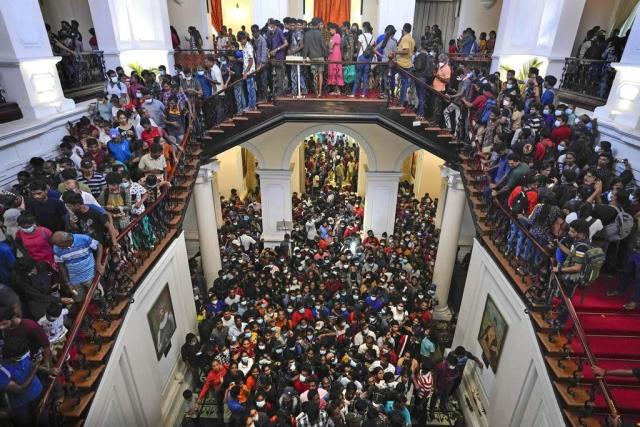
During 1st Trip Abroad, Biden Pitched For America, Welcoming Wary Allies

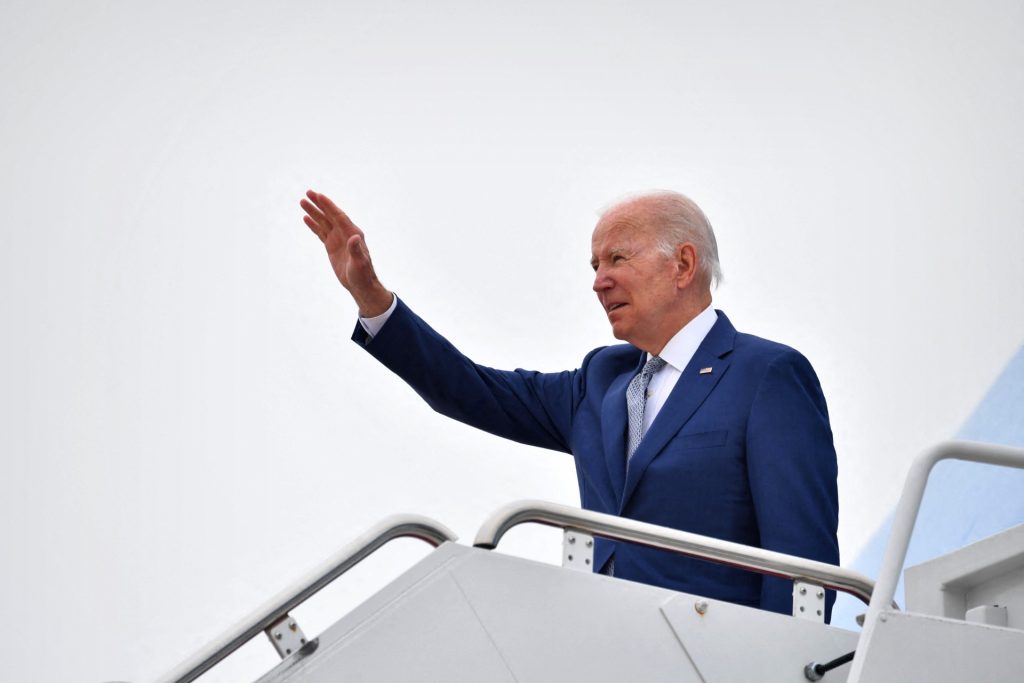
WASHINGTON (AP) — President Joe Biden spent his first trip overseas highlighting a sharp break from his disruptive predecessor, selling that the United States was once more a reliable ally with a steady hand at the wheel. European allies welcomed the pitch — and even a longtime foe acknowledged it. But while Biden returned Wednesday night to Washington after a week across the Atlantic that was a mix of messaging and deliverables, questions remained as to whether those allies would trust that Biden truly represents a long-lasting reset or whether Russian President Vladimir Putin would curb his nation’s misbehaviors.

Biden’s mantra, which he uttered in Geneva and Brussels and on the craggy coast of Cornwall, England, was that “America was back.” It was Putin, of all people, on the trip’s final moments, who may have best defined Biden’s initial voyage overseas. “President Biden is an experienced statesman,” Putin told reporters. “He is very different from President Trump.” But the summit with Putin in Geneva, which shadowed the entire trip and brought it to its close, also underscored the fragility of Biden’s declarations that the global order had returned.

Though both men declared the talks constructive, Putin’s rhetoric did not change, as he refused to accept any responsibility for his nation’s election interference, cyberhacking or crackdown on domestic political opponents. At the summit’s conclusion Biden acknowledged that he could not be confident that Putin would change his behavior even with newly threatened consequences. Biden’s multilateral summits with fellow democracies — the Group of Seven wealthy nations and NATO — were largely punctuated by sighs of relief from European leaders who had been rattled by President Donald Trump over four years. Yet there were still closed-door disagreement on just how the Western powers should deal with Russia or Biden’s declaration that an economic competition with China would define the 21st century.

“Everyone at the table understood and understands both the seriousness and the challenges that we’re up against, and the responsibility of our proud democracies to step up and deliver for the rest of the world,” Biden said Sunday in England. As vice president and chairman of the Senate Foreign Relations Committee, Biden had trotted the globe for more than four decades before he stepped off Air Force One and onto foreign soil for the first time as commander in chief. His initial stop, after a speech to thank U.S. troops stationed in England, was for a gathering with the other G-7 leaders.

The leaders staked their claim to bringing the world out of the coronavirus pandemic and crisis, pledging more than 1 billion coronavirus vaccine doses to poorer nations, vowing to help developing countries grow while fighting climate change and backing a minimum tax on multinational firms. At the group’s first face-to-face meeting in two years because of the pandemic, the leaders dangled promises of support for global health, green energy, infrastructure and education — all to demonstrate that international cooperation is back after the upheavals caused by the pandemic and Trump’s unpredictability. There were concerns, though, that not enough was done to combat climate change and that 1 billion doses were not nearly sufficient to meet the stated goal of ending the COVID-19 pandemic globally by the end of 2022.

The seven nations met in Cornwall and largely adhered to Biden’s hope that they rally together to declare they would be a better friend to poorer nations than authoritarian rivals such as China. A massive infrastructure plan for the developing world, meant to compete with Beijing’s efforts, was commissioned, and China was called out for human rights abuses, prompting an angry response from the Asian power. But even then, there were strains, with Germany, Italy and the representatives for the European Union reluctant to call out China, a valuable trading partner, too harshly. And there a wariness in some European capitals that it was Biden, rather than Trump, who was the aberration to American foreign policy and that the United States could soon fall back into a transactional, largely inward-looking approach.

After Cornwall, the scene shifted to Brussels where many of the same faces met for a gathering at NATO. Biden used the moment to highlight the renewed U.S. commitment to the 30-country alliance that was formed as a bulwark to Moscow’s aggression but frequently maligned by his predecessor. He also underscored the U.S. commitment to Article 5 of the alliance charter, which spells out that an attack — including, as of this summit, some cyberattacks — on any member is an assault on all and is to be met with a collective response. Trump had refused to commit to the pact and had threatened to pull the U.S. out of the alliance. “Article 5 we take as a sacred obligation,” said Biden. “I want NATO to know America is there.”

When Air Force One touched back down in Washington, Biden again faced an uncertain future for his legislative agenda, the clock ticking on a deadline to land a bipartisan infrastructure deal as the president was confronted with growing intransigence from Republicans and mounting impatience from fellow Democrats. But Biden and his aides believe he accomplished what he set out to do in Europe. The most tactile of politicians, Biden reveled in the face-to-face diplomacy, having grown frustrated with trying to negotiate with world leaders over Zoom. Even amid some disagreements, he was greeted warmly by most of his peers, other presidents and prime ministers eager to exchange awkward elbow bumps and adopt his “build back better” catchphrase.

At the end of each day, Biden would huddle with aides, including Secretary of State Tony Blinken and national security adviser Jake Sullivan, eagerly going over a play-by-play of the day’s meetings and preparing for the next. Aides padded his schedule with some down time to pace the 78-year-old president, though there were still a few missteps, including some verbal flubs and when he simply neglected to announce a Boeing-Airbus deal in front of the European Council. His summit with Putin, coming three years after Trump sided with the Russian leader over U.S. intelligence agencies when those two men met in Helsinki, loomed over the trip, with the cable networks giving it Super Bowl levels of hype. Aides wanted to confront Putin early in the presidency, with some hope of reining in Moscow and reaching some stability so the administration could more squarely focus on China.

There were no fireworks in their summit near the Swiss Alps, and the nations agreed to return ambassadors to each other’s capitals and took some small steps toward strategic stability. But while Biden was able to deliver stern warnings to Putin behind closed doors, he also extracted few promises. In the Russian president’s post-summit remarks, he engaged in classic Putin misdirection and what-about-ism to undermine any of the United States’ moral high ground. In his own Geneva news conference, Biden stood against a postcard-perfect backdrop of a tree-lined lake, taking off his suit jacket as the sun beat down from behind, so bright that reporters had trouble looking directly at the president.

Once more, Biden declared that America was back, but he also soberly made clear that it was impossible to immediately know if any progress with Russia had, in fact, been made. “What will change their behavior is if the rest of world reacts to them and it diminishes their standing in the world,” Biden said. “I’m not confident of anything; I’m just stating a fact.”

(Madhani reported from Geneva.)

Against GOP Objections ‘Obamacare’ Survives

WASHINGTON (AP) — The Supreme Court’s latest rejection of a Republican effort to dismantle “Obamacare” signals anew that the GOP must look beyond repealing the law if it wants to hone the nation’s health care problems into a winning political issue. Thursday’s 7-2 ruling was the third time the court has rebuffed major GOP challenges to former President Barack Obama’s prized health care overhaul. Stingingly for Republicans, the decision emerged from a bench dominated 6-3 by conservative-leaning justices, including three appointed by President Donald Trump.

Those high court setbacks have been atop dozens of failed Republican repeal attempts in Congress. Most spectacularly, Sen. John McCain, R-Ariz., flashed a thumbs-down that doomed Trump’s drive to erase the law in 2017. Along with the public’s gradual but decisive acceptance of the statute, the court rulings and legislative defeats underscore that the law, passed in 2010 despite overwhelming GOP opposition, is probably safe. And it spotlights a remarkable progression of the measure from a political liability that cost Democrats House control just months after enactment to a widely accepted bedrock of the medical system, delivering care to what the government says is more than 30 million people.

“The Affordable Care Act remains the law of the land,” President Joe Biden said, using the statute’s more formal name, after the court ruled that Texas and other GOP-led states had no right to bring their lawsuit to federal court. “It’s not as sacred or popular as Medicare or Medicaid, but it’s here to stay,” said Drew Altman, president of the nonpartisan Kaiser Family Foundation. “And it’s moved from an ideological whipping boy to a set of popular benefits that the public values.”

Highlighting the GOP’s shifting health care focus, in interviews and written statements Thursday, more than a dozen Republican lawmakers called for controlling medical costs and other changes, but none suggested another run at repeal. Congressional Republicans hadn’t even filed a legal brief supporting the latest Supreme Court challenge. “Just practically speaking, you need 60 votes in a Republican Senate, a Republican president, right? And we’ve tried that and were unable to accomplish it,” said Sen. Bill Cassidy, R-La., a leading voice on health care in the GOP.

Polling shows the risks in trying to demolish Obama’s law. A Kaiser poll showed Americans about evenly divided on the law in December 2016, just after Trump was elected on a pledge to kill it. By February 2020, 54% had a favorable view while 39% disapproved. House Minority Leader Kevin McCarthy, R-Calif., and other top Republicans issued a statement illustrating one line of attack the party is preparing — trying to handcuff all Democrats to “Medicare for All,” a costly plan for government-provided health care backed by progressives that goes beyond what Biden and many in the party have proposed.

Congress should “not double down on a failed health care law or, worse, move towards a one-size-fits-all, socialist system that takes away choice entirely,” the Republicans said. The GOP should focus on health issues people care about, like personalized care and promoting medical innovation, not repealing the health care law, said David Winston, a pollster and political adviser to congressional GOP leaders.

“Republicans need to lay out a clear direction of where the health care system should go,” Winston said. “Don’t look backward, look forward.” Most people have gained coverage from either Obama’s expansion of the government-funded Medicaid program for lower-income people or from private health plans, for which federal subsidies help offset costs for many. The law’s most popular provisions also include its protections for people with preexisting medical conditions from higher insurance rates, allowing people up to age 26 to remain covered under their parents’ plans and requiring insurers to cover services like pregnancy and mental health.

Key requirements like that are “locked in concrete,” said Joseph Antos, a health policy analyst at the conservative American Enterprise Institute. The political opening for Republicans would be if Democrats push hard for things like lowering the eligibility age for Medicare to 60 because for many conservative-leaning voters, he said, “that’s a sign of government pushing too far” into private marketplace decisions. Yet serious problems remain. Nearly 29 million Americans remained uninsured in 2019, and millions more likely lost coverage at least temporarily when the COVID-19 pandemic hit, according to Kaiser. In addition, medical costs continue rising and even many covered by the law find their premiums and deductibles difficult to afford.

In response, Biden’s $1.9 trillion COVID-19 relief package enacted in March expanded federal subsidies for health insurance premiums for those buying coverage. His infrastructure and jobs proposal being negotiated in Congress includes $200 billion toward making that permanent, instead of expiring in two years. But his plan includes none of his more controversial campaign trail proposals to expand health care access, like creating a federally funded public health care option or letting Medicare directly negotiate drug prices with pharmaceutical companies. While those proposals are popular with Democratic voters, they face tough odds in a closely divided Congress.

Still, Republicans gearing up for 2022 elections that will decide congressional control must decide where their next focus will be. One GOP strategist involved in House races, speaking on condition of anonymity to describe internal thinking, said the party should focus on issues like the economy and border security that register as higher voter concerns. A Gallup poll showed that in May, 21% of the public ranked the economy as the country’s top problem, with health care registering at just 3%.

Other Republicans say the Supreme Court’s rejection of the latest repeal attempt will clear the political field for them to refocus their health care attacks on Democrats. “Now it’s Medicare for All that will be a top health care issue playing a role in campaigns,” said Chris Hartline, spokesperson for the National Republican Senatorial Committee, the Senate GOP’s campaign arm.

(Associated Press writers Alexandra Jaffe in Washington and Tom Murphy in Indianapolis, Ind., contributed to this report.)

Thumps Up Modi Over Yoga

“Yoga fever grips the world, and the credit goes to Narendra Modi” This was the heading of a prominent blog (wionews.com).On a great way, despite the receding Corona pandemic, Indians celebrated an ancient tradition that grew into a global phenomenon, in front of Red Fort, on submarines and mountaintops, in schools and parks, by the dozens and by the thousands. Last Monday marked the 7thInternational Day of Yoga, a yearly event created by Prime Minister Narendra Modi to highlight yoga within India and worldwide.

Today, to our pride, India has already patented its ownership of Yoga and the credit definitely, goes to Prime Minister Narendra Modi. Whether the opposition agrees or not, Narendra Modi helped yoga attain the global status it deserved. According to Indian Prime Minister Modi, Yoga became a medium of self-confidence. It made people believe that they could fight with COVID-19. While in the USA, the Consulate General of India, New York, partnered with the Times Square Alliance to host the International Yoga celebrations in Times Square on Sunday. Over 3,000 people attended the day-long event, which was themed ‘Solstice.’

Yoga for Peace and Harmony was organized by the Embassy of India, Paris, in front of the Eiffel Tower and Wall of Peace.   WHO is about to launch M-Yoga app globally; Yoga focuses on mental well-being, says PM Modi that elevates its significance to a higher level indeed.Today, Yoga is not seen as just a practice native to India, but as India’s gift to the world, and everyone has made it their own: said Union Minister of State for AYUSH Kiran Rijiju

It is known globally that Yoga is an ancient Indian practice that helps in maintaining physical and mental well-being, and over the years, it has found popularity in other countries as well. During this lockdown & pandemic period, yoga can be ideal  to adopt as a lifestyle habit.Yoga exercises help us build a strong physical, mental and spiritual balancing system. Combining breathing and meditation, it acts as the best element to take care of our mind and body.  Different  forms of yoga can help us to stay physically strong and mentally serene. With Yoga we can motivate others in our family & social circle to do, as it could help them get through these times safely & healthily. Just like jogging in the park or 30 minutes of  gym exercising, Yoga brings its own benefits to the table, which can be practiced  by people of all ages. Meticulously yoga provides you with a holistic sense of health, which is especially required during these times.

Indian Prime Minister Narendra Modi proposed marking a day as the International Day of Yoga in his speech at the UN General Assembly during 2014 , and the proposal was endorsed by 175 member states, by which the United Nations recognized June 21 as the day to celebrate Yoga. Yoga has become the talk of the town worldwide ,and hence the healing aspect of Yoga is being looked at in scientific research being conducted across the world. Numerous studies are being conducted on the benefits of Yoga and on its positive impact on the body.

In spite of too many criticism hovers around, no doubt, Modi’s attempts to promote yoga is part of PM’s broader push to tap Indian traditions as a source of national pride and international influence.  A career in Yoga is also considered as a great choice nowadays. A person can opt for Yoga as a full-time course offered at various universities to make it a profession. Even in western countries, who were reluctant in accepting Indian traditions so far, have advanced ahead in embracing the concept and benefits of Yoga as an exercise.

For politicians sharing Modi’s views on yoga’s roots in ancient Vedas and philosophy, yoga’s origins and its enormous secular popularity add up to “the perfect vehicle to create a shared national consciousness,” The question of yoga’s parentage, the product of thousands of years of history and multiple religious and geographic influences, is vividly complex.That is why, On Tuesday, PinarayiVijayan Chief Minister of Kerala emphasized that yoga was not a part of any religion and should be practiced with a free and secular mind.

“Some people have been trying to hijack yoga by reciting ‘suktas.’ Such attempts should be checked as yoga is not a religious ritual. There should not be any misunderstanding that it is part of any religion. Yoga should be practiced with a free and secular mindset,” the CM stressed. Undoubtedly, Indians have a hidden tendency to look at everything suspiciously; whether any other religion or party is behind any social programs – forget it. Yoga is purely for physical and mental wellness- India wholeheartedly endorsed it

Modi Delivers Keynote Address At The 5th Edition Of Vivatech

The Prime Minister, Shri Narendra Modi delivered the keynote address at the 5th edition of VivaTech today via video conference. The Prime Minister was invited as a Guest of Honour to deliver the keynote address at VivaTech 2021, one of the largest digital and startup events in Europe, held in Paris every year since 2016.

Speaking on the occasion, the Prime Minister said that India and France have been working closely on a wide range of subjects. Among these, technology and digital are emerging areas of cooperation. It is the need of the hour that such cooperation continues to grow further. It will not only help our nations but also the world at large. Shri Modi mentioned Infosys providing tech support for the French Open tournament and collaboration involving French companies like Atos, Capgemini and India’s TCS and Wipro as examples of IT talent of the two countries serving companies and citizens all over the world.

Modi pointed out that where convention fails, innovation helps. During the pandemic, said the Prime Minister, digital technology helped us cope, connect, comfort and console. India’s universal and unique bio-metric digital identity system – Aadhar – helped to provide timely financial support to the poor. “We could supply free food to 800 million people, and deliver cooking-fuel subsidies to many households. We in India were able to operationalise two public digital education programes- Swayam and Diksha – in quick time to help students”, the Prime Minister informed.

The Indian leader praised the role of the start-up sector in meeting the challenge of the pandemic. The private sector played a key role in addressing the shortage of PPE kits, masks, testing kits etc. Doctors adopted tele-medicine in a big way so that some COVID and other non-COVID issues could be addressed virtually. Two vaccines are being made in India and more are in the development or trial stage. The Prime minister indicated that indigenous IT platform, Arogya-Setu enabled effective contact tracing. The COWIN digital platform has already helped ensure vaccines to millions.

Modi said that India is home to one of the world’s largest start-up eco systems. Several unicorns have come up in the recent years. India offers what innovators and investors need. He invited the world to invest in India based on the five pillars of: Talent, Market, Capital, Eco-system and, Culture of openness. The Prime Minister also stressed the strengths like, Indian talent pool, mobile phone penetration and Seven Seventy-Five million internet users, highest and cheap data consumption in the world and the highest use of social media to invite investors to India.

The Prime Minister also enumerated initiatives like state-of-the-art public digital infrastructure, five hundred and twenty three thousand kilometres of fibre optic network linking One hundred and fifty six thousand village councils, public wi-fi networks across the country. He also elaborated on efforts to nurture a culture of innovation. There are state-of-the-art innovation labs in Seven Thousand Five Hundred schools under the Atal Innovation Mission, the Prime Minister informed. Talking about the disruption in different sector over the past year, the Prime Minister insisted that disruption does not have to mean despair. Instead, the focus should be kept on the twin foundations of repair and prepare. “This time last year, the world was still seeking a vaccine. Today, we have quite a few. Similarly, we have to continue repairing health infrastructure and our economies. We in India implemented huge reforms across sectors, be it mining, space, banking, atomic energy and more. This goes on to show that India as a nation is adaptable and agile, even in the middle of the pandemic” Said Shri Modi.

Modi stressed the need for insulating our planet against the next pandemic. Ensuring we focus on sustainable life-styles that stop ecological degradation. Strengthening cooperation in furthering research as well as innovation. The Prime Minister called upon the start-up community to take the lead in working with collective spirit and a human centric approach to overcome this challenge. “The start-up space is dominated by youngsters. These are people free from the baggage of the past. They are best placed to power global transformation. Our start-ups must explore areas such as: Healthcare. Eco-friendly technology including waste recycling,

Agriculture, new age tools of learning”, said the Prime Minister. The Prime Minister emphasized that France and Europe are among India’s key partners. Referring to his conversations with President Macron, in summit with EU leaders in Porto in May, The Prime Minister said that digital partnership, from start-ups to quantum computing, emerged as a key priority. “History has shown that leadership in new technology drives economic strength, jobs and prosperity. But, our partnerships must also serve a larger purpose, in service of humanity. This pandemic is not only a test of our resilience, but also of our imagination It is a chance to build a more inclusive, caring and sustainable future for all,” concluded the Prime Minister.

Tamil Nadu CM Stalin’s Economic Council Has World’s Top Luminaries

The Tamil Nadu government will constitute an Economic Advisory Council to guide chief minister MK Stalin to chart out a rapid and inclusive economic growth path for the state, said Governor BanwarilalPurohit on Monday, June 21st.A white paper detailing the true state of Tamil Nadu’s finances will be released in July, said Governor BanwarilalPurohit during the first session of the 16th state legislative assembly in Chennai. And it comprises an impressive lineup of leading economic experts from all over the world. We’re talking Nobel laureate Esther Duflo (in pic) of the Massachusetts Institute of Technology (MIT), USA, former RBI governor RaghuramRajan, former chief economic advisor to the central government Dr Arvind Subramanian, development economist Jean Dreze and former Union finance secretary Dr S Narayan as council members.

The council will provide general guidance on economic and social policy, social justice and human development-related issues, and in matters related to equal opportunities for women and well-being of underprivileged groups.It will also make suggestions to boost growth, employment and productivity across all sectors, as well as act as a sounding board for ideas that might resolve roadblocks to development. As the first step towards bringing down the overall debt burden and improving fiscal position, a white paper detailing the true state of the state’s finances would be released in July so that the people are fully informed.

The Tamil Nadu government will form an economic advisory council comprising Nobel laureate Esther Duflo of the Massachusetts Institute of Technology (MIT), USA, and former Reserve Bank of India governor RaghuramRajan, to advise the chief minister. The other members of the council will be former chief economic advisor to the central government Arvind Subramanian, development economist Jean Dreze and former Union finance secretary S Narayan, Governor BanwarilalPurohit announced in his ceremonial address during the first session of the 16th state legislative assembly in Chennai on Monday.

“Based on the recommendation of the council, the government will revitalise the state’s economy and ensure that benefits of economic growth reach all segments of society,” Purohit said. He said the government will focus on improving the fiscal position and bringing down the debt burden. A white paper detailing the true state of Tamil Nadu’s finances will be released in July. During the first session of the 16th state legislative assembly in Chennai. The governor said while the Tamil Nadu government under MK Stalin would maintain a cordial relationship with the Union government, it would still fight for the rights of states.

The government has constituted a committee chaired by Justice AK Rajanto to study the adverse effects of the National Eligibility Cum Entrance Test (NEET) on socially and educationally backward students, the governor said. Purohit announced that ‘Singara Chennai 2.0’ programme would be launched to provide world-class infrastructure and services in Greater Chennai Corporation. He also said the government would ensure speedy completion of phase two of metro rail.

Governor said the availability of medical infrastructure including oxygen beds has been substantially enhanced on a war-footing. “The Tamil Nadu government will urge the Union government to make necessary laws and amendments to grant Indian citizenship to Tamil refugees from Sri Lanka,” the governor said. He said the government is committed to transparency and accountability in temple management. “A state-level advisory committee for all major Hindu temples will be constituted to enhance the facilities for devotees, improve the maintenance of temples and to advise on related issues,” he said.

He added that the reservation policy of the state is 100 years old and has stood the test of time, delivering true social justice. “The 69% reservation currently available in Tamil Nadu will be continued and protected.” Purohit concluded his speech by saying DMK-led government will be a people’s government and not the party’s.

Modi Government Is Riddled With Abject Failures Both Short Term As Well As Long Term

The pandemic no doubt was sudden and brutal but the way it was  managed was  simply catastrophic. When we compare COVID related deaths and death rates of India versus  the second largest democracy, the USA and other neighbors we find that  the leaders of India have  failing miserably in saving Indian lives. According to the latest statistics from New York Times,    India’s COVID related deaths have been significantly higher when compared to  other countries and in the nearby region. At the peak, the number of weekly average death was 4454 on May 23, 2021. On June 12, this was 3303. The tragic  part is it increased after June 9 when this average was 2177.

For the USA, this average has been 370 on June 12. Since the population of India is roughly 4 times of the USA, the death rate in India should have been 4×370 or around 1600. This means the death rate in India has been twice of that of the USA despite aid coming from all over the world to save Indian lives.

The weekly average death rate in Bangladesh has been just 30 on June 121. India’s population is about 8.7 times larger than Bangladesh which implies that India’s weekly average death rate should have been just 330. At the peak death rate in Bangladesh on April 23, the average figure was just 981 which implies that the peak weekly average death rate in India should have been 850. For Pakistan, the peak weekly death rate was 140 on April 28 and on June 12 it was 61  Since population of India is 6 times that of Pakistan it implies that the even per Pakistan’s standard, the peak weekly deaths in India should have been 850 (140×6) and on June 12 it should have been 360 (61×6)1.  It is really shameful, that with population adjustment made, India has been performing 10 times worse than its immediate neighbors Bangladesh and Pakistan in handling Covid death rates and at the peak (worst time of both the countries compared) also India was 5 times worse than them.

The GDP Debacle

On GDP also India’s performance has been dismal. As per the latest data, the growth rate of India has been -7.3% for the fiscal year 2021 (4/20 to 3/21). US and China are much bigger economies than India and they also had COVID almost on the same scale as India. However, their economies grew at the rate of 2.6% and 8.4% respectively. It is clearly the dismal failure of Modi government because of  its  regressive and myopic economic policies.

Another issue of major concern is the alarming Balance of Trade Deficit with China as a Cause of sluggish GDP growth of India.  It is  being touted that “Trade between China and India soared 70.1% in US dollar terms in the first five months of this year to $48.16 billion, according to Chinese customs data released on Monday. Specifically, Chinese exports to India grew 64.1% year-on-year from January to May, while imports surged 90.2%,” the tabloid Global Times reported2. The trade deficit during the same first five moths of 2021 has been$45 billion, which is 1.5% of India’s GDP. Since GDP = Consumption + Investment + Government Expenditure + Balance of Trade, India’s GDP is down by 1.5% in just five months of trade with China. This implies that for the whole year at this rate of trade deficit with China, India’s 3.6% of GDP would taken away by China.

It is very surprising that Modi Government seems oblivious to  this drain on India’s economy. President Trump imposed heavy import duties on China in the year 2018 and that has been continued under Biden administration, but the Indian Government is not even realizing this problem. What kind of Finance and Commerce Ministers this government has that they are not even understanding that with this kind of trade deficit, India’s GDP can’t grow? Only under this government with India-China trade volume of $87.6 billion in 2020, China overtook the US to become India’s largest trading partner despite a bloody conflict along the Line of Actual Control (LAC) and the rising anti-China sentiment. All Asian tigers and both China and Japan achieved miracles because of trade surpluses, but Modi government does not even realize that India’s wealth is being drained by China! Even one of the richest and the most powerful country, the USA could not survive the economic drain on US GDP caused by trade deficit with China. This problem must be discussed in Parliament. This is absolutely urgent.

Failure to tackle  Inflation and reduce unemployment:

India’s inflation for the year 2020 was 6.2% which is far above the stated goal of 4%. The Government’s failure on Unemployment reduction too is stark and glaring.  Over 10 million (1 crore) Indians have lost their jobs because of the second wave of Covid-19, and around 97 per cent of households’ incomes have declined since the beginning of the pandemic last year, Centre for Monitoring Indian Economy (CMIE) chief executive Mahesh Vyas said on Monday4. The total figure of unemployed labour  has been 3.5 crores or 350 million.

Besides, the abysmally short-sighted policies of the government have accentuated the problem of Stagflation. India has experienced the worst of both the worlds during the current regime. Since the relationship between inflation and unemployment has historically been inverse in many parts of the world including India under Dr Man Mohan Singh’s government (also known as Phillips Curve), India under Modi government has seen higher inflation and higher unemployment as discussed above. This means stagflation is the special feature of this government because of its wrong economic policies.

The  inequality monster: India’s inequality had increased. Only two business houses of Gautam Adani and Mukesh Ambani have been accumulating wealth by exploiting the rest of India. As already discussed, that 97% of Indians have become poorer while the wealth of MukeshAmbani has tripled since the formation of this government in 2014 and Gautam Adani’s wealth has increased by about 30 times. As per Forbes records, Gautam Adani’s wealth was just $3.5 billion in March 2016 which jumped to $75 Billion on June 13, 2021. This kind of immense richness over just 5 years is not possible without government (Prime Minister in particular) favoring him.

The callous, insensitive and prejudiced Government under Modi has made a mockery of Governance and exposed the Indian nation and its people to the hydra of inflation, unemployment, crippling economy, a debilitating trade deficit and failing and a sinking health care system.

The present Government still has 3 more years to go before it faces the people in a general election. It is time for some serious course correction by the Modi Government, for the sake of its own survival and but more importantly for the people of India. Let us hope that the Modi Government shakes off the ignorance and arrogance, strategizes by putting the people of India first and performs with heart, mind and muscle in the second half of their thus far catastrophic tenure.

Sources:

Number in Subscript is the source number listed below:

  1.   https://www.worldometers.info/coronavirus/country/india/
  2. https://www.hindustantimes.com/world-news/trade-with-india-jumped-by-over-70-in-2021-shows-china-s-customs-data-101623143023368.html
  3. https://www.statista.com/statistics/271322/inflation-rate-in-india/
  4. https://www.hindustantimes.com/india-news/second-wave-left-1-crore-indians-jobless-97-households-incomes-dipped-report-101622507233717.html
  5. https://www.forbes.com/profile/gautam-adani-1/?sh=492d278c5b0e

(RajendarDichpally is the  National General Secretary – Indian Overseas Congress, USA)

Biden And Putin At Geneva Summit Make A New Beginning, But Issues Remain

US President Joe Biden and Russian President Vladimir Putin held their first face-to-face meetings on June 16, 2021 at a historic summit in Geneva.At the end of their talks,first such meeting since 2018, both the leaders praised their talks, but have made little concrete progress.Biden said the tone of the talks were “positive,” and he told Putin that certain US “critical infrastructure” should be off-limits for cyberattacks. Putin described the summit as “constructive,” saying both countries will begin consultations on cybersecurity and US and Russian ambassadors will return to their diplomatic posts.

Disagreements were stated, said Biden, but not in a hyperbolic way, and he said Russia did not want a new Cold War.Putin said, Biden was an experienced statesman and the two “spoke the same language.” The talks lasted four hours, less time than was scheduled.Biden said they did not need to spend more time talking and there was now a genuine prospect to improve relations with Russia. The two sides agreed to begin a dialogue on nuclear arms control. They also said they would return ambassadors to each other’s capitals – the envoys were mutually withdrawn for consultations in March, after the US accused Russia of meddling in the 2020 presidential election. However, there was little sign of agreement on other issues, including cyber-security, Ukraine and the fate of Russian opposition leader Alexei Navalny,

“I really do think — not me, but I think we, the country, has put a different face on where we’ve been and where we’re going, and I feel good about it,” Biden said to the press, reflecting on his first foreign trip as President before boarding Air Force One. “There was a summary done by him and by me of what we covered. Lavrov and Blinken talked about what we covered. We raised things that required more amplification or we made sure we did not have any misunderstandings. It was after two hours there, we looked at each other like, ‘okay, what next?’ What is going to happen next is we’re going to be able to look back, look ahead in three to six months and say, did the things we agree to sit down and work out, did it work? Are we closer to a major strategic stability talks and progress? … That’s going to be the test. I am not sitting here saying because the President and I agreed we would do these things that all of a sudden it’s going to work. I’m not saying that. What I am saying is that I think there’s a genuine prospect to significantly improve the relations between the two countries, without giving up anything on principles and values.”

Biden also reiterated that “there were no threats” during the meeting. “Just simple assertions made…  Just letting him know where I stood, what I thought we could accomplish together, and what, in fact, if there were violations of American sovereignty, what would we do,” Biden said.The US and Russia released a joint statement on Wednesday following the summit between the countries’ two leaders, noting that “even in periods of tension,” the two nations share goals of “ensuring predictability in the strategic sphere, reducing the risk of armed conflicts and the threat of nuclear war.”

“The recent extension of the New START Treaty exemplifies our commitment to nuclear arms control. Today, we reaffirm the principle that a nuclear war cannot be won and must never be fought,” the statement said. “Consistent with these goals, the United States and Russia will embark together on an integrated bilateral Strategic Stability Dialogue in the near future that will be deliberate and robust. Through this Dialogue, we seek to lay the groundwork for future arms control and risk reduction measures.” US President Joe Biden boarded Air Force One and departed Geneva en route to Washington, DC, following his summit with Russian President Vladimir Putin.

G7 Summit Leaders Offer United Front To Address Global Issues

Leaders of the world’s largest economies unveiled an infrastructure plan Saturday for the developing world to compete with China’s global initiatives, but there was no immediate consensus on how forcefully to call out Beijing over human rights abuses. Citing China for its forced labor practices is part of President Joe Biden’s campaign to persuade fellow democratic leaders to present a more unified front to compete economically with Beijing. But while they agreed to work toward competing against China, there was less unity on how adversarial a public position the group should take.

Canada, the United Kingdom and France largely endorsed Biden’s position, while Germany, Italy and the European Union showed more hesitancy during Saturday’s first session of the Group of Seven summit, according to a senior Biden administration official. The official who briefed reporters was not authorized to publicly discuss the private meeting and spoke on condition of anonymity. In his first summit as president, Biden made a point of carving out one-on-one-time with the leaders, bouncing from French president Emmanuel Macron to German chancellor Angela Merkel to Italian prime minister Mario Draghi, a day after meeting with British Prime Minister Boris Johnson as if to personally try to ward off memories of the chaos that his predecessor would often bring to these gatherings.

Macron told Biden that collaboration was needed on a range of issues and told the American president that “it’s great to have a U.S. president part of the club and very willing to cooperate.” Relations between the allies had become strained during the four years of Donald Trump’s presidency and his “America first” foreign policy.Merkel, for her part, downplayed differences on China and the Nord Stream 2 pipeline which would transport natural gas from Russia to Germany, bypassing Ukraine.“The atmosphere is very cooperative, it is characterized by mutual interest,” Merkel said. “There are very good, constructive and very vivid discussions in the sense that one wants to work together.”

Competing with Belt and Road

White House officials have said Biden wants the leaders of the G-7 nations — the U.S., Britain, Canada, France, Germany, Japan and Italy — to speak in a single voice against forced labor practices targeting China’s Uyghur Muslims and other ethnic minorities. Biden hopes the denunciation will be part of a joint statement to be released Sunday when the summit ends, but some European allies are reluctant to split so forcefully with Beijing.

China had become one of the more compelling sublots of the wealthy nations’ summit, their first since 2019. Last year’s gathering was canceled because of COVID-19, and recovery from the pandemic is dominating this year’s discussions, with leaders expected to commit to sharing at least 1 billion vaccine shots with struggling countries. The allies also took the first steps in presenting an infrastructure proposal called “Build Back Better for the World,” a name echoing Biden’s campaign slogan. The plan calls for spending hundreds of billions of dollars in collaboration with the private sector while adhering to climate standards and labor practices.

It’s designed to compete with China’s trillion-dollar “Belt and Road Initiative,” which has launched a network of projects and maritime lanes that snake around large portions of the world, primarily Asia and Africa. Critics say China’s projects often create massive debt and expose nations to undue influence by Beijing.Britain also wants the world’s democracies to become less reliant on the Asian economic giant. The U.K. government said Saturday’s discussions would tackle “how we can shape the global system to deliver for our people in support of our values,” including by diversifying supply chains that currently heavily depend on China.

Not every European power has viewed China in as harsh a light as Biden, who has painted the rivalry with China as the defining competition for the 21st century. But there are some signs that Europe is willing to impose greater scrutiny.Before Biden took office in January, the European Commission announced it had come to terms with Beijing on a deal meant to provide Europe and China with greater access to each other’s markets. The Biden administration had hoped to have consultations on the pact.

But the deal has been put on hold, and the European Union in March announced sanctions targeting four Chinese officials involved with human rights abuses in Xinjiang. Beijing responded with penalties on several members of the European Parliament and other Europeans critical of the Chinese Communist Party. Biden administration officials see an opportunity to take concrete action to speak out against China’s reliance on forced labor as an “affront to human dignity.”

While calling out China in the G-7 communique would not create any immediate penalties for Beijing, one senior administration official said the action would send a message that the leaders were serious about defending human rights and working together to eradicate the use of forced labor. An estimated 1 million people or more — most of them Uyghurs — have been confined in reeducation camps in China’s western Xinjiang region in recent years, according to researchers. Chinese authorities have been accused of imposing forced labor, systematic forced birth control, torture and separating children from incarcerated parents.Beijing rejects allegations that it is committing crimes.

Johnson, the summit host, also welcomed the leaders from “guest nations” South Korea, Australia and South Africa, as well as the head of the United Nations, to the summit to “intensify cooperation between the world’s democratic and technologically advanced nations.” India was also invited but its delegation is not attending in person because of the severe coronavirus outbreak in the country.

Hundreds of environmental protesters took to the Cornish seaside early Saturday in a bid to draw the attention to climate issues. A crowd of surfers, kayakers and swimmers gathered on a beach in Falmouth for a mass “paddle out protest” organized by Surfers Against Sewage, a group campaigning for more ocean protections. The leaders took steps to transition away from the use of coal, committing to spend $2 billion to help developing nations move off the fuel by funding job training and technology improvements. Japan had expressed reluctance to slow the construction of new coal fired plants. China remains a big funder of the technology.

Biden ends the trip Wednesday by meeting in Geneva with Russia’s Vladimir Putin. The White House announced Saturday that they will not hold a joint news conference afterward, which removes the opportunity for comparisons to the availability that followed Trump and Putin’s 2018 Helsinki summit, in which Trump sided with Moscow over his own intelligence agencies. Only Biden will address the news media after the meeting. Putin, in an interview with NBC News, said the U.S.-Russia relationship had “deteriorated to its lowest point in recent years.”He added that while Trump was a “talented” and “colorful” person, Biden was a “career man” in politics, which has “some advantages, some disadvantages, but there will not be any impulse-based movements” by the U.S. president.(AP)

At the end of the Summit, leaders made the following statement — Our shared agenda for global action to build back better:

“We, the leaders of the Group of Seven, met in Cornwall on 11-13 June 2021 determined to beat COVID-19 and build back better.  We remembered everyone who has been lost to the pandemic and paid tribute to those still striving to overcome it. Inspired by their example of collaboration and determination, we gathered united by the principle that brought us together originally, that shared beliefs and shared responsibilities are the bedrock of leadership and prosperity.  Guided by this, our enduring ideals as free open societies and democracies, and by our commitment to multilateralism, we have agreed a shared G7 agenda for global action to:

End the pandemic and prepare for the future by driving an intensified international effort, starting immediately, to vaccinate the world by getting as many safe vaccines to as many people as possible as fast as possible. Total G7 commitments since the start of the pandemic provide for a total of over two billion vaccine doses, with the commitments since we last met in February 2021, including here in Carbis Bay, providing for one billion doses over the next year. At the same time we will create the appropriate frameworks to strengthen our collective defences against threats to global health by: increasing and coordinating on global manufacturing capacity on all continents; improving early warning systems; and support science in a mission to shorten the cycle for the development of safe and effective vaccines, treatments and tests from 300 to 100 days.

Reinvigorate our economies by advancing recovery plans that build on the $12 trillion of support we have put in place during the pandemic. We will continue to support our economies for as long as is necessary, shifting the focus of our support from crisis response to promoting growth into the future, with plans that create jobs, invest in infrastructure, drive innovation, support people, and level up so that no place or person, irrespective of age, ethnicity or gender is left behind. This has not been the case with past global crises, and we are determined that this time it will be different.

Secure our future prosperity by championing freer, fairer trade within a reformed trading system, a more resilient global economy, and a fairer global tax system that reverses the race to the bottom. We will collaborate to ensure future frontiers of the global economy and society, from cyber space to outer space, increase the prosperity and wellbeing of all people while upholding our values as open societies. We are convinced of the potential of technological transformation for the common good in accordance with our shared values.

Protect our planet by supporting a green revolution that creates jobs, cuts emissions and seeks to limit the rise in global temperatures to 1.5 degrees. We commit to net zero no later than 2050, halving our collective emissions over the two decades to 2030, increasing and improving climate finance to 2025; and to conserve or protect at least 30 percent of our land and oceans by 2030. We acknowledge our duty to safeguard the planet for future generations.

Strengthen our partnerships with others around the world. We will develop a new partnership to build back better for the world, through a step change in our approach to investment for infrastructure, including through an initiative for clean and green growth. We are resolved to deepen our current partnership to a new deal with Africa, including by magnifying support from the International Monetary Fund for countries most in need to support our aim to reach a total global ambition of $100 billion.

Embrace our values as an enduring foundation for success in an ever changing world. We will harness the power of democracy, freedom, equality, the rule of law and respect for human rights to answer the biggest questions and overcome the greatest challenges. We will do this in a way that values the individual and promotes equality, especially gender equality, including by supporting a target to get 40 million more girls into education and with at least $2¾ billion for the Global Partnership for Education.

We shall seek to advance this open agenda in collaboration with other countries and within the multilateral rules-based system. In particular, we look forward to working alongside our G20 partners and with all relevant International Organisations to secure a cleaner, greener, freer, fairer and safer future for our people and planet.”

The Future Of NATO In An Order Transformed

As U.S. President Joe Biden returned from his Europe tour, seeking to rally the leading democracies, a looming question is the future role of NATO. As the alliance contemplates the conclusion to its 20-year operation in Afghanistan, it confronts serious questions about its roles and relevance from political camps on both sides of the Atlantic. The starting point for the alliance must be to recognize that it leaves Afghanistan in a world entirely transformed from when it entered. NATO started operations in Afghanistan at the height of American unipolarity, at the peak of the Western dominance of the international system. It leaves at a moment when the West is constrained internally and challenged externally, including by authoritarian powers of growing capacity — and perhaps growing coordination.

FOUR REGIONS

To chart its future role in this world, NATO needs to start by addressing the core question of its geographical scope. It should start in Europe. NATO was born as an instrument to protect Europe and the democratic West from a threat from Moscow. Its first task in 2021 and beyond must be to protect Europe and the democratic West from a threat from Moscow. That threat is nowhere near as severe as it was during the Cold War and it is of very different character, but it is a threat nonetheless and a complex one, involving gray operations like the Skripal attack, political interference, and nuclear saber-rattling. It would be the height of irony if in seeking to respond to China or other new challenges, NATO failed to mount an adequate response to Russia. Not all the instruments to respond to Russia are in NATO’s hands; many of them reside with the European Union. But that is a bureaucratic and institutional distinction that can be overcome; the broader point is that Europe working with the United States must restore a sense of collective defense against Moscow’s efforts to weaken the West. NATO has a vital role in that.

Coordination on Russia policy was extraordinarily difficult during the Trump administration; it must now be central to U.S.-Germany, U.S.-U.K., and U.S.-EU/NATO dialogues. That includes the contentious issue of Ukraine’s future Euro-Atlantic integration.

But the geopolitical challenge to the democratic West doesn’t end in Europe. The second vital region is Asia. That is of course essentially a China question, and that in turn is an economic, technological, values, and military question. Whether or not NATO has an institutional role in Asia remains to be determined, though Secretary General Jens Stoltenberg has argued that NATO’s new strategic concept must address the challenge that both Russia and China pose to a rules-based order. As we see key NATO members like Britain and France increasing their maritime presence in the Indo-Pacific, it’s a central question for the alliance’s future. Put this starkly: If the United States views China as its core strategic challenge and NATO is its most important alliance, what happens to NATO if there’s no match between those two? NATO has to find a way to add value, whether by contributing to U.S.-led crisis management planning in Asia, or through a focus on technological and economic resilience — ideally, both. That includes a focus — in close coordination with the EU — on China’s economic statecraft and political influence in Europe itself.

Third, NATO will have to address whether it has a continuing role in Central Asia or the Middle East. Whereas NATO’s rise to an Article 5 defense of the United States after the September 11 attacks was an extraordinarily important political act, NATO’s operational performance in the wider Middle East has been mixed. That’s in large part because NATO lacks a dynamic, effective political mechanism through which to lead its in-country engagements; it is military-led, not multi-dimensional. (There have of course also been challenges at the operational level.) The wider history of civil war management and counterterrorism response tells us that closely integrated political, military, and development strategy is what’s required. Those are not NATO’s strengths.

A fourth region that should be on NATO’s agenda is the Arctic. We have now firmly passed the point where the Arctic is primarily a question of climate change, commerce, and scientific cooperation. All those continue, but the Arctic is now also a zone of military pre-positioning and tension. As Russia beefs up its air and naval presence in Murmansk and beyond and China begins to tiptoe into a wider “dual-use” presence, NATO has useful assets and the critical geography to bring to bear, especially those countries on NATO’s northern flank, like Norway, Canada, and the U.K. (as well as the U.S. of course).

FOUR ISSUES

In tackling the issues of those geographical regions, NATO also needs to confront challenges of coherence and capacity. Two decades of focus on counterterrorism and stabilization efforts in Afghanistan have not left NATO well-equipped, well-trained, or well-postured to confront new dynamics of great power rivalry. NATO needs to reorient and retool itself.

First, with regards to technology. NATO has become the most advanced international mechanism for responding to cyberattacks. That’s important and should be sustained, but to confront future challenges the alliance has to go deeper on questions of artificial intelligence (AI) and its application to the military domain. Not all members of NATO will bring much to this table; but a core group of countries — including smaller members with niche capabilities — could work with the U.S. to develop critical AI-infused deterrent capacity.

Second is interoperability. NATO developed in important ways its engagement with non-NATO members in Afghanistan, notably Australia, the Gulf Arab states, Singapore, and South Korea. And it’s also had some limited experience in interoperability with countries like India in the Shared Awareness and De-confliction (SHADE) counterpiracy operations off the Somali coast. But whether or not it can have a sustained mechanism for interoperability with non-NATO members, especially Asian powers, in the absence of a major operational action like Afghanistan is a challenge, one that’s central to its future.

Third, is the looming internal question — i.e. Turkey and Hungary. These cases are primarily portrayed in terms of the erosion of democracy, and that’s a real question to be sure; but NATO has had non-democracies or weak democracies in its ranks before. Weak democracy is one thing, buying Russian weapon systems or otherwise supporting Russian – or Chinese – strategy, is rather another. NATO needs to be resolute that behavior that strengthens Russia’s hand in Europe (or elsewhere) will come at a steep cost — as French President Emmanuel Macron recently hinted.

Last, but perhaps most importantly, NATO members will ultimately have to grapple with the question of European strategic autonomy. Asked the other way around, they have to address the issue of U.S. reliability. Here, it’s worth highlighting that NATO came through the Trump experience far less scarred than many other multilateral arrangements; the alliance has deep support in the U.S. defense establishment and in Congress. Still, the issue looms over the question of NATO’s future.

In my view, it’s the wrong way to ask the question. The right way is: If we start seeing genuine collaboration between China and Russia to challenge the West, is NATO capable of responding? Can NATO mount two strategic operations at the same time, say in response to an acute U.S.-China crisis in the western Pacific and a simultaneous Russian move on a sliver of the Baltics? The first might be U.S.-led, but usefully buttressed by European naval and economic assets, and the second could be Europe-led, but reassured and buttressed by the United States, including in terms of nuclear posture. That is not currently the concept nor the premise for command and control arrangements, but it’s well within the capability of NATO members to produce such an arrangement. A NATO capable of responding in those terms would be a NATO fit for the strategic challenge in front of us.

Ousting Longest Serving PM, Israel Gets New Government

The long and divisive reign of Benjamin Netanyahu, the dominant Israeli Prime Minister who led the nation for a long dozen years, officially ended, as the country’s Parliament gave its vote of confidence to a precarious coalition government stitched together by widely disparate anti-Netanyahu forces. Benjamin Netanyahu’s record 12-year run as Israel’s prime minister ended on Sunday, June 13th with Israeli Parliament approving a new “government of change” led by nationalist Naftali Bennett, an improbable scenario few Israelis once could have imagined. Israel’s Parliament, the Knesset, approved the new government by just a single vote — 60 to 59, with one abstention. Naftali Bennett took the oath of office as prime minister.

Under the coalition deal, Bennett, a 49-year-old Orthodox Jew and high-tech millionaire, will be replaced as prime minister in 2023 by centrist YairLapid, 57, a popular former television host. With his far-right Yamina party winning only six of parliament’s 120 seats in the last election, Bennett’s ascension to the premiership was a political jaw-dropper.They lead an eight-party alliance ranging from left to right, from secular to religious, that agrees on little but a desire to oust Mr. Netanyahu, the longest-serving leader in the country’s history, and to end Israel’s lengthy political gridlock.

Meanwhile, reports here suggest, Israel’s fragile new government has shown little interest in addressing the decades-old conflict with the Palestinians, but it may not have a choice.Jewish ultranationalists are already staging provocations aimed at splitting the coalition and bringing about a return to right-wing rule. In doing so, they risk escalating tensions with the Palestinians weeks after an 11-day Gaza war was halted by an informal cease-fire. Prime Minister Naftali Bennett’s best hope for maintaining his ruling coalition — which consists of eight parties from across the political spectrum — will be to manage the conflict, the same approach favored by his predecessor, Benjamin Netanyahu, for most of his 12-year rule. But that method failed to prevent three Gaza wars and countless smaller eruptions.

That’s because the status quo for Palestinians involves expanding settlements in the occupied West Bank, looming evictions in Jerusalem, home demolitions, deadly shootings and an array of discriminatory measures that two well-known human rights groups say amount to apartheid. In Gaza, which has been under a crippling blockade since the Hamas militant group seized power in 2007, it’s even worse. “They talk about it being a government of change, but it’s just going to entrench the status quo,” said Waleed Assaf, a Palestinian official who coordinates protests against West Bank settlements. “Bennett is a copy of Netanyahu, and he might even be more radical.”

Bennett said little about the Palestinians in a speech before being sworn in on Sunday. “Violence will be met with a firm response,” he warned, adding that “security calm will lead to economic moves, which will lead to reducing friction and the conflict.” Environment Minister Tamar Zandberg, a member of the dovish Meretz party, told Israeli television’s Channel 12 that she believes the peace process is important, but that the new government has agreed, “at least at this stage, not to deal with it.”

The government faces an early challenge on JabalSabeeh, a hilltop in the northern West Bank where dozens of Jewish settlers rapidly established an outpost last month, paving roads and setting up living quarters that they say are now home to dozens of families. The settlement, named Eviatar after an Israeli who was killed in an attack in 2013, was built without the permission of Israeli authorities on land the Palestinians say is privately owned. Israeli troops have evacuated settlers from the site three times before, but they returned after an Israeli was killed in a shooting attack nearby early last month.

Clearing them out again would embarrass Bennett and other right-wing members of the coalition, who already face fierce criticism — and even death threats — for allying with centrist and left-wing factions to oust Netanyahu. Meanwhile, Palestinians from the adjacent village of Beita have held regular protests against the settlement outpost. Demonstrators have thrown stones, and Israeli troops have fired tear gas and live ammunition. Three protesters have been killed, including 17-year-old Mohammed Hamayel, who was shot dead Friday. Initial reports said he was 15.

“I always taught him you should stand up for your rights without infringing on the rights of others,” his father, Said, said at a mourning event attended by dozens of villagers. He described his son as a popular teenager who got good grades and was a natural leader. “Thank God, I’m very proud of my son,” he said. “Even in martyrdom he distinguished himself.” Israel captured the West Bank, east Jerusalem and Gaza in the 1967 Mideast war, territories the Palestinians want for a future state. The settlements are seen by the Palestinians and much of the international community as a major obstacle to peace because they make it nearly impossible to create a contiguous, viable state of Palestine alongside Israel.

Every Israeli government since 1967 has expanded the settlements, and this one is unlikely to be an exception. Bennett briefly served as head of a major settler organization, and his party is one of three in the coalition that strongly support settlements.

Bill Introduced Allowing Doctors on J-1 Visas to Stay Longer in Rural Communities

U.S. Senators Amy Klobuchar, D-Minnesota; Susan Collins, R-Maine; Jacky Rosen, D-Nevada; and Joni Ernst, R-Iowa have reintroduced bipartisan legislation to increase the number of doctors able to work in rural and medically underserved communities, Klobuchar’s office said in a news release. The Conrad State 30 and Physician Access Reauthorization Act would allow international doctors to remain in the U.S. upon completing their residency under the condition that they practice in areas experiencing doctor shortages.  Senator Angus King (I-ME) is an original co-sponsor along with Senators John Thune (R-SD), Jeff Merkley (D-OR), Shelley Moore Capito (R-WV), Chris Coons (D-DE), and Roy Blunt (R-MO).

“We must provide opportunities for American-trained and educated physicians to remain in the country and practice in areas where there is an unmet need for quality care,” said Senator Collins. “By expanding access to health care in our rural and underserved communities, this bipartisan bill would promote healthier lives and ensure that families across the country receive the health care they deserve.”

“Over the last 15 years, the Conrad 30 program has brought more than 15,000 physicians to underserved areas, filling a critical need for quality care in our rural communities – a need that was highlighted during the coronavirus pandemic,” Klobuchar said in a statement. “Our bipartisan legislation would allow doctors to remain in the areas they serve, improving health care for families across the nation while retaining talent trained and educated here in the United States,” she added.

At the beginning of the coronavirus pandemic, Klobuchar led a bipartisan group of 19 senators and 29 members of the House in a letter to U.S. Citizenship and Immigration Services calling on the administration to waive restrictions that prevent doctors on certain employment-based visas from providing medical services in rural areas. She also led a letter to USCIS with 24 senators and 13 members of the House, urging the administration to resume premium processing for doctors seeking employment-based visas.

“The American Medical Association strongly supports this bill that would ensure all patients, regardless of where they live, have adequate opportunities to be treated by skilled physicians in their local communities,” said Dr. Susan R. Bailey, President of the American Medical Association. “The COVID-19 pandemic has shown the importance of rural and underserved areas having sufficient access to physicians and quality health care. Strengthening the Conrad 30 program is a vital part of making access happen.”

“Now more than ever, the U.S. must offer incentives and opportunities to trained physicians to work in areas of the country where we desperately need more excellent healthcare providers. The Conrad State 30 and Physician Access Reauthorization Act is a bipartisan effort to begin tackling our national physician shortfall, with a targeted focus on our rural and underserved area,” said Kristie De Peña, Vice President of Policy at The Niskanen Center.

“The latest extension of the Conrad State 30 Program will expire later this year, which is why we urge action to extend this critical program. Without timely reauthorization, patient access to care in the many communities that have benefited from these physicians may be threatened,” said Stacey Hughes, Executive Vice President of the American Hospital Association. “We also support the program improvements contained in the Conrad State 30 and Physician Access Reauthorization Act as part of this extension and stand ready to work with you and your colleagues to move this legislation forward.”

“NRHA applauds Senators Klobuchar, Collins, Rosen, and Ernst for reintroducing the Conrad State 30 and Physician Access Reauthorization Act. Rural Americans face greater health care workforce shortages than their urban counterparts, so we are proud to support this bill, which will help support the recruitment of physicians and the delivery of vital health care services in rural America,” said Carrie Cochran-McClain, Chief Policy Officer at the National Rural Health Association.

“Many highly trained hospitalists are immigrants and as COVID-19 has proven, they are crucial to our healthcare system, particularly in rural and underserved communities.  The Society of Hospital Medicine (SHM) strongly supports the Conrad State 30 and Physician Access Reauthorization Act to help ensure these communities have the healthcare workforce necessary to care for the patients who need them,” said Eric Howell, MD, MHM, CEO of the Society of Hospital Medicine.

Currently, doctors from other countries working in America on J-1 visas are required to return to their home country for two years after their residency has ended before they can apply for another visa or green card. The Conrad 30 program allows doctors to stay in the United States without having to return home if they agree to practice in an underserved area for three years. The “30” refers to the number of doctors per state that can participate in the program.

This legislation extends the Conrad 30 program for three years, improves the process for obtaining a visa, and allows for the program to be expanded beyond 30 slots if certain thresholds are met, while protecting small states’ slots. The bill also allows the spouses of doctors to work and provides worker protections to prevent the doctors from being mistreated. A version of the bill was included as an amendment in the comprehensive immigration bill that passed the Senate in 2013. The bill has received the endorsement of the Federation of American Hospitals, American Medical Association, the Niskanen Center, the American Hospital Association, the National Rural Health Association, the Association of American Medical Colleges, and the Society of Hospital Medicine.

Biden Administration Announces First National Strategy For Domestic Terrorism

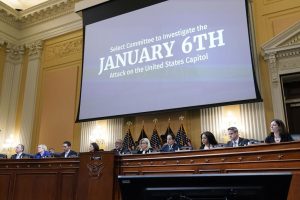
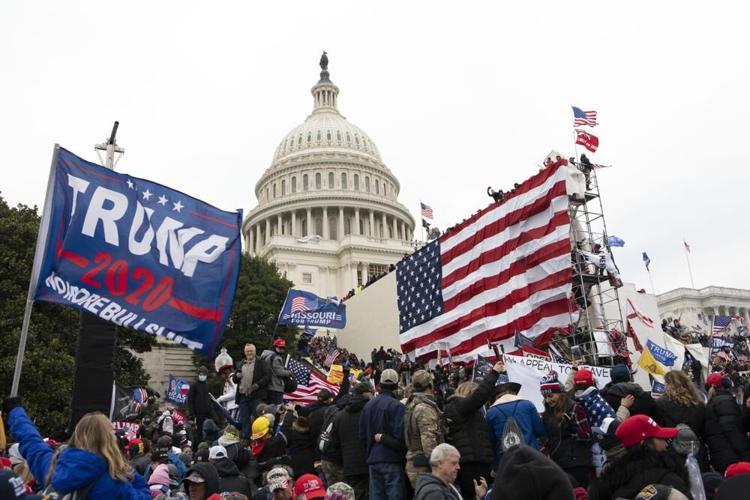
While international terrorism has received much attention across the nation, recent events,  including the January 6th violence on Capitol has made it urgent to address and tackle domestic terrorism. Responding to the newer realities, the Biden administration has released its first national strategy for domestic terrorism. The White House published its first national strategy for responding to domestic terrorism, five months after the 6 January attack on the US Capitol.

The national security council framework describes the domestic terrorism threat as more serious than potential attacks from outside the US, but also underlines the need to protect civil liberties and states that the approach must be “ideologically neutral”.

  • How will it work? The strategy has four pillars, writes Washington DC bureau chief David Smith, which include: understanding and sharing information about domestic terrorism threats, preventing Americans from being recruited, incited and mobilised, deterring and disrupting activity before violence and long-term contributing issues.
  • Meanwhile, Mitch McConnell, the Senate minority leader, said on Monday that it was “highly unlikely” he would allow Biden to fill a supreme court vacancy in 2024, a presidential election year, if Republicans regained control of the chamber.
  • Extremist Republican congresswoman Marjorie Taylor Greeneapologized for comparing the House mask rule to the Holocaust.
  • Plus, how Republicans hold near total control – including the governorship and the legislature – in 23 US states.

Another Federal Holiday Added: Juneteenth, Commemorating The End Of Slavery

The US Senate has unanimously passed on June 15th, a measure that would establish a federal holiday for Juneteenth, the day that marks the end of slavery in Texas.The bill now heads to the Democratic-led House, where it is likely to be approved, although the timing remains uncertain. Unanimous Senate passage was an anticlimactic culmination to a long effort to commemorate Juneteenth, the day that enslaved Black people in Galveston, Tex., received news on June 19, 1865, that they had been freed by the Emancipation Proclamation — more than two years after President Abraham Lincoln had signed it.

“Juneteenth commemorates the moment some of the last formerly enslaved people in the nation learned they were free,” said Senate Majority Leader Charles E. Schumer (D-N.Y.). “Making Juneteenth a federal holiday is a major step forward to recognize the wrongs of the past — but we must continue to work to ensure equal justice and fulfill the promise of the Emancipation Proclamation and our Constitution.” The effort gained significant ground in the last Congress, but a July 2020 attempt to pass the bill establishing the holiday was foiled when Sen. Ron Johnson (R-Wis.) objected to its passage and GOP Senate leaders opted not to expend scarce floor time to get around his objection.

Johnson objected to the cost of granting federal workers an additional paid holiday, and he proposed amendments that would offset the cost by either removing Columbus Day from the list of paid federal holidays or subtracting a day from federal workers’ paid leave. That proposal prompted sharp criticism from conservative commentators such as Tucker Carlson, who last year accused Johnson and another Republican, Sen. James Lankford (Okla.), of “trying to cancel Columbus Day.”In a statement Tuesday, Johnson said that while he remained concerned about the cost, which he pegged at $600 million a year, he did not intend to object again.

The Congressional Budget Office has not delivered an official cost estimate for the bill. Johnson’s estimate is based on the wages and salary that would be paid to the federal workforce for the day off, plus overtime for those who would work that day. Had Johnson not withdrawn his objection, the legislation probably would have faced a tougher path to reaching the Senate floor, since bills that do not have unanimous consent require more time for debate, and the chamber’s leaders have focused that time instead on voting rights, infrastructure and other key parts of their legislative agenda.

Juneteenth is the oldest nationally celebrated commemoration of the ending of slavery in the United States.From its Galveston, Texas origin in 1865, the observance of June 19th as the African American Emancipation Day has spread across the United States and beyond.

Today Juneteenth commemorates African American freedom and emphasizes education and achievement. It is a day, a week, and in some areas a month marked with celebrations, guest speakers, picnics and family gatherings. It is a time for reflection and rejoicing. It is a time for assessment, self-improvement and for planning the future. Its growing popularity signifies a level of maturity and dignity in America long over due. In cities across the country, people of all races, nationalities and religions are joining hands to truthfully acknowledge a period in our history that shaped and continues to influence our society today. Sensitized to the conditions and experiences of others, only then can we make significant and lasting improvements in our society.

India Blames Twitter For Not Complying With Local Laws

NEW DELHI (AP) — The standoff between the Indian government and Twitter escalated Wednesday when the country’s technology minister accused the social media giant of deliberately not complying with local laws. Technology Minister Ravi Shankar Prasad said Twitter has chosen “the path of deliberate defiance” when it comes to following new internet regulations that digital activists have said could curtail online speech and privacy in India.

“If any foreign entity believes that they can portray itself as the flag bearer of free speech in India to excuse itself from complying with the law of the land, such attempts are misplaced,” Prasad said in a series of tweets.The Indian government has been at odds with major social media websites over a new set of sweeping regulations that give it more power to police online content. It requires companies to erase content that authorities deem unlawful, comply with government takedown orders, help with police investigations and identify the originators of “mischievous information.”

Under the new laws, social media websites and tech companies will also have to remove content within 36 hours after an administrative or legal order is issued. Their employees can be held criminally liable for failing to comply with the government’s requests.Twitter said in a statement Tuesday that it was making every effort to comply with the new regulations. The company said it had appointed an interim chief compliance officer in India, a requirement under the new regulations, and will soon notify India’s Ministry of Electronics and Information Technology.

The new rules also require social media platforms to appoint what the government calls grievance officers to handle complaints from law enforcement agencies. Prasad, the IT minister, also accused Twitter of bias and said it was labeling some content as manipulated media, “only when it suits its likes and dislikes.” In May, leaders from Modi’s party tweeted parts of a document they said was created by the main opposition Congress Party to discredit the government’s handling of the pandemic. Some Congress leaders complained to Twitter, saying the document was forged. In response, Twitter marked some posts as “manipulated media.”

Twitter rules apply “manipulated media” tags to posts that have been “deceptively altered or fabricated.” The new internet regulations, announced in February, are among many challenges social media companies face after Prime Minister Narendra Modi’s pushed back against criticism that its new rules restrict online speech.Modi’s government has sought for years to control social media and has often directed Twitter to take down tweets or accounts that appear critical of his party and its leaders, including his administration’s handling of the pandemic. Twitter has complied with most of those orders.

The friction has intensified recently, with the government threatening social media companies with legal action and their employees with prison time if they refuse to comply with the takedown directives.Initially, Twitter expressed concern about what it called “the potential threat to freedom of expression” when the new rules came into effect late last month.

Nagaraj Naidu Appointed As New UN President-Elect’s Chef de Cabinet

India’s Deputy Ambassador to United Nations Nagaraj Naidu will be the Chef de Cabinet of the President-elect of the 76th session of the United Nations General Assembly (UNGA) Abdulla Shahid. This is for the first time that an Indian diplomat has been given this post, and his tenure will be for one year.The post is similar to chief of staff, or like in the Indian system, PM’s principal secretary.On June 7, Abdulla Shahid, Maldivian Foreign Minister President-elect of the 76th session of the UN General Assembly. He got 143 votes out of the 191 ballots cast in the 193-member General Assembly, winning against Afghanistan former Foreign Minister DrZalmaiRassoul, who got 48 votes.

“Today, I have appointed Ambassador Thilmeeza Hussain as Special Envoy of the PGA, and Ambassador Nagaraj Naidu Kumar as my Chef de Cabinet. They will be instrumental in delivering my vision for the #PresidencyOfHope,” Shahid tweeted.The General Assembly is the main deliberative, policymaking and representative organ of the United Nations. Comprising all 193 Member States of the UN, it provides a unique forum for multilateral discussion of international issues including peace and security,” Naidu said.

“It is indeed a privilege and an opportunity to serve under the leadership of President-elect Abdulla Shahid. We are looking forward to a Presidency of hope, Naidu told PTI. Shahid, accompanied by Naidu, met current General Assembly President VolkanBozkir on Wednesday to thank him for his support during the election and discuss the next steps. “Thank you Mr President, for sharing your insights and your experiences with me. We are both committed to a smooth and seamless transition to #UNGA76,” he tweeted.

An Indian Foreign Service Officer of the 1998 batch, Mr. Naidu is a fluent Chinese speaker and has served in China in four separate stints.Between 2000 and 2003, he had served at the Indian Embassy in Beijing, he served as Third and Second Secretary (Special Projects;) while between 2003 and 2006, he served as Consul (Political and Commercial) at the Indian Consulate in Hong Kong.From 2009 to 2012, he served as First Secretary and Counsellor (Economic & Commercial Affairs) at the Indian Embassy in Beijing. He took over as the Consul General at the Indian Consulate in Guangzhou, China from 2013 to 2015.From 2015 to 2017: After his return to the Foreign Ministry in New Delhi, Ambassador Naidu served as the Joint Secretary/Director General of the Economic Diplomacy Division in the Ministry of External Affairs.

During his term, the Economic Diplomacy Division of the MEA was given the “SKOCH Platinum First Prize for Smart Governance” in 2017. Mr. Naidu was also the National Coordinator for establishing the International Solar Alliance in India. He also served as a Board member in a number of Public Sector organizations including India Trade Promotion Organization (ITPO), Water & Power Consultancy Services Ltd. (WAPCOS), Invest India, and Indian Institute of Foreign Trade (IIFT).

From 2017 to 2018,Naidu served as Joint Secretary/Director General of the Europe West Division. During this period, Naidu was responsible for India’s bilateral political engagement with the United Kingdom, France, Germany, Italy, Spain, Portugal, Ireland, Belgium, Luxembourg, the Netherlands, Andorra, San Marino, Monaco and the European Union.Naidu has a Master’s Degree in Law and Diplomacy from Fletcher School of Law & Diplomacy (Class of 2008). He is married to Padmaja and has two children.

Youth Demand Action on Nature, Following IUCN’s First-Ever Global Youth Summit

On the occasion of World Environment Day, 5 June 2021, IPS features and opinion editorials focusing on Environment and Youth. Theunn reproduces the voices by youth at the UN Youth Summit on Environment

Following almost two weeks of talks on issues such as climate change, innovation, marine conservation and social justice, thousands of young people from across the globe concluded the first-ever International Union for Conservation of Nature’s (IUCN)One Nature One Future Global Youth Summit with a list of demands for action on nature.Under three umbrella themes of diversity, accessibility and intersectionality, they are calling on countries and corporations to invest the required resources to redress environmental racism and climate injustice, create green jobs, engage communities for biodiversity protection, safeguard the ocean, realise gender equality for climate change mitigation and empower underrepresented voices in environmental policymaking.

“Young people talk about these key demands that they have and most of the time, they are criticised for always saying ‘I want this,’ and are told ‘but you’re not even sure you know what you can do,’” Global South Focal Point for the Global Youth Biodiversity Network (GYBN) SwethaStotraBhashyam told IPS. “So we linked our demands to our own actions through our ‘Your Promise, Our Future’ campaign and are showing world leaders what we are doing for the world and then asking them what they are going to do for us and our future.”

Bhashyam is one of the young people dedicated to climate and conservation action. A zoologist who once studied rare species from the field in India, she told IPS that while she hoped to someday return to wildlife studies and research, her skills in advocacy and rallying young people are urgently needed. Through her work with GYBN, the youth constituency recognised under the Convention on Biological Diversity, she stated proudly that the network has truly become ‘grassroots,’ with 46 national chapters. She said the IUCN Global Youth Summit, which took place from Apr. 5 to 16,gave youth networks like hers an unprecedented platform to reach tens of thousands of the world’s youth.

“The Summit was able to create spaces for young people to voice their opinions. We in the biodiversity space have these spaces, but cannot reach the numbers that IUCN can. IUCN not only reached a larger subset of youth, but gave us an open space to talk about critical issues,” she said. “They even let us write a blog about it on their main IUCN page. It’s called IUCN Crossroads. They tried to ensure that the voice of young people was really mainstream in those two weeks.”

The United Nations Secretary-General’s Envoy on Youth, JayathmaWickramanayake, told IPS that the Summit achieved an important goal of bringing institutions and political conversations closer to young people. During her tenure, Wickramanayake has advocated for a common set of principles for youth engagement within the UN system, based on rights, safety and adequate financing. She said it is important for institutions to open their doors to meaningful engagement with young people.“I remember in 8th or 9th grade in one of our biology classes, we were taught about endangered animal species. We learned about this organisation called IUCN, which works on biodiversity. In my head, this was a big organisation that was out of my reach as a young person.

“But having the opportunity to attend the IUCN Summit, even virtually, engage with its officials and engage with other young people, really gave me and perhaps gave other young people a sense of belonging and a sense of taking us closer to institutions trying to achieve the same goals as we are as youth advocates.”The Youth Envoy said the Summit was timely for young people, allowing them to meet virtually following a particularly difficult year and during a pandemic that has cost them jobs, education opportunities and raised anxieties.

“Youth activists felt that the momentum we had created from years of campaigning, protesting and striking school would be diluted because of this uncertainty and postponement of big negotiations. In order to keep the momentum high and maintain the pressure on institutions and governments, summits like this one are extremely important,” Wickramanayake said.Global Youth Summit speakers during live sessions and intergenerational dialogues. Courtesy: International Union for Conservation of Nature (IUCN)

Other outcomes of the Global Youth Summit included calls to:

  • advance food sovereignty for marginalised communities, which included recommendations to promote climate-smart farming techniques through direct access to funding for marginalised communities most vulnerable to the impacts of climate change and extreme events,
  • motivate creative responses to the climate emergency, and
  • engineer sustainable futures through citizen science, which included recommendations to develop accessible education materials that promote the idea that everyone can participate in data collection and scientific knowledge creation.

The event was billed as not just a summit, but an experience. There were a number of sessions live streamed over the two weeks, including on youth engagement in conservation governance, a live story slam event, yoga as well as a session on how to start up and scale up a sustainable lifestyle business. There were also various networking sessions.Diana Garlytska of Lithuania represented Coalition WILD, as the co-chair of the youth-led organisation, which works to create lasting youth leadership for the planet.

She told IPS the Summit was a “very powerful and immersive experience”. “I am impressed at how knowledgeable the young people of different ages were. Many spoke about recycling projects and entrepreneurship activities from their own experiences. Others shared ideas on how to use different art forms for communicating climate emergencies. Somehow, the conversation I most vividly remember was on how to disclose environmental issues in theatrical performances. I’m taking that with me as food for thought,” Garlytska said.For Emmanuel Sindikubwabo of Rwanda’s reforestation and youth environmental education organisation We Do GREEN, the Summit provided excellent networking opportunities.

“I truly believe that youth around the world are better connected because of the Summit. It’s scary because so much is going wrong because of the pandemic, but exciting because there was this invitation to collaborate. There is a lot of youth action taking place already. We need to do better at showcasing and supporting it,” he told IPS.Sindikubwabo said he is ready to implement what he learned at the Summit. “The IUCN Global Youth Summit has provided my team and I at We Do GREEN new insight and perspective from the global youth community that will be useful to redefine our programming in Rwanda….as the world faces the triple-crises; climate, nature and poverty, we made a lot of new connections that will make a significant positive change in our communities and nation in the near future.”

The Global Youth Summit took place less than six months before the IUCN World Conservation Congress, scheduled forSep. 3 to 11. Its outcomes will be presented at the Congress.Reflecting on the just-concluded event, the UN Secretary-General’s Envoy on Youth is hoping to see more of these events. “I would like to see that this becomes the norm. This was IUCN’s first youth summit, which is great and I hope that it will not be the last, that it will just be a beginning of a longer conversation and more sustainable conversation with young people on IUCN… its work, its strategies, policies and negotiations,” Wickramanayake said.

(Picture & Caption By IPS: The United Nations Secretary-General’s Envoy on Youth, JayathmaWickramanayake, told IPS that the Summit achieved an important goal of bringing institutions and political conversations closer to young people. Clockwise from top left: JayathmaWickramanayake, SwethaStotraBhashyam, Emmanuel Sindikubwabo, DianaGarlytska. Courtesy: International Union for Conservation of Nature)

Biden’s First Ever Visit Abroad: Strengthening Alliance With NATO

President Biden embarks this week on the first foreign trip of his presidency to attend a series of European summits. He’ll attend the meeting of the Group of Seven nations (G-7) in Britain. Then, he’ll head to a NATO summit in Brussels.

President Biden embarks this week on the first foreign trip of his presidency to attend a series of European summits. He’ll attend the meeting of the Group of Seven nations (G-7) in Britain. Then, he’ll head to a NATO summit in Brussels where he’ll rub shoulders with the majority of the European Union’s leaders. All of that will precede what is likely to be a tense encounter with Russian President Vladimir Putin in Geneva on June 16. After spending the past five months focused on domestic affairs and battling the pandemic, Biden will try to demonstrate how his administration is “restoring” U.S. leadership on the world stage.

In an op-ed for the Washington Post published on Saturday, the U.S. President promised to shore up Washington’s “democratic alliances” in the face of multiple crises and mounting threats from Moscow and Beijing. The U.S. will stand with its European allies against Russia, President Joe Biden has promised ahead of the first face-to-face meeting with Vladimir Putin.Most recent American presidents have selected North American neighbors for their first cross-border trips, though former President Donald Trump, whose penchant for unilateral action and open skepticism of the NATO alliance unsettled American allies, made his first overseas stop in Riyadh, Saudi Arabia. For Biden, the first trip is meant to turn the page from Trump’s approach to alliances.

“It’s both a practical chance to connect with key allies and partners on shared opportunities and challenges,” said Yohannes Abraham, the chief of staff and executive secretary of the National Security Council, in an interview with the AP. “But also it’s an illustration of something that the president has been clear about that the transatlantic alliance is back, that revitalizing it is a key priority of his, and that the transatlantic relationship is a strong foundation on which our collective security and shared prosperity are built.”

“We are standing united to address Russia’s challenges to European security, starting with its aggression in Ukraine, and there will be no doubt about the resolve of the U.S. to defend our democratic values, which we cannot separate from our interests,” he wrote.“President Putin knows that I will not hesitate to respond to future harmful activities,” he said. “When we meet, I will again underscore the commitment of the United States, Europe and like-minded democracies to stand up for human rights and dignity.”Since taking office in January, Mr. Biden has ramped up pressure on the Kremlin, and his comments likening Mr. Putin to a “killer” were met with fierce criticism in Moscow.

But both leaders have expressed hopes that relations can improve, with the Russian President saying on Friday he expected a “positive” result from the talks.Mr. Biden in his weekend op-ed also stressed that Washington “does not seek conflict” — pointing to his recent extension of the New START arms reduction treaty as proof of his desire to reduce tensions.“We want a stable and predictable relationship where we can work with Russia on issues like strategic stability and arms control,” he wrote.

US To Donate 25 Million Doses of Covid Vaccine To Countries Impacted

President Joe Biden announced Thursday the U.S. will donate 75% of its unused COVID-19 vaccines to the U.N.-backed COVAX global vaccine sharing program, acting as more Americans have been vaccinated and global inequities have become more glaring.

President Joe Biden announced Thursday the U.S. will donate 75% of its unused COVID-19 vaccines to the U.N.-backed COVAX global vaccine sharing program, acting as more Americans have been vaccinated and global inequities have become more glaring.Of the first tranche of 25 million doses, the White House said about 19 million will go to COVAX, with approximately 6 million for South and Central America, 7 million for Asia and 5 million for Africa. The doses mark a substantial — and immediate — boost to the lagging COVAX effort, which to date has shared just 76 million doses with needy countries.

Overall, the White House aims to share 80 million doses globally by the end of June, most through COVAX. But 25% of the nation’s excess will be kept in reserve for emergencies and for the U.S. to share directly with allies and partners.“As long as this pandemic is raging anywhere in the world, the American people will still be vulnerable,” Biden said in a statement. “And the United States is committed to bringing the same urgency to international vaccination efforts that we have demonstrated at home.”

U.S. National Security Adviser Jake Sullivan said the U.S. “will retain the say” on where the doses distributed through COVAX ultimately go.“We’re not seeking to extract concessions, we’re not extorting, we’re not imposing conditions the way that other countries who are providing doses are doing; we’re doing none of those things,” said Sullivan. “These are doses that are being given, donated free and clear to these countries, for the sole purpose of improving the public health situation and helping end the pandemic.”

The remaining 6 million in the initial tranche of 25 million will be directed by the White House to U.S. allies and partners, including Mexico, Canada, South Korea, West Bank and Gaza, India, Ukraine, Kosovo, Haiti, Georgia, Egypt, Jordan, Iraq, and Yemen, as well as for United Nations frontline workers.Vice President Kamala Harris informed some U.S. partners they will begin receiving doses, in separate calls with Mexican President Andres Manuel LópezObrador, President Alejandro Giammattei of Guatemala, Indian Prime Minister Narendra Modi, and Prime Minister Keith Rowley of Trinidad and Tobago. Harris is to visit Guatemala and Mexico in the coming week.

The long-awaited vaccine sharing plan comes as demand for shots in the U.S. has dropped significantly — more than 63% of adults have received at least one dose — and as global inequities in supply have become more glaring.Scores of countries have requested doses from the United States, but to date only Mexico and Canada have received a combined 4.5 million doses. The U.S. also has announced plans to share enough shots with South Korea to vaccinate its 550,000 troops who serve alongside American service members on the peninsula. White House COVID-19 coordinator Jeff Zients said that 1 million Johnson & Johnson doses were being shipped to South Korea Thursday.

The growing U.S. stockpile of COVID-19 vaccines is seen by many overseas and at home not only as a testament to America’s achievement but also its global privilege.Tom Hart the, acting CEO of The ONE Campaign, called the Thursday announcement a “welcome step” but said the Biden administration needs to commit to sharing more doses. “The world is looking to the U.S. for global leadership and more ambition is needed.”

Biden has committed to providing other nations with all 60 million domestically produced doses of the AstraZeneca vaccine., which has yet to be authorized for use in the U.S. but is widely approved around the world. The U.S.-produced doses have been held up for export by an ongoing safety review by the Food and Drug Administration, said Zients.The White House says the initial 25 million doses will be shipped from existing federal stockpiles of Pfizer, Moderna and Johnson & Johnson vaccines. More doses are expected to be made available to share in the months ahead.

As part of its purchase agreements with drug manufacturers, the U.S. controlled the initial production by its domestic manufacturers. Pfizer and Moderna are only now starting to export vaccines produced in the U.S. to overseas customers. The U.S. has hundreds of millions more doses on order, both of authorized and in-development vaccines.The White House also announced Thursday that it is lifting restrictions on sharing vaccines produced by AstraZeneca, as well as Sanofi and Novavax, which are also not authorized in the U.S., allowing the companies to determine for themselves where to share their doses.

Crucial Voting Rights Bill Needs Lifeline To Move Forward

Sen. Joe Manchin announced that he will vote against Democrats’ expansive election and ethics reform bill, dealing a blow to one of his party’s top priorities. In an op-ed published in the Charleston Gazette-Mail, the West Virginian warned that “partisan voting legislation will destroy the already weakening binds of our democracy” and reiterated that he will not vote to scrap or modify the legislative filibuster.“Voting and election reform that is done in a partisan manner will all but ensure partisan divisions continue to deepen,″ Sen. Joe Manchin of West Virginia wrote in a home-state newspaper, the Charleston Gazette-Mail. He wrote that failure to bring together both parties on voting legislation would “risk further dividing and destroying the republic we swore to protect and defend as elected officials.”

The bill would restrict partisan gerrymandering of congressional districts, strike down hurdles to voting and bring transparency to a murky campaign finance system. Among dozens of other provisions, it would require states to offer 15 days of early voting and allow no-excuse absentee balloting.Democrats have pushed the legislation as the antidote to a wave of restrictive state voting laws sweeping the country, many inspired by former President Donald Trump’s false claims of fraud in his 2020 election loss. Senate Majority Leader Chuck Schumer, D-N.Y., has pledged to bring the election bill to a vote the week of June 21, testing where senators stand. But without Manchin’s support, the bill has no chance of advancing. Republicans are united against it.

Democratic Sen. Joe Manchin was unswayed by civil rights leaders who implored him to rethink his opposition to a sprawling election bill that House Speaker Nancy Pelosi said is crucial to countering a “Republican assault on our democracy.” Manchin, from deeply Republican West Virginia, told reporters, “I don’t think anybody changed positions,” in a meeting he described as “excellent.” A participant said Manchin was “fairly well dug in.”The bill, known as HR1, is a top priority for Democrats and is viewed by many in the party as the antidote to a wave of Republican-backed laws being passed on the state level that restrict people’s ability to vote. It touches on almost every aspect of voting and was already passed by the House.  But Manchin threw a wrench into the works when he said he would oppose the bill. That effectively dooms the measure in a narrowly divided Senate where it is universally opposed by Republicans.

His decision sent voting rights groups and members of his own party scrambling for options, raising the prospect that no voting legislation would pass Congress to address what experts say is the greatest attack on voting rights in generation. Manchin has said “inaction is not an option” when it comes to voting rights. But he has exasperated fellow Democrats and voting rights groups by insisting his support for any legislation would be contingent on some Republicans voting for it as well. He also opposes eliminating the 60-vote requirement to break a filibuster, a step that would allow Democrats to pass the legislation without Republican votes.

“We may get to a point where the dialogue reaches a dead end,” the Rev. Marc Morial, who attended Tuesday’s meeting with Manchin, told CNN. “And Joe Manchin was fairly well dug in.” Pelosi had told House Democrats there is no substitute for the bill.“It is my hope that the passage of (the bill) will create a legacy for all of us who want to strengthen our democracy,” the California Democrat wrote in a letter to colleagues before Manchin announced he wouldn’t support the bill.  Now Democrats and voting rights groups are grasping for an alternative.

Some said they’d follow Manchin’s suggestions and get behind a narrower piece of legislation known as HR4 that updates the Voting Rights Act to reinstate a requirement that new voting laws and legislative districts in certain states be subject to federal approval. Others said they wanted to increase the pressure on Manchin. Still others insisted that Democrats needed to bring HR1 to the Senate floor this month, even it it’s certain to fail, to draw attention to Republican opposition and Manchin’s.

“It’s going to get messy,” said Fred Wertheimer, president of the good-government organization Democracy 21, who helped draft HR1 in 2017. “What Manchin said is not the final word, as far as we’re concerned.  “I don’t believe he is prepared to go down in history as the senator that denied millions of eligible citizens, and in particular people of color, the opportunity to vote.”The Rev. William Barber II, a key liberal activist who leads the Poor People’s Campaign, represented the breadth of liberal anger at Manchin, tweeting Monday that his group would lead a march in West Virginia to “challenge Manchin.”

Only one Republican senator, Alaska’s Lisa Murkowski, has signed onto Manchin’s preferred Voting Rights Act update, an indication of how politics on the issue have shifted since the Senate unanimously renewed the Voting Rights Act in 2006. And the newly aggressive constellation of conservative voting groups that mobilized against H.R. 1 say it will now campaign to keep the GOP united against HR4 as well.“The end result of HR4 is the same — it’s a federal takeover of the election system,” Jessica Anderson, executive director of the conservative policy organization Heritage Action for America, said in an interview. “As long as you have consensus on the right, standing together in lockstep, you’re not going to have a bipartisan break.”

“They are not showing a readiness to stand up and do what’s right, so the notion you could get 10 of them to come along is farfetched,” said Rep. John Sarbanes, D-Md., a primary sponsor of HR1. “You are not going to get real change without filibuster reform.”

G-7 Summit: Reality And Expectations

The upcoming G7 Summit in Cornwall, UK from June 11 to 13 is perhaps the first international event, in the backdrop of the continuing Covid pandemic, when the leaders from the worlds wealthiest countries — the US, Japan, Germany, the UK, France, Italy and Canada — will be meeting with leaders from India, Australia, South Africa and South Korea face to face for the first time in the last one-and-a-half year.The leaders from the most advanced nations of the G7 meet regularly to try to determine the course the world will follow, with their own interests taking a backseat.

Expectations from the summit

There is a lot of optimism ahead of the gathering in Cornwall. US and UK government sources have briefed that the G7 will demonstrate that “the West ain’t over just yet”. The optics are bound to be promising. For the US it’ll give a chance to prove that ‘America is back’, while for the UK it’ll help to give a boost to its ‘Global Britain’ strategy.On the agenda are the autocratic challenge from Russia and China, climate change, the global vaccine rollout and trade. In addition Myanmar, Indian democracy and its minorities, instability in Sahel region, Israel-Palestinian conflict and change of guard in Israel are also expected to occupy the agenda.

A move, spearheaded by US President Joe Biden, to set a minimum global corporate tax rate to help states reclaim resources lost to tax havens seems promising. Also the British proposal to transform the G7 into a “D10” of democracies has been achieved, the participation of guests from India, Australia, South Korea and South Africa will reinforce a sense that the West is open to alliance-building again.Meanwhile, the G7 finance ministers reached a “historic” deal on taxing multinational companies, last week in London. They agreed to counter tax avoidance through measures to make companies pay in the countries where they do business., besides ratifying a global minimum corporate tax rate to counter the possibility of countries undercutting each other to attract investments. UK Chancellor Rishi Sunak described these as “seismic tax reforms” and said that it will help create a fairer tax system fit for the 21st century.

Preparations for the summit

The foreign ministers from D-10 met face-to-face for the first time in two years in May earlier, following a coronavirus-extended pause, to prepare for the summit and in the communique issued after the meeting listed 82 points which will try to grab the attention of G7 or D10 leaders. In addition the issues discussed were NATO’s withdrawal from Afghanistan, Iran, China and the threat posed by Russia.Meanwhile, Britain’s Foreign Office has said a key part of the June summit will be plans to boost girls’ education and women’s employment after the Covid pandemic would be a key topic.

G7 nations are expected to sign up to new global targets that aim to get 40 million more girls into school in low and lower-middle-income countries by 2026. The aims also include getting 20 million more girls reading by the age of 10. The countries are setting up a $15-billion fund, to be administered by developing countries over the next two years.However, the trade unionists and the wider environment movement in the UK have sounded the bugle against G7’s inability to take any concerted action on climate change. In a statement they asserted that the vaccine apartheid response to the Covid threat might be replicated in their approach to the climate crisis.

They further assert that if the world’s wealthiest countries continue to move too slowly to curb their own carbon emissions, continue to invest in and boost fossil fuel energy and production, fail to make a just transition at home while denying the global South the resources it needs to deal with climate impacts, their pretensions to “global leadership” will fail the test.A $100 billion a year transfer to the developing world to make transition possible was pledged at Copenhagen and built into the Paris Agreement to be met by 2020. But it has not been done.They further assert that this commitment is a tiny fraction of the $3.8 trillion that global banks have invested in fossil fuels since the Paris Agreement, and less than a tenth of the combined G7 military budget of $1,043bn last year.

Post-summit scenario

British Prime Minister Boris Johnson plans to use the G7 Summit to increase cooperation between the world’s democratic and technologically advanced nations. Between them, the 10 leaders represent more than 60 per cent of the people living in democracies around the world.The UK will also host several meetings throughout the year between government ministers from the G7, both virtually and in different locations across Britain. These meetings will cover economic, environmental, health, trade, technology, development and foreign policy issues.

Observers are of the view that post-summit the western world may be transformed into one where it may lose its supremacy and China may pull ahead of the West technologically and economically, secondly the West could reassert itself by investing in green industries to renew its economies and societies in the backdrop of the lessons learnt from the Covid pandemic and thus China might be neutralised, thirdly a more Eurasian Europe may emerge, due to the eclipse of both the US and UK and it’ll be drawn towards Asia’s growing economic influence. For India, the summit offers a chance to further reinforce its relationship with the UK by signing a trade treaty and for Mr Modi to establish a rapport with Biden to ensure a fruitful bilateral relationship, and to some extent this seems possible. (IANS)

China Hosts ASEAN Ministers, With Message For Quad

China is hosting foreign ministers from the 10 ASEAN countries on Monday and Tuesday, with Beijing pushing for closer economic cooperation and aligning COVID-19 recovery efforts even as it looks to push back against the recent regional outreach of the Quad grouping. Chinese officials have in recent weeks stepped up criticism of the Quad — the informal India, Australia, Japan and United States grouping — and of Washington in particular. During recent visits to Sri Lanka and Bangladesh, China’s Defence Minister called on both countries to reject “military alliances” — a term that some Beijing are using to describe the Quad, but a label that the group rejects.

China’s Foreign Ministry spokesperson Wang Wenbin said in a statement the China-ASEAN foreign ministers meeting, in the city of Chongqing, would mark the 30-year anniversary of relations and also “focus on combating COVID-19, promoting economic recovery, [and] better dovetail[ing] strategic plans.” A vaccine passport connecting China and ASEAN countries is also being discussed. China’s Foreign Minister Wang Yi will hold bilateral meetings with all the visiting ministers, and also chair a meeting of the Lancang-Mekong Cooperation (LMC) with Cambodia, Laos, Myanmar, Thailand and Vietnam.

Deepening economic cooperation, particularly following the signing of the Regional Comprehensive Economic Partnership (RCEP) trade deal, would be China’s focus, analysts in Beijing said, even as it grapples with disputes over the South China Sea. Recently, China and the Philippines have clashed over the presence of Chinese vessels near a disputed reef, while Malaysia alleged the intrusion of 16 Chinese aircraft into its airspace.The Communist Party-run Global Times on Monday blamed the U.S. for those tensions rather than China’s moves that prompted the protests from the Philippines and Malaysia. Countries “see clearly that quarrels on South China Sea are not the biggest threat to regional stability; it is the U.S., whose warships frequently sail through the sensitive waters and try to force ASEAN countries take sides to confront China,” the newspaper wrote.

After the first Quad leaders’ summit held in March and the announcement of a regional vaccine initiative, many Chinese analysts framed ASEAN as a key space where Chinese and Quad initiatives may rub up against each other.China “cannot rule out the possibilities that Quad members will further rope in ASEAN members to counter China as Southeast Asia is of great significance to the US’ Indo-Pacific Strategy,” wrote Yuan Zheng, senior fellow of the Institute of American Studies at the Chinese Academy of Social Sciences. “Yet ASEAN will not easily take sides.”

The framing of the Quad as “an Asian NATO” by Beijing has been criticised by the group’s members. India’s External Affairs Minister S. Jaishankar in April described the using of words such as “Asian NATO” as “a mind game which people are playing”.ProPublica: Many of the uber-rich pay next to no income tax

Jaishankar On A Mission To US, Urging Covid Help

With India grappling with the ferocious second wave of Covid-19, External Affairs Minister S Jaishankar is on a vaccine mission to the United States as India fights shortages of doses amidst a virulent second surge.

WashingWith India grappling with the ferocious second wave of Covid-19, External Affairs Minister S Jaishankar is on a vaccine mission to the United States as India fights shortages of doses amidst a virulent second surge.Jaishankar met with several high ranking officials at the UD administration, including US Secretary of State Antony Blinken, Defense Secretary Lloyd Austin, National Security Advisor Jake Sullivan, US Trade Representative Katherine Tai, Director of National Intelligence Avril Haines, USAID Administrator Samantha Power top American lawmakers from both the Democratic and Republican parties, and top American business leaders in Washington DC. Jaishankar is the first Indian Cabinet minister to visit the US after Joe Biden became President on January 20.

At the meetings with the US leaders, Jaishankar discussed vaccine cooperation, contemporary security challenges, support for efficient and robust supply chain, among others. While there was no readout after the meetings, sources said that vaccine cooperation was one of the key areas of conversation between the two sides.Jaishankar’s in-person meetings come days after US President Joe Biden announced that the US will begin shipping 20 million doses of Pfizer-BioNTech, Moderna, and Johnson & Johnson’s Covid-19 vaccines to unspecified needy countries by June-end, in addition to 60 million shots of AstraZeneca.

Although Washington has not yet decided how these 80 million doses will be distributed, India is likely to be one of the beneficiaries — be it AstraZeneca, which is already made and distributed in India as Covishield, or the ones by Pfizer-BioNTech, Moderna, and Johnson & Johnson, or a mix. AstraZeneca’s vaccine is not authorized for use in the United States yet. The US had cited faults in a plant in Baltimore that is manufacturing both the AstraZenenca and J&J vaccines.Jaishankar arrived in New York Sunday, May 23rd  and met UN Secretary General Antonio Guterres and travelled to Washington on May 26th, where he met with Blinken, focusing on vaccine cooperation between the two countries. While India is struggling with a shortage of vaccines, the US has surplus vaccines and raw materials needed to manufacture them.

Blinken described Jaishankar as “my friend and colleague”. “The United States and India are working together on so many of the most important challenges of our time and ones that are putting a profound impact on our lives,” he said. “We are united in confronting Covid-19 together, we (are) united in dealing with the challenge posed by climate change, to partner together directly, through Quad and other institutions in the United Nations in dealing with many of the challenges that we face in the region and around the world,” Blinken said. “The partnership between the United States and India is vital. It’s strong. And I think it’s increasingly predominant,” he said.

Echoing Blinken, Jaishankar said, “We have a lot of issues to discuss. But our relations have grown stronger over the years and I’m very confident we’ll continue to do so, but I also want to take the opportunity to express to the Secretary and through him to the administration of the United States for the strong support and solidarity at a moment of great difficulty for us.”At this point, Blinken said, “We remember, in the earlier days of the pandemic, India was there with the United States. Something we’ll never forget. And now we want to make sure that we’re there for and with India.” Jaishankar and Blinken have spoken at least four times in the past three months, twice in the last fortnight, and once at the Quad Foreign Ministers’ meeting through video-conferencing.

During Jaishankar’s wide-ranging discussions with NSA Sullivan, the two countries agreed that people-to-people ties and shared values are the foundations of the US-India strategic partnership that is helping to end the pandemic, supporting a free and open Indo-Pacific, and providing global leadership on climate change. “Pleased to meet Jake Sullivan. Wide-ranging discussions including on Indo-Pacific and Afghanistan. Conveyed appreciation for US solidarity in addressing the Covid challenge. India-US vaccine partnership can make a real difference,” Jaishankar said in a tweet after the meeting.

“Our people-to-people ties and our values are the foundation of the US-India partnership and will help us end the pandemic, lead on climate, and support a free and open Indo-Pacific,” Sullivan wrote on Twitter after the meeting. After his meeting with US Trade Representative Katherine Tai, Jaishankar tweeted: “Welcomed her positive stance on IPR (Intellectual Property Rights) issues & support for efficient and robust supply chains.”Jaishankar said that he had a “warm meeting” with US Defense Secretary Lloyd Austin, during which they discussed further developing strategic and defense partnership between the two countries and exchanged views on “contemporary security challenges”.

In a statement issued by USAID, it was reported, “The U.S. Agency for International Development (USAID) Administrator Samantha Power met with Indian External Affairs Minister Dr. S. Jaishankar to discuss urgent shared priorities for development and humanitarian assistance during the current surge of COVID-19 across India. Administrator Power and Minister Jaishankar discussed areas for important collaboration on pandemic response efforts in India, as well as strategies to catalyze private capital to save lives, counter the spread of the pandemic, and strengthen health systems for the future. The two leaders also discussed opportunities to strengthen developmental cooperation through the Quad and with India’s Development Partnership Administration, including through collaboration with third-country partners in the Indo-Pacific, Africa, and other regions.”

Jaishankar also had meetings with the top American business leadership hosted by the US India Business Council and the US India Strategic and Partnership Forum. Jaishankar also met influential American lawmakers from both the Democratic and Republican parties and discussed developments about Quad and the cooperation on vaccines with them. He tweeted that he had “good conversations” with co-chairs of the House India Caucus, Congressman Brad Sherman and Rep. Steve Chabot.“The US Congress has been a tremendous pillar of support as India meets the Covid challenge,” he said.

Talking with former US National Security Advisor General HR McMaster in ‘Battlegrounds’ session on ‘India: Opportunities And Challenges For A Strategic Partnership’ at Stanford University’s Hoover Institution, New York, Jaishankar acknowledged  that it is “a very stressful time” for India due to the pandemic.Jaishankar stressed the need for countries to look beyond their national interests to global good. “If countries, especially large countries, pursue their national interest, disregarding everything else, I think the world is going to have some big problems,” he said.

“The number one question on everybody’s mind today is Covid, and the worry which people have — do we have accessible, affordable vaccines? Now, we can’t have a world which is part-vaccinated and part-neglected, because that is not going to be safe. So how do we get through the global challenges in a global way?” Jaishankar said, adding, “I think that’s the big question.”

Israel’s Longest Serving PM Netanyahu’s Regime May End

While Bennett and his new partners, headed by opposition leader YairLapid, still face some obstacles, the sides appeared to be serious about reaching a deal and ending the deadlock that has plunged the country into four elections in the past two years.

With the announcement by a former ally of Prime Minister Benjamin Netanyahu that he would seek to form a coalition government with the Opposition,Israel’s longest serving Isreali’s leader’s regime may come to an end, media reports here suggested/ The ultra-nationalist leader Naftali Bennett said his party would join talks to form a governing coalition with centrist party leader YairLapid. The dramatic announcement by Naftali Bennett, leader of the small hardline Yamina party, set the stage for a series of steps that could push Netanyahu and his dominant Likud party into the opposition in the coming week.

“It’s my intention to do my utmost in order to form a national unity government along with my friend YairLapid, so that, God willing, together we can save the country from a tailspin and return Israel to its course,” Bennett said.Bennett, 49, who leads the Yamina party, made his announcement in a televised address. “Mr Netanyahu is no longer trying to form a right-wing government because he knows full well that there isn’t one. He is seeking to take the whole national camp, and the whole country, with him on his personal last stand,” he said. “I will do everything to form a national unity government with my friend YairLapid.”

While Bennett and his new partners, headed by opposition leader YairLapid, still face some obstacles, the sides appeared to be serious about reaching a deal and ending the deadlock that has plunged the country into four elections in the past two years.They have until Wednesday to complete a deal in which each is expected to serve two years as prime minister in a rotation deal, with Bennett holding the job first. Lapid’sYeshAtid party said negotiating teams were to meet later Sunday.

Bennett, a former top aide to Netanyahu who has held senior Cabinet posts, shares the prime minister’s hard-line ideology. He is a former leader of the West Bank settlement movement and heads a small party whose base includes religious and nationalist Jews. Yet he has had a strained and complicated relationship with his one-time mentor due to personal differences.Bennett said there was no feasible way after the deadlocked March 23 election to form a right-wing government favored by Netanyahu. He said another election would yield the same results and said it was time to end the cycle.

“A government like this will succeed only if we work together as a group,” he said. He said everyone “will need to postpone fulfilling part of their dreams. We will focus on what can be done, instead of fighting all day on what’s impossible.”If Bennett and Lapid and their other partners can wrap up a deal, it would end, at least for the time being, the record-setting tenure of Netanyahu, the most dominant figure in Israeli politics over the past three decades. Netanyahu has served as prime minister for the past 12 years and also held an earlier term in the late 1990s.

In his own televised statement, Netanyahu accused Bennett of betraying the Israeli right wing and urged nationalist politicians not to join what he called a “leftist government. A government like this is a danger to the security of Israel, and is also a danger to the future of the state,” he said. Netanyahu is desperate to stay in power while he is on trial. He has used his office as a stage to rally his base and lash out against police, prosecutors and the media.

Despite his electoral dominance, Netanyahu has become a polarizing figure since he was indicted on charges of fraud, breach of trust and accepting bribes in late 2019. Each of the past four elections was seen as a referendum on Netanyahu’s fitness to rule, and each ended in deadlock.In order to form a government, a party leader must secure the support of a 61-seat majority in the 120-seat Knesset, or parliament. Because no single party controls a majority on its own, coalitions are usually built with smaller partners. Thirteen parties of various sizes are in the current parliament.

While Bennett’s Yamina party controls just seven seats in parliament, he has emerged as a kingmaker of sorts by providing the necessary support to secure a majority. If he is successful, his party would be the smallest to lead an Israeli government.Lapid already faced a difficult challenge, given the broad range of parties in the anti-Netanyahu bloc that have little in common. They include dovish left-wing parties, a pair of right-wing nationalist parties, including Bennett’s Yamina, and most likely the Islamist United Arab List.Although Arabs make up some 20% of Israel’s population, an Arab party has never before sat in an Israeli coalition government.

Israeli media reported that under the proposed terms of the deal, Mr Bennett would replace Mr Netanyahu, 71, as prime minister and later give way to MrLapid, 57, in a rotation agreement. The arrangement has not been officially confirmed. The proposed coalition would bring together factions from the right, the left and the centre of Israeli politics. While the parties have little in common politically, they are united in their desire to see Mr Netanyahu’s time in office come to an end.

The prime minister, who is on trial for fraud, fell short of a decisive majority at a general election in March. It was the country’s fourth inconclusive vote in two years – and again Netanyahu failed to secure coalition allies. After Netanyahu’s failure to form a government, Lapid was then given four weeks to cobble together a coalition.YohananPlesner, president of the Israel Democracy Institute, said Netanyahu will try to undermine those efforts until the end. Even if Lapid and Bennett manage to put together a government, Netanyahu is unlikely to disappear, Plesner said.Netanyahu could remain as opposition leader, working to exploit the deep ideological differences among his opponents to cause the coalition to fracture. “History teaches us it would be unwise to write him off,” he said.

Eric GarcettiLikely To Be Named US Envoy ToIndia

President Biden is said to nominate Los Angeles Mayor Eric Garcetti,50 to be the U.S. ambassador to India; and former senior State Department official Nicholas Burns to serve as his ambassador to China. With these selections, Biden is turning to a longtime political ally and a seasoned diplomat to serve in two of the country’s highest-profile diplomatic postings.

Los Angeles Mayor Eric Garcetti,50, is likely to be nominated as U.S. ambassador to India by President Biden. The Associated Press reported last week that Biden is expected to announce that Garcetti will be picked for the post, citing a person familiar with the matter.Biden, who has yet to announce any of his picks to fill ambassador posts, has been planning to roll out the list all at once, a strategic move that has allowed speculation to build around several likely nominees. Sources also stated, former senior State Department official Nicholas Burns to serve as his ambassador to China, according to a person familiar with the matter.With these selections, Biden is turning to a longtime political ally and a seasoned diplomat to serve in two of the country’s highest-profile diplomatic postings.

It was not clear when either nomination would be announced, according to the person familiar with the matter, who was not authorized to publicly comment on the matter and spoke on condition of anonymity. The White House declined to comment on either Garcetti or Burns and noted that “no one is final until they’re announced.”Garcetti and Burns, if confirmed by the Senate, would come to their postings at high-pressure moments in the U.S. relationships with India and China. Garcetti, if confirmed, would be dispatched to India as it has been overwhelmed by a surge in coronavirus infections and deaths. India’s death toll is the third highest reported in the world after the U.S. and Brazil, and true numbers are thought to be significantly greater.

Garcetti had considered a 2020 White House bid and later on, became part of Biden’s inner circle, emerged as a widely discussed possibility to join Biden’s Cabinet last year. But he took himself out of the running, saying the raging coronavirus crisis made it impossible for him to step away.The two-term mayor would leave LA with an uneven record. He has been credited with continuing a transit buildup in a city choked with traffic, establishing tougher earthquake safety standards for thousands of buildings, and steering the city through the deadly pandemic as it became a hot spot for infections. Cases have fallen steeply in the city and some restrictions have been rolled back, consistent with the trajectory in the state.

Garcetti’s popularity has slipped in recent years, and Black Lives Matter protesters had banged drums outside his official residence earlier this year to urge Biden not to choose Garcetti for a Cabinet position. Garcetti was overmatched by a crisis of homelessness that became a national embarrassment despite the massive jump in government spending to fight it. Many streets and sidewalks remain cratered and crumbling, despite his early pledge to make fixing them a cornerstone of his administration.In picking Garcetti, the president would be rewarding a loyalist who was one of his national campaign co-chairs, who served on the committee that vetted his pool of vice presidential contenders, and who served as one of several co-chairs for Biden’s inaugural committee.

Garcetti was elected mayor in 2013 and reelected in 2017. He is serving a longer second term — of 5½ years, as opposed to four — because voters in 2015 backed a one-time change in the city’s election dates. Garcetti’s possible departure for India comes as the city slowly recovers from the economic devastation of the COVID-19 pandemic and grapples with an ongoing homelessness crisis.The overseas position, if it goes to the mayor, will be viewed as a reward to a longtime supporter of Biden’s. The India posting would allow the politically ambitious Garcetti to burnish his foreign policy credentials ahead of a possible future White House run. That’s a conspicuous gap on his resume — the Ivy League graduate and Rhodes scholar has spent two decades in city government, either as mayor or a city councilman.

S. Jaishankar Discusses Covid Vaccines, Terrorism At UN

India’s External Affairs Minister S. Jaishankar has offered India’s support to UN Secretary-General Antonio Guterres for his re-election during a meeting in New York at which they discussed a range of issues from Covid-19 vaccines to terrorism.In a tweet after the meeting May 25, Jaishankar said that he told Guterres that India “values” his leadership and conveyed its support for his election to a second term. The global crisis of the Covid-19 pandemic featured prominently in their discussions.

Jaishankar tweeted that they emphasized the importance of finding “urgent and effective global vaccine solutions” and the critical need to ramp up the vaccine supply chain to “ensure greater production and fairer distribution.”With India set to assume the rotating presidency of the Security Council in August, their meeting covered a wide range of issues.In a series of tweets on the meeting, Jaishankar said that they talked about “regional challenges in India’s neighborhood” and “shared our concerns about ensuring that the gains of the last two decades in Afghanistan are adequately protected.”

U.S. President Joe Biden is pulling out the nation’s troops from Afghanistan after a 20-year deployment even as terrorist activities continue raising fears of regional instability.In his tweets Jaishankar said, “Countering terrorism and radicalization remain priorities for the entire region.”Jaishankar said that he “highlighted India’s constructive role” in the Security Council and “conveyed priorities of our presidency in August.” He added, “Maritime security and technology for peacekeeping address the needs of the day.”

A spokesperson for India’s UN Mission said that India planned to hold high-level meetings on those topics during its presidency. Jaishankar also noted that Guterres expressed “appreciation of India’s peacekeeping operations including at Goma, DRC (Democratic Republic of Congo) recently.”India peacekeepers based in Goma have been involved in rescue operations after the eruption of the Mount Nayargongo volcano displaced several thousand people in the region last week. Several hundred people are also missing following the calamity.

Climate change, a topic that Guterres gives top priority to, also was discussed, Jaishankar tweeted. “Greater resources are essential for larger ambitions (in setting goals for combatting climate change). Financing will determine our seriousness and credibility,” he added.The spokesperson for India’s UN mission said that Jaishankar “apprised the Secretary General of India’s efforts to meet its Paris commitments (on curbing greenhouse emissions), enhance renewable energy goals, as well as its leadership role in the International Solar Alliance and Coalition for Disaster Resilient Infrastructure.”

Jaishankar “underlined our strong development partnership with Africa, Small States and Small Island Developing States,” the spokesperson said. “The Secretary-General conveyed his appreciation for the consistent role played by Indian peacekeepers in support of international peace and security. Their response in aiding the people of Goma in the Democratic Republic of Congo following the volcanic eruption was recognized,” the diplomat added.In the discussion of fighting Covid-19, they felt that “the proposal by India and South Africa for a temporary waiver of vaccine patents “can also contribute to greater production and more equity,” the spokesperson said. The U.S. has agreed to the waiver, but it is facing opposition from several countries including Germany.

Guterres’s spokesperson Stephane Dujarric said that they “discussed a number of issues relating to peace and security” but said he had no further details on those topics. He also said that they discussed the Covid situation and the development of vaccines.Guterres is running for re-election with no credible opposition and in the election India gets two votes, one in the Security Council and another in the General Assembly. A Canadian of Indian descent, Arora Akanksha, has declared she is running for the office, as have at least five others, but lacking a government sponsorship, their candidacy has not so far been accepted officially.

China Comes Under Scrutiny As Study Backs Lab Theory For Covid Origin

Amid calls for a fresh probe into the origins of Covid-19, a new study has claimed that Chinese scientists created the virus in a laboratory in Wuhan and then tried to cover their tracks by reverse-engineering versions of the virus to make it look like it evolved naturally from bats.The virus has no “credible natural ancestor” and was created by Chinese scientists who were working on a gain-of-function research in a Wuhan lab, The Daily Mail reported on Sunday, citing a research paper compiled by British expert Angus Dalgleish and Norwegian scientist Birger Sorensen.

Incidentally, gain-of-function projects, which involve tweaking natural viruses to make them more infectious, were banned in the US during the Obama years.The research claims scientists took a natural coronavirus “backbone” found in China’s cave bats and spliced onto it a new “spike”, turning it into the Covid-19 virus. The researchers also claim to have found “unique fingerprints” in Covid-19 samples that they say could have arisen from manipulation in a laboratory.

The authors claim they had prima facie evidence of retro-engineering in China for a year. The study alleged “deliberate destruction, concealment or contamination of data” at Chinese labs. In the paper that is likely to be published in the journal Quarterly Review of Biophysics Discovery, Dalgleish and Sorensen claim to have concluded how Chinese scientists built the tools to create the coronavirus.

President Joe Biden’s directive to the US intelligence community to redouble their efforts to collect information to facilitate a definitive conclusion on the origin of Sars-CoV-2 has angered China, which said on Thursday that the US is playing politics. The country, where the virus was first detected in late 2019, again dismissed the theory that it could have leaked from a laboratory in Wuhan, ground zero of the pandemic.India on Friday backed calls for further investigation into the origin of Covid-19, and sought the cooperation of China and other parties for such studies, days after US President Joe Biden gave intelligence agencies 90 days to submit a fresh report at a time when scientists are seeking deeper examination of a theory that the virus may have originated in a lab.

External affairs ministry spokesperson ArindamBagchi said that a World Health Organization (WHO)-led study into a virus’s origin was an “important first step”, and more studies were needed to reach “robust conclusions”.“WHO convened global study on the origin of Covid-19 is an important first step. It stressed the need for next phase studies as also for further data and studies to reach robust conclusions,” Bagchi said in a statement. Without naming China, he added, “The follow up of the WHO report and further studies deserve the understanding and cooperation of all.”

British intelligence agencies believe it is “feasible” that the pandemic began with a virus leak from the Chinese lab, The Sunday Times reported on Sunday, prompting vaccines minister NadhimZahawi to demand that the World Health Organization must fully investigate the origins of the deadly virus.

US Debates Fairest Way To Share Spare Vaccine

WASHINGTON (AP) — In April, the Biden administration announced plans to share millions of COVID-19 vaccine doses with the world by the end of June. Five weeks later, nations around the globe are still waiting — with growing impatience — to learn where the vaccines will go and how they will be distributed.To President Joe Biden, the doses represent a modern-day “arsenal of democracy,” serving as the ultimate carrot for America’s partners abroad, but also as a necessary tool for global health, capable of saving millions of lives and returning a semblance of normalcy to friends and foes alike.

The central question for Biden: What share of doses should be provided to those who need it most, and how many should be reserved for U.S. partners?The answer, so far at least, appears to be that the administration will provide the bulk of the doses to COVAX, the U.N.-backed global vaccine sharing program meant to meet the needs of lower income countries. While the percentage is not yet finalized, it would mark a substantial — and immediate — boost to the lagging COVAX effort, which to date has shared just 76 million doses with needy countries.

The Biden administration is considering reserving about a fourth of the doses for the U.S. to dispense directly to individual nations of its choice.The growing U.S. stockpile of COVID-19 vaccines is seen not only as a testament to American ingenuity, but also its global privilege.

More than 50% of Americans have received at least one dose of the vaccine, and more than 135 million are fully vaccinated, helping bring the rate of cases and deaths in the U.S. to the lowest level since the earliest days of the pandemic.Scores of countries have requested doses from the United States, but to date only Mexico and Canada have received a combined 4.5 million doses. The U.S. also has announced plans to share enough shots with South Korea to vaccinate its 550,000 troops who serve alongside American service members on the peninsula.

The broader U.S. sharing plan is still being finalized, a White House official said, having been the subject of policy debate inside the White House and across the federal government, and also involving COVAX and other outside stakeholders like drug manufacturers and logistics experts.

“Our nation’s going to be the arsenal of vaccines for the rest of the world,” Biden said on May 17, when he announced the U.S. pledge to share more doses. He added that, compared to other countries like Russia and China that have sought to leverage their domestically produced doses, “we will not use our vaccines to secure favors from other countries.”Still, the partnership with the South Korean military points to the ability of the U.S. to use its vaccine stockpile to benefit some of its better-off allies. It was not clear whether South Korea would pay for its doses from the U.S. Most of the other doses were expected to be donated.

Samantha Power, the new USAID administrator, provided the first indication of the likely allocation last week in testimony on Capitol Hill.She told the Senate Appropriations Committee that “75% of the doses we share will likely be shared through COVAX. Twenty-five percent of whatever our excess supply is that we are donating will be reserved to be able to deploy bilaterally.”

Administration officials cautioned that Biden had not yet signed off on the precise split and that it could still change.. The White House official, who spoke on condition of anonymity to discuss internal plans, said the administration would be working in coming days to synchronize its supplies with the global vaccine sharing organizations.Biden has committed to providing other nations with all 60 million domestically produced doses of the AstraZeneca vaccine. That vaccine has yet to be authorized for use in the U.S. but is widely approved around the world. The U.S.-produced doses will be available to ship as soon as they clear a safety review by the Food and Drug Administration.

The president also has promised to share 20 million doses from existing production of Pfizer, Moderna and Johnson & Johnson vaccine stocks. Even more doses are expected to be made available to share in the months ahead.As part of its purchase agreements with drug manufacturers, the U.S. controlled the initial production by its domestic manufacturers. Pfizer and Moderna are only now starting to export vaccines produced in the U.S. to overseas customers. The U.S. has hundreds of millions more doses on order, both of authorized and in-development vaccines.

“It’s obviously challenging because so many countries face this need right now,” Power said, calling the decision of where to send doses “an urgent question.”The decision, she continued, hinges on some combination of “the relationship we have with the countries, the public health and epidemiological scientific trajectory of the disease, and a sense of where the vaccines can do the most good, the infrastructure and readiness of countries to receive vaccines.”

The U.S. under Biden also has pledged $4 billion to COVAX, led by Gavi, the Vaccine Alliance, the Coalition for Epidemic Preparedness Innovations and the World Health Organization, to help it procure and distribute vaccines. COVAX has committed to sharing the doses with more than 90 countries, including many with which the U.S. has tumultuous relations.Leaving it to COVAX to decide how the bulk of the U.S.-provided doses are distributed is seen by the administration as the most equitable way to determine who benefits. It also could allow the U.S. to avoid any political fallout that might come from sharing the vaccine directly with adversaries.

“It’s not only a symbol of American values — it’s smart global health policy,” said Tom Hart, acting CEO of the ONE Campaign, which has pressed the Biden administration to move faster to develop its global sharing plan. “An outbreak in North Korea or Iran or somewhere else where we might have tensions, viruses travel no matter where they’re flourishing, and I don’t want a variant cooking up in some remote part of the world, anywhere in the world, which then might get around the current vaccines that we’ve got.”

Even if the bulk of the U.S.-shared doses are distributed through COVAX, Power told senators, “It will be very clear where those doses are coming from.”“People will be very clear that these are American doses coming as a result of American ingenuity and the generosity of the American people,” she added.Globally, more than 3.5 million people are confirmed to have died from the coronavirus. The U.S. has seen the largest confirmed loss of life from COVID-19, at more than 594,000 people.

China Allows 3 Kids Per Couple

China’s ruling Communist Party has said, it will ease birth limits to allow all couples to have three children instead of two in hopes of slowing the rapid aging of its population, which is adding to strains on the economy and society.The ruling party has enforced birth limits since 1980 to restrain population growth but worries the number of working-age people is falling too fast while the share over age 65 is rising. That threatens to disrupt its ambitions to transform China into a prosperous consumer society and global technology leader.

A ruling party meeting led by President Xi Jinping decided to introduce “measures to actively deal with the aging population,” the official Xinhua News Agency said. It said leaders agreed ”implementing the policy of one couple can have three children and supporting measures are conducive to improving China’s population structure.”Leaders also agreed China needs to raise its retirement age to keep more people in the workforce and improve pension and health services for the elderly, Xinhua said.

Restrictions that limited most couples to one child were eased in 2015 to allow two, but the total number of births fell further, suggesting rule changes on their own have little impact on the trend.Couples say they are put off by high costs of raising a child, disruption to their jobs and the need to look after elderly parents.Comments on social media Monday complained the change does nothing to help young parents with medical bills, low incomes and grueling work schedules known popularly as “996,” or 9 a.m. to 9 p.m. six days a week.

“Every stage of the problem hasn’t been solved,” said a post on the popular Sina Weibo blog service signed Tchaikovsky. “Who will raise the baby? Do you have time? I go out early and get back late. Kids don’t know what their parents look like.”Another, signed Hyeongmok, joked bitterly: “Don’t worry about aging. Our generation won’t live long.”

China, along with Thailand and some other Asian economies, faces what economists call the challenge of whether they can get rich before they get old.The Chinese population of 1.4 billion already was expected to peak later this decade and start to decline. Census data released May 11 suggest that is happening faster than expected, adding to burdens on underfunded pension and health systems and cutting the number of future workers available to support a growing retiree group.

The share of working-age people 15 to 59 in the population fell to 63.3% last year from 70.1% a decade earlier. The group aged 65 and older grew to 13.5% from 8.9%. The 12 million births reported last year was down nearly one-fifth from 2019.About 40% were second children, down from 50% in 2017, according to Ning Jizhe, a statistics official who announced the data on May 11.

Chinese researchers and the Labor Ministry say the share of working-age people might fall to half the population by 2050. That increases the “dependency ratio,” or the number of retirees who rely on each worker to generate income for pension funds and to pay taxes for health and other public services.Leaders at Monday’s meeting agreed it is “necessary to steadily implement the gradual postponement of the legal retirement age,” Xinhua said.It gave no details, but the government has been debating raising the official retirement ages of 60 for men, 55 for white-collar female workers and 50 for blue-collar female workers.

The potential change is politically fraught. Some female professionals welcome a chance to stay in satisfying careers, but others whose bodies are worn out from decades of manual labor resent being required to work longer.The fertility rate, or the average number of births per mother, stood at 1.3 in 2020, well below the 2.1 that would maintain the size of the population.

China’s birth rate, paralleling trends in other Asian economies, already was falling before the one-child rule. The average number of children per Chinese mother tumbled from above six in the 1960s to below three by 1980, according to the World Bank.Demographers say official birth limits concealed what would have been a further fall in the number of children per family without the restrictions.The ruling party says it prevented as many as 400 million potential births, averting shortages of food and water. But demographers say if China followed trends in Thailand, parts of India and other countries, the number of additional babies might have been as low as a few million.

Rise OfAntisemitism Globally &What’s Next For Israel-Palestinian Relations And Development?

American University experts are available for commentary and analysis of the Israeli-Palestinian conflict and the rise of antisemitism in the United States and Europe. Experts available for comments include:

Dan Arbell, scholar-in-residence in the Dept. of History, is a 25-year veteran of the Israeli Foreign Service, serving in senior posts at the United Nations and in the United States and Japan, and holding senior positions at the Ministry of Foreign Affairs Headquarters in Jerusalem.

Arbell said, “In the aftermath of the ceasefire, the U.S. is devoting diplomatic efforts to reinforce calm on the ground, establish a dialogue between Israel and the Palestinian Authority, and advance assistance for Gaza rehabilitation and reconstruction.  For this purpose, U.S. Secretary of State Anthony Blinken will visit the region this week and will hold talks with Israeli, Palestinian, Egyptian and Jordanian leaders.  It will be the first visit by a U.S. Secretary of State to Ramallah, after a four-year disconnect between the U.S. and the Palestinian leadership under Trump.”

Kurt Braddock is an assistant professor at the School of Communication and faculty fellow with the Polarization and Extremism Research and Innovation Lab. He is available to comment on extremist groups and how they communicate, and the growth of antisemitism in Europe. He is also an expert in the persuasive strategies used by violent extremist groups to recruit and radicalize audiences targeted by their propaganda.

Michael Brenner is director of AU’s Center for Israel Studies and professor of Jewish History and Culture at Ludwig-Maximilian-University in Munich. His research bridges Europe and the United States, focusing on the history of the Jews from the 19th to the 21st century, including the Shoah and the State of Israel. Brenner can comment on the foundations and history of the current conflict, issues related to the Holocaust and to Jewish life in Europe, and rising antisemitism.

Brenner said, “As a result of the war in Israel and Gaza, Jews elsewhere are under attack. We see this most clearly in Europe and the U.S., where anti-Israel extremists attack synagogues, shout anti-Jewish slogans, and use antisemitism imagery. When this happens, it clearly crosses the line of any legitimate criticism of the actions of the Israeli government. This is pure antisemitism and endangers Jewish life.”

Hrach Gregorian is the Administrative Director of the International Peace & Conflict Resolution Program at American University’s School of International Service. He is an expert on conflict resolution and peacebuilding with field experience in the Middle East, Africa, the Balkans, Central and East Asia.

Kareem Rabie is assistant professor of anthropology and the author of Palestine is Throwing a Party and the Whole World is Invited: Capital and State Building in the West Bank. The book focuses on the political economy of state-building and development, and how they impact the relationship of the West Bank to Israel. Rabie explores how international aid is being reconfigured and rerouted towards private development in order to stabilize markets and formalize present political conditions. Rabie’s work speaks to both potential outcomes of perpetual reconstruction in Palestine, and what it might mean for just and humane solutions to ongoing political problems.

Guy Ziv, assistant professor in the School of International Service, is an expert on U.S. foreign policy toward the Middle East, U.S.-Israel relations, and Israeli-Palestinian peacemaking. He is the author of Why Hawks Become Doves: Shimon Peres and Foreign Policy Change in Israel. His opinion articles have appeared in leading American and Israeli newspapers, including The Baltimore Sun, CNN.com, Haaretz, The Jerusalem Post, and USA Today. He frequently appears as a commentator in major media outlets, such as Al Jazeera, BBC, CNN, and Sky News.

In its 128-year history, American University has established a reputation for producing changemakers focused on the challenges of a changing world. AU has garnered recognition for global education, public service, experiential learning and politically active and diverse students, as well as academic and research expertise in a wide range of areas including the arts, sciences, humanities, business and communication, political science and policy, governance, law and diplomacy.

Amidst Tensions, Biden-Putin Summit Planned

A face to face meeting between President Joe Biden and  Russian President Vladimir Putinhas been planned in Geneva, Switzerland  The summit would cover a “full range of pressing issues” as the US seeks to “restore predictability and stability” to its Russian relations.

The White House has announced a face to face meeting between President Joe Biden and  Russian President Vladimir Putinin Geneva, Switzerland, on June 16th. That comes at the tail end of Biden’s already scheduled trip to the United Kingdom for the G7 summit and Brussels for a meeting of NATO leaders, giving the president plenty of time to hear from US allies before sitting down with Putin.

White House Press Secretary Jen Psaki, in a statement announcing the meeting, said the summit would cover a “full range of pressing issues” as the US seeks to “restore predictability and stability” to its Russian relations. That echoes comments Secretary of State Antony Blinken made during a meeting with his Russian counterpart, Sergei Lavrov, in Iceland last week, as he said Biden’s goal was a “predictable, stable relationship with Russia”.

A full slate of topics – and tension

When Biden and Putin meet, they’ll have plenty to talk about. A short list of subjects includes arms control, climate change, Russian military involvement in Ukraine, Russia’s cyber-hacking activities, including the 2020 SolarWinds attack on US government and private computer networks, and the attempted poisoning and jailing of Russian dissident Alexei Navalny.

Those conversations seem destined to be fraught, as Biden and Putin have traded verbal barbs amid rising tensions in the past months.In an interview in March, Biden agreed with the description of Putin as a “killer”, prompting Russia to temporarily recall its ambassador to the US and Putin, in turn, to say it takes one to know one, before dryly wishing Biden “good health”.

There’s little expectation of any tangible results from this meeting, aside from the hopes it will lead to improved relations and understanding between the two leaders.

Sanctions imposed and waived

Contributing to the current US-Russia tensions are new penalties the Biden administration imposed last month as punishment for the Solar Winds hacking, which included new limits on transactions between US financial institutions and the Russian government as well as sanctions on Russian businesses and the expulsion of some Russian diplomats in the US.

If those sanctions were a diplomatic “stick”, the announcement last week that the Biden administration would waive congressionally mandated sanctions on the nearly completed Nord Stream 2 gas pipeline between Russia and Germany could help ease US-Russia tensions in the run-up to June’s summit. (It also avoids irritating Germany, which could be an equally important concern for the Biden administration, which is intent on repairing US-EU relations.)

The Trump factor

If predictability and stability are part of Biden’s goal, it will mark a sharp contrast from the four years of the Trump presidency, which began with allegations – confirmed by the US intelligence community – that Russia had meddled in the 2016 presidential election and was behind cyber-attacks on the Democratic Party and its presidential nominee, Hillary Clinton.Those attacks cast a shadow on much of the Trump presidency, leading to Robert Mueller’s special counsel investigation and revelations of contact between members of the Trump campaign and Russian nationals (although the investigation found no evidence of co-ordination between the two camps).

When Trump and Putin had their first and only one-on-one summit in Helsinki, Finland, in July 2018, Trump controversially stated that he believed Putin’s insistence that Russia was not involved in election hacking, despite US intelligence conclusions to the contrary.During his presidential campaign and throughout his time in office, Trump expressed admiration of, and a sympathetic ear toward, Putin, although his administration did – after some delay – follow through with congressionally mandated sanctions on Russia.

Biden’s fine line

The rhetoric of the Biden administration toward Russia has been markedly different, even if its actions have not always matched the stronger words. That has led to some criticism of the White House’s Russia policies from both political friends and adversaries.

Following the Nord Stream 2 waiver announcement, Senate Foreign Relations Committee chairman Bob Menendez, a Democrat, said he didn’t see how the move helped “counter Russian aggression in Europe”.And shortly after the White House summit information was made public, Republican Senator Ben Sasse hit Biden’s Russia policy on a number of fronts, including the recent move by Belarusian President Alexander Lukashenko to intercept a passenger jet in order to capture a dissident journalist.

“We’re rewarding Putin with a summit?” he said in a statement. “Putin imprisoned Alexei Navalny and his puppet Lukashenko hijacked a plane to get Roman Protasevich. Instead of treating Putin like a gangster who fears his own people, we’re giving him his treasured Nord Stream 2 pipeline and legitimising his actions with a summit. This is weak.”

US-Russia summits are always diplomatic high-wire acts, with US presidents having to walk a fine line as the world looks on. Biden, as a former vice-president and long-time foreign relations expert in the Senate, has plenty of experience in the diplomatic arena and seems to relish developing one-on-one chemistry with world leaders.The Geneva summit will be one of the biggest in-person tests of his political career, however.

Covid and (Lack of) Management and Acceleration of the Crisis in India

A summary of the presentation/talk by this writer via a Zoom Meeting at an Online Interaction with Shri DIGVIJAYA SINGH,” Senior Congress Leader & Member of Indian Parliament, Rajya Sabha on “PANDEMIC EFFECT ON URORGNIZED SECTOR AND CONGRESS RESPONSE,” organized by All India Unorganized Workers Congress in India on Sunday, May 23rd, 2021.

During the meeting, Mr. Arbind Singh, National Chairman of AIUWC welcomed the participants and invited Ajay Ghosh,  Chief Editor of the Universal News Network and BasvarajSankin, Head of Indian Overseas Congress in Spain to address the audience. Mr. Anshu Antony, Chair of the All India National Congress Party’s Training Wing introduced Mr. Ghosh to the audience.

Following the presentations, Mr. DigvijaySingh addressed the audience and responded to the concerns shared by the members of AIUWC, during which Mr. Singh responded to questions raised by AIUWC state presidents and Regional Coordinators.Below is the detailed address by Mr. Ajay Ghosh at the Event:

Covid-19 is notoriously hard to control, and political leaders are only part of the calculus when it comes to pandemic management. However, where leaders of the nations have responded adequately and planned and executed actions to prevent the spread and mitigate and eradicate the pandemic, the cases have been well contained. New Zeeland, Taiwan, Denmark, and some of the European countries and the United States under the current Biden administration are such examples of visionary leadership, protecting the people and saving lives from the pandenmic.

The US under Trump, several south American nations and India fall under the category of those world leaders who have made little effort to combat outbreaks in their country, whether by downplaying the pandemic’s severity, disregarding science or ignoring critical health interventions like vaccines, social distancing and masks.

India, which has been a shining example of development, freedom and fast growth, is the new epicenter of the global pandemic, recording some 400,000 new cases per day by May 2021. However grim, this statistic fails to capture the sheer horror unfolding there. Covid-19 patients are dying in hospitals because doctors have no oxygen to give and no lifesaving drugs that could save millions of lives. The sick are turned away from clinics that have no free beds.

In January 2021, Modi declared at a global forum that India had “saved humanity … by containing corona effectively.” In March, his health minister proclaimed that the pandemic was reaching an “endgame.” Covid-19 was actually gaining strength in India and worldwide—but his government made no preparations for possible contingencies, such as the emergence of a deadlier and more contagious Covid-19 variant.

The net result of such complacency and lack of vision and planning: Covid pandemic is killing thousands daily, crushing India’s modest health system, causing crippling shortages of doctors, nurses, medicines, even oxygen. Hospitals and medical professionals have put out urgent notices that they were unable to cope with the rush of patients.

How did we land here facing such a critical stage?

With India experiencing a devastating second wave of the coronavirus pandemic, questions are being asked about how the country — which is home to the world’s largest vaccine manufacturer — got to this tragic point.The second wave of Covid-19, with the spiraling cases and deaths across cities and towns, making India currently the world’s worst pandemic-affected country, have now dented India’s Prime Minister Narendra Modi’s image in India and around the world for the poor vision, poor planning, and mismanagement of the most deadly virus in over a century.

India is now in a living hell. A new “double mutant” variant, named B.1.617, has emerged in a devastating coronavirus second wave which has seen hospitals run out of beds and oxygen. Mortuaries are so full that bodies are justify to decompose at home.A recent story in TIME magazine titled, “’This Is Hell.’ Prime Minister Modi’s Failure to Lead Is Deepening India’s COVID-19 Crisis” pointed out how India has mismanaged and sent misleading messages.

After declaring ‘victory’ over Covi, the Prime Minister and other political leadership spent their time organizing a blitzkrieg of election rallies in West Bengal and Assam without wearing masks and while exhorting large crowds to gather.When Covid was spreading rapidly in several states, killing thousands daily, the BJP leaders led by Modi were campaigning in poll bound states neglecting the responsibility to coordinate efforts to contain the spread of the deadly virus.

The Guardian newspaper wrote: “Like Donald Trump, Mr Modi would not give up campaigning while the pandemic raged. India went ahead with five state elections in April, and an unmasked MrModi held huge rallies. Mr Modi’s brand of Indian exceptionalism bred complacency. A presumption of national greatness has led to a lack of preparedness, most notably in vaccine production.”

People are dying in their hundreds in India because of a lack of medical oxygen and other supplies in the country’s overloaded hospitals. An investigation by Indian news website Scroll.in revealed that the country’s government waited until October 2020, eight months after the pandemic began, to invite bids for a $27 million contract to place oxygen generation systems inside more than 150 district hospitals. Six months later, most still aren’t up and running. Several states across the nation have expressed despair as most hospitals have run short of Oxygen.

Modi also allowed a religious festival that draws millions to proceed from January to March. Public health officials now believe the festival may have been a super-spreader event and was “an enormous mistake.”“The Uttarakhand chief minister declared on March 20, “nobody will be stopped in the name of COVID-19 as we are sure the faith in God will overcome the fear of the virus.” Hundreds of thousands of Hindu devotees showed up each day for a dip in the Ganges as part of the KumbhMela pilgrimage in Haridwar, Uttarakhand.

There has been certainly a big lapse from the complacent government and the general public, paying scant regard for the social-distance norms while the state machinery ignored enforcing norms.International media have criticized Indian states for attempting to hide the death rate. In the state of Uttar Pradesh workers were pictured covering the crematorium with tin sheets. The Wire news portal published an article titled, “Varanasi: Cremation, Burial Grounds Show About 50% of COVID-19 Deaths Aren’t Officially Recorded.”

In Gujarat, the Prime Minister’s home state, crematoriums are burning day and night, while the state refuses to acknowledge the high number of deaths. The Gujarat high court has demanded the state government reveal the accurate count of COVID-19 patients and deaths.The government is blatantly lying on official figures of the grim reality.As Modi touted his successes last year, India—the world’s largest vaccine manufacturer—sent over 100 million vaccine doses to 68 countries around the world. Yet just 1.9% of India’s 1.3 billion people had been fully inoculated against COVID-19 by early May.

In the race to produce and secure vaccines for Indians, Modi regime failed miserably. India invested too little in vaccine against Covid production. While epidemiologists, specialists and opposition leaders have long urged Modi to give approvals for foreign vaccines, the decision to give emergency use license to the Russian manufactured Sputnik V vaccine was only taken in the second week of April.Indian government had ordered 21 million doses of Covishield from the Serum Institute at the end of February this year but didn’t indicate when or if it would buy more, then it ordered an additional 110 million doses in March 2021 when infections started to rise.

When the vaccine rollout slowed, there was no effort or coordination with the states as Modi’s cabinet indulged in a blame game with ministers from opposition parties.Against the skepticism for vaccines by a vast majority of Indians, Modi government has done too little to reinforce public health messaging. The vaccine rollout became a global PR campaign for Modi’s leadership—in March, an Indo-Canadian group sponsored billboards erected in Canada thanking Modi for exporting Indian-made vaccines abroad—even while many Indians were apprehensive about their efficacy and side effects.

While the pandemic is raging across the nation and India is seeking help, medical and financial, Prime Minister Narendra Modi laid the foundation stone of the new Parliament building and a new Residence for the Prime Minister at an estimated cost of Rs. 971 crore. Why is the Modi Government spending billions of Dollars on the project, which could be better directed to fighting COVID-19 and repairing the pandemic-battered economy.

The sudden and abrupt lock down promulgated by Modi even before the 1st wave of the pandemic hit India caused enormous problems for millions of poor. It lies with the upper-middle-class Indians who were last year banging plates from their high-rise windows and lighting candles to praise Modi and celebrate the success of the unplanned lockdown—while poor migrant workers lost their jobs and had to leave the cities. While the rich booked themselves in hospitals using their contacts, the govt. cared little to alleviate the sufferings of the millions of the daily wage earners did not offer any monetary help.

While people are seeking help desperately, India has shut down its doors to get help by and through the NGOs abroad. The government of India implemented a set of bureaucratic regulations by amending a law called Foreign Contribution Regulation Act (FCRA) in the middle of the pandemic. Hundreds of charities and other non-governmental organizations (NGOs) across India are now required to have special permission under this law to receive any donations from overseas.

The new amendment put in place last September mandates the charities to open a new bank account at a particular New Delhi branch of the State Bank of India before March 31, 2021, regardless of where the charity is located or operating from. Though many charities have managed to open this account in New Delhi, they have run into bottlenecks and red tape. As a result they are unable to receive much needed funds to help the suffering  people in the middle of this pandemic.

The current stringent FCRA rules that were put in place by the Government are jeopardizing many donor’s plans to provide equipment like oxygen concentrators and other essential supplies from around the world in providing needed help to hospitals especially in rural areas.

Many Indian-American community and charity organizations in the United States say they are not able to send funds to NGO partners in India thanks to a newly amended law even as that country gasps from a tsunami of a second wave of the coronavirus pandemic.Many US-based non-profits said the Narendra Modi government’s action in regulating of foreign funds was arbitrary.The NGO members and have also pointed to the alleged slow processing of paperwork by State Bank of India (SBI), and are asking the Indian government to revise the deadline so that they can help the country in its time of acute need. Earlier, donations could be received in any bank where the NGO had a designated FCRA account.

NGOs now cannot sub grant their foreign contributions to another NGO even if they have FCRA registrations as was the case earlier. This has been a blow for many NGOs who have been working collaboratively on various programs and projects. Thisd impedesCovid relief work, including making direct cash transfer to low-income families of the Covid deceased, often an earning member.

GOPIO chapters in India are yet to get the permission FCRA. For example, it is going to be more than two years since GOPIO-Kochi, a duly registered nonprofit organization, applied to receive funds from outside, especially from GOPIO International which collected funds for the 2018 Kerala flood relief. The chapter’s application is still pending and we have not been able to send the money collected to our chapter yet.

A large number of nonprofit community organizations are raising funds for India, including to send oxygen concentrators which are badly needed all over India. The government must immediately remove all hurdles to get this medical equipment and supplies to the hospitals which need them urgently.

Suppressing Truth and Penalizing Media and Voice of the Public:

At times, Prime Minister Narendra Modis government has seemed more intent on removing criticism on Twitter than trying to control the Covid-19 pandemic, a premier medical journal The Lancet has said in an editorial. “Modi’s actions in attempting to stifle criticism and open discussion during the crisis are inexcusable,” Lancet said.

The Institute for Health Metrics and Evaluation (IHME) estimates that India will see a staggering 1 million deaths from Covid-19 by August 1.If that outcome was to happen, Modi’s government would be responsible for presiding over a self-inflicted national catastrophe,” Lancet said in a scathing criticism of the government.

India squandered its early successes in controlling Covid-19. Until April, the government’s Covid-19 taskforce had not met in months. The consequences of that decision are clear before us, and India must now restructure its response while the crisis rages. The success of that effort will depend on the government owning up to its mistakes, providing responsible leadership and transparency, and implementing a public health response that has science at its heart.

But above all it lies with Narendra Modi, the Prime Minister of India, who calls himself the servant of 1.3 billion Indians, yet who has criminally abdicated his responsibility. At this critical juncture in its history, Indians have been left to fend for ourselves

Mismanagement?

  1. Complacency and lack of visionby the Indian Govt.
  2. Poor planning and lack of preparedness
  3. Lack of transparency and lack of foresight
  4. Intimidating and penalizing critics, including the media and those expressing their views on social media platforms
  5. Favoritism and lack of will to help the poor and the powerless: siding with the businesses and political supporters at the cost of the poor
  6. Blaming the opposition and those who criticize the government rather than an attitude of dialogue, open mindedness, collaboration, and cooperation
  7. An attitude of “I know it all” rather than the willingness to listen to the scientific community and professionals, and make amends for the wrongs committed
  8. Suppressing and denying the NGOs, particularly the minority communities from receiving foreign funds through the short sighted FCRA regulations, and in the process denying much needed help to millions who would have benefitted from such resources from abroad
  9. Lack of political will to contain market forces from hijacking medical supplies and hiking up the prizesfor essential medical suplies
  10. Prioritizing the image of the party and the leaders in power over the needs of the nation of the people.
  11. Lack of thoughtfulness and taking decisions arbitrarily and abruptly not reflecting on the consequences of govt. actions on millions of people

Some Suggestions For Action

  1. India must reduce SARS-CoV-2 transmission as much as possible by educating the public about the necessity of masking, social distancing, halting mass gatherings, quarantine, and testing
  2. Transparent: as cases continue to mount, the government must publish accurate data in a timely manner, and forthrightly explain to the public what is happening and what is needed to bend the epidemic curve, including the possibility of a new federal lockdown
  3. Genome sequencing needs to be expanded to better track, understand and control emerging and more transmissible SARS-CoV-2 variants
  4. The botched vaccination campaign must be rationalized and implemented with all due speed. Increasing vaccine supply (some of which should come from abroad) and setting up a distribution campaign that can cover not just urban but also rural and poorer citizens, who constitute more than 65 per cent of the population (over 800 million people).
  5. The government must work with local and primary healthcare centers that know their communities and create an equitable distribution system for the vaccine.
  6. Expand the production and supply of oxygen and import while lifting unnecessary restrictions
  7. Stop middlemen and business from raising the prizes of medical supplies, oxygen and much needed treatment for Covid, at this hour of crisis. Punish those who inflate the prize of these essentials
  8. Open more centers, use schools and other institutes in every village and town to provide health care and treat covid patients
  9. India has a large number of medical professionals. Use the newly graduates and who are in the final years of Medical schools and Nursing programs to fill the shortage of medical professionals to treat covid patients
  10. There are thousands of not for profit organization and individuals abroad who want to help their suffering sisters and brothers in India. Make it easier for them help India as she bleeds. Relax FCRA rules and make it easier for them to send money.
  11. India Needs to act on a war footing, using all possible resources and work collaboratively, using all sections, the political parties, the ruling and the opposition together, the medical professionals, hospitals and academicians, research institutes, the media and the public, in a transparent manner, putting the safety, security and well being of the people before that of the interests of the ruling party.

Biden Signs Covid-19 Hate Crime Act

Following overwhelming support from both chambers of Congress, President Biden signed legislation last week that addresses hate crimes throughout the COVID-19 pandemic, with particular emphasis on the increase in violence against Asian Americans.

At an event in the East Room of the White House, Biden thanked lawmakers for coming together to pass the legislation. He said standing against hatred and racism, which he called “the ugly poison that has long haunted and plagued our nation,” is what brings Americans together.”My message to all of those who are hurting is: We see you and the Congress has said, we see you. And we are committed to stop the hatred and the bias,” he said.

Indian-American civil rights organizations have welcomed President Joe Biden signing into law the Covid-19 Hate Crime Act.  Sim J Singh, senior policy and advocacy manager at the Sikh Coalition, welcomed the law adding an online hate-crime reporting system. It will be be great for the communities of color which face a language barrier as well as a culture barrier in communicating with law enforcement, he said. “To curb hate crimes, we need accurate data. Having this data will help to identify the prevention strategies required to keep our communities safe,” Singh told indica News.

He also welcomed the passage of the Jabara-Heyer NO HATE Act along with the Covid-19 Hate Crime Act that was signed by President Biden. The NO HATE Act was named in honor of two victims, Khalid Jabara and Heather Heyer, whose murders were prosecuted as hate crimes but not appropriately included in hate-crime statistics. “This marks the first necessary step towards resolving the longstanding problem of hate in our nation,” Singh said, referring to the Jabara-Heyer Act.  He said it was made possible after years of advocacy by civil rights organizations.

The Sikh Coalition was among the first organizations to support the Jabara-Heyer NO HATE Act when it was first introduced in 2019, and again when the new Congress reintroduced it in April 2021.Singh said that the Sikh Coalition also offered inputs in language that was added to the law.

Highlighting the rise in hate crime after 9/11, said, Singh said the Sikh Coalition has always advocated for better hate-crime reporting and victim support services. And since the FBI started collecting hate-crime data in 2015, anti-Sikh hate crimes have seen, on average, a year over year increase exceeding 100 percent.

“We are now documented by the FBI as the top five most targeted faith group,” Singh said. “What we know from our own reporting that shocking figure still only captures fraction of the hate-crime that Sikhs experience in the United States. “Our organization has been advocating for a long time for the need to prove hate-crime reporting data because data is going to help determine what policy are being effective and what is not,” he said.

“The passage of today’s law is the first step in understanding that data and acknowledging hate-crime to law enforcement but we have a long way to go.“We need to see more training in hate-crime initiatives. We need to see stronger enforcement of hate-crime laws and we need also to make sure that loopholes in the deferral law are fixed, mixed murder hate-crime be persecuted as well,” Singh said.

Samir Kalra, managing director, Hindu American Foundation, applauded “Congressional leaders and President Biden for passing and signing into law this important bipartisan legislation.” “The bill squarely confronts the anti-Asian and anti-Indian sentiments that have been rising in America and which is exacerbated by the Covid-19 pandemic,” Kalra said. “Out of all that hate and negativity was born a good, positive piece of legislation that all Americans can be proud of, especially Asian Americans.

SrutiSuryanarayanan, research & communications associate at South Asian Americans Leading Together (SAALT) told the media, “While we are pleased to see a stronger response and acknowledgment of hate violence that is driven by racist policy and rhetoric from the government, we hoped that the lessons of the Movement for Black Lives would guide our policy makers to find solutions that do not continue to reply on increased law enforcement,”

Vice President Kamala Harris said: “Racism exists in America. Xenophobia exists in America. Anti-Semitism, Islamophobia, homophobia, transphobia, it all exists. This bill brings us one step closer to stopping hate, not just against Asian Americans, but for all Americans.”

Politics With STEM In Virginia Public Schools

My second son Stephen Palathingal  graduated from the University of Virginia School of Engineering and Applied Science, a couple of days ago. He has accepted a job offer with Capital One in their software engineering department, where he did his internship last year. His elder brother Xavier Palathingal graduated from the same program six years ago, and currently works for Google.

Our family of four, all engineers and STEM graduates, coming from very middle-class backgrounds, made our lives possible on advanced math and technology, that too ALL in public schools and universities. The advanced math classes starting from 8th grade at Fairfax County Public Schools played the most important role in producing my two computer engineer children. I am immensely proud to watch them work with world-class technology experts from India and China, at companies like Amazon, Google, and now Capital One.

Lack of technical talent in America is a well-established fact. It is time for America to up its game in STEM education, not watering it down. If these advanced math courses are not there in public schools, the rich will go to private schools and get them, while the children of common folks like me will be left with mediocre public education. As a result, we will NOT be able to break the barriers due to our humble beginnings in this country. And, America will continue to remain dependent on foreign talent.

It is painful to watch the current liberal-socialist government in Virginia trying to remove advanced level math courses from its public schools. I remain fully committed to fighting this utter stupidity in the name of “equity” and “feel good for all”, for political benefits and vested business interests.

Quality public schools are what made me, my wife Asha Palathingal, and our kids, and 100s and 1000s of other immigrants, break the barriers, and realize the American dream. That is exactly what I am planning to continue to advocate for, just like I did in 2019 when I ran for Fairfax County School Board.

The mainstream fake media and the Virginia government are backpedaling on their laughable proposal now since they fear an Asian American backlash in the November election. That means the pressure that we are putting on is working.

Vote them out on November 2nd, and “Save Math” for Virginia and America!  And, believe me, “Math is not a racist word”! ?https://m.facebook.com/story.php?story_fbid=1309725846096295&id=100011766761465

https://www.washingtonexaminer.com/news/virginia-drop-advanced-math-courses-before-11th-grade-equity

US Urges ‘Transparent’ WHO Inquiry Into Covid Origins

The US health secretary has urged the World Health Organization to ensure the next phase of investigation into Covid-19’s origins is “transparent”.Speaking to a ministerial-level WHO meeting, Xavier Becerra said international experts should be allowed to evaluate the source of coronavirus.US media reports suggest growing evidence the virus could have emerged from a laboratory in China.

Covid-19 was first detected in 2019 in Wuhan, in central Hubei province.Since then, more than 167 million cases and 3.4 million deaths have been reported worldwide.In March this year, the WHO issued a report written jointly with Chinese scientists on the origins of Covid-19, saying the chances of it having started in a lab were “extremely unlikely”. The WHO acknowledged further study was needed.

But questions have persisted and reports attributed to US intelligence sources say three members of the Wuhan Institute of Virology were admitted to hospital in November 2019, several weeks before China acknowledged the first case of the new disease in the community.

Beijing has angrily rejected the reports, repeatedly suggesting the virus may have come from a US laboratory instead. Speaking to the WHO on Tuesday, US Secretary for Health and Human Services Xavier Becerra did not mention China by name. But he made it clear the US expected more rigour from the next stage of any investigation.

“The Covid-19 pandemic not only stole a year from our lives, it stole millions of lives,” Mr Becerra said in an address to the World Health Assembly, a conference organised by the WHO.He added: “Phase 2 of the Covid origins study must be launched with terms of reference that are transparent, science-based and give international experts the independence to fully assess the source of the virus and the early days of the outbreak.”

The White House said on Tuesday that it expected from the WHO an “expert-driven evaluation of the pandemic’s origins that is free from interference or politicisation”.

Anthony Fauci, the director of the National Institute of Allergy and Infectious Diseases and US President Joe Biden’s chief medical adviser, has maintained he believes the virus was passed from animals to humans, though he conceded this month he was no longer confident Covid-19 had developed naturally.

The lab leak claims were widely dismissed last year as a fringe conspiracy theory, after then-President Donald Trump said Covid-19 had originated from the Wuhan Institute of Virology. Many US media outlets described such claims as debunked or false.

On Tuesday, Mr Trump sought to take credit in an emailed statement to the New York Post. “To me it was obvious from the beginning but I was badly criticized, as usual,” he said. “Now they are all saying: ‘He was right.'”(Courtesy: BBC News)

Does Indian PM Narendra Modi Really Need A New House?

Rajpath (King’s Avenue), in the centre of the Indian capital, is to Delhi’ites what Central Park is to New Yorkers, or the Champs-Elysees to Parisians.The manicured lawns on either side of the wide ceremonial boulevard are a place for thousands to gather to soak up the winter sun or have an ice-cream on summer evenings.But the 3km (1.8 mile)-long road, stretching from RashtrapatiBhavan, the presidential palace, at one end to the India Gate war memorial at the other, now resembles a massive dust bowl.

The area is dotted with craters and mounds of earth – barricades stop people from getting close to men in reflective vests and yellow hard hats who are laying sewage pipes and tiled footpaths. A sign warns against taking photos and videos.The work is part of the Central Vista project – a vast redevelopment plan that includes a new parliament, new homes for the vice-president and prime minister and multi-storey office blocks. It’s expected to cost upwards of 200bn rupees ($2.7bn; £2bn).

The project has been mired in controversy since it was announced in September 2019, with critics saying the money could be better spent on people’s welfare or cleaning up Delhi’s air, which is among the filthiest in the world.The government rejects those arguments, saying Central Vista will be a major boost to the economy. Urban Development Minister Hardeep Singh Puri has said it will generate “large-scale direct and indirect employment” and make all Indians “proud”.

Construction work is continuing even as India battles a devastating second wave of Covid-19, which has fuelled further public resentment. Critics have questioned Prime Minister Narendra Modi’s priorities, comparing him to “Nero fiddling while Rome burns“.

Opposition leader Rahul Gandhi has called it a “criminal waste” and urged Mr Modi to focus instead on dealing with the pandemic. In an open letter to Mr Modi, scholars criticised the project as an extravagant waste of resources “that could be used to save lives”.Much scorn has been reserved in particular for the PM’s new house, due for completion by December 2022.

“This is pure escapism,” historian Narayani Gupta told the BBC. “At a time when the pandemic is killing thousands, crematoria are full and graveyards have run out of space, the government is building castles in the air.”

Where does the PM live now?

By all accounts, Mr Modi’s current accommodation is pretty fancy.The 12-acre complex on LokKalyan Marg (formerly Race Course Road), with five bungalows and sprawling lawns, is some 3km from the presidential palace and parliament.

Besides the PM’s residential quarters, the complex has accommodation for guests, offices, meeting rooms, a theatre and a helipad. A few years ago, an underground tunnel was built to connect it to nearby Safdarjung airport.”The Indian PM occupies an entire street – in Britain, 10 Downing Street is just a door with a number,” says Delhi-based architect Gautam Bhatia.

The property was chosen by Rajiv Gandhi in 1984. Intended to be temporary, it has been home to all Indian prime ministers ever since.”Gandhi used three bungalows, the fourth and the fifth were added later on as the requirement to host more staff and security personnel grew,” says political analyst Mohan Guruswamy, a regular visitor over the years.”It’s a relatively new construction,” says Gautam Bhatia. However, it has been repeatedly refurbished “at a great deal of expense”.

In recent years, Indians have had glimpses inside the closely-guarded complex as Mr Modi’s office released videos of him feeding peacocks, doing yoga or pushing his mother’s wheelchair.

What do we know about the new house?

It will be centrally located in Delhi’s power corridor – between the RashtrapatiBhavan at one end and the Supreme Court at the other, with parliament just across from the PM’s house.

According to government documents, the prime minister will occupy 10 four-storey buildings on a 15-acre plot between the president’s house and South Block, where offices of the PM and defence ministry are currently located. Rows of barracks built by the British in the 1940s and currently used as temporary offices will be demolished.

But further details about the residence are scarce. In an email to the BBC, project architect Bimal Patel’s office said “for security reasons we cannot share the details/blueprints with you”, refusing to say how much it would cost.Architects, conservationists and environmentalists have criticised the authorities for a “lack of transparency”.

“There have been no proper public hearings and the project details keep evolving so there is no clarity,” said one architect, Anuj Srivastava.Another, Madhav Raman, said building “such a massive structure” so close to South Block – a protected monument designed by leading 20th Century British architects Edwin Lutyens and Herbert Baker – was a cause for concern.

“The Archaeological Survey of India rules stipulate that there should be a minimum distance of 300m from a heritage structure but the new PM house will be just 30m away. There are also lots of trees on the plot, what will happen to them?”

So why does Mr Modi want to move?

Authorities say the PM’s present home is “not well-located”, is “difficult to secure” and needs “better infrastructure that is comfortable, efficient, easy to maintain and cost-effective”.They say it should be located in “close proximity” to his office since road closures during his travels “cause major disruptions to city traffic”.But Mohan Guruswamy believes the new house has more to do with Mr Modi’s ambition.

“All real decision-making takes place in the PM’s house. He has a staff of hundreds and they clear 300 files a day. “He has centralised power in his hands. He is creating a presidential form of government and he needs a bigger building – a White House or a Kremlin.”

MrGuruswamy says Indian prime ministers have always lived in “buildings at the back”. But with his new home, Mr Modi wants to put himself in the centre of Delhi’s power corridor.”But separation of power has to be physical too. He’s not just making a new home, he’s rearranging the institutions of government. Architecture changes the nature of power.”

What will happen to the Rajpath area?

Rajpath is a public space popular for recreation and also for protests and candle-light marches.And even though the government insists that it will remain a public space, critics say it’s unlikely that large gatherings would be allowed because of the proximity to the PM’s house.

Historian Narayani Gupta says the multi-storey office buildings, which will replace popular cultural centres like the Indira Gandhi National Centre for the Arts, the National Museum and the repository of our modern history, the National Archives, would overshadow India Gate and drive away people.

“They are moving rare manuscripts and fragile objects to temporary locations. How do we know that there won’t be any damage?”KanchiKohli, of the think tank Centre for Policy Research, says land in Delhi is designated for specific purposes – such as recreational, semi-public or government – and authorities can’t just take over an area and change its use.”This is a land grab.”

What is the government saying?

Minister for Urban Development Hardeep Singh Puri has defended the project.Rejecting criticism of government priorities during the pandemic, he said the project cost was 200bn rupees over several years “while the government has allocated nearly twice that amount for vaccination”.In a series of recent tweets, he asked people to “not believe in fake photos and canards about ongoing work at Central Vista Avenue”.

“The transformed Central Vista will be a world class public space,” he said, adding “it will eventually be something every Indian will be proud of”.A senior bureaucrat who did not want to be named said MrPuri was trying to “defend the indefensible”.

“I do not doubt that the end result will be something every Indian will be proud of, but I do believe that the timing is completely wrong. What is the tearing hurry to erect yet another building when all around us people are dying?” (Courtesy: BBC News)

Not Racism: Just Ignorance vs. Brutality

“If you have been the victim of a crime of violence, an unprovoked attack or a sexual assault, you may be able to pursue a claim for damages through the Criminal Injuries Compensation Authority (CICA). Incidents of police beating up citizens and those in essential services owe their origins to man’s striving for superiority and power, but their anger towards other common people just walking outside demonstrate their superiority,  partly with an attitude towards other nationalities.” While there is no discrimination prevails, sometimes stray incidents disrupts our trust in the law enforcing machinery as exceptions.

Madison: City officials have agreed to pay $ 1.75 million in compensation to Suresh Bhai Patel, an Indian national who was brutally beaten after failing to give an accurate answer when questioned by police, for walking out of his son’s home in the United States.

The incident took place on February 6, 2015. Suresh Bhai had come from India to look after his grandson just 11 days back.. Suresh Bhai, who did not know English, was approached by two policemen and asked why he was roaming outsides. Patel gestured that he did not know English and pointed out that his son’s house was nearby. Police say he then put his hand in his pants pocket, and police misunderstood for grabbing a gun. Patel was immediately grabbed from behind and hit the ground.

Patel, who sustained severe spinal injuries in the fall, had to stay in hospital for days. His son Chirag Patel said he had to spend a lot of money on treatment because he did not have any medical insurance. The son filed a private lawsuit against Madison City and two police officers on February 15, 2015, alleging that his father could never walk again without assistance.

In May, the case was referred to U.S. District Court. The court ruled that Patel, who weighed 139 pounds and was 57 years old, need not have been detained and questioned. The police could not even realize that he was not a threat to the community. Following this, an agreement was reached with the City Attorney. The incident was strongly protested by people of Indian descent, especially the Patel community around the world, commenting that the compensation is too low for beating up an ignorant old man and leaving him paralyzed for the rest of his life.


As Violence In Israel-Palestine Escalates, Will Two-State Solution Be Possible?

The current crisis between Israelis and Palestinians in East Jerusalem, between Arabs and Jews in cities inside Israel, and between Israel and Hamasunravelling has its roots in the political dysfunction of both Israel’s party system and the Palestinian national movement’s decayed one-party dictatorship.

The current crisis between Israelis and Palestinians in East Jerusalem, between Arabs and Jews in cities inside Israel, and between Israel and Hamas, is not analogous to any of the previous rounds of violence inflicted on Palestinian and Israeli civilians by their increasingly feckless and bankrupt political leaders. This is not another 2014, or another 2009, or another Second Intifada. It is something new. This is what the death of the two-state solution looks like.

The current unravelling has its roots in the political dysfunction of both Israel’s party system and the Palestinian national movement’s decayed one-party dictatorship. But the precipitating event was the move by Israel’s government, last spring, to include annexation of West Bank territory in its coalition agreement, pending the resolution of the urgent COVID-19 pandemic.

For years, hardliners on both sides of the Israeli-Palestinian conflict, often including officials, have sought to erase or at least to blur the Green Line — the line that separated Israel from Jordan and Egypt before June 4, 1967, which is also the line that delineated Israel’s post-1967 occupation of the West Bank and Gaza. Officials erase the line from government and textbook maps, and activists wield slogans like “from the river to the sea,” or “no settlement is illegal.” Against such pressures, from 1993 until last year, stood the commitment of both Israeli and Palestinian leaders to negotiating an end to conflict through territorial compromise. Negotiated territorial compromise, more recently shorthanded as a “two-state solution,” is what extremists on both sides were pushing against with their expansionist policies, maps and slogans. And now, at last, they have succeeded.

The movement of Israeli political leaders in 2020 — with the enthusiastic support of U.S. President Donald Trump — toward ending Israel’s Oslo commitment to negotiating territory and borders pushed the conflict to the edge of a precipice. The prospect of Israeli annexation of West Bank territory was another deep cut into the already tattered legitimacy of the Palestinian leadership in Ramallah, and it began to unravel the intricate web of Israeli-Palestinian security, economic, and regulatory coordination in the West Bank. When annexation was put on hold in August 2020, some of that cooperation resumed. But the official Israeli abandonment of negotiated compromise, alongside continued settlement expansion and the forcible relocation of Palestinian families in East Jerusalem and communities in the West Bank, made a new crisis almost inevitable. It made inescapably obvious what was already clear to many: that the Oslo framework was exhausted, and the rationale for the prevailing order in the West Bank, including the existence of the Palestinian Authority, was defunct.

The 27 years since the Oslo Declaration in 1993, for better or worse, put boundaries around a conflict that had generated major wars in every decade since 1948, along with countless acts of international and cross-border terrorism and assassination. This is not to minimize what outlived Oslo. Those 27 years saw periods of military conflict and terrorist violence that cost thousands of Israeli and Palestinian lives, along with the entrenchment of Hezbollah and Hamas, continuous Israeli expansion of Jewish settlements and the Jewish population in the West Bank, and severe restrictions on the ability of Palestinian residents of the West Bank and Gaza to live lives free of structural violence. The Palestinian Authority, created by the Oslo Accords to hold a sublease on certain responsibilities of the Israeli occupation during the negotiating period, was corrupted by its cooperation with the occupation but also by its graft, infighting, lack of accountability, and increasingly its repression and autocracy.

And still, throughout this period, the vision of a two-state solution, and the commitment of Israeli and Palestinian leaders — backed by the United States — to negotiate that compromise, also established a certain degree of clarity, predictability, and constraint in relations between Israelis and Palestinians. The injustice and violence of occupation, in which about five million people, between the West Bank and Gaza Strip, lack either citizenship or self-determination, are daily features of this reality. And yet, until now we could not begin to understand what boundaries the formal commitment to a negotiated solution put around the behavior of the two communities living cheek-by-jowl in the land both claim as their own.

The different zones of the Israeli-Palestinian conflict evident this past month — in East Jerusalem, in the streets of Israeli cities, in Gaza and in the skies over Israel — reveal just how badly those boundaries in the conflict have been breached. Palestinians in East Jerusalem, in Lod, and in Gaza all hold very different status under Israeli law and policy. But in different ways, all of them are frustrated, even enraged, both at the obstreperous supremacy advanced by ideological Jewish activists against these Palestinians’ rights, freedoms, and interests, and at the callously unequal treatment they receive at the hands of Israeli authorities. And in the wake of the riots and vigilantism in Jerusalem, Lod, Jaffa, Bat Yam and more, it’s also clear that too many Israeli Jews have come to see all of these Palestinians — whether fellow citizens or not — as their enemies.

The bankruptcy of political leadership on both sides is another reason why this crisis is so much worse, and so much more widespread, than previous episodes. Israel has held four elections in two years — and may now be on its way to a fifth, since coalition negotiations have been derailed by the violence and the political posturing around it. Prime Minister Benjamin Netanyahu’s “anti-solutionism” fuels regular rounds of crisis even as it enables him to retain his hold on power despite his simultaneous trial on corruption charges. And Palestinian President Mahmoud Abbas’s hold on power is likewise loosening — infighting within his own party torpedoed his plans for a new election that could have strengthened the legitimacy of his movement and his leadership. Instead, Hamas is able to use its rocket fire on Israeli civilians to usurp the narrative, to claim international attention and engagement, and likely also to win material benefits for itself and for Gaza Palestinians as part of an eventual ceasefire. And Israeli ministers can focus their narrative at home and abroad on defending Israeli civilians from Hamas attacks instead of the shredded fabric of Israeli society and the polarized dysfunction of its politics. This violence, redefined as another Israel-Hamas war, is all upside for the extremists and all downside for the forces of negotiated compromise and peaceful coexistence, both inside Israel and beyond the Green Line.

The latest escalation of violence demonstrates the folly of trying to marginalize this conflict for Israel, for its new Arab friends, and for the Biden-Harris administration. They may all prefer to focus on cooperation in pursuit of what they see as higher priorities. But the current crisis threatens to overturn their fragile consensus, further destabilize a fragile region, and divert the new U.S. administration’s attention from other foreign policy goals. And what we are now seeing, what Israelis and Palestinian civilians are now suffering, was more likely than not this year, as I noted in a Center for a New American Security report I published with Ilan Goldenberg and Michael Koplow in December.

A two-state outcome to the Israeli-Palestinian conflict is indeed a distant prospect — but the horrific alternative is now clear. It is time for leaders in Israel, in Palestine, in the region, and around the world to take that lesson to heart, and commit to assiduous efforts to get Israelis and Palestinians back on the long, arduous path toward a negotiated resolution.

(Tamara CofmanWittes is a Senior Fellow – Foreign Policy, Center for Middle East Policy at Brookings Institute)

South Asians for America Launched

South Asians for Biden, a formidable community outreach program has now formally relaunched itself as South Asians for America with a virtual kick-off May 6 evening, featuring several Indian American political activists.

South Asians for Biden, a formidable community outreach program that played a key role in supporting and helping elect Biden-Harris ticket in 2020 has now formally relaunched itself as South Asians for America with a virtual kick-off May 6 evening, featuring several Indian American political activists.

South Asians for America (SAFA) is a national, grassroots organization dedicated to the education, advocacy, engagement, and mobilization of the South Asian Democratic community in the United States at the local, state, and federal levels, by increasing the civic engagement, political participation, and network of South Asians.South Asians for America (SAFA) is an idea that originated with the merger of two organizations, an original SAFA which was primarily an advocacy organization and South Asians for Biden (SAB), a grassroots organization which helped educate, engage and mobilize the South Asian Community to help elect President Biden in the 2020 General Election.

The new organization aims to harness the momentum of its grassroots efforts during the 2020 election, which propelled President Joe Biden and Vice President Kamala Harris to the White House, and flipped the Senate with the wins of Democrats Jon Ossoff and Raphael Warnock in Georgia. SAFA is now aiming to get behind Democratic candidates in the House and Senate who are contesting in the 2022 midterm election.

Neha Dewan, who served as the national director for South Asians for Biden and national co-chair for South Asians for Hillary in 2016, will serve as SAFA’s national director. The organization’s advisory council includes Rep. Ro Khanna, D-California; Virginia state Senator Ghazala Hashmi; Ravi Chaudhury, who served in the Obama/Biden Administration on the President’s Advisory Commission on AAPIs, where he developed strategies for Asian American veterans and their families; and Hayward, California city councilwoman Aisha Wahab.

“One of the most significant trends we’re seeing is more South Asians running for office,” said Rep. Raja Krishnamoorthi, D-Illinois, at the May 6 event. The congressman first ran for office in 2012, losing spectacularly to Iraq war veteran Tammy Duckworth. In 2016, when Duckworth ran for the Senate, Krishnamoorthi ran for her vacated seat and earned her endorsement.

The new SAFA was launched in early 2021 to build on the momentum and energy of South Asian Democratic Community engagement nationwide during the General Election in 2020 and Georgia Senate Special Election in 2021 in a strategic manner, to increase the political power, networks and capital of South Asians in the United States. SAFA has constituted several areas of focus to work on, leading to the upcoming 2022 elections to the Congress, Senate and State and local bodies:

  1. POLITICAL ENGAGEMENT & ADVOCACY

Provide guidance on navigating local, state and national Democratic Party structures, and facilitate networking with party leadership for grassroots engagement, job opportunities and advocacy

  1. COMMUNITY ORGANIZING TRAINING & CAMPAIGNS

Provide training in community organizing skills (phonebanking, textbanking, canvassing, postcard writing) & mobilize South Asian Democratic Community to engage in national, state, local & issue based campaigns

  1. CANDIDATE RECRUITMENT & TRAINING

Recruit South Asian Democrats interested in running for office at the local, state, and federal levels, and provide training and resources necessary to run a successful campaign

  1. STRATEGIC PARTNERSHIPS

Build strategic partnerships with organizations representing South Asian, AAPI & other communities of color nationwide to promote greater civic engagement & political power

  1. YOUTH EDUCATION & ENGAGEMENT

Build the next generation of leaders from within the South Asian community through mentorship and training, to encourage public service and promote diversity in government

Misinformation Surges Amid India’s COVID-19 Calamity

The man in the WhatsApp video says he has seen it work himself: A few drops of lemon juice in the nose will cure COVID-19. “If you practice what I am about to say with faith, you will be free of corona in five seconds,” says the man, dressed in traditional religious clothing. “This one lemon will protect you from the virus like a vaccine.”

False cures. Terrifying stories of vaccine side effects. Baseless claims that Muslims spread the virus. Fueled by anguish, desperation and distrust of the government, rumors and hoaxes are spreading by word of mouth and on social media in India, compounding the country’s humanitarian crisis.“Widespread panic has led to a plethora of misinformation,” said Rahul Namboori, co-founder of Fact Crescendo, an independent fact-checking organization in India.While treatments such as lemon juice may sound innocuous, such claims can have deadly consequences if they lead people to skip vaccinations or ignore other guidelines.

In January, Prime Minister Narendra Modi declared that India had “saved humanity from a big disaster by containing corona effectively.” Life began to resume, and so did attendance at cricket matches, religious pilgrimages and political rallies for Modi’s Hindu nationalist party.Four months later, cases and deaths have exploded, the country’s vaccine rollout has faltered and public anger and mistrust have grown. “All of the propaganda, misinformation and conspiracy theories that I’ve seen in the past few weeks has been very, very political,” said Sumitra Badrinathan, a University of Pennsylvania political scientist who studies misinformation in India. “Some people are using it to criticize the government, while others are using it to support it.”

Distrust of Western vaccines and health care is also driving misinformation about sham treatments as well as claims about traditional remedies.Satyanarayan Prasad saw the video about lemon juice and believed it. The 51-year-old resident of the state of Uttar Pradesh distrusts modern medicine and has a theory as to why his country’s health experts are urging vaccines.

“If the government approves lemon drops as a remedy, the … rupees that they have spent on vaccines will be wasted,” Prasad said. Vijay Sankeshwar, a prominent businessman and former politician, repeated the claim about lemon juice, saying two drops in the nostrils will increase oxygen levels in the body.While Vitamin C is essential to human health and immunity, there is no evidence that consuming lemons will fight off the coronavirus. The claim is spreading through the Indian diaspora, too.

“They have this thing that if you drink lemon water every day that you’re not going to be affected by the virus,” said Emma Sachdev, a Clinton, New Jersey, resident whose extended family lives in India. Sachdev said several relatives have been infected, yet continue to flout social distancing rules, thinking a visit to the temple will keep them safe.

India has also experienced the same types of misinformation about vaccines and vaccine side effects seen around the world. Last month, the popular Tamil actor Vivek died two days after receiving his COVID-19 vaccination. The hospital where he died said Vivek had advanced heart disease, but his death has been seized on by vaccine opponents as evidence that the government is hiding side effects.

Much of the misinformation travels on WhatsApp, which has more than 400 million users in India. Unlike more open sites like Facebook or Twitter, WhatsApp — which is owned by Facebook — is an encrypted platform that allows users to exchange messages privately.

The bad information online “may have come from an unsuspecting neighbor who is not trying to cause harm,” said Badrinathan, the University of Pennsylvania researcher. “New internet users may not even realize that the information is false. The whole concept of misinformation is new to them.”Hoaxes spread online had deadly results in 2018, when at least 20 people were killed by mobs inflamed by posts about supposed gangs of child kidnappers.

WhatsApp said in a statement that it works hard to limit misleading or dangerous content by working with public health bodies like the World Health Organization and fact-checking organizations. The platform has also added safeguards restricting the spread of chain messages and directing users to accurate online information.

The service is also making it easier for users in India and other nations to use its service to find information about vaccinations.“False claims can discourage people from getting vaccines, seeking the doctor’s help, or taking the virus seriously,” Fact Crescendo’s Namboori said. “The stakes have never been so high.”

Modi Government Accused Of Hampering Relief Efforts By Christian Charities With Mandating More Red Tape

Federation of Indian Christian Association of North America (FIACONA), an advocacy organization working to defend the religious freedom of Christians and other minorities in India accused the Government of India of hampering the efforts of non-governmental agencies (NGOs). The government of India implemented a set of bureaucratic regulations by amending a law called Foreign Contribution Regulation Act (FCRA) in the middle of the pandemic. Christian charities and other non-governmental organizations (NGOs) across India are required to have permission under this law to receive any donations from overseas.

The new amendment put in place last September mandates the charities to open a new bank account at a particular New Delhi branch of the State Bank of India before March 31, 2021, regardless of where the charity is located or operating from. Though many charities have managed to open this account in New Delhi, they have run into bottlenecks and red tape. As a result they are unable to receive much needed funds to help the suffering  people in the middle of this pandemic.

“The current stringent FCRA rules that were put in place by the Government are jeopardizing many donor’s plans to provide equipment like oxygen concentrators and other essential supplies from around the world in providing needed help to hospitals especially in rural areas” said Koshy George, President of FIACONA. “Unless the Modi Government shows more flexibility towards charitable donations from abroad by suspending some of these bureaucratic provisions of the FCRA, more lives would be lost as a result” Mr. George cautioned.

These FCRA regulations were put in place for the purpose of monitoring and controlling minority charitable and educational institutions as part of the Hindutva agenda to minimize their appeal and reduce their influence on the society at-large.  The secular NGOs who would not toe the government  line also paid a price.  However, NGOs affiliated with Hindu nationalist groups continue to collect money from unsuspecting donors in Western Countries and channel their funds mostly towards sectarian work without any hindrance from authorities.

FIACONA appeals to the Government to suspend these rules that created the current impediments and submit them later for a panel review to ease the restrictions on a permanent basis so that the needy will not suffer in a future crisis.

U.S. International Religious Freedom Report: India Encouraged to Consult Religious Communities

International Religious Freedom senior official Dan Nadel, speaking at a news conference to announce the annual International Religious Freedom Report at the State Department in Washington, DC, on May 12, 2021, said: “When laws are passed, when initiatives are undertaken that are done without effective consultation with these communities, it creates a sense of disempowerment…the best way to address that is to engage in that direct dialogue between government and civil society, including religious communities.” (Andrew Harnik/POOL/AFP via Getty Images)

A senior State Department official dealing with religious freedom said the U.S. is regularly engaging with Indian officials on protecting the rights of minorities and the government has opportunities to address the concerns of civil society groups.Briefing reporters about the 2020 Report on International Religious Freedom May 12, Daniel Nadel said: “With respect to India, I think there’s genuine opportunities there for the government to address some of the concerns they hear from Indian civil society through greater dialogue and engagement.

“We do regularly engage with Indian government officials at all levels, encouraging them to uphold human rights obligations and commitments, including the protection of minorities, in keeping with India’s long tradition of democratic values and its history of tolerance.”The report said that among the issues discussed with officials were “the Muslim community’s concerns about the CAA (Citizenship Amendment Act), difficulties faced by faith-based (religious) NGOs in the wake of amendments to the FCRA (Foreign Contributions Regulation Act), and allegations that Muslims spread Covid-19.”

Nadel, the senior official in the State Department’s Office of International Religious Freedom, said that the U.S. encourages the Indian government to consult “religious communities, these outside actors” on passing laws to avoid alienating them.”When laws are passed, when initiatives are undertaken that are done without effective consultation with these communities, it creates a sense of disempowerment; at times, of alienation. And the best way to address that is to engage in that direct dialogue between government and civil society, including religious communities.”

The annual report, which is mandated by Congress, did not grade India nor deliver an overall verdict on the state of religious freedom in the country.It listed incidents involving attacks on minorities taken from reports by the media and religious and civil society groups, and legislative actions.

Releasing the report, Secretary of State Antony Blinken said: “Our promise to the world is that the Biden-Harris administration will protect and defend religious freedom around the world. We will maintain America’s longstanding leadership on this issue.”He acknowledged that “anti-Muslim hatred is still widespread in many countries, and this, too, is a serious problem for the U.S.”

Among the incidents it lists were the protests in February 2020 against the CAA, which it said “became violent in New Delhi after counter-protesters attacked demonstrators. According to reports, religiously motivated attacks resulted in the deaths of 53 persons, most of whom were Muslim, and two security officials.”Another incident it mentions is the Islamic TablighiJamaat organization’s conference last year in New Delhi, which the report said the government and media initially blamed for some of the spread of the novel coronavirus.

But the report also said that “in an online address to the nation on April 26, Mohan Bhagwat, the leader of the RSS, called on Indians not to discriminate against anyone in the fight against Covid-19. In a reference to the March TablighiJamaat conference, he asked people not to target members of a ‘particular community’ (i.e., Muslims) ‘just because of the actions of a few’.”Some of the incidents listed in the report relate to actions taken against Muslim and Christian groups over alleged violation of Covid regulations in holding religious services.

However, the report also listed the deaths of two Christians, P. Jayaraj and his son Bennicks, in police custody after they were arrested for allegedly keeping their shop open in violation of a curfew as if those were religious violence.The report mentions two cases of Hindu women being killed for refusing to convert to Islam and of Christian women “forcibly” converted.It noted Amnesty International India ending operations in the country “after the government froze its bank accounts in response to a FCRA investigation that the NGO says was motivated by its critical reporting against the government.”

Chicago Indian Community Stands in Solidarity with Israel

Hundreds of Hindu Americans stood in solidarity with the Jewish community, showing their steadfast support to Israel against the Hamas terror attack during an event jointly organized by: Stand with Israel and US India Friendship Council on May 17th.

A peaceful vigil led Dr. Bharat Barai, Peggy Shapiro, Amitabh Mittal, VandanaJhingan and other community leaders, brought together people from both the Hindu and Jewish American diaspora who condemned the attacks by Hamas targeting residential areas in Israel and united in one voice to demand peace in the region.
A Similar kind of interfaith peaceful vigil was organized in the Northbrook suburbs of Chicago a few days ago. Jews community leaders have thanked Hindu Americans for not only understanding but also coming out in large numbers to support Israel at a time when many countries and media houses are attacking it for defending its right to protect its citizens.

Hindu American community leader Dr. Barai addressed the gathering and said that they are here today to stand with the people of Israel who are targeted by constant rocket attacks from Gaza. He also said that Hamas terrorists have not only destroyed houses and killed innocent civilians in the state of Israel but are also terrorizing people of Gaza. After decades of experiencing wars, people of Israel and Gaza deserve to live in peace, and Dr. Barai expressed the solid commitment of the Hindu community to continue supporting Israel and the demand for peace in the region through this difficult situation.

Jew community leader Peggy Shapiro came out with her friends to join the vigil. In her address, she said that she is speechless and grateful to see support for the wonderful Indian and Hindu community in Israel. She said people might be shouting about hate but we are singing together for love and peace and our message of peace needs to prevail if we want the world to survive. She called Hindu and Indian community members their brothers and sisters and at the time when Israel and Jew’s people feel alone, she felt great support in knowing that we stand together.

Hindu community leader VandanaJhingan said that Indian and Israel share great friendship and that is the reason Hindu American community came out in large numbers to show their support to Israel, as this is what true friends do.Amitabh VW Mittal a board member of US India Friendship council and Gen Secretary of Vishwa Hindu Parishad, stated: If we in the world are all against terrorism and spread of it, we need to stand with Israel while its been attacked and has all right to defend its citizens from attacks by the Terrorist organization Hamas, who cowardly uses civilians as shield.

The peaceful vigil was later joined by Ms Ariella Rada, Consul for Economic and Community Affairs of the Israel consulate who thanked everyone who participated in the vigil and also updated them about the ground situation. She said that at the time when all the heat and hate is against Israel, it is heartwarming to see so many people gathered in support and that the world needs to know that Hamas is the reason for this crisis and Israel is just trying to protect its citizens.

Links:
Ms Ariella Rada speaking
https://drive.google.com/file/d/165IGscrkWi1Op3WvMVd2Oj89l5R7FpxT/view

DrBarai and Peggie Shapiro
https://www.facebook.com/vjhingan/videos/1983299678511762

Modi Govt Holds Up Funds From US To Indian NGOs As Covid Rages

Many Indian-American community and charity organizations in the United States say they are not able to send funds to NGO partners in India thanks to a newly amended law even as that country gasps from a tsunami of a second wave of the coronavirus pandemic.Many US-based non-profits said the Narendra Modi government’s action in regulating of foreign funds was arbitrary.The NGO members and have also pointed to the alleged slow processing of paperwork by State Bank of India (SBI), and are asking the Indian government to revise the deadline so that they can help the country in its time of acute need.

On September 28, 2020, the Indian government amended its Foreign Contribution Regulation Act or FCRA, which regulates the steps that India-based nonprofits must follow in order to receive foreign funding, including from US-based foundations and corporations.“Two important things changed with the amendments,” AtulSatija, CEO, GiveIndia, which has been working on the ground in India, explained to indica News.

“Firstly, every NGO in the country had to set up an FCRA designated account at the main branch of State Bank of India in New Delhi to receive all foreign donations. Earlier, donations could be received in any bank where the NGO had a designated FCRA account.

“Second,” Satija added, “NGOs now cannot sub grant their foreign contributions to another NGO even if they have FCRA registrations as was the case earlier. This has been a blow for many NGOs who have been working collaboratively on various programs and projects. However, FCRA donations can be spent on the ground — which is what we are doing for our Covid relief work, including making direct cash transfer to low-income families of the Covid deceased, often an earning member.”

Under the amended FCRA, all nonprofits must create and solely use a new account with the State Bank of India in New Delhi. Once the account gets opened, the bank then reports the contribution and its intended use to the federal government.The Indian government gave until March 31, 2021 for charitable groups to set up this account. It said that the NGOs can continue to use existing FCRA accounts until the transition date.However, many nonprofits in the US said that funds have not gone to recipients in India.

For example, AbhayBhushan one of the pioneers in terms of the Indian-American nonprofit sector, who helms Indians for Collective Action (ICA), told indica News that money he has sent to India has been returned, not once but several times.He said that the ICA has partnered with 50 NGOs in India and 20 percent of those who applied have got the new accounts and some are just getting it. “Due to covid the processing has gone slow,” Bhushan said.

He said an application takes months to process and government officials were nixing FCRA applications for the slightest of errors in the application.“So the government of India, for whatever reason, is putting a lot of stoppages [in the path of foreign aid],” he said.

“I don’t know why,” Bhushan added. “I understand they want to have control. Now through this, they can see they have clear visibility.”Dr Thomas Abraham, chairman of the Global organization of People of Indian Origin (GOPIO), shared similar views.“The [Indian] government has been making arbitrary decision on giving permission to non-profits in India under FCRA rules without properly looking at the merit of organizations applying for the same, or even delaying the permission to genuine groups which have been active in the field,” Abraham told indica News.

“GOPIO chapters in India are yet to get the permission FCRA,” he said. “For example, it is going to be more than two years since GOPIO-Kochi, a duly registered nonprofit organization, applied to receive funds from outside, especially from GOPIO International which collected funds for the 2018 Kerala flood relief. The chapter’s application is still pending and we have not been able to send the money collected to our chapter yet.

“Now,” Abraham continued, “a large number of nonprofit community organizations are raising funds for India, including to to send oxygen concentrators which are badly needed all over India. The government must immediately remove all hurdles to get this medical equipment and supplies to the hospitals which need them urgently.”

DrTulika Narayan, a development economist who has been associated with the non-profit Association for India’s Development (AID) in Washington DC, told indica News that some NGOs are still waiting for the FCRA account approval letter either from the SBI or the ministry of home affairs.

“All the work has stalled and we are trying our best to help,” said Narayan. “We are sending medical equipment but imagine right now in the time of need is exactly when we are not able to help.She said that the grassroots NGOs that have good connections in the community and those working on issues of public health in remote areas, urban slums, etc, could play a very powerful role in stemming the spread of the pandemic.

“In fact, many of them are already doing it. But without support, the efforts might begin to fade. Also to support people who are moderately ill or help severely ill people to get to the hospitals, NGOs can play a significant role,” she pointed out.

Asked what she wanted the Indian government should do, Narayan said: “Authorize all NGOs which have FCRA clearance to use their earlier FCRA bank accounts to receive new funds from grants… Our request is to the government is only that you extend the deadline by six months.”Shaheer Khan, who is on the board of directors of the Aligarh Muslim University Alumni Association of Northern California, echoed Narayan.

“I request the government to extend the deadline for six months and facilitate the flow of humanitarian aid, whether funds or medical supplies,” Khan told indica News.The Modi government has earlier severely curtailed the functioning of many international charity organizations, including Amnesty International, in India — mostly by choking them of funds.

(Courtesy: IndicaNews)

Modi’s Actions In Attempting To Stifle Criticism During Crisis Inexcusable

At times, Prime Minister Narendra Modis government has seemed more intent on removing criticism on Twitter than trying to control the Covid-19 pandemic, medical journal The Lancet has said in an editorial. “Modi’s actions in attempting to stifle criticism and open discussion during the crisis are inexcusable,” Lancet said.

The editorial published in the world’s most renowned medical journal said the Institute for Health Metrics and Evaluation (IHME) estimates that India will see a staggering 1 million deaths from Covid-19 by August 1.“If that outcome was to happen, Modi’s government would be responsible for presiding over a self-inflicted national catastrophe,” Lancet said in a scathing criticism of the government.

Lancet said India squandered its early successes in controlling Covid-19. Until April, the government’s Covid-19 taskforce had not met in months, it said.“The consequences of that decision are clear before us, and India must now restructure its response while the crisis rages. The success of that effort will depend on the government owning up to its mistakes, providing responsible leadership and transparency, and implementing a public health response that has science at its heart,” Lancet said.

In the suggested course of action, Lancet said India must reduce SARS-CoV-2 transmission as much as possible while the vaccine is rolled out.“As cases continue to mount, the government must publish accurate data in a timely manner, and forthrightly explain to the public what is happening and what is needed to bend the epidemic curve, including the possibility of a new federal lockdown,” it said.

Genome sequencing needs to be expanded to better track, understand and control emerging and more transmissible SARS-CoV-2 variants, it said.“Local governments have begun taking disease containment measures, but the federal government has an essential role in explaining to the public the necessity of masking, social distancing, halting mass gatherings, voluntary quarantine, and testing,” it added.

Lancet said the botched vaccination campaign must be rationalised and implemented with all due speed. There are two immediate bottlenecks to overcome: increasing vaccine supply (some of which should come from abroad) and setting up a distribution campaign that can cover not just urban but also rural and poorer citizens, who constitute more than 65 per cent of the population (over 800 million people) but face a desperate scarcity of public health and primary care facilities, the editorial said.

The government must work with local and primary healthcare centres that know their communities and create an equitable distribution system for the vaccine, it added.Lancet said the scenes of suffering in India are hard to comprehend. As of May 4, more than 20.2 million cases of Covid-19 had been reported, with a rolling average of 3,78,000 cases a day, together with more than 2,22,000 deaths, which experts believe are likely to be substantial underestimated, Lancet said.

Hospitals are overwhelmed, and health workers are exhausted and becoming infected. Social media is full of desperate people (doctors and the public) seeking medical oxygen, hospital beds, and other necessities, it said.Lancet said that yet before the second wave of cases of Covid-19 began to mount in early March, Minister of Health Harsh Vardhan declared that India was in the “endgame” of the epidemic.

The impression from the government was that India had beaten Covid-19 after several months of low case counts, despite repeated warnings of the dangers of a second wave and the emergence of a new strain, it added.“Despite warnings about the risks of superspreader events, the government allowed religious festivals to go ahead, drawing millions of people from around the country, along with huge political rallies —conspicuous for their lack of Covid-19 mitigation measures,” the editorial said.

The message that Covid-19 was essentially over also slowed the start of India’s Covid-19 vaccination campaign, which has vaccinated less than 2 per cent of the population, it said.

“At the federal level, India’s vaccination plan soon fell apart. The government abruptly shifted course without discussing the change in policy with states, expanding vaccination to everyone older than 18 years, draining supplies, and creating mass confusion and a market for vaccine doses in which states and hospital systems competed,” it added.

The crisis has not been equally distributed, with states such as Uttar Pradesh and Maharashtra unprepared for the sudden spike in cases, quickly running out of medical oxygen, hospital space, and overwhelming the capacity of cremation sites, and with some state governments threatening those asking for oxygen or a hospital bed with national security laws, Lancet said.

Others, such as Kerala and Odisha, were better prepared, and have been able to produce enough medical oxygen in this second wave to export it to other states, it said. (IANS)

After Ouster, Liz Cheney Says She Will “Lead The Fight”

Republican Party leader Liz Cheney says she will “lead the fight” for a Republican party based on conservatism after being removed from the party’s leadership. Wyoming congresswoman Liz Cheney remained defiant after being ousted from her post as the No 3 House Republican on Wednesday for her criticism of Donald Trump.

She said America needed a Republican party “based upon fundamental principles of conservatism” and vowed: “I plan to lead the fight to do that.” Her removal was widely expected after she refused to stop blaming the former president for inciting the 6 January attack on the US Capitol.

Before the vote, seen as a bellwether for the future of the Republican party, she addressed the caucus and was even booed by some of her colleagues. “If you want leaders who will enable and spread his destructive lies, I’m not your person,” she said.The battle to unseat Republican congresswoman Elizabeth Cheney from her leadership position in the party was a dispute that went far beyond simple jockeying for power by politicians.

It was widely seen as a litmus test for the direction of the Republican party as it grapples with the enduring power of Donald Trump, the former president who remains hugely popular with its base and thus a force to be reckoned with by party leaders.Cheney had emerged as a vocal critic of Trump, especially since the attack on the Capitol on 6 January by Trump supporters. But her price for her outspokenness was being ousted from party leadership – and may still cost her her congressional seat to a Republican challenger.

Who is Liz Cheney?

Cheney is a congresswoman from Wyoming and a staunch conservative who is also the daughter of the former vice-president Dick Cheney – a man who previously occupied the position of “liberal hate figure” before Trump appeared. She is also one of the most senior women in a party with few in top positions.

Why did the party oust her?

Cheney has angered Trump, and by extension his base and other Trump-supporting politicians, by slamming the former president for the attack on the Capitol on 6 January. She also been critical of Trump’s propagating of false claims that the 2020 election that Joe Biden won was somehow carried out fraudulently. After her ouster she said she would dedicate herself to ensuring Trump never returns to the Oval Office.

So what happened?

Congressional Republicans held a secret ballot to vote Cheney out from her leadership position in the House of Representatives, saying she is out of touch with the grassroots of the party. She is also being challenged in her Wyoming congressional seat.

What does it mean?

Bluntly, Cheney should have been untouchable on paper. She’s a high-profile woman in a party that desperately needs them. She’s a true conservative and daughter of a powerful party elder. On policy, she is widely seen as more conservative than the woman many now tip to succeed her, the New York congresswoman Elise Stefanik.

But in the post-Trump Republican party none of that mattered. Policy and networking fell prey to one thing: a Trump loyalty test. And with her outspoken criticism of the former president, Cheney failed that exam spectacularly.

What next?

The few other prominent anti-Trump voices will see Cheney’s ouster as a chastening moment that will keep their already weak movement even more in the background of Republican politics. It sends a message that to thrive in the next few years in the current incarnation of the party, loyalty to Trump is the be all and end all as the US looks to the 2022 midterm elections and the 2024 presidential contest.

US Casts 45 Vetoes – And Counting—While Protecting AClient State

UNITED NATIONS, May 14 2021 (IPS) – The UN Security Council (UNSC), the most powerful political body at the United Nations, has largely remained silent or ineffective in resolving one of the longstanding military conflicts in the Middle East involving Israelis and Palestinians.

But, at the same time, several attempts to condemn Israel for its excesses have been thwarted by successive US administrations, which have exercised the veto power in the Security Council to protect a client state whose survival has depended largely on billions of dollars in US economic and military aid, state-of-the-art weapons systems and outright military grants doled out gratis.

Stephen Zunes, professor of Politics and chair of Middle Eastern Studies at the University of San Francisco and who has written extensively on the politics of the Security Council, told IPS the US has vetoed no less than 45 resolutions critical of Israel, “thereby rendering the Security Council effectively impotent”.

Asked if any other UN member state has been protected by so many vetoes, he said: “Not even close”.
In January 2017, he pointed out, an overwhelming bipartisan majority in Congress passed a resolution opposing United Nations involvement on the question of Israel and Palestine, insisting all matters should be resolved only through direct talks between the Palestinians and their Israeli occupiers, a position which thus far appears to being upheld by the administration of President Joe Biden.

Still, said Dr Zunes, it is unlikely the Biden administration will allow any resolution to pass that is critical of Israeli attacks in East Jerusalem or Gaza, even if balanced by criticism of Palestinian actions, since in the view of Washington, every military action by Israel is by definition “self-defense.”

Early this week, a State Department spokesperson defended the Israeli air strikes in a crowded urban area in the Gaza Strip on the grounds that every state has a right to self-defense.However, when pressed, he was unwilling to acknowledge–even theoretically–that Palestinians also have a right to self-defense, said Dr Zunes, a columnist and senior analyst at Foreign Policy in Focus.

As US Presidents go, Biden was no exception when he told reporters early this week that his expectation was that tensions would be “closing down sooner rather than later” but pointed out that “Israel has a right to defend itself, when you have thousands of rockets flying into your territory.”
But he ignored the lethal Israeli airstrikes with US-supplied fighter planes that have so far killed 67 Palestinians, including women and children, while turning houses and buildings into rubble, including a 12-storeyed office building.

In the US, the Israeli lobby has remained so powerful that few Americans politicians dare challenge the Jewish state or its violations of Security Council resolutions.Pat Buchanan, a senior advisor to three US Presidents and twice candidate for the Republican presidential nomination, once infamously described the United States Congress as “Israeli-occupied territory” -– apparently because of its unrelentingly blind support for Israel.

Meanwhile, according to Cable News Network (CNN), riots and violent clashes between Arab and Jewish citizens have swept through several Israeli cities after days of deadly airstrikes and rocket attacks.“Militants in Gaza have fired more than 1,000 rockets into Israel since the latest round of violence began Monday afternoon, and Israel has responded with devastating airstrikes in Gaza.”

At the same time, residents have reacted with fury, and there have been reports of attacks and raids at places of worship, said CNN.Dr. Simon Adams, Executive Director of the Global Centre for the Responsibility to Protect (R2P), told IPS the situation in the Occupied Palestinian Territories has been justify to fester and rot for a generation.
In the past, he said, the United States routinely used its veto to provide political cover for Israel, making the UN Security Council irrelevant.

“The new Biden administration should make it clear that the US will no longer provide diplomatic excuses for Israel’s violations of international law, its collective punishment of civilian populations or its apartheid-like policies,” he said.“Otherwise, the UN Security Council will be justify on the sidelines watching as yet another senseless war kills both Israeli and Palestinian civilians,” declared Dr Adams, a former member of the international anti-apartheid movement and of the African National Congress in South Africa.

Zunes said since the United Nations and virtually the entire international community recognizes East Jerusalem as territory under foreign belligerent occupation, responding to the escalating violence is very much within the purview of the Security Council.

Since 1993, however, the United States has blocked—either by a veto threat or an outright veto—every UN Security Council resolution which has included criticisms of Israeli actions in Jerusalem in its operational clause.
It was under the Clinton administration when the United States began to informally recognize occupied East Jerusalem as part of Israel and blocking UN Security Council resolutions that confirmed greater East Jerusalem as occupied territory.

Meanwhile, an “Atrocity Alert” issued by the Global Center for the Responsibility to Protec, said Israel has controlled East Jerusalem since the 1967 war, but Article 49 of the Fourth Geneva Convention prohibits an occupying power from transferring parts of its civilian population into occupied territory.

JahaanPittalwala, Research Analyst at the Global Centre for the Responsibility to Protect, said that, “forced evictions of Palestinian families from East Jerusalem are rooted in the Israeli government’s apartheid policies. The illegal transfer of Israeli settlers into occupied territory may amount to a war crime.”

With tensions already high in Jerusalem, last Friday, 7 May, Israeli security forces stormed the Al-Aqsa Mosque compound as tens of thousands of worshippers finished their prayers during the Muslim holy month of Ramadan. Israeli authorities fired rubber bullets and stun grenades at Palestinian protesters who were throwing rocks.The situation escalated further when Israeli forces carried out another raid on the Al-Aqsa Mosque, one of the holiest sites in Islam. According to the UN Office for the Coordination of Humanitarian Affairs, more than 1,000 Palestinians were wounded between 7-10 May. At least 17 Israeli police were also injured.

On 11 May two UN Special Rapporteurs issued a joint statement asserting that, “the recent scenes of Israeli police and security forces attacking large crowds of Palestinian residents and worshipers is only intensifying a deeply inflammatory atmosphere in the City. A militarized response to civilian protests against discriminatory practices only deepens social divisions.”

(ThalifDeen is the author of a newly-released book on the United Nations titled “No Comment – and Don’t Quote Me on That.” Published by Amazon, the book is mostly a satire peppered with scores of anecdotes– from the sublime to the hilarious. The link to Amazon via the author’s website follows: https://www.rodericgrigson.com/no-comment-by-thalif-deen/)

Kamala Harris Describes India’s Covid Situation As Heartbreaking

“The surge of Covid-19 infections and deaths in India is nothing short of heartbreaking. To those of you who have lost loved ones, I send my deepest condolences,” Vice President Kamala Harris Says

In an address to the Indian diaspora in the US, Vice President Kamala Harris lamented over the deteriorating Covidd-19 situation India, saying it was “nothing short of heartbreaking”.

“Generations of my family come from India. My mother (Shyamala Gopalan) was born and raised in India. And I have family members who live in India today. The welfare of India is critically important to the US,” Harris said in her pre-recorded message played at a diaspora event hosted by the State Department’s Bureau of South and Central Asian Affairs (SCA) on Friday.

“The surge of Covid-19 infections and deaths in India is nothing short of heartbreaking. To those of you who have lost loved ones, I send my deepest condolences. As soon as the dire nature of the situation became apparent, our administration took action.

“On Monday, April 26, President Joe Biden spoke with the Prime Minister (Narendra Modi) to offer our support. By Friday, April 30, US military members and civilians were delivering relief on the ground.

“Already, we have delivered refillable oxygen cylinders, with more to come. We have delivered oxygen concentrators, with more to come. We have delivered N95 masks, and have more ready to send. We have delivered doses of Remdesivir to treat Covid patients.

“At the beginning of the pandemic, when our hospital beds were stretched, India sent assistance. And today, we are determined to help India in its hour of need.

“We do this as friends of India, as members of the Asian Quad, and as part of the global community. I believe that if we continue to work together, across nations and sectors, we will all get through this,” the Vice President added.

In her address, she also acknowledged diaspora groups like Indiaspora and the American India Foundation that “have built bridges between the US and India”.

“And this past year, you have provided vital contributions to Covid-19 relief efforts.”

Harris’ remarks come as India is battling the devastating second wave of the pandemic that have triggered record number of new Covid-19 cases and deaths, leading to a shortage in oxygen supplies across the country, including in the national capital of New Delhi.

On Sunday, India reported 4,03,738 new cases, which took the overall tally to 2,22,96,414, the second highest in the world after the US.

Meanwhile, the country’s death toll, currently the third largest after the us and Brazil, increased to 2,42,362.

Sunday’s figure is the fifth highest since India crossed the four-lakh-mark of new Covid cases, while over 3,000 casualties have been reported for the last 11 days. (IANS)

Sadiq Khan Re-elected As Mayor Of London

Sadiq Khan has been re-elected as Mayor of London for a second term after beating his closest rival with a vote share of 55.2 per cent versus 44.8 per cent in an election that was closer than expected.

Labor Party candidate Khan, 51, defeated his Conservative Party rival, Shaun Bailey, after winning a total of 1,206,034 votes as against 977,601 when both first and second preference votes from Thursday’s mayoral election were fully counted overnight on Saturday.

The Pakistani-origin former Labor member of Parliament was the first Muslim mayor of a European capital city when he was first elected in 2016. The mayoral poll was due last year but was postponed by a year at the peak of the coronavirus pandemic in 2020.

“I am deeply humbled by the trust Londoners have placed in me to continue leading the greatest city on earth,” said Khan. “I promise to strain every sinew, help build a better and brighter future for London, after the dark days of the pandemic and to create a greener, fairer and safer city for all Londoners, to get the opportunities they need to fulfil their potential. I am proud to have won an overwhelming mandate today,” he said, speaking at his City Hall office.

“The results of the elections around the UK shows our country, and even our city, remains deeply divided. The scars of Brexit have yet to heal. A crude culture war is pushing us further apart,” he added.

“Economic inequality is getting worse both within London and in different parts of our country. “As we seek to confront the enormity of the challenge ahead, and as we endeavour to rebuild from this pandemic, we must use this moment of national recovery to heal those damaging divisions,” Khan, also the first Muslim mayor of an European capital city, added.

Labor continues its dominance in the capital, remaining the largest party on the London Assembly. Labor took nine constituency seats, with the Conservatives winning the remaining five.

His victory is one of the few positives for the Labour Party as the party held on to its dominance in the London Assembly as well. Labour also kept hold of its mayoralty in Greater Manchester, where Andy Burnham was re-elected in a landslide win.

However, overall the local election performance has been largely dismal for the Opposition party as it lost many of its strongholds. The Conservatives have gained control of around 12 councils and the Labour has lost control of seven and the Labour failed in its attempt to oust Conservative Andy Street as the popular mayor of the West Midlands.

UK Environment Secretary George Eustice said the Labour had been punished in Leave-voting areas by “wrangling” over Brexit in recent years. The Boris Johnson led Conservatives are also seen to have benefitted from the successful roll-out of vaccines against COVID-19.

WHO Hails ‘Monumental Moment’ as US Backs Patent Waiver

President joe Biden has supported the waiver proposal, drafted by India and South Africa, winning praise from the World Health Organization which called it “a monumental moment.”

It seems patently obvious. But for the first time U.S. President Joe Biden has said he supports lifting intellectual property rights on coronavirus vaccines in order to increase production and make them more accessible to developing nations. Biden  threw his backing behind the waiver proposal, drafted by India and South Africa, winning praise from the World Health Organization which called it “a monumental moment.” However, the drug industry is not happy, with shares in BioNTech, Moderna and Novavax down after the news broke. The E.U. is now set to hold talks on whether to follow America’s lead.

The Biden administration announced last week it will support waiver of intellectual property protection on Covid-19 vaccines to help end the global coronavirus pandemic, citing “extraordinary times and circumstances call for extraordinary measures”.

US Trade Representative Katherine Tai made the announcement after pressure from developing countries and liberal and progressive lawmakers in the US while disclosing that Washington will actively participate in WTO negotiations to make that happen.

India and South Africa were among the lead countries that had campaigned for the IP waiver. More than 100 US lawmakers had written to President Biden supporting the demand even though an equal number, many bankrolled by the pharma lobby, had opposed it.

“As our vaccine supply for the American people is secured, the Administration will continue to ramp up its efforts – working with the private sector and all possible partners – to expand vaccine manufacturing and distribution. It will also work to increase the raw materials needed to produce those vaccines,” Tai said in a statement.

The Biden administration’s backing for talks on Agreement on Trade-Related Aspects of Intellectual Property Rights (TRIPS) flexibility for vaccines at WTO has prodded others such as the European Union, a key opponent, out of its waiver hesitancy, but trade negotiators are treading with caution.

“The EU is also ready to discuss any proposal that addresses the crisis in an effective and pragmatic manner,” European Commission president Ursula von der Leyen said Thursday. “And that’s why we are ready to discuss how the US proposal for waiver on intellectual property protection for covered vaccines could help achieve that objective,” she told an online conference, weeks after the trading bloc had told WTO members that this was a no-go area.

The Indian government appeared pleased with the progress after months of deadlock. “We welcome the US government supporting this initiative and joining 120 other countries working towards affordable Covid-19 vaccines,” commerce and industry minister Piyush Goyal said on Twitter.

For now, Indian negotiators are keeping their fingers crossed, waiting to see how the other traditional naysayers – Switzerland, the UK, Japan, Canada and Brazil – react, and acknowledge that the statements from the US and the EU only signal a start of some tough negotiations in Geneva over the coming weeks.

Significantly, the dilution of US’ traditional resistance, following intense pressure from civil society, was limited to talks on vaccines, while India and South Africa’s joint proposal at WTO had sought to extend the flexibility to Covid-19 related medicines as well.

The Joe Biden administration’s about-turn to endorse patent waiver for Covid-19 vaccine during the pandemic has put the European Union in the dock, just days ahead of a meeting with India.

  • India and South Africa had been pushing for a waiver of the intellectual property rights of Covid-19 vaccines at the World Trade Organization so that other vaccine makers can make the jabs developed in the West.
  • Biden administration on Wednesday endorsed the patent waiver, a significant departure from its earlier stand.
  • But a WTO-level waiver, under the Trade-Related Aspects of Intellectual Property (TRIPS) agreement, needs a consensus by all 164 members — and could take months.

The European Union is now under pressure to shed its opposition to a waiver.

  • There aredifferences within the EU. France’s Emmanuel Macron said he was “absolutely in favour” of a waiver and a transfer of technology. Italy, Belgium, and some members of the European parliament, too, have backed the idea.
  • European commission president Ursula von der Leyen Thursday said the bloc is “ready to discuss” the proposal.
  • But the EU is not alone. A waiver is also opposed by the UK, Switzerland, and Canada. Australia is non-committal.
  • The 27 national leaders of the EU are to hold a virtual summit with Prime Minister Narendra Modi on Saturday to discuss a long-delayed free trade agreementand more.

Even as India pushes for a waiver at WTO, the central government hasn’t enforced compulsory sharing of license on Bharat Biotech’s Covaxin, which was co-developed by public-funded ICMR and NIV.

“We’re Helping India Significantly,” President Biden Says

President Joe Biden has said that the US was “doing a lot for India” by sending it oxygen and materials to make anti-COVID-19 vaccines. He said last week that he had spoken to Prime Minister Narendra Modi and “what he needs most is, he needs the material and the parts to be able to have his machines that can make the vaccine work. We’re sending them that.

“We’re sending them a lot of the precursors,” he added, referring to the ingredients needed for making the vaccines. He said the US was also sending oxygen, which is in short supply in the nation in the throes of a COVID-19 resurgence. “We’re helping India significantly,” he said.

Secretary of State Anthony Blinken has acknowledged assistance last year from India when the US was facing its deep crisis while speaking of the aid the US is now sending it. “India came to our assistance early on in our hour of need when we were having real struggles with COVID-19, providing millions and millions, for example, of protective masks. We remember that, and we’re determined to do everything we can to help now,” he told the Financial Express according to the interview transcript provided by the State Department.

He said, “What I’ve seen really is an amazing mobilisation not just of the United States government, but of our private sector, and of Indian Americans as well. I was on a call a week ago with virtually every leading CEO — it was a who’s who — all wanting to help. And the government, our government, is coordinating those efforts. So we are doing everything we can.”

Biden’s Spokesperson Jen Psaki, who gave a rundown of the assistance to India, said that the US government was sending ingredients for making 20 million doses AstraZeneca (Covishield) vaccine from supplies that it had ordered.

These were ingredients had been ordered on a priority basis by invoking the Defence Production Act to supply to companies under contract to make vaccines for it.

The US is unlikely to need the 300 million doses of the AstraZeneca vaccine that it had contracted because it has adequate supplies of the Moderna, Pfizer and Johnson & Johnson vaccines. She said that the total value of the COVID-19 aid will exceed $100 million.

Psaki said that six air shipments funded by the US Agency for International Development (USAID) with oxygen and oxygen supplies, N95 masks, rapid diagnostic tests, medicines and components requested by the Indian government have already been sent.

“At the request of the government of India, USAID provided these urgently needed supplies to the Indian Red Cross to ensure they reach those most in need as quickly as possible,” she said.

India is in dire need of oxygen and USAID sent about 1,500 oxygen cylinders that will remain in India and can repeatedly be refilled locally, 550 concentrators to obtain oxygen from ambient air and a large-scale unit to support up to 20 patients, she said.

She said that 2.5 million N95 masks have been sent and an additional 12.5 million are available if the Indian government asked for them, she said. One million rapid diagnostic tests and 20,000 treatment courses of the anti-viral dug Remdesivir have also been sent, she said.

White House officials said Sunday, May 2, 2021, that they are doing all they can to help India cope with the country’s escalating coronavirus crisis, pushing back against criticism that the United States should be moving faster on actions such as waiving patent rights on vaccines.

In interviews on several political shows Sunday, Biden administration officials emphasized the aid the U.S. has already delivered to its South Asian ally, including the first planeloads of medical supplies and supplemental oxygen to the country on Friday. The United States has also diverted raw materials for vaccines to India.

“In a crisis of this speed and ferocity, we always wish we could move faster and do more. And we’re proud of what we’ve done so far,” national security adviser Jake Sullivan said on ABC’s “This Week.” “We are continuing to work to source additional critical materials to move them as fast as we can, both directly from the United States and also galvanizing partners around the world.”

A recent surge in coronavirus cases has sent the pandemic spiraling anew in India, which reported more than 400,000 new coronavirus cases Saturday, a new global record. People being treated for covid-19, the illness that can be caused by the novel coronavirus, have overwhelmed hospitals there, while images of mass cremations and funeral pyres burning overnight have spread worldwide.

“We are concerned about variants. We’re concerned about spread,” Sullivan said. “We’re concerned about the loss of life, and also all of the secondary effects that emerge as this pandemic rages out of control in India.”

On Monday, April 26, 2021, President Joe Biden spoke with Indian Prime Minister Narendra Modi and pledged to provide supplemental oxygen, personal protective equipment and other medical supplies to the country.

Modi and other world officials have called on the United States to go a step further and waive vaccine patent protections, saying that would let other countries and companies speed up production of generics and expedite the vaccination effort worldwide.

“If a temporary waiver to patents cannot be issued now, during these unprecedented times, when will be the right time?” Tedros Adhanom Ghebreyesus, the director general of the World Health Organization, tweeted in March. “Solidarity is the only way out.”

The administration has also vowed to share up to 60 million doses of the AstraZeneca vaccine with other countries, prompted in large part by the crisis in India. Officials made that announcement several days ago, adding assurances here that the United States does not need the AstraZeneca vaccine to continue inoculating the U.S. population.

Anita Dunn, a senior adviser to Biden, said that the 60 million AstraZeneca doses the U.S. has promised to other countries have been ordered but that not all have been produced. The AstraZeneca vaccine is undergoing a safety review by the Food and Drug Administration.

“To be clear, there isn’t some huge warehouse filled with AstraZeneca vaccines that we can just release at a moment’s notice,” Dunn said on CNN’s “State of the Union.” “As soon as it is ready to be shared with the world, we plan to share it.”

White House Chief of Staff Ron Klain said on CBS’s “Face the Nation” that despite the calls by Modi and others, vaccine patents were only part of the problem, and that manufacturing limits would still hinder production.

“India has its own vaccine, the Covishield vaccine,” Klain said. “Production is slow there because they don’t have the scarce raw materials to make that. We sent enough raw materials to make 20 million doses immediately. Intellectual property rights is part of the problem, but manufacturing is the biggest problem.”

Sen. Bernie Sanders, I-Vt., said on NBC’s “Meet the Press” that the United States had an obligation to share vaccines with the rest of the world faster, particularly in poorer countries. “Not only do we have a moral responsibility to help the rest of the world, it’s in our own self-interest, because if this pandemic continues to spread in other countries, it’s going to come back and bite us at one point or another,” Sanders said.

Sanders and other Democratic senators last month sent a letter to Biden, urging him to support a temporary patent waiver for coronavirus vaccines, one of several efforts to advocate what some have taken to calling “vaccine diplomacy.” China and Russia, some critics note, have been aggressive about distributing their vaccines to developing countries, a move that could help them earn goodwill.

A temporary patent waiver would let the Biden administration not only “reverse the damage done by the Trump administration” to U.S. reputation but bring the global pandemic to an end more quickly, the senators wrote.

“What we have got to say right now to the drug companies, when millions of lives are at stake around the world, is, ‘Yes, allow other countries to have these intellectual property rights so that they can produce the vaccines that are desperately needed in poor countries,’ ” Sanders said Sunday.

Sullivan said Katherine Tai, the U.S. trade representative, has been engaged in “intensive consultations” at the World Trade Organization to work through the issue of waiving vaccine patents. “We should have a way forward in the coming days,” Sullivan said on “This Week.”

Amidst Deadly Pandemic, Work At Delhi’s Rajpath As Central Vista Redevelopment Project Takes Shape

Over the past several weeks, New Delhi’s iconic Rajpath stretch that has India Gate as the backdrop has witnessed drastic changes as the ambitious Central Vista redevelopment project takes shape. Trenches dug on the sides of the road and red road blockers have replaced the iconic chain link fence and lamp posts. The path leading up to the Rashtrapati Bhavan too is fenced with yellow boards set up by the Central Public Works Department (CPWD), which read: ‘Development/ Redevelopment of Central Vista Avenue’.

Officials from HCP Design, Planning and Management, the architectural consultant of the Central Vista project, have said the original design elements of the area will be kept intact to a large extent after work is complete.

Media reports say, barring a few construction workers, Rajpath wore a deserted look. Officials from the Central Public Works Department (CPWD) said they are trying to meet the initial deadlines despite fewer workers showing up in the past few days.

Against the backdrop of a Covid-induced lockdown, workers said they have been issued e-passes and are being paid daily wages since the lockdown. Sanjay (27), a contractual worker with MTNL, said he has been coming every day so that he has some savings in case they are barred from working in the near future. The men travel to work and back home in a rented two-wheeler.

“Earlier, there were eight of us. But now only four of us can come to work in a vehicle. When the others tried to come, we were issued a challan so they don’t come any more,” said Sanjay, who lives in Bhatti Mines with his family of five. He said they will have to sustain on the meagre amount his wife earns from tailoring work, in case his work stops.

The four men dug a trench to bury existing underground wires further underground, saying this was being done since sewerage work will begin soon and some public amenities might be underground. According to a CPWD official, digging of an underground passageway is about to begin.

The redevelopment at Rajpath, under Phase I of the project, is aimed at making the area pedestrian friendly and providing better amenities for visitors and tourists. This includes refurbishing the lawns, creating underpasses at Janpath and C Hexagon crossing with Rajpath, building wide walkways or footpaths parallel to the avenue, and constructing low-level bridges at 12 selected locations.

Other amenities include toilets, drinking water facilities, vending areas, parking spaces, signages, lighting and CCTV cameras.

More trees will also line the lawn, with the plan envisaging increasing green cover from 3,50,000 sq mts to 3,90,000 sq mts. Also under Phase 1, a sewerage treatment plant will be set up for recycling of waste water along with rainwater harvesting systems and water supply systems.

Attacks Against Asians Rise In US: Panel

Attacks against people of Asian descent aren’t new in the history of the US, but recent spike in anti-Asian incidents post-Covid, panelists at a recent online seminar organised by top American think tank East-West Centre argued.

The context of the post-Covid violence against Asians is more worrying, Representative Ted Lieu told attendees at the ‘EWC Live: Asian Americans Unsilenced’ online seminar, covered by IANS.

With the numbers of anti-Asian attacks projected to grow, other panelists speaking at the seminar called for more activism and collaborations with other ethnic groups.

The issue of anti-Asian hate is getting attention “from the very highest level of our government”, Lieu said, adding: “I think we’re in a different political environment. I think you’re seeing the political awakening of the Asian American community.”

Manjusha Kulkarni, executive director of the Asian Pacific Policy and Planning Council and co-founder of Stop AAPI Hate, said she expects more school-related cases in the days ahead, with schools increasingly returning to in-person learning.

Kulkarni said research in Canada, Australia and New Zealand show similar increases in anti-Asian incidents, and some of the solutions may have to involve international organizations like the World Bank and the UN, she said.

Actor Rizwan Manji, who starred in the Canadian situation comedy “Schitt’s Creek” and NBC’s “Outsourced”, recalled after 9/11 only being offered roles as a terrorist.

Manji said that today the industry is producing more works that include Asians but not frequently enough. “We need to have something that brings us to that next level,” he said.

Madalene Xuan-Trang Mielke, president and CEO of the Asian Pacific American Institute for Congressional Studies said it is important in the current environment for the AAPI community to be represented and participate in policy decision-making, including greater representation at the cabinet level.

Representation in and by the media needs improving as well, said NBC’s Asian-American reporter Kimmy Yam. She called for more nuanced, sensitive coverage of Asian communities by knowledgeable reporters.

Many American scholars think the Donald Trump era, though brief, galvanised white supremacism in a way not seen in US in five decades.

“Trump anti-migrant demonization played into the post-9/11 psyche and posturing against China’s rise, ending up villifying Middle Eastern and Chinese settlers. Even Sikhs with turbans are being mistaken as Iranians and attacked. Same is true of Koreans and Japanese being mistaken as Chinese,” said Tuhin Sanzid, who runs a Bengali-English online site in US.

Sanzid, who studies race relations in the US closely, says even Bangladeshis and Indian Muslims who largely uphold a secular national culture are bracketed with ‘”troublesome” Pakistanis , Iranians or Arabs.

“Less than educated White Americans are as poorly informed as Trump who was idolized by a lot of them. Remember Trump messing up on South Asian geography to insist Bhutan was an Indian province,” Sanzid told IANS.

“Ignorance explains hostile stereotyping and many absolutely peaceful and integrated Asians are seen with suspicion,” he added.

A new study has found that there was nearly a 150 per cent surge in anti-Asian hate crimes across major cities in the US in 2020, while overall hate crimes fell by 7 per cent.

The study, titled “Report to the Nation: Anti-Asian Prejudice & Hate Crime”, has been conducted by the Center for the Study of Hate and Extremism (CSHE) at the California State University, San Bernardino. (IANS)

Book, “India And Asian Geopolitics: The Past, Present” By Shivshankar Menon Shows Light At Modern India’s Role In Asia’s And The Broader World

One of India’s most distinguished foreign policy thinkers addresses the many questions facing India as it seeks to find its way in the increasingly complex world of Asian geopolitics. A former Indian foreign secretary and national security adviser, Shivshankar Menon traces India’s approach to the shifting regional landscape since its independence in 1947. From its leading role in the “nonaligned” movement during the cold war to its current status as a perceived counterweight to China, India often has been an after-thought for global leaders—until they realize how much they needed it.

Examining India’s own policy choices throughout its history, Menon focuses in particular on India’s responses to the rise of China, as well as other regional powers. Menon also looks to the future and analyzes how India’s policies are likely to evolve in response to current and new challenges.

As India grows economically and gains new stature across the globe, both its domestic preoccupations and international choices become more significant. India itself will become more affected by what happens in the world around it. Menon makes a powerful geopolitical case for an India increasingly and positively engaged in Asia and the broader world in pursuit of a pluralistic, open, and inclusive world order.

Shivshankar Menon is a Distinguished Fellow at CSEP and a Visiting Professor at Ashoka University. His long career in public service spans diplomacy, national security, atomic energy, disarmament policy, and India’s relations with its neighbours and major global powers. Menon served as national security advisor to the Indian Prime Minister from January 2010 to May 2014. He currently serves as chairman of the advisory board of the Institute of Chinese Studies in New Delhi. He was also a Distinguished Fellow with Brookings India. He is the author of “Choices: Inside the Making of Indian Foreign Policy” published by the Brookings Press and Penguin Random House in 2016. His new book, “India and Asian Geopolitics; The Past, Present” is likely to be out in 2021.

Menon has previously served as foreign secretary of India from October 2006 to August 2009 and as ambassador and high commissioner of India to Israel (1995-1997), Sri Lanka (1997-2000), China (2000-2003) and Pakistan (2003-2006). From 2008 to 2014, he was also a member of India’s Atomic Energy Commission. A career diplomat, he also served in India’s missions to the International Atomic Energy Agency in Geneva and the United Nations in New York.

As high commissioner of India to Pakistan, Menon restored high commissioner level relations after a gap of a year and a half and initiated what is so far the best period in the two countries’ relationship. He also served as India’s ambassador to China, restoring relations following the India nuclear weapons tests of 1998. During his work as high commissioner of India to Sri Lanka, he was responsible for the free trade agreement with Sri Lanka. Menon was the second Indian ambassador to Israel and oversaw the beginning of the now flourishing India-Israel defence and intelligence relationship.

During his service in the Ministry of External Affairs from 1992 to 1995, Menon negotiated the first boundary related agreement between the Republic of India and the People’s Republic of China, the root of the subsequent series of agreements that have maintained peace on the border despite ongoing boundary disputes. He also served as special representative of the prime minister of India on the boundary issue from 2010 to 2014, and has dealt with the India-China boundary and India-China relations since 1974.

Menon has been a Richard Wilhelm Fellow at the Center for International Studies at MIT and Fisher Family Fellow at the Belfer Center, Harvard University. In 2010, he was chosen by Foreign Policy magazine as one of the world’s “Top 100 Global Thinkers.” He attended the Scindia School, Gwalior and St. Stephens College of the University of Delhi, where he studied ancient Indian history and Chinese. He speaks Chinese and some German.

Praise of India and Asian Geopolitics

“In this brilliant examination of India’s recent past as an Asian power, the distinguished Indian diplomat Shivshankar Menon gives us much to consider about its future as well. His evocation of India as central to Asia’s geopolitics and yet also set apart from it is a major contribution to our understanding of this great, rising power in this Asian century.”
—Nicholas Burns, former U.S. under secretary of state; professor, Harvard University

“This book is a tour de force by one of today’s most perceptive strategic thinkers. Menon deftly surveys how India has navigated its geopolitical environment in the past, while illuminating the international landscape and challenges it faces today. Anyone interested in Asia’s future should read this book.”
—M. Taylor Fravel, Arthur and Ruth Sloan Professor of Political Science, and director, Security Studies Program, Massachusetts Institute of Technology

“An important work that restores India into the Asian story, and a timely reminder that active engagement with Asia and the world will not just be a choice, but also a necessity for New Delhi.”
—Tanvi Madan, senior fellow and director of the India Project, the Brookings Institution

“Shivshankar Menon is one of the most distinguished diplomats in the world. In his latest book, he has brilliantly laid out the stages of India from independence to the rise of Modi. When he looks to history, he focuses on Asian geopolitics. But when he turns to the future, he opens the aperture to the global trend of illiberality. He believes India, with no existential outside threat and a vast diversity in its populace, can afford expansive rights of all its citizens.”
—Strobe Talbott, distinguished fellow, the Brookings Institution; U.S. deputy secretary of state (1994–2001)

India and Asian Geopolitics: The past, present by Shivshankar Menon (Brookings Institution Press, Washington DC, 2021) may, at first glance, appear to be primarily on India. But it is about Asia as a whole, its past, present and future in the context of global developments.”
Eurasia Review

Unrestricted Warfare: China’s Master Plan to Destroy America

A sobering and fascinating study on war in the modern era, Unrestricted Warfare carefully explores strategies that militarily and politically disadvantaged nations might take in order to successfully attack a geopolitical super-power like the United States. American military doctrine is typically led by technology; a new class of weapon or vehicle is developed, which allows or encourages an adjustment in strategy. Military strategists Qiao Liang and Wang Xiangsui argue that this dynamic is a crucial weakness in the American military, and that this blind spot with regard to alternative forms warfare could be effectively exploited by enemies. Unrestricted Warfare concerns the many ways in which this might occur, and, in turn, suggests what the United States might do to defend itself.

The traditional mentality that offensive action is limited to military action is no longer adequate given the range of contemporary threats and the rising costs-both in dollars and lives lost-of traditional warfare. Instead, Liang and Xiangsui suggest the significance of alternatives to direct military confrontation, including international policy, economic warfare, attacks on digital infrastructure and networks, and terrorism. Even a relatively insignificant state can incapacitate a far more powerful enemy by applying pressure to their economic and political systems. Exploring each of these considerations with remarkable insight and clarity, Unrestricted Warfare is an engaging evaluation of our geopolitical future.

More relevant than ever, this interesting handbook on modern all-enveloping warfare was first published in China in 1999. Re-digitized from the 2004 Filament Books edition, this new edition contains specific methods for American troops, government, academia, and business circles for dealing with unrestricted warfare.

Coauthored by Major General Qiao Liang and Wang Xiangsui, the book has been required reading at West Point. The People’s Liberation Army manual for asymmetric warfare details the waging of war, strategically and tactically, using weapons not limited to bullets, bombs, missiles, and artillery shells. The two PLA officers who advocated the strategy set forth in the following pages argue that modern warfare, in ways not too dissimilar from Sun Tzu’s Art of War, is about impeding the enemy’s ability to wage war and to defend itself against a barrage of attacks against its economy, its civil institutions, its governmental structures, and its actual belief system.

This is not a manual for achieving an overnight victory. Rather, it is a recipe for a slow but inexorable assault on an enemy’s institutions, often without the enemy’s knowledge that it is even being attacked. As Sun Tzu once wrote, “If one party is at war with another, and the other party does not realize it is at war, the party who knows it’s at war almost always has the advantage and usually wins.” And this is the strategy set forth in *Unrestricted Warfare,* waging a war on an adversary with methods so covert at first and seemingly so benign that the party being attacked does not realize it’s being attacked.

In the age of the worldwide internet, what seems like the free flow of information is also an open door policy for one country to insert its propaganda into the thinking and belief systems of its enemy. Do we consider Vladimir Putin’s Russia to be a friend to the United States? Are we really that naïve? Voting constituencies might have very legitimate reasons to support the politicians of their choice, but when those choices are based on the flow of absolutely false information inimical to the best interests of that population, it is an example of the success of asymmetric or unrestricted warfare, in essence, propaganda war. The Russians have been experts at this since the days of the czar, and since the experiments of Pavlov and his dogs have mastered the art of getting the responses they want from the stimuli they inject into their subjects’ thought patterns. In this past election cycle, it worked.

As you read the following pages, a manual for the military humbling of the United States through nonmilitary means that most Americans will not even realize, you should understand that this is not just a “what if,” but a reality. It is happening now even as North Korea’s Kim blusters about sending missiles towards Guam and Donald Trump responds by rattling his own saber in its scabbard. China, meanwhile, watches while its enemy is engaged with a tiny country that has the means to send nuclear tipped ICBMs to American cities. If North Korea attacks Guam or Pearl Harbor and the United States responds, who benefits? Not North Korea, not South Korea, not the United States. China benefits when U.S. Naval facilities on Guam or at Pearl Harbor are damaged so that the American presence in the Pacific is diminished to the point of incapacity.

Readers, therefore, should take this little manual as a dire warning. Complacency cripples. Hubris kills. And blindness without guidance usually leads one into the nearest wall if not hurtling down a flight of stairs. Thus, although this book was written almost twenty years ago, it should be regarded as the playbook for the destruction of not only the United States, but of western democracies in general.

Modi-Led BJP Trounced In 3 Key Indian State Polls. Mamata Emerges As Contender On National Political Stage

In the state Assembly elections held last month, Prime Minister Narendra Modi’s BJP has been defeated by regional parties, in spite of major efforts by Modi and leaders from the Hindutva party that is in power in India for the past 7 years.

In the state Assembly elections held last month, Prime Minister Narendra Modi’s BJP had sought to expand its footprint in the country’s east and south, where it has struggled to gain traction. The long awaited elections results in the five states that went to the polls have come as a huge shock to Modi and his Hindutva ideology-led party that is governing India for the past seven years.

India held its biggest democratic exercise in two years over the past month, with 175 million people eligible to vote in five regional elections. But the marathon polls involved huge rallies where many attendees were maskless, and a record-breaking coronavirus spike coincided with the final phases of voting.

In West Bengal, incumbent Chief Minister Mamata Banerjee’s All India Trinamool Congress won around 72% of 292 seats up for grabs, while Modi’s Bharatiya Janata Party took 77, according to results posted on the Election Commission of India. Last month, the prime minister predicted his party would win more than 200 seats in the state, which held voting over eight phases starting on March 27.

Modi’s opponents won in the southern states of Tamil Nadu and Kerala, while his party kept power in the northeastern state of Assam and gained the federally-controlled territory of Puducherry, where it contested in alliance with a regional party.

In Puducherry, a small former French colony previously known as Pondicherry, the BJP was expected to come to power through an alliance amid efforts to increase its presence in the country’s south, where it has been traditionally weak.

In the southern state of Tamil Nadu, M.K. Stalin returned his DMK party to power after a decade by defeating an incumbent coalition that has the BJP as its national partner.

In Kerala in the south, where the BJP until now has played only a bit part, a justify-wing alliance retained power with a comfortable victory over a Congress-led coalition. It was the first time a government in the state had been re-elected since 1977.

The Congress party, which was expected to win at least two states but could not do, failing to wrest Assam from the BJP and Kerala from the justify, still insists that it is the only option to BJP.

Congress chief spokesperson Randeep Surjewala said: “Congress is the sole national party which is alternative to the BJP as it is fighting BJP in all the states.”

But the messages from the leaders of regional parties indicate that Banerjee, whose Trinamool which was once part of the UPA, has shown her mettle by single-handedly defeating the BJP and in a convincing manner.

In a victory speech later Sunday, 66-year-old Banerjee said West Bengal’s “immediate challenge is to combat the Covid-19 and we are confident that we will win This victory has saved the humanity, the people of India. It’s the victory of India,” Banerjee, a fierce critic of Modi, added.

After winning a bitterly-fought battle with the BJP to record her third successive victory in the West Bengal Assembly elections, Trinamool Congress supremo Mamata Banerjee seems to have emerged as a formidable challenge to the Centre’s ruling party.

With almost all the results counted, the Trinamool Congress party (TMC) led by the state’s Chief Minister Mamata Banerjee has won more than 200 seats in the 294-seat assembly. The results are set to make Ms Banerjee the leader of West Bengal for a third time. She is also India’s only female chief minister.

With leaders of different regional parties, including NCP chief Sharad Pawar, sending her congratulatory massages, the message from the Assembly election is clear that Banerjee is capable of taking the challenge of Prime Minister Narendra Modi and Home Minister Amit Shah, and combating it successfully.

The BJP targeted West Bengal heavily during campaigning but the state was comfortably held by the incumbent, Mamata Banerjee, a fierce Modi critic.  Her win came as a surprise to political observers, who noted how much time and money the BJP invested in the state.

The poll results show that people of West Bengal have rejected the Bharatiya Janata Party’s attempt to polarise the elections. The BJP, which had justify no stone unturned to dislodge the Banerjee government, could not cross three-digit figure despite its claims of getting 200-plus seats out of the state’s 294.

The reason behind Banerjee’s masterful performance was admitted by a BJP leader, who said that their leadership “failed to understand the pulse of Bengal and its culture”. “And that is the reason despite leading in 121 Assembly constituencies in the 2019 Lok Sabha polls, we are facing difficulties in winning over 100 seats in less than a two-year period.”

“People rejected politics of polarization or communal politics. Muslim votes polarized in favor of the Trinamool while the Bengali Hindu also rejected communal politics and voted for the Trinamool,” the BJP leader said.

The alleged gross failures of Modi’s administrative management of the second wave of Covid were reflected in the West Bengal mandate. The BJP could win only 24 of the 114 seats that went to the polls in the last three phases, when the pandemic had turned traumatic.

With thousands of Modi critics campaigning for his resignation, and the BJP’s electoral debacle adding fuel to their demands, the pro-Hindu party is indeed at a crossroads in its history. “The BJP has met its match and lost,” says Congress lawmaker Shashi Tharoor, praising the success of Mamata Banerjee, the leader of Trinamool (Grassroots) Congress, a party based in West Bengal.

Here lay the folly. This aggrandizement — a characteristic of Modi’s politics — epitomized the sloppiness and errors in electoral strategy. The BJP underestimated the influence of Banerjee in the state and ignored the Minorities, who are known for voting against Modi’s party.

“As three strongly anti-BJP regional leaders have emerged victorious, they are likely to be the nucleus of the opposition challenge to Modi in the months ahead as he battles the backlash to his mismanagement of the Covid crisis,” said Arati Jerath, a New Delhi-based author and political analyst who has written about Indian politics for nearly three decades. The results weaken the government and indicate there are “huge political and constitutional challenges ahead for Modi.”

Press Freedom under Lockdown Across Two-Thirds of the Globe

May 3rd is World Press Freedom Day. Reporters Without Borders said press freedom was restricted either partly or completely in two thirds of the globe. It warned that authoritarian regimes had used the pandemic to “perfect their methods of totalitarian control of information”, and as a pretext for imposing “especially repressive legislation with provisions combining propaganda with suppression of dissent.

Independent journalism is facing a growing crackdown one year into the COVID-19 pandemic as governments around the world restrict access to information and muzzle critical reporting, media and rights watchdogs have warned.

Authoritarian regimes have used existing and new legislation to attack, intimidate, and jail reporters under the guise of acting to protect public health, they say, and fear the situation is unlikely to improve in many states if and when the pandemic ends.

 “Dictators and authoritarian leaders exploited the cover of COVID to crackdown on independent reporting and criticism. Some, instead of battling the virus, turned their attention to fighting the media.

“Countries from Cambodia to Russia, Egypt and Brazil all sought to divert attention from their failures to deal with the health crisis by intimidating or jailing journalists,” Rob Mahoney, Deputy Executive Director of the Committee to Protect Journalists, told IPS.

Recent months have seen a slew of reports highlighting how media freedom in many places has been curbed during the pandemic.

In February, Human Rights Watch released a report COVID-19 Triggers Wave of Free Speech Abuse showing how more than 80 governments had used the COVID-19 pandemic to justify violations of rights to free speech and peaceful assembly with journalists among those affected as authorities attacked, detained, prosecuted, and in some cases killed critics, and closed media outlets, while enacting vague laws criminalising speech that they claim threatens public health.

In April, global press freedom campaigners the International Press Institute (IPI), released a report painting a similarly grim picture and detailing the physical and verbal abuse of journalists reporting on COVID-19 across the world.

And just this week, Reporters Without Borders said journalism was restricted either partly or completely in two thirds of the globe.

It warned that authoritarian regimes had used the pandemic to “perfect their methods of totalitarian control of information”, and as a pretext for imposing “especially repressive legislation with provisions combining propaganda with suppression of dissent”.

It also highlighted how some had developed legislation to criminalise publishing of ‘fake news’ relating to coronavirus reporting, and used COVID-19 as a pretence to deepen existing internet censorship and surveillance.

In some states authorities had banned publication of non-government pandemic numbers and arrested people for disseminating other figures. In others, such as Tanzania, they even went as far as imposing a complete information blackout on the pandemic, the group said.

The problems are not confined to any single area of the world, according to the groups’ reports. However, some of the most severe restrictions have been seen in the Asia-Pacific region and Africa.

Journalists on the ground in these regions have said they have seen a deterioration in press freedom over the last year.

IPS’ own correspondent and an award-winning journalist in Uganda, Michael Wambi, said that the government had used pandemic restrictions introduced for the entire population to deliberately restrict journalists’ reporting.

Presidential elections were held in the country in January and, Wambi told IPS, there were “targeted attacks on journalists in an effort to curtail them from giving coverage to leading opposition candidates” in the run up to them.

Journalists were violently attacked by police at the events, and police later accused reporters of violating COVID-19 restrictions by attending them.

Wambi said Uganda’s Police Chief, Martin Okoth Ochola, made a joke of the situation.

“He joked to journalists that ‘security forces would continue beating them to keep them out of any danger [to their own health]’,” said Wambi.

Stella Paul, IPS’ award-winning journalist in India — which RSF describes as one of the world’s most dangerous countries for journalists — told IPS: “In India, COVID restrictions were basically used as an excuse to intimidate journalists.”

Press freedom groups say the Indian government has taken advantage of the coronavirus crisis to increase its control of news coverage, using legal action against journalists who have reported information about the pandemic which differs from the official position.

Early in the pandemic, the government launched a number of legal cases against journalists for reports about the effects of the government-enforced lockdown on migrant workers while an editor of a local news portal was arrested and charged with sedition for writing about a possible change of state leadership following a rise in coronavirus cases.

“The last year has seen a lot of journalists detained while trying to report the truth about the pandemic, to get to accurate information and find things out,” said Paul.

Paul, who also writes for IPS, co-operates with a number of other journalists across Asia and says the situation for independent media in most other parts of the region is equally perilous.

“It is the same thing in many other countries. What we have seen during COVID is a lot of journalists, not just in India, asking themselves what will happen if I report on something? Will I end up in jail? They are scared of getting arrested,” she said.

One country where media freedom is seen as particularly restricted is Bangladesh. It came in at 152 out of 182 in RSF’s 2021 Press Freedom Index. The group said there had been “an alarming increase in police and civilian violence against reporters” during the pandemic with many journalists arrested and prosecuted for their reporting on it.

This has been made easier by the Digital Security Act (DSA) passed in 2018 under which “negative propaganda” can lead to a 14-year jail sentence, local journalists say.

The DSA was at the centre of the controversial death in police custody of a Bangladeshi writer and commentator earlier this year.

Mushtaq Ahmed, who was detained under the DSA in May last year for allegedly posting criticism of the government’s response to the COVID-19 on Facebook, died in police custody in February. An official investigation found he died of natural causes but others in prison with him at the time claimed he was tortured and some suspect he died of injuries sustained during his incarceration.

Few local journalists were willing to talk about their experiences of working in the country, but one, who spoke on condition of anonymity, said Ahmed’s arrest and death had had a profound effect on the media.

“After what happened to Mushtaq Ahmed, many journalists were immediately less willing to challenge anything the government said about the coronavirus pandemic,” the journalist told IPS.

“The DSA is being used to harass journalists – many have been arrested under the act after publishing news critical of the authorities.

“Doing reporting under the DSA is the main challenge for journalists in Bangladesh right now. News outlets use self-censorship to avoid harassment under the DSA. If anyone sees a single item of news that is negative about them, they can use the DSA to bring legal action against the reporter and the editor,” the journalist added.

But while the COVID-19 pandemic has undoubtedly allowed governments to crack down on critical media, there is no guarantee the situation will improve once the pandemic ends, press freedom watchdogs say.

Scott Griffen, Deputy Director at IPI, told IPS: “Who will decide when the pandemic is over? Governments for whom the pandemic is a useful tool to suppress civil liberties may be tempted to maintain a state of emergency in some form, even after the immediate health threat is ended.”

He added that there were also fears that measures introduced during the pandemic may not be rescinded at all.

“The aftermath of the September 11 attacks in the US brought with it new anti-terrorism measures including unprecedented civil liberties rollbacks. Countries around the world have used anti-terror laws to crack down on critical speech. Similarly, we fear that emergency laws introduced during the coronavirus pandemic may become part of the permanent legal framework in some states, not to mention a culture of tracking and surveillance of citizens that is very unlikely to be rolled back. This has profound implications for journalists’ privacy and their ability to protect their sources,” he said.

However, despite the bleak outlook for press freedom in many states as the pandemic drags on, there is hope that independent media will continue no matter how severely they might be restricted.

“Journalists will still produce independent reporting even in the most hostile of circumstances. That’s their mission. You can have independent journalism without democracy. But you can’t have democracy without independent journalism,” said Mahoney.

India Pursued Assertive Foreign Policy In 2020, Says US Defense Intelligence Agency

India, under Prime Minister Narendra Modi, pursued an assertive foreign policy in 2020 aimed at demonstrating the country’s strength and its perception as a net provider of security in the strategically vital Indian Ocean Region, a top American intelligence agency has said.

The Defense Intelligence Agency also told lawmakers adding that New Delhi also hardened its approach towards an aggressive China. “Throughout 2020, Prime Minister of India Narendra Modi’s government pursued an assertive foreign policy aimed at demonstrating India’s strength and its perception as a net provider of security in the Indian Ocean Region,” Scott Berrier, Gen Director of Defense Intelligence Agency told members of the Senate Armed Services Committee during a Congressional hearing on worldwide threats.

In the first months of the COVID-19 pandemic, New Delhi played a leading role in delivering medical equipment to countries throughout South Asia, Africa, and the Middle East, facilitating the evacuation of Indians and other South Asians from virus hotspots, he said on Friday.

“India hardened its approach towards China following a deterioration in bilateral relations that followed Chinese efforts to take Indian-claimed territory along the disputed Line of Actual Control border beginning in the summer of 2020,” Berrier said.

In response to the June clash between Indian and Chinese troops, and the deaths of 20 Indian and four Chinese soldiers, New Delhi responded by deploying an additional 40,000 troops, artillery, tanks, and aircraft to the disputed border, occupying strategic mountain passes in disputed territory, and sending Indian Navy ships to shadow Chinese ships in the Gulf of Aden, it said.

India also implemented economic measures meant to signal its resolve against China, including banning Chinese mobile phone apps and taking steps to use trustworthy vendors of telecommunications, he told the lawmakers.

According to Berrier, India also maintained an assertive approach on its border with Pakistan, refusing to engage in diplomatic dialogue in the absence of Pakistani action to end support to anti-Indian militant groups.

Tensions remain high in the aftermath of the 2019 Pulwama terrorist attack and subsequent military reactions, and the Modi government’s August 2019 action ‘to curtail Jammu and Kashmir’s autonomy by revising the Indian Constitution’.

The Indian Army units along the Line of Control border periodically conducted artillery strikes targeting suspected militant camps and Pakistan Army positions throughout the year.

India and Pakistan announced a ceasefire agreement in late February 2021, but any high-profile militant attacks by suspected Pakistan-based groups will likely elicit an Indian military response that could escalate to military confrontation, he said.

“New Delhi is continuing to pursue a wide-ranging military modernisation effort encompassing air, ground, naval, and strategic nuclear forces with an emphasis on domestic defence production.

‘It will continue its longstanding defence relationship with Russia because of the large amount of Russian-origin equipment in India’s inventory and Moscow’s willingness to assist New Delhi in strengthening its domestic defence industry,” Berrier said.

India continued to develop its own hypersonic, ballistic, cruise, and air defence missile capabilities, conducting approximately a dozen tests since September.

India has a growing number of satellites in orbit and is expanding its use of space assets, likely pursuing offensive space capabilities to boost the role space assets play in its military strategy.

It conducted a successful ASAT (anti-satellite) missile test in March 2019, and has since announced plans to define further the role of ASAT weapons in its National Security Strategy.

New Delhi also seeks to build space expertise with the formation of its Defence Space Agency and through space warfare exercises, such as IndSpaceEx held in July 2019.

Berrier also told lawmakers that the Pakistan military continues to execute counterterrorism operations against militant groups that pose a threat to it. These efforts have been successful in reducing violence from some anti-Pakistan militant, terrorist, and sectarian groups in Pakistan.

“However, we assess these groups remain capable of conducting mostly small-scale attacks and occasional high-profile attacks. Tehrik-e-Taliban Pakistan—an anti-Pakistan militant group—was weakened by leadership losses, but recently announced its reunification with two splinter groups to bolster its capabilities,” he said.

“While Pakistani intelligence continues to provide material support and safe haven to the Taliban, Islamabad continues to support Afghan peace efforts, encouraging the Taliban to engage in dialogue with the Afghan Government,” he added.

Berrier said that Pakistan’s relations with India continue to remain tense since New Delhi’s August 2019 revocation of Kashmir’s semiautonomous status.

During the year, tensions with India probably will remain elevated, and concerted efforts by both sides to fully implement the February 25, 2021 ceasefire will be necessary to reduce tension along the Line of Control.

Pakistan perceives nuclear weapons as key to its national survival, specifically to counter the threat from India’s growing conventional force superiority, and likely will increase its nuclear stockpile in 2021.

To that end, Pakistan continues to modernise and expand its nuclear capabilities by conducting training with its deployed weapons and testing developmental missiles.  (Courtesy: The Council for Strategic Affairs)

Politics of Pandemic in India

Current Covid-19 (Corona) situation in India is quite grave. There is no denying that the mistakes were made on multiple fronts which resulted into Corona taking awful tolls across the country. The central government’s errors were compounded by the State governments (govt). During the first corona-wave when the central-govt took over all the precautionary elements into its own hand, the State-govts cried out loud labeling it as ‘authoritarian’ or ‘dictatorial’. The central-govt ultimately gave in to their demands in the last quarter of 2020 and provided them instead, enough funds to fight this beastly virus. The money was supposed to be used for PPT kits, essential medicines, setting up bed-facilities and to procure Oxygen-equipment but nothing of that sort happened. The States showed complete laxity to take any proactive step, the moment they felt that Corona was receding. No one knows what the States did with their money. Maharashtra Govt in particular, which had 1/3 of cases and 1/4 of deaths started shutting down the bed facilities. When India was basking in the praise of the western world as the ‘role model’ for the containment of Corona, the Central and the State govts should have collectively started preparations for the impending second wave of the pandemic. This did not happen. Although in democracy, the elections are inevitable come what may, there should have been complete clamp down on rallies, however unrealistic this may sound. The central-govt should not have permitted any religious gatherings (including ‘Kumbh-Mela’ – April 2021), processions to take place, although Corona had started taking enormous tolls weeks before (February-March 2021) such gatherings. The collective lapses sent wrong signals to the public. Nevertheless, the fatal expansion of Corona squarely rests with ‘the public at large’. People not only disregarded the severity of Corona by not following mandated safety precautions, but also, started all their routine activities and celebrations, as if it did not exist. This had deadly consequences.

Covid-19 is a global phenomenon but in India it is being tossed around like a political football whose ultimate goal is, not only to project how the country is on the brink of ‘Armageddon’, but also, to emphasize how inept and insensitive the current administration is. The major players in this game are the opposition political parties and their surrogates. Scores of leading opposition political leaders who are now clamoring for vaccines, had earlier not only mocked the idea of vaccination, but also, had floated vigorous anti-vaccine campaign. The current shortage of ‘oxygen’ has everything to do with the lethargy of the State-govts. The Central-govt had sectioned 162 oxygen generating PSA plants for strategic areas across India but the States collectively set only 33 plants and blamed the Central-govt for their own ineptitude. Make no mistake, in this game, some national and international Medias are also involved. Instead of reporting positive inspiring stories, they mass-marketed unflattering, exaggerated or sometimes even fake stories. The international Media has converged on India’s plight as if it is the biggest calamity the world has ever witnessed. When China, the birthplace of Covid-19 and the global capital of misinformation, recently planted a mischievous tweet on the social-media, it was summarily condemned by a major news organization in U.S. We all know how a leading New York tabloid, couple of weeks back, used a picture of a roadside dead body from some gas leakage somewhere, to support their claim, ‘how the people in India are dying on the streets’. This is not an isolated incidence. Scandal-sniffing notorious British press isn’t less offensive either. The international media-cartel has never publicized the complicity of their own govts in the current crisis. As per WHO, 87% of vaccines have been cornered by high-income countries and only 0.2% of vaccines have gone to poor countries. The Indian ‘netizens’ who also now include numerous private TV channels, have proved themselves equal to so-called ‘yellow journalism’ by exposing all the falsification and putting it against rock-solid proofs. When, opposition parties are harping on the sorry conditions in the country, it is worth noting that none of their cadre or party-workers are seen anywhere helping out the masses. In their stark absence, the people have taken things into their own hands. At this moment, lot of caregiving is being done by numerous social or religious local organizations. All these organizations are collectively providing hundreds of thousands of meals to the needy people; setting up thousands of beds and acquiring necessary equipment & medications, where possible. Spearheading these efforts, nationwide, are RSS, VHP volunteers.

It is true that the healthcare system in India is simply overwhelmed at this moment by Corona cases. At the same time, it is very essential to analyze whether the current tragic phase is as ‘cataclysmic’ as the Media, think-tanks, and the govt-bashing pseudo-secular activists have made it out to be. When the western media is so eager to call the situation in India as ‘genocide’ or ‘criminal act’ without any regards to journalistic decency, where were they with the same verbalism when 3,500-4,000 people were dying each day in U.S. amid hundreds of thousands of covid cases? Let’s take a break and have comparative study with hard numbers. As of now, populations of India, USA, U.K. and ‘European Union (EU)’ are respectively 1,391 Million, 332.60 Million, 68.18 Million and 447 Million. As of May 1,2021, the Corona cases they have are 19.60 Million, 32.80 Million, 4.4 Million and 30.29 Million. The death tolls are respectively 216,000, 576,700, 151,200 and 679,000. In short, statistically, although U.S. population is less than 1/4 of India, it had 11 TIMES more deaths and 7 TIMES more corona cases. In U.K., although the population is measly 4.77% of India, it had 14.32 TIMES more deaths and 4.54 TIMES more Corona cases and though ‘EU’ population is less than 1/3 of India, it has 9.68 TIMES more deaths and 4.77 TIMES more Corona cases. Although the pandemic numbers of the highly developed countries look shocking in comparison to India, they are in no way comforting to what is unfolding in India, now. Each life is precious. The whole objective of this numerical exercise is only to put Indian pandemic in global perspective. It’s not just India, even developed nations like Canada, England and so many European countries are currently struggling with the acute shortage of vaccines and medical facilities. (My nephew is ER-Chief in a Toronto Hospital and one of my closest friends is overseeing a Hospital in London). Needless to say, the question that pops up in one’s mind is – ‘why then, the western world is finding Indian pandemic so monstrous when they themselves have fared so badly’ in reality? The reason being – India’s formidable stature as a rising world power under the leadership of PM N. Modi. This is their way of pointing out India’s vulnerability. Dr. Gautam Sen of ‘London School of Economics’ says, (as per the report that is available) – ”a professional international campaign has been launched in the context of Covid crisis in India in the hope of delegitimizing the Modi Govt and weaken it fatally … the goal is to instigate rejection of BJP in the forthcoming elections.”

India produces 70% of the world’s vaccine and a major chunk of generic drugs that U.S. needs. Even before under Trump administration, United States (U.S.) relations with China had started deteriorating, the American consumer-giants had already started eyeing India as the alternative manufacturing hub for their goods. By this time India had established itself as one of the biggest consumer markets in the world. When the new U.S. President Joe Biden bought 600 million dosages to play vaccine-diplomacy, his administration wasn’t fully aware of how much U.S. depended on India. During Trump administration, when U.S. badly needed millions of ‘Hydroxychloroquine’ dosages, it was India who had come to U.S. rescue.  When President Biden prematurely arrested raw material supply for Vaccine production in India, it took his administration some time to realize what a blunder he had made. As numerous countries started coming to India’s aid, it not only reflected badly on U.S. as a selfish, isolationist country, but also, presented a Public-Relation nightmare for the U.S. giants doing business with India. There is no doubt that PM Modi and his team charmed the new President and smoothen out diplomatic wrinkles but that wasn’t the only reason why Biden administration reversed its earlier decision. The tripping point that delivered the goods in India’s favor came in the third week of April. during an emergency meeting of U.S. Secretary of State, Antony Blinken with 135 CEOs of major U.S. conglomerates. The CEOs reportedly convinced the new Administration that if the U.S. didn’t reciprocate India’s earlier goodwill gesture, it would have disastrous economic repercussions, especially when nationalistic fervor running so high in India. Moreover, lately PM Modi’s new motto of ‘Atmanirbhar Bharat’ (self-reliant, self-sufficient, with self-esteem – India) had become worrisome to them. Nevertheless, the pandemic situation in India is definitely a matter of great concern which needs global efforts. Afterall one-fifth of the humanity and the world’s largest consumer clientele is at stake. In U.S., Indian diaspora is raising lot of funds through various organizations to fight Corona in India. Organizations, like ‘Sewa International’, ‘VHP of America’, ‘BAPS’, ‘Ekal V. Foundation’, ‘Share & Care’, ‘AAPI’ have collectively raised millions of dollars. Various American groups and organizations are also busy raising quite bit of money for India. It is very comforting to know that the people around the world are motivated to help India. One World! One Humanity! One Objective!

Report Finds Additional Evidence In Case Against Indian Activists Accused Of Terrorism, Was Planted

An unknown hacker planted more than 30 documents that investigators deemed incriminating on a laptop belonging to an Indian activist accused of terrorism, a new forensic analysis finds, indicating a more extensive use of malicious software than previously revealed, Niha Masih and Joanna Slater at The Washington Post wrote last week.

The WP says, these findings will heighten concerns about the controversial prosecution of a group of government critics under Prime Minister Narendra Modi. Arsenal Consulting, a Massachusetts-based digital forensics firm, examined an electronic copy of the laptop at the request of defense lawyers. The Washington Post reviewed a copy of the report.

A previous analysis by Arsenal, which The Washington Post reported in February, found that 10 letters had been deposited on the laptop, including one that discussed an alleged plot to assassinate Modi. The latest report by Arsenal finds that 22 additional documents were also delivered to the computer by the same attacker.

The documents – now totaling 32 – have been cited by law enforcement as evidence against a group of activists accused of working with a banned Maoist militant group that has waged a decades-old insurgency against the Indian state.

Known as the Bhima Koregaon case, the prosecution is considered a bellwether for the rule of law in India. Human rights groups and legal experts view the case as an effort by the government to clamp down on critics.

The space for dissent has diminished in Modi’s India, where journalists, activists and members of nongovernmental organizations have faced arrest and harassment.

The activists accused in the case deny the charges against them. They include a prominent academic, a labor lawyer, a justifyist poet, a Jesuit priest and two singers. All are advocates for the rights of the country’s most disadvantaged communities and vocal opponents of the ruling party. Many of them have been jailed for nearly three years as they await trial.

The two reports by Arsenal focus on a laptop belonging to Rona Wilson, a Delhi-based activist. In February, lawyers for Wilson submitted the first report to a court in Mumbai and urged the judges to dismiss the charges against their client. The court is expected to hold a hearing on the petition.

Jaya Roy, a spokeswoman for the National Investigation Agency (NIA), the anti-terrorism authority overseeing the case against the activists, said an analysis by a government forensic laboratory did not indicate that the laptop had been compromised by malware. She did not provide details on how the laboratory reached that conclusion.

“Our investigation is complete,” Roy said. The NIA cannot revisit “any evidence based on a private lab’s report.” The Washington Post asked three experts on malware and digital forensics in North America to review Arsenal’s initial report, and they found its findings valid. A fourth expert reviewed both reports and said the conclusions were sound.

In its latest report, Arsenal includes data it recovered from the laptop showing the attacker typing commands to deliver documents to a hidden folder. It’s the equivalent of a “videotape of someone committing the crime,” said Mark Spencer, Arsenal’s president.

Arsenal has so far conducted its work on the reports on a pro bono basis, Spencer said. Founded in 2009, Arsenal performs computer forensic analysis for companies, law firms and government agencies, and it has provided expert testimony in cases such as the Boston Marathon bombing.

In the Indian case, an attacker used NetWire, a commercially available form of malware, to compromise Wilson’s laptop for nearly two years starting in 2016, Arsenal said.

The latest report shows that 22 additional documents were placed in a hidden folder on Wilson’s computer. They include details of purported meetings of Maoist militants, alleged correspondence with Maoist leaders and details of funds received by the banned group.

Two other files were stored in a folder on the Windows drive of the laptop. Unlike the other 22 files, Arsenal could not confirm they were delivered specifically by NetWire. But it found no evidence of any legitimate interaction with the documents and called their location in an unrelated application folder “suspicious.”

Arsenal’s “step-by-step” explanation of how the 22 documents were delivered is very clear and experts in the field “would draw all the same conclusions” based on that data, said Kevin Ripa, president of the Grayson Group of Companies and an expert in digital forensics.

The compromising of Wilson’s computer was just one element of a larger malware campaign. The same attacker also targeted his co-defendants, Arsenal said. Eight people seeking to help the activists, too, received emails with malicious links that deployed NetWire, according to a report from Amnesty International.

Several of the same domain names and internet protocol addresses were used to target both the activists and their associates.

Most of the IP addresses are assigned to HostSailor, a web-hosting and virtual private server company whose website indicates it is based in the United Arab Emirates. HostSailor declined to respond to requests for comment on whether it was aware of the reports or had taken any action in response to them.

The case against the activists has its origins in a clash that unfolded on Jan. 1, 2018, in a village known as Bhima Koregaon following a memorial event celebrated by Dalits, who occupy the lowest rung in India’s caste hierarchy. The investigation into the violence, which justify one dead, rapidly expanded into a wider probe of conspiracy against the Indian state.

The authorities alleged that the clash was linked to the Communist Party of India (Maoist), a banned militant group based primarily in the forests of central India. Earlier this month, 22 security personnel were killed in an apparent ambush by militants, the worst such incident in nearly four years.

The most recent activist to be jailed in the Bhima Koregaon case is an 83-year-old Jesuit priest named Stan Swamy. He is the oldest person in India to be arrested on terrorism charges. Swamy suffers from Parkinson’s disease and requires help to bathe and write letters, said Joseph Xavier, a priest and close friend. Swamy has spent more than six months in jail during the coronavirus pandemic.

Rev. Swamy lived in Jharkhand, one of the poorest states in India, where he worked for the rights of Indigenous tribal communities. He has spearheaded campaigns challenging the acquisition of tribal land and the detentions of tribal youths on flimsy or no evidence. In a video recorded before he was arrested, Swamy said he and other activists were being targeted because they had “expressed their dissent or raised questions” about India’s ruling party.

On a recent phone call from jail, Swamy’s chief concern was the well-being of his colleagues and the organization he ran, Xavier said. Even in moments of hardship or pain, Swamy “will not complain,” his friend said. “That is the kind of person he is.”

US Lifts Ban On Exports Of Key Ingredients To Manufacture Covid Vaccine To India

With the Covid-19 surge crippling the healthcare system in India, the US, which had earlier said its primacy was for its citizens, changed its stance and has lifted export controls on raw materials for vaccines that were put in place in February.

With the Covid-19 surge crippling the healthcare system, hectic diplomacy is on with major countries for urgent supply of vaccines, oxygen-related equipment such as tankers, ventilators and other critical life-saving devices. The US, which had earlier said its primacy was for its citizens, changed its stance on lifting export controls on raw materials for vaccines that were put in place in February, following repeated requests from Indian officials and the Serum Institute of India.

A lethal, fast-paced second wave of the coronavirus pandemic has brought India’s health care systems to the verge of collapse and is putting millions of lives and livelihoods at risk, wrote Ramanan Laxminarayan, an economist and epidemiologist, in The New York Times. According to The Wall Street Journal, hospitals in New Delhi and other hard-hit cities have been turning away patients and running low on oxygen, beds, and other medical supplies.

After declining, the Biden-Harris administration has finally agreed to provide it raw materials for vaccines that had previously been under export controls, as well as other key material. A White House statement said that National Security Advisor Jake Sullivan spoke by phone on Sunday with his Indian counterpart, Ajit Doval, and expressed “deep sympathy for the people of India following the recent spike in Covid-19 cases”, and affirmed America’s solidarity with India.

“Just as India sent assistance to the United States as our hospitals were strained early in the pandemic, the United States is determined to help India in its time of need. To this end, the United States is working around the clock to deploy available resources and supplies, it said.

“The United States has identified sources of specific raw material urgently required for Indian manufacture of the Covishield vaccine that will immediately be made available for India. To help treat Covid-19 patients and protect front-line health workers in India, the United States has identified supplies of therapeutics, rapid diagnostic test kits, ventilators, and Personal Protective Equipment (PPE) that will immediately be made available for India,” it read.

Many in Washington DC’s political and business elite are in favor of helping India, sources said. On Saturday, the US Chamber of Commerce made a vocal pitch, calling on the White House to release “the millions of AstraZeneca vaccine doses in storage” — apart from life-saving equipment — to India, Brazil, and other nations hit hard by the pandemic.

Several US lawmakers have expressed concern over the sudden spike in COVID-19 cases in India and have urged the Biden administration to provide all necessary help to the country. “We have the resources to help, and other people need it; that makes it our moral obligation to do so,” Democratic Senator Edward Markey said in a tweet.

Congressman Gregory Meeks, Chairman of House Foreign Affairs Committee, said he was concerned about the situation in India. “Sending my thoughts and support to our friends in India fighting this terrible second wave of the COVID19 pandemic,” he said Congresswoman Haley Stevens said that her thoughts are with the people of India during this devastating COVID-19 surge.

Indian American Congressman Ro Khanna, while sharing a tweet from eminent public health expert Ashish K Jha, said, “India is in the throes of a horrendous COVID surge.
Horrendous. They are struggling to get more people vaccinated. We are sitting on 35-40 million doses of AstraZeneca vaccine Americans will never use. Can we please give or lend them to India? Like, maybe now? It’ll help. A lot,” Jha had said.

On Friday, US Health Secretary Matt Hancock tweeted, “Heartbreaking scenes from India… We stand ready to help fight this awful virus.” Top medical advisor to the US President Dr Anthony Fauci also said the CDC (Centers for Disease Control and Prevention) was in talks with Indian counterparts for technical assistance, adding, “we’re trying to help in any way we can”. “Obviously they need to get their people vaccinated because that’s the only way we’re going to turn that around,” Dr Fauci said.

White House spokesperson Jen Psaki said the US is “working closely with Indian officials at political and experts’ level for ways to help address the crisis”. For a month now, vaccine manufacturers and upstream suppliers have been reporting shortage of raw and packaging materials, critical consumables and equipment. Over time, such shortages can lead to shortage of vaccines and impact delivery commitments, as well as delay regulatory clearances for some products, experts said.

UK to Send Raw Materials to India

The UK will be sending more than 600 pieces of vital medical equipment to India to support it in fight against Covid-19, the UK government announced. The assistance package, funded by the Foreign, Commonwealth & Development Office, includes ventilators and oxygen concentrators from surplus stocks. The Department of Health and Social Care have worked closely with the NHS, as well as suppliers and manufacturers in the UK to identify reserve life-saving equipment that can be sent to India.

Recently, India has been reporting high number of Covid-19 cases and deaths while several reports of shortage of oxygen are also coming. The first shipment of equipment has already justify the UK and it will be arriving to India in the early hours of Tuesday. Further shipments are due to follow later this week.

In total, nine airline container loads of supplies, including 495 oxygen concentrators, 120 non-invasive ventilators and 20 manual ventilators, will be sent to the country this week. This equipment will be crucial in helping to save the lives of the most vulnerable in India. The oxygen concentrators, for example, can extract oxygen from the air in the atmosphere so that it can be provided to patients, taking the strain off hospital oxygen systems and allowing oxygen to be provided in situations where hospital oxygen supplies have run out.

Indian American Groups Offer Help to India

Several Indian-American groups have started raising funds to urgently airlift medical supplies including oxygen to help India in its fight against coronavirus.

“In the past week, we have been receiving nothing but mind numbing news from many countries around the world, particularly in India, the land of our birth,” stated Dr. Sudhakar Jonnalgadda, President of American Association of Physicians of Indian Origin (APPI) the largest ethnic medical organization in the country. Pointing to the fact that the statistics are chilling,

Dr. Sudhakar Jonnalagadda, while referring to the several proactive steps in educating their members and the general public about the disease, the preventive steps that needs to be taken at this time and most importantly, they are using all their contacts and resources at the hospital administrative and government levels to facilitate treatment protocols to be in place at the various hospitals in the US and in India, urged AAPI members and the general public to step up and donate generously as India, our motherland is facing one of the most serious health crisis in decades. “This is the time for immediate AAPI action. As doctors, we all share a visceral urge to do something about it,” he added.

“This is truly a humanitarian crisis of apocalyptic proportions which needs an immediate response,” wrote Indian-American Mike Sikand, chairman Oceanport Democratic Committee in New Jersey to Senator Robert Menendez, Chairman of the Senate Foreign Relations Committee. “Another step that you could take is to help increase hospital bed capacity in India by providing equipment and financial assistance to set up makeshift hospitals or even sending USS Mercy to help India deal with this crisis,” Sikand said in the letter to Menendez.

GOPIO Thanks President Biden and Appeals to Release AstraZeneca Vaccines to India

Global Organization of People of Indian Origin (GOPIO) thanked US President Joe Biden for his announcement of USA sending raw materials for COVID-19 vaccines, medical equipment and protective gear to help India respond to a massive surge in coronavirus infections.  India is going through a grim situation now in Covid Pandemic infection and deaths. The latest report says that the new infections are about 350,000 and deaths about 3,000 per day.

GOPIO Chairman Dr. Thomas Abraham said that in the last three months, India acted as a global leader in sending vaccines to many countries. However, with the sudden unexpected Covid-19 outbreak, India needs an enormous quantity of vaccines for its 1.3 billion population. As a close ally of India, our country must help India in this grave situation.

“We appeal to you to send AstraZeneca vaccines which are stored by US manufacturers in their warehouses since the US is yet to authorize its use here while it has been used in India,” Dr. Abraham appealed in his letter to President Biden. GOPIO also requested President Biden to facilitate manufacturing of other vaccines in India so that the global demand can be met sooner.

As Covid Strikes India Hard, Narendra Modi’s Image Sinks

The pandemic is killing thousands daily, crushing India’s modest health system, causing crippling shortages of doctors, nurses, medicines, even oxygen. If last week witnessed Narendra Modi government’s biggest crisis, it’s only become bigger since.

The second wave of Covid-19, with the spiraling cases and deaths across cities and towns, making India currently the world’s worst pandemic-affected country, have now dented India’s Prime Minister Narendra Modi’s image in India and around the world for the poor vision, poor planning, and mismanagement of the most deadly virus in over a century.

The pandemic is killing thousands daily, crushing India’s modest health system, causing crippling shortages of doctors, nurses, medicines, even oxygen. If last week witnessed Narendra Modi government’s biggest crisis, it’s only become bigger since. It threatens to grow bigger over the next several weeks, healthcare experts say.

With over 350,000 new coronavirus cases daily and more than 2,000 people dying every 24 hours, the situation has become too tumultuous for Modi, the leader of Hindutva or Hindu nationhood. The daily increase in cases has forced many Indians to raise their eyebrows about the governance efficiency of Modi, hitherto considered the superhero and a catalyst of good governance.

Modi’s government has faced criticism that it let its guard down, allowed big religious and political gatherings to take place when India’s cases plummeted to below 10,000 a day and did not plan on building up the healthcare systems. Hospitals and doctors have put out urgent notices that they were unable to cope with the rush of patients.

India’s total tally of infections stands at 16.96 million and deaths 192,311 after 2,767 more died overnight, health ministry data showed. In the last month alone, daily cases have gone up eight times and deaths by 10 times. Health experts say the death count is probably far higher.

India’s surge is expected to peak in mid-May with the daily count of infections reaching half a million, the Indian Express said citing an internal government assessment. V.K. Paul, a COVID-task force leader, made the presentation during a meeting with Modi and state chief ministers and said that the health infrastructure in heavily populated states is not adequate enough to cope, according to the media reports.

The Guardian, a popular Western publication wrote in an editorial this week: “At the beginning of March, the Hindu nationalist government of Narendra Modi claimed the country was in Covid-19’s “endgame”. India is now in a living hell. A new “double mutant” variant, named B.1.617, has emerged in a devastating coronavirus second wave which has seen hospitals run out of beds and oxygen. Mortuaries are so full that bodies are justify to decompose at home. Charities warn that the dead risk being justify on the streets.”

The second wave of cases has been made more deadly by oxygen shortages in hospitals. An investigation by Indian news website Scroll.in revealed that the country’s government waited until October 2020, eight months after the pandemic began, to invite bids for a $27 million contract to place oxygen generation systems inside more than 150 district hospitals. Six months later, most still aren’t up and running. Several states across the nation have expressed despair as most hospitals have run short of Oxygen.

“India is in the ICU and those who put her there now spend their time trying to shift the blame. The change from ‘victory’ over Covid to gasping for oxygen began in the last week of January this year when the Prime Minister proudly declared that India had not only defeated the pandemic but had been an inspiration for other countries. He then proceeded to personally oversee vaccine exports to needy countries and his Minister of External Affairs boasted about it. After this ‘victory’, the Prime Minister and Home Minister spent their time organizing a blitzkrieg of election rallies in West Bengal and Assam without wearing masks and while exhorting large crowds to gather,” wrote columnist Tavleen Singh in The Indian Express.

If you’ve been tempted to think the pandemic is over, journalist Rana Ayyub’s reporting from India will prove you sorely mistaken. “If the apocalypse had an image,” she writes for TIME, “it would be the hospitals of India.” India’s sheer volume of cases is contributing to that unimaginable death toll, but there are extenuating factors, too. Oxygen supplies are running out across the country, in part because the Indian government waited until October 2020 to seek contracts for installing oxygen generation systems in many hospitals, Ayyub reports. Some are still not working today, leaving critically ill patients without the thing they need most as their lungs fail.

A recent story in TIME magazine titled, “’This Is Hell.’ Prime Minister Modi’s Failure to Lead Is Deepening India’s COVID-19 Crisis” pointed out how India has mismanaged and sent misleading messages. “The Uttarakhand chief minister declared on March 20, “nobody will be stopped in the name of COVID-19 as we are sure the faith in God will overcome the fear of the virus.” It wasn’t until mid-April that Hindu nationalist Prime Minister Narendra Modi tweeted that participation in the pilgrimage should be kept “symbolic” to combat the pandemic. Is it any wonder that the festival has become a super-spreader event?”

But the statement by Modi came too late. Mega political rallies in poll bound states, led by Modi himself and his party leaders in several states has been stated to be instrumental in spiking the covid cases across India. Hundreds of thousands of Hindu devotees showed up each day for a dip in the Ganges as part of the Kumbh Mela pilgrimage in Haridwar, Uttarakhand. Millions of worshippers have participated in the weeks-long festival since the first day of bathing on March 11, despite clear evidence that thousands are testing positive for the virus after attending. In the space of just a few days in mid-April, more than 1,600 cases were confirmed among devotees. In March, when the second wave was already underway, state leaders from the ruling Bharatiya Janata Party (BJP) published full-page ads in national newspapers telling worshippers it was “clean” and “safe” to attend.

Last week, as India reported the highest number of daily cases of anywhere in the world, the ruling Bharatiya Janata Party tweeted a video of one of Modi’s political rallies. Alongside Modi was his close confidante and home minister, Amit Shah. In theory, Shah should have been in the capital, coordinating with various state governments on how to deal with the devastating spike in COVID-19 cases over the past few weeks. Instead, Shah has been holding roadshows with thousands of joyous crowds on the streets of West Bengal which is in the midst of elections to the state Assembly. “Since January, Modi has organized mass political rallies in various states and has allowed religious events like the Kumbh Mela to go ahead, while his party continued with its dog-whistle campaigns against Indian minorities,” TIME reported.

The Guardian wrote: “Like Donald Trump, Mr Modi would not give up campaigning while the pandemic raged. India went ahead with five state elections in April, and an unmasked Mr Modi held huge rallies. Mr Modi’s brand of Indian exceptionalism bred complacency. A presumption of national greatness has led to a lack of preparedness, most notably in vaccine production.”

“The country has been too complacent and relaxed for too long. Now we are paying the price for that negligence,” Archbishop Prakash Mallavarapu, chairman of the Healthcare Commission of the Catholic Bishops’ Conference of India (CBCI), told the Register.  “There has been certainly a big lapse from the complacent government and the general public, paying scant regard for the social-distance norms while the state machinery ignored enforcing norms,” said Archbishop Mallavarapu, whose Visakhapatnam Archdiocese in located in the state of Andhra on the east coast of India.

TIME criticized states that are attempting to hide the death rate. “In the state of Uttar Pradesh workers were pictured covering the crematorium with tin sheets. Priyanka Gandhi, of the opposition Congress party, accused local authorities of hiding the truth.” In Gujarat, the Prime Minister’s home state, crematoriums are burning day and night, while the state refuses to acknowledge the high number of deaths. The Gujarat high court has demanded the state government reveal the accurate count of COVID-19 patients and deaths,” TIME pointed out.

Jesuit Father Cedric Prakash, an internationally known social activist based in Modi’s home state of Gujarat, was much more unsparing is his choice of words, when asked for his reaction to the calamity that has gripped the nation. “Absolutely abominable,” Father Prakash described the situation on the ground in Gujarat. Among over two dozen Christians who have died of COVID in Gujarat were five of his Jesuit confreres, who died on April 17 alone. A week earlier, another eminent Jesuit, Father Varghese Paul, former president of the Indian Catholic Press Association and mentor of dozens of writers in Gujarat, also died of COVID at the age of 78.

“The government is blatantly lying on official figures of the grim reality,” said Father Prakash, endorsing the media reports that exposed the underreporting of deaths in Gujarat and several other Indian states. “They play down deaths and the number of infected by the pandemic.” While the Gujarat government acknowledged only 78 deaths on April 16, national daily The Hindu reported cremation of 689 bodies in seven cities alone under COVID protocol in the state, in an article titled, “COVID-19 Deaths in Gujarat Far Exceed Government Figures.”

“The situation is miserable here. Many are dying. I know an entire Christian family that has been wiped out. One of our young bishops is also in hospital with COVID,” Bishop Chacko Thottumarickal of Indore, in Madhya Pradesh state in central India, told the Register.  “The media reports here routinely challenge the government death figures, with some networks challenging the actual figures to be several times higher,” said Bishop Thottumarickal, the former chairman of the Office for Communication of the Federation of Asian Bishops’ Conferences.

After The Wire news portal published an article titled, “Varanasi: Cremation, Burial Grounds Show About 50% of COVID-19 Deaths Aren’t Officially Recorded,” Prime Minister Modi called a meeting of top officials of Varanasi, as he personally represents the Hindu holy city in the Indian Parliament.

In the race to produce and secure vaccines for the 1.4 Billion Indians, Modi regime failed miserably. India invested too little in vaccine against Covid production. While epidemiologists, specialists and opposition leaders have long urged Modi to give approvals for foreign vaccines, the decision to give emergency use license to the Russian manufactured Sputnik V vaccine was only taken in the second week of April. Against the skepticism for vaccines by a vast majority of Indian, Modi government has done too little to reinforce public health messaging. In West Bengal, where Modi himself has been campaigning, the BJP Chief has advocated drinking cow urine to treat COVID-19.

The net result of all these is: People are dying in their hundreds in India because of a lack of medical oxygen and other supplies in the country’s overloaded hospitals. The healthcare system is collapsing as India records more than 350,000 new coronavirus cases each day and thousands lose their lives daily.

“The Indian prime minister suffers from overconfidence in his own instincts and pooh-poohs expert advice,” The Guardian wrote. “His ministers turned on a former Congress prime minister for daring to offer them counsel just before he was admitted to hospital with Covid this week.” Guardian was referring to the recommendations suggested by Manmohan Singh, former Prime Minister of India.

As this COVID-19 “tsunami” floods across the nation, a chorus of protest has erupted from opposition parties, social-action networks and the media, challenging the government’s lack of foresight. One of the most prominent is a report by The Times that accuses the BJP government led by Prime Minister Narendra Modi of “floundering” in the face of the giant surge in cases. Another media account accuses the Indian government of indulging in “vaccine diplomacy” by exporting more than 60 million COVID vaccines to 84 countries at the cost of Indian citizens while the country’s own vaccination centers are crippled by vaccine shortages.

 “This is the first time Modi has been on the receiving end and he may have to pay a political price. It is also the first time that India has experienced a catastrophe of such magnitude,” a political analysts wrote recently. “Thus, it may not be wrong to suggest that it would be far from easy for Modi to remake and reshape the politics of the Bharatiya Janata Party (BJP), say some skeptics. And the skepticism has come not without good reason.”

His critics are already predicting doomsday. Many have gone vocal demanding the prime minister’s resignation. On social media and in general discussions, the refrain is that the limit of good governance under Modi has been reached. At this critical juncture in its history, Indians have been justify to fend for themselves.

For Biden’s Climate Summit To Make Progress, There Is Need to Involve the World

The United States convened 40 heads of state in a virtual climate summit last week, with the goal of eliciting commitments from attendees for radical reductions in carbon emissions.

The United States convened 40 heads of state in a virtual climate summit last week, with the goal of eliciting commitments from attendees for radical reductions in carbon emissions. The Biden administration has pledged 50% reduction below 2005 levels by 2030, and others announced their own new targets — with the overall goal of putting the planet on track to carbon neutrality by 2050, the minimum needed to avert catastrophic climate change.

But before patting themselves on the back for a job well done, the leaders of those 40 nations, many of them advanced economies, might want to take a look at some of the countries that didn’t make the guest list. Several developing and less stable nations are going in the opposite direction, building fossil-fuel energy infrastructure at this moment that will increase emissions for decades to come. Without their buy-in, the world going net-zero by 2050 is an unattainable goal. And environmentalists and climate finance experts say the wealthiest nations need to be doing more to bring the rest with them.

Just a few days before the summit, on April 11, the presidents of Uganda and Tanzania, along with the heads of French oil giant Total and the China National Offshore Oil Corporation, signed an agreement to start construction on a multi-billion-dollar pipeline project connecting the oil fields of Uganda to the Tanzanian coast some 1,400 km (850 miles) away.

When completed in 2025, the East Africa Crude Oil Pipeline [EACOP] will turn Uganda into sub-Saharan Africa’s fifth biggest oil producer, while increasing its CO2 emissions by 34 million tons a year — more than six times the country’s current output of 5.5 million tons.

Ugandan President Yoweri Museveni has called the project an “economic victory,” bringing thousands of jobs while funding Uganda’s transition to affluence. The pipeline, he says, could do the same for neighbors South Sudan and the Democratic Republic of Congo, becoming the “core of bigger developments,” should they choose to exploit and export their own vast oil resources.

It’s true that EACOP’s total emissions pale in comparison to the output of most countries attending Biden’s climate summit. But the project still underscores how vulnerable global net-zero pledges are to competing demands for economic growth, says Landry Ninteretse, the Kenya-based Africa Regional Director for the climate advocacy group 350.org. “You can’t say ‘yeah we’re going to meet this net-zero target by 2050, but at the same time let’s allow a couple of projects to move forward.’”

In addition to reduction pledges, he says he would like to see the summit’s attendees start providing real climate solutions for smaller or less wealthy nations. “That starts with a commitment to stop any new fossil fuel development project, whether it’s coal, gas or oil, while prioritizing investments that will help transition away from fossil fuels.”

It is disingenuous, Ninteretse says, for countries like China or France to commit to reducing emissions at home, while allowing private or public companies to build fossil fuel projects abroad. A dozen coal-generated power plants are currently under construction in Africa, and another 20 have been announced, according to the Global Coal Plant Tracker.

Those investments, says Ninteretse, “are coming from the very fossil fuel corporations that are no longer authorized to operate in most of the global north context, so they are seeking new ventures in the global south, where maybe the issue of transparency, accountability, and environmental regulations are not so well enforced. They’re just shifting the burden to a continent that is already suffering the most from the impact of climate change.”

How to grow while staying green

Right now, the countries of Africa are together responsible for less than 4% of global carbon emissions. But their population is set to double by 2050, to 2.5 billion people. The need for jobs, and for energy to power those jobs, is paramount. Yet development aid and private investment into green energy is significantly lower than in traditional fossil fuels. Coal, oil and gas will account for up to two thirds of the continent’s electricity generation by 2030, according to a January report from the University of Oxford published in the journal Nature Energy. While some African nations, such as Kenya and Ethiopia, have set ambitious “green growth” targets, other governments argue that the cost of renewable energy is simply too high for their developing economies.

The only way to flip Africa’s energy balance is if there is significant investment, says Mark Carney, the United Nations special envoy for climate action and finance. “Of course the objective here is to rapidly grow the these [African] economies alongside decarbonization. That puts a huge emphasis on the availability of finance.”

As part of the 2015 Paris Agreement, wealthy nations agreed to set aside $100 billion a year in climate financing to help developing nations adapt to climate change and transition to renewable sources of power. But it is still underfunded—in 2018, the latest information available, countries had only committed a total of $78.9 billion—and does nothing to stop the dozens of fossil fuel projects already in progress on the continent.

Another challenge for the international community will be convincing people from emerging countries that a green transition will benefit them. Ugandans themselves largely support the East Africa oil pipeline, says Ugandan climate activist Vanessa Nakate. “They are seeing this oil like a blessing, something that is going to bring lots of money and jobs to the country. They do not have the awareness of the destruction that is going to happen to our country, to the planet.”

Better education is vital, she says. So too is holding the private sector to account. Total’s 72% ownership share in the project flies in the face of its stated commitment to become carbon neutral by 2050, says Nakate. “My question is, how is Total achieving net-zero by leading the construction of the East African crude oil pipeline? Because constructing this pipeline means that we won’t be able to limit the global temperature rise. Net zero does not mean that you allow more decades of environmental destruction.”

Total, the China National Offshore Oil Corporation and the Ugandan and Tanzanian national oil companies still have to secure insurance and raise $2.5 billion in debt financing for the project to move forward. She is hoping that a global awareness campaign could make investment banks think twice before committing funds. “This fight is not something for activists in Uganda alone,” she says. “If the African continent really wants to go net zero, it has to opt for more sustainable ways of development. Our future is not on fossil fuels, our future is on renewables. And this is something that our leaders, and our companies, have to understand.”

Developing countries will have an opportunity to address those issues in just a few months, at the United Nations Climate Change conference in Glasgow in November. Carbon emission reductions will still be a hot topic, but net-zero pledges alone won’t be enough: with all 197 signatories to the Paris Agreement hoping to be in attendance, discussions will focus on a more equitable approach — where countries with the lowest emissions can negotiate for greater assistance to stay that way.

Modi Announces US-India Partnership To Fight Climate Change

Prime Minister Narendra Modi has announced a global initiative in cooperation with the US to mobilize investments for the greening of the world and promote collaboration to fight global warming.

Warning that the Covid-19 pandemic is a grim reminder of the dangers of climate change, Prime Minister Narendra Modi has announced a global initiative in cooperation with the US to mobilize investments for the greening of the world and promote collaboration to fight global warming.

“Humanity is battling a global pandemic right now and this event is a timely reminder that the grave threat of climate change has not disappeared,” he said at the Leaders Summit on Climate Change convened by President Joe Biden.

“President Biden and I are launching the India-US Climate and Clean Energy Agenda 2030 Partnership. Together we will help mobilise investments, demonstrate clean technology and enable green collaboration.”

Leaders of 40 countries are participating in the summit. They include Presidents Xi Jinping of China and Vladimir Putin of Russia, with whom Biden has an increasingly hostile relationship, but they have put aside their difference in the climate cause.

Biden said: “The signs are unmistakable (of climate change dangers). The science is undeniable. The cost of inaction keeps mounting. The United States isn’t waiting. We are resolving to take action.” Biden said that the US would cut its greenhouse emissions from the 2005 level by half by 2030.

He announced the first US Climate Finance Plan to promote public sector “to increase the quality and quantity of climate financing” and spur the private sector to contribute to developing countries’ programs. He said that the global goal was mobilising $100 billion per year for developing countries to meet the climate challenge.

To help meet this goal, he said that the US will double by 2024 “our annual public climate development finance to developing countries compared to what we were providing during the second half of Obama-Biden administration”.

The US will also “triple our financing for climate application for developing countries by 2024”. Calling for an end to fossil fuel subsidies, he said he said that it was important to “help developing countries leapfrog to the clean technologies of tomorrow”.

In a subtle dig at the hypocrisy of Western leaders, media and activists who paint India as the third-largest greenhouse gas emitter and demand it cut down emissions, Modi pointed out that each Indian’s greenhouse gas footprint is 60 per cent lower than the world average.

“It is because of our lifestyle is still rooted in sustainable, traditional practices,” he said. “Today I want to emphasize the importance of lifestyle change in climate action, sustainable lifestyle changes and guiding philosophy of back to basics,” he added.

Modi said that India was doing its part to fight climate change. “Our ambitious renewable energy target of 450 gigawatts by 2030 shows our commitment. Despite our development challenges we have taken many bold steps on clean energy, energy efficiency, afforestation and biodiversity.”

“That is why we are among the few countries whose NDCs (nationally determined contributions to the Paris Climate Agreement goals) are 2 degrees Celsius compatible,” Modi said. “Climate change is a lived reality for millions around the world. Their lives, their livelihoods are already facing its adverse consequences,” he said.

India has encouraged global initiatives like the International Solar Alliance and the Coalition for Disaster Resilient Infrastructure, Modi added. “As climate resposnsible developing country, India welcomes partners to create templates of sustainable development in India. This can also help other development countries who need affordable acess to green finance and clean technology,” he said.

Modi was the second non-US leader to speak after Xi at the virtual conference. Xi said that China was making extraordinary efforts like ending coal power generation in order to reach its cimate change goals. (IANS)

Address by Prime Minister at the Leaders’ Summit on Climate 2021

April 22, 2021

Your Excellency President Biden,
Distinguished colleagues,
My fellow Citizens of this Planet,

Namaskar!

I would like to thank President Biden for taking this initiative.Humanity is battling a global pandemic right now.And, this event is a timely reminder that the grave threat of Climate Change has not disappeared.

In fact, Climate Change is a lived reality for millions around the world.Their lives and livelihoods are already facing its adverse consequences.

Friends,

For humanity to combat Climate Change, concrete action is needed.We need such action at a high speed, on a large scale, and with a global scope.We, in India, are doing our part.Our ambitious renewable energy target of 450 Gigawatts by 2030 shows our commitment.

Despite our development challenges, we have taken many bold steps on clean energy, energy efficiency, afforestation and bio-diversity.That is why we are among the few countries whose NDCs are 2-degree-Celsius compatible.

We have also encouraged global initiatives like International Solar Alliance, LeadIT, and the Coalition for Disaster Resilient Infrastructure.

Friends,

As a climate-responsible developing country, India welcomes partners to create templates of sustainable development in India.These can also help other developing countries, who need affordable access to green finance and clean technologies.

That is why, President Biden and I are launching the “India-US climate and clean energy Agenda 2030 partnership”. Together, we will help mobilise investments, demonstrate clean technologies, and enable green collaborations.

Friends,

Today, as we discuss global climate action, I want to leave one thought with you.India’s per capita carbon footprint is 60% lower than the global average.It is because our lifestyle is still rooted in sustainable traditional practices.

So today, I want to emphasise the importance of lifestyle change in climate action.Sustainable lifestyles and a guiding philosophy of “Back to Basics” must be an important pillar of our economic strategy for the post-Covid era.

Friends,

I recall the words of the great Indian monk Swami Vivekananda.He called on us to “Arise, awake and stop not until the goal is reached”.Let us make this a Decade of Action against climate change.

Thank you. Thank you very much.

***

World Military Spending Rises to a Hefty $2.0 Trillion Despite UN Pleas for Cutbacks

UNITED NATIONS, Apr 26 2021 (IPS) – The United Nations– which is desperately seeking funds to help developing nations battling a staggering array of socio-economic problems, including extreme poverty, hunger, economic inequalities and environmental hazards– has continued to be one of the strongest advocates of disarmament.

The world body has relentlessly campaigned for reduced military spending in an attempt to help divert some of these resources into sustainable development and humanitarian assistance.

But according to a new report released April 26 by the Stockholm International Peace Research Institute (SIPRI), world military expenditure rose to nearly $2 trillion in 2020, an increase of 2.6 percent, in real terms, from 2019.

The COVID-19 pandemic, which brought the world to a virtual standstill for the last 14 months, apparently has had no impact on military spending.

Ironically, four of the five biggest spenders were permanent members of the UN Security Council (UNSC), namely the US, China, Russia and UK. The fifth biggest spender was India, currently a non-permanent member of the UNSC.

Military spending by China, which is currently in a new Cold War with the US, grew for the 26th consecutive year.

The latest figures of rising arms expenditures by some of the big powers makes a mockery of the UN’s longstanding pleas for cutbacks and diversion of funds from the military into sustainable development.

William D. Hartung, Director, Arms and Security Program at the Washington-based Center for International Policy told IPS: “At a time when a global pandemic, climate change, and racial and economic injustice pose the greatest risks to human lives and livelihoods, the increase in global military expenditures in 2020 marks a dismal failure by policymakers across the world to address the most urgent challenges we face”.

He argued that even a fraction of. the nearly $2 trillion spent on the military last year could have gone a long way towards sustainable investments in public health, environmental protection, and combating inequality.  “World leaders can and must do better,” said Hartung.

The UN Office for Disarmament Affairs (UNODA) points out that over the past century, governments have sought ways to reach a global agreement on reductions in military expenditures. Various proposals were discussed in the League of Nations, and later in the UN. Early proposals in the UN focused on reducing the expenditures of States with large militaries, and on freeing up funds for development aid.

“But proposals for cutting military spending did not materialize,” says UNODA. However, they led to the development of the UN Standardized Instrument for Reporting Military Expenditures in 1981—later renamed United Nations Report on Military Expenditures (MilEx)—under which countries are encouraged to report on their military expenditures.

Dr. Natalie J. Goldring, a Senior Fellow and Adjunct Full Professor with the Security Studies Program in the Edmund A. Walsh School of Foreign Service at Georgetown University, told IPS “the latest military spending data from SIPRI are difficult to reconcile with the reality of the world we live in today”.

In a year in which the global community was dealing with the horrors of the Covid-19 pandemic, SIPRI’s data show that military spending continued unabated. Military spending increased in nine of the 10 countries with the highest military expenditures, she pointed out.

Even though the global economy as measured by global gross domestic product (GDP) decreased by 4.4 percent, she said, global military spending increased 2.6 percent over the year. Global military spending is going in exactly the wrong direction.

“Unfortunately, the United States continues to lead the world in military spending, accounting for 39 percent of the global total,” said Dr Goldring, who is Visiting Professor of the Practice in Duke University’s Washington DC program and also represents the Acronym Institute at the United Nations on conventional weapons and arms trade issues.

According to SIPRI’s data, that’s more than the rest of the top 10 military spenders combined. And It’s more than twice the total of the countries which are most commonly perceived by US policymakers as its main military competitors, Russia and China, she added.

Dr. Alon Ben-Meir, professor of international relations at the Center for Global Affairs at New York University, told IPS it is indeed ironic that four of the five permanent members of the UNSC are the largest military spenders.

“The more ironic problem is the fact that all of these countries spend a small fraction of these amounts on social programs, which explains to a great extent the growing poverty in all of these countries”.  Needless to say, he noted, the key to reducing military budgets is directly connected to the level of tension between the various countries.

“I do not expect any serious discussion about world disarmament unless many of the consuming conflicts are resolved, and in particular the growing, rather than diminishing, tension between the United States, Russia, and China,” Dr Ben-Meir declared.

‘The recent increases in US military spending can be primarily attributed to heavy investment in research and development, and several long-term projects such as modernizing the US nuclear arsenal and large-scale arms procurement,’ said Alexandra Marksteiner, a researcher with SIPRI’s Arms and Military Expenditure Programme.

Meanwhile, China’s military expenditure, the second highest in the world, is estimated to have totalled $252 billion in 2020. This represents an increase of 1.9 per cent over 2019 and 76 per cent over the decade 2011–20. China’s spending has risen for 26 consecutive years, the longest series of uninterrupted increases by any country in the SIPRI Military Expenditure Database.

In an open letter to Secretary-General Antonio Guterres last September, the Berlin-based International Peace Bureau called for world disarmament and the reduction of global military spending. “We write to you on behalf of the International Peace Bureau and more than 11.000 signatories to express our support for your call for a global ceasefire. We would also like to emphasize the need for (nuclear) disarmament and the reallocation of money from the military to healthcare, social, and environmental needs – to the fulfilment of the Social Development Goals.”

This pandemic has also made clear that states need to re-prioritize their spending. While many of the problems raised by the pandemic could have been at least partially solved, it was the lack of funding which hindered it, the letter declared.

Last month, the United Nations was hoping to raise soma $3.85bn from more than 100 governments and donors at a virtual pledging conference. The funds were meant to avert widespread famine in the world’s worst humanitarian crisis in Yemen,

But the total pledges amounted to only $1.7bn – less than half – in what the UN secretary general described as a “disappointing outcome”. “Millions of Yemeni children, women and men desperately need aid to live. Cutting aid is a death sentence,” António Guterres said in a statement.

In its latest study, SIPRI said even though military spending rose globally, some countries explicitly reallocated part of their planned military spending to pandemic response, such as Chile and South Korea. Several others, including Brazil and Russia, spent considerably less than their initial military budgets for 2020.

‘We can say with some certainty that the pandemic did not have a significant impact on global military spending in 2020,’ said Dr Diego Lopes da Silva, Researcher with the SIPRI Arms and Military Expenditure Programme. ‘It remains to be seen whether countries will maintain this level of military spending through a second year of the pandemic.’

Dr. Goldring pointed out that in 2020, approximately 1.8 million people around the world died of covid. SIPRI’s military spending figures suggest that the countries with the highest military expenditures decided that business as usual was the correct direction to follow, despite the covid pandemic.

“This is a time for reevaluating priorities. Countries should be giving priority to the health and welfare of their people, rather than continuing to fund the military-industrial complex. Cutting military spending would free funds for human needs and sustainable development.”

“The UN has suggested diverting funds from military expenditures to fund sustainable development. But in reality, this isn’t a question of diverting funds – it’s devoting them to what they should have been allocated to in the first place.”

“In the early days of his Administration, President Biden has not shown an inclination to reverse the United States’ excessive military spending patterns. He is proceeding with expensive new nuclear weapons and continuing to propose bloated military budgets.

There’s still time to reevaluate this approach, restructure US military spending, and focus on human needs. Cutting the military budget would also free US financial resources to help deal with the urgent global problems of the covid pandemic and the climate crisis.”

“More than a decade ago, then UN Secretary-General Ban Ki-moon said, “The world is over armed, and peace is underfunded.” Unfortunately, this statement continues to be true.”

(Thalif Deen is the author of the newly-released book on the United Nations titled “No Comment – and Don’t Quote Me on That.” The 220-page book is peppered with scores of anecdotes– from the serious to the hilarious– and is available on Amazon worldwide and at the Vijitha Yapa bookshop in Sri Lanka. The links follow: https://www.rodericgrigson.com/no-comment-by-thalif-deen/ https://www.vijithayapa.com/)

The Biden Has Stronger Support As He Nears 100-Days In Office

U.S. President Joe Biden marks his 100th day in office this week with a relatively strong job approval rating and the public continuing to express positive views of the coronavirus aid package passed by Congress last month. Moreover, nearly three-quarters of Americans (72%) say the Biden administration has done an excellent or good job managing the manufacture and distribution of COVID-19 vaccines to Americans.

A national survey by Pew Research Center was conducted on the Center’s nationally representative American Trends Panel from April 5-11, 2021 among 5,109 adults. It finds that the administration gets high marks for handling the manufacture and distribution of the COVID-19 vaccines.

Currently, 59% approve of the way Biden is handling his job as president, while 39% disapprove. Biden’s job approval rating has increased modestly from 54% in March. Biden’s job approval is comparable to several of his predecessors – including Barack Obama and George H. W. Bush – and much higher than Donald Trump’s in April 2017.

Views of Biden and his administration highlight several stark contrasts with opinions of his predecessor. Far more Americans say they like the way Biden conducts himself as president (46%) than say they don’t (27%), while another 27% have mixed feelings about his conduct. Similarly, 44% say he has changed the tone of political debate for the better, while 29% say he has made the tone of debate worse (27% say he has not changed it much).

In another report, ABC has found that Intense partisanship is holding Joe Biden to a tepid job approval rating — the third-lowest for any president at 100 days in office since Harry Truman — along with continued economic dislocation, pandemic impacts and questions about Biden’s view of the size and role of government.

All told, 52% of Americans in the latest ABC News/Washington Post poll approve of Biden’s work in office, lower than any president at 100 days in office since 1945, save Gerald Ford in 1974 (48%, after his unpopular pardon of Richard Nixon) and Donald Trump at 42% in 2017. For the 14 presidents from Truman to Biden, the 100-day average is 66%.

Behind Biden’s overall rating is a range of varying assessments in this poll, produced for ABC News by Langer Research Associates. The president wins broad approval for his pandemic relief package, 65%; for his handling of the pandemic, 64%; and for his proposal to raise corporate taxes, 58%. But support for his $2 trillion infrastructure package slips to 52%, as does his rating for handling the economy; and he has just 37% approval for his work on the immigration situation at the U.S.-Mexico border.

More broadly, 53% express concern that Biden will do too much to increase the size and role of government in U.S. society. Relatedly, 40% see him as “too liberal,” more than either of his most recent Democratic predecessors at 100 days – Barack Obama, 33%, and Bill Clinton, 26%. (This rose for Obama later in his presidency.)

At the same time, public preference for smaller government with fewer services, at 48%, is its lowest in ABC/Post polls dating back nearly 30 years. Virtually as many, 45%, now favor larger government with more services — an opening, if not broad endorsement, for Biden’s call for a greater role for government in addressing social ills.

Overall, preference for larger government with more services is up 7 percentage points since last asked in August 2012, driven by increases among Democrats (+17 points), college graduates (+17), liberals (+15) and men (+8). It’s essentially unchanged among their counterparts.

Notably, too, while Biden’s overall rating lags in historical terms, it surpasses his immediate predecessor. Trump, the first president on record never to achieve majority approval, left office with a 38% job approval rating, 14 points below Biden’s today. Trump had the same 38% approval for his handling of the coronavirus — 26 points below Biden’s now.

By contrast, Biden’s rating for handling the economy is essentially the same as Trump’s in January, marking this as a clear challenge. Indeed, just 42% of Americans rate the economy positively, far below its pre-pandemic level; 58% instead say it’s in not-so-good or poor shape. Presidential fortunes often are closely linked to economic conditions.

Biden’s approval peaks among those who were most apt to support him in the presidential election: Democrats (90%), liberals (86%) and Black people (82%). It’s 12 points higher among college graduates than those without college degrees (60% versus 48%), and 8 points higher among women than men (56% versus 48%), again reflecting familiar patterns from November.

On both questions, there are sizable differences in views of Biden and Trump. Last year, just 15% said they liked the way Trump conducted himself as president, which was little changed from telephone surveys dating to 2017. In both 2020 and 2019, majorities (55% on each occasion) said Trump had changed political debate in the U.S. for the worse.

However, the share of the public saying they agree with Biden on important issues is little different from the share saying that about Trump last year. Fewer than half of Americans (44%) say they agree with Biden on all or nearly all (13%) or on many (31%) of the important issues facing the country; 25% say they agree with Biden on a few issues, while 29% say they agree with him on almost no issues. Last year, 42% of Americans said they agreed with Trump on nearly all (19%) or many issues (23%).

While an overwhelming share of Democrats and Democratic-leaning independents (88%) say the administration has done an excellent or good job in managing the vaccine rollout, so too does a much smaller majority (55%) of Republicans and Republican leaners. Public support for the coronavirus aid package, which Biden signed into law a little more than a month ago, remains robust. More than twice as many Americans approve (67%) than disapprove (32%) of the $1.9 trillion aid bill. That is little different from the 70% who favored the economic aid package in March, shortly before it was enacted.

The Pew survey finds that, for the most part, the public’s views of major problems facing the U.S. are little changed from about a year ago. However, the share of Americans saying the coronavirus is a very big problem has declined 11 percentage points since last June (from 58% to 47%), while the share citing illegal immigration has increased 20 points (from 28% to 48%).

While views of most national problems are divided along partisan lines, including illegal immigration, increasing shares of both Republicans and Democrats rate illegal immigration as a very big problem. Nearly three-quarters of Republicans (72%) say illegal immigration is a major problem, up 29 points since last June. The share of Democrats who say this is a major problem is now 29%, compared with 15% nearly a year ago.

Over this period, Republicans and Democrats have moved in opposite directions in concerns about the federal budget deficit. Currently, 71% of Republicans say the budget deficit is a very big problem; about half of Republicans (49%) said this in June 2020. By contrast, just 31% of Democrats rate the deficit as a major problem, down from 45% last year.

As Pandemic Surges, World Anger Rises Over U.S. Vaccine Abundance

A long-simmering debate over the glaring gap in vaccine access — largely between rich and poor countries, but among some developed nations, too — is now boiling over, with global figures and national leaders decrying the vaccine plenty in a few nations and the relative drought almost everywhere else.

African nations such as Namibia and Kenya are denouncing a “vaccine apartheid,” while others are calling for policy changes in Washington and a broader rethink of the intellectual property and trademark laws that govern vaccine manufacturing in global pandemics. “It’s outrageous ethically, morally, scientifically,” said Maria Van Kerkhove, an epidemiologist with the World Health Organization, on global vaccine inequities. “We have all the kindling to start fires everywhere,” she said in an interview. “We’re sitting on a powder keg.”

It is happening at a demarcation point in the pandemic. In some countries with high vaccination rates — including the United States, Britain and Israel — coronavirus numbers are decreasing or plateauing. But globally, the number of new cases per week has nearly doubled since February, according to the WHO, particularly as some nations in the developing world witness their highest infection rates yet.

“Many countries still have no vaccines whatsoever,” said Rob Yates, executive director of the Center for Universal Health at Chatham House, a London-based think tank. “You’re seeing much anger, and I think it’s justified.” The surging numbers come as a chain reaction of vaccine nationalism is hindering the flow of doses to poorer nations through Covax, a WHO-backed effort to distribute vaccines around the world.

India, a massive vaccine maker — mostly producing the AstraZeneca formula — has largely stopped exporting as its own surge worsens, dealing a major setback to the slow Covax rollout. The global initiative had expected 71 percent of its initial doses to come from India’s Serum Institute, the country’s largest vaccine maker. But so far, Covax has delivered 43 million doses of its 2 billion-dose goal this year.

As an organization that works with South Asians in the United States, SAALT calls upon the Biden Harris Administration and Congress to take immediate action to address the global health crisis unfolding in India and across South Asia as a result of the COVID–19 pandemic.  India has been averaging over 2,000 reported COVID-19 related deaths daily since late March.

The head of the World Health Organization is calling India’s surge in coronavirus cases “beyond heartbreaking” and says the U.N. agency has dispatched critical supplies to the subcontinent, including thousands of portable oxygen machines that help patients breathe.

WHO director-general Tedros Adhanom Ghebreyesus said the agency has redeployed more than 2,000 staff to support India’s response. Among the supplies the agency has sent are pre-made mobile field hospitals and lab supplies, he said.

US Population Rises To 331,449,281 With 7.4% Increase, 2nd Slowest Ever

The US Census Bureau says the population of the United States is 331,449,281. The 7.4% increase over the last decade is the second slowest ever. The Census Bureau is releasing the first data from its 2020 headcount.

The release marks the official beginning of the once-a-decade redistricting battles. The numbers released Monday, April 26th, along with more detailed data expected later this year, will be used by state legislatures or independent commissions to redraw political maps to account for shifts in population.

Colorado, Montana and Oregon all added residents and gained Congressional seats. Texas was the biggest winner — the second-most populous state added two congressional seats, while Florida and North Carolina gained one. States losing seats included Illinois, Michigan, Pennsylvania and West Virginia.

The reshuffling of the congressional map moved seats from blue states to red ones, giving Republicans a clear, immediate advantage. The party will have complete control of drawing the congressional maps in Texas, Florida and North Carolina — states that are adding four seats.

In contrast, though Democrats control the process in Oregon, Democratic lawmakers there have agreed to give Republicans an equal say in redistricting in exchange for a commitment to stop blocking bills. In Democratic Colorado, a nonpartisan commission will draw the lines, meaning the party won’t have total control in a single expanding state’s redistricting.

The numbers chart familiar American migration patterns, and confirm one historic marker: For the first time in 170 years of statehood, California is losing a congressional seat, a result of slowed migration to the nation’s most populous state, which was once a symbol of the country’s expansive frontier.

The 2020 census faced a once-in-a-century coronavirus pandemic, wildfires, hurricanes, allegations of political interference with the Trump administration’s failed effort to add a citizenship question, fluctuating deadlines and lawsuits. Division of federal money to the states is also a stake.

The trends include an unprecedented stagnation in population growth, a continued decrease in Americans’ geographical mobility, more pronounced population aging, a first-time decline in the size of the white population, and rising racial and ethnic diversity among millennials, Gen Z, and younger groups, which now comprise a majority of the nation’s residents. Below, I recap those trends and conclude by examining alternative Census Bureau projections that reinforce the crucial role immigration will play in future population growth.

More detailed figures will be released later this year showing populations by race, Hispanic origin, gender and housing at geographic levels as small as neighborhoods. This redistricting data will be used for redrawing precise congressional and legislative districts.

Responding To Wave Of Violence Against Asian Americans, US Senate Passes Bill

The US Senate voted overwhelmingly to pass a bill combating surging hate crimes against Asian Americans during the Covid-19 pandemic. The Senate approved the bill in a 94-1 vote and sent it to the House on Thursday, April 22nd which will soon take up their version of the legislation. The lone nay vote was cast by Missouri GOP senator Josh Hawley, news agencies reported.

“By passing this bill we say to the Asian American community that the government is paying attention to them, has heard their concerns and will respond to protect them,” said Senate Majority Leader Chuck Schumer, Democrat from New York, where anti-Asian violence has especially been running high.

Sponsored by Hawaii’s Democratic senator Mazie Hirono and New York’s Democratic congresswoman Grace Meng, the bill requires the Department of Justice (DOJ) to designate an official to review coronavirus-related hate crimes. Hirono and Meng are both Asian Americans.

The bill also directs the DOJ and the Department of Health and Human Services to issue guidance raising awareness of hate crimes amid the pandemic, and work with other agencies to establish an online platform for reporting those crimes.

Hirono said that the bill’s passage “sends a clear and unmistakable message of solidarity” to the Asian American and Pacific Islander community. The bill gained momentum after six women of Asian descent were killed in mass shootings in the Atlanta area in March.

Senators locked in a final deal on the bill late Wednesday night, allowing for several GOP-proposed amendments to get a vote. All of those changes would need 60 votes in favour in the now evenly-divided Senate, and it turned out none of them got added.

Susan Collins, GOP senator from Maine who managed to work with Hirono to change the language of the bill over the administration’s guidance, said that with the passage of the bill, “we can send an unmistakably strong signal that crimes targeting Asian Americans and Pacific Islanders in our country will not be tolerated.” (IANS)

US Withdrawal From Afghanistan Raises Fears Of Renewed Violence

President Joe Biden’s plan to withdraw U.S. armed forces from Afghanistan by Sept. 11 is leading observers to renew concerns about continued progress on human rights, the status of democratic reforms and whether a resurgence of violence will set back the war-beleaguered country.

The looming concern expressed to Catholic News Service by those observers focuses on civilians, who have borne the brunt of violence for decades.

The pullout, while welcomed by the observers, is worrisome to them because they are unaware of steps to prevent a recurrence of fighting among Afghan government forces and the Taliban, a fundamentalist Islamist movement that ruled the country until its ouster by the U.S.-led coalition in 2001.

Top of Form

Bottom of Form

“The U.S. policy has had diminishing returns and has not been able to achieve any significant goal over the last decade or more. The goal was to create a more secure, stable Afghanistan and that certainly has not happened,” said David Cortright director of the Global Policy Initiative at the University of Notre Dame’s Keough School of Global Affairs.

The plan, which Biden announced April 14, calls for the remaining 3,500 troops to redeploy by Sept. 11, the 20th anniversary of the al-Qaida-led jetliner attacks on the United States. In the announcement, NATO partners said they would be reassessing their commitment to maintaining troops on the ground after the departure.

Shukria Dellawar, an Afghanistan native who is policy director of the Washington-based Afghanistan Peace Campaign, said the U.S.-led war “never focused on peace,” but was fought solely to achieve a military victory.

The emphasis on meeting military goals rather than wide-scale humanitarian and political achievements poses future dangers for Afghan civilians, said Dellawar, who last visited her homeland in 2019.

“You owe it to people to leave this conflict on peaceful means,” she said. “When leaving without a peace accord and peacekeeping forces, we are leaving a colossal disaster in Afghanistan.”

The pullout from Afghanistan originally was to be completed by May 1 under an agreement negotiated in February 2020 by President Donald Trump’s administration and the Taliban. The deal called for the Taliban to stop attacking U.S. forces, sever ties with terrorist organizations, including al-Qaida, and begin negotiations with the Afghan government toward a cease-fire and peace accord.

Inter-Afghan talks began in September, but no progress has been reported. But the observers said the 2020 agreement was hardly one that will secure peace. “It’s just a troop withdrawal agreement,” said Kathy Kelly, a Christian faith-based peace activist who has visited Afghanistan numerous times during the last two decades to promote peace and reconciliation.

She feared that humanitarian efforts to address hunger, education, health care, job creation and environmental concerns will suffer without a peace accord in place. “The creation of peace would so importantly rest on alleviating the desperation people have to feed their family, have clean water, get some fuel,” Kelly said. Creating jobs that would stabilize incomes should be among the priorities of any peace talks, she added.

The observers acknowledged the work ahead is long and difficult and must expand beyond U.S. interests.

Cortright, who has written extensively about Afghanistan for 20 years, suggested that establishing an interim transitional authority that includes Taliban representation becomes the first step toward a modern Afghanistan. He said he believed neither the fragile government of Afghan President Ashraf Ghani nor the insurgent Taliban can oversee the entire country and its diverse factions alone.

Afghanistan is at the crossroads of so many powers

“It’s clear that the Afghan government cannot defeat the Taliban and it’s a problem for the Taliban that it cannot defeat the Afghan government. The Taliban doesn’t really have the support across the whole country to really win. I’m skeptical they can just fight their way into Kabul and take over,” he said.

Further, Cortright and others said, a United Nations peacekeeping mission, led by Muslim countries, must be in place to prevent potential violence as long as necessary until a wide-ranging peace accord can be negotiated.

Dellawar called for young people and women particularly to “be front and center and meaningfully included” in any peace talks.

For negotiations to be successful, neighboring countries that depend on a political stability in Afghanistan must be involved, including China, Russia, India, Pakistan and Iran, explained Lisa Schirch, senior research fellow at the Tokyo-based Toda Peace Institute, who teaches at George Mason University in Fairfax, Virginia.

Such talks would better be conducted under auspices of the United Nations, she told CNS, because the U.S., as a party to the conflict through its long presence in the country, has “not been able to do the mediation that is needed.”

“Afghanistan is at the crossroads of so many powers,” Schirch said. “We have always needed a regional solution. Part of the problem that the peace talks (since September) haven’t been successful is it goes beyond just the parties in Afghanistan.”

U.N. involvement, Dellawar said, would better ensure continued success in broadening human rights, particularly for women; boosting education, especially for girls; instituting democratic reforms; accessing health care; and diversifying employment.

A renewal of violence also would endanger the work of nongovernment organizations, such as Catholic Relief Services, in providing humanitarian and development assistance. CRS has operated community-based education programs since 2003. The programs have taught more than 36,000 students, 50% of them girls.

The Catholic Church, in the person of Pope Francis, may also be able to influence the peace process, the observers said. Citing the trust and respect Pope Francis has gained throughout the Muslim world for his interfaith outreach efforts, they said his encouragement to work for peace would likely be heard. “I support anything he does in terms of using his voice for peace,” Dellawar said.

The pope met in Iraq March 6 with Ayatollah Ali al-Sistani, one of Shiite Islam’s most authoritative leaders. While the Taliban preach a hard-line form of Sunni Islam and hold deep disagreements with Shiites, they have reached out to some Shiite communities in an effort to build a coalition in Afghanistan.

The pope’s continuing emphasis on integral human development and the importance of protecting human dignity resonates across the Muslim world and may open channels of communication and possibilities of cooperation, Cortright told CNS.

“I can see how there can be some form of dialogue the church could help lead to facilitate the coming together of this broken society,” he said.

In Washington, the U.S. Conference of Catholic Bishops’ Committee on International Justice and Peace declined comment on the U.S. withdrawal.

Are You American Enough? Reflections On Being An Asian In America

Violence against Asian Americans has increased by 150 percent since the arrival of the pandemic in the United States, just over one year ago, writes Dr. Desai

Like many Americans, I reacted to the recent murders of six Asian Americans in Atlanta with horror. That I wasn’t surprised only heightened my anguish.

Violence against Asian Americans has increased by 150 percent since the arrival of the pandemic in the United States, just over one year ago. For anyone with an even passing knowledge of Asian American history, such violence is consistent with the treatment of Americans of Asian origin for well over a century, going back to the Exclusion Act of 1882 and including the incarceration of Japanese Americans during World War II, attacks against South Asian Americans following the 9/11 attacks, and many more examples.

As officials debate whether the Atlanta murders should be classified as a hate crime or not, in the context of Asian American history, one thing is clear: Violence against Asians Americans grows when there is tension between the U.S. and an Asian country — in this case, China. Asian Americans are typically identified as the “other”: Asian and foreign; not American enough. Ironically, what unites Americans of Asian origin is not their Asian-ness: They come from many diverse countries, with a dizzying variety of cultures and histories, and speak hundreds of different languages, even if the census defines them as a single entity. What unites them, in fact, is their shared experience of being seen as less than fully American. Their affinity and commitment to the United States comes under suspicion during times of trouble.

In many ways, Asian Americans are a perfect metaphor for understanding the American experience in the 21st century. A majority of them (59 percent) are foreign born, but a significant number claim generations of American-born ancestors. Most maintain connections to their ancestral homeland. But that doesn’t mean that they are less committed to America. The idea of a multiplicity of belongings — something inherent in the experience of Asian Americans — should be seen as an advantage for the United States, providing for a more capacious sense of global belonging that we so desperately need in the age of COVID-19 and the climate crisis. Instead, too often Asian Americans end up trapped in an unwelcome binary: claimed by neither Asia nor America, and belonging nowhere.

My initial skepticism of Asian Americans’ shared identity (and whether my own identity would expand beyond “Indian American”) grew from my experience organizing Asia/America: Identities in Contemporary Asian American Art, a 1994 exhibition at Asia Society Museum featuring Asian American artists exploring their multi-rooted identity. Questions and reactions to the show were revealing. “Why are you showing this art at the Asia Society?” said a major patron and collector of Asian art. “These artists belong in a show at the Whitney. They really don’t have much to do with Asia.” An Asian American artist and activist added that “by showing the work at the Asia Society, you are limiting the context of our work, primarily Asian, and not taking it seriously in the context of mainstream institutions.” But an elderly Chinese American engineer, a visitor to the show, said that the show brought tears to his eyes. “I didn’t know that an institution like the Asia Society would ever pay attention to the experience of people like me who experience the bicultural identity viscerally, but are denied that feeling in society.”

The Chinese American engineer was right in some ways. For the first two decades after Asia Society was founded in 1956, there were no programs focusing on Asian Americans, and there were hardly any staff members of Asian origin. The focus on Asia, a geographic region far removed from the U.S., was developed with good intentions: Americans had fought three wars in Asia (World War II, The Korean War, and The Vietnam War) but knew little about the continent. We needed to learn about the rich histories and culture of Asia and educate ourselves about its future potential.

However, that meant that little attention was paid to the complex and varied experiences of Asian Americans. When Robert Oxnam, then president of the Asia Society, was asked by The New York Times to write a major article on Asians in the United States in 1986, it made a huge impression on the Asian American communities. A colleague and a friend of mine — who later became a collaborator on a major Asian American national initiative organized by Asia Society in the 1990s — remarked that it was the first time the Society, perceived as a blue-blood Rockefeller institution catering to wealthy whites, paid visible attention to the Asian American experience. As a museum curator and an Asian art historian, I was very familiar with Asia Society’s commitment to traditional Asian art, the kind collected by Westerners. But I too noticed from afar that Asia Society was beginning to focus on the lived experience of immigrants like me when I heard about the first major conference on the Indian American experience, organized by Asia Society as part of the Festival of India in 1985-86.

When I joined Asia Society in 1990 as director of the Asia Society Museum, I was the first department head of Asian origin — there was only one other Asian American person in the senior ranks. We made up lost ground in the succeeding decade by developing an institution-wide initiative to increase Asian American programs, audiences, staff, and board members. With a large grant from the Wallace Foundation, we were also able to develop a robust plan for the study and assessment of Asian American views of the institution. It was shocking, if not surprising, to hear that many Asian Americans didn’t feel welcome to the Park Avenue-based institution before, but were beginning to feel the effects of the changes we were making. “We thought Asia Society was really for white people’s experience of Asia, as an exotic and far way place, not for people like us who may mess up their idea of an unadulterated and pure Asia,” one viewer said.

At the same time, the element of mistrust was strong: Why did the Asia Society receive a generous grant to work on Asian American programs and audiences when so many smaller community organizations were struggling to stay afloat? And how did the institution intend to work with these communities without exploiting them? Asia Society worked hard to show skeptics that partnership was of paramount importance, bringing organizations such as the Asian American Writers’ Workshop and the Asian American Film Festival in its fold to present co-curated programs and strengthen community bonds.

When I became president of Asia Society in 2004, the responses from a diverse group of Americans and Asian Americans were surprising, but also consistent with prevailing attitudes: “I never thought Asia Society would appoint a person of Asian origin, let alone a woman, to lead the institution,” said one. “How will Chinese and the Pakistani leaders react to the appointment of an Indian to an American institution?” (Never mind that I had been an American citizen for 25 years by that point). A Chinese diplomat was more direct. “When I close my eyes, I hear an American voice,” he said. “But when I open my eyes, I realize that you are actually Indian. I am confused. How will you, an Indian, make decisions in your position as the president of Asia Society, an American institution?” The fact that I defined myself as an Asian American (Asian and American) was still difficult for many people to acknowledge and accept, even in the first part of the 21st century. This was true not just in the United States but also in Asia.

Now in the third decade of the 21st century, there are many Asian American doctors and public health experts discussing the COVID-19 situation in national media outlets as well as prominent Asian American lawmakers in Congress speaking on wide range of issues. The election of Vice President Kamala Harris, the first Asian American and the first African American female to hold the second highest political position in the country, suggests that we have made progress in seeing Asian Americans as true Americans.

But the continuing violence against people of Asian descent, targeted for an association with their country of ancestral origin rather than their adopted land, suggest that we have a long way to go. We must continue fighting for Asian Americans’ rightful place in America by telling their stories, standing up for their rights, and by creating coalitions among Asian American and other communities of all stripes. Only then will we fulfill the promise of making a more perfect union, embodied in the motto: E Pluribus Unum. Unity in diversity.

(Dr. Vishakha N. Desai is former president of the Asia Society.)

India’s Second Wave Of Covid-19 Crisis Is Catastrophic

India reported 273,810 new Covid-19 infections and 1,619 deaths—both highest single-day spikes. That takes the active Covid-19 caseload tally up to nearly 2 million.

India, which was reporting less than 15,000 cases a day just last month, has been seeing over 200,000 Covid-19 infections a day since April 15. On April 19th alone, India reported 273,810 new Covid-19 infections and 1,619 deaths—both highest single-day spikes. That takes the active Covid-19 caseload tally up to nearly 2 million.

The current wave started in the western states of Maharashtra and Gujarat and has now engulfed almost the entire country. Delhi, for instance, had only around 2,800 new infections on April 1, and active infections stood at 10,498. Yesterday, it recorded 25,462 infections and an active caseload of 74,941. That amounts to a 900% increase in new infections and a 700% increase in active cases in just 18 days.

India has now recorded more than 15 million infections and more than 178,000 deaths. Experts agree that even these figures are likely undercounts. New Delhi imposed a weeklong lockdown Monday night to prevent the collapse of the Indian capital’s health system, which authorities said had been pushed to its limit amid an explosive surge in coronavirus cases.

In scenes familiar from surges elsewhere, ambulances catapulted from one hospital to another, trying to find an empty bed over the weekend, while patients lined up outside of medical facilities waiting to be let in. Ambulances also idled outside of crematoriums, carrying half a dozen dead bodies each. In an effort to combat crisis, India announced that it would soon expand its vaccination campaign to all adults. “People keep arriving, in an almost collapsing situation,” said Dr. Suresh Kumar, who heads Lok Nayak Jai Prakash Narayan Hospital, one of New Delhi’s largest hospitals for treating COVID-19 patients.

Meanwhile, election campaigns are continuing in West Bengal state in eastern India, amid an alarming increase there as well, and experts fear that crowded rallies could fuel the spread of the virus. Top leaders of the ruling Bhartiya Janta Party, including Prime Minister Narendra Modi, have campaigned heavily to win polls in the region.

By contrast, in New Delhi, officials have begun to impose stringent measures again. The Indian capital was shut down over the weekend, but now authorities are extending that for a week: All shops and factories will close, except for those that provide essential services, like grocery stores. People are not supposed to leave their homes, except for a handful of reasons, like seeking medical care. They will be allowed to travel to airports or train stations — a difference from the last lockdown when thousands of migrant workers were forced to walk to their home villages.

That harsh lockdown last year, which lasted months, justify deep scars. Politicians have since been reticent to even mention the word. When similar measures were imposed in Mahrashtra state, home to the financial capital of Mumbai, in recent days, officials refused to call it a lockdown. Those restrictions are to last 15 days.

India is not alone. Several places in the world are seeing deepening crises, including Brazil and France, spurred in part by new variants. More than a year into the pandemic, deaths are on the rise again worldwide, running at nearly 12,000 per day on average, and new cases are climbing, too. Over the weekend, the global death toll passed a staggering 3 million people.

Jaishankar, Blinken Work Together Enhancing India-US Collaboration

In a growing sign of increased cooperation, S Jaishankar and Antony Blinken discuss developments in the region and health cooperation.

India’s Foreign Minister S Jaishankar and his US counterpart Antony Blinken discussed developments in the region and health cooperation against the backdrop of the planned withdrawal of American troops from Afghanistan and the Covid-19 crisis.

“Spoke to my US counterpart Secretary of State @SecBlinken this evening. Conversation covered recent developments in India’s immediate and extended neighbourhood. Exchanged views on the UNSC agenda. Also discussed issues pertaining to our health cooperation,” Jaishankar said in a tweet without giving details.

There was no official word from both countries on the conversation. People familiar with developments said on condition of anonymity that the situation in Afghanistan and the US embargo on exports of raw materials needed for Covid-19 vaccines had figured in the discussions.

The Biden administration invoked the US Defence Production Act in February to curb the export of raw materials for vaccine production. The Serum Institute of India’s (SII) ability to make some 160 million doses of Covid-19 vaccine a month could be hit in the coming weeks if the US doesn’t lift the embargo on supplies of 37 critical items, reports have said. On April 16, SII CEO Adar Poonawalla raised the issue in a tweet addressed to US President Joe Biden.

Foreign secretary Harsh Shringla said last month that the issue had been officially raised with the US through the Indian ambassador in Washington.

Participating in an online discussion on Monday, Jaishankar referred to the matter indirectly when he said he was “pushing other countries, particularly some big countries, [to] please keep the raw materials flowing for vaccines to be made in India”.

Responding to a question on criticism of India’s exports of Covid-19 vaccines amid growing domestic demand, Jaishankar noted that the vaccine being produced in India in the largest quantity – the AstraZeneca jab made by SII – is a “co-creation” and an international product. “Can I, on one hand, go round the world and say, guys, keep your supply chain flowing towards me, and by the way… I am asking you for raw material but I am not going to give you the vaccine?” he asked

He added, “As things got tough we spoke to the world very honestly and said look, we have done our best to live up to commitments – contractual commitments of producers, COVAX commitments – but right now please understand that I have this very serious situation at home and I think most countries understand that.”

On the US exit from Afghanistan, Jaishankar said India has always played an active role in that country. “Afghanistan is a doorstep away. So how can we not have a role, influence, presence [and] activity out there?” he said.

Why Sikh Americans Again Feel Targeted After The Indianapolis Shooting

On Thursday night, a gunman killed eight people and injured several others before killing himself at a FedEx Ground facility in Indianapolis. Four of the eight dead identified as Sikh and the facility was known to employ a significant number of members of the Sikh community.

The shooting came just days after Sikhs, who comprise the world’s fifth-largest religious community, celebrated Vaisakhi, the most significant holiday of our calendar, and also as the state of Indiana was honoring its Sikh residents with an awareness and appreciation month — one of several states to do so.

The FBI has not determined the killer’s motives — and may never do so given that he turned the gun on himself and is now deceased.

Sikh Americans once again feel targeted. As we come upon 20 years since the terrorist attacks of 9/11, and the racist backlash that ensued, we cannot ignore the long history of hate violence against Sikhs in this country. FBI hate crime data shows Sikhs to be one of the most commonly targeted religious groups — behind Jews and Muslims — in modern America.

We also know that much of the violence that Sikhs face has to do with the cultural and religious illiteracy of others. Despite being one of the world’s largest religions, most Americans do not know who Sikhs are. A 2013 study led by the Stanford Innovation Lab and the Sikh American Legal Defense and Education Fund found that 70% of Americans misidentified Sikhs when shown a Sikh man in a picture, with many believing they were Muslim.

The distinctive Sikh appearance — which often includes brown skin, facial hair and turbans wrapped upon our heads — has made Sikhs regular targets of racist violence. Balbir Singh Sodhi, a turbaned Sikh immigrant from Punjab, India, was the first casualty of a hate crime after 9/11. His murderer, Frank Roque, on a shooting rampage that included attacks on an Afghan couple and a man of Lebanese descent, wrongly associated Sodhi’s Sikh identity with terrorism and killed him at point-blank range outside Sodhi’s gas station in Mesa, Arizona, on Sept. 15.

We can point to various factors that contribute to such unnecessary tragedies: unchecked access to deadly firearms, xenophobic rhetoric that sanctions bigotry, a history and climate of racism that makes those who look different frighteningly vulnerable.

And while we may not know the Indianapolis killer’s motive, we do know the immense cost of our cultural ignorance. If nothing else, this tragedy might spur more people to learn about their Sikh neighbors.

The Sikh religion (Sikhi, in Punjabi) is one of the world’s youngest, originating about 500 years ago in the Punjab region of South Asia, which is currently split between Pakistan and northwest India.

The faith’s founder, Guru Nanak, was born in 1469 and was disenchanted with the suffering, divisions and social inequities he saw around him. He sought to establish a new community with a new vision rooted in oneness, love and justice. He taught that all people are equal and interconnected, and that human beings have no legitimate basis for creating hierarchies or discriminating against one another. Rather, each of us is inherently divine and we ought to treat one another accordingly. To serve humanity is to serve God (Vahiguru).

Guru Nanak put his vision into practice, establishing institutions that would live beyond him. For example, he started the tradition of langar, a free communal meal open to all with only one condition — everyone must sit on the ground together as equals. This tradition remains alive and well today.

Guru Nanak traveled around South and Central Asia spreading his message and building a following. These people referred to themselves as Sikhs, a term that derives from Sanskrit and means “students.” The mindset was that we are lifelong students, always seeking to learn and grow.

Guru Nanak’s community also grew, and before he died, he appointed a successor, Guru Angad. There were 10 total gurus (enlighteners) in the lineage of Guru Nanak, the last of whom, Guru Gobind Singh, passed away in 1708. From that time onwards, Sikh authority would rest in two entities — the Guru Granth Sahib, scriptural canon that was compiled and primarily composed by the Sikh gurus themselves, and the Guru Khalsa Panth, the community of initiated Sikhs. To this day, Sikhs view these two entities as their eternal guru.

As part of their practice, Sikhs maintain long, uncut hair, which they often wrap in turbans on top of their heads. Many see their appearance as a public promise to live by their faith. Sikhs cherish their identities as gifts from their gurus and shared aspects that bind them to their co-religionists, present and past.

Sikhs continued to grow in numbers and disperse around the world over the decades. After British colonizers took control in Punjab in 1849, more and more Sikhs moved to regions controlled by the British Empire, including the United Kingdom, Southeast Asia and East Africa.

The first Sikhs entered North America as laborers in the late 1800s — and they came face-to-face with American racism soon thereafter. In 1907, in Bellingham, Washington, angry mobs of White men rounded up Sikh and other South Asian workers, beat them and drove them out of town, an event known today as the Bellingham race riots.

Most of the early Sikhs in America arrived on its West Coast, and over the years, they have dispersed all across the country. There are now an estimated 500,000 Sikhs in the United States and about an equal number in Canada. All of this together makes the Sikh community about one million strong in North America.

While the Sikh American community continues to face racism in the US, it has also demonstrated incredible fortitude and resilience. Many see us as victims, but Sikhs tend to see themselves as they always have. The Sikh community’s grief over the killings in Indianapolis will not change its own commitment to justice and spiritual progress.

UN’s Most Powerful Political Body Remains Paralyzed Battling a New Cold War

UNITED NATIONS: (IPS) – A new Cold War – this time, between the US and China —is threatening to paralyze the UN’s most powerful body, even as military conflicts and civil wars are sweeping across the world, mostly in Africa, the Middle East and Latin America.

The growing criticism against the Security Council is directed largely at its collective failures to resolve ongoing conflicts and political crises in several hot spots, including Syria, Yemen, Afghanistan, Iraq, Myanmar, Somalia, South Sudan, Ukraine and Libya — and its longstanding failure over Palestine.

The sharp divisions between China and Russia, on one side, and the Western powers on the other, are expected to continue, triggering the question: Has the Security Council outlived its usefulness or has it lost its political credibility?

The five big powers are increasingly throwing their protective arms around their allies, despite growing charges of war crimes, genocide and human rights violations against these countries.

Last week, Yasmine Ahmed, UK Director at Human Rights Watch, called on Britain “to step up as penholder on Myanmar and start negotiating a Security Council draft resolution on an arms embargo and targeted sanctions against the military”.

Over 580 people, including children, have been killed since the February 1 coup: “it is time for the Security Council to do more than issue statements and begin working towards substantive action,“ she warned.

But in most of these conflicts, including Myanmar, arms embargoes are very unlikely because the major arms suppliers to the warring parties are the five permanent members of the Security Council, namely the US, UK, France, Russia and China.

US President Joe Biden has described the growing new confrontation as a battle between democracies and autocracies.

In a recent analytical piece, the New York Times said China’s most striking alignment is with Russia, with both countries drawing closer after Russia’s annexation of Crimea in 2014. The two countries have also announced they will jointly build a research station on the moon, setting the stage to compete with US space programs.

“The threat of a US-led coalition challenging China’s authoritarian policies has only bolstered Beijing’s ambition to be a global leader of nations that oppose Washington and its allies,” the Times said.

Ian Williams, President of the New York-based Foreign Press Association and author of ‘UNtold: The Real Story of the United Nations in Peace and War’, told IPS that in the early years, with a secure majority in the General Assembly (GA), the US could pretend virtue and eschew using the veto. The embattled Soviets resorted it over and over.

“But as with so much UN and international law, the Israeli exception had the US making up for lost time. Now the Russians have been catching up with vetoes for Serbia and Syria”.

China, he pointed out, avoided using the veto unless Taiwan or Tibet was mentioned. In the old days there was a hint of an ideological element — Third World and Socialism versus Imperialism.

“But now it is entirely transactional, veto holders looking after their clients and allies, so no one should entertain illusions about China and Russia acting in a progressive and constructive way. But the US is no position to point fingers about Syria while it protects Saudi Arabia and Israel”.

“We can hope that the majority of members will grow indignant enough to try to effect indignation. But sadly, historical experience suggests many governments have almost unlimited tolerance for mass murder in far-away countries of which they know little,” he noted, including Darfur, the Balkans, Rwanda and now Myanmar.

The breakthrough would be the US saying, end the Occupation and then inviting others to join in a reaffirmation of the Charter.

“But since I don’t really believe in the tooth fairy, I would have to settle for a coalition of the conscious-stricken in the GA united for peace – and international law and order”, said Williams, a senior analyst who has written for newspapers and magazines around the world, including the Australian, The Independent, New York Observer, The Financial Times and The Guardian.

Asked about the killings in Myanmar, and the lack of action in the UNSC, Secretary-General Antonio Guterres told reporters on March 29: “We need more unity in international community. We need more commitment in the international community to put pressure in order to make sure that the situation is reversed. I’m very worried. I see, with a lot of concern, the fact that, apparently, many of these trends look irreversible, but hope is the last thing we can give up on.”

Vijay Prashad, Executive Director, Tricontinental: Institute for Social Research, who has written extensively on international politics, told IPS the United Nations is an essential institution, a process, in many ways, rather than a fully-finished institution.

The agencies of the UN – including WHO, UNICEF, UNHCR, he said, provide vital service to the world’s peoples; “and we need to make these institutions more robust, and we need to ensure that they drive a public agenda that advances the UN Charter’s main goals (namely to maintain peace, to end hunger and illiteracy, to provide the basis for a rich life, in sum).”

The Security Council is a victim of the political battles in the world, he argued.  “There is no way to build a better framework to handle the major power differentials”., said Prashad, author of 30 books, including most recently ‘Washington Bullets’ (justifyWord, Monthly Review),

“It would be far better to empower the UN General Assembly, which is more democratic, but since the 1970s we have seen how the US – in particular – undermined the UNGA to take decision making almost exclusively to the UNSC”.

Ever since the fall of the USSR, he said, the UN Secretary-General has become subservient to the US government (“we saw this shockingly with the treatment of former Secretary-General Boutros Boutros-Ghali”).  The new ‘Group of Friends to Defend the UN Charter’, which includes China and Russia, is a positive development, said Prashad.

US Ambassador Linda Thomas-Greenfield told reporters on March 31: “And then in terms of working with my counterparts in the Security Council, I know that there are areas – and this is a discussion that I’ve had – with both my Russian and Chinese colleagues – we know that there are red lines”.

“There are areas where we have serious concerns, and we’ve been open and we’ve been frank about those concerns. In China, what is happening with the Uyghurs, for example. With Russia, in Syria, and there are many others. We know what the red lines are”, she added.

“We tried to bridge those gaps, but we also try to find those areas where we have common ground. We’ve been able to find common ground on Burma (Myanmar). With the Chinese, we’re working on climate change in, I think, a very positive way. We’re not in the exact same place, but it’s an area where we can have conversations with each other.”

“So as the top U.S. diplomat in New York, it is my responsibility to find common ground so that we can achieve common goals, but not to give either country a pass when they are breaking human rights values or pushing in directions that we find unacceptable,” she declared.

Meanwhile, harking back to a bygone era, during the height of the Cold War between the United States and the Soviet Union in the 1960s, the United Nations was the ideological battle ground where the Americans and the Soviets pummeled each other– either on the floor of the General Assembly hall or at the horse-shoe table of the UN Security Council.

Perhaps one of the most memorable war of words took place in October 1962 when the politically-feisty US Ambassador Adlai Stevenson (1961-65), a two-time Democratic US presidential candidate, challenged Soviet envoy Valerian Zorin over allegations that the USSR, perhaps under cover of darkness, had moved nuclear missiles into Cuba—and within annihilating distance of the United States.

Speaking at a tense Security Council meeting, Stevenson admonished Zorin: “I remind you that you didn’t deny the existence of these weapons. Instead, we heard that they had suddenly become defensive weapons. But today — again, if I heard you correctly — you now say they don’t exist, or that we haven’t proved they exist, with another fine flood of rhetorical scorn.”

“All right sir”, said Stevenson, “let me ask you one simple question. Do you, Ambassador Zorin, deny that the USSR has placed and is placing medium and intermediate range missiles and sites in Cuba?” “Yes or No? Don’t wait for the translation: Yes or No?”, Stevenson insisted with a tone of implied arrogance.

Speaking in Russian through a UN translator (who faithfully translated the US envoy’s sentiments into English), Zorin shot back: “I am not in an American courtroom, sir, and therefore I do not wish to answer a question that is put to me in the fashion in which a prosecutor does. In due course, sir, you will have your reply. Do not worry.”

Not to be outwitted, Stevenson howled back: “You are in the court of world opinion right now, and you can answer yes or no. You have denied that they exist. I want to know if …I’ve understood you correctly.”

When Zorin said he will provide the answer in “due course”, Stevenson famously declared: “I am prepared to wait for my answer until hell freezes over.”

*Thalif Deen is the author of a newly-released book on the United Nations titled “No Comment – and Don’t Quote Me on That.” The 220-page book is filled with scores of anecdotes– from the serious to the hilarious– and is available on Amazon worldwide and at the Vijitha Yapa bookshop in Sri Lanka. The links follow:

$2.3 Trillion Infrastructure Plan To Make US Shine In 21st Century Unveiled

Beyond roads and bridges, President Joe Biden is trying to redefine infrastructure not just as an investment in America the place, but in its workers, families and people.

Beyond roads and bridges, President Joe Biden is trying to redefine infrastructure not just as an investment in America the place, but in its workers, families and people. The first phase of his “Build Back Better” package unveiled in Pittsburgh would unleash $2 trillion in new spending on four main hard infrastructure categories — transportation; public water, health and broadband systems; community care for seniors; and innovation research and development.

Those would be paid for by permanently raising the corporate tax rate from 21% to 28%, the people said, which would unwind the lower corporate rate put in place by the Trump administration.

President Joe Biden and a bipartisan group of lawmakers discussed how to pay for his $2.3 trillion infrastructure package during a meeting at the White House Monday, April 12th according to attendees, during which Republicans said they remain opposed to raising taxes on corporations and pushed for a narrower package. Mr. Biden showed an openness to breaking his proposal into smaller parts and considering different ways to pay for it, according to lawmakers who attended the meeting.

The meeting was the latest in a series the White House has held with lawmakers on Capitol Hill involved in infrastructure funding and policy, though it will be the first since Mr. Biden rolled out his framework. Biden and Democratic leaders have said they hope to secure GOP support for the $2.3 trillion infrastructure package the president unveiled late last month.

“We hope to do this in the most bipartisan way possible,” House Speaker Nancy Pelosi (D., Calif.) told reporters. “If we have to go to reconciliation, that’s a lever, but I hope it’s not something that we need to do.”

Bills using reconciliation in the Senate can advance with just a simple majority, rather than 60 votes. With an evenly divided Senate, liberal lawmakers’ hope of passing gun control and voting rights were dashed last week when a key Democrat, Sen. Joe Manchin of West Virginia, said he would oppose the changes to the filibuster, which creates a 60-vote threshold.

Infrastructure projects can spur economic growth in unforeseen ways and that means they do not have to be paid for directly. Traditional accounting-based viability assessments fall short when you cannot take into account the collateral benefits of your project, simply because they are known unknowns.

It is an open secret that many of these large-scale Chinese projects incur bad debt in an accounting sense, as own-account P&L cannot justify billions spent on them. That said, the economy as a whole ends up stronger, and improved fundamentals make it very logical to ignore these bad debts. For example, the High-Speed Rail network expenses were indirectly paid for by increased efficiency from reduced dependence on freight corridors. Airports, roads and rail lines bring far-flung places within reach, helping factories spread out, reducing poverty in hinterlands, and reducing pollution in coastal cities. New cities bring factories and the other way around, creating a symbiotic cycle of virtue. Chronicling China’s rise, Thomas J. Campanella of Cornell University sums up as follows “We need a bit of China to be stirred into our game. We’re over-privileging the immediately affected residents. What we don’t do is give requisite weight to the larger society”.

During World War II, the US-financed three-quarters of US Government spending in 1941-45 with War Bonds (over USD 5 Trillion today). In practice that is what China does too – except that parties across from each other on a negotiating table represent different line items on the same ledger. Ours brings more accountability and transparency if rightly structured.

Highway and rail proposals must go through the House Transportation and Infrastructure Committee, where Rep. Dina Titus, D-Nev., wields power as the chairwoman of a subcommittee that will shape the Biden bill. “President Biden put forward a framework that would update and improve our infrastructure while creating millions of new jobs,” Titus said. “Now it’s up to us to work out the details over the next few months.”

House Speaker Nancy Pelosi, D-Calif., has called on committee chairs to reach across party lines for input from Republicans on the infrastructure bill. But Republicans have panned the legislation as giveaway and handout to unions and Democratic special interest groups. GOP leaders also said the plan would be paid for with a rollback on Trump-era tax cuts that benefited most Americans.

Funding Biden’s infrastructure initiative with tax hikes has been controversial. Raising the corporate tax rate to 28% from 21% would generate some $700 billion over 10 years, one of the people said. The administration is also eyeing a new global minimum tax. Biden promised on the campaign trail not to raise individual taxes on those earning less than $400,000 but new details on the individual tax hikes were scant at Tuesday’s briefing.

Tax hikes on the wealthy, most likely changes to the top rates, are expected to pay for the human capital investments coming in two weeks. “It seems like President Biden has an insatiable appetite to spend more money and raise people’s taxes,” said Rep. Steve Scalise of Louisiana, the GOP whip, in an interview.

However, Republicans have pushed back on the president’s plan. “And I’m going to fight them every step of the way because I think this is the wrong prescription for America,” Senate Minority Leader Mitch McConnell said. McConnell says the $2-trillion price tag is too high. “We ought to build that which we can afford and not either whack the economy with major tax increases or run up the national debt even more,” McConnell said.

The president is putting the pressure on Congress to pass his $2-trillion infrastructure plan, called the American Jobs Plan. “Congress should debate my plan. Change it or offer alternatives if they think that’s what they need to do. But Congress should act,” he said.

Key Takeaways – The Substance of the Plan

  • The new investment in basic infrastructure will draw bipartisan support, but the focus on “green” energy and related infrastructure will turn off many Republicans. A key question in the Senate will be whether Senator Joe Manchin (D-WV) will support a bill that will very likely be disadvantageous to the coal industry, which is important in his state. In order to pass in the Senate, changes likely will be needed to accommodate Senator Manchin.
  • House and Senate members will try to add their own “pet” infrastructure projects to the bill to benefit their districts or states, which could negatively impact the effort’s reputation in the public as the debate evolves.
  • The tax provisions outlined by the President will be expanded as the House and Senate write their own bills. The President’s plan only addresses corporate tax rates and provisions, but the House and Senate will also add tax increases and provisions relating to individuals as well. We have highlighted these potential provisions over the past several months. They include capital gains tax increases, changes to the estate tax, and a return to the 39.6% tax bracket for the top earners, among others. These proposals, which will be subject to significant debate, are likely to be added to a final plan from Congress in the months ahead. We also expect the corporate tax provisions to be expanded as well. Congress doesn’t often get a chance to reform the tax code, and Democratic lawmakers in particular will press hard to get preferred tax policy provisions included in the final bill.
  • Notably, the Biden proposal doesn’t contain an increase in the federal gasoline tax. It also doesn’t propose any new “user fees,” such as a tax on miles driven that has been suggested by some lawmakers. It also doesn’t mention any other ideas that have been floated to finance infrastructure in the past, such as the creation of an infrastructure bank, increased privatization of certain infrastructure projects or the reinstatement of “Build America Bonds,” among others.
  • While support for the plan will primarily come from Democrats and opposition from Republicans on Capitol Hill, one interesting group to watch will be the business community. They will embrace the general infrastructure improvements but are irked that they have been asked to pay for them through higher taxes. A divided business community would aid Democrats in passing this bill.

Prince Philip, 99, Husband Of Queen Elizabeth II, Is No More

Prince Philip, The Duke of Edinburgh, husband of Queen Elizabeth II, father of Prince Charles and patriarch of a turbulent royal family that he sought to ensure would not be Britain’s last, died on Friday April 9th at Windsor Castle in England. The  99 old will go down in history as the one who had brought the British monarchy into the 20th century.

As “the first gentleman in the land,” Philip tried to shepherd into the 20th century a monarchy encrusted with the trappings of the 19th. But as pageantry was upstaged by scandal, as regal weddings were followed by sensational divorces, his mission, as he saw it, changed. Now it was to help preserve the crown itself.

Though his ancestry could be traced back to Queen Victoria, Prince Philip’s family was in fact spread out over all of Europe and was testimony of widespread intermarriages between royal families in the 18th and 19th centuries.

Much has been said about the extraordinary life led by the Duke after he gave up on his career in the Royal Navy at the age of 29 to marry the Queen and assist her in royal duties. Prince Philip’s early life though was a far more turbulent one involving the exile of his father from Greece, the break down of his parents’ marriage, the marriage of his sisters to men who had associations with the Nazi party in Germany, his mother being diagnosed with Schizophrenia and being placed in an asylum and the young prince being passed around relatives for much of his childhood.

In an interview to CBC news in 2012, royal historian Carolyn Harris had noted, “In marrying the Queen, [Philip] gained that sort of stable home life that he didn’t have when he was younger.” The prospect of a 21-year old Elizabeth marrying Philip was in fact not taken well in Buckingham Palace, with many hoping that the queen would rather marry a pure Englishman than a foreign prince.

The label of a ‘foreign prince’ was a product of the fact that the Duke was born in the Greek island of Corfu, as the prince of Greece and Denmark. Though his ancestry could be traced back to Queen Victoria, Prince Philip’s family was in fact spread out over all of Europe and was testimony of widespread intermarriages between royal families in the 18th and 19th centuries.

“Prince Philip can claim kinship with the whole compass of European royalty: kings, emperors, kaisers, tsars. Include his sisters and his cousins and his aunts (princesses, admirals, grand duchesses) and it is the cast of a comic opera,” writes author and politician Gyles Brandreth in his book, ‘Philip and Elizabeth: Portrait of a Marriage’.

Prince Philip was the only son and the last child of Alice and Andrew. He was born in June 1921 at the Greek island of Corfu in a villa named Mon Repos which the couple had inherited from Andrew’s father, king George.

In 1922, when the Greeks lost out to the Turks in the Graeco-Turkish war, Philip’s uncle who was then the king of Greece was forced to abdicate. Prince Andrew and his family too was banished from Greece for life. Prince Philip was still a baby when he was carried out of the country in a cot made out of a fruit box. The family settled down in Paris, but only for a very brief while.

In the course of the next three years, the mental health of Philip’s mother deteriorated and she was put in an asylum; his father went off to Monte Carlo to live with his mistress and his four sisters were married and left for Germany. As Jonny Dymond of the BBC writes, “In the space of 10 years he had gone from a prince of Greece to a wandering, homeless, and virtually penniless boy with no-one to care for him.”

Later, he went on to study at Cheam School in England, where he lived with his maternal grandmother, Victoria Mountbatten. He later went to Gordonstoun, a private school on the north coast of Scotland, where he was famously put under a strict discipline.

By 1939, when Philip met and fell in love with Elizabeth, he had given up on his Greek and Danish titles and taken on the surname ‘Mountbatten’ from his mother’s side, and had become a naturalised British subject. A well known episode of Philp and Elizabeth’s marriage is that of the former insisting his children adopt the surname Mountbatten, so as to put the name on British monarchy. But that was not to be. “I am nothing but a bloody amoeba. Am I the only man in this country not allowed to give his name to his own children?” he had thundered in response to the decision.

Philip’s public image often came dressed in full military regalia, an emblem of his high-ranking titles in the armed forces and a reminder of both his combat experience in World War II and his martial lineage: He was a nephew of the war leader Lord Mountbatten.

Many saw Philip as a mostly remote if occasionally loose-lipped personage in public, given to riling constituents with off-the-cuff remarks that were called oblivious, insensitive or worse. To a Black British politician he was quoted as saying, “And what exotic part of the world do you come from?”

Philip presided over the Coronation Commission, and in 1952 the new queen ordained that he should be “first gentleman in the land,” giving him “a place of pre-eminence and precedence next to Her Majesty.” Without this distinction, Prince Charles, who was named Duke of Cornwall and later Prince of Wales — the title traditionally given to the heir to the throne — would have ranked above his father.

Philip was a sportsman. He was captain and mainstay of the Windsor Park polo team. When he turned 50, troubled by arthritis and liver problems, he curtailed his playing and turned to carriage racing. He also started painting.

His life spanned nearly a century of European history, starting with his birth into the Greek royal family and ending as Britain’s longest serving consort during a turbulent reign in which the thousand-year-old monarchy was forced to reinvent itself for the 21st century.

He was known for his occasionally deeply offensive remarks — and for gamely fulfilling more than 20,000 royal engagements to boost British interests at home and abroad. He headed hundreds of charities, founded programs that helped British schoolchildren participate in outdoor adventures, and played a prominent part in raising his four children.

Philip is survived by the queen and their four children — Prince Charles, Princess Anne, Prince Andrew and Prince Edward — as well as eight grandchildren and 10 great-grandchildren.

India’s Second Covid-19 Wave Is Much Worse Than The First

India records one of the highest new infections as Covid-19 last week. Vaccinations, a mammoth task in such a large nation, are dangerously behind schedule. Hospital beds are running short.

When the coronavirus first struck India last year, the country enforced one of the world’s strictest national lockdowns. The warning was clear: A fast spread in a population of 1.3 billion would be devastating. The new wave will hurt global efforts and vaccine supplies, experts say. Researchers are scrambling to assess whether new coronavirus variants are playing a role in India.

 India on Saturday reported a daily record of 145,384 new infections as Covid-19 raced out of control. Deaths, while still relatively low, are rising. Vaccinations, a mammoth task in such a large nation, are dangerously behind schedule. Hospital beds are running short.

This second wave is much, much worse than the first one, so it is not just cities like Mumbai and Delhi that have started imposing curfews and lockdowns. Smaller cities like Lucknow, Kanpur, Varanasi and Raipur are enforcing curbs as well, and these will, as they did last time, serve mostly to hurt the economy and not control the pandemic. Already migrant workers are beginning to flee because their jobs have gone. It was one of these fleeing migrants who had the best comment to make on what is happening.

Parts of the country are reinforcing lockdowns. Scientists are rushing to track new strains, including the more hazardous variants found in Britain and South Africa, that may be hastening the spread. But the authorities have declared contact tracing in some places to be simply impossible.

India cannot afford to fall behind in the vaccination race because the whole world now knows that the only way to defeat Covid-19 is by vaccinating as many people as possible, as soon as possible. So, when high officials in the Government of India declare that only those who ‘need’ vaccinations should be given them, they seem either to be covering up for the serious shortage of vaccines or to be totally removed from reality. Every government in the world today is centering its fight against the pandemic on massive vaccination programs so that there can be some sort of return to normal times by the middle of this year. Only in India do we seem to continue believing that the way forward is to scale up testing.

Something has gone very wrong. And it could be because the Prime Minister and his advisors continue to invest their faith in centrally planning the vaccination strategy. Why are state governments not allowed to procure as many vaccines as they want from whoever they want? Why are they not being allowed to decide the price of these vaccines so that Indians who can afford to pay a full price should be allowed to? Why is the Government of India not distributing among state governments the Rs 35,000 crore set aside for vaccinations in this year’s national Budget? Why are private hospitals not being allowed to play a much bigger role than they have so far? Why is the Serum Institute not already being given the

The truth is that things have clearly gone very, very wrong with our vaccination strategy and nobody in the Government of India seems ready to acknowledge this. Gimmicks like a ‘Vaccination Utsav’ will not work. What is needed urgently is a comprehensive review and a whole new strategy, but who is going to do this when the two men who make the big decisions for India are both totally immersed in the campaign for West Bengal. Winning Bengal or any other state will mean nothing if the war against the pandemic is lost.

The double mutant variant of the coronavirus first identified in India has been classified officially as B.1.617, The Hindu reports, separating it from the UK (B.1.1.7) and South Africa variants (B.1.351).  B.1.617 has two specific mutations that have not been seen together in other variants, namely E484Q and L452R.

The variant has been found in circulation in Maharashtra, which is in the throes of a second wave of the Covid-19. It has since been found in California, US.  India’s health officials had previously said there is no proof yet that the variant is causing the resurgence in cases in the country.

The mutations E484Q and L452R, found on the receptor-binding domain of the virus, possess traits that are worrying.  L452R, also found in the California variant, has been shown to make the virus more transmissible.  E484Q is closely related to the E484K mutation, which has been found in the South African (B.1.351) and Brazilian (P.1 and P.2) variants and is less susceptible to neutralizing antibodies. The Indian variant has these two mutations at the same time.

“What we don’t know is how those [two mutations] will behave when they’re put in the same virus,” Dr. Benjamin Pinsky, director of the Clinical Virology Laboratory at Stanford University, tells the LA Times. “There’s a reasonable amount of information about those [two mutations] individually. But will it be worse if they’re together? We don’t really know how they’re going to interact.”

India Is an Essential Counterweight to China

As America seeks to counter a rising China, no nation is more important than India, with its vast size, abundance of highly skilled technical professionals, and strong political and cultural ties with US.

As America seeks to counter a rising China, no nation is more important than India, with its vast size, abundance of highly skilled technical professionals, and strong political and cultural ties with the United States. But the parallels between America’s dependency on China for manufacturing and its dependency on India for IT services are striking, according to a study published by The Information Technology and Innovation Foundation (ITIF).
A leading think tank for science and technology policy has said as Washington seeks to counter a rising China, no nation is more important than India with its abundance of highly skilled technical professionals and strong political and cultural ties with the United States.
It however cautioned that ‘overreliance’ on India as an IT services provider could become a strategic problem if major disagreements emerge between the two nations on issues such as intellectual property, data governance, tariffs, taxation, local content requirements or individual privacy.
While America and India are both rightly keen to move more manufacturing operations from China to India, significant shifts will take time, as China still has many advantages. Most large U.S. companies now rely heavily on India-based IT services—whether from India-headquartered IT service providers, U.S.-headquartered IT services companies with large India-based operations, or their own India-based capability centers.
The United States risks becoming overly reliant on India as an IT services provider if major disagreements emerge over issues such as intellectual property, data governance, tariffs, taxation, local content requirements, or individual privacy.

Leading U.S. tech companies are well positioned in India’s booming Internet and e commerce marketplaces, but strong local competitors are emerging.

India is moving up the value chain into R&D, innovation centers, machine learning, analytics, product design and testing, and other areas, especially in IT and life sciences.

Outside of IT, U.S. companies operating in India typically face stiff competition from Chinese, Japanese, Korean, and of course, Indian firms—and doing business in India is still often difficult.
While geopolitical forces are drawing America and India closer together, long-term alignment with the United States and the West is by no means assured and will require successful policymaking by both India and the United States.

There are many complex dynamics that will affect the degree to which the U.S./India relationship can help offset today’s increasingly powerful China. The authors of the study David Moschella and Robert D. Atkinson offer the following pessimistic and optimistic scenarios:
Scenario 1: Tensions between India and China are reduced, and the many business synergies between these two neighboring nations come to the fore. The combination of China’s manufacturing might and India’s software and service prowess provides across-the-board value-chain capabilities. The United States remains heavily reliant on both nations, whose market sizes dwarf that of America, giving Chinese and Indian companies colossal economies of scale and leading to large bilateral trade deficits for the United States with both nations. These dynamics ultimately result in world-leading Chinese and Indian universities, companies, and research institutions. Given its relatively small size and many dependencies, there is little the United States can do, as the heart of the global economy shifts to the East, and as democratic nations and norms are increasingly seen as failing to keep pace with China’s rapid societal progress.

Scenario 2: The interests of India and the United States become increasingly aligned, as the economic, military, and international relations challenges from China grow. Rapidly growing Indian manufacturing, much of it from plants moving out of China, helps reduce U.S. dependencies on China while slowing China’s growth. At the same time, Indian students continue to flock to the United States, with many staying and making essential contributions to America’s technological capabilities.

The Indian diaspora creates even more-powerful bonds between India and the United States, generating a great many business, political, and cultural leaders. Rising U.S. company dependence on India-based technology services proves to have more benefits than drawbacks and is largely offset by the success of U.S. tech giants in India and by ever-improving cloud services that make extensive customized IT services less necessary. As a result, Indian exports to the United States are broadly matched by U.S. business within India, and both nations grow. The combined military prowess of the United States, India, Japan, and Australia (and eventually South Korea and Taiwan) proves sufficient to prevent China’s hegemony within the Pacific region. Democratic norms prevail across most of the developed world, with many developing nations looking to the “Delhi model” rather than the “Beijing model.”

Clearly, there is a vast middle ground between these two extremes. But by 2030, one scenario will likely prove closer to reality than the other. Which will it be? When we argue that there is now no more important bilateral relationship for the United States than India, this is what we mean. America’s technology dependencies on India in the 2020s seem certain to rise. But will the United States be dependent on a strategic partner with strong mutual interests, or on an increasingly neutral rival? Much will depend on the strategic choices the Biden and Indian administrations make. The economic and geopolitical stakes could not be much higher.

Modi Addresses Inaugural Session Of Raisina Dialogue

PM Modi said the pandemic has presented opportunity to reshape the world order and reorient our thinking. He was delivering the inaugural address virtually at the sixth edition of the Raisina Dialogue on Tuesday, April 13th.


Prime Minister Narendra Modi has said, India has tried to walk the talk “in our own humble way and within our own limited resources” to tackle the coronavirus disease (Covid-19), which has affected and killed millions across the world. PM Modi said the pandemic has presented opportunity to reshape the world order and reorient our thinking. He was delivering the inaugural address virtually at the sixth edition of the Raisina Dialogue on Tuesday, April 13th.

He was joined by Chief Guests H.E. Paul Kagame, President of Rwanda and H.E. Mette Frederiksen, Prime Minister of Denmark during the annual event. The 6th Edition of the prestigious Raisina Dialogue, jointly organised by the Ministry of External Affairs and the Observer Research Foundation,will be held virtually from 13-16 April, 2021.The theme for the 2021 Edition is “#ViralWorld: Outbreaks, Outliers and Out of Control”. “This edition of Raisina Dialogue takes a place at a watershed moment in human history.

A global pandemic has been ravaging the world for over a year. The last such global pandemic was a century ago,” PM Modi said during his addresses at the inaugural session of Raisina Dialogue. “During this pandemic, in our own humble way and within our own limited resources, we in India have tried to walk the talk.

We have tried to protect our own 1.3 billion citizens from the pandemic. At the same time, we have also tried to support pandemic response efforts of others,” he added. “We understand fully that mankind will not defeat the pandemic unless all of us, everywhere, regardless of the color of our passports, come out of it. That is why, this year, despite many constraints, we have supplied vaccines to over 80 countries,” the Prime Minister said.

The Indian Premier emphasized that global systems should adapt themselves, in order to address the underlying causes and not just the symptoms. Modi called for keeping humanity at the center of our thoughts and action, and creating systems that address the problems of today and the challenges of tomorrow. The leader of the largest democracy elaborated upon India’s pandemic response efforts, both domestically as well as in form of assistance to other countries. He called for joint efforts to meet the varied challenges posed by the pandemic and reiterated that India would share its strengths for global good.

India Surprised As US Announces Freedom Of Navigation Operation In Indian Waters

Days after the first summit of the Quadrilateral grouping and US Secretary of Defence Lloyd J Austin’s visit to New Delhi, the US Seventh Fleet announced that one of its warships, USS John Paul Jones (DDG 53), had carried out a Freedom of Navigation operation west of Lakshadweep Islands, “inside India’s exclusive economic zone, without requesting India’s prior consent, consistent with international law”.

Responding to this public announcement by the US Navy which raised eyebrows given the growing ties between the armed forces of the two countries, especially their navies, New Delhi said: “We have conveyed our concerns regarding this passage through our EEZ to the Government of USA through diplomatic channels.”

The US Navy statement said: “On April 7, 2021, the USS John Paul Jones asserted navigational rights and freedoms approximately 130 nautical miles west of the Lakshadweep Islands, inside India’s EEZ, without requesting India’s prior consent, consistent with international law.“India requires prior consent for military exercises or manoeuvers in its exclusive economic zone or continental shelf, a claim inconsistent with international law.” The statement further said the FONOP upheld the rights, freedoms, and lawful uses of the sea recognized in international law by challenging India’s excessive maritime claims.

US forces operate in the Indo-Pacific region on a daily basis. All operations are designed in accordance with international law and demonstrate that the US will fly, sail and operate wherever international law allows, the statement said.“We conduct routine and regular FONOP), as we have done in the past and will continue to in the future. FONOPs are not about one country, nor are they about making political statements.” Indian government officials said it’s unusual for such a statement to be released.

Any activity within 200 km nautical miles, which falls under EEZ or Indian waters needs prior permission as per Indian laws. Chinese vessels on the pretext of carrying out research activities in Indian waters have been tracked and sent back in the past.“The Government of India’s stated position on the United Nations Convention on the Law of the Sea is that the Convention does not authorise other States to carry out in the Exclusive Economic Zone and on the continental shelf, military exercises or manoeuvres, in particular those involving the use of weapons or explosives, without the consent of the coastal state,” it said.

Under Indian law — The Territorial Waters, Continental Shelf, Exclusive Economic Zone and Other Maritime Zones Act, 1976 — “all foreign ships (other than warships including submarines and other underwater vehicles) shall enjoy the right of innocent passage through the territorial waters” and a passage is innocent “so long as it is not prejudicial to the peace, good order or security of India”.

“Foreign warships including submarines and other underwater vehicles may enter or pass through the territorial waters after giving prior notice to the Central Government,” the law states. The US Navy’s Freedom of Navigation operation near Lakshadweep is not unprecedented. The US Department of Defence publishes an annual Freedom of Navigation report and India found mention in the 2019 report along with 21 other countries that included China, Russia, Pakistan, Sri Lanka, Bangladesh, Maldives and Saudi Arabia. India was mentioned in the 2017, 2016 and 2015 reports as well.

Pope Francis Hopes World Can ‘Begin Anew’ After The Pandemic

Pope Francis in a message for Easter said he hoped the pandemic would to come to an end and that the world could “begin anew.” Francis said that this year’s Easter season came with the hope of renewal.

Pope Francis on Saturday issued a message ahead of the Easter holiday during which he said he hoped the pandemic would to come to an end and that the world could “begin anew.” During an Easter vigil service at St. Peter’s Basilica at the Vatican, Francis said that this year’s Easter season came with the hope of renewal, according to Reuters.

The pared-down Easter service was the second of its kind due to the pandemic. All papal services were attended by about 200 people, according to the wire service. Usually, around 10,000 people fill the church.  “In these dark months of the pandemic, let us listen to the Risen Lord as he invites us to begin anew and never lose hope,” Francis said, according to Reuters.

Francis presided over the ninth Easter service of his pontificate in the secondary altar of St. Peter’s Basilica and began two hours ahead of the usual schedule in order for congregants to be able to return home in time for Italy’s 10 p.m. curfew. The country is currently under strict lockdown in order to curb the rise in coronavirus cases.

“[God] invites us to overcome barriers, banish prejudices and draw near to those around us every day in order to rediscover the grace of everyday life,” Francis said, according to the news outlet.

The Pope also encouraged those listening to his message to care for people who have been cast to the fringes of society, mentioning Jesus’s model of loving people who were “struggling to live from day to day.”

Pope Francis has urged countries in his Easter message to speed up the distribution of Covid-19 vaccines, particularly to the world’s poor, and called armed conflict and military spending during a pandemic “scandalous”.

Coronavirus has meant this has been the second year in a row that Easter papal services have been attended by small gatherings at a secondary altar of St Peter’s Basilica, instead of crowds in the church or in the square outside.

After saying mass, Francis read his Urbi et Orbi, “to the city and the world” message, in which he traditionally reviews global problems and appeals for peace.

“The pandemic is still spreading, while the social and economic crisis remains severe, especially for the poor. Nonetheless, and this is scandalous, armed conflicts have not ended and military arsenals are being strengthened,” he said.

Francis, who would normally have given the address to as many as 100,000 people in St Peter’s Square, spoke to fewer than 200 in the church while the message was broadcast to tens of millions around the world.

Rahul Gandhi Describes How Assassination Of His Father Changed Him

As a leader, Rahul Gandhi has always been the strongest proponent of politics of purpose. Over the years, he has lent his voice to a number of issues but has always remained focused on propagating non-violence, equality and justice.


Through his life, Rahul Gandhi has always been the strongest proponent of politics of purpose. Over the years, he has lent his voice to a number of issues but has always remained focused on propagating non-violence, equality and justice. He has imbibed these virtues through a lifelong tryst with Indian politics and history and has developed a keen understanding of the Indian social fabric. Having experienced the pain of losing both his father and grandmother to acts of violence and hatred, Rahul Gandhi has always been a champion of Gandhian philosophies of ahimsa and truth.

Rahul Gandhi has said that the assassination of his father and former Prime Minister Rajiv Gandhi in 1991 changed him. Also noting that he had always been accustomed to an “environment” of public service, he said that he was brought up with the idea that you cannot tolerate injustice.

Rahul Gandhi made the remarks during an online interaction with Nicholas Burns, the Professor of the Practice of Diplomacy and International Politics at Harvard’s John F. Kennedy School of Government, and a former US Under Secretary of State.

To a question by Burns about his family’s engagement in public service and if he had always assumed, when young, that some form of public service would be his life’s work, Rahul Gandhi, a Lok Sabha MP from Kerala’s Wayanad, said: “First of all, families are unique in a way. So, I guess I don’t see it (my family) as a unique family, I just see it as a family that just happens to go through certain things.” He said that he grew up in the environment of public service.

“When I was small, there was this underlined thing of a sense of trying to understand India, what is going on, what are the forces it plays and some of these things on how it works. In this sense I was embedded in it and I saw it from the beginning,” he said.

Discussing the assassination of his father in Tamil Nadu in the run-up to the 1991 general elections, he said: “Of course, there were certain events that sort of pushed me… in a way, my father’s assassination was one of them that developed that sense that I felt that my father was fighting some particular forces and he was wronged. And so as a son, that of course, had an effect.”

“And also I was brought up when I was small and young with the idea that you cannot tolerate injustice. And that’s something what I have been trained from beginning. If I see this up, it rattles me up and I get agitated and it doesn’t matter to whom the injustice is being done. And if that injustice is going with somebody whom I am not very fond of, that gets me going. So those are the type of things,” he said.

In interviews and speeches, Rahul Gandhi has often spoken of his traumatic childhood during which he saw his father and grandmother assassinated. These statements are often dismissed as ploys to gain sympathy. Yet he makes the point so often and so forcefully, it may be useful to consider the possibility that his grief is genuine, and that it has defined his politics in ways that makes it impractical for him to lead the Congress party.

Rahul’s personal agony is reflected in his ambivalence towards politics, his distrust of the system in which he must operate, and his fleeting attempts at redefining the idea of power and its pursuit. His psychological makeup seems to explain why he is out of sync with his party, unable to become an inspiration to it.

Rahul won his first election with an overwhelming margin of 2,90,853 votes — a testament to the faith placed by the people of his constituency in him. From the beginning, it was apparent that Rahul believed that our nation’s future lies with her people. Through the ebbs and flows of a decade-long political career, Rahul has held true to the very principles that won him the hearts of the people in his very first election.

In 2013, Rahul Gandhi was elected as the Vice-President of the Congress Party. Within the Congress party, Rahul Gandhi played the key role of channeling the party along the lines of Congress’ core principles. He tirelessly worked to democratise the student wing and youth wing of the Congress party and ensured a breath of fresh air entered the grand old party by encouraging young leaders to take up leadership positions. His pivotal role in shaping the party along Congress’ core values over his political career earned him the post of President of the Congress Party in 2017. Under Rahul Gandhi’s guidance, the Congress Party has once again emerged as the voice of the nation.

While he was President of the Opposition party, Rahul Gandhi played a key role in raising the demands of various stakeholders of the country. He championed the rights of the poor & the marginalised. He led the battle against the ruling government on poorly implemented policies such as Demonetisation, Aadhar, GST and more.

The vision of Rahul Gandhi and his strategy to fight the democratic battle with love and unity is what makes the Congress Party the true representative of a united India. Going forward, he aims to put these principles into action by creating systems that provide India’s citizens with the tools and opportunities they need to reach their full potential.

In his current role as a Member of Parliament in the 17th Lok Sabha, he represents the constituency of Wayanad in Kerala. After leaving his position as President of the Congress party, he has put all his focus & energy in representing the people of Wayanad & taking on the government on a number of issues, like the undemocratic abrogation of Article 370 & the violation of human rights by the government in Kashmir. He remains steadfast in his quest for truth, peace & harmony for the people of India.

US Does Not Describe Tibet As ‘Inalienable Part Of China’

As though a major change in policy, a US State Department report does not describe Tibet as an “inalienable part of China”. Reacting to the crucial development, the Central Tibetan Administration (CTA), headquartered in this northern India hill station, on Thursday said this year’s report marks a victory for Tibetans, for the report’s Tibet section does not describe Tibet as an “inalienable part of China”, a departure from past reports.

This symbolic yet important gesture has been repeatedly campaigned by the CTA, and this change is welcomed by the Office of Tibet-DC, it said. The US State Department published its annual “Country Reports on Human Rights Practices” report. Organized by the Bureau of Democracy, Human Rights, and Labour, this year’s report includes over 50,000 words detailing the US’s assessment of the deteriorating human rights in China.

Reminiscent of past briefings, by the CTA and others, the report details the ongoing human rights issues in Tibet, such as torture, arbitrary detentions, corruption of the judiciary and elections, lack of freedom of association, assembly, movement, religion, censorship, forced sterilization, and violence against indigenous peoples.

The forced disappearance of Gedhun Choekyi Nyima (11th Panchen Lama), Derung Tsering Dhundrup (a Tibetan scholar), and Gen Sonam (a senior manager of the Potala Palace) was highlighted, according to the CTA.

The Tibet section also mentions the Chinese Communist Party’s forced labour programme for approximately 500,000 rural Tibetans, which was noted last September.

In the China section, the report affirms the Trump Administration’s assertion that the Chinese Communist Party is conducting “genocide and crimes against humanity occurred during the year against the predominantly Muslim Uyghurs and other ethnic and religious minority groups in Xinjiang”.

“These crimes were continuing and include the arbitrary imprisonment or other severe deprivation of physical liberty of more than one million civilians; forced sterilisation, coerced abortions and freedom of movement.” The Biden Administration’s report highlights the concerning mass surveillance of Tibetans, Uyghurs, dissidents, and religiously affiliated peoples by China’s Ministry of Public Security.

The China section details how the Chinese government installed surveillance cameras in monasteries in the Tibetan Autonomous Region and Tibetan areas, which would allow the Chinese government to cut communication systems during “major security incidents”,

The report cites Human Right Watch’s findings that the Ministry of Public Security has been partnering with technology companies to create “mass automated voice recognition and monitoring system” that were created to help the Chinese government more easily understand Tibetan and Uyghur languages.

Fingerprints and DNA profiles and other biometric data were also being stored by the Ministry of Public Security, this practice is implemented for all Uyghurs applying for passports. The report addresses the racist discriminatory practices that deprive Tibetans, Mongolians, Uyghurs, and other ethnic minority groups of their fair right to language, education, and jobs.

The report details how the Han Chinese benefit from these racist policies, “government development programs and job provisions disrupted traditional living patterns of minority groups and in some cases included the forced relocation of persons and the forced settlement of nomads”.

Han Chinese benefited disproportionately from government programs and economic growth in minority areas. As part of its emphasis on building a ‘harmonious society’ and maintaining social stability, the government downplayed racism and institutional discrimination against minorities and cracked down on peaceful expressions of ethnic culture and religion.

The State Department report mentions how Chinese officials restrict NGOs that provide assistance to Tibetans as well. Tibetan spiritual leader the Dalai Lama has lived in India since fleeing his homeland in 1959. The Tibetan exile administration is based in Dharamsala, Himachal Pradesh.

Before the 1950s Tibet was largely isolated from the rest of the world. It constituted a unique cultural and religious community, marked by the Tibetan language and Tibetan Buddhism. Little effort was made to facilitate communication with outsiders, and economic development was minimal.

Tibet’s incorporation into the People’s Republic of China began in 1950 and has remained a highly charged and controversial issue, both within Tibet and worldwide. Many Tibetans (especially those outside China) consider China’s action to be an invasion of a sovereign country, and the continued Chinese presence in Tibet is deemed an occupation by a foreign power.

Report Finds, Trump Campaign Deceptively Collected Millions From Supporters

Former President Donald Trump’s fundraising campaign used deceptive tactics to trick supporters into donating millions of dollars that they never intended, according to a media report.

According to a New York Times report, the strategies, which involved automatically checking boxes above language consenting to the donations buried below lines and lines of near gibberish, sparked a huge number of complaints, which helped push the campaign to refund an eye popping $64.3 million dollars. According to insiders interviewed by the Times in credit card fraud departments, complaints about unwanted and unexpected charges from Trump donors accounted for as much as 3% of all traffic for periods during the campaign—a stunning number when compared to the massive amount of non-political credit card transactions the companies process.

The Trump campaign and the company that processed its online donations, WinRed, had begun using dark patterns by June 2020. This refers to computer interfaces that the campaign designed to trick people to make repeated monthly and weekly donations by pre-checking the checkboxes for such options, thereby burying the fine print under paragraphs of bold text.
Thus unless donors inspected the fine print of an online disclaimer and manually untick the pre-checked boxes, they were forced to pay far more than they intended until Election Day arrived.

“It felt,” one victim tells the Times, “like it was a scam.” As people started complaining that more money was deducted from their accounts than they had made payments for, Trump’s re-election campaign was forced to issue $122.7 million in refunds to supporters in 2020, amounting to nearly 11 per cent of the money it raised, said the report.

One Kansas City supporter account got tapped for $3,000 one month when the person intended to make donation of $500. For another supporter, a $990 donation had become $8,000.Playing down the claims of widespread fraud, Trump spokesperson Jason Miller told The New York Times that internal data determined 0.87 per cent of its WinRed transactions were subject to “formal” credit card disputes.

“The fact we had a dispute rate of less than 1 per cent of total donations despite raising more grass-roots money than any campaign in history is remarkable,” Miller was quoted as saying.Since leaving office, Trump has kept his political money machine operational. Just last month he sent cease and desist letters to the Republican National Committee and other party arms demanding they stop using his name and likeness in fundraising, and told donors to instead give to a PAC he controls.

Biden Unveils $2 Trillion Modern Sustainable Infrastructure Plans

President Biden has unveiled a sprawling, ambitious infrastructure proposal that, if enacted, would overhaul how Americans get from Point A to Point B, how their electricity is generated, the speed of their Internet connections, the quality of their water and the physical makeup of their children’s schools. Under the Plan, Biden aims to tackle some of the nation’s most pressing problems – from climate change to decaying water systems to the nation’s crumbling infrastructure.

The measure, called the American Jobs Plan, includes big infrastructure fixes that both major parties — as well as a majority of Americans — consistently say they want to see, including upgrades to bridges, broadband and buildings.

Biden’s plan would devote more than $600 billion to rebuilding the United States’ infrastructure, such as its ports, railways, bridges and highways; about $300 billion to support domestic manufacturing; and more than $200 billion in housing infrastructure. Other major measures include at least $100 billion for a variety of priorities, including creating national broadband system, modernizing the electric power grid, upgrading school and educational facilities, investing in research and development projects, and ensuring America’s drinking water is safe.

Biden’s plan includes measures unrelated to either infrastructure or the climate, such as an approximately $400 billion investment in home-based care for the elderly and disabled that was a top demand of some union groups. Additionally, the plan calls for passage of the Protecting the Right to Organize Act, or PRO Act, a bill aimed at significantly strengthening workers’ rights to organize.

Biden’s plan lays out a large investment in clean-energy and environmental priorities. The programs include $100 billion to bolster the country’s electricity grid and phase out fossil fuels, in part by extending a production tax credit for 10 years that supports renewable energy.

The mega plan has met a chorus of opposition, with Republicans panning it as a partisan wish list, some liberals challenging it as not sufficient to combat climate change, and business groups rejecting its proposed tax hikes.

In a speech Tuesday afternoon at the United Brotherhood of Carpenters and Joiners of America Pittsburgh Training Center, Biden pitched his plan as a transformative effort to change the nation’s economy. He called it the most significant federal jobs investment since the World War II era, saying it would put hundreds of thousands of electricians and laborers to work laying miles of electrical grid and capping hundreds of oil wells. He said the plan’s research funding would make the United States the global leader in emerging sectors such as battery technology, biotechnology and clean energy.

“This is not a plan that tinkers around the edges. It is a once-in-a-generation investment in America, unlike anything we’ve done since we built the interstate highway system and the space race,” in the 1950s and 1960s, Biden said. “We have to move now. I’m convinced that if we act now in 50 years people will look back and say, ‘This was the moment America won the future.’ ”

The administration’s promises are vast and may prove difficult to enact, even if the effort can get through Democrats’ extremely narrow majority in Congress. The immediate rejection of the plan by leading Republicans suggested that the path toward a bipartisan compromise on infrastructure would be very difficult to achieve, leaving the White House’s next move unclear.

The White House said the plan would enable drivers across the country to find electric charging stations for their vehicles on the road. Lead pipes throughout the country would be replaced. All Americans would have access to high-speed Internet connections by the end of the decade.

Biden released the spending plan with a slew of tax hikes on businesses, which could be the most contentious part of his proposal. The White House said the proposal would pay for itself over 15 years because many of the tax increases would remain even as the spending proposals only last for eight years. Biden said on Wednesday that the plan would reduce the federal debt “over the long haul.” Legislation in Washington is typically evaluated on a 10-year budget window, and it is unclear precisely what the plan would cost over a decade.

On the tax side, Biden’s plan includes raising the corporate tax rate from 21% to 28%; increasing the global minimum tax paid from about 13% to 21%, ending federal tax breaks for fossil fuel companies, and increasing tax enforcement against corporations. The White House is also proposing as much as $400 billion in clean energy credits for firms, though the cost of the tax credit provisions is not detailed in what the administration has released.

The tax measures help Biden address concerns that his spending package would add to an already large federal deficit, but they provoked a torrent of opposition from GOP lawmakers and business groups. Congressional Republicans have also panned the tax increases as damaging to U.S. investment and competitiveness, and they have pledged to oppose them. Senate Minority Leader Mitch McConnell, R-Ky., denounced the measure. John Barrasso, R-Wyo., chair of the Senate Republican Conference, said it amounted to an “out-of-control socialist spending spree” that reflected “the left’s radical agenda.”

“There is virtually no path to getting Republican votes. It’s too big, too expensive, and chock full of tax increases that are nonstarters among Republicans,” said Brian Riedl, a former aide to Sen. Rob Portman, R-Ohio, who works at the Manhattan Institute, a libertarian-leaning think tank.

Among Democrats, the plan has been met by objections from lawmakers in the Congressional Progressive Caucus, who say it is insufficient to meet the scale of the threat posed by climate change. Centrist Democrats are balking at another large spending package. Three House Democrats have vowed to oppose the package because it would not reverse a cap on state and local tax deductions from Trump’s tax law.

And a number of priorities critical to congressional Democrats, including an extension on the expanded child credit, a major expansion in health insurance coverage, subsidies for child care and free access to community colleges, are being left to a second White House package to be unveiled in coming weeks.

The U.S. Chamber of Commerce criticized the proposed tax hikes in a statement on Wednesday, arguing that while infrastructure spending is necessary, “the users who benefit from the investment” should pay for it.

Biden, who has pledged to make the power sector carbon-free by 2035, will also ask Congress to adopt an “Energy Efficiency and Clean Electricity Standard” that would set targets to cut how much coal- and gas-fired electricity power companies use.

Investing in electric vehicles ranks among Biden’s top climate-spending priorities, with $174 billion designated for that market alone. White House officials predicted that the federal incentives, paired with spending by state and local governments and private companies, would establish a national network of 500,000 charging stations by 2030, while spurring a domestic supply chain that will support union jobs and American-built cars and trucks. The plan will also replace 50,000 diesel transit vehicles while switching about 20% of school buses to electric engines.

The president will also ask Congress to provide $45 billion to replace lead pipes across the country, while reducing lead exposure in 400,000 schools and child-care facilities. Some $56 billion would go to grants and low-interest loans, for state, local and tribal governments to upgrade aging water systems. Another $10 billion would be spent on addressing polyfluoroalkyl and perfluoroalkyl (PFAS) chemicals that have contaminated drinking-water supplies across the country.

The proposal includes more than $200 billion for housing programs, including $40 billion in public housing, although housing advocates say they worry that may be insufficient to meet the nation’s decaying housing stock.

On its own terms, the proposal would not resolve all of the nation’s infrastructure woes, which have been growing for decades. The plan, for example, cites a trillion-dollar backlog of road, bridge, rail and transit repairs, but it proposes less than that.

The Biden plan, if it passes Congress, would spur far-reaching changes that could begin shifting the trajectory of the nation’s transportation system. It calls for a doubling of federal funding for public transit. Biden’s plan would also modernize 20,000 miles of streets and highways out of the total of 173,000 miles Biden says are in poor condition.

Democrats have a slim House majority and control the Senate only because of Vice President Harris’ tiebreaking vote. With Republicans already voicing concerns about the proposal’s cost and corporate tax hikes, Democrats may once again have to force major legislation through complicated Senate procedures that could drastically narrow its scope. The party would also have to stick together on a historically expensive effort that has some moderates balking, while some high-profile progressives call for even higher spending levels.

What Biden is introducing in Pittsburgh on Wednesday is the first part of a larger plan to overhaul the economy. Additional proposals for spending on education, child care and other social programs the administration calls “human infrastructure” are expected in the coming weeks.

IMF, World Bank Must Urgently Help Finance Developing Countries

(IPS) – COVID-19 has set back the uneven progress of recent decades, directly causing more than two million deaths. The slowdown, due to the pandemic and policy responses, has pushed hundreds of millions more into poverty, hunger and worse, also deepening many inequalities.

The outlook for developing countries is grim, with output losses of 5.7% in 2020. Compared to pre-pandemic trends, the expected 8.1% loss by end-2021 will be much worse than advanced countries dropping 4.7%.

COVID-19 has further set back progress towards the Sustainable Development Goals (SDGs). As progress was largely ‘not on track’ even before the pandemic, developing countries will need much support to mitigate the new setbacks, let alone get back on track.The extremely poor, defined by the World Bank as those with incomes under US$1.90/day, increased by 119–124 million in 2020, and are expected to rise by another 143-163 million in 2021.Fiscal response constrainedGlobal fiscal efforts of close to US$14tn, plus low interest rates, liquidity injections and asset purchases by central banks, have helped. Nonetheless, the world economy will lose over US$22 trillion during 2020–2025 due to the pandemic.

Government responses have been much influenced by access to finance. Developed countries have accounted for four-fifths of total pandemic fiscal responses costing US$14tn. Rich countries have deployed the equivalent of a fifth of national income for fiscal efforts.
Meanwhile, emerging market economies spent only 5%, and low-income countries (LICs) a paltry 1.3% by mid-2020. In 2020, increased spending, despite reduced revenue, raised fiscal deficits of emerging market and middle-income countries (MICs) to 10.3%, and of LICs to 5.7%.

Government revenue has fallen due to lower output, commodity prices and longstanding Bank advice to cut taxes. Worse, they already face heavy debt burdens and onerous borrowing costs. Meanwhile, private finance dropped US$700bn in 2020.
Developing countries lost portfolio outflows of US$103bn in the first five months. Foreign direct investment (FDI) flows to emerging and developing countries also fell 30–45% in 2020. Meanwhile, bilateral donors cut aid commitments by 36% between 2019 and 2020.
Meanwhile, the liquidity support, debt relief and finance available are woefully inadequate. These constrain LICs’ fiscal efforts, with many even cutting spending, worsening medium-term recovery prospects!Debt burdens

In 2019, the International Monetary Fund (IMF) assessed half the LICs as being at high risk of, or already in debt distress – more than double the 2013 share. Debt in LICs rose to 65% of GDP in 2019 from 47% in 2010.Thus, LICs began the pandemic with more debt relative to government revenue, larger deficits and higher borrowing costs than high-income countries. And now, greater fiscal deficits of US$2–3tn projected for 2021 imply more debt.

Debt composition has become riskier with more commercial borrowing, particularly with foreign currency bond issues far outpacing other financing sources, especially official development assistance (ODA) and multilateral lending.More than half of LIC government debt is non-concessional, worsening its implications. External debt maturity periods have also decreased. Also, interest payments cost more than 12% of government revenue in 2018, compared to under 7% in 2010.

Riskier financial flow developing economies have increasingly had to borrow on commercial terms in transnational financial markets as international public finance flows and access to concessional resources have declined.Low interest rates, due to unconventional monetary policies in developed countries, encouraged borrowing by developing countries, especially by upper MICs. But despite generally low interest rates internationally, LIC external debt rates have been rising.

Overall ODA flows – net of repayments of principal – from OECD countries fell in 2017 and 2018. Such flows have long fallen short of the financing needs of Agenda 2030 for the SDGs. Instead of giving 0.7% of their national income as ODA to developing countries, as long promised, actual ODA disbursed has yet to even reach half this level.Although total financial resource flows (ODA, FDI, remittances) to least developed countries (LDCs) increased slightly, ODA remained well short of their needs, falling from 9.4% of LDCs’ GNI in 2003 to 4.3% in 2018. Meanwhile, FDI to LDCs dropped from 4.1% of their GNI in 2003 to 2.3% in 2018.

There has also been a shift away from ‘traditional’ creditors, including multilateral financial institutions and rich country Paris Club members. Some donor governments increasingly use aid to promote private business interests. ‘Blended finance’ was supposed to turn billions of aid dollars into trillions in development finance.

But the private finance actually mobilised has been modest, about US$20bn a year – well below the urgent spending needs of LICs and MICs, and less than a quarter of ODA in 2017. Such changes have further reduced recipient government policy discretion.Inadequate support
The 2020 IMF cancellation of US$213.5m in debt service payments due from 25 eligible LICs was welcome. But the G20 debt service suspension initiative (DSSI) was grossly inadequate, merely kicking the can down the road. It did not cancel any debt, with interest continuing to accrue during the all-too-brief suspension period.

The G20 initiative hardly addressed urgent needs, while private creditors refused to cooperate. Only meant for LICs, it did not address problems facing MICs. Many MICs also face huge debt, with upper MICs alone having US$2.0–2.3tn in 2020–2021.World Bank President David Malpass has expressed concerns that any change to normal debt servicing would negatively impact the Bank’s standing in financial markets, where it issues bonds to finance loans to MICs.

The Bank Group has made available US$160bn for the period April 2020 to June 2021, but moved too slowly with its Pandemic Emergency Financing Facility (PEF). By the time it paid out US$196m, the amount was deemed too small and contagion had spread.Special Drawing RightsIssuing US$650bn worth of new special drawing rights (SDRs) will augment the IMF’s US$1tn lending capacity, already inadequate before the pandemic. But US$650bn in SDRs is only half the new SDR1tn (US$1.37tn) The Financial Times considers necessary given the scale of the problem.

To help, rich countries could transfer unused SDRs to IMF special funds for LICs, such as the Poverty Reduction and Growth Trust (PRGT) and the Catastrophe Containment and Relief Trust (CCRT), or for development finance.Similar arrangements can be made for the Bank. A World Bank version of the IMF’s CCRT could ensure uninterrupted debt servicing while providing relief to countries in need. Investors in Bank bonds would appreciate the distinction.

Hence, issuing SDRs and making other institutional reforms at the Spring meetings in April could enable much more Fund and Bank financial intermediation. These can greatly help finance urgently needed pandemic relief, recovery and reforms in developing countries.

Indian Americans Welcome US State Department’s Concerns About Deteriorating Human Rights Violations Under Modi Regime

Leading Indian American civil rights organizations have welcomed the US Department of State’s Annual Report on Human Rights in India that has detailed the massive violations of civil liberties by Prime Minister Narendra Modi’s government and its failure to prevent such violations and hold the perpetrators to account.

The Department of State’s report, released March 30, was a scathing account of the ground situation in India, where millions of social and religious minorities, including Muslims, Christians, Dalits, and Adivasis, as well as the 8 million residents of Kashmir, are facing ongoing brutal State repression, the organizations said on Sunday.

The organizations that released the statement include Hindus for Human Rights, Dalit Solidarity Forum, International Christian Concern, Indian American Muslim Council, India Civil Watch International, Students Against Hindutva Ideology, and Federation of Indian Christian Organizations of North America.

The 68-page report, released by US Secretary of State Anthony Blinken, observed that a “lack of accountability for official misconduct persisted at all levels of government, contributing to widespread impunity” in India during the year 2020.

The Department of State’s report on India documents unlawful and arbitrary killings; torture, arbitrary arrest and detention; impunity for police, paramilitary, and military violence; persecution of Dalits, Adivasis, Muslims, and Christians; attacks on the news media and the internet and site blocking; criminalizing free speech and restricting freedom of expression; excessive curbs on NGOs; and restrictions on academic freedom.

The report also highlights the brutal police crackdown on the “legitimate and peaceful protests” by students at Aligarh Muslim University, Jamia Milia Islamia, and Jawaharlal Nehru University, which the government “portrayed as terrorist activities.” The Delhi police also “selectively pursued cases against Muslims and anti-CAA protesters.”

“The Modi government’s discriminatory citizenship law, the persecution of Muslims and other minorities, the pogrom against Muslims in Delhi and the manufacturing of criminal cases against Muslims for the violence, and the judiciary’s failure to provide justice all clearly indicate an alarming decline in civil liberties,” IAMC Executive Director Rasheed Ahmed said.

Raju Rajagopal, co-founder of Hindus for Human Rights, said the State Department report was especially significant as it was the first such report under President Biden’s Administration. “We expect that President Biden will act on this report and raise the issues of human rights abuses with the Indian government,” Mr. Rajagopal said.

Feroz Mehdi, Secretary-Treasurer at India Civil Watch International, said, “The most disturbing facet of the human rights situation in India is the systematic muzzling of all kinds of dissent. The Indian state has arrested renowned activists, artists, and scholars who speak up for the underprivileged, has turned the media from watchdog to lapdog, and used procedural attacks to shut down civil society organizations, notably Amnesty International. Indian democracy is facing an existential crisis: it cannot survive if these checks and balances are destroyed.”

“India’s religious freedom has been on a steady decline for years, and the manifestations of this deterioration is now more clear than before,” Matias Perttula, Advocacy Director with International Christian Concern (ICC), said. “Christians are a constant target of persecution and discrimination within India. One of the greatest culprits of this injustice comes powered by laws known as the anti-forced conversion laws as well as the blasphemy laws that only serve as a source of courage for Hindutva radicals to attack and persecute Christians. More needs to be done to hold India accountable for their ongoing human rights violations.”

The report said societal violence based on religion and caste and by religiously associated groups continued to be a serious concern. Muslims and lower-caste Dalit groups continued to be the most vulnerable. Dalits, Tribals and Muslims led the list of those killed in police custody.

The report also quoted the high court in Telangana state that held the police to account for arresting a “disproportionately high number of Muslims” for violating COVID-19 lockdown restrictions. The court noted police often used excessive force when enforcing the lockdown rules. A Muslim volunteer arrested while distributing food to migrants required 35 stitches on his face due to police brutality, the report said.

In its annual report on global political rights and liberties, US-based non-profit Freedom House downgraded India from a free democracy to a “partially free democracy.” The Sweden-based V-Dem Institute in its latest report on democracy said India had become an “electoral autocracy.” And last month, India, described as a “flawed democracy,” slipped two places to 53rd position in the latest Democracy Index published by The Economist Intelligence Unit.

As Corona Rate Spikes, President Biden, CDC Director Caution Nation

Scientists tracking the spread of COVID-19 in the U.S. have said that there’s plenty to be worried about. Cases are rising across the country, especially in the Northeast and Midwest. Public health experts are worried that the country is headed for a fourth major spike.

It’s the last news anyone wants to hear: one year after the United States was slammed with its first wave of COVID-19—which was followed by even worse second and third waves—public health experts are worried that the country is headed for a fourth major spike. Scientists tracking the spread of COVID-19 in the U.S. have said that there’s plenty to be worried about. Cases are rising across the country, especially in the Northeast and Midwest.

President Joe Biden has made a plea to the nation’s governors as the US faces the possibility of another wave of Covid-19 infections. “I’m reiterating my call for every governor, mayor, and local leader to maintain and reinstate the mask mandate. Please. This is not politics. Reinstate the mandate if you let it down,” Biden said during remarks on the state of vaccinations this week.

The plea comes as some states have lifted requirements for face coverings, as well as guidance on restaurant capacity and other measures, and cases have again begun to rise. Last week, the administration called on states to slow the relaxation of Covid guidelines.

Much of America’s recent progress against Covid-19 has been erased as new infections jump nationwide.  Now the director of the Centers for Disease Control and Prevention said she’s afraid of what will happen next. “What we’ve seen over the last week or so is a steady rise of cases,” said CDC Director Dr. Rochelle Walensky on Monday. “I know that travel is up, and I just worry that we will see the surges that we saw over the summer and over the winter again.”

The U.S. is facing “impending doom” as daily Covid-19 cases begin to rebound once again, threatening to send more people to the hospital even as vaccinations accelerate nationwide, the head of the Centers for Disease Control and Prevention said. The troubling B.1.1.7 variant strain is spreading more rapidly in the US. That strain isn’t just more contagious, health experts say. It appears to be deadlier as well.

During a White House coronavirus briefing yesterday, Rochelle Walensky, the new director of the U.S. Centers for Disease Control and Prevention, begged Americans to keep following public health guidelines amid alarming upticks in cases, hospitalizations and deaths. “Right now, I’m scared,” she said.

And the combination of young, carefree revelers and states ditching safety mandates has helped send the country backward, said Dr. Anthony Fauci, director of the National Institute of Allergy and Infectious Diseases. “What we’re likely seeing is because of things like spring break and pulling back on the mitigation methods that you’ve seen now,” Fauci told CBS’ “Face the Nation” on Sunday.

Biden also renewed calls for Americans to wear masks, framing the choice as a “patriotic duty.” “I need the American people do their part as well. Mask up, mask up. It’s a patriotic duty. It’s the only way we ever get back to normal,” he said. With a nod to the role of the private sector, Biden also suggested businesses should also require the use of masks. “The failure to take this virus seriously precisely what got us to this mess in the first place, risk more cases, more deaths,” he said.

Dr. Rochelle Walensky, director of the US Centers for Disease Control and Prevention, said she would be conveying Biden’s message to governors on Tuesday after she warned of “impending doom” over concerns about another wave of Covid-19 cases.

“With regard to the surging, we are working closely with the states. I will be speaking with the governors tomorrow to try and reinforce the need for current restrictions to not open up,” Walensky said earlier Monday. “I think what we’ll do on masking will really depend on where we are 30 days from now.”

It’s not the federal government, but “the private sector” that will likely create and store data for Covid-19 vaccine passports, Andy Slavitt, the White House’s senior adviser for Covid-19 response, said on Monday.

Vaccine passports are a way for people to prove they have been vaccinated against Covid-19. “The government here is not viewing its role as the place to create a passport, nor a place to hold the data of citizens. We view this as something that the private sector is doing, and will do,” Slavitt said during a virtual White House briefing.

Instead, the Biden administration is working to develop a set of standards for such a vaccine passport program or database. “What’s important to us, and we’re leading an interagency process right now to go through these details, are that some important criteria be met with these credentials. Number one, that there is equitable access — that means whether or not people have access to technology or whether they don’t. It’s also important that we recognize that there are still many, many millions and millions of Americans that have not yet been vaccinated. So that’s a fundamental equity issue,” he said.

“Privacy of the information, security of the information, and a marketplace of solutions are all things that are part of what we believe in, as is the ability for people to access this free, and in multiple languages,” Slavitt said. “So, I think you will see more from us as we complete our interagency process. But this not slowing down the process in any way.”

He went on to describe why the government will be involved in the process.  “The core here is that Americans, like people around the world who are vaccinated, will want to be able to demonstrate that vaccination in various forms,” Slavitt said. “This is going to hit all parts of society, so naturally the government is involved.”

The great news is all three vaccines being distributed in the US appear to work well against the B.1.1.7 strain. But with only 15.8% of the US population fully vaccinated — and anti-vaxxers and vaccine hesitancy preventing America from returning to normal faster — it’s time for a reality check.  “Now is one of those times when I have to share the truth, and I have to hope and trust you will listen,” Walensky said.

“I’m going to reflect on the recurring feeling I have of impending doom … We have so much to look forward to, so much promise and potential of where we are and so much reason for hope. But right now, I’m scared.”

Before she became CDC director, Walensky was on the front lines of the pandemic, witnessing some patients die from Covid-19.  “I know what it’s like as a physician to stand in that patient room — gowned, gloved, masked, shielded — and to be the last person to touch someone else’s loved one, because they are not able to be there,” she said.  The US has come “such a long way,” Walensky said, pleading with all Americans to keep masking up and “hold on a little while longer” as more people get vaccinated.  Young people are fueling much of this new surge

At least 27 states have averaged at least 10% more cases each day this past week compared to the previous week, according to Johns Hopkins University.  “A lot of the spread is happening among younger people,” said Dr. Ashish Jha, dean of the Brown University School of Public Health. “That’s the group that is moving around, kind of relaxing, getting infected.”

And some state governors and local officials recently relaxed safety mandates, despite warnings from health experts to keep them in place a bit longer.  “We’re weeks away from a point where we can begin to do these things a bit more safely,” Jha said. “But I think states have just moved too fast.”

The U.S. is recording a weekly average of 63,239 new Covid-19 cases per day, a 16% increase compared with a week ago, according to a CNBC analysis of data compiled by Johns Hopkins University. Daily cases are now growing by at least 5% in 30 states and the District of Columbia.

Will Biden Deliver Green Cards To Indian American Physicians? NRI Doctors Organize Protest Rally In DC

Every 7th patient in the United States is being treated by physicians of Indian origin alone. They are sought after and admired for their skills, dedication and compassion. Yet, when it comes to obtaining Residencies, work permits and Green Card, they are not treated fairly.

A growing shortage of doctors and nurses in the United States over the past decade has been exacerbated by the COVID-19 crisis. Fortunately, there are thousands of trained health professionals who want to practice in the United States. One-sixth of our health care workforce in the United States is foreign-born. Immigrant nurses and doctors play a vital role in our healthcare system, and their contributions are now more crucial than ever.

Every 7th patient in the United States is being treated by physicians of Indian origin alone. They are sought after and admired for their skills, dedication and compassion. Yet, when it comes to obtaining Residencies, work permits and Green Card, they are not treated fairly.
There and many other concerns were brought to light as a group of Indian American Doctors staged a protest rally in the nation’s capital on March 17th, 2021.

Physicians and healthcare professionals from India get a raw deal thanks to the green card backlog and per-country cap even though they are virtually the backbone of the healthcare system in the United States, pointed out the group of doctors of Indian origin who held a protest in Washington, DC.

One of the issues that concerns Indian nationals on work visas in the United States is the employment-based green cards. The Biden administration’s proposed legislation could boost the number of employment-based green cards. Currently, the maximum employment-based green cards that can be issued each year is 140,000. Biden’s proposed legislation would not only eliminate the per country cap but would also allow the use of unused visa slots from previous years. It will also allow spouses and children of employment-based visa holders to receive green cards while not counting them under the annual cap limit.

“Overall, we could have retained these high skilled immigrants and their families if the backlog situation were resolved by previous administrations,” said Pooja B Vijayakumar, a consultant and researcher on immigration. “The current immigration system is broken, and I hope that this issue is taken up seriously. In the future, the Biden administration has plans to hire more foreign workers, which is great, but this should be only done once the current green card backlog issue is addressed.”

As per current regulations, citizens of no single country can claim more than 7 percent of available green cards. That policy has resulted in creating a massive green card back log for countries such as India and China. According to some estimates, Indian Americans, who qualify for skilled worker visas, including Green Cards could wait for over a hundred years to get approved for Green Cards due to this country-based cap.

Four years of the Trump administration have been tumultuous as far as immigration is concerned. According to a recent report by Pew Research Center, the number of people who received green card declined from about 236,000 in the second quarter of the 2020 fiscal year (January to March) to under 78,000 in the third quarter (April to June). By comparison, in the third quarter of fiscal 2019, nearly 266,000 people received green card.

Immigrant doctors and nurses have been fighting to save American lives, living in the US for decades, paying taxes, contributing to the economy but they have no right to participate in any kind of democratic process, the protesters said through a media note.
President Joe Biden should take executive action and offer green cards to frontline healthcare workers, they demanded. “Yes, this is about the green card backlog,” Dr Raj Karnatak, an infectious disease and critical care physician from Milwaukee, Wisconsin, told indica News when contacted.

“More than green card, this is about how frontline healthcare workers are being disrespected. How Indians are being discriminated against,” he added. “Among high-skilled immigrants in the green card backlog, there are around 20,000 frontline healthcare workers serving on the frontline during the pandemic,” he said. The pandemic, he pointed out, has been brutal to frontline healthcare workers and their families.
“Many lost their lives, and on top of the Covid-19 crisis frontline healthcare workers have to face an inhumane green card backlog due to the archaic caps that allow no country to get more than 7 percent of employment-based green cards,” he said.

Another protester Dr Pranav Singh, a pulmonary and critical care physician, was quoted as saying in the media note: “We are frontline Covid warriors, and we are here to tell how we have been shortchanged into a life of perpetual indentured servitude. Each of us has a story. We are here from all over the country asking for justice. Justice that has precluded us for decades now.”

Dr Karnatak lamented that the immigrant healthcare workers from other countries get green cards within months to a year but high-skilled immigrants from India wait decades, and the current estimated wait time is 195 years.“We are being cut in line by every other country,” he said. “An unborn child in the womb in any other country who will grow up, go to school and college, and eventually will come to the US will get his/her green card before an Indian doctor already living in the US, serving the community, fighting pandemic on the frontline, contributing to the economy, paying taxes and being a good, law-abiding citizen.

“Is this the equal opportunity that America prides itself for?” he asked. He said that due to decades of backlog, many high-skilled immigrants are not able to change jobs because they fear losing their spot in the green card line, and are virtually indentured to one employer. They can only work in the specialty occupation the visa is allotted for decades, Karnatak explained.Many healthcare workers could not serve in Covid-19 hot spots as the visas are tied to the job and employer, he pointed out. Frontline healthcare workers in the backlog have children who despite living in the US for all their lives risk aging out and have to self-deport when they turn 21, he underlined.
“Frontline healthcare workers have aging parents in India and cannot sponsor them to come to the US. High-skilled workers must think thousands of times before deciding to visit family back home due to fear of visa rejections and getting stranded, and spouses who are on the dependent visa are being discriminated against and denied EADs (work authorizations) on time,” Karnatak said.

According to the Pew report, “In fiscal 2019, more than 188,000 high-skilled foreign workers received H-1B visas. H-1Bs accounted for 22 percent of all temporary visas for employment issued in 2019. In all, nearly 2 million H-1B visas were issued from fiscal years 2007 to 2019.”
There have been several Bills introduced in both the Chambers of Congress in rec3ent years, seeking to address the backlog issues. A bipartisan group of senators had in 2020 introduced new legislation Thursday to grant 40,000 unused green card slots to foreign health care workers needed to help U.S. medical professionals fight the coronavirus pandemic. Sen. Richard J. Durbin, D-Ill., a longtime stalwart of immigration-related legislation, unveiled the bill with his colleagues, Sens. David Perdue, R-Ga., Todd Young, R-Ind., and Chris Coons, D-Del.
The bill would authorize up to 25,000 immigrant visas to go to foreign nurses and up to 15,000 for doctors who are eligible to come to the United States or who are already here on temporary work visas. These immigrant visas would lead to employment-based green cards. The legislation would also allow U.S. Citizenship and Immigration Services to give out slots from a pool of previously unclaimed green cards for the families of these medical workers.

Now with a new president in town, all eyes are on him and his proposed immigration reforms. President Joe Biden has already announced his immigration agenda and is working toward boosting refugee admissions. However, when it comes to work-based immigration, there are a lot of questions on how the Biden administration proposes to work on them, especially on employment-based green cards and H-1B visas.
The Biden administration has for now decided not to implement a rule proposed by Trump that aimed at linking H-1B visas to wages.

The administration withdrew a notice —  issued just five days before Trump’s exit — regarding compliance with a law requiring US employers to pay H-1B visa foreign workers the same or more than Americans in similar jobs by both staffing agencies and their clients. There is also a proposal to provide permanent work permits to the spouses of H-1B visa holders.The Physicians of Indian Origin believe, now is the time and that President Biden can fix the long delayed immigration issues facing hundreds of thousands of well deserving qualified Indian Americans.

White House Announces New Measures To Counter Anti-Asian Violence

WASHINGTON (Reuters) – The Biden administration on Tuesday announced a set of measures responding to rising anti-Asian violence, including deploying $49.5 million from COVID-19 relief funds for U.S. community programs that help victims.

White House officials said in a statement that the Department of Justice is also focusing on a rising number of hate crimes targeting Asian Americans.

“We can’t be silent in the face of rising violence against Asian Americans,” Biden wrote on Twitter. “These attacks are wrong, un-American, and must stop.”

The measures come after a shooting in Atlanta earlier this month left eight people dead, six of them Asian-American women.

The shooting stoked fears among those in the Asian-American Pacific Islander community, which has reported a spike in hate crimes since March 2020 when then-President Donald Trump began referring to the novel coronavirus as the “China virus.”

Biden’s new steps include $49.5 million of pandemic relief funds for “community based, culturally specific services and programs for survivors of domestic violence and sexual assault” as well as a new task force dedicated to countering xenophobia against Asians in healthcare.

The Justice Department is also planning new efforts to enforce hate crime laws and report data on racial crimes, the statement said.

 (Reporting by Trevor Hunnicutt; editing by Franklin Paul and Jonathan Oatis)

Kamala Harris Steps Into Role As A Voice For Asian Americans

Vice President Kamala Harris was in Atlanta to meet with community leaders in the wake of the mass shooting two weeks ago when she summoned top aides to discuss what she would say.Her speechwriter had called in from Washington. Others were seated in front of her in a semicircle. The attacker had killed eight, including six women of Asian descent, and a draft of Harris’s speech had focused on the need for everyone to feel safe.

“That’s true, but it’s more than that,” she told the aides, according to one person familiar with the conversation, who spoke on the condition of anonymity to discuss a private meeting. “It’s about being seen as American and not as the other.”A short time later, after emerging from the meeting with local Asian American leaders, Harris told reporters: “Sadly, it’s not new. Racism is real in America, and it has always been. Xenophobia is real in America, and it always has been. Sexism, too.” With President Joe Biden standing behind her, she ticked through laws discriminating against Chinese immigrants in the 1860s, the internment of Japanese Americans during World War II and attacks against Muslim Americans after 9/11.

“Ultimately, this is about who we are as a nation,” Harris said. Asians “have the right to be recognized as American – not as the ‘other,’ not as ‘them,’ but as ‘us.’ ”For Harris, the use of the collective pronoun was poignant. Though her late mother was an immigrant from India, Harris, 56, whose father is from Jamaica, was raised to identify as Black – a reflection of her mother’s recognition that a young biracial woman would be viewed that way in a society whose racial dialogue was defined principally through a lens of Black and White.Now, amid accounts of rising violence targeting Asian Americans, it is her South Asian heritage that has put Harris in a unique position to give voice to the pain and anger that inspired a nascent political movement.

People who have worked with her said that Harris – although she seldom talks publicly about her Indian background – has an authentic understanding of the trepidation felt by many Asian Americans and shares their sense of urgency. The question, they said, is how far she is willing or able to go to embrace the role of forceful advocate and how much pressure she will face from the Asian American community to act as an influence on Biden to follow through on his pledges to prioritize their concerns.

“Kamala’s speech in Atlanta was very well done. It was clear and to the point. She spoke from a position no other vice president could,” said Shekar Narasimhan, the Indian American chairman of the AAPI Victory Fund, a SuperPAC focused on bolstering political activism among the nation’s 23 million Asian Americans and Pacific Islanders.Though Harris did not offer a personal reflection, “her lived experience is translating on the world stage into that authenticity,” Narasimhan added. “I’m not worried about her representing us or advocating for the right causes. The only thing I preach about her to others is: ‘Be patient.’ She has to have time to find her footing. When she finds her legs, she will be the person we want her to be, to be advocating for us and for communities of color.”

Among Asian American leaders, Harris is widely regarded as a source of pride and as an ally of their causes. Yet they cautioned that her ability to advocate for them could be compromised by her multiple responsibilities as Biden’s deputy. Last week, for example, the president put Harris in charge of managing an influx of unauthorized migrants, mostly from Central America.For months, starting during the campaign and continuing through the transition, Democrats in Congress and community leaders have expressed frustration that Biden has not named more Asian Americans to his senior ranks.

Biden assembled the most racially diverse leadership team of any administration, with people of color making up half of his nominees and appointees.But none of his nominees for the 15 statutory Cabinet positions is an Asian American, breaking two decades of precedent from Presidents George W. Bush, Barack Obama and Donald Trump.

The impatience boiled over last week during a private call between Democratic lawmakers and Biden aides, during which Jen O’Malley Dillon, the White House deputy chief of staff, reportedly pointed to Harris in the discussion over Asian representation in the Cabinet.
Sen. Tammy Duckworth, D-Ill., who is of Chinese Thai descent, later called the remarks “insulting” and announced – along with Sen. Mazie Hirono, D-Hawaii, a Japanese American – that they would oppose all of Biden’s nominees other than those who are racial minorities or LGBTQ. The senators withdrew their threat after the White House hastily agreed to appoint a senior official to focus on Asian American issues, a new position whose duties have yet to be defined.

Duckworth told reporters that White House aides had pointed at Harris “multiple times” over the past year in response to lawmakers’ pressure. She questioned whether the White House would dare tell the Congressional Black Caucus: “Well you have Kamala, so we’re not going to put any more African Americans in the Cabinet.”Biden administration officials said they are working to address lawmakers’ concerns. They noted that the president has been at the forefront of the efforts to address the violence, signing an executive action in January that barred the government from using racist or xenophobic language to describe the pandemic and that instructed the Justice Department to improve hate-crime tracking and prosecutions.

The senators emphasized that their anger was not aimed at Harris, with whom they had collaborated closely when she served on the Congressional Asian Pacific American Caucus as a senator from California.In May, Harris introduced a Senate resolution condemning Trump’s use of “Wuhan virus” to blame China for the coronavirus pandemic, and she joined her former CAPAC colleagues for a celebratory event after the election. She has spoken out numerous times over the anti-Asian hate incidents, including on social media and in an op-ed in the California-based Asian Journal in May in which she accused Trump of “race-baiting.”Yet Asian American leaders have made clear to the White House that Harris, alone, is not enough.

“We need more than the vice president. This is a national issue that deserves the highest level of coordination and a whole-of -government approach,” said Russell Jeung, an Asian American studies professor at San Francisco State University. He is a co-founder of Stop AAPI Hate, an advocacy group that has tallied 3,800 incidents of bias and hate directed at Asian Americans and Pacific Islanders over the past year.

Biden aides responded to the criticism by noting that 15 percent of his Senate-confirmed nominees are Asian American, including U.S. Trade Ambassador Katherine Tai and Surgeon General Vivek Murthy, plus two Cabinet deputies and the directors of the Office of Property Management and the Consumer Financial Protection Bureau. Neera Tanden, an Indian American, failed last month to win Senate confirmation to lead the Office of Management and Budget.

The absence of Asian Americans at the White House has been noticeable. Last month, White House domestic policy adviser Susan Rice and senior adviser Cedric Richmond, both of whom are Black, led a videoconference with Asian American community groups.
Rohini Kosoglu, a Sri Lankan American who serves as Harris’s domestic policy adviser, was the highest-ranking Asian American official in attendance, participants said.

“They got themselves into an unfortunate situation, and they are beginning to understand the problem, but it’s not easy to fix,” said a former Obama administration official, who, like others, spoke on the condition of anonymity to be candid.This person called the new senior official position a “consolation prize” and said the political blowback over the Cabinet “was entirely predictable and having a voice in the White House would have foreseen it.”

In some ways, Harris’s position underscores the complexities of the term “Asian American,” which was coined by activists during the civil rights movement of the 1960s to demonstrate political solidarity in the fight against racism. Experts said the label was purposely broad, loosely tying together a broad and diverse swath of immigrants from East Asia, Southeast Asia and South Asia who do not share a common language, religion or immigration history.

“The concept was a political marker and a political commitment – a commitment to act in solidarity with other Third World people, in the U.S. and abroad,” said Daryl Maeda, an associate professor at the University of Colorado at Boulder. “In the broadest sense, Asian America is a coalition – a highly diverse coalition filled with people of different aims, backgrounds, histories, priorities.”Harris’s mother, Shyamala Gopalan – who raised her two daughters after divorcing Donald Harris when Kamala was 7 years old – was active in the civil rights movement. She recognized early on that Americans would largely view her children as Black and, though she steeped them in elements of Indian culture at home and took them on trips to India to meet relatives and learn about their heritage, she raised them to be aware of that reality.

The family worshiped at an African American church, and Kamala and her sister, Maya, were bused with other Black kids to an elementary school in a wealthier White neighborhood. Harris attended Howard University, a historically Black institution in Washington, D.C., and former classmates have said that they did not learn of her Indian heritage until years after they had graduated and she became a public figure.

In that sense, advocates said, it is through political solidarity, perhaps more so than through cultural affinity, that Harris and the Asian American community have begun to demonstrate their mutual kinship.“When she ran for president, some criticized her for not emphasizing her Indian heritage enough,” said Karthick Ramakrishnan, a political scientist at the University of California at Riverside and co-founder of AAPI Data, a polling and research organization. “She generally had not done much to put herself out there, in terms of not talking much about her identity, but that changed under the glare of the presidential race. What you did see once she was tapped to be vice president was an outpouring of enthusiasm among South Asians and among Asian Americans more broadly.”

They also rallied to her defense in the fall after then-Sen. David Perdue, R-Ga., mocked the pronunciation of Harris’s first name at a Trump campaign rally – a reminder that despite her pedigree, Harris is subject to the “perpetual foreigner” stereotype so often aimed at Asian Americans. The incident prompted a wave of support from actors Kal Penn, Kumail Nanjiani and Daniel Dae Kim, Olympian Michelle Kwan, and comedian Ken Jeong, who led a social media campaign titled #MyNameIs aimed at mobilizing Georgia voters.
Biden and Harris won the state in November, the first time Democrats carried it since 1992, and Perdue was defeated by Democrat Jon Ossoff in his re-election bid.

Asian American identity “is a complex thing,” said Manjusha Kulkarni, executive director of the Los Angeles-based Asian Pacific Policy and Planning Council. “It’s not a true identity that many in the first generation or the second or the third identify with. It’s so broad. It’s a political identity as much as a cultural identity. I didn’t grow up eating dumplings or sushi or using chopsticks, but that doesn’t make me any less or more Asian.”

AAPI Urges Government To Proactively Prevent Attacks on Asian Americans

(Chicago, IL: March 23, 2021) “AAPI wants to express our deep concerns and anguish about the violence the nation has witnessed against people of Asian origin,” Dr. Sudhakar Jonnalagadda, President of American Association of Physicians of India Origin (AAPI) said here today. In a statement issued here Dr. Jonnalagadda condemned the incidents of growing violence, and said, “We at AAPI, the largest ethnic medical organization in the nation, urge the federal, state and local Governments to make all the efforts possible to prevent violence against Asian Americans and all those innocent people around the nation who continue to suffer due to violence, harassment and discrimination.”

A coalition tracking reports of racism and discrimination against Asian Americans says it has received at least 3,795 firsthand complaints since last year.  Stop AAPI Hate began tracking violence and harassment against Asian Americans and Pacific Islanders in March last year.

From then through the end of 2020, Stop AAPI Hate received a total of 3,292 complaints from all 50 states and Washington, DC, according to a Stop AAPI Hate news release. There were at least 503 anti-Asian hate incidents reported between January 1 and February 28 according to the group’s latest report, released last week.

Quoting the United Nations Universal Declaration of Human Rights, Dr. Sajani Shah, Chair of AAPI BOT, said, “AAPI recognizes that all human beings are born free and equal in dignity and rights and that everyone is entitled to all the rights and freedoms set out therein, without distinction of any kind, in particular as to race, color or national origin. All human beings are equal before the law and are entitled to equal protection of the law against any discrimination and against any incitement to discrimination.”

While recognizing the pain and sufferings of the people impacted by the increasing violence and harassment against Asians and Asians Americans, especially in the past few months, Dr. Anupama Gotimukula, President-Elect  of AAPI stressed on the need for education. She said, “We commit to educating ourselves about racism that manifests in our own community. We will work to address racism and health disparities through policy and by working with affected communities and the healthcare providers who serve them. Our fate is linked to the fate of our fellow citizens, and our work must include lifting up and supporting all the communities so we can all thrive.”

“We stand in solidarity with peaceful protestors across the nation condemning the increasing violence and harassment against some minority groups,” said Dr. Ravi Kolli, Vice President of AAPI. “As immigrants to the U.S., our families may not always understand this history, but we join in solidarity with the minority communities and call for justice and peace.”

“We are saddened by the divisive rhetoric and racial tensions that seem to be getting worse each day. AAPI supports the Bills introduced by two Democratic lawmakers in the House and the Senate calling for the expedited review of hate crimes related to the pandemic,” ,” said Dr. Amit Chakrabarty, Secretary of AAPI.

 Rep. Grace Meng of New York, who sponsored the bill in the House, said she hopes the legislation tackles the “disgusting pattern of hate” that Asian Americans are facing since the start of the pandemic.

 “We thank and applaud President Joe Biden for condemning the hate and discrimination that Asian Americans have faced.  We support his call to do what we all as a nation can do to save lives, working with each other, preventing vicious hate crimes against Asian Americans, who have been attacked, harassed, blamed and scapegoated,” said Dr. Satheesh Kathula, Treasurer of AAPI

 President Biden had said, “At this very moment, so many of them, our fellow Americans, they’re on the front lines of this pandemic trying to save lives, and still, still they’re forced to live in fear for their lives just walking down streets in America. It’s wrong. It’s un-American. And it must stop,” he added.

 The members of the American Association of Physicians of Indian Origin (AAPI), an umbrella organization which has nearly 110 local chapters, specialty societies and alumni organizations, with over 37 years of history of dedicated services to their motherland and the adopted land, are appalled at the growing violence against our fellow citizens, Dr. Jonnalagadda said. “We strongly condemn this ongoing violence. And we want immediate action against the culprits, who have been carrying on these criminal acts.” For more information on AAPI, please visit: www.aapiusa.org

Banned From Social Media, Trump Launches A New Website

Donald Trump, the former president and first lady, Melania Trump, have launched a website to serve their personal offices. The website, 45office.com, comes after Trump’s ban from social media sites in the aftermath of the January Capitol insurrection.

The site features a lengthy biography for the former president that starts, “Donald J. Trump launched the most extraordinary political movement in history, dethroning political dynasties, defeating the Washington Establishment, and becoming the first true outsider elected as President of the United States.”

It also includes more than a dozen pictures of himself, in which he is depicted boarding Air Force One, greeting North Korean leader Kim Jong-Un and, yes, kissing a baby. Other photos are of the president and Melania Trump dancing at the inaugural ball and at black tie dinners in the White House. The website makes no mention of his two impeachment trials. It does reference how “the coronavirus plague arrived from China,” and says that Trump “acted early and decisively to ban travel from China and Europe, which saved countless lives.”

As of Tuesday, Covid-19 has killed at least 550,371 people and infected about 30.3 million in the United States since last January, according to data by Johns Hopkins University.

Trump has largely remained off the internet since the January 6th Capitol insurrection that killed five people and led the Justice Department to charge at least 150 people with insurrection, a number that could increase to 400 or more. In its aftermath, Trump was permanently suspended from Twitter and other social platforms, such as Snapchat.

The former president will return to social media in two to three months on his own platform, according to Jason Miller, a long-time Trump adviser and spokesperson for the president’s 2020 campaign. The new platform will attract “tens of millions” of new users and “completely redefine the game,” Miller added.

Following Trump’s ban on Twitter, Jared Kushner, the former president’s son-in-law and senior adviser, intervened to stop the efforts of aides who attempted to get Trump on fringe social media platforms such as Parler and Gab.

Visitors to the former president’s website can also request a personalized greeting from the president and the First Lady, or request that the Trumps attend an event. Due to the high number of requests, the greetings page says it will take up to six weeks for processing.

As for having the Trumps attend an event, the website said it there would be no status updates “due to the volume of requests President and Mrs. Trump receive. Requests must note if media will be present and if there will be any notable attendees.”

— CNN’s Jazmin Goodwin contributed to this report

Dr. Vivek Murthy Confirmed By Senate As US Surgeon General, Will Focus On Covid, Opioids

The US Senate voted Tuesday to confirm Vivek Murthy to be President Biden’s surgeon general, handing the administration one of its top public health officials amid the coronavirus pandemic.

Dr. Vivek H. Murthy, who as U.S. Surgeon General under President Obama had served as the United States Surgeon General and advocated a “healthier and more compassionate America,” was confirmed by the US Senate on Tuesday, March 23rd for the second time as the Surgeon General of the United States. While Dr. Vivek Murthy says ending the coronavirus pandemic is his top priority, he’s also raised concerns over a relapsing opioid overdose crisis.

“I’m deeply grateful to be confirmed by the Senate to serve once again as your surgeon general,” Murthy said in a statement. “We’ve endured great hardship as a nation over the past year, and I look forward to working with you to help our nation heal and create a better future for our children.”

According to the Office of the Surgeon General, the so-called nation’s doctor is tasked with providing Americans with the best scientific information to “improve their health and reduce the risk of injury” while overseeing the Public Health Service Commissioned Corps’ more than 6,000 uniformed public health officers.

The vote on Murthy was 57-43, giving him bipartisan support. Biden’s coronavirus response can already count on plenty of star players, but Murthy has a particular niche. As a successful author he’s addressed issues of loneliness and isolation that have been exacerbated by the pandemic. GOP Sens. Bill Cassidy (La.), Susan Collins (Maine), Roger Marshall (Kan.), Lisa Murkowski (Alaska), Rob Portman (Ohio), Mitt Romney (Utah) and Dan Sullivan (Alaska) joined Democrats in supporting his nomination on Tuesday.

But getting the support of every Democratic senator wasn’t always guaranteed. Sen. Joe Manchin (D-W.Va.) told reporters last month that he hadn’t made a decision, but ultimately ending up voting for him Tuesday.

“Murthy has confirmed his commitment to remaining non-partisan as Surgeon General and reaffirmed his belief that the vast majority of gun-owning Americans are responsible and follow the law. For these reasons, I believe Dr. Murthy is qualified to be Surgeon General and I look forward to working with him to address the numerous issues facing our nation,” Manchin said in a statement.

 Covid-19 has taken the lives of several members of Murthy’s extended family. He told senators during his confirmation hearing that he wants to help individuals and families protect themselves by conveying “clear, science-based guidance” to the general public. Persuading Americans to keep up such protective measures as wearing masks could well be his toughest challenge. Murthy served as co-chair of the Biden transition team’s coronavirus advisory board, and is said to enjoy a close personal relationship with the president.

Murthy’s family roots are in India, but as a youngster he lived in Miami. His father had a medical clinic, where both parents worked. The son spent weekends helping out and says that’s where he discovered the art of healing. “As a child, I watched them make house calls in the middle of the night and wake up early to visit patients in the hospital before heading to their office,” he told senators. “I have tried to live by the lessons they embodied: that we have an obligation to help each other whenever we can, to alleviate suffering wherever we find it, and to give back to this country that made their lives, and my life, and the lives of my children possible.”

Murthy’s style evokes the bedside manner of an empathetic physician. He “effectively conveys compassion and credibility at a time of great need for just that,” said Chris Jennings, a longtime health policy adviser to Democrats.

From his previous stint as surgeon general, Murthy says he is most proud of his efforts to call attention to the opioid epidemic, the consequences of which were not fully understood at the time. After dipping slightly, opioid deaths have again risen, driven by street formulations laced with the powerful painkiller fentanyl. “We cannot neglect the other public health crises that have been exacerbated by this pandemic, particularly the opioid epidemic, mental illness and racial and geographic health inequities,” Murthy told senators.

Murthy has drawn opposition from gun rights advocates because of his longstanding assessment that mass shootings amount to a public health problem. But he told senators that while he supports the government studying gun violence as a problem, “my focus is not on this issue, and if I’m confirmed it will be on Covid, on mental health and substance use disorder.”

“He served our country with distinction, bringing much needed added attention to some of our nation’s most pressing public health challenges,” said Howard P. Forman, M.D., M.B.A., professor of diagnostic radiology, economics, and public health, and director of the M.D./M.B.A. Program. Forman served as a mentor to Murthy during his time at Yale. “We are all excited to see what the future holds for him, but I am confident that he will continue to be a very positive force for health and health care improvements.”

When President Obama nominated him as Surgeon General in 2013, Murthy immediately came under fire from the National Rifle Association and its allies in Congress for his view that gun violence should be seen as a public health issue. But more than 100 medical and public health organizations around the country supported his nomination.

During the 2008 campaign, Murthy founded Doctors for Obama, an effort to increase engagement by physicians in the political process. After Obama’s election, the group became Doctors for America, which advocated for comprehensive health care reform. In 2011, Obama appointed Murthy to serve on the Presidential Advisory Council on Prevention, Health Promotion, and Integrative and Public Health within the U.S. Department of Health and Human Services.

“For the grandson of a poor farmer from India to be asked by the President to look out for the health of an entire nation was a humbling and uniquely American story. I will always be grateful to our country for welcoming my immigrant family nearly 40 years ago and giving me this opportunity to serve,” he wrote on Facebook on Friday. He also offered thanks for “the privilege of a lifetime. I have been truly humbled and honored to serve as your Surgeon General. I look forward to working alongside you in new ways in the years to come. Our journey for a stronger, healthier America continues.”

Murthy advised Biden for several months during the campaign on the coronavirus pandemic and vowed to focus on the mental health impact if he was confirmed.  “We know a lot of what we need to do, we just aren’t doing it. We have for example, programs that we could be investing in schools to help provide mental health counseling to kids to detect symptoms of mental illness early. We can train more mental health providers,” Murthy said.

 While nominating Murthy to the job he had held under Obama, Biden had said in December 2020, that the Indian American Doctor would have expanded responsibilities under his administration amid the coronavirus pandemic. “He will be a key public voice on the COVID response to restore public trust and faith in science and medicine,” Biden said, adding one of the reasons he nominated Murthy is because when he speaks people listen. “They trust you,” he said. “You have a way of communicating, they can just see it in your eyes.”

India Is An Important Partner In Rapidly Shifting International Dynamics, Says US Defense Secretary After Talks With Indian Officials

India’s Defence Minister Rajnath Singh said India has reaffirmed its resolve to maintain a free, open and inclusive Indo-Pacific, which is in line with the Narendra Modi government’s ‘SAGAR’ (Security and Growth for All in the Region) policy.

The United States Secretary of Defense Lloyd Austin, following his meeting with Union Defence Minister Rajnath Singh last week, said India is an important ally in the rapidly shifting international dynamics and his visit to New Delhi conveys the Joe Biden administration’s “strong commitment towards their partners in the region”.

“India, in particular, is an increasingly important partner amid today’s rapidly shifting international dynamics. And I reaffirmed our commitment to a comprehensive and forward-looking defence partnership with India as a central pillar of our approach to the region. As the world faces a global pandemic and growing challenges to an open and stable international system, the US-India relationship is a stronghold of a free and open Indo-Pacific region,” Austin added.

The US Defence Secretary had met Prime Minister Narendra Modi on Friday and conveyed Washington’s “strong desire” to further enhance the strategic partnership for peace, stability and prosperity in the Indo-Pacific region and beyond.

“India stands for freedom of navigation and overflight, unimpeded lawful commerce, and adherence to international law. This is a resounding affirmation of our shared vision for regional security in the Indo-Pacific. And it’s clear that the importance of this partnership, and its impact to the international rules-based order will only grow in the years ahead. Our work today is grounded in our shared values and converging strategic interests. We discussed opportunities to elevate the US-India Major Defense Partnership, which is a priority of the Biden-Harris administration… through regional security cooperation, military-to-military interactions, and defence trade. In addition, we are continuing to advance new areas of collaboration, including information-sharing, logistics cooperation, artificial intelligence, and cooperation in new domains such as space and cyber sectors,” Austin said.

Giving out details regarding the meeting, Defence Minister Rajnath Singh, in his statement, said a range of issues was discussed with a focus on “enhancing defence information sharing, cooperation in emerging domains of defence, mutual logistics support, and expanding military to military engagements across services.

“We are determined to expand India-US cooperation from bilateral and multilateral exercises to developing closer bilateral linkages. We intend to pursue enhanced cooperation between the Indian military and US Indo-Pacific Command, Central Command and Africa Command. We also plan to optimize the LEMOA, COMCASA and BECA Agreements and achieve their full potential to contribute to our security and prosperity,” Rajnath added.

With China looking to expand its influence over the region, both Austin and Rajnath said they will be engaging with “like-minded partners”.

The meet comes barely a week after the first Quad summit that was attended by Prime Minister Modi, US President Biden, Japense Prime Minister Yoshihide Suga and Australian PM Scott Morrison.

Elaborating on this, Austin said, “We discussed engagement with like-minded partners through multilateral groupings such as the Quad and ASEAN. As the Indo-Pacific region faces acute transnational challenges, such as climate change, and challenges to a free and open regional order, cooperation among like-minded countries is imperative to securing our shared vision for the future. Despite today’s challenging security environment, the partnership between the United States and India, the world’s two largest democracies, remains resilient and strong.”

Rajnath, too, while speaking about the Quad, said, “The summit has emphasized our resolve to maintain a free, open and inclusive Indo-Pacific. Today, we reaffirmed that closer India-US cooperation in partnership with countries keen to uphold rules-based order, can promote security and prosperity in the Indo-Pacific region and beyond. This is also in line with India’s ‘SAGAR’ (Security and Growth for All in the Region) policy.”

Rajnath also appreciated the participation of the US in Aero India 2021 and expressed hope that “American manufacturers will take advantage of India’s liberalized foreign direct investment policies in the defense sector”.

US House Of Representatives Pass Comprehensive Immigration Bills

Democratic Party led-US House of Representatives passed progressive immigration laws that seek to create a pathway to citizenship for children brought to the country illegally, migrant farm workers and immigrants who have fled war or natural disasters.

The US House of Representatives passed two bills on immigration reform on Thursday that would provide a pathway to citizenship for millions of DREAMers, Temporary Protected Status holders, and farm workers. But they also served as an early indicator of Republicans’ limited appetite to work with Democrats on the highly polarized issue of immigration, raising the question of whether a more ambitious, comprehensive overhaul is possible in the current political climate.

The bills, Democrats’ first stab at passing any sort of immigration reform since the start of the Biden Administration and taking control of Congress, passed with modest Republican support. But they face an uncertain future in the Senate as immigration is back in the national spotlight due to the surge of unaccompanied migrant minors arriving at the southern U.S. border. The emerging crisis has simultaneously highlighted the need for comprehensive immigration reform and raised questions about whether more sweeping action is possible as Republicans seek to link the influx to Biden’s immigration agenda.

Offering legal status to around 2 million undocumented children brought to the US, called “Dreamers” after a previous failed law called the Dream Act. These children were offered temporary protection from deportation by an Obama-era rule that Donald Trump had unsuccessfully tried to end — courts rejected his attempts.

Now the Democrats are seeking to create for them a pathway to citizenship. The bill will also benefit many undocumented Indian children, the Economic Times reports. The bills now need 60 votes in a Senate that is split 50-50 between Democrats and Republicans. Only after the Senate clears it can President Joe Biden sign it.

The American Dream and Promise Act and the Farm Workforce Modernization Act would grant DREAMers, some Temporary Protected Status holders, and farm workers the legal status they would need to pursue citizenship. Both bills are backed by the Congressional Hispanic Caucus.

That means 10 Republicans are to cross party lines and vote in favor, a highly unlikely scenario. The Democrat-controlled House had approved “Dreamer” and farm worker bills in 2019 by similar partisan margins, and both died in what was a Republican-run Senate.

It Is Dangerous To Speak Up In India Today.’ What the Resignations of 2 Academics Show About Freedom of Expression Under Modi Regime

Two prominent academics stepped down from their positions at one of India’s most respected universities this week, shining a spotlight on the state of academic freedom and a widening crackdown on dissent under the Hindu nationalist ruling party.

Pratap Bhanu Mehta resigned from his position as a professor of political science at Ashoka University near Delhi on Monday. In his letter of resignation, reproduced online Thursday, Mehta suggested that he had been forced to step down because of indirect pressure by the Indian government. In newspaper columns and academic work, Mehta had been critical of the majoritarianism of the ruling Bharatiya Janata Party (BJP).

Arvind Subramanian, an economics professor at Ashoka who once served as chief economic adviser to Prime Minister Narendra Modi, also resigned from his position on Thursday in solidarity with Mehta, calling his treatment an affront to “academic expression and freedom.”

The resignations are the latest example of what observers say is a tightening of academic freedoms, and dissent more broadly, driven by the ruling Hindu nationalist BJP. In 2020, the U.S. NGO Freedom House down-ranked India’s academic freedom score from three to two out of a possible four, “due to rising intimidation in recent years that is aimed at controlling academic discussion of politically sensitive topics.”

Police have also increasingly used sedition and anti-terror legislation to intimidate academics, journalists and activists, says Harsh Mander, a prominent academic who has been on the receiving end of government intimidation. “The government feels now that its only opposition is some voices in academia and civil society, and they are the only barriers to recasting India into a Hindu supremacist nation,” says Mander, who was charged with incitement to violence for a speech he made at a peaceful anti-government protest in 2019. “They have used many tactics to create fear.”

In his resignation letter, Mehta suggested that he had been forced to step down because of indirect pressure on Ashoka University from the Indian government. “After a meeting with [the university’s] Founders it has become abundantly clear to me that my association with the university may be considered a political liability,” he wrote. “My public writing in support of a politics that tries to honor constitutional values of freedom and equal respect for all citizens, is perceived to carry risks for the university. In the interests of the university I resign.”

The founders of Ashoka, a privately-funded university established in 2014 as India’s answer to the Ivy League, had told Mehta in a meeting that his criticism of the Indian government was threatening the planned expansion of the university, according to an Ashoka employee with knowledge of the conversation, who requested anonymity out of concern for their job.

Neither Ashoka University nor the Indian government responded to TIME’s requests for comment. But in response to a similar allegation reported by the Edict, Ashoka’s student newspaper, a co-founder of the university said the Edict’s article was “factually inaccurate.” Mehta did not respond to a request for comment.

Mehta was formerly the university’s vice-chancellor, its highest academic post, until he stepped down in 2019. At the time, he cited personal reasons, but many have speculated that there was political pressure then, too. “That step sat uneasily for many of us, because it appeared that this was part of an escalating strategy where public intellectuals, civil society advocates, and human rights defenders who are progressive, liberal, with a certain idea of the free university and freedom of speech in a democratic society, were being identified, discouraged, and targeted,” says Angana Chatterji of the Center for Race and Gender at the University of California, Berkeley. “The government wants to send a message that it’s not just state institutions, [but] any institution that takes a position critical of the government [that] will be viewed and treated as unacceptable.”

Subramanian, the other academic who resigned from Ashoka on Thursday, cited the alleged pressure on Mehta as a reason for stepping down. “That someone of such integrity and eminence, who embodied the vision underlying Ashoka, felt compelled to leave is troubling,” wrote the prominent professor of economics. “That even Ashoka—with its private status and backing by private capital—can no longer provide a space for academic expression and freedom is ominously disturbing.” Subramanian has been a critic of the government’s economic policies since stepping down from his role as an economic adviser in 2018. He did not respond to a request for comment.

For Chatterji, an Indian academic based in California whose work has focused on the rise of Hindu nationalism in India, the experience of intimidation is personal. In 2008, police attempted to charge her with inciting violence against the state, citing an article she had authored that investigated unmarked graves in Kashmir, where the Indian government has been blamed for human rights abuses in its decades-long counterinsurgency campaign. That was before the BJP came to power in 2014 — but since the party was elected, Chatterji says, she has often found it difficult to return home to India from the U.S. because of threats from individuals associated with Hindu nationalist organizations.

Other areas of civil society are also facing censure in India. In 2020, the government forced the Indian branch of Amnesty International to cease its work in the country, after it publicly criticized the government’s human rights record. “In a myriad of ways, people are being harassed, subdued, subjugated in India today,” Chatterji says. “It is dangerous to speak up in India today.”

Ambani security scare: NIA to take over probe into death of Mansukh Hiren

The Maharashtra Anti-Terrorism Squad (ATS) had been probing the case and had registered a case of murder, criminal conspiracy and destruction of evidence against an unknown person in connection with Hiran’s death.

The National Investigation of Agency (NIA) will take over the investigation into the death of Mansukh Hiren, the owner of the vehicle found outside the residence of Mukesh Ambani with gelatin sticks and a threat letter.

The Maharashtra Anti-Terrorism Squad (ATS) had been probing the case and had registered a case of murder, criminal conspiracy and destruction of evidence against an unknown person in connection with Hiren’s death. Now, the case has been handed over to the NIA.

The NIA is already investigating the Antilia bomb scare case and role of Assistant Police Inspector Sachin Waze.

Hiren’s body was found in a creek near Mumbra, after which an accidental death report was filed at Mumbra police station in Thane.

Hiren’s wife has accused Waze of involvement in her husband’s suspicious death.

On Friday night, NIA took Waze to the spot where the explosives-laden Scorpio was found near industrialist Mukesh Ambani’s residence, and recreated the crime scene as part of its probe.

recorded at the spot on the day of the incident was Waze, although it is being confirmed.

U.S. Senator Asks Lloyd Austin To Raise Concerns About Eroding Democratic Values During Visit To India

In a letter, Bob Menendez asks the Secretary of Defence to raise India’s planned purchase of the Russian S-400 missile defense system.

Saying the Indian government is moving away from democratic values, the Chairman of the Senate Foreign Relations Committee Bob Menendez has written to U.S. Secretary of Defense Lloyd Austin asking him to raise concerns about democracy and India’s purchase of the S-400 Russian missile defence system during his visit to New Delhi. Mr. Austin is expected to meet Defence Minister Rajnath Singh and senior national security officials between March 19 and 21 when he is in New Delhi.

“I would like to see the U.S.-India partnership grow, but we must acknowledge that the partnership is strongest when based on shared democratic values and the Indian government has been trending away from those values,” Mr. Menendez says in the letter dated March 17.

“I also expect that you will raise the administration’s opposition to India’s reportedly planned purchase of the Russian S-400 missile defense system,” he writes.

Among his concerns, Mr. Menendez cites a crackdown on journalists and critics of the government, its handling of the farmer protests and the use of sedition laws and the Citizenship (Amendment) Act (CAA).

‘Deteriorating democracy’

“The Indian government’s ongoing crackdown on farmers peacefully protesting new farming laws and corresponding intimidation of journalists and government critics only underscores the deteriorating situation of democracy,” Mr. Menendez says.

 “Moreover, in recent years, rising anti-Muslim sentiment and related government actions like the Citizenship (Amendment) Act, the suppression of political dialogue and arrest of political opponents following the abrogation of Article 370 in Kashmir, and the use of sedition laws to persecute political opponents have resulted in the U.S. human rights group Freedom House stripping India of its ‘Free’ status in its yearly global survey,” he says.

India’s purchase of S-400 for just under $5.5 billion could attract sanctions under a 2017 law: the Countering America’s Adversaries Through Sanctions Act (CAATSA). The Trump administration’s repeated message was that sanction waivers are not automatic and decided on a case by case basis. Congress forced the Trump administration’s hand in December last year by requiring it to sanction Turkey for purchasing the S-400. In 2018, China was sanctioned for purchase of Russian equipment.

Sanctions on the cards

While India is not a treaty ally of the U.S. and is increasing its purchase of U.S. arms — mitigating circumstances as per U.S. law — the Menendez letter suggests that sanctions are still — at least in theory — an option as India is expected to take delivery of the S-400 later this year.

It reads: “India’s planned purchase of the Russian S-400 missile defense system is also a matter of concern. I recognize that India is not a U.S. treaty ally and has historical ties with the Soviet and Russian militaries. However, if India chooses to go forward with its purchase of the S-400, that act will clearly constitute a significant, and therefore sanctionable, transaction with the Russian defense sector under Section 231 of CAATSA.”

Mr. Menendez says the U.S. should seek to partner India on issues such as climate change and China but while doing so, it cannot let its “democratic values fall away”.

He also asks Mr. Austin to “make clear” to New Delhi that all areas of India-U.S. cooperation are contingent on India’s adherence to democratic values.

(Courtesy: The Hindu)

Dr. S.S. Lal, The First NRI Candidate in Kerala, Promising To Lead the State to Progress, Peace and Unity

Dr. S.S. Lal, a UDF candidate and a world renowned healthcare expert, is contesting the Assembly elections from Kazhakkoottam Constituency, Thiruvananthapuram, in the ensuing Kerala Assembly elections.

Dr. SS Lal, has been nominated as a UDF candidate to contest at the upcoming Assembly elections from Kazhakkoottam Constituency, Thiruvananthapuram, in the ensuing Kerala Assembly elections. As an internationally well known medical professional and public health specialist, who worked in international organizations such as WHO, as a social activist, educationist, and writer, Dr. Lal embodies the great values and leadership of the state of Kerala and India needs at this critical time in India’s history.

The electorate of this southern Indian constituency in the state of Kerala is around 2 lakhs. CPM has a very large following among the poor and the fisher folk. Kadakapall Surendran of CPM  is the current MLA and Minister. BJP also has a large following.  Surendran, BJP President contested from here last time and cornered around 40,000 votes. The educated and professionals in techno park, University, medical establishments may not go by political affiliations. One lakh votes could be an ideal target i.e. around 50 % of the electorate. House to house campaigning especially among the poor and institutional campaigning would be required. This constituency represents almost all major communities, including Christians, Moslems, and Hindus who are equally strong here.

Although Dr. S. S. Lal has been away from India on international assignments, he is not an “imported candidate” as he has been always connected with Thiruvananthapuram District. Since his childhood, he has left behind his own historical imprints wherever he stepped in. He completed his primary education at Government School, Pettah, Thiruvananthapuram, and at St. Joseph’s School. He holds an MBBS from the Medical College, Thiruvananthapuram, and a Master’s (M.P.H.) degree in Public Health from the Sree Chitra National Institute. He has achieved Ph.D. from the world-renowned Leiden University in the Netherlands. He has been a regular winner of state-level literary competitions since his school days. He has published two novels and several short stories in later periodicals. The story continues.

Leadership is an individual’s ability to lead, inspire, and guide to transform other individuals, groups, organizations, or society for a good cause. These qualities are immensely embedded in an uncorrupted doctor-cum-politician, Dr. S.S. Lal. Undoubtedly, we have the proud moment that an American NRI gets a prominent political party seat in the Kerala assembly elections. For Dr.S.S.Lal moves wherever his ideologies are politically correct, as he is a dedicated politician hidden inside a health expert.

Dr. Lal has been active in leadership and social work, and  was elected Chairman of the University College and Medical College, Thiruvananthapuram. He has also been a member of the Senate of the University of Kerala. He was the Secretary of the Kerala Medicos Association and the President of the Kerala House Surgeons Association. He was the Founding President of the Kerala Junior Doctors Association and the Founding Chairman of the Confederation of Medicos and Junior Doctors. Worked in leadership at the state and national levels of the I.M.A. Lal is the founder of the I.M.A.’s State Level Doctors Club and the I.M.A. Women’s Wing (WIMA). He is the Founding Secretary of the Kerala Doctors Trust and the Doctors Village.

His initiatives on  several health projects like The ‘Act Force,’ which trained taxi-autorickshaw drivers to provide first aid to road accident victims,  has helped thousands of people affected by road accidents. This pattern was later successfully repeated in various parts of the country. Many villages and old age homes were adopted with the help of doctors’ organizations. The village of Kallar, which rescued several other students on the day of several medical students’ death in a landslide, was thus adopted.

Dr: S.S. Lal is an internationally known public health expert. He has served as a senior official of the World Health Organization and some other international organizations in various countries, including India, and held position as  Professor and Head of the Department of Public Health at the Global Institute of Public Health, Thiruvananthapuram;  Vice-Chairman of a Global Committee of the World Health Organization and a member of several other committees.

His International work in Geneva and the United States has primarily led to suppressing tuberculosis, AIDS, and malaria in various countries in Asia, Europe, Africa, and South America.

His first job at the World Health Organization was in 1999. He became an official in the system set up by the World Health Organization to provide technical assistance to the TB program in the country. He later served as New York’s Health Commissioner. Dr. Lal was selected to the first sixteen-member team of CDC Director Dr. Thomas R. Frieden. Dr.Lal was initially responsible for the team for Kerala, southern Tamil Nadu, and Lakshadweep.

Lal is a visiting Faculty Member at several international research institutes and universities, including the International Tuberculosis Research Institute in Tokyo; and Adjunct Professor at the Global Institute of Public Health, Thiruvananthapuram. He is a reviewer of scientific publications such as the World Health Organization’s Bulletin and the British Medical Journal.

Lal was the first doctor to present a series of health programs on Indian television. The weekly health program, ‘Pulse,’ which aired on the Asianet channel since its inception, quickly attracted a lot of attention. Launched in 1993, Lal aired over 500 episodes in a row till 2003. He was also a regular guest on All India Radio. He has been a columnist since the first issue of Mathrubhumi Health Magazine in 1997. He was a long-time columnist for the Delhi edition of Manorama newspaper from 2004.. For a long time, he was the editor and columnist of the health magazine ‘Our Health’. ‘He manages the ‘Rounds’ column in the Kerala Kaumudi newspaper. He continues to write in medical journals and other periodicals. He has published over four hundred scientific articles.

Dr. Lal is the recipient of numerous prestigious awards:  like the National Award in 1995 for his outstanding performance in implementing health schemes in the country. In 2005,  IMA’s most prestigious ‘Ranbaxy – IMA Award, and  the IMA’s own ‘Dr. Menda Memorial Award’, Best Television Health Program Presenter,  Rotary Award in 1998 for her work in the field of polio eradication. He has visited more than eighty countries as part of his international career in the field of health.

Until last year, he was the Director of the Infectious Diseases Unit in charge of the Tuberculosis Division at Family Health International, an American international health organization based in the U.S. capital, Washington, DC. From 2013 to 2018, he was the Global Director of the Tuberculosis Unit of the international organization Path in the United States. Dr. Lal has published several short stories and two novels. Lal is a blogger and photographer who is constantly interacting on Facebook through writing.

At present Dr. Lal is the President of All India Professional Congress at Kerala, and vibrant in the media and with his personal participation in channel discussions and active in social issues.

His eminent leadership as the President of Indo American Press Club is continuously uplifting the organization in its various activities in USA and Canada.

Abundantly enriched with his characteristics of honesty, integrity and confidence, Dr.Lal  is an ideal candidate who deserves to win so that he can fight for the common man, cleanse current politics, work towards providing a clean and corruption-free administration, and spearhead exponential socio-economic and technological development of Kerala and India, sure enough to make us proud with an exceptional international impact.

Dr. Lal may be a UDF candidate. However, irrespective of political affiliations, he is an ideal candidate who deserves to win in order to represent the interests of the common man, who can cleanse the current politics, work towards providing a clean and corruption-free administration, and spearhead exponential socio-economic and technological development of Kerala and India, making an international impact. In this post-COVID scenario his candidature becomes all the more relevant. As an expatriate Keralite and Indian, he is aware of the problems of the NRIs and NRKs and he will fight for their just causes. But above all he will use their  expertise and resources for Kerala’s and India’s development.

-+=