India Ranked Fourth Most Powerful Country In Asia

India is the fourth most powerful country in Asia, as per the Lowy Institute Asia Power Index 2021. The annual Asia Power Index — launched by the Lowy Institute in 2018 — measures resources and influence to rank the relative power of states in Asia. The project maps out the existing distribution of power as it stands today, and tracks shifts in the balance of power over time.

The top 10 countries for overall power in the Asia-Pacific region are the US, China, Japan, India, Russia, Australia, South Korea, Singapore, Indonesia and Thailand, Lowy Institute said.

India is ranked as a middle power in Asia. As the fourth most powerful country in Asia, India again falls short of the major power threshold in 2021. Its overall score declined by two points compared to 2020. India is one of eighteen countries in the region to trend downward in its overall score in 2021, the report said.

The country performs best in the future resources measure, where it finishes behind only the US and China. However, lost growth potential for Asia’s third largest economy due largely to the impact of the coronavirus pandemic has led to a diminished economic forecast for 2030, Lowy Institute said.

India finishes in 4th place in four other measures: economic capability, military capability, resilience and cultural influence.

India is trending in opposite directions for its two weakest measures of power.

On the one hand, it remains in 7th place in its defense networks, reflecting progress in its regional defense diplomacy — notably with the Quadrilateral Security Dialogue, which includes Australia, Japan and the US. On the other hand, India has slipped into 8th position for economic relationships, as it falls further behind in regional trade integration efforts, Lowy Institute said.

India exerts less influence in the region than expected given its available resources, as indicated by the country’s negative power gap score. Its negative power gap score has deteriorated further in 2021 relative to previous years.

As per the report, many developing economies, including India, have been hardest hit in comparison to their pre-Covid growth paths. This has the potential to reinforce bipolarity in the Indo-Pacific, driven by the growing power differential of the two superpowers, the US and China, in relation to nearly every other emerging power in the region.

The US beat the downward trend in 2021 and has overtaken China in two critical rankings. But its gains are dogged by a rapid loss of economic influence.

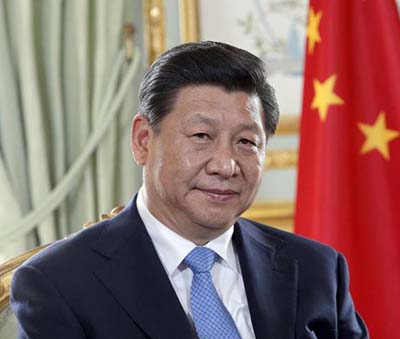
China’s comprehensive power has fallen for the first time, with no clear path to undisputed primacy in the Indo-Pacific.

Uneven economic impacts and recoveries from the pandemic will likely continue to alter the regional balance of power well into the decade. Only Taiwan, the United States and Singapore are now predicted to have larger economies in 2030 than originally forecast prior to the pandemic.

Yet richer countries, such as Japan, have seen their economic prospects improve not just relative to 2020, but also to economies with lower vaccination rates. China, which avoided a recession last year, is not far behind. (IANS)

VISA Complains To U.S. Of India Backing Rupay

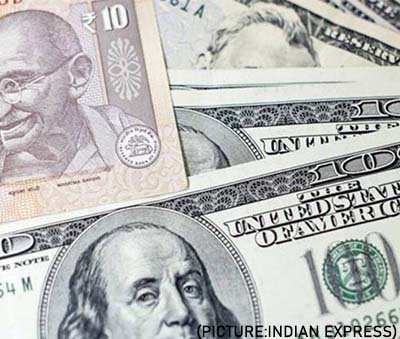
Visa Inc has complained to the U.S. government that India’s “informal and formal” promotion of domestic payments rival RuPay hurts the U.S. giant in a key market, memos seen by Reuters show.

In public Visa has downplayed concerns about the rise of RuPay, which has been supported by public lobbying from Prime Minister Narendra Modi that has included likening the use of local cards to national service.

But U.S. government memos show Visa raised concerns about a “level playing field” in India during an Aug. 9 meeting between U.S. Trade Representative (USTR) Katherine Tai and company executives, including CEO Alfred Kelly.

Mastercard Inc has raised similar concerns privately with the USTR. Reuters reported in 2018 that the company had lodged a protest with the USTR that Modi was using nationalism to promote the local network.

Alfred Kelly, Jr., CEO, Visa Inc. speaks at the 2019 Milken Institute Global Conference in Beverly Hills, California, U.S., April 29, 2019. REUTERS/Lucy Nicholson/File Photo

“Visa remains concerned about India’s informal and formal policies that appear to favor the business of National Payments Corporation of India” (NPCI), the non-profit that runs RuPay, “over other domestic and foreign electronic payments companies,” said a USTR memo prepared for Tai ahead of the meeting.

Visa, USTR, Modi’s office and the NPCI did not respond to requests for comment.

Modi has promoted homegrown RuPay for years, posing a challenge to Visa and Mastercard in the fast-growing payments market. RuPay accounted for 63% of India’s 952 million debit and credit cards as of November 2020, according to the most recent regulatory data on the company, up from just 15% in 2017.

Publicly, Kelly said in May that for years there was “a lot of concern” that the likes of RuPay could be “potentially problematic” for Visa, but he stressed that his company remained India’s market leader.

“That’s going to be something we’re going to continually deal with and have dealt with for years. So there’s nothing new there,” he told an industry event.

Modi, in a 2018 speech, portrayed the use of RuPay as patriotic, saying that since “everyone cannot go to the border to protect the country, we can use RuPay card to serve the nation.”

When Visa raised its concerns during the USTR gathering on Aug. 9, it cited the Indian leader’s “speech where he basically called on India to use RuPay as a show of service to the country,” according to an email U.S. officials exchanged on the meeting’s readout.

Finance Minister Nirmala Sitharaman said last year that “RuPay is the only card” banks should promote. The government has also promoted a RuPay-based card for public transportation payments.

While RuPay dominates the number of cards in India, most transactions still go through Visa and Mastercard as most RuPay cards were simply issued by banks under Modi’s financial inclusion program, industry sources say.

Visa told the U.S. government it was concerned India’s “push to use transit cards linked to RuPay” and “the not so subtle pressure on banks to issue” RuPay cards, the USTR email showed.

Mastercard and Visa count India as a key growth market, but have been jolted by a 2018 central bank directive for them to store payments data “only in India” for “unfettered supervisory access”.

Mastercard faces an indefinite ban on issuing new cards in India after the central bank said it was not complying with the 2018 rules. A USTR official privately called the Mastercard ban “draconian”, Reuters reported in September.

Pan-India Epic ‘RRR’ To Release In Over 1,000 Multiplexes Across USA

Filmmaker S.S. Rajamouli, who is gearing up for the release of his pan-India epic ‘RRR‘ starring Jr NTR, Ram Charan, Ajay Devgn, Alia Bhatt and Shriya Saran, is all set to treat fans in the US with his upcoming film.

Apart from India, the makers are aiming to release the film in 1,000 plus multiplexes only in the US, bringing back the glory of Indian cinema to the overseas audience. Sarigama Cinemas and Raftar Creations are jointly distributing the movie in the US.

The anticipation among the audiences has been increasing day by day not just in India but worldwide as it is the biggest action drama to date.

The makers have shared multiple assets including posters and songs with glimpses of Ajay Devgan, Alia Bhatt, and Ram Charan, among others. The film’s trailer is also unveiled on December 9 followed by a grand event.

Post Baahubali’s success, Rajamouli became a nationwide household name, and he has now made another film on a grand scale and is set to break many records.

The movie includes a star-studded line up besides lead actors Ram Charan and Jr NTR. Ajay Devgn, Alia Bhatt, Olivia Morris will be seen in pivotal roles while Samuthirakani, and British actors Ray Stevenson and Alison Doody join in supporting roles.

Jayanti Lal Gada of PEN Studios has bagged the theatrical distribution rights across north India and has also bought worldwide electronic rights for all languages. Pen Marudhar will be distributing the film in the north territory.

The Telugu-language period action drama is produced by D.V.V. Danayya of DVV Entertainments. ‘RRR’ will hit the screens on January 7.

Indian Army’s ‘STRIKE’ For Ladakh-Like High-Altitude Areas

The Indian Army is on the lookout for Unmanned Ground Vehicles (UGV) to assist infantry troops in high-altitude areas with surveillance, tactical reconnaissance, targeting enemy positions, delivering critical supplies, and carrying out rapid evacuations.

The need for such a platform stems from the difficulties encountered in Ladakh, such as incidents involving a military clash with China at heights of over 15,000 feet.

The army’s requirements for the platform state that the unmanned ground vehicles, or UGVs, should be able to carry a load of 250500 kg and should be able to operate in high altitude areas along the northern borders-a reference to the frontier with China.

A weapon platform variant mounted with a machine gun has also been listed as one of the requirements that the UGVs should have.

Twelve Indian companies will showcase 35 such platforms to the Indian Army in Babina from December 9-14 in an experiment called “Strike”-surveillance, tactical recce, intelligence, kinetic effect, and evacuation systems.

“Over 30 different types of unmanned ground vehicles will be showcased by the developers, and these will be imbedded with sub-units for tactical exploitation. The experiment involves various categories of UGVs, viz., surveillance, reconnaissance, intelligence, kinetic effect, logistics, casualty evacuation,” said an official.

The unmanned vehicle that the army is looking for should perform recce and surveillance and have a load carrier aimed at last-mile delivery and casualty evacuation.

According to the army’s requirements, the UGV should be able to operate in varied terrain conditions, including deserts, plains, mountainous and high-altitude areas, existing along our borders. The army wants the vehicles to be operated remotely as well as in an autonomous mode.

The unmanned vehicles can also be used for explosive detection and neutralisation of improvised explosive devices. The army has stated that a robotic arm with the capacity to lift a minimum weight of 5 kg is a must.

The requirements further state that it should be able to place explosives and carry out remote detonations of identified IEDs and mines.

U.S. COVID-19 Travel Restrictions Begun

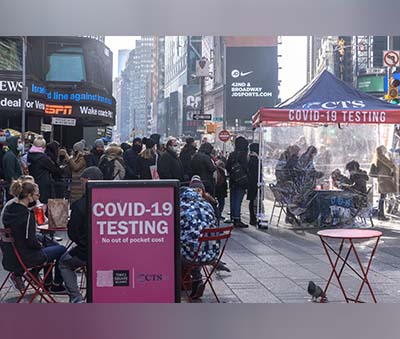
Beginning Monday, December 6th, travelers heading to the U.S. are required to show evidence of a negative COVID-19 test within one day of boarding their flight instead of three days prior.

Also, President Biden is extending the federal rule requiring passengers on planes, trains and buses to wear face masks through March 18. It was scheduled to expire in mid-January.

The Biden administration’s moves come after the White House announced a ban on travel to the U.S. by foreign nationals who have been to South Africa or seven other African countries within the previous 14 days.

That travel ban does not apply to U.S. citizens and permanent residents, and it’s possible the ban could be lifted soon.

U.N. Secretary-General Antonio Guterres called the restrictions “travel apartheid,” and Dr. Anthony Fauci said U.S. officials “feel very badly about the hardship that has been put on not only on South Africa but the other African countries.”

“Hopefully we’ll be able to lift that ban in a quite reasonable period of time,” Fauci said.

Here’s what travelers should know:

New testing requirements

Starting Monday, the U.S. has begun requiring all inbound international travelers to test for COVID-19 within one day of their flight to the U.S., regardless of their nationality or vaccination status.

That will replace a similar three-day requirement in effect since early November, when the administration scrapped country-specific travel bans.

“This tighter testing timetable provides an added degree of protection as scientists continue to study the omicron variant,” Biden said during a brief appearance to announce his latest measures against the virus.

Do testing requirements apply to children?

Yes, but children under 2 years old do not need to get tested. There is also an option for people who can prove they have recovered from COVID-19 in the past 90 days. Learn more about these requirements.

Do you have to get the test exactly 24 hours before travel?

No. The Centers for Disease Control and Prevention’s policy specifies that travelers must get tested one day before the flight’s departure, but does not say it has to be exactly 24 hours before.

“The Order uses a 1-day time frame instead of 24 hours to provide more flexibility to the air passenger and aircraft operator,” the CDC says. “By using a 1-day window, test acceptability does not depend on the time of the flight or the time of day that the test sample was taken.”

That means if your flight is at 1 p.m. on a Friday, you could board with a negative test that was taken any time on the prior Thursday, the agency explains.

Face mask rules

The Transportation Security Administration will extend the requirement to wear a mask on planes, trains, subways and other public transportation including airports and bus terminals through the winter.

Fines, which were doubled earlier this year, will remain in a range of $500 to $3,000.

The mask rule has become a flashpoint on flights, and some in the airline industry are eager to see the mandate go away. Airlines have reported more than 5,000 incidents of unruly passengers to federal authorities since the start of the year, with about three-fourths of the events involving passengers who refuse to wear a mask.

Is testing and quarantine required after arrival?

No, it is not required but the CDC recommends that all travelers get tested three to five days after travel.

Travelers are advised to self-monitor for COVID-19 symptoms and isolate and get tested if they do develop symptoms.

It is also recommended that those who are not fully vaccinated stay home and self-quarantine for a full seven days after travel, even if they test negative within three to five days after arrival.

Unvaccinated travelers who don’t get tested are advised to stay home and self-quarantine for 10 days after travel.

If the traveler has recovered from a documented coronavirus infection within the past 90 days before travel, they do not need to get a test three to five days after travel, even if they’re unvaccinated, the CDC says.

3rd Annual Chaar Prahar Indian Classical Music Festival Held

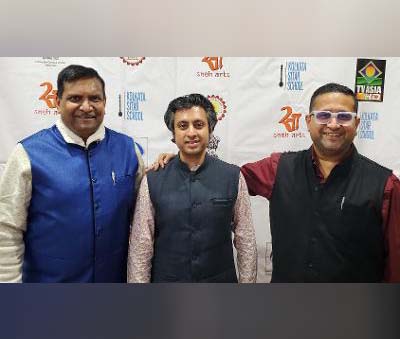
Bharatiya Vidya Bhavan USA, Sneh Arts, Kolkata Sitar School & Viewcy in association with the Consulate General of India & TV Asia presented the 3rd Annual Chaar Prahar Indian Classical Music Festival. Adapting to the challenges of the global pandemic, the festival was back at the Romanti Auditorium to live in person performances and also streamed live on the digital platform Viewcy, which enabled us to reach audiences in Asia, Europe & North America. The artist lineup included some of the most recognized names in Indian Classical music as well as rising stars.  The festival was supported by our media partners : TV Asia, World BBTV, Radio Zindagi, Divya Bhaskar & The Indian EYE.

Listeners were treated to soul stirring music at this one-day music marathon that lasted for 9 hours and featured 13 musicians from both the Hindustani & Carnatic styles of music. Community of artists & music lovers gathered to enjoy instrumentalists & vocalists from various gharanas (school of music) showcasing their talents & mastery on the sitar, tabla, double neck electric guitar, violin, sarangi, mridangam, harmonium & vocals. As always, the festival team was particularly enthusiastic about giving a platform to the younger generation of Indian American artists who work very hard to pursue this art form.

Dignitaries from the music world & the community graced the occasion to bestow their blessings, not only to the young artists, but also to the organizers for continuing this special initiative. The Consul General of India in New York Amb. Randhir Jaiswal & Deputy Consul General Amb. Dr Varun Jeph, sent their congratulations to the entire organizing team and artsits. Vipul Dev, Consul – Press, Information & Culture, graced the occasion with his presence. He was thrilled to see so many music lovers who came to support the festival and hear some soulful music. He appreciated the work & effort put into presenting the rich music of India through this festival. Bhavan Chairman, Dr. Navin C. Mehta along with board member Megha Bhouraskar joined the festival commending the music community for coming together for such a special marathon of music. They were thrilled to see such a fantastic line up & engaging audiences that were enjoying this festival both in person and online.

There were countless comments of support & appreciation pouring in during the concert not only from the audience members but also from artists that were performing. There were rasikas that stayed until 3 am, which encouraged the artists & the organizers. The atmosphere created by the organizers gave the artists and the audience members the feeling of being back home.

The Chaar Prahar Music Festival team is extremely grateful to the artists, community partners, media partners, team members & everyone who worked tirelessly behind the scenes to make this festival possible. They are extremely grateful to Dr Navin Mehta, Padma Shri Dr. H. R. Shah, Kenny Desai, Megha Bhouraskar, Kolkata Sitar School & Sneh Arts for their generous sponsorship. They look forward to even more support from the musicians & music lovers so they can continue to present such special events & give a continuous platform to the local talent. The team has announced that the next Chaar Prahar Festival will be in November 2022.

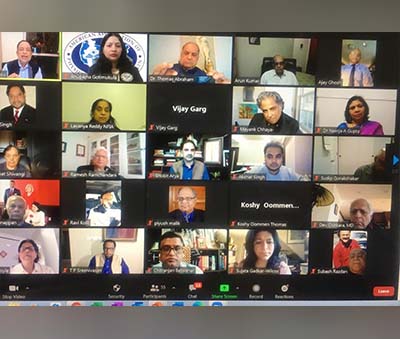
At AAPI Fall Governing Body Meeting, AAPI-TN Raises $75,000 To Fight Human Trafficking in India

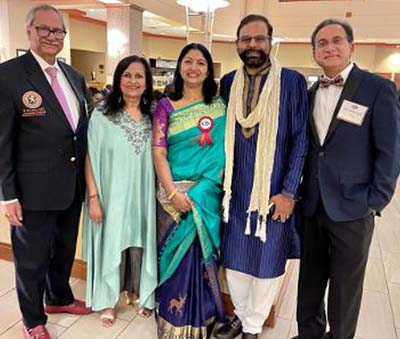
During the American Association of Physicians of Indian Origin (AAPI) Fall Governing Body Meeting, a Fundraiser gala was held on November 20th, 2021 at Embassy Suites by Hilton in Franklin TN, Suburbs of “Music City” Nashville, TN.

The host chapter- AAPI-TN presented FFLI with a fundraised $75,000, in order to help strengthen the efforts to end human trafficking and to help continue and expand their impact in India.

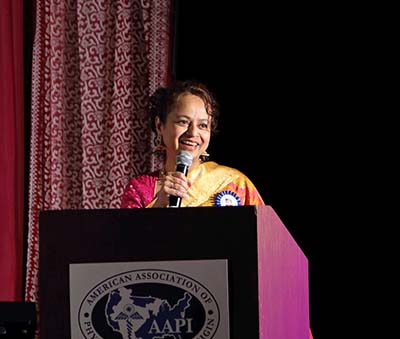
While pointing out that Human Trafficking is one of the fastest growing criminal industries in the country, reported in all 50 states of the United States of America, “we as a community have a duty to end the various forms of slavery,” AAPI Tennessee Chapter President, Dr. Anuradha P. Mann said. “With the goal of supporting Nashville nonprofit FFLI (Free for Life International). FFLI works in prevention along with rescue, restoration, rehabilitation and education of trafficked victims, we are pleased to present this token of our appreciation to help support the efforts of FFLI,” she added.
The opening ceremony was symbolic, especially with the recent celebration of Diwali, and tied back to the soulful mission of FFLI. Gabrielle Thompson, FFLI CEO and Executive Director and Board Member Radha Babu addressed the audience, describing the impact of fighting human trafficking in India.
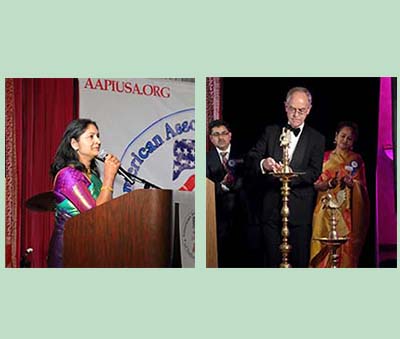
The underlying theme of Diwali, celebrating Light over Darkness, Victory of Good over Evil and Knowledge over Ignorance, which has caught up the attention of people all over the world, was done as the traditional lamp was lit by AAPI-TN Executive Committee, AAPI USA President Dr. Anupama Gotimukula, Congressman Jim Cooper and Grand Sponsor Dr. Bharat Sangani.
The audience was in awe of FFLI’s work and mission. In his keynote address, Congressman Jim Cooper from Nashville highlighted the numerous injustices that intersect with human trafficking and exploitation, along with the urgent need for action at the state, national, and international levels.
In her address, Dr. Anupama Gotimukula, President of national AAPI highlighted some of the major achievements of AAPI under her leadership in the past five months ever since a new executive committee assumed charge of AAPI in July this year.
Evolving to meet the growing needs of its members and the larger population it is called to serve, AAPI, the largest ethnic physician organization in the United states, representing over 100,000 Indian American Physicians, has grown steadily and is recognized by the authorities, local communities and mainstream media for the many noble initiatives AAPI has led, especially during the Covid pandemic, she said.
She reminded AAPI members that, as part pf the upcoming Global Healthcare Summit, AAPI has initiated preventive healthcare screenings in 75 villages to understand the concept of preventive screenings help to diagnose any silent diseases which are causing premature deaths from Coronary heart disease and cancers like Breast cancer, cervical cancer which are preventable if diagnosed early through these annual screenings as mentioned above.
Dr. Satheesh Kathula, secretary of AAPI and treasurer of gala applauded the efforts of “ free for life” who are committed to curtail human trafficking and said “we are very glad to be part of the cause”. He thanked all the sponsors and the gala committee for their hard work in making this happen.

During the CMEs, several important topics with recent advances were well received by the AAPI fraternity. Themes for the CMEs included: ‘Cancer therapy: Advancement as we head for a cure’ by Dr. Nishitha Reddy, ‘Psychiatric sequelae of human trafficking’ by Dr. Sricharan Moturi, ‘Cardiovascular disease in South Asians- (Masala Study)’ by Dr. Ramya Suryadevara and ‘Stem cell therapy: The future of medicine’ by Dr. Sai Ram Atluri. The CME was well-attended, with active engagement between speakers and moderators (Dr. Amit Keswani, Dr.Varun Dhulipala, Dr. Biliyar, and Dr. Gunuganti. Attendees were eligible for 3 Category 1 CME hours, accredited by the Chicago Medical Society (CMS).

Organized by the AAPI Tennessee Chapter led by its President, Dr. Anuradha P. Mann, the gala, fund raiser and the Fall Governing Body Meeting of national AAPI was chaired by Dr. Sunil Kaza and effectively coordinated by Dr. Dayaker Mallipeddi, Dr. Shashank Ponugoti, and Dr Viren Shah.
The gala began with the Event Chair Dr. Sunil Kaza welcoming community members, family, friends, colleagues and sponsors.  “We, AAPI- TN team, worked hard to stick to the mission of AAPI, for education and charity to serve humanity. We thank each and every member that attended and supported the event. Our special thanks to all our Sponsors,” said Dr. Sunil Kaza, Chair of the Gala Committee. The Grand sponsor for the event, Dr. Bharat Sangani attended the meeting personally.
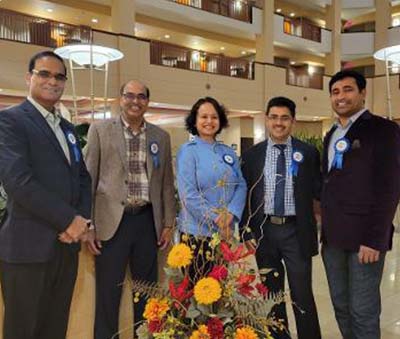
Attended by over 150 AAPI delegates from around the nation and more than 250 local members, the weekend event was packed with activities including Business Meet, “warm meet and greet” with local AAPI TN members, CMEs, fun-filled impromptu ‘Mehfil’ led by Dr. Amit Chakrabarty, Gala and Dinner. After a delicious dinner during gala, the participants were entertained with a live music, provided by ‘Geetanjali’ and the ‘SaReGaMa’ orchestra from Chicago. Several past Presidents of AAPI attended praised this event as ‘one of the best’ they have attended. AAPI’s BOT Chair Dr. Kusum Punjabi and other Board of Trustees attended and graced the event. AAPI-TN Chapter donated $10,000 to the National AAPI’s Endowment Fund.

AAPI Joins Rock & Roll Marathon In San Antonio, Creating Awareness On Healthy Living

The Covid pandemic has impacted all aspects of human life as never been before. The past two years have been challenging to everyone, particularly to those who are assigned with the responsibility of caring for the sick, even as hundreds of Millions are affected by the big pandemic.

Physicians and other health professionals on the front lines of COVID-19 care have experienced so many unknowns during the pandemic. They’ve also put their own health and the well-being of their families on the line to provide care.

At this critical juncture in human history, American Association of Physicians of Indian Origin (AAPI) the largest ethnic medical organization in the country, representing the interests of over 100,000 physicians of Indian origin, is focusing on themes such as how to take care of self and find satisfaction and happiness in the challenging situations they are in, while serving hundreds of patients everyday of their dedicated and noble profession, Dr. Anupama Gotimukula, President of AAPI said.

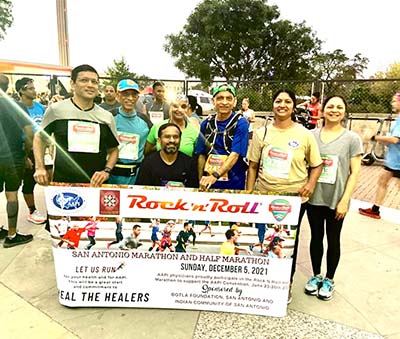
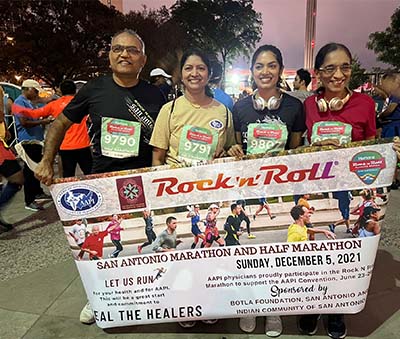
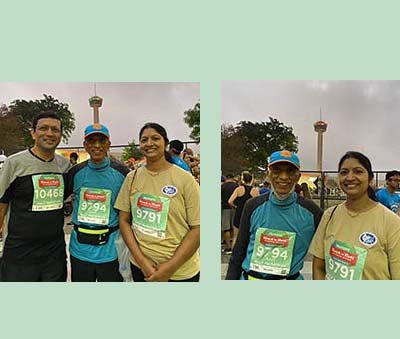
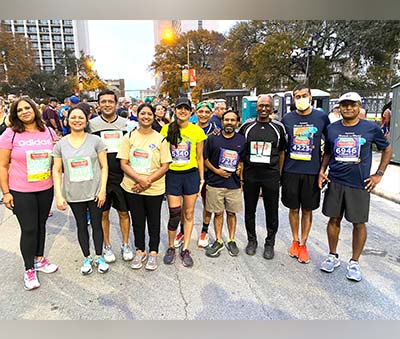
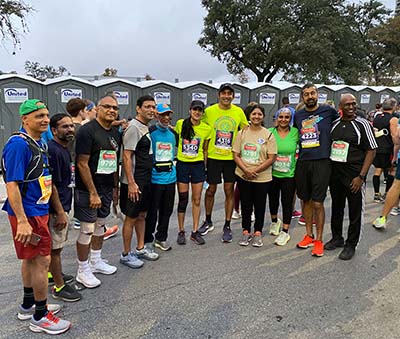
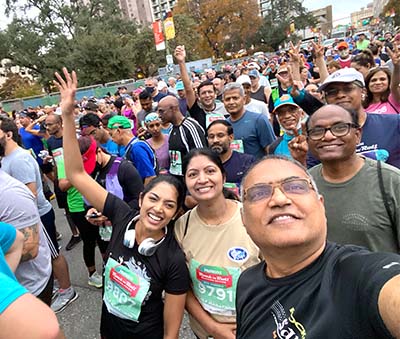
In preparation for the upcoming 40th annual convention from June 23-26, 2022 in San Antonio, Texas with the timely theme that focusses on “Heal The Healers” and to create awareness among the public on the need for Healthy Lifestyle, AAPI Convention Team led by Dr. Jayesh Shah joined an “Rock and Roll Marathon” on Sunday, December 5th, 2021 in san Antonio, TX.

AAPI’s participation at the Marathon was inspired and sponsored by the Botla Foundation, which provided a great kick start to AAPI’s wellness theme, pointed to the Six Pillars of Lifestyle Medicine: 1. Healthy Diet; 2. Being active; 3. Restorative sleep; 4. Managing stress; 5. Have social and supportive connections; and,  6. Avoiding abusive drugs and habits.

Planning for joining the Rock and Roll Marathon started over three months ago, says Dr. Jayesh Shah, Chair of AAPI Convention 2022. Botla Foundation committed a donation of $25,000, However, in order to encourage Doctors to run, the Foundation initially put a caveat that they would donate $250 for every person who signs up for the half marathon. “This novel way of sponsorship did encourage many Indian doctors and other community members to register and participate in this unique marathon,” added Dr. Jayesh Shah. “We were lucky to have Dr. Akil Tahir to join us as the Chief Ambassador for the run. His presence also inspired all of us to join for this noble cause. His message of running with heart touched all of us.”

Dozens of Doctors and community leaders joined the Rock and Roll Marathon, which had attracted over 18,000 participants from around the nation, and made this an inspiring experience for all. Dr. Ravi Botla, while thanking and congratulating all the participants at the Marathon, said, “Running with you all is an amazing experience. Several friends made their personal bests today. Hope to continue to do some physical activity (running/walking/cycling) to improve our health. On behalf of all our runners yesterday and today, Botla Foundation will donate $25,000 to AAPI, irrespective of the number of participants. We should be proud of this accomplishment. Thank you Anupama and Jayesh to provide this opportunity.”

The Botla Charitable Family Foundation is a non-profit established in 2014 by Dr. Ravi and Vijaya Botla with the intention to give to charitable causes that highlight Indian culture and traditions as well as promote health and wellness in our community.

“After a hiatus of 5 years from long distance running, I am thrilled to announce that I completed running the half marathon in San Antonio on a PLANT BASED DIET!” Dr. Akil Taher said. “I ran to support the American Association of Physicians of Indian origin (AAPI) under the leadership of Dr. Anupama Gotimukula ad Dr. Jayesh Shah. AAPI has done some phenomenal charity work here in the US and India. Also a big thank you to the Botla family for their inspirational support to AAPI,” he added.

“That is why in keeping with AAPI’s 2022 Convention theme of “Heal the Healers,” this idea of having these healers finally put their health first by participating in the San Antonio Rock n Roll Half Marathon came to life,” Vijaya Botla said. “There was great enthusiasm from our local Indian doctors and a wonderful camaraderie was formed. Weekly meetups and training commenced. We were blessed that Dr. Akil Taher, from Atlanta, Georgia joining our group and was able to pass on his words of wisdom to us through his book “Open Heart” and by even coming to do the race with us in San Antonio on December 5, 2021.”

To run my first half-marathon with my Idol, Dr. Taher. He is a living proof of the power of ‘Whole Foods Plant Based’ Diet and Physical Exercise in not just recovering from a major surgery but healing from within for a better and stronger health than before. His presenceat the Marathon inspired us to sign up for the event and support AAPI in promoting ‘health & fitness’ in our community,” stated Dr.  Bhoja R. Katipally.

Several participants at the Marathon had weekly runs at trails to prepare for the run. The team also got the expertise of Pradeep, who had recently finished Chicago marathon as the coach. He taught the participants the dynamic exercises before the run and static exercises after the run. Dr Bhoja Reddy did a book signing event on Saturday, the day before the run. Dr.Taher contributed all the money from the book sale to AAPI.

While congratulating all the participants, organizers and sponsors, Dr. Gotimukula said, “I want to extend a few words of my appreciation to all the wonderful hearts from AAPI who participated in the Marathon.

The donor, Dr. Ravi Botla did his first full Marathon. There are several in the group who did their first half marathon including Dr. Jayesh Shah! We thank the Botla Foundation who inspired us! We ran with a good heart to support AAPI. Nothing is impossible if we have the motivation inside us!!” For more details on AAPI and the 40th convention, please visit: www.aapiusa.org


India’s Population Growth Rate Is Slowing Down Women Are More than Men For the First Time Ever In India

India’s population growth is losing steam as the average number of children born crossed below a key threshold, according to newly released data from a government survey, media reports state. India’s total fertility rate (TFR) across India dropping to 2.0 in 2019-2021, compared with 2.2 in 2015-2016. A country with a TFR of 2.1, known as the replacement rate, would maintain a stable population over time; a lower TFR means the population would decline in the absence of other factors, such as immigration.

Other vital indicators found in the report suggests, India now has 1,020 women for every 1000 men. India’s population is not getting any younger, and India is no longer facing the threat of a population explosion. All three radical findings are part of the summary findings of the fifth round of the National Family and Health Survey (NFHS), which were released by the Union health ministry on November 24.

NFHS is a sample survey, and whether these numbers apply to the larger population can only be said with certainty when the next national census is conducted, although it is very likely that they will in the case of many states and Union territories. In cities across India – as in other countries – women are opting for fewer children: the urban fertility rate is 1.6.

The new data has been welcomed, and is hailed as a heartening signal by government officials and researchers in a country that is expected to overtake China to become the world’s most populous sometime this decade. Since the mid-20th century, Indian leaders have tried to curb high birthrates, which are often reversely correlated with women’s welfare metrics and economic progress. A burgeoning population is seen, in the longer term, as a hurdle to development and a driver of environmental degradation and greenhouse gas emissions.

These new numbers indicate that India can no longer be called a country of “missing women”, a phrase first used by Nobel Prize winning economist Amartya Sen in a 1990 essay in the New York Review of Books. Back then, there were 927 women per 1,000 men in India. According to NFHS-3, conducted in 2005-06, the ratio was equal, 1000: 1000; it went down to 991:1000 in 2015-16 in NFHS-4. This is the first time, in any NFHS or Census, that the sex ratio is skewed in favour of women.

Indian fertility rates have been trending downward for the last two decades as the country grew richer, underwent rapid urbanization, and rolled out programs that provide contraceptives and family planning education. But the progress shown in just the last two national surveys has been significant, demographers said.

“This is of course good news,” said Nandita Saikia, a professor of public health at the International Institute for Population Studies (IIPS) in Mumbai. “It indicates there has been some kind of transformation in the last four years in socioeconomic conditions.” India’s population has been expected to overtake China’s sometime around the year 2027. That date “could be delayed if this trend continues,” Saikia added, “but not for long.”

The dropping fertility rate does not mean India’s population is already decreasing, but rather its growth rate is slowing. India’s population, which stands at just under 1.4 billion, will continue to rise beyond the year 2050 and peak at over 1.6 billion before stabilizing and returning to about 1.4 billion by 2100, according to United Nations projections.

Several Indian leaders since the country’s independence in 1947 have grappled with the population question. In the 1970s, Prime Minister Indira Gandhi carried out a controversial mass sterilization drive. Population control measures – and the difference in birthrates between India’s religious groups – remain one of the most polarizing issues in domestic politics today.

The declining fertility rate observed in recent years was backed by an uptick in several key indicators, demographers said. The proportion of women who used contraceptives rose from 54 to 67%, according to the national survey, while those who reported an unmet need for contraceptives fell. The proportion of teenage marriages has also decreased, according to the study, while there has been an improvement in the gender balance of newborns in a country with a deeply held preference for sons. For every 1,000 baby boys, there are now 929 baby girls, up from 919 girls five years ago.

The study showed the long-standing gap between India’s north and south widening: the large, poor tracts that line the northern Ganges River continue to show high fertility rates, with women in Bihar state having an average of three children each. Southern states including Tamil Nadu and Karnataka had fertility rates below the replacement rate.

To be sure, the gender ratio at birth for children born in the last five years is still 929, which suggests that son-preference, in its various macabre forms, still persists, but the sex ratio is a significant milestone achieved on the back of policies aimed to curb sex selection practices that were once rampant and female infanticide, and on the fact that women in India tend to live longer than men.

The average life expectancy at birth for men and women was 66.4 years and 69.6 years respectively in 2010-14, according to data from the Census of India website. There are other interesting read outs from the survey. The share of population under the age of 15 years, which was 34.9% in 2005-06, has come down to 26.5% in 2019-21. India is still a young country — a median age of 24 years in 2011 according to the Census figures — but it is ageing, and that comes with the associated policy challenges.

“The fact that we are now an aging population suggests that our approach to women’s health needs a more holistic life cycle view rather than one that prioritises reproductive health only,” Yamini Aiyar, president of the Centre for Policy Research, said. “The fact that more women have completed ten years of schooling in 2019-20 than previously coincides with a drop in female labor force participation points to significant structural challenges in India’s labour market. These need to be urgently addressed if India is to make progress,” Aiyar added.

Finally, the total fertility rate (TFR), or the average number of children per women in India, is now just 2, which is below the internationally accepted replacement level fertility rate – the point at which a population exactly replaces itself from one generation to the next — of 2.1. This means, India’s population may have peaked — another data-point that can only be established by the Census, but which is almost certainly for at least the southern states, as well some of the richer ones.

“There is usually a gap of 30-40 years between total fertility rate falling below replacement levels and a decline in overall population, because the population which will give birth in the next 10-15 years has already been born in the past when fertility levels were higher,” said Dr KS James, director and senior professor at the International Institute for Population Sciences. “Of course, the population growth in southern states is going to fall at a faster rate than the rest of the country,” he added.

NFHS-5 was conducted in two phases between 2019 and 2021, and covered 650,000 households from 707 districts of the country. The States and UTs that were surveyed in Phase-II are Arunachal Pradesh, Chandigarh, Chhattisgarh, Haryana, Jharkhand, Madhya Pradesh, NCT of Delhi, Odisha, Puducherry, Punjab, Rajasthan, Tamil Nadu, Uttar Pradesh and Uttarakhand.

NFHS is the most comprehensive database on a host of socioeconomic and health indicators with a focus on women – NFHS-5 covered 720,000 women and just above 100,000 men – and its basic results can be compared to the previous four rounds which were conducted in 1992-93, 1998-99, 2005-06 and 2015-16.

While the statistics quoted above are a watershed moment in India’s socio-economic and demographic transformation story, other findings of NFHS also convey a similar message. Socio-economic challenges facing India, going forward, will need to be dealt with more nuance and some of the stereotypes and political beliefs (such as the political obsession with population control laws) which dominate the public discourse will need to be shelved.

“This is not saying the country’s problems of unemployment, inequality, education, and everything else are automatically over,” said Sanjay Kumar Mohanty, the head of population policies at IIPS. “But population is no longer a top priority concern.”

“The improved sex ratio and sex ratio at birth is also a significant achievement; even though the real picture will emerge from the census, we can say for now looking at the results that our measures for women empowerment have steered us in the right direction ,” said Vikas Sheel, additional secretary, Union ministry of health and family welfare and mission director, National Health Mission.

Omicron Virus Found In South Africa Described By WHO As “Variant Of Concern”

The World Health Organization (WHO) has designated a new variant, B.1.1.529, named as “Omicron” found in South Africa initially, and has now been found in several other countries as a “variant of concern (VOC).” The variant, which was announced by scientists in South Africa on Thanksgiving Day, November 25th has caused alarm around the world.

Fears that a new, fast-spreading coronavirus variant could potentially be more dangerous than even the Delta variant prompted several countries to impose restrictions on travel from affected regions, and caused stock markets across the globe to crash.

The WHO said about 100 genome sequences of the variant have been reported so far. Many of the infected people were fully vaccinated, with at least one person in Israel having also received a third, booster dose of vaccine.

The World Health Organization (WHO) has warned that the Omicron coronavirus variant poses a high risk of infection surges around the globe.

The variant could lead to severe consequences in some regions, the WHO said on Monday.  The head of the organisation, Dr Tedros Adhanom Ghebreyesus, renewed a call for a global push to get vaccines to poorer nations.

Covid-19 is “not done with us” yet he warned. The variant was detected in South Africa earlier this month with initial evidence suggesting it has a higher re-infection risk. South Africa has been praised for its prompt reporting of the variant.

“Omicron has an unprecedented number of spike mutations, some of which are concerning for their potential impact on the trajectory of the pandemic,” the WHO said.

The epidemiological situation in South Africa has been characterized by three distinct peaks in reported cases, the latest of which was predominantly the Delta variant. In recent weeks, infections have increased steeply, coinciding with the detection of B.1.1.529 variant. The first known confirmed B.1.1.529 infection was from a specimen collected on 9 November 2021.

This variant has a large number of mutations, some of which are concerning. Preliminary evidence suggests an increased risk of reinfection with this variant, as compared to other VOCs. The number of cases of this variant appears to be increasing in almost all provinces in South Africa. Current SARS-CoV-2 PCR diagnostics continue to detect this variant.

Several labs have indicated that for one widely used PCR test, one of the three target genes is not detected (called S gene dropout or S gene target failure) and this test can therefore be used as marker for this variant, pending sequencing confirmation. Using this approach, this variant has been detected at faster rates than previous surges in infection, suggesting that this variant may have a growth advantage.

There are a number of studies underway and the TAG-VE will continue to evaluate this variant. WHO will communicate new findings with Member States and to the public as needed.

The scientific analysis till now suggests that the new variant has been spreading at a rate faster than any other variant, including Delta. The fact that several of the infected people were fully vaccinated, including one with a booster dose, is an indication that this variant also has considerable capability to evade the immune response.

This means that this variant is a cause of worry on at least two of the three criteria that are used to assess how dangerous any new variant is. As of now, there is no information on its ability to cause severe disease, the third crucial criteria.

“This variant has a number of mutations, some of which are concerning. Preliminary evidence suggests an increased risk of reinfection with this variant, as compared to other VOCs,” the WHO said in a statement.

“The number of cases of this variant appears to be increasing in almost all provinces in South Africa… This variant has been detected at faster rates than previous surges in infection, suggesting that this variant may have a growth advantage,” it said.

The Delta variant, first discovered in India late last year, has been the deadliest variant of SARS-CoV2 on all these three counts till now. It is the dominant variant now in most regions, and is the reason behind the deadly second wave in India, and the ongoing surge in Europe and a few other regions.

“Not everything is known about this variant yet. Data is still coming in. As of now, we know that it has over 30 mutations, of which 10 are in the spike protein. Whether this variant turns out to be a faster spreading one, or one that has greater ability to evade immune response is still to be seen. But we need to be very alert,” virologist Shahid Jameel said.

Vineeta Bal, an immunologist associated with the Indian Institute of Science Education and Research (IISER), Pune, said the emergence of the variant was not an unexpected development, but authorities needed to respond with increased surveillance to ensure early detection and effective isolation. “Viruses mutate all the time. That is something to be expected. But we should be able to ensure that it does not gain a foothold in many people,” Dr Bal said.

The coronavirus evolves as it spreads and many new variants, including those with worrying mutations, often just die out. Scientists monitor for possible changes that could be more transmissible or deadly, but sorting out whether new variants will have a public health impact can take time.

As such, countries are asked to do the following:

  • enhance surveillance and sequencing efforts to better understand circulating SARS-CoV-2 variants.
  • submit complete genome sequences and associated metadata to a publicly available database, such as GISAID.
  • report initial cases/clusters associated with VOC infection to WHO through the IHR mechanism.
  • where capacity exists and in coordination with the international community, perform field investigations and laboratory assessments to improve understanding of the potential impacts of the VOC on COVID-19 epidemiology, severity, effectiveness of public health and social measures, diagnostic methods, immune responses, antibody neutralization, or other relevant characteristics.

Individuals are reminded to take measures to reduce their risk of COVID-19, including proven public health and social measures such as wearing well-fitting masks, hand hygiene, physical distancing, improving ventilation of indoor spaces, avoiding crowded spaces, and getting vaccinated.

At AAPI’s Global Healthcare Summit In Hyderabad, India’s Vice President Shri Venkaiah Naidu To Be Chief Guest

Shri Venkaiah Naidu, Honorable Vice President of India will be the Chief Guest at the next edition of the annual Global Healthcare Summit (GHS) 2022, organized by the Association of American Physicians of Indian Origin (AAPI) to be held at the prestigious Hotel Avasa in Hyderabad, India from January 5th to 7th, 2022, Dr. Anupama Gotimukula, President of AAPI, announced here today.

“Harnessing the power of Indian Doctors worldwide, the AAPI Global Healthcare Summit platform has evolved with the support and collaboration with the Indian Ministry of Health and Family Welfare as well as several prominent global and Indian medical associations,” says Dr. Anupama Gotimukula. “The theme for the Summit this year is: ‘Prevention Is Better Than Cure Through Technology, Telemedicine & Transformation’ and we want to coordinate and collaborate all our resources towards helping India have established annual healthcare screening guidelines and development of “India Preventive Task Force” who will maintain and update the annual healthcare screening guidelines”

According to her, “Senior leaders from leading healthcare organizations such as pharmaceuticals, device and medical equipment manufacturers and major medical teaching institutions, hospitals and from the Ministries – Health, External/Overseas Affairs and regulatory bodies are collaborating with AAPI with the ultimate goal to provide access to high quality and affordable healthcare to all people of India.”

AAPI is hopeful that several international healthcare industry partners are looking for opportunities to participate at this event for greater collaboration on Research & Development and philanthropic engagements, Dr. Gotimukula added.  Chronic diseases, notably diabetes, cardiovascular, hypertension, COPD, oncology, maternal and infant mortality, and emerging ones – Management of neurological emergencies ENLS a certification course  are only some of those that are going to be covered during this Summit. An exclusive Healthcare CEO forum coordinated by Dr. Jospeh Chalil will bring the healthcare industry perspective, with senior Government officials, both Union and State providing the legislative wisdom.

Dr. Kusum Punjabi, the Chair of AAPI BOT said, “We flew away from India decades ago. However, our hearts are still in India.” She said, GHS 2022 will focus on several relevant issues to serve the many healthcare needs and delivery of healthcare in India.” She praised the local community and organizers for their enthusiastic support.

While elaborating on the theme and areas that are going to be covered during the Summit, Dr. Udaya Shivangi, Chair of AAPI GHS USA says, “In our efforts to realize the core mission of AAPI, which is to share the best from leading experts from around the world, to collaborate on clinical challenges, research and development, philanthropy, policy and standards formulation, the Summit in Hyderabad will have clinical tracks that are of vital to healthcare in India.”

Dr. Ravi Kolli, President-Elect of AAPI pointed out, “Healthcare in India is one of the largest sectors, in terms of revenue and employment.  India is making significant improvements in the healthcare infrastructure and is building modern medical facilities throughout India. Indian doctors have made tremendous progress in the 21st century and India is now being touted as a medical tourism hub”

While elaborating the objectives of the Summit, Dr. Anjana Samadder, Vice President of AAPI, says, “This innovative Summit is aimed at advancing the accessibility, affordability and the quality of world-class healthcare to the people of India. Among other areas, the Summit will focus on prevention, diagnosis, treatment options and share ways to truly improve healthcare transcending global boundaries.”

There are several AAPI leaders who are working hard to make the GHS a memorable event, said Dr. Gotimukula. “Among them, I want to recognize Dr. Sujeeth Punnam, US Coordinator, Dr. Lokesh Edara, Chair Global Medical Education; Dr. Prabhakar Sharma, CME Chair, Dr. Prabhat Sinha, Chair Sponsorships and Exhibits, Dr. Seema Arora, Chair of Women’s Forum; Dr. Joseph M. Chalil, Chair of CEO Forum; Dr. Belani Kumar, Chair of the Mwdical Students Research Poster presentations; Dr. Lakshmi Thirunagari and Dr. Apurva Yeluru, CoordinatorS Medical Jeopardy

“The much awaited Women’s Forum at the GHS will be led by a panel consisting of inspiring women leaders who have been in the forefront, and have shown resiliency, confidence, leadership, determination, and dedication, and have withered all obstacles in life, and have become women leaders, and are recognized to be an inspiration to all,” says Dr. Seema Arora, Chair of Women’s Forum.

“The essence of AAPI is educational,” Dr. Lokesh Edara, Chair Global Medical Education, while describing the CMEs by experts that are ebbing organized during GHS said. “That translates into numerous programs that AAPI has planned to motivate med students, physicians, academicians and researchers to excel and master in their areas of work and goal to have one PG seat for every Medical student who graduates and there should be one Doctor per 1000 population.

Dr. Joseph Chalil, Chair of the CEO Forum said, “AAPI has made significant contributions towards addressing several issues affecting the healthcare system in India. During the GHS 2022, AAPI at the popular CEO Forum, physician leaders from the United States and India will have an opportunity to brainstorm and explore ways to focus on the theme, “Prevention is Better Than Cure” and recommend possible ways to plan and implement preventive medicine that will save resources and precious human lives.”

Dr. Satheesh Kathula, Secretary of AAPI said, “Through Continuing Medical Education and non-CME seminars by experts in their fields, AAPI will provide comprehensive and current reviews and guidelines for the diagnosis and treatment of various disease states to reduce morbidity and mortality and achieve cost effective quality care outcomes.”

According to Dr. Krishan Kumar, Treasurer of AAPI, “With the changing trends and statistics in healthcare, both in India and US, we are refocusing our mission and vision, AAPI would like to make a positive and meaningful impact on the healthcare delivery system both in the US and in India.”

This international health care summit is a progressive transformation from the first Indo-US Healthcare Summit launched by AAPI USA in 2007. Since then, AAPI has organized 14 Indo – US/Global Healthcare Summits and developed strategic alliances with various organizations.

Representing the interests of the over 100,000 physicians of Indian origin, leaders of American Association of Physicians of Indian Origin (AAPI), the largest ethnic organization of physicians, for 39 years.

“Being organized at this critical phase, GHS 2022 is aimed at exploring possibilities for greater collaboration and cooperation between the physicians and health care providers in India with those of Indian origin and major health-care providers abroad,” Dr. Gotimukula said. For more information, please visit www.aapiusa.org/ https://summit.aapiusa.org

Vaccine Makers Optimistic About Producing Omicron-Specific Shots If Needed

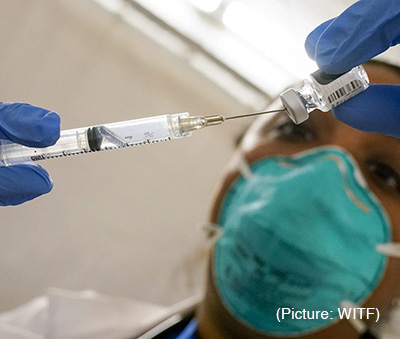
Vaccine makers say they are in the midst of testing their shots’ effectiveness against the newly discovered omicron coronavirus variant, and they remain optimistic that a new variant-specific vaccine could be produced and rolled out quickly if needed.

When asked about the new omicron variant that was first detected in southern Africa, Paul Burton, Moderna’s chief medical officer, told ABC News’ “Good Morning America” on Monday that vaccine manufacturers around the world, including Moderna, “are testing samples from people who have received our vaccines against the strains.”

Burton said that while the company thinks “vaccine effectiveness may come down, based on the mutation seen in this in this virus,” he added that with booster shots of the existing version of the vaccine, “We should be able to get antibody levels up, so that’s a very important initial line of defense.”

Burton said that researchers will know just how effective the vaccines are against this variant “in the next couple of weeks.” If manufacturers need to make an omicron variant-specific vaccine, it should take approximately “two to three months” to test and manufacture it, he said.

Fellow coronavirus vaccine maker Pfizer similarly expressed confidence that it could produce a new vaccine quickly if needed. Pfizer’s CEO Albert Bourla told CNBC’s “Squawk Box” on Monday that he is very optimistic the company will be able to speedily switch production to a new vaccine, if the research merits, without losing any volume.

Johnson & Johnson also said in a statement Monday that it is evaluating its current COVID-19 vaccine against the omicron variant.

“In addition, the company is pursuing an omicron-specific variant vaccine and will progress it as needed,” it said.

Scientists suspect the omicron variant could partially chip away protection from current vaccines due to its mutations, but they are still waiting on testing to learn if, and to what extent, that could be the case.

Vaccine experts have told ABC News that the current COVID-19 vaccines, which rely on genetic technology, could easily be updated to better combat emerging variants. This has not been necessary so far, as the original vaccines have been effective against the dominant variants that have spread in the past, but companies are preparing to tweak vaccines to respond to the omicron variant just in case.

The good news is that these novel vaccines employing genetic technology mean updates can be made to the vaccines easily — unlike vaccines based on older technology, which used a piece of the virus or a killed virus to mimic infection.

The new vaccines, which use the genetic technology, introduces an instruction manual of sorts into your body. This introduction manual tells your cells to start churning out a protein normally found on the outside of the virus, and your body activates an immune response when your body senses that viral protein.

In remarks on Monday, President Joe Biden assured Americans that the omicron variant “is a cause for concern, not a cause for panic.”

“We have the best vaccine in the world. The best medicines, the best scientists, and we’re learning more every single day,” the president said. “And we’ll fight this variant with scientific and knowledgeable actions and speed. Not chaos and confusion.”

Omicron Symptoms Mild So Far, Says South African Doctor Who Spotted It

The first South African doctor to alert the authorities about patients with the omicron variant has told The Telegraph that the symptoms of the new variant are unusual but mild.

Dr Angelique Coetzee said she was first alerted to the possibility of a new variant when patients in her busy private practice in the capital Pretoria started to come in earlier this month with Covid-19 symptoms that did not make immediate sense.

They included young people of different backgrounds and ethnicities with intense fatigue and a six-year-old child with a very high pulse rate, she said. None suffered from a loss of taste or smell.

“Their symptoms were so different and so mild from those I had treated before,” said Dr Coetzee, a GP for 33 years who chairs the South African Medical Association alongside running her practice.

On November 18, when four family members all tested positive for Covid-19 with complete exhaustion, she informed the country’s vaccine advisory committee.

She said, in total, about two dozen of her patients have tested positive for Covid-19 with symptoms of the new variant. They were mostly healthy men who turned up “feeling so tired”. About half of them were unvaccinated.

“We had one very interesting case, a kid, about six years old, with a temperature and a very high pulse rate, and I wondered if I should admit her. But when I followed up two days later, she was so much better,” Dr Coetzee says.

Dr Coetzee, who was briefing other African medical associations on Saturday, made clear her patients were all healthy and she was worried the new variant could still hit older people – with co-morbidities such as diabetes or heart disease – much harder.

“What we have to worry about now is that when older, unvaccinated people are infected with the new variant, and if they are not vaccinated, we are going to see many people with a severe [form of the] disease,” she said.

South African demographics are very different from those in the UK. Only about six per cent of the population are over the age of 65. This means that older individuals who are more vulnerable to the virus may take some time to present.

The B.1.1.529 variant, now called omicron, was first identified in Botswana on November 11. It has now been detected in the UK as well as South Africa, Israel, the Netherlands, Hong Kong and Belgium.

It is the most mutated form of Covid-19 discovered thus far, with 32 mutations to the spike protein. Scientists are concerned that the mutations may allow it to evade existing vaccines and spread quickly.

Two cases of omicron have now been found in the UK, with two people in Essex and Nottinghamshire testing positive for the new variant.

UK officials are busy scouring testing databases for any further sign of the omicron variant, not least because there were many South Africans in the Twickenham area of south-west London for the England and South Africa match last Saturday.

South African scientists say omicron is behind an explosion of cases in the country’s Gauteng province, which is home to the country’s commercial capital Johannesburg and Pretoria. Cases have rocketed up from about 550 a day last week to almost 4,000 a day currently.

The UK, US, the EU and Israel have all suspended travel to and from South Africa and the five surrounding countries: Botswana, Eswatini, Lesotho, Mozambique, Namibia, and Zimbabwe. The UK Government added Angola, Malawi, Mozambique and Zambia to the travel red list on Sunday.

The Western travel ban has provoked anger among South Africans, with many claiming that they are being punished for having outstanding research institutions and being transparent about their findings.

Bidens Showcase First White House Christmas Decorations

For their first Christmas in the White House, the Biden family will celebrate with the theme of “gifts from the heart” for their holiday decor.  In unveiling the theme on Monday, President Joe Biden and first lady Jill Biden explained:

“The things we hold sacred unite us and transcend distance, time, and even the constraints of a pandemic: faith, family, and friendship; a love of the arts, learning, and nature; gratitude, service, and community; unity and peace. These are the gifts that tie together the heart strings of our lives.”

An ornament of a portrait of U.S. President Joe Biden and first lady Jill Biden is hung on a Christmas Tree in the State Dining Room of the White House during a press preview of the holiday decorations Nov. 29, 2021 in Washington, D.C.

In just one week, over 100 volunteers from the local area decorated the outside and inside of the White House with 41 Christmas trees, 6,000 feet of ribbon and over 78,750 holiday lights.

Every room in the White House celebrates a different gift

In the East Colonnade and East Landing, doves and shooting stars adorn the hallways. The decorations honor the service of COVID-19 frontline workers and first responders. Featured here is a Christmas tree that honors the military, “who have laid down their lives for our country, and the families who carry on their legacies.”

The library is decorated with stacks of books and birds and butterflies created out of recycled newspaper; it represents the gift of learning. The Vermeil Room is decorated with colorful paint swatches and paint brushes, and represents the gift of the visual arts.

Wreathes are seen on the back of chairs in the room that displays the White House’s collection of state china. The holiday decorations symbolize the gift of friendship and sharing.

The East Room, the largest room in the White House, represents the gift of gratitude. It is decorated with the Neapolitan crèche that includes with over 40 figurines from the 18th century; the crèche has been displaeevery holiday season since 1967.

A White House Military social aide looks on near the official White House Christmas tree in the Blue room during a press preview of the White House holiday decorations in Washington, D.C. on November 29, 2021.

The Blue Room, where the official White House Christmas tree sits, represents the gift of peace and unity. Doves carrying a banner embossed with every U.S. state and territory cascade down the tree.

The Red Room, decorated to represent the gift of the performing arts, includes brass instruments hanging from the mantel. Ballet slippers, tap shoes and musical notes are strung around the tree.

A ginger bread White House is seen in the State Dining room during a press preview of the White House holiday decorations in Washington, D.C. on Nov. 29, 2021.

Andrew Caballero-Reynolds/AFP via Getty Images

The State Dining Room represents the gift of family. It features a gingerbread White House, made of 55 sheets of baked gingerbread. It has eight detailed replicas of community buildings to honor frontline workers, including a hospital, police station and fire station.

The Grand Foyer and Cross Hall represent the gift of faith and community. The area is decorated with floating candles. The hallway alcoves and tree displays depict wintry scenes of towns and cities, representing the bonds of communities.

While Regulating Travel From Abroad Over Omicron Risk, India Resumes Overseas Flights

India announced that it will resume international passenger flights from mid-December with COVID-19 linked curbs for “at risk” countries, and ordered tightened screening at borders as fears over a new coronavirus variant spread globally.

India’s Health Ministry has revised guidelines mandating that all international passengers entering India have to submit 14-day travel details and upload a negative RT-PCR test report on the Air Suvidha portal before the journey, effective December 1st. The RT-PCR report to be uploaded should have been conducted within 72 hours prior to the journey.

Travelers from “countries at-risk”, including the U.K., South Africa, Brazil, Bangladesh, Botswana, China, Mauritius, New Zealand, Zimbabwe, Singapore, Hong Kong and Israel, will need to take the COVID test post-arrival and wait for results at the airport, according to the guidelines. If tested negative, they have to undergo home quarantine for seven days followed by a re-test on the eighth day.

“On arrival, the passengers found to be symptomatic during screening shall be immediately isolated and taken to medical facility as per health protocol. If tested positive, their contacts shall be identified and managed as per laid down protocol,” said the updated guidelines.

Travelers from countries not considered ‘at risk’ will be allowed to leave the airport and must self-monitor their health for 14 days post arrival. A sub-section (5% of the total flight passengers) will be required to undergo post-arrival testing at random at the airport.

The guidelines have also stated that children under five years of age are exempted from pre- and post-arrival testing. However, if found symptomatic on arrival or during home quarantine, they shall undergo testing and treated as per protocol.

Contacts of the suspect case are the co-passengers seated in the same row, three rows in front and three rows behind along with identified cabin crew. Also, all the community contacts of those travellers who have tested positive (during home quarantine period) would be subjected to quarantine for 14 days and tested as per government protocol.

Earlier the Central Government in a release issued following a meeting chaired by Home Secretary Ajay Bhalla, said it will review “the decision on effective date of resumption of scheduled commercial international passengers service as per evolving global scenario while keeping a closer watch on emerging pandemic situation within the country.”

The meeting held to review the global situation in wake of Omicron virus was attendant by various domain experts including Dr. V K Paul, Member (Health) NITI Aayog, Dr. Vijay Raghavan, Principal Scientific Adviser to Prime Minister and senior officers from Health, Civil Aviation and other Ministries.

It has also been decided that Airport Health Officials (APHOs) and Port Health Officials (PHOs) will be sensitized for strict supervision of testing protocol at airports/ ports, added the release.

“Various preventive measures in place and those to be further strengthened were discussed besides reviewing the update of Standard Operating Procedure on testing and surveillance of incoming international passengers, especially for those countries identified ‘at risk’ category. The strengthening and intensification of genomic surveillance for variants through the INSACOG network was agreed upon with a focus on sampling and whole genome sequencing of international passengers especially from those countries where Omicron variant has been detected,’’ added the release.

At meeting the criticality of scrupulous implementation and rigorous monitoring of the three-pronged surveillance strategy of screening and testing international travelers and their contacts, routine sentinel surveillance and surge surveillance, and timely sending of RT- PCR positive samples to designated INSACOG Genome Sequencing Laboratories (IGSLs) were stressed upon along with enhanced testing and monitoring of COVID-19 hotspots.

Earlier on Saturday Prime Minister Narendra Modi chaired a high-level meeting to review the emerging situation and India’s preparedness in terms of public health measures. The Health Ministry too has advised States/UTs regarding testing, surveillance, monitoring of hotspots, augmentation of health infrastructure, genome sequencing, and enhancing public awareness.

The federal health ministry said reports of mutations in the variant, identified as B.1.1.529, had “serious public health implications”, and asked states to adopt rigorous screening and testing for all passengers from South Africa and other “at risk” countries.

“This variant is reported to have a significantly high number of mutations, and thus, has serious public health implications for the country in view of recently relaxed visa restrictions and opening up of international travel,” health secretary Rajesh Bhushan said in a letter to states late on Thursday.

India’s civil aviation ministry said it had decided to let airlines resume scheduled international flights from Dec. 15, lifting a nearly two-year-old ban imposed to stem the spread of COVID-19.

The resumption of flights would be based on the coronavirus risk levels of individual countries, according to a formal government order. Some countries in Europe and Asia have rushed to tighten border controls and restrict travel nL1N2SH089 because of the new variant.

India’s foreign ministry said there was no immediate information on steps the government was taking. “This is a developing incident,” foreign ministry spokesman Arindam Bagchi told a news conference.

On Friday, the UK Health Security Agency said the new variant has a spike protein that was dramatically different to the one in the original coronavirus that COVID-19 vaccines are based and could make existing vaccines less effective. Britain has banned flights from six African countries, and asked returning British travelers from those destinations to quarantine.

India, the world’s second-worst affected country by COVID-19, posted the smallest rise in new cases in one-and-a-half years this week, due to increased vaccinations and antibodies in a large section of its population from previous infections. Its total cases of coronavirus reached 34.56 million last week. India’s daily caseload has halved since September and it reported 10,549 new cases on Friday.

Earlier this month, India identified 10 countries “at risk” including Europe, China, South Africa, and New Zealand, among others, and has opened its borders to 99 countries overall. Indian shares fell more than 2% on Friday, in line with declines in markets across Asia as investors fled risky assets panicking over the potential impact of the new variant.

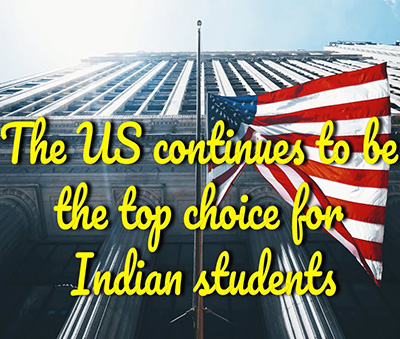
U.S. Continues As Top Choice For Students From India

The number of first-time international students enrolling at U.S. universities decreased dramatically by 46 percent amid the Covid-19 pandemic, according to the Open Doors 2021 report released Nov. 15 by the Institute of International Education.

But despite challenges due to travel restrictions and bans, 145,528 international students were able to begin their studies in person or online in the United States or from abroad. In total, 914,000 international students enrolled at U.S. universities for the 2020/2021 academic year, a 15 percent decline from the previous year.

In addition, more than 200,000 international students pursued Optional Practical Training, gaining work experience in the U.S. after finishing their academic studies.

The preliminary report did not break down the number of students by country of origin. But a different report released by Statista noted that more than 167,000 students from India were studying in the U.S. during the 2020/2021 school year.

Students from China and India make up the bulk of international students in the U.S., which continues to remain the top choice for studies abroad.

International students represent 5 percent of all students in U.S. higher education and, according to the U.S. Department of Commerce, contributed $39 billion to the U.S. economy in 2020.

“The Open Doors® 2021 Report on International Educational Exchange underscores the continued commitment of students and scholars, U.S. higher education, governmental partners, and industry stakeholders to international educational exchange amid the ongoing COVID-19 pandemic,” said IIE in a press statement. The annual report was jointly released by the U.S. Department of State’s Bureau of Educational and Cultural Affairs and IIE. “(The report) has been an important benchmark for international educational exchange to the U.S. for over 70 years,” noted IIE.

“International students are central to the free flow of ideas, innovation, economic prosperity, and peaceful relations between nations,” said Matthew Lussenhop, Acting Assistant Secretary for the Bureau of Educational and Cultural Affairs, U.S. Department of State.

“As reiterated in the recent Joint Statement of Principles in Support of International Education by the U.S. Departments of State and Education, the United States is strongly committed to international education as we continue to build back better.”

“Despite the global pandemic, Indian students were able to apply for visas and travel to the United States,” said U.S. Minister Counsellor for Consular Affairs Don Heflin, who is based at the U.S. Embassy in New Delhi.

“We issued over 62,000 student visas this summer alone, more than in any previous year,” he said, according to a press release from the embassy.

“This goes to show that the United States remains the destination of choice for Indian students looking to study abroad,” said Heflin. “We look forward to issuing many more visas in the year to come, to help Indian students achieve their dreams of U.S. study.”

Man In India Builds Taj Mahal Replica Home For Wife

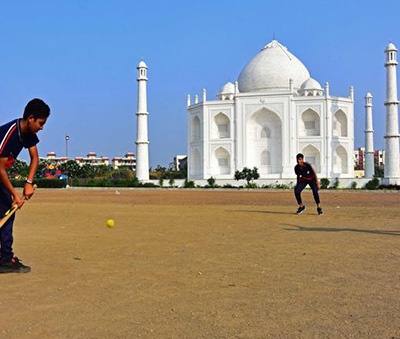
A 52-year-old Indian businessman has built a scaled-down replica of the iconic Taj Mahal as a home for his wife of 27 years.

Anand Prakash Chouksey built his “monument of love” in Burhanpur city in the central Indian state of Madhya Pradesh.

“It was a gift for my wife but also for the town and its people,” Mr Chouksey told the BBC.

The house cost about 20 million rupees (£199,000; $260,000) to build, he said.

The Taj Mahal is a 17th Century mausoleum in Agra city. It was built by Mughal emperor Shah Jahan in memory of his queen Mumtaz who died while giving birth to their 14th child.

The stunning marble monument, famed for its intricate lattice work, is one of India’s biggest tourist attractions. Before the pandemic, it drew as many as 70,000 people every day – a list that has included celebrities and dignitaries.

Mr Chouksey’s replica – nestled deep inside his sprawling 50-acre property, which includes a hospital, has also been attracting a steady stream of visitors.

People walk in the lawns and click pictures, he said. “A lot of people have also started to do their pre-wedding shoots here,” Mr Chouksey added.

“I don’t stop them because in our town, we are a close-knit community where everyone knows everyone. So, my house is open for all.”

Mr Chouksey said that not all visitors are allowed inside the house because “after all, it is our home and we live there”.

But sometimes, the family indulges its guests who come and marvel at the house’s lush interiors – the intricate flower motifs that decorate the marble walls and floors, and its overarching lattice windows.

The house consists of two main bedrooms that are located on two separate floors. It also has a library and a meditation room. The drawing room flaunts marble columns, a curving staircase and a gilded ceiling. Image source, Anand Prakash Chouksey

Although the Taj Mahal was the ultimate inspiration, Mr Chouksey said the interiors are not strictly Islamic in design but are infused with contemporary influences, which is evident from the choice of sofas and the curtains.

Building the replica of the famous monument took three years and a flurry of visits to the city of Agra, where the Taj s located, so Mr Chouksey and his wife could study various aspects of the mausoleum.

“We also used a lot of 3D images of the Taj Mahal on the internet to build our own,” Mr Chouksey added. The idea was to build something similar, so the engineers reduced the size to one third of the actual monument.

The four bedroom house is located in a small city in central India In 2013, a retired government official in the north Indian state of Uttar Pradesh had also built a replica of the Taj Mahal in memory of his wife.  But Mr Chouksey says his house is not dedicated to his wife alone.  “Today, there is a lot of hate in our country. People are being divided in the name of religion and caste,” he said.

Prime Minister Narendra Modi’s Hindu nationalist BJP government has been widely accused of polarising India along religious lines, and fostering intolerance. Even the Taj Mahal has been caught in the crosshairs – in 2017, a BJP lawmaker called the monument a “blot on Indian culture” built by “traitors”. Mr Chouksey said he wanted to “spread love” in such distressing times.  “And this house for me is a symbol of that love – one which goes beyond our social differences and the political noise.”

Biden Urges Nation Not To Panic Over Omicron Fears

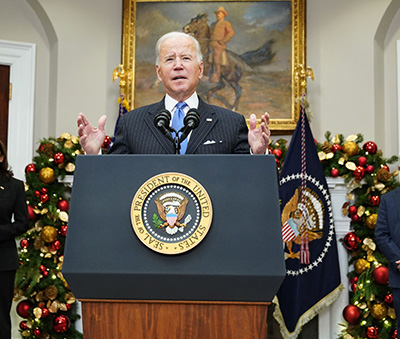
US President Joe Biden has called the Omicron Covid variant a “cause for concern, not a cause for panic” one day after it was detected in North America.

Cases have been found in Canada, and his speech from the White House comes as US travel bans on eight African countries takes effect. Biden also urged people to get a booster and to wear masks.

He said he does not anticipate any further US travel restrictions or lockdowns at this time.

In remarks on Monday, the president called it “almost inevitable” that the Omicron strain, first reported by South Africa, will be found in the US “at some point”. He added that said vaccine companies are creating “contingency plans” for new vaccines “if needed”.

Late last week, the US announced a ban on flights from South Africa, Botswana, Zimbabwe, Namibia, Lesotho, Eswatini, Mozambique and Malawi. Canada, the UK and the EU and other countries have also restricted travel from southern Africa.

In his remarks, Mr Biden said that the ban had bought some time for the US to study the new strain. While the World Health Organization has deemed Omicron a “variant of concern”, it is still not clear whether it is associated with more transmission or more risk of evading vaccines.

“We have the best vaccine in the world, and the best medicines, the best scientist and we’re learning more every single day,” the president said. He also vowed to “fight this variant with scientific and knowledgeable actions and speed. Not chaos and confusion”.

He praised the scientific community of South Africa for reporting the strain, despite criticism that travel bans are being used to punish the country.

“To their credit, the scientific community in South Africa quickly notified the world of the emergence of this new variant,” Mr Biden said. “This kind of transparency is to be encouraged and applauded because it increases our ability to respond quickly to any new threats, and that’s exactly what we did.”

He also said he was directing the US Food and Drug Administration, which regulates vaccines, to use the “fastest process available without cutting any corners” to approve any potential new vaccines that specifically target Omicron.

Canada, the US neighbour to the north, said on Sunday that the Omicron strain had been discovered in two patients who had recently travelled to Nigeria. A third case was announced on Monday.

How Vaccine Makers Plan To Address The New COVID-19 Omicron Variant

A new strain of COVID-19 first discovered in South Africa was declared a variant of concern by the World Health Organization on Friday. Here’s how the pharmaceutical industry plans to address the latest coronavirus curve ball.

Vaccine makers are already pivoting their efforts to combat the new variant: testing higher doses of booster shots, designing new boosters that anticipate strain mutations, and developing omicron-specific boosters.

In a statement sent to NPR, Moderna said it has been working on a comprehensive strategy to predict variants of concern since the beginning of 2021. One approach is to double the current booster from 50 to 100 micrograms. Secondly, the vaccine maker has been studying two booster vaccines that are designed to anticipate mutations like those found in the omicron variant. The company also said it will ramp up efforts to make a booster candidate that specifically targets omicron.

“From the beginning, we have said that as we seek to defeat the pandemic, it is imperative that we are proactive as the virus evolves,” said Moderna CEO Stéphane Bancel. “The mutations in the Omicron variant are concerning and for several days, we have been moving as fast as possible to execute our strategy to address this variant.”

Pfizer and BioNTech told Reuters that they expect more data about the omicron variant to be collected within two weeks. That information will help determine whether or not they need to modify their current vaccine. Pfizer and BioNTech said a vaccine tailored for the omicron variant, if needed, could be ready to ship in approximately 100 days.

Johnson & Johnson said in a statement sent to NPR that it too is already testing its vaccine’s efficacy against the new variant.

The omicron variant was first reported to the WHO on Nov. 24, the WHO said. Preliminary evidence indicates the variant poses an increased risk for reinfection due to the large number of mutations. Until recently, cases across South Africa have predominantly been from the delta variant, an earlier strain that has pushed health care systems to the max since early summer. But omicron infections have been on the rise in recent weeks, the WHO reported.

More concerning, omicron cases have emerged across the globe. Cases have been confirmed in Botswana, the United Kingdom, Italy, Germany, Belgium, Israel, the Netherlands, Australia and Hong Kong.

News of the rapidly spreading variant led to a new set of air travel restrictions from South Africa and seven other countries, implemented by President Joe Biden, that go into effect Monday. The president made the announcement the day after Thanksgiving, one of the busiest travel periods of the year.

Unlike last year, when millions of people traveled against the advice of health experts, the Centers for Disease Control and Prevention and chief medical adviser to the president, Dr. Anthony Fauci, more or less condoned Thanksgiving get-togethers for vaccinated Americans. And, according to an American Automobile Association travel forecast, over 53 million people were expected to travel for Thanksgiving — an 18% jump compared to last year — including more than 4 million by air.

As of Friday, the CDC said that no cases of the omicron variant had been identified in the United States. However, Fauci said on Saturday that he would not be surprised if the variant is already here.

“We have not detected it yet, but when you have a virus that is showing this degree of transmissibility and you’re already having travel-related cases that they’ve noted in Israel and Belgium and other places … it almost invariably is ultimately going to go essentially all over,” he said in an interview on the Today show.

As Americans prepare to transition from one busy holiday to the next, the CDC is predicting that coronavirus cases, hospitalizations and deaths will increase over the next four weeks. More than 776,000 people in the U.S. have died of COVID-19 to date, according to Johns Hopkins University’s tracker, and the country is projected to surpass 800,000 deaths by Christmas.

Is Husband Justified In Beating The Wife? Survey Has Telling Responses

Responses to the question, “In your opinion, is a husband justified in hitting or beating his wife…,” from as many as 18 states and Jammu and Kashmir are telling.

A falling fertility rate and a surge in their bank accounts point to the growing empowerment of women but when it comes to attitudes regarding domestic violence, the latest National Family Health Survey shows the distance that needs to be travelled.

Responses to the question, “In your opinion, is a husband justified in hitting or beating his wife…,” from as many as 18 states and Jammu and Kashmir are telling.

Of the women surveyed, Telangana led with 83.8 per cent of them saying that men are justified to beat their wives; Himachal Pradesh registered the lowest at 14.8 per cent. Among men, Karnataka leads with 81.9 per cent of the respondents saying such behaviour is justified as against 14.2 per cent in Himachal Pradesh.

Also Read |NFHS survey out: Dip in women owning property, but better financial, social autonomy

The survey asked the question and then listed the “following (seven) situations” as reason to hit or beat the wife: If she goes out without telling him; if she neglects the house or the children; if she argues with him; if she refuses to have sex with him; if she doesn’t cook food properly; if he suspects her of being unfaithful; if she shows disrespect for in-laws.

According to the survey, the most common reasons cited to justify domestic abuse: showing disrespect to in-laws, neglecting the house and children.

Data pertaining to surveys held in 2019-21 was released Wednesday. These were conducted in Assam, Andhra Pradesh, Bihar, Goa, Gujarat, Himachal Pradesh, Jammu and Kashmir, Karnataka, Kerala, Maharashtra, Manipur, Meghalaya, Mizoram, Nagaland, Sikkim, Telangana, Tripura and West Bengal.

The other states which have a high percentage of women who justify domestic violence are Andhra Pradesh (83.6 per cent), Karnataka (76.9 per cent), Manipur (65.9 per cent) and Kerala (52.4 per cent). Men from Himachal Pradesh and Tripura had the lowest acceptance of domestic abuse with only 14.2 per cent, 21.3 per cent respondents agreeing.

Data from the NFHS-4 (2015-2016) for the entire country released in January 2018 said that while 52 per cent of women surveyed believed it was reasonable for a husband to beat his wife, only 42 per cent of men agreed with it.

In the latest survey, of the 18 states, women respondents in 13 — Manipur, Gujarat, Nagaland, Goa, Bihar, Assam, Maharashtra, Karnataka, Telangana, Nagaland, Himachal Pradesh, Kerala and West Bengal — chose ‘disrespect to in-laws’ as the main reason for justifying beating.

This is followed by the second option: ‘neglecting house and children’ for accepting spouse violence. ‘Being suspected of being unfaithful’ has got the least number of justifications for beating. Only women (21%) in Mizoram choose it as the main reason for physical abuse over the other two options.

Sharada A L, director of Population First, an NGO working for women rights, said: “This kind of patriarchal mentality is deeply imbibed in the minds of the women who think that serving their family and husband should be their first priority.”

Father Stan Samy’s Name Need To Be Cleared Of False Allegations, Jesuits Urge

Indian Jesuits plan to appeal to a court to clear the stigma attached to their activist colleague Father Stan Swamy, who died under detention after being arrested under a draconian anti-terror law.

“We are soon filing a petition in the Mumbai High Court seeking a direction to clear his name from alleged charges under the provisions of the Unlawful Activities Prevention Act (UAPA),” said Father A. Santhanam, a Jesuit lawyer based in the southern state of Tamil Nadu.

The top court in Maharashtra state had on Nov. 24 disposed of two appeals the late priest had filed for his bail, noting them as withdrawn.

Earlier, Father Frazer Mascarenhas, former principal of St. Xavier’s College, Mumbai, through an interim application, had sought directions from the high court for a mandatory judicial inquiry into the circumstances that led to Father Swamy’s death while being lodged in Taloja prison on the outskirts of Mumbai.

The Jamshedpur Jesuit Province to which Father Swamy belonged has appointed Father Mascarenhas and the parish priest of St. Peter’s Church, Mumbai, as delegates and the next of kin of Father Swamy.

The 84-year-old Jesuit was arrested on Oct. 8, 2020, by the National Investigation Agency (NIA), a federal anti-terror combat unit, from his residence on the outskirts of Jharkhand’s state capital Ranchi in eastern India.

He was a hardcore activist who always stood for protecting the rights of indigenous and other ordinary humans. He was suspected of having a role along with 16 other arrested academics, lawyers and activists in instigating mob violence at Bhima Koregaon in Maharashtra state on Jan. 1, 2018, that left one person dead and several injured.

He was accused of serious offenses such as sedition, having links with an outlawed Maoist group and being part of a conspiracy to kill Indian Prime Minister Narendra Modi, among others.

Father Swamy was remanded to judicial custody the following day by a special NIA court in Mumbai. He died following a heart attack on July 5 this year while undergoing treatment at a Catholic-run hospital where he was taken after his health deteriorated.

The priest suffered from Parkinson’s disease, hearing impairment and other age-related ailments and was also infected with the Covid-19 virus, but he was repeatedly denied bail due to the stringent provisions of the UAPA.

Father Swamy was an indigenous people’s rights activist who became an irritant to the political establishment, both in Jharkhand and Delhi, due to his consistent opposition to attempts to dilute the land rights laws that prevented the purchase of tribal land in the state by outsiders.

His protest along with other political parties and civil rights groups forced the state government to withdraw the proposed amendment. The elderly priest also filed a case against the then ruling Bharatiya Janata Party (BJP) government for jailing close to 3,000 indigenous youths after accusing them of being supporters of Maoist rebels.

Father Swamy’s associates felt this action led to his false implication in the Bhima Koregaon case. “He was a hardcore activist who always stood for protecting the rights of indigenous and other ordinary humans,” said Father Santhanam, who is determined to clear Father Swamy’s name as a tribute to his departed soul.

New International Airport In NOIDA Inaugurated

Noida International Greenfield Airport, also known as Delhi Noida International Airport or Jewar Airport, is proposed to be built in Jewar, Greater Noida, in Uttar Pradesh, India. The proposed airport will help relieve congestion at the Indira Gandhi International Airport (IGI) and serve the fast-developing industrial region between Delhi and Agra.

Prime Minister Narendra Modi on Thursday, Nov. 25, 2021, said that the Noida International Airport will develop the tourism and agriculture sector in Uttar Pradesh and pilgrims will be able to easily travel to temples and shrines in the state. Modi added that the Noida International Airport (NIA) in Jewar, would make Uttar Pradesh  known for its ‘Uttam Suvidha and Nirantar Nivesh’.

The new airport is expected to increase demand for commercial and residential projects and hotels in the region, while also boosting the real-estate sector.

Speaking on the occasion of the foundation laying stone ceremony of Noida International Airport here, PM Modi said, “Tourism of land-locked states like Uttar Pradesh will greatly benefit from the Noida International Airport. Now, pilgrims will be able to easily travel to temples and shrines in Uttar Pradesh.”

“The agricultural potential of Western UP will witness a sharp rise and help the small farmers in exporting goods easily, efficiently and instantly,” he said.  PM Modi further said that Uttar Pradesh will now be known for its ‘Uttam Suvidha and Nirantar Nivesh’.

The airport is being developed by Yamuna International Airport Private Limited (YIAPL), a 100 per cent subsidiary of the project’s Swiss concessionaire Zurich International Airport AG. Yamuna International Airport Pvt Ltd (YIAPL) is developing Noida International Airport under the PPP model in close partnership with the Government of Uttar Pradesh and the Government of India.

According to the Ministry of Civil Aviation, the International Airport near Jewar will be developed as an Aviation Hub which is conceived to provide all the modern, efficient and hi-tech facilities.

The airport area when fully operational is expected to have Aero and Non-Aero activities along with MRO (Maintenance, Repair and Operations) facilities. The present project envisages an area of land requirement measuring 3500 acres. In the first phase of development, only 1327 hectares of land would be developed.

Noida International Airport is strategically located, which is at a road distance of about 72 km from IGI Airport, 40 km from Noida, Faridabad and Ghaziabad respectively, 28 km from Greater Noida, 65 km from Gurugram and 130 km from Agra.

The projected cost of the proposed project is estimated at around Rs 15000- 20000 crore and the development of the first phase of the airport is being done at a cost of around Rs 10,050 crore. The work at the airport is scheduled to be completed by 2024.

Indian Government To Re-Examine Advisory On Efficacy Of Ashwagandha

The Ministry of Ayush in India has decided to re-examine the matter pertaining to the use of Ashwagandha — Withania somnifera — leaves in Ayurveda, Siddha and Unani (ASU) drugs by constituting an expert group to this end.

The Ayush Ministry earlier had directed ASU drug manufacturers to refrain from the usage of Ashwagandha (Withania somnifera) leaves, saying that no substantial evidence and literature is available to endorse the efficacy of crude drug or extract of Ashwagandha.

The Ministry also issued an advisory to all ASU Drugs Manufacturers Associations seeking the manufacturers of the crude drug/extracts, sellers, ASU drug manufacturing companies, ASU drug exporters not to use Withania somnifera leaves either in crude or extract or any other form for therapeutic purposes under the ambit of ASU drugs.

“No substantial evidence and literature is available to endorse the efficacy of crude drug/extract of Withania somnifera leaves. Considering this, it would not be appropriate to consider the Withania somnifera leaves as ASU medicine at this stage,” the ministry had said in its advisory.

However, after industry’s intervention, the Ayush Ministry invited the stakeholders to discuss their concerns about utilization of Ashwagandha leaves in ASU products.

After the discussion with the ASU industry partners, the Ministry of Ayush has decided to set up an expert group to re-examine the advisory issued to the drug manufacturers to refrain from using Ashwagandha leaves.

The group will make appropriate recommendations to the Centre on the use of Ashwagandha leaves and Panchanga of Ashwagandha in ASU products based on scientific evidence. (IANS)

Earth Has A Second Moon

It’s easy to be brand loyal to the moon. We’ve only got the one, after all, unlike Jupiter and Saturn, where you’d have dozens to choose from. Here, it’s luna or nada. Or not. The fact is, there’s another sorta, kinda moon in a sorta, kinda orbit around Earth that was discovered only in 2016. And according to a new study in Nature, we may at last know how it was formed.

The quasi-moon—named Kamo’oalewa, after a Hawaiian word that refers to a moving celestial object—is not much to speak of, measuring less than 50 m (164 ft) across. It circles the Earth in a repeating corkscrew-like trajectory that brings it no closer than 40 to 100 times the 384,000 km (239,000 mi.) distance of our more familiar moon. Its odd flight path is caused by the competing gravitational pulls of the Earth and the sun, which continually bend and torque the moonlet’s motions, preventing it from achieving a more conventional orbit.

“It’s primarily influenced just by the sun’s gravity, but this pattern shows up because it’s also—but not quite—on an Earth-like orbit. So it’s this sort of odd dance,” says graduate student Ben Sharkey of the Lunar and Planetary Laboratory at the University of Arizona, the lead author of the paper.

None of this means that Kamo’oalewa has to have especially exotic origins. The solar system is littered with asteroids, some of which are captured by the gravity of other planets and become more conventional—if fragmentary—moons. Others don’t orbit other planets in the common way but fall into line in front of them or behind them and pace them in their orbits around the sun, like the flocks of so-called Trojan asteroids that precede and trail Jupiter.

Either way, Kamo’oalewa was bound to get attention because its composition posed a stubborn mystery. Asteroids tend to reflect brightly in certain infrared frequencies, but Kamo’oalewa just doesn’t. It’s dimmer somehow—clearly made of different stuff, which suggests a different origin.

To investigate the mystery, Sharkey, under the guidance of his PhD adviser, planetary scientist Vishnu Reddy, first turned to a NASA-run telescope in Hawaii routinely used for studying Earth-vicinity asteroids. But even through the usually reliable instrument, the infrared signature seemed too faint. Instead they switched to a University of Arizona-run monocular telescope that, as Sharkey says, could “squeeze every last ounce of photons out of that object.”

That produced better, clearer results, but still they were incomplete. The rock was made of common silicates like other asteroids, but they were common only in their general composition, not in their infrared signature, which remained stubbornly off.

At last, the answer suggested itself. If Kamo’oalewa was behaving like a sort of quasi-moon, perhaps it was an artifact of the actual moon. Earlier in Sharkey’s PhD program, one of his advisers published a paper on lunar samples brought back by the Apollo 14 mission in 1971. When Sharkey compared the data he was getting in his telescope with what the earlier geologists came up with in the rock lab, the results matched perfectly. The kind of space-weathering lunar silicates undergo when they’re still on the surface of the moon precisely accounted for the differences in the infrared reflectivity between common asteroids and Kamo’oalewa.

“Visually, what you’re seeing is weathered silicate,” says Sharkey. “The eons of exposure to space environment and the micrometeorite impacts, it’s almost like a fingerprint and it’s hard to miss.”

How Kamo’oalewa shook free of our lunar companion is no mystery. The moon’s been getting bombarded by space rocks for billions of years, resulting in all manner of lunar debris getting ejected into space (nearly 500 bits of which have made it to the surface of the Earth as meteorites). Kamo’oalewa is one such piece of lunar rubble that spiraled away from the moon. But rather than landing on Earth or simply tumbling off into the void, it found itself a quasi-satellite in its own right.

“We see thousands of craters on the moon, so some of this lunar ejecta has to be sticking around in space,” says Sharkey. Kamo’oalewa won’t stick around all that long, as its current trajectory is not entirely stable. According to estimates from Sharkey and others, the object will remain an earthly companion for only about 300 more years—nothing at all on the cosmic clock—after which it will break free of its current gravitational chains and twirl off into the void. Originally a part of the moon, then a companion of Earth, it will spend the rest of its long life traveling on its own.

South Korea All Set To Get ‘World’s First Sustainable Floating City’

The floating city could withstand natural disasters including floods, tsunamis and Category 5 hurricanes as its floating platforms will be anchored to the seafloor. The world’s first floating city, which will be built off the coast of South Korea, is likely to be completed by 2025. As per Business Insider, it is essentially a collection of hexagonal platforms perched on top of water.

Backed by the United Nations, the floating city, built off the coast of the city of Busan, will be a ‘flood-proof infrastructure’ comprising several human-made islands that all rise with the sea to eliminate flood risks, Daily Mail UK reported.

Being built at an estimated cost of $200 million, it could also withstand other natural disasters including tsunamis and Category 5 hurricanes as its floating platforms will be anchored to the seafloor.

Planned in collaboration between project’s designer, OCEANIX and the UN Human Settlement Programme (UN-Habitat), the floating city will be self-sufficient in terms of food, energy and water. It will generate electricity from solar panels installed on the top of buildings and ferry the inhabitants on futuristic boat pods, the report further stated. It will foster organic farming in aeroponic and aquaponic systems along with traditional outdoor farms and greenhouses.

“Sustainable floating cities are a part of the arsenal of climate adaptation strategies available to us. Instead of fighting with water, let us learn to live in harmony with it,’ said Maimunah Mohd Sharif, executive director of UN-Habitat to Daily Mail UK.

While the size of the city hasn’t been determined yet, it will reportedly have the capacity to shelter 10,000 residents, divided into 300-resident large neighbourhoods. As per OCEANIX, inhabitants will have to survive on a “primarily plant-based diet” to reduce strain on space, energy and water resources. Work is still ongoing “to determine who the residents will be and how they will be selected”.

The city will be constructed using locally sourced materials like fast-growing bamboo. The platforms will be built using limestone coating. Cages underneath the platforms could be used to house scallops, kelp, or other forms of seafood, Business Insider reported.

Superstars Mithun Chakraborty And Pallavi Joshi To Join “The Kashmir Files”

A 1st time road show of a feature film on a historic subject in fourteen cities across USA, leading universities and Impact events for leading policy makers is all set to take the country by storm. “The Kashmir Files” made by Vivek Ranjan Agnihotri is a landmark film on Kashmiri Hindu Genocide that took place in 1990 when hundreds of thousands of native Hindu Kashmiri were asked to leave Kashmir overnight or face the consequences, “death”. Kashmir has never been same since then. Pain, suffering and torture define the life of the community which was uprooted from their homeland which was always called a “Heaven on earth”.

“This story has to be shared, so the world knows the pain of uprooting. Its a story of genocide that inflicts unlimited pain on millions and on several generations”, said Vivek Ranjan Agnihotri. He is traveling with National award winning superstar Mithun Chakraborty who with co-star Pallavi Joshi, a national award winning actor will be present during screening in Long Isalnd and New Jersey on 27th and 28th November respectively. Superstar Mithun Chakraborty joins again in screening in Hollywood in end December and National award winning super actor and star, Anupam Kher will join in January 6th screening in Manhattan, NY.

The film will be privately screened in fourteen cities in cinema theatres for community leaders, policy makers and American community. The project initiated by Dr Surinder Kaul of Global Kashmiri Pandit diaspora was expanded with extensive support from Sunil Hali, a Kashmiri himself. Dr Kaul has been spearheading many Kashmir initiatives and is known to be the voice of Kashmiri community. “This project is very close to my heart which hurts when I thin of my motherland. I have worked closely with Vivek during its making and am excited to see it to fruition”, said Dr Surinder Kaul.

Sunil Hali brings the expertise in media and entertainment and marketing in USA, and with able help from Ken Naz, former CEO of EROS, have created this exclusive pre-release preview which launches on November 27 from Long Island in New York. Said Sunil Hali,”We have been working on this road show for two months. Dr Kaul took charge of building the national network of volunteers while I joined hands with Ken to build the theatrical network for screening, PR and marketing. The film is screened in Cinemas such as Regal, AMC, BIG Cinema(Edison), and Bombay Theatre(New York). Ken has done a stupendous job to get us the best with limited financial resources during the busiest period for films in USA”.

A core team that includes Mukesh Modi, a celebrated film maker and patriot from New York, an advisory team with Rakesh Kaul, Mohan Wanchoo to guide the vision, and a team of volunteers in each these cities has helped to take the project to next level. Ms Priya Samant has been key in building support from policy makers and universities. The film road shows travels from Long Island(NY), Edison(NJ), DC-MD-VA, North Carolina, Tampa(FL), Atlanta(GA), Boston (MA), Denver(CO), Chicago(IL), Austin(TX), Dallas(TX) Seattle(WA), Silicon valley and LA(CA), Houston(TX) and Manhattan(NY). The film will also be screened in leading universities such as Columbia, GWU and have Impact events in various cities for policy makers including Holocaust Museum(DC)

Vivek was in USA two years ago when he stayed with Rakesh Kaul, an authority on Kashmir and an author of two best sellers on Kashmir. He has been key to guiding the project all along. The tour has received a strong support from volunteers in each city, media across USA, supporters, sponsors, donors and encouragement from policy makers. Mohan Wanchoo, Dr Surinder Kaul, Dr Kiran Patel, Rajeev Kaul, Dr Nirmal Mattoo are leading amongst donors as of date and the support continues to grow every day.

The film is produced by Zee Studios, Tej Narayan Agarwal, Abhishek Agarwal, Pallavi Joshi and Vivek Agnihotri. The official worldwide release is on January 26, 2022.

The road show has received generous support in hospitality all across USA from Navika Group and Naveen Shah based in New York. Indian diaspora from every city has stepped forward and contributed generously to make this happen under the banner of United India Pragati Foundation, a 501c3 organization. Individual contributions as well as from businesses have helped in funding this 1st of its kind project in USA.  Fore details and information, please call Dr Surinder Kaul on (832) 494-7167; Sunil Hali on (917) 692-2326 and Mukesh Modi on (917) 215-1491

How Do People Understand Other People?

Newswise — To successfully cooperate or compete with other people in everyday life, it is important to know what the other person thinks, feels, or wants. Dr. Julia Wolf, Dr. Sabrina Coninx and Professor Albert Newen from Institute of Philosophy II at Ruhr-Universität Bochum have explored which strategies people use to understand other people. For a long time, it was assumed that people relied exclusively on a single strategy: mindreading. This means that people infer the mental states of others solely based on their behaviour. In more recent accounts, however, this ability has been relegated to the background. The Bochum-based team now argues that although people use a number of different strategies, mindreading also plays an important role. They present their findings in the journal Erkenntnis, published online on 10 November 2021.

Strategies for understanding others

In recent years, researchers have criticised mindreading for being too complicated and demanding to be a common strategy for understanding other people. Julia Wolf provides an example of mindreading: “When I see someone running towards a bus, I infer that this person has the desire to catch the bus,” she says. “In doing so, I can either picture myself in their situation, or draw on my knowledge of general principles regarding the behaviour of others.”

However, in order to recognise the feelings, desires, and needs of others, people may take a different approach. They can directly perceive that a person is stressed based on physical features and other contextual cues. But they can also predict what a person will do next based on learned behavioural rules, without having to infer and attribute a mental state. “When someone gets on the bus, I can predict that they will show their ticket at the entrance without thinking about what is making them do so,” says Sabrina Coninx.

People combine different strategies

Today, researchers assume that people combine several strategies to understand others. “We argue that mindreading is more than an unreliable and rarely used backup strategy in this context – it plays a major role in social cognition,” Albert Newen sums up the findings. The authors identify three criteria that could be used to test the importance of mindreading: how frequently it is used, how central it is, and how reliable it is.

While more empirical research is needed to answer the frequency question, the Bochum-based team thinks that there are good reasons to think that mindreading is central to social understanding. “It enables us to develop an individual understanding of others that goes beyond the here and now,” explains Julia Wolf. “This plays a crucial role in building and maintaining long-term relationships.”

Moreover, the researchers see no reason to assume that mindreading is less reliable than other strategies. “All strategies have limited reliability; social cognition is only successful by combining them,” says Sabrina Coninx. The Bochum-based group therefore suggests that social cognition shouldn’t be considered in terms of competing strategies. They assume that the strategies interact, support each other, and can be combined flexibly to best suit the situation at hand.

U.S. NGO Names Modi Among World’s Seven Worst Persecutors, Clubs RSS With Taliban

A reputed global Christian organization has named Indian Prime Minister Narendra Modi among the world’s seven biggest persecutors of religious minorities and called for the U.S. government to impose visa and economic sanctions on India to pressure it to end that persecution.

In a report, “2021 Persecutor of the Year Awards,” released here this month, the International Christian Concern (ICC) clubbed the “Sangh Parivar,” India’s Hindu extremist movement that informs Modi’s ideology and policies, with the Taliban and the Boko Haram, and named India as one of the world’s seven biggest persecutors.

The Modi administration had overseen “a massive cultural shift” in India from a pluralistic society to Hindu nationalism, and “consistently punished all forms of dissent,” cracking down on NGOs seeking to hold it accountable, the ICC report said.“The U.S. and its allies should consider economic and visa sanctions against key decision-makers in the Modi administration,” the report said.

Also, the U.S. Congress should designate India as a Country of Particular Concern (CPC) for “engaging in and tolerating systematic, ongoing, and egregious religious freedom violations,” and also “emphasize improving religious freedom conditions at the national level with India in any future strategic or economic partnerships.”

Last week, U.S. Secretary of State Antony Blinken declined to designate India as CPC, rejecting a recommendation from the United States Commission on International Religious Freedom (USCIRF). Numerous organizations have condemned that decision.

Apart from Modi, Uttar Pradesh Chief Minister Yogi Adityanath also joined the Rogue’s Gallery of the world’s seven biggest persecutors. The others on that list include Chinese President Xi Jinping and the North Korean dictator, Kim Jong-Un.

The others besides India on the country list include Nigeria, China, Myanmar and Pakistan. The ICC and the Indian American Muslim Council collaborate in the pursuit of their advocacy towards ending religious persecution in India.

The Modi administration “frequently looked away” as its Hindu extremist allies “violently targeted” religious minorities, the report said. Modi “actively suppresses dissent through his administration and fails to hold persecutors accountable. He has sent a message throughout India that his administration will tolerate the persecution of Christians.”

Modi’s “knowing inaction” to end persecution was the “single most significant contributing factor to the dire state of religious freedom in India… that allows Hindu radicals to persecute India’s Christian minority with impunity,” the report said. There were “virtually limitless reports” of persecution of pastors, new or lifelong Christians, and whole churches by Indian officials and police. “Hindu extremists who commit acts of vandalism, violence, and even murder frequently go un-prosecuted.”

India was also “hostile” to critics such as Amnesty International, which it accused of violating foreign funding laws, just as it accuses Christian ministries, and forced it to shut operations in India. It was widely believed, the report said, that “this act was politically motivated to silence Amnesty’s criticism of the Indian government’s abuses.”

The ICC said the “Sangh Parivar’s… single ideology” of Hindutva had “a single agenda: to make India a Hindu nation,” and establish a “theocratic Hindu-majority state where religious minorities, including Christians, are relegated to second class status.”The establishment of such a state would be a “complete rejection of India’s founding principles, which provide religious freedom and equal protection to all religious groups.”

The leader of this Sangh Parivar, the Rashtriya Swayamsevak Sangh (RSS), “fuels a religiously intolerant narrative that views all non-Indic faiths, like Christianity and Islam, as foreign and something to be feared,” the ICC said. The RSS demonized Christians and other religious minorities through “hateful narratives, instigating violence in the streets” and used such narratives to advocate for laws and policies that discriminated against religious minorities.

The RSS’s estimated over six million members across India in over 50,000 locations meet daily and do martial arts training which they use “against religious minorities.” Modi’s Bharatiya Janata Party (BJP), the RSS’s political wing, used “hateful narratives” for political victories to establish India as a Hindu nation, the ICC said. The BJP used “political support garnered by these narratives” to pass discriminatory laws.

“Anti-conversion laws and cow slaughter bans name just a few of the laws and policies the BJP enacts as a part of their nationalist agenda,” the report said. “These laws also provide a legal cover under which street thugs can attack Christians with impunity.”

Another organization is the Vishwa Hindu Parishad (VHP), which “mobilizes resources within and outside India to support the Hindutva movement” and falsely accused Christian educational and health institutions of converting Hindus to Christianity, sowing a narrative that there was a conspiracy led by “Western agencies” to take over India.

“These narratives only help fuel the fires of intolerance against Christians and other religious minorities, justifying violence and discriminatory laws and policies.” The Bajrang Dal, the Sangh Parivar’s youth wing, was mobilized “as foot soldiers” to enforce the Hindutva ideology on the street attacking Christians and their places of worship, and holding rallies against Christians. “In recent years, the severity of attacks by the Bajrang Dal has increased even to the extent of targeted killings,” the ICC said.

Anti-conversion laws, forced conversions to Hinduism, blasphemy laws, state-sanctioned impunity, social boycotts, and government restrictions on foreign funding were means to target and persecute India’s Christians, the report said.

The ICC report was released by USCIRF Chair Nadine Maenza and ICC President Jeff King. IAMC’s Advocacy Director Ajit Sahi joined in releasing the report.

Tamil Nadu CM MK Stalin Appoints MR Rangaswami As State’s ‘Investment Ambassador’

Tamil Nadu Chief Minister M.K. Stalin has appointed a prominent Indian American venture capitalist, M.R. Rangaswami as Tamil Nadu’s ‘Investment Ambassador’ on Friday, November 26.

Rangaswami has been an active member of the Indian American community whose influence has inspired many.

Over the years he has worn many hats including being an entrepreneur, investor, corporate eco-strategy expert, community builder and a philanthropist.

Most importantly, he is the founder of Indiaspora, a nonprofit who mission is to unite the Indian diaspora and to transform their success into meaningful impact in India and on the global stage.

By sharing insights, hosting events and connecting people, Indiaspora unites the professionally, geographically and religiously diverse Indian American community toward collective action, the press release said.

On honoring him his new crown, CM Stalin praised Rangaswami for his achievements in the US.

Dr. VGP, an Indian American community leader and president of the World Federation of Tamil Youth, USA in Chicago, congratulated CM Stalin on the appointment and said Tamil Nadu will soon become India’s number one industrialized state under Rangaswami’s captaincy, it said.

Neil Khot, national chairman of the Indian American Business Coalition, based in Washington, D.C., congratulated Rangasawami, saying that he is an excellent and apt choice who can make things happen.

Tamil Nadu has made giant strides in attracting global investment recently, thanks to IAS officer T. Muruganandam, who was till recently industries secretary and was now promoted to the key position as the state’s finance secretary, noted the release.

The event was attended by Rangaswami wife and his two children, who have been supportive of his past endeavors and his current leadership position to tackle more India-centric issues.

India Collection Of Books Launched At Stamford Library

Ferguson Library in Stamford, CT celebrated India’s Festival of Lights, Diwali, with the launch of India Collection of Books on Sunday, Nov. 14th. The Connecticut Chapter of the Global organization of People of Indian Origin (GOPIO-CT) coordinated the program with the library. The India related books were donated by Govt. of India through the Indian Consulate in New York. The chief guest was Indian Consul General Randhir Jaiswal, who inaugurated the new book collection of Indian art, on political leaders and social reformers, travel books and books in Indian languages including Hindi, Bengali, Telugu and Gujarati.

The launch event began with an invocation to Lord Ganesha by Prachi, which was followed by the lighting of the traditional lamp and diyas by dignitaries and GOPIO leaders, signifying the Diwali celebration. In her welcome address, Library President Alice Knapp lauded the new initiative from the GOPIO-CT and thanked the Indian Consulate for donating the books.

Consul General Randhir Jaiswal inaugurated the book collection and complimented Stamford Library for this new initiative and said that USA and India have now a very close relationship.  In his address, Ambassador Jaiswal said, “We are in the middle of festival season in India. Want to wish you all prosperity and happiness.” He thanked the Library for taking the initiative to launching the collection of books on and from India, “which will be a source of knowledge to many.”

Pointing to the fact that 55,000 students have come to the United States from India this year, which opens up immense opportunities for us in this “tech-driven world,” he said. Consul General Randhir Jaiswal referred to the recently concluded Global Climate Summit in Glasgow, where India has committed to a cleaner world by making newer assurances to make the world a better place for generations to come.

Stating that the sharing of knowledge and discovery have shaped the destiny of the humanity since beginning of the world, Consul General Randhir Jaiswal pointed out as to how in 1960s, India has gained sufficiency in food production by sharing of knowledge by the United States that led to Green revolution in India.  “And we are ever grateful to the United States for sharing of knowledge and for the friendship and collaboration between the two nations, which is the defining moment of the 21st century.”

Other dignitaries who spoke at the event were current Stamford Mayor David Martin, newly elected Mayor Caroline Simmons, CT Representative Matt Blumenthal, all of them lauded the new initiative by GOPIO-CT. Mayor of Stamford, David Martin, in his opening remarks said, “As the Mayor of the City, I welcome you all to the celebration of Diwali, which is a celebration of victory of goodness over evil, celebration of light over darkness, and celebration of knowledge over ignorance.”  My whole life has been an expectation of increase of knowledge and library is a place for us to obtain and sharing of knowledge,” he added.

Mayor-Elect Caroline Simmons, in her address said: “Thank you for reminding us of the importance of the true symbolism and virtues of Diwali, which is light over darkness, hope over despair, and love over hate. I look forward to continuing the many great efforts initiated by Mayor Martin, where you as the community has contributed significantly to the city of Stamford.”

CT State Representative, Matt Blumenthal in his felicitation address, “This has ben tryting times for the whole world. GOPIO has played a critical role in our state to help face and overcome the challenges. I am grateful to the Indian American community for your great contributions and making our state stronger and dynamic.”

GOPIO Chairman Dr. Thomas Abraham said that the underlying theme of Diwali celebration is, Light over Darkness, Victory of Good over Evil and Knowledge over Ignorance, which has caught up the attention of people all over the world including heads of many countries including President Joe Biden at the White House. “As the pandemic is still not ever and there is resistance to vaccination by some groups of people and the celebration of knowledge over ignorance has greater meaning to people all over the world,” Dr. Thomas Abraham, Emcee for the event and a main organizer, who had initiated the book launch, added.

The book launch and Diwali event had several Indian American leaders, GOPIO-CT officials including Indian Consul Vipul Dev, Meera Banta, Anita Mathur, Prachi Narayan, Mahesh Jhangiani, Srinivas Akarapu, Jayashri Chintalapudi, and Prasad Chintalapudi. Following the ceremony, Indian American dancers including children performed Indian classical, folk and Bollywood dances.

Bowing To Farmers’ Demand, Modi Scraps Controversial Farm Laws

In a surprise announcement, Indian Prime Minister Narendra Modi announced on November 19th that his government will withdraw the controversial farm laws that prompted year-long protests from tens of thousands of farmers and posed a significant political challenge to his administration.

The three controversial farm laws at the heart of massive farmer protests across the country for over a year will be withdrawn, PM Narendra Modi announced on Friday. “In the Parliament session starting later this month, we will complete the constitutional process to repeal these three agricultural laws,” he added. “I apologise to the people of the country…there must have been some deficiency in our efforts that we could not convince some farmers Whatever I did, I did for farmers. What I`m doing, is for the country.”

Modi made the announcement during a televised speech that was broadcast live. He urged the protesters to return home and said the constitutional process to repeal the laws will begin in December when parliament sits for the winter session. “Let us make a fresh start,” Modi said during the address.

The laws were passed in September last year and the government had defended them, saying they were necessary to modernize India’s agricultural sector and would boost production through private investment. But the farmers protested, saying the laws would devastate their earnings by ending guaranteed pricing and force them to sell their crops to corporations at cheaper prices.

These perceived threats to their income terrified India’s farmers, who mostly work on a small scale: More than two-thirds of them own less than 1 hectare of land.

Clauses in the legislation also prevented farmers from resolving contract disputes in court, leaving them with no independent means of redress apart from government-appointed bureaucrats.

Samyukt Kisan Morcha, the group of farm unions organizing the protests, said it welcomed the government’s announcement. But the group said the protests would continue until the government assures them guaranteed prices for certain essential crops — a system that was introduced in the 1960s to help India shore up its food reserves and prevent shortages.

The government had so far yielded very little to the drawn-out demonstrations that led to unprecedented farmer protests across India and posed a major challenge to Modi, who swept the polls for the second time in 2019.

Modi’s decision is being seen as a political masterstroke ahead of some key state polls, particularly in Punjab, where growing alienation of the Sikh community over the laws was palpable.

Initially, Modi’s government had tried to discredit the Sikh farmers by dismissing their concerns as motivated by religious nationalism. Some leaders in Modi’s party called them “Khalistanis,” a reference to a movement for an independent Sikh homeland called “Khalistan” in the late 1980s and early 1990s. Such allegations backfired, further angering the farmers.

In November last year, the farmers escalated their movement by hunkering down on the outskirts of New Delhi, where they have camped out for nearly a year, including through a harsh winter and a coronavirus surge that devastated India earlier this year.

While the farmers’ protest movement has been largely peaceful, demonstrators in January broke through police barricades to storm the historic Red Fort in the capital’s center. Clashes with police left one protester dead and hundreds injured.

“At last, all of our hard work paid off. Thanks to all the farmer brothers and salute to the farmer brothers who were martyred in this battle,” said Rakesh Tikait, a prominent farmers’ leader.

Dozens of farmers died due to suicide, hostile weather conditions and COVID-19 during the demonstrations.

Farmers form the most influential voting bloc in India — and are often romanticized as the heart and soul of the nation. Politicians have long considered it unwise to alienate them, and farmers are particularly important to Modi’s base. Northern Haryana and a few other states with substantial farmer populations are ruled by his party.

The laws: The Farmers (Empowerment and Protection) Agreement of Price Assurance and Farm Services Act, the Farmers Produce Trade and Commerce (Promotion and Facilitation) Act, and the Essential Commodities (Amendment) Act 2020 were passed in Parliament during the Monsoon Session last year.

Reason for repeal? No official reason has been cited but in the last session of Parliament, the Opposition had attacked the government strongly over the laws, and it led to acrimony and impacted the functioning of the Houses.

The decision also comes months before five states, including Punjab and Uttar Pradesh — a key section of the protesting farmers hail from the two states, along with Haryana — will hold Assembly polls. The BJP’s performance in the civic polls in Punjab earlier this year, and in Assembly byelections in Haryana were dismal.

It’s been 373 days (from Nov. 26, 2020) since farmers began their agitation. After several rounds of talks between the government and farmer unions failed to end the lockjam, the Supreme Court stayed the implementation of three farm laws.

Bharatiya Kisan Union leader Rakesh Tikait said: “The protest will not be withdrawn immediately, we will wait for the day when the farm laws are repealed in Parliament. Along with MSP, the government should talk to farmers on other issues too.”

Farmers Demand Action

Hardening their stand, the Samyukt Kisan Morcha Nov. 21 put forth six conditions in an open letter to Prime Minister Modi and threatened to continue the agitation if the government failed to discuss those six issues with the farmers.

The Open Letter with a threat to continue pre-planned rallies and morchas came after a marathon meeting of the 40-odd representatives of all the participating organizations of the SKM, two days after Modi announced that the government intends to repeal the three contentious farm laws passed by Parliament last year.

The open letter reminded the prime minister that the repeal of the three farm laws was not the only demand by the agitating farmers and that there were three other demands.

The farmers’ first and foremost demand is to make the minimum support price that is based on the formula of C2+50 percent (means 50 percent above the cost of production) as a legal right for all crops and for all farmers. The letter reminded the Prime Minister Modi that it was a committee under his chair that had in 2011 recommended this to the then prime minister and his government later announced it in Parliament too.

The second demand is to withdraw the draft Power Regulation (Amendment) Bill 2020/2021, which, the SKM said, the government had promised to withdraw but inserted it in the Parliament’s proceedings.

Removal of provisions to punish farmers (who burn stubble) under the Commission for Air Quality Management Act for Delhi and its Surrounding Regions Act, which did remove the provision that termed farmers as “criminal” but retained the Section 15 that can still punish the farmers.

The Morcha letter said they had much hope regarding these three demands but the prime minister’s address to the nation did not make any specific announcements regarding these, the SKM said, adding, “There are several other issues that have been raised during the last one year or so of our agitation, which too need to be looked into immediately.”

Cases that were lodged against hundreds of farmers from Delhi, Haryana, Chandigarh, Uttar Pradesh and many other states since June 2020 till now should be withdrawn with immediate effect; suspend and arrest Union Minister of State for Home Ajay Mishra Teni, who is an accused under section 120B in connection with the Lakhimpur Kheri tragedy (where four farmers among others were killed as a car mowed them down) and compensation and rehabilitation of the families of about 700-odd farmers who have lost their lives during the course of this agitation, the SKM said, and demanded land for a Shaheed Smriti Smarak (Martyrs’ Memorial) at Singhu Border.

Earlier in the day, at its first meeting at the Kisan Andolan headquarters at Singhu Border in north Delhi after the announcement made by the prime minister, SKM (the consortium of farmers organizations and other NGOs) had decided to continue with all the announced programs as per plan.

Opposition leaders, who earlier called the laws exploitative and supported the protests, congratulated the farmers. “The country’s farmers, through their resistance, made arrogance bow its head,” tweeted Rahul Gandhi, India’s main opposition party leader in Congress. “Congratulations on the victory against injustice!”

Kamala Harris, First Ever Woman To Hold Presidential Powers In US

Vice President Kamala Harris became the first ever woman in the history of the United States to be given the Presidential powers, while President Joe Biden underwent a regular health check. Harris, 57, was in control for 85 minutes, while Biden was placed under anaesthesia for a routine colonoscopy on Friday, November 14th. Harris, the first woman, person of color and person of Indian American descent to be vice president, made history during the short time she is serving as acting president.

Biden’s doctor released a statement after the operation, saying he was healthy and able to execute his duties. The medical examination came on the eve of the president’s 79th birthday.

Harris carried out her duties from her office in the West Wing of the White House, officials said.

She is the first woman – and the first black and South Asian American – to be elected US vice-president.

President Joe Biden will briefly transfer power to Vice President Kamala Harris on Friday when he undergoes a “routine colonoscopy” at Walter Reed National Military Medical Center, the White House had announced.

Pursuant to the 25th Amendment to the Constitution, Biden signed a letter to the president pro tempore of the Senate and the speaker of the House of Representatives saying he is unable to discharge his duties while under anesthesia, making Harris the acting president, and will send them another letter upon the conclusion of the procedure to resume his duties.

Biden drove early Nov. 19 morning to the medical center in the Washington suburbs for his first routine physical exam as president. Press secretary Jen Psaki said Biden would be under anesthesia during the procedure and would transfer power to Harris.

“As was the case when President George W. Bush had the same procedure in 2002 and 2007, and following the process set out in the Constitution, President Biden will transfer power to the Vice President for the brief period of time when he is under anesthesia,” she said. “The Vice President will work from her office in the West Wing during this time.”

Biden, 78, had his last full exam in December 2019, when doctors found the former vice president to be “healthy, vigorous” and “fit to successfully execute the duties of the Presidency,” according to a doctor’s report at the time. Biden, who turns 79 Nov. 20, is the oldest person to serve as president, and interest in his health has been high since he declared his candidacy for the White House in 2019.

Dr. Kevin O’Connor, who has been Biden’s primary care physician since 2009, wrote in a three-page note that the then-presidential candidate was in overall good shape.

In that report, O’Connor said that since 2003, Biden has had episodes of atrial fibrillation, a type of irregular heartbeat that’s potentially serious but treatable. At the time, O’Connor cited a list of tests that showed Biden’s heart was functioning normally and his only needed care was a blood thinner to prevent the most worrisome risk, blood clots or stroke.

Biden had a brush with death in 1988, requiring surgery to repair two brain aneurysms, weak bulges in arteries, one of them leaking. Biden has never had a recurrence, his doctor said, citing a test in 2014 that examined his arteries

Will The $1.75 Trillion Spending Bill Passed By US Congress Survive US Senate?

After months of wrangling, House Democrats managed a big win Friday, November 19th passing their roughly $1.75 trillion social and climate spending package despite a Republican effort to delay the final vote. House Speaker Nancy Pelosi, wearing white, announced the passage of President Joe Biden’s “Build Back Better Act,” with the vote falling largely along party lines at 220-213.

The final tally was 220 to 213. Rep. Jared Golden of Maine was the only Democrat to vote against the bill and no Republicans voted for it. The vote took place on Friday morning after House GOP leader Kevin McCarthy stalled an effort to vote Thursday evening by delivering a record-breaking marathon floor speech overnight.

The sweeping economic legislation stands as a key pillar of Biden’s domestic agenda. It would deliver on longstanding Democratic priorities by dramatically expanding social services for Americans, working to mitigate the climate crisis, increasing access to health care and delivering aid to families and children.

The legislation is meant to fulfill many of President Biden’s promises during the 2020 campaign, including plans to address climate change and provide a stronger federal safety net for families and low-income workers.  “We have the Built Back Better bill that is historic, transformative and larger than anything we have ever done before,” House Speaker Nancy Pelosi, D-Calif., said on the House floor. “If you’re a parent, a senior, a child, a worker, if you are an American … this bill’s for you and it is better.”

House Democrats overcame internal divisions over the cost and scope of the spending package, but the fight will continue as the bill heads to the Senate for revisions. The vote was delayed after House Minority Leader Kevin McCarthy, R-Calif., spoke all through the night — for more than eight hours. His speech decried Democrats’ spending plans, but also veered to subjects including China and border security.

“Never in American history has so much been spent at one time,” he said. “Never in American history will so many taxes be raised and so much borrowing be needed to pay for all this reckless spending.”

Biden praised House passage of the bill, noting it was the second time in two weeks that the chamber moved two “consequential” pieces of his legislative agenda, referencing the new infrastructure law. He described the vote as a “giant step forward in carrying out my economic plan to create jobs, reduce costs, make our country more competitive, and give working people and the middle class a fighting chance.” What’s in the measure

The legislation includes:

$550 billion to address climate change through incentives and tax breaks;

funding to extend the expanded, monthly child tax credit for one year; housing assistance, including $150 billion in affordable housing expenditures; expansions to Medicaid and further assistance to reduce the cost of health care premiums for plans purchased under the Affordable Care Act; four weeks of paid family and medical leave; funding for universal pre-K for roughly 6 million 3- and 4-year-olds; a provision to allow Medicare Parts B and D to negotiate prices directly with drug manufacturers on certain drugs and cap out-of-pocket spending for seniors at $2,000 per year; a $35 cap on monthly insulin expenses.

The spending is mostly offset with taxes on the wealthy and corporations, including:

a 5% surtax on taxpayers with personal income above $10 million, and an additional 3% added on income above $25 million; a 15% minimum tax on corporate profits of large corporations that report more than $1 billion in profits; a 1% tax on stock buybacks; a 50% minimum tax on foreign profits of U.S. corporations.

House Democrats unite after months of fighting

Moderate Democrats ultimately voted for the legislation after concerns that estimates from the nonpartisan Congressional Budget Office would show the measure to be more costly than leaders have projected.

Ultimately, the CBO found the bill would cost the federal government $367 billion over the next decade, “not counting any additional revenue that may be generated by additional funding for tax enforcement.” Many Democrats, including the White House, argue that when that is taken into account, the measure would pay for itself.

Members of the fiscally moderate New Democrat Coalition endorsed the legislation ahead of the final cost estimates. Rep. Brad Schneider, D-Ill., said the official estimates don’t take into account extra revenue from increased tax enforcement — or the broader economic benefits of the legislation.

“When discussing the importance of the bill, we also have to talk about the costs that would be incurred if we don’t pass this bill,” Schneider said on a call with reporters. “The cost of inaction is simply too high, and it can only be headed off if we act now.”

For progressive Democrats, the vote fulfills a promise from Biden and House leaders not to neglect policies that have energized the left wing of their party. Members of the Congressional Progressive Caucus set aside major demands throughout the negotiations, including more spending and plans for aggressive changes to the nation’s health care system, in order to reach an agreement that satisfied the full caucus.

Senate hurdles could drag on for weeks

The House vote is just the latest step in a lengthy process that will almost certainly involve further changes to the bill. Centrist Sens. Kyrsten Sinema, D-Ariz., and Joe Manchin, D-W.Va., have each expressed concerns about the House version of the legislation. Manchin is particularly opposed to a provision that would provide four weeks of paid family and medical leave for most workers. Sinema’s objections are less clear but Democrats need both lawmakers on board in order for the legislation to pass.

It is unclear how long it would take for senators to work out their disagreements and finalize the legislation. Once that work is done, the Senate would have to start a lengthy process to vote on the bill using the budget reconciliation process that would allow the bill to be passed in the Senate with 50 votes, rather than the 60 votes needed for most legislation.

Pelosi told reporters on Thursday that Senate staff have already completed a necessary step to ensure the legislation meets the basic requirements to avoid a Republican filibuster. But the process still has several steps, including a series of unlimited amendment votes known as a vote-a-rama.

‘Jai Bhim’ Rated Among Top Rated International Classical Films

Critics have heaped praise on Tamil-language courtroom drama Jai Bhim that now outranks Shawshank Redemption as the highest-rated film on IMDb. Jai Bhim, a Tamil language film, has been rated the top film by users on IMDb, beating classics such as The Shawshank Redemption and The Godfather. It’s the latest in a line of hard-hitting Indian movies telling stories of repression against Dalits who are at the bottom of a rigid Hindu caste hierarchy, writes film journalist Aseem Chhabra.

Since its release, the film has garnered critical and commercial acclaim, and earned a 9.6 IMDb score – even higher than Frank Darrabont’s cult classic Shawshank Redemption that scored a 9.3 on the website.  Firstpost’s critic Ashameera Aiyappan wrote that Jai Bhim “beautifully shoulders the responsibility of being a decisively realistic, social, issue-based drama without being preachy” in her four-star review.

Directed by TJ Gnanavel, the film stars actors Suriya, Manikandan, Lijomol Jose, Rajisha Vijayan, Ramesh Rao, and as well as Prakash Raj whose body of work spans Hindi, Telugu, Tamil and Kannada-language movies.

Jai Bhim is part of a new movement in Tamil cinema where a number of young filmmakers are narrating stories of repression against Dalits, BBC wrote in a review.  “In the last 30 years, beginning with the observance of Ambedkar’s centenary in 1991, the Dalit movement has been growing in Tamil Nadu,” said film historian S Theodore Baskaran.

“Forgotten Dalit ideologues of the 20th Century were redeemed from history. The ideas of [social activist and politician] Periyar and Ambedkar spread through the writings of many Dalit writers. In the last decade, some of the writers moved to cinema and made films. But they used the usual ingredients like songs, fights and melodrama,” Baskaran added.

Released on November 2nd, Jai Bhim follows the trials of a pregnant woman from an oppressed tribe as she seeks justice for her husband who was arrested, brutally tortured, and murdered after being implicated in a false case.  The film is set in the southern Indian state of Tamil Nadu and based on a true incident that occurred in 1993.

At the beginning of Jai Bhim, police officers are shown separating a group of suspects based on their caste. Those who are from the dominant castes are asked to leave, while others who are Dalits (formerly untouchables) or belong to tribal communities are asked to stay back. Later, police file false charges against those in the second group.

A man named Rajakannu from the Irular tribe was falsely framed in a theft case. The horrific death of Rajakannu due to the custodial torture was a challenging and landmark legal battle for K Chandru when the victim’s wife Sengani (real name Parvathi) came to the lawyer for help.

On several occasions, Chandru admitted that the police involved in the case had tried to bribe him as well as the victim’s wife for an out of court settlement.  Choosing to take up a legal career was an accident for Chandru to be active in student politics. A leader during the Left Movement, Chandru wanted to be in community service and help people.  It was during the emergency years in the ’70s, he felt that the law should be a tool to win the rights of people. In his long stint as a judge, Chandru has disposed of 96,000 cases, a feat that he achieved only because of meticulous planning, organisation and classification of cases.

It’s a stark, disturbing scene, with frightened men standing in the corner, somewhat aware of their fate – a reminder that such activities occur routinely, and how precarious are the lives of the marginalised, especially Dalits, in small towns and rural India.

Dalits make up about 20% of India’s population, and despite laws to protect them they continue to face discrimination and violence. Jai Bhim’s title translates to “Long Live Bhim”, a slogan made popular by the followers of BR Ambedkar, a Dalit scholar and leader, who was the chief architect of India’s constitution and also the country’s first law minister.

Directed by TJ Gnanavel, and backed by Tamil star Suriya, the film tells the true story of a crusading lawyer – played by Suriya – who fought for a petition filed by a pregnant woman whose husband was placed in police custody and later declared missing.

Now, Dalit narratives have also found space in independent or indie films in other Indian languages, including Anhey Gorhey Da Daan (Punjabi), exploring the lives of Dalit Sikhs; Masaan (Hindi), a romance between a young man from a family of crematorium workers and an upper caste girl; and Fandry and Sairat (both in Marathi). The last two films were directed by Nagraj Manjule, a Dalit himself.

The directors include veteran filmmaker Vetrimaaran, who made Visaaranai, a 2015 film about the plight of Tamil migrants in neighboring Andhra Pradesh, and Asuran, a plot inspired by a massacre of Dalits. Mari Selvaraj and Pa Ranjith, both in their late thirties, are two key directors who have created narratives where the Dalit man is the central character.

“The representation of Dalit characters was painful,” Dalit filmmaker Ranjith, often referred to as the Spike Lee of the Tamil film industry, told The Wire in a 2020 interview, referring to earlier Tamil films. “Either they were written out, or just their inclusion in the story was considered ‘revolutionary. In this context, I had to reflect on what my stories could say,” he added. “I wanted to show that my culture itself is based on discrimination and violence…Today, directors are more conscious when they write Dalit characters.”

As ‘Jai Bhim’ celebrates the success of its release following unanimous positive reviews from both critics and audiences through word of mouth, the focus now shifts to how filmmaker TJ Gnanavel came up with a movie of this scale and what prompted him to make a movie rather than showcase it as a documentary of former advocate and Madras High Court Judge K Chandru who fought for the downtrodden bringing about a change at the administrative and judicial level. The film is inspired by the true incident that happened way back in 1993.

When Chandru first watched the film ‘Jai Bhim’, he said the scenes portraying actor Suriya as the advocate kept reminding what he was 30 years ago.  With a few sequences that have cinematic liberties, the former Judge says ‘Jai Bhim’ has been truthful to the story without exaggerating custodial violence and government’s apathy towards human rights violation.

Outstanding Indian Americans Honored At Kerala Center’s Annual Awards Banquet

Six outstanding achievers in different categories and two doctors were bestowed special awards for their services during the pandemic at the Kerala Center’s 29th Annual Awards Banquet held at the Center’s auditorium in Elmont, NY on Saturday, November 13th, 2021

The honorees were: Dr. George M. Abraham, the President of the American College of Physicians was honored for outstanding achievements in Medicine and Professional Services; Dr. Devi Nampiaparampil, who is a practicing physician, media personality and was the Republican nominee for NYC Public Advocate was honored for notable contributions in Public Service; Mayor Robin J. Elackatt, Mayor of City of Missouri City, Texas was honored for notable achievements in political leadership; Chandrika Kurup, the director of Noopura Indian Classical Dance School was honored for contributions and achievements in Performing Arts.

Others who were honored included: Mary Philip, who was a Lieutenant in the Indian Defense Force and a past President of the Indian Nurses Association of New York was honored for notable contributions in Nursing and Community Service; and Nandini P. Nair, Esq, who is a partner and co-chair of the Immigration and Naturalization practice group and serves on the Management Committee at Greenspoon Marder LLP was honored for notable services and achievements in Legal Services. Dr. Sabu Varghese and Dr. Blessy Mary Joseph, practicing physicians in New York were honored with Special Award for notable services during the Pandemic in 2020 and 2021.

The program commenced with the American and Indian National anthems sung by Bailey Stephen and Lauren Joseph.  President Alex K. Esthappan welcomed everybody after a brief introduction of the activities and goals of the Kerala Center. Indian Consul for Community Affairs, A. K. Vijayakrishnan, was the chief guest of the function. In his speech, Mr. Vijayakrishnan said that when the individuals of the community achieve excellence in their fields and do well for the community and society, it makes him happy. Their activities make relations between America and India stronger. The chief guest was introduced by Dr. Madhu Bhaskaran, the chairman of the Award Committee and Board of Directors.

Dr. George Abraham, who was also an awardee, was the keynote speaker.  In his keynote speech, Dr. Abraham implored that we should strive to move forward by including everyone and treating everybody equally, and it is the duty of the leaders to make sure that this is happening. An organization gets much more strength when it becomes a melting pot of people and ideas, he concluded. Dr. George Abraham was introduced by Dr. Thomas Abraham, Chairman of the Trustee Board and Award Committee member and Consul A.K. Vijayakrishnan presented the award. Dr. Thomas Abraham also explained the process of selecting the awardees.

The award for Public Service went to Dr. Devi Nampiaparampil. She reflected in her speech the difficulties she and her family went through during the Covid-19 pandemic, which resulted in her determination to get involved in public service. She thanked the Malayali community for their tremendous support during her campaign for Public Advocate. Dr. Devi was introduced by Raju Thomas, Kerala Center Board Member and Attorney Appen Menon presented the award.

The award for political leadership went to Robin Elackatt, Mayor of City of Missouri City in Texas. He opinioned in his speech that when he came from the red state of Texas to the blue state of New York, he realized that many things he heard was just a story created by CNN. He added that Kerala Center’s award was the first recognition he got after becoming the mayor, whereas, prior to this event, he was receiving only blames. The Mayor was introduced by James Thomas, one of the youth representatives of the Kerala Center and Senator Kevin Thomas, the first Malayalee senator of New York, presented the award.

The award for legal services went to Nandini Nair, Esq.  In her speech, she said that her parents, especially her mother who came alone to the United States with only $7 in her pocket to provide a better life for her family, is her guide and role model. She feels grateful that she is able to help so many new comers as an immigration attorney today. Nandini Nair was introduced by Dr. Theresa Antony, Kerala Center board member and Dr. Asha Ramesh of Sabinsa Corp. presented the award.

The award for Nursing and Community leadership went to Mary Philip. In her speech she stated that Kerala Center’s activities are unique in nature and separates it from other organizations. She specifically mentioned the recognition of Nurses and other front-line workers and organizing flag hoisting by retired Indian Defense Force members on Indian Independence Day celebration as examples. Mary Philip was introduced by Christy John, NP and Dr. Unni Moopan, Kerala Center Trustee, presented the award.

The award for performing Arts went to Chandrika Kurup. In her speech, Mrs. Kurup expressed a lot of satisfaction that her students are now running their own successful dance schools and other related artist works here in America and in Kerala. Chandrika was introduced by Annie Esthappan, one of the youth representatives of the Kerala Center and former student of Mrs. Kurup, and Abraham Philip, CPA, presented the award.

The Kerala Center also honored two doctors. Dr. Sabu Varghese and Dr. Blessy Mary Joseph, with special awards for their services during the pandemic. They were introduced by Benzy Thomas, DNP, whose description of her experience treating Covid-19 patients were so touching to the audience. When Dr. Sabu explained his experience with a covid patient who was a doctor and his colleague who had to be on ventilator for more than six months, it was heart breaking.

When Dr. Blessy spoke about her experience treating Covid patients, she could not control her emotions. Jose Kadapuram, Director of Kairali TV, USA, presented the award to Dr. Sabu and G. Mathai, trustee of Kerala Center, presented the award to Dr. Blessy Joseph. Their service to New Yorkers including Malayalees during the height of the pandemic is unforgettable.  Each of the awardees was also presented a citation from New York State Senate and was presented by New York State Senator Kevin Thomas.

As part of the Award Ceremony, a Souvenir was released by the committee chairman P.T. Paulose along with other committee members, John Paul and Abraham Thomas. by giving a copy of the Souvenir to Dr. Susan George, spouse of the keynote speaker Dr. George Abraham.

In the absence of Founder President Mr. E. M. Stephen, who was in charge of the Center for the last thirty years, Executive Director Thambi Thalappillil and Director Abraham Thomas took charge of the event.

James Thottam was the chairman of the Award Dinner. The MC of the program, Daisy Palliparambil, impressed everybody with her outstanding performance. The songs sung by famous singer Shalini Rajendran and Lauren Joseph and dance by artists of the Noopura School of Dance made the awards night a more colorful one.

Secretary Jimmy John concluded the ceremony with a vote of thanks to the guests, awardees, audience and everyone worked so hard to make it a successful event. With dinner, the Award Night came to an end.

The Kerala Center, located at Elmont (Long Island, New York), is an IRS Tax-Exempt 501 (c) (3) organization serving the Keralites and the Indian American community in the tri-state New York area. It was inaugurated in 1993. Kerala Center’s awards are the most prestigious among Indian American Malayalees.

Dr. Rahul Gupta Confirmed By US Senate As Director of National Drug Control Policy

The United States Senate confirmed Dr. Rahul Gupta as Director of National Drug Control Policy on a bipartisan basis. Gupta is the first medical doctor to ever lead the White House Office of National Drug Control Policy (ONDCP) on October 28, 2021.

“As a practicing physician and former health official who has served in rural communities, I have seen firsthand the heartbreaking toll of addiction and overdose in our communities, but I have also seen how we can save lives if we understand the individuals behind the statistics and meet them where they are,” said Dr. Gupta. “President Biden has made clear that addressing addiction and the overdose epidemic is an urgent priority. As Director, I will diligently work to advance high-quality, data-driven strategies to make our communities healthier and safer.”

Biography of Dr. Rahul Gupta

Rahul Gupta, MD, MPH, MBA, FACP, most recently served as the Chief Medical and Health Officer, Interim Chief Science Officer and Senior Vice President at March of Dimes. In his role, Dr. Gupta provided strategic oversight for March of Dimes’ domestic and global medical and public health efforts. He recently served as clinical Professor in the Department of Medicine at Georgetown University School of Medicine as well as adjunct professor in the Department of Health Policy, Management and Leadership in the School of Public Health at West Virginia University and visiting faculty at Harvard T.H. Chan School of Public Health.

A practicing primary care physician of 25 years, Dr. Gupta began his career in private practice in an underserved community of fewer than 2,000 residents. He has since served under two Governors as the Health Commissioner of West Virginia. As the state’s Chief Health Officer, he led the opioid crisis response efforts and launched a number of pioneering public health initiatives, including the Neonatal Abstinence Syndrome Birthscore program to identify high-risk infants. Dr. Gupta also led the development of the state’s Zika action plan and its preparedness efforts during the Ebola Virus Disease Outbreak.

A national and global thought leader and a driver of innovative public policies on health issues, Dr. Gupta serves as an advisor to several organizations and task forces on local, national and international public health policy. The son of an Indian diplomat, Rahul was born in India and grew up in the suburbs of Washington, D.C. At age 21, he completed medical school at the University of Delhi. He earned a master’s degree in public health from the University of Alabama-Birmingham and a global master’s of business administration degree from the London School of Business and Finance. He is married to Dr. Seema Gupta, a physician in the Veterans Administration for over a decade. They are the proud parents of identical twin sons, Arka and Drew.

Biden-Harris Administration’s Efforts Addressing Addiction And Overdose

In its first-year drug policy priorities, the Biden-Harris Administration outlined a strategy that includes expanding access to evidence-based prevention, treatment, harm reduction, and recovery support services, as well reducing the supply of illicit drugs. Since January, the Office of National Drug Control Policy has worked with other agencies across the government to advance President Biden’s drug policy priorities. Among the actions taken in the first nine months of the Biden-Harris Administration are:

The American Rescue Plan invested nearly $4 billion to allow the Department of Health and Human Services’ (HHS) Substance Abuse and Mental Health Services Administration (SAMHSA) and Health Resources and Services Administration to expand access to vital mental health and substance use disorder services. The funding also included $30 million in supports for harm reduction services—a historic amount that will enhance interventions like syringe services programs.

HHS released the Practice Guidelines for the Administration of Buprenorphine for Treating Opioid Use Disorder, which exempt eligible health care providers from Federal certification requirements related to training, counseling and other ancillary services that are part of the process for obtaining a waiver to treat up to 30 patients with buprenorphine. This action expands access to evidence-based treatment by removing a critical barrier to buprenorphine prescribing.

DEA lifted a decade-long moratorium on opioid treatment programs that want to include a mobile component. This rule change will help provide treatment to rural and other underserved communities, including incarcerated individuals.

CDC and SAMHSA announced that Federal funding may now be used to purchase fentanyl test strips in an effort to help curb the dramatic spike in drug overdose deaths.

ONDCP designated six new counties as part of its High Intensity Drug Trafficking Areas (HIDTA) program. These counties, located in states like California, Illinois, Kentucky, and Pennsylvania, will receive support for regional law enforcement efforts to disrupt and dismantle drug trafficking organizations.

ONDCP provided funding for the nationwide expansion of the HIDTA Overdose Response Strategy to all 50 states, Puerto Rico, the U.S. Virgin Islands, and the District of Columbia. The Strategy brings together drug intelligence officers and public health analysts at the local and regional level to share information and develop evidence-based intervention and support services that reduce overdoses.

ONDCP provided funding to support the establishment of state-level model legislation that advances efforts to expand access to harm reduction services, as well as promote equity in access to treatment and drug enforcement efforts for underserved communities.

ONDCP hosted more than 300 State, local, and Tribal leaders from all 50 States, Washington, D.C., American Samoa, Virgin Islands, Puerto Rico, and the Northern Mariana Islands for a virtual convening entitled “Opioid Litigation Settlement: Using Evidence to Lead Action.”

At the convening, government officials, researchers, and experts discussed how State, local, and Tribal governments can use evidence and data to guide decisions about how funds from opioid litigation can be spent to address addiction and the overdose epidemic, while advancing equity.

ONDCP, HHS, and DOJ presented to Congress the Biden-Harris Administration’s recommendations for a long-term, consensus approach to reduce the supply and availability of illicitly manufactured fentanyl-related substances (FRS), while protecting civil rights and reducing barriers to scientific research for all Schedule I substances.

ONDCP announced $13.2 million in grants for 106 Drug-Free Communities (DFC) Support Programs across the country working to prevent youth substance use, including prescription drugs, marijuana, tobacco, and alcohol. In June, ONDCP announced $3.2 million for 65 communities nationwide for its Community-Based Coalition Enhancement Grants to Address Local Drug Crisis Program to reduce youth substance use.

ONDCP announced the release of a model law for state legislatures that would help ensure opioid litigation settlement funds are directed to addressing addiction and the overdose epidemic in impacted communities and with public accountability.

ONDCP released a new, holistic U.S.-Colombia counternarcotics strategy developed by the Counternarcotics Working Group between the United States and Colombian governments that broadens focus to include specific actions on rural security and development, environmental protection, and supply reduction.

HHS announcement of the new HHS Overdose Prevention Strategy, which focuses on expanding primary prevention, harm reduction, evidence-based treatment, and recovery support services for all Americans. The HHS Overdose Prevention Strategy builds on the Biden-Harris Administration’s year one drug policy priorities and actions taken by the Administration to address addiction and the overdose epidemic since January.

In addition to these actions, the President’s FY22 budget request calls for a $41.0 billion investment for national drug program agencies, a $669.9 million increase over the FY 2021 enacted level. The largest increases in funding are for critical public health interventions to expand research, prevention, treatment, harm reduction, and recovery support services, with targeted investments to meet the needs of populations at greatest risk for overdose and substance use disorder. The FY22 budget request also includes significant investments in reducing the supply of illicit substances.

Reshma Kosaraju Wins Children’s Climate Prize

A teenager from Saratoga, California, has won the prestigious Children’s Climate Prize for Reshma Kosaraju, 15, of Saratoga, California, won the Children’s Climate Prize for 2021.

The Children’s Climate Prize is an international prize annually awarded to young people taking actions to bring sustainable solutions for the planet, according to the website of the organization.

Fifteen year-old Reshma Kosaraju’s project notes that fires are a natural part of a forest’s ecosystem, but the underlying conditions have changed.

The project, ‘AI against forest fires’ created by her can predict forest fires with almost 90% accuracy, said the press release.

Reshma uses open data, such as temperature, humidity, wind speed, soil moisture and human behavior to, with the help of AI, calculate where and when the probability of a forest fire occurring is greatest.

“Reshma hopes the Children’s Climate Prize will draw attention to her project, so that more people can become aware of the AI model’s existence,” the website said.

Forest fires have become a global problem, causing over 339,000 premature deaths worldwide – and threatening biodiversity by destroying animals and nature, the press release says.

The jury which selected Reshma as the winners had the following to say about her work —

Climate change and forest fires mutually reinforce each other and wildfires, today, are in many locations larger, more intense and longer lasting. Forest fires have increasingly become a global and topical issue.

Reshma represents the best of youth entrepreneurship: brave, innovative and solution-oriented. Her model uses AI and technology in an innovative and savvy way in order to accurately predict the risk of forest fires while also accounting for the independent variables of climate, weather and human behavior. A clear and scalable business concept, with a global approach to accessibility. This is an example of an extraordinary and creative solution based on a systemized approach.

The prize celebrates and sheds light on young innovators, entrepreneurs, changemakers and conservators in order to spread hope and inspire others, the website said.

The Children’s Climate Foundation awards the prize annually, works for a long-term perspective and makes it possible for others to partner in the initiative.

The winners of the Children’s Climate Prize are celebrated at a gala event in Stockholm, Sweden. They receive a diploma, medal and prize money of SEK 100,000 to continue developing their projects.

The Children’s Climate Prize was founded in 2016 by Telge Energi, the Swedish frontrunner in renewable energy. Winners over the last several years have been of Indian origin – Aadya Joshi, 17, of Mumbai, in 2020 for her project ‘The Right Green’ on deforestation; Vinisha Umashankar,13, of Tiruvannamalai, Tamil Nadu, also in 2020, for her project ‘The Solar Ironing Cart’; Shreya Ramachandran, 16, of Fremont, in 2019 for her project ‘The Grey Water Project’’; and Nav & Vihaan Agarwal, 12 and 15 years old respectively, also in 2019, for their project ‘One Step Greener.’

Biden Nominates Geeta Rao Gupta As Ambassador-At-Large For Global Women’s Issues

President Joe Biden nominated Indian-American  Geeta Rao Gupta, of Virginia, to be Ambassador at Large for Global Women’s Issues, Nov. 15, 2021. Rao Gupta will have to be cleared by the U.S. Senate before taking up the position.

She is currently Senior Fellow at the United Nations Foundation and Founder and Senior Advisor to the 3D Program for Girls and Women. Rao Gupta is also Senior Advisor to Co-Impact, a global philanthropic collaborative for systems change, with a core focus on gender equality and women’s leadership.

Additionally, she is a member of the WHO Independent Oversight and Advisory Committee for health emergencies, Chairs the Advisory Board of WomenLift Health, an initiative to promote women’s leadership in global health, and in 2019 was a lead author for the Lancet Series on Gender Equality, Norms and Health.

From 2011 to 2016, Rao Gupta served as Deputy Executive Director at UNICEF and for a year before that was a senior fellow at the Bill and Melinda Gates Foundation.

Prior to that, for over a decade, she was the president of the International Center for Research on Women (ICRW) based in Washington, D.C. Rao Gupta earned a Ph.D. in Psychology from Bangalore University and an M.Phil. and M.A. from the University of Delhi.

India Is World’s Third Largest Domestic Aviation Market

The civil aviation industry in India has emerged as one of the fastest growing industries in the country during the last three years. India has become the third largest domestic aviation market in the world and is expected to overtake UK to become the third largest air passenger market by 2024.

India’s Civil Aviation Minister Jyotiraditya Scindia said on Thursday last week that India has become the third largest domestic aviation market in the world. Speaking at a curtain raiser event on ‘Wings India, 2022’, Scindia said that India presently handles the third largest domestic traffic after the US and China.

“We all know that in this densely globalised economy, air transport is a key element in the country’s transport infrastructure and plays an important role in the country’s economic growth,” he said.

The minister said that the overall freight handled by the country’s airports during the first two quarters of FY22 (combined) has recovered to more than 80 per cent (15.36 lakh MT during April-September FY22) of the pre-pandemic level, despite the country being hit by a severe second wave in the first quarter. The ‘Wings India, 2022’ to be held in Hyderabad is slated to be Asia’s largest event on civil aviation.

Market Size

India is expected to overtake China and the United States as the world’s third-largest air passenger market in the next ten years, by 2030, according to the International Air Transport Association (IATA).

India’s passenger* traffic stood at 115.37 million in FY21. Domestic passenger and international passenger traffic declined at a CAGR of -9.02% and -28.64%, respectively, from FY16 to FY21, owing to COVID-19-related restrictions on flights in FY21. In FY21, airports in India pegged the domestic passenger traffic to be ~105.2 million, a 61.7% YoY decline, and international passenger traffic to be ~10.1 million, an 84.8% YoY decline, over the fiscal year ended March 31, 2020. In March 2021, the average daily passenger traffic stood at 546,702.90.

Between FY16 and FY21, freight traffic declined at a CAGR of -1.77% from 2.70 million tonnes (MT) to 2.47 MT. Freight traffic on airports in India has the potential to reach 17 MT by FY40.

Aircraft movement declined at a CAGR of -7.79% from 1.60 million in FY16 to 1.20 million in FY21. From FY16 to FY21, domestic aircraft movement decreased at a CAGR of -6.44% and international aircraft movement declined at a CAGR of -18.52%. India’s domestic and international aircraft movements reached 1,062 thousand and 135 thousand, respectively, in FY21.The expenditure of Indian travellers is expected to grow to Rs. 9.5 lakh crore (US$ 136 billion) by 2021.

To cater to the rising air traffic, the Government of India has been working towards increasing the number of airports. As of 2020, India had 153 operational airports. India has envisaged increasing the number of operational airports to 190-200 by FY40. Further, the rising demand in the sector has pushed the number of airplanes operating in the sector. The number of airplanes is expected to reach 1,100 planes by 2027.

World Bank Reports, India Received Largest Remittances In 2021

The recently launched report by World Bank noted that India received $87 billion in remittances in 2021, and the United States was the biggest source, accounting for over 20% of these funds.

On Wednesday, November 17, the World Bank report stated, “Flows to India (the world’s largest recipient of remittances) are expected to reach $87 billion, a gain of 4.6% — with the severity of COVID-19 caseloads and deaths during the second quarter (well above the global average) playing a prominent role in drawing altruistic flows (including for the purchase of oxygen tanks) to the country,”

India is followed by China, Mexico, the Philippines, and Egypt, the report said. In India, remittances are projected to grow 3% in 2022 to $89.6 billion, reflecting a drop in overall migrant stock, as a large proportion of returnees from the Arab countries await return, it said.

Remittances to low- and middle-income countries are projected to have grown a strong 7.3% to reach $589 billion in 2021, the Bank said.

This return to growth is more robust than earlier estimates and follows the resilience of flows in 2020 when remittances declined by only 1.7% despite a severe global recession due to COVID-19, according to estimates from the World Bank’s Migration and Development Brief.

“Remittance flows from migrants have greatly complemented government cash transfer programs to support families suffering economic hardships during the COVID-19 crisis. Facilitating the flow of remittances to provide relief to strained household budgets should be a key component of government policies to support a global recovery from the pandemic,” said Michal Rutkowski, World Bank Global Director for Social Protection and Jobs.

USCIS To Allow Automatic Renewal Of Employment Authorization For H-4 Workers

U.S. Citizenship and Immigration Services has settled a lawsuit Nov. 10, which allows the spouses of L-2 workers to automatically receive work authorization, and also provides an automatic 180-day extension of work authorization for some spouses of H-1B workers.

“Once implemented by the agency, L-2 spouses will no longer have to apply for work authorization and need an EAD (Employment Authorization Document) as proof in order to work in the United States,” said Jesse Bless, director of litigation at the American Immigration Lawyers Association, in an interview with Forbes magazine. This means L-2 spouses could immediately work upon entering the U.S.

“For H-4 spouses who have lawful status and merely need to renew their employment authorization, they will now enjoy an automatic extension of their authorization for 180 days after expiration should the agency fail to process their timely-filed applications,” said Bless.

Concerns have arisen that the extension of EAD is only valid as long as the H-4 status is valid. The law firm Puyang and Wu noted on Twitter: “In most cases, filing the H-4 extension and H-4 EAD renewal concurrently does not grant you the automatic extension. The H-4 extension would have to be approved first before you may benefit from the full 180-day auto extension.”

The lawsuit, Shergill vs. Mayorkas — Alejandro Mayorkas heads up the Department of Homeland Security — was initiated by the law firm Wasden Banias, which represented 15 plaintiffs in the class action case, filed with the U.S. District Court in Seattle, Washington, and the American Immigration Lawyers Association. The lawsuit arose in response to lengthy delays by USCIS in processing H-4 Employment Authorization Document applications.

“After years of outreach to the agency, it became clear that litigation was unfortunately necessary,” said attorney Jon Wasden in a press statement. “Despite the plain statutory language, USCIS failed to grant employment authorization incident to status for L-2s.”

“The other issue relates to H-4s whose work permits expire prior to their H-4 status; this is a group that always met the regulatory test for automatic extension of EADs, but the agency previously prohibited them from that benefit and forced them to wait for re-authorization. People were suffering. They were losing their high-paying jobs for absolutely no legitimate reason causing harm to them and U.S. businesses. So, while I’m glad the agency finally followed the law, it is frankly frustrating that an easily fixable issue took this long to address,” he stated.

In their lawsuit, the plaintiffs alleged that USCIS unlawfully withholds employment authorization to spouses of L-2 workers, and unlawfully withholds automatic extensions of L-2 employment authorization.

They further alleged that USCIS unlawfully withholds automatic extensions of employment authorization for H-4 workers, who are overwhelmingly women from India, many with degrees and qualifications equal to or exceeding those of their H-1B spouses.

About 100,000 immigrants currently hold H-4 EADs. A great amount of controversy has arisen over the authorization, especially during the Trump administration, which tried to end the program created by former President Barack Obama via executive order. In a long-simmering lawsuit, SaveJobs USA contends that allowing H-4 women to work in the U.S. means American workers have to compete with foreign workers for jobs, and that overall salaries are reduced as a result.

H-4 visa holders are allowed to get work authorization after their spouse has filed for permanent status, usually within six years. Current policies often force workers with H-4 EAD to lose their jobs as they wait for USCIS to adjudicate their renewal application, which could take up to two years.

Immigration attorney Cyrus Mehta noted the limitations of the settlement. “USCIS needs to be sued again. H-4s who file EAD renewals concurrently with an I-539 extension may receive only a brief auto-extension, just to the end of their current I-94 date, but most existing EADs end with the current I-94 date,” he tweeted.

“The H-1B spouse will have to premium the H-1B extension, and upon approval, the H-4 will need to leave and be readmitted in H-4 status coterminous with new H-1B validity. Highly impractical as visa stamping appointments are not being issued quickly in India,” wrote Mehta.

H-1B workers and their spouses could also apply for the H-1B/H-4 extension six months in advance via premium processing and if H-4 status is granted, file the EAD renewal and get a 180-day auto extension, noted the attorney, cautioning however: “Not sure whether USCIS is competent enough to approve H-4 status within 6 months though. So this too is highly impractical.”

Wasden Banias Law also addressed those who were unhappy with the settlement in a statement on Twitter. “For the H-4s disappointed/angry at the scope of the Shergill policy, three quick points: (1) we have an all-encompassing H-4 delay suit pending; (2) we don’t control the headlines of news articles; and (3) a small step forward is still a step forward.”

Several Indian publications have reported that this is a major step forward for H-4 EAD.

Drug Overdose Deaths In US Hit Record High Amid Pandemic

More than 100,000 Americans have died from drug overdoses in the yearlong period ending in April amid the raging Covid-19 pandemic, a media report said citing provisional figures from the National Center for Health Statistics.

It is for the first time the number of overdose deaths in the US has surpassed 100,000 a year after increasing almost 30 per cent from the 78,000 fatalities in the prior year, Xinhua news agency quoted The New York Times report as saying.

Overdose deaths have more than doubled since 2015, said the report, adding that it resulted from losing access to treatment, rising mental health problems and wider availability of dangerously potent street drugs.

The fatalities have lasting repercussions, since most of them occurred among people aged 25 to 55, in the prime of life, Nora Volkow, director of the National Institute on Drug Abuse was quoted as saying.

According to experts, overdoses increased in all but four of the 50 US states. The number of deaths from drugs has now surpassed those from guns, car crashes and the flu.

The highest increase in overdose deaths was recorded in Vermont, where the number of fatalities rose 70 per cent to 209. Vermont was followed by West Virginia (62 per cent) and Kentucky (55 per cent). (IANS)

Apple’s Autonomous Car Could Debut In 2025

Apple is accelerating the development of its electric car and is refocusing the project around full autonomous capabilities, Bloomberg reported. The company has set itself a target of 2025 to complete the project, the report said.

Fully autonomous cars are the holy grail of self-driving cars, but has so far been out of reach for even companies such as Google’s Waymo, which has been testing its cars on roads in California and Florida for years. Tesla, too, has said it will release full self-driving capabilities in its cars in a few years.

But carmakers have found that even Level 2 self-driving — which is two steps behind full autonomous capabilities, or Level 4 — can be costly. Last year, Uber sold its self-driving car division to startup Aurora, ending a five-year run that was marred by litigation and a fatal crash. Tesla’s Autopilot, which controls the car on highways, though a driver is to keep his hand on the steering wheel, has gotten into after a few high-profile crashes.

Apple’s project, which began in 2014 under the codename “Project Titan”, has itself taken some twists and turns. But now the company reached a key milestone in developing the car’s underlying self-driving system, as per Bloomberg, and has completed much of the core work on the processor that will power the cars.

Demand for electric vehicles has surged as countries and customers turn more environment conscious, propelling the market value of companies such as Tesla (TSLA.O) and Rivian (RIVN.O) far above traditional carmakers around for decades longer.

“It’s a matter of when, not if,” Wedbush analyst Dan Ives said, adding that chances of Apple unveiling its own standalone car by 2025 as 60% to 65%.

The Bloomberg report said some people working on the project were skeptical about the timeline even with recent progress, which includes the car’s underlying self-driving system, processor chips and advanced sensors.

Reuters had reported in December that Apple was targeting 2024 to produce a passenger vehicle that could include its own breakthrough battery technology. read more

Meanwhile, The Information, citing a memo, reported that Apple was preparing to bring back employees to offices starting Feb. 1 and will let staff work for up to four weeks remotely each year.

Mythili Sankaran And Serrena Iyer Featured Among Forbes ‘Culture 50 Champions’

Forbes magazine recently announced its Culture 50 Champions, with Indian Americans Mythili Sankaran and Serrena Iyer among the honorees. The list honors Black and Brown industry leaders for their standout impact and service in underserved communities.

From tech innovators and TV executives to social justice activists and physicists, these 50 Champions are not only excelling in their fields, but they’re using their platforms to actively shift the narrative of overlooked and underserved communities, the magazine said.

“The champions on this list are not only driving their respective fields forward, but they’re effecting real change in Black and Brown communities by increasing access to their crafts, using their voices and resources to invest in underserved communities, and intentionally building community to eradicate the racial wealth gap and create Black generational wealth,” Ali Jackson-Jolley, assistant managing editor of Forbes, said in a statement.

The Culture 50 Champions list is broken down into three categories: Superstars; Blazing Stars; and Rising Stars. A strategic leader and angel fund investor, Sankaran is the co-founder and CEO of neythri.org, a professional network for South Asian women aimed at connecting them to the resources they need.

Forbes says that amid the COVID-19 pandemic, Sankaran “led her 2,000-member organization in hosting 100 events aimed at connecting women in business to the resources they need.” In March 2021, she also launched the Neythri Futures Fund, a venture fund that positions South Asian women as key stakeholders and investors, it said.

She currently works as an independent advisor and consulting CXO to early-stage startups and advises them on operations, product ideation, fundraising, and business development.

She is a member of several women-led investor networks that support women entrepreneurs and is actively involved in several non-profits focused on girls’ education. She serves on the Regional Board of Room to Read and is a mentor for the Duke Technology Scholars program and a global advisor to How Women Lead, her bio said. Sankaran has a master’s degree in physics from Texas Tech University and an Executive MBA certificate from the Wharton School at the University of Pennsylvania.

Iyer, who works at Netflix’s animation strategy department, is head of development at Off Their Plate’s Los Angeles branch. OTP is a volunteer corps of professionals, entrepreneurs, engineers and creatives working to build a more equitable food economy by empowering restaurant owners to cook nutritious meals that are donated to food-insecure communities, the bio notes.

Iyer told Voyage LA that she had only been in Los Angeles for a year and a half when the COVID-19 crisis hit.

“In the first couple weeks, I noticed classmates posting about Off Their Plate in other cities,” she said. She said OTP was launched in Boston, Massachusetts, on March 15, by her “incredible HBS (Harvard Business School) classmate, Natalie Guo.”

She told Voyage LA that when she read about OTP, she thought “it was an incredibly elegant way to help a lot of people.” When she messaged Guo to suggest a restaurant in Los Angeles, Iyer found out that the nonprofit had “just launched” in the city, and were looking for someone to take over running and growing the operation. That’s when Iyer joined them.

“Given I still have a day job that I love, I was a bit daunted by the task,” she told Voyage LA, adding that she realized “this was one of the most impactful ways I could personally help fight this crisis that’s affecting so many people. So I felt compelled to jump in and do my best.”

Calling it her “one of the most rewarding experiences.”

Iyer told Voyage LA of the growth OTP LA has made in a short time. “In only a few short weeks, our LA team has grown to be 25-strong, made up of folks ranging from management consultants and lawyers, to culinary students and college freshmen, every single one of them, an unpaid volunteer balancing OTP with work or school,” she said. “Because of this team and the broader OTP movement, we’ve grown rapidly. We are working with 25 hospitals/health clinics and 19 restaurants across the county,” according to the report.

US COVID-19 Deaths In 2021 Is More Than 2020

The United States passed yet another sobering milestone in the COVID-19 pandemic as the number of 2021 coronavirus deaths surpassed the 2020 total.

According to the latest available data from Johns Hopkins University, the U.S. has reached at least 770,691 COVID-19 deaths over the full course fo the pandemic.

Data from the Centers for Disease Control and Prevention (CDC) indicate that the total number of deaths involving COVID-19 in 2020 was 385,343.

That means that at least 385,348 COVID-19 deaths — 15 more than the 2020 total —have so far been recorded in 2021, and that number will only rise in the days and weeks to come.

In June, a Wall Street Journal analysis found that global COVID-19 deaths in 2021 had already surpassed 2020 numbers. The newspaper reported at the time that 1.883 people had died in connection with COVID-19 at that point in 2021, surpassing the global death toll of 1.88 million from 2020.

The grim U.S. milestone comes despite the fact that three COVID-19 vaccines have been authorized in the country, most recently for children as young as 5 years old.

About 69 percent of the U.S. population are at least partially vaccinated, while 59 percent are fully vaccinated, according to CDC data.

Among that group, Americans aged 65 years and older boast impressively high vaccination rates. Nearly 100 percent of people in that age range are at least partially vaccinated, while 86 percent are fully vaccinated, per CDC data.

While the U.S. started to celebrate a decline of COVID-19 cases in September, those numbers have steadily started trending upward again. Last week, 29 states saw higher COVID-19 counts than the week prior.

Building Road At 19,024 Feet In Ladakh Gets Guinness Recognition

Construction and black topping the world’s highest motorable road at 19,024 feet at Umlingla Pass in Ladakh has earned the Border Road Organisation (BRO) a Guinness World Records recognition.

The Director General of BRO, Lieutenant Genreal Rajeev Chaudhry, received the Guinness World Records certificate on Tuesday for the achievement of constructing and black topping the world’s highest motorable road at 19,024 feet in Ladakh.

At a virtual ceremony, official adjudicator of the Guinness World Records based in the UK, Rishi Nath, acknowledged the remarkable achievement of BRO for constructing the highest altitude road in the world.

In a four-month long process undertaken by the Guinness World Records, five different surveyors verified the claim.

The 52-km road from Chisumle to Demchok tarmac passes through the 19,024 feet high Umlingla Pass and betters the previous record of a road in Bolivia, which connects volcano Uturuncu at 18,953 feet.

The Umlingla Pass road is another landmark in resurgent India’s achievement, as it has been constructed at an altitude higher than the North and South base camps of Mount Everest which are at an altitude of 16,900 feet and 17,598 feet, respectively.

On the occasion, Lt Gen Chaudhry spoke about the challenges faced during the road construction, which, he said, tested both human spirit and efficacy of machines in an extremely tough terrain where temperatures in winters dip to -40-degree Celcius and oxygen levels are 50 per cent below normal.

The BRO provided a black topped road to the important village of Demchok in Eastern Ladakh that will be a boon to the local population as it will enhance the socio-economic conditions and promote tourism in Ladakh.

The strategically important road, which is approximately 15-km long, highlights the focus of the government in developing road infrastructure in the border areas. (IANS)

American Association of Engineers of Indian Origin Plans a Technical and Start-up Business Conference

AAEIO To Host A Technical And Start-Up Business Conference In April 2022

American Association of Engineers of Indian Origin (AAEIO) will host a Technical and Start-up Business conference in April 2022 to help new companies to do networking, mentoring, access to funding and developing Business plans.

These programs are designed to assist new startups. Microsoft CEO Mr. Satya Nadella, U.S Senator, Governor, Consul General of India, U.S Congressmen, CEOs of fortune 100 companies are expected to attend this event.

AAEIO President Gladson Varghese and other Board members had a planning meeting with Consul General of India Amit Kumar in Chicago to discuss this event and future plans.

Hon. Kumar, a Kanpur IIT Graduate and IFS officer, also gave his suggestions. He asked the board to focus on 2-3 areas like Digital transformation, Education, Energy and do it well. He also asked the board to do events both in US and in India. He suggested that digital transformation ideas should be at grass root levels, such as solution to problem such as “Army is looking to create parts with 3D printing for older generation MIGs”. These ideas can be used for business competition and provide innovation.

As part of the growth of this organization, organizers are planning to host events in various cities including San Francisco. Attracting Indian Engineering students was also discussed in this meeting.

Membership Chairman Nag Jaiswal, Vice President Nitin Maheshwari, President-Elect Ajit Pant and Treasurer Abhishek Jain will take the lead in these activities.

The group is also planning to do a Job Fair on March 10th to help the community, Board of Director Vinoz Chanamolu with the help of other Board members taking the leadership role by contacting several Fortune 500 companies and other IT / Manufacturing Companies. Several Board of Directors are working in getting Federal and State governments participation including Department of Labor.

Technical and Start-up business conference will be hosted with the support of T-hub, which is a Technology Hub organization based in Hyderabad for innovation and business incubator programs based on the triple helix model of Innovation, Participation of University, Industry and Government.

Purdue University President is also expecting to attend this event. AAEIO is planning to have this event start in the morning with various seminars and Trade shows and the evening meeting will conclude with black-tie event.

Now You Can Increase Your Life Span

Daejeon, South Korea–While everyone wants to live a long and healthy life, it isn’t possible for everyone. However, recent research has highlighted the significance of the tumour suppressor protein PTEN that can increase your health span, when targeted to create therapies to promote a longer life span.

This study was conducted under Professor Seung-Jae V. Lee from the Department of Biological Sciences.

It was published in the ‘Nature Communications Journal’. Insulin and insulin-like growth factor-1 (IGF-1) signalling (IIS) is one of the evolutionarily conserved ageing-modulatory pathways present in life forms ranging from tiny roundworms to humans. The proper reduction of IIS leads to longevity in animals but often causes defects in multiple health parameters including impaired motility, reproduction, and growth.

The research team found that a specific amino acid change in the PTEN protein improves health status while retaining the longevity conferred by reduced IIS. They used the roundworm C. elegans, an excellent model animal that has been widely used for ageing research, mainly because of its very short normal lifespan of about two to three weeks.

The PTEN protein is a phosphatase that removed phosphate from lipids as well as proteins. Interestingly, the newly identified amino acid changed delicately recalibrated the IIS by partially maintaining protein phosphatase activity while reducing lipid phosphatase activity.
As a result, the amino acid change in the PTEN protein maintained the activity of the longevity-promoting transcription factor Forkhead Box O (FOXO) protein while restricting the detrimental upregulation of another transcription factor, NRF2, leading to long and healthy life in animals with reduced IIS.

Professor Seung-Jae V. Lee said, “Our study raises the exciting possibility of simultaneously promoting longevity and health in humans by slightly tweaking the activity of one protein, PTEN.”

This work was supported by the Ministry of Science and ICT through the National Research Foundation of Korea

Indian Panorama At IFFI 52 Held In Goa

With a promise to unfold stories collected from nook and corners of India on the big screen, the Indian Panorama Section opened on Sunday at the 52nd International Film Festival of India held in Goa.

Anurag Singh Thakur, Union Minister of Ministry of Information and Broadcasting inaugurated the opening ceremony of the 52nd IFFI. Rajendra Vishwanath Arlekar, Governor of Himachal Pradesh was also present on the occasion. The inaugural ceremony introduced the audiences to IFFI’s official selection of 24 Feature and 20 Non-Feature films under the Indian Panorama 2021 category for this year.

Rajendra Vishwanath Arlekar, Governor of Himachal Pradesh along with the Thakur felicitated the filmmakers and the cast and crew of the opening films, ‘Semkhor’ (Feature) and ‘Ved- The Visionary’ (Non-feature), and presented to them Certificates of participation.

Congratulating the filmmakers, the Union Minister, said, “You all have attempted and struggled to bring stories from the remote corners of the country. Now, content is king and if you create the right content, it will go not only National but to the International level. We have the talent among us and with all your help; we will take IFFI to new heights”. He also remembered Late Manohar Parrikar, who was instrumental in bringing IFFI to Goa’s shores.
Thakur also said that “Earlier we saw that only actors, directors, and producers were being awarded in Film festivals but now we are also honoring the technicians, the background people whose work make to a film complete.” He also urged international filmmakers to come and shoot in India.

Addressing the gathering Arlekar, said “I am not a Film Critic or an ardent follower of Films, but I have always watched the Indian Panorama, how our films reflect our society. I say this with pride that the Indian films have beautifully reflected and showed the aspirations, needs, and struggles of our society.”

The opening film in the Feature film category, ‘Semkhor’, which was screened in the Indian Panorama Section is the first-ever Dimasa language film to be screened in the Indian Panorama Section. Aimee Baruah, Director of the film, thanked IFFI for the honor and recognition of the film. She added that the film Semkhor deals with social taboos and through the film, she tried to bring forth the struggles faced by the Dimasa Community in Assam.

Rajiv Prakash, Director of the opening film in the Non-feature film category, ‘Ved- The Visionary’, remarked that, “It is the story of my father’s resilience, fortitude in the field of film-making. The movie shows his endeavors which shall remain embedded in history of cinema.”

The Jury members of the feature and non-feature films were also honored with Certificates of participation on the occasion.

The Indian panorama is a flagship component of the IFFI under which the best contemporary Indian films are selected for the promotion of film art. It was introduced in 1978 as part of the IFFI umbrella to promote Indian Films and India’s rich culture and cinematic art.

Actress and Mathura MP Hema Malini was honoured with the Indian Film Personality of the Year Award at the 52nd edition of the International Film Festival of India (IFFI) here on Saturday.

The award, which is conferred upon an outstanding Indian film personality for his or her extraordinary contribution to the world of cinema, was presented to the actress jointly by the Minister for Information and Broadcasting Anurag Thakur, Minister of State for Information and Broadcasting Loganathan Murugan, and Goa Chief Minister Pramod Sawant.

Hema Malini, who made her acting debut in 1963 with the Tamil film ‘Idhu Sathiyam’ and later made her entry into Hindi cinema as the lead actress of ‘Sapno Ka Saudagar’ in 1968, has acted in a number of films, many of which, including ‘Sholay’, went on to become superhits.

When TV host and comedian Manish Paul, who was co-hosting the event with Karan Johar, asked Hema Malini for her favourite character from among the scores she had played in her long career, the actress replied, “All of them. Everyone does a role thinking that this will be her best.”

When Paul persisted, she first said ‘Lal Pathar’, and then went on to reel out a series of names. ‘Lal Pathar’, incidentally, was one of the rare films where Hema Malini played a negative role, that of a jealous mistress of a zamindar.

The 52nd edition of the International Film Festival of India that commenced on November 20 in Goa will run till November 28. (ANI)

Pope Urges Youth To Protect Environment

Pope Francis on Sunday praised young people for their efforts to protect the Earth’s environment and told them to “be the critical conscience of society.” Francis celebrated Mass in St. Peter’s Basilica, filled with hundreds of young faithful, to mark a church day focused on youth in dioceses worldwide. “You have

Pope Francis on Sunday praised young people for their efforts to protect the Earth’s environment and told them to “be the critical conscience of society.”

Francis celebrated Mass in St. Peter’s Basilica, filled with hundreds of young faithful, to mark a church day focused on youth in dioceses worldwide.

“You have been entrusted with an exciting but also challenging task,” the pontiff said, ”to stand tall while everything around us seems to be collapsing.”

Francis expressed thanks “for all those times when you cultivate the dream of fraternity, work to heal the wounds of God’s creation, fight to ensure respect for the dignity of the vulnerable and spread the spirit of solidarity and sharing.”

He noted that many young people have criticized environmental contamination.

“We need this,” Francis said.

The pontiff said that in a world that “thinks only of present gain, that tends to stifle grand ideals, you have not lost the ability to dream.”

“Be free and authentic, be the critical conscience of society,” Francis exhorted young people.

Social justice and care of the environment have been key messages of his papacy.

The pope is expected to meet with young people from all over the world at the Catholic church’s jamboree in Lisbon, Portugal, in August 2023.

All Adults Can Receive COVID-19 Booster Shots

An influential U.S. advisory panel will discuss expanding eligibility for COVID-19 vaccine booster shots to all adults Friday, a move that could make the shots available nationwide as early as this weekend.

Some cities and states already allow all adults to get boosters of Pfizer’s vaccine, but it is not yet official U.S. policy. In the last week, California, New Mexico, Arkansas, West Virginia and Colorado expanded the shots to all adults. New York City made a similar move.

Pfizer asked U.S. regulators last week to allow boosters of its COVID-19 vaccine for anyone 18 or older. The Food and Drug Administration is expected to sign off on Pfizer’s application before the advisory panel meets Friday. The final step — CDC’s official recommendation — could come soon after the meeting.

The move would greatly expand who is eligible. Boosters are now recommended for people who initially received their second Pfizer or Moderna shots at least six months ago if they’re 65 or older or are at high risk of COVID-19 because of health problems or their job or living conditions. Boosters are also recommended for people who received the single-dose Johnson & Johnson vaccine at least two months ago.

Nearly 31 million Americans have already received a dose beyond their original vaccination, including those with weakened immune systems, such as cancer patients and organ transplant recipients who need an extra dose to be fully vaccinated.

While all three vaccines used in the U.S. continue to offer strong protection against severe COVID-19 illness and death, the shots’ effectiveness against milder infection can wane over time.

Pfizer has submitted early results of a booster study in 10,000 people to make its case that it’s time to further expand the booster campaign. The study found that a booster could restore protection against symptomatic infection to about 95%, even as the extra-contagious delta variant was surging. Side effects were similar to those seen with the company’s first two shots.

Members of the panel, the Advisory Committee on Immunization Practices, have debated in prior meetings whether there is sufficient evidence that boosters are currently needed for all adults.

Dr. Soumya Swaminathan’s Take on Global Trends In Covid-19 Infections

Dr. Soumya Swaminathan, a chief scientist for the World Health Organization (WHO), told the media recently that vaccinations are not enough to end the pandemic.

She called for expanded vaccine equity and sharing of tools in poorer countries to prevent the spread of the coronavirus that causes COVID-19 and its continued mutation.

Vaccines are effective, but ‘not 100%’

“Vaccination is just one tool. It’s not a silver bullet,” she told DW. “Vaccines are very effective against protecting against severe disease…But vaccines are not 100% effective against infection.”

Although breakthrough infections remain rare, being vaccinated does not mean a person cannot pass the virus to someone else at higher risk.

“You still see countries today with high rates of vaccination and still having increasing rates of infection,” Swaminathan explained. “And the higher the rates of transmission, the danger is that you’re generating new variants, which are then going to come back and infect those people, even if you are vaccinated. There’s really a strong scientific argument to be made for continuing to use the other measures until everyone around the world is protected.”

Concerning trends from Europe suggest that the world needs to step up vaccination campaigns and ensure high coverage, said World Health Organization Chief Scientist Soumya Swaminathan on Wednesday.

The health expert took to Twitter to note that there has been a global increase in cases in Europe, Americas and Western Pacific regions. However, deaths have plateaued at around 50,000 a week, she said. Dr. Swaminathan reiterated the need to ensure adherence to social distancing, wearing masks in public places, and following Covid-19 protocol as per norms.

Dr. Swaminathan’s warnings comes amidst worries of India facing a third wave of Covid-19 infections. The last big spike in infections and deaths were observed in May 2021, leading to a shortage of hospital beds and over-burdening of medical facilities. Since then, however, India has stepped up its vaccination program. Yet, only 27% of the population is fully vaccinated till date.

Here are three trends to note, as per the WHO chief:

1. Europe sees spike in cases, deaths

Sharing a graph showing the progress of the infections and deaths in the European Region since January 2020, Dr. Swaminathan wrote on Twitter, “Very concerning trends from Europe. 8% increase of cases and 5% increase in deaths. We need to step up vaccination campaigns and ensure high coverage first among the elderly and vulnerable. Also, continue masking, don’t crowd in unventilated places and stay home if sick.”

2. Most deaths among the unvaccinated

Dr. Swaminathan said that the deaths are mostly concentrated among the unvaccinated. Over 35% of population in the European region remains to be fully vaccinated.

“Most deaths are in the unvaccinated in all countries. We need use the vaccine supplies for primary courses and save lives,” she wrote on Twitter.

3. Delta variant still dominant

Dr. Swaminathan added that delta variant of coronavirus accounts for 99.7% of viral subtypes in the last two weeks.

“#Delta variant accounts for 99.7% of viral subtypes in @GISAID over past 60 days. In South America there is still some Mu and Lambda circulating. #AY4.2 sub lineage may have some transmission advantage & needs watching,” she wrote.

With rise in coronavirus cases, Europe has become the epicenter of the Covid-19 pandemic again. This has prompted some governments to consider re-imposing unpopular lockdowns.

US Bishops Set Feast Day For St. Teresa Of Kolkata

The U.S. bishops have assigned a feast date to St. Teresa of Kolkata. The date would be Sept. 5, the death date in 1997 for the founder of the Missionaries of Charity. It will be an optional memorial on the U.S. calendar.

The vote was 213-0 with one abstention. Two-thirds of Latin-rite bishops’ approval is needed, followed by a “confirmatio” by the Vatican Congregation for Divine Worship and the Sacraments.

According to a report from Archbishop Leonard P. Blair of Hartford, Connecticut, chairman of the bishops’ Committee on Divine Worship, Minnesota dioceses petitioned the committee in October 2020 to “inscribe” St. Teresa’s name on the “proper” calendar.

“The committee voted unanimously to support this petition at its January 2021 meeting, noting the widespread devotion to St. Teresa and the inspiring example of her life and ministry,” Archbishop Blair said.

Committee policy, established in 1992, requires four conditions for the inscription of saints and blesseds on the U.S. calendar: They should have been inscribed on diocesan proper calendars for at least five years; the “cultus” of the candidate “should exist in a significant number of dioceses, broader than the area or region of the country”; the candidate should have served in the United States; and a new inscription would ordinarily have the rank of an optional memorial.

Archbishop Blair noted how the Missionaries of Charity serve in about 30 U.S. dioceses currently, and St. Teresa’s feast is ranked as a solemnity in the sisters’ chapels. St. Teresa has also been inscribed on the Archdiocese of New York’s proper calendar for “a number of years,” he said.

Liturgical texts have already been written in anticipation of the feast being declared. Archbishop Blair told the bishops Nov. 17 the Missionaries of Charity are working to finalize a new text for the Office of Readings for such a feast, and the texts for the U.S. edition of the Liturgy of the Hours would likely be presented sometime in 2023 for a future vote by the bishops.

He added the Vatican has chosen to use the previous spelling of Calcutta, the saint’s adopted home, for the feast. In response to a question posed by Bishop Earl A. Boyea Jr. of Lansing, Michigan, he said the U.S. bishops’ practice is to add feasts on the national calendar as optional memorials.

“She is an incredible example of encounter,” said Bishop David L. Ricken of Green Bay, Wisconsin, who advocated for the feast. “Very powerful and effective in moving the heart. … I think we would be deeply served by including her on our calendar.”

Qaisar Nizami From Kashmir Nominated For Prestigious Grammy Award

In a first for the beauteous valley of Kashmir, renowned Kashmiri singer-musician Qaisar Nizami has been nominated for the prestigious Grammy award for his song ‘Nazninay’ (O Beauty), joint collaboration and part of US-based music composer and santoor player Ehsaan Matoori’s multinational ‘The Voice and Bridges’ project.

While the formal announcement of the nominations for the 64th Grammy Awards will occur at an event that will be live-streamed on November 23, upon receiving the nomination Nizami shared the statement saying, “It is a matter of joy that the famous composer Ehsaan Matoori in collaboration with the greatest musicians of the world brought out an album in which many countries lend their voices and the voice of Qaisar Nizami, the legendary singer of the Valley, also is included in the album titled ‘The Voices and Bridges’, which speaks in itself about the music and poetry.”

In the history of Grammy awards, this is the first time that a Kashmiri singer has been featured in the list of nominations. Nizami urges all Kashmiri music patrons to vote online saying, “Never before has any singer of the Valley had the privilege of having had any of his songs chosen for the Grammy Awards.” The first-round voting for the nominations ended on November 5, with the next round scheduled any time between December 6, 2021, and January 5, 2022, while the event is slated for January 31, 2022.

The singer-musician connected with Matoori when he found himself stranded in the US, where he had arrived to perform in a concert at the University of North Texas College of Music, Texas after the first Covid-19 lockdown in India was announced. A professor at the university, Sadaf Munshi, introduced him to Matoori, who was working on ‘The Voice and Bridges’ project since 2019. ‘Nazninay’ has lyrics in both Kashmiri and Farsi; the Kashmiri lyrics are by beloved Kashmiri poet Ibrahim Miskeen’s ‘Pur Mah’ (meaning Full Moon) alternating with the late Iranian poet Fereydoon Moshiri’s ‘Beneshin Mara’ (Stay With Me) Farsi lines.

200 Nations Agree On Pact To Save Earth From Climate Change Glasgow Climate Pact Diluted After India, China Force Amendment On Emission From Coal

The two-week global conference ended with a historic agreement between the 200 national delegations who agreed to, for the first time, to target fossil fuels as a key driver of global warming in a bid to halve greenhouse gas emissions by 2030 and net zero emissions by 2050 in an effort to limit global warming to 1.5 degrees Celsius above pre-industrial levels.

The historic and much needed Glasgow Climate Pact 2021 was adopted on Saturday, November 13th, which is a mixed bag of modest achievements and disappointed expectations. The achievements include a tacit consensus on a target of keeping global temperature rise down to 1.5 degrees Celsius with the Paris Agreement target of 2 degrees being no longer appropriate to the scale of the climate emergency. The notional target of 2 degrees remains but the international discourse is now firmly anchored in the more ambitious target and this is a plus.

The Pact is the first clear recognition of the need to transition away from fossil fuels, though the focus was on giving up coal-based power altogether. The focus on coal has the downside of not addressing other fossil fuels like oil and gas but a small window has opened.

Even as the UN Secretary General Antonio Guterres conceded that the final agreement was “a compromise”, several vulnerable nations were left disappointed as the deal made no mention of the $100 billion a year in funding that high-income countries had promised, in 2009, for five years starting 2020 to help low-income countries move away from fossil fuels. While the UN will come out with a report next year on the progress of delivering the funding, the issue of finance will now be taken up only in 2024 and 2026.

“This is just a very small step forward. The pace is extremely slow. We are moving in inches when we need to gallop in miles,” said Harjeet Singh, senior advisor with Climate Action Network International, a large group of NGOs working in climate space.

The original draft had contained a pledge to “phase out” coal. India introduced an amendment at the last moment to replace this phrase with “phase down” and this played negatively with both the advanced as well as a large constituency of developing countries. This was one big “disappointment”.

This amendment reportedly came as a result of consultations among India, China, the UK and the US. The phrase “phase down” figures in the US-China Joint Declaration on Climate Change, announced on November 10. As the largest producer and consumer of coal and coal-based thermal power, it is understandable that China would prefer a gradual reduction rather than total elimination. India may have had similar concerns. However, it was inept diplomacy for India to move the amendment and carry the can rather than let the Chinese bell the cat. The stigma will stick and was unnecessary.

Prime Minister Narendra Modi had taken centerstage at Glasgow during its early high-level segment thanks to the absence of Xi Jinping. His commitment to achieving net-zero carbon by 2070 compared favorably with China’s target date of 2060. His announcements of enhanced targets for renewable energy were also welcomed. However, the favourable image wore thin by the end of the conference with India declining to join the initiatives on methane and deforestation. India’s ill-considered amendment on the phasing out of coal pushed the positives of its position off the radar.

According to India’s environment minister Bhupender Yadav, the change in phraseology was reflective of “national circumstances of emerging economies” as the agreement had initially “singled out” coal but was turning a blind eye to emissions from oil and natural gas, with the final agreement reflecting a “consensus that is reasonable for developing countries and reasonable for climate justice.”

According to UNEP, adaptation costs for developing countries are currently estimated at $70 billion annually and will rise to an estimated $130-300 billion annually by 2030. A start is being made in formulating an adaptation plan and this puts the issue firmly on the Climate agenda, balancing the overwhelming focus hitherto on mitigation.

There is now a renewed commitment to delivering on this pledge in the 2020-2025 period and there is a promise of an enhanced flow thereafter. But in a post-pandemic global economic slowdown, it is unlikely these promises will be met. In any event, it is unlikely that India will get even a small slice of the pie. As long as ambitious targets are not matched by adequate financing, they will remain ephemeral.

The same applies to the issue of compensation for loss and damage for developing countries who have suffered as a result of climate change for which they have not been responsible. This is now part of the multilateral discourse and the US has agreed that it should be examined in working groups. That is a step forward but is unlikely to translate into a meaningful flow of funds any time soon.

The most important is an agreement among 100 countries to cut methane emissions by 30 per cent by 2030. India is not a part of this group. Methane is a significant greenhouse gas with a much higher temperature forcing quality than carbon — 28 to 34 times more — but stays in the atmosphere for a shorter duration.

Another group of 100 countries has agreed to begin to reverse deforestation by 2030. Since the group includes Brazil and Indonesia, which have large areas of forests that are being ravaged by legal and illegal logging, there is hope that there will be progress in expanding one of the most important carbon sinks on the planet.

Going beyond the Glasgow summit and climate change, a noteworthy development was the US-China Joint Declaration on Climate Change. This was a departure for China, which had held that bilateral cooperation on climate change could not be insulated from other aspects of their relations. The November 10 declaration implies a shift in China’s hardline position but this may be related to creating a favourable backdrop to the forthcoming Biden-Xi virtual summit on November 15. US Climate Envoy John Kerry and China’s seasoned climate negotiator, Xie Zhenhua, were seen consulting with each other frequently on the sidelines of the conference. It appears both countries are moving towards a less confrontational, more cooperative relationship overall. This will have geopolitical implications, including for India, which may find its room for manoeuvre shrinking.

How should one assess the Glasgow outcome?

There is more ambition in the intent to tackle climate change but little to show in terms of concrete actions. These have been deferred to future deliberations. Enhanced Nationally Determined Contributions (NDCs) are expected to be announced at a meeting next year and further deliberations are planned on the other pledges related to Adaptation and Finance. There are no compliance procedures, only “name and shame” to encourage delivery on targets. As in the past, the can has been kicked down the road, except that the climate road is fast approaching a dead-end. What provides a glimmer of light is the incredible and passionate advocacy of urgent action by young people across the world. This is putting enormous pressure on governments and leaders and if sustained, may become irresistible.

Glasgow delivered some important successes. In response to the demands from the developing countries, and in keeping with the commitment of Paris Agreement, a new process has been initiated to define a global goal on adaptation. The Paris Agreement has a global goal on mitigation, defined in terms of temperature targets. It seeks to reduce greenhouse gas emissions in amounts sufficient to keep the rise in global temperatures to within 2 degree Celsius from pre-industrial times, while pursuing efforts to limit this under 1.5 degree Celsius.

But a similar goal for adaptation has been missing, primarily because of difficulties in setting such a goal. Unlike mitigation efforts that bring global benefits, the benefits from adaptation are local or regional. There is no uniform global criteria against which adaptation targets can be set and measured.

In a big concession to major economies like India, China or Brazil, the COP26 has allowed old carbon credits, earned under the Kyoto Protocol mechanisms, to be traded in the new carbon market being set up, provided these credits have been earned after 2012. Countries have been allowed to use these credits to achieve their emission reduction targets till 2025.

Australia Win 1st T20 World Cup in Dubai

Australia beat their Trans-Tasman rivals New Zealand by 8 wickets to lift their first T20 World Cup on Sunday, November 14th in Dubai by chasing down the 173-run target set by the Kiwis with 7 balls to spare. Put into bat first, New Zealand struggled early on, managing to score just 57 runs for the loss of one wicket in the first 10 overs before the Kiwi captain Kane Williamson grabbed the bull by the horns and stepped on the gas, scoring a quickfire 85 off 48 balls to lead the team to 172 for the loss of 4 wickets.

Australia, who won the toss, began the run chase at a blistering pace with opener David Warner scoring 53 off 38 deliveries, enabling his team to be at 82 for the loss of 1 wicket at the halfway stage. Injury ravaged Mitchell Marsh, who top scored for his team with a 77 not out off 50 deliveries also achieved a personal milestone for himself by becoming the first Aussie to score 600 runs in T20Is in 2021.

While for the Kiwis, it was yet another heartbreak against the Kangaroos in a World Cup final — they lost to the Aussies in the 2015 World Cup ODI final — they did have a consolation in Williamson becoming the highest scoring captain in a T20 World Cup final, beating the record of former Sri Lankan skipper Kumar Sangakkara. Williamson in fact singled out Mitchell Starc for special treatment, who went for 60 runs in his 4 overs, including 19 runs off the 11th over of the innings, including surviving a chance off a dropped catch by Josh Hazlewood.

It was New Zealand’s third white-ball World Cup final in six years, a superb achievement particularly when coupled with their victory in the World Test Championship earlier this year, but all three have been lost. “You sign up to play the game, and you win or you lose. These are things that can happen on any day,” their captain, Kane Williamson, said.

Through a combination of good bowling and a tough pitch, New Zealand was restricted for runs, also losing the wicket of opening batsmen Daryl Mitchell for just 11.

The turning point for New Zealand came when captain Williamson bwas dropped by fast bowler Josh Hazlewood on the boundary.

At that point, he had scored 21 runs off 21 balls. After that, he exploded, reaching a 32-ball 50 and also hitting Mitchell Starc for 22 runs off a single over.

However, in what proved to be a big over for Australia, Hazlewood claimed the wickets of Glenn Phillips and Williamson — after a remarkable innings of 85 runs off of 48 balls.

“If you look at the campaign as a whole, and the type of cricket we have been able to play, I can say we are very proud of our efforts through this period of time. You get to a final and anything can happen. We turned up and played some really good cricket, and it wasn’t quite enough.”

The winner of T20 World Cup 2021, Australia, will get Rs 11.9 crore. Additionally, the Aussies will also receive Rs 1.2 crore for winning four Super 12 matches. All in all, Finch’s side will receive Rs 13.1 crore.

Coming to New Zealand, the runner-up team will receive a prize money of Rs 5.95 crore. Since the Kiwis also won four of their five Super 12 matches, they also get Rs 1.2 crore. So, the Blackcaps will get richer by Rs 7.15 crore.

This was the first-ever T20 World Cup final for New Zealand, while Australia had played only one final before, in 2010 when it lost to England. Warner was named the Man of Tournament for his wonderful figure of 289 runs in the ICC event.

Dr. Suresh Reddy Assumes Charge As President of Indian American Medical Association, Illinois

(Chicago, IL: November 15, 2022) “I would like to stand on the top of shoulders of 39 Past Presidents so I can see farther,” Dr. Suresh Reddy, a Neuro Interventional Radiologist practicing in the Chicago area and a past President of national AAPI, said immediately after assuming office as the President of Indian American Medical Association, Illinois during a colorful ceremony held in Oakbrook, IL on Saturday, November 13th.

“As the President, one of my main goal is to revitalize local Chapters that are the backbone for the national organization; help make the local Chapters financially viable as funds have dwindled due to pharma support; and to bring in younger physicians into the fold,” the young and dynamic President told a select group of audience who had come to cheer him and the new executive committee.

Dr. Reddy then went on to introduce his Executive Committee Team: Dr. Piyush Vyas, whom Dr. Reddy described as “my older brother and professional mentor” will serve as the President. Dr. Radhika Chimata will serve as the Secretary,. While the Secretary-Elect is Dr. Dilip Shah.

The new Treasurer is Dr. Meher Medavaram and the Treasurer-Elect is Dr. Rajeev Kumar. The new chairs of the committee include Drs. Aparna Natarajan, Srilatha Gundala, Tapan Parikh, and Neetha Dhananjaya.

Dr. Reddy expressed his deep gratitude to the past presidents with whom he had worked: Drs. Samir Shah, Tapas Das Gupta, Sreenivas Reddy, Niranjana Shah, Geetha Wadhwani and Suneela Harsoor.

“I would also like to thank all the leaders of IAMA, especially Drs, Vemuri Murthy, Hanumadass, Rohit Vasa, Satya Ahuja, Shastri Swaminathan, Khandelwal, Arvind Goyal, Annita John, Utpal Parikh,  Sukanya Reddy and several others.” He had a special note for Dr. Lalmalani. “I would like to thank my spiritual guru and political mentor, our Mayor of Oak Brook Dr. Lalmalani.”

Dignitaries, who attended the ceremony include Consul General of India in Chicago, Mr. Amit Kumar, US Congressman Raja Krishnamoorthi, Illinois State representative Deanne Mazzochi, famed Infectious Diseases/COVID Specialist Dr. Vishnu Chundi and several others, including

Dr. Ranga Reddy, Past President of AAPI and Dr. Satheesh Kathula, Secretary of AAPI. Dr. Reddy thanked the sponsors of the event, Hanmi Bank and ATG tours.

Educated, trained, and board certified in Neuro-Radiology, Interventional Radiology and Interventional Neuro-Radiology at Beth Israel Deaconess Medical Center and Harvard Medical School, Boston, MA, Dr. Reddy had served as the Chief of Interventional Neuroradiology at Beth Israel Deaconess Medical Center and on Faculty at Harvard Medical School for almost a decade. Dr. Reddy has been involved in the highly specialized techniques and art of treating aneurysms and strokes in the complex part of our body, the Brain. He is also extensively trained to perform complex procedures in the most inaccessible regions of the spine.

Author of many international medical journal articles, Dr. Reddy has traveled extensively, giving specialty lectures on the complex procedures that he does. Active in teaching and mentoring many medical students and residents, Dr. Reddy has received numerous teaching and mentoring awards. To his credit, he is a four-time recipient of “Faculty award for excellence in teaching” awarded by the Harvard Medical Students and Residents.

Dr. Suresh Reddy MD, MHM (Health Management and Policy), who completed his medical education in India at Kakatiya / Osmania Medical Colleges, before immigrating to the United States, currently serving as the Chief of Radiology at Hines Medical Center, Associate Professor of Radiology at Loyola Medical Center in Chicago, has had many years of service to the medical community and to the American Association of Physicians of Indian Origin and IAMA IL chapter. As an exceptional leader of AAPI, he has taken up several worthy causes, including clearing the “Green Card” backlog for Indian physicians in Rural America.

His strongest attribute is building bridges with the local chapters, which he claims to the backbone of the National organization.  To his credit, he added 8 new regional chapters to the national organization. In addition, Dr Reddy has worked closely with AAPI members over the years to successfully organize CME cruises to Alaska, Scandinavia, the Mediterranean, Hawaii, and Antarctica; along with CME trips to Israel and Jordan. Proceeds from all of these trips were donated back to AAPI. Dr Reddy firmly believes that such trips build a closer bond between AAPI members and their families.

In the summer of 2019, Dr. Reddy organized The Global Health Summit in Hyderabad, an educational event with numerous workshops. Vice President of India, Sri Venkaiah Naidu, Union Minster of Health, Dr. Harshvardhan, both addressed the highly successful Global Health Summit. In October of 2019, he played a key role along with the Indian Resuscitation Council to train almost 500,000 lay people in Cardio-Pulmonary Resuscitation in India.

Assuming charge as the President of AAPI, nation’s largest physician organization, when the COVID Pandemic hit the world, impacting every aspect of life on a global level, he and his team faced a number of challenges in carrying out their plans during his term. Dr. Reddy and his team were right on task, and Dr Reddy devoted a significant part of the year to creating stability and leading AAPI to the next level. Never in the history of AAPI had so many educational programs been organized. Never had so many specialists shared knowledge so actively, with the participation of thousands of doctors from across the world.

It was the first time ever that a sitting Prime Minister of India addressed an AAPI event, when Shri Narendra Modi spoke at the Summer Summit organized by AAPI. Others who addressed the AAPI Summer Summit included Dr. Susan Bailey, Dr. Patricia Harris, US Surgeon General Dr. Jerome Adams, Congressman Raja Krishnamoorthi, and Soumya Swaminathan from the WHO.

His leadership and foresight were deeply appreciated as AAPI became the first major organization to call for universal masking. In this regard, AAPI provided free masks to thousands of health care workers. AAPI members have honored more than 10,000 nurses in over 100 hospitals across more than 40 states by sponsoring lunches for them during the Nurses Week. He was instrumental in organizing the Obesity prevention programs in all continenets, sharing medical knowledge globally, team-building activities such as the Share-A-Blanket program, medical education programs such as CPR training, morale building programs like mentoring a future medical students, and India heritage programs like Independence Day celebrations.

Collaborating with the Indian Embassy in DC, under his leadership, more than 1000 prescriptions were written for Indian visitors who were stranded in the USA due to COVID Pandemic. He, along with his team created the “AAPI Endowment Fund,” raising and donating $300,000 with a goal of enabling his successors to be less burdened with fundraising and more focused on AAPI’s mission of Education, Mentoring, Research, Charity, and Service.

Dr. Reddy currently resides in the Chicago area with his wife Leela and son Rohun. He is currently a Trustee of the Village of Oak Brook, Lead of Chiefs of Radiology for the states of Illinois and Wisconsin Veterans Administration, and has participated in innumerable community events.  He has organized Independence Day celebrations and has worked with the IAMA team over the years to support numerous activities. He also organized numerous walkathons to honor our Veterans.

IAMA-IL is a non-profit organization comprised of Illinois physicians, fellows, residents, and medical students of Indian origin who are committed to professional excellence and quality patient care. IAMA-IL offers many opportunities for your organization to begin and grow a connection with our members and the communities we serve. We like to partner with organizations and people that strive for similar goals including a commitment to excellence, education, research and serving the community.

Dr. Suresh Reddy has made the Indian community proud with his innumerable contributions and he is ready to serve IAMA as its 40th President. He credits his track record of almost 6 years as a foot soldier in IAMA, as it has laid the foundation for this upcoming year. Dr. Suresh Reddy’s theme for IAMA under his leadership is, “Ask what you can do for IAMA, and not IAMA can do for you.”

China’s Xi Jinping Cements His Status With Historic Resolution

The Chinese Communist Party has passed a “historical resolution”, cementing Xi Jinping’s status in political history. The document, a summary of the party’s 100-year history, addresses its key achievements and future directions.

It is only the third of its kind since the founding of the party – the first was passed by Mao Zedong in 1945 and the second by Deng Xiaoping in 1981.

It was passed on Thursday, November 11th at the sixth plenary session, one of China’s most important political meetings. As only the third Chinese leader to have issued such a resolution, the move aims to establish Mr Xi as an equal to party founder Mao and his successor Deng.

“Just like the previous two resolutions, [this resolution] will play an important role in helping to unite the theory, will and action of the party – to achieve future progress and in realising the second centenary goal and the great Chinese dream of rejuvenation,” senior party official Qu Qingshan said at a press conference on Friday.

The party has previously set two centenary goals: that China would become a “moderately prosperous” society by 2021, and the second, that it would be a “fully developed, rich, and powerful” nation by 2049.

Some observers see the resolution as Mr Xi’s latest attempt to turn back decades of decentralization by Chinese leaders that began under Deng and continued through other leaders like Jiang Zemin – a sign that China might be moving back to a so-called cult of personality.

The four-day closed door session gathered more than 370 full and alternate members of the party’s 19th Central Committee – the country’s top leadership.

It was the last major meeting of party leaders ahead of the national congress next year, where Xi is expected to seek a historic third term as president.

In 2018, China scrapped the two-term limit on the presidency, effectively allowing him to remain in power for life.

Why is the resolution significant?

Essentially, it cements Mr Xi’s hold on power, experts told the BBC.  “He is trying to cast himself as the hero in the epic of China’s national journey,” said Adam Ni, editor of China Neican, a newsletter on Chinese current affairs.

“By pushing through a historical resolution that puts himself at the centre of the grand narrative of the Party and modern China, Mr Xi is demonstrating his power. But the document is also a tool to help him retain this power,” he said.

Dr Chong Ja Ian from the National University of Singapore said the latest move set Mr Xi apart from other previous Chinese leaders.

“[Former leaders] Hu Jintao and Jiang Zemin never had as much consolidated authority as Mr Xi. However, it is unclear whether they had the inclination to do so even if presented with similar opportunities,” said Dr Chong.

“There is certainly a lot of emphasis on Mr Xi as a person at present. The degree to which it becomes more formally institutionalised is what many are watching out for at the moment.”

Both Deng and Mao, who passed previous resolutions, used it as a way to break with the past.

The first resolution, adopted at a party plenum in 1945, helped Mao consolidate his leadership so that he had full authority when he declared the creation of the People’s Republic of China in 1949.

When Deng took over as leader in 1978, he initiated the second resolution in 1981 where he criticised Mao’s “errors” during the Cultural Revolution from 1966 to 1976, which led to millions of deaths. Deng also set the foundations for China’s economic reforms.

Unlike the former resolutions, however, Mr Xi is looking instead to emphasize continuity with his resolution, said Mr Ni.

After all, Mr Xi’s report comes at a time when China has become a global power – something scarcely imaginable just a few decades ago.

“The country stands at a point where it can now look back at significant growth in its economy, military, and recognition of its status as a major power, with the CCP as well as its leadership deeply entrenched with no opposition domestically,” said Dr Chong.

“In some ways, the CCP with Mr Xi at its helm has reached a pinnacle of achievement for the party and for China.”

Still, politics can be “surprising”, experts said, and despite all the evidence of Mr Xi retaining leadership for the foreseeable future, anything can happen.  “China’s elite politics is opaque, so there is much we don’t know,” said Mr Ni.

Ayurveda Day Held At Indian Consulate In New York

The Consulate General of India in New York organized an event to celebrate Ayurveda Day on 2nd November 2021.  Ayurveda Day is celebrated on Dhanvantri Jayanti or Dhanteras, a festival that takes place two days before Diwali.  Welcoming the guests, Consul General Randhir Jaiswal conveyed his greetings to one and all on the occasion of the sixth Ayurveda Day. He recalled how Ayurveda, an ancient Indian system of medicine, was fast becoming relevant to health and well-being in modern times.

To treat ailments today, one has to draw from all available sources of scientific medical knowledge, and for that reason integrative medicine approach which counts on Ayurveda along with other systems, was fast becoming popular” – he noted.  He emphasized how the salience of Ayurveda and traditional knowledge were on the rise across the world, especially at a time when there was a strong urge among the global community to go “back-to-basics”.

In this regard, he highlighted some data points from the WHO Global Report on Traditional and Complementary Medicine 2019 – number of countries with national policy on traditional and complementary medicine has increased from 25 in 1998 to 98 in 2019 and countries with health insurance cover for traditional and complementary medicine has increased from 37 in 2012 to 45 in 2018.  Consul General underlined the vast network of scientific studies being undertaken on Ayurveda in universities in the United States and in research ecosystems across the world including in India.

The highlight of the event was a panel discussion held on the theme “Ayurveda in everyday life for the modern fast lifestyle”.  The discussion was moderated by Mr. Kushal Choksi, a former Wall Street trader who has co-founded ‘Elements Truffles’, an Ayurveda inspired food start-up.  The distinguished panelists included Mr. Bhushan Deodhar, an Ayurveda enthusiast and CEO of Shankara Naturals; Ms. Divya Alter, Founder & Director of Bhagavat Life, which is perhaps the only dedicated Ayurvedic culinary center in New York City, and also credited with North America’s first Ayurvedic chef certification program; Ms. Alak Vasa, Co-Founder of Element Truffles, an Ayurveda inspired artisanal chocolate company; and Ms. Nidhi Pandya, a renowned Ayurvedic expert.

The panelists focused their presentations on how to bring Ayurvedic way of living in modern life.  They also emphasized on the benefits of Ayurveda and how it connected health to sustainability. Explaining the tenets of Ayurveda, they outlined the myriad ways in which it embraces nature and the environment.

They appreciated the push being given by the Government of India to promote Ayurveda and traditional systems of medicine in India and abroad. In this context, they noted the establishment of a special Ministry in India – Ministry of AYUSH (Ayurveda, Yoga, Naturopathy, Unani, Siddha, and Homoeopathy) – to give a boost to traditional medicine and knowledge. The conversation reinforced Ayurveda’s position as a way of life with universal appeal. It renewed commitment of the community to share this time-tested knowledge that could benefit people across cultures, traditions and lifestyles.

The program ended with chanting of musical mantras by Ms. Jahnavi Harrison. The guests at the event were served delicious Ayurveda inspired vegetarian lunch comprising super foods such as Makhana (commonly known as foxnuts) and other specialties. The audience was most delighted to know that an Ayurveda ecosystem was fast developing in New York area with Ayurvedic expertise and choices for a healthy living.

Dr. Sanjay Gupta Looks To A Future Living With COVID In ‘World War C’

We’ve all heard talk about “the new normal,” whatever that even is. CNN’s chief medical correspondent Dr. Sanjay Gupta has his own ideas, and despite the harsh realities of nearly 3 years living through a pandemic — quarantines, hospital staffing shortages, massive loss of life — he remains optimistic. In his new book World War C, he says, COVID is something we’ll likely live with… forever. But that doesn’t mean it has to control our lives. He sat down with NPR’s Rachel Martin to talk about it in today’s episode.

CNN chief medical correspondent Sanjay Gupta, MD, offers an accessible, data-packed answer to our biggest questions about Covid-19: What have we learned about this pandemic and how can we prepare for—or prevent—the next one?
As America’s favorite frontline Covid-19 health journalist, Dr. Sanjay Gupta has barely left his primetime seat in his makeshift studio basement since the pandemic began (other than to perform brain surgery). He’s had the insider of insider access to the drama’s unfolding, including exclusive conversations with the world’s top public health experts and behind-the-scenes scientists racing to find treatments and cures. And now he’s sharing what he’s learned in a book that will answer not only all our questions about what happened, but also about how our world will change in the years ahead, even once we’re back to “normal.”
Gupta argues that we need to prepare for a new era where pandemics will be more frequent, and possibly even more deadly. As the doctor who’s been holding America’s hand through the crisis with compassion, clarity, and well-earned wisdom, he gives you the unvarnished story behind the pandemic, including insights about the novel virus’s behavior, and offers practical tools to ready ourselves for what lies ahead. He answers critical questions: Can we stamp out the virus for good (and if not, how do we live with it)? Should we put our parents in a nursing home? Where should we live? What should we stockpile? What should we know before taking a trip? Does it make sense to spend more on health insurance to deal with any long-term effects? How do you decide when it’s safe to go to a public pool or schedule elective surgery? What should Covid survivors know about protecting their future health? What if you become a long-hauler with chronic health challenges stemming?
Dr. Sanjay Gupta is CNN’s Emmy Award–winning chief medical correspondent and the host of the acclaimed podcast Chasing Life (formerly Coronavirus: Fact vs Fiction), America’s go-to resource for expert advice on how to stay healthy and safe. The #1 New York Times bestselling author of Chasing Life, Cheating Death, Monday Mornings, and Keep Sharp, Dr. Gupta lives in Atlanta, where he works as an associate professor of neurosurgery at the Emory University School of Medicine.
World War C will give you hope for the future along with real information that leaves you more resilient and secure.

November 19th Will Have Longest Partial Lunar Eclipse In 580 Years

On November 19, stargazers can enjoy a partial lunar eclipse which will also be the last lunar eclipse of the year. This will also be the longest eclipse in 580 years.

On November 19, stargazers can enjoy a partial lunar eclipse which will also be the last lunar eclipse of the year. The last time such a lengthy partial eclipse occurred was on February 18, 1440, and the next time a similar one will occur on February 8, 2669.

A partial lunar eclipse occurs when the Earth comes between the Sun and the Moon, but not in a perfect line. A small part of the moon gets covered by the Earth’s shadow and we can see a reddish Moon. It is also called the frost moon or beaver moon. Full moons in November earned this name as this is the time of first snowfall and frost, and beavers start building their dams or traps.

The partial lunar eclipse will be visible from North America, South America, Eastern Asia, Australia, and the Pacific Region.

In India, a small part of Arunachal Pradesh and Assam will experience the partial eclipse, and those from Uttar Pradesh, Bihar, Jharkhand can see the end part of the penumbral eclipse. A penumbral lunar eclipse takes place when the Moon, Sun, and Earth are imperfectly aligned and the Moon moves through the outer part of Earth’s shadow called the penumbra.

Dr Debiprosad Duari, Director, Research & Academic at MP Birla Planetarium, Kolkata explains: “The partial eclipse will start around 12:48 IST and will end at 16:17 IST. The duration of the partial eclipse hence will be for 3hrs 28 minutes and 24 seconds, making it the longest eclipse of the 21st century and the longest in almost last 600 years.”

“The penumbral eclipse preceding and succeeding the umbral partial eclipse will begin at around 11:32 IST and end at 17:33 IST. At the maximum partial eclipse, at around 14:34 IST, 97% of the Moon will be covered by the Earth’s shadow and the Moon may appear to be blood red in colour, which happens when the red part of the sunlight passes through the Earth’s atmosphere get least deflected and falls on the Moon giving it a reddish tinge.”

The next total lunar eclipse will be on May 16, 2022, but it will not be visible from India. India will experience a total lunar eclipse on November 8, 2022.

Shekar Krishnan, Shahana Hanif Are First South Asian Americans Elected To New York City Council

In New York City, a global beacon that draws a diverse population from all over the world, the City Council has never had a person of South Asian descent — or a Muslim woman — among its membership. That changed this year, when Shahana Hanif, a former City Council employee, won her election in a Brooklyn district that covers Park Slope, Kensington and parts of central Brooklyn.

Hanif, who is Bangladeshi American, was the first Muslim woman elected to the Council in its history, despite the fact that the city is home to an estimated 769,000 Muslims. She was one of two history-making South Asian candidates to win as well; the other, Shekar Krishnan, won a seat representing Jackson Heights and Elmhurst in Queens.

Shekar Krishnan and Shahana Hanif made history election night this year, becoming the first ever South Asian Americans ever been elected to New York City Council. Krishnan and Harif are both community activists who participated in a two-week hunger strike to protest the huge cost of taxi medallions for New York City cab drivers, 40 percent of whom are South Asian Americans. A third South Asian candidate, Democrat Felicia Singh, lost to her Republican opponent Joann Ariola in in Queens District 32.

Born to Indian immigrants from Kerala in the United States, Democrat Krishnan was elected to represent Jackson Heights and Elmhurst in Queens in District 25 in Tuesday’s elections. “Thank you #JacksonHeights and #Elmhurst! Thank you for believing in me! Together, we will fight for a city for everyone. We will fight for our home,” he tweeted Wednesday morning.

Ahead of the elections, Krishnan, who wants to help alleviate the problems of immigrants, spoke to Scroll.in about life as an immigrant, and his plans for the communities of Jackson Heights and Elmhurst neighborhoods.

“My parents came to the US around 30 years ago, and they struggled with discrimination and the inaccessibility of resources all through their careers as research scientists in the pharmaceutical industry,” he said. “When they first arrived, they qualified for every single public benefit available at the time but did not receive them because they didn’t know what they were or how they could have applied for them,” Krishnan said noting, “Our immigrant community faces similar struggles even today.”

“I saw my parents struggle with a feeling of not belonging here, and I can relate to similar experiences of immigrants in my community. My parents came here with official documents and education, but I saw their struggle despite these privileges. “

“They were discriminated against because of their skin colour, accents, etc, and all that left an indelible impression on me, which is why I chose to become a civil rights lawyer, and eventually venture into politics,” Krishnan added.

Democrat Hanif, who become the first Muslim woman elected to the New York City Council from Brooklyn District 39, polled an overwhelming 89.3% votes. Her only opponent of the Conservative Party received 8 percent of the vote. The city has an estimated 769,000 Muslims.

Hanif said she was “humbled and proud” to be the first Muslim woman on the Council — and the first woman of any faith to represent District 39 — in a statement released Tuesday night.

She acknowledged community and progressive group volunteers and endorsements, notably the left-leaning Working Families Party. “Together we are building an anti-racist, feminist city,” she said. “We deserve a city that protects its most vulnerable residents, a city that provides fair education, a city that invests in local and community-driven climate solutions, and a city where our immigrant neighbors feel welcome, heard, and protected. Even if the election is done, this task demands all of us to keep turning up.”

Shahana’s ancestral home is in Chattogram’s Fatikchhari upazila. Eldest daughter of Mohammad Hanif — one of the United States Awami League’s advisers, Shahana has long been involved in politics in Brooklyn. She is known as a representative of the progressive youths in politics.

The 2021 elections saw a series of firsts for candidates of color in local and state races across the country. Michelle Wu became the first woman and person of color elected to be Boston’s mayor. Pittsburgh and Kansas City elected their first Black mayors, Ed Gainey and Tyrone Garner. Dearborn elected its first Muslim and Arab American mayor, Abdullah Hammoud. And Tania Fernandes Anderson became the first Muslim elected to Boston’s city council.

AAPI Announces 40th Annual Convention In San Antonio, TX In June 2022 During Curtain Raiser

(San Antonio, TX: November 12, 2021) “It is with great pleasure that we announce that the 40th American Association of Physicians of Indian origin (AAPI) Annual Convention and Scientific Sessions will be held from June 23-26, 2022 in the beautiful city of San Antonio, Texas,” Dr. Anupama Gotimukula, President of AAPI announced here at the virtual kick off meeting on Sunday, November 7th, 2021.

In her welcome remarks, Dr. Anupama Gotimukula, the 4th woman President of AAPI in the history of AAPI, who has been leading AAPI to newer heights with her dynamic leadership, provided a brief history of AAPI, stating how AAPI’s mission has evolved in the past 40 years. “Today, AAPI is strong representing over 100,000 Indian American physicians, 130 local Chapters, who make up of 10% of total physicians in the US and  nearly 50% of International Medical Graduates, rooted in every corner of the nation, who serve every 7th patient in the US. We are proud of our achievements and our contributions to the healthcare industry and the millions of people we serve.”

“We invite you to the AAPI 40th Annual Convention in the beautiful city of San Antonio, Texas,” Dr. Jayesh Shah, past President of AAPI and Chair of AAPI Convention 2022 said. Welcoming the delegates to his “Home city of San Antonio,” which is hosting the 2nd national convention, Dr. Shah said, “We have convened a fantastic group of people to meet the needs of the 2022 convention and are very excited about this year. Please reach out to any one of the representatives from the San Antonio team with questions or comments.”

The convention will be held at the Henry B. Gonzales Convention Center in San Antonio, TX located on the River Walk. This world-class facility will afford an intimate setting that will facilitate our ability to convey cutting-edge research and CME, promote business relationships, and display ethnic items. Vendor satisfaction and comfort are our top priorities.

Dr. Jayesh Shah introduced the strong and dedicated team of Convention Committee members, including Mr. Venky Adivi, Chief Executive Officer of the Convention; Dr. Aruna Venkatesh, Convention Treasurer; Dr. Vijay Koli, Past President of AAPI & Convention Advisor; Dr. Rajam Ramamurthy, Convention Advisor; Dr. Rajeev Suri, President of TIPS & Co-Chair of the Convention, Dr. Shankar Sanka, Co-Chair of the Convention; Dr. Hetal Nayak, Co-Chair of the Convention; Kiran Cheruku, Co-Chair of the Convention; and Chief Operating Officers, R. Reddy Yeluru and Ram Joolukuntla.

In his felicitation address, Honorable Aseem Mahajan, Consul General of India in Houston, said, “Honored to be part of the virtual Curtain Raiser.” Mr. Mahajan referred to the significance of “India and the United States, the two most vibrant democracies, representing two great multicultural societies with shared values, who are natural partners” working together in several areas of interest to both the nations.  Pointing to the immense opportunities for collaboration in healthcare between the US and India, as India is working towards “Expanding on the MedTech sector for global presence & position India as a global hub for medical devices, an attractive destination for medical devices by encouraging manufacturing, innovation, and R&D based on emerging technological landscapes, and transforming India into a hub for medical devices & emerge as the “diagnostic capital” of the world.”

Welcoming AAPI delegates to San Antonio, The mayor of the City, Mr. Ron Nirenberg said, “2022 is most exciting time to be in San Antonio, which hosts one of the largest Diwali celebrations in the United States. We are honored to host the largest gathering of Indian American physicians in our vibrant city, home to some of the best healthcare facilities in the nation.”

Confirming his presence at the Convention, “Little Master” Sunil Gavaskar told AAPI members as being part of the “greatest profession in the world,” and said, “It’s a unique honor to be part of the important AAPI convention in Texas. I am looking forward to meeting you all in Texas.” Mr. Gavakar referred to his association with the “Heart to Heart Foundation” and how the Foundation is touching many hearts around the world.

“Our physician members have worked very hard during the covid 19 pandemic as the 2022 convention is a perfect time to heal the healers with a special focus on wellness,” said Dr. Jayesh Shah. Accordingly, some of the major themes at the convention include: Yoga and Meditation practices, Welcome kit with books & self-care supplies, A Personal Reflexology Session, Take home wellness routine, Ailment based yoga therapy sessions, Workshop on Spiritual well-being, Book talk with Yoga Gurus, including on the science of Yoga & Lifestyle medicine, as well as a unique opportunity to visit first of its kind in San Antonio, Aum Ashram as part of the Wellness session.

In addition to colorful entertainment, exquisite authentic Indian cuisine, esteemed yoga gurus and experts, who are planned to share their wisdom and leading the Wellness Sessions include: Paramguru Sharatha Jois, Sadhvi Bhagawati, Saraswati Eddie Stern,  Dr. Sat Bir Khalsa, Dr. Dilip Sarkar, Dr. Pankaj Vij, and  Dr. Param Dedhia.

The American Association of Physicians of Indian Origin Convention offers an exciting venue to interact with leading physicians, health professionals, academicians, and scientists of Indian origin. The physicians and healthcare professionals from across the country will convene and participate in the scholarly exchange of medical advances, to develop health policy agendas, and to encourage legislative priorities in the coming year.

Planned to have a limited number of attendance due to the ongoing covid pandemic and taking into account the safety of the participants, including Physicians, Academicians, Researchers and Medical students, “The annual convention offers extensive academic presentations, recognition of achievements and achievers, and professional networking at the alumni and evening social events,” Dr. Gotimukula added.   For more information, please visitwww.aapiconvention.org  and www.aapiusa.org

U.S. Hotel Demand And ADR Will Near Full Recovery In 2022

U.S. hotel demand as well as average daily rate (ADR) on a nominal basis will near full recovery in 2022, according to the upgraded forecast just released by STR and Tourism Economics at the 43rd Annual NYU International Hospitality Industry Investment Conference. Additionally, revenue per available room (RevPAR) on a nominal basis is projected to be fully recovered in 2023.

“We have essentially moved up the top-line recovery timeline by one year, with the caveat that improved RevPAR projections are largely due to ADR,” said Amanda Hite, STR’s president. “ADR has risen more rapidly than we expected—in some cases, that rise was due to strong demand confronting capacity constraints, which enabled solid revenue management, while in other cases, the rise was more influenced by inflation. When adjusted for inflation, RevPAR is further off the pace and will likely remain below 2019 levels until at least 2025. Other than the first quarter of 2021, demand has mostly adhered to the forecast with strong leisure travel, slowly improving group business and an expected progressive increase in international arrivals next year. Of course, these are all national projections of top-line performance. Recovery is not playing out the same across the marketplace, and as noted in our latest monthly P&L release, the cost of labor is adding pressure on the bottom line, which is a contributing factor to many hotels driving rate. Recovery is progressing at a solid rate no doubt, but there will still be plenty of ups and downs along the way.”

“Travel activity entered the fall with strong momentum. With improving public health conditions and sustained economic recovery, additional business and group travelers are expected to join leisure travelers, supporting further gains next year,” said Aran Ryan, Tourism Economics director. “The demand recovery, coupled with successful revenue management, has supported resilient hotel pricing, helping shorten the time it will take to recover 2019 revenue levels.”

STR provides premium data benchmarking, analytics and marketplace insights for the global hospitality industry. Founded in 1985, STR maintains a presence in 15 countries with a corporate North American headquarters in Hendersonville, Tennessee, an international headquarters in London, and an Asia Pacific headquarters in Singapore. STR was acquired in October 2019 by CoStar Group, Inc. (NASDAQ: CSGP), the leading provider of commercial real estate information, analytics and online marketplaces. For more information, please visit str.com and costargroup.com.

Tourism Economics, an Oxford Economics company, focuses on the intersection of the economy and travel sector, providing actionable insights to our clients. We provide our worldwide client base with direct access to the most comprehensive set of historic and forecast travel data available. And our team of specialist economists develops custom economic impact studies, policy analysis, and forecast models.

Arjun Mehta Named By Variety As Music’s “New Leader”

Arjun Mehta, the co-founder of Moment House, a platform for live-stream music performances and other online events, has been named by Variety Magazine as one of the New Leaders of Music. The company, Mount House was founded in 2019, and already has over 50 employees and hosted Clive Davis’ private virtual Grammy gala this year as well as various artists’ web concerts.

The young budding artist said in a recent interview: “I had always been fascinated with how just an abstract idea in someone’s head can manifest over time into a massive living, breathing thing that can affect people globally. I felt like that process was so magical and special, that I just had to do it for the rest of my life. In parallel, I’ve been an Eminem fan for as long as I can remember and having devoured his Wikipedia page, I’ve known exactly who Jimmy Iovine (and of course Dr. Dre) was and admired them all, since like 4th grade. So when I found out about the program, I felt like it was fate.”

Every year Variety seeks to identify the next generation of leaders in the entertainment business who represent the creative community of film, TV, music and the digital space. The 2021 music industry group has among its ranks hip-hop label Empire’s COO, online event innovator Moment House’s CEO, the manager for Normani and Anitta, a marketing VP for Sony Nashville, an exec-manager whose dual roles include representing Megan Thee Stallion and Young Thug, the CEO of the Kluger Agency, the founder of Milk & Honey Management, a social media SVP for Warner Music, a top songwriter manager, and the agent who signed Billie Eilish at 14.

In 2019, Mehta started Moment House — a platform for high-concept live- stream music performances and other online “elevated ticketed performances” — right out of USC, where he’d proven himself a prodigy in the Jimmy Iovine/ Dr. Dre music business program. Backed by investors including Scooter Braun, he built a company with more than 50 employees that hosted Clive Davis’ private virtual Grammy gala this year as well as presented web concerts by Tame Impala, St. Vincent and Kygo.

As Moment House has taken off, Mehta says the pandemic was “absolutely an accelerant” of people being willing to pay for quality web shows, but it would have happened anyway: “Concerts and livestream exist hand-in-hand.”

American Airlines Resumes New York-New Delhi Direct Flight After 10 Years

American Airlines, the US aviation major announced the resumption of its non-stop New York- Delhi flights after almost a decade. American Airlines’ inaugural New York-New Delhi flight landed at the Indira Gandhi International Airport (IGIA)on Saturday night marking the resumption of the American carrier’s flights to the country. The flight operated by a Boeing 777-300ER aircraft will be run daily throughout the year.

American Airlines flight 292 took off New York’s John F Kennedy International Airport at 7.27 pm local time on November 12  and landed at IGIA on Saturday night. The carrier was supposed to start operations in October but it was deferred by a couple of weeks as the US announced the reopening of international travel on November 8.

Also, American Airlines’ Bengaluru-Seattle that was supposed to start from January 4, 2022, stands deferred to March-end as corporate travel is yet to pick up and expected to revive till then. The Airline suspended its India flights in 2012 when it terminated its Chicago-New Delhi flight which it started in 2007.

American Airlines MD (sales) Tom Lattig told Times of India, “there is a tremendous demand for travel between US and India thanks to a large diaspora and growing business ties between the two countries. People now want to fly direct instead of one-stop flights especially in the aftermath of the pandemic. We are looking at Mumbai closely. We will look at the two routes announced and then take a further call”.

With 881 aircraft, it’s the world’s largest airline by fleet size. Charles Lindbergh, who made the first solo transatlantic flight, was an airmail pilot for American Airlines, whose two airlines were commandeered by hijackers on Sept 11, 2001 to crash into the North Tower of the World Trade Centre and the Pentagon.

The American has deputed its 304-seater Boeing 777 on the Delhi route with four cabins, 52 in business and 8 in fist. The airline recently entered into a code-sharing agreement with IndiGo for nationwide connectivity. Air India and United operate non top flights on several routes between the two countries. Delta suspended its India operations last March and is yet to revive the same. Before the pandemic, a majority of travelers took a one-stop flight via hubs in Gulf, Europe and Southeast Asia.

KJ Yesudas, With “Divine Voice” Marks For 60 Years As Playback Singer

KJ Yesudas’ voice has seeped into the collective conscious of the Malayali, infusing melody into every emotion and mood. For nearly 60 years, he has been regaling music buffs with his mesmerising music, a voice that is every Malayali’s pride. Not a day passes in Kerala without one getting to listen to him somewhere.

Yesudas, Dasettan to his admirers, spanning generations, has worked with the pioneers of the film music industry and the new-gen music directors with equal felicity. His voice lends itself well to both Indian classical, devotional and popular songs. He has recorded more than 40,000 songs in many languages, including Tamil, Hindi, Malayalam, Kannada, Telugu, Bengali, Gujarati, Oriya, Marathi, Punjabi, Sanskrit, Tulu, Russian, Arabic, Latin and English through his long career.

He has witnessed the digitalisation of the music industry and the rise and fall of trends and fads. But that voice has never faltered. Whether it be in expressing his concern over an issue or an appeal, his is the voice that the Malayali listens to.

Scores of music fans, including Malayalam superstar Mohanlal, greeted and wished one of India’s most enduring talents, K.J. Yesudas, on Sunday, on the occasion of the latter completing 60 celebrated years as a playback singer.

Mohanlal, in fact, went beyond just wishing the living legend and paid tribute to the master musician by posting a video of him singing some of the songs that Yesudas had sung in his films. Posting the video titled ‘Kalpadukal: A humble tribute to Dasettan’s 60th year in music’ on YouTube and posting its link on Twitter, Mohanlal said, “Here goes ‘Kalpadukal’ along with my most sincere wishes on the continued legendary journey of yours.”

The actor did not stop with that. He even wrote a handwritten letter and posted it on Twitter. In his video tribute to Yesudas, Mohanlal said he considered the brilliant singer to be a ‘Manasa Guru’ (teacher of all humanity) and shared that he would see many of Yesudas’s concert on VHS cassettes, not to sing or imitate him, but to look at his body language and his facial expressions while singing a number, and learn from them.

Such lessons had helped him, Mohanlal said, when he was doing films such as ‘Bharatham’ and ‘His Highness Abdullah’, and if people appreciated him for his work in these films, the credit must go to Yesudas.

  1. J. Yesudas was born in Fort Kochi, Kerala, to Augustine Joseph and Elizabeth. His father, who was a well-known Malayalam classical musician and stage actor, was his first guru. Later, he joined the Music Academy in Thrippunithura and underwent training.For a brief period, he was with Sri Vechur Hari Hara Subramania Iyer, after which he took training from Chembai Vaidyanatha Bhagavatar, a maestro of classical music. Although he is a Carnatic music expert, he mastered in Hindustani music as well.
    Career
    Yesudas began his career in playback singing in Kollywood in the early 60’s; and by mid 70’s, he entered Bollywood. He has bagged seven National Film Awards for the best singer category in the Indian film industry. In 2006, he sang 16 film songs in four South Indian languages on the same day at AVM Studio, Chennai.

    Yesudas has performed in many major cities around the world. In his music concerts in the Middle East, he sings Arabic songs in the Carnatic style. He frequently dons the role of a cultural ambassador of India through his numerable performances abroad by promoting Indian music.

    He is the only singer who has been accorded the title Asthana Gayakan (official singer) of Kerala state. He has been awarded the Padma Sri (1973) and Padma Bhushan (2002).

    In 1965, he was invited by the Soviet Union government to perform at music concerts in various cities in the USSR and also sang a Russian song over Radio Kazakhstan. In 1970, he was nominated to head the Sangeetha Nataka Academy of Kerala and was the youngest person ever to occupy that post.

    In 1971, Yesudas with his musical troupe travelled all over Kerala to raise funds for the Indian Prime Minister’s National Defense Fund during the Indo-Pakistan War. He also became the senate member in the International Parliament for Safety and Peace.

    He has taken the words of Sree Narayana Guru, “One Religion, One Caste for all humans” to heart. On November 14, 1999, Yesudas was presented with an honorary award by the UNESCO for “Outstanding Achievements in Music and Peace” at the “Music for Peace” event in Paris, a concert held to mark the dawn of the new millennium and whose attendees included artistes such as Lionel Richie, Ray Charles, Montserrat Caballé, and Zubin Mehta.

    His unparalleled record of winning state awards for best singer in five regional languages of India and winning National awards for best singer seven times in three languages places him among the most versatile singers India has ever seen.

    Role Models

    Shree Narayana Guru’s great message, “One caste, One religion and One God for all Humans”, influenced young Yesudas in his dealings with his fellow men. He had his own heroes among the musicians too. Mohammed Rafi, Chembai Vaidyanatha Bhagavatar and Balamurali Krishna are the ones he admired the most.

    Scholarship

    He completed the Ganabooshanam course at R.L.V. Music Academy, Thripunithura, Cochin. And he graduated from the Sree Swathithirunal Music Academy, Trivandrum. Trained under well-known musicians like K.R. Kumaraswamy (former principal of the Music College, Kochi), Kunjuvelan Aasan (a disciple of Nagaswera Vidwan Rajaratnam Pillai), Augustine Joseph, Ramakutti Bagavathar, Sivaraman Nayar, Semmangudi Srinivasa Iyer and Chembai Vaidyanatha Bhagavatar, Yesudas was the audience’s favourite from day 1.

    Personal Life

    Yesudas is married to Prabha for more than 30 years. They have three sons, Vinod, Vijay and Vishal. The second son Vijay Yesudas, is a budding musician. The family is currently settled in Chennai and Kerala. He also owns estates in Fort Lauderdale, Florida, USA, and Flower Mound, TX, USA, for personal and business reasons.

    Music Company

    In 1980, Yesudas established the Tharangni Studio at Trivandrum. In 1992, the office and studio were moved to Chennai and the company was incorporated in the US in 1998. Tharangni Studio and Tharangni Records became a recording center in Kerala which, for the first time, brought out audio cassettes of Malayalam film songs in stereo. The record company also had a voice mixing studio in Chennai, Studio27. The studio continues to produce and present events of Yesudas, both for film and Indian classical music concerts throughout the world.

China Overtakes U.S. To Grab Top Spot On Global Wealth

Global wealth tripled over the last two decades, with China leading the way and overtaking the U.S. for the top spot worldwide.

That’s one of the takeaways from a new report by the research arm of consultants McKinsey & Co. that examines the national balance sheets of ten countries representing more than 60% of world income.

“We are now wealthier than we have ever been,” Jan Mischke, a partner at the McKinsey Global Institute in Zurich, said in an interview.

Net worth worldwide rose to $514 trillion in 2020, from $156 trillion in 2000, according to the study. China accounted for almost one-third of the increase. Its wealth skyrocketed to $120 trillion from a mere $7 trillion in 2000, the year before it joined the World Trade Organization, speeding its economic ascent.

Richest 10%

The U.S., held back by more muted increases in property prices, saw its net worth more than double over the period, to $90 trillion.

In both countries — the world’s biggest economies — more than two-thirds of the wealth is held by the richest 10% of households, and their share has been increasing, the report said.

As computed by McKinsey, 68% of global net worth is stored in real estate. The balance is held in such things as infrastructure, machinery and equipment and, to a much lesser extent, so-called intangibles like intellectual property and patents.

Financial assets are not counted in the global wealth calculations because they are effectively offset by liabilities: A corporate bond held by an individual investor, for instance, represents an I.O.U. by that company.

The steep rise in net worth over the past two decades has outstripped the increase in global gross domestic product and has been fueled by ballooning property prices pumped up by declining interest rates, according to McKinsey. It found that asset prices are almost 50% above their long-run average relative to income. That raises questions about the sustainability of the wealth boom.

“Net worth via price increases above and beyond inflation is questionable in so many ways,” Mischke said. “It comes with all kinds of side effects.”

Surging real-estate values can make home ownership unaffordable for many people and increase the risk of a financial crisis — like the one that hit the U.S. in 2008 after a housing bubble burst. China could potentially run into similar trouble over the debt of property developers like China Evergrande Group.

The ideal resolution would be for the world’s wealth to find its way into more productive investments that expand global GDP, according to the report. The nightmare scenario would be a collapse in asset prices that could erase as much as one-third of global wealth, bringing it more in line with world income.

Keralite Priest Appointed Bishop Of Loughborough In England

An Anglican priest, who was brought up in a leprosy hospital in Bengaluru where his mother was a nurse at the hospital, will be the next Bishop of Loughborough in the UK.

Reverend Malayil Lukose Varghese Muthalaly, 42, who will be consecrated a Bishop in January 2022, will be the youngest Bishop of the Church of England. A 10, Downing Street announcement on November 12 stated that Queen Elizabeth II has approved his appointment.

Known as Saju among friends and family, Rev Muthalaly is currently the Vicar of St Mark’s, Gillingham in the diocese of Rochester in England. Ordained in the Church of England in 2008, he has served at St. Marks for six years after curacies in the dioceses of Blackburn and Carlisle.

Speaking to the media, Rev Muthalaly said: “It is an honor and joy to be invited to become the next Bishop of Loughborough and I am looking forward to getting to know the people of Leicestershire. My priorities in ministry are profoundly relational. If I have felt anointed anything, it is informing friendships, gathering God’s people, and creating hospitable and loving spaces in which people can grow in faith, hope, justice, and love.”

The Bishop-designee also said: “I have a deep desire for the flourishing of all people particularly the poor, those at the margins of our world.” He said that poor people are not just poor people but mothers, artists, gifted leaders, and friends who are passionate about the environment.

The Bishop-designee was brought up in a Syrian Orthodox Church in Kerala that traces its root to St Thomas the Apostle who is believed to have brought the gospel to the region in the first century.

He studied at the Southern Asia Bible college in Bengaluru and trained for the ministry at Wycliffe Hall, Oxford.

An avid cricketer, he is currently the captain of the Rochester and Canterbury diocesan cricket team. Married to Katy, he has four children.

Community Groups Organize Discussion on The Book, “Kamala Harris and the Rise of Indian Americans”

A discussion and celebration of the Indian Diaspora and their achievements was held virtually on Saturday, November 7th, 2021, and was attended by People of Indian Origin from around the globe. Jointly organized by Global Organization People of Indian Origin (GOPIO), American Association of Physicians of Indian Origin (AAPI), American Society of Engineers of Indian Origin (ASEI), Association of Indians in America (AIA), and National Federation of Indian American Associations (NFIA), the event offered a glimpse of the growth and the successes of the Indian American community in various domains.
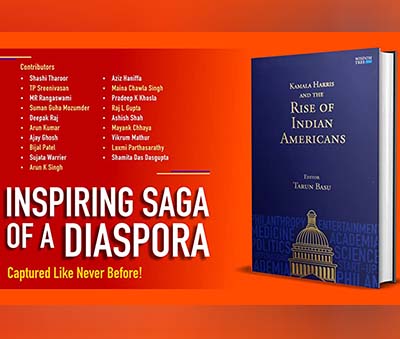
Edited by the Delhi-based veteran journalist and foreign policy analyst, Tarun Basu, the evocative collection titled, “Kamala Harris and the Rise of Indian Americans,” captures the rise of the Indians in the US across domains by exceptional achievers. Sixteen eminent journalists, business leaders and scholars have contributed essays to the timely and priceless volume, which charts the community’s growing and influential political engagement.

The book was released by New Delhi-based publisher Wisdom Tree and is available in the U.S. via Amazon. Describing the book as an “eclectic amalgam of perspectives on the emerging Indian-American story,” Tarun Basu said, “This evocative collection—of the kind perhaps not attempted before—captures the rise of Indian-Americans across domains, by exceptional achievers themselves, like Shashi Tharoor, the ones who have been and continue to be a part of the “rise,” like MR Rangaswami and Deepak Raj, top Indian diplomats like TP Sreenivasan and Arun K Singh, scholars like Pradeep K Khosla and Maina Chawla Singh, and others who were part of, associated with, or keenly followed their stories.”

In his remarks, Shobit Arya, publisher of the book, shared with the audience about the objectives of publishing such an important book that portrays the life story and achievements of the influential Indian American community.

Dr. Thomas Abraham, Chairman, GOPIO International, who is the main organizer moderated of the session, who has been instrumental in establishing and leading several Indian American organizations and has seen the rise of the community in the past half a decade, shared with the audience the major highlights, depicting the progress and achievements of the community.

 “My own involvement in the community for the last 47 years as the Founder President of FIA New York, National Federation of Indian American Associations and GOPIO, I want to give some milestones of our community since the late 1970s,” Dr. Abraham said and enumerated the major milestones of the Indian Americans, starting with the formation of the first national organization post-India independence in 1967, Associations of Indian America (AIA), and succeeding in its efforts to have the Asian Indians categorized in the 1980 Census, First Convention of Asian Indians in America in 1980 and formation of the NFIA, first India Day Parade in New York City in 1981, first White House Briefing in 1983, keeping the family reunification in the Simson-Mazzoli Immigration Bill in 1985, Meeting of the community with President Ronald Reagan in 1986 at the White House, first time sub-cabinet level appointment of Dr. Joy cherian as EEOC Commissioner, Election of Bobby Jindal as Congressman and then as Louisiana Governor, Indo-US Nuclear Treaty; Rise of Indian Americans in the MNCs, Silicon Valley, Hospitality and HealthCare; first cabinet level appointment of Nikki Haley, and now culminating in dozens of Indian Americans holding important positions in the US administration and several dozens elected to local, state and national offices across the nation including VP Kamala Harris.

History of Indian community organizations and the role played by these organizations in community development, mobilization and promoting the diverse interests such as education, political involvement, entrepreneurship, business and service industry are covered in this new book,” Dr. Abraham said.
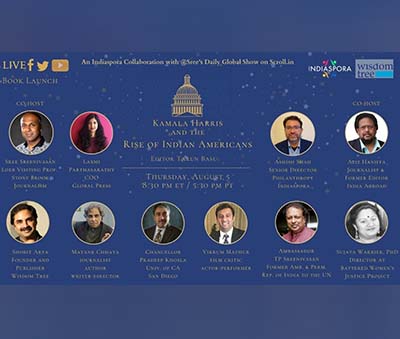
While acknowledging the success story of Indian American physicians, Dr. Anupama Gotimukula, President of AAPI said, “The success story of Indian American Doctors has been arduous. As Ajay Ghosh, who has been working for AAPI for nearly a decade has aptly summarized this long and difficult journey: “While Indian American physicians play a critical role, serving millions of patients in the United States, leading the policies and programs that impact the lives of millions today, it has been a long and arduous journey of struggles and hard work to be on the top of the pyramid.”

Dr. Gotimukula pointed out, “Indian American Doctors, who have been recognized for their compassion, skills, expertise and skills in caring for their patients, leading research that brings solutions to health issues and at the table making policies that benefit the world, are at the  at the forefront around the world as shining examples of meeting the needs of the hour.” She congratulated Tarun Basu, Shobit Arya and the 16 veteran journalists who have contributed to the book.

Dr. Ravi Kolli, President-Elect of AAPI spoke about how the Covid pandemic has impacted all and how the physician community who has borne the brunt of this epidemic is coping with the stress and the negative effects, while providing critical care to people diagnosed with Covid virus. Dr. Satheesh Kathula, Treasurer of AAPI and Dr. Sampat Shivangi, President of Indo-American Political Forum and NFIA past presidents Subash Razdan and Sudip Goraksharkar were others who had joined in the discussions.

Former Ambassador TK Srinivasan, who had served as the Deputy Indian Ambassador to the US and as Governor of India t the International Atomic Agency in Vienna, shared with the audience, his own experiences with the Indian Diaspora and how they have contributed to the larger goals of cementing stronger relationship between India and the United States.

In his remarks, NFIA President Ajoy Dube said, “National Federation of Indian American Associations (NFIA), the largest non-profit umbrella organization of Indian association, established in 1980, aims to unify the diverse Indian American community by coordinating and promoting the activities of its member associations. NFIA has been in the forefront of activities in US-India relations for over four decades.”

Describing the many contributions and objectives of ASEI, Piyush Malik, the current president said, “Since its inception in 1983, ASEI has strived to strengthen the Indo-American relationship, institute a channel of communication between technical organizations within the United States and abroad, lend a helping hand to charitable organizations, provide assistance to engineering students at the Local and National levels, and organize networking events.”

Dr. Urmilesh Arya, President of Association of Indians in America (AIA) spoke about the objectives and activities by AIA for the past several decades. “AIA is a grass root national organization of Indian immigrants in the United States, fostered on the democratic principles of “one member one vote”, with chapters and membership spread across the USA.”

 Journalist Arun Kumar who wrote a Chapter in the Book on “All the President’s People: Trust in the Corridors of Power” spoke about the increasing number of Indian Americans how have come to occupy critical roles in the US administration, starting with President Ronald Regan and currently having as many as 50 Desis, who occupy important positions in the Biden administration.

Mayank Chaya, another author who wrote on: “At the Center of Excellence: Seminal Contributions in the World of Science” presented how Indian Americans have come to lead research and scientific innovations across the United States.

The importance and high esteem with which physicians of Indian heritage are held by their patients is self-evident, as they occupy critical positions in the healthcare, research and administrative policy positions across America, including the nomination of the US Surgeon-General, Dr. Vivek Murthy.

In his presentation, Ajay Ghosh who has portrayed the rise of the Indian American physicians as a strong and influential force in the United States, chronicling their long journey to the United States and their success story, in a Chapter titled, “Physicians of Indian Heritage: America’s Healers” spoke about the four distinct areas, he has covered in the book: Indian American Physicians Being recognized as Covid Warriors who work as frontline healthcare workers treating millions of patients: Initial struggles of Indian American Physicians; Their Achievements; and, Contributions to Healthcare in India and the United States.

After the presentation by the authors, a question/answer session followed and was moderated by the co-host and Chair of the GOPIO Academic Council Dr. Neerja Arun Gupta who is currently the Vice Chancellor, Sanchi University for Buddhist and Indic Studies. A few quest5iiobn related to Indian community groups’ relations with India with government of India. The organizers said that the community groups work closely with Indian missions for India’s and community interest, however, groups have also been critical, when things were not moving in India.

Authors who have contributed to the Book include: former Indian ambassadors TP Sreenivasan and Arun K. Singh; Deepak Raj, chairman of Pratham USA; businessman Raj Gupta; hotelier Bijal Patel; Pradeep Khosla, Chancellor of UC San Diego; scholar-professor Maina Chawla Singh; Sujata Warrier, Chief Strategy Officer for the Battered Women’s Justice Project; Shamita Das Dasgupta, co-founder of Manavi; and journalists Arun Kumar, Mayank Chhaya, Suman Guha Mozumder, Ajay Ghosh, Vikrum Mathur, and Laxmi Parthasarathy.

The book is now available at: https://bit.ly/HarrisIA – Amazon India book link, and at https://bit.ly/HarrisIndAm – Amazon USA link. The discussion is available at the Facebook page at https://fb.watch/96qk1eJ-xA/

Ryan Kaji Is the Most Popular 10-Year-Old in the World

In human years, Ryan Kaji is 10. In YouTube views, he’s 48,597,844,873. If, in our digital age, a person’s life can be measured by their online footprint, Ryan’s is the size of a brachiosaur’s, which, as a lot of Ryan’s fans know, is gargantuan. Another way of putting it is that even if every one of Ryan’s YouTube views were just 30 seconds, he has been watched 4,500 times longer than he has been alive.

There’s a sacred text that talks about an era of peace and harmony, where lions lie down with lambs. The kicker is that a child is in charge of it all. Except for the part about peace and harmony, we are in an age where a child does indeed rule a significant subsection of the Internet. Ryan has been the highest paid YouTube star for three years straight, partly because he has nine channels on the platform. His revenue last year, according to Forbes, was about $30 million. Most of that was from his far-flung merchandise empire: he (or his parents) has lent his name to 1,600 licensed products in 30 countries, including Skechers, pajamas, Roblox, bedding, watches, sporting goods, water bottles, furniture, toothpaste and, of course, toys.

As well as a legion of YouTube videos, Ryan has shows on Nick Jr. (the Emmy-nominated Ryan’s Mystery Playdate) and Amazon Kids+ (Super Spy Ryan) and his own streaming channel. His animated superhero alter ego, Red Titan, will appear for the second time as a Macy’s Thanksgiving Day Parade balloon. “Ryan is bar none the crown prince of YouTube,” says Quynh Mai, founder of Moving Image & Content, a creative agency for digital content. (She does not represent him.)

How did we get to a place where a person can be the linchpin of a media empire before he has armpit hair? And of all the exuberant folks on YouTube, why has this kid raked in the most cash? Part of the answer is that this is no ordinary child, but another part is that Ryan’s rise speaks volumes about the way entertainment, business, technology and family life have changed in the past decade.

Ryan’s prominence, and the existence of the genre of human known as “kidfluencer,” is a source of consternation to many parents, authorities and child-development experts. Four of the 10 U.S. YouTube channels with the most subscribers are geared toward young children. Legislation has recently been introduced in the Senate that may curtail the activities of Ryan and his fellow YouTube toycoons. But his ascent has also shown how profoundly childhood has been and is being reshaped, and that it may be too late to put the jack back in the box.

One thing that everyone agrees on is that much of Ryan’s fame was a result of timing. He was about 3½ in 2015 when he asked his mom Loann Guan—the family changed its name to Kaji to preserve some anonymity as they got famous—if he could be on YouTube like other kids. Loann, 37, was a science teacher on spring break looking for kid-friendly activities. She and her husband Shion, 34, had watched YouTube in college and had a grasp of the format and how the algorithm worked.

Ryan’s ToysReview quickly became one of YouTube’s most popular channels. By 2016, both parents had quit their jobs to make videos full time. Shion is a Cornell-educated structural engineer, which may be why he sensed the danger of having Ryan, just 5, carry the bulk of the show. He beefed up the production team to avoid burnout and had animators create characters based on Ryan’s personality for more content. Shion and Loann also appear in the videos and play with toys and games on their own channel.

Pocketwatch and YouTube issue manuals on how to be both parent and programmer, and Shion hints that he’s trying to start a working group of YouTube families to set industry standards. He won’t go into details, but says he would like more input from YouTube, especially on how families manage their finances, their kids’ time and fame. After all, the platform is taking a healthy cut of the money, and the minors who have made their name on it have few legal protections. The Kajis say a portion of the revenue from the family business goes into trust accounts they’ve established for their children, and they have put all of Ryan’s TV earnings into another trust.

Malala Yousafzai Is Married

The 24-year-old Pakistani activist and Nobel Peace Prize winner made the announcement on Instagram Tuesday last week that she has tied the knot, just months after she told British Vogue that she wasn’t sure if she would every marry.

“Today marks a precious day in my life,” she wrote on Instagram. “Asser and I tied the knot to be partners for life. We celebrated a small nikkah ceremony at home in Birmingham with our families. Please send us your prayers. We are excited to walk together for the journey ahead.”

Yousafzai’s parents, Ziauddin Yousafzai and Toor Pekai Yousafzai, shared their excitement along with some photos by Malala’s friend, photographer Malin Fezehai.  “It is beyond words,” Ziauddin Yousafzai tweeted. “Toor Pekai and I are overwhelmed with joy and gratitude. Alhamdulillah.”

Malala talked with British Vogue earlier this year about her feelings toward marriage, saying her parents had an “arranged love marriage” but expressing doubt about whether she would ever marry. “I still don’t understand why people have to get married,” she said. “If you want to have a person in your life, why do you have to sign marriage papers, why can’t it just be a partnership?”

Her parents disagreed with that notion.  “My mum is like, ‘Don’t you dare say anything like that! You have to get married, marriage is beautiful,'” she said.  She added that her father has received emails from men in Pakistan who wanted to marry her.  “Even until my second year of university, I just thought, ‘I’m never going to get married, never going to have kids — just going to do my work,'” she said. “‘I’m going to be happy and live with my family forever.’ I didn’t realize that you’re not the same person all the time. You change as well and you’re growing.”

Yousafzai is known for her advocacy work on behalf of girls and women, particularly in stressing education for girls across the world.  She became a well-known activist after delivering an inspiring speech at the United Nations when she survived being shot in the head by the Taliban in Pakistan. She was 15 at the time and was shot because she simply was a girl pursuing an education.

Yousafzai is still is dealing with the effects of the shooting, as she shared in August that she underwent her sixth surgery as a result of the near-fatal injury she suffered nine years ago. She also spoke up for the women and girls of Afghanistan who are once again under Taliban rule after the withdrawal of U.S. forces.

Culture, Religion At Stake In Tibet Under Chinese Regime

Dharamshala, Himachal Pradesh–Culture, religion, and the way of life which is based on Buddhism are at the stake in Tibet under the Chinese regime, said Deputy Speaker of Tibetan Parliament-in-Exile Dolma Tsering.

Tibet’s exiled spiritual leader the Dalai Lama says China’s leaders “don’t understand the variety of different cultures” and that the ruling Communist Party’s penchant for tight social control can be harmful. The 86-year-old Buddhist monk on Wednesday also said he wished to remain home in India, where he has lived since 1959 after a failed uprising against Chinese rule in Tibet, rather than get involved in the “complicated politics” between China, run by the officially atheist Communist Party, and strongly Buddhist Taiwan.

She also said that the Chinese want everything to be melted into the communist style. “So be it Buddhism or anything they want everything to be changed into them.” Speaking over the so-called freedom in Tibet, the Deputy Speaker said: “If there is any freedom in Tibet, why don’t the Chinese let world media go there and see for themselves. “When they shy away from world media that shows that they are hiding something. Why do they have to give all the time white paper on Tibet? This shows that all is not well there,” she said.

Tenzin Lekshay, spokesperson of Tibetan government-in-exile said that China oppressed many nationalists including Tibetian, Uyghurs, and Mongolians, over the 60-70 years under the party regime. “Chinese leaders always believe that the hunt rules, and then all the other people (minorities) are the ones who should serve, therefore they look at Tibentian as well,” he said.

Talking about the leadership for the Tibetans, he said: “If you see, all the official websites do not even have Tibetan language scripts. All are written in Chinese, so for whom they are working. Are they working for Tibetan?”

He added that the Chinese need to be more compassionate, they need to look into the aspirations of those people. “It is the issue of six million Tibetan, therefore the China-Tibet conflict needs to be resolved pending for over 50 60 years,” he said.

China exercises rigid control over all religions and in recent years has stepped up a campaign of cultural assimilation targeting Tibetans, Turkic Muslim Uyghurs and other minority groups.

The Dalai Lama said he did not want to become involved in “local and political difficulties,” but was dedicated to making contributions to “brothers and sisters” in both Taiwan and mainland China. “This situation is quite complicated,” he said. “Sometimes I really feel this simple Buddhist monk (does) not want to (become involved) in complicated politics,” he said, chuckling.

The Dalai Lama retired from politics in 2011 but remains a major force for the preservation of Tibetan traditions. China castigates him as an advocate for Tibetan independence and has not had direct contacts with his representatives in more than a decade. The Dalai Lama says he merely advocates for Tibet’s substantial autonomy and protection for its native Buddhist culture.

The Dalai Lama, along with his followers, fled to India from Tibet in 1959 during an invasion by the Chinese forces. China calls the Buddhist monk a ‘separatist’, seeking to secede Tibet from China.

$1.2 Trillion Infrastructure Bill Passed By Congress Welcomed By Industrial Leaders

Corporations and business groups are calling on President Biden to sign the bipartisan $1.2 trillion infrastructure bill into law quickly after it finally cleared Congress late Friday, November 5th, after several months of painstaking negations.

The infrastructure bill passed the House 228-206 on Friday. Thirteen Republicans voted for the bill, while six progressive Democrats voted against it, arguing that Democratic leaders didn’t do enough to ensure that the party’s moderates would support the larger reconciliation package. The infrastructure legislation had cleared the Senate in August, with 19 Republicans joining all 50 Democrats in support.

The business community has rallied behind the infrastructure package, which makes huge investments in roads, bridges, broadband internet, drinking water, rail and public transit without raising taxes on corporations. Business groups say that Biden should sign the bill as soon as possible so transportation officials can get started on construction projects.

According to reports, nearly every major business group in Washington, D.C., backed the infrastructure bill while opposing the reconciliation package, which will implement a minimum tax on corporate profits.The Business Roundtable, which represents CEOs at some of the nation’s largest companies, urged Biden to “swiftly sign” the infrastructure bill. The U.S. Chamber of Commerce, the largest American corporate lobbying group, called the bill’s passage “a major win for America.”

Ford Motor Co., which will benefit from the bill’s investment in electric vehicle charging stations, lauded the House vote as “great news for the United States’ infrastructure and transition to a zero emissions transportation future” and said it looked forward to Biden’s signature.

“We urge President Biden to quickly sign this bipartisan package into law, so we can build back better with increased jobs, enhanced safety, and improved roads,” Jay Hansen, executive vice president for advocacy at the National Asphalt Pavement Association, said in a statement after the bill passed the House.

The United Steelworkers union welcomed the bill’s passage. “The House has passed the #InfrastructureBill, which would provide roughly $1 trillion for upgrading the nation’s critical infrastructure. This is a big freakin’ deal for us because Steelworkers supply America in so many ways!” the union tweeted.

Biden and Vice President Kamala Harris appeared in the White House State Dining Room about 12 hours after moderate and progressive Democrats in the House of Representative overcame internal bickering and delivered the president his biggest legislative win thus far. WASHINGTON, Nov 6 (Reuters) – A giddy President Joe Biden on Saturday hailed congressional passage of a long-delayed $1 trillion infrastructure bill as a “once in a generation” investment and predicted a broader social safety net plan will be approved despite tense negotiations.

Biden and Vice President Kamala Harris appeared in the White House State Dining Room about 12 hours after moderate and progressive Democrats in the House of Representative overcame internal bickering and delivered the president his biggest legislative win thus far.v”Finally, infrastructure week,” Biden said with a chuckle. “I’m so happy to say that – infrastructure week!”

President Joe Biden on Saturday hailed congressional passage of a long-delayed $1 trillion infrastructure bill as a “once in a generation” investment and predicted a broader social safety net plan will be approved despite tense negotiations.

Biden and Vice President Kamala Harris appeared in the White House State Dining Room about 12 hours after moderate and progressive Democrats in the House of Representative overcame internal bickering and delivered the president his biggest legislative win thus far.

The president’s comment referred to a running joke in recent years after Biden’s Republican predecessor Donald Trump declared “Infrastructure week” in 2018 but was unable to pass a bill after multiple tries during his presidency.

The bipartisan bill’s passage gives Biden a jolt of good news after sobering election losses for his Democratic party this week and a drop in his approval ratings. Referring to the losses, Biden said they showed American people “want us to deliver.” “I think the one message that came across was – ‘get something done. It’s time to get something done – stop talking,'” said Biden

AAPI, GOPIO, AIA, NFIA & ASEI Jointly Host Discussion On The Book, “Kamala Harris and the Rise of Indian Americans”

A discussion and celebration of the Indian Diaspora and their achievements was held virtually  on Saturday, November 7th, 2021 and was attended by People of Indian Origin from around the globe. Jointly organized by Global Organization People of Indian Origin (GOPIO), American Association of Physicians of Indian Origin (AAPI), American Society of Engineers of Indian Origin (ASEI), Association of Indians in America (AIA), and National Federation of Indian American Associations (NFIA), the event offered a glimpse of the growth and the successes of the Indian American community in various domains.

Edited by the Delhi-based veteran journalist and foreign policy analyst, Tarun Basu, the evocative collection titled, “Kamala Harris and the Rise of Indian Americans,” captures the rise of the Indians in the US across domains by exceptional achievers. Sixteen eminent journalists, business leaders and scholars have contributed essays to the timely and priceless volume, which charts the community’s growing and influential political engagement.

The book was released by New Delhi-based publisher Wisdom Tree and is available in the U.S. via Amazon. Describing the book as an “eclectic amalgam of perspectives on the emerging Indian-American story,” Tarun Basu said, “This evocative collection—of the kind perhaps not attempted before—captures the rise of Indian-Americans across domains, by exceptional achievers themselves, like Shashi Tharoor, the ones who have been and continue to be a part of the “rise,” like MR Rangaswami and Deepak Raj, top Indian diplomats like TP Sreenivasan and Arun K Singh, scholars like Pradeep K Khosla and Maina Chawla Singh, and others who were part of, associated with, or keenly followed their stories.”

In his remarks, Shobit Arya, publisher of the book, shared with the audience about the objectives of publishing such an important book that portrays the lifestory and achievements of the influential Indian American community.

Dr. Thomas Abraham, Chairman, GOPIO International, who is the main organizer and moderated of the session, who has been instrumental in establishing and leading several Indian  American organizations and has seen the rise of the community in the past half a decade, shared with the audience the major highlights, depicting the progress and achievements of the community.

My own involvement in the community for the last 47 years as the Founder President of FIA New York, National Federation of Indian American Associations and GOPIO, I want to give some Milestones of our community since the late 1970s,” Dr. Abraham said and enumerated the major milestones of the Indian Americans, starting with the formation of the first national organization in 1967, Associations of Indian America (AIA), and succeeding in its efforts to have the Asian Indians categorized in the 1980 Census, and now culminating in dozens of Indian Americans holding important positions in the US administration and several dozens elected to local, state and national offices across the nation.

History of Indian community organizations and the role played by these organizations in community development, mobilization and promoting the diverse interests such as education, political involvement, entrepreneurship, business and service industry are covered in this new book,” Dr. Abraham said.

While acknowledging the success story of Indian American physicians, Dr. Anupama Gotimukula, President of AAPI said, “The success story of Indian American Doctors has been arduous. As Ajay Ghosh, who has been working for AAPI for nearly a decade has aptly summarized this long and difficult journey: “While Indian American physicians play a critical role, serving millions of patients in the United States, leading the policies and programs that impact the lives of millions today, it has been a long and arduous journey of struggles and hard work to be on the top of the pyramid.”

Dr. Gotimukula pointed out, “Indian American Doctors, who have been recognized for their compassion, skills, expertise and skills in caring for their patients, leading research that brings solutions to health issues and at the table making policies that benefit the world, are at the  at the forefront around the world as shining examples of meeting the needs of the hour.” She congratulated Tarun Basu, Shobit Arya and the 16 veteran journalists who have contributed to the book.

Dr. Ravi Kolli, President-Elect of AAPI spoke about how the Covid pandemic has impacted all and how the physician community who has borne the brunt of this epidemic is coping with the stress and the negative effects, while providing critical care to people diagnosed with Covid virus. Dr. Satheesh Kathula, Treasurer of AAPI and Dr. Sampat Shivangi, President of Indo-American Political Forum were others how had joined in the discussions.

Ambassador TK Srinivasan, who had served as the Indian Ambassador to the US and as the Permanent Representative of India to the United Nations, shared with the audience, his own experiences with the Indian Diaspora and how they have contributed to the larger goals of cementing stronger relationship between India and the United States.

In her remarks, Dr. Lavanya Reddy, president of NFIA said, “National Federation of Indian American Associations (NFIA), the largest non-profit umbrella organization of Indian association, established in 1980, aims to unify the diverse Indian American community by coordinating and promoting the activities of its member associations. NFIA has been in the forefront of activities in US-India relations for over two decades.”

Describing the many contributions and objectives of ASEI, Piyush Malik, the current president said, “Since its inception in 1983, ASEI has strived to strengthen the Indo-American relationship, institute a channel of communication between technical organizations within the United States and abroad, lend a helping hand to charitable organizations, provide assistance to engineering students at the Local and National levels, and organize networking events.”

Dr. Urmilesh Arya, President of Association of Indians in America (AIA) spoke about the objectives and activities by AIA for the past several decades. “AIA is a grass root national organization of Asian immigrants in the United States, fostered on the democratic principles of “one member one vote”, with chapters and membership spread across the United States of America. AIA represents the hopes and aspirations of those immigrants who are united by their common bond of Indian Heritage and American Commitment.”

Journalist Arun Kumar who wrote a Chapter in the Book on “All the President’s People: Trust in the Corridors of Power” spoke about the increasing number of Indian Americans how have come to occupy critical roles in the US administration, starting with President Ronald Regan and currently having as many as 50 Desis, who occupy important positions in the Biden administration.

Mayank Chaya, another author who wrote on: “At the Center of Excellence: Seminal Contributions in the World of Science” presented how Indian Americans have come to lead research and scientific innovations across the United States.

The importance and high esteem with which physicians of Indian heritage are held by their patients is self-evident, as they occupy critical positions in the healthcare, research and administrative policy positions across America, including the nomination of the  US Surgeon-General, Dr. Vivek Murthy.

In his presentation, Ajay Ghosh who has portrayed the rise of the Indian American physicians as a strong and influential force in the United States, chronicling their long journey to the United States and their success story, in a Chapter titled, “Physicians of Indian Heritage: America’s Healers” spoke about the four distinct areas, he has tried cover in the book: “Indian American Physicians Being recognized as Covid Warriors who work as frontline healthcare workers treating millions of patients.

With anecdotes, Ajay presented the “Initial struggles of Indian American Physicians” in securing equality with the local American Doctors in Board certification and licensing and the lobbying and legal efforts imitated by the pioneers.  He referred to Dr. AnandibaiJoshi, the first documented physician of Indian origin who had landed on the shores of the United States in 1883 and detailing the decimation suffered by Dr. Yellapragada Subbarow in the early 20th century, who has been credited with some of the biggest contributions in more than one basic field of science—biochemistry, pharmacology, microbiology, oncology, and nutritional science, portrays the discrimination and injustices inflicted by the mainstream Medical professionals in the US.

Portraying the achievements of the Indian American physicians, Ajay spoke of the many, who lead the cutting-edge research and pioneer modern medical technology to save the lives of critically ill patients around the world, showing to the world, how through hard work, dedication and vision, they have earned a name for themselves as “healers of the world.”

Through the lens of AAPI and its remarkable growth in the past 40 years, Ajay tried to portray how the Indian-American physicians have gone beyond their call of duty to meet the diverse needs of the larger American community, by dedicating their time, resources and skills during national disasters and family crises.

Describing the many contributions of Indian American physicians to India and the United States, Ajay said, “Indian Americans currently are less than 2% but the make up nearly 10% of total physicians in the US and they treat and provide healthcare to every 7th patient in the United States.” He also shared about the numerous initiatives in India, through the annual Global Health Care Summit, Tele-health, sending medical equipment to India, education to their counter parts in India and close collaborations with the state and federal government, Indian Medical Association and several Indian Non Profits, providing healthcare to rural areas across India. Their contributions to the US, to India and to the entire world is priceless, he said, as “they have made their mark in institutions from Harvard Medical School to Memorial Sloane Kettering Cancer Center to the Mayo Medical Center.”

Authors who have contributed to the Book include: former Indian ambassadors TP Sreenivasan and Arun K. Singh; Deepak Raj, chairman of Pratham USA; businessman Raj Gupta; hotelier Bijal Patel; Pradeep Khosla, Chancellor of UC San Diego; scholar-professor Maina Chawla Singh; Sujata Warrier, Chief Strategy Officer for the Battered Women’s Justice Project; Shamita Das Dasgupta, co-founder of Manavi; and journalists Arun Kumar, Mayank Chhaya, Suman Guha Mozumder, Ajay Ghosh, Vikrum Mathur, and Laxmi Parthasarathy.

The book is now available at: https://bit.ly/HarrisIA – Amazon India book link, and at https://bit.ly/HarrisIndAm – Amazon USA link.
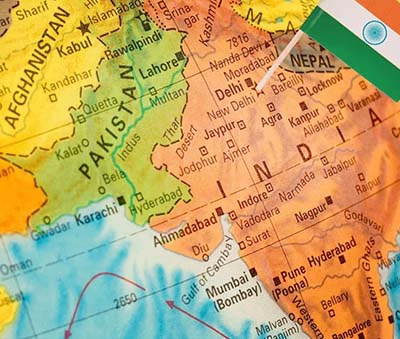
Sam Joshi Elected Mayor of Edison, NJ; Aftab Pureval Wins As Mayor of Cincinnati, OH

Aftab Pureval of Indian origin has been elected as the first ever person of Asian heritage to be elcted as the Mayor of Cincinnati, OH, while Sam Joshi becomes the first Indian-American to be Mayor of Edison, the 5th largest municipality in New Jersey, during the elections held on Nov. 2nd, 2021.

With 100% of precincts reporting, Joshi was well in front of Republican Keith Hahn and independent candidate Christo Makropoulos.

Joshi had 10,930 votes, while Hahn had 9,459 and Makropoulos, 301. The race was to replace Democratic Mayor Thomas Lankey whose term ends Dec. 31. Lankey did not seek reelection.
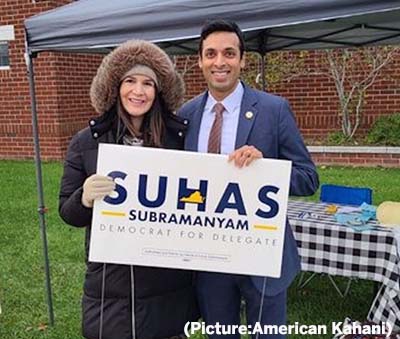
When sworn in on Jan. 1, Joshi, 32, will become the township’s youngest mayor and the first South Asian to hold the position. Previously Jun Choi, the township’s first Asian American mayor, was the youngest to serve in the post.

“I am honored and humbled to be elected as the next mayor of Edison Township,” Joshi said in a Facebook post.

Joshi has been serving as the Vice President of the Town Council, and during his campaign he promised to stabilize taxes, invest in infrastructure, and stop ‘overdevelopment’, launch municipal broadband, and celebrate Edison’s diversity fighting discrimination and hate crime.

Joshi’s popularity was evident n June this year, when during the primaries, he defeated another Indian-American aspirant Mahesh Bhagia by 63 percent of the votes to 34 percent, despite Bhagia being the municipal chair of the Democrats.

A ‘son of the soil’, Joshi was born and raised in Edison. Joshi was elected as an at-large Councilmember at 27 years old, making him the youngest elected official in Edison’s history.

Since joining the Edison Township Council in 2017, Joshi’s biography on his website says, he has worked to keep taxes low, helped women and minority owned businesses get on their feet, and promoted green energy throughout the township.

Among the many voluntary services he has been involved in, is as an Edison Police 9-1-1 Tele-communicator from 2010-2011, at the Central Command Office for all public safety calls, including police, fire, and EMS, providing first responders with additional information on each call.

He also served on the Fair Rental Housing Authority Board from 2010-2015 and the Edison Zoning Board from 2016 until he was elected to the Edison Township Council.

At 39, Pureval will replace longtime mayor John Cranley, who is term-limited from running again this year.  Pureval defeated David Mann, who has an array of political experience — serving as Cincinnati’s mayor from 1980 to 1982, and again in 1991. He’s also served on Cincinnati City Council from 1974 until 1992, then elected in 2013 and reelected in 2017.

In his acceptance speech Tuesday, Pureval thanked Mann for his career in public service. “We also want to thank the voters of Cincinnati who tonight voted a mandate for a new day in our city,” Pureval said. “We spent the last year talking about our bold progressive vision for moving Cincinnati forward. Our comprehensive plans for public safety, affordable housing, the environment and economic recovery with racial equity at the center of the frame, and the voters of Cincinnati resoundingly supported that vision.”

The son of Indian and Tibetan immigrants, Pureval becomes the first Indian-American and Tibetan, in fact, the first Asian to be elected Mayor of the city. Currently, he is Hamilton County Clerk of Courts, a position not held by a Democrat for more than 100 years. “Words can’t express how honored and excited I am to be the next Mayor of Cincinnati. Tonight, we made history! Let’s get to work!” Pureval tweeted as the results became public.

Congratulations poured in including from the likes of former Secretary of State and presidential candidate Hillary Clinton and U.S. Sen. Sherrod, D-Ohio, who had supported Pureval. “Win or lose, fighting for what’s right is always worth it. Congratulations to @ericadamsfornyc, @wutrain,  @shontelmbrown, and @aftabpureval for historic wins …” Clinton tweeted.

Sen. Brown tweeted, “Congratulations to #canarycandidate @AftabPureval on your victory. He represents the future of Cincinnati and will fight for all workers and families in the Queen City.”

Born and raised in Ohio, Pureval is an attorney and former prosecutor. He has been awarded the NAACP Theodore Berry Award for Service and has been recognized by the Business Courier as one of their 40 under 40.

Pureval is seen as a rising star in the Democratic Party. In May 2018, he won the Democratic primary unopposed in his party’s bid to turn a Red seat Blue when he ran and lost in his race against incumbent Republican Rep. Steve Chabot. President Obama was among those who endorsed his candidacy then.

“We have a very clear vision for pushing Cincinnati forward as annunciated with our three comprehensive plans,” he said in an interview at the Board of Elections where he greeted early voters. “And we’re talking about substantive, innovative, creative ideas in order to accomplish that.” Pureval described his campaign as one that offers voters a fresh approach to what ails city government. “Our future is bold, it’s diverse, it’s dynamic.”

Sterley Stanley, Suhas Subramanyam, Usha Reddi, Aditi Bussells Win In Sate Elections

Indian American incumbents Usha Reddi in Manhattan, Kansas, and Sterley Stanley in New Jersey were victorious in their bids for another term in office, Aditi Srivastav Bussells won a council seat in South Carolina, while Nalini Joseph fell short in her race during the Nov. 2 election.

Suhas Subramanyam was reelected to the House of Delegates, in the state of Virginia beating challenger Greg Moulthrop On November 2nd, 2021. Subramanyam won 21,374 votes — almost 60 percent — while Moulthrop received 13,939 votes, almost 40 percent. Subramanyam, 35, represents District 87 in Virginia’s House of Delegates. He is the first Indian American to win a seat in the state’s General Assembly.

Republicans won 50 seats Nov. 2 in Virginia’s House of Delegates, while Democrats won 40, for a 55-45 Republican majority overall at the statehouse. In one of the most-watched races of the evening, Youngkin beat former Virginia Governor Terry McAuliffe, a Democrat. Virginia has traditionally been considered a solidly blue state.
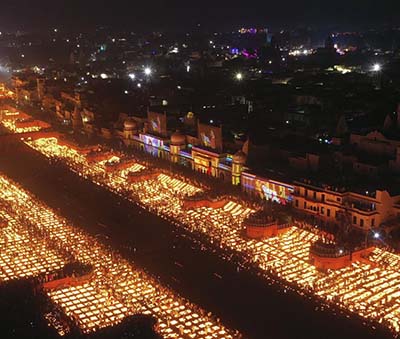
“I am so humbled and grateful that the 87th District has put their faith in me again as their Delegate. I promised two years ago that I would put people over special interests and do everything I could to empower my constituents. I am proud to have kept those promises, in the process fully funding our schools, curbing gun violence, addressing rising tolls and utility costs, and helping small businesses and families through one of the worst pandemics in our Commonwealth’s history,” said Subramanyam. “I am so thankful to all the staff and volunteers who knocked doors, wrote postcards, and made phone calls. This night would not have been possible without them.”

Reddi was the top vote-getter for the Manhattan City Commission, according to results late Nov. 2, tallying 3,571 votes followed by incumbent Mayor Wynn Butler (3,499 votes) and former commissioner John Matta (3,265 votes). Reddi and Butler earned four-year terms as the top finishers, while Matta received a two-year term for taking third.

Reddi, who was first elected to the commission in 2013, said this was her most stressful city commission campaign, according to The Mercury. “I wasn’t even sure where I was going to place in this race,” Reddi said in the report. “Even though I have served two terms, I think there were very good challengers. There was a lot of good campaigning going on from everyone, and everyone was vying for all the votes.” Reddi expressed her appreciation to the voters. “I value their support and I hope I have worked for them and with them to continue to move Manhattan forward,” she said, the report added.

Stanley – along with fellow incumbents state Sen. Patrick Diegnan and Assemblyman Robert Karabinchak – won reelection to his Assembly seat in the 18th Legislative District in New Jersey, representing East Brunswick.

Stanley beat realtor Angela Fam and South Plainfield Councilwoman Melanie Mott to win the seat. He is the delegation’s newest member, and one of the newest members of the entire legislature; he was selected in January of this year to replace now-Middlesex County Clerk Nancy Pinkin (D-East Brunswick).  Stanley earned 27,249 votes with Karabinchak taking 28,065 to claim the two seats. Fam took 20,822 votes and Mott had 21,449. Diegnan beat Republican counterpart Vihal Patel of Edison to claim his seat. Patel earned 20,596 votes to Diegnan’s 28,829.

In Columbia, South Carolina, Aditi Bussells was among a crowded field seeking the city’s councilmember at-large seat. In the seven-person field, Bussells led with 5,643 votes for 31 percent with all precincts reporting, though the results were still unofficial. Bussells was 5 points ahead of Tyler Bailey who had 26 percent of the vote with 4,695 tallies. Heather Bauer was third with 3,562 votes for 20 percent. Deitra Matthews (11 percent), John Tyler (4 percent), John Crangle (4 percent) and Aaron Smalls (3 percent) rounded out the field.

In Salisbury, North Carolina, Nalini Joseph was vying for a council seat, but came up just short. Incumbents Tamara Sheffield and David Post, along with newcomers Harry McLaughlin Jr. and the Rev. Anthony Smith won the seats. Guardian ad Litem District Administrator Joseph finished fifth with 13.90 percent. Sheffield led the field with 18.01 percent of the vote, followed by McLaughlin at 16.15 percent, Post at 15.69 percent and Smith with 14.29 percent.

Though Joseph received just 64 fewer votes than Smith, Rowan County Board of Elections executive director Brenda McCubbins said the numbers don’t fall within the acceptable range to request a recount, the Salisbury Post reported. For recounts, the difference in votes between candidates must not exceed 1 percent of the total votes cast for that particular race. A total of 16,127 votes were cast for council candidates, including 100 write-in votes, the report said.

Indian American attorney Nisha Arora, who would have been the first non-white judge in Lackawanna County, Pennsylvania, lost her bid for the Common Pleas Court Judge seat Nov. 2 evening to Democrat Mary Dempsey. Arora began her career as a law clerk in the Court of Common Pleas of  Lackawanna County. “Working in the court system truly influenced the person I am today. Dealing closely with judges who handled both criminal and civil cases, as well as working with the various treatment courts, gave me an insight into the position I am now seeking,” she said.

“My varied career experience has taught me about high points and low points. A courtroom can be a place where an individual experiences his or her worst time, perhaps losing a child in a custody case, facing imprisonment, or a significant monetary judgment.” The 41-year-old daughter of Dr. Subhash and Sunita Arora decided she wanted to pursue the law at the age of eight.

900,000 Earthen Lamps Light Up Ayodhya, Celebrating Lord Ram’s Triumphant Return

Millions of people across Asia are celebrating the Hindu festival of Diwali, which symbolizes new beginnings and the triumph of good over evil and light over darkness.

The festival is celebrated mainly in India, but Hindus across the world, particularly in other parts of Asia, also gather with family members and friends to socialize, visit temples and decorate houses with small oil lamps made from clay. The festival is also marked by raucous parties and fireworks displays, often throughout the night.

Indians across the country began celebrating Diwali, the Hindu festival of lights, the triumphant return of Lord ram to Ayodhya after rescuing Sita from Sri Lanka. Diwali is typically celebrated by socializing and exchanging gifts with family and friends. Many light oil lamps or candles to symbolize a victory of light over darkness, and fireworks are set off as part of the celebrations.
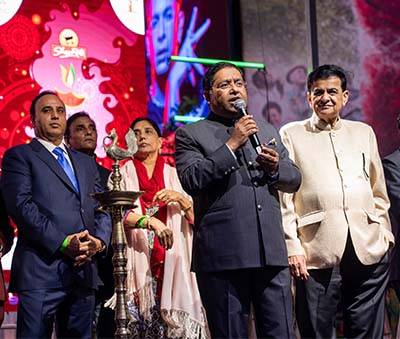
As dusk fell on Nov. 3, over 900,000 earthen lamps were lit and kept burning for 45 minutes in the northern city of Ayodhya in Uttar Pradesh state, retaining the Guinness World Record it set last year. As part of the Diwali celebrations, the city last year lit 606,569 oil lamps.

The lamps were lit at Ram ki Pauri, at the banks of Saryu River, a stunning spectacle for thousands of visitors who thronged its shores while ignoring coronavirus social distancing norms. A laser and fireworks show followed, illuminating the city’s lanes and river banks. Thousands of city residents also lit lamps at their houses and temples.

The festival is being celebrated at a time when India’s pandemic crisis has largely subsided.  On Diwali night, people also lit up the sky with firecrackers — their smoke causing pollution that takes days to clear.

While there is no nationwide ban on bursting firecrackers, a number of states have imposed restrictions to stem the pollution, with some allowing their residents to light green crackers for a certain number of hours. Green crackers produce lesser emissions than normal firecrackers. In the past, similar bans have often been flouted.

Diwali marks Hindu god Ram’s return to his kingdom after 14 years in exile. Hindus believe that during Diwali the goddess of wealth, Lakshmi, will visit their homes if they are illuminated and decorated.

The Diwali festival is also observed among Jains, Sikhs and Buddhists. While each religion marks the festival with different historical events and legends, they all represent the victory of good over evil. (Associated Press writer Biswajeet Banerjee in Lucknow, India, contributed to this report

Diwali Celebration At the Heart of New York City

This year Diwali at Times Square was celebrated with a raging come-back after 2 years COVID-19 Lockdown. Thousands of people participated as the brightest celebration unfolded in the brightest city on earth – New York! The event was extremely successful and was attended by some of the highest-ranking Government officials and dignitaries in the business world. This Event was Conceptualized by Event Guru and managed by ASB Communications.

The President of EventGuru Inc. Neeta Bhasin said ‘We are sharing the message of Deepavali – Knowledge over Ignorance, Light over Darkness, Peace, Love, Unity and Togetherness and inclusion in diversity to the World from the biggest crossroads of the world, Times Square. Even the universe responded in appreciation by keeping the weather conducive to the event despite forecasts of rain throughout the day.’
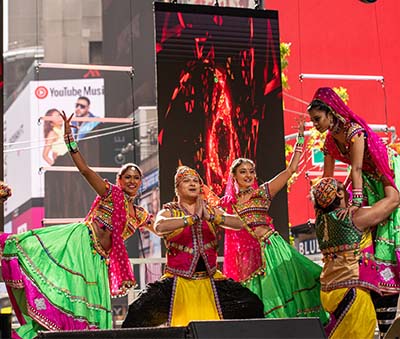
The event was hosted by Aryan Vaid, Mister International Award winner, Vidhi Dave, Mrs. India USA, Esha Kode, Miss Teen India Worldwide. The celebrations began with a traditional Diya (lamp) Lighting ceremony at Times Square. Usually this was done by Mrs. Brijbala Suri, mother of the producer, Neeta Bhasin. But due to her passing, this responsibility was undertaken by her son Gajendra Suri and family. The Diya Lighting Event was followed by dazzling performances by Darshana Menon, the Sa Re Ga Ma 2009 winner, Arya Dance Academy, Sadhanalya Dance Academy and Masala Bhangra.

The Light up Times Square Concert started at 5 PM and was made more luminous by the fact that the Diwali Countdown on Ball Drop Screen created History at Times Square. The sparkle was even greater due to the elite guests who graced the stage with their presence. This whole segment was broadcast live on TV Asia across the USA and worldwide through the Neeta Bhasin Show on YouTube.

This was followed by the dignitaries speaking on the Times Square stage which included some of the most affluent people of New York. List of speakers included Consulate General of India in New York, Randhir Jaiswal, New York State Governor Kathleen Courtney Hochul U.S. Senator Charles Ellis “Chuck” Schumer, U.S. Rep. Carolyn Maloney (D-NY), NY State Senator John Liu, Gajendra Suri and Beena Kothari from Samman for All , ShopRite’s Ranjana Choudhry, Thomas Rajan from American Airlines, Harry Singh Bolla of Bolla Oil Corp, Padma Shri Mr. H R Shah – Chairman of TV Asia and other sponsors of the festival.

Prime Minister of India, Narendra Modi sent his Diwali message ‘Heartiest greetings and best wishes for the celebration of Diwali, the Festival of Lights organized at Times Square in New York. The celebration will help spread our rich traditions and culture in different parts of the world. Carrying the eternal message of victory of light over darkness and truth over untruth may this auspicious occasion further spread peace, happiness, and prosperity in the lives of every member of the Indian diaspora in the USA.’

Consul General of India, NY, Randhir Jaiswal addressed the attendees by saying that ‘It is a time when we must respect the foundational values of our society, kindness, compassion, sharing and being together and may you bring all these values today and tomorrow and forever. Let the light of Diwali shine in your lives and all those around you.’

New York State Governor – Kathleen Hochul Congratulated the founder of Diwali at Times Square, Neeta Bhasin, for having a vision to celebrate the diversity and the wonderful tradition in Times Square and said ‘Diwali at Times is a fabulous event to celebrate the New Year and to celebrate the comeback of New York. This is Phenomenally special; we are once again gathered in person to remind ourselves the real true meaning behind Diwali.

Think about the fact that we can conquer the darkness with light and we did that with Pandemic. Congresswoman Rep. Carolyn Maloney said that ‘I have been coming to this festival ever since we got the Diwali stamp approved which I worked on with many of you for many years to make it happen. The Diwali stamp has been so successful that I think we should have a Diwali Holiday. So, I am introducing a bill for that. Let me get back to work so I can make all these wonderful things happen’.

Senator Chuck Schumer ‘I believe in immigration in general. My middle name is actually Ellis, it is Charles ‘Ellis’ Schumer from Ellis Island. Immigrants have great American values while still remembering the traditions and bringing them to America from their home countries. One of the best and the greatest immigrant communities is our Indian American community, our South Asian Community. We must welcome more Indians to come to America and New York. Because there are more Indians in New York, the greater NY will be’.

NY State Senator, John Liu was very excited to see the huge crowd at Times Square ‘It is great to see everybody in person. No better place to celebrate Diwali than the crossroads of the world right here in Times Square, NY City. With Neeta’s advocacy and esteem journalism and many others, in NYC a long time ago we were able to make a parking holiday, you do not change the car from one side of the street to another’.

Diwali at Times Square was celebrated in association with Samman for All, it’s mission is to facilitate people from the lower-economic strata to achieve their dreams by providing them with tools for sustainable living and empowerment, said the Director of the organization. ShopRite’s Ranjana Choudhry VP Advertising and Social Media ‘We are very proud and very honored to be the Title Sponsor of this event. Let’s turn this festival of lights into the festival of delights. Let’s eat and celebrate Diwali.’

Thomas Rajan- VP, Global Talent American Airlines ‘ In the coming few days, we will be launching our non-stop service from this great city of NY to Delhi and onwards later this year Seattle to Bangalore. Harry Singh Bolla Chairman of Bolla Corporation- ‘We created history in 2013 by representing the 2nd largest festival outside of India. It makes me proud, today we are sitting in Times Square celebrating our culture, our feelings and telling the world what we are all about’.

Some of the front-line fighters in the covid battle like Officer Manish Sharma – President of Indian Police Society (NYPD), Dr. Samin K. Sharma of Mount Sinai Heart, Dr. Jagmohan Kalra and Dr. Sunjit Jaspal from Northwell Health. were honored on stage. The festival did not end there. Yet another set of superb performances by famous artists like Sparsh Shah, Sway Bhatia, Chosen Crew Entertainment Group, Swarali Dance, Jikaria Sisters (Omi, Rish, & Aash), DJ Ash and finally ended with a blast with an amazing performance by International Artist Jay Sean.

More than 250 mainstream media houses are already talking about Diwali at Times Square and the entire event reached out to millions of viewers across both digital and traditional channels in both writing and video publishing formats. Event Guru WorldWide, the organizer of Diwali at Times Square, is a premier full-service event company specializing in festivals, concerts, trade shows, gala dinners and press conferences. We conceptualize and implement events of all sizes and statues.

Diwali Lights Up World Trade Center

Diwali is the celebration of light over darkness, good over evil, and more than 1 billion Hindus worldwide are observing it Thursday by lighting candles, setting off fireworks and exchanging gifts with friends and family.

While most people may refer to the holiday as Diwali, it’s traditionally called Deepavali and that is how it’s known in most parts of India.

This year for the first time, the World Trade Center has been lit with a digital mural in celebration of the holiday, organized by the South Asian Engagement Foundation, along with a livestreamed fireworks show on the Hudson River on Nov 2, 2021, at 6 pm and continued until Nov. 4, 2 am.

Dubbed the All-American Diwali experience, it also included a spectacular fireworks display that was viewed by audiences on both sides of the Hudson!, a press release from South Asian Engagement Foundation said.

“We are excited to create and curate the colorful imagery of Diwali on the WTC podium to bring the messages of peace, harmony, and unity,” said Mark Domino of the Durst Organization.

For the first time ever, Diwali-themed animation adorned One World Trade Center where the animation went live on Nov 2, 2021, at 6pm and continued until Nov. 4, 2 am. Photo: South Asian Engagement Foundation.

“There is no better symbol of the triumph of resiliency than the World Trade Center and we are very fortunate to work with The Durst Organization to bring this message to all,” said Rahul Walia, founding trustee of SAEF.

Organized by SAEF, a New Jersey-based non-profit, the All-American Diwali experience was dedicated to the Country’s first responders. The NYPD conducted a ceremonial Color Guard with One World Trade Center as the backdrop. American Singer/Actress Mary Millben performed the US national anthem and a verse from the popular Diwali hymn-Om Jai Jagdish Hare.

“We’re so honored that the first annual All-American Diwali is dedicated to the police officers of New York City. As a police officer of Indian origin, I’m particularly excited to see the One World Trade Center light up for this festival, a symbol of our city’s enduring spirit,” said Det. Annand Narayan, president of NYPD Desi.

Key benefactors of the ‘All American Diwali’ celebration include crypto exchange, CrossTower and Atlanta based 27th Investments, a national investment firm.

Indiaspora served as community patron and supporters include EQ Factor, Touchdown Media and Kawan Foods. Indian-American artist Varun Patel of Vichaar & Prem provided inspiration for the animation.

“Diwali is a time that celebrates family and universal compassion, and we are grateful to be sharing the values of solidarity and peace with the greater New York Community,” Kapil Rathi, CEO and Co-Founder of CrossTower, is quoted saying in the press release.

“All American Diwali embodies the spirit of not only the sentiment behind the festival but also integrates itself into the fabric of Americana. 27th Investments is proud to support this experience,” says Anil Damani, CEO 27th Investments.

The SAEF says it is dedicated to building a strong brand for the Indian-American community “by empowering them and catalyzing the conversation around Indian Americans.”

In the future, it plans to hold a digital mural depicting 75 years of India’s democracy, a National STEM competition, an Indian Edition Smorgasbord and an All-American Holi at Governors Island, NY.

The non-profit SAEF counts among its initiatives, the South Asian Spelling Bee and the Cricket Bee. Its “vision is to continue supporting and organizing educational initiatives and cultural outreach to expand national awareness of the Indian American community.”

Empire State Building Lit Up With Diwali Lights

Federation  of Indian Associations (FIA) of eight states commemorated Diwali, a major and 75 years of Azadi Ka Amrit Mahotsav by lighting the World famous Empire State Building in the colors of the diya on November 4th.

The  lighting ceremony was graced by Honorable Consul General  Mr. Randhir Jaiswal, Deputy Consul General Dr. Varun Jeph,  popular R&B singer, songwriter and music producer Jay Sean and R&B singer, model and yoga instructor Thara Natalie.

FIA Chairman Ankur Vaidya, President Elect Kenny Desai, Past President Alok Kumar and Executive members Parveen Bansal and Saurin Parikh participated in the event as well. In follow up to a spectacular dance performance by the students of Aum Dance Creations the Empire State Building ceremonial lighting was turned on together by Jay Sean, Thara Natalie and Hon. Consul General Jaiswal.  H.E. Randhir Jaiswal conveyed Diwali wishes and thanked the American community for accepting and embracing diversity.
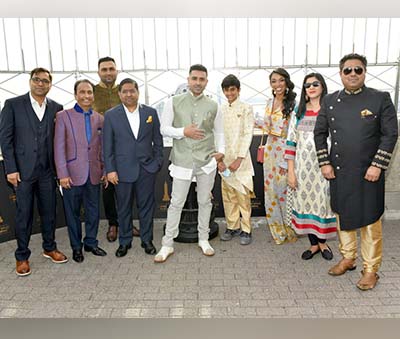
 Vice President Sales of Empire State Building Patricia Niscior wished the community the world over a Happy Diwali and invited them to participate and visit the World famous Empire State Building. FIA Chairman Ankur Vaidya and President Elect Kenny Desai also conveyed the Diwali wishes to all the community addressing the media, Jay Sean and Thara conveyed their warm Diwali wishes to the community.

The annual event, which began in 2018, is organized in cooperation with the Empire State Realty Trust. Each year for the past two decades, ESRT and FIA have been lighting up the Empire State Building in August in the colors of the Indian tricolor – orange, white and green – to mark India’s Independence Day.

The FIA believes that such gestures by ESRT help in spreading the ancient Indian philosophy of ‘Vasudeva Kutumbakam’ (the world is one family) and also demonstrates a great harmony in spirit and deeds between people of the world’s largest and oldest democracies, the organization stated in a press release. Despite the challenges and changes due to the Covid-19 pandemic, FIA has not deterred from its goal of serving the community, it said.

Joe Biden, Jill Biden, & Kamala Harris Greet Indian Americans During Diwali

President Joe Biden and First Lady Jill Biden joined Indian Americans in celebrating Diwali, festival of lights, on November 4. A photo shared by the White House on Twitter showed the Bidens lighting diyas with candles.

In a message, President Biden stated: “Like many cherished holidays during the pandemic, we know this year’s Diwali carries an even deeper meaning. To those who have lost loved ones, we hope this sacred time provides comfort and purpose in their memory.

“To those who celebrate here in America, we are grateful to you for making the traditions of Diwali part of America’s story. For generations, you have opened your homes and hearts during Diwali to exchange gifts and sweets, host feasts with family and friends, and organize cultural programs in our communities – with prayers and dances, vibrant and colorful art, and sparklers and fireworks – that bring us all together.
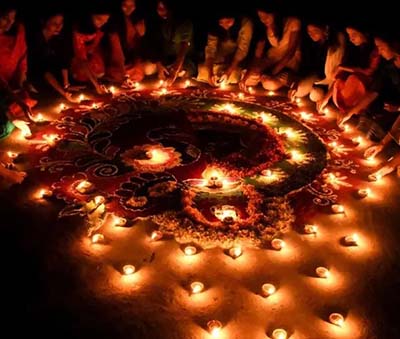
“May the spirit of Diwali remind us that out of darkness there is light in knowledge, wisdom, and truth. From division, there is unity in common bonds of empathy and compassion. From isolation, there is community in the connections we share as we look out for one another and hope, dream, and believe in possibilities.

“That spirit is what we reflected upon in the simple act of lighting a diya, a small candle that carries such profound meaning. From the People’s House to yours, may the light shine within us all as a powerful source of healing, repair, and renewal – a light that shines on who we are and what we can be at our best as a people and a nation. On behalf of our family, we wish you a happy Diwali,” Biden said in his Diwali greetings.

Vice President Kamala Harris, an Indian American, also issued a statement greeting Diwali. She said, “This year Diwali arrives with even deeper meaning in the midst of a devastating pandemic. The holiday reminds us of our nation’s most sacred values, our gratitude for the love of family and friends, our responsibility to lend a hand to those in need and our strength to choose light over darkness, to seek knowledge and wisdom and to be a source of goodness and grace. Let’s remember to honor the light within one another. From our family to yours I wish you a joyous Diwali.”

Diwali Across the US

More than a hundred guests, including several Indian-American community leaders from Illinois, attended the Nov. 3, 2021 Diwali celebrations hosted by Democratic Congressman Danny K Davis of Chicago, at the National Democratic Club in Washington D.C. The event was headlined by House Speaker Nancy Pelosi, the third highest elected official in the country.

Speaker Pelosi lit the traditional Indian lamp, a press release from Rep. Davis’s office said. Several prominent elected officials including Congressman Richard Neal, (D- Massachusetts), Chair, U. S. House Ways & Means Committee among others joined the celebration. Well known Bharat Natyam exponent, Indrani Davaluri, extended a traditional welcome Pelosi and Neal at the event.

Congresswoman Carolyn B. Maloney, D-NY, chairwoman of the Committee on Oversight and Reform, joined on Nov. 3, 2021, with Congressmen Raja Krishnamoorthi, D-IL, and Gregory Meeks, D-NY, chair of the House Foreign Affairs Committee, and New York, as well as national advocates to announce the introduction of the Deepavali Day Act. This legislation would make Diwali a nationally recognized federal holiday.
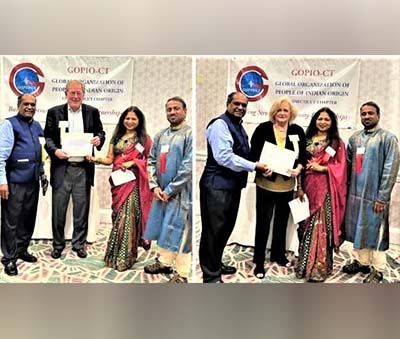
The announcement was carried live on Rep. Maloney’s twitter account. The new Mayor-elect of New York City, Eric Adams, has declared he was committed to “sign (Diwali) into a holiday” when he takes office Jan. 1, reported the news outlet thecity.nyc.

Maloney supported by several lawmakers, is going national with that idea. “I want to start by wishing a Happy Diwali to all those celebrating around the world this week as the time of reflection and renewal that marks the Hindu New Year comes to a close,” Rep. Maloney said in the live Tweet.  “This beautiful festival celebrates lightness over dark, goodness over evil, and knowledge over ignorance. My bill today recognizes the importance of this beautiful holiday and gives it the respect and acknowledgement it deserves.”

“I’m proud to join Chairwoman Maloney and our colleagues in introducing this legislation to establish Diwali as a federal holiday in recognition of its importance to our nation’s more than three million Americans of Indian descent, including Hindus, Sikhs, and Jains,” said Rep. Krishnamoorthi. “The meaning of this legislation extends beyond honoring the significance of Diwali to the Indian-American community to acknowledging the contributions of Indian-Americans to our nation.”

Rep. Meeks also expressed his support, saying, “The United States of America is about celebrating the different cultures that make us one. I understand the importance of the festival of lights and hope we can soon make this a reality for members of the Indian diaspora in my district and Indian Americans all over the country.”

GOPIO-CT Celebrates Diwali By Supporting Local Charities

The Connecticut Chapter of the Global Organization of People of Indian Origin (GOPIO-CT) celebrated Diwali, the Festival of Light, by supporting local charities in Stamford CT. Diwali is celebrated in India and the Indian Diaspora as a celebration of light over darkness and good over evil. In the spirit of the celebration, the Global Organization of People of Indian Origin, Connecticut Chapter (GOPIO-CT) invited the community and friends for Diwali Dinner with music and dance at the Hampton Inn and Suites in Stamford, CT, where it donated funds for the local charities.

The charities receiving funds were Future 5 of Stamford (https://futurefive.org/) and the Food Bank of Lower Fairfield County Inc. (https://www.foodbanklfc.org/). Together, both organizations received $20,000 from GOPIO-CT. The checks were accepted by Future 5 Founder Clif McFeely and Food Bank’s Executive Director Kathleen Lombardo.

Future 5 helps underprivileged students in the Stamford High School system. Future 5 envisions a world where all students can be part of a vibrant and supportive community and access the people and resources they need for college, career and life success.
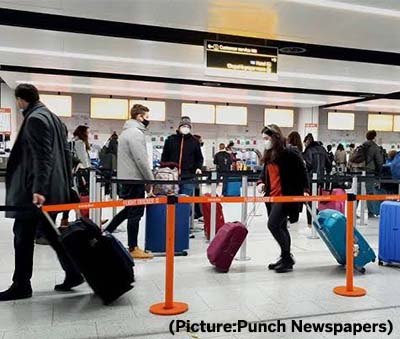
Future 5 believes in human potential. In particular, the potential for each and every young person who climbs the stairs to find success in life.

The Food Bank of Lower Fairfield County was originated in 1984 as a program of the Council of Churches and Synagogues. Today the Food Bank of Lower Fairfield County, Inc., is a 501 (c) (3) charity organization serving in the lower Fairfield County’s primary hunger-relief organizations. It provides food to about 90 non-profit agencies and programs that serve low-income people in six town service area through bags of groceries and congregate meals. These include soup kitchens, food pantries, childcare programs, homeless shelters, senior centers, domestic violence safe houses, and rehabilitation programs.

A special guest at the event was Ms. Yelena Klompus, Program Manager for English Language Learning (ELL), Citizenship & Cultural Programs at Stamford’s Public Library known as The Ferguson Library. The library is planning a Diwali program in cooperation with GOPIO-CT on Sunday, November 14th at 1.30 p.m. Klompus invited everyone to join the program

A music program organized by GOPIO Vice President Dr. Jaya Daptardar followed with singers from Connecticut and included Srini Gunupuru, Devangi Dharani, Div Pithadia, Dipti Haria and Sonali Joshi. GOPIO-CT also announced that it will support one more local charity at a fundraiser at its Holiday Party in December.

“One of the objectives GOPIO is to support local community groups which do service to the larger society and GOPIO chapters have been doing a great job in that direction and GOPIO-CT in particular has been supporting several charities in Connecticut,” Said GOPIO Chairman Dr. Thomas Abraham who is the Founder and currently a Trustee of GOPIO-CT.

Over the last 15 years, GOPIO-CT, a chapter of GOPIO International has become an active and dynamic organization hosting interactive sessions with policy makers and academicians, community events, youth mentoring and networking workshops, and working with other area organizations to help create a better future. GOPIO-CT – Global Organization of People of Indian Origin – serves as a non-partisan, secular, civic and community service organization – promoting awareness of Indian culture, customs and contributions of PIOs through community programs, forums, events and youth activities. It seeks to strengthen partnerships and create an ongoing dialogue with local communities.

Inflation Expectations Among Consumers Hit New Highs, Fed Survey

Americans’ inflation fears continued to accelerate in October, climbing for the 12th consecutive month in a row to another record high, according to a key Federal Reserve Bank of New York survey published Monday, November 8, 2021.

“Median inflation uncertainty – or the uncertainty expressed regarding future inflation outcomes – increased at both the short- and medium-term horizons. Both measures reached series highs in October,” the survey said.

Heads of households surveyed by the New York Fed expected consumer prices to rise by a median of 5.7 percent over the next year, according to the bank’s October Survey of Consumer Expectations.  The one-year inflation rate projected by consumers rose 0.4 percentage points since September and reached the highest level since the survey began in 2013.

The Fed and economists pay close attention to inflation expectations among consumers, particularly long-term expectations, when assessing the future of price increases. Steady increases in consumer inflation expectations could lead to what economists call a wage-price spiral: higher prices prompting workers to hold out for higher wages, which exacerbates the need to raise prices.

With consumers braced for the highest inflation levels in nearly a decade, they are also expecting the price of things like food, gasoline, rent and college tuition to rise over the next year. The only things that Americans expect to get cheaper over the next year are home prices and medical care.

The report is based on a rotating panel of 1,300 households.

Federal Reserve Chairman Jerome Powell has largely attributed the spike in consumer prices to pandemic-induced disruptions in the supply chain, a shortage of workers that has pushed wages higher and a wave of pent-up consumers flush with stimulus cash.

Although Powell has repeatedly said the rise in inflation is likely “transitory,” he acknowledged last week during the Fed’s two-day policy-setting meeting that the surge may not fade until the latter half of 2022. He maintained that wild swings in consumer prices will stop once current pressures on the supply chain dissipate.

“Our baseline expectation is that supply bottlenecks and shortages will persist well into next year and elevated inflation as well,” Powell told reporters. “And that, as the pandemic subsides, supply chain bottlenecks will abate and job growth will move back up. And as that happens, inflation will decline from today’s elevated levels.”

His comments came after the Federal Open Market Committee voted to begin pulling back on the extraordinary stimulus it has given the economy since March 2020. The U.S. central bank announced that it would reduce its aggressive bond-buying program by $15 billion a month in mid-November, lowering its purchases of long-term Treasury bonds by $10 billion a month and purchases of mortgage-backed securities by $5 billion a month.

US Reopens Borders To Fully Vaccinated, After 20 Months

The U.S. opened its doors to international travelers on Monday after more than 18 months of COVID-19 restrictions, and some airports across the world celebrated the milestone with pomp and circumstance.

Starting Monday, November 8, 2021, fully vaccinated international travelers will be permitted to enter the U.S. as long as they show proof of inoculation and present a negative COVID-19 test that was taken within three days of travel. The new policy, which was first announced last month, applies to both land borders and air travel.

The United States is largely wide open, although there are some state and local restrictions that still apply. For example, there are mask mandates in Hawaii, Illinois, New Mexico, Nevada, Oregon and Washington. Washington, DC and Puerto Rico also require masks in indoor public spaces.
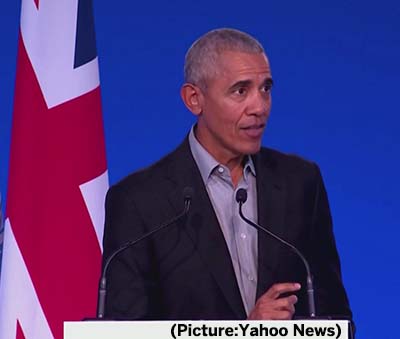
In some cities, including New York and San Francisco, there are vaccine requirements for indoor public spaces including restaurants, reported CNN.

Hawaii, which had some of the strictest entry requirements in the US, will now align with the new federal rules for international air travel. Although capacity restrictions in the state are easing, there are still some limits in place.

Getting vaccinated is the key requirement for the vast majority of international travellers hoping to enter the United States, reported CNN. Children under 18 are exempt from the vaccination requirement. The CDC has the full slate of air travel requirements on its website.

Travelers must meet CDC criteria for being “fully vaccinated.” Paper and digital documentation are acceptable. Airlines are responsible for gathering and verifying this information from air travelers.

Air travelers also need a negative COVID-19 test. Testing is required of all fully vaccinated air travelers ages 2 and up, regardless of nationality. Passengers are required to test negative for COVID-19 within three days of their flight’s departure for the United States.
Unvaccinated Americans and a very limited number of unvaccinated international travellers exempted from the vaccination requirement must test within one day of departing for the US.

Many airlines have mobile apps and portals on their websites where vaccination and testing information can be processed digitally, reported CNN.

Customs and Border Protection anticipates an increase in travel volumes and wait times at land and ferry crossings and is encouraging travelers to have their identification and vaccination documents ready. The agency also encourages travelers to use its CBP One app. Staffing levels will be at pre-Covid levels, according to CBP, but the agency will be balancing multiple priorities.

“Trade and travel facilitation remain a priority,” a Department of Homeland Security Q&A about the new policy says. “However, we cannot compromise national security which is our primary mission.” Digital and paper documentation is acceptable for proof of vaccination, and vaccine cards do not need to be in English.

Travelers should be prepared to attest to their vaccination status and reason for travel. They should also be prepared to show proof of being fully vaccinated if requested by a CBP officer. Covid tests are not required at land and ferry crossings. The web of rules and requirements to travel internationally right now is undeniably tangled, reported CNN.

The U.S. opened its doors to international travelers on Monday after more than 18 months of COVID-19 restrictions, and some airports across the world celebrated the milestone with pomp and circumstance.

Starting Monday, fully vaccinated international travelers will be permitted to enter the U.S. as long as they show proof of inoculation and present a negative COVID-19 test that was taken within three days of travel. The new policy, which was first announced last month, applies to both land borders and air travel.

Travelers can be inoculated with the Pfizer-BioNTech, Moderna or Johnson & Johnson vaccines, all of which are authorized in the U.S., in addition to shots approved for emergency use by the World Health Organization, including AstraZeneca, Covaxin, Covishield, BIBP/Sinopharm and Sinovac, according to the Centers for Disease Control and Prevention.

Obama Urges World To Do More At Climate Summit

Former President Obama made an appearance at the U.N. Climate Change Conference (COP26) in Glasgow where he praised the global community for making “meaningful progress” on tackling the climate crisis, while warning “we are nowhere near where we need to be yet.” 

Obama, whose administration helped negotiate the 2015 Paris Agreement that pledged to keep global warming below 1.5 degrees Celsius (2.7 degrees Fahrenheit), said nations “have not done nearly enough to address this crisis.”

The 44th U.S. president commended the private sector’s push to set net-zero emissions targets and also touted emissions reductions targets set in the U.K. and the European Union, while pointing out the absence of Chinese and Russian leaders from the summit.
GLASGOW, Nov 8 (Reuters) – Former U.S. President Barack Obama returned to the international spotlight Monday in Glasgow, urging young people to pressure their leaders to do more to combat climate change.

Agreeing with youth campaigners, Obama said “time is really running out.” “You are right to be frustrated,” he said. “Folks in my generation have not done enough to deal with a potentially cataclysmic problem that you now stand to inherit.”

Obama told U.N. delegates that he found it “particularly discouraging” to see the leaders of China and Russia skip the Glasgow talks. Minutes later, he called out Republican politicians back home for hindering progress on climate action.

Russian, Chinese and others’ “national plans so far reflect what appears to be a dangerous lack of urgency and willingness to maintain the status quo on the part of those governments, and that’s a shame,” he said. Obama arrived at the start of the crucial second week of the U.N. summit, as negotiators work to iron out the details of an agreement that will clarify and strengthen the 2015 Paris Agreement climate pledges.

He also sought to assure world leaders that the United States was indeed back at the negotiating table as a credible partner. “I recognize that we are living in a moment when international cooperation has atrophied – in part because of the pandemic, in part because of the rise of nationalism and tribal impulses around the world, in part because of a lack of leadership on America’s part for four years” under former U.S. President Donald Trump, who weakened climate protections.

Obama appeared on a panel with leaders from island nations vulnerable to climate-fueled sea level rise. Speaking directly to Obama, Fiji’s Prime Minister Frank Bainimarama noted that the United States and other developed nations failed to meet a 2020 deadline for offering $100 billion a year in promised funding for those countries. Rich nations now say the funds will be available in 2023.

“Among others, the USA is woefully short of paying its fair share of climate finance,” Bainimarama said. “Now we, the most vulnerable, are told to suck it up and wait.”

Obama tried to shine a light on progress made since the Paris deal, which his administration helped broker. But he acknowledged that deal was only meant as a starting point, with countries expected to “constantly ratchet up” their ambitions. “Most nations have failed to be as ambitious as they need to be,” he said.

Biden is “constrained in large part by the fact that one of our two major parties has decided not only to sit on the sidelines but express active hostility toward climate science,” Obama lamented. Obama said he is convinced that President Joe Biden, his former vice president, will get the U.S. Congress to pass a bill to spend $555 billion on climate change.

Akshay-Katrina’s Sooryavanshi Breaks Records With Highest Earnings

The much-awaited Sooryavanshi movie starring Akshay Kumar and Katrina Kaif was released on Friday. A lot of money was earned at the box office with Suryavanshi’s release breaking past records in India and around the world.

After earning the whopping amount of Rs 26.29 crore on its opening day, one of the much-anticipated films of the year ‘Sooryavanshi’ maintained its charm on the second day as well and minted Rs 23.85 crores on the second day of its release. On the 3rd day, it is expected that the film will do business between 25 and 28 crores on the third day.

Although there was a slight dip in the movie’s second-day collection, it managed to enter the Rs 50 crores club at the box office on the second day of its release. Film critic and movie trade analyst Taran Adarsh took to Twitter and shared a breakdown of the first two-day earnings of the film. He also said that the movie has the potential to touch Rs 80 crores on Day 3.
Sooryavanshi crosses Rs 50 cr… SUPER-STRONG HOLD on Day 2… Slight dip in night shows vis-a-vis Day 1… Expect a BIGGG SCORE on Day 3, should comfortably cross Rs 75 cr, may even touch Rs 80 cr [+/-], PHENOMENAL… Fri 26.29 cr, Sat 23.85 cr. Total: Rs 50.14 cr. #India biz,” he tweeted.

After facing several hardships, filmmaker Rohit Shetty’s ‘Sooryavanshi’ was finally released in theatres on Friday. On Thursday night, Rohit took to Instagram to share that his cop drama is ‘releasing across all multiplexes and single screens all over the country.’ The film was held back for almost two years due to restrictions imposed by the Corona epidemic. The film’s release in theatres seems to be reaping tremendous benefits for Rohit Shetty.

For the unversed, the advance bookings were not opened for the Akshay Kumar-starrer till Thursday night due to a tiff between the producers and exhibitors on revenue sharing. Reportedly, the producers of the film demanded a 60 per cent revenue share in the first week and also wanted theatre owners to provide a maximum number of shows to ‘Sooryavanshi’.

Thankfully, the stalemate between multiplex chains and the producers of ‘Sooryavanshi’, Reliance Entertainment finally ended. The cop drama was originally slated to release on March 24 last year but was delayed due to the COVID-19 pandemic, which led to the shutting down of cinema halls.

‘Sooryavanshi’ is a continuation of the cop action ‘Singham’ universe, which began with the Ajay Devgn starrer ‘Singam’ and ‘Singham Returns’, then expanded with ‘Simmba’, starring Ranveer Singh and Devgn, and now is going forward with Akshay Kumar’s character. Apart from Akshay, ‘Sooryavanshi’ also features Katrina Kaif in the lead role.
With the 1993 serial blasts in Mumbai as the starting point, Rohit Shetty’s ‘Sooryavanshi’ traces the terrorist activities of a militant group whose chief, Omar Hafeez (Jackie Shroff), remote-controls their actions from Pakistan.

How DCP Veer Sooryavanshi (Akshay Kumar), chief of the Mumbai Anti-Terrorism Squad, along with his team, prevent Hafeez’s sons and the sleeper cells based across India, who are galvanized into action to destroy India, particularly Mumbai, forms the crux of this film that extends to two hours and a half.

While the narrative is strongly reminiscent of Rohit Shetty’s earlier films in terms of flavour and feel, this one is unadulterated entertainment with action, drama, and even a bit of romance thrown in for good measure. There are trite moments when the unity of India and its secular fabric are forced down one’s throat, courtesy of DCP Sooryavanshi’s sermons.

The film, expectedly, belongs to Akshay Kumar, who with his commanding screen presence, credible action, and charisma, hooks the viewers as Sooryavanshi. He may not be offering anything new by way of histrionics, but there is comfort in his familiar style and his action scenes are a treat to watch.

The scene where he is chasing Sikander Kher and lifts him onto a flying helicopter from a speeding motorboat is superbly choreographed.

Akshay Kumar is ably supported by an ensemble cast of actors which includes Kumud Mishra as Bilal Ahmed, Vivan Bhatena as Vivan and Gulshan Grover as Kadar Usmani, all of whom perform well, enhancing the quality of the film. Abhimanyu Singh as Riaaz Hafeez, the key leader of the mission and Jackie Shroff’s son, delivers a strong performance. Katrina Kaif as Sooryanshi’s wife, Dr Ria, merely adds to the glamour quotient.

Sleek action and daring acts with cars overturning and structures being blown off characterize the film, in Rohit Shetty’s inimitable style. Of course, one must not stop to analyse or seek rationale, else disappointment sets in.

The dialogues are powerful, hard-hitting, and seem real in the given context, and at times even succeed in arousing a patriotic fervor.

Cast: Akshay Kumar, Katrina Kaif, Ajay Devgn, Ranveer Singh, Jaaved Jaaferi, Gulshan Grover, Abhimanyu Singh, Jackie Shroff, Sikandar Kher, Nikitin Dheer, Vivan Bhatena and Kumud Mishra.

Mahatma Gandhi Engraved On UK Coin

A new 5 pound coin to commemorate the life and legacy of Mahatma Gandhi was unveiled by Chancellor Rishi Sunak to mark the Hindu festival of Diwali.

Available in a range of standards, including gold and silver, the special collectors’ coin was designed by Heena Glover and features an image of a lotus, India’s national flower, alongside one of Gandhi’s most famous quotes — “My life is my message”.

Building on the enduring relationship and cultural connections between the UK and India, it is the first time that Gandhi has been commemorated on an official UK coin with the final design chosen by Sunak, who is the Master of the Mint.
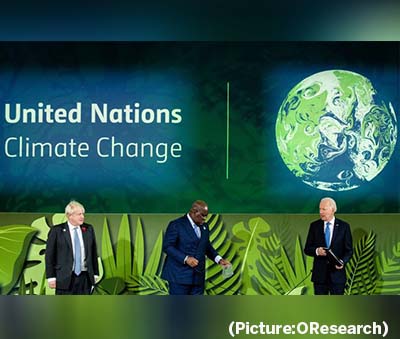
“This coin is a fitting tribute to an influential leader who inspired millions of people around the world,” he said.

“As a practicing Hindu, I am proud to unveil this coin during Diwali. Mahatma Gandhi was instrumental in the movement for Indian independence and it is fantastic to have a UK coin commemorating his remarkable life for the first time.”

The coin, which goes on sale, is part of the Royal Mint’s wider Diwali collection, which includes 1g and 5g gold bars in henna-style packaging, and the UK’s first gold bar depicting Lakshmi — the Hindu Goddess of wealth.

The 20g gold Lakshmi bar was designed in partnership with the Hindu community in South Wales, where the Royal Mint is based.

The Mint will join the celebrations at the Shree Swaminarayan Temple in Cardiff, where worshippers will offer prayers to goddess Lakshmi and lord Ganesha for the coming year.

Chief Customer Officer for The Royal Mint, Nicola Howell, said: “As we approach Diwali celebrations, we are delighted to unveil the first official UK coin commemorating the life and legacy of Mahatma Gandhi. The beautiful design builds on the enduring relationship and cultural connections between the UK and India.”

The announcement comes as India is celebrating its 75th year of Independence this year. Last year, the Chancellor commissioned the new “Diversity Built Britain” 50p coin following discussion with the ‘We Too Built Britain’ campaign, which works for fair representation of minority communities’ contributions across all walks of life.

Around 10 million of the coins, which recognise and celebrate Britain’s diverse history, went into circulation in October 2020.

105 Countries At Climate Summit Pledge To Limit Methane

The  announcement on November 2nd, 2021 by 105 countries, representing two thirds of the global economy, joining a U.S. and E.U.-led coalition to cut up to 40% of methane emissions by 2030 has been the most positive outcome from the ongoing Climate Summit from Glasgow.

Despite the fact that the world’s biggest methane emitters—China, Russia and India, which together contribute 35% of methane emissions—have not signed on, it’s a significant step that could go a long way toward meeting the climate conference’s goal of limiting global warming to 1.5°C above pre-industrial levels.

The Global Methane Pledge announced today at COP26 in Glasgow, UK, commits signatories to reducing their overall emissions by 30 per cent by 2030, compared with 2020 levels. The US government also published a detailed blueprint of how it intends to meet the goal.

The new initiative emphasises making cuts by tackling methane leaking from oil and gas wells, pipelines and other fossil fuel infrastructure. Significant amounts of the gas also come from other sources, such as livestock farming and decaying waste in landfill sites.

While international climate summits usually focus mostly on carbon dioxide, the dominant driver of the 1.1°C of global warming that has occurred since pre-industrial levels, methane is responsible for about 30 per cent of global warming to date, and atmospheric concentrations of the gas have surged since 2007, sparking concern from scientists.

Methane is the second-largest contributor to global warming after carbon dioxide and is responsible for more than a quarter of current global warming, says Ilissa Ocko, senior climate scientist at the Environmental Defense Fund (EDF). “Cutting methane is the fastest, most effective way to slow down warming now.” The pledged reductions alone would slash warming projections by 0.2°C, according to the United Nations Global Methane Assessment.

According to analysts, Methane emission reductions from oil and gas production are the low-hanging fruit of the climate crisis: easy to fix with existing technology, and easy to track. Methane is the principal component of the natural gas used for cooking, heating and energy generation.
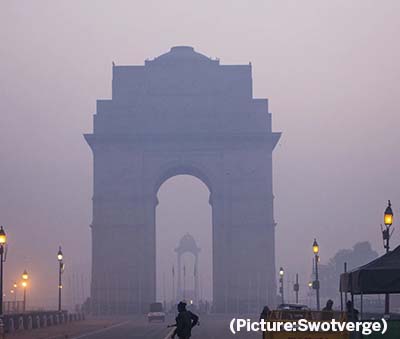
Human activity accounts for about 60% of global methane emissions annually, and about a third of that comes from the fossil fuel industry, according to the International Energy Agency’s 2020 Methane Tracker. Unlike carbon dioxide, which is a by-product of fossil fuel combustion, no one wants to actually emit methane, it’s just that up until recently, no one noticed, or cared, if it escaped into the atmosphere.

The Paris Agreement called for holding temperature rise to “well below 2°C,” and the countries gathered in Paris called upon the U.N.’s climate science arm to research the effects of climate change at a 1.5°C limit. The resulting report warned that even that seemingly low level of temperature rise would be catastrophic and, in doing so, galvanized a push for a more ambitious climate agenda. Today, 1.5°C is the reference point for business leaders, government officials and activists alike.

The Glasgow pledge has been hailed as “game-changing” by US president Joe Biden, who has worked with the European Union to lead the initiative. “One of the most important things we can do to keep 1.5°C in reach is reduce our methane emissions,” he said. Biden said he would tackle US methane emissions using regulations from the US Environmental Protection Agency and the Department for Transportation, which has responsibility for some gas pipelines.

In yet another big announcement made, over 100 countries have pledged to end global deforestation by 2030, with rich countries agreeing to send $19 billion dollars in public and private finance to help forested countries keep trees in the ground. It’s not the first such promise—40 countries already committed to the 2030 target in 2014. But advocates say the scale of the new deal, which covers 85% of the world’s forests, is promising, as are accompanying initiatives announced by businesses and the finance sector.

Canadian prime minister Justin Trudeau announced his country would cut methane emissions from its sizeable oil and gas industry by 75 per cent by 2030. That is how fast the International Energy Agency says methane emissions will need to be cut if the world is to reach net zero by mid-century.

The voluntary pledge is backed by 15 of the world’s biggest methane emitters including the European Union, Indonesia and Iraq. In total, 105 countries have signed up and John Kerry, the US president’s special envoy on climate, said he expects the number to grow.

India Announces Net Zero Emissions Goal For 2070

India has promised to cut its emissions to net zero by 2070 – missing a key goal of the COP26 summit for countries to commit to reach that target by 2050. Prime Minister Narendra Modi pledged on Monday, November 1st, 2921 in his speech at the opening of the COP26 U.N. climate summit in Glasgow, a target that climate advocates recognized as further off than is ideal but potentially transformative for the world’s third-largest emitter.

The announcement—which was accompanied by four other climate-related targets, all light on detail—caught climate advocates by surprise, given that Indian officials have previously rejected global pressure to make such a commitment, saying as recently as last week that net-zero goals were not the solution to the climate crisis. The Indian leader is one of more than 120 leaders to have gathered in Glasgow for the two-week conference.

Prime Minister Narendra Modi, who is in Glasgow, England for the climate summit, has announced that the country would make one billion-ton reduction in projected emissions from now until 2030.  He also increased India’s previous climate targets on renewable energy and non-fossil fuel energy made during the Paris Agreement.

India is the world’s fourth biggest emitter of carbon dioxide after China, the US and the EU. But its huge population means its emissions per capita are much lower than other major world economies. India emitted 1.9 tons of CO2 per head of population in 2019, compared with 15.5 tons for the US and 12.5 tons for Russia that year.

A net-zero target refers to the date by which a country plans to be adding no more carbon dioxide or other greenhouse gases to the earth’s atmosphere than it sucks out of it, using carbon-absorbing plants and still-developing technologies. Dozens of countries have set net-zero targets over the last few years, with most wealthy nations, including the U.S., the U.K., Japan and others, opting for a 2050 goal. China, Saudi Arabia and Russia have all recently pledged to hit net-zero by 2060.

It’s not immediately clear if India’s 2070 net-zero target refers only to carbon dioxide emissions, which is responsible for around 80% of the warming effect that is driving up global temperatures, or to emissions of all greenhouse gases.

The 20-year lag behind other powerful nations’ targets may make India’s goal seem unambitious. If other major emitters were to align efforts along similarly extended time frames, the world would have no hope of avoiding the worst consequences of climate change.

But Ulka Kelkar, climate director of the India chapter of the World Resources Institute, a prominent scientific research group, says India’s goal has to be considered in the context of a developing country. Developed countries have used fossil fuels to power their industrialization for centuries and therefore have more resources available now to transition away from them.

“If it is net-zero greenhouse gas emissions, then I would say it’s on par with Western commitments,” Kelkar told a press call Monday evening. “The fair comparison, I would say, is not with the U.S. and Europe as of today, but with the U.S. and Europe of 20 or 30 years ago. That’s where we are in our development trajectory.”

India’s developing economy is still heavily reliant on coal, the most polluting fossil fuel, which makes up 70% of its energy production. Coal consumption in the country has increased by 39% over the last decade, and, because it has a population of 1.3 billion people, almost half of them under 25, the International Energy Agency says that India’s energy needs will rise by more than any other country over the next 20 years.

Kelker admitted that it would “of course” have been better to have an earlier target, but said that the announcement would have a significant impact by setting a “direction of travel” for India’s economy. ”Net zero became a topic of public discourse only six months ago. Just having this concept understood in India is going to give a very strong signal to all sectors of industry and society. So this coming from the Prime Minister is going to be pretty transformative.”

Modi also announced that by 2030, India would shave 1 billion metric tons off its projected carbon emissions and reduce the carbon intensity of its economy—how much carbon is emitted to generate a unit of economic activity—by 45% from 2005 levels. That’s up from the 33%-35% target it submitted in Paris in 2015. The country also plans to get half of its energy from renewable sources by 2030, increasing its non-polluting energy capacity to 500GW, up from a 450GW goal set in 2015.

A lot remains unclear about these targets. Modi did not specify, for example, against what baseline the plan to reduce carbon emissions by 1 billion metric tons by 2030 is set. In 2019, India emitted 2.62 billion metric tons of CO2. The baseline that the government ends up using will likely be higher, Kelker says.

In any case, reaching these targets will be a challenge. As of July 2021, India had 96.96 GW of renewable-energy capacity—representing 25.2% of its total power generation capacity. Reaching Modi’s 2030 targets will require huge investments in updating India’s electricity grid and setting up new clean energy projects.

Modi also used his speech to call on developed countries to mobilize $1 trillion of climate finance to help developing countries decarbonize and adapt to climate change. That is far higher than the current $100 billion commitment—which originally had a 2020 deadline but has now been pushed back to 2023.

Democrats Ready To Vote On Deal Achieving Biden Agenda

After months of tense talks, delayed votes and internal clashes, Democratic leaders are on the cusp of solidifying a deal on President Biden’s sweeping domestic agenda, setting the stage for the House to vote on both a bipartisan infrastructure bill and a larger social benefits package in the coming days, media reports stated.

Party leaders have announced a hard-fought agreement on a proposal to rein in prescription drug costs — which stood among the last stubborn divisions between liberals and party moderates — and lawmakers said they were also nearing a deal on a new tax cut for those living in high-income regions of the country, which was demanded by centrists.

Speaker Nancy Pelosi (D-Calif.) said the final language of the social spending package could be released as early as October 2nd night — “That’s the hope,” she said — and across the Capitol, Senate Majority Leader Charles Schumer (D-N.Y.) said the upper chamber is aiming to consider the legislation on the week of Nov. 15.  “We’re coming to our conclusions,” Pelosi said.

Congressional Democrats unveiled updated text of the Build Back Better Act (H.R. 5376) on Oct. 28. The $1.75 trillion social spending package is a scaled-back version of the budget reconciliation legislation originally advanced by several House committees of jurisdiction in September.

“We have a bill,” Progressive Caucus Chair Pramila Jayapal (D-Wash.) declared Tuesday. “We did not have that last week” when Biden came to Capitol Hill. “We had a wish and a prayer and a promise and a framework … And now we’re going to have a vote on both bills.” “The day-by-day stuff — it all fades away,” said Rep. Matt Cartwright (D-Pa.). “I’m feeling really good about it.”

Speaking with CNN’s Victor Blackwell on “CNN Newsroom,” Jayapal said that after spending the weekend reviewing the legislative text and conferring with the progressive caucus, she is ready to pass the $1 trillion bipartisan infrastructure bill as well as the $1.75 trillion social safety net expansion bill once a few details in the latter are finalized. Progressives, who have so far held up the bipartisan measure by demanding a concurrent vote on the larger package, trust that Biden can get all Democratic senators on board with the social safety net legislation, she said.

“The President said he thinks he can get 51 votes for this bill. We are going to trust him. We are going to do our work in the House and let the Senate do its work,” the Washington state Democrat said. “But we’re tired of, you know, just continuing to wait for one or two people.”

Republicans have lashed out throughout the process, attacking Biden’s social benefits package as a dangerous case of government overreach while characterizing the majority Democrats as ineffective legislators. Not a single GOP lawmaker in either chamber is expected to support the $1.75 trillion legislation.

Democrats dismissed those criticisms outright, saying the messy infighting is part of the routine “sausage-making” that goes into crafting any major legislation. Those tensions will be long forgotten, Democrats maintain, when the president’s agenda is enacted and the numerous family benefits begin to reach workers and families across the country.

Even as Democrats were celebrating, however, there were reminders that more work needs to be done to get the two bills to Biden’s desk. Sen. Joe Manchin (D) — the centrist West Virginian who’s led the effort to scale back Biden’s social safety net expansion — declared Tuesday that he hasn’t endorsed a framework Biden unveiled last week, let alone a final bill.  “There [were] a couple of concerns that we had that we needed to work through,” Manchin said.

Still, Biden predicted late Tuesday that Manchin will ultimately get on board.  “He will vote for this if we have in this proposal what he has anticipated,” Biden told reporters in Scotland, where the president has been participating in a global climate summit — a gathering  that’s only increased the stakes for securing the climate provisions in his social spending package. “We’re going trust the president that he’s going to deliver 51 votes. He’s confident he can deliver 51 votes. We’re going to trust him,” Jayapal said.

The agreement would empower Medicare to negotiate drug prices in limited instances; prevent drug companies from raising prices faster than inflation; and cap out-of-pocket costs for seniors on Medicare at $2,000 per year.

Tuesday’s drug pricing deal was scaled back significantly from House Democrats’ original proposal in order to win support from key moderates who contended a more sweeping overhaul would have harmed innovation from drug companies to develop new treatments. A trio of moderates — Sen. Kyrsten Sinema (D-Ariz.) and Reps. Scott Peters (D-Calif.) and Kurt Schrader (D-Ore.) — helped negotiate the compromise.

“It’s not everything we all wanted; many of us would have wanted to go much further. But it’s a big step in helping the American people deal with the price of drugs,” Sen. Schumer told reporters as he announced the deal.

Diwali Celebrations Showcases Indian Culture At Times Square

New Yorkers got to experience Diwali at the Crossroads of the World, Times Square on Saturday, October 30th, 2021. Even Covid-19 couldn’t put a damper on one of the biggest celebrations in New York City’s iconic Times Square where Diwali was celebrated with pomp and festivity.

Music and dance with colorful and traditional Indian attire  marked Diwali at Times Square which had a special meaning this year coming as it did after the devastating Covid-19 pandemic that has impacted every aspect of our lives.

The event was attended in-person by several dignitaries, including United States Sen. Charles E. Schumer, U.S. Rep. Carolyn Maloney, India’s Consul General in New York Randhir Jaiswal, New York State Sen. John Liu, Padma Shri Sudhir Parikh, chairman of Parikh Worldwide Media and ITV Gold, H.R. Shah of TV Asia, representatives of the Indian Police Officers Society from the New York Police Department, and several other special guests who spoke on stage about the meaning of Diwali and the joy of celebrating it after Covid.
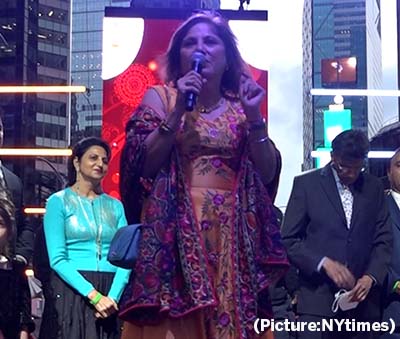
Dr. Parikh thanked Shoprite and for the ‘great function’ of Diwali that it was supporting, and praised the company for the work it did for the community, and encouraged it to continue the good work. “It is an honor to be here at this historic occasion, when the ball will drop for Diwali jus as it does for New Year, which shows how wonderful and important the Indian-American community is here in New ork and all over America,” said  Sen. Schumer.

Sen. Schumer said he believed in immigration and “immigrants make America great” because they believe in the American Dream and embody American values even as they bring their traditions to this country. He bemoaned a rise in hate crimes and emphasized, “We must shout it down. We must fight it. We must prosecute it, and we must welcome more Indians to come to America and New York, because the more Indians there are in New York, the greater New York will be.”

Consul General Jaiswal wished everyone a Happy Diwali for their loved ones and peace and prosperity for all. “More importantly, it is a time when we must introspect on some of the foundational values of our society – on kindness, compassion, sharing, being unified, being together…”

Congresswoman Maloney wished everyone present and dwelt on the need to recognize Mahatma Gandhi with a Congressional Gold Medal, something for which she has introduced a resolution in the House of Representatives. “Look at this amazing crowd!” exclaimed State Sen. Liu. “We are finally getting out of this long dark tunnel of Covid-19.”

This year in contrast to last year, Liu said, the number of Diwali celebrations has risen, “in our schools, in our mandirs, and City Hall,” he said, a tradition he started when he was a New York City Councilor. “There’s no better place to celebrate Diwali than at the ‘Crossroads of the World’, right here in Times Square, New York City. Because this is such an important holiday for billions of people around the world symbolizing the victory of good over evil, light over darkness …”

A unique digital presentation with a massive lighted billboard changing images symbolic of the Festival of Lights, in an attempt to capture the pomp and festivity of this joyous celebration, captured the hearts and minds of thousands who watched and joined in the celebrationbs from around the world. The event was organized by EventGuru Inc., an event management company in the Tristate area.

Diwali at Times Square has been increasing its audience since its inception in 2013. This New York City Diwali celebration usually draws a big crowd and features a diya (lamp) lighting ceremony accompanied by a New Year’s Eve style countdown featured on the tallest Times Square digital screen, followed by a host of rousing concerts.

Presented by Shoprite and organized by Bhasin, the Times Square Diwali was started by event organizer Neeta Bhasin, president of ASB Communications, a New York-based multicultural marketing and event management company. “After the pandemic, we are here to uplift the spirit of the people. And we want to showcase this vibrant India, and India’s culture, art and diversity to the world,” Bhasin said.

Telugu Association Of Greater Chicago Celebrates Golden Jubilee

Telugu Association of Greater Chicago, the first ever Telugu association in North America, organized its 50th year anniversary celebrations on a grand scale over 2 days during last weekend. First day was a spectacular Banquet at the Seville Banquets Streamwood followed by Dussehra and Deepavali celebrations at Naperville Community Church, Yellow Box, Naperville.

The event was described as a grand success with an overwhelming response from the Telugu community with 2000+ guests in attendance over 2 days. Multiple guests from Community, National and Local Telugu organizations, long time Sponsors PMSI Ashok Lakshmanan, NYLife Krishna Rangaraju joined along with Chief Guest U.S Congressman Raja Krishnamoorthy, Dr. Sreenivas Reddy, a member of the National council on White House History and Indian Consulate General’s office represented by Consul Gopal Bhagath.
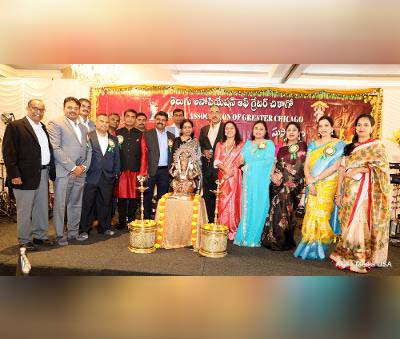
On Banquet day, 2021 President Venkat Gunuganti and 2020 President Praveen Vemulapalli recognized Sponsors and Donors for the past 2 years. Banquet was served with delicious food from Cool Mirchi which included multiple savory and sweet items. Few Past Presidents, long time Sponsors and Members spoke on the occasion and remembered their memories, connections in the last 50 years.

Live Music Concert with well-known singers Manisha Earabathini, Prasad Simhadri, Sarada Akunuri, Srikanth Sandugu, Sruthi Nanduri entertained the audience. Musical band was led by Meher Chanti with his 6 person MLiveBand team.  The musical night rocked and energized guests with continuous nonstop entertainment.

Anchors Kavita Thotakura and Sahitya Vinjamuri kept the whole program lively with their special engagement skills on both days. Event decorations added color to both events and the audience enjoyed the Photo Booths at each location. TAGC Youth volunteers and membership committee welcomed all guests with a smile.

As part of the 50th year celebrations second day “Joruga Husharuga – Dasara and Diwali celebrations”, 250+ participants including kids, youth, couples and senior members of TAGC entertained guests with their performances. Event brought a true festive atmosphere where all the seniors, youth and kids came together under one roof to celebrate the 50-year history of the Telugu community in America and the importance of perseverance.
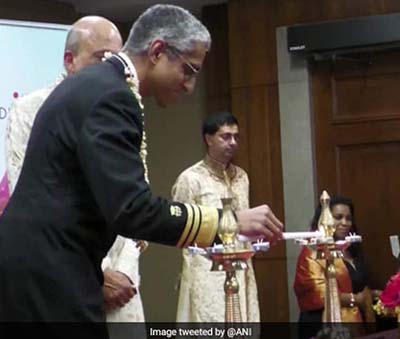
Food committee Chair, Vijay Beeram with his team & volunteers, did a wonderful job in serving delicious dinner for such a massive crowd in the allocated time. Attendees were appreciative of tasty food. Local Indian restaurant Cool Mirchi management supported TAGC with their best qualitative and quantitative food.

After-dinner program started with past-presidents recognition. 23 presidents with their families joined on the stage. Current President Venkat Gunuganti and President-elect Uma Avadutha with help of BoD’s felicitated all past-presidents on the stage. It was a special moment in TAGC history with so many presidents on the stage.  As part of the program, TAGC President-elect Uma Avadutha introduced new 2022-25 BoD’s along with the 2022 EC team. Venkat Gunuganti accompanied with his wife Haritha recognized past President Praveen Vemulapalli and his wife Kranthi for their services and dedication towards the organization with a flower bouquet, shawl, and a plaque.

TAGC 2020 President Praveen Vemulapalli and Kranthi recognized 2019 President Ram Billakanti and his wife Malathi for their services and dedication towards the organization with a flower bouquet, shawl, and a plaque, as there were restrictions on physical events in 2020. Live Music Concert continued on the 2nd day with well-known singers Manisha Earabathini, Prasad Simhadri, Sarada Akunuri, Srikanth Sandugu and Swaravedika team Sruthi Nanduri, Akhila Mamandur coordinated by Krisha Anumolu. Musical band was led by energetic Meher Chanti with his 6 person MLiveBand team.  The musical night rocked and energized guests in the auditorium with nonstop entertainment for almost 3hours. Anchor Kavita and her daughter Radhika entertained with their special dance.

TAGC president, Venkat Gunuganti, past-president Praveen Vemulapalli along with his whole BoD team presented all singers, Anchors, Music Band team members with flower bouquet, Colorful Shawl and 50th year Plaque. Cultural chair Neelima Cheikycharla also thanked all the participants, their parents, coordinators, teachers and the guests for their enthusiastic show of support throughout the evening.

TAGC President, Venkat Gunuganti, thanked the Executive Committee, Board of Directors, Chairs, Co-Chairs, Technical team, Hospitality team, Food team, Membership team and volunteers who have worked for weeks in planning and preparations to make this event memorable. He also conveyed his gratitude and thanks to sponsors for giving back to the community and requested TAGC members to make use of services provided by sponsors. TAGC is planning to release a special 50th anniversary souvenir with content and inputs from past and current members. It is planned to be released by Ugadi 2022.

TAGC cordially invites everyone who wishes to support and bless TAGC’s efforts to spread and preserve Telugu culture & tradition, and to be part of the upcoming exciting events.

Diwali Celebrations Light Up Capitol Hill

United States’ lawmakers and top officials of the White House celebrated Diwali with Indian diaspora on Capitol Hill on Wednesday, October 27th, 2021, honoring some of the top Indian Americans in the US President Joe Biden’s administration. The top Indian Americans who were honored included Vice Admiral Surgeon General Vivek Murthy and Neera Tanden, Senior Advisor and Staff Secretary to President Biden. 

During the celebration, the traditional ‘Diya’ was lit and several high ranking officials made their remarks. “There has been a lot of darkness in the last 1.5 years. To be able to celebrate and talk about the meaning of Diwali, it’s incredibly important,” said Vice Admiral Surgeon Gen Vivek Murthy. “Diwali is about light overcoming darkness, and there has been a lot of darkness in the last year and a half. To be able to celebrate Diwali, to talk about the meaning, to talk about the light in oneself and the light in others in these tough times, means a lot and I’m grateful to be here,” the Surgeon General added.

“But one of the things that concern me most about the last few years is another type of pandemic, the invisible pandemic that we are in the midst of. That’s a pandemic of polarization where it feels increasingly people have turned against each other, where they have demonized one another, called each other evil and treated each other as so. That’s a particular kind of darkness,” he said.

Congressman Ami Bera, Pramila Jayapal, Congressman Ro Khanna and Congressman Raja Krishnamoorthi addressed the community members. Ami Bera highlighted that the Diwali celebration is not only about Indian Americans but also the members of the Congress, which includes both Republicans and Democrats. The event also witnessed an interfaith prayer service that was attended by members of Congress.

Congressman James Clyburn, Steve Chabot, Congresswoman Judy Chu and Congresswoman Carolyn Maloney praised the contribution of Indian Americans in the development of the US and stressed the significance of Diwali in a post-Covid-19 world.

“The Congressmen at the gathering are not just Indian Americans, we have African American, Chinese American, mainstream American Congressman. It’s historic that such a diverse group of congressmen are supporting us,” Rangaswami, founder, Indiaspora told ANI.

“We are honored to celebrate Diwali at Capitol Hill and share our traditions with the leaders who have dedicated themselves to serving the public. The Indian diaspora has had a profound impact on American society, and their diverse contributions continue to strengthen our nation,” said Sanjeev Joshipura, executive director of Indiaspora.

American actress and singer Mary Millben was also present to celebrate Diwali at Capitol Hill. The singer performed the ‘Om Jai Jagdish Hare‘ rendition for the expats and community members too crooned the hymn with the singer. “To see folks come all over the country to celebrate Diwali is so beautiful and meaningful to me. I have a strong relationship with the people of India. It’s a very full-circle moment for me to be with people whom I love and a culture that I love, I am delighted to be here,” Mary Millben said.

Meta—Facebook’s New Name

Facebook CEO Mark Zuckerberg announced on October 28th at his company’s Connect event that its new name will be Meta. “We are a company that builds technology to connect,” Zuckerberg said. “Together, we can finally put people at the center of our technology. And together, we can unlock a massively bigger creator economy.”

What Alphabet is to Google, Meta is to Facebook. Mark Zuckerberg has announced that the company he founded will no longer be called Facebook, but Meta. The change in corporate identity — there’s a new logo too — is meant to reflect the social media behemoth’s new passion: Developing a 3D virtual world.
“To reflect who we are and what we hope to build,” he added. He said the name Facebook doesn’t fully encompass everything the company does now, and is still closely linked to one product. “But over time, I hope we are seen as a metaverse company.”

Facebook, the social media platform, will continue to be called the same — and called out for all the same flaws. It will now be owned by Meta, just as Instagram, WhatsApp, Oculus… and a newly announced Reality Labs. The Labs will be responsible for developing the metaverse that Zuckerberg hopes will be the company’s new identity.

He says: “From now on, we’re going to be the metaverse first. Not Facebook first,” Zuckerberg said. “Right now, our brand is so tightly linked to one product that it can’t possibly represent everything we are doing.”

The brand rename comes amidst intense scrutiny over Facebook’s role in the spread of hate speech and disinformation, thanks to the leaks by whistleblower Frances Haugen. Perhaps Zuckerberg also hopes the rebrand would set a new narrative and help limit the blowback.

But what about the Facebook name, originally derived from its first iteration, FaceMash, in 2003?

“Increasingly it just doesn’t encompass everything we do,” said Zuckerberg. “But right now our brand is so tightly linked to one product that it can’t possibly represent everything we’re doing today or in the future…I want to anchor our identity on what we’re building towards.” So, the parent company becomes Meta—though the social media app remains Facebook.

Meta, Facebook, and the many names associated with it still face the same issues they did moments before the announcement. In the past two months, Instagram has come under fire for severely impacting the self-esteem of younger users, especially those belonging to Generation Z. And leaked internal Facebook documents have shown the company was reluctant to do more to combat vaccine misinformation, the spread of fake news from white supremacist-supporting news outlets, and has devoted remarkably little resources to combatting the spread of harmful content in developing countries where Facebook is the dominant social network.

“You’re going to be able to do almost anything you can imagine,” said Zuckerberg, who described the multiple ways people would interact in VR. Zuckerberg emphasized the metaverse’s immersive potential, in situations like family visits or office meetings. “Instead of looking at a screen, you’re going to be in these experiences,” he said.

Popular Kannada Actor Puneeth Rajkumar dies at 46

Kannada filsstar Puneeth Rajkumar died in Bengaluru’s Vikram Hospital on Friday, October 29th  after suffering a heart attack. Reportedly, his health had taken a turn for the worst on Thursday evening but he did not visit a doctor. After working out in the gym in the morning, he complained of chest pain, following which he was taken to a private clinic where an ECG was done.

During the checkup, his condition worsened and he was rushed to hospital. According to a statement issued by Vikram Hospital, Puneeth was non-responsive when brought in and was in cardiac asystole. His body is to be kept at Kanteerava Stadium for fans to pay homage; the last rites will be performed today with state honours.
Son of matinee idol Rajkumar, Puneeth began his career as a child artiste — he was just six-months-old when he was cast in the 1976 thriller Premada Kanike. He went on to bag his only National Film Award (for best child artist) playing the role of Ramu in Bettada Hoovu. Add to this, the four Karnataka State Film Awards and five Filmfare Awards South won during his career.

Born Lohith, he was known to fans as ‘Appu’ — after the 2002 hit film in which he played his first lead role — and ‘Power Star’. His film credits — 29 of them — as a lead actor include Mourya, Arasu, Raam, Hudugaru and Anjani Putra. He last featured in Yuvarathnaa, that released early this year.

He was also a singer and was admired for his dance skills. Puneeth made his TV debut in 2012 as presenter of Kannadada Kotyadhipathi, the Kannada version of game show Who Wants To Be A Millionaire?

C.S. Venkatakrishnan To Be CEO of Barclays

Barclays new CEO is CS Venkatakrishnan, an Indian-American and the first person of color to hold that position. Mysore-born CS Venkatakrishnan has replaced Jes Staley as Barclays CEO after the latter stepped down on Monday, November 1st. Barclays said succession planning has been in place for some time, and he had been identified as the preferred candidate more than a year ago.

Jes Staley stepped down from Barclays, which is Britain’s third-biggest bank by market value, after a probe into his relationship with financier and sex offender Jeffrey Epstein. The bank said Staley will get a 2.5 million pound ($3.5 million) payout and receive other benefits for a year.

Better known as ‘Venkat’, he studied at Massachusetts Institute of Technology, where he got a PhD in operations research, after which he joined JPMorgan Chase in 1994. At JP Morgan Chase, venkat had held senior roles in Asset Management, where he was Chief Investment Officer for approximately $200 billion in Global Fixed Income, as well as in Investment Banking, and in Risk.

He joined Barclays in 2016. Prior to his appointment as Group CEO, Venkat was Head of Global Markets, Co-President of Barclays Bank PLC (BBPLC), and a member of the Group Executive Committee of Barclays, based in New York. He has also served as Chief Risk Officer at Barclays.

Venkat will be on a higher base salary than his predecessor and will receive £2.7 million ($3.69 million) in fixed pay – half in cash and half in shares. This amount is more than Staley’s 2.4 million pounds a year, it’s still a cut from Venkat’s – undisclosed – fixed pay as head of global markets, Barclays’ board said. Venkat will be eligible for a bonus up to a maximum of 93 per cent of his fixed pay and long-term incentives up to 140 per cent of fixed pay per year and a cash payment instead of a pension of £135,000 a year.

Venkatakrishnan joined Barclays as chief risk officer and initiated a comprehensive review of the bank’s exposure to bad credit card debt. The review led to Barclays taking a £320 million impairment charge after Venkatakrishnan urged the bank to adopt a more conservative approach to predicting how much of its credit card book would not be paid. Venkat is the executive sponsor for Embrace, the global multi-cultural network at Barclays, the bank said in its stock exchange announcement on Monday.

The board “identified Venkat as its preferred candidate for this role over a year ago, as a result of which he moved from the position of group chief risk officer to head of global markets,” London-headquartered Barclays noted in an announcement to the stock exchange. “The board has long been confident in Venkat’s capabilities to run the Barclays Group.”

The executive, known for his “genial unflappability” and “fondness for emojis,” appears to care about diversity. He has made progress on promoting women, Bloomberg reported. Venkatakrishnan is also the executive sponsor for Embrace, the global multi-cultural network at Barclays. He leads the company’s “Race at Work Action Plan,” which has strived to improve diversity at the company where underrepresented minorities comprise just 5% and 21% of the staff in the UK and the US respectively.

The 56-year-old who is now based in New York was born in Mysore, the southernmost city in the southern Indian state of Karnataka. Even now, Venkatakrishnan enjoys a meal at an Indian restaurant that would “serve lunch on orange plastic trays,” Ken Abbott, Barclays’ chief risk officer for the Americas until 2018, told Bloomberg. “He thought that was very authentic.”

Sarala Vidya Nagala Confirmed As Federal Judge In Connecticut

Sarala Vidya Nagala, the first ever Indian American has been confirmed as a federal judge in Connecticut by the US Senate on Oct. 27, 2021. The United States Senate confirmed the Indian-American for a U.S. District Court judge in Connecticut making her the first ever person of Indian origin to be a U.S. District Court Judge in Connecticut’s federal bench for a lifetime appointment, the Hartford Courant noted.

Assistant U.S. Attorney Sarala Vidya Nagala, a career prosecutor, was among several of President Joe Biden’s nominees to be confirmed last week. The 38-year old Nagala was born in North Dakota and educated in Stanford University and University of California.

When she was nominated this June, Nagala was the Deputy Chief of the Major Crimes Unit in the U.S. Attorney’s Office in the District of Connecticut, a role she has held since 2017.

Nagala joined the U.S. Attorney’s Office in 2012, and has served in a number of leadership roles in the office, including as Hate Crimes Coordinator.

Previously, Nagala was in private practice as an associate at Munger, Tolles, & Olson in San Francisco, California from 2009 to 2012.

She began her legal career as a law clerk for Judge Susan Graber on the U.S. Court of Appeals for the Ninth Circuit from 2008 to 2009.

The Hartford Courant quoted University of Richmond law professor Car Tobias saying, “Nagala brings long experience as a federal prosecutor,” noting that the hearing in the U.S. Senate had gone smoothly and their was strong support for her nomination in the upper chamber on Capitol Hill.

Senators Chris Murphy and Richard Blumenthal, Democrats from Connecticut, who recommended Nagala for the nomination, put out a statement Oct. 27, applauded the Senate for confirming her.

She was confirmed in a 52-46 vote with 47 Democrats, 3 Republicans and 2 Independents voting in her favor, according to Ballotpedia’s breakdown of votes.

“Sarala Nagala brings a deep understanding of the criminal justice system to the federal bench, and I was proud to vote to confirm her nomination as a judge for the District of Connecticut. Her years as a federal prosecutor and commitment to her community will prove invaluable to this new role. I’m glad to see her confirmed by the full Senate,” said Murphy.

“Today’s bipartisan confirmation of Sarala Nagala is a testament to her commitment to public service and fidelity to the rule of law,” said Blumenthal. “Her experience as a federal prosecutor fighting the evils of human trafficking and hate crimes will have an immediate impact on our federal bench, where she will now serve as the first Article III judge of Asian and South Asian descent in the District of Connecticut.”

-+=