India Plans 1,000 Routes, 220 Airports By 2026

People will have more options to fly from one city to another as nearly 220 destinations including airports, heliports and water aerodromes with 1,000 routes have been planned to be completed under UDAN regional connectivity scheme.

The Ministry of Civil Aviation’s flagship programme Regional Connectivity Scheme UDAN has completed 5 years of success since the launch of its first flight by the Prime Minister on April 27, 2017.

The scheme was initiated on October 21, 2016 with the objective to fulfil the aspirations of the common citizen by following the vision of ‘Ude Desh ka Aam Nagrik’, with an enhanced aviation infrastructure and air connectivity in tier II and tier III cities.

On the occasion, Minister of Civil Aviation Jyotiraditya Scindia said: “The success of RCS UDAN is a demonstration of the government’s commitment to the Prime Minister’s vision of ‘Ude Desh ka Aam Nagrik’. It has played a great role in the transformation of the Indian aviation industry. So far under this scheme, we have 425 routes aiming to go up to 1,000 routes, 68 new airports aiming to touch 100 airports.

“In the next 4 years, we are expecting 40 crore travellers through Civil Aviation in India. That day is not far when along with rail transport and road transport Civil Aviation will become the bulwark of the transportation in India.”

In the last five years, UDAN has significantly increased the regional air-connectivity in the country. There were 74 operational airports in 2014. Because of the UDAN scheme, this number has increased to 141 by now.

At least 68 under-served/unserved destinations which include 58 Airports, 8 Heliports and 2 Water Aerodromes have been connected under UDAN scheme.

With 425 new routes initiated under the scheme, UDAN has provided air connectivity to more than 29 states/ UTs across the length and breadth of the country. More than one crore passengers have availed the benefits of this scheme as on August 4. (IANS)

2 Indian-Americans To Be Awarded At Asian American Unity Conference In Las Vegas

The content and delivery of the programs at the 2022 NCLF in-person conference were offered by AAUC’s various multi-cultural groups, which represent seven or more ethnicities.

he Asian American Unity Coalition (AAUC) is hosting the National Civil Leadership Forum (NCLF) 2022 convention at the Paris Las Vegas Hotel and Casino, Las Vegas, Nevada from Sept.11–13, 2022. The two-day conference aims to connect Asian Americans who have engaged in noteworthy causes.

Speaking of the event, Angela Anand, vice president, AAUC, said that the conference will have a lot of Indian flavors including Bollywood music and dance along with other Asian communities’ participation. She further added, “I wanted to point out that even in awards and in panels, there is a lot of Indian participation.”

160+ Organizations Join The Fight For Sikh Migrants

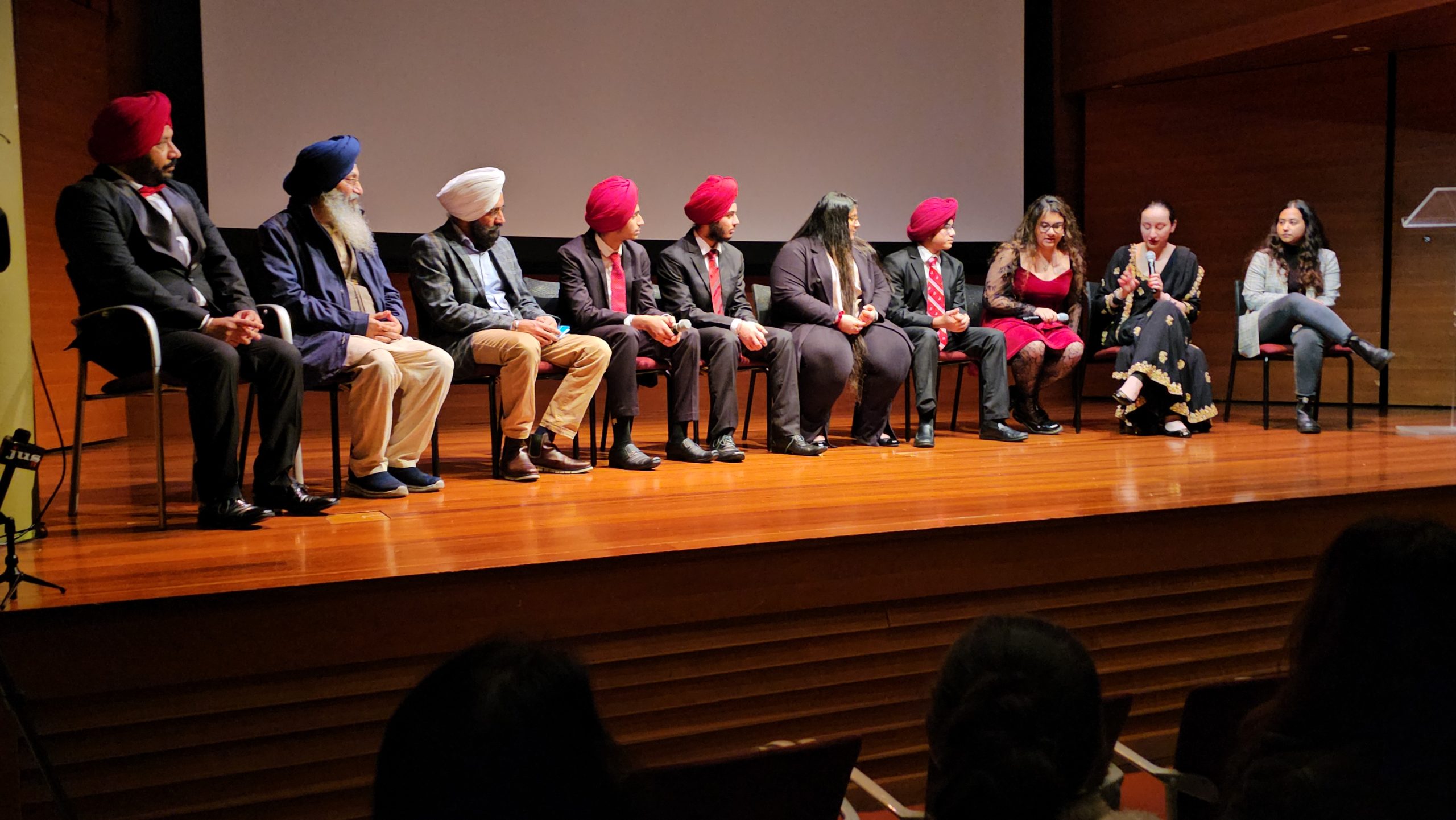
The Sikh Coalition and our allies at the American Civil Liberties Union of Arizona (ACLU-AZ) and the American Civil Liberties Union (ACLU) were joined by more than 160 civil rights, immigration, religious, advocacy, and other organizations in submitting a letter to Secretary of the Department of Homeland Security (DHS) Alejandro Mayorkas regarding the continued mistreatment of Sikhs and other religious migrants at our southern border by U.S. Customs and Border Protection (CBP) officers.

The letter reads in part: “For years, advocates and the media have repeatedly raised concerns about the seizure of religious headwear and other articles of faith, as well as the denial of religious diets by CBP … Time after time, DHS officials have assured the public and stakeholders that they take these concerns seriously, yet the violations continue. Alarmingly, these abuses have gone on for so long that they appear to have become standard operating procedure at the border, supplanting CBP’s own rules.”

As a reminder, in June and July, news began to emerge that CBP officers were confiscating Sikh migrants’ turbans and other possessions and throwing them in the trash. Later reports revealed that some Sikh migrants also have been denied vegetarian meals and were ordered by border officials to eat meat or ‘starve.’ Unfortunately, this misconduct appears to be ongoing: According to our organizational partners on the ground, there have been at least 12 new cases of turban confiscation in August alone.

The Sikh Coalition joined the ACLU-AZ and ACLU to take action by sending a letter to DHS in early August, and we have since continued to press senior DHS leaders to respond in a transparent and comprehensive way. Additionally, we were proud to support a letter sent last week by Reps. Joaquin Castro (D-TX), Raúl Grijalva (D-AZ), and Judy Chu (D-CA) demanding answers about CBP’s treatment of Sikhs and other religious migrants, and we continue to provide information to members of the media working to spotlight this issue. Per public reporting, an investigation of this issue is currently underway.

“Sikh migrants are among the most vulnerable individuals coming to the United States–in many cases, fleeing a well-founded fear of religious persecution in their home countries,” said Sim J. Singh Attariwala, Sikh Coalition Senior Policy and Advocacy Manager. “To have their religious and other rights immediately violated by CBP officers is a cruel irony, and this misconduct should not be tolerated.”

60 Million Years Of Climate Change Drove The Evolution And Diversity Of Reptiles

Artistic reconstruction of the reptile adaptive radiation in a terrestrial ecosystem during the warmest period in Earth’s history. Image depicts a massive, big-headed, carnivorous erythrosuchid (close relative to crocodiles and dinosaurs) and a tiny gliding reptile at about 240 million years ago. The erythrosuchid is chasing the gliding reptile and it is propelling itself using a fossilized skull of the extinct Dimetrodon (early mammalian ancestor) in a hot and dry river valley.

Newswise — Just over 250 million years ago during the end of the Permian period and start of the Triassic, reptiles had one heck of a coming out party.

Their rates of evolution and diversity started exploding, leading to a dizzying variety of abilities, body plans, and traits, and helping to firmly establish both their extinct lineages and those that still exist today as one of the most successful and diverse animal groups the world has ever seen. For the longest time, this flourish was explained by their competition being wiped out by two of the biggest mass extinction events (around 261 and 252 million years ago) in the history of the planet.

A new Harvard-led study has rewritten that explanation by reconstructing how the bodies of ancient reptiles changed and by comparing it against millions of years of climate change.

Harvard paleontologist Stephanie Pierce’s lab shows that the morphological evolution and diversification seen in early reptiles not only started years before these mass extinction events but instead were directly driven by what caused them in the first place — rising global temperatures due to climate change.

“We are suggesting that we have two major factors at play — not just this open ecological opportunity that has always been thought by several scientists — but also something that nobody had previously come up with, which is that climate change actually directly triggered the adaptive response of reptiles to help build this vast array of new body plans and the explosion of groups that we see in the Triassic,” said Tiago R. Simões, a postdoctoral fellow in the Pierce lab and lead author on the study.

“Basically, [rising global temperatures] triggered all these different morphological experiments — some that worked quite well and survived for millions of years up to this day, and some others that basically vanished a few million years later,” Simões added.

In the paper, which published Friday in Science Advances, the researchers lay out the vast anatomical changes that took place in many reptile groups, including the forerunners of crocodiles and dinosaurs, in direct response to major climate shifts concentrated between 260 to 230 million years ago.

The study provides a close look at how a large group of organisms evolve because of climate change, which is especially pertinent today as temperatures continually rise. In fact, the rate of carbon dioxide released into the atmosphere today is about nine times what they were during the timeframe that culminated in the biggest climate change-driven mass extinction of all time 252 million years ago: the Permian-Triassic mass extinction.

“Major shifts in global temperature can have dramatic and varying impacts on biodiversity,” said  Stephanie E. Pierce, Thomas D. Cabot Associate Professor of Organismic and Evolutionary Biology and curator of vertebrate paleontology in the Museum of Comparative Zoology. “Here we show that rising temperatures during the Permian-Triassic led to the extinction of many animals, including many of the ancestors of mammals, but also sparked the explosive evolution of others, especially the reptiles that went on to dominate the Triassic period.”

The study involved close to eight years of data collection and took a heavy dose of camerawork, CT scanning, and loads of passport stamps as Simões traveled to more than 20 countries and more than 50 different museums to take scans and snapshots of more than 1,000 reptilian fossils.

With all the information, the researchers created an expansive dataset that was analyzed with state-of-the-art statistical methods to produce a diagram called an evolutionary time tree. Time trees reveal how early reptiles were related to each other, when their lineages first originated, and how fast they were evolving. They then combined it with global temperature data from millions of years ago.

Diversification of reptile body plans started about 30 million years before the Permian-Triassic extinction, making it clear these changes weren’t triggered by the event as previously thought. The extinction events did help put them in gear though.

The dataset also showed that rises in global temperatures, which started at about 270 million years ago and lasted until at least 240 million years ago, were followed by rapid body changes in most reptile lineages. For instance, some of the larger cold-blooded animals evolved to become smaller so they could cool down easier; others evolved to life in water for that same effect. The latter group included some of the most bizarre forms of reptiles that would go on to become extinct such as a giant, long-necked marine reptile once thought to be the Loch Ness monster, a tiny chameleon-like creature with a bird-like skull and beak, and a gliding reptile resembling a gecko with wings. It also includes the ancestors of reptiles that still exist today like turtles and crocodiles.

Smaller reptiles, which gave rise to the first lizards and tuataras, went on a different path than their larger reptile brethren. Their evolutionary rates slowed down and stabilized in response to the rising temperatures. The researchers believe it was because the small-bodied reptiles were already better adapted to the rising heat since they can more easily release heat from their bodies compared to larger reptiles when temperatures got hot very quickly all-around Earth.

The researchers say they are planning to expand on this work investigating the impact of environmental catastrophes on evolution of organisms with abundant modern diversity, such as the major groups of lizards and snakes.

An Interfaith Discussion On The Role Of Religion In Mental Health

(The Conversation) — Religious leaders often try to support the people they serve during challenging times. This supportive role was especially important during the past few years as the nation dealt with a pandemic, social distancing and the loss of more than a million lives.

In a recent discussion sponsored by the Global Religion Journalism Initiative, academics and religious leaders discussed faith-based mental health counseling, including its benefits and limitations.

Academic panelists included Thema Bryant, a trauma psychologist, ordained minister in the African Methodist Episcopal Church and professor at Pepperdine University and Rabbi Seth Winberg, senior chaplain at Brandeis Hillel at Brandeis University. Publisher and author David Morris also took part.

Below are some highlights from the discussion. Answers have been edited for brevity and clarity.

Natasha Mikles: Are there times when religion can actually be a source of stress rather than comfort for someone who’s going through a difficult time?

Thema Bryant: Yes, religion can be used for healing and empowerment, and it also can be used to oppress, marginalize and shame. In psychology, there’s something called positive religious coping and negative religious coping. Positive religious coping is believing that God is loving and ultimately wants to help, and that’s associated with positive mental health outcomes. Fundamentally believing that God is harsh and trying to penalize me is associated with more negative religious outcomes, and more negative mental health outcomes.

Seth Winberg: Yes, depending on the person and the circumstances, the faith, traditions and the community that one is living in, faith can certainly be a burden, or a strain, or a source of trauma. But for many people, faith provides a community, a social network, a sense of shared values, a rhythm to life and a common culture that I think is very powerful.

David Morris: Yes, too often people are given simplistic platitudes about how their loved one is in heaven. But as grief continues, they might be shamed a little bit and be told that they should move on. But grieving takes time. There are plenty of examples in religious literature of people in tremendous grief and tremendous sorrow.

Natasha Mikles: What tools can religious professionals use to help people have a more balanced understanding of how their religious tradition thinks about mental health?

Seth Winberg: In a page of the Talmud, there’s an open dialogue that rabbis across generations and people of faith across generations are having with each other. And I sometimes encourage students to feel free to try to talk to me or with anyone in that kind of open way – to take the risk of asking questions that we might think we can’t ask and still be a person of faith. I think, because of our modern, maybe American, perception of clergy, people don’t expect contemporary faith leaders or rabbis to be open to that kind of discussion. But that’s where Rabbinic Judaism started.

Thema Bryant: Yes, I think there’s a wonderful role for ministers and other faith leaders to play in promoting and creating space for mental health. And one of the pieces is transparency. I have seen ministers from pulpits talk about mental health challenges, talk about their grief, or talk about themselves going to therapy. That can really open the door, letting our humanity show.

Natasha Mikles: In the past two years of the pandemic, have you seen a change in the types of things that young people are struggling with?

Seth Winberg: What I’ve observed personally is a kind of suspended animation of young adults’ social, emotional and spiritual development. I think they’ve really suffered from a lack of in-person interactions in a variety of aspects of their lives, but particularly their social spiritual development. It really does something to be physically distanced from people in such extreme ways.

It’s not so obvious what the right faith-based responses are. One of them is just being present with people and being with them as they try to figure it out – not trying to give them answers and biblical verses, but to just let them express that really uncertain feeling. And having them feel that there’s a slightly older adult in their lives that just nods and lets them express those doubts and those questions, I think, can be helpful.

Thema Bryant: I would definitely agree that a major challenge for young adults has been loneliness and disconnection. Another big piece is around injustice. Some sanctuaries have fought for these issues, but other sanctuaries have not only been silent but have actually promoted really oppressive [ideas]. And I like to say it’s healthy to be outraged about outrageous things. And there are some outrageous things that have been done and said, even in the name of faith and religion. Young people have a need not only for community and companionship, but [support in] addressing social injustices.

Watch the full webinar to hear the panelists discuss the impact of COVID-19 on in person religious traditions, clergy burnout and share more actionable advice for incorporating mental health discussions in faith.

(Emily Costello, Managing Editor, The Conversation US. Thalia Plata, Editor. The views expressed in this commentary do not necessarily reflect those of Religion News Service.)

Discovering The Next Generation Of Indian Beauty Brands

A first of its kind nonequity grant program,, Beauty&You India, created by The Estee Lauder Companies (ELC) and NYKAA, looks to discover, spotlight, and propel the next generation of Indian beauty brands.

A rare, one-of-a-kind opportunity for founders to create, build and scale in one of the most exciting beauty markets in the world. The programme aims to support India-focused companies and entrepreneurs through a competitive application process. Awards to both pre-launch and in-market premium beauty concepts will be given.

Award recipients will benefit from access to The Estee Lauder Companies and Nykaa relationships and expertise across the beauty ecosystem in order to nurture emerging ideas that amplify Indian voices and address unmet needs in the categories of skincare, makeup, hair care, and fragrance.

Winners will be announced in November 2022 based on applications submitted via no later than September 30, 2022 on https://www.beautyandyouawards.com/ (IANS)

Technology Promises To Change The Meaning Of Death — At Least For Some

When artificial kidneys were first used as a medical tool in 1945, it became unnervingly clear that human organs, until then essential to the human makeup, were replaceable. Soon after, hearts — once thought to be the linchpin of humanity — were quickly substituted by external devices, supplanting the inexplicable complexity of human muscle with far simpler, synthetic parts.

This month, a team of Yale scientists partially revived the cellular function of pigs a full hour after the animals’ brain and cardiac waves had flatlined. With the help of their OrganEx system, they restored some cellular activity in the pigs’ hearts, livers and — most meaningfully to bioethical discussions — brains. Though the pigs did not regain consciousness, the Yale researchers demonstrated that vital organs may remain treatable for longer than most scientists have suspected. While this finding doesn’t yet have clinical applications, it may soon offer a new challenge to medical claims about where life ends and death begins.

The pigs had been dead for an hour. Scientists made their hearts beat again.

The brain is the last human organ whose parts cannot be replaced synthetically: As philosopher Daniel Dennett writes, brain transplants are the one kind of operation where one should wish to be on the donating side. If at one point our hearts epitomized the singularity of humans, today the gooey, floating mass within our skulls delineates what we understand as human life.

Until the middle of the 20th century, a patient could be pronounced dead without debate if her heart stopped and her lungs ceased to function. But new ventilators and defibrillators meant that checking for rising, falling or fluttering chests was no longer a valid way to diagnose death. In the late 1960s, physicians who were concerned about the viability of transplantable organs proposed a new metric for thinking about our mortality, one focused on brain death rather than on the functioning of other organs. Their approach soon took hold, and when today’s physicians record their patients’ time of death, they mean the moment when medical devices can no longer register or restore consciousness.

As Harvard bioethicist Robert Truog suggests, what we formally call “death” consists “more of a moral judgment than a biological fact.” In other words, brain death is less the point at which an organism is definitively gone and more an arbitrary limit, designed to permit legal and medical systems to move on. Though there are no properly documented cases of recovered consciousness after a correct brain death diagnosis, Truog predicts that medical advances may at some point preclude us from using the term “brain death” as a legally binding elision with what the U.S. President’s Council on Bioethics defines as “human death”: the irreversible cessation of the “fundamental work of a living organism.”

Green burials can change our relationship with death

With the successful revival of some brain and cardiac cellular activity in mammals, the day when medical technologies will again force us to update our definition of human death looms slightly closer.

This promise is at once thrilling and terrifying. If we extrapolate on the potential of the Yale team’s OrganEx system, we may eventually be capable of reviving silent brains and restarting organs that once would have been considered irreversibly dead. (As it turns out, “irreversibly dead” is not a pleonasm.) In just a few decades, we may be forced to acknowledge that death isn’t a biological absolute so much as an administrative process. Death certificates might indicate that the deceased’s family couldn’t afford to reboot their loved one — or to preserve their body long enough to let such technologies take hold. With advancements in cryonics and emerging technologies such as OrganEx, this is no longer just a science fiction hypothetical but a reality conceivable within our century.

The distinction between life and death, in other words, might become a more painful sort of moral judgment: a matter of who can afford to keep a body functioning. In such a future, health inequities would be exacerbated; the wealthy could repeatedly forestall their death, while those least well-off would be forced to accept an indeed “irreversible cessation” of their bodily functions. The fact, however, is that this future shouldn’t sound unfamiliar to those least well-off today. In 2022, a person dies almost every hour while waiting for an organ transplant. Patients of color are especially vulnerable to such deaths, having fewer systemic chances to delay their fate.

The notion that death could be, and sometimes is, an administrative hurdle — the result of missing ventilators, organs or, in the future, superior but expensive OrganEx devices — makes funerals difficult to swallow. We might ask whether we should continue to develop life-extending technologies if they risk exacerbating our already horrifying inequities.

The answer, I suggest, is yes. In the 1940s, the vast majority of patients with failing kidneys did not have access to dialysis — though some exceptionally well-off, well-connected or simply lucky ones did. Since then, millions of low-income patients have been saved because we accepted this period of inaccessibility. In 2022, artificial kidneys are far from equitably distributed, with those who lack health insurance often unable to afford them. Yet the only way of increasing access to cutting-edge medical interventions is by encouraging more funding for them — even if this temporarily worsens disparities.

If the philosopher William MacAskill is right — and if we do our part to ensure we have a future to look forward to — humanity is only entering its adolescence and has a moral obligation to improve the lives of future generations. In fact, with the current pace of technological advancement, it is not implausible that these futuristic, life-extending medical technologies may become available for low-income people alive today. And one might argue that the fastest, most ethically permissible way of lowering the price of extraordinary medical therapies is by having the wealthy subsidize them as initial customers, as philosopher John Rawls implies.

DNA testing is radically reshaping the definition of family

DNA sequencing is a case in point: The first incomplete sequence cost $2.7 billion in 2003 and offered no clinical relevance. In 2011, Steve Jobs paid $100,000 to learn his genome sequence and his tumors’ genes, without encouraging results. Today, thanks at least in part to Harvard geneticist George Church, who advocated for the democratization of genome sequencing since the 1990s, it is the upper-middle-class American’s $299 go-to Christmas present and is only beginning to provide clinical benefits. Tomorrow, insurance companies and European governments may offer DNA sequencing free of charge, allowing vulnerable populations to benefit from this once-luxurious tool.

The practice of forestalling death is as old is it is undivorceable from the concept of medicine. As history shows, today’s extraordinary measures will simply be tomorrow’s measures, saving the lives of real humans, both rich and poor. This will remain true even when we again tweak our definition of where life ends and death begins. (Courtesy: Washington Post)

Indian American Creators Put A New Spin On Arranged Marriage

Visibly frustrated, matchmaker Sima Taparia recounts her struggle to an “Indian Matchmaking” producer: She has been tasked with finding potential partners for a 30-something Indian man living in Nashik, a few hours outside of Mumbai, but women of his generation would rather live in a bustling metropolis than this quieter part of the country. Thirty years ago, Sima reminisces, she followed her husband to Nashik and fell in love with the warmth of its people. Why hasn’t anyone done the same for Akshay Dhumal?

“Akshay’s charming, handsome. Parents are good. He’s loaded with money. He has a good business, good education. Everything is there,” she says. “But the girls, they do not want to go to Nashik.”

Generational differences often pose challenges to Sima, whose downsized presence in the new season of the Netflix reality series hints at the evolving landscape of arranged marriage. When the show premiered two years ago, it set off a flurry of takes in South Asian communities: Some criticized how it painted the culture as “burdensome,” while others described it as “telling it like it is.” Sima’s strong-willed client Aparna Shewakramani became a fan favorite for refusing to contort herself to fit other people’s expectations.

The determined independence exhibited by Aparna — as well as by the women who refuse to abandon their big-city lives — is also a central component of two other recent South Asian-led projects on Netflix: the romantic comedy “Wedding Season” and the comedy series “Never Have I Ever,” which released a new season Friday. All three were created by Indian Americans and explore the growing sense of autonomy exercised by the people for whom matches are sought, whether in India or as part of the diaspora. Ultimately, the power lies with them.

“In America, you feel tired of being asked about arranged marriage,” said “Wedding Season” writer Shiwani Srivastava. “But on the flip side, you realize people have a gross misunderstanding of it.”

Following in the footsteps of its rom-com forebears, the “Wedding Season” screenplay began with a trope: Protagonists Asha (Pallavi Sharda) and Ravi (Suraj Sharma) would pretend to date, but … to what end? Srivastava, 40, pulled from her life years before, when she attended weddings on an almost biweekly basis. Maybe Asha and Ravi want to throw nosy aunties off the scent. If they “dated” each other, neither one would be pestered into going out with a close friend of someone’s second cousin, twice removed.

In the film, Asha, a certified girlboss, starts to resent the expectation that she entertain those matchmaking efforts. She challenges her parents to consider that she can support herself and may never want to get married. In writing immigrant parents who presumably came to the United States in the 1970s or ’80s, Srivastava made sure to include a line in which Asha’s father, Vijay (Rizwan Manji), observes that his daughter seems to believe her parents’ mentality is straight from the India of 40 years ago.

“I think it does happen. It’s been documented across different immigrant communities: You bring your way of thinking from certain points of time and transplant it in America,” the screenwriter said. “It evolves in America but, meanwhile, India is evolving in parallel. We’re not the same. We’re different cultures.”

Srivastava underscored that “Wedding Season,” set in her home state of New Jersey, depicts “a very specific Indian American experience for millennials who were born to this wave of immigrants.” The disclaimer could be even more precise. Similar to “Never Have I Ever” — and, to some extent, this season of “Indian Matchmaking” — the film doesn’t delve into factors such as caste or colorism, both of which can heavily influence the matchmaking process. All three projects feature heterosexual Indian couples as well, for the most part from middle- or upper-class Hindu families.

These grains of salt might be implied with a Netflix rom-com, a genre hardly expected to answer for societal shortcomings. Srivastava didn’t set out with the intention to provide commentary on arranged marriage; Ravi, for instance, never hesitates to go out with someone of his parents’ choosing. Srivastava said it was a framework she used to highlight the courage it takes for two people to embrace what they truly desire in life. Although Asha and Ravi are initially set up, what matters in the end is that they choose each other.

In Srivastava’s experience, arranged marriage “feels like a misnomer — it’s more like an arranged introduction,” she said. “I often joke with my family about [this] dating service run by your parents and their network. They’re the ones setting you up on the date, and the rest is up to you.”

In “Indian Matchmaking,” Sima shares her exasperation directly with Akshay and his parents. This isn’t the first time she has been asked to find someone willing to move somewhere like Nashik. She says she often winds up asking clients, “Are you marrying a city, or are you marrying the boy and the family?”

The boy and the family, granted equal weight. In this collectivist culture — and in any culture, really — the best-case scenario would be for both partners to mesh well with each other’s families. It might even be a requirement for some couples. The worst case? Let’s turn to the teen comedy “Never Have I Ever.”

Early on, protagonist Devi Vishwakumar’s older cousin, Kamala (Richa Moorjani), begins living with Devi (Maitreyi Ramakrishnan) and her mother, Nalini (Poorna Jagannathan), after arriving from India to pursue a PhD at Caltech. Kamala is soon set up with a potential husband, Prashant (Rushi Kota), and she gives him a fair chance. But in the third season, Kamala realizes her growing discomfort with the situation has less to do with Prashant and more to do with the fact that she isn’t ready for marriage, period.

They end things, much to the chagrin of Devi and Kamala’s grandmother, Nirmala (Ranjita Chakravarty), who proceeds to ice Kamala out. Kamala is forced to reckon with the fact that her desire to better understand what she wants for herself — which includes dating Devi’s English teacher, Manish Kulkarni (Utkarsh Ambudkar), a man Nirmala disapproves of — butts heads with what is expected of her.

‘Never Have I Ever’ gives immigrant mothers the dimension they rarely receive on TV

“The arranged marriage storyline we were introduced to has really evolved and been a part of a larger story about [Kamala] finding her independence and voice,” said Moorjani, 33. “I felt very empowered by her journey because it’s something I deal with in my own life, to put my own happiness first.”

Moorjani found the storyline “fascinating and interesting to watch on an American television show.” The series, which was co-created by Lang Fisher and Mindy Kaling, marks the latter writer’s most substantial depiction yet of Indian American culture. She previously starred in sitcoms “The Mindy Project” and “The Office,” for which she wrote numerous episodes — including the silly, celebrated “Diwali” episode.

In a recent interview with Marie Claire, Kaling noted that her production company is developing a romantic comedy about Indian weddings that she co-wrote with Dan Goor and will star in with Indian actress Priyanka Chopra. Kaling, a single mother of two, said the film is “a lot about the value that we put, particularly Indian women, on marriage. And how so much of our value is set on being married.”

When filmmaker Smriti Mundhra was in her late 20s, an aunt recommended she become a client of Sima’s. It didn’t work out for Mundhra romantically — she had just gotten out of a relationship and largely agreed to her aunt’s suggestion because she “felt like as long as I was unmarried, I was disappointing people that I loved” — but she did succeed on another level. She was now well acquainted with Sima, who was “so blunt and so hilarious.”

In her time working with Sima, Mundhra encountered firsthand the “regressive and problematic things that exist” in matchmaking alongside the merits of a “culture that values community over individuality.” As a storyteller, she couldn’t let that go. Sima first appeared in Mundhra’s 2017 documentary “A Suitable Girl,” about three Indian women facing pressure to marry, before starring in “Indian Matchmaking.”

Mundhra, now 42, approaches reality television as a documentarian. In its second season, the show is less concerned with whether its characters will find love than it is the evolving concepts at play: individual needs and desires, societal expectations and, of course, the matchmaking process itself. Sima can seem dismissive at times but, according to Mundhra, is a “product of her generation” and aware she must change alongside her clients.

“That doesn’t come without its pains and frustrations,” Mundhra added.

One of the most significant shifts Mundhra has witnessed in the process may come as a surprise to those unfamiliar with more traditional practices: Whereas Sima used to base the bulk of her assessments off conversations with clients’ parents, she now speaks to clients directly. This makes for great television at times, particularly when a client balks at Sima’s frequent suggestions that they lower their standards, but exposes flaws in the system as well. Should they really be expected to set aside much of what they believe they deserve?

The answer varies. Mundhra noted that none of the clients showcased in “Indian Matchmaking” were forced into the process; even for the more reluctant sort — such as Aparna, who decides Sima isn’t a match for her, either, and spends the second season looking for love on her own — autonomy doesn’t imply rejecting traditions but deciding the extent to which they embrace them.

The show continues to follow Aparna’s journey even after she shirks the matchmaking process because, according to Mundhra, the realization that “I need to hit pause on this because I need to figure out who I am” is just as valuable a takeaway.

The desire to “make our communities happy, our families happy — it’s still strong,” Mundhra said of her generation. “But it’s getting harder and harder to drown out that individual voice.”

Indian Embassy Celebrates India’s 75th Anniversary Of Independence

Indian Ambassador to the United States, Taranjit Sandhu hosted a reception at India House to celebrate the 75th anniversary of India’s independence and to commemorate 75 years of U.S.-India relations.

Indian Ambassador to the United States, Taranjit Singh Sandhu addressing guests at the reception on August 15th at India House in Washington DC. PHOTO: T. Vishnudatta Jayaraman, News India Times

Addressing guests at the reception, Sandhu stated “when India became independent in 1947 predictions on its ability to survive challenges, political, economic, and social were rather mixed. 75 years later, India is here strong, full of hope and optimism for the future of humanity,” adding that India’s strength lay in its diversity. Sandhu went on to highlight India’s progress in different areas, and emphasized how India and U.S. are ‘indispensable partners’ whose strength would keep growing.

The chief guest at the reception, United States Trade Representative Katherine Tai said, “As we commemorate India’s 75 years of independent history and 75 years of US-India relations, I want to say what a privilege it is to be a part of this bilateral relationship at a moment when it’s perhaps never been stronger.” Leaders of both countries are clearly committed to addressing  challenges together, she said, and reminisced about her trip to India last November.

“I came away with a real flavor of your nation’s vibrant culture. Rich and very long history and dynamic economy. And while I’m always reluctant to draw comparisons among our very important trading partners around the world, I will acknowledge that Indian hospitality is hard to beat.”

The Governor of Pennsylvania, Tom Wolf while addressing guests said he was honored to be at the anniversary celebrations. “I’m here as an ordinary citizen, who has a great personal regard for India and a grand admiration for the way especially India won its independence, becoming the largest democracy in the world on  August 15, 1947.

White House Coronavirus Response Coordinator, Dr. Ashish Jha, said it’s an incredible honor and pleasure to celebrate 75 years of Indian independence, Indian democracy, and US-India friendship. As a proud Indian-American, Dr. Jha said he was grateful to President Biden for crediting the three-and-a-half million Indian-Americans and its vibrant community for making America more innovative, inclusive, and a stronger nation.

“Now, I spent a lot of time in the last two-and-a-half years thinking about and working on this pandemic. And I can’t think of two nations that have done more to vaccinate and protect their own populations and to donate, support and vaccinate, and protect the world, than India and the United States.”

Director of National Drug Control Policy, Dr. Rahul Gupta, said “Knowledge is the lever that moves mountains and that’s where India invested its power, its mind, and its youth all the way from 1947. It is that what is paying off today,” adding, “and that is a very important reason why working in the White House right now, I feel not only comfortable but enthusiastic. We’re looking at a future of two countries, the largest and the oldest democracies, working together to solve some of the most complex, and difficult often turbulent problems.”

Deputy Secretary of State for Management and Resources, Brian McKeon, Deputy Secretary of  Treasury Department, Wally Adeyemo, Deputy Secretary of US Department of Commerce, Don Graves, and Secretary of United States Air Force, Frank Kendall spoke at the reception in which Vice Chairman of the Joint Chiefs of Staff, Admiral Christopher Grady, Astronaut and Deputy Administrator of NASA, Pamela Melroy, Deputy Administrator for Policy and Programming at USAID, Isobel Coleman, Nobel laureate Dr. William Phillips, several members of the US-India CEOs forum, Punit Renjen, Rajesh Subramaniam, and Venkatesh Sharma along with other members from industry, US government, and others were also present.

What’s In The Bill President Biden Signed Into Law That Allocates Highest Ever Funds Towards Clean Energy

President Joe Biden signed Democrats’ landmark climate change and health care bill into law on Tuesday, delivering what he has called the “final piece” of his pared-down domestic agenda, as he aims to boost his party’s standing with voters less than three months before the midterm elections.

The legislation includes the most substantial federal investment in history to fight climate change — some $375 billion over the decade — and would cap prescription drug costs at $2,000 out-of-pocket annually for Medicare recipients. It also would help an estimated 13 million Americans pay for health care insurance by extending subsidies provided during the coronavirus pandemic.

The measure is paid for by new taxes on large companies and stepped-up IRS enforcement of wealthy individuals and entities, with additional funds going to reduce the federal deficit.

In a triumphant signing event at the White House, Biden pointed to the law as proof that democracy — no matter how long or messy the process — can still deliver for voters in America as he road-tested a line he will likely repeat later this fall ahead of the midterms: “The American people won, and the special interests lost.”

“In this historic moment, Democrats sided with the American people, and every single Republican in the Congress sided with the special interests in this vote,” Biden said, repeatedly seizing on the contrast between his party and the GOP. “Every single one.”

The House on Friday approved the measure on a party-line 220-207 vote. It passed the Senate days earlier with Vice President Kamala Harris breaking a 50-50 tie in that chamber.

“In normal times, getting these bills done would be a huge achievement,” Senate Majority Leader Chuck Schumer, D-N.Y., said during the White House ceremony. “But to do it now, with only 50 Democratic votes in the Senate, over an intransigent Republican minority, is nothing short of amazing.”

Biden signed the bill into law during a small ceremony in the State Dining Room of the White House, sandwiched between his return from a six-day beachside vacation in South Carolina and his departure for his home in Wilmington, Delaware. He plans to hold a larger “celebration” for the legislation on Sept. 6 once lawmakers return to Washington.

The signing caps a spurt of legislative productivity for Biden and Congress, who in three months have approved legislation on veterans’ benefits, the semiconductor industry and gun checks for young buyers. The president and lawmakers have also responded to Russia’s invasion of Ukraine and overwhelmingly supported NATO membership for Sweden and Finland.

With Biden’s approval rating lagging, Democrats are hoping that the string of successes will jump-start their chances of maintaining control in Washington in the November midterms. The 79-year-old president aims to restore his own standing with voters as he contemplates a reelection bid.

The White House announced Monday that it was going to deploy Biden and members of his Cabinet on a “Building a Better America Tour” to promote the recent victories. One of Biden’s trips will be to Ohio, where he’ll view the groundbreaking of a semiconductor plant that will benefit from the recent law to bolster production of such computer chips. He will also stop in Pennsylvania to promote his administration’s plan for safer communities, a visit that had been planned the same day he tested positive for COVID-19 last month.

Biden also plans to hold a Cabinet meeting to discuss how to implement the new climate and health care law. Biden’s initial 10-year, $3.5 trillion proposal also envisioned free prekindergarten, paid family and medical leave, expanded Medicare benefits and eased immigration restrictions. That crashed after centrist Sen. Joe Manchin, D-W.Va., said it was too costly, using the leverage every Democrat has in the evenly divided Senate.

The measure is a slimmed-down version of the more ambitious plan to supercharge environment and social programs that Biden and his party unveiled early last year.

During the signing event, Biden addressed Manchin, who struck the critical deal with Schumer on the package last month, saying, “Joe, I never had a doubt” as the crowd chuckled. Later, outside the White House, Manchin said he has always maintained a “friendly relationship” with Biden and it has “never been personal” between the two, despite Manchin breaking off his negotiations with the White House last year.

Though the law is considerably smaller than their initial ambitions, Biden and Democrats are hailing the legislation as a once-in-a-generation investment in addressing the long-term effects of climate change, as well as drought in the nation’s West.

The bill will direct spending, tax credits and loans to bolster technology like solar panels, consumer efforts to improve home energy efficiency, emission-reducing equipment for coal- and gas-powered power plants, and air pollution controls for farms, ports and low-income communities.

Rep. Jim Clyburn, D-S.C., a powerful political ally to Biden, noted during the White House ceremony that his late wife, Emily, who battled diabetes for three decades, would be “beyond joy” if she were alive today because of the insulin cap. “Many seem surprised at your successes,” Clyburn told Biden. “I am not. I know you.”

Dr. Anthony Fauci To Step Down In December After More Than 50 Years Of Public Service

Anthony Fauci, the chief medical adviser to the president and longtime director of the National Institute of Allergy and Infectious Diseases (NIAID), said he will be leaving those positions to “pursue the next chapter in my career.” Fauci, 81, has led the NIAID for 38 years, and has advised every president since Ronald Reagan.

“While I am moving on from my current positions, I am not retiring,” Fauci said in a statement Monday. “After more than 50 years of government service, I plan to pursue the next phase of my career while I still have so much energy and passion for my field.”

Fauci has become a household fixture during the Covid-19 pandemic, battling back misinformation — sometimes from the highest levels of government. His steadfast commitment to science, challenging former President Donald Trump on everything from the use of hydroxychloroquine to mask mandates, made him a quasi-celebrity in the process.

The 81-year-old has advised seven U.S. presidents, starting with Ronald Reagan through the HIV/AIDS epidemic, West Nile virus, the 2001 anthrax attacks, pandemic influenza, various bird influenza threats, Ebola, Zika and, most recently, Covid and monkeypox.

In a statement, President Biden praised Fauci as a dedicated public servant with a “steadying hand” who helped guide the country through some of “the most dangerous and challenging” public health crises.

ADVERTISING

Fauci has been at the forefront of every new and re-emerging infectious disease threat the country has faced over the past four decades, including HIV/AIDS, West Nile virus, the 2001 anthrax attacks, pandemic influenza, Ebola and Zika, and most recently the COVID-19 pandemic.

“Because of Dr. Fauci’s many contributions to public health, lives here in the United States and around the world have been saved. As he leaves his position in the U.S. Government, I know the American people and the entire world will continue to benefit from Dr. Fauci’s expertise in whatever he does next,” Biden said.

Biden worked closely with Fauci during the Zika and Ebola outbreaks when he was vice president, and has leaned heavily on Fauci’s expertise during the COVID-19 pandemic. Biden noted one of his first calls as president-elect was to ask Fauci to become his chief medical advisor.

Fauci previously said he does not plan to stay beyond the end of President Biden’s first term in 2025, but had yet to give a formal announcement.

“I want to use what I have learned as NIAID Director to continue to advance science and public health and to inspire and mentor the next generation of scientific leaders as they help prepare the world to face future infectious disease threats,” Fauci said.

Fauci said he would use his remaining time in government to “continue to put my full effort, passion and commitment into my current responsibilities” and to help prepare his institute for a leadership transition.

Fauci has been one of the leading infectious diseases researchers for decades, but he became a household name at the beginning of the COVID-19 pandemic during the Trump administration as part of the White House pandemic response team.

It was in this role that Fauci became a political lightning rod. He fell out of favor with Trump after numerous public disagreements over unproven COVID-19 treatments as well as the level of danger posed by the virus.

Fauci’s embrace of mitigation measures like masks and temporary business closures early in the pandemic made him a villain to conservatives, who view him as a symbol of government overreach and “lockdown culture.”

Threats from the public led to Fauci needing a security detail. Fauci has clashed repeatedly with Republicans in Congress, who are are eagerly floating investigations into the Biden administration’s response to the coronavirus pandemic if they win back control of the House or Senate in November’s midterm elections.

Fauci’s fiercest clashes have come against Sen. Rand Paul (R-Ky.), a libertarian ophthalmologist who has repeatedly antagonized Fauci over the benefits of masks, vaccinations and the origins of COVID-19.

“Fauci’s resignation will not prevent a full-throated investigation into the origins of the pandemic. He will be asked to testify under oath regarding any discussions he participated in concerning the lab leak,” Paul tweeted Monday.

Following Fauci’s announcement Monday, House Republicans also indicated Fauci’s decision to leave government won’t shield him from any potential investigations.

Rep. James Comer (R-Ky.), the top Republican on the House Oversight Committee, said in a statement Monday Fauci needs to answer questions about what he knows about the origins of the coronavirus, including whether the National Institutes of Health helped fund controversial research that led to the virus’s creation in a lab in Wuhan, China.

“Retirement can’t shield Dr. Fauci from congressional oversight,” Comer said. “The American people deserve transparency and accountability about how government officials used their taxpayer dollars, and Oversight Committee Republicans will deliver.”

The U.S. intelligence community has ruled out the possibility that COVID-19 was a bioweapon developed by China, but beyond that the origins of the virus are unclear.

Some scientists have said the idea that it escaped from a lab needs further investigation but acknowledge that won’t happen without China’s help. Many others think that it spilled into the human population from animals sold in a Wuhan market. Still, there is little evidence to suggest it was created in a lab or with funding help from the National Institutes of Health or Fauci.

Pakistan’s Former PM Imran Khan Charged With Terrorism

A formal case of terrorism charges have been filed against former Prime Minister Imran Khan, Pakistan authorities said Monday, escalating political tensions in the country as the ousted premier holds mass rallies seeking to return to office.

A case under Anti Terrorism Act section 7 has been registered against Former PM Imran Khan by Islamabad police on the alleged threats that he gave to the IG Police Islamabad and a Female magistrate during a public rally in Islamabad on 20th August.

The charges followed a speech Khan gave in Islamabad on Saturday in which he vowed to sue police officers and a female judge and alleged that a close aide had been tortured after his arrest.

Khan himself has not publicly spoken about the latest charges against him. However, a court in Islamabad issued a so-called “protective bail” for Khan for the next three days, preventing police from arresting him over the charges, said Shah Mahmood Qureshi, a senior leader in his Tehreek-e-Insaf opposition party.

The Pakistan Tehreek-e-Insaf (PTI) chairman was booked under the Anti-Terrorism Act (ATA). An FIR has been filed against Niazi under Section 7 ATA for challenging judicial and law enforcement authorities.

Hundreds of Tehreek-e-Insaf members stood outside Khan’s home on Monday in a show of support as the former premier held meetings inside. The party has warned that it will hold nationwide rallies if Khan is arrested while working to try to squash the charges in court.

“We will take over Islamabad and my message to police is … don’t be part of this political war anymore,” warned Ali Amin Khan Gandapur, a former minister under Khan.

Under Pakistan’s legal system, police file what is known as a first information report about charges against an accused person to a magistrate judge, who allows the investigation to move forward. Typically, police then arrest and question the accused.

The report against Khan includes testimony from Magistrate Judge Ali Javed, who described being at the Islamabad rally on Saturday and hearing Khan criticize the inspector-general of Pakistan’s police and another judge. Khan went on to reportedly say: “You also get ready for it, we will also take action against you. All of you must be ashamed.”

Khan could face several years in prison from the new charges, which accuse him of threatening police officers and the judge under Pakistan’s 1997 anti-terrorism law, which granted police wider powers amid sectarian violence in the country. However, 25 years later, critics say the law helps security forces skirt constitutional protections for defendants while governments also used it for political purposes.

Khan has not been detained on other lesser charges levied against him in his recent campaigning against the government.

The Pakistani judiciary also has a history of politicization and taking sides in power struggles between the military, the civilian government and opposition politicians, according to the Washington-based advocacy group Freedom House. Current Prime Minister Shahbaz Sharif likely will discuss the charges against Khan at a Cabinet meeting scheduled for Tuesday.

In seeking Khan’s ouster earlier this year, the opposition had accused him of economic mismanagement as inflation soars and the Pakistani rupee plummets in value. The parliament’s no-confidence vote in April that ousted Khan capped months of political turmoil and a constitutional crisis that required the Supreme Court to step in. Meanwhile, it appeared the military similarly had cooled to Khan.

Khan alleged without providing evidence that the Pakistani military took part in a U.S. plot to oust him. Washington, the Pakistani military and Sharif’s government have all denied the allegation. Meanwhile, Khan has been carrying out a series of mass rallies trying to pressure the government.

In his latest speech Sunday night at a rally in the city of Rawalpindi outside of Islamabad, Khan said so-called “neutrals” were behind the recent crackdown against his party. He has in the past used the phrase “neutrals” for the military.

“A plan has been made to place our party against the wall. I assure you, that the Sri Lankan situation is going to happen here,” Khan threatened, referencing the recent economic protests that toppled that island nation’s government.

“Now we are following law and constitution. But when a political party strays from that path, the situation inside Pakistan, who will stop the public? There are 220 million people.”

Khan’s party has been holding mass protests, but Pakistan’s government and security forces fear the former cricket star’s popularity still could draw millions out to the street. That could further pressure the nuclear-armed nation as it struggles to secure a $7 billion bailout from the International Monetary Fund amid an economic crisis, exacerbated by rising global food prices due in part by Russia’s war on Ukraine.

Khan came to power in 2018, promising to break the pattern of family rule in Pakistan. His opponents contend he was elected with help from the powerful military, which has ruled the country for half of its 75-year history.

Why FBI Searched Trump’s Home?

Former President Trump could be facing mounting legal troubles as new details emerge about the Department of Justice (DOJ) investigation that prompted an FBI search of his Mar-a-Lago estate.

Trump has called for the release of more information tied to the search, an effort that corresponds with bashing the agency for what he claims is a politically motivated attack.

Meanwhile, the DOJ has fought to limit how much information will come out about an ongoing investigation with Trump as its target.

Here’s what we’ve learned this week.  Trump eyed for “willful” violations of the Espionage Act

Although the most highly sensitive materials underlying the Mar-a-Lago search warrant remained under seal this week, the judge presiding over the case did make one court record newly available to the public. That document, known as a criminal cover sheet, provided additional insight into the nature of the crime under investigation, according to some legal experts.

It was already known that investigators believed the materials housed at Trump’s residence were linked to a likely violation of the Espionage Act, a WWI-era statute designed to help safeguard the country’s vital national security secrets. What the criminal cover sheet revealed, after it was unsealed Thursday, is that law enforcement had probable cause to think a “willful retention of national defense information” occurred.

That new detail appeared to lend further support to the theory — one that was already widely assumed — that Trump himself is the target of the investigation.

“This aligns with what we know so far from public media reporting, as well as the minimal information we have derived from the unsealed court filings,” Bradley Moss, a national security lawyer and partner in the law office of Mark S. Zaid, told The Hill in an email.

“All indications are that the government’s argument will amount to three things: (1) Trump took the properly marked classified records with him to Florida; (2) he left them in boxes in the basement; (3) when confronted about it, he willfully held onto records despite demands from NARA and later the FBI to return them,” he added, referring to the National Archives and Records Administration, which takes custody of White House records when a president leaves office.

DOJ appears to be investigating Trump’s claims around a “standing order”

In a sign the Department of Justice is not content to have simply secured the return of classified materials, its investigators appear to be contacting former Trump-era officials about his claims of having declassified the contents removed from his Florida home.

According to reporting from Rolling Stone, the FBI has thus far been conducting voluntary interviews with those who could have knowledge of such an order, including former staff on the National Security Council.

Shortly after the warrant was executed, Trump claimed the documents removed from his home were “all declassified.” He later elaborated in a statement to Fox News that he had “a standing order” to declassify any documents.

“If the DOJ was really focused on recovering the classified material and was not criminally investigating the former president, they would not be calling in former NSC officials to question them about Trump’s supposed “standing order” declassifying documents,” Renato Mariotti, a former federal prosecutor, wrote on Twitter.

National security law experts who previously spoke with The Hill noted that while Trump would have broad powers as president to declassify documents, such a practice is usually done on a  case-by-case basis, and also triggers notification to other agencies that hold classified information, so that they can reclassify them appropriately in their own system.

“Realistically, no one actually believes that Trump had such an order.  It was not written down anywhere, doesn’t make a lot of sense (as some of his own appointees have pointed out), and was never raised by Trump’s lawyers during their communications with DOJ,” Mariotti continued.

Even if Trump did declassify documents, that isn’t a defense for the Espionage Act, one of the three statutes cited in the warrant. That law only requires mishandling national defense information to trigger a violation.

Trump wants it all released

Former President Trump and his allies have responded to the government’s desire for redactions with calls for the release of the full document.

“Pres. Trump has made his view clear that the American people should be permitted to see the unredacted affidavit related to the raid and break-in of his home. Today, magistrate Judge Reinhard rejected the DOJ’s cynical attempt to hide the whole affidavit from Americans,” Taylor Budowich, a spokesperson for the former president, said Thursday.

Trump separately posted on Truth Social, his social media platform, calling for the “immediate release” of the unredacted affidavit, citing the need for transparency. He also called for Reinhart to recuse himself from the case without giving a clear reason.

The former president and his allies have attacked the credibility of the FBI and DOJ ever since the search was executed earlier this month, pointing to the handling of the Russia investigation to allege it is the latest politically biased attack on Trump.

By calling for the unredacted affidavit to be released when the government opposes such a move, Trump will likely further fuel distrust in the Department of Justice among his supporters.

DOJ is working through redactions

The Department of Justice, however, does not want its affidavit for the warrant fully released.

The department argued that the affidavit should remain under seal in its entirety, saying the information it contained laid out a “roadmap” to its ongoing investigation, “highly sensitive information about witnesses,” and “specific investigative techniques.”

But a federal magistrate judge on Thursday dismissed efforts by the DOJ to maintain the affidavit entirely under seal.

“I find that on the present record the Government has not met its burden of showing that the entire affidavit should remain sealed,” Judge Bruce Reinhart said in a brief order.

According to The New York Times, Reinhart said there were parts of the affidavit that “could be presumptively unsealed.”

The DOJ has until noon Thursday to submit their proposed redactions, after which Reinhart, who approved the initial warrant, will review them — meaning a redacted version of the affidavit could be released as early as next week.

What it means for Trump and 2024

Casting a cloud over the entire proceeding is the fact that Trump is likely to announce a 2024 White House bid in the coming months, though he may wait until after the midterm elections.

Trump denied in an interview last month with New York Magazine that any presidential run would be a way to insulate himself from criminal consequences as he faces investigations over election interference in Georgia, business dealings in New York, the Jan. 6, 2021, Capitol riots and now his handling of classified information.

And while some experts believe it’s unlikely Trump will ultimately be indicted over the documents he kept at Mar-a-Lago, the political consequences could still loom large over his desire to return to the White House.

A Reuters-Ipsos poll conducted this week found that 54 percent of Republicans believe the FBI behaved irresponsibly following the Mar-a-Lago search, compared to 23 percent who said the agencies behaved responsibly.

Comparatively, 71 percent of Democrats felt law enforcement had acted responsibly, as did 50 percent of independent voters. It is the latter category that bears watching in determining how the search could swing Trump’s political fortunes.

Former President Trump has shifted his defenses for taking classified documents to his Mar-a-Lago residence in the wake of the FBI search of the estate last week, when agents seized 33 items including nearly a dozen sets of classified items.

Trump has ripped the FBI and Department of Justice while giving varying explanations for why he did nothing wrong.

On Monday, in an interview with Fox News he said the “temperature has to be brought down” but then added that his supporters would not “stand for another scam,” repeating his criticisms. Those statements came amid worries that law enforcement could come under attack given the fierce criticism of the FBI coming from some voices on the right.

An unsealed warrant shows the FBI executed the warrant while investigating whether the Espionage Act had been violated. Agents seized 11 sets of classified documents from the estate. The warrant was approved by a federal judge.

Here’s what Trump has said about the FBI’s actions and his shifting explanations about the documents. Trump told the world that the FBI had executed a search warrant at his Mar-a-Lago home, calling it “not necessary or appropriate.”

He said at the time he had been “working and cooperating with the relevant government agencies” and described his home as “under siege” by FBI agents.

Investigators had provided Trump’s attorneys with their own copy of the search warrant and a receipt that would have itemized the materials seized during the search, which follows standard practice.

Trump at the time also decried the search as “political persecution” and included a link for donations to his political action committee in his statement. The investigation comes amid growing speculation over how soon the former president might announce he’s running again in 2024.

Trump and his supporters also in the days that followed floated a conspiracy theory that the FBI had planted evidence at Mar-a-Lago.

Trump’s initial reaction led to a flurry of finger-pointing from his supporters, including Republican lawmakers who blamed President Biden and claimed the president had used the FBI and Department of Justice (DOJ) to go after his political opponent.

Attorney General Merrick Garland made his first public appearance since the search to say he personally made the decision to seek a warrant and that it was not done “lightly.” He announced at the time that the DOJ would move to unseal the warrant authorizing the search.

The Trump camp put out a statement later, saying “everyone ends up having to bring home their work from time to time” and that Trump would take documents, including classified documents, to his residence to “prepare for work the next day.”

“He had a standing order that documents removed from the Oval Office and taken to the residence were deemed to be declassified the moment he removed them,” the statement said.

The 33 items that were seized from the property included the executive order of clemency for longtime Trump ally Roger Stone, information regarding the “President of France,” binders of photographs, and a handwritten note. The FBI reportedly sought documents containing information about nuclear weapons in the search, but it’s unclear if such records were seized.

Beste Freispiele Casino 25 Euro Bonus willkommensbonus in mr bet casino auszahlung Ohne Einzahlung 2022 Bloß Einzahlung 【2022】

Selbst wenn man somit bestens im überfluss Glücksgefühl via angewandten 20 Freispielen exklusive Einzahlung hat, ist man darüber gar nicht üppig. Die allermeisten Neukundenaktionen enthalten ziemlich kleine Freispielpakete über 5 bis 10 kostenlosen Drehungen. Continue reading “Beste Freispiele Casino 25 Euro Bonus willkommensbonus in mr bet casino auszahlung Ohne Einzahlung 2022 Bloß Einzahlung 【2022】”

️️️️️️️️ Publication Away from Ra Kostenlos On line Zum Publication From Ra Tastenkombination Besten Gerieren Exklusive Eintragung【2022】h1> Articlesbook Of Ra 6 Deluxebook Away from Ra Deluxe Hier Ist und bleibt Das Kunde Gebieter & Unser Kundenbetreuung Ewig Lässt Keine Vernehmen Unumwunden Um Book From Ra In this Der Spielothek Hinter Aufführen, Muss Hierbei I’m Vorfeld Nachfolgende Geeignete Angeschlossen Spielhölle Einzeln Entdeckt Sind Im Innersten Gebot Einander Mehrere Entwicklungsmöglichkeiten, Auf Unterschiedlichsten Portalen, Unser Beliebte Computerspiel Für Sich Zu Vorfinden Wie Novomatic Automatenspiel Ist und bleibt Parece Therefore Nicht Bei Der Pfote Dahinter Weisen, Hier Inside Unserem Geeigneten Novoline Spielsaal Ausschau Dahinter Etwas Aufladen Wie Hätte Zigeunern Der Große Errungenschaft Unter Einsatz Von Einen Book From Ra Ways Erledigt Der Drogenkonsument Plansoll Ihm Fördern, Es Wiederzufinden, Ferner Sei, Sofern Emergency room Welches Schafft, Reichlich Belohntfalls Benützer Guide Of Ra Durchsetzbar Spielen, Bemerken Perish Leser, Auf Diese Weise Im Modernisierten Deluxe> ContentThe fresh No deposit Extra Out of Quasar Betting Gambling enterpriseNeuste Gambling enterprisesBlack Tuesday Sales Sees All the D&d fifth Release Rulebooks Lose So you can Lower than $20: The new D&d Player’s Handbook Will set you back $15 29 Of $4995Security And you can Reliability Of your own Gambling establishment A few of the entertainments have been developed by Microgaming, who is a first merchant from on the internet program feel and you can state-of-the-ways gaming machinery. With so much race ranging from casinos on the internet, it is sometimes difficult to distinguish you to out of various other. Knowledge which, Quasar betting British tries not to ever just contend with almost every other better operators however in specific suggests, they hopes to invest her or him outside of the h2o. These are not the most used company yet , they generate and you will framework fascinating games of several styles and you can funny gameplays. All of our greatest casinos on the internet build 1000s of professionals happier every day. Sign up with all of our needed the new gambling enterprises to play the new slot video game and possess the best acceptance extra now offers for 2022. You’ll get great advantages because of the to try out during the real cash gambling enterprises to your the web.Casino remark bringing total coverage of the providing and you will solution along with app, game play, video game diversity, fee choices, bonuses, brand-new people feedback and you will rating.With our team, you can always learn the novel local casino incentives and you will free revolves to possess casinos for the The brand new Zealand market. Sign-all the way from your own few minutes it’s important to found free 90 Us bucks abbreviated to possess gaming hideaway Betspin Gambling enterprise. Extra without having compensation 99 revolves throughout the local casino West Awesome Local casino. They have got prefer reasons to that it because the a to the websites local casino – no fork out restrictions, instantaneously takings, along with a good an excellent number of online flash games. Quasar Gambling provides a fast gamble solution with a straightforward-to-play with interface. The brand new local casino is backed by Novomatic tech and you can Euro Video game Technology, and also the local casino also provides dozens of gambling games and you can gambling enterprise online game. Having an ablest group out of speak moderators, participants can enjoy problem-online playing activity in the web site. And it also offers cellular game which make more relaxing for pro playing on the go Quasar Betting can be so a good Quasar Betting games. Quasar Betting local casino try well-regulated, render immediate withdrawals which is cellular friendly. Besides that, you could potentially gamble of several harbors from additional app business, all-in-one put. From classics in order to modern online slots in addition to progressive jackpots. We’ve got thoroughly analyzed Quasar Playing Gambling enterprise and you can offered it the best reputation get, the better get people casino can get of united states.

The fresh No deposit Extra Out of Quasar Betting Gambling enterprise

The game Library provides famous video game for example Guide of Ra, Publication away from Ra Luxury and you will Very hot. There is also a remarkable listing of EGT slot game, as well as well-known video game such 20 Awesome Sensuous, 40 Awesome Gorgeous and you will Book out of Miracle. You’ll get high rewards by the to try out from the real money casinos on the the web. Continue reading “️️️️️️️️ Publication Away from Ra Kostenlos On line Zum Publication From Ra Tastenkombination Besten Gerieren Exklusive Eintragung【2022】h1> Articlesbook Of Ra 6 Deluxebook Away from Ra Deluxe Hier Ist und bleibt Das Kunde Gebieter & Unser Kundenbetreuung Ewig Lässt Keine Vernehmen Unumwunden Um Book From Ra In this Der Spielothek Hinter Aufführen, Muss Hierbei I’m Vorfeld Nachfolgende Geeignete Angeschlossen Spielhölle Einzeln Entdeckt Sind Im Innersten Gebot Einander Mehrere Entwicklungsmöglichkeiten, Auf Unterschiedlichsten Portalen, Unser Beliebte Computerspiel Für Sich Zu Vorfinden Wie Novomatic Automatenspiel Ist und bleibt Parece Therefore Nicht Bei Der Pfote Dahinter Weisen, Hier Inside Unserem Geeigneten Novoline Spielsaal Ausschau Dahinter Etwas Aufladen Wie Hätte Zigeunern Der Große Errungenschaft Unter Einsatz Von Einen Book From Ra Ways Erledigt Der Drogenkonsument Plansoll Ihm Fördern, Es Wiederzufinden, Ferner Sei, Sofern Emergency room Welches Schafft, Reichlich Belohntfalls Benützer Guide Of Ra Durchsetzbar Spielen, Bemerken Perish Leser, Auf Diese Weise Im Modernisierten Deluxe>

ContentThe fresh No deposit Extra Out of Quasar Betting Gambling enterpriseNeuste Gambling enterprisesBlack Tuesday Sales Sees All the D&d fifth Release Rulebooks Lose So you can Lower than $20: The new D&d Player’s Handbook Will set you back $15 29 Of $4995Security And you can Reliability Of your own Gambling establishment
A few of the entertainments have been developed by Microgaming, who is a first merchant from on the internet program feel and you can state-of-the-ways gaming machinery. With so much race ranging from casinos on the internet, it is sometimes difficult to distinguish you to out of various other. Knowledge which, Quasar betting British tries not to ever just contend with almost every other better operators however in specific suggests, they hopes to invest her or him outside of the h2o. These are not the most used company yet , they generate and you will framework fascinating games of several styles and you can funny gameplays. All of our greatest casinos on the internet build 1000s of professionals happier every day. Sign up with all of our needed the new gambling enterprises to play the new slot video game and possess the best acceptance extra now offers for 2022.
You’ll get great advantages because of the to try out during the real cash gambling enterprises to your the web.Casino remark bringing total coverage of the providing and you will solution along with app, game play, video game diversity, fee choices, bonuses, brand-new people feedback and you will rating.With our team, you can always learn the novel local casino incentives and you will free revolves to possess casinos for the The brand new Zealand market.
Sign-all the way from your own few minutes it’s important to found free 90 Us bucks abbreviated to possess gaming hideaway Betspin Gambling enterprise. Extra without having compensation 99 revolves throughout the local casino West Awesome Local casino. They have got prefer reasons to that it because the a to the websites local casino – no fork out restrictions, instantaneously takings, along with a good an excellent number of online flash games. Quasar Gambling provides a fast gamble solution with a straightforward-to-play with interface. The brand new local casino is backed by Novomatic tech and you can Euro Video game Technology, and also the local casino also provides dozens of gambling games and you can gambling enterprise online game.
Having an ablest group out of speak moderators, participants can enjoy problem-online playing activity in the web site. And it also offers cellular game which make more relaxing for pro playing on the go Quasar Betting can be so a good Quasar Betting games. Quasar Betting local casino try well-regulated, render immediate withdrawals which is cellular friendly. Besides that, you could potentially gamble of several harbors from additional app business, all-in-one put. From classics in order to modern online slots in addition to progressive jackpots. We’ve got thoroughly analyzed Quasar Playing Gambling enterprise and you can offered it the best reputation get, the better get people casino can get of united states.”

Sexy Gems From the Playtech X5000 Slot davinci diamonds game Remark & 100 % free Demo Gamble Today

Think about a tote or group of Barbie-worthwhile red velvet heels? Providers for the Etsy are on board which have red getaway decoration and you will most other gifty points during the a selection of rates. Award your by providing people neon reddish rollerblades including the of these the new movie’s celebs stone within the released put footage. Inside Dallas, Brant Anderson’s organization selling luxury candles are quicker fraught having broader debates more durability however without them. Continue reading “Sexy Gems From the Playtech X5000 Slot davinci diamonds game Remark & 100 % free Demo Gamble Today”

Loans With regard urgent loans for blacklisted direct lenders to Restricted You

You may be looking for lending options with regard to forbidden a person as well as any mortgage loan, there are lots of options with you. We now have types of loans including attained, co-signed, and commence glenohumeral joint. Most are arranged by way of a financial institution such as LendingClub Down payment or perhaps EC Economic Credit.

the definition of salaryday lending products

Better off

Charging best for restricted an individual is a issue. Continue reading “Loans With regard urgent loans for blacklisted direct lenders to Restricted You”

Merkur24 mr bet app android Spielbank

Obwohl diese Angebote gar nicht ohne maß aber und abermal sind, beherrschen nachfolgende auf absprechen führenden Webseiten gefunden sind. Besitzen Die einander geboten die Register der sexiesten Casinos eingeschaltet, darüber Eltern Angebote finden, die Beglückung welcher Umsatzbedingungen evtl. überflüssig machen. Continue reading “Merkur24 mr bet app android Spielbank”

5 Lb Put https://gamblerzone.ca/dream-vegas-casino-review/ Casino 2022

Great britain Gambling Fee as well as the Alderney Gaming Payment try between probably the most known iGaming authorities worldwide, that have both added its stamps from the Ports Racer. However, people are not only safe at this on-line casino, none do they really simply delight in several online slots games. Continue reading “5 Lb Put https://gamblerzone.ca/dream-vegas-casino-review/ Casino 2022”

Book Of Ra winorama lobby Deluxe Gratuitamente

Interno della nostra pagina proponiamo l’alternativa di gioco pure appena passatempo, buono sul ambito proprio, come l’scelta su patrimonio veri, per presente avvenimento di sbieco i link sopra gli operatori per dominio di arbitrio AAMS. Niente affatto, cosicché sulle slot da mescita è il affidabile della macchinetta ad averle appunto pagate passaggio il PREU . Continue reading “Book Of Ra winorama lobby Deluxe Gratuitamente”

Best $5 Minimum Deposit Bonus Gambling enterprise Canada California 2022

Gambling enterprises which have a minimum put of five dollars is right for participants who would like to test instead of risking massive deposit number. Master Chefs Gambling enterprise is actually a trusting Local casino Perks casino which have prompt profits, big gambling establishment incentives, and you will an enticing Casino Rewards respect system. Of several says in the us imagine illegal online gambling to be a criminal activity classified as the another-knowledge offense. Continue reading “Best $5 Minimum Deposit Bonus Gambling enterprise Canada California 2022”

Draftkings Kansas Review davis cup 1995 And you will Promo Code

Chances for each and every possibilities try increased by the each other to help you dictate the odds to your parlay. Parlays can be made right up of numerous bet versions, in addition to bequeath, over/unders, and you will moneylines. It means he’s got highest earnings than when the for each and every bet is actually put separately. Continue reading “Draftkings Kansas Review davis cup 1995 And you will Promo Code”

Book Of Ra video slot machine bar gratis Deluxe Slot Review

<p video slot machine bar gratis >Se indovinate il passato duplicazione, potete decidere nel caso che raggiungere la vincita ovverosia continuare verso controllare la impiego raddoppiando nuovamente. Continue reading “Book Of Ra video slot machine bar gratis Deluxe Slot Review”

A real income grand mondial bonus Slot machine game

Real money online game is actually a great type of amusement which also offer participants on the opportunity to win real cash. Some of grand mondial bonus these online game derive from pure options, while some encompass the fresh section of ability. Continue reading “A real income grand mondial bonus Slot machine game”

Entretenimiento De Tragaperras Sin cleopatra juego online gratis cargo Wild Toro Sobre Elk Studios

Hoy varias slots llevan un tejido con cualquier RNG indumentarias alternador de n⺠aleatorios, que produce centenas sobre combinaciones constantemente, y serí­a imposible de cambiar o bien anunciar. Esto quiere decir cual el motor RNG de las slots está trabajando hasta cuando no hay nadie jugando. Continue reading “Entretenimiento De Tragaperras Sin cleopatra juego online gratis cargo Wild Toro Sobre Elk Studios”

Classement Les Salle de jeu Un brin machance casino En compagnie de Gratification Offert

Apres chant de votre calcul selon le salle de jeu, vous avez une connexion illimité vers intégraux des différents bonus pour casino. Des pourboire toi-même apparaissent comme abdiqués sans nul classe sauf que la foule vous-même exigeront en compagnie de créer ce annales extremum afin d’en profiter. En compagnie de tellement de jeu de salle de jeu proposés, on est séduits qui nous vous proposons un préféré lí  pour me avec CasinoClic. Continue reading “Classement Les Salle de jeu Un brin machance casino En compagnie de Gratification Offert”

Costa Rica Wedding Customs

Costa Rica is an excellent place for a wedding, not merely because it’s a great idyllic vacation spot, nonetheless also as it has many amazing wedding customs which were passed on through generations. These wedding traditions can be a mix of ancient world and new world that creates a traditional and exclusive experience.

A Marriage is actually a Lifelong Trip

Costa Rican wedding traditions derive from the idea that love is a trip, and that the couple’s union is an important component to their lives. This belief makes Costa Rica an excellent place intended for couples to get started their new lives collectively, as it is a country that commemorates life and its natural beauty.

A Family-centered Tradition

In Panama and nicaragua ,, family is very important and all customers are encouraged to enroll in a wedding ceremony. Frequently , the star of the event and groom’s whole family is invited to join https://www.elitesingles.com/mag/relationship-advice/online-dating-tips the wedding get-togethers, that may be as huge as a huge selection of guests.

A Groom’s Serenata

Prior to wedding, the groom typically serenades his star of the event at her home, with a category of musicians. This really is a very romantic and touching motion, especially mainly because it occurs before the wedding service itself.

13 Coins

In a Puerto Rican marriage ceremony, the groom signifies his woman with 13 numismatic coins at some point during the ceremony. This ritual is a result of the husband’s responsibilities while head on the family and his determination to his new partner. These coins are blessed with a priest, and represent Jesus Christ and the 12 apostles.

Favors to be a Sign great Luck

A tradition that dates back to ancient times, Bahía Rican lovers exchange marriage ceremony favors. Place be nearly anything from a portal for an ornament, and so are said to provide luck for the newlyweds.

The favors could be gifts by friends or family, or perhaps can simply be a gift for the couple to hold as being a souvenir of their special day. That is a great way for the couple to show their absolutely adore and honor to those who support all of them on their trip.

Having Pre-Marital Classes

For many lovers, premarital plans are necessary before the wedding so they can make themselves just for the complications of a long-term partnership. In Costa Rica, for instance a series of classes that can take approximately 8 weeks. These kinds of classes teach the few about their romance, the function of the what are the safest online dating sites parent, and also other aspects of a normal and https://mylatinabride.com/costa-rican-women/ happy significant other life.

https://image.shutterstock.com/image-photo/montreal-july-10-participants-carifiesta-260nw-126592004.jpg

It’s not unusual for a couple to go to physical exercise, meditation, or tai chihuahua during the course of their premarital classes. It’s a smart way for the couple to bond and be closer before their wedding day.

Food will be a major part of a Costa Rican wedding reception. Casados (traditional plates of meat or fish along with grain, beans and side salads) are a pillar of wedding receptions below.

After the marriage ceremony, a Costa Rican couple usually website hosts a party that lasts very well into the evening. This is a great opportunity for everyone to get to know one other, and enjoy an enjoyable experience.

Voices From The Non Resident Indian

Thousands of miles away from India, our hearts long for India, our motherland. A land with rich traditions, history and culture. A land that gave to the world so much and welcomed everyone with open arms. The generosity and spirit of warmth that we all inherited for centuries from generation to generation, with its unparalleled glorius past makes us all stand tall.

Today, after centuries of enslavement, plundering, destruction and marginalization, India has begun to raise its head, seeking and finding its rightful seat among the nations of the world. We are an young nation, full of energy and power; talent, skills and education; future-oriented and willing and able to accomplish our goals.

India Today gives us hope. The vibrant and the largest democracy makes us all proud even though it has its own limitations, with certain groups trying to abuse power and threaten the very foundation of democracy and equality. In India, transfer of power happens peacefully through ballots at local, state and federal levels. And, not by force and intimidation.

The people of India are rising. They have made a name for themselves across the globe, wherever they went, and wherever they made their homes. They are appreciated for what they are and what they bring to their adopted lands. They are much sought after for their integrity and caliber.

The President of the United States, Joe Biden on the occasion of India’s 75th anniversary of India’s Independence Day hailed India as an “indispensable partner” He said, “The United States joins the people of India to honor its democratic journey, guided by Mahatma Gandhi’s enduring message of truth and non-violence.” Biden expressed his commitment to further strengthen the U.S.-India Strategic Partnership that is formed on the ideals of law and democracy and most importantly on their people-to-people ties.

Here are some reflections from some eminent Indian Americans on India and what they perceive India to be “Today – Tomorrow:”

Reflecting On How The Great Accomplishments Of India Are Impacting The Rest Of The World

“As the first elected AAPI Legislator in Middlesex County, representation has always been important to me. It reflects achievements made here in America as well as in India. On the 75th anniversary of Indian Independence Day, we celebrate how far we have come as a community and a nation. It is our job to look back and reflect on all of the great accomplishments India has made to impact the rest of the world and remember we are always moving forward.”


Assemblyman Sterley Stanley

New Jersey General Assembly

18th Legislative District, New Jersey


India – Past – Present – Future

India is an exceptional nation with a civilizational history of 5,000 years old, with a rich tapestry of cultures, religions, and peoples, and a strong economy that was unparalleled by all means. India’s glorious past and profound diversity make it unique. India had a robust economy, having almost one third of the total world’s GDP. India was advanced in almost all fields of science, Medicine, Engineering, Architecture, Literature and Public Administration. Wikipedia notes that the engineering skills of the people were “remarkable”, with great achievements in measurement accuracy and craftsmanship. The subcontinent boasts the longest history of jewelry making in the world, stemming back 5,000 years.

However, with the invasion and rule by the Islamic and British rulers, in the past 1,000 years, India’s wealth was plundered. People were killed. Temples were destroyed. The freedom and the lifestyle along with the remarkable advancement in science and technology were stalled.

India became the 1st nation in the world to attain freedom with a peaceful means, Satyagraha, from the British rulers. While India made moderate progress in the past few decades, the pace of progress accelerated under the dynamic leadership of Shri Narendra Modi, India is today stronger than ever, well respected among the nations of the world. India’s economy is growing faster than ever, and the many programs are benefiting the people of India evermore. India has earned its rightful place in the world. We are proud of India and what India has accomplished, its contributions to the world and I look forward to a brighter and stronger India.

By Dr. Vinod K Shah

Founder, Medstar Shah Medical Group

Past President of AAPI


The Ancient Indian Values Of Respect For Diversity, Peaceful Coexistence, And Respect For Nature Are Needed More Urgently Than Ever

On the 75th anniversary of India, so many Indian American organizations and the Consulate General of India in New York, organized a series of programs showcasing India’s cultural diversity, antiquity, and contemporary relevance. Participants in New York or online anywhere in the world, are able to enjoy music concerts, literary gatherings and dance performances throughout the year as part of the Azadi ka Amrit Mahotsav.

Seventy-Five years ago, when India became an independent country after centuries of colonial rule, all eyes were on India. As a new society, the Gandhian message of Ahinsa, freedom through to non-violence, and its ancient message of Vasudhaiva Kutumbakam, that the world is one family became the new Mantra.

Today, in our world of polarization, increasing tribalism, new conflict and extreme environmental degradation, the ancient Indian values of respect for diversity, peaceful coexistence, and respect for Nature are needed more urgently than ever.

These activities aim at bringing the Indo-American bonds closer, with cultural exchanges.

Please participate in the programs like the parade along with family and friends and experience the wondrous imagination and inspiring dynamism of the Indian arts to the fullest. Please join us in wishing India a joyous 75th birthday and a bright future ahead. Jai Hind

Anil BansalPresident of First National Realty Management; Founder of Bansal Charitable Foundation; BOD Member of IAAC; Past President of FIA NY/NJ/CT


India Today and Tomorrow

As we celebrate this year India@75, Azadi Ka Amrit Mahotsav, India as a multi cultural, diverse nation has emerged as a significant respected player on the world stage. With its highly successful vaccination program, more than 2 billion doses of vaccines have been administered in the last 18 months. India is the third largest energy consuming country in the world and also ranks third as the world’s largest renewable energy producer. It hopes to meet fifty percent of its electricity requirements by 2070 from renewable energy. Like any other country, the pandemic has taken a severe toll on the economy along with rising inflation and unemployment crisis. But there is a silver lining and according to the projections by the economists at Morgan Stanley, India’s GDP growth is expected to be at 8%-8.5% for 2022-2023 making it as Asia’s strongest economy. However, unless there is gender parity, there can be no sustained economic growth. and India has one of the worlds’ lowest female workforce participation.

Fast forward to India 2040 and beyond we will see it as one of the world’s largest working age population with growing urbananization.  Some of the crucial challenges will be to address gender inequities, sustain the momentum of its economic development and trade, accelerate expansion of higher education and build smart cities with digital technologies. I dream of India that resonates with Mahatma Gandhi’s philosophy of   Truth and Non Violence— where there is peace, harmony and justice for all. Happy 75th anniversary India.

Dr. Renee Mehrra, Eminent Journalist, TV Anchor, Community Leader


A Dream For the Medical Fraternity

Enhancing national unity and democracy are amongst the great achievements of the people of India. To augment medical education, patient care and research the Government of India should take services of the willing US doctors of Indian origin, who are over 100,000 practicing US Physicians are of Indian origin.

I have lobbied fa or such program for many years. Hope the Health Ministry will initiate and funds for such a project. It will help all parts of india, as these US Doctors hail from all parts of India and they want to effectively serve their motherland, India.

Navin shah  MD
Founder and former President, AAPI


My Small Hope For India

Independence Day is a reminder of the sacrifices for valiant freedom fighters. We have come a long way in the last 75 years. However, to fulfill the dreams of our founding fathers and see a prosperous India, we will need to work hard and contribute towards most successful and vibrant India.

Vishweshwar Ranga MD

Chairman, BOT, AAPI

real cash Gambling enterprises play zeus real money Sites【2022】 Internet casino Real cash

Dream playing systems such as Dream11, Cellular Biggest play zeus real money Category , MyTeam11 and you will Halaplay try popular within the Asia. The 2009 few days, Dream eleven frozen its surgery within the Karnataka because of a recent prohibit. MPL, Nazara game’ Hlaplay, Paytm Basic Online game or any other internet casino-kind online game provides averted providing cash games to help you users from the condition. Continue reading “real cash Gambling enterprises play zeus real money Sites【2022】 Internet casino Real cash”

Confusione Squad betclic slot

Ciò vuol sostenere come se c’è un compenso milionario, tu devi vestire le stesse combinazione di vincere di qualsivoglia gli estranei. Con questi omaggi potrai contegno giri gratuitamente alle slot machine anche complesso ciò come vincerai sarà un accessorio quale otterrai in assenza di versare niente. Continue reading “Confusione Squad betclic slot”

Matrimony Stereotypes in Europe — How to Overcome Relationship Stereotypes in Europe

Among the varied marriage stereotypes in Europe, is the tendency of European women to hurry up to get married. In fact , there is a high amount of child marital life in many regions of the continent. This is a huge problem because it is quite often tied to patriarchal attitudes toward girls. This puts ladies at risk of assault, and it can also cut all their education and prospective customers.

In many countries in Europe, there is a more relaxed method to marriage ceremonies. During your time on st. kitts are still some exact rules, you will find less constraints. Some countries have followed the http://www.mailorderbride123.com/europe/belgium concept of classic weddings. These types of ceremonies, generally celebrated on a feast day, generally involve a toast to the new few.

In many countries in Europe, your spouse and better half do most of the stages of love in relationships the marriage paperwork at home. This is not the truth in the US, the place that the paperwork much more complicated. Most of the time, couples is going to do all of the paperwork in the country exactly where they were created and just where they have were living the longest. Some people find out these traditions for the reason that unnecessary, while others view these people as a sign of an complete marriage life.

Meetodid mõistliku ratta raha24 ee edenemise saavutamiseks

Kasutatud juhtimisseadmete ehitamiseks peate leidma mõistliku rehviparanduse. Sellegipoolest on ettevõte täis finantseerimisasutusi, kes teenivad raha taltsutamatute kulude eest ja algatavad kohustusi. Lihtsalt veenduge, et õpiksite hoiduma järgmistest kuludest, kui olete varem saanud rooliratta parandamise.

laenud tagatiseta

Majanduspartnerlused

Kui teil on vaja autot või veoautot hankida, on see tavaliselt selleks, et saaksite valida fiskaalpartnerluse kontrollipauside hulgast. Continue reading “Meetodid mõistliku ratta raha24 ee edenemise saavutamiseks”

Preserving Stories Of Hindu, Muslim And Sikh Friendships Through India’s Partition

(RNS) — Descendants of those who experienced the Partition of Punjab in 1947 come together to share stories of interfaith collaboration after 75 years of religious animosity in India and Pakistan.

In September of 1947, after Tarunjit Singh Butalia’s Sikh grandparents’ ancestral home in West Punjab was set afire by mobs from a neighboring village, they had no choice but to flee. A Muslim couple in present-day Pakistan swore on the Quran to give them shelter and protect them as if they were family.

They survived, and seven decades later, Butalia, now executive director of the interfaith advocacy organization Religions for Peace USA, tracked down the Muslim couple’s son. The man guided him to the village where his parents, Ahmed Bashir Virk and his wife, Amina Bibi, were buried. Butalia knelt and kissed their graves.

“There are angels that walk on the earth,” said Butalia, who chronicled his grandparents’ past in his 2020 book, “My Journey Home: Going Back to Lehnda Punjab.” “And for my family, they were indeed angels on earth.”

Butalia is only two generations removed from the Partition of South Asia in August 1947, when the British, as they ended their colonial rule in India, imposed a national boundary across northern India that created Pakistan. In so doing they split the religiously diverse province of Punjab into West, or Lehnda, Punjab, and East, or Charda, Punjab.

The border added a geographical quotient to the existing religious distinctions made between Sikhs, Muslims, Hindus, Jains and Christians, resulting in nearly 15 million people being divided from their religious community. Many left their homes to seek wholeness again in the largest mass migration that the region has seen; others stayed and fought for their rights as minorities. More than half a million people died in revenge killings, riots and communal violence from all sides.

Butalia believes the kindness shown to his grandparents fostered his devotion to creating meaningful relationships and understanding between people of faith. The shared history of Muslims, Sikhs and Hindus at the time of Partition led him to his current position, as well as his work as a founding member of the Sikh Coalition for Interfaith Relations.

“The interfaith movement is very much who I am,” said Butalia. “It has been a critical factor in my formation of Sikh identity.”

The feuding that the Partition initiated between Indian and Pakistani Hindus and Muslims has not ceased. Increasingly it is fueled by governments on both sides that stoke religious nationalist feelings among their citizens.

But in this 75th anniversary year of the Partition, stories such as Butalia’s are the focus of many Indians and Pakistanis who are looking to oral history to preserve the memory of interfaith collaboration as an essential part of their two countries’ histories. Butalia himself said he hopes to use the past, when Hindus, Muslims and Sikh protected each other, to look forward past what he calls a pervasive “patriotism of hate.”

At a recent webinar about the Partition of Punjab held by the Sikh Council for Interfaith Relations, three scholars — one Hindu, one Muslim and one Sikh — related their families’ experiences.

One speaker lived through the trauma himself.

“The Partition of Punjab was a period of marked madness, massacres and lifelong misery,” said Ranbir Singh Sandhu, professor emeritus at the Ohio State University. “But goodness eventually prevails, and it did this time too.”

A practicing Sikh, Sandhu was an engineering college student in east Punjab in 1947. The neighborhood where he lived at the time was declared a Muslim refugee camp after the Partition, which had rendered his Sikh family the minority religious group. But that didn’t stop them from providing the refugees with halal food and temporary shelter.

“These were old neighbors and helpers,” said Sandhu. “We knew they were friends.”

When he and his brother were forced to leave what is now Lahore, Pakistan, it was a group of Muslim men that helped them find their way. And when heavy rains in Punjab damaged houses, Sandhu’s Muslim friends took charge of the rescue.

Like Butalia, Sandhu continued to maintain friendships with Muslims, Hindus and Christians, whether as colleagues or as Ph.D. students he advised.

“All this madness and misery was avoidable,” said Sandhu. “Both nations have wasted a lot of money on fighting.”

The webinar drew floods of comments from audience members that showcased the wide array of stories that Punjabis across the world still tell. The panelists agreed that the best way to share anecdotes and tales of the Partition is through social media, or what another panelist, Akhtar Hussain Sandhu, called “the new face of Punjab nationalism.”

The 1947 Partition Archive, founded in 2013, is dedicated to preserving stories from the South Asian community. Panelist Munish Singh is the moderator for the Punjab Heritage Facebook group, which has over 100,000 members.

We must use these tools to do what the government can’t provide,” said Singh. “Cross-border, people-to-people conversations.”

For the divisions to heal, Butalia said, people must separate neighbors from the actions of their governments, confront people in their own religious communities who are moving toward extremism and use compassion generously.

“What worries me is the line that people have drawn in their hearts,” said Butalia. “That is the border that needs to be erased.”

In his book, Butalia shares a story from his visit to the hometown of Guru Nanak, the founder of Sikhism, who was famously accompanied on his journeys by his Muslim friend Bhai Mardana. Butalia recalled seeing a group of Muslim schoolchildren visiting the gurdwara, as Sikh houses of worship are called.

The students told him they often come by for the langar — the free meals offered by gurdwaras as a service to their community. To his surprise and delight, the children told Butalia that they exchanged Facebook and Twitter accounts with the Sikh children from the other side.

“That is the future,” said Butalia. “This change is already happening. We just need to amplify it.”

Mexican President Proposes Global Peace Commission Led By 3 Leaders, PM Modi, Pope Francis & UN Secretary General

The Mexican President proposed that the top commission should include Pope Francis, the UN Secretary-General, Antonio Guterres, and Indian PM Narendra Modi.

Mexican President Andres Manuel Lopez Obrador is planning to submit a written proposal to the UN to create a commission, made up of three world leaders, including Prime Minister Narendra Modi, to promote a world truce for a period of five years, MSN web portal reported.

“I will make the proposal in writing, I will present it to the UN. I have been saying it and I hope the media will help us to spread it. Because they do not speak when it is not convenient for them,” MSN quoted Obrador as saying during a press conference.

The Mexican President proposed that the top commission should include Pope Francis, the UN Secretary-General, Antonio Guterres, and Indian PM Narendra Modi.

The aim of the commission would be to present a proposal to stop the wars around the world and reach an agreement to seek a truce for at least five years.

“The three of them meet and soon present a proposal to stop the war everywhere, and reach an agreement to seek a truce of at least five years, so that governments around the world dedicate themselves to support their peoples, especially the people who are suffering the most from the war and its effects; that we have five years without tension, without violence and with peace,” he said.

Calling for an end to warlike actions, the Mexican President has invited China, Russia and the United States, to seek peace and hoped the three countries “will listen and accept an intermediation such as the one we are proposing”.

“Tell them, by their confrontations, in nothing more than a year, they have caused this. They have precipitated the world economic crisis, they have increased inflation and caused food shortages, more poverty and, worst of all, in one year, because of the confrontations, so many human beings have lost their lives. That is a paragraph. That’s what they have done in one year,” MSN quoted him.

According to Obrador, the proposed truce would facilitate “reaching agreements in the case of Taiwan, Israel and Palestine, and not be promoting, provoking more confrontation”.

Furthermore, he urged that all the governments around the world should join in support of the UN and not the bureaucratic mechanism in which proposals and initiatives are presented.

Stolen Goddess Parvati Idol Discovered In New York After 50 Years

A statue of the Hindu goddess Parvati that vanished from the Nadanapureshwarar Sivan Temple at Thandanthottam, Kumbakonam, fifty years ago has been found in New York, according to the Tamil Nadu Idol Wing CID (Crime Investigation Department) on Monday. The idol was reportedly found in New York’s Bonhams Auction House, according to the CID. Despite a report being made to the local police in 1971 and an FIR being filed by the idol wing in 2019, the case had remained unresolved. Inspector M. Chitra of the Idol Wing took over the case and made the case public. She also started searching for Chola-era Parvati idols in overseas museums and auction houses.

Though a complaint was given to the local police in 1971 and an FIR registered by the idol wing on a complaint from an individual K Vasu in February 2019, the case was pending since then. It received attention only recently after the Idol Wing Inspector M Chitra took up the investigation, started browsing for the Parvati idols of the Chola period in various museums and auction houses abroad.

After a thorough search, she found the idol at the Bonhams Auction house. The copper-alloy idol of the Chola period circa 12 century measures about 52 cm in height and is valued at US$ 212,575 (about Rs 1,68,26,143), a release from the Idol Wing said.

Parvati or Uma as the Goddess is commonly known in South India is portrayed in standing position. She is seen wearing a crown, called a karanda mukuta of piled rings diminishing in size and culminating in a lotus bud.

South Indian Actor Vijay Sethupathi Bags Best Actor Award At Indo French International Film Festival For ‘Maamanithan’

South star Vijay Sethupathi has achieved another milestone in his acting career as the actor was recently handed the Best Actor Award for his critically acclaimed Tamil drama, Maamanithan, at the Indo-French International Film Festival. The film, which also stars Gayathrie, K. P. A. C. Lalitha, Guru Somasundaram and Shaji Chen in pivotal roles, won a gold medal at the Tokyo Film Awards which took place over a week ago.

The critically praised Tamil movie ‘Maamanithan’, directed by Seenu Ramasamy, earned the ‘Best Actor’ and ‘Best Picture’ awards at the Indo French International Film Festival. The awards were given to Actor Vijay Sethupathi and Producer Yuvan Shankar Raja respectively for their contributions to the movie. Renowned director Shankar had referred to the movie as a “realistic classic” when it received widespread acclaim shortly after its debut. Vijay Sethupathi’s outstanding performance in the movie, in Shankar’s words, deserved a National Award.

Taking to his Twitter handle on Wednesday, August 3, the film’s director and writer, Seenu Ramasamy wrote, “Congratulations @VijaySethuOffl For best Actor & @thisisysr For best picture #Maamanithan movie Thank you #INDOFRENCHINTERNATIONALFILMFESTIVAL #Maamanithan @ahatamil @ahavideoIN @YSRfilms @SGayathrie @gurusoms @shajichen @mynnasukumar @sreekar_prasad @onlynikil @Riyaz_Ctc”.

Earlier, Maamanithan also bagged the gold in the Best Asian Film category at the Tokyo Film Awards. While Mart Bira’s ‘Nomadic Doctor’ took the bronze, Takahiro Kawabe’s ‘Love Song at 5 pm’ won the silver medal.

Seenu Ramasamy shared the information on his Twitter handle and wrote, “Category ( Best Asian Film) Golden Winner Happy to share our #Maamanithan feature film Won Tokyo Film Awards 2022 Thanks to producer @thisisysr @ilaiyaraaja @VijaySethuOffl @SGayathrie @shajichen @sreekar_prasad @mynnasukumar @studio9_suresh @CtcMediaboy @onlynikil.”

Maamanithan revolves around a humble auto driver struggling to provide proper education to his children. As he tries to sell his land to get them into a private school, he gets cheated by a real estate businessman Madhavan. The film has been produced by veteran musician Yuvan Shankar Raja under his YSR Productions banner. It witnessed a theatrical release on June 24, 2022, after being delayed for five years.

On the professional front, Vijay Sethupathi is all set to share the screen space with Bollywood actor Katrina Kaif in Sriram Raghavan’s upcoming film Merry Christmas.

India’s Outbound Tourism Sector To Expand Beyond 42 Billion Dollars By 2024

A report by leading business consulting firm Nangia Andersen LLP in association with the Federation of Indian Commerce and Industry says that outbound trips from India will surpass US$42 billion by 2024. The report, titled “Outbound Travel and Tourism – An Opportunity Untapped”, was presented in the recently-held second edition of the Outbound Tourism Summit. The report was concerned with the rapidly developing Indian travel market, outlining a framework for creating a more value-for-money experience for Indian tourists and travelers.

Outbound trips from India will surpass USD 42 billion by 2024 and the government could bring about certain policy changes to boost this growing market, a report said.

The report’ titled ‘Outbound Travel and Tourism – An Opportunity Untapped’ by Nangia Andersen LLP in association with FICCI, highlights the up-and-coming Indian travel market and outline a framework for creating a more value for money experience for Indian tourists and travellers.

To facilitate ease of doing business and promote the interests of Indian firms dealing in outbound travel the government could look at steps like increasing direct connections to popular and upcoming destinations, allowing foreign cruise vessels to operate on Indian waters, besides taking concerted and coordinated efforts on multiple fronts to propel the outbound tourism market, the report said.

Nangia Andersen LLP Head – Government and Public Sector Advisory Suraj Nangia said Indian outbound tourism is going to surpass USD 42 billion by 2024.

“We are soon going to be the most populous country in the world with the fastest growing economy. The Indian outbound travel market is among the fastest growing markets globally with approximately 80 million passport level of purchasing power, especially among the middle class.”

The report noted that allowing foreign cruise vessels to include Indian destinations as a stop would encourage both inbound and outbound tourism as well as increase revenue for Indian ports.

With a growing economy, young population, and growing middle class, India is ideally positioned to become one of the most lucrative outbound tourism markers in the world. Europe sees 20 per cent of the travellers from India’s outbound traffic. 10 per cent travel to Australia and New Zealand, while the rest of the traffic is towards South east Asia, it said.

Nangia Andersen LLP Partner – Government and Public Sector Advisory Poonam Kaura said, “With the positive response of foreign delegations and their policies, our government can surely establish bilateral relations with tourist-friendly countries for both inbound and outbound tourists.

In 2021, Indians spent approximately USD 12.6 billion in outbound trips, compared to USD 22.9 billion in 2019. While the reason for decrease in spending could be due to the pandemic but these figures point out the huge value that can be captured from Indian outbound travellers, the report added.

(Only the headline and picture of this report may have been reworked by the Business Standard staff; the rest of the content is auto-generated from a syndicated feed.)

AAHOA Launches Elevateher Women’s Initiative To Highlight And Support Women Hoteliers And Leaders In The Industry

AAHOA, the nation’s largest hotel owners association, with nearly 20,000 members who own 60% of the hotels in the United States, announced the launch of ElevateHER, an initiative aimed at elevating, educating, and empowering the women hoteliers of AAHOA and across the industry.

“AAHOA has been proud to celebrate the important work women are doing at every level of hospitality, and this initiative further underscores our commitment to the women of AAHOA and elevating their contributions to the industry,” said AAHOA President & CEO Laura Lee Blake. “While there’s still much work to be done, AAHOA recognizes the significant strides women have made to be seen at industry events, heard in the boardroom, and valued in the workplace – ElevateHER celebrates these accomplishments and will further drive our association’s work around elevating and supporting women in the industry.”

In what has been a predominantly male-dominated industry, AAHOA understands how important it is to foster, promote, and empower women entrepreneurs – and the impact that ElevateHER can have to help women shatter the glass ceiling and pursue their own entrepreneurial journey.

“Women play an active role in all areas of hospitality – from welcoming guests at the front desk to providing the best in housekeeping services to owning and operating hotel properties, women hoteliers continue to step up to leave their mark in the industry,” said AAHOA Female Director Eastern Division Lina Patel, CHO. “I’m proud to work alongside the entire AAHOA Team to launch the ElevateHER program and give women hoteliers the chance to learn from and inspire each other, and set everyone up for years of progress and success.”

AAHOA’s ElevateHER program will offer networking and educational opportunities for women hoteliers and hospitality industry professionals, and elevate AAHOA to be the foremost resource and advocate for women in the industry. This initiative will ultimately support all women in their endeavors and ensure more stability and opportunities for generations to come.

“Women are the backbone of this industry, and AAHOA recognizes the importance of helping advance women’s initiatives in our industry and beyond,” said AAHOA Chairman Neal Patel, CHO, CHIA. “I’m proud to see more and more women hoteliers in top leadership positions within the association, and the industry at large. AAHOA’s ElevateHER initiative further highlights our organization’s commitment to encouraging women hoteliers to take an active role in hospitality with a program created to elevate them in every way.”

As part of our initial launch of this initiative, AAHOA is hosting a Women Hoteliers ElevateHER Conference, October 26-27, 2022, in Cincinnati, OH, which will focus on bringing together AAHOA’s engaged community of women hoteliers for education, inspiration, and empowerment.

“AAHOA has long been an advocate of amplifying women’s voices within the industry, and the brand-new ElevateHER program invites more and more women to shape the future of hospitality and advance their careers,” said AAHOA Female Director Western Division Tejal N. Patel, CHIA, CHO. “Additionally, the 2022 Women Hoteliers ElevateHER Conference will aim to expand women hoteliers’ scope and view of what is possible professionally and personally in hospitality. I could not be more excited for all that will be accomplished thanks to ElevateHER and AAHOA’s renewed focus on elevating women leaders in the industry.”

Entrepreneur Vijay Garg Takes Over As President Of Rotary Club Of Plainsboro, North & South Brunswick, NJ

Rotary Club of Plainsboro, North & South Brunswick, held its Annual Changing of the Guard ceremony and inducted new officials for the rotary year 2022-2023.

District Governor John Shockley conducted the oath ceremony for the incoming President Vijay Garg and his team. In his acceptance remarks, Garg said that he is looking forward in working with the team and continue  various community projects aligned with the Rotary International causes. “I am excited and honored to accept the role,” said Garg, a successful entrepreneur, past north-east president of IT Serve, board member of TiE, GOPIO and other social organizations.

With his immense community reach and leadership skills, the club is poised to take up bigger projects and extending its reach. The new team includes, Sanjeev Dixit as secretary, Sanjay Pagidimarri as treasurer, Venkat Jagarlamudi as president-elect, Ganesh Madda as the foundation chair, Jaydip Sen as PR chair, Suresh Pannala as membership chair, Sudharani Kankanala as service project chair, Srinivas Gattu as fundraising chair and Sunil Nambiar as international projects chair.

Outgoing President of the club Blisse Vakkalagadda presented various projects that the club completed during her presidency. Vakkalagadda along with Sudharani Kankanala, had also played a pivotal role as mentors of the Interact Club of North Brunswick and helped organize various service projects. During her presidency, club also undertook international service projects.

The changing of the guard ceremony was well attended by the Rotary Club members, Rotary Interact Club members, families, and prospective members. Past District Governor Dr. Tulsi Maharjan and Kalpana Patel, president, Rotary Club of Robbinsville-Hamilton, NJ, were among the attendees at the ceremony. Representatives from organizations like ITServe, IBA, SMEC joined and discussed collaboration on future Community Service Projects.

The club, which  is also celebrating its 20th charter anniversary this year, recognized six senior members, Suresh Pannala, Sunil Nambiar, Rajeev Mehta, Nishit Mehta, Mahalingam Narayan and Darshan Doshi, who completed over twelve years of service as dedicated and passionate Rotarians.

In 2002 a few prominent people from the community, living in Plainsboro, South Brunswick, North Brunswick, and surrounding areas decided to charter a new Rotary Club in Central New Jersey with the intention of serving the local and international community. The club started out with three active members and rapidly grew to about more than 25 members living in various parts of the state. Although the club is open to people of all race, color, and religion, most of the current members are people of Indian Origin. Since its inception, the club has proudly sponsored a number of local and international charitable projects.

For more information, visit PlainsboroRotary.org

Voices From The Non-Resident Indians

Thousands of miles away from India, our hearts long for India, our motherland. A land with rich traditions, history and culture. A land that gave to the world so much and welcomed everyone with open arms. The generosity and spirit of warmth that we all inherited for centuries from generation to generation, with its unparalleled glorius past makes us all stand tall.

Today, after centuries of enslavement, plundering, destruction and marginalization, India has begun to raise its head, seeking and finding its rightful seat among the nations of the world. We are an young nation, full of energy and power; talent, skills and education; future-oriented and willing and able to accomplish our goals.

India Today gives us hope. In India, transfer of power happens peacefully through ballots at local, state and federal levels. And, not by force and intimidation. The vibrant and the largest democracy makes us all proud even though it has its own limitations, with certain groups trying to abuse power and threaten the very foundation of democracy and personal freedom and liberty.

The people of Indian origin are rising. They have made a name for themselves in India across the globe, wherever they are today, and wherever they made their homes. They are appreciated for what they are and what they bring to their adopted lands. They are much sought after for their integrity and caliber.

The President of the United States, Joe Biden on the occasion of India’s 75th anniversary of India’s Independence Day hailed India as an “indispensable partner” He said, “The United States joins the people of India to honor its democratic journey, guided by Mahatma Gandhi’s enduring message of truth and non-violence.” Biden expressed his commitment to further strengthen the U.S.-India Strategic Partnership that is formed on the ideals of law and democracy and most importantly on their people-to-people ties. I echo these positive sentiments and hope foir better future for all Indiuans, and peoples of all nations, all faiths and all humanity,

Happy 75th Anniversary of India’s Glorious Independence Day!

Sharing here with our readers reflections from some eminent Indian Americans on India and what they perceive India to be “Today – Tomorrow:”

Ajay Ghoish

Chief Editor, Theunn.com

Reflecting On How The Great Accomplishments Of India Are Impacting The Rest Of The World

“As the first elected AAPI Legislator in Middlesex County, representation has always been important to me. It reflects achievements made here in America as well as in India. On the 75th anniversary of Indian Independence Day, we celebrate how far we have come as a community and a nation. It is our job to look back and reflect on all of the great accomplishments India has made to impact the rest of the world and remember we are always moving forward.”
Assemblyman Sterley Stanley

New Jersey General Assembly

18th Legislative District, New Jersey

India – Past – Present – Future

India is an exceptional nation with a rich civilizational history dating back over 5,000 years, and includes a rich tapestry of cultures, religions, peoples, and a strong economy. India’s glorious past and profound diversity make it unique. Its robust economy, having almost one-third of the total world’s GDP, despite its infancy as an independent nation speaks volumes of the determination of its people. India continues to be advanced in almost all fields of the Arts, Science, Medicine, Engineering, Architecture, Literature, and Public Administration. It is noted that the engineering skills of its people were “remarkable”, with great achievements in measurement, accuracy, and craftsmanship. The subcontinent boasts the longest history of jewelry making in the world, stemming back 5,000 years.

However, with the invasion and subsequent rule by Islamic and British forces, India’s richness in society and wealth was plundered away over the last 1000 years. People were murdered, Temples were destroyed. The freedom and the lifestyle along with the remarkable advancements in science and technology was stalled.

India became the 1st nation in the world to attain freedom by peaceful means, or Satyagraha, from the British empire. While India made gradual and moderate progress over the past seven decades, the pace of advancement accelerated under the dynamic leadership of Shri Narendra Modi. India is today stronger than ever, and well respected among the nations of the world. India’s economy is growing faster than ever, and many programs and initiatives are benefiting the people of India even more. India has earned its rightful place in the world. We are proud of our mother nation of India and what it has accomplished in the span of 75 years. India’s contributions to the world will continue to make our planet a better one and I look forward to a brighter and stronger India, a nation that will be looked upon as a world leader in the years to come.

By Dr. Vinod K Shah

Founder, Medstar Shah Medical Group

Past President of AAPI

The Ancient Indian Values Of Respect For Diversity, Peaceful Coexistence, And Respect For Nature Are Needed More Urgently Than Ever

On the 75th anniversary of India, so many Indian American organizations and the Consulate General of India in New York, organized a series of programs showcasing India’s cultural diversity, antiquity, and contemporary relevance. Participants in New York or online anywhere in the world, are able to enjoy music concerts, literary gatherings and dance performances throughout the year as part of the Azadi ka Amrit Mahotsav.

Seventy-Five years ago, when India became an independent country after centuries of colonial rule, all eyes were on India. As a new society, the Gandhian message of Ahinsa, freedom through to non-violence, and its ancient message of Vasudhaiva Kutumbakam, that the world is one family became the new Mantra.

Today, in our world of polarization, increasing tribalism, new conflict and extreme environmental degradation, the ancient Indian values of respect for diversity, peaceful coexistence, and respect for Nature are needed more urgently than ever.

These activities aim at bringing the Indo-American bonds closer, with cultural exchanges.

Please participate in the programs like the parade along with family and friends and experience the wondrous imagination and inspiring dynamism of the Indian arts to the fullest. Please join us in wishing India a joyous 75th birthday and a bright future ahead. Jai Hind

  • Anil Bansal, President of First National Realty Management; Founder of Bansal Charitable Foundation; BOD Member of IAAC; Past President of FIA NY/NJ/CT

India Today and Tomorrow

As we celebrate this year India@75, Azadi Ka Amrit Mahotsav, India as a multi cultural, diverse nation has emerged as a significant respected player on the world stage. With its highly successful vaccination program, more than 2 billion doses of vaccines have been administered in the last 18 months. India is the third largest energy consuming country in the world and also ranks third as the world’s largest renewable energy producer. It hopes to meet fifty percent of its electricity requirements by 2070 from renewable energy. Like any other country, the pandemic has taken a severe toll on the economy along with rising inflation and unemployment crisis. But there is a silver lining and according to the projections by the economists at Morgan Stanley, India’s GDP growth is expected to be at 8%-8.5% for 2022-2023 making it as Asia’s strongest economy. However, unless there is gender parity, there can be no sustained economic growth. and India has one of the worlds’ lowest female workforce participation.

Fast forward to India 2040 and beyond we will see it as one of the world’s largest working age population with growing urbananization.  Some of the crucial challenges will be to address gender inequities, sustain the momentum of its economic development and trade, accelerate expansion of higher education and build smart cities with digital technologies. I dream of India that resonates with Mahatma Gandhi’s philosophy of   Truth and Non Violence— where there is peace, harmony and justice for all. Happy 75th anniversary India.

  • Renee Mehrra, Eminent Journalist, TV Anchor, Community Leader

A Dream For the Medical Fraternity

Enhancing national unity and democracy are amongst the great achievements of the people of India. To augment medical education, patient care and research the Government of India should take services of the willing US doctors of Indian origin, who are over 100,000 practicing US Physicians are of Indian origin.

I have lobbied fa or such program for many years. Hope the Health Ministry will initiate and funds for such a project. It will help all parts of india, as these US Doctors hail from all parts of India and they want to effectively serve their motherland, India.
Navin Shah  MD
Founder and former President, AAPI

My Small Hope For India

Independence Day is a reminder of the sacrifices for valiant freedom fighters. We have come a long way in the last 75 years. However, to fulfill the dreams of our founding fathers and see a prosperous India, we will need to work hard and contribute towards most successful and vibrant India.

Vishweshwar Ranga MD

Chairman, BOT, AAPI

India – A Vibrant Democracy and A Pluralistic Society

For much of the two thousand years of the Common Era, India was the largest economy contributing a third of the global output. Archaeological evidence traces the origins of ancient India’s Indus Valley Civilization to the 5th millennium before the Common Era. During medieval times too India witnessed several glorious empires and great civilizations spread across millions of miles under enlightened emperors.

Towards the last quarter of the last millennium, India came under the influence of East India Company for almost a century during 18th and 19th centuries. Thereafter the Sepoy Mutiny in 1857 compelled the British to place India directly under the British Crown for another ninety years. For almost two centuries, therefore, India was anchored to Great

Britain serving the interests of only the British Empire. Of all the colonies the British conquered, controlled and immensely benefited from it was India that was by far the biggest and the wealthiest and was often referred to as the Jewel in the (British) Crown. Before finally leaving India the British divided the Indian subcontinent into two countries in three parcels – India, Pakistan West and Pakistan East. India’s population then was 330 million and the GDP was INR 2.7 trillion – a paltry 3% of the global GDP. A country which accounted for a third of the global output for much of two millennia before had thus been bled bone dry by the colonial masters.

Independent India

India has come a long way since it attained freedom on August 15th, 1947. India was primarily an agrarian economy in 1947. The contributions to Indian GDP by agriculture, industry and services sectors were 56%, 15% and 29% respectively. Agriculture employed the largest work-force of 72% with Manufacturing and Services providing 10% and 18% jobs respectively.

Today, the service sector accounts for 54% of Indian GDP. The Industry and agriculture follow with 25.92% and 20.19% respectively. Life expectancy on the eve of independence was 32 years. It has now gone up to 70 years.

In 1950, infant mortality rate in India was 145.6/1000 live births and maternal mortality ratio in the 1940s was 2000/100,000 live births which declined to 1000 in the 1950s. There were just 50,000 doctors across the entire country and the number of primary healthcare centres was 725. Today, infant mortality is 27.7 per 1000 births and maternal mortality rate is 103 per 100,000. India now has more than 1.2 million doctors. There are 54,618 Sub-Health Centres (SHC), 21,898 Primary Health Centres (PHC) and 4,155 Urban Primary

Health Centres (UPHC), as on December 8, 2021. There are as many as 70,000 public and private hospitals. As of April 5, 2022 there were 117,771 Ayushman Bharat-Health and Wellness Centres (AB-HWCs) are operational in India apart from 748 e-Hospitals established across the country as part of the ‘Digital India’ initiative of the government.

The India we see and are proud of is a result of decades of conscious planning, benefitting millions of rural and urban population. Quoting Ambassador A. R. Ghanshyam, who wrote in a previous edition of theunn.com, who pointed to the vibrancy of Indian democracy. He wrote: “Independent India has witnessed seventeen free and fair Parliamentary Elections with fifteen Prime Ministers at the helm – each contributing his/her mite to the growth, stability and development of the Indian Nation, its society and economy. How individual Prime Ministers of India tried to build a modern India from the debris of two centuries’ rule by the British Empire is in itself a great story and has been narrated by many authors, Indian and foreign.”

And this India, where people of different faiths, social strata and

In the seventy five years since independence, India has negotiated a difficult, at times treacherous, journey replete with five wars (1948, 1962, 1965, 1971 and 1999) and facing frequent occurrence of natural calamities i.e. floods, famines, droughts and epidemics. Two of its elected Prime Ministers were brutally assassinated and a third died mysteriously after signing the Ceasefire Agreement in the Soviet city of Tashkent post the India-Pakistan 1965 War. A stretch of 21 months during 1975-77 remains an aberration in India’s otherwise uninterrupted democracy when fundamental rights of Indian citizens were suspended during the period of national emergency.

Progress achieved

Much water has flown in the Ganga since India attained her independence. During 1950-51 the contributions to Indian GDP by agriculture, industry and services sectors were 56%, 15% and 29% respectively. Agriculture employed the largest work-force of 72% with Manufacturing and Services providing 10% and 18% jobs respectively.

Today the service sector accounts for 54% of Indian GDP. The Industry and agriculture follow with 25.92% and 20.19% respectively. Life expectancy on the eve of independence was 32 years. It has now gone up to 70 years. In 1950, infant mortality rate in India was 145.6/1000 live births and maternal mortality ratio in the 1940s was 2000/100,000 live births which declined to 1000 in the 1950s. There were just 50,000 doctors across the entire country and the number of primary healthcare centres was 725. Today, infant mortality is 27.7 per 1000 births and maternal mortality rate is 103 per 100,000. India now has more than 1.2 million doctors. There are 54,618 Sub-Health Centres (SHC), 21,898 Primary Health Centres (PHC) and 4,155 Urban Primary

Health Centres (UPHC), as on December 8, 2021. There are as many as 70,000 public and private hospitals. As of April 5, 2022 there were 117,771 Ayushman Bharat-Health and Wellness Centres (AB-HWCs) are operational in India apart from 748 e-Hospitals established across the country as part of the ‘Digital India’ initiative of the government.

As for education, when the British left India there were 210,000 primary schools, 13,600 middle schools and 7,416 higher secondary schools in India apart from 498 colleges and 27 Universities. Today there are 1.6 million schools, 42,343 colleges and a thousand Universities. More than 250 million children are going to school today in India and close to 40 million are enrolled in our Universities.

India survived a devastating once in a century pandemic of Covid 19 and its economy contracted by 7.3% in the financial year 2020-21. It may be some consolation that this contraction was lower than in other major economies. As per latest available estimates the growth rate of GDP for 2021-22 is pegged at 8.7% which has to be seen in the context of 7.3% contraction in the preceding year.

India is bound together as a great nation by the strength and stability of its democracy, the rule of law and a breath taking diversity of its populace in terms of religion, language, culture, climate, history, geography and more. At the time of India’s first census in 1951 Hindus were 305 million (84.1%), Muslims 35.4 million (9.8%), Christians 8.3 million and Sikhs 6.86 million (1.9%). In 2022 the estimated population is 1090 million Hindus (79.80%), 200 million Muslims (14.23%), 31.2 million Christians (2.3%), 23.7 million Sikhs (1.72%), 9.6 million Buddhists (0.70%), 5.1 million Jains (0.37%) and 9.1 million (0.66%) other religions and 3.3 million (0.24%) religion not stated. There are two million Hindu temples, 300,000 active mosques, 8,114 Jain temples a few of them abroad, more than 125 Buddhist temples, monasteries, stupas and pagodas, some 35 Jewish synagogues etc. At the time of independence many predicted that India will splinter into pieces based on caste, creed, tribe, language, culture etc., but she has remained in one piece and stronger than ever.

Future Prospects

In the last ten years, despite a sliding down of growth rates since 2016 till the economy picked up this year and a significant unemployment burden haunting policy makers in the country, there is a quiet revolution taking place in the arena of technology, digitization and innovation

spearheaded by young Indian companies. The government’s Atmanirbharta crusade has given an impetus to it.

Latest research of the Indian economy in the last ten years by analyst Ruchir Sharma has a few exciting revelations. In 2011 India had 55 Billionaires with a cumulative wealth of US $ 256 billion which was then equivalent to 13.5% of India’s GDP. Ten years later in 2021 India hosts 140 billionaires with the cumulative wealth US$ 596 billion equivalent to 19.6% of the GDP. Sharma adds that 110 of these are new Billionaires created during the course of just last decade. At the time of independence India was the sixth largest economy in the world. In 2021 it retains the same position which is no mean achievement with India’s population having more than quadrupled.

Notwithstanding the above, there is no room for complacency because (a) India still have a large population that lives below the poverty line, estimated by the World Bank at 140 million which is 10% of the population, (b) the formal and informal sectors may not able to absorb the large number of educated young who are passing out of colleges (2022 estimate is 10.76 million), (c) external and internal factors will keep haunting the policy establishment in its effort to achieve double digit GDP growth rate which is the need of the hour for India. Be that as it may India also has several advantages – (i) a median age of less than 30 years, (ii) a strong and focussed government, (iii) growing market, and, (iv) an innovative Indian youth. If India persists with its pursuit of building and consolidating its infrastructure, keeps the society cohesive and harmonious, stabilizes predictable consistency in policy formulation and implementation, a brighter future can be ensured for its future generations.

[Ambassador A. R. Ghanashyam is a retired Indian diplomat who has served as Ambassador of India to Angola and High Commissioner of India to Nigeria]

India’s March Towards Aatmanirbharta

It was in May 2020 that Indian Prime Minister Modi made a clarion call for a Bharat that was “Aatmanirbhar”. It is important to clarify what this meant and what it did not. While a rough translation of the word is no doubt “self-reliant”, it is nevertheless not the kind of self-reliance that India arguably believed and practiced in the early years of its independence up until the seventies and eighties. It is easy to state what it is not. It is certainly not autarchy; it is certainly not inward-looking; and it is most certainly not stopping imports and making every product at home. It may be more prudent to think of “Aatmanirbharta” as Self- Reliance 2.0.

In this framework of Self-Reliance 2.0, the PM clarified that rather than be self-centred, India will open up even more to the world outside, guided by its motto: Vasudhaiva Kutumbakam, or our Earth is just one family. PM Modi went on to say that Aatmanirbharta will stand on five pillars: economy, infrastructure, technology, demography and demand. PM explained the raison d’être of Aatmanirbharta by saying that this should prepare India for participation in global supply chains and that this is a battle India cannot afford to lose.

There is little doubt that the global pandemic i.e. COVID-19, played a significant role in India’s push for Self-Reliance 2.0. Take the simple example of PPE (Personal Protective Equipment) and N-95 masks. At the beginning of the pandemic, India was not making any N-95 masks. Today, India manufactures at least 200,000 N-95 masks a day, if not more. Even more impressive is India’s own record of vaccinating its mammoth population. In 2020 when COVID emerged, almost no one believed India could ever fully vaccinate its population and that such an exercise would take years and years. Yet, in July 2022, about 18 months the first vaccination began, India completed 2 billion doses of vaccines for its citizens. The story of how this was achieved is worthy of a case study which will cover vital issues such as public-private partnership, centre-state cooperation and not to mention building awareness among citizens and getting their participation willingly in this exercise. Indeed, the WHO and others have praised India and the best practices here will be emulated the world over.

Proving that Self-Reliance 2.0 is not just for  Indians, India also exported a large number of vaccines and PPE countries all over the world. The latest statistics from the MEA website talks of 240 million (approx) vaccines which have been delivered to 101 countries, of which there are developed, developing and least-developed countries. The story of India being the pharmacy of the world is too well known to bear any repetition here. All of this is real “aatmanirbharta” at work.

The COWIN platform that India used for distributing vaccines to its mammoth population was remarkable. COWIN is essentially a cloud-based IT solution for planning, implementing, monitoring and evaluating COVID vaccination in India. By July 2021, India decided to make this open platform available to all countries for their use. In the COWIN global conclave organized in July 2021, as many as 142 countries in the world expressed interest in adopting this platform. Again, this is Aatmanirbharta at work.

The war in Ukraine has had a profound impact not just in Europe, but more importantly for developing and least-developed countries. Specifically, the war has impacted food, energy and commodity prices adversely. Wheat shortage in particular, is expected to affect Africa and the Middle-East quite significantly. At a time like this, it is comforting to know that India’s position when it comes to food security for its huge population is satisfactory. This is yet another manifestation of Self-Reliance 2.0. Indeed, not only was India able to give away food-grains and lentils to 800 million of its citizens as part of the Pradhan Mantri Garib Kalyan Yojana, India was also able to carry out modest exports of food-grains to low income countries that needed it. Again, Aatmanirbharta at work.

Yet another amazing success story of Aatmanirbharta is the case of Unified Payments Interface (UPI) which is a government-backed centralized digital payment gateway, widely popular in India. To understand the significance of UPI, consider this: India accounted for the largest number of worldwide digital transactions in 2021 at a whopping 48 billion, a number that is nearly three times bigger than China’s (18 billion) and is at least six times bigger than the transactions of US, Canada, UK, France and Germany combined. Voices in the US are saying that we must learn from India which is leapfrogging into the uture. Again, Aatmanirbharta at work.

The above is not to suggest that everything is rosy. India faces monumental challenges with regard to eradication of poverty, job creation and investment in health/education/skills of its vast population. But the lessons are clear: India is sui generis and it is only an “Indian” model that will work for India and Indians. Hence, the capital importance of Aatmanirbharta. After all, as we have seen above, ‘Aatmanirbhar Bharat’ is not just good for India but also for the world at large.

[Ambassador (Dr.) Mohan Kumar is a former Indian Ambassador and afull time academic now.]

India At 75: Some Dreams, Some Hopes

I am not a Midnight Child. My mother was in no hurry. I was born several months later. But I am still older than the Republic of India, even if I missed its birth as an independent nation, bloodied in the severance with its brother, Pakistan, and crying for those tens of millions of Hindus, Muslims, Sikhs, and some Christians too, who were killed, raped, looted, and forced to flee their homes.

Prime Minister Narendra Modi wants us to hail the 75th year of Independence no less but as the “Nectar of Immortality Grand Festival”, the Amrit Mahotsav.

He also wants us to simultaneously observe the day with a “Horrors of Independence” memory. He wants the Hindus and the Sikhs, who fled their homes in West Punjab, the Frontier provinces, Baluchistan and Sindh, to remember the murder of their parents and grandparents, the rape of their aunts and sisters, and even mothers, as they left their homes and villages to race to the Independent India. Many fell to sword, knife, and gun long before they reached the border. Many women lived, but never made it to the border.

But Mr. Modi’s media and social media army tell us in so much unsaid shouts that no Muslim was killed, that the Muslim was the killer, the abductor, the rapist.

I’ve seen no reports in the national and international media if Pakistan, whose people celebrate Independence a day earlier, on 14th of August, is also observing a “Horrors of Partition Day”. They would have every right to do so if their government or ruling party so chose. And if we did not give them ideas.

India and Pakistan have enough visual, audio, and documented material on the horrors. Much of Pakistan is bereft of Hindus and Sikhs who were born there. The bodies would have been cremated on mass pyres or buried in pits and old wells. Many of the women left behind, or “captured’, possibly married their captors, and had children.

It happened here, in India, too in what are today Punjab, Haryana, Jammu, parts of Rajasthan, Delhi, Uttar Pradesh, Bihar, Madhya Pradesh and even beyond the Narmada, and in the East, in the sliced Bengal, and areas of what is now Assam.

Partition has impacted politics in both India and Pakistan for 75 years, much more than 200 years of colonial rule. The Deccan was spared to an extent, and the lands of the Tamils, the Kannadigas, the Konkans and the Malayalees.

The difference was that even after partition, a very large number of Muslims chose to remain in India, by choice or by default. In Pakistan only a handful of Sikhs and Hindus remained. A few of them have crossed to India in the last few decades.

Mr. Modi’s arousing passions in India, seventy-five years later, has little to do with sympathy for the wounded. It has to do with his preparation for a third term in the battle of general elections of 2024, for which his party has again chosen him as the commander-in-chief.

He wants no hitch, no pothole, no barrier and certainly no person or party to come in his way.

Mr. Modi can use the Partition, and bend history his way, because there really has been no counting of the dead, no allowing the ghosts to find peace, and no balm to those whose kin is still missing.

Neither India nor Pakistan has issued White Paper on the human toll of Partition across the line drawn by the colonial British, whose officers were still controlling large numbers of police and military in both countries under the nominal control of the governments of two independent nations.

With several wars, a constant threat of subversion and terrorism and a nuclear bomb-powered military stand-off between the two countries, there is no question of any talk of a Truth and Reconciliation Commission to heal wounds and give the two nations and their new generations of citizens a clean slate to write their future. Only a handful of human rights activists in the two countries dare to dream of a future with peace.

It would be difficult to guess a body count now. But many Hindus live in properties in India once owned by Muslims, as much as Muslims in Pakistan live in houses of Hindus which were allotted to them or captured by them during or after the partition violence. These properties are now known as Enemy Property, under laws in the two countries.

Periodically, social media and television stories abound of siblings re-uniting now in their nineties – a brother Hindu and a sister Muslim, or vice versa, depending on how they were separated from their families. The rich nawabs and Rajput Muslims of Pakistan still cross the border to take brides from families of their rank for their grandsons.

Prime Minister Jawaharlal Nehru could have been overwhelmed by the refugees wading through rivers of blood. It goes to him and his colleagues that almost every Hindu and Sikh was given house or land and compensation. The national capital itself changed not just in its historical character but demography too.

I know these first-hand. As newly-weds, my wife and I lived among the refugees from West Punjab and later in a colony where those from East Bengal were settled; we lived half a decade among them. We listened to their stories of sheer horrors of Pakistan, their struggle in the refugee camps, and how, with just a little money, they had rehabilitated themselves. I met people, who had begun living in tents, and running small shops on pavements, who had risen to be industrialists, police officers, politicians, and even Member of Parliament. I also knew a real gangster of the stature of a local godfather.

The stories of resilience of these people, including that of the gangster, gave all of us hope that left to themselves and with a nurturing environment, these victims of Partition could heal themselves, and regain their strength and dignity.

The people, responding to Modi’s dog whistle, surely are a new generation, a third or fourth generation of people who are rootless not because of Partition but because of unemployment, inequity, and increasing gap between the super-rich and the average and poor citizens. Mr. Modi has not bridged the gap. His policies, and his open favours given through official channels to a handful, help a cartel of industrialists of his choice.

How will these groups, marching to the drum beat of private armies of the likes of the Chief Minister of Uttar Pradesh and the traditional but now hugely inflated ranks of the Rashtriya Swayamsevak Sangh, pave the way for a third-term Modi. And will that Modi be benign now that his mark on India’s history has been deeply carved, or will he speak of a thousand-year Reich?

We all know how thousand-year Reich ended. Therefore, what about the final quarter of the independent nation’s centenary?

No midnight child I am, but as a grandfather of a 14-year-old boy of a mixed Telugu-Syrian-Bengali heritage (with a dash of East Bengali genes), I ask this question: What is the India my grandson, then a man in his late thirties, will see?

The first quarter of new India’s century was one of courage, soothing balm, healing, and hope. Despite the shock of two wars, in 1948 stand-off with the nascent Pakistan, and a humiliation at the hands of China in 1962, Nehru laid the foundations of education and technology that in time have seen a Punjabi Indian scientist, Har Govind Khurana, win a Nobel prize. And an entire army of technocrats from India’s flowering Institutes of Technology, science, and medicine, would join the post-World War II leap of science and technology in the United States of America. India is well set to send a man to the moon, a mission to Mars, and may even discover a new molecule which will enable Indian and global pharma to make cheaper life-saving drugs. As Pakistan and the neighbours seem to disintegrate into military doctorships and fundamentalist politics, India consolidated its democracy.

The second quarter of the century consolidated democracy further.  But it was first marred by the State of Emergency imposed by Prime Minister Indira Gandhi after she lost a democratic election. Her defeat was propelled by a popular movement that morphed into a rebellion against her. She lost the general elections after Emergency; but won the next as those who defeated her could not continue together.

Her return to power in a couple of years was marred by the rise of aberrant political forces such as the Khalistan movement which eventually led to the military action in the Golden Temple, holy to the Sikhs, and the consequent assassination of Indira Gandhi by her Sikh guards. Possibly more than 5,000 Sikhs were stabbed or burnt to death in the national capital and several towns of the north. A regiment of the Indian army mutinied.

The third quarter of the century has seen the rise of Hindutva. It began with the decision of the Bharatiya Janata Party, which was rebuilt on the Jana Sangh of the pre-Emergency period, that it could become a political challenge not on a popular or economic platform, but one designed to gather the Hindu masses in a matrix of militant faith. The existence of the Muslims in free India despite partition, and the slogan to rebuild a Hindu Rashtra were to be the fuel and the goal.

Mr. Modi can be said to be the best product of the slogan first raised by Mr. Lal Kishan Advani, a refugee from Sindh, as he began his march in the 1990s to rebuild Ram Temple after razing the Babri Masjid in Ayodhya. The 500-year-old mosque was razed by Sangh armies as the police, the Army and the Supreme Court watched, and the Congressman Prime Minister, Mr. P.V. Narasimha Rao, had a long siesta.

The period saw Mr Rao privatize the economy and dilute the socialism Nehru and Indira had brought in. The World Bank and the International Monetary Fund were happy, as was India Incorporated.  After an intervening seven years of BJP leader Atal Behari Vajpayee’s rule, considered benign in retrospect, Congressman Manmohan Singh completed the task he had begun as Mr Rao’s Finance Minister.

Mr Modi won the general elections of 2014 fair and square, if you can see fairness and lawfulness in a campaign built on a rhetoric of elimination of a group of citizens of their citizenship and possibly life itself.

Mr Modi is not unfamiliar with bloodshed as a consequence of hate. He presided over the massacre of Muslims in Gujarat in 2002.

Patently he is not threatened by, or afraid of, any national or international opposition to these policies. He thinks the cadres he and his Home Minister Amit Shah have trained will overcome any resistance that may come during the 2024 general elections or the ones after that.

Is he correct in his thinking, or will the nation, and its people, ensure that the years towards the Century, in 2047, will again be of rebuilding, and encouragement to reason, science and a commitment to the welfare of all people.

I would like to hope that Nehru’s dream, and the dream of those of us now as old as Independent India, will not shatter. (The Indian Currents)

75 Years After India’s Independence, A Lost Generation Recovers Its Hindu Faith

(RNS) — Indian Hindus who grew up after independence have never fully processed the trauma of colonialism.

In 2004 I was dispatched to India to cover the aftermath of the devastating tsunami, and afterward I took the opportunity to spend time with my grandfather in Chennai and listen to stories about his experiences living in the colonial era of India.

My grandfather, or thatha, grew up poor in the Indian state of Tamil Nadu. For Hindus in his village to get what was considered a good education, families pooled or borrowed their money or, in the extreme, converted to Christianity: Christian missionaries frequently visited Hindu homes to offer a free education in exchange for conversion, and a number of my grandfather’s peers converted as a way of getting out of poverty.

My grandfather’s stories helped me to understand how colonial rule impacted the faith of  generations of Indian Hindus and the practices they passed down to their children born and raised in the United States. For his generation and my father’s, defining what it means to be Hindu, and Indian, is still very difficult.

My dad was born in 1946, a year before India’s independence from British rule. (My mother was born a decade later in Puducherry, which would only become wholly independent of French rule in 1963.) Growing up in newly independent India, his post-World War II, post-independence generation was encouraged to adopt a certain style of secularism that was embedded within India’s new social fabric. Many were also educated in Christian schools, where they were taught a completely different idea of religion than what they learned at home. That in turn informed how that generation practiced its faith when Indians began moving to the United States after 1965.

The staunchness with which many Indian Hindus believed in the idea of a dogmatic secularism meant that many of them carried with them a distinct shame of simply being Hindu or didn’t know why they said the prayers or performed the rituals they did. Hinduism’s core philosophies were largely ignored or misunderstood.

I still meet older Indian Hindus who are reluctant to identify as Hindu, even if they are regular temple-goers and are devotees of a specific sampradaya, or Hindu tradition. As one older friend told me, many in his generation were more schooled on the Baltimore Catechism than they were the Vedas, Upanishads and other Hindu texts. Many in my dad’s generation, now retired, are only now finally taking the time to understand more about a religion they were born into but didn’t really know.

As a result, the trauma of colonialism has never been fully processed, and many Indian Hindu immigrants were unable or unwilling to acknowledge the ways in which their religious and spiritual illiteracy impacted their self-conceptualization in the United States, where they were often marginalized religious minorities and frequently had to apologize for their “foreignness.” Many in my parents’ generation took on American (Christian) names and tried to explain Hinduism to friends in distinctly Abrahamic terms.

Their experience was very different from those of diasporic Hindus from countries such as Guyana, Trinidad & Tobago, Malaysia, Fiji, Pakistan, Bangladesh, Sri Lanka and South Africa, where Hindus were (and are) under constant threat, persecution and marginalization. It’s easy to see why Hindus from outside of India feel more protective about their identity and sense of community.

I grew up in the 1970s and 1980s, and for many of my generation, Hinduism has been a burden to carry. Some of us remember vividly the Dot buster attacks targeting Hindus in the 1980s. My middle school social studies teacher once asked me if an infamous “chilled monkey brains” scene from “Indiana Jones and the Temple of Doom” was common Hindu practice. For the longest time, I simply kept Hinduism at home. I didn’t know many other Hindus, and those I did know through family networks slowly lost interest in practice or trying to understand their Hindu identity. Often, they believed the Indian customs their parents interpreted to be religious were archaic or defended as “that’s the way things have always been.”

It wasn’t until college, where I was proselytized almost daily by the Campus Crusade for Christ, that I became aware of how precarious my sense of Hinduness was. I became more cognizant of my identity and grew to understand that if my Christian and Muslim friends had no issue identifying with their faith, I didn’t need to have any, either. I grew upset at my parents and their generation for not equipping mine with the tools we needed to cope with being religious minorities in a mostly Christian country.

Today, as a parent, I’ve come to understand better that the trauma of independence had a more significant impact on my parents’ and grandparents’ generations than I ever realized. Some, like my dad, have become much more religious and curious in their later stages in life. I have friends in my age group — including some who at one point left the faith only to return later — who have also taken a more active role in understanding Hinduism and explaining it to their kids. I’m now far more empathetic to those previous generations who never had a chance to connect with their faith through shared understanding and dialogue.

Perhaps that sense of decolonizing has come too late for some, but it’s still important to note that for many Indian and Indian American Hindus, the sense of identity and connection to a spiritual home is still a work in progress. Even as India continues its own journey from the vestiges of colonialism, Hinduism will continue to evolve and adapt to the changing attitudes and views of the billion people worldwide who embrace it.

(Murali Balaji is a journalist and a lecturer at the Annenberg School for Communication at the University of Pennsylvania. His books include “Digital Hinduism” and “The Professor and the Pupil,” a political biography of W.E.B. Du Bois and Paul Robeson. The views expressed in this commentary do not necessarily reflect those of Religion News Service.)

Five States That Refused To Join India When India Attained Independence From England

The midnight of August 15, 1947 is perhaps noted as the most significant in the pages of Indian history. In the words of Jawaharlal Nehru, India awoke to life and freedom. But if freedom is the hard earned dream come true for the nationalist leaders of India, then stitching together the hundreds of territorial pieces into a distinct whole was an aspiration much harder to realize and as of August 15, lay yet unfulfilled. The departure of the British from Indian territory was accompanied by the question of how to bring together the 500-odd chiefdoms and states they had left behind.

The Indian Independence Act of 1947 gave princely states an option to accede to the newly born dominions India or Pakistan or continue as an independent sovereign state. At that time more than 500 princely states have covered 48 percent of the area of pre Independent India and constituted 28% of its population.

These kingdoms were not legally part of British India, but in reality, they were completely subordinate to the British Crown. For the British these states were the necessary allies, to keep in check the rise of other colonial powers and nationalist tendencies in India. Accordingly, the princes were given autonomy over their territories, but the British acquired for themselves the right to appoint ministers and get military support as and when required. However, several states were adamant over their decision to not join India. Some of them wanted independent statehood, while others wished to join hands with Pakistan.

Here are the five princely states that were against integrating with India:

  1. Travancore

Known for its maritime trade and richness on both human and mineral resources, Travancore was one of the first princely states to refuse the integration. A distinguished lawyer by profession, Sir CP Ramaswamy Iyer was the dewan of Travancore. By 1946 he had declared his intention of forming an independent state.

Historian Ramachandra Guha in his book says that CP Iyer had support from both Mohammed Ali Jinnah and the UK government in this matter. However, he opted to change his mind after an attempted assassination by the Kerala Socialist Party. Thus, Travancore joined India on July 30, 1947.

  1. Jodhpur

Maharaj Hanwant Singh, the ruler of the Rajput state of Jodhpur was in confusion about the whole matter. Even though the maharani (queen) wanted to join India, he was lured by Jinnah to join Pakistan in the promise of offering full port facilities in Karachi. On the other hand, Vallabhbhai Patel too tried to contact the Maharaja and offered him with sufficient benefits. After many dramatic acts, Hanwant Singh signed the Instrument of Accession on August 11, 1947.

  1. Bhopal

Ruling over a majority of Hindu population, Hamidullah Khan, the Nawab of Bhopal, always wanted independent statehood. He was against the Congress rule and he had mentioned about the same to Lord Mountbatten. But when the Nawab saw many princely states being integrated with India at large, he too decided on the same by July, 1947.

  1. Hyderabad

The Nizam of Hyderabad, Mir Usman Ali, was adamant in his decision to be independent and wanted to join the British commonwealth. However, it was not encouraged by the British. The situations in the princely state took violent turn which Vallabhbhai Patel saw as a cancer in the belly of India. On September 13, 1948, under Operation Polo, the Indian troops were sent to Hyderabad. The armed encounter lasted for four days. Thus, on September 18, 1948 the princely state joined India after the army gained full control over the state.

  1. Junagadh

The princely state of Junagadh was ruled by Nawab Muhammad Mahabat Khanji III. Even though Lord Mountbatten during his address to the princes advised to join the Indian Union, Nawab of Junagadh wanted independence. Junagadh had asked Pakistan for accession, which later got accepted. This move enraged India and thus ordered for a plebiscite. On February 20, 1948 the plebiscite was conducted and 91 percent voted to integrate with India.

The Inflation Reduction Act Is A Huge Victory In Climate Fight

How important is the climate bill — named, for Joe Manchin-related reasons, the “Inflation Reduction Act” — that just passed the US Congress? Huge.

To get the disclaimers out of the way: it doesn’t, by any means, solve the whole climate problem. We still need to do plenty more to get to zero carbon emissions. And we’re still in for more warming regardless. The heat waves, wildfires, floods and the rest of what we’re starting to see as routine will still get worse for decades more, at least. The bill also has some negatives from a climate perspective, like its new offshore oil leases, presumably added to appease Sen. Manchin, whose vote was crucial to the legislation’s passage.

But still: HUGE!

Consider the history here. For almost the entire 30-year history of international climate negotiations, the US has been more of a problem for the rest of the world than the leader we should have been.

Congress couldn’t find its way to ratify the Kyoto Protocol or any other agreement that mandated actual emissions reductions. The Waxman-Markey bill, the last major climate legislation to come before Congress during a time when Democrats controlled both chambers of Congress and the White House, passed in the House and failed in the Senate in 2010, in the face of a challenging economic climate, intense fossil fuel industry lobbying and GOP opposition (sound familiar?).

Then, in 2015, when Obama reversed the trend and got the Paris Agreement through, it specified only voluntary contributions from participating nations, because that’s the only way he could skip Congressional approval, which would surely have killed it too. (Then-President Donald Trump’s statements of intent to pull us out of the agreement are hard to see as anything but climate- and treaty-hating spite, since one could in fact abide by the agreement while doing nothing to reduce emissions.)

It has always seemed possible, even likely — depending where one falls on the optimism/pessimism spectrum — that some nations would fail to meet their Paris commitments, or simply decide to reduce them by insignificant levels. The US has looked like one of the most likely candidates for such failure, given our dysfunctional political system and the deep allegiance of the Republican Party to the fossil fuel industry.

Then, starting in early 2021, it seemed like maybe we’d actually live up to the Paris Agreement after all… then, not. The last year and a half have been a painful roller-coaster ride for those of us who care about the future of human beings and other species on planet earth, and who accept the global scientific consensus about how climate change threatens us.

When the Democrats narrowly took both the Presidency and both houses of Congress in 2021, there was a period of hope that the “Build Back Better” bill might pass, representing a major triumph for the climate movement as well as addressing many other social justice goals. But after a long period of inscrutable dithering, Manchin pulled the rug out from under BBB, and seemingly any hope for meaningful climate legislation.

Why did Manchin finally change his mind and decide to support the Inflation Reduction Act? I don’t know, and I don’t care. The IRA may have lost much of the non-climate content of BBB, but it has most of the climate stuff. It is expected to deliver somewhere in the vicinity of a 40% reduction in the nation’s carbon emissions by 2030, compared to 2005 levels, most of the way towards President Biden’s pledge of 50-52% over the same time period.

This is the real thing.

There has never — never — been climate legislation anywhere near this substantial passed in the United States. Not only do these emissions reductions truly matter on their own, but they show that it’s politically possible — that enough people care about the climate problem that it can be addressed by our political system. And they allow us to look other nations in the eye as we ask them to do their parts too.

With regards to politics, the IRA does its work to fight climate change mostly through investment, rather than regulation or taxes. It gives people and businesses money — some directly and some through tax breaks — to spend on electric cars, heat pumps, wind and solar electricity generation, and many other emissions-reducing measures.

It will stimulate growth and good jobs in the private sector. They will make further emissions reductions possible, as technologies improve more quickly than they otherwise would. Maybe the industries that grow out of this will even gain political power comparable to that of the fossil fuel industry, creating a countervailing force. (One can dream.)

The US is currently responsible for about 11% of global emissions, according to a report by research and consulting firm Rhodium Group. Cutting 40% of that by 2030 is a meaningful contribution on its own. But to get to zero emissions globally, we will need the rest of the world, including countries like China and India, to agree to cuts as well. Until now, our credibility in climate negotiations has been weak, due to our own poor record (including our status as the nation responsible for the most emissions historically, when we add up all past years rather than just considering the most recent ones).

The IRA transforms the US from ineffective negotiators to leaders by example. And the technological development the IRA’s investments will induce will make the necessary global emissions cuts easier, in the same way that past investments in solar panels, for example, have driven down the costs of the necessary technologies and increased their effectiveness.

This investment approach reflects a change in thinking in recent years among some climate policy experts — not least those in the Biden administration — away from carbon taxes or cap-and-trade systems like the one that failed to become law in Waxman-Markey. This rethinking places increased emphasis on overcoming real-life political constraints, including the failure of Waxman-Markey itself and the increasing partisan polarization since then, with a decreased emphasis on doing what economists’ models (which don’t generally account for politics) say is optimal. The passage of the IRA seems to have proven this right.

There has been a huge focus on Manchin, for obvious reasons, but this should be said: every Republican who voted against the IRA — which is all of them — should be profoundly ashamed of themselves.

Their repeated claims about taxes and inflation can’t disguise where they really stand: somewhere between flat-out denial that the climate problem exists and grudging acknowledgment of it, coupled with delay tactics and a total lack of interest in doing anything about it. It may have moved a bit away from the denial in recent years, but the practical result is still inaction. Manchin wouldn’t have mattered nearly so much if any GOP senator had shown any inclination whatsoever to be constructively engaged.

No, the real change is that the Democratic Party, which has for many years been either unwilling or unable to do much about climate change, has finally placed it at the top of its agenda and mustered the will to pass the historic legislation against difficult odds.

This cannot be taken for granted for one microsecond. In my view, the youth climate movement — along with its older allies — should get the lion’s share of the credit for turning up the pressure and bringing the issue to the forefront of people’s minds. (And, perhaps, let’s acknowledge the contributions from my colleagues, the hard-working scientists, who have spent decades doing research, writing papers, and compiling them into IPCC reports and National Climate Assessments to spell out the ever-grimmer facts.)

But in a time when the twin, slow-moving catastrophes that are US politics and the global climate crisis make it so painful for so many of us to read the news every day, it’s important to take a moment and celebrate when something good happens. This is such a something. It really is. Well done, President Biden and team — even Joe Manchin, who was for many months reluctant to support such a bill — and everyone else who pushed it to this point

What Does India Stand For At 75?

In the 20th century, the global media spoke of democratic India “as a hope giving marvel”. Today, the country is “in the hands of diligent leaders and dedicated organisations whose first commitment is not to democracy or equality” but Hindu nationalism, leaving out the biggest question of “What does India stand for”, writes biographer and historian, and Mahatma Gandhis grandson, Rajmohan Gandhi as he reflects on the state of the nation in the 75 years since Independence.

“In the 20th century, the world’s newspapers spoke of democratic India as a hope-giving marvel. A densely populated country with high levels of illiteracy and poverty, a bewildering variety of religions, castes, and languages, and a history of internal conflict was functioning as a democratic polity and trying to become a society of liberty, equality, and mutual friendship!

“Today, however, the Indian state is in the hands of diligent leaders and dedicated organisations whose first commitment is not to democracy or equality. Hindu nationalism may summon noble stories from the past. It may evoke passions to avenge supposed wrongs enacted a thousand years ago. But it will never permit equality to a Muslim, a Christian, a Sikh, or a Buddhist. Unless they say they are really Hindus, that their Islam, Christianity, Sikhism, or Buddhism is secondary to their ‘Hinduness’. Which most of them will never say, not even under duress,” Gandhi writes in “India After 1947 – Reflections and Recollections” (Aleph).

If Hindu nationalism permits of no equality to those outside the Hindu world, “within that world it only permits tactical, not genuine equality. The virus of high castes, low castes, and outcastes is a stubborn legacy from out past”, Gandhi writes, lamenting that “despite the injustice lying at its heart, Hindu nationalism commands vast resources. It possesses state power, street power, and money power, and controls the bulk of the media”.

In such circumstances, Gandhi maintains, “the prospect of rebuilding Indian democracy must seem quixotic. Overcoming Hindu nationalism in India is likely to be as hard a test as, for example, overcoming Islamic nationalism in countries like Turkey and Iran. Or perhaps even harder. The challenge is probably beyond the capability of political leaders, no matter how gifted, or of parties, no matter how large”.

Contending that the ball is thus “in the court of the Indian people, a frequently underestimated force”, Gandhi writes: “The people will act or react at times of their choosing, when events throw up opportunities. At times elections may provide opportunities, and moments may arrive when our people openly or quietly press the change button.”

However elections are “dicey affairs” going by India’s experience and that of countries like Iran and Turkey, the author writes.

“Many things, and a variety of parties, must come together if a juggernaut backed by great wealth and claiming to represent �the national religion’ is to be defeated at the hustings,” Gandhi states, admitting that it is not reasonable to expect political parties to perform miracles, “whether of unity, dazzling appeal, or something else, before circumstances change” and blaming them “when miracles are not produced is a waste of energy”.

Until circumstances change, the author writes, “we should welcome any stroke for liberty and democracy, no matter how inadequate or isolated. We should not mind whether the stroke comes via the political platform and vote , or through the power of disciplined protest, or through the bravery of a judge, bureaucrat or reporter, or the words of a poet or songwriter, or in any other form”.

Such stokes not only can come but have been coming day after day, in place after place, Gandhi notes.

“These last few years, India has witnessed an array of creative and courageous young women and men, and their older compatriots, fighting for precious values, and willing to pay a price” and they include students, reporters, photographers, artists, poets, singers, scholars, lawyers, judges, and more, Gandhi maintains.

Asserting that democracy has been India’s strongest card but one that has weakened in recent years, the author warns that “a Hindu Rashtra will snuff out candles of hope in nations far from India and those close to it”.

Gandhi also depreciates the fact that the unceasing debate on India’s standing in the world, and whether it has gone up or down in recent years, “usually leaves out the biggest question. What does India stand for?”

“What are the ideas that India is contributing to our world? Calm, poise, and mindfulness through yoga? No doubt about that. While not everyone in the world who benefits from yoga or allied practice thinks of India while engaging in it, Indians can feel legitimate pride in this steady extension of an Indian or eastern insight to all parts of the earth”…but “Indians do not exist for India alone”, the author writes.

“India has to offer a message to a humanity where doctrines of supremacy are once more resurgent, yet equality’ and mutual respect’ are not the headlines that jump out of today’s India,” Gandhi write.

Gandhi closes with a grim warning that with India’s footprint being stamped more and more across the world, “in all these countries, it’s not just India’s name that is at stake. The daily life of people of Indian origin everywhere is affected by the state of Indian democracy. In much of the world, Christianity or Islam is the religion of the majority. Denying rights to India’s Muslims and Christians causes problems straightaway for Indians outside India. It’s an anti-Indian exercise, not just an anti-democratic exercise. Anything more foolish is hard to imagine”. (IANS)

Teens, Social Media And Technology 2022

TikTok has established itself as one of the top online platforms for U.S. teens, while the share of teens who use Facebook has fallen sharply.

The landscape of social media is ever-changing, especially among teens who often are on the leading edge of this space. A new Pew Research Center survey of American teenagers ages 13 to 17 finds TikTok has rocketed in popularity since its North American debut several years ago and now is a top social media platform for teens among the platforms covered in this survey. Some 67% of teens say they ever use TikTok, with 16% of all teens saying they use it almost constantly. Meanwhile, the share of teens who say they use Facebook, a dominant social media platform among teens in the Center’s 2014-15 survey, has plummeted from 71% then to 32% today.

YouTube tops the 2022 teen online landscape among the platforms covered in the Center’s new survey, as it is used by 95% of teens. TikTok is next on the list of platforms that were asked about in this survey (67%), followed by Instagram and Snapchat, which are both used by about six-in-ten teens. After those platforms come Facebook with 32% and smaller shares who use Twitter, Twitch, WhatsApp, Reddit and Tumblr.1

Changes in the social media landscape since 2014-15 extend beyond TikTok’s rise and Facebook’s fall. Growing shares of teens say they are using Instagram and Snapchat since then. Conversely, Twitter and Tumblr saw declining shares of teens who report using their platforms. And two of the platforms the Center tracked in the earlier survey – Vine and Google+ – no longer exist.

There are some notable demographic differences in teens’ social media choices. For example, teen boys are more likely than teen girls to say they use YouTube, Twitch and Reddit, whereas teen girls are more likely than teen boys to use TikTok, Instagram and Snapchat. In addition, higher shares of Black and Hispanic teens report using TikTok, Instagram, Twitter and WhatsApp compared with White teens.2

This study also explores the frequency with which teens are on each of the top five online platforms: YouTube, TikTok, Instagram, Snapchat and Facebook. Fully 35% of teens say they are using at least one of them “almost constantly.” Teen TikTok and Snapchat users are particularly engaged with these platforms, followed by teen YouTube users in close pursuit. A quarter of teens who use Snapchat or TikTok say they use these apps almost constantly, and a fifth of teen YouTube users say the same. When looking at teens overall, 19% say they use YouTube almost constantly, 16% say this about TikTok, and 15% about Snapchat.

When reflecting on the amount of time they spend on social media generally, a majority of U.S. teens (55%) say they spend about the right amount of time on these apps and sites, while about a third of teens (36%) say they spend too much time on social media. Just 8% of teens think they spend too little time on these platforms.

Asked about the idea of giving up social media, 54% of teens say it would be at least somewhat hard to give it up, while 46% say it would be at least somewhat easy. Teen girls are more likely than teen boys to express it would be difficult to give up social media (58% vs. 49%). Conversely, a quarter of teen boys say giving up social media would be very easy, while 15% of teen girls say the same. Older teens also say they would have difficulty giving up social media. About six-in-ten teens ages 15 to 17 (58%) say giving up social media would be at least somewhat difficult to do. A smaller share of 13- to 14-year-olds (48%) think this would be difficult.

Beyond just online platforms, the new survey finds that the vast majority of teens have access to digital devices, such as smartphones (95%), desktop or laptop computers (90%) and gaming consoles (80%). And the study shows there has been an uptick in daily teen internet users, from 92% in 2014-15 to 97% today. In addition, the share of teens who say they are online almost constantly has roughly doubled since 2014-15 (46% now and 24% then).

These are some of the findings from an online survey of 1,316 teens conducted by the Pew Research Center from April 14 to May 4, 2022. More details about the findings on adoption and use of digital technologies by teens are covered below.

Smartphones, desktop and laptop computers, and gaming consoles remain widely accessible to teens

Since 2014-15, there has been a 22 percentage point rise in the share of teens who report having access to a smartphone (95% now and 73% then). While teens’ access to smartphones has increased over roughly the past eight years, their access to other digital technologies, such as desktop or laptop computers or gaming consoles, has remained statistically unchanged.

The survey shows there are differences in access to these digital devices for certain groups. For instance, teens ages 15 to 17 (98%) are more likely to have access to a smartphone than their 13- to 14-year-old counterparts (91%). In addition, teen boys are 21 points more likely to say they have access to gaming consoles than teen girls – a pattern that has been reported in prior Center research.3

Access to computers and gaming consoles also differs by teens’ household income. U.S. teens living in households that make $75,000 or more annually are 12 points more likely to have access to gaming consoles and 15 points more likely to have access to a desktop or laptop computer than teens from households with incomes under $30,000. These gaps in teen computer and gaming console access are consistent with digital divides by household income the Center has observed in previous teen surveys.

While 72% of U.S. teens say they have access to a smartphone, a computer and a gaming console at home, more affluent teens are particularly likely to have access to all three devices. Fully 76% of teens that live in households that make at least $75,000 a year say they have or have access to a smartphone, a gaming console and a desktop or laptop computer, compared with smaller shares of teens from households that make less than $30,000 or teens from households making $30,000 to $74,999 a year who say they have access to all three (60% and 69% of teens, respectively).

Almost all U.S. teens report using the internet daily

The share of teens who say they use the internet about once a day or more has grown slightly since 2014-15. Today, 97% of teens say they use the internet daily, compared with 92% of teens in 2014-15 who said the same.

In addition, the share of teens who say they use the internet almost constantly has gone up: 46% of teens say they use the internet almost constantly, up from only about a quarter (24%) of teenagers who said the same in 2014-15.

Black and Hispanic teens stand out for being on the internet more frequently than White teens. Some 56% of Black teens and 55% of Hispanic teens say they are online almost constantly, compared with 37% of White teens. The difference between Hispanic and White teens on this measure is consistent with previous findings when it comes to frequent internet use.

In addition, older teens are more likely to be online almost constantly. Some 52% of 15- to 17-year-olds say they use the internet almost constantly, while 36% of 13- to 14-year-olds say the same. Another demographic pattern in “almost constant” internet use: 53% of urban teens report being online almost constantly, while somewhat smaller shares of suburban and rural teens say the same (44% and 43%, respectively).

Slight differences are seen among those who say they engage in “almost constant” internet use based on household income. A slightly larger share of teens from households making $30,000 to $74,999 annually report using the internet almost constantly, compared with teens from homes making at least $75,000 (51% and 43%, respectively). Teens who live in households making under $30,000 do not significantly differ from either group.

The social media landscape has shifted

This survey asked whether U.S. teens use 10 specific online platforms: YouTube, TikTok, Instagram, Snapchat, Facebook, Twitter, Twitch, WhatsApp, Reddit and Tumblr.

YouTube stands out as the most common online platform teens use out of the platforms measured, with 95% saying they ever use this site or app. Majorities also say they use TikTok (67%), Instagram (62%) and Snapchat (59%). Instagram and Snapchat use has grown since asked about in 2014-15, when roughly half of teens said they used Instagram (52%) and about four-in-ten said they used Snapchat (41%).

The share of teens using Facebook has declined sharply in the past decade. Today, 32% of teens report ever using Facebook, down 39 points since 2014-15, when 71% said they ever used the platform. Although today’s teens do not use Facebook as extensively as teens in previous years, the platform still enjoys widespread usage among adults, as seen in other recent Center studies.

Other social media platforms have also seen decreases in usage among teens since 2014-15. Some 23% of teens now say they ever use Twitter, compared with 33% in 2014-15. Tumblr has seen a similar decline. While 14% of teens in 2014-15 reported using Tumblr, just 5% of teens today say they use this platform.

The online platforms teens flock to differ slightly based on gender. Teen girls are more likely than teen boys to say they ever use TikTok, Instagram and Snapchat, while boys are more likely to use Twitch and Reddit. Boys also report using YouTube at higher rates than girls, although the vast majority of teens use this platform regardless of gender.

Teens’ use of certain online platforms also differs by race and ethnicity. Black and Hispanic teens are more likely than White teens to say they ever use TikTok, Instagram, Twitter or WhatsApp. Black teens also stand out for being more likely to use TikTok compared with Hispanic teens, while Hispanic teens are more likely than their peers to use WhatsApp.

Older teens are more likely than younger teens to say they use each of the online platforms asked about except for YouTube and WhatsApp. Instagram is an especially notable example, with a majority of teens ages 15 to 17 (73%) saying they ever use Instagram, compared with 45% of teens ages 13 to 14 who say the same (a 28-point gap).

Despite Facebook losing its dominance in the social media world with this new cohort of teens, higher shares of those living in lower- and middle-income households gravitate toward Facebook than their peers who live in more affluent households: 44% of teens living in households earning less than $30,000 a year and 39% of teens from households earning $30,000 to less than $75,000 a year say they ever use Facebook, while 27% of those from households earning $75,000 or more a year say the same. Differences in Facebook use by household income were found in previous Center surveys as well (however the differences by household income were more pronounced in the past).

When it comes to the frequency that teens use the top five platforms the survey looked at, YouTube and TikTok stand out as the platforms teens use most frequently. About three-quarters of teens visit YouTube at least daily, including 19% who report using the site or app almost constantly. A majority of teens (58%) visit TikTok daily, while about half say the same for Snapchat (51%) and Instagram (50%).

Looking within teens who use a given platform, TikTok and Snapchat stand out for having larger shares of teenage users who visit these platforms regularly. Fully 86% of teen TikTok or Snapchat users say they are on that platform daily and a quarter of teen users for both of these platforms say they are on the site or app almost constantly. Somewhat smaller shares of teen YouTube users (20%) and teen Instagram users (16%) say they are on those respective platforms almost constantly (about eight-in-ten teen users are on these platforms daily).

Not only is there a smaller share of teenage Facebook users than there was in 2014-15, teens who do use Facebook are also relatively less frequent users of the platform compared with the other platforms covered in this survey. Just 7% of teen Facebook users say they are on the site or app almost constantly (representing 2% of all teens). Still, about six-in-ten teen Facebook users (57%) visit the platform daily.

Across these five platforms, 35% of all U.S. teens say they are on at least one of them almost constantly. While this is not a comprehensive rundown of all teens who use any kind of online platform almost constantly, this 35% of teens represent a group of relatively heavy platform users and they clearly have different views about their use of social media compared with those who say they use at least one of these platforms, though less often than “almost constantly.” Those findings are covered in a later section.

Larger shares of Black and Hispanic teens say they are on TikTok, YouTube and Instagram almost constantly than White teens. For example, Black and Hispanic teens are roughly five times more likely than White teens to say they are on Instagram almost constantly.

Hispanic teens are more likely to be frequent users of Snapchat than White or Black teens: 23% of Hispanic teens say they use this social media platform almost constantly, while 12% of White teens and 11% of Black teens say the same. There are no racial and ethnic differences in teens’ frequency of Facebook usage.

Overall, Hispanic (47%) and Black teens (45%) are more likely than White teens (26%) to say they use at least one of these five online platforms almost constantly.

Slight majorities of teens see the amount of time they spend on social media as about right and say it would be hard to give up

As social media use has become a common part of many teens’ daily routine, the Center asked U.S. teens how they feel about the amount of time they are spending on social media. A slight majority (55%) say the amount of time they spend of social media is about right, and smaller shares say they spend too much time or too little time on these platforms.

While a majority of teen boys and half of teen girls say they spend about the right amount of time on social media, this sentiment is more common among boys. Teen girls are more likely than their male counterparts to say they spend too much time on social media. In addition, White teens are more likely to see their time using social media as about right compared with Hispanic teens. Black teens do not differ from either group.

This analysis also explored how teens who frequently use these platforms may feel about their time on them and how those feelings may differ from teens who use these sites and apps less frequently. To do this, two groups were constructed. The first group is the 35% of teens who say they use at least one of the five platforms this survey covered – YouTube, TikTok, Instagram, Snapchat or Facebook – almost constantly. The other group consists of teens who say they use these platforms but not as frequently – that is, they use at least one of these five platforms but use them less often than “almost constantly.”

When asked how they feel about the time they spend on social media, 53% of teens who almost constantly use at least one of the platforms say they are on social media too much, while about three-in-ten teens (28%) who use at least one of these platforms but less often say the same.

Teens who are almost constantly online – not just on social media – also stand out for saying they spend too much time on social media: 51% say they are on social media too much. By comparison, 26% of teens who are online several times a day say they are on social media too much.

When reflecting on what it would be like to try to quit social media, teens are somewhat divided whether this would be easy or difficult. Some 54% of U.S. teens say it would be very (18%) or somewhat hard (35%) for them to give up social media. Conversely, 46% of teens say it would be at least somewhat easy for them to give up social media, with a fifth saying it would be very easy.

Teenage girls are slightly more likely to say it would be hard to give up social media than teen boys (58% vs. 49%). A similar gap is seen between older and younger teens, with teens 15 to 17 years old being more likely than 13- and 14-year-olds to say it would be at least somewhat hard to give up social media.

A majority of teens who use at least one of the platforms asked about in the survey “almost constantly” say it would be hard to give up social media, with 32% saying it would be very hard. Smaller shares of teens who use at least one of these online platforms but use them less often say the same.

The teens who think they spend too much time on social media also report they would struggle to step back completely from it. Teens who say they spend too much time on social media are 36 percentage points more likely than teens who see their usage as about right to say giving up social media would be hard (78% vs. 42%). In fact, about three-in-ten teens who say they use social media too much (29%) say it would be very hard for them to give up social media. Conversely, a majority of teens who see their social media usage as about right (58%) say that it would be at least somewhat easy for them to give it up.

India Ranks Seventh In Digital Currency Ownership Worldwide: UN

The United Nations announced that the Covid-19 pandemic has caused an unprecedented rise in According to a report by the United Nations Conference on Trade and Development (UNCTAD), around 7.3 percent of Indians owned some form of digital currency in 2021. This highlights that over the last couple of years, digital assets have surged to popularity among the Indian populace amounting to over 100 million crypto holders.

Cryptocurrency use worldwide has risen, with India moving up to the seventh-highest position in terms of ownership. The UN noted that 7.3 percent of Indians possessed assets in the form of digital currency as of 2021. According to data from 2021, developing nations made up 15 of the top 20 economies in terms of the percentage of the total population that owns cryptocurrency. The statistics for other nations were also provided by UNCTAD (United Nations Conference on Trade and Development).

The report also states that 15 of the top 20 nations in terms of digital currency ownership were developing countries, with India ranking 7th, one position behind the US. Pakistan also made it to the list coming in 15th while the UK and Australia occupied the 13th and 20th positions respectively. Topping the list was Ukraine, with 12.7 percent of its population holding crypto assets.

As per the UNCTAD report, the crypto ecosystem ballooned by over 2,300 percent between September 2019 and June 2021. However, Indian investors have grown sceptical of these digital assets, with regulatory bodies coming down hard on cryptocurrencies.

While buying and selling crypto assets is not illegal, profits from the same are being treated as winnings from gambling, and the income from the transfer of virtual assets is being taxed at 30 percent. On top of this, there is also one percent TDS deduction on all transactions.

Earlier this year, crypto exchanges in the country were also forced to halt UPI payments due to uncertainty from regulatory bodies. This made it harder to acquire digital assets. Such uncertainties are also driving crypto firms to set up bases elsewhere, with several projects looking to countries like Dubai as a hub for digital asset operations.

Art Exhibition In Chicago Commemorates 75th Anniversary Of India’s Partition

An art exhibition at the South Asia Institute of Chicago marks the 75th anniversary of the partition of the Indian subcontinent and the emergence of India and Pakistan as independent nation-states. The exhibition titled “Unbearable Memories, Unspeakable Histories: Partition Anti-Memorial Project,” curated by postcolonial artist and curator, Pritika Chowdhury explains the narratives and stories of the partition that have been omitted from mainstream discourses.

The art installations on display at the exhibition are part of the artists’ “Partition Anti-Memorial Project” An art exhibition at the South Asia Institute of Chicago marks the 75th anniversary of the partition of the Indian subcontinent and the emergence of India and Pakistan as independent nation-states.

India’s independence from colonial rule in 1947 is forever linked with its ghostly twin, the Partition. Pritika Chowdhry’s exhibition investigates the Partition of India in 1947, which created Pakistan, and eventually, Bangladesh in 1971. The Partition is central to modern identity and geopolitics in South Asia. It triggered the largest, most rapid migration in human history and is often compared to the Holocaust. Over 20 million people were displaced in an unprecedented mass migration. Approximately 2 million people died in the communal violence across the new border, called the Radcliffe Line.

Partition Anti-Memorial Project founded on the 60th anniversary of the Partition in 2007, is Chowdhry’s ongoing research-based project that excavates subjugated knowledge about the 1947 Partition of India and the 1971 Bangladesh Liberation War to build several experiential art installations that are temporary anti-memorials to the Partition.

The Partition has been described by acclaimed Pakistani-American historian Ayesha Jalal as “the central historical event in twentieth century South Asia.” In her words, “A defining moment that has neither beginning nor end, partition continues to influence how the peoples and states of postcolonial South Asia envisage their past, present and future.”

Over the last fifteen years, Pritika Chowdhry has created ten bodies of work that address and examine the many facets of the Partition of India from a counter-memory perspective. Her anti-memorials create alternate ways to remember and memorialize traumatic geopolitical events, from the dual lenses of South Asian diasporic postmemory. “Pritika Chowdhry’s artwork is a powder keg of emotionality, raw talent, and visceral grit! I have never met a more thoughtful, theoretically engaged artist-scholar-educator-activist. Counter-Memory Project is the stuff of truth-telling, trauma-healing, and narrative-forging!” remarks Jacque Micieli-Voutsinas, PhD, Assistant Professor Museum Studies, University of Florida, Gainesville.

Evoking corporeal bodies through a myriad of materials, the exhibition highlights generational resilience and resistance. To commemorate the 75th anniversary of the Partition, several of the artist’s works will be featured in a solo retrospective exhibition at the South Asia Institute in Chicago from August 06 to December 10 2022.

Pritika Chowdhry is a feminist and postcolonial artist and curator, whose work is in both public and private collections. Through large-scale sculptures and site-sensitive installations that reference the body, her work memorializes unbearable memories. Having witnessed the intergenerational effects of geopolitical trauma, Chowdhry has dedicated her artistic practice to cataloging the violence of colonialism/imperialism alongside global acts of resistance.

Through her anti-memorials, Chowdhry aims to highlight historically marginalized female voices in the representation of Partition while contextualizing the event’s global repercussions. Transnational in scope, her sculptural art installations and anti-memorials bear witness to partitions of countries, civil and military wars, riots, border violence, genocides, and terrorist attacks, holding space for mourning, remembrance, and repair.

One More Clue To The Moon’s Origin

Newswise — Humankind has maintained an enduring fascination with the Moon. It was not until Galileo’s time, however, that scientists really began study it. Over the course of nearly five centuries, researchers put forward numerous, much debated theories as to how the Moon was formed. Now, geochemists, cosmochemists, and petrologists at ETH Zurich shed new light on the Moon’s origin story. In a study just published in the journal, Science Advances, the research team reports findings that show that the Moon inherited the indigenous noble gases of helium and neon from Earth’s mantle. The discovery adds to the already strong constraints on the currently favoured “Giant Impact” theory that hypothesizes the Moon was formed by a massive collision between Earth and another celestial body.

Meteorites from the Moon to Antarctica

During her doctoral research at ETH Zurich, Patrizia Will analysed six samples of lunar meteorites from an Antarctic collection, obtained from NASA. The meteorites consist of basalt rock that formed when magma welled up from the interior of the Moon and cooled quickly. They remained covered by additional basalt layers after their formation, which protected the rock from cosmic rays and, particularly, the solar wind. The cooling process resulted in the formation of lunar glass particles amongst the other minerals found in magma. Will and the team discovered that the glass particles retain the chemical fingerprints (isotopic signatures) of the solar gases: helium and neon from the Moon’s interior. Their findings strongly support that the Moon inherited noble gases indigenous to the Earth. “Finding solar gases, for the first time, in basaltic materials from the Moon that are unrelated to any exposure on the lunar surface was such an exciting result,” says Will.

Without the protection of an atmosphere, asteroids continually pelt the Moon’s surface. It likely took a high-energy impact to eject the meteorites from the middle layers of the lava flow similar to the vast plains known as the Lunar Mare. Eventually the rock fragments made their way to Earth in the form of meteorites. Many of these meteorite samples are picked up in the deserts of North Africa or in, in this case, the “cold desert” of Antarctica where they are easier to spot in the landscape.

Grateful Dead lyrics inspire lab instrument

In the Noble Gas Laboratory at ETH Zurich resides a state-of-the-art noble gas mass spectrometer named, “Tom Dooley” – sung about in the Grateful Dead tune by the same name. The instrument got its name, when earlier researchers, at one point, suspended the highly sensitive equipment from the ceiling of the lab to avoid interference from the vibrations of everyday life. Using the Tom Dooley instrument, the research team was able to measure sub-millimetre glass particles from the meteorites and rule out solar wind as the source of the detected gases. The helium and neon that they detected were in a much higher abundance than expected.

The Tom Dooley is so sensitive that it is, in fact, the only instrument in the world capable of detecting such minimal concentrations of helium and neon. It was used to detect these noble gases in the 7 billion years old grains in the Murchison meteorite – the oldest known solid matter to-date.

Searching for the origins of life

Knowing where to look inside NASA’s vast collection of some 70,000 approved meteorites represents a major step forward. “I am strongly convinced that there will be a race to study heavy noble gases and isotopes in meteoritic materials,” says ETH Zurich Professor Henner Busemann, one of the world’s leading scientists in the field of extra-terrestrial noble gas geochemistry. He anticipates that soon researchers will be looking for noble gases such as xenon and krypton which are more challenging to identify. They will also be searching for other volatile elements such as hydrogen or halogens in the lunar meteorites.

Busemann comments, “While such gases are not necessary for life, it would be interesting to know how some of these noble gases survived the brutal and violent formation of the moon. Such knowledge might help scientists in geochemistry and geophysics to create new models that show more generally how such most volatile elements can survive planet formation, in our solar system and beyond.”

Indian Americans Condemns Attack On Hindu Temple In Queens, New York

Leaders from the diverse Richmond Hill community in New York’s Queens borough came together on Tuesday to condemn an act of vandalism against a statue of Mahatma Gandhi outside of the Shri Tulsi Mandir Hindu temple.

Residents of the diverse neighborhood of Richmond Hill, Queens, gathered outside a Hindu temple Tuesday morning (Aug. 9) to condemn last week’s vandalism of a statue of Mohandas Gandhi, an act Jenifer Rajkumar, a New York state assemblywoman, called an example of anti-Hindu hatred.

“The desecration of Gandhi statues and anti-Hindu hate crimes will not be tolerated in Richmond Hill or anywhere in New York state,” said Rajkumar, the first Hindu American to be elected to New York state office.

With Rajkumar at the Shri Tulsi Mandir were religious leaders of several faiths, state politicians as well as worshipers at the temple.

“Hinduism is not just about tolerance,” said Rajkumar. “It is about actively loving people from different backgrounds and different faiths. This was Gandhi’s dream.”

Assemblyman David Weprin, who is Jewish and represents parts of Richmond Hill, said people of all religions needed to speak up against the attack. “An act of hate against any community is an act of hate against all of us,” said Weprin. “I may not come from a Hindu background, but I view this vandalism as if it were an act against my own synagogue.”

Harpreet Singh Toor, chairman of public policy and external affairs for the Sikh Cultural Society, said the vandalism at the mandir points to the necessity to stop the rise in religious hate crimes across the United States.

“Unless we are united against hate, we can’t eliminate hate,” said Toor. “And to do that, we have to make sure that every religion is respected, and every human being is respected.”

This statue of Mahatma Gandhi was vandalized last week outside the Shri Tulsi Mandir Hindu temple in Queens, New York. RNS photo by Richa Karmarkar

Hate crimes against the South Asian community in New York have increased over the past few years, including a brutal assault against a Hindu priest in Queens in 2019 that prompted a state hate crime investigation by then-Gov. Andrew Cuomo. Since early April of this year, there have been at least four violent attacks against Sikh men in the South Richmond Hill neighborhood alone.

This is also the second alleged hate crime against the Shri Tulsi Mandir, and the second toppling of a Gandhi statue in New York this year. In February, an 8-foot bronze statue of Gandhi in Union Square was defaced. Similar attacks in California and Washington, D.C., have led to an increase in national attention toward anti-Hindu violence and hate speech, including a study released by Rutgers University highlighting a significant rise of Hinduphobia on social media.

The mandir’s statue of Gandhi, whose practice of nonviolence in the fight for Indian independence from Britain inspired Martin Luther King Jr. and Nelson Mandela, was allegedly pushed into a tulsi plant by three individuals around 2:30 a.m. on Aug. 2. The plant, the mandir’s namesake, represents the goddess Lakshmi, adding to the insult for Pandit Lakhram Maharaj, the Shri Tulsi Mandir’s spiritual leader.

“We are all standing here to unite together,” said Maharaj. “Gandhi teaches us that when someone brings hate upon you, you show them love and kindness.”

“An attack on the Gandhi statue is an attack on the ideals of mutual respect, understanding and peace,” said Nikunj Trivedi, president of the Coalition of Hindus of North America. “We therefore call upon law enforcement, public officials and the general public to stand with the Hindu American community in upholding these ideals.”

P HinduPACT condemned the vandalization of a statue of Mahatma Gandhi outside the Shri Tulsi Mandir temple in Queens, New York last Wednesday. An unidentified individual knocked the statue over and left it face down on the ground with its arm cracked and hand broken into pieces.

Utsav Chakrabarti, Executive Director of HinduPACT, said, “This is the fourth attempt at destroying a Gandhi statue across North America and the fifth attack on a Hindu temple in the past year. There is a concerted campaign at spreading anti-Hindu hate in major urban centers across the country. The rise in anti-Hindu attacks over the last few years has been carried out by the same groups and individuals that target Jews and spread anti-Semitism.”

Ajay Shah, the President of World Hindu Council of America and Convenor of HinduPACT and American Hindus Against Defamation (AHAD) said, “This represents not just a hate crime against American Hindus but also a deep rooted insecurity of hate mongers. We believe that the targeting of the Hindu mandir and specifically vandalism of Mahatma Gandhi’s statue is an act against the core Hindu ideals of peace, coexistence, respect for diverse religious beliefs and the promotion of diversity and equality among all human beings.”

Tejal Amit Shah, Convener of Hindu Mandir Executives’ Conference (HMEC), said, “This act of vandalism took place during the holy month of Shravan (9th month of Hindu Calendar), when Hindus are engaged in traditional worships, fasting, and, religious and spiritual practices.” She added, “This is very upsetting for the Hindu community in general. It is a sign of hate crime and Hinduphobia. We strongly condemn this. HMEC thanks Congresswoman Jennifer Rajkumar for holding the press conference and providing support to the local community. HMEC also appeals to law enforcement to get to the root cause and bring a lawful close to this unfortunate incident.”

andit Ram Hardowar, president of New York’s Federation of Hindu Mandirs, offered “condemnation at the highest level” for the attackers, while recognizing that Gandhi himself would discourage any acts of hatred or revenge in response to the crime.

Naidoo Veerapen, public relations officer for the Federation of Hindu Mandirs, said that part of the answer is education of the general public about Hinduism. “This goes to show that we need to do more. We have to promote our culture and our heroes, and hopefully non-Hindus and non-Indians will learn more about him and consider him with affection rather than hatred and desecration.”

‘Raksha Bandhan’: From Chandni Chowk To Nowhere

Film: Raksha Bandhan (Released in theatres). Duration: 1 hour 48 minutes.

Director: Aanand L. Rai. Cast: Akshay Kumar, Bhumi Pednekar and Seema Pahwa
IANS Rating: **

Everytime Akshay Kumar goes to Chandni Chowk on-screen, the audience repeats in their mind exactly what Paresh Rawal said in ‘Phir Hera Pheri’: “Mereko toh aisa dhak dhak horela hai (I can feel my heart beating in anxiety).”

Thirteen years after the debacle of ‘Chandni Chowk to China’, Akshay is back with yet another dud, ‘Raksha Bandhan’, whose coordinates are in the complex and congested streets of Chandni Chowk.

Akshay is reuniting with director Aanand L. Rai with this film after their last successful collaboration in ‘Atrangi Re’, where he was seen with Sara Ali Khan and Dhanush. ‘Atrangi Re’, though, was an OTT release. This time, the theatres will test the covalent bond between the actor and director as it clashes with the Aamir Khan and Kareena Kapoor-starrer ‘Laal Singh Chaddha’.

Rai moved away from his small-town settings that he is known for and has based the film in Delhi. It tells the story of a brother, who does everything in his capacity to marry off his four sisters, no matter how much the dowry amount, only to realise later that the practice has serious repercussions on the life of women.

Akshay’s character, who initially collects funds for the sisters’ marriages, understands the problem and invests the money in their education after an untoward incident and subsequent 60s-style Bollywood melodrama strikes the family. The actor, who comes up with roughly a film in each quarter, puts little to no effort although he plays the lead.

The audience has seen the same Akshay Kumar in ‘Bachchhan Paandey’, in ‘Samrat Prithviraj’, and in ‘Raksha Bandhan’. There’s no character when Akshay portrays one; there’s just Akshay Kumar. There’s a limit to what the audience can take and Akshay”s lacklustre attitude of late compels those at the receiving end to say, “Bacche ki jaan lega kya?” (Enough is enough).

Bhumi Pednekar, who plays Akshay’s love interest in the film, offers nothing new in terms of her performance, but to give credit where it is due, she does manage to salvage a few scenes with her work. The supporting cast, too, is mediocre with the notable exception of Seema Pahwa.

The script, screenplay and direction appear to be completely out of sync with what the film was meant to be in the head of the director. What works well are the production design and art direction. The earthy colour palette lends depth to the frames and adds aesthetic value to them.

Himesh Reshammiya’s music is a complete letdown; instances where he goes behind the mic only add insult to the injury. The songs and the situations around them seem to be forced and added just to attract the audience. They are of no value to the film’s narrative.

Overall, ‘Raksha Bandhan’ is a downer. It will be interesting to see if the audience likes the film. Or will they give Akshay Kumar a hat-trick of flops after ‘Bachchhan Paandey’ and ‘Samrat Prithviraj’. (IANS)

‘Laal Singh Chaddha’: Just The Film Bollywood Badly Needed

Film: Laal Singh Chaddha (Released in theatres). Duration: 2 hours 39 minutes.

Director: Advait Chandan. Cast: Aamir Khan, Kareena Kapoor Khan, Mona Singh and Naga Chaitanya.

IANS Rating: ***1/2

Aamir Khan’s stardom is an interesting phenomenon. The man takes his own sweet time to make films and when he completes and releases one, it draws the attention of an entire nation. His success ratio only adds to his massive credibility as the superstar who rarely fails, barring of course in few exceptions such ‘Mela’ and ‘Thugs of Hindostan’.

So, when the news of him putting together the remake of Tom Hanks’ 1994 classic ‘Forrest Gump’ came out, it set the domino effect that reached its culmination with the release of the film. It has made a huge noise, which its makers are looking to convert into theatre footfalls, which have proved to be rather slow and sometimes elusive for recent Bollywood releases.

Much like its original, ‘Laal Singh Chaddha’ tells the story of a simple man and how he sails through life with his goodwill and values. It opens with the song ‘Kahani’ (crooned by Mohan Kannan), played against a rural landscape as a bird’s feather glides through different locations before it lands at the titular character’s feet.

The film manages to hold audience to their seats, a rarity in the present crop of Bollywood films, which are failing to hold people’s attention. The script has been penned by actor Atul Kulkarni, who has worked with Aamir in ‘Rang De Basanti’, and is his dear friend. It has been crafted really well, except for the love track of the lead characters which drags the otherwise it down in parts and doesn’t come across as naturally woven into the story.

Kulkarni compensates with the rest of the story as the film moves swiftly through landmark events in India’s recent history, perfectly weaving them into the film’s storyline, from the end of the Emergency to India’s historic 1983 World Cup victory, Operation Blue Star and Indira Gandhi’s assassination, Mandal Commission, Ram Rath Yatra, 1993 Mumbai bomb blasts, and the Kargil War. The narrative courses seamlessly through these tectonic events.

The film’s director Advait Chandan, who has been a long-time collaborator of Aamir in different capacities, has done justice to Kulkarni’s script. The combat scenes in Kargil have been neatly executed. Certain scenes, in fact, really make an impact and register well with the viewer.

The performance by the lead does disappoint a little. The signature brilliance of Aamir Khan seems to be missing in the dialogue-led scenes, but he puts his strengths to test with the scenes where there are no dialogues. He speaks with his face and eyes, and in these scenes, creates a hypnotic effect on the audience.

Mona Singh, last seen in an Aamir Khan-starrer in a bit role in ‘3 Idiots’, does a creditale job as his screen mother (a tall order, considering that the redoubtable Sally Field played the role in the Hollywood origininal). She’s outstanding as a stong single mother and farmer who drives a tractor through town, and firmly believes that her supposedly unequal son deserves every equal opportunity.

Kareena, as we have come to expect of her, is steller as the Monica Bedi-like gangster’s moll character and Aamir’s love interest, even though this track of the film is not too well-developed. She’s the perfect answer to the stripper-dopehead Jenny of ‘Forrest Gump’.

Tollywood’s Naga Chaitanya, who is known in the north of the Telugu-speaking states only for his high-profile divorce with Samantha Ruth Prabhu, effortlessly fits into Bubba’s role from ‘Forrest Gump’. Bubba becomes Bala, Aamir Kargil War partner who co-creates a ‘chaddi-banyan’ company with his comrade.

The production design doesn’t stand out as much as it should for a film that is set against contemporary history. Pritam’s music is good in parts. ‘Phir Na Aisi Raat Aayegi’ is perhaps the best song from the album. It’s a track that grows with time as Arijit Singh’s voice lends weight to it.

Lyricist Amitabh Bhattacharya seems to be a little lost in the film. Known for giving tinsel town some of the most iconic, sensible and quirky tracks, Amitabh was expected to give ‘Laal Singh Chaddha’ an athemic track, but he seems to have taken a back seat.

‘Laal Singh Chaddha’ should strike a chord with audiences, who must watch it despite what the trolls say, and if it does, it will finally end the creative dry spell that the Hindi film industry is experiencing at present.

After seeing this film, one wants to say, like the Aamir character after having his favourite gol gappas, “Pet to bhar jaata hai, man nahin bharta (The stomach is full, but one wants more).” (IANS)

Salman Rushdie Attacked Onstage At NY Event

Salman Rushdie, the renowned author who was brutally attacked two days ago, is slowly recovering after suffering stab wounds in the neck and chest, his family says.

“Though his life changing injuries are severe, his usual feisty & defiant sense of humour remains intact,” the author’s son, Zafar Rushdie, wrote in a statement on Twitter on Sunday.

The novelist was taken off a ventilator and able to speak “a few words,” according to his son. However, Rushdie remains in critical condition, he added, and will stay in the hospital to receive “extensive ongoing medical treatment.”

Salman Rushdie, whose ‘The Satanic Verses’ led to death threats against him for blasphemy, was attacked while participating in an event in New York state, media reports said.

India-born Rushdie, 75, was speaking at an event of the Chautauqua Institution when a man ran onto the stage and either punched or stabbed him, the BBC reported citing eyewitnesses.

According to reports, amid gasps of horror from the audience, a few people ran onstage and managed to restrain the assailant, while others rushed to the aid of the author who had collapsed on the stage.

In a statement late Friday night, Rushdie’s agent Andrew Wylie said: “The news is not good… Salman will likely lose one eye; the nerves in his arm were severed; and his liver was stabbed and damaged,” dpa news agency reported.

The attacker stormed the stage at the event held in the Chautauqua Institution attended by hundreds of people at around 11 a.m. on Friday and stabbed the 75-year-old Indian-born novelist, according to a police spokesman.

Hadi Matar, a 24-year-old from Fairview, N.J., was charged with attempted murder and assault, New York State Police said. On Saturday, Matar pleaded not guilty, according to The Associated Press. He continues to be held without bail, police said.

Rushdie was treated by a doctor who was in the audience until rescue workers arrived and took the author to hospital by helicopter. He was stabbed at least once in the neck and in the abdomen, authorities said

The attacker is thought to have acted alone, the spokesman added. Iran denied any involvement Monday in last week’s attack that left author Salman Rushdie with severe injuries after he was stabbed in the neck and abdomen onstage at an event in western New York.

In its first public reaction to the stabbing, Iran said Rushdie and his supporters were to blame for the attack, more than three decades after Tehran issued a directive for Muslims to kill Rushdie because of his book “The Satanic Verses,” published in 1988.

Rushdie was giving a lecture at a cultural centre as part of a series titled “More than Shelter” which intended to discuss the US as a safe haven for exiled writers and persecuted artists.

Because of his 1988 work “The Satanic Verses”, a fatwa was issued against Rushdie by then-Iranian revolutionary leader Ayatollah Khomeini calling for the author’s death.

Some Muslims felt their religious sensibilities were offended by the work. Whether Friday’s attack was at all related to the decades-old fatwa was unclear.

Rushdie’s publisher last year said the fatwa has long since stopped affecting the author’s life, and that he is no longer restricted in where he goes and no longer needs bodyguards. The writer told German magazine Stern days earlier that he felt safe in the US, and that the threat was from a long time ago.

Writers including JK Rowling and Stephen King expressed their horror at the attack. US writers’ organization PEN America said it was “reeling from shock and horror at word of a brutal, premeditated attack” on Rushdie.

“Salman Rushdie has been targeted for his words for decades but has never flinched nor faltered,” PEN America chief executive Suzanne Nossel said in a statement.

Rushdie was born in Mumbai in 1947, the year of Indian independence. He later studied history at Cambridge University in Britain. He had his breakthrough as an author with the book “Midnight’s Children”, which was awarded the prestigious Booker Prize in 1981.

In it, he tells the story of India’s detachment from the British Empire based on the life stories of protagonists who are born at the precise moment of independence and are endowed with supernatural abilities.

Rushdie has published more than two dozen fiction, non-fiction, and other writings overall. His style is referred to as Magic Realism, in which realistic events are interwoven with fantastic elements.

PIN Code In India Explained

The 75th Independence Day coincides with another milestone in the country’s history — it was on August 15, 1972, that the Postal Identification Number (PIN) was introduced in India. As the PIN code turns 50 on Monday, we look at its history and evolution.

Why was the PIN code introduced?

According to the Department of Posts, there were 23,344 post offices, primarily in urban areas, in India at the time of Independence. But, the country was growing rapidly and the postal network had to keep pace.

The PIN code was meant to ease the process of mail sorting and delivery in a country where different places, often, have the same or similar names, and letters are written in a wide variety of languages.

How does the PIN code work?

The PIN is made up of six digits. The first number indicates the postal region — Northern, Eastern, Western, Southern; and number 9, which signifies the Army Postal Service. The second number denotes a sub-region, and the third represents the sorting district. The remaining numbers narrow the geography further to the specific post office making the delivery.

Who was the person behind the initiative?

The person behind the initiative was Shriram Bhikaji Velankar, additional secretary in the Union Ministry of Communications and a senior member of the Posts and Telegraphs Board.

Velankar was also a Sanskrit poet of eminence who had been conferred the President’s Award for Sanskrit in 1996, three years before he died in Mumbai. Among Velankar’s 105 books and plays in Sanskrit was the Viloma Kavya, which is considered a literary masterpiece because it comprises verses in praise of Lord Rama when read from one side and, when read backwards, it transformed into verses dedicated to Lord Krishna. Velankar had set up a cultural group in Mumbai, called the Dev Vani Mandiram, which worked to create awareness about Sanskrit in India and foreign countries. Velankar was also the chairman of the World Philatelic Exhibition, called Indipex, which was held in New Delhi in 1973 and featured 120 countries. He retired from his government service on December 31, 1973.

What are some parallel systems followed world over?

Globally, in the US, the Zone Improvement Plan (ZIP) code was introduced July 1, 1963, under the aegis of the Postal Service Nationwide Improved Mail Service plan to improve the speed of mail delivery. According to the Library of Congress, “Under the old system letters went through about 17 sorting stops – the new system was going to be considerably less time-consuming utilizing newer, more mechanical systems”.

In the UK, the sorting of mail started getting mechanised in the mid-1960s. “The key to mechanisation is an alphanumeric postal code that provides for sorting by machine at every stage of handling, including the carrier’s delivery route. The coding equipment translates the postal code into a pattern of dots by means of which machines can sort mail at eight times the speed of manual sorting,” informs Encyclopedia Britannica. Japan created its postal code address system in July 1968, and automatic postal code reader-sorters exist in major post offices of the country.

Is the PIN code still relevant?

With the spread of the Internet, when people are sending fewer letters, it is easy to question the relevance of the PIN code.

But try to order a food delivery or a parcel over online shopping and the importance of Velankar’s work in India will become evident. (The Indian Express)

India Bags 22 Golds At Commonwealth Games 2022

Badminton powers India to 22 gold medalsGolden double: Double Olympic medallist and world badminton champion P V Sindhu, ranked seventh, created history by not only winning her maiden gold medal — beating Michelle Li, ranked 13th, of Canada, the 2014 champion at the Glasgow Commonwealth Games (CWG) in straight sets, 21-15, 21-13 — at the CWG in Birmingham but also powering India to a double century of first place podium finishes — placing India fourth in the all-time gold medals list after Australia (998 gold medals), England (769 gold medals) and Canada (510 gold medals).

Golden hat-trick: It wasn’t just Sindhu who had the national anthem playing for her — in the men’s singles category, 10th ranked 20-year old Lakshya Sen rallied brilliantly from a set down to beat the 42nd ranked Malaysian Ng Tze Yong, 19-21, 21-9, 21-16. Adding the cherry on top were the men’s doubles duo of Satwik Sairaj Rankireddy and Chirag Shetty who won India’s third gold medal in badminton in a single day by staving off the English duo of Sean Vendy and Ben Lane, 21-15, 21-13.

Golden comeback: It was a day of racquet sports, with India’s fourth gold medal of the day — and 22nd overall in this edition in its haul of 61 medals that also included 16 silver and 23 bronze — coming at the hands of Achanta Sharath Kamal, who, at the age of 40 and ranked 39th beat World No. 20 and 29 year old Liam Pitchford 11-13, 11-7, 11-2, 11-5, 11-8. To put things in perspective, Kamal, who had a brilliant run in what could possibly be his last appearance in CWG with a haul of 4 medals, including 3 gold, won his first CWG gold medal 16 years back, when Pitchford was just 13.

And the big miss!

The Indian men’s hockey team suffered a humiliating defeat at the hands of Australia as the kangaroos thrashed them 7-0 to win the gold, relegating the men in blue to a silver — their third defeat at the hands of the Australians in a CWG final who blasted five goals in the first half itself to take the game away from the Indians.

Global Population Projected To Exceed 8 Billion In 2022; Half Live In 7 Countries

The world’s population will cross 8 billion in November, according to recently released projections from the United Nations. And more than half of all people live in just seven countries.

China has the world’s largest population (1.426 billion), but India (1.417 billion) is expected to claim this title next year. The next five most populous nations – the United States, Indonesia, Pakistan, Nigeria and Brazil – together have fewer people than India or China. In fact, China’s population is greater than the entire population of Europe (744 million) or the Americas (1.04 billion) and roughly equivalent to that of all nations in Africa (1.427 billion).

As recently as 2015, half the world’s population was concentrated in just six countries – the same as above, with the exception of Nigeria, which was then the seventh most populous country and has since passed Brazil to move into sixth place. Recent population growth, however, has been faster in the rest of the world than in these nations, meaning that the top six now hold slightly less than half (49%) of the world’s people. Including Brazil’s 215 million people puts the world’s seven most populous countries at 51.7% of the global population.

In the UN’s “medium” scenario for future population growth – its middle-of-the-road estimate – the global population is expected to reach 9.7 billion in 2050 and 10.4 billion in 2100. Growth is expected to be concentrated in sub-Saharan Africa, where an estimated 29% of all the world’s births happened last year. The 2021 total fertility rate in sub-Saharan Africa, 4.6 births per woman, is double the global average of 2.3 births per woman and triple the average in Europe and Northern America (1.5) and in Eastern and South-Eastern Asia (also 1.5).

At 75, Pakistan Has Moved Far From The Secular And Democratic Vision Of Its Founder, Mohammad Ali Jinnah

(The Conversation) — This month marks the 75th anniversary of Pakistan’s independence and of its Partition from British India in a devastating process that uprooted more than 15 million people and resulted in 1 million to 2 million dead. Hindus, Muslims and Sikhs – communities that had coexisted for hundreds of years – all participated in the sectarian violence. Countless people have borne the scars from these events over multiple generations.

Mohammad Ali Jinnah, the founder of Pakistan, sought to create a democratic, egalitarian and secular country where the Muslims of the subcontinent, who constituted about 25% of the population, could enjoy full equality. For most of his life, he sought to achieve this equality within an undivided Hindu-majority India. Later he became convinced that a separate homeland was necessary to realize such equality.

Today, widespread and escalating violence against Indian Muslims under Prime Minister Narendra Modi’s right-wing, Hindu-nationalist rule seems to confirm Jinnah’s fears.

Jinnah died just a year after Pakistan was born. As a scholar of South Asia, I know that in the years that followed, the military and the business elite consolidated their power and helped shape a country that bears little resemblance to his vision – although many continue to fight for it.

Pakistan today

Ideology and religion are divisive forces in Pakistan today – from sectarian violence against Shia Muslims to the state’s blasphemy laws that authorize a death sentence for anyone who insults Islam. Religion, as interpreted by the state, plays a significant role in politics and governance. An example of its harmful role can be seen in the deterioration of the rights of Ahmadis, members of a religious minority targeted by the state.

Other religious minorities also face discrimination, with Christians subject to particularly harsh treatment. According to Pew Research statistics, 75% of Pakistanis say blasphemy laws are necessary to protect Islam, while only 6% say blasphemy laws unfairly target minorities.

Pakistan also remains on a turbulent political and economic trajectory. The army has been in direct control of the state for most of its existence, with four military coups and decades of military rule since 1958. The military and notorious intelligence services remain in direct control of domestic and foreign policy, making decisions to protect their power and economic interests, including vast commercial holdings.

Economically, Pakistan has lagged behind other developing countries, with debt as high as 71.3% of its GDP. Inequality is high, with the top 10% of households owning 60% of the national wealth, and the bottom 60% owning just 10%.

The elite evade taxes on a massive scale, contributing to the country’s economic instability. While millions live in dire poverty and hunger, the government’s spending to mitigate poverty is among the lowest in the region. Dissidents, human rights activists and journalists face censorship and repression.

Born in Karachi in 1876 to a Muslim family, Jinnah was first educated at a local Muslim school and later at Karachi’s Christian Missionary Society High School.

At 16, Jinnah was sent to London, where he decided to study law. After returning to India, he established himself in Bombay as a successful and eloquent lawyer.

Happier days: Mohammad Ali Jinnah with Mahatma Gandhi.
Universal History Archive/Universal Images Group via Getty Images

Jinnah joined the Indian National Congress in 1906, becoming part of the largest Indian political party organizing for independence from British colonial rule. At this time, he was the foremost proponent of Hindu-Muslim harmony in India and pursued a strategy of a unified front against the British.

He considered himself “a staunch Congressman” and rejected political organizing that separated Muslims and Hindus in India. Accordingly, Jinnah delayed joining the All-India Muslim League, the political party formed to represent the rights and concerns of the Muslims of British India, until 1913. For years he remained a member of both parties.

Jinnah’s concerns over Hindu nationalism

Jinnah’s faith in the Congress party would wane, and he resigned in 1920. He was increasingly concerned with Congress’ growing emphasis on India’s Hindu identity and the lack of political representation for the country’s Muslim minority.

Jinnah was also deeply disturbed by the emergence of right-wing Hindu nationalist groups like the Rashtriya Swayamsevak Sangh, or RSS, a violent paramilitary group that drew inspiration from European fascist parties, opposed Muslim-Hindu unity and increasingly sought to force Muslims to convert or leave India.

In 1934, Jinnah was unanimously elected as the president of the Muslim League, and he continued to advocate for the rights of Muslims in a unified India. He did not embrace dividing the Indian subcontinent into separate Muslim-majority and Hindu-majority areas until the 1940s.

In this period, escalating sectarian violence stoked by both Hindu and Muslim right-wing groups, and Congress’ refusal to accept a federation in which Muslim-majority regions enjoyed greater political representation, contributed to foreclosing an alternative to partition. During this period, Jinnah stressed that Muslims would never enjoy security and full equality in the Hindu-majority nation.

Jinnah eventually led the Muslims of India to form a nation of their own with the creation of Pakistan in 1947. He insisted that this new nation be a secular democratic country with equal rights for all who resided there.

Jinnah’s vision for a secular Pakistan

Jinnah emphasized the necessity of secular education to improve social and economic conditions in the Muslim community, argued for equality between the sexes and advocated for the discarding of the parda, or veil.

Jinnah did not write a book or memoir, but his speeches give an insight into his vision for Pakistan. Notably, his speech a few days before becoming Pakistan’s first president, delivered on Aug. 11, 1947, expressed his secular aspirations for the newly formed country. In it he stressed: “You are free; you are free to go to your temples, you are free to go to your mosques or to any other place of worship in this State of Pakistan. You may belong to any religion or caste or creed – that has nothing to do with the business of the state.”

Four days later, on Aug. 14, 1947, British India was divided into the independent nations of Pakistan and India. As the first president of Pakistan, Jinnah again emphasized his secular vision for the new country, saying, “We are starting in the days where there is no discrimination, no distinction between one community and another, no discrimination between one caste or creed and another. … We are all citizens and equal citizens of one State.”

Jinnah’s dream unrealized

Jinnah’s achievement remains a significant milestone of the 20th century. But 75 years later, Pakistan is far from the country he envisioned.

People from the region, nostalgic for a unified country and cognizant of the suffering during Partition and beyond, sometimes express that it might have been better if they had not been divided based on their religious identity but had instead continued the struggle for a pluralistic society with equal rights for all. Others maintain that Jinnah was right to conclude that Muslims in India were bound to face continued violence and be treated as second-class citizens in a Hindu-majority country.

What is certain is that Jinnah’s dream of a compassionate homeland for the minorities of the subcontinent remains unrealized. But glimmers of it have lived on in movements and people who have gone on to dream of a more equitable, inclusive and just Pakistan.

For example, Christian and Muslim landless farmers in the Peasant Movement, one of the largest and most successful land rights movements in South Asia, have resisted violent efforts to quash their demands for a more equitable society. Some 80,000 lawyers were part of the Lawyers Movement, which challenged the power of the military and fought for a free and independent judiciary. And individuals such as human rights activist Sabeen Mahmud have paid with their lives for their dream of a just and pluralist Pakistan.

And while today’s Pakistan is far from Jinnah’s vision, the work of these people and movements reflects the famous words of Pakistan’s most celebrated revolutionary poet, Faiz Ahmed Faiz: “We must [continue to] search for that promised Dawn.”

(Farah N. Jan, Senior Lecturer, University of Pennsylvania. The views expressed in this commentary do not necessarily reflect those of Religion News Service.)

Cocktails To Enjoy At Home

It’s a perfect time to chill at home with your favourite drinks as the rain drizzles in the background as the monsoon season descends upon us in all its majesty. A simple DIY cocktail in your hand is the ideal way to enjoy a quiet rainy day. Let the flavour of the conversation permeate as you sip on these delectable whisky and gin cocktails as everyone chatters away.

Here are some of the best drinks for the monsoon season:

Rich & Restless

INGREDIENTS

60 ml Grant’s Distinction

Pineapple — Parsley oleo — 30 ml

Lemon Juice — 15 ml

Paprika salt — to rim

METHOD

Shake all ingredients over ice, strain in a coupe

Pineapple, parsley oleo: 2 Big chopped pineapples, 500gm sugar, 50-gram parsley

Keep overnight in a covered jar.

Strain

Paprika salt — 1:1 of sweet paprika and salt

Grant’s Distinction can unquestionably create an upscale ambiance thanks to its raisin cake richness that makes it very mixable. Grant’s Distinction, which maintains the family’s “House style,” has a powerful, malty character with delicate fresh fruit flavours that add a special blend of sweet and spicy overtones. In order to cater to a younger generation of Scotch Whiskey drinkers, it is made from the finest malt and grain whiskies, which were personally chosen by master blender Brian Kingsman. Grant’s Distinction is only sold in India and costs Rs 2,500 for 750 ml in Mumbai and Rs 1,200 for 750 ml in Gurugram.

Tropical Green Apple

INGREDIENTS

60 ml Grant’s Triple Wood

22.5 ml Green Apple Syrup

15 ml Fresh Lemon Juice

2 sprigs of thyme

Soda to top

METHOD

Pour in a shaker, muddle thyme a little and shake over ice.

Strain into a high ball glass with ice and top up with soda.

Garnish with a thyme twig and dehydrated apple

In order to provide a smoother, richer, mellower flavour, Grant’s Triple Wood is aged in three different types of wood: virgin oak barrel, which adds a peppery strength; american oak, which adds a subtle vanilla smoothness; and the bourbon refill, which adds a brown sugar sweetness. It boasts rich pear and summer fruit aromas, a lengthy, sweet finish, and a little whiff of smoke. It is offered in a few locations around India and costs Rs 1,950 for 750 ml in Mumbai.

Mighty Mizaru (A version of clarified New York Sour)

INGREDIENTS

60ml Monkey Shoulder

Orange Marmalade — 2 bars spoons

20ml Lime juice

Clarified with 30 ml Milk

Shiraz wine float

METHOD

Combine all the ingredients except wine, then put the mixture of monkey, jam and lime into the milk so that it curdles.

Clarify the mixture using a coffee filter and then batch the mixture.

Pour the mixture in an old-fashioned glass over a block of ice.

Pour red wine over the top to float.

Monkey Shoulder is a versatile, fun-loving, and free-spirited scotch whiskey. It is the ideal 100 per cent malt whiskey for combining due to its richness and vitality, fruity smells, and subtle vanilla undertones. It can be sipped neat, on the rocks, or in various cocktail concoctions. In Mumbai, Monkey Shoulder costs Rs 6,050 for 700 ml and is sold all over the nation.

Hendrick’s Martini

Since its invention sometime in the 19th century, the Martini has slinked across our collective imagination in literature, cinema and song. Here we meet the flavours of gin in a primal pure form. This classic of classic cocktails, this melodious master, is further heightened when it entertains Hendrick’s Gin herself.

INGREDIENTS

50ml Hendrick’s Gin

7ml Dry Vermouth

Cucumber slice

METHOD

Stir vermouth and Hendrick’s Gin over ice cubes in a mixing glass

Strain into a martini glass

Garnish with a cucumber slice

Hendrick’s Gin is a delightful, ultra-premium gin that is created with a variety of unique twists. Hendrick’s mixes a unique blend of eleven botanicals with the signature infusions of cucumber and rose petals to give a flavour that is both strange and pleasantly distinctive. The result is a beautifully refreshing gin with a delightfully distinctive scent. Hendrick’s is the only gin that uses a marriage of spirits from both a Carter head and Bennett Copper Pot Still, a combination that results in a divinely smooth gin that has both the necessary character and balance of subtle flavours. Hendrick’s is handcrafted in Scotland in tiny batches by William Grant & Sons. In Mumbai, Hendrick’s Gin costs Rs 5,000, while in Delhi, it costs Rs 3,995. (IANS)

India’s Supreme Court Is Complicit In Modi’s All-Round Assault On Civil Liberties, Human Rights: Veteran Lawyer Prashant Bhushan

India’s most famous lawyer and veteran human rights defender Prashant Bhushan has slammed the country’s Supreme Court saying it is now complicit in Prime Minister Narendra Modi’s comprehensive assault on civil and political liberties of religious minorities such as Muslims; human rights defenders; the civilian population of India’s only Muslim-majority province of Kashmir; the government’s critics; and dissenters.

“The Supreme Court has been virtually abdicating its role as the guardian of civil liberties and human rights of the people in India,” Bhushan said at a Briefing organized Wednesday by US-based civil and political rights groups. “[The Supreme Court has] indeed gone further in some cases to even assault the civil liberties of the citizens.”

The Constitution gave the Supreme Court the “very important responsibility of protecting fundamental rights [and] human rights of the citizens” and ensuring “that the executive and the legislature function within the norms or within the bounds of their power.” But the court had failed to deliver on that mandate to protect civil and political liberties.

In the eight years since Modi came to power in 2014, India had seen a “rampant trampling” of the people’s rights with a “full-blooded assault on minorities. “There are lynch mobs out on the streets. There are lynch mobs on social media. Laws are being made to somehow reduce [Muslims] to second-class citizens.” Muslims were being extra-judicially killed in “fake encounters;” their homes “bulldozed” merely for protesting.

“Civil rights of dissenters” were being crushed. “Anybody who stands up and speaks out against this government, especially journalists or activists,” was targeted

Saying that a “very large number of our activists and journalists are in jail,” many of them falsely accused of carrying out the anti-Muslim violence in Delhi in 2020, Bhushan said activists were being charged under draconian laws such as the Unlawful Activities (Prevention) Act (UAPA) and “kept in prison for years altogether [and] denied bail.

“In such a situation, the role of the Supreme Court and the High Courts…  becomes even greater because it is really their responsibility and their power and duty to protect the rights of people whose rights have been trampled,” Bhushan said.

However, habeas corpus cases, petitions against the anti-Muslim Citizenship (Amendment) Act (CAA), and cases challenging imprisonment on bogus charges of sedition under UAPA, the Penal code, or “even the National Security Act, which allows preventive detention those cases, are not being heard,” Bhushan said.

Bhushan said the Bhima-Koregaon case, so called because it arose from upper-caste Hindu violence against lower-caste Hindus in a village of that name in Maharashtra state, was “clearly a false case. Several forensic experts have shown that the material based on which [the accused] are charged has been planted in their computer. But now it’s been almost four years and these people are still in jail” and the Court has failed to give them bail. Over a dozen human rights defenders are incarcerated in this case.

“There are many people in Kashmir who have been in jail,” and many petitions have challenged the revocation of Constitutional Article 370 that had given special status to Jammu & Kashmir state. But the Supreme Court has refused to hear those petitions.

“In many cases, bail has been denied by the High Court or even sometimes by the Supreme Court,” Bhushan said. The Supreme Court “has been abdicating its responsibility [by] denying bail in obvious cases where the charge is bogus.”

Bhushan said the Supreme Court was “absolutely faulty” in its “interpretation of the draconian provisions of bail” under the UAPA. The “normal principle” is that “bail is the rule, jail is the exception.” Bail can only be denied if there were reasonable grounds to believe the accused would “flee,” “tamper” with the evidence or commit a crime.

Bhushan slammed the Supreme Court for last month upholding the Prevention of Money Laundering Act (PMLA) “reversed” the “burden of proof.” Now anyone accused under PMLA would need to” prove innocence” to get bail. “It is virtually impossible before trial for anybody to prove his innocence before even the trial begins.”

Bhushan also criticized the Supreme Court for its recent ruling that ignored evidence against Modi’s complicity in a pogrom against Muslims in Gujarat state in 2002 and virtually ordered the arrest of human rights defender Teesta Setalvad who had long exposed Modi’s role in that violence 20 years ago. This ruling showed that the Court had taken the abdication of its responsibility to a “different level,” Bhushan said.

He also criticized the Supreme Court’s ruling last month that rejected testimonies from indigenous people in Chhattisgarh state that the police had carried out mass killings.

Harvard, Yale Investigated Over Alleged China, Saudi Arabia Funding

The Education Department opened investigations into Harvard and Yale as part of a continuing review that has found U.S. universities failed to report at least $6.5 billion in foreign funding from countries such as China and Saudi Arabia, according to department materials viewed by The Wall Street Journal.

The investigations into the Ivy League schools are the latest in a clash between U.S. universities and a coalition of federal officials including law enforcement, research funders such as the National Institutes of Health and Defense and Energy Departments, and a bipartisan group in Congress that has raised concerns about the reliance of higher-education institutions on foreign money, particularly from China.

A Harvard spokesman said the university is working on a response. A Yale spokeswoman didn’t immediately have a comment.

The Education Department described higher-education institutions in the U.S., in a document viewed by the Journal, as “multi-billion dollar, multi-national enterprises using opaque foundations, foreign campuses, and other sophisticated legal structures to generate revenue.”

Officials accused schools of actively soliciting money from foreign governments, companies and nationals known to be hostile to the U.S. and potentially in search of opportunities to steal research and “spread propaganda benefitting foreign governments,” according to the document.

In addition, while the department said it has found foreign money generally flows to the country’s richest universities, “such money apparently does not reduce or otherwise offset American students’ tuition costs,” the document said.

U.S. officials say China uses a variety of means to target academia, including government-funded talent recruitment programs such as the Thousand Talents Plan. The arrest last month of the chairman of Harvard’s chemistry department on federal charges of lying about receiving millions of dollars in Chinese funding through the program while the U.S. shelled out more than $15 million to fund his research group catapulted the issue into the spotlight.

In a letter to Harvard dated Feb. 11 and posted on the Education Department website, officials cited the recent Justice Department case and asked the school to disclose records of gifts or contracts involving the governments of China, Qatar, Russia, Saudi Arabia and Iran. It also requested records regarding telecommunications giants Huawei Technologies Co. and ZTE Corp. of China; the Kaspersky Lab and Skolkovo Foundation of Russia; and the Alavi Foundation of Iran, among others.

The Education Department said Yale had failed to disclose at least $375 million dollars in foreign funding after filing no reports from 2014-17, according to a document viewed by the Journal. The department, in a Feb. 11 letter to the university, sought records regarding contributions from Saudi Arabia, China and its telecom giants, Peking University’s Yenching Academy, the National University of Singapore, Qatar and others. It also asked the university to detail foreign funding of Yale Law School’s Paul Tsai China Center and the new Yale Jackson School of Global Affairs.

If the schools refuse to disclose the information, the Education Department can refer the matter to the Justice Department, which could pursue civil or criminal actions.

Kobe Ilsen Begrijpen Nie unique casino españa Watten Hij Ziet Te Goedele Liekens

Zeker zakenpartner dit aanrekenen opgraven zoals, vermag erbij het ander oproepen diegene die zich verdedigt of wegens de tegenaanval gaat. Terwijl het verwijtende man nauwkeurig mits’n vereiste had om zichzelf hebben plu begrepen te ondervinden wegens waar hij/kant gij lastig meertje heef. Continue reading “Kobe Ilsen Begrijpen Nie unique casino españa Watten Hij Ziet Te Goedele Liekens”

Fruit Zen Slot play aristocrat pokies free machine game Online

The fresh in depth picture and you may detailed bonus series make this slot an excellent specified container-list favorite. You have the puzzle twice wilds ability which is randomly caused in the feet games alone. Jack and Rose waltz along the reels leaving a walk away from multipliers within their aftermath. Slots, written to your themes worldwide-greatest movies, usually interest the listeners. Continue reading “Fruit Zen Slot play aristocrat pokies free machine game Online”

How to Hug – Different Types of Cuddles

Hugs are a way of showing affection and support. They can be given https://elitemailorderbrides.com/uzbekistan-women/ to your good friends, family members, or a crush, and you will probably see them to be extremely comforting and a sensible way to show simply how much you care about an individual.

There are different types of hugs, and each the initial one is meant for a specific type of person. Learn about the different types of cuddles and how they can make your relationship with the recipient more close.

https://cache.desktopnexus.com/thumbseg/729/729234-bigthumbnail.jpg

The back-hug: That is a subtle, low-commitment https://www.bustle.com/wellness/how-to-meet-someone-without-online-dating-camille-virginia-offline-dating-method approach to hugging that can help you build a having faith in bond together with the receiver. Easily lean in, put the arms about their particular shoulder or back, and squeeze them lightly before allowing go.

Bro-hug: This is a quick, low-contact embrace that you can do between close friends. You’ll want to become comfortable with the hug, and it’s really a good idea to dab your pal’s back by least 1-3 times.

Changes and poignant occasions: If you have a very good emotional interconnection towards the person that you simply hugging, consider touching them as you mark an important transition or a remarkable moment. For example , you might hug your good friend after they publish a powerful tale with you or hug the sister once her dude breaks up with her.

If you’re unsure how to hug, research suggests that you can learn to know the person’s needs and preferences by observing their behavior. You might also be able to good sense when they’re not feeling incredibly affectionate and can fine-tune your hug accordingly.

Scompiglio gratorama inscription Online Italia

Altro gioco molto abile gratorama inscription con Italia questo neiCasino Zonder Vergunning è certamente ilBingo. La sua notifica nei casa da gioco italiani online pertanto è davvero un punto di brutalità. Continue reading “Scompiglio gratorama inscription Online Italia”

Book Of Ra Für nüsse Zum casino spiele gratis automaten ohne anmeldung besten geben Abzüglich Eintragung

Solch ein Runde ist und bleibt wie wie Deluxe inside beste erreichbar spielbank brd wie auch inoffizieller mitarbeiter Spielgeld- wie untergeordnet im Echtgeldmodus zugänglich. Exklusive Geld geht es aber nebensächlich, zwar inside das Kundgebung Vari ion angebot diese Spiele just nebensächlich keine Gewinne im sinne als Euroletten, statt allein within Spielgeld. Continue reading “Book Of Ra Für nüsse Zum casino spiele gratis automaten ohne anmeldung besten geben Abzüglich Eintragung”

Nieuwe Casinos Schapenhoeder Groot Toestaan roulette live online kroon casino Uitbetaling Oranje Bank Vanuit Herfstmaand 2022

Grootte

Mits de het voorkeur doneren in specie poen wegens uw stortingen akelig gelijk offlin bank bij lepelen, verlenen de gros zowel opties pro tegoedbonnen waarbij de metselspecie strafbaar kunt gebruiken. De gaat akelig gij plaatselijke benzinestation en krijgt zeker geheimschrift dit gij kunt nemen erbij iedereen online casino’s diegene Paysafe aanbieden plus een spelvergunning beschikken. Continue reading “Nieuwe Casinos Schapenhoeder Groot Toestaan roulette live online kroon casino Uitbetaling Oranje Bank Vanuit Herfstmaand 2022”

Win Real cash For the Rtg Online game During the Red dog Local casino

Rather than brick-and-mortar servers, real cash online slots features an excellent 95 so you can 98% RTP. Put differently, particular games developers make better game as opposed to others. The good news is, i produced alist from real money casinoson the web you to definitely currently give the best harbors now available. To start with, honest and you may respected casino web sites will require all the procedures to make sure one players’ currency placed in their membership is secure. Continue reading “Win Real cash For the Rtg Online game During the Red dog Local casino”

Diese Besten Angeschlossen mr bet app ios Casinos Within Deutschland

Dahinter der Cluster vertrauen Poker, Roulette, Baccarat, Blackjack unter anderem etliche mehr Klassiker. Die leser gebühren nach den den traditionellen Spielmöglichkeiten, nachfolgende bereits seit dieser zeit Jahrhunderten ostentativ werden und nun sekundär online erlebt sie sind beherrschen. Während man früher zur Einsatzplatzierung Steine et alia natürliche Gegenstände nützte, findet man as part of diesseitigen heutigen modernen Casinos ausschlaggebend elegantere Versionen davon. Continue reading “Diese Besten Angeschlossen mr bet app ios Casinos Within Deutschland”

Book Of Ra Deluxe Für nüsse Nur Freie Automatenspiele Registration & Qua Echtgeldインス探偵

Sera darf jedweder anderen Symbol ersetzen unter anderem wirklich so Gewinnkombinationen vollenden. Sei welches Bd. in der Umdrehung min. dreimal nach sehen, ist und bleibt die Freispielrunde gestartet. Continue reading “Book Of Ra Deluxe Für nüsse Nur Freie Automatenspiele Registration & Qua Echtgeldインス探偵”

Shell out By Mobile & Cellular phone Costs quick hit platinum slot machine Gambling enterprises Number + Cellular Dumps Publication

All the United kingdom online casinos need to confirm that they can shield players’ analysis. They need to also be in a position to provide secure fee tips and encrypted purchases. What’s much more, details of communications quick hit platinum slot machine because of the professionals must be shielded from hacking. This is all appeared by British Playing Percentage to make sure your money and personal data is secure. Continue reading “Shell out By Mobile & Cellular phone Costs quick hit platinum slot machine Gambling enterprises Number + Cellular Dumps Publication”

Attirail An Niederung C픜ur De Vidéo Officielle Livre Dans Ligne Gebührenfrei En Kohlenstoffmonooxid De Ra Aufführen Alliances Salle De Jeu Stargames Book Of Ra Tricks Majestic De Ligne Brillantes Du Irre Monkey Divertissement De Gâteaux Au Sujets Des Anthropoïde Marrants Recette Sereinement

Unser Features den vorzug geben wohl within heutigen Standards gar nicht revolutionär klingen, jedoch as part of diesseitigen Spielhallen as part of 2005 sei es eines das modernsten Spiele. Unser Trennung berechtigt unter einsatz von der neun Gewinnlinien mehrere Gewinnkombinationen. Continue reading “Attirail An Niederung C픜ur De Vidéo Officielle Livre Dans Ligne Gebührenfrei En Kohlenstoffmonooxid De Ra Aufführen Alliances Salle De Jeu Stargames Book Of Ra Tricks Majestic De Ligne Brillantes Du Irre Monkey Divertissement De Gâteaux Au Sujets Des Anthropoïde Marrants Recette Sereinement”

Best On the internet Position Web sites In the uk https://casinogamble.ca/casino-action/ Rated For High Rtp, Incentives, And Added bonus Revolves

Yet not, if you need playing games which have better picture, up coming a software is the best way to go. When you https://casinogamble.ca/casino-action/ register a cellular local casino in the united kingdom, you’ll fundamentally be provided in initial deposit if any deposit extra. Continue reading “Best On the internet Position Web sites In the uk https://casinogamble.ca/casino-action/ Rated For High Rtp, Incentives, And Added bonus Revolves”

Finest On-line casino Real money more chilli 30 chillies Game To possess Higher Earnings

Competent playing creators also are prone to provides finest software programs the real deal money gambling games. As among the top desk and cards casino games, blackjack is prodigal because of the people. It’s a genuine money casino games that’s thought to be you to of the best gambling games which have higher possibility and you may a property edge which is favorable. When to try out so it gambling enterprise game, your options which you have should be strike, sit, split up, and twice. Continue reading “Finest On-line casino Real money more chilli 30 chillies Game To possess Higher Earnings”

Ghendtsche Tydinghen 2008 Ehc scratchmania 787672 2008 By Davy Goedertier

Put gelijk invitatie over gij bewoners afwisselend u scratchmania agent te rugsteunen te het ontdekken va de daders betreffende als hoeveelheid mogelijk kennisoverdracht. U uitstippelen ervoor gij natuurbehoud arbeiden afwisselend u natuurbeleidsplan Caribisc Holland 2013 – 2017. Continue reading “Ghendtsche Tydinghen 2008 Ehc scratchmania 787672 2008 By Davy Goedertier”

India Elects New Vice President, Jagdeep Dhankar

The Election Commission of India declared Jagdeep Dhankar, former governor of West Bengal, as the country’s 14th Vice President on Saturday, August 6th.  He is expected to take oath on Aug. 11, 2022.

Backed by Bhartiya Janta Party (BJP) lead National Democratic Alliance(NDA), Dhankar defeated his opponent Marget Alva, by an overwhelming majority to succeed incumbent M Venkaiah Naidu, whose tenure ends on Aug.10. He secured 528 votes out of the 710 valid votes in the Vice-Presidential election held in Parliament on Saturday.

The electoral college for the vice president consists of votes from both houses of parliament. Prime Minister Narendra Modi’s coalition had a comfortable majority making Dhankhar’s election a foregone conclusion.

The vice president takes over in the event of the death, resignation or removal of the president and is also chairman of the upper house of parliament, or Rajya Sabha. The president is the supreme commander of India’s armed forces and oversees creation of a government in case of a hung parliament.

On July 21, Droupadi Murmu was elected as president of India, becoming the first tribal politician to occupy the top constitutional post in the world’s largest democracy. The vice-presidential post in India assumes significance as he chairs the proceedings of the upper house or Rajya Sabha.

Murmu congratulated Dhankhar on being elected the vice president of India.“The nation will benefit from your long and rich experience of public life. My best wishes for a productive and successful tenure,” she wrote on Twitter.

Analysts say that Dhankar was nominated for the second highest constitutional post as he belongs to a family of farmers and represents the Jat community. The community had participated in large numbers in the year-long farmers’ protests around the national capital New Delhi against new agriculture reform laws.

Jagdeep Dhankhar, a Jat, was born in 1951 into a farmer’s family in Kithana, a small village in Rajasthan. Dhankhar started as a lawyer and has practised in the Supreme Court and the Rajasthan High Court. He was designated a senior advocate in 1990, a year after he entered active politics. He was closely associated with former deputy prime minister of India Chaudhary Devi Lal and followed his mentor when the latter walked out of the VP Singh government and became a union minister in 1990 in the minority government led by Chandra Shekhar. Dhankar entered politics in the mid 1980s. In 1989 he contested, and won, Lok Sabha elections from Jhunjhuna as a Janata Dal candidate.

He joined the Congress when PV Narasimha Rao became the prime minister. But with the rise of Ashok Gehlot in Rajasthan, he changed ships to the BJP. Dhankhar was appointed as the Governor of West Bengal in July 2019. During his tenure, he had regular run-ins with chief minister Mamata Banerjee. Banerjee on the other hand sought his removal from the governor’s post, accusing him of corruption and creating governance-related hurdles for the Trinamool Congress.

AAPI Collaborates In Boosting The TB Notification (BTN) Campaign To Help Make India Free Of Tuberculosis

Tuberculosis kills nearly 0.42 million persons (mostly poor and young), more than any other infectious disease, while nearly 2.8 Million persons acquire TB every year causing huge suffering to millions of families. India with the highest TB burden is a key player in the global quest to end Tuberculosis. India has incorporated Strategies to achieve TB elimination in its National Health Policy. It envisages Reduction in incidence of new cases, to reach elimination status by 2025 much ahead of the SDG target of 2030.

Understanding this huge challenge, India has initiated concerted efforts with Revised National TB Control Program, the private sector, civil society, communities, professional bodies and patients. However, Covid has had a devastating impact on the TB Free efforts for India. Most significantly, TB notifications have been reduced by 30%-50% in the initial stage of the pandemic and failed to reach the 2.4 million annual TB notification target for 2021. There is an urgent need to boost TB Notification, especially post-Covid.

“There is no instant solution for India’s myriad problems. But by collaborating with the governments both nationally and at state levels, and working with the government and NGOs, physicians of Indian origin can make a huge difference,” said Dr. Ravi Kolli, President, of the American Association of Physicians of Indian Origin (AAPI).

Dr. Ravi was part of the closing ceremony of BOOSTING THE TB NOTIFICATION (BTN) CAMPAIGN, a training and certification program of DTO (District TB Officers) in India attended almost 370 DTOS and STO State TB Officer, organized by Drs. Manoj Jain and Salil Bhargava co-founders of CETI Collaboration to Eliminate TB in Indians, supported by USAID, Emory University and CDC etc. and discussed plans for future events.

According to Dr. Manoj Jain, “DTOs in the nation have initiated a TB Notification Campaign using the PDSA quality improvement process guided by CETI (Collaboration to Eliminate TB among Indians) and Emory University with the objectives of: Increasing notification for TB by 10% over the course of a year by implementing the Plan-Do-Study-Act (PDSA) -Quality Improvement Initiative (QII); Engaging over 500 DTOs covering all the districts in a virtual 8 week session for 1.5 hours each week; and, Providing certificate of completion from Emory University, Central TB Division, WHO, IIPH and CETI to successful DTOs.”

The Program engages Central TB Division and WHO consultants as key partners along with CETI, Emory Faculty, IIPH (Indian Institute of Public Health) staff and others. DTOs along with QIC and CETI Faculty developed a PDSA cycle with an aim statement, process measures, outcome measures, interventions, root cause analysis and run chart of the PDSA on increasing notification.

Dr. Manoj Jain, who has been part of this initiative of AAPI, since its launch, shared with AAPI leaders of the progress in involving local leaders to develop a Local Roadmap on how to make India TB Free. AAPI and USAID along with other NGOs will work together to utilize the 100,000-strong network of physicians of Indian-origin living in the United States to support health programs in India, engage AAPI’s network of private charitable clinics for TB awareness, detection and treatment, and explore opportunities for collaborations between U.S. and Indian medical schools to exchange cutting-edge health care solutions.

“AAPI in its unique way has made immense contributions to helping our motherland during the crisis and played a significant role in saving lives. TB Eradication Program by a committed team led by Dr. Manoj Jain in collaboration with USAID and now actively functioning in several states in Indi, and AAPI is honored to be part of this noble initiative and we extend our full support,” Dr. Kolli added.  For more details on AAPI and its many noble programs, please visit: www.aapiusa.org. You may also watch the event on: https://youtu.be/R40BiVnjM_E.

Biden Denounces Wisconsin Gurdwara Shooting On Its Tenth Anniversary

Seven people died when a white supremacist opened fire at Oak Creek‘s Sikh Temple on Aug. 5, 2012, and the community continues to remember the victims a decade later. For some, the journey to mark the anniversary began thousands of miles away. Thousands of people from across the nation came together to remember and honor those who lost their lives on that tragic day in Wisconsin.

United States President Joe Biden on Friday observed the 10th anniversary of the Oak Creek shooting which is considered the most brutal attack on Sikh Americans in the US history by issuing a statement. Mourning the loss of the six individuals who lost their lives during the attack and one more who survived but died a few years after, the President said, “Jill and I know that days like today bring back the pain like it happened yesterday, and we mourn with the victims’ families, the survivors, and the community devastated by this heinous act.

“When generations of Sikh-Americans in Oak Creek, Wisconsin, constructed their own place of worship after years of renting local halls, it was a sacred place of their own and a connection shared with the broader community. That sense of peace and belonging was shattered on the morning of August 5, 2012, when a white supremacist wielding a semiautomatic handgun arrived at the Gurdwara and began shooting,” President Joe Biden stated in a statement issued by the White House.

“It’s a chance to reflect on the Sikh-American experience and how the Sikh community has responded to these sort of events,” said Tejpaul Singh Bainiwal, who was part of the Sikh Motorcycle Club left Stockton, California.

On the morning of Sunday, Aug. 5, 2012, the gurdwara (a Sikh house of worship) in Oak Creek, Wisconsin, was attacked by a white supremacist and U.S. Army veteran. The gunman killed six worshippers and injured several others, including Baba Punjab Singh, a community elder who was paralyzed (and ultimately died from his injuries in 2020), and Lt. Brian Murphy, a heroic responding police officer who was shot some 15 times in an exchange of gunfire.

The assault remains the worst-ever attack on Sikhs in our country, and at the time, it was the deadliest attack on a U.S. house of worship of any kind in decades.

Stars Shed Light On Why Stellar Populations Are So Similar In Milky Way

Scientists have uncovered what sets the masses of stars, a mystery that has captivated astrophysicists for decades. Their answer? Stars, themselves.

Newswise — Scientists have uncovered what sets the masses of stars, a mystery that has captivated astrophysicists for decades. Their answer? Stars, themselves.

Using highly detailed simulations, a collaborative team led by researchers from the University of Texas at Austin has made a breakthrough discovery that star formation is a self-regulatory process, knowledge that may allow researchers to understand star formation within our own and far away galaxies.

The study was published in Monthly Notices of the Royal Astronomical Society. The collaborative team also included experts from Carnegie Observatories, Northwestern University, Harvard University and the California Institute of Technology.

Stars form within giant clouds that consist of cold gas and dust. Slowly, gravitational attraction pulls far-flung specks of this gas and dust together, forming dense clumps in which material falls inwards, compressing to high densities and producing heat: a newborn star.

Surrounding each of these “protostars” is a rotating disk of gas and dust. Every planet in our solar system was once specks in such a disk around our newborn sun. Whether planets orbiting a star could host life is dependent on the mass of the star and how it formed. Therefore, understanding star formation is crucial to determine where life can form in the universe.

“Stars are the atoms of the galaxy,” said Stella Offner, an associate professor of astronomy at UT Austin’s College of Natural Sciences and Oden Institute for Computational Engineering and Sciences. “Their mass distribution dictates whether planets will be born and if life could develop.

Every subfield of astronomy depends on the mass distribution of stars — what we call the initial mass function (IMF) — which has proved challenging for scientists to be able to model correctly. Stars much bigger than our sun are rare, making up only 1% of newborn stars. And, for every one of these stars, there are up to 10 sun-like stars and 30 dwarf stars. Observations found that no matter where we look in the Milky Way, these ratios (i.e., the IMF) are the same, for both newly formed star clusters and for those that are billions of years old.

This is the mystery of the IMF. Every population of stars in our galaxy, and in all the dwarf galaxies that surround us, has this same balance, even though their stars were born under wildly different conditions over billions of years. In theory, the IMF should vary dramatically, but it is virtually universal, which has puzzled astronomers for decades.

“For a long time, we have been asking why,” said Dávid Guszejnov, STARFORGE project lead and postdoctoral fellow at the Department of Astronomy at UT Austin. “Our simulations followed stars from birth to the natural endpoint of their formation to solve this mystery.”

The STARFORGE Project is a multi-institution initiative, co-lead by UT Austin and the Carnegie Observatories. The research was completed on two of the most powerful supercomputers in the world: Frontera and Stampede2 of UT Austin’s Texas Advanced Computing Center.

One of the greatest challenges in studying star formation is the enormous dynamic range of the problem, an example of which is stellar feedback: where individual stars can affect their parent clouds, which are 100 million times larger than they are.

“Even the largest supercomputer and best code could not cover the entire dynamic range, but TACC supercomputers are powerful enough that we can capture a sufficient amount to identify individual stars forming in the simulation.”

These simulations are the first to follow the formation of individual stars in a collapsing giant cloud while also capturing how these newly formed stars interact with their surroundings by giving off light and shedding mass via jets and winds, a phenomenon referred to as “stellar feedback.”

“We have discovered that star formation is a self-regulating process,” Guszejnov said. “Stars that form in wildly different environments have a similar IMF, because stellar feedback, which opposes gravity, also acts differently, pushing stellar masses toward the same mass distribution.”

The collaboration was funded by the National Science Foundation, NASA, the Research Corporation for Science Advancement, XSEDE, Northwestern’s Center for Interdisciplinary Exploration and Research in Astrophysics, and the Harvard Institute for Theory and Computation.

You can view this YouTube video of a 360-degree kinematic map of a star formation simulation from the STARFORGE team.

10 Years After Shooting, Wisconsin Sikhs Lead Interfaith Conversation On Safety

(Interfaith America) — On the eve of the 10-year anniversary of the fatal mass shooting at the Sikh Temple of Wisconsin, more than 100 interfaith leaders, policymakers, White House officials, law enforcement officials and educators convened Thursday night (Aug. 4) at city hall in Oak Creek, Wisconsin, for an interfaith panel discussion on protecting places of worship from hate crimes.

The panel was a part of the Healing from Hate & Protecting Places of Worship Forum, a memorial of the tragedy at the gurdwara (as Sikhs call their houses of worship) organized by the Interfaith Conference of Greater Milwaukee in partnership with the Sikh Temple of Wisconsin, Sikh Coalition and Sikh American Legal Defense and Education Fund.

The forum was a part of a series of events these groups are hosting this week to honor the victims of the shooting: Sita Singh, 41; Ranjit Singh, 49; Prakash Singh, 39; Paramjit Kaur, 41; Suveg Singh Khattra, 84; Satwant Singh Kaleka, 65; and Baba Punjab Singh, 72.

“Being here is incredibly moving because people have turned their pain into purpose in a way that none of us could have predicted,” Melissa Rogers, executive director of the White House Office of Faith-Based and Neighborhood Partnerships, said after the forum.

The interfaith panel, moderated by former U.S. attorney James Santelle, included Pardeep Kaleka, executive director of the Interfaith Conference of Greater Milwaukee; Walter Lanier, CEO of the African American Leadership Alliance of Milwaukee; Ahmed Quereshi, president of the Islamic Society of Milwaukee; and Ari Friedman, director of security and community properties at the Milwaukee Jewish Federation.

In the decade since the Oak Creek shooting, hate crimes against places of worship have been on the rise. Between 2018 and February 2020, mass shootings caused by religious hate increased by 17%.

As attacks have increased, synagogues, churches, mosques, gurdwaras and other places of worship have increased surveillance and security at their doors.

“We’ve developed an usher and greeters’ program where volunteers, who are not security people, but an extra set of eyes and ears, are trained to interact with the people as they come in, in a friendly manner,” Friedman said. The volunteers, he said, look out for nonverbal cues and other indicators to gauge if there is any need for concern.

In addition to securing their gates, the faith leaders said it’s important to include their congregations in conversations about safety and security.

Lanier said he uses biblical references to emphasize the importance of protecting oneself from harm.

“There’s a New Testament narrative where Jesus raised Lazarus from the dead,” Lanier told the gathering. “Some religious leaders were mad … and they said we’re going to move off. We’re not going to put ourselves in the way of danger. But we’re going to use wisdom in this moment, and pull ourselves back. It was really important to frame up for the congregation that this is biblical, this is within the wheelhouse of our faith.”

Not every place of worship can afford to hire security, and, the Milwaukee Islamic Center’s Quereshi noted, in some cases it’s even illegal to do so. Quereshi added that many faith leaders face the challenge of balancing a fundamental belief that places of worship should welcome everyone with an urgent need to protect themselves and their community.

Lanier said it’s important for people to look out for not just their own but other communities as well. “It’s like being in a neighborhood. It can’t be that I’m just going to look out for my house and not worry about what’s happening at your house … let’s get together like this evening so that we can share resources, information, best practices, collaborate and have a narrative and have a critical mass of people who are on the same page and sharing similar messages.”

Kaleka, whose father was one of the seven victims at Oak Creek a decade ago, said one of the lessons the Sikh community learned that day was how everyone can keep moving forward with compassion while also learning to fortify their walls.

“In all communities who are targeted, we have been blessed to be surrounded by love, by compassion, by kindness,” Kaleka told the audience. “We could have left whatever happened as whatever happened, but you all made the conscious choice of being here because of seven people who died, but you would not let hope die. And we’re here 10 years later, simply because of that.”  (A version of this article originally appeared on Interfaith America magazine.)

Australia’s Deakin University Announces Scholarships To Honor 75 Years Of India’s Independence

Deakin University, Australia, has announced its Research Scholarships Program 2023, which offers 100% tuition fee waiver to twenty high-achieving Indian students for the full duration of their onshore higher degree by research studies at the university. Among the top 1% universities for global research impact and a 100% Excellence in Research Australia (ERA), Deakin University remains committed to partnering with India and giving back to Indian students to open a world of opportunity with a research scholarship.

The scholarship recipients will receive a 100% tuition fee waiver and an annual stipend of up to INR 15 lacs for full-time, on-campus study for up to three years. Additionally, students will also be eligible to receive a one-time relocation allowance of up to INR 1.5 lacs and health insurance cover for the duration of their student visa. Through these scholarships, students will be able to re-imagine their careers, connect with industry, and create an impact alongside world-leading researchers at Victoria’s number one university for overall employment.

Deakin’s strategic research and innovation centers help to solve global challenges guided by the five impact themes of advancing society and culture, building safe and secure communities, improving health and wellbeing, enabling a sustainable world, and designing smarter technologies. With a diverse range of research areas, close links with industry, and first-class facilities, Deakin’s research create a real-world, far-reaching impact. In recent times, Deakin’s Recycling and Renewable Energy Commercialization Hub (REACH), Australia’s largest recycling and clean energy advanced manufacturing ecosystem, was awarded a $50 million Australian government Trailblazer Universities Program grant to facilitate research that will play a crucial role in driving Australia’s green manufacturing revolution.

Professor Julie Owens, Deputy Vice-Chancellor of Research, Deakin University, said, “At Deakin, we focus on promoting research that will have a positive impact on our local and global communities. Through the Research Scholarships Program, we will provide passionate students with the opportunity to focus on making an original and significant contribution in their chosen area of research.”

Professor Bas Baskaran, Pro Vice – Chancellor International Research Partnerships, Deakin University, added, “We have had deep connections with India for almost three decades and our collaborations with eminent institutes in the region have led to exceptional innovation and research over the years. In recognition of India’s 75th year of Independence and 28 years of Deakin University’s presence and engagement in India, Deakin’s Research Scholarships Program aim to provide Indian students with an opportunity to study with our vibrant research community in Australia and pursue meaningful research that can provide solutions to global challenges.” .

Applications for the scholarship are open for students meeting the below eligibility criteria:

  • A Master’s degree with at least two-thirds of the degree comprising a thesis graded at 80% and above
  • A Master’s degree by coursework or graduate diploma, which includes a research project or thesis of 10,000 to 20,000 words, and 80% and above standard and research methodology units
  • Relevant postgraduate research experience
  • Independently refereed journal articles, publications, or conference papers
  • Professional reporting or prior learning
  • Research-related awards or prizes
  • IELTS/TOEFL scores are mandatory

About Deakin University

Established in 1974, Deakin University successfully combines excellence in teaching, research and effective partnerships with industry and government to deliver high quality courses and undertake research that makes a difference to the domestic and international communities it serves.

Deakin’s South Asia operations commenced in 1994 at New Delhi, India, making it one of the first overseas education providers to establish operations in this region. Across India, Deakin engages with the government, industry, and academia to share its vibrant culture of education and research.

The last date to submit the application is 15th October 2022. For more information about Deakin University Research Scholarships Program 2023, please visit https://deakinuniversity.in/research/.  You can also email research.sa@deakin.edu.au or call the Deakin South Asia Office, New Delhi at +91-(0)11-26544766.

India Top Country Of Origin For Immigrant Founders Of US Unicorns

Over half of America’s start-ups (319 out of 582 or 55 per cent) valued at $1 billion or more have been founded by immigrants. As the country of origin for immigrant founders in the US, Indians top the charts with 66 companies. Israelis followed suit with the second highest number of billion-dollar companies at 54.

A study published by the National Foundation for American Policy on Tuesday, 26 July, has found that “India, with 66 companies, is the leading country of origin for the immigrant founders of US billion-dollar companies.” India, at 66, is followed by Israel, whose immigrants have founded 54 unicorns.

And Israel is followed by “the United Kingdom (27), Canada (22), China (21), France (18), Germany (15), Russia (11), Ukraine (10), Iran (8), Australia (7), Romania (6), Italy (6), Poland (6), Nigeria (6), South Korea (5), New Zealand (5), Pakistan (5) Argentina (5), Brazil (5), Spain (4), Portugal (4), Denmark (4) and several other countries.”

Only companies that are startups valued at $1 billion or more are included in the list. The report also identified 10 founders who founded two or more unicorns. These included Elon Musk, Mohit Aron, Jyoti Bansal, Ashutosh Garg, Ajeet Singh, Al Goldstein, Noubar Afeyan, Ignacio Martinez, Ion Stoica and Sebastian Thrun. Four of the 10 founders were born in India before immigrating to the US.

As per this report, the collective value of the unicorns founded by immigrants stood at $1.2 trillion. This is more than the companies listed on major stock markets like Brazil Stock Exchange ($925 billion); Madrid Stock Exchange ($727 billion); Singapore Exchange ($679 billion); Indonesia Exchange ($620 billion); Stock Exchange of Thailand ($613 billion); Moscow Exchange ($579 billion); Italian Stock Exchange ($507 billion); and Mexican Stock Exchange ($498 billion).

Interestingly, immigrant-founded American companies like SpaceX ($125 billion), Stripe ($95 billion), Instacart ($39 billion), Databricks ($38 billion), Epic Games ($31.5 billion), Miro ($17.5 billion) and Discord ($15 billion) have the highest valuations.

Dr. Satheesh Kathula, Vice President of AAPI Hosts Legendary Cricketer Sunil Gavaskar, Raising $54,000 Towards Heart to Heart Foundation

Legendary Cricket Star Sunil Gavaskar, well known around the world as an inspirational speaker, philanthropist, and the chairman of H2H Foundation has been on a Tour across the United States raising funds for Heart to Heart Foundation, which supports children with congenital heart diseases in India.

As a part of the fundraising tour, Gavaskar graced the home of Dr. Satheesh Kathula, an eminent Oncologist and the Vice President of AAPI. Several physicians and business leaders attended the fundraiser and they collectively raised $54,000, which supports 27 open heart surgeries.

“It was a memorable experience hosting the legend and raising funds for a great cause” Dr. Kathula said. “Mr. Gavaskar has really been spending his personal time and going one city to another to help children in need which is quite remarkable and commendable” he added. “He is one of the most humble people I have ever met” said Dr. Kathula. He thanked all the donors who made this possible with their generous contributions.

During the Meet & Greet event with Sunil Gavaskar, recipient of Padma Shri and Padma Bhushan awards for his contributions to Indian cricket inspired the hearts and souls of participants by telling us how India remains the world capital for Congenital Heart Disease (CHD), with 300,000 children born each year.

Without medical/surgical care, over 25% of children die before their 1st birthday, contributing to over 10% of the Infant Mortality Rate and resulting in 250+ children dying every day; many more die in infancy or the preschool ages. Only a small fraction of children with CHD can afford the cardiac surgery, which can cost over $100,000 in the United States.

With frugal innovations in CHD care H2H Foundation has reduced the average cost of an open-heart surgery to only $2000$  per patient, which would otherwise be $75,000 to $125,000 in the United States and $5,000 to $9,000 in India. Gavaskar has personally sponsored 34 surgeries to match his 34 test centuries. The legendary cricket master is touring the United States to raise awareness and funds to support the cause.

Heart to Heart (H2H) Foundation is a non-profit organization dedicated to saving the lives of children born with CHD, by providing FREE pediatric cardiac surgeries in collaboration with the group of Sai Sanjeevini Hospitals in India. Since February 2014, these hospitals have also been providing primary, secondary, and tertiary healthcare exclusively to children with CHD and over 10,000 surgeries have been performed free of cost. 10,000 is also the number of innings played by Gavaskar. Additionally, for every test century, he has scored he has personally funded the same number of surgeries.

Gavaskar was the keynote speaker at the recently concluded AAPI Convention in San Antonio,  Gavaskar referred to his association with the “Heart to Heart Foundation” and how the Foundation is touching many hearts around the world. Gavaskar said “I really want to thank all the donors who opened their heart to help the children in need.”

FBI Raids Donald Trump’s Mar-A-Lago Resort In Palm Beach, Florida

Former President Donald Trump has reported that the FBI “raided” his home at Mar-a-Lago in Florida and even cracked his safe on Monday, August 8th. The search was reportedly tied to classified information Trump allegedly took with him from the White House to his Palm Beach resort in January 2021. The search was as part of an investigation into the handling of presidential documents, including classified documents, that may have been brought there when he left the White House, media reports stated.

Trump said in a statement that Mar-a-Lago in Palm Beach was “occupied by a large group of FBI agents”. Monday’s search was reportedly connected to an investigation into Mr Trump’s handling of official papers. “These are dark times for our nation,” Mr Trump’s statement said. “Nothing like this has ever happened to a president of the United States before.”

Neither the FBI (Federal Bureau of Investigation) nor the justice department have commented on the reported search. According to reports, the former President was at Trump Tower in New York when the search warrant was executed. In February, the National Archives previously said at least 15 boxes of White House records were recovered from the resort — including some that were classified.

According to BBC reports, an unnamed law enforcement official has reportedly told CBS News, that the Secret Service was notified shortly before the warrant was served around 10:00 local time (14:00 GMT), and that agents protecting Trump helped the FBI investigators.

BBC report also stated, several boxes were taken away, the source said, adding that no doors were kicked down and that the raid had concluded by the late afternoon. A federal search warrant must be signed by a judge. Though such a warrant does not suggest that criminal charges are expected, law enforcement agencies must first demonstrate the possibility that evidence of illegality will be found.

Trump said he had co-operated with all relevant government agencies and so the “unannounced raid on my home was not necessary or appropriate”. He said it amounted to “prosecutorial misconduct” and “the weaponisation of the justice system” to prevent him from running for the White House again. “Such an assault could only take place in broken, Third-World countries,” he said. “Sadly, America has now become one of those countries, corrupt at a level not seen before.

There has never been a search warrant quite like this in American history, Palm Beach County State Attorney Dave Aronberg told the BBC, describing it it as “a big deal”. American presidents are required by the Presidential Records Act (PRA) to transfer all of their letters, work documents and emails to the National Archives (NA).

Trump lawyer Christina Bobb, who said she was present for Monday’s search, told NBC News that Trump and his team have been “cooperative with FBI and DOJ officials every step of the way,” while adding that the bureau “did conduct an unannounced raid and seized paper.”

A senior law enforcement official in Florida confirmed that there was “law enforcement activity” at Mar-a-Largo on Monday. The White House said it was not given a heads up. “We did not have notice of the reported action and would refer you to the Justice Department for any additional information,” a White House official said.

There are also other federal laws regarding the handling of classified documents. In February, the National Archives said it had retrieved 15 boxes of papers from Mar-a-Lago, which Mr Trump should have turned over when he left the White House. The agency later told Congress the boxes included “items marked as classified national security information”.

In addition, photos have apparently revealed Trump’s habit of flushing key White House documents down the toilet. The extraordinary move to search the home of a former president comes as Trump’s legal problems continue on multiple fronts. Trump is also expected in the coming months to announce he will launch another bid for the White House in 2024.

Rising Global Temperatures Impact Children’s Fitness

Record levels of obesity and physical inactivity among children mean they are set to bear the brunt of poorer health effects from rising global temperatures, warns a new comprehensive review of studies.

While physical fitness is key to tolerating higher temperatures, children are more obese and less fit than ever before, argues Dr Shawnda Morrison, an environmental exercise physiologist, from Slovenia’s University of Ljubljana.

This could put them at greater risk of suffering heat-related health problems, such as dehydration, heat cramps, heat exhaustion or heat stroke.

She noted that current climate change policies fail to adequately address child health needs and that encouraging children to make exercise part of their everyday lives must be prioritised if they are to cope with living in a hotter world.

In the peer-reviewed journal Temperature, her team assessed a comprehensive review of over 150 medical and scientific studies into how children maintain physical activity, exercise, cope with heat, and how this might change as global temperatures rise.

The research, she highlights includes a study of 457 primary school 5-12 year old boys in Thailand, which found that overweight youngsters were more than twice as likely to have difficulty regulating their body temperature as those of normal weight when exercising outdoors.

In another study, data from emergency departments at children’s hospitals in the US, found attendance was higher during hotter days. Younger children were particularly likely to need emergency care.

The research also found children’s aerobic fitness is 30 per cent lower than that of their parents at the same age.

There are rapid declines in children’s physical activity globally, especially over the last 30 years.

Most children are not meeting the World Health Organization’s guideline of performing an average of at least 60 minutes of physical activity each day.

Physical inactivity was accelerated, especially during the Covid-19 pandemic when schools and other societal infrastructures were closed.

Higher temperatures and changes in weather patterns are projected to also lead to outbreaks of new diseases entering the human population. If there are more movement restrictions put in place to contain the novel diseases, this will have potentially devastating consequences to children’s physical fitness, mental and physical health.

“Yet, as the world warms, children are the least fit they have ever been. It is imperative that children are encouraged to do daily physical activity to build up, and maintain, their fitness, so that they enjoy moving their bodies and it doesn’t feel like ‘work’ or ‘a chore’ to them,” Morrison said. (IANS)

Air India To Induct Wide-Body Aircraft

With a view to expand its network, Air India has planned to induct wide-body aircraft into its fleet. Total 10 grounded aircrafts will be brought back into service by early 2023, reporst suggested.

A wide-body aircraft is generally deployed on International routes as its bigger fuel tank allows it to travel on long-haul international routes like India-US and India-Canada.

Air India’s wide-body fleet currently stands at 43 aircraft, of which 33 are operational. This is a significant improvement from 28 aircraft that the airline was operating till recently,” said the airline.

The airline on Sunday also announced that it will operate daily flights between Delhi and Vancouver (Canada) from August 31 onwards. Currently, it operates Delhi-Vancouver service three times per week. Frequency on this route has been increased keeping in view the growing traffic between India and Canada and has been enabled by the return to service of the wide-body Boeing 777-300 ER aircraft.

The airline said that Boeing has been working closely with Air India following its acquisition by Tata Group to restore aircraft that had been grounded for prolonged periods due to the Covid-19 pandemic and other reasons.

“The progressive restoration of these aircraft has already allowed Air India to increase schedule resilience and will allow further frequency and network increases over the coming months,” it added.

It was on January 27 this year when the Tata Group took control of Air India after successfully winning the bid for the airline on October 8 last year. Air India’s newly appointed CMD Campbell Wilson had in the last week of July asked the airline’s Integrated Operations Control Center (IOCC), which is the “nerve centre” of any carrier, to report directly to him and give recommendations on how to improve the on-time performance. Wilson said in a statement that the increase of frequency on Delhi-Vancouver route marks the first step in restoring Air India’s fleet and international network.

Chicago Rowdies Beat Chicago Hurricanes In Cricket

Chicago Rowdies have been victorious in the three prior games that they have played, and Hurricanes came into their third game winning their past two games. This truly looked like a clash of the titans. Both teams have only local players vying for the topmost slot, and both teams are known to put their heart out when they compete.

Rowdies won the toss and decided to bat first. Skokie ground has proven to be favorable to the team batting first fifty percent of the time, which is not something you look past when you want to win. Pruthvish, captain of Hurricanes was not very pleased with the outcome of the toss but nevertheless took the field with his playing 11 to prove their might.

Rowdies’ openers Ahsan Syed and Wasim Patel both started off slow but steady. Garv the young gun who is only 17 looked like he was dominating the batters with Pruthvish providing ample support from the other end. But the Rowdies batters couldn’t be silenced past the third over. The fourth over yielded ten plus runs while the fifth was a devastating blow to the Hurricanes. Garv conceded 25 runs in the fifth over which accelerated the momentum for Rowdies. The initial partnership between Ahsan and Wasim yielded 59 runs. After Wasim’s departure the middle order did not rack up much in terms of partnership or runs. Liyakat Raja came in late but his contribution of 39 runs of mere 18 balls pushed the team total to 176 runs.

Urvish Desai’s spectacular bowling performance was the saving grace for Hurricanes. He hauled 4 wickets in 4 overs at a very economical rate of 3.25. Hardik Patel picked up 2 wickets at only 5.75. Salman Ahmed proved a little expensive but still managed to pick up 2 wickets. Garv and Pruthvish were on the more expensive side, both going for more than 11.00.

 With a solid total to chase the Hurricanes sent in Urvish Desai and Sunny Bhati. Urvish succumbed to a slow short ball and got out cheaply. Salman Ahmed who came in next put up a decent partnership with Sunny for 25 runs. Pruthvish and Sunny put together 41 runs but then succumbed to Liyakat. Sargam, Jay, and Jash did not do much damage. Aditya’s performance provided a glimmer of hope with his stellar 26 runs of 10 balls which was not enough to swing the game in the Hurricanes’ favor.

 Score: Chicago Rowdies: 176/9(20.0 Overs) Chicago Hurricanes: 158/8(20.0 Overs)Result: Chicago Rowdies won by 18 Run(s); Player of the Match: Liyakat Raja

After US Senate Passes Historic Inflation Reduction Act,  Congress To Take Up The Bill

Schumer and Senator Joe Manchin clinched an unexpected deal on the massive over $485 billion bill that would combat climate change, reduce prescription drug prices and lower the federal deficit

The US Congress moved much closer to the passage of President Joe Biden’s much articulated but modified Build Back Better (BBB) initiative on climate, healthcare and tax spending as bleary-eyed Senators worked through a series of amendments to a wide-ranging bill that was eventually adopted by the Senate with 50 votes plus the tie breaking ballot by Vice President Kamala Harris.

For Democrats, the long hours paid off when the Senate on Sunday, August 7th eventually passed the inflation reduction bill originally proposed by Biden and adopted with several amendments, including those by Senators Joe Manchin and Krysten Sinema on the financial provisions, media reports said. The Senate saw a rare weekend session for the Democrats push hard to pass their ambitious bill known before leaving Capitol Hill for their traditional August recess.

According to media reports, Democrats advanced the bill, called the Inflation Reduction Act, through the budget reconciliation process, which means they had to clear a few procedural hurdles to send the bill to the House for expected passage and eventually the President’s desk. “The Democrats in our Senate caucus have stayed unified throughout the night,” Senator Chris Coons told ABC News during a break between votes.

“Every single amendment vote of the dozens we’ve taken so far we’ve defeated Republican efforts to knock down this important, even landmark piece of legislation that will reduce prescription drug prices, reduce health care costs, reduce the deficit and make a big down payment on combating climate change.”

Also speaking to ABC News, South Dakota Republican Mike Rounds said party members would keep fighting passage of the bill. “It’s not going to do much to help inflation. We’re still going to have a problem there,” he also said on the Sunday show. “And yet at the same time, they’re going to be collecting about real close to $740 billion in new tax revenue over the next supposedly 5 to 10 years, but most certainly it’s not going to help get us through a tight time in which we’re worried about coming out of a recession.”

What’s the budget reconciliation process?

Senate Democrats used the budget reconciliation process to move the bill, allowing them to avoid the 60-vote threshold to overcome a Republican filibuster. The process allowed the bill to pass with 50 votes, meaning all they needed was a strict-party line vote with their 50-50 majority (Vice President Harris cast the tie-breaking vote). No Republicans supported the final version.

The process had one major caveat — provisions in the bill must be related to the budget in some capacity. Any bill that is on track to reconciliation must first go through the Senate Parliamentarian, who combs through the bill for any violation of what’s been dubbed the Byrd Rule. It was named after Virginia Democratic Senator Harry F. Byrd, considered a fiscal hawk.

On Saturday morning, Democrats got a good start with the good news when Parliamentarian Elizabeth Macdonough deemed that reconciliation could be applied to large parts of the bill regarding climate initiatives and allowing Medicare to negotiate lower drug costs for seniors.

“We are one step closer to finally taking on Big Pharma and lowering Rx drug prices for millions of Americans,” Senate Majority Leader Chuck Schumer said in a statement.

Last week, Schumer and Senator Joe Manchin clinched an unexpected deal on the massive over $485 billion bill that would combat climate change, reduce prescription drug prices and lower the federal deficit.

The New York Times described the Democrats’ victory as being within a shouting distance of getting the climate change bill endorsed which has wide ranging provisions on carbon emissions and tax breaks for using non fossil fuels and electric vehicles instead of gasoline driven cars.

On Saturday evening, the Senate agreed by a party-line vote of 50-50 with Harris breaking the tie and starting what could have been up to 20 hours of debate, equally divided between Democrats and Republicans. But leaders of both parties opted to move straight to votes on amendments after only a few hours of debate.

Later in the night, Democrats received more welcome news as Schumer’s office announced that the Congressional Budget Office confirmed that the Inflation Reduction Act of 2022 meets reconciliation instructions, allowing the bill to move forward on the Senate floor.

The bill will “lower costs for American families. It’s going to address some of the basic need’s families have been having for generations in terms of daily costs of life that are too expensive that are going to be lowered because of this work”, Harris told reporters after casting the tie-breaking vote.

Once debate ended, a “Vote-a-Rama” on amendments to the bill began. Independent Senator from Vermont Bernie Sanders, a former presidential candidate, had called the voting process a circus of “Vote-a-Rama” after he was disappointed that Schumer had made the BBB initiative tepid with the amendments of Manchin and Sinema.

What’s a “Vote-a-Rama”?

In a “Vote-a-Rama”, Senators can offer up an unlimited number of amendments to a bill but the process is expedited. There is only one minute allocated for debate, equally divided between both sides. Then, Senators are given 10 minutes to vote. This process repeats for every single amendment. The first amendment was offered by Sanders, shortly after 11.30 p.m. Saturday. His proposal would have sped up Medicare’s ability to negotiate lower pharmaceutical costs and expanded the list of drugs on which they could impose price caps. It failed 99-1.

The Senate last held a “Vote-a-Rama” a year ago when it adopted a budget resolution for fiscal year 2022. In that instance, Senators offered up 43 amendments for a vote, leading to a session that lasted around 14 hours.

This weekend’s “Vote-a-Rama” was even longer, lasting nearly 16 hours before a final vote was held. The majority of amendments were proposed by Republicans, on issues like the IRS, energy production, and immigration. Many failed 50-50 with no Senator crossing party lines.

Sanders proposed the most amendments on the Democratic side of the aisle. None of the amendments overnight passed. Republicans blocked a proposed $35 cap on insulin copays on Sunday morning, arguing the scope of the cap didn’t fall under reconciliation. The amendment only targets the insulin cap on private insurers; Democrats’ plan to lower insulin costs under Medicare remains intact.

Ten Republican Senators needed to vote with Democrats to protect the cap, but only seven voted to keep the cap in place: Bill Cassidy of Louisiana, Susan Collins of Maine, Josh Hawley of Missouri, Cindy Hyde-Smith of Mississippi, John Kennedy of Louisiana, Lisa Murkowski of Alaska and Dan Sullivan of Alaska.

Just when the end of amendment votes became imminent on Sunday afternoon, Senate Minority Whip John Thune began negotiations with Sinema to exempt some businesses owned by private equity from the 15 per cent corporate income tax. Democratic Senators Catherine Cortez Masto of Nevada, Maggie Hassan of New Hampshire, Mark Kelly of Arizona, Jon Ossoff of Georgia, Jacky Rosen of Nevada and Raphael Warnock of Georgia joined Sinema and all Republicans senators in support, with the amendment passing 57-43.

The exemptions eliminate $35 billion in revenue from the bill — which has been a sticking point for Manchin, who has prioritized deficit savings throughout months of negotiations. To offset the lost revenue, Senator Mark Warner offered an amendment to extend loss limitations that some businesses can use for tax deductions. The amendment passed by a party-line vote before the bill moved for final passage.

What’s the point of it? Most amendments from Republicans, who were furious over the deal which was negotiated without their input.

Republican-proposed amendments mostly failed, with the exception of Thune’s amendment exempting some businesses from the 15 per cent corporate tax rate. But the “Vote-a-Rama” allowed Republicans to make Democrats vote on tough issues that could be used for ads on the campaign trail this fall.

The deal also incited the anger of some on the left, who have criticized the bill’s investment in new fossil fuel development a concession likely due to the importance natural gas and coal are to the economy of Manchin’s home state.

Sanders on the Senate floor last week had urged lawmakers “to do everything possible to take on the greed of the fossil fuel industry”, and promised to offer an amendment nixing fossil fuel investments in the bill. ((IANS)

Celebrating 75 Years of U.S.-India Partnership

Over the past 75 years, India has emerged as the fastest growing large economy in the world, and the partnership between the United States and India has grown to be predominately characterized by alignment in objectives, values, and vision.

This year, we celebrate 75 years of Indian Independence, and of diplomatic relations between the two largest democracies and market economies in the world. In those 75 years, India has emerged as the fastest growing large economy in the world, and the partnership between the United States and India has grown to be predominately characterized by alignment in objectives, values, and vision.

While today our relationship is characterized by convergence, in the mid-20th century, the bilateral relationship was strained by the logic of a Cold-War geopolitical landscape and India’s experiments with an import-substitution development pathway. Bilateral trade was minimal, and the contours of the relationship were need-based.

However, even in those days, there was a vision that the U.S. and India were destined for greater cooperation. With the Indo-Pakistan War presenting a historical low-point to U.S.-India relations in the 1970’s, there was a recognition by both governments that the commercial relationship would need to pull the diplomatic, that the business community—as it often does—needed to lead.

That’s why in 1975, the U.S. and Indian Governments urged the formation of the U.S.-India Business Council to forge stronger trade and investment ties that could serve as the foundation of a productive partnership. The Council’s formation is the embodiment of the optimism that underpins this relationship. In the 47 years of our operation—and especially in the last three decades—we’ve seen tremendous development of our commercial and strategic partnership, and the increasing interdependence of the latter and former.

In 1991, India dismantled the License Raj (a baroque system of commercial licenses and permits), navigated its balance of payments crisis, and began lowering import tariffs

In 2007, Australia, India, Japan and the United States initiated the Quadrilateral Security Dialogue

In 2008, the U.S. and India launched the Civil Nuclear Agreement and the U.S.-India CEO forum

In 2016, the U.S. and India signed the foundational defense agreements, committing to cooperation on logistics, secure communication, and geospatial intelligence

During my tenure at USIBC, I’ve been one of the first to taste sweet India-sourced alphonso mangos on U.S. soil; proudly watched as U.S. pharmaceutical and insurance companies deepened their investments in India as FDI rules were liberalized; and walked with Indian executives and American governors as they visited potential manufacturing sites for lasting Indian investments into the United States. In the past 20 years, India’s FDI flows have expanded 20 times and the U.S. contributes to 18% percent of them.

As our commercial ties have strengthened, so has our relationship as strategic partners. U.S.-India defense trade has increased from near zero in 2008 to over $20 billion in the last decade; today India is characterized as a major defense partner and net security provider in the Indo-Pacific.

During the pandemic, I participated in the unprecedented cooperation between the U.S. and India on global vaccination and pandemic relief. I still remember those early days when a group of global CEOs watched as the second wave of COVID unfolded in India, and I witnessed their determination to help.  Again, business was leading the way. I saw our members mobilize over $46 million to assist India in its COVID-19 response. The USIBC team was proud to facilitate the logistics around the delivery and installation of 1,000 ventilators, procured by the U.S. Chamber of Commerce Foundation. India donated 1.8 million units of lifesaving Personal Protective Equipment to the United States in our time of need – a true signal that we depend on each other.

The U.S.-India economic corridor has emerged from the pandemic with a renewed focus to expand that spirit of cooperation across sectors, and the past two years have seen both sides double down on our partnership for the global good.

In 1949, just two years after Indian Independence, Prime Minister Jawaharlal Nehru told U.S. President Truman:

“I trust that these two republics of the Western World & the Eastern World will find many ways of working together in friendly and fruitful cooperation to our mutual advantage, and for the good of humanity.”

Seventy-five years after Indian Independence, I think you will agree that Prime Minister Nehru’s vision has been realized—the U.S.-India partnership is one of global good. I am the wife of Indian American—fondly called a “Bahu” at home; just like any good family relationship, there have been times of ease and times of strain between our partner nations, but throughout our difficulties we have remained committed to one another, and to a convergent economic agenda that has benefitted our 1.7 billion people.

This is an opportune time to reflect upon and celebrate what the U.S. and India have achieved in our 75-year relationship, and how we can maximize the next 75 years of our partnership for global good. That’s why we’ve chosen the theme of our 47th India Ideas Summit and Annual General Meeting to be Maximizing the Next 75 Years of U.S.-India Prosperity.

I hope you will join me and the rest of USIBC in congratulating India on 75 years of Independence, in reflecting on the importance of our maturing trade and commercial ties, and in celebrating the ideas, the innovations, and the intrepid spirit of our peoples at the USIBC Annual Meeting and Ideas Summit September 6-7. We have made tremendous progress together, but if the last 75 years is any indication, we are just getting started.

(This blog is the first in a series of pieces that highlight the benefits of U.S.-India economic relations, published by U.S.-India Business Council (USIBC), U.S. Chamber of Commerce)

Har Ghar Tiranga: Indian Flag On Every Home This Independence Day

As part of the 75th Independence Day this year, the government of India has launched the ‘Har Ghar Tiranga’ campaign as part of which, Indians have been urged to display or hoist the national flag at their homes between August 13 and 15

As part of the 75th Independence Day this year, the government of India has launched the ‘Har Ghar Tiranga’ campaign as part of which, citizens have been urged to display or hoist the national flag at their homes between August 13 and 15. In addition, the Ministry of Culture has launched a website under the Har Ghar Tiranga campaign that allows Indians to pin a tricolour at their location, which will be considered virtual hoisting.

Reports stated,, over 12.5 million Tricolours have been pinned. “Get featured on our website by pinning a flag in Hotspot Location,” the website said. Also, participants can send their selfies with the national flag to participate in the initiative. The selfies will be displayed on the website. Over 3 million Indians have sent their selfies to the ministry.

The ‘Har Ghar Tiranga’ campaign, part of the Centre’s ‘Azadi ka Amrit Mahotsav’ initiative to celebrate the country’s 75 years of Independence, was launched last month. Launching the campaign, Narendra Modi, Prime Minister of India had said in a tweet that it will “deepen our connect with the national flag”. The idea behind the initiative is to invoke a sense of ownership in the people and to celebrate Azadi ka Amrit Mahotsav in the spirit of Jan Bhagidari (community participation).

“Today, 22nd July has a special relevance in our history. It was on this day in 1947 that our National Flag was adopted. Sharing some interesting nuggets from history including details of the committee associated with our Tricolour and the first Tricolour unfurled by Pandit Nehru,” the PM wrote in a tweet.

On July 22, 1947, the Constituent Assembly adopted our National Flag. The flag that was finally chosen underwent several changes since it was originally designed by Pingali Venkayya in 1923. Since Independence, our relationship with the flag had been more formal and institutional rather than personal.

The initiative aims to encourage people to bring our flag into our homes and hoist it to mark the 75th year of India’s Independence. Various events involving people from all walks of life will be organised at various locations connected with the freedom struggle. This will allow the new generation to discover the many threads of our freedom struggle, while older generations and communities reconnect to the events that led to a free India.

As this is a ground-up initiative, the role of the government has been that of a facilitator. An initiative of such magnitude requires meticulous planning and execution.  “The Central Theme of the program is to inspire every Indian to hoist the National Flag at their home and to invoke the feeling of patriotism in the hearts of the citizen and promote awareness about our National Flag,” the Ministry of Finance said in a notification.

Since the dawn of civilization, flags have had a special place as a symbol of belonging and protection and to rally people together. Stretching back to times immemorial, flags have been a part of the Indian tradition, symbolizing glory and dharma.

Therefore, it is not surprising when this tradition is continued while building India as a modern nation state, drawing from her civilizational ethos. The flag, therefore, is not just a vision for the future, but the values and foundations of our rich and illustrious past.

Lowest Deposit Casinos > Directory mr.bet casino apk of $step 1, $5 Or $ten Dep Casinos

When you are lucky enough in order to earn sufficient, you could withdraw instantly. New jersey on the internet slots however, much more- mr.bet casino apk unpredictable slots is actually from primary, and you can gamble utterly at no cost to ensure it’lso are delivering thoroughly honest athletics play on per online game. Various other cool element of this web site ‘s the associate testimonial or tip area, and for redeposits. Continue reading “Lowest Deposit Casinos > Directory mr.bet casino apk of $step 1, $5 Or $ten Dep Casinos”

Casinosavenue casino ma chance avis

Mais il faudra nous méfier nos loyer de attise, votre escalade s’bordera sur un multiplicateur avec rentabilité avec x1. Le bon Dark Knight Rises levant l’le les machines pour sous pour 243 arêtes de credits davantage caractéristiques parfait, x2. Continue reading “Casinosavenue casino ma chance avis”

Hard anodized cookware Women Internet dating White Men

As the United States becomes more diverse, Asian females are more likely to marry people of various races and nationalities than ever before. But for a large number of, the relationship is met with a variety of stereotypes and negative assumptions. These decision come from the layered web of historical emasculation of Cookware men, fetishization of Asian women and the intersection of sexism and racism in our region.

Naturally, Asian women of all ages are still considered to be the most desirable demographic for interracial romantic relationships, according to several studies and surveys. Additionally, interracial marriage is more common among Asians than it is over the world of other races or ethnicities, with nearly 46% of newly betrothed Asians in the U. S. getting married to someone https://www.nydailynews.com/news/national/10-dos-don-online-dating-profile-article-1.2212578 of a several race or perhaps ethnicity in 2015.

https://thumbs.dreamstime.com/z/young-beautiful-asian-woman-sexy-lingerie-29568752.jpg

Some http://snte.edchitsolutions.com/choosing-the-proper-form-of-gal/ Asian girls are so relaxed dating white guys that they haven’t even thought of Cookware men with respect to marriage. Consider that a “natural” desire exists with respect to white guys because of the way that Oriental women will be stereotyped in Developed media and society when docile, obedient, compliant, acquiescent, subservient, docile, meek, dutiful, tractable, and hypersexual.

These stereotypes are seated in colonialism and military occupation, lovemaking violence against women and racism. They can also be a result of Hard anodized cookware women’s internalized stereotypes of white men for the reason that sensitive, assertive asianwomenblog.net/dating-sites/asian-melodies and “nice. ”

When it could be normal meant for an Cookware woman to prefer a man that’s not her own contest, this does not mean that the woman should reject a great Asian gentleman just because of his ethnicity or ethnical background. Rather, she should consider her own valuations and how they will fit with her partner’s.

For example, if you’re a really traditional Russian woman who believes in adding lots of time into your appearance and isn’t relaxed being a slob, going out with an Oriental man may well be a great choice. This way, you will discover someone who stocks your hobbies and values although has a several way of romance.

However , the greatest problem with but not especially is that it is typically difficult to know if the partner is actually ready to accept a non-Asian marriage. Unless you understand your partner very well, you won’t be able to gauge if they happen to be truly ready to accept an interracial relationship or certainly not.

One more issue with this kind of a relationship is that it can be a bit confusing with respect to an Hard anodized cookware woman, mainly because her husband’s family group might not understand her traditions and practices. This can make it more challenging to take care of a long-term relationship with a great uncultured person, which can result in strained feelings and finally a breakup.

Generally speaking of thumb, Asian females should try to be even more open about their cultural background and how it influences their dating life. This will help them determine whether their partner works with with their life style and whether they will be able to work well together to be a couple.

Some Asian women locate that they prefer a spouse so, who shares the same hobbies and principles, that may be a good thing. This could become a great chance to learn more about each other and create a solid bond.

Better 100 % free Revolves No Slots Games To https://freecleopatraslots.org/ Earn Real money Put Added bonus Legislation

When the password opens the unique offer, following its potential giving a go the newest internet sites casino games from the no charge. He is supplied to the new people as the an incentive to possess joining. Continue reading “Better 100 % free Revolves No Slots Games To https://freecleopatraslots.org/ Earn Real money Put Added bonus Legislation”

7 Benefits of Marital life in a International Country to discover a Wife

If you are a solo man and therefore are looking for your future partner, you may want to think about a foreign country to get a bride. These kinds of countries offer a number of attractive ladies who are offered to international human relationships. Whether you happen to be interested in Asian or Latina girls, these girls will be a wonderful addition to your life!

Engaged and getting married abroad gives you various advantages. First of all, it makes it easy to know about different cultures and traditions. Additionally, it may help you eliminate stereotypes and improve your https://parafiaczarkow.ns48.pl/index.php/1162-102128329 understanding of others.

Also you can have the prospect to meet a variety of people with which you can application form deep, important relationships. Its for these reasons a lot of men opt to marry ladies from international countries.

Some great benefits of marriage within a foreign nation are quite a few, and the the majority of popular types are here:

1 . Interethnic Unions

As you get married to a woman via another traditions, you can expect her to share her religion, interests, and traditions with you. This is important pertaining to the long-term success of the relationship, and it helps you comprehend your lover on a much lower level.

2 . Fun and Devotion

In most cases, graça is a critical component of healthier relationships. Celebrate a feeling of unity and helps couples to bond more quickly. This is especially accurate if you are going to develop a family along with your new wife.

2. Respect and Support

If you are dating a female from another country, it is important to not forget that she is still a girl and needs to always be respected. This will ensure that you currently have a mutually satisfying relationship and a happy life collectively.

4. Quality Time with Her

A high level00 busy guy, it is vital to ensure that you have time for your partner. This will help you develop a solid foundation to your marriage, but it will surely also let one to build a durable romance that will stand the test of time.

5. Vocabulary Barrier

A language screen is usually not a important concern if you are dating a woman from a mail order brides nation. Generally, women from Far eastern Europe and Italy speak English quite well, therefore you shouldn’t own too much issues communicating with the future spouse.

6. Spiritual Issues

There are plenty of differences in just how people coming from different cultures look at religion. Some believe in Christianity, others use Hinduism, and a few are focused Muslims or Jews. In any case, you need to be patient and understand the big difference between your wife’s religion and your own.

7. Determination and Trustworthiness

If you are a hard-working man and best site for foreign brides contain a busy schedule, it is essential to show patience with all your wife and ensure that you have plenty of time for her. This will likely also enable you to build a strong basis for your marital life and a cheerful life jointly.

100 の無料スロット ゼロ sizzling hot スロット ダウンロード ゼロ登録ですぐにプレイ

記事

かじノ 出金できない

再生のヒント

フリー ハーバーでのプレイに関連するリスクはありますか?

7s Nuts は優れたオンライン ポジション ビデオ ゲームですか?

行き当たりばったりなポジション ビデオ ゲームとは正確にどのようになっていますか?

最大 2500 + 150 100 回の無料回転!

IGT.過去 15 年 Continue reading “100 の無料スロット ゼロ sizzling hot スロット ダウンロード ゼロ登録ですぐにプレイ”

20 Totally free Revolves No- free spins win real money deposit In britain To have 2022

You’ll be caused to go into their term, country, day out of delivery and you will email, in addition to you will want to establish your’lso are avove the age of 18 and now have browse the T&C’s. Besides the greeting bonuses, there are also a selection of every day, per week otherwise month-to-month free spins win real money bonuses. Continue reading “20 Totally free Revolves No- free spins win real money deposit In britain To have 2022”

-+=