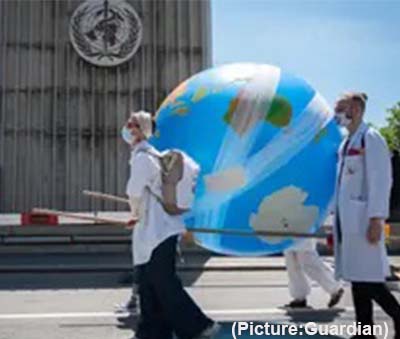
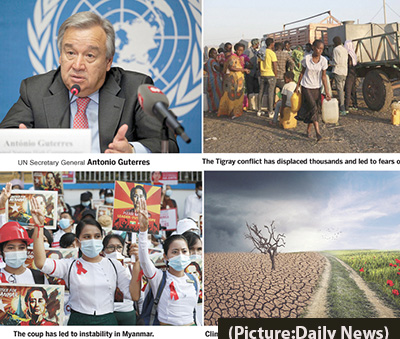
The plan by President Trump to “withdraw from the World Health Organization will affect the global healthcare system adversely,” Dr. Soumya Swaminathan, Chief Scientist at World Health Organization said. The Indian origin top scientists at the WHO was addressing The First Ever Virtual Summer Summit by the American Association of Physicians of Indian Origin (AAPI), held from June 16th to 28th, 2020. The Trump administration sent a letter giving the United Nations a one-year notice for the U.S. to quit the World Health Organization, formalizing President Donald Trump’s decision to leave the agency even as the coronavirus rages out of control in the U.S. and in many other countries. The administration sent the letter to UN Secretary-General Antonio Guterres Monday, making the U.S. withdrawal official on July 6, 2021, under a requirement for a one-year notice, according to Stephane Dujarric, the secretary-general’s spokesman. It’s almost certain that Democratic rival Joe Biden would reverse Trump’s decision if he’s elected in November. US President Donald Trump’s decision, announced on 29 May, to withdraw funding from the World Health Organization (WHO) was never in doubt. Since the beginning of the coronavirus outbreak, the White House has been intensifying its charge that the WHO was slow to respond to the threat, and overly influenced by China. Undoubtedly, the agency has lessons to learn, and, at the World Health Assembly last month, WHO member states endorsed an independent evaluation. It is irresponsible and dangerous for the United States — the WHO’s largest donor — to bypass the agreed process and withhold roughly US$450 million in annual funding in the middle of one of the worst pandemics in recent history. This will undermine the world’s efforts to control the new coronavirus and will endanger more lives as COVID-19 continues on its destructive path. Tedros Adhanom Ghebreyesus, director-general of the World Health Organization, said he learned of President Trump’s intentions of “terminating” the decades-long U.S. relationship with WHO through Trump’s press briefing. “The U.S. government’s and its people’s contribution and generosity toward global health over many decades has been immense, and it has made a great difference in public health all around the world. It is WHO’s wish for this collaboration to continue,” Tedros said. While stating that the monetary contributions of the US will not be a huge factor if it chose to leave the world body, Dr. Soumya Swaminathan said, due to the close collaboration between US Healthcare Agencies and WHO, the departure of the US will affect the ongoing sharing of scientific data and thus prevent the world from accessing and sharing of knowledge and research which are vital for developing vaccines and effective healthcare delivery system around the world. “Good health is the foundation for good economy,” she said. Neglecting health will affect the economic progress negatively, she added. She referred to the Accelerated Program to study and find the most effective drug/vaccination development that is accessible to all the nations, and creating safe protocol and procedure for all nations as well developing International Health Regulations by WHO. She pointed to the Global Outbreak Network with 10,000 healthcare professionals from around the world, who are deployed in emergencies. WHO Academy has been set up train Healthcare workers to manage and respond to emergencies, she said. Dr. Soumya Swaminathan pointed out the examples of how smaller nations and the state of Kerala in India have been able to contain the virus spread due though long term investment in education and healthcare and via decentralization. She urged the nations for urgent investment in health care mostly on primary healthcare focusing on prevention rather than treatment. Referring to several initiatives under WHO in coordination with countries and private companies to develop safe vaccine and to prevent the spread of the virus, she spoke about the Accelerated Program to study and find the most effective drug/vaccination development that is accessible to all the nations.
Category: Nation
Trump Orders International students to leave US if their schools have online-only learning
International students who are pursuing degrees in the United States will have to leave the country or risk deportation if their universities switch to online-only courses, Immigration and Customs Enforcement announced this week. The Trump administration has also made a litany of changes to the US immigration system, citing the coronavirus pandemic, that have resulted in barring swaths of immigrants from coming to the country The move may affect thousands of foreign students who come to the United States to attend universities or participate in training programs, as well as non-academic or vocational studies.Universities nationwide are beginning to make the decision to transition to online courses as a result of the coronavirus pandemic. At Harvard, for example, all course instruction will be delivered online, including for students living on campus. For international students, that opens the door to them having to leave the US. Many U.S. colleges were scrambling to modify plans for the fall semester in the midst of the coronavirus pandemic a day after the Trump administration issued an order that could force tens of thousands of foreign students to leave the country if their schools hold all classes online. “There’s so much uncertainty. It’s very frustrating,” said Valeria Mendiola, 26, a graduate student at Harvard’s Kennedy School of Government. “If I have to go back to Mexico, I am able to go back, but many international students just can’t.” In a news release Monday, ICE said that students who fall under certain visas “may not take a full online course load and remain in the United States,” adding, “The U.S. Department of State will not issue visas to students enrolled in schools and/or programs that are fully online for the fall semester nor will U.S. Customs and Border Protection permit these students to enter the United States.” The agency suggested that students currently enrolled in the US consider other measures, like transferring to schools with in-person instruction. There’s an exception for universities using a hybrid model, such as a mix of online and in-person classes.Brad Farnsworth, vice president of the American Council on Education, said the announcement caught him and many others by surprise. “We think this is going to create more confusion and more uncertainty,” said Farnsworth, whose organization represents about 1,800 colleges and universities. “What we were hoping to see was more appreciation for all the different possible nuances that campuses will be exploring.”One concern with the new guidance, Farnsworth said, is what would happen if the public health situation deteriorates in the fall and universities that had been offering in-person classes feel they have to shift all courses online to stay safe. Visa requirements for students have always been strict and coming to the US to take online-only courses has been prohibited. The guidance, Bacow continued, “undermines the thoughtful approach taken on behalf of students by so many institutions, including Harvard, to plan for continuing academic programs while balancing the health and safety challenges of the global pandemic. We will work closely with other colleges and universities around the country to chart a path forward,” he said. There are more than a million foreign students at U.S. colleges and universities, and many schools depend on revenue from foreign students, who often pay full tuition.The U.S. Immigration and Customs Enforcement (ICE) agency said institutions moving entirely to online learning must submit plans to the agency by July 15. Schools that will use only in-person learning, shortened or delayed classes, or a blend of in-person and online learning must submit plans by Aug. 1. The guidance applies to holders of F-1 and M-1 visas, which are for academic and vocational students.
Republicans Ready to Leave Trump’s Sinking Boat? – Trump Desperate, Despondent as Poll Numbers Crash
With Donald Trump’s approval sinking to Jimmy Carter levels and coronavirus cases spiking across the country, Trump is reluctantly waking up to the grim reality that, if the current situation holds, his reelection is gone.
The share of Americans who say they are satisfied with the way things are going in the U.S. has plummeted by 19 percentage points since April to just 12%, and feelings of anger and fear are widespread. Donald Trump continues to engender strong loyalty and intense opposition. He trails Joe Biden on a variety of personal traits and in public confidence in his handling of most major issues.
Biden’s lead has grown steadily over the past few months, from 3 points in March, to 4 points in April, to 9 points in May and 12 points presently. Fifty percent of all voters say they’re certain they will not vote for Trump, compared to 39 percent who said they’re certain they will not vote for Biden. Forty percent of Biden’s supporters say they’re certain they’ll vote for him, compared to 34 percent of Trump’s supporters.
Steve Schmidt, a former GOP strategist thinks Republicans might scurry away from President Donald Trump like “rats fleeing a sinking ship” as the November election nears. Steve Schmidt said on MSNBC that conservatives in Congress might lose faith in sticking with Trump as his poll numbers drop. Trump is behind Biden in most polls.
“Well, the way that the campaigns are looking at this now is they’re looking at the average of all of the polls,” Schmidt said. “So you’re looking at an eight percent, nine percent lead for [Joe] Biden by the average, but you’re looking at decimation inside Trump’s internal numbers on all of the questions of leadership, on decency, on being up to and fit for the job of being president.”
Vanity Fair’s Gabriel Sherman reports that Donald Trump is increasingly desperate and down about his nosediving poll numbers. So much so that he called one of his Fox News unofficial advisors, Tucker Carlson, and asked late last week and said, “what do I do? What do I do?”
Republicans who have spoken with Trump in recent days describe him as depressed and “down in the dumps.” “People around him think his heart’s not in it,” a Republican close to the White House said. Torn between the imperative to win suburban voters and his instincts to play to his base, Trump has complained to people that he’s in a political box with no obvious way out. To console himself, Trump still has moments of magical thinking. “He says the polls are all fake,”
But the bad news keeps coming. This week, Jacksonville, Florida—where Trump moved the Republican National Convention so he could hold a 15,000-person rally next month—mandated that people wear masks indoors to slow the explosion of COVID-19 cases. According to a Republican working on the convention, the campaign is now preparing to cancel the event so that Trump doesn’t suffer another Tulsa–like humiliation. “They probably won’t have it,” the source said. “It’s not going to be the soft landing Trump wanted.”
Trump is reportedly furious at his son-in-law Jared Kushner, whom he blames for the campaign’s dismal poll numbers. Axios reported this week that Trump complained privately that Kushner’s advice on criminal-justice reform damaged Trump politically. But because Kushner is family, sources say it’s unlikely that Trump will formally strip him of authority.
Kushner’s vast sway over West Wing decisions has become a flashpoint between him and Chief of Staff Mark Meadows, sources say. The two have been engaged in a cold war over control of the campaign. Meadows pushed Trump to replace campaign manager Brad Parscale, a Kushner ally, the Republican close to the White House said.
“They probably won’t have” the Jacksonville convention. The Joni Ernst campaign is angry at Trump’s horrible numbers. Meadows and Kushner are at loggerheads over Parscale. And if things don’t turn around by Labor Day, GOP defections may begin, several analysts say.
Nervous Republicans worried about losing the Senate are now debating when to break from Trump. Trump campaign internal polls show Trump’s level of “strong support” dropping from 21 to 17 points since last week, a person briefed on the numbers said. A source close to Iowa Republican Joni Ernst’s campaign said Ernst advisers are upset that a solid seat is now in play. “Joni’s campaign is pissed. They should not be in a competitive race,” the source said.
A new poll finds more voters rule out ever voting for Trump than his likely Democratic rival Joe Biden. Intense voter suppression, some kind of a big event, or some info that comes out about Biden (most likely from a foreign source again) could be on the U.S. political horizon.
As many political writers have repeatedly noted, Trump won in 2016, and rather than expand his base he has spent his presidency focused totally on the base. Rather than a unifying President, even a highly partisan President, Trump has been President of the base, by the base and for the base. Biden has a double digit lead nationally over Trump. Even though polls at this point in a Presidential race are largely meaningless, this makes the hole Trump has to climb out of vastly bigger.
There are several Republican leaders and groups that have come in support of Biden. The latest prominent Republican anti-Trump organization made its debut in early July. It’s a Super Pac called 43 Alumni for Biden, and aims to rally alumni of George W Bush’s administration to support the Democrat.
The new Super Pac was co-founded by Kristopher Purcell, a former Bush administration official; John Farner, who worked in the commerce department during the Bush administration; and Karen Kirksey, another longtime Republican operative. Kirksey is the Super Pac’s director.
“We’re truly a grassroots organization. Our goal is to do whatever we can to elect Joe Biden as president,” said Farner.
The Super Pac is still in its early stages and isn’t setting expectations on raising something like $20m. Rather, 43 Alumni for Biden is just focused on organizing.
“After seeing three and a half years of chaos and incompetence and division, a lot of people have just been pushed to say, ‘We have got to do something else,” Purcell said. “We may not be fully on board with the Democratic agenda, but this is a one-issue election. ‘Are you for Donald Trump, or are you for America.’”
Steve Schmidt a former GOP strategist said of Trump: “He’s just lost the confidence of the American people during this season of ineptitude and incompetence in his performance and you see that throughout the poll.” Schmidt explained that Trump’s dismal polling and poor approval rating could hurt Senate Republicans who are seeking re-election in November.
Another Republican strategist close to Senate Majority Leader Mitch McConnell is reported to have said that Republicans have Labor Day penciled in as the deadline for Trump to have turned things around. After that, Trump is going to be on his own.
Modi Warns China of Expansionism, As Beijing Urges Caution
“The enemies of India have seen the fire and fury of our forces,” Prime Minister Narendra Modi said during his surprise visit to Leh, Ladakh, to interact with the Army, Air Force and ITBP personnel stationed at Nimu. “The age of expansionism is over; we are now in an age of development and open competition,” the PM said. “History is rife with examples of countries that had adopted an expansionist attitude and threatened world peace but were eventually either destroyed or had to beat an ignominious retreat,” he added. Modi also visited the soldiers injured during the clash with Chinese troops at the Galwan Valley on June 15 at the military hospital. Prime Minister Narendra Modi flew on Friday into the northern border region where Indian and Chinese troops are locked in a stand-off, and said the military stood ready to defend his country. His comments prompted Beijing to call for restraint at the tense border area in the northern Himalayan region of Ladakh. Modi, making his first trip to the Ladakh region since the Indian army lost 20 soldiers in a clash with Chinese soldiers last month, said his country’s commitment to peace should not be seen as a sign of weakness. “Today India is becoming stronger, be it in naval might, air power, space power and the strength of our army. Modernization of weapons and upgradation of infrastructure has enhanced our defense capabilities multifold,” he said in a speech to soldiers near Leh, the regional capital. India says Chinese troops have intruded across the Line of Actual Control, or the ceasefire line separating the two armies in the high altitude Ladakh region, and the clash on June 15 occurred because Chinese troops sought to erect defenses on India‘s side of the de facto border. China says the whole of the Galwan valley where the clash occurred is its territory and that it was frontline Indian troops that had breached the border, which is not demarcated. China’s foreign ministry said on Friday the two countries were holding talks to reduce tensions. Spokesman Zhao Lijian, responding to a question about Modi’s visit to the border region, said both sides were in communications through diplomatic and military channels to ease the situation. “In these circumstances, neither side should take actions that might complicate the border situation,” he said at a daily news briefing in Beijing.
The most serious crisis on the India-China border in years has erupted while Beijing is embroiled in disputes over the South China Sea, Taiwan and its tightening grip over Hong Kong, which have all fanned fears of an expansionist policy. In a separate development, India‘s power ministry stipulated that Indian companies will need government permission to import power supply equipment and components from China, amid rising military tensions between the two countries. In Beijing, a spokesperson for the Chinese foreign ministry said “artificially setting up barriers” for trade “not only violates WTO rules, but also hurts India’s interests”. He was responding to a question on union minister Nitin Gadkari’s statement about blocking Chinese firms from highway projects. “China will take all necessary measures to safeguard the legitimate rights of Chinese businesses,” he added. He said the two countries should work to meet the “consensus reached by the leaders of the two countries and uphold overall bilateral relations”. “India should avoid a strategic miscalculation with regard to China.” Chinese embassy in India, in a tweet, said the accusation of “expansionism” is “groundless”. “China has demarcated boundary with 12 of its 14 neighboring countries through peaceful negotiations, turning land borders into bonds of friendly cooperation. It’s groundless to view China as ‘expansionist’, exaggerate and fabricate its disputes with neighbors,” the tweet said. A sign of China’s expansionist agenda is clear as the Chinese spokesperson criticized Japan (on Senkaku islands), the Philippines (Paracel Islands), Australia (on an APSI report on China) and the United States at the same press briefing. China also conflicts with Vietnam, Singapore, Taiwan, Brunei, Indonesia and Malaysia in the South China Sea.
Modi Praises The Achievements And Contributions Of The Indian-Origin Physicians, While Addressing AAPI’s First Ever Virtual Summit
(Chicago, IL: June 28th, 2020): “I am proud of the achievements and contributions of the Indian-origin physicians across the world in the battle against COVID-19,” Prime Minister Narendra Modi, who was the Chief Guest at first ever Virtual Global Summit of the American Association of Physicians of Indian Origin (AAPI) on Saturday, June 27th.
In his brief remarks, Dr. Suresh Reddy, President of AAPI thanked Prime Minister Modi for his leadership of India and making India a word leader. The First Ever Virtual Summer Summit by the American Association of Physicians of Indian Origin (AAPI) is being held from June 16thth to 28th, 2020.
During his address on Indo-US Relationship During the Pandemic and the Role of AAPI, Prime Minister Narendra Modi told members of the powerful and the largest ethnic Medical Association in the United States, “I have closely followed your contributions, sacrificing your life to save that of others. Some of have done the ultimate sacrifice of giving up youir own lives at the service of others. Your will be remembered for forever.”
Acknowledging the sacrifices of Indian Origin physicians, Modi said, “I want to express my sincere gratitude for being the warriors who are committed to save the lives of so many during the pandemic.”
The Prime Minister said that due to lockdown, many initiatives taken by the Government and a people driven fight, India is much better placed than many other nations and India’s recovery rate is rising. Due to this the severity of the virus is less than anticipated.
Prime Minister Modi shared with AAPI statistics of various countries. Modi said India had performed much better in the fight against the coronavirus disease (COVID-19). “As against the death rate of 350 individuals per million in the US and over 600 per million in European nations like the UK, Italy and Spain, the rate of fatalities in India is less than 12,” he said.
India defied the fears of the world’s topmost experts in this regard, according to Modi. He said that lakhs of villages, home to 85 crore people, remain almost untouched by Coronavirus. The prime minister attributed this to the support from the people of the country. “Rural parts of the country have largely remained untouched from this pandemic,” he said.
India’s fight against the novel coronavirus pandemic is driven by its people, Modi said, attributing the “success” against the pandemic to the implementation the nationwide lockdown in its initial phase.
Without people’s cooperation, Modi said, the success would not have been possible in the world’s second-highest populated country — with high density, where social gathering is a norm of life, large religious and political gatherings are regular, and large-scale interstate migration, India has been able to save the lives of thousands and lakhs of its citizens because of the timely lockdown, he told AAPI members.
Modi said COVID-19 had been used as an opportunity to work towards making the country self-reliant. Modi said the COVID-19 pandemic had been used as an opportunity to improve the healthcare facilities. “For instance, at the start of the coronavirus, there was only one COVID-19 testing lab. Now there are 1,000, he said.
The prime minister underlined that India, which imported most of its personnel protection equipment (PPE) kits at the start of the pandemic, was now almost self-reliant and in a position to export them. The country is making more than 30 lakh N95 masks per week. More than 50,000 new ventilators are being made available to the healthcare sector, all made inside the country, he added. “Stay safe and well and continue to contribute to health of the world. Stay healthier and stronger,” he told AAPI members.
Ambassador Taranjit Singh Sandhu was introduced by Dr. Seema Arora, Chair of AAPI’s Board of Trustees, as “one of the most experienced Indian diplomats on US affairs, having served in the Indian Mission in Washington DC in various capacities and at the Permanent Mission of India to United Nations, New York.”
Calling the Indian American Physicians as the “real heroes” Ambassador Sandhu “You are the real heroes who have risked your lives and have been out to assist others.” There is a widespread recognition of their contributions in the US, he added. “Lawmakers in the US appreciate your contributions. AAPI members have greatly contributed risking their own lives.”
Expressing his deepest condolences to AAPI and the families of those Physicins, who had lost their lives, the Indian Envoy thanked AAPI for “your support to the Indian Embassy helping Indian students stranded here due to the pandemic. Your online Health Desk has helped many Indians in the US affected by the pandemic.”
Praising AAPI for the several charitable works in India, Ambassador Sandhu, said, “India and the US are strategic partners” and pointed to collaboration between the two nations on cutting edge medical research in healthcare sector and science. With inexpensive medical supply to 127 countries, India has become “a reliable partner in global supply chain of all healthcare needs.”
Representing the interests of the over 100,000 physicians of Indian origin, AAPI members serve every 7th patient in the United States and every 5th patient in rural and inner cities across the nation. Dr. Sudhakar Jonnalagadda, will assume as the incoming President of AAPI on July 12th along with Dr. Sajani Shah, Chair, AAPI’s BOT; and his Executive Committee consisting of Dr. Anupama Gotimukula, President-Elect, Dr. Ravi Kolli, Vice President, Dr. Amit Chakrabarty, Secretary, and Dr. Satish Kathula, Treasurer of AAPI. For more details,please visit: www.aapiusa.org
While Trump Wants to Ban Foreign Workers, 155 Indian Companies Create Nearly 125,000 Jobs in US
President Trump has been calling for ban on immigrant workers to the US. He has suspended work visas to the end of the year. However, as per a report from CII, a total of 155 companies with origins in India are responsible for generating over $22 billion in investments and nearly 125,000 jobs in the US, according to a report by the Confederation of Indian Industry.
The report titled ‘Indian Roots, American Soil 2020’ showed that the states with the top concentrations of Indian companies reporting were New Jersey, Texas, California, New York, Illinois and Georgia.
The corporate social responsibility and research and development expenditure of the companies stood at $175 million and $900 million, respectively.
Texas, California, New Jersey, New York, and Florida are home to the greatest number of workers in the US directly employed by the reporting Indian companies.
The surveyed companies disclosed the highest amounts of foreign direct investment were in Texas, New Jersey, New York, Florida, and Massachusetts.
Indian investments in 20 U.S. states stand at over $100 million each, showed the survey.
Around 77 percent of the companies plan to make more investments in the world’s largest economy and 83 percent of the companies plan to hire more employees locally in the next five years.
The CII survey respondents are from sectors including pharmaceuticals, telecommunications, aerospace and defense, financial services, manufacturing, tourism and hospitality.
Chandrajit Banerjee, Director General, CII, said: “The survey results show that the U.S. is a preferred investment destination for Indian companies which are contributing significantly to supporting local jobs. The results in the survey capture a snapshot in time, documenting tangible investments and direct jobs only, so I believe that the actual economic impact of Indian FDI in the U.S. is much larger.”
He further said that it is critical that the U.S. government continues to provide a supportive policy environment for Indian companies to flourish and enhance their operations in the U.S., especially to aid economic recovery at this time.
Jenifer Rajkumar Wins NY State-Level Primary
Indian American candidates in New York had a great night June 23 in the New York state primary, with Jenifer Rajkumar and Jeremy Cooney winning their state-level races.
Rajkumar was successful in her bid to unseat Democratic incumbent Assemblyman Michael Miller, winning with 49.47 percent of the vote (2,624 votes) to Miller’s 24.51 percent (1,300 votes). Joseph de Jesus finished third with 20.89 percent and 1,108 votes, according to the New York Registrar of Voters.
Jenifer is a lawyer, Professor at CUNY and former New York State Government official. With early roots in public service and giving back, Jenifer graduated from Stanford Law School with distinction for her pro bono legal work on behalf of vulnerable individuals. She graduated from the University of Pennsylvania at the top of her class magna cum laude, phi beta kappa where she received the Alice Paul Award for exemplary service to women and families.
Jenifer has been dynamic, passionate and persistent in her efforts to make a difference in the lives of others. For Jenifer, service is a way of life. She served for years as the people’s lawyer, fighting corporate fraud and excess, and advocating for workers, women, and families in vulnerable situations. Later, she served at high levels of state government, appointed by the Governor of New York as a Special Counsel and as Director of Immigration Affairs for New York State. She also proudly dedicates her time to uplifting our city’s youth, as a Professor of Political Science at the City University of New York (CUNY).
But her proudest accomplishments are for her neighbors right here at home. For her work for the people of Queens providing access to counsel to people in vulnerable situations, and working for youth and immigrant communities, the Queens Courier honored her as a 2017 “Rising Star” and the Queens Tribune awarded her its “Glass Ceiling Award” for being a path-breaking woman serving the Queens community.
The Governor of New York Andrew M. Cuomo appointed Jenifer as the Director of Immigration Affairs & Special Counsel for New York State in the age of Trump. Working out of New York’s Department of State and the Governor’s Executive Chamber, Jenifer led the Liberty Defense Project, a first-in-the-nation $31 million dollar state-led public-private project to assist immigrants in obtaining legal services. Jenifer also represented New York State in litigation before Administrative Law Judges. She served as an ethics officer, handling ethics matters for the State. She was a state-wide surrogate for the Governor on the State’s signature policy items. She traveled from the farms of upstate New York to her home in Queens to help New York’s communities. Inspired by the people of New York, she is more motivated than ever to dedicate herself to service.
Beyoncé Urges US Citizens to Vote ‘Like Our Life Depends on it’
Beyoncé on Sunday night was presented with BET’s highest honor, its humanitarian award, which she dedicated to protesters taking to the streets around the nation. The singer was given the award by Michelle Obama, who said that Beyoncé’s activism “demands justice for Black lives.”
Beyoncé was given the award for her work supporting the Black community through her foundation, BeyGOOD, and for ensuring that coronavirus test kits were available for Black residents living in Houston, Texas, the city where she grew up. Earlier this month, she released a song that celebrates Juneteenth called Black Parade that is also the name of a new directory of Black-owned enterprises she launched last week
In her acceptance speech, Beyoncé urged Americans to vote “like our life depends on it” in the upcoming U.S. election, and called on people to help “dismantle a racist and unequal system” in the country. “I want to dedicate this award to all of my brothers out there, all of my sisters out there inspiring me, marching and fighting for change. Your voices are being heard and you’re proving to our ancestors that their struggles were not in vain,” she said. “Now we have one more thing we need to do to walk in our true power, and that is to vote.”
The BET awards celebrate Black artists and sports figures—previous recipients of the humanitarian award include legendary boxer Muhammad Ali and actor Denzel Washington.
Beyoncé has called on American citizens to vote in the upcoming presidential election during an acceptance speech for a humanitarian BET award she was given by Michelle Obama. She dedicated the award to protesters around the U.S. and encouraged viewers of the award show to vote “like our life depends on it,” adding “because it does.”
“You can see it in everything she does, from her music that gives voice to Black joy and Black pain, to her activism that demands justice for Black lives,” Michelle Obama said before presenting Beyoncé with the award. Obama celebrated Beyoncé for “calling out sexism and racism when she sees it.”
Beyoncé was one of many artists that spoke out against racism at the BET award ceremony this year, which celebrates Black artists and athletes. She called on voters to “dismantle a racist and unequal system.” Roddy Ricch wore a Black Lives Matter shirt while performing
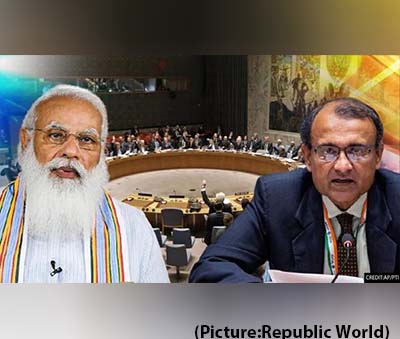
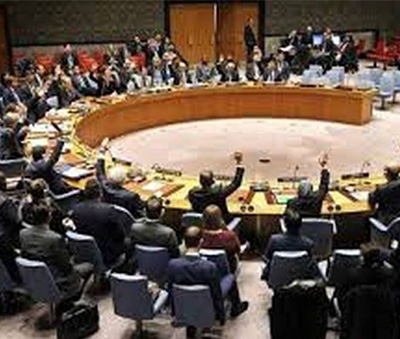
India elected to United Nations Security Council with overwhelming majority
Rejecting Trump’s Order, Supreme Court Upholds DACA, Says Young Immigrants Can Stay
The Supreme Court on Thursday rejected President Donald Trump’s effort to end legal protections for 650,000 young immigrants, the second stunning election-season rebuke from the court in a week after its ruling that it’s illegal to fire people because they’re gay or transgender.
The U.S. Supreme Court has upheld the program that protects immigrants who were brought to the country as children and allows them to work. The court on Thursday ruled President Donald Trump didn’t properly end the program, which then-President Barack Obama created in 2012. Trump attempted to end the Deferred Action for Childhood Arrivals program in 2017 shortly after being elected on a largely anti-immigrant platform. Here’s what the high court’s decision means:
Immigrants who are part of the 8-year-old Deferred Action for Childhood Arrivals Program will retain their protection from deportation and their authorization to work in the United States — safe almost certainly at least through the November election, immigration experts said.
The 5-4 outcome, in which Chief Justice John Roberts and the four liberal justices were in the majority, seems certain to elevate the issue in Trump’s campaign, given the anti-immigrant rhetoric of his first presidential run in 2016 and immigration restrictions his administration has imposed since then.
The justices said the administration did not take the proper steps to end DACA, rejecting arguments that the program is illegal and that courts have no role to play in reviewing the decision to end it. The program covers people who have been in the United States since they were children and are in the country illegally. In some cases, they have no memory of any home other than the U.S.
Chief Justice John Roberts sided with the liberal wing of the court in a 5-4 decision. Roberts, citing the Administrative Procedure Act, called the administration’s reasoning for ending the protections “arbitrary and capricious.”
The justices rejected administration arguments that the eight-year-old Deferred Action for Childhood Arrivals program (DACA) is illegal and that courts have no role to play in reviewing the decision to end it.
“We do not decide whether DACA or its rescission are sound policies,” Roberts wrote. “We address only whether the agency complied with the procedural requirement that it provide a reasoned explanation for its action. Here the agency failed to consider the conspicuous issues of whether to retain forbearance and what if anything to do about the hardship to DACA recipients.”
Trump, through the Department of Homeland Security, committed in September 2017 to ending the program, leading to the court challenges. He blasted the decision in a series of tweets on Thursday, calling it “horrible and politically charged.”
Trump didn’t hold back in his assessment of the court’s work, hitting hard at a political angle. “These horrible & politically charged decisions coming out of the Supreme Court are shotgun blasts into the face of people that are proud to call themselves Republicans or Conservatives. We need more Justices or we will lose our 2nd Amendment & everything else. Vote Trump 2020!” he wrote on Twitter, apparently including the LGBT ruling as well.
DACA was created by President Barack Obama in 2012 after intense pressure from immigrant advocates who wanted protections for the young immigrants who were mostly raised in the U.S. but lacked legal status.
The program protects them from deportation — granting a two-year reprieve that can be extended and by issuing a work permit and a Social Security number.
DACA recipients must meet several requirements, including having no criminal record. Immigrants who are accepted into the program and later get arrested face deportation to their home country.
They also must have been 30 or younger when the program was launched and brought to the U.S. before age 16.
The application cost is nearly $500, and permits must be renewed every two years. The application and renewal process take several weeks, and many immigrants hire lawyers to help navigate the process.
DACA does not give beneficiaries legal U.S. residency; they are simply given a reprieve from deportation while being allowed to legally work. The overwhelming majority of DACA recipients are from Mexico. One in four of them live in California.
Frustration grew during the Obama administration over repeated failures to pass the “Dream Act,” which would have provided a path to legal U.S. citizenship for young immigrants brought to the country as children.
The last major attempt to pass the legislation was in 2011. Immigrant activists staged protests and participated in civil disobedience in an effort to push Obama to act after Congress did not pass legislation. DACA is different than the Dream Act because it does not provide a pathway to legal residency or citizenship. Still, DACA recipients are often referred to as “Dreamers” — a reference to the earlier proposals that failed in Congress before Obama’s action.
Years of impasse in Congress over passing comprehensive immigration reform are what prompted then-president Barack Obama to create DACA by executive order in the first place, in 2012. The program gives people two-year renewable reprieves from the threat of deportation while also allowing them to work.
DACA recipients were elated by the ruling. “We’ll keep living our lives in the meantime,” said Cesar Espinosa, a DACA recipient who leads the Houston immigration advocacy group FIEL. “We’re going to continue to work, continue to advocate.”
India-China Clash In Ladakh Region
The deadly clash between Indian and Chinese troops has officials from both sides blaming each other for the violence that erupted amid a seven-week long military stand-off at their
At least 20 Indian soldiers have died after a “violent face-off” with Chinese troops along the countries’ de facto border in the Himalayas late Monday, the Indian army announced. Indian media say there are 35 Chinese casualties but Beijing has not confirmed if any of its troops were killed or injured.
The incident occurred during a “de-escalation process” underway in the Galwan Valley in the disputed Aksai Chin-Ladakh area, where a large troop build-up has reportedly been taking place for weeks now on both sides of the border, before senior military commanders began talks earlier this month.
The current stand-off is reported to have been triggered by India’s construction of a road in the Galwan Valley, its latest project in years of infrastructure build-up by both sides in the border region.
On June 6, after a videoconference between diplomats, top generals from both sides
met in Chushul-Moldo, in the eastern part of Ladakh. Details of the four-hour discussion were few and far between but the comments made after that were reassuring. In the days that followed, the Indian establishment indicated through leaks to the media that troops from both sides would disengage in some areas while officials would continue talks to ease the situation.
The fighting occurred in the precipitous, rocky terrain of the Galwan Valley. Indian media say soldiers engaged in direct hand-to-hand combat, with some “beaten to death”. During the fight, one newspaper reported, others fell or were pushed into a river.
Indian forces appear to have been massively outnumbered by Chinese troops. A senior Indian military official told the BBC there were 55 Indians versus 300 Chinese, who he described as “the Death Squad”.
“They hit our boys on the head with metal batons wrapped in barbed wire. Our boys fought with bare hands,” the officer, who did not want to be named, said. His account, which could not be verified, tallies with other reports in the Indian media detailing the savagery of the combat.
The Indian army had earlier said three soldiers had died, but added on Tuesday that a further 17 troops “who were critically injured in the line of duty at the standoff location and exposed to sub-zero temperatures in the high altitude terrain have succumbed to their injuries.” The deaths are the first military casualties along the two countries’ disputed border for more than 45 years.
India’s Subrahmanyam Jaishankar said China tried to erect a structure inside Indian territory, while China’s Wang Yi said Indian troops attacked first. Senior military officials from both sides are currently meeting to defuse the situation, the statement added.
“India and China have been discussing through military and diplomatic channels the de-escalation of the situation in the border area in Eastern Ladakh,” said India’s External Affairs Ministry spokesman Anurag Srivastava on Tuesday. He said senior commanders had “agreed on a process for such de-escalation” during a “productive meeting” on Saturday, June 6, and ground commanders had met regarding the implementation.
“While it was our expectation that this would unfold smoothly, the Chinese side departed from the consensus to respect the Line of Actual Control (LAC) in the Galwan Valley,” he said in the statement.
“Both sides suffered casualties that could have been avoided had the agreement at the higher level been scrupulously followed by the Chinese side,” he added. “Given its responsible approach to border management, India is very clear that all its activities are always within the Indian side of the LAC. We expect the same of the Chinese side. We remain firmly convinced of the need for the maintenance of peace and tranquility in the border areas and the resolution of differences through dialogue. At the same time, we are also strongly committed to ensuring India’s sovereignty and territorial integrity.”
Earlier Indian Prime Minister Narendra Modi said the Indian deaths “will not be in vain” and that India would be “proud that our soldiers died fighting the Chinese” in the clash in the Ladakh region on Monday.
Addressing the confrontation for the first time in a televised address on Wednesday, he said: “India wants peace but when provoked, India is capable of giving a fitting reply, be it any kind of situation.”
An Indian government statement following the phone conversation said that Chinese troops had tried to put up a structure on the Indian side of the de facto border, the Line of Actual Control (LAC), in the strategically important Galwan Valley.
It described this as “premeditated and planned action that was directly responsible for the resulting violence and casualties” and urged China to “take corrective steps”. The statement concluded that neither side would take action to escalate matters.
Meanwhile a Chinese statement quoted Mr Wang as saying: “China again expresses strong protest to India and demands the Indian side launches a thorough investigation… and stop all provocative actions to ensure the same things do not happen again. Both sides should resolve the dispute through dialogue, and keep the border safe and tranquil,” he added.
China’s People’s Liberation Army (PLA) released a statement Tuesday night calling on the Indian army to immediately stop what it described as “provocative actions” and to “resolve the issue through the correct track of dialogue and talks.”
“The sovereignty of the Galwan Valley region has always belonged to China,” Zhang Shuili, the spokesman of the Western Theater said in a statement on China’s Ministry of Defense website. “Indian troops violated its commitment, crossed the borderline for illegal activities and deliberately launched provocative attacks.” Zhang added that the “serious physical conflict between the two sides” had “resulted in casualties.”
The clash has provoked protests in India, with people burning Chinese flags. China has not confirmed how many of its personnel died or were injured. The BBC’s Robin Brant in Beijing says that China has never given contemporaneous confirmation on military deaths outside of peacekeeping duties.
This is not the first time the two nuclear-armed neighbors have fought without conventional firearms on the border. India and China have a history of face-offs and overlapping territorial claims along the more than 3,440km (2,100 mile), poorly drawn LAC separating the two sides.
The prime minister did say: “India wants peace but, if instigated, it is capable of giving a befitting reply.” But this is seen as aimed more at his political rivals and supporters domestically, rather than as a warning to Beijing. China is not Pakistan and memories of the humiliating defeat in the 1962 war are all too real for any misadventure.
How tense is the area?
The LAC is poorly demarcated. The presence of rivers, lakes and snowcaps means the line can shift. The soldiers either side – representing two of the world’s largest armies – come face-to-face at many points. Border patrols have often bumped into each other, resulting in occasional scuffles.
The two nuclear-armed neighbours have never agreed on the length of the border or how to demarcate it. The dispute dates back to when the British ruled India – a 1914 conference with the governments of Tibet and China set a boundary, known as the McMahon line, but this was never recognized by china. Beijing claims about 90,000 square kilometres of territory, comprising almost all of India’s Arunachal Pradesh state.
In 1959, when India’s first prime minister Jawaharlal Nehru went to Beijing, he questioned the boundaries shown on official Chinese maps, prompting Chinese Premier Zhou Enlai to reply that his government did not accept the colonial frontier.
In 1962, Chinese troops swarmed the disputed frontier with India during a row over the border’s demarcation. It sparked a four-week war that left thousands dead on the Indian side before China’s forces withdrew.
Beijing retained Aksai Chin, a strategic corridor linking Tibet to western China. India still claims the entire Aksai Chin region as its own, as well as the nearby China-controlled Shaksgam valley in northern Kashmir.
Another flashpoint has been Nathu La, a high mountain pass in India’s northeastern Sikkim state that is sandwiched between Bhutan, Chinese-ruled Tibet and Nepal.
During a series of clashes in 1967, which included the exchange of artillery fire, New Delhi said some 80 Indian soldiers died and counted up to 400 Chinese casualties.
In 1975, shots were reportedly fired across the official border at Tulung La in Arunachal Pradesh. Four Indian soldiers were ambushed and their deaths marked the last time anyone was known to have been killed in the long-running dispute until now. Then, Delhi blamed Beijing for crossing into Indian territory, a claim dismissed by China.
Three years ago, India and China had a months-long high-altitude stand-off in Bhutan’s
Doklam region after the Indian side sent troops to stop China constructing a road in the area.
The Doklam plateau is strategically significant as it gives China access to the so-called “chicken’s neck” – a thin strip of land connecting India’s northeastern states with the rest of the country.
It is claimed by both China and Bhutan, an ally of India. The issue was resolved after talks. In 2018, India said Chinese troops advanced around 300-400 metres inside the Demchok area and pitched five tents. Three were later removed after talks between the two armies.
The last firing on the border happened in 1975 when four Indian soldiers were killed in a remote pass in the north-eastern state of Arunachal Pradesh. The clash was variously described by former diplomats as an ambush and an accident. But no bullets have been fired since.
At the root of this is a 1996 bilateral agreement that says “neither side shall open fire… conduct blast operations or hunt with guns or explosives within two kilometres of the Line of Actual Control”.
But there have been tense confrontations along the border in recent weeks. In May Indian and Chinese soldiers exchanged physical blows on the border at Pangong Lake, also in Ladakh, and in the north-eastern Indian state of Sikkim hundreds of miles to the east.
India has accused China of sending thousands of troops into Ladakh’s Galwan Valley and says China occupies 38,000 sq km (14,700 sq miles) of its territory. Several rounds of talks in the last three decades have failed to resolve the boundary disputes. India also disputes part of Kashmir – an ethnically diverse Himalayan region covering about 140,000 sq km – with Pakistan.
There are several reasons why tensions are rising again now – but competing strategic goals lie at the root. The two countries have devoted extensive money and manpower to building roads, bridges, rail links and air fields along the disputed border.
Both India and China see each other’s construction efforts as calculated moves to gain a tactical advantage, and tensions often flare up when either announces a major project.
“We have not had casualties on the Line of Actual Control for at least 45 years,” said Happymon Jacob, an associate professor and political analyst at New Delhi’s Jawaharlal Nehru University. “This is perhaps a game-changer. This is perhaps the beginning of the end of the rapport that India has enjoyed with China for 45 years.”
Bipartisan Appeal To Trump To End Citizenship Delays
Ajay Jain Bhutoria Elected As Joe Biden’s Delegate For August Convention
Trump Wants India To Be Part Of Expanded G-7
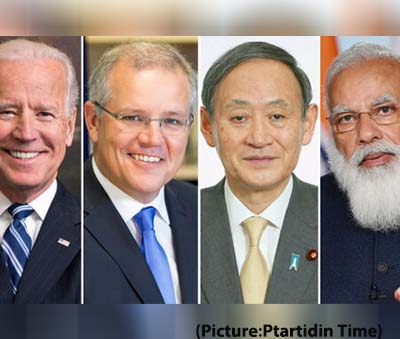
Prime Minister Narendra Modi has accepted President Trump’s invitation to attend the G-7 meet as a guest, and has also welcomed Trump’s proposal to include India in an expanded G-7.
The G-7 nations include the United States, Britain, France, Japan, Germany, Italy and Canada, and the European Union.
With the planned expansion, it’s unsure as to how the endgame is going to be. Trump is looking at “G-10 or G-11” with India, South Korea, Australia and Russia as additional members. The math is clear; it should become the G-11. Why G-10? Russia. It was kicked out of the group in 2014 (when G-8 became G-7) for annexing Crimea and it remains in the doghouse for most G-7 heads, who don’t share Trump’s enthusiasm for Russia.
But this uncertainty alone should not cast doubts on Trump’s plans for G-7 overhaul. Negotiators had looked at competing numbers for the 1997-99 expansion as well, but had settled on the smaller number to keep it manageable. India made it to that group.
The endgame is unclear, as it was then. Trump is looking at “G-10 or G-11” with India, South Korea, Australia and Russia as additional members. The math is clear; it should become the G-11. Why G-10? Russia. It was kicked out of the group in 2014 (when G-8 became G-7) for annexing Crimea and it remains in the doghouse for most G-7 heads, who don’t share Trump’s enthusiasm for Russia.
But this uncertainty alone should not cast doubts on Trump’s plans for G-7 overhaul. Negotiators had looked at competing numbers for the 1997-99 expansion as well, but had settled on the smaller number to keep it manageable. India made it to that group.
There was a clear need for a broader platform in 1997 to address challenges to global financial stability due to the widening economic crisis in Asian countries. And the G-20 provided an answer. The forum played an effective role after the 2008 crisis.
Trump’s expansion plan, on the other hand, is not well-thought-out. It does not appear to be about the coronavirus pandemic, the worst health crisis faced by the world in 100 years. If he believed in multilateralism to deal with it or prevent the next, he would have continued to fund the World Health Organization and forced to change it from within.
There was a clear need for a broader platform in 1997 to address challenges to global financial stability due to the widening economic crisis in Asian countries. And the G-20 provided an answer. The forum played an effective role after the 2008 crisis.
Trump’s expansion plan, on the other hand, is not well-thought-out. It does not appear to be about the coronavirus pandemic, the worst health crisis faced by the world in 100 years. If he believed in multilateralism to deal with it or prevent the next, he would have continued to fund the World Health Organization and forced to change it from within.
President Bill Clinton had broached the need for broadening the Group of Seven nations, called the G-7, in the wake of the Asian economic crisis of 1997. And that led to the launch of the G-20 in 1999, a group of 19 countries and the European Union. Today, President Donald Trump, has called for expanding the same body, G-7, on the basis that it is “very outdated.”
It was unclear whether Trump’s desire to invite the additional countries was a bid to permanently expand the G7. On several previous occasions, he suggested Russia be added, given what he called Moscow’s global strategic importance.
Russia was expelled from what was then the G8 in 2014 when Trump’s predecessor, Barack Obama, was U.S. president, after Moscow annexed the Crimea region from Ukraine. Russia still holds the territory, and various G7 governments have rebuffed previous calls from Trump to readmit Moscow.
U.S. President Donald Trump said on Saturday he would postpone a Group of Seven summit he had hoped to hold next month until September or later and expand the list of invitees to include Australia, Russia, South Korea and India.
Speaking to reporters on Air Force One during his return to Washington from Cape Canaveral in Florida, Trump said the G7, which groups the world’s most advanced economies, was a “very outdated group of countries” in its current format.
“I’m postponing it because I don’t feel that as a G7 it properly represents what’s going on in the world,” Trump said. Most European countries offered no immediate comment on the proposal, with a spokesman for the German government saying Berlin was “waiting for further information”.
The decision to postpone the G7 summit is a retreat for Trump, who had sought to host the group of major industrialized countries in Washington as a demonstration that the United States was returning to normal after the coronavirus epidemic, which has killed more than 113,000 Americans to date. Trump had canceled an in-person G7 meeting scheduled for March as the virus spread, but had recently sought to revive it.
French President Emmanuel Macron backed the idea of an in-person meeting, according to the White House. But Canadian Prime Minister Justin Trudeau declined to endorse it, saying there were too many health-related questions. This week, German Chancellor Angela Merkel said she could not attend.
South Korea is aware of Trump’s invitation and will discuss the matter with the United States, a government official in Seoul told Reuters on Sunday. It’s also not about the economic crisis that has accompanied the pandemic.
All Trump cares about, at this time, is his re-election prospects. That’s why German chancellor Angela Merkel, the sharpest of politicians in the western world, who has made it a practice to not visit the United States in election years, is skipping the summit, although, to be sure, she has other reasons.
Goldman Predicts A ‘Blue Wave’ In The November Elections
- Goldman Sachs sees an increased possibility of a “blue wave” in the November elections, which could impact corporate profits and dividends.
- That could lead to a partial or full reversal of the Tax Cuts and Jobs Act corporate tax reform legislation.
- “We estimate that a full reversal would lift the effective S&P 500 tax rate from 18% back to 26% and reduce our 2021 EPS forecast of $170 by $20 (11%) to $150,” Goldman vice president of equity strategy Cole Hunter and chief US strategist David Kostin wrote in a Thursday note.
Goldman Sachs said the possibility of a “blue wave,” or round of Democratic victories, is increasing ahead of the November 2020 elections.
“The 2020 election is just five months away, and prediction markets now price a 77%, 50%, and 51% likelihood of Democratic victories in the House, Senate, and presidential races, respectively,” Goldman vice president of equity strategy Cole Hunter and chief US strategist David Kostin wrote in a Thursday note.
According to Goldman, that could lead to a partial or full reversal of the 2017 Tax Cuts and Jobs Act, sweeping corporate tax reform legislation. Rolling the legislation back or dashing it entirely would have a negative impact on the earnings and dividends of companies, Goldman said.
“We estimate that a full reversal would lift the effective S&P 500 tax rate from 18% back to 26% and reduce our 2021 EPS forecast of $170 by $20 (11%) to $150,” Hunter and Kostin wrote.
The increasing odds of a Democratic “blue wave” in November have also raised the chances of a corporate tax hike, according to a Goldman Sachs report.
“The 2020 election is just five months away, and prediction markets now price a 77%, 50%, and 51% likelihood of Democratic victories in the House, Senate, and presidential races, respectively,” the report said.
“Our political economists believe that such an outcome could lead to a full or partial reversal of the 2017 Tax Cuts and Jobs Act corporate tax reform legislation.”
Some of the major elements of the act, which was backed by congressional Republicans and the Trump administration, include reducing tax rates for businesses and individuals and reducing the alternative minimum tax for individuals and eliminating it for corporations.
The observation appeared in a study about how long-dated S&P 500 dividends are trading at a discount to the firm’s top-down estimates.
The report noted that the S&P 500 has surged 38% from its March 23 low. While long-dated S&P 500 dividend swaps and futures have historically traded with a high beta to the underlying equity index, the report said, the 2023 S&P 500 dividends per share has risen by only 7% during the period.
High beta stocks are those that are positively correlated with returns of the S&P 500, but at an amplified magnitude.
Fifty-six companies accounting for 8.1% of 2019 S&P 500 dividends per share have cut or suspended their payouts year-to-date as companies reassess their balance sheets in light of uncertainty caused by the coronavirus pandemic.
Airlines, cruise operators, hotels, casinos, retail, and energy companies account for much of the list, the report said, but dividend cuts have been fairly broad-based.
In addition to a possible Democratic victory, the report noted that the equity rally has been narrowly concentrated among firms that pay minimal or dividends.
Also, the recent higher move in equities has been driven by an expansion in P/E multiples rather than earnings growth.
Still, Goldman noted that high-tax-paying equities have actually outperformed their low-tax peers since March – gaining 44% and 38%, respectively. This could imply that investors may not be pricing in the risk of an increase in taxes, according to the note.
This is just one factor that Goldman sees contributing to the underperformance of long-dated dividends, the note said.
Other contributors include that the equity market has been disproportionately driven by valuation expansion as opposed to earnings growth. Also, the market has become increasingly concentrated in big-tech companies such as Facebook, Apple, Amazon, Google, Netflix, and Microsoft.
Meanwhile, a new national poll indicates that President Trump’s approval rating is dropping and that he trails Democratic challenger Joe Biden by double digits if November’s presidential election were held today.
According to a CNN survey released on Monday, the president’s approval rating stands at 38 percent, a dive of 7 percentage points from CNN’s previous poll, which was conducted in early May. And Trump’s disapproval rating jumped from 51 percent month ago to 57 percent now.
And the poll shows the former vice president and presumptive Democratic nominee topping the GOP incumbent in the White House by 14 points — 55 to 41 percent. That’s nearly triple the 5-point margin – 51-46 percent – Biden led by a month ago in CNN polling.
The president, who rarely misses an opportunity to blast a poll that he doesn’t like, took to Twitter soon after the survey’s release to charge that “CNN Polls are as Fake as their Reporting.” CNN Polls are as Fake as their Reporting. Same numbers, and worse, against Crooked Hillary. The Dems would destroy America!, Trump wrote.
The 14-point lead for Biden in the new CNN survey is double the 7-point advantage for the former vice president over Trump in an NBC News/Wall Street Journal poll released on Sunday. An average of the last national general election matchup polls compiled by RealClearPolitics indicates Biden on top by 7.8 percent over the president.
The CNN poll was conducted Tuesday through Friday – which means it questioned voters nearly entirely before Friday’s stunning unemployment report, which indicated 2.5 million jobs were created last month and that the nation’s jobless level had dropped. The numbers were boosted by states reopening their economies after being mostly shut in late March and April in order to limit the spread of the coronavirus pandemic.
CBS News’ Weijia Jiang on Newsroom Diversity, COVID-19 Racism, and Covering President Trump
(Courtesy: The Asia Society)
On May 11, during a press conference at the White House Rose Garden, CBS News White House Correspondent Weijia Jiang asked President Donald Trump why he was boasting that the United States was testing more people for coronavirus than any other country.
“Why does that matter?” she asked. “Why is this a global competition to you if every day Americans are still losing their lives and we are still seeing more cases every day?”
“Maybe that’s a question you should ask China,” Trump responded. “Don’t ask me. Ask China that question, OK?”
When Jiang, who is Chinese American, asked the president why he was directing this question to her, Trump denied singling her out. He then chided her for asking a “nasty” question before storming out of the news conference.
Trump’s churlish reaction to a question from a White House correspondent — particularly a woman of color — was hardly new. But Trump’s invocation of Jiang’s ethnicity occurred in a particularly fraught moment for Asian Americans, who have been subject to a surge of racist attacks in the months since the coronavirus spread from China to the rest of the world. The exchange with Trump also wasn’t the first time Jiang has encountered racist sentiment at work. In March, she tweeted that a White House official referred to COVID-19 as the “kung flu virus” in her presence. “Makes me wonder what they’re calling it behind my back,” she said.
Born in Xiamen, China, Jiang grew up in a small city in West Virginia. A graduate of Syracuse University, she has worked for CBS News since 2015 and became White House correspondent in July 2018. In this conversation with Asia Blog, Jiang recounted her upbringing, reflected on the importance of newsroom diversity, and explained why she thinks that news organizations have never been more vital.
What was your upbringing like? What was the adjustment like for your parents? Were there any other Chinese families in your hometown?
I can’t imagine what the adjustment was like for my parents settling down in a completely foreign land without an Asian community to offer support. They are braver than I could ever be. We had a small Chinese restaurant — one of two in the town. So there was one other Chinese American family, but they didn’t have kids my age. I was the only Chinese American student in my school system. I definitely had to deal with challenges and racism throughout my upbringing, but I wouldn’t change anything because those experiences shaped who I am today. There was also a lot of kindness in our little town. I spent lots of time with my friends and their welcoming families.
How did you decide to become a journalist — what about the profession called to you?
I remember watching my dad watch hours of news as a child, which probably led to me taking a TV news class in middle school. I was also on the newspaper staff, and I loved everything about reporting. My teacher convinced me to apply for “Student Produced Week” at ChannelOne News — a news program for middle and high school students across the country. (It has since closed operations, but offered a start for many journalists including Anderson Cooper and Lisa Ling.) Every year the company selected a group of students and paid for a two-week trip to Los Angeles to learn about journalism. I won, and my life changed forever. I loved the idea that talking to people and telling their stories could be a career. I also loved asking questions and sharing the answers with people who needed them. That hasn’t changed.
Newsrooms, like professions across the country, have struggled to match the diversity of the communities and stories they cover. Do you feel news organizations have improved in fostering a diverse environment over the years?
I can’t speak to newsrooms nationwide, but the ones I have worked in have all made strides in adding diversity. But in my opinion, it is not diversity on its face that matters. The perspective that comes with being a minority is essential in reporting and telling stories in an authentic way. We all have to make an effort to acknowledge and embrace those varying points of view to make the most of our resources. That requires a never-ending, always-evolving conversation about diversity and why it matters. I think we can all do more to nurture that dialogue and create a space where people feel comfortable sharing. I also think diversity at the top makes a huge difference because people in those positions are leading that effort and making important decisions.
Earlier this year, you tweeted about a racist remark (“kung flu virus”) said in your presence at the White House — and you wondered what was said when you were not around. Have you been subject to any other anti-Asian racism while at work or otherwise since COVID-19 spread to the U.S.? What more needs to be done to halt this trend?
I have not experienced another incident in person, but I get messages on social media every day that include racist language. I think the best thing we can do is provide facts. The fact is the virus does not discriminate against any group of people, and Asian Americans are not more likely to spread it. It’s also important to report on hate crimes and attacks against members of the APA community so they are not normalized.
But the tension between the press and the president is nothing new. President Trump expresses it more frequently and more … colorfully than others.
News organizations have recently debated whether broadcasting President Trump’s press conferences serve the public interest. What are your thoughts about this? Should news organizations refrain from broadcasting these live?
I absolutely think it is important for Americans to hear from the president of the United States during a time of crisis. People want to know what the government is doing to contain the spread, help patients recover, and get people back on their feet again when it comes to the economy. However, the conversation during the briefings has sometimes veered toward other topics than the pandemic and its impact. In those instances, airing the briefings in their entirety can be unproductive. I think that’s why viewership for evening news broadcasts like the CBS Evening News and public affairs shows like Face the Nation continue to increase. It is the job of news organizations to cut through all the noise and distractions to provide the latest information.
If nothing else, White House press conferences have changed significantly during the Trump years. Do you anticipate that things will revert to the way they were in a post-Trump era? Or do you feel that Trump has, for better or worse, revolutionized the way an American president deals with the press? Has his antagonistic relationship with the press damaged journalism? Or is this concern overblown?
I have only ever covered the Trump administration in this capacity, so I don’t have a frame of reference for what is “normal.” This is normal to me.
Of course, I recognize the president’s unique relationship with the press and how it compares with past presidents. I am curious myself how it will impact the future, if at all. But the tension between the press and the president is nothing new. President Trump expresses it more frequently and more … colorfully than others.
Biden Is Best Placed For Any Challenger Since Scientific Polling Began
Former vice president Joe Biden has gained a clear national lead against president Donald Trump in the latest Washington Post/ABC poll ahead of the 2020 election.
In the poll of registered voters conducted between 25-28 May, 53 per cent of respondents said that they would vote for Mr Biden over 43 percent who favoured Mr Trump were the election held on the day they were questioned. Just two months ago the same poll had the two candidates virtually tied at 49 per cent to 47 per cent.
But it’s important to put individual polls into context, and that context continues to show Biden’s in one of the best positions for any challenger since scientific polling began in the 1930s.
There were more than 40 national public polls taken at least partially in the month of May that asked about the Biden-Trump matchup. Biden led in every single one of them. He’s the first challenger to be ahead of the incumbent in every May poll since Jimmy Carter did so in 1976. Carter, of course, won the 1976 election. Biden’s the only challenger to have the advantage in every May poll over an elected incumbent in the polling era.
Biden remains the lone challenger to be up in the average of polls in every single month of the election year. His average lead in a monthly average of polls has never dipped below 4 points and has usually been above it.
Biden hasn’t trailed Trump this entire year in a single telephone poll in which at least some voters were reached via their cell phones — historically the most accurate. The ABC News/Washington Post poll is the latest example of these polls. In fact, Biden’s never been behind in any of these polls since at least January 2019. No other challenger has come close to that mark.
Indeed, the stability of Biden’s edge has been what is most impressive. The May polls had Biden up by 6 points on average. That is right where the average of polls taken since the beginning of this year has been. It’s where the average of polls conducted since the beginning of 2019 has been as well.
If we limit ourselves to just the telephone polls that call cell phones, Biden’s edge might even be slightly larger. This month those polls have Biden up 7 points on average. Estimating Biden’s advantage from state polls of this type shows a similar lead for Biden.
A look at the fundamentals shows why Trump continues to trail. Simply put, he remains unpopular.
His net approval rating (approval – disapproval) in the ABC News/Washington Post poll was -8 points. That’s very close to the average of polls, which has it at about -10 points. At no point during the past three years has Trump ever had a positive net approval rating.
The only other two presidents to have a net approval rating this low at this point in the campaign were Carter in 1980 and George H.W. Bush in 1992. Both of them lost reelection.
But I’m not predicting anything here. Between the coronavirus pandemic and now the protests and riots taking place nationwide, we’re obviously in a volatile news environment.
Still, no other campaign involving an incumbent president has moved as little as this one has. That’s after nearly three months of the coronavirus dominating the news cycle. That’s after many anti-Biden ads have been aired.
It’s at least possible that nothing will move the electorate substantially in Trump’s direction.
A Border Clash Between The World’s Biggest Nations. What Could Go Wrong?
By Adam Taylor (Courtesy The Washington Post)
China’s ongoing border clash with India may seem remote, but it has global impact. Reports say thousands of troops moved into the disputed area 14,000 feet up in the Himalayas after skirmishes broke out on May 5 near Pangong Lake in Ladakh and then on May 9 in North Sikkim, leaving more than 100 soldiers injured.
Amid the global coronavirus pandemic, assessing exactly what is happening in this dispute between the two most populated countries on Earth is difficult. Much of the border region is closed to the press, so reporters have to rely on statements and leaks.
Many accounts suggest that aggressive Chinese patrols in the area known as the Line of Actual Control (LAC) were to blame – or, in what may not necessarily be a contradiction, that Indian construction in the region had been interpreted as an aggressive challenge to Beijing’s Belt and Road infrastructure project.
Ultimately, India and China’s border problems are not new – it’s the circumstances surrounding them that have changed. Both Beijing and Delhi are led by governments in the thrall of nationalistic ambition. The pandemic has further pushed many nations into pro- or anti-China positions, camps that were already forming amid a global trade war that has lasted years.
The United States, locked in its own squabble with China, has voiced terse support for India’s position and offered to mediate. Hu Xijin, the outspoken editor of China’s party paper the Global Times, seized on the conflicting messages, mocking President Trump and arguing that the United States “seems to be the beneficiary of China-India border tension.”
India and China’s relationship is based on their status as two giant, wary neighbors. They share a 2,167-mile-long border. Together, their populations are around 2.7 billion, more than a third of the world. Both have achieved rapid economic development in recent decades and increased their territorial ambitions. Both have nuclear weapons.
India was among the first democracies to recognize the People’s Republic of China in 1950, but border disputes between the two increased as Beijing took control of Tibet. In 1962, they fought a month-long war on the Himalayan border, with China inflicting serious casualties on India before withdrawing to the LAC.
There were skirmishes over the border for years. In 1988, after one incident in the Sumdorong Chu Valley in Arunachal Pradesh, Indian Prime Minister Rajiv Gandhi traveled to Beijing to meet his counterpart Deng Xiaoping. The two nations, both undergoing a wave of economic development just as the Soviet Union began to collapse, put aside their differences out of pragmatism.
Now, that pragmatism is being tested. China, whose economic development has dwarfed India’s, has a gross domestic product of roughly $14 trillion, compared to India’s less than $2.7 trillion. “While India has risen as an economy and a global power in the past three decades, its relative strength to China has in fact greatly declined,” Sumit Ganguly and Manjeet S. Pardesi wrote in Foreign Policy.
China’s close relationship with Pakistan, an unequal partner in the Belt and Road project, and lingering disagreement over Tibet have soured relations with India further. The tension between the two nations spilled over in 2017 in the Doklam area of the Himalayas after Indian troops moved in to prevent the Chinese military from building a road into territory claimed by Bhutan, an ally of India.
Over two months, the two powers flooded the area with military personnel. The threats, especially those from China, were apoplectic. “India will suffer worse losses than 1962 if it incites border clash,” the Global Times wrote.
The Doklam dispute ultimately fizzled out. Both sides withdrew troops in late August of that year and issued vague remarks about a resolution. Exactly what was decided behind the scenes was unclear, though reports that China had halted construction of the motorway suggested that Beijing had backed down.
Some Indian analysts have suggested that the current situation will end similarly, pointing to a number of conciliatory messages from Chinese officials. “We should never let differences overshadow our relations. We should resolve differences through communication,” China’s ambassador to India, Sun Weidong, said Wednesday.
But another inconclusive end to a standoff will fail to address the root of the problem. The Indian government has claimed that the Chinese military crossed into Indian territory 1,025 times between 2016 and 2018 (the Chinese government has not released comparable figures).
India and China are both in the throes of aggressive nationalist movements, each displaying their own brand of “wolf warrior” foreign policy. Under President Xi Jinping, China has moved from subtle pushes to strong shoves to bring the city of Hong Kong under Beijing’s sovereignty, while also applying pressure in the South China Sea and against Taiwan.
Indian Prime Minister Narendra Modi entered his second term in power bent on changing many norms of Indian policy. The long-disputed territory of Kashmir has been under lockdown for months, while last year India and Pakistan were drawn into their most serious military escalation in decades. Reuters reported this week that Modi’s plans to build 66 key roads by the Chinese border, including one to a new air base, had probably drawn Beijing’s anger.
In the past, this might have remained a bilateral dispute. But now, anything that involves China seems to involve the United States too. The Hindustan Times reported Wednesday that Trump’s offer to mediate was “part of [a] growing anti-China juggernaut.” Under such a juggernaut, ambiguity may not exist.
MY Thoughts On US Leaving World Health Organization
1. It will have adverse effects in the World post Trump sanctions against WHO, specially to third world countries. Of course President Trump has promised that the amount US was donating to WHO in the amount of $450 million dollars, would be distributed as per the will of the Trump administration. I am sure some of the countries that are under US sanctions will have diverse effects specially countries like Iran,Venezuela etc.
We all feel, it is absolute loss to humanitarian work in health care across the world.
The problem is WHO failed in their duties to protect the world on Corona, because of Chinese dominance in WHO, even though it was contributing just over $ 45 million or so. I am glad that India has been given the prestigious position as chair of WHO, that may change the world out look of WHO. Will have to wait and see.
I think it is a huge rebuff to China by the USA and it is almost open war with deteriorating relationships between US and China. President Trump did not hesitate to condemn China in his White House press conference this week.
2. US President is absolutely justified in criticizing the misuse of WHO funds in favor of China during Covid Pandemic and its inability to forewarn the world of insufficient and unequivocal measures taken by WHO on behest of China are unpardonable.
3. Yes absolutely China is being looked down in US and there is demand to boycott Chinese imports and put limitations on Commerce, and cultural relations between the two nations. There is a strong move in US congress to de list Chinese companies in New York stock exchanges that will be a big blow to Chinese industries.
President Trump has gained enormous sympathy in his fight against China and WHO. This will greatly help in his re election campaign come November 2020.
Dr. Sampat Shivangi (drssshivangi@aol.com) is the National President of Indian American Forum for Political Edu
Indian Americans on Joe Biden’s Unity Taskforces
Several Indian Americans are part of the Unity Task Force announced by presumptive Democratic presidential nominee Joe Biden and Sen. Bernie Sanders with the purpose of use to promoting Democratic party unity by hammering out consensus on top policy issues, additional members have been announced.
Two Indian Americans had already been named as co-chairs of the Health panel: former Surgeon General Vivek Murthy and U.S. Representative Pramila Jayapal of Washington.
Presumptive Democratic presidential nominee Joe Biden and his chief primary rival Sen. Bernie Sanders, I-Vt., announced on Wednesday the members of a joint task force meant to unify the party ahead of November’s general election, bringing together figures from different wings of the party, ranging from New York Rep. Alexandria Ocasio-Cortez to former Secretary of State John Kerry.
The news comes a month after Sanders joined Biden via video stream to endorse him. The pair pledged to create these task forces to focus on shared policy concerns. “Now, it’s no great secret out there, Joe, that you and I have our differences, and we’re not going to paper them over; that’s real,” Sanders said at the time. “But I hope that these task forces will come together utilizing the best minds and people in your campaign and in my campaign to work out real solutions to these very, very important problems.”
Biden and Sanders put together six of the “unity task forces” to handle policy in these areas: the economy, education, immigration, health care, climate change, and criminal justice reform.
South Asians for Biden said May 21 that these additional Indian Americans have also been named members of the Unity Taskforce:
- Chiraag Bains, director of Legal Strategies for the think tank Demos, will serve as the co-chair of the Criminal Justice Reform group;
- Former Acting Assistant Attorney General Vanita Gupta, now president and CEO of the Leadership Conference on Civil and Human Rights, will also serve on the Criminal Justice Reform group;
- Varshini Prakash, executive director of the Sunrise Movement, a leading organization focused on climate change among young people, will serve on the Climate Change group; and
- Sonal Shah, policy director for Pete Buttigieg’s 2020 presidential campaign, will serve on the Economy group.
The taskforce brings together a number of prominent Democrats with subject matter expertise to guide the Democratic Party heading into the November general election on critical issues.
“We are thrilled to see that a number of South Asian leaders have been selected to serve on the Unity Taskforce, which will have an impact on the Democratic Party platform for years to come,” said Neha Dewan, National Director of South Asians for Biden. “South Asians represent the second-most rapidly growing demographic group in America. In this critical election year, the South Asian community has a stake in key policy questions that affect our communities, and are deeply impacted by issues spanning immigration, civil rights, and healthcare. Such a robust representation of South Asians on the Unity Taskforce reflects the growing voting strength of the community,” said Ritu Pancholy, a member of the communications team for South Asians for Biden.
South Asians for Biden is a national, grassroots organization that is dedicated to engaging, educating, and mobilizing the South Asian community to help to elect Joe Biden as the next president of the United States.
Sen. Kamala Harris Introduces Bill to Provide Monthly $2,000 Payments During COVID-19 Crisis
U.S. Senator Kamala D. Harris (D-CA), Bernie Sanders (I-VT), and Ed Markey (D-MA) May 8 had introduced the Monthly Economic Crisis Support Act, legislation that provides a monthly $2,000 check to those struggling to make ends meet during the COVID-19 pandemic. As rent comes due and bills continue to pile up, Americans desperately need assistance to financially survive this crisis, said a press release.
“The coronavirus pandemic has caused millions to struggle to pay the bills or feed their families,” said Harris. “The CARES Act gave Americans an important one-time payment, but it’s clear that wasn’t nearly enough to meet the needs of this historic crisis. Bills will continue to come in every single month during the pandemic and so should help from government. The Monthly Economic Crisis Support Act will ensure families have the resources they need to make ends meet. I am eager to continue working with Senators Sanders and Markey as we push to pass this bill immediately,” the Indian American senator said in the release.
“As a result of this horrific pandemic, tens of millions of Americans are living in economic desperation not knowing where their next meal or paycheck will come from,” said Sanders. “The one-time $1,200 check that many Americans recently received is not nearly enough to pay the rent, put food on the table and make ends meet. During this unprecedented crisis, Congress has a responsibility to make sure that every working-class household in America receives a $2,000 emergency payment a month for each family member. I am proud to be introducing legislation with Senators Harris and Markey to do exactly that. If we can bail out large corporations, we can make sure that everyone in this country has enough income to pay for the basic necessities of life.”
The Monthly Economic Crisis Support Act is endorsed by Economic Security Project Action, Humanity Forward, Community Change Action, High Ground Institute, LatinxVoice, Shriver Center on Poverty Law, Income Movement, People’s Action, NETWORK Lobby for Catholic Social Justice, Golden State Opportunity, MyPath, National Domestic Workers Alliance, Heartland Alliance, One Fair Wage, Caring Across Generations, End Child Poverty CA/The GRACE Institute, Coalition on Human Needs, Black to the Future Action Fund, ParentsTogether Action, RESULTS, and Forum for Youth Investment.
The Monthly Economic Crisis Support Act:
- Provides up to $2,000 a month to every individual with an income below $120,000 throughout and for three months following the coronavirus pandemic.
- Married couples who file jointly would receive $4,000.
- $2,000 per child up to three children
- Retroactive to March
- Begins to phase out after $100,000
- Ensures that every U.S. resident receives a payment, regardless of whether or not they have filed a recent tax return or have a social security number.
- Uses the data from the Supplemental Nutrition Assistance Program (SNAP), Supplemental Security Income, (SSI), Medicare and housing assistance programs
- Forbids debt collectors from seizing the rebate payments.
- Ensures the homeless and foster youth receive payments.
Understanding the electoral college in US Presidential Election
When Americans head to the polls to vote in this November’s general election, they won’t actually be voting for the President of the United States directly, but rather they’ll be telling their electors which candidate they want as president. The electors then have their own election in which they select the new president and vice president.
If that sounds needlessly complicated and somewhat undemocratic, that’s because it is.
Electors – of which there are 538 – are supposed to be representatives of the electorate who meet on a state-by-state level and select which presidential and vice presidential candidates will earn that state’s votes. This group of electors and their assemblage is what is known as the “electoral college.” When a presidential candidate receives support from a majority of the the electors – 270 votes – they win the presidency.
s he will not stand as third-party candidate
The number of electors is based on the number of members in the US Congress. A state is allocated one elector for every member of the House of Representatives (which has 435 seats in all) and every member of the Senate (which has 100) representing that state. That number can only change when a new legislator is added to the Congress, which means changes to the electoral college only happen once every 10 years, and even then only if the Census reports a significant state population shift.
States with small populations – like Alaska, Delaware, Vermont, Wyoming, North Dakota and Montana – have fewer Congressional representatives and thus fewer electors. Each of those states have three electors, and thus three electoral votes. Likewise, the District of Columbia, which has no Congressional representation, also has three electors.
On the flip side, states with huge populations – like California and Texas – have dozens of Congressional representatives and thus dozens of electoral votes. California has 55 electoral votes and Texas has 38.
The electoral college was implemented by the Constitutional framers for a number of reasons, some good, some not-so-good.
The Good
The framers wanted to prevent elections from becoming provincial competitions, pitting states against each other to see which would rule the government. Instead, by divorcing the vote from simple one person, one vote rule, the framers hoped to avoid factional coalition building that could cause fractures in the country.
They also wanted to ensure that the country wasn’t simply going to be representative of the will of the most populous states.
The Not-So-Good
It was established as a compromise between framers who believed the people should choose the president, and those who worried that allowing for a direct one person, one vote rule would make the American South a permanent minority. To help ensure the South wasn’t dominated by the more populous North, the 3/5s Compromise was enacted, in which every 3 slaves out of 5 would count as a “person” for legislative and taxation purposes. As a result, human beings who weren’t even allowed to vote were used as a means of giving more political power to their captors.
In trying to protect states with smaller populations from having their electoral desires crushed by states with larger populations, the electoral college has actually undermined the voting power of people who live in denser urban areas, resulting in five elections where the president of the United States actually lost the popular vote but still won the election.
Both President George W Bush and President Donald Trump won the US presidential elections despite losing the popular vote.
In the 2000 election, Mr Bush defeated Democrat Al Gore despite Mr Gore having more than 500,000 more votes. In 2016, the gulf between the electoral college and the popular vote was substantially wider; Mr Trump lost the popular vote by nearly 3 million votes.
Prior to 2000, the last time a president lost the popular vote but won the election was when President Benjamin Harrison won against Grover Cleveland in 1888. Whether Mr Trump’s and Mr Bush’s victories are flukes or indicative of inherent flaws in the system hasn’t changed its popularity among voters.
According to Gallup, a majority of American poll respondents have favoured a Constitutional amendment to adopt a nationwide popular vote – thus eliminating the electoral college – since 1944. The only exception to that was a poll taken in late November 2016, just after Mr Trump’s victory, during which Americans were evenly split on the topic.
Since World War II, the electoral college has almost always been opposed by the majority of the American people.
Why does the US keep the system?
First and foremost, because smaller states that have inflated voting power granted by the system vote to ensure they don’t lose that power. Even without smaller states working against the changes, abolishing the electoral college would still require an amendment to the US Constitution, which is an enormous obstacle in and of itself. While it would be difficult, it wouldn’t be impossible – the electoral college has been changed three times in the past via Constitutional amendment – but it would require broad majorities in Congress.
Healthcare Workforce Resilience Act S.3599/HR6788 will address shortage of Doctors in USA: AAPI
“AAPI supports the Healthcare Workforce Resilience Act S.3599/ HR6788, introduced by Senators Durbin, Perdue, Young, Coons addressing Shortage of doctors, nurses, and urges the Congress to approve the bill and allow the thousands of immigrant Indian American doctors on green card backlog to bolster the American health care system and extend their patient care whole-heartedly without disruption,” said Dr. Suresh Reddy, President of AAPI.
Dr. Reddy was responding to the Bill. the Healthcare Workforce Resilience Act, introduced by U.S. Senate Democrats Dick Durbin (D-IL), Ranking Member of the Senate Judiciary Immigration Subcommittee, along with Senators David Perdue (R-GA), Todd Young (R-IN), and Chris Coons (D-DE), which recaptures 15,000 green cards to provide a temporary stopgap to quickly address our nation’s shortage of doctors. This legislation will help underserved communities with physician shortage to recruit more physicians and thus effectively extend health care coverage.
The Health care Resilience Act S.3599/ HR6788 would recapture 25,000 unused immigrant visas for nurses and 15,000 unused immigrant visas for Physicians. This would help the American health care force to mobilize the medical professionals to the areas of health care needs.
Healthcare continues to be at the center of the national debate, especially in the context of the global Corona Virus pandemic affecting millions of people in the United States. This deadly virus has claimed lives of many healthcare professionals who are in the frontline caring for the hundreds of thousands of patients affected by this disease.
An estimated 800,000 legal immigrants who are working in the United States are waiting for green card. This unprecedented backlog in employment-based immigration has fueled a bitter policy debate but has been largely ignored by the Congress. Most of those waiting for employment-based green cards which would allow them to stay in the United States are of Indian origin. The backlog among this group is so acute that an Indian national who applies for a green card now can expect to wait up to 50 years to obtain it. The wait is largely due to the annual per-country quota immigration law, which has been unchanged since 1990.
This heightened demand for physicians will only continue to grow, and will soon outpace supply leading to a projected shortfall of nearly 122,000 physicians by 2032. Thus, recapturing the unused visas/Green cards that are available for International Medical Graduates is critical to addressing this mounting shortage of physicians.
In a detailed report on Green Card delays affecting Indian American physicians, the Green Card Backlog Task Force by AAPI had pointed out that there are over 10,000 Physicians waiting for Green Card for decades. AAPI members would like to see the Green Card backlog addressed, which it says has adversely impacted the Indian American community. During their annual Legislative Day on Capitol Hill, they have stressed the need for bipartisan efforts in passing the Health care Resilience Act, which will recapture and provide Green Cards for physicians serving in America’s under-served and rural communities.
“Consider this: one-sixth of our health care workforce is foreign-born. Immigrant nurses and doctors play a vital role in our health care system, and their contributions are now more crucial than ever. Where would we be in this pandemic without them? It is unacceptable that thousands of doctors currently working in the U.S. on temporary visas are stuck in the green card backlog, putting their futures in jeopardy and limiting their ability to contribute to the fight against COVID-19,” said Sen. Durbin.
“This bipartisan, targeted, and timely legislation will strengthen our health care workforce and improve health care access for Americans in the midst of the COVID-19 pandemic. I encourage my colleagues on both sides of the aisle to support these vital health care workers,” the Senator from Illinois pointed out.
“The growing shortage of doctors and nurses over the past decade has been exacerbated by the COVID-19 crisis,” said Sen. Perdue. “Fortunately, there are thousands of trained health professionals who want to practice in the United States. This proposal would simply reallocate a limited number of unused visas from prior years for doctors and nurses who are qualified to help in our fight against COVID-19. This shortage is critical and needs immediate attention so that our healthcare facilities are not overwhelmed in this crisis.”
Specifically, the Senators’ proposal:
- Recaptures unused visas/green cards from previous fiscal years for doctors, nurses, and their families
- Exempts these visas/green cards from country caps
- Requires employers to attest that immigrants from overseas who receive these visas will not displace an American worker
- Requires the Department of Homeland Security and State Department to expedite the processing of recaptured visas
- Limits the filing period for recaptured visas to 90 days following the termination of the President’s COVID-19 emergency declaration
“AAPI joins other similar organizations including American Medical Association, Illinois Health and Hospital Association, American Hospital Association, American Organization for Nursing Leadership, Physicians for American Healthcare Access, American Immigration Lawyers Association, and National Immigration Forum, that have come in support of The Healthcare Workforce Resilience Act,” said Dr. Sampat Shivangi, Chair of AAPI’s Legislative Committee.
Dr. Seema Arora, Chair of the Board of Trustees of AAPI, urged the members of Congress to include physicians graduating from U.S. residency programs for Green Cards in the comprehensive immigration reform bill. “Physicians graduating from accredited U.S. residency programs should also receive similar treatment. Such a proposal would enable more physicians to be eligible for Green Cards and address the ongoing physician shortage,” she said.
Dr. Sudhakar Jonnalgadda, President-Elect of AAPI, said, “AAPI has once again succeeded in bringing to the forefront many important health care issues facing the physician community and raising our voice unitedly before the US Congress members.”
“AAPI welcomes this bipartisan legislation introduced by Senators Perdue, Durbin, Young and Coons; the bill would help address the critical healthcare shortage in the United States, a weakness that has been evident during the COVID-19 national emergency,” said Dr. Anupama Gotimukula, Vice President of AAPI.
“The Healthcare Workforce Resilience Act recognizes the importance and the need of immigrant doctors, nurses and their families. At this critical time, addressing shortages in the health care workforce is imperative. By ensuring unused visas do not go waste, the bill will help doctors, nurses and their families, who have been waiting in line, immigrate sooner,” said Dr. Raghuveer Kurra, Chair of AAPI Committee on Green Card Backlog.
“Thousands of Indian-American Physicians have been affected by the backlog for Green Card. This negatively impacted their ability to work and provide the much-needed health care services for the people affected by the COVID-19 pandemic across the nation,” said Dr. Ram Sanjeev Alur, Co-Chair, AAPI Committee on Green Card Backlog. “These Indian physicians constitute less than one percent of the country’s population, but account for nine percent of the American physicians. One out of every seven doctors serving in the US health care system is of Indian heritage. These Indian origin Physicians provide medical care to over 40 million American population living in rural and underserved areas,” added Dr. Pavan Panchavati, Co-Chair, AAPI Committee on Green Card Backlog.
Dr. Ravi Kolli, Secretary of AAPI, said, “Prior to the COVID-19 pandemic, the U.S. was already facing a serious shortage of physicians largely due to growth, aging of the population and the impending retirements of many physicians.” Raj Bhayani, Treasurer of AAPI, pointed out, “This shortage was dramatically highlighted by the lack of physicians in certain key areas during the COVID-19 pandemic which forced states to recall retired physicians, expand physicians’ scope of practice, and amend out of state licensing laws.”
AAPI has recently heard calls from New York , New Jersey and California for physicians from out of state to help them care for patients, and there will be more areas of need in these states and also nationally who certainly will need additional physician force for staffing their hospitals, fever clinics, COVID care centers and Emergency rooms in near future.
According to Dr. Suresh Reddy, “AAPI has been consistent in bringing many important health care issues faced by the physician community and raising our voice unitedly before the US Congress members. we have been able to discover our own potential and have been playing an important role in shaping the health of each patient with a focus on health maintenance rather than disease intervention. AAPI is also instrumental in crafting the health care delivery in the most efficient manner and has been striving for equality in health care globally.”
For more details on AAPI and its legislative agenda, please visit: www.aapiusa.org
Biden Leads Nationally and in Crucial Swing States
Joe Biden, the presumptive Democratic nominee for president, leads President Trump in most national polls, and surveys conducted even this far out have tended to roughly resemble the eventual general election results, as FiveThirtyEight’s Geoffrey Skelley explained in an article this week. Of course, national polls measure the national popular vote, which is really only indirectly related to who will win the White House — Democrats have won the popular vote but lost the Electoral College in two of the last seven elections and could do so again in 2020. U.S. presidential elections are really a contest of states.
Several polling firms released surveys of Florida, Michigan, Pennsylvania and Wisconsin in April. Former President Barack Obama carried all four states in 2012. Trump flipped all four in 2016 (as well as Ohio and Iowa, neither of which has much recent polling.) And Biden appears to lead in all four now. (North Carolina, which has gone Republican in both of the last two cycles, was also polled pretty often in April, with Trump and Biden looking basically tied there.)
A new Marquette Law School poll finds former Vice President Joe Biden with a 46% to 43% lead over President Donald Trump in Wisconsin, reports CNN. The poll matches the last poll from Marquette, which also had Biden up by 3 points in Wisconsin.
One of the big questions when we look at national polls is whether or not they’re an accurate representation of what is going on at the state level. One of the easiest ways to check is to compare state poll results to the past presidential vote in a given state. I did so for all telephone polls that called cell phones since the beginning of April. When we average out these state polls, they suggest that Biden’s running about 6 points ahead of Hillary Clinton’s final margin.
“In other words, the state level polls suggest that Biden has a national lead of around 8 points.
That’s actually a little greater than the 6.6 points Biden has in the high quality national polling average taken during the same period,” wrote Harry Enten, CNN. “I should note that if we weight the average of state polls to each state’s population, we get a margin just north of that 6.6 point mark. (Weighting by population leaves us somewhat more susceptible to outlier polls, as we have fewer polls from the most populated states.) Either way, all methods agree that Biden has a fairly sizable national advantage.”
Examining the state polls has the advantage of having a lot more data points to play with, so I feel fairly secure that they’re giving us a decent snapshot. We’re looking at more than 20 polls and more than 15,000 interviews. The aggregate margin of error is small.
The presidential race in key states according to early polls
Average margin in states where at least 3 polls were conducted in April
| State | Number of polls | Biden | Trump | Average Margin |
| North Carolina | 5 | 47% | 46% | D+1.0 |
| Wisconsin | 4 | 48 | 44 | D+3.3 |
| Florida | 4 | 47 | 43 | D+3.5 |
| Pennsylvania | 5 | 48 | 43 | D+5.4 |
| Michigan | 8 | 49 | 43 | D+6.1 |
| U.S. | 50 | 48 | 42 | D+6.4 |
Includes polls conducted partly in March 2020 but finished in April. Polls that released results among multiple populations were included only once, counting the narrowest sample — registered voters over adults, and likely voters over registered voters.
Source: Polls
Additionally, we can look at states we expect to be at least somewhat competitive (i.e. those where the margin was within 10 points last time) and those that we don’t think will be close in 2020.
In the competitive states (where most of the state polling has been conducted), there has been an average swing of 6 points toward Biden compared to Clinton’s 2016 result. The same is true in the non-competitive states.
At least from this state level data, it does not seem that either candidate is running up the score disproportionately in areas that were already friendly to him.
Biden has posted leads of greater than 5 points in places like Michigan and Pennsylvania. He is ahead in more than enough states to capture 270 electoral votes, if the election were held today.
We can test our data, too, to see what would happen if the polls are underestimating Trump like they did in 2016.
Biden would still be ahead, even with a 2016 sized mishap. The polls underestimated Trump by 1 point (RealClearPolitics) or 2 points (FiveThirtyEight) in the aggregate of the states we currently have polling from. Applying that 2016 bias to our current data, Biden would have a 6- to 7-point lead nationally.
Biden’s margins in these states are slightly smaller than his advantage in national polls. It’s worth thinking about the race at the state level in these relative terms because there’s still so much time for things to shift. If Biden’s lead nationally narrowed to 2 to 3 percentage points, these states would likely be much closer, if not lean toward Trump. Also, as The New York Times’ Nate Cohn wrote recently, Trump is likely to look stronger when pollsters start limiting their results to “likely voters.” Most of the April surveys in these four states were conducted among registered voters or all adults, two groups that include some people who may not vote in November.4
In other words, this data suggests Trump may have an Electoral College advantage again — he could lose the popular vote and win the election. Of course, this data also suggests that if Biden is winning overall by a margin similar to his advantage now, Trump’s potential Electoral College edge really won’t matter.
Concentrating on just the competitive states, the polls undersold Trump by 2 points (RealClearPolitics) or 3 points (FiveThirtyEight). If the polls in the competitive states were off by as much as they were at the end in 2016, Biden would still be ahead in states like Florida, Michigan and Pennsylvania.
Of course, it may not be wise to expect a 2016-sized polling era in 2020. The polls in these states that had major statewide contests in 2018 were pretty much unbiased. No matter what set of states (all or just competitive) and which aggregate, the polls were not more favorable to Republicans than the final result.
In a state like Wisconsin, the final 2018 Marquette poll nailed the final Senate margin and underestimated the Democratic candidate for governor’s margin by 1 point.
The bottom line is Biden’s ahead right now nationally and in the competitive states. The good news for Trump is he has about six months to change the course of the campaign, which is more than enough time to do so.
Coronavirus: Trump’s ‘inconsistent and incoherent’ response’ slammed by The Lancet
Editorial calls for the president to be voted out(Courtesy: The Independent)
One of the world’s oldest and best-known medical journals slammed Donald Trump’s “inconsistent and incoherent national response” to the novel coronavirus pandemic and accused the administration of relegating the Centers for Disease Control and Prevention (CDC) to a “nominal” role.
The unsigned editorial from The Lancet concluded that Mr Trump should be replaced. “Americans must put a president in the White House come January, 2021, who will understand that public health should not be guided by partisan politics,” said the journal, which was founded in Britain in 1823.
The strongly worded critique highlights mounting frustration with the administration’s response among some of the world’s top medical researchers. Medical journals sometimes run signed editorials that take political stances, but rarely do publications with The Lancet’s influence use the full weight of their editorial boards to call for a president to be voted out of office.
“It’s not common for a journal to do that – but the scientific community is getting increasingly concerned with the dangerous politicization of science during this pandemic crisis,” said Benjamin Corb, public affairs director for the nonprofit American Society for Biochemistry and Molecular Biology. “We watch as political leaders tout unproven medics advice, and public health and science experts are vilified as partisans – all while people continue to get sick and die.”
The Lancet published the editorial as the death toll in the United States surpassed 85,000 and many states moved to reopen businesses and ease coronavirus restrictions that experts say are necessary to contain the virus.
The journal said that while infection and death rates have declined in hard-hit states such as New York and New Jersey after two months of virus restrictions, new outbreaks in Minnesota and Iowa have raised questions about the efficacy of the Trump administration’s response.
The authors accused the administration of undermining some of the CDC’s top officials, saying the agency “has seen its role minimized and become an ineffective and nominal adviser”. They said the agency, which is supposed to be the primary contact for health authorities during crises, had been hamstrung by years of budget cuts that have made it harder to combat infectious diseases. The editorial also alleged the administration left an “intelligence vacuum” in China when it pulled the last CDC officer from the country in July.
The Lancet took the CDC to task too, criticizing its botched rollout of diagnostic testing in the critical early weeks when the virus began to spread in the United States. The country remains ill-equipped to provide basic surveillance or laboratory testing to combat the disease, the journal said.
“There is no doubt that the CDC has made mistakes, especially on testing in the early stages of the pandemic,” the editorial said. “But punishing the agency by marginalizing and hobbling it is not the solution.”
“The Administration is obsessed with magic bullets – vaccines, new medicines, or a hope that the virus will simply disappear,” it continued. “But only a steadfast reliance on basic public health principles, like test, trace, and isolate, will see the emergency brought to an end, and this requires an effective national public health agency.” A White House spokesperson did not immediately respond to a request for comment on Friday morning.
The Lancet editorial board has criticized the actions of government officials before, although rarely, if ever, has it waded into electoral politics. During the Obama administration, a 2015 editorial from the publication demanded an independent investigation into a US military airstrike on a Doctors Without Borders hospital in northern Afghanistan that killed 42 people. The Lancet called the attack a violation of the Geneva Conventions and dismissed then-president Barack Obama’s apology for the bombing.
Editor of The Lancet Richard Horton has decried the British government’s response to the pandemic in editorials and public statements published under his name. In a tweet earlier this week, he said Boris Johnson had “dropped the ball” in containing the virus.
Beyond Trump — US, UN & Global Health Governance
Lawrence Surendra, an environmental economist, is former staff member of UN-ESCAP and has worked with UNU and UNESCO. He advises on the UN SDGs and currently a Council Member of TSP Asia (www.tspasia.org) and lives in South India.
(IPS) – US President Donald Trump’s battle with the World Health Organization (WHO) hides two important issues. One, the long running love-hate relationship between the US and the UN, and two, a better understanding of how global public health is governed and in the overall context of global governance.
We must first recognize, that notwithstanding Trump’s disdain for multilateralism and international institutions especially the UN, his behavior is basically consistent with history of the US threatening UN institutions periodically by withholding financial contributions.
One should not therefore let the impression gain, especially among younger generations not familiar with global and international politics, that the US as a power is innocent and Trump is but a bull in the China shop of international governance and global public policy.
As for the love-hate relationship of the US with the UN, just rewind back to the days of President Reagan in the 1980s and which saw the peak of such hostility to the UN. Advised by the conservative Heritage Foundation, the US pulled out of the UN Educational, Scientific and Cultural Organization (UNESCO).
The latter decision though, was only a shadow play; behind the scenes the US severely undermined the work of important UN agencies like the International Labour Organization (ILO) and the UN Conference on Trade and Development (UNCTAD). The UN Centre on Transnational Corporations (UNCTC) seen as opposed to US multinationals was dismantled. The resignation letter of Peter Hansen, the Danish Director of UNCTC then made him a cause celebre.
UN agencies such as UNCTC, working on a Code of Conduct for TNCs and WHO with its Drugs for All policy were viewed with suspicion by US corporate interests especially US pharmaceutical and agribusiness companies. The Food and Agriculture Organization (FAO) was not spared either.
The US made sure that the FAO was under the influence of US multinational companies especially US agribusiness and in critical areas such as the International Board for Plant Genetic Resources of the FAO and in the Codex Alimentarius to weaken and undermine regulation of US TNCs.
One cannot forget, the ignominious manner in which Dr. Gamani Corea the eminent Sri Lankan economist was asked to quit as Secretary General of UNCTAD by the US. Countries like India were singled out and the role they played at the UN monitored.
India’s independent international public policy then while seen as valuable for the international community was viewed as a threat to US domination of international institutions and attacked. India’s role at the UN was relevant to not only India’s national interests and the developing world but also to Europe and Scandinavian Countries.
India made significant contributions, for example, in the creation of the South Centre, an institution, that was relevant in contributing to the international public policy of developing countries; its relevance continues even more so in the context of issues such as global taxation regimes and how India, as well as developing countries are being deprived of taxes from TNCs.
The Reagan and Thatcher domination of the international arena in the 1980s saw the North-South dialogue being scuttled. Mrs. Gandhi, a trusted leader of developing countries and the global South, played a major role on their behalf, in trying to bring the North-South Dialogue back on track. She did this, even while India was facing the brunt of US pressure including in strategic and national security terms.
A meeting of world leaders in Cancun, Mexico, in 1981, was possibly the last of the North-South Dialogue meeting, where Mrs Gandhi met with Reagan to work out a compromise. However, what resulted was the South being thrust with the Uruguay Round of GATT negotiations instead of the North-South Dialogue.
The Uruguay Round, after a decade or more of tortuous negotiations led by the US, and for US dominance in world trade though projected as promoting free trade, produced an elephant in the form of the WTO. The latter seems to have now metamorphosed to a mouse.
As for Trump and WHO, let us not make the mistake that withdrawal of US funding means any less influence of the US or its corporate interests in the WHO. More so in influencing global public health policies.
A must read and very relevant in this regard is the book by Chelsea Clinton (yes President Clinton’s only daughter) and Devi Sridhar, Professor at the University of Edinburgh’s Medical School, who holds the Chair in Global Public Health.
The book was published in 2017, as if anticipating the unique global public health crisis of today. Appropriately titled, ‘Governing Global Health’ with an even more piercing sub title, “Who Runs the World and Why?’, the book tells us as a lot about what is happening regarding how Public Health is governed globally.
In the Preface, they present a clear case as to why such a book now, and point out, that we live in the best of times as well as the worst of times and give reasons for saying so. The book deserves an in-depth review, but for now in the present conjecture of COVID 19 it is important to first bring the book to public notice.
The Covid Pandemic, has also kept social media abuzz with conspiracy theories especially around Bill Gates his Foundation and the profits to be made in the vaccines to be developed. This given the Gates Foundation’s large financial contributions to the GAVI (Global Alliance for Vaccines and Immunization) and the Global Fund.
While there may be grains of truth as in all conspiracy theories, unfortunately their wild allegations also damage serious important initiatives such as the UN SDGs (especially SDG 3) and the 2030 Road Map by making them part of these conspiracies.
Another reason to read this book, and be informed not only who the actors in global public health governance are, but more importantly how global public health governance has shifted from UN institutions governed by Member States to Global Public Health International NGOs and private companies.
This is especially so with the rise of this nebulous and ubiquitous practice (recognised by the authors) of Public Private Partnerships (PPP) and its increasing dominance in international cooperation and governance including ironically the UN.
It might be nice to repeat the oft repeated statements of present and past UN bureaucrats about UN institutions being governed by Member States but they all miss a major reality of today’s world. A reality succinctly captured by Kofi Annan in 1999 and quoted in the book.
He has noted that, “our post War institutions were built for an international world, but we now live in a global world”. Negotiating this “global world” is not easy for nation states and more so for international and UN institutions. In this world crisis we need the UN more than ever before.
At this moment of deep crisis for global public health and global governance, we are fortunate that like the late Kofi Annan and Ban Ki-Moon of the past, we now have a Secretary General, in the person of Antonio Guterres who commands both respect and legitimacy. Even before the pandemic, he was faced with the unenviable task of steering the UN through massive financial constraints that it was already in”
The challenge for the UN and its agencies including the WHO is far greater now including establishing their legitimacy. The implementation of the UN Sustainable Development Goals which is in its fifth year of its launch will be seriously affected.
The role of the UN as a global public goods organization can be reclaimed by using the SDGs and thus also gain greater legitimacy for the work of the UN. This is the route to be taken for the UN’s own survival, not the narrow public-private partnerships that excludes wider partnership with other actors and will make a big difference.
UN staff, in an age of ‘ultra-nationalism’ should keeping with their allegiance to the UN and its Charter, vaccinate themselves from such toxic nationalism, and remind themselves that they are International Civil Servants serving the needs of global public goods.
They should reassure themselves that the shrinking budget of the UN for a global institution needed in a crisis, is no more than that of a small European City Municipality and the budget of the WHO is perhaps as much as a medium sized New York hospital and rededicate themselves with a new sense of ethics and purpose and work on synergy, coherence and partnership as the core thrust of their work.
AAPI Supports Bipartisan Legislation, Healthcare Workforce Resilience Act
“AAPI supports the Bill, Healthcare Workforce Resilience Act, announced by Senators Durbin, Perdue, Young, Coons To Introduce Bipartisan Bill Addressing Shortage Of Doctors, Nurses, and urges the Congress to approve the Bill and allow the thousands of Indian American Docors on the backlog list for Green Card List to be abel to serve their patients whole-heartedly without disruption,” said Dr. Sure Reddy, President of AAPI.
Dr. Reddy was responding to a Bill announced by U.S. Senate Democratic Whip Dick Durbin (D-IL), Ranking Member of the Senate Judiciary Immigration Subcommittee, along with Senators David Perdue (R-GA), Todd Young (R-IN), and Chris Coons (D-DE) stating that they will introduce bipartisan legislation, the Healthcare Workforce Resilience Act, to provide a temporary stopgap to quickly address our nation’s shortage of doctors and nurses, which poses a significant risk to our ability to effectively respond to the COVID-19 crisis.
Healthcare continues to be at the center of the national debate, especially in the context of the global Corona Virus pandemic affecting millions of people in the United States and having taken the lives of several healthcare professionals who have been the forefront caring for the hundreds of thousands of patients diagnosed with the deadly virus.
An estimated 800,000 immigrants who are working legally in the United States are waiting for a green card, an unprecedented backlog in employment-based immigration that has fueled a bitter policy debate but has been largely ignored by the Congress. Most of those waiting for employment-based green cards that would allow them to stay in the United States permanently are Indian nationals. And the backlog among this group is so acute that an Indian national who applies for a green card now can expect to wait up to 50 years to get one. The wait is largely the result of an annual quota unchanged since 1990, and per-country limits enacted decades before the tech boom made India the top source of employment-based green card-seekers.
According to AAPI, there is an ongoing physician shortage, which affects the quality of care provided to American patients. There are patients who face lengthy delays in various specialties, a situation which will worsen over time.
In a detailed Report on Green Card delays affecting Indian American physicians, the Green Card Backlog Task Force by AAPI had pointed out that there are over 10,000 Physicians waiting for Green Card for decades. AAPI members would like to see the Green Card backlog addressed, which it says has adversely impacted the Indian American community. During their annual Legislative Day on Capitol Hill, they have stressed the need for bipartisan efforts that will provide Green Cards to those serving in America’s under-served and rural communities.
Thousands of Indian-American Physicians have been affected by the backlog for Green Card, impacting their ability to work and provided the much needed services for the people affected by the pandemic across the nation. They constitute less than one percent of the country’s population, but account for nine percent of the American physicians. One out of every seven doctors serving in the US is of Indian heritage, providing medical care to over 40 million of US population.
The Senators’ proposal, to be introduced when the Senate reconvenes, would recapture 25,000 unused immigrant visas for nurses and 15,000 unused immigrant visas for doctors that Congress has previously authorized and allocate those visas to doctors and nurses who can help in the fight against COVID-19.
“Consider this: one-sixth of our health care workforce is foreign-born. Immigrant nurses and doctors play a vital role in our health care system, and their contributions are now more crucial than ever. Where would we be in this pandemic without them? It is unacceptable that thousands of doctors currently working in the U.S. on temporary visas are stuck in the green card backlog, putting their futures in jeopardy and limiting their ability to contribute to the fight against COVID-19,” said Durbin.
“This bipartisan, targeted, and timely legislation will strengthen our health care workforce and improve health care access for Americans in the midst of the COVID-19 pandemic. I encourage my colleagues on both sides of the aisle to support these vital health care workers.”
“The growing shortage of doctors and nurses over the past decade has been exacerbated by the COVID-19 crisis,” said Sen. Perdue. “Fortunately, there are thousands of trained health professionals who want to practice in the United States. This proposal would simply reallocate a limited number of unused visas from prior years for doctors and nurses who are qualified to help in our fight against COVID-19. This shortage is critical and needs immediate attention so that our healthcare facilities are not overwhelmed in this crisis.”
Specifically, the Senators’ proposal:
Recaptures unused visas from previous fiscal years for doctors, nurses, and their families
Exempts these visas from country caps
Requires employers to attest that immigrants from overseas who receive these visas will not displace an American worker
Requires the Department of Homeland Security and State Department to expedite the processing of recaptured visas
Limits the filing period for recaptured visas to 90 days following the termination of the President’s COVID-19 emergency declaration
“AAPI joins other similar organizations including Illinois Health and Hospital Association, American Hospital Association, American Organization for Nursing Leadership, Physicians for American Healthcare Access, American Immigration Lawyers Association, FWD.us, and National Immigration Forum, that have come in support of The Healthcare Workforce Resilience Act,” said Dr. Sampat Shivangi, Chair of AAPI’s Legislative Committee. .
Dr. Seema Arora, Chair of the Board of Trustees of AAPI, urged the members of Congress to include physicians graduating from U.S. residency programs for Green Cards in the comprehensive immigration reform bill. “Physicians graduating from accredited U.S. residency programs should also receive similar treatment. Such a proposal would enable more physicians to be eligible for Green Cards and address the ongoing physician shortage,” she said.
Dr. Sudhakar Jonnalgadda, President-elect of AAPI, said, “AAPI has once again succeeded in bringing to the forefront the many important health care issues facing the physician community and raising our voice unitedly before the US Congress members.”
“AAPI welcomes this bipartisan legislation introduced by Senators Perdue, Durbin, Young and Coons; the bill would help address the critical healthcare shortage in the United States, a weakness that has been evident during the COVID-19 national emergency,” said Dr. Anupama Gotimukula, Vice President of AAPI.
“The Healthcare Workforce Resilience Act recognizes the importance and the need of immigrant doctors and nurses and their families. At this critical time, addressing shortages in the health care workforce is imperative. By ensuring unused visas do not go to waste, the bill will help doctors and nurses and their families, who have been waiting in line, immigrate sooner,” said Dr. Ravi Kolli, Secretary of AAPI.
Dr. Suresh Reddy, President of AAPI, said, “AAPI has been consistent in bringing to the forefront the many important health care issues facing the physician community and raising our voice unitedly before the US Congress members. And we have been able to discover our own potential to be a player in shaping the health of each patient with a focus on health maintenance than disease intervention and to be a player in crafting the delivery of health care in the most efficient manner as well as to strive for equality in health globally.”
Full text of the bill is available here. A summary of the legislation is available here. A section-by-section of the legislation is available here. For more details on AAPI and its legislative agenda, please visit: www.aapiusa.org
Biden Leads Trump in Latest Poll By 9 Points
In the first national survey asking voters about the allegations, Joe Biden widened his lead over President Trump in a head-to-head matchup that has continued to grow in the last couple of months.
Joseph R. Biden Jr.’s lead over President Trump is growing nationwide even though most voters are aware of a sexual assault allegation against him, according to a Monmouth University poll released Wednesday. It is the first major national survey to ask voters about the allegation by a former Senate aide against the former vice president.
All told, 50 percent of voters said they would vote for Mr. Biden in a head-to-head matchup, and 41 percent said they would vote for Mr. Trump. In an Monmouth poll in April, Mr. Biden led the president by just four percentage points; in March, he led by three. The margin of error in the new poll was plus or minus 3.6 percentage points.A large majority of voters — 86 percent — were aware of the allegation that Mr. Biden sexually assaulted a Senate aide, Tara Reade, in 1993. Ms. Reade says he pinned her to a wall, reached under her clothing and penetrated her with his fingers.After Mr. Biden publicly denied Ms. Reade’s accusation on Friday, Monmouth added a question to the poll already in progress, asking whether voters had heard about the allegation and whether they thought it was true.Of course, national polls measure the national popular vote, which is really only indirectly related to who will win the White House — Democrats have won the popular vote but lost the Electoral College in two of the last seven elections and could do so again in 2020. U.S. presidential elections are really a contest of states.
Several polling firms released surveys of Florida, Michigan, Pennsylvania and Wisconsin in April. Former President Barack Obama carried all four states in 2012. Trump flipped all four in 2016 (as well as Ohio and Iowa, neither of which has much recent polling.) And Biden appears to lead in all four now. (North Carolina, which has gone Republican in both of the last two cycles, was also polled pretty often in April, with Trump and Biden looking basically tied there.)
The presidential race in key states according to early polls
Average margin in states where at least 3 polls were conducted in April
| State | Number of polls | Biden | Trump | Average Margin |
| North Carolina | 5 | 47% | 46% | D+1.0 |
| Wisconsin | 4 | 48 | 44 | D+3.3 |
| Florida | 4 | 47 | 43 | D+3.5 |
| Pennsylvania | 5 | 48 | 43 | D+5.4 |
| Michigan | 8 | 49 | 43 | D+6.1 |
| U.S. | 50 | 48 | 42 | D+6.4 |
Includes polls conducted partly in March 2020 but finished in April. Polls that released results among multiple populations were included only once, counting the narrowest sample — registered voters over adults, and likely voters over registered voters.
This data highlights a few things. First, at least at the moment, Florida, Michigan, Pennsylvania and Wisconsin are very close to the national tipping point — so they’re likely to be among the more determinative states this November. Second, the former vice president’s lead nationally is big enough to carry these states. This is important — if Biden wins all of the states Hillary Clinton won in 2016 plus any combination of three of these four, he would be elected president.
But crucially, Biden’s margins in these states are slightly smaller than his advantage in national polls. It’s worth thinking about the race at the state level in these relative terms because there’s still so much time for things to shift. If Biden’s lead nationally narrowed to 2 to 3 percentage points, these states would likely be much closer, if not lean toward Trump. Also, as The New York Times’ Nate Cohn wrote recently, Trump is likely to look stronger when pollsters start limiting their results to “likely voters.” Most of the April surveys in these four states were conducted among registered voters or all adults, two groups that include some people who may not vote in November.
Manisha Singh sworn in as New Assistant Secretary in Trump Administration
US President Donald Trump has nominated senior Indian-American diplomat Manisha Singh as his envoy to the Organization for Economic Cooperation and Development (OECD).
Currently Assistant Secretary of State for Economic and Business Affairs at the State Department, Singh will be the US representative to OECD with the rank of an Ambassador, according to the nomination sent to the Senate by the White House.
Paris-based OECD is an intergovernmental economic organisation with 36 member countries to stimulate economic progress and world trade.
On April 27, Trump had announced his intent to nominate Singh for this position.
Singh, who is in her late 40s, previously served as the acting under secretary of Economic Growth, Energy, and the Environment and as a deputy assistant secretary in the Bureau of Economic, Energy and Business Affairs at the State Department.
She also previously served as the deputy chief counsel to the United States Senate Foreign Relations Committee.
Singh, who is in her late 40s, previously served as the acting under secretary of Economic Growth, Energy, and the Environment and as a deputy assistant secretary in the Bureau of Economic, Energy and Business Affairs at the State Department.
She also previously served as the deputy chief counsel to the United States Senate Foreign Relations Committee.
Singh was the Senior Fellow for International Economic Affairs at the American Foreign Policy Council and was a term member of the Council on Foreign Relations.
According to the White House, her private sector experience includes practicing law at multinational law firms and working in-house at an investment bank.
She earned an LL.M. in International Legal Studies from the American University Washington College of Law, a J.D. (Juris Doctor) from the University of Florida College of Law, and a B.A. from the University of Miami. In addition, she studied at the University of Leiden Law School in the Netherlands.
CHINA’S HIDDEN AGENDA: WINNING OPPORTUNITY FOR INDIA
Globally, we are running the risk of an unprecedented humanitarian crisis, uncontrolled.
President Trump during a recent coronavirus task force briefing said, “If it was a mistake, a mistake is a mistake. But if they were knowingly responsible, yeah, I mean, then sure there should be consequences.” This strong and vehement announcement is viewed by the international defense experts as “the threat by the US President against China is not just an emotional expression, repercussions may follow.”
Meanwhile Karma News web channel has warned in detail that the world is going to turn topsy-turvy due to the once-in-a-century Covid-19 pandemic which has engulfed the whole human race. As per their narrative in the social media, the US and Allies may wage a shadow economic war against China.
According to Fox News, China lied from the very beginning of this virus, covering up the origins and severity. They manipulated the WHO to spread misinformation about the human-to-human transmissions. Hence Rep. Andy Barr of Kentucky is proceeding to pass a resolution to establish a bipartisan select committee to probe China’s conduct and hold it accountable.
Once the Coronavirus is contained, China can expect the reward for their malicious acts if proven. Experts from world over validate this warning. European countries are also questioning China for a clear-cut answer on how the virus started spreading from Wuhan. Australia is also demanding an answer blaming China for the deaths in their country due to COVID-19. Only Russia is keeping quiet.
It seems, if needed, superpowers will dare to stand shoulder to shoulder with an unprecedented level of cooperation to teach a lesson to China, their common enemy for erasing so many human lives from the earth already. Meanwhile, many nations angrily rejected China’s preliminary explanation that the coronavirus might have originated and spread through bats. US had its initial investigations exposing the fact that there are no such varieties of bats in or around Wuhan province. Recently, a report from China confirmed that a lady working in Wuhan Institute of Virology got infected and then infected her boyfriend. So the strong suspicion is that the world is dealing with a man-made virus. If true that this evil virus escaped from their lab, China has created a monster which may bite back, leading to the fall of the Great Wall!
Nobel Prize winner Japan’s professor of physiology Dr. Tasuku Honjo created a sensation when he claimed that coronavirus is not natural. Only an artificial virus can spread to different countries with cold or hot climate simultaneously.
Even if not true that the virus escaped from their lab, China won’t be spared, as they failed to disclose the attack of a deadly virus early enough, or not alarming the world about its dangerous transmissibility. Instead, their evil minds seem to have conspired to export it worldwide through infected patients. Hence, it appears intentional and China may face heavy bouts and punches, as tweeted by the US President; while the global death toll has crossed 240,000.
European countries like U.K., Germany, France, Italy and Spain are sharpening their arsenals. US has umpteen reasons to declare an open war with China. Australia wants China to answer for each Covid fatality in their country. They affirm that the anti-democratic policies of the Iron Curtain Communist dictatorship caused this havoc, which would not have originated from a socialist democratic system.
China still says they are in the investigating process, and the world is keenly awaiting their report. America, on the other hand, is expediting the investigation, and the report will instigate a drastic action against China.
The war if initiated against China will of a different kind never seen before, and act quicker than the epidemic itself. China will be opposed by all affected nations rallying behind the super powers. China will then be unable to export even a single pin or paper clip to any foreign country, clipping China’s wings as a superpower.
Gulf countries may stop exporting crude oil and gas to China. Chinese people will then find life horrible due to oil scarcity. Its almost 80% of economy will collapse. Chinese passport holders will be shunned everywhere.
The biological war that China seems to have waged will be retaliated by the world in the form of economic warfare. Maybe the recent exports of gloves and masks from China will be their last piece of international trade. The imposed restrictions and prohibitions the world over may shrink China to a mere skeleton of its present self. That is what the world wishes to see in the post-Corona war. We may see a new world without China. But for now this is only a projection.
Now let us look at what the changed world means for India. The immediate impact will be noticed in attempts by companies of relocating most of their manufacturing units from China to India, where the labor cost is also cheap. Countries and corporates will turn to Indian sources and resources to produce all things as per their requirements, for which they will push enough economic assistance to India with immediate effect. Yes, this is where India has the golden opportunity to emerge as the new superforce.
Only Pakistan and China will be jealous of the fast growth of Indian economy in the near future while the rest of the world entrusts their utmost faith in India. Ours is a clean history of never inducing any war against any country, nor will we cheat anyone for selfish reasons.
Will India rise to the occasion in a new world without China? For that to happen it has to demonstrate high quality fidelity in their contracts and delivering better products than China did so far? The Indian government and industrial houses need to better focus their resources to take the challenge – that is an imperative necessity to make India export oriented.
Though we have cheap labor, high intelligence and infrastructure, we have fallen short in exports in many instances. Indian exports of agricultural products like black pepper, cardamom and other spices have gone down due to adulterated supplies. Even in USA, we have heard instances poor quality garments and damaged zippers on signature products, and rusty containers imported from India.
Indian government has earlier launched the very ambitious scheme of Special Economic Zones (SEZs) and ministries concerned have to initiate speedy steps to reduce bureaucratic hurdles and red-tape delays for which the country has been notorious but on the amend. Now that India is going to be the center of attraction, and if we need to emerge as the most favored nation in the world, we need to be trustworthy and high quality-conscious in every aspect of the international trade orders we are likely to get soon from many big economies.
Once exports are boosted, India’s domestic economic downturn will be mitigated instantly. The federal government and its departments concerned should gear up to motivate organizations to produce high quality products to export and earn precious foreign exchange. We need to modify the framework of export incentives in the form of duty exemptions and remission schemes to serve the interests of exporters as well as the commitments India is going to undertake. Time is coming close to see the world filled with ‘guaranteed Made in India products’.
We may need lot of imports too. The Duty Exemption Scheme helps exporters import duty-free inputs required for manufacturing export products.
Of late media is abuzz with the encouraging news that many leading mobile phone manufacturers and automobile companies have already commenced discussions with Indian officials.
The Indian government should get ready to reap the fruits of the opportunity knocking at our door that unexpectedly the world may entrust in us on the other side of the Covid pandemic. We can ‘Make India Great’ – Welcome to incredible India!
Dr Mathew Joys is Las Vegas based Kerala origin Journalist and Columnist in various media and a published author. He is currently Executive Editor of Jaihind Vartha, Associate Editor of Expressherald and MalayaliFM and Vice Chairman of Indo American Press Club
India’s global stature has gone up; Modi has shown the world in successfully fighting coronavirus
Thanks to the legendary administrative acumen of Prime Minister Narendra Modi and his visionary leadership, at their best display during the current coronavirus pandemic crisis, India’s global stature has gone up.
The deadly coronavirus pandemic, which was first spotted in Wuhan city of China in November, has so far killed more than 183,000 people globally and infected another 2.6 million, has emerged as the deadliest public health challenge in more than a century.
In the past few months, economies of countries, which have the world’s best health care facilities, have per capita income much more than India are falling apart like a pack of cards. The number of people to have died due to coronavirus in these countries is shocking, to say the least, and not been seen since the Spanish flu of 1918-1920.
The United States which is the global leader in health care facilities, medical research and availability of resources, has emerged as the global hotspot of COVID-19. The number of Americans to have died because of coronavirus is fast approaching 50,000; an unbelievable figure for us till a few months ago. More than 8.5 lakh people have been tested positive with coronavirus.
And notably, New York, which is global financial capital and is the best in America’s health care facilities is its epicenter. More than 17,000 people have lost their lives and 2.5 lakhs have been tested positive. Let’s look at numbers of some of the other top five countries hit by coronavirus.
In Italy, more than 25,000 people have died and 187,000 infected; in Spain over 21,000 have died and more than two lakhs infected; and France over 21,000 have died and 119,000 have been infected. In United Kingdom, where its Prime Minister Borris Johnson had to be taken to ICU, more than 18,000 have died and 1.3 lakhs have been infected.
Well, it’s for these countries to ponder upon their fight against coronavirus, and review post-COVID 19 as to what went wrong and how this shocking loss of lives could have been prevented.
No doubt, we are in the middle of this pandemic and we still have a long way to go, before this could be brought under control, India by any standard, so far, has performed much better than others. A country of 130 billion people living in one of the highest densely populated areas of the world, with a poor basic health care infrastructure and facilities including a low number of per capita availability of beds and doctors, the thus far low infection rate (a little over 20,000 by April 23) and 652 deaths, is nothing but remarkable.
Sitting thousands of miles away in New York, under stay-at-home order for the past several weeks, I feel proud of my country and the leadership that Prime Minister Narendra Modi and his “Team India” has shown in this fight against invisible coronavirus. One of the key reasons for this, I believe is that Prime Minister Narendra Modi and his team acted early and decisively.
Team India, under Prime Minister Modi has been acting at a lightning speed. It was on January 7 that China identified coronavirus as the causative agent. A day later on January 8, the Union Ministry of Health held its first joint monitoring mission meeting and within 10 days on January 17, India started screening of all passengers coming from China.
By the end of the month, the government had identified and activated to test for coronavirus and established quarantine centers. Remember, at this point the rest of the world was very unfamiliar with the dangers that COVID 19 poses to humanity. In the first week of February, India started evacuation of its citizens from other countries and on February 3, Prime Minister constituted and chaired a meeting of empowered group of Ministers on COVID-19, which issued the travel advisory against China. States were taken into confidence and a strong monitoring mechanism was established. The list goes on.
India’s relatively low figure is basically attributable to the very basic principle that the Prime Minister acted on: prevention is better than cure. Being part of New York, where I have been witness to deaths of more than 17,000 people, I wish the authorities here would have thought on those lines. I wish, both the State Government and the City Mayor would have enforced a strong locked-down, as India has enforced nationwide. If India a country of 130 million people can do it, why cannot New York. The difference here is leadership and preventive action.
In the crucial first few weeks in New York, the leaders here were busy in war of words because of their political differences.
In India, Prime Minister Modi brought the entire country together. For the first time probably in decades, or seen normally under war like situations, Chief Ministers from opposition parties joined his call of action. He successfully formed “Team India.” As the first phase of three-week nationwide lockdown was about to end, it was the opposition ruled State Government which started talking about its extension.
And at the regional and global level too, Prime Minister Modi took the initiative and leadership role in this fight against humanity. He convened a video conference of SAARC leaders and took the initiative of setting op a regional fund with an initial contribution of USD 10 million to help South Asian countries. He encouraged the same within the G-20 group. Soon Saudi Arabia, which holds the current presidency of the group, organized the video conferencing.
And as word spread that hydroxychloroquine is effective in treatment in early COVID-19 patients, India under Modi started flying plane loads of this malaria drug to countries across the world. So far more than 80 countries, including the United States have received this key India made drug. India is in the forefront of this wart against humanity.
Today, India is seen as a country, which not only takes cares of its citizens, its neighbors but also the rest of the humanity to the best of its ability. This is what “Vasudhaiva Kutumbkam” is all about, which is the guiding philosophy for Prime Minister’s foreign policy.
(Jagdish Sewhani is President of The American India Public Affairs Committee. He is a resident of New York for past several decades)
AAPI writes to President of US, Governors and Lawmakers urging for Plasma Drive

AAPI’s Covid Plasma Government Policies Committee is being headed by Dr. Dalsukh Madia with the task of “Writing Letters to the President, Governors and Senators and other Government officials urging them to encourage individuals and medical facilities to harness this much needed resource.
AAPI’s Covid Plasma Local Hospital Administrators committee is being chaired by Dr. Binod Sinha, who will contact the hospital administrators for the policy implementation in all the hospitals in the country.
AAPI’s Covid Plasma Collection committee is led by Dr. Madhavi Gorusu, who is responsible for coordinating with the Red Cross and other agencies to work with Plasma Donations and donors.
“Following the recommendations for disbursements of AAPI Covid 19 funds. approved by the fund committee, comprising of Dr. Jayesh Shah (chair), Dr. Suresh Reddy, Dr. Seema Arora, Dr. Sajani Shah, Dr. Sudhakar Johnlaggada, Dr. Anupama Gotimukula, Dr. Chander Kapasi, Dr. Surendra Purohit, AAPI has distributed funds to the locations based on local needs,” Dr. Seema Arora, Chair of AAPI’s BOT, announced here.

All applications have to come through Regional Directors or Chapter Presidents who would be responsible for fair disbursement of funds to each chapter and will provide proof of disbursement with all receipts. There is no matching contribution needed by chapters. Individual member can fill out the form too but it is recommended that they work with regional director. This very transparent process will be closely monitored by the fund committee, Dr. Arora stated.

Responding to the national/world-wide shortage of masks and other personal protective equipment, American Physicians of Indian Origin (AAPI), the largest ethnic medical organization in the United States, has raised funds, donated money, purchased and donated masks to several Medical Institutions across the United States.
Life in the era of COVID-19
Chicago IL: It has been a topsy-turvy start to the third decade of this century. COVID-19 has brought with it many disruptions. Coronavirus has significantly changed the contours of professional life. These days, home is the new office. The Internet is the new meeting room.
For the time being, office breaks with colleagues are history. I have also been adapting to these changes. Most meetings, be it with minister colleagues, officials and world leaders, are now via video conferencing.
In order to get ground level feedback from various stakeholders, there have been videoconference meetings with several sections of society. There were extensive interactions with NGOs, civil society groups and community organisations. There was an interaction with Radio Jockeys too. Besides that, I have been making numerous phone calls daily, taking feedback from different sections of society.
One is seeing the ways through which people are continuing their work in these times. There are a few creative videos by our film stars conveying a relevant message of staying home. Our singers did an online concert. Chess players played chess digitally and through that contributed to the fight against COVID-19. Quite innovative!
The work place is getting Digital First. And, why not?
After all, the most transformational impact of Technology often happens in the lives of the poor. It is technology that demolishes bureaucratic hierarchies, eliminates middlemen and accelerates welfare measures.
Let me give you an example.
When we got the opportunity to serve in 2014, we started connecting Indians, especially the poor with their Jan Dhan Account, Aadhar & Mobile number. This seemingly simple connection has not only stopped corruption and rent seeking that was going on for decades, but has also enabled the Government to transfer money at the click of a button. This click of a button has replaced multiple levels of hierarchies on the file and also weeks of delay.
India has perhaps the largest such infrastructure in the world. This infrastructure has helped us tremendously in transferring money directly and immediately to the poor and needy, benefiting crores of families, during the COVID-19 situation.
Another case in point is the education sector. There are many outstanding professionals already innovating in this sector. Invigorating technology in this sector has its benefits. The Government of India has also undertaken efforts such as the DIKSHA Portal, to help teachers and boost e-learning. There is SWAYAM, aimed at improving access, equity and quality of education. E-Pathshala, which is available in many languages, enables access to various e-books and such learning material.
Today, the world is in pursuit of new business models. India, a youthful nation known for its innovative zeal can take the lead in providing a new work culture. I envision this new business and work culture being redefined on the following vowels. I call them- vowels of the new normal- because like vowels in the English language, these would become essential ingredients of any business model in the post-COVID world.
Adaptability:
The need of the hour is to think of business and lifestyle models that are easily adaptable.
Doing so would mean that even in a time of crisis, our offices, businesses and commerce could get moving faster, ensuring loss of life does not occur.
Embracing digital payments is a prime example of adaptability. Shop owners big and small should invest in digital tools that keep commerce connected, especially in times of crisis. India is already witnessing an encouraging surge in digital transactions.
Another example is telemedicine. We are already seeing several consultations without actually going to the clinic or hospital. Again, this is a positive sign. Can we think of business models to help further telemedicine across the world?
Efficiency:
Perhaps, this is the time to think of reimagining what we refer to as being efficient.
Efficiency cannot only be about- how much time was spent in the office.
We should perhaps think of models where productivity and efficiency matter more than appearance of effort.
The emphasis should be on completing a task in the specified time frame.
Inclusivity:
Let us develop business models that attach primacy to care for the poor, the most vulnerable as well as our planet.
We have made major progress in combating climate change. Mother Nature has demonstrated to us her magnificence, showing us how quickly it can flourish when human activity is slower. There is a significant future in developing technologies and practices that reduce our impact on the planet. Do more with less.
COVID-19 has made us realise the need to work on health solutions at low cost and large scale. We can become a guiding light for global efforts to ensure the health and well being of humanity.
We should invest in innovations to make sure our farmers have access to information, machinery, and markets no matter what the situation, that our citizens have access to essential goods.
Opportunity:
Every crisis brings with it an opportunity. COVID-19 is no different.
Let us evaluate what might be the new opportunities/growth areas that would emerge now.
Rather than playing catch up, India must be ahead of the curve in the post-COVID world. Let us think about how our people, our skills sets, our core capabilities can be used in doing so.
Universalism:
COVID-19 does not see race, religion, colour, caste, creed, language or border before striking.
Our response and conduct thereafter should attach primacy to unity and brotherhood.
We are in this together.
Unlike previous moments in history, when countries or societies faced off against each other, today we are together facing a common challenge. The future will be about togetherness and resilience.
The next big ideas from India should find global relevance and application. They should have the ability to drive a positive change not merely for India but for the entire humankind.
Logistics was previously only seen through the prism of physical infrastructure – roads, warehouses, ports. But logistical experts these days can control global supply chains through the comfort of their own homes.
India, with the right blend of the physical and the virtual can emerge as the global nerve centre of complex modern multinational supply chains in the post COVID-19 world. Let us rise to that occasion and seize this opportunity.
I urge you all to think about this and contribute to the discourse.
he shift from BYOD to WFH brings new challenges to balance the official and personal. Whatever be the case, devote time to fitness and exercising.
Try Yoga as a means to improve physical and mental wellbeing.
Traditional medicine systems of India are known to help keep the body fit. The Ayush Ministry has come out with a protocol that would help in staying healthy. Have a look at these as well.
Lastly, and importantly, please download Aarogya Setu Mobile App. This is a futuristic App that leverages technology to help contain the possible spread of COVID-19.
Photographs and Press release by: Prime Minister of India Narendra Modi
Coronavirus: Could Donald Trump delay the presidential election?
As the coronavirus pandemic grinds much of the US economy to a halt, it is also playing havoc with the American democratic process during a national election year.
Primary contests have been delayed or disrupted, with in-person polling places closed and absentee balloting processes thrown into doubt. Politicians have engaged in contentious fights over the electoral process in legislatures and the courts.
In November voters are scheduled to head to the polls to select the next president, much of Congress and thousands of state-government candidates. But what could Election Day look like – or if it will even be held on schedule – is very much the subject of debate.
Here are answers to some key questions.
Could President Trump postpone the election?
A total of 15 states have delayed their presidential primaries at this point, with most pushing them back until at least June. That presents the pressing question of whether the presidential election in November itself could be delayed.
Under a law dating back to 1845, the US presidential election is slated for the Tuesday after the first Monday of November every four years – 3 November in 2020. It would take an act of Congress – approved by majorities in the Democratic-controlled House of Representatives and the Republican-controlled Senate – to change that.
The prospect of a bipartisan legislative consensus signing off on any delay is unlikely in the extreme.
Image copyright Getty Images Image caption The pandemic did not stop South Korea holding parliamentary elections
What’s more, even if the voting day were changed, the US Constitution mandates that a presidential administration only last four years. In other words, Donald Trump’s first term will expire at noon on 20 January, 2021, one way or another.
He might get another four years if he’s re-elected. He could be replaced by Democrat Joe Biden if he’s defeated. But the clock is ticking down, and a postponed vote won’t stop it.
South Koreans vote in masks and at virus clinics
What happens if the election is delayed?
If there hasn’t been an election before the scheduled inauguration day, the presidential line of succession kicks in. Second up is Vice-President Mike Pence, and given that his term in office also ends on that day, he’s in the same boat as the president.
Next in line is the Speaker of the House – currently Democrat Nancy Pelosi – but her two-year term is up at the end of December. The senior-most official eligible for the presidency in such a doomsday scenario would be 86-year-old Republican Chuck Grassley of Iowa, the president pro tem of the Senate. That’s assuming Republicans still control the Senate after a third of its 100 seats are vacated because of their own term expirations.
All in all, this is much more in the realm of political suspense novels than political reality.
But could the virus disrupt the election?
While an outright change of the presidential election date is unlikely, that doesn’t mean the process isn’t at risk of significant disruption.
According to University of California Irvine Professor Richard L Hasen, an election-law expert, Trump or state governments could use their emergency powers to drastically curtail in-person voting locations.
In the recently concluded Wisconsin primary, for instance, concerns about exposure to the virus, along with a shortage of volunteer poll-workers and election supplies, led to the closure of 175 of the 180 polling places in Milwaukee, the state’s largest city.
If such a move were done with political interests in mind – perhaps by targeting an opponent’s electoral strongholds – it could have an impact on the results of an election.
All you need to know about US election
Could states contest the results?
Hasen also suggests another more extraordinary, albeit unlikely, scenario. Legislatures, citing concerns about the virus, could take back the power to determine which candidate wins their state in the general election. There is no constitutional obligation that a state support the presidential candidate who wins a plurality of its vote – or that the state hold a vote for president at all.
It’s all about the Electoral College, that archaic US institution in which each state has “electors” who cast their ballots for president. In normal times, those electors (almost always) support whoever wins the popular vote in their respective states.
It doesn’t necessarily have to work that way, however. In the 1800 election, for example, several state legislatures told their electors how to vote, popular will be damned.
If a state made such a “hardball” move today, Hasen admits, it would probably lead to mass demonstrations in the streets. That is, if mass demonstrations are permitted given quarantines and social-distancing edicts.
Will there be legal challenges?
The recent experience in the Wisconsin primary could serve as an ominous warning for electoral disruption to come – and not just because of the long lines for in-person voting at limited polling places, staffed by volunteers and national guard soldiers in protective clothing.
Prior to primary day, Democratic governor Tony Evers and Republicans who control the state legislature engaged in high-stakes legal battles, one of which was ultimately decided by the US Supreme Court, over whether the governor had the legal power to postpone the vote until June or extend the absentee balloting deadline.
Image copyright Getty Images Image caption Hand sanitiser before voting in Wisconsin
In March Republican Ohio Governor Mike DeWine had a similar court battle before his successful move to delay his state’s primary.
A federal judge in Texas on Wednesday issued an order that made fear of contracting the coronavirus a valid reason to request an absentee ballot in November. The state’s requirements for mail-in voting had been some of the most stringent in the nation.
What changes could reduce the risk?
In a recent opinion survey conducted by the Pew Research Center, 66% of Americans said they wouldn’t be comfortable going to a polling place to cast their ballot during the current public-health crisis.
Such concerns have increased pressure on states to expand the availability of mail-in ballots for all voters in order to minimise the risk of viral exposure from in-person voting.
While every state provides for some form of remote voting, the requirements to qualify vary greatly.
“We have a very decentralised system,” Hasen says. “The states have a lot of leeway in terms of how they do these things.”
Five states in the western US, including Washington, Oregon and Colorado, conduct their elections entirely via mail-in ballot. Others, like California, provide a postal ballot to anyone who requests it.
Why don’t some states like postal-voting?
On the other end of the spectrum, 17 states require voters to provide a valid reason why they are unable to vote in-person in order to qualify for an absentee ballot. These states have faced calls to relax their requirements to make absentee ballots easier to obtain – although some leaders are resisting.
Mike Parson, the Republican governor of Missouri, said on Tuesday that expanding absentee ballot access was a “political issue” and suggested that fear of contracting the virus is not, by itself, a reason to qualify for an absentee ballot.
Why are US election campaigns never-ending? Republicans in other states, including North Carolina and Georgia, have expressed similar sentiments.
Congress could step in and mandate that states provide some minimum level of absentee balloting or mail-voting system in national elections, but given the existing partisan gridlock at the US Capitol, chances of that are slim.
Do the parties agree on how to protect the election?
No. Given the intense polarisation of modern politics, it shouldn’t be surprising that whether – and how – to alter the way elections are conducted during a pandemic have become an increasingly contentious debate.
Donald Trump himself has weighed in against expanded mail-in voting, saying that it is more susceptible to fraud. He also has suggested that increased turnout from easing balloting restrictions could harm Republican candidates,
“They had levels of voting, that if you ever agreed to it, you’d never have a Republican elected in this country again,” he said in a recent Fox News interview.
But the evidence that conservatives are hurt more by mail-in voting is mixed, as Republicans frequently cast absentee ballots in greater numbers than Democrats.
Is US democracy at risk?
The coronavirus outbreak is affecting every aspect of American life. While Trump and other politicians are pushing for life to return to some semblance of normalcy, there’s no guarantee all will be well by June, when many states have rescheduled their primary votes, the August party conventions, the October scheduled presidential debates or even November’s election day.
In normal times, the months ahead would mark a drumbeat of national political interest and activity that grows to an election day crescendo. At this point, everything is in doubt – including, for some, the foundations of American democracy itself.
“Even before the virus hit, I was quite worried about people accepting the results of the 2020 election because we are very hyperpolarized and clogged with disinformation,” says Hasen, who wrote a recent book titled Election Meltdown: Dirty Tricks, Distrust, and the Threat to American Democracy. “The virus adds much more to this concern.”
Trump’s approval ticks downward as economic worry mounts
A new CNN Poll of Polls finds President Donald Trump’s approval rating continuing to trend downward after he reached positive territory last month.
In the new average, 45% approve of the way Trump is handling his job nationwide and 51% disapprove.
The poll of polls includes the five most recent national telephone polls measuring the views of adults or registered voters. His downturn comes with political turmoil over the state of the economy, according to new polling.
Last week, 46% approved of how Trump was handling his job and 49% disapproved, ticking down from late March when he held at 47% approval.
Trump — whose approval rating has been relatively steady throughout his presidency — has seen higher-than-average ratings as the coronavirus pandemic swept through the US.
However, after a month of stay-at-home orders and an economic crash, Trump’s approval rating has gone from almost net even (-1 in late March), to leaning net negative (-3 last week), and down further in mid-April (-6 now).
A new Gallup poll out on Friday found a record drop in confidence on economic conditions, down from 54% who described the country’s economic conditions as being excellent or good in March to 27% in April. Gallup reported this is the largest drop in economic confidence dating back to 1992.
The percentage who call the economy “poor” has more than tripled, rising from 11% to 39%.
About three-quarters (74%) say they think the economy is getting worse right now, up from 47% who felt that way in March and just 33% in February. Only 22% say the economy is getting better right now, and the gap between those who think things are improving vs. those who say it is worsening is the largest it has been since the Great Recession.
And there’s been a massive decline in the percentage who say now is a good time to find a quality job. While 68% in January said it was a good time to find a quality job, just 22% feel that way now, the worst read since 2013.
The CNN Poll of Polls is an average of the five most recent non-partisan, live operator, national telephone surveys on Trump’s approval rating. All polls were conducted among either adults or registered voters. The Poll of Polls includes: The Gallup poll conducted April 1-14; the Fox News poll conducted April 4-7; the Quinnipiac University poll conducted April 2-6; the CNN poll conducted by SSRS April 3-6; and the Monmouth University poll conducted April 3-7. The poll of polls does not have a margin of sampling error.
The Gallup poll was conducted April 1-14 by telephone among a random sample of 1,017 adults. For results based on the total sample of national adults, the margin of sampling error is 4 percentage points.
Most Americans Say Trump Was Too Slow in Initial Response to Coronavirus Threat – Wide concern that states will lift COVID-19 restrictions too quickly
As the death toll from the novel coronavirus pandemic continues to spiral, most Americans do not foresee a quick end to the crisis. In fact, 73% of U.S. adults say that in thinking about the problems the country is facing from the coronavirus outbreak, the worst is still to come.
With the Trump administration and many state governors actively considering ways to revive the stalled U.S. economy, the public strikes a decidedly cautious note on easing strict limits on public activity. About twice as many Americans say their greater concern is that state governments will lift restrictions on public activity too quickly (66%) as say it will not happen quickly enough (32%).
President Donald Trump’s handling of the coronavirus outbreak – especially his response to initial reports of coronavirus cases overseas – is widely criticized. Nearly two-thirds of Americans (65%) say Trump was too slow to take major steps to address the threat to the United States when cases of the disease were first reported in other countries.
Opinions about Trump’s initial response to the coronavirus – as well as concerns about whether state governments will act too quickly or slowly in easing restrictions – are deeply divided along partisan lines. These attitudes stand in stark contrast to the assessments of how officials at the Centers for Disease Control and Prevention and at the state and local level are addressing the outbreak, which are largely positive among members of both parties.
Democrats are largely united in their concerns over state governments easing bans on public activity; 81% of Democrats and Democratic-leaning independents say their greater concern is that governments will lift these restrictions too quickly. Yet Republicans and Republican leaners are evenly divided. About half (51%) say their bigger concern is that state governments will act too quickly while slightly fewer (46%) worry more that restrictions on public movement will not be lifted quickly enough.
The new national survey by Pew Research Center, conducted April 7 to 12 among 4,917 U.S. adults on the American Trends Panel, finds that Republicans also are divided in opinions about whether it is acceptable for elected officials to criticize the Trump administration’s response to the coronavirus outbreak.
Nearly half of Republicans (47%) say it is acceptable for officials to fault the administration’s response, while slightly more (52%) find this unacceptable. Democrats overwhelmingly think it is acceptable for elected officials to criticize how the administration has addressed the outbreak (85% say this).
The survey finds that while Trump is widely viewed as having acted too slowly in the initial phase of the crisis, Americans have more positive views of how he is currently handling some aspects of the coronavirus outbreak. About half (51%) say he is doing an excellent or good job in addressing the economic needs of businesses facing financial difficulties.
However, fewer Americans say Trump has done well in addressing the financial needs of ordinary people who have lost jobs or income (46%), working with governors and meeting the needs of hospitals, doctors and nurses (45%). And 42% say Trump has done well providing the public with accurate information about the coronavirus. Public opinion about the coronavirus outbreak can be explored further by using the Election News Pathways data tool.
Trump’s overall job rating has changed little since late March (March 19-24); it remains among the highest ratings of his presidency. Currently, 44% approve of the way Trump is handling his job as president, while 53% disapprove.
The survey – most of which took place after Bernie Sanders announced April 8 that he was suspending his presidential campaign, but before he endorsed Biden on April 13 – finds that early preferences for the general election are closely divided: 47% of registered voters say if the presidential election were held today, they would vote for Biden or lean toward supporting Biden, while 45% support or lean toward Trump; 8% favor neither Biden nor Trump or prefer another candidate.
With Biden now the party’s presumptive nominee, Democrats generally think that the party will unite around the former vice president. About six-in-ten Democratic and Democratic-leaning registered voters (63%) say the party will unite around Biden as the nominee, while 36% say differences and disagreements will keep many Democrats from supporting Biden.
Notably, Democrats who supported Sanders for the party’s nomination in January are the most skeptical that the party will unite around Biden. Nearly half of Democratic voters who supported Sanders for the nomination (47%) say that differences will keep many in the party from backing Biden.
Here are the other major findings from the new survey:
Fewer than half of Americans say Trump portrays coronavirus situation “about as it really is.” Just 39% say in his public comments on the coronavirus outbreak, Trump is presenting the situation about as it really is. About half (52%) say he is making the situation seem better than it really is, while 8% say he is making things seem worse than they really are.
Negative job ratings for Pelosi and McConnell. Just 36% of Americans approve of the way Nancy Pelosi is handling her job as speaker of the House, while an identical percentage approves of Mitch McConnell’s performance as Senate majority leader. Majorities disapprove of the job performance of Pelosi (61%) and McConnell (59%). Job ratings for both congressional leaders are deeply partisan.
Majority sees increased partisan divisions, but fewer do so than last fall. The public has long believed that the nation’s partisan divisions have widened. But the share saying divisions between Republicans and Democrats, while large, has declined since last September. Currently, 65% say divisions between Republicans and Democrats in the U.S. are growing, compared with 78% who said this last fall.
Joe Biden Is presumptive Democratic Party Nominee – Releases plans to expand Medicare, forgive student debt
With Sen. Bernie Sanders’ decision to drop out of the race, Joe Biden has become the presumptive nominee to lead the Democratic Party into the November Elections in the US. By adding some of the policies advocated by Sanders, the former Vice President Biden is seeking to win over his rival’s loyal band of progressive supporters, many of whom lack enthusiasm for the former vice president and his establishment brand of politics.
Joe Biden, faced with the daunting task of uniting and energizing a party that has been through a long, divisive primary, and is now distracted by the fears and daily challenges of a global pandemic and world economic collapse, said, .“It’s time to come together and unite around our presumptive nominee,” Democratic Party Chairman Tom Perez said Wednesday.
Biden issued a statement last week that praised the Vermont senator’s leadership and welcomed his followers to his camp, and invoked Sanders’ campaign slogan. “I’ll be reaching out to you. You will be heard by me. As you say: Not me. Us,” Biden said.
In his efforts to win over the supporters of Sanders, Former Vice President Joe Biden released plans to expand Medicare eligibility and forgive some student debt as he works to unite a fractured Democratic base behind his presumptive 2020 presidential nomination.
Progressives say Biden will have to do far more — by way of policy, personnel and choice of vice president — to broaden his support on the left, especially among young people.
“They are looking for something more than just, ‘We have to stop Trump,’” said Ben Wessel, executive director of NextGen America, a progressive super PAC that is on track to register 300,000 young voters in 11 battleground states this election cycle. “He has to recognize the new reality we are in right now, especially with coronavirus. We have a bunch of young people feeling like their economic future is completely screwed.”
Sanders’ exit now allows Biden to work with the Democratic National Committee to raise money. They have plans to launch a joint fundraising committee that can solicit checks from donors in the tens of thousands of dollars. Contributions to the campaign itself have a $2,800 federal limit.
One avenue for Biden to energize and unify the party could be his choice of a running mate. He’s committed to picking a woman, and his campaign is expected to set up an operation for vetting candidates as soon as next week.
If Biden chooses a progressive like Sen. Elizabeth Warren of Massachusetts, a former rival, it could help fire up the left and young people. He is also under pressure from some quarters to pick a woman of color. Other Democrats believe a strong progressive on the ticket could be a liability in a general election and would favor a more centrist woman like Michigan Gov. Gretchen Whitmer or another former rival, Minnesota Sen. Amy Klobuchar.
A recent Washington Post/ABC News poll illustrated the political risk to Biden if he does not bring Sanders supporters into the fold between now and election day. The poll found that if Biden were the Democratic nominee, 80% of Sanders supporters would vote for Biden, and 15% would go to Trump. That would be a slightly higher rate of defection than in 2016, when post-election analysis found that 12% of those who voted for Sanders over Hillary Clinton in the primary went with Trump in the general election.
Biden, however, is drawing support from the anti-Trump wing of the GOP: The Lincoln Project, an organization of disaffected Republicans, endorsed Biden. At a virtual fundraiser, Biden invited former GOP Sen. Chuck Hagel to headline the event with him. That won’t go over well with some progressives and young people who think his call for bipartisanship is naive.
Senior Biden aides have been opening lines of communication with progressive groups, including old-line organizations such as Planned Parenthood and activist start-ups like Indivisible.
But many other Sanders supporters are more wary. A letter to Biden from several large progressive advocacy groups including NextGen, Justice Democrats and the Sunrise Movement urged Biden to quickly pivot off a “return to normalcy” campaign theme. “For so many young people, going back to the way things were ‘before Trump’ isn’t a motivating enough reason to cast a ballot in November,” the letter said.
Biden announced last week that he would lower the Medicare eligibility age to 60 and forgive federal student debt for low-income and middle-class people who attended public colleges and universities, historically black colleges and universities (HBCU), and underfunded minority-serving institution (MSI).
The proposals mark an initial olive branch to supporters of Sen. Bernie Sanders (I-Vt.), some of whom have expressed skepticism at Biden’s centrist brand of politics and were dismayed when the Vermont progressive withdrew from the race Wednesday. Biden specifically referenced Sanders’s advocacy for the two issues in a Medium post announcing his plans.
“I believe that as we are being plunged into what is likely to be one of the most volatile and difficult economic times in this country’s recent history, we can take these critical steps to help make it easier for working people to make ends meet,” Biden wrote. “Senator Sanders and his supporters can take pride in their work in laying the groundwork for these ideas, and I’m proud to adopt them as part of my campaign at this critical moment in responding to the coronavirus crisis.”
Under Biden’s plan, Americans would have the option of opting into Medicare when they are 60 or stick with the plans provided by their employers. The proposal is intended to complement Biden’s overall health care plan to provide a public option to any American who wants it while expanding the Affordable Care Act.
Biden’s student debt plan calls for forgiving all federal undergraduate student loans from two- and four-year public colleges and universities and any private HBCUs or MSIs for debt-holders earning up to $125,000. The plan builds on Biden’s existing student loan plan to cancel $10,000 of student debt per person, forgive federal student loans after 20 years and more.
A Biden administration would pay for the student debt plan by repealing the “excess business losses” tax cut in the recently passed $2.2 trillion coronavirus relief package. The former vice president said in a statement he will be releasing further details for his proposals “in the future.”
The Future of India-U.S. Relations: Trump Versus Biden
As the coronavirus pandemic dominates global news in the United States, progress toward the next presidential election scheduled to be held on Nov. 3 moves slowly forward. President Donald Trump had no real opposition in the Republican party and is running for re-election. And it has now become apparent that former Vice President Joe Biden will be his opponent as the Democratic candidate for president.
What would a Trump victory bode for the future of U.S.-India relations? What would a Biden victory bode? Let me answer each of those questions in turn.
Given the love fests of Prime Minister Narendra Modi’s ‘Howdy Modi’ event in Houston, Texas, in which Trump participated in September of 2019, and Trump’s ‘Namaste Trump’ event hosted by Modi in India in February of this year, it might be assumed that the future for U.S.-India relations is a splendid one. This would be an incorrect assumption.
Both of these events were more symbolic than substantive. Trump’s participation in them undoubtedly helped to persuade some – perhaps many – Indian American Modi supporters who voted for Hillary Clinton in 2016 to cast their ballots for Trump in 2020. Trump’s campaign team took steps to ensure this by holding an event at his Mar-a-Lago resort in which a group of prominent Indian Americans announced their plans to work for his re-election and to mobilize Indian Americans on his behalf.
To understand the future potential of India’s relations with the U.S. with Trump as president, however, it is necessary to look beyond these political moves and to examine the present state of those relations and Trump’s personal style.
In a word, the best way to characterize the current relations between the U.S. and India is “functional.” The relationship was relatively good for the first two years of Trump’s presidency. In fact, near the end of 2018, Alice Wells, the Acting Assistant Secretary of State for South and Central Asia, was quoted in the media as saying: “This has been a landmark year for U.S.-India ties as we build out stronger relationships across the board.”
Then, in 2019, the relations went off the track in the first half of the year after the U.S. and India got into a tit-for-tat tariff war after the U.S. terminated India’s Generalized System of Preferences which allowed India to send certain goods to the U.S. duty-free. There have been continuing efforts to structure a “modest” trade deal since then. It was thought there might be some type of deal done in September of 2019 while Modi was in the U.S. by year’s end, and then during Trump’s India visit. But, as of today, there is still no deal.
This inability to get any meaningful trade agreement in place speaks volumes about India’s potential future relations with India with Trump as president. So, too does Trump’s style.
Trump’s campaign slogans this time around are “Keep America Great” and “Promises Made, Promises Kept.” Trump is not a policy wonk and most of his effort will go toward “America First.” This involves making the U.S. more isolated by withdrawing from international agreements, restructuring trade agreements, emphasizing building walls to stop immigrants at the border, using tariffs to block trade with countries who are taking away American jobs, and confronting businesses who are allegedly stealing American trade secrets.
This perspective suggests what India can expect for its relations with the U.S. if it has to deal with Trump for a second term as president. The relations will stay functional at best. As I have said before, that’s because the words partnership, cooperation and collaboration are not in Trump’s vocabulary. Nationalism, isolationism and protectionism are.
Joe Biden stands in stark contrast to President Trump both professionally and personally. Biden is a strategic thinker and doer with a solid eight-year track record of leadership experience as vice-president in forging alliances that have made a difference around the world and he has also been a long-standing friend of India.
He was chairman of the Senate Foreign Relations Committee and a leading advocate for the Congressional passage of the Indo-US civic nuclear deal in 2005.
At a dinner convened 10 years later in 2015 by the Confederation of Indian Industry and the Carnegie Endowment for International Peace, Vice President Biden discussed the tremendous joint progress that had been made by the two countries in the past and declared, “We are on the cusp of a sea change decade.”
Early in his campaign for the Democratic nomination for president in July of 2019, in laying out his foreign policy vision, Biden stated that the U.S. had to reach out to India and other Asian partners to strengthen ties with them. The items on Biden’s foreign policy agenda for strengthening which are of importance for India include climate change, nuclear proliferation and cyberwarfare.
During his vice presidency, Biden worked side by side with President Barack Obama to do things that would contribute to achieving Obama’s vision stated in 2010 of India and America being “indispensable partners in meeting the challenges of our time.” In 2020, those challenges are even greater than they were a decade ago.
That is why it is so essential that India and the U.S. develop a strategic relationship that enables them to become those indispensable partners. That can happen if Biden assumes the presidency on January 20, 2021. It cannot happen if Donald Trump remains as president for a second term.
The results of this upcoming election in the U.S. matter greatly for the future of the United States. They matter greatly for the future of India-U.S. relations as well. Time and the American electorate will tell what that future will be.
(Frank F. Islam is an Indian American entrepreneur, civic and thought leader based in Washington, DC. The views expressed here are personal.)
Fascinating story of the connection between Hydroxychloroquine, British India, Srirangapatna and Gin & Tonic
As most of us are already aware, Hydroxychloroquine has taken the world by storm. Every newspaper is talking about it, and all countries are requesting India to supply it.
Now, a curious person might wonder why and how this chemical composition is so deeply entrenched in India, and is there any history behind it.
Well, there is an interesting history behind it which goes all the way to Tipu Sultan’s defeat. In 1799, when Tipu was defeated by the British, the whole of Mysore Kingdom with Srirangapatnam as Tipu’s capital, came under British control. For the next few days, the British soldiers had a great time celebrating their victory, but within weeks, many started feeling sick due to Malaria, because Srirangapatnam was a highly marshy area with severe mosquito trouble.
The local Indian population had over the centuries, developed self immunity, and also all the spicy food habits helped to an extent. Whereas the British soldiers and officers who were suddenly exposed to harsh Indian conditions, started bearing the brunt.
To quickly overcome the mosquito menace, the British Army immediately shifted their station from Srirangapatnam to Bangalore (by establishing the Bangalore Cantonment region), which was a welcome change, especially due to cool weather, which the Brits were gavely missing ever since they had left their shores. But the malaria problem still persisted because Bangalore was also no exception to mosquitoes.
Around the same time, European scientists had discovered a chemical composition called “Quinine” which could be used to treat malaria, and was slowly gaining prominence, but it was yet to be extensively tested at large scale. This malaria crisis among British Army came at an opportune time, and thus Quinine was imported in bulk by the Army and distributed to all their soldiers, who were instructed to take regular dosages (even to healthy soldiers) so that they could build immunity. This was followed up in all other British stations throughout India, because every region in India had malaria problem to some extent.
But there was a small problem. Although sick soldiers quickly recovered, many more soldiers who were exposed to harsh conditions of tropical India continued to become sick, because it was later found that they were not taking dosages of Quinine. Why? Because it was very bitter!! So, by avoiding the bitter Quinine, British soldiers stationed in India were lagging behind on their immunity, thereby making themselves vulnerable to Malaria in the tropical regions of India.
That’s when all the top British officers and scientists started experimenting ways to persuade their soldiers to strictly take these dosages, and during their experiments, they found that the bitter Quinine mixed with Juniper based liquor, actually turned somewhat into a sweet flavor. That’s because the molecular structure of the final solution was such that it would almost completely curtail the bitterness of Quinine.
That juniper based liquor was Gin. And the Gin mixed with Quinine was called “Gin & Tonic”, which immediately became an instant hit among British soldiers.
The same British soldiers who were ready to even risk their lives but couldn’t stand the bitterness of Quinine, started swearing by it daily when they mixed it with Gin. In fact, the Army even started issuing few bottles of Gin along with “tonic water” (Quinine) as part of their monthly ration, so that soldiers could themselves prepare Gin & Tonic and consume them everyday to build immunity.
To cater to the growing demand of gin & other forms of liquor among British soldiers, the British East India company built several local breweries in and around Bengaluru, which could then be transported to all other parts of India. And that’s how, due to innumerable breweries and liquor distillation factories, Bengaluru had already become the pub capital of India way back during British times itself. Eventually, most of these breweries were purchased from British organizations after Indian independence, by none other than Vittal Mallya (Vijay Mallya’s father), who then led the consortium under the group named United Breweries headquartered in Bengaluru.
Coming back to the topic, that’s how Gin & Tonic became a popular cocktail and is still a popular drink even today. The Quinine, which was called Tonic (without gin), was widely prescribed by Doctors as well, for patients who needed cure for fever or any infection. Whenever someone in a typical Indian village fell sick, the most common advice given by his neighbors was “Visit the doctor and get some tonic”. Over time, the tonic word was so overused that became a reference to any medicine in general. So, that’s how the word “Tonic”, became a colloquial word for “Western medicine” in India.
Over the years, Quinine was developed further into many of its variants and derivatives and widely prescribed by Indian doctors. One such descendent of Quinine, called Hydroxychloroquine, eventually became the standardized cure for malaria because it has relatively lesser side effects compared to its predecessors, and is now suddenly the most sought after drug in the world today.
And that’s how, a simple peek into the history of Hydroxychloroquine takes us all the way back to Tipu’s defeat, mosquito menace, liquor rationing, colorful cocktails, tonics and medicinal cures.]
AAPI Urges President Trump to enhance the existing national registry of COVID-19 recovered patients to collect their convalescent plasma
“While COVID-19 continues to disrupt life around the globe, AAPI is committed to helping its tens of thousands of members across the US and others across the globe, as concerned physicians witnessing the growing COVID-19 pandemic and its effect on our society, healthcare system and economy, AAPI has launched the Plasma Drive from patients who have been cured of COVID-19 and are now with no Corona-virus related symptoms for at least the past two weeks,” Dr. Suresh Reddy, President of AAPI, announced here.The Odds for the presidency: Donald Trump’s Odds Get a Boost
Joe Biden was expected to give Donald Trump a run for his money in the 2020 US Elections, but unexpected recent events could be turning the tables on the two-term vice president and the Democratic party’s hope to paint the White House blue: the coronavirus pandemic and New York governor Andrew Cuomo’s rising stock.
Donald Trump is installed as the short-odds-on favourite to win the 2020 US Elections, which are slated for Tuesday, November 3. Trump is the -110 favourite to win the keys to the White House for a second (and last) term, while Biden, who is Trump’s most prominent threat to the presidency according to most political analysts, is tipped at +125. Senator Bernie Sanders, meanwhile, is the longshot of the triplet at far flung +2500 odds in political betting markets.
By the odds for the presidency, one can infer Trump’s probability of winning is higher than Biden’s. This notion is further underscored by the president’s approval rating, which has experienced a renaissance of late (reaching nearly 50%) as he navigates the nation through the coronavirus pandemic that is having a deadly impact across the country.
In a recent interview with ‘Fox & Friends,’ Trump reiterated his hope that he’s ‘going to win.’ Even referencing the aforementioned polls that are in his favour, when he said, “I’ve gotten great marks also. We want to always make sure we have a great president; we have somebody that’s capable.”
Senator Sanders’ campaign took a big hit after Super Tuesday propelled Biden towards a majority in national delegates. What prompted many political obituaries on Sanders’ campaign to surface and his odds in political betting markets to plummet. But the 78-year-old senator isn’t going away quietly. He’s adamant about continuing the fight.
Biden, meanwhile, is leading the race for the party nomination and appears to have it practically in the bag. He has 1,174 delegates to Sanders’ 862 delegates. A total of 1,991 delegates are needed in order to become the Democratic party’s standard-bearer.
The novel coronavirus outbreak forced four primaries that were scheduled for April 4 – Alaska, Wyoming, Hawaii and Louisiana – to be pushed back into June at the earliest. That said Wisconsin is the lone primary election on the schedule for April 7, which is still planning on going ahead amid the deadly coronavirus pandemic.
Sanders reportedly hopes to have another debate with Biden in April, although none are confirmed or scheduled to date. Moreover, Biden doesn’t appear keen to have any more debates. In his words, “I haven’t thought about any more debates. I think we’ve had enough debates. I think we should get on with this,” he said.
Biden’s sense of urgency may be in part due to the global pandemic that has turned electioneering on its head, but there’s an even stronger case against dragging the Democratic primary process out because it could weaken the party’s position entirely come November. It could weaken Biden’s position, no less.
Biden has more than a 300 delegate edge over Sanders but the 77-year-old’s momentum appears to be waning in recent weeks, within the party and the broad spectrum of the elections. Ever since Super Tuesday on March 17, Biden is steadily fading in the national conversation.
Sanders, who’s a dab hand at virtual campaigning, is managing to stay relevant with his supporters. Hosting daily live streams from his home in Vermont, including fireside chats and virtual rallies and phonebanks, the 78-year-old is pioneering virtual campaigning; unlike Biden, who is struggling to strike an audible chord. After a few unsuccessful virtual events, Biden’s team seems content with infrequent TV appearances and interviews that are mostly controlled and remote.
This is part of the virtual town hall the Biden campaign wouldn’t post; Garbled/cut out audio, blank screens, randomly going live to unsuspecting participants
What nobody could have anticipated is the Democratic landscape turning upside down with the skyrocketing popularity of New York governor Andrew Cuomo against a backdrop of the ‘war’ on coronavirus. How the DNC reconciles its choice of Biden and Sanders now in light of Cuomo’s appeal remains to be seen.
The 62-year-old governor isn’t officially in the race nor does he intend to run in the 2020 Elections. Politics couldn’t be further from the governor’s mind, according to Monday’s briefing with the press. “There is no politics, there is no red and blue, We are red, white and blue!. So, let’s get over it and lead by example,” he said.
NY Gov. Andrew Cuomo on Pres. Trump: “I am not engaging the president in politics. My only goal is to engage the president in partnership…I’m not going to get into a political dispute with the president.”
Yet, in spite of claim to the contrary, sportsbooks roll out odds for Cuomo. He is now the second best bet to win the Democratic nomination at +1000, ahead of Sanders but behind Biden. (When Cuomo isn’t officially even in the race that’s telling). Cuomo is also the third best bet after Trump and Biden in the race for the presidency, albeit at +2000.
When Trump was asked about a hypothetical Cuomo bid, he seemed to relish the idea, even going so far as saying he would be a better candidate than ‘Sleepy Joe,’ who Trump doesn’t think is ‘capable’ of being president.
Seemingly overnight, Cuomo’s rising star steals the spotlight and encourages re-evaluating the measure of Biden and Sanders’ candidacy for the 2020 US Elections. A right spanner in the works for the Democratic party but potentially an advantage for Trump, whose odds received a boost recently.
The fall of the ‘last Citadel’ of justice: Supreme Court of India
“I am surprised as to how Justice Ranjan Gogoi, who once exhibited such courage of conviction to uphold the independence of the judiciary, has compromised the noble principles on the independence and impartiality of the judiciary,” said Retired Justice Kurian Thomas. He was reacting to the appointment of recently retired Supreme Court Chief Justice to the Rajya Sabha by the Modi Administration. “Mr. Gogoi’s decision to accept the nomination to Rajya Sabha has certainly shaken the confidence of the common man on the independence of the judiciary,” Mr. Joseph added.
Not so long ago, on January 12, 2018, Mr. Gogoi was part of the four-member Supreme Court along with Justice Kurian Joseph, who held an unprecedented news conference to warn about dangers of political interference in the judiciary. “The four of us are convinced that unless this institution is preserved and it maintains its equanimity, democracy will not survive in this country,” Justice Jasti Chelameswar said during the press conference held at his home.
Since independence, the Supreme Court has remained a firewall against abuse of power by the Executive branch and the elites of the ruling class. The integrity of judges has been a critical component in rendering impartial decisions that have far-reaching effects on society. Judicial independence is vital in reassuring the public that judges would dispense cases with honesty and impartiality, in accordance with the law and evidence presented to them. The Supreme court must be free of fear and favor from the Executive; if and only if that is the case will the Court be trusted by the public.
If we look at the record of Gogoi as the Chief Justice, he has headed a five-member constitution bench that delivered a historical and unanimous judgment deciding the fate of the Babri Masjid land in Ayodhya in favor of Hindus. He also headed the bench that put SC’s stamp of approval on the Rafale fighter jet deal between India and France clearing the BJP government of serious corruption charges from the Opposition. Moreover, the Supreme Court headed by Gogoi appeared to have dragged its feet in setting up a quick hearing on the violations of the civil rights of Indian citizens in Kashmir after the abrogation of Article 370 by the Modi government.
Therefore, his nomination to the Rajya Sabha raises a serious question of quid pro quo that would have a diminishing effect on the judges who serve on the Court and debilitating impact on the Institution and its Independence. An Institution that the public relies on for the final word. One may argue that Mr. Ranjan Gogoi’s nomination to Rajya Sabha is not unprecedented, and it has happened under the rule of the Congress Party as well. When Justice Rangnath Mishra, the former Chief Justice of India, was nominated to Rajya Sabha in 1998, most observers also saw it as a case of quid pro quo. Two wrongs don’t make it right.
There are indeed widespread criticisms around Gogoi’s nomination, and some prominent citizens have spoken out loud. “What concerns me is that Justice Gogoi had relinquished charge as the CJI as recently as on November 17, 2019, exactly four months ago. In my view, offering the higher members of the judiciary nominated positions such as the Governor of a State or a Membership in the Rajya Sabha undoubtedly sets an unhealthy precedent, as it tends to weaken the institution of the judiciary,” wrote E.A.S Sarma, a former IAS officer of 1965 batch in a letter written to President Ram Nath Kovind.
Some others are also wondering about the evolution of Ranjan Gogoi from an independent justice, who has spoken out against the tyranny of the Executive interference in the judiciary, to a vassal of a Machiavellian ruling hierarchy that is hellbent on controlling the judicial process for the purpose of promoting their political agenda. As soon as Mr. Gogoi was nominated to the position of CJI, a 35-year-old junior court assistant wrote to 22 Justices in the Supreme Court, accusing him of sexual harassment. Later, a three-member Supreme Court panel investigating the allegations gave a clean chit to Gogoi in the matter. The woman who filed the charges was fired, and her family was reportedly harassed. The complainant said in a statement, “Today, my worst fears have come true, and all hopes of justice and redress from the highest Court of the land have been shattered.” However, in a curious and shocking twist to the whole story, the woman was magically reinstated after Gogoi vacated his office. One wonders who is behind this entire drama and how the justice may have been compromised.
When those four justices, including Gogoi, conducted that 2018 press conference, they expressed their disapproval about how then-Chief Justice Dipak Misra was assigning cases. Particularly pertaining to a petition seeking an independent investigation into the mysterious circumstances surrounding the death of BH Loya in 2014. At the time of death, Loya was presiding over the Sohrabuddin encounter case, in which the current Home Minister was a prime accused. In November 2017, the caravan reported the shocking claims raised by the family of Judge Loya.
In Expressing their strong disapproval of the process, on behalf of the four Justices, Mr. Chelameswar said “they don’t want another twenty years later some very wise men in the country to say that Chelameswar, Ranjan Gogoi, Madan Lokur and Kurian Joseph sold their souls; they didn’t take care of their institution; they didn’t think of the interest of the nation. So, we place it before the people of the country,”
Only time will tell whether Mr. Ranjan Gogoi has sold his soul or compromised the noble principles. Still, his actions during his tenure as CJI and now his acceptance of Rajya Sabha seat from the BJP has indeed cast a cloud suspicion around him and may have irreparably damaged the independence of the institution, he was sworn to protect and proclaimed to defend. However, for the people India, it is a steep and tragic fall of the last citadel of justice and a threat to freedom itself.
(Writer is a former Chief Technology Officer of the United Nations and Vice-Chairman of the Indian Overseas Congress, USA)
Will Indian American Sara Gideon Give Senate Majority to Democrats in November?
In the crowded field of June 9 Democratic primary for the U.S. Senate from Maine, Indian American Sara Gideon, the current State House Speaker, seems to be raising hope for winning the primary and ultimately claiming the US Senate seat in the general election from incumbent Republican Senator Susan Collins.
The 47-year-old daughter of an Indian immigrant father and a second-generation Armenian mother wants to change what she believes are too many politicians in Washington focused more on the special interests than the interests of those they represent.
Senator Susan Collins’ hard-won reputation as an independent-minded Republican moderate devoted to Maine — an image that enabled her to continue on as New England’s last surviving GOP senator — is being put to the test this year in the most difficult reelection race of her career. And with control of the Senate at stake, it’s become one of the highest-profile Senate races in the country, already prompting millions of dollars in spending by outside political groups.
Susan Collins — one of the few remaining senators on either side of the aisle willing to buck their party on key votes — objects to the idea that she has changed. Six years ago, Collins won more than two-thirds of the vote. But a Colby College poll of Maine voters last month found a statistical dead heat between Collins and Gideon, with 56% of women reporting an unfavorable opinion of Collins, likely a result of her support for Bret Kavanaugh to the Supreme Court seat.
“One of the most surprising findings is how poorly Senator Collins is doing with women,” Dan Shea, Colby College professor of government and the lead researcher on the poll, was quoted as saying in Sun Journal.
“She had a 42 percent approval rating overall but that drops to 36 percent for women. Further yet, it drops to 25 percent for women under 50. My best guess is this is residual impact on her vote for (U.S. Supreme Court nominee Brett) Kavanaugh.”
Sara says, she is running for U.S. Senate because she believes too many politicians in Washington are focused more on the special interests than the interests of the people they’re supposed to serve. Besides Gideon, other democrats in the fray are Michael Bunker, Bre Kidman, Ross LaJeunesse and Betsy Sweet.
Sara is a leading voice in the legislature to draw attention to and deliver resources to combat Maine’s opioid epidemic. Sara’s work has been credited with giving law enforcement and families the tools they need to help save lives. And when former Governor LePage vetoed Sara’s opioid legislation and mocked those suffering from the crisis, Sara did not back down. Instead, she brought Democrats and Republicans together and defeated the veto from the Governor.
Sara has prioritized listening to Mainers and then working with others to get things done. And under Governors of both parties, Sara has shown an ability to deliver results while standing up for Democratic Whether as a member of her local town council, as a State Representative and now Speaker of the House, Sara has focused on trying to use her office to improve the lives of Maine
Democrats are building a case that Collins — despite her support for abortion rights and vote to uphold Obamacare — is following her party’s rightward shift. In particular, they point to her refusal to stand up to President Trump and her siding with the party on the confirmation of Supreme Court Justice Brett M. Kavanaugh. Many legal experts expect Kavanaugh to support efforts to undermine Roe vs. Wade, though he’s never directly ruled on the issue and Collins has said she is confident he won’t.
“In Maine, Senator Collins’ race is very important for Democrats. Her vote for Kavanaugh confirmation made them really angry, and Maine obviously is one of the key races for them, if the Democrats have to take back the senate. Naturally, the Democrats have targeted the seat in a big way and there is a lot of money and energy that are going to come in. This will be one of the prime races that needs to be watched,” Sanjay Puri, chairman and founder of U.S.-India Political Action Committee (USINPAC), a bipartisan, political organization representing the interests of more than 3.2 million Indian Americans, told this correspondent.
“To win the Senate, the Democrats need to win three important seats and this one is the potential pick-up along with Colorado and Arizona where they won the last cycle and Colorado is going to be a close race. Democrats have a good chance of taking the Senate if they win in these three key Senate races,” Puri said.
In light of those votes, Gideon suggested that Collins hasn’t kept up with a changing political environment. “Wherever we have been in the state, people will come up to us and say, what do you think happened to Susan Collins?” Sara Gideon, the Democratic front-runner in the Senate race, told a crowd in Maine. “We really hear that question posed in that way all of the time. It feels like she is making decisions that are in somebody else’s interest, not in ours.”
Collins predicts she will prevail after a tough race — citing Senate Minority Leader Charles E. Schumer’s (D-N.Y.) interest in unseating her as a way to regain Democratic control of the chamber.
In late February, six labor unions announced their endorsement of Gideon in the Maine U.S. Senate race, highlighting her record of fighting for Maine’s working families and her commitment to supporting them in the Senate.
In January Planned Parenthood endorsed Gideon, saying Collins “turned her back” on women and citing her vote to confirm Brett Kavanaugh to the U.S. Supreme Court as well as other judicial nominees who oppose abortion.
On the face of it, the battle for Gideon may be an uphill one, despite the fact that Collins has disappointed those on the left since Trump took office by voting for the Republican tax bill, and by voting to confirm Kavanaugh to the Supreme Court.
Maine’s politics have a decidedly anti-Establishment bent. As Gideon pointed out in her campaign ad that Collins has been in the Senate for 22 years and voters might be ready for a fresh, and more progressive, approach.
In June last year. Sen. Catherine Cortez Masto, Chair of the Democratic Senatorial Campaign Committee, endorsed Gideon, saying she has proven that she will listen to and fight for all Mainers by bringing people together to lift up hardworking families and refusing to let partisanship and politics stand in the way of progress.
“In the Senate, Sara will build on her impressive record to bring down health care costs, combat the opioid epidemic, and boost economic opportunities — and she’ll always answer to her constituents. Mainers can trust Sara to fight for them, and we look forward to supporting her campaign,” DSCC said in a statement.
Puri said the USINPAC is keeping a close eye on the Maine race. “She (Gideon) has a good background and she’s getting a lot of support from the people and her polls are good showing her neck to neck with Collins. I think she really has good opportunity, but it is too early at this stage to say anything about the outcome.”
Gideon supports Medicaid expansion and expanded health care for women and has vowed to continue the fight to protect and expand reproductive rights. “Reproductive health care is under assault by the Trump Administration and far-right judges, and Senator Collins has sided with Mitch McConnell and Donald Trump on nearly every judicial nominee,” her campaign said March 4 in a press statement. “From birth control to cancer screenings to abortion, Mainers and Americans rely on organizations like Planned Parenthood for essential health care — and as Maine’s Senator, I will always defend their reproductive rights.”
Coronavirus: A Major Threat To Donald Trump’s Re-Election
The biggest threat to Donald Trump’s re-election in 2020 may be COVID-19. The spread of the novel coronavirus is shaping up as a test of Trump’s core pitch to voters: that they are better off than they were when he took office. Sharp drops in the stock market, school and office closures, crashing oil prices and widespread disruptions to other major industries have some Trump supporters concerned that the virus is triggering a new financial crisis that could hurt Trump’s bid for a second term more than any political test he’s faced so far.
“The economic ramifications of the coronavirus are increasingly likely to weigh heavily on Trump’s re-election chances and quite possibly could cost him re-election,” says Republican donor Dan Eberhart.
One recent historical precedent in particular troubles Trump’s close allies. After the housing bubble precipitated an economic meltdown in 2008, voters turned from incumbent Republicans to opposition Democrats in that fall’s election, voting Barack Obama into the White House and sending Democratic majorities to both the House and the Senate. The parallels to 2008 “are especially frightening from my vantage point right now,” Eberhart says.
Some Republicans privately concede that the Administration’s response has not inspired confidence. Trump has repeatedly downplayed the threat from the virus in press briefings, saying on Feb. 26, for example, that the risk to Americans “remains very low” and “may not get bigger.” He contradicted his own experts in saying that the the virus can be contained and its spread in the U.S. is not inevitable. U.S. public health officials were late to pivot from a strategy of containing to virus to one of mitigating its impact, and Trump Administration officials fell behind understanding how pervasive the virus is inside the U.S. because the initial set of tests designed by the Centers for Disease Control and Prevention (CDC) didn’t work well enough.
“If he can’t and his government doesn’t get a handle on this thing and start to show some competence, yeah, there could absolutely be electoral fallout in November,” says Reed Galen, an independent political strategist who was deputy campaign manager for John McCain’s unsuccessful 2008 presidential campaign, which was hampered by McCain’s mishandling of the economic swoon that fall.
Trump’s re-election campaign is emphasizing the actions the President has taken to contain the virus so far, from tapping Vice President Mike Pence to lead the government response to the virus to restricting travel to the U.S. from China, South Korea, Italy and Iran. Public health officials, including Anne Schuchat, the principal deputy director at the CDC, believe the travel restrictions bought valuable time for the U.S. to prepare for the rise in COVID-19 cases. But some of that time was squandered by a flawed roll out of test kits, which has limited the U.S. ability to detect the domestic spread of the virus. State and local labs are still facing shortages of tests.
if there was any doubt that the virus will be a key campaign issue, polling shows that COVID-19 has already become one of the top news events of the last 10 years in Americans’ minds, according to a Public Opinion Strategies poll published Monday. So far, public opinion is mixed on whether the country is prepared for a broader outbreak, with 49% of Americans believing the country is ready and 46% saying they don’t believe the nation is prepared.
Trump has been keenly focused on the number of COVID-19 cases in the U.S. On Friday, while touring the CDC headquarters in Atlanta, Trump said he would rather the passengers aboard the Grand Princess cruise ship remained aboard offshore, even as public health officials planned for the ship to dock and passengers to disembark. “I like the numbers being where they are. I don’t need to have the numbers double because of one ship,” Trump said.
Trump has pushed White House aides to develop a package of aggressive measures to stimulate the economy, including a payroll tax cut, relief for hourly wage workers, loans for small businesses, and bailouts for the cruise-ship industry and airlines, he told reporters in the White House briefing room Monday night. Those steps, which weren’t ready to release Monday, will be presented to lawmakers on Tuesday, Trump said, and will be “very dramatic.”
“We are going to take care of and have been taking care of the American public and the American economy,” Trump said, adding: “It’s not our country’s fault. This is something we were thrown into and we’re going to handle it.”
Trump has been resistant to scaling back his activities as a precaution even as several Republican officials have announced plans to self-quarantine — including Trump’s newly named chief of staff, former North Carolina Rep. Mark Meadows — following interactions at the recent Conservative Political Action Conference with an infected individual. Trump himself had contact with two Republican congressman, Rep. Doug Collins of Georgia and Rep. Matt Gaetz of Florida, before both lawmakers announced on Monday they were isolating themselves for 14 days. Collins shook hands with Trump at the CDC on Friday and Gaetz rode on Air Force One with Trump on Monday. White House press secretary Stephanie Grisham said Monday evening that Trump hasn’t been tested for COVID-19 because “he has neither had prolonged close contact with any known confirmed COVID-19 patients, nor does he have any symptoms.”
Nor has Trump slowed down his campaign activities at a moment when many big public events are being canceled to stem the spread of the virus. On Monday, Trump attended a $4 million fundraiser with 300 people at a private home in Longwood, Fla. He’s held six rallies in the past month. When he toured the CDC on Friday, his red campaign hat was perched on his head, Trump said he’d continue to hold rallies and it doesn’t bother him to have thousands of supporters standing close together in an arena. “The campaign is proceeding as normal,” said Tim Murtaugh, director of communications for Trump’s re-election campaign. “We announce events when they are ready to be announced. The President held a rally last week, then a town hall, and fundraisers this week and over the weekend.”
Trump’s campaign strategy involves boosting turnout among Republicans, but if the public health crisis extends to Election Day on Nov. 3, it could potentially suppress the number of voters willing to go to the polls. In the meantime, the campaign has sought to blame Democrats for criticizing the Trump Administration’s handling of the virus response. “What is not helpful is the politicization of the coronavirus, which is exactly what Democrats are doing on Capitol Hill and on the campaign trail. Once again, we see politicians trying to scare people to score political points. It’s reckless and irresponsible,” said Kayleigh McEnany, the Trump campaign’s national press secretary, in an email.
What’s clear is that a President who has been in permanent campaign mode since the first day of his term is keenly aware of the stakes. “What we know is from natural disasters is the way a political leader handles a disaster can make or break a campaign,” says Whit Ayers, a Republican pollster at North Star Opinion Research. “Focus on the performance and the poll numbers will take care of themselves.” Trump’s performance is still unfolding, but one thing he knows for certain is that voters are watching.
Joe Biden Bounces Back Leading in Delegates Count
A couple of week ago, former Vice President Joe Biden’s presidential campaign was on life support. On Saturday, February 29th, Biden won a commanding victory in the South Carolina primary, a state whose demographic makeup truly reflects the diversity of the Democratic Party base, gave him a boost that he badly needed.
South Carolina was always at the heart of Biden’s electoral strategy — his first opportunity to establish himself as the clear choice of the party, positioned right before the critical delegate binge of Super Tuesday.
Joe Biden reclaimed his status as a Democratic front-runner with stunning victories on Super Tuesday and opened a clear path to amassing enough delegates to clinch the nomination by the Democratic National Convention.
Vermont Senator Bernie Sanders had an advantage on Super Tuesday he will not see again: many early votes cast before moderates coalesced around one candidate. Bernie Sanders, the left wing’s champion, has dodged a knockout blow for now. While he has lost his lead in pledged delegates, he remains competitive and he has probably stopped Biden well short of an overall majority of delegates awarded on Super Tuesday.
But the results nonetheless leave reason to doubt whether Sanders can fare well enough to amass a majority of pledged delegates by the convention without yet another big turn in the race, this time in his favor. He was largely swept in the Eastern half of the country, where most of the delegates awarded after Super Tuesday are at stake. And in many states he was assisted by large numbers of early voters who cast ballots before the South Carolina race, when the party’s moderate voters were still divided. He will no longer have that advantage.
Biden swept the South with expected, overwhelming support among African-American voters, who backed him by a margin of 56 percent to 19 percent across the Super Tuesday states, according to exit polls. His success among white voters was less expected and allowed him to extend his strength well beyond the South.
He ran even or ahead among white voters in every state east of the Mississippi River, except for Sanders’s home state of Vermont, according to the exit polls, and won decisive victories in the affluent suburbs around Boston, Washington and Minneapolis. He even carried much of the old, moderate rural vote that Sanders swept four years earlier.
Biden rapidly consolidated moderate-leaning voters in the days after his landslide victory in the South Carolina primary. Pete Buttigieg and Amy Klobuchar left the race and endorsed him, with the result that he appeared to add nearly all their former supporters. His strength across the rural North and in affluent suburbs mirrored their strengths in the Iowa caucuses and New Hampshire primary.
Biden got an additional lift as his leading moderate rival, Mike Bloomberg, dropped out of the race, and it seems Bloomberg will be willing to use his considerable wealth to support him.
Texas offered a different test. The state’s Democratic electorate is a mix of African-Americans and more conservative and affluent white voters who tend to back Mr. Biden, and younger, urban and Latino voters who tend to back Mr. Sanders. According to the exit polls, Mr. Sanders won Latinos by a margin of 50 percent to 24 percent across the Super Tuesday states, with a margin of 41 percent to 24 percent in Texas.
In an election night count that reflected the shift in the national political environment over the last week, Biden eventually overtook Sanders in the Texas returns, with a wide advantage among late-deciding voters who cast their ballots on Election Day. In a telling indication of how quickly moderate voters had coalesced behind Biden, the exit polls across the Super Tuesday states found that among voters who decided in just the last few days, Biden won by a margin of 48 percent to 21 percent.
Sanders denied Biden a more sweeping victory because of the West, where Sanders can count on his strengths among Latinos, liberals and younger, urban voters without fully facing his weakness among African-American voters and conservative rural whites. The West also has the highest rate of early voting in the country, which helped blunt Biden’s surge.
Buttigieg and Klobuchar combined for 22 percent support in the exit poll in Colorado, where advance voters represented the largest share of the vote of any state on Tuesday. Their support was not recorded in the election night tabulation because they withdrew from the race, but both candidates routinely breached 10 percent in early voting elsewhere in the country, including in California.
The large early and absentee vote in some of the states most favorable to Sanders helped him in the delegate count. Over all, Biden holds only 45 percent of pledged delegates after Super Tuesday, according to preliminary Upshot estimates, while Sanders is expected to finish with around 39 percent. These tallies could change depending on the eventual result in California (which might not become official for weeks), but if they hold, Biden’s delegate lead would be far from irreversible. In fact, Sanders would need to defeat Biden by only three points in the remaining two-thirds of the country to overtake him.
A three-point deficit is not a daunting handicap, certainly not when Biden was polling 20 points lower just a few days ago. But the Super Tuesday results do not augur well for Sanders’s odds of pulling it off. He remained so competitive on Super Tuesday in part because of the large number of early and absentee voters who cast ballots before it became apparent that Biden was the viable moderate candidate.
The rest of the country may not be so favorable to Sanders, either. With Texas and California off the board, most of the remaining populous states lie in the East, where Sanders tended to lose, often badly. They also tend to have a below-average Latino share of the vote.
The states where Latino voters do represent roughly an average share of the electorate do not seem likely to be as favorable to Sanders as California or Texas. Arizona, New Mexico, New York and Florida allow only registered Democrats to vote, and therefore exclude a disproportionate number of young Hispanic voters — many of them registered as independents — who are likeliest to back Sanders. These closed primaries will exclude many young non-Latino voters as well, posing a broader challenge to Sanders that he did not overcome in 2016 and has not yet had to face in 2020.
Biden, in contrast, will continue to find many states in the next few weeks where black voters represent an average or above-average share of the population. He needs somewhere around 54 percent of the remaining delegates to claim a majority heading into the Democratic nomination, and his path to accomplishing this might be as simple as repeating the same outcome as Super Tuesday under a more favorable set of states, without the burden of early votes cast long before he emerged as the top rival to Sanders.
A decision by Elizabeth Warren on whether to stay in the race will affect whether it becomes easier for Biden or Sanders to amass a delegate majority, just as Bloomberg’s decision to drop out already has. Each was on track to win about 14 percent of the national vote, enough to often cross the 15 percent threshold for viability and therefore win delegates that might have otherwise gone to the front-runners. In doing so, they dragged both Biden and Sanders farther from 50 percent of pledged delegates.
It is hard to evaluate how much Biden or Sanders will be helped or hurt if Warren is out of the race. One thing was clear Tuesday night: The longer she stayed in the race, the more likely it was that no candidate would win a majority of delegates before the convention.
Mike Bloomberg, the billionaire former mayor of New York who had hoped to self-fund his way to the Democratic presidential nomination but was spurned by voters in Tuesday’s balloting, dropped out of the race Wednesday. Bloomberg endorsed Joe Biden, saying the former vice president had the best chance to win in November.
“I’ve always believed that defeating Donald Trump starts with uniting behind the candidate with the best shot to do it. After yesterday’s vote, it is clear that candidate is my friend and a great American, Joe Biden,” Bloomberg said in a statement.
Sri Preston Kulkarni wins Democratic primary in Texas to run for Congress
Sri Preston Kulkarni, an Indian American has won the Democratic Party primary for Congress in Texas and will run in the November election for a seat held by the Republican Party.
He defeated two rivals with over half the votes polled in the party election on Tuesday for the constituency that covers suburbs of Houston. Kulkarni lost the 2018 election by five per cent to Pete Olson, who is retiring.
Pierce Bush, a grandson of former President George H.W. Bush, was one of those who contested the Republican primary for nomination to contest the seat.
But he lost and since none of the Republican candidates got more than 50 per cent of the votes, a runoff is to be held later this month with the two top vote-getters to select the nominee to challenge Kulkarni.
Kulkarni is a former US Foreign Service officer, who served in Iraq, Russia, Israel and Taiwan. Currently, there are four Indian Americans in the House of Representatives and one in the Senate.
Kulkarni thanked his volunteers for their unflinching support. “None of this would have been possible without our hundreds of volunteers, from middle-schoolers to senior citizens, and, of course, the thousands of voters who participated in this election,” he said.
“I am beyond thankful to be in this fight with you. I look forward to working with you all to make sure our communities and our families get the representation they deserve in Congress,” he said.
Protests in 21 US varsities against Delhi violence
A student-led group from the Yale University has called for demonstrations across 21 varsities in the US against the violence in Delhi, which has claimed the lives of 46 people in the Indian capital, a media report said.
“A Holi Against Hindutva” demonstrations have been organised by Students Against Hindutva, a South Asian student activist group, the American Bazaar newspaper said in the report on Monday.
In a statement on Monday, Shreeya Singh, founder of the group, said: “This fight is the most patriotic fight I have ever fought for, and I believe it is the diaspora’s duty to stand behind the protesters risking their lives day after day for India’s secular soul.”
On the demonstration plans, the organisers said that they will ask participants to be dressed in black as opposed to Holi’s traditional white attire and will also supply only white coloured powder.
“The goal of this symbolic use of black and white is to signify that we are not in celebration but in condemnation. Raising awareness about recent events in India among people in the US and students on campuses across the country is of utmost importance to our mission,” they added.
The universities where the demonstrations will take place are Yale University, Cornell University, UCLA, Claremont Colleges, UC Davis, Harvard University, Princeton University, Brown University, Dartmouth University, Purdue University, American University, Bard College at Simon’s Rock, University of Pennsylvania, Northeastern University, Columbia University, Wellesley College, University of Illinois, Chicago, Rutgers, UC San Diego, Michigan State and Duke.
Besides the 46 fatalities, the violence that erupted in northeast Delhi last week also injured over 260 people (IANS)
India defends citizenship law as UN rights chief joins legal challenge
India defended its contentious citizenship law as an internal issue Tuesday as the UN rights chief sought to join efforts challenging the legislation in the country’s highest court.
The law, which makes it easier for religious minorities from three neighboring countries to get Indian citizenship — but not if they are Muslim — was the spark for last week’s deadly riots in New Delhi.
More than 40 people were killed and hundreds wounded in the worst sectarian violence to rock the capital in decades.
That followed street demonstrations that have occasionally turned deadly across the Hindu-majority country since the law was approved by parliament in December.
“The Citizenship Amendment Act is an internal matter of India and concerns the sovereign right of the Indian parliament to make laws,” foreign ministry spokesman Raveesh Kumar said.
“We strongly believe that no foreign party has any locus standi on issues pertaining to India’s sovereignty.”
Dozens of petitions filed in the Supreme Court, including by social rights activists and political parties, are challenging the law’s constitutionality.
The UN High Commissioner for Human Rights Michelle Bachelet informed India on Monday of its application to be a third party in one petition brought by a former civil servant, Kumar said.
The court is hearing all the petitions together. Kumar said the government was confident in the legality of the law, which was approved by parliament in December.
The UN application came as the government Tuesday summoned the Iranian ambassador over tweets by Foreign Minister Javad Zarif condemning the “wave of organized violence against Indian Muslims” in the Delhi riots.
Kumar said a “strong protest was lodged against the unwarranted remarks”, adding that they were “not acceptable”.
— Agence France-Presse
Trump Given Rousing Welcome in India
President Trump was on a state visit to India on February 24 and 25 at the invitation of Prime Minister Narendra Modi. He was accompanied by First Lady Melania Trump.
Trump’s two-day visit was designed to partially tickle his vanity, but, as importantly, it was to boost his chances of returning to office in the 2020 US general election, trying to gain the support both politically and finically among the affluent Indian American community.
He visited three cities in India: the national capital, Delhi; Agra, where he saw the Taj Mahal; and Ahmedabad, the main city in the western state of Gujarat, where he addressed an audience of more than 100,000 people in an event aptly called “Namaste Trump”.
President Trump and first lady Melania visited the Taj Mahal Monday, hours after the U.S. leader gave a rousing speech to more than 110,000 at a cricket stadium in Ahmedabad, India.
The president and first lady strolled around the grounds of India’s most famous attraction, taking in the sights. It was a rare occasion of the president visiting a cultural site on an international visit.
Trump, who once owned the Trump Taj Mahal Hotel and Casino in Atlantic City, N.J. and foreclosed the same after declaring bankruptcy, had never visited the Indian site until now. The president’s daughter Ivanka Trump and her husband Jared Kushner were also on hand, taking photos in front of the building.
The first day of the visit was all about optics – tens of thousands, if not ten million, lined up the streets to greet him on his way from the Ahmedabad airport to the Motera cricket stadium in Gujarat, the home state of Modi.
At the stadium, he addressed more than 100,000 people. He evoked Bollywood, cricket and saints – good enough topics to get Indians interested. The rally, titled “Namaste Trump,” was a sequel to the “Howdy, Modi” event Trump held with prime minister Narendra Modi in Houston last September.
Mentioning Pakistan and Kashmir is a line foreign leaders try not to cross when visiting India – but Trump did. He said he had excellent relations with Pakistani PM Imran Khan and once again offered to mediate in the Kashmir issue.
Trump’s motorcade passed seemingly endless crowds in Ahmedabad with many cheering and waving American flags on the way to the 110,000 capacity Sardar Patel Stadium where the rally was conducted. Large billboards were spread throughout the route showing Modi alongside Trump and his wife Melania.
When Modi handed the podium to Trump, the president thanked those in attendance for the welcome he received, adding that he and Melania would remember the hospitality given.
Mentioning Pakistan and Kashmir is a line foreign leaders try not to cross when visiting India – but Trump did. He said he had excellent relations with Pakistani PM Imran Khan and once again offered to mediate in the Kashmir issue.
Trump was in India this week visiting a nation that is increasingly subsumed by Hindu nationalist fervor. Prime Minister Narendra Modi, now a Trump ally, has been linked with the movement since he was chief minister of the Indian state of Gujarat.
Modi is accused of attempting to establish a Hindu-dominated society there, where Muslims would effectively be second-class citizens, and of complicity in a 2002 riot that reportedly led to the deaths of 1,000 Muslims. Since he was elected prime minister in 2014, the movement has spread nationally.
Modi is now pushing a citizenship law that specifically discriminates against Muslims. India’s status as the world’s largest secular democracy is very much in the balance.
As President Trump and Indian Prime Minister Narendra Modi sat down to a dinner on Tuesday of cajun-spiced salmon, mutton biryani, marinated leg of lamb and hazelnut apple pie, protesters took to the streets to voice dissent against the proposed citizenship law—and were greeted by police and Hindu counter-protesters.
New Delhi became a battlefield for the worst communal violence the city has seen in decades, and there was a dissonant and surreal spectacle of toasts and chumminess unfolding at the regal Rashtrapati Bhavan presidential palace, where Trump was being hosted.
“America will always be faithful and loyal friends to the Indian people,” Trump said. He announced that he will sell $3 billion worth of state of art helicopters and other equipment to the country.
Trump also refused to comment on the ongoing protests and religious intolerance. In fact, he went a step further than expected. He praised Modi’s efforts in giving religious freedom to every community in India. Trump insisted that Modi, who hosted the U.S. president at a huge rally in India on Monday, “wants people to have religious freedom.”
“The prime minister was incredible in what he told me. He wants people to have religious freedom and very strongly,” Trump told reporters at a press conference toward the end of his two-day trip to India.
“He said that, in India, they have worked very hard to have great and open religious freedom. And if you look back and you look at what’s going on, relative to other places especially, but they have really worked hard on religious freedom,” Trump added.
Just as when White nationalist shot and killed dozens in a Black majority Church, and Trump failed to condemn such violence, it was not unusual for him to condemn the violence in India, during his visit.
The strength of secular democracies, like the United States and India, is that they theoretically grant the full rights of citizenship to anyone who subscribes to ideas about human life and flourishing that transcend religious and ethnic divides. But in this age of extreme inequality and growing tribalism, we are beginning to lose our grip on the American—and, perhaps, the Indian—Idea. As Orwell told us, this descent into unreason is at the core of nationalist fervor.
But these visits are not just about theatrics and atmospherics. They are also about forcing a change in American leaders’ general approach to India.
Trump wanted to show people in the US that he was hugely popular abroad and that he was capable of negotiating good deals out of a country he once described as the “king of tariffs”.
On the other hand, the Indian PM desperately needed some good headlines after being under the spotlight due to his controversial decision to revoke Kashmir’s autonomy and the ongoing protests against his new citizenship law. In the end, both leaders had their wishes fulfilled despite not achieving much that would benefit either country and the peoples of these two great nations.
Indian-origin MP sworn in UK’s attorney-general
Goa-origin Braverman (nee Fernandes), 39, was first elected to the House of Commons in 2015 from Fareham; re-elected in 2017 and 2019. Suella Braverman, who was appointed by Prime Minister Boris Johnson to the cabinet role of attorney-general for England and Wales on February 13, was sworn in to the key role at the Royal Courts of Justice on Monday.
Punch 111 for Mark Kalish as state representative of 16th House District, IL
Chicago IL: Meet & Greet, Mark Kalish as state representative of 16th House District, Illinois was on Friday – February 21, 2020 at 3775 W Arthur Ave, Lincolnwood, IL. Event was organized by Bhavesh Patel from Sahil and Nick Patel from LA TAN. Bhavesh and Nick is pioneer in USA for organizing big shows of Bollywood star in Chicagoland area. Ray Nanato; Political Consultant, many leaders from many different fields such as medical, sports entertainment, political, teaching spiritual leaders and prominent community leader were present at Meet & Greet.
Yehiel “Mark” Kalish is a Democratic member of the Illinois General Assembly, presiding over the 16th House district which includes parts of Skokie, Morton Grove, Lincolnwood, and Chicago’s 50th Ward. He has an extensive background in non-profit work and government advocacy.
His work in the Illinois legislature includes voting for and passing bills that deal with mental health parity, the rising cost of health care premiums and prescription drugs with the inclusion of pre-existing conditions, the Equal Pay Act, as well as common-sense gun laws likes the Fix the FOID Act. Kalish is one of ten Democrats to serve on the House Firearms Public Awareness Task Force.
Now law, Kalish also chief sponsored and fought hard for a bill that ensures the protection of victims of sexual assault.
As a resident of the 50th Ward, Kalish experienced firsthand its lack of representation in the statehouse and has been working hard to make changes in that regard to ensure that all parts of his district are represented equally.
Kalish knows that Democrats are far Better Together than divided. Despite nuanced differences, Kalish understands that progress can only be achieved when we promote inclusivity while welcoming a difference of opinions within the party.
Representative Kalish is willing to put petty politics aside and is emphatic about keeping the Democratic Party united in order to keep legislative majorities throughout the country.
We urge all Voters to Punch 111 for Mark Kalish as state representative of 16th House District, IL on March 17, 2020 Election
Indian Christians face at least 10 attacks in the last 3 days, nine over the weekend
Even as India prepared to welcome the American President Donald J Trump, who on his two day visit to India reportedly plans to discuss, among other things, the issue of religious freedom in India with Prime Minister Narendra Modi, the Religious Liberty Commission of the Evangelical Fellowship of India registered nine incidents of hate crime and violence on Indian Christians over the weekend.
Between 21 to 23 February 2020, the RLC recorded nine incidents targeting Christians and their congregations including disruption of worship services, intimidation from police machinery, mob violence, etc. Such incidents around weekends and especially on Sunday have become a regular phenomenon for Christians in many parts of our country.
One incident was also reported from Chhattisgarh on Thursday evening taking the total number of incidents to ten in the last 3 days. The Commission condemns such dastardly acts that encroach upon the rights of the Christian minority to practice and profess its faith.
Not surprisingly, majority of the incidents took place in Uttar Pradesh which recently has been a hot bed as far as targeting of minorities is concerned. The state ruled by Yogi Adityanath, who is also a serving Abbot of a Math (Temple) in Gorakhpur, recorded 5 incidents out of the 10. Tamil Nadu followed with two incidents while one incident each was reported from Telangana, Rajasthan and Chhattisgarh.
Migrants to face tougher US green-card hurdle under new rule
How Modi keeps the American Christian leadership at bay while befriending Trump
On the surface, President Trump appears committed fully to the idea of Religious Freedom. He has been very vocal about the issue on many forums that include the United Nations. To his credit, he has appointed Mr. Sam Brownback, a conservative Catholic, to the position at the State Department as the Ambassador of Religious freedom. Evangelical leaders in the U.S. are some of the most ardent supporters of this President anywhere because of his clear commitment to the cause. To the delight of his Evangelical base, he has not only spoken against the ‘Johnson Amendment’ that prohibits Clergy from commenting on politics from the pulpit but also issued an Executive order that lessens its enforcement power and limits its bureaucratic oversight.
However, a different picture emerges if one delves deeply into the inner workings of this President concerning this very issue. As someone who has participated in the Religious Freedom Conference in Washington, D.C., I witnessed the selective application of this issue firsthand that suits his political purposes. There were many speakers from countries like China and Iran who detailed the suppression of religious freedom in those countries and the persecution of the faithful by the authorities. However, India rather conspicuously was missing any representation at the conference.
The weaponization of religion by the current Administration – so they can preserve their power -has reached a fever pitch in India, where minorities are being lynched for their dietary habits and churches are being torched by the Hindutva radicals. When questioned about this absence, an official of the State Department could only respond by saying that India was invited but declined to participate. It is hard to believe that speakers from authoritarian regimes of China and Iran somehow found their way to the conference, but Indian representatives willing to speak on the matter could not be found! Upon questioning, Mr. Brownback feigned his ignorance in this regard and said someone from India should have been present. However, according to several sources, White House appears to have given special instructions to the State Department not to bring the current BJP government’s shabby record on religious freedom to the table.
Now that President Trump is on the way to India to meet with Prime Minister Modi, whom he considers his strategic partner, it is important to examine how the wellbeing of the minority Christians in India, as well as the interests of American Christian leadership, may have been undermined by this Administration for either political expediency or plain business interests.
Firstly, let us take the case of ‘Compassion International,’ a Christian Charitable organization in the U.S. that has done incredible work around the World, including India, by clothing, feeding, and educating impoverished children by allowing their upward mobility. The Modi Government has decided to throw out the organization while knowing fully well that they are jeopardizing the futures of 145000 poor children only because the organization is considered ‘Christian.’ If the country is so opposed to foreign funding, why then the Hindu organizations like ‘Eka Vidyalaya,’ a Sangh Parivar affiliated outfit in the U.S. continue to collect funds from all Americans including Christians?
To add insult to injury, Mr. S. Jaishankar, the diplomat, turned politician who is the current Minister of External Affairs, is said to have invited the lead attorney for the organization and gave him a tongue-lashing at his office lambasting the organization and accusing its leadership of engaging in proselytizing. The organization had vehemently denied these charges often raised by anti-minority zealots who could care less about the lives of the lower caste and poor folks around them. Moreover, it is genuinely disappointing to see a diplomat who had such a rich multi-cultural global experience, including being Ambassador to the United States, to behave with such arrogance and lack of empathy.
Another arena where American Christian leadership is unfairly treated by India is in the issuance of visas to those who aspire to visit their fellow Christians to attend a conference or a convention. In a shocking display of bad faith, only a few months ago, nine leaders from the New York Council of Christian churches headed by Rev. Peter Cook, who traveled to India with valid visas were denied entry at the Chennai airport. And after subjugating them to a grueling 12-hour questioning, they were deported back to the United States. ‘The team was there to meet some people and learn,’ said Mr. Cook, who is also the Executive Director of the New York State Council of Churches. They were even denied the basic courtesy of making a phone call to their would-be hosts. According to one of the team members, an immigration official went as far as to pronounce, ‘we don’t want Christians to come here’!
Visas are indeed considered a privilege, not a right; however, protocol and courtesy call for reciprocity. Hindu religious leaders from India appear to have unlimited access to visit or serve their fellow faithful in this country. The number of religious visas issued to Hindu temples and other religious institutions by the U.S. stand at an all-time high. However, an American Christian leader does not even have an option to apply for a visa on such a ground. If one dares to take a tourist visa and attend any of the church meetings, he/she risks not only being deported but will be banned from an entry back to India for their lifetime.
It is not only the American Christian leadership that is put under the grind but also Indians who have immigrated to this country and acquired U.S. Citizenship. Many of them took the opportunity to avail themselves of the Overseas Citizenship (OCI) card, believing that it would give them privileges on par with Indian citizens except for voting or owning agricultural lands. However, as Dr. Christo Philip from Houston found out, one of his frequent trips to India turned out to be a nightmare. He was stopped at the airport and deported back to Spain, where the flight originated, ending up in prison for a day and losing his OCI status. He was falsely accused of evangelizing though, as a medical doctor, his primary interest was to serve the needy people over their health concerns at some of the remotest parts of India. Although the Delhi high court has finally restored his OCI status, the Judge involved may have paid a higher price and said to have been reassigned since then.
The current OCI application contains obvious conditions preventing ‘Missionary work’ and ‘Journalism’ and combined with the provision in the newly passed Citizenship Amendment Act (CAA) empowering the bureaucracy to cancel OCI card for any ‘violation of the law’ has sent shivers down the spine in the Indian Christian leadership in America. Mere participation of religious activity while visiting India could now be construed as a violation of the OCI agreement, and there are plenty folks in the RSS cadre and in the bureaucracy who are more than willing to collude in making such a participation a violation of the law that may also be beyond any judicial review. The provision of ‘journalism’ may shield the Government from any form of criticism from OCI cardholders who may want to pen their experiences in any of the media outlets.
Let me also quote from a letter recently sent by a multi-faith group to President Trump highlighting the plight of an American Pastor named Bryan Nerren that shows Religious persecution is not restricted to Indian citizens only. “In October 2019, police arrested U.S. pastor Bryan Nerren in Bagdogra airport in India. The police arrested him on the grounds of failing to declare funds, this followed after the officers in New Delhi interrogated him, asking him if he was Christian and if the money was for Christians or Hindus, they cleared him at the airport in New Delhi only to have him arrested in Bagdogra. The pastor was compliant and said he would fill out the customs form but was instead arrested. Authorities confiscated the pastor’s funds and passport, and while he has now been released, he is still waiting to receive his passport. Senator Alexander and Senator Blackburn are working on his case. The boldness of the authorities’ arrest and discrimination of a U.S. national because of his faith – shows that actors of religious persecution in India, afforded government impunity, further embolden state and non-state extremists to continue their discriminatory and abusive actions towards non-Hindus”.
The ill-treatment of the Christian leadership by the officials is not just limited to American Christians but includes leaders from other countries as well. Considering that India, which has 30 million of its citizens living abroad and more at home are looking for opportunities around the World, what the Modi government has done to a Spanish Nun who lived in India for five decades and serving the poor is deeply shameful. Sister Enedina, 86 years old, a member of the Daughters of Charity, was denied the renewal of her visa and was told by the Government that she had ten days to leave the country. She flew August 20 from New Delhi to Spain. It should also be noted that the Modi administration has so far not extended an invitation to Pope Francis, who is eager for such a visit, despite appeals from various Christian and secular quarters.
In many of the incidents highlighted above, so far, Trump Administration appears to have taken a wait and see attitude in dealing with the Modi Administration. In light of President’s remarks at the United Nations General Assembly that it is necessary to “increase the prosecution and punishment of crimes against religious communities”, the world is waiting to see whether he will raise the issue privately with Modi during the state visit, make a public statement in support of constitutional rights similar to Obama, or remain silent. Then we will have a much clearer idea whether religious freedom is merely a political football or a sincere goal of the Trump Administration.
(Writer is a former Chief Technology Officer of the United Nations)
Popularity of Trump on rise in India but some of his policies not-so-welcome: Pew survey
The popularity of US President Donald Trump in India is on the rise but some of his policies and trade attitudes do not garner the same warm reception(Bloomberg)
The popularity of US President Donald Trump in India is on the rise but some of his policies and trade attitudes do not garner the same warm reception, a latest Pew Research survey said on Thursday ahead of his maiden presidential trip to the country.
President Trump will pay a state visit to India on February 24 and 25 at the invitation of Prime Minister Narendra Modi. He would be accompanied by First Lady Melania Trump.
Based on face-to-face interviews, 2019 Global Attitudes Survey of 2,476 respondents conducted from June 24-October 2, 2019 in India, Pew said that the majority of Indians have confidence in Trump to do the right thing when it comes to the world affairs.
“And while Trump himself receives positive marks from the Indian populace, Indian public opinion toward some of his specific policies and trade attitudes in general do not garner the same warm reception,” Pew Research said in a survey report released on Thursday.
According to the report, Trump’s image in India has gained favour since his candidacy in 2016, jumping from 14 per cent confidence to 56 per cent over three years. Much of this movement is accompanied by more people now offering an opinion about the US president, it added.
“These latest numbers resemble those of Trump’s predecessor: Before Barack Obama left office, 58 per cent of Indians had confidence in him in world affairs, while nine per cent had no confidence and 33 per cent did not offer an opinion,” Pew said.
Those who associate more with the BJP are more likely than supporters of the Indian National Congress opposition party to voice confidence in Trump, it said.
However, when asked about their views of Trump’s policy on increasing tariffs or fees on imported goods from other countries, about half of Indians (48 per cent) say they disapprove. A quarter approve, and roughly another quarter do not offer an opinion.
Those who most identify with the BJP are just as likely as the Congress supporters to disapprove of this measure and less likely to provide an answer, Pew said.
The Pew Research Center is a non-partisan American think-tank based in Washington. It provides information on social issues, public opinion, and demographic trends shaping the US and the world.
India Awaits Trump Visit
Dr. Sampat Shivangi, A Veteran AAPI Leader, Among NRIs To Accompany President Trump During India Visit
Dr. Sampat Shivangi, a physician, an influential Indian-American community leader, Chair of Mississippi State Board of Mental Health, and a veteran leader of the American Association of Physicians of Indian Origin (AAPI) , along with several high profile Indians will be accompanying US President Donald Trump during his visit to India. Dr. Sampat Shivangi was recently appointed by the US Health and Human Services Secretary Alex M Azar to serve on the United States Substance Abuse and Mental Health Services Administration’s (SAMHSA) Center for Mental Health Services National Advisory Council.
Vanila Singh, who was chief medical officer in the US department of health from 2017 to 2019, too says Indian Americans in top government positions will see Trump’s India visit as an opportunity to send a message to the immigrant community in the US. “The president has a team which is driven to produce results. Many of his team members of Indian origin are certainly advising him on his strategic engagements in India in trade, entrepreneurship and health,” she told the media.
Sri Srinivasan assumes charge as the Chief Justice of U.S. Court of Appeals in the District of Columbia
Justice Sri Srinivasan has taken charge as the Chief Justice of U.S. Court of Appeals in the District of Columbia, the nation’s second highest court on February 13, after Judge Merrick Garland, 67, the Chief Judge of this influential court, completing his seven year term, formally stepped down and passed on the gavel to Srinivasan, making him the first South Asian American to lead a powerful federal circuit court.
Ascension to the post was based on age and years of service on the bench. Srinivasan will turn 53 on Feb. 23. Srinivasan, who was also Obama’s shortlist for the Supreme Court, according to the Washington Post, “shares Garland’s moderate style in his rulings and in his demeanor in questioning lawyers who argue before the court.” It said that Srinivasan “is similarly well-liked by colleagues and is viewed as slow to talk but quick to listen on a court known for its collegiality.”
Trump Nominates Saritha Komatireddy for Judgeship in New York
Taranjit Singh Sandhu, India’s New Ambassador to the US – “Commitment to work towards strengthening strategic partnership between India and the United States”
Taranjit Singh Sandhu, India’s new Ambassador to the United States, has presented his credentials to President Donald Trump at a special ceremony held in the White House on Thursday, February 7th, 2020. The envoy was accompanied by his wife and peer Reenat Sandhu, currently serving as the Indian Ambassador to Italy.
According to a statement released by the Indian Embassy in Washington, Trump warmly welcomed Sandhu back to Washington and wished him success in his new role as New Delhi’s top diplomat in America. President Trump also fondly recalled his friendship with Indian Prime Minister Narendra Modi and their several interactions.
Ambassador Sandhu said in a statement that the vision and guidance provided by Prime Minister Modi and President Trump in the last three years have moved India and the United States towards greater strategic convergence.
Ambassador Sandhu affirmed his commitment to work towards strengthening strategic partnership between India and the United States, which is anchored in mutual trust and friendship, democratic values and people-to-people ties.
At the State Department, Alice Wells, Principal Deputy Assistant Secretary for South and Central Asian Affairs, welcomed Sandhu back to Washington and said in a tweet that the new envoy was a “strong champion of US-India ties”.
Addressing a 200-plus strong gathering of senior US administration officials, lawmakers, business leaders, educators, Indian-American community activists including a good number of Sikhs, press and media persons, at his official residence in Washington, Thursday evening, Sandhu said: “It is like coming back home.”
With more than 2,000 US companies present in India and over 200 Indian companies in the United States, India-US bilateral trade last year hit $160 billion, said Taranjit Singh Sandhu, newly-appointed Indian Ambassador to the United States.
Speaking at a reception hosted by US-India Strategic Partnership Forum (USISPF), Ambassador Sandhu said that than 2,000 US companies have a presence in India today. “Over 200 Indian Companies have invested US$18 billion in the US, creating more than 100,000 direct jobs,” Ambassador Sandhu said in his remarks. “Two-way investment, between India and US reached, US $60 billion in 2018. Bilateral trade is growing at 10 percent, on a year-to-year basis, and reached $160 billion in 2019.”
He said bilateral numbers made him bullish about Indo-US relationship. “The best is yet to come. When US capital and expertise meets the Indian market and Indian mind, we should aim for nothing less, but the sky,” Ambassador Sandhu said. “I look forward to working with, USISPF and each one of you, in this endeavor of taking our relationship to new heights.”
Here are other highlights from his speech:
India has one of the youngest populations in an aging world. India is a land of 800 million young people. By 2020, the median age in India is just 28, compared to 37 in China and the US, 45 in Western Europe and 49 in Japan. The youth have the ability to think big, think out of the box, innovate, and bring, transformational changes. They are forward looking, and are hungry, for development. They are full of hope, and optimism.
The youth are the drivers of, the new start-up, ecosystem in India. India is the third largest, start-up base in the world. India added 13,00 tech startups last year.
India is home today to around 27 unicorns, i.e. startup companies, valued at over $1 billion. Companies like Zomato, Swiggy, Big Basket, are home-grown, and have revolutionized lives in India.
India is also home to more than 2 million social enterprises, companies which cater to diverse social causes. In the last eight years, over 1.2 billion Indians have received their biometric IDs — Aadhaar, as it called.
Aadhaar is also the largest and most successful IT project ever undertaken in the world, with 1.1 billion people (92% of the population) having a digital proof of identity. In 2016, India overtook the US in terms of internet users. India’s internet user base is now the second largest in the world. There are about 1 billion, mobile users today.
In mobile data consumption today, India is in the first position, ahead of US and China put together. India is the fourth largest automobile market in the world, and the 7th largest for manufacturer of commercial vehicles.
Indian educational institutes have produced the minds, that now lead the global corporations, like Google, Microsoft, MasterCard, Nokia, IBM. India is fast becoming an Artificial Intelligence Hub in the world, with reports suggesting, that 60% of India’s GDP by 2021 will come from AI.
India is the also, largest cinema producer in the world. More Bollywood films are watched by people than from any other industry. There are more Bollywood and Hollywood collaborations now.
Prime Minister Naredra Modi has set the goal for India to grow from a $3 trillion economy today to a $5 trillion economy by 2024 and a $10 trillion economy by 2030. In this journey, Prime Minister Modi has made it clear that the US is a preferred partner for trade and business.
The potential for co-operation between United States and India is limitless. The relations between two governments has found a new momentum, getting its energy from the warm friendship between President Trump our Prime Minister Modi.
Sandhu, who has replaced Harsh Vardhan Shringla, had previously served as the deputy chief in the Indian embassy in Washington.
Trump to Visit India Feb. 24-25
AAP scores landslide victory in Delhi polls
The ruling Aam Aadmi Party (AAP) scored a landslide victory in Delhi assembly elections for the second time in a row as it swept aside both BJP, which was again restricted to a single digit, and Congress which could not win a single seat.
AAP won 62 seats in the 70-member assembly, five seats short of its 2015 tally when it had won 67 seats. The BJP won eight seats, five more than its tally in the previous election. The Congress, which had failed to win a seat in the last election also, saw a dip in its vote percentage.
AAP’s victory came in the backdrop of a campaign marked by shrillness and dashed BJP’s hopes to form government in the capital. The victory, which has raised political stature of Kejriwal, saw BJP raking up Citizenship Amendment Act and the protest at Shaheen Bagh against the legislation which has been continuing for the past over 50 days.
“The Delhi election gives a sense of optimism to scores of people in India who are concerned about the growing threat BJP poses to India’s democracy and its venerable constitution,” said Mr. Mohinder Singh Gilzian, President of IOC, USA.
The victory also shows that when there is a clear alternative to BJP, India’s voter may choose wisely, and the people have ultimately determined development over communal politics based on hyper-nationalism. Although Modi gained power in 2014 promising development, the party has lately sunk more into playing divisive politics, pitting one religion against the other to retain control. Delhi elections also witnessed some of the most vitriolic and divisive statements coming from prominent BJP leaders who banked on Hindu consolidation as a path towards victory.
‘IOC, USA, would like to see more accountability from those who are engaged in vituperative politics that are harming India’s pluralism and its secular fabric’, the statement added.
Sabrina Singh named Bloomberg’s presidential campaign spokesperson
Indian-American Sabrina Singh, who served as a former top aide to New Jersey Senator Cory Booker’s unsuccessful White House bid, has been appointed as the national spokesperson for Democratic candidate Michael Bloomberg’s presidential campaign.
Singh, who also previously served as a spokeswoman for the Democratic National Committee (DNC), took to Twitter to announce her new innings with a vow to help defeat President Donald Trump, The American Bazaar said in a report.
“Some personal news… I have joined @MikeBloomberg @Mike2020 as national spokesperson! I’m beyond excited to work with this incredible team to defeat Donald Trump,” she tweeted.
She put up a photo of Bloomberg, the former New York Mayor who announced his bif last November, at a campaign event, saying: “My first all staff and @MikeBloomberg is rallying the troops with some jokes.”
The Bloomberg campaign also issued a statement welcoming Singh on board, saying: “We are thrilled to have Sabrina on board – she’s a veteran of multiple races who will add to our talented team as we continue to grow in the run-up to Super Tuesday.”
Even though Bloomberg would miss the next Democratic debate on February 7, his campaign is actively targeting the Super Tuesday Democratic primary on March 3.
Singh also served as a regional communications director for former Secretary of State Hillary Clinton’s presidential campaign in 2016, said the American Bazaar report.
She comes with a varied experience in politics. Besides being a top aide to DNC Chairman Tom Perez, Singh has also overseen party’s coalition programs and several other important activities.
Singh comes from a family deep-rooted in American politics. Her grandfather J.J. Singh was the head of India League of America. Back in the 1940s, he along with a group of Indians, channeled a campaign against racially discriminatory policies in the US.
US Senate Fails To Impeach Trump – Democrats and White House Rest Cases as Impeachment Process Remains Partisan
US lawmakers hail contribution of Sikhs in American milieu
A book, highlighting the contributions of the 50 Sikhs, was released and the author of this book, Prabhleen Singh from Punjabi University, presented a copy to each of the US Representatives.
More than a dozen Congressmen gathered at the US Capitol this week to celebrate immense contributions of the small but vibrant Sikh community in American milieu.
Sikhs are America’s exemplary community, said the Congressmen addressing a gathering of more than 200 members of the community.
“History was made when Dalip Singh Saund was elected as the first Asian in the US Congress. It is about time another Sikh American runs for congressional seat,” said Indian American Congressman Ro Khanna.
“Sikhs have added to the richness of my district and of America,” said Congressman Jim Costa, at the event organised by the Sikh Council On Religion and Education marking the 550th birth anniversary of Guru Nanak and to honour 50 prominent Sikhs in USA.
A book, highlighting the contributions of the 50 Sikhs, was released and the author of this book, Prabhleen Singh from Punjabi University, presented a copy to each of the US Representatives.
“We are always here to speak for your rights and issues,” said Congresswoman Carolyn Maloney. “You can count on us for support. You have contributed to make America strong,” said Congressman Peter King.
Among other lawmakers who attended the event were Congressmen Ami Bera, Greg Stanton, Grace Meng, John Garamendi, Haley Stevens, Raja Krishnamoorthi, Pramila Jayapal, Steve Cohen, Peter King, Tom Suozzi, Jerry McNerney, Judy Chu, and former Congressman Joe Crowley.
“This shows the hard work of Sikh men and women throughout the United States and how they have impacted the communities around the country. This shows how our elected officials are impressed how Sikhs are making this country strong and prosperous,” said Rajwant Singh.
Homeless US student population ‘highest in over a decade’ – The number of homeless students in the US is the highest in over a decade according to a new study
Most of the 1.5 million homeless schoolchildren stayed with other families or friends after losing their homes. But 7% lived in abandoned buildings or cars, the report by the National Centre for Homeless Education showed.
It is often caused by job insecurity, unaffordable housing, domestic violence and recently the opioid crisis. Living without a fixed address seriously impacts children’s education and health.
Less than a third of homeless students were able to read adequately, and scored even lower in mathematics and science, the report showed.
The most recent data was recorded in 2017-18 and was more than double the nearly 680,000 homeless students reported in 2004-05, the director of National Centre for Homeless Education told the New York Times.
The research measures the number of children in schools who report being homeless at some point during an academic year as as such does not show the total population of homeless young people in the US.
Why is student homelessness increasing?
Homelessness is a growing problem in the US, usually linked to the national housing crisis.
Millions of people spend more than half their income on housing, and many report they cannot afford to buy a house.
- A deepening crisis on the streets of America
- Alabama police sorry for ‘homeless quilt’ photo
- The city with no homeless on its streets
Increasing rents and a housing shortage has forced thousands of people in California to live in caravans or inadequate housing.
A changing economy, with factories closing down or the rise of the insecure gig economy, also leaves parents unable to pay rent.
The opioid crisis, in which almost 2 million people are addicted to prescription drugs, is also causing some families to break up or children to be removed from their homes.
A disproportionate number of homeless youth are LGBT, according to University of California Williams Institute.
Nearly seven in 10 said that family rejection was a major cause of becoming homeless, and abuse at home was another major reason.
Most homelessness experts say the solution lies in providing more housing at affordable rates, as well as providing support to families who may be affected by trauma or addiction.
George Soros commits $1 billion to fund a network of universities around the world to fight authoritarian regimes and climate change
George Soros, the billionaire investor-turned-philanthropist, said that he was committing $1 billion to fund “the most important project of his life”, a network of universities around the world to fight authoritarian regimes and climate change and help educate and promote “personal autonomy”.
Soros criticized Prime Minister Modi for creating a “Hindu nationalist state,” calling his government the “biggest and most frightening setback” to the survival of open societies worldwide while also mentioning the Citizenship Act and the shutdown of Kashmir.
In a speech at the World Economic Forum at Davos on January 23, Soros noted what he called the rise of right-wing authoritarian governments across the world which is the great enemy of open society.
The motivation for the commitment, as per him: “It has become easier to influence events than to understand what is going on… outcomes are unlikely to correspond to people’s expectations… this has caused widespread disappointment… that populist politicians have exploited for their own purposes.” “The tide turned against open societies after the crash of 2008 because it constituted a failure of international cooperation. This in turn led to the rise of nationalism, the great enemy of open society.”
“Nationalism, far from being reversed, made further headway. The biggest and most frightening setback occurred in India where a democratically elected Narendra Modi is creating a Hindu nationalist state, imposing punitive measures on Kashmir, a semi-autonomous Muslim region, and threatening to deprive millions of Muslims of their citizenship.”
According to him, “President Trump is a con man and the ultimate narcissist who wants the world to revolve around him. When his fantasy of becoming president came true, his narcissism developed a pathological dimension.” “Xi Jinping has abolished a carefully developed system of collective leadership and became a dictator as soon as he gained sufficient strength to do so.”
Noting that the strongest powers, the U.S., China and Russia, remained in the hands of would-be or actual dictators, he said the ranks of authoritarian rulers continued to grow by the end of the year. “The biggest and most frightening setback occurred in India where a democratically elected Narendra Modi is creating a Hindu nationalist state, imposing punitive measures on Kashmir, a semi-autonomous Muslim region, and threatening to deprive millions of Muslims of their citizenship,” Soros said.
This year WEF’s is holding the 50th anniversary of the event in the Swiss Alps and its theme is “Stakeholders for a Cohesive and Sustainable World.” The annual economic gathering ran from January 21 until January 24.
Soros said from an open society point of view, the situation in the world, including in the U.S. and China and other parts, is quite grim, adding that while it would be easy to give in to despair, that would be a mistake.
“There are also grounds to hope for the survival of open societies. They have their weaknesses, but so do repressive regimes. The greatest shortcoming of dictatorships is that when they are successful, they don’t know when or how to stop being repressive. They lack the checks and balances that give democracies a degree of stability. As a result, the oppressed revolt. We see this happening today all around the world,” Soros said.
“It is certainly legitimate for a large investor like George Soros to comment on both India’s politics and economics because they are related. If politics creates unrest and poses a challenge to law and order, then investments are at risk. I do not believe we are at that point right now, but our Hindutva politics are certainly a distraction,” Gurcharan Das, author and former CEO of Proctor and Gamble India, was quoted as saying in The Print.
Soros, who made his billions as a one of the greatest speculators in the financial markets and then running a hedge fund that gave market-beating returns, now uses his fortune to fund education, health, human rights and democracy projects across the world, including India. He has also been a critic of the Chinese government, the US President and big tech companies like Facebook and Google.
New rule could make it more difficult for pregnant women to get U.S. visas
The U.S. State Department plans to issue new guidance that could make it more difficult for some pregnant women to obtain visas to visit the United States, a department official and a congressional aide said Wednesday.
The forthcoming regulations are aimed at cracking down on what the Trump administration calls “birth tourism,” the latest in a series of government efforts to restrict foreign travelers from reaching U.S. soil.
Most people who are born in the United States are entitled to U.S. citizenship, even if their parents are not citizens. It is unclear how many people travel to the United States to give birth each year with the intention of obtaining citizenship for their children; the U.S. government does not publish statistics on “birth tourism.”
Officials with the Department of Homeland Security declined to comment Wednesday, referring questions to the State Department.
The new rule, first reported by BuzzFeed, is expected to appear “shortly” in the Federal Register, according to the State Department official, who spoke on the condition of anonymity because the official was not authorized to discuss the rule before it is issued. A congressional aide briefed by the department also confirmed the new rule.
The guidelines, which the State Department will circulate to U.S. consular officers, will affect B1 and B2 nonimmigrant visas, otherwise known as temporary visas for business, tourism or medical treatment. The U.S. government issued 5.7 million B1 and B2 visas in fiscal year 2018.
The official said the new guidelines will not prohibit pregnant women from obtaining visas but will extend discretion to consular officers, who will have to determine whether a woman is planning a visit to the United States solely for the purpose of giving birth. It is unclear how they would make that determination or whether they will try to verify pregnancies.
A congressional staffer, who spoke on the condition of anonymity to discuss a regulation that has not yet been published, said the State Department had a conference call Wednesday to tell lawmakers the broad strokes of the policy. The Trump administration is concerned that pregnant women are coming to the United States to give birth and instantly claim U.S. citizenship for their children. Consular officers would use their judgment when screening cases, the staffer said, and would not ask every woman applying for a visa – some of which are valid for years – whether they are pregnant.
Consular officers already interview visa applicants about their reasons for travel and are expected to determine that their stay in the United States will be limited in duration before issuing visas.
The Center for Immigration Studies, a right-wing think tank that advocates for lower immigration levels, estimated that there are about 33,000 births per year to women who arrived in the United States on tourist visas and then left the country. The organization said its estimate was “based on a combined analysis of birth certificate records and data collected by the U.S. Census Bureau. Both estimates represent a rough approximation, based on limited data, of the possible number of births to women who came to America specifically to have a child and then left once the child was born.” According to the Centers for Disease Control and Prevention, there were 3.8 million live births in the United States in 2018.
7 million join Kerala human chain to protest against CAA
Billed as one of the biggest protests against the CAA, Kerala’s CPI-M-led Left Democratic Front (LDF) on Sunday organised a human chain extending from Kasargod to the Tamil Nadu border near here, involving participation of an estimated seven million people.
People came out in large numbers to participate. After a trial at 3.30 p.m., the chain running on the side of the National Highway from Kasargode to Thiruvananthapuram, a distance of about 600 km, began forming at 4 p.m.
The preamble of the Constitution was first read out and then every participant took a pledge to be ready to give their lives to protect the Constitution, “which is now facing threat on account of the CAA by the BJP-led Central government”.
The human chain was the brainchild of the CPI-M and at the northern point in Kasargode, its Politburo member S.Ramachandran Pillai was first in the chain and at the southernmost end, at the Tamil Nadu border at Kaliyakevala near here, was another Politburo member M.A. Baby.
“Kerala has always led numerous protests and also shown to the rest of the country, what very strong protests can lead to. This show has been near total and even though the leadership of the opposition is not taking part in this, numerous of their supporters have taken part and this shows that we are all one to a wrong decision of the Centre,” Baby told edia soon after he finished taking part in the human chain.
Chief Minister Pinarayi Vijayan, along with his family members, stood in the chain at Palyam in the heart of the state capital. Soon after his participation, Vijayan told a public meeting that all the protests against CAA was so huge and massive across the state.
India losing friends over citizenship law – Key allies like Bangladesh and Afghanistan are upset, while trade partners like the US are expressing concern
In February, New Delhi is hoping to host US president Donald Trump on his first visit to India after assuming office four years ago. His visit will come at a time when India finds itself isolated globally like never before, as protests over its controversial religion-based citizenship law continue to grow.
For years US President Donald Trump has turned down invitations from India, always seen as a major hallmark of the bilateral relationship. While former president Barack Obama came to India in Prime Minister Narendra Modi’s first term, his comments on religious intolerance in India cooled the relationship. Modi had been put on a visa ban for nearly 15 years by the US, for his alleged role in the communal riots in his home state of Gujarat in 2002. However, after the ban was lifted when Modi won the general elections in 2014, he has made several trips to the US to forge closer ties, first with Obama and then his successor Trump.
But while the US president’s trip is still being planned, Indian diplomats are fighting a rearguard action in South Asia as two close allies, Bangladesh and Afghanistan have expressed their displeasure at India’s new citizenship law.
Just a few months ago India was reveling in its comprehensive diplomatic victory after abrogating Article 370 in August 2019, a special constitutional provision that gave the lone Muslim-majority state of Jammu and Kashmir a special status. While Pakistan, China, Turkey and Malaysia emerged as trenchant critics of the move, India remained unscathed, with most of the other permanent members of the UN Security Council siding with New Delhi.
But the move to amend its citizenship law in December and fast-track applications for naturalization by non-Muslim citizens from Afghanistan, Bangladesh and Pakistan has now created an unprecedented wave against India.
A few weeks ago a former Indian ambassador to Afghanistan received a message from a top Afghan minister seeking his opinion about the law. “Why does it discriminate against Muslims? This will not go down well with the Afghan people,” the person said. “I did not know how to react. There is tremendous affection among the Afghans for India. This move has pushed India into a corner and isolated those in Afghanistan who support us,” the former Indian envoy said.
Former Afghan president Hamid Karzai categorically stated that the classification was wrong, in an interview to the newspaper The Hindu. “We don’t have persecuted minorities in Afghanistan… the whole country is persecuted. We have been in war and conflict for a long time. All religions in Afghanistan – Muslims and Hindus and Sikhs – which are our three main religions, have suffered,” he said.
Ever since US forces landed in Afghanistan after the attack on the World Trade Center on September 11, 2001, India had renewed its diplomatic and security relationship with the Afghans. A long-term supporter of slain Afghan leader Ahmad Shah Masoud, New Delhi began a close relationship based on intelligence and economic cooperation.
“We carried out a number of operations with the Afghans through the decade to counter Pakistan’s support of terrorism. This was cemented during the years that Amrullah Saleh headed Afghan intelligence,” a senior Indian security official said. “That relationship has been the bedrock of many of our counter-terrorism policies. Those are now under stress since the Afghans are worried how this citizenship law will pan out,” the official said.
To its east, Bangladesh has proved to be one of India’s staunchest allies in South Asia. Much of that has stemmed from India’s unstinting support for its current prime minister, Sheikh Hasina. Through the years the Hasina government eliminated all the bases inside Bangladesh that were being used by Indian insurgents. She also started a rendition program where all those suspected of carrying or supporting terror strikes in India were quietly sent back across the border. Indian intelligence worked closely with their Bangladeshi counterparts to not only secure Hasina’s regime against any possible coup but also to identify people who worked with Pakistan’s Inter-Services Intelligence (ISI) to target Indian interests.
US Senate Begins Trump Impeachment Trial
The Chief Justice of the US Supreme Court John Roberts was sworn in as the presiding officer and senators swore to do “impartial justice,” as the Senate opened the third presidential impeachment trial in U.S. history.
The United States Senate formally opened the impeachment trial of President Trump on Thursday, January 16th as the Senators accepted the promise to deliver “impartial justice” and installed Chief Justice John G. Roberts Jr. as the presiding officer.
The steps marked the official start of the trial, only the third such proceeding against a president in U.S. history. At least two-thirds of the senators would have to vote to convict Mr. Trump to remove him from office.
In a somber ceremony that has happened only twice before in the nation’s history, Chief Justice Roberts vowed to conduct Trump’s impeachment trial “according to the Constitution and the laws.” He then administered the same, 222-year-old oath of impartiality and adherence to the Constitution to the senators, setting in motion the final step in a bitter and divisive effort by the president’s adversaries to remove him from office.
Even as the antiquated ritual unfolded, with senators signing their names one by one in an oath book near the marble Senate rostrum, new evidence was trickling out about Mr. Trump’s pressure campaign on Ukraine that is at the heart of the charges against him.
House managers, who will act as prosecutors during the trial, arrived at the ornate doors of the Senate at noon. They walked in two-by-two, led by Intelligence Committee Chairman Adam Schiff (D., Calif.) and Judiciary Committee Chairman Jerrold Nadler (D., N.Y.). Freshman Rep. Sylvia Garcia (D., Texas) trailed as the seventh. A Democratic aide said the order was chosen according to seniority.
All managers carried large blue folders containing their own copy of the articles of impeachment passed by the House last month and the resolution passed on Jan 15th authorizing them as managers. They were followed by Texas Democratic Rep. Al Green, who has been a longtime voice in calling for Mr. Trump’s removal from office. He wasn’t an official part of the procession.
Silence fell and phones disappeared as the House sergeant at arms warned senators to keep quiet “on pain of imprisonment.” Then Mr. Schiff, the lead manager, began reading the articles aloud from a podium in the well of the Senate. “Resolved, that Donald John Trump, president of the United States, is impeached for high crimes and misdemeanors,” he said.
“President Trump,” Mr. Schiff said, “warrants impeachment and trial, removal from office, and disqualification to hold and enjoy any office of honor, trust, or profit under the United States.”
The charges detailed the case against the president: that Mr. Trump pressured Ukraine for investigations into his political rivals, withholding $391 million in military aid as leverage, and that he obstructed Congress by blocking the inquiry into his conduct.
Meanwhile, a trove of newly released texts, voice mail messages, calendar entries and other records handed over by Lev Parnas, an associate of the president’s personal lawyer Rudolph W. Giuliani, offered new details about the scheme. And the Government Accountability Office, a nonpartisan federal watchdog, found that Mr. Trump’s decision to withhold nearly $400 million in military aid from Ukraine was an illegal breach of a law that limits a president’s power to block the spending of money allocated by Congress.
Two hours before the oath-taking on the Senate floor, seven House members made a solemn march to the chamber to read aloud the charges against Mr. Trump. His words echoing from the well of the Senate, Representative Adam B. Schiff of California accused the president of abusing the power of his office and obstructing Congress by trying to cover up his actions.
The evidence provided by Mr. Parnas adds significant new detail to the public record about how the pressure campaign played out. On Wednesday, Mr. Parnas told The New York Times that he believed Mr. Trump knew about the efforts to dig up dirt on his political rivals.
Just hours before the formal start of the trial, the Government Accountability Office said the decision by the White House Office of Management and Budget to withhold the aid violated the Impoundment Control Act, concluding that “faithful execution of the law does not permit the president to substitute his own policy priorities for those that Congress has enacted into law.” Mr. Trump directed the freeze on the Ukraine aid, and administration officials testified during the course of the impeachment inquiry that they had repeatedly warned that doing so could violate the law, but their concerns were not heeded.
And the Government Accountability Office, a nonpartisan congressional watchdog, said Thursday that the Trump administration violated the law when it withheld Ukraine security aid that Congress has appropriated.
That evidence is likely to be incorporated into the House Democratic case against the President, which they will begin presenting next Tuesday when the substance of the trial gets underway. Democrats charge that Trump withheld the security aid and a White House meeting from Ukraine while pushing for an investigation into the Bidens.
The trial began this week after House Speaker Nancy Pelosi withheld the formal sending of the articles for four weeks while Democrats pushed for Republicans to agree to calling witnesses and obtaining new documents for the trial.
Pelosi said at her weekly press conference Thursday that Senate Republicans are “afraid of the truth,” when asked what her response is to Senate Republicans who say they shouldn’t have to consider new evidence like the Parnas material because it wasn’t included in the House investigation.
The outcome of the trial is all but determined, as the two-thirds vote required to remove the President would need 20 Republican senators to break ranks. But that doesn’t mean the trial itself won’t have twists and turns — and potentially some surprises — as Senate Majority Leader Mitch McConnell navigates the demands of his Senate conference, pressures from Democrats and the whims of Trump and his Twitter account.
Trump to visit India after impeachment trial begins
In the midst of Impeachment trial and as though seeking to divert attention from the fallout, President Donald Trump is reported to be visiting India next month for the first time since he joined office and before he goes to elections for a second term later this year.
Top sources told media that New Delhi and Washington DC are in the process of finalizing dates. “We are working on mutually agreed dates. It is likely to happen soon,” an official of the Ministry of External Affairs said.
Prime Minister Narendra Modi and President Trump share a strong relationship, a glimpse of which was displayed last year in Houston where the two leaders endorsed each other before a massive Indian diaspora.
Though, majority of Indians in the US have historically and traditionally been Democrat voters, the ‘Howdy Modi’ event in Texas, may have struck a new political dynamic. Republicans in the US hope to swing Indian votes in their favour in the next presidential elections.
President Trump’s visit to India, sources said, will most likely be finalized after his impeachment trial begins in the Senate next week. The trial is an outcome of the initiative of the House of Representatives which voted in favour of impeaching President Trump allegedly for seeking help from Ukraine to influence the 2020 presidential elections.
The last US President who visited India was Barack Obama in 2015. New Delhi and Washington DC are expected to sign a trade deal pending since 2018, amid an economic slowdown in India.
Officials from New Delhi and Washington are in touch to work out mutually convenient dates for US President Donald Trump’s visit to India on a standing invitation, a year after he expressed his inability to attend the Republic Day parade in the Indian capital, people aware of the developments said.
According to a person familiar with the planning of the tour, the visit could take place as early as the second half of February. However, the timing will depend on the duration of the US Senate trial, expected to start this week, to determine if Trump should be removed from office in impeachment proceedings, the person added.
The US President was unable to participate as the chief guest of the Republic Day celebrations due to scheduling constraints, the White House said in October 2018, after Prime Minister Narendra Modi invited him for a bilateral visit during their talks in Washington.
An Indian official who spoke on condition of anonymity said: “Both sides are in touch to work out mutually convenient dates for the visit.” He did not elaborate on the timeline of the state visit.
There has been a standing invitation to Trump after he expressed his inability to visit India last year, essentially in view of his State of the Union speech, the annual presidential address to a joint sitting of the US congress.
“He wants me to go there,” Trump told reporters in November last year to a question about the invitation from the Indian Prime Minister. “I will be going at some point to India,” he added.
The Indian invitation to Trump was reiterated last month by defence minister Rajnath Singh and external affairs minister S Jaishankar, when they called on the US President at the White House after their meeting with their American counterparts Mark Esper and Mike Pompeo.
The US President gave a positive response, the first person said, adding that planning picked up for the visit along with progress in trade talks that have been touted to be “close” to being formalized between the two countries.
India and the US have indicated that a short-term deal is in sight and could be signed soon, with a more ambitious longer-term agreement set for a later date. The two sides have been in talks to resolve trade differences and the dialogue could lay the ground for an ambitious Free Trade Agreement.
A trade deal with India, though not of the same size as the one the US and China are scheduled to announce in Washington this week, will be an important achievement of the Trump administration, especially in an election year, with the US President seeking a second term in November.
Satya Nadella Criticizes CAA by Modi Government
As Microsoft Corporation CEO Satya Nadella’s statement voicing concern over the contentious Citizenship Amendment Act went viral, netizens took to social media platforms to ask whether people will boycott Microsoft and Windows next.
“As retaliation to @satyanadella’s statement on CAA, millions of Indians #BoycottWindows, there have been reports of people removing all windows from their houses,” a user said.
“If you thought Microsoft’s CEO would be in favour of keeping people out, you obviously haven’t used the Windows Firewall,” another user said.
“Western media reported that Microsoft CEO Satya Nadella criticised CAA & said that It’s sad & bad. But what Satya Nadella really said was altogether different. He said every country will and should define its borders, protect national security and set immigration policy accordingly,” read another post.
A user commented: “Yes, he is very confused in his statement. Must be the Indian leftist academics in the US who have confused him by misinformation. Plz study the CAA before you comment! We respect you as CEO and you must not make comments to malign India.”
Talking to editors in Manhattan, Nadella who hails from Hyderabad and became the Microsoft CEO in 2014, said he would like immigrants to come and set up startups in India and whatever is happening in India on this new legislation is just bad.
“I think what is happening is sad…It’s just bad…I would love to see a Bangladeshi immigrant who comes to India and creates the next unicorn in India or become the next CEO of Infosys,” tweeted Ben Smith, editor-in-chief of buzzfeednews.com, quoting Nadella when he asked the Microsoft CEO about the CAA at the meeting.
The United Nations Reforms-From Ideas to Actions
By Mukhtar Ogle
One of the highlight activities as the United Nations commemorates its 75th anniversary this year will be the launch of an “annual temperature check” on Sustainable Development Goals (SDGs), progress. With only ten years left to the final whistle for the Goals, this activity that will take place each September will provide a snapshot of what’s working, and where countries need more action.
As a citizen of this great country, I am proud that Kenya was one of the leaders and architects of the open working group that led to the realization of the SDGs, led by our very own PS of Foreign Affairs, Ambassador Macharia Kamau.
The globally-agreed Goals provided the roadmap towards ending poverty and hunger everywhere; to combating inequalities within and among countries; to building peaceful and inclusive societies; to protecting human rights and promoting gender equality and the empowerment of women and girls; and to ensuring the lasting protection of the planet and its natural resources.
It is the time to consider our own progress in Kenya. Around the country, there are signposts of progress: maternal and child mortality are down, devolution is bringing development to what were once considered remote areas and school enrollment rates are rising.
The biggest challenge in Kenya, as in much of Africa, is that this progress is fragile and unequal and many in the country still feel they are being left behind. That is why President Kenyatta launched the Big 4 development agenda with a clear intention of leaving no one behind.
Corruption remains a scourge that is undermining the progress Kenya is making. The President is personally leading the fight against corruption and we are pleased that the UN is in full support.
With all the SDGs having time-bound targets, the Government of Kenya and the UN in Kenya are accelerating initiatives that will give the country respectable scores by 2030, in key sectors including health, education, employment, agriculture, affordable housing, energy, infrastructure and the environment.
There are encouraging signs that in this UN Decade of Action, the tide will turn, with the clearest sign of this being the new paradigm in SDG implementation mechanisms brought by the reforms in the UN.
The structural reforms led by the UN Secretary-General António Guterres have ushered in a new era of strengthened implementation founded on leadership, cohesion, accountability and results. In Kenya, the UN Country Team is moving very well towards being more integrated, more aligned and more effective in its response to national government priorities.
With the UN Resident Coordinator’s Office led by Siddharth Chatterjee as the hub, there is visibly better coherence in policy, partnerships and investments around the responses.
The UN Country Team has substantially increased engagement with the relevant Ministries, Departments and Agencies towards implementing the current UN Development Assistance Framework, (UNDAF) whose overall agenda is delivering on the transformative Big Four Agenda and the specific country targets of the Sustainable Development Goals.
Key features of this engagement now include joint work planning, better monitoring and transparency. In previous years, the engagement has been pulled back by insufficient coordination, with none other than President Uhuru Kenyatta flagging this shortcoming.
The UNDAF National Steering Committee is now focussed more on people and less on process, more on results for those left farthest behind, and more on integrated support to the SDG Agenda and less on “business as usual”.
This out-of-the-box approach is being recognised for its concrete footprint, as exemplified by the recent initiative to tackle cross-border challenges between Uganda and Kenya, a brainchild of the President of Kenya and fully supported by the UN teams in the two countries that was launched in September 2019.
The initiative is an example of the Government and the UN responding in new ways to the new threats we face, and specifically the new emphasis on prevention and sustaining peace for development.
The 2030 Agenda will require bold changes to the UN development system for the emergence of a new generation of country teams, centred on a strategic UN Development Assistance Framework and led by an impartial, independent and empowered resident coordinator says Amina J Mohammed, the UN Deputy Secretary General, in a video message.
No doubt, the challenge of Agenda 2030 are monumental and will require that our engagement is innovative in unlocking doors to financing and technologies, reaching out to other partners such as the private sector, foundations and philanthropies.
This is the thinking behind the co-creation of an SDG innovation lab between the Government of Kenya, the Center for Effective Global Action (CEGA) at the University of California, Berkeley, Rockefeller Foundation and the UN. The Lab will kick off with support for the delivery of Kenya’s Big Four agenda.
In the run-up to 2030, there is much that must be done to meet the tests of our time. The litmus test for the Government of Kenya and the UN will be measured through tangible results & impact on the lives of Kenyans.
Mukhtar Ogle, EBS, OGW, is the Secretary for Strategic Initiatives, Executive Office of the President of Kenya. He is an alumnus of the Harvard Kennedy School of Government at Harvard University.
Escalating US Conflict With Iran: What’s Next?
The US assassination of Iran’s top general, Qasem Soleimani, has escalated a “shadow war” in the Middle East between the US and Iran. US President Donald Trump authorized the airstrike against Soleimani without congressional approval, citing “imminent and sinister attacks.”
Soleimani was killed in a targeted, Jan. 3 airstrike near Baghdad International Airport in Iraq. His death has brought about massive demonstrations against the US and a warning that Iran will retaliate. The incident has led to raising the stakes in its conflict with Washington amid concerns of a wider war in the Middle East.
The assassination of Major General Qassem Suleimani, arguably Iran’s second most powerful figure, by an order by Donald Trump, has marked a major escalation in the long-simmering conflict between the Iran and the United States. and sparked fear of turmoil throughout the region.
Iran’s supreme leader, Ayatollah Ali Khamenei, addressing a gathering of Iranians chanting “Death to America,” says the attacks are a “slap on the face” of the United States and that US troops should leave the region.
Tehran’s foreign minister says Iran took “proportionate measures” in self-defense and did not seek to escalate the confrontation. “God the Almighty has promised to take martyr Soleimani’s revenge,” Gen. Esmail Ghaani, Soleimani’s successor as commander of the Quds Force, told Iranian state television. “Certainly, actions will be taken.”
While Republicans largely united behind the president’s actions, many Democratic politicians raised concerns over what consequences the assassination will have, particularly the threat to Americans abroad and the likelihood of sparking another war in the Middle East.
The United States has no plans to pull its troops out of Iraq, Defense Secretary Mark Esper said on Monday, following reports by Reuters and other media of an American military letter informing Iraqi officials about repositioning troops in preparation for leaving the country.
Longtime foes Tehran and Washington have been in a war of words since the assassination of the Iranian military commander Qasem Soleimani, widely seen as Iran’s second most powerful figure behind Supreme Leader Ayatollah Ali Khamenei.
Iran’s demand for US forces to withdraw from the region gained traction on Sunday when Iraq’s parliament passed a resolution calling for all foreign troops to leave the country.
The leaked American military letter said US-led coalition forces would use helicopters to evacuate. Several were heard flying over Baghdad on Monday night, although it was not immediately clear if that was related.
How did we get here, and what’s happening next? The World is tracking recent developments in this timeline, which will continue to be updated. Despite some periods of cooperation, the US and Iran have long been in conflict. Indeed, the longest currently active US national emergency concerns sanctions on Iran issued by former President Jimmy Carter in 1979. But significant US involvement dates back to 1953, when the US orchestrated a coup to overthrow Iran’s prime minister. Here’s a brief timeline of major events in US-Iranian relations.
This escalation doesn’t come without a backstory. The US-Iran relationship has faced many ups and downs over the past century. More recent tensions have risen after Trump walked away from the Iran nuclear deal and reimposed crippling sanctions on the country in 2018. The United States has also grown increasingly concerned about Iran’s influence in Iraq, the government of which has faced months of popular protest.
Iran’s U.S.-educated foreign minister, Mohammad Javad Zarif, has been denied a visa by the United States to attend a United Nations Security Council meeting this week. Last April, he appeared at Asia Society New York for a wide-ranging conversation with Asia Society President and CEO Josette Sheeran.
Less than a year after President Donald Trump withdrew the U.S. from the Iran Nuclear Deal, Zarif told Sheeran that he did not think the president wanted conflict — but that Trump was mistaken if he thought his “maximum pressure” approach to Iran would work.
Maj. Gen. Qassim Suleimani, Iran’s top security and intelligence commander and arguably the country’s second-most powerful leader after Ayatollah Ali Khamenei, was killed last week at Baghdad International Airport in Iraq by a U.S. drone strike. The attack — to which Tehran vowed to retaliate — marks a striking escalation in the long-simmering conflict between Iran and the United States.
In May 2018, President Donald Trump withdrew the United States from the Joint Comprehensive Plan of Action (JCPOA), otherwise known as the Iran Nuclear Deal, which mandated that Iran curtail its nuclear weapons program in exchange for relief from economic sanctions.
Last April, Iranian Foreign Minister Mohammad Javad Zarif appeared at Asia Society New York for a conversation with Asia Society President and CEO Josette Sheeran. In an excerpt embedded above, Zarif explains why Trump’s attempt to maximize pressure on Iran won’t work:
“I doubt that President Trump wants conflict. He ran on a campaign promise — and it seems to me that he’s very careful to at least try to implement his campaign promises — not to waste another $7 trillion in our region in order to make the situation even worse. So, I guess he wants to stick to that commitment.
He thinks through further pressure on Iran — the so-called “maximum pressure” policy — he can bring us to our knees. He’s mistaken. We have 7,000 years of history. We’ve had battles. We’ve had losses. We’ve had victories. Usually, we haven’t come to our knees. And this won’t be an aberration of that.
“We don’t look at history in terms of two, four, and six years, as [Americans] usually do with congress, or in the administration, or in the senate. We look at history in millennia. And our dignity is not up for sale. We have 7,000 years of history,” Zarif said. “We’ve had battles. We’ve had losses. We’ve had victories. Usually, we haven’t come to our knees. And this won’t be an aberration of that.”
Ambassador Harsh Vardhan Shringla Appointed India’s Foreign Secretary
Harsh Vardhan Shringla, India’s Ambassador to the United States, has been appointed as India’s next Foreign Secretary. Shringla will take charge on January 29, 2020, after incumbent Vijay Keshav Gokhale’s two-year term ends the previous day.
“I look forward to performing my duties to the best of my abilities under the guidance of our leadership,” Shringla was quoted as saying, of his new appointment, by the Hindu.
Shringla assumed charge as Indian Ambassador to the United States on January 9, 2019 as the youngest Ambassador of India to the United States. He received a rousing welcome at the Congressional Reception hosted by the Senate India Caucus and Congressional Caucus on India which was attended by an unprecedented 67 Members of the US Congress, including Senators.
A highlight of Shringla’s tenure in the US was his planning and organization of the hugely popular “Howdy Modi” event in Texas, that saw President Donald Trump and Prime Minister Narendra Modi address a rally together.
An Indian Foreign Service officer of the 1984 batch, who topped the civil services exam that year, Shringla has held several important positions in his diplomatic career spanning 35 years. He has served as India’s High Commissioner to Bangladesh and Thailand, apart from serving in France, India’s Permanent Mission to the United Nations in the US, Vietnam, Israel and South Africa.
Shringla has worked closely with India’s Minister for External Affairs S. Jaishankar when he was Foreign Secretary (2015-2018), and Jaishankar is understood to have strongly endorsed his appointment to the top job in the Foreign Service, reported The Hindu.
In particular, Shringla’s handling of India’s neighborhood will be valued in his new assignment, given recent tensions with Bangladesh over the CAA-NRC controversy, China’s new inroads in Nepal and other South Asian countries, as well as continuing tensions with Pakistan, which have practically derailed the SAARC process, the report said.
“He is a highly respected professional with a proven track-record of competence and performance, both at headquarters and in sensitive assignments abroad,” former Ambassador to China Ashok Kantha told the Hindu.
Shringla completed his undergraduate education at St. Stephen’s College, Delhi University after being schooled at Mayo College, Ajmer. He worked in the Indian corporate sector prior to joining the Indian Foreign Service.
Shringla went on his first ambassadorial assignment to Thailand and served for two years from January 2014 to January 2016. He has the distinction of being the youngest Indian Ambassador to Thailand, according to Wikipedia.
Shringla served with distinction as High Commissioner of India to Bangladesh from January 2016 to January 2019. During his time in Bangladesh, the bilateral relation between India and Bangladesh witnessed huge strides towards a multi-faceted bilateral relationship. He played a pivotal role in the successful visit of Prime Minister of Bangladesh, Sheikh Hasina, to India in April, 2017, adding a new chapter to strengthening bilateral relationship, which Indian Prime Minister Narendra Modi described as heralding of a ‘Sonali Adhyay’ or a ‘Golden Era’ in the bilateral ties.
One of the major landmarks of Shringla’s career was the Land Boundary Agreement with Bangladesh for which he worked as a Joint Secretary during the UPA era. He also lobbied for the bill in Parliament and briefed MPs personally to build consensus, reports said.
Shringla has actively engaged with US think-tanks where he has spoken, participated in round-table discussions and given keynote speeches on various topics related to India-US relations and on other topics of mutual interests to both countries, according to Wikipedia. In April of this year, Shringla addressed the Carnegie Endowment for International Peace, where he emphasized upon the need to preserve a global order based on international rules that all can adhere to.
In a panel discussion in California, at the Bay Area Council Pacific Summit on Economic Prosperity in the Century of the Pacific, on June 21, 2019, Shringla spoke at length about the business opportunities in the “rising India” and urged the Governor to lead a business delegation to India as well as open a trade office in India.
Addressing a sizable gathering of students and teachers at the Harvard Kennedy School on December 8, 2019, Shringla stated that the chariot of the Indian economy was moving forward and all the conditions for India to become a superpower in the 21st century were present. He added that India took 60 years to become a trillion-dollar-economy and another 12 years to become a 2 trillion dollar economy, 5 years from 2014 to 2019 to become a 3 trillion dollar economy, and it aims to become a 5 trillion dollar economy by 2025.
Lisa Nandy, an Indian-origin British MP, Seeking Labor Party Leadership
Lisa Nandy, the Indian-origin British MP, has launched her bid for the Labor Party Leadership race, vowing to “bring the party home” to its traditional heartlands after it suffered it worst defeat in over 70 years in the December 2019 election, it was reported.
The Wigan MP is the fourth contender to officially declare her bid in the race, alongside Birmingham MP Jess Phillips, Shadow First Secretary of State Emily Thornberry and Shadow Minister for Sustainable Economics Clive Lewis, reports metro.co.uk.
She announced her bid on Friday in her local constituency paper – a move symbolic of her promise to change the perception of Labour as London-centric.
Nandy wrote that a future Labour government should give “power and resources” to “every town, city, region and nation in the UK”.
“We must leave behind the paternalism of the past and give people the ability to deliver change for themselves. I am determined to defeat (Prime Minister) Boris Johnson in order to lead the compassionate, radical, dynamic government that I firmly believe you want and deserve,” she added.
Labor suffered its worst defeat at the polls in over 70 years in the December 12 election, as many northern heartlands turned blue (Conservative) for the first time.
Nandy’s announcement came hours after Philips announced her bid to replace incumbent leader Jeremy Corbyn, in which the Birmingham MP called for a “different kind of leader”, metro.co.ukreported.
Shadow Brexit Secretary Keir Starmer and Shadow Business Secretary Rebecca Long-Bailey were also believed to be considering a leadership bid. A timetable for the leadership election – and any rule changes – is set to be decided by the party’s ruling National Executive Committee (NEC) on January 6.
Deepika Padukone Visits JNU, Stands With Students Attacked By Goons On Campus
Actor Deepika Padukone visited Delhi’s Jawaharlal Nehru University (JNU) on Tuesday, two days after a masked mob attacked students and teachers on the campus, leaving over 30 injured and provoking nationwide outrage.
Though Ms Padukone did not speak at the university, she was seen standing with a group of students who were attacked including president of the students’ union Aishe Ghosh. Former student leader Kanhaiya Kumar was also present.
Padukone reached the university campus at around 7.40 pm and attended a public meeting, called by the JNU Teacher’s Association and JNU Students’ Union in response to Sunday’s attack on students and teachers by a masked mob armed with sticks and rods.
Padukone remained standing as former JNUSU president Kanhaiya Kumar raised slogans; she then left by the time current president Aishe Ghosh started to speak.
Sources close to Ms Padukone said she had gone to express solidarity with the students. However, JNUSU president Aishe Ghosh was critical of the actor for not speaking at the meet. “When you are in a position you should speak up,” JNUSU President Aishe Ghosh said after the actor left without addressing the meet.
Deepika was spotted standing with students at the Sabarmati T-point, where a public meeting had been called by JNU alumni over Sunday’s violence. She also met Ghosh who received injuries. Padukone didn’t address the meeting and left after an hour.
Amid drones flying over the meeting to keep an eye on students, Aishe targeted the JNU administration for filing complaints against her. “There are 3 FIRs against me, but I am not scared of the V-C. Even if you file 70 FIRs for all the 70 days of struggle against fee hike, we will continue our struggle”
The meeting was also attended by former JNU students, including Sitaram Yechury, Yogendra Yadav, D. Raja and Kanhaiya Kumar.
Kumar, who was targeted for allegedly raising anti-national slogans in JNU few years ago, said, “I am called the leader of tukde-tukde gang. I take it as an honour.”
“Hatred for the JNU is not hatred for a university or ideology, but the thought as how a country should be,” Kanhaiya. “The government is making a mistake. They have chosen an enemy that is intelligent and studies,” he remarked.
The 34-year-old actor is in the capital to promote her upcoming release, Meghna Gulzar-directed ‘Chhapaak’. Padukone said she feels proud that people have come out and raised their voice without fear, in reference to the protests against the amended Citizenship Act, the National Register of Citizens (NRC) and violence in JNU.
“I feel proud to see that we aren’t scared to express ourselves… I think the fact that we are thinking about the country and its future…. Whatever may be our point of view, it’s nice to see,” she had said.
“I feel proud about it that people are coming out — be it on the streets or wherever they are — they are raising their voice and expressing themselves as it is important. If we want to see change in life and society, it is important that a point of view be put forward,” she added.
The Padmaavat star’s solidarity and visit in support of the JNU students in Delhi instantly triggered calls by the ruling BJP to boycott her movies.
Students Across India Join Protests Against ‘Hindu Rashtra’
Along with numerous premier Universities across India, Delhi University’s premier college, St Stephens, joined the nationwide stir in university campuses against the Citizenship Amendment Act, the National Register of Citizens and the National Population Register.
According to a post, students and faculty members in large numbers came together on Monday to discuss and plan “long term resistance” to the CAA, NRC and NPR. “Of utmost importance is to realize that the approval of these provisions aren’t isolated actions but steps towards the Sangh’s vision of a Hindu Rashtra,” the post said denouncing in words what is usually said by Opposition parties.
“The abrogation of Article 370 in August and the internet suspension in Kashmir is not to be forgotten either; Kashmiris continue to face innumerable human rights violations and suspension of civil rights,” it added.
“Further, we must keep in mind the condition of the working class of the country who continue to suffer the consequences of a negligent government that doesn’t care about fixing rampant unemployment and poverty,” St Stephens’ students and faculty said, criticizing the economic policies of the Narendra Modi government at the Centre.
“Government is committed to distracting the populace from the economic crisis it has created and is now abjectly failing to deal with; the students and professors of St Stephens will not stand by and tolerate the marginalisation of the people’s real needs and interests,” the post said, blaming the Modi government for trying to distract from the economic woes facing the country.
“The unleashing of unabashed terror in universities like JNU, Jamia and AMU and the passing of divisive legislation like CAA seeks to destroy the secular character of India and the right to dissent that is intrinsic to any genuine democracy. The exercise of this right is an intrinsic aspect of university campuses. We wholeheartedly the necessity of dissent on campuses and refuse to allow its dilution in the face of fascist violence running riot in the country today,” the post said affirming the right to dissent in campuses and slamming “fascist tendencies”
U.S. Indian Groups Call for Sanctions on Home Minister of India Over New Anti-Muslim Citizenship Law, Human Rights Abuses
A coalition of Indian-American and American civil society, civil and human rights organizations today held a news conference at the National Press Club in Washington, D.C., calling for U.S. sanctions on Home Minister of India in response to that country adopting the controversial Citizenship Amendment Act (CAA) – a law that discriminates against India’s religious minorities and could categorize India’s 200 million Muslims and others as non-citizens as illegal aliens.
Organizations participating in the news conference included:
Indian American Muslim Council
International Society for Peace and Justice
Islamic Circle of North America Council for Social Justice
Council on American-Islamic Relations
Council on Minority Rights in India
Emgage
Justice For All
Baltimore County Muslim Council
During the news conference, coalition members urged President Trump, the Department of State and members of Congress to reject the human rights violations and the discriminatory laws being passed in India and take the following actions:
Formally request the Indian government to revoke the Citizenship Amendment Act (CAA), as it violates India’s international obligations to prevent deprivation of citizenship based on race, religion, color, descent, national or ethnic origin as found in the International Covenant on Civil and Political Rights (ICCPR) and other human rights treaties.
Sanction India’s Home Minister Amit Shah and the Chief Minister of Uttar Pradesh (UP) Yogi Adityanath, in light of their blatant violations of human rights, as per the recommendations of the United States Commission on International Religious Freedom. The commission previously stated should the CAA pass, the US government “should consider sanctions against the home minister and other principal leadership.”
Summon the Indian Ambassador and Foreign Minister of India to meet with President Trump and Secretary of State Pompeo to address the human rights violations taking place in India and remind them of their nation’s international obligations.
Carry out a U.S. State Department inquiry and report into accounts of law enforcement-led violence against anti-CAA protesters and the more than 20 confirmed deaths of protesters. The U.S. should demand that India comply with the United Nations’ Basic Principles on the use of Force and Firearms by Law Enforcement Officials.
The coalition also called on India to:
- Release all student protesters arrested for opposing CAA in UP, Delhi and other states.
- Release protesters who were not involved in any unlawful acts
- Arrest and remove from duty and prosecute police officers guilty of human rights violations against anti-CAA protesters
- Remove Uttar Pradesh Chief Minister Yogi Adityanath from office for his direct involvement in the police brutalities directed against the protesters.
BACKGROUND:
On December 10, the government of India passed the CAA, which legalized the granting of citizenship based on religion and specifically excluded Muslims from obtaining citizenship. India also is planning to implement a pan-India citizen verification process known as the National Register of Citizens (NRC). The combination of CAA and NRC would give the Indian Government legal grounds to declare Indian Muslims as non-citizens.
Since enactment of CCA, dozens of Indian protesters have been killed by police firing into crowds of unarmed anti-CAA protesters, and hundreds of others were injured. In Uttar Pradesh, state police under the administration of Modi’s extremist Bharatiya Janata Party (BJP) have violently attacked students at the prestigious Aligarh Muslim University. The Indian government has also banned protests and cut internet in parts of the nation’s capital Delhi and throughout the states of Uttar Pradesh and Karnataka.
US election, global slowdown to dominate 2020
The year 2020 will be dominated by the American election and a global slowdown, says The Economist, adding that the most visible effects of the slowdown so far have been declining business confidence, global manufacturing slump and tepid inflation.
“Two of the world’s great cultures are butting heads. On one side is USA, Britain, Canada, Australia and new Zealand. On the other side is China. This battle is about two different types of societies trying to get along,” said “The World in 2020” report.
Trump’s tariff war with China is the biggest risk to the American economy over the next 12 months.
“China and America, the two largest economies will account for 40 per cent of the global GDP of $90 trillion,” it added.
According to the report, the global slowdown is a supply side slowdown since it has been primarily caused by the tariff war between USA and China.
“There is further global uncertainty in 2020 because of new global officials taking over the world – Christian Lagarde at the ECB, Kritalina at IMF and Andrew Bailey at the bank of England,” the report noted.
In a recession, employee costs get cut first.
In the last two recessions in America, wage bill was cut by 6 per cent.
“If this had not happened, profits would have been 24 per cent lower today. This flexibility is the hallmark of American capitalism,” said the report.
The report also touched upon other relevant issues that currently affect humanity.
“Across the world, two types of identity driven movements are increasingly clashing and feeding off each other. On the one hand you have separatist groups who want to break away and then there is the assertive and outraged nationalism,” it added.
Thanks to digital medium and yearly notes, many CEOS are signaling their position on politics and key issues.
“Business CEOs are motivated by idealism, vanity and calculated self interest. CEO activism has so far been cost free,” said the report.
Bharat Bachao rally in front of the Indian Consulate in New York
About 150 people mostly belonging to IOC, USA gathered in front of the Consulate for this protest rally and shouted slogans like ‘Modi Hatao, Bharat Bachao” and displayed slogans like “farmers are dying, and Modi is flying”, “Save secularism and Save India”,and “save democracy”.
, General Secretary, decried Government’s apathy in addressing youth unemployment in India. “With over 8% unemployment and rising, Modi has broken his promise to the young people of crating 2 Crores jobs a year,” Dichpally added.IMF paints grim picture of India’s economy
Declining consumption, investment and falling tax revenue combined with other factors put the brakes on the economy
The International Monetary Fund has expressed concern about India’s economic downturn and called for “urgent steps” to return the country to growth.
In its annual review, the IMF observed that declining consumption and investment, as well as falling tax revenue, had combined with other factors to put the brakes on one of the fastest-growing economies in the world.
Ranil Salgado of the IMF Asia and Pacific Department has said that after lifting millions out of poverty, “India is now in the midst of a significant economic slowdown” and urgent policy action was needed to help the country return to high growth.
However, he felt the slowdown was mostly cyclical and not structural and felt a recovery would not be quick. But he refused to call it a crisis.
The IMF wants India to continue with sound macroeconomic management and hopes the new government with its strong mandate will reinvigorate the reform agenda to boost inclusive and sustainable growth.
Last week IMF chief economist Gita Gopinath said the fund was set to significantly downgrade its growth estimates for the Indian economy in the World Economic Outlook, which will be released next month.
Salgado also concurred with this view. In October, the IMF slashed its forecast for 2019 by nearly a full point to 6.1%, while cutting the outlook for 2020 to 7%.
Salgado said India’s central bank had “room to cut the policy rate further, especially if the economic slowdown continues.” The Reserve Bank of India has this year cut the key lending rate five times to a nine-year low.
However, at its last meeting earlier this month the central bank defied expectations by keeping policy unchanged.
The RBI slashed its annual growth forecast to 5% from 6.1%, as consumer demand and manufacturing activity contracts. India’s economy grew at its slowest pace in more than six years in the July-September period, down to 4.5% from 7% a year ago, according to government data.
Salgado called for restoring the health of the financial sector to “enhance its ability to provide credit to the economy.”
Salgado felt the current slowdown was due to the abrupt reduction in credit expansion for shadow bankers and the associated broad-based tightening of credit conditions appears to be an important factor.
Moreover, weak income growth, especially in rural areas, has hit private consumption. He also felt that poor implementation of structural reforms, such as the nationwide goods and services tax, may also have played a role.
The IMF official, however, expressed satisfaction over the fact that reserves have risen to record levels and the current account deficit has narrowed. He felt the issue was primarily how to address the growth slowdown.
In the short term, he said, the most critical thing was carrying out reforms in the financial sector.
Earlier, Prime Minister Narendra Modi’s former chief economic adviser Arvind Subramanian, who teaches at the Harvard Kennedy School in the US, stated in an academic paper that the Indian economy was going through a “great slowdown.”
Subramanian said the Indian economy was now experiencing a “second wave” of the Twin Balance Sheet crisis, which was behind the slowdown. He described the crisis as debts accumulated by private corporates becoming the non-performing assets of banks According to Subramanian, the first wave of this crisis happened when bank loans extended to steel, power and infrastructure sector companies during the investment boom of 2004-11 turned bad. The second crisis largely occurred after the demonetization of high-value currency notes. It involved the shadow banking sector and real estate firms.
Former central bank governor Raghuram Rajan said he was concerned about the state of India’s economy and urged the government to decentralize power, focus on rural poverty alleviation and stimulate private spending.
Rajan said India was in the midst of a “growth recession” with signs of a deep malaise in the economy.
Artificial Intelligence And Fake News
A lot has changed since technology took over the world. Back then, not everyone had access to these sophisticated gadgets because they are far too expensive and only the rich can afford it. But with the mass production of these things, even the masses can now afford to buy one without spending a fortune.
We have access to news, information, ideas, opinions and virtual presentation of everything that happens around the world in our finger tips. The present generation has access to these probably more than most of the past generations put together.
The challenge is to differentiate between truth from falsehood. All that we see and hear and experience not necessarily reflect the truth or the reality.
During the run-up to the 2016 US presidential election, we were treated to headlines such as “Hillary Clinton sold weapons to ISIS” and “Pope Francis endorsed Donald Trump for President”. Both were completely untrue.
But they were just two examples of a tsunami of attention-grabbing, false stories that flooded social media and the internet. Many such headlines were simply trying to drive traffic to websites for the purpose of earning advertising dollars. Others though, seemed part of a concerted attempt to sway public opinion in favor of one presidential candidate or the other.
Social Media was filled with the so-called “fake news”. A study conducted by news website BuzzFeed revealed that fake news travelled faster and further during the US election campaign.
The 20 top-performing false election stories generated 8,711,000 shares, reactions, and comments on Facebook, whereas the 20 best-performing election stories from 19 reputable news websites generated 7,367,000 shares, reactions and comments.
The 2020 election season is upon us, with historical importance for the United States and the world. People are concerned that the 2016 election cycle related fake news strategy used by people to favor Trump and discredit Hillary Clinton should not be repeated and all steps need to be taken to prevent fake news reaching the public.
Facebook, Twitter Inc. and Google parent Alphabet Inc. are discovering the harsh reality that disinformation and hate speech are even more challenging in emerging markets than in places like the U.S. or Europe.
India with as many as 900 million voters in the recently concluded election that culminated with Prime Minister Narendra Modi’s ruling coalition returned to an unprecedented victory, the Social Media giants, Facebook Inc. to Google, had made huge efforts with Facebook hiring contractors to verify content in 10 of the country’s 23 official languages.
There are more technological advances in creating and circulating fake news today than ever before. Recently, I came across a report by BBC, “Dangerous AI offers to write fake news.”
The writer suggested that Artificial Intelligence (AI) system has been found to be able to “generates realistic stories, poems and articles has been updated, with some claiming it is now almost as good as a human writer.”
In February this year, OpenAI catapulted itself into the public eye when it produced a language model so good at generating fake news that the organization decided not to release it.
Recently, they released an advanced version of it. The model, called GPT-2, was trained on a dataset of eight million web pages, and is able to adapt to the style and content of the initial text given to it. “It can finish a Shakespeare poem as well as write articles and epithets,” the report stated.
A BBC report, based on research and tests done by BBC staff and technocrats found that a Text Generator, built by research firm OpenAI, has developed a new, powerful version of the system – that could be used to create fake news or abusive spam on social media.
Tristan Greene, an author, commented about AI, “I’m terrified of GPT-2 because it represents the kind of technology that evil humans are going to use to manipulate the population – and in my opinion that makes it more dangerous than any gun.”
President Donald Trump has been warning about “fake news” throughout his entire political career putting a dark cloud over the journalism professional.
A new program called “deepfaking,” a product of AI and machine learning advancements that allows high-tech computers to produce completely false yet remarkably realistic videos depicting events that never happened or people saying things they never said.
Deepfake technology is allowing organizations that produce fake news to augment their “reporting” with seemingly legitimate videos, blurring the line between reality and fiction like never before — and placing the reputation of journalists and the media at greater risk.
It is alarming that machines are now equipped with the “intelligence” to create fake news, and write like humans, adapting to human style and content, appealing to the sections of audience they want to target.
The quest for artificial intelligence (AI) began over 70 years ago, with the idea that computers would one day be able to think like us. Ambitious predictions attracted generous funding, but after a few decades there was little to show for it. But, in the last 25 years, new approaches to AI, coupled with advances in technology, mean that we may now be on the brink of realizing those pioneers’ dreams.
Artificial intelligence is able to transform the relationship between people and technology, charging our creativity and skills. The future of AI promises a new era of disruption and productivity, where human ingenuity is enhanced by speed and precision.
When this happens, the journalism industry is going to face a massive consumer trust issue, according to Zhao. He fears it will be hard for top-tier media outlets to distinguish a real video from a doctored one, let alone news consumers who haphazardly stumble across the video on Twitter.
While Artificial Intelligence has advanced much, with the noble purpose of making life easier for human beings, it has thrown massive challenges for all of us and for the need to carefully distinguish reality from fake news; from truth to falsehood.
Human behavior and our responses to the newsfeed has changed along with the rise of the Internet and social media. People are always on their smartphones or gadgets checking on their social media accounts that they often mistake virtual reality for real life. While it has helped us connect instantly with people living thousands of miles away, it has contributed to people losing real “touch” with people in their lives.
Moreover, people usually only show the good side of their lives to the public but in reality, life is not a bed of roses. There are difficulties and challenges that come our way but we often bottle it up, to give others the perception that our life is perfect. In that way, social media affects human behavior negatively.
The key here is to use it in moderation knowing how many people often lose themselves when using it. Even too much of a good thing can still be bad for you.
NRIs Assert Influence In UK Politics – 15 Indian-origin politicians win big in UK polls
Trump Impeached
Nancy Pelosi, Speaker of the House, who along with Six House Committees led the impeachment process, sent a letter to House Democrats Thursday night thanking them “for the outstanding moral courage that has been demonstrated, not only yesterday but every day of this prayerful process.”Impeachment Hearings Pave Way for Steps to Removing Trump
A new CNN poll shows that half the country believes that President Donald Trump should be not only impeached by the House, but also removed from office by the Senate. 50% of the public believes Trump should be impeached and removed — almost double the amount who have said that about any of his three most recent predecessors, including one who was actually impeached by the House.
With growing public support, the House Judiciary Committee has invited President Donald Trump or his counsel to participate in the panel’s first impeachment hearing next week as the House moves another step closer to impeaching the President.
The committee announced that it would hold a hearing December 4 on the “constitutional grounds for presidential impeachment,” with a panel of expert witnesses testifying.
House Judiciary Chairman Jerry Nadler sent a letter to Trump on Tuesday notifying him of the hearing and inviting the President or his counsel to participate, including asking questions of the witnesses.
“I write to ask if … you or your counsel plan to attend the hearing or make a request to question the witness panel,” the New York Democrat wrote.
In the letter, Nadler said the hearing would “serve as an opportunity to discuss the historical and constitutional basis of impeachment, as well as the Framers’ intent and understanding of terms like ‘high crimes and misdemeanors.’ ”
“We expect to discuss the constitutional framework through which the House may analyze the evidence gathered in the present inquiry,” Nadler added. “We will also discuss whether your alleged actions warrant the House’s exercising its authority to adopt articles of impeachment.”
Under the House resolution passed last month setting the rules of the impeachment proceedings, the President’s counsel can question witnesses and raise objections, though Nadler has plenty of discretion in the proceedings as chairman.
The resolution states that should the Trump administration refuse to cooperate in the impeachment proceedings — such as denying witnesses, which it has done — Nadler can “impose appropriate remedies, including by denying specific requests by the President or his counsel under these procedures to call or question witnesses.”
The Judiciary Committee hearing is the latest sign that House Democrats are moving forward with impeachment proceedings against the President following the two-month investigation led by the House Intelligence Committee into allegations that Trump pushed Ukraine to investigate his political rivals while a White House meeting and $400 million in security aid were withheld from Kiev.
The hearing announcement comes as the Intelligence Committee plans to release its report summarizing the findings of its investigation to the House Judiciary Committee soon after Congress returns from its Thanksgiving recess next week.
Democratic aides declined to say what additional hearings they will schedule as part of the impeachment proceedings.
The Judiciary Committee is expected to hold multiple hearings related to impeachment, and the panel would debate and approve articles of impeachment before a vote on the House floor.
The aides said the first hearing was a “legal hearing” that would include some history of impeachment, as well as evaluating the seriousness of the allegations and the evidence against the President.
Nadler asked Trump to respond by Sunday on whether the White House wanted to participate in the hearings, as well as who would act as the President’s counsel for the proceedings. The letter was copied to White House Counsel Pat Cipollone.
With Eyes on 2024 Presidential Run, Nikki Haley Tours Country With Book Release
Former U.S. Ambassador to the United Nations Nikki Haley left the door open to running for the White House in 2024 after vowing to stump across the country to help re-elect President Trump next year. Haley, who also served as the Republican governor of South Carolina, made it clear that she has Trump’s back in 2020.
Haley, who discussed her book “With All Due Respect” at the 92nd Street Y Tuesday night, sought to deflect the question when asked by Fox News’ Dana Perino about a 2024 candidacy. “A year is a lifetime in politics,” Haley said. “It would be a waste of time to think about 2024 at this point.” But Haley then added, “Instead I want to do everything I do really well now and just see if doors open.”
In a well-thought out, strategic attempt to raise her profile even more nationally, coinciding with the release of her book on Nov. 12, Haley has engaged in a flurry of television interviews with networks and cable news anchors. She sought to endear herself further to Trump’s base by strongly defending her rationale for remaining loyal to the President against the apparent machinations of President Trump’s most senior aides — former secretary of state Rex Tillerson and erstwhile White House chief of staff John F. Kelly — who allegedly sought to recruit her to work around and subvert Trump. It is a clear attempt to make sure Trump’s cult-like support base will be in her corner in 2024 when she’s most likely to go toe to toe with Vice President Mike Pence in the GOP primary.
When Haley resigned in December last year, unlike the departure of other administration officials, either by firing or of their own volition, Haley’s departure was announced by Trump at an Oval Office meeting with them seated side by side with the White House press pool invited for what could only be described as a veritable love-fest between the President and Haley, where each lavished effusive praise on each other.
Both in her book and in all of her media interviews, Haley also burnished her foreign and security policy credentials, particularly her strong pro-Israel stand, claiming that she was the point person when it came to moving the U.S. embassy from Tel Aviv to Jerusalem and tearing up the Iran nuclear deal — a major priority for the Israeli government and a campaign promise made by Trump — even as Tillerson and Kelly sought to undermine these efforts.
All of this, including her taking the lead in cutting U.S. aid to the Palestinian Authority for its “hostile rhetoric and even more hostile actions toward the United States,” as she states in her book, could only enhance her support and love she enjoys from the powerful AIPAC (American Israel Public Affairs Committee) and major GOP donors like billionaire Sheldon Adelson, whose support was always conditioned on the moving of the U.S. embassy from Tel Aviv to Jerusalem and is said to be an avid fan of Haley.
Although, Haley continues to decline to predict her political future or her White House ambitions, she told The Washington Post, “I’m not even thinking that way. I’m thinking more of, we need to do all we can to get the president reelected. And then from there, deciding how I will use the power of my voice,” Haley said, adding, “I know I’m too young to stop fighting, I know that. And I know that I need and want to be involved in some way that’s helpful.”
In her book, Haley wrote, “I realize there are many who will think this book is motivation for something in the future. I can’t help that. I can only say that facts are remembered and emotions fade, but it is the emotions that dictate the lessons we learn. I wanted all of you to know what I felt as I went through these times in my life. I don’t know what’s next, but I’ve learned some things along the way that will help me find it,” she said.
Talking about her UN tenure, she said, “My time at the UN certainly made me wiser about the world and sadder about parts of it. But it also made me more grateful about our country.”
“At the UN, I worked alongside the ambassadors of dictators and strongmen. I traveled to places most Americans will never go, and I saw things most Americans will never see.What I saw cut through the loud and polarizing voices in our country. I saw what sets America apart — what we must protect and preserve.”
Haley said, “People from all over the world are drawn to the United States by our exceptionalism — our freedom, our opportunity, and our belief in human dignity. My parents were among them.They came from India to rural South Carolina in the 1960s.My mother wore a sari. My father wore a turban. He still does today. We were different. We stood out. And my family felt the pain of being judged by our difference.”
Haley said, “Immigration is a source of American strength when it is conducted in accordance with our principles. But it must be a two-way street.We welcome immigrants who come to America in accordance with the rule of law.And we must call upon those immigrants to embrace our values and respect our laws in order to become Americans.”
Canadian PM Trudeau includes 4 Indian-origin ministers in new cabinet
The four Indian-origin ministers in Canadian prime minister Justin Trudeau’s new cabinet are Navdeep Singh Bains, Harijit Singh Sajjan, Bardish Chaggar and Anita Anand. Canadian PM Justin Trudeau on Wednesday announced his 36 member new cabinet.
Four Indian-origin MPs Navdeep Singh Bains, Harjit Singh Sajjan, Bardish Chaggar and Anita Anand have been included in the new cabinet. Anita is the first ever Hindu minister in the cabinet, who has been made minister of public services and procurement.
Bains becomes minister of innovation, science and industry. Chagger has been appointed as minister of diversity, inclusion and youth, while Sajjan remains the minister of national defence.
Trudeau moved foreign minister Chrystia Freeland into a new job where she will be asked to help stave off a looming national unity crisis. Freeland becomes minister of intergovernmental affairs and also takes on the more symbolic role of deputy prime minister. In her new role, she will deal with western oil-producing provinces.
Retirement Benefits Bill is stuck in Congress
Despite the partisan noise swirling around the impeachment hearings in Washington, D.C., supporters of at least one bill remain hopeful that the divide won’t derail its passage.
The Secure Act, as the measure is called, aims to increase the ranks of retirement savers and the amount they put away. While it cleared the House in May with broad backing from both sides of the aisle — the vote was 417 to 3 — the bill remains stalled in the Senate.
“Retirement has always been an issue with bipartisan support, and it still is,” said Paul Richman, chief government and political affairs officer at the Insured Retirement Institute, which is one of many groups — both industry and consumer — that support the legislation.
“It’s just getting caught up in the partisan politics in the House and Senate, and that has made it more complex to deal with than it would be in some other political environments,” Richman said.
The Secure Act, if passed by both chambers of Congress and signed into law by President Trump, would bring the biggest changes to the U.S. retirement system since 2006.
Among the provisions are: making it easier for small businesses to band together to offer 401(k) plans, requiring companies to let long-term, part-time workers become eligible for retirement benefits and repealing the maximum age (70½) for making contributions to traditional individual retirement accounts.
Additionally, the measure would raise the age to 72 from 70½, when the dreaded required minimum distributions, or RMDs, from certain retirement accounts must start. The bill would also allow more annuities in 401(k) plans.
It also would require most nonspouse beneficiaries to withdraw money from inherited retirement accounts within 10 years of the original owner’s death instead of spreading out withdrawals across their lifetime.
Bipartisan support hasn’t been enough to get the Secure Act across the finish line. After the bill passed the House in late May, the Senate moved to pass it under a process called unanimous consent, which would have essentially have fast-tracked the bill to passage — with no changes to it — if all lawmakers agreed.
That didn’t happen: Three Republican senators put “holds” on the bill, which remain in place. And, an effort by Senate Majority Leader Mitch McConnell, R-Kentucky, two weeks ago to consider the bill with both limited debate and amendments also was unsuccessful, with Democrats’ opposing any changes to the bill.
With those routes to passage not working, the Secure Act either has to go through the typical legislative debate process — which would consume floor time that the Senate has little of — or get attached to another bill that lawmakers view as “must-pass” legislation, Richman said.
“There are still a lot of opportunities for it to be attached to something that the Senate wants to move before the end of the year,” he said.
One possibility would be a budget bill. While Congress is expected to approve a so-called continuing resolution this week to keep the government open until Dec. 20, it means lawmakers would need to take action again before then to avoid a partial government shutdown. That could come in the form of another agreement that again temporarily funds the government, or as one large funding bill or several smaller ones that fully fund the 2020 budget (the end of the 2019 federal fiscal year was Sept. 30).
In other words, anyone opposed to the Secure Act at that point would have to oppose the budget bill — or any other, for that matter — that it was attached to. There also could be other must-pass bills, Richman said, including one that makes technical fixes to the 2017 Tax Cuts and Jobs Act, or even a bill that establishes a new North American trade agreement.
In addition to being an election year, impeachment proceedings could also be a factor. If the Senate receives articles of impeachment from the House at some point in December — which some pundits expect — a trial would consume the Senate’s time in the early part of next year.
Richman sees that as working in the bill’s favor for passage before the calendar flips to 2020.
“Even if the House does send over articles of impeachment in late December, the Senate is talking about a January or February trial,” he said. “So they have time to act on things like the Secure Act this year.”
And could the impeachment process muck up President Trump’s assumed support of the bill? “We continue to be optimistic that the merits of this bill will weigh in the favor of passage in the Senate and the president signing it,” Richman said.
Bloomberg Seeking 2020 Democratic Nomination for President Changes Equation for Front Runners
Michael Bloomberg, the billionaire former mayor of New York City, has expressed his intention to a 2020 Democratic presidential campaign, warning that the current field of candidates is ill equipped to defeat President Donald Trump.
Bloomberg, according to media reports, is considering mounting a 2020 Democratic campaign, starting with at latest one state contest on Super Tuesday, March 3. Bloomberg has said in the past that if he ran for president he would be willing to spend $100 million of his own money. As of Friday, he was No. 8 on the Forbes billionaires list, with a net with a net worth of over $52 billion.
Bloomberg, the former New York City mayor and billionaire businessman, has been privately weighing a bid for the White House for weeks and has not yet made a final decision on whether to run, an adviser said. But in the first sign that he is seriously moving toward a campaign, Mr. Bloomberg has dispatched staffers to Alabama to gather signatures to qualify for the primary there. Though Alabama does not hold an early primary, it has a Friday deadline for candidates to formally enter the race.
Bloomberg and his advisers called a number of prominent Democrats on Thursday to tell them he was seriously considering the race, including former Senator Harry Reid of Nevada, the retired majority leader who remains a dominant power broker in the early caucus state. Aides to Mr. Bloomberg also reached out to Gov. Gina Raimondo of Rhode Island, the chair of the Democratic Governors Association.
Bloomberg, who initially ruled out a 2020 run, has not made a final decision on whether to jump into the race. If he were to launch a campaign, it could dramatically reshape the Democratic contest less than three months before primary voting begins.
The 77-year-old has spent the past few weeks talking with prominent Democrats about the state of the 2020 field, expressing concerns about the steadiness of former Vice President Joe Biden’s campaign and the rise of liberal Massachusetts Sen. Elizabeth Warren, according to people with knowledge of those discussions. In recent days, he took steps to keep his options open, including moving to get on the primary ballot in Alabama ahead of the state’s Friday filing deadline.
In a statement on Thursday, Bloomberg adviser Howard Wolfson said the former mayor believes Trump “represents an unprecedented threat to our nation” and must be defeated. “But Mike is increasingly concerned that the current field of candidates is not well positioned to do that,” Wolfson said.
Bloomberg’s moves come as the Democratic race enters a crucial phase. Biden’s front-runner status has been vigorously challenged by Warren and Vermont Sen. Bernie Sanders, who are flush with cash from small-dollar donors. But both are viewed by some Democrats as too liberal to win in a general election faceoff with Trump.
Despite a historically large field, some Democrats anxious about defeating Trump have been looking for other options. Former Attorney General Eric Holder and former Massachusetts Gov. Deval Patrick have quietly had conversations with supporters urging them to consider a run, but neither appears likely to get in the race.
Bloomberg, a Republican-turned-independent who registered as a Democrat last year, has flirted with a presidential run before but ultimately backed down, including in 2016. He endorsed Hillary Clinton in that race and, in a speech at the Democratic Party convention, pummeled Trump as a con who has oversold his business successes.
Bloomberg plunged his efforts — and his money — into gun control advocacy and climate change initiatives. He again looked seriously at a presidential bid earlier this year, traveling to early voting states and conducting extensive polling, but decided not to run in part because of Biden’s perceived strength.
Biden did not address Bloomberg’s potential candidacy at a fundraiser Thursday night in Boston. With immense personal wealth, Bloomberg could quickly build out a robust campaign operation across the country. Still, his advisers acknowledge that his late entry to the race could make competing in states like Iowa and New Hampshire, which have been blanketed by candidates for nearly a year, difficult. Instead, they previewed a strategy that would focus more heavily on the March 3 “Super Tuesday” contests, including in delegate-rich California.
Some Democrats were skeptical there would be a groundswell of interest in the former New York mayor. “There are smart and influential people in the Democratic Party who think a candidate like Bloomberg is needed,” said Jennifer Palmieri, who advised Clinton’s 2016 campaign. “But there is zero evidence that rank-and-file voters in the early states of Iowa and New Hampshire feel the same.”
Still, others credited Bloomberg with taking on “some of America’s biggest challenges” and finding success. “While this is not an endorsement, Michael Bloomberg is a friend and I admire his track record as a successful business leader and Mayor who finds practical solutions to some of America’s biggest challenges, from creating good jobs to addressing the opioid crisis and fighting for common-sense gun safety,” said Rhode Island Gov. Gina Raimondo, a Democrat.
Bloomberg reached out to several prominent Democrats on Thursday, including Raimondo. One Democrat Bloomberg hasn’t spoken to as he’s reconsidered his run is former President Barack Obama. Bloomberg would pose an immediate ideological challenge to Biden, who is running as a moderate and hopes to appeal to independents and Republicans who have soured on Trump. But the billionaire media mogul with deep Wall Street ties could also energize supporters of Warren and Sanders, who have railed against income inequality and have vowed to ratchet up taxes on the wealthiest Americans.
Republicans Trying to Defend The Indefensible Trump With Strategies on Impeachment Shifting
Since the US House Vote on Party Lines to begin the process of Impeachment on Donald Trump, the president has shown how he and his allies intend to fight impeachment: with a blitzkrieg aimed at deflecting, distracting and discrediting. What he lacks in coherent strategy, he makes up for in shock and awe. Trump will send in the tanks and take no prisoners.
It appears that most Republicans are still willing to march behind him, not by defending what many see as indefensible – the president’s offer of a quid pro quo to Ukraine – but by throwing sand into the gears of the impeachment process. With the help of Fox News, they are set to intensify attacks on the legitimacy of the inquiry itself, demonising its leaders and sowing doubt wherever possible.
The great unknown is whether the approach will prove as effective as their efforts to undermine the special counsel Robert Mueller’s Russia investigation, potentially boosting Trump in the 2020 election, or the case against him will be so compelling that he will be removed from office or defeated at the polls.
The Democratic allegations at the heart of the ongoing impeachment inquiry are pretty simple: that Donald Trump used the power of the presidency to pressure a foreign government to improperly investigate Joe Biden. Or as Democrat Eric Swalwell of California summarized it on Nov. 7, “Defense dollars for dirt.”
The Republican response, by contrast, has been less straightforward. In the weeks since Sept. 24, when the White House released a rough transcript of Trump’s July 25 call with Ukrainian president Volodomyr Zelensky, the Republican defense has shifted dramatically, from denying the charges and then dismissing that they would be impeachable if true, to denigrating witnesses and evidence and attacking the impeachment process.
Democrats paint the changing defense as evidence of its weakness. Republicans attribute it to another source: disorganization. So far, they say, there’s been little coordination between the White House and Trump’s nominal allies on the Hill about a messaging strategy.
Here’s a look at how the defense of Donald Trump has changed since the impeachment proceedings began.
Since the moment he authorized the release of a transcript, Trump has maintained there was no quid pro quo in his withholding military aid from Ukraine while pushing the country to investigate Joe and Hunter Biden. In a tweet announcing the decision to publish the call, Trump said his conversation with President Zelensky was “totally appropriate,” that he applied “no pressure,” and that there was “NO quid pro quo.”
Trump has continued to chant this mantra at rallies, on Twitter and in interviews — a blanket defense of the core issue at the center of Democrats’ investigation. And it has been echoed by other top members of his Administration. “The transcript of the President’s phone call with President Zelensky… there was no quid pro quo,” Vice President Mike Pence said on Oct. 3. “There was no pressure.” Kellyanne Conway, counselor to the president, Larry Kudlow, Trump’s chief economic advisor, Steve Mnuchin, Treasury secretary, and others of Trump’s top allies have all repeated this line as well.
But this stance has become more complicated in recent days as witnesses have asserted explicitly to House investigators that there was, in fact, a quid pro quo.
“That was my clear understanding,” Bill Taylor, the top U.S. diplomat in Ukraine, testified last month. “Security assistance money would not come until the president [of Ukraine] committed to pursue the investigation,” Taylor continued, according to the transcript of his testimony. On Nov. 5, the U.S. Ambassador to the European Union, Gordon Sondland, revised his original testimony to include that he had passed along such a message to a Zelensky advisor. “I said that resumption of the U.S. aid would likely not occur until Ukraine provided the public anticorruption statement that we had been discussing for many weeks,” Sondland said in a written statement. Some aides have since adjusted their strategy, and been backing away from an unequivocal “no quid pro quo” defense.
Impeachment Inquiry Into Trump Presidency Begins With Vote in US Congress
IS has a New Leader After Abu Bakr al-Baghdadi killed in US Raid in Syria
Islamic State has confirmed the death of its leader Abu Bakr al-Baghdadi and named Abu Ibrahim al-Hashimi al-Qurayshi as his replacement.
Baghdadi and the terror organisation’s spokesman, Abu Hassan al-Muhajir, were both killed in US operations in northern Syria at the weekend.
The group’s media arm, Amaq, made the announcements in an audio recording released on Thursday.
News of Baghdadi’s successor had been widely anticipated among the ranks of the terror organization following the weekend raid that traced Baghdadi to a remote corner of northern Syria after a hunt spanning more than half a decade.
The fugitive leader of the Islamic State (IS) group killed himself during a US military operation in north-west Syria, President Donald Trump has said. Speaking from the White House, Trump said Abu Bakr al-Baghdadi detonated his suicide vest after fleeing into a tunnel, chased by US military dogs.
Baghdadi came to prominence in 2014, when he announced the creation of a “caliphate” in areas of Iraq and Syria. IS carried out multiple atrocities that resulted in thousands of deaths.
The jihadist group imposed a brutal rule in the areas under its control and was behind many attacks around the world. Although the US declared the “caliphate” defeated earlier this year, IS militants remain active in the region and elsewhere.
Baghdadi’s death is a major victory for Trump as he faces heavy criticism for his decision to pull US troops out of northern Syria and fights an impeachment inquiry launched by Democrats.
In an unusual Sunday morning statement, Trump described the night-time operation in extraordinary detail, saying Baghdadi ran into a dead-end tunnel, “whimpering and crying and screaming”, while being chased by military dogs.
Baghdadi killed himself and three of his children by igniting his suicide vest, Mr Trump said, causing the tunnel to collapse. No US personnel were killed but one of the dogs was seriously injured in the explosion.
The blast mutilated Baghdadi’s body but, according to the president, an on-site DNA test confirmed his identity. The special forces spent two hours in the area and gathered “highly sensitive material”.
“The thug who tried so hard to intimidate others spent his last moments in utter fear, in total panic and dread, terrified of the American forces bearing down on him,” Mr Trump said.
Also on Sunday, the Kurdish-led Syrian Democratic Forces (SDF) said IS spokesman Abu al-Hassan al-Muhajir, described as Baghdadi’s right-hand man, had been killed in a separate joint operation with the US military near the northern Syrian town of Jarablus.
What is known about the Baghdadi operation?
The location – the village of Barisha in Idlib province near the Turkish border – was far from where Baghdadi had been thought to be hiding along the Syria-Iraq border. Many parts of Idlib are under the control of jihadists opposed to IS but rival groups are suspected of sheltering IS members.
Baghdadi had been under surveillance for “a couple of weeks” and “two or three” raids had been cancelled because of his movements, Trump said, describing the IS leader’s move to Idlib as part of a plan to rebuild the group.
An undisclosed number of forces targeted the compound using eight helicopters, which were met with gunfire, Trump said. The commandos managed to land safely and entered the building by blowing holes in the wall, avoiding the main door which was believed to be booby-trapped. “He was a sick and depraved man,” Trump said. “He died like a dog, he died like a coward.”
US National Security Adviser Robert O’Brien said Baghdadi’s remains should be given the same treatment applied to those of former al-Qaeda leader Osama bin Laden, whose body was buried at sea after he was killed in a raid in 2011.
A “large number” of Baghdadi’s followers also died while others were captured, the president said. The dead included two of Baghdadi’s wives who were both found wearing explosive vests that were not detonated. Eleven children were removed, uninjured, from the compound.
UN’s 75th Anniversary Shadowed by Right-Wing Nationalism, Widespread Authoritarianism & Budgetary Cuts
UNITED NATIONS, Oct 17 2019 (IPS) – When the six much-ballyhooed high-level UN meetings concluded late September, there were mixed feelings about the final outcomes.
And civil society organizations (CSOs), who were mostly disappointed with the results, are now gearing themselves for two upcoming key climate summit meetings: COP25 in Santiago, Chile in December and COP26 in Glasgow, UK in late 2020, along with the 25th anniversary of the Beijing Women’s Conference scheduled to take place in September 2020 in New York.
But perhaps the most politically-significant event in 2020 will be the 75th anniversary of the United Nations which will take place amidst continued threats against multilateral institutions, rising right-wing nationalism, growing authoritarianism and widespread disinformation.
The anniversary will also take place in the shadow of one of the worst financial crises facing the world body – as Secretary-General Antonio Guterres warned that “the situation remains dire. And without immediate action, I can no longer guarantee the smooth functioning of the Organization.”
“I urge you to help put the United Nations on a solid financial footing,” he pleaded last month before the 134 members of the Group of 77 developing countries, plus China.
Sesheeni Joud Selvaratnam, Sustainable Development Goals and Agenda 2030 lead at ActionAid, told IPS the United Nations is marking its 75th anniversary next year against a backdrop of rising global hunger, the climate crisis and an unravelling of progress towards social justice and equality.
“It’s not too late to get the Sustainable Development Goals back on track, but the 2020 global summits must see political will and leadership that translates into real action on the ground.
“States turning up and making commitments at the High-Level Political Forum and UN General Assembly isn’t enough. Governments must be held accountable to their citizens on implementing and delivering on their promises by 2030, and ensuring the most vulnerable are not left behind,” said Selvaratnam.
Jens Martens, executive director of Global Policy Forum (New York/Bonn), told IPS the summits have put the UN back at the centre of the global debates on future justice.
At least, many Heads of State and Government have recognized the climate emergency and the importance of sustainable development by participating in the summits.
“They have launched countless new initiatives to implement the SDGs. This is of course better than the destructive policies of Trump, Brazil’s Bolsonaro & Co,” he noted.
But, being present at the summits, making nice speeches, dating Greta Thunberg, and expressing understanding for the concerns of young people is not enough, he added.
“As long as governments do not change fundamentally the framework conditions of sustainable development, this will remain symbolic policy and sometimes pure actionism.”
The summits were once again summits of announced actions. But the world does not need more hypocritical promises and announcements, he pointed out.
“It needs political decisions that make fiscal policies fairer, bring global economic and monetary policy into line with SDGs and human rights, and rapidly accelerate the exit from the fossil fuel economy”, said Martens, who has coordinated the international Civil Society Reflection Group on the 2030 Agenda for Sustainable Development.
In an oped piece for IPS last week, Kul Gautam, a former UN Assistant Secretary-General said: Everybody says UN needs reforms. But the kind of reforms that are proposed by Member States are often timid and inadequate, and in the case of those proposed by some, e.g. the Trump administration, they are actually harmful and contrary to the multilateral ethos of the United Nations.
Such proposals are unlikely to command broad-based support, he warned.
It is time for the Secretary-General himself to take the initiative and commission a high-level panel to propose a more predictable and sustainable funding of the UN, said Gautam.
The 75th anniversary of the UN in 2020 is a perfect occasion for the S-G to present a bold proposal for a more sustainable funding mechanism for the UN in keeping with the ambitious Sustainable Development Agenda for 2030 that the UN has championed so boldly, he declared.
Teresa Anderson, climate policy coordinator at ActionAid, told IPS 2019 has seen an unprecedented uprising of ordinary citizens around the world, inspired by young people, taking to the streets to demand action on the climate crisis.
“They have exposed the failure of the richest polluting countries at the UN climate action summit to respond with the ambition needed to address the scale of the climate emergency.
“Ahead of the climate summit in Santiago this December, we’re demanding meaningful financial support to address the injustice of climate change. Important proposals to support countries dealing with climate-induced ‘loss and damage’ are on the table”, she added.
It’s critical that the world does not turn its back on the vulnerable countries left to pick up the pieces after climate disasters, Anderson declared.
The September summits covered several issues on the UN agenda, including Sustainable Development Goals (SDGs), Climate Action, Universal Health Care, Financing for Development (FfD), Nuclear Disarmament and Small Island Developing States (SIDS).
Still, what is particularly annoying, Martens told IPS, is that the UN provided an exposed stage at the summits for billionaire Bill Gates and numerous representatives of transnational corporations.
The last few decades have shown that the market-based solutions these corporate actors have propagated have not solved the global crises, but rather aggravated them, he noted.
Martens said the more than 300 representatives of civil society organizations (CSOs) which met parallel to the SDG Summit at the People’s Assembly have rightly stated in their declaration: “We are saddened by the persisting lack of political will and leadership to even begin to address these issues. This is not good enough. This is failure.”
Jesse Griffiths, Head of Programme, Development Strategy and Finance Overseas Development Institute, told IPS “I did a blog for our website on the Dialogue – available here.”
“My main concern would be that while it was important that the level of attention to the issue was raised – this was a high-level event with heads of state involved – the event itself had been structured so that no concrete outcomes could be made.
This has been a problem of the FfD process itself – the FfD Forums that are held every year could in theory agree what needs to be done to put us on track to finance the SDGs, “but in practice they merely take stock of where we are, and have so far produced no real concrete outcomes”, he added.
“I fear this state of paralysis will continue until we have another high-level summit to follow up from Addis Ababa in 2015,” said Griffiths.
According to Guterres, the summit did produce several positive initiatives. “Let me be specific about just a few”, he told at the conclusion of the meeting.
He said 77 countries – many in the industrialized world – had committed to net zero carbon emissions by 2050. And they were joined by 10 regions and more than 100 cities – including several of the world’s largest.
He also pointed out that 70 countries announced they will boost their National Determined Contributions by 2020, while well over 100 leaders in the private sector committed to accelerating their move into the green economy.
More than 2,000 cities committed to putting climate risk at the centre of decision-making, creating 1,000 bankable, climate-smart urban projects.
UN spokesperson Stephane Dujarric provided the final figures: a total of 195 speakers participated, including the Holy See, the State of Palestine and the European Union. Uzbekistan was the only country that did not speak.
Among the speakers — 82 Heads of State and 43 [Heads of Government].
There were 16 women speakers, which was 8.2 per cent only of all the speakers, and that is slightly lower than last year, when there were 19 women speakers or about 9.8 per cent.
To put matters into perspective, on the first day of the General Debate, he said, there were two female Heads of State and one Head of Government, compared to 29 male Heads of State and five male Heads of Government.
The longest speech at the General Debate was 50 minutes [from Pakistan] and the shortest speech from the President of Rwanda, Mr. [Paul] Kagame.
“We also had the Climate Action Summit and six other major meetings at the UN during the time of the General Debate.”
In addition, from 23 through 30 September, 1,674 bilateral meetings were held at the UN. And, as of 30 September, 566 other meetings, including those of regional groups [and] UN system entities, were held during the high level debate.
And, for our part, said Dujarric, “we issued 137 readouts from the Secretary General’s bilateral meetings.”
Sen. Elizabeth Warren is now leading the 2020 polls
Senator Elizabeth Warren‘s slow but steady rise through the 2020 ranks has officially put her at the top of the pack—albeit by a very small margin. The Massachusetts lawmaker officially overtook former Vice President Joe Biden in RealClearPolitics’ 2020 polling average, polling at 26.6% as compared with Biden’s 26.4%. Warren is also notably the only candidate whose polling has steadily gone up throughout the primary, while Biden and Sen. Bernie Sanders, who holds a 14.6% polling average, have seen their popularity fluctuate and go down from their starting highs.
Warren’s new lead in national polls comes on the back of a Quinnipiac poll, released on last week, which shows her leading the Democratic field: 29 percent of registered Democrats and Democratic-leaning voters said they would vote for her if the primary were held today. Former Vice President Joe Biden, now in second place, received 26 percent of the vote in the same poll. Sen. Bernie Sanders (I-VT), typically considered the other frontrunner in the race, had 16 percent.
The poll’s questions about the Democratic primary had a margin of error of 4.7 percentage points, so Biden and Warren are in a very close race. Notably, Warren also appears to be the only candidate with a steady upward trend in the RealClearPolitics polling average.
Warren has led in four of the five most recent polls averaged by RealClearPolitics, although in many cases her lead is still within the margin of error.
Warren is outpacing Biden in the polls just as she’s also gaining a significant fundraising lead on the former vice president. In the third quarter of 2019, Warren raised just shy of $25 million dollars, placing her slightly behind Sanders’s fundraising total for the quarter and well ahead of Biden’s haul of only $15.2 million.
About six in 10 likely Democratic voters or caucusgoers say it’s more important to nominate a candidate with a strong chance of beating President Donald Trump than it is to nominate one who shares their views on the issues. And in both states, the group that is focused on beating Trump is more apt to favor Biden over Sanders. In Nevada, they are also more apt to favor Warren than are those focused on issues, her numbers are about the same across those groups in South Carolina.
Regardless of how they rate the importance of a candidate’s positions on the issues, Nevada and South Carolina Democrats seem to differ over who can best handle the top issues facing the field. On health care, South Carolina’s likely voters favor Biden — 34% say he’d do the best job on it vs. 17% for Sanders and 16% for Warren — while those in Nevada give Sanders an edge — 32% say the Vermonter would do the best job on health care, 25% Biden, 17% Warren.
Warren’s ascendance to front-runner status has spurred an uptick in criticism against the unabashed progressive in recent weeks, as Warren has started to face attacks on her policies from 2020 rivals like Yang and Pete Buttigieg, as well as mounting opposition from the factions her campaign is targeting. (Facebook head Mark Zuckerberg vowed to “fight” Warren’s plans to break up Big Tech, while Wall Street donors have threatened to sit out the election if she’s the nominee.)
But Warren has so far been uniquely able to use her detractors to her advantage, turning the corporate criticism against her into evidence of her progressive bona fides. “I’m not afraid of anonymous quotes, and wealthy donors don’t get to buy this process,” Warren tweeted in response to the Wall Street donors report.
Gandhi Alone is the ‘Father of India’
The ‘Howdy Modi’ event in Houston was an eye catcher for more reasons than one. While Modi was saying ‘All is Well’ in India, thousands of protestors outside were showing the real mirror to state of affairs in India. At the same time Donald Trump, US president, while on one hand due to face the process of impeachment, on the other he was trying to promote his electoral prospects in the next US elections.
As is his wont he does flatter visiting dignitaries, for achieving goals of his diplomacy. He went on to praise Modi to the sky; as a great leader; saying, “I remember India before was very torn. There was a lot of dissension; fighting and he (Modi) brought it all together. Like a father would. Maybe he is the ‘father of India’.”
Right within US there are many views about Modi. The last time the similar debate cropped up was just before Indian General Elections of 2019. On the eve of the elections US premier magazine Time came out with a cover story “Modi: the Divider in Chief’. Of course in another article in the same issue of the magazine he was presented as the one who is central to the process of economic reforms in India. What we see here in India and what the lead article of Time magazine presented was on the dot, the divisive role of Modi.
The observation here has been that Modi’s coming to power has strengthened the divisive forces, the forces who want Hindu nation. It is precisely these forces who have gone on rampage to unleash their agenda around Cow-Beef, the communal divisions have been deepened and identity issues have come to the fore like never before.
The minorities are being alienated and dalits-Adivasis are being marginalized. Even language wise talk has been floated to make Hindi as national language. The identity issues, which create emotive atmosphere and divide the people are to the fore. While Trump is talking in one tone, the earlier hopeful in previous Presidential elections in America, Bernie Sanders in a tweet hinted that Trump is emboldening the authoritarian leaders like Modi, the leaders who are presiding over religious persecution, repression and brutality against minorities.
Till few years ago Modi himself spoke very divisive language. Now this job has been passed down to his associates. Yogi Adityanath’s anti Muslim utterances abound. Anantkrishna Hegde like many of his ilk have been openly been talking of Hindu nation. To add to the list Sadhvi Pragya Singh Thakur, the accused in Malegaon blast, out on bail, has been praising Gandhi’s killer Godse among other things. Lately the way Article 370 has been abrogated the alienation of people of Kashmir is going up.
In a way Time magazine’s cover story did capture the state of things prevalent here. Trump is no scholar of history, ignorant of the fact as to why India regards Mahatma Gandhi as the ‘father of the nation’.
Trump’s considerations are driven by his political contingency of gradually shifting America’s closeness to India. The reason for US favoring Pakistan in yesteryears was the compulsion of cold war era. Later it kept siding with Pakistan as US designs of controlling oil wealth of West Asia were its prime motive and Pakistan was made a part of American designs in West Asia.
Now with emergence of China as a major power, and China being close to Pakistan, US gradually want to become close to India. These may be some of the factors due to which Trump is making such utterances. But that’s not about all. US is also keeping its Pakistan relationship on some scale and very shrewdly Trump did say that Modi had made aggressive remarks in Houston rally. He seems to be buttering his bread from both the sides at present.
Many a reaction to Trump’s formulations showed his hollowness. Gandhi’s grandson Tushar, tweeted that whether Trump will like to replace George Washington as one of the founding fathers of America?
What Trump has stated has pained those for whom Gandhi is the ‘father of the nation’. Any way the followers of Modi ideology do not regard Gandhi as the father of the nation. Their argument is that India the Hindu nation; is there from times immemorial and so how can Gandhi be its father. Gandhi being father of the nation also relates to the concept of nationalism.
All those who were part of ‘India as a nation in the making’ see Gandhi as the central uniting figure. During freedom movement in the anti colonial movement, it was Gandhi who played the role of uniting the country which was scattered along the lines of religion, region, caste and language. The communalists like the followers of Muslim League saw Gandhi as a Hindu leader and Hindu communalists saw Gandhi as the appeaser of Muslims.
Through the very profound and complex process, India emerged as a Nation with the principles of Liberty, Equality and Fraternity. Surely the likes of Bhagat Singh, Ambedkar, Nehru and Patel played great role in making of the modern India. The process had multiple components, anti colonialism being the core where the likes of Bhagat Singh inspired the idea and Gandhi led the greatest ever mass movement, the movement directed against British Empire.
It is due to this that Subhashchandra Bose on July 6 1944, in broadcast from Singapore Radio, sought blessings of Gandhi, addressing him as Father of Nation. Sarojini Naidu on April 6, 1947, on the eve of Independence, addressed Gandhi as Rashtrapita (Father of the Nation). So where do we go from here, the Hindu nationalist followers are going euphoric about what Trump said and all those whole identify with India’s struggle for Independence and uphold democratic values are in anguish due to this statement from US President. Trump’s superficial observation is neither sound in history of India nor knowing of what is happening in India, it’s a mere diplomatic ploy to please the visiting leader.
U.S. lawmakers take a step against India on Kashmir – Senate panel adds appeal to end the “humanitarian crisis” in Kashmir in its report.
In what could become the first step towards legislative action by American lawmakers against India on the situation in Jammu and Kashmir, the United States Senate Committee on Foreign Relations has added an appeal to end what it calls a “humanitarian crisis” in Kashmir in its report ahead of the annual Foreign Appropriations Act for 2020.
The amendment was proposed by Senator Chris Van Hollen, who visited Delhi this week as a part of a congressional delegation that discussed the Kashmir situation as well as India-U.S. bilateral relations, trade ties and defence purchases with key officials.
According to the report, which was submitted to the Senate by Lindsey Graham, senior Senator and key Republican leader known for his close ties to President Donald Trump, the committee on Appropriations “notes with concern the current humanitarian crisis in Kashmir and calls on the Government of India to: fully restore telecommunications and Internet services; lift its lockdown and curfew; and release individuals detained pursuant to the Government’s revocation of Article 370 of the Indian constitution.”
What makes the report as well as the tough language on Kashmir more startling is that the document was submitted on September 26, while Prime Minister Narendra Modi was still in the US, and came just a few days after his joint address at the ‘Howdy, Modi!’ event in Houston with Mr. Trump, as well as their bilateral meeting in New York.
“This amendment, which was accepted unanimously by the bipartisan committee, is a strong expression of concern by the Senate about the situation in Kashmir and sends the signal that we are closely monitoring the human rights situation there, and would like to see the Government of India take those concerns seriously,” Mr. Van Hollen told The Hindu here, adding that he had “hoped to share his concerns privately” with Prime Minister Modi, but had not been able to meet him.
Van Hollen had met with External Affairs Minister S. Jaishankar in Washington last week and Senator Bob Menendez, also a part of the delegation, met with Commerce and Industries Minister Piyush Goyal this week in Delhi. Both Senators have made public statements in the last two months on the Kashmir situation.
While it is unclear whether their concerns over Kashmir elicited any responses from the government, The Hindu has learnt that Senator Van Hollen was rebuffed when requested permission to visit Srinagar in an effort to assess the situation on the ground.
When asked, MEA officials said the Ministry of Home Affairs handled such requests. No diplomat or foreign journalist has yet been given clearance to visit Kashmir since the government’s decision on Article 370 on August 5.
Speaking at the World Economic Forum’s India Economic Summit in Delhi on Friday, Mr. Jaishankar said many key decision-makers in the US had been “misinformed by their media” and that he had spent considerable efforts in the past few weeks to clear misconceptions on the government’s decision to drop the “temporary” Article 370.
US House Begins Formal Impeachment Inquiry of Trump
Faced with new allegations against President Trump and his administration stonewalling, Democrats have ended months of caution with the US House Speaker Nancy Pelosi announcing on Tuesday, September 25th that the House would initiate a formal impeachment inquiry against President Trump, charging him with betraying his oath of office and the nation’s security by seeking to enlist a foreign power to tarnish a rival for his own political gain.
The US House of Representatives speaker Nancy Pelosi on Tuesday launched a formal impeachment inquiry into President Donald Trump, over a whistleblower allegation that he pressured Ukraine’s President into opening an enquiry on the son of a leading 2020 presidential hopeful from the Democratic Party.
Pelosi’s declaration, after months of reticence by Democrats who had feared the political consequences of impeaching a president many of them long ago concluded was unfit for office, was a stunning turn that set the stage for a history-making and exceedingly bitter confrontation between the Democrat-led House and a defiant president who has thumbed his nose at institutional norms.
“The actions taken to date by the president have seriously violated the Constitution,” Ms. Pelosi said in a brief speech invoking the nation’s founding principles. Mr. Trump, she added, “must be held accountable — no one is above the law.” She said the president’s conduct revealed his “betrayal of his oath of office, betrayal of our national security and betrayal of the integrity of our elections.”
The Wall Street Journal reported that Trump, in a phone call with Ukrainian president Volodymyr Zelensky, urged him to open an investigation into the son of former Vice President and 2020 presidential hopeful Joe Biden, Hunter Biden, over the latter’s businesses in Ukraine. The report came days after the Washington Post reported that a whistleblower from the US intelligence agencies had made a formal complaint over impropriety of phone call Trump had with a foreign leader. Joe Biden’s son Hunter is a director in a gas company in Ukraine. Later it was reported that Trump withheld a $391 million military aid the US grants to Ukraine a week or so before the phone call with Zelensky.
The reports once again raised the spectre of foreign influence into the US election, after the much-discussed Russian disinformation campaign over social media during the 2016 election. The stark difference here is Trump is alleged to have pressure a foreign leader into investigating a rival’s son. Trump’s lawyer had previously alleged that Biden’s son had improper business dealings in Ukraine, as Biden strengthened his position among other Democratic Party presidential hopefuls.
Transcript released: Trump on Tuesday tweeted that the inquiry is a “Presidential harassment” — in block letters. The White House later released the transcript of the phone call Trump had with Zelenksy, and it showed Trump did ask the Ukrainian President to “look into” the Biden case, as well as say his personal lawyer, Rudy Giuliani, will call to discuss it. Read the full transcript here. Trump has nevertheless defended his actions.
The US Congress has the power under the Constitution to remove a sitting president if enough lawmakers vote to say that they committed “treason, bribery, or other high crimes and misdemeanors.” Only two Presidents have been impeached before — Andrew Johnson in 1868 and Bill Clinton in 1998 — but both survived and completed the term after the Senate acquitted them. In 1974, Richard Nixon resigned to avoid being impeached.
Usually, the House Judiciary Committee first holds an investigation, and recommends impeachment to the House. And then the House votes to impeach. This was the process followed during Clinton case and Nixon case. Here, speaker Pelosi launched the inquiry. That is so because various House committees were already investigating Trump over impeachable offenses, a result of the allegation that Trump colluded with Russia in 2016. Note: Pelosi may still call on the House to vote on an inquiry, though experts are divided if that vote is mandatory or not.
The six House committees are expected to continue their probes, but with a focus on Ukraine. They will then submit their findings to the House Judiciary Committee. If the findings determine Trump committed an impeachable offence — treason, bribery, or other high crimes and misdemeanors — the House will hold a vote. Currently, the Democratic party holds a majority in the House. If they impeachment vote is passed, it is then up to the Senate to hold a trial. After trial, Senate votes to convict the President. If two-thirds of Senate votes to convict, the President is removed from office. Currently, the Republican Party holds a majority in the Senate.
Ms. Pelosi’s decision to push forward with the most severe action that Congress can take against a sitting president could usher in a remarkable new chapter in American life, touching off a constitutional and political showdown with the potential to cleave an already divided nation, reshape Mr. Trump’s presidency and the country’s politics, and carry heavy risks both for him and for the Democrats who have decided to weigh his removal.
Trump and Modi address Indian-Americans at HowdyModi! Event in Houston
While praising their own achievements, Indian Prime Minister Narendra Modi and U.S. President Donald Trump hailed the friendship between the world’s oldest and largest democracies at the HowdyModi! event at the NRG stadium Sept. 22, attended by over 50,000 people from across the nation.
For Modi, it was a political victory when the leader of the most powerful nation seemingly endorsed his position on Pakistan as a key problem in the fight against global terrorism, as well as the controversial step downgrading Article 370 relating to Kashmir’s special status; For Trump it was an opportunity to join Modi in showering high praise on the Indian-American community and its accomplishments, cashing in on an estimated 50,000-strong captive audience in an election year.
In his speech, Modi lashed out at Pakistan without naming it, for fomenting terrorism in South Asia, and justified his steps to end Kashmir’s special status saying it brought Kashmiris on par with the rest of Indians.
President Trump said that just as he had promised before his election, “You have never had a better friend than Donald Trump,” in the White House. Trump paid lavish compliments to Indian-Americans. “I’ve also come to express my profound gratitude to the nearly 4 million amazing Indian Americans all across our country. You enrich our culture, you uphold our values, you uplift our communities, and you are truly proud to be American. And we are proud to have you as Americans,” the President said in language typical of a campaign rally, adding, “We thank you. We love you. And I want you to know my administration is fighting for you each and every day.”
This rally has been called a win-win for both the leaders. For President Trump, it was a chance to court Indian-Americans for the 2020 presidential election race where Texas could emerge as a battleground state. For Mr Modi, a PR triumph and picture with the president of the United States may help him shrug off the criticism over his recent strong-arm polices at home.
Houston’s NRG Stadium, where the event was hosted, was the first stop for Mr Modi, whose Hindu nationalist Bharatiya Janata Party (BJP) won a landslide victory in this year’s Indian elections.
Greeted by a standing ovation, Mr Trump used his speech to heap praise on Mr Modi, who he said was doing a “truly exceptional job for India” and its people.
Mr Trump also paid tribute to the Indian-American community, telling them “we are truly proud to have you as Americans”.
The US has a population of about 4 million Indians who are seen as an increasingly important vote bank in the country.
Apart from Mr Trump, organisers also invited Democrats to the event – House Majority Leader Steny Hoyer was among those who spoke.
The 2010 US census shows that Texas is home to the fourth-largest Indian-American population in the country after California, New York and New Jersey. Analysis of voting patterns shows the community tends overwhelmingly to support the Democrat party.
The rally gave Trump an opportunity to appeal to Indian-American voters in Harris County, which has been at the heart of Texas’ gradual shift from reliably Republican to competitive battleground. Modi, who is set to attend the United Nations General Assembly this week, could help give Trump a bump in his battle for reelection.
On stage, Modi introduced Trump as India’s “true friend” in the White House, and he invoked Trump in his signature campaign slogan, “Ab ki baar, Modi sarkar,” which translates to “This time, Modi government.” On stage, Modi replaced his name with Trump’s.
He commended the Trump administration for celebrating Diwali at the White House, and he invited Trump and his family to come to India.
Modi said he is “certain that some positive developments” will come out of upcoming talks at the UN. “President Trump calls me the top negotiator but he himself is great at the ‘Art of the deal’ and I am learning a lot from him,” he said.
The event was the first of two events on Sunday with foreign leaders in battleground states. After the rally, Trump flew to Wapakoneta, Ohio, to tour an Australian-owned cardboard manufacturing plant alongside Australian Prime Minister Scott Morrison, who Trump feted with a state dinner on Friday.
The events were an opportunity for both Modi and Morrison to show the US President they can deliver in ways that are especially appealing to Trump.
The exhibition of bonhomie with lots of hand-holding and hugs, culminated in a victory lap with both leaders joining hands and intermittently holding their arms aloft, around the track of the stadium to standing ovation. Modi appeared in control of the agenda at the massive gathering, as according to some news reports, the walk around the stadium was unscripted and spontaneous.
For his part, Modi showered exuberant praise on President Trump while introducing him as the first speaker, saying the American President’s “every word is followed by tens of millions,” and that his name “is familiar to every person on the planet,” and even praised Trump for having “left a lasting impact everywhere.”
The Indian leader extended an invitation to Trump to visit India with his family, and Trump in his speech joked that he may suddenly land up to watch the first ever NBA match to be played in Mumbai next month.
Both India and the U.S. stand against “radical Islamic terrorism,” Trump said. “We’re especially grateful to be joined by over 50,000 incredible members of our nation’s thriving, prospering, flourishing, and hardworking Indian American community. Thank you,” said President Trump. He had more to say in a year when election campaigns are the order of the day. “Prime Minister Modi and I have come to Houston to celebrate everything that unites America and India: our shared dreams and bright futures,” Trump said.
Indian-Americans are the highest educated, highest earning minority in the country, and their rising importance in U.S. politics was more than clear when Trump sat through Modi’s nearly forty-minute speech after delivering his own.
Modi got his share of praise when Trump said he had done “a truly exceptional job for India and for all of the Indian people. Under Prime Minister Modi’s leadership, the world is witnessing a strong, sovereign, and thriving Republic of India. (Applause.) In a single decade, with the help of Prime Minister Modi’s pro-growth reforms, India has lifted nearly 300 million people out of poverty, and that is an incredible number. Incredible. That’s incredible. In the next decade, 140 million Indian household will rise to the middle class,” Trump said.
Close to 20 U.S. lawmakers representing both parties, jump-started the event by lining up on stage with brief speeches by House Majority Leader Steny Hoyer, D-Maryland, and senior Texas Sen. John Cornyn, R-Texas.
Congressman Raja Krishnamoorthi, D-Illinois, was the only Indian-American lawmaker from among the four elected representatives currently in the House of Representatives, and an Indian-American Senator. Among other notable officials who attended were Reps. Carolyn Maloney, D-NY, Sheila Jackson Lee, D-Texas, and Sen. Ted Cruz, R-Texas.
Cornyn said Texas was unmatched among the U.S. states, in engaging with India, and praised the large Indian-American community in Houston; Hoyer introduced Modi saying House Speaker Nancy Pelosi also welcomed him, and in being present, delinked domestic politics from international diplomacy, while keeping Kashmir out of the equation. Every speaker made mention of “common” values of democracy, the people-to-people ties, and the contributions of Indian-Americans to this country.
“Today we are seeing new history being made,” said Modi who spoke in Hindi. “And a new chemistry.” The presence of President Trump, the bipartisan lawmakers is a sign of the respect they hold for 1.3 billion Indians, he said. “Unity in diversity is our specialty. India’s diversity is proof of our democracy. It is our strength and our wish,” the Prime Minister said. “Wherever we go we take our diversity with us,” he added. “In this stadium, the more than 50,000 people represent our ancient history,” he said. “There are many among you who participated in the 2019 election,” which he noted saw 610 million come to the polling booth, two times the size of the American population.
A 21st Century India, Modi said, is impatient to become a “new India” and working to “challenge ourselves, we are changing ourselves.” He then trotted out figures to prove the expansion of electricity, cooking gas, rural road connectivity, bank accounts, to achieve “ease of living.” Modi also promised American investors India presented a “great opportunity” for them.
Outside the NRG Stadium, scores of protesters held placards and shouted slogans criticizing Modi, as did supporters of the Prime Minister. Two opposing opinions were also apparent in social media, and in statements released.
On the other side, were commentators like Houstonians Swati Narayan, director of the non-profit Culture of Health Advancing Together which works with immigrant and refugee families, and Manpreet K. Singh, director and trustee with the Texas chapter of the Sikh Coalition and the American Civil Liberties Union. They wrote an opinion on CNN, entitled, “Why we won’t be cheering Modi and Trump in Houston,” which condemned actions in Kashmir, saying, .. we want the people of Kashmir to have a voice in their own state, and we want democracy restored. And most of all, we want India to live up to the pluralist and secular society it claims to be.”
Rajiv Gandhi’s statesmanship accomplished peace inside and outside India: Mani Shankar Aiyar
Delivering the inaugural Rajiv Gandhi Lecture, Congress party leader Mani Shankar Aiyer offered a blistering critique of policies of Prime Minister Narendra Modi’s government and the overall direction India is currently moving toward.
In his speech, which lasted more than 70 minutes, the former cabinet minister spoke about the lasting impact of various policies and initiatives introduced by Gandhi, who served as prime minister of India from October 1984 to December 1989.
The Rajiv Gandhi Lecture was organized by the Washington, DC, chapter of the Indian Overseas Congress USA on September 17. The lecture series was instituted by the DC Chapter to commemorate the 75th birth anniversary of India’s sixth prime minister.
Aiyer, a former Indian Foreign Service officer and contemporary of Gandhi at Dehra Doon’s Doon School, offered an insider’s view — he served under the former prime minister in various roles — on a number of challenges Gandhi tackled during his tenure.
The former member of Rajya Sabha, the upper chamber of India’s parliament, compared Gandhi’s leadership with that of Modi.
He was especially critical of the current government’s Kashmir policy and its treatment of the minorities. India downgraded the status of Jammu and Kashmir from a state to a union territory, under the control of New Delhi, on August 5. Since then there has been a massive security clampdown and a communication blockade in the region.
“Can we have the territory of Kashmir, without the people of Kashmir?” Aiyer asked. “If the people of Kashmir are with us, as the government is claiming, then why don’t you leave them free to carry [National Security Advisor to the Prime Minister of India] Ajit Doval on their shoulders and say what a great man he is. Why don’t you let them out to put up posters saying ‘Modi zindabad! [Home Minister] Amit Shah Zindabad!’”
Contrasting Modi’s policies in Kashmir and Assam, where the government is implementing a controversial citizenship rule that critics say will rob millions of Muslims of Indian citizenship, Aiyer highlighted a number of accomplishments of Gandhi, both domestically and on foreign policy front, including his rapprochement with Pakistan and China, and signing of peace treaties with rebels in Punjab, Assam, Mizoram and Sri Lanka,
In a span of 18 months, Rajiv Gandhi was able to settle the perennial challenges to the country’s integrity whether in Punjab, Assam or Mizoram, Aiyar said.
He said Gandhi’s reconciliatory measures was instrumental in ending an insurgency in Punjab, He pointed out that the prime minister visited Punjab within four months after the anti-Sikh riots — which he called a pogrom — in Delhi following the assassination of Prime Minister Indira Gandhi, at the height of hostilities, and appointed Arjun Singh as governor to hold talks and enter into a peace accord.
This should serve as a lesson to negotiate peace with Kashmiris, 25 percent of whom were “with us” before revocation of Article 370 but 100 percent “against us” now, Aiyer said.
Referring to the Assam situation, he said Assam was tackled by Rajiv Gandhi similarly by negotiating a successful peace accord with the agitating Assam students and even sacrificing the incumbent Congress government in the state. In ensuing elections, “Congress was hopelessly defeated but India won,” he recalled.
In Mizoram, a 20-year-old insurgency was ended by handing over power to rebel leader Laldenga, who became chief minister replacing a Congress party government. Contrast this with how the insurgency in Nagaland is being handled now, Aiyer said. Five years ago, there was a Naga agreement but still no details are made public, he said.
On the foreign policy front, Gandhi became the first prime minister after Nehru to visit Pakistan, and it paved the way for better relations and opening bilateral talks, Aiyer said.
Referring to India’s effort to end a civil war in Sri Lanka and station an Indian Peace Keeping Force, he said: “Rajiv Gandhi has often been denigrated as a man with failure but how do you get acceptance of a neighbor without acceding to their request? When Maldives was beset with a coup, Rajiv sitting in Harare had sent Indian forces to restore democracy there.”
Even with Pakistan, Gandhi repeatedly met with then-Pakistan President Zia-ul-Huq, Aiyer said. After his return from a vacation in Andamans, Gandhi found that the border situation has escalated to the brink of a war as Operation Brasstracks and he managed to invite Huq to Delhi to resolve the tension peacefully. A prime minister should be able to defuse the tension and strive to arriving at a political settlement, Aiyar said.
Gandhi loved quoting Buddha’s words often: “The only victory is the one where there are no victors,” and he cited these words even at a UN address, the Congress leader said.
Another major accomplishment of Rajiv Gandhi was his visit to China in 1988, which defeated India in 1962. At the Great Hall of the People in Beijing, Chinese leader Deng Xia Ping held Gandhi’s hand throughout the parade sending a strong signal to the world. “We talk to China often, though we were defeated by them, but never hold talks with Pakistan, whom we had defeated,” said Aiyar who had served in Islamabad as a diplomat in the early 1980s.
“If you don’t trust Pakistan, you are putting yourself on the path of a nuclear bomb,” Aiyer said. “If you don’t trust Pakistanis the way I do, they are not so stupid to use a bomb… If you don’t talk, rifle is the answer. You will have the satisfaction of destroying Pakistan and they will have the satisfaction of destroying you. Nearly 1.5 billion people will be vanished. Is that the answer?”
Among Gandhi’s domestic accomplishments was the passage of an anti-defection law and keeping it under the Tenth Schedule of the Constitution, Aiyer said. It helped stem the “Aayaram, Gayaram” trend in Indian politics, the former parliamentarian said, terming it as a “disease of Indian democracy (that) was removed by Rajiv Gandhi within a week or so of his becoming the prime minister with an electoral majority, the largest majority that any Prime Minister in India ever received,” he said.
The introduction of reservation for women and socially backward segments of the Indian society helped achieve balance in people’s representation at local levels, Aiyer said. Thanks to Gandhi, who made democracy at the grassroots level a reality, there are 86,000 women who are running Panchayats in India now, he pointed out.
Another legacy of Gandhi, according to Aiyer, was the lowering of the voting age to 18 years, which made India’s youth part of the decision-making process.
Aiyer’s speech was tinged with anecdotes. He recalled his first meeting with Gandhi at Doon school, where the former prime minister was three years junior and again at Cambridge University. Aiyar said Gandhi canvassed for him when he contested student Cambridge Union election.
“Rajiv began his political career by canvassing for me, so I think it is appropriate that I ended up in PMO and supported him,” he noted in his address at the lecture, organized by the Indian Overseas Congress on September 17, 2019.
At the event, Aiyer also inaugurated the re-organized DC Chapter of Indian Overseas Congress USA.
IOC USA President Mohinder Singh Gilzian and Vice Chairman George Abraham spoke on the occasion. The organization’s Chairman Sam Pitroda addressed the gathering from Chicago via Skype.
Other speakers included the newly appointed president of the DC Chapter Johnson Myalil and chapter committee members Ashok Batra and Rohit Tripathi.
Video link: https://youtu.be/z2pmRJmRIUA