New York City Leaders Lead Diwali Celebrations

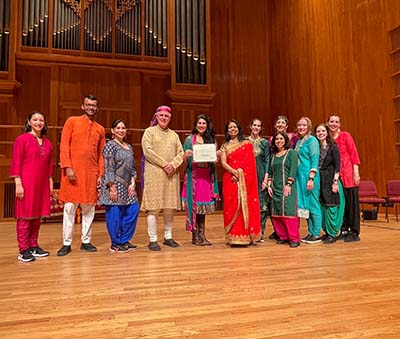
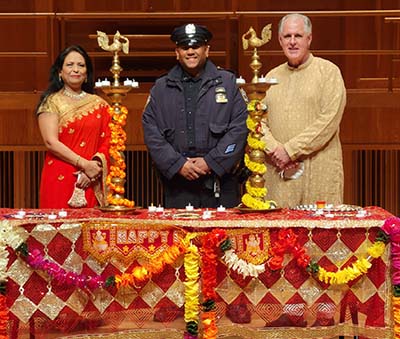
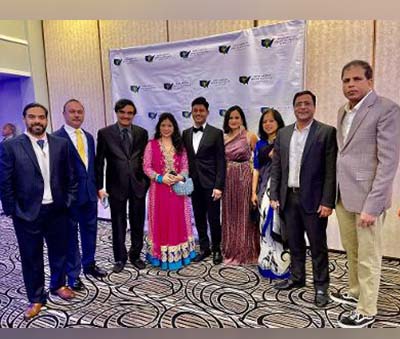
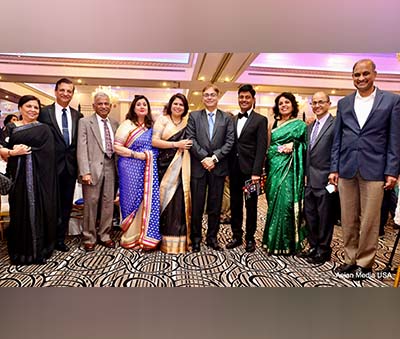
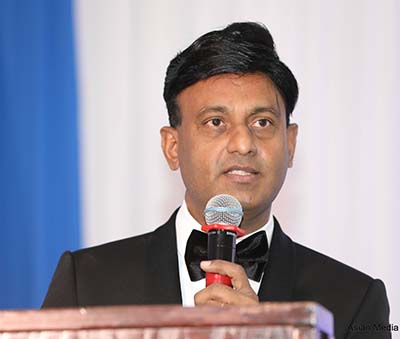
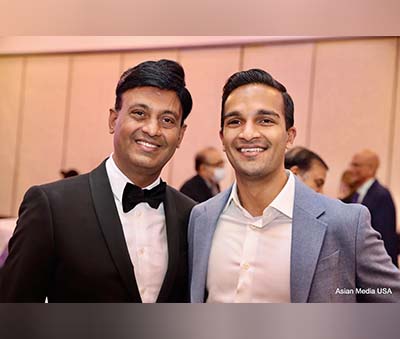
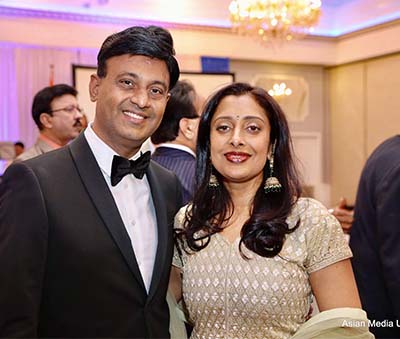
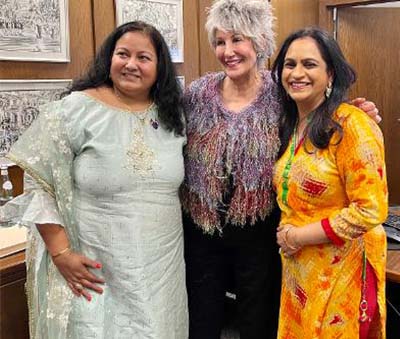
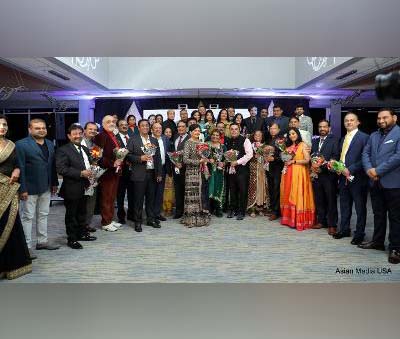
New York City Council Member James F. Gennaro and District Leader Neeta Jain were joined by a number of elected officials and local leaders for the annual New York City Council’s Diwali Festival – a celebration of the festival of lights on Saturday, November 13. This year marked the return of the annual tradition, which was cancelled last year due to COVID-19. This year, the festival, traditionally held at City Hall, was hosted in Queens – at Queens College’s LeFrak Concert Hall. The event, which was free and open to the public upon registration, was a major success, with tickets completely sold out just four days after it was announced.

 Diwali – known as the festival of lights – is one of the major festivals celebrated by Hindus, Jains, Sikhs and even some Buddhists. Each religion has its own historical narrative behind the holiday. Diwali is widely observed among more than a billion people from a variety of faiths across India and its diaspora. The five days of Diwali are marked by prayer, feasts, fireworks, family gatherings, and charitable giving.

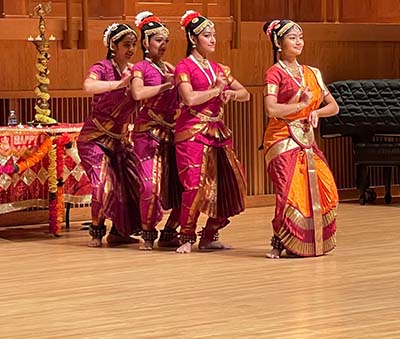
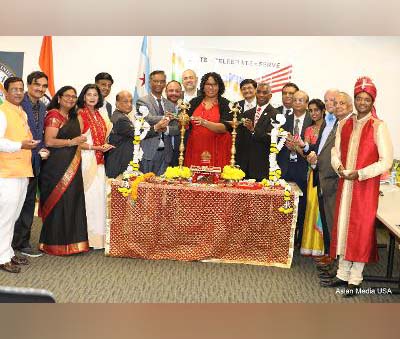
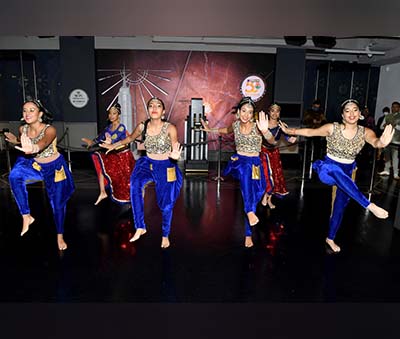
The event, organized by Council Member Gennaro and District Leader Jain, incorporated a number of traditional Diwali elements and performances, including a Peace Prayer by Dr. Krishna Pratap Dixit, a lamp lighting ceremony, a Ganesh Vandana Prayer by the members of the Hindu Temple Society of North America, a Bollywood Medley performed by Anadita Guha, Sarva Devatha Anjali performed by the Mukthambar Fine Arts Team, Nagade Sang Dhol Baje performed by Dr. Sumita Guha, and Masala Bhangra performed by Sarina Jain and her team.

On this occasion we honored accomplished philanthropics of our communities: Mr Kanak Golia, a businessman and a philanthropic, Dr Ravindra Goyal, Pulmonologist and Hindu Center President, Mr. Simarjeet Singh Gizlian, a Sikh community leader and Sarina Jain, a fitness Diva and and founder of Masala Bhangra.

“I was thrilled to host this weekend’s Diwali event at Queens College. Diwali is a time to celebrate the triumph of light over darkness, knowledge over ignorance, and good over evil. It is a beautiful tradition, and I am honored to have played a role in bringing the festival to Queens this year,” said Council Member Gennaro. “I would like to thank Queens College for providing us with the venue, District Leader Neeta Jain, who helped my office organize this event, and all the elected officials who came out to celebrate with us.”

“May the lamps (Diya) of Diwali (Deepavali) illuminate everyone’s life with happiness, peace and good health. Wish you and your family a very prosperous Diwali and a happy new year! On this Diwali, let’s make a promise to bring lights in people lives who suffered during this pandemic, and also pray to God for a good health and fortune for everyone! Looking forward to celebrate Diwali back again at City Hall next year with more joy of having it as NYC public school’s holiday!,” said Dr. Neeta Jain District Leader and co-organizer.

“It was my honor to once again co-sponsor the City Council’s Diwali event and to join my friends and neighbors for a beautiful celebration right here in Queens,” said Council Member Barry S. Grodenchik. “I cannot think of a better start to the holiday season.”

“Diwali is a festival of new beginnings and of light and hope. I was happy to co-sponsor this year’s festivities with my Council colleagues and celebrate this day with our friends and families,” said Council Member Peter Koo. “Wishing everyone a blessed, healthy, and prosperous holiday. May hope and light guide us all this Diwali and this holiday season!”

“It was a pleasure to celebrate Diwali at Queens College on Saturday evening. The festivities honored community advocates who have devoted their time, energy, and resources to improve the lives of countless NYC residents,” said Assembly Member David Weprin. “Diwali is a holiday celebrating the victory of light over darkness. After another difficult year in the pandemic, it was comforting to gather in-person and take part in a ceremony acclaiming the ultimate triumph of good over evil.”

“New York is no stranger to Diwali and its symbolic relevance. It is very heartening to see the festival of lights being celebrated here with great joy and fervor – not only by the South-Asian community, but also by members of diverse ethnicities and nationalities just like the Indian-American community celebrates Christmas and other festivals passionately and with great merriments,” said Deputy Consul General of India, Dr. Varun Jeph, who was in attendance at Saturday’s festival. “It truly reflects the American and Indian values of celebrating diversity and of embracing different cultures. May the festival of lights bring joy, love, peace, prosperity and good health to everyone.”

Deputy Consul General of Israel, Israel Nitzan was in attendance as well and he said ‘ his is the first time I am celebrating Diwali with Indian American community.”  Event was also attended by Desi Society of NYPD officers and a representative from New York Governor Kathy Hochul.

Dr. Suresh Reddy Assumes Charge As President of Indian American Medical Association, Illinois

(Chicago, IL: November 15, 2022) “I would like to stand on the top of shoulders of 39 Past Presidents so I can see farther,” Dr. Suresh Reddy, a Neuro Interventional Radiologist practicing in the Chicago area and a past President of national AAPI, said immediately after assuming office as the President of Indian American Medical Association, Illinois during a colorful ceremony held in Oakbrook, IL on Saturday, November 13th.

“As the President, one of my main goal is to revitalize local Chapters that are the backbone for the national organization; help make the local Chapters financially viable as funds have dwindled due to pharma support; and to bring in younger physicians into the fold,” the young and dynamic President told a select group of audience who had come to cheer him and the new executive committee.

Dr. Reddy then went on to introduce his Executive Committee Team: Dr. Piyush Vyas, whom Dr. Reddy described as “my older brother and professional mentor” will serve as the President. Dr. Radhika Chimata will serve as the Secretary,. While the Secretary-Elect is Dr. Dilip Shah.

The new Treasurer is Dr. Meher Medavaram and the Treasurer-Elect is Dr. Rajeev Kumar. The new chairs of the committee include Drs. Aparna Natarajan, Srilatha Gundala, Tapan Parikh, and Neetha Dhananjaya.

Dr. Reddy expressed his deep gratitude to the past presidents with whom he had worked: Drs. Samir Shah, Tapas Das Gupta, Sreenivas Reddy, Niranjana Shah, Geetha Wadhwani and Suneela Harsoor.

“I would also like to thank all the leaders of IAMA, especially Drs, Vemuri Murthy, Hanumadass, Rohit Vasa, Satya Ahuja, Shastri Swaminathan, Khandelwal, Arvind Goyal, Annita John, Utpal Parikh,  Sukanya Reddy and several others.” He had a special note for Dr. Lalmalani. “I would like to thank my spiritual guru and political mentor, our Mayor of Oak Brook Dr. Lalmalani.”

Dignitaries, who attended the ceremony include Consul General of India in Chicago, Mr. Amit Kumar, US Congressman Raja Krishnamoorthi, Illinois State representative Deanne Mazzochi, famed Infectious Diseases/COVID Specialist Dr. Vishnu Chundi and several others, including

Dr. Ranga Reddy, Past President of AAPI and Dr. Satheesh Kathula, Secretary of AAPI. Dr. Reddy thanked the sponsors of the event, Hanmi Bank and ATG tours.

Educated, trained, and board certified in Neuro-Radiology, Interventional Radiology and Interventional Neuro-Radiology at Beth Israel Deaconess Medical Center and Harvard Medical School, Boston, MA, Dr. Reddy had served as the Chief of Interventional Neuroradiology at Beth Israel Deaconess Medical Center and on Faculty at Harvard Medical School for almost a decade. Dr. Reddy has been involved in the highly specialized techniques and art of treating aneurysms and strokes in the complex part of our body, the Brain. He is also extensively trained to perform complex procedures in the most inaccessible regions of the spine.

Author of many international medical journal articles, Dr. Reddy has traveled extensively, giving specialty lectures on the complex procedures that he does. Active in teaching and mentoring many medical students and residents, Dr. Reddy has received numerous teaching and mentoring awards. To his credit, he is a four-time recipient of “Faculty award for excellence in teaching” awarded by the Harvard Medical Students and Residents.

Dr. Suresh Reddy MD, MHM (Health Management and Policy), who completed his medical education in India at Kakatiya / Osmania Medical Colleges, before immigrating to the United States, currently serving as the Chief of Radiology at Hines Medical Center, Associate Professor of Radiology at Loyola Medical Center in Chicago, has had many years of service to the medical community and to the American Association of Physicians of Indian Origin and IAMA IL chapter. As an exceptional leader of AAPI, he has taken up several worthy causes, including clearing the “Green Card” backlog for Indian physicians in Rural America.

His strongest attribute is building bridges with the local chapters, which he claims to the backbone of the National organization.  To his credit, he added 8 new regional chapters to the national organization. In addition, Dr Reddy has worked closely with AAPI members over the years to successfully organize CME cruises to Alaska, Scandinavia, the Mediterranean, Hawaii, and Antarctica; along with CME trips to Israel and Jordan. Proceeds from all of these trips were donated back to AAPI. Dr Reddy firmly believes that such trips build a closer bond between AAPI members and their families.

In the summer of 2019, Dr. Reddy organized The Global Health Summit in Hyderabad, an educational event with numerous workshops. Vice President of India, Sri Venkaiah Naidu, Union Minster of Health, Dr. Harshvardhan, both addressed the highly successful Global Health Summit. In October of 2019, he played a key role along with the Indian Resuscitation Council to train almost 500,000 lay people in Cardio-Pulmonary Resuscitation in India.

Assuming charge as the President of AAPI, nation’s largest physician organization, when the COVID Pandemic hit the world, impacting every aspect of life on a global level, he and his team faced a number of challenges in carrying out their plans during his term. Dr. Reddy and his team were right on task, and Dr Reddy devoted a significant part of the year to creating stability and leading AAPI to the next level. Never in the history of AAPI had so many educational programs been organized. Never had so many specialists shared knowledge so actively, with the participation of thousands of doctors from across the world.

It was the first time ever that a sitting Prime Minister of India addressed an AAPI event, when Shri Narendra Modi spoke at the Summer Summit organized by AAPI. Others who addressed the AAPI Summer Summit included Dr. Susan Bailey, Dr. Patricia Harris, US Surgeon General Dr. Jerome Adams, Congressman Raja Krishnamoorthi, and Soumya Swaminathan from the WHO.

His leadership and foresight were deeply appreciated as AAPI became the first major organization to call for universal masking. In this regard, AAPI provided free masks to thousands of health care workers. AAPI members have honored more than 10,000 nurses in over 100 hospitals across more than 40 states by sponsoring lunches for them during the Nurses Week. He was instrumental in organizing the Obesity prevention programs in all continenets, sharing medical knowledge globally, team-building activities such as the Share-A-Blanket program, medical education programs such as CPR training, morale building programs like mentoring a future medical students, and India heritage programs like Independence Day celebrations.

Collaborating with the Indian Embassy in DC, under his leadership, more than 1000 prescriptions were written for Indian visitors who were stranded in the USA due to COVID Pandemic. He, along with his team created the “AAPI Endowment Fund,” raising and donating $300,000 with a goal of enabling his successors to be less burdened with fundraising and more focused on AAPI’s mission of Education, Mentoring, Research, Charity, and Service.

Dr. Reddy currently resides in the Chicago area with his wife Leela and son Rohun. He is currently a Trustee of the Village of Oak Brook, Lead of Chiefs of Radiology for the states of Illinois and Wisconsin Veterans Administration, and has participated in innumerable community events.  He has organized Independence Day celebrations and has worked with the IAMA team over the years to support numerous activities. He also organized numerous walkathons to honor our Veterans.

IAMA-IL is a non-profit organization comprised of Illinois physicians, fellows, residents, and medical students of Indian origin who are committed to professional excellence and quality patient care. IAMA-IL offers many opportunities for your organization to begin and grow a connection with our members and the communities we serve. We like to partner with organizations and people that strive for similar goals including a commitment to excellence, education, research and serving the community.

Dr. Suresh Reddy has made the Indian community proud with his innumerable contributions and he is ready to serve IAMA as its 40th President. He credits his track record of almost 6 years as a foot soldier in IAMA, as it has laid the foundation for this upcoming year. Dr. Suresh Reddy’s theme for IAMA under his leadership is, “Ask what you can do for IAMA, and not IAMA can do for you.”

Rajeshwar Prasad Presented Life Time Achievement Award At NIAASC Annual Meeting In New York

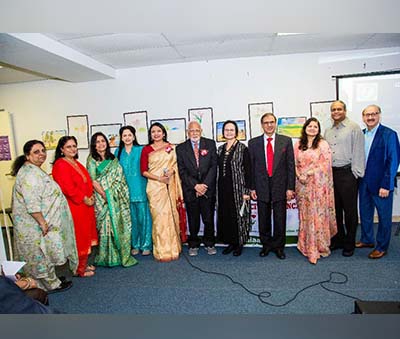
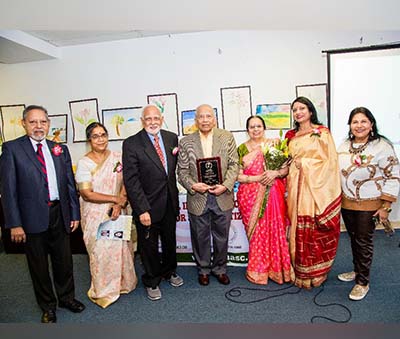
Rajeshwar Prasad, founder and chairman of  The National Indo-American Association for Senior Citizens (NIAASC) was honored with a Lifetime Achievement Award, During the 32nd annual Conference and 23rd Annual meeting of NIAASC on Sunday, November 7th, 2021 at the India Home in Jamaica, New York. He was recognized for his 23 years of admirable and outstanding community outlook and service, creating and nurturing NIAASC and dedicated to all seniors across the USA.

Dr. Vasundhara Kalasapudi, who is the founder of India Home nonprofit organization and a current board member of NIAASC hosted the conference, which  was informative and entertaining with vegan breakfast and lunch served.  Dr. Bhavani Srinivasan, Vice president – NIAASC was the coordinator of the conference and coordinated the event effectively and flawlessly.

The conference started with opening remarks and greetings by NIAASC Chairman and founder Rajeshwar Prasad. in his speech, Prasad reflected on the growth of the organization since its inception in 1998. He stated “NIAASC helps Senior Citizens and Senior Associations through information, referral and advocacy services “. Following the Chairman’s speech, Mrs. Gunjan Rastogi, the current president of NIAASC welcomed ­­the attendees and echoed the chairman’s message and reaffirmed and reminded everyone that NIAASC is a unique nonprofit organization that provides resources for all the seniors while collaborating with other nonprofit organizations and this was well received and acknowledged.

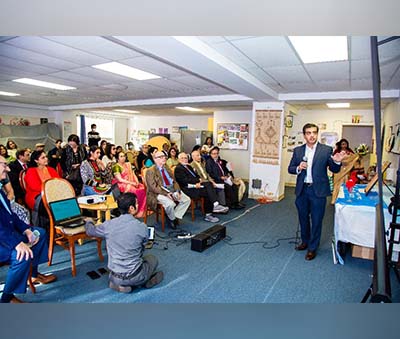
The main speaker was Dr. Vikas Malik, a board-certified medical professional in both Child-Adolescent Psychiatry and Adult Psychiatry and his PowerPoint presentation on Mental Health in light of COVID-19 captivated the audience of roughly 70 physical attendees and 30 virtual attendees, who appreciated the information and knowledge that was succinctly explained.  His presentation was followed by Dr. Swaminathan Giridharan, a Geriatric specialist, who spoke about COVID-19 Vaccination.  The conference also focused on physical health and a presentation by   Mrs. Suman Munjal, president of World Vegan Vision, who discussed the health benefits pertaining to a vegan diet.

The occasion marked NIAASC honoring Mr. Mukund Mehta, President of Indo-American Senior citizen center, a nonprofit organization and the President of India Home. In introducing Mr. Mukund Mehta, Dr. Vasundhara Kalasapudi informed the audience about his active involvement as a director with the Federation of Indian American Seniors Associations of North America (FISANA).

NIAASC’s goal of collaboration with other organizations was evident as the conference was well attended by members of the National Federation of Indian American Associations (NFIA). Members included current executive board members and past presidents who made the effort to connect via zoom. NFIA attendees belonged to different states/different time zones and remained present throughout the duration of the program. Also in attendance were members from several other organizations such as World Vegan Vision (WVV) and India Association of Long Island (IALI). Many IALI members attended In-person and on Zoom, including nine past presidents. Other NIAASC Board members that joined via zoom were: Satpal and Satya Malhotra(New York), Baldev Seekri ( Florida), Chandrakant Shah (Florida), Santosh Kumar (Chicago), Asha Samant (New Jersey ) and Jyotsna Kalavar (Indiana).

Lunch was followed by Diwali cultural program that was presented by Ms. Jyoti Gupta and her team consisted of several singers, Dr.Jag Kalra, Kul Bhooshan Sharma, Gautam Chopra and Raj Dhingra. The group entertained and regaled the audience with lively Bollywood songs. Music program was followed by Diwali Felicitation by Nilima Madan.

In her closing remarks, Gunjan Rastogi thanked the sponsors that supported the entire event financially and also thanked the India Home volunteers who had helped set up the venue while precluding any hiccups.

The vote of thanks was given by Mr. Harbachan Singh, NIAASC Secretary who appreciated the presence of large number of audiences, sponsors, and well-wishers.

Upon adjournment of the conference, the 23rd general body meeting was conducted by NIAASC president, Gunjan Rastogi, who requested Mr. Rajeshwar Prasad to present the report of nominating committee, since the chairman of the nominating committee Chandrakant Shah, was not able to the report due to some technical issue. Rajeshwar Prasad informed the members that as per NIAASC constitution and bylaws; 1/3rd members retire every year, but based on eligibility criteria, members are eligible to be re-elected for another term of three years that resulted in all the retiring members Gunjan Rastogi, Bhavani Srinivasan, E.M. Stephen, Santosh Kumar, and Rajeshwar Prasad to be elected for three additional years and was approved by the General Body.        For additional information about NIAASC, please email the president at gunjan.p.rastogi@gmail.com.

Shekar Krishnan, Shahana Hanif Are First South Asian Americans Elected To New York City Council

In New York City, a global beacon that draws a diverse population from all over the world, the City Council has never had a person of South Asian descent — or a Muslim woman — among its membership. That changed this year, when Shahana Hanif, a former City Council employee, won her election in a Brooklyn district that covers Park Slope, Kensington and parts of central Brooklyn.

Hanif, who is Bangladeshi American, was the first Muslim woman elected to the Council in its history, despite the fact that the city is home to an estimated 769,000 Muslims. She was one of two history-making South Asian candidates to win as well; the other, Shekar Krishnan, won a seat representing Jackson Heights and Elmhurst in Queens.

Shekar Krishnan and Shahana Hanif made history election night this year, becoming the first ever South Asian Americans ever been elected to New York City Council. Krishnan and Harif are both community activists who participated in a two-week hunger strike to protest the huge cost of taxi medallions for New York City cab drivers, 40 percent of whom are South Asian Americans. A third South Asian candidate, Democrat Felicia Singh, lost to her Republican opponent Joann Ariola in in Queens District 32.

Born to Indian immigrants from Kerala in the United States, Democrat Krishnan was elected to represent Jackson Heights and Elmhurst in Queens in District 25 in Tuesday’s elections. “Thank you #JacksonHeights and #Elmhurst! Thank you for believing in me! Together, we will fight for a city for everyone. We will fight for our home,” he tweeted Wednesday morning.

Ahead of the elections, Krishnan, who wants to help alleviate the problems of immigrants, spoke to Scroll.in about life as an immigrant, and his plans for the communities of Jackson Heights and Elmhurst neighborhoods.

“My parents came to the US around 30 years ago, and they struggled with discrimination and the inaccessibility of resources all through their careers as research scientists in the pharmaceutical industry,” he said. “When they first arrived, they qualified for every single public benefit available at the time but did not receive them because they didn’t know what they were or how they could have applied for them,” Krishnan said noting, “Our immigrant community faces similar struggles even today.”

“I saw my parents struggle with a feeling of not belonging here, and I can relate to similar experiences of immigrants in my community. My parents came here with official documents and education, but I saw their struggle despite these privileges. “

“They were discriminated against because of their skin colour, accents, etc, and all that left an indelible impression on me, which is why I chose to become a civil rights lawyer, and eventually venture into politics,” Krishnan added.

Democrat Hanif, who become the first Muslim woman elected to the New York City Council from Brooklyn District 39, polled an overwhelming 89.3% votes. Her only opponent of the Conservative Party received 8 percent of the vote. The city has an estimated 769,000 Muslims.

Hanif said she was “humbled and proud” to be the first Muslim woman on the Council — and the first woman of any faith to represent District 39 — in a statement released Tuesday night.

She acknowledged community and progressive group volunteers and endorsements, notably the left-leaning Working Families Party. “Together we are building an anti-racist, feminist city,” she said. “We deserve a city that protects its most vulnerable residents, a city that provides fair education, a city that invests in local and community-driven climate solutions, and a city where our immigrant neighbors feel welcome, heard, and protected. Even if the election is done, this task demands all of us to keep turning up.”

Shahana’s ancestral home is in Chattogram’s Fatikchhari upazila. Eldest daughter of Mohammad Hanif — one of the United States Awami League’s advisers, Shahana has long been involved in politics in Brooklyn. She is known as a representative of the progressive youths in politics.

The 2021 elections saw a series of firsts for candidates of color in local and state races across the country. Michelle Wu became the first woman and person of color elected to be Boston’s mayor. Pittsburgh and Kansas City elected their first Black mayors, Ed Gainey and Tyrone Garner. Dearborn elected its first Muslim and Arab American mayor, Abdullah Hammoud. And Tania Fernandes Anderson became the first Muslim elected to Boston’s city council.

US Announces Big Hike In Medicare Premiums

The federal government announced a large hike in Medicare premiums Friday night, blaming the pandemic but also what it called uncertainty over how much it may have to be forced to pay for a pricey and controversial new Alzheimer’s drug.

The 14.5% increase in Part B premiums will take monthly payments for those in the lowest income bracket from $148.50 a month this year to $170.10 in 2022. Medicare Part B covers physician services, outpatient hospital services, certain home health services, medical equipment, and certain other medical and health services not covered by Medicare Part A, including medications given in doctors’ offices.

The Centers for Medicare and Medicaid Services played down the spike, pointing out that most beneficiaries also collect Social Security benefits and will see a cost-of-living adjustment of 5.9% in their 2022 monthly payments, the agency said in a statement. That’s the largest bump in 30 years.

“This significant COLA increase will more than cover the increase in the Medicare Part B monthly premium,” CMS said. “Most people with Medicare will see a significant net increase in Social Security benefits. For example, a retired worker who currently receives $1,565 per month from Social Security can expect to receive a net increase of $70.40 more per month after the Medicare Part B premium is deducted.”

The increase, however, is far more than the Medicare trustees estimated in their annual report, which was released in late August. They predicted the monthly premium for 2022 would be $158.50. The actual spike — the largest since 2016 — could hurt some seniors financially.

It “will consume the entire annual cost of living adjustment (COLA) of Social Security recipients with the very lowest benefits, of about $365 per month,” said Mary Johnson, a Social Security and Medicare policy analyst for The Senior Citizens League, an advocacy group. “Social Security recipients with higher benefits should be able to cover the $21.60 per month increase, but they may not wind up with as much left over as they were counting on.”

Medicare premiums have typically increased at a far faster rate than Social Security’s annual adjustments, the league said. And much of the 2022 increase in Social Security benefits will be eaten up by inflation, which is also rising at a rapid clip.

CMS said part of the increase for 2022 was because of uncertainty over how much the agency will end up paying to treat beneficiaries to be treated with Aduhelm, an Alzheimer’s drug approved by the US Food and Drug Administration in June over the objections of its advisers. Some experts estimate it will cost $56,000 a year. Medicare is deciding whether to pay for it now on a case-by-case basis.

Because Aduhelm is administered in physicians’ offices, it should be covered under Medicare Part B, not Part D plans, which pay for medications bought at pharmacies. Traditional Medicare enrollees have to pick up 20% of the cost of most Part B medications, which would translate into about $11,500 in out-of-pocket costs for those prescribed Aduhelm.

“The increase in the Part B premium for 2022 is continued evidence that rising drug costs threaten the affordability and sustainability of the Medicare program,” CMS Administrator Chiquita Brooks-LaSure said in a statement. “The Biden-Harris Administration is working to make drug prices more affordable and equitable for all Americans, and to advance drug pricing reform through competition, innovation, and transparency.”

Also, Congress last year limited the 2021 premium increase even as emergency Medicare spending surged during the coronavirus pandemic. The monthly charge rose less than $4.

Along with the premium spike, the annual deductible for Medicare Part B beneficiaries is rising to $233 in 2022, up from $203 in 2021.

Medicare is the federal health insurance plan covering more than 62 million people, mostly 65 and older.  Part B premiums are based on income. Individuals earning $500,000 or more a year and joint filers making $750,000 or more annually will pay $578.30 a month for coverage in 2022.

Diwali Celebrated At Cook County Treasurer Maria Pappas’s Office By Chicago Indo-Us Lion Club

Chicago Indo-US Lions Club in association with the Office of Cook County Treasurer Maria Pappas, hosted Diwali celebration on November 5th, 2021 in Chicago IL. The guest of Honor for the event was Consul General Amit Kumar who congratulated Indo US Lions Club and Maria Pappas for hosting the historic event and spoke about the significance of Diwali and the celebration as big step in creating awareness about cultural heritage of India.


The second-generation INDO-US lions team headed by Hina Trivedi and Lion Maria Pappas also recognized some members and volunteers for their services for the community and for their contribution to Indo US communities during Covid-19. Hina Trivedi presented plaques to the special guests Amit Kumar, Maria Pappas, Laxman Gupta as a token of appreciation for their exceptional leadership.


Lion Hina Trivedi spoke about the selfless efforts by Chicago Indo Us lions club in helping families and kids by donating school supplies, backpacks, coat drive and food drive. The club recently helped many patients in India with ventilators as well.


The celebration was well attended by many community leaders that included the team members of AMEC Anica Dubey along with Dr. Vijay Prabhakar who supported the event. Media was represented by Prachi Jaitly of Asian Media Broadcasting (AMB). 


Maria Pappas declared Diwali as an annual event to celebrate every year on a large scale together with Chicago Indo US club. Hina Trivedi, founder President Chicago INDO-US Lions along with the efforts and vision of Dr. Ram Gajjela founder chair and 2021 President Jay Trivedi helped making historic celebration happen further strengthening the Indo US relationship.

Melody Queen Rita Shah Rocks Chicago SSS Entertainment Organizes Musical Evening for Charitable Cause

Chicago IL: SSS Entertainment organized a musical evening on November 13th at Fairfield Inn, Schaumburg, IL to support a philanthropic cause. The event aimed at raising funds for children orphaned due to Covid-19 Pandemic. Following a devotional dance performance by Jenish Bulsara, Swapnil Shah started the event talking about the vision behind organizing the event and also thanked all the donors for coming forward to help. The grand sponsors of the event were Anil Loomba of Home Mortgage Solutions Inc., Pinky and Dinesh Thakkar and Ketan and Purvi Shah. Ketan shah and Pinky Thakkar addressed the audience and applauded the benevolent gesture of the organization to support the kids in need. All the sponsors and supporters were duly acknowledged by the organizers by presenting a token of appreciation.


The event featured some very well-known vocalists of Chicagoland Rita Shah, Rajesh Chelam, Jitendra Bulsara, Pratibha Jairath and Mir Ali along with the live orchestra by Orchestra Sa Re Ga Ma led by Hitesh Master Nayak and his team accompanied by Nupur Sound. The musical team kept the guests entertained with a beautiful line up of evergreen melodies. The guests celebrated Sunil Shah’s birthday with a surprise cake cutting ceremony organized by daughter in law Nikki Shah. Mr Shah brought the entire audience on the floor with his excellent singing performance. Sunil and Rita were accompanied by their family and friends who wholeheartedly worked towards the cause behind the evening.


Rita Shah during her speech thanked all the donors and supporters followed by a brief address by Sunil Shah who mentioned how Rita Shah has been the driving force behind his many successful initiatives like FIA, one of the biggest Indian associations in the US. Rita presented her singing talent in 2005 with legendary Bollywood singer Mahendra Kapoor for Tsunami Relief event and through her singing has also helped collect funds for Uttarakhand floods with her devotional songs. She has also sung and performed with Bollywood singer Bappi Lahiri & Bollywood superstar Shahrukh Khan


What a humble reply when someone from audience told that, “You are a star “She politely replied, “Tare Zamane Pe “


The event was anchored by Prachi Jaitly and Mohan Rawat who kept the audience entertained. The other elected officials and community leaders presented at the event were Cook County Commissioner Kevin Morrison, Brij Sharma of Power Volt, Dr Bhupinder Beri, Dr Parag Doshi, Neil Khot, Mukesh Shah, Rita Singh, Aishwarya Sharma, Ketu Amin, Manish Gandhi, Hitesh Gandhi, Dr Kamal Patel, Vinita Gulabani, Gurmeet Singh, Shargio Patel, Dipen lakha, Krishna Bansal, Nimish Jani, Dr Mona Ghosh and several other prominent people from the community. Media was represented by Asian Media Broadcasting. Delicious food was from Shree Restaurant.

Chicago’s City Treasurer Melissa Conyears-Ervin Holds Colorful Diwali Celebrations at City Hall

Chicago IL: Chicago’s City Treasurer Hon. Melissa Conyears-Ervin hosted a grand Diwali Reception brimming with festive colors, lights, dance, music and ceremonial lamp lighting with her deep appreciation for sharing the spirit of Diwali with fellow Chicagoans at the iconic City Hall in Chicago amidst the gathering of prominent Indian American community, organizational and business leaders. This Diwali celebration was initiated by National Council of Asian Indian Associations [NCAIA]


Following the invocation by Anu Malhotra and lamp-lighting ceremony, Dr. Suresh Reddy, Oakbrook Trustee presiding over the Diwali celebration event invited Dr. Bharat Barai, an eminent community leader who presented a brief overview of the story of Diwali and how it has contemporary relevance in terms of its central message of spreading light, goodness and knowledge over darkness, evil and ignorance.


The celebrations encompassed the ceremonious crowning of Chicago’s City Treasurer Hon. Melissa Conyears-Ervin with a silk colorful headgear symbolizing the crowning appreciation from NCAIA for hosting a grand Diwali in the magnificent iconic City Hall building that was led by Event Convener & Vice President Ajeet Singh joined by NCAIA officers: Harish Kolasani, Dr. Suresh Reddy, Vinesh Virani, Neelam Dwivedi Singh, Keerthi Kumar Ravoori, Shekhar Misra, Iftekhar Shareef & Nag Jaiswal. NCAIA National President Harish Kolasani welcomed the guests and outlined the mission of National Council of Asian Indian Associations and how it impacted lives especially in recent times contributing towards the goal of eradication of the pandemic.


Hon. Melissa Conyears-Ervin, City Treasurer in her remarks reiterated the central premise of Diwali that symbolizes victory of good over evil and triumph of light over darkness. Hon. Melissa Conyears-Ervin said Diwali represents the beautiful colors of life and thanked NCAIA for facilitating the celebrations with her office. Hon. Melissa Conyears-Ervin articulated the message from Chicago Mayor Lori Lightfoot who sent her greetings of Diwali to the Indian American community.


Chicago’s 17th ward Alderman David Moore joined the celebrations, expressed his warm greetings to the Indian Americans and said Diwali is truly a wholesome festival to rejoice and celebrate with fellow Chicagoans. Consul Laxman Prasad Gupta from the Indian Consulate in his brief remarks said Indian American community is well integrated into the cultural fabric of this country and have excelled in several fields and conveyed Diwali best wishes.


Dr. Suresh Reddy, Oakbrook Trustee & NCAIA’s Executive Vice President who served as emcee described it as a historic celebration at City Hall and said Diwali is now a widely recognized and celebrated festival in the United States across all spectrum of South Asians.


Event Convener Ajeet Singh, NCAIA Vice President earlier introducing the City Treasurer Melissa Ervin described her as an exceptional custodian of the City Treasury who effectively and efficiently presides over the $ 9.5 billion to ensure taxpayers get the optimum leverage to help Chicago communities grow at the same economic rate regardless of the neighborhoods.


Keerthi Kumar Ravoori, NCAIA Secretary led the event with brief opening remarks and graciously thanked the City Treasurer for hosting a grand festive celebration that commemorates the triumph of goodness, light and knowledge. 


Following, Ms. Madhura Sane presented a spellbinding dance performance symbolizing the enduring spirit of Diwali that elicited sustained applause. Neelam Dwivedi Singh, NCAIA Chairwoman extended Diwali greetings and added that the lights of diyas illuminate life with knowledge, compassion, care and love for each other. Iftekhar Shareef of NCAIA’s Advisory Council said this Diwali represents an outstanding example of interfaith unity and harmony. Nafees Rehman, Deputy Director for IL Secretary of State also conveyed Diwali wishes. Other prominent guests who participated in the event include Mitesh Kamdar, Dr. Shekar Misra, Dr. Harjinder Khaira, Harendra Mangrola, Dr. Vidyani S, Vinita Gulabani, Jigar Shah, Nick Verma, Satish Dadepogu, Ravi Harsoor, Chandini Duvuri, Subu Iyer, Nag Jaiswal, Alli Dhanraj & Tanuja Misra. Mr. Craig Slack – Chief Investment Officer & Deputy Treasurer James Ramos also joined the festivities and extended warm Diwali greetings.

Association of South Asian Real Estate Professionals (ASARP) organized its annual gala

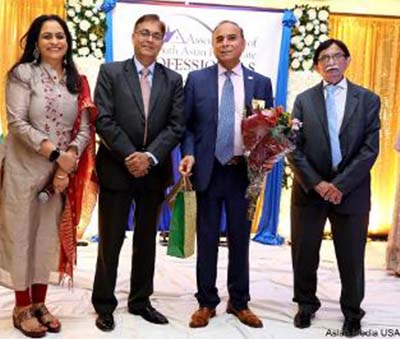
Association of South Asian Real Estate Professionals (ASARP) organized its annual gala on November 7th at Fairfield Inn, Schaumburg. The program was hosted by Prachi Jaitly and Shirin Marvi. The event kicked off with social networking and live Indian Flute on stage followed by national anthems and traditional lamp lighting.

National anthems were sung by Ramona Schmika and Dipti/Madhu Dave. The special guests and speakers that attended the gala were Congressman Raja Krishnamoorthy, Consul General Amit Kumar, Real Estate coach and Mentor Lynn Madison, Dan Wagner, Mario Treto, Laurie Murphy, John Gormley, Chaudhary Khokar, Sadia Gul Covert. Consul General Amit Kuman talked about India and US Partnership. ASARP Chairman, Pradeep Shukla talked about the vision and achievements of the organization since its inception and extended his best wishes to the new board.

The gala had a variety dance performance by very well-known artists from Chicagoland that included Chicago Kala Kshetra, Sonali Shani and Rewa Shani, Swati Pandey, Aanya and Usha Kabra.

2021 President Al Haroon Husain introduced the executive board followed by the oath ceremony of the 2022 president and board members. Oath was administered by ASARP Chairman Pradeep Shukla.

The 2022 team taking oath included Incoming President- Shirin Marvi, Incoming Vice President- T.Paul S. Chawala and Incoming Treasurer- Rajesh N. Patel

Executive Board Members are Anup Patel, Bimal M Pandhi, Marsha Collins, T. R. Vishwanathan and Vasanti Bhatt.

The event was sponsored by Growth Level Sponsors: MainStreet Organization of Realtors (John LeTourneau,President) and other major sponsors like Millennium Bank (Moti Aggarwal and Salil Mishra), Law offices of Nirav Patel, Gardi and Haught (Hiten Gardi), PPG Finance (Shane Parekh). The event was executed by Artists Association of North America. Media was represented by Asian Media Broadcasting and Asian Media USA

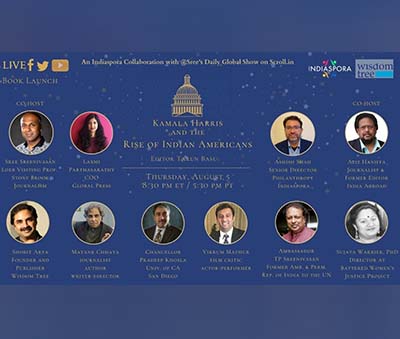
Community Groups Organize Discussion on The Book, “Kamala Harris and the Rise of Indian Americans”

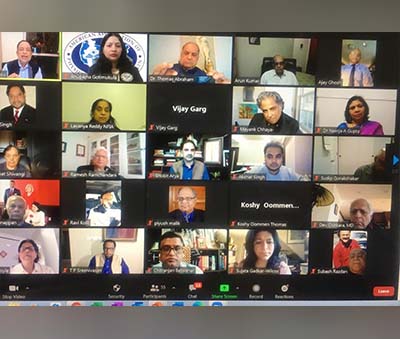
A discussion and celebration of the Indian Diaspora and their achievements was held virtually on Saturday, November 7th, 2021, and was attended by People of Indian Origin from around the globe. Jointly organized by Global Organization People of Indian Origin (GOPIO), American Association of Physicians of Indian Origin (AAPI), American Society of Engineers of Indian Origin (ASEI), Association of Indians in America (AIA), and National Federation of Indian American Associations (NFIA), the event offered a glimpse of the growth and the successes of the Indian American community in various domains.

Edited by the Delhi-based veteran journalist and foreign policy analyst, Tarun Basu, the evocative collection titled, “Kamala Harris and the Rise of Indian Americans,” captures the rise of the Indians in the US across domains by exceptional achievers. Sixteen eminent journalists, business leaders and scholars have contributed essays to the timely and priceless volume, which charts the community’s growing and influential political engagement.

The book was released by New Delhi-based publisher Wisdom Tree and is available in the U.S. via Amazon. Describing the book as an “eclectic amalgam of perspectives on the emerging Indian-American story,” Tarun Basu said, “This evocative collection—of the kind perhaps not attempted before—captures the rise of Indian-Americans across domains, by exceptional achievers themselves, like Shashi Tharoor, the ones who have been and continue to be a part of the “rise,” like MR Rangaswami and Deepak Raj, top Indian diplomats like TP Sreenivasan and Arun K Singh, scholars like Pradeep K Khosla and Maina Chawla Singh, and others who were part of, associated with, or keenly followed their stories.”

In his remarks, Shobit Arya, publisher of the book, shared with the audience about the objectives of publishing such an important book that portrays the life story and achievements of the influential Indian American community.

Dr. Thomas Abraham, Chairman, GOPIO International, who is the main organizer moderated of the session, who has been instrumental in establishing and leading several Indian American organizations and has seen the rise of the community in the past half a decade, shared with the audience the major highlights, depicting the progress and achievements of the community.

 “My own involvement in the community for the last 47 years as the Founder President of FIA New York, National Federation of Indian American Associations and GOPIO, I want to give some milestones of our community since the late 1970s,” Dr. Abraham said and enumerated the major milestones of the Indian Americans, starting with the formation of the first national organization post-India independence in 1967, Associations of Indian America (AIA), and succeeding in its efforts to have the Asian Indians categorized in the 1980 Census, First Convention of Asian Indians in America in 1980 and formation of the NFIA, first India Day Parade in New York City in 1981, first White House Briefing in 1983, keeping the family reunification in the Simson-Mazzoli Immigration Bill in 1985, Meeting of the community with President Ronald Reagan in 1986 at the White House, first time sub-cabinet level appointment of Dr. Joy cherian as EEOC Commissioner, Election of Bobby Jindal as Congressman and then as Louisiana Governor, Indo-US Nuclear Treaty; Rise of Indian Americans in the MNCs, Silicon Valley, Hospitality and HealthCare; first cabinet level appointment of Nikki Haley, and now culminating in dozens of Indian Americans holding important positions in the US administration and several dozens elected to local, state and national offices across the nation including VP Kamala Harris.

History of Indian community organizations and the role played by these organizations in community development, mobilization and promoting the diverse interests such as education, political involvement, entrepreneurship, business and service industry are covered in this new book,” Dr. Abraham said.

While acknowledging the success story of Indian American physicians, Dr. Anupama Gotimukula, President of AAPI said, “The success story of Indian American Doctors has been arduous. As Ajay Ghosh, who has been working for AAPI for nearly a decade has aptly summarized this long and difficult journey: “While Indian American physicians play a critical role, serving millions of patients in the United States, leading the policies and programs that impact the lives of millions today, it has been a long and arduous journey of struggles and hard work to be on the top of the pyramid.”

Dr. Gotimukula pointed out, “Indian American Doctors, who have been recognized for their compassion, skills, expertise and skills in caring for their patients, leading research that brings solutions to health issues and at the table making policies that benefit the world, are at the  at the forefront around the world as shining examples of meeting the needs of the hour.” She congratulated Tarun Basu, Shobit Arya and the 16 veteran journalists who have contributed to the book.

Dr. Ravi Kolli, President-Elect of AAPI spoke about how the Covid pandemic has impacted all and how the physician community who has borne the brunt of this epidemic is coping with the stress and the negative effects, while providing critical care to people diagnosed with Covid virus. Dr. Satheesh Kathula, Treasurer of AAPI and Dr. Sampat Shivangi, President of Indo-American Political Forum and NFIA past presidents Subash Razdan and Sudip Goraksharkar were others who had joined in the discussions.

Former Ambassador TK Srinivasan, who had served as the Deputy Indian Ambassador to the US and as Governor of India t the International Atomic Agency in Vienna, shared with the audience, his own experiences with the Indian Diaspora and how they have contributed to the larger goals of cementing stronger relationship between India and the United States.

In his remarks, NFIA President Ajoy Dube said, “National Federation of Indian American Associations (NFIA), the largest non-profit umbrella organization of Indian association, established in 1980, aims to unify the diverse Indian American community by coordinating and promoting the activities of its member associations. NFIA has been in the forefront of activities in US-India relations for over four decades.”

Describing the many contributions and objectives of ASEI, Piyush Malik, the current president said, “Since its inception in 1983, ASEI has strived to strengthen the Indo-American relationship, institute a channel of communication between technical organizations within the United States and abroad, lend a helping hand to charitable organizations, provide assistance to engineering students at the Local and National levels, and organize networking events.”

Dr. Urmilesh Arya, President of Association of Indians in America (AIA) spoke about the objectives and activities by AIA for the past several decades. “AIA is a grass root national organization of Indian immigrants in the United States, fostered on the democratic principles of “one member one vote”, with chapters and membership spread across the USA.”

 Journalist Arun Kumar who wrote a Chapter in the Book on “All the President’s People: Trust in the Corridors of Power” spoke about the increasing number of Indian Americans how have come to occupy critical roles in the US administration, starting with President Ronald Regan and currently having as many as 50 Desis, who occupy important positions in the Biden administration.

Mayank Chaya, another author who wrote on: “At the Center of Excellence: Seminal Contributions in the World of Science” presented how Indian Americans have come to lead research and scientific innovations across the United States.

The importance and high esteem with which physicians of Indian heritage are held by their patients is self-evident, as they occupy critical positions in the healthcare, research and administrative policy positions across America, including the nomination of the US Surgeon-General, Dr. Vivek Murthy.

In his presentation, Ajay Ghosh who has portrayed the rise of the Indian American physicians as a strong and influential force in the United States, chronicling their long journey to the United States and their success story, in a Chapter titled, “Physicians of Indian Heritage: America’s Healers” spoke about the four distinct areas, he has covered in the book: Indian American Physicians Being recognized as Covid Warriors who work as frontline healthcare workers treating millions of patients: Initial struggles of Indian American Physicians; Their Achievements; and, Contributions to Healthcare in India and the United States.

After the presentation by the authors, a question/answer session followed and was moderated by the co-host and Chair of the GOPIO Academic Council Dr. Neerja Arun Gupta who is currently the Vice Chancellor, Sanchi University for Buddhist and Indic Studies. A few quest5iiobn related to Indian community groups’ relations with India with government of India. The organizers said that the community groups work closely with Indian missions for India’s and community interest, however, groups have also been critical, when things were not moving in India.

Authors who have contributed to the Book include: former Indian ambassadors TP Sreenivasan and Arun K. Singh; Deepak Raj, chairman of Pratham USA; businessman Raj Gupta; hotelier Bijal Patel; Pradeep Khosla, Chancellor of UC San Diego; scholar-professor Maina Chawla Singh; Sujata Warrier, Chief Strategy Officer for the Battered Women’s Justice Project; Shamita Das Dasgupta, co-founder of Manavi; and journalists Arun Kumar, Mayank Chhaya, Suman Guha Mozumder, Ajay Ghosh, Vikrum Mathur, and Laxmi Parthasarathy.

The book is now available at: https://bit.ly/HarrisIA – Amazon India book link, and at https://bit.ly/HarrisIndAm – Amazon USA link. The discussion is available at the Facebook page at https://fb.watch/96qk1eJ-xA/

100 Most Expensive U.S. Zip Codes In 2021: Include Boston’s Back Bay And Weston

BOSTON–PropertyShark released its annual most expensive zip codes of 2021. New England is home to 11 of the priciest U.S. zip codes, including #2 with Boston’s Back Bay. The full list is included towards the end in this article.

Key Takeaways:

  • At nearly $7.5 million, Atherton, Calif.’s 94027 remains #1 most expensive zip code for fifth consecutive year
  • Record $5.5 million median sale price gives Boston’s 02199 #2 spot
  • Top 10 most expensive zip codes in 2021 all surpass $4 million mark — a historic first
  • 33109 in Miami jumps 66% Y-o-Y, becomes #5 priciest in U.S.
  • Nationally, 30 zips feature median sale prices higher than $3 million, more than double the number of areas in 2020
  • Country’s 100 most expensive zip codes located in 10 states, with 70% from California
  • Bay Area claims 47 of nation’s most exclusive zip codes
  • Los Angeles County remains priciest county with 21 entries
  • Once again, San Francisco boasts highest concentration of pricey zip codes, while NYC drops out of top 20
  • Gibson Island’s 97% Y-o-Y price surge claims Maryland’s highest position yet at #23
  • Exclusive Lake Tahoe enclaves rule Nevada real estate, Paradise Valley returns Arizona for 3rdconsecutive year

Ranking the Priciest U.S. Zip Codes by Closed Home Sales

Even as another uniquely challenging year — marked by the efforts of tackling the pandemic and boosting the economy — is coming to an end, the U.S. residential market continues to experience vertical price trends. And, that picture is clearly visible in our 2021 edition of the 100 most expensive zip codes in the U.S. — which, for the first time ever, includes 127 zip codes due to multiple ties.

Compiled by calculating median home sale prices as opposed to listing prices to ensure an accurate picture of market conditions as opposed to selling prices that reflect sellers’ wishes, this year’s edition highlights the ever-increasingly competitive residential markets of economically vital urban centers.

The Bay Area, Los Angeles County, and New York City yet again have a heavy presence, joined by exclusive pockets of affluence scattered across the country, like Arizona’s Paradise Valley, Washington state’s Medina and Connecticut’s Fairfield County. What’s more, 2021’s competitive residential landscape is further evidenced by the country’s 10 most expensive zip codes — all of which surpassed the $4 million threshold, marking a new record.

For the full ranking of 2021’s 100 most expensive zip codes, scroll to the bottom of the page. For an even more detailed picture, explore last year’s rankings.

California Claims Overwhelming Majority of Expensive Zips Yet Again, Alongside New York & 8 Other States
Unsurprisingly, California continued to provide the bulk of the country’s most expensive zip codes: The Golden State originated 70% of all of the zip codes on this list, including six of the top 10 priciest. And, as usual, New York came in second, providing 17 zip codes in our ranking.

Notably, New York logged three fewer than last year — demonstrating California’s more vertical price trends, as well as the pricing slowdown in NYC’s top markets. In fact, while 2020 marked the first time that no NYC zips ranked among the country’s 10 most expensive, 2021 brought another historic first for the East Coast giant: No NYC zip codes ranked among the 20 priciest in the U.S. this year, with the state represented only by the Hamptons at the top of our ranking.

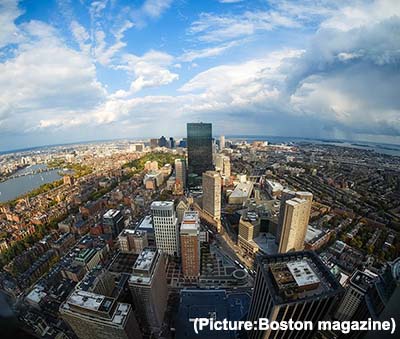
The East Coast made its presence further known with Massachusetts, home to seven of the top 100 zips in the U.S., up from last year’s four. Not only that, but as sales activity improved in Boston’s Back Bay area, Massachusetts claimed the #2 most expensive zip code in the country with 02199’s $5.5 million median sale price, which was only surpassed by California’s Atherton at more than $7 million.

To the south, Connecticut’s presence also improved compared to previous years: For the first time since 2018, it contributed four zips to the country’s priciest, most of which ranked in the bottom half of our list — similar to the three zips provided by New Jersey. Out west, Nevada and Washington added two zips each, with Washington state claiming #10 with Medina’s ever pricey 98039.

Additionally, Arizona, Florida and Maryland each contributed one zip code. Florida claimed the #5 most expensive zip code with Miami Beach’s 33109 — the highest-ranking for the Sunshine State since 2017. Meanwhile, New Hampshire missed the top 100 this year, having secured a presence during the last two years with Rye Beach.

Maryland Claims Sharpest Price Gain at 97%, While NYC’s Upper West Side Contracts 39%
The U.S. residential market’s vertical price trends were evident among the country’s top zip codes as well, with 92 zips registering price gains — including 23 where the median surged by more than 25%. Conversely, only 12 locations among the priciest registered drops in their medians this year – by comparison, 2020 brought median increases to 78 zips and drops to 23 locations.

At the same time, a record 30 zip codes posted median sale prices of $3 million and above — more than double those in 2020 — with the top 10 most expensive zips coming in at $4 million and higher. Moreover, the last zip code to enter our ranking — San Francisco’s 94122 — did so with a 12% year-over-year (Y-o-Y) increase in its median sale price, managing to hold onto its #100 position from last year.

The sharpest price gain was claimed by 21056 in Maryland’s Gibson Island, which nearly doubled its median sale price, surging 97% Y-o-Y to hit $3,195,000. Gibson Island was followed by 89402 in Nevada’s Crystal Bay, which swelled 68% to reach #39 with a $2.5 million median. The third-sharpest gain was claimed by 33109 in Miami Beach, which rose 66% to a $4,475,00 median sale price to become the #5 most expensive zip code in 2021.

The sharpest price contraction was registered in NYC’s Upper West Side, where zip 10069 contracted 39% Y-o-Y to stabilize at $1,663,000. As a result, the Upper West Side zip dropped from last year’s #22 to #93 this year. Notably, this zip code was actually the leader of price growth in 2020, when its median shot up 42% Y-o-Y.

Across the country, the second-sharpest price drop was registered by 94904 in Greenbrae, Calif., which contracted 12% Y-o-Y. It was followed by Bridgehampton, N.Y.’s 11932, down 11% Y-o-Y. Located in the famously pricey Hamptons, 11932’s price contraction meant that this zip — which was the #7 most expensive in 2020 — came in at #31 this year, its lowest position in three years.

Unshakeable Atherton Maintains #1 Spot for 5th Consecutive Year, Boston Grabs #2 with Record $5.5M Median

A record-setting year for the most expensive zip codes in the U.S., the 10 priciest zip codes in the country now sport median sale prices of $4 million and above. All in all, the 10 most expensive zip codes in the U.S. were provided by five states (as opposed to last year’s three): California claimed six of the top 10 and was joined by Massachusetts, Florida and Washington, as well as New York, which was solely represented by the Hamptons.

Reaching a new record median sale price at $7,475,000, Atherton’s 94027 remains the #1 most expensive zip code in the U.S. for the fifth consecutive year — nearly $2 million ahead of the runner-up. Not only that, but the billionaire favorite also saw its median rise 7% Y-o-Y, suggesting that this exclusive enclave may continue to retain its leading position in the future.

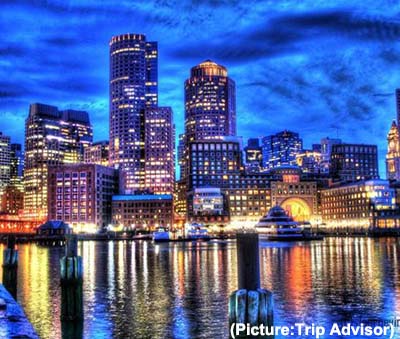
Meanwhile, on the opposite coast, Boston’s 02199 was conspicuously absent last year due to depressed sales activity during the onset of the pandemic — despite that it historically features one of the highest median sale prices in the U.S. However, the Prudential Center area of Back Bay returned in 2021 with a $5.5 million median sale price — its highest figure yet. Consequently, Boston’s 02199 became the #2 most expensive zip code nationwide, outpacing even ultra-exclusive Hamptons enclaves.

Similarly, another well-established presence among the priciest zip codes in the country, Sagaponack’s 11962 was this year’s #3 most expensive zip code, dropping from the runner-up slot it held for three consecutive years, despite a 29% Y-o-Y price uptick that raised its median sale price from $3,875,000 to $5 million. It was also the only zip from New York state to rank in the top 10, as NYC lost further pricing ground, failing to rank a single zip among even the top 20.

In Ross, Calif., 94957 retained its previous year’s position at #4 with a $4,583,000 median sale price, the result of a 27% Y-o-Y increase. A favorite of Silicon Valley executives and celebrities, this marked the first time that Ross surpassed the $4 million pricing mark.

Conversely, Miami Beach’s 33109 may have ventured into the $4 million and over category back in 2017, but this exclusive Florida enclave reached new pricing heights in 2021: 33109 on exclusive Fisher Island stabilized at $4,475,000 to become the #5 most expensive zip code after a staggering 66% Y-o-Y price jump.

Bay Area Still the Priciest Metro with 47 of the Top U.S. Zip Codes

As has increasingly been the case in recent years, greater Los Angeles, the vast New York metropolitan area and the Bay Area remained the leading metros for pricey zip codes. In particular, the Bay Area was yet again the uncontested leader, contributing 47 zip codes to our list — including three of the top 10 zips — while the greater Los Angeles was represented by 30 Orange and L.A. County zips.

The New York metro was represented by 22 zip codes, with only six of those from NYC proper and the rest located in the Hamptons, Nassau County and Westchester, as well as Connecticut’s Fairfield County and New Jersey’s Bergen and Monmouth counties.

L.A. County Remains Most Expensive, Santa Clara & San Mateo Form Pricey Zip Supercluster

Clearly, not even the tech dollars of Silicon Valley could unseat Los Angeles County, which again was the hottest county in the country for expensive real estate with 21 of the priciest zips in the U.S. Its most expensive zip was Beverly Hills’ famed 90210, a veteran of our yearly rankings and the #6 nationally with a $4,125,000 median sale price.

Not to be outdone, the Bay Area’s Santa Clara and San Mateo counties contributed 15 and 10 zips, respectively, to our ranking as the second- and third-most expensive counties in the U.S. As a result, they form a nearly contiguous supercluster of ultra-expensive zip codes that cover high-profile tech centers such as Menlo Park, Mountain View, Palo Alto, San Jose and Sunnyvale. And, while San Mateo’s top zip was overall leader 94027 in Atherton, Santa Clara’s highest-ranking zip was 94022 in Los Altos, which landed at #9 with a $4,052,000 median sale price.

A special note goes to Santa Barbara County, which increased its presence from just one zip code in 2020 to five in 2021. Its top zip code was 93108 in Santa Barbara’s exclusive enclave of Montecito — home to the likes of Oprah and former royals Prince Harry and Meghan Markle — which claimed #7 overall with a $4,103,000 median, following a 40% Y-o-Y pricing jump.

San Francisco, Los Angeles & New York City Hold Highest Concentrations of Exclusive Zips

For the fifth year in a row, San Francisco had the highest concentration of expensive zip codes of any city, ranking seven among the top 10. It was followed by Los Angeles and NYC, with six zips each. However, while San Francisco led the way, most of its zip codes were actually in the bottom half of our ranking: Its priciest zip (94123) placed at #46 — down 10 positions compared to 2020, despite a 7% uptick in its median. Covering the iconic Marina District, 94123 featured a $2,307,000 median sale price.

Of L.A.’s six zips that ranked nationally, its top three — 90272, 90077 and 90049 — form an uninterrupted cluster of pricey real estate with medians greater than $2 million. The trio was led by Pacific Palisades’ 90272 at #21 with a $3.25 million median sale price after an 18% Y-o-Y increase. Covering Bel Air, Holmby Hills and areas of Beverly Glenn, 90077 was #42 nationally with a $2.46 million median, while Brentwood’s 90049 grabbed #52 at $2,165,000.

Back in the Empire State, NYC’s presence weakened yet again: While 2020 marked the first time ever that no NYC zip codes were among the country’s 10 most expensive, in 2021, NYC came in below the top 20, too. More precisely, its most expensive zip — 10013 — just missed out, landing at #22 with a $3,212,000 median sale price, followed by 10007 at #25 with a median of $3,125,000.

Next up, Newport Beach had the the third-highest concentration of pricey zips in a city, with five entries, followed by Santa Barbara with four. Specifically, the most expensive Newport Beach zip — Balboa’s 92662 — grabbed #15 with a $3,577,000, while Santa Barbara’s top zip — 93108 in the exclusive community of Montecito — was #7 nationally.

Sagaponack Finishes as #3 Priciest Nationally, NYC Drops Out of Top 20

Usually one of the strongest presences in the 100 most expensive zip codes in the U.S. (second only to California), New York state retained its position in 2021 — although with a weakened presence. Specifically, the state recorded just 17 zip codes, only six of which were in NYC. Historically speaking, the East Coast powerhouse has had a strong presence in the uppermost levels of our ranking, but only two New York state zips were among the 20 most expensive in 2021 — none of which were in New York City proper.

Rather, the Hamptons’ 11962 in Sagaponack was the #3 most expensive zip code in the U.S. And, although its median sale price of $5 million was up 29% Y-o-Y, Boston’s Back Bay pushed it down one position, ending Sagaponack’s three-year reign as runner-up to the priciest zip code in the country.

The next-highest New York zip code was fellow Hamptons zip 11976 in Water Mill, which came in at #13 with a $3,745,000 median sale price, up an impressive 51% Y-o-Y. At the same time, last year’s #7 nationally — 11932 in Bridgehampton— dropped to #31 after an 11% Y-o-Y price contraction suppressed its median to $2,963,000.

Other zip codes outside of NYC included four more Hamptons locations: The pricey North Shore’s 11568 in Old Westbury which climbed to #62 with a $1.95 million median, as well as two Westchester zip codes. The latter included top 100 veteran 10580 in Rye at #72, plus newcomer 10577 in Purchase, which placed 88th with a $1.7 million median sale price.

Of NYC’s famously expensive real estate, only six zip codes ranked nationally in 2021. And, as a historic first, not one of them placed among the country’s 20 most expensive. Overall, NYC’s top two zips were Manhattan’s 10013 and 10007, claiming #22 and #25, respectively.

To be precise, 10013 — which covers parts of TriBeCa, SoHo, Little Italy and Hudson Square — posted a $3,212,000 median sale price, up 7% Y-o-Y, but still reeling from the 19% price crunch it experienced in 2020. Likewise, Downtown Manhattan, TriBeCa and SoHo’s 10007 posted a $3,125,000 median sale price, dropping 14 spots Y-o-Y. They were followed by Battery Park City’s 10282 with its $2,725,000 median at #35.

And, while Brooklyn made waves in 2019 with zip 11231’s break into the top 100, the Red Hook and Carroll Gardens zip code departed the top 100 in 2021 after a two-year stint, outpaced by sharper price gains in dozens of other zip codes nationwide.

At $2M Median, Alpine’s 07620 Leads New Jersey Real Estate for 5th Consecutive Year

While the Mid-Atlantic region was, as expected, dominated by exclusive New York locations, three New Jersey zip codes also represented the region — the highest number New Jersey has ever contributed to our list. Just 15 miles from Midtown Manhattan and with a $2 million median sale price, 07620 in Bergen County’s Alpine was the most expensive New Jersey zip code. Landing at #58 nationally, Alpine’s median was up 38% Y-o-Y, but, nonetheless, fell short of its 2018 pricing high of $2.2 million.

Alpine was joined by two beach communities, with 08750 in Monmouth County’s Sea Girt placing #70 nationally with a $1,892,000 median sale price, and 08202 in Cape May County’s Avalon landing at #92 with a $1.67 million median. Notably, both zip codes ranked among the 100 most expensive zip codes in the country for the first time.

New England Home to 11 of the Priciest U.S. Zip Codes, Including #2 with Boston’s Back Bay

Further north, New England originated 11 of the most expensive zip codes in the country — the highest figure yet for the region — with Massachusetts contributing seven zips and Connecticut adding four. What’s more, New England also provided the #2 most expensive zip code in the U.S. with Boston’s ultra-pricey 02199.

Zip 02199, which covers the Prudential Center area of Back Bay, usually ranks among the country’s most expensive areas, but was conspicuously absent in 2020 due to depressed sales activity. However, in 2021, zip 02199 returned not only to its highest position yet at #2 nationally, but also reached a new pricing record with a $5.5 million median sale price.

Meanwhile, Nantucket’s 02554 was Massachusetts’ next most expensive zip code, with its $2 million median sale price placing it #58 nationally and marking a new median peak for the exclusive island. It was followed by Weston’s 02493 at $1.85 million,as well as Wellesley Hills’ 02481, Waban’s 02468 and Chilmark’s 02535. Boston also ranked a second time with Beacon Hill and Downtown Boston’s zip 02108, which was the 91st most expensive in the U.S. at $1,673,000.

Connecticut was represented by four Fairfield County zip codes that regularly post some of the highest median sale prices in the country: Greenwich’s perennial representative, 06830, reached its highest median sale price yet at $2.05 million — up 36% Y-o-Y. It was joined by another Greenwich zip code, newcomer 06831, which claimed the #94 spot with a $1,653,000 median.

Notably, last year’s most expensive New England zip — Riverside, Conn.’s 06878 — was only the 4th priciest in the region this year, despite reaching a new median sale price high at $1.98 million. Finally, Connecticut’s contributions were rounded out by 06870 in Old Greenwich, which returned to national rankings after last year’s absence with a $1,807,000 median in 2021 — its highest pricing point yet.

Miami Beach Returns to Top 10 Nationally, Maryland’s Gibson Island Hits Historic $3M Mark

Down south, Florida’s perennially pricey 33109 zip in Miami Beach’s Fisher Island was on the upswing compared to last year, climbing all the way from #23 to #5 nationally. And, although it wasn’t the highest position yet for the popular celebrity location (having been the #3 most expensive in the U.S. in 2017), the exclusive 33109 zip nevertheless reached a new pricing peak in 2021 with its $4,475,000 median. That came as the result of a 66% Y-o-Y price surge — the third-sharpest increase among the country’s 100 leading zip codes.

In Maryland, Gibson Island’s 21056 was among the most expensive zip codes in the U.S. yet again and marked the sixth consecutive year that it has led the state in terms of pricing. However, while 21056 usually ranked in the bottom half of our list (even ranking at #100 in 2019), the Chesapeake Bay community reached its highest position yet this year, placing #23 nationally. That was the result of a whopping 97% Y-o-Y surge — by far the sharpest gain among the country’s top zips. Not only that, but by nearly doubling its median year-over-year, Gibson Island also reached a $3,195,000 median sale price — nearly double its previous record from 2016.

Arizona & Nevada’s Most Expensive Communities Enter Top 50 for 1st Time

Across the country, the Mountain States were again led by three high-income enclaves — Nevada’s Glenbrook and Crystal Bay on the shores of Lake Tahoe, as well as Arizona’s Paradise Valley — marking the first time that all three landed in the upper half of our ranking.

Specifically, 85253 in Arizona’s Paradise Valley claimed #50 after a 41% Y-o-Y price jump raised its median to $2,175,000. A favorite of some of the highest-profile rock stars in the world, the Maricopa County zip finally broke into the country’s most expensive zip codes in 2019, although it had already been the leader of pricey Arizona real estate for years.

Nevada was represented by two zip codes — 89413 and 89402 — for the third consecutive year, with both Lake Tahoe enclaves reaching their highest positions and pricing points to date. In particular, Glenbrook’s 89413 placed in the upper third of our ranking, landing at #29 with a record $3 million median sale price, the result of a 38% Y-o-Y price jump.

The Douglas County zip was joined by 89402 in Washoe County’s Crystal Bay at #39 with a record $2.5 million median sale price. Up 56 positions compared to last year, 89402 logged a staggering 68% median sale price surge, the second-sharpest price increase among the country’s top 100 zips.

Exclusive King County Enclaves Lead Pacific Northwest’s Priciest Real Estate

About 1,000 miles further north, the Pacific Northwest was, once again, represented not by Seattle or Portland, but by the high-income enclaves of Medina and Mercer Island in Washington state.

Specifically, Medina’s 98039 reached its highest pricing point with a $4 million median. This was the result of a 24% Y-o-Y increase that helped the tech-billionaire favorite remain among the most exclusive zip codes in the U.S., ranking as the #10 priciest. It’s also worth noting that 2021 marked the sixth consecutive year that Medina’s 98039 was the undisputed leader of expensive real estate in the Pacific Northwest.

And, returning to our list after its 2019 debut, fellow King County zip 98040 landed at #82. Also a favorite of tech executives, high-profile sports figures and media personalities, the Mercer Island zip code posted a $1,795,000 median sale price.

# Zip Code Location County State Median Sale Price 2021
1 94027 Atherton San Mateo County CA $7,475,000
2 2199 Boston Suffolk County MA $5,500,000
3 11962 Sagaponack Suffolk County NY $5,000,000
4 94957 Ross Marin County CA $4,583,000
5 33109 Miami Beach Miami-Dade County FL $4,475,000
6 90210 Beverly Hills Los Angeles County CA $4,125,000
7 93108 Santa Barbara Santa Barbara County CA $4,103,000
8 90402 Santa Monica Los Angeles County CA $4,058,000
9 94022 Los Altos Santa Clara County CA $4,052,000
10 98039 Medina King County WA $4,000,000
11 94024 Los Altos Santa Clara County CA $3,856,000
12 94301 Palo Alto Santa Clara County CA $3,800,000
13 11976 Water Mill Suffolk County NY $3,745,000
14 90742 Huntington Beach Orange County CA $3,625,000
15 92662 Newport Beach Orange County CA $3,577,000
16 94970 Stinson Beach Marin County CA $3,500,000
17 94028 Portola Valley San Mateo County CA $3,400,000
18 92067 Rancho Santa Fe San Diego County CA $3,399,000
19 92657 Newport Beach Orange County CA $3,365,000
20 92661 Newport Beach Orange County CA $3,293,000
21 90265 Malibu Los Angeles County CA $3,250,000
21 90272 Los Angeles Los Angeles County CA $3,250,000
22 10013 New York New York County NY $3,212,000
23 21056 Gibson Island Anne Arundel County MD $3,195,000
24 95070 Saratoga Santa Clara County CA $3,150,000
25 10007 New York New York County NY $3,125,000
26 94528 Diablo Contra Costa County CA $3,100,000
27 94010 Hillsborough/Burlingame San Mateo County CA $3,075,000
28 94920 Belvedere Tiburon Marin County CA $3,050,000
29 89413 Glenbrook Douglas County NV $3,000,000
30 95030 Los Gatos Santa Clara County CA $2,995,000
31 11932 Bridgehampton Suffolk County NY $2,963,000
32 90266 Manhattan Beach Los Angeles County CA $2,910,000
33 94306 Palo Alto Santa Clara County CA $2,810,000
34 93953 Pebble Beach Monterey County CA $2,750,000
34 11975 Wainscott Suffolk County NY $2,750,000
35 10282 New York New York County NY $2,725,000
36 92625 Corona Del Mar Orange County CA $2,695,000
37 11930 Amagansett Suffolk County NY $2,645,000
38 11959 Quogue Suffolk County NY $2,593,000
39 94025 Menlo Park San Mateo County CA $2,500,000
39 94062 Redwood City San Mateo County CA $2,500,000
39 89402 Crystal Bay Washoe County NV $2,500,000
40 91108 San Marino Los Angeles County CA $2,490,000
41 92651 Laguna Beach Orange County CA $2,475,000
42 90077 Los Angeles Los Angeles County CA $2,460,000
43 90212 Beverly Hills Los Angeles County CA $2,429,000
44 94507 Alamo Contra Costa County CA $2,400,000
45 95014 Cupertino Santa Clara County CA $2,310,000
46 94123 San Francisco San Francisco County CA $2,307,000
47 93921 Carmel By The Sea Monterey County CA $2,300,000
48 93067 Summerland Santa Barbara County CA $2,190,000
49 94087 Sunnyvale Santa Clara County CA $2,180,000
50 85253 Paradise Valley Maricopa County AZ $2,175,000
51 10001 New York New York County NY $2,171,000
52 90049 Los Angeles Los Angeles County CA $2,165,000
53 90274 Rolling Hills Los Angeles County CA $2,118,000
54 92660 Newport Beach Orange County CA $2,111,000
55 94040 Mountain View Santa Clara County CA $2,100,000
55 93920 Big Sur Monterey County CA $2,100,000
56 94070 San Carlos San Mateo County CA $2,055,000
57 6830 Greenwich Fairfield County CT $2,050,000
58 2554 Nantucket Nantucket County MA $2,000,000
58 94127 San Francisco San Francisco County CA $2,000,000
58 7620 Alpine Bergen County NJ $2,000,000
58 91008 Bradbury Los Angeles County CA $2,000,000
59 90048 Los Angeles Los Angeles County CA $1,985,000
59 94041 Mountain View Santa Clara County CA $1,985,000
59 91436 Encino Los Angeles County CA $1,985,000
60 90254 Hermosa Beach Los Angeles County CA $1,980,000
60 6878 Riverside Fairfield County CT $1,980,000
61 94402 San Mateo San Mateo County CA $1,968,000
62 11568 Old Westbury Nassau County NY $1,950,000
62 94002 Belmont San Mateo County CA $1,950,000
63 92118 Coronado San Diego County CA $1,940,000
64 10012 New York New York County NY $1,935,000
65 91302 Calabasas Los Angeles County CA $1,925,000
66 94705 Berkeley Alameda County CA $1,913,000
67 95032 Los Gatos Santa Clara County CA $1,911,000
68 90291 Venice Los Angeles County CA $1,907,000
69 95129 San Jose Santa Clara County CA $1,900,000
69 94563 Orinda Contra Costa County CA $1,900,000
69 91011 La Canada Flintridge Los Angeles County CA $1,900,000
69 90036 Los Angeles Los Angeles County CA $1,900,000
69 11963 Sag Harbor Suffolk County NY $1,900,000
70 8750 Sea Girt Monmouth County NJ $1,892,000
71 94118 San Francisco San Francisco County CA $1,868,000
72 10580 Rye Westchester County NY $1,861,000
73 94506 Danville Contra Costa County CA $1,860,000
73 94939 Larkspur Marin County CA $1,860,000
74 90211 Beverly Hills Los Angeles County CA $1,850,000
74 95120 San Jose Santa Clara County CA $1,850,000
74 2493 Weston Middlesex County MA $1,850,000
74 92014 Del Mar San Diego County CA $1,850,000
75 94904 Greenbrae Marin County CA $1,849,000
76 92663 Newport Beach Orange County CA $1,845,000
77 94030 Millbrae San Mateo County CA $1,840,000
78 94114 San Francisco San Francisco County CA $1,830,000
79 90232 Culver City Los Angeles County CA $1,819,000
80 6870 Old Greenwich Fairfield County CT $1,807,000


81 93109 Santa Barbara Santa Barbara County CA $1,805,000
82 98040 Mercer Island King County WA $1,795,000
83 94549 Lafayette Contra Costa County CA $1,775,000
84 94061 Redwood City San Mateo County CA $1,773,000
85 94941 Mill Valley Marin County CA $1,758,000
86 2481 Wellesley Hills Norfolk County MA $1,756,000
87 94121 San Francisco San Francisco County CA $1,701,000
88 95130 San Jose Santa Clara County CA $1,700,000
88 10577 Purchase Westchester County NY $1,700,000
89 2468 Waban Middlesex County MA $1,695,000
90 93103 Santa Barbara Santa Barbara County CA $1,682,000
91 93923 Carmel Monterey County CA $1,665,000
91 2108 Boston Suffolk County MA $1,673,000
92 8202 Avalon Cape May County NJ $1,670,000
93 2535 Chilmark Dukes County MA $1,663,000
93 10069 New York New York County NY $1,663,000
94 6831 Greenwich Fairfield County CT $1,653,000
95 93110 Santa Barbara Santa Barbara County CA $1,650,000
95 94131 San Francisco San Francisco County CA $1,650,000
95 94574 Saint Helena Napa County CA $1,650,000
95 92861 Villa Park Orange County CA $1,650,000
95 94707 Berkeley Alameda County CA $1,650,000
96 11030 Manhasset Nassau County NY $1,647,000
97 94960 San Anselmo Marin County CA $1,645,000
98 90027 Los Angeles Los Angeles County CA $1,640,000
99 94303 Palo Alto Santa Clara County CA $1,633,000
100 94122 San Francisco San Francisco County CA $1,627,000

Make sure to explore 2020’s rankings as well.

Methodology

To determine the most expensive zip codes in the U.S., we looked at residential transactions closed between January 1, 2021, and October 22, 2021, taking into account condos, co-ops, and single- and two-family homes. All package deals were excluded.

For an accurate representation, we considered only zip codes that registered a minimum of three residential transactions. Due to a number of ties, 127 zips made it onto our list of the 100 most expensive zip codes in 2021.

2020 and 2021 median sale prices were rounded to the nearest $1,000.

The Bay Area was defined as Alameda, Contra Costa, Marin, Napa, Santa Clara, San Francisco, San Mateo, Sonoma and Solano counties; the Los Angeles metropolitan area was defined as Los Angeles County and Orange County; and the 23-county New York metropolitan area was defined as New York City, Long Island, the Mid- and Lower Hudson Valley, Central and Northern New Jersey, Western Connecticut and Pike County, Penn

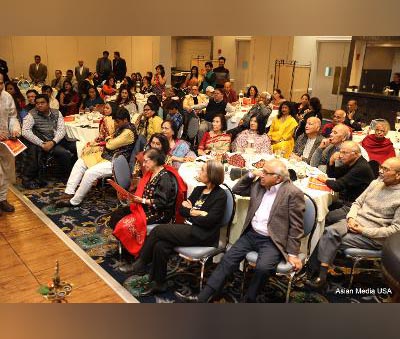
AAPI, GOPIO, AIA, NFIA & ASEI Jointly Host Discussion On The Book, “Kamala Harris and the Rise of Indian Americans”

A discussion and celebration of the Indian Diaspora and their achievements was held virtually  on Saturday, November 7th, 2021 and was attended by People of Indian Origin from around the globe. Jointly organized by Global Organization People of Indian Origin (GOPIO), American Association of Physicians of Indian Origin (AAPI), American Society of Engineers of Indian Origin (ASEI), Association of Indians in America (AIA), and National Federation of Indian American Associations (NFIA), the event offered a glimpse of the growth and the successes of the Indian American community in various domains.

Edited by the Delhi-based veteran journalist and foreign policy analyst, Tarun Basu, the evocative collection titled, “Kamala Harris and the Rise of Indian Americans,” captures the rise of the Indians in the US across domains by exceptional achievers. Sixteen eminent journalists, business leaders and scholars have contributed essays to the timely and priceless volume, which charts the community’s growing and influential political engagement.

The book was released by New Delhi-based publisher Wisdom Tree and is available in the U.S. via Amazon. Describing the book as an “eclectic amalgam of perspectives on the emerging Indian-American story,” Tarun Basu said, “This evocative collection—of the kind perhaps not attempted before—captures the rise of Indian-Americans across domains, by exceptional achievers themselves, like Shashi Tharoor, the ones who have been and continue to be a part of the “rise,” like MR Rangaswami and Deepak Raj, top Indian diplomats like TP Sreenivasan and Arun K Singh, scholars like Pradeep K Khosla and Maina Chawla Singh, and others who were part of, associated with, or keenly followed their stories.”
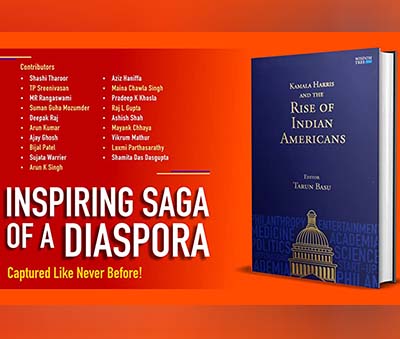
In his remarks, Shobit Arya, publisher of the book, shared with the audience about the objectives of publishing such an important book that portrays the lifestory and achievements of the influential Indian American community.

Dr. Thomas Abraham, Chairman, GOPIO International, who is the main organizer and moderated of the session, who has been instrumental in establishing and leading several Indian  American organizations and has seen the rise of the community in the past half a decade, shared with the audience the major highlights, depicting the progress and achievements of the community.

My own involvement in the community for the last 47 years as the Founder President of FIA New York, National Federation of Indian American Associations and GOPIO, I want to give some Milestones of our community since the late 1970s,” Dr. Abraham said and enumerated the major milestones of the Indian Americans, starting with the formation of the first national organization in 1967, Associations of Indian America (AIA), and succeeding in its efforts to have the Asian Indians categorized in the 1980 Census, and now culminating in dozens of Indian Americans holding important positions in the US administration and several dozens elected to local, state and national offices across the nation.

History of Indian community organizations and the role played by these organizations in community development, mobilization and promoting the diverse interests such as education, political involvement, entrepreneurship, business and service industry are covered in this new book,” Dr. Abraham said.

While acknowledging the success story of Indian American physicians, Dr. Anupama Gotimukula, President of AAPI said, “The success story of Indian American Doctors has been arduous. As Ajay Ghosh, who has been working for AAPI for nearly a decade has aptly summarized this long and difficult journey: “While Indian American physicians play a critical role, serving millions of patients in the United States, leading the policies and programs that impact the lives of millions today, it has been a long and arduous journey of struggles and hard work to be on the top of the pyramid.”
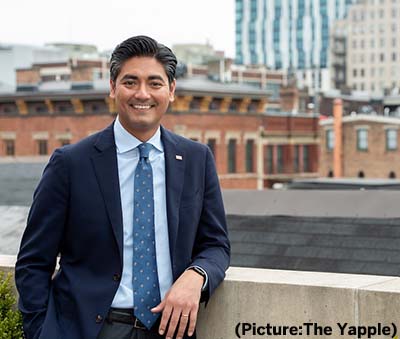
Dr. Gotimukula pointed out, “Indian American Doctors, who have been recognized for their compassion, skills, expertise and skills in caring for their patients, leading research that brings solutions to health issues and at the table making policies that benefit the world, are at the  at the forefront around the world as shining examples of meeting the needs of the hour.” She congratulated Tarun Basu, Shobit Arya and the 16 veteran journalists who have contributed to the book.

Dr. Ravi Kolli, President-Elect of AAPI spoke about how the Covid pandemic has impacted all and how the physician community who has borne the brunt of this epidemic is coping with the stress and the negative effects, while providing critical care to people diagnosed with Covid virus. Dr. Satheesh Kathula, Treasurer of AAPI and Dr. Sampat Shivangi, President of Indo-American Political Forum were others how had joined in the discussions.

Ambassador TK Srinivasan, who had served as the Indian Ambassador to the US and as the Permanent Representative of India to the United Nations, shared with the audience, his own experiences with the Indian Diaspora and how they have contributed to the larger goals of cementing stronger relationship between India and the United States.

In her remarks, Dr. Lavanya Reddy, president of NFIA said, “National Federation of Indian American Associations (NFIA), the largest non-profit umbrella organization of Indian association, established in 1980, aims to unify the diverse Indian American community by coordinating and promoting the activities of its member associations. NFIA has been in the forefront of activities in US-India relations for over two decades.”

Describing the many contributions and objectives of ASEI, Piyush Malik, the current president said, “Since its inception in 1983, ASEI has strived to strengthen the Indo-American relationship, institute a channel of communication between technical organizations within the United States and abroad, lend a helping hand to charitable organizations, provide assistance to engineering students at the Local and National levels, and organize networking events.”

Dr. Urmilesh Arya, President of Association of Indians in America (AIA) spoke about the objectives and activities by AIA for the past several decades. “AIA is a grass root national organization of Asian immigrants in the United States, fostered on the democratic principles of “one member one vote”, with chapters and membership spread across the United States of America. AIA represents the hopes and aspirations of those immigrants who are united by their common bond of Indian Heritage and American Commitment.”

Journalist Arun Kumar who wrote a Chapter in the Book on “All the President’s People: Trust in the Corridors of Power” spoke about the increasing number of Indian Americans how have come to occupy critical roles in the US administration, starting with President Ronald Regan and currently having as many as 50 Desis, who occupy important positions in the Biden administration.

Mayank Chaya, another author who wrote on: “At the Center of Excellence: Seminal Contributions in the World of Science” presented how Indian Americans have come to lead research and scientific innovations across the United States.

The importance and high esteem with which physicians of Indian heritage are held by their patients is self-evident, as they occupy critical positions in the healthcare, research and administrative policy positions across America, including the nomination of the  US Surgeon-General, Dr. Vivek Murthy.

In his presentation, Ajay Ghosh who has portrayed the rise of the Indian American physicians as a strong and influential force in the United States, chronicling their long journey to the United States and their success story, in a Chapter titled, “Physicians of Indian Heritage: America’s Healers” spoke about the four distinct areas, he has tried cover in the book: “Indian American Physicians Being recognized as Covid Warriors who work as frontline healthcare workers treating millions of patients.

With anecdotes, Ajay presented the “Initial struggles of Indian American Physicians” in securing equality with the local American Doctors in Board certification and licensing and the lobbying and legal efforts imitated by the pioneers.  He referred to Dr. AnandibaiJoshi, the first documented physician of Indian origin who had landed on the shores of the United States in 1883 and detailing the decimation suffered by Dr. Yellapragada Subbarow in the early 20th century, who has been credited with some of the biggest contributions in more than one basic field of science—biochemistry, pharmacology, microbiology, oncology, and nutritional science, portrays the discrimination and injustices inflicted by the mainstream Medical professionals in the US.

Portraying the achievements of the Indian American physicians, Ajay spoke of the many, who lead the cutting-edge research and pioneer modern medical technology to save the lives of critically ill patients around the world, showing to the world, how through hard work, dedication and vision, they have earned a name for themselves as “healers of the world.”

Through the lens of AAPI and its remarkable growth in the past 40 years, Ajay tried to portray how the Indian-American physicians have gone beyond their call of duty to meet the diverse needs of the larger American community, by dedicating their time, resources and skills during national disasters and family crises.

Describing the many contributions of Indian American physicians to India and the United States, Ajay said, “Indian Americans currently are less than 2% but the make up nearly 10% of total physicians in the US and they treat and provide healthcare to every 7th patient in the United States.” He also shared about the numerous initiatives in India, through the annual Global Health Care Summit, Tele-health, sending medical equipment to India, education to their counter parts in India and close collaborations with the state and federal government, Indian Medical Association and several Indian Non Profits, providing healthcare to rural areas across India. Their contributions to the US, to India and to the entire world is priceless, he said, as “they have made their mark in institutions from Harvard Medical School to Memorial Sloane Kettering Cancer Center to the Mayo Medical Center.”

Authors who have contributed to the Book include: former Indian ambassadors TP Sreenivasan and Arun K. Singh; Deepak Raj, chairman of Pratham USA; businessman Raj Gupta; hotelier Bijal Patel; Pradeep Khosla, Chancellor of UC San Diego; scholar-professor Maina Chawla Singh; Sujata Warrier, Chief Strategy Officer for the Battered Women’s Justice Project; Shamita Das Dasgupta, co-founder of Manavi; and journalists Arun Kumar, Mayank Chhaya, Suman Guha Mozumder, Ajay Ghosh, Vikrum Mathur, and Laxmi Parthasarathy.

The book is now available at: https://bit.ly/HarrisIA – Amazon India book link, and at https://bit.ly/HarrisIndAm – Amazon USA link.

Sam Joshi Elected Mayor of Edison, NJ; Aftab Pureval Wins As Mayor of Cincinnati, OH

Aftab Pureval of Indian origin has been elected as the first ever person of Asian heritage to be elcted as the Mayor of Cincinnati, OH, while Sam Joshi becomes the first Indian-American to be Mayor of Edison, the 5th largest municipality in New Jersey, during the elections held on Nov. 2nd, 2021.

With 100% of precincts reporting, Joshi was well in front of Republican Keith Hahn and independent candidate Christo Makropoulos.

Joshi had 10,930 votes, while Hahn had 9,459 and Makropoulos, 301. The race was to replace Democratic Mayor Thomas Lankey whose term ends Dec. 31. Lankey did not seek reelection.
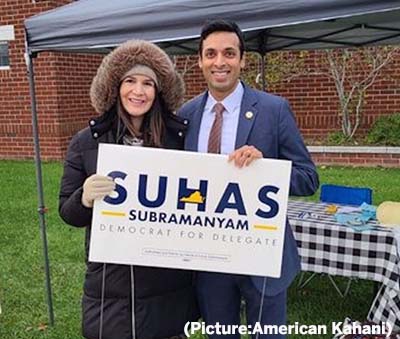
When sworn in on Jan. 1, Joshi, 32, will become the township’s youngest mayor and the first South Asian to hold the position. Previously Jun Choi, the township’s first Asian American mayor, was the youngest to serve in the post.

“I am honored and humbled to be elected as the next mayor of Edison Township,” Joshi said in a Facebook post.

Joshi has been serving as the Vice President of the Town Council, and during his campaign he promised to stabilize taxes, invest in infrastructure, and stop ‘overdevelopment’, launch municipal broadband, and celebrate Edison’s diversity fighting discrimination and hate crime.

Joshi’s popularity was evident n June this year, when during the primaries, he defeated another Indian-American aspirant Mahesh Bhagia by 63 percent of the votes to 34 percent, despite Bhagia being the municipal chair of the Democrats.

A ‘son of the soil’, Joshi was born and raised in Edison. Joshi was elected as an at-large Councilmember at 27 years old, making him the youngest elected official in Edison’s history.

Since joining the Edison Township Council in 2017, Joshi’s biography on his website says, he has worked to keep taxes low, helped women and minority owned businesses get on their feet, and promoted green energy throughout the township.

Among the many voluntary services he has been involved in, is as an Edison Police 9-1-1 Tele-communicator from 2010-2011, at the Central Command Office for all public safety calls, including police, fire, and EMS, providing first responders with additional information on each call.

He also served on the Fair Rental Housing Authority Board from 2010-2015 and the Edison Zoning Board from 2016 until he was elected to the Edison Township Council.

At 39, Pureval will replace longtime mayor John Cranley, who is term-limited from running again this year.  Pureval defeated David Mann, who has an array of political experience — serving as Cincinnati’s mayor from 1980 to 1982, and again in 1991. He’s also served on Cincinnati City Council from 1974 until 1992, then elected in 2013 and reelected in 2017.

In his acceptance speech Tuesday, Pureval thanked Mann for his career in public service. “We also want to thank the voters of Cincinnati who tonight voted a mandate for a new day in our city,” Pureval said. “We spent the last year talking about our bold progressive vision for moving Cincinnati forward. Our comprehensive plans for public safety, affordable housing, the environment and economic recovery with racial equity at the center of the frame, and the voters of Cincinnati resoundingly supported that vision.”

The son of Indian and Tibetan immigrants, Pureval becomes the first Indian-American and Tibetan, in fact, the first Asian to be elected Mayor of the city. Currently, he is Hamilton County Clerk of Courts, a position not held by a Democrat for more than 100 years. “Words can’t express how honored and excited I am to be the next Mayor of Cincinnati. Tonight, we made history! Let’s get to work!” Pureval tweeted as the results became public.

Congratulations poured in including from the likes of former Secretary of State and presidential candidate Hillary Clinton and U.S. Sen. Sherrod, D-Ohio, who had supported Pureval. “Win or lose, fighting for what’s right is always worth it. Congratulations to @ericadamsfornyc, @wutrain,  @shontelmbrown, and @aftabpureval for historic wins …” Clinton tweeted.

Sen. Brown tweeted, “Congratulations to #canarycandidate @AftabPureval on your victory. He represents the future of Cincinnati and will fight for all workers and families in the Queen City.”

Born and raised in Ohio, Pureval is an attorney and former prosecutor. He has been awarded the NAACP Theodore Berry Award for Service and has been recognized by the Business Courier as one of their 40 under 40.

Pureval is seen as a rising star in the Democratic Party. In May 2018, he won the Democratic primary unopposed in his party’s bid to turn a Red seat Blue when he ran and lost in his race against incumbent Republican Rep. Steve Chabot. President Obama was among those who endorsed his candidacy then.

“We have a very clear vision for pushing Cincinnati forward as annunciated with our three comprehensive plans,” he said in an interview at the Board of Elections where he greeted early voters. “And we’re talking about substantive, innovative, creative ideas in order to accomplish that.” Pureval described his campaign as one that offers voters a fresh approach to what ails city government. “Our future is bold, it’s diverse, it’s dynamic.”

Sterley Stanley, Suhas Subramanyam, Usha Reddi, Aditi Bussells Win In Sate Elections

Indian American incumbents Usha Reddi in Manhattan, Kansas, and Sterley Stanley in New Jersey were victorious in their bids for another term in office, Aditi Srivastav Bussells won a council seat in South Carolina, while Nalini Joseph fell short in her race during the Nov. 2 election.

Suhas Subramanyam was reelected to the House of Delegates, in the state of Virginia beating challenger Greg Moulthrop On November 2nd, 2021. Subramanyam won 21,374 votes — almost 60 percent — while Moulthrop received 13,939 votes, almost 40 percent. Subramanyam, 35, represents District 87 in Virginia’s House of Delegates. He is the first Indian American to win a seat in the state’s General Assembly.

Republicans won 50 seats Nov. 2 in Virginia’s House of Delegates, while Democrats won 40, for a 55-45 Republican majority overall at the statehouse. In one of the most-watched races of the evening, Youngkin beat former Virginia Governor Terry McAuliffe, a Democrat. Virginia has traditionally been considered a solidly blue state.
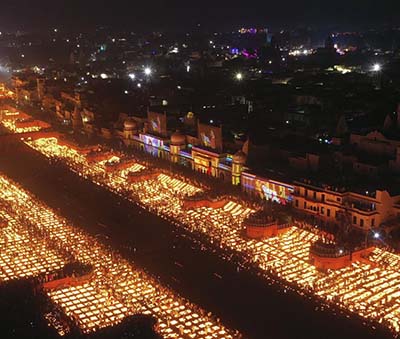
“I am so humbled and grateful that the 87th District has put their faith in me again as their Delegate. I promised two years ago that I would put people over special interests and do everything I could to empower my constituents. I am proud to have kept those promises, in the process fully funding our schools, curbing gun violence, addressing rising tolls and utility costs, and helping small businesses and families through one of the worst pandemics in our Commonwealth’s history,” said Subramanyam. “I am so thankful to all the staff and volunteers who knocked doors, wrote postcards, and made phone calls. This night would not have been possible without them.”

Reddi was the top vote-getter for the Manhattan City Commission, according to results late Nov. 2, tallying 3,571 votes followed by incumbent Mayor Wynn Butler (3,499 votes) and former commissioner John Matta (3,265 votes). Reddi and Butler earned four-year terms as the top finishers, while Matta received a two-year term for taking third.

Reddi, who was first elected to the commission in 2013, said this was her most stressful city commission campaign, according to The Mercury. “I wasn’t even sure where I was going to place in this race,” Reddi said in the report. “Even though I have served two terms, I think there were very good challengers. There was a lot of good campaigning going on from everyone, and everyone was vying for all the votes.” Reddi expressed her appreciation to the voters. “I value their support and I hope I have worked for them and with them to continue to move Manhattan forward,” she said, the report added.

Stanley – along with fellow incumbents state Sen. Patrick Diegnan and Assemblyman Robert Karabinchak – won reelection to his Assembly seat in the 18th Legislative District in New Jersey, representing East Brunswick.

Stanley beat realtor Angela Fam and South Plainfield Councilwoman Melanie Mott to win the seat. He is the delegation’s newest member, and one of the newest members of the entire legislature; he was selected in January of this year to replace now-Middlesex County Clerk Nancy Pinkin (D-East Brunswick).  Stanley earned 27,249 votes with Karabinchak taking 28,065 to claim the two seats. Fam took 20,822 votes and Mott had 21,449. Diegnan beat Republican counterpart Vihal Patel of Edison to claim his seat. Patel earned 20,596 votes to Diegnan’s 28,829.

In Columbia, South Carolina, Aditi Bussells was among a crowded field seeking the city’s councilmember at-large seat. In the seven-person field, Bussells led with 5,643 votes for 31 percent with all precincts reporting, though the results were still unofficial. Bussells was 5 points ahead of Tyler Bailey who had 26 percent of the vote with 4,695 tallies. Heather Bauer was third with 3,562 votes for 20 percent. Deitra Matthews (11 percent), John Tyler (4 percent), John Crangle (4 percent) and Aaron Smalls (3 percent) rounded out the field.

In Salisbury, North Carolina, Nalini Joseph was vying for a council seat, but came up just short. Incumbents Tamara Sheffield and David Post, along with newcomers Harry McLaughlin Jr. and the Rev. Anthony Smith won the seats. Guardian ad Litem District Administrator Joseph finished fifth with 13.90 percent. Sheffield led the field with 18.01 percent of the vote, followed by McLaughlin at 16.15 percent, Post at 15.69 percent and Smith with 14.29 percent.

Though Joseph received just 64 fewer votes than Smith, Rowan County Board of Elections executive director Brenda McCubbins said the numbers don’t fall within the acceptable range to request a recount, the Salisbury Post reported. For recounts, the difference in votes between candidates must not exceed 1 percent of the total votes cast for that particular race. A total of 16,127 votes were cast for council candidates, including 100 write-in votes, the report said.

Indian American attorney Nisha Arora, who would have been the first non-white judge in Lackawanna County, Pennsylvania, lost her bid for the Common Pleas Court Judge seat Nov. 2 evening to Democrat Mary Dempsey. Arora began her career as a law clerk in the Court of Common Pleas of  Lackawanna County. “Working in the court system truly influenced the person I am today. Dealing closely with judges who handled both criminal and civil cases, as well as working with the various treatment courts, gave me an insight into the position I am now seeking,” she said.

“My varied career experience has taught me about high points and low points. A courtroom can be a place where an individual experiences his or her worst time, perhaps losing a child in a custody case, facing imprisonment, or a significant monetary judgment.” The 41-year-old daughter of Dr. Subhash and Sunita Arora decided she wanted to pursue the law at the age of eight.

900,000 Earthen Lamps Light Up Ayodhya, Celebrating Lord Ram’s Triumphant Return

Millions of people across Asia are celebrating the Hindu festival of Diwali, which symbolizes new beginnings and the triumph of good over evil and light over darkness.

The festival is celebrated mainly in India, but Hindus across the world, particularly in other parts of Asia, also gather with family members and friends to socialize, visit temples and decorate houses with small oil lamps made from clay. The festival is also marked by raucous parties and fireworks displays, often throughout the night.

Indians across the country began celebrating Diwali, the Hindu festival of lights, the triumphant return of Lord ram to Ayodhya after rescuing Sita from Sri Lanka. Diwali is typically celebrated by socializing and exchanging gifts with family and friends. Many light oil lamps or candles to symbolize a victory of light over darkness, and fireworks are set off as part of the celebrations.
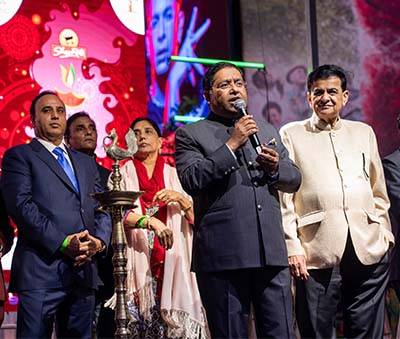
As dusk fell on Nov. 3, over 900,000 earthen lamps were lit and kept burning for 45 minutes in the northern city of Ayodhya in Uttar Pradesh state, retaining the Guinness World Record it set last year. As part of the Diwali celebrations, the city last year lit 606,569 oil lamps.

The lamps were lit at Ram ki Pauri, at the banks of Saryu River, a stunning spectacle for thousands of visitors who thronged its shores while ignoring coronavirus social distancing norms. A laser and fireworks show followed, illuminating the city’s lanes and river banks. Thousands of city residents also lit lamps at their houses and temples.

The festival is being celebrated at a time when India’s pandemic crisis has largely subsided.  On Diwali night, people also lit up the sky with firecrackers — their smoke causing pollution that takes days to clear.

While there is no nationwide ban on bursting firecrackers, a number of states have imposed restrictions to stem the pollution, with some allowing their residents to light green crackers for a certain number of hours. Green crackers produce lesser emissions than normal firecrackers. In the past, similar bans have often been flouted.

Diwali marks Hindu god Ram’s return to his kingdom after 14 years in exile. Hindus believe that during Diwali the goddess of wealth, Lakshmi, will visit their homes if they are illuminated and decorated.

The Diwali festival is also observed among Jains, Sikhs and Buddhists. While each religion marks the festival with different historical events and legends, they all represent the victory of good over evil. (Associated Press writer Biswajeet Banerjee in Lucknow, India, contributed to this report

Diwali Celebration At the Heart of New York City

This year Diwali at Times Square was celebrated with a raging come-back after 2 years COVID-19 Lockdown. Thousands of people participated as the brightest celebration unfolded in the brightest city on earth – New York! The event was extremely successful and was attended by some of the highest-ranking Government officials and dignitaries in the business world. This Event was Conceptualized by Event Guru and managed by ASB Communications.

The President of EventGuru Inc. Neeta Bhasin said ‘We are sharing the message of Deepavali – Knowledge over Ignorance, Light over Darkness, Peace, Love, Unity and Togetherness and inclusion in diversity to the World from the biggest crossroads of the world, Times Square. Even the universe responded in appreciation by keeping the weather conducive to the event despite forecasts of rain throughout the day.’
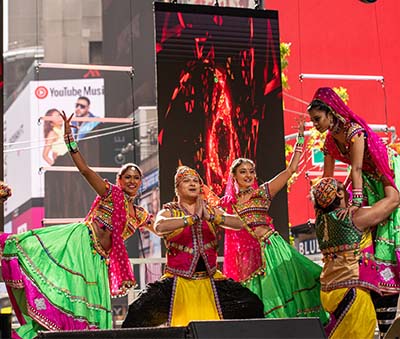
The event was hosted by Aryan Vaid, Mister International Award winner, Vidhi Dave, Mrs. India USA, Esha Kode, Miss Teen India Worldwide. The celebrations began with a traditional Diya (lamp) Lighting ceremony at Times Square. Usually this was done by Mrs. Brijbala Suri, mother of the producer, Neeta Bhasin. But due to her passing, this responsibility was undertaken by her son Gajendra Suri and family. The Diya Lighting Event was followed by dazzling performances by Darshana Menon, the Sa Re Ga Ma 2009 winner, Arya Dance Academy, Sadhanalya Dance Academy and Masala Bhangra.

The Light up Times Square Concert started at 5 PM and was made more luminous by the fact that the Diwali Countdown on Ball Drop Screen created History at Times Square. The sparkle was even greater due to the elite guests who graced the stage with their presence. This whole segment was broadcast live on TV Asia across the USA and worldwide through the Neeta Bhasin Show on YouTube.

This was followed by the dignitaries speaking on the Times Square stage which included some of the most affluent people of New York. List of speakers included Consulate General of India in New York, Randhir Jaiswal, New York State Governor Kathleen Courtney Hochul U.S. Senator Charles Ellis “Chuck” Schumer, U.S. Rep. Carolyn Maloney (D-NY), NY State Senator John Liu, Gajendra Suri and Beena Kothari from Samman for All , ShopRite’s Ranjana Choudhry, Thomas Rajan from American Airlines, Harry Singh Bolla of Bolla Oil Corp, Padma Shri Mr. H R Shah – Chairman of TV Asia and other sponsors of the festival.
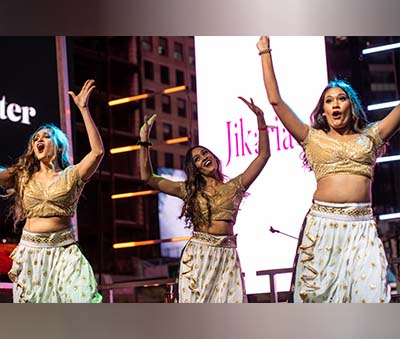
Prime Minister of India, Narendra Modi sent his Diwali message ‘Heartiest greetings and best wishes for the celebration of Diwali, the Festival of Lights organized at Times Square in New York. The celebration will help spread our rich traditions and culture in different parts of the world. Carrying the eternal message of victory of light over darkness and truth over untruth may this auspicious occasion further spread peace, happiness, and prosperity in the lives of every member of the Indian diaspora in the USA.’

Consul General of India, NY, Randhir Jaiswal addressed the attendees by saying that ‘It is a time when we must respect the foundational values of our society, kindness, compassion, sharing and being together and may you bring all these values today and tomorrow and forever. Let the light of Diwali shine in your lives and all those around you.’

New York State Governor – Kathleen Hochul Congratulated the founder of Diwali at Times Square, Neeta Bhasin, for having a vision to celebrate the diversity and the wonderful tradition in Times Square and said ‘Diwali at Times is a fabulous event to celebrate the New Year and to celebrate the comeback of New York. This is Phenomenally special; we are once again gathered in person to remind ourselves the real true meaning behind Diwali.

Think about the fact that we can conquer the darkness with light and we did that with Pandemic. Congresswoman Rep. Carolyn Maloney said that ‘I have been coming to this festival ever since we got the Diwali stamp approved which I worked on with many of you for many years to make it happen. The Diwali stamp has been so successful that I think we should have a Diwali Holiday. So, I am introducing a bill for that. Let me get back to work so I can make all these wonderful things happen’.

Senator Chuck Schumer ‘I believe in immigration in general. My middle name is actually Ellis, it is Charles ‘Ellis’ Schumer from Ellis Island. Immigrants have great American values while still remembering the traditions and bringing them to America from their home countries. One of the best and the greatest immigrant communities is our Indian American community, our South Asian Community. We must welcome more Indians to come to America and New York. Because there are more Indians in New York, the greater NY will be’.

NY State Senator, John Liu was very excited to see the huge crowd at Times Square ‘It is great to see everybody in person. No better place to celebrate Diwali than the crossroads of the world right here in Times Square, NY City. With Neeta’s advocacy and esteem journalism and many others, in NYC a long time ago we were able to make a parking holiday, you do not change the car from one side of the street to another’.
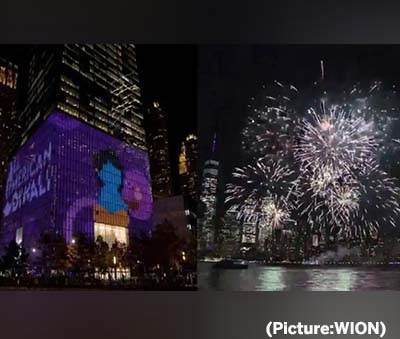
Diwali at Times Square was celebrated in association with Samman for All, it’s mission is to facilitate people from the lower-economic strata to achieve their dreams by providing them with tools for sustainable living and empowerment, said the Director of the organization. ShopRite’s Ranjana Choudhry VP Advertising and Social Media ‘We are very proud and very honored to be the Title Sponsor of this event. Let’s turn this festival of lights into the festival of delights. Let’s eat and celebrate Diwali.’

Thomas Rajan- VP, Global Talent American Airlines ‘ In the coming few days, we will be launching our non-stop service from this great city of NY to Delhi and onwards later this year Seattle to Bangalore. Harry Singh Bolla Chairman of Bolla Corporation- ‘We created history in 2013 by representing the 2nd largest festival outside of India. It makes me proud, today we are sitting in Times Square celebrating our culture, our feelings and telling the world what we are all about’.

Some of the front-line fighters in the covid battle like Officer Manish Sharma – President of Indian Police Society (NYPD), Dr. Samin K. Sharma of Mount Sinai Heart, Dr. Jagmohan Kalra and Dr. Sunjit Jaspal from Northwell Health. were honored on stage. The festival did not end there. Yet another set of superb performances by famous artists like Sparsh Shah, Sway Bhatia, Chosen Crew Entertainment Group, Swarali Dance, Jikaria Sisters (Omi, Rish, & Aash), DJ Ash and finally ended with a blast with an amazing performance by International Artist Jay Sean.

More than 250 mainstream media houses are already talking about Diwali at Times Square and the entire event reached out to millions of viewers across both digital and traditional channels in both writing and video publishing formats. Event Guru WorldWide, the organizer of Diwali at Times Square, is a premier full-service event company specializing in festivals, concerts, trade shows, gala dinners and press conferences. We conceptualize and implement events of all sizes and statues.

Diwali Lights Up World Trade Center

Diwali is the celebration of light over darkness, good over evil, and more than 1 billion Hindus worldwide are observing it Thursday by lighting candles, setting off fireworks and exchanging gifts with friends and family.

While most people may refer to the holiday as Diwali, it’s traditionally called Deepavali and that is how it’s known in most parts of India.

This year for the first time, the World Trade Center has been lit with a digital mural in celebration of the holiday, organized by the South Asian Engagement Foundation, along with a livestreamed fireworks show on the Hudson River on Nov 2, 2021, at 6 pm and continued until Nov. 4, 2 am.

Dubbed the All-American Diwali experience, it also included a spectacular fireworks display that was viewed by audiences on both sides of the Hudson!, a press release from South Asian Engagement Foundation said.

“We are excited to create and curate the colorful imagery of Diwali on the WTC podium to bring the messages of peace, harmony, and unity,” said Mark Domino of the Durst Organization.

For the first time ever, Diwali-themed animation adorned One World Trade Center where the animation went live on Nov 2, 2021, at 6pm and continued until Nov. 4, 2 am. Photo: South Asian Engagement Foundation.

“There is no better symbol of the triumph of resiliency than the World Trade Center and we are very fortunate to work with The Durst Organization to bring this message to all,” said Rahul Walia, founding trustee of SAEF.

Organized by SAEF, a New Jersey-based non-profit, the All-American Diwali experience was dedicated to the Country’s first responders. The NYPD conducted a ceremonial Color Guard with One World Trade Center as the backdrop. American Singer/Actress Mary Millben performed the US national anthem and a verse from the popular Diwali hymn-Om Jai Jagdish Hare.

“We’re so honored that the first annual All-American Diwali is dedicated to the police officers of New York City. As a police officer of Indian origin, I’m particularly excited to see the One World Trade Center light up for this festival, a symbol of our city’s enduring spirit,” said Det. Annand Narayan, president of NYPD Desi.

Key benefactors of the ‘All American Diwali’ celebration include crypto exchange, CrossTower and Atlanta based 27th Investments, a national investment firm.

Indiaspora served as community patron and supporters include EQ Factor, Touchdown Media and Kawan Foods. Indian-American artist Varun Patel of Vichaar & Prem provided inspiration for the animation.

“Diwali is a time that celebrates family and universal compassion, and we are grateful to be sharing the values of solidarity and peace with the greater New York Community,” Kapil Rathi, CEO and Co-Founder of CrossTower, is quoted saying in the press release.

“All American Diwali embodies the spirit of not only the sentiment behind the festival but also integrates itself into the fabric of Americana. 27th Investments is proud to support this experience,” says Anil Damani, CEO 27th Investments.

The SAEF says it is dedicated to building a strong brand for the Indian-American community “by empowering them and catalyzing the conversation around Indian Americans.”

In the future, it plans to hold a digital mural depicting 75 years of India’s democracy, a National STEM competition, an Indian Edition Smorgasbord and an All-American Holi at Governors Island, NY.

The non-profit SAEF counts among its initiatives, the South Asian Spelling Bee and the Cricket Bee. Its “vision is to continue supporting and organizing educational initiatives and cultural outreach to expand national awareness of the Indian American community.”

Empire State Building Lit Up With Diwali Lights

Federation  of Indian Associations (FIA) of eight states commemorated Diwali, a major and 75 years of Azadi Ka Amrit Mahotsav by lighting the World famous Empire State Building in the colors of the diya on November 4th.

The  lighting ceremony was graced by Honorable Consul General  Mr. Randhir Jaiswal, Deputy Consul General Dr. Varun Jeph,  popular R&B singer, songwriter and music producer Jay Sean and R&B singer, model and yoga instructor Thara Natalie.

FIA Chairman Ankur Vaidya, President Elect Kenny Desai, Past President Alok Kumar and Executive members Parveen Bansal and Saurin Parikh participated in the event as well. In follow up to a spectacular dance performance by the students of Aum Dance Creations the Empire State Building ceremonial lighting was turned on together by Jay Sean, Thara Natalie and Hon. Consul General Jaiswal.  H.E. Randhir Jaiswal conveyed Diwali wishes and thanked the American community for accepting and embracing diversity.
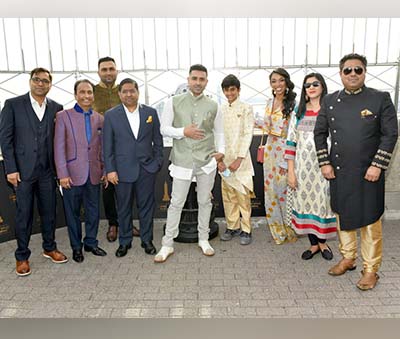
 Vice President Sales of Empire State Building Patricia Niscior wished the community the world over a Happy Diwali and invited them to participate and visit the World famous Empire State Building. FIA Chairman Ankur Vaidya and President Elect Kenny Desai also conveyed the Diwali wishes to all the community addressing the media, Jay Sean and Thara conveyed their warm Diwali wishes to the community.

The annual event, which began in 2018, is organized in cooperation with the Empire State Realty Trust. Each year for the past two decades, ESRT and FIA have been lighting up the Empire State Building in August in the colors of the Indian tricolor – orange, white and green – to mark India’s Independence Day.

The FIA believes that such gestures by ESRT help in spreading the ancient Indian philosophy of ‘Vasudeva Kutumbakam’ (the world is one family) and also demonstrates a great harmony in spirit and deeds between people of the world’s largest and oldest democracies, the organization stated in a press release. Despite the challenges and changes due to the Covid-19 pandemic, FIA has not deterred from its goal of serving the community, it said.

Joe Biden, Jill Biden, & Kamala Harris Greet Indian Americans During Diwali

President Joe Biden and First Lady Jill Biden joined Indian Americans in celebrating Diwali, festival of lights, on November 4. A photo shared by the White House on Twitter showed the Bidens lighting diyas with candles.

In a message, President Biden stated: “Like many cherished holidays during the pandemic, we know this year’s Diwali carries an even deeper meaning. To those who have lost loved ones, we hope this sacred time provides comfort and purpose in their memory.

“To those who celebrate here in America, we are grateful to you for making the traditions of Diwali part of America’s story. For generations, you have opened your homes and hearts during Diwali to exchange gifts and sweets, host feasts with family and friends, and organize cultural programs in our communities – with prayers and dances, vibrant and colorful art, and sparklers and fireworks – that bring us all together.
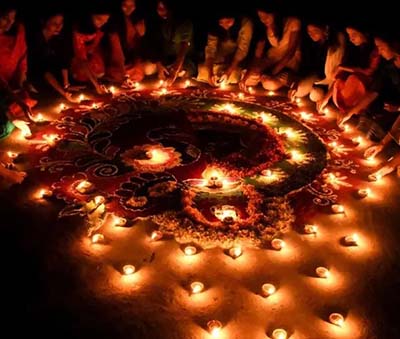
“May the spirit of Diwali remind us that out of darkness there is light in knowledge, wisdom, and truth. From division, there is unity in common bonds of empathy and compassion. From isolation, there is community in the connections we share as we look out for one another and hope, dream, and believe in possibilities.

“That spirit is what we reflected upon in the simple act of lighting a diya, a small candle that carries such profound meaning. From the People’s House to yours, may the light shine within us all as a powerful source of healing, repair, and renewal – a light that shines on who we are and what we can be at our best as a people and a nation. On behalf of our family, we wish you a happy Diwali,” Biden said in his Diwali greetings.

Vice President Kamala Harris, an Indian American, also issued a statement greeting Diwali. She said, “This year Diwali arrives with even deeper meaning in the midst of a devastating pandemic. The holiday reminds us of our nation’s most sacred values, our gratitude for the love of family and friends, our responsibility to lend a hand to those in need and our strength to choose light over darkness, to seek knowledge and wisdom and to be a source of goodness and grace. Let’s remember to honor the light within one another. From our family to yours I wish you a joyous Diwali.”

Diwali Across the US

More than a hundred guests, including several Indian-American community leaders from Illinois, attended the Nov. 3, 2021 Diwali celebrations hosted by Democratic Congressman Danny K Davis of Chicago, at the National Democratic Club in Washington D.C. The event was headlined by House Speaker Nancy Pelosi, the third highest elected official in the country.

Speaker Pelosi lit the traditional Indian lamp, a press release from Rep. Davis’s office said. Several prominent elected officials including Congressman Richard Neal, (D- Massachusetts), Chair, U. S. House Ways & Means Committee among others joined the celebration. Well known Bharat Natyam exponent, Indrani Davaluri, extended a traditional welcome Pelosi and Neal at the event.

Congresswoman Carolyn B. Maloney, D-NY, chairwoman of the Committee on Oversight and Reform, joined on Nov. 3, 2021, with Congressmen Raja Krishnamoorthi, D-IL, and Gregory Meeks, D-NY, chair of the House Foreign Affairs Committee, and New York, as well as national advocates to announce the introduction of the Deepavali Day Act. This legislation would make Diwali a nationally recognized federal holiday.
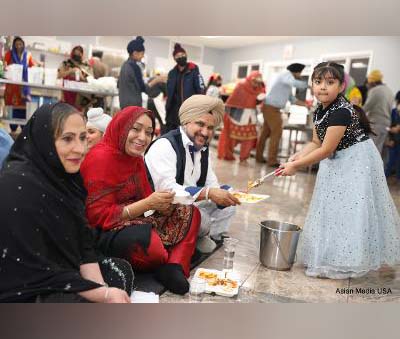
The announcement was carried live on Rep. Maloney’s twitter account. The new Mayor-elect of New York City, Eric Adams, has declared he was committed to “sign (Diwali) into a holiday” when he takes office Jan. 1, reported the news outlet thecity.nyc.

Maloney supported by several lawmakers, is going national with that idea. “I want to start by wishing a Happy Diwali to all those celebrating around the world this week as the time of reflection and renewal that marks the Hindu New Year comes to a close,” Rep. Maloney said in the live Tweet.  “This beautiful festival celebrates lightness over dark, goodness over evil, and knowledge over ignorance. My bill today recognizes the importance of this beautiful holiday and gives it the respect and acknowledgement it deserves.”

“I’m proud to join Chairwoman Maloney and our colleagues in introducing this legislation to establish Diwali as a federal holiday in recognition of its importance to our nation’s more than three million Americans of Indian descent, including Hindus, Sikhs, and Jains,” said Rep. Krishnamoorthi. “The meaning of this legislation extends beyond honoring the significance of Diwali to the Indian-American community to acknowledging the contributions of Indian-Americans to our nation.”

Rep. Meeks also expressed his support, saying, “The United States of America is about celebrating the different cultures that make us one. I understand the importance of the festival of lights and hope we can soon make this a reality for members of the Indian diaspora in my district and Indian Americans all over the country.”

Sikh Religious Society Celebrates Diwali

Sikh Religious Society, Palatine Gurdwara organized a four-day celebration to mark the auspicious occasion of Diwali from November 4th to November 7th in Palatine IL. Bhai Inderjit Singh Khalsa came all the way from India to join the celebrations and to be part of the occasion.

The events included deepmala as well as katha and kirtan by Bhai Rajinder Singh and Jatha, Bhai Parminderjit Singh and bhai Inderjit Singh Khalsa.
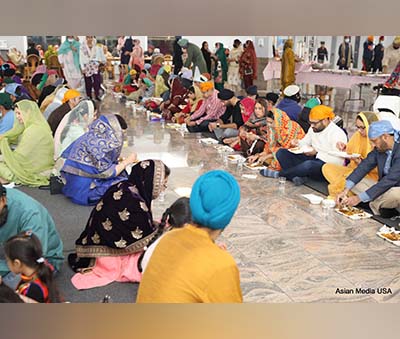
The daily kirtans were followed by langar seva where hundreds of volunteers of all age groups offered their services by serving hot meals to all the attendees. This year’s Diwali Seva at the Gurdwara was hosted by Savi Singh Attal & Pritpal Dandona family from Chicago.

Over 1,500 people attended the beautiful Diwali celebration at Gurdwara. With Beautiful Diyas & some fireworks for display. The sangat came from all over the Midwest/Interstate of Chicago.

Savi Singh son of Mr. Satwant Singh Attal SRS Palatine Gurdwara (Past President) family have been hosting Langar and doing Seva for Palatine Gurdwara for over thirty-five years and have been a prominent Sikh Family of Chicago migrated from India in the late 1970’s. The entire family has committed to the Sangat for over four decades and plans of continuing the Seva and passing it on to the next generations to come. The family loves and enjoys doing Langars in Gurdwaras. Diwali Celebrations has brought religion & culture together throughout the globe.

Sikh Religious Society, a non-profit organization, in Palatine, Illinois was formed in 1974 and its first formal Prakash Divas (the ceremonial acceptance of Guru GRANTH Sahib {Sikh’s holy scripture/book} at this new place of worship was celebrated in 1975.  The organization focuses on Sikh religious services, Punjabi language/ Kirtan classes. Another focus of this society is on the community service, charity and other Non Profit endeavors to promote the Punjabi culture and heritage.
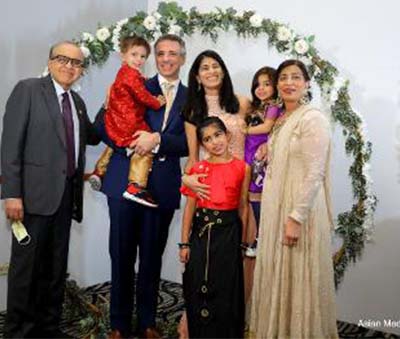
Sindhi Association Celebrates Diwali

Sindhi Association of Metropolitan Chicago, one of the oldest organizations in Chicagoland, celebrated its Annual Diwali celebration on October 30th at Ashton Place, Willowbrook, IL.

The celebration started with Lamp Lighting and the Mahalaxmi Aarti followed by a cultural program by kids of all ages. The event also featured a media briefing by the current President Subhash Balani and other board members. Balani explained how the association was formed over 6 decades ago with the aim of creating a platform for the upcoming generations. He talked about the annual activities that the association organizes to celebrate Sindhi Culture.

Another board member Nand Balani elaborated on the initiative called, Alliance of Global Sindhi Association that connects Sindhis all over to the world. The three aims of the alliance focus on matrimonial services, romanized script for sindhi language, and a global sindhi directory.
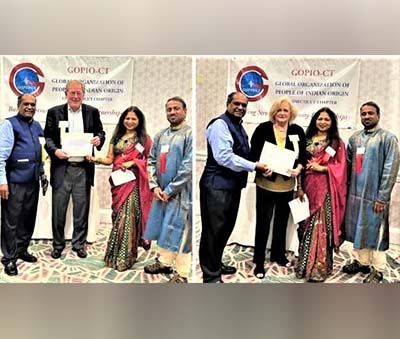
Geeta Rupani, past president and current executive board member who has been involved with the association for over four decades mentioned how the organization has been working hard to promote Sindhi culture, music, language and history.

Sunder Tekchandani stressed on the importance of involving more and more members, especially the younger generation to take these initiatives forward and to continue spreading awareness about the organization.

Vinita Gulabani, the current executive board member and media coordinator and Vikas Kalwani, past president explained how the outreach is done via emails and social media to involve the young generation. They talked about activities that are organized especially for youth participation like bowling, summer picnics, antakshari.

The event was attended by hundreds of members from Sindhi community that also included President, Village of Oakbrook Dr. Gopal Lalmalani who joined the Diwali celebration along with his family

GOPIO-CT Celebrates Diwali By Supporting Local Charities

The Connecticut Chapter of the Global Organization of People of Indian Origin (GOPIO-CT) celebrated Diwali, the Festival of Light, by supporting local charities in Stamford CT. Diwali is celebrated in India and the Indian Diaspora as a celebration of light over darkness and good over evil. In the spirit of the celebration, the Global Organization of People of Indian Origin, Connecticut Chapter (GOPIO-CT) invited the community and friends for Diwali Dinner with music and dance at the Hampton Inn and Suites in Stamford, CT, where it donated funds for the local charities.

The charities receiving funds were Future 5 of Stamford (https://futurefive.org/) and the Food Bank of Lower Fairfield County Inc. (https://www.foodbanklfc.org/). Together, both organizations received $20,000 from GOPIO-CT. The checks were accepted by Future 5 Founder Clif McFeely and Food Bank’s Executive Director Kathleen Lombardo.

Future 5 helps underprivileged students in the Stamford High School system. Future 5 envisions a world where all students can be part of a vibrant and supportive community and access the people and resources they need for college, career and life success.

Future 5 believes in human potential. In particular, the potential for each and every young person who climbs the stairs to find success in life.

The Food Bank of Lower Fairfield County was originated in 1984 as a program of the Council of Churches and Synagogues. Today the Food Bank of Lower Fairfield County, Inc., is a 501 (c) (3) charity organization serving in the lower Fairfield County’s primary hunger-relief organizations. It provides food to about 90 non-profit agencies and programs that serve low-income people in six town service area through bags of groceries and congregate meals. These include soup kitchens, food pantries, childcare programs, homeless shelters, senior centers, domestic violence safe houses, and rehabilitation programs.

A special guest at the event was Ms. Yelena Klompus, Program Manager for English Language Learning (ELL), Citizenship & Cultural Programs at Stamford’s Public Library known as The Ferguson Library. The library is planning a Diwali program in cooperation with GOPIO-CT on Sunday, November 14th at 1.30 p.m. Klompus invited everyone to join the program

A music program organized by GOPIO Vice President Dr. Jaya Daptardar followed with singers from Connecticut and included Srini Gunupuru, Devangi Dharani, Div Pithadia, Dipti Haria and Sonali Joshi. GOPIO-CT also announced that it will support one more local charity at a fundraiser at its Holiday Party in December.

“One of the objectives GOPIO is to support local community groups which do service to the larger society and GOPIO chapters have been doing a great job in that direction and GOPIO-CT in particular has been supporting several charities in Connecticut,” Said GOPIO Chairman Dr. Thomas Abraham who is the Founder and currently a Trustee of GOPIO-CT.

Over the last 15 years, GOPIO-CT, a chapter of GOPIO International has become an active and dynamic organization hosting interactive sessions with policy makers and academicians, community events, youth mentoring and networking workshops, and working with other area organizations to help create a better future. GOPIO-CT – Global Organization of People of Indian Origin – serves as a non-partisan, secular, civic and community service organization – promoting awareness of Indian culture, customs and contributions of PIOs through community programs, forums, events and youth activities. It seeks to strengthen partnerships and create an ongoing dialogue with local communities.

Diwali Celebrations Showcases Indian Culture At Times Square

New Yorkers got to experience Diwali at the Crossroads of the World, Times Square on Saturday, October 30th, 2021. Even Covid-19 couldn’t put a damper on one of the biggest celebrations in New York City’s iconic Times Square where Diwali was celebrated with pomp and festivity.

Music and dance with colorful and traditional Indian attire  marked Diwali at Times Square which had a special meaning this year coming as it did after the devastating Covid-19 pandemic that has impacted every aspect of our lives.

The event was attended in-person by several dignitaries, including United States Sen. Charles E. Schumer, U.S. Rep. Carolyn Maloney, India’s Consul General in New York Randhir Jaiswal, New York State Sen. John Liu, Padma Shri Sudhir Parikh, chairman of Parikh Worldwide Media and ITV Gold, H.R. Shah of TV Asia, representatives of the Indian Police Officers Society from the New York Police Department, and several other special guests who spoke on stage about the meaning of Diwali and the joy of celebrating it after Covid.
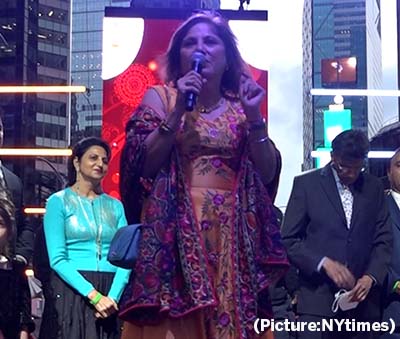
Dr. Parikh thanked Shoprite and for the ‘great function’ of Diwali that it was supporting, and praised the company for the work it did for the community, and encouraged it to continue the good work. “It is an honor to be here at this historic occasion, when the ball will drop for Diwali jus as it does for New Year, which shows how wonderful and important the Indian-American community is here in New ork and all over America,” said  Sen. Schumer.

Sen. Schumer said he believed in immigration and “immigrants make America great” because they believe in the American Dream and embody American values even as they bring their traditions to this country. He bemoaned a rise in hate crimes and emphasized, “We must shout it down. We must fight it. We must prosecute it, and we must welcome more Indians to come to America and New York, because the more Indians there are in New York, the greater New York will be.”

Consul General Jaiswal wished everyone a Happy Diwali for their loved ones and peace and prosperity for all. “More importantly, it is a time when we must introspect on some of the foundational values of our society – on kindness, compassion, sharing, being unified, being together…”

Congresswoman Maloney wished everyone present and dwelt on the need to recognize Mahatma Gandhi with a Congressional Gold Medal, something for which she has introduced a resolution in the House of Representatives. “Look at this amazing crowd!” exclaimed State Sen. Liu. “We are finally getting out of this long dark tunnel of Covid-19.”

This year in contrast to last year, Liu said, the number of Diwali celebrations has risen, “in our schools, in our mandirs, and City Hall,” he said, a tradition he started when he was a New York City Councilor. “There’s no better place to celebrate Diwali than at the ‘Crossroads of the World’, right here in Times Square, New York City. Because this is such an important holiday for billions of people around the world symbolizing the victory of good over evil, light over darkness …”
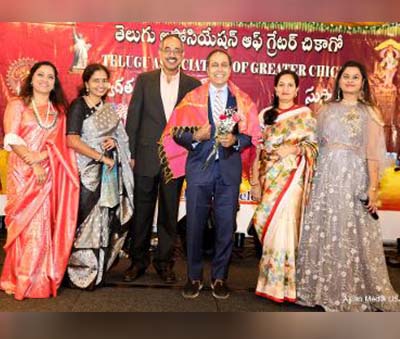
A unique digital presentation with a massive lighted billboard changing images symbolic of the Festival of Lights, in an attempt to capture the pomp and festivity of this joyous celebration, captured the hearts and minds of thousands who watched and joined in the celebrationbs from around the world. The event was organized by EventGuru Inc., an event management company in the Tristate area.

Diwali at Times Square has been increasing its audience since its inception in 2013. This New York City Diwali celebration usually draws a big crowd and features a diya (lamp) lighting ceremony accompanied by a New Year’s Eve style countdown featured on the tallest Times Square digital screen, followed by a host of rousing concerts.

Presented by Shoprite and organized by Bhasin, the Times Square Diwali was started by event organizer Neeta Bhasin, president of ASB Communications, a New York-based multicultural marketing and event management company. “After the pandemic, we are here to uplift the spirit of the people. And we want to showcase this vibrant India, and India’s culture, art and diversity to the world,” Bhasin said.

Telugu Association Of Greater Chicago Celebrates Golden Jubilee

Telugu Association of Greater Chicago, the first ever Telugu association in North America, organized its 50th year anniversary celebrations on a grand scale over 2 days during last weekend. First day was a spectacular Banquet at the Seville Banquets Streamwood followed by Dussehra and Deepavali celebrations at Naperville Community Church, Yellow Box, Naperville.

The event was described as a grand success with an overwhelming response from the Telugu community with 2000+ guests in attendance over 2 days. Multiple guests from Community, National and Local Telugu organizations, long time Sponsors PMSI Ashok Lakshmanan, NYLife Krishna Rangaraju joined along with Chief Guest U.S Congressman Raja Krishnamoorthy, Dr. Sreenivas Reddy, a member of the National council on White House History and Indian Consulate General’s office represented by Consul Gopal Bhagath.
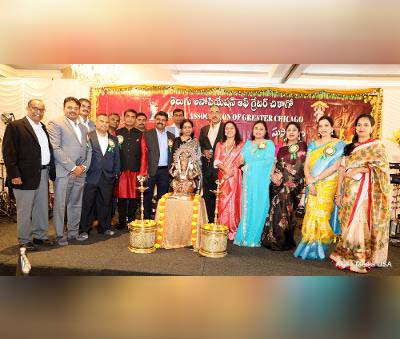
On Banquet day, 2021 President Venkat Gunuganti and 2020 President Praveen Vemulapalli recognized Sponsors and Donors for the past 2 years. Banquet was served with delicious food from Cool Mirchi which included multiple savory and sweet items. Few Past Presidents, long time Sponsors and Members spoke on the occasion and remembered their memories, connections in the last 50 years.

Live Music Concert with well-known singers Manisha Earabathini, Prasad Simhadri, Sarada Akunuri, Srikanth Sandugu, Sruthi Nanduri entertained the audience. Musical band was led by Meher Chanti with his 6 person MLiveBand team.  The musical night rocked and energized guests with continuous nonstop entertainment.

Anchors Kavita Thotakura and Sahitya Vinjamuri kept the whole program lively with their special engagement skills on both days. Event decorations added color to both events and the audience enjoyed the Photo Booths at each location. TAGC Youth volunteers and membership committee welcomed all guests with a smile.

As part of the 50th year celebrations second day “Joruga Husharuga – Dasara and Diwali celebrations”, 250+ participants including kids, youth, couples and senior members of TAGC entertained guests with their performances. Event brought a true festive atmosphere where all the seniors, youth and kids came together under one roof to celebrate the 50-year history of the Telugu community in America and the importance of perseverance.
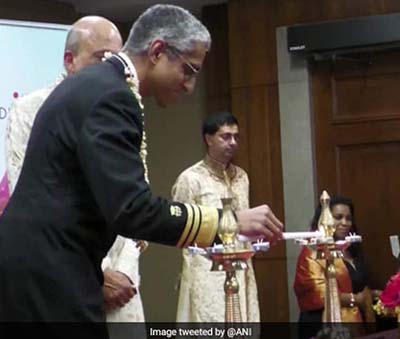
Food committee Chair, Vijay Beeram with his team & volunteers, did a wonderful job in serving delicious dinner for such a massive crowd in the allocated time. Attendees were appreciative of tasty food. Local Indian restaurant Cool Mirchi management supported TAGC with their best qualitative and quantitative food.

After-dinner program started with past-presidents recognition. 23 presidents with their families joined on the stage. Current President Venkat Gunuganti and President-elect Uma Avadutha with help of BoD’s felicitated all past-presidents on the stage. It was a special moment in TAGC history with so many presidents on the stage.  As part of the program, TAGC President-elect Uma Avadutha introduced new 2022-25 BoD’s along with the 2022 EC team. Venkat Gunuganti accompanied with his wife Haritha recognized past President Praveen Vemulapalli and his wife Kranthi for their services and dedication towards the organization with a flower bouquet, shawl, and a plaque.

TAGC 2020 President Praveen Vemulapalli and Kranthi recognized 2019 President Ram Billakanti and his wife Malathi for their services and dedication towards the organization with a flower bouquet, shawl, and a plaque, as there were restrictions on physical events in 2020. Live Music Concert continued on the 2nd day with well-known singers Manisha Earabathini, Prasad Simhadri, Sarada Akunuri, Srikanth Sandugu and Swaravedika team Sruthi Nanduri, Akhila Mamandur coordinated by Krisha Anumolu. Musical band was led by energetic Meher Chanti with his 6 person MLiveBand team.  The musical night rocked and energized guests in the auditorium with nonstop entertainment for almost 3hours. Anchor Kavita and her daughter Radhika entertained with their special dance.

TAGC president, Venkat Gunuganti, past-president Praveen Vemulapalli along with his whole BoD team presented all singers, Anchors, Music Band team members with flower bouquet, Colorful Shawl and 50th year Plaque. Cultural chair Neelima Cheikycharla also thanked all the participants, their parents, coordinators, teachers and the guests for their enthusiastic show of support throughout the evening.

TAGC President, Venkat Gunuganti, thanked the Executive Committee, Board of Directors, Chairs, Co-Chairs, Technical team, Hospitality team, Food team, Membership team and volunteers who have worked for weeks in planning and preparations to make this event memorable. He also conveyed his gratitude and thanks to sponsors for giving back to the community and requested TAGC members to make use of services provided by sponsors. TAGC is planning to release a special 50th anniversary souvenir with content and inputs from past and current members. It is planned to be released by Ugadi 2022.

TAGC cordially invites everyone who wishes to support and bless TAGC’s efforts to spread and preserve Telugu culture & tradition, and to be part of the upcoming exciting events.

Diwali Celebrations Light Up Capitol Hill

United States’ lawmakers and top officials of the White House celebrated Diwali with Indian diaspora on Capitol Hill on Wednesday, October 27th, 2021, honoring some of the top Indian Americans in the US President Joe Biden’s administration. The top Indian Americans who were honored included Vice Admiral Surgeon General Vivek Murthy and Neera Tanden, Senior Advisor and Staff Secretary to President Biden. 

During the celebration, the traditional ‘Diya’ was lit and several high ranking officials made their remarks. “There has been a lot of darkness in the last 1.5 years. To be able to celebrate and talk about the meaning of Diwali, it’s incredibly important,” said Vice Admiral Surgeon Gen Vivek Murthy. “Diwali is about light overcoming darkness, and there has been a lot of darkness in the last year and a half. To be able to celebrate Diwali, to talk about the meaning, to talk about the light in oneself and the light in others in these tough times, means a lot and I’m grateful to be here,” the Surgeon General added.

“But one of the things that concern me most about the last few years is another type of pandemic, the invisible pandemic that we are in the midst of. That’s a pandemic of polarization where it feels increasingly people have turned against each other, where they have demonized one another, called each other evil and treated each other as so. That’s a particular kind of darkness,” he said.
Congressman Ami Bera, Pramila Jayapal, Congressman Ro Khanna and Congressman Raja Krishnamoorthi addressed the community members. Ami Bera highlighted that the Diwali celebration is not only about Indian Americans but also the members of the Congress, which includes both Republicans and Democrats. The event also witnessed an interfaith prayer service that was attended by members of Congress.

Congressman James Clyburn, Steve Chabot, Congresswoman Judy Chu and Congresswoman Carolyn Maloney praised the contribution of Indian Americans in the development of the US and stressed the significance of Diwali in a post-Covid-19 world.

“The Congressmen at the gathering are not just Indian Americans, we have African American, Chinese American, mainstream American Congressman. It’s historic that such a diverse group of congressmen are supporting us,” Rangaswami, founder, Indiaspora told ANI.

“We are honored to celebrate Diwali at Capitol Hill and share our traditions with the leaders who have dedicated themselves to serving the public. The Indian diaspora has had a profound impact on American society, and their diverse contributions continue to strengthen our nation,” said Sanjeev Joshipura, executive director of Indiaspora.

American actress and singer Mary Millben was also present to celebrate Diwali at Capitol Hill. The singer performed the ‘Om Jai Jagdish Hare‘ rendition for the expats and community members too crooned the hymn with the singer. “To see folks come all over the country to celebrate Diwali is so beautiful and meaningful to me. I have a strong relationship with the people of India. It’s a very full-circle moment for me to be with people whom I love and a culture that I love, I am delighted to be here,” Mary Millben said.

Kerala Center To Honor 8 Prominent NRIs

The Indian American Kerala Cultural and Civic Center (http://keralacenterny.com) will honor eight Indian Americans for their outstanding achievements in their field of specialization or for their service to the society at its 29th Annual Awards Banquet to be held on November 13, 2021. The chief guest at the award ceremony will be Dr. Arun Jeph, India’s Deputy Consul General in New York.  The award event will also have New York Senators Kevin Thomas and Todd Kaminsky, Hempstead Town Supervisor, Don Clavin and India Consul for Community Affairs, A. K. Vijayakrishnan, as special guests.

According to Dr. Thomas Abraham, Chairperson of the Trustee Board, the Kerala Center has been honoring outstanding achievers since 1991.  “Every year we invite nominations and the committee has to make a unanimous choice for a candidate in a category to receive the award,” said Dr. Abraham who is one of the members of the Award Committee.  “This year our nominees are no different in terms of their achievements,” said Dr. Abraham.

Award Committee Chair Dr. Madhu Bhaskaran said that Kerala Center has been honoring Indian American  Malayalees who have reached high levels in their professions and who work for social progress.  “Their examples should be an inspiration for others,” he said.

This year, six regular and one special award will be given out to nominees for their special achievements, for their career graph and for their services to the community in the U.S., to people who do the center proud.

Outstanding Achievements in Medicine and Professional Services: This award will be given to Dr. George M. Abraham, President of the American College of Physicians.  Dr. George M. Abraham is the President of the American College of Physicians (the largest internal medicine organization in the world with 161,000 members in 145 countries). He is a Professor of Medicine at the Univ. Mass Medical School, Chief of Medicine at St. Vincent Hospital, Worcester, MA and Adjunct Professor at the Massachusetts College of Pharmacy and Health Sciences.  A graduate of the famous Christian Medical College, Vellore, Tamil Nadu in India, he has authored over 100 publications, abstracts and book chapters.

Notable Achievements in Political Process: This award will go to Mayor Robin J. Elackatt, mayor of City of Missouri City, Texas.  Mayor Elackatt’s public services started with  the city’s Parks & Recreation Board and as (District C) Council member from 2009-2015.  Holding an MBA and a MHA degrees, he served as the Healthcare Administrator of one of the largest Healthcare systems in Houston for over 24 years.

Notable Contributions in Public Service: This award will be given to Dr. Devi Nampiaparampil, the Republican nominee for NYC Public Advocate. Dr. Devi is a practicing physician in pain medicine, a scientist and a small business owner. She is a SAG-AFTRA member who played a doctor on General Hospital before becoming a doctor in real life. Dr. Devi did her residency and fellowship training at Harvard Medical School and is currently an Associate Professor at NYU School of Medicine.

Notable Contributions and Achievements in Performing Arts: The recipient for this award will be Mrs. Chandrika Kurup, the director of Noopura Indian Classical Dance School, New York.  Training under the late Kalamandalam Kalyanikutti Amma, a pioneer in Mohiniyattam, Kurup has been teaching Bharatanattyam, Kuchipuddi and Odissi and enhancing art and culture.

Notable Contributions in Nursing and Community Service: The recipient of this award is Mrs. Mary Philip, RN, MSA, a past Lieutenant in the Indian Defense Force and a past President of the Indian Nurses Association of NY. As a past President of the Indian Nurses Association of NY, she helped nurses with various educational and professional opportunities, including scholarships and academic financial support.  She has also worked as an executive member of several local and national associations.

Notable Services and Achievements in Legal Services: This award will be given to Mrs. Nandini Nair, partner and co-chair of the Immigration and Naturalization practice group at Greenspoon Marder LLP. Ms. Nair focuses her practice on U.S. visas, employment-based and family-based applications, naturalization applications and other immigration benefits.  She is ranked among the “Top Lawyers in New Jersey Immigration” by Chambers & Partners.

Special Award for Notable Services during the Pandemic: This award will be given jointly to Dr. Sabu Varghese and Dr. Blessy Mary Joseph, practicing physicians in New York. Dr. Sabu Varghese, is teaching and attending at Brookdale University Hospital and is doing his private practice at Wholesome Medical PC, holding affiliations with Northwell Systems and Catholic Hospital Systems. During the Pandemic, Dr. Varghese went out of his way to treat his patients.                                                                                                                        Dr. Blessy

Mary Joseph, MD, is a graduate of Manipal University Medical School, is currently holding private practice at Wholesome Medical PC and has affiliations with Northwell Systems and Catholic Hospital Systems. During the Pandemic, Dr. Blessy Joseph went out of her way to treat her patients.

Shrimad Rajchandra Love And Care Celebrates Diwali On Capitol Hill

Shrimad Rajchandra Love and Care (SRLC) hosted a special Diwali event in the presence of Honorable Indian Ambassador to the United States, Taranjit Singh Sandhu and several other dignitaries on October 27th. The event acknowledged the extraordinary partnership between the governments and private sector organizations of the United States and India to support SRLC’s humanitarian initiatives.

The event was attended by Congressmen Raja Krishnamoorthy, Illinois; Tim Ryan, Ohio; Greg Stanton, Arizona; Danny Davis, Illinois; Mike Quigley, Illinois; and, Audrey Kitawaga, Ambassador of Religions for Peace. Ambassador Sandhu emphasized critical points regarding the element of solidarity, the unity and partnership between the two nations, the importance of science and spiritual and extending happiness and kindness to all in these unprecedented times.
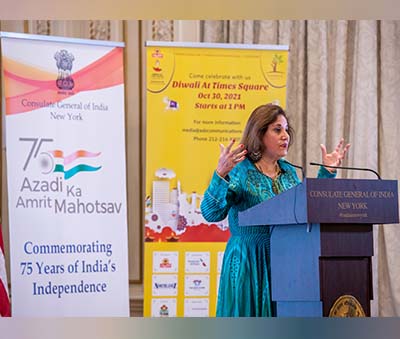
The highlight of the event was the launch of the book, ‘Atmasiddhi Shastra – Six Spiritual Truths of the Soul’, a concise and complete commentary by Pujya Gurudevshri Rakeshji. This book lays a clear and cogent path to self-discovery. The book commemorates the 125 th anniversary of the creation of Shrimad Rajchandraji’s magnum opus, ‘Atmasiddhi Shastra’ – a 142-verse epic spiritual masterpiece.

According to the organizers, it was an iconic moment to be at the Capitol Hill and celebrate Diwali by launching a book which “represents the true spirit of Diwali as it removes the darkness of ignorance by the light of knowledge.”

“The endeavor of Shri Rakeshji to present the essence of Atmasiddhi Shastra in a lucid manner through its commentary in English is a thoughtful gesture, aimed at the spiritual welfare of the youth” – Shri Narendra Modi, Hon. Prime Minister of India stated in a statement.  “Atmasiddhi Shastra is a practical guide to Liberation and freedom from suffering” – Deepak Chopra, Founder – The Chopra Foundation said.

SRLC is a global initiative to offer service and bring joy to the lives of the underserved sections of society. SRLC is inspired by Shrimad Rajchandraji, philosopher, and the spiritual guide of Mahatma Gandhiji. SRLC is founded by Pujya Gurudevshri Rakeshji, a world-renowned spiritual leader. SRLC enjoys Special Consultative Status with the United Nations Economic & Social Council since 2020. SRLC’s holistic, multi-pronged community support and development programs are powered by genuine empathy, love, and care of highly motivated volunteers. Learn more about SRLC’s humanitarian work: https://srlc-usa.org/

Curtain Raiser to Diwali at Times Square Held At Indian Consulate

Samman for All and advisory board members of ‘ShopRite Diwali at Times Square in association with Samman for all’ held a curtain raiser and press conference at the Consulate of India NY to commemorate the beginning of the Diwali at Times Square on October 30th at Times Square.

The event was attended by Media Houses, Performers and the Sponsors of Diwali at Times Square. The program started with Ganesh Pooja followed by Diya Lighting Ceremony and Presentation by Neeta Bhasin, Founder of Diwali at Times Square where she shared the details of the upcoming festival. Sponsors like Shoprite and American Airlines spoke of the significance and importance of cultural event as big as Diwali at Times Square and its impact on the community.
“Our objective this year is to bring the light of positivity in the lives of people especially since the dark gloom of the pandemic has engulfed us. Through this event, we want to uplift the spirit of the community and share the message of love, togetherness, inclusion, and diversity,” Bhasin said.

“ShopRite Diwali at Times Square” in association with the non-profit “Samman for All” is showcasing the rich ‘Colors of India’ via its art and culture right in the heart of Times Square on October 30, 2021, starting at 1:00pm EST.

According to the founder of Diwali at Times Square, Neeta Bhasin, “Understanding different cultures makes us realize that the basic tenets of all cultures are the same. However, the difference in expression is what enriches the tapestry of our lives.” The celebration continues throughout the day into the evening with the traditional Diwali custom of ‘Diya (Lamp) Lighting’ ceremony on stage which will also be projected on the tallest billboard in Times Square followed by a rousing musical extravaganza – ‘The Light Up Times Square’ concert with international singer Jay Sean and other performers will be entertaining people with their superhit songs.

Due to its resounding success in the past years, the festival has also garnered praise and recognition by various media outlets as well as the US Government as being one of the largest Indian festivals outside of India.

This year, Diwali at Times Square has an association with ‘Samman for all’ not-for-profit organization. Director of ‘Samman for All’ said’ Our goal is to help people achieve a dignified living – a life that they can call their own. We wish this Diwali brighten the lives of people”.

”Diwali is an integral part of our cultural heritage. It represents our values, traditions, diversity and thought. Diwali at Times Square brings people from all walks of life together to celebrate the festival of Diwali. We would like to congratulate the Producer, Mrs. Neeta Bhasin, for meaningfully promoting Indian culture and our universal ideas in the US.” Said Mr. Randhir Jaiswal, Consul General of India NY,

The ShopRite stated ‘South Asian community is a very important part of our community, and we want everyone to taste the Diwali Celebration with Shoprite. We look forward to celebrating the festival of Delight at Times Square this year!!

Harry Singh Bolla, President & C.E.O, Bolla Oil Corp “I know how Diwali is a cheerful and nostalgic festival! It reminds me of happy times from my childhood. “Let’s come together and celebrate Diwali At Times Square on a October 30 and cherish all the good times”

Bhasin thanked the “Title Sponsor ShopRite, Airline Partner American Airline, Diya (Lamp) Lighting with the countdown partner Bolla Market and our sponsors Northwell Health, Northlandz, State bank of India and Nazranaa.”

Samman for All. mission is to facilitate people from the lower-economic strata to achieve their dreams by providing them with tools for sustainable living.  Event Guru WorldWide is a premier full-service event company specializing in festivals, concerts, tradeshows, gala dinners and press conferences. We conceptualize and implement events of all sizes and statures.

Narendra Modi Invites Pope Francis To Visit India During Meeting With Pope At The Vatican

Prime Minister Narendra Modi met Pope Francis at the Vatican Saturday in his first meeting with the head of the sovereign of the Vatican City State on Saturday, October 30, 2021. The meeting between the Hindu nationalist party leader and Pope Francis, the head of the Roman Catholic Church, assumes significance as it comes at a time when Christians in many parts of India have been complaining of harassment and attacks on the community and its institutions.

The two leaders discussed with Pope Francis issues covering a range of areas of interest, including COVID-19, general global perspectives and maintaining peace and tranquility. After the meeting, Modi tweeted, with pictures of him embracing the Pope, “Had a very warm meeting with Pope Francis. I had the opportunity to discuss a wide range of issues with him and also invited him to visit India.”
A Vatican source has told the media that Vatican officials were “happily surprised” by the invitation, as they had no advance notice from either the government or from the Catholic Church in India that Mr. Modi would invite the pope to visit the country. Because Pope Francis and the Catholic Church and Christians in India consider the visit very important, it is likely to be given priority in Vatican scheduling; it could even take place in the second half of next year, according to reports.

The meeting took place in the pope’s private library on the second floor of the Apostolic Palace in the Vatican. Pope Francis, the leader of more than 1.3 billion Catholics worldwide, and Mr. Modi, who governs the world’s largest democracy of almost 1.4 billion people, sat at a table and talked together with the aid of interpreters for 55 minutes.

The meeting was long by Vatican standards. The Vatican issued a very brief statement that revealed almost nothing of the content of their conversation except to say that they acknowledged the good relations that exist between India and the Holy See. The Holy See and India established diplomatic relations in 1948, soon after the country gained its independence.

After their private conversation, Mr. Modi presented his five-person delegation, including the Minister for Foreign Affairs, S. J. Jaishanakar, the National Security Advisor, Ajit Doval, and India’s Ambassador to the Holy See, Jaideep Mazumdar.

Pope Francis and the Prime Minister then exchanged gifts. Modi gave the Pope a silver candlestick and a copy of The Climate Climb. Pope Francis gave Modi a bronze plaque with the inscription “the desert will become a garden,” and copies of the pope’s writings, including his encyclicals “Laudato Si’” and “Fratelli Tutti,” as well as the “Document on Human Fraternity” and his message for the 2021 World Day of Peace.
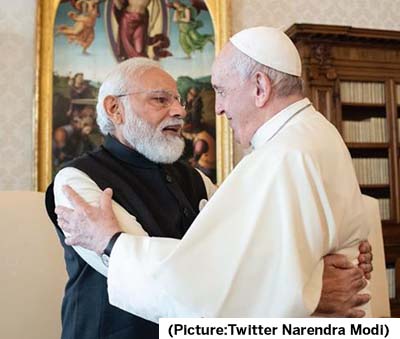
Pope Francis would be the third pope to visit India. Paul IV traveled to Mumbai in 1964 to attend the International Eucharistic Congress, while John Paul II visited India in February 1986 and again in November 1999, the latter time for the presentation of his Post-Synodal Apostolic Exhortation “Ecclesia in Asia.”

Modi is the fifth Indian Prime Minister to have visited the head of Roman Catholics, the largest religious denomination in the world. Before Modi, Prime Ministers Jawaharlal Nehru, Indira Gandhi, I K Gujral, and Atal Bihari Vajpayee had met the then Popes in the Vatican. It is not just Prime Ministers who have paid a visit to the Holy See. Communist veteran and former Chief Minister of Kerala E K Nayanar presented a Bhagavad Gita to Pope John Paul II in 1997 and he kept a rosary presented by the Pope throughout his life. Nayanar was accompanied by current Kerala Chief Minister Pinarayi Vijayan, who was then a minister in his government. When he visited Pope Francis in October 2019, Union Minister V Muraleedharan also gifted a Bhagavad Gita to him.

The Prime Minister’s meeting with the Pope has been welcomed by the Church. Major Archbishop Baselios Cardinal Cleemis, who was the President of the Catholic Bishops Conference of India (CBCI) and who had requested Modi to invite the Pope to India in 2014, saw it as a fresh opportunity for dialogue between the government and the community. “This has a historical importance,” Cardinal Cleemis said.

“The meeting should not be seen merely as the one between two country heads, rather it was the head of the largest democracy and an ancient culture of the world meeting the head of the largest religious community in the world. This brings in hope for enhancing human fraternity and caring for the poor, because that’s what Christianity stands for. It would bring in positive efforts in India for a mutual trust and collaboration between people of different religious groups. It would also contribute to the very need for dialogues. We are very delighted that the Prime Minister has opened ways for a Papal visit to India,” the Cardinal Cleemis told the media.

Modi’s visit has been excitedly welcomed by the Catholic Church. Even before the government officially announced the visit, the president of the Kerala Catholic Bishops Conference, Cardinal George Alenchery, issued a statement that it would “add more energy and warmth to the relations between our country and the Vatican and the Catholic Church”. According to media reports, the welcome note by Cardinal Cleemis and earlier by Cardinal George Alencherry, President of the Kerala Catholic Bishops Conference (KCBC), have rekindled the BJP’s hopes on building confidence in the community towards the party, leaders said.

Christians account for some 2.3 percent of India’s population, behind Hindus who make up 79.8%, and Muslims are 14.2%. of the total Indian population. With over 28 million Christians living across India, including 20 million Catholics, the Catholic Church plays a significant social role in India—especially in the fields of education and health care.

One contentious issue between Christians and Modi’s political party, the Bharatiya Janata Party, is Christian proselytization in India, which Hindu fundamentalists and some politicians in the BJP have accused Christians and the Catholic Church of in the past. Pope Francis has stated clearly that the church has no intention of proselytizing in India.

A joint fact-finding team of non-governmental organisations, including the Association for the Protection of Civil Rights, United Against Hate and United Christian Forum, recently presented a report – after visiting Uttar Pradesh and Uttarakhand – which pointed out a series of attacks against Christians and churches in these states. Sources in the Catholic Church in the national capital said the influential Kerala Church has been ignoring the attacks against the community in northern parts of the country.

With Christians being a community that the ruling Bharatiya Janata Party (BJP) wants to establish as its support base to retain power in poll-bound Goa and Manipur and to emerge as a formidable electoral force in Kerala,  Modi’s meeting with Pope Francis, and his invitation to the Pontiff to visit India assumes much significance, sources in the BJP said.

While Christians in Kerala comprise 18.38 per cent of its population, in Goa it is 25.1 per cent while the figure is 41.2 per cent in Manipur. Both Manipur and Goa are headed for polls early next year. Despite its desperate attempts, the BJP’s vote share has gone down from 15.53 per cent (2019) to 12.47 per cent in the Assembly elections held on April 6 this year. Political observers pointed out that the fall in vote share indicated that there was no overwhelming support for the party’s candidates from the Christian community.

Pointing out that minorities, both Christians and Muslims, have been the “subject of consistent attacks” by right-wing forces since the BJP came into power in 2014, Father Suresh Mathew, editor of church publication Indian Currents said, “BJP has spared no efforts and even supported every attack and hate speech against Christians. Several states have enacted anti-conversion laws which are in violation of the Constitution. Time has come for the Church leadership in India to shed diplomacy and express their concern for religious freedom and human rights protection,” Fr Mathew said.

The Prime Minister, who is in Italy to attend the G20 Summit, briefed the Pope about the ambitious initiatives taken by India in combating climate change as well as India’s success in administering one billion Covid-19 vaccination doses. Prime Minister Modi will also attend the Climate Summit to be held in Glasgow from Sunday. His Holiness appreciated India’s assistance to countries in need during the pandemic, the release said. At the end of the audience, Pope Francis escorted Modi to the door and said, “I am happy, very happy. Pray for me!” Mr. Modi responded, “I hope to see you in India.”

The 40th AAPI Convention In San Antonio, TX To Focus On “Heal The Healers” With Its Much Needed “Wellness Package” For Physicians And Families

(Chicago, IL: October 27, 2021) “Physician, heal thyself,” especially when there are growing signs of burn out among physicians, by offering positive remedial resources as part of a first ever Wellness Program being offered to participants at the 40th Annual Convention of AAPI to be held in san Antonio from June 23rd to 26th, 2022.

The Covid pandemic has impacted all aspects of human life as never been before. The past two years have been challenging to everyone, particularly those are assigned with the responsibility of caring for the sick, especially as hundreds of Millions were affected by the big pandemic. Over 115,000 health care workers died from Covid-19 from January 2020 to May of this year, according to a new World Health Organization estimate.

“The backbone of every health system is its workforce — the people who deliver the services on which we rely at some point in our lives,” WHO Director-General Tedros Adhanom Ghebreyesus said. “The pandemic is a powerful demonstration of just how much we rely on health workers and how vulnerable we all are when the people who protect our health are themselves unprotected.”

Some have argued that governments have forsaken their duty to protect health care workers and warned that pandemic would have long tail effects, with many healthcare professionals considering leaving the workforce. At this critical juncture in human history, American Association of Physicians of Indian Origin (AAPI) the largest ethnic medical organization in the country, representing the interests of over 100,000 physicians of Indian origin, is focusing on themes such as how to take care of self and find satisfaction and happiness in the challenging situations they are in, while serving hundreds of patients everyday of their dedicated and noble profession, Dr. Anupama Gotimukula, President of AAPI said.   “This year AAPI Convention team from San Antonio is very much motivated on focusing on addressing physician burnout and we have planned these wellness packages. As we are seeing  in our daily lives the physician burnout has increased significantly. “We do acknowledge that these are challenging times, more than ever for us, physicians, who are on the frontline to assess, diagnose and treat people are affected by this deadly pandemic, COVID-19. Many of our colleagues have sacrificed their lives in order to save those impacted by this pandemic around the world,” Dr. Gotimukula added.

Accordingly, some of the major themes at the convention include: Yoga and Meditation practices, Welcome kit with books & self-care supplies, A Personal Reflexology Session, Take home wellness routine, Ailment based yoga therapy sessions, Workshop on Spiritual well-being, Book talk with Yoga Gurus, including on the science of Yoga & Lifestyle medicine, as well as an unique opportunity to visit first of its kind in San Antonio, Aum Ashram as part of the Wellness session.

Esteemed yoga gurus and experts, who are planned to share their wisdom and leading the Wellness Sessions include: Paramguru Sharatha Jois, Sadhvi Bhagawati, Saraswati Eddie Stern,  Dr. Sat Bir Khalsa, Dr. Dilip Sarkar, Dr. Pankaj Vij, and  Dr. Param Dedhia.

“Our physician members have worked very hard during the Covid 19 pandemic as the 2022 convention is a perfect time to heal the healers with a special focus on wellness,” said Dr. Dr Jayesh Shah, Chair of AAPI Convention 2022.

In her welcome note, Dr. Hetal Nayak, Coordinator of the Wellness Program said, “With great enthusiasm we invite you to participate in our AAPI convention wellness package themed ‘Heal the Healers.’ This is the first time in the AAPI convention we offer these exclusive wellness packages geared towards the well-being of Physicians and their families by bringing the essence of science and spirituality of yoga and lifestyle medicine into our selfcare routine. As we all aware, a calm mind and a refined intellect are essential for making right choices. We promise to leave you empowered with the tools required.”

Dr. Kusum Punjaabi, Chair of AAPI BOT said, “At AAPI, the largest ethnic medical association in the nation, we are proud, we have been able to serve every 7th patient in the country. We serve in large cities, smaller towns and rural areas, sharing our skills, knowledge, compassion and expertise and caring millions of people.”

Acknowledging the need for this much needed program as part of the convention,  Dr. Ravi Kolli, President-elect  of AAPI elaborated, “Healthcare today is more complex than ever. With more advancements, tools and information at our fingertips physicians have an overwhelming job to diagnose and treat our patients every day, 24/ 7/ 365 days a year. In every city and hospital, in our military and in our rural communities, we, the doctors pave the way to provide better healthcare to our patients.”

“A huge thank you to all of the doctors, physicians, and other healthcare professionals for your dedication and commitment to service during this uncertain time,” Dr. Anjana Samadder, Vice President of AAPI said. “This is a unique opportunity for All of us, the front-line physicians who are putting our lives at risk to the save the lives of others,” Dr. Satheesh Kathula, Secretary of AAPI said. “Thank you for fighting selflessly against this virus and helping keep everyone healthy and safe,” Dr. Krishan Kumar, Treasurer of AAPI added.

During the annual convention, physicians and healthcare professionals from across the country and internationally will convene and participate in the scholarly exchange of medical advances, to develop health policy agendas, and to encourage legislative priorities in the coming year.

Planned to have a limited number of attendance due to the ongoing Coivd pandemic and the taking into account the safety of the participants, including Physicians, Healthcare Leaders, Academicians, Researchers and Medical Students, “the annual convention offers extensive academic presentations, recognition of achievements and achievers, and professional networking at the alumni and evening social events,” Dr. Gotimukula added.   For more information, please visit: www.aapiconvention.org  and www.aapiusa.org

Dandiya Night By Aarush Entertainment Brings Community Together

The whirling dancers, clapping hands, distinct sound of wooden sticks struck together, toe tapping music and people wearing colorful clothes marked the Navratri celebration at the Garba & Dandiya Raas dances held all over Chicagoland. The Aarush Entertainment celebrated dandiya night to celebrate the festival season with one thousand plus community members at Oswego East High School, Oswego, IL.

The event was organized by Manoj Rathod and Tanmay Patel featured two very well-known versatile vocalists Badal Parmar and Bharti Desai who kept the atmosphere upbeat and devotional and had everyone dancing throughout the entire event. Badal Parmar performed traditional Kathiawadi style garba as well as popular Hindi songs. His style of performance reflects an immense amount of Gujarati garba as well as modern beats. This unique style of singing is what makes him such a versatile performer. Garba Queen of United State of America Desai who is an award-winning singer in Chicago enthralled the audience with her charming personality. She continued amazing Garbas in Two Taali. In Raas everybody enjoyed Disco Dandia, Sanedo, Amu Kaka Bapa Na, Bhai-Bhai, Hitch..

There were   participants   of   all   ages of men and women   of   about   1000+   people, enjoying and celebrating the festivities. Many in the audience, especially ladies of all ages   wore colorful   and traditional   dresses   for   this   special   occasion   with matching ornaments.

“Navaratri Garba is very special as it honors Shakti in very rhythmic ways.  We all love the whole atmosphere of colors, the clothes and of course, the music and then there is always the fun of dressing traditionally. Western dresses are replaced by Lengha-Choli, matching jewelry and foot wear”, said one of the participants.  The evening was followed by traditional garba music and concluded in the wee hours of morning highlighted by devotional Arti of Mataji.

The Aarush Entertainment company offers event planning & management services that also includes wedding designing, planning, management & consultancy, adopting a comprehensive approach & professional management information system to plan and produce a world class event experience each & every time all over the world. The highly skilled team of professionals at Aarush Entertainment strives hard to accomplish the highest standard of quality, effectiveness & novelty with due importance to the budgetary considerations.

Hindu Women’s Network Launched In Chicago

The Vishwa Hindu Parishad of America, VHPA, also referred to as the World Hindu Council of America, announced the launch of the Chicagoland chapter of Hindu Women’s Network Oct. 23, 2021, at Gaylord India Restaurant, Chicago, IL.

According to a press release from VHPA, a group of 40 Hindu women met at the Gaylord India Restaurant in Chicago and announced the formation of the Chicagoland Chapter of “Hindu Women’s Network. The meeting was addressed by an invited panel of three women who have achieved success in the fields of medicine, media and politics.

There was invited panel of three women from the Hindu Community who have achieved success in fields of Medicine, Media and Politics.

Dr. Panna Barai MD from Munster Indiana was the Keynote speaker as she has been associated with VHPA since past 40-plus years, and gave her blessing and message of Nari Shakti to take charge as Hindus in America are now in 3rd and 4th Generation, and there are many areas where women need support at home and in professional lives and keeping it balanced.

Mrs. Vandana Jhingan TV Asia correspondent/Journalist and US Media bureau chief for “Hindi Khabar” gave a very passionate speech on topic of Hindu Women and Media portrayal.

Jhingan talked about influence of media on young Hindu females and what we should be aware of. She talked about journalistic ethics and importance of reporting events not creating news and sharing opinions. She also shared a video of an independent movie made by US Producer which is held by Indian Censor board, freedom of sharing a point of view is blocked and why the topic of the movie most related to the young Hindu girls.

Meghna Bansal, Trustee of the Wheatland Township and a owner manager of a Technology company, talked about importance of involvement in the local politics. Her point was simple “you might not be interested in politics, but politics is making decisions which impact all of you”. Her journey from India and moving to USA over 25 years back and how she got involved with local homeowners association and progression from there to Local Township Trustee position.

The event was organized Vishwa Hindu Parishad Chicago chapter’s women’s group. Mrs. Anisha S. Shah, Ms. Neela Patel, Mrs. Hetal N. Pate, Mrs. Nimisha K. Patel, Mrs. Yashswaini Desai, and Mrs. Preet Mittal. Hindu Women’s Network invites women from all walks of life to join this movement and help with community building projects.

IAMC Urges FB To Help End India’s “Genocidal Rhetoric” Against Minorities

The Indian American Muslim Council, an advocacy group dedicated to safeguarding India’s pluralist and tolerant ethos, called on Facebook to take immediate action against India’s hate speech epidemic, which has directly led to violence in the past and will continue to have deadly consequences if left unchecked.

Whistleblower Frances Haugen, a former Facebook product manager, has exposed the company’s failure to curb hate speech, which has led to societal division and violence against vulnerable populations in multiple countries, including India. Within Facebook groups and WhatsApp chats, most instances of fake news, fear-mongering propaganda, lynching videos, gory images, and hateful content are freely circulated with no pushback.

India is Facebook’s largest market, with 340 million active users, and yet the company allocates only scant time and resources towards monitoring India-specific hate speech and fake news. As a result, such content has resulted in real-life consequences for minorities in India, especially Muslims. The Wall Street Journal reports that “inflammatory content on Facebook spiked 300% above previous levels at times during the months following December 2019, a period in which religious protests swept India.”

The sheer volume of anti-Muslim hate speech culminated in the 2020 Delhi pogroms, according to a report reviewed by the Wall Street Journal. “Rumors and calls to violence” were spread widely in the lead up to the clashes, which left 53 dead. The majority of the victims were Muslims, beaten and lynched at the hands of Hindu supremacist mobs.

According to Haugen, Indian Facebook is awash with “dehumanizing posts comparing Muslims to ‘pigs’ and ‘dogs’ and misinformation claiming the Quran calls for men to rape their female family members.” Rumors that “Hindus are in danger” are common, padded by unfounded claims that Muslims were responsible for the spread of Covid-19, that Muslim men have an agenda to seduce and convert Hindu women to Islam, and that Muslims are generally anti-nationals who hate all Hindus.

“Facebook’s continued dereliction of duty in the face of mounting evidence of how its platform is enabling violence and genocide, is an alarm bell for all who care about human rights and democracy,” said Mr. Rasheed Ahmed, Executive Editor of IAMC. “As Facebook has failed to clean house despite multiple exposes, it is time for regulators to step in.”

This report is consistent with criticisms human rights organizations have made of India since the election of Prime Minister Narendra Modi in 2014. John Sifton, Asia Advocacy Director for Human Rights Watch, writes: “This divisive political discourse has served to normalize violence against minorities, especially Muslims, in India. Prejudices embedded in the government have infiltrated independent institutions, such as the police, empowering nationalist groups to threaten, harass, and attack religious minorities with impunity.”

This rhetoric trickles down from some of the most powerful figureheads of the Indian government, which in turn normalizes extremism among the general population. A leaked document shows that the Bharatiya Janata Party (BJP), the ideological offspring of the RSS and the party of Narendra Modi, encourages the use of multiple accounts under a single user, which aids in the spread of propaganda. The Bajrang Dal, a Hindu extremist group with links to the BJP, frequently posts anti-Muslim hate speech on the platform. The Rashtriya Swayamsevak Sangh (RSS), the umbrella organization of the Hindu supremacist movement, was specifically called out by Hagen for promoting “fear mongering” and “anti-Muslim narratives,” and targeting propaganda towards “pro-Hindu populations with V&I (violent and incendiary) intent.”

Facebook’s failures in India mirror its deadly role in the ethnic cleansing of Rohingya Muslims in Myanmar. If left unchecked, India’s hate speech problem could likely culminate in a similar genocide.

The Indian American Muslim Council is committed to working with human rights advocates in the US and in India to safeguard India’s pluralism and religious freedom for people of all faiths.

The Congress Party in India demanded a probe by a joint parliamentary committee into Facebook’s content moderation policies following revelations that the company was less stringent in curbing inflammatory posts, particularly Islamophobic content, on its platform.

“What right does Facebook have to push a particular ideology through fake posts, pictures and a narrative,” Congress spokesperson Pawan Khera said. “The role of Facebook can no longer be dismissed as an error of omission as they are knowingly furthering the agenda of the ruling party and its ideology which is hate-filled, bigotry and dividing society.”

According to leaked internal documents, Facebook stopped short of flagging RSS-affiliated pages despite they promoting anti-Muslim narratives with violent intent; did not consider as “coordinated inauthentic behavior” when a BJP worker posted inflammatory posts from multiple accounts in the run-up to the West Bengal election; and failed to remove posts calling for violence against Muslim during last year’s Delhi riots.

65,000 More Men Than Women Died Of COVID-19 In The US

Men are much more likely to die from COVID-19 than women. This is true globally – where the death rate has been about 50% higher for men. Notably, this gap does not appear to be explained either by differences in the number of confirmed cases or in pre-existing conditions. With the pandemic cutting life expectancy of American men by more than two years, it is important to understand and mitigate risks associated with COVID-19 mortality among men.

Building on earlier work with Tiffany Ford from May 2020, “COVID-19 much more fatal for men, especially taking age into account,” we draw here on updated CDC data to examine the gender mortality gap by age, and over time in the U.S. Our main findings are:

The overall death rate for men is 1.6 times higher than the death rate for women; The gap is widest in the middle of the age distribution, with 184 male deaths for every 100 female deaths.

As death rates have fallen, the gender gap has narrowed slightly

  • The gap is not explained by a higher number of cases among men, or differences in pre-existing conditions
  • In Georgia and Michigan, Black men have the highest death rates, followed by Black women
  • Improving access to care and addressing vaccine hesitancy, especially for Black men, should be a high priority

The gender gap in death rates

Men have had a higher crude death rate than women, as the chart using CDC data from February 2020 to August 2021 shows. By the end of August, over 65,000 more men than women had died from COVID-19 (362,187 male deaths and 296,567 female deaths).

The gender gap is even wider when differences in the male and female age distributions are taken into account, since there are many more older women than men in the population, and age is the biggest risk factor in COVID deaths. In 2021, mortality rates for men and women have dropped sharply, but somewhat faster for men than women, leading to a slight narrowing of the gap over time. More recently, though, death rates for men and women have risen again due to the spread of the Delta variant, with greater increases among men than women.

Middle-aged men are especially vulnerable

The picture varies across the age distribution, however. The gap is largest for those towards the middle of the age distribution. Among those aged 45 to 64, for example, the number of male deaths as of September 15, 2021, was 79,711, almost twice the number of female deaths, at 45,587.

We also calculate the ratio in death rates (male death rate: female death rate) in COVID-19 mortality for specific age groups. For all age groups, we calculate a similar ratio, but age-standardize the death rates. As of September 15, 2021, the overall adjusted male death rate was 1.63 times higher than the overall adjusted female death rate. This means that men make up 62% of all (age-standardized) COVID deaths. Again, the male-female gap is most prominent in those at or just past middle age: among those aged 45-64, there are 184 male deaths for every 100 female deaths.

COVID cases similar for men and women…

One possible explanation for the mortality gap could be that men are more likely to contract COVID-19. But while it is difficult to assess case counts due to access and demand for testing, raw data on the number of cases by age and sex from the CDC suggest very similar levels for men and women (note that the age brackets are not exactly the same as shown above, because of the way CDC data is presented).

In fact, women have slightly higher case numbers, possibly because they may make up a greater share of riskier jobs that are high-contact and inflexible, such as healthcare support, personal care and services, and food preparation (although it is important to acknowledge that men make up a greater share of those in high-risk jobs like meatpacking). Likewise, these industries might require more routine testing, leading to an over-reporting in mild/asymptomatic cases. On the other hand, men might be less likely to test for asymptomatic cases, leading to less reported cases overall. Correcting for these measurement issues would give a more accurate cmparison of COVID-19 cases by sex.

…and pre-existing conditions do not explain the gap

Another possible explanation for the mortality gap is a higher rate of pre-existing conditions among men that make them more vulnerable to the virus. Again, some evidence suggests that this is not a major factor. One study of an Illinois hospital system by Joanne Michelle Gomez and co-authors, published in the Journal of Women’s Health, concluded that “male sex was independently associated with death, hospitalization, ICU admissions, and need for vasopressors or endotracheal intubation, after correction for important covariates.”

Another review of risk factors for hospitalization finds that men and women have similar rates of conditions associated with greater vulnerability, although there are some differences in specific conditions. For instance, “obesity, chronic kidney disease and hypertension were associated with higher rates of ICU admission among men, whereas obesity and heart failure were associated with higher rates of ICU admission among women.” These sex-specific differences make it important to better understand the relationship between sex, risk factors, and COVID-19 mortality, especially for different age cohorts and racial groups. As we discuss below, biological differences by sex are not the same across race, and there are additional factors at play that drive differences in death rates among women.

The gender gap has changed over the pandemic

The mortality gap has somewhat narrowed for some age groups since the start of 2021. Figure 5 shows that the death rate ratio for middle-aged adults was around 1.8 prior to February 2021. More recently, this ratio has leveled around 1.5, representing a decline of around 17 percent.

Black men fare worst of all

There are of course other gaps in vulnerability to COVID-19, especially by race. Our previous study from the earlier stages of the pandemic “Race gaps in COVID-19 deaths are even bigger than they appear” showed for example that among middle-aged adults, Black and Hispanic or Latino death rates are six times higher than those for white people.

This means that while there is a gap between men and women within racial groups, race is often a bigger factor. Tamara Rushovich and her colleagues, drawing on data from Georgia and Michigan, find that while Black men have the highest COVID mortality rates – six times higher than for white men – the next most vulnerable group is Black women. They also find that the sex gap varies by race, especially in Michigan, where, as they report, “the mortality rate for Black men is 170% times the rate for Black women, which is significantly higher than the equivalent ratio among white individuals: the rate is only 130% higher for white men compared to white women.”

Interestingly, the authors also point out that the COVID mortality gap between Black women and white women is significantly greater than the gap between white men and white women. This suggests that the biological sex differences in mortality cannot be treated as constant across all racial groups.

Rushovich and her co-authors also do not put much weight on “individual behaviors and beliefs” to explain the race or sex gaps in mortality (or indeed sex gaps within race), pointing instead to “structural factors including occupation and access to healthcare.” This seems right, but it is nonetheless important to understand potential behavioral reasons behind the disparate death rates, especially as it relates to the decision to get vaccinated.

Get men (especially Black men) vaccinated

The gender gap in COVID-19 mortality is the result of a combination of factors, which may differ by race, class, geography and other variables. This is a stark reminder of the need for disaggregated health data to inform an intersectional approach to analysis. Gaining a better understanding of biological differences, case counts, and risk factors will be an ongoing task for scientific researchers.

More immediately, an urgent public health priority is to encourage and incentivize those most vulnerable to the virus to get vaccinated. Both race and gender matter here. As of September 21, 2021, Black Americans were six percentage points less likely than white Americans to have had at least one vaccine dose (41% compared to 35%). The racial disparity in vaccination rates is likely due to a combination of persistent barriers to access and structural inequities, which not only includes geographical access, but also logistics, methods of communication, timing, and registration.

Many cities such as Philadelphia have facilitated better access to their underserved Black communities by partnering with community churches, opening alternative vaccination facilities such as local pharmacies, and using more direct methods of communication rather than with emails and Web portals. But while this has worked to some extent, there remain considerable gaps in vaccination take-up by race. Even among health care workers who had early and constant access to vaccines, Black workers were almost five times more likely than white workers to be hesitant about getting vaccinated. Our colleagues Sarah Reber and Cyrus Kosar also find that Black nursing home residents are likely to be in high-risk facilities with low vaccination rates, despite being one of the first few groups offered the vaccine.

What this means is that, in addition to improving access for underserved communities, we need additional research on the interventions that can effectively address hesitancy and increase demand for vaccine uptake. The Washington Post reports that “tapping into the communities where people live, drawing on information, outreach and vaccine administrators from those communities” is one good way to overcome hesitancy.

In addition to the racial gaps in vaccine rates, there is a gender gap too: 66% of women have had at least one vaccine dose, compared to 62% of men. Many states are also offering various vaccine incentive schemes – it may be worth seeing which have proven most effective with men. Especially with the spread of the new Delta variant, improving access and addressing vaccine hesitancy among the most vulnerable groups – including men, and especially Black men – must be a high priority for policymakers.

Metropolitan Asian Family Services Holds Fundraiser Gala

Metropolitan Asian Family Services (MAFS) kicked off a star studded and safe in person event after a year and a half of combating COVID-19 on October 17, 2021. It was a colossal success! October 17th is a very significant date for MAFS as the Governor of Illinois Proclaimed this day as “MAFS DAY”.

Vibrant and Charming Neil Khot and Richa Chand were the emcees who did a tremendous job who kept the show exciting until the very end. Dr. Vijnay Prabhakar did an excellent job outlining the show as the chair of the Gala.

The show commenced with the Lamp Lighting ceremony by the MAFS Board Members, President Dr. Firdaus Jafri, Vice-President Mr. Nikunj Baxi, Secretary Dr. Rakesh Asthana, Treasurer Sagar Kumar, Board members James D’Mello, Dr. Sonal Patel, Vasanti Bhatt, Monali Desai and the Founder/Executive Director, Dr. Mrs Santosh Kumar.

This was followed by the Governor of Illinois, J. B. Pritzker’s speech where he praised and appreciated MAFS’s commendable work to serve and empower the seniors and immigrant communities for 29 years. This is certainly a big honor for MAFS! Next was an elegant dance performance, Ganesh Vandana by renowned dancer Madhura Sane who filled the stage with her graceful and pious dancing praising Lord Ganesh. Her beautiful and eloquent dance moves were a treat to watch. We felt as though Lord Ganapathy had graced the occasion.

Dr. Firduas Jafri, President of MAFS who is an accomplished dentist with her own practice in Carol Stream, IL addressed the audience with her welcoming speech and asked the people to donate generously to support MAFS to sustain its programs to help the community. This was followed by our very own vibrant Grants Manager, Roshita Pandey’s speech on MAFS in action 2020 – 2021. Here she welcomed the dignitaries as she glorified and detailed the vital programs of MAFS. She stressed on the fact that MAFS is a Not-For-Profit organization with limited funding. She amplified that in order to continue its programs which is much needed by our seniors we depend on gracious donors to cover the expenses that the grants do not cover. Her passion for MAFS programs to help the community was obvious in her speech. Kudos to you Roshita Pandey!

A special shout out to the dancers from the Tarana Dance Academy and the Saloni group. The experienced dancers were well coordinated with precise choreography which helped them receive a loud roar of applause from the audience. Their choice of costume was so apt.

Next was the annual report/ Financial Review given by Mr. Sagar Kumar/ CFO, MAFS. He put together a clear vision of the report. He said that this year was the best year for MAFS financially and gave credit to our Grants Manager Roshita Pandey for her efforts to bring in Grants for MAFS.

Congresswoman Robin Kelly, chairman of the democratic party of Illinois was called on stage to talk as our Keynote speaker. In her speech she praised MAFS for its life changing programs and connecting with seniors of the community to keep them safe and well. She said a lot of her work is related to what MAFS does. She praised Dr. Mrs. Santosh Kumar for her hard work and dedication to serve the community. She is grateful for the work MAFS does to serve the undeserved population to lead a better life through vital programs like Medicare, Medicaid, social security, snap and many more.

She continued to praise MAFS for serving more than 10,000 people and said that it was “Remarkable”. She applauded Dr. Santosh Kumar for keeping her doors open with the programs for the people who may not find these vital programs elsewhere. She compelled MAFS to continue its programs especially programs like the adult literacy program, Translation and interpretation program, immigration program. She thanked MAFS for being a liaison to Washington in serving the community with all its vital programs. She said that Washington is working on helping organizations like MAFS to better serve the elderly. Hats off to MAFS!

Next our very own Naperville staff showcased a colorful garba dance. Kudos to all our Naperville participants for doing such a great job and showing off their hidden talents.  Following this entertaining dance, Congressman Rajakrishnamoorthi spoke and praised Dr. Santosh Kumar for her outstanding work to the community. He urged people to donate for the good cause and dedication of MAFS. He mentioned that Dr. Kumar is so aptly named “Mother Theresa of Chicago”, a title well deserved. He also thanked Dr. Jafri and other board members. He thanked the other dignitaries present like, Congresswoman, Robin Kelly, Mayor of Hanover Park – Rodney Craig, Senator Laura Murphy, Senator Cristina Castro, Representative Michelle Mussman and Representative Janet Yang for taking the time to join this gala to support MAFS.

He wished everyone Happy Dasahara and a Happy Diwali which is the season of triumph of good over evil and knowledge prevailing over ignorance.  He said that what MAFS does really works for the community since they served more than 32,000 meals this year and more than 10,000 underprivileged people were served. He added when an immigrant senior comes to the US, they are lonely and the only place they can turn too is MAFS! What an honor for MAFS! Thank you, Congressman Rajakrishnamoorthi, for having faith in MAFS. Since MAFS serves the seniors of the community, he is happy to vote for the reauthorization of the Older Americans ACT, which provides nutritional assistance, support for caregivers as well as disease prevention. He urged everyone to support MAFS to sustain its program to better serve the community.

Next was a heartwarming narration by MAFS Participants Tripta Malhotra and Jayesh Desai, who very warmly narrated the impact MAFS played to better their lives. They specially thanked Dr. Santosh Kumar for assisting the seniors through her various centers. They consider MAFS centers as their second home. They said how much the programs like Yoga, Adult literacy programs, fresh and healthy meals program, congregating with other seniors and many more, have played an important and positive role to eliminate isolation and other problems the seniors combat especially during the Pandemic.

Richa Chand and Neil Khot periodically used their charm to nudge everyone to donate and thanks to them for their hard and persuasive work that encourage our donors to graciously support MAFS. KUDOS!!!

The Mahatma Gandhi Sesquicentennial medallion and MAFS colors were presented my Honorable Mr. Amit Kumar and Mrs Surabhi Amit Kumar along with Dr. Santosh Kumar. Milana Carse did a great job by announcing and introducing the recipients of the medallion.  Congratulations to state Rep. Michelle MUSSMAN, Sunil Shah – FIA Chicago Founder, Dr Sreenivas Reddy, Bur Ridge, State Rep. Janet Yang Rohr, State Rep. Christina Castro, Dr. Amit Ray, Neurologist, State Rep. Laura Murphy, Neil Khot-Rely Services, IL,  Bishop Tavis Grant – Rainbow Push Coalition, Inc, Mayor of Hanover Park – Rodney Craig, Amar Uphadyay – Community Activist, Acharya Rohit Joshi, Treasurer of Chicago – Melissa Ervin, Shridar Damle – Author, Marta Pereyra- Clese.

Later Dr. Sreenivasan Reddy invited Honorable Consul General Mr. Amit Kumar to give a speech. In his speech, the Consul General congratulated MAFS and all the recipients. He praised Dr. Santosh Kumar for her commendable social service to the community like promoting mental health program and other beneficial public benefits programs. He wished MAFS success to grow and continue their estimable work. He also spoke about India’s progress regarding COVID vaccinations and other issues in India. Thank you, Honorable Consul General, for being a well-wisher and supporter of MAFS!

The highlight of the show was revealed when the video of the new MAFS 15th Senior Center on Devon Ave., was presented. It is narrated by our very own IT Director Mr. Prashant Kumar and CFO Mr. Sagar Kumar. In this video they narrate the evolution of the state of the art, 20,000 sq. ft center for seniors. It is truly an amazing jaw dropping video. The center is supposed to be up and rolling early November just in time for Diwali. All are invited to view this amazing piece of art exclusively designed for our seniors. Mr. Prashant Kumar and Mr. Sagar Kumar have dedicated this center to their parents and called it “The Pramod and Santosh Kumar Senior Center of Excellence!!! A must-see place, and surely, a future landmark of the Chicagoland area at 2522 West Devon Ave! To view this video please click on the link.

Next Mrs Surabhi Kumar (w/o Consul General of India) unveiled the MAFS souvenir book. The first recipient of this souvenir book was Mrs. Meghna Bansal, Trustee, Wheatland, Township. Mrs. Bansal congratulated MAFS for serving her mother-in-law who is a participant of MAFS. Dr. Asthana and Sagar Kumar were the other recipients of the souvenir. In her speech Mrs. Surabhi Kumar congratulated Dr. Santosh Kumar for her dedication and personal commitment to serve the seniors. She mentioned that she was touched when she witnessed the seniors of the MAFS sing the “Jana Gana Mana” with utmost reverence on the 75th Independence Day celebration of India. She concluded her speech assuring her support for MAFS and its future endeavors.

Secretary, Dr. Rakesh Asthana and his team got on to the stage to encourage the audience to donate. Donations kept coming in steadily. Job well done Dr. Rakesh Asthana! Next singer Ms. Pavithra Anand gave a teaser song that put the audience in a celebrating mood.

Following this, Dr. Firdaus Jafri, Consul General Mr. Amit Kumar, Dr. Santosh Kumar and Mrs. Sonal Patel presented the Pramod Kumar Philanthropy award to Mr. Sunil Singh – a community leader for the Washington D. C. area. The Community Service Award was presented to Ms. Gunjan Rastogi, an entrepreneur and community leader. The Partnership award was presented to Ms. Elizabeth Cagan – Executive Director of the White Crane Wellness Center. Pillar of MAFS award was presented to Jahnavi Bavisi. Coordinator of the Year was presented to Eugenie Favre. Health Research award was presented to Himali Bharucha. Outreach award was presented to Radhika Subramanian. Volunteer of the Year was presented to Girish Machhar. Cook of the year was presented to Jayshree Thakkar. Mr. Mahajan was presented the award too.

To conclude the program, Dr. Mrs Santosh Kumar, a true “Mother Theresa of Chicago” thanked one and all for their support to MAFS. The show concluded with the melodious entertainment by Pavithra Anand and Parth Patel. Their songs were so captivating that the whole staff danced to make this event a big success! GOD BLESS MAFS!

Bengali Association of Greater Chicago Celebrates Durga Puja Festival

The Bengali Association of Greater Chicago (BAGC) concluded its three-day Durga Puja Mahotsav on October 10th,2021. The celebrations started on October 8th and continued for three days that included Puja, Arati and Pushpanjali. BAGC is a non-profit organization dedicated to preserving and promoting literature, art, music, and the rich religious and cultural heritage of the South Asian Indian community for the past 44 years.

In addition to three days of Puja and all its special features, they also had an array of cultural programs with some legendary artists from both the USA as well as from India. Last two years, BAGC through its strong tech committee has continued connecting with the community virtually due to the challenges posed by Covid-19 Pandemic through BAGC Live YouTube channel and BAGC Radio in showcasing its virtual events to the entire community across the globe.

This whole Celebration is all about Durga Maata Puja is done by Shree Rama (Akal Bodhan) before going to war with King Ravana. Normal 9 Days of Puja and Nava Ratri ends with Dusserah whan King Ravan was killed. BAGC Celebrated the 6th day till the 10th Day of Puja and ending with Ravan Dahan. BAGC Executive Committee of 2021 with all the Volunteers made this Large event most successful even under this Covid Pandemic.

Durga Puja is celebrated during Navaratri to honor goddess Durga culminating into Bijoya Dashami also known as Vijaya Dashami or Dusshera in other parts of India. Mahashasti was celebrated on Friday, October 8th with Puja, Pushpanjali in the Evening and cultural performances by local and external talents, which includes like curtain raiser (Jalo Pradeep Jalo), Musical Comedy Show (Kichu Haasi Kichu Gaan) and performance by a Chicago based band DhoomK2.

Mahasaptami and Mahashtami celebrated on Saturday, October 9th included morning and evening prayers along with a BAGC Youth Production on Environment Awareness (Sabuj Prithvi) in the evening followed by a musical retrospective to legendary Bengali Music Directors and a musical performance by Debarpan Dhar with his melodious voice. Mahanabami and Dashami, celebrated on Sunday,10th October, which is the conclusion day of the Puja Ceremony includes beautiful Bisharjon, Sindhur Khela and Dhanuchi Nach during the day and cultural program in the evening. The cultural program in the evening included drama “Tritiyo Nayan” by Chicago Natya Goshthi (CNG) and fusion dance “Rhythm of Fire ”.

BAGC President Jayanta Mukherjee along with the entire BAGC committee teams, and volunteers worked days and nights for the super successful Durga 2021 Puja celebration. The current committee led by Jayanta Mukherjee has been around for the last two years and working towards creating an all-inclusive participation from other communities as well as ethnicities. The three-day event also included two grand concerts at Hemmens Cultural Center, Elgin, Il with two celebrity vocalists and their teams. All three days had booth for free mandatory covid testing provided by Amita Labs and every attendee followed a mask mandate for all indoor events.

During the first concert, the fusion queen Vidya Vox along with Shankar Tucker and other team members created the musical magic with her refreshingly unique and contemporary voice. Vidya the gen z sensation who has over 7 million you tube subscribers and close to a billion views sang in a variety of languages including Rongobati her first Bengali song and kept the audience dancing during the entire show.

The master of the ceremony for the concert was Prachi Jaitly. The second show had a team of vocalists from India led by Music Legend Music Director Jatin Pandit. Jatin Pandit was accompanied by his son Raahul Jatin and other artists like Nauzad, Malancha, and Sonia Keshwani who also graced the event being the emcee. The team enthralled the audience with all the hit numbers of Bollywood. The auditorium was packed during both the concerts.

Jayanta Mukherjee, addressed the audience during the concert and briefed everyone about the BAGC and its initiatives. The executive committees received huge appreciation from everyone for working tirelessly for the last two years to keep the BAGC activities going amidst all the challenges. He also assured of his continuous contribution to the association in the upcoming years as well. Kudos to the Cultural Committee who proved once again that whatever be the adversities the show must not only go on but with the best performers in the world addressing the diverse demography of BAGC. The success of the event was also made possible by the generous sponsors and patrons. Media partners of the entire event were Asian Media USA and Asian Media Broadcasting.

Panel Discusses Film By Tirlok Malik, ‘To New India With Love’

A panel discussion on Zoom was held on the short film ‘To New India with Love,’ made by Emmy-nominated filmmaker Tirlok Malik, and presented by Padma Shri Dr Sudhir Parikh, chairman of Parikh Worldwide Media and ITV Gold, and was sponsored by The Indian Panorama and Indian American Forum according to a press release from Apple Productions. The Indian American Forum hosted the thought-provoking panel discussion.

‘To New India with Love’ is a non-commercial venture, and examines the subject of youth aspirations. The screenplay and dialogues are written by Murtaza Ali Khan and Rakesh Zharotia is the film’s editor and assistant director. While starting the proceedings for the day, Indu Jaiswal, Chairperson, Indian American Forum introduced the moderators and the panelists while welcoming the guests and underlining the agenda of the event. She congratulated Trilok Malik on the success of ‘To New India with Love’ which has been praised worldwide by audience and critics alike for his inspiring and empowering message to the youth of India.

The panel discussion was moderated by Chief Editor of The Indian Panorama Prof. Indrajit S. Saluja, and Dr. Renee Mehrra. Other panelists at the meeting included Dr. Azad Anand, Dr. Bhupi Patel, Dr. Urmilesh Arya, Shashi Malik, Animesh Goenka, Sudhir Vaishnav, Neeta Bhasin, Anju Sharma, Lal Motwani. Also present were Pam Kwatra, Jyoti Gupta, Chitranjan Sahay Belwariar, and Anurag Sharma.

While congratulating Tirlok Malik on his latest film, Prof. Saluja reflected upon the overwhelming love for India that each and every film of Malik oozes with. Dr. Mehrra praised the film’s message and its relevance. Mrs Beena Kothari also praised the message and thanked Mr Malik for such a thought provoking Film

The panelists included Padma Shri Dr. Sudhir Parikh, Tirlok Malik, Dr. Azad Anand, Dr. Bhupi Patel, Dr. Urmilesh Arya, Shashi Malik, and Animesh Goenka. Each of them praised the film’s subject and its timely message. Sudhir Vaishnav, Neeta Bhasin, Anju Sharma, Lal Motwani, and Andy Bhatia who were also present on the occasion appreciated the film while sharing their views about Malik’s remarkable contribution as a filmmaker over the last three decades. Pam Kwatra, Jyoti Gupta, Chitranjan Sahay Belwariar, and Anurag Sharma were also present.

Talking about his association with the film, Dr. Sudhir Parikh praised the film’s inspiring message. While highlighting the positive changes that have taken place in India over the last five decades, he reminded that the India of today is very different from when he first came to the US. He asserted that the Indian youth today has so many opportunities while touching upon the new initiatives of the present Indian government which have been instrumental in empowering the youth.

Sharing the vision behind the film, Tirlok Malik said that the film aims to inspire the youth of India to not give up on their dreams. Even if someone doesn’t have the means to realize his/her dreams, he/she can achieve success through their hard work and determination. My film ‘To New India with Love’ is an inspiring and motivational film that gives a message of hope to the youth to pursue their dreams.

Tirlok Malik is best known for making films about Indian immigrants in the US, starting with his pioneering work, ‘Lonely in America,’ which was shown in 74 countries and as well as on HBO and participated in 37 film festivals, winning several awards. He subsequently made films such as ‘Love Lust and Marriage,’ ‘Khushiyaan,’ and ‘On Golden Years’. He has also acted in films like ‘Dr. Babasaheb Ambedka,’ ‘Lajja,’ ‘Vettaiyaadu Vilaiyaadu,’ ‘Ta Ra Rum Pum,’ ‘Sivaji: The Boss,’ and ‘Mehbooba,’ among others.

Dr. Parikh praised the film’s inspiring message noting that Indian youth had far more opportunities today than five decades ago, and that positive changes have taken place in India. He also touched upon the new initiatives of the present Indian government under Prime Minister Narendra Modi that he said have been instrumental in empowering the youth.

Malik said the film aims to inspire the youth of India to not give up on their dreams and to power through even if they do not have all the means. “My film ‘To New India with Love’ is an inspiring and motivational film that gives a message of hope to the youth to pursue their dreams,” Malik said.

Malik’s earlier film ‘Lonely in America,’ was shown in 74 countries and as well as on HBO and participated in 37 film festivals, winning several awards, the press release said. Other films he made include ‘Love Lust and Marriage,’ ‘Khushiyaan,’ and ‘On Golden Years’. He has also acted in films including ‘Dr. Babasaheb Ambedkar,’ ‘Lajja,’ ‘Vettaiyaadu Vilaiyaadu,’ ‘Ta Ra Rum Pum,’ ‘Sivaji: The Boss,’ and ‘Mehbooba.’

Historic New Dawn At “Ekal Abhiyan”

There is historic new dawn at “Ekal Abhiyan” (‘Ekal Mission’), an umbrella organization for all the ancillary ‘Ekal branchlets’, as ‘Diwali’ festivities approach. After the departure of former CEO of “Ekal Abhiyan”, Bajrang Bagra, to tackle another assignment of national importance, Ramesh Shah, the former President and Chairman of ‘Ekal-USA’ has been unanimously appointed as the new CEO of “Ekal Abhiyan”.

What makes this a historic moment is the fact that, he is the first Indian American who rose from a foot-soldier level to this distinctive honor, whose sole focus and establishment is not United States (U.S.) but rural India. Rameshbhai, as he is popularly known, has been a founder member of ‘Ekal-USA’ and credited with building a modest ‘one-teacher-school’ project, 32 years back into a national brand in U.S. for ‘selfless social work’, with over 60 widespread chapters in U.S., Canada and beyond. While endorsing his successor, Bagraji – a highly admired visionary possessing leadership acumen – expressed nothing but confidence and admiration for the new CEO. In a statement he said,” Rameshbhai will improve upon working of Ekal in fields of operational efficiency and organizational growth. He was my guide and supporter for all matters related to foreign chapters. Moreover, his we unmatched passion and long experience in serving the community in multiple sectors, including VHP & Ekal, has always been a great asset”. Dr Mahesh Mehta, former Chairman of ‘VHP of America’ commenting on Ekal’s trailblazing success across the continent, communicated that,” I am excited and proud that Rameshbhai fulfilled the task he was entrusted with in such a monumental way.”

Coming from a very humble rural background, Rameshbhai with a degree in Mechanical Engineering and a brief stint as an engineer in an Indian industrial corporation, arrived in U.S. in 1970, with a dream to excel like all immigrants. He subsequently obtained degrees in MBA-Finance and MA in Economics. When the national emergency was declared in India 1975, he actively participated in ‘Indians for Democracy’ and ‘Friends of India Society International’ that demanded the restoration of the Indian constitution. He has been a lifelong ‘Swayamsevak’ (volunteer) of H.S.S. While at ‘V.H.P. of America’, he took the responsibility of floating ‘Ekal Vidyalaya Foundation’ in 1988 and worked tirelessly and diligently to make it a great success.

In the initial days of ‘Ekal’ he used to carry box-load of self-prepared information-publicity material to various community events in the hope of getting an opportunity to talk about rural illiteracy. With amicable nature and deep convictions assisting his hard-work, he soon found access wherever he went. Over the years, Rameshbhai, with his dedication and tenacity has brought in numerous donors, volunteers and thinkers to Ekal fold and motivated diverse groups to join hands with Ekal. Besides Ekal, he is responsible for establishing ‘Gujarati Samaj of Houston’ and spearheading countless projects related to ‘eyecare’ in India. During this entire community-centric journey, he was assisted by his soulmate, wife-Kokilaben. They both have been felicitated number of times by the Indian diaspora in U.S.

The high points of Rameshbhai’s community involvement came in 2014 and 2019 when he successfully planned and coordinated public reception for the newly elected Indian PM Modi at huge arena-filled gatherings in New York City and Houston. This was unprecedented in U.S. for any foreign dignitary. For this herculean task, to everyone’s amazement, he ensured that every thread of Indian community was part of it. In January 2017, Rameshbhai was bestowed with the ‘Pravasi Bharatiya Samman Award (PBSA)’ by the President of India, Pranab Mukherjee – the highest honor conferred on overseas Indians by the Government of India in recognition of achievements, both in India and abroad. Therefore, it is no wonder that Bagraji called him ‘the most suited candidate to be the CEO of Ekal Abhiyan’. Basically, as CEO, he is going to be the bridge between Ekal-India and Ekal-Global; a point-man for all Ekal activities; an accountability administrator; a success assessor of various rural projects; and the strategic planner for Ekal’s future.

Asked about his immediate goal, Rameshbhai, taking inspiration from ‘Deen Dayal Upadhyayji, said,”it is twofold – First, I would like to bring in a lot more dedicated, committed young people to Ekal because they are the future of this organization. Secondly, I believe that we have not yet explored the full potentials of all our chapter members. So, collectively, we need to find ways and means to bring their dormant skills to the surface and utilize them for everyone’s benefit”. The first mega event happening under his watch is going to be “Future of India’ gala of November 13 which will be virtual and co-chaired by Kamlesh Shah and Mohan Wanchoo. The distinguished speakers who are lending their eagerly awaited presence to this magnificent event are Renu Khator, Chancellor of University of Houston; Niren Chaudhary, CEO of Panera Bread and Kiran Mazumdar-Shaw, Chairperson & Founder of Biocon. Rameshbhai is confident that the funds raised would set a new record for the special-projects.

Floods In Kerala Devastate Life, Properties

After heavy rains triggered a series of landslides in Kerala, residents of the particularly hard-hit areas of Kottayam and Idukki districts are reeling under the devastation. A large number of people residing in some of the affected villages have been displaced from their homes and forced to relocate to rehabilitation camps. So far, the death toll has reached 27, PTI reported.

Torrential rain has battered the coastal state of Kerala last week, causing rivers to swell and flooding roads that left vehicles submerged in muddy waters, with some houses reduced to rubble.

State Revenue Minister K Rajan said the rescue workers have recovered 15 bodies from the debris of the landslides on Saturday. “The rescue workers have recovered 15 bodies till now. This includes 12 bodies from Koottickal in Kottayam, one body from Peerumedu and two which were recovered yesterday from Kanjar in Idukki district,” PTI quoted Rajan as saying.

Rescue efforts have continued since Saturday, with the Indian army, navy and air force assisting. The National Disaster Response Force has deployed 11 teams across south and central parts of Kerala.

At least 27 people have been killed after heavy rain triggered floods and landslides in southern India. Thirteen people were killed in a landslide in the Kottayam district, according to state officials. Nine bodies have also been recovered from the site of another landslide in the district of Idduki, officials said, adding that two people are still unaccounted for. Three fishermen in the Malappuram district also remain missing.

Five children are among the dead. There are fears the death toll could rise further as many people are missing. Several houses were washed away and people became trapped in the district of Kottayam in Kerala state.

Military helicopters are being used to fly in supplies and personnel to areas where people are trapped, officials said. Thousands of people have been evacuated and 184 relief camps have been set up across the state, where over 8,000 people are being provided food, bedding and clothing.

The government has also announced financial aid for those who have lost houses and crops. It has decided to leave the decision of whether various dams in the state should be opened to an expert committee.

In 2018, some 400 people died when heavy rains flooded the state. There was controversy over the fact that dams were opened without any warning to people living in low-lying areas. Kerala’s chief minister Pinarayi Vijayan said that the committee will decide which dams need to be opened.

“District collectors will be notified hours before opening the dams so that local people have enough time to evacuate,” his office said in a statement.

Meanwhile, India’s meteorological department has predicted heavy, isolated rainfall in the state for up to four more days.

Prime Minister Narendra Modi tweeted on Sunday that he had spoken to Mr Vijayan about the situation. “It is sad that many people have died due to the heavy rains and landslides in Kerala. My condolences to the bereaved families,” Mr Modi wrote.

Officials from Alleppey city told BBC Hindi that the situation in the city was worrying. Alleppey has a network of canals and lagoons and it is vulnerable to flooding.

Meanwhile, several tragic stories are coming out from the affected districts.

A family of six – including a 75-year-old grandmother and three children – were confirmed dead after their home in Kottayam was swept away, news agency PTI reported.

Fishing boats are being used to evacuate survivors trapped in Kollam and other coastal towns, as sections of road have been swept away and trees uprooted. It is not uncommon for heavy rainfall to cause flooding and landslides in Kerala, where wetlands and lakes that once acted as natural safeguards against floods have disappeared because of increasing urbanisation and construction.

The 2018 floods were the worst in Kerala in a century, and displaced more than one million people. An assessment carried out by the federal government that same year found that the state, which has 44 rivers flowing through it, was among the 10 most vulnerable in India to flooding

Heart Disease Among South Asians Is Focus of AAPI Webinar

Cardiovascular disease is a leading cause of death in the U.S. and the nation spends over $500 billion on cardiovascular disease each year. Studies have shown that immigrants from India, Pakistan, Bangladesh, Sri Lanka and Nepal are experiencing a dramatic rise in heart disease. South Asians make up 25 per cent of the world’s population but they contribute 50 per cent to global cardiovascular deaths.

In this context, as part of an ongoing awareness and education campaign about high risk heart disease in South Asians, American Association of Physicians of Indian Origin (AAPI) the largest ethnic medical organization in the United States presented two eminent speakers and experts, Dr. Enas Enas and Dr. Amit Kera, discussing ways to create awareness on Heart Disease Among South Asians during a webinar on Saturday, October 16th, 2021.

In her welcome address, Dr. Anupama Gotimukula, President of AAPI, said, ” Today is World Restart a Heart Day. Today’s conference is being organized to educate and create awareness about the major health issue faced by South Asians and offer ways to mitigate Heart Disease.” Referring to the American Heart Association, Dr. Gotimukula pointed out that approximately 70 percent of Cardiac arrests occur outside the hospital. “Sudden Cardiac Arrest could be due to multiple reasons. Today’s CME is focused on Recent Advances in South Asian Heart Disease by 2 eminent Indian Americans who are in the forefront of research on this deadly disease.

In his lengthy and detailed presentation with anecdotes from his personal experiences in studying and treating patients with cardio issues, Dr. Enas Enas, provided a broader perspective on the “History and Magnitude of Heart Disease Among South Asians.” Sharing with the audience, how, during his early practice of Medicine, his personal experiences inspired him to get engaged in the research, treatment and prevention, dedicating his life for the cause of heart disease.

Dr. Enas referred to several research/studies around the world, showing high prevalence of CAD among Indians. “Indians have a big problem with premature heart disease,” Dr. Enas said and pointed out that 185,000 people of South Asian origin die of heart disease per year as against 15,000 Whites die of the same health issue. While referring to Mitigating Risk Factors, Dr. Enas recommended Indians to follow the American Heart Association developed Life Simple 7 with additional requirement for exercise and maintaining sugar level below 140.

Dr. Enas Enas, a cardiologist from Chicago and also Director of CADI  Coronary artery disease in Indians ) presented a historical perspective as to why the south Asians and especially, Indians have such high risk for heart disease, starting at very young age. Dr. Enas emphasized that traditional factors do not capture the entire risk and suggested that genetics especially LPA plays equally important role and advised all south Asians to get measurement of LP (a) at least once  in their life starting at young age.

A true pioneer, Dr. Enas is the first cardiologist to sound the alarm on the strikingly high rates and malignant nature of heart disease among Indians in the US and around the globe Dr. Enas is the first cardiologist to sound the alarm on the epidemic of coronary artery disease among Indians worldwide. As the principal investigator of the landmark CADI Study, he scientifically proved a 3-4 fold high rate of coronary artery disease among immigrants from India to the United States. He is also the first physician to identify and report a genetic predisposition to CAD in Asian Indians, mediated through lipoprotein(a) – a genetic variant of LDL cholesterol.

Dr. Amit Kera, a new rising star in Preventive Cardiology, built on that argument and presented genomic data to fill the gap and also pointed out that usual risk scoring has been done on Caucasians and cannot be extrapolated to south Asians. He advocated for the need for our own data  base and especially genomic data to go beyond coronary calcium score and use “ Polygenic score,” which can predict even  more accurately the risk of heart disease individually what he calls “Precision Medicine,” a futuristic concept, which he is working on as Associate Director at prestigious Broad institute affiliated with MIT and Harvard. Pointing to international studies that point to prevalence of Cardiovascular diseases high among South Asians, he said, Diabetes is diagnosed four times more among the Asians in comparison with Europeans.

Dr. Khera is a physician-scientist with expertise in epidemiology, clinical medicine, and human genetics. Among his scientific contributions, he developed a new approach to quantify genetic risk for common diseases, as well as the biomarkers that provide new biologic insights, and analyzed large-scale gene sequencing data to highlight key pathways underlying risk for coronary artery disease. His research program uses genetic variation as a tool to uncover new biology and enable enhanced clinical care informed by inherited susceptibility. He serves as the Associate Director, Precision Medicine Unit, Center for Genomic Medicine, MGH; Associate Director, Cardiovascular Disease Initiative, Broad Institute of MIT and Harvard; Instructor of Medicine, Harvard Medical School; and, Cardiologist, Corrigan Minehan Heart Center, MGH.

Dr. Brahma Sharma, Senior Faculty at the University of Pittsburgh affiliated Medical Center,  a co-host and moderator of the event, said, “While we are still trying to figure out different mechanisms for this enigma, that should not prevent but rather motivate to follow more aggressively life style modifications and pre-empt and prevent this silent epidemic that is taking a toll on young Indians and South Asians globally.” Dr. Sharma who is serving as the Chair of AAPI South Asian Heart Disease Committee and as the Chair AHA/ AAPI Liaison.

Dr. Amit Chakrbarty, who was a co-host and moderated the discussions, said, “In addition to educational webinars, we also plan to take this knowledge to grass root level via conducting mini- health screening camps across different cities with help of local AAPI chapters throughout USA and invite Global South Asian diaspora to join hands in this mission to prevent heart attacks and save lives.”

In her concluding remarks, urging the need for “Prevention is better than cure,” Dr. Gotimukula said, “Heart disease is the number one Global Public Health problem. South Asians are at a four-times greater risk of heart disease than their western counterparts and have a greater chance of having a heart attack before 50 years of age. Heart attacks strike South Asian Men and Women at younger ages, and as a result, both morbidity and mortality are higher among them compared to any other ethnic group. They tend to develop heart disease ten years earlier than other groups. Efforts to raise awareness of heart disease and promote “Healthy Heart” lifestyles is essential.”  For more information on AAPI and its programs, please visit: www.aapiusa.org

AAPI’s Panel Discussion Explores Ways To “End Domestic Violence”

An international web-conference on Ways to Prevent Domestic Violence, with renowned speakers from across the United States and India was organized by the Women’s Committee of the American Association of Physicians of Indian Origin (AAPI) on Sunday, October 17th, 2021.

Describing Domestic Violence as “a serious public health concern” Dr. Anupama Gotimukula, President of AAPI, in her welcome address said, “October is Domestic Awareness Month. Nearly one in four women and one in seven men in the U.S. have experienced physical violence at the hands of their domestic partners, according to the U.S. Centers for Disease Control and Prevention. The very important discussion today with an experts panel is aimed at helping AAPI members and the larger society to learn on ways to help promote healthy, respectful and nonviolent relationships.”

Dr. Seema Arora, past AAPI BOT Chair and currently serving as AAPI Women’s Committee Chair, introduced the panelists, and explained the significance of the Color Purple, which is a symbol of courage. Setting the stage and the context for this very important area of concern, Dr. Arora said, “October is ‘Domestic Violence Awareness’ month.  AAPI women’s physicians committee is trying to increase awareness towards this very prevalent but subdued age old problem that can affect any gender, race, region & socio-economic strata in a panel discussion with renowned panelists from around the world.”

Lata Rao, a Domestic Violence Survivor and Domestic Violence Advocate, referring briefly to her life in the past, focused more on her efforts to prevent domestic violence.  Describing her past and the “most dreadful events” she had experienced in her life, impacting her physical, emotional and mental wellbeing, she said, “I wanted to do something for myself” starting her own business which was resented by her ex- spouse.  “I encourage women not to be what I went through” but to be more independent. She told the audience how meeting with mentors and having a support system gradually changed her life, while forgiving and staying positive helped me start a new phase in her life. “Today, I use my experiences as a tool to support and educate other women,” Ms. Rao said.

Dr. Preeti Saran, Domestic Violence Survivor and currently practicing Family Medicine & Obesity Specialist at RNJ Barnabas Hospital, New Jersey, pointed out that Domestic Violence is prevalent in all parts of the world. Sharing her own life’s challenges and abuses, Dr. Saran said, “Coming from very traditional society back in India, initially I thought it was happening to me because of my background.” Married to a dominant person, who was demanding, but suspicious and with trust issues, she had suffered immensely with insecurity and complexities of married life with intimidation and fearful for her own life. But she was able to turn her life around and has made a positive impact in the society. “Now, I am to reach out to other women who need support,” she said.

Dr. Meher Medavaram, a member of AAPI’s Women’s Committee introduced Deanne Mazzochi, Illinois State Representative, Attorney Life Science Law.  Rep. Mazzochi shared with the audience about her work as a state legislator and as an attorney who works with women and families, ensuring the safety of those in DV situations. She described the many laws and legal systems that are available to victims of DV in the state of Illinois. She advocated that one should “ensure that you have a safe place to live,” if and when you want to leave an unhealthy relationship.

Dr. Manju Sheth, an Internist, practicing Medicine at Beth Israel Lahey, MA, Chair and Advisory Board Member at SAHELI, Member of Asian Task Force Against Domestic Violence, President of “Women Who Win,” urged fellow physicians “to stay vigilant and collaborate” and look for signs/red flags to identify violence “as the patients can present with a multitude of unrelated symptoms that only compassionate questions can reveal clearly.”

“Women are very reluctant to speak to you and we often notice PTSD, trauma, depression and anxiety.” She told the Fellow physicians to be prepared to collaborate with: Medical, Psychological professionals and refer for services. Dr. Sheth pointed to SAHELI, a very well known organization for its work, providing psychiatric and other services to victims of DV in the Boston region.

Dr. Saraswati Muppana while introducing Dr. Eshita Chakrabarti wanted to know the role of media in supporting survivors of DV. Dr. Eshita Chakrabarti, drawing from her own personal experiences told about the powerful medium of the Media, which has been instrumental and can be used an effective tool to educate the society about the impact of and to prevent Domestic Violence.

Dr. Malti Mehta, who has worked with “Battered Women” introduced Dr. Nandita Palshetkar Chair of GAPIO Women’s Forum and Medical Director, IVF & Infertility Centers, India and serving as the President of Federation of OB/GYN Society of India. Dr. Palshetkar shared her insights and offered a global perspective and how the pandemic has contributed to increase in incidents of Domestic Violence. “Nearly one third of women across the world face Shadow Pandemic Domestic Violence.”

Dr. Udhaya Shivangi, AAPI Mississippi Chapter president, in her remarks said, “The best way to fight this issue is to talk about it, create awareness and share resources to recognize the signs and take steps for prevention and protection. ASHIANA is one such organization that helps empower domestic violence survivors to achieve self sufficiency with a culturally sensitive approach for the past 25 years helping South Asians in USA.

“The best way is to create awareness and provide resources and help lead the victims of Domestic Violence to be strong and independent and safe,” said Jaya Nelliot, a Board Member and Outreach Director of ASHIANA has been passionate about serving the community, and been actively involved with ASHIANA since 2009. Describing DV as a “pandemic,” she provided an introduction to the mission of and the broad spectrum of work ASHIANA does among South Asians in the North America.

Dr. Hetal Gor, a member of AAPI Women’s Committee  introduced Navneet Bhalla, International Human Rights Law, UK and the Executive Director of Manavi Women’s Organization, NJ. Bhalla spoke about the legal support with an in-house staff attorney being provided by MANAVI to victims of Domestic Violence in its 35 year long history in the United Kingdom. Drawing from personal experiences, how often abusers frame and falsely charge victims as criminals and threaten deportation. “MANAVI supports such victims and help them gain justice and needed services. We take a survivor-center approach to understand and to provide support them holistically,” she said. For more information on AAPI and its programs, please visit: www.aapiusa.org

FDA Recommends Moderna Covid-19 Booster Shot

A 19-member committee has voted unanimously in favor of advising the FDA to recommend booster shots for people who have previously been vaccinated with Moderna’s COVID-19 vaccine. It’s now up to the FDA to make a final decision, which the Centers for Disease Control’s (CDC) Advisory Committee on Immunization Practices will then consider shortly in coming up with the final recommendation for who should get the Moderna booster.

The COVID-19 vaccine made by Moderna is the second to get the greenlight from a panel of experts assigned to advise the Food and Drug Administration (FDA). Moderna follows Pfizer-BioNTech, which, in September, received FDA authorization for its booster. The CDC followed up with a booster recommendation for anyone over 65 years old who received their last Pfizer-BioNTech vaccine dose at least six months earlier; and anyone aged 18 to 64 who is more vulnerable to complications of COVID-19 because of underlying health conditions or because they work in a higher risk setting including a hospital, grocery store or school.

The advisory committee unanimously voted in support of a booster of the Moderna vaccine; however, in a discussion following the vote members raised concerns about whether the data the committee and FDA have been reviewing so far are adequate to justify boosters for the wider population. Several committee members voiced their support of a booster dose for vulnerable populations, including those over age 65 and people with compromised immune systems, who are at greater risk of developing severe COVID-19 and its complications, but noted the dearth of data supporting the benefit among younger people, even those in jobs that might put them at risk of exposure. 

Still, the members voted to recommend the Moderna shot for a population that mirrors that currently eligible for the Pfizer-BioNTech booster. (The same FDA committee had voted against recommending the Pfizer-BioNTech booster for these groups, but CDC director Dr. Rochelle Walensky decided to include them so those who find themselves in high-risk settings have the option of getting an additional dose.)

Moderna booster dose would give younger people who mount adequate immune responses after the initial shots any extra protection. Indeed, FDA scientists presenting to the committee emphasized that the immunity from the original two doses remains strong enough to protect most people from getting sick enough to need hospitalization, or from dying of COVID-19. 

Dr. Patrick Moore, another committee member and a professor at the University of Pittsburgh Cancer Institute, said he voted in favor of the booster “more from a gut feeling rather than based on really, truly serious data. The data itself is not strong, but [is] certainly going in the direction that is supportive of this vote.”

A Mobile App Could Save Lives In India

Newswise — A mobile app could help turn the tide of a rise in breast cancer in women as young as 30 in India, according to new research.

The disease is the most prevalent form of cancer globally and has become a major problem in India, where breast cancer accounts for 25% to 31% of all cancers.

There has also been a significant shift away from older women to those aged 30-50 developing the disease.

Dr Judith Fletcher Brown, at the University of Portsmouth, UK, says a mobile app used by on-the-ground healthcare workers might be the answer to reaching more women and teaching breast examination techniques.

She said: “India has emerged as a hub central to the development of new technology. It really is time the Indian government made a concentrated effort on raising awareness about the early warning signs of this disease as a preventative method.

“The rate of technological innovation and demand in India for mobile devices offer fresh possibilities for the health and wellbeing of the world’s largest democracy.

“It’s time to invest in innovative mobile technology to combat the rise in breast cancer statistics.”

Dr Fletcher Brown suggests a breast healthcare app could be used by Accredited Social Health Activists (ASHAs). These on-the-ground healthcare workers are already accepted by the community, they overcome socio-cultural barriers as part of their normal day-to-day work, and they could encourage vulnerable target groups to engage with the breast cancer education mhealth technology.

Using a bespoke app (operated on a digital tablet with culturally-specific images) ASHAs could educate and demonstrate breast self-examination techniques to help identify the early warning signs of cancer. Similar technology is fast and simple to use.

In her previous research, Dr Fletcher Brown carried out fieldwork in New Delhi, India, and found the reason for such appalling statistics was a lack of awareness about the early warning signs of breast cancer by women. Macro environmental forces including weak political will to fund women’s health, combine with a society in which societal protocols which render discussion about cancer as culturally sensitive.

She said: “Tragically, the intense focus of the health service resources on Covid-19 patients, means late diagnosis at an advanced stage still remains the main challenge in the war against breast cancer.”

Dr Fletcher Brown’s latest research, with Diane Carter, Professor Rajesh Chandwani and Professor Vijay Pereira, reveals mobile health technology (mhealth) as an opportunity to improve cancer healthcare knowledge for women in India.

She said: “Smart technology such as mobile phones are a promising tool for disease control interventions in emerging economies and in India the dominant focus has so far concentrated on HIV/AIDS and diabetes education. We suggest broadening the scope of mheath technology to raise breast cancer awareness among Indian women.”

Design Thinking And User Experience Design For Innovation Highlighted At ASEI’s Design Summit

The American Society of Engineers of Indian Origin (ASEI) convened a Design Summit with several academics, authors, speakers and practitioners covering innovation in Design from multiple perspectives on October 9th, 2021.

After a brief introduction to the organization by ASEI executive council member Vatsala Upadhyay, and a tribute to design maestro Steve Jobs marking the 10th anniversary of his passing, ASEI President Piyush Malik shared his forward-thinking views on Design based on his field experiences and learnings working with nimble Silicon Valley startups as well as fortune 500 corporations around the globe. These opening remarks centered around the importance of Design as a discipline and Design Thinking methodologies adapted from IDEO, Stanford’s d.school and IBM’s enterprise design thinking approach a.k.a  IBM Garage, which is an end-to-end model for accelerating digital transformation.

The keynote speaker Prof Sanjay Gupta who is the founder and Vice Chancellor of World University of Design (WUD) shared his vision illustrating the difference between User Interface (UI) and User Experience Design (UXD). He also spoke about applications of emerging concepts such as AR/VR (augmented reality /virtual reality) and innovation in design in his talk titled “Importance of design for engineers” based on his many decades of multidisciplinary design experience across Engineering, Architecture, Fashion and Academics.

Engaging Dr Gupta in a fireside chat following this address, Piyush shared some industry trends based on analyst reports and they discussed the impact of design on creator economy with NFT (Non-Fungible Tokens), Blockchain, AR/VR, etc. Dr Gupta acknowledged the ASEI community and shared the impact WUD has had in its nascent life since inception and cited the importance of partnerships with industry bodies including Assocham, CII and now ASEI to expand its sphere of influence.

Dolly Parikh, Founder and CEO of Aloki Labs, a boutique design studio in California traced her inspiration to the 1977 film “Power Of 10” and shared learnings from her UX Strategy and Design career across companies such as Apple, Verisign, Expedia, Intuit, Medallia, Aviso, Automation Anywhere, InfoStretch, ARM and MindTickle.

UX Architect Noah Iliinsky, a popular speaker and author of 2 O’Reilly books on visualization enthralled the audience with his data storytelling approach and emphasized the 4 pillars of effective design viz. purpose, content, structure and formatting. His versatile technique can be applied to not only data visualization but all forms of communications. The illustrations of data in tables versus charts and graphs and when to choose pie versus line versus bar graphs were eye opening.

In the next section of the Design Summit focusing on career guidance, Sabira Gupta who is a Software engineer turned Principal UX Designer at Informatica shared her tips for those transitioning into Design careers. She showcased formatting as well as language do‘s and don’ts to inspire the budding designers aspiring for new opportunities  amongst the audience.

Veteran designer Ches Wadja spoke on “Intuition, humility and collaboration in service of design innovation”. Sharing personal stories from his time at Expedia as the design head to being the first designer when LinkedIn was a year old startup, Ches mesmerised the attendees with the captivating story of power of being open to ideas and how being agile  and scrapy enabled his seemingly small effort to show marked improvement in Linkedin’s adoption by the masses.The legendary designer also happened to be the first designer at Youtube (which was later acquired by Google) and his designed logo is still used by the company after all these years. It was indeed a pleasure to watch his serene and calm persona field questions from the audience after the newly minted designer Shrinal Patel showcased her portfolio and sought feedback from experienced professionals Sabira and Ches to critique as well as give suggestions for improving candidate portfolio presentations.

Shrinali  then moderated the brief panel discussion with speakers after which Surbhi Kaul acknowledged all volunteers  and proposed the vote of thanks to the speakers. Surbhi, a Vice President at Juniper Networks was a speaker at ASEI’s 33rd National Convention and is an ASEI Life Member who serves on the Silicon Valley chapter board. She also gave a “heads-up” & call for volunteers as well as next year’s board member nominations across all 5 professional chapters.

The moderated Q&A session then “graduated” to social audio Clubhouse room “Engineering Tales”, where the event continued with a few of the Design summit speakers. It included more non-ASEI members too, all of whom were given a chance to interact with speakers of this Summit. John Rodriges moderated the session, sharing his experiences as a UX designer with Citigroup and past jobs. The quality of conversations there once again proved the value of this topic and popularity of design as a discipline amongst techies as well as non -technical folks.

The Design Summit showed the attendees the depth of Design experience and thought leadership amongst ASEI community members and gave a glimpse of the richness of its collaborations with national and international professional bodies.

As is evident from recent activities  and newsletters, ASEI has had an action packed 2021 so far with a large number of educational and networking opportunities  and new programmes such as MentorConnect, UniversityConnect and Youth Programs to serve its members’ interests and inspire the next generation of engineers and technologists amongst the diaspora.

The American Society of Engineers of Indian Origin (ASEI) is a not-for-profit organization that provides a platform for networking, career advancement, community service, mentoring and technology exchange for professionals, students and businesses in the United States and abroad. Members are guided by several objectives, including the creation of an open, inclusive, and transparent organization; providing positive role models, awarding scholarships, and remaining socially responsible. ASEI was founded in 1983 in Detroit, Michigan by a handful of visionaries. Today, the organization  has active professional chapters in Michigan, Southern California, Silicon Valley, San Diego, and Washington, DC and  more student chapters in universities across the US. For more information, or to join this professional body, visit: www.aseiusa.org

ATA’s Grand Bathukamma Celebrations Held in Chicago

American Telugu Association (ATA), a burgeoning Telugu non-profit organization catering to the interests of Telugu people across North America, organized its flagship event ATA Dussehra & Bathukamma Sambaraalu with much pomp and fervor on Saturday, October 9th, 2021 at Sri Venkateswara Swamy (Balaji) Temple in Aurora IL.

Bathukamma is a floral festival celebrated during Navratri time and is predominantly celebrated in the Telangana State of India. Bathukamma is a beautiful flower stack, arranged with different unique seasonal flowers arrangement. Women and little girls offer prayers to goddess Gauramma for good health, wealth and prosperity to their families.

Bathukamma event took off to a grand start with a strong contingent of 350 local community members taking part in the festivities. Illinois 11th District Congressman Bill Foster was the Guest of Honor for the event and amidst Vedic renditions kickstarted the festivities with the ceremonial lamp lighting ceremony. Congressman  Foster appreciated the outstanding contributions of Telugus across all walks of life to the American society as doctors, engineers businessmen, etc. Congressman Congratulated the audience for keeping the Indian Traditions, festivals and values alive in the US and was curious about the significance of the festival. According to the Congressman, it was estimated that around 1 Million Telugu native language speakers/Indian Americans are currently living in the United States. Saree-clad Indian Women and little girls dressed in ethnic attire danced to the folk songs late into the evening.

A special kolatam dance performance spearheaded by Saritha Reddy Nandyala mesmerized the audiences. The special attraction of the evening was the percussion instruments performance by Maharashtra Rudra Garjana and Chicago Chenda group playing traditional drums (dhols). Drone cameras were used to capture the aarathi and Nimajjan activities. Specialty snacks from Telangana and sumptuous Indian delicacies were served. President Bhuvanesh Boojala, President-elect Madhu Bommineni wished that the people in both the Telugu states a safe and happy Dussera & Bathukamma. Bathukamma Event Coordination, planning and execution were conducted under the leadership of  Board of Trustee Dr Meher Medavaram and Sainath Reddy Boyapalli Board of Trustee & Treasurer ATA.  Maheedhar Reddy Muskula (ATA Office Coordinator) assisted the event. Regional Coordinators Venkatram Reddy Ravi, Venkateswara Ramireddy and Suchitra Reddy oversaw the event proceedings with support from Chalma Reddy Bandaru, Venkat Thudi, Mahipal Reddy Vancha, Bhanu Swargam, Narasimha Chittaluri, Karunakar Doddam, Amar Nettam, Laxmi Boyapalli, Ramana Abbaraju, Satish Yellamilli, Jagan Bukkaraju, Vishwanath Chitra, Hari Raini & Bheem Reddy. ATA Chicago Team congratulated the support of volunteers, local organizations, friends and family members for their never-ending support to ATA. ATA Media chair Bhanu Swargam praised the relentless media support to ATA.

Bathukamma pre-event and making of the floral stacks was coordinated by Suchitra Reddy, Padma Muskula, Deepthi Vancha, Vaishali Ravi, Tulasi RV Reddy, Harathi Thudi, Aparna Kollu, Lavanya Gundu, Nandini Bukkaraju, Deepika Namasani, Swathi Rao, Asha Tuluva Supritha Kesavarapu, Prasuna Reddy Voruganti, Sudha Kunduru, Anitha Koppara, Asha Reddy Pasham, Malleshwari Peddamallu & Saritha Challa. Raffle ticket winners, Best Bathukamma winners, etc were awarded prizes.

Patients Prefer In Person Over Telehealth Visits To Doctors

New Yorker Charlie Freyre’s sinuses had been bothering him for weeks last winter, during a COVID-19 surge in the city. It was before vaccines became widely available.

“I was just trying to stay in my apartment as much as possible,” Freyre says, so checking in with his doctor via an online appointment “just seemed like a more convenient option. And you know, it was very straightforward and very easy.”

The $20 copay was well worth it for the 26-year-old ad salesman, whose girlfriend also routinely relies on telehealth to see her nutritionist. “It’s a very easy way to get an expert opinion without having to necessarily leave your apartment,” fill out forms or spend idle time in waiting rooms, Freyre says. “We all know what going to the doctor can be like.”But now, Freyre has a sore knee — and he’s not content to to visit his doctor by phone or Zoom. “That’s something that I will 100% want handled in person.”

Freyre’s telehealth experience is fairly typical. Telehealth is continuing to have its breakout moment — transforming the way we receive routine medical care during the pandemic, when visiting medical centers has carried with it the risk of coronavirus infection. Yet even today, with that infection risk easing for those who have been vaccinated, many patients nevertheless prefer that doctors, nurses and other health workers be able to examine and talk to them in person.

That’s one finding from a poll by NPR, the Robert Wood Johnson Foundation and the T.H. Chan School of Public Health at Harvard that surveyed patients in August and September. Around 42% of respondents said someone in their household had used telehealth. Of those, 82% reported satisfaction, yet nearly two-thirds — 64% — would have preferred to see their nurse or doctor in person.

In-person visits can be more thorough

“I think people just really like that face-to-face visit,” says Rebekah Bernard, a Fort Myer, Fla., family physician, and a board member of Physicians for Patient Protection, which advocates for better patient care. Bernard, who runs a concierge medical practice that charges patients a flat monthly fee for services, says she started offering telehealth options to her patients five years ago, long before COVID-19 hit U.S. shores. Back then, not one of her patients used it. That changed during the pandemic, when patients told her having the telehealth option allayed their worries about getting safe access to health care.

That sort of shift in acceptance and how it’s used may have big implications for telehealth’s role in the U.S. in the future. It’s use by various physical and mental health specialties grew tremendously in 2020, as federal and state governments and insurance companies adopted emergency COVID-19 measures, relaxing restrictions on coverage, privacy controls and professional licensing, for example. Now, some of those rules regarding telehealth appointments are being reinstated.

Bernard, the physician in Florida, says the last year has also shown her the limits and downsides of telehealth: “You may be missing that opportunity to be talking with the doctor who’s going to say, ‘Hey, by the way, I see you haven’t had your mammogram or you haven’t had your pap [smear].’ ”

Both she and most patients prefer in-person visits, because it is both more personal, thorough and ultimately, she says, better for the patients’ health.

A lifeline in rural areas

But when and where such visits aren’t available, she says, telehealth can be critical. “What’s going to be important is offering patients options and finding out what makes the most sense in a certain area,” she says. “I’m sure in rural areas or places where, for example, they don’t have a lot of specialists like psychiatrists, we really need to make sure we have access to telehealth for those patients.”

Myriad telehealth companies are already investing to make that happen.

New York City-based TytoCare, helps medical centers and doctors gather data on patients remotely by distributing devices that can sensitively measure patients’ oxygen levels or take images of the inside of their throat, for example. David Bardan, a vice president at TytoCare, says that data is then transmitted to doctors, who use it diagnose medical problems.

Nursing homes in rural areas, for example, are heavy users of the service, he says. “This is way more convenient than having to potentially air-transport or even having to drive long distances, in many cases, to access those specialists,” he says. That’s the sort of circumstance where telehealth excels, Barden says — and he believes those applications of telehealth will endure.

Governor Kathy Hochu Leads Diwali Celebrations In New York

Kathy Hochul, Governor of New York, joined by Congresswoman Carolyn McCarthy, kick started Diwali celebrations in the state of New York while joining the South Asian community at the World’s Fair Marina Restaurant in Corona, Queens on October 11, 2021.

Governor Hochul delivered remarks and presented a Proclamation to celebrate the Indian festival of Diwali, one of the most significant festivals is Diwali, or the Festival of Lights. It’s a five-day celebration that includes good food, fireworks, colored sand, and special candles and lamps.

In her remarks, Governor Hochul said: “Thank you for allowing me the chance to share in the tradition of lighting the candles, to participate here tonight, to meet so many of you who have been my friends a long time on this journey, and your support means the world to me and I’ll never take that for granted.”

The first female governor of the great state of New York thanbked the organiZers and leaders of the Indian American community: “I want to just thank Uma SenGupta for all you’ve done for us, and to your family, your mother, and the influence of your late father – you are the reason why we celebrate today, people like you who came to this country humbly, not sure of what the future would bring, but you always had that deep rooted faith in your traditions and to know that Diwali followed you to this country, that you had this light within your heart that you could bring to America and let shine and let all of us gather here in honor of the Goddess Lakshmi. Many of the traditions honor the male gods but this is one that’s dedicated to women so I think this is particularly special as well. Dr. Sumita Sengupta, I want to thank you as well. Randhir Jaiswal, the Consul General, is here as well. Dr. Hari Shukla, I want to thank him for making me feel so welcome, the founder of South Asians of New York.”

“New beginnings, new endeavors and an opportunity to renew ties with family and friends” is what Diwali brings to people around the world who celebrate the Festival. Like food, fashion, and faith, Indians carry with them their beloved festivals wherever their livelihood takes them. It’s no different in the US where people of Indian origin have been living since the 1820s.

Governor Kathy Hochulm, who is seeking to be elected as the Governor in the polls next years, is leading in a new poll of likely Democratic candidates for the state’s top seat ahead of next year’s primary and election season, and the vast majority of New Yorkers don’t want disgraced ex-Governor Andrew Cuomo to run again. Hochul got 44% support from New York State residents, with State Attorney General Letitia James coming in second at 28% and New York City Public Advocate Jumaane Williams at 15%, with 13% unsure, according to the Marist Poll released Tuesday, Oct. 12.

Hochul added, “This occasion celebrates the eternal hope of human kind that guides all of our communities, and as Diwali inspires a spirit of festivity, New Yorkers extend appreciation to our Indian and South Asian communities for their contributions and commitment to upholding and sharing our wonderfully rich heritage story and time-honored traditions, and we extend the warmest wishes for joy and peace and prosperity in the future.”

Over the years, a growing Indian immigrant population has been celebrating Diwali, the Hindu festival of lights, going all out to replicate the massive festivities from their motherland. The scale of celebrations has become such that popular US tourist spots like Disneyland in California and New York’s Times Square get painted in vibrant Indian colours. Even the White House has been celebrating the festival for many years. After all, the 3.1 million Indian-Americans form one of the most successful immigrant communities in the US.

Need For Management Of Perception About India:” V. Muraleedharan Tells Diaspora

“India is fully democratic. Judiciary is independent. Media is free. There is no substance to the claims that the media is controlled by the government,” declared India’s Minister of State for External Affairs Shri V. Muraleedharan on October 12th at the Mill River Hotel in Stamford, CT.

The visiting Indian leader from the ruling BJP Party was responding to a question raised by this writer about the “intimidation, influence and control” on the media by the government and about the negative image portrayed by the Western media due to the short-sighted and communalistic policies and programs of the ruling BJP.

Shri Muraleedharan urged for a “management of perception” to change the way India is being portrayed by the Media and appealed to the NRIs to be the “ambassadors of India” to help reshape the image outside of India. “I am here to listen to you. Want to make sure your suggestions are heard and implemented,” Muraleedharan said.

The young leader from the state of Kerala and elected from to India’s Upper House of Parliament from the state of Maharashtra was addressing the representatives of the Diaspora during a Reception and Interactive session organized by the Consulate of India in New York and the GOPIO – CT Chapter. Stating that the Prime Minister of India, Shri Narendra Modi calls himself a sewak of every Indian, Muraleedharan said, “The role of the Ministry of External Affairs is to care for the Diaspora. And my visit today is for the purpose of benefitting the Indian Diaspora,” he told the audience.

Shri Muraleedharan, who officially took charge as Minister of State for External Affairs and Minister of State for Parliamentary Affairs in May 2019, is visiting the United States to address the United Nations. He took the opportunity to travel to Connecticut to “listen” directly to the Diaspora and address their concerns. “I’ve been in charge of the External Affairs Ministry for the last 2 years. I was feeling that there is a need for interaction with the Diaspora. And this forum is a place where people have an opportunity to share their problems and concerns,” he told the audience. While assuring the community that he has listened to the concerns of the Diaspora, he will address each one of them and find an amicable solution.

On Press Freedom in India, the Minister categorically denied that Government is interfering with or “controlling” the media. “Allegations that the Indian media is controlled by the government doesn’t have any substance to it,” he said. Pointing to the fact that there are several media who are openly critical of the government, he asked the audience, “If the freedom for the media is restricted, how can the media be allowed to be critical of the Government? How could the media publish the stories of the bodies floating in the Ganges during the peak of the Pandemic, even though the situation is far from what was reported?” He described such allegations as totally false and there is a need for the “management of perception.”

The event was led by Dr. Thomas Abraham, Chair of GOPIO International and GOPIO – CT leadership including President Ashok Nichani, Exec. VP Prasad Chintalapudi, Secretary Prachi Narayan, Treasurer Biru Sharma, and Joint Secretary Meera Banta. Several past presidents Sangeeta Ahuja, Shailesh Naik, Shelly Nichani and Anita Bhat.

Among others who attended the Reception and the Interactive Session with the Honorable Minister Shri V. Muraleedharan, included, Deputy Consul General of Indian in New York, Dr. Varun Jeph; Consul for Community Affairs at the Indian Consulate Mr. A.K.Vijayakrishan; CT Assemblyman Harry Arora, several community organizations including Milan cultural Association President Suresh Sharma; Past President of the Federation of Indian Associations of New York, New Jersey and CT, Andy Bhatia; CT Tamil Sangam President Shivakumar Subramaniam and past president Uma Sekhar; CT Telugu Association Past President Rao Yelamachali; Malayalee Association of Southern Connecticut President T.P. Sujanan; GOPIO Media Council Chair Nami Kaur; Sabinsa Corporation President Dr. Asha Ramesh; and former Provost and Vice President of Academic affairs of GOPIO, Dr. Rupendra Paliwal.

In his introductory remarks by Dr. Thomas Abraham, welcoming Minister V. Muraleedharan said, “After the Ministry of Overseas Indian Affairs was merged with the External Affairs Ministry, Cabinet Minister Dr. S. Jaishankar and his associate Minister Shri Muraleedharan have been dealing with Diaspora affairs. Minister Muraleedharan, we are so pleased that you took some time off your busy schedule at the UN to join us and interact with us.”

Dr. Abraham provided a brief history of GOPIO International, which was formed at the First Global Convention of People of Indian Origin in 1989 in New York, which has now grown into  a Pan-Indian community organization for NRIs and PIOs with over 100 chapters spread in 35 countries. “We at GOPIUO are a partner with Indian missions abroad to protect India’s interest around the world.

Drawing the attention of the Minister to some of the issues faced by the NRI/PIO community, Dr. Abraham said, “We campaigned for Dual Nationality and the govt. came up with PIO Card and later on with the OCI card. We asked for voting rights for Indian citizens living outside India. Although voting rights are given, there has been very little participation because of the requirements of physical voting in India. The Election Commission has recommended Proxy Voting, but not implemented yet.”

He urged the government of India to appoint at least two Members of Parliament in the Lok Sabha and Rajya Sabha, representing the 32 million people of Indian origin living outside India, more than half of them Indian citizens.

Other issues raised during the meeting included, violence against Indians in South Africa; post pandemic issues of Indian workers in the Middle East; Challenges for NRIs to open and operate banking accounts in India and the technical problems faced while submitting application for OCI Cards, removing travel restrictions to India for people of Indian origin who are citizens outside India and issues relating to OCI card holders doing business in India, but are treated as foreigners in some areas where changed government rules such as the Biodiversity Act are affecting them. “We also suggest some initiatives through ICCR for sending cultural troupes to PIO countries for India’s 75th Celebration next year.”

Dr. Abraham introduced Deputy Consul General at the Indian Consulate Dr. Varun Jeph, whom he described as a medical professional, “Dr. Jeph, and has joined the mission only last month and has already reached out all community organizations.”

The ministry of external affairs wants to offer opportunities for every Indian abroad the right to vote, the Minister Muraleedharan said. However, the practical aspect of this major issue has several challenges. Pointing to the fact that Indians are spread over more in almost all 193 countries and coordinating the efforts and ensuring that all those who are eligible are given the opportunity to vote has been a major challenge, while assuring the Diaspora that he will address the issue and follow with the concerned officials.

On Cronoa related travel restrictions, the Minister said, the situation is evolving. We want that every Indian should be given the opportunity to travel to India.  However, it’s based on international civil aviation authority and that commercial flight operations have not started to the full yet. In order to attract foreign tourists to India, the Government has announced that the there will be no charges for visa for the first five lakh Visa applicants to India, Muraleedharan said.

Responding to a question of NRIs not being allowed to own properties in India, he assured “you need not be worried” and said that he is not aware of any law in any state, including in the state of Andhra Pradesh that the properties of NRIs are going to be taken away by the state.

Muraleedharan said, the 75th anniversary of India’s Independence is “a celebration of Indians across the globe so I don’t think that you need to come to India to participate in that. All our Missions are organizing the events and I urge every Community organization to take the lead so that every Indian is involved in the celebration of the 75th year of India’s Independence.”

“I am here to listen to you. Want to make sure your suggestions are heard and implemented” V. Muraleedharan Tells Community Representatives During Interactive Session In Connecticut

“I am here to listen to you. Want to make sure your suggestions are heard and implemented,” India’s Minister of State for External Affairs Shri V. Muraleedharan during a Reception and Interactive session with the Indian Diaspora on October 12th at the Mill River Hotel in Stamford, CT. Stating that the Prime Minister of India, Shri Narendra Modi calls himself a sewak of every Indian, Muraleedharan said, “The role of the Ministry of External Affairs is to care for the Diaspora. And my visit today is for the purpose of benefitting the Indian Diaspora,” He told the audience.

“India is fully democratic. Judiciary is independent. Media is free. There is no substance to claims that the media is controlled” by the government, declared Shri V. Muraleedharan, who is visiting the United States to address the United Nations.

Muraleedharan, who officially took charge as Minister of State for External Affairs and Minister of State for Parliamentary Affairs in May 2019, took the opportunity to travel to Connecticut to “listen” directly to the Diaspora and address their concerns. “I’ve been in charge of the External Affairs Ministry for the last 2 years. I was feeling that there is a need for interaction with the Diaspora. And this forum is a place where people have an opportunity to share their problems and concerns,” he told the audience. While assuring the community that he has listened to the concerns of the Diaspora, he will address each one of them and find an amicable solution.

The event was jointly organized by the Consulate of India in New York and GOPIO – CT, led by GOPIO-CT President Ashok Nichani, Exec. VP Prasad Chintalapudi, Secretary Prachi Narayan, Treasurer Biru Sharma, and Joint Secretary Meera Banta. Several past presidents including Sangeeta Ahuja, Shailesh Naik, Shelly Nichani, and Anita Bhat joined in at the reception.

Among others who attended the Reception and the Interactive Session with the Honorable Minister Shri V. Muraleedharan, included, Deputy Consul General of Indian in New York, Dr. Varun Jeph; Consul for Community Affairs at the Indian Consulate Mr. A.K.Vijayakrishan; CT Assemblyman Harry Arora, several community organizations including Milan cultural Association President Suresh Sharma; Past President of the Federation of Indian Associations of New York, New Jersey and CT, Andy Bhatia; CT Tamil Sangam President Shivakumar Subramaniam and past president Uma Sekhar; CT Telugu Association Past President Rao Yelamachali; Malayalee Association of Southern Connecticut President T.P. Sujanan; GOPIO Media Council Chair Nami Kaur; Sabinsa Corporation President Dr. Asha Ramesh; and former Provost and Vice President of Academic affairs of GOPIO, Dr. Rupendra Paliwal.

In his introductory remarks by Dr. Thomas Abraham, welcoming Minister V. Muraleedharan said, “After the Ministry of Overseas Indian Affairs was merged with the External Affairs Ministry, Cabinet Minister Dr. S. Jaishankar and his associate Minister Shri Muraleedharan have been dealing with Diaspora affairs. Minister Muraleedharan, we are so pleased that you took some time off your busy schedule at the UN to join us and interact with us,” Dr. Abraham said.

Dr. Abraham provided a brief history of GOPIO International, which was formed at the First Global Convention of People of Indian Origin in 1989 in New York, which has now grown into  a Pan-Indian community organization for NRIs and PIOs with over 100 chapters spread in 35 countries. “We at GOPIUO are a partner with Indian missions abroad to protect India’s interest around the world.

Drawing the attention of the Minister on some of the issues of the NRI/PIO community, Dr. Abraham said, “We campaigned for Dual Nationality and the govt. came up with PIO Card and later on with the OCI card. We asked for voting rights for Indian citizens living outside India. Although voting rights are given, there has been very little participation because of the requirements of physical voting in India. The Election Commission has recommended Proxy Voting, but not implemented yet.”

He urged the government of India to appoint at least two Members of Parliament in the Lok Sabha or Rajya Sabha, representing the 32 million people of Indian origin living outside India, more than half of them Indian citizens.

Other issues raised during the meeting included, violence against Indians in South Africa; post pandemic issues of Indian workers in the Middle East; Challenges for NRIs to open and operate banking accounts in India and the technical problems faced while submitting application for OCI Cards, removing travel restrictions to India for people of Indian origin who are citizens outside India and issues relating to OCI card holders doing business in India, but are treated as foreigners in some areas where changed government rules such as the Biodiversity Act are affecting them. “We also suggest some initiatives through ICCR for sending cultural troupes to PIO countries for India’s 75th Celebration next year.”

Dr. Abraham introduced Deputy Consul General at the Indian Consulate Dr. Varun Jeph, whom he described as a medical professional, “Dr. Jeph, and has joined the mission only last month and has already reached out all community organizations.”

The ministry of external affairs wants to offer opportunities for every Indian abroad the right to vote, the Minister said. However, the practical aspect of this major issue has several challenges. Pointing to the fact that Indians are spread over more in almost all 193 countries and coordinating the efforts and ensuring that all those who are eligible are given the opportunity to vote has been a major challenge, while assuring the Diaspora that he will address the issue and follow with the concerned officials.

On Cronoa related travel restrictions, the Minister said, the situation is evolving. We want that every Indian should be given the opportunity to travel to India.  However, it’s based on international civil aviation authority and that commercial flight operations have not started to the full yet. In order to attract foreign tourists to India, the Government has announced that the there will be no charges for visa for the first five lakh Visa applicants to India, Muraleedharan said.

On Press Freedom in India, the Minister categorically denied that Government is interfering with or “controlling” the media. “Allegations that the Indian media is controlled by the government doesn’t have any substance to it,” he said. Pointing to the fact that there are several media who are openly critical of the government, he asked the audience, “If the freedom for the media is restricted, how can the media be allowed to be critical of the Government? How could the media publish the stories of the bodies floating in the Ganges during the peak of the Pandemic, even though the situation is far from what was reported?” He described such allegations as totally fals and there is a need for the “management of perception.”

Responding to a question of NRIs not being allowed to own properties in India, he assured “you need not be worried” and said that he is not aware of any law in any state, including in the state of Andhra Pradesh that the properties of NRIs are going to be taken away by the state.

Muraleedharan said, the 75th anniversary of India’s Independence is “a celebration of Indians across the globe so I don’t think that you need to come to India to participate in that. All our Missions are organizing the events and I urge every Community organization to take the lead so that every Indian is involved in the celebration of the 75th year of India’s Independence,”

Connect TheUNN for the latest news…!

Hindu Heritage Month Goes Into US Congressional Record

Illinois Democratic Congressman Raja Krishnamoorthi has submitted a statement in the House of Representatives Sept. 30, 2021, on recognizing October as Hindu Heritage Month. The statement is now part of the U.S. Congressional Record, the official daily record of proceedings in Congress. (His statement can be found in the Congressional Record Vol. 167, No. 172 of Oct. 1.)

Rep. Krishnamoorthi, said he joins the many Hindu faithful in the United States in recognizing October as Hindu Heritage Month. Several Hindu organizations in the U.S., including Vishwa Hindu Parishad of America (VHPA), have declared October as Hindu Heritage Month, and several states including New Jersey, Delaware, Ohio, Texas, Florida, Nevada, North Carolina, Minnesota, Virginia and Massachusetts have proclaimed October as Hindu Heritage Month, according to the website hindumonth.org, as have several cities like Dallas, TX, and  La Palma, CA.

The Congressman, who represents the 8th Congressional District in Illinois, said his constituency “is home to many followers of this uniquely pluralistic religion, and I wish to celebrate the Hindu community’s valuable contributions to my district and to our state and country.”

“I believe this acknowledgment is especially timely, given the disturbing rise of prejudice and racism in the country,” the Congressman said, “including Hinduphobia as manifested in hateful speech and violent acts perpetrated against Indian-Americans and Hindu houses of worship.”

Noting how Hinduism dates back millennia and may have ‘profoundly’ influenced both ancient and modern cultures, Krishnamoorthi said “It’s message of religious tolerance, non-violence, and the universality of the human experience was introduced to this country in 1893 by Swami Vivekanand in his landmark address at the World Parliament of Religions,” in Chicago.

Vivekananda’s spiritual influence on Mahatma Gandhi was profound, the Congressman said, and Gandhi “inspired the important work of one of our nation’s most revered leaders, Martin Luther King, Jr., to advance the cause of civil rights in the United States.”

Rep. Krishnamoorthi went on to say, “The Hindu faithful in our country include physicians, lawyers, scientists, economists, philosophers, artists, academics, business leaders, government officials – and Members of Congress,” who are inspired by Vivekananda’s call to service and respect for all religions and people.

“Madame Speaker, I know all Americans of goodwill share these beliefs, and today I would like to celebrate the work of the Hindu faithful in building bridges of understanding between all Americans, fo their important contributions to our economy and our cultural and civil life, and for the part they play in creating our wonderful and distinctively diverse American experience,” Krishnamoorthi said.

On Sept. 5, 2021, the ‘Hindu Heritage Month’ which has an eponymous organization (hindumonth.org) announced, “Today, Dharma-based organizations including those of Hindu, Sikh, Buddhist and Jain traditions from around the world, are pleased to announce the addition of another major festival, indeed an entire month of festivals,in October as the Hindu Heritage Month.”

It goes on to say, “Hindus represent one of the newest and the fastest growing immigrant communities in the United States and Canada. Backed by a rock-solid family structure and love for education, they are fully integrated into every aspect of their adopted society, enriching it with not only outstanding professional contributions but also rich cultural heritage. From the elegant ethnic wear to delicious food to festivals like Holi and Diwali, their diverse and rich culture has impressed all in the Western world.” Various Indian organizations of Hindu, Sikh, Buddhist and Jain traditions announced Oct. 3 that the month of October has been designated as “Hindu Heritage Month.”

Thee celebration of Hindu Heritage Month will be a showcase for the diversity that is so fundamental to Hindu civilization, said a press release, adding that each participating organization will decide the manner as well as the schedule of their events. Celebrations can take many forms: cultural programs, fashion shows, webinars, multi-day conferences, walkathons and more. Some events may be conducted in-person but the majority will be virtual, given the Covid-19 situation.

Mission Bindi and the Hindu Student Council are the first organizations to announce their first event for Hindu Heritage Month. They will be observing “World Bindi Day” on the first day of Navratri, Oct. 7, 2021. Dr. Jai Bansal, Indian American vice president of the World Hindu Council of America, and one of the organizers of the event, noted that with second and third generations now making their mark in their adopted lands, the time has come for the Hindu community to talk about its rich cultural heritage and important role in making the multitude of contributions to every aspect of the fabric of the adopted lands.

TiECON East Hosts a Successful In-Person Business Conference

TiECON East, the largest entrepreneurial conference in New England, broke the COVID-19 pandemic spell in Boston and successfully held a day-long in-person conference, which attracted over 50 speakers and was attended by about 400 people.

TiECON East, which is organized by TiE Boston, was be held in-person on Oct. 1 at the Westin Hotel in Waltham, MA. All attendees were required to be fully vaccinated and to fully adher to the CDC health guidelines. Major sponsors of the conference included Amazon, Microsoft, Vertex Pharmaceuticals, Arent Fox, Converge, Sittercity, Innospark, Thread Research, Progress and Embark.

“Holding an in-person TiECON 2021 was challenging due to COVID-19, but many thanks to our sponsors, speaker, attendees and volunteers who made this conference a huge success,” said Sanjay Jain, Co-Chair of TiECON East. “We were sold out one day prior due to our speakers line-up and safety protocol.” Kiran Uppuluri, Chair of TiECON East and Founder and CEO of verteXD, said the success of the conference was the result of six months of immense work by the team and a labor of love.

“We applied our proven SCE Framework (Copyright verteXD) outline that takes a Human-centered design approach to the conference, and seeing it come to life felt great,” said Ms. Uppuluri. “We squarely focused the design on the customer facing the new reality – i.e. the Post-Pandemic world.” She said the outcome was: a sold out conference, fantastic sponsors, a wrapped audience for the entire day, and a series of “aha” moments hearing from 55 thought leaders and innovation experts presenting never before seen or heard content. “Safety was paramount and we thank all our attendees for adhering to the policies we put in place,” said Ms. Uppuluri.

Anu Chitrapu, President of TiEBoston, the organizer of TiECON East 2021, said the conference was hugely successful. Prasad is Senior Vice President and Head Scientist at Amazon Alexa, the Artificial Intelligence (AI) service that powers Amazon’s family of Echo products, Amazon Fire TV, and third-party products. He leads research and development (R&D) in AI technologies aimed at making interaction with Alexa a magical experience for customers.

Shetty is Co-founder of Ginkgo Bioworks. Spun out of MIT, Ginkgo’s mission is to make biology easier to engineer. Started in a Cambridge, MA, apartment, Ms. Shetty has helped to grow the company to over 500 people. Ginkgo’s cell programming platform is enabling the growth of biotechnology across diverse markets, from food to agriculture to pharmaceuticals. Ginkgo is also actively supporting a number of COVID-19 response efforts, including community testing, epidemiological tracing, vaccine manufacturing and therapeutics discovery.

“Safety was paramount in the conference. Only 100% vaccinated people were allowed to attend. In fact, we had to decline some attendees and speakers who could not comply with this requirement,” said Ms. Chitrapu. “Our swag bag had a pack of 5 Anti-Viral masks so attendees could change their masks as needed and individual hand sanitizer bottles. It was this attention to safety that gave our attendees confidence.”

AAPI’s Global Healthcare Summit 2022 To Be Held In Hyderabad

The 15th annual Global Healthcare Summit (GHS) 2022, organized by the Association of American Physicians of Indian Origin (AAPI) in collaboration with the Indian Ministry of Health and Family Welfare, will be held at the prestigious Hotel Avasa in Hyderabad, India from January 5th to 7th, 2022.

“Harnessing the power of Indian Doctors worldwide, the AAPI Global Healthcare Summit platform has evolved with the support of prominent global and Indian medical associations,” says Dr. Anupama Gotimukula, President of AAPI. “The theme for the Summit this year is, ‘Prevention Is Better Than Cure Through Technology, Telemedicine & Transformation’ and we want to coordinate and collaborate all our resources towards helping India emerge stronger and healthier.”

According to her, “Senior leaders from leading healthcare organizations such as pharmaceuticals, device and medical equipment manufacturers and major medical teaching institutions, hospitals and from the Ministries – Health, External/Overseas Affairs and regulatory bodies are collaborating with AAPI with the ultimate goal to provide access to high quality and affordable healthcare to all people of India.”

AAPI is hopeful that several international healthcare industry partners are looking for opportunities to participate at this event for greater collaboration on Research & Development and philanthropic engagements, Dr. Gotimukula added.  Chronic diseases, notably diabetes, cardiovascular, hypertension, COPD, oncology, maternal and infant mortality, and emerging ones – trauma and head injury, transplant and minimally invasive robotic surgeries are only some of those that are going to be covered during this Summit. An exclusive Healthcare CEO forum brings the healthcare industry perspective, with senior Government officials, both Union and State providing the legislative wisdom. Hands-on workshops provide supervised skill transfer.

“Physicians and delegates  from different parts of the world will come together, facilitating exchange of knowledge,  cutting edge technology  and best practices in protecting and promoting healthcare,” Dr. Udaya Shivangi, Chair of AAPI GHS USA 2021 says. “In addition to continuing the ongoing projects commenced by past AAPI leaders, GHS will have new initiatives and innovative ideas. The GHS 2022 will focus on envisioning future digital health solutions, and preventive strategies with state of the art CMEs and  Symposiums with information on current and emerging issues and trends in healthcare.”While elaborating on the themes and areas that are going to be covered during the Summit, Dr. Kusum Punjabi, Chair of AAPI BOT, says, “In our efforts to realize the core mission of AAPI, which is to share the best from leading experts from around the world, to collaborate on clinical challenges, research and development, philanthropy, policy and standards formulation, the Summit in Hyderabad will have clinical tracks that are of vital to healthcare in India.”

Dr. Ravi Kolli, President-Elect of AAPI said, “Healthcare in India is one of the largest sectors, in terms of revenue and employment.  India is making significant improvements in the healthcare infrastructure and is building modern medical facilities throughout India. Indian doctors have made tremendous progress in the 21st century and India is now being touted as a medical tourism hub” While elaborating the objectives of the Summit, Dr. Anjana Samadder, Vice President of AAPI, says, “This innovative Summit is aimed at advancing the accessibility, affordability and the quality of world-class healthcare to the people of India. Among other areas, the Summit will focus on prevention, diagnosis, treatment options and share ways to truly improve healthcare transcending global boundaries.”

This international health care summit is a progressive transformation from the first Indo-US Healthcare Summit launched by AAPI USA in 2007. Since then, AAPI has organized 14 Indo – US/Global Healthcare Summits and developed strategic alliances with various organizations. “It is these learning and relationships that have now enabled AAPI and participating organizations to plan ahead and prepare for an outstanding event that is expected to have over 300 very prominent and talented physicians and surgeons of Indian origin from around the world and are very passionate about serving their homeland, Mother India,” Dr. Satheesh Kathula, Secretary of AAPI, says.

According to Dr. Krishan Kumar, Treasurer of AAPI, “With the changing trends and statistics in healthcare, both in India and US, we are refocusing our mission and vision, AAPI would like to make a positive and meaningful impact on the healthcare delivery system both in the US and in India.”There are several AAPI leaders who are working very hard to make the GHS a memorable event, said Dr. Gotimukula. “Among them, I want to recognize Dr. Lokesh Edara, Chair Global Medical Education; Dr. Seema Arora, Women’s Forum; Dr. Joseph M. Chalil, Chair of CEO Forum; Dr. Soumya Neravetla, Chair of the popular Medical Jeopardy; Dr. Ayesha Singh and Dr. Shubham Anand, GAIIMS President, who are coordinating the Medical Students Research Symposium.”

“Being organized at this critical phase, GHS 2022 is aimed at exploring possibilities for greater collaboration and cooperation between the physicians and health care providers in India with those of Indian origin and major health-care providers abroad,” Dr. Gotimukula said. For more information, please visit www.aapiusa.org/ https://summit.aapiusa.org

Covid Claims 700,000 Lives, While Cases Begin To Fall

The United States reached its latest heartbreaking pandemic milestone, eclipsing 700,000 deaths from COVID-19 just as the surge from the delta variant is starting to slow down and give overwhelmed hospitals some relief, reports here suggest. It took 3 ½ months for the U.S. to go from 600,000 to 700,000 deaths, driven by the Delta variant’s rampant spread through unvaccinated Americans. The latest milestone is deeply frustrating to public health leaders and medical professionals on the front lines because vaccines have been available to all eligible Americans for nearly six months and the shots overwhelmingly protect against hospitalizations and death. An estimated 70 million eligible Americans remain unvaccinated, providing kindling for the variant.

Health experts say the fourth wave of the pandemic has peaked overall in the U.S., particularly in the Deep South, where hospitals were stretched to the limit weeks ago. But many Northern states are still struggling with rising cases, and what’s ahead for winter is far less clear.  Unknowns include how flu season may strain already depleted hospital staffs and whether those who have refused to get vaccinated will change their minds.

An estimated 70 million eligible Americans remain unvaccinated, providing kindling for the highly contagious delta variant.  “If you’re not vaccinated or have protection from natural infection, this virus will find you,” warned Mike Osterholm, director of the University of Minnesota’s Center for Infectious Disease Research and Policy. Nationwide, the number of people now in the hospital with COVID-19 has fallen to somewhere around 75,000 from over 93,000 in early September. New cases are on the downswing at about 112,000 per day on average, a drop of about one-third over the past 2 1/2 weeks.

Deaths, too, appear to be declining, averaging about 1,900 a day versus more than 2,000 about a week ago. The easing of the summer surge has been attributed to more mask wearing and more people getting vaccinated. The decrease in case numbers could also be due to the virus having burned through susceptible people and running out of fuel in some places.

In another promising development, Merck said its experimental pill for people sick with COVID-19 reduced hospitalizations and deaths by half. If it wins authorization from regulators, it will be the first pill for treating COVID-19 — and an important, easy-to-use new weapon in the arsenal against the pandemic.

All treatments now authorized in the U.S. against the coronavirus require an IV or injection.
Dr. Anthony Fauci, the government’s top infectious disease specialist, warned on Friday that some may see the encouraging trends as a reason to remain unvaccinated. “It’s good news we’re starting to see the curves” coming down, he said. “That is not an excuse to walk away from the issue of needing to get vaccinated.”

Covid Symptoms Last Longer Than Previously Thought

One in three people infected with the coronavirus has had Covid-like symptoms persist or recur for three to six months after diagnosis, a new study says, suggesting the so-called “long Covid” is afflicting more people than previously thought.

The study, led by University of Oxford scientists, used anonymized data from millions of electronic health records, primarily in the United States, to compare 273,618 patients with Covid-19 with 114,449 patients with influenza. The researchers looked at such symptoms as chest/throat pain, abnormal breathing, abdominal symptoms, fatigue, depression, headaches, cognitive dysfunction and muscle pain over a period of time.

It found that about 36% of Covid patients still reported disease symptoms three and six months after diagnosis. Most previous studies estimated the so-called long-haul Covid to afflict 10% to 30% of patients. The researchers also found that of those who had long COVID three to six months after diagnosis, roughly 40% had no record of such symptoms in the prior three months.

There was a higher incidence of long-Covid features in the elderly, in more severely affected patients, and in women, the study notes. But long-Covid features were also recorded in children and young adults, and in more than half of non-hospitalised patients, confirming that they occur even in young people and those who had a relatively mild illness.

They say: “The results confirm that a significant proportion of people, of all ages, can be affected by a range of symptoms and difficulties in the six months after Covid-19 infection,” said Dr. Max Taquet, who led the analysis at the University of Oxford. The findings were published in the journal PLOS Medicine

A Phase 3 safety and efficacy trial, conducted in the US, Chile and Peru, of AstraZeneca’s AZD1222 Covid-19 vaccine — which is available as Covishield in India — said the vaccine “was safe, with low incidences of serious and medically attended adverse events and adverse events of special interest” demonstrating an “overall estimated vaccine efficacy was 74.0%.”

The study, published in the New England Journal of Medicine, was conducted on more than 32,000 participants and found that in the age group of 65 years and above, the “estimated vaccine efficacy was 83.5%.”

The study, conducted between August 28, 2020 and January 15, 2021, reported that “119 serious adverse events occurred among 101 participants (0.5%)” who were administered the vaccine. In addition, “a total of 7 adverse events leading to death occurred in 7 participants in the AZD1222 group and 9 adverse events leading to 7 deaths occurred in the placebo group.”

However, the study does not attribute any of the deaths “to be related to the vaccine or placebo” and adds that while there were no deaths due to Covid-19 in the group administered the vaccine, there were two deaths due to the pandemic in the group that was given a placebo.

While it has been a long wait for AstraZeneca to get approval for use in the US, the company had in July said that rather than seeking emergency use authorisation, it would go in for a full approval from the USFDA. It is also exploring the possibility of supplying booster doses to people administered its own vaccine as well as those who have been administered either Pfizer-BioNTech’s or Moderna’s vaccine

Ekal’s Aggressive March Towards ‘Mission 2025’

On September 18, “Ekal Vidyalaya Foundation of USA – EVF” hosted a day-long virtual ‘National Conference’ with 220 registrants from U.S., Canada and India. Although touted to be a national gathering, Ekal-India had a sizable presence in it, along with some representation from Ekal-Canada. The primary objective of this conference was, not only to review the scalability of ‘Ekal Abhiyan’ projects (an umbrella organization of Ekal’s various logistic operations), but also, to align the aspirations of Ekal-America and Ekal-India for future goals. With the Covid-19 pandemic affecting rural life, this conference had the arduous task of remapping success milestones for ‘Mission 2025’, outlined earlier in Yr.2020.

Ekal-India team presented revitalized facets of ‘Ekal Abhiyan’, namely ‘Digital Literacy’, ‘Arogya Foundation’, ‘Gramothan Foundation’, ‘E-Shiksha’, and ‘Global Communication’, with a focus on the covid-19 pandemic, skill development and economic empowerment. The host team along with Ekal-Canada was composed of members of the board of directors, working committees, regional & chapter presidents and the youth wing. This Pan-American team introduced the topics like innovativeness and accountability in capital projects, technology roadmap, fund-raising targets, cutting-edge technology for project management, and youth involvement.

In essence, all the panelists pushed for a well-coordinated aggressive march towards the milestones of progress, pegged as ‘Mission 2025’. Lot of awe-inspiring information about Ekal achievements came out in various presentations. Ekal-India, keeping an eye on the ‘Atmanirbhar Bharat’ initiative (self-sustaining, self-reliant ‘Bharat’) floated by the Hon. PM Modi plans to showcase 35,000 villages as the ‘Pragat Sanch’ (progressive clusters) with holistic development that would incorporate digital literacy, health & hygiene, skill training, sustainable farming and value-based education.

A small portion of these clusters would be turned into quintessential ‘Adarsh Gram’ (Model Villages), as a role-model template for the future. Ekal is currently leaning towards launching digital technology, at every level of its activities and operations. Ekal-USA, therefore highlighted the E-Shiksha methodology and the preliminary timetable to expand it across Ekal school map. As a dynamic organization, Ekal is perpetually broadening its base, worldwide. With a newly established presence in France and Thailand, the total number of countries with Ekal affiliate branches is now 12.

During the school closures in the U.S., the Ekal-youths, not only helped to publicize virtual concerts with their social media expertise but also, raised funds through athletic activities, talent shows and skills developing tutorials. Being socially conscientious, the youth earnestly took part in their community food drives, tree-planting projects and outreach programs for the seniors in need.

On the covid-19 front, Ekal’s success in rural-tribal areas is staggering. Because of the aggressive safety campaign, herbal medications, nutritional food provisions and isolationist tactics that Ekal field volunteers vigorously promoted there, the pandemic’s effect on rural folks was very minimal. Field volunteers, not only countered the misinformation about the vaccine by asserting its benefit but also, made it worry-free with videos of their own vaccination. This led the vaccination rate to 71% in some corners.

While overcoming various hurdles unique to a village set up, Ekal never ever lost the sight of keeping all its supporters well informed about the steps it was taking in successfully arresting the spread of the deadly virus. This flow of incessant communication not only strengthened donor’s trust in ‘EVF’, but also was reflected in their generous support for this institution. In Yr. 2020 Ekal-USA, with virtual events had raised almost $10 million, with $6.5 million coming in from the year-end magnificent gala. To that end, Ekal-USA once again confirmed that the eagerly awaited glittering virtual Gala would be hosted on Saturday, November 13, 2021.

At the conference’s conclusion, as the host and President of Ekal-USA, Sureshji Iyer summarized various proposals of the panelists for ‘Mission 2025’. While unveiling the roadmap for the benefit of participants, he explained in a nutshell that, although the number of schools would remain the same at 102,000 mark, the number of villages for E-Shiksha (education through tablets) would go up from current 1,170 schools to all 102,000 schools; Arogya services (Healthcare) from 1,200 villages to 35,000; Ekal-on-wheel vans (mobile digital training) from 29 to 60; Tailoring ctrs from 33 to 150; Integrated Village Development Ctrs (IVD) from 12 to 31; and Gramothan Research Ctr (GRC) from 15 to 31. During the five-year goal period, 50% of schools, 15 GRCs, and 25 IVDs are expected to become self-sustaining, subject to third-party assessment.

Mahatma Gandhi’s Birth Anniversary Celebrates His Legacy

The Indian American Muslim Council (IAMC), an advocacy organization dedicated to safeguarding India’s pluralist and tolerant ethos, participated yesterday in events across the nation marking the birth anniversary of Mahatma Gandhi, including celebrations in Dallas and Chicago. The birth anniversary, commonly referred to as Gandhi Jayanti, is a homage to the life and legacy of one of modern history’s most iconic human rights defenders.

The celebrations saw participation by hundreds of people, and included food and other festivities. In Dallas, around 200 attendees listened to speeches by IAMC National executives, chapter leaders, youth volunteers, as well as from the Mayor of the City of Kennedale, Brian Johnson. The Dallas event included performances of patriotic songs on India as well as poems honoring Mahatma Gandhi. IAMC chapter president Yusuf Dadani also introduced the IAMC Dallas team to the community.

“[Today’s celebration] was an excellent outdoor event on a beautiful day that pulled the community together,” said Noor Baig, Vice President of IAMC Dallas. “We had a great turnout with a lot of energy and enthusiasm.”

“As we [gather] here today, we have to be vigilant,” said Mayor Johnson, referring to the rise of nationalistic movements in Europe, the United States, and India. “What authoritarian governments tend to do is take people that are different and make them the enemy. They make them the outsiders. And we have to unite – if we stay silent, then this is going to continue to grow.”

Throughout his life, Gandhi consistently advocated for Hindu-Muslim unity and the preservation of a pluralistic and secular India. By contrast, the Hindutva movement seeks to transform India, a constitutionally secular state, into an ethno-religious “Hindu Rashtra (Hindu nation).” India’s Prime Minister Narendra Modi has himself been a member of the RSS since the age of eight, and the ruling Bharatiya Janata Party (BJP) is an affiliate subsidiary of the RSS.

Syed Ali, President of IAMC stated in his remarks, “Mahatma Gandhi and non-violence are synonymous. During India’s struggle for independence from British rule, Gandhi taught the world how to stand up for one’s rights and achieve victory over a formidable enemy without resorting to violence.” He also reiterated that in India today, “the values that Gandhi stood for – namely, peace, pluralism, social justice, and equality for all citizens – are being undermined and threatened by an ideology that was responsible for his assassination and one that is aiming to subvert India’s constitution.”

Less than six months after India’s  Independence, Gandhi was assassinated by Nathuram Godse, a fanatic Hindu nationalist and a staunch supporter of the Rashtriya Swayamsevak Sangh (RSS), who believed that Gandhi’s efforts to bring peace between Hindus and Muslims were detrimental to the goals of Hindutva, the supremacist ideology that is driving much of the religious persecution and mass violence against minorities in India. Modi has paid the usual perfunctory tribute to Gandhi. In a telling sign of how far India has gone down the path of fascism, it was Gandhi’s assassin Nathuram Godse who was trending on Twitter.

IAMC has reaffirmed its commitment to the values Gandhi upheld and laid down his life for: the values of peace, pluralism, justice, equality, and unity among all Indians.

Gandhian Society Organizes Gandhi Jayanthi At Indian Consulate

The Gandhian Society in partnership with the Indian Consulate in NY hosted the Gandhi Jayanthi celebrations in the Indian Consulate on October 2nd to celebrate the Birth Anniversary of Mahatma Gandhi and Late Prime Minister Shri Lal Bahadur Shastri. The event was well attended and started with some favorite Bhajan’s of Mahatma Gandhi (Bapu) by Varsha Joshi Gandhi. The Gandhian Society has been doing a lot of charitable services in India and USA and some of the donors were recognized during the event for their contributions to sending ambulances to tribal and rural areas. Some of the donors who were recognized were Mukund Thakar, Gita Butala, Hasmukh Patel, Asha Samant, Magan Patel, Dalpat Patel, Ravinder Thota, Dr.Prabhu Rachakonda, Bhadra Butala and others.

There was a digital museum presentation of the proposed Mahatma Gandhi museum by Balaji Jilla who walked thru the various digital museum’s that were created in partnership with Birla Group and other donors by Birad Yagnik from India, who will also be working on the proposed project in USA.

The Consul General Shri Randhir Jaiswal lauded the services of Gandhian Society in taking forward the ideology of Mahatma Gandhi amongst the diaspora and committed his support to the proposed Digital Museum in New Jersey (USA). He said that the values of Mahatma Gandhi are timeless and universal and one should learn from his vision and simple and good life.

The Deputy consul general Dr.Varun Jeph who recently took over his duties was warmly welcomed by Rajendar Dichpally on behalf of the Gandhian Society. The Deputy Consul General agreed to attend another event by the society on the request of Mahesh Wani to welcome him and honor him and pledged his support to the activities of the Society. Mr.Vipul Dev (Consular Services – Political Affairs) also attended the event and praised the Gandhian Society for all its humanitarian work.

Hasmukh Patel thanked all the volunteers, donors and attendees including Dr. Deepak Naran, Sonal Gadhvi, Gunjesh Desai, Shravan Natakala, Shiva Kumar,  and others. The event ended with the singing of the national anthem and light refreshments.

UNGA President Reminds World, Mahatma Gandhi Taught Us, Non-Violence Is A Power

Commemorating Father of the Nation Mahatma Gandhi’s 152nd birth anniversary, UNGA 76the session’s president Abdulla Shahid Oct. 2 said that he taught us there’s nothing cowardly about non-violence.

Speaking at a virtual commemoration organized by India’s Permanent Mission to the UN, Shahid emphasized, “It is not by chance that this day, October 2, coincides with Mahatma Gandhi’s birthday. In commemorating this day, we also celebrate the legacy of this remarkable man who taught us that there is nothing cowardly about non-violence.” Underlining Mahatma Gandhi’s words, he said that non-violence is a power that can be wielded equally by all provided if they have faith in God of love and equal love for all mankind.

He emphasized that Mahatma Gandhi chose peace to confront injustice. Gandhi’s birth anniversary is being celebrated worldwide as the International Day of Non-Violence. Various world leaders including global organizations are remembering his message of non-violence and tolerance. Several events are held in India and across the world to mark the occasion.

Born on Oct. 2, 1869, in Porbandar town of Gujarat, Mahatma Gandhi adopted a non-violent resistance and had been at the forefront of the freedom struggle against colonial British rule. This led to India finally achieving its independence in 1947. Fondly known as Bapu, his unwavering belief in ‘Swaraj’ (self-governance) and ‘Ahinsa’ (non-violence) won him accolades across the world. (ANI)

Gandhi Ji’s 152nd Birth Anniversary Held In Chicago

Indian Consulate of India, Chicago collaborated with The Gandhi Memorial Foundation, Chicago on October 2nd, 2021, at Heritage Park in Skokie IL, to celebrate the 152nd anniversary of the Father of the Nation.

The Consul General of India to the US, Honorable Mr. Amit Kumar and Mrs. Surabhi Kumar graciously joined Dr. Santosh Kumar-President of Gandhi Memorial Foundation of Chicago, Dr. Sriram Sonty-Vice President, Dr. Vijay G. Prabhakar – Vice-President, Mr. Suresh Bodiwala – Trustee, Dipti Shah-Treasurer, Awilda Gonzalez-Director-At-Large, Bharti Desai-Director-At-Large and Shree Gurusamy – Secretary.

The event commenced with Honorable Consul General Amit Kumar who addressed the guests. He highlighted India’s freedom struggle and the significant role played by Mahatma Gandhi, who walked the path and preached non-violence throughout his life. He highlighted “Azadi Ka Amrit Mahotsav”, which is an initiative of the Government of India to celebrate and commemorate 75 years of India’s progress and the glorious history of its people, culture, and achievements. Consul General praised the Gandhi Memorial Foundation of Chicago Team of Board Members, Metropolitan Asian Family Services (MAFS) staff and Consul General staff members lead by Mr. Ranjeet Singh ji, for doing an excellent job in organizing this important event.

His inspiring speech was followed by the Mayor of Skokie, George Van Dusen, during his speech he said that Township of Skokie is fortunate to have the life-size statue of Mahatma Gandhi in Heritage Park since October 2, 2004, He praised and appreciated the Indian American Community for their support and friendship.

Following that, seniors from Metropolitan Asian Family Services aptly sang the famous Bhajan, “Raghupati Raghava Rajaram”, a song which was extensively used by Mahatma Gandhi to project a secular and composite vision of Indian society.

Dr. Santosh Kumar – President of Gandhi Memorial Foundation of Chicago addressed the guest in her motivating speech. She sincerely thanked Honorable Consul General and his wife for taking their precious time to collaborate and to join this memorable event. She mentioned that Mahatma Gandhi inspired her as a teenager to choose Law as her career rather than being a physician for what she studied for.

Gandhiji ‘s freedom struggle and the injustice done to the motherland emboldened her to become an Attorney to fight for the oppressed. In her speech, she felt the valid reason to talk in Hindi as Hindi being the official language of India. In her assertive speech she emphasized the great saying of Mahatma, “No Religion is higher than the Truth and Righteousness!” She said that Mahatma taught Dedication, Sacrifice and to Stand against Oppression and Wrongful forces, which induced chaos amongst people. A nation should join as one and not get influenced by these wrongful forces. In her speech she urged everybody to follow that and if asked if they were ready to do that!
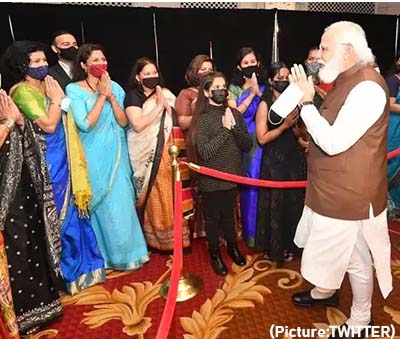
She thanked Dr. Chadrakant Modi and his wife Dina Modi for donating the 12-foot statute of Mahatma Gandhi, to the Village of Skokie and the Gandhi Memorial Foundation of Chicago. She pointed out that Gandhiji’s practice of Ahimsa (non-violence) which was an extension of his respect for other religions creating a sense of fraternity. She further added that Mahatma Gandhi vehemently opposed injustice and authoritarian rule, which is the primary manifestation of the Gandhian legacy today. Dr. Santosh Kumar was very enthusiastic about the Global Gandhi Youth initiative and praised them for taking this initiative.

Dr. Sriram Sonty, Vice President, Gandhi Memorial Foundation of Chicago presented a set of Gandhian books to Mayor of Skokie George Van Dusen for the Skokie Public Library. He also introduced Global Gandhi Youth USA Chapter Members- Nandini Kandamuri, Rithwik Chekicharla, Sri Sai Kaushik Gollamudi and Manikantha Sri Sai Gollamudi, who spoke about the teachings of Gandhiji as it applies to them today.

State Senator Ram Villavallam, of 8th District of Illinois gave certificates and books to the Global Gandhi Youth USA Chapter Members and congratulated them on their thought-provoking speeches which emphasized the need for tolerance, harmony, and inclusion.

Other important Community leaders present on this occasion included Sohan Joshi, popularly referred as Mayor of Devon – Chicago, 85-year-old Manish Patel-MAFS Senior Citizen, Porus Dadhaboy of United For Peace-Naperville, Sunil Shah-Founder President of FIA Chicago, Dina Modi and Martino Tangkar- Chairman of MEATF. Pastor Jerome Athishtam of Congressman Danny K Davis’s Task Force,  Mir Ali-Popular Singer, Anica Dubey AMEC’s Global Outreach Chair, Bihari Beti Neelam Dwivedi of Indian American Business Coalition-Oak Brook, IL Harinder Mangrola-Community Activist, Cook County Judge Sanjay Taylor, & SAPNA Founder Dr Sarada Sonty.

Rudra Garjana Chicago Dhol Tasha Team led by Mandar Pitre did a fabulous job that elevated the spirit of the day. The percussion ensemble performed at the conclusion of the event which reminded of traditional drums being played during Ganeshotsav in India. The Consul General praised the percussion ensemble for their vibrant performance. Dr. Vijay Prabhakar gave a token of appreciation to each artist and emphasized establishing the first GANDHI KING LEGACY CENTER in North America in Chicago, USA.

The event was well moderated by Shree Gurusamy, Secretary of Gandhi Memorial Foundation of Chicago. She thanked the Metropolitan Asian Family Services Seniors and staff for all the floral and food arrangements at the event. Gandhi Memorial Foundation of Chicago Board of Directors, Dipti Shah – Treasurer, Awilda Gonzalez – Director-At-Large, Bharti Desai – Director-At-Large and Suresh Bodiwala – Trustee were recognized for all their voluntary services during the past year.

Metropolitan Asian Family Services (MAFS) as usual prepared delicious Boxed lunches along with hot Tea and water for all the guests. For more information regarding Gandhi Memorial Foundation of Chicago please visit : https://gandhimemorial.org/

Houston Post Office Named for Deputy Sandeep Singh Dhaliwal

Elected officials, law enforcement officers, and Houston community members gathered to honor fallen Harris County Sheriff’s Deputy Sandeep Singh Dhaliwal with a post office naming ceremony on October 5th.

Per a bill introduced by Congresswoman Lizzie Fletcher (D-TX); passed with bipartisan support, including that of Senators Ted Cruz (R-TX) and John Cornyn (R-TX); and signed into law on December 21, 2020, the post office located at 315 Addicks Howell Road will henceforth be named the Deputy Sandeep Singh Dhaliwal Post Office Building. The Sikh Coalition was deeply honored to assist in drafting the legislation that named this post office in Deputy Dhaliwal’s honor; in the weeks following his murder, we worked to mobilize community members across the country to call on Congress for this and other initiatives to honor his memory.

“Since my son was taken from our family in a senseless act of violence, we have received an outpouring of support and love from the greater Houston community,” said Pyara Singh Dhaliwal, the late Deputy Dhaliwal’s father. “We are so grateful and so honored that Sandeep is being memorialized in this way–forever becoming a part of the city that he served faithfully in and out of uniform.”

At today’s naming ceremony, local law enforcement officers, elected officials, and community members–including Sikh Coalition board member Manpreet K. Singh–gathered to pay tribute to Deputy Dhaliwal’s memory. We thank our colleagues at the Sikh American Legal Defense and Education Fund for assisting Congresswoman Fletcher’s office in organizing today’s event.

“It has been an honor to lead the effort to honor the life and contributions of Deputy Sandeep Singh Dhaliwal by naming this post office in his memory,” said Congresswoman Lizzie Fletcher. “Deputy Dhaliwal represented the very best of our community: he worked for equality, connection, and community through his life of service to others. The Deputy Sandeep Singh Dhaliwal Post Office now stands as a testament to his remarkable and selfless service, and I thank our partners at the Sikh Coalition for helping us build a bipartisan coalition to honor Deputy Dhaliwal and his trailblazing contributions to American life.”

As a reminder, Deputy Dhaliwal was killed during a traffic stop in northwest Houston, Texas on September 27, 2019. He originally joined the Harris County Sheriff’s Office in 2009; in 2015, he secured a historic, first-of-its-kind accommodation to wear his Sikh articles of faith while serving in uniform. Deputy Dhaliwal was widely regarded for breaking barriers for Sikhs and other religious minorities.

Modi Returns To India, As 4 Million-Strong Diaspora’s Importance Comes To Fore

The importance of the Indian diaspora has come to the fore in India-US relations with both Prime Minister Narendra Modi and US President Joe Biden highlighting this factor as part of the strengthening relationship between the world’s largest and oldest democracies.

President Biden during his bilateral meeting with PM Modi mentioned that “there are more than 4 million Indian-Americans who are participating in the journey of progress of America.” PM Modi responded by saying: “As I look at the importance of this decade and the role that is going to be played by this talent of Indian-Americans, I find that this people-to-people talent will play a greater role and Indian talent will be a co-partner in this relationship and I see that your contribution is going to be very important in this.”

The diaspora factor was also very evident at PM Modi’s meeting with US Vice President Kamala Harris. He told Harris “between India and the US, we have very vibrant and strong people-to-people connections, you know that all too well,” referring to her Indian roots. “More than 4 million people of Indian origin; the Indian community is a bridge between our two countries, a bridge of friendship and their contribution to the economies and societies of both our countries is indeed very praiseworthy,” the Prime Minister pointed out.
With Indian-Americans playing a crucial role in the technology sector it was only natural that at least two of the five top CEO’s that PM Modi held a one-on-one meeting with in Washington, were Indian-Americans. His meeting with Vivek Lall, Chief Executive of General Atomics Global Corporation, focused on strengthening the defence technology sector in India. Lall appreciated the recent policy changes to accelerate defence and emerging technology manufacturing in India. The company makes state-of-art drones which is a technology that India urgently requires to counter the growing threat from China in this field.

The discussion with Adobe CEO Shantanu Narayen centred around the software technology company’s ongoing collaboration and future investment plans in India. Discussions also focused on India’s flagship programme Digital India, and use of emerging technologies in sectors like health, education and R&D. India with its huge market and skilled manpower offers an alternative investment destination for US tech giants at a time when they are decoupling from an increasingly aggressive Communist China and looking to set up alternative supply chains.

In this backdrop, the Prime Minister met Cristiano Amon, CEO of leading computer chip maker Qualcomm to present the investment opportunities in India’s telecommunications and electronics sector. This included the recently launched Production Linked Incentive Scheme (PLI) for Electronics System Design and Manufacturing as well as developments in the semiconductor supply chain in India. Strategies for building the local innovation ecosystem in India were also discussed.

Similarly, he took up the issues of cutting-edge solar equipment with the CEO of renewable energy major First Solar. (IANS)

Multiple Protests Held As Modi Speaks At UN

Several separate protests were held outside the UN on Saturday, September 25th as Prime Minister Narendra Modi addressed the United Nations General Assembly. The groups were separated from each other in enclosures put up with police barriers, advocating different causes.

While observers said it was “shameful” that President Biden failed to publicly address widespread persecution of religious minorities in India when he met with Indian Prime Minister Narendra Modi Friday, more than 100 members of interfaith and human rights groups spoke out as Modi addressed the United Nations General Assembly. Speakers condemned the egregious human rights violations and murders of religious minorities in India under a government that openly supports Hindu supremacy.

The rally was sponsored by 21 organizations under the banner of Coalition to Stop Genocide in India, including Ambedkar International Center, Ambedkar King Study Circle, Black Lives Matter, Coalition Against Fascism in India, Dalit Solidarity Forum, New York City Democratic Socialists’ Racial Justice Working Group, Federation of Indian American Christian Organizations of North America, Hindus for Human Rights, Indian American Muslim Council, India Civil Watch International, International Commission for Dalit Rights, Jewish Voice for Peace, MICAH Faith Institute, Muslim Community Network, National Coalition against Caste Discrimination in the USA, NY Sikh Council, New York State Council of Churches, SALAM, Students Against Hindutva Ideology, and Voices Against Fascism in India.
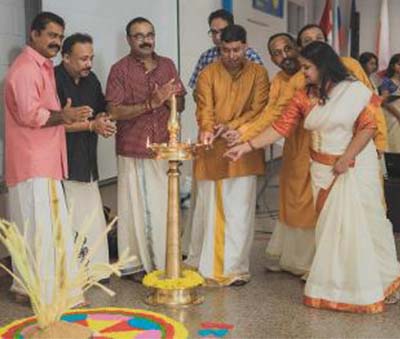
Another group comprising of 100 Khalistan supporters waving yellow flags and carrying portraits of Simranjit Singh Mann, the president of the Shiromani Akali Dal (Amritsar), came in support of the Khalistan movement. The organizers of the other protests disowned the Khalistanis and said they were not associated with them, pointing to the barriers separating them from that group.

Another protest was organized by a local gurdwara in support of the farmers’ agitation in India focused solely on the agriculturists’ issues. They stationed themselves far from the Khalistanis and an organizer said that they did not have anything to do with that protest and distinguished themselves with green turbans.

The Hindus for Human Rights (HHR) organized yet another protest that was sandwiched between the Congress and Khalistani protests. An organizer said that they were not associating themselves with the Khalistanis and their enclosed barrier next to that group’s was assigned by the police.

HHR protested against the Citizenship Amendment Act (CAA), the National Register of Citizens (NRC) and other laws and regulations, as well as what they called human rights violations and detention of activists in India.

They were joined by a representative of the New York State Council of Churches, a protestant organization that also lists the World Council of Churches among its members. Its executive director, Peter Cook, a protestant pastor who said he had been deported from India, asserted that his organization opposed the CAA even though it gave citizenship rights to Christians fleeing persecution, because it “pits Christians against Muslims”.

The Khalistani protesters, who were not allowed by the police to demonstrate outside India’s mission to the UN, drove past it in cars flying their flags and raising slogans. Supporters of Kashmiri separatists and Pakistanis, who held protests in the previous years, were not seen this time.

“As religious people, we have a responsibility to build an inclusive multi racial democracy. So when Israeli Prime Minister Netanyahu comes to New York in the name of perverting my religious tradition, Judaism, it is a way of creating religious oppression, and it is important for me to stand here. And when Indian Prime Minister Modi comes here, we organize in solidarity to demand that we build a world not on theocratic or fascist principles,” said Brad Lander, New York City Councilmember and comptroller elect.

Hindu Pandit Sanjai Doobay said: “As Hindus, we salute the light, ‘Shubham Karoti Kalyanam.’ As Muslims, ‘Allah is the Light of the heavens and the earth.’ And the Christian Bible says God said, ‘Let there be light, and there was light.’ If we are together, our light will always be brighter. We will pray for that light, for that peace. Mr. Modi, your Hindutva is not my Hinduism. You are not Hindu. A Hindu is a brother or sister of Humanity.”

“As Christians, we grieve for many Hindus who watch their faith being co-opted and distorted by nationalist government using Hinduism to oppress people of other faiths,” declared Rev. Peter Cook, New York State Council of Churches. “In Jesus’ name, I condemn the government of any country which uses the dominant faith of its people to destroy democracy and deny the freedom and human rights of religious minorities. In this spirit, we call on the Modi government to stop distorting Hinduism to give tacit approval to the burning and desecration of churches, mosques and temples.”

The Indian Overseas Congress, USA, an advocacy organization that promotes democracy, human rights, and equal justice together with its supporters and friends, held a protest rally in front of the United Nations, as Prime Minister Narendra Modi was delivering his address to the General Assembly.

“Although we have no issues with a Prime Minister of India visiting the U.S. or the U.N. and promoting better bi-lateral relations or promoting world peace, it is imperative to let him know at the same time that we do not approve of his misgovernance in dealing with COVID epidemic or undermining the democratic institutions,” said George Abraham, Vice-Chairman of the IOCUSA. “If there is to be genuine economic progress and social development in India, political tranquility and social harmony is a prerequisite without which there would be very little hope for the future. Let us, at the minimum, raise our voices, no matter how feeble it may be, because one day our next generation might ask where you have been when India took a turn towards authoritarianism and fascism,” Abraham added.

“I am glad to state that IOCUSA stands firmly behind India’s farmers who have been denied their rightful voice and concerns to be heard by the Modi government which has pushed a set of bills through the parliament for the benefit of the crony capitalists and to the detriment of our farmers” Mr. Mohinder Singh Gilzian, President of the IOCUSA said.  “We want Modi to know that the NRI voice will continue to be raised in support of their protest unless and until he resolves these issues,” Mr. Gilzian added.

Secretary General Harbachan Singh referring to the plight of the farmers suggested that a Prime Minister should not abuse his power or shirk his responsibility and torture peaceful farmers protesting for their legitimate concerns by not heeding to their concerns.”  It is claimed that this is perhaps the largest and the longest peaceful protest rally in the history of the world.

The protesters carried slogans and chanted examples to point out the failures of the Modi government, e.g. “Anti-Narendra Modi isn’t anti-national,” “We are all Indians. Stop discrimination based on religion, caste and language”, “Protect India’s constitution”, “IOCUSA supports democracy, freedom, and human rights”,” IOCUSA supports India’s farmers”, “IOCUSA -proud supporter of pluralistic India” and so forth.

Mr. Mohinder Singh Gilzian, President of the IOCUSA, Mr. Harbachen Singh, Secretary-General, Mr. George Abraham, Vice-Chairman, Mr. John Thomas, Ms. Sophia Sharma, General Secretary, Vice-President, Ms. Leela Maret, President, Kerala Chapter, Mr. Amar Singh Gulshan and President, Haryana Chapter were among those who took part in the protest.

Onam Celebrations By MASCONN Held In Trumbull, CT

Men, women, children and youth dressed in traditional attire, from across the state of Connecticut came together to celebrate their culture, traditions, and fellowship during the annual Onam celebrations organized by Malayalee Association of Southern Connecticut (MASCONN) at Madison Middle School, Trumbull, CT on Saturday, September 18th, 2021.
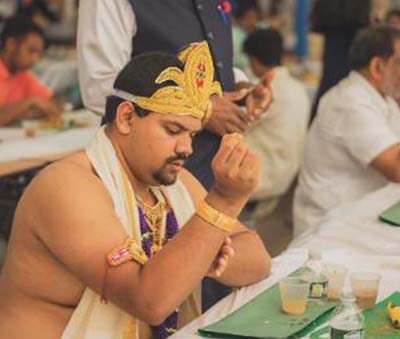
The long awaited Onam celebrations, especially during the Coid pandemic, began with the lighting of the traditional Nailavilakku or lamp by honored guests of MASCONN and the executive committee members. The chief guests who graced the event and shared their Onam greetings and message included, several members of FOMAA, including the Treasurer, Thomas T Thomas; Vice President of Pradeep Nair; and Joint Treasurer, Biju Thonikkadavil.

A colorful Pookoalm and the traditional lamp with a sandalwood tilak on forehead at the entrance of school, giving them a warm traditional Indian welcome. Legendary King Mahabali was given a traditional welcome as he mingled with the participants showering his blessings.


“MASCONN an offshoot of the natural growth of the Indian-American especially Malayalee Community in the southern Connecticut region,” said Sujanan Nair, President of MASCON, in his welcome address.
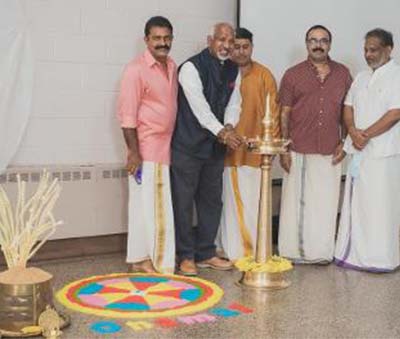
“In a very short period, we have grown by leaps and bounds and we strive to meet the growing needs of our community. He praised the Masconn Youth group and the executive committee and the members for their dedication.

“Onam awaits one very special visitor, Kerala’s most loved legendary King Maveli. He is the King who once gave the people a golden era in Kerala. The King is so much attached to his kingdom that it is believed that he comes annually from the nether world to see his people living happily.

It is in honor of King Mahabali, affectionately called Onathappan, that Onam is celebrated,” Sujanan Nair explained the story behind this cultural festival of Kerala, a southern Indian state.

The whole ambience was filled with nostalgia since it was an occasion for all the Malayalees in Connecticut to cherish their childhood memories, especially everyone enjoyed the sumptuous Onam Sadhya (meal), the most important and main attraction of the day with different traditional dishes and ”payasam” that was served on banana leaves. Participants were dressed in their traditional attire. The most traditional costume for the men of Kerala is the “Mundu” which is mostly white in colour. It is worn tightly at the waist with a knot and comes down till the feet. Women following Hinduism wear a blouse and mundu known as “Mundu neriyathu.” Children were seen elegantly in mundus, shirts, sarees and salwar.
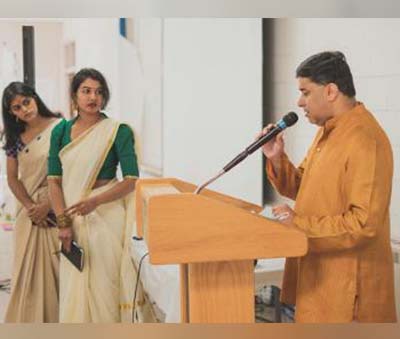
In his Onam message, Mahabali told the audience that the “beauty of the festival lies in its secular fabric. People of all religions, castes and communities celebrate the festival with equal joy and verve. Onam also helps to create an atmosphere of peace and brotherhood by way of various team sports organized on the day,” he added.  Tijo Josh proposed vote of thanks, while thanking all the organizers for the great event they had worked so hard to put together.

Living in countries that are far away from their homeland, in the midst of different cultures, busy with the day-to-day mundane work and home tasks, the Non Resident Indian (NRI) community made this “land of opportunities” their home, have brought with them these cultural traditions and have sought to pass them on to their children, who are often born and raised here. Onam is a festival celebrated in the south-western state of Kerala, India. The Keralites or the Malayalees, the illustrious people of the beautiful state are known around the world, celebrate the festival of Onam wherever they are.

The celebration of Onam festival provides them with a perfect opportunity to encourage the new generation of children of Indian origin to witness, learn and appreciate these rich traditions, even while it offers the first generation NRIs to stay connected and cherish the rich cultural heritage they hold so dear to them Malayalee Association of Southern Connecticut (MASCONN) which was formed less than ten years ago, the cultural extravaganza was in many ways “reliving the culture and traditions” and “cherishing the past with a view to pass it on to the future generation.”
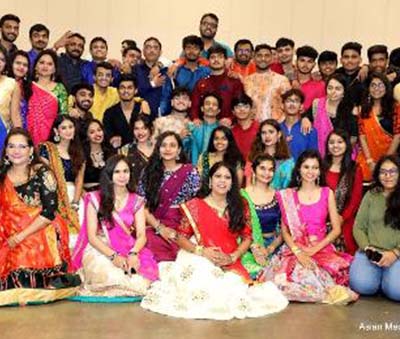


NCAIA Honors Ambassador Dr. Ausaf Sayeed in Chicago

National Council of Asian Indian Associations [NCAIA] hosted a rousing reception in honor of visiting Indian Ambassador to the Kingdom of Saudi Arabia H.E. Dr. Ausaf Sayeed that attracted a host of Chicago’s leading community stalwarts on Sunday September 12, 2021 at Schaumburg India Banquets in Schaumburg, Illinois. The honoring reception was hosted by Harish Kolasani, Keerthi Kumar Ravoori, Sunil Shah, Ajeet Singh & Vinesh Virani. Ambassador Dr. Ausaf Sayeed earlier served as the Consul General of India in Chicago from 2013-2017.

Prominent community figures paid rich glowing tributes to Ambassador Dr. Ausaf Sayeed for his distinguished diplomatic career spanning over three decades and applauded the history of significant accomplishments and reforms he ushered at each diplomatic assignment. Ambassador Dr. Ausaf Sayeed was eulogized for his role as a Consul General of India in Chicago serving the Midwest America with remarkable distinction and has worked with the Indian diaspora to build formidable ties with India.

More importantly, Ambassador Dr. Ausaf Sayeed assimilated with the community and business leaders and forged bonding to foster and strengthen business, economic, cultural ties with India.  He was praised for hosting major Yoga events and Kala Utsav programs annually to showcase the rich cultural heritage of India in Illinois.

National President of NCAIA Harish Kolasani welcomed the guests and said Ambassador Dr. Ausaf Sayeed has left with indelible bonds of friendship with the Chicago’s Indian American community – such that it was imperative not to miss the opportunity to honor him and have a meaningful interaction with the community stalwarts on issues of the diaspora. Harish Kolasani described Ambassador Dr. Ausaf Sayeed as a endearing friend of the Indian American community. Harish Kolasani also praised Farha Sayeed for her extraordinary Egg artistry that elicited applause and acknowledged her with a flower bouquet.

Prominent Physician and community figure Dr. Bharat Barai expressed his appreciation and praise for the Ambassador for his fervency and passion in promoting India at all levels. Other speakers who expressed glowing accolades include: Dr. Suresh Reddy, Trustee of Oakbrook; Dr. Vemuri Murthy of Chicago Medical Society, Dr. Jampala Chowdary, FIA’s Founder President Sunil Shah; Ajeet Singh, President of Indian American Business Council; Sunny Kulathakal, Global GOPIO President; Vinesh Virani, Art of Living; Paresh Patel of BAPS; Raees Yawar, President Board of Commissioners, Streamwood, IL; Ms. Vasavi Chakka, Naperville Commissioner. Amar Upadadhay, Rohit Joshi presented flower bouquet/shawl, Sunny Following the remarks, Community Figure Iftekhar Shareef formally introduced Ambassador Dr. Ausaf Sayeed and Mrs. Farha Sayeed for her artful Egg exhibition.

Indian Ambassador Dr. Ausaf Sayeed in his remarks exhaustively laid out the emerging robust strategic partnership between India and the Kingdom of Saudi Arabia. Dr. Ausaf Sayeed said India and Saudi Arabia enjoy cordial and friendly relations reflecting the centuries old economic and socio-cultural ties. The Ambassador said the establishment of diplomatic relations in 1947 was followed by high-level visits from both sides. Last year marked the start of a new era in bilateral relations between India and Saudi Arabia, with two very successful high-level visits. Crown Prince Mohammed bin Salman visited India in February, and Indian Prime Minister Narendra Modi came to Saudi Arabia in October. Thus, there is a greater momentum for the evolution of this relationship, added Ambassador.

Giving historical overview, Ambassador Dr. Ausaf Sayeed said Saudi Arabia’s friendship with India is ancient, tracing its roots to the third millennium BC.  It has been further enriched by the movement of people and ideas, in both directions, leaving an indelible mark upon our cultures and civilizations. Trust, mutual understanding, goodwill and respect for each other’s interests have nurtured our relations for centuries, but in the last decade, our ties have witnessed an important transformation, said Ambassador.

Ambassador Dr. Ausaf Sayeed said the Indian Community in Saudi Arabia is the largest expatriate community with nearly 3 million strong Indians living there and are highly respected due to its sense of discipline, law-abiding nature and added that Haj pilgrimage is another important component of growing bilateral relations.

Keerthi Kumar Ravoori serving as the presiding emcee for the event said Ambassador Dr. Ausaf Sayeed is a distinguished diplomat who fervently and most passionately represented the people and the interests of India wherever he was posted overseas. Keerthi Kumar Ravoori said Ambassador Dr. Ausaf Sayeed at heart is uncompromising in his devotion, fiercely loyal in his commitment and unwavering in his determination to promote India. Satish Ambati, owner of Schaumburg India Banquet, proposed a vote of thanks. Several organizational leaders were present including Sunny Kulathakal, GOPIO President, Uma Katiki, TANA Women’s Coordinator, Vandana Jhingan, Jigar Shah, Laddi Singh, Sanjay Shah, Jitendra JD, Krishna Rangaraju, Ravi Harsoor, Mir Ali, Dr. Afroz, Alli Dhanraj,Mohd Ali, Khurram Sayeed,Gulbachan Kaur,Dhitu Bhagvakar and Chris were present to acknowledge the Ambassador.

Shree Jalaram Mandir Raas Garba Ramzat Turns Chicagoland Devotional

Chicagoland couldn’t have asked for a better post-pandemic celebration after almost two years of pause to any public gathering than the beautiful religious and musical extravaganza organized by Shri Jalaram Mandir with Kirtidan Gadhvi and group. The grand program of “Ras-Garba Ramzat” was organized by Shri Jalaram Mandir, 425 Illinois Blvd, Hoffman Estate, IL on Friday September 17, 2021 from 6:00 pm to 1:00 am at Renaissance Convention Center, 1551, Thoreau, Schaumburg, IL with the internationally acclaimed vocalist Kirtidan Gadhvi” and his fellow artists who entertained thousands of devotees at the Renaissance Schaumburg Convention Center Hotel at Schaumburg, IL.  The event was attended by over 2500 people.

 “The best karma is not the one that has a good result, the best karma is the one that has the best purpose.” Shri Jalaram Mandir follows the similar path of public service, with all its revenue from such programs going to the contribution of the temple. The selfless and free service of Shri Jalaram Mandir, its managing committee and all the volunteers was as excellent as ever with beautiful sound system lighting, security, photography, videography and booths for different businesses.  There was free entry for children below 10 years of age, free parking, tea and snacks at reasonable prices, provision of water, cold drinks and free covid testing. The contribution of donors from different fields as sponsors was commendable. All the devotees who came were also very supportive and co-operative.
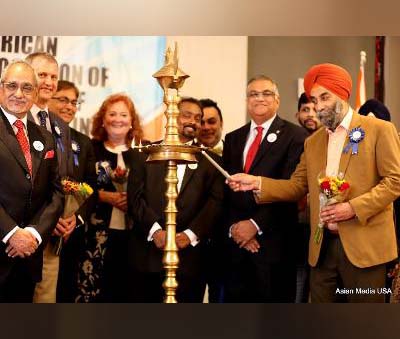
Jalaram Mandir has been organizing events in mind boggling fashion depicting unique examples of teamwork and credit goes not only to Board Members but to every individual that participates with zeal be it an executive or volunteer. The entire venue was overcrowded and the spectacular audience danced and enjoyed Raas Garba with enthusiasm and fervor. This annual holy event is celebrated in honor of Goddess Durga Mataji. “Navali Nortani Raat Maa Amba Garbe Ghumta (Nisarya) Pavagadhthi. Ne Chicagona Khailaiya Raas Garba Khub Ghumta Sang Kirtidan Gadhvi”

Garba and Raas, performed by Kirtidan Gadhvi and Group, transformed the whole center into a huge dance floor to accommodate thousands of bare feet moving into thunderous drum beats in swirling circles around deity Hindu Goddess “Durga”. There was overwhelming participation from the audience enjoying the memorable evening. Many in the audience, especially ladies and children wore very colorful and dazzling traditional dresses for this special juncture with appropriately matching ornaments and extravagant hairstyles. Navaratri Garba is very special as it honors Shakti in very rhythmic ways. Western dress is replaced by Lengha-choli, matching jewelry and foot wear. “Some prefer to wear traditional outfit while others go for modern look”

Kirtidan Gadhvi and Group started the program by offering a prayer to invoke divine grace. This was followed by mesmerizing rhythmic conventional Garba music with equally passionate and energetic performance by the audience of traditional swirling dance around Mataji’s heavenly symbolic presence turned into a shrine adorn with flowers and decorations. After the brief break and Aarti, the festive music of Dandiya-Raas commenced with an enthusiastic participation by the audience that lasted into the early hours of the morning.

Immaculate planning and a well-organized team effort by Board of Trustees, executive committee members and volunteers was very well evident in the excellent security, safety and parking arrangement. Kirtidan Gadhvi and all his fellow artists made the event a very successful with heartfelt, devotional performance. All the artists from India came to Chicago Shri Jalaram Mandir. All the artists, promoters and attendees heartily applauded all the excellent arrangements. This multidimensional celebration of such a festive day of Navaratri would not have been possible without many sponsors, donors, and advertisers. With divine blessing from Jalarambapa and Mataji combined with devotional hard work and enthusiastic support and participation by the community made the event a grand success.

AAEIO Inaugural Gala Held In Chicago

American Association of Engineers of Indian Origin (AAEIO) organized its inaugural gala to celebrate its official launch on September 26, 2021 at Marriott, Oakbrook IL. The gala featured the introduction of the newly elected board of directors and the address by the distinguished guests.


The event started with national Anthems and lamp lighting followed by the inaugural dance performance by the students of SR Dance Academy. The master of ceremony Madhura Sane kickstarted the event by welcoming all the board of directors and the distinguished guest on to the stage. The  President Gladson Varghese delivered his speech to elaborate on the vision behind the initiative of launching AAEIO. He talked about how the organization aims at supporting engineers across the globe by providing them a voice and guidance by the experienced leadership of the organization. Vice President Nitin Maheshweri presented the Vision and 4 pillars of the organization. Chief Guest Consul General of India Mr. Amit Kumar along with Congressman Sean Casten officially Inaugurated the AAEIO  by lighting the Lamp. AAEIO also presented the awards to Dr. Deepak Kant Vyas, Mr. Gulzar Singh and Mr. Brij Sharma for their contributionsto the community and becoming successful Engineering Entrepreneurs. 
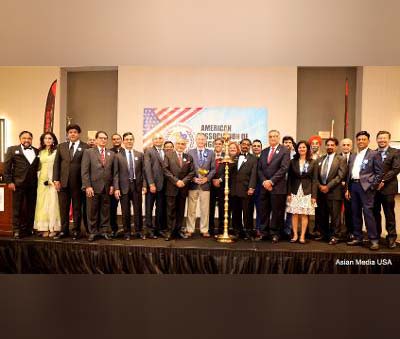
 

Redberry CEO Dr. Deepak Kant Vyas Talked about the Business Incubator project AAEIO Launching along with T-Hub and the role of AAEIO in acting as incubator for the start-up companies to provide them the support that they need. Congressman Raja Krishnamoorthi along with Consul General of India Mr. Amit Kumar. Founding President Gladson Varghese, Associate dean of Kellogg Mr. Mohanbir Sawhney, Vice President Nitin Maheshweri  cut the ribbon and officially Inaugurated Business Incubator program of AAEIO.  AAEIO will also be planning to organize a summit for all the start up companies in the near future. 


Board of Director, Sanjjeev Singh presented a vote of thanks to all the sponsors, supporters and the distinguished guests who attended the event. The elected officials and other special guests and directors included Congressman Sean Casten, Congressman Raja Krishnamoorthi, State Senator Laura Murphy, Consul General, India, Chicago Mr Amit Kumar, CEO Redberri Corporation Mr Deepak Kant Vyas, CEO Powervolt Brij Sharma, Kellog school of Management Associate dean Dr. Mohanbir Sawhney,Trustee Village of Oakbrook Dr. Suresh Reddy, Alderwoman, City of Aurora Shweta Baid. Members of other community organizations also attended the event to extend their support to AAEIO.   


Dr. Mohanbir Sawhney, Associate Dean, (Northwestern University, Kellogg) delivered an inspirational and informative keynote speech elaborating on his experience and the roles and future of organizations like AAEIO. The speech by the Vice President 2021 Nitin Maheshwari included the plans for the upcoming initiatives taken by AAEIO and how the organization aims at supporting small businesses, fresh graduates as well as the fellow engineers from all across the globe. The president elect 2021 Ajit Pant talked about how AAEIO will act as an umbrella organization for the engineers from all streams of engineering like civil, mechanical, IT, electronics, Electrical and so on. Nag Jaiswal did the Vote of Thanks and he thanked all the sponsors, Dignitaries, AAEO Board and all the Guests for their help and support. 
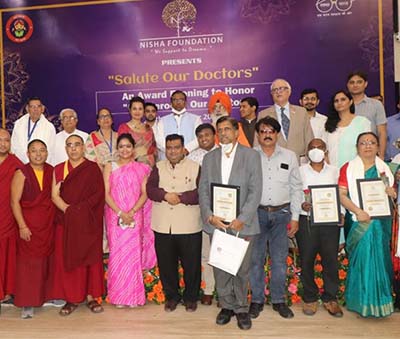
 

Consul General Amit Kumar attended the formal launch of the American Association of Engineers of Indian origin (AAEIO) in Chicago on 26 September 2021.  In his remarks, CG welcomed the formation of AAEIO noting that the organization would provide a valuable platform for professional networking among engineers and noted the ambitious objectives that the organization has set for mentoring, education and entrepreneurship support including in India. 


CG Kumar also briefed the participants on the successful visit of PM Narendra Modi to the US.  He referred to the synergies in some of the priorities set by two governments and the focus areas identified by AAEIO.  He said that the Consulate would look forward to possible joint activities with them in the future.  Other board of directors present at the gala to were Abhishek Jain (Treasurer), Murugesh Kasilingam, Vinoz Chanamolu, Rajinder Bir Singh Mago, Nag Jaiswal, Vijay Kaul, Gordhan Patel, Anaya Vardya, Sanjjeev Singh, Neil Khot, Madhura Sane and Gulzar Singh.

Sikh Coalition Advocates To End Religious Discrimination In Workplaces

The Sikh Coalition, while sharing the story of a client, 1st Lieutenant (1stLt) Sukhbir Singh Toor, an active duty officer in the U.S. Marine Corps (USMC) who is fighting to continue his military service while keeping his Sikh articles of faith, has advocated to end discrimination at work place. 1stLt Toor is currently facing an inadequate and incomplete religious accommodation that forces him to choose between his turban and beard or his career.

1stLt Toor’s case is the latest pivotal development in our 12-year campaign to combat employment discrimination by our nation’s largest employer, the Department of Defense. Building off the historic policy victories in the U.S. Army and Air Force, we continue working to ensure that Sikhs can maintain their articles of faith in every branch of the military in our efforts to further protect religious rights in all American workplaces. If the USMC grants 1stLt Toor a full accommodation, it would be the first–to our knowledge–for an active duty Sikh Marine to maintain their articles of faith.

“For more than three years, I have proven my commitment to excelling in the U.S. Marine Corps and defending my country,” said 1stLt Toor. “Now, with the direct support of the Sikh Coalition, I am seeking a full and complete religious accommodation that will allow my turban and beard so that I can stay true to my faith while continuing my career of service.”

1stLt Toor has served with distinction in the USMC since October 2017. As a younger man, he thought he had no choice but to compromise his articles of faith in order to serve his country as a Marine, due to the branch’s track record of denying these types of religious accommodations; thus, he made the extremely difficult decision to shave his beard and cut his hair, but committed to return to his articles of faith at the earliest opportunity. In March of this year, he applied for an accommodation in the hopes that his excellent service would help bolster his request. After several rounds of appeals, in August, the Department of the Navy granted a limited accommodation which imposed unacceptable restrictions on 1stLt Toor’s religious rights–including that he would be forced to shave his beard when deployed. Accordingly, we are now considering our final options before litigation.

“It is disappointing that the Marine Corps only wants to allow 1stLt Toor to practice his faith in ways and at times that are convenient to them; they would rather derail his promising career than acknowledge his right to practice Sikhi.” said Giselle Klapper, Sikh Coalition Senior Staff Attorney. “In 2016, we successfully took the U.S. Army to court over the right to maintain one’s articles of faith while serving in the military, and we’re prepared to do the same with the USMC now: No Sikh, in any workplace, should be forced to make a false choice between maintaining their articles of faith and excelling in their chosen profession.”

In addition to representing 1stLt Toor and facilitating the New York Times story, the Sikh Coalition is advocating for his accommodation through other channels. We are currently in touch with the White House, various legislative offices in the House of Representatives and Senate, and leadership at the Department of Defense to push for this case to be addressed outside of the courtroom.

To date, the Sikh Coalition, our pro bono counsel at Winston & Strawn LLP and McDermott Will & Emery, and our litigation partners the Becket Fund for Religious Liberty have helped more than 30 Sikhs in the U.S. Army and U.S. Air Force (USAF) secure their accommodations; in addition to 1stLt Toor, we are also assisting other USMC clients as they apply for religious accommodations. We also recognize the important work of the American Civil Liberties Union, BakerHostetler, and the Sikh American Veterans Alliance on this campaign. For more than a decade, advocacy and legal action has ensured that nearly 100 Sikhs total are able to serve in the U.S. Armed Forces with distinction and with their articles of faith; the service of these individuals is proof positive that religious identity does not impede a career in the U.S. military. If you or someone you know needs assistance securing a uniform or grooming accommodation for any employer, contact our legal team for free aid.

In the meantime, we and our partners continue to work towards branch-by-branch policy improvements similar to those already achieved in the Army in 2017 and the USAF in 2020, including continued development of the U.S. Navy’s regulations and proactive change for the USMC, U.S. Coast Guard, and U.S. Space Force. If you have questions about our work on this issue, be sure to read our community FAQ; our goal remains to end religious employment discrimination across the country, including in the U.S. Department of Defense.

Nisha Foundation Honors Doctors, Warriors Against Covid

Nisha Foundation organized a salutation evening with for doctors and frontline workers in the presence of Faggan Singh Kulstey, the Union Steel Minster of State, and various monks from the DALAI LAMA’s organization, sisters and brothers from Brahmakumaris, Dr Roger Gopalu (Ambassador of Trinidad), Dr. Sandeep Marwah, CEO Film City Noida, Diplomats and 35 awardees doctors, nurses, managing staff and social workers.

The Governor of Sikkim, Ganga Prasad, praised the foundation initiative and congratulated all the awardees. He launched the stickers, “I Salute Doctors”, in the presence of all the dignitaries. He said Nisha foundation is working towards a wonderful mission for betterment of society. Kulstey said Nisha foundation initiative is great and he applaud this program and appreciated Nisha foundation for working in 173 countries in association of world Organization of peace for child education, sports and salutation evening in name of frontliners During his speech he said it’s important to do this kind of programs to uplift human consciousness and he expressed his concern for farmers.
Nisha Foundation organized a salutation evening with for doctors and frontline workers in the presence of Faggan Singh Kulstey, the Union Steel Minster of State, and various monks from the DALAI LAMA’s organization, sisters and brothers from Brahmakumaris, Dr Roger Gopalu (Ambassador of Trinidad), Dr. Sandeep Marwah, CEO Film City Noida, Diplomats and 35 awardees doctors, nurses, managing staff and social workers.

The Governor of Sikkim, Ganga Prasad, praised the foundation initiative and congratulated all the awardees. He launched the stickers, “I Salute Doctors”, in the presence of all the dignitaries. He said Nisha foundation is working towards a wonderful mission for betterment of society. Kulstey said Nisha foundation initiative is great and he applaud this program and appreciated Nisha foundation for working in 173 countries in association of world Organization of peace for child education, sports and salutation evening in name of frontliners During his speech he said it’s important to do this kind of programs to uplift human consciousness and he expressed his concern for farmers.

This program objective was to facilitate the awards to 20 Doctors and 10 Frontline Workers. Few of the honorees are Dr. Raja Marimuthu Chairperson of Covid in Chennai, Nurse Sita Ghimirey from AIMS, Dr. Vinay Bhasin – AIIMS, Dr. Mosin Ali, Nurse Monika Dhankar.

Nisha Foundation Chairperson Priyanka Kothari, an accomplished former Bollywood actress who has worked in various movies in Indian film industry. While travelling for her movie shoots to different rural areas, she felt that there is huge need to support and uplift unprivileged people in many aspects, sports, women empowerment and she left film industry and dedicated herself to the service of humanity. she is an actress turned philanthropist, Motivational speaker, and an accomplished yoga teacher. Her NGO supports other NGO’s as well to uplift and support child education, woman empowerment, sports, and other activities.

She is working in 173 countries with association of OMPP.  She is Secretory general of world Organization of peace (Asia).  Also, Nisha Foundation recently honored with Citation from Eric Adam who is a President of the Borough of Brooklyn, New York USA, for work to support “BETI BACHAO BETI PADHAO” and spreading peace and compassion to humanity.

She believes “our life’s journey is all about uplifting human consciousness and help each other to reach our maximum potential indeed that’s our destiny, Said we have learnt from this pandemic time that “life is too short and there is no time of hate”  We must spread love compassion peace to humanity and expressed gratitude for each and every frontline workers  with standing ovation she said this award ceremony not only for awardee list rather it’s for those unknown volunteers and helpers who served during pandemic.

Kothari Started Her speech with Sanskrit shloka and welcome all the Guest and Audience, furthermore she explained about the foundation objections and goals & she also Remembered the President and Co-founder of Nisha foundation Late Shri Bhasker Prakash Ji whom we lost in this Pandemic with having teary eyes Priyanka Ji bravely continued her speech.

Hindu Group In India Threatens To Demolish Churches In BJP-Ruled Northern State

The onslaught on citizens of minority faith continues in Madhya Pradesh. Individuals claiming to be members of the Vishwa Hindu Parishad (VHP) say they are preparing to demolish churches in the Jhabua district on Sunday, 26thSeptember.  Auxiliary Bishop Paul Muniya, of the Protestant Shalom Church in Jhabua, led a delegation to District Collector, the highest government official, and submitted a memorandum addressed to the President of India, Shri Ram Nath Kovind, seeking his urgent intervention to ensure the safety and security of Christians and to stop the anti-Christian violence. He has also appealed to the state’s governor and chief minister to intervene and diffuse the situation.

Located in western Madhya Pradesh, bordering Baroda, this district had witnessed similar unrest when Azad Prem Singh, a local leader of Vishwa Hindu Parishad (VHP) or World Hindu Council, had demanded the closure of all churches in the area earlier this year. Although Singh focused on Jhabua and surrounding tribal-dominated districts, the continued escalation of communal threats could have repercussions across the country, particularly in states like Madhya Pradesh which have enacted the anti-conversions laws.
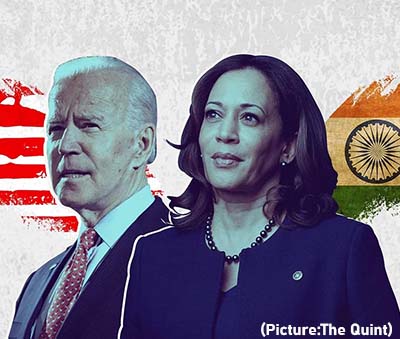
However, far from helping the cause of the minorities under threat, a District Revenue official has directed the Christian priests to present themselves before him and explain the nature of their religious activities and has even sought details of their appointment as priests. The official letter also asked priests to certify if they themselves were converted through allurement or force while threatening to initiate legal proceedings against any illegal conversions, if detected.

Bishop Muniya, while addressing the media, expressed his anguish and concern over what appears to be the local administrators siding with the perpetrators responsible for harassing Christians who number a mere four percent of the one million population of the district. “If there is an illegal structure, let the administration take action. Why are private individuals and organizations issuing such threats?” the Bishop asked. He also sought to know if the same yardstick would be applied to other religious structures in the district and the state.

Father Maria Stephan, PRO of Bhopal Catholic Archdiocese feels both the revenue and police administration of the district are biased against Christians. “Christians are peace-loving citizens. We are seeking judicial remedies to ensure peace and harmony in our society. We have no objection to sharing any official details about our work and personnel to the government provided the intention is right.”

President of UCF, Dr. Michael Williams, while expressing concern and distress over the situation in Jhabua, has appealed to the Prime Minister and Home Minister to help put a stop to this targeted violence.  “The very fabric of our secular nation is being stretched by a few who do not respect the Constitution of India.  Such people are the real anti -nationals and must be dealt with as strictly under law as possible.  This intolerance has no room in our country”, he added.

FIACONA Is Grateful to Biden, Harris For Emphasizing Need For Democratic Values In India

The Federation of Indian American Christian Organizations (FIACONA) has expressed gratitude to Vice President Harris for telling Prime Minister Modi, “I know from personal experience and from my family, of the commitment of the Indian people to democracy and to freedom, and to the work that may be done and can be done, to imagine and then actually achieve our vision for democratic principles and institutions”. “While we greatly applaud the Vice President’s powerful testimony and her heartfelt remarks, we also feel that Mr. Modi may not have understood the gravity of what she was trying to convey to him,” a statement issued by FIACONA said. “It is not the first time that Mr. Modi and his team have completely missed the point of suggestions coming from American leaders, including the then Vice-President Biden and President Obama on past occasions,” FIACONA pointed out.

FIACONA has urged the President Biden and Vice President Harris “to be more direct and explicit in expressing that India should not and could not afford to go down the path of religious nationalism at the expense of pluralist democratic principles that values Christian and other religious segments of the population. Should Modi and his party choose to continue down this path of religious nationalism despite warnings from leaders of the free world, there is no reason to assume that India would end up any better than Pakistan, Sri Lanka, or Myanmar in that region, thus jeopardizing the stability and commerce in the Indo-Pacific region.”
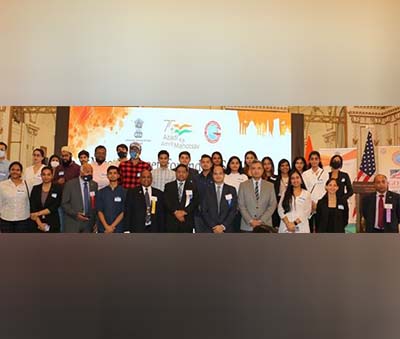
In a statement issued here, FIACONA pointed out that, India is going through unprecedented challenges under Prime Minister Modi’s watch. “We are concerned that some of those challenges have the potential to cause civil unrest in many parts of the Union where it has seriously undermined the democratic values and institutions in the name of religious majoritarianism.” Reports indicate that Modi’s hardline Hindu nationalist policies have seriously threatened the fundamentals of a multi-faith, multi-linguistic, and multi-racial equilibrium among different sections/regions of the Union. These aggressive domestic policies of the government of the Union of India headed by Modi are already stifling growth and threaten stability in many parts of India. Only those who are aligned with the hardcore Hindu nationalism, both in India and abroad refuse to acknowledge this fact, FIACONA stated.

“A continued push for aggressive domestic policies by the Hindu nationalists would have far-reaching implications not only within the Union of India but also across the region. It has the potential to adversely impact the US business interests in the region as well,” FIACONA cautioned. “The United States cannot afford to make similar strategic mistakes over and over. Ignoring the tell-tale signs of an increasingly radicalized society, or the deterioration of liberal democratic values in a country like India just to achieve short-term strategic goals will only turn out to be an expensive mistake for the US in the long run,” FIACONA warned.

Urging the US policymakers “to take serious cognizance of the style of functioning and perceived goals of the governments in member countries instead of just accepting their talking points however rationale it may sound,” FIACONA stated,  “The safety and security of over 100 million Christians and their continued existence in the Union of India without daily harassment from Hindu nationalist vigilante groups (supported and encouraged by Mr. Modi’s party officials) are inextricably tied to the respect for democratic values by successive governments there.”

FIACONA urged “the Biden Administration is direct and honest with their Indian counterparts in saying that the Union of India must stop sliding down its current path. Measures need to be taken to ensure that. The Hindu nationalist leaders must be told publicly in unambiguous terms that there will be consequences for continuing to encourage and lead India down the path of religious radicalism and vigilantism. They need to be told that all kinds of rationale and false narratives offered to the International community by the Modi government must stop.”

Indian Students Are A Strong Bridge Between India And USA

In a new initiative to connect the nearly 200,00 Indian students with the Indian American community and the Indian missions, GOPIO-Manhattan and the Indian Consulate in New York hosts Meet & Greet Event Welcome Event in New York.

“Indian Students continue to be a strong bridge between India and USA,” Ambassador Taranjit Singh Sandhu told students from India who had come together at Meet and Greet welcome event organized by the GOPIO-Manhattan (NYC) in cooperation with Consulate General of India in New York for the Students from India studying in the Northeast region in the United States. Organized with the objective of connecting the students to the community and providing mentoring opportunities as well as to raise awareness of Consular services to students from the Indian Consulate, the event held at the Indian Consulate in New York on Friday, September 17th was attended by students from 21 universities, mostly from the Northeast participated in person or virtually.

The Indian Ambassador addressed the students via a video message. He told them: “Delighted to welcome the students virtually!  The education and knowledge partnership are an area that holds great potential in our bilateral relations. During my visits across US, I’ve always made it a point to visit universities and visit faculty and students there.” He further added “We have an active student hub and a dedicated student wing at the Embassy. You can count on them for any assistance.” The chief guest/host for the evening Ambassador Randhir Kumar Jaiswal, commented, “Welcome to all the students from India with open heart as you pursue your future studies here in the North-East region and help in the growth of economy here in USA and back home in India.”
Ambassador Jaiswal further highlighted the goal to expand this program to include more students, from the pool of 200,000 students that come to the USA for further studies, to attend in person more interactive sessions and gain exposure to various services offered by the Consulate for the benefit of the students from registration at the Consular Portal, to cultural events to mental health support initiatives. The program started with a welcome by GOPIO International Chairman Dr. Thomas Abraham, who also serves as an advisor to GOPIO-Manhattan. Dr. Abraham encouraged the speakers to mentor, motivate and guide the students. Dr. Abraham said, “In the 1960s and ‘70s when a foreign student joined a university, he/she was given host family, now with connected world and social media, the host family concept went away and the 4.5 million Indian Americans could serve as the host family to the new students.”

GOPIO-Manhattan Executive Vice President Professor Rajasekhar Vangapaty moderated the first panel on mentoring students in the current market environment and added his learnings to the students using his unique perspective as a Registrar of Fashion Institute of Technology, the MIT of Fashion. There were four panelists in this session who are asked to comment on several questions. Abha Kumar, Business transformation leader/Board member Notify.io Advisory Board Shopelier, Former CIO- Corporate & International Vanguard, shared her experiences with the students and said, “The way we worked in the past will not be relevant post-COVID…we now will look for employees who have the ability to have a wide perspective and connect the dots.”

Kumar further added that students should master the technology component; the companies also look for certain emotional intelligence when they hire. Lastly, in corporate America, your work doesn’t speak for you, you need to speak for yourself. Prasan Kumar, Senior VP & Strategy Director at Publicis Group & Lecturer at Glasgow Caledonian New York College added “When you’re in a classroom, experiment as much as you can.” He elaborated, “bringing more than a text book education is significantly important, get your perspective as per your interest, helps you being a problem solver and think long-term for career choice reflecting from his personal experience of moving 4 careers in 2 decades from IT to advertising now.”

Neil Datta, Head of Due Diligence at Forbes Family Trust & Co-Founder Meritas provided insights in the current market context and said, “You’re either a fintech company or you don’t know it yet.” He further added, “The ability to be a problem solver is a crucial skill that helps you in whatever you choose to work in.” Joe Simon, CIO at Entain which is involved in Sports Betting, echoed the thoughts of the speakers and added, “Cultural sensitivity is crucial.” He further added that in order to succeed, one needs to be fairly convinced about what one is trying to do and that the two most underrated skills in corporate America are patience and persistence.”

The second panel on F1 to H1B via OPT was moderated by Aseem Trivedi, Manager of Data Analytics at Ernst and Young. He shared his unique path to Green Card as an experience for the students. He reminded the students “One should start thinking now what after H1B?” Akshat Singh, a recent economics graduate of Columbia University brought his experience with Students and shared the idea “Get started on OTP process asap and do not wait for 6-months or so.” Ankit Chaudhari, Associate Vice President at JP Morgan Chase commented about his personal journey from F1 to OPT to H1-B to Green Card and suggested students “ask your employer whether they will sponsor your visa or not, but you give your best services.”

Apeksha Tewari, Master of Laws from Penn State Law and Lawyer, shared her personal views to the students as part of the panel said, “Now that you are here, outside of your studies, you need to network with your professors, peers, everyone & communication is the key, ask for things.” Siddharth Jain, GOPIO Manhattan Board Member & Program Coordinator; conducted the questions & answers session and concluded with vote of thanks to Chief Guest/Host Ambassador Shri Randhir Kumar Jaiswal, Dy. Consul Shri Varun Jeph, Consul for Political, Education and Culture Shri Vipul Dev, Consul for Community Affairs Shri A. K. Vijayakrishnan and the consulate staff. Other GOPIO-Manhattan officials present at the meeting included Vice President Vimal Goyle, and Co-Secretaries Dr. Lisa George and Bhavya Gupta.

“The students had an excellent time networking with students from different universities as well as with speakers and the Consulate and GOPIO officials and we plan to do a much bigger event next year hopefully after the Covid restrictions are over,” Dr. Thomas Abraham added.

COVID Has Killed More Americans Than The Spanish Flu Did In 1918-19

COVID-19 Pandemic has claimed as many as 696,867 lives in the United States, which is more than the number of people killed by the Spanish Flu Pandemic of 1918-19.

As of September 22nd, COVID-19 Pandemic has claimed as many as 696,867 lives in the United States, which is more than the number of people killed by the Spanish Flu Pandemic of 1918-19. As per the U.S. Centers for Disease Control and Prevention, the Spanish Flu had killed 675,000 Americans a century ago. The Spanish flu’s U.S. death toll is a rough guess, given the incomplete records of the era and the poor scientific understanding of what caused the illness.

Across the world, the 1918-19 influenza pandemic killed 50 million victims globally at a time when the world had one-quarter the population it does now. Global deaths from COVID-19 now stand at more than 4.6 million. For now, the pandemic still has the United States and other parts of the world firmly in its jaws. While the delta-fueled surge in infections may have peaked, U.S. deaths are running at over 1,900 a day on average, the highest level since early March, and the country’s overall toll topped 675,000 on Monday, September 20th, according to the count kept by Johns Hopkins University, though the real number is believed to be higher.
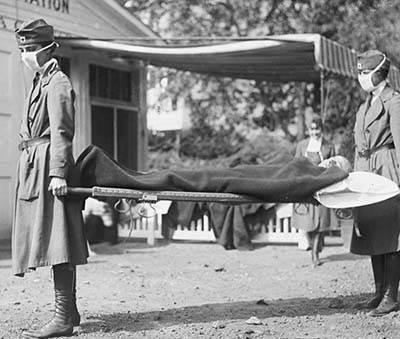
Winter may bring a new surge, with the University of Washington’s influential model projecting an additional 100,000 or so Americans will die of COVID-19 by Jan. 1, which would bring the overall U.S. toll to 776,000. Historian and author John Barry, author of “The Great Influenza: The Epic Story of the Deadliest Plague in History,” writes, “It was considerably worse than we’ve seen now — there were special trains to carry away the dead,” during the century-old plague with its 675,000 deaths against the ongoing COVID-19 crisis.

The U.S. population a century ago was just one-third of what it is today, meaning the flu cut a much bigger, more lethal swath through the country. But the COVID-19 crisis is by any measure a colossal tragedy in its own right, especially given the incredible advances in scientific knowledge since then and the failure to take maximum advantage of the vaccines available this time. Like the Spanish flu, the coronavirus may never entirely disappear from our midst. Instead, scientists hope it becomes a mild seasonal bug as human immunity strengthens through vaccination and repeated infection. That could take time.  “We hope it will be like getting a cold, but there’s no guarantee,” said Emory University biologist Rustom Antia, who suggests an optimistic scenario in which this could happen over a few years.

The ebbing of COVID-19 could happen if the virus progressively weakens as it mutates and more and more humans’ immune systems learn to attack it. Vaccination and surviving infection are the main ways the immune system improves. Breast-fed infants also gain some immunity from their mothers. Under that optimistic scenario, schoolchildren would get mild illness that trains their immune systems. As they grow up, the children would carry the immune response memory, so that when they are old and vulnerable, the coronavirus would be no more dangerous than cold viruses.
The same goes for today’s vaccinated teens: Their immune systems would get stronger through the shots and mild infections. “We will all get infected,” Antia predicted. “What’s important is whether the infections are severe.” Something similar happened with the H1N1 flu virus, the culprit in the 1918-19 pandemic. It encountered too many people who were immune, and it also eventually weakened through mutation. H1N1 still circulates today, but immunity acquired through infection and vaccination has triumphed.

Getting an annual flu shot now protects against H1N1 and several other strains of flu. To be sure, flu kills between 12,000 and 61,000 Americans each year, but on average, it is a seasonal problem and a manageable one. Before COVID-19, the 1918-19 flu was universally considered the worst pandemic disease in human history. Whether the current scourge ultimately proves deadlier is unclear. In many ways, the 1918-19 flu — which was wrongly named Spanish flu because it first received widespread news coverage in Spain — was worse.

Spread by the mobility of World War I, it killed young, healthy adults in vast numbers. No vaccine existed to slow it, and there were no antibiotics to treat secondary bacterial infections. And, of course, the world was much smaller. Yet jet travel and mass migrations threaten to increase the toll of the current pandemic. Much of the world is unvaccinated. And the coronavirus has been full of surprises. Just under 64% of the U.S. population has received as least one dose of the vaccine, with state rates ranging from a high of approximately 77% in Vermont and Massachusetts to lows around 46% to 49% in Idaho, Wyoming, West Virginia and Mississippi.

Globally, about 43% of the population has received at least one dose, according to Our World in Data, with some African countries just beginning to give their first shots. “We know that all pandemics come to an end,” said Dr. Jeremy Brown, director of emergency care research at the National Institutes of Health, who wrote a book on influenza. “They can do terrible things while they’re raging.” COVID-19 could have been far less lethal in the U.S. if more people had gotten vaccinated faster, “and we still have an opportunity to turn it around,” Brown said. “We often lose sight of how lucky we are to take these things for granted.”

The current vaccines work extremely well in preventing severe disease and death from the variants of the virus that have emerged so far. It will be crucial for scientists to make sure the ever-mutating virus hasn’t changed enough to evade vaccines or to cause severe illness in unvaccinated children, Antia said. If the virus changes significantly, a new vaccine using the technology behind the Pfizer and Moderna shots could be produced in 110 days, a Pfizer executive said Wednesday. The company is studying whether annual shots with the current vaccine will be required to keep immunity high.

One plus: The coronavirus mutates at a slower pace than flu viruses, making it a more stable target for vaccination, said Ann Marie Kimball, a retired University of Washington professor of epidemiology. So, will the current pandemic unseat the 1918-19 flu pandemic as the worst in human history?

FDA Recommends Covid Booster Doses For Vulnerable Population Only

U.S. Food and Drug Administration (FDA) committee voted unanimously Friday, last week to recommend booster doses of Pfizer-BioNTech’s COVID-19 vaccine for those over age 65 and those at higher risk of exposure to the virus, including healthcare, frontline and essential workers, under emergency use authorization, but stopped short of recommending boosters for the general population.  Pfizer-BioNTech had originally requested that the FDA consider full approval of a booster dose for all people who have been vaccinated with its shot. The 18 members of the committee voted initially 16 to 2 against that move, citing the lack of strong enough data on safety and effectiveness of boosting the general population at this time. The FDA then reworded Pfizer-BioNTech’s original request to include only those at highest risk of COVID-19, which earned a unanimous vote in favor.

Although the result wasn’t what Pfizer-BioNTech expected, Kathrin Jansen, senior vice president and head of vaccine research and development at Pfizer, said in a statement that “these data, and the larger body of scientific evidence presented at the meeting, underscore our belief that boosters will be a critical tool in the ongoing effort to control the spread of this virus. We thank the committee for their thoughtful review of the data and will work with the FDA following today’s meeting to address the committee’s questions, as we continue to believe in the benefits of a booster dose for a broader population.”
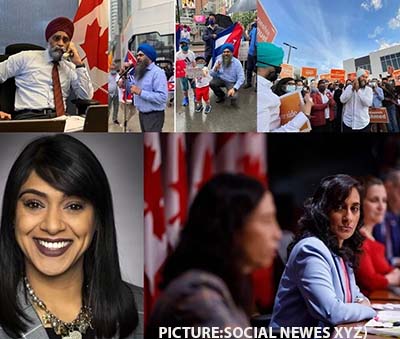
The FDA’s acting commissioner, Janet Woodcock, will take the committee’s recommendation into consideration before making a final decision. If the FDA follows the advice, then the U.S. Centers for Disease Control and Prevention’s Advisory Committee on Immunization Practices (ACIP) will review the data and make a recommendation to doctors and health care workers about how the booster will be administered. One important question the ACIP must address, for example, is whether Pfizer-BioNTech’s booster dose should be limited to those who have already received two doses of the companies’ vaccine, since the data reviewed by the FDA committee only included a small subset of those recipients and not people who received the other authorized shots from Moderna and Johnson & Johnson-Janssen.

The committee advised that most of the U.S. population will have to wait to get a booster dose, guidance that directly contradicts the recommendation by U.S. President Joe Biden’s health team, which planned to start widely rolling out boosters on Sept. 20, pending FDA authorization or approval. The decision heightens the growing tension over the booster question, as public health officials, infectious disease specialists and policy makers disagree about exactly how useful another dose of COVID-19 vaccine can be. The FDA committee members noted that while there is evidence that vaccine-induced immunity wanes over time, giving fully vaccinated people another dose of vaccine will likely have little impact on actually controlling the pandemic in the U.S., since most new cases and severe illnesses are driven by the unvaccinated.

The White House, however, escalated the debate when it announced in August that it supported rolling out a booster dose for the general population beginning Sept. 20, even before the FDA had reviewed the safety and efficacy of doing so. It was a surprising pre-emptive move that the administration said was primarily an attempt to get ahead of the logistics of administering another dose, and to prepare states and local health authorities, but many felt was more driven by political rather than scientific justification. Over Friday’s day-long meeting, the committee members debated the strength and quality of data showing waning protection among everyone who has been vaccinated so far, and what it means for controlling transmission and spread of COVID-19. The panel members heard from Israeli public health officials, who have the most in depth, although still incomplete, data on waning immunity and the impact of a booster dose, as well as U.S. CDC researchers who understand the dynamics of the U.S. pandemic.

In making its case for a booster, Pfizer-BioNTech acknowledged that about a month after the second of the two doses in the regimen, its vaccine is 96% efficacious in protecting people from symptoms of COVID-19. About two to four months later, that efficacy slips to 90%, and by six months, it drops to 84%—about a 6% decline every two months. And while Pfizer-BioNTech provided data showing an additional dose of its vaccine could increase levels of neutralizing antibodies against SARS-CoV-2, the virus that causes COVID-19, it did not provide answers to questions about how well that protection could stop transmission of the disease, among other things, to the committee’s satisfaction. The lack of adequate safety data of the third dose among younger people, who are at higher risk of developing rare inflammation of heart tissue, was also among the reasons the committee decided not to recommend the booster at this time for the general population, citing the need for more evidence to support safety, to guide mixing and matching doses, and the impact a booster dose would have on transmission of the virus.

The information on mixing and matching doses is coming shortly from various studies investigating what types of immune reactions people generate if they receive one type of vaccine and get boosted with another; the results have been submitted to a journal but not published yet. Data on the safety could be collected in coming months as more younger get vaccinated and are followed, and scientists in Israel are also studying how a third dose affects transmission of the virus in the population.

Pfizer-BioNTech maintains that protection from its vaccine remains high enough to shield people from severe illness and in most cases, hospitalization and death; most vaccinated people who get infected experience mild disease. But there are worrying signs that with the Delta variant, the more transmissible variant that is now the dominant virus behind new infections, even that trend is changing. In Israel, more vaccinated people getting breakthrough infections are also getting more severe disease. Pfizer scientists say that the data suggest not that Delta is finding ways to escape the vaccine defenses, but that the protection from the vaccine is weakening.

The data showed that overall, after the first dose of the two-dose regimen, levels of antibodies that can neutralize SARS-CoV-2 remain low, which is why the company and the FDA initially recommended a second dose, three weeks later, when the vaccine was first authorized in Dec. 2020. The first dose helped to prime the immune system and educate immune cells to recognize the COVID-19 virus, while the second dose activated those cells more robustly.

Taken together, Pfizer-BioNTech maintained the data, as well as the continuing threat of Delta and potentially other new variants, warrant a booster. The FDA, however, countered that existing protection, especially against more severe disease, remains sufficient, and that the data don’t show that the decline in immunity necessarily puts people at risk. Members of the panel also raised concerns about the strength of evidence supporting a booster dose at this time, at least for the general population, noting the relatively small number of people in the Pfizer-BioNTech study and the short period of follow up especially for younger people. “It feels like there is a lot of data circulating that would be helpful to our discussion but is not available at this moment because it will be presented soon, so at this moment it is difficult to make a decision on [general] booster doses today,” said Dr. Steven Pergam, medical director at Seattle Cancer Care Alliance.

The committee members noted that because the recommendation is under EUA, it could be revised as more data come in to support the need to broaden the groups eligible for a booster dose. For now, they say, the focus should be on continuing to reach people who haven’t been vaccinated at all; that will likely have the biggest impact on slowing the spread of the virus and ultimately getting the COVID-19 pandemic under control.

Several Indo-Canadians Elected To Parliament, As Trudeau Returns To Power

Canadian Prime Minister Justin Trudeau’s gamble to seek a majority by calling a snap election did not pay off as he had expected, although he is returning to power in Canada as its Prime Minister after the elections were announced on Tuesday, September 21, 2021.  That is Trudeau’s third federal election win, however his critics say the ballot was a waste of time. The Liberals led by Trudeau received essentially the most seats of any get together. Trudeau’s Liberals had been elected in 156 seats one less than they received in 2019, and 14 short of the 170 needed for a majority within the Home of Commons, based on Canadian media stories.

The main opposition Conservative Party ended up with a tally of 122 seats one up from the dissolved House. This is Trudeau’s third federal election win, but his critics say the poll was a waste of time. As many as 17 Indo-Canadians were elected to the Canadian Parliament during the elections held on Monday, September 20th.  The Jagmeet Singh-led New Democratic Party (NDP) will again hold the balance of power as it increased its tally from 24 to 27. NDP leader Jagmeet Singh also retained his Burnaby South seat in British Columbia. Among the 17 Indo-Canadian winners are Jagmeet Singh, former Minister Tim Uppal and three current Cabinet Ministers Harjit Singh Sajjan, Bardish Chagger and Anita Anand. Defense Minister Harjit Singh Sajjan again won from Vancouver South by beating Sukhbir Gill of the Conservative Party.

The Liberals’ Anand was declared the winner in Oakville with an almost 46 per cent vote share; a big improvement for Canada’s vaccine minister. Anand was a rookie MP after profitable in 2019 when she was appointed, Metropolis Information Toronto reported. She rapidly grew to become in control of the nation’s efforts to safe COVID-19 vaccines and was usually on the marketing campaign path with Trudeau, it stated. “I am simply ecstatic, she stated, thanking the volunteers who had labored extraordinarily laborious as a crew for 5 weeks straight,” she was quoted as saying by the Oakville Information. Chagger, Minister of Diversity, too retained her Waterloo seat as did Public Service Minister Anand her Oakville seat.

In British Columbia, three-time Liberal Party MP Sukh Dhaliwal retained his Surrey-Newton seat by beating fellow Punjabi Avneet Johal of the NDP. Two-time Liberal Party MP Randeep Singh Sarai also won the Surrey Centre seat by beating Sonia Andhi of the NDP. In Quebec, the sitting Indo-Canadian Anju Dhillon retained her Dorval Lachine LaSalle seat. In Alberta, Jasraj Singh Hallan retained the Calgary Forest Lawn seat, but his fellow Conservative MP Jag Sahota lost to fellow Sikh George Chahal of the Liberal Party. Uppal is back once again after retaining the Edmonton Mill Woods seat for the Conservative party. He is the brother-in-law of Congress MLA from Jalandhar Cantt, Pargat Singh.

In Ontario, the Punjabi-dominated city of Brampton again re-elected all the four sitting Indo-Canadian MPs, Maninder Sidhu, Ruby Sahota, Sonia Sidhu and Kamal Khera, against fellow Indo-Canadians Naval Bajaj, Medha Joshi, Ramandeep Brar and Gurprit Gill, respectively. The winners belong to Trudeau’s Liberal Party. Chandra Arya too retained the Napean seat in Ontario. Lawyer Iqwinder Gaheer, who won the Mississauga-Malton seat for the Liberal Party, will be one of the youngest MPs to go the House of Commons in Ottawa. Sitting Conservative Party MP Bob Saroya was another known Indo-Canadian face to lose on Monday.

Commemorating National Suicide Prevention Week, AAPI’s Webinar Offers Effective Ways To Prevent Suicide

“National Suicide Prevention Week, which begins on September 5 and ends on September 11 this year, is an annual campaign observed in the United States to educate and inform the general public about suicide prevention and the warning signs of suicide,” said Dr. Anupama Gotimukula, President of American Association of Physicians of Indian Origin (AAPI) during a webinar on “Precision Medicine for Mental Health: How to Save and Improve Lives” organized by AAPI in collaboration with MindX Sciences Inc., on Wednesday Sept. 8, 2021.

The educational webinar attended by dozens of AAPI members from around the nation was organized in observance of the National Suicide Prevention Week, “which aims to reduce the stigma surrounding suicide and encourage the pursuit of mental health assistance because going to therapy should be as normalized as going to the gym.” Dr. Ravi Kolli, President-Elect of AAPI moderated the session, which had eminent speakers, including Dr. Jerome Adams, former United States Surgeon General and Dr. Alexander Niculescu, co-founder of Mindx Sciences and Professor of Psychiatry and Medical Neuroscience at Indiana University School of Medicine; and Sunil Hazaray, CEO of MindX Sciences.     In his introductory remarks, Dr. Koli drew the attention of the audience to the fact that “Almost 800,000 people die every year due to suicide, which means one death every 40 seconds, according to the WHO.” He said, “Mental health issues like depression are known to be the leading cause for attempting suicide. Suicide often occurs in a moment of unbearable pain or deep despair. Millions of Americans consider suicide, make a suicide plan, or attempt suicide every year — especially young Americans for whom suicide is the second leading cause of death.” By drawing attention to the problem of suicide in the United States, the campaign also strives to reduce the stigma surrounding the topic, as well as encourage the pursuit of mental health assistance and support people who have attempted suicide,” Dr. Kolli, a certified psychiatrist told the AAPI members.

Dr. Jerome Adams, the United States Surgeon General under President Trump, while addressing the audience on “Precision Medicine for Mental Health: The Time Has Come” drew attention of the participants to the reality that how mental health and social disparity are leading healthcare needs around the nation. “In 2019, suicide was the 10th leading cause of death in the United States, and the second leading cause of death for young people between the ages of 10 and 34,” Dr. Adams pointed out. While commemorating World Suicide Prevention Week, “We remember the many lives that are lost and those who survived suicide attempt and we strive to create hope through action,” said Dr. Adams.

Dr. Adams referred to the National Action Alliance for Suicide Prevention (Action Alliance), and his call as the Surgeon General of the United State to Implement the National Strategy for Suicide Prevention. “More than 20 years ago, Surgeon General David Satcher issued the landmark report The Surgeon General’s Call to Action to Prevent Suicide, recognizing suicide as a major public health issue and calling for a national response. The National Strategy for Suicide Prevention (National Strategy), first released in 2001 and updated in collaboration with the Action Alliance in 2012, identifies 13 goals and 60 objectives that address every aspect of suicide prevention—from fostering healthy and empowered individuals, families, and communities to providing effective prevention programs and clinical care,” Dr. Adams said.

Dr. Adams pointed out that “we know more about suicide and how it can be prevented today than we did in 1999. We understand that like other public health problems, such as obesity and cancer, suicide is influenced by many factors. As a result, suicide prevention efforts must engage all sectors, including public health, mental health, health care, social services, our military and Veterans, business, entertainment, media, faith communities, and education. These efforts must be informed by data, guided by the needs of the groups affected, and shaped by the voices of people who have experienced suicidal thoughts, plans, attempts, and losses.”

“Suicide is preventable and it continues to remain a growing public health issue,” he said. As many as 43,000 died of suicide in 2019 in the United States. While the suicide rate decreased in 2020, overdose attempt increased by 30%. Suicide is a burden on the nation, costing $93 billion annually. Early detection is cheap. They are preventable. Precision medicine needs to be embraced by assessing the symptoms which will help in decreasing uncertainty, he said. “Never has the need been a greater need and more tools available today than ever,” Dr. Admas said.

Dr. Adams referred to the vast and highly effective research and ongoing programs led by MindX Sciences, which has established a Mental Health Transformation Advisory Board, being co-led by Dr. Jerome Adams, who provides strategic advice on maximizing societal impact, addressing health disparities, and helping improve military mental health. In his address, Dr. Alexander B Niculescu III, focused on “Precision Medicine for Mental Health: From Dream to Science to Clinical Practice,” the tools available today, how we can access them and save lives. MindX Scinces offers “a complete set of tools to assess, diagnose, prevent suicide and treat mental health issues that lead to suicide,” he said.

Over 10 million people in US have suicidal thoughts, he said. How do you know among these 10 million, who will attempt and how many will die of suicide? “We need better tools to identify risk factors and how to decrease the risks and effectively intervene and of the ways to prevent suicide.” In this context, MindX’s research in identifying the tools and resources that will address the needs and help clients in real world will be enormously effective, he said. Dr. Alexander referred to a new study from the Indiana University School of Medicine that has found a way to test someone’s blood to gauge a patient’s depression, the risk of them developing severe depression in the future and the risk of future bipolar disorder, and thus opening the door for changes in diagnosing and treating mental illness.

“Blood biomarkers are emerging as important tools in disorders where subjective self-report by an individual, or a clinical impression of a health care professional, are not always reliable. These blood tests can open the door to precise, personalized matching with medications, and objective monitoring of response to treatment,” said Dr. Niculescu, who led the study and is a professor of psychiatry at the school.  “Through this work, we wanted to develop blood tests for depression and for bipolar disorder, to distinguish between the two, and to match people to the right treatments,” he told the audience. “This is part of our effort to bring psychiatry from the 19th century into the 21st century. To help it become like other contemporary fields such as oncology. Ultimately, the mission is to save and improve lives,” Dr. Niculescu added.

The Life x Mind App by MindX Sciences is meant to be a dashboard for your Life and Mind, a way to track how you feel and what you do, and see how they impact each other, he said. This will help you Know Thyself, Improve Thyself, as the ancient philosophers dreamed of, and live a happier, more hopeful, and more meaningful life. This app can also be used by doctors, psychologists, and coaches with their clients. Ten percent of the proceeds from each app will be donated to mental health support organizations. The SX Prevent Digital Test by MindX Sciences helps doctors and health organizations to identify and reduce suicide risk. It is based on solid research. Studies describing its components have been published in peer reviewed scientific and medical journals, Dr. Niculescu added.

Sunil Hazaray, CEO of MindX Sciences spoke on “how can my patients access Midx Precision Medicine for Mental Health products.” He provided practical logistics of finding and accessing the services by Minx and the cost as well as ways to access their services. “The MindX Dashboard by MindX Sciences is an optional product that helps doctors and health organizations track and integrate de-identified test information from other MindX products,” he said. MindX Blood Tests by MindX Sciences are being performed in a CLIA setting to track and identify suicidality risk, pain, PTSD, mood (depression/bipolar), memory/Alzheimer’s, and longevity. Efforts are being carried out to code the treatment and have them covered by the Insurance companies, thus reducing out of pocket expenses to clients/families, and thus helping prevent suicide and live healthier and safer lives.

In her closing remarks, Dr. Gotimukula, reminded AAPI fraternity of the importance of National Suicide Prevention Week, which “is an annual week-long campaign in the United States to inform and engage health professionals and the general public about suicide prevention and warning signs of suicide. She urged all “AAPI members, community organizations, the state and families to work together to work together in creating hope through action and committing to preventing suicide across America and around the world.” American Association of Physicians of Indian Origin (AAPI,) the largest ethnic organization in the United States, representing nearly 100,000 physicians and Fellows of Indian origin in the United States. For more details on AAPI and its programs, please visit: www.aapiusa.org

FBI Says, Hate Crimes Against Indian Americans Continue to Rise

The Justice Department, in released new data on hate crimes in 2020, compiled from the FBI’s Uniform Crime Reports, which captured just a fraction of bias-motivated attacks self-reported by Asian Americans. Nonetheless, the UCR data, released annually by the Justice Department and the FBI, showed a marked rise in bias-motivated crimes against Indian Americans, specifically Sikhs, Muslims and Hindus. Seventy-one Sikh Americans were victims of a hate crime in 2020; 47 offenders targeted the community in 67 attacks, as reported by the FBI. This marks a huge jump from 2019: 50 Sikh Americans were the target of hate crimes.

Alarmingly, the number of hate crimes against Hindu Americans has jumped by more than 500 percent, from just two in 2019, to 11 in 2020. Six offenders participated in 11 attacks against Hindu Americans. The FBI logged 15 hate-motivated attacks against Buddhists in 2020. Surprisingly, the number of hate crimes against Muslim Americans dropped by half: 121 offenders participated in 104 attacks against Muslims, rendering 124 victims.
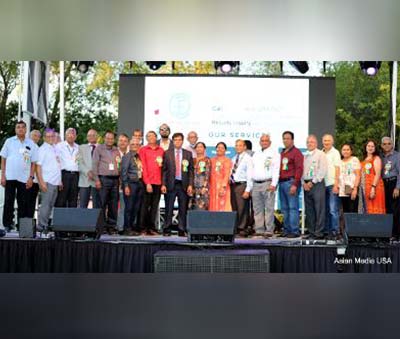
The FBI has dis-aggregated data for Hindus and Sikhs since 2016. A total of 324 hate-related incidents targeting Asian Americans were reported by the FBI, a tiny fraction of the self-reported incidents collected on the Web portal Stop AAPI Hate, which was launched last year as the Asian American community increasingly became the target of violence amid the Covid pandemic. Former President Donald Trump demonized Asian Americans for “creating” Covid, repeatedly calling it the “China virus” and “Kung flu.” As of the end of June, Stop AAPI Hate had collected more than 6,600 reports of bias on its portal, in several languages, including Hindi, Punjabi, and Urdu.

Local law enforcement agencies around the country voluntarily submit their data to the FBI for the Uniform Crime Report. Reporting is not mandated: less than 12 percent of law enforcement agencies around the country submit their hate crime incidents to the FBI. Former FBI agent Michael German, currently a fellow at the Brennan Center for Justice’s Liberty and National Security program, noted at a press briefing last year that the vast majority of hate crimes go unreported. Prosecutors are reluctant to charge an offender with a hate crime, as the burden of proof — that the crime began with the intent of hate — is difficult to prove.

Minnesota Attorney General Keith Ellison explained the difficulty of charging a hate crime during an interview with the CBS news show “60 Minutes,” in which he discussed his prosecution of former police officer Derek Chauvin, who was convicted of the murder of George Floyd. Ellison was asked why he did not charge Chauvin with a hate crime. “Hate crimes are crimes which have the explicit motive of bias,” said Ellison. “There was no evidence that Chauvin had factored in Floyd’s race.” “We needed a witness to say ‘Chauvin made a racist comment.’ We didn’t have that,” said Ellison, who, in 2006, became the first Muslim American member of Congress. For 2020, 10,532 hate offenses were reported to the FBI, with 10,681 victims by 6,431 known offenders; more than 55 percent of the perpetrators were White.

Of those offenses, 4,939 were motivated by race or ethnicity, while 1,174 were motivated by religion. The 2020 data reflects a slight drop in hate crimes motivated by religion: in 2019, 1,521 incidents were motivated by religion. Race and ethnicity bias was by far the largest motivator for committing a hate crime, according to FBI data. Almost one-third of attacks occurred near the victim’s residence. Fewer than 5 percent were at or near places of worship. African Americans were the largest population to be targeted in hate crimes.

U S. Attorney General Merrick Garland issued a statement Aug. 30 affirming the Justice Department’s commitment to prosecuting and reducing the number of hate crimes. “Preventing and responding to hate crimes and hate incidents is one of the Justice Department’s highest priorities. The FBI Hate Crime Statistics for 2020 demonstrates the urgent need for a comprehensive response,” he said, noting that there was a 6 percent increase in hate crime reports and a rise in hate crimes against Asian Americans. “These numbers confirm what we have already seen and heard from communities, advocates and law enforcement agencies around the country. And these numbers do not account for the many hate crimes that go unreported,” he said.

The Justice Department is aiming to improve incident reporting, increasing law enforcement training and coordination at all levels of government, prioritizing community outreach and making better use of civil enforcement mechanisms. “All of these steps share common objectives: deterring hate crimes and bias-related incidents, addressing them when they occur, supporting those victimized by them and reducing the pernicious effects these incidents have on our society,” said Garland. The organization OCA-Asian Pacific American Advocates remarked on the undercount of hate crimes targeting Asian Americans. “With thousands of self-reported hate incidents collected by community nonprofits over the past year, the FBI’s total appears significantly low,” said the organization, noting that the number of reporting agencies has declined, as in previous years.

“The FBI’s annual report remains our most reliable snapshot of hate crimes. However, the historic reporting gap continues to undermine its usefulness—and frankly, its credibility,” said OCA’s national president Linda Ng in a press statement. “As long as law enforcement agencies are not required to collect and report hate crimes data to the federal government, the FBI’s statistics will fail to capture the true scope of violence, harassment, and assault against Asian American communities.” “Without complete, mandatory state and local participation in the FBI’s data collection process, our understanding of anti-Asian hate crimes remains cloudy at best,” added OCA’s deputy executive director Thu Nguyen.

Desi-Fest by Bhartiya Senior Citizen Group of Chicago and Manpasand Held

Bhartiya Senior citizen group of Chicago (BSCC), a reputable organization serving thousands of seniors and Manpasand, a well-known name in the entertainment industry came together to create history with its action-packed cultural extravaganza ‘The Desi-Fest’. The event was held on Sunday, September 5th, 2021 at Rana Reagan community center in Carol Stream, 343 St. Paul Blvd., Carol Stream, IL.  Many leaders from many different fields such as medical, sports entertainment, political, teaching spiritual leaders and prominent community leaders were present at The Desi-Fest. The event attendance was House Full.

Haribhai Patel, President of the BSCC, along with all the committee members have proved once more that his efforts in ensuring his senior members receive the best service is unmatched. In the past, The BSCC has held vaccination fairs to make sure all members can get vaccinated without going through online appointments and unnecessary hurdles.
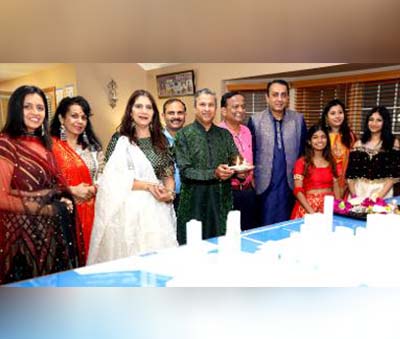
This year, Mr. Haribhai Patel wanted to do something where, after being locked inside during the pandemic for so long, all of his members were able to come out and socialize. Mr. Patel organized The Desi Fest, an Indian fair, with live entertainment, shopping, food and much more. Everything was complimentary for all members of the BSCC. The Desi Fest was held at Rana Reagan community center in Carol Stream. Mr. Patel’s vision to keep this fair safe and maintain CDC instructed guidelines presented itself as a challenge, but it did not stop him from hosting this event, nonetheless.

Manpasand, Inc. – a well-known nationwide entertainment company owned by Mrs. Bhavna Modi, managed all the festivities that took place. Her event management capabilities showed themselves, as this event was a difficult one to host outdoors. Mrs. Bhavna Modi not only coordinated the elite singers and sound to the Desi Fest but also handpicked all the food vendors for senior members, doing so to ensure they had a variety of food options to choose from. Mrs. Modi’s hard work and extraordinary event planning matched Mr. Patel’s vision. Under the blue sky all the way until the dark of night, Mr. Haribhai Patel’s leadership and tremendous support by Manpasand Inc. and Mrs. Bhavna Modi was the core of what made this fest a huge success, attracting more than 1,000 people.

The entertainment portion of the evening kicked off with the Master of Ceremony Mrs. Neelam Desai. Her deep and subtle voice and intoxicated ways of delivering speeches was sweet music to all the ears.  Laughter is the ultimate medicine they say. Mayuri Patel, a standup comedian made everyone laugh with her extraordinary sense of humor. Well known and everyone’s favorite singers Mr. Rex D’Souza, Ms. Shilpi Paul and Ms. Kausha Pandya rocked the stage with nonstop live singing and music. Their melodious voices kept The BSCC members glued to their chairs. Many from the audience was nonstop on their feet dancing on the stage and off the stage. The electricity between the singers and the audience made the night very Young at heart.

To make this fair safe, The BSCC and Manpasand Inc. joined hands, once again, with The Rana-Reagan Pharmacy located at 398 W. Army Trail Rd in Bloomingdale. Rana-Reagan provided their own booth and brought their team of 9 people to offer free rapid and PCR COVID-19 tests to anyone who came to the event. The Rana- Reagan Pharmacy’s outstanding services and support were recognized by Mr. Haribhai Patel during his speech. Mr. Patel also announced that he will be holding a Covid- 19 Booster shots clinic for all eligible members, nonmembers and for their family from September 20th per CDC guidelines.

One of the recipients at the festival was Jasbir Suga of Suga Builders. Jasbir Suga is known for his selfless community service and he has been supporting so many community initiatives for many years. Suga Builders is a well-known name in the construction industry because of its excellent customer satisfaction and reliable work ethics. The company has been serving Chicagoland for close to three decades and specializes in catering to customized needs of its commercial as well as residential customers. It is a one stop place for any construction project from planning, designing, pre-construction, procurement, construction and to post-construction.

The BSCC has presented awards to those who made a huge difference in the community with their selfless acts and services during the pandemic. The following is a list for those who were honored for their outstanding performance in their surrounding communities by Mr. Haribhai Patel: Community Engagement and Leadership Award: Kamlesh Shah and Alisha Bedi of The Rana-Reagan Pharmacy Heart of our Community Award: Nimish Jani Character Counts Award: Jasbir Suga of Suga Builders Shining Star Award: Ashok Punjabi of Chicago Import Pandemic Hero Award: Dr. Syed Naveed and Ibrahim Alimirah of Free COVID Care Extra Mile Award: J.P. Patel Making a Difference Award: Seth Lewis.

Ravindra Joshi Creates 3D Printed Scale Model Of Chicago Downtown

The Ganesh festival this year was like no other. A complete mind boggling 1:1600 3D printed scale model of Chicago downtown created over 9 months,  a work of art with amazing attention to detail and superb execution, done by our Ravindra Joshi was unveiled. If the breath-taking design wasn’t enough, the seamlessly integrated light fixtures weaved throughout the buildings produce a stunning visual in the night.

First, Mr. Joshi looked through Google Earth block by block. Then, he downloaded each block and with various software’s, reconstructed each block for it to be printed. On average, each block required 20+ hours of work. This model featured the Willis Tower, the tallest building in Chicago downtown, requiring 27+ hours of 3D printing. In addition, the model included other Chicago land favorites like the John Hancock building, Solder Field, and the Chicago River. This relentless work day and night through these past 9 months left all Chicagoans speechless. We all can’t wait to see the project he creates next!
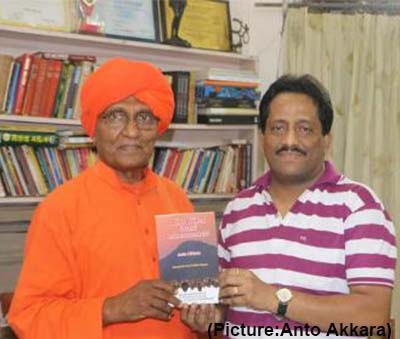
Remembering Swami Agnivesh, Who Stood Up For Justice, Religious Freedom

September 11 marks the first death anniversary of Swami Agnivesh, one of the best-known social activists in India, who began his work wondering why European Christian missionaries would forgo their comforts to toil in India. Agnivesh once shared with me the turning point in his life: “I always wondered why these Europeans should come to India and struggle here to serve poor people, forsaking all comforts. So, I thought, as an Indian, should I not do something for the struggling people?” He died on Sept. 11, 2020, from liver cirrhosis, 10 days ahead of his 81st birthday.

Glowing tributes were paid to Agnivesh when he died after half a century of dedicated life for the poor that even inspired The New York Times to write an obituary recalling the illustrious life of the saffron-clad social activist and Hindu reformist leader. Chairperson of the United Nations Trust Fund on Contemporary Forms of Slavery from 1994 to 2004, Agnivesh received the Right Livelihood Award in 2004 “for promoting over many years in South Asia the values of religious and communal coexistence, tolerance and mutual understanding.” In 1981, Agnivesh founded the Bandhua Mukthi Morcha (Bonded Labour Liberation Front), a pioneering movement for the liberation of bonded laborers treated like slaves. It is worth remembering in this context that Kailash Satyarthi, who won the Nobel Peace prize in 2014, grew up under the guidance of Agnivesh in this network.

An ardent Hindu reformist at heart in the Arya Samaj mould, Swami Agnivesh spoke out against spreading hatred and obscurantism in the name of religion

A peep into his life will amaze anyone. Vepa Shyam Rao was born on Sept. 21, 1939, in an orthodox Brahmin family in the Srikakulam district of Andhra Pradesh. By the age of five, he had lost both parents and grew up under the care of his maternal grandfather.

Despite this handicap, he went on to study law and commerce and became a lecturer at St. Xavier’s College in Kolkata. His frequent discussions with a Belgian Jesuit at the college awakened in him the “urge” for social work.

The budding business management lecturer quit his teaching post in 1967 and decided to practice law as a junior to Sabyasachi Mukherji, who later became the chief justice of India.

In 1968, he moved to Jhajhar Gurukul in Haryana state, and in March 1970 he took sannyasa (ascetic life) as an Arya Samaj member with the name Swami Agnivesh and his saffron garb, resembling Swami Vivekananda. After launching a political outfit in Haryana, he was elected to the Haryana Assembly and was appointed education minister in 1977.

Following the police firing on protesting laborers, Agnivesh quit his ministerial post and founded the Bonded Labour Liberation Front to help workers enslaved in quarries and brick kilns. In this protracted fight, he was arrested twice and had to spend 14 months in jail on a trumped-up murder charge of which he was later acquitted.

From there, Agnivesh never looked back and became an icon of conscience keeping for the nation and a voice for the oppressed — be it the lynching of Dalit people, rape of tribal women, police firing on protesters, “encounter deaths” or communal carnage across the country.

An ardent Hindu reformist at heart in the Arya Samaj mould, Swami Agnivesh spoke out against spreading hatred and obscurantism in the name of religion, drawing the ire of hardline Hindu groups.

His quest for justice and solidarity for the oppressed endeared him to the Christian community. But he did not spare the cosy Christians either. I heard him several times challenging bluntly even elite Christian gatherings “to come out of the castles of comfort.”

When Australian missionary Graham Staines and his two sons were torched alive by Hindu bigots in 1999 in Odisha, it was Agnivesh who led a train bogey of peaceniks and social activists from Delhi to Odisha, where Staines had spent decades serving lepers. Agnivesh organized a similar pilgrimage to Gujarat in 2002 following Hindu-Muslim riots there.

My bond with Swami Agnivesh is as old as when I began journalism in 1990. He used to jokingly call me “guru” since I had initiated him in internet communications in 1997 at his request. But for his solid support, my campaign for the victims of anti-Christian riots in Kandhamal in Odisha would not have been successful.

He was one of the stalwarts at the release of my maiden investigative book, Kandhamal — a Blot on Indian Secularism, in April 2009, making national headlines. He later joined my six Kandhamal media programs.

A bitter critic of Hindu nationalists for abusing religion for political power, he was attacked twice in August 2018

Agnivesh carried a special concern for the families of the “seven innocents” of Kandhamal — the Christians jailed on the trumped-up charge of murdering Swami Lakshmanananda Saraswathy, which kicked off the worst anti-Christian riots in India’s history.

He used to frequently ask me about the welfare of the poor families of these seven. At every public stage, which I shared with him, he would routinely speak for the victims of Kandhamal.

Agnivesh stood up fearlessly for what he believed. A bitter critic of Hindu nationalists for abusing religion for political power, he was attacked twice in August 2018 — first in Ranchi city in eastern India and then in the national capital of New Delhi.

He attended the release of the Hindi translation of my book on the 10th anniversary of the Kandhamal riots in New Delhi three days after he was beaten up at the office of the pro-Hindu Bharatiya Janata Party (BJP) in front of television cameras. That was when he went there to pay homage to the former prime minister and BJP leader Atal Behari Vajpayee.

After the book release, he jokingly said: “Anto, you may get a chance to write another book asking who killed Swami Agnivesh.” But liver cirrhosis claimed his life two years later.

As a true swami with great respect for other faiths, Agnivesh stood up when anyone was attacked in the name of religion. He inspired thousands of social activists and lent his voice to the oppressed across the nation. The nation sorely misses his sober and strong voice.

REMEMBERING THE DAY 9/11: TWENTY YEARS BACK!

TUESDAY SEPT 11, 2001- Till that day, America was different from what we see today. Then, we had been going through a peaceful life, respecting each other, whether white or black, refugee or expatriate – all enjoyed equality and freedom. As usual, on that day, we were holding a departmental Core Committee session in the medium-sized Conference Hall, and my boss, the VP of Finance, was keenly looking on the screen; the presentation on internet security, I was briefing just then. “Mathew, stop, stop,” my boss holding his mobile phone, was screaming. I thought something was wrong with my PowerPoint presentation. Finally, somebody switched off the overhead projector. My colleagues looked at each other, and the silence was so scary.

My boss stood up to say that our nation is on the attack! The big TV was switched on, and the horrible video of a plane hitting some tall towering building that slowly crumbled down frightened everyone. “ Oh my God, Pearl Harbor tragedy is repeating,” and the oldest lady in our group screamed and fainted. Within few breathtaking moments, I started to understand that few planes were hitting some tall buildings in and around New York. We visited New York and stood below the Twin Towers exactly seven days earlier. Fear crept into my nerves to squeeze my tiny brain with dreaded imaginations. After a few minutes, the only thing I could do was to call home and ensure that my wife and son are fine. Even after twenty years, sometimes, that frightening memories of the fateful day haunt me.

What really happened on that day of September 11th. “ On September 11, 2001, almost 3,000 people lost their lives during the attacks at the Twin Towers, Pentagon and aboard United Airlines Flight 93. At 8:46 a.m. ET, American Airlines Flight 11 (traveling from Boston to Los Angeles) hit the north tower of the World Trade Center in New York City. At 9:03 a.m. ET, United Airlines Flight 175 (traveling from Boston to Los Angeles) hit the south tower of the World Trade Center in New York City. At 9:37 a.m. ET, American Airlines Flight 77 (traveling from Dulles, Virginia, to Los Angeles) hit the Pentagon Building in Washington. And at 10:03 a.m. ET, United Airlines Flight 93 (traveling from Newark, New Jersey, to San Francisco) crashed in a field near Shanksville, Pennsylvania”.

America could never sleep peacefully; the country’s security was at risk. So America chased terrorists and governments fostering instability and terrorism. We heard our President repeating his promise that nations with WMD (Weapons of Mass Destruction) will be brought under Justice. America and its faithful allies combed the aisles and trenches of Iraq, and their Chief Saddam Husain was smoked out like a rat and hanged. Later the alleged real brain behind the 9/11 attack Bin Laden, was caught. “U.S. Special Forces took him out during a raid on the compound in Abbottabad, Pakistan, where he and some of his family were hiding out. After identifying his body, the military brought him aboard the USS Carl Vinson and buried him in the northern Arabian Sea the same day”.

There are personal memories and cultural memories and political memories, and even as its echoes are still shaking the foundations of our system. History of that is evident in the events just happening in Afghanistan, where a 20-year war waged in direct response to 9/11 ended pretty much where it began: with the repressive and violent Taliban took charge once again. While memory slowly becomes history, it can fade its fierceness, like the river banks are eroded in the avalanche of horrible events flow in due course.

Twenty years have passed since a perfect blue sky morning turned into the blackest of nights. Since then, we’ve lived in sunshine and shadow, and we are sometimes on the roller coaster of unexpected events too. And when our nation pauses to remember the morning 20 years ago when it was attacked, it is still a horrible memory, looking around and wondering that history should never repeat.

Nearly one-fifth of the country is now too young to remember firsthand the day that changed everything in America and other powerful nations. The attacks of September 11th were intended to break the American unity and spirit. Instead, Americans emerged more robust and more unified. It is worth now to read what Joe Biden stated years back: “We didn’t crumble after 9/11. We didn’t falter after the Boston Marathon. But we’re America. Americans will never, ever stand down. We endure. We overcome. We own the finish line.”

Hurricane Ida Inflicts Misery Across Many States In US

From Louisiana to New York, communities are trying to piece lives back together more than a week after Hurricane Ida slammed into the Gulf Coast on August 29th. Heavy rains, devastating winds, flooded streets, death and destruction all around—the horrific conditions are being experienced by millions of Americans in nearly a dozen coastal states as Ida continued to play havoc last week. Ida made landfall on the anniversary of Katrina, the dangerous Category 3 storm that devastated Louisiana and Mississippi 16 years ago, killing more than 1,800 people and causing $125 billion in damage.

Hurricane Ida roared ashore in Louisiana on Sunday at Category 4 strength, with maximum sustained winds of 150 mph. In fact, as the eyewall of Ida hammered the Louisiana coast, a ship about 50 miles south-southwest of New Orleans clocked a peak wind gust of 172 mph, which is just shy of the strongest measured wind from a hurricane in the US. Ida was downgraded to a tropical storm moved farther inland over southeastern Louisiana and into southwestern Mississippi, the National Hurricane Center said.
As of early Monday last week, more than 1 million Louisiana utility customers are without power, according to PowerOutage.us. On Sunday evening, New Orleans said the entire city lost power after “catastrophic transmission damage.” Four deaths have been confirmed in Louisiana as crews began fanning out in boats and off-road vehicles to search communities cut off by the giant storm. A man was also missing after apparently being killed by an alligator. Even though Hurricane Ida was most devastating in Louisiana state and its neighbors in the south where entire localities were totally destroyed, its deadliest human toll was in the New York region where at least 42 people were killed — 25 in New Jersey, 16 in New York City and one in Connecticut.

A stunned U.S. East Coast faced a rising death toll, surging rivers and tornado damage on September 2nd with record-breaking rain, killing at least 46 people in their homes and cars. As many as 23 people died in New Jersey, Democratic Gov. Phil Murphy said. At least 13 people were killed in New York City, police said, 11 of them in flooded basement apartments, which often serve as relatively affordable homes in one of the nation’s most expensive housing markets. Suburban Westchester County reported three deaths. Officials said at least five people died in Pennsylvania, including one killed by a falling tree and another who drowned in his car after helping his wife to escape. A Connecticut state police sergeant, Brian Mohl, perished after his cruiser was swept away. Another death was reported in Maryland.

Four people of Indian origin and a Nepali family of three have died in New York from the flooding caused by Hurricane Ida. Phamatee Ramskriet, 43, and her son Krishah, 22, drowned when their basement flat flooded in New York City on September 1. Mingma Sherpa, 48, and Ang Gelu Lama, 52, and their infant son Lobsang Lama, 2, also drowned when the waters from the record-setting downpour in the city inundated their basement flat. In neighboring New Jersey, Malathi Kanche, 46, drowned after she was swept away when her car stalled on a flooded road. Also in New Jersey, Danush Reddy, 31, was sucked into a 36-inch sewer pipe by the floods.

Ida’s soggy remnants merged with a storm front and soaked the Interstate 95 corridor, meteorologists said. Similar weather has followed hurricanes before, but experts said it was slightly exacerbated by climate change — warmer air holds more rain — and urban settings, where expansive pavement prevents water from seeping into the ground. The National Hurricane Center had warned since Tuesday of the potential for “significant and life-threatening flash flooding” and major river flooding in the mid-Atlantic region and New England.  Still, New York Gov. Kathy Hochul and New York City Mayor Bill de Blasio said the storm’s strength took them by surprise.

“We did not know that between 8:50 and 9:50 p.m. last night, that the heavens would literally open up and bring Niagara Falls level of water to the streets of New York,” said Hochul. New York City’s Central Park ended up getting 3.15 inches in just one hour, surpassing the previous one-hour high of 1.94 inches (5 cm) during Tropical Storm Henri on Aug. 21. Wednesday’s storm ultimately dumped over 9 inches (23 cm) of rain in parts of New Jersey, Pennsylvania, Massachusetts and Rhode Island, and nearly as much on New York City’s Staten Island.  In Washington, President Joe Biden assured Northeast residents that federal first responders were on the ground to help clean up.

In New York, nearly 500 vehicles were abandoned on flooded highways, garbage bobbed in streaming streets and water cascaded into the city’s subway tunnels, trapping at least 17 trains and disrupting service all day. The National Weather Service said the ferocious storm also spawned at least 10 tornadoes from Maryland to Massachusetts, including a 150-mph (241 kph) twister that splintered homes and toppled silos in Mullica Hill, New Jersey, south of Philadelphia. Record flooding along the Schuylkill River in Pennsylvania inundated homes, highways and commercial buildings, even as meteorologists warned that rivers likely won’t crest for a few more days. The riverside community of Manayunk remained largely under water.

The Schuyilkill reached levels not seen in over 100 years in Philadelphia, where firefighters were still getting calls about minor building collapses and people stuck in flooded cars Thursday morning. The managers of a 941-unit apartment complex near the river ordered residents to evacuate, citing “deteriorating” conditions after water rushed into the parking garage and pool areas. Due to climate change, destruction like that seen in both the Gulf and East Coast from extreme weather will be “our new normal,” Federal Emergency Management Agency Administrator Deanne Criswell warned Sunday. “This is the crisis of our generation, these impacts that we are seeing from climate change, and we have to act now to try to protect against the future risks that we are going to face,” Criswell said during an interview on Sunday morning.

After surveying the damage in Louisiana Friday, President Joe Biden will travel to New Jersey and New York on Tuesday to assess the impact on the East Coast, where the storm claimed the lives of at least 50 people. Mayor of Paterson in New Jersey, André Sayegh lamented the destruction, telling CNN, “As if a once in a century virus wasn’t enough, we had a once in a century storm.”

Anu Natarajan To Lead Facebook’s $1 Billion Affordable Housing Initiative

Former Fremont, California Vice Mayor and city council woman Anu Natarajan has been named by Facebook to head up its affordable housing initiative, which will allocate $1 billion in grants over 10 years to housing projects in California. The Indian American former official came on board as project lead in July, after consulting on the initiative for more than a year. “The Covid pandemic has really put the spotlight on the lack of housing in the state, which has been 40 years in the making,” Natarajan told India-West.

A survey conducted by the U.S. Census Bureau between last November found that over two million renter households in California reported “little to no confidence” in their ability to pay next month’s rent. Federal and state moratoriums have staved off evictions through the pandemic, but those are due to expire next month. Moreover, only a small fraction of $47 billion in federal funds has actually been doled out to renters in need and small landlords. In California, almost 30 percent of renters pay more than half their salary in rent, and almost 40 percent of homeowners pay more than 30 to 50 percent of their incomes to mortgages, according to data from the California Budget and Policy Center.

California has more than half of all unsheltered homeless people in the country, with an estimated 108,432 people living on the streets. Los Angeles County alone is home to almost 58,000 homeless people, according to 2019 data from Housing and Urban Development. In San Francisco, a family of four making over $100,000 per year is considered low-income, said Facebook in a press release. Natarajan noted the lack of supply at all levels of housing: for every 100 jobs created in the state, only 30 housing units are created, on average. “Not in My Backyard” protests from existing residents, as well as the increasing costs of materials have made building new housing so much harder, she said.

The Facebook housing initiative was announced on Oct. 22, 2019. An initial round of funding — $150 million — was announced last December to create 2,000 units of housing for very low-income people. Facebook partnered with Destination Home, a nonprofit organization leading efforts to end homelessness in Santa Clara County, which contributed an additional $5 million to the fund. Natarajan said that funds were also allocated to help with technical assistance for California’s Project Homekey, an $800 million initiative which bought up existing hotels and motels to create 6,000 units of permanent housing for unsheltered people. (See earlier India-West story: https://bit.ly/38td7mU)

“The COVID crisis demands we all step up and do more to protect the most vulnerable. I challenge other private sector corporations to follow suit and provide additional low-cost capital to create thousands more homeless housing units all across California,” said California Governor Gavin Newsom, as Facebook announced the grant last December. Facebook’s next round of grants are expected to be announced sometime during the week of Aug. 30, according to Natarajan. The areas of most need in the state include the San Francisco Bay Area, Los Angeles County, San Diego, and the Inland Empire in Southern California.

Natarajan will also lead Facebook’s $25 million initiative to build teacher and essential worker housing on public land for school districts in San Mateo and Santa Clara Counties. The $1 billion initiative also allocates $250 million to a partnership with the State of California for mixed-income housing on excess state-owned land in communities where housing is scarce. This public-private partnership ensures that incremental new housing supply is brought to the market segments that need it most, said Facebook Chief Financial Officer David Wehner in a press statement.

Natarajan earned her master’s degree in Urban Design and Planning from the University of Washington. She served on the Fremont City Council from 2004 to 2014. She brings a three-pronged view to civic infrastructure development, considering the impact to climate change, addressing social justice concerns about equity in housing, and access to mobility and transportation.

Texas’ Abortion Ban Is Most Restrictive Ever

Texas law that bans abortion as early as six weeks into pregnancy took effect at midnight on Wednesday after the Supreme Court failed to act on emergency requests from abortion providers. Nearly 24 hours later, the court said late Wednesday night it split 5-4 and denied the providers’ emergency request to block the law. The unsigned order, issued by the Supreme Court’s conservative majority, said their decision focused on procedural issues and did not amount to a ruling on the constitutionality of the law, and that other appeals could be pursued.

However, even if the ban is ultimately blocked, it will have a lasting impact on Texas and provide a roadmap for other conservative states to enact similar abortion restrictions. Senate Bill 8, signed by Republican Gov. Greg Abbott in May, bars abortions once a doctor can detect fetal cardiac activity, which is often before many people know they are pregnant. The ban would prevent at least 85% of abortions sought in Texas, according to abortion rights advocates and providers. It is now the most restrictive abortion law in the nation; at least 12 other states have passed six-week abortion bans, but all have been blocked from going into effect.  “Texas politicians will have effectively overturned Roe v. Wade,” Nancy Northup, president and CEO of the Center for Reproductive Rights, said shortly before the law went into effect, referring to the landmark 1973 decision that established the constitutionally protected right to abortion before a fetus is viable.
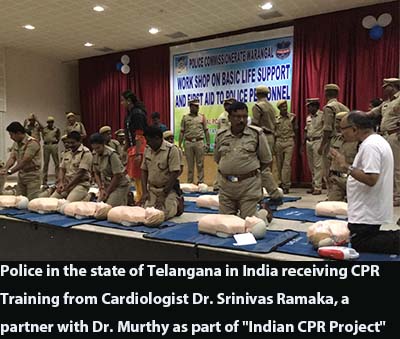
The Texas law uses a different tactic than many of the other abortion restrictions passed by Republican state legislatures in recent years—which is precisely what has made it difficult for courts to block it. The law signals a new frontier in the national fight over abortion and could mark a critical new legal strategy for conservative legislatures in how they write restrictive abortion laws in the future. John Seago, legislative director for Texas Right to Life, which helped write the legislation, says he has already heard from other states that are interested in copying this approach and the group is drafting legislation for some of them already. “This promises an alternative to that typical path that pro-life laws go down,” he says. “This is a valid public policy tool and we’re excited to see how it works.”

Instead of allowing government officials to enforce the abortion ban as they do with most laws, this law says that private citizens can step in by suing abortion providers and anyone who “aids and abets” a patient obtaining an abortion after six weeks. That means clinics and their staffs could be sued, as well as patients’ family members, or anyone who drives someone to a clinic, provides financial assistance, offers religious or genetic counseling or even “intends” to do any of those actions. The plaintiffs do not need to have any connection to the person they suspect of violating the law, and if they win, the law says they are entitled to damages of at least $10,000 plus legal fees. Because so many people can now legally bring these abortion lawsuits in Texas, courts could theoretically be overwhelmed with cases. “It does open the floodgates to lawsuits, and even frivolous lawsuits, just to harass abortion providers,” says Brigitte Amiri, deputy director of the Reproductive Freedom Project at the ACLU, which is part of the coalition of abortion providers and advocates challenging the law.

But the way the law is written also makes it difficult to challenge. Usually, when a state passes a new law restricting abortion access, abortion rights groups and providers sue state officials alleging they are violating people’s constitutionally protected rights. In this case, there is no specific individual tasked with enforcing the law, so there was no obvious entity for the providers to sue. The ACLU, the Center for Reproductive Rights and a collection of other groups and abortion providers filed suit this summer against a slew of officials they said would be responsible for enforcing the law, but a series of complex procedural developments left them asking the Supreme Court for a last-minute intervention.

“The Constitution, including Roe v. Wade, only applies against the government, it doesn’t apply against private individuals,” says Laurence Tribe, a leading constitutional law expert at Harvard. “That’s what makes this really dangerous. It’s a kind of vigilante justice, circumventing all of the mechanisms we have for making sure that the law is enforced fairly, and that it’s not enforced in a way that violates people’s rights.” Even if the courts temporarily block the law, complications remain. The law includes a provision that says providers could still be sued for violating the law if a court decision is eventually reversed and the law goes back into effect, meaning providers could be sued over an action that was technically legal at the time.

For now the law stands in Texas. Texas Right to Life has set up a website to solicit tips about people who allegedly violate the law and collect information from those who want to help the group enforce it. The website has been flooded with fake information from those who support abortion rights, but Seago says that has not hampered the group’s efforts. “We’ve set up the tip line, we’ve built the networks, we’ve been working with pro-life attorneys and activists around the state, so that if [providers] decide that they’re going to try to commit illegal abortions anyway, we will be prepared to do what the law authorizes us to do, which is to bring private lawsuits holding them accountable,” Seago says.

The law will “immediately and catastrophically reduce abortion access in Texas,” the group of providers said in its emergency filing to the Supreme Court on Monday. “Patients who can scrape together resources will be forced to attempt to leave the state to obtain an abortion, and many will be delayed until later in pregnancy. The remaining Texans who need an abortion will be forced to remain pregnant against their will or to attempt to end their pregnancies without medical supervision.” The Supreme Court’s five most reliably conservative justices voted to reject the emergency filing. Chief Justice John Roberts joined the three liberal justices in dissent. Justices Sonia Sotomayor, Stephen Breyer and Elena Kagan each wrote separate opinions saying they would have blocked the law because it is an unconstitutional ban on abortion.

Abortion providers and abortion rights advocates say the law will disproportionately impact low-income patients who already often struggle to access health care. The average distance a Texas patient will have to travel to obtain an abortion will now rise from 12 to 248 miles, a 20-fold increase, according to the Guttmacher Institute, a research group that supports abortion rights.

Dr. Vemuri S. Murthy: A Global Champion Of Resuscitation Medicine

World Heart Day is being observed on September 29th this year with the objective of raising awareness of heart disease and promoting “Healthy Heart” lifestyles. “Human heart disease is the number one Global Public Health problem,” says Dr. Vemuri S. Murthy. He is an advocate of Community and Physician resuscitation education. And training for more than three decades in the USA and India. “It is disheartening to see patients with reversible health conditions die suddenly due to lack of both Community Health Awareness and Timely Emergency Care based on Evidence-based Resuscitation Practices”.

An alumnus of Guntur Medical College, Guntur and All India Institute of Medical Sciences, New Delhi (General Surgery), and a former Chairman of Anesthesiology Department at West Suburban Medical Center, Oak Park, Illinois, as a “Pioneer of Resuscitation Medicine in India” Dr. Murthy hailed. Also the reputed leader of organized medicine in the USA, Dr. Murthy has served as the President of the Chicago Medical Society and the Indian American Medical Association, Illinois.

Heart disease Indian CPR ProjectAffiliated with various US medical organizations and institutions, the soft-spoken Dr. Murthy is a Resuscitation Educator and Researcher, Advisor to Resuscitation Training Centers, Champion of Community Cardiopulmonary Resuscitation (CPR), and a Leader of US Organized Medicine.  His Mission has been “Saving Lives” in Sudden Cardiac Arrests and common heart issues.
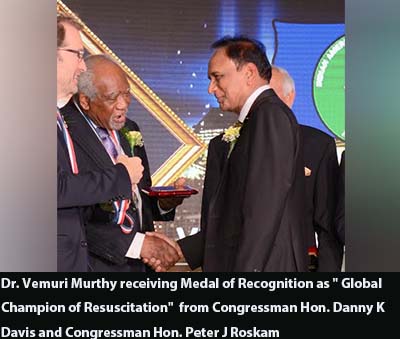
Global evidence-based and heart disease newspaper articles information has proven that Bystander CPR is life-saving in sudden cardiac arrest. The latter can be recognized by the sudden collapse of the person without any breathing, pulse, or consciousness.   According to the articles about the heart of the American Heart Association, there are more than 356,000 out-of-hospital cardiac arrests annually in the U.S. Nearly 90% of them are fatal. Cardiopulmonary Resuscitation (CPR), if performed immediately, can double or triple a cardiac arrest victim’s chances of survival. Heart attack news articles say that in the majority of cases, immediate Hands-only CPR may have similar survival outcomes. And it is comparable to the conventional CPR performed with both chest compressions and breaths.

Dr. Murthy is a guide and co-investigator of a ground-breaking Indian Resuscitation Research Project and Cardiac Arrest Registry, Warangal Area Out of Hospital Cardiac Arrest Registry 2018, based on an international format. He contributed to “CPR” and “Women’s Heart Health” videos and educational articles in news media and actively involved with Indo-US collaborated comprehensive Cardiac Care Projects.

Quoting evidence-based studies done, Dr. Murthy, a past President of the Chicago Medical Society and current adjunct faculty in the Department of Emergency Medicine at the University of Illinois College of Medicine, Chicago, Illinois, points to the fact that South Asians are at a four-times greater risk of heart disease than their Western counterparts and have a greater chance of having a heart attack before 50 years of age. Heart attacks strike South Asian Men and Women at younger ages. As a result, both morbidity and mortality are higher among them compared to any other ethnic group. They tend to develop heart disease ten years earlier than other groups.

Heart disease Dr. VemuriThe Founder of Chicago Medical Society’s Community CPR Project Saving More Illinois Lives through Education (SMILE,) Dr. Murthy, takes upon himself the life-long mission of saving lives through effective preventive measures. He says, “Almost one in three among South Asians may die from heart disease before 65 years of age.”
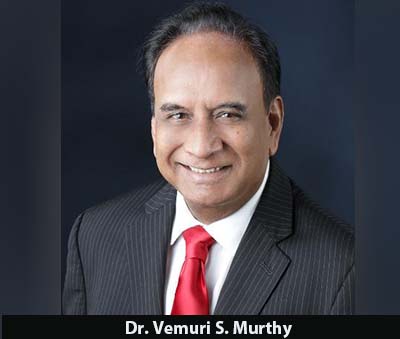
What causes heart problems in India? Heart disease remains the number one cause of death. Common risk factors are smoking and a diet high in sugar, salt, refined grains, and fat. A large number of South Asians appear to have “insulin resistance”, a condition in which the body does not utilize insulin efficiently, resulting in Diabetes, which leads to a significant number of heart-related problems and serious heart conditions. Lack of adequate exercise, stress, and genetic predisposition are also contributing factors,” adds Dr. Murthy, a distinguished Chicago Physician.  Illinois offers Project SMILE programs at various community events. International dignitaries, Members of the US Congress, Illinois Governor, and Legislators, and Indian Consul Generals commend it by.

A Visiting Professor of Indian Medical Universities, Dr. Murthy has been promoting resuscitation courses for nearly three decades in India. Indian Instructor Faculty trains thousands of physicians, medical students, and nurses with his guidance. He pioneered an “Indian Medical University Resuscitation Education and Training Model” at Dr. NTR University of Health Sciences, Andhra Pradesh (2012). He conducted simulation-based advanced Resuscitation Workshops with international faculty and guided mass community CPR events. He chaired several Resuscitation Conventions in India and organized workshops at prestigious Indian Medical Institutions such as AIIMS, New Delhi.

Heart disease Vemuri S MurthyDr. Murthy served the American Heart Association in different capacities. Such as National and International Faculty, Member of the International Committee, and Advisor to AHA International Training Centers, Also as  AHA Liaison to Medical Organizations in the USA too. He co-chaired programs at the AHA Scientific Sessions and delivered Resuscitation-based lectures at prestigious US medical institutions.
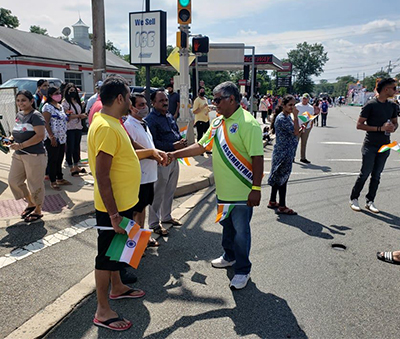
He also contributed to AHA’s “Saving Children’s Lives” project in Gujarat, India.  AHA leadership recognized his decades of service: “For Volunteer Leadership in Support of Lifesaving Mission of the AHA and its Emergency Cardiovascular Care Programs”. Dr. Murthy has been actively involved with AAPI as the Chairman of the “AAPI-AHA Liaison Committee”, “Global Resuscitation Committee”, and “Editorial Board Advisor” of the peer-reviewed Journal of AAPI (JAAPI). He also initiated an International AAPI Webinar Continuing Medical Education (CME) program (2020), an IAMA, IL Community CPR Project (2015), and an Indo-US CPR Research Project involving Resident Physicians from US Medical Universities (2016).

In a recent interview for a heart health article 2020, Dr. Vemuri Murthy shared his thoughts and concerns regarding the current status of the out-of-hospital cardiac arrests and diminishing bystander resuscitation help during the COVID-19 pandemic. “Bystander CPR with Defibrillation is a Blessing of Contemporary Medicine enhancing the survival of Sudden Cardiac Arrest Victims. Saving Lives with Best Practices should be the top Healthcare Priority for every Nation,” says Dr. Murthy, who hails from the state of Andhra Pradesh. He has devoted his entire life towards learning and sharing his knowledge and expertise with the noble cause of Heart Education.   Dr. Vemuri Murthy’s contributed to Global Health, Resuscitation Medicine, and Community Service. And this have been widely recognized through the numerous awards and recognitions that have been bestowed on him.

Dr. Murthy was honored with a Medal from US Congressmen as “Global Champion of Resuscitation,” “Lifetime Achievement Award” and “Distinguished Physician Award” from the Indian American Medical Association, Illinois.”

Chicago Medical Society gave the “Henrietta Herbolsheimer Public Service Award” and “Leadership Award” to Dr. Murthy. Also, the American Association of Physicians of Indian Origin bestowed on him the “Pioneer of Resuscitation Medicine in India” and “Most Distinguished Service” Awards. And, he received the “Global Champion of Health Award” from the Global Health Consortium, USA and the “Paul Harris International Service Award” from the Rotary Club and “Global Humanitarian Award” from The Institute of Medicine of Chicago “for providing voluntary, longstanding, and International Humanitarian Health Services” along with commendations from Indian Medical Universities and Medical Societies such as Indian Medical Association and Cardiological Society of India.

Indeed, Dr. Vemuri S. Murthy is truly a “Global Champion of Resuscitation Medicine!”

Assemblyman Sterley Stanley, First South Asian From Middlesex County In The New Jersey General Assembly

New Jersey’s Asian population has experienced remarkable growth within the last decade. According to census data released earlier this month, about 1.05 million New Jersey residents, slightly more than 11% of the state’s population, identified as either partially or entirely Asian. This striking 44% increase from the 725,726 who identified as Asian in the 2010 census prompts the question of whether the state government has changed to reflect new demographics. In fact, Asian candidates would need to win seven more seats in the Assembly and two or three more in the Senate for their representation to align with the state’s demographics. Nonetheless, there are those in the state government already leading the way to greater representation. Most recently, Assemblyman Sterley Stanley (D-Middlesex) joined State Sen. Vin Gopal (D-Monmouth) and Assemblyman Raj Mukherji (D-Hudson) as the third Indian American to be elected to the state legislature.

Stanley won his 18th District Assembly seat in a Special Election in January 2021, becoming the first South Asian to represent Middlesex County in the New Jersey Legislature. Stanley defeated fellow Democrat, Edison Councilman Joe Coyle by a vote of 189-136, a 58%-42% margin, according to the Middlesex County Democratic Organization. The seat became vacant when former Assemblywoman Nancy Pinkin resigned after being sworn in as the new Middlesex County Clerk.Endorsed by the Middlesex County Democratic Organization, Assemblyman Stanley was sworn in on January 27th, 2021. Stanley serves as a member of the Assembly Committee On Law And Public Safety and as a member of the Assembly Committee On Health. “I am honored to serve the residents of the 18th district and eager to roll up my sleeves to address the needs of our wonderful, diverse district and state,” Stanley said in a statement after being sworn in as an Assemblyman. “The events of the past year have shown us the danger of divisive forces, but they have also shown us the strength and necessity of collaboration. Truly listening to one another will allow us to better understand the issues and each other and to develop and implement nuanced, detailed solutions that reflect every community’s situation.”
Prior to being selected to fill the seat, Stanley served two terms as an East Brunswick Councilman. While on the East Brunswick Council, he advocated for fiscal responsibility, economic redevelopment and community building programs. The 54-Year-old Stanley was re-elected to his East Brunswick Council seat by 5,137 votes in 2020 against Republican Suzanne Blum and served as Council President in 2019 and 2020. During his time as councilman, the council and mayor’s administration “stabilized East Brunswick taxes without a reduction in services; re-established the East Brunswick Regional Chamber of Commerce; strengthened community relations with law enforcement; maintained a strong relationship with the public school district; and focused on delivering ratables through redevelopment.” Stanley won the Democratic primary this past June and will run in the general election in November 2021 for a full two-year term. The 18th District has the highest percentage of Asian Americans of any legislative district in the state, and Middlesex, Stanley’s home county, has the largest Asian population in the state, at 237,945 residents. In addition to East Brunswick and Edison, the 18th District includes Helmetta, Highland Park, Metuchen, South Plainfield And South River – all Middlesex municipalities. NJ State Assembly Speaker Craig Coughlin, while welcoming Stanley into the Assembly Democratic Caucus, stated, “Sterley is a true and dedicated public servant who distinguished himself as a two-term East Brunswick Councilman and he makes history as the first South Asian Assemblyman from Middlesex County. I look forward to working with Assemblyman Stanley as we seek to advance our shared priorities of protecting the middle class and our most vulnerable residents.”

Stanley was born in the State of Karnataka, India and immigrated to Brooklyn, NY at a young age.  For the last 21 years, he has called East Brunswick his home. While living there, he has worked in the finance industry as a title and life insurance agent, as well as a mortgage broker. Stanley is a proud father of three children and has been actively involved in the Middlesex County community, previously serving as a Trustee of the Lighthouse Christian Fellowship Church in East Brunswick and as President of the Fox Meadow Condominium Association. State Sen. Patrick Diegnan (D-South Plainfield) was among those who had supported the then East Brunswick Councilman Sterley Stanley for the Assembly Seat. “I’m supporting Sterley Stanley,” he said. “He’s a good guy and he works with me all the time.” At a February 8th meeting, the East Brunswick town council honored Stanley’s four years of local service. At the meeting, Stanley stated that one of his proudest achievements as Council President was helping to ensure that the governing body functioned as a cohesive unit. “We might have had differences of opinion and we have differences in the way we solve things, but at the end of the day, we all got together and did what was best for the Township,” Stanley said. “I feel honored now to not just represent East Brunswick, but the whole 18th District, and all seven towns that are there,” he said.
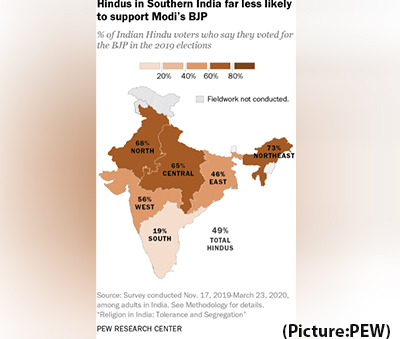
Stanley said he looks forward to applying everything he has learned in the last four years on the council and everything he has achieved in the township and bring it to the State level. “It is a true privilege to represent the people of District 18 and The State Of New Jersey,” said Stanley.  “I am committed to serving the residents and I look forward to working with my Assembly colleagues to best address the needs of this wonderful, diverse district and state. It is important, to me, to ensure all voices are heard so that we can work together in harmony and maintain a strong, united community.” During his time as Councilman, Stanley’s efforts to help establish a redevelopment agency were well received by the public.  Through town halls and other outreach efforts, he has always encouraged residents to actively participate in the process and prioritized working with them. In another collaborative initiative, he worked with the East Brunswick Police Department to strengthen dialogue around cultural diversity within the community. Stanley is generally committed to “establishing open lines of communication” and to strengthening the relationships between state legislators and each town’s administration, municipal chairs and committee persons. He intends to “always be available to listen to their issues and provide support,” hoping to “work at the state level to promote transparency and community engagement.”

“Our main streets are the backbone of our community and I will work to move past the current economic crisis to ensure that local businesses thrive,” Stanley declared. “I will help with identifying areas in need of redevelopment and take action to bring more responsible economic growth to create local, sustainable, good-paying jobs, while ensuring the same access to opportunity for all by enacting legislation that builds bridges for all.” “The issues we confront are not simple, but I deeply believe that they are not insurmountable if we understand their complexity and commit to respecting the perspectives that our fellow community members and leaders bring to the table.”

In India, Hindu Support For Modi’s Party Varies By Region And Is Tied To Beliefs About Diet And Language

India’s ruling party, the Bharatiya Janata Party (BJP), is sometimes said to prioritize Hindu interests. Hindus were the religious group most likely to say they voted for the BJP in the country’s most recent parliamentary election, but there are vast differences in how Hindus from different regions voted, according to a recent Pew Research Center survey of nearly 30,000 Indian adults. These regional political differences are connected to Hindu attitudes on a range of issues including language, diet and religious observance.

How we did this In 2019, roughly half of Hindu voters (49%) supported the BJP, giving the party a majority in the Lok Sabha – India’s lower house of parliament – and allowing Prime Minister Narendra Modi a second term to lead the country. Among Hindus, the BJP received some of its highest vote shares in the Northern (68%) and Central (65%) regions of the country, which include India’s capital, Delhi, and its most populous state, Uttar Pradesh. By comparison, 46% of Hindu voters in the East and just 19% in the South say they voted for the BJP, according to the Center’s survey.
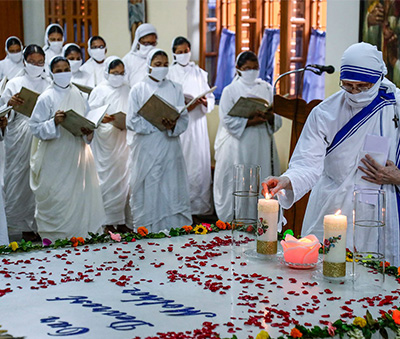
In the South, significant shares of Hindu voters (20%) say they instead supported the Indian National Congress (INC), which has led the country for most of the years since its independence. Regional parties, including the Telangana Rashtra Samithi and the Yuvajana Sramika Rythu Congress Party, also received significant vote shares among Southern Hindus (both 11%). Southern states tend to have higher per capita income and have experienced faster economic growth than most Northern and Central states. Differences in voting patterns between Southern Hindus and those who live in the Northern and Central regions are part of broader regional differences among Hindus in India. For example, Hindu nationalist sentiments appear to have a smaller foothold in the South. Nationally, 64% of Hindus in India say being a Hindu is very important to being truly Indian. But while this share is as high as 83% in the Central region, it falls to 42% in the South.

A closely related sentiment is the importance of the Hindi language to national identity: The majority of Hindus in the Central (87%) and Northern (71%) regions say that speaking Hindi is very important to being truly Indian, while just 27% of Southern Hindus say this. Among the dozens of commonly spoken Indian languages, Hindi is the most widespread. However, while it is often spoken in the Northern and Central parts of the country, it is far less common in the South. Views on the connection between the Hindu religion, Hindi language and Indian identity are highly correlated with support for the BJP – a party that has supported making Hindi the national language and has enacted laws (such as restricting cow slaughter) that are seen as favorable to Hindus.

Indeed, attitudes about cow slaughter and beef consumption mark another division between the South and other regions of the country. Many Hindus consider cows sacred animals, but there are mixed views about whether eating beef disqualifies a person from being a Hindu. Most Hindus in the Northern and Central regions (both 83%) say someone who eats beef cannot be Hindu, compared with half of Southern Hindus. And attitudes about beef and Hindu identity are correlated with support for the BJP: Hindus who say they voted for the BJP are more likely than other Hindu voters to say someone who eats beef cannot be Hindu (77% vs. 66%).  Southern Hindus also differ in their religious observance. For instance, while 92% of Hindus in the Central region say religion is very important in their life, the share is substantially lower among Southern Hindus (68%). More religious Hindus tend to support the country’s ruling party: About half of Hindus who say religion is very important in their lives (52%) voted for the BJP in 2019, compared with around a third of Hindus (32%) who say religion is less important in their lives.

Views of the BJP differ along other religious lines in India, too. Among minority religions analyzed in the Center’s report, Jains appear to be the only group who strongly embrace the BJP. While the survey did not include enough Jain voters to report how they voted in the 2019 election, 70% of Jains said in a separate question that they feel closest to the BJP, regardless of whether they voted in the last election. Meanwhile, other religious groups showed less support for the ruling party: Fewer than a third of Buddhists (29%), Muslims (19%), Sikhs (19%) and Christians (10%) say they voted for the BJP in the 2019 parliamentary election.

Many voters from minority religions opted to vote for parties other than the BJP or INC. For example, 14% of Buddhists say they voted for the Bahujan Samaj Party (BSP), a national party focused primarily on the welfare of lower castes and minority religions; 89% of Buddhists are members of Scheduled Castes. Support for regional parties is also tied to religion. For instance, 16% of Sikhs say they voted for Shiromani Akali Dal (SAD) in 2019. SAD is a regional party representing Punjabi interests; according to the most recent national census, conducted in 2011, 77% of India’s Sikhs live in Punjab.

Mother Teresa’s Birth Anniversary Celebrated

Millions of people around the globe celebrated the birth anniversary of Mother Teresa. Sister Mary Prema, Superior General of Missionaries of Charity, the order founded by Saint Teresa, lit candles as members of the Congregation prayed by her tomb in Kolkata, India, Thursday, Aug. 26, 2021. Thursday marked the birth anniversary of Nobel laureate Mother Teresa, a Catholic nun who spent 45-years serving the poor, the sick, the orphaned, and the dying. Founder of Missionaries of Charity, Mother Teresa was born on August 26, 1910. She left her home when she was mere 18 and devoted most part of life working for poor and downtrodden. The missionary founded by her looks after people who are dying of HIV/AIDS, leprosy and tuberculosis. In 1950, she started her own order, “The Missionaries of Charity” after receiving nod from the Holy See. The primary task of the society was to care for those persons nobody wanted to look after. Fifteen years later, the society became an International Religious Family.

Mother Teresa also known as Saint Teresa of Calcutta, but her original name was Anjeze Gonxhe Bojaxhiu. The word “Anjeze” means “a little flower” in Albanian. In 1928, when Mother Teresa was just 18 years old, she left her family to devote her life into social service. She had joined the Sisters of Loreto at Loreto Abbey in Rathfarnhan, Ireland to learn English with the view of becoming a missionary. She never saw her mother or sister after leaving home. Mother Teresa arrived in India in 1929, when she was mere 19. She spent most of her life in India. Mother Teresa was baptized in Skopje a day after her birth. She later started to consider the day of her baptised, August 27, as her “true birthday”.
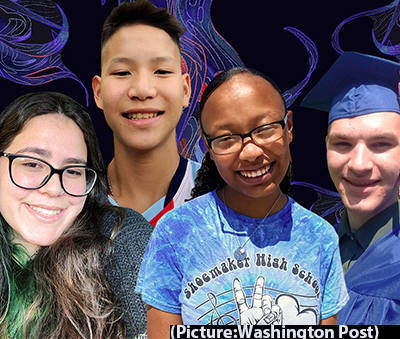
After arriving in India, Mother Teresa began her novitiate (the period of training and preparation that a Christian novice or member of a religious order undergoes prior to taking vows in order to discern whether he or she is called to vowed religious life) in Darjeeling. Mother Teresa learned Bengali and taught at St. Teresa’s School near her convent. She took her religious vows on May 24, 1931 and chose to be named after Therese de Lisieux, the patron saint of missionaries. Though a nun in the convent had already chosen the name, Agnes opted for its Spanish spelling – Teresa. Mother Teresa was disturbed by the poverty surrounding her in Calcutta. On September 10, 1946, Mother Teresa experienced what she later described as “the call within the call” when she travelled by train to the Loreto Convent in Darjeeling from Calcutta for her annual retreat.

Mother Teresa began missionary work with the poor in 1948. She replaced her traditional Loreto habit with a simple white cotton sari that had a blue border. Mother Teresa adopted Indian citizenship. She also spent several months in Patna to attain basic medical training at Holy Family Hospital and ventured to slums. In 1950, Mother Teresa founded the Missionaries of Charity, a religious congregation. While teaching poor children in Calcutta, Mother Teresa did not have any supplies or equipment to impart knowledge, yet she managed to teach the children to read and write by writing in the dirt with wooden stick

Mother Teresa rescued 37 children trapped in a front line hospital by brokering a temporary cease-fire between Israel and Palestine. Accompanied by Red Cross workers, she traveled through the war zone to the destroyed hospital to evacuate the young patients. She was fluent in 5 languages – English, Hindi, Bengali, Albanian, and Serbian. During her humanitarian missions, Mother Teresa suffered from numerous diseases and injuries. She had pneumonia, malaria, suffered two heart attacks, and even broke her collar bone. She worked for orphans, AIDS patients, refugees, blind, disabled, alcoholics, poor, homeless, victims of floods and epidemics and famine. Mother Teresa received more than 120 honors and awards during her lifetime including the Ramon Magsaysay Peace Prize in 1962 and Nobel Peace Prize in 1979. Mother Teresa was canonized at a ceremony on September 4, 2016 in St. Peter’s Square in the Vatican City.

Teens In US Are Optimistic About Future

Grigsby’s largely upbeat attitude about the future, combined with a world-weary realism that seems mature beyond her years, is echoed in the findings of a national Washington Post-Ipsos poll of teens ages 14 to 18. While still hopeful about what lies ahead, many teens do not view the current moment so favorably. Fifty-one percent say that now is a bad time to be growing up, compared with 31 percent who answered that way 16 years ago, in a poll of teens conducted by The Post, the Kaiser Family Foundation and Harvard University. Their parents are even more negative, with more than 6 in 10 saying it’s a bad time for teenagers to be growing up.

These young Americans, who are coming of age amid a once-in-a-lifetime pandemic, political and social unrest, growing economic inequality and rising crime, are keenly aware of the country’s problems. Majorities view political divisions, racial discrimination, the cost of health care and gun violence as “major threats” to their generation, according to the new Post-Ipsos poll. Nearly half also rank climate change as a major threat. Some are already trying to make a difference. Heily DeJesus, who lives in Lebanon, Pa., said she dashed from her brother’s high school graduation to a Black Lives Matter protest, where they all took a knee for a selfie as her brother raised his fist in the air. “It felt great to know that we’re a part of making a change for the world,” she remembered. “Even if it’s a small town, we’re still making a change.” The survey of 1,349 teens was conducted online in May and June primarily through Ipsos’s randomly recruited panel of U.S. households. Overall results have a margin of error of plus or minus three percentage points, and the relatively large sample allows comparison of White, Black, Hispanic and Asian teens.
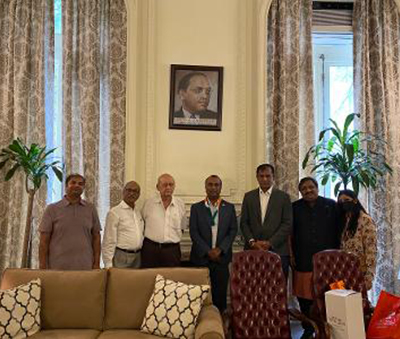
These young people are part of what is likely the most diverse cohort in the nation’s history. New Census Bureau data shows that the country’s under-18 population is majority-minority for the first time, with White children making up 47.3 percent of that age group compared with 53.5 percent in 2010. Their childhoods have been marked by racial justice protests and a growing societal acceptance of LGBTQ people. Most also perceive significant discrimination against a wide range of groups in American society. Black and transgender people topped the list, with about 6 in 10 teens saying Black people are treated unfairly very or somewhat often and an almost equal share saying the same thing about transgender people. But even given such looming challenges, the optimism of teens runs through the poll findings, especially when it comes to what the future holds for their own lives.

Nine in 10 teens say they are very or fairly likely to achieve a good standard of living as an adult, while nearly half still believe their opportunities to succeed in life are better than their parents’ were. About 4 in 10 believe they are about the same, while fewer than 2 in 10 say their opportunities to succeed in life are worse. Vincent Bornhorst has a rosy view of his future. The 18-year-old, who just graduated from Thomas S. Wootton High School in Rockville, Md., is a freshman at Virginia Tech, majoring in computer science. Earning a college diploma is a top priority, he says, which puts him among the roughly 8 in 10 teens who describe this goal as important. He expects to have about the same opportunity to succeed as his mother, a physician, and his father, a stay-at-home dad. What he doesn’t anticipate: one day becoming rich or famous, especially since he thinks the latter would entail public speaking, which he hates. ‘Overall, even with the omnipresence of social media stars who make achieving celebrity and wealth look as easy as racking up TikTok likes, a significantly smaller percentage of teens today believe they will become rich.

About half think it’s very or fairly likely that they will be rich one day, compared with more than 6 in 10 in 2005. White teens like Bornhorst are among the least likely to expect to become wealthy – with 44 percent predicting they will likely become rich. That number rises slightly to 49 percent for Hispanic teens. By contrast, about three-quarters of Black teens and two-thirds of Asian teens believe they will be rich one day. (Presumably, the notion of the top 1 percent hasn’t quite sunk in yet.) Bornhorst is also among the more than 9 in 10 teens who say it is important to achieve career success and to have enough free time to do the things they want. Some might view the two goals as contradictory, but Bornhorst thinks one requires the other. “I view free time as important to being successful,” he said. “If you’re just working hard all the time 24/7, you’re fairly likely to tire out.” DeJesus experienced that tension firsthand. The high school senior held two jobs to make her car payments during the pandemic on top of hustling at school. “Working all the time was really rough on my mental health.”

In fact, she said, “the whole year was horrible.”

In all, 45 percent of teens say the worst pandemic in a century has had a negative impact on their mental health, while another 45 percent say it had no impact at all and 10 percent say it had a positive impact. Four in 10 teens also report that the spread of the coronavirus had a negative impact on their relationships with friends. About half of teens say pandemic hurt their academics; more say bonds with parents got better than worse Emily Guzman, a 17-year-old senior from New York City, said she fell out with a friend at the beginning of the pandemic, and the social distancing made it harder to reconcile. “One of my friends had to put us into a group chat, and we talked about it,” Guzman said. She said she and her friends communicated during their pandemic isolation via texting and FaceTime. “It was stressful,” she said. “We all went from seeing each other every day to a whole year without seeing them.” Owen Porter, a rising senior in Davis, W.Va., was among those who found a way to stay in touch through gaming — Call of Duty and Minecraft were two of his favorites — and watching movies together on Discord.

“We would stay up till like 2 in the morning watching ‘American Horror Story,’ ” Porter said.

A surprising silver lining: Nearly 4 in 10 teens say the pandemic has had a positive impact on their relationships with their parents, compared with about 1 in 10 who say it had a negative impact and roughly half who say it had no impact. For once, the whole family was at home instead of running off in different directions. There were long stretches of not much to do and more time to talk, some teens said. Steven Townley, a 10th-grader in Augusta, Ga., said his family bonded even more tightly during the pandemic. “I got to spend more time with them and I got to get closer with them,” he said. Even when all of them contracted covid-19 and isolated in their home “we made the best of it.” They all recovered, he said. School did not fare as well with the teens surveyed; about half said the pandemic had a negative impact on their academics. The technology was glitchy at times, remote learning invited slacking for some teens, while others thought teachers weren’t up to the task.

“It felt like we didn’t get enough material. It seemed to change how much they taught us,” said Abigail A., a high school student in North Dakota whose parents allowed her to speak on the condition of partial anonymity because they were concerned about her responses lingering on the Internet. DeJesus said she struggled but still managed to maintain her grades. Pandemic or not, DeJesus believes that if she keeps pushing, she will graduate from college and succeed in life. Her dream: to be a lawyer. “I feel like in the past a lot of people didn’t go to college, they stayed in their towns and said, ‘This is what I’m going to do for the rest of my life,’” said DeJesus, the Puerto Rican daughter of a mechanic who didn’t attend college and a stay-at-home mother who did. “A lot of people [my parents’ age] are struggling right now.” More than half of Hispanic teens like DeJesus, as well as similar majorities of Asian and Black teens, say it is “very important” to graduate from college, compared with about 4 in 10 White teens. The disparity is greater among lower-income households.

Teens who say graduating from college is very important are more likely to believe that the country’s best days are ahead of us, at 48 percent, compared with those who consider it less important, at 39 percent. Overall, a majority of teens — 56 percent — say they believe that the country’s best years are behind us, a shift from 2005, when roughly the same percentage said the country’s best years were still ahead of us. White teens are more apt to believe that the American glory days are gone.

Bornhorst believes life will only get better, largely due to technology and innovation, he said.“We are progressing quite a bit,” he said. “Technology will help us accomplish more things. People will have more spare time.” And yet Americans might be their own worst enemies — quite literally — when it comes to the country’s future, he said. “I feel like the U.S. has a lot of potential that we’re not using to the fullest,” he said. “We’re too divided politically and that is very much slowing down progress.” Bornhorst sees the country’s diversity as a competitive strength and, conversely, racial discrimination as a “major threat” to his generation, he said. His opinions are shared with a majority of his peers. About 6 in 10 teens say political divisions are a major threat to their generation. About the same share the view that racial discrimination as a major threat. The percentages differ widely between White teens and teens of other races and ethnicities. About 2 in 5 White teens say racial discrimination is a major threat, compared with more than 4 in 5 Black teens and more than two-thirds of Hispanic and Asian teens. Roughly 7 in 10 teens whose parents were not born in the United States perceive racial discrimination as a major threat.

Townley is struck by how quick some Americans are to judge — not only people of color but Whites, too, he said. “Some people do things they shouldn’t, and people see that and automatically think that everybody who looks like that person acts the same way. … It’s like judging a book by its cover,” said Townley, who is of Vietnamese descent and one of several children of color adopted by his White parents. Tha’keysha Murphy, an African American senior in Copperas Cove, Tex., believes that Whites are rarely treated unfairly, a view shared by 56 percent of all teens polled, including 43 percent of White teens and large majorities of minority teens. Murphy, 17, said she has noticed that’s particularly true at her school when punishment is meted out. She recalled a recent argument between a White student and an Asian student that turned into a physical fight. Although Murphy perceived that both students played an equal role, “the White person got off easier.”

About 1 in 5 teens say they have been treated unfairly over the past year due to their race and ethnicity. DeJesus had such an experience. She said she was speaking in Spanish with a family member on the phone while shopping at a local outlet mall when a White person screamed at her to “go back to my country,” she said. “It’s always the same thing,” DeJesus said. “They say our people should go back to our country, but I don’t think they know Puerto Rico is a U.S. territory.” DeJesus put her anti-racist views into action last year by joining the Black Lives Matter protest, among the 12 percent of teens who said they have attended a BLM rally. Sixty-one percent said they support the movement, according to the teen survey, about the same percentage of adults who said they did in a 2020 Washington Post-ABC News poll. Grigsby, the teen from rural Minnesota who describes her heritage as African American,

European, Jewish and Indigenous, said her consciousness was raised about racism long before Floyd’s murder. As a 10-year-old in her predominantly White elementary school, she said she was “bullied and called the n-word” and physically attacked by her classmates. Her family’s protests were ignored, Grigsby said, so they filed a discrimination complaint with the state Department of Human Rights in 2015, which ended with a settlement in 2018. “It definitely hardened my character and made me more resilient and aware,” said Grigsby, who in the wake of Floyd’s murder co-led a walkout at her school and formed an advocacy group that, among other goals, seeks to ensure the hiring of more teachers of color. Abigail, who is White, believes that the discrimination can work both ways. It seems that barely a few days go by, she said, before she reads news that a member of a minority group has accused a White person of racism. She blames the media for creating division by too often pointing out the racial backgrounds of alleged victims and perpetrators.

She used to think more like a Democrat, she said, but gradually has come to adopt the perspective of her father, who is conservative. Perhaps not surprising for a generation that is particularly close to their elders, teens frequently echo their parents’ political beliefs. Two-thirds of teens whose parents lean toward the Democratic Party also say they lean that way, while about 6 in 10 teens whose parents lean Republican say they also lean Republican. Just 3 percent of teens say they lean toward the rival political party of their parents. Teens’ political leanings also affected their responses. For example, 72 percent of teens who said they were closer to the Democratic Party perceived climate change as a major threat, while only 17 percent of Republican-leaning teens did. “God creates the climate,” said Townley, who like his Reformed Baptist parents considers himself conservative. Teens’ political beliefs heavily influence what they think of President Biden and former president Donald Trump. A large majority of Democratic-leaning teens say Biden is doing a good job and that Trump did a bad job, and a large majority of Republican-leaning teens say the opposite.

Trump “built the economy better and made sure we had our vaccine so that people could make the decision about whether to take it,” Abigail said. Meanwhile, Biden is handling immigration poorly, she said. “He stopped building the wall and now a lot of people are getting in.” But Abigail does not believe such differences of opinion need to lead to political divisions, which she considers a “major threat” to her generation, a view shared by roughly two-thirds of both Republican and Democratic-leaning teens. “I know that people say there is a big gap between the two,” she said, “but I feel like there could be more common ground.” Grigsby sees a third path, along with roughly half of teens who say they do not lean toward either major political party. “Democrats are a lot of talk and don’t do very much,” said Grigsby, who leans socialist like her mother. “The Republicans, they do things, but they do things that harm the culture and marginalized people.” To Grigsby, Biden is best defined by what he’s not: Trump.

A self-described news junkie, Grigsby quickly rattled off what she perceives as Trump’s transgressions, from his handling of the pandemic — “He lied about it and called it a hoax” — to his attitudes on race. “He said ‘when the looting starts, the shooting starts.’ But if I understand correctly, he did not denounce what Kyle Rittenhouse did in Kenosha, Wisconsin.” And, finally: “He incited an insurrection and endangered his own vice president.” As she watched Trump’s supporters storm the Capitol on Jan. 6, Grigsby said, “I just remember thinking that this whole country is in shambles.” She worried that perhaps the racism of the past would become a fixture in the future. In the months since, the teen has come to think of the forces of white supremacy and the countervailing power of anti-racism as two magnets held in suspension, neither overtaking the other. Yet Grigsby remains mostly optimistic that teens like her — neither Democrats nor Republicans but fully committed to equality — might be the ones to finally break the logjam. (Courtesy: Washington Post)

AAPI Launches Adopt-A-Village, A Rural Health Initiative In India Ambassador Taranjit Singh Sandhu & Consul Generals From All 5 Consulates In US Applaud AAPI’s Efforts

Continuing with its magnificent efforts to help their motherland, members of American Associati9on of Physicians of Indian Origin (AAPI), the premier medical organization in the United States initiated Adopt-A-Village, a Rural Health Initiative in India during a virtual launch event on Friday, August 27, 2021. Chaired by, Dr. Satheesh Kathula, the much needed and popular program has Dr. Anupama Gotimukula, Dr. Jagan Ailinani and Dr. Ram Singh as members of the Committee.

In a rare show of support for AAPI, honorable Consul Generals of Chicago, New York, Houston, Atlanta and the Deputy CG of San Francisco participated live during the launch of this noble initiative. Ambassador of India to US, Taranjit Singh Sandhu joined the meeting with his message and lauded the numerous efforts of AAPI for India, especially during the pandemic.

Dr. Anupama Gotimukula, President, AAPI, in her welcome address, referred to the objectives of Adopt-A-Village. “A lot of efforts is being put into this initiative, “Adopt a Village” Project where AAPI in collaboration with Global TeleClinics, Inc., plans to adopt 75 villages in honor of 75 years of India’s independence,” she said.  “As India celebrates her 75th anniversary Independence Day celebrations, AAPI has planned to adopt 75 villages in India spread across the states of Andhra Pradesh, Gujarat, Karnataka, Tamil Nadu and Telangana, where the rural people of India will be offered ‘Free Health Screenings in 75 Rural Villages’ for Anemia (CBC), DM (HbA1C), High Cholesterol, CKD, Malnutrition, Kidney Disease, Malnutrition, Obesity, and Hypoxemia.  Results analyzed by GTC and further action recommended by their team of experts will be also, followed up. This is a small contribution from AAPI to Mother India in celebration of Azadi Ka  Amrut Mahotsav.” Dr. Anupama thanked the AAPI members for their generous support for this noble work of AAPI and for sponsoring their ancestral villages and going back to their roots.

In his opening remarks, Dr. Satheesh Kathula, Chairman of AAPI’s Adopt A Village Program pointed out about the need for this noble initiative. He said, India has nearly 700,000 villages. Three out of four Indians and about 77 percent of the poor live in villages. The majority of the population has no access to safe drinking water and sanitation. The needs in these rural areas are unlimited and the scope to work are endless. “By adopting one village at a time and working with the government and NGOs, NRIs can make a difference,” he said. Dr. Kathula referred to some of the programs in place in several rural villages, including supply of Cloth mask, clean drinking water and free health care screening that has benefitted thousands of people Across India.

Dr. Ravi Kolli, President-Elect of AAPI, said, “While India has made substantial progress in health care as evidenced  by the fact that life expectancy in India at birth now is 71 years as opposed to 58 years in 1990 and 41 years in 1960, there are significant gaps and divergence in health metrics in different regions in India. India, thus needs to redouble and continue its efforts and dedicate resources to tackle these perennial challenges. The post graduate training of physicians specializing in Family Medicine in every teaching institution will create a motivated and well trained family physicians to address these deficits and deliver accessible, affordable, economical and continuous preventive and primary care to rural as well urban poor populations to raise health outcomes substantially all across India,” he said.

“An individual can make a tremendous difference in the lives of many in India by adopting a village,” said Dr. Jagan Ailinani, who was instrumental in founding this noble program and set an example by adopting his own birth village in the state of Telangana in India. “A majority of the NRI’s hail from villages and would like to do their part to bring progress to villages in our state and country.”

Dr. Ram Singh said: “NRIs can adopt the village they hail from originally and make a significant contribution towards its development. There is a real will and desire on the part of governments, both at the state and the center to work with NRIs and NGOs to bring development to rural India.”

Dr. Kusum Punjabi, Chair of AAPI BOT said, “Many of these projects and programs need regular funding, and management of resources. We are grateful to dozens of AAPI members who have committed to Adopting a village in India with an ongoing commitment for investment.”

Ambassador Taranjit Singh, in his message to AAPI members, said, “As India is entering 75th year of independence, honoring men and women, who fought for the freedom, we rededicate ourselves to build an India where the dreams and aspirations of India’s 13 billion people are realized.” He urged the Diaspora community to come forward to honor INDIA by joining in the year-long celebrations.

Dr. Jayesh Shah, past President of AAPI, introduced Consul General of India in Houston, Aseem Mahajan. In his address on “Indo-US Relationship In Healthcare -Rural Health Perspective” Ambassador Mahajan told the AAPI members: “You are true the heroes and partners with us, and you make us proud, especially during the critically vital Covid times.” Urging the Diaspora to contribute towards strengthening of India’s partnership with the US, Mr. Mahajan focused on India-US partnership on various health related issues, while stressing the many healthcare initiatives by the Government of India. “AAPI can play a big role in rural health, which has been a priority for the Government of India,” he said. He thanked and appreciated the many Doctors, who are already doing similar noble initiatives, helping the rural communities have access to clean drinking water. “We can work together, collaborating and sharing of knowledge and expertise, including Medical Education,” he told AAPI.

Dr.  Suresh Reddy, past President of AAPI and currently an elected Trustee of Oakbrook Village in Illinois, after introducing the Consul General of India in Chicago, Amit Kumar, announced that he is adopting his native village in the state of Telengana. In his address, Mr. Kumar spoke about “Rural Health In India, The Current Situation,” and focused on technological areas in healthcare development in the rural parts of India. “Your activities and the message to spread awareness on Covid and for providing PPEs to India are highly appreciated,” he told AAPI members, pointing to the fact that India has vaccinated over 600 million people and he hoped that India will offer vaccines to majority of India’s vast population soon.

Introduced by Dr. Sudhakar Jonnalagadda, immediate past President of India, Consul General of India in Atlanta Dr. Swati Kulkarni focused on “How AAPI and Doctors can Help India.” She said, “It’s important and laudable that you have undertaken to help India during the 75th anniversary of India’s Independence. Dr. Kulkarni shared her views on how AAPI and the government of India can collaborate in: Diplomacy for development, where “India needs overseas expertise, and you are best suited to offer,” she said, while calling upon Indian American Doctors to be part of India’s efforts to enhance the GDP. “India’s healthcare industry is growing rapidly there is more scope for growth with expanded pharma industry and medical tourism. She stressed the need for AAPI’s role in enhancing India-US political partnership, where AAPI is “a major stake holder,” she said.

Dr. Mukesh Nigam introduced Consul General of India in New York, Randhir Jaiswal. In his address on “Rural Health in India: The Challenges and Solutions” Ambassador Jaiswal said, “This noble initiative by AAPI has become more meaningful especially during the 75th anniversary of India’s Independence.” Reminding AAPI members of Modi’s call to rebuild a new India, he said, “AAPI’s initiative is even more meaningful and fits well into PM’s vision for India.” He said, ‘We applaud and thank AAPI for coming forward to help India, especially during the covid pandemic.”

Dr. Sujeeth Punnam, a renowned cardiologist introduced Deputy Consul General of India in San Francisco, Rajesh Naik. While speaking on “Rural Health, What India can learn from Developed Nations” Mr. Naik said, “AAPI has provided tremendous support as India and Indian community were struggling with the challenges of Covid. You rose to the occasion and came forward to help and support, which have been highly appreciated by the Diaspora.” During the 2nd Covid surge, AAPI stepped forward and have sent out Millions of Dollars of medical supplies to Indi, he said. While pointing to the many challenges of healthcare in rural India, Mr. Naik urged how AAPI could offer tele medical consultation in rural India, especially focusing on the preventive aspect of health in India. .

Dr. Anjana Samadder, Vice President of AAPI, said, “By adopting one village at a time and working with the government and NGOs, NRIs can make a huge difference in the lives of millions of people in India. Each project will involve a tripartite partnership between the NRI, state government and a local NGO.”

Dr. Krishan Kumar, Treasurer of AAPI pointed out, “The cost for adopting a village depends on various factors, including the population of the villages, the services that are required and what one is willing to commit to for the welfare and progress of the village one is committing to adopt.”

Dr. Lokesh Edara, chair for AAPI’s global initiative, while focusing on International medicine and how India is lagging behind in medical care, while urging the Government of India, pointed to how India needs to focus on Post Graduate Medical professionals rather than having Doctors with under graduate degree alone.

Dr. Gokula Murthy spoke about “Adopt-A-Village” by Global tele-clinics and shared with the audience as to how his firm has strived on ‘Blending medicine and technology,” while pointing to the “great opportunity to enhance the effectiveness of tele-health through awareness, education and sustainable development in all villages.”

There is no instant solution for rural India’s myriad problems. But by adopting one village at a time and working with the government and NGOs, NRIs can make a difference. Over time, an improved village could lead to an improved region, state and country.

Physicians of Indian origin are well known around the world for their compassion, passion for patient care, medical skills, research, and leadership. They have excelled in their fields of medicine, and thus have earned a name for themselves through hard work, commitment and dedication to their profession and the people they are committed to serve. Not satisfied with their own professional growth and the service they provide to their patients around the world, they are in the forefront, sharing their knowledge and expertise with others, especially those physicians and leaders in the medical field from India.

Dr. Gotimukula, urged “AAPI members to consider joining this movement and adopt a village. May be your own village of origin. AAPI will work with you in coordinating the efforts and through the support system we have in several states, will help you achieve this goal of giving back to our motherland.” AAPI members/families can sponsor a Village by emailing to: aapipresident@aapiusa.org and info@aapiusa.org.  For more details, please do visit: www. aapiusa.org

Gandhian Society Plans Digital Museum Project For Mahatma Gandhi In New Jersey

The Gandhian Society met with the Consul General of India in New York Shri. Randhir Jaiswal to discuss the digital museum project for Mahatma Gandhi in Edison along with the Aditya Birla Group representatives. The members apprised the consul general of the activities of Gandhian Society, especially the charitable work of sending oxygen concentrators to India in the beginning of the second wave in May – 2021.

The Society also informed the consul general of the Khadi Fashion show and Patriotic Music Competition held on India’s Independence Day in Central Jersey. The Gandhian Society along with the Birla Group representatives also explained to the Consul General the intended purpose and logistics of the proposed museum for Mahatma Gandhi. The consul general appreciated the proposed project and promised to extend his support for the project.
The Gandhain Society later felicitated the out going deputy Consul General Shatrughan Sinha ji for his services and support to the Indian Community and Gandhian Society activities. The members thanked him and the consulate staff for their excellent service and help to the community during the pandemic and praised their work and help during the most difficult times. The Gandhian Society honored the outgoing deputy consul general with a memento and Gandhian Jacket as a token of their respect and appreciation. The Gandhian Society was represented by founder Bhadra Butala, Rajendar Dichpally, Mahesh Wani, Hasmukh Patel. The Birla Group was represented by Nitin Mathuria and Riddhima. The Gandhain Society along with GOPIO and other Organizations will host an event in the Indian Consulate to observe the birth anniversary of Mahatma Gandhi on October 2nd.

In Kerala Village, Expatriates Join Hands To Set Up Steel Plant

After working in Sharjah for 15 years, T C Shiju, 42, returned to his home in Thikkodi village, in Kozhikode district of Kerala, about two years ago. He was exploring investment choices, when he found a viable option in his village itself. With an investment of just Rs 1 lakh, he became a partner in GTF Steel Pipes and Tubes LLP, a novel manufacturing venture set up by expatriates hailing from Thikkodi and its surrounding villages. Set up by the Global Thikkodiyans Forum (GTF) — a social media group of expatriates from Thikkodi floated in 2015 following a looming job crisis in the Middle East – in May 2018, the unit commenced production earlier this month.

This is the first such attempt in the state where expatriates, and returnees, of a village have come together and mobilized capital for a business enterprise of this kind. The total investment of Rs 18 crore was raised from 207 people. Of these, 147 invested only Rs 1 lakh each. The price of a share was fixed at Rs 50,000, and an individual had to invest in at least two shares. There was a cap on the maximum investment as well – Rs 40 lakh per person. “The major highlight of the venture is that a large section of investors are ordinary people who have some small savings, a few lakh rupees, after years of toil in the Gulf. But for an initiative of this type, they would not have been able to be a part of a professional business venture,” said GTF Steels Chairman Mohammed Basheer Nadammal.
“Most of these returnees invest in trade or hotel industry, and then back out after incurring huge losses. Our concern was to make such people a part of a business venture,’’ he said. Ummer Koyilil, 60, returned to Thikkodi village about two years ago, after working in Bahrain for 18 years. “I tried to set up a small business, but it did not materialise,” he said. “I have invested only Rs 1 lakh in this venture. This has given me exposure to a business enterprise. Otherwise, I would have ended up as a small trader,’’ he said. Before deciding to set up a unit to manufacture galvanised iron pipes and tubes, the GTF explored other possibilities, including integrated farming and tourism.

Explaining why they opted to set up the unit, GTF Steels CEO Ishaq Koyilil, also from Thikkodi, said: “As per our analysis, the monthly demand of GI pipes and tubes in Kerala was 40,000 metric tones during pre-Covid. It would be down to 25,000 metric tones now. However, the production in Kerala is only 4,000 metric tones per month. Our monthly production capacity is 3,000 metric tones. We see a huge growth potential, as construction and infrastructure sectors are poised for major growth in Kerala.” None of the partners work in the factory. The recruitment was done in a professional manner, with only qualified, trained workers being selected.

Abdul Latheef, also from Thikkodi, said they wanted to put forward a business and investment model which could be emulated across the state. “This model will help ordinary expatriates to invest their hard-earned savings in viable business ventures. We have 2,000-odd members in the GTF. Only those interested in investing in the steel industry were selected as partners. We are planning other enterprises too, in which others in the forum can invest,’’ he said.

Chronicling 500 Years Of Indian Immigration To Britain

This is a chronicle of five-hundred years of Indian immigration to Britain as it explores the adventures of the imperial capital and how its saga fuelled the journey of Indian independence. In September 1600, Queen Elizabeth and London are made to believe that the East India Company will change England’s fortunes forever. With William Shakespeare’s death, the heart of Albion starts throbbing with four centuries of an extraordinary Indian settlement that author Arup K. Chatterjee unfolds in “Indians in London” (Bloomsbury). In five acts that follow, we are taken past the churches destroyed by the fire of Pudding Lane; the late eighteenth-century curry houses in Mayfair and Marylebone; and the coming of Indian lascars, ayahs, delegates, students and lawyers in London.

From the baptism of Peter Pope (in the year Shakespeare died) to the death of Catherine of Bengal; the chronicles of Joseph Emin, Abu Taleb and Mirza Ihtishamuddin to Sake Dean Mahomet’s Hindoostane Coffee House; Gandhi’s experiments in Holborn to the recovery of the lost manuscript of Tagore’s Gitanjali in Baker Street; Jinnah’s trysts with Shakespeare to Nehru’s duels with destiny; Princess Sophia’s defiance of the royalty to Anand establishing the Progressive Writers’ Association in Soho; Aurobindo Ghose’s Victorian idylls to Subhas Chandra Bose’s interwar days; the four Indian politicians who sat at Westminster to the blood pacts for Pakistan; India in the shockwaves at Whitehall to India in the radiowaves at the BBC; the intrigues of India House and India League to hundreds of East Bengali restaurateurs seasoning curries and kebabs around Brick Lane�the book details all this and more. “Indians in London” is a scintillating adventure across the Thames, the Embankment, the Southwarks, Bloomsburys, Kensingtons, Piccadillys, Wembleys and Brick Lanes that saw a nation-a cultural, historical and literary revolution that redefined London over half a millennium of Indian migrations-reborn as independent India.
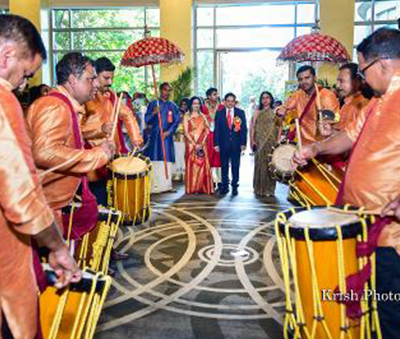
Arup K. Chatterjee is an Associate Professor at O.P. Jindal Global University. In 2014, he was a recipient of the Charles Wallace fellowship, to United Kingdom. His interests are in the history of British imperialism, politics and philosophy; British cultural and historical encounters with India; and colonial and postcolonial historiography of India; Vedanta and Nondualism; and Indian philosophy and psychoanalysis.

AKMG’s 42nd Annual Convention Held in Atlanta

(Atlanta, GA: August 25, 2021) The 42nd annual Association of Kerala Medical Graduates (AKMG) convention was held from Friday, August 13 to Sunday, August 15. It was held at the Inter-Continental Buckhead Hotel in Atlanta, GA. Attended by 425 fully vaccinated Doctors of Kerala origin and their families from the US and Canada. The annual convention was the best forum for friends to get together, converse, reminisce about their past medical college campus life. Also, it includes singing old and new songs, network and be enriched and entertained.

AKMG annual conventionIn his presidential address, while expressing gratitude to the members of AKMG “for giving me the opportunity this year to be the President of our wondrous organization”. Dr. Subrahmanya Bhat said, “I worked very hard to make sure that this year’s AKMG was the best it could be. Likewise, our executive team has worked very hard to make sure the convention would be successful and profitable. Despite the challenges posed by the pandemic.”
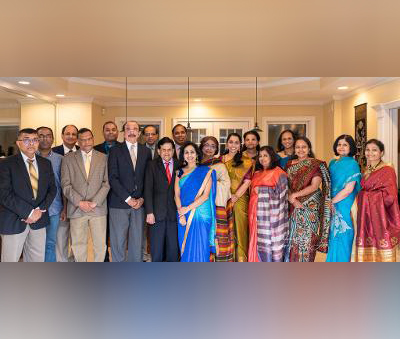
Enumerating some of the accomplishments under the current leadership, Dr. Bhat said, “We have added close to 400 new life members to the AKMG organization. We have started a mentorship program for young physicians who are working on improving their craft,” said. Pointing to the several charitable events and programs AKMG has organized, Dr. Bhat said, “We have supported several food banks that have fed the hungry. In addition, our teams raised enough funds to feed 10,000 homeless people last Christmas.”

Back home in Kerala, with the generous contributions from AKMG members, Dr. Bhat and his team have “raised over $200,000 for Covid relief in Kerala. And provided PPEs and Pulse oximeters to Healthcare workers and Hospitals in Kerala. Furthermore, we have started a new telehealth service called Dronacare, in partnership with Innovation Incubator Inc. This is with the intent of providing free healthcare consultation to people in Kerala. ” In addition, AKMG has initiated the steps to bridge Kerala CDC and Atlanta CDC under the direction of Dr. MV Pillai, Past President of AKMG.

AKMG membersWhile inaugurating the convention with the traditional lighting of the lamp, in her keynote address, Dr. Swathi Kulkarni, Consul General of India in Atlanta, described the Indian American Physician community as a “Testament to the greatest growth story”. While emphasizing the role of physicians during the pandemic, Dr. Kulkarni praised their contributions and achievements. Dr. Kulkarni shared with the audience about the many programs and plans offered by the Government of India. Those are to alleviate the sufferings of the people of India during the pandemic. In addition, Dr. Kulkarni stressed the importance of the Indo-US Strategic Alliance, especially in the health sector. While pointing out India’s contributions to providing the world with quality drugs for lower prices.
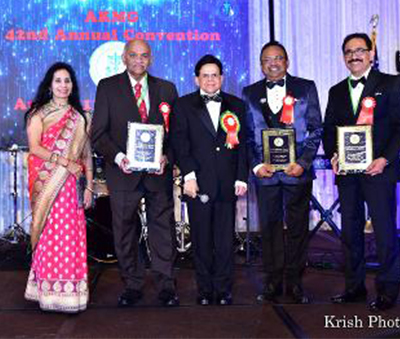
Dr. Vikas Kapil from the CDC delivered the keynote address. Dr. Asha Thomas, an IAS officer and head of Health and Human Services and Medical education in Kerala, attended the convention.  Governor of Georgia, Brian Kemp, Dr. Vivek Murthy, US Surgeon General, and the Chief Minister of Kerala sent best wishes and greetings to the delegates at the convention.  In his message, Kerala’s Chief Minister, Pinarayi style=”float: left; margin: 0px 15px 15px 0px;”Vijayan, praised the achievements of the Indian doctors using the knowledge gained from India. He also congratulated AKMG for being the oldest medical organization with 42 years of history. And for its members being the ambassadors of Kerala.

AKMG Association awardsBeing away from home, the participants were led to celebrate Onam with traditional festivities. It including a reception to King Mahabali with thalapoli and chenda melam followed by an Onam feast. The Fashion show, choreographed by Anu Bhat, displayed the best of Indian attire elegantly adorned by beautiful young women as they cat walked to the audience’s delight. Mamta Mohandas, a famous actress from the Malayalam Cinema world, was an added attraction during the Fashion Parade.
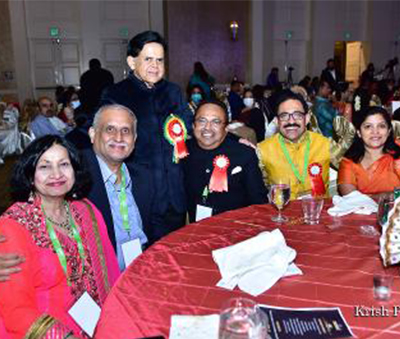
The Campus Comedy Night, which has come to be known as an integral part of the annual event since it had started way back in 1986, was a treat to the hearts and souls of the participants during the AKMG Convention in Atlanta as it showcased the diverse talents in music, art and acting by the members of AKMG fraternity. “The AKMG, the pioneering organization of Indian physicians in the US, formed three years earlier than the American Association of Physicians of Indian Origin, AKMG inspired the formation of AAPI,” Dr. Sudhakar Jonnalagadda, Immediate Past President of AAPI, said.

An elegantly done annual Souvenir was released during the convention. Dr. Annapurna Bhat, Chair of the AKMG Convention Souvenir Committee Chair, said, “I am most honored and delighted to be a part of AKMG, or the Association of Kerala Medical Graduates, North America, a wonderful secular organization serving and empowering Indian healthcare professionals of Kerala origin in USA and Canada.”

Annual convention colleaguesDr. Sunil Kumar, Chair, AKMG Humanitarian Services, thanked AKMG members as they “stepped up to the plate when our motherland was crying for help. I have always been proud of AKMG’s commitment to charity and even more today with your actions. As you know, when the COVID second wave started threatening India, we came together and helped our people prevent a catastrophe. As a result, we were able to reach an agreement with the international charity organization GLOBAL MEDIC to match our donations with $100,000 worth of PPE equipment.”
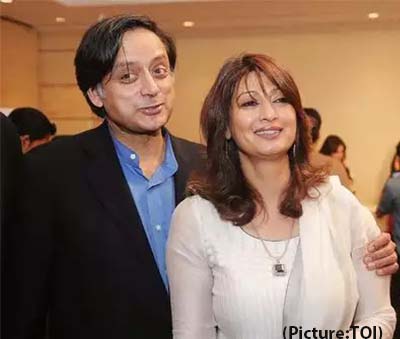
Dr. Lizy Thaliath, AKMG Convention Chair 2021, said, “As the convention committee chair, it is my honor to welcome all distinguished guests, family members, and participants of the AKMG 42nd convention in Atlanta. We have gone through a pandemic that has destroyed millions of lives and upended many global economies, and for the brunt of it, we healthcare workers have been fighting on the frontline. We pay respect to all who lost their lives in this fight in the hope of keeping the fight going strong.”

At the fabulous Saturday Nite Gala, Dr. Bhat handed over the charge to incoming president Dr. Nigil Haroon, who in his inaugural address, said, “I am humbled and honored by the opportunity to serve as your president for its 42nd year. As I undertake to represent the AKMG as its President for 2021-22,” he said and promised to work to strengthen the organization and enhance its relationship with organizations of other medical professionals. As always, AKMG will continue focusing on charitable activities and helping the medical colleges back in Kerala. For more details, please visit www.akmg.org.

Attorney Sanjay Wadhwa Named Deputy Director of SEC’s Enforcement Division

The Securities and Exchange Commission has announced the appointment of Sanjay Wadhwa as deputy director of the Division of Enforcement. The Indian American attorney most recently served as the senior associate director of the Division of Enforcement in the New York Regional Office, where he managed more than 150 personnel in enforcing federal securities laws. His new role is effective immediately, said the SEC press release on August 18th.

“Over the hundreds of investigations he has overseen, Sanjay has helped the SEC root out wrongdoing, pursue charges against those who seek to manipulate or defraud investors, and partner with criminal authorities to prosecute bad actors,” said SEC chair Gary Gensler. “Sanjay’s breadth of experience and dedication to protecting investors make him well qualified to serve as deputy director of the Enforcement Division. I look forward to working with him in his new role.” “Sanjay brings a tenacious approach to our work, and he is passionate about protecting American investors,” said Gurbir Grewal, the SEC’s Director of Enforcement. “I am eager to work closely with him in his new role.”

“It has been an honor to serve alongside the SEC’s esteemed Enforcement staff for the past 18 years,” said Wadhwa. “I look forward to working with Gurbir and the entire Enforcement Division to oversee investigations and litigation matters to help protect investors and promote integrity in the marketplace by holding wrongdoers accountable.” Wadhwa joined the SEC as a staff attorney in 2003. As co-head of Enforcement in the SEC’s New York office, he was responsible for the day-to-day functions of that office’s enforcement program. He also previously served in additional roles in the Enforcement Division, including deputy chief of the Market Abuse Unit and assistant director in NYRO. Prior to joining the SEC in 2003, Wadhwa served as a tax associate at Cahill Gordon & Reindel LLP and Skadden, Arps, Slate, Meagher & Flom LLP. Wadhwa has a B.B.A. from Florida Atlantic University, a J.D. from South Texas College of Law Houston, and an LL.M. in taxation from New York University School of Law.

Shashi Tharoor Cleared By Delhi Court In Sunanda Pushkar Death Case

In a big relief for Congress MP Shashi Tharoor, a Delhi court Aug. 18 discharged him in the Sunanda Pushkar death case. Special judge Geetanjali Goel said, “The accused is discharged.” The order was pronounced in the presence of Tharoor, senior advocate Vikas Pahwa appearing on behalf of Tharoor, and additional public prosecutor Atul Shrivastava.

Tharoor, who attended the court proceedings virtually, thanked the court for discharging him of all offenses. “It had been seven and half years and it was a torture. I’m so grateful,” he said. Tharoor had been accused of subjecting his late wife to cruelty and abetting her suicide by Delhi Police, which had filed a detailed chargesheet in the matter.  Pushkar’s body was discovered in a room of a five-star hotel in the capital on January 17, 2014. An FIR was registered by police a year later, on January 1, 2015, against unknown persons for murder. Tharoor was later booked under IPC Sections 498-A (subjecting a woman to cruelty) and 306 (abetment to suicide).
After the pronouncement of the judgment, senior advocate Vikas Pahwa, appearing for Tharoor, said that the charges of abetment of suicide and cruelty levelled by police against his client were “absurd and preposterous”. “I am delighted to hear the pronouncement of discharge for Dr Shashi Tharoor. It was a long battle of seven years. Ultimately, justice has prevailed. He had faith in the judicial system right from the beginning. I had always advised Dr Tharoor not to make any public statement as the matter was sub judice… Even the most essential ingredients of the offences were not present in this case,” he said. Earlier on April 29, May 19 and June 16, the order was deferred due to the pandemic impacting the judicial work. The order pronouncement was adjourned again on July 2, after the court received an application from the prosecution seeking one week’s time to file written submissions.

Pushkar was found dead on the evening of Jan. 17, 2014. Initially, Delhi police investigated the same as a murder, with an FIR registered under Section 302 (murder) of the Indian Penal Code (IPC), charging Tharoor under Sections 306 (abetment of suicide) and 498A (cruelty by husband). Shrivastava had argued that before her death, Pushkar had sustained injuries on her body, and they were reflected in the post-mortem report. He submitted that 27 tablets of Alprax were found in her room, although it was not clear as to how many pills she had consumed

Several US Cities Mandate Vaccination Proof For Indoor Activities

Many US cities have made it mandatory for citizens to show their Covid-19 vaccination proof for indoor activities in a renewed effort to curb the further spread of the disease, according to authorities.


In New York City, the ‘Key to NYC Pass’ mandate began on Monday, which requires diners to show proof of at least one vaccination dose in order to dine indoors at restaurants, reports Xinhua news agency.
 

New York City was amongst the first in the US to announce that public indoor venues, such as restaurants, bars, gyms and performance and entertainment facilities, would require proof of vaccination.


Full enforcement however, won’t kick in until September 13, while San Francisco and New Orleans have since followed suit. “The move comes as the Delta variant continues to spread throughout the country, and the battered hospitality industry figures out a way to recover from a year of shutdowns and countless regulatory changes,” catering website ny.eater.com said on Monday.


As for New York State, governor Kathy Hochul said on Sunday that she was not ruling out the possibility of mandating a vaccine for indoor activities amid a surge in Covid-19 cases brought about by the Delta variant. “I’m open to all options,” she told CNN. “I’ll be looking at the possibility of mandates, but not saying they’re in or out until I know all the facts.”


She also clarified her support of mask mandates for children in school as a necessary safety step for helping New York get through a new wave of Covid-19 infections.


A lagging vaccination campaign and the spread of the highly contagious Delta variant are driving a surge in Covid-19 hospitalisations in the US, reported The New York Times on Monday.

The trend is particularly notable among children and younger adults. From August 5 to 11, 263 children were admitted to hospitals every day on average, compared to 217 in early January, the last peak.


Average daily admissions rose to a record among 18- to 49-year-olds, according to the Centers for Disease Control and Prevention (CDC). Meanwhile, the country has administered 356,433,665 doses of Covid-19 vaccines till date and distributed 415,957,645 doses, said the CDC, adding that 198,088,722 people have received at least one dose while 168,362,058 people are fully vaccinated. (IANS)

Life Begins At 60; No Work, Only Leisure, These Are The Best Years, After All!

With a strong focus on ageing positively, senior citizens want to explore new career avenues, pursue their passions, and at the same time engage in social good more actively. Contrary to widespread belief, today’s senior citizens are far from retirement.

In celebration of World Senior Citizen’s Day (August 21), Columbia Pacific Communities, India’s largest senior living community operator, launched India’s first ever report on the golden agers, The Positive Ageing Report. Supported by extensive desk research, the report, aims to examine traditional notions and understand evolving needs of seniors while giving key insights on the changing aspirations, needs of senior citizens and their view of ageing in the 21st century.

People older than 60 years account for 8 per cent of the Indian population. However, by 2050, the number of elderly will almost double, with over 319 million people aged over 60. This necessitates reimagining of our existing infrastructure and services to support positive ageing and better senior care for the ageing population. In the given scenario, the findings of the Report will help enhance our understanding and drive conversations around what senior citizens feel about ageing and the kind of support they need from society. The Report is based on face-to-face and telephonic interviews conducted by Innovative Research Services (India) Pvt. Ltd.

Some of the key findings from the report are as follows:

* For people over 60, men (31 per cent ) identify themselves with their careers (compared to 19 per cent women), women (30 per cent ) believe their identity comes from their passions and interests (compared to 23 per cent men).

* The proportion of women over 60 (36 per cent ) who spend over four hours daily on social media is greater than millennial and Gen Z men (22 per cent ) and more than double of millennial and Gen Z women (15 per cent).

* More than two out of five respondents over 60 (45 per cent ) agree with the statement — ‘Life begins at 60; no work, only leisure, these are the best years, after all!’

* Nearly a third (31 per cent ) of the respondents believe that it is only after 60 that they would have all the time and the wisdom to achieve their ambitions.

According to Mohit Nirula, CEO, Columbia Pacific Communities, “The philosophy of positive ageing is central to all our efforts at Columbia Pacific Communities. We strive towards creating an ecosystem that fosters a healthy ageing experience for the elderly. Considering several factors of the rapidly transforming world and the significant shift in our population demographic, we wanted to ascertain the future needs of seniors better. “Therefore, we commissioned a survey on positive ageing, examining people across age groups within three broad frameworks — identity, technology and health. The findings of the survey have been eye-opening and have challenged pre-existing notions. The report reveals Indian seniors to be as independent, focused, enterprising and aspirational as any other age group. It is our pleasure to release “:The Positive Ageing Report and we are confident that it will provide key perspectives to policy makers and other stakeholders and help them strengthen their efforts towards the health and well-being of the elderly,” Mohit Nirula said. On the occasion, putting the spotlight on the issue of loneliness among the elderly, Columbia Pacific Communities, launched the initiative #ReplyDon’tReject with the critically acclaimed senior actor, Boman Irani.

The initiative calls out to the younger generations, by offering a unique perspective, and appeals them to avoid treating frequent video, photo, or good morning messages from senior citizens as mere forwards and view the mere act of frequent messaging as the desire to connect and share as well as the struggle to fight their solitude. (IANS)

Gandhian Society And GOPIO Organize Indian Independence Day, Raise Funds For Ambulances For Rural India

The Gandhian Society (New Jersey) along with GOPIO chapters (Manhattan and Central Jersey) hosted an event to celebrate Indian Independence Day – Swaraj with Bapu and Vinoba at the Royal Albert Palace, Fords, New Jersey on August 15th attended by dignitaries and with a Khadi Fashion Show and a Musical Competition based on Patriotic songs and those based on Gandhian Ideology.

The event also raised funds for providing ambulances to help the secondary health sector in rural and tribal areas of India. Gandhian Society founder Bhadra Butala said that the society has committed to provide 50 ambulances this year, which will be run and maintained by Gandhian groups in the rural and tribal areas. The event on August 15th raised funds for 10 ambulances.

The ceremonial program started with Gandhiji’s favorite Vaishnav Bhajan. The chief guest at the event was Mr. A.K. Vijayakrishnan, Consul for Community Affairs at the Indian Consulate. Other dignitaries were GOPIO International Chairman Dr. Thomas Abraham, NJ State Representative Raj Mukerji, Democratic Party nominee for Mayor in Edison Sam Joshi, former Assemblyman and NJ Assembly Speaker and current Public Utilities Commissioner Upendra Chivukula,

Indian Consul Vijayakrishnan appreciated the work done by Gandhian Society and GOPIO in keeping the Gandhian philosophy and values alive. He also said that Mahatma Gandhi’s belief in non-violence had also inspired the modern leaders like Martin Luther King Jr. in the US and Nelson Mandela in South Africa “The Gandhian Society was playing an important role in making the younger generation aware of the values and principles of the Mahatma Gandhi and the importance of non-violence,” Said Vijayakrishnan.  The Consul also thanked both the organizations for their valuable contribution during the COVID crises in India. GOPIO Chairman Dr. Thomas Abraham said that while Mahatma Gandhi’s non-violent Satyagraha movement brought independence to India, many in India and outside doubted whether the new republic will sustain itself, due to widespread ignorance, poverty and divisiveness of our people, however, India made progress under a democratic rule in all the seven decades and now moving forward to become the third largest economy in the world in this decade.

“When India was hit badly with the second wave of Covid, the Indian Diaspora came forward to help by sending oxygen concentrators and medical supplies and GOPIO chapters are supporting the noble cause of the Gandhian Society to provide ambulances to underserved rural and tribal areas,” Dr. Abraham added. Rep. Raj Mukerji said, “Mahatma Gandhi has been an inspiration to many leaders in the USA like Martin Luther King, President Obama and he himself is a big admirer of the Mahatma for the values that he propagated during his lifetime.”NJ Utilities Commissioner Chivukula said “the teachings of Mahatma are still relevant today and that the values system of the mahatma is identified with the Diaspora.” Chivukula hoped that the future generation will continue to uphold and keep these values of the greatest man from India.

Democratic mayoral candidate Sam Joshi has said that he is committed to ensuring that the Gandhi Museum comes up in Edison, New Jersey and he will extend all support to the project. He also said he will help with the logistics in land and resources needed for the project. Gandhian Society Director Rajendar Dichpally poke about the work of the Gandhian Society during the pandemic and sending oxygen concentrators during the second wave of the pandemic, especially to rural and tribal areas. He also said that the Gandhian Society is planning to send 50ambulances to rural and tribal areas in India and he announced that the society was able to get 10 commitments for ambulances so far.

New Jersey State Senator Vin Gopal was represented by his staff. There were many community leaders who participated at the celebration including GOPIO International Coordinator-at-Large Asha Samant, hoteliers Maganbhai Patel and Dalpat Patel, GOPIO-Manhattan Executive VP Prof. Rajasekhar Vangapaty and Dr. Ravinder K. Thota of American Telugu Association (ATA). The Fashion show was coordinated by Sonal Gadhvi and Aric Damiani. The show stopper and main model for the fashion show was Aryan Vaid (Former Mr. World) and participated by many Indian American Children. The fashion show was done to promote Khadi fabric, which was the fabric preferred by Mahatma Gandhi and was the fabric used by all Satyagrahis during Indian Freedom struggle, in a modern manner so that the younger generation could identify with the fabric and continue to wear the fabric.

The Music Competition was Organized by famous Singer Varsha Joshi and had Bollywood Lyricist Swanand Kirkire as one of the main judges for the show. The music competition had over 40 children participate from different cities in America. The local judges were Gerry Cutinoh, Anirban Roy Chowdhary. The event saw 10 people coming forward to donate ambulances with their generous donations. Those who donated ambulances include Bhadra Butala, Hasmukh Patel, Krishna Pirlamarla, Dr. Prabhu Rachakonda, Maganbhai Patel, Gita Butala and others. The event had an excellent pictorial exhibition of Mahatma Gandhi and quotes from his life and other leaders that took him as their inspiration. A simple breakfast and lunch were served at the event. The Gandhian Society Team comprised of Dr. Deepak Naran, Rajendar Dichpally, Balaji Jilla, Mahesh Wani, Shiva Kumar, Sravan Natakala and GOPIO team included Dr. Asha Samant, Prof. Rajasekhar Vangapaty, Siddarth Jain, Chitraranjan Sahay Belwariar, Kunal Mehta, Dr. Tushar Patel, Vijay Garg and Shivendra Sofat.

Over 2,000 Sign Petition Against “Dismantling Global Hindutva”

In response to the event “Dismantling Global Hindutva” purportedly cosponsored the Departments and Institutes at forty prominent Universities in the US in September 2021, American Hindus Against Defamation (AHAD) has initiated an online petition and issued the following statement.  This petition has already garnered 2000 signatures.  These signatures and associated comments are being sent to all the Universities co-sponsoring the event requesting them to disassociate themselves from this Hinduphobic event.

“Dismantling Global Hindutva” yet another attempt by some of the best known Hinduphobic academicians and their allies to systematically delegitimize Hindu dharma at the academic institutions in the US.  We request the sponsoring universities to take immediate action to prevent vilification and intimidation of students, faculty of Hindu heritage as well as those of Indian origin under the guise of an event titled, “Dismantling Hindutva,” supposedly cosponsored by your institution. The word Hindutva, as defined by the Supreme Court of India (Ramesh Yeshwant Prabhoo case [1996 SCC (1) 130]) means: “The words ‘Hinduism’ or ‘Hindutva’ are not necessarily to be understood and construed narrowly, confined only to the strict Hindu religious practices unrelated to the culture and ethos of the people of India, depicting the way of life of the Indian people.”

“Considering the terms ‘Hinduism’ or ‘Hindutva’ per se as depicting hostility, enmity or intolerance towards other religious faiths or professing communalism, proceeds form an improper appreciation and perception of the true meaning of these expressions emerging from the detailed discussion in earlier judgments of this court. Misuse of these expressions to promote communalism cannot alter the true meaning of these terms. The mischief resulting from the misuse of the terms by anyone in his speech has to be checked and not its permissible use.” “It is a fallacy and an error of law to proceed on the assumption that any reference to Hindutva or Hinduism in a speech makes it automatically a speech based on the Hindu religion as opposed to other religions or that the use of words ‘Hindutva’ or ‘Hinduism’ per se depicts an attitude hostile to all persons practising any religion other than the Hindu religion.”

We believe that this event is being timed to take attention away from the tragic events unfolding in Afghanistan and the larger region.  At a time when many Hindus in America are working hard to address the issue of persecuted religious minorities, facing an existential threat in Afghanistan, this event targeting Hindus is aimed to distract from the critical humanitarian work that is the need of the hour. American Hindus are also focused on highlighting the plight of Hindu girls in Sindh, Pakistan.  For decades, on an average, three girls a day, some as young as 12-years of age are abducted, forcibly converted and married off to Muslim men decades older than them.  This campaign named CHINGARI, Coalition for Hindu Girls Abducted and their Rights has been gaining tremendous momentum.  We believe that many of the organizers of “Dismantling Hindutva” are aligned with the perpetrators of these heinous acts and their enablers, who want to divert the attention from increasing awareness about this human rights issue. We expect that purportedly co-sponsoring institutions will immediately disassociate themselves from this event and reassure the Hindu students, faculty and staff that their institutions are safe spaces for all religious minorities.

Key Leader Statements:

Ajay Shah, the President of VHPA and Convenor of AHAD said: Dismantling Global Hindutva event has been organized from September 10 to September 12.  It is no coincidence that the event has been timed to take place on Anniversary of September 11 terror attack, the largest on the American soil by the radical Islamic terrorists.  It should be clear that the organizers of this event have a nefarious motive of deflecting the attention away from the radical Islamic terrorism to the peaceful Hindu community by vilifying the essence of Hindu spiritual practices, culture and way of life, embodied in Hindutva.  At a time when thousands of Muslims from Afghanistan are seeking refuge from Islamic terrorism to predominantly Hindu India, to label Hindutva as a radical extremist philosophy is not just ironic but malevolent

Commenting on the event, Utsav Chakrabarti, Executive Director, HinduPACT stated: At a time when radical Islamists in the Pakistan, Afghanistan and Bangladesh, are emboldened by Taliban’s victory in Afghanistan, and are openly threatening India and its Hindu population, this event by Taliban apologists targeting Hindus, is worrisome. It shows that many Universities in the United States have become de-facto platform for the promotion of intolerance and violent extremism.

Amitabh Mittal, General Secretary of VHPA said: How one can uproot that which is eternal? What threat is Hindutva, an expression of Hindu dharma, the all-encompassing religion and philosophy that ever existed? Why do the Marxist-Leninists and their allies feel threatened by the most accepting religion that has always stood for freedom?  It is a shame that these misguided people are talking about dismantling the faith that has survived the onslaught of invaders and colonialist for many millennia. These neo-detractors of the Hindu dharma will be another footnote in history.  We welcome their assault, Santana Dharma that is Hindu is the soul of humanity as said in the Bhagwad Gita “No weapon can harm it, fire cannot burn it, air cannot dry it and water cannot wet it”

American Hindus Against Defamation (AHAD) is the first and the most prominent Hindu organization against defamation in the USA.  An initiative of World Hindu Council of America (VHPA), AHAD has been actively monitoring mass media, products, public places etc. to ensure respectful and accurate representation of Hindu dharma, culture, images and icons.  Active since 1997, hundreds of thousands of Hindus have participated in various advocacy activities led by AHAD.

Hindu Policy Research and Advocacy Collective, USA – HinduPACT USA is an initiative of the World Hindu Council of America (VHPA). HinduPACT (hindupact.org) aims to bring Hindu ethos and dharmic values of unity in diversity, plurality, compassion and, mutual respect amongst religions to policy and advocacy for human rights, environmental protection, racial and gender equality, and, interfaith dialog.  HinduPACT activities include voter education (hinduvote.org), CHINGARI (Coalition for HINdu Girls Abducted and their RIghts), HAHRI (Hindus Advancing Human Rights Internationally) and weekly live show on contemporary American Hindu issues The HinduLounge

World Hindu Council of America (VHPA) is the most prominent organization of Hindus in the USA.  Founded in 1970, it has chapters across the country.   VHPA runs educational programs for Hindu children and youth in addition to community service (Seva) activities, and initiatives such as Hindu Mandir Executives’ Conference (HMEC), Hindu Womens’ Network, American Hindus Against Defamation (AHAD), Hindu Policy Research and Advocacy Collective (HinduPACT).


South Asian Council for Social Services Gets New Community Center

The ribbon-cutting ceremony for inaugurating a new Community Center for the South Asian Council for Social Services (SACSS), took place Aug. 12, 2021, in Flushing, Queens, New York City. The SACSS, founded by Sudha Acharya, its executive director, is an organization that has been serving the ethnic communities it is named after, since 2000. It was founded with a mission to empower and integrate underserved South Asians and other immigrants into the economic and civic life of New York, people who were not able to access services easily.


The SACSS’ target diaspora is comprised of immigrants and their children hailing from the South Asian region which includes India, Pakistan, Bangladesh, Nepal, Sri Lanka, Afghanistan, Bhutan, and the Maldives.  It also includes Indo-Caribbeans who are individuals from Caribbean nations tracing their heritage back to South Asia.


Congressperson Grace Meng, D-NY, New York State Senators Toby Ann Stavisky and John Liu, Assembly Member Nily Rozic, Queens Borough President Donovan Richards Jr., Deputy Queens Borough President Rhonda Binda, and NYC Councilmembers Peter Koo, Daniel Dromm, and Barry Grodenchik joined the leadership and member of SACSS, to inaugurate the new Community Center.


Located in the heart of Flushing, the center is a two-story building with a finished basement from which SACSS will offer an expanded food pantry, more space for senior immigrants to gather, and increased health access, among other services, a press release from the organization said.

At the ribbon cutting, Rep. Meng commended SACSS for what she said was exceptional work in responding to the needs of the community. “The center is for the community, which is not limited to South Asians, SACSS works for all immigrants who need them,” Meng is quoted saying.

State Sen. Stavisky echoed these sentiments, and NYS Senator Liu spoke to SACSS’ humble beginnings and the growth of the organization and  its impact over the last twenty years of its existence.


New York City Council Member Peter Koo (District 20) addresses attendees at the Aug. 12, 2021, ribbon cutting for SACSS’ new community center. Photo: courtesy SACSS

Council member Koo (District 20, home to Flushing), among those who allocated the discretionary funding for the building, said, “SACSS has always been there for people in the community, but during the last year and a half, they have gone above and beyond, they have literally been saving people’s lives.”


Sudha Acharya thanked the efforts and generosity of the elected officials, donors, and many others, saying, “It is said that it takes a village to raise a child. We now know that it takes a city to raise a community center, city with a small c, and the one with the big C.”

Acharya told Desi Talk, when the organization started it was in a small room and 9/11 had just happened. We had to jumped to relief work helping those who had lost people, lost jobs, and were victims of hate crime. We took care of 46 families who lost a member, and they were from everywhere around the state – individual therapy, group therapy, going to New Jersey, Queens, Long Island.”


Today, SACSS has 17 full-time and 3 part -ime employees and many volunteers.

The food pantry started in 2016, to serve just 60 families, and very quickly the number jumped to 250-300. But today, it serves more than 1,200 families.


More than 1,000 wait in line for the curbside pickup on specified days, and deliveries are made to about 150 families. About 70 people who cannot cook their own food receive prepared meals.

It is not just South Asians, there are other ethnicities including those of Chinese, African American, Caucasian and LatinX families, availing of SACSS’ services, though a majority are South Asian. Some 18 languages are represented, 12 of them South Asian.


Acharya said it was a dream come true to have a dedicated Community Center, especially in light of the “huge, and continued” need for services such as the food pantry, as a result of the pandemic, and the devastating impact it has had on immigrant communities.

As part of the effort to raise awareness for the expanded food pantry, which is the only one in the city to offer culturally appropriate groceries, Chef Surbhi Sahni of Tagmo Treats, prepared a take-away box of healthy South Asian treats, including a chick pea salad made out of ingredients from SACSS’s grocery bag.


In 2020, SACSS served more than 30,000 people struggling to feed their families, pay their bills, stay healthy, and survive. All SACSS services are free and offered in18 languages spoken widely among South Asian and other immigrant communities.

-+=