In recent data released by U.S. Customs and Border Protection, an unprecedented surge in the number of undocumented Indian immigrants crossing U.S. borders on foot has been reported. The migration trend, which has been on the rise for several years, has witnessed a dramatic spike, with 96,917 Indians encountered – whether apprehended, expelled, or denied entry – from October 2022 to September 2023, marking a fivefold increase compared to the period from 2019 to 2020, when the figure stood at 19,883.
Experts in immigration attribute this surge to various factors, including the overall increase in global migration post-pandemic, the oppression of minority communities in India, the utilization of more sophisticated smuggling methods, and extreme visa backlogs. The number of undocumented Indians in the U.S. has steadily risen since the borders reopened after the COVID-19 pandemic, with 30,662 encounters in the 2021 fiscal year and 63,927 in the 2022 fiscal year.
Out of the nearly 97,000 encounters in the current year, 30,010 occurred at the Canadian border, and 41,770 took place at the Southern border. Muzaffar Chishti, the director of the Migration Policy Institute’s New York office, noted that the Southern border has become a preferred staging ground for migrants worldwide, as it allows for a quicker entry into the U.S. compared to waiting for a visitor visa in Delhi.Gaurav Khanna, an economics professor at the University of California, San Diego, highlighted the relatively unguarded stretches at the Canadian border, making it an attractive entry point. The migration route from India to the U.S. typically involves multiple legs, with migrants passing through various facilitators and regions like the Middle East, Europe, Africa, and South America before reaching the U.S.
Despite the challenges faced by migrants on these long and treacherous journeys, the overwhelmed immigration systems often leave them in limbo. Customs and Border Protection (CBP) emphasized that families entering the U.S. illegally would face removal, but experts argue that deporting individuals to faraway places is not as straightforward, as countries like Mexico may not readily accept them.
Pawan Dhingra, a professor of American studies at Amherst College, noted that the number of undocumented Indians crossing U.S. borders has been growing for years, reaching an unprecedented level in the current fiscal year. Concerns arise that the spike may be linked to worsening conditions for minorities, such as Muslims, Sikhs, and Christians, in India under Prime Minister Narendra Modi’s government, which has faced criticism for human rights violations.
Dhingra pointed to the agricultural sector deregulation in India in 2020 as a potential trigger, leading to massive protests and unrest, especially in the state of Punjab. While the bills were repealed in December 2021, the destabilization and protests may still constitute grounds for asylum claims.
The promised new life in the U.S. appears ideal to migrants compared to perceived challenges in India, with success stories of Indian Americans and previous migrants serving as attractive factors. Decades-long visa backlogs and the aftermath of COVID-19 have created desperate migrants in India, who, with the help of social media-savvy groups posing as travel agencies, often pay their life savings for the perilous journey.
Gaurav Khanna and Muzaffar Chishti emphasized that misinformation, circulated on platforms like Facebook and WhatsApp, further complicates the situation. The treacherous nature of the journey is not always fully understood by migrants, contributing to the dangers they face. Last year, a tragic incident involved a lower-income family of four found dead near the U.S.-Canada border, underscoring the risks associated with these journeys.
Chishti concluded that the journey is extremely difficult, requiring individuals to either mortgage their life savings or take on significant risks, emphasizing the desperation for economic or political change among those willing to undergo such challenges.
Upon reaching the U.S. border, individuals who have embarked on journeys spanning multiple continents often encounter a disorganized immigration system that lacks the capacity to provide clear answers, according to Chishti. The Southern border processes have historically been designed with the assumption that single Mexican men are entering the country for work. However, the evolving dynamics, including the presence of more families and non-Mexican or Central American migrants, have outpaced the system’s ability to adapt to the new volume and challenges.
The current immigration system struggles to cope with the increased diversity of arrivals, primarily driven by asylum claims. Chishti highlighted the insufficient number of beds and Border Patrol officers to screen individuals, leading to a practice of allowing people in various categories. A spokesperson for U.S. Immigration and Customs Enforcement emphasized that each case is individually assessed, considering the circumstances in accordance with U.S. law and Department of Homeland Security policy.
However, Chishti pointed out that returning asylum-seekers is diplomatically complex and necessitates agreements between countries. The absence of such agreements between the U.S. and India often results in Indian migrants being issued notices to appear before judges, contributing to the existing backlog in immigration courts. Without legal representation, migrants may face significant delays in their hearing dates, exacerbating the strain on the immigration system.
Chishti described the system as buckling under its own weight, and he noted that smugglers exploit this information, using it as part of their marketing strategy.
While other destinations like Europe or the U.K. may be logistically easier for migrants, the U.S. holds a distinct allure for Indian nationals, according to experts. Dhingra emphasized that the perception of the U.S. as a highly developed country with abundant opportunities makes it an attractive destination. Despite the logistical challenges and the strained immigration system, the U.S. remains a promised land for many in the South Asian diaspora.
As the number of undocumented Indian immigrants continues to rise, questions arise about how the Indian American community will respond to this growing group of lower-income immigrants. Dhingra pondered whether the community would advocate for acceptance and support for these migrants or adopt a stance focused on “law and order” with little sympathy for those crossing without full documents. The outcome, he noted, is challenging to predict.
The ITServe Alliance Policy Advocacy Committee (PAC) hosted a panel discussion on October 27th, 2023 during its annual conference, Synergy 2023. The purpose of the panel was to review the current issues facing Congress and the Administration, especially the regarding the need for high-skilled immigration reform in the United States.
Attended by over 2,200 members of ITServe Alliance, who are small and medium-sized companies of Information Technology, Synergy 2023 was held from October 26th to 27th, 2023 at the popular Harrah’s Resort in Atlantic City, NJ.
Congressman Kevin Kiley, representing California’s 3rd Congressional District, and serving on the House Judiciary Committee was the featured speaker on the panel. The House Judiciary Committee is primarily tasked with handling high-skilled immigration reform.
During his remarks, Congressman Kiley emphasized the importance of ITServe Alliance members’ contributions to the local economies and his support for high-skilled immigration reform, and expressed his support for H.R. 4647, “High-Skilled Immigration Reform for Employment (HIRE) Act,” introduced by US Congressman Raja Krishnamoorthi, D-Illinois on July 14th, 2023.
The Bill would strengthen U.S. competitiveness by helping to close the skills gap – the space between the skills required for jobs that employers need to fill, and the skills possessed by current prospective employees. As introduced, the bill would raise the current H-1B limit from 65,000 to 130,000, remove the H-1B cap for those with a Master’s Degree or PhD, and create a STEM grant program. The HIRE Act has been referred to the House Judiciary Committee for consideration by the Committee, where Rep. Kiley is a member.
Vinay Mahajan, President of ITServe said, “Having the presence of elected officials such as Rep. Kevin Kiley at Synergy 2023 has effectively served as a powerful platform in educating policymakers on the issues that are important to our members and the business community, ensuring that our needs and views are reflected in policy debates and outcomes on Capitol Hill. The U.S. needs to maintain its leadership in technology and innovation,” added Mahajan.
Congressman Kiley also discussed the need for all ITServe Alliance members to work with their local members of Congress to garner their support for the HIRE Act.
“Enhancing local employment and Innovation are the primary objectives of ITServe’s Policy Advocacy,” said Siva Moopanar – Director of ITServe Alliance Policy Advocacy Committee (PAC). “Innovation is very important for job creation and the economic growth of a country. We want the best and the brightest from around the world over here which triggers the technology revolution and jobs. Our country should be on top of the world for several hundred years.”
ITServe Alliance was established in 2010 to safeguard the rights of Information Technology (IT) companies in the United States. Through its various bodies, ITServe, which has now become the collective voice of small and medium-sized IT companies across the United States, fulfills its mission to achieve its core mission and objectives. The three fundamental pillars of the ITServe PAC are: to educate, lobby, and litigate.
The ITServe Alliance PAC team has created an easy way to contact your local member of Congress regarding the HIRE Act. Simply scan the QR code below, enter your home address and click send. Your participation is vital to get this important legislation passed in the Congress. For more details, please visit: www.itserve.org
The unauthorized immigrant population in the United States reached 10.5 million in 2021, according to new Pew Research Center estimates. That was a modest increase over 2019 but nearly identical to 2017.
The number of unauthorized immigrants living in the U.S. in 2021 remained below its peak of 12.2 million in 2007. It was about the same size as in 2004 and lower than every year from 2005 to 2015.
Here are key findings about how the U.S. unauthorized immigrant population changed from 2017 to 2021:
The most common country of birth for unauthorized immigrants is Mexico. However, the population of unauthorized immigrants from Mexico dropped by 900,000 from 2017 to 2021, to 4.1 million.
There were increases in unauthorized immigrants from nearly every other region of the world – Central America, the Caribbean, South America, Asia, Europe and sub-Saharan Africa.
Among U.S. states, only Florida and Washington saw increases to their unauthorized immigrant populations, while California and Nevada saw decreases. In all other states, unauthorized immigrant populations were unchanged.
4.6% of U.S. workers in 2021 were unauthorized immigrants, virtually identical to the share in 2017.
Trends in the U.S. immigrant population
The U.S. foreign-born population was 14.1% of the nation’s population in 2021. That was very slightly higher than in the last five years but below the record high of 14.8% in 1890.
As of 2021, the nation’s 10.5 million unauthorized immigrants represented about 3% of the total U.S. population and 22% of the foreign-born population. These shares were among the lowest since the 1990s.
Between 2007 and 2021, the unauthorized immigrant population decreased by 1.75 million, or 14%.
Meanwhile, the lawful immigrant population grew by more than 8 million, a 29% increase, and the number of naturalized U.S. citizens grew by 49%. In 2021, naturalized citizens accounted for about half (49%) of all immigrants in the country.
Where unauthorized immigrants come from
Unauthorized immigrants living in the U.S. come from many parts of the world, with Mexico being the most common origin country.
The origin countries for unauthorized immigrants have changed since the population peaked in 2007, before the Great Recession slowed immigration. Here are some highlights of those changes:
Mexico
The number of unauthorized immigrants from Mexico living in the U.S. (4.1 million in 2021) was the lowest since the 1990s. Mexico accounted for 39% of the nation’s unauthorized immigrants in 2021, by far the smallest share on record.
The decrease in unauthorized immigrants from Mexico reflects several factors:
The total number of unauthorized immigrants in the U.S. from countries other than Mexico has grown rapidly. In 2021, this population was 6.4 million, up by 900,000 from 2017.
Almost every region in the world had a notable increase in the number of unauthorized immigrants in the U.S. from 2007 to 2021. The largest increases were from Central America (240,000) and South and East Asia (180,000).
After Mexico, the countries of origin with the largest unauthorized immigrant populations in the U.S. in 2021 were:
El Salvador (800,000)
India (725,000)
Guatemala (700,000)
Honduras (525,000)
India, Guatemala and Honduras all saw increases from 2017.
The Northern Triangle
Three Central American countries – El Salvador, Honduras and Guatemala – together represented 2.0 million unauthorized immigrants in the U.S. in 2021, or almost 20% of the total. The unauthorized immigrant population from the Northern Triangle grew by about 250,000 from 2017 and about 700,000 from 2007.
Other origin countries
Picture: NPR
Venezuela was the country of birth for 190,000 U.S. unauthorized immigrants in 2021. This population saw particularly fast growth, from 130,000 in 2017 and 55,000 in 2007.
Among countries with the largest numbers of U.S. unauthorized immigrants, India, Brazil, Canada and former Soviet Union countries all experienced growth from 2017 to 2021.
Some origin countries with significant unauthorized immigrant populations showed no change, notably China (375,000) and the Dominican Republic (230,000).
U.S. states of residence of unauthorized immigrants
The unauthorized immigrant population in most U.S. states stayed steady from 2017 to 2021. However, four states saw significant changes:
Florida (+80,000)
Washington (+60,000)
California (-150,000)
Nevada (-25,000)
States with the most unauthorized immigrants
The six states with the largest unauthorized immigrant populations in 2021 were:
California (1.9 million)
Texas (1.6 million)
Florida (900,000)
New York (600,000)
New Jersey (450,000)
Illinois (400,000)
These states have consistently had the most unauthorized immigrants since 1990 and earlier.
At the same time, the unauthorized immigrant population has become less geographically concentrated. In 2021, these six states were home to 56% of the nation’s unauthorized immigrants, down from 80% in 1990.
Unauthorized immigrants in the labor force
The share of unauthorized immigrants in the U.S. workforce was slightly less than 5% in 2021, compared with 3% of the total U.S. population.
Demographics help explain the difference: The unauthorized immigrant population includes relatively few children or elderly adults, groups that tend not to be in the labor force.
Overall, about 7.8 million unauthorized immigrants were in the U.S. labor force in 2021. That was up slightly from 2019 but smaller than every year from 2007 through 2015.
Here are some additional findings about unauthorized immigrants as a share of the workforce nationwide and in certain states:
Since 2003, unauthorized immigrants have made up 4.4% to 5.4% of all U.S. workers, a relatively narrow range.
Fewer than 1% of workers in Maine, Montana, Vermont and West Virginia in 2021 were unauthorized immigrants.
Nevada (9%) and Texas (8%) had the highest shares of unauthorized immigrants in the workforce.
The most recent data from the US Customs and Border Protection (UCBP) reveals a record-breaking surge in the apprehension of Indian nationals attempting to enter the United States illegally. Between October 2022 and September 2023, a staggering 96,917 Indians were arrested while crossing the US border without proper authorization.
This surge in Indians attempting to cross the US border unlawfully represents a five-fold increase over the past few years. To put this into perspective, in 2019-20, the number of Indians apprehended was 19,883. In the following year, 2020-21, this number rose to 30,662. By 2021-22, the figure had skyrocketed to 63,927.
The geographical distribution of these arrests is notable, with 30,010 individuals caught on the Canadian border and 41,770 at the US-Mexico frontier. These apprehended individuals are categorized into four distinct groups: Accompanied Minors (AM), Individuals in a Family Unit (FMUA), Single Adults, and Unaccompanied Children (UC).
Single adults constitute the largest category, with a staggering 84,000 Indian adults crossing into the United States illegally in fiscal year 2023. Additionally, 730 unaccompanied minors were among those arrested during this period.
It’s essential to note that the US federal government’s fiscal year spans from October 1 to September 30.
In a separate development, Senator James Lankford shed light on the lengths some of these individuals go to in their journey to reach the US. Senator Lankford mentioned on the Senate floor that many of these individuals take multiple flights, sometimes including layovers in countries like France, in order to reach Mexico, which serves as the closest airport for their intended border crossing. From there, they take a bus, often arranged by criminal cartels, to reach the US-Mexico border, where they aim to enter the United States.
Senator Lankford also highlighted a concerning aspect of this situation, where individuals claim to be fleeing their home countries due to fear. He stated, “So they can say, ‘I have fear in my country.'”
Moreover, Senator Lankford has consistently emphasized that criminal cartels in Mexico are coaching migrants from various parts of the world on what to say and where to go in order to navigate the asylum process effectively and gain entry into the United States while awaiting an asylum hearing.
He expressed his concern that the United States appears to be one of the few nations still adhering to this approach, stating, “Listen, this doesn’t make sense to just about everyone in the world. Just about everyone in the world has shifted on this except for us. We’re literally inviting people from all over the world to exploit our system.”
Senator Lankford underscored the fact that asylum and refugee status are equivalent under international law. A refugee flees their home country out of fear of persecution and seeks refuge in a designated refugee center, eventually declaring to the United Nations their dramatic fear of persecution in their home country. The UN, in response, facilitates their relocation to various parts of the world, including the United States.
Senator Lankford stressed that asylum seekers are supposed to follow the same international standard, which entails going to the nearest safe place and requesting asylum there. However, the United States appears to deviate from this standard in its policy and practices regarding asylum seekers.
The United States initiated the registration process for the Diversity Visa Program earlier this month. Aspiring candidates can now submit their applications for the Diversity Visa (DV) 2025 from October 4 to November 7, 2023. Here’s a comprehensive guide to the visa program and how to apply.
Understanding the US Diversity Visa Program
The US Diversity Visa, commonly known as the Diversity Visa (DV) program, provides an opportunity for individuals from countries with low immigration rates to the United States to enter a random selection process for potential immigration.
Selection Process
The Diversity Visa program employs a strict selection process with eligibility criteria determined through a random computer drawing conducted by the Department of State. The program ensures that diversity is maintained by distributing DVs across six different regions, thereby preventing any single country from receiving more than seven percent of the available visas.
For the fiscal year 2025, a total of 55,000 DVs are up for grabs, and the best part is that the registration for this program is absolutely free. However, applicants who are selected and scheduled for an interview will be required to pay a visa application fee. During this interview, a consular officer assesses the applicant’s eligibility for the Diversity Visa.
It’s crucial to emphasize that being selected in the DV program does not guarantee approval for a visa, as numerous factors come into play during the application process.
Eligibility for Indian Nationals
Indian nationals often wonder whether they can participate in the US Diversity Visa Program. The answer is a bit disheartening for them. Since India, along with China, Canada, and a handful of other countries, has a high number of immigrants in the United States, Indian nationals are not eligible to apply for the Diversity Visa.
The program’s rules state that, for DV-2025, individuals from countries from which more than 50,000 natives have immigrated to the United States in the previous five years cannot apply. These countries include Bangladesh, Brazil, Canada, The People’s Republic of China (including both mainland and Hong Kong-born individuals), Colombia, Dominican Republic, El Salvador, Haiti, Honduras, India, Jamaica, Mexico, Nigeria, Pakistan, Philippines, Republic of Korea (South Korea), Venezuela, and Vietnam.
With the exception of the United Kingdom and its dependent territories, which are now eligible for DV-2025, there have been no changes in the eligibility criteria compared to the previous fiscal year.
In Conclusion
The US Diversity Visa Program, with its random selection process and stringent eligibility criteria, offers an opportunity for individuals from countries with lower immigration rates to potentially secure a visa for the United States. While the program is open to applicants from various countries, it is essential to be aware of the specific eligibility requirements and the list of countries that are excluded from participating in this initiative.
For Indian nationals and citizens of other countries with significant US immigration rates, this program may not be an option, but it remains a valuable opportunity for individuals from countries meeting the eligibility criteria to explore the possibility of living and working in the United States. The Diversity Visa Program for 2025 is now open for registration, so eligible candidates should take advantage of this chance to participate and pursue their American dreams.
Indian students have once again set a record by obtaining over 90,000 US student visas during the summer months of June, July, and August, marking the third consecutive year of record-breaking numbers. The US Embassy in India revealed that nearly one in four student visas issued globally this summer was granted to Indian students. These figures underscore India’s position as the second-largest source of international students for the United States, following China. The strained relations between India and Canada are expected to further boost the influx of Indian students to countries like the US, UK, and Australia
Picture: US Embassy
Indians Account for Over 10% of Global Visa Applicants
Indians have emerged as a dominant force in the realm of US visa applications, constituting more than 10% of all visa applicants worldwide. This surge in interest reflects the enduring allure of the United States for Indian travelers.
20% of All Student Visa Applicants
Notably, Indian students have displayed a remarkable affinity for American education, with 20% of all student visa applicants hailing from India. This statistic underscores the reputation of US universities as a preferred destination for higher education among Indian scholars.
65% of H&L-Category (Employment) Visa Applicants
In the professional arena, Indians are making a significant mark, constituting a whopping 65% of all H&L-category (employment) visa applicants. This reflects the strong economic ties and opportunities that the United States offers to Indian professionals.
Surpassing Pre-Covid Levels
The US Mission in India has not only met but exceeded its pre-pandemic benchmarks, with visa application numbers soaring by 20% compared to 2019. This resurgence in interest signifies the gradual return of normalcy in international travel post-Covid.
Personal Touch from US Ambassador
US Ambassador to India, Eric Garcetti, personally presented the one millionth visa to a delighted couple. Their journey to the United States to attend their son’s graduation at MIT symbolizes the dreams and aspirations that many Indian families have of American education and opportunities.
Looking Ahead to 2024
As the year progresses, the mission continues to process visa applications at an accelerated rate, indicating sustained enthusiasm among Indians for visiting the United States. This bodes well for fostering cultural exchange, educational pursuits, and economic partnerships between the two nations.
A Lasting Impression
Ambassador Garcetti, affectionately referring to the couple as “Mr. and Mrs. One Million,” engaged with them, sharing insights and recommendations for their upcoming trip. This personal touch exemplifies the warmth and hospitality extended by the US Embassy to Indian visa applicants.
Previous Year’s Success
Last year, over 1.2 million Indians visited the United States, reaffirming the enduring bond between the two nations and the ever-growing interest of Indians in exploring the vast opportunities that the United States has to offer.
Extracts from Cato Institute’s Associate Director of Immigration Studies David J. Bier’s testimony at Sept. 13, 2023, hearing of Committee on the Budget United States Senate, Washington, D.C.)
David J. Bier is Associate Director of Immigration Research at Cato Institute. Photo: cato.org
Our view is simple: people are the ultimate resource. New people are not threats to suppress but assets to celebrate. We need people to transform natural resources into human resources, and in a free country, people seek to do just that. Immigrants are no different. Immigrants are workers, inventors, investors, and entrepreneurs.
Immigrants increase the supply of labor, which increases the supply of goods and services that people need; their consumption, entrepreneurship, and investment also increases the demand for labor, creating better‐paying jobs for Americans elsewhere in the economy. Fundamentally, immigrants aren’t competitors. They are collaborators. Unfortunately, America’s immigration system fails to recognize this fact, leading to catastrophic consequences.
Immigrants can save the United States from population decline.
The most critical challenge facing the United States today is its declining population growth rate. The U.S. population is growing slower than at any point in its history. Moreover, in 2022, international migration accounted for 80 percent of the meager 0.4 percent population growth.1 Without immigration, the U.S. population will start to decline by the 2030s. Already in 2022, about half of all the counties in the United States saw declining populations.
People are necessary to maintain buildings, roads, schools, hospitals, and businesses because population decline erodes property values and forces business and school closures. This population death spiral has afflicted both urban and rural counties. Rural America saw a decrease in population for the first time in U.S. history in the last decade.3 Population aging or decline will reduce tax revenue per capita in nearly every state by 2030.
The country has already seen how population decline will manifest in the future. Major cities saw significant outmigration in the 1960s and 1970s before they stabilized and rebounded in the 1990s and 2000s, largely thanks to new immigrants. The outmigration led to housing vacancies and job losses, which contributed to increased crime, and the in‐migration went hand in hand with lower crime and more business creation. Immigration has already created or preserved $3.7 trillion in housing wealth for U.S. households.6 Immigrants do this primarily by preventing declines in housing values in the lowest‐cost areas in a city. Every 1,000 new immigrants to a county create economic opportunities for 270 additional U.S. residents, helping draw areas out of decline.
Immigrants can save America from labor force decline.
With slower population growth, labor force growth in the United States has also declined for decades, falling by 65 percent from the 1960s—when the immigrant share of the U.S.population bottomed out—to the most recent decade. It fell faster among those without a college degree. From 1995 to 2022, immigrants and their children accounted for 70 percent of labor force growth, and over the last two years, immigrants accounted for 100 percent of the increase in the working‐age population. Without immigrants, the working‐age population will fall by about 6 million in the next two decades. The total U.S. population would decline without any immigration by 2040.10
The costs of this decline are huge. The ratio of workers to retirees has plummeted since the 1960s, and the Social Security Trustees now estimate that Social Security will be short nearly 35 million workers to fund the system in the 2030s. It will have to cut benefits by at least 23 percent in 2034, if not earlier. The situation will not improve after that with benefit cuts reaching 30 percent and the shortfall in workers hitting 80 million by 2080.
The present value cost of this worker shortage to U.S. retirees is about $24 trillion. Of course, the underlying dynamics of Social Security need reforms regardless, but this shortfall highlights the magnitude of America’s workforce issues. The Federal Reserve Board of Governors expects that the decline in population growth will cause economic growth to decline throughout OECD member countries, including the United States, increasing the burden of the U.S. debt.
Immigrants improve the U.S. fiscal situation. According to a Cato Institute update of a National Academy of Sciences report, immigrants generate, in inflation‐adjusted terms, nearly $1 trillion in state, local, and federal taxes, which is almost $300 billion more than they receive in government benefits, including cash assistance, entitlements, and public education.
In the long‐term, the present value of all the taxes generated minus all the benefits received for an immigrant arriving at age 25 is positive for all education levels, including high school dropouts (Table below). This positive result occurs partly because immigrant workers cause companies to invest more in capital, which results in those companies paying far more in taxes than they would without those workers.
The Congressional Budget Office (CBO) found in 2013 that comprehensive immigration reform would have “a net savings of about $175 billion over the 2014–2023 period” and “would decrease federal budget deficits by about $700 billion (or 0.2 percent of total output) over the 2024–2033 period.” The CBO stated that there would be about another $300 billion in savings from the indirect economic effects of more workers. Unfortunately, this scoring was a rare exception to CBO’s normal practice of not considering the increases in employment that occur when immigrants enter the labor force, leading to such anomalies as finding that immigrant PhDs will impose net costs on the federal government.
Tax revenues grow when more is produced, and lower production is the biggest cost of all from an overly restrictive immigration system. Workers allow businesses to increase production, supplying the needs of U.S. consumers. Children and the elderly tend to increase inflation, while workers tend to lower it. This is because children and retirees produce no consumer products but still buy them, while workers lower prices by increasing the production of consumer goods and services. As the U.S. labor force shrinks, this problem will become more acute, driving up costs for seniors and everyone else.
Immigrants can fill current labor shortages.
Throughout the current labor shortage, especially in 2021 and 2022, U.S. consumers were acutely aware of the interaction between workforce shortages and higher inflation every time they faced delays and higher prices at restaurants, retailers, and online. Currently, U.S. nonfarm employers have about 9 million open jobs, and over the last two and a half years, this number has averaged about 10 million. Every single month after January 2021 had more job openings than any month before it, back to the start of the job openings data series in the year 2000. Filling these jobs would have increased U.S. gross domestic product by about $2 trillion. This additional production of goods and services that consumers want is the reason that new workers reduce inflation, not because they lower wages. Of course, any individual worker benefits if they alone receive a monopoly over an area of business, but monopolies hurt everyone else, and when applied to the entire economy, this type of economic policy harms everyone, including those who receive “protection.”
Immigrants fill labor market niches across the skill spectrum.
The short‐ and long‐term labor shortfall is not primarily about a skills gap. Labor demand has increased and will increase across the skills spectrum. Everything from construction laborers to web developers has seen unprecedented increases in open jobs. Every single industry averaged more job openings in 2023 than in 2019—which was already at near‐record highs.
Construction has averaged 354,000 job openings per month in 2023 while manufacturing has averaged 650,000. A major project—funded partly by U.S. taxpayers—to build a new TSMC microchip manufacturing facility in Arizona is already being delayed because of a shortage of experienced workers in the construction trades. Leisure and hospitality averaged 1.4 million. Trade, transportation, and utilities had over 1.6 million. Education and health services were nearly 2 million.
In the long‐term, the Bureau of Labor Statistics predicts that most jobs created this decade will not require a college degree, and that nearly 70 percent of jobs in the economy will not require a college degree in 2030. Besides lifting the production of goods and services that U.S. consumers need, immigrant workers in these positions create new opportunities for U.S. workers in other less manually intensive jobs—typically ones that require English language abilities. Immigrants complement Americans. They don’t replace them. This is one reason why U.S. worker employment has almost always moved in the same direction as immigrant employment.
With 1 million new jobs, home health aides are projected to see the largest increase in employment of any single occupational category. These aides are critical to provide care for seniors, and they allow many older workers to keep working while caring for an ailing spouse. But without the workers to fill them, the growth in aides may not happen. America has even seen declines in employment in critical areas of elder care, despite record demand. Shockingly, for instance, the number of employees in skilled nursing care facilities has declined from 1.7 million to 1.4 million from 2011 to 2023.
Many nursing homes are closing because they cannot properly staff their operations—particularly in rural areas. In Minnesota alone, 45 facilities have closed. Another 60 have closed in Texas. There were 22 closures in Iowa in the last year alone. In Rhode Island, according to the American Health Care Association, nursing homes have lost 21 percent of their staff since 2019.29 Five have already closed, and most are at risk of closing.
At open facilities, huge numbers of beds remain empty, with the vacancies nationwide reaching 32 percent. An analysis of nursing homes by researchers from Harvard, MIT, and Rochester showed that, “increased immigration significantly raises the staffing levels of nursing homes in the U.S., particularly in full‐time positions,” which results in better patient outcomes. The National Council of the State Boards of Nursing has found that 800,000 nurses plan to leave the labor force by 2027.
One reason why Americans are having fewer children is the cost of childcare. The cost of childcare directly reduces the growth in the future labor force and indirectly reduces the growth in the labor force by driving mothers to drop out of the labor force. A majority of mothers with young children are not looking for jobs solely because of childcare or family responsibilities. A staffing crisis has caused massive wait lists for care in states across the country. In Pennsylvania, 7,000 open positions have led to 32,500 kids waiting for care. It’s worse in Michigan, where nearly 54,000 kids are waiting.
Researchers Delia Furtado and Heinrich Hock have found that low‐skilled immigrants have “substantially reduced” the costs of having a child. Patricia Cortés and José Tessada similarly find, “low‐skilled immigration increases average hours of market work and the probability of working long hours of women at the top quartile of the wage distribution.” Allowing higher‐income women to work has important knock‐on fiscal and economic benefits because they have above‐average productivity.
New home construction—a critical component in family formation—has also suffered from too few workers. Construction employment has reached record highs, while construction unemployment is at near‐record lows. Construction industry wages are now higher than the average wage for workers generally.
The United States is also facing critical shortages of skilled workers. For physicians per capita, America ranks far behind Germany, Sweden, Australia, and Switzerland, and it has half the number of physicians per capita as Austria—effectively a difference of nearly 1 million physicians.
In rural areas, the shortages are dire. A study in the journal Health Affairs has shown that rural patients are far more likely to die because they lack the number of specialists to treat them effectively. This situation would be even worse if not for immigrants, who account for a quarter of all U.S. physicians.44 Skilled science, technology, engineering, and math workers are also in short supply. There are about half a million open computer and mathematics jobs in the United States right now, and the unemployment rate for these jobs is at 2 percent. McKinsey estimates that chip manufacturers will be short 390,000 engineers and skilled technicians by 2030, leading to more production being set up offshore. In 2020, the Defense Department issued a report saying that the shortfall of computer workers “directly threatens U.S. national self‐determination in commerce and geopolitics.”
Since 2019, the Department of Labor has certified over 250,000 computer and mathematics jobs as unfillable by any U.S. worker, which is the first step of the employment‐based green card process. But most of these workers have entered the green card backlog, and the U.S. immigration system is so poorly designed that engineers from Venezuela have been entering at the U.S. border.
Immigrants can supercharge entrepreneurship and innovation.
Picture: Citizen Path
As the U.S. population has aged, the entrepreneurship rate has declined. There has been a 40 percent decline in the rate of new business starts since the 1970s, and the rate of self‐employed entrepreneurs has likewise halved. Immigrants can counteract these drags on the economy. Immigrants are 80 percent more likely to start businesses than the U.S.-born population. Over 35 percent of new businesses have at least one immigrant founder, and they or their children founded 45 percent of Fortune 500 companies. Immigrants have founded the majority of businesses valued at more than $1 billion.
Immigrants also make up a disproportionate 28 percent of brick‐and‐mortar “main street” businesses nationwide. In many major metropolitan areas, immigrants account for about half of all main street businesses. Immigrants own astounding shares of small businesses in New York City: 90 percent of dry cleaning and laundry services, 84 of grocery stores, 75 percent of child daycares, and 69 percent of restaurants.55
Immigrants are key to productivity growth and innovation. Immigrants have founded 65 percent of the leading U.S. artificial intelligence companies. Over 70 percent of $1 billion U.S. companies employ an immigrant in a key leadership position, such as CEO or chief technology officer. Immigrant‐founded companies are also much more likely to have patents. From 1950 to 2000, immigrants with science and engineering degrees had patent rates double the average rate. The best estimate indicates that about 40 percent of total factor productivity growth—growth not from increases in labor or capital—came from immigrant workers in science, technology, engineering, and math degrees.
U.S. law thwarts legal immigration.
Immigrants are more likely to work than U.S.-born workers overall and at every education level—a difference that grows significantly among the least skilled—and nearly 97 percent of immigrants who looked for jobs in 2022 found them. Immigrant adults without high school degrees are about 20 percentage points more likely to work than comparable U.S.-born adults. The issue is not that immigrants lack the desire to help America. Rather, the issue is that America’s immigration system prevents too many potential immigrants from being able to do so. To briefly review the main permanent immigration options available for immigrants abroad:
The Refugee Program: The population of displaced people reached 100 million last year, and the United States accepted barely 25,000 through its refugee program—0.1 percent.62
Family‐sponsored: The capped family‐sponsored system has a backlog of over 8.3 million, and 1.6 million immigrants currently waiting will be dead before they can receive a green card.
Employer-sponsored: Employer‐sponsored green cards are capped at 140,000 annually and have a backlog of over 1.8 million. The country‐based caps mean that wait times for Indian workers with a master’s degree will be longer than the average lifespan. Employer‐sponsored green cards are close to impossible to obtain for those without very high wage offers and a work visa, and the main work visa—the H‑1B—is capped at 25 percent of demand. For those coming temporarily, the H‑2B seasonal worker program for nonagricultural jobs is the only path for most U.S. seasonal low‐skilled jobs, and it has an annual cap of 66,000. Although Congress temporarily doubled this cap year, that level was only about half the level required to meet the number of positions requested.
Diversity Lottery: The diversity green card lottery is available to immigrants only if they are notfrom legal immigrants’ main origin countries and have a high school degree or experience in a skilled job, and it offers entrants just a 0.2 percent chance of receiving a green card.
Note that there is no option for entrepreneurs. This high‐level review does not represent the complexity and restrictiveness of the system. The figure below details the legal requirements to immigrate to the United States in a flow chart. Many aspiring Americans are excluded with each section until nearly everyone loses their chance to immigrate. In 2023, about 34 million people entered a legal process to try to obtain a green card, and barely more than 1 million will receive legal permanent residence.
This massive disparity between green cards issued and green cards requested is a consequence of decades of unnecessarily low green card caps, leading millions to have no viable way to enter the U.S. legally. From 1848 to 1914, the annual number of people receiving green cards hit one percent of the U.S. population 22 times. It has never happened since the Immigration Act of 1924, and only once has it even hit half that rate, when Congress waived the caps on behalf of 3 million illegal immigrants in the Immigration Reform and Control Act of 1986. One percent of the U.S. population today would be nearly 3.4 million people. The number of green card recipients in 2022 was just 1 million.70
Immigration policy is also restrictive compared to our peer nations. The United States went from accounting for the majority of the increase in the world immigrant population in the 1990s to accounting for just 7.5 percent of it from 2015 to 2020. This happened both because more immigrants went to other countries and because fewer immigrants went to the United States.
Less than 15 percent of the U.S. population was born outside the United States. This ranks 56th highest in the world. It ranks in the bottom third of wealthy countries in the world, and the gaps are massive. To catch up to Canada (21.4 percent), nearly 30 million immigrants would have to arrive this year. To reach the immigrant share in Australia (30.3 percent), the number grows to 76.4 million. To hit Hong Kong’s percentage (39.2 percent), it would have to exceed 140 million. These totals are unfathomable, but they illustrate how much flexibility the United States has when it comes to changing its immigration policy and remaining well within the norms for the wealthy world.
…Conclusion
The most important economic challenge facing the United States right now is the decline in population and labor force growth. Fewer workers mean less production, higher prices, and lower tax revenues. Immigrants stand ready to address this challenge. Congress should focus on increasing legal immigration and assuring that workers already in the country can fully and legally contribute to this country.
Calling the much sought-after H-1B visa system “indentured servitude”, Indian-American GOP presidential candidate Vivek Ramaswamy has pledged to get rid of it if voted to power in 2024, Politico reported.
Having himself used the system 29 times in the past to hire highly-skilled professionals for his pharma company, Ramaswamy said that the temporary worker visas system is “bad for everyone involved”, and the US needs to eliminate chain-based migration.
“The lottery system needs to be replaced by actual meritocratic admission. It’s a form of indentured servitude that only accrues to the benefit of the company that sponsored an H-1B immigrant. I’ll gut it,” the Politico quoted the 38-year-old entrepreneur as saying.
“The people who come as family members are not the meritocratic immigrants who make skills-based contributions to this country,” Ramaswamy, born to immigrant parents from Kerala, added.
The US Citizenship and Immigration Services approved 29 applications for Ramaswamy’s former company, Roivant Sciences, to hire employees under H-1B visas from 2018 through 2023, the report said.
“As the largest organization of members currently on H1B visa stuck in green card backlogs, we completely agree with @VivekGRamaswamy & others willing to speak the truth: H1B visa is, in fact, indentured servitude that only benefits the company that sponsors the visa, but is bad for everyone else. We agree — it is time to gut H1B,” US-based non-profit, Immigration Voice, wrote on X (formerly Twitter).
Stating that Ramaswamy has grabbed headlines for his restrictionist immigration policy agenda, the Politico said that “his rhetoric has at times gone farther than the other GOP candidates, as he calls for lottery-based visas, such as the H-1B worker visas, to be replaced with ‘meritocratic” admission’”.
He has also said that he would deport US-born children of undocumented immigrants.
The H-1B visa allows companies and other employers in the US to temporarily employ foreign workers in occupations that require the theoretical and practical application of a body of highly specialised knowledge and a bachelor’s degree or higher in the specific specialty, or its equivalent.
Every year the US gives 65,000 H-1B visas open to all and 20,000 to those with advanced US degrees. Indians are the biggest beneficiaries of the H-1B visas getting about 75 per cent of them, according to the US government.
In July 2023, Indian American Congressman Raja Krishnamoorthi introduced legislation proposing to double the annual intake of foreign workers on H-1B visas from 65,000 to 130,000.
Earlier this year, bipartisan legislation was introduced in the US Senate to reform and close loopholes in the H-1B visa programme, created to complement America’s high-skilled workforce. (IANS)
The number of Indians immigrating to Canada has more than tripled since 2013. The scale of the increase is what one would expect to witness in a refugee situation, not the result of a steady increase in international students and employment-based immigrants. The data show restrictive immigration policies in the United States, particularly during the Trump administration, have played a significant role in Indians choosing to immigrate to Canada.
Canada’s welcoming immigration policies and favorable labor conditions have played a pivotal role in facilitating this significant influx of newcomers, enabling them to forge successful new lives in the country.
Additionally, with approximately 75% of America’s H1-B visa holders being of Indian descent, Canada’s new H1-B program has emerged as an appealing alternative, drawing interest from U.S. H1-B candidates. As a result, Canada’s tech ecosystem is experiencing rapid growth, attracting a diverse pool of global talent, expanding the Indian diaspora in the region, and fostering cultural influences in the process.
The number of Indians who became permanent residents in Canada rose from 32,828 in 2013 to 118,095 in 2022, an increase of 260%, according to a National Foundation for American Policy (NFAP) analysis of Immigration, Refugees and Citizenship Canada data.
In 2022, at 118,095, Indian immigration to Canada dwarfed the next largest source countries for permanent residents: China (31,815), Afghanistan (23,735), Nigeria (22,085) and the Philippines (22,070). In 2014, Canada had more immigrants from the Philippines than from India.
As per Forbes, the significant increase in the number of Indians immigrating to Canada coincided with the election of Donald Trump and his opposition to immigration, including highly educated professionals—and the Canadian government’s policies to attract and retain foreign-born talent.
In January 2015, Canada adopted the Express Entry program to streamline immigration, particularly for high-skilled workers who had experience in Canada as international students or working in temporary status. In June 2017, the Global Skills Strategy began in Canada. “The Canadian government launched a new program to encourage foreign investment in Canada, incentivize companies to open offices in Canada, and attract top foreign talent,” according to a government website.
In the United States, a substantial backlog in Green Card processing is putting over one lakh Indian children at risk of being separated from their parents. With more than 10.7 lakh Indians in line for employment-based Green Cards, which grant legal permanent residency in the US, the current system’s limitations suggest that completion could take a staggering 135 years. This crisis primarily affects those under H-4 visas, with a recent study by immigration expert David J. Bier from the Cato Institute highlighting that approximately 1.34 lakh Indian children under H-4 visas may age out before their Green Card applications are processed, forcing them into separation from their families.
The Cato Institute, a libertarian think tank based in Washington, DC, has drawn attention to this pressing issue, emphasizing the severity of the problem. When factoring in dropout factors such as death and aging out, the waiting time remains at a staggering 54 years.
Under the H-4 visa system, children moving to the US with their parents, who hold H-1B visas for highly skilled workers, are permitted to stay until they reach the age of 21. Once they reach this age, they can no longer remain in the United States under the H-4 visa category. These young individuals, sometimes referred to as “documented dreamers,” face two difficult choices upon aging out.
Picture : MSN
The first option is to apply for an F-1 or student visa, which allows them to study in the US. However, this route doesn’t grant them the right to work without obtaining an Employment Authorization Document (EAD). The EAD application process is often protracted and expensive, with no guarantees of success, as only a limited number of children manage to secure the F-1 visa.
The second alternative is to return to their home country, which can be an emotionally challenging decision. This is particularly true for those who have spent the majority of their lives in the US, with minimal or no connection to their family in India.
The age limit imposed on H-4 visas and the extensive backlog in the Green Card process have created significant uncertainty and anxiety among Indian families settled in the United States. While the Biden administration has proposed a rule that would permit certain H-4 visa holders who turn 21 to remain in the US and work, it remains uncertain when or if this rule will be put into effect. Additionally, President Biden had pledged to modify the 7 percent country cap for Green Cards, but concrete steps towards this change remain to be seen.
The lengthy waiting times for Green Cards in the United States are endangering the unity of Indian families settled there, especially those with children on H-4 visas. Urgent reforms are needed to address this issue and provide a more compassionate solution to prevent the forced separation of families.
Eric Garcetti says Delhi has the second largest mission of the U.S. in the world
The United States will issue record number of visas in 2023, said U.S. Ambassador Eric Garcetti in New Delhi on August 22. Speaking at an event organised by “Indiaspora”, an organisation that works for the advancement of India-U.S. relations, Mr. Garcetti recollected his interaction with President Joe Biden and said the latter described India as “the most important country in the world”. He also reminded that freedom of navigation is not being upheld in the South China Sea.
US Embassy in New Deihi
“Delhi has the second largest mission of the U.S. in the world,” said Mr. Garcetti, highlighting the importance of India in the global diplomacy of the United States.
The Ambassador pointed out that the United States had been optimistic about India from the very beginning of independent India. Independence of India was supported by the fact that President Roosevelt discussed India’s independence with Prime Minister Winston Churchill of Great Britain as something that was “necessary”, said Mr. Garcetti.
Mr. Garcetti, who had served as the Mayor of Los Angeles, earlier recollected that he visited India for the first time in 1985 with his parents who were employees of the Pan Am airlines. He paid tributes to the Indian-American community which, he said, is at present paying 6% of the total tax of the United states. The American envoy also highlighted his multi-cultural heritage and said he is half Jewish and half Mexican with the maternal side of his family going back to the early 20th century Russia.
“Please come to America,” said Mr. Garcetti, presenting the American visa scheme that is being implemented in U.S. missions across India.
The Ambassador did not take the name of any country but said there are threats to freedom of navigation and pointed out the challenges that Philippines is facing in the South China Sea.
US Ambassador to India Eric Garcetti on Tuesday highlighted the profound connection between nations through the Indian diaspora. Delivering the keynote address at the Indiaspora G20 forum, Garcetti said US President Joe Biden had stressed to him the importance of India in the world. Talking about his “dream” to be in India, the envoy said he thought he would come back to live in Bodh Gaya and do a Buddhist studies programme.
“But politics got in the way. I got elected to the student council and I promised I would serve, so my India dream kind of died, or so I thought. But the universe has a curious way of connecting people and dreams. Now suddenly I’m living that dream here when President Biden asked me to consider serving here,” the diplomat said.
“He (President Biden) told me, when he asked me to come here to serve, he said, this is the most important country in the world for me, I think something that no American president has ever uttered in the history of our two countries,” he added.
I thought it was just Joe Biden and he tells the candidate for ambassador to Liechtenstein, “Liechtenstein is the most important country in the world. But he actually meant it because I heard him say it to the prime minister during the state visit.”
Highlighting the importance of the Indian diaspora, Garcetti said 4 million people represent 1 per cent of the population of America but 6 per cent of the tax base.
“They are 10% of Fortune 500 CEOs.”
Garcetti said the best thing “you can have in life is being comfortable crossing borders, navigating between places. We are part of multiple identities. But in reality, we are part of concentric circles,” he said. His keynote address was on ‘The Indian Diaspora – A Bridge between the United States and India’.
The Department of Homeland Security (DHS), through U.S. Citizenship and Immigration Services (USCIS), today issued new guidance to assist stateless noncitizens in the United States who wish to obtain immigration benefits or have submitted other requests to USCIS. Stateless individuals are those who are not legally considered a citizen of any country, and therefore may be denied legal identity, and struggle to access education, healthcare, marriage, and job opportunities.
Individuals can be born stateless or become stateless because of discrimination, war and conflict, or changing borders and laws. The new guidance clarifies when and how USCIS may consider a noncitizen stateless for the purpose of adjudicating immigration benefits or other requests.
“All over the world, people who are stateless live with fear and uncertainty. DHS is fully committed to addressing the global issue of statelessness and to breaking down barriers that these individuals face in the United States,” said Secretary of Homeland Security Alejandro N. Mayorkas. “With this historic step, stateless individuals will be given the opportunity to apply for immigration protections and benefits for which they are eligible.”
Picture : Homeland Security Today
Following today’s release of this guidance, and with the goal of helping stateless individuals to take advantage of the opportunity, USCIS will create and implement new procedures to assist USCIS officers when assessing an individual’s potential statelessness. This includes updating existing training documents on statelessness, developing more robust training procedures for officers, and setting up standard operating procedures for officers to request an internal assessment of potential statelessness where it may be relevant to an individual’s application or benefit request.
Specially trained USCIS personnel will provide the adjudicating officer with an advisory report clarifying how the officer might consider an individual’s statelessness in making decisions about an individual’s application or benefit request. This new guidance also provides examples of documentation or evidence that may help USCIS officers determine whether noncitizens may be considered stateless for USCIS purposes.
Implementing this update also will enable USCIS to gather more comprehensive and accurate data on this vulnerable group of people. The United Nations High Commissioner for Refugees (UNHCR) estimates there are approximately 218,000 stateless people residing in the United States.
“The first ever in-person Capitol Hill Day organized by ITServe Alliance in Washington, DC on July 19th, 2023, was highly successful,” said Siva Moopanar, Director of ITServe Alliance Policy Advocacy Committee (PAC). “We had overwhelming support from the nearly 180 key US Representatives and Senators, including influential committee chairs and members from both the Democrat and Republican Parties for the causes put forth by ITServe.”
The day-long event on Capitol Hill organized by the ITServe Alliance Policy Advocacy Committee (PAC) was attended by over 240 ITServe members from across the nation. A Congressional Reception was held on July 18th and the Capitol Hill Day event on July 19th featured Capitol Hill meetings and interactive sessions with key Members of Congress.
Stressing the importance of ITServe and the Legislative Day, Vinay Mahajan, President of ITServe said, “ITServe Alliance’s Capitol Hill Day has effectively served as a powerful platform in educating policymakers on the issues that are important to our members and the business community, ensuring that our needs and views are reflected in policy debates and outcomes on Capitol Hill.”
“The U.S. needs to maintain its leadership in technology and innovation,” Vinay Mahajan, ITServe Alliance President said. “The startup Eco System needs to be supercharged. One critical component of both is high-skilled workers. The U.S. has a large skills gap – availability of workers vs the openings for talent in IT. We need the brightest minds from all over the world to keep our wide lead in technology and innovation.”
ITServe Alliance expressed its overwhelming support and urged the lawmakers, among other initiatives, to support H.R. 4647, the “High-Skilled Immigration Reform for Employment (HIRE) Act,” introduced by US Congressman Raja Krishnamoorthi, D-Illinois on July 14th, 2023. The Bill would strengthen U.S. competitiveness by helping to close the skills gap – the space between the skills required for jobs that employers need to fill, and the skills possessed by current prospective employees. As introduced, the bill would raise the current H-1B limit from 65,000 to 130,000, remove the H-1B cap for those with a Master’s Degree or PhD and create a STEM grant program.
“ITServe Alliance has been consistently working to protect the needs of its members,” said Sateesh R. Nagilla, Connected PAC Board Chair. “To that end, ITServe Alliance has been lobbying with the Lawmakers on behalf of its members on Capitol Hill and with the US Administration. Capitol Day was the perfect way for ITServe Alliance to use its collective voice to communicate with policymakers on the issues that are important to our members.”
“H-1B visa holders play a crucial role in bolstering the U.S. economy, fostering innovation, and enriching the fabric of American society through their skills, contributions, and diverse backgrounds,” said Sarit Kommineni, Co-Chair – PAC. “They bring diverse perspectives and knowledge to American workplaces, facilitating knowledge transfer and skills development by engaging in research and development activities, particularly in STEM fields, which contributes to scientific advancements and technological progress.”
“ITServe Alliance is consistently working to protect its members’ needs. To that end, ITServe Alliance, through its PAC teams advocates on Capitol Hill and with the US Administration. The Capitol Hill Day served as a perfect platform to communicate our collective voice with key policymakers on important issues to our members,” added Hima Kolanagireddy, Co-Chair PAC.
According to Jagadeesh Mosali, President-Elect of ITServe, “A major objective of the Capitol Hill Day was to showcase to the lawmakers some of the significant contributions of the ITServe members to the country’s economy through Technology & Innovation, local employment, and STEM education. The event also addressed key concerns faced by small businesses, including the need for high-skilled immigration reforms.”
Vinod Babu Uppu, ITServe Governing Board Chair said, “I want to express our sincere gratitude and appreciation to the hundreds of ITServe members who were part of this important event. Advocating for ITServe and making our voices heard in the corridors of power. Through our collective voice and through their continued active participation and collaboration, we will be able to accomplish our goals through grassroots and advocacy.”
Founded in 2010, ITServe’s vision has been to empower local communities by creating, retaining, and fostering employment opportunities within the United States. ITServe has an active membership of 2,100 + members, 20 Chapters established across 23 states, who are small & medium-sized companies that fulfill the growing demand for highly skilled professionals in America. Together, the ITServe members have 175,000+ IT professionals employed throughout the U.S and generate over $12 billion in revenue annually.
ITServe and its member community are committed to corporate social responsibility (CSR) and actively contributing to local communities nationwide, particularly in the realm of STEM (Science, Technology, Engineering, and Math) education. For information on ITServe and its many noble initiatives, please visit: www.itserve.org
In a move that could benefit Indians, the US Citizenship and Immigration Services (USCIS) announced that it will hold a second random lottery selection from the previously submitted H-1B visas for fiscal 2024.
In March this year, the USCIS conducted an initial random selection on properly submitted electronic registrations for the fiscal year 2024 H-1B cap, including for beneficiaries eligible for the advanced degree exemption.
Only those petitioners with selected registrations for FY 2024 are eligible to file H-1B cap-subject petitions.
The initial filing period for those with selected registrations for FY 2024 was from April 1, 2023, through June 30, 2023.
USCIS, the federal agency that oversees lawful immigration to the country, recently determined that it would need to select additional registrations to reach the FY 2024 numerical allocations.
“Soon, we will select additional registrations from previously submitted electronic registrations using a random selection process,” the USCIS said in a statement released on Thursday.
“We will announce once we have completed this second selection process and have notified all prospective petitioners with selected registrations from this round of selection that they are eligible to file an H-1B cap-subject petition for the beneficiary named in the applicable selected registration.”
The immigration agency further said that those with selected registrations will have their myUSCIS accounts updated to include a selection notice, which includes details of when and where to file.
The H-1B visa allows companies and other employers in the US to temporarily employ foreign workers in occupations that require the theoretical and practical application of a body of highly specialised knowledge and a bachelor’s degree or higher in the specific specialty, or its equivalent.
Every year the US gives 65,000 H-1B visas open to all and 20,000 to those with advanced US degrees. Indians are the biggest beneficiaries of the H-1B visas getting about 75 per cent of them, according to the US government. (IANS)
It took just 48 hours for Canada’s recently announced Open Work Permit Slot to reach its cap of 10,000 applications. Interestingly the slot that was filled in just two days, was given a period of one year.
This overwhelming, or as some say even a desperate response, showcases the sky-high demand among Indians on work visas in the US, to look for an alternate plan given the state of immigration for Indians in the US.
Canada’s open work permit scheme was launched with a view of increasing labor mobility between the US and Canada. Under the program if you hold an H-1B visa in the US, then you can be eligible to get a three-year open work permit to live and work in Canada.
The fact that the application window was filled to its maximum limit in such a short span of time shows the same alacrity with which the H-1B visa cap limit is reached in the US each year.
So, does this reflect that Indians on work visas in the US are desperate to get out of the long immigration rigmarole in the US or is Canada being seen as the new land of opportunities?
Sumit Singh, an IT professional working with a start up in the Bay Area says, “The program did generate a lot of buzz in the expat groups for a few days. Even though I have an H-1B visa, I have chosen to skip it for now as my family isn’t really looking to relocate for now. But my sense is that most of the people who applied used it as a plan B in case things do not work out in the US.”
While both the authorities and immigration watchers may have been stunned at the speed with which the cap limit was reached, there are others who were expecting the cap to fill out even sooner.
“I think it would have only taken 24 not 48 hours for the slots to get filled if the filing process was smoother and less confusing. Even if you had a month-long career gap you had to click as unemployed for that period. Many people thought it was a glitch and gave up in between.”
Many professionals on H-1B currently admit that they have filled the form just as a back-up option and currently have no plans to shift to Canada.
Shalini Shah says, “I admit that we have used it as an option if things don’t go the way we want them to. I see no wrong in it. If one wants to have a back-up option or a cushion, there can be no reason to chastise that person.
“I did see that there was some trolling in expat groups about people who owned up that they may be using it as a just-in-case scenario. This was totally unnecessary and uncalled for. Having an option given the current state of H-1B visa is only a wise thing to do.” (American Bazaar)
The times of visa travel all through the majority of Europe are going to change. Beginning right on time one year from now, the European Association will execute the European Travel Data and Approval Framework requiring all guests from without visa nations to acquire head out approval preceding their flight.
Application Cycle
The European Travel Data and Approval Framework isn’t your conventional visa. It’s a clear web-based application process with endorsement conveyed by email. Explorers should finish up a web-based structure with essential historical data, itinerary items and travel history, alongside security questions. While most candidates will get endorsement in no less than 60 minutes, some might encounter a stand by of as long as 96 hours for additional checks. The expense of the application is around $8, relevant to voyagers, everything being equal. When supported, the movement approval will be substantial for various passages north of three years or until the voyager’s identification lapses.
Numerous Americans were anxious about the extra travel report, yet as additional insights regarding European Travel Data and Approval Framework arise, voyagers are finding the interaction easier than anticipated.
“It’s still simple for us to venture out to Europe,” said Alexa Moore, a successive voyager to Europe for both business and relaxation. ” It’s only another step we need to ponder before our outing.”
European Travel Data and Approval Framework will be expected for movement to all part nations including full Schengen individuals, similar to Spain, France, and Italy, European Deregulation Affiliation nations, similar to Iceland, Norway, and Switzerland, future Schengen member, similar to Bulgaria and Cyprus, and European microstates, similar to Andorra and Monaco.
It Will Improve Line Security and Advanced Screening
The essential point of European Travel Data and Approval Framework is to fix line security, carefully screen and track voyagers entering and leaving the nations. The program’s motivation and application process are much the same as the Electronic Framework for Movement Approval program for guests to the U.S., making voyagers more comprehension of the new prerequisite.
As Europe gears up for the rollout, it’s memorable’s fundamental that the time frame American sightseers can spend in Europe stays unaltered. US identification holders are as yet permitted to keep awake to 90 days inside a 180-day time span without a visa. For stays longer than 90 days, a unique visa will be required.
Albeit the specific day for kickoff of the new travel approval is questionable, it is far-fetched the European Travel Data and Approval Framework will deter anybody from venturing out to Europe.
“I’m freeloaded about it, however it appears to be adequately simple,” says travel blogger Nicki Post, recognizing the reasonableness of responding section necessities between countries.
India has turned down a travel request for members of a U.S. government panel seeking to review its religious freedom, saying such foreign agencies had no standing to assess the constitutional rights of citizens.
Since taking power in 2014, the Indian government has faced criticism for attacks on Muslims and the panel has called for the world’s biggest democracy to be designated a “country of particular concern”, along with China, Iran, Russia and Syria.
The call by the U.S. Commission on International Religious Freedom (USCIRF) was made in an April report urging sanctions against officials of Prime Minister Narendra Modi’s government after it excluded minority Muslims from a new citizenship law.
Foreign Minister Subrahmanyam Jaishankar said the government firmly repudiated the surveys of the commission, which had little knowledge of the rights of Indian citizens, describing it as biased and prejudiced.
“We have also denied visas to USCIRF teams that have sought to visit India in connection with issues related to religious freedom,” he told a lawmaker from Modi’s ruling group in a June 1 letter.
The step was taken because the government saw no grounds for a foreign entity such as the USCIRF to pronounce on the state of Indian citizens’ constitutionally protected rights, he added.
Reuters has reviewed a copy of the letter to Nishikant Dubey, an MP who had raised the issue of the panel’s report in parliament.
USCIRF spokeswoman Danielle Saroyan Ashbahian said its team wanted to travel to India for constructive dialogue with the government.
“As a pluralistic, non-sectarian, and democratic state, and a close partner of the United States, India should have the confidence to allow our visit, which would give it the opportunity to convey its views directly to USCIRF in a constructive dialogue,” she said in an email.
The commission is a bipartisan U.S. government advisory body that monitors religious freedom abroad and makes policy recommendations to the president, the secretary of state, and Congress. However, these are not binding.
Congressman Raja Krishnamoorthi (IL-08) introduced H.R. 4647, the High-Skilled Immigration Reform for Employment(HIRE) Act, which would strengthen U.S. competitiveness by helping to close the skills gap – the space between the skills required for jobs that employers need to fill, and the skills possessed by current prospective employees.
The Bill, supported by ITServe Alliance, the largest association of IT Services organizations functioning across the United States, aims to close the skills gap and foster economic growth by investing in domestic talent and drawing the best minds from around the world to drive technological innovation.
The HIRE Act would help to close the skills gap by providing additional funding to strengthen U.S. elementary and secondary school science, technology, engineering, and math (STEM) education programs while also doubling the number of H-1B visas available annually from 65,000 to 130,000 to allow American employers, including in critical technology sectors, to draw the best talent from around the world.
“Creating jobs and building the economy of the future requires us to lead the way in technology by developing our domestic workforce while drawing the best talent from around the world,” said Congressman Raja Krishnamoorthi. “That is why I am proud to introduce the HIRE Act to increase investments in elementary and secondary school STEM education while doubling the number of available H-1B visas from 65,000 to 130,000. By investing in our homegrown talent while attracting the best minds from around the world, we can create better paying jobs and harness the technology of tomorrow.”
“The U.S. needs to maintain its leadership in technology and innovation,” Vinay Mahajan, ITServe Alliance President, said. “The startup Eco System needs to be supercharged. One critical component of both is high-skilled workers. The U.S. has a large skills gap – availability of workers vs the openings for talent in IT. The HIRE Act focuses on reducing this gap through high-skilled immigration and funding for growing local STEM talent. We need the brightest minds from all over world to keep our wide lead in technology and innovation.”
The US runs the H-1B visa program to make up for the shortage of specialty workers, although critics have argued that the shortage is highly exaggerated and that the program is being used by American companies to use less expensive foreign workers brought here by IT services companies.
An estimated 75% of the H-1B visa granted in a year add up to 85,000 — 65,000 workers hired abroad and 20,000 recruited from foreign students enrolled in US colleges and universities — are known to go workers from India, hired by some of the largest US tech giants such as Amazon, Microsoft, Google and Facebook as well as IT services behemoths like Infosys, TCS and Wipro.
In the past similar Bills were introduced but did not move forward due to lack of support in Congress.
The Innovation Employment Act, introduced by Representative Gabrielle Giffords, an Arizona Democrat, was introduced in the Congress with an effort to increase the cap in H-1B visas from 65,000 a year to 130,000 a year. In addition, there would be no cap on H-1B applications for foreign graduate students attending U.S. colleges and studying science, technology and related fields. Currently, there’s a 20,000-a-year cap on visas for graduate students in all fields. The legislation would increase the H-1B cap to 180,000 in 2010 to 2015 if the 130,000 cap is reached the year before. However, this Bill did not pass the Congress.
Microsoft’s former Chairman Bill Gates had called for an increase in the H-1B visa cap while testifying before the House of Representatives Science and Technology Committee. In recent years, the H-1B cap has been filled days — or even the same day — after the government opened the application period.
“We provide the world’s best universities … and the students are not allowed to stay and work in the country,” Gates said. “The fact is, [other countries’] smartest people want to come here and that’s a huge advantage to us, and in a sense, we’re turning them away.”
The legislation “would boost America’s competitiveness by giving U.S. employers the flexibility they need to hire the best talent available to fill a severe shortage of qualified U.S. high-skilled workers,” Jack Krumholtz, management director of federal government affairs for Microsoft, had said in a statement. The bill would also increase U.S. jobs; Microsoft hires an additional four people to support each H-1B worker, Krumholtz said.
The U.S. government will begin accepting visa applications for next year in April, and Microsoft predicted the cap would be filled the same day, as it was in the past. “The current system effectively prevents American companies from hiring this year’s foreign-born university graduates,” Krumholtz added.
Canada’s Startup Visa (SUV) program is gaining popularity among Indian entrepreneurs, with upcoming flexibilities like a three-year open work permit further increasing interest. The program offers easy access to the US once entrepreneurs are based in Canada, making it an attractive option. Designated partners, such as business incubators and venture capital funds, are gearing up to support Indian startups in meeting the requirements of the SUV program and expanding their businesses globally. Canada’s favorable government policies and quality of life have positioned it as the most attractive country for startup founders, according to the Organization for Economic Cooperation and Development (OECD).
For Indian entrepreneurs the easy access to the US, once they are based in Canada is a huge attraction. The US does not have a separate startup visa program, but an International Entrepreneur Rule (IER) program which enables ‘qualified’ international entrepreneurs (based on prescribed criteria including funds raised) to obtain immigration ‘parole’.
They can stay in the US for two and a half years, extendable to a similar tenure, for nurturing their startup. Canada’s SUV program, on the other hand, comes with a work permit, leading to permanent residency.
Ashutosh Kumar, Toronto based founder of DoorMonk, operating in the enterprise healthcare software segment was incubated at the Toronto Business Development Centre (TBDC). This company empowers hospitals with the power of AI to make various processes ranging from housekeeping procurement efficient and faster. Kumar told TOI, “I’m happy with the decision to move my company to Canada, which itself is a sizable market, but also opens doors to the US – this is challenging to accomplish from India. Success of our product FlapX in the Canadian healthcare market is a huge validation for global investors. Lastly, the cultural environment in Canada is friendly and open in terms of adopting and experimenting with new technology.”
Indian students pursuing a Master’s degree in France will now be given a five-year long-term post-study visa, Prime Minister Narendra Modi announced.
Modi, who is on an official visit to France at the invitation of President Emmanuel Macron, made the announcement during his address to the Indian community at LA Seine Musicale in Paris on Thursday.
“The last time I came to France, it was decided that Indian students studying in France would be given a two-year post-study work visa. Now, it has been decided that Indian students pursuing Masters in France will be given a long-term post-study visa of five years,” he said.
During his address, the Prime Minister also highlighted the contribution of the Indian community in France, who form a strong foundation of the India-France partnership.
Approximately 65,000 immigrants from India currently reside in France.
Around 2.7 million students enroll for French higher education, 14 per cent of whom are foreign students, according to a French embassy data.
France is especially popular for its management programmes with over 70 per cent of Indian students enrolled in them.
According to the latest official data collected post-Covid, there were around 6,000 Indian students in France in the 2021-2022 academic year.
France plans to invite 20,000 Indian students in the country by the year 2025, Foreign Minister Catherine Colonna said last year.
While calling the plan “very ambitious”, Colonna said: “We want 20,000 Indian students in France by 2025. We’re starting from something close to 5,000. It is very ambitious but, between India and France, the sky’s the limit.” (IANS)
Now the wait time for Green card may be reduced, thanks to Ajay Bhutoria’s recommendation that unused green cards for family and employment categories since 1992 will be recaptured.
In an effort to address the issue of green card backlogs, the President’s Advisory Commission on Asian Americans, Native Hawaiians, and Pacific Islanders (AANHPI) approved a recommendation that allows the recapture of unused green cards for family and employment categories from 1992 to 2025.
According to media reports, the recommendation moved by Indian American Ajay Bhutoria, a member of the commission, allows green cards that were left unissued due to bureaucratic delays and slow USCIS processing to be allocated back to applicants.
At the commission’s recent meeting, Bhutoria said, “Bureaucratic delays in the green card application process have resulted in the full number of available green cards not being issued, despite a significant number of people waiting in backlogs to receive them.”
The commission’s approval means that processing will be initiated for a portion of the 230,000 unused green cards every year in addition to the annual limit of 1,40,000. This would majorly benefit thousands of applicants who have been facing delays in getting their green card due to backlogs.
In addition to recapturing unused green cards, Bhutoria emphasized the need for a new policy that confirms all green cards, per annual limit, remain available for an eligible immigrant even if the concerned agencies cannot process the relevant paperwork in that fiscal year. He added, “This policy should be applied retroactively to recapture green cards that were unused before the new policy goes into effect.”
Bhutoria argued that recapturing unused green cards could attract billions in the US economy, and reduce waiting for green cards and address bureaucratic gaps in legal immigration.
India has turned down a travel request for members of a U.S. government panel seeking to review its religious freedom, saying such foreign agencies had no standing to assess the constitutional rights of citizens.
Since taking power in 2014, the Indian government has faced criticism for attacks on Muslims and the panel has called for the world’s biggest democracy to be designated a “country of particular concern”, along with China, Iran, Russia and Syria.
The call by the U.S. Commission on International Religious Freedom (USCIRF) was made in an April report urging sanctions against officials of Prime Minister Narendra Modi’s government after it excluded minority Muslims from a new citizenship law.
Foreign Minister Subrahmanyam Jaishankar said the government firmly repudiated the surveys of the commission, which had little knowledge of the rights of Indian citizens, describing it as biased and prejudiced.
“We have also denied visas to USCIRF teams that have sought to visit India in connection with issues related to religious freedom,” he told a lawmaker from Modi’s ruling group in a June 1 letter.
The step was taken because the government saw no grounds for a foreign entity such as the USCIRF to pronounce on the state of Indian citizens’ constitutionally protected rights, he added.
Reuters has reviewed a copy of the letter to Nishikant Dubey, an MP who had raised the issue of the panel’s report in parliament.
USCIRF spokeswoman Danielle Saroyan Ashbahian said its team wanted to travel to India for constructive dialogue with the government.
“As a pluralistic, non-sectarian, and democratic state, and a close partner of the United States, India should have the confidence to allow our visit, which would give it the opportunity to convey its views directly to USCIRF in a constructive dialogue,” she said in an email.
The commission is a bipartisan U.S. government advisory body that monitors religious freedom abroad and makes policy recommendations to the president, the secretary of state, and Congress. However, these are not binding.
The United States’ latest initiative to launch in-country renewable H-1B visas marks a significant milestone in permitting seamless movement of Indian IT professionals to client locations. This strategic approach not only improves their ability to understand client requirements, but it also develops deeper relationships and ensures the delivery of tuned solutions.
This development, which works by encouraging direct participation, has the potential to improve client satisfaction, create repeat business, and, eventually, raise IT exports. As the US is India’s primary market for IT exports, this decision is expected to have a significant beneficial influence on its IT services export business.
Expanded In-Country Renewable H-1B Visas
The US Department of State recently revealed its plan to launch a pilot program for domestic renewals of select petition-based temporary work visas, including those for Indian nationals. Set to commence later this year, this initiative aims to facilitate the streamlined renewal process for H1B and L visa holders, with plans for further expansion in 2024. Eventually, the program will encompass additional eligible categories, amplifying its scope and impact.
The decision to allow in-country renewable H-1B visas is expected to yield several far-reaching benefits. Firstly, it enables the timely completion of projects while ensuring high-quality outcomes, surpassing client expectations in the process.
The highly sought-after H-1B visa is a non-immigrant visa that empowers US companies to hire foreign workers in specialized occupations necessitating theoretical or technical expertise. Renowned technology companies heavily rely on this visa category to recruit tens of thousands of skilled professionals annually from countries like India and China. Typically, H-1B visas are issued for a duration of three years.
If you have an H-1B visa and it gets renewed, you’ll need to get your passport stamped with the new dates. This is important if you want to travel outside the US and come back in. Right now, you can’t get your visa stamped while you’re in the US. You can only do that at a US consulate.
By implementing in-country renewable H-1B visas, the United States has opened doors to greater collaboration and efficiency, benefiting both Indian IT professionals and the clients they serve. This progressive approach strengthens partnerships, fuels export growth, and propels India’s IT services industry towards unparalleled success on a global scale.
Planning a trip to India from USA? Look no further! Book your international flight tickets with Indian Eagle and get ready for an affordable and unforgettable journey.
The wait time for first-time tourist visa interviews in the United States has been reduced by over 50%, United States Ambassador to India Eric Garcetti said last week. He further emphasized that the goal for 2023 is to process at least one million visas and highlighted the improved speed of visa processing in India.
United States Ambassador to India, Eric Garcetti, revealed that the wait time for first-time tourist visa interviews in the United States has been reduced by over 50%. Speaking at IIT Delhi, Garcetti highlighted the goal of processing at least one million visas in 2023, expressing confidence that they are already more than halfway towards reaching that target. He emphasized the efforts to streamline the visa process, including reducing the need for in-person interviews and opening new consulates, while Prime Minister Narendra Modi announced that Indian professionals can renew their work visas without traveling abroad.
Addressing the audience at IIT Delhi, Garcetti said, “We’re already doing this. We’re currently processing more visas, faster, than the US Mission in India ever has before. We have set a goal for ourselves to process at least a million visas in 2023, and we’re already more than halfway towards reaching that goal.” “Our investments have brought real results, and we’ve seen wait times for first-time tourist visa interviews fall by more than 50 per cent,” he added.
Garcetti stressed the importance of expanding visa operations and increasing staff to remove barriers for qualified travelers experiencing the United States
“We’ll find innovative solutions to streamline the visa process, such as reducing the need for in-person interviews, which allows consular teams around the world to assist in processing visas for the growing number of Indian travellers,” the envoy said.
India and US are doing every bit of effort to make the visa process smooth and in that process, recently, during his interaction with the Indian community in the US, Prime Minister Narendra Modi announced that Indian professionals can renew their work visas without travelling abroad.
“America’s new consulates will be opened in Bengaluru and Ahmedabad. It has now been decided that the H1B visa renewal can be done in the US itself,” PM Modi said while addressing the Indian diaspora at the Ronald Reagan Building in Washington DC.
India is going to open a new consulate in Seattle this year. Apart from this, Indian Consulates will be opened in 2 more cities in America. “Together we are not just forming policies and agreements, we are shaping lives, dreams and destinies,” said PM Modi.
Canada’s Minister of Immigration, Refugees and Citizenship, Sean Fraser, announced that H-1B users in the U.S. will be allowed to apply for a Canadian work permit. Additionally, the family members of these individuals will be able to seek work opportunities in the country. The applications will be available starting July 16, 2023.
The measure is part of Canada’s first-ever Tech Talent Strategy, which was announced at the Collision conference 2023 on June 27, 2023. As part of the strategy, Fraser announced the development of an Innovation Stream under the International Mobility Program to attract highly skilled individuals.
Under the new rules, those with H-1B visas will be allowed to acquire a work permit for up to three years for almost any employer anywhere in Canada. Additionally, their spouses and dependants will also be eligible to apply for a temporary resident visa, with a work or study permit. The Immigration, Refugees and Citizenship Canada (IRCC) announced that the initiative will be on for one year or until they receive 10,000 applications.
According to a release, these measures were devised to promote Canada as a destination for “digital nomads.” “We’re enthusiastic about the ambitious goals we have set in immigration because they aren’t just about numbers—they are strategic. With Canada’s first-ever immigration Tech Talent Strategy, we’re targeting newcomers that can help enshrine Canada as a world leader in a variety of emerging technologies,” said Fraser, in a statement.
He added, “I’m grateful for the collaboration of the tech, start-up and business communities, who have provided valuable insight to develop this strategy. Having a fast and flexible approach, one that is broadly supported by Canadians is truly Canada’s immigration advantage.”
This new strategy includes new measures and improvements on existing measures to help businesses in Canada thrive in a competitive landscape. As part of Canada’s first-ever Tech Talent Strategy, Minister Fraser announced the following aggressive attraction measures:
the creation of an open work permit stream for H-1B specialty occupation visa holders in the US to apply for a Canadian work permit, and study or work permit options for their accompanying family members
the development of an Innovation Stream under to the International Mobility Program to attract highly talented individuals, options for which include
employer-specific work permits for up to five years for workers destined to work for a company identified by the Government of Canada as contributing to our industrial innovation goals
open work permits for up to five years for highly skilled workers in select in-demand occupations.
a return to the 14-day service standard for work permits under the Global Skills Strategy
the promotion of Canada as a destination for digital nomads
the creation of a STEM-specific draw under category-based selection to issue additional invitations to apply under the Express Entry program
improvements to the Start-up Visa Program
We allocated more spots to this program for 2023, with further increases planned for 2024 and 2025.
Applicants will be able to apply for a work permit that is up to three years in duration instead of one year.
Applicants will be able to apply for an open work permit instead of one that limits them to working for their own start-up.
We’re making this three-year open work permit available to each member of the entrepreneurial team instead of only those who are essential and urgently needed in Canada.
We’re prioritizing applications that are supported by venture capital, angel investor groups and business incubators and have capital committed, along with applications that are supported by business incubators who are members of Canada’s Tech Network.
The Government of Canada is embracing Canada’s emerging role as a leader in global tech talent recruitment and attraction to ensure Canada is not only filling in-demand jobs today but also attracting the skills and business talent to create the jobs of tomorrow.
Germany’s parliament has recently passed a groundbreaking law aimed at attracting migrant workers to the country, in stark contrast to the restrictive migration policies being adopted by other nations. This new law seeks to reduce bureaucratic obstacles and lower barriers for migrant workers from countries outside the European Union, signaling a significant departure from previous practices.
The legislation introduces a points-based system similar to that employed by Canada, which takes into account various factors such as age, skills, qualifications, and any connection to Germany. Moreover, the criteria for salary, educational level, and proficiency in the German language will be adjusted, making it easier for migrants to relocate to Germany even without a job offer. In a bid to incentivize immigration, the law also allows migrants to bring not only their spouses and children but also their parents.
Germany’s shift in policy represents a notable departure from its historical stance. For many decades, successive German governments staunchly rejected the idea that Germany was a country of immigration. Even as German society became increasingly diverse, conservative-led administrations, including that of Angela Merkel, grappled with the notion of opening up to migrant workers. However, with over a quarter of the population either foreign-born or having at least one foreign-born parent, the need for a more inclusive approach became evident.
The pressing concern of a labor shortage further motivated this change in policy. After years of experiencing low unemployment rates, German business leaders are now raising alarms about the lack of available workers. Compounding this issue is the impending retirement of baby boomers born in the 1960s. Ministers have warned of millions of job vacancies that urgently require filling, characterizing the labor shortage as the most significant risk to the German economy.
The center-left Social Democrat SPD party, led by Olaf Scholz, emerged victorious over Angela Merkel’s conservatives in the 2021 elections. Easing migration rules became a flagship policy for the new SPD-Green-liberal coalition. Despite disagreements between the Greens and the business-friendly liberals on climate change policies, both parties concurred on the need for a more accommodating migration policy. However, the parliamentary debate surrounding the law was intense. Conservative factions opposed the bill, expressing outrage over provisions that would permit rejected asylum seekers already present in Germany to seek employment. The far-right AfD also voted against the legislation, arguing that Germany should prioritize its status as a “homeland” rather than embracing immigration.
It is worth noting that the AfD’s nativist perspective does not align with mainstream society’s recognition of the necessity for migrant workers in Germany. Nonetheless, the party’s popularity is surging, as indicated by its unprecedented support in recent polls. The latest ARD Deutschland Trend survey recorded the AfD’s approval rating at a record-high 19%, while Chancellor Olaf Scholz’s SPD party saw a decline to 17%.
As Germany grapples with the complex issue of migration, the political climate remains polarized and charged. While the government and the economy seek to embrace migration, the question remains whether the broader electorate will accept these changes. The passage of this new law marks a significant milestone, but its full acceptance and integration into society may require ongoing efforts to address the concerns and hesitations of various factions within German society.
320,791 Indians were awarded H-1B visas in FY 2022, out of the total 441,502 applicants amounting for 72.6 per cent of the share.
An official report published by the U.S. Citizenship and Immigration Services stated that three out of four job-seeker visas in the U.S. during the fiscal year 2022 were awarded to Indians.
According to the report, 320,791 Indians were awarded H-1B visas in FY 2022, out of the total 441,502 applicants amounting for 72.6 percent.
India was followed by China which accounted for 12.5 percent of approvals while Nepal received the least visas, with 2,057 applications being approved.
In 2021, the USCIS approved 407,000 H-1B applications out of which 301,000 were awarded to Indians, making up 74.1 per cent of the total share. In the previous year, the organization approved 426,000 H-1B applications out of which 74.9 percent went to Indians.
Not just skilled professionals, but India-born students seeking an education in the U.S. have also emerged in the top rungs. As per reports, one out of every five U.S. student visas were issued in India.
Earlier this year, it was reported that certain companies seemed to be attempting to manipulate the H1B lottery, with an estimated 100,000 applicants submitting multiple entries last year. In response, USCIS is taking steps to ensure a more secure H1B application process and maintain fairness in the H1B lottery for all participants.
As an initial measure, USCIS continues to mandate that every potential petitioner sign a declaration confirming the accuracy, completeness, and truthfulness of the information provided, and that the registration pertains to a valid job offer. Additionally, the declaration asserts that the registrant or submitting organization has not collaborated with another registrant, petitioner, agent, or entity to unfairly and unlawfully increase their chances of H1B selection.
If USCIS determines that any part of the signed declaration is false, they will deem the H1B registration improperly submitted, rendering the petitioner ineligible to file a petition based on that registration. Moreover, the petition may be denied, or approval of a petition may be revoked by USCIS. In some cases of H1B fraud, these measures can extend further.
If necessary, USCIS may refer the entity responsible for the false declaration to a federal law enforcement agency for investigation and potential prosecution. Naturally, this provides little comfort to those whose H1B applications were not chosen in the last lottery due to H1B fraud.
USCIS has not yet specified what actions, if any, will be taken for applicants who were impacted by the nearly 100,000 entities that submitted multiple H1B applications during the most recent lottery.
The agency does mention that they have conducted fraud investigations and denied and revoked numerous petitions, referring some applicants to law enforcement. USCIS also notes that they are working on implementing an H1B modernization rule designed to decrease H1B registration fraud and misuse. However, the specifics of this rule have not yet been disclosed.
Unlocking Success: Bill Gates Shares His Top 3 Life-Changing Insights on Problem Solving, Time Management, and Leadership
Bill Gates, the renowned Microsoft co-founder, esteemed philanthropist, and legendary license plate memorizer, isn’t known for frequently dispensing advice. However, when he does share his insights through Gates Notes, they are often valuable.
The US Citizenship and Immigration Services (USCIS) has issued new guidance detailing the requirements that must be met by immigrants to the US wishing to apply for a Green Card after facing challenges such as family violence or natural disasters.
Among the required criteria are having an approved I-140 form, being in valid non-immigrant status or authorised grace period, and meeting certain biometrics and criminal background requirements.
The USCIS will also exercise discretion to determine whether an applicant demonstrates compelling circumstances justifying employment authorisation issuance. The non-exhaustive list of qualifying circumstances offers individuals an opportunity to present evidence supporting their case.
“These measures are a significant step towards supporting individuals facing challenging situations and ensuring their ability to work lawfully in the United States,” said Ajay Bhutoria.
The diminishing likelihood of obtaining H-1B specialty occupation visas through the yearly lottery has led to the emergence of alternative methods for high-skilled foreign workers to secure visas not subject to the statutory cap. Although still in the early stages, nonprofit organizations like Open Avenues, based in Boston, are collaborating with educational institutions to retain essential talent at expanding companies.
The surge in demand from employers for the H-1B program highlights the necessity for innovative solutions to accommodate both workers and employers who depend on international expertise, according to Danielle Goldman, Executive Director of Open Avenues. She explains, “We hire them to train the future US workforce in their field,” adding that this enables companies to “file a cap exempt H-1B visa outside the lottery.”
Missing out on the 85,000 H-1B visas offered annually through the lottery can be a significant obstacle for emerging businesses whose immigrant employees lack alternative visa options, says Goldman. Moreover, the odds are becoming increasingly challenging. In March, over 780,000 registrations for new H-1B visas were submitted, marking a 61% increase from the previous year.
Goldman emphasizes the issue by saying, “They are putting in key folks—software developers, data scientists, co-founders—into the lottery and losing them.” To maximize the potential of immigrant talent, she suggests, “let’s create more cap exempt pathways.”
Collaborating with Colleges
Two primary categories of employers can sponsor H-1B visas not subject to the cap—universities and nonprofit organizations affiliated with higher education institutions, such as hospitals and research centers. Open Avenues takes advantage of this exemption by sponsoring fellows for cap-exempt H-1B visas. These fellows teach and collaborate with college students part-time, enabling their full-time employers to retain essential talent under concurrent visas.
Srutartha Bose, an Indian immigrant and one of these fellows, discovered Open Avenues through a LinkedIn post last year. After completing her master’s degree and securing a biotech research job in Boston, she believed her long-term career prospects in the US would depend on the H-1B visa lottery results. However, as her chances of selection decreased, she sought other alternatives. “I honestly did not think there was any other option,” said Bose, now a senior research scientist at Swiss-American biotech company CRISPR Therapeutics AG. As an Open Avenues fellow, she guides students through semester-long bioscience projects that closely resemble her company’s work environment.
Early Stages of Career
Open Avenues, which submitted its first visa petition in 2019, mainly sponsors early-career immigrant workers who wish to remain in the US but have been unsuccessful in the H-1B lottery. These individuals are typically employed through Optional Practical Training (OPT), a program allowing foreign graduates of US colleges and universities to work temporarily while still on student visas.
To work with Open Avenues, employees must hold at least a bachelor’s degree in science, technology, mathematics, engineering, or a related business field. They can continue as fellows until they secure an H-1B visa through the lottery or obtain permanent residency via a green card.
In the past year, Open Avenues had 80 fellows from 24 countries. These fellows dedicate five to eight hours per week to facilitate hands-on learning for college students from 10 educational institutions training in their fields. Youssef Bousfoul, an Open Avenues fellow from Morocco and lead computer scientist at California-based LBX Food Robotics, said that students participate in company meetings and brainstorming sessions, providing valuable insights. “We’re learning from those we work with,” he stated, adding that they are “always open to new ideas from them, whatever background they have to help us grow.”
Michigan’s Approach
Global Detroit, a nonprofit dedicated to enhancing Southeast Michigan’s economy by promoting immigrant employment and homeownership, has also adopted the cap-exempt visa model to support local businesses. Similar to Open Avenues, Global Detroit collaborates with colleges to sponsor skilled immigrants for cap-exempt H-1B visas. However, their Entrepreneur in Residence Program exclusively works with regional higher education institutions, such as Wayne State University, the College for Creative Studies, Michigan Technological University, and Lawrence Technological University. This program targets immigrant startup founders until they can acquire a green card or a cap-subject H-1B visa.
Steve Tobocman, Executive Director of Global Detroit, explained, “There isn’t a visa for somebody who’s got a great idea but hasn’t raised the capital yet.” He further questioned whether a startup founder would relocate their business to the US after launching it in another country. Global Detroit has sponsored nine startup founders at eight companies for cap-exempt H-1B visas, covering industries from encryption software to community-supported agriculture.
Tobocman has developed a guide for other communities to adopt this model, utilizing cap-exempt H-1B visas to attract talent. He has also hosted business and economic development groups from across the nation, indicating growing interest in retaining foreign expertise.
Rising Demand
The expansion of the Open Avenues model reflects the increasing demand for alternatives as visa lottery selection rates continue to decline, according to Sarah Peterson, a partner at Fragomen, Del Rey, Bernsen & Loewy LLP. She said, “Employers are really trying to figure out how to keep all this really skilled labor we have in the US and need in the US, frankly.” Peterson believes more organizations like Open Avenues may emerge due to the broken system.
Srutartha Bose, an Open Avenues fellow, is currently applying for a green card while working at CRISPR Therapeutics. She argues that without additional options for immigrants, the US could miss out on the advantages they bring. Bose called the visa cap “a little absurd” and praised alternatives like Open Avenues as “a win-win for all sides,” adding, “The more options, the better.”
The US Mission in India held its seventh annual Student Visa Day nationwide on June 7. Consular Officers from New Delhi, Chennai, Hyderabad, Kolkata, and Mumbai conducted interviews with nearly 3,500 Indian student visa applicants, a news release noted.
“Student Visa Day recognizes the enduring educational connections between the United States and India,” the embassy said adding that it acknowledges the significant contribution of Indian students to the U.S. academic landscape. With over 200,000 Indian students currently enrolled in U.S. academic institutions, they constitute more than 20 per cent of the total international student population in the United States.
Congratulating the visa recipients, Ambassador Eric Garcetti said, “I first came to India as a young student, and I’ve seen in my own life how transformative these experiences can be.”
“Student exchange is at the heart of U.S.-India relations, and with good reason. A U.S. education provides students with a world-class education and access to a global network of knowledge, laying the foundation for a lifetime of understanding. That’s why we are here today, to encourage these opportunities for as many Indian students as possible,” he added.
“Last year, a record-breaking 125,000 Indians were issued student visas, which is more than were issued to any other nationality. One out of every five student visas were issued in India last year. This year, we will interview more students than ever before.” remarked Brendan Mullarkey, the acting Minister Counselor for Consular Affairs in India.
As the technology industry experiences a wave of layoffs, H-1B visa holders are finding themselves in a precarious situation. These skilled foreign workers, who come to the United States to work in specialized fields such as technology and engineering, are now facing uncertainty in their careers and the prospect of having to leave the country.
In a recent report by CNBC, it was highlighted that many H-1B visa holders are being affected by job cuts in the tech sector. The situation is particularly challenging for these individuals, as their visa status is tied to their employment. Losing their job could result in losing their legal status in the United States, forcing them to return to their home countries.
The H-1B visa program has been a significant source of talent for the U.S. tech industry, attracting highly skilled professionals from across the globe. However, the current economic climate and the ongoing pandemic have led to a surge in layoffs, with companies like Uber, Airbnb, and Lyft announcing significant job cuts. This has left thousands of H-1B visa holders scrambling to find new employment within the short period allowed by their visas.
Many H-1B visa holders are also grappling with the uncertainty surrounding the future of the program itself. The Trump administration had introduced various restrictions on the H-1B visa program, making it more difficult for skilled foreign workers to obtain and maintain their visas. While the Biden administration has expressed interest in reversing some of these policies, the future of the program remains uncertain.
This uncertainty has led to an increased sense of urgency among H-1B visa holders to secure new employment. Additionally, the competitive job market has made it more difficult for these individuals to find suitable positions within their fields. Many are left with no choice but to accept lower-paying jobs or positions outside their areas of expertise in order to maintain their legal status.
The challenges faced by H-1B visa holders during these layoffs not only impact the individuals themselves but also the U.S. economy as a whole. The loss of skilled foreign workers could lead to a talent gap in the tech industry, hindering innovation and growth.
As the tech sector continues to navigate through the economic downturn and the ongoing pandemic, the fate of many H-1B visa holders hangs in the balance. For now, these skilled professionals must face the challenges of an uncertain job market and the potential loss of their legal status in the United States.
Two US Congresswomen have introduced a bill to make it easier for the Department of Veteran Affairs to hire foreign employees on H1-B visas when they cannot find a suitable applicant in the country.
Introduced by Congresswomen Rashida Tlaib and Delia Ramirez on Thursday, the Expanding Health Care Providers for Veterans Act, will help address the healthcare provider shortage in the US by allowing immigrant health workers, who are H1-B visa holders, to offer the services that the veterans need.
The bill designates the Department of Veterans Affairs and State Veterans Homes as cap exempt institutions for the purposes of the H1-B visa program.
“We have a duty to uphold our commitment to our veterans, who are being affected by the health worker shortage in our nation. We can address this shortage with the immigrants in our communities who are ready and want to work, but face so many hurdles to do so,” said Congresswoman Ramirez, member of the House Committee on Veterans’ Affairs.
The Expanding Health Care Providers for Veterans Act was developed after the Detroit VA Medical Center nearly had to close their clinic — which provides life-saving care to more than 90 local veterans — earlier this year due to hiring difficulties imposed by the H1-B visa cap.
Representative Tlaib’s intervention was able to prevent the clinic’s closure, and this bill is designed to ensure such a situation does not arise again in the future, a statement released by the Congresswoman’s office said.
“Our veterans deserve high-quality health care, and our district knows firsthand the importance of providing access to care, especially mental health services for veterans who need it most,” said Congresswoman Tlaib.
“I am proud to introduce this legislation to expand healthcare providers for our veterans by welcoming healthcare professionals who are immigrants to care for them, and I will continue to ensure that our veterans are not forgotten when they return home,” she said.
This legislation is endorsed by The Veterans For Peace Save Our VA National Project and The American Immigration Lawyers Association. (IANS)
New statistics from the UK Home Office have revealed that Indian nationals topped the list for skilled worker and student visas issued in the past year. The figures show that Indians made up the largest group of students granted visas under the new Graduate post-study work route, accounting for 41% of grants, and were the top nationality for cross-sector skilled work, including specifically targeted healthcare visas aimed at filling staff shortages in the NHS. Indian nationals represented a third (33%) of grants for visas in the ‘Worker’ category, and were by far the top nationality for both the ‘Skilled Worker’ and ‘Skilled Worker – Health and Care’ visas. Skilled worker visas granted to Indians rose 63%, from 13,390 in 2021-22 to 21,837 in 2022-23, and in the healthcare visa category, Indians registered a 105% hike from 14,485 to 29,726.
The data also showed that there were 138,532 sponsored study visa grants to Indian nationals in the year ending March 2023, an increase of 53,429 (63%) compared to the previous year and the largest number of study visas granted to any nationality. Grants to study for Indian nationals have risen markedly since 2019 and are now around seven times higher than they were then. Nigeria had the highest number of dependents (66,796) of sponsored study visa holders in the year ending March 2023, increasing from 27,137 in the previous year. Indian nationals had the second-highest number of dependents, increasing from 22,598 to 42,381.
The latest data comes after UK Home Secretary Suella Braverman announced a clampdown on the right of student visa holders to bring dependent family members, limiting it only to PhD level students. “This package includes: removing the right for international students to bring dependents unless they are on postgraduate courses currently designated as research programmes”, Braverman said in a statement to the House of Commons announcing a new package of measures to curb migration. It was widely seen as pre-emptive action ahead of the latest ONS figures revealing that net migration to the UK hit a record 606,000 in 2022-23, up from 504,000 in the previous year and driven by a sharp rise in workers and students from outside the European Union (EU). More people from outside the EU arriving on student and work visas, as well as Ukraine and Hong Kong schemes, all contributed to the rise, the ONS said.
Speaking about the numbers, Prime Minister Rishi Sunak said, “Numbers are too high, it’s as simple as that. And I want to bring them down.” He added, “Well, no, I think the numbers are just too high,” when asked if immigration was out of control. Sunak said that the measures to tighten visa rules for overseas students put in place this week were “significant” and would bring levels down over time. From next year, only those on post-graduate research programmes will be able to bring their families to the UK in a bid to drive down net migration.
The spike in the numbers will intensify calls for a tougher crackdown on immigration norms from within the governing Conservative Party, which has had an election target to bring down overall numbers, especially in the wake of Brexit. However, experts warn that including overseas students within overall net migration statistics is in itself a flawed approach. “We have a situation where migration figures are scaring people and I feel very strongly about this,” said Lord Karan Bilimoria, co-chair of the All-Party Parliamentary Group on International Students, who has raised the issue in Parliament. “We must exclude international students from the net migration figures. America and Australia treat international students as temporary migrants. We are unnecessarily creating a fear of immigration by including them because international students, on the whole, go back to their countries where they come from,” he said.
The wave of job losses that have struck the tech industry since the beginning of the year has forced tens of thousands of H1-B Visa holders to scramble to find new employment within 60 days or risk deportation. For those who acted quickly, the deadline has come and gone. Fortunately, the majority of them were successful.
At Revelio Labs, where we collect publicly accessible workforce data to analyze labor trends, we discovered that over 90% of laid-off H1-B visa holders managed to secure new jobs that met the program’s strict requirements. Interestingly, compared to native workers, immigrants found jobs 10 days quicker, primarily because they were more willing to relocate for new opportunities. However, their flexibility is limited, as visa holders can only accept positions directly related to their specialized training.
Indeed, our research showed that while 67% of non-immigrant workers changed roles after being laid off, only 49% of visa holders did the same. So, how did so many manage to find positions in their specialty despite Big Tech’s drastic cost-cutting measures? The answer lies in market demand.
Tech jobs remain widely available outside of tech companies. Consequently, the stars aligned for laid-off tech workers on H1-B visas, as numerous other doors were open. The H1-B Visa program functions best when it enables participants to adapt seamlessly to market demand, but it is not inherently responsive to market needs. Revelio Labs’ data reveals that 78% of Fortune 500 companies currently have critical roles unfilled for six months or more – a situation that could be improved with greater flexibility in the H1-B visa program and better collaboration between public and private sectors to direct qualified talent where it is most needed.
Despite ongoing layoffs, labor shortages persist. Revelio Labs found that over 43.4% of companies had more than 50 technical positions they were unable to fill in the past year, accounting for 68.8% of approved H-1B visa holders in 2021.
Our visa allocation system, which could otherwise provide a dependable talent pipeline to fill open roles and attract the best candidates globally, is hindered by restrictions that limit visa holders’ mobility in a market that demands flexibility. A truly market-sensitive visa allocation system would enable companies to obtain the staff they need, ultimately stabilizing the workforce, reducing talent shortage costs, and bridging skills gaps – projected to result in a loss of up to $162 billion by 2030.
One of the most criticized and harmful aspects of the H1-B visa process is the annual cap of 65,000 visas (plus an additional 20,000 for U.S. graduate degree holders), which has remained unchanged since the program’s inception over two decades ago. In 2023 alone, this meant that over 483,000 applicants were rejected despite millions of job openings.
This isn’t the first time demand has exceeded this limited supply. Between 2008 and 2020, the cap was reached within the first five business days of opening the application on several instances. Last year, visa registrations increased by 56.8%.
To address the millions of vacant roles, we need adaptable, market-sensitive visa policies to regulate foreign labor flow rather than arbitrary and outdated federal restrictions.
Local municipalities are best suited to determine the number of foreign workers they can accommodate. Companies spend $5,000 to $10,000 more to hire H1-B visa holders than U.S. citizens. Instead of investing time and resources in a federal system that may or may not meet a company or community’s talent needs, companies could pay municipalities where their foreign worker resides and receive a guaranteed visa in return. This arrangement would benefit both companies and municipalities.
Chicago provides a glimpse of what might happen if municipalities were empowered to manage foreign worker hiring. The city recently initiated a coordinated effort between 35 firms willing to hire H1-B visa holders and a nonprofit organization to create a specialized job listing website advertising these jobs as H1-B visa sponsorships. This public-private partnership aims to fill over 400,000 open positions by tapping into the pool of tech sector workers laid off while on a visa. It’s an excellent starting point and a model that would be even more scalable and sustainable if the revenue from companies covering visa application costs went back to the city rather than the federal government.
The recent headlines about massive layoffs in Silicon Valley have left thousands of H-1B visa holders in a precarious position, with only 60 days to secure new opportunities before facing potential deportation. The upheaval caused by such instability is immense, and if we don’t find improved ways to support and retain foreign talent, we risk losing these skilled workers to their home countries or to other nations with more welcoming immigration policies, such as Canada, New Zealand, or Switzerland. This loss of talent will undoubtedly have far-reaching implications for both our local communities and America’s standing in the global economy.
While we’ve made significant progress in addressing discriminatory hiring practices based on race, religion, or gender, our current visa system still allows geographical factors to unfairly hinder even the most qualified candidates. If we were to prioritize market forces and merit over a lottery system when deciding which foreign laborers to welcome, we’d likely see a decrease in job vacancies and an increase in contributions from top talent worldwide to our workforce and communities.
Failing to hire and retain exceptional non-native talent gives our international competitors an advantage that was once America’s greatest strength. Although the complexities of U.S. immigration policy require numerous reforms to better serve our economic interests, the stakes are too high to continue hindering our own progress. Addressing this issue will enable companies to acquire the talent they need, promote city growth, and ultimately create a more efficient and equitable workforce.
A group of US lawmakers reintroduced a bipartisan legislation to protect children of long-term visa holders, known as documented dreamers, from ageing out when they turn 21, forcing them to self-deport. The legislation aims to freeze of the dreamers who have grown up in the United States until they find a way to change their visa status.
Congresswoman Deborah Ross and Senator Alex Padilla made the announcement during a press conference at Capitol Hill on May 17, 2023, alongside over 40 dreamers.
The reintroduction of the America’s CHILDREN Act, that aims to offer the youngsters a pathway to citizenship, drew strong support from Indian- American Representatives Ami Bera and Raja Krishnamoorthi. They were joined by Representatives Mariannette Miller-Meeks, Young Kim and Senator Rand Paul.
Stressing the significance of the bill, Krishnamoorthi said, “Many children of long-term visa holders who have grown up in the United States and embraced the American Dream as their own are forced by the ongoing failures of our immigration system to leave before they can start their careers and write their own American success story.”
“As the proud son of immigrants, I’m honoured to join Representative Ross and Senator Padilla in introducing America’s Children Act to safeguard over 200,000 children at risk of having to self-deport. It’s time that we get this critical legislation across the finish line and signed into law,” Representative Bera said.
Lawmakers emphasized that the immigration system needs to protect those who come to the US legally and support them as they work to contribute to the development of the country.
The proposed bill will protect any child who has been in the United States for an aggregate of eight years before the age of 21 as a dependent of an employment-based non-immigrant by allowing them to remain dependent on their parent’s non-immigrant visa until they can find another status. The bill seeks to establish age-out protections that lock in a child’s age on the date their parents file for a green card and provide work authorization for individuals qualifying for age-out protection.
Welcoming the move, founder of Improve the Dream, Dip Patel said, “Fixing this loophole will ensure that America reaps the benefits of the contributions of the children it raised and educated. Ending ageing-out will empower people to tap into their talents and ambitions, helping us and our country reach our fullest potential.”
In 2021, Representatives Ross, Miller-Meeks, Krishnamoorthi, and Kim first introduced the America’s Children Act in the House. Companion legislation was introduced in the Senate by Senators Padilla and Paul, according to a release.
US Embassy in India and Consulates have issued 50 per cent more visas this year than in the same period before the pandemic according to Deputy Assistant Secretary for Visa Services, Bureau of Consular Affairs, Julie Stufft. Speaking at a town hall with Indian communities in the United States she said there is no other country in the world where that was happening.
The Town hall was organized the State Department’s Bureau of South and Central Asian Affairs and Bureau of Consular Affairs and the U.S. Citizenship and Immigration Services (USCIS) on inter agency efforts to improve the efficiency and reduce wait times in immigrant and non-immigrant visa processes.
Along with Stufft, the Deputy Assistant Secretary for India, Bureau of South and Central Asia Affairs, Nancy Izzo Jackson, Senior Advisor to the Director of USCIS, Douglas Rand and Chief of Staff, Bureau of South and Central Asian Affairs (SCA), Richa Bhala addressed the event.
In her opening remarks, Assistant Secretary Jackson lauded the US – India relations saying, “President Biden and Secretary Blinken call our relationship with India one of our most consequential global relationships. Our bilateral Partnership cut across our most crucial global strategic priorities in defense, economic and trade to security, health and space, critical emerging technology and our ever growing people to people ties reflecting the importance of this relationship.”
Jackson further said, she was aware of the Indian community’s concerns about the visa situation and had learned more during her interaction with the Indian community in the US. She appreciated the ideas, support and patience expressed by the community and stressed that the government worked hard over the past year to find solutions.
“We are proud that all wait times for all visa categories except first time tourist and business Visa are back to overall pre pandemic levels and express commitment to address the concerns and bring down the wait times in all categories,” she maintained.
In the same direction, Stufft highlighted he various measures brought in place to reduce wait times including creating new positions to increase visa processing capacity and policy to waive of visa interviews for certain students and workers with approved petitions, which benefited more than 30,000 Indians.
In his address, Rand shared his department’s initiatives to address the immigration issues linked to the Indian community. He cited statuary and procedural limitations to address the issues.
During the event, the US government representatives also addressed queries on different categories of Visas including H-1B Visa and green card linked issues. Replying to a query on H-1 B visa holders’ options to stay in the country beyond 60 days after losing a job, the USCIS official shared all the available options that can be explored to extend their stay beyond the sixty days in the US to find new employment.
The United States hit a new record of about 8.3 million immigrants at various stages in its family-sponsored permanent residence process in 2022—an increase of nearly 1 million since 2019. The staggering number of pending cases is primarily the result of outdated caps on green cards, but processing delays are also affecting a substantial number of applicants.
The U.S. immigration system’s current caps came into effect in fiscal year 1992. Figure 1 breaks down the family‐based backlog into its two main categories: immediate relatives (“uncapped”) and family preference immigrants (“capped”) from 1992 to 2022. Immediate relatives—spouses, minor children, and parents of adult U.S. citizens—have no direct cap (though their admissions reduce the cap for the family preference (or capped) immigrants from 480,000 to 226,000). The immediate relative backlog has increased from about 73,000 in 1992 to over 1 million in 2022.
Family preference immigrants are spouses and children of legal permanent residents, adult children of U.S. citizens, and siblings of adult U.S. citizens, as well as any spouses and minor children of those relatives. Immigrants who need a cap number available to apply for a green card made up about 86 percent of the family‐based backlog in 2022. From 1992 to 2022, the number of capped family‐sponsored immigrants stuck in the backlog increased from about 3.3 million to about 7.1 million. The cap is set at 226,000 annually.
These estimates differ significantly from the most commonly referenced source for information on the family‐sponsored green card backlog: the State Department’s annual immigrant visa waiting list report. The numbers from that report are shown in orange (Petition Approved‐Wait Listed (Abroad)), but that report does not include several groups of applicants. It excludes the “immediate relative” or uncapped categories, anyone waiting to apply inside the United States, and—most importantly—anyone whose petition is yet to be adjudicated. As Figure 2 shows, 3.6 million had a sponsor’s petition pending. This massive backlog in pending petitions is largely because of the government’s correct view that it shouldn’t waste resources adjudicating applications that will not result in a green card being issued thanks to the cap.
The overall cap is set at 226,000, but it is divided into 5 categories based on the immigrant’s marital status and relationship to the U.S. sponsor:
F‑1—Married adult children of U.S. citizens: 23,400
F‑2A—Spouses and minor children of legal permanent residents: ~87,900
F‑2B—Unmarried adult children of legal permanent residents: ~26,300
F‑3—Unmarried adult children of U.S. citizens: 23,400
F‑4—Siblings of U.S. citizens: 65,000
In addition, immigrants from each country have a separate limit. No single birthplace can receive more than 7 percent of the green cards, though 75 percent of the F‑2A category aren’t counted against the cap.
As a result of the country caps and category caps, applicants face wildly different potential wait times: anywhere from 6 years to 233 years (effectively infinite). The odds of a new family‐sponsor surviving to be able to act as a sponsor when a green card is available under the cap is low in many category‐country combinations. Virtually all new sponsors from Mexico in 2022—outside the F‑2A category—will die before their family member receives a green card.
In fact, nearly 40 percent of all new sponsors in 2022 and 58 percent of sponsors in non‐F‐2A categories will die before their relatives get to immigrate. Even if the sponsor survives for eternity, about 1.6 million immigrants currently in the backlog will die before receiving a green card.
Even the shortest wait for F‑2A category—for spouses and minor children of green card holders—is unconscionable. 6 to 10 years to wait to be with your nuclear family? This would be unimaginable in nearly all developed democracies. The United States stands apart in having some of the most restrictive immigration laws among wealthy countries.
The U.S. Citizenship Act of 2023 proposes a set of immigration reforms to address long standing issues of immigrants and bolster economic growth of the US.
In a welcome news for thousands of Indians in the United States aiming for citizenship, Democrat Congresswoman Linda T. Sánchez has introduced the U.S. Citizenship Act of 2023 before the House of Representatives on immigration reforms in the US. The bill comes after the expiry of Title-42 order on immigrants’ restriction to enter into the US territory.
The new legislation seeks a series of measures including elimination of per-country green cards caps, work authorization of H-1B holders’ dependents and preventing children of H-1B holders from aging out of the system and being forcefully deported.
The legislation aims to equip the country to responsibly manage the border with smart and effective investments, address the root causes of migration that force people to leave Central America, and restore the United States’ commitment to human rights, according to a press note. It will be a step towards addressing the range of issues of immigrants face and prioritize family reunification and keeping families together and bolster the country’s long-term economic growth.
Commenting on the significance of the bill, Sánchez said ,“As the daughter of immigrant parents from Mexico, I am honored to introduce the U.S. Citizenship Act—a bold, transformative framework that will help fix our broken immigration system.The U.S. Citizenship Act will help us grow our economy, make our borders safer and more secure, and deliver a pathway to citizenship for millions of immigrants already living and working here.”
The U.S. Citizenship Act 2023 establishes an earned road-map to citizenship for all 11 million undocumented immigrants; reforms for the family-based immigration system to keep families together;progress towards country’s economic development; protection for workers from exploitation and improves the employment verification process and supports asylum seekers and other vulnerable populations. .
In addition to Congresswoman Sánchez, the legislation is cosponsored by 100 members of the House of Representatives, including Indian Americans Pramila Jayapal and Shri Thanedar.
In a bid to fix the US immigration system, Congresswoman Linda Sanchez and other Democrats introduced a Citizenship Act to deliver a pathway to citizenship for millions of undocumented immigrants living and working in the country.
The US Citizenship Act 2023 will make way for Dreamers, recipients of Temporary Protected Status (TPS), agricultural workers, including their spouses and children, immediately eligible for green cards.
“As the daughter of immigrant parents from Mexico, I am honored to introduce the US Citizenship Act today… a bold, transformative framework that will finally fix our broken immigration system,” Sanchez said in a statement.
“The US Citizenship Act will help us grow our economy, make our borders safer and more secure, and deliver a pathway to citizenship for millions of immigrants already living and working here,” she added.
Nearly 4 million people in the US with approved family-sponsored petitions are waiting for an immigrant visa to become available, and an estimated 4.4 million American citizen children have at least one parent who is undocumented.
Approximately 1.6 million undocumented noncitizens in the country are married to US citizens and roughly 675,000 are married to lawful permanent residents.
The bill protects children from aging out of visa eligibility due to processing delays, and ensures that beneficiaries of family-based petitions retain their earliest priority date even if they later become eligible for a visa under a different category.
It also seeks to reform the family-based immigration system by clearing the immigrant visa backlogs.
It bill recaptures unused family-sponsored visas since FY 1992 and exempts from the numerical limitations — spouses, permanent partners, and children under the age of 21 of lawful permanent residents; derivative spouses and children of principal applicants; and individuals who have been waiting to be reunited with their families for more than 10 years.
The bill also alleviates lengthy wait times for individuals from higher-admission states by raising the per-country limits from 7 per cent to 20 per cent.
To retain talent and strengthen the economy, the bill also exempts individuals with a doctoral degree in a field involving science, technology, engineering, or mathematics from an accredited US institution of higher education from the numerical caps on visas.
Foreign-born workers make up 17 per cent of the workforce and undocumented workers comprise approximately 4.4 per cent.
An estimated five million undocumented workers are serving in essential roles as front-line workers.
Eliminating discrimination against LGBTQ+ families, the bill permits citizens and permanent residents in binational same-sex relationships to sponsor their permanent partners for immigration to the US.
The bill expands current protections to ensure that the death of a sponsor does not prevent the immigrant from establishing eligibility for the relevant benefit and prevents the children of fiances of US citizens from aging out of the visa application and green card processes.
The US Consulate in Hyderabad announced that the first batch of student visa appointments will commence from mid-May and more batches will be released in the future. This comes after Consul General Mike Hankey’s announcement in Mumbai that the US aims to increase visa interview appointments for Indian students by 30 percent this summer.
“Attention students! In mid-May, the U.S. Mission to India will open the first batch of appointments for the upcoming student visa season. Additional appointments will be released later in the season. Prepare for your appointments and stay tuned for more student visa related announcements!” the Consulate tweeted.
The US government recently announced the extension of the visa waiver scheme for in-person interviews for some students, professors, research associates, specialists, and others till December 31, 2023.
Under the programme, consular officers will be able to waive the visa interview needs for a few first-time and while renewing F, M, and academic J applicants. Those who were earlier granted any type of visa, who have never been refused a visa unless such refusal was overcome or waived, and who have no apparent ineligibility or potential ineligibility will be eligible to avail of it.
For some first-time F, M, and academic J applicants who are citizens or nationals of a nation that take part in the Visa Waiver Programme (VWP), in-person interviews can also be waived as long as they have no apparent ineligibility or potential ineligibility and have previously visited the US using a permit obtained through the Electronic System for Travel Authorization (ESTA).
However, the US State Department said that “Consular officers may still require an in-person interview on a case-by-case basis, taking into account local conditions. We encourage applicants to check embassy and consulate websites for more detailed information about this development, as well as current operating status and services.”
Indian workers benefit from increased pay and opportunities abroad while their families benefit from remittances the report highlighted.
A recent World Bank Report found that Indians earn higher wages abroad than in their home country. Their earning in foreign countries are 120 to 500 percent higher enabling them to have higher standards of living and better education.
According to the report titled,’Migrants, Refugees and Societies’, every working-class Indian immigrant has experienced a salary increase when working abroad. Low-skilled Indian workers can expect up to a 500 percent rise in salary in the US and up to 300% more in nations like the United Arab Emirates.
The report suggests that the reason for the large disparity in pay is India being an underdeveloped and developing nation that cannot pay high stipends to the working class. As a result, many Indians to relocate to countries with better opportunities and higher pay.
The report notes that the benefits of working abroad are so significant that it could take decades for low-skilled workers in some countries of origin to earn what they do by migrating to a high-income country. The tech sector, in particular, is booming with more prospects for international applicants, with Indians positioning themselves in top positions in Silicon Valley companies like Google, YouTube, Microsoft, and Adobe.
The World Development Report said: “In many cases, migrants, returnees, and diaspora communities transfer ideas, knowledge, and technology, spurring job creation and modernization—just as US Silicon Valley expatriates did when they helped nurture India’s information technology sector.”
The report highlights that remittances provide a consistent source of income for migrant families, allowing them to invest in their children’s education, healthcare, housing, and entrepreneurial activity. India is the country that receives the most remittances internationally, with remittances nearing US$100 billion last year with low-skilled Indian migrants in Gulf countries sending nearly 70 percent of their earnings back to their families.
Efforts for a bipartisan immigration overhaul, together with enhanced border security, are emerging in the US Congress as migrants amass across the Mexican border ahead of the end of COVID-era border restrictions in May. In one such last-minute legislative push, U.S. border authorities may be granted similar expulsion powers allowed under the expiring COVID restrictions – referred to as Title 42 – for a period of two years, according to a congressional office involved in the talks.
Title 42 began under Republican former President Donald Trump in 2020 at the beginning of the COVID-19 pandemic and allows U.S. authorities to expel migrants to Mexico without the chance to seek asylum. Many Republicans and Democrats fear the end of the order will lead to a rise in migration that authorities are poorly equipped to face. A top border official recently told lawmakers that migrant crossings could jump to 10,000 per day after May 11th, nearly double the daily average in March.
Arizona Independent Senator Kyrsten Sinema, and North Carolina Senator Thom Tillis are leading the efforts to temporarily extend border expulsions. The pair view it as a short-term fix while they work on broader immigration reform. Sinema’s spokesperson, Hannah Hurley, said, “This is squarely about the immediate crisis with the end of Title 42.”
Separately, the Republican-controlled House of Representatives plans to pass a package of border security measures next week, placing tougher constraints on asylum-seekers, resuming the construction of a wall along the southwest border with Mexico, and expanding federal law enforcement. However, some Democrats characterise the House border legislation as inhumane, while several Democratic and Republican senators eagerly await such a bill. Tillis, who is pushing both the short-term fix for the Title 42’s expiration and a more comprehensive immigration package, said a House-passed bill would be “something we can build on”. He added that it could take two to three months to create a compromise, but senators had no illusions that this would be an easy task.
Since a 1986 immigration reform package, which provided some three million immigrants legal status, Congress repeatedly has failed to update the nation’s policies. There are around 11 million unauthorised immigrants in the United States who could have a stake in the outcome of this latest effort, along with US businesses desperately in need of workers.
To succeed in the Democrat-controlled Senate, the legislation would require 60 senators from both parties to support it, as well as the backing of the Republican-controlled House. Republican Senator from a border state, John Cornyn, described it as “a high-wire act,” adding it was “the only path forward.”
In addition, the United States Chamber of Commerce, the largest business association in the nation, has launched a campaign urging Congress to act. It has received endorsements from 400 groups, ranging from the American Farm Bureau Federation to the U.S. Travel Association. Republican-controlled states observe that their farming, ranching, food processing, and manufacturing businesses are in need of workers, a problem that immigrants could help solve if not for Washington’s clunky visa system.
Additionally, passage of an immigration bill coupled with increased border security could bolster President Joe Biden’s re-election campaign and give Republican candidates something to celebrate. The House bill would deal with some of the five “buckets” in the Tillis-Sinema effort, according to a Senate source familiar with their work. Overall, they include a modernisation of the plodding asylum system, improvements to how visas are granted, and measures to more effectively authorise immigrants, including labourers, healthcare workers, doctors, and engineers, to fill American jobs.
It also raises questions of what will happen to the 580,000 “Dreamers” enrolled in the Deferred Action for Childhood Arrivals (DACA) programme, who were brought illegally into the United States as children. Republicans have blocked their path to citizenship for two decades, arguing that it would encourage more people to take the dangerous journey to the border. Senators are aware that some of their goals may need to be abandoned to achieve a “sweet spot.” While Democratic Senator Chris Murphy was asked how the difficulty in winning immigration legislation stacks up to other recent battles, Senator Murphy said, “It’s an 11 on a scale of 10.”
Amid the massive ongoing layoffs in the tech sector, a group of lawmakers from Silicon Valley has written to the US Citizenship and Immigration Services (USCIS) enquiring about the federal agency’s efforts to ensure highly-skilled H-1B visa holders can remain in the country after losing their jobs.
With a bevy of employees laid off across tech giants including Microsoft, Google, Meta, in the past couple of months, the H-1B visa holders have been left in a limbo with a mere 60-day grace period to find another job, or leave the country.
“This group of immigrants possesses skills that are highly valuable in today’s knowledge-based economy and forcing them to leave the US is harmful to our nation’s long-term economic competitiveness,” the lawmakers wrote.
“This issue is of great importance to our constituents because layoffs in the tech sector have accelerated in recent months. The number of tech jobs lost since the beginning of 2023 has already surpassed the total number of layoffs in 2022,” they said.
The lawmakers urged the USCIS to extend the 60-day grace period for laid-off H-1B holders to secure a new job before losing their legal status.
They also requested that USCIS release data detailing the impact of the layoffs on affected immigrants, and inquires about whether the agency has issued guidance to adjudicators in response to the layoffs.
The USCIS had earlier stated that extending the grace period would require a lengthy rulemaking process that would take too long to benefit immigrants who are currently at risk of losing their legal status.
“While we understand that such a change may take time, we nonetheless urge USCIS to pursue an extension of the grace period, either as a standalone regulatory change or as part of a broader effort to reform the H-1B program,” the letter read.
The lawmakers said that extending the grace period will strengthen the country’s ability to retain immigrant talent in the future.
The USCIS recently said that the sacked H-1B workers have multiple options to stay in the country, and it is wrong to assume that they have no option but to leave within 60 days.
The number of tech jobs lost since the beginning of 2023 has already surpassed the total number of layoffs in 2022.
With the collapse of Silicon Valley Bank causing further disruptions in the tech sector, the lawmakers said they feared that the trend would continue.
Led by Representative Anna G. Eshoo, the letter was signed by Indian-American Congressman Ro Khanna, Zoe Lofgren, former Chair of the House Subcommittee on Immigration and Citizenship, and Representatives Jimmy Panetta and Kevin Mullin.
It sent a list of five questions to the immigration agency requesting it to respond by May 5.
The H-1B is a non-immigrant visa that permits US companies to hire foreign workers in speciality occupations, which require theoretical or technical expertise.
It is the most sought-after work visa among foreign professionals, including Indians. (IANS)
In a letter they underlined significance of immigrants in knowledge-based economy and that forcing them to leave is harmful to country’s long-term economic competitiveness.
A group of lawmakers from Silicon Valley have raised concerns over the ongoing wave of tech sector layoffs and urged the US Citizenship and Immigration Services (USCIS) to extend the 60-day grace period for laid-off H-1B holders to secure a new job before losing their visa status.
In a joint letter to the USCIS’ director, Ur M. Jaddou, Representatives Anna G. Eshoo, Zoe Lofgren, Ro Khanna, Jimmy Panetta, and Kevin Mullin enquired about the agency’s efforts in retaining high-skilled immigrants in the U.S. after losing their jobs, and their employment-based visas.
Highlighting the 60-day grace period after which the H-1B visa status of a laid off employee gets invalid, the lawmakers said in the letter, “forcing them to leave the U.S. is harmful to our nation’s long-term economic competitiveness.” They argued that extending the grace period will strengthen the country’s ability to retain immigrant talent in the future.
Moreover, the lawmakers sought a response from USCIS on certain issues including number of H-1B visa holders who have successfully maintained legal status after losing their jobs and how many have departed the country or accrued unlawful presence; approval and denial rates on requests made by newly unemployed H-1B visa holders to change their visa status into visitor visa; time consumed to process such requests and penalty for applying for B-1/B-2 visitor visas by newly unemployed H-1B visa holders. They demanded a response by May 5, 2023.
Amid massive ongoing layoffs in the tech sector, the top 30 H-1B visa employers hired 34,000 new workers in 2022 and laid off at least 85,000 workers in 2022 and early 2023, an Economic Policy Institute (EPI) analysis found.
According to EPI researchers, tech and outsourcing companies are exploiting the highly-skilled H-1B visa program, created to fill labor shortages in professional fields, by laying-off a bevy of workers employed in firms like Meta, Microsoft, Google, Amazon, etc.
“Most employers hire H-1B workers because they can be underpaid and are de facto indentured to the employer,” the EPI research said.
Also, 13 of the top 30 H-1B visa employers were outsourcing firms that underpay migrant workers and offshore US jobs to countries where labor costs are much lower.
“Its implementation has been bungled by the US Departments of Labor and Homeland Security,” the analysis said, adding that since employers aren’t required to test the US labor market to see if any workers are available before hiring an H-1B worker or pay their H-1B workers a fair wage, employers have exploited the program.
ECI said, in 2022, 48,000 employers registered with United States Citizenship and Immigration Services (USCIS) in hopes of hiring at least one H-1B worker, and nearly 30,000 employers ultimately hired at least one new H-1B worker.
Citing an example, the ECI research said Amazon was at the top of the list in terms of both new H-1B workers and layoffs. It hired 6,400 new H-1B workers in 2022, and hired the most new H-1B workers in 2021 as well, when it hired nearly 6,200 workers. The tech giant has either recently laid off or plans to lay off 27,150 of its employees — more than twice the number of H-1B workers it hired in 2021 and 2022 combined.
Google and Meta, both long-time top H-1B employers, together hired over 3,100 new H-1B workers last year.The duo laid off 33,000 employees, almost 11 times the number of new H-1B workers they hired in 2022.
The H-1B program is the largest US temporary work visa program, with a total of approximately 600,000 workers employed by 50,000 employers. Most of these workers are employed in occupations like computer systems analysis and software development.
Visas for new workers are capped at 85,000 per year, but many employers are exempt from that annual cap, including universities and their affiliated nonprofit entities, nonprofit research organizations, and government research organizations.
The study urged President Joe Biden to “implement regulations and policy guidance to prevent misuse of the program, stop the exploitation of college-educated migrant workers, and ensure the program is consistent with congressional intent”. (IANS)
The US will begin accepting petitions for H-2B visa workers for the late second half of fiscal year 2023 under the supplemental cap temporary final rule, the federal agency for immigration services announced.
Under this rule, which was announced in December last year, there are 10,000 visas limited to returning workers regardless of country of nationality, for the late second half of fiscal year 2023, that is May 15 to September 30.
“The 10,000 visas made available under this allocation are limited to returning workers who were issued H-2B visas or held H-2B status in fiscal years 2020, 2021, or 2022,” the US Citizenship and Immigration Services (USCIS) said.
These supplemental visas are available only to the US businesses that are suffering irreparable harm or will suffer impending irreparable harm without the ability to employ all the H-2B workers requested in their petition, as attested by the employer on a new attestation form.
On December 15, 2022, the Department of Homeland Security (DHS) and the Department of Labor (DOL) jointly published a temporary final rule increasing the cap on H-2B non-immigrant visas by up to 64,716 additional visas for all of FY 2023.
Of the 64,716 additional visas, 44,716 are available only for returning workers (workers who received an H-2B visa or were otherwise granted H-2B status in one of the last three fiscal years).
The remaining 20,000 visas are set aside for nationals of El Salvador, Guatemala, and Honduras (collectively called Northern Central American countries) and Haiti, who are exempt from the returning worker requirement.
As of April 10, 2023, USCIS has received petitions requesting 11,537 workers under the 20,000 visas set aside for nationals of Haiti, El Salvador, Guatemala, and Honduras.
USCIS is continuing to accept H-2B petitions under this allocation.
This is the first time the Departments have issued a single rule making available H-2B supplemental visas for several allocations throughout the entire fiscal year, including an allocation for the late second half.
The temporary final rule features several provisions to protect both, the US and H-2B workers, from exploitation and abuse.
The H-2B visas are issued for seasonal/temporary jobs which allow employers to hire skilled or unskilled workers to fulfil the shortage of workers in the US.
The employer must obtain a Department of Labor certification before the visa application can be initiated. (IANS)
The US is home to more immigrants than any other country – more than 45 million people, according to the latest Census estimates.
That’s 13.6% of the US population, about the same as it was a century ago. But over the years, we’ve seen significant shifts in where immigrants to the US come from, and where they end up once they get here.
Here’s a look at these key immigration trends and how they’ve changed over time.
But the total number of Mexican immigrants living in the US has been on the decline for more than a decade.
An estimated 10.7 million Mexican immigrants lived in the US in 2021, roughly 1 million fewer than the number a decade earlier.
Meanwhile, immigration from other countries, including India and China, has been on the rise, according to MPI.
As one expert told CNN last year, the range of reasons why people move to the US from different parts of the world is as varied as the list of countries these immigrants once called home. Some are seeking economic opportunities. Others are fleeing violence, persecution or climate disasters. And others are hoping to reunite with family members who are already here.
According to an analysis of Census data from MPI, the top 10 countries of origin for immigrants in the United States are all in Latin America and Asia.
These statistics include both immigrants who came to the United States legally and those who are living in the country without authorization.
Looking only at the population of undocumented immigrants living in the United States, the list of the top countries of origin shifts slightly. A Department of Homeland Security report in 2021 estimated that the top six countries of origin for undocumented immigrants were Mexico, El Salvador, Guatemala, India, Honduras and China.
But most immigrants who live in the United States aren’t undocumented.
The Pew Research Center’s latest estimates indicate about 10.5 million undocumented immigrants live in the United States. That means the vast majority of foreign-born people living in the United States (77%) are here legally.
Rewinding to the 1960s reveals a different picture
Mexico hasn’t always topped the list. Back in 1960, for example, the portrait of US immigrants was dramatically different.
At that time, according to the Migration Policy Institute, the largest group of immigrants were Italians, followed by Germans and Canadians.
Why did things change so significantly? For decades a national original quota system passed by Congress in 1924 favored migrants from northern and western Europe and excluded Asians. In 1965, the Immigration and Nationality Act created a new system that prioritized highly skilled immigrants and those who already had family living in the country. That paved the way for millions of non-European immigrants to come to the United States.
“It fundamentally changed the demographics of the country,” Pawan Dhingra, a professor of American Studies at Amherst College, told CNN in 2020.
For decades, the immigrant population in the United States had been decreasing. But the new law also sparked a dramatic increase in immigration in the decades that followed, fueled largely by family reunification.
In 1965, 9.6 million immigrants living in the US comprised just 5% of the population, according to the Migration Policy Institute. Now more than 45 million immigrants make up nearly 14% of the country.
While the total number of immigrants has reached a historic high, immigrants made up a greater share of the US population in the late 19th and early 20th centuries.
Most states have seen their immigrant populations grow
The makeup of who’s coming to the United States isn’t the only thing that’s changed. There have also been notable shifts in where those immigrants end up.
Arriving immigrants often settled in historic immigrant gateways in major metropolitan areas, such as New York City, Chicago and Boston. But for more than a decade, a much broader swath of locations in the United States have become gateways that are home to growing immigrant populations.
Today, California, Texas, Florida, New York and New Jersey are home to the largest numbers of immigrants.
But looking at the total number of immigrants in each state only tells part of the story. Some states have larger numbers of immigrants relative to their total populations. In Hawaii, for example, immigrants make up nearly 19% of the state’s population.
A recent study by the Bush Institute found that many immigrants eventually move from traditional gateway cities to other areas of the country.
“Immigrants making secondary moves within the United States are disproportionately choosing the same places as native-born people – metros with relatively affordable housing and growth-friendly business and tax policies,” the study says. “Once there, they gravitate toward fast-growing suburban counties.”
For many years, the majority of immigrants lived in the Northeast and Midwest. But now, according to the Pew Research Center’s latest analysis, about two-thirds of immigrants live in the West and South.
And in recent years, some states have seen their immigrant populations grow at a faster rate.
As the Bush Institute study notes, job opportunities, affordable housing, family connections and immigrant-friendly policies are among the factors that immigrants consider when deciding where to move.
If current trends continue, experts say in the coming years we could see immigrants make up a historically high share of the US population.
But with geopolitical turmoil around the world and ongoing divisive debates over immigration in Washington, it’s hard to predict where future groups of immigrants may come from, or how quickly that milestone will be reached.
In an immigration-friendly move, a judge has ruled that spouses of highly-skilled H-1B visa holders in tech sector can now work in the US, thus upholding an Obama-era rule under which partners were issued H-4 visas.
US District Judge Tanya Chutkan on Tuesday dismissed arguments by Save Jobs USA, who claimed that the Congress never granted the Department of Homeland Security (DHS) authority to allow foreign nationals, like H-4 visa-holders, to work during their stay in the US.
“That contention runs headlong into the text of the (Immigration and Nationality Act), decades of executive-branch practice, and both explicit and implicit congressional ratification of that practice,” Chutkan wrote in her ruling.
She further said that the DHS has authorised employment not just for students, but also for their spouses and dependents.
The lawsuit was also opposed by big tech firms like Amazon, Apple, Google, and Microsoft. H4 visas are issued to dependent spouses and children who accompany H-1B, H-2A, H-2B, and H-3 visa holders to the US.
The spouses of H-1B visa holders tend to be highly educated, many of them in STEM fields, and previously had careers of their own or worked to support their families.
In 2021, Google filed a legal brief with over 40 companies to protect the work authorisation program that allows the spouses of H-1B visa holders to work in the US.
As part of his anti-immigration policy, former President Donald Trump had proposed to end the issuing of work authorization (H-4 EAD) for certain spouses of high-skilled talent who came to the US on H-1B visas .
According to a National Foundation for American Policy (NFAP) analysis, 90 per cent of the spouses of H-1B visa holders are female, two-thirds are from India and 6 per cent from China.
“The US can reap significant economic benefits, ease labor shortages, and attract more workers in the global competition for talent if it expanded current rules on work eligibility for the spouses of H-1B visa holders,” the 2022 study by NFAP said. (IANS)
Laid-off H1-B visa holders breathed a sigh of relief when the United States Citizenship and Immigration Services (USCIS) confirmed that business or tourist visa holders can apply for new jobs and even appear for interviews. However, the visa status must be changed to an employment based visa before starting the job and must get their visa status changed.
“Many people have asked if they can look for a new job while in B-1 or B-2 status. The answer is, yes. Searching for employment and interviewing for a position are permissible B-1 or B-2 activities,” the US Citizenship and Immigration Services said in a series of tweets.
USCIS issued the confirmation on Twitter comes after many laid-off H1-B visa holders, majority of whom are Indians, feared they they will have to leave the country within 60 days of their termination from their previous job. The new information gives the terminated employees more time to stay in the country and look for new jobs.
B-1 and B-2 visas are the most common types of visa issued for a wide range of uses in the United States. The B-1 visa is issued mainly for short-term business trips, while the B-2 visa is issued mainly travelling for tourism purposes.
The USCIS explained that nonimmigrant workers are not aware of the rules and often assume that if they lose their job in the US then they have to leave the country within 60 days.
A bipartisan bill has been introduced in the U.S. House of Representatives to properly utilize the employment-based visas currently allocated each year under existing federal immigration law.
Democrat Indian-American Congressman Raja Krishnamoorthi and Republican Larry Bucshon introduced the Eliminating Backlogs Act of 2023 to provide “greater flexibility to use existing allotted work visas”.
“Even as our country’s high-skilled immigration system helps us draw top talent from around the world, current law caps the number of employment-based visas available based on workers’ country of origin, leaving thousands of visas that would otherwise help our economy unused,” Krishnamoorthi said. The legislation is aimed at ending country-based discrimination in high-skilled immigration to ens
Every year Congress allows for a set number of foreign nationals with specific skills and training to come to the U.S. for work. This helps ensure that American businesses have access to the skilled labor force they need to succeed. Each nation is capped at receiving only seven percent of the allotted employment-based slots in any year. Due to this per-country limitation and bureaucratic delays, U.S. immigration officials failed to utilize approximately 9,100 employment-based visas in FY2020 and over 66,000 in FY2021.
In 2022, the U.S. saw record demand for technology workers, which resulted in a lower likelihood of being selected than in previous years, overall. USCIS received 483,927 registrations in 2022, which was a 57% increase over the 308,613 received in 2021 and a 76% increase over the 274,237 received in 2020. Individuals from India and China account for an estimated 80% of registrations, per USCIS.
While USCIS selected 42% of the registrations in 2021 over three different rounds of selection, in 2022 USCIS completed the cap in a single round of selection, selecting 127,600 registrations for the 85,000 spots available. This amounted to a 26% selection rate, a significant decrease over the year prior.
By removing the per-country cap, individuals from countries with higher numbers of H-1B applicants, like India and China, will be available to fill much-needed roles.
This is the latest effort to address employment-based visa backlogs. In 2022, the Equal Access to Green cards for Legal Employment (EAGLE) Act proposed a similar approach, among other efforts. The Build Back Better Act also included proposed changes to immigration processes. Neither of those proposed efforts saw any forward movement around immigration law.
The Prime Minister of England, Rishi Sunak insisted he will give the country back control over its borders as he vowed to end the small boats crisis within two years. The Prime Minister said he will “break the cycle” of illegal migration by introducing tough new laws that will deter people from making the perilous journey across the channel.
“Make no mistake, if you come here illegally, you will not be able to stay,” UK prime minister Rishi Sunak said in an interview published on Sunday. Sunak has been under pressure to find a solution to the flow of migrants arriving in Britain across the channel from Europe. More than 45,000 people made the perilous crossing last year.
A new law to tackle the issue is due to be set out on Tuesday, the newspaper reported.
Picture : TheUNN
Last year, former prime minister Boris Johnson agreed a deal to send tens of thousands of migrants to Rwanda, but it has faced a legal battle after the first planned deportation flight was blocked by a last-minute injunction granted by the European Court of Human Rights.
India connection?
Indians have become the third-largest group of migrants entering UK shores illegally across the English Channel, a UK media report quoting Home Office sources said last month.
‘The Times’ newspaper reported that about 250 Indian migrants have made the dangerous crossing this year alone, more than 233 who crossed the Channel in the last year – making them the third largest cohort after Afghans and Syrians.
According to official Home Office statistics published in early November last year for these illegal Channel crossings in the first six months of 2022, over half (51%) of small boat arrivals were from three nationalities – Albanian (18%), Afghan (18 %) and Iranian (15%). Indians have not been among the nationalities referenced in official statistics of this illegal route so far.
According to him, illegal immigration is not fair for British taxpayers and those who come here legally. He added that criminal gangs should not be allowed to continue their activities, which he called “immoral trade.” Sunak said, “Illegal migration is not fair on British taxpayers, it is not fair on those who come here legally and it is not right that criminal gangs should be allowed to continue their immoral trade. I am determined to deliver on my promise to stop the boats.”
The Sunak-led Conservative government is expected to push legislation cracking down on illegal immigration with a special emphasis on illegal immigrants arriving in boats across the English channel. The new legislation, if passed, would prevent migrants from claiming asylum in the first place.
The legislation would place a duty on the Home Secretary to remove anyone arriving on a small boat to Rwanda or a “safe” third country “as soon as reasonably practicable” and ban them from returning on a permanent basis.
The massive crush of layoffs washing through the United States tech sector is sparking panic among large numbers of immigrants, who are scrambling to stay employed or risk losing their right to live in this country.
These workers, primarily Indian nationals, are in the country on temporary visas designed to help U.S. firms employ an exceptionally skilled and educated workforce. Many have been here for years, in some cases decades.
But now that many have been laid-off, their visas are set to expire in 60 days. They must leave the country unless they can find a new employer willing to navigate complex immigration rules and pay fees that can mount into thousands of dollars to hire them.
The situation is becoming a crisis for families in the Silicon Valley and beyond, while exposing anew lawmakers’ inability to fix the nation’s immigration system, even on matters where there is broad agreement.
“It’s upsetting because things were going good and soon my wife will be delivering a baby,” said Indu Bhushan, 36. He was laid off from his job as a network engineer at PayPal this month.
Bhushan, who lives in Methuen, Mass., a suburb of Boston, said he’s been looking for new work but has found that competition is fierce and some companies are not willing to go to the trouble of sponsoring his visa, known as an H1B.
“All over the U.S. there are many people laid-off and everyone’s on the hunt,” said Bhushan. He has lived in the United States since getting his master’s degree at the New York Institute of Technology in 2013.
“Returning to India just because my H1B is not being supported is the worst way to leave a country which is known as the opportunity place,” he added.
The high-tech visa mess has caught the attention of advocacy groups and some Democratic lawmakers, who’ve begun lobbying the Department of Homeland Security and U.S. Citizenship and Immigration Services to extend the length of time that high-tech visa holders can remain in the country after losing their jobs, from 60 to 120 days.
In a Jan. 25 letter to Reps. Anna G. Eshoo and Zoe Lofgren of California, USCIS Director Ur M. Jaddou told them that extending the grace period would require a regulatory change that would “take considerable time to complete.” Instead, the USCIS is suggesting that fired high-tech visa holders buy themselves time by applying for some other visa, such as a tourist visa, although that would prohibit them from working.
Eshoo, who represents much of the Silicon Valley, said in an interview that the letter didn’t satisfy her concerns over the issues confronting laid-off constituents on high-tech visas. She recently convened a meeting in her office of high-ranking USCIS officials, only to hear them echo Jaddou’s advice. “This is urgent,” Eshoo said. “These H1B visa holders don’t have the luxury of time.”
Tech companies went on a hiring binge in the early days of the coronavirus pandemic, as demand for their products skyrocketed with workers stuck at home and kids doing virtual schooling. But their bet that demand would persist proved mistaken. Even as other sectors of the economy fared decently, with some scrambling to hire new workers, the tech sector began spiraling downward, with major companies like Google, Meta and Amazon firing workers by the thousands.
Some of the companies now laying off H1B workers had previously lobbied Congress to raise the cap on how many of these visas could be issued annually. That figure currently stands at 85,000, with Indian nationals typically making up around 75 percent of applicants.
Counting H1B visa holders who arrived in previous years, there were close to 600,000 of these immigrant workers in the United States as of 2019, according to a Homeland Security Department report widely cited as the most accurate count available. The H1B visa lottery for 2024 opens in March, so it will soon become clear whether demand for high-skilled workers remains as strong as it has been.
Bhushan’s concerns after getting laid-off from PayPal echo those shared by multiple others trading stories on anonymous messaging apps like Blind, or posting on the job site LinkedIn.
Another H1B visa holder – who spoke on the condition of anonymity so his parents in India wouldn’t find out he had lost his job – voiced frustration that he’d been courted by recruiters in the past, but is now struggling to find a job so he and his wife don’t get deported.
“It’s very hard. … I’ve been here 10 years but I’m on the 60-day clock,” said the software engineer laid-off by Amazon in January. For the past two years the market was good and the salaries were getting higher. Now, even though you’re experienced you’ll have to compromise a lot,” he said. “I’ll probably end up at a start-up with one-third of my pay. They know I’m desperate, I have no negotiating power.”
The prevalence of Indian Americans in the tech sector is one explanation for why they dominate the ranks of those fearing deportation after waves of tech layoffs have cost many tens of thousands of workers in the United States their jobs in recent months – including around 80,000 in the San Francisco Bay Area since the beginning of 2022, according to layoff tracking website layoffs.fyi. Advocates estimate that some 30,000 or more foreign-born workers on temporary visas are among those who’ve gotten fired.
Another reason so many Indian nationals are at disproportionate risk of deportation is that the United States imposes per-country caps on employment-based green cards – the coveted ticket to U.S. citizenship.
No individual country is allowed to receive more than 7 percent of the roughly 140,000 green card visas issued annually. For high-skilled immigrants from most countries, there are plenty to go around and the wait to apply is relatively short. But for immigrants from India and to a lesser-extent China – which sends the second-most high-tech workers to the United States – the wait can stretch for decades.
As a result, many Indian immigrants have little hope of ever obtaining a green card, even if they spend their whole lives trying. That means they’re uniquely vulnerable if they lose their job, and with it their work visa; without citizenship or a green card, their entire life in the United States is at risk.
“There’s a lot of anxiety and a lot of stress currently within the community,” said Aman Kapoor, head of Immigration Voice, which has been pushing Congress – unsuccessfully – to eliminate the per-country cap on green card applications. “With the endless backlogs and people in this dynamic where the situation changes so quickly, it’s a very, very stressful environment.”
The widespread uncertainty has sowed fear among the community of foreign-born tech workers who have helped turn the Silicon Valley around from the dot-com crash two decades ago, transforming it into the unstoppable jobs and innovation juggernaut it appeared up until recently to be. Along the way, the many Indian-born workers who settled in the Bay Area helped grow what has become one of the largest Indian American populations in the United States.
But now, many of the workers who not long ago were welcomed back into offices that had shuttered during the pandemic are back home again, simultaneously searching job boards for leads on new employment – and weighing their options for what to do should they not find it. For at least some of the Indian workers who came to the United States years ago, it feels like the same companies – and country – that courted them aggressively when times were good are now shutting the door in their face.
“It’s almost like the U.S. no longer wants H-1Bs,” said the laid-off Amazon software engineer. The San Jose resident, who is 35, reflects that if he “was anyone but Indian” he’d in all likelihood have a green card by now.
Congress has tried and failed repeatedly in recent years to pass reforms to the nation’s immigration system, which lawmakers of both major parties say is broken even if they can’t agree on how to fix it. Comprehensive legislation has seemed politically untenable since the last major attempt failed a decade ago. There is strong bipartisan support for eliminating or increasing the per-country cap on green card applications, but disagreements over how to design this change has prevented it from passing.
Immigration Voice supports legislation to eliminate the per-country cap, which would disproportionately help Indians who have been waiting endlessly in the backlog. But others argue that unless the total number of green cards is also increased, immigrants from other countries could instead be forced to endure those lengthy waits. Given Congress’s track record on immigration, legislation resolving the dispute looks unlikely to pass anytime soon.
But Bhushan takes comfort in the thought that even if he and his wife are forced to return to India, the infant daughter in their arms will be a U.S. citizen. His wife’s due date is in April, but PayPal is maintaining his visa status until mid-May as part of a severance deal.
“We thought at least the child should be a U.S. citizen,” Bhushan said. “If you’re a citizen then definitely opportunities will be open for you.”
Newswise — Yesterday, the Biden administration announced its most restrictive border control method to date, saying that it will temporarily penalize asylum seekers who cross the border illegally or fail to seek protection in other nations they transit on their way to the United States.
Stephen Yale-Loehr, professor of immigration law at Cornell Law School and co-author of a leading 21-volume immigration law series, says that the rule faces serious legal challenges. If you’d like to connect with Professor Yale-Loehr about this development, Yale-Loehr says:
Picture : TheUNN
“Among other things, the proposed rule would generally deny asylum to migrants if they have not first sought protection in another country they passed through before reaching the U.S.-Mexico border. Exceptions would exist for people with an acute medical emergency, imminent and extreme threat of violent crimes such as murder, rape or kidnapping, victims of human trafficking, and people in other extremely compelling circumstances. Children traveling alone would also be exempted.
“The proposed rule is similar to a Trump-era rule known as the third country transit ban. A federal court prevented that rule from ever taking effect.
“Immigrants’ rights advocates have said they will sue to stop the new proposed rule from taking effect. They have denounced the proposed rule as violating U.S. law that protects the right to apply for asylum.
“The Biden administration is between a rock and a hard place. Congress has failed to reform our broken immigration system, and more and more people are attempting to enter the United States for a variety of reasons, including persecution, gang violence, and climate change. The Biden administration hopes its proposed rule will survive a court challenge. I doubt it.”
Estelle McKee, clinical professor at Cornell Law School and co-director of the Asylum and Convention Against Torture Appellate Clinic, says that this proposed rule is the latest attempt by the federal government to externalize our borders. If you’d like to connect with Professor McKee about this development, McKee says:
“This proposed rule is intended to ‘discourage irregular migration’ by requiring people to either apply for asylum in countries they traveled through before seeking asylum in the United States, or by using a Customs and Border Patrol app that has already proven unable to handle the requests it has received. Neither of these options is feasible for asylum seekers.
“Many asylum seekers who come through the southern border are fleeing gang activity and domestic violence. There is little protection for victims of either kind of persecution in Mexico, Guatemala, or other countries the administration proposes as potential havens for asylum seekers. Take Mexico, for instance. Mexico’s top security official, Genaro García Luna, was just convicted of taking massive bribes from the Sinaloa cartel. He is just the latest example of the widespread collusion between public officials in Mexico and drug cartels. Asylum seekers fleeing those very cartels cannot find protection in Mexico.
“The asylum infrastructures in Mexico, Guatemala, and other central and south American countries are woefully inadequate and entirely unable to handle the influx of people fleeing India/Mediaviolence and persecution from other countries. If the Biden administration is having trouble handling the numbers of people seeking entry into the United States to escape such violence, the answer is not to delegate to other countries our legal duty to process asylum claims. It is to allocate greater resources to our own institutions—expand the corps of asylum officers; create more immigration courts; expand the Board of Immigration Appeals, for example—so they are able to handle any influx of asylum seekers.”
The COVID-19 pandemic severely disrupted people’s mobility worldwide, but it didn’t stop them from wanting to move. In fact, Gallup surveys show that in the second year of the pandemic, people’s desire to migrate reached its highest point in a decade.
In 2021, 16% of adults worldwide — which projects to almost 900 million people — said they would like to leave their own country permanently, if they could.
Gallup’s latest update on adults’ desire to move to another country is its first global estimate available since 2018. The 2021 figures are based on interviews with nearly 127,000 adults in 122 countries.
Picture : TheUNN
The analysis period coincides with the slow reopening of the world in 2021 after international migration growth dropped by as much as 27% from mid-2019 to mid-2020, according to United Nations estimates. In the 38 wealthy countries that make up the Organization for Economic Cooperation and Development (OECD), migration dropped by more than 30% in 2020 — the lowest level observed since 2003.
Desire Increases in Sub-Saharan Africa, Latin America, Parts of Asia
While there are signs that migrant flows are continuing to rebound from their 2020 levels, particularly across the OECD, in many parts of the world, people’s desire is higher than it has been in a decade.
Desire to migrate rose to decade-high levels in regions that are already well-known for sending migrants, such as Latin America and the Caribbean, sub-Saharan Africa, Southeast Asia, South Asia, and the Commonwealth of Independent States.
However, this was not the case in all parts of the world. After almost a decade of stability, aspirations to migrate fell to decade lows in both the European Union and East Asia — largely thanks to significant declines in countries such as France and Germany in the EU and South Korea and China in East Asia.
In 13 countries, about half or more of the adult population would like to move to another country if they had the chance. These countries represent nearly every region of the world — except for Northern America and the EU. Many of these countries have consistently shown up on this list year after year.
U.S. Still Top Desired Destination, but Less Attractive Today
The list of countries where potential migrants say they would like to move — if they could — has generally been the same since Gallup started tracking these data in 2007, with the U.S. topping the list of the most desired destinations every year.
This was true in 2021 as well. Just under one in five potential migrants (18%) — or about 160 million adults worldwide — named the U.S. as their desired future residence. However, this figure is down from where it was in all years leading up to 2017.
As potential migrants cooled toward the U.S., and actual migration levels to the country slumped, they warmed to its neighbor to the north. In 2021, Canada achieved its highest level of immigration in its history. And Gallup survey figures show that 8% of potential migrants — or about 74 million people worldwide — would like to relocate to Canada.
Implications
While the increase in the desire to migrate may set off alarms among those who are happy that the pandemic curtailed global migration, it’s important to note that Gallup typically finds that the percentage of those who have plans to move is much lower than the percentage who would like to move. Desire to migrate is not the same as intent to move. Not everyone who wants to move can move, or ever will.
Gallup’s data suggest the COVID-19 pandemic did not dampen people’s desire to move — which is likely an important factor in why migration has been able to rebound so quickly in many places, including in countries such as the U.S. From 2021 to 2022, net international migration exceeded 1 million residents, suggesting that migration patterns may be returning to their pre-pandemic norms.
Further, countries such as Canada are banking on people’s increased desire to come to their country. Canada’s government announced plans late last year to take in nearly 1.5 million more migrants by 2025 to offset its aging population and ease labor shortages. In the coming months, Gallup will be updating these metrics from our global surveys in 2022.
With 226,450 students, India has become the top source of new international students entering Canada in 2022, according to data released by the Immigration, Refugees and Citizenship Canada (IRCC).
The North American nation set an immigration record by welcoming 551,405 international students from 184 countries in 2022.
India was closely followed by China and the Philippines with 52,165 and 23,380 students, respectively. In 2021, a total of 444,260 new study permits took effect, an increase from the 400,600 in 2019.
Picture : TheUNN
In 2019, there were 637,860 international students in Canada — a number which decreased in 2020 due to the Covid-19 pandemic, and rebounded in 2021 to a total 617,315.
India was also among the top 10 source countries of international students already living and studying in Canada as of December 31, 2022, with 319,130 students.
According to IRCC, most new study permits are now being processed within the 60-day service standard in Canada.
The country, which processed an all-time high of 4.8 million visa applications in 2022, remains a top destination for Indian students due to the standard of education, lower costs, obtaining work, and immigration opportunities post-graduation.
Foreign students contribute more than $15.3 billion annually to the economy, according to the Canadian government.
Each year tens of thousands of graduates who chose to immigrate permanently to the country become a source of young, educated workers.
According to Statistics Canada, international students who get permanent residence tend to integrate quickly into the Canadian labour market due to their previous experience of living in the country on visas. (IANS)
The US said that it had issued 36 per cent more visas to Indians so far this year than in pre-Covid-19 pandemic times because of “number one priority” being accorded to cutting of wait-time that has included unprecedented steps such as remote processing of applications from India, sometimes all the way in Washington D.C.
The longest wait-time, typically for first-time visitors, is down from over 1,000 days to about 580, as a result of such measures that also include interview waiver for repeat visitors, additional staffing at consular operations in Indian missions and “Super Saturdays” when mission staff just process visas all day.
From summer stateside renewal of visas will be allowed in some categories on a pilot basis. “It is the number one priority that we’re facing right now,” said Julie Stufft, the senior official of the State Department’s consular operations, told reporters while referring to the extraordinary delays in the processing of US visas in India.
“We are absolutely committed to getting us out of the situation where people — anyone in India — seeking a visa appointment or a visa would have to wait a lengthy time at all. That’s certainly not our ideal.”
As a result of these efforts so far this year, Stufft said further” “We’ve issued 36 per cent more visas than we did before the pandemic in India. Just to say that again, 36 per cent more visas processed now than during the before the pandemic in normal times and that is a huge percentage increase and I think it will actually go up as the year goes on. It’s only February.”
Long waiting times for US visa processing post-pandemic, specially for first-time visitors, have become a key issue in the bilateral relationship and it was raised by External Affairs Minister S. Jaishankar at the last 2+2 meeting between the two countries’ Foreign and Defence Ministers in Washington D.C. last September.
Secretary of State Antony Blinken had assured him then that the US had a plan to address the issue. Frustration over these visa delays had led many in India to ask if they were symptoms or manifestation of deeper problems in the bilateral relationship. And there was a perception that the delay was intentional.
“We are keenly aware of the public perception this has generated and created in India and in part, what we’re doing today is to try and address that misperception that somehow the US is no longer welcoming of Indian students or Indian businessman or Indian visitors writ large and this really is a systemic problem,” said Nancy Jackson, a senior official of the state department’s South and Central Asia bureau, in response to question.
The delays were caused by the closure of consular operation for more than a year due to the Covid-19 pandemic.
All US operations were impacted around the world. But the situation in India was the worst of all because of the sheer volume of visa applications that the US receives from Indians for all categories — from B1/B2 tourist visas to H-1B and L work visas to others.
Delays in most of these categories have been addressed to a large extent the officials said because of interview waiver for repeat visitors.
Their applications are processed remotely at US missions around the world. “So right now today we have dozens and dozens of officers around the world and here in Washington right down the street doing Indian thesis on behalf of our mission in India,” Stufft said.
This frees up the consular staff in India to focus on first-time visitor interviews.
Indians are also being encouraged to apply for visas at US missions in other countries, the officials said, who acknowledged this was far from an ideal situation. More than 100 US missions around the world have processed Indian applications. (IANS)
In the United States, the Welfare Reform in 1996 dramatically changed welfare participation rules by imposing restrictions on immigrant welfare use.
Several studies have been conducted to asses the use of welfare programs by different ethnic groups in the US. An immigrant in the United States consumed 27.3 per cent less welfare than native-born Americans, the public policy think tank, Cato Institute said in its report. The report called for further reforms to reduce expenditure on welfare by building a higher wall around the concept of the ‘welfare state’ than around the country.
According to the report, the average value of welfare benefits per immigrant was $6,063 in 2020, or 27.3 percent less than the $8,335 average for native‐born Americans.
Immigrants consumed 36.9 percent less Social Security, 26 percent less Medicare, 10.7 percent less Medicaid, 11.5 percent less SNAP benefits, and 87.6 percent less TANF benefits than native‐born Americans on a per capita basis. However, immigrants consumed 11.4 percent more in SSI benefits than natives, which translates to $19 more than natives on a per capita basis. Immigrants individually also consumed 42.9 percent more WIC benefits than native‐born Americans, which translates to $7 more than natives per capita.
On the other hand, ssing data from 1995 to 2018, Huang and colleagues investigated the effects of demographic factors, macroeconomic trends, and policies on the welfare participation gap between immigrants and natives in the US.
This study covered 24 years of data, spanning times of economic recessions and recoveries, changes in welfare policy regimes, and policies towards immigrants. The authors found that immigrants’ participation in means-tested programs would have been much less overall and greatly below those of natives, after adjusting for individual characteristics such as educational attainment. This article was published in Population Research and Policy Review, a leading interdisciplinary international journal of population research.
The study also found that business cycles impact immigrant and native welfare participation differently. Immigrant participation in Temporary Assistance to Needy Families, Supplemental Nutritional Assistance Program, and State Children’s Health Insurance Program are more sensitive to the business cycle than native participation, providing some evidence that immigrant “dependence” on safety net programs is temporary and closely linked to the economy.
The lead author, Xiaoning Huang, is a doctoral candidate at Columbia School of Social Work and a fellow at Columbia China Center for Social Policy. The coauthors are Dr. Neeraj Kaushal, professor at Columbia School of Social Work, and Dr. Julia Shu-Huah Wang, assistant professor at the University of Hong Kong and an associate at Columbia China Center for Social Policy.
On the policy front, the analysis suggested that program eligibility explains only a modest proportion of the overall immigrant-native gap in welfare use. This finding offers an alternate perspective to supplement previous research that has found substantial impacts of policy on welfare use. While the restrictive welfare policies can significantly influence welfare use, the rules are not as consequential as an individual and household characteristics in “explaining” the difference in immigrant and native households’ welfare participation.
These findings underline the limits of restrictive welfare policies, advocate for better social safety net programs to protect immigrants and their children from economic downturns and adverse health events, and support inclusive policies such as DACA and the DREAM Act to invest in immigrants’ human capital development.
US visa applications can be accepted outside India
With many travelers still years behind on getting their US visa appointment, the United States is making every effort to shorten this duration. In its latest initiative to cut the backlog, the US Embassy in India has announced that those planning a trip to the Americas can now apply for a business or tourist visa through the US embassy or consulate of another country.
Most people applying for US visas right now have over 500 days of wait time until their appointment. Citing the example of Thailand, the US embassy in India tweeted, “Do you have upcoming international travel? If so, you may be able to get a visa appointment at the U.S. Embassy or Consulate in your destination.
For example, @USEmbassyBKK has opened B1/B2 appointment capacity for Indians who will be in Thailand in the coming months.” Meanwhile, the embassy has also announced that applications to renew US visas can be submitted via file-hosting service Dropbox now, while clarifying that renewal requests would not be accepted via e-mails.
More than 1 lakh visa applications have been processed in the month of January alone this year, which is more than any month since July 2019, the mission noted.
The US embassy and its consulates in India are preparing to receive a fresh record number of visa applications from students, according to a PTI report. US embassy and consulates in India already broke their all-time record for the number of student visas issued in a single year in 2022, top US State department official Ned Price had earlier informed.
The country is also expecting other visa applications to increase – to around 1.2 million this year – making India the second-largest country for US visa ops after China, as per the PTI report.
The US has announced a series of initiatives to cut the backlog in visa appointments. The US Embassy in India today announced that some visa applicants will now be able to seek appointments in other countries.
The move is aimed at reducing the backlog, with the waiting period for a US visa as high as 800 days at some centers in India.
The US embassy today said that Indians applying for a business or tourist visa will be able to apply for an appointment at embassies or consulates outside India.
“Do you have upcoming international travel? If so, you may be able to get a visa appointment at the U.S. Embassy or Consulate in your destination. For example, @USEmbassyBKK has opened B1/B2 appointment capacity for Indians who will be in Thailand in the coming months. (sic),” the US embassy India tweeted.
The embassy cited Thailand as an example, saying that the country has the capacity for B1 and B2 visas.
The US has also announced a series of other initiatives to cut the backlog in visa appointments, including increasing the strength of consular staff and organising special interviews for first-time applicants.
During the Covid pandemic, a lot of the staff at the US embassies had been let go as the number of applications was low during that period. India was one of the very few countries where applications for US visas saw a major upswing after coronavirus-related travel restrictions were lifted.
The US has announced that it will hire more staff by summer this year.
People looking to renew their US visa can submit their application through a dropbox. Since their biometrics are already with the US government, they will not be asked to appear in person for another biometric evaluation.
The US embassy and consulates are expecting to receive a record number of visas from Indian students this year and hence are working on a multi-pronged approach to cut backlog, according to John Ballard, the consular chief at the US Consulate General in Mumbai.
The US embassy in Delhi and the consulates in Mumbai, Chennai, Kolkata, and Hyderabad have also started conducting “special Saturday interview days” to aid first-time applicants.
The US mission in India released more than 2,50,000 additional B1/B2 appointments two weeks ago.
The UK has been warned that 65,000 illegal migrants are expected to enter the country this year. UK Prime Minister Rishi Sunak may withdraw from an international human rights treaty with an aim to crack down on illegal immigration in the country. The UK PM is prepared to pull out of the European Convention on Human Rights (ECHR) in a bid to curb migrant arrivals, the Sunday Times reported.
The UK has been warned that 65,000 illegal migrants are expected to enter the country this year. According to these estimates, illegal immigration in the UK will rise by 50 per cent this year.
Rishi Sunak and Home Secretary Suella Braverman have started working on a new immigration legislation after the warning. The new laws could be unveiled within weeks, Bloomberg reported.
The pair are also prepared to withdraw from the ECHR before the general election if judges in Strasbourg rule that the new plans are unlawful, the Times report said.
A threat to withdraw from the ECHR would draw a sharp dividing line between Sunak’s Conservatives and the opposition Labour party — underlining the prime minister’s hardline stance on immigration.
Before being elected as the Prime Minister in October last year, Rishi Sunak had vowed to fix the “broken” asylum systems in the UK and stop the illegal boat crossings from France.
He had also announced a five-step strategy to clamp down on illegal immigration, with a promise to end the government’s backlog of asylum applications by the end of next year.
Here are eight key facts about international migrants, based on the latest available data from the UN and other sources.
How we did this
Europe and Asia have the most international migrants. An estimated 86.7 million international migrants lived in Europe in 2020, followed by 85.6 million in Asia. The number of international migrants living in these two regions has steadily increased since 2005, according to the IOM.
The Latin America and Caribbean region has the fastest-growing international migrant population. Since 2005, the region’s international migrant population has roughly doubled.
International migrants make up a larger share of Oceania’s population than any other region. In 2020, 21.4% of all residents in Oceania – which includes Australia, New Zealand and various Pacific island nations and territories – were international migrants. The Northern America region is second after Oceania, with migrants making up 15.7% of the population. In Europe, migrants account for 11.6% of the population. In all other world regions, they represent 2.3% or less of the population.
Using other regional groupings, however, Oceania might be surpassed. For example, in Gulf Cooperation Council countries – Bahrain, Kuwait, Oman, Qatar, Saudi Arabia and the United Arab Emirates – more than half (52.7%) of resident populations are international migrants, according to UN data.
The United States has more international migrants than any other country. With nearly 51 million migrants in 2020, the U.S. leads the world on this measure by a wide margin. Germany has the next-largest such population with about 15.8 million migrants, followed by Saudi Arabia with 13.5 million. (For the U.S., the UN counts some people living in the 50 states or the District of Columbia as international migrants even if they were born in Puerto Rico or other U.S. territories; those born in Puerto Rico and other U.S. territories are U.S. citizens at birth.)
The countries that have the most international migrants are generally not the same countries where international migrants make up the greatest share of the population. For example, while the U.S. has more migrants than any other nation, migrants only account for about 15.1% of the U.S. population – a smaller share than in 24 countries or territories with a total population of at least 1 million.
The Middle East accounts for most of the top 10 countries when looking at the migrant share of the population. In 2020, 93.9% of all people living in the United Arab Emirates were international migrants, followed by 80.6% of people in Qatar and 71.3% of people in Kuwait. Other Middle Eastern countries among the top 10 include Bahrain, Oman, Saudi Arabia, Jordan and Lebanon.
India remains the top origin country for the world’s migrants. India has been a large source of international migrants for more than a century. In 2020, 17.9 million international migrants traced their origins back to India, followed by Mexico with about 11.2 million and Russia with about 10.8 million.
India’s migrants are dispersed around the world, but the countries with the largest Indian migrant populations are the United Arab Emirates (3.5 million), the U.S. (2.7 million) and Saudi Arabia (2.5 million).
Though India is the single largest source of international migrants, its 17.9 million migrants in 2020 accounted for only 1.3% of all people born in India by that year. By comparison, the United Kingdom’s 4.7 million international migrants accounted for 7.6% of those born in the UK by 2020. Mexico’s 11.2 million international migrants accounted for 8.2% of those born in Mexico.
Remittances – the money that migrants send to their home countries – decreased by about $11 billion from 2019 to 2020 as the coronavirus pandemic arrived. Global remittances had been steadily increasing since 2010, but they fell from $722 billion in 2019 to $711 billion in 2020. (These figures are nominal values, meaning they are not adjusted for inflation.) Notably, some countries in Latin America saw remittances fall sharply in the first half of 2020 – especially in April, when much of the U.S. was locked down due to the COVID-19 outbreak – before rebounding.
According to the World Bank, remittances reached $781 billion in 2021 and are estimated to reach $794 billion in 2022, both record highs.
India has been the world’s top receiver of remittances since 2010. Remittances to India grew from $53 billion in 2010 to $89 billion in 2021.
The U.S. has been the top sending country for remittances since 1990, the earliest year with available statistics. In 2021, international migrants living in the U.S. sent $73 billion in remittances globally.
The number of displaced people in the world rose to a new high of 89.4 million in 2020. Displaced people are those forced to leave their homes due to conflict, violence or disasters. They include refugees, asylum seekers, and people internally displaced within their country of birth. Overall, the number of displaced persons rose from 84.8 million in 2019 to 89.4 million in 2020, according to the UN’s World Migration Report 2022. Overall, about 1.1% of the world’s population are displaced people.
Among the world’s displaced people, about 34%, or 30.5 million, were living outside their country of birth as refugees (26.4 million) or asylum seekers (4.1 million) in 2020. An additional 3.9 million displaced Venezuelans who have not applied for refugee or asylum status lived outside of Venezuela in 2020. The majority of displaced people, 55 million, were internally displaced in their birth countries because of conflict, violence or disasters.
The share of international migrants who are men has ticked up in recent decades. In 2000, 50.6% of international migrants were men and 49.4% were women. By 2020, men made up 51.9% of global migrants while 48.1% were women, according to estimates by the United Nations.
A majority of the world’s international migrants lived within their region of origin in 2020. While some migrants may go to new regions of the world, a majority (54.9%) lived within their region of origin in 2020. However, international migration within regions still varies widely. For example, 69.9% of Europe’s international migrants resided in another European country in 2020, reflecting migration out of Eastern European countries such as Russia, Ukraine, Poland and Romania to Western European ones.
International migrants in Asia and Oceania are the next most likely to live in their region of origin at 59.6% and 56.2%, respectively. Migrants from Africa are about as likely to live within Africa as they are to live outside of the continent (51.6% vs. 48.4%).
Migrants from Latin America and the Caribbean, as well as the Northern America region, are the least likely to live within their region of origin, at 26.3% and 25.2%, respectively.
(IPS) – When Megha Jacob, who had been applying for a doctoral degree at various overseas universities, received an offer from the Australian National University’s Department of Chemistry to do a fully funded PhD, she was thrilled and immediately accepted the position.
It was January 2022. She submitted her visa application and resigned from her job at the Indian Institute of Technology Madras. One year later, she is still waiting for her visa to be processed.
Several international Indian students enrolled in doctoral degree courses in Australia’s leading universities have been waiting for their visas to be approved for months, some for up to two years. “The protracted delays have put our lives on hold. We seek clarity and a definitive timeline so we can plan our future,” say students from one of the WhatsApp groups formed by Indian doctoral students facing Australian visa processing delays.
Since the easing of Australia’s stringent COVID-19 restrictions, these students allege, the visa processing time for doctoral degree students has increased. “The median processing time for offshore student visa application was 18 days for the Postgraduate Research Sector in November 2022,” an Australian Department of Home Affairs (DHA) spokesperson tells IPS. However, the most recent processing time on the DHA website for 500 – Student visa (subclass 500) Postgraduate Research Sector shows 90 percent of applications are processed in 10 months.
Processing times will take some time to improve as the department works through older applications in the backlog, according to DHA. Processing times can vary due to applicants’ circumstances, including how long it takes to perform required checks on the supporting information provided by the applicant; and how long it takes to receive information from external agencies. This particularly relates to health, character and national security requirements.
Jacob says, “I have been submitting additional information, such as published research papers, but the last updated date on my visa application page on the DHA portal is still nine months old! I wonder if there is a technical glitch in the system or has my application fallen through the cracks.”
“When I called the DHA last month, I was told that waiting time for 90 percent of applicants is nine months [now its 10 months], and for the remaining 10 percent of applicants, we do not know how long it’s going to take. Presumably, some of us are in that 10 percent. But we don’t know why and what has placed our application in that category,” she adds.
Many students in the WhatsApp group have individually reached out to the DHA through email, the complaints section or via phone, but they have received only generic responses. “I have even written to the Commonwealth Ombudsman and received a similar reply that they are conducting necessary background checks, which can take several months,” says Deepak Chahal, who has a master’s from the Indian Institute of Space Science and Technology in Thiruvananthapuram (Kerala).
Chahal, who enrolled as a doctoral student in Macquarie University’s Department of Astronomy and Astrophysics in December 2020, has been waiting for the past two years for his visa to be processed. He says, “I had begun working remotely due to COVID-19 restrictions, but I can’t continue remotely anymore as I need access to Australian observatories to collect data and the lab to analyse it. I’ve already spent two years doing the research, so abandoning it now is not an option.”
For students in the field of applied science, technology and engineering, working remotely is not an option as they require access to a host of resources –laboratory, equipment, data, fast internet connectivity, and availability of supervisors to oversee their experiments.
“We are losing precious research time as we don’t even know if our visa application will be successful after all this waiting. Our lives are hanging in the balance,” says a 26-year-old applicant from Mumbai (Maharashtra), enrolled in The University of Sydney’s School of Chemistry, who requested anonymity. He applied for his visa in August 2022, as his date of joining was October 1. [Students can submit their application no later than six weeks before their course starts and no earlier than 12 weeks.] He has had to defer his research until his visa application is finalised.
Indian High Commissioner to Australia, Manpreet Vohra, tells IPS, “Many Indian doctorate students with admissions secured at various Australian universities have indeed been waiting for a very long time for their visas to be issued. This has delayed their research and, in some cases, has also jeopardised the grants that have been assured to them. We have been raising this matter regularly with Australian authorities and have urged them for early redressal of the difficulties that the doctorate students are facing.”
The DHA data shows that the higher education sector visa grant rate for 2022-2023 was 76.5 percent to November 30, 2022.
One beacon of hope, these students say, has been the support from Australian universities and the faculty. Dr Clement Canonne, Lecturer at the University of Sydney’s School of Computer Science, recently Tweeted on his personal account: “My hope for 2023 is not to have to raise the PhD and Postgraduate Research #AustralianVisas processing delays issue anymore, and to see not only the current backlog processed, but also increased transparency & communication from @ausgov for applicants.”
There were 1608 Indian nationals enrolled in Doctoral Degree courses out of the 96,005 Indian international students enrolled across all education sectors as of the year-to-date October 2022, according to a spokesperson for the Australian Government’s Department of Education. International students from India across all education sectors contributed $3.729 billion to the Australian economy in the 2021-22 financial year.
Speaking in his personal capacity and not expressing an official university viewpoint, Canonne tells IPS, “Students from India’s premier STEM institutes have many other options. When they, and Chinese and European students, choose to come to work with us, it’s because the research aligns. It’s really disheartening when these exceptional students are accepted, we work hard to apply for funding and get the grant, but then we can’t use the money to do the research for which it is meant because the students’ visa applications are pending for months, even years.”
The Department of Education data shows that in 2019, internationals accounted for 61 percent of Higher Degree Research students in engineering and related technologies and 57 percent in Information Technology.
“We chose Australia because it was a “perfect fit” when it came to the high ranking of Australian universities, professors in our field of research, lab facilities and other resources, full scholarship and shorter duration to complete a PhD in 3.5 years as against five years in most other countries,” says Parkarsh Kumar from Ranchi (Jharkhand), who is enrolled in UNSW Sydney’s Department of Material Science.
He says, “I completed my master’s degree from National Taiwan University on a scholarship and had two job offers, which I declined because I wanted to do a PhD and one day become a professor in an Indian institution. I was a role model in our family and community, but now everyone jokes that don’t be like him because I am sitting at home since January 2022 waiting for my visa application to be processed.”
Many of these students had left their jobs to pursue research, some against the wishes of their parents and elders. The long visa processing delays have caused them mental and financial stress. “If I apply for a job, I am asked why have I not worked for the past 10 months. If I say it’s because I am waiting for my Australian student visa, they immediately reject, stating that then there is no certainty on how long you will work for us,” says Jacob, who has socially isolated herself because while her family is very supportive, the societal pressure of being constantly asked, “When are you going to Australia?” is too much for her.
The long visa delay is prompting some to apply for a PhD in other countries or get a job. The Group of Eight (Go8), representing Australia’s leading research-intensive universities, in its submission dated December 16, 2022, to Australia’s 2023-24 Permanent Migration Program inquiry, noted that “visa backlogs are not just about the number of applicants in the queue, but about the critical expertise that Australia is missing out on, or stands to lose, because of avoidable processing delays.” It urged the DHA “to consider ways to improve and streamline visa assessment processes to facilitate migration in areas of priority or strategic need.” (IPS UN Bureau Report)
India and the US discussed the excessive delay in the issuance of business visas to Indians, and the Americans showed good receptivity to the issue, according to visiting Union Minister for Commerce and Industry, Piyush Goyal.
Addressing a press conference after participating in the 13th India-US Trade Policy Forum in Washington, the minister said, “We found very good resonance to our request that issuance of business visas which is taking a long time back home in India is an area which needs to be expedited, so that business persons interested on both sides, need to have faster processing of business visas so that trade, investment does not suffer.”
“We found very good resonance to our request that issuance of business visas which is taking a long time back home in India is an area which needs to be expedited so that business persons interested in both sides — the US and India — need to have faster processing so that trade and investment and business does not suffer,” Goyal said at the conclusion of the India-US Trade Policy Forum meeting, which he co-chaired with Katherine Tai, USTR Ambassador.
“India has made the request to the US that they may speed up the issuance of regular business visas where people come in for short trips to pursue their trade and business interest,” he added as quoted by ANI.
Goyal further underlined that the movement of students, skilled workers, professionals, investors, and business travelers is expanding between the two countries.
He also said India is grateful that the US was able to process the student visas on an expedited basis so that in the post covid scenario, Indian students would come to the US to pursue their studies in the fall of 2022 semester.
Piyush Goyal is on an official visit to New York and Washington DC from 9-11 January to participate in India-US Trade Policy Forum. His visit included delegation-level talks and a one-to-one meeting with US Trade Representative Ambassador Katherine Tai.
This request to expiate business visas comes a week after State Department said that the US embassy and consulates in India have broken their record as nearly, 1,25,000 student visas were issued in the fiscal year 2022.
Henley & Partners released the latest results of the Henley Passport Index 2023 with Japan retaining the top spot for fifth consecutive year while India ranks 85th, an improvement of two ranks as compared to last year.
The Henley Passport Index, which is based on International Air Transport Association data, is the original ranking of all the world’s passports according to the number of destinations their holders can access without a prior visa.
A trio of Asian passports offer their holders greater global travel freedom than those of any other countries, according to a new quarterly report released by London-based global citizenship and residence advisory firm Henley & Partners.
Japanese citizens enjoy visa-free or visa-on-demand access to a record 193 destinations around the world, just ahead of Singapore and South Korea whose citizens can freely visit 192.
And now that Asia-Pacific is opening up post-Covid, its citizens are more likely to be making use of that travel freedom again.
The passport index has ranked India at the 85th position, meaning that Indian passport holders can access 59 countries without needing a visa. India has climbed up in the ranking by two positions from the past year, when it was at the 87th position. Those holding Japan’s passports can access 193 countries without requiring a visa.
The UK and US didn’t move in 2023 from 6th and 7th place. They scored 187 and 186 respectively out of the 227 countries included in the Index. It seems unlikely these countries will reclaim the top spots they held around a decade ago.
The Index finds that only 17 per cent of countries give their passport holders access to more than 80 per cent of the world without a visa.Global travel is now at around 75% of pre-pandemic levels, according to the latest release by Henley Passport Index, which is based on data from the International Air Transport Association (IATA).
Below the Asian top three, a glut of European countries sit near the top of the leaderboard. Germany and Spain are tied on 190 destinations, followed by Finland, Italy, Luxembourg on 189.
Then there’s Austria, Denmark, Netherlands and Sweden all tied in fifth place, while France, Ireland, Portugal and United Kingdom are at No. 6.
New Zealand and the United States make an appearance at No. 7, alongside Belgium, Norway, Switzerland and the Czech Republic.
Afghan nationals sit at the bottom of the index once again, and can access just 27 countries without requiring a visa in advance.
Other indexes
Henley & Partner’s list is one of several indexes created by financial firms to rank global passports according to the access they provide to their citizens.
The Henley Passport Index ranks 199 passports according to the number of destinations their holders can access without a prior visa. It’s updated in real time throughout the year, as and when visa policy changes come into effect.
Arton Capital’s Passport Index takes into consideration the passports of 193 United Nations member countries and six territories — ROC Taiwan, Macau (SAR China), Hong Kong (SAR China), Kosovo, Palestinian Territory and the Vatican. Territories annexed to other countries are excluded.
It’s also updated in real time throughout the year, but its data is gathered by close monitoring of individual governments’ portals. It’s a tool “for people who travel, to provide accurate, simple-to-acess information for their travel needs,” Arton Capital’s founder Armand Arton told CNN in December.
Arton’s Global Passport Power Rank 2023 puts the United Arab Emirates in the top spot, with a visa-free/visa-on-arrival score of 181.
As for second place, that’s held by 11 countries, most of which are in Europe: Germany, Sweden, Finland, Luxembourg, Spain, France, Italy, Netherlands, Austria, Switzerland and South Korea.
The United States and the UK are at No.3, alongside Denmark, Belgium, Portugal, Norway, Poland, Ireland and New Zealand.
The best passports to hold in 2023, according to the Henley Passport Index
Japan (193 destinations)
Singapore, South Korea (192 destinations)
Germany, Spain (190 destinations)
Finland, Italy, Luxembourg (189 destinations)
Austria, Denmark, Netherlands, Sweden (188 destinations)
France, Ireland, Portugal, United Kingdom (187 destinations)
Belgium, New Zealand, Norway, Switzerland, United States, Czech Republic (186 destinations)
Australia, Canada, Greece, Malta (185 destinations)
Hungary, Poland (184 destinations)
Lithuania, Slovakia (183 destinations)
The worst passports to hold in 2023, according to the Henley Passport Index
Several countries around the world have visa-free or visa-on-arrival access to 40 or fewer countries. These include:
North Korea (40 destinations)
Nepal, Palestinian territory (38 destinations)
Somalia (35 destinations)
Yemen (34 destinations)
Pakistan (32 destinations)
Syria (30 destinations)
Iraq (29 destinations)
Afghanistan (27 destinations)
The yearly Index from global citizenship and residence advisory firm Henley & Partners uses exclusive data from the International Air Transport Association (IATA) to rank the world’s 199 passports. It is based on the number of destinations their holders can access without a visa.
If no visa is required, the country scores 1 point for its passport. This applies if citizens can obtain a visa on arrival, a visitor’s permit or an electronic travel authority (ETA) when entering the destination.
The Henley Passport Index is the original, authoritative ranking of all the world’s passports according to the number of destinations their holders can access without a prior visa. The index is based on exclusive data from the International Air Transport Association (IATA) – the largest, most accurate travel information database – and enhanced by Henley & Partners’ research team.
In 2021-22, the proportion of students in engineering fell to 29.6 per cent or 58,957 — the rise in absolute numbers is in sync with the overall increase in the number of Indian students in the US.
Engineering is no longer the most popular draw for Indian students headed to the United States for higher education. Programmes in mathematics and computer sciences have gained the top spot in order of preference over the past decade, shows an analysis by The Indian Express of Open Doors data compiled by the US State Department and the non-profit Institute of Interna
Picture : Scroll In
China remains the country that sends the most students to the U.S. But India is closing the gap according to the 2022 report. The number of students from India increased by 19 percent while those from China dropped by nine percent in the most recent school year.
The US has a certain allure for international students; a study destination that has a lot to offer: world-class universities, top-notch student facilities, a burgeoning job market, beautiful and eclectic cities and parks, and a very culturally diverse population. It stands to reason that India is the second-largest source of international students for the States. Let’s study some of the reasons in detail:
Highly-acclaimed and top-ranked US universities
It is a well-established fact that the USA houses some of the best universities – Harvard, Columbia, Yale, Princeton, Stanford, and more. The list of top 100 universities alone has 56 US universities, more than any other country. The reason US universities are coveted is because of the value they provide on a personal and professional level. Earning a degree from a prestigious university in the US has a guaranteed return, gives the student an edge over other students, and makes them employable across the globe.
The departments are well-funded. The classrooms are optimized to give students more access to web-based learning utilizing computer-based tests and world-class resources, providing more than just theoretical knowledge.
Academic flexibility
One of the best features of US universities is that they offer academic flexibility to students to explore their interests and different academic disciplines. An undergraduate student has the option to study a wide range of subjects before they choose a major at the end of the second year. Similarly, in graduate degree programs, students can customize their curriculum with elective courses and combined degrees. They are free to explore different fields of study and find a subject that resonates with them the most.
Another great feature in the US is transfer admission, which allows students to easily transfer their credits from one university to another university. Academic freedom is demonstrated in the classroom as well, where there is an open exchange of different views and perspectives. The professors and students share a close relationship that helps mentor students and inculcates academic curiosity. This flexibility attracts the Indian student community. Moreover, the student-to-faculty ratio is low, which offers room for students and teachers to connect.
Ample training and career opportunities
A perfect mix of education and practical experience is offered to students. International students benefit from academic training programs such as OPT and CPT. Optional Practical Training (OPT) allows international students with an F-1 visa to work up to 12 months during or after the study duration. Students with STEM degrees get another 12 months and can work up to 24 months. Curricular Practical Training (CPT) is similar to OPT, with the only difference being that it has to be completed before graduation. Both these programs allow students to foray into the job market and make connections with potential employers. It is especially helpful for students because the F-1 visa does not allow “dual intent” and there are limited options for students to stay in the US and work.
Assistantships are another way to work and learn simultaneously. Students can apply to assist in teaching or even work on a research project with a professor. Some are even fortunate enough to work with a leading scholar in their chosen field.
Networking opportunities
As expensive as a degree is from the US, it offers equal opportunities to get its worth. Professors are open for discussion and can offer valuable career advice and ways to become employable. Universities host job fairs, workshops, career counseling sessions, networking events to help boost student employability. Recruiters attend these fairs to scout talent. Most US universities also boast a wide alumni network to help mentor and guide students. Networking is one of the best ways students, especially international students, can enter the US job market. If a student is unable to grab hold of any opportunity, they can make use of the university’s career center. A US degree paves the way for a brighter future. In fact, according to the QS Graduate Employability Rankings 2020, US universities rank higher than most in terms of producing the most employable graduate students.
Support for international students
Cultural diversity is one of the defining pillars of the universities, as is advertised by almost every US university. The diversity and inclusion of various races and nationalities help universities create a productive environment for the students, where they feel comfortable, are more engaged and motivated to study. Every university campus has an international student service office that addresses the concerns of the international student community. Indian students have an added benefit from the strong presence of the Indian community in the US. Once students move past the initial cultural shock, the diversity will truly open up their worldview.
The universities also provide financial aid to support the students in the form of scholarships, grants, bursaries, and tuition-fee waivers.
Studying in the US is nothing short of a dream for some students – a step closer to achieving the American Dream, to live by the ethos and ideals of a country that ranks number one in practically every aspect. (Courtesy: TOI)
The Ministry of External Affairs gave this information to the Standing Committee of Parliament in response to its action in this matter. The Ministry informed that National Informatics Center (NIC) and National Informatics Center Services Inc. (NICSI) have submitted various project proposals to the Ministry which include Detailed Project Reports (DPRs), Commercial and Draft Agreements.
As per the report, the total estimated expenditure for launching the e-passport project by NIC is Rs 268.67 crore. This is mainly in terms of creation of information and technology infrastructure for issuing e-passports.
This was stated in the Action Taken Report by the Government on the Recommendations contained in the Twelfth Report of the Parliamentary Committee on External Affairs on ‘Demands for Grants of the Ministry of External Affairs for 2022-23’ in the Lok Sabha.
According to the Ministry of External Affairs, it will take six months from the date of approval of the proposal received by the Ministry from NICSI to prepare the e-passport related arrangements under the Detailed Project Report (DPR). It has been said that after the planning framework is prepared, the ministry will get third party audit done, after which the issuance of e-passports to the citizens will be started.
The ministry told the parliamentary committee that “an estimated expenditure of Rs 268.67 crore would be incurred on this over a period of seven years.” The Ministry will be able to manage the e-passport project in the allocated amount. Rs 130.58 crore in the first year, Rs 25.03 crore in the second year, Rs 25.03 crore in the third year, Rs 25.03 crore in the fourth year under the project, according to the report of the committee headed by Bharatiya Janata Party MP PP Choudhary tabled in Parliament on Thursday. Rs, Rs 25.03 crore in the fifth year, Rs 24.46 crore in the sixth year and Rs 13.51 crore in the seventh year.
The parliamentary committee said it welcomes the fact that the ministry will be able to manage the e-passport project every year from its allocated funds without any cuts, but it needs to ensure that the desired funds are released every year.
India has expressed concern over the number of international students from the country being “defrauded” in Canada by recruitment agents who get them to join private universities with dubious track records.
“That’s a major issue we have to take a look at,” said Sanjay Kumar Verma, India’s new High Commissioner to Ottawa, told reporters on Thursday.
Verma called upon the community to flag such institutions, so that prospective students can be warned in advance against joining them.
He said that due to “factually incorrect narratives doing the rounds in India”, “impressionable” students coming from India get “duped.”
The issue, especially recruiters working on behalf of such private colleges, has been flagged in recent months, with several Indian students facing problems in the provinces of Ontario and Quebec.
Verma called upon the community to “share correct information with our students before they are recruited” and so they “check the credentials of the colleges they are planning to join carefully”.
Ravi Jain, co-founder of the Canadian Immigration Lawyers’ Association said that recruiters promise an easy path to permanent residency to students, Hindustan Times reported last week.
“Promises are being made that these students will be able to graduate and become permanent residents quite easily but again if you look at the number of international students coming in and the programme that typically services them, which is the Canadian Experience Class, there simply is not the room to be able to accommodate all of them,” he said.
This was also the conclusion of an investigation conducted by CBC News in October, which noted that “lured by the promise of a post-secondary education and a chance to build a life here, thousands of foreign students are coming every year and arriving to find what they were promised and what their families paid for often isn’t what awaits them”.
Verma said Canada offered “real educational opportunities”, pointing to the nearly 240,000 Indian students currently in the country, but warned against the negative impact of recruitment agents.
“We don’t want this story in any way to get stigmatsed,” he said.
Addressing other consular matters, Verma said that while the e-visa programme for Canadian nationals had resumed this month, there was no timeline to renewing the ten-year multiple entry tourist visa scheme which was suspended after the Covid outbreak in the spring of 2020.
Verma said such long-term visas remain suspended not cancelled and discussions were on “on all possibilities” related to their potential restoration. Alluding to the reinstatement of e-visas, he said, “We’ll be very glad if our host Government will consider giving similar facilities to Indian travelers coming to Canada. That will not only facilitate their travel, it will also facilitate the people-to-people relationship growing closer and stronger.”
As for the issue of the enormous backlog in the issuance of Overseas Citizen of India (OCI) cards, he pointed to the burgeoning number of applications, which grew to 49,000 just this November alone, as against 26,000 for the same month last year.
The U.S. Citizenship and Immigration Services (USCIS) published a Notice of Proposed Rulemaking (NPRM) to adjust certain immigration and naturalization benefit request fees. The new fees would allow USCIS to more fully recover its operating costs, reestablish and maintain timely case processing, and prevent the accumulation of future case backlogs. USCIS receives approximately 96 percent of its funding from filing fees, not from congressional appropriations.
The proposed fee rule is the result of a comprehensive fee review at USCIS. That review determined that the agency’s current fees, which have remained unchanged since 2016, fall far short of recovering the full cost of agency operations. USCIS generally publishes a fee rule biennially, and proposes these changes to account for the expansion of humanitarian programs, federally mandated pay raises, additional staffing requirements, and other essential investments.
In 2020, the onset of the COVID-19 pandemic led to a dramatic reduction in receipts of new applications, resulting in a temporary drop in revenue by 40 percent. The combination of depleted cash reserves, a temporary hiring freeze, and workforce attrition has reduced the agency’s capacity to timely adjudicate cases, particularly as incoming caseloads rebound to pre-pandemic levels. Increasing demand for low- or no-fee humanitarian programs has added to these fiscal challenges.
The proposed rule would increase some fees, including a modest increase in the fee for certain naturalization applications, while preserving existing fee waiver eligibility for low-income and vulnerable populations and adding new fee exemptions for certain humanitarian programs. If finalized, the proposed rule would decrease or minimally increase fees for more than one million low-income filers each year.
“In addition to improving customer service operations and managing the incoming workload, USCIS must continue to fulfill our growing humanitarian mission, upholding fairness, integrity, and respect for all we serve,” said USCIS Director Ur M. Jaddou. “This proposed rule allows USCIS to more fully recover operating costs for the first time in six years and will support the Administration’s effort to rebuild the legal immigration system.”
New measures include a proposal to incorporate biometrics costs into the main benefit fee and remove the separate biometric services fee; establish separate fees for each nonimmigrant classification covered by Form I-129, Petition for a Nonimmigrant Workers; change the premium processing timeframe from 15 calendar days to 15 business days; and institute lower fees for certain forms filed online. The proposed rule would not change fee waiver eligibility requirements. The projected revenues resulting from the proposed rule would allow USCIS to increase the number of adjudicators processing applications, implement technology improvements, and increase support provided to individuals seeking information and assistance from USCIS.
The 60-day public comment period starts following publication of the NPRM in the Federal Register. Fees will not change until the final rule goes into effect, after the public has had the opportunity to comment and USCIS finalizes the fee schedule in response to such comments. USCIS will host a public engagement session on the proposed fee rule on January 11, 2023.
A group of Silicon Valley tech workers from India marched in San Jose, California, on Dec. 17 to demand better means to secure a green card.
Traditionally, tech startups have used H1B visas to legally hire skilled foreign workers who may eventually qualify for a permanent green card in about a year or two.
However, the cap on skills-based green cards issued per country has resulted in many workers from India being unable to get one.
The green card backlog was further exacerbated by former President Donald Trump in 2020 after he decided to stop all visa applications amid the COVID-19 pandemic.
When President Joe Biden revoked the ban the following year, the H-1B visa to green card backlog had already hit an all-time high of 1.4 million people.
Based on an estimate from the Cato Institute, Indians with advanced degrees seeking permanent residence in the U.S. should expect a wait time of 151 years.
According to the dozens of workers who joined the march, they have been waiting for their green cards for decades.
“We all have applied for a green card and it has been approved. Only thing is, we need to wait 150 years to get a green card,” Akhilesh Malavalli told KPIX CBS SF Bay Area. “A hundred fifty years! I’ll be dead. I’ll be dead by the time we see a green card.”
The protesters held a demonstration in front of Representative Zoe Lofgren (D, CA-19), chair of the House subcommittee on immigration, to urge her to bring her proposed bill to the House floor for a vote in the coming week.
HR 3648, a bill that would remove national origin as a consideration for the green card, was introduced by Lofgren last year alongside Rep. John Curtis (R, UT-03).
“What we are fighting for is basic equality,” Malavalli said. “Treat us based on what skills we bring to this nation and not necessarily based on where we were born.”
Under current laws, H1B workers who lose their jobs for whatever reason are granted only two months to find a new job to stay in the U.S. before they become illegal immigrants.
Immediate family members of H1B visa holders can receive an H-4 visa, which is linked to the time limit of the H1B. Children of H1B workers lack the protection that a green card offers in case their parents lose their jobs or die. The law states that they must leave the country when they turn 21, regardless of whether they’ve lived in the U.S. since they were born. (Yahoo.com)
Canada has processed an all-time high of 4.8 million visa applications in 2022, nearly twice the 2.5 million processed during the same period last year, according to Immigration, Refugees and Citizenship Canada (IRCC).
On a monthly basis, Canada is now processing more visitor visa applications reducing its pandemic backlog by nearly half-a-million applications in just four months.
In November alone, over 260,000 visitor visas were processed, in contrast to the 180,000 applications that were processed in 2019 at the same time.
“Our government has reduced its pandemic backlogs by nearly half a million, while also processing a record-breaking number of immigration applications this year. Our actions are ensuring that we can continue to welcome and support newcomers who come to Canada to work, study, visit, or settle here,” Sean Fraser, Minister of Immigration, Refugees and Citizenship, said in a statement.
The 4.8 million applications include 670,000 study permits, 700,000 work permits, and hundreds of thousands of visitor visas, according to IRCC data.
The largest number of applications were processed under the temporary residence category with over 670,000 study permits cleared by November 30, compared to more than 500,000 during the same time period last year.
Most new study permits are now being processed within the 60-day service standard, the IRCC informed.
Close to 700,000 work permits were processed by November 30, compared to about 223,000 during the same period in 2019, before the Covid-19 pandemic.
Canada welcomed a record-breaking 405,000 new permanent residents in 2021, and with this development, it remains on track to reach its target of more than 431,000 new permanent residents.
Also, permanent residents can now expect shorter wait times when renewing their permanent resident cards as IRCC has reduced its pandemic backlog of applications for card renewals by 99 per cent.
Canada welcomed approximately 251,000 new citizens from April to November, as a result of which more than 70 per cent of applications in the citizenship inventory are now within service standards.
To address acute labour shortage, Canada unveiled its ambitious immigration plan last month to welcome half-a-million immigrants each year by 2025.
As of December 2, Canada’s immigration backlog came down to just over 2.2 million.
IRCC says it wants to have a less than 50 per cent backlog across all lines of business by the end of March 2023.
To achieve this, the Canadian citizenship body began transition towards 100 per cent digital applications for most permanent resident programs on September 23.
It also hopes to make all citizenship applications digital by the end of this year, including those for minors under 18. (IANS)
President Joe Biden has thrown his weight behind a legislation to speed up immigration for South Asians, primarily Indians, that is expected to come up in the House of Representatives soon and relieve the 90-year waiting period for some.
The proposed legislation, if adopted, would end the country caps which limit the number of green cards or permanent resident status leading to citizenship that can be issued to each country every year at 20,000, except for some immediate family members and for Mexicans and Canadians. This will make the employment-based Green Card system merit-based without regard to nationality.
Picture : NDTV
Calling it an effort to ameliorate the “the harsh effects of the immigrant visa backlog”, the president’s Executive Office expressed support for the legislation’s “goal of allowing US employers to focus on hiring immigrants based on merit, not their birthplace, by eliminating the per country limitation on employment-based immigrant visas (Green Cards)”.
Paving the way for the adoption of the legislation known as EAGLE Act – short for Equal Access to Green Cards for Legal Employment – the House Rules Committee on Monday, Dec. 5, 2022, approved sending it to the House for a vote and the House cleared on Tuesday the procedure for voting on it.
If it is passed by the House, it will have to get the approval of the Senate where a similar bill proposed by Republican Kevin Cramer and Democrat John Hickenlooper is pending.
In a race against time, the two versions of the bill will have to be reconciled and get final approvals before Congress ends it current session.
A similar legislation was passed by the House in 2019 and another version of it in 2020, but it died when the two chambers did not have time to reconcile the differences in their versions of the bill before the end of the session.
There are 369,000 Indians waiting for Green Cards based on their employment and a total of 700,000 including family, but cannot get them because of the country caps and are trapped in the limbo of unrealistic waits.
The latest State Department bulletin on Green Cards shows that applicants from April 2012 were only now eligible to get them.
The waiting time is expected to grow to 90 years as the pipeline swells with more eligible applicants, according to the Cato Institute think tank, which called it “an impossibly long wait”.
About 215,000 people who are waiting for their Green Cards will die before their turn to get them and more than 99 per cent of them will be Indians, it said. Meanwhile, many countries do not use up their quota letting their allocations go to waste.
The legislation sponsored by California Democrat Zoe Lofgren and co-sponsored by 83 others from both parties aims to gradually eliminate the country caps over a nine-year transition period. It will also set aside Green Cards on a priority basis for nurses and physiotherapists to meet an urgent need for them.
Reform of the H1B visa system, which grants temporary work permits for highly qualified workers, would also be reformed under the legislation to make the process more transparent and to ensure that American citizens have access to the jobs offered to foreigners.
The legislation also seeks to allow those waiting in the visa backlog for two years to file their formal Green Card applications while they wait so they can continue working when their temporary work permits expire and change employers or start businesses.
This would also ensure that their children do not lose Green Card eligibility when they turn 21.
Canada has initiated a significant move which will benefit Indian professionals and other foreigners as it expanded its work permits to family members of temporary international workers from next year.
While addressing the reporters December 2, 2022, Minister of Immigration, Refugees and Citizenship of Canada Sean Fraser announced that his department is extending work permits to family members of temporary foreign workers. on Friday. Prior to this announcement, spouses were only eligible for a work permit if the principal applicant was working in a high-skill occupation.
This temporary measure aims to improve the emotional well-being, physical health and financial stability of workers by keeping families together. As a result, it is expected that the worker will better integrate into their overall work environment and community, according to the press statement released by Immigration, Refugees and Citizenship Canada.
Starting in January 2023, through a temporary 2-year measure, Canada will expand eligibility to work in Canada to spouses and working-age children through a phased approach for workers at all skill levels. This would include families of workers in health care, trades and hospitality, for example.
As a result of this new approach, it is estimated that family members of more than 200,000 foreign workers could begin working in Canada, offering a greater opportunity for both foreign workers seeking to work in Canada and for employers addressing their labour needs.
“Everywhere I go, employers across the country continue to identify a lack of workers as their biggest obstacle. Today’s announcement will help employers find the workers they need to fill their labour gaps by expanding work permits to family members at all skill levels, resulting in family members of over 200,000 foreign workers being able to work in Canada. Our government is going to continue helping employers overcome labour shortages, while also supporting the well-being of workers and uniting their families,” the statement quoted Canadian Minister as saying.
“Labour is the number 1 challenge facing Canada’s tourism sector as we position ourselves for post-pandemic growth. Today, our government is bringing in innovative, family-based solutions to resolve this issue and help our tourism partners grow to meet the global demand for Canadian experiences from coast to coast to coast,” he added.
After a sharp drop in naturalizations in the early stages of the coronavirus pandemic, immigrants in the United States are becoming citizens in numbers not seen for more than a decade.
More than 900,000 immigrants became U.S. citizens during the 2022 fiscal year, according to a Pew Research Center estimate based on government data released for the first three quarters of the year. That annual total would be the third-highest on record and the most in any fiscal year since 2008, when more than a million people were naturalized. Federal fiscal years run from Oct. 1 to Sept. 30.
The rebound in naturalizations aligns with upticks in other measures of legal immigration since the spring of 2020, when pandemic-related restrictions, border closures and office shutdowns were widespread. Government data shows a rise since then in the number of immigrants receiving green cards as new lawful permanent residents, as well as a partial rebound in arrivals by foreign students, tourists and other lawful temporary migrants.
Here are five key facts about naturalization trends and U.S. naturalized citizens, based mainly on a Pew Research Center analysis of data from the Department of Homeland Security and the Census Bureau. Immigrants generally are eligible to become U.S. citizens if they are at least 18 years old and a lawful permanent resident who has lived continuously in the U.S. for at least five years, or three years if married to a U.S. citizen. They must meet certain conditions that include a background check and, in most cases, must pass English language and civics tests. Citizenship confers privileges and obligations that include the right to vote, serve on a jury, sponsor other family members and apply for government benefits and jobs.
Quarterly naturalizations are back to where they were before the coronavirus outbreak began in early 2020. The quarterly number of naturalizations plummeted to 81,000 in the April-June 2020 period – during the first months of the U.S. outbreak – compared with an average of about 190,000 per quarter in the previous eight years. After two more below-average quarters, the number of naturalizations reached 200,000 in the January-March 2021 quarter – higher than the total for the same quarter in any of the nine previous years. Naturalization levels for 2021 and 2022 fiscal years have continued to outpace most pre-pandemic years.
The Center’s projection for the number of annual naturalizations for fiscal 2022 – about 940,000 – is higher than for any year since fiscal 2008, when an all-time high of 1,047,000 immigrants became citizens. Fiscal 2008 was one of three previous peaks in naturalizations during the past half-century. The others, in fiscal 1996 (1,041,000) and 2000 (886,000), far exceeded annual naturalizations in any year since 1907, the earliest year with available statistics.
There have been an average of about 200,000 applications for U.S. citizenship per quarter over the past decade. Since 2012, the quarterly number of applications for naturalization has generally ranged from about 160,000 to 250,000. Before the pandemic, there were two notable upticks in quarterly applications: one shortly before the 2016 presidential election (April-June 2016) and one shortly after it (January-March 2017).
The number of applications dropped to 154,000 in the April-June 2020 quarter, just after the pandemic began, but rebounded to 330,000 the following quarter (July-September). Going back to 1980, applications peaked in fiscal 1997, reflecting a surge in naturalizations by formerly unauthorized immigrants who gained legal status under legislation passed in 1986 and thus became eligible to naturalize after the usual five-year waiting period. There was another peak in applications in fiscal 2007, ahead of an announced increase in application fees.
More immigrants are seeking U.S. citizenship than are currently being naturalized. As of the end of June 2022, there was a backlog of about 673,000 pending applications for naturalization. The backlog is down from more than a million pending applications in December 2020, but still much higher than in the period between 2012 and 2016.
Several factors can affect the number of pending applications for naturalization. In the early stages of the pandemic, for example, immigration field offices closed, and the number of pending applications rose sharply in the ensuing months.
By August 2020, U.S. Citizenship and Immigration Services had administered the oath of allegiance to nearly every naturalization applicant whose ceremony was postponed when immigration offices were closed, according to an evaluation of government performance during the pandemic. The median time to process a naturalization application, 9.1 months in fiscal 2020, rose to 10.5 months in fiscal 2022.
Naturalizations for immigrants from most countries plunged during COVID-19 but have since rebounded and are 20% above their pre-pandemic average. One prominent exception is naturalizations of immigrants from China, one of the top 10 countries for naturalizations overall. Naturalizations of Chinese nationals are down about 20% from their pre-pandemic average.
Mexico, the country with the most annual naturalizations over the past quarter century, is up by only 8% compared with its pre-pandemic average. Most of the other major countries are up at least as much. On a regional basis, sub-Saharan Africa, Asia, Latin America and Middle East-North Africa are up by 15% to 26% compared with their pre-pandemic averages. (Due to data limitations, this analysis compares the 12-month period between April 2021 and March 2022 to the annual average from 2012 to 2019. Read “How we did this” for more information.)
The naturalized citizen population in the U.S. continues to increase rapidly. The total number of naturalized citizens in the U.S. almost tripled between 1995 and 2019, from 7.6 million to 22.1 million, according to the most recent Pew Research Center estimates. In contrast, the number of lawful permanent residents – that is, immigrants who may be eligible to be naturalized but have not done so – changed relatively little during that period, remaining between 11.2 million and 12.4 million.
The share of lawful immigrants who were naturalized grew steadily from 38% in 1995 to 65% in 2019. Lawful immigrants from Europe and Asia (both 73%) are the most likely to have been naturalized, followed by those from Middle East-North Africa (72%), sub-Saharan Africa (66%) and Latin America (56%).
The countries with the smallest proportion of lawful immigrants who are naturalized U.S. citizens (among those with at least 100,000 naturalized citizens overall) are El Salvador, Guatemala, Honduras, Japan and Mexico. Fewer than half of lawful immigrants from these countries are naturalized citizens.
In contrast, the countries with the highest proportion of lawful immigrants who have been naturalized include Cambodia, Guyana, Iran, Laos, Poland, Portugal, Romania and Vietnam. At least 80% of immigrants from these countries have gained U.S. citizenship. (PEW RESEARCH)
People of Indian origin settled around the world are on track to send home a record amount of money this year, boosting the finances of Asia’s third-largest economy, which is poised to retain its spot as the world’s top recipient of remittances.
Remittance flows to India will rise 12 per cent to reach US$100 billion (S$136 billion) this year, according to a World Bank report published on Wednesday. That puts its inflows far ahead of countries including Mexico, China and the Philippines.
A World Bank report released on Nov.30, 2022 predicted that remittances to India will increase by 12 percent to US$100 billion making it the only country to see such a massive gain in 2022.
Highly skilled Indian migrants living in wealthy nations such as the United States, Britain and Singapore are sending more money home, according to the report. Over the years, Indians have moved away from doing lower-paid work in places like the Gulf. Wage hikes, record-high employment and a weakening rupee also supported growth.
Inflows from the world’s largest diaspora are a key source of cash for India, which lost almost US$100 billion of foreign exchange reserves in the past year amid tightening global conditions that weakened currencies including the rupee against the US dollar. Remittances, accounting for nearly 3 per cent of India’s gross domestic product, are also important for filling fiscal gaps.
Cash transfers to India from high-income countries climbed to more than 36 per cent in 2020-21, up from 26 per cent in 2016-17. The share from five Gulf countries, including Saudi Arabia and the United Arab Emirates, declined to 28 per cent from 54 per cent in the same period, the World Bank said, citing Reserve Bank of India data.
The trend is not uniform across South Asia. Remittances earned by migrants from Bangladesh, Pakistan and Sri Lanka are expected to drop this year, the World Bank noted, as domestic and external shocks hit those countries especially hard.
As a Pacific nation, Canada constituted an ambitious plan, which initially provides for an investment of nearly $2.3 billion over the next five years as it recognises that the Indo-Pacific region will play an important and fundamental role in Canada’s future.
To foster greater diversity among those seeking to work and study in Canada, the government will invest in strengthening the visa processing capacity within the centralised Canadian network as well as in New Delhi and Chandigarh.
Each issue of importance to Canadians such as national security, economic prosperity, respect for international law and human rights, democratic values, public health and environmental protection will be defined by the relations that Canada and its partners maintain with the countries of the Indo-Pacific, an official statement said.
Decisions made in the region will affect Canadians for generations, and Canada absolutely must play an active role.
Minister of Foreign Affairs, Malanie Joly on Sunday launched Canada’s Indo-Pacific Strategy. This strategy presents a comprehensive roadmap to deepen its engagement in the Indo-Pacific over the next 10 years, increasing its contribution to regional peace and security, consolidating economic growth and resilience, strengthening close ties between its people and supporting sustainable development throughout the region.
The central principle of Canada’s Indo-Pacific Strategy is that Canada acts for its national interests, while defending its values. The Strategy positions Canada as a reliable partner for the region, now and in the future. It constitutes an ambitious plan, which initially provides for an investment of nearly $2.3 billion over the next five years, said the statement.
This whole-of-society strategy outlines how Canada intends to work actively with its allies and partners to shape the region’s future in the context of global generational change.
To promote Canada’s regional peace and security interests, the government will invest more than $720 million. This investment includes, among other things: $492.9 million to strengthen Canada’s naval presence in the Indo-Pacific and increase Canadian Armed Forces’ participation in regional military exercises; and $47.3 million to launch a new interdepartmental initiative to build the cybersecurity capacities of selected regional partners.
To foster open, rules-based trade and support the country’s economic prosperity, Canada will invest $240.6 million. This investment includes, among other things: $24.1 million to create the Canadian Southeast Asia Trade Gateway to expand Canada’s business and investment networks in the region; $31.8 million to establish Canada’s first agricultural office in the region to increase and diversify agriculture and agri-food exports to the Indo-Pacific; and $13.5 million to expand natural resource linkages with its partners in the Indo-Pacific region in the areas of trade, investment, and science, technology and innovation.
To strengthen the close ties between Canadians and the people of the Indo-Pacific, Canada will contribute $261.7 million.
This investment includes, among other things: $100 million to fund development programmes related to the Feminist International Assistance Policy to support the Indo-Pacific; $74.6 million to strengthen Canada’s visa processing capacity within the centralised Canadian network as well as in New Delhi, Chandigarh, Islamabad and Manila, to strengthen the close ties between its people.
As part of its commitment to building a clean future, Canada has pledged a total of $913.3 million. This investment includes, among other things: $750 million will strengthen FinDev Canada’s ability to expand into the Indo-Pacific and accelerate its work in priority markets to support the development of high-quality and sustainable infrastructure; and $84.3 million to contribute to a healthier marine environment in the Indo-Pacific region, which includes strengthened measures against illegal, unreported and unregulated fishing.
To strengthen its presence, visibility and influence in the region, Canada has pledged a total of $143.3 million. This investment includes, among other things: $92.5 million to significantly increase the capacity of Canada’s missions abroad and within Global Affairs Canada; $24.5 million for the opening of a new Asia Pacific Foundation of Canada office in the region to help build and strengthen relationships with local partners.
“The future of the Indo-Pacific is ours; we have a role to play in shaping it. To this end, we must be a genuine and reliable partner. Today we are presenting a truly Canadian strategy — one that addresses every aspect of our society. This strategy sends a clear message: Canada is present in the region and it is here to stay,” said Canada’s Minister of Foreign Affairs.
Responding to investment to strengthen visa processing capacity, Sean Fraser, Minister of Immigration, Refugees and Citizenship, said, “The Indo-Pacific region is critical for immigration to Canada and will continue to be so in the future.”
“Today’s announcement brings significant new funding to strengthen Canada’s visa processing capacity at home and abroad. As we anticipate record growth in admissions in the years to come, this funding will help foster greater diversity among those seeking to work and study in Canada.” (IANS)
To address acute labor shortages in its healthcare sector, Newfoundland and Labrador will set up a recruitment office in Bengaluru to bring internationally trained and registered nurses to the Canadian province.
“There’s still, you know, an incredible need for nurses here, and if you look at the demographics it’s only going to get worse,” Newfoundland and Labrador Premier Andrew Furey said addressing a news conference last week.
“Our government and dedicated partners are taking bold action to address the staffing issues facing the healthcare system in our province, as we compete with other jurisdictions to attract and retain health care professionals at this critical time,” Furey said.
The recruiting team will meet graduate nurses who have the academic credentials to qualify for licenses in Canada.
According to local media reports, nurses are struggling with burnout due to overtime, and more than 600 jobs lie vacant.
The nurses’ union in the province says 40 per cent of its members are facing 24-hour shifts and high rates of workplace injury and violence. They say they’ll leave the profession if conditions don’t improve.
Furey said they chose Karnataka as it has more than 100 nursing schools with training similar to Newfoundland and Labrador’s.
Immigration Minister Gerry Byrne told reporters that the recruitment effort will be modelled after the province’s satellite office in Poland, which was set up to attract Ukrainians fleeing Russian attacks.
According to Statistics Canada, the province experienced the least growth via immigration in Atlantic Canada from 2016 to 2021, and welcomed only 0.3 per cent of all landed immigrants in Canada in that period.
More than 1.3 million new immigrants settled permanently in Canada between 2016 and 2021, but less than 4,000 of those immigrants settled in Newfoundland and Labrador.
Picture : Mangalore Today
Meanwhile in India, government data shows a sharp rise in the demand for Indian nurses post Covid from several countries like Ireland, Malta, Germany, the Netherlands, Finland, the UK, and Belgium.
After the Philippines, India ranks second in the number of nurses working abroad for brighter job opportunities, better salaries, and other benefits. (IANS)
Nurse Recruitment
Newfoundland and Labrador will set up a recruitment office in Bangalore to bring registered nurses to the Canadian province.
This plan is in place to address acute labor shortages in the province’s healthcare sector. “There’s still, you know, an incredible need for nurses here, and if you look at the demographics it’s only going to get worse,” said Newfoundland and Labrador Premier Andrew Furey. The recruiting team in India will meet with graduate nurses who have the academic credentials and training to qualify for licenses in Canada.
According to local media reports, nurses in Newfoundland and Labrador are currently struggling with burnout due to overtime and high rates of workplace injury. Over 600 jobs need to be filled in hospitals. Furey stated that they chose Karnataka for recruitment because it has over 100 nursing schools with training similar to that of Newfoundland and Labrador.
U.S. Treasury Secretary Janet Yellen will meet with Finance Minister Nirmala Sitharaman on November 11, 2022 to hold the 9th India-US Economic and Financial Partnership in Delhi, where the two sides will sign a joint statement, explore cooperation on financial regulatory and technical issues as well as U.S. support for India’s upcoming G-20 presidency.
The bilateral meeting will be followed by a meeting with Indian and U.S. companies that will focus on “India-US Business and Investment opportunities”, officials said. However, while Ms. Yellen has indicated she will discuss sanctions on Russia, and the G-7 plan for an “oil price cap”, she will not press India to reduce its oil intake from Russia, which is now India’s biggest supplier, and accounts for more than 22% of Indian oil imports.
“We want Russian oil to continue to supply global markets; stay on the market. But we want to make sure that Russia doesn’t profit unduly from the war by enjoying prices that are essentially very high due to the war,” Ms. Yellen told news agency PTI before leaving for Delhi, where she will stop enroute to Indonesia for the G-20 summit.
Ahead of Ms. Yellen’s visit, which will begin with a visit to the Microsoft India Development Centre in NOIDA on Friday morning, US embassy officials said they have expedited visas for Indians working in the IT sector, amidst protests by the government of long delays for visas for Indians compared to other countries. This month, the officials announced, US Embassies and consulates in India have released 100,000 extra appointment slots for “H” (including H-1B) and “L” category visas that pertain to technology and management professionals moving to the U.S. for work, bringing down their waiting periods considerably.
However, the officials said that bringing visa disbursal capacities for all categories to pre-COVID levels, when the U.S. used to process more than a million Indian visa applications per year, will take several months, and will not return to “100%” capacity until July 2023.
At present, appointment waiting times for B1/B2 business and tourism visas are more than 900 days (about two and a half years), which has led to formal complaints by the government to the U.S. administration, including during External Affairs Minister S. Jaishankar’s visit to the U.S. in September.
“India is the number one priority for the US administration on visa issues,” a US embassy official said in Delhi on Thursday, blaming a shortage of personnel due to the Covid pandemic as the primary reason for delays in visa processing. “In an ideal world, there would be no disruptions and staff shortages,” the official added.
During the talks, Ms. Yellen is also expected to discuss India’s participation in the Indo-Pacific Economic Forum launched earlier this year, including several Asian countries, Australia, New Zealand and the US, where India has decided to stay out of trade discussions.
“Secretary Yellen will highlight the close ties between American and Indian people and businesses, and note ways we can further our bilateral economic relationship, including through the Indo-Pacific Economic Framework and stronger supply chains through friend-shoring” a statement by the US Treasury said last week, adding that Ms. Yellen would “reaffirm America’s and India’s shared democratic values”.
On Wednesday, Commerce Minister Piyush Goyal and U.S. Secretary of Commerce Gina Raimondo also attended a virtual conference of the India-US CEO forum and discussed ways of increasing bilateral trade between the two countries.
Some Indian students in Canada are accusing the country of using them as a cheap source of labour and discarding them once they’re no longer needed, a media report said on Tuesday.
Amid labour shortage and high unemployment rate, which fell to 5.2 per cent this September, Immigration Minister Sean Fraser announced a new temporary measure aimed at reducing severe labour shortages in Canada, a Bloomberg report said.
According to the report, PM Justin Trudeau’s government introduced the permit extension move to over 5,00,000 international students already in Canada to potentially work more hours, and stay for 18 months after graduation to seek employment.
However, after more than a year, some of these permanent-resident hopefuls have been left without status to work or remain in the country.
“I’m basically sitting at home and living off of my savings… Canada should appreciate foreign students more, not just use them as a form of cheap labour,” Daniel D’Souza, an accountant and former student at Seneca College near Toronto, told Bloomberg.
With 1.83 lakh Indian students pursuing education at various levels in the country, Canada is the second most popular destination for Indians pursuing academic degrees at foreign shores.
Canada has processed more than 4.52 lakh study permit applications since January — a 23 percent increase compared to the 3.67 lakh processed over the same period last year, Immigration Minister Sean Fraser said.
In 2021, Canada had over 6.20 lakh of which one-third were from India.
Many graduates who were part of the 2021 program, had to leave their jobs when their work permits expired with no guarantee they’ll gain permanent residency.
Even if their applications are eventually successful, students face months in limbo with no job, income, or health and social benefits, Bloomberg reported.
“When they needed us, they exploited us. But when we need their help or support, nobody shows up,” Anshdeep Bindra, a former consultant at Ernst & Young in Toronto, told Bloomberg.
Indian graduates, who hoped that the permit extension would give them more time to gain Canadian work experience, got mired in a backlog of applications that led to a 10-month shutdown of the system to allow the government to process them.
Once the system was activated, the students found themselves competing with pools of immigrants with much higher-than-normal scores, reducing their chances of gaining permanent residency, the report said.
International students contribute more than C$21 billion ($15.3 billion) annually to the Canadian economy, according to the government data.
Canada is a popular choice among students moving abroad due to its quality education, friendly visa and immigration rules, and better life prospects.
Most Indian students are interested in remaining in Canada as permanent residents after completing their studies.
According to Statistics Canada, international students who get permanent residence tend to integrate quickly into the Canadian labour market due to their previous experience of living in the country on visas.
MEA data show that in the first six months of 2022, as many as 64,667 Indians going abroad for education named the USA as their destination, followed closely by Canada (60,258).
Before the pandemic, in 2019, 1,32,620 Indian students had chosen Canada. In 2020, after Covid-19 broke out, the number dipped to 43,624, before rising sharply to 1,02,688 in 2021, according to the MEA. (IANS)
We request the State Department, Secretary of State Mr. Anthony Bliken and the US embassies in India to eliminate wait times for visa appointments in India. Even after a two-year long, Covid-era, pause in visa appointments at the US embassies in India, the visa appointment situation is far from normal, requiring 300 to 900 days of wait time based on the visa types.
As per travel.state.gov reports on 10/31/2022, there is an average 900+ days wait time for appointments for visitors’ visa(B1/B2), an average 400 days wait time for students (F, M,J) and an average 300 days wait time for petition-based temp workers like H, L, O, P and Q across the USA consulates in India (Mumbai, New Delhi, Hyderabad, Chennai and Kolkata) (Reference: https://travel.state.gov/content/travel/en/us-visas/visa-information-resources/wait-times.html). In contrast, the US consulates in China only have an average 3 days wait time.
The 900+ day delay deprives Indian Americans and Indian immigrants in the USA of having their beloved relatives to visit, whether in the time of difficulties, needs or for celebrations, impacting their quality of life.
The 400+ day wait time affects students joining the US universities, that not only impacts students’ future but also negatively impacts the US universities.
Similarly, the 300+ day of wait time is impacting productivity and success of various industries and businesses due to lack of skilled workers.
We urge the US State Department and Sec Blinken to resolve this issue. We believe It is not only important for US interests but the right thing to do on moral and compassionate grounds. As per Reuters news on 27th Sept, the Secretary of State blamed the lack of resources and funding due to lost revenues from fees on this “self-financed program”.
We request the concerned authorities to take all necessary steps and to seek emergency funds to resolve this backlog. We are eager to assist in any way possible and will forge a coalition of individuals who will rise to the occasion to assist in mitigating this issue..
During the US 2022 midterm election, Foundation for India and Indian Diaspora Studies (http://FIIDS-USA.org) appeals to Indo-American voters to voice their concerns about these delays to the candidates contesting for house and senate. #USVisaAppointmentWaitTime #IndoAmericanVotesMatter
Canada aims to grant citizenship to 300,000 people in the 2022-2023 fiscal year, a move likely to benefit many Indians, rep[orts here stated. Canada will allow more foreign nationals to become its citizens announcing that it will create a total slot of 300,000 people in the fiscal year 2022-2023. This is likely to benefit many Indians. The Immigration, Refugees and Citizenship Canada (IRCC) brought out a memo recently that recommends that it process a total of 2,85,000 decisions and 300,000 new citizens by March 31, 2023.
A ‘decision,’ in this context, refers to a review of an application which is then either approved, denied, or marked as incomplete. The Immigration, Refugees and Citizenship Canada (IRCC) memo recommends that it process a total of 285,000 decisions and 300,000 new citizens by March 31, 2023.
IRCC also said that minors under the age of 18 will be eligible to apply for citizenship online by the end of the year. This is a significant increase over the 2021-2022 fiscal year and even exceeds the pre-pandemic targets of 2019-2020, when 253,000 citizenship applications were processed.
In March 2020, IRCC became unable to process most applications due to the onset of the Covid-19 pandemic. This was because the department was only able to process paper applications that were mailed to a central location.
IRCC was unable to conduct interviews with candidates and there could not be any oath swearing at citizenship ceremonies.
So far in the 2022-2023 fiscal, Canada has welcomed 116,000 new citizens and is on track to achieve its target. By comparison, over the same period in 2021, the country had only sworn in 35,000 people.
Though there is no country-wise break-up of the numbers, Indians are the top immigrant group to take up residence in Canada in 2022.
According to the country’s 2016 reports, Canada has some 1.4 million people of Indian descent.
In 2021, nearly 100,000 Indians moved to Canada under the Temporary Foreign Worker Program and some 130,000 got work permits under the International Mobility Program. During 2021-2022, over 210,000 permanent residents also acquired Canadian citizenship.
In recent years, there has been an increase in the number of students who have pursued higher education outside India, especially, in some of the top immigrant-friendly nations such as Canada, Australia, New Zealand, and Ireland. As per the records, in the last 14 years, the number of students who moved to immigrant-friendly nations has increased four times.
Reasons why Indian students immigrate
Ajay Sharma, President, and Founder, of Abhinav Immigration Services Private Limited, said: “These immigration-friendly countries have world-class universities, courses, teaching staff, and facilities. They offer excellent education and provide them with a platform for global exposure and opportunities for employment with attractive salaries. After completing their education, students can even apply for permanent residency, a pathway to citizenship. Having a permanent resident status in these nations means you have access to free universal education for your children at public-funded schools till the age of 18, including healthcare facilities and medical services. A variety of social security perks range from pension to unemployment allowance, disability allowance to child aid and support care, and more. Countries like Canada, the US, and Australia are some of the top contenders when it comes to Indian students choosing a place for long-term residence. Presence of a large Indian diaspora. Recent changes in immigration policies prefer overseas Indian students over the skilled labour workforce.”
Here are some of the top Immigration-friendly countries for Indian students shared by Ajay:
Canada
As per IRCC data, Indian students comprise one of the largest populations of overseas students in Canada. The number of Indian students in Canada pursuing higher education has increased by 350 per cent between the academic years of 2015 to 2016 and 2019 to 2020. From January to November 2021, near to 1,30,000 Indian students were permitted to study in Canada.
Australia
Recently, Australia has gone ahead to increase post-study work rights for Indian students from two to four years for some bachelor’s degrees, to three years from five years for Master’s degrees, and to four years from six years for PhDs. Official data suggests that over 90 per cent of Indian students have returned to Australia to continue their education on campus.
New Zealand
New Zealand has started offering scholarships to Indian students, a reason why it has become one of the most preferred study destinations in the world. Be it world-class facilities for innovation and research, globally recognised qualifications, or affordability, a significant number of Indian students have moved to Australia in recent years. There has been a 400 per cent surge in the number of Indian students admitted to universities and colleges in NZ. It also offers student-friendly policies like post-study work permits, part-time work options, and hassle-free admissions.
Ireland
Studying in Ireland means that once you become a resident, you get access to the European Union. Their world-class study institutions, impressive courses, and some of the top global companies housed there with exciting employment potential make it a top choice for Indian students.
Germany
Indians have been, for the longest time, the greatest source of highly skilled immigrants and overseas students for Germany. More than 33,000 Indian students have chosen Germany for studies making them the second largest community at many German study destinations, as per the German Academic Exchange Service (DAAD). (IANS)
Canada Express Entry System: Canada’s express entry system manages three major federal economic programs.
Canada’s express entry is an online system used to process applications for skilled workers who wish to immigrate to Canada, thereby helping them to acquire permanent residence status. The express entry system manages three major federal economic programs namely: federal skilled worker (FSW), federal skilled trades (FST) and Canadian experience class (CEC). How to apply for the Canadian express entry system?
There are two steps involved in the application process. The first step is to submit your profile with the documents which include language test results, educational credential assessment report and a passport.
The second step takes place after submission of profile in which a person is required to provide reference letters, additional identity documents, police clearance certificates, and medical examination results.
What is the eligibility for Canada express entry system?
Possessing university degrees, skilled work experience and moderate proficiency in English are important for Canada express entry candidates. Other than this, the candidates must meet individual requirements for one of the three federal programs that come under the express entry system.
What are the minimum requirements for application to Canada express entry system?
An individual must have at least one year of work experience in a skilled occupation and be able to demonstrate English skills. Additionally, completion of post-secondary education as per Canadian standards with an assessment is necessary.
The United Arab Emirates has rolled out new visa rules, with the objective of attracting more skilled professionals to the country, as it seeks to bounce back from the effects of the Covid-19 pandemic and generate economic growth. Included among the changes are longer 60-day tourist visas allowing long-term residency for professional workers and easier access to the UAE’s 10-year Golden Visa scheme. The latter refers to visas that are offered to gifted students, exceptionally skilled foreign workers, and people with public investments of at least 10 million dirhams (about $2.7m) who can live in the country without the need for a national sponsor, subject to renewal every 10 years. The United Arab Emirates has rolled out new visa rules, with the objective of attracting more skilled professionals to the country, as it seeks to bounce back from the effects of the COVID-19 pandemic and generate economic growth.
The visa rules are aimed at “improving the quality of life and making the experience of living, working and investing in the UAE a pleasant and happy one,” local outlet Gulf News reported Major General Sultan Yusef al-Nuaimi, the director general of residency and foreigners affairs, as saying.
The schemes were rolled out on Monday, and have been described by local media as the biggest shake-up in the country’s immigration and residency policy in years.
Included among the changes are longer 60-day tourist visas allowing long-term residency for professional workers and easier access to the UAE’s 10-year Golden Visa scheme.
The latter refers to visas that are offered to gifted students, exceptionally skilled foreign workers, and people with public investments of at least 10 million dirhams (about $2.7m) who can live in the country without the need for a national sponsor, subject to renewal every 10 years. Additionally, the recipients, who can either apply online or be nominated by Emirati government bodies, can own 100 percent of their businesses located on the mainland.
Under the new rules, parents are now allowed to sponsor their children until they are 25 years old, up from the previous age of 18.
A five-year, flexible multi-entry tourist visa was also introduced that allows travellers to stay in the UAE for up to 90 days in a row.
Furthermore, the job exploration visa, which allows professionals to find employment within the country, does not require an Emirati sponsor or host.
Candidates for the Green Visa – which include freelancers, self-employed people, skilled workers and investors – can now sponsor themselves without having to rely on a UAE national or employer to do so. They can also sponsor first-degree relatives for the duration of their residency, and are allowed a grace period of up to six months if their residence permit is cancelled or expires.
Visa appointments scheduled may be rescheduled if applicants find earlier appointments but will not be cancelled by the embassy.
Appointments in every visa classification will be issued, US embassy said. The delays or cancellations that occurred in 2021 will not affect visa at this moment, a representative of the US Embassy told Hindustan Times’ business website Livemint. Visa appointments scheduled may be rescheduled if applicants find earlier appointments but will not be cancelled by the embassy, the representative further said.
Explaining the process, the representative said that anyone who wishes to request an emergency non-immigrant visa appointment must schedule a walk-in appointment. After this, the candidate may submit an emergency appointment request. However, some criterion will apply in order to qualify for emergency appointments.
“We cannot expedite interview waiver appointments in any visa classification. Visa applicants with an existing interview waiver appointment and you wish to request an emergency appointment, you must first cancel your existing interview waiver appointment, then make a first timer (walk-in) appointment and then request the emergency appointment,” the representative said.
There has been a high volume of visa requests with the US embassy in India facing severe backlog. Citing reduced staffing and pandemic-related disruptions in operations since March 2020, the embassy said that the demand for visas across all categories is high. The wait times have thus been longer for most non-immigrant visa appointments at the embassy in New Delhi and the consulates in Chennai, Hyderabad, Kolkata, and Mumbai.
Russian President Vladimir Putin on Monday, September 26th signed a decree granting citizenship to former National Security Agency contractor and whistleblower Edward Snowden. He was among 75 foreigners granted citizenship by Putin’s new decree.
Snowden fled the U.S. in 2013 after he leaked classified information about government surveillance programs and was charged with espionage. He’s been living in exile in Moscow for nearly a decade to avoid prosecution on American soil.
He said in 2019 that he ultimately hoped to return home if the government guaranteed him a fair trial, but he contended the U.S. wasn’t willing to let him defend his actions as having been made in the public interest.
At the start of the COVID-19 pandemic in 2020, Snowden requested an extended residency permit that would allow him to spend three more years in Russia. Later that year, Russia granted him an unlimited permit.
Weeks after securing permanent residency, Snowden and his wife, Lindsay Mills, announced they would apply for Russian citizenship ahead of the birth of their first child. Snowden said at the time that he and his family would work to maintain dual U.S.-Russian citizenship and would not renounce their U.S. passports.
The move comes on the heels of a partial mobilization order that would call up thousands of Russian reservists to fight in the war in Ukraine. The country has a mandatory conscription system, and most men enter the reserves after completing military training.
Snowden’s lawyer reportedly told the Interfax news agency that he is not eligible to be mobilized because he has not served in the Russian forces.
Though outspoken about U.S. politics on his Twitter account and in his Substack newsletter, Snowden has been quiet about Russia’s invasion of Ukraine. (The Associated Press contributed to this report.)
Russian President Vladimir Putin on Monday, September 26th signed a decree granting citizenship to former National Security Agency contractor and whistleblower Edward Snowden. He was among 75 foreigners granted citizenship by Putin’s new decree.
Snowden fled the U.S. in 2013 after he leaked classified information about government surveillance programs and was charged with espionage. He’s been living in exile in Moscow for nearly a decade to avoid prosecution on American soil.
He said in 2019 that he ultimately hoped to return home if the government guaranteed him a fair trial, but he contended the U.S. wasn’t willing to let him defend his actions as having been made in the public interest.
At the start of the COVID-19 pandemic in 2020, Snowden requested an extended residency permit that would allow him to spend three more years in Russia. Later that year, Russia granted him an unlimited permit.
Weeks after securing permanent residency, Snowden and his wife, Lindsay Mills, announced they would apply for Russian citizenship ahead of the birth of their first child. Snowden said at the time that he and his family would work to maintain dual U.S.-Russian citizenship and would not renounce their U.S. passports.
The move comes on the heels of a partial mobilization order that would call up thousands of Russian reservists to fight in the war in Ukraine. The country has a mandatory conscription system, and most men enter the reserves after completing military training.
Snowden’s lawyer reportedly told the Interfax news agency that he is not eligible to be mobilized because he has not served in the Russian forces.
Though outspoken about U.S. politics on his Twitter account and in his Substack newsletter, Snowden has been quiet about Russia’s invasion of Ukraine. (The Associated Press contributed to this report.)
India has stepped in and urged Canada to expedite processing of student visas, as recent delays have caused serious problems for Indian families.
The average processing time of visa applications from Indian students to Canada has now increased from four weeks to 12 weeks. On Thursday, India stated that it has urged Canadian authorities to expedite the processing for Indian students. “The High Commission of India in Ottawa continue to be engaged with relevant Canadian interlocutors regarding problems faced by Indian students due to delay in issue of visas,” the India High Commission said.
Dubai has expressed its readiness to host the Asia Cup 2022 cricket games this weekend, including the India versus Pakistan game.
On Thursday, the Dubai Sports Council (DSC) made an announcement that the city was ready to “safely and securely” play host to matches throughout the tournament, which begins this weekend and will last 16 days. Dubai will be hosting 10 of this year’s 13 matches, including the eagerly awaited match between India and Pakistan on Sunday, August 28. The opening game will also be held today, August 27, in Dubai between Sri Lanka and Afghanistan.
Singapore is overhauling visa rules to attract foreign workers and ease a tight labor market that’s contributing to wage and price pressures. The new rules will allow foreigners earning a minimum S$30,000 ($21,431) per month to secure a five-year work pass, with a provision to allow their dependents to seek employment, according to the Ministry of Manpower.
The new rules will allow foreigners earning a minimum S$30,000 ($21,431) per month to secure a five-year work pass, with a provision to allow their dependents to seek employment, according to the Ministry of Manpower. Exceptional candidates in sports, arts, science and academia who don’t meet the salary criteria are also eligible for the long-term visa under the so-called Overseas Networks and Expertise (ONE) pass that will take effect Jan. 1.
“Both businesses and talent are searching for safe and stable places to invest, live and work in. Singapore is such a place,” Manpower Minister Tan See Leng told reporters on Monday. “It is therefore timely to leverage on this opportunity to cement Singapore’s position as a global hub for talent.”
The announcement is the latest in a string of decisions this year that are meant to address a still-tight labor market, as well as attract international business to drive the city-state’s ambitions as a global financial hub, after a pandemic-era slump in white-collar workers from abroad. Many parts of the economy have seen pay increases this year to lure talent, stoking fears wage-cost escalation will add to headline inflation that’s touched a 14-year-high and force the central bank to tighten monetary policy further.
Effective Sept. 1 next year, Singapore plans to exempt jobs, comparable to those held by top 10% of Employment Pass holders, from the need to be advertised locally before hiring foreigners under a system called Fair Consideration Framework. The duration of FCF advertisements, where applicable, will be halved to 14 days, the ministry said, adding that processing time for all EP applications will be cut to 10 business days from the current maximum three weeks.
The rule change will help the city-state better compete with rival business hubs like Hong Kong and the United Arab Emirates and catch up to Australia and the UK, which have similar global talent visas. More than 700 finance professionals moved to Singapore from Hong Kong last year, according to recruitment firm Robert Walters.
The UAE this year made it easier for expatriates to work without being sponsored by an employer, as well as switched to a Saturday-Sunday weekend to align the country with global markets as it seeks to win more businesses, with Dubai positioning itself as a crypto hub.
Singapore has had to grapple with especially challenging labor-market dilemmas as the nation lives with Covid and the need to recharge sectors like hospitality and food and beverage that suffered disproportionately amid social mobility restrictions that are finally all but canceled.
A key gauge that measures the imbalance between demand and supply of workers rose earlier this year to the highest level since 1998. That trend is a risk to productivity in the economy, which officials expect will grow by 3%-4% this year, narrower than the 3%-5% seen before — a pace that will be among the slowest in Southeast Asia.
The country is witnessing an easing of labor market tightness, Minister Tan said, adding that labor supply in manufacturing and construction, among others, have gone back almost to pre Covid levels.
The problems are at the high end of the income ladder — where Singapore wants to attract top global talent particularly in next-generation, technology-heavy industries — as well as the lower end. The government fielded criticism during the pandemic that treatment and broader policies for migrant workers primarily employed in the construction industry needed a reboot.
“This is an age where talent makes all the difference to a nation’s success,” Prime Minister Lee Hsien Loong said in his Aug. 21 National Day Rally speech. “We need to focus on attracting and retaining top talent, in the same way we focus on attracting and retaining investments.”
The United States has more immigrants than any other country in the world. Today, more than 40 million people living in the U.S. were born in another country, accounting for about one-fifth of the world’s migrants. The population of immigrants is also very diverse, with just about every country in the world represented among U.S. immigrants.
Pew Research Center regularly publishes statistical portraits of the nation’s foreign-born population, which include historical trends since 1960. Based on these portraits, here are answers to some key questions about the U.S. immigrant population.
How many people in the U.S. are immigrants?
The U.S. foreign-born population reached a record 44.8 million in 2018. Since 1965, when U.S. immigration laws replaced a national quota system, the number of immigrants living in the U.S. has more than quadrupled. Immigrants today account for 13.7% of the U.S. population, nearly triple the share (4.8%) in 1970. However, today’s immigrant share remains below the record 14.8% share in 1890, when 9.2 million immigrants lived in the U.S.
What is the legal status of immigrants in the U.S.?
Some 27% of immigrants were permanent residents and 5% were temporary residents in 2017. Another 23% of all immigrants were unauthorized immigrants. From 1990 to 2007, the unauthorized immigrant population more than tripled in size – from 3.5 million to a record high of 12.2 million in 2007. By 2017, that number had declined by 1.7 million, or 14%. There were 10.5 million unauthorized immigrants in the U.S. in 2017, accounting for 3.2% of the nation’s population.
The decline in the unauthorized immigrant population is due largely to a fall in the number from Mexico – the single largest group of unauthorized immigrants in the U.S. Between 2007 and 2017, this group decreased by 2 million. Meanwhile, there was a rise in the number from Central America and Asia.
Do all lawful immigrants choose to become U.S. citizens?
Not all lawful permanent residents choose to pursue U.S. citizenship. Those who wish to do so may apply after meeting certain requirements, including having lived in the U.S. for five years. In fiscal year 2019, about 800,000 immigrants applied for naturalization. The number of naturalization applications has climbed in recent years, though the annual totals remain below the 1.4 million applications filed in 2007.
Generally, most immigrants eligible for naturalization apply to become citizens. However, Mexican lawful immigrants have the lowest naturalization rate overall. Language and personal barriers, lack of interest and financial barriers are among the top reasons for choosing not to naturalize cited by Mexican-born green card holders, according to a 2015 Pew Research Center survey.
Where do immigrants come from?
Mexico is the top origin country of the U.S. immigrant population. In 2018, roughly 11.2 million immigrants living in the U.S. were from there, accounting for 25% of all U.S. immigrants. The next largest origin groups were those from China (6%), India (6%), the Philippines (4%) and El Salvador (3%).
By region of birth, immigrants from Asia combined accounted for 28% of all immigrants, close to the share of immigrants from Mexico (25%). Other regions make up smaller shares: Europe, Canada and other North America (13%), the Caribbean (10%), Central America (8%), South America (7%), the Middle East and North Africa (4%) and sub-Saharan Africa (5%).
Who is arriving today?
More than 1 million immigrants arrive in the U.S. each year. In 2018, the top country of origin for new immigrants coming into the U.S. was China, with 149,000 people, followed by India (129,000), Mexico (120,000) and the Philippines (46,000).
By race and ethnicity, more Asian immigrants than Hispanic immigrants have arrived in the U.S. in most years since 2010. Immigration from Latin America slowed following the Great Recession, particularly for Mexico, which has seen both decreasing flows into the United States and large flows back to Mexico in recent years.
Asians are projected to become the largest immigrant group in the U.S. by 2055, surpassing Hispanics. Pew Research Center estimates indicate that in 2065, those who identify as Asian will make up some 38% of all immigrants; as Hispanic, 31%; White, 20%; and Black, 9%.
Is the immigrant population growing?
New immigrant arrivals have fallen, mainly due to a decrease in the number of unauthorized immigrants coming to the U.S. The drop in the unauthorized immigrant population can primarily be attributed to more Mexican immigrants leaving the U.S. than coming in.
Looking forward, immigrants and their descendants are projected to account for 88% of U.S. population growth through 2065, assuming current immigration trends continue. In addition to new arrivals, U.S. births to immigrant parents will be important to future growth in the country’s population. In 2018, the percentage of women giving birth in the past year was higher among immigrants (7.5%) than among the U.S. born (5.7%). While U.S.-born women gave birth to more than 3 million children that year, immigrant women gave birth to about 760,000.
How many immigrants have come to the U.S. as refugees?
In fiscal 2019, a total of 30,000 refugees were resettled in the U.S. The largest origin group of refugees was the Democratic Republic of the Congo, followed by Burma (Myanmar), Ukraine, Eritrea and Afghanistan. Among all refugees admitted in fiscal year 2019, 4,900 are Muslims (16%) and 23,800 are Christians (79%). Texas, Washington, New York and California resettled more than a quarter of all refugees admitted in fiscal 2018.
Where do most U.S. immigrants live?
Nearly half (45%) of the nation’s 44.4 million immigrants live in just three states: California (24%), Texas (11%) and Florida (10%). California had the largest immigrant population of any state in 2018, at 10.6 million. Texas, Florida and New York had more than 4 million immigrants each.
In terms of regions, about two-thirds of immigrants lived in the West (34%) and South (34%). Roughly one-fifth lived in the Northeast (21%) and 11% were in the Midwest.
In 2018, most immigrants lived in just 20 major metropolitan areas, with the largest populations in the New York, Los Angeles and Miami metro areas. These top 20 metro areas were home to 28.7 million immigrants, or 64% of the nation’s total foreign-born population. Most of the nation’s unauthorized immigrant population lived in these top metro areas as well.
How do immigrants compare with the U.S. population overall in education?
Immigrants in the U.S. as a whole have lower levels of education than the U.S.-born population. In 2018, immigrants were over three times as likely as the U.S. born to have not completed high school (27% vs. 8%). However, immigrants were just as likely as the U.S. born to have a bachelor’s degree or more (32% and 33%, respectively).
Educational attainment varies among the nation’s immigrant groups, particularly across immigrants from different regions of the world. Immigrants from Mexico and Central America are less likely to be high school graduates than the U.S. born (54% and 47%, respectively, do not have a high school diploma, vs. 8% of U.S. born). On the other hand, immigrants from every region except Mexico, the Caribbean and Central America were as likely as or more likely than U.S.-born residents to have a bachelor’s or advanced degree.
Among all immigrants, those from South Asia (71%) were the most likely to have a bachelor’s degree or more. Immigrants from Mexico (7%) and Central America (11%) were the least likely to have a bachelor’s or higher.
How many immigrants are working in the U.S.?
In 2017, about 29 million immigrants were working or looking for work in the U.S., making up some 17% of the total civilian labor force. Lawful immigrants made up the majority of the immigrant workforce, at 21.2 million. An additional 7.6 million immigrant workers are unauthorized immigrants, less than the total of the previous year and notably less than in 2007, when they were 8.2 million. They alone account for 4.6% of the civilian labor force, a dip from their peak of 5.4% in 2007. During the same period, the overall U.S. workforce grew, as did the number of U.S.-born workers and lawful immigrant workers.
Immigrants are projected to drive future growth in the U.S. working-age population through at least 2035. As the Baby Boom generation heads into retirement, immigrants and their children are expected to offset a decline in the working-age population by adding about 18 million people of working age between 2015 and 2035.
How well do immigrants speak English?
Among immigrants ages 5 and older in 2018, half (53%) are proficient English speakers – either speaking English very well (37%) or only speaking English at home (17%).
Immigrants from Mexico have the lowest rates of English proficiency (34%), followed by those from Central America (35%), East and Southeast Asia (50%) and South America (56%). Immigrants from Canada (96%), Oceania (82%), Europe (75%) and sub-Saharan Africa (74%) have the highest rates of English proficiency.
The longer immigrants have lived in the U.S., the greater the likelihood they are English proficient. Some 47% of immigrants living in the U.S. five years or less are proficient. By contrast, more than half (57%) of immigrants who have lived in the U.S. for 20 years or more are proficient English speakers.
Among immigrants ages 5 and older, Spanish is the most commonly spoken language. Some 42% of immigrants in the U.S. speak Spanish at home. The top five languages spoken at home among immigrants outside of Spanish are English only (17%), followed by Chinese (6%), Hindi (5%), Filipino/Tagalog (4%) and French (3%).
How many immigrants have been deported recently?
Around 337,000 immigrants were deported from the U.S. in fiscal 2018, up since 2017. Overall, the Obama administration deported about 3 million immigrants between 2009 and 2016, a significantly higher number than the 2 million immigrants deported by the Bush administration between 2001 and 2008. In 2017, the Trump administration deported 295,000 immigrants, the lowest total since 2006.
Immigrants convicted of a crime made up the less than half of deportations in 2018, the most recent year for which statistics by criminal status are available. Of the 337,000 immigrants deported in 2018, some 44% had criminal convictions and 56% were not convicted of a crime. From 2001 to 2018, a majority (60%) of immigrants deported have not been convicted of a crime.
How many immigrant apprehensions take place at the U.S.-Mexico border?
The number of apprehensions at the U.S.-Mexico border has doubled from fiscal 2018 to fiscal 2019, from 396,579 in fiscal 2018 to 851,508 in fiscal 2019. Today, there are more apprehensions of non-Mexicans than Mexicans at the border. In fiscal 2019, apprehensions of Central Americans at the border exceeded those of Mexicans for the fourth consecutive year. The first time Mexicans did not make up the bulk of Border Patrol apprehensions was in 2014.
How do Americans view immigrants and immigration?
While immigration has been at the forefront of a national political debate, the U.S. public holds a range of views about immigrants living in the country. Overall, a majority of Americans have positive views about immigrants. About two-thirds of Americans (66%) say immigrants strengthen the country “because of their hard work and talents,” while about a quarter (24%) say immigrants burden the country by taking jobs, housing and health care.
Yet these views vary starkly by political affiliation. Among Democrats and Democratic-leaning independents, 88% think immigrants strengthen the country with their hard work and talents, and just 8% say they are a burden. Among Republicans and Republican-leaning independents, 41% say immigrants strengthen the country, while 44% say they burden it.
Americans were divided on future levels of immigration. A quarter said legal immigration to the U.S. should be decreased (24%), while one-third (38%) said immigration should be kept at its present level and almost another third (32%) said immigration should be increased.
Note: This is an update of a post originally published May 3, 2017, and written by Gustavo López, a former research analyst focusing on Hispanics, immigration and demographics; and Kristen Bialik, a former research assistant.
Four persons, who were running the biggest international fake passport and visa rackets, have been arrested by the IGI airport police.
The DCP of IGI airport, Tanu Sharma, said that 325 fake passports, 175 fake visas and other related things were recovered from them.
“The mastermind of the gang is Zakir Yusuf Shaikh. IGI unit got tip-off about the gang following which it was busted,” said the police official.
Earlier, a case of PP Act was registered at Police Station of IGI Airport in which passenger Ravi Rameshbhai Chaudhary, a resident of Gandhinagar, Gujarat was deported from Kuwait on the allegations of fake and fabricated passport.
During course of investigation, it was found that the fake and fabricated passport was arranged by agents namely Zakir Yusuf Shaikh and Mushtaq alias Jamil Picturewala, both residents of Mumbai, who were introduced to Ravi Rameshbhai Chaudhary through a local agent namely Narayanbhai Chaudhary of Gujarat.
During the course of investigation, both the agents Sheikh and Picturewala were arrested from Mumbai along with their counterparts Imtiaz ali Sheikh alias Raju Bhai and Sanjay Dattaram Chavan from Mumbai.
“325 Indian passports, 175 visas (Canada, Singapore, US and other countries), more than 1200 stamps (immigration stamps of different countries and airport, embassies, banks etc), 11 international driving permits, issued from Republic of India), 75 passport jackets, 17 Aadhaar cards, 12 colour printers, dyes for making forged Indian passports, two lamination machines, one paper cutter machine, two UV machines, photo polymer stamp making machine and other incriminating evidence were recovered,” the police said. Efforts are being made to arrest absconding agent Narayan Bhai who is on the run. (IANS)
The Sikh Coalition and our allies at the American Civil Liberties Union of Arizona (ACLU-AZ) and the American Civil Liberties Union (ACLU) were joined by more than 160 civil rights, immigration, religious, advocacy, and other organizations in submitting a letter to Secretary of the Department of Homeland Security (DHS) Alejandro Mayorkas regarding the continued mistreatment of Sikhs and other religious migrants at our southern border by U.S. Customs and Border Protection (CBP) officers.
The letter reads in part: “For years, advocates and the media have repeatedly raised concerns about the seizure of religious headwear and other articles of faith, as well as the denial of religious diets by CBP … Time after time, DHS officials have assured the public and stakeholders that they take these concerns seriously, yet the violations continue. Alarmingly, these abuses have gone on for so long that they appear to have become standard operating procedure at the border, supplanting CBP’s own rules.”
As a reminder, in June and July, news began to emerge that CBP officers were confiscating Sikh migrants’ turbans and other possessions and throwing them in the trash. Later reports revealed that some Sikh migrants also have been denied vegetarian meals and were ordered by border officials to eat meat or ‘starve.’ Unfortunately, this misconduct appears to be ongoing: According to our organizational partners on the ground, there have been at least 12 new cases of turban confiscation in August alone.
The Sikh Coalition joined the ACLU-AZ and ACLU to take action by sending a letter to DHS in early August, and we have since continued to press senior DHS leaders to respond in a transparent and comprehensive way. Additionally, we were proud to support a letter sent last week by Reps. Joaquin Castro (D-TX), Raúl Grijalva (D-AZ), and Judy Chu (D-CA) demanding answers about CBP’s treatment of Sikhs and other religious migrants, and we continue to provide information to members of the media working to spotlight this issue. Per public reporting, an investigation of this issue is currently underway.
“Sikh migrants are among the most vulnerable individuals coming to the United States–in many cases, fleeing a well-founded fear of religious persecution in their home countries,” said Sim J. Singh Attariwala, Sikh Coalition Senior Policy and Advocacy Manager. “To have their religious and other rights immediately violated by CBP officers is a cruel irony, and this misconduct should not be tolerated.”
As many as 163,370 Indians gave up their Indian passports in 2021 — the highest since 2015, the Indian Government told Parliament last week. This number was 144,017 in 2019 and 85,256 in Covid-impacted 2020.
While 41 Indian citizens based in Pakistan gave up their Indian citizenship in 2021, compared to only seven in 2020, 326 living in the UAE renounced their Indian passports.
Data provided by the Ministry of Home Affairs in Lok Sabha disclosed that the US was the top choice with almost half of Indians – 78,284 – preferring to become US citizens.
Overall, 932,276 Indians renounced their citizenships in favor of other countries between 2015 and 2021 — including 1,31,489 in 2015; 1,41,603 in 2016; 1,33,049 in 2017 and 1,34,561 in 2018.
Those giving up their Indian citizenship cited “personal” reasons for renouncing their home country. Indian laws don’t allow dual citizenship.
India stands at the 84th position in the Henley’s and Partners’ passport index. A higher rank means easy visa and less bureaucratic delays in international travels.
Almost half — 78,284 — became US citizens in 2021 compared to 30,828 in 2020 and 61,683 in 2019. All of them were already based in the US. The other top destination countries were Australia (23,533), Canada (21,597), the UK (14,637), Italy (5,987), New Zealand (2,643) and Singapore (2,516).
Of the 10,645 foreign nationals who applied for Indian citizenship between 2016 and 2020 — 7,782 were from Pakistan and 795 were Afghanistan — 4,177 persons were granted Indian citizenship by the government.
As many as 163,370 Indians gave up their Indian passports in 2021 — the highest since 2015, the Indian Government told Parliament last week. This number was 144,017 in 2019 and 85,256 in Covid-impacted 2020.
While 41 Indian citizens based in Pakistan gave up their Indian citizenship in 2021, compared to only seven in 2020, 326 living in the UAE renounced their Indian passports.
Data provided by the Ministry of Home Affairs in Lok Sabha disclosed that the US was the top choice with almost half of Indians – 78,284 – preferring to become US citizens.
Overall, 932,276 Indians renounced their citizenships in favor of other countries between 2015 and 2021 — including 1,31,489 in 2015; 1,41,603 in 2016; 1,33,049 in 2017 and 1,34,561 in 2018.
Those giving up their Indian citizenship cited “personal” reasons for renouncing their home country. Indian laws don’t allow dual citizenship.
India stands at the 84th position in the Henley’s and Partners’ passport index. A higher rank means easy visa and less bureaucratic delays in international travels.
Almost half — 78,284 — became US citizens in 2021 compared to 30,828 in 2020 and 61,683 in 2019. All of them were already based in the US. The other top destination countries were Australia (23,533), Canada (21,597), the UK (14,637), Italy (5,987), New Zealand (2,643) and Singapore (2,516).
Of the 10,645 foreign nationals who applied for Indian citizenship between 2016 and 2020 — 7,782 were from Pakistan and 795 were Afghanistan — 4,177 persons were granted Indian citizenship by the government.
The recent tragedy of the death of over 50 migrants in an abandoned overheated truck in Texas forces us to reevaluate whether there is a better way for the United States—and there must be—to deal with the immigrants trying to reach the country.
This reevaluation includes not only adopting a more humanitarian approach to border policies, but also challenging preconceived ideas about these immigrants, which will allow us to embrace them as they are: much-needed workers that can complement the American workforce.
A ‘help wanted’ sign is posted in front of restaurant on February 4, 2022 in Los Angeles, California. – The United States added an unexpectedly robust 467,000 jobs in January, according to Labor Department data released today that also significantly raised employment increases for November and December. (Photo by Frederic J. BROWN / AFP) (Photo by FREDERIC J. BROWN/AFP via Getty Images)
Our argument is simple; the U.S. workforce is aging and cannot meet the economy’s capacity. Yet, for nearly 20 years, U.S. authorities have deported over 1 million immigrants originally from Central America’s Northern Triangle to their home countries through Mexico. But these potential workers are essential to the U.S. right now: Historically immigrants have been young and have joined the workforce in occupations that very few Americans are able or willing to fill today.
The need to fill these occupations is evident from the market forces that continue to attract immigrants from Mexico and Central America, despite the incredible and increasing difficulties they face crossing the border. On the Mexican side, the use of “coyotes” (people smugglers) has gone up by 30 percent—from about 45 percent in the second half of 2020 to nearly 60 percent in the last quarter of 2020—as measured by surveys of returned Mexican migrants.
According to these surveys, coyotes charged sums close to $6,000 per person smuggled in 2019, though that cost is reported to have gone down in 2020, presumably because of the slowdown in crossing caused by COVID-19. Nevertheless, the mere existence of this illicit market on the border is, arguably, a result of the dramatic increase in U.S. efforts—and resources—to stop this migration. In May 2022, U.S. Customs and Border Protection registered 240,000 encounters that month, up nearly 70 percent from May 2019, putting fiscal year 2022 on track to hit a record number of border encounters in recent history.
Despite the conditions at the border, a deep dive into the data speaks for itself on the need for the U.S. to drastically redesign its migration policy with respect to Mexico and Central America and to put forward legal pathways for immigrants to enter and work in the United States instead of trying to apprehend them at the border.
Let’s first look at the current American reality. According to the latest data from the U.S. Bureau of Labor Statistics, there were over 11.2 million job openings (May 2022). In the construction industry, there were an estimated 434,000 job openings (May 2022), yet there were just 389,000 unemployed in that same industry (June 2022). In other words, there is a shortage of almost 50,000 workers. In retail trade, the gap is even wider. With 1.14 million job openings and 720,000 unemployed, there is a labor supply deficit of 420,000 people. If that’s still not surprising enough: The number of unemployed people in the accommodation and food services industry is 565,000, while the number of job openings totaled 1.4 million. Even if every worker in that industry were employed, there would still be 835,000 job openings.
From a broader perspective, in just 12 years, adults 65 and older will outnumber children under 18 for the first time in the history of the United States. And shortly after, by 2040, projections suggest the country will have 2.1 workers per Social Security beneficiary. According to these calculations, the system needs at least 2.8 workers per Social Security beneficiary to maintain its economic feasibility.
Let’s now add into the equation some stylized facts about the 1 million workers that the U.S. has deported back to Central America since 2009. The data comes from representative surveys carried out by Colegio de la Frontera, a Mexican research institution that surveys deportees from the U.S. in Mexico’s south border on their way back to their home countries of Guatemala, Honduras, and El Salvador.
The vast majority of these deportees are men and have a high school diploma or less, according to the most recent data from 2019. They are also overwhelmingly young—with nearly 90 percent of them between the ages 15 to 39 and 65 percent being between the ages 15 to 29. Compare this to all other migrants in the U.S. who have a median age of 46 years.
Among the deportees that gathered some work experience in the U.S. during their stay (the ones who stayed for longer, naturally), they worked in a very diverse set of occupations that, ironically, have remarkable overlap with the occupations in high demand right now in the U.S. For instance, about 60 percent were in the construction industry, about 20 percent worked in services (such as the food industry), nearly 10 percent worked in industry, and 8 percent were technicians and administrative staff.
Migrants on the U.S. southern border are able and capable of filling labor gaps in the American economy if they are given the chance, particularly in fundamental occupations like the ones we document above. Moreover, perhaps with some skills training, they could fill other in-demand occupations, too.
American politicians and policymakers must act to transform the energy and resources poured into keeping these immigrants away into creating enough legal pathways for these migrants to join the American labor force without further delay. These migrants are already paying enormous costs, endangering their lives, and taking massive risks to come to America, which is a testament to their need and determination.
If the United States wants to grow and compete in the global economy, immigration—including that from the Northern Triangle—is part of the solution, not part of the problem.
Many talented brains from developing nations like India, the Philippines, Sri Lanka, Bangladesh, and Pakistan have been immigrating to economically progressive and highly developed nations for many years.
They migrate in search of a good quality of life, world-class education for their children, and social security perks, including disability and maternity benefits, unemployment allowance, employment insurance, and other attractive benefits.
This is primarily why many choose to become permanent residents of developed nations such as Canada, the USA, the UK, Australia, and New Zealand. But the youth and skilled professionals who have moved to these nations have also brought in foreign remittances and a good deal of foreign exchange that helps boost the economy and development of a country that is still wanting and in its development stage.
Contributing back home
Many immigrants with well-paying jobs in these overseas nations help their relatives, parents, and near and dear ones by sending them money for assistance. Even students who study in developed nations return home with great knowledge and expertise. They even impart their expertise and aid in medicine, engineering, technology, and other professions.
Immigrants in other nations make it up to their home nations by keeping the foreign remittances flowing. Many of these remittances help ease the constraints of credit in rural areas. It helps accelerate human capital with improved health and educational facilities besides a good lifestyle. Many immigrants who return to their nations build hotels, hospitals, schools, and places of public worship or institution.
In many cases, they make significant donations to charities, which greatly help uplift the poor and marginal areas back in their home countries. Because of their contribution, many needy and underprivileged people find a vehicle and means to make their dreams come true. Immigration has been an excellent life-changer for many people who cannot find adequate help, but through the financial assistance from these immigrants, they find a way to live the life they deserve. (IANS)
While closures and limited operations at US embassies and consular offices through the pandemic led to high numbers of available employment-based green cards, as of mid-June 2022, USCIS and the US Department of State (DOS) have used significantly more visas than at the same point in FY 2021. USCIS alone using more than twice as many visas on a weekly basis than it was at this point in FY 2021.
Through May 31, 2022, the two agencies have combined to use 149,733 employment-based immigrant visas. “We remain committed to taking every viable policy and procedural action to maximize our use of all available visas by the end of the fiscal year,” the USCIS said in a statement. Data from the US visa office shows that the US government had 66,781 unused employment-based green cards in the 2021 fiscal year, even as 1.4 million immigrants are queued up for it. A majority of these are Indians, who have been stuck in the green card backlog for years.
“We remain committed to taking every viable policy and procedural action to maximize our use of all available visas by the end of the fiscal year,” the USCIS said in a statement. Data from the US visa office shows that the US government had 66,781 unused employment-based green cards in the 2021 fiscal year, even as 1.4 million immigrants are queued up for it. A majority of these are Indians, who have been stuck in the green card backlog for years.
USCIS eventually issued 180,000 green cards last year—more than a typical year but still falling short of the total available. The processing time for employer sponsored green cards crossed the three-year wait time in 2022.
U.S. consulates deny a large majority (61 percent) of employer sponsored immigrant visas for prospective legal permanent residents because it claims to have found a problem with their job offers. The denials reverse labor certifications and petitions approved by the Departments of Labor (DOL) and Homeland Security (DHS) and contrast with rare denials by DHS (4 percent) for workers applying for green cards while already inside the United States. Although this astounding denial rate has existed for decades, the State Department has never publicly explained it, and no one has previously reported on it.
It appears that the denials are so high partly because the department grants so little weight to earlier approvals by DOL and DHS. The much greater difficulty in obtaining a green card abroad has important consequences for U.S. immigration. It encourages many immigrants to apply for easier‐to‐obtain temporary visas, which unnecessarily uses limited cap spots under those programs, while others may give up on legal immigration and seek to enter illegally.
Legal immigrants to the United States have two ways to receive a green card (denoting legal permanent residence). The first way is to obtain an immigrant visa from the State Department authorizing travel to the United States at a U.S. consulate or embassy abroad. The other approach is to adjust from temporary to permanent status in the United States. Employer‐sponsored immigrants usually obtain a temporary work visa and only then proceed through the employer‐sponsored green card adjustment of status process in the United States.
In 2021, 161,451 employer‐sponsored immigrants adjusted status in the United States, while just 15,026 (9 percent) received immigrant visas abroad. The ease of obtaining temporary work visas over difficult immigrant visas certainly contributes to this huge disparity. Employer‐sponsored green cards typically require a permanent labor certification from the DOL, a process that currently takes more than 500 days to complete at great expense and risk. Then employers submit a petition to DHS requesting approval for the worker to apply, either domestically or abroad.
Since the green card or immigrant visa application is the final step and follows vetting by two different departments, denials should be rare, and they are for workers in the United States. DHS denied just 4 percent of employer‐sponsored immigrants seeking adjustment of status to permanent residence in 2021. But it’s a completely different story at consulates abroad. The State Department does not report the total denial rate for employer‐sponsored immigrants under every ground of ineligibility. It only reports denials under the labor certification ground of ineligibility. The labor certification ground only applies to employer‐sponsored immigrants in the EB-2 and EB-3 categories (which excludes the EB-1 category that has a lesser number of outstanding researchers, executives, and people with extraordinary ability). Immigrants are only denied under this ground if the State Department claims to have found a problem with their job offers.
As per reports, denials shot up in 1995 and stayed extraordinarily high through the present. Another significant spike occurred in the 2000s when denials eventually reached an all‐time high of 79 percent in 2009. It has come down somewhat since then, but both in 2019 and 2020, 61 percent of applicants were denied. These denials occurred because the State Department claimed to have found a problem with their job offer. If all the different grounds for denial were included—such as misrepresentation, public charge, and criminal bars—the denial rate would be even higher.
According to reports, new official numbers show that the U.S. government failed to issue a quarter of the available employment‐based green cards for legal immigrants in fiscal year 2021. Despite about 1.4 million immigrants waiting for an employment‐based green card in 2021, the government only used 195,507 of the 262,288 available green card numbers, wasting 66,781 green cards.
The official, final number of wasted green cards is somewhat more than the 62,000 number government officials told the press at the end of FY 2021. Table 1 shows the cap for each of the five employment‐based categories and the number of green cards wasted in each category. With 84 percent unused, the EB-5 investor category had the most green card waste in FY 2021 as a percentage of available green cards. In absolute terms, the greatest waste came from the EB-3 category for (mostly) bachelor’s degree holders, which wasted 19,774 green cards last fiscal year.
If any EB-4 and EB-5 numbers are going to go unused, those numbers are supposed to be used by EB-1, and if EB-1 doesn’t use all of them, they can be used by EB-2, and then any unused for EB-2 can be used by EB-3. This means that EB-2 could have used as many as 107,000 green cards, and EB-3 as many as 122,000 (assuming all the other categories failed to use the same amount).
This cap system that flows unused numbers from one category to the next is supposed to guarantee that all the numbers are used every year, but last fiscal year, the system broke down. For reasons that I explained in the Washington Post last year, the U.S. government simply failed to make the necessary changes fast enough to ensure that every green card was issued, so those green cards were wasted.
Green card waste affects Indian immigrants far more than any other group of immigrants because they make up 82 percent of the immigrants waiting as a result of the caps. This is because the law limits immigrants from any single birthplace to no more than 7 percent of the green cards available in a year, and for many years, Indians have made up about half of all the new applicants. New Indian applicants enter the backlog, while immigrants from other countries get to pass them in line and receive a green card as soon as their applications are adjudicated.
But there’s a very important exception to this “per‐country cap”: if the rest of the world will not use all the green cards, Indians can receive more than 7 percent of the total. In 2021, the employment‐based cap was increased by more than 120,000 because the law dictates that any unused family‐based green card numbers should be reassigned to the employment‐based categories in the following year.
The influx meant that Indians could finally bypass the country caps and get green cards far in excess of the 7 percent limit, and they did. For the EB-2 and EB-3 categories in which most Indian applicants are waiting, issuances went from 5,793 in FY 2020 to 43,200 in FY 2021. The additional employment‐based green cards in FY 2021 effectively provided Indians with six and a half years’ worth of issuances in a single fiscal year.
But that’s exactly what makes the waste of nearly 67,000 green cards so frustrating for anyone in the backlog. The failure to process these green cards basically means that the administration has (illegally) added 11.5 additional years of waiting for Indian immigrants. I say “illegally” because the government is required to implement the laws that Congress enacts, and it has violated the law. Unfortunately, courts failed to hold them accountable, so Congress must step in and force the agencies to follow the law.
The employment‐based cap is even higher in FY 2022 than it was in FY 2021: 281,430. Based on numbers from the first quarter of FY 2022 as well as statements from agency officials and attorneys, it seems clear that the agencies will duplicate their poor performance in FY 2021. As of January 2022, the agency was on pace to waste more than 100,000 employment‐based green cards in FY 2022. The Biden administration must show its commitment to legal immigration by making sure that every available green card is used this year.
U.S. consulates deny a large majority (61 percent) of employer‐sponsored immigrant visas for prospective legal permanent residents because it claims to have found a problem with their job offers. The denials reverse labor certifications and petitions approved by the Departments of Labor (DOL) and Homeland Security (DHS) and contrast with rare denials by DHS (4 percent) for workers applying for green cards while already inside the United States. Although this astounding denial rate has existed for decades, the State Department has never publicly explained it, and no one has previously reported on it.
It appears that the denials are so high partly because the department grants so little weight to earlier approvals by DOL and DHS. The much greater difficulty in obtaining a green card abroad has important consequences for U.S. immigration. It encourages many immigrants to apply for easier‐to‐obtain temporary visas, which unnecessarily uses limited cap spots under those programs, while others may give up on legal immigration and seek to enter illegally.
Legal immigrants to the United States have two ways to receive a green card (denoting legal permanent residence). The first way is to obtain an immigrant visa from the State Department authorizing travel to the United States at a U.S. consulate or embassy abroad. The other approach is to adjust from temporary to permanent status in the United States. Employer‐sponsored immigrants usually obtain a temporary work visa and only then proceed through the employer‐sponsored green card adjustment of status process in the United States.
In 2021, 161,451 employer‐sponsored immigrants adjusted status in the United States, while just 15,026 (9 percent) received immigrant visas abroad. The ease of obtaining temporary work visas over difficult immigrant visas certainly contributes to this huge disparity. Employer‐sponsored green cards typically require a permanent labor certification from the DOL, a process that currently takes more than 500 days to complete at great expense and risk. Then employers submit a petition to DHS requesting approval for the worker to apply, either domestically or abroad.
Since the green card or immigrant visa application is the final step and follows vetting by two different departments, denials should be rare, and they are for workers in the United States. DHS denied just 4 percent of employer‐sponsored immigrants seeking adjustment of status to permanent residence in 2021. But it’s a completely different story at consulates abroad. The State Department does not report the total denial rate for employer‐sponsored immigrants under every ground of ineligibility. It only reports denials under the labor certification ground of ineligibility. The labor certification ground only applies to employer‐sponsored immigrants in the EB‑2 and EB‑3 categories (which excludes the EB‑1 category that has a lesser number of outstanding researchers, executives, and people with extraordinary ability). Immigrants are only denied under this ground if the State Department claims to have found a problem with their job offers.
As per reports, denials shot up in 1995 and stayed extraordinarily high through the present. Another significant spike occurred in the 2000s when denials eventually reached an all‐time high of 79 percent in 2009. It has come down somewhat since then, but both in 2019 and 2020, 61 percent of applicants were denied. These denials occurred because the State Department claimed to have found a problem with their job offer. If all the different grounds for denial were included—such as misrepresentation, public charge, and criminal bars—the denial rate would be even higher.
According to reports, new official numbers show that the U.S. government failed to issue a quarter of the available employment‐based green cards for legal immigrants in fiscal year 2021. Despite about 1.4 million immigrants waiting for an employment‐based green card in 2021, the government only used 195,507 of the 262,288 available green card numbers, wasting 66,781 green cards.
The official, final number of wasted green cards is somewhat more than the 62,000 number government officials told the press at the end of FY 2021. Table 1 shows the cap for each of the five employment‐based categories and the number of green cards wasted in each category. With 84 percent unused, the EB‑5 investor category had the most green card waste in FY 2021 as a percentage of available green cards. In absolute terms, the greatest waste came from the EB‑3 category for (mostly) bachelor’s degree holders, which wasted 19,774 green cards last fiscal year.
If any EB‑4 and EB‑5 numbers are going to go unused, those numbers are supposed to be used by EB‑1, and if EB‑1 doesn’t use all of them, they can be used by EB‑2, and then any unused for EB‑2 can be used by EB‑3. This means that EB‑2 could have used as many as 107,000 green cards, and EB‑3 as many as 122,000 (assuming all the other categories failed to use the same amount).
This cap system that flows unused numbers from one category to the next is supposed to guarantee that all the numbers are used every year, but last fiscal year, the system broke down. For reasons that I explained in the Washington Post last year, the U.S. government simply failed to make the necessary changes fast enough to ensure that every green card was issued, so those green cards were wasted.
Green card waste affects Indian immigrants far more than any other group of immigrants because they make up 82 percent of the immigrants waiting as a result of the caps. This is because the law limits immigrants from any single birthplace to no more than 7 percent of the green cards available in a year, and for many years, Indians have made up about half of all the new applicants. New Indian applicants enter the backlog, while immigrants from other countries get to pass them in line and receive a green card as soon as their applications are adjudicated.
But there’s a very important exception to this “per‐country cap”: if the rest of the world will not use all the green cards, Indians can receive more than 7 percent of the total. In 2021, the employment‐based cap was increased by more than 120,000 because the law dictates that any unused family‐based green card numbers should be reassigned to the employment‐based categories in the following year.
The influx meant that Indians could finally bypass the country caps and get green cards far in excess of the 7 percent limit, and they did. For the EB‑2 and EB‑3 categories in which most Indian applicants are waiting, issuances went from 5,793 in FY 2020 to 43,200 in FY 2021. The additional employment‐based green cards in FY 2021 effectively provided Indians with six and a half years’ worth of issuances in a single fiscal year.
But that’s exactly what makes the waste of nearly 67,000 green cards so frustrating for anyone in the backlog. The failure to process these green cards basically means that the administration has (illegally) added 11.5 additional years of waiting for Indian immigrants. I say “illegally” because the government is required to implement the laws that Congress enacts, and it has violated the law. Unfortunately, courts failed to hold them accountable, so Congress must step in and force the agencies to follow the law.
The employment‐based cap is even higher in FY 2022 than it was in FY 2021: 281,430. Based on numbers from the first quarter of FY 2022 as well as statements from agency officials and attorneys, it seems clear that the agencies will duplicate their poor performance in FY 2021. As of January 2022, the agency was on pace to waste more than 100,000 employment‐based green cards in FY 2022. The Biden administration must show its commitment to legal immigration by making sure that every available green card is used this year.
The United States has welcomed 661,500 new citizens in the first half of the year 2022, with India as the second largest country of birth for naturalized American citizens. Mexico came first in the list of countries from where people naturalized in the year 2020, accounting for 13 percent of all cases, followed by India at 7.7 percent, the Philippines (5.3 percent), Cuba (5.0 percent), and China (4.2 per cent).
Throughout our nation’s history, the promise of both life and liberty, and the freedom to pursue happiness, is what has drawn millions from across the globe to call America their home,” US Citizenship and Immigration Services (USCIS) Director M Jaddou said on Friday, last week.
The US Citizenship and Immigration Services (USCIS) welcomed 855,000 new citizens during the fiscal year 2021. The USCIS said it would celebrate Independence Day this year by welcoming more than 6,600 new citizens in more than 140 naturalization ceremonies between July 1 and July 8. The US celebrated its Independence Day on July 4.
The US federal government’s fiscal year runs from October 1 to September 30.
“At the USCIS, our belief in the promise of America is renewed daily as we work to welcome immigrants as our fellow citizens, said Jaddou, adding “our country will be stronger and more diverse because of the choice they have made.
Former US Religious Freedom Ambassador Brownback Presents Pluralist Award To Indian American Activist Ajit Sahi
Veteran journalist and civil rights activist, Ajit Sahi, has received the prestigious Pluralist Award from former United States Ambassador at Large for International Religious Freedom Sam Brownback.
Awarded by the Center of Pluralism for his “outstanding work [for] standing up for the religious freedom for people other than his own fellow religionists,” Sahi received a certificate of appreciation at the hands of Ambassador Brownback on the sidelines of the International Religious Freedom Summit that concluded here last week.
Commending Sahi, a Hindu, for working to secure the civil and political rights of India’s marginalized communities and social and religious minorities, Ambassador Brownback said it was important for people from dominant countries to stand up for minorities.
“In a democracy, in particular, you’ve got to stand up for the minorities and say that you can’t treat them that way,” Brownback said after presenting the award to Sahi. “Else, you can’t have a pluralistic society.”
Sahi is a 35-year veteran of journalism and human rights activism. Based in Washington, DC, he is the Advocacy Director with Indian American Muslim Council, the largest civil rights organization of the Indian Muslim diaspora anywhere in the world.
“It is an honor to receive this award from Ambassador Brownback,” Sahi said. “This award is more a recognition of the brave human rights defenders, Muslims, Christians, Dalits and adivasis of India who are being brutally repressed and persecuted by Prime Minister Narendra Modi’s Hindu nationalist government.”
Sahi slammed the Modi Administration for its relentless assault on Constitutional and democratic values, as reflected in the arrests of countless Muslims and Christians and the demolitions of Muslim homes, businesses and mosques; the lynchings of Muslims; the ban on the wearing of hijab by Muslims girls in Karnataka; among others. Sahi also criticized the police and the courts across India for failing to deliver justice to the victims and siding with the perpetrators that belong to Modi’s Bharatiya Janata Party (BJP).
Mike Ghouse, President, Center for Pluralism, said Sahi was chosen for this year’s award for his courageous pursuit of justice for people of all faiths in India. “As a Hindu, Sahi has been at the forefront of the Indian American community that is fighting hard to preserve the pluralist and democratic values in India,” Ghouse said.
The award was also given to Greg Mitchell, Chair of the International Religious Freedom Roundtable, the world’s largest advocacy collective on this issue; Walter Ruby, President, Jews and Muslims Allies Acting Together; and Maqsood Choudhary, Founder, Maclean Islamic Center in appreciation of their contribution to enhancing pluralism by pursuing human rights of people belonging to faiths other than their own.
Sahi is a recipient of the Voice of Courage Award from the Muslim Public Affairs Council and the Swami Agnivesh Award from Hindus for Human Rights.
Canada is offering work permit extension to international students who no longer have it or are set to have it expired between September 20, 2021 and December 31, 2022. According to Sean Fraser, Canada’s minister of immigration, these students will be granted an additional 18-month open work permit under the Post-Graduation Work Permit Program (PGWPP).
Sean Fraser, Canada’s minister of immigration, said the students would be granted an additional 18-month open work permit under the Post-Graduation Work Permit Program (PGWPP).
More graduates will be able to settle in Canada due to this special provision, which he said indicates economic growth potential. An extension of post-graduate employment permits for some international graduates has been announced by Canada.
Students from abroad whose visas have expired or will expire between September 20, 2021, and December 31, 2022 are eligible for the new extension. The second open work permit for these students will be valid for 18 months.
As Canada’s economy continues to recover, “there remain hundreds of thousands of jobs waiting to be filled,” Canada’s immigration minister Sean Fraser tweeted. “Hard-working international graduates make enormous contributions to their communities and our economy.”
“We’re now extending post-graduate work permits to international graduates whose permits expired or will expire between September 20th, 2021 and December 31, 2022.”
International students who will be joining their American universities by the middle of August can now schedule appointments at the US Embassy in India. The US has opened the first tranche of interview slots, for dates in June and the first half of July 2022 in May.
Due to COVID, last year, the US Embassy in Delhi and the consulates in India had opened student visa interviews on June 14.
Many students who were planning to attend US universities and who had already received their student I-20 documents from US universities were waiting for their interviews.
After starting student visa interviews earlier this year, US authorities plan to grant more student visas than the record 62,000 that were granted last year to students enrolling in American universities in the fall of 2021, as per reports.
The students with an I-20 (A form that proves that you are legally enrolled in a program of study in the United State) and applications in process for visa categories F, M, and J may schedule their interview times. Interviews after August 14 will be conducted at consulates, the embassy tweeted.
The US embassy said that the interview slots are now open for students having I-20 who need to apply for visa categories F, M and J at the Embassy and Consulates for interviews taking place after August 14.
“If you need to arrive at school by mid-Aug, book an appointment now,” it said. In a tweet, the embassy announced, “Student visa appointments are available on our website. If you have an I-20, don’t wait! Future F, M, and J appointment openings at the Embassy and Consulates will be for interviews taking place after Aug 14, so if you need to arrive at school by mid-Aug, book an appointment now!”
Indian Migration into Culturally Diverse Australia Increasing According to National Census 2021, media reports stated. The census also showed Punjabi as the language recording the largest increase, with over 239,000 people speaking Punjabi at home.
Indian immigration to Australia has surged, overtaking China, according to national census data released Tuesday. The survey, which is held every five years, also revealed a growing number of Australians identifying as indigenous.
The 2021 Census released by the Australian Bureau of Statistics has found that more than one million people immigrated to Australia since 2017, including over 220,000 Indians who formed the majority.
With the recent rise, “India has moved past China and New Zealand to become the third largest country of birth behind Australia and England,” a news release by the bureau noted. In the previous census recorded in 2016 India was the fifth largest country of birth.
According to the new census data, Australia’s demographics are changing rapidly and it is becoming increasingly culturally diverse.
More than half of its residents were born overseas or have an immigrant parent.
Indians are now the second-biggest immigrant population after those from Britain, overtaking settlers from China and New Zealand.
More than one million people moved to Australia since the last census in 2016. The vast majority — about 850,000 — arrived by the end of 2019 before the start of the pandemic and the closure of Australia’s international borders.
The research has shown the number of people who used a language other than English at home increased to more than 5.5 million people since 2016. Of those, 850,000 reported that they did not speak English well or at all.
Australian Bureau of Statistics’ deputy statistician Teresa Dickinson told a news conference Tuesday the country is becoming increasingly multicultural.
“The number of us who are first-generation Australians — those born overseas — and second-generation Australians — those with one or both parents born overseas, which includes me — has grown and is now over half the Australian population. We have seen the largest increase in country of birth outside Australia being India with 220,000 additional people counted, making India now the second highest overseas born population after England and leapfrogging China and New Zealand.”
The proportion of Australians identifying as Christians has fallen below 50% for the first time.
The number of people who identified as Hindu increased by 55% over the past five years, reflecting the flow of immigrants from India and Nepal.
The survey has reported a growth in the number of indigenous Australians. Collectively, they speak 167 traditional languages at home. It was also the first time that “non-binary” was offered as an option to report an individual’s gender.
Completing the survey is compulsory. Those who do not comply can be prosecuted and fined up to $153 each day until the census is completed.
There were 25.5 million people in Australia on census night in August 2021, excluding overseas visitors. This is an increase of more than two million people from 2016.


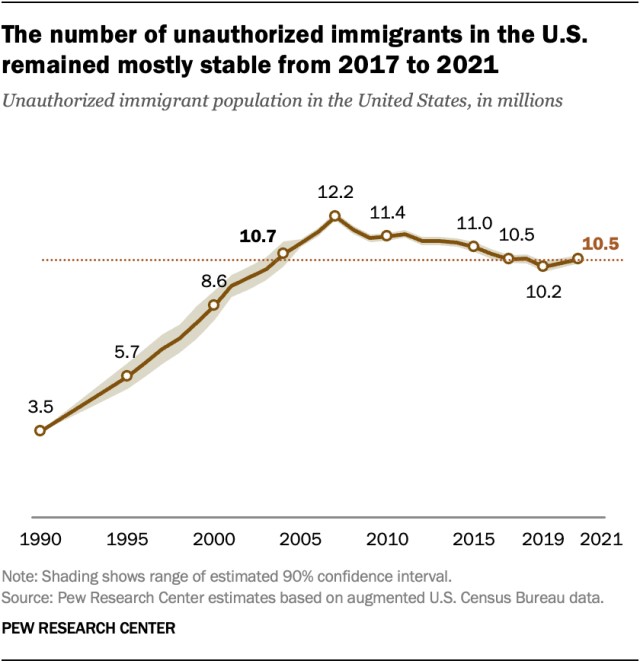 The number of unauthorized immigrants living in the U.S. in 2021 remained below its peak of 12.2 million in 2007. It was about the same size as in 2004 and lower than every year from 2005 to 2015.
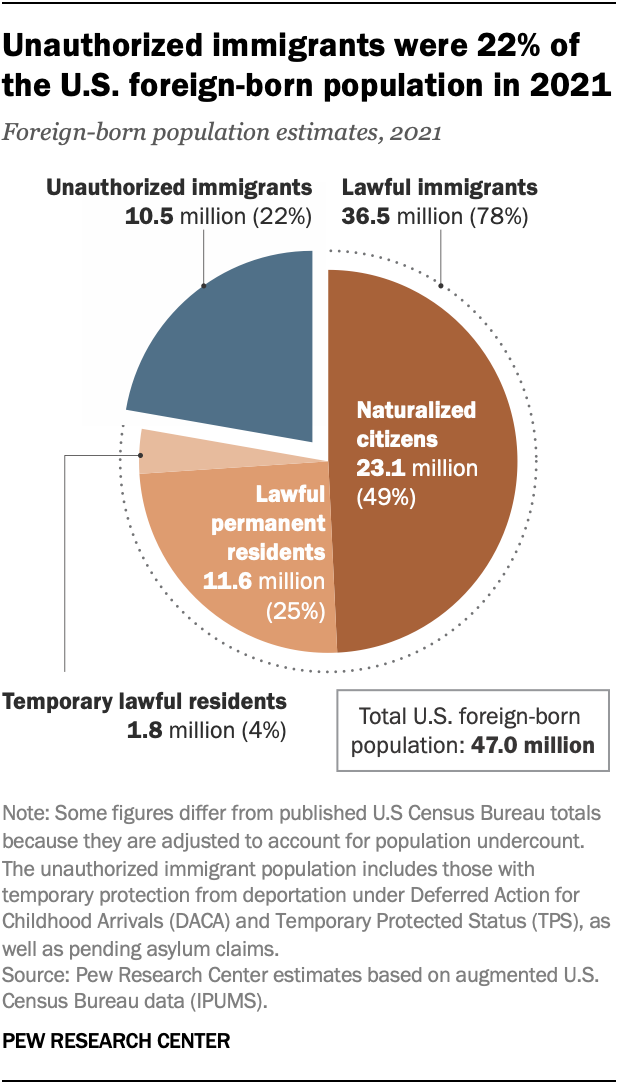 The U.S. foreign-born population was 14.1% of the nation’s population in 2021. That was very slightly
 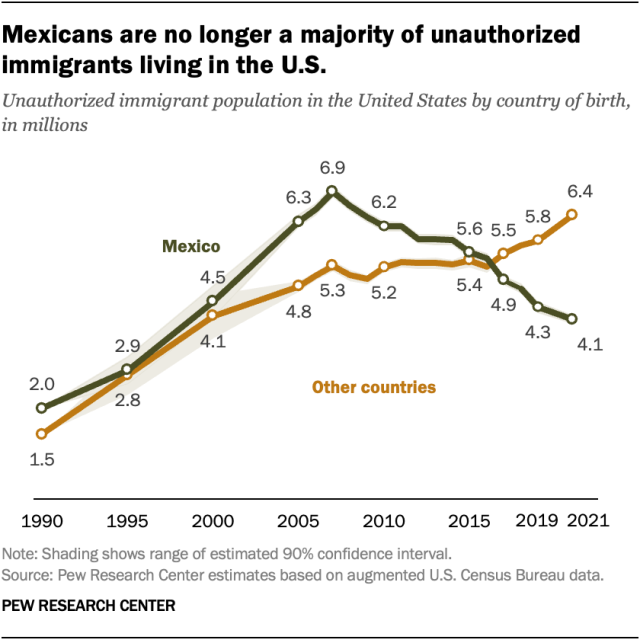 The origin countries for unauthorized immigrants have changed since the population peaked in 2007, before the Great Recession slowed immigration. Here are some highlights of those changes:
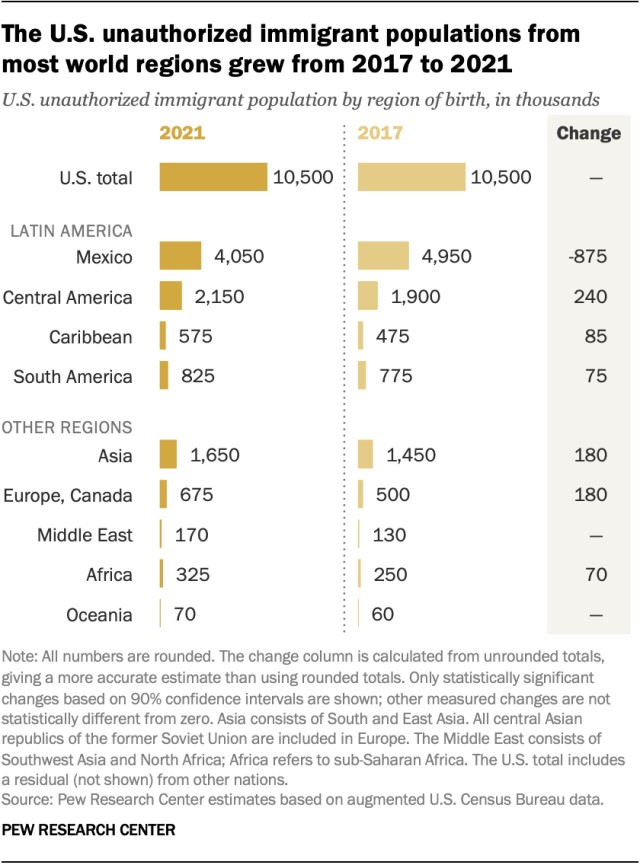 Almost every region in the world had a notable increase in the number of unauthorized immigrants in the U.S. from 2007 to 2021. The largest increases were from Central America (240,000) and South and East Asia (180,000).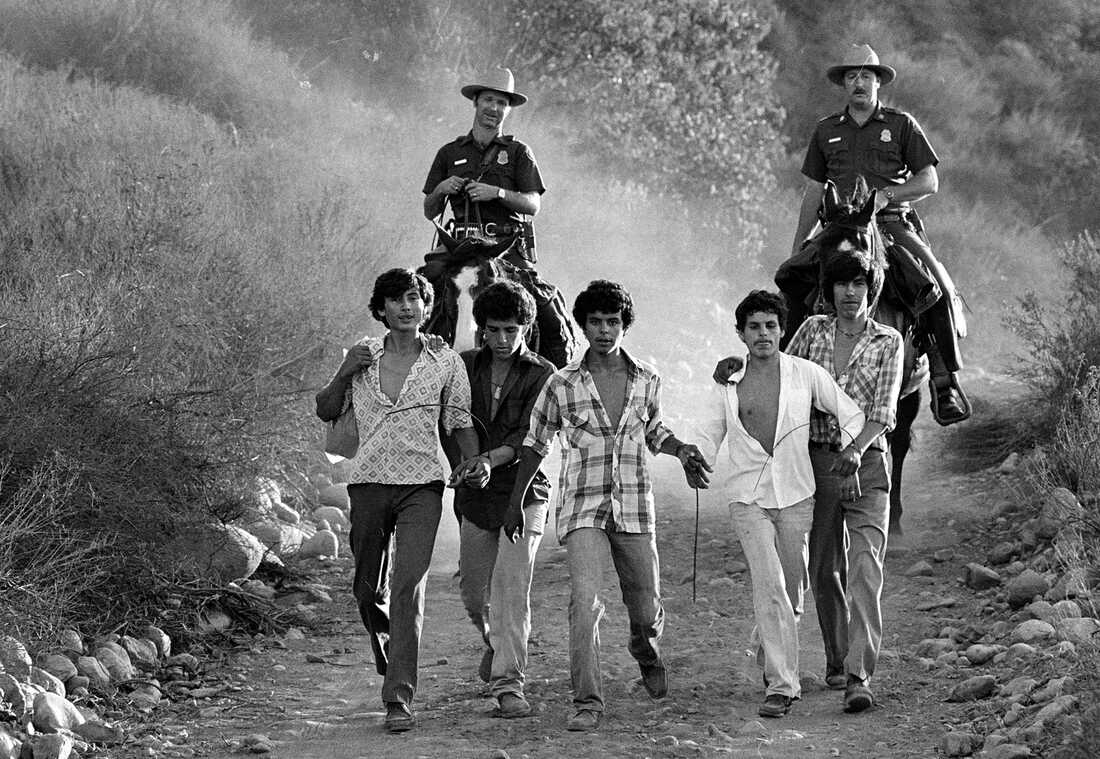
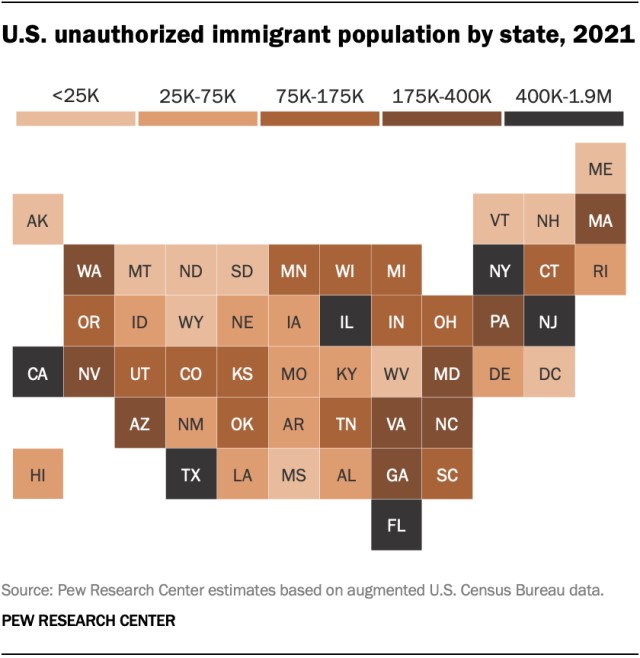 The six states with the largest unauthorized immigrant populations in 2021 were:
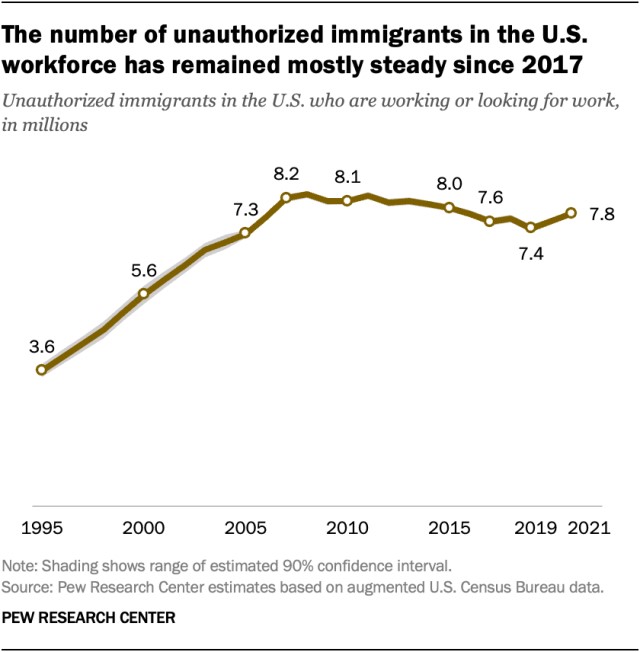 The share of unauthorized immigrants in the U.S. workforce was slightly less than 5% in 2021, compared with 3% of the total U.S. population.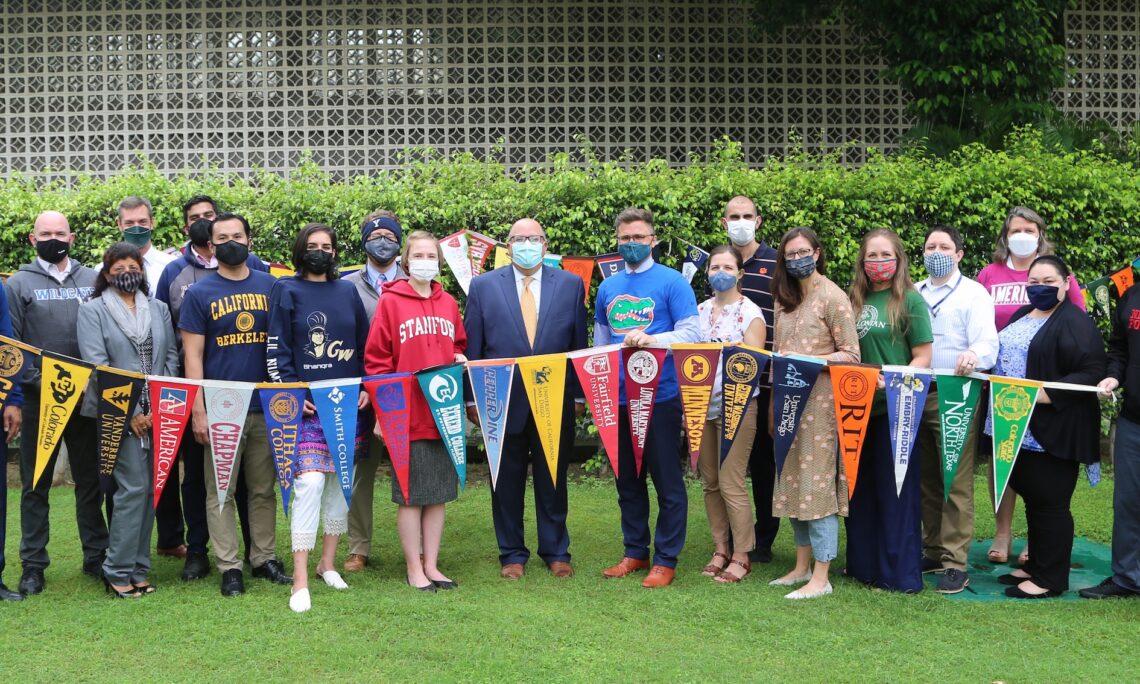
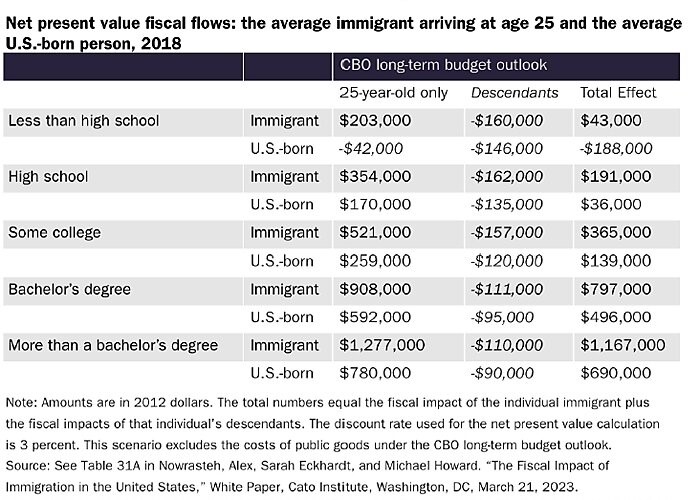 The Congressional Budget Office (CBO) found in 2013 that comprehensive immigration reform would have “a net savings of about $175 billion over the 2014–2023 period” and “would decrease federal budget deficits by about $700 billion (or 0.2 percent of total output) over the 2024–2033 period.” The CBO stated that there would be about another $300 billion in savings from the indirect economic effects of more workers. Unfortunately, this scoring was a rare exception to CBO’s normal practice of not considering the increases in employment that occur when immigrants enter the labor force, leading to such anomalies as finding that immigrant PhDs will impose net costs on the federal government.
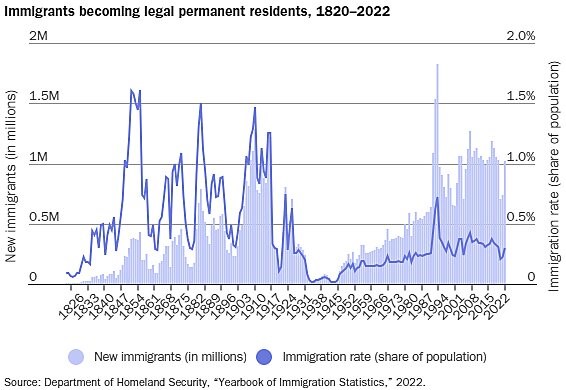 Immigration policy is also restrictive compared to our peer nations. The United States went from accounting for the majority of the increase in the world immigrant population in the 1990s to accounting for just 7.5 percent of it from 2015 to 2020. This happened both because more immigrants went to other countries and because fewer immigrants went to the United States.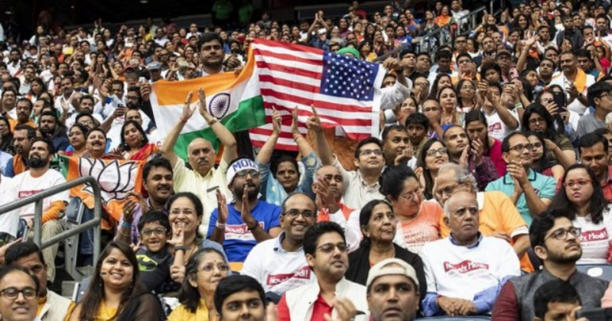
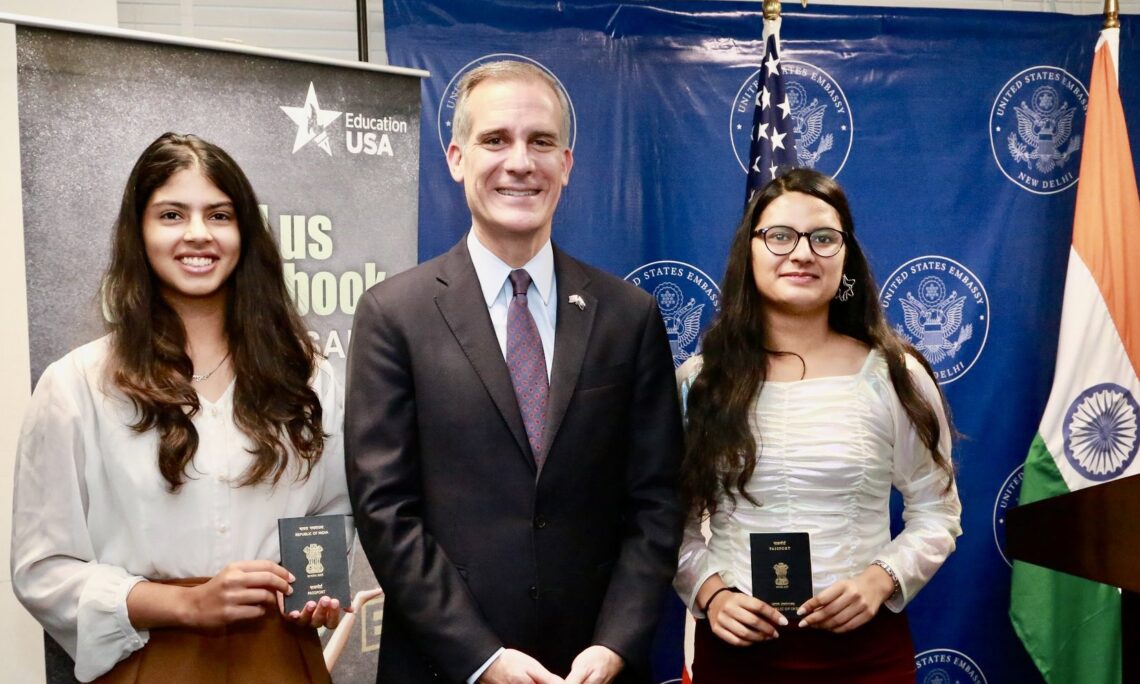
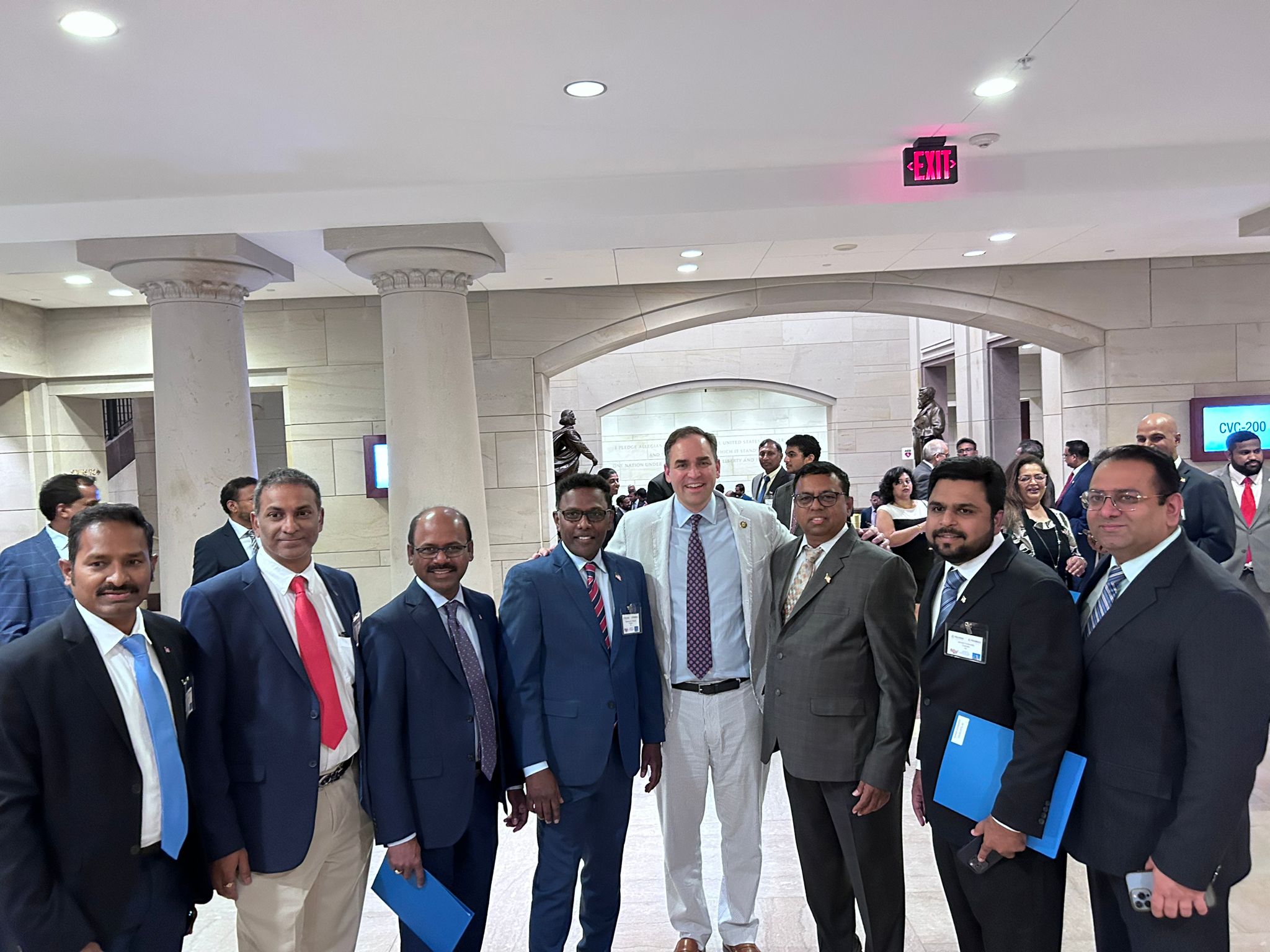
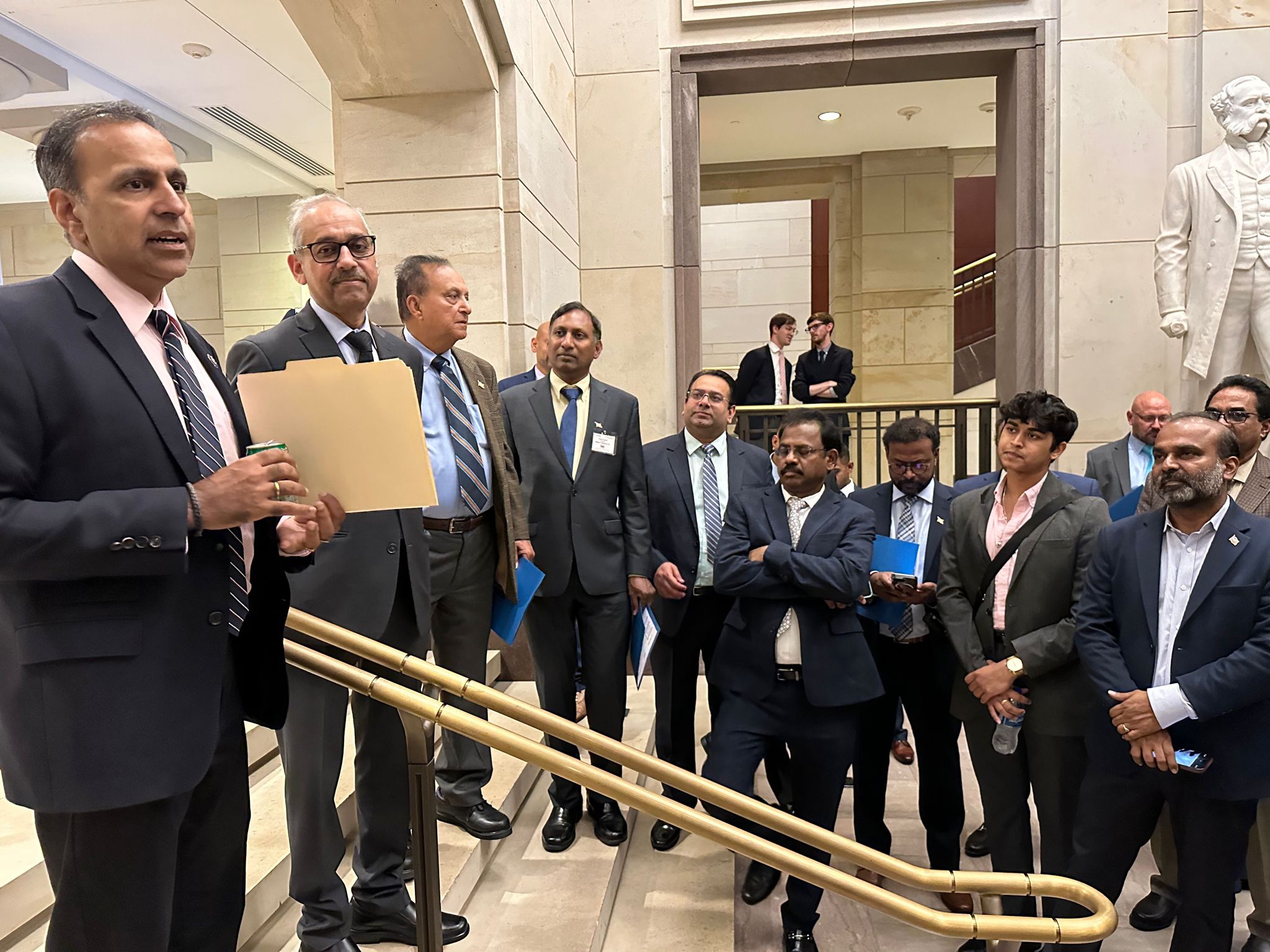
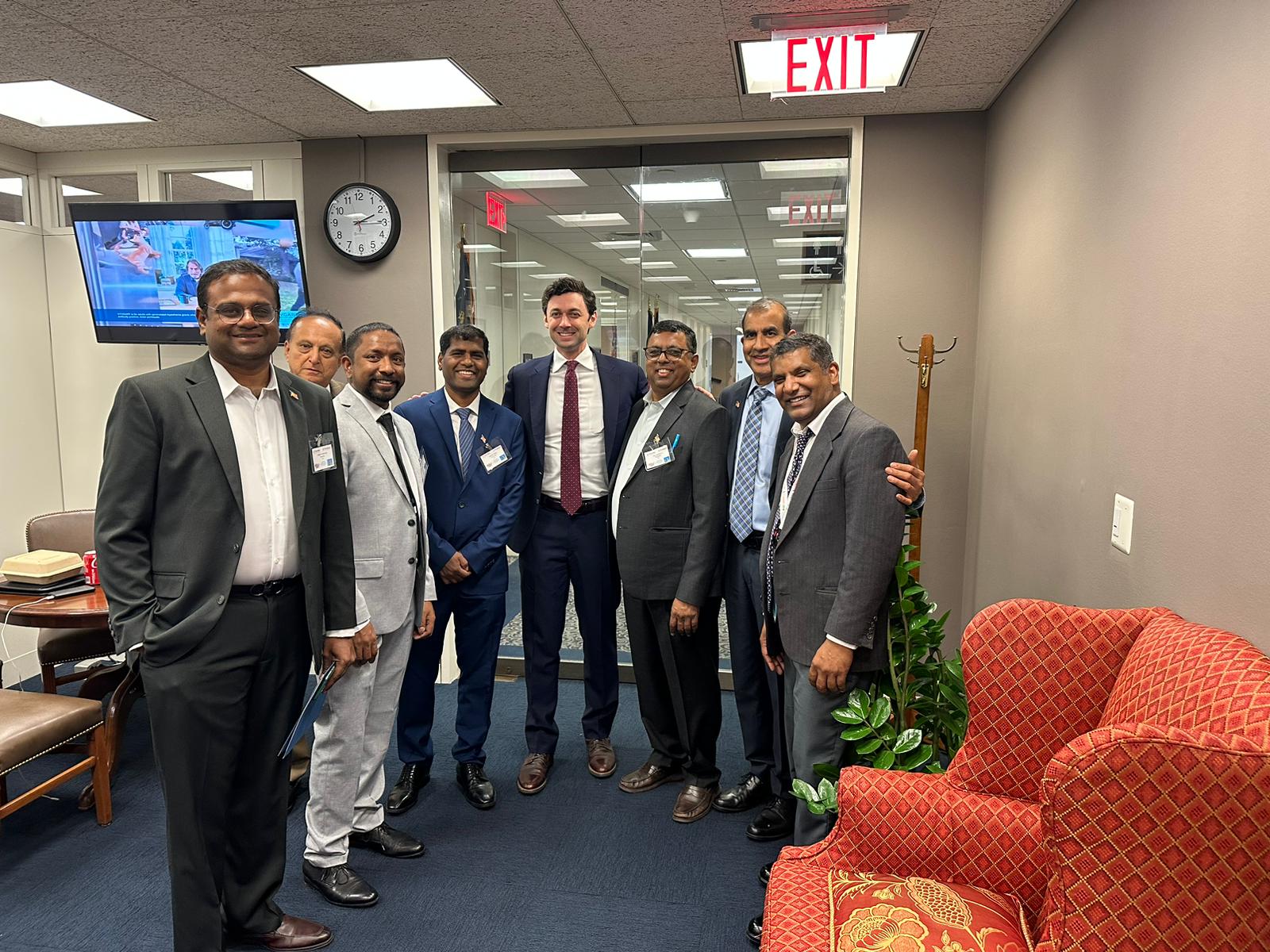

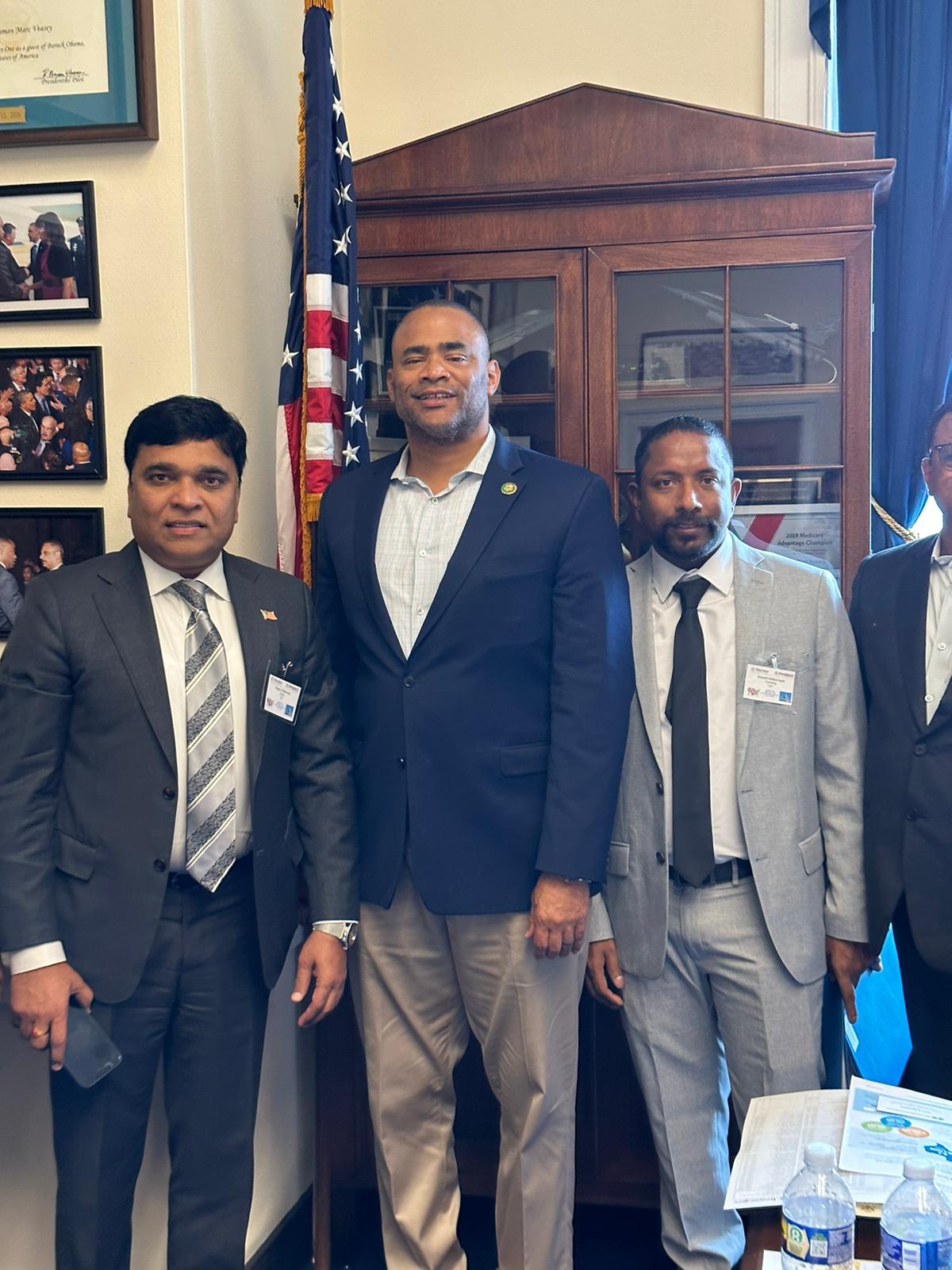

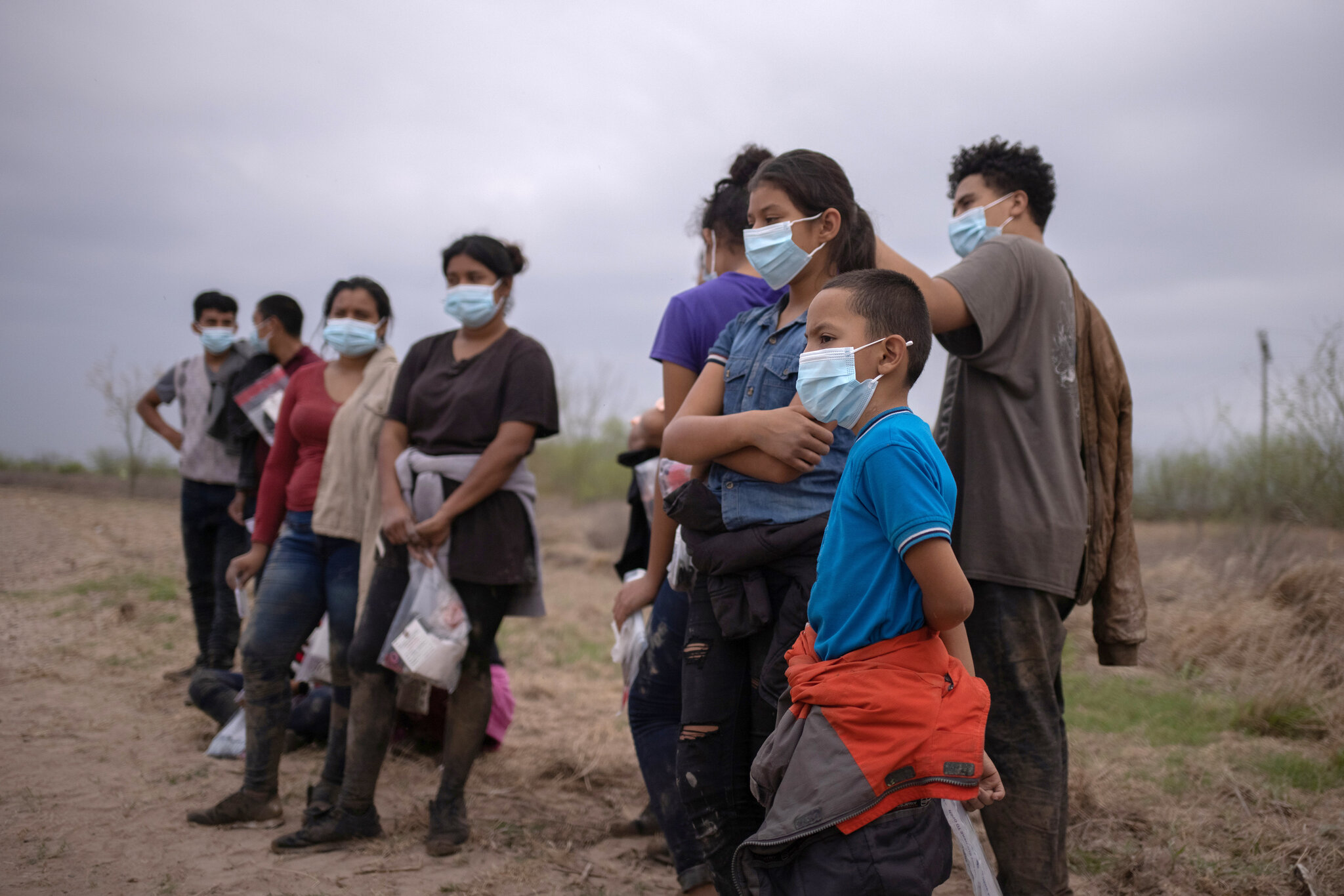
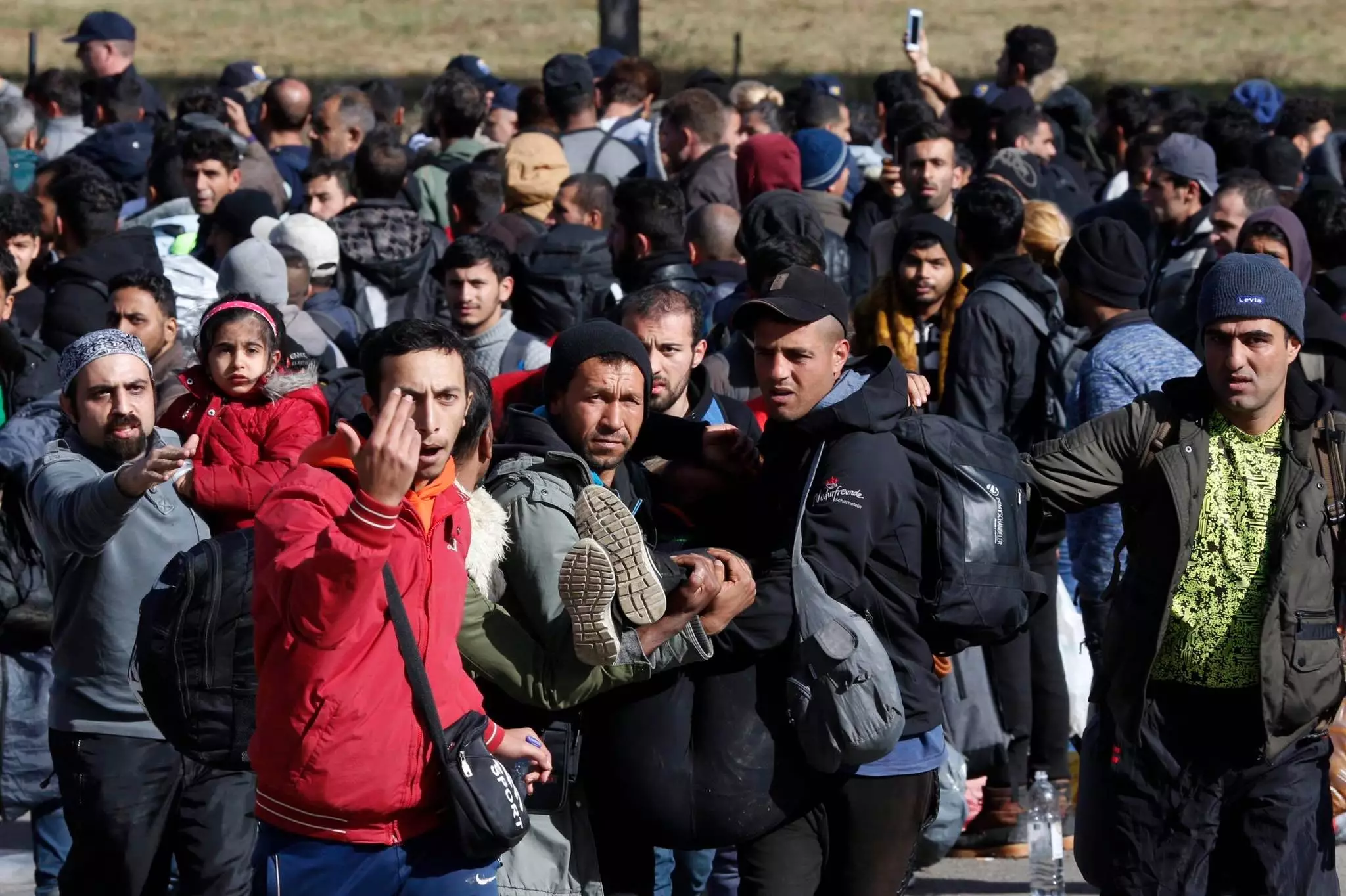

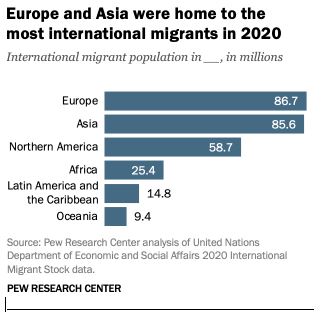
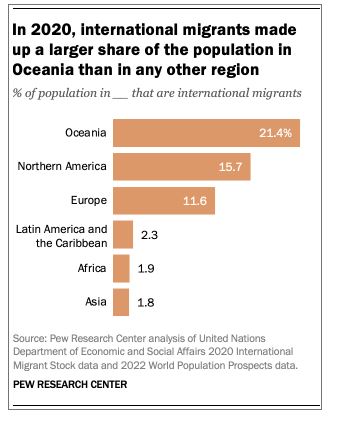
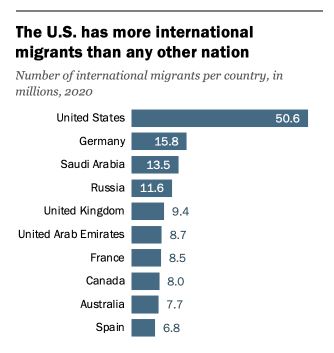
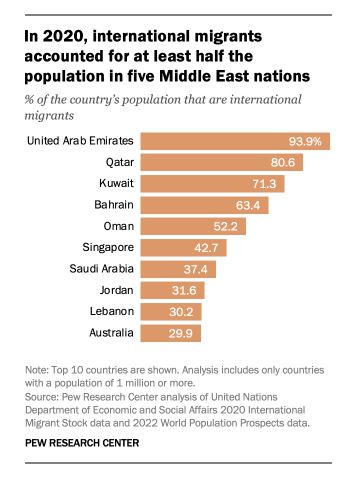
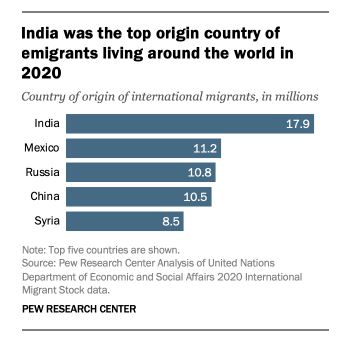
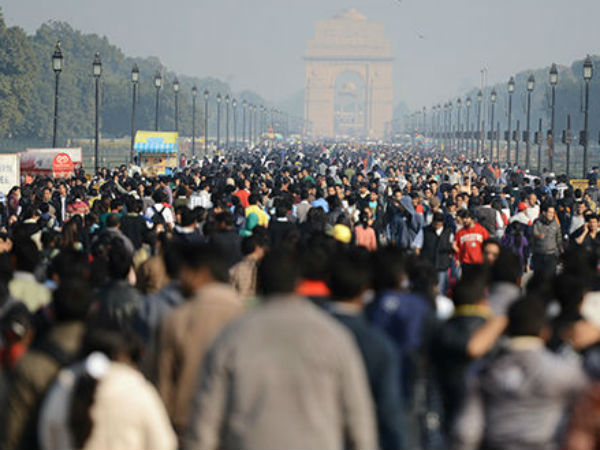

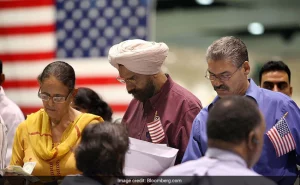

 In March 2020, IRCC became unable to process most applications due to the onset of the Covid-19 pandemic. This was because the department was only able to process paper applications that were mailed to a central location.
 Here are some of the top Immigration-friendly countries for Indian students shared by Ajay:
 Many immigrants with well-paying jobs in these overseas nations help their relatives, parents, and near and dear ones by sending them money for assistance. Even students who study in developed nations return home with great knowledge and expertise. They even impart their expertise and aid in medicine, engineering, technology, and other professions.
 It appears that the denials are so high partly because the department grants so little weight to earlier approvals by DOL and DHS. The much greater difficulty in obtaining a green card abroad has important consequences for U.S. immigration. It encourages many immigrants to apply for easier‐to‐obtain temporary visas, which unnecessarily uses limited cap spots under those programs, while others may give up on legal immigration and seek to enter illegally.
 Commending Sahi, a Hindu, for working to secure the civil and political rights of India’s marginalized communities and social and religious minorities, Ambassador Brownback said it was important for people from dominant countries to stand up for minorities.
 Sean Fraser, Canada’s minister of immigration, said the students would be granted an additional 18-month open work permit under the Post-Graduation Work Permit Program (PGWPP).
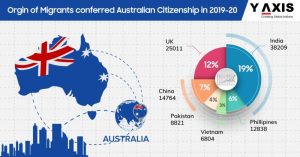 With the recent rise, “India has moved past China and New Zealand to become the third largest country of birth behind Australia and England,” a news release by the bureau noted. In the previous census recorded in 2016 India was the fifth largest country of birth.