India’s Coronavirus Tally Spikes As Millions Take Ritual Bath At Kumph

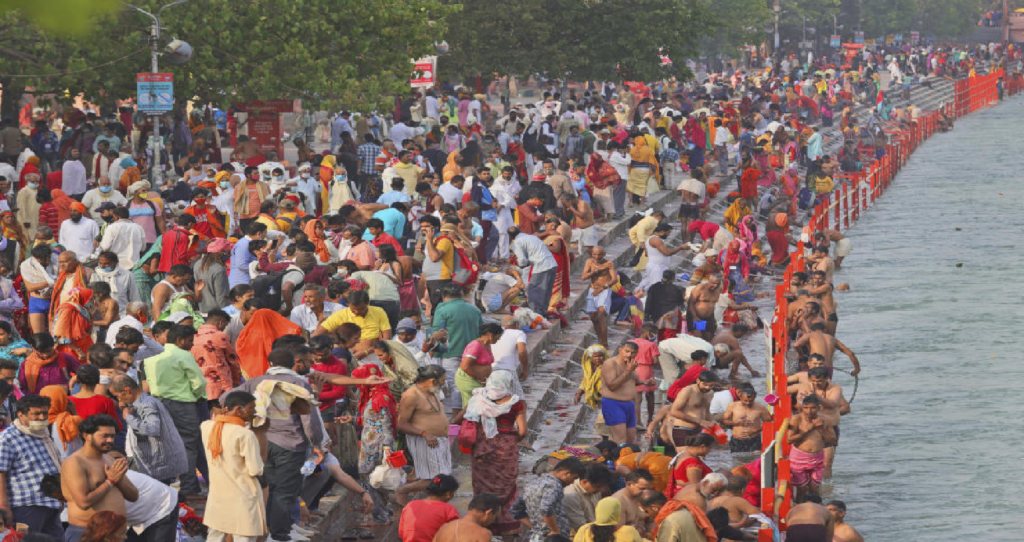
At one of the largest gatherings of people in the world continues in the northern Indian city, Haridwar, almost 3 million Hindu pilgrims bathed in the Ganges River as part of this year’s Kumbh Mela festival, raising concerns that the festival could become a super spreader event.

One of the largest gatherings of people in the world continues in the northern Indian city, Haridwar amid a sharp rise in coronavirus cases and a weakening supply of vaccines. Almost 3 million Hindu pilgrims have bathed in the Ganges River as part of this year’s Kumbh Mela festival, raising concerns that the festival could become a super spreader event. On Monday, the festival’s second-holiest day, India’s Health Ministry reported nearly 170,000 new coronavirus infections. India’s total caseload has become the second-highest in the world after the United States.

On the banks of the Ganges, Hindu prayer music is interrupted by whistles from police, trying unsuccessfully to enforce social distancing rules, as millions of devotees thronged the banks of the Ganges, a river many Hindus consider holy, to participate in the months-long ‘Kumbh Mela’ or pitcher festival.

Hindus believe the river is holy and bathing in it will cleanse them of their sins and bring salvation. The Kumbh Mela takes place every 12 years and the venue is chosen from amongst four cities, including Allahabad, Haridwar, Nasik and Ujjain. Haridwar’s turn to host the gathering came amid a sharp rise in the number of coronavirus infections, with India consistently reporting more than 100,000 cases daily in the past few weeks.

With a spike in new covid cases, India accounts for one in six of all new infections globally, although the figure is still well below the U.S. peak of nearly 300,000 new cases on Jan. 8. As India’s second wave of infections builds, with fewer than 4% estimated to have been vaccinated among a population of 1.4 billion, experts say the situation could have a long way to go before it starts getting better.
“After cases declined in January-February, we were very comfortable,” said a panel of high court judges in the western state of Gujarat, calling on authorities to take urgent steps to rein in the outbreak. “Almost everyone forgot that there was ever corona,” added the panel, headed by Chief Justice Vikram Nath.

A senior police official told ANI news agency that it was very difficult to ensure social distancing on the river banks.
“We are continuously appealing to people to follow Covid-appropriate behaviour. But due to the huge crowd, it is practically not possible to issue challans [fines],” inspector general of police Sanjay Gunjyal said.

He said that a “stampede-like situation” could arise if the police tried to enforce social distancing on the river banks.
Officials said by Monday evening more than 3.1 million devotees had bathed in the river, with many more expected to follow suit. Monday – Somvati Amavasya – marks the biggest bathing day during the two-month-long festival.

The government had earlier said that only people with Covid negative reports would be allowed at the festival and strict measures like social distancing would be followed. But a number of people, including top saints, have already tested positive.Even as the virus surges to its worst level, daily life remains unaffected in most parts of the country. Prime Minister Narendra Modi and other politicians have addressed massive campaign rallies in several states holding local elections. When Muslim scholars held a congregation in New Delhi last year, before India’s lockdown, politicians and many from India’s Hindu majority blamed Muslims for spreading the coronavirus.

Last month, when reporters asked Uttarakhand’s chief minister about COVID-19 concerns ahead of the Hindu Kumbh Mela festival, he said no one would be stopped from coming because of the pandemic. He said, “Pilgrims’ faith will overcome the fear of the virus.”

Jaishankar, Blinken Work Together Enhancing India-US Collaboration

In a growing sign of increased cooperation, S Jaishankar and Antony Blinken discuss developments in the region and health cooperation.

India’s Foreign Minister S Jaishankar and his US counterpart Antony Blinken discussed developments in the region and health cooperation against the backdrop of the planned withdrawal of American troops from Afghanistan and the Covid-19 crisis.

“Spoke to my US counterpart Secretary of State @SecBlinken this evening. Conversation covered recent developments in India’s immediate and extended neighbourhood. Exchanged views on the UNSC agenda. Also discussed issues pertaining to our health cooperation,” Jaishankar said in a tweet without giving details.

There was no official word from both countries on the conversation. People familiar with developments said on condition of anonymity that the situation in Afghanistan and the US embargo on exports of raw materials needed for Covid-19 vaccines had figured in the discussions.

The Biden administration invoked the US Defence Production Act in February to curb the export of raw materials for vaccine production. The Serum Institute of India’s (SII) ability to make some 160 million doses of Covid-19 vaccine a month could be hit in the coming weeks if the US doesn’t lift the embargo on supplies of 37 critical items, reports have said. On April 16, SII CEO Adar Poonawalla raised the issue in a tweet addressed to US President Joe Biden.

Foreign secretary Harsh Shringla said last month that the issue had been officially raised with the US through the Indian ambassador in Washington.

Participating in an online discussion on Monday, Jaishankar referred to the matter indirectly when he said he was “pushing other countries, particularly some big countries, [to] please keep the raw materials flowing for vaccines to be made in India”.

Responding to a question on criticism of India’s exports of Covid-19 vaccines amid growing domestic demand, Jaishankar noted that the vaccine being produced in India in the largest quantity – the AstraZeneca jab made by SII – is a “co-creation” and an international product. “Can I, on one hand, go round the world and say, guys, keep your supply chain flowing towards me, and by the way… I am asking you for raw material but I am not going to give you the vaccine?” he asked

He added, “As things got tough we spoke to the world very honestly and said look, we have done our best to live up to commitments – contractual commitments of producers, COVAX commitments – but right now please understand that I have this very serious situation at home and I think most countries understand that.”

On the US exit from Afghanistan, Jaishankar said India has always played an active role in that country. “Afghanistan is a doorstep away. So how can we not have a role, influence, presence [and] activity out there?” he said.

Indian Community In The US Mourns The Killing Of 4 Sikhs At Fedex Facility

The Indian American community is deeply saddened to share that at least four Sikhs are among those killed late Thursday night when a gunman stormed a FedEx facility in Indianapolis known to have a large Sikh workforce.

The deadly mass shooting last week at a FedEx Ground facility in Indianapolis struck deeply into the Indian American community at large and in particular, the area’s Sikh community after it suffered the loss of four members in the bloody onslaught.

Eight people were killed and several others wounded  on Thursday, April 15th night when a former FedEx employee opened fire at a facility near Indianapolis’ main airport before taking his own life. Investigators are still trying to determine the motive behind the shooting. Amarjeet Johal, 66; Jasvinder Kaur, 50; Jaswinder Singh, 68; Amarjit Sekhon, 48 were among the eight who lost their lives to yet another mass shooting as the nation struggles to limb back to several others preceding this. Matthew R. Alexander, 32; Samaria Blackwell, 19; Karli Smith, 19; and John Weisert, 74 were the others who succumbed to the bullets that traffic night.

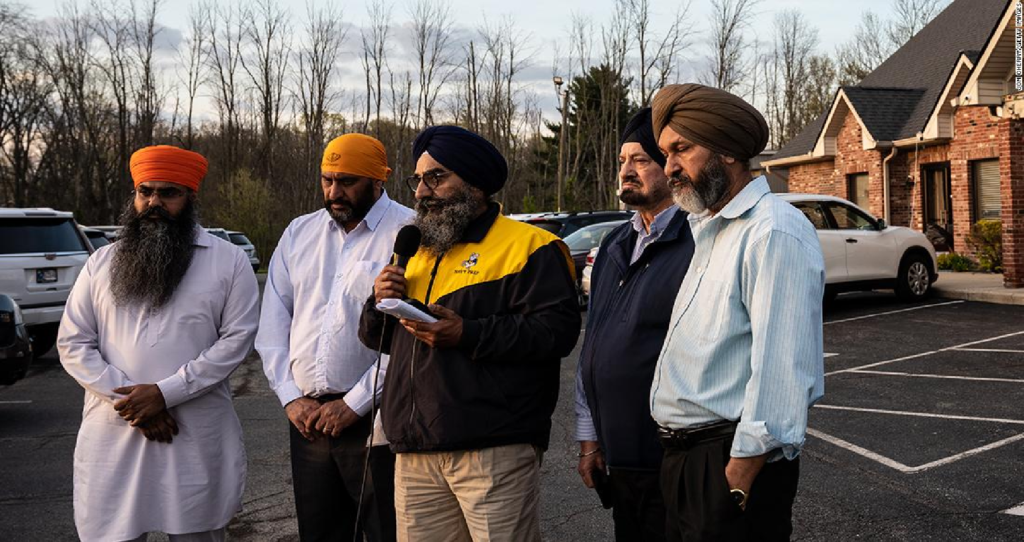
“Our community has a long road of healing physically, mentally and spiritually to recover from this tragedy,” Maninder Singh Walia, a member of the Sikh community in Indianapolis, told the media. Officials, who said that a “significant” number of employees at the parcel and courier service company are Sikhs, reported that the gunman killed himself after murdering eight people Thursday night and wounding at least seven, five of whom were hospitalised.

WXIN-TV station quoted Parminder Singh, the uncle of one of the victims, as saying that his niece who worked at the facility near the airport phoned him shortly after the shooting and told him that she was shot while in her car and was being taken to the hospital.

President Joe Biden ordered the national flag to be flown at half-mast at all government facilities and US embassies abroad. “Gun violence is an epidemic in America,” Biden said in a statement. Just last month a White man killed eight people, six of them Asian women, at three massage parlors in Atlanta.

According to the Gun Violence Archive, 19,380 people were shot dead last year in the US, an increase of more than 25 per cent over the previous year’s deaths. “Our hearts bleed for all of the families of the victims of yet another senseless massacre that has become a daily occurrence in this country,” said AAPI Victory Alliance Executive Director Varun Nikore.

Nikore added: “To the families of Jasvinder Kaur, Amarjit Sekhon, Jaswinder Singh, and everybody else affected by this senseless tragedy, our hearts go out to you. The AAPI community stands with you. Justice must be served and we will not stop fighting until every single gutless person, politician, and lobbying group is held responsible for continuing to allow these tragedies to happen. Additionally, the AAPI Victory Alliance demands an immediate investigation into whether or not these shootings were racially biased.” Nikore said that enough is enough and that it’s time to come together and end hate and gun violence once and for all.

“We will invest significant resources into toppling those who seek to destroy our families, communities, and identity. The senseless gun violence that we’re seeing in this country is reflective of all of the spineless politicians who are beholden to the gun lobby. Period. End of story,” said Nikore. “They will be hearing from us — instead of offering thoughts and prayers, it’s time to mobilize for direct action and vote them out. That is what we’re doing today. We will end the violence, only when we have leaders who have the guts to do so.”

The Sikh Coalition said, it is deeply saddened to share that at least four Sikhs are among those killed late Thursday night when a gunman stormed a FedEx facility in Indianapolis known to have a large Sikh workforce.

The official in charge of the Federal Bureau of Investigation (FBI) Indianapolis office, Paul Keenan, said that he had been questioned by the agency after his mother had warned that he might try to commit suicide by provoking police to shoot him.

Sikhs have for long been victims of bias attacks in US, often being mistaken for Muslims because of their turbans. According to the FBI’s 2019 hate crime statistics — the latest available — there were 49 anti-Sikh attacks with 60 victims. In 2012 a gunman attacked a gurdwara in Oak Creek in Wisconsin State killing seven Sikhs and wounding four.

“While we don’t yet know the motive of the shooter, he targeted a facility known to be heavily populated by Sikh employees, and the attack is traumatic for our community as we continue to face senseless violence,” said Satjeet Kaur, Sikh Coalition executive director. “Further traumatizing is the reality that many of these community members, like Sikhs we have worked with in the past, will eventually have to return to the place where their lives were almost taken from them.”

The coalition says an estimated 500,000 Sikhs live in the U.S. Many practicing Sikhs are visually distinguishable by their articles of faith, which include unshorn hair and a turban.

“I have several family members who work at the particular facility and are traumatized,” Komal Chohan, who said Johal was her grandmother, said in a statement issued by the Sikh Coalition. “My nani, my family, and our families should not feel unsafe at work, at their place of worship, or anywhere. Enough is enough — our community has been through enough trauma.”

In a statement issued here, SAALYT stated: “Today, SAALT grieves the loss of life in the latest mass shooting in Indianapolis, Indiana. Our hearts are heavy and mourn with the victims’ families and community members, who are undoubtedly reeling from the trauma of losing their loved ones. Of particular note, four of the eight victims were our Sikh siblings and fellow community members. Such an act of mass violence sends reverberations across Sikh and South Asian communities, evoking past pain and grief rooted in decades of similar violent acts. We are struck by the trend of violence against immigrant workers, who have not only taken on essential work during a global pandemic, but have also been particularly vulnerable to its health and economic consequences as a result of their work. SAALT stands in solidarity with immigrant and essential workers, and honors the care they have poured into our community despite widespread bigotry.”

Biden Administration Urges All Americans To Get Vaccinated

The Biden administration has suggested that every single American adult is eligible for a vaccine as of April 19. The White House stressed how important those shots are to beating back the pandemic — especially in recent weeks, as the more transmissible B-117 variant has rapidly become the most dominant and new cases hover near 70,000 per day.

“All roads to defeating the pandemic go through the path of successfully and quickly vaccinating the country,” White House COVID adviser Andy Slavitt said at a White House briefing on last week.

The good news is the U.S. has an ample supply of vaccines, even with the recent pause of Johnson & Johnson vaccines. More than one-third of the total population has already gotten one shot, while 80% of the highest-risk demographic, adults 65 and older, has received one shot. The remaining states that haven’t opened eligibility to all adults do so on April 19.

“I am proud of the progress we’ve made,” Centers for Disease Control and Prevention Director Dr. Rochelle Walensky said at the briefing. “But we must continue to get many more people vaccinated.”

That’s because vaccinations are still nowhere near where they need to be to hit “herd immunity,” and quickly-spreading, potentially deadlier variants such as the B-117, first discovered in the U.K., have taken hold in the U.S.

The latest CDC data shows that it accounted for 44% of cases during the last week of March, but Walensky said on Friday that the number is “certainly higher” now than then.

In Michigan, which currently has the most cases per population in the country, the number of B-117 cases has doubled since the last week of March. Nationwide, cases, hospitalizations and deaths continue to tick up. Just four weeks ago, the seven-day average of cases was around 53,000. As of Friday, it was just below 70,000.

Hospitalizations had also increased 5-8% since the week before, and deaths were over 700 people a day for the third day in a row, Walensky said.

“The increasing trends in cases, hospitalizations, and deaths are very concerning, and they threaten the progress we’ve already made,” she said.

For its part, the White House announced it will be investing $1.7 billion to do more genomic sequencing and identify variant spread, which the U.S. was woefully unprepared to do a few months ago. The funding will come from the American Rescue Plan, the nearly $2 trillion coronavirus relief package that Biden recently signed into law.

“Our ability to spot variants as they emerge and spread is vital, particularly as we aim to get ahead of dangerous variants before they emerge, as they are in the Midwest right now,” Slavitt said.

“Right now, these variants account for nearly half of all COVID-19 cases in the United States. And we need more capacity in our public health system to identify and track these mutations,” he said.

The White House coronavirus response team also warned that loosening restrictions was contributing to the spread, and urged people to mask-up, wash their hands and get vaccinated.

“Some of these increases are as a result of relaxed prevention efforts in states across the country, such as relaxed mask mandates or loosened restrictions on indoor restaurant seating,” Walensky said.

U.S. Surgeon General Vivek Murthy Says, Additional Funds To Places Hit disproportionately by COVID-19

U.S. Surgeon General Vivek Murthy has said the U.S. was increasing funding to areas that had been hit disproportionately by COVID-19, including $4 billion in funding to the Indian Health System. Though the IHS has impressively distributed 1 million vaccines in Indian Country, recent data showed that American Indians and Alaska Natives suffered devastating loss when the pandemic was at its worst.

According to a recent CDC report, they were 3.5 times more likely to get COVID than white people and more than four times as likely to be hospitalized as a result of COVID-19.

Murthy said the steady increase in cases over the last month had him more concerned than the J&J pause, which was put into place on Tuesday after the CDC and FDA found that out of the nearly 7 million people who got the J&J shot, at least 6 patients suffered blood clots roughly 6-13 days afterward.

The pause could last at least a few more weeks, according to an independent CDC advisory panel that on Wednesday decided to wait and see if more patients developed symptoms before recommending next steps on the vaccine.

“As much attention as the J&J news has received though, what I’m most concerned about, the numbers which are most on my mind are the rising cases and hospitalizations among those who are not vaccinated,” Murthy said.

He underscored the positive news, however, which is that the U.S. is one of the few countries in the world with three vaccine options and hundreds of millions of doses.

“We’re really fortunate to have highly effective vaccines and a system that’s working day and night to keep us safe. It gives me faith that we will make it through this pandemic together,” Murthy said.

All Americans age 16 and up can now get a Covid-19 vaccine. But the challenge is getting enough people to roll up their sleeves so we can finally quash this pandemic.  “The vaccine is the most important pathway to ending this pandemic. That means we’ve got to get everyone in our country vaccinated,” US Surgeon General Dr. Vivek Murthy said Monday.

“Now what we’ve got to do is No. 1: Get the vaccine. No. 2: Turn around and look at our family and friends and ask if they’re going to get vaccinated. If they need help, that’s what we’ve got to do.”

About 40% of the US population — more than 132 million people — have received at least one dose of the Covid-19 vaccine and about 26% of the population — more than 85 million — are fully vaccinated, according to the Centers for Disease Control and Prevention.

Nearly 212 million doses have been administered in the US, with an average of 3 million shots per day, the CDC said. It’s critical for those age 16 and up to get vaccinated before new, more contagious strains emerge — just like the B.1.1.7 variant did.

2020 Saw 1.2 Degrees Celsius Rise In Global Temperature

The global average temperature was about 1.2 degrees Celsius above pre-industrial levels despite the cooling effect of La Nina ocean-atmosphere phenomenon in 2020, the World Meteorological Organisation confirmed on Monday in its State of the Global Climate 2020 report. The Intergovernmental Panel on Climate Change (IPCC) had warned that a 1.5 degree C warming will mark a menacing milestone in the warming of the planet.

UN Secretary-General, Antonio Guterres who released the report on Monday said the UN is building a global coalition to reach net-zero emissions by 2050. “2020 was 1.2 degrees Celsius hotter than pre-industrial times. We are getting dangerously close to the 1.5-degree Celsius limit set by the scientific community. We are on the verge of the abyss. To avert the worst impacts of climate change, science tells us that we must limit global temperature rise to within 1.5 degrees of the pre-industrial baseline. That means reducing global greenhouse gas emissions by 45% from 2010 levels by 2030 and reaching net-zero emissions by 2050. We are way off track. This must be the year for action,” he said adding that all countries should phase out coal by 2040.

Last year was one of the three warmest years on record; the six years since 2015 have been the warmest on record and 2011-2020 was the warmest decade on record, the report highlighted adding that decrease in the annual growth rate of CO2 concentration due to the Covid 19 lockdown will be practically indistinguishable.

Globally averaged carbon dioxide (CO2) concentrations have already exceeded 410 parts per million (ppm), 148% of pre-industrial levels, and if the CO2 concentration follows the same pattern as in previous years, it could reach or exceed 414 ppm in 2021, according to the report.

“Developed countries must lead in phasing out coal — by 2030 in Organisation for Economic Cooperation and Development (OECD) countries, and 2040 elsewhere. No new coal power plants should be built.” Guterres also called for an agreement among all countries to follow a common direction of travel. “The United Nations is building a global coalition committed to net zero emissions – to cover all countries, cities, regions, businesses and financial institutions. Second, the next 10 years need to be a decade of transformation. Countries need to submit ambitious new NDCs — the nationally determined contributions to the Paris Agreement – which are their climate plans for the next 10 years,” he said.

The report comes ahead of the April 22-23 Virtual Leaders’ Summit on Climate convened by the United States of America. The Summit will have participation from 40 world leaders and one of its aims is “Galvanizing efforts by the world’s major economies to reduce emissions during this critical decade to keep the goal of limiting warming to 1.5 degree Celsius within reach,” according to the US department of state.

United States Special Presidential Envoy for Climate, John Kerry had met Prime Minister Narendra Modi and environment minister Prakash Javadekar earlier this month regarding increasing climate ambition ahead of COP 26 in Glasgow this November. Minister for Europe and Foreign Affairs of France, Jean-Yves Le Drian had also met Javadekar and said all countries should be on track to achieve carbon neutrality and start phasing out coal.

Javadekar had said India will not raise its climate ambition at the behest of or under pressure from developed countries. India has the right to develop and its poor have the right to grow and that countries should respect the principle of common but differentiated responsibilities (CBDR). (CBDR, a principle under the Paris Agreement requires richer countries to lead and take historical responsibility for the emissions caused in the past by them.)

According to Climatewatch’s net-zero tracker, 59 countries representing 54% of global emissions have announced net-zero targets. Only 6 parties have legislations on net-zero emissions. India is among 6 countries that are compliant with the Paris Agreement’s 2-degree target including Bhutan, Costa Rica and the Philippines according to Climate Action Tracker. 7 countries are “critically insufficient” and their pledges will lead to 4+degree C warming including the US and the Russian Federation.

Temperatures reached 38.0 degrees C at Verkhoyansk, Russian Federation on June 20, the highest recorded temperature anywhere north of the Arctic Circle. The Arctic minimum sea-ice extent in September 2020 was the second-lowest on record. The sea-ice retreat in the Laptev Sea was the earliest observed in the satellite era. Some 9.8 million people were displaced largely due to hydrometeorological hazards and disasters, and were recorded during the first half of 2020. Annual precipitation totals in monsoon in North America, Africa, South-West Asia and South-East Asia were unusually high in 2020. Monsoon seasonal totals in India were 109% of the long-term mean, the third-highest seasonal total after 1994 and 2019.

“2020 was one of the warmest years despite having a La Niña with cool waters in the east Pacific. La Niñas typically has a cooling effect on global temperatures, but this is now offset by global warming due to greenhouse gas emissions. As a result, La Niña years now are warmer than years with El Niño events of the past,” Roxy Mathew Koll, a climate scientist at the Indian Institute of Tropical Meteorology (IITM), Pune.

“International agreements on climate change aim to keep global warming within the safe range of 1.5C to 2C, but few people realise that the world’s average temperature is already more than a degree warmer than it was 200 years ago. Parts of the world like the Himalayas are warming even faster. This is a serious concern for India because climate change could have a compounding effect on existing scarcities, stresses and extreme events. For example, in 2020, even as we were fighting the Covid-19 pandemic, we also had to face Cyclone Amphan, which intensified rapidly in a warmer ocean. It is crucial that all countries invest in adaptation to climate impacts, especially to protect those who are most vulnerable to extreme events. At the same time, we need to accelerate policies and technologies to mitigate global greenhouse gas emissions as rapidly as possible,” said Ulka Kelkar, director of climate programme at the World Resources Institute, responding to the WMO report.

Bitcoin And Crypto Markets Crash

Bitcoin (BTC-USD) is experiencing a massive sell-off, shedding almost 15% in the last 24 hours — the biggest intraday drop since February.  The drop appears to coincide with reports that the US Treasury is planning to tackle financial institutions for money laundering carried out through digital assets.

Data website CoinMarketCap cited a blackout in China’s Xinjiang region for the fall, which allegedly powers much of Bitcoin mining — the process by which new bitcoins are entered into circulation.

On Sunday, the flagship crypto shed nearly $8,000 and was trading 12% lower at $54,900 around 12PM in London, down from a day high of $61,293.  It hit a day-low of $53,302 in the early hours of Sunday. Currently it has regained some lost ground, down 9% to $55,409 around 6PM.

Bitcoin’s flash crash saw a new record in liquidations, resulting in more than one million positions being wiped off the books. This meant that $10bn in positions were liquidated, according to Bybt.

Other cryptocurrencies have also plummeted.  Ethereum (ETH-USD) the second biggest cryptocurrency in circulation, fell 17% before paring losses. It is currently down 13% to $2,132. Litecoin (LTC-USD) also declined, down 24% to $252.

It comes days after bitcoin approached $65,000 ahead of the debut listing of cryptocurrency trading platform Coinbase on Wednesday. Coinbase is the first crypto firm to list on the Nasdaq (^IXIC).

In late February, bitcoin saw a retreat to as low as $43,000 amid uncertainty in the traditional markets over stimulus expectations and their positive effects on US bond yields.

Bitcoin prices have been up and down over the last few months as governments and regulators hone in on the sector amid rising demand.

On Friday, bitcoin plunged 4% after the Central Bank of Turkey banned the use of cryptocurrencies and other digital assets for payments.

Turkey’s central bank said the ban was motivated by a lack of “central authority regulation” and “supervision mechanisms” for cryptocurrencies and other similar digital assets.

AAHOA Hires New VP of Government Affairs

ATLANTA, Ga., Apr. 19 – AAHOA, the nation’s largest hotel owners association, is pleased to welcome Dean Heyl as its new Vice President of Government Affairs. He will lead AAHOA’s Washington, D.C. office and join the association’s Executive Leadership Team.

“As hoteliers navigate the road to recovery, I am confident that Dean’s deep policy background and connections with lawmakers will enhance our advocacy efforts. Hotel owners across the country are struggling. The issues confronting them are complex, and we must continue to educate lawmakers about what they can do to help these small business owners come out on the other side of this pandemic. From labor and taxation issues to franchising and economic relief, Dean’s experience will be critical to supporting AAHOA’s ongoing advocacy efforts. His previous work with several national and international associations is an invaluable asset to our government affairs efforts. Dean is a valuable addition to our team and will help AAHOA further establish itself as the foremost resource and advocate for America’s hotel owners,” said AAHOA President & CEO Cecil P. Staton.

Heyl brings decades of experience from many sectors of the U.S. government and in the c-suites of substantial industry associations. Prior to joining AAHOA, he served as the U.S. Department of Labor’s director of the Office of Public Liaison where he reported directly to the U.S. Secretary of Labor. In this role, Dean was responsible for stakeholder outreach with an emphasis on COVID-19 issues, including PPP, as well as OSHA and Wage and Hour guidance. Dean also worked with several national and international associations as chief legal officer, federal lobbyist, executive director, and senior advisor.

Prior to his work for the Department of Labor, Heyl served as the International Franchise Association’s Chief Legal Officer, where he oversaw all federal, state and local advocacy efforts related to the franchise business model. Additionally, he worked for the Direct Selling Association as a state and federal lobbyist and before that was the Executive Director of the Coalition for Affordable Accounting. His earlier public sector experience includes serving as a senior advisor to the Idaho Attorney General and Governor. From 2008 – 2011, he was a member of the Internal Revenue Service Advisory Council.

“I have been fighting for entrepreneurs for more than 20 years and look forward to doing the same for AAHOA Members. AAHOA’s bold vision statement to be the foremost resource and advocate for America’s hotel owners resonated with me,” Heyl said. “I look forward to building upon AAHOA’s excellent government affairs foundation and helping the nation’s hoteliers progress on the road to recovery.”

AAHOA is the largest hotel owners association in the world. The nearly 20,000 AAHOA members represent almost one in every two hotels in the United States. With billions of dollars in property assets and hundreds of thousands of employees, AAHOA members are core economic contributors in virtually every community. AAHOA is a proud defender of free enterprise and the foremost current-day example of realizing the American dream.

Michelle Obama With Puppets Showcases ‘Waffles + Mochi’ On Netflix, Taking Kids to Japan, Italy, and More

In Netflix’s new children’s series “Waffles + Mochi,” Waffles is a Yeti with a waffle for a father, and her sidekick Mochi is filled with strawberry ice cream. Together with the wise guidance of Michelle Obama, the former first lady, these intrepid puppets traverse the globe, meeting world class chefs, expanding their food and taste vocabularies, and spreading joy in their wake. Jeremy Konner and Erika Thormahlen are the creators of the new series.

As per reports, in Netflix’s latest kids’ show, Waffles + Mochi, two adorable puppets from the Land of Frozen Food are catapulted into the real world to learn about food by traveling the globe. The TV series, which has dashes of Sesame Street, Parts Unknown, Chef’s Table, and Pee Wee’s Playhouse, follows Waffles and Mochi as they find out where ingredients come from, cook and eat tasty dishes, and discover new cultures, all while working at a whimsical grocery store owned by Mrs. Obama—played by none other than Michelle Obama.

The 10-episode series, filmed around the world pre-pandemic, brings together witty dialogue, standout original music, and genuine education to entertain kids and adults alike. It’s also the first children’s show produced by Higher Ground Productions, the Obamas’ production company. Waffles + Mochi features adults and children of various ethnicities and racial and social backgrounds, as well as members of the disabled community as part of the production company’s larger mission of uplifting diverse voices.

“The level of diversity and food that they showcase is incredible,” says Los Angeles–based Bricia Lopez, a James Beard Award–winning chef, who appears in the show’s second episode about salt. “To be able to talk about Oaxaca in a show like this and to see the level of respect they’re giving not just the food but the children—they’re not dumbing anything down.”

Mashama Bailey, chef and owner of The Grey in Savannah, who appears in two episodes, agrees. “It’s really a cool way to talk about how different people can relate to each other, find common ground, enjoy each other’s company, teach each other about their cultures, and not judge each other,” she said.

And with kids mostly home-bound after a year of the pandemic, the show’s release couldn’t have been better timed. “[Waffles and Mochi are] traveling for learning purposes, which I thought was really cool,” says Bailey. “That’s a good way to talk to children about travel. When you travel and eat food, you put a face to the food, you put a culture to the food. Travel helps you recognize the history and the struggle of food and prevents you from trying to take over that narrative and turn it into your own.”

In Waffles + Mochi, the puppets learn how to make mazamorra morada, a sweet purple corn desert, in Lamay, Peru. Each episode is focused around a specific ingredient. In the sixth episode, the puppets are sent on a mission to collect different types of eggs to bring to chef Massimo Bottura in Modena, Italy. They start by going to Long Beach, California, to the Growing Experience, where they meet kids helping to raise chickens and learn how eggs are laid. The duo also travels to Kyoto to eat a Japanese omelet made by chef Motokichi Yukimura. There, Mochi discovers he doesn’t like the texture of eggs, which is explained in its own cartoon skit all about taste buds, set inside the puppet’s mouth. Next, Waffles and Mochi collect fish eggs from Nishiki Market, fly to the Sacred Valley in Peru to find quail eggs at Urubamba Market, and finally meet up with Bottura in Modena, where they discover that one of the eggs broke during the journey.

Bottura reassures them that it’s okay to make mistakes and that that’s how one of his best dishes—the Oops, I Dropped the Lemon Tart—was invented. “[The show is] for kids, but also for adults,” says Bottura. “They take a simple way to understand a very complicated concept, like the idea of making a mistake—you are allowed to make mistakes, and from that mistake, you’re going to learn something.”

Aside from the former first lady, Bailey, Lopez, and Bottura, adults will be delighted by cameos from José Andrés (who we discover is a fabulous dancer), Tan France, Rashida Jones, and Samin Nosrat, to name just a few.

Still, one of the best parts of the show is observing the genuine joy that the guests get from their interactions with the puppets, which were mostly ad-libbed. “It was so wonderful to speak to this puppet, this character, in real life, and have a conversation and have it talking back to me,” says Lopez. “Obviously there’s a human behind it, but I actually connected with the character in real life.”

Each of the chefs featured were consulted on which ingredient they connected with and which food they wanted to showcase. Bottura decided to showcase his pasta and for Bailey, the choice was obvious. “When they started talking about ingredients that were indigenous, or ingredients that I worked with, for me it was corn and grits,” said Bailey, who can be seen in the corn-focused episode.

You’ll find Lopez in the kitchen in Los Angeles making mole with the puppets in the salt episode. They later eat dinner with her family, including her young son. “The kitchen is a whole new world for children,” said Lopez. “I think children [being] in a kitchen, it can truly empower them.”

First Ever Human-Monkey Embryos Created To Help Produce Organs For Transplants

Scientists have successfully created the first embryos containing both human and monkey cells, an important step in helping researchers find ways to produce organs for transplants. The results of the groundbreaking experiment, published Thursday in the journal Cell, describe the first mixed-species embryos known as chimeras.

The research team in China was led by Juan Carlos Izpisua Belmonte, who has previously experimented with human and pig embryos. The team injected 25 human stem cells into the embryos of macaque monkeys.

“My first question is: Why?” said Kirstin Matthews, a fellow for science and technology at Rice University’s Baker Institute. “I think the public is going to be concerned, and I am as well, that we’re just kind of pushing forward with science without having a proper conversation about what we should or should not do.”

Still, the scientists who conducted the research, and some other bioethicists defended the experiment. “This is one of the major problems in medicine — organ transplantation,” said Juan Carlos Izpisua Belmonte, a professor in the Gene Expression Laboratory of the Salk Institute for Biological Sciences in La Jolla, Calif., and a co-author of the Cell study. “The demand for that is much higher than the supply.”

“I don’t see this type of research being ethically problematic,” said Insoo Hyun, a bioethicist at Case Western Reserve University and Harvard University. “It’s aimed at lofty humanitarian goals.”

Thousands of people die every year in the United States waiting for an organ transplant, Hyun noted. So, in recent years, some researchers in the U.S. and beyond have been injecting human stem cells into sheep and pig embryos to see if they might eventually grow human organs in such animals for transplantation.

But so far, that approach hasn’t worked. So Belmonte teamed up with scientists in China and elsewhere to try something different. The researchers injected 25 cells known as induced pluripotent stem cells from humans — commonly called iPS cells — into embryos from macaque monkeys, which are much more closely genetically related to humans than are sheep and pigs.

After one day, the researchers reported, they were able to detect human cells growing in 132 of the embryos and were able study the embryos for up to 19 days. That enabled the scientists to learn more about how animal cells and human cells communicate, an important step toward eventually helping researchers find new ways to grow organs for transplantation in other animals, Belmonte said.

“This knowledge will allow us to go back now and try to re-engineer these pathways that are successful for allowing appropriate development of human cells in these other animals,” Belmonte told NPR. “We are very, very excited.”

Such mixed-species embryos are known as chimeras, named for the fire-breathing creature from Greek mythology that is part lion, part goat and part snake.

“Our goal is not to generate any new organism, any monster,” Belmonte said. “And we are not doing anything like that. We are trying to understand how cells from different organisms communicate with one another.”

In addition, Belmonte said he hopes this kind of work could lead to new insights into early human development, aging and the underlying causes of cancer and other disease.

However, there are several concerns that using human cells in this way could produce animals that have human sperm or eggs. “Nobody really wants monkeys walking around with human eggs and human sperm inside them,” said Hank Greely, a Stanford University bioethicist who co-wrote an article in the same issue of the journal that critiques the line of research while noting that this particular study was ethically done. “Because if a monkey with human sperm meets a monkey with human eggs, nobody wants a human embryo inside a monkey’s uterus.”

Belmonte acknowledges the ethical concerns. But he stresses that his team has no intention of trying to create animals with the part-human, part-monkey embryos, or even to try to grow human organs in such a closely related species. He said his team consulted closely with bioethicists, including Greely.

Greely said he hopes the work will spur a more general debate about how far scientists should be allowed to go with this kind of research. “I don’t think we’re on the edge of beyond the Planet of the Apes. I think rogue scientists are few and far between. But they’re not zero,” Greely said. “So I do think it’s an appropriate time for us to start thinking about, ‘Should we ever let these go beyond a petri dish?’ “

For several years, the National Institutes of Health has been weighing the idea of lifting a ban on funding for this kind of research but has been waiting for new guidelines, which are expected to come out next month, from the International Society for Stem Cell Research.

The notion of using organs from animals for transplants has also long raised concerns about spreading viruses from animals to humans. So, if the current research comes to fruition, steps would have to be taken to reduce that infection risk, scientists said, such as carefully sequestering animals used for that purpose and screening any organs used for transplantation.

MIT Scientists Study Spider Web Structure By Translating It Into Music

Scientists at the Massachusetts Institute of Technology have turned spider webs into music — creating an eerie soundtrack that could help them better understand how the arachnids spin their complex creations and even how they communicate.

The MIT team worked with Berlin-based artist Tomás Saraceno to take two-dimensional laser scans of a spider web, which were stitched together and converted into a mathematical model that could recreate the web in 3D in virtual reality. They also worked with MIT’s music department to create the harplike virtual instrument.

These spiders lack ears. But they can hear you, study says. “Even though the web looks really random, there actually are a lot of internal structures and you can visualize them and you can look at them, but it’s really hard to grasp for the human imagination or human brain to understand all these structural details,” said MIT engineering professor Markus Buehler, who presented the work on Monday at a virtual meeting of the American Chemical Society.

Listening to the music while moving through the VR spider web lets you see and hear these structural changes and gives a better idea of how spiders see the world, he told CNN.

“Spiders have very keen vibrational sensors, they use vibrations as a way to orient themselves, to communicate with other spiders and so the idea of thinking literally like a spider would experience the world was something that was very obvious to us as spider material scientists,” Buehler said.

Spiders are able to build their webs without scaffolding or supports, so having a better idea of how they work could lead to the development of advanced new 3D printing techniques, he said.

They scanned the web while the spider was building it and Buehler compared it to a stringed instrument that changes as the structure becomes more complex. “While you’re playing the guitar, suddenly you’re going to have new strings appear and emerge and grow,” he said.

Buehler said they’ve recorded the vibrations spiders create during different activities, such as building a web, courtship signals and communicating with other spiders, and are using artificial intelligence to create synthetic versions.

“We’re beginning to perhaps be able to speak the language of a spider,” he said. “The hope is that we can then play these back to the web structure to enhance the ability to communicate with the spider and perhaps induce the spider to act in a certain way, to respond to the signals in a certain way.”

He said that work is still in progress and that they’ve had to shut down their lab because of the Covid-19 pandemic. In addition to the scientific value, Buehler said the webs are musically interesting and that you can hear the melodies the spider creates during construction.

“It’s unusual and eerie and scary, but ultimately beautiful,” he said. Members of the team have done live musical performances by playing and manipulating the VR web, while musicians jam along on human instruments.

“The reason why I did that is I wanted to be able to transfer information really from the spider perspective, which is very atonal and weird and spooky, if you wish, to something that is more human,” Buehler said.

Molnupiravir New Drug Gives Hope In Trials Against Coronavirus

Over the last year, several drugs have either been developed or tested to treat coronavirus. Now there’s another that’s showing some promise.  Molnupiravir is an antiviral drug in clinical trials.

In an interview with molecular epidemiologist Dr. Jill Roberts says the way that it works is it messes up viral replication. It’s shown some use against other viruses such as SARS and MERS.

Dr. Roberts says during an animal study on ferrets, they tried to get coronavirus to spread, and it wouldn’t. So while it’s a treatment designed to prevent hospitalizations and deaths, it also seems to prevent transmission.

While there is no timetable about when this would be available, it could be promising for future viruses or pandemics.  “This is a great tool to have to be able to know for future viruses maybe if we get a mutant that actually circumvents the vaccines, this drug will still work.”

Dr. Roberts says now that Merck is behind it, it has the resources to do a big enough trial to send to the FDA to get Emergency Use Authorization or even full authorization.

A couple of other positives she pointed out with this drug: it can also be used for people who do not want to get a vaccine or don’t have the resources to get shots. And, this is a pill, unlike other treatments right now that are IVs and have to be given at a treatment center.

It would be a pill, exquisitely calibrated to target SARS-CoV-2, with tolerable side effects and a low price tag. And it would work just as well as those antibody treatments that require an hourlong intravenous infusion, but it would come in a handy packet patients could take home.

“We’re looking for something I could give everyone in an urgent care setting who comes in with exposure or a positive test,” said Nathaniel Erdmann, an infectious disease specialist at the University of Alabama at Birmingham Hospital who treats Covid-19. “An easy, oral, safe drug.”

NIH Director Francis Collins called his “dream”: a highly effective pill that can be given immediately after diagnosis.“It’s just a damn long pathway,” Collins said in an interview. First scientists have to find molecular vulnerability in a virus, and then comes the process of screening hundreds of thousands of would-be drugs to find the few that latch onto that target. Then medicinal chemists get to work on honing a Goldilocks molecule that balances power, specificity, and safety, and if everything goes well in the Petri dish, there’s still months of animal testing to do before a single human being can take a pill in a clinical trial.

“But I will tell you that this is an extremely high priority for Tony Fauci and Francis Collins and the Biden administration, to work with these companies to try to make sure that we speed this up,” Collins said. “Because this pandemic is going to be with us — even with great vaccines — and people are going to get sick.”

There is hope, even in the short term. Any day now, Merck is expected to present pivotal data on an oral treatment akin to remdesivir. Behind that is a treatment from Atea Pharmaceuticals, first developed for hepatitis C virus, which could have pivotal results in the coming months. Neither is purpose-built for the virus that causes Covid-19, but experts said the treatments could still tick many of the boxes of a hoped-for antiviral.

Perhaps most promising is a novel antiviral from Pfizer, a drug engineered specifically for the virus SARS-CoV-2 that entered its first clinical trial last month.

New Jersey-based Merck acquired the drug, MK-7110, through its $425 million acquisition of privately held biopharmaceutical company OncoImmune late last year. An interim analysis of clinical trial data suggested the drug improved the chances of recovery for the sickest patients with Covid-19 and reduced the risk of death or respiratory failure.

Sumit K. Chanda-Led Team Spots Genes That Fight Covid Infection

A team of US scientists, led by an Indian-origin researcher at Sanford Burnham Prebys have identified a set of human genes that fight SARS-CoV-2 infection, the virus that causes COVID-19. Knowing which genes help control viral infection can greatly assist researchers’ understanding of factors that affect disease severity and also suggest possible therapeutic options. The genes in question are related to interferons, the body’s frontline virus fighters. The study was published in the journal Molecular Cell

According to Sumit K. Chanda, professor and director of the Immunity and Pathogenesis Programme at Sanford Burnham Prebys Medical Discovery Institute, the scientists have gained new insights into how the virus exploits the human cells it invades.  “We are still searching for its Achille’s Heel so that we can develop optimal antivirals,” Chanda said in a paper published in the journal Molecular Cell.

Knowing which genes help control viral infection can greatly assist researchers’ understanding of factors that affect disease severity and also suggest possible therapeutic options.  The genes in question are related to interferons, the body’s frontline virus fighters.

“We wanted to gain a better understanding of the cellular response to SARS-CoV-2, including what drives a strong or weak response to infection,” says Sumit K. Chanda, Ph.D., professor and director of the Immunity and Pathogenesis Program at Sanford Burnham Prebys and lead author of the study. “We’ve gained new insights into how the virus exploits the human cells it invades, but we are still searching for its Achille’s heel so that we can develop optimal antivirals.”

Soon after the start of the pandemic, clinicians found that a weak interferon response to SARS-CoV-2 infection resulted in some of the more severe cases of COVID-19. This knowledge led Chanda and his collaborators to search for the human genes that are triggered by interferons, known as interferon-stimulated genes (ISGs), which act to limit SARS-CoV-2 infection.

Based on knowledge gleaned from SARS-CoV-1, the virus that caused a deadly, but relatively brief, outbreak of disease from 2002 to 2004, and knowing that it was similar to SARS-CoV-2, the investigators were able to develop laboratory experiments to identify the ISGs that control viral replication in COVID-19.

“We found that 65 ISGs controlled SARS-CoV-2 infection, including some that inhibited the virus’ ability to enter cells, some that suppressed manufacture of the RNA that is the virus’s lifeblood, and a cluster of genes that inhibited assembly of the virus,” says Chanda. “What was also of great interest was the fact that some of the ISGs exhibited control across unrelated viruses, such as seasonal flu, West Nile and HIV, which leads to AIDS.”

“We identified eight ISGs that inhibited both SARS-CoV-1 and CoV-2 replication in the subcellular compartment responsible for protein packaging, suggesting this vulnerable site could be exploited to clear viral infection,” says Laura Martin-Sancho, Ph.D., a senior postdoctoral associate in the Chanda lab and first author of this study. “This is important information, but we still need to learn more about the biology of the virus and investigate if genetic variability within these ISGs correlates with COVID-19 severity.”

This knowledge led Chanda and his collaborators to search for the human genes that are triggered by interferons, known as interferon-stimulated genes (ISGs), which act to limit SARS-CoV-2 infection.

“We found that 65 ISGs controlled SARS-CoV-2 infection, including some that inhibited the virus’ ability to enter cells, some that suppressed manufacture of the RNA that is the virus’s lifeblood, and a cluster of genes that inhibited assembly of the virus,” Chanda explained.

“What was also of great interest was the fact that some of the ISGs exhibited control across unrelated viruses, such as seasonal flu, West Nile and HIV, which leads to AIDS”.

The team also identified eight ISGs that inhibited both SARS-CoV-1 and CoV-2 replication in the subcellular compartment responsible for protein packaging, suggesting this vulnerable site could be exploited to clear viral infection.

“This is important information, but we still need to learn more about the biology of the virus and investigate if genetic variability within these ISGs correlates with Covid-19 severity,” said Laura Martin-Sancho, a senior postdoctoral associate in the Chanda lab.  As a next step, the researchers will look at the biology of SARS-CoV-2 variants that continue to evolve and threaten vaccine efficacy.

Kohli Named Wisden Cricketers’ Almanack’s ODI Player Of The Decade

India captain Virat Kohli has been named the One Day International cricketer of the decade for the 2010s in the 2021 edition of the Wisden Cricketers’ Almanack. Kohli is one of five cricketers who have been named for each decade from 1971 to 2021. He was part of the team that won the 2011 World Cup at the start of the decade and went on to establish himself as one of the leading batsmen in all formats of the game, particularly in ODIs.

He scored more than 11,000 runs in the ten-year stretch, averaging over 60 and scoring 42 centuries.

Sri Lanka spin legend Muttiah Muralitharan was named the ODI Cricketer of the 2000s. He helped Sri Lanka make the World Cup final in 2011 and claimed 335 wickets in the decade, more than any other bowler has in a single decade.

Indian batting great Sachin Tendulkar and legendary former all-rounder Kapil Dev have been named for the 1990s and 1980s. Tendulkar scored nine ODI hundreds in 1998 alone, more than any other batsman in a single calendar year ever has.

Kapil, meanwhile, claimed more wickets than any other in the 1980’s, and scored at the highest strike-rate of any batsman with more than 1000 runs. He also famously led India to a stunning win in the 1983 World Cup against the all-conquering West Indies.

West Indies batting great Viv Richards was named the ODI cricketer of the year for the 1970’s, which was the first decade of the format. Richards fuelled West Indies’ dominance in the first decade of the format, scoring a century in the final of the 1970 World Cup to help them win the trophy. (IANS)

In “Aarkkariyam” Parvathy Impresses In An Impactful Film

Aarkkariyam Is a Malayalam movie that presents lives in disarray, looking for moorings and closure, in the most natural way in a most unnatural year where we all were forced to live in isolation.

The beginning of the pandemic, in early 2020, already seems like a life-time ago. Aaakkariyam opens with a couple who live on the outskirts of Mumbai getting ready to drive down to Kerala. The two-day road trip is the only way to get from one place to another, and even this needs to be done fast, as crossing state borders may also soon become impossible.

A certain easy-going, calm atmosphere pervades Aarkkariyam even in supposedly the more tense moments in the narrative. So much so that close to the interval, when a key character makes a rather shocking claim, even that is delivered in a cool, collected manner, as if he is speaking about one of the dinner dishes. This somehow gives a chilling quality to that scene, yet this light treatment also limits the film at other key points.

Cinematographer Sanu John Varughese’s directorial debut is firmly set in the post-pandemic world, with the after-effects of the virus being a part of the narrative. Shirley (Parvathy Thiruvothu) and her husband Roy (Sharaudheen), who are settled in Mumbai, are returning home to Kerala to be with her father Ittyavira (Biju Menon), ahead of the COVID-induced lockdown. Beset with financial crises, Roy is also looking to raise urgent funds to repay his friend, who helped him in need, while Shirley is devising various ways to bring back her daughter who is stuck in another state.

Like millions of hapless people, the harsh lockdown has justify Sherly (Parvathy Thiruvothu) and Roy (Sharafudheen) in a tight financial bind. The only way out is for them to head south, where Sherly’s father, 73-year-old Ittyavira (Biju Menon), and young daughter (Tejaswini), are eagerly waiting their arrival. The palpable sense of relief when they reach home is evident; you can see the tension leaching out of the exhausted couple. It even begins to look as if the resourceful Ittyavira may have a solution to their problems, and then, wham, a flying missile encapsulated in a throwaway remark strikes. And everything crumbles.

This, the delivery of the bombshell, is the most artful part of the film which knows how to incorporate artlessness in its telling. In his debut directorial, Varghese, who has been the cinematographer on such films as ‘Kartik Calling Kartik’, ‘Badhai Ho’, ‘Wazir’, ‘Android Kunjappan’ and ‘Take-Off’, among others, shows that he knows exactly how to recreate life on screen with such ease that you forget you’re watching stuff mediated by a camera.

What we get is a well-knit plot that gives up its secrets as it goes along. We learn why Sherly’s daughter is living away from her, and our assumption about Roy being the father is just that, an assumption. Sherly’s painful backstory threatens to come alive again, as Roy begins unravelling the dark secrets that lie buried. Can we ever fully escape our past? Can our faith save us from mortal sin?

Aarkkariyam Movie Cast: Biju Menon, Parvathy Thiruvothu, Sharafudheen, Saiju Kurup, Tejaswini. Directed By: Sanu John Varghese. Aarkkariyam movie rating: 3 stars.

$2.3 Trillion Infrastructure Plan To Make US Shine In 21st Century Unveiled

Beyond roads and bridges, President Joe Biden is trying to redefine infrastructure not just as an investment in America the place, but in its workers, families and people.

Beyond roads and bridges, President Joe Biden is trying to redefine infrastructure not just as an investment in America the place, but in its workers, families and people. The first phase of his “Build Back Better” package unveiled in Pittsburgh would unleash $2 trillion in new spending on four main hard infrastructure categories — transportation; public water, health and broadband systems; community care for seniors; and innovation research and development.

Those would be paid for by permanently raising the corporate tax rate from 21% to 28%, the people said, which would unwind the lower corporate rate put in place by the Trump administration.

President Joe Biden and a bipartisan group of lawmakers discussed how to pay for his $2.3 trillion infrastructure package during a meeting at the White House Monday, April 12th according to attendees, during which Republicans said they remain opposed to raising taxes on corporations and pushed for a narrower package. Mr. Biden showed an openness to breaking his proposal into smaller parts and considering different ways to pay for it, according to lawmakers who attended the meeting.

The meeting was the latest in a series the White House has held with lawmakers on Capitol Hill involved in infrastructure funding and policy, though it will be the first since Mr. Biden rolled out his framework. Biden and Democratic leaders have said they hope to secure GOP support for the $2.3 trillion infrastructure package the president unveiled late last month.

“We hope to do this in the most bipartisan way possible,” House Speaker Nancy Pelosi (D., Calif.) told reporters. “If we have to go to reconciliation, that’s a lever, but I hope it’s not something that we need to do.”

Bills using reconciliation in the Senate can advance with just a simple majority, rather than 60 votes. With an evenly divided Senate, liberal lawmakers’ hope of passing gun control and voting rights were dashed last week when a key Democrat, Sen. Joe Manchin of West Virginia, said he would oppose the changes to the filibuster, which creates a 60-vote threshold.

Infrastructure projects can spur economic growth in unforeseen ways and that means they do not have to be paid for directly. Traditional accounting-based viability assessments fall short when you cannot take into account the collateral benefits of your project, simply because they are known unknowns.

It is an open secret that many of these large-scale Chinese projects incur bad debt in an accounting sense, as own-account P&L cannot justify billions spent on them. That said, the economy as a whole ends up stronger, and improved fundamentals make it very logical to ignore these bad debts. For example, the High-Speed Rail network expenses were indirectly paid for by increased efficiency from reduced dependence on freight corridors. Airports, roads and rail lines bring far-flung places within reach, helping factories spread out, reducing poverty in hinterlands, and reducing pollution in coastal cities. New cities bring factories and the other way around, creating a symbiotic cycle of virtue. Chronicling China’s rise, Thomas J. Campanella of Cornell University sums up as follows “We need a bit of China to be stirred into our game. We’re over-privileging the immediately affected residents. What we don’t do is give requisite weight to the larger society”.

During World War II, the US-financed three-quarters of US Government spending in 1941-45 with War Bonds (over USD 5 Trillion today). In practice that is what China does too – except that parties across from each other on a negotiating table represent different line items on the same ledger. Ours brings more accountability and transparency if rightly structured.

Highway and rail proposals must go through the House Transportation and Infrastructure Committee, where Rep. Dina Titus, D-Nev., wields power as the chairwoman of a subcommittee that will shape the Biden bill. “President Biden put forward a framework that would update and improve our infrastructure while creating millions of new jobs,” Titus said. “Now it’s up to us to work out the details over the next few months.”

House Speaker Nancy Pelosi, D-Calif., has called on committee chairs to reach across party lines for input from Republicans on the infrastructure bill. But Republicans have panned the legislation as giveaway and handout to unions and Democratic special interest groups. GOP leaders also said the plan would be paid for with a rollback on Trump-era tax cuts that benefited most Americans.

Funding Biden’s infrastructure initiative with tax hikes has been controversial. Raising the corporate tax rate to 28% from 21% would generate some $700 billion over 10 years, one of the people said. The administration is also eyeing a new global minimum tax. Biden promised on the campaign trail not to raise individual taxes on those earning less than $400,000 but new details on the individual tax hikes were scant at Tuesday’s briefing.

Tax hikes on the wealthy, most likely changes to the top rates, are expected to pay for the human capital investments coming in two weeks. “It seems like President Biden has an insatiable appetite to spend more money and raise people’s taxes,” said Rep. Steve Scalise of Louisiana, the GOP whip, in an interview.

However, Republicans have pushed back on the president’s plan. “And I’m going to fight them every step of the way because I think this is the wrong prescription for America,” Senate Minority Leader Mitch McConnell said. McConnell says the $2-trillion price tag is too high. “We ought to build that which we can afford and not either whack the economy with major tax increases or run up the national debt even more,” McConnell said.

The president is putting the pressure on Congress to pass his $2-trillion infrastructure plan, called the American Jobs Plan. “Congress should debate my plan. Change it or offer alternatives if they think that’s what they need to do. But Congress should act,” he said.

Key Takeaways – The Substance of the Plan

  • The new investment in basic infrastructure will draw bipartisan support, but the focus on “green” energy and related infrastructure will turn off many Republicans. A key question in the Senate will be whether Senator Joe Manchin (D-WV) will support a bill that will very likely be disadvantageous to the coal industry, which is important in his state. In order to pass in the Senate, changes likely will be needed to accommodate Senator Manchin.
  • House and Senate members will try to add their own “pet” infrastructure projects to the bill to benefit their districts or states, which could negatively impact the effort’s reputation in the public as the debate evolves.
  • The tax provisions outlined by the President will be expanded as the House and Senate write their own bills. The President’s plan only addresses corporate tax rates and provisions, but the House and Senate will also add tax increases and provisions relating to individuals as well. We have highlighted these potential provisions over the past several months. They include capital gains tax increases, changes to the estate tax, and a return to the 39.6% tax bracket for the top earners, among others. These proposals, which will be subject to significant debate, are likely to be added to a final plan from Congress in the months ahead. We also expect the corporate tax provisions to be expanded as well. Congress doesn’t often get a chance to reform the tax code, and Democratic lawmakers in particular will press hard to get preferred tax policy provisions included in the final bill.
  • Notably, the Biden proposal doesn’t contain an increase in the federal gasoline tax. It also doesn’t propose any new “user fees,” such as a tax on miles driven that has been suggested by some lawmakers. It also doesn’t mention any other ideas that have been floated to finance infrastructure in the past, such as the creation of an infrastructure bank, increased privatization of certain infrastructure projects or the reinstatement of “Build America Bonds,” among others.
  • While support for the plan will primarily come from Democrats and opposition from Republicans on Capitol Hill, one interesting group to watch will be the business community. They will embrace the general infrastructure improvements but are irked that they have been asked to pay for them through higher taxes. A divided business community would aid Democrats in passing this bill.

Prince Philip, 99, Husband Of Queen Elizabeth II, Is No More

Prince Philip, The Duke of Edinburgh, husband of Queen Elizabeth II, father of Prince Charles and patriarch of a turbulent royal family that he sought to ensure would not be Britain’s last, died on Friday April 9th at Windsor Castle in England. The  99 old will go down in history as the one who had brought the British monarchy into the 20th century.

As “the first gentleman in the land,” Philip tried to shepherd into the 20th century a monarchy encrusted with the trappings of the 19th. But as pageantry was upstaged by scandal, as regal weddings were followed by sensational divorces, his mission, as he saw it, changed. Now it was to help preserve the crown itself.

Though his ancestry could be traced back to Queen Victoria, Prince Philip’s family was in fact spread out over all of Europe and was testimony of widespread intermarriages between royal families in the 18th and 19th centuries.

Much has been said about the extraordinary life led by the Duke after he gave up on his career in the Royal Navy at the age of 29 to marry the Queen and assist her in royal duties. Prince Philip’s early life though was a far more turbulent one involving the exile of his father from Greece, the break down of his parents’ marriage, the marriage of his sisters to men who had associations with the Nazi party in Germany, his mother being diagnosed with Schizophrenia and being placed in an asylum and the young prince being passed around relatives for much of his childhood.

In an interview to CBC news in 2012, royal historian Carolyn Harris had noted, “In marrying the Queen, [Philip] gained that sort of stable home life that he didn’t have when he was younger.” The prospect of a 21-year old Elizabeth marrying Philip was in fact not taken well in Buckingham Palace, with many hoping that the queen would rather marry a pure Englishman than a foreign prince.

The label of a ‘foreign prince’ was a product of the fact that the Duke was born in the Greek island of Corfu, as the prince of Greece and Denmark. Though his ancestry could be traced back to Queen Victoria, Prince Philip’s family was in fact spread out over all of Europe and was testimony of widespread intermarriages between royal families in the 18th and 19th centuries.

“Prince Philip can claim kinship with the whole compass of European royalty: kings, emperors, kaisers, tsars. Include his sisters and his cousins and his aunts (princesses, admirals, grand duchesses) and it is the cast of a comic opera,” writes author and politician Gyles Brandreth in his book, ‘Philip and Elizabeth: Portrait of a Marriage’.

Prince Philip was the only son and the last child of Alice and Andrew. He was born in June 1921 at the Greek island of Corfu in a villa named Mon Repos which the couple had inherited from Andrew’s father, king George.

In 1922, when the Greeks lost out to the Turks in the Graeco-Turkish war, Philip’s uncle who was then the king of Greece was forced to abdicate. Prince Andrew and his family too was banished from Greece for life. Prince Philip was still a baby when he was carried out of the country in a cot made out of a fruit box. The family settled down in Paris, but only for a very brief while.

In the course of the next three years, the mental health of Philip’s mother deteriorated and she was put in an asylum; his father went off to Monte Carlo to live with his mistress and his four sisters were married and left for Germany. As Jonny Dymond of the BBC writes, “In the space of 10 years he had gone from a prince of Greece to a wandering, homeless, and virtually penniless boy with no-one to care for him.”

Later, he went on to study at Cheam School in England, where he lived with his maternal grandmother, Victoria Mountbatten. He later went to Gordonstoun, a private school on the north coast of Scotland, where he was famously put under a strict discipline.

By 1939, when Philip met and fell in love with Elizabeth, he had given up on his Greek and Danish titles and taken on the surname ‘Mountbatten’ from his mother’s side, and had become a naturalised British subject. A well known episode of Philp and Elizabeth’s marriage is that of the former insisting his children adopt the surname Mountbatten, so as to put the name on British monarchy. But that was not to be. “I am nothing but a bloody amoeba. Am I the only man in this country not allowed to give his name to his own children?” he had thundered in response to the decision.

Philip’s public image often came dressed in full military regalia, an emblem of his high-ranking titles in the armed forces and a reminder of both his combat experience in World War II and his martial lineage: He was a nephew of the war leader Lord Mountbatten.

Many saw Philip as a mostly remote if occasionally loose-lipped personage in public, given to riling constituents with off-the-cuff remarks that were called oblivious, insensitive or worse. To a Black British politician he was quoted as saying, “And what exotic part of the world do you come from?”

Philip presided over the Coronation Commission, and in 1952 the new queen ordained that he should be “first gentleman in the land,” giving him “a place of pre-eminence and precedence next to Her Majesty.” Without this distinction, Prince Charles, who was named Duke of Cornwall and later Prince of Wales — the title traditionally given to the heir to the throne — would have ranked above his father.

Philip was a sportsman. He was captain and mainstay of the Windsor Park polo team. When he turned 50, troubled by arthritis and liver problems, he curtailed his playing and turned to carriage racing. He also started painting.

His life spanned nearly a century of European history, starting with his birth into the Greek royal family and ending as Britain’s longest serving consort during a turbulent reign in which the thousand-year-old monarchy was forced to reinvent itself for the 21st century.

He was known for his occasionally deeply offensive remarks — and for gamely fulfilling more than 20,000 royal engagements to boost British interests at home and abroad. He headed hundreds of charities, founded programs that helped British schoolchildren participate in outdoor adventures, and played a prominent part in raising his four children.

Philip is survived by the queen and their four children — Prince Charles, Princess Anne, Prince Andrew and Prince Edward — as well as eight grandchildren and 10 great-grandchildren.

India’s Second Covid-19 Wave Is Much Worse Than The First

India records one of the highest new infections as Covid-19 last week. Vaccinations, a mammoth task in such a large nation, are dangerously behind schedule. Hospital beds are running short.

When the coronavirus first struck India last year, the country enforced one of the world’s strictest national lockdowns. The warning was clear: A fast spread in a population of 1.3 billion would be devastating. The new wave will hurt global efforts and vaccine supplies, experts say. Researchers are scrambling to assess whether new coronavirus variants are playing a role in India.

 India on Saturday reported a daily record of 145,384 new infections as Covid-19 raced out of control. Deaths, while still relatively low, are rising. Vaccinations, a mammoth task in such a large nation, are dangerously behind schedule. Hospital beds are running short.

This second wave is much, much worse than the first one, so it is not just cities like Mumbai and Delhi that have started imposing curfews and lockdowns. Smaller cities like Lucknow, Kanpur, Varanasi and Raipur are enforcing curbs as well, and these will, as they did last time, serve mostly to hurt the economy and not control the pandemic. Already migrant workers are beginning to flee because their jobs have gone. It was one of these fleeing migrants who had the best comment to make on what is happening.

Parts of the country are reinforcing lockdowns. Scientists are rushing to track new strains, including the more hazardous variants found in Britain and South Africa, that may be hastening the spread. But the authorities have declared contact tracing in some places to be simply impossible.

India cannot afford to fall behind in the vaccination race because the whole world now knows that the only way to defeat Covid-19 is by vaccinating as many people as possible, as soon as possible. So, when high officials in the Government of India declare that only those who ‘need’ vaccinations should be given them, they seem either to be covering up for the serious shortage of vaccines or to be totally removed from reality. Every government in the world today is centering its fight against the pandemic on massive vaccination programs so that there can be some sort of return to normal times by the middle of this year. Only in India do we seem to continue believing that the way forward is to scale up testing.

Something has gone very wrong. And it could be because the Prime Minister and his advisors continue to invest their faith in centrally planning the vaccination strategy. Why are state governments not allowed to procure as many vaccines as they want from whoever they want? Why are they not being allowed to decide the price of these vaccines so that Indians who can afford to pay a full price should be allowed to? Why is the Government of India not distributing among state governments the Rs 35,000 crore set aside for vaccinations in this year’s national Budget? Why are private hospitals not being allowed to play a much bigger role than they have so far? Why is the Serum Institute not already being given the

The truth is that things have clearly gone very, very wrong with our vaccination strategy and nobody in the Government of India seems ready to acknowledge this. Gimmicks like a ‘Vaccination Utsav’ will not work. What is needed urgently is a comprehensive review and a whole new strategy, but who is going to do this when the two men who make the big decisions for India are both totally immersed in the campaign for West Bengal. Winning Bengal or any other state will mean nothing if the war against the pandemic is lost.

The double mutant variant of the coronavirus first identified in India has been classified officially as B.1.617, The Hindu reports, separating it from the UK (B.1.1.7) and South Africa variants (B.1.351).  B.1.617 has two specific mutations that have not been seen together in other variants, namely E484Q and L452R.

The variant has been found in circulation in Maharashtra, which is in the throes of a second wave of the Covid-19. It has since been found in California, US.  India’s health officials had previously said there is no proof yet that the variant is causing the resurgence in cases in the country.

The mutations E484Q and L452R, found on the receptor-binding domain of the virus, possess traits that are worrying.  L452R, also found in the California variant, has been shown to make the virus more transmissible.  E484Q is closely related to the E484K mutation, which has been found in the South African (B.1.351) and Brazilian (P.1 and P.2) variants and is less susceptible to neutralizing antibodies. The Indian variant has these two mutations at the same time.

“What we don’t know is how those [two mutations] will behave when they’re put in the same virus,” Dr. Benjamin Pinsky, director of the Clinical Virology Laboratory at Stanford University, tells the LA Times. “There’s a reasonable amount of information about those [two mutations] individually. But will it be worse if they’re together? We don’t really know how they’re going to interact.”

India Is an Essential Counterweight to China

As America seeks to counter a rising China, no nation is more important than India, with its vast size, abundance of highly skilled technical professionals, and strong political and cultural ties with US.

As America seeks to counter a rising China, no nation is more important than India, with its vast size, abundance of highly skilled technical professionals, and strong political and cultural ties with the United States. But the parallels between America’s dependency on China for manufacturing and its dependency on India for IT services are striking, according to a study published by The Information Technology and Innovation Foundation (ITIF).
A leading think tank for science and technology policy has said as Washington seeks to counter a rising China, no nation is more important than India with its abundance of highly skilled technical professionals and strong political and cultural ties with the United States.
It however cautioned that ‘overreliance’ on India as an IT services provider could become a strategic problem if major disagreements emerge between the two nations on issues such as intellectual property, data governance, tariffs, taxation, local content requirements or individual privacy.
While America and India are both rightly keen to move more manufacturing operations from China to India, significant shifts will take time, as China still has many advantages. Most large U.S. companies now rely heavily on India-based IT services—whether from India-headquartered IT service providers, U.S.-headquartered IT services companies with large India-based operations, or their own India-based capability centers.
The United States risks becoming overly reliant on India as an IT services provider if major disagreements emerge over issues such as intellectual property, data governance, tariffs, taxation, local content requirements, or individual privacy.

Leading U.S. tech companies are well positioned in India’s booming Internet and e commerce marketplaces, but strong local competitors are emerging.

India is moving up the value chain into R&D, innovation centers, machine learning, analytics, product design and testing, and other areas, especially in IT and life sciences.

Outside of IT, U.S. companies operating in India typically face stiff competition from Chinese, Japanese, Korean, and of course, Indian firms—and doing business in India is still often difficult.
While geopolitical forces are drawing America and India closer together, long-term alignment with the United States and the West is by no means assured and will require successful policymaking by both India and the United States.

There are many complex dynamics that will affect the degree to which the U.S./India relationship can help offset today’s increasingly powerful China. The authors of the study David Moschella and Robert D. Atkinson offer the following pessimistic and optimistic scenarios:
Scenario 1: Tensions between India and China are reduced, and the many business synergies between these two neighboring nations come to the fore. The combination of China’s manufacturing might and India’s software and service prowess provides across-the-board value-chain capabilities. The United States remains heavily reliant on both nations, whose market sizes dwarf that of America, giving Chinese and Indian companies colossal economies of scale and leading to large bilateral trade deficits for the United States with both nations. These dynamics ultimately result in world-leading Chinese and Indian universities, companies, and research institutions. Given its relatively small size and many dependencies, there is little the United States can do, as the heart of the global economy shifts to the East, and as democratic nations and norms are increasingly seen as failing to keep pace with China’s rapid societal progress.

Scenario 2: The interests of India and the United States become increasingly aligned, as the economic, military, and international relations challenges from China grow. Rapidly growing Indian manufacturing, much of it from plants moving out of China, helps reduce U.S. dependencies on China while slowing China’s growth. At the same time, Indian students continue to flock to the United States, with many staying and making essential contributions to America’s technological capabilities.

The Indian diaspora creates even more-powerful bonds between India and the United States, generating a great many business, political, and cultural leaders. Rising U.S. company dependence on India-based technology services proves to have more benefits than drawbacks and is largely offset by the success of U.S. tech giants in India and by ever-improving cloud services that make extensive customized IT services less necessary. As a result, Indian exports to the United States are broadly matched by U.S. business within India, and both nations grow. The combined military prowess of the United States, India, Japan, and Australia (and eventually South Korea and Taiwan) proves sufficient to prevent China’s hegemony within the Pacific region. Democratic norms prevail across most of the developed world, with many developing nations looking to the “Delhi model” rather than the “Beijing model.”

Clearly, there is a vast middle ground between these two extremes. But by 2030, one scenario will likely prove closer to reality than the other. Which will it be? When we argue that there is now no more important bilateral relationship for the United States than India, this is what we mean. America’s technology dependencies on India in the 2020s seem certain to rise. But will the United States be dependent on a strategic partner with strong mutual interests, or on an increasingly neutral rival? Much will depend on the strategic choices the Biden and Indian administrations make. The economic and geopolitical stakes could not be much higher.

Bollywood Superstar And Fitness Icon Shilpa Shetty Kundra Is The New Face Of U.S. Based South Asian Food Brand, LAXMI!

Laxmi, the oldest and most well-loved South Asian brand in North America, has announced that Bollywood Superstar and Fitness Icon Shilpa Shetty Kundra is its New Face.

Unveiling its latest campaign and vision for the North America market, Laxmi, the oldest and most well-loved South Asian brand in North America, best known for delivering uncompromising quality and authentic ethnic foods that stand for purity and everyday value for South Asian consumers, has announced that Bollywood Superstar and Fitness Icon Shilpa Shetty Kundra is its New Face.

Shilpa and Laxmi share a similar passion for perfection both having carved their own niche making them a dream team. Their association is one that forges a path of excellence and will leave a legacy to remember. Shilpa Shetty Kundra will be the face for all brand communications for Laxmi with special focus on promoting popular products such as basmati rice, wheat flour, spices and lentils.

Commenting on this exciting new alliance, House of Spices company executives, Neil Soni (CEO) and Amrapali Soni (COO) said, “Shilpa with Laxmi was an easy decision. Her evolution into health and wellness, in addition to her culinary curiosity fits well with the evolution of Laxmi brand. In today’s world, we need to engage with our consumers, let them know we are listening. After refreshing the Laxmi logo, it was time to give the brand a new voice. We could not be happier that the voice is Shilpa’s.”

Laxmi is dedicated to keeping the South Asian culinary traditions alive and thriving by continuing to fulfill our desi cooking needs by offering range of superior products from the extra-long basmati rice to the purest haldi (turmeric), ghee and the newly launched range of Ayurvedic spices.

Speaking of category challenges in the marketplace, Chief Sales and Marketing officer Sundeep Singh mentioned that “With the explosion of brand options at the store, for a consumer it is a difficult choice to make especially not knowing how these products are sourced and handled. Laxmi has always stood for quality, trust and value and with our new association with Shilpa Shetty Kundra, our brand promise will come to life”.

The origins of the Laxmi brand are based in traditions and family values and therefore it is no surprise that their latest campaign revolves around bringing those values to life.

Commenting on the campaign inspiration, Suhasinee Patil, VP Marketing shared some thoughts on what makes this campaign so special. According to her, “This past year with all its challenges has proven to us that nothing matters more than family and one way we all stayed positive and connected was through cooking. The pandemic brought out the chef in all of us and induced us to try new foods, focusing on reducing stress and boosting our immunity. It inspired us to change our lifestyle and prioritize health and family.”

With this campaign, our message to the consumers is simple: “It’s time to bring home foods that stand for quality and purity; it’s time to bring home a brand you have trusted for over 50 years; It’s time to bring LAXMI home!”

Modi Addresses Inaugural Session Of Raisina Dialogue

PM Modi said the pandemic has presented opportunity to reshape the world order and reorient our thinking. He was delivering the inaugural address virtually at the sixth edition of the Raisina Dialogue on Tuesday, April 13th.


Prime Minister Narendra Modi has said, India has tried to walk the talk “in our own humble way and within our own limited resources” to tackle the coronavirus disease (Covid-19), which has affected and killed millions across the world. PM Modi said the pandemic has presented opportunity to reshape the world order and reorient our thinking. He was delivering the inaugural address virtually at the sixth edition of the Raisina Dialogue on Tuesday, April 13th.

He was joined by Chief Guests H.E. Paul Kagame, President of Rwanda and H.E. Mette Frederiksen, Prime Minister of Denmark during the annual event. The 6th Edition of the prestigious Raisina Dialogue, jointly organised by the Ministry of External Affairs and the Observer Research Foundation,will be held virtually from 13-16 April, 2021.The theme for the 2021 Edition is “#ViralWorld: Outbreaks, Outliers and Out of Control”. “This edition of Raisina Dialogue takes a place at a watershed moment in human history.

A global pandemic has been ravaging the world for over a year. The last such global pandemic was a century ago,” PM Modi said during his addresses at the inaugural session of Raisina Dialogue. “During this pandemic, in our own humble way and within our own limited resources, we in India have tried to walk the talk.

We have tried to protect our own 1.3 billion citizens from the pandemic. At the same time, we have also tried to support pandemic response efforts of others,” he added. “We understand fully that mankind will not defeat the pandemic unless all of us, everywhere, regardless of the color of our passports, come out of it. That is why, this year, despite many constraints, we have supplied vaccines to over 80 countries,” the Prime Minister said.

The Indian Premier emphasized that global systems should adapt themselves, in order to address the underlying causes and not just the symptoms. Modi called for keeping humanity at the center of our thoughts and action, and creating systems that address the problems of today and the challenges of tomorrow. The leader of the largest democracy elaborated upon India’s pandemic response efforts, both domestically as well as in form of assistance to other countries. He called for joint efforts to meet the varied challenges posed by the pandemic and reiterated that India would share its strengths for global good.

US Halts Johnson & Johnson Vaccinations After Rare Clotting Cases

The US Federal health officials called for a halt in the use of the company’s coronavirus vaccine while they study serious illnesses that developed in six American women.Johnson & Johnson’s coronavirus vaccine came to a sudden halt across the country on Tuesday after federal health agencies called for a pause in the vaccine’s use as they examine a rare blood-clotting disorder that emerged in six recipients.
All six were women between the ages of 18 and 48, and all developed the illness within one to three weeks of vaccination. One woman in Virginia died, and a second woman in Nebraska has been hospitalized in critical condition.

More than seven million people in the United States have received Johnson & Johnson shots so far, and another 10 million doses have been shipped out to the states, according to data from the Centers for Disease Control and Prevention.“We are recommending a pause in the use of this vaccine out of an abundance of caution,” Dr. Peter Marks, the director of the Food and Drug Administration’s Center for Biologics Evaluation and Research, and Dr. Anne Schuchat, the principal deputy director of the C.D.C., said in a joint statement. “Right now, these adverse events appear to be extremely rare.”

The following statement is attributed to Dr. Peter Marks, director of the FDA’s Center for Biologics Evaluation and Research and Dr. Anne Schuchat, Principal Deputy Director of the CDC:As of April 12, more than 6.8 million doses of the Johnson & Johnson (Janssen) vaccine have been administered in the U.S. CDC and FDA are reviewing data involving six reported U.S. cases of a rare and severe type of blood clot in individuals after receiving the J&J vaccine. In these cases, a type of blood clot called cerebral venous sinus thrombosis (CVST) was seen in combination with low levels of blood platelets (thrombocytopenia). All six cases occurred among women between the ages of 18 and 48, and symptoms occurred 6 to 13 days after vaccination. Treatment of this specific type of blood clot is different from the treatment that might typically be administered. Usually, an anticoagulant drug called heparin is used to treat blood clots. In this setting, administration of heparin may be dangerous, and alternative treatments need to be given.

CDC will convene a meeting of the Advisory Committee on Immunization Practices (ACIP) on Wednesday to further review these cases and assess their potential significance. FDA will review that analysis as it also investigates these cases. Until that process is complete, we are recommending a pause in the use of this vaccine out of an abundance of caution. This is important, in part, to ensure that the health care provider community is aware of the potential for these adverse events and can plan for proper recognition and management due to the unique treatment required with this type of blood clot.

Right now, these adverse events appear to be extremely rare. COVID-19 vaccine safety is a top priority for the federal government, and we take all reports of health problems following COVID-19 vaccination very seriously. People who have received the J&J vaccine who develop severe headache, abdominal pain, leg pain, or shortness of breath within three weeks after vaccination should contact their health care provider. Health care providers are asked to report adverse events to the Vaccine Adverse Event Reporting System at https://vaers.hhs.gov/reportevent.html.

CDC and FDA will provide additional information and answer questions later today at a media briefing. A recordingExternal Link Disclaimer of that media call is available on the FDA’s YouTube channel.The FDA, an agency within the U.S. Department of Health and Human Services, protects the public health by assuring the safety, effectiveness, and security of human and veterinary drugs, vaccines and other biological products for human use, and medical devices. The agency also is responsible for the safety and security of our nation’s food supply, cosmetics, dietary supplements, products that give off electronic radiation, and for regulating tobacco products.

India Surprised As US Announces Freedom Of Navigation Operation In Indian Waters

Days after the first summit of the Quadrilateral grouping and US Secretary of Defence Lloyd J Austin’s visit to New Delhi, the US Seventh Fleet announced that one of its warships, USS John Paul Jones (DDG 53), had carried out a Freedom of Navigation operation west of Lakshadweep Islands, “inside India’s exclusive economic zone, without requesting India’s prior consent, consistent with international law”.

Responding to this public announcement by the US Navy which raised eyebrows given the growing ties between the armed forces of the two countries, especially their navies, New Delhi said: “We have conveyed our concerns regarding this passage through our EEZ to the Government of USA through diplomatic channels.”

The US Navy statement said: “On April 7, 2021, the USS John Paul Jones asserted navigational rights and freedoms approximately 130 nautical miles west of the Lakshadweep Islands, inside India’s EEZ, without requesting India’s prior consent, consistent with international law.“India requires prior consent for military exercises or manoeuvers in its exclusive economic zone or continental shelf, a claim inconsistent with international law.” The statement further said the FONOP upheld the rights, freedoms, and lawful uses of the sea recognized in international law by challenging India’s excessive maritime claims.

US forces operate in the Indo-Pacific region on a daily basis. All operations are designed in accordance with international law and demonstrate that the US will fly, sail and operate wherever international law allows, the statement said.“We conduct routine and regular FONOP), as we have done in the past and will continue to in the future. FONOPs are not about one country, nor are they about making political statements.” Indian government officials said it’s unusual for such a statement to be released.

Any activity within 200 km nautical miles, which falls under EEZ or Indian waters needs prior permission as per Indian laws. Chinese vessels on the pretext of carrying out research activities in Indian waters have been tracked and sent back in the past.“The Government of India’s stated position on the United Nations Convention on the Law of the Sea is that the Convention does not authorise other States to carry out in the Exclusive Economic Zone and on the continental shelf, military exercises or manoeuvres, in particular those involving the use of weapons or explosives, without the consent of the coastal state,” it said.

Under Indian law — The Territorial Waters, Continental Shelf, Exclusive Economic Zone and Other Maritime Zones Act, 1976 — “all foreign ships (other than warships including submarines and other underwater vehicles) shall enjoy the right of innocent passage through the territorial waters” and a passage is innocent “so long as it is not prejudicial to the peace, good order or security of India”.

“Foreign warships including submarines and other underwater vehicles may enter or pass through the territorial waters after giving prior notice to the Central Government,” the law states. The US Navy’s Freedom of Navigation operation near Lakshadweep is not unprecedented. The US Department of Defence publishes an annual Freedom of Navigation report and India found mention in the 2019 report along with 21 other countries that included China, Russia, Pakistan, Sri Lanka, Bangladesh, Maldives and Saudi Arabia. India was mentioned in the 2017, 2016 and 2015 reports as well.

IMF Chief Economist Gita Gopinath Says, IMF Favors Global Minimum Corporate Tax

The International Monetary Fund has long favored adoption of a global minimum tax on corporate profits, the Fund’s chief economist, Gita Gopinath, told reporters, calling tax avoidance a troubling issue for the global economy.

Gopinath said current disparities in national corporate tax rates had triggered “a large amount” of tax shifting and tax avoidance, reducing the tax base on which governments could collect revenues to fund needed economic and social spending. “It is a big concern,” Gopinath told reporters during an online briefing. “We are very much in favor of a global minimum corporate tax.”

French Finance Minister Bruno Le Maire said on Tuesday a global deal on cross-border taxation was within reach as he welcomed a pledge by U.S. Treasury Secretary Janet Yellen to work on a global corporate minimum rate.

Gopinath said the IMF had not taken a position on the ideal level for such a tax rate, adding that governments would need to replenish their coffers after massive spending to contain the COVID-19 pandemic and mitigate its economic impact.

“The hope is that they will move forward better to have more inclusive, sustainable, green economies, and that would require measures both on the revenue side and on the expenditure side,” she said, adding that each country would have to carefully tailor its own actions on the tax front.

Gopinath said the IMF was still studying the Biden administration’s proposal to raise the corporate tax rate to 28%, but noted that the former Trump administration’s decision to lower that tax rate from 35% to 21% in 2017 had had less impact on investment than initially expected.

US Treasury Secretary Janet Yellen advocated for a global minimum corporate tax in her first major public address. US National Security Advisor Jake Sullivan swiftly underscored the message, tweeting that “the U.S. is committed to end the race to the bottom on corporate tax rates and prevent corporations from shifting jobs overseas” as a core piece of its national security strategy.

As policymakers around the world consider a global minimum corporate tax, it is important to understand the context behind the concept and how this tax might actually work.

International corporate taxation has long presented a challenge for tax authorities around the world. The emergence of globalization and intangible capital in recent decades has made taxing multinational corporations (MNCs) increasingly difficult, and greater international cooperation is needed to make such taxation more effective.

A global minimum tax on profitable MNCs would ensure that a baseline level of revenue is collected from them. Although this tax would not solve all problems related to corporate tax avoidance and evasion, and its design and implementation need careful consideration, it would be an important and helpful step.

U.S. President Joe Biden has said there was “no evidence” that raising the corporate tax rate by seven percentage points would drive business abroad. White House press secretary Jen Psaki noted that the 28% rate would be lower than it was at any time since World War Two.

Study Finds, Moderna Vax Has More Side Effects Than Pfizer/Biontech

In a first, a new study has pointed out that those taking the Moderna vaccine have reported more side effects than people who get the Pfizer/BioNTech jabs. The study, published in the journal JAMA, analysed reports collected via a Centers for Disease Control and Prevention (CDC) programme called v-safe that tracks side effects in vaccine recipients. A total of 3,643,918 people were enrolled in v-safe and completed at least one health survey within seven days following their first vaccine dose before February 21, and 1,920,872 v-safe participants reported receiving a second vaccine dose and completed at least one daily health survey within seven days following the second dose. Nearly 70 per cent of those said they had some kind of injection site reaction, like pain or swelling, and half had generalised reaction like fatigue or chills.

“A greater percentage of participants who received the Moderna vaccine, compared with the Pfizer-BioNTech vaccine, reported reactogenicity; this pattern was more pronounced after the second dose,” the researchers noted. Reactogenicity refers to a subset of reactions that occur soon after vaccination. People who got a Moderna shot were more likely to have a side effect — 73 per cent had an injection site reaction, compared with 65 per cent of people who had a Pfizer/BioNTech dose.

Nearly 51 per cent of Moderna recipients had full-body symptoms, compared with 48 per cent of people who got the Pfizer/BioNTech shot. The gap widened after the second dose. Almost 82 per cent of people getting their second Moderna shot had injection site pain versus just under 69 per cent of people with Pfizer/BioNTech, reports The Verge. “Overall, 74 per cent of people said they had general reactions after their Moderna shot, compared with 64 per cent of people getting Pfizer/BioNTech,” the report said on Tuesday.

People over 65 were also less likely to have side effects than people under 65, regardless of which vaccine they received. “Data from millions of v-safe participants indicate that injection site pain is common after both the first and second doses of either mRNA-based vaccine,” the study noted. Systemic reactions, including fatigue, headache, myalgia, chills, fever, and joint pain, occurred in participants after the first dose, although they were more frequently reported after the second dose among both Pfizer-BioNTech and Moderna vaccine recipients. (IANS)

John Kerry Pats India, Pushes For More Efforts To Cleaner Energy

India did not cause the climate crisis but it cannot be solved without that nation’s help, United States Climate Envoy John Kerry, who is visiting India this week for climate talks, is reported to be telling New Delhi. As one of the world’s largest economies and a global leader in science and innovation, India is a critical part of the solution to the climate crisis, Kerry understands the role India needs to play in combating Climate and Global Warning.

U.S. climate envoy John Kerry said he spoke with India’s Prime Minister Narendra Modi recently about how the United States could help mobilize finance to reduce risks in producing alternative energy in the fight against global warming.

Special Presidential Envoy for Climate Kerry said he spoke with Modi about bringing “concessionary finance” to the table to reduce India’s risks in dealing with first losses on the transition to clean energy. Concessionary finance typically involves loans on terms lower than market rates.

Then the United States could “bring more money to the table for a normal commercial investment that could quickly start producing alternative fuel,” said Kerry, speaking from New Delhi to an International Monetary Fund seminar. Kerry did not provide more specifics. Kerry met with Modi ahead of President Joe Biden’s hosting of 40 world leaders in a climate summit in Washington on April 22.

India is the world’s third biggest emitter of greenhouse gases after China and the United States, albeit with far lower emissions per capita than those countries. And it is under pressure from the United States and Britain to commit to a target of decarbonizing its economy by 2050.

Asked about the objective of the visit to India, a State Department spokesperson said, “We see India as an important partner on future clean energy research, development, and deployment, not least because of their successful domestic agenda in this area. A key focus for our administration is supporting and encouraging India’s decarburization efforts through clean, zero, and low-carbon investment, and supporting India in mitigating its fossil energy use.”

Indian government sources said the South Asian country was unlikely to bind itself to the 2050 goal as its energy demand was projected to grow more than that of any other country over the next two decades.

Kerry said China believes it may be able to bring its greenhouse gas emissions to a peak by 2025. But he said there was a risk that China’s emissions could plateau after that and not come down enough. China needs to continue to develop, Kerry said. “We’re not begrudging that, but what we want to do is work with China, and other countries, to make sure … it doesn’t buy into the mistakes that we made.”

On March 26, President Joe Biden announced that he had invited 40 world leaders to the Leaders Summit on Climate. During the summit, to be held virtually on April 22 and 23, the United States will announce an ambitious 2030 emissions target as its new Nationally Determined Contribution under the Paris Agreement.

In recent years, scientists have underscored the need to limit planetary warming to 1.5° Celsius in order to stave off the worst impacts of climate change. Stanford University Earth System Science Professor Rob Jackson, who is also senior fellow, Stanford Woods Institute for the Environment, said, India contributes 7 percent of global fossil carbon emissions, about two and a half billion tons per year. In contrast, the United States is responsible for about 15 percent of global fossil carbon dioxide emissions, about five billion tons a year. “Our per capita fossil carbon emissions are eight times higher than India’s. India’s emissions are still rising, including those from coal power. That’s one of many likely reasons John Kerry is visiting.”

10 Happiest Countries in the World

Happiness is a difficult thing to measure, but one initiative at the United Nations has been trying to figure it out. Every year, the U.N. Sustainable Development Solutions Network publishes its World Happiness Report—a study that examines the connections between happiness and development, all while encouraging policymakers to place more of an emphasis on the former. Around 1,000 people in each U.N. member state rate their quality of life on a scale from 0 to 10, while researchers cull data from six areas: GDP per capita, life expectancy, social support, trust and corruption, perceived freedom to make life decisions, and generosity.

The World Happiness Report 2021 was released recently, and while the results follow previous trends (every Nordic country made the cut)—the list is a little more interesting amid the COVID-19 pandemic. The report paid special attention to evaluate how different governments have dealt with the pandemic, and how trust in said governments is directly related to overall happiness.

For the fourth year in a row, Finland is number one when it comes to happiness. The country consistently ranks among the top education systems in the world, occasionally beaten out by countries like South Korea, Japan, and Singapore. Much of that success comes from a widespread reverence for teachers, who are required to have a master’s degree (their education is state-funded), and a pedagogical system that focuses less on quantitative testing and more on experiential learning and equal opportunity.

Norway has been dropping in this ranking since 2017, when it held the top spot, and this year it comes in as the sixth-happiest country in the world. Iceland comes 4th, while Netherlands has taken 5th place, Norway 6th, Sweden comes 7th, Luxembourg 8th, New Zealand 9th, and the last of the 10 happiest country is Austria.

Closely following Finland, the second place goes to: Denmark, which rates near the top in all the reported metrics—life expectancy, social support, and generosity among them—but it is also a country hugely committed to renewable energy production (39.1 percent of its energy was wind-generated in 2014). Home to the world’s most bike-friendly city and a coastline that you could spend a lifetime exploring, the country’s happiness certainly comes in part from a respect for the planet it’s built on. But a recent study from the Copenhagen-based Happiness Research Institute (whose existence is probably reason enough for a top spot) narrows down Denmark’s happiness to a number of different categories, including trust in the government, economic security, freedom, civil participation, and work-life balance.

Switzerland, which moved up three spots this year, has taken third place. This European country is where everything is voted on, from how many vacation days workers should have to how many immigrants should be allowed into the country, and referendums down to the local level happen many times a year. This system of direct democracy means that Swiss citizens feel an unparalleled sense of participation in their country’s evolution, from landmark decisions on human rights to whether a new traffic light should be installed in their neighborhood. The Swiss are known to be insular, and it can be off-putting to first-time visitors, but there is a strong social fabric held together by a belief that every voice matters, which can go a long way toward feeling content.

Austria made the cut this year with high scores in life expectancy and GDP per capita. One main takeaway from the institute’s continuing research is that if you want to be happy, the first step is to stop stressing about how happy you are and go for a bike ride. New Zealand beat its neighbor Australia, who didn’t even make the top 10, this year. Luxembourg made quite the upward leap—from 14th to 10th—bumping top 10 darlings Canada and Australia down a few pegs. With a population under 600,000, the small country offers high salaries and a strong social security system to help its citizens after retirement.

Sweden remained in the seventh spot. A high GDP per capita, which it shares with many of its Nordic neighbors, is not the sole reason, either: An emphasis on social equality that is built into the education system starting in kindergarten, 16 months of paid family leave that can be split between a couple after a new child is welcomed into a family, and free day care also make Sweden the best country for women.

In the Netherlands, it turns out, happiness starts young. A 2013 Unicef report rated Dutch children the happiest in the world, based on a number of metrics related to educational well-being, safety, and health. Vincent van Gogh was the exception, not the rule. Iceland ranks high in terms of the proportion of respondents who said they felt like they had a fellow citizen to count on when the going gets rough.

Trainings for Sikh Awareness at Major Hospital System

April 9, 2021 (Philadelphia, PA) — Sikh Coalition Legal Client and Community Services Manager Aasees Kaur facilitated a virtual presentation on Sikhism in partnership with Jefferson Health. The interactive session covered the basics of the Sikh faith and community, and was attended by at least 50 Jefferson clinical health team members, including doctors, nurses, techs, med students, and others.

Jefferson Health is a network of five hospitals in Philadelphia and New Jersey; with almost 1,000 licensed beds between them, the facilities also serve as teaching hospitals for Thomas Jefferson University. For the last two years, the Sikh Coalition has been working with the Jefferson Health team to provide information about the Sikh faith and community, as well as recommending best practices for respectfully engaging Sikh patients and visitors; this relationship-building work facilitated the training opportunity.

Yesterday’s training follows another successful presentation, specifically for security personnel regarding the Sikh articles of faith, delivered by the Sikh Coalition’s legal team in August of 2020. Both trainings were recorded, and the footage will be made available to thousands of Jefferson employees at future orientations; additionally, the Sikh Coalition has been invited back to give this Sikh awareness training on an annual basis.

“It is important for current and future medical professionals to understand the needs of diverse communities to provide a culturally competent environment of care,” said Kaur. “The Sikh Coalition continues to offer our training services to a wide range of public and private organizations to raise Sikh awareness across society and ensure that Sikhs are able to practice their faith without issue in all aspects of their daily lives.”

If you are affiliated with a healthcare network and would like to facilitate a Sikh awareness presentation for your team, please contact us at community@sikhcoalition.org. In addition to facilitating these presentations, the Sikh Coalition has increased our work with healthcare providers in the past year given the COVID-19 pandemic. Working with the North American Sikh Medical and Dental Association, we have fought to ensure that Sikh healthcare providers on the frontlines are able to maintain their articles of faith and have access to the personal protective equipment (PPE) they need; we also produced a guide to Sikhi for non-Sikh healthcare providers, and continue to curate COVID-19 vaccine safety and availability information along with partner organizations.

Boeing Forecasts Demand For Over 2,200 New Aircraft In India By 2041

Aerospace major Boeing expects demand for more than 2,200 new jets valued at nearly $320 billion over the next 20 years in India. In its annual Commercial Market Outlook (CMO), Boeing anticipates resilient long-term demand for commercial airplanes and services.

The CMO cited that Covid-19 pandemic has sharply reduced Indian air travel last year, however, the country’s domestic passenger traffic is recovering more rapidly than in most other countries and regions, recently reaching 76 per cent of pre-pandemic levels.

Besides, India’s passenger traffic has been predicted to outpace global growth, doubling from the pre-pandemic levels by 2030. At present, India’s passenger market is the world’s third largest. Furthermore, India’s economy is predicted to grow at 5 per cent annually through the forecast period, the highest of any emerging market.

“Many more Indians will travel by airplane for leisure and business as incomes rise tied to industrialization and an economic growth rate in South Asia that leads all emerging markets,” said David Schulte, managing director of Regional Marketing, Boeing Commercial Airplanes.

“With greater demand for domestic, regional and long-haul travel, we anticipate India’s commercial fleet will grow four-fold by 2039.” As per the CMO, India’s air carriers have opportunities for growth in international markets.

Schulte noted that several airlines have started or plan to start non-stop routes between India and North America to serve a passenger preference for direct service flights.

Boeing India President Salil Gupte said: “India’s burgeoning manufacturing and services business means the region is uniquely positioned to become a major aerospace hub.”

“We remain committed to partnering across India to develop the nation’s aerospace ecosystem, as continued investment in the civil aviation infrastructure and talent will enable sustained growth.” (IANS)

A 3,000-Year-Old ‘Lost Golden City’ Has Been Unearthed In Egypt

A 3,000-year-old “lost golden city” has been unearthed in the southern city of Luxor, a discovery that could be the most significant find in Egypt since the tomb of the boy king Tutankhamen, an archaeological mission said on April 8, 2021) in a statement.

Archaeologists have hailed the discovery of what is believed to be the largest ancient city found in Egypt, buried under sand for millennia, which experts said was one of the most important finds since the unearthing of Tutankhamun’s tomb. The famed Egyptologist Zahi Hawass announced the discovery of the “lost golden city”, saying the site was uncovered near Luxor, home of the Valley of the Kings.

“The Egyptian mission under Dr Zahi Hawass found the city that was lost under the sands,” the archeology team said. “The city is 3,000 years old, dates to the reign of Amenhotep III, and continued to be used by Tutankhamun and Ay.” It called the find the largest ancient city, known as Aten, ever uncovered in Egypt.

Aten is believed to have been founded by King Amenhotep III, the ninth king of ancient Egypt’s 18th dynasty who ruled the country from 1391 to 1352 B.C., the mission’s statement said. It is believed to be that era’s largest administrative and industrial settlement, nestled on the western bank of Luxor.

“The discovery of this lost city is the second most important archaeological discovery since the tomb of Tutankhamen,” Betsy Bryan, an Egyptology professor at Johns Hopkins University and member of the mission, said in the statement. Its discovery “will give us a rare glimpse into the life of the ancient Egyptians” when the empire was at its wealthiest.

The lost city is the latest in a series of archaeological discoveries unearthed in recent months across the country that are bringing fresh understanding of the dynasties that ruled ancient Egypt. Egypt’s government hopes that such findings will bolster the nation’s all-important tourism industry, battered in recent years by the coronavirus pandemic, Islamist militant attacks and political instability.

Aten promises to be among the most significant of the recent finds.

Archaeologists started excavating in September in the area between the temples of King Ramses III and Amenhotep III. The original goal of the mission was to find King Tutankhamen’s mortuary temple, the statement said.

“Within weeks, to the team’s great surprise, formations of mud bricks began to appear in all directions,” the statement said. “What they unearthed was the site of a large city in a good condition of preservation, with almost complete walls, and with rooms filled with tools of daily life.

“The archaeological layers have [lain] untouched for thousands of years, justify by the ancient residents as if it were yesterday,” it said. “Many foreign missions searched for this city and never found it,” Zahi Hawass, an Egyptian archaeologist and former minister of state for antiquities affairs who led the mission, said in the statement.

The city was active during the reign of Amenhotep III as well as during his co-regency with his son, Amenhotep IV, also known as Akhenaton. The city was later used by Tutankhamen and his successor, King Ay. Hawass said the city’s streets are flanked by houses, some of which have walls nearly 10 feet high.

The archaeological team dated the settlement through hieroglyphic inscriptions found on wine vessels, rings, scarabs, pottery and mud bricks bearing the seals of King Amenhotep III’s cartouche, the statement said.  “Work is underway and the mission expects to uncover untouched tombs filled with treasures,” the statement read.

India’s Richest Man Ambani Fined For Irregularities In Reliance Share Issue

India’s market regulator fined Reliance Industries Chairman Mukesh Ambani and others 250 million rupees ($3.36 million) last week over irregularities in a two-decade-old share issue in the company.
India’s market regulator fined Reliance Industries chairman Mukesh Ambani and others Rs 25 crore ($3.36 million) on Wednesday over irregularities in a two-decade-old share issue in the company.

Ambani, the country’s richest man, his family members and some entities linked to them were penalised by the Securities and Exchange Board of India (SEBI) for not making regulatory disclosures when they collectively raised their shareholding in Reliance by nearly 7% by subscribing to the January 2000 issue.

Reliance Industries did not immediately respond to a request for comment. Ambani and others “by their failure to make public announcement, deprived the shareholders of their statutory rights/opportunity to exit from the company”, the SEBI said in its order. In January, the regulator fined Reliance 250 million rupees, and Ambani 150 million rupees, for what it said were fraudulent trades while selling a stake in a subsidiary in 2007.

Mukesh D. Ambani (DIN 00001695) is a Chemical Engineer from the Institute of Chemical Technology, Mumbai (erstwhile the University Department of Chemical Technology, University of Mumbai). He pursued an MBA from Stanford University in the US. He has been on the Board of Reliance since 1977. He initiated Reliance’s backward integration journey – from textiles to polyester fibres and further onto petrochemicals and petroleum refining, and going upstream into oil and gas exploration and production. He created multiple new world-class manufacturing facilities involving diverse technologies that have raised Reliance’s petrochemicals manufacturing capacities from less than a million tonnes to about 21 million tonnes per year.

In the late nineties, Mukesh Ambani spearheaded the creation of the world’s largest grassroots petroleum refinery at Jamnagar in Gujarat, India, with a capacity of 660,000 barrels per day (33 million tonnes a year), and integrated it with petrochemicals, power generation, port and related infrastructure. Further, he steered the setting up of another 580,000-barrels-per-day refinery next to the first one in Jamnagar. With an aggregate refining capacity of 1.24 million barrels of oil per day at a single location, Jamnagar has become the refining hub of the world.

He also led Reliance’ development of infrastructure facilities and implementation of a pan-India organized retail network spanning multiple formats and supply chain infrastructure. Today, Reliance Retail is the largest organized retail player in India. He has created global records in customer acquisition for Jio, Reliance’ digital services initiative. He led and established one of the world’s most expansive 4G broadband wireless network offering end-to-end solutions that address the entire value chain across various digital services in key domains of national interest, such as education, healthcare, security, financial services, government-citizen interfaces, and entertainment.

Mukesh Ambani is a member of The Foundation Board of the World Economic Forum. He is an elected Foreign Member of the prestigious United States National Academy of Engineering. He is a member of the Global Advisory Council of Bank of America. He is also a member of International Advisory Council of The Brookings Institution

Indian Railways Completes Arch Closure Of Chenab Bridge, World’s Highest Rail Bridge

The construction of the arch of the world’s highest railway bridge that soars 359 metres above the bed of the Chenab river in Jammu and Kashmir was completed last week, with the Northern Railways zone of Indian Railways terming the achievement a milestone.
The 1.3-kilometre-long bridge aims to boost connectivity to the Kashmir Valley and it is being constructed at a cost of ₹1,486 crore as part of the Udhampur-Srinagar-Baramulla Railway Link (USBRL) project.

In a statement, the Railway Ministry said that this was one of the most difficult parts of the bridge over the Chenab and this achievement is a major leap towards the completion of the 111-km-long winding stretch from Katra to Banihal.

“It is arguably the biggest civil engineering challenge faced by any railway project in India in recent history. The 5.6-metre last piece of metal was fitted at the highest point today and joined the two arms of the arch that currently stretch towards each other from both the banks of the river,” the statement said. This completed the shape of the arch that will then loom over the treacherous Chenab, flowing some 359 meters below.

“After completion of the arch work, removal of the stay cables, filling of the concrete in the arch rib, erection of the steel trestle, launching of the viaduct and track laying work will be taken up,” the statement said.

The completion of the historic arch work was also seen by Railway Minister Piyush Goyal, Railway Board Chairman and CEO Suneet Sharma and General Manager, Northern Railway, Ashutosh Gangal, through video conferencing.
“This bridge is 1,315 metres long and the highest railway bridge in the world being 359 metres above the river bed level. It will be 35 meters higher than the iconic Eiffel Tower in Paris,” the Ministry said.

Kerala Medical Students Join ‘Rasputin Dance Challenge’ To Protest Against Hate

In Kerala, an Instagram Reels video of two medical students – Naveen K Razak and Janaki M Omkumar – has inspired a dancing movement against hate.

The two students received a lot of love and encouragement after they posted a 30-second clip of them dancing to Boney M’s cult song Rasputin. But amid all the appreciations, the video also received some hate comments from users drawing attention to their religion.

Now Sanghis are abusing the guy and alleging love jehad because his name is Naveen Razak while the girl’s name is Janaki Omkar Sharing the video again cause that is also a political statement these days.

Days after the two medical students in Kerala went viral for their after-class dance video, more medical students have joined the Rasputin dance challenge.  While the video instantly went viral, it soon took a communal turn, garnering hate as the two students belonged to different religious communities. To protest against the hate, many medical students across Kerala joined the challenge and are now posting videos while grooving to the peppy beats.

So these Thrissur medical college students have come up with another dance video, with more students joining in to protest hatred. Hatemongers shouldn’t forget that this is Kerala A spectra is haunting haters in Kerala. So these Thrissur medical college students have come up with another dance video, with more students joining in to protest hatred.

Tourism in USA Looks Towards A Brighter 2021

The COVID-19 pandemic has changed life as we know it, severely affecting businesses across various industries. While some were able to survive with a shift to online sales and services, not every sector was as fortunate.

One of the most affected industries was tourism, and in the past year, it has struggled to bounce back from a dismal 2020, which saw a massive decline in tourist arrivals in and out of America. However, tourism in the U.S. may be on the rise again sooner than previously thought.

Limitations on travel have severely affected our pandemic-stricken country. The statistics are astounding, surpassing even the impact on the travel industry after 9/11, according to the American Hotel and Lodging Association (AHLA). As a result, tourism across the country is affected across different levels and state lines.

Popular destinations like California and New York have polarized projections. While California is expected to recover more quickly than the rest of the country thanks to strong fiscal relief and the waning pandemic, tourism in New York paints a very different picture. Highly anticipated events such as the Macy’s Thanksgiving parade, the tree lighting at Rockefeller Center, and the New Year’s Eve ball drop saw a significant reduction in spectators, leading to a glum outlook. This leaves many wondering when pre-pandemic levels will be restored.

Las Vegas is another major tourist spot that was not spared from the effects of COVID-19, susceptible to the same sudden drop in visitors between 2019 and 2020. Fortunately, things are starting to look up for the city and its hotels a year after the pandemic gripped the country. As the number of COVID-19 cases drops and more people are vaccinated, fewer restrictions address much of the pent-up demand. Casino floors and restaurants can now operate at 50% capacity as large gatherings capped at half the limit can also take place.

The newfound attraction to Las Vegas is not only due to the confidence in lower COVID-19 cases and its respective recovery. It also helps that there’s a diverse range of tourist attractions here, to begin with, as highlighted by this list of things to do in Sin City by Poker.org. The Strip is home to resorts like the Aria, Bellagio, and the Venetian – all iconic destinations in their own right. You’ll also find well-loved restaurants like Peppermill that are absolutely worth the visit. Exploring Vegas goes beyond the city lights as tourists can also take in the majestic views of Red Rock Canyon. These attractions are just some of the highlights that visitors can enjoy when in Nevada as the COVID-19 outlook continues to look even more promising in the coming months.

As some tourist hotspots like Vegas boast a positive path to recovery, others are still very much clouded in uncertainty. States such as Florida and equally sunny Hawaii fall somewhere in the middle, with more than half of Hawaiians opposing the return of tourists while others seek to encourage more movement in tourism.

What’s Next for Tourism in the U.S.?

The varying states of progress in these tourist hotspots illustrate how the fight against COVID-19 still has a long way to go, especially when it comes to the tourism industry. However, there is one fact present in all these examples: Progress is well underway. The Biden administration’s goal to vaccinate 100 million people in the first quarter provides much needed support for local businesses, especially smaller-sized enterprises. Whether you’re a local hotel hoping for guests or a restaurant that needs diners, there is a silver lining yet to be reached akin to Vegas’ impressive and optimistic trajectory.

SAG Top Honors For ‘Chicago 7’ Sets Up Intriguing Oscar Race

The Trial Of The Chicago 7 — Aaron Sorkin’s 1969 courtroom drama for Netflix — was judged the year’s best performance by a motion picture cast at the Screen Actors Guild (SAG) Awards for film and television last week. Starring the likes of Sacha Baron Cohen, Eddie Redmayne, Frank Langella and Mark Rylance, it marked the first time a film from any streaming service won the guild’s ensemble award.

The win now strengthens the film’s case for the Oscars (April 25). This even as modern recession-era movie Nomadland grabbed many of the pre-Oscar awards, including the Golden Globes.

The SAG awards though remain a key predictor of Oscar glory, where actors form the largest voting bloc. FYI: Last year, South Korea’s Parasite began its historic charge to the Best Picture Oscar by winning SAG’s top prize.

Also: For the first time in SAG awards’ 27-year history, all four of the winning film actors were people of colour. The late Chadwick Boseman and Viola Davis picked up the best actor and best actress awards, respectively, for jazz period film Ma Rainey’s Black Bottom.

And while Daniel Kaluuya won best supporting actor for portraying Black Panther leader Fred Hampton in Judas and the Black Messiah, South Korea’s Yuh-jung Youn won best supporting actress for Minari, an immigrant tale set in 1980s Arkansas.

Google Wins Case Against Oracle In Supreme Court

The US Supreme Court handed the tech company a major victory on Monday, ruling that its use of Oracle Corp’s software code to build the Android operating system that runs most of the world’s smartphones did not violate federal copyright law.
In a 6-2 decision, the justices overturned a lower court’s ruling that Google’s inclusion of Oracle’s software code in Android did not constitute a fair use under U.S. copyright law.

Justice Stephen Breyer, writing for the majority, said that allowing Oracle to enforce a copyright on its code would harm the public by making it a “lock limiting the future creativity of new programs. Oracle alone would hold the key.”

Oracle and Google, two California-based technology giants with combined annual revenues of more than $175 billion, have been feuding since Oracle sued for copyright infringement in 2010 in San Francisco federal court. Google had appealed a 2018 ruling by the U.S. Court of Appeals for the Federal Circuit in Washington reviving the suit.

The ruling spares Google of a potentially massive damages verdict. Oracle had been seeking more than $8 billion, but renewed estimates went as high as $20 billion to $30 billion, according to two people with knowledge of the situation.
“The decision gives legal certainty to the next generation of developers whose new products and services will benefit consumers,” said Kent Walker, Google’s senior vice president of global affairs.

Oracle’s lawsuit accused Google of plagiarizing its Java software by copying 11,330 lines of computer code, as well as the way it is organized, to create Android and reap billions of dollars in revenue. Android, for which developers have created millions of applications, now powers more than 70% of the world’s mobile devices.

Does Moon Impact Your Sleep?

Irrespective of geography, bustle and light pollution, the coming of the full moon affects people in the same way, a new study has found. Over the years, the moon has been blamed for mood swings and bad luck, baby booms and spikes in crime. Could it also be keeping us from dropping off at night?

A recent study by scientists at the University of Washington, the National University of Quilmes in Argentina, and Yale University published in the journal Science Advances this January, links the lunar cycle to sleeping patterns and has shown that , irrespective of geography, bustle and light pollution, and no matter where you are in the world, the coming of the full moon affects people in the same way.

Sleep cycles in humans still oscillate in keeping with the 29.5-day lunar cycle. About five days before the full moon, it takes about 30 minutes longer to drop off, and people on average sleep a little less than usual too.

The study analysed the sleep patterns of 98 people from three different indigenous Toba-Qom communities living in Argentina. One group had no access to electricity, a second had limited access such as a single source of artificial light at home, and the third lived in an urban setting with full access.

Researchers expected only those in the rural communities to be affected by the lunar phases, since artificial light has been shown to have such an immediate and powerful impact on sleep cycles in urban areas. But when the findings came in, it turned out that the lunar forces were equally at play across all three groups. A strong pattern emerged, showing that, on average, people took about 30 minutes longer to fall asleep in the three to five nights before the moon reached its brightest phase.

“Access to electric light did tend to delay the timing of sleep and shorten sleep times. However, it didn’t affect the impact of lunar rhythms, which were prevalent in all communities,” Leandro Casiraghi, co-author of the study and a postdoctoral scholar in the University of Washington’s department of biology, said.

These findings were so surprising that the scientists decided to expand their study and also evaluate data from 464 Seattle-area college students who had been enlisted in another sleep study. The lunar patterns found in sleep timings were almost identical in both populations.

“We still don’t have an explanation for the mechanism that drives this,” says Casiraghi. “Our theory is that it is an ancestral adaptation to the extended period of sky illumination on these days, in which after sunset , the moon is already above the horizon and allows for safe outdoor activity. Non-moonlit night skies are very dark and hence being outside without any other light sources would have been difficult and dangerous.”

This corresponds with the fact that the effects are not seen on full-moon nights, when the moon rises with more of a delay after sunset. “It’s interesting that these moonlit evenings seem to mimic what we do with electric light,” Casiraghi says. “We use it to extend our evening activity, but hardly ever use it to wake up before dawn.”

India Launches App That Teaches Sanskrit

Indian government has launched first-ever app that enables the user to learn Sanskrit, the ancient language of the country. The app created by Indian Council for Cultural Relations (ICCR) has been named ‘Little Guru’.

The app aims to make learning Sanskrit easy and entertaining by ‘gamifying’ it. It has been developed by Bengaluru-based company Gamapp sportswizz. The app is available on Google Play Store.

“Little guru is a beautiful symbol of what we proposed to do in teaching to people across the world. This app will help students, teachers, monks…to be able to get an app that will help them learn easier at their own pace, whatever time they want. It helps you do better,” said Dinesh Patnaik, director general of ICCR.

“We realised something, we need something more modern, more up to date. Which works with technology, to bring this ancient language to the people…We decided to use modern-day tools like machine learning, AI, and gaming techniques. Gaming techniques help in bringing life to language,” he said.

Sankrit is often called the ‘language of the Gods’ in Indian culture. ICCR has been providing Sanskrit books and other material to help people learn the language. ICCR comes under India’s Ministry of External Affairs. It also deputes teachers, professors to universities and institutes.

Indian diaspora as well as foreigners have been requesting ICCR for assistance in Sanskrit learning. Many Buddhist, Jain and other religious texts are in Sanskrit. There has been great demand from some countries for assistance in learning the language.

Many Indian languages like Bengali, Tamil, Marathi use Sanskrit as a base.

A number of universities teaching Sanskrit across the world have been keen for an app that helps not only the current students but also other young scholars who wish to learn Sanskrit before joining universities.

Kerala Bags Gold at the Indian Responsible Tourism Awards

Adding yet another feather to its cap, Kerala Tourism’s Responsible Tourism initiative has earned the coveted gold in the ‘Best Future Forward State’ category at the sixth edition of the Indian Responsible Tourism Awards. The event was held in Konark in Odisha. Meanwhile, Odisha received the silver in this segment.
This is the 11th award that Kerala’s Responsible Tourism Mission has earned since its launch in 2017, including six international awards like WTM’s Gold, PATA Gold, World Sustainable Tourism Award and so on.

“This recognition underlines the fact that Kerala has become a successful model for the whole country for sustainable tourism development,” said Ms. Rani George IAS, Principal Secretary Tourism, Government of Kerala.

“This award has come when we are planning to extend the RT initiatives to the local body level across the entire state, and it will be an encouragement to the endeavour,” said Mr. V. R. Krishna Teja IAS, Director Tourism.

Kerala RT Mission State Co-ordinator Mr. K. Rupesh Kumar said that the award is dedicated to the over one lakh members of the RT Mission from across the state.

Houseboat industry leaves behind a substantial amount of carbon footprints in environment, resulting in global warming and loss of biodiversity. On an average, a typical fossil-powered houseboat releases about 8 kg of CO2 / hour from propulsion system and a hotel-load standalone generator releases 5 kg of CO2 / hour, according to a survey.

Switching to alternative energy sources will mitigate the threats to environment. For this, Energy Management Centre (EMC) – Kerala and technology partner C-DAC, Thiruvananthapuram, have implemented a solar-powered low-voltage direct current (LVDC) power distribution in houseboats to offset carbon footprints by almost 90 per cent. The annual profit from Rs. 9.38 lakh project is estimated at Rs. 2.5 lakh with repayment in 4 years.

In the system, LVDC architecture is integrated with solar PV system and battery bank. This system can power the houseboat for a whole day without depending on standby grid power.  Hotel loads in the houseboats will be fed from a 6kWp mono-crystalline flexible solar PV array (for 2 bedrooms, hall and kitchen). Lighting, fan, AC, geysers and cooking, which accounts for 30-40 per cent of the daily energy cost, will be switched to solar power.

The architecture can be configured to cater to different classes of houseboats based on the connected load. The switching to renewable energy can ring in an annual energy savings of 85 per cent, saving 2,650 litres of petrol for a 2 BHK houseboat. The carbon footprint per guest gets reduced to 0.74 ton CO2/day. Also, the technology change increases the reliability of power supply along with fully eliminating the problem of harmonics, and ensures safety of appliances. It also increases the comfort to tourists due to reduction in noise and vibration.

In the next phase of the project, EMC-CDAC plans to electrify the propulsion (driving) system, which accounts for 60-70 per cent of the energy use.

F-1 Students Seeking Optional Practical Training Can Now File Form I-765

WASHINGTON—U.S. Citizenship and Immigration Services today announced that F-1 students seeking optional practical training (OPT) can now file Form I-765, Application for Employment Authorization, online if they are filing under one of these categories:

  • (c)(3)(A) – Pre-Completion OPT;
  • (c)(3)(B) – Post-Completion OPT; and
  • (c)(3)(C) – 24-Month Extension of OPT for science, technology, engineering and mathematics (STEM) students.

OPT is temporary employment that is directly related to an F-1 student’s major area of study. Eligible students can apply to receive up to 12 months of OPT employment authorization before completing their academic studies (pre-completion) and/or after completing their academic studies (post-completion). Eligible F-1 students who receive STEM degrees may apply for a 24-month extension of their post-completion OPT.

“USCIS remains committed to maximizing our online filing capabilities,” said Senior Official Performing the Duties of USCIS Director Tracy Renaud. “The I-765 online filing option allows eligible students to file forms online in a more user-friendly fashion and increases efficiencies for adjudicators.”

The option to file Form I-765 online is only available to F-1 students filing Form I-765 for OPT. If an applicant submits Form I-765 online to request employment authorization on or after April 15, but is eligible for a different employment authorization category, USCIS will deny the application and retain the fee. As USCIS continues to transition to paperless operations, the agency will work to expand online filing for Form I-765 to additional categories.

Online filing allows applicants to submit forms electronically, check the status of their case anytime from anywhere, and receive notices from USCIS online instead of waiting for them in the mail. USCIS is using innovation and technology to meet the needs of applicants, petitioners and employees. Regardless of the paper or electronic format of an application or petition, USCIS is committed to ensuring a secure and efficient process for all.

Individuals can file 11 USCIS forms online, which can all be found on the Forms Available to File Online page. To file these forms online, individuals must first create a USCIS online account at https://myaccount.uscis.gov/. This free account allows them to:

  • Submit their forms;
  • Pay their fees;
  • Track the status of their case;
  • Communicate with USCIS through a secure inbox; and
  • Respond to Requests for Evidence.

USCIS continues to accept the latest paper version of these forms by mail.

For more information on USCIS and its programs, please visit uscis.gov or follow us on Twitter, Instagram, YouTube, Facebook and LinkedIn

Pope Francis Hopes World Can ‘Begin Anew’ After The Pandemic

Pope Francis in a message for Easter said he hoped the pandemic would to come to an end and that the world could “begin anew.” Francis said that this year’s Easter season came with the hope of renewal.

Pope Francis on Saturday issued a message ahead of the Easter holiday during which he said he hoped the pandemic would to come to an end and that the world could “begin anew.” During an Easter vigil service at St. Peter’s Basilica at the Vatican, Francis said that this year’s Easter season came with the hope of renewal, according to Reuters.

The pared-down Easter service was the second of its kind due to the pandemic. All papal services were attended by about 200 people, according to the wire service. Usually, around 10,000 people fill the church.  “In these dark months of the pandemic, let us listen to the Risen Lord as he invites us to begin anew and never lose hope,” Francis said, according to Reuters.

Francis presided over the ninth Easter service of his pontificate in the secondary altar of St. Peter’s Basilica and began two hours ahead of the usual schedule in order for congregants to be able to return home in time for Italy’s 10 p.m. curfew. The country is currently under strict lockdown in order to curb the rise in coronavirus cases.

“[God] invites us to overcome barriers, banish prejudices and draw near to those around us every day in order to rediscover the grace of everyday life,” Francis said, according to the news outlet.

The Pope also encouraged those listening to his message to care for people who have been cast to the fringes of society, mentioning Jesus’s model of loving people who were “struggling to live from day to day.”

Pope Francis has urged countries in his Easter message to speed up the distribution of Covid-19 vaccines, particularly to the world’s poor, and called armed conflict and military spending during a pandemic “scandalous”.

Coronavirus has meant this has been the second year in a row that Easter papal services have been attended by small gatherings at a secondary altar of St Peter’s Basilica, instead of crowds in the church or in the square outside.

After saying mass, Francis read his Urbi et Orbi, “to the city and the world” message, in which he traditionally reviews global problems and appeals for peace.

“The pandemic is still spreading, while the social and economic crisis remains severe, especially for the poor. Nonetheless, and this is scandalous, armed conflicts have not ended and military arsenals are being strengthened,” he said.

Francis, who would normally have given the address to as many as 100,000 people in St Peter’s Square, spoke to fewer than 200 in the church while the message was broadcast to tens of millions around the world.

Rajnikanth To Receive The Dadasaheb Phalke Award for 2019


Megastar Rajinikanth has been chosen to be conferred with the prestigious Dadasaheb Phalke Award, for excellence in cinematic achievement, is the highest honor in the film world and is awarded by the government.

Megastar Rajinikanth will be conferred with the prestigious Dadasaheb Phalke Award for 2019, the Government of India announced last week. The Dadasaheb Phalke, awarded for excellence in cinematic achievement, is the highest honor in the film world and is awarded by the government. The recipient of the 2018 award was Amitabh Bachchan, Rajinikanth’s co-star from ‘Hum’.

The 70-year-old star has featured in Bollywood as well as South Indian films and has a humongous fan following. The ‘2.0’ star had made his debut in 1975 with K Balachander’s ‘Apoorva Ragangal’ and has completed more than 45 years in the Tamil film industry.

Superstar Rajinikanth will be honored with the 51st Dadasaheb Phalke Award, Union Information and Broadcasting Minister Prakash Javadekar announced. Calling Rajinikanth “one of the greatest actors in the history of Indian cinema”, he said that the actor was being awarded for his contribution in the field of acting, production and screenwriting for Indian cinema.

Posting a picture of the actor, Javadekar wrote: “Happy to announce #Dadasaheb Phalke award for 2020 to one of the greatest actors in history of Indian cinema Rajnikant ji His contribution as actor, producer and screenwriter has been iconic I thank Jury @ashabhosle @SubhashGhai1 @Mohanlal @Shankar_Live #BiswajeetChatterjee.”

Rajinikanth has extended ‘deepest gratitude’ for all the love, greetings, and wishes he received after the announcement. The award will be given to the star for his stupendous contribution to the world of Indian cinema. The ‘Robot’ actor took to Twitter and extended his deepest gratitude to all those who took out time to wish him. “For all the love, greetings & wishes I’ve received from eminent political leaders, my film fraternity friends & colleagues, well-wishers, media, every person who took the time to wish me & my beloved fans from across India & all over the world .. my deepest gratitude and thanks,” tweeted Rajinikanth.

Prime Minister Narendra Modi congratulated Rajinikanth with a tweet, “Congratulations Talaivar”. Soon Vice President M. Venkaiah Naidu too, tweeted.

“Hearty congratulations to Shri @rajinikanth on being conferred the prestigious Dadasaheb Phalke Award. Over the past many years, the versatile actor has been enthralling people by portraying a vast array of roles depicting myriad hues of human experience and emotions.#Rajinikanth,” said Naidu and added: “My best wishes for the renowned thespian’s future endeavours! #Rajinikanth.”

Calling Rajinikanth “one of the greatest actors in the history of Indian cinema”, the I&B minister said that the actor was being awarded for his contribution in the field of acting, production and screenwriting for Indian cinema. Actor-turned-politician, Kamal Haasan also congratulated Rajinikanth.

Several B-town celebs had also taken to their social media handles to congratulate Rajinikanth. Neena Gupta, Hrithik Roshan, Akshay Kumar, Anil Kapoor, Karan Johar, Shilpa Shetty Kundra, Sidharth Malhotra, Boney Kapoor, among others, wished him on Twitter. The Dadasaheb Phalke Award for 2019 should have been announced last year but was postponed because of the COVID-19 pandemic, as were the National Film Awards for 2019.

He has delivered hit films such as ‘Billu’, ‘Muthu’, ‘Baashha’, ‘Sivaji’, and ‘Enthiran’. Rajinikanth was last seen in AR Murugadoss’s ‘Darbar’. Currently, he is shooting for his upcoming film ‘Annaatthe.’ Among his numerous hits are films like “Baashha”, “Sivaji” and “Enthiran”. He is known as Thalaivar or leader by his fans.

Widely regarded as one of the most popular cinematic icons in India, Rajinikanth has also been honored with the Padma Bhushan in 2000 and the Padma Vibhushan in 2016 by the Government of India.

The Dada Saheb Phalke award jury consists of Malayalam super star Mohanlal and Tamil music composer and singer, Shankar Mahadevan, besides veteran singer Asha Bhosle, and moviemaker Subhash Ghai.

Tamil Nadu villages and cities bursted with joy on the announcement of Rajini’s feat. People took to streets and hundreds reached Poes Garden residence. At Salem people celebrated Rajini’s Phalke win by distributing sweets and lighting crackers. Congratulatory messages are pouring in from political leaders, actors, directors and social workers, besides people from all walks of life.

IAICC South Carolina Chapter Launched To Foster Economic Development Of US, India, Rest Of The World

The Governor of South Carolina, Henry McMaster declared March 24 as the “IAICC-South Carolina Chapter Day,” in a proclamation, at the inauguration of the IAICC South Carolina Chapter on March 24 at the Governor’s Mansion in Columbia, South Carolina.

Governor McMaster presented the proclamation to KV Kumar, President & CEO of IAICC at the inauguration and appreciated the work of IAICC. While speaking at the event, Governor McMaster welcomed IAICC to South Carolina and said his administration will work with IAICC and support its initiatives in the State.

He also said that South Carolina and India enjoy great relations, and the State has been playing a significant role in promoting India-US trade relations for so many years now. He added that relations between these two countries have continued to flourish even during the pandemic, and announced that South Carolina was the first State in the SE Region to establish an Office of the Trade Representative in New Delhi.

Welcoming the gathering, KV Kumar appreciated Governor McMaster’s efforts in the State and thanked him and the First Lady Peggy McMaster for graciously hosting the IAICC inauguration and the reception at the Governor’s Mansion. He also thanked the Indian Ambassador to the US, Mr. Taranjit Singh Sandhu, and the Consul General of India in Atlanta, Dr. Swati Kulkarni for their continued support to IAICC. Kumar said he missed the Ambassador at the event, and congratulated him for bringing several key initiatives to strengthen India-US relations. During her address,

Dr. Kulkarni praised Governor McMaster and Mr. Kumar for their work in India-US Relations. She commended IAICC’s role in enhancing the trade partnership between US and India, and said IAICC will play as a catalyst in bringing more business opportunities to South Carolina. She also presented a communique on the present status of India to Governor McMaster.

At the inauguration, Secretary of Commerce, Mr. Robert Hitt III, and IAICC officials signed an MoU. One of the objectives in the MoU stated that the signatories will establish and promote a new era of South Carolina – India Relations.

IAICC SE Regional Chairman, Dr. Narasimhulu Neelagaru also thanked Governor McMaster for his support and said he looked forward to working him and the State of South Carolina. At the event, Mr. Kumar introduced Ms. Bhavna Vasudeva, President of IAICC-SC Chapter.

Ms. Vasudeva delivered the vote and thanks and thanked Governor McMaster for hosting the event and other guests for their valued presence. IAICC Executive Committee members and officials Mr. Appen Menon, Mr. Achyut Allady, Dr. Anu Bhat, Mr. Kinesh Doshi, and Dr. Subrahmanya Bhat were also present and participated in the event.

Members of the Governor’s Cabinet, Ms. Jeanette Prenger, Chair of The Latino Coalition, Ms. Cici Rojas, President of The Latino Coalition, and other local business leaders also attended the event.

AAPI Urges Government To Proactively Prevent Attacks on Asian Americans


AAPI urges the federal, state and local Governments to make all the efforts possible to prevent violence against Asian Americans and all those innocent people around the nation who continue to suffer due to violence, harassment and discrimination.

“AAPI wants to express our deep concerns and anguish about the violence the nation has witnessed against people of Asian origin,” Dr. Sudhakar Jonnalagadda, President of American Association of Physicians of India Origin (AAPI) said here today. In a statement issued here Dr. Jonnalagadda condemned the incidents of growing violence, and said, “We at AAPI, the largest ethnic medical organization in the nation, urge the federal, state and local Governments to make all the efforts possible to prevent violence against Asian Americans and all those innocent people around the nation who continue to suffer due to violence, harassment and discrimination.”

A coalition tracking reports of racism and discrimination against Asian Americans says it has received at least 3,795 firsthand complaints since last year.  Stop AAPI Hate began tracking violence and harassment against Asian Americans and Pacific Islanders in March last year.

From then through the end of 2020, Stop AAPI Hate received a total of 3,292 complaints from all 50 states and Washington, DC, according to a Stop AAPI Hate news release. There were at least 503 anti-Asian hate incidents reported between January 1 and February 28 according to the group’s latest report, released last week.

Quoting the United Nations Universal Declaration of Human Rights, Dr. Sajani Shah, Chair of AAPI BOT, said, “AAPI recognizes that all human beings are born free and equal in dignity and rights and that everyone is entitled to all the rights and freedoms set out therein, without distinction of any kind, in particular as to race, color or national origin. All human beings are equal before the law and are entitled to equal protection of the law against any discrimination and against any incitement to discrimination.”

While recognizing the pain and sufferings of the people impacted by the increasing violence and harassment against Asians and Asians Americans, especially in the past few months, Dr. Anupama Gotimukula, President-Elect  of AAPI stressed on the need for education. She said, “We commit to educating ourselves about racism that manifests in our own community. We will work to address racism and health disparities through policy and by working with affected communities and the healthcare providers who serve them. Our fate is linked to the fate of our fellow citizens, and our work must include lifting up and supporting all the communities so we can all thrive.”

“We stand in solidarity with peaceful protestors across the nation condemning the increasing violence and harassment against some minority groups,” said Dr. Ravi Kolli, Vice President of AAPI. “As immigrants to the U.S., our families may not always understand this history, but we join in solidarity with the minority communities and call for justice and peace.”

“We are saddened by the divisive rhetoric and racial tensions that seem to be getting worse each day. AAPI supports the Bills introduced by two Democratic lawmakers in the House and the Senate calling for the expedited review of hate crimes related to the pandemic,” ,” said Dr. Amit Chakrabarty, Secretary of AAPI.

Rep. Grace Meng of New York, who sponsored the bill in the House, said she hopes the legislation tackles the “disgusting pattern of hate” that Asian Americans are facing since the start of the pandemic.

“We thank and applaud President Joe Biden for condemning the hate and discrimination that Asian Americans have faced.  We support his call to do what we all as a nation can do to save lives, working with each other, preventing vicious hate crimes against Asian Americans, who have been attacked, harassed, blamed and scapegoated,” said Dr. Satheesh Kathula, Treasurer of AAPI

President Biden had said, “At this very moment, so many of them, our fellow Americans, they’re on the front lines of this pandemic trying to save lives, and still, still they’re forced to live in fear for their lives just walking down streets in America. It’s wrong. It’s un-American. And it must stop,” he added.

The members of the American Association of Physicians of Indian Origin (AAPI), an umbrella organization which has nearly 110 local chapters, specialty societies and alumni organizations, with over 37 years of history of dedicated services to their motherland and the adopted land, are appalled at the growing violence against our fellow citizens, Dr. Jonnalagadda said. “We strongly condemn this ongoing violence. And we want immediate action against the culprits, who have been carrying on these criminal acts.” For more information on AAPI, please visit: www.aapiusa.org

Dr. Suresh Reddy & Team Win Landslide Victory In Trustee Elections Of Oak Brook, IL

Dr. Suresh Reddy, the Immediate Past President of Immediate Past President of American Association of Physicians of Indian Origin (AAPI) has won the election convincingly in his bid to be a Trustee of Oak Brook, in the suburbs of Chicago at the elections held on Tuesday, April 6th, 2021.

(Chicago, IL – April 7th, 2021) Dr. Suresh Reddy, the Immediate Past President of Immediate Past President of American Association of Physicians of Indian Origin (AAPI) has won the election convincingly in his bid to be a Trustee of Oak Brook, in the suburbs of Chicago at the elections held on Tuesday, April 6th, 2021. Dr. Reddy was among the six candidates running to be Trustees for the three openings that were being contested.

Dr. Reddy along with the other 2 winners, Laurence “Larry” Herman and James P. Nagle last night have accumulated “the three highest unofficial vote totals with 100% of precincts reporting in the election for three four-year terms on the Village Board,” Chicago Tribune reported today. Dr. Reddy said he decided to run with Herman and Nagle because he believes the three of them can address the most critical issues impacting the village better than anyone else, each with their own unique skills.

“I am grateful to the citizens of my hometown Oak Brook  and to the key leaders of Oak Brook, including the sitting mayor and members of the governing body of Oak Brook for endorsing and supporting my candidacy to be a Trustee of Oak Brook,” Dr. Suresh Reddy said here today.

“As a practicing physician, I will use my training and experiences to ensure that appropriate and effective health policies are approved by the board and implemented by our village staff,” Dr. Reddy said. “There are many expert doctors and medical professionals in our community. I will find ways to engage them through informal work groups or more formal committees if needed to ensure the safety of our residents.”

Present Mayor of Oak Brook Dr. Gopal Lalmalani and Trustee Mr. Moin Saiyed of Oak Brook have strongly supported Dr. Reddy and have endorsed his candidacy, as his leadership skills will benefit the residents of the suburban town in Illinois.

Having a population of nearly 10,000 people, the city of Oak Brook is located 15 miles west of the Chicago Loop and is served by a network of major federal, state, and county roads including the Tri-State Tollway system, the East-West Tollway and the Eisenhower Expressway. One of the affluent communities in the nation, Oakbrook’s adjacent neighbors include the communities of Villa Park, Elmhurst, Lombard, Oakbrook Terrace, Westchester, Westmont, Clarendon Hills, Downers Grove, and Hinsdale.

Dr. Reddy comes with immense experiences and proven leadership. He grew up in the suburbs of Hyderabad in Southern India. A financial conservator, Dr. Reddy always had a passion for “uniting and bringing people together.” Recalling his childhood, the dynamic leader says, “It all started during my childhood with bringing neighborhood kids together to play “gully cricket” and also bringing people together in college to organize events, demonstrations, and educational tours. Bringing opposing parties to the table for resolving issues has always been my strong strength since my schooling days.”

Not being satisfied with his achievements as a physician and leader of the Diaspora Physicians group, Dr. Reddy says, “I always had a strong passion for bringing a positive outlook and giving back to the community. I got involved in several alumni activities and have facilitated to raise funds to build a million dollar alumni educational center for my Alma Mater.”

Dr. Reddy completed his advanced medical training at Beth Israel Deaconess Medical Center/Harvard Medical School and has stayed on Harvard Faculty for more than a decade where he had also served as Chief of Interventional Neuroradiology.  Subsequently, Dr. Reddy and family moved to Chicago which has now become his home. “Now that I call Oak Brook my home, I would like to contribute and serve my community by participating in public service,” says Dr. Reddy.

What motivates him to take on yet another challenging role for the betterment of the community? “My mantra is: If you don’t lead, someone else will lead you. If you don’t pick the right leader, the wrong leader will pick you, and as my good friend US Congressman Raja Says, and if you are not on the table, you will be on the menu,” says Dr. Reddy.

A dynamic leader, Dr. Reddy has devoted a greater part of his life to numerous initiates within the United States , in addition to serving his people back in India, As part of his community service, Dr. Reddy has facilitated and organized numerous health camps and workshops, with special emphasis on CPR  training , obesity prevention in conjunction with Chicago Medical Society. During the Covid Pandemic, Dr. Reddy facilitated more than a hundred webinars and health awareness events. He facilitated honoring of more than 10,000 nurses who work selflessly in the line of duty against Covid in over 100 hospitals in over 40 states including Alaska. He led a campaign donating blankets to the needy during the last winter and would like to do the same this winter.

His wife Leela, who was born and raised in Greenville, South Carolina has a Master’s Degree in Health Management and Policy. Previously, she was a Director of Network Health Boston, a HMO Health Plan in Boston prior to moving to Chicago. Their son, Rohun is currently doing his JD/MBA at Kellogg School of Management /Pritzker School of Law at Northwestern University.

Committing himself to ensure and work tirelessly to keep Oak Brook a strong village, living up to its name as a model village around the nation, Dr. Reddy says, “As an elected Trustee of Oak Brook, I would like to continue and strengthen many programs and services the city offers to all sections of the people. More than ever, fiscal conservatism and wise spending, has become the most important attribute for a financially secure future. I am honored and humbled that the people of my hometown have placed their trust in me and have given me a chance to perform my public service with utmost integrity and dignity to the office.” For more details, please email: reddyforoakbrook@gmail.com

Rahul Gandhi Describes How Assassination Of His Father Changed Him

As a leader, Rahul Gandhi has always been the strongest proponent of politics of purpose. Over the years, he has lent his voice to a number of issues but has always remained focused on propagating non-violence, equality and justice.


Through his life, Rahul Gandhi has always been the strongest proponent of politics of purpose. Over the years, he has lent his voice to a number of issues but has always remained focused on propagating non-violence, equality and justice. He has imbibed these virtues through a lifelong tryst with Indian politics and history and has developed a keen understanding of the Indian social fabric. Having experienced the pain of losing both his father and grandmother to acts of violence and hatred, Rahul Gandhi has always been a champion of Gandhian philosophies of ahimsa and truth.

Rahul Gandhi has said that the assassination of his father and former Prime Minister Rajiv Gandhi in 1991 changed him. Also noting that he had always been accustomed to an “environment” of public service, he said that he was brought up with the idea that you cannot tolerate injustice.

Rahul Gandhi made the remarks during an online interaction with Nicholas Burns, the Professor of the Practice of Diplomacy and International Politics at Harvard’s John F. Kennedy School of Government, and a former US Under Secretary of State.

To a question by Burns about his family’s engagement in public service and if he had always assumed, when young, that some form of public service would be his life’s work, Rahul Gandhi, a Lok Sabha MP from Kerala’s Wayanad, said: “First of all, families are unique in a way. So, I guess I don’t see it (my family) as a unique family, I just see it as a family that just happens to go through certain things.” He said that he grew up in the environment of public service.

“When I was small, there was this underlined thing of a sense of trying to understand India, what is going on, what are the forces it plays and some of these things on how it works. In this sense I was embedded in it and I saw it from the beginning,” he said.

Discussing the assassination of his father in Tamil Nadu in the run-up to the 1991 general elections, he said: “Of course, there were certain events that sort of pushed me… in a way, my father’s assassination was one of them that developed that sense that I felt that my father was fighting some particular forces and he was wronged. And so as a son, that of course, had an effect.”

“And also I was brought up when I was small and young with the idea that you cannot tolerate injustice. And that’s something what I have been trained from beginning. If I see this up, it rattles me up and I get agitated and it doesn’t matter to whom the injustice is being done. And if that injustice is going with somebody whom I am not very fond of, that gets me going. So those are the type of things,” he said.

In interviews and speeches, Rahul Gandhi has often spoken of his traumatic childhood during which he saw his father and grandmother assassinated. These statements are often dismissed as ploys to gain sympathy. Yet he makes the point so often and so forcefully, it may be useful to consider the possibility that his grief is genuine, and that it has defined his politics in ways that makes it impractical for him to lead the Congress party.

Rahul’s personal agony is reflected in his ambivalence towards politics, his distrust of the system in which he must operate, and his fleeting attempts at redefining the idea of power and its pursuit. His psychological makeup seems to explain why he is out of sync with his party, unable to become an inspiration to it.

Rahul won his first election with an overwhelming margin of 2,90,853 votes — a testament to the faith placed by the people of his constituency in him. From the beginning, it was apparent that Rahul believed that our nation’s future lies with her people. Through the ebbs and flows of a decade-long political career, Rahul has held true to the very principles that won him the hearts of the people in his very first election.

In 2013, Rahul Gandhi was elected as the Vice-President of the Congress Party. Within the Congress party, Rahul Gandhi played the key role of channeling the party along the lines of Congress’ core principles. He tirelessly worked to democratise the student wing and youth wing of the Congress party and ensured a breath of fresh air entered the grand old party by encouraging young leaders to take up leadership positions. His pivotal role in shaping the party along Congress’ core values over his political career earned him the post of President of the Congress Party in 2017. Under Rahul Gandhi’s guidance, the Congress Party has once again emerged as the voice of the nation.

While he was President of the Opposition party, Rahul Gandhi played a key role in raising the demands of various stakeholders of the country. He championed the rights of the poor & the marginalised. He led the battle against the ruling government on poorly implemented policies such as Demonetisation, Aadhar, GST and more.

The vision of Rahul Gandhi and his strategy to fight the democratic battle with love and unity is what makes the Congress Party the true representative of a united India. Going forward, he aims to put these principles into action by creating systems that provide India’s citizens with the tools and opportunities they need to reach their full potential.

In his current role as a Member of Parliament in the 17th Lok Sabha, he represents the constituency of Wayanad in Kerala. After leaving his position as President of the Congress party, he has put all his focus & energy in representing the people of Wayanad & taking on the government on a number of issues, like the undemocratic abrogation of Article 370 & the violation of human rights by the government in Kashmir. He remains steadfast in his quest for truth, peace & harmony for the people of India.

Dr. Amit Chakrabarty A Proven Leader With Dedicated Services To AAPI For Over Two Decades: Commits To Take AAPI To Newer Heights: United, Dynamic, Transparent and Stronger

Dr. Amit Chakrabarty, who was honored with the National AAPI Distinguished Service Award 2018 and the President’s Award for Services in 2019 by the Indian American Urological Society, says, “I consider myself to be a leader and shine in the fact that I can get people motivated.  I lead by example that motivates people.  I am fun loving and have always striven to brush off any obstacles that come in the way.”

Dr. Chakrabarty has been the President of two AAPI subchapters, namely Alabama Association of Physicians of Indian Origin 2012-2014 and Indian Medical Council of St Louis 2018-2020 reviving them from obscurity and inactivity to make them one the most vibrant chapters of AAPI.  Under his leadership, Alabama AAPI produced 13 out of the last 15 Regional directors and the St Louis Chapter hosted the most productive and successful AAPI governing body within 3 years of its revival from 10 years of inactivity. He also serves as the Chairman, Board of Trustees, Huntsville India Association and was the President, Indian Cultural Association of Birmingham, and led an Indian Delegation to Japan at the International Youth Year in 1985.

It’s been a very long journey with American Association of Physicians of Indian Origin (AAPI) for Dr. Amit Chakrabarty, from being an ordinary member of the largest ethnic medical society in the United States to a Regional Leader, currently serving as the Vice Chair of the Board of Trustees (BOT) of national AAPI, and now looking forward to lead the organization that he calls as his second family and has come to adore.

“Since my membership to AAPI In 1997, for more than two decades I have been a dedicated foot soldier for the American Association of Physicians of Indian Origin,” said Dr. Amit Chakrabarty a Consultant Urologist, Poplar Bluff Urology, Past Chairman of Urologic Clinics of North Alabama P.C., and the Director of Center for Continence and Female Pelvic Health.

In his endeavor to play a more active role and commit his services for the growth and expansion of AAPI that represents the interests of over 100,000 Indian American physicians, Dr. Amit Chakrabarty, the Alabama-based Indian American Physician wants this noble organization to be “more vibrant, united, transparent, politically engaged, ensuring active participation of young physicians, increasing membership, and enabling that AAPI’s voice is heard in the corridors of power.”

A Patron Member of AAPI for 25 years, Dr. Chakrabarty has been an active AAPI Governing Body Member for over a decade. He has served AAPI in several capacities.  He has served with distinction as an AAPI Regional Director from 2004 to 2006. There is hardly any Committee of AAPI that he was not part of in the past two decades. He was the Chair of AAPI Ethics and Grievances Committee in 2011-2012, and had served as the Chair of AAPI Journal Resource Committee in 2012-2013. He has served as a Member of AAPI IT committee, Journal Committee, Website Committee, Bylaws Committee, Alumni Committee, Ethics and Grievances Committee, and AAPI Charitable Foundation. “I have attended more than 100 AAPI events including Annual conventions, Governing Body meetings, Global Summits and Pravasi Bharatiya Divas in the past 20 years,” he recalls.

A multi-talented physician, Dr. Chakrabarty has not only showcased his musical talents at almost every major AAPI event, he was the Founder and Creator of AAPI’s Got Talent, at AAPI Annual Convention 2010 in Washington DC. He was the Founder and Conductor of “Mehfil” @ AAPI Annual Convention in Atlanta 2008, and has been conducting the ever popular AAPI’s Got Talent and Mehfil every year at Annual Conventions. “I love people and having good times,” he describes self. “I rarely get depressed or feel down with any failures and bounce right back.  I believe in seeing the silver lining in each cloud.  If life gives me lemons, I make lemonade!”

Dr. Chakrabarty has been a dreamer and devoted his talents for charity and noble deeds from childhood onwards. “Since my childhood I have been motivated for philanthropic activities that includes several school fund raising activities, organizing inter college meets in college forming a musical group in India and here primarily for fund raising.” And, as an ardent and active member of AAPI, Dr. Chakrabarty has continued these noble deeds as an adult.

One of the major goals for AAPI in recent years has been the financial stability of AAPI. Describing fund raising as his strength, he points out to his special talents and skills in raising money for AAPI in the past two decades. He says with pride that “I have been a leader in Fund Raising for AAPI and the several causes we have committed to support.”

He organized and raised funds during AAPI-Mahadevan show in Atlanta, raising almost $300,000 for AAPI in 2013. Other concerts/events he has helped organize and raise funds include: The 10 city Sukhwinder Singh Tour, 9 City Talat Aziz Fund, Pankaj Udhas Show, Hema Malini Concert, , as well as towards AAPI Hurricane Harvey Fund by conceiving and organizing “musical performance by my group Geetanjali Music.”

In addition, “I had spearheaded a fund rising in 2013 at Huntsville, Alabama collecting almost $80,000 for AAPI scholarship fund and National AAPI childhood obesity awareness program. Many of these events/concerts I had organized myself, spending my own money for travel and logistics.”  Contributing his personal money as seed money for AAPI, he had single-handedly spearheaded planning a fund-raising tour called “DADA vs DADA” for AAPI Charitable Foundation in 2005. The show did not take place due to Hurricane Katrina devastating the region.

Recognizing the role of Young Physicians in AAPI, Dr. Chakrabarty wants to invest heavily in Medical Student/Residents and Young Physician (MSR/YPS) section of AAPI and in giving them leadership roles in mainstream AAPI, which will create more enthusiasm in our young members towards their parent organization.  Without them there will be no AAPI in 20 years. “Give some prime time slots in the main convention to AAPI YPS, at least one night main stage should be devoted to and managed by them,” he suggests.

Realizing how hard it is for the physicians in India to come to the US for training, Dr. Chakrabarty “raised almost $100,000 for the Society of Indian American Clinical Urology for a scholarship fund for Clinical Indian Urologists to come for a month training in US.”  He participated in two back to back fund raising shows 2015 and 2016 for the Hindu Temple of St. Louis raising more than $ 300,000 each year, featuring Geetanjali musical group’s performance.

A physician with compassion, brilliance, and dedication, Dr. Chakrabarty has excelled in every role he has undertaken. As an educator at AAPI’s CMEs and Workshops, he has authored several articles/publications in Medical Journals, Chair of Entertainment Committee, and as a Founder member of  Geetanjali Music Group (www.geetanjalimusic.com) that performs fund raising shows in several AAPI governing body and state chapter meetings, this AAPI leader has given his best for AAPI.

Recently, Dr. Chakrabarty and members of Odisha Doctors International Association (ODIA) are collaborating with local leadership and local organizations in Odisha, working towards expanding ODIA with members from across the globe, providing healthcare to Odisha people “At ODIA, I serve as the Treasurer and work collaboratively with other members for the cohesive work the organization has been doing during the pandemic, while representing the great and historical state of Odisha at the national AAPI leadership.”

Another goal he wants to pursue for AAPI is to “Continue partnership in health care education and provide economic and material aid across the globe, working towards making AAPI, along with Indian physicians in other countries, a global health leader. I want AAPI to be a part of the decision-making process of World Health Organization and United Nations health policies especially those affecting south Asians.”

Dr. Chakrabarty says, he wants to have AAPI Charitable Foundation to be the main frame of AAPI make it more accountable. Making our noble efforts known to the society is important, he says, “We need to make their services more prominently advertised. Anytime we do press conference we use primarily them as example of what we are doing but we do not give them the support that they need.”

As a leader of AAPI, Dr. Chakrabarty wants to “form a separate political action committee (PAC) and make it financially sound so that AAPI can hire lobbyists on Capitol Hill who will help to move forward policies that are important to AAPI. VISA issues for our colleagues should top the list.”

A Gandhian at heart, Dr. Chkarabarty says, “I have always believed in Gandhiji’s principles “Satyameva Jayate” (Truth always wins). I am a Bengali from Odisha and have lived in small AAPI subchapters like Alabama and Missouri, I have no special state or chapter affiliation, I take pride in reaching across the aisle and have friends from all states and backgrounds not only in AAPI but also in my personal life participating in all ethnic festivities as my friends from Huntsville can testify.”

 “I have the diverse experience to achieve each of these goals,” Dr. Chakrabarty says with confidence. “Having been a member and leader of AAPI for over two decades, I have perfected the skills necessary to move AAPI forward through the office of AAPI’s national Secretary. My mission/goal in life is to leave back a legacy of work that people will remember me fondly and proudly after I am gone.”

As US Plans Vaccine Passports, ACLU Warns Of Privacy Breach

The US administration is working to establish a set of standards for people to prove they’ve been vaccinated against Covid-19. An administration official said last week that the White House is working with government agencies, tech companies and non-profit organizations to plan and coordinate the effort, which is likely weeks away from being finalized. White House press secretary Jen Psaki said, there will be no centralized universal federal vaccinations database.

The effort has gained momentum amid President Biden’s pledge that the nation will start to regain normalcy this summer and with a growing number of companies — from cruise lines to sports teams — saying they will require proof of vaccination before opening their doors again.

The administration’s initiative has been driven largely by arms of the Department of Health and Human Services, including an office devoted to health information technology, said five officials who spoke on the condition of anonymity to discuss the effort. The White House this month took on a bigger role coordinating government agencies involved in the work, led by coronavirus coordinator Jeff Zients, with a goal of announcing updates in coming days, said one official.

Some sectors, like the travel industry, are calling for a uniform system to verify Covid-19 vaccinations. Although the Biden administration previously said the federal government should not be involved in efforts to create such a system, they are now working to do just that.

The passports are expected to be free and available through applications for smartphones, which could display a scannable code similar to an airline boarding pass. Americans without smartphone access should be able to print out the passports, developers have said.

Other countries are racing ahead with their own passport plans, with the European Union pledging to release digital certificates that would allow for summer travel.

 Meanwhile, The American Civil Liberties Union says plans to roll out a standardized vaccine passport must account for social inequalities and privacy rights. Anything short is a “nonstarter.” ACLU senior policy analyst Jay Stanley warns “there’s a lot that can go wrong.” “Any proposal for vaccine credentials must be primarily paper-based, decentralized, and protect privacy,” he said in an article published on the organization’s website Wednesday.

Several organizations and tech companies have already started developing smartphone apps and other digital systems to store and verify vaccination information. The idea is to make it quick and easy for individuals wishing to board flights or attend events to verify their vaccination status.

Stanley said any system that is exclusively digital would alienate individuals and communities without access to mobile devices or knowledge how to use them, such as senior and low-income people, or those with disabilities. “There are a lot of people who don’t have cellphones, especially some of the most vulnerable people in our society,” Stanley told CNN. “Over 40% of people over 65 do not have smart phones, so any system must have a paper-based functionality or it’s a nonstarter.”

The ACLU recommends a system that’s primarily paper-based, but with a digital option, so that no one is left out.  “We don’t want people who can’t afford to have cellphones to be excluded from societal benefits,” Stanley said. “We want people to be able to go to concerts or private events even if they don’t own a cellphone.” Any passport system that tracks and records users’ whereabouts and actions is a bad idea, Stanley said.

Tired Of Lockdowns, UK To Treat Covid Like Seasonal Flu

Lockdowns will likely become a thing of the past once England emerges from restrictions in June, Professor Chris Whitty has said, as he suggested Britain will treat coronavirus like the flu in the future. England’s chief medical officer said the UK would have to learn to live with the virus, noting that up to 25,000 people can die in a bad flu year without the figure hitting the headlines. “It is clear we are going to have to manage it, at some point, rather like we manage the flu. Here is a seasonal, very dangerous disease that kills thousands of people and society has chosen a particular way round it,” he said.

Speaking at a Royal Society of Medicine webinar, said the government would only be forced to “pull the alarm cord” if a dangerous new strain suddenly started to spread, but that it was “not realistic” to think Covid variants could be kept out of the country. Whitty said the government’s ambition was to shrink Covid deaths to the lowest level possible, but warned that society would not tolerate sweeping restrictions to prevent similar numbers of deaths to those from seasonal flu.

“We need to work out some balance which actually keeps it at a low level, minimises deaths as best we can, but in a way that the population tolerates, through medical countermeasures like vaccines and in due course drugs, which mean you can minimise mortality while not maximising the economic and social impacts on our fellow citizens.”

Boris Johnson has repeatedly stated that his roadmap for leaving lockdown will provide a “cautious but irreversible” path to “reclaiming our freedoms”. The rapid rollout of the UK’s largest vaccination programme has begun to bear fruit in pushing down infections, hospitalisations and deaths from coronavirus.

Daily Covid cases in the UK have plummeted in recent months from a record 81,570 on 29 December to 4,479 in the past 24 hours. Deaths and hospitalisations have also fallen dramatically, with the number of patients currently in hospital with Covid at just 10 per cent the level of the peak of the second wave. Today was the 18th day in a row that the UK has recorded coronavirus-related deaths in the double digits, marking a dramatic drop from 19 January when 1,362 Covid fatalities were reported in a single day.

US Does Not Describe Tibet As ‘Inalienable Part Of China’

As though a major change in policy, a US State Department report does not describe Tibet as an “inalienable part of China”. Reacting to the crucial development, the Central Tibetan Administration (CTA), headquartered in this northern India hill station, on Thursday said this year’s report marks a victory for Tibetans, for the report’s Tibet section does not describe Tibet as an “inalienable part of China”, a departure from past reports.

This symbolic yet important gesture has been repeatedly campaigned by the CTA, and this change is welcomed by the Office of Tibet-DC, it said. The US State Department published its annual “Country Reports on Human Rights Practices” report. Organized by the Bureau of Democracy, Human Rights, and Labour, this year’s report includes over 50,000 words detailing the US’s assessment of the deteriorating human rights in China.

Reminiscent of past briefings, by the CTA and others, the report details the ongoing human rights issues in Tibet, such as torture, arbitrary detentions, corruption of the judiciary and elections, lack of freedom of association, assembly, movement, religion, censorship, forced sterilization, and violence against indigenous peoples.

The forced disappearance of Gedhun Choekyi Nyima (11th Panchen Lama), Derung Tsering Dhundrup (a Tibetan scholar), and Gen Sonam (a senior manager of the Potala Palace) was highlighted, according to the CTA.

The Tibet section also mentions the Chinese Communist Party’s forced labour programme for approximately 500,000 rural Tibetans, which was noted last September.

In the China section, the report affirms the Trump Administration’s assertion that the Chinese Communist Party is conducting “genocide and crimes against humanity occurred during the year against the predominantly Muslim Uyghurs and other ethnic and religious minority groups in Xinjiang”.

“These crimes were continuing and include the arbitrary imprisonment or other severe deprivation of physical liberty of more than one million civilians; forced sterilisation, coerced abortions and freedom of movement.” The Biden Administration’s report highlights the concerning mass surveillance of Tibetans, Uyghurs, dissidents, and religiously affiliated peoples by China’s Ministry of Public Security.

The China section details how the Chinese government installed surveillance cameras in monasteries in the Tibetan Autonomous Region and Tibetan areas, which would allow the Chinese government to cut communication systems during “major security incidents”,

The report cites Human Right Watch’s findings that the Ministry of Public Security has been partnering with technology companies to create “mass automated voice recognition and monitoring system” that were created to help the Chinese government more easily understand Tibetan and Uyghur languages.

Fingerprints and DNA profiles and other biometric data were also being stored by the Ministry of Public Security, this practice is implemented for all Uyghurs applying for passports. The report addresses the racist discriminatory practices that deprive Tibetans, Mongolians, Uyghurs, and other ethnic minority groups of their fair right to language, education, and jobs.

The report details how the Han Chinese benefit from these racist policies, “government development programs and job provisions disrupted traditional living patterns of minority groups and in some cases included the forced relocation of persons and the forced settlement of nomads”.

Han Chinese benefited disproportionately from government programs and economic growth in minority areas. As part of its emphasis on building a ‘harmonious society’ and maintaining social stability, the government downplayed racism and institutional discrimination against minorities and cracked down on peaceful expressions of ethnic culture and religion.

The State Department report mentions how Chinese officials restrict NGOs that provide assistance to Tibetans as well. Tibetan spiritual leader the Dalai Lama has lived in India since fleeing his homeland in 1959. The Tibetan exile administration is based in Dharamsala, Himachal Pradesh.

Before the 1950s Tibet was largely isolated from the rest of the world. It constituted a unique cultural and religious community, marked by the Tibetan language and Tibetan Buddhism. Little effort was made to facilitate communication with outsiders, and economic development was minimal.

Tibet’s incorporation into the People’s Republic of China began in 1950 and has remained a highly charged and controversial issue, both within Tibet and worldwide. Many Tibetans (especially those outside China) consider China’s action to be an invasion of a sovereign country, and the continued Chinese presence in Tibet is deemed an occupation by a foreign power.

Over Half A Billion Facebook Users’ Personal Data Leaked Online

Data affecting over half a Billion Facebook users that was originally leaked in 2019, including email addresses and phone numbers, has been posted on an online hackers forum, according to media reports and a cybercrime expert. “All 533,000,000 Facebook records were just leaked for free,” Alon Gal, chief technology officer at the Hudson Rock cybercrime intelligence firm, said on Twitter last week. He denounced what he called the “absolute negligence” of Facebook.

Some of the data appeared to be current, according to a report in Business Insider which AFP was unable to confirm independently. It said some of the leaked phone numbers still belong to the owners of Facebook accounts. “This means that if you have a Facebook account, it is extremely likely the phone number used for the account was leaked,” Gal said.

But Facebook said the reports were old news. “This is old data that was previously reported on in 2019,” a company spokesperson told the media. “We found and fixed this issue in August 2019.”

The exposed data includes personal information of over 533 million Facebook users from 106 countries, including over 32 million records on users in the US, 11 million on users in the UK, and 6 million on users in India. It includes their phone numbers, Facebook IDs, full names, locations, birthdates, bios, and — in some cases — email addresses.

While a couple of years old, the leaked data could provide valuable information to cybercriminals who use people’s personal information to impersonate them or scam them into handing over login credentials, according to Alon Gal, CTO of cybercrime intelligence firm Hudson Rock, who first discovered the entire trough of leaked data online on Saturday.

“A database of that size containing the private information such as phone numbers of a lot of Facebook’s users would certainly lead to bad actors taking advantage of the data to perform social engineering attacks [or] hacking attempts,” Gal told Insider.

India Now Holds World Record For Fastest Road Construction

Union minister Nitin Gadkari said on Friday that India holds the world record for fastest road construction. “We made three world records in March. India now holds world record for fastest road construction. We made it to Guinness World Records by building a 2.5 km 4-lane concrete road within 24 hours. We also built 1-lane 25-km bitumen Solapur-Bijapur road within 24 hours,” the minister said, reported ANI.

In February, Patel Infrastructure Limited, an contractor of National Highway Authority of India (NHAI) created a world record by laying the highest quantity of concrete on a four-lane highway in 24 hours. The record was set for laying of Pavement Quality Concrete (PQC) for a four-lane highway of 2,580 meters length within 24 hours. Starting at 8 am on 1 February, 2021, they finished the job, totalling 2,580 meters X 4 lanes i.e. approximately 10.32 lane kilometres by 8 am next morning. With a width of 18.75 meters, as much an area as 48,711 square meters of concrete was laid for the expressway in 24 hours. The highest quantity of concrete laid in 24 hours – 14,613 cubic meter was achieved. It was part of the greenfield Delhi-Vadodara-Mumbai 8-lane Expressway project.

Another NHAI contractor completed single lane of the four-lane stretch of 25.54 km being developed between Solapur-Vijapur (NH 52) in 18 hours. Hyderabad-based construction company IJM India carried out the construction work, according to media reports. “About 500 contractual workers worked hard for the project,” Gadkari said earlier.

The ministry of road transport and highways has constructed 13,394 km of highways in fiscal year 2020-21. Gadkari said that the pace of highways construction in the country has touched a record 37 km per day in financial year 2020-21.

“Tremendous progress has been achieved in building national highways across the country… These achievements are unprecedented and have no parallel in any other country in the world,” the minister mentioned. The achievement was remarkable as it was achieved despite constraints posed by the COVID-19 pandemic, he further added.

“Cumulative cost of ongoing project works has increased by 54 per cent at the end of the financial year 2020-21, compared to the financial year 2019-20 (as on March 31),” the minister said.

Report Finds, Trump Campaign Deceptively Collected Millions From Supporters

Former President Donald Trump’s fundraising campaign used deceptive tactics to trick supporters into donating millions of dollars that they never intended, according to a media report.

According to a New York Times report, the strategies, which involved automatically checking boxes above language consenting to the donations buried below lines and lines of near gibberish, sparked a huge number of complaints, which helped push the campaign to refund an eye popping $64.3 million dollars. According to insiders interviewed by the Times in credit card fraud departments, complaints about unwanted and unexpected charges from Trump donors accounted for as much as 3% of all traffic for periods during the campaign—a stunning number when compared to the massive amount of non-political credit card transactions the companies process.

The Trump campaign and the company that processed its online donations, WinRed, had begun using dark patterns by June 2020. This refers to computer interfaces that the campaign designed to trick people to make repeated monthly and weekly donations by pre-checking the checkboxes for such options, thereby burying the fine print under paragraphs of bold text.
Thus unless donors inspected the fine print of an online disclaimer and manually untick the pre-checked boxes, they were forced to pay far more than they intended until Election Day arrived.

“It felt,” one victim tells the Times, “like it was a scam.” As people started complaining that more money was deducted from their accounts than they had made payments for, Trump’s re-election campaign was forced to issue $122.7 million in refunds to supporters in 2020, amounting to nearly 11 per cent of the money it raised, said the report.

One Kansas City supporter account got tapped for $3,000 one month when the person intended to make donation of $500. For another supporter, a $990 donation had become $8,000.Playing down the claims of widespread fraud, Trump spokesperson Jason Miller told The New York Times that internal data determined 0.87 per cent of its WinRed transactions were subject to “formal” credit card disputes.

“The fact we had a dispute rate of less than 1 per cent of total donations despite raising more grass-roots money than any campaign in history is remarkable,” Miller was quoted as saying.Since leaving office, Trump has kept his political money machine operational. Just last month he sent cease and desist letters to the Republican National Committee and other party arms demanding they stop using his name and likeness in fundraising, and told donors to instead give to a PAC he controls.

Strengthening US Dollar Leads To Rupee Losing In Value

A strengthening US dollar as well as rising bond yields depreciated the Indian rupee to a month’s low level. The rupee closed at 73.38 per dollar, down from 72.51 on Friday. The broad strength in the dollar has hit almost all emerging market currencies, while the India rupee looks to be hit the most, as confluence of internal factors exaggerated the extreme move in the Indian currency, said Madhavi Arora, Lead Economist, Emkay Global.

She added that in all likelihood, the rupee will start following suit of its emerging market peers by early April. “We anyway believe policymakers are getting more tolerant about the idea of a structurally weaker rupee in the medium term and CY21 will see rupee being in the middle of the EMFX pack and not an outlier on either side on spot returns,” she said. (IANS)

Investments made by non-resident Indians (NRIs) on a non-repatriation basis will not be considered for calculation of indirect foreign investment. The Department for Promotion of Internal Policy and Trade (DPIIT) under the Ministry of Commerce and Industry has reviewed the policy on downstream investments made by non-resident Indians (NRIs).

This means an addition to the Consolidated FDI Policy Circular 2020 effective from October 15, 2020 which is amended from time to time. It has been clarified that investments made by NRIs on non-repatriation basis under Schedule IV of the Foreign Exchange Management (Non-debt instruments) Rules 2019 are deemed to be domestic investments at par with investments by residents.

“Accordingly, an investment made by an Indian entity which is owned and controlled by NRIs on a non-repatriation basis shall not be considered for calculation of indirect foreign investment,” DPIIT said in a circular.

Meanwhile, a mega US infrastructure creation program along with likely retention of key lending rates and an accommodative stance by the Reserve Bank are expected to boost the rupee’s prospects during the upcoming week.

Accordingly, US President Joe Biden recently announced a ‘$2 trillion plus job plan’, including $621 billion to rebuild infrastructure. If passed by the US Congress, the plan will add pressure on the dollar against all the EM currencies including the rupee.

“Another US stimulus may keep equities buoyant and the rupee strong,” Sajal Gupta, Head, Forex and Rates at Edelweiss Securities told IANS. “Expect the rupee to trade between 72.90 to 73.60 during next week.”

“The last trade week was very volatile for the forex market, especially on speculating trading ahead of Biden’s additional stimulus,” said Rahul Gupta, Head Of Research- Currency, Emkay Global Financial Services.

“Biden announced his long-awaited $2 trillion-plus job plan, including $621 billion to rebuild infrastructure. This new package would certainly be a big positive for the US economy if passed by Congress.”

Furthermore, Gupta cited that some profit-booking has led to a fall in dollar gains. “For next week, we expect USDINR spot to trade in between 72.50-73.50.” Besides, the Reserve Bank’s MPC is expected to retain key lending rates and an accommodative stance during the first monetary policy review of 2021-22.

“Next week, market participants will be keeping an eye on the RBI policy statement; expectation is that the central bank could keep rates unchanged and wait for some more time before taking any action to spur growth,” said Gaurang Somaiya, Forex & Bullion Analyst, Motilal Oswal Financial Services.

“The RBI is likely to continue with the accommodative monetary policy stance and wait for an opportune time to announce monetary action with a view to ensure the best possible outcome in terms of pushing growth without sacrificing the main objective of containing inflation.”

On the other hand, rising Covid cases will add pressure on the rupee. Lately, a new wave of Covid-19 infections has hit several states. This comes at a time when India is trying to ramp up the vaccination drive.

“RBI’s interventions in currency markets and spread of virus and pace of inoculations and global risk appetite will determine fate of the currency this week,” said Devarsh Vakil- Deputy Head of Retail Research at HDFC Securities.

“We expect it to gradually depreciate compared to greenback over the next few weeks.” The RBI is known to enter the markets via intermediaries to either sell or buy US dollars to keep the rupee in a stable orbit. (IANS)

US Retaliates Against India’s Equalization Levy

The United States Trade Representative has announced initiation of investigation against the taxation on digital services adopted or under consideration by countries including the equalization levy applied by India. The other counties under investigation included Italy, Turkey, UK, Spain and Austria.

A statement from the office of the USTR said that in January it was found that digital service taxes (DST) adopted by Austria, India, Italy, Spain, Turkey, and the United Kingdom were subject to action under Section 301 because they discriminated against US digital companies, were inconsistent with the principles of international taxation, and burdened US companies.

USTR is proceeding with the public notice and comment process on possible trade actions to preserve procedural options before the conclusion of the statutory one-year time period for completing the investigations.

“The United States is committed to working with its trading partners to resolve its concerns with digital services taxes, and to addressing broader issues of international taxation,” said Ambassador Katherine Tai.

“The United States remains committed to reaching an international consensus through the OECD process on international tax issues. However, until such a consensus is reached, we will maintain our options under the Section 301 process, including, if necessary, the imposition of tariffs.”

Among the proposed actions, the Joe Biden administration has proposed to impose retaliatory tariffs up to 25 per cent on around 40 Indian products including shrimps, basmati rice, gold and silver items.

The Government of India will examine the proposed action with the stakeholders concerned and would take suitable measures keeping its trade and commercial interest of the country and overall interest of its people, according to official sources.

With regard to India, the investigation was targeted on the 2 per cent equalisation levy (EL)levied by India on e-commerce supply of services. The investigation included whether the EL discriminated against US companies, was applied retrospectively, and diverged from U.S or international tax norms due to its applicability on entities not resident in India.

The U.S. requested for bilateral consultations in this matter, and India submitted its comments to the USTR on 15 July 2020, participated in the bilateral consultation held on 5 Nov 2020.

India made a strong case that the levy is not discriminatory and only seeks to ensure a level-playing field with respect to e-commerce activities undertaken by entities with permanent establishment in India.

It also clarified that the equalisation levy was applied only prospectively, and has no extra-territorial application, since it is based on sales occurring in the territory of India through digital means.

India based e-commerce operators are already subject to taxes in India for revenue generated from Indian market. However, in the absence of the levy, non-resident e-commerce operators, not having any permanent establishment in India but with significant economic presence, are not required to pay taxes in respect of the consideration received in the e-commerce supply or services made in the Indian market. (IANS)

Pfizer’s COVID-19 Vaccine Shows ‘100% Efficacy’ In Adolescents

The COVID vaccine made by Pfizer and BioNTech appears to work in children as young as 12 years old. That news comes from results from a study the company conducted in volunteers aged 12 to 15, reports here suggest

The vaccine was 100% effective in protecting against symptomatic disease in a study of more than 2,200 children, the companies said. Researchers also didn’t find any safety concerns. The Pfizer-BioNTech vaccine was safe and effective in adolescents as young as 12, the drug companies announced in a joint news release last week.

New clinical trials showed that Pfizer’s COVID-19 vaccine elicits “100% efficacy and robust antibody responses” in adolescents from 12 to 15 years old, the drug company announced last week. The trial included 2,260 participants; the results are even better than earlier responses from participants ages 16 to 25.

Pfizer and its vaccine partner BioNTech said they will submit the results “as soon as possible” to the U.S. Food and Drug Administration and the European Medicines Agency, asking regulators to expand their authorizations for the vaccine’s use in young people.

Pfizer will submit the data “in the coming weeks,” Pfizer CEO and Chairman Albert Bourla said in a news release about the trial. Calling the results encouraging, he added that the company is acting “with the hope of starting to vaccinate this age group before the start of the next school year.”

The Covid-19 vaccine from Pfizer Inc. and BioNTech SE safely protects children between the ages of 12 and 15, the companies said, results likely to lead to inoculations within that age group before this summer.

Data from a trial of the vaccine in nearly 2,300 people between the ages of 12 and 15 will be submitted to the Food and Drug Administration in the coming weeks, with the hope that vaccinations could begin before the next school year.

“Across the globe, we are longing for a normal life. This is especially true for our children. The initial results we have seen in the adolescent studies suggest that children are particularly well protected by vaccination,” said Ugur Sahin, chief executive of BioNTech, the German company that developed the vaccine in partnership with U.S. pharmaceutical giant Pfizer.

The findings, though expected, were much anticipated by parents, health authorities and school officials. They have been waiting for signs on when vaccines that adults have been getting could also be made available to children.

Like other authorized vaccines, the Pfizer-BioNTech shot hasn’t yet been cleared for use in adolescents under 16 years of age. Health experts say children will need to be vaccinated for a population to move past pandemic restrictions, like masking and physical distancing.

The vaccine was 100% effective at preventing symptomatic illness within the trial, with 18 cases of covid-19 in the group that received a placebo and none in the group that received the vaccine, the companies said. The vaccine triggered immune responses that were even more robust than those seen in young adults.

The data is the beginning of what many families, eager for normalcy to return, have been waiting to see. The Pfizer-BioNTech vaccine is currently authorized by the FDA for emergency use for people 16 and older. If regulators extend the authorization to younger age groups, Pfizer chief executive Albert Bourla said that vaccinations could begin before the school year.

Last week, Pfizer-BioNTech also started a trial in younger children, ages 6 months to 11 years. That trial will step down in age, establishing a safe dose first in children 5 to 11, then in 2- to 5-year-olds and then in children from 6 months to 2 years.

U.S. biotech firm Moderna is also conducting similar trials to test its coronavirus vaccine in teenagers and young children. Its vaccine is authorized by the FDA for emergency use for people over age 18.

Moderna, whose COVID-19 vaccine is authorized for people 18 and older in the U.S., is also testing its vaccine in adolescents; it announced a trial of around 3,000 participants from 12 to 18 years old in December. Moderna also said earlier this month it had administered the first doses of its vaccine to young children in a separate study that involves kids from 6 months to less than 12 years old.

Johnson & Johnson, whose vaccine got U.S. authorization one month ago, has also been moving to include children in clinical trials. The company will test the vaccine in only a small number of adolescents initially, with plans to expand the study if it is shown to be safe, according to a spokesperson at Janssen, the Johnson & Johnson subsidiary that developed the vaccine.

In Win For Tech, Biden Lets Trump’s H1-B Visa Ban Expire

President Joe Biden has let a pandemic-related ban on visas for certain temporary workers, enacted by former President Donald Trump, to expire Wednesday, March 31, 2021. The moratorium, which affected H-1B visas used by technology companies to hire foreign coders and engineers, was imposed last June. Biden has opted not to renew it.

Biden’s decision will please business groups from Silicon Valley giants to India’s IT services leaders, which had pressured the administration to lift the ban ever since the new president took office. Executives have grown frustrated that the directive was not immediately revoked, arguing it hurt U.S. companies.

In an update on Thursday, the US Department of State said visa applicants who were previously refused due to Trump’s freeze may reapply by submitting a new application. Visa applicants who have not yet been interviewed will have their applications prioritized and processed under the State Department’s phased resumption plan.

The Trump administration in June 2020 stopped the government issuing H-1B visas through an an executive order linked to the coronavirus pandemic. In October, Trump then placed new restrictions on H-1B visas for highly skilled foreign workers — rules that were struck down by a federal judge in December who said the administration failed to show “good cause” for issuing the rules on an emergency basis.

American tech firms, from Facebook to Google, rely on foreign talent to shore up domestic workforces. Infosys and Tata Consultancy Services traditionally dispatch Indian software engineers to work in tandem with their American clients, which include some of the largest Wall Street banks and technology corporations. It remains unclear whether Biden will ease visa restrictions in general, reversing curbs imposed by the former Trump administration.

Trump’s restrictions on guest-worker visas, which also covered non-agricultural seasonal laborers, au pairs and others, had been under review by the Biden administration. Biden last month withdrew a related Trump executive order that stopped the issuance of new green cards, citing the pandemic — a move that drastically cut legal immigration to the U.S. Trump had argued the policies were necessary to protect the American economy as it emerged from the pandemic-induced recession.

“To the contrary, it harms the United States, including by preventing certain family members of United States citizens and lawful permanent residents from joining their families here,” Biden said in a presidential proclamation at the time. “It also harms industries in the United States that utilize talent from around the world.”

The ban on guest-worker visas was not revoked at the same time. Temporary work visas are unpopular with labor unions and other worker groups who argue that they put American workers at a disadvantage to their foreign counterparts. Despite the Trump administration’s extension of the visa ban at the end of 2020, opponents of the restrictions had already found some success in court.

A federal judge in California granted a preliminary injunction on Oct. 1 in a lawsuit brought by several large business groups, including the National Association of Manufacturers and the U.S. Chamber of Commerce. The groups argued Trump exceeded his authority by imposing immigration restrictions in his June 22 proclamation.

The Trump Justice Department appealed that ruling to the San Francisco-based U.S. Court of Appeals for the Ninth Circuit. In February, the appellate court requested a status report from the parties by April 7.

Biden Unveils $2 Trillion Modern Sustainable Infrastructure Plans

President Biden has unveiled a sprawling, ambitious infrastructure proposal that, if enacted, would overhaul how Americans get from Point A to Point B, how their electricity is generated, the speed of their Internet connections, the quality of their water and the physical makeup of their children’s schools. Under the Plan, Biden aims to tackle some of the nation’s most pressing problems – from climate change to decaying water systems to the nation’s crumbling infrastructure.

The measure, called the American Jobs Plan, includes big infrastructure fixes that both major parties — as well as a majority of Americans — consistently say they want to see, including upgrades to bridges, broadband and buildings.

Biden’s plan would devote more than $600 billion to rebuilding the United States’ infrastructure, such as its ports, railways, bridges and highways; about $300 billion to support domestic manufacturing; and more than $200 billion in housing infrastructure. Other major measures include at least $100 billion for a variety of priorities, including creating national broadband system, modernizing the electric power grid, upgrading school and educational facilities, investing in research and development projects, and ensuring America’s drinking water is safe.

Biden’s plan includes measures unrelated to either infrastructure or the climate, such as an approximately $400 billion investment in home-based care for the elderly and disabled that was a top demand of some union groups. Additionally, the plan calls for passage of the Protecting the Right to Organize Act, or PRO Act, a bill aimed at significantly strengthening workers’ rights to organize.

Biden’s plan lays out a large investment in clean-energy and environmental priorities. The programs include $100 billion to bolster the country’s electricity grid and phase out fossil fuels, in part by extending a production tax credit for 10 years that supports renewable energy.

The mega plan has met a chorus of opposition, with Republicans panning it as a partisan wish list, some liberals challenging it as not sufficient to combat climate change, and business groups rejecting its proposed tax hikes.

In a speech Tuesday afternoon at the United Brotherhood of Carpenters and Joiners of America Pittsburgh Training Center, Biden pitched his plan as a transformative effort to change the nation’s economy. He called it the most significant federal jobs investment since the World War II era, saying it would put hundreds of thousands of electricians and laborers to work laying miles of electrical grid and capping hundreds of oil wells. He said the plan’s research funding would make the United States the global leader in emerging sectors such as battery technology, biotechnology and clean energy.

“This is not a plan that tinkers around the edges. It is a once-in-a-generation investment in America, unlike anything we’ve done since we built the interstate highway system and the space race,” in the 1950s and 1960s, Biden said. “We have to move now. I’m convinced that if we act now in 50 years people will look back and say, ‘This was the moment America won the future.’ ”

The administration’s promises are vast and may prove difficult to enact, even if the effort can get through Democrats’ extremely narrow majority in Congress. The immediate rejection of the plan by leading Republicans suggested that the path toward a bipartisan compromise on infrastructure would be very difficult to achieve, leaving the White House’s next move unclear.

The White House said the plan would enable drivers across the country to find electric charging stations for their vehicles on the road. Lead pipes throughout the country would be replaced. All Americans would have access to high-speed Internet connections by the end of the decade.

Biden released the spending plan with a slew of tax hikes on businesses, which could be the most contentious part of his proposal. The White House said the proposal would pay for itself over 15 years because many of the tax increases would remain even as the spending proposals only last for eight years. Biden said on Wednesday that the plan would reduce the federal debt “over the long haul.” Legislation in Washington is typically evaluated on a 10-year budget window, and it is unclear precisely what the plan would cost over a decade.

On the tax side, Biden’s plan includes raising the corporate tax rate from 21% to 28%; increasing the global minimum tax paid from about 13% to 21%, ending federal tax breaks for fossil fuel companies, and increasing tax enforcement against corporations. The White House is also proposing as much as $400 billion in clean energy credits for firms, though the cost of the tax credit provisions is not detailed in what the administration has released.

The tax measures help Biden address concerns that his spending package would add to an already large federal deficit, but they provoked a torrent of opposition from GOP lawmakers and business groups. Congressional Republicans have also panned the tax increases as damaging to U.S. investment and competitiveness, and they have pledged to oppose them. Senate Minority Leader Mitch McConnell, R-Ky., denounced the measure. John Barrasso, R-Wyo., chair of the Senate Republican Conference, said it amounted to an “out-of-control socialist spending spree” that reflected “the left’s radical agenda.”

“There is virtually no path to getting Republican votes. It’s too big, too expensive, and chock full of tax increases that are nonstarters among Republicans,” said Brian Riedl, a former aide to Sen. Rob Portman, R-Ohio, who works at the Manhattan Institute, a libertarian-leaning think tank.

Among Democrats, the plan has been met by objections from lawmakers in the Congressional Progressive Caucus, who say it is insufficient to meet the scale of the threat posed by climate change. Centrist Democrats are balking at another large spending package. Three House Democrats have vowed to oppose the package because it would not reverse a cap on state and local tax deductions from Trump’s tax law.

And a number of priorities critical to congressional Democrats, including an extension on the expanded child credit, a major expansion in health insurance coverage, subsidies for child care and free access to community colleges, are being left to a second White House package to be unveiled in coming weeks.

The U.S. Chamber of Commerce criticized the proposed tax hikes in a statement on Wednesday, arguing that while infrastructure spending is necessary, “the users who benefit from the investment” should pay for it.

Biden, who has pledged to make the power sector carbon-free by 2035, will also ask Congress to adopt an “Energy Efficiency and Clean Electricity Standard” that would set targets to cut how much coal- and gas-fired electricity power companies use.

Investing in electric vehicles ranks among Biden’s top climate-spending priorities, with $174 billion designated for that market alone. White House officials predicted that the federal incentives, paired with spending by state and local governments and private companies, would establish a national network of 500,000 charging stations by 2030, while spurring a domestic supply chain that will support union jobs and American-built cars and trucks. The plan will also replace 50,000 diesel transit vehicles while switching about 20% of school buses to electric engines.

The president will also ask Congress to provide $45 billion to replace lead pipes across the country, while reducing lead exposure in 400,000 schools and child-care facilities. Some $56 billion would go to grants and low-interest loans, for state, local and tribal governments to upgrade aging water systems. Another $10 billion would be spent on addressing polyfluoroalkyl and perfluoroalkyl (PFAS) chemicals that have contaminated drinking-water supplies across the country.

The proposal includes more than $200 billion for housing programs, including $40 billion in public housing, although housing advocates say they worry that may be insufficient to meet the nation’s decaying housing stock.

On its own terms, the proposal would not resolve all of the nation’s infrastructure woes, which have been growing for decades. The plan, for example, cites a trillion-dollar backlog of road, bridge, rail and transit repairs, but it proposes less than that.

The Biden plan, if it passes Congress, would spur far-reaching changes that could begin shifting the trajectory of the nation’s transportation system. It calls for a doubling of federal funding for public transit. Biden’s plan would also modernize 20,000 miles of streets and highways out of the total of 173,000 miles Biden says are in poor condition.

Democrats have a slim House majority and control the Senate only because of Vice President Harris’ tiebreaking vote. With Republicans already voicing concerns about the proposal’s cost and corporate tax hikes, Democrats may once again have to force major legislation through complicated Senate procedures that could drastically narrow its scope. The party would also have to stick together on a historically expensive effort that has some moderates balking, while some high-profile progressives call for even higher spending levels.

What Biden is introducing in Pittsburgh on Wednesday is the first part of a larger plan to overhaul the economy. Additional proposals for spending on education, child care and other social programs the administration calls “human infrastructure” are expected in the coming weeks.

NASA Shares Data Of Mars Mission With India

The U.S. space agency NASA has exchanged data of its current Mars mission with its counterparts in China, India, the UAE and the European Space Agency to lower the risk of a collision as their spacecraft were also currently hovering the red planet, a media report said on March 31.

The purpose of exchanges was to lower the risk of a collision, as their spacecraft are orbiting the red planet, Hong Kong-based South China Morning Post reported, quoting a NASA (National Aeronautics and Space Administration) statement as saying.

“To assure the safety of our respective missions, NASA is coordinating with the UAE, European Space Agency, Indian Space Research Organisation and the China National Space Administration, all of which have spacecraft in orbit around Mars, to exchange information on our respective Mars missions to ensure the safety of our respective spacecraft,” NASA’s statement said.

“This limited exchange of information is consistent with customary good practices used to ensure effective communication among satellite operators and spacecraft safety in orbit,” the report said.

ISRO’s Mars Orbiter Mission, Mangalyaan, spacecraft remained in Mars orbit since it entered there in 2014.. India is the first Asian country to successfully send a spacecraft to Mars. NASA’s Perseverance has landed on Mars last month and its rover is currently exploring its surface, while China’s Tianwen-1 consisting of an orbiter, a lander and a rover, entered the parking lot of orbit around Mars on February 24 and expected to land there in the next few months.

United Arab Emirates (UAE) spacecraft, Hope, is also orbiting the Mars planet. There are two spacecraft from the European Space Agency in the Martian orbit, the report said. For information exchange cooperation with China, NASA had sought approval from the U.S. Congress and spoke to CNSA, the U.S. space agency confirmed on Monday, the Post report said.

Previously the U.S., Russia, EU besides India have succeeded in sending spacecraft to Mars regarded as the most complex space mission. Indian education success a model for replication, finds UK’s race report

Indian pupils tend to perform well in education and also go on to have high average incomes as a result, a model that needs further research to be replicated across other ethnicities, finds a new review set up by Prime Minister Boris Johnson into the UK’s racial disparities.

The Commission on Race and Ethnic Disparities report released on Wednesday concluded that class differences had overtaken racial disparity as an impact on life chances in the UK and overall found the country to be fairer even though overt racism remained a reality, particularly online.(Shutterstock)

Indian pupils tend to perform well in education and also go on to have high average incomes as a result, a model that needs further research to be replicated across other ethnicities, finds a new review set up by Prime Minister Boris Johnson into the UK’s racial disparities.

The Commission on Race and Ethnic Disparities report released on Wednesday concluded that class differences had overtaken racial disparity as an impact on life chances in the UK and overall found the country to be fairer even though overt racism remained a reality, particularly online.

One of its central recommendations includes discontinuation of the term BAME, which stands for Black, Asian and Minority Ethnic, as no longer “helpful” and proposes references such as British Indian instead.

“It is the commission’s belief that educational success should be celebrated, replicated and used as an exemplar to inspire all pupils across the UK. Evidence shows that certain ethnic groups such as Black African, Indian and Bangladeshi pupils perform better than White British group, once socio-economic status is taken into consideration,” reads the report, chaired by education consultant Dr Tony Sewell.

“This outstanding performance is in part due to what is termed ‘immigrant optimism’: a phenomenon where recent immigrants devote themselves more to education than the native population because they lack financial capital and see education as a way out of poverty. In practice, this means there are significant factors at play that can help groups overcome their socio-economic status and succeed,” it reads.

The 258-page report recommends the Department for Education (DfE) must invest in “meaningful and substantial research” to understand and replicate the underlying factors that drive the success of the high performance of pupils from different ethnicities, such as British Indians.

“In fact, as of 2019, the ethnicity pay gap – taking the median hourly earnings of all ethnic minority groups and the White group – is down to just 2.3 per cent and the White Irish, Chinese and Indian ethnic groups are on average earning notably more than the White British average,” it adds.

India’s GDP Growth Will Be 10% In 2022, World Bank Says

The World Bank has scaled up its projections for India’s economic growth by a massive 4.7 percentage points to 10.1 per cent for 2021-22 due to strong rebound in private consumption and investment growth. The Bank had pegged the GDP growth at 5.4 per cent for the country in its January report.

“India, which comprises almost 80 percent of the region’s (south Asia) GDP, had a substantial revision to growth of 4.7 percentage points since January 2021, due to a strong rebound in private consumption and investment growth in the second and third quarters (July-December, 2020) of FY21,” the Bank said in a report, titled South Asia Economic Focus Spring 2021-South Asia Vaccinates.

Considering the uncertainty caused by Covid cases in 2021-22, the Bank also gave a range of economic growth for India, at 7.5 per cent to 12.5 per cent, for FY22. “Given the significant uncertainty pertaining to both epidemiological and policy developments, real GDP growth for FY’22 can range from 7.5 to 12.5 percent, depending on how the ongoing vaccination campaign proceeds, whether new restrictions to mobility are required, and how quickly the world economy

Private consumption and public investment will see the Indian economy likely growing by 10.1% in 2021-22 (FY22), the World Bank said, although, in a sign of all-around uncertainty caused by the Covid-19 pandemic, it said India’s economic growth in FY22 would be in the broad range from 7.5% to 12.5%.

The 10.1% is 4.7 percentage points higher than the World Bank’s previous estimate for India’s growth in 2021, and reflects the pace of the country’s recovery. However the Bank also expects the Indian economy to contract by 8.5% in FY21, higher than the government’s own estimate of 8%. The International Monetary Fund (IMF) has projected India’s economy will grow by 11.5% over 2021 and 6.8% over 2022, painting a rosier picture.

“Given the significant uncertainty pertaining to both epidemiological and policy developments, real GDP (gross domestic product) growth for FY21/22 can range from 7.5 to 12.5%, depending on how the ongoing vaccination campaign proceeds, whether new restrictions to mobility are required, and how quickly the world economy recovers,” the World Bank said in a report titled “South Asia Vaccinates”.

Going forward, the report said, “the main risks to the outlook include the materialisation of financial sector risks, that could compromise a recovery in private investment, and new waves of Covid-19 infections.” It saw growth in the country at 6-7% in the medium term.

The Indian economy was already slowing ahead of the pandemic, but the disease and mitigation measures such as lockdowns deepened the crisis several times over, contracting output and shrinking spending and investments.

“In response to the Covid-19 outbreak, the authorities implemented a nationwide lockdown, which brought economic activity to a near standstill between April and June 2020 (Q1FY21),” the report said. Aviation and tourism, hospitality, trade, and construction, were the worst hit as well and industrial activity, overall, was also deeply disrupted. Agriculture, however, was mostly unaffected, it noted.

Acknowledging it is “not normal” to cite growth forecast in a range of numbers, World Bank’s Chief Economist for South Asia, Hans Timmer, told reporters: “We are in an unprecedented circumstance. Not just the hits (were) unprecedented, but also the character of the crisis was as we had never seen before.”

He added that certain sectors of the economy hat were hit were normally much more resilient, especially the services sector, domestic services. “It’s the informal sector. And as a result, we can’t rely really on the past on how this recovery will shape up.” The report forecast growth for the South Asia region at 7.2% in 2021 and 4.4% in 2022.

Timmer said the second wave of infections in India “does not mean we go back to the situation a year ago.” “The next few months will be marked by the speed of the vaccine roll-out and the optimism it may bring to consumer spending and investments,” he added. The report estimated “general government deficit to remain above 10%” till the end of FY22, numbers that are in sync with India’s estimate of fiscal deficit.

America’s Hoteliers Welcome New CDC Travel Guidelines

AAHOA President & CEO Cecil P. Staton issued the following statement in response to new guidelines issued by the Centers for Disease Control and Prevention (CDC) that greenlight fully vaccinated people to resume travel. Over 100 million Americans have had at least one dose of a coronavirus vaccine, and evidence of the vaccine’s efficacy continues to grow:

“The new CDC travel guidelines are welcome news for America’s hoteliers and the millions of Americans who are fully vaccinated against COVID-19. For more than a year, lockdowns, curfews, and quarantines in response to the pandemic decimated the travel and tourism industry as people simply stopped traveling.

The Biden administration’s aggressive vaccination goals and recent studies on the different vaccines’ real-world effectiveness are giving people the confidence they need to safely resume pre-pandemic activities like travel. It could not have come at a better time for hoteliers, for the gradual reopening of America now could lead to significant increases in occupancy and revenue during the summer season. The hotel industry’s road to economic recovery is long. A full recovery remains unlikely until at least 2023, but this news is a shot in the arm to the hotel owners and hospitality professionals who are eager to welcome guests back into their hotels and communities.”

HOA is the largest hotel owners association in the world. The nearly 20,000 AAHOA members represent almost one in every two hotels in the United States. With billions of dollars in property assets and hundreds of thousands of employees, AAHOA members are core economic contributors in virtually every community. AAHOA is a proud defender of free enterprise and the foremost current-day example of realizing the American dream.

Global Currency Reserves of US Dollar Sinks To Lowest Since 1995

The US Dollar’s share of global currency reserves dropped in the fourth quarter to around 59%, the lowest in 25 years, according to International Monetary Fund data. The slide came in a quarter when a gauge of the greenback fell the most since 2010, and amid questions about how long the dollar can maintain its status as the pre-eminent reserve currency. The Chinese renminbi is transforming into a force to be reckoned with in currency markets, with more yuan changing hands than ever before in London, the world’s leading foreign-exchange center.

“This is a slow burn theme, but we are of the view that we’re eventually headed into a ‘multiple reserve currency’ framework over time,” Bipan Rai, a strategist at CIBC, said via email. In the fourth quarter, the euro’s share of official foreign-exchange reserves climbed to 21.2% from 20.5%, while the yuan’s rose to almost 2.3% from 2.1%. The renminbi accounted for 1.94% in the final three months of 2019.

For Marc Chandler, chief market strategist at Bannockburn Global, the drop in the dollar’s share of global reserves is temporary and was driven by its slide against most currencies in the fourth quarter. He’s focusing on data that shows dollar holdings among central banks climbed to $7 trillion, a record, noting that the percentage changes are “distorted” by short-term valuation changes.

“The 59% is a statistical noise generated by a combination of valuation and material changes” in demand for the euro in the fourth quarter, he said in an email. “The dollar’s recovery in Q1 21 will reverse the valuation adjustment and will see the dollar share of reserves increase.”
With its rebound this year, the dollar is heading for its best quarterly performance in a year, up by 2.8%. The greenback is still the most dominant currency used, with data from the Bank for International Settlements showing it’s on one side of 88% of all trades.

Rep. Pramila Jayapal Is Pushing Biden To Be More Progressive

Indian American Congresswoman Pramila Jayapal, one of the top leaders of the progressive movement in the US Congress, has been in the back and front, effecting changes in a Democrat-controlled government after a decade of the party sharing power with Republicans.

Jayapal (D-Wash.), the chair of the Congressional Progressive Caucus, pushed President Joe Biden to push further on issues including student debt and insfrastructure bill, but said he overall has done “really well” on progressive issues.

After the passage of the $1.9 trillion COVID-19 relief package in mid-March, Jayapal has been preparing to reintroduce her Medicare for All Act. The central question for Jayapal and the left is how far Biden is willing to go. Biden doesn’t support Medicare for All—which is one of Jayapal’s signature policies—and he’s more moderate on most economic issues than Vermont Senator Bernie Sanders, whom Jayapal endorsed in the presidential primary. Nor does Biden so far support eliminating the filibuster, the Senate rule that effectively requires 60 votes to pass most legislation, which Jayapal and other progressives want to scrap.

But Jayapal says she has never been interested in replicating the antagonistic relationship between the right-wing House Freedom Caucus and Republican leadership that divided the GOP starting in 2015. Instead of acting as an “opposition” arm, she says she wants to be a “proposition” one: proposing the most progressive ideas possible and framing them in ways that can persuade her colleagues—and the President—to support them.

She says that model worked for Biden’s COVID-19 relief legislation. The American Rescue Plan looked a lot like what progressive members wanted, and Biden got there in part because of the careful negotiating by people like Jayapal.

Congresswoman. Jayapal, 55, who was born in India and came to the U.S. to attend college at Georgetown, got her start in politics as an activist in Seattle advocating for immigrants who experienced discrimination after the Sept. 11 terrorist attacks. She built the largest immigrant-rights organization in Washington State, formed diverse coalitions, and sued George W. Bush’s Administration over its deportation of Somali immigrants.

She has said that experience taught her that even tragedies can be opportunities for change. But after years of agitating from the outside, Jayapal is a bona fide insider. After two years in the Washington State senate, she was elected to Congress in 2016, and she spent her first years fighting President Donald Trump at every turn. Now, as the chair of the Congressional Progressive Caucus, she is one of the most influential officials of the Democrats’ left flank, and she has become a primary conduit between President Joe Biden and those in his party who think he’s an overly cautious centrist. Her journey from activist to powerful legislator was aided by an approach that melds progressive beliefs with pragmatic style—a combination that has won her respect from both Democratic camps.

Jayapal has kept in close contact with House and Senate leadership, and her team spoke to the White House legislative-affairs staff almost daily, she says. When a $15 minimum-wage increase fell out of the package because of Senate rules, some Democrats considered withholding their votes entirely. Jayapal helped persuade those members to support the deal, and it passed almost entirely along party lines. “Progressives have been sort of pushed to the margins so often in politics that I think we may have gotten used to that,” Jayapal says. “And so people are very inclined to say, ‘Oh, this happened again—we didn’t get everything we wanted.’” But she taught her colleagues to realize, “We should take the win.”

It’s the strategy Jayapal plans to pursue on other policies—while still trying to bring Biden further left behind the scenes. Biden called Jayapal after the relief package passed to thank her for her help, she says, and while she thanked him for his leadership on the law in return, she also told him she still wants to see the minimum wage increased.

“This is not a normal time. We’re trying to act like it’s normal,” Jayapal said. “I have only limited tolerance for a Republican party that wrings its hands and talks about unity and moving forward. We had an insurrection where their leader of their party incited that insurrection and many of them continue to support him.”

Health care is an important area to Jayapal. She co-chaired the health care unity task force that Biden and Sanders established last summer, and she wants Biden to adopt the proposals they agreed to, including lowering the Medicare eligibility age and adding aggressive drug-pricing powers. “I have raised it now to everyone that I’ve had the opportunity to speak with,” she says.

She knows none of her goals is going to be easy to accomplish, and time is short, with Republicans gunning to take back the House in 2022. But she is energized, and during difficult days she draws on the lessons from those early years of her career defending immigrant rights.

OCI Cardholders Should Carry Both Old and New Passports, Though Not Required

Indian Americans have welcomed the Indian government’s recent announcement on Overseas Citizen of India (OCI) card holders not needing to carry their old passports while traveling to India. On March 29, the Indian consulate in San Francisco circulated a press release that carried two announcements about the OCI card.

“The timeline for re-issuance of OCI cards in respect of OCI card holders, who may be required to get their OCI card re-issued, has been extended till 31 December 2021,” read the first announcement.  Earlier it was until June 31, 2021.

The second announcement was: “Henceforth, the OCI card holders traveling on the strength of their existing OCI card bearing old passport number are not required to carry their old passport. However, carrying of the new passport is mandatory along with the OCI card.”

Recently, there has been some confusion circulating among Indian Americans with regards to travel to India.

As per media reports, OCI (Overseas Citizen of India) cardholders transiting through third countries have been denied permission to board flights to India as those OCI cardholders were not carrying their old passport bearing its number on the OCI card.

The article said that it was mandatory to carry both the old and new passports in case the OCI cardholders are traveling on the strength of the OCI card bearing the old passport number in it.

On March 26, the Consulate General of India’s office in San Francisco issued a press release, which stated the following: “Henceforth, the OCI card holders traveling on the strength of their existing OCI card bearing old passport number are not required to carry their old passport. However, carrying of new passport is mandatory along with the OCI card.”

Even though the Indian Ministry of External Affairs would be informing immigration officers around the world about this new regulation, there was still a slight chance that some officer in some country who was not up to speed on this new regulation, could create a problem.

Based on this, it would be wise to carry both passports to avoid any such situation when traveling to India. On the matter of re-issuance of the OCI card, the guidelines for the renewal are as follows:

  • OCI card is required to be re-issued each time a new passport is required by the cardholder up to the age of 20 years. This is requested due to the changes in appearance of the cardholder during their growth years.
  • Between the ages of 20 and 50, no re-issuance of the OCI card is required by the cardholder at the time of renewal of passport.
  • However, when the cardholder reaches the age of 50, the OCI card needs to be re-issued just once at the time of renewing the cardholder’s passport.

In order to further ease the travel of OCI cardholders to India, the Indian Ministry of External Affairs said that the timeline for re-issuance of OCI cards in respect of OCI cardholders who may be required to get their OCI card re-issued, has been extended till Dec. 31, 2021. The previous deadline was June 30, 2021.

HYPOKRIT PRODUCTIONS Highlights Modern-Day Relationship Assembles Global South Asian Cast

For the first time in theater history, a curated cast of South Asian actors from around the world will take to the virtual stage to perform Dipti Bramhandkar’s “Islands of Contentment,” presented by New York City’s The Tank and co-produced by Hypokrit Productions via Zoom every weekend from April 16th to May 2nd.

Actors from the Indian film and theater industry like Kalki Koechlin (Margarita With a Straw, Waiting), Suraj Sharma (Life of Pi, Umrika) and Maanvi Gagroo (“Four More Shots Please”) will share stage time with Indian Diaspora actors like Ajay Naidu (Ashes), Danny Pudi (Community) and Nina Davuluri (#COMPLEXion documentary), who is making her acting debut, to bring 13 monologues about modern-day relationships to life. The global ensemble cast also includes: Vinay Pathak (“A Suitable Boy”), Sumeet Vyas (Ribbon, English Vinglish), Imran Sheikh (“Big Dogs”) Laura Gómez (“Orange is the New Black”), Florencia Lozano (Rinse, Repeat), Dileep Rao (Avatar), Bobby Daniel Rodriguez (“When They See Us”), Daphne Rubin-Vega (Miss You Like Hell), Lipica Shah (India Pale Ale), Sathya Sridharan (Wives), Sumeet Vyas (One by One) and Rita Wolf (The Michaels).

Islands of Contentment, co-directed by Arpita Mukherjee and Hannah Wolf (with select filmed monologues directed by Rahul Chittella), is a moving meditation comprised of thirteen monologues presented in a unique virtual format that includes audience interaction through chat. An elegy to the (dis)harmony of romantic relationships, each piece invites us into the intimate, poignant and hilarious interactions with significant others in the form of modern-day confessionals and offers the virtual audience channels for live interaction and deeper connection. Thirteen characters reflect on moments that feel strangely familiar: the break-up dream, the plight of the nice guy, the ex who unexpectedly shows up, and even a baking fetish. No one writes love songs about this stuff.

This one-of-a-kind, virtual show transports small audiences to the characters through the power of Zoom. Each performance is unique to the audience, the actors and which order the audience chooses. Inside the Zoom are two carefully curated, interactive and completely different journeys that the audience can take. These are intimate, limited ticket experiences in which the audience is asked to keep their video on and interacts with the performers through chat. They do not need to be seen in sequential order. Outside the Zoom, audiences are treated to the streaming-only, non-interactive version of the show.

Start the evening with either SEVEN LAYER CAKE or BROWNIE and end the night with the other course. If audiences want to extend their courses, they are welcome to come back another day to indulge in the other course.

As the audience travels to living rooms, hotel suites, kitchens and beyond, they are guided by a mysterious theater-loving narrator, who asks the audience to contemplate their own experience and contribute their own stories. In an attempt to connect through isolation, these stories just might become part of the play. At a time where isolation and distance are universal, Islands of Contentment is a reminder that even in our own strange splendor, we are never alone.

Islands of Contentment features lighting design by Alexandra Vásquez Dheming, production design by Chen-Wei Liao, costume design by Dina El-Aziz, video design by Director of Photography Kate Ducey and Sound design by Ran Xia. Eeshit Narain serves as Director of Photography for Select Filmed Monologues and Heather Schulte, Emma Frances, Emily Todt and Michelle Navis as stage managers.

 *The performance schedule for Islands of Contentment is as follows: Fridays and Saturdays at 8pm, 9pm and 10pm; and Sundays at 5pm, 6pm and 7pm.Tickets are available starting at $20 at thetanknyc.org/islandsofcontentment

Google Maps Plans Greenest Route To Your Destination

Google Maps plans to start highlighting journeys and directing drivers to routes that it calibrates to be the most “eco-friendly” based on a range of factors. Here’s how it will work. Google Maps plans to start highlighting journeys and directing drivers to routes that it calibrates to be the most “eco-friendly” based on a range of factors. The calculation of the default route that potentially generates the lowest carbon footprint would be done by assessing factors such as traffic data, congestion history, and even road inclines.

The Alphabet-owned search engine said in a blogpost that the feature would be launched first in the United States sometime later this year, “with a global expansion on the way”. Once launched, the default route that would show up on the Google Maps app will be the “eco-friendly” one. Users will have to opt out of this if they wish to take an alternative route.

Google said that when alternative routes “are significantly faster”, the mapping app will offer options, and let users compare estimated emissions on the default and alternative routes. The new feature, Google said, is part of its commitment to fight climate change.
While the tech major did mention plans for a “global expansion”, it did not offer specifics with respect to the launch timelines in specific geographies such as India.

Google is also reported to be making “new map layers for weather and air quality” that are set to roll out in the coming months on both Android and iOS. Google plans to launch the weather layer globally and release the air quality layer first in Australia, India, and the US, according to a report in The Verge.

For its new route plan, Google said it used emissions data based on testing across different types of vehicles and roads in the US, and subsequently concluded that for about 50 per cent of the analyzed routes, it was able to offer a ‘greener’ alternative without any significant tradeoffs.

“What we are seeing is for around half of routes, we are able to find an option more eco-friendly with minimal or no time-cost trade-off,” Russell Dicker, a director of product at Google, said.The search major said it used emissions data based on testing across different types of cars and road types, extrapolating insights from the US Government’s National Renewable Energy Lab. Its data incorporates details such as slopes and inclines from its own Street View cars feature alongside aerial and satellite imagery.

Also, from June 2021, Google will start warning drivers about travelling through low emissions zones where some vehicles are restricted, as is the case in countries such as Germany, France and the Netherlands.In another new feature slated for launch later this year, Google Maps users will be able to compare travel options — car, cycling, public transport etc — in one place instead of having to switch back and forth between different modes with evaluating travel options.The scope of these features could be progressively widened to include Asian cities such as Jakarta, it indicated.

Alabama Bans Yoga In School, For Fears Of The Practice Spreading Hinduism

A bill in Alabama that would have lifted the 1993 ban on yoga in public schools has stalled in the state’s Senate, CBS News reported Thursday. During a hearing of the Alabama state Senate Judiciary Committee, representatives from two conservative groups objected, stating concerns that yoga could promote Hinduism and guided meditation practices. “This whole notion that if you do yoga, you’ll become Hindu — I’ve been doing yoga for 10 years and I go to church and I’m very much a Christian,” said Democratic State Rep. Jeremy Gray, who sponsored the bill that has stalled in the state’s Senate.

The bill, which was first introduced in 2019, would have allowed yoga as an elective course to students from kindergarten to grade twelve, and they would have learned yoga poses, exercises and stretching techniques. The bill further states that, “chanting, mantras, mudras, the use of mandalas, and namaste greetings shall be expressly prohibited.” “I can give you tons of reasons why yoga is beneficial and those reasons are backed by studies and data. There is no study to my knowledge that says doing yoga exercise converts people to Hinduism,” Gray wrote in an email.

Bill AL HB246 was put forth by Alabama State Rep. Jeremy Gray, who wrote that bringing yoga back to school would be voluntary. It sought to overturn a ban on the practice in Alabama schools in place since 1993. Lawmakers in Alabama’s state Senate voted on the proposal and decided against it, effectively endorsing the existing ban. Gray can attempt to pass the measure again later, but it is a significant setback.

Alabama is the only state with such a rule. The text of the ban says “school personnel shall be prohibited from using any techniques that involve the induction of hypnotic states, guided imagery, meditation or yoga” and additionally banned the use of the word “namaste.”

At issue is whether the practice of yoga promotes Hinduism — a claim several conservative Christian groups say is a problem. Because yoga is rooted in Hinduism, Eric Johnston, a legal adviser for the Alabama Citizens Action Program, told The New York Times, “it does not need to be taught to small children in public schools.”

“If this bill passes, then instructors will be able to come into classrooms as young as kindergarten and bring these children through guided imagery, which is a spiritual exercise, and it’s outside their parents’ view. And we just believe that this is not appropriate,” Betsy Garrison of the Eagle Forum of Alabama, argued in session.

Gray’s proposal still included language seeking to address that. It said that “chanting, mantras, mudras, use of mandalas, and 11 namaste greetings shall be expressly prohibited.” But Gray and other yoga advocates say their critics have it wrong, and that yoga can help students focus and relax, which leads to better academic performance.

“This whole notion that if you do yoga, you’ll become Hindu — I’ve been doing yoga for 10 years and I go to church and I’m very much a Christian,” Gray told reporters.  According to a 2016 study, around 36.7 million people practice yoga in the US.

Covid Was Third Leading Cause Of Death In US In 2020

COVID-19 was the third-underlying cause of death in 2020 after heart disease and cancer, the Centers for Disease Control and Prevention confirmed on Wednesday.

Reports published in the CDC’s Morbidity and Mortality Weekly Report sheds new light on the approximately 375,000 U.S. deaths attributed to COVID-19 last year, and highlights the pandemic’s disproportionate impact on communities of color — a point CDC Director Rochelle Walensky emphasized at a White House COVID-19 Response Team briefing last week.

She said deaths related to COVID-19 were higher among American Indian and Alaskan Native persons, Hispanics, Blacks and Native Hawaiian and Pacific Islander persons than whites. She added that “among nearly all of these ethnic and racial minority groups, the COVID-19 related deaths were more than double the death rate of non-Hispanic white persons.”

Covid-19 was the third leading cause of death in the US in 2020, behind heart disease and cancer, according to a new study of the US Centers for Disease Control and Prevention (CDC).

The Covid-19 pandemic caused approximately 375,000 deaths in the US during 2020. The Covid-19 death rate was the highest among Hispanics, the study published on Wednesday, revealed, Xinhua reported. Covid-19 death rates were the lowest among children aged 1 to 4 years and 5 to 14 years, and the highest among those aged over 85 years. Meanwhile, the age-adjusted Covid-19 associated death rate among males was higher than that among females, according to the study.

The total number of deaths occurred in the country in 2020 was 3,358,814, an increase of 15.9 per cent over the previous year, according to the CDC. The deadliest weeks of 2020 were at the beginning of the pandemic in April and then in the middle of the holiday surge in late December, the study showed. (IANS)

Fully Vaccinated Americans Can Travel

Americans who are fully vaccinated against Covid-19 can safely travel at home and abroad, as long as they take basic precautions like wearing masks, federal health officials announced on Friday, a long-awaited change from the dire government warnings that have kept many millions home for the past year.

In announcing the change at a White House news conference, officials from the Centers for Disease Control and Prevention stressed that they preferred that people avoid travel. But they said growing evidence of the real-world effectiveness of the vaccines — which have been given to more than 100 million Americans — suggested that inoculated people could do so “at low risk to themselves.”
The shift in the C.D.C.’s official stance comes at a moment of both hope and peril in the pandemic. The pace of vaccinations has been rapidly accelerating across the country, and the number of deaths has been declining.

Yet cases are increasing significantly in many states as new variants of the coronavirus spread through the country. Just last Monday, Dr. Rochelle P. Walensky, the C.D.C. director, warned of a potential fourth wave if states and cities continued to loosen public health restrictions, telling reporters that she had feelings of “impending doom.”

Updated Information for Travelers
Fully vaccinated travelers are less likely to get and spread COVID-19. However, international travel poses additional risks and even fully vaccinated travelers are at increased risk for getting and possibly spreading new COVID-19 variants.
CDC recommends delaying international travel until you are fully vaccinated.

If you are fully vaccinated with an FDA-authorized vaccine:You should continue to follow CDC’s recommendations for traveling safely and get tested 3-5 days after travel.
You do NOT need to get tested before leaving United States unless your destination requires it.
You do NOT need to self-quarantine after arriving in the United States.
International Travel Recommendations for Fully Vaccinated People

Have You Been Fully Vaccinated?
People are considered fully vaccinated:
2 weeks after their second dose in a 2-dose series, such as the Pfizer or Moderna vaccines, or
2 weeks after a single-dose vaccine, such as Johnson & Johnson’s Janssen vaccine
If you don’t meet these requirements, you are NOT fully vaccinated. Keep taking all precautions until you are fully vaccinated.
If you have a condition or are taking medication that weakens your immune system, you may NOT be fully protected even if you are fully vaccinated. Talk to your healthcare provider. Even after vaccination, you may need to continue taking all precautions.


Before you travel
oMake sure you understand and follow all airline and destination requirements related to travel, testing, or quarantine, which may differ from U.S. requirements. If you do not follow your destination’s requirements, you may be denied entry and required to return to the United States.
oCheck the current COVID-19 situation in your destination.
While you are traveling:
oWear a mask over your nose and mouth. Masks are required on planes, buses, trains, and other forms of public transportation traveling into, within, or out of the United States and in U.S. transportation hubs such as airports and stations.

oAvoid crowds and stay at least 6 feet/2 meters (about 2 arm lengths) from anyone who is not traveling with you.
oWash your hands often or use hand sanitizer (with at least 60% alcohol).
Before you arrive in the United States:
oAll air passengers coming to the United States, including U.S. citizens and fully vaccinated people, are required to have a negative COVID-19 test result no more than 3 days before travel or documentation of recovery from COVID-19 in the past 3 months before they board a flight to the United States.
After travel:
oGet tested with a viral test 3-5 days after travel.
oSelf-monitor for COVID-19 symptoms; isolate and get tested if you develop symptoms.
oFollow all state and local recommendations or requirements after travel.

U.S. Tourism Sets Sights on a Hopeful 2021

The COVID-19 pandemic has changed life as we know it, severely affecting businesses across various industries. While some were able to survive with a shift to online sales and services, not every sector was as fortunate.

One of the most affected industries was tourism, and in the past year, it has struggled to bounce back from a dismal 2020, which saw a massive decline in tourist arrivals in and out of America. However, tourism in the U.S. may be on the rise again sooner than previously thought.

Tourism in Pandemic-Stricken America

Limitations on travel have severely affected our pandemic-stricken country. The statistics are astounding, surpassing even the impact on the travel industry after 9/11, according to the American Hotel and Lodging Association (AHLA). As a result, tourism across the country is affected across different levels and state lines.

Popular destinations like California and New York have polarized projections. While California is expected to recover more quickly than the rest of the country thanks to strong fiscal relief and the waning pandemic, tourism in New York paints a very different picture. Highly anticipated events such as the Macy’s Thanksgiving parade, the tree lighting at Rockefeller Center, and the New Year’s Eve ball drop saw a significant reduction in spectators, leading to a glum outlook. This leaves many wondering when pre-pandemic levels will be restored.

Las Vegas is another major tourist spot that was not spared from the effects of COVID-19, susceptible to the same sudden drop in visitors between 2019 and 2020. Fortunately, things are starting to look up for the city and its hotels a year after the pandemic gripped the country. As the number of COVID-19 cases drops and more people are vaccinated, fewer restrictions address much of the pent-up demand. Casino floors and restaurants can now operate at 50% capacity as large gatherings capped at half the limit can also take place.

The newfound attraction to Las Vegas is not only due to the confidence in lower COVID-19 cases and its respective recovery. It also helps that there’s a diverse range of tourist attractions here, to begin with, as highlighted by this list of things to do in Sin City by Poker.org. The Strip is home to resorts like the Aria, Bellagio, and the Venetian – all iconic destinations in their own right. You’ll also find well-loved restaurants like Peppermill that are absolutely worth the visit. Exploring Vegas goes beyond the city lights as tourists can also take in the majestic views of Red Rock Canyon. These attractions are just some of the highlights that visitors can enjoy when in Nevada as the COVID-19 outlook continues to look even more promising in the coming months.

As some tourist hotspots like Vegas boast a positive path to recovery, others are still very much clouded in uncertainty. States such as Florida and equally sunny Hawaii fall somewhere in the middle, with more than half of Hawaiians opposing the return of tourists while others seek to encourage more movement in tourism.

What’s Next for Tourism in the U.S.?

  • The varying states of progress in these tourist hotspots illustrate how the fight against COVID-19 still has a long way to go, especially when it comes to the tourism industry. However, there is one fact present in all these examples: Progress is well underway. The Biden administration’s goal to vaccinate 100 million peoplein the first quarter provides much needed support for local businesses, especially smaller-sized enterprises. Whether you’re a local hotel hoping for guests or a restaurant that needs diners, there is a silver lining yet to be reached akin to Vegas’ impressive and optimistic trajectory.SAG top honours for ‘Chicago 7’ sets up intriguing Oscar raceThe Trial Of The Chicago 7 — Aaron Sorkin’s 1969 courtroom drama for Netflix — was judged the year’s best performance by a motion picture cast at the Screen Actors Guild (SAG) Awards for film and television on Sunday. Starring the likes of Sacha Baron Cohen, Eddie Redmayne, Frank Langella and Mark Rylance, it marked the first time a film from any streaming service won the guild’s ensemble award.
  • The win now strengthens the film’s case for the Oscars (April 25). This even as modern recession-era movie Nomadlandgrabbed many of the pre-Oscar awards, including the Golden Globes.
  • The SAG awards though remain a key predictor of Oscar glory, where actors form the largest voting bloc. FYI: Last year, South Korea’s Parasitebegan its historic charge to the Best Picture Oscar by winning SAG’s top prize.
  • Also:For the first time in SAG awards’ 27-year history, all four of the winning film actors were people of colour. The late Chadwick Boseman and Viola Davis picked up the best actor and best actress awards, respectively, for jazz period film Ma Rainey’s Black Bottom.
  • And while Daniel Kaluuya won best supporting actor for portraying Black Panther leader Fred Hampton in Judas and the Black Messiah, South Korea’s Yuh-jung Youn won best supporting actress for Minari, an immigrant tale set in 1980s Arkansas.

Indian Americans Welcome US State Department’s Concerns About Deteriorating Human Rights Violations Under Modi Regime

Leading Indian American civil rights organizations have welcomed the US Department of State’s Annual Report on Human Rights in India that has detailed the massive violations of civil liberties by Prime Minister Narendra Modi’s government and its failure to prevent such violations and hold the perpetrators to account.

The Department of State’s report, released March 30, was a scathing account of the ground situation in India, where millions of social and religious minorities, including Muslims, Christians, Dalits, and Adivasis, as well as the 8 million residents of Kashmir, are facing ongoing brutal State repression, the organizations said on Sunday.

The organizations that released the statement include Hindus for Human Rights, Dalit Solidarity Forum, International Christian Concern, Indian American Muslim Council, India Civil Watch International, Students Against Hindutva Ideology, and Federation of Indian Christian Organizations of North America.

The 68-page report, released by US Secretary of State Anthony Blinken, observed that a “lack of accountability for official misconduct persisted at all levels of government, contributing to widespread impunity” in India during the year 2020.

The Department of State’s report on India documents unlawful and arbitrary killings; torture, arbitrary arrest and detention; impunity for police, paramilitary, and military violence; persecution of Dalits, Adivasis, Muslims, and Christians; attacks on the news media and the internet and site blocking; criminalizing free speech and restricting freedom of expression; excessive curbs on NGOs; and restrictions on academic freedom.

The report also highlights the brutal police crackdown on the “legitimate and peaceful protests” by students at Aligarh Muslim University, Jamia Milia Islamia, and Jawaharlal Nehru University, which the government “portrayed as terrorist activities.” The Delhi police also “selectively pursued cases against Muslims and anti-CAA protesters.”

“The Modi government’s discriminatory citizenship law, the persecution of Muslims and other minorities, the pogrom against Muslims in Delhi and the manufacturing of criminal cases against Muslims for the violence, and the judiciary’s failure to provide justice all clearly indicate an alarming decline in civil liberties,” IAMC Executive Director Rasheed Ahmed said.

Raju Rajagopal, co-founder of Hindus for Human Rights, said the State Department report was especially significant as it was the first such report under President Biden’s Administration. “We expect that President Biden will act on this report and raise the issues of human rights abuses with the Indian government,” Mr. Rajagopal said.

Feroz Mehdi, Secretary-Treasurer at India Civil Watch International, said, “The most disturbing facet of the human rights situation in India is the systematic muzzling of all kinds of dissent. The Indian state has arrested renowned activists, artists, and scholars who speak up for the underprivileged, has turned the media from watchdog to lapdog, and used procedural attacks to shut down civil society organizations, notably Amnesty International. Indian democracy is facing an existential crisis: it cannot survive if these checks and balances are destroyed.”

“India’s religious freedom has been on a steady decline for years, and the manifestations of this deterioration is now more clear than before,” Matias Perttula, Advocacy Director with International Christian Concern (ICC), said. “Christians are a constant target of persecution and discrimination within India. One of the greatest culprits of this injustice comes powered by laws known as the anti-forced conversion laws as well as the blasphemy laws that only serve as a source of courage for Hindutva radicals to attack and persecute Christians. More needs to be done to hold India accountable for their ongoing human rights violations.”

The report said societal violence based on religion and caste and by religiously associated groups continued to be a serious concern. Muslims and lower-caste Dalit groups continued to be the most vulnerable. Dalits, Tribals and Muslims led the list of those killed in police custody.

The report also quoted the high court in Telangana state that held the police to account for arresting a “disproportionately high number of Muslims” for violating COVID-19 lockdown restrictions. The court noted police often used excessive force when enforcing the lockdown rules. A Muslim volunteer arrested while distributing food to migrants required 35 stitches on his face due to police brutality, the report said.

In its annual report on global political rights and liberties, US-based non-profit Freedom House downgraded India from a free democracy to a “partially free democracy.” The Sweden-based V-Dem Institute in its latest report on democracy said India had become an “electoral autocracy.” And last month, India, described as a “flawed democracy,” slipped two places to 53rd position in the latest Democracy Index published by The Economist Intelligence Unit.

How Did Covid-19 Originate? WHO Has Possible Answers

Following a month-long fact-finding mission in China, a World Health Organization (WHO) team investigating the origins of the COVID-19 pandemic concluded that the virus probably originated in bats and passed to people through an intermediate animal.

More than a year after Covid-19 touched off the worst pandemic in more than a century, scientists have yet to determine its origins. The closest related viruses to SARS-CoV-2 were found in bats more than 1,000 miles from the central Chinese city of Wuhan, where the disease erupted in late 2019. Initially, cases were tied to a fresh food market and possibly the wildlife sold there. Other theories allege the virus accidentally escaped from a nearby research laboratory, or entered China via imported frozen food. Amid all the posturing and finger-pointing, governments and scientists agree that deciphering the creation story is key to reducing the risk of future pandemics.

Following a month-long fact-finding mission in China, a World Health Organization (WHO) team investigating the origins of the COVID-19 pandemic concluded that the virus probably originated in bats and passed to people through an intermediate animal. But fundamental questions remain about when, where and how SARS-CoV-2 first infected people.

To trace the virus’s origin, it’s crucial to pin down exactly when the first cases occurred in people. The WHO team established that the first person known to have COVID-19 was an office worker in Wuhan with no recent travel history, who began showing symptoms on 8 December 2019, says Peter Ben Embarek, a food-safety scientist at the WHO in Geneva, Switzerland, who led the investigation. But the virus was probably spreading in the city before that, because it was well-established by later that month, he says.

While the World Health Organization (WHO) report on the origins of the novel coronavirus was released on March 30th, 2020, the draft report has said that the laboratory origin theory of SARS-Cov-2 — that it was leaked from a laboratory — is “extremely unlikely”. According to a report by CNN, which says that it has reviewed the draft report, the virus started spreading probably a month or two before December 2019, when it first came into notice.

Markets that sold animals — some dead, some alive — in December 2019 have emerged as a probable source of the coronavirus pandemic in a major investigation organized by the World Health Organization (WHO).That investigation winnowed out alternative hypotheses on when and where the pandemic arose, concluding that the virus probably didn’t spread widely before December or escape from a laboratory. The investigation report, released today, also takes a deep look at the likely role of markets — including the Huanan market in Wuhan, to which many of the first known COVID-19 infections are linked.Of the four possible scenarios on how Covid-19 spread, the draft says the most likely way the pandemic started would have been through an intermediate wild animal which may have been captured and raised on a farm, via a bat, which is considered the most likely origin. However, the report says “the possible intermediate host of SARS-CoV-2 remains elusive”.

Another way the virus could have spread may have been through direct transmission form an infected animal, such as a bat or a pangolin. The report also considers the possibility of the virus having spread from frozen or chilled food, though it says “there is no conclusive evidence for foodborne transmission of SARS-CoV-2 and the probability of a cold-chain contamination with the virus from a reservoir is very low”.
The report, prepared by a joint team of Chinese and international researchers, also looked at the role of Huanan seafood market in Wuhan and said that since there’s evidence of the virus circulating even before the outbreak at the market, which may be ascribed to the crowds gathered there, “Huanan market was not the original source of the outbreak”. The report advises more testing of blood samples taken and stored before the first report of outbreak in December 2019 as well as more testing of animals from Southeast Asia.

“We could show the virus was circulating in the market as early as December 2019,” says the WHO’s Peter Ben Embarek, who co-led the investigation. He adds that this investigation is far from the last. “A lot of good leads were suggested in this report, and we anticipate that many, if not all of them, will be followed through because we owe it to the world to understand what happened, why and how to prevent it from happening again”.

Eddie Holmes, a virologist at the University of Sydney in Australia, says that the report does a good job of laying out what’s known about the early days of the pandemic — and notes that it suggests next steps for study. “There was clearly a lot of transmission at the market,” he says. “To me, looking at live-animal markets and animal farming should be the focus going forward.”

Nevertheless, exactly what happened at the Huanan market remains unknown. Genomic analyses and inferences based on the origins of other diseases suggest that an intermediate animal — possibly one sold at markets — passed SARS-CoV-2 to humans after becoming infected with a predecessor coronavirus in bats. But inconclusive doesn’t mean impossible. Analysts say, there will be more work to come. “This report is a very important beginning, but it is not the end.”

White House Announces New Measures To Counter Anti-Asian Violence

WASHINGTON (Reuters) – The Biden administration on Tuesday announced a set of measures responding to rising anti-Asian violence, including deploying $49.5 million from COVID-19 relief funds for U.S. community programs that help victims.

White House officials said in a statement that the Department of Justice is also focusing on a rising number of hate crimes targeting Asian Americans.

“We can’t be silent in the face of rising violence against Asian Americans,” Biden wrote on Twitter. “These attacks are wrong, un-American, and must stop.”

The measures come after a shooting in Atlanta earlier this month left eight people dead, six of them Asian-American women.

The shooting stoked fears among those in the Asian-American Pacific Islander community, which has reported a spike in hate crimes since March 2020 when then-President Donald Trump began referring to the novel coronavirus as the “China virus.”

Biden’s new steps include $49.5 million of pandemic relief funds for “community based, culturally specific services and programs for survivors of domestic violence and sexual assault” as well as a new task force dedicated to countering xenophobia against Asians in healthcare.

The Justice Department is also planning new efforts to enforce hate crime laws and report data on racial crimes, the statement said.

 (Reporting by Trevor Hunnicutt; editing by Franklin Paul and Jonathan Oatis)

Biden Nominates Judge Rupa Ranga Puttagunta As Judge Of DC District Court

President Biden made history March 30, 2021, announcing his intent to nominate the first Asian American woman of Indian descent to the U.S. District Court in D.C., and the first Muslim to the New Jersey higher court.

“This trailblazing slate of nominees draws from the very best and brightest minds of the American legal profession,” Biden said in the White House press release. “Each is deeply qualified and prepared to deliver justice faithfully under our Constitution and impartially to the American people — and together they represent the broad diversity of background, experience, and perspective that makes our nation strong.”

The diverse slate of 11 candidates for judicial nominations includes Judge Rupa Ranga Puttagunta, the Indian-American nominee for the Superior Court of the District of Columbia. She currently serves as an Administrative Judge for the D.C. Rental Housing Commission.
Prior to joining the Commission in 2019, Judge Puttagunta was a solo practitioner from 2013 to 2019, representing indigent criminal defendants in trial and on appeal. Before opening her own practice, Judge Puttagunta practiced family and appellate law at Delaney McKinney, LLP from 2012 to 2013.

While working on domestic relations matters in private practice, Judge Puttagunta also provided hundreds of hours of pro bono legal services by volunteering at D.C. Superior Court’s Family Court Self-Help Center and Attorney Negotiator Program and representing victims of domestic violence in D.C. Superior Court.Judge Puttagunta began her legal career as a law clerk for Judge William M. Jackson of the D.C. Superior Court from 2008 to 2010, as well as the Senior Judges of the D.C. Court of Appeals from 2010 to 2011. She received her J.D. from Ohio State Moritz College of Law in 2007 and her B.A. from Vassar College in 2002.

Judge Zahid N. Quraishi is being nominated to the United States District Court for the District of New Jersey. Quraishi, who was born in New York City to parents of Pakistani origin, is currently a United States Magistrate Judge for the U.S. District Court for the District of New Jersey, a position he was appointed to in 2019.Prior to his appointment, Judge Quraishi was a partner at Riker Danzig where he chaired the firm’s White Collar Criminal Defense and Investigations Group and served as his firm’s first Chief Diversity Officer.

Before joining Riker Danzig, Judge Quraishi served as an Assistant U.S. Attorney in the U.S. Attorney’s Office for the District of New Jersey from 2008 to 2013.Prior to joining the U.S. Attorney’s office, Judge Quraishi served as an assistant chief counsel at the U.S. Department of Homeland Security.He also served as a military prosecutor and achieved the rank of Captain in the U.S. Army Judge Advocate General’s Corps, deploying to Iraq in support of Operation Iraqi Freedom in 2004 and 2006.

Judge Quraishi received his J.D. in 2000 from Rutgers Law School – Newark and his B.A. in 1997 from John Jay College of Criminal Justice.
Earlier in his career, Judge Quraishi worked in private practice and clerked for Judge Edwin H. Stern, of the Superior Court of New Jersey, Appellate Division, from 2000 to 2001.

According to news reports, Senate hearings for these nominees is expected to begin in April. With the 50-50 party representation in the Senate, it may be a tough task to get the nominees confirmed. Among the presidential nominations, 10 are for Federal Circuit and District Court judge posts, and one is for Superior Court Judge for the District of Columbia. The nominations announced on Tuesday also include three African American women and a Muslim American. If confirmed by the US Senate, Judge Puttagunta would be the first Asian American and Pacific Islander (AAPI) woman to serve on the US District Court for the District of DC, the White House said.

Ship Stuck In Egypt’s Suez Canal Rescued, Reopening Waterway Trade

The colossal cargo ship that became stuck on the banks of Egypt’s Suez Canal last week, blocking traffic through the crucial waterway, was finally freed from the shoreline by engineers on Monday afternoon.

The so-called Ever Given, a 224,000-ton, 1,300-foot-long container ship registered in Panama, was “successfully refloated” and its course straightened at around 3 p.m. local time, after engineers spent days trying to pull the fully laden vessel with tugboats, according to statements from Egypt’s Suez Canal Authority and stakeholders.

Some 30,000 cubic-meters of sand was dredged to help dislodge the Ever Given, along with the deployment of 11 harbor tugs and two seagoing tugs. The Suez Canal was no longer jammed as the massive vessel was towed to a location outside the channel for further inspection, according to Boskalis Westminster, the parent company of the Dutch salvage firm hired to extract the ship.

“I’m extremely proud of the outstanding job done by the team on site as well as the many SMIT Salvage and Boskalis colleagues back home to complete this challenging operation under the watchful eye of the world,” Peter Berdowski, CEO of Boskalis Westminster, said in a statement Monday. “The time pressure to complete this operation was evident and unprecedented.”

The Ever Given “will be repositioned to the Great Bitter Lake,” located halfway between the northern and southern ends of the Suez Canal, “for an inspection of its seaworthiness,” according to Evergreen Marine Corp., the Taiwanese firm that is leasing the chartered vessel.
“The outcome of that inspection will determine whether the ship can resume its scheduled service,” Evergreen Marine Corp. said in a statement Monday. “Once the inspection is finalized, decisions will be made regarding arrangements for cargo currently on board.”

Suez Canal Authority Chairman Osama Rabie was expected to announce the resumption of navigation through the canal on Monday evening.
The Ever Given, which is almost the size of the Empire State Building, was on its way from China to the Netherlands when it ran aground last Tuesday morning near the southern end of the 120-mile-long artificial waterway that slices through Egypt’s northeast corner. The Suez Canal Authority said a sandstorm and high winds had caused poor navigation and low visibility.

Shipping traffic came to a complete halt while the vessel remained stuck sideways across the Suez Canal, one of the world’s busiest trade routes that provides the shortest maritime link for goods traveling from Asia to Europe by connecting the Mediterranean Sea to the Red Sea.
Shoei Kisen Kaisha, the Japanese company that owns the Ever Given, said in a statement last Thursday that it was working with local authorities in the North African country to resolve the situation, which was proving “extremely difficult.”

“We sincerely apologize for causing a great deal of worry to ships in the Suez Canal and those planning to go through the canal,” the company added. As the blockage neared the one-week mark, there were growing concerns over how it could impact the global economy and supply chains. About 12% of the world’s trade volume passes through the Suez Canal, including approximately 1.9 billion barrels of oil per day.

Indra Nooyi Relates Her own story to evolving global economy

Indra Nooyi is one of the worlds foremost business visionaries, who broke the glass ceiling in global business as a woman of Indian origin and immigrant leading an iconic American company that operates in 200 countries. Now, she essays her journey in “My Life In Full: Work, Family And Our Future” to be published by Hachette India.

A revered corporate strategist, she is also a sought-after advisor to entrepreneurs, executives and governments.

As Chief Executive Officer and Chairman of PepsiCo from 2006 to 2018, she was the chief architect of Performance with Purpose, PepsiCo’s mission to deliver sustained growth by making more nutritious products, limiting the company’s environmental footprint, and empowering its associates and people in the communities it serves.

It offers an intimate look inside PepsiCo, detailing how Nooyi steered the iconic American company toward healthier products and reinvented its environmental profile without curbing financial performance — despite resistance at every turn. “My Life in Full” includes Nooyi’s unvarnished take on the competing pressures on her attention and time, and what she learned as a leader along the way.

“As I wrote ‘My Life in Full’, I saw how my own story relates to our evolving global economy and how it may inform our progress on better integrating work and family in the years ahead. I hope this book inspires business leaders, policymakers and all women and men passionate about easing the work-and-family burden to come together and create change”, Nooyi says of the memoir.

Thomas Abraham, Managing Director, Hachette India, says: “This is that unusual book that works at so many levels — as a celebration of an extraordinary life, as an emotional memoir, a

Shah Rukh Khan Gets Nostalgic After US Navy Members Sing ‘Yeh Jo Des Hai Tera’

Feeling nostalgic about the iconic song of his film, Shahrukh Khan shares his reaction to the viral tweet of US Navy members singing ‘Yeh Jo Des Hai Tera’ at a dinner meeting between US Chief of Naval Operations (CNO) Michael M Gilday and India’s Ambassador Taranjit Singh Sandhu.

Taking it to Twitter, SRK wrote, “Thank u for sharing this sir. How lovely. Git all nostalgic about the time spent making this beautiful film and belief sung in the song. Thanx @AshGowariker @RonnieScrewvala @arrahman & everyone who made it possible.”

The video got viral on social media when Taranjit Singh Sandhu, shared a video to Twitter on Saturday, which sees the US Navy officers singing ‘Yeh Jo Des Hai Tera’ from the film ‘Swades’.

He wrote: “This is a friendship bond that cannot be broken ever.’ The song was originally composed and sung by AR Rehman for the 2004 film Swades.

The clip shows a team of singers and musical instrument players from the US Navy band dressed in their uniforms as they present the song.

The 1.5-minute video has garnered over 341k views on the microblogging site.
The song from the 2004 movie Swades revolves around Mohan (played by Shah Rukh Khan), an Indian expatriate employed with NASA, who travels to his country to track down his beloved nanny, Kaveri. During his stay, he finds himself advocating for reform in a village.

(Courtesy: ANI)

Banned From Social Media, Trump Launches A New Website

Donald Trump, the former president and first lady, Melania Trump, have launched a website to serve their personal offices. The website, 45office.com, comes after Trump’s ban from social media sites in the aftermath of the January Capitol insurrection.

The site features a lengthy biography for the former president that starts, “Donald J. Trump launched the most extraordinary political movement in history, dethroning political dynasties, defeating the Washington Establishment, and becoming the first true outsider elected as President of the United States.”

It also includes more than a dozen pictures of himself, in which he is depicted boarding Air Force One, greeting North Korean leader Kim Jong-Un and, yes, kissing a baby. Other photos are of the president and Melania Trump dancing at the inaugural ball and at black tie dinners in the White House. The website makes no mention of his two impeachment trials. It does reference how “the coronavirus plague arrived from China,” and says that Trump “acted early and decisively to ban travel from China and Europe, which saved countless lives.”

As of Tuesday, Covid-19 has killed at least 550,371 people and infected about 30.3 million in the United States since last January, according to data by Johns Hopkins University.

Trump has largely remained off the internet since the January 6th Capitol insurrection that killed five people and led the Justice Department to charge at least 150 people with insurrection, a number that could increase to 400 or more. In its aftermath, Trump was permanently suspended from Twitter and other social platforms, such as Snapchat.

The former president will return to social media in two to three months on his own platform, according to Jason Miller, a long-time Trump adviser and spokesperson for the president’s 2020 campaign. The new platform will attract “tens of millions” of new users and “completely redefine the game,” Miller added.

Following Trump’s ban on Twitter, Jared Kushner, the former president’s son-in-law and senior adviser, intervened to stop the efforts of aides who attempted to get Trump on fringe social media platforms such as Parler and Gab.

Visitors to the former president’s website can also request a personalized greeting from the president and the First Lady, or request that the Trumps attend an event. Due to the high number of requests, the greetings page says it will take up to six weeks for processing.

As for having the Trumps attend an event, the website said it there would be no status updates “due to the volume of requests President and Mrs. Trump receive. Requests must note if media will be present and if there will be any notable attendees.”

— CNN’s Jazmin Goodwin contributed to this report

Telugu Movie ‘Jathi Ratnalu’ Scores Big In US Market

Jathi Ratnalu, which hit the screens earlier this month, has been striking gold at the box office. Starring Naveen Polishetty, Priyadarshi, Rahul Ramakrishna, and Faria Abdullah among others, the film has been termed as a laugh riot, succeeding in impressing audiences across boundaries. Directed by debutant Anudeep KV, the Telugu flick is continuing its dream run in theatres. And while there has been quite some curiosity surrounding the OTT release date of Jathi Ratnalu, it appears the film might not make its way to the small screens until a few more weeks.

As per reports, the digital streaming rights of Jathi Ratnalu have been bagged by the leading OTT platform Amazon Prime Video. Regarding the release date, there are speculations that Jathi Ratnalu might stream on the OTT platform from 10 April. However, there has been no official word on the same yet. While the release date hasn’t been confirmed as of now, the likelihood of the film making it to the digital platform in April seems high.

 The Telugu film “Jathi Ratnalu” is one of the first Indian films to score big at the US box office after the lull due to the pandemic. The film stars Naveen Polishetty, Priyadarshi and Rahul Ramakrishna, and is directed by Anudeep KV.

Within a month of release, “Jathi Ratnalu” has collected almost $1 million (Rs 7,25,62,250) in the United States. The film was made on a budget of around Rs 5 to 6 crore. The film has also done business worth Rs 100 crore (nett) in the Indian market so far.

“We take pride in making movies that entertain the masses and have the potential to shake off the inertia. Jathi Rathnalu has emerged as a reason to laugh and as producers, that’s what we aimed for. A big thanks to the writers for cultivating humour that sat so well with the audience and the critics. We have the world to thank for the success that the film is currently witnessing overseas,” says a spokesperson of the film’s production house, Swapna Cinema.

Reviewed as a laugh riot, the film was appreciated by stars such as Allu Arjun and Mahesh Babu. The film also features Faria Abdullah while Murali Sharma, Brahmanandam and Naresh play supporting roles.

Jathi Ratnalu fetched a positive response from the audience right from the word go. The prospects further drew strength with the likes of Mahesh Babu and Allu Arjun applauding the film and its cast and crew. Recently, it was reported that the film even touched the $1 million mark at the US box office. And given that the film has been on a roll, the makers even announced that its OTT release might be delayed with the theatrical run being extended.

Japan’s Famous Cherry Blossom Blooms Earlier Than Any Year Since First Records Began In 812 AD

Japan‘s famous cherry blossoms have reached their flowery peak in many places earlier this year than at any time since the first records began in 812 AD, over 1,200 years ago.

Amid an exceptionally warm March in Japan, the cherry blossoms in peaked Friday, March 26th, the earliest in more than 1,200 years of records. The record bloom fits into a long-term pattern toward earlier spring flowering, a compelling indicator of climate change, experts say.

The March 26, 2021, peak bloom date surpassed the previous record holder of March 27, 1409, nearly a century before Christopher Columbus sailed to America. The long-term record dates back to A.D. 812, about 12 years after Charlemagne was crowned Holy Roman Emperor.

“The Kyoto Cherry Blossom record is incredibly valuable for climate change research because of its length and the strong sensitivity of flowering to springtime temperatures (warmer springs = earlier flowering, typically),” Benjamin Cook, a research scientist at Columbia University who specializes in reconstructing climate data from the past, said in an email.

Japan’s favourite flower, called ‘sakura,’ used to reach their peak bloom in April, just as the country celebrates the start of its new school and business year.

Yet that date has been creeping earlier and now most years the blossoms are largely gone before the first day of the Japanese school year, which starts in April.

The data was collected by Yasuyuki Aono, a researcher at Osaka Prefecture University, using diaries and chronicles written by emperors, aristocrats, governors, and monks.

This year’s bloom is also the earliest since the Japan Meteorological Agency started collecting the data in 1953 and 10 days ahead of the 30-year average. Similar records were set this year in more than a dozen cities across Japan.

Aono said the earliest blooms he has found before this year were March 27 in the years 1612, 1409 and 1236, though there are not records for some years.

The time of the peak bloom in Kyoto had been moving earlier in the year, from mid-April to the start of the month, from 1800 onwards, data shows.

‘We can say it’s most likely because of the impact of the global warming,’ said Shunji Anbe, an official at the observations division at the Japan Meteorological Agency.

Yasuyuki Aono, a researcher at Osaka Prefecture University, has tracked the data back to 812.

“I have searched and collected the phenological data for full flowering date of cherry tree (Prunus jamasakura) from many diaries and chronicles written by emperors, aristocrats, governors and monks at Kyoto in historical time,” he wrote.

Phenology is the study of seasons and recurring biological events. Since about 1800, the data suggest the peak date in Kyoto has gradually been moving back from mid-April towards the beginning of the month.

Unique for its longevity, the cherry blossom time series shows the average peak bloom date was relatively stable for about 1,000 years, from about 812 to 1800. But then, the peak bloom dates slope abruptly downward, revealing a shift earlier and earlier in the spring.

Since the 1800s, warming has led to a steady trend toward earlier flowering that continues to the present day, Some of this warming is due to climate change, but some is also likely from an enhanced heat island effect due to increased urbanization of the environment over the last couple of centuries.

India Is An Important Partner In Rapidly Shifting International Dynamics, Says US Defense Secretary After Talks With Indian Officials

India’s Defence Minister Rajnath Singh said India has reaffirmed its resolve to maintain a free, open and inclusive Indo-Pacific, which is in line with the Narendra Modi government’s ‘SAGAR’ (Security and Growth for All in the Region) policy.

The United States Secretary of Defense Lloyd Austin, following his meeting with Union Defence Minister Rajnath Singh last week, said India is an important ally in the rapidly shifting international dynamics and his visit to New Delhi conveys the Joe Biden administration’s “strong commitment towards their partners in the region”.

“India, in particular, is an increasingly important partner amid today’s rapidly shifting international dynamics. And I reaffirmed our commitment to a comprehensive and forward-looking defence partnership with India as a central pillar of our approach to the region. As the world faces a global pandemic and growing challenges to an open and stable international system, the US-India relationship is a stronghold of a free and open Indo-Pacific region,” Austin added.

The US Defence Secretary had met Prime Minister Narendra Modi on Friday and conveyed Washington’s “strong desire” to further enhance the strategic partnership for peace, stability and prosperity in the Indo-Pacific region and beyond.

“India stands for freedom of navigation and overflight, unimpeded lawful commerce, and adherence to international law. This is a resounding affirmation of our shared vision for regional security in the Indo-Pacific. And it’s clear that the importance of this partnership, and its impact to the international rules-based order will only grow in the years ahead. Our work today is grounded in our shared values and converging strategic interests. We discussed opportunities to elevate the US-India Major Defense Partnership, which is a priority of the Biden-Harris administration… through regional security cooperation, military-to-military interactions, and defence trade. In addition, we are continuing to advance new areas of collaboration, including information-sharing, logistics cooperation, artificial intelligence, and cooperation in new domains such as space and cyber sectors,” Austin said.

Giving out details regarding the meeting, Defence Minister Rajnath Singh, in his statement, said a range of issues was discussed with a focus on “enhancing defence information sharing, cooperation in emerging domains of defence, mutual logistics support, and expanding military to military engagements across services.

“We are determined to expand India-US cooperation from bilateral and multilateral exercises to developing closer bilateral linkages. We intend to pursue enhanced cooperation between the Indian military and US Indo-Pacific Command, Central Command and Africa Command. We also plan to optimize the LEMOA, COMCASA and BECA Agreements and achieve their full potential to contribute to our security and prosperity,” Rajnath added.

With China looking to expand its influence over the region, both Austin and Rajnath said they will be engaging with “like-minded partners”.

The meet comes barely a week after the first Quad summit that was attended by Prime Minister Modi, US President Biden, Japense Prime Minister Yoshihide Suga and Australian PM Scott Morrison.

Elaborating on this, Austin said, “We discussed engagement with like-minded partners through multilateral groupings such as the Quad and ASEAN. As the Indo-Pacific region faces acute transnational challenges, such as climate change, and challenges to a free and open regional order, cooperation among like-minded countries is imperative to securing our shared vision for the future. Despite today’s challenging security environment, the partnership between the United States and India, the world’s two largest democracies, remains resilient and strong.”

Rajnath, too, while speaking about the Quad, said, “The summit has emphasized our resolve to maintain a free, open and inclusive Indo-Pacific. Today, we reaffirmed that closer India-US cooperation in partnership with countries keen to uphold rules-based order, can promote security and prosperity in the Indo-Pacific region and beyond. This is also in line with India’s ‘SAGAR’ (Security and Growth for All in the Region) policy.”

Rajnath also appreciated the participation of the US in Aero India 2021 and expressed hope that “American manufacturers will take advantage of India’s liberalized foreign direct investment policies in the defense sector”.

US House Of Representatives Pass Comprehensive Immigration Bills

Democratic Party led-US House of Representatives passed progressive immigration laws that seek to create a pathway to citizenship for children brought to the country illegally, migrant farm workers and immigrants who have fled war or natural disasters.

The US House of Representatives passed two bills on immigration reform on Thursday that would provide a pathway to citizenship for millions of DREAMers, Temporary Protected Status holders, and farm workers. But they also served as an early indicator of Republicans’ limited appetite to work with Democrats on the highly polarized issue of immigration, raising the question of whether a more ambitious, comprehensive overhaul is possible in the current political climate.

The bills, Democrats’ first stab at passing any sort of immigration reform since the start of the Biden Administration and taking control of Congress, passed with modest Republican support. But they face an uncertain future in the Senate as immigration is back in the national spotlight due to the surge of unaccompanied migrant minors arriving at the southern U.S. border. The emerging crisis has simultaneously highlighted the need for comprehensive immigration reform and raised questions about whether more sweeping action is possible as Republicans seek to link the influx to Biden’s immigration agenda.

Offering legal status to around 2 million undocumented children brought to the US, called “Dreamers” after a previous failed law called the Dream Act. These children were offered temporary protection from deportation by an Obama-era rule that Donald Trump had unsuccessfully tried to end — courts rejected his attempts.

Now the Democrats are seeking to create for them a pathway to citizenship. The bill will also benefit many undocumented Indian children, the Economic Times reports. The bills now need 60 votes in a Senate that is split 50-50 between Democrats and Republicans. Only after the Senate clears it can President Joe Biden sign it.

The American Dream and Promise Act and the Farm Workforce Modernization Act would grant DREAMers, some Temporary Protected Status holders, and farm workers the legal status they would need to pursue citizenship. Both bills are backed by the Congressional Hispanic Caucus.

That means 10 Republicans are to cross party lines and vote in favor, a highly unlikely scenario. The Democrat-controlled House had approved “Dreamer” and farm worker bills in 2019 by similar partisan margins, and both died in what was a Republican-run Senate.

As India Sees Surge, Reports Of ‘Double Mutant’ Coronavirus Variant Causes Alarm

A unique “double mutant” coronavirus variant — with a combination of mutations not seen anywhere else in the world — has been found in India, the Health Ministry of India has reported. However, it is still to be established if this has any role to play in increased infectivity or in making COVID-19 more severe.

India is seeing a substantial number of coronavirus variants. But it is unclear whether these are contributing to a new surge in cases there.

On Wednesday, India reported 47,262 new cases, the highest jump since November. Coronavirus-related fatalities are also increasing with 275 deaths reported on Wednesday, the most India has seen this year.

Several virus variants have appeared in thousands of samples collected across Indian states. Some of the samples have contained viruses with two concerning mutations, one first identified in the U.K. and another in South Africa.

Genome sequencing of a section of virus samples by a consortium of 10 labs across the country, called the Indian SARS-CoV-2 Consortium on Genomics (INSACOG), revealed the presence of two mutations, E484Q and L452R together, in at least 200 virus samples from Maharashtra, as well as a handful in Delhi, Punjab and Gujarat.

Mutations in the virus per se are not surprising but specific mutations that help the virus evolve to thwart vaccines or the immune system, or are linked to a spike in cases or in disease severity, are of interest. While the two mutations have been individually identified in other variants of SARS-CoV-2 globally, and have been associated with a reduction in vaccine efficacy as well as infectivity, their combined effect and biological implication has not yet been understood. In the days ahead, the INSACOG will submit details of this variant to a global repository called GISAID and, if it merits, classify it as a “Variant of Concern” (VOC).

India has not yet conducted studies on how vaccine efficacy is influenced by variants, except for limited laboratory trials, but international studies have shown reduced efficacy of vaccines — particularly those by Pfizer, Moderna and Novavax — to certain variants. However, the vaccines continue to be significantly protective in spite of this.

So far, only three global VOCs have been identified: the U.K. variant (B.1.1.7), the South African (B.1.351) and the Brazilian (P.1) lineage. So far, of 10,787 samples from international passengers, 771 instances of these VOCs have been identified in 18 States of the country. After the new double variant has been submitted to GISAID, it will be categorised under a formal lineage, and will have its own name.

The identification of a new variant does not yet imply new public health measures, the Health Ministry said: “It would require the same epidemiological and public health response of increased testing, comprehensive tracking of close contacts, prompt isolation of positive cases & contacts as well as treatment as per National Treatment Protocol” by the States/UTs.

Separately, genome variation studies from Kerala have revealed the presence of other mutations associated with the ability to help the coronavirus evade neutralising antibodies.

“The N440K mutation that is associated with immune escape has been found in 123 samples from 11 districts. This was earlier found in 33% of samples from Andhra Pradesh, and in 53 of 104 samples from Telangana. This has also been reported from 16 other countries, including the U.K., Denmark, Singapore, Japan and Australia. As of now, these can at best be said to be variants under investigation,” noted the Ministry.

Anurag Agrawal, Director, Institute of Genomics and Integrative Biology, said: “Presence of a VOC or suspected VOC does not automatically mean that they are causing the outbreak, but rather suggests caution and implementation of public health measures for containment. This must of course be paralleled with investigation into the VOC — known and suspected — in terms of transmissibility, inhibition by antibodies of recovered people, and inhibition by antibodies of vaccinated people. Doing this together will help formulate the best health policy.”

The INSACOG was to genome sequence about 5% of the positive samples from all States but has so far managed about 1%. This, as The Hindu has previously reported, was due to restrictions on reagents and a paucity of samples sent from the States to the sequencing centers.

National film Awards

The 67th National Film Awards have finally been announced. Delayed by one year due to the coronavirus pandemic, the awards were announced during a press conference in Delhi on Monday

Tamil actor Dhanush along with Bollywood actors Kangana Ranaut and Manoj Bajpayee on Monday won top acting honors at the 67th National Film Awards, which walked the tightrope between mainstream and indie cinema. Director Priyadarshan’s Malayalam film “Marakkar: Arabikadalinte Simham” was declared best film and Sanjay Puran Singh Chauhan named best director for the Hindi film “Bahattar Hoorain” by the jury headed by filmmaker N Chandra, who said they judged the movies “not as gods but as parents”.

Overall, Hindi films won big in the feature film category. The Best Female Actor award went to Kangana Ranaut for her performance in Manikarnika and Panga, while the Best Feature Film (Hindi) went to Sushant Singh Rajput’s Chhichhore.

The most watched glamorous event ceremony will bestow honours on films and artistes for the year 2019. The awards were initially going to be held in May last year but were delayed indefinitely due to the coronavirus pandemic. The awards are given out by the Directorate of Film Festivals, an organisation that comes under the Ministry of Information and Broadcasting.

This is the fourth National Award for Ranaut, who is known for her combative comments and hit the headlines when she locked horns with the Maharashtra government after her office was demolished by the BMC. She won the best actress award this time for her performance in the Hindi films “Panga” and “Manikarnika”. The other three National Award wins were best actress for “Tanu Weds Manu Returns” and “Queen” and the best-supporting actress trophy for “Fashion”.

The National Awards, given by the Directorate of Film Festivals which comes under the Ministry of Information and Broadcasting, were delayed by a year due to the pandemic.

The awards are presented by the President of India traditionally. However, for the 66th National Film Awards, Vice President Venkaiah Naidu did the honors, while President Ram Nath Kovind hosted the high tea for the winners.

Here is a look at the National Film Awards 2020 winners:

Best Feature Film: Marakkar: Arabikadalinte Simham

Best Hindi Film: Chhichhore

Best Actor (Male): Manoj Bajpayee (Bhosle) and Dhanush (Asuran)

Best Actor (Female): Kangana Ranaut (Manikarnika and Panga)

Best Supporting Actor (Male): Vijay Sethupathi

Best Supporting Actor (Female): Pallavi Joshi

Best Editing film: Jersey (Telugu)

Best Audiography: Resul Pookutty

Best Screenplay Adapted: Gumnami

Best Female Playback singer: Savani Ravindra for Bardo (Marathi)

Best Male Playback Singer: B Praak

Best Action Direction: Avane Srimannarayana (Kannada)

Best Choreography: Maharishi (Telugu)

Best Special Effects: Marakkar: Lion of the Arabian Sea (Malayalam)

Special Jury Award: Oththa Seruppu Size 7 (Tamil)

Best Lyrics: Prabha Varma for Kolaambi (Malayalam)

Best Music Direction: D. Imman for Viswasam (Tamil)

Best Background Music: Prabuddha Banerjee for Jyeshthoputro (Bengali)

Best Make-up Artist: Ranjith for Helen (Malayalam)

Best Costumes: Sujith and Sai for Marakkar: Lion of the Arabian Sea (Malayalam)

Best Production Design: Anandi Gopal (Marathi)

Best Audiography (Re-recordist of final mixed track): Oththa Seruppu Size 7 (Tamil)

Best Screenplay (Original): Jyeshthoputro (Bengali)

Best Screenplay (Adapted): Gumnaami (Bengali)

Best Screenplay (Dialogues): The Tashkent Files (Hindi)

Best Cinematography: Jallikattu (Malayalam)

Best Child Artist: Naga Vishal for KD (Tamil)

Best Direction: Sanjay Puran Singh Chauhan for Bahattar Hoorain (Hindi)

Best Children’s Film: Kastoori (Hindi)

Best Film on Environment: Water Burial (Monpa)

Best Film on Social Issues: Anandi Gopal (Marathi)

Best Film on National Integration: Tajmahal (Marathi)

Best Popular Film Providing Wholesome Entertainment: Maharishi (Telugu)

Best Debut Film of a Director: Mathukutty Xavier for Helen (Malayalam)

Non-feature films

Best Film Critic: Sohini Chattopadhyaya

Best Book on Cinema: A Gandhian Affair: India’s Curious Portrayal of Love in Cinema.

Best Non-Feature Editing: Arjun Saraya

Audiography (musical): Radha

On Location Sound Recordist: Rahas

Best Cinematography: Savita Singh for Sonsi

Best Direction: Knock Knock Knock

Best Film on Family Values: Oruu Pathira

Best Short Fiction: Custody

Special Jury Award: Small Scale Values

Best Animation: Radha

Best Investigative: Jakkal

Best Exploration film: Wild Karnataka

Best Education film: Apples and Oranges

Best Film on Social Issues: Holy Rites (Hindi) and Ladli (Hindi)

Best Environment Film: The Stork Saviours

Best Promotional film: The Shower

Best Biographical Film: Elephants do Remember

Best Ethnographic Film: Charan-Atva

Best Debut Non-Feature film Director: Khisa

Best Non-Feature Film: An Engineered Dream

What happened to MARS’s water? Is It still trapped there?

Newswise — Billions of years ago, the Red Planet was far more blue; according to evidence still found on the surface, abundant water flowed across Mars and forming pools, lakes, and deep oceans. The question, then, is where did all that water go?

The answer: nowhere. According to new research from Caltech and JPL, a significant portion of Mars’s water–between 30 and 99 percent–is trapped within minerals in the planet’s crust. The research challenges the current theory that the Red Planet’s water escaped into space.

The Caltech/JPL team found that around four billion years ago, Mars was home to enough water to have covered the whole planet in an ocean about 100 to 1,500 meters deep; a volume roughly equivalent to half of Earth’s Atlantic Ocean. But, by a billion years later, the planet was as dry as it is today. Previously, scientists seeking to explain what happened to the flowing water on Mars had suggested that it escaped into space, victim of Mars’s low gravity. Though some water did indeed leave Mars this way, it now appears that such an escape cannot account for most of the water loss.

“Atmospheric escape doesn’t fully explain the data that we have for how much water actually once existed on Mars,” says Caltech PhD candidate Eva Scheller (MS ’20), lead author of a paper on the research that was published by the journal Science on March 16 and presented the same day at the Lunar and Planetary Science Conference (LPSC). Scheller’s co-authors are Bethany Ehlmann, professor of planetary science and associate director for the Keck Institute for Space Studies; Yuk Yung, professor of planetary science and JPL senior research scientist; Caltech graduate student Danica Adams; and Renyu Hu, JPL research scientist. Caltech manages JPL for NASA.

The team studied the quantity of water on Mars over time in all its forms (vapor, liquid, and ice) and the chemical composition of the planet’s current atmosphere and crust through the analysis of meteorites as well as using data provided by Mars rovers and orbiters, looking in particular at the ratio of deuterium to hydrogen (D/H).

Water is made up of hydrogen and oxygen: H2O. Not all hydrogen atoms are created equal, however. There are two stable isotopes of hydrogen. The vast majority of hydrogen atoms have just one proton within the atomic nucleus, while a tiny fraction (about 0.02 percent) exist as deuterium, or so-called “heavy” hydrogen, which has a proton and a neutron in the nucleus.

The lighter-weight hydrogen (also known as protium) has an easier time escaping the planet’s gravity into space than its heavier counterpart. Because of this, the escape of a planet’s water via the upper atmosphere would leave a telltale signature on the ratio of deuterium to hydrogen in the planet’s atmosphere: there would be an outsized portion of deuterium left behind.

However, the loss of water solely through the atmosphere cannot explain both the observed deuterium to hydrogen signal in the Martian atmosphere and large amounts of water in the past. Instead, the study proposes that a combination of two mechanisms–the trapping of water in minerals in the planet’s crust and the loss of water to the atmosphere–can explain the observed deuterium-to-hydrogen signal within the Martian atmosphere.

When water interacts with rock, chemical weathering forms clays and other hydrous minerals that contain water as part of their mineral structure. This process occurs on Earth as well as on Mars. Because Earth is tectonically active, old crust continually melts into the mantle and forms new crust at plate boundaries, recycling water and other molecules back into the atmosphere through volcanism. Mars, however, is mostly tectonically inactive, and so the “drying” of the surface, once it occurs, is permanent.

“Atmospheric escape clearly had a role in water loss, but findings from the last decade of Mars missions have pointed to the fact that there was this huge reservoir of ancient hydrated minerals whose formation certainly decreased water availability over time,” says Ehlmann.

“All of this water was sequestered fairly early on, and then never cycled back out,” Scheller says. The research, which relied on data from meteorites, telescopes, satellite observations, and samples analyzed by rovers on Mars, illustrates the importance of having multiple ways of probing the Red Planet, she says.

Ehlmann, Hu, and Yung previously collaborated on research that seeks to understand the habitability of Mars by tracing the history of carbon, since carbon dioxide is the principal constituent of the atmosphere. Next, the team plans to continue to use isotopic and mineral composition data to determine the fate of nitrogen and sulfur-bearing minerals. In addition, Scheller plans to continue examining the processes by which Mars’s surface water was lost to the crust using laboratory experiments that simulate Martian weathering processes, as well as through observations of ancient crust by the Perseverance rover. Scheller and Ehlmann will also aid in Mars 2020 operations to collect rock samples for return to Earth that will allow the researchers and their colleagues to test these hypotheses about the drivers of climate change on Mars.

The paper, titled “Long-term Drying of Mars Caused by Sequestration of Ocean-scale Volumes of Water in the Crust,” published in Science on 16 March 2021. This work was supported by a NASA Habitable Worlds award, a NASA Earth and Space Science Fellowship (NESSF) award, and a NASA Future Investigator in NASA Earth and Space Science and Technology (FINESST) award.

Travel’s Dramatic Losses in 2020

The decline in travel due to COVID-19 has devastated our economy and torn at the very fabric of our society. Our economy suffered shocking impact—nearly $500 billion in lost travel spending, resulting in $64 billion in missed federal, state, and local tax revenue since the beginning of March.
Around the world, international arrivals are estimated to have dropped to 381 million in 2020, down from 1.461 billion in 2019 — a 74 percent decline. In countries whose economies are heavily reliant on tourism, the precipitous drop in visitors was, and remains, devastating.
According to recent figures from the United Nations World Tourism Organization, the decline in international travel in 2020 resulted in an estimated loss of $1.3 trillion in global export revenues. As the agency notes, this figure is more than 11 times the loss that occurred in 2009 as a result of the global economic crisis.
Before the pandemic, tourism accounted for one out of every 10 jobs around the world. In many places, though, travel plays an even greater role in the local economy.
Consider the Maldives, where in recent years international tourism has accounted for around two-thirds of the country’s G.D.P., when considering direct and indirect contributions.
As lockdowns fell into place worldwide, international arrivals in the Maldives plunged; from April through September of 2020, they were down 97 percent compared to the same period in 2019. Throughout all of 2020, arrivals were down by more than 67 percent compared with 2019. (Arrival numbers slowly improved after the country reopened in July; the government, eager to promote tourism and mitigate losses, lured travelers with marketing campaigns and even courted influencers with paid junkets.)
This Fact Sheet provides key travel data, which showcases the dramatic losses suffered by the travel industry in 2020.
For more details, read: https://www.ustravel.org/research/fact-sheet-travels-dramatic-losses-2020

World Happiness Report: India Ranks 139th

Of the 10 top countries in the list, nine were in Europe. Finland was followed by Denmark, Switzerland, Iceland, the Netherlands, Norway, Sweden, Luxembourg, Austria, and New Zealand.

Finland has been declared the world’s happiest country for the fourth year running, according to the World Happiness Report 2021 published on Friday by the United Nations Sustainable Development Solutions Network.

Meanwhile, India ranked 139th out of the 149 countries in the list — a slight improvement since last year, when it was ranked 140th. Of the 10 top countries in the list, nine were in Europe. Finland was followed by Denmark, Switzerland, Iceland, the Netherlands, Norway, Sweden, Luxembourg, New Zealand and Austria.

The report evaluated levels of happiness by taking into account factors such as GDP, social support, personal freedom, and levels of corruption in each nation. But this year, the authors had a unique new challenge to address in the report — the ongoing Covid-19 pandemic and its devastating impact on nations around the world.

“The pandemic reminds us of our global environmental threats, the urgent need to cooperate, and the difficulties of achieving cooperation in each country and globally,” one of the authors, Jeffrey Sachs, said. “The World Happiness Report 2021 reminds us that we must aim for wellbeing rather than mere wealth, which will be fleeting indeed if we don’t do a much better job of addressing the challenges of sustainable development.”

With the pandemic wreaking havoc across the globe, this years’ report provided two different sets of rankings — one was the usual list based on the the average of three years of surveys taken in 2018-2020 by Gallup, while another focussed solely on 2020 to understand how Covid impacted subjective well being.

According to the authors of the paper, trust was the key factor used to measure happiness in each country. Nations where citizens had more faith vested in its institutions and had greater income equality were considered to be more successful in combating the pandemic.

Afghanistan remained the least happy country in the world, as per the list. Meanwhile, the United States slipped one spot to number 19. A number of Asian countries fared better this year than they had last year, while China moved to the 84th spot from the 94th.

“Surprisingly there was not, on average, a decline in well-being when measured by people’s own evaluation of their lives,” John Helliwell, another author of the report, said.

It Is Dangerous To Speak Up In India Today.’ What the Resignations of 2 Academics Show About Freedom of Expression Under Modi Regime

Two prominent academics stepped down from their positions at one of India’s most respected universities this week, shining a spotlight on the state of academic freedom and a widening crackdown on dissent under the Hindu nationalist ruling party.

Pratap Bhanu Mehta resigned from his position as a professor of political science at Ashoka University near Delhi on Monday. In his letter of resignation, reproduced online Thursday, Mehta suggested that he had been forced to step down because of indirect pressure by the Indian government. In newspaper columns and academic work, Mehta had been critical of the majoritarianism of the ruling Bharatiya Janata Party (BJP).

Arvind Subramanian, an economics professor at Ashoka who once served as chief economic adviser to Prime Minister Narendra Modi, also resigned from his position on Thursday in solidarity with Mehta, calling his treatment an affront to “academic expression and freedom.”

The resignations are the latest example of what observers say is a tightening of academic freedoms, and dissent more broadly, driven by the ruling Hindu nationalist BJP. In 2020, the U.S. NGO Freedom House down-ranked India’s academic freedom score from three to two out of a possible four, “due to rising intimidation in recent years that is aimed at controlling academic discussion of politically sensitive topics.”

Police have also increasingly used sedition and anti-terror legislation to intimidate academics, journalists and activists, says Harsh Mander, a prominent academic who has been on the receiving end of government intimidation. “The government feels now that its only opposition is some voices in academia and civil society, and they are the only barriers to recasting India into a Hindu supremacist nation,” says Mander, who was charged with incitement to violence for a speech he made at a peaceful anti-government protest in 2019. “They have used many tactics to create fear.”

In his resignation letter, Mehta suggested that he had been forced to step down because of indirect pressure on Ashoka University from the Indian government. “After a meeting with [the university’s] Founders it has become abundantly clear to me that my association with the university may be considered a political liability,” he wrote. “My public writing in support of a politics that tries to honor constitutional values of freedom and equal respect for all citizens, is perceived to carry risks for the university. In the interests of the university I resign.”

The founders of Ashoka, a privately-funded university established in 2014 as India’s answer to the Ivy League, had told Mehta in a meeting that his criticism of the Indian government was threatening the planned expansion of the university, according to an Ashoka employee with knowledge of the conversation, who requested anonymity out of concern for their job.

Neither Ashoka University nor the Indian government responded to TIME’s requests for comment. But in response to a similar allegation reported by the Edict, Ashoka’s student newspaper, a co-founder of the university said the Edict’s article was “factually inaccurate.” Mehta did not respond to a request for comment.

Mehta was formerly the university’s vice-chancellor, its highest academic post, until he stepped down in 2019. At the time, he cited personal reasons, but many have speculated that there was political pressure then, too. “That step sat uneasily for many of us, because it appeared that this was part of an escalating strategy where public intellectuals, civil society advocates, and human rights defenders who are progressive, liberal, with a certain idea of the free university and freedom of speech in a democratic society, were being identified, discouraged, and targeted,” says Angana Chatterji of the Center for Race and Gender at the University of California, Berkeley. “The government wants to send a message that it’s not just state institutions, [but] any institution that takes a position critical of the government [that] will be viewed and treated as unacceptable.”

Subramanian, the other academic who resigned from Ashoka on Thursday, cited the alleged pressure on Mehta as a reason for stepping down. “That someone of such integrity and eminence, who embodied the vision underlying Ashoka, felt compelled to leave is troubling,” wrote the prominent professor of economics. “That even Ashoka—with its private status and backing by private capital—can no longer provide a space for academic expression and freedom is ominously disturbing.” Subramanian has been a critic of the government’s economic policies since stepping down from his role as an economic adviser in 2018. He did not respond to a request for comment.

For Chatterji, an Indian academic based in California whose work has focused on the rise of Hindu nationalism in India, the experience of intimidation is personal. In 2008, police attempted to charge her with inciting violence against the state, citing an article she had authored that investigated unmarked graves in Kashmir, where the Indian government has been blamed for human rights abuses in its decades-long counterinsurgency campaign. That was before the BJP came to power in 2014 — but since the party was elected, Chatterji says, she has often found it difficult to return home to India from the U.S. because of threats from individuals associated with Hindu nationalist organizations.

Other areas of civil society are also facing censure in India. In 2020, the government forced the Indian branch of Amnesty International to cease its work in the country, after it publicly criticized the government’s human rights record. “In a myriad of ways, people are being harassed, subdued, subjugated in India today,” Chatterji says. “It is dangerous to speak up in India today.”

Ambani security scare: NIA to take over probe into death of Mansukh Hiren

The Maharashtra Anti-Terrorism Squad (ATS) had been probing the case and had registered a case of murder, criminal conspiracy and destruction of evidence against an unknown person in connection with Hiran’s death.

The National Investigation of Agency (NIA) will take over the investigation into the death of Mansukh Hiren, the owner of the vehicle found outside the residence of Mukesh Ambani with gelatin sticks and a threat letter.

The Maharashtra Anti-Terrorism Squad (ATS) had been probing the case and had registered a case of murder, criminal conspiracy and destruction of evidence against an unknown person in connection with Hiren’s death. Now, the case has been handed over to the NIA.

The NIA is already investigating the Antilia bomb scare case and role of Assistant Police Inspector Sachin Waze.

Hiren’s body was found in a creek near Mumbra, after which an accidental death report was filed at Mumbra police station in Thane.

Hiren’s wife has accused Waze of involvement in her husband’s suspicious death.

On Friday night, NIA took Waze to the spot where the explosives-laden Scorpio was found near industrialist Mukesh Ambani’s residence, and recreated the crime scene as part of its probe.

recorded at the spot on the day of the incident was Waze, although it is being confirmed.

A Mouse Embryo Grown In An Artificial Womb

Biologists from Israel’s Weizmann Institute of Science have grown a mouse embryo — complete with beating heart cells, a head, and greenshoots of limbs — in an artificial womb for 12 days, longer than ever before. That’s about half the animal’s natural gestation period. The human equivalent of the period would be the first trimester.

How: The embryo was not grown in vitro starting from a fertilised egg. Instead, the scientists collected 5-day-old embryos from pregnant mice and moved them into glass vials filled with a special nutrient liquid. The vials were slowly spun and provided with a pressurised oxygen mixture. The mouse embryos grew till Dat 12 and only died after they became too large for the oxygen to diffuse through them, since they lack the natural blood supply a placenta could provide. The findings were published in the journal Nature (paywall).

The significance: Much of what is known about mammalian embryonic development today comes either from observing the process in non-mammals like frogs or fish that lay transparent eggs, or by obtaining static images from dissected mouse embryos (at different stages of development) and adding them together, explains Prof. Jacob Hanna of the Weizmann Institute. Growing an embryo in the lab gives scientists a whole new level of insight.

And marks a step towards… the ethical minefield of developing human embryos in a glass jar. In fact, in the same issue of Nature, two other research groups reported a leap forward in creating “artificial” human embryos, the MIT Technology Review notes.

Guardrails: Scientists currently adhere to a protocol of not developing human embryos beyond 14 days of sterilisation. Some countries have coded that as a law. But there are calls for allowing human embryos to grow longer. Hanna says doing so also would give access to lab-grown embryo tissues required for scientific research — for example, in the development of vaccines — instead of obtaining them from abortions.

(Source: Weizmann Institute of Science)

Hindu Women’s Network Celebrates International Women’s Day

Hindu Women’s Network held an online Conference and Panel Discussion, Sunday March 7, 2021, to celebrate International Women’s Day which was on March 8. The theme of the Conference was “The Hindu Woman: Inspiration through Action.”

The Hindu woman plays a significant role in being the torch bearer of Hindu samskaras and inspiring others to sustain our culture and traditions. The HWN seeks to motivate every woman to achieve this ideal, to strengthen her own family and society and enable all women to reach their full potential.

The program started with Shankh Naad and Deep Prajwalan by Bhawna Sharma. 8-year-old Shree Kotadia set the mood by enchanting Stutis in praise of various Devi/Devatas, recited with perfect pronunciation. Shree is a student of Bal Vidya Mandir in Ashland, MA.

Neelam Jaiswal introduced Hindu Women’s Network and took us through its various chapters and activities. Everyone enjoyed a short movie about the mission, vision and goals of Hindu Women’s Network, its history and achievements. We saw a short documentary of an inspiring talk by Sarojini Naidu during her visit to USA in 1928.

The moderator of the day, Toral Mehta, led the panel through a series of questions which brought out their viewpoints.

Aparna Rayasam opened the event with her rousing keynote address, a call to all women to lead through example. Aparna is an IT professional and dedicated Bal Vihar teacher. Aparna spoke about her exposure to all the extraordinary women in her life journey, and the roles they played in shaping her life, from her mother, her mother-in-law, her aunts, her two daughters, her co-workers, all of whom inspired her with the unique choices they made and the legacy they passed on, based on the bedrock of Hindu Dharma. She talked about four major themes as a framework to inspire: Truth or Satya, which leads one to discover one’s authentic self; Dharma, which helps us set our priorities in life; Karma, which are our actions to achieve our Dharma, and Shakti, which is the strength inherent in each of us, which we need to discover.

The distinguished panel consisted of women from varying walks and different stages of their lives.  Toral then introduced the panelists, who addressed different aspects of their journey to discover the potential in themselves, and lead by example.

Swapnali Puradkar has been a resident of Japan for the past 15 years. She works in International finance and is a mother of two young children. She spoke about finding balance or ‘Santulan’ in our life, to use our Shakti during moments of crisis, to help us think rationally. She urged everyone to practice meditation as a tool to help not only yourself but also your family, to help the mind and body connect.

Heena Rathore spoke about her entrepreneurial journey, and how she overcame the fear of failure, which initially kept her from starting her company of biodegradable products. Her mother played a big role in her life and taught her to believe in her own inner strength, how our inner shakti creates our outer reality.

Sucharita Jayanti, who is a student in New Hampshire and part of the leadership team of Hindu Students Council, discussed the major challenges facing our youth, which was to connect, assimilate and fit into the world around them, to understand their own Dharma and culture, their need for spiritual, emotional, and mental strength. She urged them to go back to the basics – Spiritually, to find Gurus who are guides and mentors, mentally, to have strong family units that can guide them, and to have access to resources, to have volunteers who can create these resources. Yashwini Desai talked about balancing her career with her extended family, and with illustrations from her own life, showed how her Hindu background helped her lead by example.

The last question by the moderator went to all the panelists and Keynote speaker. What Hindu value can be used collectively to sustain Hindu culture for the coming generations?

Aparna talked about educating ourselves in the infinite wisdom of Hindu Dharma, to start our own journey of education. Swapnali urged everyone to adhere to our Dharma faithfully and start teaching children from an incredibly young age. Heena spoke about being persistent in connecting children to their Hindu roots. Yashwini encouraged everyone to become a cultural ambassador.

Next, to give a welcome break before the Q and A session, everyone was treated to a wonderful performance by a young artiste, Aanika Patel. Aanika performed a beautiful dance in Kuchipudi style, on Bhama Kalapam. She enthralled everyone with her rendition of Satyabhama, the vivacious wife of Krishna, and made it come alive with her eloquent expressions.

Smita Daftardar ably led the Question-and-Answer sessions, and made sure maximum number of questions were asked, while still adhering to time.

The discussion ended with Shobha Patel, who summarized the takeaway points of the event, as expounded by the speakers: Accountability, Be bold, Confidence, Devotion to family, and Education. The event ended by a prayer by Manju Tiwari.

To view the event in its entirety, please click on the link: https://www.youtube.com/watch?v=KJff4yogi1o&pbjreload=101

Hindu Women’s Network is an initiative of World Hindu Council of America (VHPA). For more information or to start a chapter of Hindu Women’s Network in your area, please contact Neelam Jaiswal at Neelam.jswl@gmail.com or Manju Tiwari at msrtiwari@gmail.com

By The End Of The Century, Summer Weather Could Last Half A Year, Winter Could Vanish

Summer weather could grow to half a year in length by the end of this century if no mitigation efforts are done on climate change, according to a new study. In about the past 60 years, summer has increased by 17 days on average across the globe.

“Summers are getting longer and hotter while winters shorter and warmer due to global warming,” said Yuping Guan, lead author of the study.

Sure, longer summers may sound great for a family vacation or enjoying the outdoors, but this extended season could significantly impact our health, the environment and agriculture.

Heat waves could grow longer, mosquito-borne illnesses could become more widespread, allergy season from pollen could turn more severe and the growing season of crops will be longer.

Summers growing longer

The study reveals that warming temperatures globally are making the hottest quarter of the year, known as summer, longer, and this is also affecting when all the seasons start.

“The onsets of spring and summer are advanced, while the onsets of autumn and winter are delayed,” the study says.

The study splits the four seasons into four percentiles, with any temperature above the 75th percentile of the 1952-2011 temperature average being recognized as summer. Climate computer models are then operated to reveal how these defined seasons change over time.

“Over the period of 1952-2011, the length of summer increased from 78 to 95 days and that of spring, autumn and winter decreased from 124 to 115, 87 to 82 and 76 to 73 days, respectively,” the study states.

Most regions across the Northern Hemisphere have been experiencing longer summers already, but in the Mediterranean region it is growing by more than eight days per 10 years since the 1950s. This may not sound like much, but over a longer time scale it becomes more significant.

Global sea and land temperatures continue to rise relative to average, and the difference compared to average is also growing. The last time annual temperatures were below average globally was in the late 1970s, meaning that the last time it was cooler than normal was more than 40 years ago, according to data from NOAA.

Climate change driven by emissions of Greenhouse gases is the main contributor to the warming temperatures.

If nothing is done to mitigate these emissions to slow down the effects of climate change, then summer could evolve into lasting half a year by the end of this century, according to the study.

“Under the business-as-usual scenario, spring and summer will start about a month earlier than 2011 by the end of the century, autumn and winter start about half a month later, which result in nearly half a year of summer and less than two months of winter in 2100.”

Countries around the world are trying to take action, but the goals set in the Paris Climate Agreement are not being met. That includes efforts to curb emissions.

What this means for you

Aside from the warming temperatures and shifting seasons, this does have implications on human life.

That includes agriculture. Spring is the season when plants begin to grow across parts of the US. The plants bud when they experience the warmer temperatures at the start of the season.

This time of year is also met with temperature variability, however, when one day may be warm while the next is cold. These temperature extremes are a common occurrence with climate change.

Starting spring a month earlier could mean disastrous losses for crops. Earlier weeks and months in the transition seasons could result in more drastic cold snaps following spring bud openings.

“For monsoon areas, shifting seasons can alter the time of monsoons. This means that patterns of monsoon rains are changed as well. These kind of changes may not sync with crops growth,” Guan told CNN.

“It could also limit the types of crops grown, encourage invasive species or weed growth, or increase demand for irrigation,” the Environmental Protection Agency says. “A longer growing season could also disrupt the function and structure of a region’s ecosystems and could, for example, alter the range and types of animal species in the area.”

There are other types of plants, like ragweed, that produce pollen. With an extended period of warmer temperatures, that allows plants to produce pollen for a longer time and at higher quantities.

The changing of the seasons will also affect wildfires and heat waves, likely increasing their occurrence.

“A hotter and longer summer will suffer more frequent and intensified high-temperature events — heatwaves and wildfires,” said Congwen Zhu, a researcher at the Chinese Academy of Meteorological Sciences who is unaffiliated with this study.

Heat events are already the deadliest on average compared to other weather events, such as flooding or hurricanes, in the US, as stated by the National Weather Service.

The report also references how mosquitos could be affected by the longer summers and the warmer temperatures at the higher latitudes. According to the Intergovernmental Panel on Climate Change, diseases carried by mosquitos, such as Dengue, could become more widespread in a warmer climate and the time period of the year when it spreads could become longer.

A study conducted by scientists at the National Oceanic and Atmospheric Administration’s Great Lakes Environmental Research Laboratory (GLERL) used a 30-year data set to investigate how climate change is impacting the deepest parts of Lake Michigan, the world’s fourth-largest freshwater lake.

“We found that this long-term data set not only confirms that Lake Michigan’s deep waters are warming, but also shows that winter is vanishing from them,” said Eric Anderson, the study’s lead author.

This could have a profound impact on everything from the region’s weather to its food supply.

Scientists used a long string of high-tech thermometers, which float vertically in the water and record temperatures at different depths in the lake. This instrument has been recording water temperatures every hour, almost continuously, for the past three decades.

This allowed scientists to examine the lake’s year-round temperature changes throughout the entire water column, rather than just lake surface temperatures in the summer.

(Courtesy: CNN.COM)

The Effect of Covid: Weight Gain For all Americans

I f you’re like most Americans, the past year has been a time of fear, anxiety and often profound tedium—but also of worsening dietary habits. Take 328 million people and confine them to their homes for weeks and months on end and they’re going to start eating more and exercising less. That means, no surprise, weight gain. A study published March 22 in JAMA took a crack at determining just how many pounds the average American packed on in between February and June 2020, and came up with about 7.08 lb. (3.24 kg).

Even before the pandemic began, the researchers, all from the University of California, San Francisco, were involved in a program known as the Heart eHealth Study, in which 250,000 volunteers share their blood pressure, electrocardiograms, weight and more by entering them into a phone app or connecting the phone to Bluetooth-enabled devices if they own them. There is no set frequency with which the volunteers are expected to participate, but the more often they log on and contribute their readings, the more data the researchers can collect. The goal is to learn more about the lifestyles and patterns of underlying health that lead to heart disease and how it might be possible to reverse them before trouble starts. When, in mid-March and early-April of last year, 45 states issued shelter-in-place orders, it got the research team wondering about what the sudden shift to a more sedentary lifestyle would do to eating habits and body mass.

To determine this, the team selected a broadly representative sample group from their existing pool of heart health subjects: 269 people from 37 states, with a median age of 51.9 years, and close to evenly divided between men and women. Over the course of four months, from Feb. 1, 2020—before pandemic-related social restrictions began—to June 1, 2020, the investigators collected a total of 7,444 weight readings from their sample pool. Over that time, the subjects gained an average of 0.59 lb. (0.27 kg) every 10 days.

That was unsurprising, to an extent, given the fact that so many Americans were forced to adapt to a much less active lifestyle. But it was especially troubling because so many of the subjects included in this study had actually been losing weight before the four month period began, says Dr. Gregory Marcus, a cardiologist, UCSF professor of medicine, and a coauthor of the study. “This means that their healthy behavior was not just interrupted, it was actually reversed.”

Equally worrisome, the 250,000 people from whom the 269 were selected were by no means precisely representative of the entire population. The mere fact that they enrolled in the Heart eHealth Study and that some own the bluetooth-enabled scales, ECGs and blood pressure cuffs that help them participate means that they are surely more health-conscious than much of the rest of the population. Merely to have their data included in the new weight study, they had to step on the scale a minimum of twice in the four-month study period, something that many other people may not do for months at a time.

“It might be that the general population has actually experienced more weight gain than our sample group has,” says Marcus. “It might be that this is just the tip of the iceberg.” As data from the Heart eHealth program continue to pour in, Marcus and his colleagues are keeping an eye on the 269 subjects and maintaining a record of their readings. They have not decided whether they will publish a follow-up study on their weight-gain or loss, but, says, Marcus, “It will be interesting to see what happens after all of the shelter in place orders are lifted.”

U.S. Senator Asks Lloyd Austin To Raise Concerns About Eroding Democratic Values During Visit To India

In a letter, Bob Menendez asks the Secretary of Defence to raise India’s planned purchase of the Russian S-400 missile defense system.

Saying the Indian government is moving away from democratic values, the Chairman of the Senate Foreign Relations Committee Bob Menendez has written to U.S. Secretary of Defense Lloyd Austin asking him to raise concerns about democracy and India’s purchase of the S-400 Russian missile defence system during his visit to New Delhi. Mr. Austin is expected to meet Defence Minister Rajnath Singh and senior national security officials between March 19 and 21 when he is in New Delhi.

“I would like to see the U.S.-India partnership grow, but we must acknowledge that the partnership is strongest when based on shared democratic values and the Indian government has been trending away from those values,” Mr. Menendez says in the letter dated March 17.

“I also expect that you will raise the administration’s opposition to India’s reportedly planned purchase of the Russian S-400 missile defense system,” he writes.

Among his concerns, Mr. Menendez cites a crackdown on journalists and critics of the government, its handling of the farmer protests and the use of sedition laws and the Citizenship (Amendment) Act (CAA).

‘Deteriorating democracy’

“The Indian government’s ongoing crackdown on farmers peacefully protesting new farming laws and corresponding intimidation of journalists and government critics only underscores the deteriorating situation of democracy,” Mr. Menendez says.

 “Moreover, in recent years, rising anti-Muslim sentiment and related government actions like the Citizenship (Amendment) Act, the suppression of political dialogue and arrest of political opponents following the abrogation of Article 370 in Kashmir, and the use of sedition laws to persecute political opponents have resulted in the U.S. human rights group Freedom House stripping India of its ‘Free’ status in its yearly global survey,” he says.

India’s purchase of S-400 for just under $5.5 billion could attract sanctions under a 2017 law: the Countering America’s Adversaries Through Sanctions Act (CAATSA). The Trump administration’s repeated message was that sanction waivers are not automatic and decided on a case by case basis. Congress forced the Trump administration’s hand in December last year by requiring it to sanction Turkey for purchasing the S-400. In 2018, China was sanctioned for purchase of Russian equipment.

Sanctions on the cards

While India is not a treaty ally of the U.S. and is increasing its purchase of U.S. arms — mitigating circumstances as per U.S. law — the Menendez letter suggests that sanctions are still — at least in theory — an option as India is expected to take delivery of the S-400 later this year.

It reads: “India’s planned purchase of the Russian S-400 missile defense system is also a matter of concern. I recognize that India is not a U.S. treaty ally and has historical ties with the Soviet and Russian militaries. However, if India chooses to go forward with its purchase of the S-400, that act will clearly constitute a significant, and therefore sanctionable, transaction with the Russian defense sector under Section 231 of CAATSA.”

Mr. Menendez says the U.S. should seek to partner India on issues such as climate change and China but while doing so, it cannot let its “democratic values fall away”.

He also asks Mr. Austin to “make clear” to New Delhi that all areas of India-U.S. cooperation are contingent on India’s adherence to democratic values.

(Courtesy: The Hindu)

Indian American Community Leaders Expresses Concern on the New OCI Notification

(New York, NY: March 19, 2021) Dismissing concerns expressed and shared on various media platforms of the recent changes to OCI Card Holders made by the government of India, Randhir Kumar Jaiswal, Consul General of India assured an Indian community representative meeting called by the Global Organization of People of Indian Origin (GOPIO) on March 11th, 2021 that there is no major changes that have been announced during the most recent proclamation by the government of India.

Ambassador Jaiswal was addressing an interactive session organized by Global Organization of People of Indian Origin (GOPIO) International, which was attended by all GOPIO chapter and representatives in the North East of the USA, on Thursday, March 11th evening. Ambassador Jaiswal was joined by Deputy Consul General Shatrugna Sinha and other top ranking officials from the Consulate in New York and responded to several concerns expressed by the Indian American community leaders.

GOPIO was represented by its chapters of New York, Manhattan, Central New York, Central Jersey, Connecticut, South Jersey and Cleveland. The Indian community groups represented at the interactive meeting included the national Federation of Indian American Associations (NFIA), Federation of Indian Associations of Columbus (Ohio), India Association of Greater Boston, Indian Diamond and Color Stone Association, Indian American Forum for Political Education, South Asian Council for Social Services, Saheli of Boston, Gurpur of Boston, Federation of Malayalee Associations of America (FOMA), Society of Indian American Engineers and Architects, National Indian American Association for Senior Citizens and Education Initiative in India.

In his opening remarks, Dr. Thomas Abraham, Chairman of GOPIO International shared with the audience about the numerous initiatives undertaken by GOPIO in collaboration with the Indian Embassy and Consulates around the nation. Dr. Abraham referred to the emerging US-India Relations and the Role of Indian American community; concerns regarding the consular services, particularly with focus on consular services, traveling to India during Covid times and about the new notifications on OCIs.

Sudha Acharya, Executive Director of South Asian Council for social Services, shared with the Indian officials as to how the pandemic has had a huge toll, particularly on the South Asian community in the New York region, which consists of nearly half of the population that belongs to the South Asian community. Pointing to the works by her organization, as many are ill and many lost health coverage, Acharya said, she and her organization is making all that is possible to deliver groceries to seniors and serving them hot meals.

Neelam Wali at SAHELI urged the community and the Indian officials that they “Need help with legal issues. Financial help, especially when mothers are sent back home and children stranded here.”

Patsy Leopold, representing the Guayana community in the US, said, “We have immigrated from India to Guyana. Now, we have 300,000 of us in the New York region,” and need support and help to support the community in these days of Covid.

Shivender Sofat, President of GOPIO Manhattan pointed to the many issues experienced by NRIs that get being addressed by CG’s office. “We have been working collaboratively on several areas of concerns with the Consulate,” he said. Referring the upcoming Saheed Divas, planned for March 23rd, he said, the newest GOPIO Chapter is planning monthly interactive sessions with CG and community leaders. He is committed to focus on Indian origin students in the NY region and addressing their needs and concerns. Lal Motwani, International Coordinator of GOPIO, invited all participants to attend the Holi celebration by artists from around the world on March 28th. The celebration, co-sponsored by the Indian Consulate, is being organized as an international event.

In his response, Ambassador Jaiswal focused on several issues faced by the Indian America community. On the Indo—US Relationship, the diplomat said, “We have bipartisan support in the Congress. Our relationship continues to flourish and prosper, when either Party in the US is in power.” He referred to Fiver Areas of collaboration and cooperation between the two democracies: 1. Healthcare partnership; 2. Digital strategy; 3. Education and knowledge sharing; 4. Renewal of climate sustainability; and 5. Defense collaboration.

Ambassador Jaiswal declared that “We have vaccinated 27 million people in India, as India vaccinates more than 2 million people daily. India has supplied vaccines to 69 nations, delivering 58 million doses to the nations around the world.

For OCI cardholders, entry fees to be charged for visiting national parks, wildlife sanctuaries, national monuments, historical sites and museums in India and tariffs in airfares in domestic sectors in the country shall be at par with the Indian nationals, the Ministry ordered.

OCI cardholders will also have parity with Non-Resident Indians in the matter of inter-country adoption of Indian children subject to the compliance of the procedure as laid
down by the competent authority for such adoption.

Other such matters where OCI cardholders will have parity with Non-Resident Indians include appearing for the all India entrance tests such as National Eligibility cum Entrance Test (NEET), Joint Entrance Examination (JEE) (Mains), JEE (Advanced) or such other tests to make them eligible for admission only against any Non-Resident Indian seat or any supernumerary seat; and purchase or sale of immovable properties other than agricultural land or farm house or plantation property.

The ministry further said that the OCI cardholders can pursue the professions in India as per the provisions contained in the applicable relevant statutes or Acts as the case maybe, which includes doctors, dentists, nurses and pharmacists, advocates, architects, chartered accountants.

India has specified that an Overseas Citizen of India (OCI) cardholder shall require a special permit for various activities which includes missionary, journalistic activities or to visit any place which falls within the Protected or Restricted or prohibited areas as notified by the Central Government.

On Consular services, the Indian envoy said, as of now, the business visas and the employment visas by India have been restored. However, at this time, Tourist visa stands suspended. Stating that Emergency Visas are being issued, he cautioned that there are some changes being made to the program. “Pre-approval has been done away with,” he said. “Apply for Emergency visa with the documents sent in by mail. For death related reasons, we want you to come straight to the Consulate and will be addressed with the shortest duration with efficient ways emergency visas issued.” He expressed confidence that with covid pandemic declining, travel or tourism visas are expected to be made available soon.

On the much discussed OCIs, Ambassador Jaiswal insisted that “None of the elements in the proclamation is new. All past notifications are put together.” The only new phenomenon is that buying and selling of farmhouses have been added to the list because of its misuse, he pointed out.

On the most contentious issue of the government of India describing OCIs as “foreign nationals” Ambassador Jaiswal said, “You will be treated as NRIs. The new laws do not change your status. If there is any particular concern, please contact us and we will address your concerns.”

Dr. Abraham pointed out that many OCI businesspeople who have established successful business India are concerned about the GOI notification of OCI card holders as foreign nationals. He referred to the new directives for OCIs, asking companies doing technology and other research needing special permission from the government, which is the process, their ideas will get divulged to their competitors.

“I have received several telephone calls and e-mail communications from large number of businessmen that many government agencies are already requiring them to follow the rules as a foreign national, which never happened before. This will have a large adverse effect on investments from OCIs and those who have taken foreign citizenship,” Dr. Abraham added

Ambassador also assured the community that when the pandemic subsides, the Consulate will organize Visa Camps, allowing people to obtain visas from their hometowns.

Deputy Consul General Sinha, while praising the Indian American community said, “The Indian Diaspora is the strongest pillar of India’s outreach to the world. OCIs are in par with Indian citizens. Rules remain the same and not much has changed. Don’t go by the media, and many voce concerns due to misconceived notions.” On the question of visa issues, he assured that “The process has been streamlined with new guidelines. While the Tourist visa is under suspension, Emergency visas are being issued.”

To another question, the Ambassador Jaiswal said, “Rules for foreign nationals will apply to all naturalized citizens in the US.” He reiterated the govern position that RBI permission is needed to buy and sell properties in India. On dual citizenship, he said, “OCI card stays as a connection. No further plan at this time regarding dual citizenship for people of Indian origin.”

“GOPIO and other Indian Community organizations have common interest of achieving better US-India Relations,” Dr. Thomas Abraham said. “GOPIO has had interactive sessions with Indian Consulate and Embassy officials in the past and have discussed contemporary issues which are of concern to Indian American community and the Indian Diaspora at large. GOPIO International and its chapters in the Northeast in cooperation with other community organizations are grateful to Consul General Jaiswal and other Consuls for meeting with the Indian American community leaders today to discuss some of the issues of n interest to the Indian Diaspora community.”

“GOPIO will continue to keep this dialogue with Indian missions around the world,” Dr. Abraham added.

On final note on the new OCI Card notification, Dr. Abraham sad that he had received hundreds of responses from OCI Card holders and those who have taken citizenship in other countries about the hazzle of buying and selling their properties in India.

“India has gained from NRIs and PIOs and therefore Govt, of India must remove that confusion of OCI card holders being termed as foreign nationals and that all those who moved out of India for employment and settled in foreign countries and taken citizenship in other countries must be treated at par with NRIs,” Dr. Abraham concluded.

GOPIO is a non-partisan, not-for-profit, secular organization with Individual Life Members and over 100 chapters in 35 countries. GOPIO’s volunteers are committed to enhancing cooperation and communication between NRIs/PIOs and the local communities, building networks, bonds, friendships, alliances, and the camaraderie of citizens and colleagues alike.  GOPIO volunteers believe that when they help network the global Indian community, they facilitate making tomorrow a better world for the Indian Diaspora and the countries they live in.

Dr. S.S. Lal, The First NRI Candidate in Kerala, Promising To Lead the State to Progress, Peace and Unity

Dr. S.S. Lal, a UDF candidate and a world renowned healthcare expert, is contesting the Assembly elections from Kazhakkoottam Constituency, Thiruvananthapuram, in the ensuing Kerala Assembly elections.

Dr. SS Lal, has been nominated as a UDF candidate to contest at the upcoming Assembly elections from Kazhakkoottam Constituency, Thiruvananthapuram, in the ensuing Kerala Assembly elections. As an internationally well known medical professional and public health specialist, who worked in international organizations such as WHO, as a social activist, educationist, and writer, Dr. Lal embodies the great values and leadership of the state of Kerala and India needs at this critical time in India’s history.

The electorate of this southern Indian constituency in the state of Kerala is around 2 lakhs. CPM has a very large following among the poor and the fisher folk. Kadakapall Surendran of CPM  is the current MLA and Minister. BJP also has a large following.  Surendran, BJP President contested from here last time and cornered around 40,000 votes. The educated and professionals in techno park, University, medical establishments may not go by political affiliations. One lakh votes could be an ideal target i.e. around 50 % of the electorate. House to house campaigning especially among the poor and institutional campaigning would be required. This constituency represents almost all major communities, including Christians, Moslems, and Hindus who are equally strong here.

Although Dr. S. S. Lal has been away from India on international assignments, he is not an “imported candidate” as he has been always connected with Thiruvananthapuram District. Since his childhood, he has left behind his own historical imprints wherever he stepped in. He completed his primary education at Government School, Pettah, Thiruvananthapuram, and at St. Joseph’s School. He holds an MBBS from the Medical College, Thiruvananthapuram, and a Master’s (M.P.H.) degree in Public Health from the Sree Chitra National Institute. He has achieved Ph.D. from the world-renowned Leiden University in the Netherlands. He has been a regular winner of state-level literary competitions since his school days. He has published two novels and several short stories in later periodicals. The story continues.

Leadership is an individual’s ability to lead, inspire, and guide to transform other individuals, groups, organizations, or society for a good cause. These qualities are immensely embedded in an uncorrupted doctor-cum-politician, Dr. S.S. Lal. Undoubtedly, we have the proud moment that an American NRI gets a prominent political party seat in the Kerala assembly elections. For Dr.S.S.Lal moves wherever his ideologies are politically correct, as he is a dedicated politician hidden inside a health expert.

Dr. Lal has been active in leadership and social work, and  was elected Chairman of the University College and Medical College, Thiruvananthapuram. He has also been a member of the Senate of the University of Kerala. He was the Secretary of the Kerala Medicos Association and the President of the Kerala House Surgeons Association. He was the Founding President of the Kerala Junior Doctors Association and the Founding Chairman of the Confederation of Medicos and Junior Doctors. Worked in leadership at the state and national levels of the I.M.A. Lal is the founder of the I.M.A.’s State Level Doctors Club and the I.M.A. Women’s Wing (WIMA). He is the Founding Secretary of the Kerala Doctors Trust and the Doctors Village.

His initiatives on  several health projects like The ‘Act Force,’ which trained taxi-autorickshaw drivers to provide first aid to road accident victims,  has helped thousands of people affected by road accidents. This pattern was later successfully repeated in various parts of the country. Many villages and old age homes were adopted with the help of doctors’ organizations. The village of Kallar, which rescued several other students on the day of several medical students’ death in a landslide, was thus adopted.

Dr: S.S. Lal is an internationally known public health expert. He has served as a senior official of the World Health Organization and some other international organizations in various countries, including India, and held position as  Professor and Head of the Department of Public Health at the Global Institute of Public Health, Thiruvananthapuram;  Vice-Chairman of a Global Committee of the World Health Organization and a member of several other committees.

His International work in Geneva and the United States has primarily led to suppressing tuberculosis, AIDS, and malaria in various countries in Asia, Europe, Africa, and South America.

His first job at the World Health Organization was in 1999. He became an official in the system set up by the World Health Organization to provide technical assistance to the TB program in the country. He later served as New York’s Health Commissioner. Dr. Lal was selected to the first sixteen-member team of CDC Director Dr. Thomas R. Frieden. Dr.Lal was initially responsible for the team for Kerala, southern Tamil Nadu, and Lakshadweep.

Lal is a visiting Faculty Member at several international research institutes and universities, including the International Tuberculosis Research Institute in Tokyo; and Adjunct Professor at the Global Institute of Public Health, Thiruvananthapuram. He is a reviewer of scientific publications such as the World Health Organization’s Bulletin and the British Medical Journal.

Lal was the first doctor to present a series of health programs on Indian television. The weekly health program, ‘Pulse,’ which aired on the Asianet channel since its inception, quickly attracted a lot of attention. Launched in 1993, Lal aired over 500 episodes in a row till 2003. He was also a regular guest on All India Radio. He has been a columnist since the first issue of Mathrubhumi Health Magazine in 1997. He was a long-time columnist for the Delhi edition of Manorama newspaper from 2004.. For a long time, he was the editor and columnist of the health magazine ‘Our Health’. ‘He manages the ‘Rounds’ column in the Kerala Kaumudi newspaper. He continues to write in medical journals and other periodicals. He has published over four hundred scientific articles.

Dr. Lal is the recipient of numerous prestigious awards:  like the National Award in 1995 for his outstanding performance in implementing health schemes in the country. In 2005,  IMA’s most prestigious ‘Ranbaxy – IMA Award, and  the IMA’s own ‘Dr. Menda Memorial Award’, Best Television Health Program Presenter,  Rotary Award in 1998 for her work in the field of polio eradication. He has visited more than eighty countries as part of his international career in the field of health.

Until last year, he was the Director of the Infectious Diseases Unit in charge of the Tuberculosis Division at Family Health International, an American international health organization based in the U.S. capital, Washington, DC. From 2013 to 2018, he was the Global Director of the Tuberculosis Unit of the international organization Path in the United States. Dr. Lal has published several short stories and two novels. Lal is a blogger and photographer who is constantly interacting on Facebook through writing.

At present Dr. Lal is the President of All India Professional Congress at Kerala, and vibrant in the media and with his personal participation in channel discussions and active in social issues.

His eminent leadership as the President of Indo American Press Club is continuously uplifting the organization in its various activities in USA and Canada.

Abundantly enriched with his characteristics of honesty, integrity and confidence, Dr.Lal  is an ideal candidate who deserves to win so that he can fight for the common man, cleanse current politics, work towards providing a clean and corruption-free administration, and spearhead exponential socio-economic and technological development of Kerala and India, sure enough to make us proud with an exceptional international impact.

Dr. Lal may be a UDF candidate. However, irrespective of political affiliations, he is an ideal candidate who deserves to win in order to represent the interests of the common man, who can cleanse the current politics, work towards providing a clean and corruption-free administration, and spearhead exponential socio-economic and technological development of Kerala and India, making an international impact. In this post-COVID scenario his candidature becomes all the more relevant. As an expatriate Keralite and Indian, he is aware of the problems of the NRIs and NRKs and he will fight for their just causes. But above all he will use their  expertise and resources for Kerala’s and India’s development.

Biden Aims For “Independence From This Virus” By 4th of July

President Joe Biden pledged in his first prime-time address to make all adults eligible for vaccines by May 1 and raised the possibility of beginning to “mark our independence from this virus” by the Fourth of July.

One year after the nation was brought to a near-standstill by the coronavirus, President Joe Biden pledged in his first prime-time address to make all adults eligible for vaccines by May 1 and raised the possibility of beginning to “mark our independence from this virus” by the Fourth of July. He offered Americans fresh hope and appealed anew for their help. Speaking in the White House East Room Thursday night, Biden honored the “collective suffering” of Americans over the past year in his 24-minute address and then offered them a vision for a return to a modicum of normalcy this summer. “We are bound together by the loss and the pain of the days that have gone by,” he said.

“We are also bound together by the hope and the possibilities in the days in front of us.” He predicted Americans could safely gather at least in small groups for July Fourth to “make this Independence Day truly special.” But he also cautioned that this was a “goal” and attaining it depends on people’s cooperation in following public health guidelines and rolling up their sleeves to get vaccinated as soon as eligible. Only that, he said, can bring about an end to a pandemic that has killed more than 530,000 Americans and disrupted the lives of countless more. “While it was different for everyone, we all lost something,” Biden said of the sacrifices of the yearlong-and-counting pandemic.

The speech came just hours after Biden signed into law a $1.9 trillion relief package that he said will help defeat the virus, nurse the economy back to health and deliver direct aid to Americans struggling to make ends meet. Some cash distributions could begin arriving in the bank accounts of Americans this weekend. “This historic legislation is about rebuilding the backbone of this country,” Biden said as he signed the bill in the Oval Office. Most noticeable to many Americans are provisions providing up to $1,400 in direct payments and extending $300 weekly emergency unemployment benefits into early September. Also included are expanded tax credits over the next year for children, child care and family leave — some of them credits that Democrats have signaled they’d like to make permanent — plus spending for renters, food programs and people’s utility bills. In his Thursday night address, Biden said that as vaccine supplies continue to increase, he will direct states and territories to make all adults eligible for vaccination by May 1.

The U.S. is expecting to have enough doses for those 255 million adults by the end of that month, but Biden warned the process of actually administering those doses would take time, even as his administration looks to instill confidence in the safety of the vaccines to overcome hesitance. “Let me be clear, that doesn’t mean everyone’s going to have that shot immediately, but it means you’ll be able to get in line beginning May 1,” he said.

Biden announced an expansion of other efforts to speed vaccinations, including deploying an additional 4,000 active-duty troops to support vaccination efforts and allowing more people — such as medical students, veterinarians and dentists — to deliver shots. He is also directing more doses toward some 950 community health centers and up to 20,000 retail pharmacies, to make it easier for people to get vaccinated closer to their homes.

Biden added that his administration is planning to launch a nationwide website to help people find doses, saying it would address frustrations so that there would be “no more searching day and night for an appointment.” Even as he offered optimism, Biden made clear that the July 4 timetable applied only to smaller gatherings, not larger ones, and requires cooperation from Americans to continue to wear face coverings, maintain social distancing and follow federal guidelines meant to slow the spread of the virus in the near term. He also called on them roll up their sleeves to get vaccinated as soon as they’re eligible. This is “not the time to not stick with the rules,” Biden said, warning of the potential for backsliding just as the nation is on the cusp of defeating the virus. “I need you, the American people,” he added. “I need you. I need every American to do their part.”

Biden’s initial prime-time speech was “a big moment,” said presidential historian and Rice University professor Douglas Brinkley. “He’s got to win over hearts and minds for people to stay masked and get vaccinated, but also recognize that after the last year, the federal government hasn’t forgotten you.” Biden’s remarks were central to a pivotal week for the president as he addresses the defining challenge of his term: shepherding the nation through the twin public health and economic storms brought about by the virus.

India Joins Quad Leaders, Committing To Free, Open, Secure And Prosperous Indo-Pacific Region

Quad Leaders from Australia, India, Japan and the US “a group of democratic nations dedicated to delivering results through practical cooperation”  coordinated rapid humanitarian assistance and disaster relief to people in need.

“To strengthen our quest for a region that is open and free, we have agreed to partner to address the challenges presented by new technologies and collaborate to set the norms and standards that govern the innovations of the future,” the leaders of the four-nation Quad said in a statement here on Friday, March 12th. The Quad leaders in the summit on Friday vowed to strive for a “free, open and inclusive” region unconstrained by “coercion”.

In an opinion piece in The Washington Post after holding the first Leaders’ Summit of Quadrilateral alliance, Prime Minister Narendra Modi, US President Joe Biden, Australian PM Scott Morrison and Japanese PM Yoshihide Suga asserted that all countries should be able to make their own political choices, free from coercion.

Australia, India, Japan and the US “a group of democratic nations dedicated to delivering results through practical cooperation”  coordinated rapid humanitarian assistance and disaster relief to people in need, they wrote. “Now, in this new age of interconnection and opportunity throughout the Indo-Pacific, we are again summoned to act together in support of a region in need,” they said.

Reaffirming that they are striving to ensure that the Indo-Pacific is accessible, dynamic and governed by international law and bedrock principles such as freedom of navigation and peaceful resolution of disputes, and free from coercion, sending a clear message to China which is flexing its muscles in the region and beyond. They said the governments of India, Japan, US and Australia have worked closely for years, and now for the first time in “Quad” history, they convened as leaders to advance meaningful cooperation at the highest level.

The virtual Quad summit took place as China and India are involved in a military standoff along the Line of Actual Control (LAC) in eastern Ladakh since May last year. China is also engaged in hotly contested territorial disputes in both the South China Sea and the East China Sea. In the East China Sea, Japan has maritime disputes with China.

The leaders of the 4 nations said the cooperation, known as “the Quad,” was born in crisis. It became a diplomatic dialogue in 2007 and was reborn in 2017. “In December 2004, the continental shelf off the coast of Indonesia shifted two meters, creating one of the largest tidal waves in modern history and a nearly unprecedented humanitarian crisis around the Indian Ocean. With millions displaced and hundreds of thousands killed, the Indo-Pacific region sounded a clarion call for help. Together, our four countries answered it,” they wrote.

Prime Minister Narendra Modi said that the quadrilateral grouping of the U.S., India, Japan and Australia has “come of age” as he attended the first Quad leaders’ summit virtually. The grouping is being seen as a united front to counter China’s imperialistic aggression and expansion through trade and military occupation. Modi started his speech by declaring, “It is good to be among friends.” The four countries, he said, “are united by our democratic values and our commitment to a free, open and inclusive Indo-Pacific.”

The agenda of the summit — covering areas like vaccines, climate change and emerging technologies — makes the Quad a force for global good, he said. Describing Quad as a positive vision, the prime minister said that it is an extension of India’s ancient philosophy of ‘Vasudhaiva Kutumbakam,’which regards the world as one family. “We will work together closer than ever before for advancing our shared values and promoting a secure, stable and prosperous Indo-Pacific,” Modi said.

Quad, he added, “is an important pillar of stability in the region.” Modi’s statement was welcomed by a lot of India watchers in the U.S. Former U.S. diplomat and Harvard academic Nicholas Burns praised the move, tweeting, “Today’s first-ever Quad leaders meeting – of the US, India, Japan and Australia – is a big deal. Led by the President of the United States Joe Biden, these four can lead on vaccine distribution, strengthen democracies in the region and limit China’s assertiveness.”

There are reports that India will produce Johnson & Johnson’s single-dose Covid vaccine shot as part of the first Quad initiative. The project will be financed by Japan and the U.S., while Australia will use its logistics capability to ship the vaccines to Southeast Asia and Pacific countries.

“Against this backdrop, we are recommitting to a shared vision for an Indo-Pacific region that is free, open, resilient and inclusive. We are striving to ensure that the Indo-Pacific is accessible and dynamic, governed by international law and bedrock principles such as freedom of navigation and peaceful resolution of disputes, and that all countries are able to make their own political choices, free from coercion,” they wrote.

Women Rule Grammys As Beyoncé, Swift Make History

Female performers including Beyoncé and Taylor Swift had a record-making night at the 2021 Grammy Awards, a jam-packed but socially distanced show highlighted by live music sorely absent during the pandemic era.


Beyoncé, Taylor Swift and Billie Eilish made history at the Grammy Awards on March 14th. Female performers including Beyoncé and Taylor Swift had a record-making night at the 2021 Grammy Awards, a jam-packed but socially distanced show highlighted by live music sorely absent during the pandemic era.

Four women won the top four prizes Sunday, including Swift, who became the first female performer to win album of the year three times. Beyoncé — with her 28th win — became the most decorated woman in Grammy history.

H.E.R. won song of the year and Billie Eilish picked up her second consecutive record of the year honor, telling the audience that best new artist winner Megan Thee Stallion deserved the award. Though women have won all top four awards in the past – including Eilish’s sweep last year – it marked the first time four separate and solo women won the top four honors.

“I feel like there’s been a lot of female empowerment and lots of women winning awards tonight. And so it’s been absolutely amazing to just be alongside all that, to feel that energy,” Dua Lipa, who won best pop vocal album, said backstage.

Swift won the top prize with “folklore,” the folky, alternative album she released as a surprise last year. She previously won album of the year with “Fearless” and “1989.”

Beyoncé walked into the show with 24 wins and picked up four honors, including best R&B performance for “Black Parade,” best music video for “Brown Skin Girl” as well as best rap performance and best rap song for “Savage,” with Megan Thee Stallion.

“As an artist I believe it’s my job, and all of our jobs, to reflect time and it’s been such a difficult time,” Beyoncé said onstage as she won best R&B performance for “Black Parade,” which was released on Juneteenth.

She went on to say she created the song to honor the “beautiful Black kings and queens” in the world. She added: “I have been working my whole life … This is such a magical night.”

Beyoncé now ties producer and multi-instrumentalist Quincy Jones for second place among all Grammy winners. She is only behind the late conductor Georg Solti, who is the most decorated Grammy winner with 31 wins.

But Beyoncé didn’t only make history, her whole family did. The royal family of music all won honors Sunday: Jay-Z picked up his 23rd Grammy, sharing the best rap song win with his wife since he co-wrote “Savage.” And 9-year-old Blue Ivy Carter — who won best music video alongside her mother — became the second youngest act to win a Grammy in the show’s 63-year history. Leah Peasall was 8 when The Peasall Sisters won album of the year at the 2002 show for their appearance on the T Bone Burnett-produced “O Brother, Where Art Thou?” soundtrack.

Megan Thee Stallion, who won three honors, also made history and became the first female rapper to win best rap song. She’s also the fifth rap-based act to win best new artist. Beyoncé was the night’s top contender with nine nominations. She didn’t perform but Swift did.

She sang “cardigan” and “august” from “folklore,” as well as “willow” from “evermore,” and was joined by the collaborators who helped her make the albums, Jack Antonoff and Aaron Dessner, who both won album of the year with Swift.

The Grammys featured pre-taped performances that helped the nearly four-hour show run seamlessly — a not-so-easy feat during a global pandemic. Host Trevor Noah told jokes about the pandemic and the year that was 2020, appearing live from downtown Los Angeles with attendees wearing masks and sitting, socially distanced, at small round tables.

Silk Sonic, aka Bruno Mars and Anderson Paak, also performed, bringing a throwback R&B vibe to the show with their smooth new single, “Leave the Door Open.” Lipa proved her pop star status with a performance of her hits “Don’t Start Now” and “Levitating,” where she was joined by DaBaby, who was an all-star during his own performance of his guitar-tinged rap hit “Rockstar,” flipping the song for an exceptional live rendition featuring R&B singer Anthony Hamilton, a skilled violinist and background singers.


Country singer Mickey Guyton – the first Black woman nominated for best country solo performance – gave a top notch performance of her song “Black Like Me,” which she released last year as police brutality continued to devastate Black families and the coronavirus ravished Black America disproportionately. Lil Baby, joined by Killer Mike and activist Tamika Mallory, gave a political performance that impressed.

“Black Parade” joined a list of songs honoring the Black experience that won Sunday, including H.E.R.’s protest anthem “I Can’t Breathe” and Anderson Paak’s “Lockdown,” which was released on Juneteenth like “Black Parade.”

Other performers Sunday included Eilish, Cardi B, Bad Bunny, Miranda Lambert, Maren Morris and Harry Styles, who won best pop solo performance for the hit “Watermelon Sugar.”

“To everyone who made this record with me, thank you so much,” said Styles, the first member of One Direction to win a Grammy.

Double winners included H.E.R., Fiona Apple, Kaytranada and late performers John Prine and Chick Corea. Beyoncé’s four awards Sunday brought her up to 28 Grammys in her career, more than any other female artist. Her celebration of Black history, “Black Parade,” released last Juneteenth, won best R&B performance and she shared two awards for collaborating with Megan Thee Stallion on “Savage.”

She ties Quincy Jones for second most Grammys ever and has the leader — the late conductor George Solti, who won 31 — in her sights.

Further crowding the family trophy case is husband Jay-Z, whose songwriting on “Savage” earned him his 23rd Grammy on Sunday, and even their 9-year-old daughter, Blue Ivy Carter, who won best music video together with mom. “This is such a magical night,” Beyoncé said.

Swift, who also found time during the pandemic to make another album and re-record one of her old ones, became the first woman to win the album of the year Grammy for the third time. Stevie Wonder, Paul Simon and Frank Sinatra have also done it. She won in 2009 for “Fearless” and 2015 for “1989.”

After her sweep last year, Eilish became only the third artist to win back-to-back record of the year Grammys. Roberta Flack won in 1973 for “The First Time Ever I Saw Your Face” and in 1974 for “Killing Me Softly With His Song,” while U2 won in 2001 and 2002 for “Beautiful Day” and “Walk On.”

Then, when Eilish and her collaborator-brother Finneas accepted the award, she almost gave it away. She brought Megan Thee Stallion to tears by saying the rapper deserved the Grammy for “Savage.”


India’s FinTech valuation estimated at $150-160 billion by 2025

The Federation of Indian Chambers of Commerce & Industry (FICCI) and Boston Consulting Group (BCG) on Saturday, March 14th unveiled ‘India FinTech: A USD 100 Billion Opportunity’ report. The report details the findings from the study that BCG and FICCI undertook to size the value-creation potential and identify imperatives for India’s FinTech growth.

Dilip Chenoy, Secretary General, FICCI said, “The FinTech industry in India has been growing at a fast clip. FinTech players are redefining the business models across different segments of financial services industry, helping improve service delivery and contributing to digital financial inclusion. This is a clear area of focus for us in FICCI and through our multiple initiatives, we will continue to promote this industry both in India and abroad.”

India’s dynamic FinTech industry has 2100+ FinTechs of which 67% have been set up over the last 5 years alone. The total valuation of the industry is estimated at $50-$60 billion. The industry’s growth has been undeterred by the pandemic, as it has seen the emergence of 3 new Unicorns and 5 new Soonicorns (USD 500Mn+ valuation) since January 2020.

The Fintech industry’s strong growth is due to India’s deep-rooted customer demand, diverse capital flows, strong tech talent and enabling policy framework. Over the next 5 years, India’s FinTech industry is expected to continue its strong upward trajectory.

Prateek Roongta, Managing Director and Partner, Boston Consulting Group India said, “We believe India’s FinTechs are at the precipice of significant value-creation of USD 100 billion over the next five years. To actualize this potential, the industry would require investments to the tune of USD 20-25 billion till 2025. Consequently, the number of Indian FinTech Unicorns will more than double over the next few years.”

Ruchin Goyal, Managing Director & Senior Partner, Boston Consulting Group India said, “The landscape will be defined by FinTechs that pursue their strategic play with deep, relentless discipline. Tomorrow’s FinTech winners are expected to ‘master the core’ — by innovating on product, user-experience or through deep-tech capabilities. India will also see the emergence of ecosystem orchestrators and multinational FinTechs, as it evolves into a global FinTech powerhouse.”

Another theme covered in this report is internationalization of Indian FinTechs. To develop a close understanding of the FinTech industry’s multinational ambitions, BCG and FICCI conducted the BCG-FICCI FinTech survey 2021. The survey reveals that 39% of Indian FinTechs surveyed have a presence outside India and 73% of FinTechs surveyed are actively considering international expansion opportunities. South-East Asia was the most sought-after destination for international expansion, followed by North America.

Several Indian FinTechs are well-positioned to establish a global footprint owing to their transplantable business models and proven track record of success. To ensure that Indian FinTechs achieve their potential, all stakeholders — FinTechs, Financial Institutions and policymakers — have a role to play. The imperatives for stakeholders have been identified in the report. (IANS)

-+=