Ileana D’Cruz: You Just Want People To Like Watching You

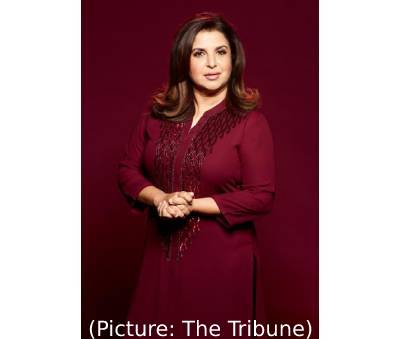
Actress Ileana D’Cruz has had a great run down South and has also been doing her share of Bollywood films. She says everything comes down to people and, as an artiste, one just wants the audience to like watching you.Ileana made her debut in the Telugu film Devadasu, which became the year’s first major commercial success. She debuted in Tamil with “Kedi”. Telugu movie “Pokiri”, which was one of the highest money grosser, set her in top slot actresses. She appeared in many commercially successful movies like Jalsa, Kick etc. She made her debut in Bollywood with Anurag Basu’sBarfi! (2012) starring Ranbir Kapoor.

Popularity, she explains, is the one thing that balances the fact that the film industry can actually be a very cruel place to survive. “It (the film industry) is brutal, of course, but it comes down to people. If they (people) like you that is all you need. You just want people to like watching you,” she told IANS.Ileana feels the moment an actor is not appreciated they lose the mark. “It basically goes the same for me. I wouldn’t want to watch a film with an actor I don’t like watching. The minute you are not liked anymore you sort of lose the mark. The industry is brutal in a sense, but it has got so many perks as well,” she says.

Acting is a profession that comes with its pros and cons, the actress notes, in this context. “You cannot have all the good things only, there is always a little bit of con. I think that makes it interesting. It makes you work harder. It makes you strive to keep doing better,” she sums up.Ileana will next be seen in “Unfair N Lovely”, a comic take on India’s obsession with fair skin. The film is set against the backdrop of Haryana and casts her opposite RandeepHooda. (IANS)

Nikhita Gandhi Is Excited To Be Part Of New Wave Of Indie Releases

Singer Nikhita Gandhi is making sure that she continues making music during the pandemic, and says the Indie genre excites her. “I am excited to be part of this new wave of Indie releases. I have another single dropping soon, where you get to hear the female version of ‘Mawaalidil’. All in all, a lot of self-written melodies,” she told IANS.

Nikhita added: “I’m excited because the spectrum is so global right now, and to be a part of this movement is a dream come true. I got to collaborate with the American RnB artiste Pink Sweats for the song ‘At my worst’ and be on playlists with Rihanna and Kehlani. I don’t think if I went back to 13-year-old me and told her all this would happen, she would ever believe me!”

Talking about her recent number “Karobaardilka”, she says that musician KushalMangal came to her with the idea. “Kushal has been my bandmate and he’s been playing the keys with me for the past couple of years. He’s an extremely talented musician, and more importantly, a wonderful person. He started releasing his own compositions in 2020 and he came to me with ‘Karobaardilka’ saying that he really wanted me to sing the last stanza. I agreed even without hearing the song because I know how great he is. And when I did listen to it, I fell in love with the simple, yet resonating melody of the song. It’s so mature and gorgeous and I really hope people listen to it,” she says. (IANS)

Born into a mixed Bengali and Punjabi family in Kolkata, Nikita relocated to Chennai in 2010 to pursue a degree in dentistry. A former student of A. R. Rahman’s K. M. College of Music and Technology, Nikhita’s first association with Rahman was during an Indo-German exchange, where she was a part of a choir which performed with the German orchestra. Rahman then individually auditioned her for a commercial project titled ‘Qyuki’ with ShekharKapur, the duo were working on. In 2012, she cut a Bengali album titled Kotha, a re-arrangement of NazrulGeeti, songs written by renowned poet KaziNazrul Islam.

After having worked on her personal studio album and sung as a part of songs in regional films, Nikhita got a breakthrough by performing the song “Ladio” from Shankar’s film, I (2015). Composed by A. R. Rahman, she managed to record the song within four hours after translating it into Hindi. She then also subsequently recorded the Telugu and Hindi versions of the song, earning critical acclaim for her work. Other projects she worked for in 2015 include Rahman’s O KadhalKanmani and Anirudh’s ThangaMagan.

New York Indian Film Festival To Showcase Top Indian Movies

The annual New York Indian Film Festival (NYIFF), North America’s longest-running Indian film festival recently announced its list of films for opening night, centerpiece and closing night.

The festival, virtual this year, starts from June 4 and goes on till 13, 2021, according to a press release from the Indo-American Arts Council (IAAC).

The film lineup includes Where is Pinki/ Pinki Elli (Kannada) directed by PrithviKonanur as the opening film; Ahimsa Gandhi: The Power of the Powerless (English), dir. Ramesh Sharma as the first centerpiece; WOMB: Women of my Billion (English, Hindi, Tamil, Telugu), dir. Ajitesh Sharma as the second centerpiece and Fire in the Mountains (Hindi), dir. Ajitpal Singh as the closing film.

The festival will also feature a virtual event with exclusive Q&A sessions with filmmakers and talent, the release said.

Aseem Chhabra, NYIFF festival director offered his thoughts and prayers to the lives lost in the covid-19 crisis in India. “But we made a promise to our audience in the United States and elsewhere. The show must go on. We present the best of Indian cinema from 2020 and 2021,” he was quoted saying in the press release.

NYIFF will also celebrate birth anniversaries of Mahatma Gandhi, Satyajit Ray and Netaji Subhash Chandra Bose.

Suman Gollamudi, IAAC executive director said NYIFF has showcased the some of the most impactful and esteemed films and documentaries celebrating India, its people and its heritage, for the past 21 years. “The caliber of films on the 2021 lineup includes notable works by award-winning filmmakers, which aim to capture stories that have a truly profound message about our world today. These films have received exceptional praise from critics and audiences around the globe,” he added.

According to Rakesh Kaul, vice chairman, IAAC, NYIFF is partnering with MovieSaints for a second straight year to reach a wider audience virtually.

“For the first time, the 2021 lineup truly reflects the incredible diversity of Indian cinematic creativity,” said Dr. NirmalMattoo, Chairman IAAC. “This standout collection of films introduces new voices, fresh perspectives and original storytelling, which enhances the NYIFF curatorial legacy of spotlighting movies that go on to receive critical global acclaim.”

“In addition, we will be unveiling a newly designed award in 2021,” continued Mattoo.  “Conceived and created by IAAC Board Member and sculptor, Raj Shahani, this iconic award will epitomize the excellence that NYIFF seeks to foster with its annual awards presentation.”

Each of these films along with the complete collection of NYIFF-recognized titles will be available for viewing starting June 4, 2021 at nyiff.us and nyiff.moviesaints.com. The cost to view each film ranges from US$4.99 for feature films (narrative and documentaries) and US$0.99 for shorts. Audiences outside the U.S., excluding India, can pay in their local currencies. In India, the cost will be Rs.150 for features and shorts starting at Rs. 50. There are also discount packages available

Featured Movies Include:

Awakash (Marathi), dir. ChittaranjanGiri, 77 mins, 2020

Biryaani (Malayalam), dir. Sajin Baabu, 96 mins, 2020

Blue Bird (Kannada), dir. Ganesh Hegde, 106 mins, 2020

Fire in the Mountains (Hindi), dir. Ajitpal Singh, 82 mins, 2020

First Night (Tamil), dir. Jack Prabhu, Santoshh KK, 106 mins, 2020

Freddie’s Piano (English), dir. AakashPrabhakar, Sudharshan Narayanan, 110 mins, 2020

God on the Balcony (Assamese), dir. Biswajeet Bora, 89 mins, 2020

Habaddi (Marathi), dir. NachiketSamant, 110 mins, 2020

House of Orange Trees (Malayalam), dir. Dr. Biju Damodaran, 110 mins, 2020

June (Marathi), dir. VaibhavKhisti, SuhrudGodbole, 94 mins, 2020

Mail (Telugu), dir. UdayGurrala, 116 mins, 2020

Nasir (Tamil), dir. ArunKarthick, 78 mins, 2019

Nazarband (Captive) (Hindi), dir. Suman Mukhopadhyay, 85 mins, 2020

Parallel Lines (KayamaiKadakka) (Tamil), dir. Kiran R, 104 mins, 2020

Parcel (Bengali), dir. Indrasis Acharya, 123 mins, 2020

Pinki Elli? (Where’s Pinki?) (Kannada), dir. PrithviKonanur, 108 mins, 2020

Searching for Happiness (Bengali) dir. Suman Ghosh, 63 mins, 2021

Songs for Rain (Boroxun) (Assamese), dir. Krrishna Kt. Borah, 86 mins, 2020

Sthalpuran (Marathi), dir. AkshayIndikar, 85 mins, 2020

The Chicken Curry (KoliTaal) (Kannada), dir. Abhilash Shetty, 84 mins, 2020

The Tenant (English, Hindi), dir. Sushrat Jain, 112 mins, 2020

The Knot (Uljhan) (Hindi), dir. Ashish Pant, 113 mins, 2020

Zollywood, (Marathi), dir. Trushant Ingle, 95 mins, 2019

Documentaries:

Ahimsa Gandhi: The Power of the Powerless, (English), dir. Ramesh Sharma, 92 mins, 2020

Borderlands (Punjabi, Bengali, Nepali, Manipuri), dir. Samarth Mahajan, 67 mins, 2021

GharKaPata (Home Address) (English, Hindi, Kashmiri), dir. MadhulikaJalali, 67 mins, 2020

Shut UpSona (English, Hindi, Oriya), dir. Deepti Gupta, 85 mins. 2019

Talking Head (English, Bengali), dir. Spandan Banerjee, 94 mins, 2021

The Music of Satyajit Ray (English, Bengali), dir. Utpalendu Chakrabarty, 51 mins, 1984

The Space Between the Notes (English, Hindi), dir. SumantraGhosal, 52 mins, 2018

WOMB: Women of my Billions, dir. Ajitesh Sharma (English, Hindi, Tamil, Telugu), 103 mins, 2021

At the Altar of India’s Freedom – INA Veterans in Malaysia (English) dir. ChoodieShivaram, 30 mins, 2018

Baluji (English), dir. Cécile Embleton, 22 mins, 2020

Seva (English), dir. RippinSindher, 16 mins, 2019

The Hero Within (Hindi), dir. Stanley Hector, 7 mins, 2021

What’s Your Story? (English), dir. O.P. Srivastava, 51 mins, 2020


Short Films:

Adhura (Unfinished) (Hindi), dir. Arjun Lal, 19 mins, 2020

Annual Day (SalanaJalsa) (Marathi), dir. Pratik Thakare, 30 mins, 2020

Appa’s Seasons (Tamil), dir. Radhika Prasidhha, 22 mins, 2020

  1. Selvi& Daughters (Tamil), dir. Drishya, 25 mins, 2020

Checking Out (English), dir. Vick Krishna, 15 mins, 2020

Happy Birthday (Hindi), dir. Ajay Kishore Shaw, 20 mins, 2020

KhayaliPulao (Hindi), dir.TarunDudeja, 26 mins, 2020

Khisa (Pocket) (Marathi), dir. Raj Pritam More, 16 mins, 2020

Kurma (English, Hindi), dir. Ramsee Chand, 18 mins, 2020

Laali (Hindi), dir. AbhiroopBasu, 30 mins, 2020

Loose Long Shirt (English), dir. Mitali Joshi, 6 mins, 2020

My Brother (Mera Bhai) (Hindi), dir. Shreela Agarwal, 22 mins, 2020

Naap (Hindi), dir. Harshit Acharya, 18 mins, 2020

Now That We’ve Met (English), dir. NityaTuraga, 5 mins, 2020

Pilibhit (Hindi), dir. AshutoshChaturvedi, Pankaj Mavchi, 23 mins, 2020

Pinni (Kannada), dir.BhuvanSathya, 20 mins, 2020

Sonsi (Shadow Bird) (Hindi) dir. Savita Singh, 26 mins, 2020

Sunday (Hindi), dir. ArunFulara, 10 mins, 2020

TasherGhawr (English), dir. Sudipto Roy, 47 mins, 2020

The Miniaturist of Junagarh (Hindi, Urdu), dir. Kaushal Oza, 29 mins, 2020

Untouchability (Theetu) (Tamil), dir. Haresh Narayanan, 7 mins, 2020

Vulture (Xogun) (Assamese), dir. UtpalBorpujari, 16 mins, 2020

More information at: nyiff.us and nyiff.moviesaints.com. For frequently asked technology questions visit https://nyiff.moviesaints.com/faq/nyiff.

Sharks Use Earth’s Magnetic Fields To Find Their Way Home

Newswise — Each year, many shark species migrate hundreds of miles, traversing ocean waters to return to the same spot year after year. Now, Florida State University researchers have found that sharks likely use the Earth’s magnetic fields to help guide them on these long-distance journeys.

“Sharks use map-like information from the geomagnetic field as a navigational aid,” said Bryan Keller, a recent Ph.D. graduate who conducted his research at the FSU Coastal and Marine Laboratory. “This ability is useful for navigation and possibly maintaining population structure.”

The research team’s work is published the latest issue of Current Biology.

Researchers have known that some shark species migrate long distances annually in response to seasonal changes in the environment, prey availability or for reproductive functions, such as finding mates or giving birth. They also knew that sharks are sensitive to electromagnetic fields and thought that there may be a connection with their migration patterns.

Keller specifically examined a group of bonnethead sharks that spend the summer off the coast of the FSU Coastal and Marine Laboratory before migrating south for the winter. Other populations of bonnetheads have been shown to undertake migrations over 620 miles roundtrip.

“That’s not bad for a shark that is only 2 to 3 feet long,” said Dean Grubbs, associate director of research for the  laboratory. “Many shark species display similar migration patterns. The question is how do they find their way back to that same estuary year after year.”

Though scientists had theorized about a potential connection between electromagnetic fields and migration, Keller, Grubbs and their colleagues had to find a way to prove it.

Researchers exposed 20 juvenile, wild-caught bonnetheads to magnetic conditions representing locations hundreds of miles away from where the sharks were captured.

Scientists predicted that if the sharks used the magnetic conditions as a directional tool that they would naturally orient north when exposed to the southern magnetic field. They also predicted that the sharks would have no preference in their orientation when exposed to the magnetic field that matched the field of their capture site.

Both predictions were borne out in the experiments.

“For 50 years, scientists have hypothesized that sharks use the magnetic field as a navigational aid,” Keller said. “This theory has been so popular because sharks, skates and rays have been shown to be very sensitive to magnetic fields. They have also been trained to react to unique geomagnetic signatures, so we know they are capable of detecting and reacting to variation in the magnetic field.”

Co-authors of this study are Nathan Putnam from 2LGL Ecological Research Associates, David Portnoy from Texas A&M University-Corpus Christi and Tim Murphy from the FSU-headquartered National High Magnetic Field Laboratory.

This work was supported by the Save Our Seas Foundation and the FSU Coastal and Marine Laboratory.

Deepika Shares Mental Health Helpline Contacts To Deal With Crisis

Bollywood star Deepika Padukone on Sunday shared a list of verified mental health helplines on Instagram, highlighting the significance of strong mental and emotional health in the time of surging Covid pandemic.

“As millions of us (me and my family included) strive to stay afloat, let us not forget that our emotional well-being in this current crisis, is equally important! Remember, You Are Not Alone. We are in this together. And most importantly, there is HOPE! #YouAreNotAlone @tlllfoundation,” she wrote, along with 12 slides in varied shades of pink that contain the essential numbers.

Several Bollywood stars have been using their social media platforms to pitch in with assistance for the Covid-affected over the past few days. These include Alia Bhatt, John Abraham, Katrina Kaif, Vicky Kaushal, Taapsee Pannu and Bhumi Pednekar among others.

Almost every B-Town celebrity has also been appealing on social media to encourage fans to help in whatever way possible, not to pay heed to rumours and stay safe. (IANS)

Salman Khan’s ‘Radhe’ To Be Released On Eid

Keeping up with the promise of an Eid release, Bollywood superstar Salman Khan’s movie ‘Radhe: Your Most Wanted Bhai’ is all set to make it to the theatres and digital platforms on May 13. The trailer of the film is slated to drop tomorrow.
The digital release of ‘Radhe: Your Most Wanted Bhai’, however, won’t be available for free.

The makers have taken the pay-per-view route, which means that the audience will have to pay a certain amount to watch the movie at their homes. This would not be a part of their subscription to OTT platforms. The makers of the film, on Wednesday, shared the mega release plan on their Instagram handle, along with a poster of the upcoming movie. They wrote, “The perfect Eid celebration! #Radhe: Your Most Wanted Bhai, releasing simultaneously on multiple platforms worldwide. #RadheThisEid.”

Film critic and movie trade analyst Taran Adarsh also confirmed the same on his Twitter handle by tweeting, “#RADHE IN CINEMAS AND DIGITAL MEDIUMS ON SAME DAY… #SalmanKhan’s #Radhe will release simultaneously in cinemas and digital mediums [pay per view] on 13 May 2021… Trailer drops tomorrow.”

ZEE Studios will be the first studio in India to be adopting a multi-format release worldwide. Speaking on this Shariq Patel, CBO, Zee Studios shared, “The ongoing pandemic forced us to innovate, and we are proud to be the first to embark upon this new distribution strategy. While we all love to catch the latest movies at the nearest theatres, we realized we’d be doing a disservice to Salman’s fans nationwide if we aren’t able to release theatrically in all Indian states. We sensed the need for a pay-per-view solution along with theatres, which gives the consumers flexibility and convenience of viewing the film.”

He further continued, “There cannot be a better film than Radhe to offer the audiences who’ve been waiting for an out and out entertainer for over a year now. Radhe continues our network’s deep relationship with Salman Khan and we are looking to release the film in over 40 countries including theatrical release in major overseas markets.”

Salman Khan Films’ spokesperson added, “It’s imperative that we all come together and think of out-of-the-box solutions for cinema as an industry during the current pandemic situation. We will support the theatre owners by releasing the film in as many theatres as we can, keeping in line with the rules and protocols laid down by the government. But, considering the guidelines and safety measures, we also need to devise ways to ensure that the film reaches all of our audience. We don’t want to deny the audience the choice of entertainment in the comfort of their homes during these times.”

The film will be released on ZEE’s pay-per-view service ZEEPlex which rests on India’s leading OTT platform ZEE5 and also on all leading DTH operators. The actor, along with his studio partner Zee Studios, have opted for this hybrid release model given the rise in coronavirus cases across the country.

‘Radhe: Your Most Wanted Bhai’ will also have a theatrical release and will be available in theaters in all Indian states where the theaters are operational as per COVID protocols. A wide international theatrical release targeting 40 countries across all international territories is also being planned. It will be the first Bollywood film to release theatrically in the UK since the lockdown last year.

The action flick by the Yash Raj Films banner, directed by Prabhudeva, was earlier scheduled to release on Eid 2020, but it could not see the light of the day due to the closing of film theatres owing to coronavirus-induced lockdown.
The movie will see Salman Khan romancing Disha Patani. The flick also features Jackie Shroff and Randeep Hooda.

‘Radhe’ is co-produced by Salman Khan, Sohail Khan, and Atul Agnihotri under the banners Salman Khan Films, in association with Zee Studios, Sohail Khan Productions, and Reel Life Production.

‘Nomadland’ Wins Best Picture At Oscars

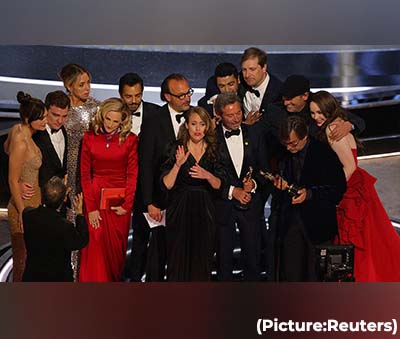
Chloé Zhao’s “Nomadland,” won best picture at the 93rd Academy Awards, where the China-born Zhao became the first woman of color to win best director and a historically diverse group of winners took home awards.

Chloé Zhao’s “Nomadland,” a wistful portrait of itinerant lives on open roads across the American West, won best picture on Sunday, April 25th at the 93rd Academy Awards, where the China-born Zhao became the first woman of color to win best director and a historically diverse group of winners took home awards, Associate Press reported.

“I have always found goodness in the people I’ve met everywhere I went in the world,” said Zhao when accepting best director, which Kathryn Bigelow (“The Hurt Locker”) was the only previous woman to win. “This is for anyone who has the faith and the courage to hold on to the goodness in themselves and to hold on the goodness in other no matter how difficult it is to do that.”

With a howl, “Nomadland” star Frances McDormand implored people to seek out her film and others on the big screen. Released by the Disney-owned Searchlight Pictures, “Nomadland” premiered at a drive in and debuted in theaters, but found its largest audience on Hulu.  “Please watch our movie on the largest screen possible,” McDormand said. “And one day very, very soon, take everyone you know into a theater, shoulder to shoulder in that dark space, and watch every film that’s represented here tonight.”

The best actor award went to Anthony Hopkins for his performance in the dementia drama “The Father.” The award had been widely expected to go to Chadwick Boseman for his final performance in “Ma Rainey’s Black Bottom.” McDormand won best actress, too — her third such win. Only Katharine Hepburn, a four-time winner, has won best actress more times.

The most ambitious award show held during the pandemic, the Oscars rolled out a red carpet and tried to restore some glamour to a grim year. For the first time ever, this year’s nominees were overwhelmingly seen in the home during a pandemic year that forced theaters to close and prompted radical change in Hollywood.

The ceremony — fashioned as a movie of its own and styled as a laid back party — kicked off with opening credits and a slinky Regina King entrance, as the camera followed the actress and “One Night in Miami” director in one take as she strode with an Oscar in hand into Los Angeles’ Union Station and onto the stage. Inside the transit hub (trains kept running), nominees sat at cozy, lamp-lit tables around an intimate amphitheater. Some moments — like Glenn Close getting down to “Da Butt” — were more relaxed, but the ceremony couldn’t just shake off the past 14 months.  “It has been quite a year and we are still smack dab in the middle of it,” King said.

Daniel Kaluuya won best supporting actor for “Judas and the Black Messiah.” The win for the 32-year-old British actor who was previously nominated for “Get Out,” was widely expected. Kaluuya won for his fiery performance as the Black Panther leader Fred Hampton, whom Kaluuya thanked for showing him “how to love myself.”

“You’ve got to celebrate life, man. We’re breathing. We’re walking. It’s incredible. My mum met my dad, they had sex. It’s amazing. I’m here. I’m so happy to be alive,” Kaluuya said, while cameras caught his mother’s confused reaction.

Pixar notched its 11th best animated feature Oscar with “Soul,” the studio’s first feature with a Black protagonist. Peter Docter’s film, about a about middle-school music teacher (Jamie Foxx), was one of the few big-budget movies in the running at the Academy Awards. (It also won best score, making Jon Batiste the second Black composer win the award, which he shared with Trent Reznor and Atticus Ross.) Another was Christopher Nolan’s “Tenet,” which last September attempted to resuscitate moviegoing during the pandemic. It took best visual effects.

David Fincher’s “Mank,” a lavishly crafted drama of 1940s Hollywood made for Netflix, came in the lead nominee with 10 nods and went home with awards for cinematography and for production design. Netflix led all studios with seven Oscars but again — after close calls with “The Irishman” and “Roma,” again missed out on the top award.

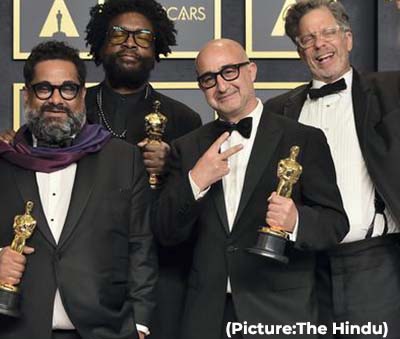
“My Octopus Teacher,” a film that found a passionate following on Netflix, won best documentary. Danish director Thomas Vinterberg’s “Another Round” won best international film, an award he dedicated to his daughter, Ida, who in 2019 was killed in a car crash at age 19.  The biggest ticket-seller of the best picture nominees was “Promising Young Woman,” with $6.4 million in box office.

The night’s first award went to Emerald Fennell, the writer-director of the provocative revenge thriller “Promising Young Woman,” for best screenplay. Fennell, winning for her feature debut, is the first woman win solo in the category since Diablo Cody (“Juno”) in 2007.

More women and more actors of color were nominated than ever before, and Sunday brought a litany of records and firsts across many categories, spanning everything from hairstyling to composing to acting. It was, some observers said, a sea change for an awards harshly criticized as “OscarsSoWhite” in recent years, leading the film academy to greatly expand membership.

The telecast, produced by a team led by filmmaker Steven Soderbergh, moved out of the awards’ usual home, the Dolby Theatre, for Union Station. With Zoom ruled out for nominees, the telecast included satellite feeds from around the world. Performances of the song nominees were pre-taped and aired during the preshow.

Michelle Obama With Puppets Showcases ‘Waffles + Mochi’ On Netflix, Taking Kids to Japan, Italy, and More

In Netflix’s new children’s series “Waffles + Mochi,” Waffles is a Yeti with a waffle for a father, and her sidekick Mochi is filled with strawberry ice cream. Together with the wise guidance of Michelle Obama, the former first lady, these intrepid puppets traverse the globe, meeting world class chefs, expanding their food and taste vocabularies, and spreading joy in their wake. Jeremy Konner and Erika Thormahlen are the creators of the new series.

As per reports, in Netflix’s latest kids’ show, Waffles + Mochi, two adorable puppets from the Land of Frozen Food are catapulted into the real world to learn about food by traveling the globe. The TV series, which has dashes of Sesame Street, Parts Unknown, Chef’s Table, and Pee Wee’s Playhouse, follows Waffles and Mochi as they find out where ingredients come from, cook and eat tasty dishes, and discover new cultures, all while working at a whimsical grocery store owned by Mrs. Obama—played by none other than Michelle Obama.

The 10-episode series, filmed around the world pre-pandemic, brings together witty dialogue, standout original music, and genuine education to entertain kids and adults alike. It’s also the first children’s show produced by Higher Ground Productions, the Obamas’ production company. Waffles + Mochi features adults and children of various ethnicities and racial and social backgrounds, as well as members of the disabled community as part of the production company’s larger mission of uplifting diverse voices.

“The level of diversity and food that they showcase is incredible,” says Los Angeles–based Bricia Lopez, a James Beard Award–winning chef, who appears in the show’s second episode about salt. “To be able to talk about Oaxaca in a show like this and to see the level of respect they’re giving not just the food but the children—they’re not dumbing anything down.”

Mashama Bailey, chef and owner of The Grey in Savannah, who appears in two episodes, agrees. “It’s really a cool way to talk about how different people can relate to each other, find common ground, enjoy each other’s company, teach each other about their cultures, and not judge each other,” she said.

And with kids mostly home-bound after a year of the pandemic, the show’s release couldn’t have been better timed. “[Waffles and Mochi are] traveling for learning purposes, which I thought was really cool,” says Bailey. “That’s a good way to talk to children about travel. When you travel and eat food, you put a face to the food, you put a culture to the food. Travel helps you recognize the history and the struggle of food and prevents you from trying to take over that narrative and turn it into your own.”

In Waffles + Mochi, the puppets learn how to make mazamorra morada, a sweet purple corn desert, in Lamay, Peru. Each episode is focused around a specific ingredient. In the sixth episode, the puppets are sent on a mission to collect different types of eggs to bring to chef Massimo Bottura in Modena, Italy. They start by going to Long Beach, California, to the Growing Experience, where they meet kids helping to raise chickens and learn how eggs are laid. The duo also travels to Kyoto to eat a Japanese omelet made by chef Motokichi Yukimura. There, Mochi discovers he doesn’t like the texture of eggs, which is explained in its own cartoon skit all about taste buds, set inside the puppet’s mouth. Next, Waffles and Mochi collect fish eggs from Nishiki Market, fly to the Sacred Valley in Peru to find quail eggs at Urubamba Market, and finally meet up with Bottura in Modena, where they discover that one of the eggs broke during the journey.

Bottura reassures them that it’s okay to make mistakes and that that’s how one of his best dishes—the Oops, I Dropped the Lemon Tart—was invented. “[The show is] for kids, but also for adults,” says Bottura. “They take a simple way to understand a very complicated concept, like the idea of making a mistake—you are allowed to make mistakes, and from that mistake, you’re going to learn something.”

Aside from the former first lady, Bailey, Lopez, and Bottura, adults will be delighted by cameos from José Andrés (who we discover is a fabulous dancer), Tan France, Rashida Jones, and Samin Nosrat, to name just a few.

Still, one of the best parts of the show is observing the genuine joy that the guests get from their interactions with the puppets, which were mostly ad-libbed. “It was so wonderful to speak to this puppet, this character, in real life, and have a conversation and have it talking back to me,” says Lopez. “Obviously there’s a human behind it, but I actually connected with the character in real life.”

Each of the chefs featured were consulted on which ingredient they connected with and which food they wanted to showcase. Bottura decided to showcase his pasta and for Bailey, the choice was obvious. “When they started talking about ingredients that were indigenous, or ingredients that I worked with, for me it was corn and grits,” said Bailey, who can be seen in the corn-focused episode.

You’ll find Lopez in the kitchen in Los Angeles making mole with the puppets in the salt episode. They later eat dinner with her family, including her young son. “The kitchen is a whole new world for children,” said Lopez. “I think children [being] in a kitchen, it can truly empower them.”

In “Aarkkariyam” Parvathy Impresses In An Impactful Film

Aarkkariyam Is a Malayalam movie that presents lives in disarray, looking for moorings and closure, in the most natural way in a most unnatural year where we all were forced to live in isolation.

The beginning of the pandemic, in early 2020, already seems like a life-time ago. Aaakkariyam opens with a couple who live on the outskirts of Mumbai getting ready to drive down to Kerala. The two-day road trip is the only way to get from one place to another, and even this needs to be done fast, as crossing state borders may also soon become impossible.

A certain easy-going, calm atmosphere pervades Aarkkariyam even in supposedly the more tense moments in the narrative. So much so that close to the interval, when a key character makes a rather shocking claim, even that is delivered in a cool, collected manner, as if he is speaking about one of the dinner dishes. This somehow gives a chilling quality to that scene, yet this light treatment also limits the film at other key points.

Cinematographer Sanu John Varughese’s directorial debut is firmly set in the post-pandemic world, with the after-effects of the virus being a part of the narrative. Shirley (Parvathy Thiruvothu) and her husband Roy (Sharaudheen), who are settled in Mumbai, are returning home to Kerala to be with her father Ittyavira (Biju Menon), ahead of the COVID-induced lockdown. Beset with financial crises, Roy is also looking to raise urgent funds to repay his friend, who helped him in need, while Shirley is devising various ways to bring back her daughter who is stuck in another state.

Like millions of hapless people, the harsh lockdown has justify Sherly (Parvathy Thiruvothu) and Roy (Sharafudheen) in a tight financial bind. The only way out is for them to head south, where Sherly’s father, 73-year-old Ittyavira (Biju Menon), and young daughter (Tejaswini), are eagerly waiting their arrival. The palpable sense of relief when they reach home is evident; you can see the tension leaching out of the exhausted couple. It even begins to look as if the resourceful Ittyavira may have a solution to their problems, and then, wham, a flying missile encapsulated in a throwaway remark strikes. And everything crumbles.

This, the delivery of the bombshell, is the most artful part of the film which knows how to incorporate artlessness in its telling. In his debut directorial, Varghese, who has been the cinematographer on such films as ‘Kartik Calling Kartik’, ‘Badhai Ho’, ‘Wazir’, ‘Android Kunjappan’ and ‘Take-Off’, among others, shows that he knows exactly how to recreate life on screen with such ease that you forget you’re watching stuff mediated by a camera.

What we get is a well-knit plot that gives up its secrets as it goes along. We learn why Sherly’s daughter is living away from her, and our assumption about Roy being the father is just that, an assumption. Sherly’s painful backstory threatens to come alive again, as Roy begins unravelling the dark secrets that lie buried. Can we ever fully escape our past? Can our faith save us from mortal sin?

Aarkkariyam Movie Cast: Biju Menon, Parvathy Thiruvothu, Sharafudheen, Saiju Kurup, Tejaswini. Directed By: Sanu John Varghese. Aarkkariyam movie rating: 3 stars.

Kerala Medical Students Join ‘Rasputin Dance Challenge’ To Protest Against Hate

In Kerala, an Instagram Reels video of two medical students – Naveen K Razak and Janaki M Omkumar – has inspired a dancing movement against hate.

The two students received a lot of love and encouragement after they posted a 30-second clip of them dancing to Boney M’s cult song Rasputin. But amid all the appreciations, the video also received some hate comments from users drawing attention to their religion.

Now Sanghis are abusing the guy and alleging love jehad because his name is Naveen Razak while the girl’s name is Janaki Omkar Sharing the video again cause that is also a political statement these days.

Days after the two medical students in Kerala went viral for their after-class dance video, more medical students have joined the Rasputin dance challenge.  While the video instantly went viral, it soon took a communal turn, garnering hate as the two students belonged to different religious communities. To protest against the hate, many medical students across Kerala joined the challenge and are now posting videos while grooving to the peppy beats.

So these Thrissur medical college students have come up with another dance video, with more students joining in to protest hatred. Hatemongers shouldn’t forget that this is Kerala A spectra is haunting haters in Kerala. So these Thrissur medical college students have come up with another dance video, with more students joining in to protest hatred.

SAG Top Honors For ‘Chicago 7’ Sets Up Intriguing Oscar Race

The Trial Of The Chicago 7 — Aaron Sorkin’s 1969 courtroom drama for Netflix — was judged the year’s best performance by a motion picture cast at the Screen Actors Guild (SAG) Awards for film and television last week. Starring the likes of Sacha Baron Cohen, Eddie Redmayne, Frank Langella and Mark Rylance, it marked the first time a film from any streaming service won the guild’s ensemble award.

The win now strengthens the film’s case for the Oscars (April 25). This even as modern recession-era movie Nomadland grabbed many of the pre-Oscar awards, including the Golden Globes.

The SAG awards though remain a key predictor of Oscar glory, where actors form the largest voting bloc. FYI: Last year, South Korea’s Parasite began its historic charge to the Best Picture Oscar by winning SAG’s top prize.

Also: For the first time in SAG awards’ 27-year history, all four of the winning film actors were people of colour. The late Chadwick Boseman and Viola Davis picked up the best actor and best actress awards, respectively, for jazz period film Ma Rainey’s Black Bottom.

And while Daniel Kaluuya won best supporting actor for portraying Black Panther leader Fred Hampton in Judas and the Black Messiah, South Korea’s Yuh-jung Youn won best supporting actress for Minari, an immigrant tale set in 1980s Arkansas.

Rajnikanth To Receive The Dadasaheb Phalke Award for 2019


Megastar Rajinikanth has been chosen to be conferred with the prestigious Dadasaheb Phalke Award, for excellence in cinematic achievement, is the highest honor in the film world and is awarded by the government.

Megastar Rajinikanth will be conferred with the prestigious Dadasaheb Phalke Award for 2019, the Government of India announced last week. The Dadasaheb Phalke, awarded for excellence in cinematic achievement, is the highest honor in the film world and is awarded by the government. The recipient of the 2018 award was Amitabh Bachchan, Rajinikanth’s co-star from ‘Hum’.

The 70-year-old star has featured in Bollywood as well as South Indian films and has a humongous fan following. The ‘2.0’ star had made his debut in 1975 with K Balachander’s ‘Apoorva Ragangal’ and has completed more than 45 years in the Tamil film industry.

Superstar Rajinikanth will be honored with the 51st Dadasaheb Phalke Award, Union Information and Broadcasting Minister Prakash Javadekar announced. Calling Rajinikanth “one of the greatest actors in the history of Indian cinema”, he said that the actor was being awarded for his contribution in the field of acting, production and screenwriting for Indian cinema.

Posting a picture of the actor, Javadekar wrote: “Happy to announce #Dadasaheb Phalke award for 2020 to one of the greatest actors in history of Indian cinema Rajnikant ji His contribution as actor, producer and screenwriter has been iconic I thank Jury @ashabhosle @SubhashGhai1 @Mohanlal @Shankar_Live #BiswajeetChatterjee.”

Rajinikanth has extended ‘deepest gratitude’ for all the love, greetings, and wishes he received after the announcement. The award will be given to the star for his stupendous contribution to the world of Indian cinema. The ‘Robot’ actor took to Twitter and extended his deepest gratitude to all those who took out time to wish him. “For all the love, greetings & wishes I’ve received from eminent political leaders, my film fraternity friends & colleagues, well-wishers, media, every person who took the time to wish me & my beloved fans from across India & all over the world .. my deepest gratitude and thanks,” tweeted Rajinikanth.

Prime Minister Narendra Modi congratulated Rajinikanth with a tweet, “Congratulations Talaivar”. Soon Vice President M. Venkaiah Naidu too, tweeted.

“Hearty congratulations to Shri @rajinikanth on being conferred the prestigious Dadasaheb Phalke Award. Over the past many years, the versatile actor has been enthralling people by portraying a vast array of roles depicting myriad hues of human experience and emotions.#Rajinikanth,” said Naidu and added: “My best wishes for the renowned thespian’s future endeavours! #Rajinikanth.”

Calling Rajinikanth “one of the greatest actors in the history of Indian cinema”, the I&B minister said that the actor was being awarded for his contribution in the field of acting, production and screenwriting for Indian cinema. Actor-turned-politician, Kamal Haasan also congratulated Rajinikanth.

Several B-town celebs had also taken to their social media handles to congratulate Rajinikanth. Neena Gupta, Hrithik Roshan, Akshay Kumar, Anil Kapoor, Karan Johar, Shilpa Shetty Kundra, Sidharth Malhotra, Boney Kapoor, among others, wished him on Twitter. The Dadasaheb Phalke Award for 2019 should have been announced last year but was postponed because of the COVID-19 pandemic, as were the National Film Awards for 2019.

He has delivered hit films such as ‘Billu’, ‘Muthu’, ‘Baashha’, ‘Sivaji’, and ‘Enthiran’. Rajinikanth was last seen in AR Murugadoss’s ‘Darbar’. Currently, he is shooting for his upcoming film ‘Annaatthe.’ Among his numerous hits are films like “Baashha”, “Sivaji” and “Enthiran”. He is known as Thalaivar or leader by his fans.

Widely regarded as one of the most popular cinematic icons in India, Rajinikanth has also been honored with the Padma Bhushan in 2000 and the Padma Vibhushan in 2016 by the Government of India.

The Dada Saheb Phalke award jury consists of Malayalam super star Mohanlal and Tamil music composer and singer, Shankar Mahadevan, besides veteran singer Asha Bhosle, and moviemaker Subhash Ghai.

Tamil Nadu villages and cities bursted with joy on the announcement of Rajini’s feat. People took to streets and hundreds reached Poes Garden residence. At Salem people celebrated Rajini’s Phalke win by distributing sweets and lighting crackers. Congratulatory messages are pouring in from political leaders, actors, directors and social workers, besides people from all walks of life.

Google Maps Plans Greenest Route To Your Destination

Google Maps plans to start highlighting journeys and directing drivers to routes that it calibrates to be the most “eco-friendly” based on a range of factors. Here’s how it will work. Google Maps plans to start highlighting journeys and directing drivers to routes that it calibrates to be the most “eco-friendly” based on a range of factors. The calculation of the default route that potentially generates the lowest carbon footprint would be done by assessing factors such as traffic data, congestion history, and even road inclines.

The Alphabet-owned search engine said in a blogpost that the feature would be launched first in the United States sometime later this year, “with a global expansion on the way”. Once launched, the default route that would show up on the Google Maps app will be the “eco-friendly” one. Users will have to opt out of this if they wish to take an alternative route.

Google said that when alternative routes “are significantly faster”, the mapping app will offer options, and let users compare estimated emissions on the default and alternative routes. The new feature, Google said, is part of its commitment to fight climate change.
While the tech major did mention plans for a “global expansion”, it did not offer specifics with respect to the launch timelines in specific geographies such as India.

Google is also reported to be making “new map layers for weather and air quality” that are set to roll out in the coming months on both Android and iOS. Google plans to launch the weather layer globally and release the air quality layer first in Australia, India, and the US, according to a report in The Verge.

For its new route plan, Google said it used emissions data based on testing across different types of vehicles and roads in the US, and subsequently concluded that for about 50 per cent of the analyzed routes, it was able to offer a ‘greener’ alternative without any significant tradeoffs.

“What we are seeing is for around half of routes, we are able to find an option more eco-friendly with minimal or no time-cost trade-off,” Russell Dicker, a director of product at Google, said.The search major said it used emissions data based on testing across different types of cars and road types, extrapolating insights from the US Government’s National Renewable Energy Lab. Its data incorporates details such as slopes and inclines from its own Street View cars feature alongside aerial and satellite imagery.

Also, from June 2021, Google will start warning drivers about travelling through low emissions zones where some vehicles are restricted, as is the case in countries such as Germany, France and the Netherlands.In another new feature slated for launch later this year, Google Maps users will be able to compare travel options — car, cycling, public transport etc — in one place instead of having to switch back and forth between different modes with evaluating travel options.The scope of these features could be progressively widened to include Asian cities such as Jakarta, it indicated.

The Illegal: Small Film, Big Impact

The Illegal (film on Amazon Prime); Cast: Suraj Sharma, Shweta Tripathi, Adil Hussain, Neelima Azim, Iqbal Theba, Hannah Masi, Jay Ali; Direction: Danish Renzu; Rating: * * * and 1/2 (three and a half stars)

You’d think you have seen this before. A young boy from middle-class India lands in the United States chasing a dream, and his struggle for sustenance becomes portrait of the grind that almost every immigrant must endure.

If Danish Renzu’s film is outstanding despite the note of familiarity, it is because of the sheer authenticity with which the writer-director tells his tale. The film is unflinching in tone, yet sensitive enough while dissecting the reality it presents. Renzu uses his crisp runtime of 86 minutes well, to set up nuanced storytelling.

Unlike most films pertaining to the subject, “The Illegal” is not about immigrants who enter the US unlawfully. It is about people who come in with legitimate papers, yet are forced by circumstances to survive as if their presence is illegal.

“Life Of Pi” actor Suraj Sharma plays Hassan Ahmed, who is one such character. Hassan’s passion for filmmaking is destined to take him from Purani Dilli to Los Angeles. He gets admission at film school in the US, so his father (Adil Hussain) takes a loan to fund his dream.

Renzu sets an endearing picture of the family in the opening minutes, as Hassan records a few parting words from his father, mother (Neelima Azim) and sister Mahi (Shweta Tripathi). He needs such a clip, he tells them, as a pep pill for the days when he might be “ready to give up”. It is a fine sequence, deftly executed, rendering a personal touch to the way the protagonist is imagined. The screenplay sustains that whiff of intimacy as it follows Hassan to America.

Before entering films, Renzu spent time in the US studying electrical engineering at UCLA, and he also holds a UCLA Writers’ Program certification in screenwriting. Thematically, he would have drawn from real instances that he may have encountered during that stint as a student. It would have let him create Hassan with greater assuredness.

Hassan’s existence in the US becomes a picture of irony. On the one hand, he is doing well in film school. Yet, there is trouble back home financially, owing to a down turn in his father’s health. His plans to stay at his maternal uncle’s home in the US come to nought, and Hassan must take up the job of a waiter.

Renzu uses Hassan’s dual life well, to portray two sides of an immigrant’s existence in the US. On one hand, he is impressively learning his ropes in the world of American cinema, which has lately conversed with great relish about inclusivity. Yet, moonlighting at an Indian restaurant as a waiter throws up a dreary, diametrically opposite picture of exploitation. The essence of the film lies in that dichotomy.

It is Suraj Sharma’s film all through, and the actor does impressively to bring alive Hassan, although you would spot a few winning performances among the prop cast, too. Iqbal Theba leaves an impact as the restaurant supervisor fondly called Babaji by his colleagues. Adil Hussain, Shweta Tripathi and Neelima Azim actually get minimal footage, but leave a mark. “The Illegal” is well-scripted, executed and acted out. It is a small film that scores big. (IANS)

Telugu Movie ‘Jathi Ratnalu’ Scores Big In US Market

Jathi Ratnalu, which hit the screens earlier this month, has been striking gold at the box office. Starring Naveen Polishetty, Priyadarshi, Rahul Ramakrishna, and Faria Abdullah among others, the film has been termed as a laugh riot, succeeding in impressing audiences across boundaries. Directed by debutant Anudeep KV, the Telugu flick is continuing its dream run in theatres. And while there has been quite some curiosity surrounding the OTT release date of Jathi Ratnalu, it appears the film might not make its way to the small screens until a few more weeks.

As per reports, the digital streaming rights of Jathi Ratnalu have been bagged by the leading OTT platform Amazon Prime Video. Regarding the release date, there are speculations that Jathi Ratnalu might stream on the OTT platform from 10 April. However, there has been no official word on the same yet. While the release date hasn’t been confirmed as of now, the likelihood of the film making it to the digital platform in April seems high.

 The Telugu film “Jathi Ratnalu” is one of the first Indian films to score big at the US box office after the lull due to the pandemic. The film stars Naveen Polishetty, Priyadarshi and Rahul Ramakrishna, and is directed by Anudeep KV.

Within a month of release, “Jathi Ratnalu” has collected almost $1 million (Rs 7,25,62,250) in the United States. The film was made on a budget of around Rs 5 to 6 crore. The film has also done business worth Rs 100 crore (nett) in the Indian market so far.

“We take pride in making movies that entertain the masses and have the potential to shake off the inertia. Jathi Rathnalu has emerged as a reason to laugh and as producers, that’s what we aimed for. A big thanks to the writers for cultivating humour that sat so well with the audience and the critics. We have the world to thank for the success that the film is currently witnessing overseas,” says a spokesperson of the film’s production house, Swapna Cinema.

Reviewed as a laugh riot, the film was appreciated by stars such as Allu Arjun and Mahesh Babu. The film also features Faria Abdullah while Murali Sharma, Brahmanandam and Naresh play supporting roles.

Jathi Ratnalu fetched a positive response from the audience right from the word go. The prospects further drew strength with the likes of Mahesh Babu and Allu Arjun applauding the film and its cast and crew. Recently, it was reported that the film even touched the $1 million mark at the US box office. And given that the film has been on a roll, the makers even announced that its OTT release might be delayed with the theatrical run being extended.

National film Awards

The 67th National Film Awards have finally been announced. Delayed by one year due to the coronavirus pandemic, the awards were announced during a press conference in Delhi on Monday

Tamil actor Dhanush along with Bollywood actors Kangana Ranaut and Manoj Bajpayee on Monday won top acting honors at the 67th National Film Awards, which walked the tightrope between mainstream and indie cinema. Director Priyadarshan’s Malayalam film “Marakkar: Arabikadalinte Simham” was declared best film and Sanjay Puran Singh Chauhan named best director for the Hindi film “Bahattar Hoorain” by the jury headed by filmmaker N Chandra, who said they judged the movies “not as gods but as parents”.

Overall, Hindi films won big in the feature film category. The Best Female Actor award went to Kangana Ranaut for her performance in Manikarnika and Panga, while the Best Feature Film (Hindi) went to Sushant Singh Rajput’s Chhichhore.

The most watched glamorous event ceremony will bestow honours on films and artistes for the year 2019. The awards were initially going to be held in May last year but were delayed indefinitely due to the coronavirus pandemic. The awards are given out by the Directorate of Film Festivals, an organisation that comes under the Ministry of Information and Broadcasting.

This is the fourth National Award for Ranaut, who is known for her combative comments and hit the headlines when she locked horns with the Maharashtra government after her office was demolished by the BMC. She won the best actress award this time for her performance in the Hindi films “Panga” and “Manikarnika”. The other three National Award wins were best actress for “Tanu Weds Manu Returns” and “Queen” and the best-supporting actress trophy for “Fashion”.

The National Awards, given by the Directorate of Film Festivals which comes under the Ministry of Information and Broadcasting, were delayed by a year due to the pandemic.

The awards are presented by the President of India traditionally. However, for the 66th National Film Awards, Vice President Venkaiah Naidu did the honors, while President Ram Nath Kovind hosted the high tea for the winners.

Here is a look at the National Film Awards 2020 winners:

Best Feature Film: Marakkar: Arabikadalinte Simham

Best Hindi Film: Chhichhore

Best Actor (Male): Manoj Bajpayee (Bhosle) and Dhanush (Asuran)

Best Actor (Female): Kangana Ranaut (Manikarnika and Panga)

Best Supporting Actor (Male): Vijay Sethupathi

Best Supporting Actor (Female): Pallavi Joshi

Best Editing film: Jersey (Telugu)

Best Audiography: Resul Pookutty

Best Screenplay Adapted: Gumnami

Best Female Playback singer: Savani Ravindra for Bardo (Marathi)

Best Male Playback Singer: B Praak

Best Action Direction: Avane Srimannarayana (Kannada)

Best Choreography: Maharishi (Telugu)

Best Special Effects: Marakkar: Lion of the Arabian Sea (Malayalam)

Special Jury Award: Oththa Seruppu Size 7 (Tamil)

Best Lyrics: Prabha Varma for Kolaambi (Malayalam)

Best Music Direction: D. Imman for Viswasam (Tamil)

Best Background Music: Prabuddha Banerjee for Jyeshthoputro (Bengali)

Best Make-up Artist: Ranjith for Helen (Malayalam)

Best Costumes: Sujith and Sai for Marakkar: Lion of the Arabian Sea (Malayalam)

Best Production Design: Anandi Gopal (Marathi)

Best Audiography (Re-recordist of final mixed track): Oththa Seruppu Size 7 (Tamil)

Best Screenplay (Original): Jyeshthoputro (Bengali)

Best Screenplay (Adapted): Gumnaami (Bengali)

Best Screenplay (Dialogues): The Tashkent Files (Hindi)

Best Cinematography: Jallikattu (Malayalam)

Best Child Artist: Naga Vishal for KD (Tamil)

Best Direction: Sanjay Puran Singh Chauhan for Bahattar Hoorain (Hindi)

Best Children’s Film: Kastoori (Hindi)

Best Film on Environment: Water Burial (Monpa)

Best Film on Social Issues: Anandi Gopal (Marathi)

Best Film on National Integration: Tajmahal (Marathi)

Best Popular Film Providing Wholesome Entertainment: Maharishi (Telugu)

Best Debut Film of a Director: Mathukutty Xavier for Helen (Malayalam)

Non-feature films

Best Film Critic: Sohini Chattopadhyaya

Best Book on Cinema: A Gandhian Affair: India’s Curious Portrayal of Love in Cinema.

Best Non-Feature Editing: Arjun Saraya

Audiography (musical): Radha

On Location Sound Recordist: Rahas

Best Cinematography: Savita Singh for Sonsi

Best Direction: Knock Knock Knock

Best Film on Family Values: Oruu Pathira

Best Short Fiction: Custody

Special Jury Award: Small Scale Values

Best Animation: Radha

Best Investigative: Jakkal

Best Exploration film: Wild Karnataka

Best Education film: Apples and Oranges

Best Film on Social Issues: Holy Rites (Hindi) and Ladli (Hindi)

Best Environment Film: The Stork Saviours

Best Promotional film: The Shower

Best Biographical Film: Elephants do Remember

Best Ethnographic Film: Charan-Atva

Best Debut Non-Feature film Director: Khisa

Best Non-Feature Film: An Engineered Dream

Women Rule Grammys As Beyoncé, Swift Make History

Female performers including Beyoncé and Taylor Swift had a record-making night at the 2021 Grammy Awards, a jam-packed but socially distanced show highlighted by live music sorely absent during the pandemic era.


Beyoncé, Taylor Swift and Billie Eilish made history at the Grammy Awards on March 14th. Female performers including Beyoncé and Taylor Swift had a record-making night at the 2021 Grammy Awards, a jam-packed but socially distanced show highlighted by live music sorely absent during the pandemic era.

Four women won the top four prizes Sunday, including Swift, who became the first female performer to win album of the year three times. Beyoncé — with her 28th win — became the most decorated woman in Grammy history.

H.E.R. won song of the year and Billie Eilish picked up her second consecutive record of the year honor, telling the audience that best new artist winner Megan Thee Stallion deserved the award. Though women have won all top four awards in the past – including Eilish’s sweep last year – it marked the first time four separate and solo women won the top four honors.

“I feel like there’s been a lot of female empowerment and lots of women winning awards tonight. And so it’s been absolutely amazing to just be alongside all that, to feel that energy,” Dua Lipa, who won best pop vocal album, said backstage.

Swift won the top prize with “folklore,” the folky, alternative album she released as a surprise last year. She previously won album of the year with “Fearless” and “1989.”

Beyoncé walked into the show with 24 wins and picked up four honors, including best R&B performance for “Black Parade,” best music video for “Brown Skin Girl” as well as best rap performance and best rap song for “Savage,” with Megan Thee Stallion.

“As an artist I believe it’s my job, and all of our jobs, to reflect time and it’s been such a difficult time,” Beyoncé said onstage as she won best R&B performance for “Black Parade,” which was released on Juneteenth.

She went on to say she created the song to honor the “beautiful Black kings and queens” in the world. She added: “I have been working my whole life … This is such a magical night.”

Beyoncé now ties producer and multi-instrumentalist Quincy Jones for second place among all Grammy winners. She is only behind the late conductor Georg Solti, who is the most decorated Grammy winner with 31 wins.

But Beyoncé didn’t only make history, her whole family did. The royal family of music all won honors Sunday: Jay-Z picked up his 23rd Grammy, sharing the best rap song win with his wife since he co-wrote “Savage.” And 9-year-old Blue Ivy Carter — who won best music video alongside her mother — became the second youngest act to win a Grammy in the show’s 63-year history. Leah Peasall was 8 when The Peasall Sisters won album of the year at the 2002 show for their appearance on the T Bone Burnett-produced “O Brother, Where Art Thou?” soundtrack.

Megan Thee Stallion, who won three honors, also made history and became the first female rapper to win best rap song. She’s also the fifth rap-based act to win best new artist. Beyoncé was the night’s top contender with nine nominations. She didn’t perform but Swift did.

She sang “cardigan” and “august” from “folklore,” as well as “willow” from “evermore,” and was joined by the collaborators who helped her make the albums, Jack Antonoff and Aaron Dessner, who both won album of the year with Swift.

The Grammys featured pre-taped performances that helped the nearly four-hour show run seamlessly — a not-so-easy feat during a global pandemic. Host Trevor Noah told jokes about the pandemic and the year that was 2020, appearing live from downtown Los Angeles with attendees wearing masks and sitting, socially distanced, at small round tables.

Silk Sonic, aka Bruno Mars and Anderson Paak, also performed, bringing a throwback R&B vibe to the show with their smooth new single, “Leave the Door Open.” Lipa proved her pop star status with a performance of her hits “Don’t Start Now” and “Levitating,” where she was joined by DaBaby, who was an all-star during his own performance of his guitar-tinged rap hit “Rockstar,” flipping the song for an exceptional live rendition featuring R&B singer Anthony Hamilton, a skilled violinist and background singers.


Country singer Mickey Guyton – the first Black woman nominated for best country solo performance – gave a top notch performance of her song “Black Like Me,” which she released last year as police brutality continued to devastate Black families and the coronavirus ravished Black America disproportionately. Lil Baby, joined by Killer Mike and activist Tamika Mallory, gave a political performance that impressed.

“Black Parade” joined a list of songs honoring the Black experience that won Sunday, including H.E.R.’s protest anthem “I Can’t Breathe” and Anderson Paak’s “Lockdown,” which was released on Juneteenth like “Black Parade.”

Other performers Sunday included Eilish, Cardi B, Bad Bunny, Miranda Lambert, Maren Morris and Harry Styles, who won best pop solo performance for the hit “Watermelon Sugar.”

“To everyone who made this record with me, thank you so much,” said Styles, the first member of One Direction to win a Grammy.

Double winners included H.E.R., Fiona Apple, Kaytranada and late performers John Prine and Chick Corea. Beyoncé’s four awards Sunday brought her up to 28 Grammys in her career, more than any other female artist. Her celebration of Black history, “Black Parade,” released last Juneteenth, won best R&B performance and she shared two awards for collaborating with Megan Thee Stallion on “Savage.”

She ties Quincy Jones for second most Grammys ever and has the leader — the late conductor George Solti, who won 31 — in her sights.

Further crowding the family trophy case is husband Jay-Z, whose songwriting on “Savage” earned him his 23rd Grammy on Sunday, and even their 9-year-old daughter, Blue Ivy Carter, who won best music video together with mom. “This is such a magical night,” Beyoncé said.

Swift, who also found time during the pandemic to make another album and re-record one of her old ones, became the first woman to win the album of the year Grammy for the third time. Stevie Wonder, Paul Simon and Frank Sinatra have also done it. She won in 2009 for “Fearless” and 2015 for “1989.”

After her sweep last year, Eilish became only the third artist to win back-to-back record of the year Grammys. Roberta Flack won in 1973 for “The First Time Ever I Saw Your Face” and in 1974 for “Killing Me Softly With His Song,” while U2 won in 2001 and 2002 for “Beautiful Day” and “Walk On.”

Then, when Eilish and her collaborator-brother Finneas accepted the award, she almost gave it away. She brought Megan Thee Stallion to tears by saying the rapper deserved the Grammy for “Savage.”


Bhaskar Menon, Founding Chairman of EMI Music Worldwide, Dies at 86

Bhaskar Menon, the Indian American founding chairman and CEO of EMI Music Worldwide and a legend in the music business, died March 4 at his home in Beverly Hills, Calif. He was 86. “Determined to achieve excellence, Bhaskar Menon built EMI into a music powerhouse and one of our most iconic, global institutions,” said Universal Music Group chairman and CEO Lucian Grainge in a statement. “Music and the world have lost a special one. Our hearts go out to his loved ones.”

In a career spanning over three decades, Menon was associated with some of the biggest names in the music industry, from the Beatles and the Rolling Stones to Pink Floyd, Queen, David Bowie and Tina Turner.

Before EMI, Menon was the CEO of Capitol Records and is credited with launching Pink Floyd’s popularity in the U.S. with the campaign that he designed for the band’s release of “The Dark Side of the Moon,” reported NDTV.

Menon was born in 1934 in Thiruvananthapuram, Kerala. He attended the Doon School, Dehradun, and Christ Church, Oxford, after which he joined EMI in 1956. In 1957, he moved to EMI’s Indian subsidiary, Gramophone Company of India, where he rose through the ranks before eventually being elevated to chairman in 1969, according to billboard.com.

Billboard noted that the most notable chapter in Menon’s career began in 1971, when he relocated to Los Angeles, Calif., in 1971 to take the helm at Capitol and steered the company into the new decade.

Menon’s tenure at Capitol came to an end in 1978, when he was named chairman and CEO of EMI Music Worldwide, a position he held for the next 12 years, per Billboard.

After leaving the music business in the early 1990s, Menon remained in Los Angeles and founded the company International Media Investments in 1995, through which he invested in and provided consultation services for a variety of entertainment and media businesses, including NDTV, where he held a seat on the board, it said.

Menon is survived by his wife Sumitra, their two sons, Siddhartha and Vishnu, and his sister Vasantha Menon.

Anoushka Shankar Announces New Track, ‘Sister Susannah’

Grammy-nominated sitarist, composer and producer Anoushka Shankar has announced the release of her new track, “Sister Susannah,” slated to drop on March 22.

“Over the course of the last year, it has been impossible to ignore the shadow pandemic happening alongside the pandemic itself. Hearing of the suffering of so many women, I have once again been startled by how common the experiences of abuse can be,” Shankar said.

The track features the Indian American musician on sitar, and reciting a checklist of requirements from the perspective of an unidentified man to his romantic partner.

She added: “‘Sister Susannah’ is a song I’ve toyed with for some time and the current situation, alongside people’s visceral reactions to our rare live performances of the song, prompted me to revisit and release it.”

Alongside Shankar, Grammy-nominated composer Alev Lenz has co-written the music and lyrics, and poet Nikita Gill contributes the poem in the song, marking her first foray into music. Manu Delago performs percussion and Nina Harries, Alev Lenz and Anandi Bhattacharya provide additional vocals.

Shankar is also scheduled to perform at the 63rd Grammy Awards Premiere Ceremony. She will join artists including Gregory Porter and Kamasi Washington.

As part of the International Women’s Day celebrations, she performed Mar. 8 evening at Women, Power and Change: International Women’s Day at WOW, an event by WOW UK Festival 2021 that is being held virtually for the first time.

Brooklyn’s Priya Darshini’s Debut Album

“Is my idea of being at peace the same as being a home? Is it within me? Who am I? All these questions found expression in Periphery,’ says Brooklyn-based musician Priya Darshini, who has been nominated for in the Best New Age Album category at the Grammys 2021, country’s most prestigious music award. The 63rd Annual Grammys took place on the night of 14-15 March, at the Staples Center in Los Angeles.

The album, Periphery nominated for ‘containing at least 51% playing time of new vocal or instrumental new age recordings’ features music artists Max ZT (hammered dulcimer), Dave Eggar (cello), Chuck Palmer (percussion), and Will Calhoun (percussion).

“It was recorded live on one mic in a church in Greenpoint, Brooklyn and was an incredible experience to be a part of,” Darshini posted.

Born in Chennai, India and currently based out of Brooklyn, New York, Darshini has sung for over one-hundred television and radio commercials, as well as recorded for several Indian movie soundtracks, according to her bio on her website.

She began her classical singing career by performing a duet song with Hariharan for the Tamil film Kadhal Dot Com under music director Bharathwaj. She is also the first Indian playback singer to pursue PhD research in Film Music from University of Mysore, according to tamilsai.net.

Darshini is performing virtually at the Mandala Makers Festival organised by Mandala South Asian Performing Arts on March 26 at 7.30pm CST along with Max ZT.

She is also an actor (The Letters), ultra-marathoner (first and youngest Indian woman to run a 100-mile race in the Himalayas), and entrepreneur (The Wind Chasers – organizing extreme ultra marathons in the Himalayas and the south of India).

Darshini is a trustee of the Mumbai-based non-profit organization Jana Rakshita – an NGO working with underserved pediatric cancer patients, and building infrastructure for schools, with a focus on education for girls. She is working with a New York-based sustainable couture fashion startup that aims at slowing down fast fashion inspired by cradle-to-cradle design.

While the celebration of the occasion had everything to do with her superlative album Periphery that was released earlier in the year, it is in many ways a validation of so many of her choices, struggles and sacrifices. “My friends and family have been so excited about the nomination. I’ve been receiving so much love and appreciation for the album and the nomination has only multiplied that. It is also the recognition of the years of their support and encouragement I’ve received from near and dear ones, to help me follow this path, guide me through making difficult choices and to tell me to always, always be at it,” says Priya, speaking from Chicago.

A Universe of Irresistible Indian Stories To Arrive On Netflix

Growing up in India you see and feel entertainment all around you. Our country is filled with beautiful, diverse stories to tell, talented storytellers and crew who bring them to life, and incredible actors who captivate us on screen.

At Netflix, we love to tell stories that bring us together. Films and series told authentically by Indian creators you love as well as voices that are new. But how do we identify that one story that everyone will love? We don’t. Each and everyone of us have our own tastes and moods and all of us want to see our lives reflected on screen.

Our upcoming lineup features more variety and diversity than we have seen before. From the biggest films and series, to gripping documentaries and reality, and bold comedy formats. We are taking our next big leap in India to bring you more than 40 powerful and irresistible stories from all corners of the country.

Coming soon is the bold and sassy series Bombay Begums, the relationship drama Ajeeb Daastaans, the quirky Pagglait, love and longing in Meenakshi Sundareshwar and the consequences of desire in Penthouse. There’s also Jagame Thandhiram starring Dhanush, Taapsee Pannu in Haseen Dillruba, Kartik Aaryan in Dhamaka, the moving family drama with Arjun Kapoor and Neena Gupta Sardar Ka Grandson, a generous dose of modern romance with the series Feels Like Ishq and R. Madhavan’s comedy series Decoupled.

Experience fear and tension with Raveena Tandon’s mystery thriller Aranyak, a wildly twisted love story Yeh Kaali Kaali Ankhein; meet Jeetu bhaiya once again in Kota Factory, laugh out loud with the king of comedy Kapil Sharma, and uncover the mysterious disappearance of the queen of hearts Madhuri Dixit Nene in the series Finding Anamika.

This is just a taste of the films and series to come. We are so excited to share these rich and diverse stories from the best and brightest creators and talent from India to the world.

Taapsee – Tahir starrer “Looop Lapeta” announces release date

The Taapsee Pannu and Tahir Raj Bhasin-led “Looop Lapeta”, which has already evoked quite a buzz for its cool, millennial look released recently by the makers, is set to release in cinemas on October 22, 2021. The makers were among the first to take the plunge to resume production in October last year. The film was shot in Mumbai and Goa from November and wrapped on schedule. It is currently in post-production.

“Looop Lapeta” is being touted as a new-age, intriguing roller-coaster ride centered around a girl (Savi) who finds herself in a sticky situation when her boyfriend (Savi) gets unknowingly trapped in a crisis.

Helmed by noted ad filmmaker Aakash Bhatia, “Looop Lapeta” is produced by Sony Pictures Films India, Ellipsis Entertainment (Tanuj Garg, Atul Kasbekar) and Aayush Maheshwari. It comes from the makers of “Neerja”, “102 Not Out”, “Padman”, “Tumhari Sulu” and “Shakuntala Devi”.

Ankh Jad Di – A Sensational Music Video Released By Pratibha Jairath’s  For Memories Of Young Love

Chicago IL: Can you take a sweet Punjabi song and amp it up to be a pulsating club number? Apparently, you can and the proof is in the fabulous latest Punjabi song Ankh Jad Di music video produced by Pratibha Jairath. The song premiered on YouTube on February 22 and has been viewed already over 1500 times within 4 days of its release. So, what is the secret to its success? Foot tapping music, melodious singing, heart-catching lyrics, sweet backstory or the sensational choreography. It appears that this video is much more than the sum of its parts.

The lyrics of the song are written by the multi-talented Madhu Uppal, who penned the song and composed the music for the CD Rang Punjabi. Pratibha Jairath, the very well-known singer and entertainer, sang the song for the original album. During Covid lockdown, Pratibha started thinking about adding some musical twist to the original song.  Through her musical contacts, Pratibha got connected to two talented musicians, Shahzad Markas and Kafi Khan, who recognized the potential of the song and jumped at the chance to create some additional musical tracks for the song. Using guitar and drums, they did the remixing and the result was something that immediately seemed ready for a new audience. The next step was to plan a music video that would capture the beauty of the lyrics.

That is where Pratibha’s natural talent for drama burst out. Enlisting the budding performers Ashley Singh and Adi Kukreja, Pratibha has created the vision of young love that blossoms from a chance encounter. Time passes and the two lovers find that they can get through misunderstandings and other hurdles of life as long as they remember their sweet courtship and what made them fall in love with each other. Suneel Mundle, a very busy equity actor, jumped at the chance to be in the video and his charm shines throughout the video.

The very talented dancers of SR Dance Academy were enamored with the music and have presented beautiful dancing under the superb choreography of Elizar Rodriques. The video was directed by Fahad Zuberi and the cinematography is by Taha Rizvi. Here is the link for the beautiful video   https://youtu.be/p1m49Ji18lM

BRAHMASTRA Releasing Only in Theaters

Actress Alia Bhatt has shared with her 76 million social media followers the newest exclusive photos from the set of Bollywood’s biggest epic production of 2021 – BRAHMASTRA. Releasing only in cinemas later this year, this motion picture event film also stars Ranbir Kapoor and Amitabh Bachchan and is directed by Ayan Mukerji.

Uday Shankar (Chairman, Star and Disney India) said that Brahmastra is the ‘biggest-ever movie made in this country’. He also dropped a hint about the staggering budget of the film starring Ranbir Kapoor, Alia Bhatt and Amitabh Bachchan.

Ayan Mukerji’s supernatural drama Brahmastra, starring Ranbir Kapoor and Alia Bhatt in the lead, has a budget ‘way over’ Rs 300 crore and is the biggest film that has ever been made in India. Uday Shankar (Chairman, Star and Disney India) revealed the details at the Hindustan Times Leadership Summit 2020. The film is expected to release next year.

“It is the biggest-ever movie made in this country,” he told Anuradha Sengupta of CNBC-TV18. When she brought up its rumoured budget of Rs 300 crore, he refused to give away the exact number. However, he said, “Just to tell you, it is way more than that.”

Brahmastra, which has been in production since 2018, marks the first collaboration of real-life couple Ranbir Kapoor and Alia Bhatt. The film, the first of a proposed fantasy trilogy, also stars Amitabh Bachchan, Nagarjuna Akkineni and Dimple Kapadia.

Since it went on floors, Brahmastra has seen quite a few delays. In an earlier statement, Ayan had said that the film will offer the audience ‘something that’s really new and amazing and next level’. He explained the delay in release saying that they ‘need more time in order to get the VFX right, to get the sound and music right, to get the film right’.

Brahmastra was scheduled to release in theatres on December 4, 2020. However, it has been further pushed due to the Covid-19 pandemic. Work on the film is on in full swing; Ranbir and Alia have been spotted at dubbing studios throughout this month. According to reports, the makers will zero in on a release date once the situation returns to normalcy.

Madhuri Dixit On Secret To Memorable Dances In Bollywood Career

It may have been a while since Bollywood’s timeless beauty Madhuri Dixit Nene graced the silver screen and flashed her ‘butterflies in stomach’ inducing smile. However the Dedh Ishqiya is always sharing stunning pictures of herself, dressed to perfection and oozing grace and blessing our social media feeds with her stunning looks.

Bollywood actress Madhuri Dixit Nene says performances like Choli ke piche kya hai, Chane ke khet mein, Ke sera sera, Ek do teen and Tamma tamma put her to test. “There are a lot of songs which were difficult for me. But the ones which really put me to test were performances like Choli ke piche kya hai, Chane ke khet mein, Ke sera sera, Ek do teen and Tamma tamma,” Madhuri, who is currently seen as judge in “Dance Deewane 3”, said.

“While these were some of the most difficult songs that I danced on, they are also the most memorable ones,” she added. Madhuri feels choreography in films has become more challenging. “Choreography in movies is definitely more challenging today. These days, dance involves a lot of leaps and there are several new techniques for lifts as well. The choreography these days has a lot of physical movements compared to before,” she said.

The actress pointed out that there were no stunts in dance before, but now if one wants to become an all-round dancer, one should be skilled in stunts, too. “It is definitely more challenging. The young kids who are six and seven also dance well at such a small age. I wonder what magic they will do later!” she said. (IANS)

Last week, the ever green star treated fans to stunning all smiles pictures. The Devdas actor hopped on to Instagram and shared some beautiful pictures posing in traditional attire. The pictures featured in the post see Madhuri sporting a royal blue georgette saree with accentuated scalloped gold floral designs towards the border as well as a very heavily embroidered half-sleeved blouse. With her luscious locks open, the actor looked stunning with a subtle bronze, smokey eye and deep red lips. She accessorized her glamorous avatar with heavy diamond and stone studded earrings, as well as kadas and rings. The Hum Aapke Hain Koun star’s million-dollar smile seemed enough to make the fan’s heart skip a beat.

The Dil Toh Pagal Hai star captioned the post, “Blue hue,” and added a blue heart. Celebrity followers including Lara Dutta Bhupathi and more than 4.7 million fans liked the post with scores of them leaving adorable comments. Nora Fatehi left heart eyes and smiley face emoticon while others left heart and fire emoticons over the post. Madhuri’s stunning blue saree with the embroidered blouse is the Royal Blue tiered ruffle sari set with beige gold linear embroidery by ace couturier Arpita Mehta priced at ₹98,000 on the designer’s website, while her stunning jewellery is from Falguni Mehta’s Jadau Jewellery

Drishyam 2: Mohanlal Film Is A Solid, Satisfying Sequel

By any yardstick, the 2013 blockbuster Drishyam is a hard act to follow. Writer-director Jeethu Joseph’s crime thriller starring Mohanlal, Meena, Asha Sharath and Siddique was so well-rounded in the writing and execution of its murder-and-subsequent-cover-up mystery and such a box-office superhit that it was remade in Tamil, Telugu, Hindi and Kannada, headlined by some of the biggest male stars of those industries, in addition to foreign revisitations in Sinhalese and Mandarin.

At the time, Jeethu was questioned about his script drawing on Japanese novelist Keigo Higashino’s The Devotion of Suspect X, but he denied the charge and said he was inspired instead by a real-life incident. Be that as it may, Drishyam 2: The Resumption is all the redemption he needs.

In the sequel, which opens six years later, we reunite with Georgekutty, now the prosperous owner of a cinema theatre, his wife Rani (Meena), and daughters Anju (Ansiba Hassan) and Anu (Esther Anil). There are visible changes in their lifestyle. Georgekutty drives a fancy car, the younger daughter goes to an expensive school, and they all look a little sleeker. But the residue of that death lingers over them, like miasma, lifting and settling, but never going away entirely. Can you kill someone and get away with it? Does your moral centre shift? How do you live with yourself if you have blood on your hands?

Those unsettling unanswered questions imbue this follow-up, and make it more than just a police procedural. As viewers, we know right from the outset where the body is, because we were made witnesses in the original film. And we see that the family hasn’t really been able to put that incident behind them. The person most impacted is the elder daughter Anju, who suffers from epileptic fits, and who starts shaking whenever she catches sight of cops. Rani spends all her time watching over Anju like a hawk, when she’s not holding up the spirits of her new neighbour, who has an abusive husband.


Things start speeding up when the case is re-opened, and a bunch of characters, both familiar from the first film and freshly added to the plot, stir up trouble. The parents of the dead boy, especially the enraged mother (Asha Sarath), a former cop herself, are demanding closure-cum-retribution. An eyewitness from six years back, conveniently having gone missing all these years, pops up. Is this the end for Georgekutty, who has been busy trying to produce a film and giving ideas to a well-known scriptwriter?


Mohanlal is spot-on as the man who is in a spot. Georgekutty’s past as a movie lover (he used to run a cable TV service and spent all his spare time watching thrillers) has led him to be where he is. We get some amusing throwaway remarks about him waiting to release ‘Mammootty films’ in his theatre. And the idea that real life can imitate reel life is still a pivot this time around. Mohanlal holds the film together, never letting his easy, relaxed mien sag into a frown, never letting down his watchful guard, even when his co-actors sink occasionally into loudness and obviousness. Yes, the noose is getting tighter, but


Georgekutty is always going to be one step ahead of the law. It’s not easy to craft murder-mystery sequels. ‘Drishyam 2’ jumps over the familiarity hurdle by broadening its ambit on crime and punishment. If the victim was not a ‘good’ person, does the killing carry as much weight? Equally, can terminating a life, even if accidental, ever be justified? ‘Drishyam 2’ is a solid, satisfying sequel.

Moving Beyond Paris, India Steps Up Its Climate Ambitions

Five years after the Paris Agreement, India is among the few developing countries that are not only meeting their “green” targets but are aspiring to more ambitious climate goals.

At the recent Climate Ambition Summit, Prime Minister Narendra Modi articulated the Indian approach. He said that we must set our sights “even higher”, even as we do not lose sight of the past. He added that India would not only achieve its Paris Agreement targets, but would exceed them.

At the U.N. Climate Action Summit in 2019, Modi said that an ounce of practice is worth more than a ton of preaching. We are taking practical steps across all areas, including energy, industry, transport, agriculture and protection of green spaces, in our whole-of-society journey to become a leader in climate action and climate ambition.

India recognizes that climate change cannot be fought in silos. It requires an integrated, comprehensive and holistic approach. It requires innovation and adoption of new and sustainable technologies. Conscious of these imperatives, India has mainstreamed climate in its national developmental and industrial strategies.

Energy is at the center of all climate strategies. We believe India has become a clean energy powerhouse and is a leader in energy transition from carbon dioxide-producing sources to renewables and non-fossil-fuel sources.

We intend to keep harnessing India’s renewable energy potential. Our renewable energy capacity is the fourth largest in the world and the capacity expansion being undertaken is also one of the largest in the world. The bulk of this will come from the cleanest energy source, the sun.

We are seeing progress already. We initially committed to 175 GW of renewable energy capacity by 2022. We have gone further and expect to cross 220 GW in the next two years. We have an even more ambitious target of 450 GW by 2030.

We are working to ensure that 40% of electric power in India is from non-fossil fuel sources by 2030. This clean energy push goes hand-in-hand with a parallel effort to reduce the emissions intensity of our economy by 33-35% (from 2005 levels) by 2030.

The Ujala scheme – a national drive to use LED lamps – is reducing CO2 emissions by 38.5 million tonnes every year. The Ujjwala scheme, under which over 80 million households have been provided access to clean cooking gas, is one of of the largest clean energy initiatives in the world.

Climate action and sustainability is being brought into government schemes across multiple sectors. Our Smart Cities Mission is working with 100 cities to help them become more sustainable and adaptable to the challenges of climate change. The National Clean Air Programme aims to reduce air pollution (PM2.5 and PM10) by 20-30% in the next four years.

The Jal Jeevan Mission, which aims to provide safe and adequate drinking water through individual household tap connections by 2024 to all households in rural India, has a strong sustainability focus.

More trees are being planted and degraded land is being reclaimed to create a carbon “sink” that can absorb 2.5-3 billion tonnes of CO2.

We are also working rapidly to create a green transport network, to offset a sector known for its polluting emissions particularly in our big cities.

India is building next-generation infrastructure such as mass transit systems, green highways and waterways. A national electric mobility plan is creating an e-mobility ecosystem with the aim to have over 30% of all vehicles on India’s roads to be electric.

These initiatives are for our own good as India is among the countries most vulnerable to the impact of climate change.

We recognise there is still a long way to go but these efforts are already paying dividends. India’s emission intensity has reduced by 21% over the period 2005-2014. Over the next decade, we are expecting even greater reductions.

India intends to be a responsible global citizen in the climate space. We are not only going beyond our Paris Agreement commitments. We are adopting innovative instruments to further international cooperation in climate action.

We have created international organisations like the International Solar Alliance and the Coalition for Disaster Resilient Infrastructure that are working on creating global low-carbon pathways. More than 80 countries have joined the International Solar Alliance, making it one of the fastest-growing international bodies.

This combination of national action and responsible international citizenship makes India unique amongst developing countries and is placing it on the path to realise its ambitions to be a leader in thought and action on climate.

(Harsh Vardhan Shringla is Foreign Secretary of India. Views expressed are personal. Any views expressed in this opinion piece are those of the author and not of the publication).

Abramorama Acquires Mystery Drama: “Looking For A Lady With Fangs And A Moustache

Abramorama announced the acquisition of world rights for a new film by Khyentse Norbu (The Cup, Travellers And Magicians, Vara A Blessing), LOOKING FOR A LADY WITH FANGS AND A MOUSTACHE. This Nepali production, executive produced by Olivia Harrison, produced by Max Dipesh Khatri, and with cinematography by Mark Lee Ping-bing (In the Mood for Love), tells the story of Tenzin, a modern Tibetan entrepreneur, utterly skeptical of ancient, mystical beliefs, who is suddenly haunted by frightening dreams and hallucinations. A sage tells him those are omens for his imminent death. Filmed in a mesmerizing and magical Kathmandu, Tenzin will have seven days to save his life: a most unconventional, sacred journey into feminine energy. The film, which had its global premiere at the 17th Morelia International Film Festival (FICM), was also an official selection of the 2020 Tribeca Film Festival.


On April 8, 2021, The Rubin Museum of Art in New York City will host a virtual live premiere screening of LOOKING FOR A LADY WITH FANGS AND A MOUSTACHE, followed by a live conversation with the director Khyentse Norbu and Dr. Richard J. Davidson. The Global Watch Now @ Home Cinema Release will be on April 9, 2021 concurrent with some traditional in-theater engagements in Asia as circumstances allow. More information about the premiere screening, Watch Now @ Home Cinema Release, and broad TVOD availability will be available on the film’s website www.lookingforalady.com.


“I hope this film will transport audiences to a profound, mystical, and yet very real and accessible dimension of life with which our modern world is sadly and rapidly losing touch” stated Director, Khyentse Norbu.


Olivia Harrison (Executive Producer) stated, “Looking for a Lady with Fangs and A Moustache intrigues and moves me greatly. It is a pleasure to be a part of Khyentse Norbu’s fifth feature film.”


Abramorama’s Richard Abramowitz (CEO) added, “We feel privileged to help bring this extraordinary film to people all around the world. Its beauty and wisdom are more essential now than ever.”


LOOKING FOR A LADY WITH FANGS AND A MOUSTACHE (NEPAL, 113 minutes, Tibetan, Nepali) ABRAMORAMA presents a SHATKON ARTS PRODUCTION. Produced by Max Dipesh Khatri. Director Of Photography Mark Lee Ping Bing. Editor Yu Tao. Sound Editor Tu Duu-chih. Production Designer Emily Avery Yoshito Crow. Make-up Maya Hardinge. Executive Producers Zhuangzhuang Tian, Olivia Harrison, Ram Raju, Aona Liu, Kate Mccreery. Producer Rabindra Singh Baniya. Starring Tsering Tashi Gyalthang, Tulku Kungzang, Ngawang Tenzin, Tenzin Kunsel. For more information visit www.lookingforalady.com. An Abramorama global screening event and Worldwide Watch Now @ Home and traditional theatrical release.


Known in the Buddhist world as Dzongsar Khyentse Rinpoche, Norbu brings to his films a profound and subtle mastery and under- standing of Buddhist philosophy and practice. He studied and trained with some of the leading Tibetan Buddhist masters of the 20th century, graduated from secular schools in India and Europe, and teaches Buddhism on five continents. He is the author of several books on following the Buddhist path in the contemporary world, including the best- selling What Makes You Not a Buddhist.


Khyentse Norbu also oversees the non-profit organizations Siddhartha’s Intent, Khyentse Foundation, 84000, and Lotus Outreach as well as contemporary teaching and practice centers in different parts of the world. He is responsible for the care and education of 1,600 monks in six monasteries and institutes in Asia and is head of Dzongsar Monastery and College in Tibet, Dzongsar Khyentse Institute in India, and Chökyi Gyatso Institute for Buddhist Studies in Bhutan.


Norbu’s first film, The Cup (1999), became an international sensation after its premiere screening at the Cannes Film Festival’s prestigious Director’s Fortnight. It went on to win critical acclaim and official selections at major festivals worldwide, including Sundance, Hong Kong, London, and Moscow. It won awards at four international festivals, including an International Federation of Film Critics (FIPRESCI) award at Busan and an audience award at the Toronto International Film Festival. Norbu’s second film, Travellers & Magicians (2003), was the first full-length feature film shot in the Hima-layan Kingdom of Bhutan. It premiered at the Venice International Film Festival. His third feature film, Vara: A Blessing (2013), based on a short story by Bengali author Sunil Gangopadhyay and filmed in Sri Lanka, won the Best Feature Film award at the Tribeca Online Film Festival. Hema Hema: Sing Me a Song While I Wait (2016), Norbu’s fourth feature film. Shot in remote parts of Bhutan, the film won the audience choice award at the 2016 Golden Global Awards at the Malaysian International Film Festival and honorable mention at the 2016 Toronto International Film Festival.


Olivia Harrison is a Mexican-American film producer, philanthropist and the widow of musician George Harrison of The Beatles.


Olivia produced the Grammy award winning film of the 2002 Concert For George which she organized to benefit the Material World Foundation in memory of George. Olivia also received an Emmy for Outstanding Nonfiction Special from the Academy of Television Arts and Sciences in 2012 for her role as producer on the Martin Scorsese directed documentary: George Harrison: Living in the Material World. She curated books to accompany both these films, and in 2017 compiled a revised edition of George’s 1980 autobiography: I, Me, Mine.


The Rubin Museum of Art in Chelsea, New York City, explores and celebrates the diversity and uniqueness of Himalayan art, ideas, and cultures across history and into the present. With its globally renowned collection, largely centered around the Tibetan Plateau, the Rubin fosters understanding and appreciation of this region by relating its art and ideas to our shared human experience today. Inspired by the philosophical traditions of Buddhism and Hinduism and aligned with ongoing research into learning, behavior, and the brain, the Rubin offers innovative exhibitions and programs that examine provocative ideas across the arts and explore the mind. Through this work, the Museum serves as a space for reflection and personal transformation, opening windows to inner worlds so visitors can better navigate outer ones. The Museum’s innovative programming inspires dialogue and fosters personal connections with the concepts behind the art on view. Currently online, the Rubin hosts conversations and engaging workshops with leading thinkers from across disciplines such as its annual science series Brainwave and weekly meditations now available globally online and in podcasts.


Abramorama is the preeminent global theatrical distribution and rights management partner for documentary and music films and is recognized for the consistent high quality of its work on award winning features. An innovator in the focused, personalized form of film marketing, promotion, distribution and live, event and digital cinema, Abramorama provides invaluable alternatives to filmmakers while continuing to trail-blaze exciting new pathways to defined audiences. For more information visit abramorama.com. Watch the new trailer here:

https://www.youtube.com/watch?v=r0N93jtdndg

Jallikattu Earns Satellite Awards Nomination

The International Press Academy has announced the nominees in various categories for the 25th Satellite Awards. And director Lijo Jose Pellissery’s Jallikattu is among the nine shortlisted movies in the Motion Picture, International category. The Malayalam action-thriller has been nominated along with Danish film Another Round, Finnish film Tove, Taiwanese drama A Sun, French film Two of Us, Spanish musical drama I’m No Longer Here, Ukrainian dystopian film Atlantis, Swiss drama My Little Sister and Guatemalan supernatural horror La Llorona.

The nomination assumes significance as Jallikattu is also contesting for an Oscar nod. Talking about the Academy Awards, Jallikattu has made it to the list of 93 films eligible for consideration in the International Feature Film category. The final list of nominees (comprising 15 films) for the category will be revealed on February 9.

Jallikattu has been a favourite of the festival circuit since its debut at Toronto International Film Festival. The medium-budget spectacle thriller is about a buffalo, which goes on a rampage in a hilly village. And it sets off an emotionally-charged chase.

The film is based on a short story titled Maoist by S Hareesh, who also wrote the screenplay for the big-screen adaptation along with R Jayakumar.

Deepika Padukone Signs with Hollywood Talent Agency ICM

Bollywood actress Deepika Padukone is seriously considering more Hollywood projects or so it seems as the actress has now signed up with ICM Partners. Padukone has signed with Hollywood talent agency ICM, reports Deadline. The “Padmavaat” star has signed with ICM for representation in all areas. Padukone is additionally represented in India by KWAN and in the U.S. by Danielle Robinson at Alan Siegel Entertainment, it said.

ICM currently represents celebrities such as John Cena, The Vampire Diaries star Ian Somerhalder and To All the Boys I’ve Loved Before actor Lana Condor among others. The Padmaavat actor made her Hollywood debut opposite Vin Diesel in 2017 DJ Caruso directorial XXX: Return of Xander Cage.

Deepika will be seen as Kapil Dev’s wife Romi Bhatia in Kabir Khan’s sports film 83. The film, based on India’s historic win at the 1983 Cricket World Cup, features Ranveer Singh in the lead along with an ensemble cast of Pankaj Tripathi, Ammy Virk, Saqib Saleem and Hardy Sandhu. The actor will also co-star with Shah Rukh Khan and Hrithik Roshan for War director Siddharth Anand’s upcoming films Pathan and Fighter, respectively. Also in the pipeline is Shakun Batra’s untitled film featuring Ananya Panday and Siddhant Chaturvedi.

According to the agency’s website, they “represent Oscar, Emmy and Golden Globe Award winning actors, including some of the biggest and most respected stars in Hollywood. Our clients include some of the greatest character actors of their generation and the freshest faces to burst upon the scene in motion pictures, television and on stage.”

The agency reportedly represents stars such as Jerry Seinfeld, John Cena, Eugene Levy, Regina King, John Travolta, Olivia Colman and Shonda Rhimes. “I don’t look or evaluate films as Indian or international, but as a medium where I can express myself. If that opportunity is out of India, great. If that is out of the United States or another part of the world, I am happy to explore that too,” Padukone previously told The Hindustan Times. “For me, it’s always been content. I did ‘Xander Cage’ because it was an extremely powerful, strong character to play. Eventually, it’s about the character and role, and of course, the film. It’s not like I’m actively seeking something in Hollywood. Whether India or any other part in the world, great content is what I seek.”

Meanwhile, Deepika Padukone has a busy 2021 as she recently confirmed a slate of Bollywood projects that we will be seeing her in including ‘Pathan’ with Shah Rukh Khan, Shakun Batra’s untitled film, ‘The Intern’ remake, Nag Ashwin’s multilingual movie with Prabhas and playing Draupadi in an upcoming movie on Mahabharata. It was also announced that Deepika Padukone will be collaborating with Hrithik Roshan for the first time in Siddharth Anand’s ‘Fighter’. Fighter is slated to release on September 30, 2022.

(Picture: Masala)

Legend of Hanuman On Hotstar

THE LEGEND OF HANUMAN has just premiered globally as the first original animated series by Hotstar, India’s largest premium streaming platform. Now streaming in North America, the unseen story of His journey from mighty warrior to beloved God is also the first 3D animation series done at this quality to redefine Indian animation as a medium of great storytelling for audiences far beyond just kids. This 13-episode series is available to watch today in 7 languages (Hindi, Tamil, Telugu, Marathi, Bengali, Malayalam and Kannada) with English subtitles and streams exclusively on Hotstar.

Produced by Graphic India and created by Sharad Devarajan, Jeevan J. Kang and Charuvi P. Singhal, the mythological animation series has been designed using superior quality visuals mounted on a global scale, previously never seen before in India. The series has been directed by Jeevan J. Kang and Navin John, with lead writers Sharad Devarajan, Sarwat Chaddha, Ashwin Pande and Arshad Syed and chronicles the perpetual war between the forces of good and evil; and how the immortal Hanuman became the ever-burning beacon of hope amidst the harrowing darkness. THE LEGEND OF HANUMAN brings forth the power of great storytelling combining mythology with the use of easy-to-understand words and phrases, that make it an ideal watch for adults, children and families alike.

Sharad Devarajan, Co-founder at Graphic India said, “For the first time, the grandeur of the epic world of Hanuman and the mythical beings of Gods, demons, forest creatures, spirits and anthropomorphic clans, will be visualized through high quality animation, creating an animated event that we hope will transcend ages and speak to all generations who have held this hero in our hearts. We are honored and humbled to work with the amazing team at Disney+ Hotstar to make this dream project a reality.”

Watch the action-packed new trailer for THE LEGEND OF HANUMAN here: https://www.youtube.com/watch?v=Af49v6rUXmQ

Watch Episode 1 for free on Hotstar using this link: https://www.hotstar.com/us/tv/the-legend-of-hanuman/1260052109/the-legend-begins/1260052204

Dev Patel Nominated For 2021 Golden Globe Award

British Indian actor Dev Patel has been named among the nominees for the Golden Globe Awards, The Hollywood Foreign Press Association announced on Feb 3rd.  The 78th Annual Golden Globe Awards nominations were, for the first time in the history of the Golden Globes, announced virtually. Six-time Golden Globe winner Sarah Jessica Parker and Golden Globe winner Taraji P. Henson disclosed the nominees.

Patel, who won a Golden Globe nomination in 2017 for “Lion,” this year has been nominated for the ‘Best Performance By An Actor In A Motion Picture – Musical Or Comedy’ award for his role in “The Personal History of David Copperfield.” His competitors include Sacha Baron Cohen for “Borat Subsequent Moviefilm”; James Corden for “The Prom”; “Lin-Manuel Miranda for “Hamilton”; and Andy Samberg for “Palm Springs.”

“The Personal History of David Copperfield” re-imagines Charles Dickens’ classic ode to grit and perseverance through the comedic lens of its award-winning filmmakers — giving the Dickensian tale a new life for a cosmopolitan age with a diverse ensemble cast of stage and screen actors from across the world.

Dev Patel was born in Harrow, London, to Anita, a caregiver, and Raj Patel, who works in IT. His parents, originally from Nairobi, Kenya, are both of Gujarati Indian descent. His first role was in the UK TV series Skins (2007). His breakout role was in the Oscar winning film Slumdog Millionaire (2008). In May 2012, he played Sonny Kapoor in The Best Exotic Marigold Hotel (2011). In March 2015, he had a leading role in two major motion pictures released in the theaters at the same time: Chappie (2015) and The Second Best Exotic Marigold Hotel (2015).

The 78th Golden Globes will take place Feb. 28 from 5 p.m.- 8 p.m. PT/8 p.m.-11 p.m. ET on NBC. The event will be hosted by Tina Fey and Amy Poehler. Fey will be live from New York’s Rainbow Room and Poehler will be live from the Beverly Hilton in Beverly Hills, Calif.

Vidya Balan’s Natkhat Goes to Oscars

The long haul for Oscars might just conclude for India as RSVP’s Natkhat featuring Bollywood star Vidya Balan is running the race. The short film ‘Natkhat’ starring Vidya Balan is one of the Indian films that are in the race for Oscar 2021 in the Best Short Film category.

Natkhat revolves around the life of a mother who tries to teach her son about patriarchy and misogyny prevalent around them. This short film is directed by Shaan Vyas which was premiered at Tribeca’s We Are One: A Global Film Festival. This film is going to be one of the many films that will be in the race for the Oscars. The makers of this short film too are excited to represent India. They took to Twitter to announce that they made it and Natkhat will reach every corner of the earth and tell the world that change begins at home.

The Indian short film on gender equality ‘Natkhat’ has brought India to the Oscar party after being highly acclaimed by international audiences. A short clip of the movie scene is making rounds on social media in which Vidya Balan is seen massaging her child’s head and having a conversation with him, what seems to start as an innocent conversation soon becomes a gut-wrenching and worrying one.

Vidya was born in Palghat, Kerala, India. Her family consists of her dad, P.R. Balan, who is the Vice-President of ETC Channel; mom – a home-maker, and an elder sister, Priya, who is married to Kedar. She also has an aunt by the name of Raji Raju.

She studied in St. Anthony’s Convent School, and thereafter in St. Xavier’s College from where she obtained a degree in Sociology. She then went on to obtain a Masters degree in Sociology from Bombay University. She also studied and performed in Prithvi Theaters’ workshops. Due to tradition of most Tamil-Iyer families, Vidya and her Priya learned Carnatic dance form during their early childhood days, but Vidya opted out as the dance classes took place early on Sunday mornings and as she is not an early riser.

Facing disappointment after being rejected by a Tamil producer, she nevertheless persisted until she got her first break with a Malyalam movie ‘Chakram’ opposite Mohanlal, however, the project was shelved, and she had to wait until 1998 to debut in a Surf Excel commercial. During 2003 she was signed-up to play a role in a Bengali movie ‘Bhaalo Theko’ opposite Joy Sengupta. This project was completed during the year 2006, and was a considerable hit.

In 2006 Vidya was approached by Vidhu Vinod Chopra during a pop-concert in Mumbai to play a lead role in ‘Parineeta’. She then had to undergo 17 make-up shoots and 40 screen tests before being chosen for this role. All this hard work did result in success as ‘Parineeta’ was very well received so much so that the Tamil producer, who had previously rejected her, invited her to appear in a ‘Dasavatharam’ opposite Kamal Hassan, and now it was Vidya’s turn to reject this offer which eventually went to ‘Asin’.

Apart from acting, Vidya occupies herself for supporting education for young Indians by promoting children’s’ books; is associated with Americans for Aids Research; with Hale House – that provides support and housing for children born with HIV and drug abuse; as well as hosting forums and attending events for Harvard Aids Institute.

When she was single, she was never involved in any scandal and claimed to get along well with both female and male friends. In 2012, she married producer Siddharth Roy Kapur. An ardent devotee of Bhagwan Shri Sai Baba, she makes it a point to attend Mandirs every Thursday. She is proficient in Tamil, Malyalam, Hindi, English, Bengali, and can also read Urdu.

Eyeing on a big feat with an Oscar, the short-movie takes on the delicate subject of gender-equality as shown in the scene running around a gruesome thought. Helmed by Shaan Vyas and written by Annukampa Harsh and Vyas, the movie was premiered on YouTube as part of the ‘We Are One: A Global Film Festival’. The Ronnie Screwvala produced film came out on June 2, 2020.

(Picture: Deccan Chronicle)

Big B Calls IMF Chief Economist Gita Gopinath A ‘Beautiful Face’

Indian-American economist and Chief Economist of the International Monetary Fund (IMF) Gita Gopinath on Friday reacted to a complimentary post by Amitabh Bachchan, saying he was the greatest of all time and that she was a huge fan of the Bollywood superstar.

Big B had called Gopinath a beautiful face on his television quiz show, Kaun Banega Crorepati.

Gopinath shared a video clip of the moment from show on her verified Twitter account on Friday, where Bachchan can be seen telling a contestant in Hindi while showing Gita’s photo on the big screen: “She has such a beautiful face, nobody can relate her with economy.”

Reacting to the clip, Gita tweeted: “Ok, I don’t think I will ever get over this. As a HUGE fan of Big B @SrBachchan, the Greatest of All Time, this is special!”

Responding to her tweet, Big B wrote: “Thank you Gita Gopinath ji .. I meant every word i said about you on the show .. said in utmost earnestness.”

However, not all netizens were overjoyed with Bachchan’s comment in the KBC clip. A section of social media users slammed the veteran actor for hinting at the idea that a woman with a beautiful face could not be an expert in economy.

“So sad that he just had to mention your looks while pointing to your earned achievement… Anyway, congratulations to you @GitaGopinath : keep the flag flying high!” commented a user.

“I didn’t like the comment about linking beauty with brains. Stupid of Mr. Bachchan to suggest that beautiful women can’t be economists,” expressed another user. (IANS)

India is coming back much faster than expected from the Covid-19 restrictions, leading to a hike in projections for its economic growth rate to 11.5 percent for the next fiscal year, Gita Gopinath, the International Monetary Fund’s research head said Jan. 26.

That rate of the growth in the gross domestic product would make India the fastest-growing major economy in 2021-22.

Gopinath said the upgrade in India’s GDP growth forecast is “because activity and mobility particularly came back much faster than expected in India. We have not seen another wave. In fact, we’ve seen a very strong decline in cases, which is again a bit different from other parts of the world.”

(Picture: Mumbai Mirror)

Mirchi USA Connects You With “Desigiri”

The consciousness is nothing short of a cauldron where inhabitants in this part of the world, with their hearts beating to Bollywood tunes, add liberal doses of desiness, for the want of a better word, and what we get it is a strange, yet delightful mixture called “Desigiri” coined by Radio Mirchi south Asia’s number on Radio Station now in America.

While the word hasn’t yet found its way into a proper dictionary, it is definitely a part of the urban understanding. Desigiri, quite unfortunately, cannot be described in words. Much like the bullet-dodging, slow mo-punching flick The Matrix, you will have to experience it for yourself. Desigir is that inexplicable urge that makes you ask for an extra from a roadside burger stall, because you’re too conditioned to ask for an extra from a gol-gappewala back home. Or it is that recurring grief that rears its head whenever a Desi, much to her or his dismay, finds a roll of paper instead of jet-spray at a public toilet. Not to forget the smoke scare that pegs them back from baking a good paratha…. According to how to do it Desi handbook, honking is not a crime, it is a trigger caused by an itch each time the palm grips the steering wheel.

Desigiri isn’t easy to handle. There’s the threat of causing grave offence to another person. For instance, the food with heavy doses of oil, butter and motherly love can feel aggrieved if turned down by a quest for fitness. But it doesn’t come without its fair share of gains… something that leads one to institute a special Maggie counter (a Indian brand name almost tailormade for hunger pangs) at functions. 

The strangest bit is how it complicates relatively simple things. There are rumors of a Desi in Portland who suddenly felt he had to do something for the environment and was immensely impressed by the concept of Earth Hour: 28th March, switch off the lights for an hour, save the planet… all of us have walked that path. Now the Desi hunk suddenly bought a heavy-duty generator to dispel the fear of power-cuts. On being asked he said he came from the tiny alleys of Ludhiana in Punjab, where power-cuts were frequent. Now he didn’t want destiny to play spoilsport in his bid to save the planet. If that spoilsport was a power-cut, he’d simply switch on the lights with the help of his newly purchased generator, and then switch them off!

Radio Mirchi felt that such traits are only a handful in probably a zillion! To the naked eye it may come across as a eccentricities! But then that’s the trick, go beyond it and then there are colors, probably more than one could fathom. This Republic day, Radio Mirchi salutes the Desiness despite the distance from the roots! Oh by the way, according to Desigiri, it is almost criminal to forget roots entrenched in desiness! And much like Radio Mirchi’s mission statement: it’s hot! Show you Desigiri by downloading the Radio Mirchi USA app, available on Android and Appstore.

FIRST-EVER Yellowstone International Film Festival in Delhi

(New Delhi, India – Jan. 20, 2021) More than 70 shorts, documentaries and feature films from all over the globe comprise the curated lineup of the FIRST-EVER Yellowstone International Film Festival (YIFF), taking place from Jan. 28th to Feb. 3rd and powered by Movie Saints (www.moviesaints.com). The festival’s programming also includes SEVEN Oscar-affiliated short films and documentaries.
 
Created by award-winning writer/director Tushar Tyagi (SAVING CHINTU, KAASHI, GULABEE) and curated by renowned festival director (New York Indian Film Festival) and biographer (Shashi Kapoor, Irrfan Khan, Priyanka Chopra) Aseem Chhabra, YIFF is a New Delhi homecoming, of sorts, for both film personalities, based part-time in Los Angeles and New York City, respectively.
 
“We created this festival to serve as a confluence of our dual identities and cultures,” said Tyagi, a trained filmmaker who has studied at the New York Film Academy and is now based in Los Angeles. “I see the world around me through a cinematic and structured lens, and the films we have chosen to present at our festival reflect my Indo-American sensibilities, while paying homage to some of the best global films focused on women empowerment and LGBTQIA+ issues.”
 
Tyagi’s 2020 film SAVING CHINTU is currently one of THREE Indian short films in the highly-contested, 2021 Oscars race to represent India at the Academy Awards in the live action shorts category. He has made 12 other short films and is currently working on two feature films, to be released in the next two years.
 
Chhabra is the author of the biographies of Shashi Kapoor and Priyanka Chopra, and the recently released Irrfan Khan: The Man, The Dreamer, The Star.  A film journalist in New York City and New Delhi, he has been published in The New York Times, The Boston Globe, The Philadelphia Inquirer, Mumbai Mirror, Rediff.com, The Hindu, Outlook, BBC.com, Quartz, Scroll, Newslaundry. He’s been a commentator on Indian cinema on NPR, CNN, BBC, CBC, ABC’s ‘Good Morning America.’ Chhabra is the festival director of the New York Indian Film Festival, the largest and the oldest festival in North America. He is the voice of Shadow Puppet #1 in director Nina Paley’s acclaimed animated film, SITA SINGS THE BLUES.

AR Rahman: Proud To See Response To BAFTA Breakthrough India

Oscar and Grammy-winning Indian composer AR Rahman is proud to see the response to the BAFTA Breakthrough initiative in India, and says he wants to encourage more individuals from across film, games and television to get involved in the project.

On Thursday, it was announced that British Academy of Film and Television Arts (BAFTA) has extended the deadline for submission of applications for BAFTA Breakthrough India by two weeks, from January 25 to February 8.

“I am extremely proud to see the response that BAFTA Breakthrough India has received from across the country. We have received applications from across the nation, proving that talent can be found in all corners of India,” said Rahman, who has been roped in as ambassador of the BAFTA Breakthrough initiative in India.

“We are so pleased with the uptake and I am delighted to see BAFTA extend the deadline to February 8. I encourage talented individuals from across film, games and television to get involved and submit their application for what could be a life changing experience,” he added.

The initiative marks BAFTA’s first steps into India. The talent hunt initiative will enable the Academy to identify and nurture up to five talents working in film, games, or television in India.

The exercise, known as BAFTA Breakthrough initiative, is part of the Academy’s year-round effort to support new talent, operating alongside their Awards ceremonies, and is supported by Netflix. (IANS)

(Picture: India TV News)

Metro Park Season 2 On Jan. 29th

 (New York, NY – January 20, 2021) Eros Now, South Asia’s leading streaming entertainment service owned by the Eros STX Global Corporation (NYSE: EROS), a Global Entertainment company, today announced the return of comedy-drama, ‘Metro Park’ – a hilarious sitcom about a typical Indian family settled abroad. Helmed by Abi Varghese & Ajayan Venugopalan and written by Ajayan Venugopalan, Metro Park Season 2 ensembles a stellar star cast of Ranvir Shorey, Purbi Joshi,  Pitobash, Omi Vaidya, Vega Tamotia and Sarita Joshi playing pivotal characters, along with Milind Soman and Gopal Dutt making special appearances.
 
Over the years, the Indian culture has made its presence felt globally. Irrespective of which part of the world we are in, our deeply-rooted Indian values of celebrating and socializing have given birth to many Indian communities around the world. The love and warmth radiated by Indians set them apart from everyone. Similar is the situation of the Indian Desi Gujarati family of Eros Now’s ‘Metro Park’, a perfect blend of drama and comedy, all set to take the audience on an exciting joyful ride as they return with season 2 on January 29, 2021.

After securing much applause and adulation after the first season, fans can now rejoice with their wish to reunite with the uber-cool clan of ‘Metro Park’ getting fulfilled. The audience will witness a fascinating storyline with their favorite Metro Park family bringing madness right to their homes. The show revolves around the eccentricities and quirks of a Desi Indian Gujarati family settled in New Jersey, USA. The entertainment quotient of the show has been raised to a higher level, with its funny yet relatable characters and its modern milieus in season 2, which promise to deliver tongue in cheek humor.

Fasten your seat belts and get ready to roll on the floor with laughter, enjoying a unique out-of-India experience, while the crazy family of Metro Park ushers joy and happiness into your life.

Stay Tuned to get on a joyful ride with Metro Park Season 2 only on 29th January 2020! To subscribe, please visit www.erosnow.com/purchase. Annual subscription costs $49.99 for the year (little over $4 a month). 

Commenting on the Season 2 of Metro Park, Ridhima Lulla, Chief Content Officer, Eros Group said: “Sitcom is a genre that has always impressed everyone. Eros Now’s original series Metro Park is a light-hearted comedy-drama that will be a rollicking fun watch. The Indian Diaspora across the globe will relate to this narrative. The demand for more and more OTT content is rising, and it is, in a way, shaping the future of Indian entertainment. We, at Eros Now, always offer exciting, fresh and relatable content, and Metro Park Season 2 is yet another noteworthy presentation for all our viewers.”
 Talking about the show Ranvir Shorey said: “Metro Park Season 2 with its bigger and crazier Parivaar will chart the daily lives of a Gujarati family cruising through the busy life of New Jersey. The story is freewheeling and has a tongue in cheek humor, and you cannot predict what will happen next. The cast and producers were all very excited to go into production after lockdown, and we have spent several days preparing to deliver the best.”

Milind Soman excitedly commented: “Metro Park Season 2 is certainly going to be a fun watch, as there is drama every second. The comedy in the show pops out of nowhere and turns every scene into a laugh riot. The story and the jokes are absolutely hilarious, and the performances are wonderful. I had such a great time at the shoot! I’m sure the audiences will fall in love with the Metro Park family all over again this time.”

Geffen Playhouse Announces World Premiere Of Sri Rao’s “Bollywood Kitchen”

Geffen Playhouse, in association with Hypokrit Theatre Company, launches filmmaker and cookbook author Sri Rao’s Bollywood Kitchen this month. The latest show is part of a new lineup of live, virtual and interactive productions from the Los Angeles-based theater’s Geffen Stayhouse banner, created to entertain performing arts lovers during the pandemic. Sri Rao’s Bollywood Kitchen, directed by New York City-based Hypokrit Theatre Company’s Artistic Director Arpita Mukherjee, is inspired by his cookbook of the same name, published by Houghton Mifflin Harcourt.

In this interactive production, Rao invites us to prepare a homemade Indian meal along with him, drawing on the recipes that were staples at his family’s table, when growing up in Pennsylvania. As we join him in cooking these delicious dishes in our very own kitchens, Rao interweaves the story of his parents immigrating to America, the joy and nourishment that Bollywood musicals brought to his whole family and the culinary traditions they shared. Mouthwatering flavors come together with the colorful exuberance of Bollywood films to create a festive and fun virtual experience about rediscovering the comforts of home and the impact of Indian cinema.

“The two questions I get asked most often at cocktail parties are, ‘Can I get one of your mom’s recipes for homemade Indian food?’ and ‘I’ve never seen a Bollywood movie before—can you recommend one to me?’ Well, the Geffen is giving me the opportunity to answer both questions at once—and this time, the cocktail party is at my place! Bollywood Kitchen is my way of introducing audiences to two of my passions—Indian food and films—while taking them on a personal journey of my family’s immigrant experience,” said Rao, who is also the creator and showrunner of Netflix’s upcoming series, The Actress, starring Bollywood icon Madhuri Dixit and produced by Karan Johar.

“We are thrilled to be partnering with the world-renowned Geffen Playhouse to bring Sri’s unique Indian-American, immigrant experience to life by interweaving food and film into a one-of-a-kind live experience,” said Mukherjee, Artistic Director and Co-Founder of Hypokrit Theatre Company in NYC. “Our company prides itself on telling the intersectional stories of people of color, and we are certain Sri’s journey will be relatable to many Indian Americans who embrace their multiple identities and create a confluence of culture by honoring their past and celebrating their present.”

Miss Transqueen India 2020 Crowned

India has a new Miss Transqueen — and she’s headed for the world stage, determined to speak out for the country’s marginalized transgender community, reports here stated. Fashion designer Shaine Soni was crowned Miss Transqueen India, the country’s beauty pageant for transgender women, last week. She will represent India at next year’s Miss International Queen, the world’s biggest pageant for transgender women.
Miss Transqueen India was first established in 2017, and involves all the trappings of a traditional beauty pageant — photoshoots, talent rounds, elaborate costumes, judges and hundreds of audience members.
This year, organizers were unable to hold the competition due to the pandemic, which prompted a national lockdown from late March to May. But Reena Rai, chairwoman and founder of Miss Transqueen India, wasn’t ready to give up; she was determined to send a contestant to represent India in the 2021 international pageant.
“My pageant isn’t just about beauty, it is about empowerment and inclusion,” Rai told CNN in a phone interview. “If I am going to send someone without holding a competition, then I have to make sure that they are a very strong candidate, the best of the best, someone who knows the value of (becoming Miss) Transqueen India.”
Soni seemed like the obvious choice; as a fashion designer and stylist whose work is known on the pageant circuit, she has previously helped coach contestants and pick their outfits. For years, she stayed relatively quiet about her own transgender identity while struggling for acceptance from her family and friends — but Rai encouraged her to step forward for the title.
“She has always been a very strong backbone for Transqueen India,” said Rai. “I told her that because you’ve been with us and how important it is, and because you have been struggling with publicly coming out, this might be the best platform to do so because it is something that a lot of people will draw strength and inspiration from.”
While Soni was born biologically male, she identified as a girl from a young age — and was confused and dismayed when people around her began insisting she was a boy, and told her to act and behave like one.
As she grew up, she faced increasing pressure from relatives and friends who would discourage her from growing her hair long, wearing “girly” clothes, or having “effeminate” mannerisms, she said over the phone. “With so much pressure and bullying around me, I desperately felt I was different and that there was a problem in me.”
She found some relief when, as a teenager, she began researching and stumbled upon information about gender identity and gender confirmation surgery. She ended up leaving home at 17, pursuing an education in fashion, and transitioning with hormonal therapy a few years later — a process that she described as “difficult.”
“A lot of my friends gave up on me, they could not understand,” she said. “But I was very determined, so I went ahead and did everything on my own.” Shaine Soni will represent India next year at Miss International Queen. Credit: Courtesy Shaine Soni

SUITABLE BOY

With the highly anticipated conclusion of the epic miniseries A SUITABLE BOY approaching, actress Tanya Maniktala sat down to discuss the making of her acclaimed project. In North America, all episodes are available exclusively on the streaming service Acorn TV with new episodes premiering every Monday. More information is available at http://signup.acorn.tv where a free trial is also being offered.
 
 
Interview with lead actress Tanya Maniktala of A Suitable Boy
 
Tell us about the story of A Suitable Boy?
 
A Suitable Boy is a book written by Vikram Seth and the series that we are making is based on the novel. Based in 1950s India, the story is about Lata Mehra and her journey to find herself and also to find A Suitable Boy! There are a lot of other elements, such as the turmoil after the partition and the Hindu/Muslim riots. I would say that it is a love story, but it’s also Lata finding love in herself and the potential to be able to love somebody else as well.
 
Who is Lata Mehra and what is her journey?
 
Lata is a 19 year old girl. She is attending university and graduating in English Literature. Lata’s beauty lies in her simplicity; I would say that she is very relatable, very grounded and humble. She is taking the world as it is and has no illusions about how it’s going to be. However, we see her bubble break when she actually enters into the real world. Lata and her mother’s ideas of marriage and love are very different. Lata follows her heart but her mother follows what society says. There’s always a constant conflict between the two of them.
 
How does the relationship between Lata and her mother develop across the first few episodes?
 
Lata and her mother share a love/hate relationship where they push each other towards the edge but pull each other back as well. They are always there for each other and they understand each other. I feel like Lata is almost an extension, or rather a younger version, of her mother. They both have very strong opinions. At the end of it all, her mother wants Lata to be happy, whether it’s studying literature or law and I think Lata understands that. However, her youth takes over at times when she feels like rebelling – but she would never do anything to hurt her mother.
 
How did you become involved in A Suitable Boy?
 
Just a few days before I got the call for the audition my friend and I were discussing this book and how Lata and Malati’s relationship was very much like ours. I was working as a copywriter and I was very happy with my life. A few days later, a friend called me and asked me to come for an audition but didn’t tell me what it was for. My friend is a huge fan of the book. I get goose bumps now when I remember showing up for the audition and how it was for A Suitable Boy and the role of Lata.
 
What has it been like working with Mira Nair?
 
Mira is absolutely phenomenal; she’s the best director that anybody could ask for. She’s so clear and vocal in what she wants. It’s so easy for any artist to deliver when they know what the director wants from them and that’s so important since it’s my first time working on such a huge scale project. I couldn’t have been luckier. I’m blessed. I’m honestly honoured to have her directing me and this entire cast. Mira gave me opportunities to grow and learn which is very important for me as an actor. I need to figure out my own process and she allowed me time to just be with the character, so I’m really grateful. Her vision about what she wants from the book is very clear and you can tell she’s totally in love with the book and its characters.
 
What has it been like to be part of this huge production?
 
Every day on set feels like a dream – from the cars, to the sets and the costumes. I can’t believe that this has actually happened. I feel so humbled and grateful for this wonderful opportunity. I can’t believe this is my life. There are so many people around me who encourage me and give me that boost of confidence whenever I feel low. I’m honestly so grateful for it all!
 
 Watch the NEW making-of video “Creating A Suitable Boy” here:
https://www.youtube.com/watch?v=eAoj43V8gxo

Priyanka Chopra Wants to give Hollywood an influx of Indian talent

Priyanka Chopra Jonas detailed her plans for her production company, Purple Pebble Pictures, which is working in both India and the United States across languages and platforms. Priyanka Chopra Jonas, who has transitioned from a successful Bollywood career to make a mark in the American film and television industry over the past decade, said on Friday that she has a new dream: Flood Hollywood with Indian talent.

At the 18th Hindustan Times Leadership Summit, Chopra Jonas and her pop icon husband Nick Jonas spoke on a raft of subjects, including the importance of streaming platforms, shooting movies amid a pandemic, and their abiding love for India.

Chopra Jonas detailed her plans for her production company, Purple Pebble Pictures, which is working in both India and the United States across languages and platforms. The actor is managing a full-plate of roles, starring in movies ranging from White Tiger to The Matrix 4.

“My greatest joy with Purple Pebble is to create all-South Asian cast for movies and TV shows in Hollywood. We haven’t seen that very often,” she said. “It is really my quest to try and influx Hollywood with Indian talent as much as I can.”

In their session – the couple’s first joint interview with an Indian media outlet – the entertainment icons also stressed on the romance and magic of big-screen cinema, but insisted that streaming services were here to stay, especially because of the pandemic that has claimed 1.5 million lives worldwide.

And, Chopra Jonas announced plans for her next Hindi film, scheduled sometime next year.  To Jonas, whose production Dash and Lily is streaming on Netflix, over-the-top platforms are a great alternative experience to cinema at a time when going out isn’t always possible.

“There’s certainly room for both…when things go back to a version of normal, the experience of going to a movie theatre, having a popcorn and a drink and watching a great movie is something that is so unique and such a special thing,” he said.

“I am excited to go back to the theatre, she (Chopra Jonas) knows I am a sucker for popcorn in the theatre so I’ll be looking forward to that.”

Chopra Jonas agreed, adding that streaming services are already an essential part of the evolution of entertainment, especially because many people in India still have no access to television or fixed-line electricity and consume content on their phones, using internet data.

“It’s intelligent and smart to get ahead of it…we should be on the right side of it. I certainly am,” she added.

She argued that theatrical releases have an inherent romance and charm but it was not a mutually exclusive choice – go out when you want and stay in when you don’t want to.

“I feel that sometimes in India we think of streaming services as second best to theatre when it comes to storytelling. I disagree with that,” she said.

She also liked that platforms individually curate feeds, and praised the independence to create any kind of content while knowing that there’s going to a viewership through it, through a streaming service. “There’s a power in that.”

Jonas, who recently reprised his role as a mentor in the long-running American talent show The Voice, said it was great to get back to shooting but added that it was very different on set from the previous season a year ago.

“To be able to come back and be on set, it’s a nice thing. Everyone’s taking the necessary protocols and taking this seriously,” he said. “The fact that it can be done in a safe way…there’s an exuberance on set….it’s great to see that we are able to be back on the set.”

When asked about her future plans, Chopra Jonas spoke about the White Tiger, an upcoming movie on Netflix based on Aravind Adiga’s Booker-winning 2008 novel.

“I really want to do a Hindi film…I am hoping I will be able to do one end of the coming year. I am in conversation with a few people and we are trying to come together to make a really fun Hindi movie,” she said.

Jonas also touched on his love for India, where he got married in a fairytale wedding in 2018 – and being called “jiju” (brother-in-law) by everyone.

The couple has been back several times, including for Holi and Diwali, and Jonas shared his love for Indian food.

“And so many ladoos stuffed in your face. Jiju’s been given so many ladoos,” Chopra Jonas cut in.  But why universally “jiju”? Jonas had an explanation. “Priyanka is the sister to the country in a way and I am happy to be the sister’s husband… it’s a beautiful thing,” he said.

To this, Chopra Jonas burst into laughter and said, “I have become the sister since you married me… I wasn’t a sister before.”


Pope Francis Reflects on Threefold Impact of Art at Critical Time in History

Pope Francis pointed to three characteristics of art that can play an important role during this challenging Christmas season in which “the somewhat dimmed Christmas lights invite us to keep in mind and to pray for all those suffering from the pandemic.”

His comments came when he received the musicians who participated in this year’s Vatican Christmas Concert, gather in a meeting room adjacent to the Vatican’s Paul VI Hall. Artists everyone would no doubt appreciate his presentation of three artistic impacts:

“A first movement has to do with the senses, which are struck with wonder and amazement.  This initial, outer movement then leads to others, more profound.

“A second movement touches the depths of our heart and soul.  A composition of colors, words, or sounds has the power to evoke within us memories, images, and emotions…

“There is a third movement, in which the perception and contemplation of beauty generates a sense of hope that can light up our world.”

In light of the pandemic, the Holy Father praised the hope that art brings and thanked the musicians for their participation in the concert.

Following are the Holy Father’s full remarks, provided by the Vatican.

Dear artists and dear friends,

I greet all of you most cordially and I thank you for your presence.  This year, the somewhat dimmed Christmas lights invite us to keep in mind and to pray for all those suffering from the pandemic.  In this situation, we have come to realize even more powerfully how dependent we are on one another.  Our gathering today gives me an opportunity to share with you a few thoughts on art and its role at this critical moment in our history.

We can speak of artistic creation in terms of three “movements”.  A first movement has to do with the senses, which are struck with wonder and amazement.  This initial, outer movement then leads to others, more profound.

A second movement touches the depths of our heart and soul.  A composition of colors, words, or sounds has the power to evoke within us memories, images, and emotions…

Yet artistic creation does not stop here.  There is a third movement, in which the perception and contemplation of beauty generates a sense of hope that can light up our world.  The outer and inner movements merge and in turn affect our way of relating to those all around us.  They generate empathy, the ability to understand others, with whom we have so much in common.  We sense a bond with them, a bond no longer vague, but real and shared.

This threefold movement of wonder, personal discovery, and sharing produces a feeling of peace, which – as the example of Saint Francis shows – frees us from the desire to dominate others, makes us sensitive to their difficulties, and prompts us to live in harmony with all.[1]  A harmony deeply associated with beauty and goodness.

That association is very much a part of the Jewish and Christian tradition.  The Book of Genesis – in speaking of God’s creative work – emphasizes that he contemplated his creation and “saw that it was good” (Gen 1:12.18.25).  In Hebrew, that word “good” has a wide range of meanings, and can also be translated as “harmonious”.[2]  Creation amazes us by its magnificence and variety, while at the same time making us realize, in the face of that grandeur, our own place in the world.

Artists know this. As Saint John Paul II wrote, they “perceive in themselves a kind of divine spark which is the artistic vocation”, and are called “not to waste this talent but to develop it, in order to put it at the service of their neighbor and of humanity as a whole”.[3]

In his famous Message to Artists on 8 December 1965, at the conclusion of the Second Vatican Council, Saint Paul VI described them as being “in love with beauty”.[4]  He noted, too, that our world “needs beauty in order not to sink into despair”.[5]  Amid the anxiety provoked by the pandemic, your creativity can be a source of light.  The crisis has made even denser the “dark clouds over a closed world” (cf. Fratelli Tutti, 9-55), and this might seem to obscure the light of the divine, the eternal.  Let us not yield to that illusion, but seek the light of Christmas, which dispels the darkness of sorrow and pain.

Dear artists, in a special way you are “guardians of beauty in our world”.[6]  I thank you for your spirit of solidarity, which is all the more evident in these days.  Yours is a lofty and demanding calling, one that requires “pure and dispassionate hands”[7] capable of transmitting truth and beauty.  For these instill joy in human hearts and are, in fact, “a precious fruit that endures through time, unites generations and makes them share in a sense of wonder”.[8]  Today, as always, that beauty appears to us in the lowliness of the Christmas crèche.  Today, as always, we celebrate that beauty with hearts full of hope.

I am deeply grateful to Don Bosco Missions and Scholas Occurrentes for the commitment and spirit of service with which they are responding to the educational and health emergency through their projects inspired by the Global Compact on Education. Again, thank you, best wishes and enjoy the concert!

Engendered’s I-VIEW World Film Festival Commences on International Human Rights

To commemorate International Human Rights Day on December 10th, Engendered, a non-profit organization dedicated to creating awareness around issues of gender, sexuality and marginalities, launched the 3rd iteration of I-View World, a global, HYBRID, human rights film festival comprised of shorts, documentaries and feature films from India, Pakistan, Canada, United Kingdom, Italy, Argentina, Sweden, Netherlands, Australia, Turkey/Syria, Iran and Thailand. The festival continues through December 20th and is available to audiences from India and New York City at www.plexigo.com/iviewworld2020.

The opening night screening of Oscar-nominated director Deepa Mehta’s FUNNY BOY, also Canada’s official entry to the 2021 Oscars, was preceded by a star-studded, socially distant, COVID-conscious red carpet at DLF Cyber Hub open air Ampitheatre in Gurgaon, Haryana, and followed by Engendered’s Impact Awards.

On Friday, December 11th, I-View World host TWO physical, socially-distant, COVID-conscious screenings of Rohena Gera’s SIR and Faraz Arif Ansari’s SHEER QORMA at the PVR Cinemas in Chanakyapuri Mall, followed by a round table discussion on “Independent Cinema and the Politics of Representation.” And on Sunday, December 20th, I-View World will host a physical, socially-distant, COVID-conscious screening of its closing night film, Sarmad Khoosat’s ZINDAGI TAMASHA, Pakistan’s official entry to the 2021 Oscars, with the director in attendance virtually.

Dev Patel Gives A Radical Retelling Of Dickens’ Classic

The Personal History of David Copperfield has to be one of the most unexpected creative pivots in recent memory. Not since gangster movie aficionado Guy Ritchie decided to make a Disney musical has a filmmaker deviated so drastically from what is expected of them.

For his adaptation of Charles Dickens’ celebrated novel, the Scottish satirist Armando Iannucci trades his scalpel for a butter knife, and his typically devious intentions for a dollop of cheer. It’s an unexpected move, considering that only two years ago, he directed the highly topical political satire The Death of Stalin, which was more in his wheelhouse (Iannucci is the man behind The Thick of It, and its American counterpart, Veep). But then again, the closest anybody expected the director of The Hangover trilogy to get to a Venice Golden Lion was probably if he bought one at an auction.

The Personal History of David Copperfield movie review: Dev Patel stars in director Armando Iannucci’s radical retelling of Charles Dickens’ revered classic.

It’s a funny business, and The Personal History of David Copperfield is a funny film, brimming with wit, humour and a tone as warm as its colour palette. Rusty Victorian gun to my head, I’d wager that there isn’t a single nighttime scene in the film — Iannucci sets his movie exclusively on the brightest of days. Even the dingy insides of sweatshops and dilapidated old houses are lit with streaks of gorgeous sunlight wafting in from the windows.

It’s almost as if, via his visuals, he is wilfully trying to ignore the harsh realities of the world. This attitude is also reflected in his script, which he co-wrote with longtime collaborator Simon Blackwell. The movie doesn’t linger on David Copperfield’s hardships (of which there are many), and instead choses to skip along to the next chapter in his life, often under the guidance of David himself. The film opens with him on a stage, introducing his story, before he literally walks into the backdrop and emerges on the other side, in a field, just in time to witness his own birth.

The race-blind casting of Dev Patel should be an indication of Iannucci’s radical take on the revered material. He’s quite magical in the role, buoyant but always believable — equally successful at the physical humour as he is in moments of drama. And Patel’s not alone. The cast is filled with black, brown and Asian faces. Doctor Strange actor Benedict Wong appears as the naive Mr Wickfield and Rosalind Eleazar plays his daughter, Agnes. It’s a neat subversion of that irritating Hollywood habit of casting actors of colour in negative roles, almost as if it has been preconditioned to do so.

This isn’t an empty stylistic exercise, though. Nor is it one of those Disney-driven attempts at pandering to diverse audiences. There’s poignant subtext here. David Copperfield is, after all, a story about discovering one’s true identity.

At various points in the story, he’s referred to as ‘David’, ‘Davy’, ‘Trotwood’, ‘Copperfield’, and even ‘Daisy’. Others have always decided what sort of man he will be (and what he shall be called), they’ve laid down the rules for him; he is a largely passive presence in his own story. But is it his own story, or is he simply a spectator in that of another? David wrestles with these questions as he is introduced to a revolving door of colourful characters.

Even the detestable Uriah Heep is played with comic brilliance by Ben Whishaw, while Peter Capaldi drops by as the delightful Mr Micawber and leaves you wondering if Tim Burton’s Alice in Wonderland would have been a better film with Capaldi playing the Mad Hatter instead of Johnny Depp.

But few can match the sheer power of Tilda Swinton on screen. Having established her chameleon-like qualities in films such as Snowpiercer, Okja and Suspiria, Swinton once again delivers an all-or-nothing performance as David’s kind aunt, Betsey Trotwood. Her scenes with the very endearing Hugh Laurie, as the dim-witted Mr Dick, are some of the best that the film has to offer.

Despite an overeagerness to please, The Personal History of David Copperfield never comes across as glib. It’s an inventive little literary adaptation that justifies its existence.


Classical Musicians From India & North America Perform At The Chaar Prahar Indian Classical Music Festival For A Global Audience

Bharatiya Vidya Bhavan USA, Sneh Arts, Kolkata Sitar School & Viewcy in association with the Consulate General of India & Dhwani Academy of Percussion Music presented the 2nd Annual Chaar Prahar Indian Classical Music Festival. Adapting to the challenges of the global pandemic, the festival was held online on November 29th & December 5th on the digital platform Viewcy, which enabled us to reach audiences in Asia, Europe & North America. The artist lineup included some of the most recognized names in Indian Classical music as well as rising stars. The concert was streamed in several time zones to accommodate audiences from around the world on both days. The festival was supported by our media partners : TV Asia, World BBTV, Radio Zindagi, Divya Bhaskar & The Indian EYE.


Viewers were treated to soul stirring music at this 2 day, 12 hour – festival, which featured 26 musicians from both the Hindustani & Carnatic styles of music. Community of artists & music lovers gathered to enjoy instrumentalists & vocalists from various gharanas (school of music) showcasing their talents & mastery on the sitar, tabla, sarod, esraj, santoor, violin, veena, mridangam, harmonium & vocals. The festival team was particularly enthusiastic about giving a platform to the younger generation of Indian American artists who work very hard to pursue this art form alongside those based in India.
Dignitaries from the music world & the community graced the occasion online to bestow their blessings, not only to the young artists, but also to the organizers for continuing this special initiative. The Consul General of India in New York Amb. Randhir Jaiswal & Deputy Consul General Amb. Shatrughna Sinha, who graced the occasion, appreciated the work & effort put into presenting the rich music of India through this festival. Bhavan Chairman, Dr. Navin C. Mehta, joined the festival on both days, commending the music community for coming together for such a special marathon of music. He was thrilled to see such a fantastic line up & engaging audiences that were enjoying this online festival.

There were countless comments of support & appreciation pouring in during the live streaming of the festival, which encouraged the artists & the organizers. Dibyarka Chatterjee wrote, “What a treat these past 6 hours have been! Congratulations once again to the organizers, not only for being able to continue the festival despite these trying circumstances, but for such a high-quality production. Deepest gratitude to all the performers for bringing light & joy into our homes!” Vineeta Khanna wrote, “Much gratitude to Bharatiya Vidya Bhavan, Sneh Arts, the brilliant artists & all the folks instrumental in making this event happen! You all are doing great service to the Arts!”

This year’s festival had a very special significance to the organizing team of Chaar Prahar, which consists of Minesh Patel, Managing Director of Bhavan USA, Indro Roy Choudhury, Bhavan Sitar guru & Director of Chaar Prahar Festival, and Sunny Thakkar, Founder of Sneh Arts.  It was dedicated to the former Executive Director of Bhavan USA, Shri Deepak Dave, who left this world too soon; it was his vision that motivated the team to continue this festival. It was also dedicated to one of the board members, Megha Bhouraskar’s father, Shri Digambar Bhouraskar. He was a long time Bhavan supporter & an ardent lover of Indian Classical Music. Long time vocal guru at Bhavan, Smt. Sanjukta Sen & her daughter Shruti Sen, performed the opening invocation for the festival.

The Chaar Prahar Music Festival team is extremely grateful to the artists, community partners, media partners, team members & everyone who worked tirelessly behind the scenes to make this festival possible. They look forward to even more support from the musicians & music lovers so they can continue to present such special events & give a continuous platform to local talent. The team has announced that the next Chaar Prahar Festival will be in November 2021. More info on bhavanusa.viewcy.com

Karan Johar’s ‘Fabulous Lives’premiers On Netflix

Filmmaker Karan Johar’s Netflix series ‘Fabulous Lives Of Bollywood Wives’ streamed on November 27, 2020. Shortly after the release of the first eight episodes on Netflix, Twitter was flooded with reviews, with some liking it while others bashing it down.

Several users called the show cringe-worthy and ridiculed it for being insensitive. While a few still jumped to its defence saying that it truly is a good show highlighting the problems the celebrity families face and even claimed that the show is good for entertainment.

The ‘Kuch Kuch Hota Hai,’ actor marked the premiere day of the show by posting a picture of himself with the four-star wives that have been featured in the show. The picture features Johar with actors Sohail Khan’s wife Seema Khan, Sanjay Kapoor’s wife Maheep Kapoor, Chunky Pandey’s wife Bhavana Pandey, and Samir Soni’s wife Neelam Kothari.

He then went on to pen down an emotional note on the “friendship” that he shares with the four-star wives and their husbands and expressed his excitement for the show.

“A friendship spanning over two decades….we have loved and lived through frivolous fights, emotional breakdowns, party times, morale lows and also so much happiness,” the 48-year-old filmmaker wrote. “The fact that the four of them are on a @netflix_in show makes me so excited and exhilarated for them! Love us! Troll us! But we know you won’t ignore us! Here we are #fabulouslives of these gals,” he added.

Madhur Bhandarkar recently shared that the title of upcoming reality TV series Fabulous Lives of Bollywood Wives is similar to what his project is named. He requested makers Karan Johar and Apurva Mehta to change their Netflix show’s name.

The director wrote that Johar and Mehta had requested him to use the title Bollywood Wives for a web show. After Bhandarkar refused, they went ahead with their project with a modified title, Fabulous Lives of Bollywood Wives. “Please do not dent my project. I humbly request u to change the title,” Bhandarkar wrote in the tweet while requesting a title change.

The new Netflix based show is a reality series that will give a glimpse of the “fabulous lives,” that the four-star “Bollywood wives,” have been living. The light-hearted show began streaming on Netflix on November 27.

Human Rights Film Festival in NYC & New Delhi

Showcasing 50+ shorts, documentaries and feature films from South Asia, Canada, Britain, Italy, Sweden, Netherlands, Argentina, Australia, Turkey/Syria, Iran and Thailand, the I-View World Film Festival kicks off on International Human Rights Day, Thursday, December 10, 2020, at the DLF CyberHub in Gurgaon, Haryana, with a socially distant red carpet, COVID-conscious screening and intimate panel discussion around Deepa Mehta’s FUNNY BOY, the film Canada has submitted as its official entry for the 2021 Academy Awards.

Based on Shyam Selvadurai’s book by the same title, the film, about Love and War, Conflict and Sexuality, is set amidst a background of Tamil oppression and resistance and narrates the story of Arjie, who is exploring his sexuality and comes of age at a time when homosexuality was still illegal in Sri Lanka. “For me, FUNNY BOY is a quintessentially Canadian story and could have only been written by a Sri Lankan who had emigrated to Canada,” says Mehta, whose work challenges traditions and stereotypes and is always daring, fearless and provocative.  “The objectivity that Canada provides, through which we can look at our respective homelands, is, I think, this country’s greatest gift. It’s what I hope will give us a global understanding of the nature of the ‘Other’.” Watch trailer HERE.

The centerpiece programming is director Nathan Grossman’s critically-acclaimed documentary, I AM GRETA​, an extraordinary journey of a teenage climate change activist on her international crusade to get the world’s attention towards environmental issues. The documentary chronicles Greta Thunberg’s ‘School Strike for the Climate’ every Friday outside the Swedish parliament to a global movement over the years. Watch trailer HERE.

The closing night feature is Pakistan’s official entry to the Oscars, Sarmad Khoosat’s family drama ZINDAGI TAMASHA (Circus of Life) about a patriarch whose single act of self expression wrecks havoc on the lives of his immediate family in Lahore. Watch trailer HERE.
“The one thing that these extraordinary times have brought is a sense of shared crisis across humanity, and while these times are challenging, there are all kinds of new possibilities that have emerged,” said Myna Mukherjee, founder and director of Engendered, “We are able to reach out across the globe through these films, which are the perfect gateway to open up universal conversations around identity/marginalities, gender/sexuality, climate change/justice, class/caste and oppression/migration in contemporary culture. By utilizing the cinematic lens, we aim to create global awareness of issues that become heightened in the midst of a global pandemic.”

*Starting in 2020, I-View World will merge with the NYC South Asian Film Festival (NYC SAFF), produced by JINGO Media, to alternate its human rights programming between New Delhi and New York City every other year. “We have a decade-long, symbiotic, dynamic relationship with Engendered,” said Jitin Hingorani, founder and festival director of NYC SAFF, “and we are joining forces to increase our global reach by curating world-class content that will question the representation of “other” and help find their place in our politically and socially-divisive cultures, all in an effort to bring us closer together as global citizens.”

Global Programming Spotlights @ I-View World 2020:

Conversation on “Archetypes of Justice” with Richie Mehta (director) and Shefali Shah (lead actor, in attendance) of DELHI CRIME, the International Emmy Award Winner for “Best Dramatic Series”

Virtual Screening of Argentina’s official entry to the Oscars, Paula Hernandez’s THE SLEEPWALKERS (LOS SONAMBULOS). Watch trailer HERE.

Visual Culture Section, featuring the India Premiere of short film OCTOBER RUMBLES by  two time Cannes Winner Apichatpong Weerasethakul and documentary CAN ART STOP A BULLET: WILLIAM KELLY’s BIG PICTURE by Mark Street. Watch trailer HERE.

Women in independent cinema, feature narrative MAADHATY by Leena Manimekalai, docu-fiction EBANG BEWARISH and IF YOU DARE DESIRE by Debalina Majumdar and short film AYESHA by Ambarein Alaqdar.

Two screenings of Sweden’s critically-acclaimed, AND THEN WE DANCED, the passionate coming-of age tale set amidst the conservative confines of modern Georgian society. Watch trailer HERE.

Virtual Screening of Teddy Award Winner for Best LGBTQ film at Berlin Film Festival, BRIEF STORY FROM THE GREEN PLANET. Watch trailer HERE.

In conversation with the cast of CHURAILS, a series that was banned in Pakistan for its bold representation of gender roles in Muslim society

Virtual Screening of NASIR, part of the New York Film Festival & New Directors/New Films Series at MOMA. Watch trailer HERE.

Animated documentary short HALF A LIFE, by Dutch filmmaker, Tamara Shogaolu, a timely story of activism and hope, set in the increasingly dangerous, oppressive and unstable social climate of Egypt today. Watch trailer HERE.

Three extraordinary film sections curated in association with British Film Institute and presented by the British Council of India. The films are an intersection of climate change, migration, disability, homelessness and sexuality.

*I-View World’s 2020 programming, which includes premiere screenings, industry panels, in-depth discussions and debates, will be available exclusively on www.plexigo.com/IViewWorld2020/, an OTT platform created by UFO Worldwide, from December 10, 2020 to January 24, 2021. All screenings and panel discussions will be FREE and available to cinephiles all over India, New York City and worldwide (in some cases). For the complete festival lineup, trailers, synopses and images, please go HERE.

A Suitable Boy To Debut on BBC

One of the BBC’s most ambitious and cinematic TV series ever makes its highly-anticipated Stateside debut on Acorn TV this December: A Suitable Boy, an epic tale of life and love set in vibrant 1950s India in the first screen adaptation of the classic, bestselling, 1,349-page novel of the same name by Vikram Seth. With a dynamic cast of India’s most well-known actors alongside rising stars, this six-part, six-hour drama tells the story of spirited university student Lata Mehra as she comes of age in North India at the same time as the country is carving out its own identity as an independent nation and is about to go to the polls for its first democratic general election. A Suitable Boy will premiere exclusively on Acorn TV in the U.S. and Canada with two episodes on Monday, December 7, 2020, and weekly episodes every Monday through January 4, 2021. This series premiered on BBC One on July 26, 2020 as one of its highest-rated launches this year. Recently the first series ever to close the prestigious Toronto International Film Festival, this sweeping period drama is directed by Oscar-nominated film director Mira Nair (Monsoon Wedding, The Namesake, Mississippi Masala) in her television series debut and adapted by Andrew Davies (Pride and Prejudice, War and Peace, Les Misérables). Shot in stunning locations exclusively in India last year, this drama features BBC’s first-ever all-Indian lead cast including Indian screen legend Tabu (The Namesake, Life of Pi, Andhadhun) and Bollywood leading man Ishaan Khatter (Beyond the Clouds, Dhadak.)  Vikram Seth is one of the series’ executive producers. Acorn TV is North America’s most popular and largest streaming service focused on British and international television. Called “a glorious streaming service… an essential must-have” by The Hollywood Reporter, “Netflix for the Anglophile” by NPR and recommended for featuring “the most robust, reliable selection of European, British, Canadian and Australian shows”  by The New York Times, AMC Networks’ Acorn TV has quickly become one of the leading streamers for a specialized audience and is commercial free. Acorn TV currently features the charming medical drama The Good Karma Hospital starring Amita Acharia, the highest-rated UK program of 2019,  Line of Duty, Series 5 from Jed Mercurio (Bodyguard), the compelling documentary Bollywood: The World’s Biggest Film Industry and the movie The Boy with the Topknot. Acorn TV offers a 7-day free trial – sign up at http://signup.acorn.tvA Suitable Boy is a vast, panoramic tale charting the fortunes of four interwoven families across northern India in 1951 – four years after India declared independence from the British. Their stories play out during this most tumultuous period and reflect the wider conflict between tradition and modernity at the time, as the series explores the country and its rich and varied culture at a crucial point in its history – through eye-popping, colorful scenes of ornate wedding and funeral ceremonies, religious festivals and rituals, passionate riots and political fights, and haunting musical performances. The series’ central female character is 19-year-old literature student Lata Mehra (portrayed by rising star Tanya Maniktala), who seems to have her life already mapped out, thanks to old traditions – and her meddling yet well-intentioned mother, Rupa (Mahira Kakkar), who wants to find her a suitable husband. Torn between family duty and the excitement of romance and inspired by rebellious Western writers and daring new ideas, Lata is determined to embark on her own journey of love and self-discovery as she decides her own future against the turbulent backdrop of post-Partition India. Over the course of the series, three very different men try to win Lata’s heart: the dashing, yet mysterious university student and star cricket player Kabir Durrani (Danesh Razvi), self-made shoe salesman Haresh Khanna (Namit Das) and lawyer-turned-writer Amit Chatterji (Mikhail Sen). Connected to Lata through their siblings’ marriage, the charming and passionate but directionless Maan Kapoor (Khatter) is determined to enjoy life to the fullest. His behavior has been hugely disappointing for his father, the progressive Revenue Minister Mahesh Kapoor (Ram Kapoor), who can’t let anything unbalance his political career at a crucial moment.  However when Raam becomes infatuated with the glamorous yet much older singer and courtesan Saaeda Bai (Tabu), the consequences could be catastrophic. His best friend is lawyer Firoz Ali Khan (Shubham Saraf), son of the wealthy Nawab Sahib of Baktar. Says Mira Nair about the series: “A Suitable Boy has been one of my favourite novels since the day it was written. I read it repeatedly and felt as if it was my best friend. I felt a sense of great companionship and understanding and a sense of evoking a time in India in which I longed to have lived…It’s an extraordinary tale of love and friendship across class and certainly across religion. Vikram Seth is able to reach the depths of human relationships – the heart, the mind and love in all its peculiarities. It’s universal and affects and relates to everyone…[The series] gives me this vast canvas as I have 113 actors in the show and six hours to let the story unfold…It’s so full of surprises and rhythms, where things need their time and their pace.” A Suitable Boy was produced by Lookout Point (War and Peace, Les Misérables, Gentleman Jack), and is internationally distributed by BBC Studios.  The series’ glorious score is composed by BAFTA-winning composer Alex Heffes (Touching the Void), with world renowned sitar player Anoushka Shankar (her first for a TV series). The original television soundtrack for A Suitable Boy – released by Silva Screen Records – is now streaming in the U.S. and Canada. 


18th Annual SF International South Asian Film Festival to Pay Homage to Irrfan Khan

3rd i Films announced that from Oct. 23 through Oct. 25, it will hold its 18th annual San Francisco International South Asian Film Festival by way of a virtual event. From art-house classics to documentaries, from innovative and experimental visions to cutting-edge Bollywood, 3rd i Films is committed to promoting diverse images of South Asians through independent film, the company said in a news release. To keep connected and support the South Asian community, 3rd i’s film festival, “Bollywood and Beyond,” will be offered for free this year as a completely virtual experience.

Festival attendees can access scheduled screenings and filmmaker discussions from the safety of their homes, after registering online. The three-day festival will screen a select program of narrative features and shorts by independent filmmakers from South Asia and its diaspora, including stories from India, South Africa and the Pakistani and Sikh communities in the U.S., the release notes.

This year’s festival presents an homage to one of the greats of Indian cinema, Irrfan Khan, who lost his battle with cancer in early 2020. Khan made the crossover from Bollywood films to international acclaim, starring in some of the most memorable films of the last few decades, including “The Lunchbox,” “The Namesake,” “Slumdog Millionaire,” “Spiderman,” “Life of Pi,” “The Warrior,” “Paan Singh Tomar” and “Maqbool,” the film company notes.

For this year’s festival, 3rd i Films brings back “Road to Ladakh” (which premiered at 3rd i’s inaugural festival in 2003) – a sensual suspenseful love story revolving around an encounter between two strangers thrown together by chance into the magnificent wilderness of Ladakh, near the borders of India and Pakistan.

Ladakh has recently been in the news as it was annexed by India’s central government after having been an independent union territory since the country’s independence, noted the release. A post-screening discussion will follow with Oscar nominee director Ashvin Kumar. It is free with registration, the release added.

Another film from the 3rd i archives this year is Avie Luthra’s “Lucky,” a narrative based on a short of the same name, which was nominated for an Oscar award in 2005. 3rd i has been bringing Bay Area audiences some of the best indie narratives on the circuit for nearly two decades, and this year is no different in that regard, the release said.

In this year’s offering, a crossword puzzle master and a young student develop a “cat and mouse” relationship in an enigmatic and engrossing psychological thriller set against the stunning locales of the hill-station Darjeeling.

“Knock, Knock, Knock” (2019) is the latest film from the director of “Love” (which 3rd i copresented at Frameline41), debuting at the Busan International Film Festival 2019. In addition to winning Best Screenplay at the New York Indian Film Festival, it has received the Gold Remi at WorldFest-Houston International Film Festival, a prize previously awarded to Stephen Spielberg, Ang Lee and the Coen Brothers.

A post-screening discussion will follow with director Sudhanshu Saria, free with registration, the film company adds. 3rd i’s spotlight on performing artists focuses on two who have been honing their craft with our audiences for years, and are now at the peak of their form.

Queer actress, director, and creator Fawzia Mirza was born in Canada, but now calls the U.S. her home, and uses comedy to tackle divisive stereotypes. She has been hailed a White House “Champion of Change” in Asian American Art & Storytelling, a “Top 10 Creative” (Indiewire), and “10 Filmmakers to Watch” (Independent Magazine).

The 3rd i evening ‘Levity and Artivism’ with Fawzia Mirza will showcase her short films from 2012-2019 including “Queen of My Dreams” (2012) and “I Know Her” (2019), which recently made the rounds of the Cannes Film Festival. 

Additionally, the second performing artist, Seti X, will present “Word to Your Motherland,” a short film followed by a performance by the co-founder of Slumgods, India’s first All Hip-Hop Collective, and a 3rd i artist alum.

Born in Los Angeles, Seti X has toured internationally representing South Asian American Hip-Hop, sharing the stage with the likes of Mos Def, Talib Kweli, Public Enemy, Ziggy Marley and more. He has appeared on CNN’s Emmy Award winning show, “United Shades of America,” with W. Kamau Bell. Seti X will explore the trajectory of artists who have pioneered this space, as well as the current musical landscapes of South Asian American artists reclaiming their culture and expressing themselves through Hip-Hop Music.

More information about the festival is available on their website at: www.thirdi.org

Manushi Chillar Is Adidas Brand Ambassador

The winner of Miss World 2017 and Bollywood debutant Manushi Chhillar has been roped in by fitness and sportswear brand Adidas as its female brand ambassador. Manushi’s association with the brand is her first global brand endorsement deal.

Commenting on the association, she said: “I’m super excited to be a part of the Adidas family. It is an honour to be a part of a legacy brand like Adidas that is synonymous to anything related to sports and fitness. To be among some of the global titans of the sports and entertainment industry, as the brand ambassador for India, is a huge moment for me that I will cherish forever.”

The model and actress is all set to debut opposite Akshay Kumar in the magnum opus “Prithviraj”. Directed by Chandraprakash Dwivedi, “Prithviraj” is based on the life of king Prithviraj Chauhan. It stars Akshay as Prithviraj, while Manushi will play the role of the Sanyogita, the love of his life. 

Chhillar has joined the league of star cricketer Rohit Sharma, sprint sensation Hima Das and Bollywood actor Ranveer Singh as brand ambassador of the Indian arm of German sports brand Adidas. The footwear giant said Chillar will lead Adidas’s mission to inspire more women to embrace fitness.

With this, Chhillar joins a powerful roster of Adidas ambassadors, including Ranveer Singh, Rohit Sharma, Hima Das and over 20 other top athletes and youth icons who are redefining India’s sporting and fitness culture, the company said in a press relese.

Chhillar will join the #HOMETEAMHERO Challenge, a campaign that supports the WHO COVID-19 Response Fund, to inspire people across the globe, including India, to stay physically and mentally fit.

“Amidst COVID-19 lockdown, when thousands are looking for inspiration, adidas has been leading the charge with #HOMETEAMHERO Challenge — inspiring more people every single day to stay physically and mentally fit. Joining adidas in this endeavour is fitness enthusiast and former Miss World 2017 Manushi Chhillar,” a release said.

“Announced as a brand ambassador today, Manushi will be front-running Adidas’ mission to inspire more women to embrace fitness, whilst creating a positive social impact through the power of sport,” the company said.

Adidas said it will donate $1 for every hour of fitness activity clocked on the Adidas Running and Adidas Training apps till 7 June.

Speaking on the development, Chhillar said, “I have always been into fitness so to represent Adidas is a dream come true.”

“I resonate with Adidas when it comes to being change makers and our aim together is to use the platform of sport to inspire people and drive positive change, whether it is to inspire women, drive sustainability, or encourage kids to take up sport. I’m so excited to train in my new gear which I’ve just ordered from the Adidas website.”

The Evergreen Bollywood Star Rekha Turns 66

Living legend and the evergreen iconic actress of Bollywood, Rekha turned 66 on Saturday, October 10th. The talented and beautiful diva made her mark in Bollywood with her amazing performances in the 70s and 80s. Rekha has acted in many great films in Bollywood. 

Her personal life has been very mysterious. Bhanurekha Ganesan, known as Rekha today, was born in Madras to Tamil actor Gemini Ganesan and Telugu actress Pushpavalli. Rekha has a sister, one half-brother, and five half-sisters.

 She had started working in films at the age of 14 years to make her family condition better. Rekha started her career as a child actress in Telugu films Inti Guttu (1958) and Rangula Ratnam (1966). Her first film as a lead happened with the Kannada movie Operation Jackpot Nalli C.I.D 999 (1969). She made her Hindi debut with Sawan Bhadon (1970), which gained her wider recognition.

Birthday wishes have been pouring in from friends and fans all through the day. “Happy Birthday wishes go out today to dear Rekha. We have been good friends for many years now and I always wish her happiness and prosperity in life. Have a great day and year dear friend,” actress-politician Hema Malini tweeted, along with a picture collage of the two superstar actresses who were contemporaries in their heydays.

Urmila Matondkar wrote: “Star-struck. Happy Birthday Most Gorgeous #Rekha ji. Thank you for sharing love n warmth both on n off screen. Love you to moon and back.” “Wish you a very happy birthday Rekha Maa. The love that you shower, the aura around you, and the affection you lavish me…with are all so pure. May you continue to shine brighter and spread positivity like only you can,” Shilpa Shetty wrote on Instagram Story.

Wishes also poured in from fans, who have been sharing pictures of the actress to posting scenes from her movies. “You are one in a billion; we respect you from the bottom of our heart,” a fan wrote on the microblogging site. “Happy birthday Rekha ma’am. You look so beautiful,” another user one wished.

Rekha started her acting career as a child artiste in the 1958 Telugu film, “Inti Guttu”, and she made her Bollywood debut in Mohan Segal’s 1970 release, “Sawan Bhadon”, opposite Navin Nischol. Many consider the 1976 release, “Do Anjaane” to be her breakthrough film. She impressed essaying a role with grey shades.

She has acted in over 180 Hindi films and won a National Film Award in 1982 for her role in Muzaffar Ali’s “Umrao Jaan”. In 2010, she was a recipient of Padma Shri for her contribution to the arts. In hero-dominated Bollywood of the seventies, eighties and nineties, Rekha was a rare actress who regularly scored with heroine-centric films such as “Ijaazat”, “Khubsoorat”, “Umrao Jaan”, “Ghar”, “Khoon Bhari Maang”, “Utsav”, “Jhoothi”, “Biwi Ho To Aisi”, “Jeevan Dhaara”, “Sansar”, “Azaad Desh Ke Gulam” and “Phool Bane Angaray” among many others.

In a career spanning nearly 50 years, Rekha has scored numerous memorable roles in Bollywood films across genres that include “Raampur Ka Lakshman”, “Kahani Kismat Ki”, “Namak Haraam”, “Dharmatma”, “Dharam Karam”, “Nagin”, “Khoon Pasina”, “Ganga Ki Saugandh”, “Muqaddar Ka Sikander”, “Mr. Natwarlal”, “Jaani Dushman”, “Kartavya”, “Maang Bharo Sajana”, “Judaai”, “Kalyug”, “Silsila”, “Ek Hi Bhool”, “Ghazab”, “Agar Tum Na Hote”, “Baazi”, “Asha Jyoti”, “Jhutha Sach”, “Insaaf Ki Awaaz”, “Jaal”, “Souten Ki Beti”, “Ladaai”, “Bhrashtachar”, “Khiladiyon Ka Khiladi”, “Dil Hai Tumhaara”, “Bhoot”, and “Koi… Mil Gaya”.

Nowadays where actresses usually wear gowns and dresses in functions, Rekha stands out in her golden Kanjeevaram saree which has now become an ‘evergreen’ trend for her admirers. Rekha is considered a Bollywood style icon for her ethnic statements, particularly in signature Kanjeevaram saris.


Bachchan On 78th Birthday, Thanks Fans For “Generosity, Love”

On his 78th birthday on Sunday, October 11th, megastar Amitabh Bachchan thanked his fans, whom he lovingly calls his extended family and said that their love is the greatest gift for him. Amitabh took to Instagram, where he posted a photograph where the word “thank you” was written in many languages along with a picture of the cine icon with folded hands. As caption, he wrote: “Your generosity and love be the greatest gift for me for the 11th .. I cannot possibly ask for more.”

Speaking about his work, Amitabh is all set to star in a new multi-lingual mega project co-starring Telugu superstar Prabhas and actress Deepika Padukone. The yet-untitled film is slated to release in 2022. The multi-lingual film is backed by the South Indian production house Vyjayanthi Movies, popular for projects such as “Mahanati”, “Agni Parvatam” and “Indra”.

This is the first time Prabhas collaborates with Big B or Deepika. The two Bollywood stars have earlier worked together in the films “Aarakshan” and “Piku”. Big B’s other upcoming projects are Nagraj Manjule’s “Jhund”, the Emraan Hashmi co-starrer “Chehre”, and Ayan Mukerji’s action fantasy drama “Brahmastra”, co-starring Ranbir Kapoor, Alia Bhatt, Mouni Roy and Telugu superstar Nagarjuna.

Meanwhile, British-Indian Saurav Dutt has released his book, “Dear Mr Bachchan,” a book exploring the unique career of the star, who is also a cultural phenomenon and a global brand ambassador. The book explores the reasons behind the longevity of his stardom and how his screen persona continues to inspire many in India and around the world. It is available worldwide through Amazon, and released exclusively in India through Pothi.com.

Dutt’s book follows a 12 year-old boy from the poorest district of Mumbai, his cinematic obsession with the star and his dreams to help bring his family out of poverty, often emulating the angry young man of “Zanjeer,” the tragic anti-hero of “Deewaar” and the entertainer of “Amar Akbar Anthony.”

The boy even gets the chance to meet his idol, but is forced to come to terms with the reality of his aspirations, the complexities of a modern India, a judgmental society as well as following his own journey to overcome adversity. The book is an illuminating analysis of the nature of Indian, Asian and global stardom and overcoming one’s own challenges.

Dutt, who released a tribute to the Jallianwala Bagh massacre at the House of Lords in England on its centenary in April last year, said, “Amitabh Bachchan is a superstar in the truest sense of the word. His name and face have taken over the hearts of minds of people around the world for over 50 years. I’m hoping this uplifting story will be a real treasure-trove for fans and newbies alike, exploring an industry where fashions change every Friday, and understanding why and how Amitabh Bachchan has been synonymous with cinematic entertainment for so long.”

The novel will not be purely about the star but talks to modern India, and how poverty, class and religion fit within the shape of the dreams of this rising superpower nation, as well as about the virtues of Bachchan himself, which the boy in the novel wishes to emulate.

Dutt added, “Most of Mr. Bachchan’s virtues — like professionalism, determination and a never-say-die attitude — are traits that one can follow to achieve the ‘Excellence’ to which everyone aspires. I wanted to talk about the farming crisis in India, how someone like Amit-ji sails through different phases of life — the good, the bad and the ugly, about how hopes and dreams—especially in today’s India—require unwavering determination, willpower, patience and a disposition to take it all in one’s stride.”

This story, therefore, is not just about Bachchan, but also about a young, vibrant and ambitious India, encapsulated through the character of a boy who is told by everybody that success is not for people like him.”

 Saurav Dutt is an author, political columnist and human rights campaigner. His acclaimed debut novel “The Butterfly Room” explored issues of domestic violence and homophobia within South Asian communities and has been showcased to leading political figures and human rights campaigners. His work for human rights and charity campaign work has taken Dutt to speaking engagements at the World Economic Forum, Iranian & Kurdish Women’s Rights Organization (IKWRO), Houses of Parliament and TEDx. He has been featured on BBC television and radio, Sky News and TIME magazine. He resides in the United Kingdom and Kolkata.

Amazon Prime Video to Globally Premiere 9 Highly-Anticipated Movies in 5 Indian Languages

Amazon Prime Video has announced it will globally premiere nine highly-anticipated movies in five Indian languages This announcement follows the phenomenal success of the previously released global premieres. The new slate comprises of nine exciting titles spanning 5 Indian languages—Hindi, Tamil, Telugu, Kannada and Malayalam—taking Amazon Prime Video’s total direct-to-service offering to 19 exciting movies across genres and languages.

The line-up including “Coolie No. 1” starring Varun Dhawan and Sara Ali Khan, the Rajkummar Rao starrer “Chhalaang,” Bhumi Pednekar’s “Durgavati,” Anand Devarakonda starrer “Middle-Class Melodies” (Telugu), the R. Madhavan starrer “Maara” (Tamil), “Bheema Sena Nala Maharaja” featuring Aravinnd Iyer, “Halal Love Story” (Malayalam), “Manne Number 13” (Kannada) starring Varsha and the Suriya starrer “Soorarai Pottru” (Tamil) will premiere starting Oct. 15 on Amazon Prime Video in over 200 countries and territories.

The movies will premiere exclusively on Prime Video within 2020 and will be available in more than 200 countries and territories worldwide.

The new slate follows the successful launch of the first wave of direct-to-service premieres of 10 films across 5 languages, which led to Amazon Prime Video expanding its footprint in India with viewership for these movies coming from over 4000 cities and towns.

Viewership titles in languages such Tamil, Telugu, Kannada and Malayalam received more than 50 percent viewership from customers outside the home states, with customers from Lucknow, Kolkata, Pune and beyond streaming “Penguin,” “Ponmagal Vandhal,” “Law,” “French Biriyani,” “Sufiyum Sujatayum,” “CU Soon,” “V” and “Nishabdham.”

 The movies were also streamed and enjoyed by TV audiences in 180 countries and territories, allowing Indian filmmakers to reach a wider audience through Prime Video’s global presence. Hindi titles “Gulabo Sitabo” and “Shakuntala Devi” emerged as the two most watched movies since the launch of Prime Video in India and globally!

“Gripping content transcends geographical boundaries. The audience are always on the lookout for great entertainment, and good content will always find an audience. The resounding success of our first wave of direct-to-service movie premieres is a testament to that. This further reinforces our commitment to offering our customers a selection of riveting movies across a wide range of genres and languages,” Vijay Subramaniam, director and head, Content, Amazon Prime Video, India, said. “Our previous direct-to-service launches were watched in over 180 countries.”

“The disruptive, pioneering format of Direct-to-Digital movie premieres has, in many ways, been a game-changer in the way films are watched in India. Amazon Prime Video is playing a key role of not only expanding the reach and viewership of these films across the country, but also providing global customers across 200-plus countries and territories access to world-class films originating from India,” said Gaurav Gandhi, director and country general manager, Amazon Prime Video India.

He adds, “The fact that more than 50 percent of viewership of our Tamil, Telugu, Kannada and Malayalam titles came from outside of the respective home states is representative of how digital distribution can expand the audience for great content. We are super excited to present our new slate and are confident that it will delight our customers in India and around the world.”

“Halal Love Story” is scheduled to premiere Oct. 15. The comedy directed by Zakariya Mohammed stars Indrajith Sukumaran, Joju George, Sharaf U Dheen, Grace Antony and Soubin Shahir in lead roles along with Parvathy Thiruvothu.

“Bheema Sena Nalamaharaja” (Kannada) / Oct. 29 is a family entertainer directed by Karthik Saragur. The movie stars Aravinnd Iyer, Aarohi Narayan, Priyanka Thimmesh, Achyuth Kumar and Aadya in leading roles.

“Soorarai Pottru” (Tamil) / Oct. 30, is an action drama directed by Sudha Kongara, staring Suriya in the lead with Aparna Balamurali, Paresh Rawal and Mohan Babu in pivotal roles. The film is produced by Suriya’s 2D Entertainment and co-produced by Guneet Monga’s Sikhya Entertainment. This film is a fictionalized version of the book “Simply Fly” written on the life of Air Deccan founder Capt. G. R. Gopinath.

“Chhalaang” (Hindi) / Nov. 13 is an inspirational

Priyanka Chopra’s Memoir ‘Unfinished’ Unveiled

Priyanka Chopra, 38-year-old actor, took to Instagram to share an intriguing short clip featuring the posters of her films. The video that starts from a monochromatic picture of her parents, showcases some iconic characters essayed by the actor over the big screen. The video is created in form of a film reel which plays horizontally, in the same fashion as a movie plays in a cinema hall, with the sound of the reel rolling up and down. The clip featuring the posters chronicle the journey of the actor from the very beginning. It puts on display the poster of ‘The Hero: Love Story of A Spy’, ‘Fashion’ ‘Mari Kom’, ‘Dostana’, Barfi, ‘Bajirao Mastaani’, ‘Quantico’ and ‘Baywatch.’ It also summaries the journey of the actor from Bollywood to Hollywood.

Alongside the clip, Priyanka wrote, “This is my story. #unfinished.” It was in June 2018 that the star first announced of making her memoir, and had said that it “gives you an indescribable sense of accomplishment” when you tick off something from your “bucket list”. ‘Unfinished’ will be a collection of personal essays, stories, and observations by the actor, producer, singer, and UNICEF Goodwill Ambassador, Chopra.

Priyanka Chopra is an Indian actor and singer who has appeared in many movies and TV dramas. The actor is also the winner of Miss World 2000 pageant. Priyanka was born on 18 July 1982 in Jamshedpur, Bihar to Ashok Madhu Chopra, both physicians in the Indian Army. Priyanka is one of the most popular personalities in the country today.

The actor began working on ABC thriller series Quantico, making her the first South Asian woman to headline an American network series. Priyanka made her Bollywood debut in The Hero: Love Story of a Spy co-starring Sunny Deol and Preity Zinta. She got critical acclaim for her roles in films like Fashion and Barfi. She has won National Film Award for Best Actress for portraying a troubled model in Fashion. Priyanka also starred in commercially successful movies like Don starring Shah Rukh Khan. Priyanka is also the recipient of Padma Shri, the fourth-highest civilian award, by the government of India in 2016. Priyanka has become a multifaceted personality with her forays into the various divergent of the entertainment industry.

Amazon Prime To Launch Anthology Of Five Tamil Films Featuring Stories Of Love, New Beginnings, Second Chances & A Glimmer Of Hope

Amazon Prime Video is set to launch Putham Pudhu Kaalai, an anthology of five Tamil films, featuring stories of love, new beginnings, second chances and a glimmer of hope. Putham Pudhu Kaalai brings together five of the most celebrated directors in Tamil cinema – Sudha Kongara, Gautham Menon, Suhasini Mani Ratman, Rajiv Menon, and Karthik Subbaraj to create Amazon Prime Video’s first Indian anthology film Putham Pudhu Kaalai will release on the 16th of October in over 200 countries and territories.

The anthology includes five short films:

  1. Ilamai Idho Idhodirected by Sudha Kongara (Soorarai Pottru) starring Jayaram (Uttama Villain), Kalidas Jayaram (Poomaram), Urvashi (Soorarai Pottru), and Kalyani Priyadarshan (Hero).
  2. Avarum Naanum/Avalum Naanum, directed by Gautham Vasudev Menon (Yennai Arindhaal) starring M.S. Bhaskar (Sivaji: The Boss) and Ritu Varma (Pelli Choopulu).
  3. Coffee, Anyone? directed by and starring Suhasini Mani Ratnam (Sindhu Bhairavi), Anu Hasan (Indira)) and Shruti Haasan (Treadstone)
  4. Reuniondirected by Rajiv Menon (Kandukondain Kandukondain) starring, Andrea (Vada Chennai), Leela Samson (OK Kanmani) and Sikkhil Gurucharan.
  5. Miracledirected by Karthik Subbaraj (Petta) featuring Bobby Simha (Petta) and Muthu Kumar (Pattas)

The anthology is a first for Amazon Prime Video and follows the successful release of several Tamil films such as Nishabdham, Penguin, and Ponmagal Vandhal as well as Amazon Original series Comicstaan Semma Comedy Pa and will be available to stream across 200 countries and territories from the 16th October 2020.

Putham Pudhu Kaalai was shot in compliance with rules and regulations set by the Film Employees’ Federation of South India (FEFSI) for filming during the ‘Unlock’ phase.

“Putham Pudhu Kaalai was born with the intent of talking about hope, love and new beginnings and the fact that art finds expression in the most challenging times,” said Aparna Purohit, Head of India Originals, Amazon Prime Video, “With Putham Pudhu Kaalai, we are delighted to bring to our customers a unique offering by some of the best creative visionaries from the Tamil entertainment industry.”

The new releases will join the thousands of TV shows and movies from Hollywood and Bollywood in the Prime Videocatalogue. These include Indian-produced Amazon Original series like Four More Shots Please!, Pataal Lok, Breathe: Into The Shadows, Bandish Bandits, The Family Man, Mirzapur, Inside Edge, Made In Heaven, as well as award-winning and critically acclaimed global Amazon Original series, including Tom Clancy’s Jack Ryan, The Boys, Hunters, Fleabag and The Marvelous Mrs. Maisel, all on Prime Video, which is available at no extra cost for Amazon Prime members. The service includes titles available in Hindi, Marathi, Gujarati, Tamil, Telugu, Kannada, Malayalam, Punjabi and Bengali.

Community Mourns Death of SPB, Popular Indian Playback Singer

S.P. Balasubrahmanyam, an Indian singer who delivered songs for more than 1,000 movies in a smooth and vibrant voice and in a multitude of regional languages, died on Sept. 25 in Chennai, India. He was 74. The cause was complications of Covid-19, according to a statement from MGM Healthcare, where he had been hospitalized.

The singer was hospitalized at a private hospital in Chennai after testing positive for COVID-19 and was keeping unwell for quite some time now. From Rajinikanth to Kamal Haasan, music maestro AR Rahman to Lata Mangeshkar, celebrities across India took to social media to mourn the death of the singer.

Meanwhile political leaders across the country — President Ram Nath Kovind, Vice President M. Venkaiah Naidu, Prime Minister Narendra Modi, Tamil Nadu Governor Banwarilal Purohit, Chief Minister K. Palaniswami, Deputy Chief Minister O. Panneerselvam, DMK President M.K. Stalin, MDMK General Secretary Vaiko, PMK Founder S. Ramadoss and Chief Ministers of several other states mourned the singer’s death. Actor Rajinikanth tweeted: “Balu sir … you have been my voice for many years … your voice and your memories will live with me forever … I will truly miss you …”

 “With the unfortunate demise of Shri S.P. Balasubrahmanyam, our cultural world is a lot poorer,” Prime Minister Narendra Modi of India wrote on Twitter. “I have no words to say. There can be one and only Balu Sir. I have sung a couple of songs with Balu Sir in Tamil movies. In those days the recording used to be live and it was interesting. He encouraged me a lot. Some months back I had met him. He enquired about my family and me,” playback singer Jency said.

The legendary singer who has recorded over 40,000 songs in 16 languages over a period of five decades, died on Friday afternoon due to cardio-respiratory arrest at the M.G.H. Healthcare. Earlier in the day, hundreds of people stood in a long queue to pay homage to the singer as well as celebrities from the movie world at the farm house.

On August 5, in a Facebook post, the 74-year-old SPB said that he was suffering from a very mild attack of coronavirus and had got himself hospitalized to take rest. He had said that though the doctors had advised him to stay at home and take rest, he decided to be in a hospital, as at home his family members would get concerned.

He hoped to get discharged from the hospital in two days. But it was not to be. For a brief period, he showed some improvement in his health condition and had tested negative for coronavirus on Sept. 4. But on Sept. 24 the hospital said his condition was extremely critical. Since then, the indications about Balasubrahmanyam were not good. He was placed on ECMO and other life support systems. The singer’s family members were present at the hospital.

Director Bharathiraja, after visiting the iconic singer at the hospital, told the media at this time of grief he was not able to say anything. It was movie director Venkat Prabhu who first tweeted about the singer’s death. Prabhu tweeted “#RIPSPB 1:04pm” announcing the sad news.

For more than four decades Mr. Balasubrahmanyam, better known as “S.P.B.” or “Balu” to his fans, was a major presence as a playback singer, who sings tunes that are later lip-synced by actors in India’s movie musicals. His best-known songs were in the languages of Telugu, Tamil, Malayalam, Kannada and Hindi.

“I often sit with the lyricists and ask them what they meant to convey so that I get the emotional crux of the song,” he once said in a newspaper interview about having to be expressive in so many languages. “If I think I cannot pronounce something well, I opt out of the song.”

Mr. Balasubrahmanyam was also a music producer and character actor. He won the National Film Award, one of the country’s most prestigious entertainment prizes, six times. He also received two of India’s top civilian honors: the Padma Shri in 2001 and the Padma Bhushan in 2011.

Sripathi Panditaradhyula Balasubrahmanyam was born on June 4, 1946, in Nellore in Andhra Pradesh, a state in southeastern India. His father, S. P. Sambamurthy, was a singer and stage actor; his mother, Sakunthalamma, was a homemaker.

Mr. Balasubrahmanyam once said that he became a singer by accident. He was studying engineering in college when he won a singing competition, which opened doors for him in the Telugu-language film industry as a playback singer. His first movie performance came in 1966.

Encouraged by his initial success, he went on to perform in a band; one member, Ilayaraja, also became well-known. He broke into Bollywood in 1981. He later collaborated often with the composer A.R. Rahman, who won two Oscars for his work on the hit movie “Slumdog Millionaire” (2008).

Mr. Balasubrahmanyam often spoke of the inspiration he received from Mohammed Rafi, one of the most popular Indian singers in the 1950s and ’60s. “I was so bewildered by the talent with which he was singing,” he said on his YouTube channel in 2019.

He is survived by his wife, Savitri Balasubrahmanyam; his daughter, Pallavi Balasubrahmanyam; his son, S.P.B. Charan; and two grandchildren.

S.P. Balasubrahmanyam, A Legendary Bollywood Singer Leaves a Lasting Legacy Of Enchanting Songs

One of India’s most renowned film singers, SP Balasubrahmanyam, the legendary singer passed away at the age of 74 due to Covid related complications. The mortal remains of famous playback singer and Padma awardee S.P. Balasubrahmanyam, popular as SPB or Balu in the movie world, was laid to rest with police honors at his farmhouse in Chennai on Saturday, September 26th. At about 12.30 p.m. SPB’s body was lowered into a dug up pit bringing to end a great musical era. Speaking briefly to the media outside the MGM Healthcare Hospital, his son S.P. Charan said Balasubrahmanyam passed away at 1.04 p.m. and thanked the hospital officials for the treatment and service. The singer’s body was taken to his residence after embalming for public homage in the evening. The singer was hospitalized at a private hospital in Chennai after testing positive for COVID-19 and was keeping unwell for quite some time now. From Rajinikanth to Kamal Haasan, music maestro AR Rahman to Lata Mangeshkar, celebrities across India took to social media to mourn the death of the singer. Meanwhile political leaders across the country — President Ram Nath Kovind, Vice President M. Venkaiah Naidu, Prime Minister Narendra Modi, Tamil Nadu Governor Banwarilal Purohit, Chief Minister K. Palaniswami, Deputy Chief Minister O. Panneerselvam, DMK President M.K. Stalin, MDMK General Secretary Vaiko, PMK Founder S. Ramadoss and Chief Ministers of several other states mourned the singer’s death. Actor Rajinikanth tweeted: “Balu sir … you have been my voice for many years … your voice and your memories will live with me forever … I will truly miss you …” “I have no words to say. There can be one and only Balu Sir. I have sung a couple of songs with Balu Sir in Tamil movies. In those days the recording used to be live and it was interesting. He encouraged me a lot. Some months back I had met him. He enquired about my family and me,” playback singer Jency said. The legendary singer who has recorded over 40,000 songs in 16 languages over a period of five decades, died on Friday afternoon due to cardio-respiratory arrest at the M.G.H. Healthcare. Earlier in the day, hundreds of people stood in a long queue to pay homage to the singer as well as celebrities from the movie world at the farm house. The singer’s family performed the last rites. The mortal remains were brought to the farmhouse on Friday evening. On Friday, a large number of people gathered at his residence here to have a last glimpse of the singer and pay their respects. Later in the evening, his body was taken in a van to his farmhouse at Thamaraipakkam. Enroute several people stood on the pavement and bade SPB a tearful goodbye. On August 5, in a Facebook post, the 74-year-old SPB said that he was suffering from a very mild attack of coronavirus and had got himself hospitalised to take a rest. He had said that though the doctors had advised him to stay at home and take a rest, he decided to be in a hospital, as at home his family members would get concerned. SPB hoped to get discharged from the hospital in two days. But it was not to be. MGM Healthcare in a statement said: “In a further setback this morning, despite maximal life support measures and the best efforts of the clinical team, his condition deteriorated further and he suffered a cardio-respiratory arrest. With profound grief, we regret to inform that he has passed away on September 25 at 13.04 hours.” The hospital said, Balasubrahmanyam was on life support measures since Aug 14 for severe Covid-19 pneumonia. On August 5, in a Facebook post, the 74-year-old SPB said that he was suffering from a very mild attack of coronavirus and had got himself hospitalized to take rest. He had said that though the doctors had advised him to stay at home and take rest, he decided to be in a hospital, as at home his family members would get concerned. He hoped to get discharged from the hospital in two days. But it was not to be. For a brief period, he showed some improvement in his health condition and had tested negative for coronavirus on Sept. 4. But on Sept. 24 the hospital said his condition was extremely critical. Since then, the indications about Balasubrahmanyam were not good. He was placed on ECMO and other life support systems. The singer’s family members were present at the hospital. Director Bharathiraja, after visiting the iconic singer at the hospital, told the media at this time of grief he was not able to say anything. It was movie director Venkat Prabhu who first tweeted about the singer’s death. Prabhu tweeted “#RIPSPB 1:04pm” announcing the sad news. 

Indian Lyricist, Writer Javed Akhtar to be Honored with 2020 Richard Dawkins Award

Indian writer, poet and lyricist Javed Akhtar will be presented next month with the 2020 Richard Dawkins Award. Dawkins, an evolutionary biologist, will present Akhtar with the award at an Oct. 24 virtual ceremony.

“Their work has inspired and enlightened millions of people around the world and across generations. Their passionate advocacy for reason and their unapologetic questioning of religion and superstition have broken taboos and changed the cultural landscape,” the Center for Inquiry said in a news release.

In a virtual ceremony hosted by Dawkins from the UK and streamed live over Zoom, Akhtar will formally accept the Richard Dawkins Award for 2020, followed by an extended, unscripted conversation between the two, the release noted. This 90-minute live event will take place Oct. 24 at 11 a.m. ET.

“We are excited to honor such a distinguished luminary for his work challenging religion and promoting critical thinking, but this event means something even more,” said Robyn Blumner, president and CEO of the Center for Inquiry.

“It’s an opportunity to bring the wisdom and insight of both of these remarkable individuals to new audiences,” Blummer added. “Viewers in India will get to hear directly from Richard Dawkins, one of the world’s most famous and respected scientists and a leading voice for atheism, and western viewers will be introduced to the eloquence and courage of Javed Akhtar.”

Akhtar has written some of India’s most popular and acclaimed films, earning multiple awards for screenplays and lyrics. As a poet and social commentator, Akhtar has advocated for education and equal rights for all, and called for the rejection of religious fundamentalism and superstition, his bio notes.

He has been honored with India’s prestigious Padma Bhushan and Padma Shri for “distinguished service of a high order,” and nominated to the Rajya Sabha of India’s Parliament. 

The Richard Dawkins Award is presented annually by the Center for Inquiry, home to the Richard Dawkins Foundation for Reason & Science, and given to a distinguished individual from the worlds of science, scholarship, education or entertainment who publicly proclaims the values of secularism and rationalism, upholding scientific truth wherever it may lead.

Kangana Ranaut Criticizes Male-Dominated Bollywood Industry For “offering 2-minute roles, item numbers after sleeping with hero”

Actress Kangana Ranaut has made shocking claims, saying all that Bollywood ever offered her were two-minute roles, item numbers and a romantic scene — that too in return of sleeping with the hero.

Actor Kangana Ranaut has said that she has charted her own path in the film industry, and was served nothing on a platter. Kangana’s remarks come a day after Samajwadi Party MP Jaya Bachchan questioned Kangana’s comments about the film industry being a ‘gutter’. Jaya Bachchan, in a recent Parliament speech, criticized people who were tarnishing the film industry by badmouthing it.

Reacting to Jaya Bachchan’s Parliamentary speech, Kanagna tweeted: “The one that was offered to me had two-minute roles, item numbers and a romantic scene, that too in return of sleeping with the hero. I taught the industry feminism. This is my own plate, Jayaji, not yours).”

Jaya had said on the second day of the Monsoon Session in Parliament, “People in the entertainment industry are being flogged by social media. People who made their names in the industry have called it a gutter. I completely disagree. I hope that the government tells such people not to use this kind of language. Jis thali mein khate hai usme chhed karte hai. Galat baat hai (they bite the hand that feeds, it’s wrong).” Previously, Kangana had called the film industry a ‘gutter’ and alleged that 99% of the people who work in it have been exposed to drugs.

Jaya’s comments came after Kangana’s sustained attacks on a few powerful members of the film industry, whom she refers to as the ‘movie mafia’. Kangana has alleged that the ‘movie mafia’ mistreats outsiders such as herself and the late Sushant Singh Rajput, whose death fuelled this debate.

Jaya had also expressed shock at Ravi Kishan’s remarks on Monday. “Just because there are some people, you can’t tarnish the image of the entire industry. I am ashamed that yesterday one of our members in Lok Sabha, who is from the film industry, spoke against it. It is a shame,” she had said.

Ravi responded to Jaya’s comments and said that he is surprised that she didn’t support his stance. “I expected Jaya ji to support what I said,” ANI quoted him as saying. “Not everyone in the industry consumes drugs but those who do are part of a plan to finish the world’s largest film industry. When Jaya ji and I joined, situation was not like this but now we need to protect the industry.” The Bhojpuri actor had alleged that drugs are being smuggled into India by Pakistan and China, in a ploy to corrupt the youth.

Many members of the industry, such as Sonam Kapoor, Richa Chaddha and Farhan Akhtar hailed Jaya’s comments, and appreciated her taking a stand for the rest of them. “I send my best regards to Jaya Ji. Those who don’t know, please see this is how the spinal cord looks,” filmmaker Anubhav Sinha wrote on Twitter.

In response, Kangana tweeted, “Jaya ji would you say the same thing if in my place it was your daughter Shweta beaten, drugged and molested as a teenager, would you say the same thing if Abhieshek complained about bullying and harassment constantly and found hanging one day? Show compassion for us also.”

Jaya, alleging a ‘conspiracy to defame the film industry’, said on the second day of the Monsoon Session in Parliament, “People in the entertainment industry are being flogged by social media. People who made their names in the industry have called it a gutter. I completely disagree. I hope that the government tells such people not to use this kind of language.”

Amid the ongoing controversy surrounding the death of actor Sushant Singh Rajput, and the subsequent drugs-related investigation in the case, questions have been raised about certain alleged activities in the film industry. Sushant’s girlfriend, actor Rhea Chakraborty, has been arrested by the Narcotics Control Bureau, along with her brother Showik and four others for allegedly procuring drugs for the late actor.

Kangana had earlier alleged that 99 per cent of Bollywood consumes drugs and asked top stars Ranveer Singh, Ranbir Kapoor, Vicky Kaushal and director Ayan Mukerji to take blood tests to prove they are clean. Replying to a Twitter user who pointed out that the film industry employs not just actors and directors, but also technicians, Kangana wrote, “Like a famous choreographer once said ‘rape kiya toh kya hua roti to di na (so what if you’re violated, at least you got paid)’ is that what you implying? There are no proper HR departments in production houses where women can complain, no safety or insurances for those who risk their lives every day, no 8 hours shift regulations.”

She added that in addition to money, employees also deserve respect. The belief that paying someone for their services is enough needs to change, she said, adding that she has compiled ‘a full list of reforms I want from central government for workers and junior artists’.

Kangana Ranaut is known for her fine acting skills and is also known to perfectly fit in any role. Her prominent roles in movies like  Fashion, Queen and Tanu Weds Manu gained her immense popularity and she has won awards for these roles, including the prestigious National Award. Achieving this feat is no joke, but Kangana has managed to lock this prestigious awards not once, but multiple times. Check out the list of movies for which she has won National and Padmashree Awards.

Over the past two decades, Kangana has won three National Awards—as Best Supporting Actress in 2009 for “Fashion”, and Best Actress awards for “Queen” (2015) and “Tanu Weds Manu Returns” (2016). She is a recipient of Padma Shri, besides numerous popular film awards.

Her upcoming projects include “Thalaivi”, where she essays late Tamil Nadu chief minister Jayalalithaa, besides the action film “Dhaakad” and “Tejas”, where she plays an Air Force Pilot.

7 Indian-Americans To Compete For Miss World America 2020 Title

A record seven Indian Americans are set to compete for the Miss America World 2020 Contest, according to a report released by The Miss World America pageant, announcing the 30 contestants for its 2020 national competition. Shree Saini of Washington, Serene Singh of Colorado, Amulya Chava of Kansas, Radhika Shah of Nevada, Manju Bangalore of Oregon, Manya Saaraswat of Pennsylvania; and Mangala Chava of West Virginia are the Indian American contestants who will be competing for the Miss World America 2020 crown. Afroza Nishi of Rhode Island is the Bangladeshi-American contestant. Shree Saini from Washington state, who has a heart condition, is a global motivational speaker and has addressed audiences in more than 8 countries and 30 states in the United States. Shree Saini has been a visiting student at Harvard, Stanford and Yale Universities, her bio states.  She has earned the “Best Pageant Titleholder” award and recognitions from the Secretary of State, Senate, Governor and the American Heart Association CEO. Singh from Colorado is the founder of a nonprofit, ‘The Serenity Project Brave Enough to Fly’ that aims to give confidence tools to at-risk women, according to the Miss World America website, which provides brief bios of the contestants, A graduate of University of Washington, Singh has also worked for former First Lady Michele Obama and the Girls Opportunity Alliance to improve girls’ education in South Asia. She plans to one day serve on the United States Supreme Court, the bio says. Amulya Chava from Kansas wants to be a civil rights attorney and is currently majoring in political science. She is the founding president of her local Wounded Warrior Project chapter. She recently released her first book entitled ‘Soar’. 

Shah from Nevada founded Real Autism Difference (RAD), a nonprofit to provide respite services for those with autism in the Southern Nevada community and beyond. In just two years, she raised more than $100,000 for RAD’s programs. In December of 2018, she was appointed by then Governor Brian Sandoval to serve as the youngest Youth Commissioner for the state of Nevada. Shah will be attending Stanford University this fall as a Public Policy major before pursuing a medical degree, the bio says. Bangalore is a physicist, actor, and the founder of Operation Period, a youth-led nonprofit addressing menstrual inequity through art, advocacy, education, community engagement, and aid.
Bangalore has worked at two NASA centers, Marshall Space Flight Center and Johnson Space Center, as well as in the White House on science policy in the Obama administration. Bangalore is now pursuing her M.S. in aerospace engineering with a concentration on propulsion systems. Saaraswat from Pennsylvania is pursuing a Master of Science in Health Policy and Economics at Weill Cornell Medicine before she enters medical school and wants to focus on global pediatric health.
Saaraswat has done a stem cell internship at Harvard university, has 4 publications in medical journals, and experienced what she says was a ‘life-changing’ trip to volunteer and intern at a local hospital in India.Mangala Chava is from West Virginia and wants to become a physician. She is a recent graduate of Biology from University of California, San Diego and has been involved with Alzheimer’s San Diego during her time in college and currently volunteers for Alzheimer’s Orange County. 
The contestants will participate in real-time preliminary competitions, receive camera time in front of a live audience and judges; they will also interact with viewers, and rehearse and collaborate with each other, according to the contest website. Each contestant will be able to plug in to Miss World America events through her smart phone or laptop. Viewers will have access to series of online virtual events, during the month of October.Preliminary competitions will include Beauty with a Purpose; Influencer Challenge; Talent Showcase; Head To Head Challenge; Entrepreneur Challenge; Top Model Challenge; and People’s Choice. The new Miss World America and Miss Teen World America queens will be invited to an all-expense paid trip to Los Angeles for an official crowning ceremony, photo shoot, appearances, media interviews and other activities, all of which will be included in the Miss World America 2020 Final webcast, according to a news release. The 2020 national competition will be held in the form of a series of virtual web casts. Tickets to the event can be accessed at https://missworldamerica.com/ for $15 for the All-Access pass and $45 VIP Access pass.

Andrij Parekh Wins Emmy Award for Directing HBO Series ‘Succession’

Andrij Parekh, an Indian-American cinematographer, won the Primetime Emmy Award for directing the ‘Hunting’ episode of HBO’s drama series ‘Succession’. He is among several other Indian-Americans who have taken home the prestigious prize in the past, including actor, author and comedian Aziz Ansari, as well as Hasan Minhaj of the highly acclaimed show Patriot Act with Hasan Minhaj.

Parekh’s win marked the second award for team ‘Succession’ after, writer Jesse Armstrong won the Emmy for writing the ‘This Is Not for Tears’ episode. The 72nd Primetime Emmy Awards were originally slated to be held at Microsoft Theatre in Los Angeles. However, due to the COVID-19 pandemic, it was decided that the ceremony will be held virtually from the actors’ homes across the US. The ceremony took place on September 20.

According to ANI, “Succession” is a satirical drama by Jesse Armstrong which revolves around a family of dysfunctional owners of a global media and hospitality empire. The show centers on their tussle for control over the company.

According to Wikipedia, Parekh was born in Cambridge, Massachusetts, of Gujarati and Ukrainian descent. He went to high school in Minnesota and attended Carleton College, where he graduated in 1994 with a degree in sociology/anthropology and a minor in media studies.

He went on to study cinematography at New York University’s Tisch School of the Arts, earning an MFA in 2001, and the FAMU film school in Prague.

While studying at NYU, he was nominated for the 1998 Eastman Excellence in Cinematography award, and in 2001, he won an honorable mention from the American Society of Cinematographers in the “Heritage Award” category.

Parekh currently lives and works in New York City, shooting features and music videos, according to Wikipedia. In 2004 he was named one of Filmmaker Magazine’s “25 New Faces of Indie Film” and was included as one of Variety’s “Ten Cinematographers to Watch.” Recently, he was invited to join the American Society of Cinematographers. Parekh is an American cinematographer of Indian and Ukranian heritage. According to his bio available on the Web, Parekh was born in 1971 in Cambridge, Massachusetts, to an Indian father and Ukranian mother. He graduated in 1994 with a degree in sociology/anthropology and a minor in media studies.

He studied cinematography at NYU’s Tisch School of the Arts (MFA, 2001) and the FAMU film school in Prague. In 2001, he won an honorable mention from the American Society of Cinematographers in the “Heritage Award” category.

In 2004, Parekh was named one of Filmmaker Magazine’s “25 New Faces of Indie Film” and was included as one of Variety’s “Ten Cinematographers to Watch.”

He is married to French-American film director and screenwriter Sophie Barthes, who is best known for her 2009 film ‘Cold Souls’.

Besides ‘Succession’, some of his other notable works include ‘13 Reasons Why’ (2017) Episodes: “Tape 1 Side A,” “Tape 1 Side B”, and ‘Watchmen’ Episode: “If You Don’t Like My Story, Write Your Own” to name a few. 

National Geographic series, Mega Icons to Feature Deepika Padukone, AR Rahman, Ratan Tata

From actress Deepika Padukone to music maestro AR Rahman and industrialist Ratan Tata, a slew of renowned celebrities will be seen sharing their life experiences on the second season of Mega Icons.

The upcoming National Geographic series will bring viewers closer to these personalities through exclusive and intimate interviews featuring them as well as their close ones. In the episode featuring Deepika, fans will also get to see Ranveer Singh talking about his wife.

“She was going through some kind of emotional turmoil that she was not even aware of and it kept evolving the performer in her. It started coming out in her performances,” Ranveer says in the teaser of “Mega Icons”.

The life story of late Indian American astronaut Kalpana Chawla will feature in the show. “The series seeks to inspire and motivate the youth by diving deep into the lives of these successful personalities, to find the answer to an elusive question: What made them who they are today?” said Anuradha Aggarwal, Head (Infotainment and Kids), Star and Disney India, about “Mega Icons Season 2”, to be premiered on September 20.

The 4-part series will throw light on the four personalities through cinematic recreations and candid interviews with the guests and their loved ones. Talking about featuring in Mega Icons Season 2, actor Deepika Padukone, said, “National Geographic for me embodies credibility and iconicity. I feel incredibly humbled to be a part of the celebrated series, Mega Icons, which allows me to share a glimpse of my journey with people across the world.”

Music maestro AR Rahman added, “It’s a pleasure to be part of Nat Geo’s Mega Icons series along with Ratan Tata ji, Deepika Padukone and the life of the late Kalpana Chawla. I hope you find inspiration from our stories.”

Mega Icons Season 1 debuted in 2018 with stories of Kamal HaasanVirat KohliAPJ Abdul Kalam, Kiran Bedi and Dalai Lama. It was hosted by actor R Madhavan. Mega Icons Season 2 will have its premiere on September 20 at 7 pm with Deepika Padukone’s episode.

National Geographic, a brand with a rich legacy of spectacular storytelling through inspirational content will be bringing alive the legacy of some of India’s top icons with the second season of its unique franchise ‘Mega Icons’. Season 1 of Mega Icons deciphered the success stories of renowned personalities such as Abdul Kalam, Virat Kohli, His Holiness the Dalai Lama, Kamal Haasan and Kiran Bedi from a scientific lens. Building on the success of its maiden edition, Season 2 of the series will feature a strong and exclusive line up of some of India’s mega personalities.

Commenting on the launch of Mega Icons Season 2, a National Geographic India spokesperson said, “We understand that youth is inspired by personalities and motivated by their experiences. Our unique franchise ‘Mega Icons’ builds upon this insight and spotlights inspiring tales of some of India’s biggest icons to feed their curiosity. We have extracted exciting and impactful moments by decoding the life journeys of these icons and combined it with rich storytelling of National Geographic, to inspire youth through inspiring content.”

Elon Musk Set to Help Revolutionize Las Vegas Casinos

Having been in the casino industry for so many years, it’s always exciting when new heavyTech giant Elon Musk aims to revolutionize the world’s gambling capital Las Vegas. The celebrated entrepreneur who has made technological strides across a wide array of industries is negotiating a new agreement with two Las Vegas casinos that want in on Boring Company tunnels that would connect them to the Convention Center. Tick Segerblom, the Clark County Commissioner, has posted a tweet last week, revealing Musk’s construction plans that include several tunnels that would connect the Wynn and the Encore with the Las Vegas Convention Center (LVCC). Both of these casino establishments are owned by Wynn Resorts. Later this week, Wynn Resorts published that they submitted plans to the city to connect their hotels to the ongoing project. Reportedly, another conglomerate Resorts World, which is set to open in 2021, is also in on Elon Musk’s Las Vegas Project. The Malaysian-owned resort has also submitted applications for underground connectors. If you don’t want to wait until 2021 you can  enter the city of golden dreams at Neon Vegas Casino. The Verge, which first reported on the project, published both sets of applications that show a picture of Tesla vehicles swiftly transporting people from the casino to the convention center. If all goes as planned, the project should drastically reduce transportation time and turn a 30-minute walk into a 2-minute ride in each direction. According to the construction plans, the Boring company is set to excavate a 0.6-mile tunnel that is supposed to go from the Encore all the way to the Silver Lot parking lot in the Convention Center. The proposal says that the boarding area in the LVCC would save up to 25 parking spaces. Passengers at the Encore would enter the existing bus lane located outside the hotel, and the boarding areas at both ends would be constructed above ground. The Boring Company also plans to dig a 0.4-mile tunnel that would run from the new Resorts World hotel-casino to one of the parking lots that are currently under construction as a part of the LVCC expansion. Both departure halls would also be above ground. Unlike the Convention Center Loop, the Wynn Resorts and Resorts World tunnels won’t be free. In an interview with CNN, the president and CEO of the Las Vegas Convention and Visitors Authority Steve Hill said that each trip would cost between $3 and $5. This is just about the price passengers usually pay for a ticket to ride in the Monorail. The driverless transit system connects the LVCC to several resorts across the Strip but doesn’t reach the Encore, the Wynn, or Resorts World. The new projects would have been funded by the companies per se, as opposed to the $52.5 LVCC Loop which was financed by the Convention and Visitors Authority. According to the proposals submitted to Clark County, the two companies are still negotiating the terms of their agreements with Musk’s company. Wynn Resorts and Resorts World have a history that goes beyond their projects with The Boring Company. Namely, in 2018, Wynn Resorts filed a lawsuit against Resorts World because the Malaysian company had been planning to build a 3,000-room Chinese-themed resort that would be a stunning resemblance to the Encore and the Wynn. The two companies reached a settlement on the dispute last year. Eventually, the Boring Company plans on connecting its tunnels to the entire Strip and airport, and the two proposals from the Resorts World and the Wynn represent the first milestone towards that goal. The projects would raise tensions with the city’s Monorail company and the taxi authority, as the Boring Company would directly compete with them with those transportation means. The Convention Center Loop is set to open in January 2021, right in time for the next Consumer Electronics Show.

Padma Lakshmi on the Immigrant Cuisines That Make America

When we chatted with Padma Lakshmi back in March, the U.S. was just one week into quarantine—a time dedicated to adjusting to life at home and, if you were Lakshmi, cooking big pots of lentils and decadent slabs of chocolate cake. A lot has happened since then. And while the concept of her just-released show, Taste the Nation, was acutely relevant three months ago, watching Lakshmi dismantle American food to its immigrant roots feels even more essential now, especially as conversations around who gets to claim those foods continue to swirl. But as much as Taste the Nation is a food show, it’s also a travel show, taking Lakshmi all over the country to eat meals with the Gullah Geechee community in South Carolina, comedian Ali Wong in San Francisco, and spearfisher Kimi Werner in Honolulu. We caught up with Lakshmi to hear about what she’s learned while filming—and the cheese-laden taco from El Paso that she can’t stop thinking about. Taste the Nation takes you all over the country. How did you choose the places you visited? I wanted to cover [as many] different parts of the country as I could. I knew, for example, that I wanted to do an African American episode, because we don’t often look at African American food as separate from white American food in the history of this country. Yet that food has roots on other continents that date back centuries. Understanding your food history—and also just understanding your history—is essential, and so that was a very important episode for me to do. I’ve always been interested in immigrant issues, as well, because I’m an immigrant, and immigration is integral to the reason that America exists. One of my favorite scenes from ‘Taste the Nation’ is when you’re grocery shopping with your mother in New York City. Why did that feel important to film? I think that’s something that mothers and daughters do a lot—or at least, it’s something we certainly did when I was growing up. She lives on the West Coast so she hadn’t experienced Patel Brothers, and I wanted her to see what [immigrant communities] who haven’t left Queens have done. I’m very proud of my mom. I think she did a very heroic thing [moving to the U.S.]. And there are millions of people like her in this country. Those are the interesting people. They make America interesting. How did your mom’s cooking shape your own palate? She had a huge, huge influence on my palate. But it was also shaped by trips back to India every summer, where I had the influence of my grandmother and my aunt. My mother worked full time, though, so she not only taught me about our food heritage by way of practicing it everyday in our kitchen, but she also taught me how to cook quickly. She taught me how to be a working woman and get a healthy, hot meal quickly on the table. Those are not restaurant methods, but the methods of people in the world who get it done. My mom was a great example of that, more than just showing me how to make Indian foodSpeaking of people getting it done, women are at the center of many stories highlighted in the show. Which really stuck with you? H&H Car Wash in El Paso was the only restaurant [I visited] where the women were completely in charge. These women have turned H&H into such an industry, and they walk across that border from [the Mexican city of] Juarez every day to do so. When people say things [about immigrants] like “they’re taking our jobs,” what exactly are they talking about? These women contribute to our economy as well, at an American business that pays American taxes. Then there were the Thai war brides I met in Las Vegas. All three of them worked at the same commissary in Thailand, married American GIs, and then lived all over the world [before settling in the U.S.]. Through all of that, these women stayed in touch with each other through letters and long-distance phone calls. They became great mothers and citizens. Their story allowed me to show that America also has this beautiful history of accepting other cultures, and making them feel welcome. What’s the best thing you ate while filming? Oh my god, there were so many things. I really loved the taco I made with beautiful dark corn at Elemi in El Paso. The taco campesino is just so fucking delicious, and it’s genius the way chef Emiliano Marentes flips it over and singes all of the cheese rather than just the edges of it. Then there was this homemade kebab right off the grill [in Los Angeles] that was a thing of beauty. It only took four ingredients, which just proves that the sign of a really good cook is someone who can make something delicious out of very little.Food is such a social thing, and we’re all missing that human connection right now. What do you hope people get out of watching the show, as we come out of isolation? When you’re not allowed to go out and meet anyone new, you begin to reflect on who is and isn’t in your life in a more thoughtful way. So my hope is that [this show] makes people more curious and wanting to know their neighbors a little bit better. I hope they learn the value of breaking bread with someone. 

Draupadi Unleashed To Be Released on Sep. 25th

Draupadi Unleashed, a story based the book by Nisha Sabharwal, who co-directs this epic story, is being released on September 25t in US theaters. Written for the Screen and Directed By Tony Stopperan, the movie is produced by Nisha Sabharwal, Mohit Sabharwal, Joseph Restaino and Tony Stopperan.

Set in 1930’s India, DRAUPADI UNLEASHED centers on sixteen-year-old Indira who finds herself torn between true love, her duty to follow through with an arranged marriage and the powerful allure of a mysterious guru.  Through her heartbreaking journey to self-discovery, long-held secrets are brought to light and Indira discovers the strength within herself to break free. 

Draupadi Unleashed is the story of a young girl’s coming of age, set against the background of the struggle of three generations of women in a male dominated world of 1930’s British India. A romantic mystery rooted in mysticism that centers on sixteen-year-old Indira who finds herself torn between love and the duty to follow through with an arranged marriage and the manipulations of her powerful guru. Through her heartbreaking journey to self-discovery, long-held secrets are brought to light and Indira discovers the strength within herself to break free. Now a full length movie featuring a female-centric renowned cast, released nationwide in the US. It is Hollywood’s first look at aristocratic India….through the lens of romance, murder, intrigue and mystery.

In a story that mixes magical realism and gorgeous surroundings with the harsh realities of a patriarchal society, this beautifully told tale of a young woman at a crossroads in her life offers a rare look at aristocratic Indian society in the early part of the 20th Century – one that will resonate with audiences today.

Four Top Indian Filmmakers Unite to Tell Forbidden Stories of Love

Four National Award-winning filmmakers, Pradeep Sarkar, Aniruddha Roy Chowdhury, Priyadarshan and Mahesh Manjrekar, are all set to direct new films as part of a series about love, marriage and relationships.

Titled “Forbidden Love,” the series comprises four films — Manjrekar’s “Diagnosis Of Love,” Roy Chowdhury’s “Rules Of The Game,” Priyadarshan’s “Anamika” and Sarkar’s “Arranged Marriage.”Ali Fazal, Aahana Kumra, Patralekhaa, Omkar Kapoor, Anindita Bose, Aditya Seal, Pooja Kumar, Harsh Chhaya, Raima Sen, Mahesh Manjrekar, Rannvijaya Singh, and Vaibhav Tatwawadi, comprise the cast, across the four films.

“My film ‘Diagnosis Of Love’ is a crime thriller that revolves around a blooming love story between a surgeon and a colleague. You can expect drama, romance and action. Every love story is incomplete without a villain and this story is a complete package,” said Manjrekar.

“Pink” director Aniruddha Roy Chowdhury calls the shots on “Rules Of The Game,” about a couple in their thirties wanting to add some spice in their relationship.

“I believe it’s a constant struggle in any monogamous relationship to keep the romance quotient high. I am sure many of you in this generation will relate to the film in some form or the other. Millennials aren’t foreign to the art of role play, but what if it takes a wrong turn? ” Roy Chowdhury said.

Priyadarshan, who directs “Anamika” said: “My protagonist Anamika is a quintessential housewife in her late 30s, but her love life is a bit dry with negligible attention from her husband. This slice of life romantic drama is an everyday story of many middle-aged women wanting a bit of love, and Anamika is their mascot. The film has a relatability factor that I hope the audience will connect with. Desire takes centrestage and the story is a visual representation of it.” On his film “Arranged Marriage,” Sarkar said: “My film exposes the flaws in the age-old tradition of Indian matchmaking where love and relationships are often sacrificed for superstition and rigid family beliefs that no longer serve us. It is a modern-day take on a love story. I’m glad the film is getting a global release.” 

India Returns to Venice Film Fest Competition After Nearly Two Decades with Screening of ‘The Disciple’

A film about an Indian classical musician’s struggle to balance his career dreams and life in contemporary Mumbai this week returns India to the main competition at the Venice Film Festival for the first time in nearly two decades.

Writer-director Chaitanya Tamhane’s “The Disciple” is among the 18 films selected for competition at the festival, which opened Sept. 2. The last Indian film in the competition was “Monsoon Wedding” by Mira Nair, which in 2001 won the festival’s top prize, the Golden Lion.Tamhane spent four years researching, filming and editing “The Disciple,” which follows a would-be classical music vocalist who struggles to balance his craft’s centuries-old traditions with contemporary Mumbai.

His film is slated to premiere Sept. 4 and despite travel restrictions and precautions due to the coronavirus pandemic, Tamhane plans to be there.

“It’s been my dream, in a way to, you know, (to) be in competition at the festival,” he said. “You know, there would be no bigger high than presenting the film in person at Venice.”

“I started off almost like a journalist, you know, attending concerts, interviewing musicians and hanging out in these spaces that they inhabit. So it took me two years to do the research, travel around the country and write the script,” Tamhane, 33, said in an interview last month.

“Indian classical musicians — there is a general perception that they are very serious and, you know, and they are very sort of solemn and somber. And once you start hanging out with them, once you start kind of talking to them, you realize that they’re just as normal, as ordinary as all of us,” he said. “And they’re also in their respective field facing the same kind of issues, the same kind of problems that, you know, a journalist would be facing or an athlete would be facing.”

“It was a process for me to arrive at that realization,” he said.As with his 2014 debut feature, “Court,” which takes a swipe at the Indian legal system through the trial of an aging folk singer, “The Disciple” reflects his concerns about society.

“‘Court’ was a lot more observational, a lot more objective. ‘The Disciple’, I would say, is a lot more subjective,” he said. “A lot of my observations about society and people, you know, do kind of seep into the script. And I feel not just me, everybody should be socially conscious and not be insular and live in a bubble, and react and engage with what’s happening around us.”

“Court” won Best Film in the Orizzonti section that runs parallel to the main Venice Film Festival competition. It also won Tamhane the Lion of the Future award given to best first films.Tamhane said he can relate to people swimming against the tide.

“I kind of think that I am on the fringe, you know, of the mainstream film industry in India, which is so dominant,” he said.At 19, he took a jab at his homeland’s film industry with his documentary “Four Step Plan,” which addressed plagiarism in Indian films.

“So when something is so popular, so dominant as an entire machinery, how do you survive? How do you find your own voice? How do you do something that’s not going to have, say, as big an audience and never going to make as much money or gain as much popularity? So then how do you keep going? How do you find your audience,” he said.

Those themes also run through “The Disciple.” Tamhane said he doesn’t take for granted that he’ll be able to continue to make movies.

“I may not get to make the kind of things that I want to make is a constant fear in my mind,” he said. “Even when I was shooting this film every single day, I would remind myself that, you know, I’ve been blessed, I’m privileged that I’m getting to do this. And this might not be the case in a few years.” 

The Controversial Origins of the Story Behind Mulan

Featuring intense action sequences and sweeping cinematography, the latest Mulan trailer shows the titular heroine vowing to “bring honor to us all,” leading an army of men into battle against fierce opponents. The live-action movie has faced a battle of its own: originally scheduled for cinematic release in March, Mulan was delayed due to the COVID-19 pandemic and is now set to release on Disney’s streaming service Disney+ for $29.99, on Sept. 4, on top of a $6.99 subscription.

Initial reactions to the film after its premiere in L.A. in March were largely positive, with critics calling it Disney’s best live-action offering to date. And in an era where Hollywood is backing more Asian and Asian-American stories, Mulan is notably the first Disney-branded film to feature an all-Asian cast, with well-known Chinese and Hong Kong-born actors Liu Yifei, Jet Li and Tzi Ma in leading roles. Director Nikki Caro’s version of the traditional ballad has been celebrated as a feminist retelling, cutting out a romantic subplot from the animated film and focusing on Mulan’s character as a formidable woman warrior. Caro is also one of only four women ever to have directed a live action film with a budget of more than $100 million, with Mulan‘s budget at more than $200 million.

Yet the film has also faced controversy since its first trailer dropped in August 2019. Liu Yifei, its principal star, voiced support for the Hong Kong police on social media during the height of last year’s pro-democracy protests in the city, prompting calls to boycott the film. At the film’s European premiere in central London in March, days before its release was postponed, masked protesters gathered outside the screening venue holding signs calling for a boycott and mocking up the film’s promotional poster as an advert for the Hong Kong police.

While campaigns to both support and boycott Mulan took off on social media, other observers were quick to point out the historical inaccuracies of the trailer, particularly in its costume design and architectural setting, which appear to be mismatched for the time period and geographical location of the original story.The question of historical accuracy, and whether the film should strive to be completely faithful to the original legend, is not so simple to answer. Mulan is based on a tale that’s been adapted over more than a thousand years, and that has contested origins to begin with. Here, we lay out the film’s complex origins, how the story has changed over time, and what the new adaptation says about representation.Origins of the legend

The original Mulan story is quite different from both Disney’s 1998 animated film and the new live-action movie. The earliest printed version of the story still in existence today was first featured in an anthology from the 12th century, known as the Ballad of Mulan. It’s a short poem thought to have originated as a folk tale in the fourth or fifth century because of references to the period, known as the Northern Wei dynasty, which lasted from the fourth through the early sixth centuries.

“Anything not contained in this original poem has been made up by much later authors, and cannot be historically substantiated,” says Sanping Chen, an independent scholar and author of Multicultural China in the Early Middle Ages. This original version follows a simplified storyline of the tale many are familiar with (without the talking dragon introduced in the animated film, of course). In the tale, Mulan’s father is called to battle, and she volunteers to go in his place. While the original poem doesn’t describe her father as old or ailing, as later versions did, it says that there were no adult sons in the household to take his place. After 12 years of war, Mulan returns to her hometown along with her comrades, who are shocked to learn that she is a woman.

This first version ends with the quatrain: The male hare wildly kicks its feet;
The female hare has shifty eyes,But when a pair of hares run side by side,
Who can distinguish whether I in fact am male or female?Overall, this version is about Mulan “just getting the job done,” says Shiamin Kwa, associate professor of East Asian languages and cultures and comparative literature at Bryn Mawr College and co-author of Mulan: Five Versions of a Classic Chinese Legend. This version emphasizes the aspects of gender, such as starting by Mulan doing weaving work, which was traditionally a task for women—a facet of the story that would evolve in later iterations. The character’s ethnic origins The Northern Wei dynasty was established by a formerly nomadic group named the Tuoba, a clan of the Xianbei people, who came from northern China and likely spoke either a Turkic or proto-Mongolian language, rather than a native Chinese dialect. The Tuoba conquest of northern China was of huge historical significance, akin to the Norman Conquest of England, says Chen. “The emperor is an important person in [The Ballad of Mulan], but he’s not called by his Chinese name,” says Chen. Rather than the Chinese title of huangdi, the emperor is referred to as “Khan,” “Kehan” or “Kaghan,” depending on the translation—a title used to refer to Genghis Khan and other Mongol leaders. Chen also says that the title of the poem and the fact that it is named for the female character reflects the respected status that women held in these nomadic societies.

While the social and cultural milieu of the Northern Wei dynasty provided the context for the tale’s origins, there’s no corroborative evidence to confirm that Mulan was ever a real person. Over time, the story and character’s nomadic and tribal origins have significantly changed from the original. Mulan has been depicted as Han Chinese in adaptations over the last century, and this process of “sinification,” or coming under the influence of Han Chinese culture, of the story goes as far back as the Tang dynasty, which spanned from the 7th to the 10th centuries. While the name Mulan translates to “magnolia” in Chinese, Chen’s research traces the name’s roots back to its Touba origins, and suggests that it’s actually a masculine name. “Otherwise, how could Mulan have hidden her true gender for twelve years in the army?” says Chen. “To the educated Chinese gentry, the meaning of ‘Mulan’ is utterly different. One may say the true meaning of the name Mulan is a forgotten legacy of the Tuoba.” How the story has changed and endured over timeAs well as the changing interpretations of Mulan’s ethnicity over the centuries, the narrative has also changed over time. For around a thousand years, the story more or less stayed the same, a simple, easy-to-understand folk poem popular with the Chinese people. The first known adaptation was in the 16th century, by playwright Xu Wei. The Heroine Mulan Goes to War in Her Father’s Place dramatized several aspects of the original poem. It emphasized footbinding, which is not mentioned in the original, as the custom was not widely practiced during the Northern Wei dynasty. “But in the 16th century, that was the major marker of how a woman was different from a man,” says Kwa. “The 16th century play would emphasize that aspect in a way that the original poem would not, and the play transported the setting to the time that seemed relevant.”

The character was later included in a popular 17th-century novel about the Sui and early Tang dynasties, which was a marked departure from the poem. Here, Mulan commits suicide rather than live under a foreign ruler, meeting a tragic end. This emphasis on the ethnic portrayal of the character also came to the fore in portrayals of Mulan during China’s Republican period. Driven by China’s active moving picture industry and a growing nationalism, several film adaptations of the story were produced in the 1920s and ’30s, the most successful being 1939’s Mulan Joins the Army, made during the Japanese occupation of China. This version played on gender as well as ideas of national identity against a complicated political backdrop, and some have argued that the renewed interest it sparked in the Mulan story was partly due to its nationalistic overtones and critique of the occupation. “In addition to these funny scenes where Mulan is now dressing up in her guise as a male soldier, there’s also a lot of playing on this idea of not just telling apart male from female, but telling apart a ‘barbarian’ from a Chinese person,” says Kwa. “That becomes just as important or maybe parallel to the question of other people not being able to tell that she’s a girl.

Kwa says that looking back over how the character has evolved over the centuries is interesting in the context of today’s idea of what makes China ‘China,’ and the idea of a patriotic heroine who is fighting against invading outsiders. At different points in time, the story’s emphasis on a sense of belonging shifted, encompassing both themes of women’s liberation and feminism and divisions along more overt ethnic identifications. “[These adaptations] speak on a specific level at specific times to different needs from different audiences,” she says, adding that the fundamental appeal of the tale speaks to a universal desire to be recognized for who we are, and also an understanding that we can’t always control how others see us.

Representation and adaptation in the 2020 version

Looking back at the original Mulan legend helps explain the criticism over certain stylistic choices in the film, such as the costume and the architecture. Some argue that adaptations of lots of different historical stories change over time and aren’t always accurate. “I feel like we are surrounded by adaptations of all kinds. Do we get angry at Joyce’s Ulysses for not being the accurate historical representation of Homer’s Odyssey?” asks Kwa.

The architecture, costume and geographical setting of Disney’s 2020 Mulan adaptation have faced criticism from observers..

At the film’s world premiere in March (its general release was postponed soon thereafter due to COVID-19), Mulan‘s costume designer Bina Diageler told Variety that the Tang dynasty was the inspiration for the film’s costumes, adding that the research included trips to European museums with Chinese departments and a three-week visit to China. Her comments immediately sparked backlash on social media and beyond, with some highlighting the role of costume designer in particular as a missed opportunity to hire someone who is more of an expert on the culture to accurately reflect the story’s origins. Others highlighted the architecture of Mulan’s home in the movie, which appeared to be a tǔlóu— a structure used as a communal residence by Hakka people in southern China and built from the 13th to the 20th centuries, which does not align with the historical and geographical setting of the original folk tale.

For some, the questions over adaptation and historical accuracy are inextricable from the issue of representation, both onscreen and behind the camera. While the film has been praised for its all-Asian cast, several of whom are of Chinese descent, there has been criticism over a perceived lack of representation among the film’s crew members, and what this means for the film and its message as a whole. “I do worry that the Mulan that we may see, how ‘Mulan’ is she?” says actor Lucy Sheen. “Is she a white version, a Eurocentric, colonialistic version of what some people, who are in the fortunate place to have commissioned this project, see?” Sheen, a British actor of East Asian descent, thinks the Mulan story has had enduring, universal appeal because it explores a journey of self discovery, and shows another facet of the female character as a warrior. “I will be from that point of view be interested to see how far this live action version has gone to make it palatable to be all things to all people, which you never can be,” she tells TIME.

In the new film, as with the original ballad, Mulan enlists in the army, disguised as a man, in the place of her father.

“As an historian, to me it’s very misleading. The story presented in the film is definitely not what the true history should be,” says Chen, who, like Kwa, has only seen the trailer for the film. “On the latest version, I cannot see much beyond an undertaking driven largely by commercial interests.” A live-action version of the animated film with an all-Asian cast is likely to appeal in China, Hollywood’s biggest overseas market, though some viewers in the mainland too have voiced dissatisfaction with the film’s setting and the character’s representation.

For others, the strength of the adaptation lies in how well the film conveys the message of the Mulan story. “Ultimately, the success of an adaptation is how well it resonates with its audience, rather than how well it supports or replicates an original,” says historian Kwa, adding that the transformation from the original poem to the 16th-century play was also drastic, much like the creative license that Disney appears to have taken with the story. Kwa says that while concerns over representation are legitimate and need to be addressed, there’s more to consider when thinking about the authenticity of adaptations. And even if the new versions are disappointing, there’s still excitement in returning to at least the idea of a millennia-old tale. “For me, the fact that there continues to be an audience for Mulan is delightful actually,” says Kwa. “We like to return to stories and we find something meaningful in stories that are related to the past.”(Courtesy: TIME)

Dev Patel In and As David Copperfield

With cinemas across most of North America now reopened with social distancing protocols in place, moviegoing gets restarted with Dev Patel’s acclaimed new comedy THE PERSONAL HISTORY OF DAVID COPPERFIELD which opened only in theaters this Friday, August 28. Earning a fantastic 93% Fresh rating on Rotten Tomatoes, the film also stars Hugh Laurie, Tilda Swinton, and a diverse cast of talented actors. Even if it seems that the novels of Charles Dickens have been adapted for film and television too many times over the years, the opposite is probably true. Every generation should have plenty of Dickens to splash around in. His characters offer a kaleidoscopic range of emotions for actors to explore, and his plots have such sturdy bones that they invite all manner of creative interpretations: think of Alfonso Cuarón’s verdant and deeply romantic Great Expectations, with Gwyneth Paltrow and Ethan Hawke, which brought Dickens to late-20th-century New York, or Richard Donner’s wondrous Scrooged, the perfect holiday elixir for crabby adults, starring Bill Murray as the world’s most finest and most famous Christmastime miser. The important question to ask about a Dickens adaptation isn’t “Is it faithful?” but “Is it alive?” Armando Iannucci’s The Personal History of David Copperfield may not be perfect, but it is alive, at least partly because of its perceptive, jaunty casting and fine performances. Dev Patel plays the title character, born to a single mother (she was widowed after his conception) and fated to weather a number of hardships en route to adulthood, though nothing can kill his spirit. As a boy (at this point played by Jairaj Varsani), he adores his tender-hearted mother, Clara (Morfydd Clark), and the family housekeeper, Peggotty (Daisy May Cooper), a woman of generous spirit and good humor: both women delight in his curiosity about people and language. Then, in a characteristically Dickensian twist, the cruel Mr. Murdstone (Darren Boyd) marries Clara and takes over the household, ultimately sending David off to work in a bottle factory. That’s no fun at all, but still, young David finds his way, making observations about the people he meets and writing down their funny or strange turns of phrase; before long he’s collected a compendium of human behavior, much of it amusing, though some displaying thoughtlessness or cruelty. The full title of Dickens’ novel was The Personal History, Adventures, Experience and Observation of David Copperfield the Younger of Blunderstone Rookery (Which He Never Meant to Publish on Any Account), a wink at the many lives one life can encompass, and it was itself somewhat autobiographical: for one thing, Dickens spent time working in a shoe factory as a child. But as its title suggests, it’s also a celebration of observational powers, and Iannucci’s focus here is what makes a person a writer. Young David’s skills as a perceptive fly-on-the-wall are encouraged by his mother and by Peggotty, and later, he uses them to unlock the deeply human eccentricities of those around him. But he doesn’t live his life as a means of gathering material; rather, he’s a magnet for all that’s funny, odd or interesting about the world. He goes in search of nothing; everything comes to him. Even through times of hardship, when weaker souls might close down, his eyes are wide open every minute, his figurative butterfly net held perpetually aloft. Iannucci—whose last movie was the 2017 satire The Death of Stalin—hasn’t changed the era or the setting of Dickens’ novel, but he’s not going for stately authenticity: This David Copperfield has a slapstick heart, and a rather whimsical toy-theater vibe. When young David is whisked off to Yarmouth by Peggotty, as part of Murdstone’s early efforts to get him out of the way, the tiny upside-down-boat where Peggotty’s family lives is a ramshackle riot of color, almost like a relic from Robert Altman’s 1980 hallucinatory gem Popeye. (When David later returns as an adult, it’s grayer, more weatherbeaten—we then observe it as he sees it, through adult eyes.) The action moves at a clip, although in the process of condensing a gloriously sprawling book into a rather compact two-hour movie, Iannucci does take certain liberties with the plot—the story whirls to an end rather hastily, as if he found himself stuck with bunches of loose ends that he wasn’t quite sure how to tie up. But it all breezes by pleasurably enough, and Iannucci’s casting is key here: Tilda Swinton is wonderful as Betsey Trotwood, David’s aunt and eventual caretaker, bustling and buttoned-up at once. Peter Capaldi is an endearing Mr. Micawber, the scatterbrained patriarch who’s always in need of a loan, and Hugh Laurie makes a delightful, dithery Mr. Dick, trying his best to get on with a piece of writing but endlessly distracted by visions of King Charles’ severed head. Rosalind Eleazar is charming as Agnes Whitfield, David’s longtime friend and confidante and the woman whom he realizes, at long last, he truly loves. Dickens wrote in an England that was mostly white, but his stories are capacious enough, and generous enough, to embrace everyone. It’s remarkable that in 2020 we still use phrases like nontraditional casting; it’s time to simply call it casting, as a way of shoving aside calcified notions about who can play what. Patel plays David Copperfield as a young man eager to face the world, no matter what it offers him; he’s motivated by kindness, even as he refuses to suffer fools. Nimble, appealing and attuned to the nuances of Dickens’ spirit, Patel is a good Copperfield for today, a bright young man who’s able to overcome adversity and go far. Everyone needs a story like that. Dickens knew it in 1850; we can’t retell it enough.

Bollywood Singer SP Balasubramanyam’s Condition Is “On Way To Recovery”

Noted playback singer S.P. Balasubrahmanyam (SPB)’s son and filmmaker SP Charan on Tuesday posted an Instagram video, sharing a health update about his father and singer-actor SP Balasubrahmanyam. Charan said that his father ‘continues to be on the ventilator’ and is on the path to recovery. In the video, SP Charan is heard saying, “The status is the same as it was yesterday. There are rumors going around that dad is off the ventilator. That is not true. We do wish that the day comes real soon. He is being scrutinized by the medical team at MGM health center.” A Covid-19 patient, SPB was reported to be on life support system and in a critical condition, said MGM Healthcare, a private hospital. In a statement issued here the hospital said on Aug 13, SPB’s condition deteriorated and based on the advice of the expert medical team attending to him, he has been moved to the intensive care unit (ICU). The hospital said SPB is on life support system and his condition remains critical. He is currently under the observation of a team of experts from critical care and his haemodynamic and clinical parameters are being closely monitored, a bulletin released by MGM Healthcare said. He was admitted to MGM Healthcare on Aug 5 with Covid-19 symptoms. On Aug 5, in a Facebook post, the 74 year old SPB said he was suffering from a very mild attack of coronavirus and got himself hospitalized to take rest. He said though the doctors had advised him to stay at home and take rest, he decided to be in a hospital as at home his family members would be very much concerned. He had hoped to be discharged from the hospital in two days. SP Charan said that his father is able to recognize the doctors and has regained mobility but remains on life support. He said the doctors are happy with the singer’s progress who is undergoing treatment for Covid-19 at a Chennai hospital. However, he added that the singer may take a long time to recover fully. Updating about the noted singer’s health, SP Charan said in a video message on Facebook, “Dad was shifted from the 3rd floor ICU to an exclusive ICU on the 6th floor. The pleasant news is there is some mobility. He is moving around a little bit and signed thumbs up to the doctors and is able to recognize them. He is still on life support, he is breathing a little more comfortably than a few days back. Doctors see it as a very good sign that he is on a road towards getting better. There is a lot of effort from the medical team and he will take a long time for recovery. But, we are all hopeful.” “This is not going to happen in a day or two, maybe even a week. He is going to surely recover and get back to us as early as possible. We are happy and the doctors are as well. He is looking good and not fully sedated now. He is able to recognise people. He will not talk for a little while, but, surely, he will get to that level soon enough.”

Balusubrahmanyam took to singing as a hobby during his childhood. He developed an interest in music very early in his life, and had studied notations and learnt to play instruments such as harmonium and flute on his own while listening to his father. His father wanted Balu to become an engineer; this brought him to Ananthpur, where he enrolled for the Engineering course in JNTU. Later, he discontinued the course due to typhoid and then joined AMIE. Meanwhile, he also pursued his hobby and won awards at many singing competitions. There, he was identified as a good singer in annual college programmes. Some friends recommended him to sing in Madras and provided him with referrals.

In 1964, a Madras-based Telugu Cultural Organisation, organized a music competition for amateur singers. Balu won the first prize, and that proved to be a turning point in his life. Music director SP Kodandapani took him under his wing. Offers then poured in from Telugu, Tamil, Kannada and Malayalam movies.

Balasubrahmanyam made his debut in film music as a singer in Dec 15, 1966, with Sri Sri Sri Maryada Ramanna, a film scored by his mentor Kodandapani. He rose to fame ever since with his melodious voice touching the hearts and souls of millions of people around the world.He has sung more than 40,000 songs since then in more than 5 different Indian languages, including Telugu, Tamil, Kannada, Hindi and Malayalam. He holds the world record in the Guinness Book of World Records for having sung the most number of song recordings by any singer (the record for a female singer is held by Lata Mangeshkar).

A gifted singer, he is highly regarded for his incredible vocal range, deep rich voice, and mastery of style, technique and control. These qualities allowed him express across various genres of Indian music, and he has been highly sought-after by many of India’s film music composers. His approach to singing is methodical; he perseveres to understand the full meaning of the songs that he sings (many of which are very poetic) and the settings in which these songs are couched in order to make it most effective. Winner of numerous national and regional awards, SPB has remained the top singer in the highly competitive Bollywood world.

Indian classical music maestro Pandit Jasraj passes away at 90 in New Jersey

Pandit Jasraj, the doyen of Indian classical music, passed away at the age of 90 in New Jersey, the US, on Monday. “With profound grief we inform that Sangeet Martand Pandit Jasraj ji breathed his last this morning at 5.15 EST due to a cardiac arrest at his home in New Jersey, USA,” a statement issued by his family read. The renowned vocalist, who has a planet named after him — Panditjasraj — placed between Mars and Jupiter, was a recipient of the highest civilian honours like Padma Vibhushan, Padma Bhushan and Padma Shri. His death was condoled by dignitaries such as Prime Minister Narendra Modi and President Ram Nath Kovind, among many other personalities from the world of music. Born in 1930 in Haryana, the celebrated classical singer presented the Mewati Gharana to the global music connoisseur. With a career spanning 80 years, Pandit Jasraj’s oeuvre ranged from the world stage to Indian film music. His rendition of “Raga Ahir Bhairav” was used in Ang Lee’s global hit of 2012, “Life Of Pi”, and he also sang “Vandana karo” in the 1966 film “Ladki Sahyadri Ki”. Pandit Jasraj’s other soundtrack contributions are his Jugalbandi with Bhimsen Joshi in the 1973 film, “Birbal My Brother”, and “Vaada tumse hai” in the 2008 horror film, “1920”. In an interview with IANS earlier this year, Pandit Jasraj had said that: “I don’t feel that my relationship with music is of only this lifetime. The student in me has always been a constant and active part of my musical journey and has kept me always hungry to learn. “I feel fortunate to belong to a generation and witness very exciting times in classical music. Right from the pre-Independence era, where Maharajas were the biggest patrons of classical music and being a court musician was a privilege, to the 1950s and 1960s when All India Radio played a pivotal role in shaping one’s career graph, to the importance of recording labels which carefully curated the talent, followed by travelling worldwide to perform for varied audiences who found our classical music soulful and attractive. And from the rise of mass media in India with the growth of television to the present day modern platforms of social media and digital world which have brought music lovers much closer to their favourite musicians.” Legendary singer Asha Bhosle, among millions of other followers and admirers, who have expressed deep sympathy at the demise of the iconic Indian classical vocalist Pandit Jasraj, who passed away at the age of 90 in the US on Monday. “I am deeply saddened by the unfortunate demise of Pandit Jasraj ji. I have lost someone who was extremely fond of me, I have lost a big brother. Sangeet ka sooraj doob gaya (the sun of music has set). He was a vocalist par excellence and I knew him for so long, from even before his marriage to V Shantaram’s daughter. He used to praise me a lot and he always used to say, ‘main tujhe gaana sikhaunga (I will teach you how to sing)’,” recalled Bhosle. Bhosle also recalled an interesting anecdote from the US trip when she met Pandit Jasraj. “On that same trip, we went out for dinner, and Jasraj ji, who was a staunch vegetarian, kept requesting me to turn vegetarian for health reasons. I will always remember his childlike demeanor,” she said.

What is the Future Like for Mobile Casinos?

If you’re an online casino gaming enthusiast, you must be wondering what the future holds for mobile casinos. Luckily, gambling no longer means having to travel to a brick-and-mortar casino. Online casinos are on the rise, and it’s never been easier and more convenient to gamble online. Moreover, mobile devices have made online casinos even more accessible and convenient.
 
You can access an online casino anytime and anywhere on your mobile device. Mobile casinos have a lot of appeal and a number of benefits. Most online casinos now provide both desktop and mobile casino options. But what exactly does the future hold for mobile casinos? During this guide, we will outline some of the future trends of mobile casinos.
 
●       Mobile casino games of the future
 
Over the years, mobile casinos have offered many but not all games. However, thanks to evolving mobile casino technology, previously inaccessible games have now been launched on mobile devices.

This variety of games on offer is only increasing with many variations and themes too.
 
Live gaming on mobile devices will also be a possibility soon. While some online casinos only allow live dealer gaming on desktops, the advancement in mobile casino technology should help improve user experience and functionality on mobile devices too. Live dealer gaming will quickly become the norm on both mobile and desktop platforms.
 
●       Improved graphics and better user experience
 
The quality of graphics on mobile casino games has improved a lot over the past several years, says this website. Mobile casino games offered by many online casinos have much better graphics and user experience than the fruit slot machines of the past. But there are a number of online casinos that still have fairly poor graphics, especially on mobile phones, and players tend to prefer gambling on their laptops for this reason. However, thanks to future developments and advancements in mobile casino game technology, mobile casino games of the future will likely be able to display much better graphics without loss of quality. There will be virtually no difference between the desktop and mobile versions, when it comes to graphics and user experience.
 
●       Decentralized payment options
 
Cryptocurrencies, also known as digital money, are decentralized currencies that people use for secure transactions and to help reduce the risk of fraud. Many people tend to prefer paying with cryptocurrency online because it is more convenient and allows for quicker and easier payments. Most online casinos currently accept some form of cryptocurrency. Right now, bitcoin is the most common cryptocurrency option. However, there are many mobile casinos out there that don’t allow the use of cryptocurrency. As cryptocurrency becomes more mainstream, it will become accepted as a form of payment everywhere, including on mobile devices.
 
●       The extinction of mobile casino bonuses
 
When mobile casinos were first introduced to gamblers, players were wary about trying them out. Desktop casinos offered a much better user experience, with more game options and better graphics. Therefore online casinos offered mobile casino bonuses as a way to incentivize players to try mobile gaming. However, over the years mobile casinos have become popular, and players no longer need an incentive to play on mobile. It is likely that mobile casino bonuses will become extinct in the future since they are no longer necessary to draw players in.
 
●       Future mobile casino regulation
 
As mobile gaming is gaining momentum, there are more regulatory bodies with stringent rules that protect the interests of players. While this was not the case in nascent stages of mobile gaming, the scenario has vastly changed for the better. Going forward, players can expect more and more reliable regulation of mobile casinos and can play on trustworthy sites/apps with no fear of being cheated.
 
●       The growth of skill-based gambling
 
As of now, most casino games are very much based on luck rather than skill. But game developers are working on developing a number of different online casino games that are based on skill, including skill-based slots.
 
It looks like the future has a lot in store for online casinos in India. With new technological advancements happening every now and then, it’s only natural to see more people getting attracted to gambling online.

Madhuri Dixit Shines For 36 Years In Bollywood

Madhuri Dixit, one of the most talented Bollywood actors  completed 36 years in the film industry on Monday and conducted an Ask Me Anything session with her fans on Twitter. The actor made her debut with the 1984 film Abodh, in which she played a young bride named Gauri. She called her journey in Bollywood “one thrilling rollercoaster ride.”

On being asked to share her most unforgettable moment from her various films, the actor said, “My very first shot for Abodh. It felt like a dream that I was working in a film.” Another fan asked, “When you did your first film Abodh did you imagine that you’ll get this far ?” She replied, “Well… when I did Abodh, I never even imagined that I will be working in a film hahah.”  

A fan asked her to name her most favourite song which she has ever performed, and the actor named her popular dance number from the film Tezaab — Ek Do Teen. She also revealed that Hum Aapke Hain Koun was her favourite film. 

A fan asked her favourite Shah Rukh Khan film and she replied, “I loved him in Baazigar, DDLJ, Chak De India & all the films we did together.” The two have appeared in quite a few successful films together including Dil To Pagal Hai, Devdas, Koyla, Anjaam and Hum Tumhare Hain Sanam.

The actor also revealed her sporty side and said that they used to play a lot of table tennis especially when shooting outdoors in Ooty. On being asked to name an extreme sport which she has tried after meeting her husband Sriram Nene, she replied, “surfing”.

Madhuri was last seen in Kalank and Total Dhamaal last year. She is currently working on her production venture, Panchak. Actress Madhuri Dixit-Nene went down memory lane and shared how she was bitten by the acting bug.

“This day back in 1984 I started my journey in Bollywood with Abodh. Join me as I look back at some of the scenes – I’ve had the privilege of working with some very talented people over the years & I’m grateful for all the love #36YearsInBollywood,” Madhuri tweeted on Monday.

Directed by Hiren Nag, Madhuri’s debut film “Abodh” released in 1985 and co-starred late Bengali superstar Tapas Pal. In the film, Madhuri plays the naive and childish Gauri, whose parents are in search for a groom for her.

Madhuri shared a video in which she says: “I decided to go back when it all started and look at a few scenes from the film with you guys. They needed someone with really long hair, so they had to make the whole wig. Though you can see the head is slightly bigger because …it was a very thick wig (says with laughter). I thoroughly enjoyed working on this movie. I think with movie, I got bit by the acting bug.”

The actress shot to fame with the action romance “Tezaab” (1988) and went on to court superstardom with top-grossing hits like “Dil” (1990), “Beta” (1992), “Hum Aapke Hain Koun..!” (1994), and “Dil To Pagal Hai” (1997). She was last seen on the big screen in the 2019 multistarrer “Kalank”. The actress, also a producer, is fondly known as Bollywood’s dancing diva owing to her

Shruti Haasan Admits It’s Easy To Get Into Bollywood World But Difficult To Stay In

Actress-singer Shruti Haasan says that being in the creative field itself is a challenge and that she thoroughly enjoys it. “Being in the creative profession itself is a challenge. I work not only for myself but also enjoy when the audience receives me well and my piece of art is accepted and appreciated. It is a challenge all the way, which I thoroughly enjoy,” Shruti told IANS in an email interview.

In an interview with a media portal, Shruti Haasan revealed that nepotism surely helps a person to get into the industry but it is difficult to stay in the industry as the film industry is known for its highly competitive nature. The daughter of stars Kamal Haasan and Sarika considers herself to be lucky. “I feel I am one of the few lucky ones to be able to do what I want to do. While, yes, there have been difficult situations where I had to take critical decisions, yet it became easier as we went along. “I also received suggestions or options that helped me achieve what I wanted. Doubt is sometimes a great motivator, because it makes you drop all inhibitions and give the opportunity to deliver your best,” said Shruti

Recalling her own experience while starting her film career, Shruti Haasan stated that it was surely easy for her to enter the film industry due to her surname, but it has been a difficult journey for her. She stated that since she is a slow learner and considers herself to be socially awkward, she didn’t know the right person to reach out to and communicate with. However, she stated that she agrees that she is privileged but it still has been a hard journey in the film industry for her.

“I made my debut alongside a star like Suriya in Tamil, an actor who also got his break because of his father, Sivakumar sir. And yet, his path to stardom was carved by his work. After that initial launch, every actor has to prove their talent and work hard to get their next offer, especially in Telugu and Tamil cinema. Your background stops being such an influence after your debut. I am not sure whether this is the case in Bollywood. I think it’s different there.”

Shruti Hassan is all set for her upcoming OTT release titled Yaara opposite Vidyut Jammwal and Amit Sadh. She recently shared her views about the ongoing debate in Bollywood of nepotism. Shruti Haasan is the daughter of famous actors Kamal Haasan and Sarika also gave her perspective on nepotism. Take a look at her views on the same ahead of her online movie release.

Shruti Haasan will be next seen in a crime-drama film titled Yaara, helmed by Tigmanshu Dhulia. The film is bankrolled by Tigmanshu Dhulia Films and Azure Entertainment. The movie stars Vidyut Jammwal, Shruti Haasan, Amit Sadh, Vijay Varma and Kenny Basumatary in pivotal roles. Reportedly the movie is a Hindi remake of a French film called A Gang Story. The movie is set to premiere on July 30 on Zee5.  Shruti Haasan was last seen in the film Devi alongside Kajol. The Priyanka Banerjee directorial received rave reviews from the audience and critics alike. Meanwhile, Shruti Haasan is all set for the release of her upcoming flick, Krack. The movie marks her return to Tollywood after Katamarayudu. Besides Krack, Shruti Haasan also will be seen in the film titled Laabam. Reportedly, the film will be directed by S.P. Jananathan and will feature Vijay Sethupathi, Jagapati Babu and Kalaiyarasan.

The Malayali And The Art Of Drinking

“On most days it is impossible to get two Malayali men to agree on anything. If a group of four men were discussing Obama’s politics, Mohanlal’s conquests, Messi’s recent lack of goals and the shameless doings of the young couple in the next street, one can be certain there would be 16 different points of view. Until the topic of alcohol comes up and a strange gleam enters their eye: a hushed reverence, an abject unconditional adoration and the manic happiness at the certainty of being at heaven’s doorstep.

There is concurrence and there is steadfast belief. All of them wear the same face — of a zealot and a devotee. In fact, I’m quite certain I’ve seen the same expression in the video footage of followers of Jonestown and the Kofuku-No-Kagaku sect  in Japan.

I grew up in a household in which everyone liked a drink. My uncles, grandmother and aunt liked their scotch. As did my great grandmother, I’ve been told. My father is a social drinker and my mother is a teetotaller.

But, even she didn’t protest when they all sat with a drink most evenings under the mango tree when we were in Kerala for the summer vacations. Or, when they offered my brother and me an occasional sip.

Alcohol was associated with family times, bonhomie and recycled nostalgic recollection of family lore. As children, it was also about the array of snacks that appeared on the table, from fried chicken to cutlets to tapioca sticks to peanuts.

But, this lot, especially the men, were an anomaly I discovered when I saw how the Malayali male is when it comes to liquor and the touchings.The Kerala government’s recent proclamation caught even the non-drinking Malayali by surprise. There’s just something that binds the Malayali man by his umbilicus, stem cell and DNA to spirits. The kind that comes in a bottle.

There is the rustic youth who follows his father or uncle’s footsteps to the toddy shop, which is a men’s club with no sartorial rules, a wounded animals’ convention and a round table on world events you think you can sort when a ‘half’ nestles in your belly. To the suburban youth, it is the bar that offers the rite of passage.

At an age when everything is a dare, stepping into a bar frequented by regular drunks is how you prove the man you are. Elsewhere, the Malayali youth might pub crawl or bar hop, but in Kerala, it is inevitable you’ll cut your egg tooth to manhood with a nilpan [a drink you toss down standing at the bar counter] that you might spew outside the shop by the end of the evening.

You can let go of the cheap alcohol, but it won’t let go of you, for it will live in your breath and pores for the next 24 hours as a reminder of your path to manhood. That’s how cool a ‘small’ is.In a matter of a few years, he is considered man enough to pour himself a drink at home.

So, there he is in the evening after a shower, Yardley or Cuticura talc-ed, and he retreats to that corner room where his friends and male relatives will congregate for a round of smalls topped with water. No ice, of course, because ice gives him throat pain. Sometimes there is music, sometimes there is desultory conversation, but mostly there will be an endless supply of fried fish and bowls of mixture as touching.The ‘touchings’ is a whole cuisine by itself, so much so that it is considered quite alright to take your wife or girlfriend to the posh toddy shops or bar hotels that have a family room, in which women can sample touchings without the stigma of being seen in a place of drink.

Beef dry fry. Duck roast. Pork masala. Nathali fry. Shrimp and squid. Boiled tapioca and fish curry. Boiled eggs. And, if you can’t afford any of it, there is the pickle in a packet, which is how I guess the term ‘touchings’ emerged. Touch, lick, drink. Drink, touch, lick.

There is something to be said for the Malayali man’s ability to laugh at himself even when the joke is on him. In the mimicry circuit, which is as much a Malayali fixation as alcohol, there are countless jokes about the Malayali man’s love affair with the small.

I once read in The Economist, “At 8.3 litres of alcohol per citizen per year, [Kerala’s] rate of consumption is the highest in India. Most Muslims and many Hindus in Kerala are teetotal, as are most women. This means some people are drinking far more than the average amount.

According to the Alcohol and Drug Information Centre, an NGO, 25 per cent of all hospital admissions and 69 per cent of all crimes in the state are due in part to intoxication.”

But, here is the conundrum. There isn’t anyone better behaved or more orderly than the man waiting in line outside the Beverages Corporation [the state-owned liquor outlets] in Kerala. There is no pushing or jostling. In fact, I wish they displayed as much restraint and calm when they queue to enter Guruvayur or the Sabarimala temples.

But, once he has his drink in his hands, the beast changes. From a pussycat, he metamorphoses to a panther. A howling, spitting, growling male who will regurgitate past hurts, imagined slights, tilt at windmills and think nothing of removing his mundu, tying it like a turban and walking in his underwear. A male Malayali friend describes to me what follows next with that particular brand of sarcasm so intrinsic to the Malayali man. “And, then he will pass out in the gutter. There is no merit to passing out in your own bed. It’s only when you lie in a drunken heap on the side of the road that you can show the world the mettle of your drunkenness.

”Starting an argument, getting into a brawl, throwing up, passing out, all of it is customary. There is neither embarrassment nor remorse the day after. A hangover, perhaps, but no self-censure. Nothing much changes whether he drinks in a bar hotel, a toddy shop or his own house. A man is a man when he drinks.

Hey, he is doing what is expected of him. He earns a salary, gives a portion of it to his family and the rest must go towards healing the existential angst that is so part of his psyche. In other parts of the world, a man thus stricken might hammer shelves into a wall, grow roses, sail boats or climb mountains.

But, the Malayali man will peer into his glass of rum and coke, sing old Yesudas songs or Talat Mahmood ghazals, reach out for his touchings to bring alive his ennui-stricken palate and then find reprieve in the alcohol that’s coursing a fiery trail down his gullet.

The world is a better place, a happier place when a half warms your insides with a deep rosy glow.The Malayali man will drink when he is happy to celebrate. He will drink when he is sad to forget. He will drink when he is angry to calm down. He will drink when he is confused about a decision. He will drink when he is ill, to feel better. He will drink on long weekends, hartals and holidays. He will drink to celebrate birthdays, anniversaries and triumphs. He will drink to drown failures and erase stress. He will drink on a train, taking a pre-mix in a bottle with him. He will drink in a car, stopping by the road somewhere. He will drink when friends come over. He will drink when he is alone and has nothing to do.

He will drink, for the Malayali man knows himself only when he has a drink swilling in him. The rest of the time he is merely role-playing.

(Anita Nair is the author of The Better Man, Ladies Coupe, Mistress, Lessons in Forgetting and Cut Like Wound. Follow her on twitter @anitanairauthor.)

Netflix show on Indian matchmaker stokes debate on wedding culture

A new Netflix show about an Indian matchmaker catering to the high demands of potential brides and grooms, and their parents, has stoked an online debate about arranged marriages in the country.

The eight-part series “Indian Matchmaking” premiered on Netflix on Thursday and is currently among its top ranked India shows. It features Sima Taparia, a real-life matchmaker from Mumbai, who offers her services to families within India and abroad.

Arranged marriages in India see parents leading efforts to find a suitable match for their children. The show has become a subject of memes and jokes, and criticism, on how individuals and their parents are picky and have a long list of demands that centre around factors like caste, height or skin colour.

The show “makes very clear how regressive Indian communities can be. Where sexism, casteism, and classism are a prevalent part of the process of finding a life partner,” wrote Twitter user Maunika Gowardhan.

Thousands of Twitter and Instagram posts echo that view. “The show is simply holding a mirror to the ugly society we are a part of,” Vishaka George, another Twitter user, wrote.

Created by Oscar-nominated director Smriti Mundhra, the show focuses on matchmaker Taparia’s visits to the homes of families who need her assistance. After hearing their demands, she presents résumés of prospective matches and then arranges for meetings.

“The two families have their reputation and many millions of dollars at stake. So the parents guide their children,” Taparia says at one point in the show, referring to some of her wealthier clients.

In the first episode titled “Slim, Trim and Educated”, an Indian mother tells Taparia her son is getting a lot of marriage proposals but in most cases the prospective bride’s education or height was not ideal.

Just as Taparia says: “So you want a smart, outgoing, height …” the mother interjects, “I won’t even consider (a girl) below 5 feet 3 inches.”

Some have praised the show for its honesty and treating its subjects respectfully.
“The hate against it is, frankly, baffling … Indian Matchmaking is well on its way to becoming a cultural phenomenon,” a column in the Mint newspaper said.
(Photo Credit: Reuters)

Netflix sets new record with 160 Emmy nominations

Streaming giant Netflix broke the record for most nominations that any network, studio or streaming platform has ever earned, with 160 Emmy nominations this year. The streaming platform smashed the record set by the cable network HBO last year, with 137 nominations. This year, HBO is second with 107 nominations.

This is the second time that Netflix has bested HBO. In 2018, the streamer ended HBO’s 17-year Emmy nomination domination by landing 112 nods to HBO’s 108.

This year, Netflix has been nominated in 10 of the 11 major categories that were unveiled during the TV Academy’s live-stream announcement, including three nominations for Outstanding Drama Series, four nominations for Outstanding Television Movie and five nominations for Outstanding Variety Special (Pre-Recorded).

The streamer leads the race with shows including “Ozark”, “The Crown”, “Dead To Me”, “The Politician” and “Stranger Things”. HBO’s “Watchmen” scored the most nominations overall with 26 for the graphic novel adaptation, reports deadline.com.

Netflix’s “Ozark” and HBO’s “Succession” scored 18 nominations each, and are up against each other in the Best Drama Series category, alongside Netflix’s “The Crown” and “Stranger Things”, besides “Better Call Saul”, “Killing Eve”, “The Handmaid’s Tale” and “The Mandalorian”.

In the comedy category, while Netflix “The Kominsky Method” and “Dead To Me”, HBO is up in contention with “Curb Your Enthusiasm” and “Insecure”. These shows vie for honours with “The Good Place”, “The Marvelous Mrs. Maisel”, “Schitt’s Creek” and “What We Do In The Shadows”.

Besides “Ozark”, the streaming giants key nominees include: “The Crown” (13 nods), “Hollywood” (12), “Stranger Things” (eight), “Unorthodox” (eight), and “Cheer” (six).As for other leading studios, NBC has 47 nods, ABC has 36, FX Networks has 33, and Amazon has 31. Disney+ has 19 nods. The Primetime Emmy Awards will take place on September 20, 2020. The show will air in India on Star World.

Know that when you practice social distancing, you are saying, “I Love you.” A Poem By Seema Govil

Know that when you wear a face covering, you are saying, “I care.for you” Know that when you missed a special occasion, you are saying, “I am persevering.” Know that when you feel inundated with additional work, you are thinking ” I am grateful for my health care professionals.” Know that when you resist communicating your political convictions, and your robust immunity, you are  saying “I respect you, and I  saved a life, I might not ever meet.” Know that when you sleep in the night, you are saying,’I have done everything possible to shield this community and this World’.  Know that when you wake up in the morning, that you are a philanthropist “I am happy, I am doing my bit “ Know that you are more substantial than just you, your family, You are saying I am the World.”

‘Gang’ in Bollywood is Working Against A R Rahman, Not Letting Him Curate Music For Hindi Films

World renowned Oscar-winning music composer AR Rahman says that a ‘gang’ of people in the Hindi film industry is preventing him from making music for the Hindi movie audience. The highly talented musician has composed music for thousands of songs in Hindi and other regional languages, including the songs for Sushant Singh Rajput’s last film Dil Bechara that streamed on Disney+Hotstar recently.

In his latest interview with Radio Mirchi recently, Rahman said that when director Mukesh Chhabra came to him for the music of Dil Bechara, he told him that many people had asked to not approach him and that was when he realised that even though he wants to work for the Hindi audience, a few people in the industry are not happy about it. Also Read – SSR Case: PM Modi ‘Acknowledges’ Subramanian Swamy’s Letter Requesting For a CBI Inquiry

Rahman was quoted saying, “I don’t say no to good movies, but I think there is a gang, which, due to misunderstandings, is spreading some false rumors. When Mukesh Chhabra came to me, I gave him four songs in two days. He told me, ‘Sir, how many people said don’t go, don’t go to him (AR Rahman) and they told me stories after stories.’ I heard that, and I realized, yeah okay, now I understand why I am doing less (work in Hindi films) and why the good movies are not coming to me. I am doing dark movies, because there is a whole gang working against me, without them knowing that they are doing harm.”

The celebrated musician added that he doesn’t mind it because he believes in the power of destiny. The legendary music composer said that he wants everyone to know that he’s happy to create music for Hindi films and filmmakers should not hesitate before approaching him. Also Read – Dil Bechara Movie News: AR Rahman Mentions ‘Memories of Sushant’ as Film’s Soundtrack Released last week.

“People are expecting me to do stuff, but there is another gang of people preventing that from happening. It is fine, because I believe in destiny, and I believe that everything comes from God. So, I am taking my movies and doing my other stuff. But all of you are welcome to come to me. Make beautiful movies, and you are welcome to come to me,” he explained.

Rahman’s account of groupism in Bollywood supports the narrative that irrespective of the talent of any artist in the industry, a select few allegedly powerful people in the Hindi film industry control fates of artists. The ace music composer has been winning acclaim for his latest score in Sushant Singh Rajput’s last film Dil Bechara, directed by Mukesh Chhabra. Rahman realized the lack of offers from Bollywood when Chhabra approached him and narrated allegedly false “stories” about him that have been circulating in the industry.

Reposting a tweet shared by filmmaker Shekhar Kapur, Rahman stated that he believes in peace and that is the time to maneuver on. The celebrated musician stated that all the things comes again however not the time that’s spent in doing frivolous issues.

Kapur had shared a chunk of reports that quoted Rahman’s assertion about not getting quite a lot of work within the Hindi movie business. Whereas sharing the identical on Twitter, he wrote, “Misplaced Cash comes again, fame comes again, however the wasted prime time of our lives won’t ever come again. Peace! Lets transfer on. We have now larger issues to do.

Recently, Rahman and filmmaker Shekhar Kapur have joined hands with life coach Shayamal Vallabhjee to create awareness on mental health and promote positive mental wellbeing. After the demise of Sushant Singh Rajput, many celebs have come forward and spoke at length about mental health and their battles with depression. Talking about the same, South Africa based sports scientist Vallabhjee said in a statement about his show In Pursuit of Balance. AR Rahman, who has composed hundreds of songs in several languages in a career spanning three decades, recently co-wrote and produced the film 99 Songs, for which he has also designed the original score. He has won the National Awards six times while he has twice won at the Oscars and the Grammys (all four for his work on 2008’s film Slumdog Millionaire).

In Hour of Need “Ekal Foundation” Stands By The Community By Prakash Waghmare

When the ‘Covid-19’ pandemic brought the worldwide life to a grinding halt, it posed a grave economic concern to Ekal movement. Currently, it has presence in over 102,000 villages and reach to 300,000 such pockets of humanity. In absence of usual stage performances for fundraising, the future of its numerous projects was in jeopardy. Concerts or no-concerts, Ekal has always enjoyed generosity of its loyal donors to shoulder a portion of movement’s annual tab but that wasn’t enough in this critical phase. Moreover, as a brand name in North America, ‘Ekal’ was part of the Indian community’s social consciousness – an institution – for classy entertainment, everywhere. The community longed for Ekal to provide refreshing relief – even in this ‘new world order’. Therefore, ‘Ekal-USA’ launched a series of virtual concerts across North America, with groups of Ekal chapters as focal points for each of them.

In essence, Ekal, was obligated to preserve the heightened enthusiasm and expectations of the countless volunteers, well-wishers and the supporters. The two troupes engaged for virtual concerts had, not only, the huge fan following, but also, had the proven record of success for fund-raising. One of the troupes was headed by Sa, Re, Ga, Ma contest winner ‘Sanjeevani Bhelande’ and another was headlined by Milind Oak’s ‘Niche’ banner.

‘Event committee’, in consultation with ‘Technology-Team’ provided significant support to the chapters in strategic transatlantic hook ups while the Artistes performed live in the Indian studios. The Chapter-groups assigned for each concert did a remarkable job in marketing their concert by engaging the community and social organizations around them. Chapters beyond the spheres of the concert-regions also helped out in propagating these events. Between May 23 and July 25, Sanjeevani’s troupe had four virtual concerts and Milind Oak had two.

All concerts were interactive and the donations were realized ‘live’ in ‘real time’. The montage of Video-clips and narration about ‘Present day’s Ekal’ prepared by ‘Media-Teams’ were very helpful. The Concert on May 23 for Midwest Regions by Sanjeevani raised $162,510; Concert on June 20 for Central Regions by Sanjeevani raised $367,830; Concert on June 28 for Northeast Regions by Milind Oak raised $239,800; Concert on July 11 for Washington DC by Sanjeevani raised $381,290 and the Concert on July 18 for Central Regions by Milind Oak raised $177,100.

In this endeavor, Ekal-Canada has also come a long way in last 5 years. With their Concert for Canada-East on July 25 by Sanjeevani it has raised CA $420,000 for the year, so far. Essentially in two months, ‘Ekal’ has managed to raise approx. $1.65 Million during virtual concerts. There are still couple of more concerts yet to follow – e.g. on Aug 1, there is concert for Southwest region by ‘Hemant Kumar Group’ and on Aug 8 for Canada-West by Milind Oak’s group. Before the official ‘clamp-down’ in late-March, Ekal in fact, had started the year by hosting 10 fund-raising stage-events that highlighted fascinating rural-tribal artistry and their unique culture. These events took place basically in sunshine and southern states and raised $650,000. According to Arun Gupta, Chairman of ‘BOD’ of Ekal-USA, “this is a splendid testament to donor’s trust in Ekal movement”.

During ‘Covid-19’ pandemic, the schools were closed and virtual tutoring & home assignments for the students had come to an end. Outdoor group-activities were not available either. Therefore, Ekal undertook a creative approach to channelize youth’s pent-up energy and brain-power for their mutual benefit. It was the need of the hour. Numerous ‘Do-it-yourself’ (DIY) projects – where youths provided virtual tutoring to other youths – were floated on Ekal platform.

Since the youths opted to tutor subjects that touched with Science, Technology, Engineering, Arts and Math, this campaign was headlined with ‘STEAM’ as its acronym. This is an on-going effort till the schools open. As of this moment, in 17 such active series youths from 7 states have been enrolled, raising sizable amount for Ekal. Swetha Mulukutla, Isabelle Bodkhe & Spandana Gandhi raised $4130 by tutoring PSAT classes to support ‘skill-training’ for migrant workers in EKAL villages while Ritvik Shah raised more than $3314 by tutoring Python classes to equip few Ekal schools with tablets. In New England area, Jharna Madan and Parveen Minocha (Ekal volunteers) are spearheading another effort to bring light-hearted fun to people of all ages during the current Corona crisis. ‘Indi Art’ is national art competition organized in collaboration with “Khula Asmaan”, an art portal in India. On their behalf 30 art teachers acting as ‘Ekal Indi Art’ ambassadors are offering free workshops in various artforms like MadhuBani, Warli, Watercolors, Acrylic, Textured Art, Tanjore Painting, 3D Art, Digital Art etc. Over 500 have already benefited from these workshops which are open to people of all ages and approx. $10,000 have been raised through these efforts. For more details on activities and forth-coming events, kindly visit www.ekal.org. “Ekal V. Foundation” (“EVF”) is in 10 countries and is tax-exempt in several of them, including U.S & Canada. It renders all services free-of-cost, irrespective of caste, faith and gender. For this reason and specifically for its enormous work in empowering the rural-tribal folks, the Government of India honored “EVF” with Iconic “Gandhi Peace Prize”, two years back.

Amitabh Bachchan Shares Message on Religious Harmony from Hospital While Being Treated for Covid

Amitabh Bachchan has shared a message on religious harmony. The veteran actor, who is undergoing Covid treatment in a hospital here, took to his verified Twitter account July 23 to post the message. Big B shared two photographs of himself, one with folded hands and the other where he stretches his palms in prayer. “Mazhab toh yeh do hatheliyaan batati hain, jude to ‘puja’ khule toh ‘dua’ kehlaati hain (The two hands describe religion. Whenever they are folded it is called puja and when they are stretched it is called dua),” he tweeted. Amitabh, his son Abhishek Bachchan, daughter-in-law Aishwarya Rai Bachchan and granddaughter Aaradhya are currently hospitalized with coronavirus infection. Reacting to Bachchan’s tweet, fans shared their prayers and wishes for a speedy recovery. Unconfirmed reports claim that the veteran actor is recovering and might be discharged from hospital soon. Big B, meanwhile, July 23 evening tweeted to refute a news reports claiming he has tested Covid-19 negative. On his verified Twitter account, he shared a video clip of a TV news channel that claims “Amitabh Bachchan tests negative for COVID” as “breaking news.” “.. this news is incorrect, irresponsible, fake and an incorrigible LIE !!” Big B tweeted on his official account, @SrBachchan. The Bollywood icon seems quite disturbed by the fake news surrounding his health. He also retweeted a tweet posted by a fan that reads: “That’s playing with someone’s privacy. Why do media play with people’s emotions? Take Care Sir Ji.” Earlier on July 22, Amitabh Bachchan shared a video on social media that shows students of Wroclaw University, Poland, paying a tribute to his father, poet Harivansh Rai Bachchan. Big B shared the video on Instagram, where students from the university recite a few lines from his father’s renowned poem “Madhushala.” Alongside the clip, Big B wrote: “Last year the Mayor of Wroclaw declared me as the Ambassador of the City of Wroclaw, in Poland… Today they organized a recitation of my Babuji’s Madhushala by the University students on the roof of the University building. “As Wroclaw was awarded the title of a UNESCO City of Literature, they could pass on the message to Babu Ji’s lovers from all around the world – Wroclaw is a City of Dr Harivansh Rai Bachchan. Moved beyond emotion .. thank you Wroclaw .. in this time of my trial it brings so much cheer to me.” Sharing about his life in general from his Covid ward, Bachchan took to his blog July 21 and wrote: “It is the silence and the uncertainty of the next … it is a wonder of the nature of life .. of all that it brings to us each moment, each living breathing day… In the activity driven past days of normalcy, never was there inclination to assess or sit back and think of what thoughts invade us now.””But they do now with a regularity that fills those idle hours, sitting, thinking, looking out into nowhere .. “.. in these conditions thoughts race at greater speed and in a vividity that had eluded us before .. they were always there, but just the presence of them remained silenced by the mind in its other business of existence ..the business is dormant now. The thespian added that “the mind is freer.” “It reflects greatly more than ever .. and I wonder if this is correct, admissible pertinent or not.” He wrote that a wandering mind often leads to “destinations that, because of their complex vagaries, brings on that which at times be not what you may want to hear or see .. but you do .. the eventuality of all that surrounds us blows heavily about us.” “Ignorance of it would not be a considered act .. so you succumb to it .. bear it .. live it .. caress it at times .. play with it at others.. wish it away, hold on to it, embrace it and accept .. but never be able to desist its presence ..” He says the time “today gives liberty to stretch the gravitas of the cerebrum.” “We may never get opportunity to be involved in this act, but given the circumstance, I would like to believe that each one of us .. each individual has the will and the capacity to be what they may have believed, they would never be.” Talking about his health, Bachchan wrote: “In the condition of the solace in the room of cure .. the restlessness keeps in the search for reaction .. for a connect .. for something to respond to .. to do .. to do just more than what the condition dictates..” “At times you find it .. at times you stare at barren walls and with empty thoughts .. and you pray that they be filled with the life of existence .. of reaction and company .. All of you push your prayers and concern each hour I know .. and I have only folded hands ..”

Bipasha Basu Believes In Self Love And Self Appreciation

Bollywood actor, Bipasha Basu believes in self love and self appreciation, going by her new social media post. The actress took to her verified Instagram profile and posted a picture of herself in a grey and black low-waist saree, paired with a bandeau blouse. “Self Appreciation Post #loveyourself #throwback,” she captioned the image. Bipasha’s husband and actor Karan Singh Grover dropped a romantic message from his verified account in the comment section. He gushed: “This is me appreciating yourself.” Recently, Bipasha shared that she is missing the energy and exuberance of performing in front of a live audience. She took to her verified Instagram account, where she shared a throwback picture of herself performing on stage. She said she cannot wait for it to happen soon. Bipasha and Karan, who worked together in the film “Alone”, tied the knot in April 2015. On the work front, the two will be seen sharing screen space in the upcoming film “Aadat”. Bipasha Basu took to Instagram to share a stunning monochrome picture from her modelling days. Sharing it, she said: “Looking at You.” In the picture, Bipasha is wrapped in a flowing gossamer white fabric, that obviously flatters her beautiful frame. The picture has been shot by the beachside. Among those who responded to her post was husband Karan Singh Grover, who asked: “Who me?” and later dropped a bunch of heart eyes emojis. Actor Neelan Kothari Soni too left red heart emojis in the comments section. Bipasha’s fans were full of praise for the actor writing “Awesome”, “Stunning” and “Nice” in the comments section. Another fan wrote: “I will die from your beauty.” While another fan responded, “Those legs could make nations fall!” Bipasha was in news recently when she reacted to Hindustan Unilever’s decision to drop “fair” from its products and had said she has been associated by the word “dusky” since childhood. She had written: “From the time I was growing up I heard this always, ‘Bonnie is darker than Soni.She is little dusky na?’ Even though my mother is a dusky beauty and I look a lot like her. I never knew why that would be a discussion by distant relatives when I was a kid. Soon at 15/ 16 I started modelling and then I won the supermodel contest … all newspapers read … dusky girl from Kolkata is the winner.I wondered again why Dusky is my first adjective?” She had added how her skin colour followed her to her modelling in New York and later in the Hindi film industry. She has continued, “Then I went to New York and Paris to work as a model and I realised my skin colour was exotic there and I got more work and attention because of it. Another discovery of mine:) Once I came back into India and film offers started… and finally I did my first film and from an absolute Ajnabee to Hindi film industry …I suddenly was accepted and loved. But the adjective stayed which I started liking and loving by then.DUSKY girl wows the audiences in her debut film.” Bipasha’s post had found favor with a lot of her fans and industry colleagues. Many like Neelam Kothari, Sophie Chowdry and Hrithik Roshan’s former sister-in-law Farah Ali Khan appreciated her honesty.

Rahman: Composing music doesn’t have any formula

Oscar and Grammy-winning Indian composer AR Rahman feels composing music is a thing of the heart, and the whole album of “Dil Bechara” has been carefully curated and is filled with memories of late actor Sushant Singh Rajput. The entire music album of “Dil Bechara” is done by Rahman. “Composing music doesn’t have any formula, it is a thing of the heart. When I write songs, I let them breathe for some time and then present it to the director,” Rahman said. “It was a great experience collaborating with Mukesh Chhabra on this film; his enthusiasm is infectious. This whole album is carefully curated because the film has so much heart, and now, memories of Sushant. It was a pleasure to work with lyricist Amitabh Bhattacharya on this soundtrack of love. The songs are eclectic and feature an amazing lineup of India’s top singers and musicians. I hope you will like the album,” he added. The entire music album of the film was released on Friday. The soundtrack to “Dil Bechara” comprises a diverse mix of songs. The film’s title track, sung by Rahman, is a vibrant celebration of life’s ups and downs; “Maskhari” is a lighthearted song about friendship, features Sunidhi Chauhan and Hriday Gattani on the vocals. There’s also Shreya Ghoshal and Mohit Chauhan’s “Taare gin”, “Khulke Jeena Ka” (an adaptation of Rahman’s unreleased Tamil track “Kannil oru thali”). “Main tumhara” is sung by Jonita Gandhi and Hriday Gattani. “Dil Bechara” is the official remake of 2014 Hollywood romantic drama “The Fault In Our Stars”, based on John Green’s popular novel of the same name. Budding actress Sanjana Sanghi stars opposite Sushant in the film. Casting director Mukesh Chhabra is making his directorial debut with the film. Talking about the music of the film, Mukesh said: “Befitting the story of the film, its music album is an emotional rollercoaster of romance, friendship and the odds pitted against two young people in love. Having A.R. Rahman aboard for the music of my directorial debut is a dream come true. What’s amazing about the genius of Rahman in this album is that it beautifies the narrative and takes it forward. I can only hope that the listeners enjoy it.” Sushant’s last film “Dil Bechara” will premiere on the OTT platform Disney+ Hotstar on July 24. (IANS)

Mindy Kaling’s “Never Have I Ever” Gets Second Season On Netflix

Indian American Teen comedy Never Have I Ever, featuring a breakout performance from Maitreyi Ramakrishnan, is coming back for a second season on Netflix. Mindy Kaling’s “Never Have I Ever” a coming-of-age comedy featuring an Indian-American teenager played by Indo-Canadian Maitreyi Ramakrishnan, is going to have another season, a testament to its popularity.

Ramakrishnan will reprise her lead role as high school student Devi Vishwakumar alongside returning cast including Poorna Jagannathan, Richa Moorjani, Jaren Lewison, Darren Barnet, Lee Rodriguez and Ramona Young.

The show follows the complicated life of a modern-day first-generation Indian American teenage girl, dealing with issues of family, sexuality and high school. Ramakrishnan’s Vishwakumar is a 15-year old from Sherman Oaks, CA, who wants to change her social status after a horrible year that included losing her father and being confined to a wheelchair for three months.

Though the first season was released just two months ago, in bagging a second season Kaling displays how her knack for capturing cultural complexity with empathy and humor, appeals to a broad range of viewers.

Mindy Kaling’s “Never Have I Ever” Gets Second Season On Netflix“Never Have I Ever” contains some of Kaling’s own growing-up angst, is portrayed by the main character Devi Vishwakumar (played by Ramakrishnan), her mother Dr. Nalini Vishwakumar (Poorna Jagannathan), her cousin Kamala (Richa Moorjani), her high-school frenemy Ben Gross (Jaren Lewison, her high-school crush Paxton Hall-Yoshia (Darren Barnet), and her bosom buddies played by Romona Young and Lee Rodriguez.

Photo that Mindy Kaling tweeted on her site March 19, saying, “My friend Julia Powell found this pic of me from high school! I think we were rehearsing the musical Rags, where I played a rag picker. What a time.” (Photo: Kaling Twitter @mindykaling)

Kaling has the ability to flesh out complex characters and plots that take unexpected turns. At the risk of divulging the plot for the first season for those who haven’t yet seen it, Devi loses her father early we find out; her mother’s somewhat high-handed handling of a boisterous daughter has a story behind it; Devi’s best friend finds out she is gay; her high-school crush has a very special sister with a heart of gold; and her cousin Kamala is a master at navigating Indian and Western mores to get what she wants.

It was not for nothing that Kaling picked a newcomer to the screen out of 15,000 applicants because Ramakrishnan has a freshness-cum-awkwardness with the acting genre that actually ends up working in her favor.

In a July 1, 2020 interview with Variety magazine, Ramakrishnan said she had seen so many young people saying ‘Oh my God, I can relate to this so much.’ Like her character on the show, Ramakrishnan comes out as the perky youth she is.

“I’m livin’ and chillin’,” Ramakrishnan told Variety about being quarantined with her parents and grandparents and dog Melody. “I’ve seen a lot of messages about ‘I’ve already seen Season 1 … where is Season 2’, Ramakrishnan said fans were messaging. “I think I’ll always be the girl from Mississauga,” Canada, she also said. Being a South Asian lead, Ramakrishnan said, “we’re so used to being sidekicks, we’re so used to comic relief …” and while there was nothing wrong with that, “It isn’t okay when its offensive and when that’s all you get.”

As with the first season, it is almost certain Kaling will find ways to keep it as engaging. Her interwoven plot, sometimes sad, sometimes heartfelt, peppered with more than the usual interesting and thought-provoking incidents, will keep fans of the path-breaking Indian-American creator, watching.

The show, which launched in April, has been applauded for its s accurate depiction of high school as well as its inclusivity and breaking South Asian stereotypes.

“I think it’s great that we have a story like Never Have I Ever but it’s depressing that this is happening in 2020 and even though we can applaud breaking stereotypes but we can’t forget that we still have so much work to do,” Ramakrishnan told Deadline last month. “Devi is only one story. Hopefully as much as this show inspires other minorities around the world, it will also inspire directors, producers, creators, writers to start bringing that natural inclusion into their shows.”

Alia Bhatt, Hrithik Roshan on Oscars Academy Awards Jury

Bollywood stars Alia Bhatt and Hrithik Roshan are among 819 artistes and executives who have received invitations to join the Academy of Motion Picture Arts and Sciences. Those who accept the invitation will have voting rights at the 93rd Academy Awards.

The 2020 invitees also include costume designer Neeta Lulla, documentary director Nishtha Jain (“Gulabi Gang”, “Lakshmi” and “Me”), writer Sabrina Dhawan (“Kaminey”, “Monsoon Wedding”), casting directors Nandini Shrikent (“Gully Boy”, “Life of Pi”) and Tess Joseph (“Lion”), visual effects artists Vishal Anand (“War”, “Bharat”) and Sandeep Kamal (“Panipat”, “Jal”), and V Senthil Kumar, the co-founder of the digital streaming company Qube Cinema Technologies.

With the new list, the Academy continues its work on increasing diversity, reports variety.com. If all 819 invitees accept their invitations, it would bring the total membership to 9,412. In turn, that would mean 45 per cent of the new members will be women and 36 per cent will be from underrepresented ethnic/racial communities. International make-up is 49 per cent from 68 countries.

“The Academy is delighted to welcome these distinguished fellow travelers in the motion picture arts and sciences. We have always embraced extraordinary talent that reflects the rich variety of our global film community, and never more so than now,” Academy president David Rubin said in a statement.

The 2020 batch also boasts of Hollywood names like Cynthia Erivo, John David Washington, Constance Wu, Zazie Beetz, Florence Pugh, Zendaya, Awkwafina, Yalitza Aparicio, Mackenzie Davis, Ana de Armas, Adele Haenel, Thomasin McKenzie, Olivia Wilde and others.

The stars of multiple Oscar-winning South Korean movie “Parasite” — Jang Hye-Jin, Jo Yeo-Jeong, Park So-Dam and Lee Jung-Eun — are also invited to join the Academy. Directors Lulu Wang, Ari Aster, Terence Davies, Matthew Vaughn, Robert Eggers, Matt Reeves, Alma Har’el are on the list as well.

In 2016, the Academy promised to at least double the number of women and underrepresented ethnic/racial communities by this year. “Through dedicated and intentional work by the Board of Governors and members on the branch executive committees, the Academy has surpassed both these goals,” the organisation said.

Now, the Academy wants to advance inclusion and representation in membership and the film community, as part of the goal till 2025. “We take great pride in the strides we have made in exceeding our initial inclusion goals set back in 2016, but acknowledge the road ahead is a long one,” Academy CEO Dawn Hudson said.

“We are committed to staying the course. I cannot give enough thanks to all our members and staff who worked on the A2020 initiative and to our head of Member Relations and Awards, Lorenza Munoz, for her leadership and passion in guiding us through to this point and helping to set the path going forward. We look forward to continuing to foster and Academy that reflects the world around us in our membership, our programs, our new museum, and in our awards,’ Hudson added.

“Actors not only in the West but over here also are working directly on the OTT. (Web) has created a huge opportunity for actors to showcase their talent,” Actress Alia Bhatt said while using the recent success of web series like Sushmita Sen-starrer web series “Aarya” and “Special Ops” series to support her point.

“If I’m offered something that I connect with, I would love to do an investigative type limited TV show. It would be quite interesting,” she added. Alia’s “Sadak 2” is skipping the traditional theatrical route, and going for a digital platform.

On the personal front, the actress said she is spending her lockdown period by learning guitar and doing meditation. “I thought learning guitar would be easy, but it is hard. I have also started taking meditation classes, and helps me keep calm during this time.. I have also spent my time watching content on my TV,” she said.

Choreographer Who Made Bollywood Sparkle, Saroj Khan Is No More

‘Masterji’ to the stars, Legendary Bollywood choreographer Saroj Khan died of a cardiac arrest at the age of 71 on Friday, July 3rd, 2020. Admitted to Mumbai’s Guru Nanak Hospital since June 17 after she complained of trouble in breathing, she tested negative for Covid-19. Her funeral took place on Friday morning in Malad.

Fondly called ‘Masterji’ by stars whom she choreographed, Saroj directed over 2,000 songs in her long and storied career. Born as Nirmala Nagpal, she started her career as a child artiste and graduated to a backup dancer in the ’50s, working with choreographer B Sohanlal. She rose from the ranks, and was the first woman to become chief choreographer, before it was a thing, in Bollywood.

Saroj Khan was born in that place, the 1st of 6 kids. She recalled dancing with shadows there as a toddler, fascinated even then by what would grow to be her contacting. To complement the family’s profits, her father managed to get her operate in Mumbai’s booming movie sector as a little one actress at the age of three, below the title Saroj.

She experienced little roles in a amount of movies in advance of starting to be a qualifications dancer at the age of 10, showing up in the basic “Howrah Bridge,” starring the actress Madhubala.

On the eve of the Diwali vacation, Ms. Khan labored up the braveness to check with the matinee star Shashi Kapoor for enable. “I had just finished one song with him, I was the group dancer,” she mentioned. “I went to him and told him, tomorrow is Diwali and I have nothing at home. I will get paid only after a week. He said, ‘I have 200 rupees right now, please take it.’ I’ll never forget it, that money helped me so much.”

Khan never ever formally experienced as a dancer. Most classical dancers devote several years learning below a instructor in advance of they at any time conduct in general public, but with a household to enable help, that was not an choice for Ms. Khan.

Although nonetheless a younger woman, she turned an assistant to the choreographer B. Sohanlal, doing work with him on some of the most important movies of the . He taught her the basic principles of kathak, a classical Indian dance.

“When he started teaching me, I realized that I can’t keep a posture, I don’t know how to do this,” she recalled in the documentary. “He made me work very hard, I had to remain in the same posture for hours at a , but he turned me into a good dancer.”

Her first break as an independent choreographer came with Geeta Mera Naam (1974) and she would taste fame with the song Hawa Hawai from Mr. India (1987). Her collaboration with Sridevi on other projects like Chandni (think Nau Nau Choodiyan) and Nagina (Main Teri Dushman) further boosted her profile.

But it was her collaboration with Madhuri Dixit that transformed the careers of both the artistes, beginning with Ek Do Teen (Tezaab), and then Tamma Tamma Loge (Thanedaar), Choli Ke Peeche Kya Hai (Khalnayak) and Dhak Dhak Karne Laga (Beta).

Saroj was also the one who gave Shah Rukh Khan his iconic open arms pose, in Baazigar. Other standout choreographies included Tu Cheez Badi Hai Mast Mast (Mohra), Nimbooda (Hum Dil De Chuke Sanam) and Radha Kaise Na Jale (Lagaan). Her last film was Kalank (2019), where she choreographed Tabaah Ho Gaye, picturised on Madhuri. She also won National Awards for choreographing Dola Re Dola (Devdas), all the songs of Tamil film Sringaram, and Yeh Ishq Haaye (Jab We Met). Saroj was also the very first recipient of the Filmfare Award for Best Choreography, when the category was introduced in 1989. With 8 wins, she holds the record of most awards in this category. Bollywood stars have mourned the death of the legendary Khan. Shekar Kapoor tweeted: “She defined a generation of heroines. Certainly #MrIndia would not have been same film without #SarojKhan. You had to see her dance as she rehearsed with SriDevi. She was messmerizing. And what energy! You could shoot all night, yet she smiled and danced constantly fresh.” Madhuri Dixit said, “I’m devastated by the loss of my friend and guru, Saroj Khan. Will always be grateful for her work in helping me reach my full potential in dance. The world has lost an amazingly talented person. I will miss you. My sincere condolences to the family. #RIPSarojji.” Akshay Kumar tweeted: “Woke up to the sad news that legendary choreographer #SarojKhan ji is no more. She made dance look easy almost like anybody can dance, a huge loss for the industry. May her soul rest in peace.”

Seeing is Believing: Effectiveness of Face Masks – FAU College of Engineering and Computer Science Researchers Use Flow Visualization to Qualitatively Test Facemasks and Social Distancing

Newswise — Currently, there are no specific guidelines on the most effective materials and designs for facemasks to minimize the spread of droplets from coughs or sneezes to mitigate the transmission of COVID-19. While there have been prior studies on how medical-grade masks perform, data on cloth-based coverings used by the vast majority of the general public are sparse.

Research from Florida Atlantic University’s College of Engineering and Computer Science, just published in the journal Physics of Fluids, demonstrates through visualization of emulated coughs and sneezes, a method to assess the effectiveness of facemasks in obstructing droplets. The rationale behind the recommendation for using masks or other face coverings is to reduce the risk of cross-infection via the transmission of respiratory droplets from infected to healthy individuals.

Researchers employed flow visualization in a laboratory setting using a laser light sheet and a mixture of distilled water and glycerin to generate the synthetic fog that made up the content of a cough-jet. They visualized droplets expelled from a mannequin’s mouth while simulating coughing and sneezing. They tested masks that are readily available to the general public, which do not draw away from the supply of medical-grade masks and respirators for healthcare workers. They tested a single-layer bandana-style covering, a homemade mask that was stitched using two-layers of cotton quilting fabric consisting of 70 threads per inch, and a non-sterile cone-style mask that is available in most pharmacies. By placing these various masks on the mannequin, they were able to map out the paths of droplets and demonstrate how differently they perform.

Results showed that loosely folded facemasks and bandana-style coverings stop aerosolized respiratory droplets to some degree. However, well-fitted homemade masks with multiple layers of quilting fabric, and off-the-shelf cone style masks, proved to be the most effective in reducing droplet dispersal. These masks were able to curtail the speed and range of the respiratory jets significantly, albeit with some leakage through the mask material and from small gaps along the edges.

Importantly, uncovered emulated coughs were able to travel noticeably farther than the currently recommended 6-foot distancing guideline. Without a mask, droplets traveled more than 8 feet; with a bandana, they traveled 3 feet, 7 inches; with a folded cotton handkerchief, they traveled 1 foot, 3 inches; with the stitched quilted cotton mask, they traveled 2.5 inches; and with the cone-style mask, droplets traveled about 8 inches.

“In addition to providing an initial indication of the effectiveness of protective equipment, the visuals used in our study can help convey to the general public the rationale behind social-distancing guidelines and recommendations for using facemasks,” said Siddhartha Verma, Ph.D., lead author and an assistant professor who co-authored the paper with Manhar Dhanak, Ph.D., department chair, professor, and director of SeaTech; and John Frakenfeld, technical paraprofessional, all within FAU’s Department of Ocean and Mechanical Engineering. “Promoting widespread awareness of effective preventive measures is crucial at this time as we are observing significant spikes in cases of COVID-19 infections in many states, especially Florida.”

When the mannequin was not fitted with a mask, they projected droplets much farther than the 6-foot distancing guidelines currently recommended by the United States Centers for Disease Control and Prevention. The researchers observed droplets traveling up to 12 feet within approximately 50 seconds. Moreover, the tracer droplets remained suspended midair for up to three minutes in the quiescent environment. These observations, in combination with other recent studies, suggest that current social-distancing guidelines may need to be updated to account for aerosol-based transmission of pathogens.

“We found that although the unobstructed turbulent jets were observed to travel up to 12 feet, a large majority of the ejected droplets fell to the ground by this point,” said Dhanak. “Importantly, both the number and concentration of the droplets will decrease with increasing distance, which is the fundamental rationale behind social-distancing.”

The pathogen responsible for COVID-19 is found primarily in respiratory droplets that are expelled by infected individuals during coughing, sneezing, or even talking and breathing. Apart from COVID-19, respiratory droplets also are the primary means of transmission for various other viral and bacterial illnesses, such as the common cold, influenza, tuberculosis, SARS (Severe Acute Respiratory Syndrome), and MERS (Middle East Respiratory Syndrome), to name a few. These pathogens are enveloped within respiratory droplets, which may land on healthy individuals and result in direct transmission, or on inanimate objects, which can lead to infection when a healthy individual comes in contact with them.

“Our researchers have demonstrated how masks are able to significantly curtail the speed and range of the respiratory droplets and jets. Moreover, they have uncovered how emulated coughs can travel noticeably farther than the currently recommended six-foot distancing guideline,” said Stella Batalama, Ph.D., dean of FAU’s College of Engineering and Computer Science. “Their research outlines the procedure for setting up simple visualization experiments using easily available materials, which may help healthcare professionals, medical researchers, and manufacturers in assessing the effectiveness of face masks and other personal protective equipment qualitatively.”

Pandemic threatens to veer out of control in U.S., public health experts say

By Alvin Powell from the The Harvard GazetteHarvard public health experts said the nation’s COVID-19 epidemic is getting “quite out of hand” and that, with cases rising rapidly in the hardest-hit states and a two-week lag between infection and hospitalization, the situation appears set to worsen quickly.

“I have this awful feeling of déjà vu, like it’s March all over again,” said William Hanage, associate professor of epidemiology at the Harvard T.H. Chan School of Public Health.

Hanage, who spoke with reporters during a conference call Thursday morning, said that hospitals are nearing capacity in Arizona and Houston and are likely to be stressed elsewhere soon. And, in contrast to the nation’s early spike in COVID-19 cases that were concentrated in a few states, the current surge is much more widespread and so has greater potential to take off.

“The increases that we’re seeing right now have the capacity to cause far more disease in the future,” Hanage said.

Barry Bloom, the Joan L. and Julius H. Jacobson Research Professor of Public Health, who also fielded reporters’ questions Thursday, said other countries have shown that the epidemic can be contained by acting swiftly when cases appear. Even Italy, once on the verge of health system collapse, has regained control of its epidemic, Bloom said. Italy on Tuesday reported just 113 new cases and 18 deaths.

“If you only look at what you see today, you’re three weeks behind the curve. … It’s trying to imagine what will be three weeks from now … that should be determining policy.”— Barry Bloom, Harvard Chan School

“When political leaders wait until it gets really bad, that’s where we are now,” Bloom said. “If you only look at what you see today, you’re three weeks behind the curve. … It’s trying to imagine what will be three weeks from now — rather than what you see today — that should be determining policy.”

Hanage said he understands political leaders’ reluctance to reimpose lockdowns, but with few tools to fight the coronavirus and more moderate steps like masking and hand-washing most effective when numbers are also more moderate, a shutdown may turn out to be what’s needed.

“Let me be clear: I do not like shutdowns. But if they’re the only thing to prevent a worse catastrophe, you have to use them,” Hanage said.

A bright spot in the current epidemic is that the age of those contracting COVID-19 appears to be declining. Hanage said that he didn’t view it as a sign of the epidemic evolving, but rather a marker of testing being more widespread and catching more cases than during the March-April spike. Though younger people have better survival rates, that good news is tempered by the fact that we’ve been largely ineffective at keeping the virus away from those most susceptible for severe illness: the elderly and people with pre-existing conditions. But that may nonetheless mean there is a window of opportunity to suppress the epidemic before it takes hold among those more vulnerable populations.

“Let me be clear: I do not like shutdowns. But if they’re the only thing to prevent a worse catastrophe, you have to use them.”— William Hanage, Harvard Chan School

“If there is a window of action, it’s now,” Hanage said.Hanage struck a similar note on lower death rates in the current spike, saying deaths lag behind cases, so we should wait for a few weeks before concluding that anything different is going on.

Bloom said the difference between the U.S. and nations where the pandemic appears to be controlled is that those countries had uniform national policies and didn’t lift lockdowns until case numbers were very low. The fact that some of them have experienced new outbreaks — like the recent spate of cases in Beijing — is to be expected. Once the local epidemic is controlled, easing the lockdown will inevitably lead to new cases. The strategy then is to use testing to quickly identify cases and use contact tracing and isolation to contain outbreaks before they become widespread. In a state like California, with 7,000 new cases reported Tuesday, tracing the contacts of each positive test becomes a monumental task.

Rather than flinging the doors wide, the two said reopening should more closely resemble refining the shutdown, letting some things resume with safeguards in place that can be tightened should cases rise. Leaders should consider risk versus value to society in deciding what to reopen and when. For instance, bars, casinos, and churches, where people are crammed together and which have been shown to be hotspots of infection in some instances, may need to stay closed in order to keep the overall infection rate in the community low enough that we can safely reopen places with broad societal benefit, Bloom and Hanage said.

“We should be wanting to be able to open schools, and schools should have a higher priority, arguably, than other parts of the economy,” Hanage said. “What those [other parts of the economy to reopen] are, ought to be debated. … What we should be thinking about in reopening is not reopening everything in a safe way, but which things we want to reopen and being able to do that without enhancing community transmission.”

Even well-honed strategies will fail if citizens are noncompliant, however, Bloom said. In New York City, contact tracing programs have run into people not answering phones or refusing to isolate after hearing they’ve been exposed to infection. “If people are ignoring the epidemic, it’s going to be very hard to control,” Bloom said, “and leadership should be inspiring people to be more cautions.”

Will India Have A Covid-19 Vaccine By Aug 15?

Indian Council of Medical Research (ICMR) head Dr Balram Bhargava on July 2 wrote to all 12 trial sites for the Covid-19 vaccine candidate, Covaxin, that all clinical trials had to be completed by August 15, in time for a public launch. Bioethics experts, however, have questioned how all three phases of testing for a vaccine candidate yet to even begin human trials can be crunched into a timeframe of a month.

What is Covaxin? It has been developed by the company Bharat Biotech India (BBIL) in collaboration with ICMR’s National Institute of Virology (NIV). It is an “inactivated” vaccine — one made by using particles of the Covid-19 virus that were killed, making them unable to infect or replicate. Injecting particular doses of these particles serves to build immunity by helping the body create antibodies against the dead virus, according to BBIL.

Is ICMR serious? The August 15 deadline given by the Indian Council of Medical Research (ICMR) for the launch of the indigenous Covid-19 vaccine being jointly developed by Bharat Biotech International (BBIL) — called Covaxin — has raised a storm within the scientific and medical community about the unrealistic timeline. That apart, it appears even the company may be unable to meet the target. Here’s why:

What ICMR wants: The ICMR has written a letter to 12 select hospitals across the country, practically warning them that “non-compliance will be viewed very seriously” if they failed to enrol human test subjects by next week Tuesday. The country’s governing body for medical research said that this measure was being taken “in view of the public health emergency due to Covid-19 pandemic” and that BBIL was “working expeditiously to meet the target”.

Really now? However, BBIL CMD Dr Krishna Ella, in an interview to The New Indian Express said on Thursday that he expects the “vaccine to be available early 2021“. In fact, BBIL, in its filing to the Clinical Trial Registry of India (CTRI) has stated that follow-ups for the clinical trial will be conducted on the 14th, 28th, 104th and 194th day — which clearly means a timeline of beyond 6 months. Additionally, the company lists the date of enrolment for the first phase of clinical trials from July 13 — almost a week after the ICMR’s deadline for enrolment.

Scrunch & crunch: Vaccine development is a long drawn process, usually spread over a number of years to determine any side-effects. Human clinical trials are a three phase process — starting from a small batch of healthy humans, usually between 40-50, moving on to a larger pool of over 100 with variations on dosage and frequency before the final phase, wherein randomly selected thousands or perhaps hundreds of thousands of volunteers are administered the vaccine. Under fire: While independent experts have been aghast at the ICMR’s vaccine-by-deadline approach, the governing body’s chairperson of ethics advisory committee Vasantha Muthuswamy conceded (as reported by Scroll) that “a month to decide whether to release a vaccine is a very short time” and that even if the vaccine was fast-tracked, “it will take a minimum of one year“.

Indo American Press Club Awards IAPC EXCELLENCE AWARDS 2020

(New York, NY: July 4, 2020) During the solemn virtual induction ceremony live telecast on social media and viewed by thousands from around the world, Indo American Press Club honored three prominent Indian Americans for their contributions to the larger society and for their great achievements on Sunday, June 28th, 2020. Bob Miglani was presented with the IAPC Literature Excellence Award by Dr. Mathew Joys, IAPC Vice Chairman BOD.  Badal Shah was given the IAPC Business Excellence Award by Biju Chacko, IAPC BOD Member. Ravinder Singh was honored with the IAPC Technology Excellence Award by Ms. Annie Koshy, Executive VP of IAPC. Several world renowned media personnel from around the world felicitated the new officers and IAPC, the largest Indian American Association of Media Personnel begin a new journey under the stewardship of two great leaders well known for their commitment and leadership.   The highlight of the ceremony was Dr. Joseph M. Chalil assuming charge as the Chairman, while Dr. SS Lal became the President of Indo American Press Club. Also, along with the two dynamic leaders, several new members of the Board of Directors, Executive Committee members, and Local Chapter leadership were administered the oath of office. In his acceptance speech, Dr. Chalil said, “Your choice humbles me, and I promise to do my duties with the best of my abilities.” Describing current phase in human history as “unprecedented times for the journalists and the media,” he pointed out that “AT LEAST 146 JOURNALISTS HAVE DIED FROM CORONAVIRUS IN 31 COUNTRIES.”  The new Executive Committee led by Dr. S S Lal, Annie Koshy, C G Daniel, James Kureekattil, Prakash Joseph, Sunil Manjanikara, Biju Chacko, Andrews Jacob, Raj Dingra, Annie Chandran, Neethu Thomas, Innocent Ulahannan, Baiju Pakalomattom, O. K. Thyagarajan, Shiby Roy and  Korasan Varghese were administered the oath of office by Chairman Dr. Joseph M Chalil. In his Presidential Address, Dr. Lal highlighted the importance of journalists and the need to coordinate and bring together journalists under one umbrella. “And it is the commitment and sacrifice of the leaders and members of this organization that has helped us build collaborations between the journalists and writers of the US and India,” Dr. Lal said. Ambassador Pradeep Kapur, in his keynote address stressed the importance of the media, especially in these challenging times as they work hard to bring the truth before the public. Dr. Shashi Tharoor, a Member of Indian Parliament, in his message stressed the importance of media and congratulated IAPC for its contributions to the society. Isaac John Pattaniparambil from Khaleej Times in Dubai, MG Radhakrishnan from Asianet NewsTV, Srikantan Nair from 24News,  Preetu Nair from Times of India were others who addressed the IAPC members and felicitated the organization for its growth and success in a short period of seven years,  BOB MIGLANI: Bestselling Author, Speaker and Founder of Embrace the Chaos – a change & transformation company. His Washington Post Bestselling book titled, Embrace the Chaos:How India Taught Me to Stop Overthinking and Start Living – celebrated the India experience of dealing with uncertainty and learning to embrace change in our daily lives and to always be moving forward. Bob’s other books include Treat Your Customers, about business lessons he learned working at his family’s Dairy Queen store and Make Your Own Luck, which he launched in India in November 2019. Today, Bob speaks, writes and advises companies on change and transformation. He lives in New Jersey, USA. BADAL SHAH: Badal Shah is another recent exemplar of an Indian coming from humble background from India and fulfilling his American dream. A 22 year old pharmacist who came to US in 2012, in search of his dream, rose through the ranks to become the youngest Managing Director of QPharma Inc.- a premium Medical, Commercial and Compliance partner of Pharmaceutical companies and was recently declared as one of the top 100 healthcare leaders in 2020 by IFAH (International Forum on Advancement in Healthcare). He pioneered the unique approach of “How to achieve effective medical communication and optimize field force during drug launch” which helped in successfully launching more than 25 drugs that were paramount in treating various diseases. He created the entire Health analytics services in last three years at QPharma and created unique platforms and solutions, which are being used by more than 2500 pharmaceutical leaders from top 20 pharmaceutical companies all over the world. Ravinder (Ravi) Pal Singh: An award Winning Technologist, Rescue Pilot and Investor with over 50+ global recognition and 17 Patents. Ravi’s body of work, is considered groundbreaking and considered first in the world in making a difference within acute constraints of culture and cash via commodity technology. He has been acknowledged as one of the world’s top 25 CIOs and one of the top 10 Robotics Designers in 2018. Ravi is a global speaker and has delivered over 100+ lectures and papers in Asia, Europe, USA and Africa in 2018-19. Ravi is advisor to board of 9 enterprises where incubation and differentiation is a core necessity and challenge. He sits on the advisory council of 3 global research firms where he contributes in predicting practical future automation use cases and respective technologies.  In the acceptance speeches, the awardees congratulated the new Office Bearers, and felicitated the organization for its collective activities and recognizing exceptional professionals from media, medical and innovations by young entrepreneurs.  Indo American Press Club (IAPC) is the fast growing syndicate of print, visual, online, and electronic media journalists and other media related professionals of Indian origin working in the United States, Canada, and Europe. IAPC is committed to enhance the working conditions of our journalists, exchanging ideas and offering educational and training opportunities to our members, aspiring young journalists and media professionals around the globe; and also by honoring media people for their excellence, and for bringing in positive changes through their dedicated service among the community. Today IAPC envisages its vision through collective efforts and advocacy activities through its 15 Chapters across the US and Canada, in the larger public sphere

South Asian Arts Resiliency Fund awards grants to 24 artists from various disciplines over two-month period

A total of 24 South Asian artists from various disciplines, including dance, visual art, theatre, film and design, have been awarded grants by the The South Asian Arts Resiliency Fund (SAARF), an arts project funding program created by the India Center Foundation (ICF), over two rounds since mid-April. A third round is currently underway with an application deadline of June 15th. The Fund, open to South Asian-American artists and arts workers who have been impacted by the economic fallout of COVID-19, has already raised about $40,000, which is being rapidly distributed to grantees.

“The money is being donated mostly by individuals who are passionate about the arts and want to support those who dedicate their lives to it,” says Raoul Bhavnani, one of ICF’s Co-Founders. “From filmmakers to performance artists, visual artists, writers and musicians, the grantees hail from across South Asian countries of origin who represent its culture through their art here in the U.S.”

Nepali musician and grant winner Shyam Nepali says, “This grant is very important for me because as a musician from Nepal living in the U.S., I am here not just for me, but as an ambassador wanting to give Nepali music a wider audience. To focus on creative work is not easy without financial support, as gigs have been cancelled. I now have time to work on my Sarangi tutorial materials, and the grant allows me the freedom and time to focus on that.”

Taapsee Pannu, Anupam Kher, Anubhav Sinha & Neena Gupta Headline ECSA Global Online Film Festival, Co-Presented by DFW SAFF & NYC SAFF

Indian film industry heavyweights Taapsee PannuAnupam KherAnubhav Sinha and Neena Gupta will ALL make an “online” appearance this month at ECSA: Escapist Cinema of South Asia, a seven-weekend-long virtual film festival co-presented by sister festivals DFW SAFF and NYC SAFF. At its midway point, the weekly online series has already live streamed 16 short films and three feature films, attracted a global audience of more than 1500 cinephiles and donated hundreds of surgical masks to TIPS (Texas Indo American Physicians Society), as part of its WATCH A FILM, SAVE A LIFE charity initiative.

“We are proud to be the first major South Asian Film Festival in the U.S. to create a contiguous, seven-weekend-long, online film series,” said DFW SAFF and NYC SAFF Founder and Festivals Director Jitin Hingorani, also Principal/CEO of producing sponsor JINGO Media. “In the past month, we have screened the National Award-Winning Gujarati film HELLARO, heard Grammy-nominated singer/songwriter Falu Shah perform and hosted the versatile television, screen and stage actress Lillete Dubey as a ‘virtual’ guest. Our loyal audiences have been planning their Saturday evenings around our programming, and this is exactly the kind of escapism we wished to provide global cinephiles who are either locked down or choose to shelter-in-place during the pandemic.”

The remaining three weekends in June will showcase unique, curated content, such as comedy programming, Sikh-centric films and a major tribute to Indian Bollywood icon, Rishi Kapoor. Each Saturday evening’s live stream (7 to 10 p.m. CDT) will be followed by a Zoom post-screening Q&A with actors and directors; audience members can engage by asking questions through live chat. Each evening will end with a live or taped performance by an up-and-coming artist. Screenings are FREE for lifetime members of DFW SAFF and will cost the general public $6 per block of programming (to commemorate six years of SAFF). Audience members can log in to www.onlinefest.us from anywhere in the world, create an account, pay for their screenings in advance and receive reminders leading up the live event(s).

WATCH A FILM, SAVE A LIFE: For every person who registers, the festival will donate a surgical face mask to Texas and NYC hospitals or organizations in need. The goal is to help keep our medical workers safer on the front lines. The more people who watch, the more people we will be able to protect!  

JUNE HIGHLIGHTS INCLUDE:

*June 13th – Funny Business: Comedienne Zarna Garg interviews comedian Tushar Singh, after his docu-comedy AMERICAN HASI (trailer)

*June 20th – Indian film critic Rajeev Masand interviews actor Anupam Kher after his British Sikh film THE BOY WITH THE TOPKNOT (trailer)

*June 27th – Producer & SAFF Board Member Viveck Vaswani moderates Q&A between director Anubhav Sinha and actors Neena Gupta and Taapsee Pannu, after one of Rishi Kapoor‘s last  films MULK (trailer) 

Despite many of the applicants being accomplished in their fields, they are finding it hard to fund their work during this pandemic. Round two grantees include artists like sitarist and teacher Abhik Mukherjee from New York, who has received a scholarship from India’s Ministry of Culture and is a member of the immensely popular Brooklyn Raga Massive. Awardee Sanjib Bhattacharya from Ohio is a globally recognized Manipuri dancer who is also an award recipient from former Indian President, Dr. A.P.J. Abdul Kalam. Illinois arts worker and artist Tulika Ladsariya’s paintings have been written about in publications such as Elle and Time Out.

Mr. Bhavnani adds, “Despite the easing of lockdowns around the country, artists are likely to see restrictions on the ability to practice their crafts for many more months. In years to come, it will be their creativity that will help us recollect this unprecedented time. It’s so important to give them the resources now to do just that.” A full list of awardees and a link to donate to the Fund can be found on the ICF website, TheIndiaCenter.us.

Poorna Jagannathan On Her Role In Netflix Comedy Never Have I Ever

Back in April last year, writer and actress Mindy Kaling tweeted an open casting call for her upcoming semi-autobiographical Netflix show centered around the complexities of navigating life as a first-generation Indian-American teenager. On offer were the show’s three pivotal parts – the lead role of a high school sophomore, the role of the 40-something mother, and that of the 20-something cousin from India. Part of the reason for opening up – and by extension, democratising – the casting process on social media stemmed from Kaling’s dissatisfaction at seeing “28-year-old, gorgeous Bollywood stars audition for parts” they looked nothing like.

A total of 15,0000 applicants poured in, including 18-year-old Canadian newcomer Maitreyi Ramakrishnan who was eventually cast in the titular role of Devi Vishwakumar. The other two parts went to Indian-American actresses Richa Moorjani who stars as Kamala, Devi’s attractive cousin and Poorna Jagannathan – last seen in the second season of Big Little Lies – plays Devi’s widowed mother Nalini. From the onset, Kaling made one thing clear: striving for authenticity was the show’s raison d’être.

A year later, that calling card comes to a head in the fourth episode of Never Have I Ever, the 10-part Netflix series Kaling co-created with writer Lang Fisher, which makes a train-wreck out of representation, flattening cultural specificities into recognizable theatrics.

If you’ve owned a television set in the last decade, there’s a very good chance you’ve encountered Poorna Jagannathan. Since starring in the 2011 Bollywood classic Delhi Belly, the Tunisia-born actress has won praise for her performances in a number of acclaimed shows, including Big Little LiesBetter Call Saul, and The Night Of, where she portrayed an immigrant mother whose life is torn apart after her son is falsely accused of murder.

Jagannathan can currently be seen in the Apple TV+ drama Defending Jacob as well as the new Netflix comedy Never Have I Ever, where she plays Nalini Vishwakumar, a widowed woman from India raising her 15-year-old daughter, Devi, in a California suburb. In an assessment of the show, the critic Sonia Saraiya wrote in Vanity Fair that she’s “seen a lot of actors attempt to flesh out the stereotypically demanding Indian mom, but I’ve never seen anyone do it as well as Jagannathan does.”

Jagannathan recently spoke with Asia Blog about her current projects, what she looks for when considering a role, and her work as an advocate for gender equality in India.

What do you look for when you consider a new project? Is there an underlying thread between the various characters you play?

Definitely good writing. I like to portray roles where the writing does the heavy lifting and then acting feels effortless. The emotion behind a scene or the humor just flies off the page, without you having to work at making it work.

What attracted you to the role of Nalini Vishnakumar? How much do you identify with her? How are you and her different?

Poorna Jagannathan On Her Role In Netflix Comedy Never Have I EverThere’s a lot about my character that I relate to. My son is 13 and close in age to Devi, who is 15. So you’ll actually see some ways I parent on screen. Especially the shouting parts! But Nalini is a lot more traditional and strict than I am; she’s someone who holds her emotions in, which I don’t. What really drew me to the character is the writing. She’s a richly written, nuanced character. And as an actor, you’re only as good as the writing. Nalini gave me the opportunity to portray an immigrant woman’s journey and explore one of the most universally fraught relationships: that of mother and daughter.

I actually say “no” to a lot of roles that have immigrant Indian women in them, because they are usually portrayed as caricatures: submissive and preoccupied with getting their children married off. Their own stories are hugely subsumed by these tropes. But in this show, I got to play a single mother, who is in grief, dealing with the loss of her beloved husband. She is an immigrant awkwardly straddling two cultures and raising a daughter who is out of control. This show is targeted to young adults, but it contains very adult themes: that of isolation and tremendous loss.

There were scenes that were so emotionally hard to shoot, like the scene with the lovely Sendhil Ramamurthy, who plays my husband where he’s consoling me after a miscarriage. Or the last episode where we are throwing his ashes into the sea. At a time in America where immigrants are seen as the enemy, shows like this and Netflix’s Gentefied go a long way in shifting perception and creating empathy.

At a time in America where immigrants are seen as the enemy, shows like this and Netflix’s Gentefied go a long way in shifting perception and creating empathy.

What struck me when watching Never Have I Ever is that the show resists shopworn archetypes for Devi and her friends — the teenagers are presented with more nuance than we’re accustomed to seeing. What insight did portraying Nalini give you into the lives of high schoolers today? How are they different from previous generations?

We’re so used to seeing the life of white teenagers documented on screen. We’ve grown up knowing about their struggles, their headspace, and their internal life, endlessly portrayed in movie after movie. And not that teens of color grapple with totally different things — being a teenager is somewhat a universal thing. But it’s refreshing to see a show with teenagers of color have to add their race and culture into the mix, on top of everything else. The notion of belonging is really important as a teen and is definitely heightened when it comes to teens of color.

In addition to Never Have I Ever, you’re also starring in a show on Apple TV+ called Defending Jacob. What was that experience like? And how does it feel to be involved with two projects airing at the same time that are so different in their tone and stories?

I had a wonderful time shooting Defending Jacob. I have huge respect for Mark Bomback, the writer. And I really love how that show turned out. I was floored by the acting on set: Chris EvansMichelle DockeryJaedyn Martell, and Cherry Jones will blow you away. Their acting is so moment-to-moment and steeped in realism. Again, Jaedyn — like [Never Have I Ever star Maitreyi Ramakrishnan] — is so young and is able to carry a show effortlessly.

You’ve been an outspoken advocate for gender equality in India, particularly in the wake of a notorious gang rape and murder in Delhi in 2012. To what extent have gender relations in the country changed since then?

We’ve become more aware of the epidemic of sexual violence. We have become more vocal about it. We are using the right language to describe it. Sexual assault used to be called “molesting” by some, and that’s really not what it is. But we have such a long way to go. Victim blaming and shaming is still the go-to mechanism. And as the recent “BoisLockerRoom” incident shows, teaching young boys about consent and respect is where the work needs to be done. And there really hasn’t been much progress in that space.

Himesh Reshammiya, Udit Narayan and Javed Ali to Present Anthem Saluting Covid Heroes at ‘Sa Re Ga Ma Pa’s ‘Ek Desh Ek Raag’

As India’s longest-running non-fiction franchise, “Sa Re Ga Ma Pa” completes 25 years, Zee TV celebrates the power of music in uplifting everyone from the gloom of this pandemic through an industry-first initiative—“Ek Desh Ek Raag.”

It will start May 23 with a 25-hour Music Marathon across the Facebook pages of 11 ZEE channels. The 25-year milestone will then culminate in a grand concert on May 24 in 10 national languages across 19 ZEE channels with artistes singing from the confines of their homes.

But that’s not all. A special anthem saluting the relentless and unflinching spirit of the frontline workers is also being created as a special act that will be performed at the initiative. The evocative song will be sung by Himesh Reshammiya, Udit Narayan and Javed Ali alongside other prominent artistes who have been the faces of “Sa Re Ga Ma Pa” across Zee Network channels including Hindi, Bangla, Tamil and other regional clusters.

Playback singers including Swetha Mohan and Mithun Jayaraj from Zee Malayalam, Hema Chandra from Zee Telugu, Srinivas from Zee Tamil and artistes like Rajesh Krishnan from Zee Kannada, Juilee Joglekar and Rohit Raut from Zee Marathi, Manmath Mishra from Zee Sarthak and Tripti Shakya and Rajesh Pandey from Big Ganga will also be an integral part of the specially curated, inspirational anthem titled “Hum Honge Kamiyaab.”  Through the song, the artistes will not only pay a tribute to the COVID warriors, but also try and uplift the mood of the audience and motivate them to stay strong in this fight against the pandemic.

Talking about the track, Reshammiya mentioned, ““Sa Re Ga Ma Pa” has been the most definitive singing reality franchise in India and I am honored to be performing during the concert to mark 25 years of this much revered platform. I can’t wait to perform for all the music lovers across India and cheer them up during these testing times. To be able to lend my voice to such a soul-stirring track is really a huge privilege for me and I am sure it will go on to touch many hearts. I will be singing with Javed Ali and Udit-ji and I can’t wait to see the audience’s reaction towards the song.”

Ali added, “At a time when the world is grappling with a seeming insurmountable challenge, I am proud to partner with industry stalwarts like Himesh Reshammiya and Udit-ji to present an anthem that acknowledges the efforts of those who have put their lives at risk to beat the pandemic. I am sure the whole country will sing along and salute the heroes through this emotional and inspirational track.”

People should expect unexpected from me: Madhuri Dixit

Madhuri Dixit Nene says she does not believe in adhering to ageist stereotypes and will choose roles which give her the opportunity to do the “unexpected”.

The veteran star, who established herself as a versatile performer with movies like Ram LakhanTezaabDilHum Aapke Hain Koun…!MrityudandPukarDevdas.

In 2007, she returned with Aaja Nachle and then again took a break only to return to the silver screen in 2014 with powerful roles in Dedh Ishqiya and Gulaab Gang.

“I have never adhered to… like now that I am a wife or mother of two kids so I have to play only those kind of roles. Just because I am a wife and a mother so I should do only those kind of roles. I don’t believe in that.

“I believe in doing something different, something that breaks the stereotype. So I did Dedh IshqiyaGulab GangBucket List and Total Dhamaal. These films put me in a different light. People should expect that I will do something unexpected on screen,” Madhuri told PTI in an interview.

She dominated the ’90s as a Bollywood leading lady and after shifting her base back to Mumbai from Denver, US, she is here to stay.

She’s been a superstar, a dance diva, the leading heroine in Bollywood and she’s also the coolest mom in B-town.  “Khiladi 786” director Ashish R. Mohan feels that actress Madhuri Dixit has redefined the term ‘heroine’. Mohan feels Madhuri is yet to deliver her best, and when it happens he hopes to direct the project.

“Madhuri Dixit has pushed the envelope and redefined the term ‘heroine’,” said Ashish.

“Madhuri shines to differ because of her spell-bounding grace spread across her beauty, acting and dancing. You cannot blink an eye when she is on the screen. I’ve grown up watching her. The man I see in the mirror has changed drastically but she still remains as pious and beautiful as she was back then,” he added.

Highlighting some of the best characters of Madhuri, he shared: “Pooja from ‘Dil To Pagal Hai’ is often considered as one of her best performances. No doubt! But I feel best is yet to come and I hope I get to direct it.”

Meanwhile, Ashish is making best use of his quarantine time by watching movies on television.

“I am an avid cinema lover. Back in the nineties, we had those small TV sets, and watching a movie in a theatre was a luxury. I am used to watching movies on Sony MAX with my entire family,” he said.

However, he feels that the easy access of streaming sites is a boon considering the present scenario where one can revisit these films anytime.

On the work front, Ashish is working on a family-based web show set in Shimla, Himachal Pradesh which is also his birth place.

One word that can easily define Madhuri Dixit Nene’s style is ‘timeless’. Any Bollywood enthusiast will tell you that the actor’s roster of saris, worn for casual and festive occasions, is both classic and versatile. Her discerning eye for the staple sees her pulling off timeless weaves just as easily as fuss-free floral options.

Madhuri Dixit got married to Dr. Shriram Nene in 1999 in a traditional ceremony at her brother’s residence in South California. She had her first son, Arin in 2003 and second son, Ryan in 2005. She moved back from Colorado to Mumbai in 2011 and has been here ever since.

The actress, though constantly working on reality TV shows and shooting for films, has maintained the perfect balance in her personal and professional space. Whenever she’s not working, she’s either spending quality time with her children, practising kathak with her elder son or simply taking vacations with the family.

Bollywood could not get enough of Madhuri Dixit in the 1990s and early 2000s. Now, one look at her Instagram can tell us exactly why. In lockdown, Madhuri doesn’t seem to be at a loss for ways to spend her time. Name it, and she’s doing it—cooking, reading, dancing, spending time with family, working out. But best of all, she’s brushing up on her Kathak skills plus sharing beautiful #throwback posts for her fans. An inspiration for all of us.

As the actress turns 53, and continues to look as graceful as ever, we explore her personal realm. Scroll through for some lovely family pictures of the diva with her husband and sons over the years.

Escapist Cinema of South Asia: Global Online Film Series in May & June

Sister South Asian Film Festivals DFW SAFF and NYC SAFF are about to embark on a new DIGITAL chapter of their six-year combined journey. They proudly co-present ECSA, Escapist Cinema of South Asia, a seven-week, online series (May 16th to June 27th) that will live stream a new film(s) every Saturday night (7 to 10 p.m. CDT) to entertain, engage and educate cinephiles who are observing shelter-in-place anywhere in the U.S. during the pandemic.

ECSA will showcase premieres of shorts, documentaries and feature films curated around a specific theme over the seven-week period. Each live stream will be followed by a Zoom post-screening Q&A with actors and directors; audience members can engage by asking questions through live chat. Screenings will cost the general public $6 per block of programming (to commemorate six years of festival production). Audience members can log in to www.onlinefest.us from anywhere in the country (or the world for certain screenings), create an account, pay for their screenings in advance and receive reminders leading up the live event(s).

Escapist Cinema of South Asia: Global Online Film Series in May & JuneWATCH A FILM, SAVE A LIFE: For every person who registers, the festival will donate a microfiber face mask to Texas and NYC hospitals in need. The goal is to collect 25,000 masks over the seven weeks and help keep our medical workers safe on the front lines. The more people who watch, the more people we will be able to protect, so please HELP US spread the word far & wide to your friends and family members!

The series will kick off on Saturday, May 16th at 7 p.m. CDT with our song and dance programming, including the short dance film TINA followed by the Gujarati film HELLARO (watch trailer HERE), which won TWO National Awards in 2019 for Best Feature & Best Ensemble Cast. The rest of the programming for May is available HERE.

MAY HIGHLIGHTS INCLUDE:

*May 16th – Grammy-nominated singer/songwriter Falu Shah performs a Gujarati song, after the screening of National Award-winning film HELLARO

*May 23rd – First South African film in SAFF festival history (part of Diaspora Programming), featuring veteran Indian actor Lillete Dubey

*May 30th – Priya Arora, editor of The New York Times & host of Queering Desi podcast, moderates post-screening Q&A for our LGBTQIA+ programming

*Programming for June is still in the works and will be announced shortly at www.onlinefest.us, as well as on the festivals’ websites and social media.

Rishi Kapoor, Bollywood’s ‘forever youthful’ heartthrob Dies at 67

Rishi Kapoor, who has died of cancer aged 67, was one of Bollywood’s most popular romantic heroes.

He came from an illustrious family of four generations of stars who were “born to act”, according to a biographer of the family.

The Kapoor family hailed from Peshawar in modern-day Pakistan, and migrated to India after Partition in 1947.

Rishi Kapoor’s grandfather ran a prominent theatre company. His father Raj Kapoor was regarded as one of the greatest actors and directors in Bollywood. He was also called the “showman of Indian cinema”.

Rishi Kapoor – or Chintu (“sweet one”) as his family called him – was “forever youthful”.

He played a child sleeping on a cot in one of his grandfather’s plays. As a four-year-old, he appeared briefly in a romantic rain-drenched song sequence in his father’s film Shree 420.

Rishi Kapoor debuted as a child actor in 1970 in Mera Naam Joker, a film about the life of a clown and his romances.

The film, directed by his father and produced by the family’s studio in Bombay (now Mumbai), flopped at the box office, but over time became one of the most-watched Indian films.

“When the film was being cast, I was in school. My father asked my mother if I was available to play the role. When I heard this I was so thrilled I ran into my room and started practising my autograph,” he told an interviewer later.

In 1973, the then 20-year-old actor was drafted as the main lead in Bobby, a film made by his father.

The musical love story of two city-bred teenagers changed Kapoor’s life.

Bobby was a sensational hit. At a time when Indian heroes were playing angry young men or tragic heroes, Kapoor’s youthful vivacity and his on-screen chemistry with the debutant heroine, Dimple Kapadia, enthralled the audience.

Bobby was one of the most commercially successful films of the 1970s and was extremely popular in the erstwhile Soviet Union. Girls wrote letters in blood to Kapoor; mobbed him and sported Bobby T-shirts.

The New York Times explained why the film was a success: “Two new stars, musical numbers when the story lags, a touch of socialism, an obvious appeal to younger audiences, some sexy scenes, violence and three hours of extravagant escapism.

“The accent on youth is relatively new to Indian movies, whose performers are often older than the characters they portray,” the newspaper’s critic added.

Others agreed.

“Before Bobby, Indian cinema was about men and women, but after Bobby, it became about boys and girls,” Bollywood superstar Shah Rukh Khan said in an interview

Working in more than 100 films, Rishi Kapoor had the longest run in Bollywood as a romantic lead from the 1970s to the late 1990s. Film journalist Dinesh Raheja found him a “male kitsch fashion plate of the 70s”.

“There is an image of me from the 1970s or 80s as a romantic star, a jersey-clad, tune-humming, cocky Casanova, with a guitar in one hand and a girl in another,” Kapoor wrote in his biography.

He later said life changed for him after Bobby. “I became a huge star and my attitude transformed into one of brash arrogance.”

Kapoor was also part of Bollywood’s milestone films like Kabhi Kabhi, Amar, Akbar, Antony, Naseeb, Coolie and Ajooba.

He married actress Neetu Singh with whom he acted in a bunch of breezy romances. Their son Ranbir Kapoor is now one of Bollywood’s top reigning stars.

In his middle age, Kapoor reinvented himself, playing the roles of avuncular and quirky patriarchs, gangsters and cameos in slapstick comedies.

“I am having more fun now than in the first 25 years of my career. I used to be the leading man, singing songs and wooing leading ladies, dancing and running around trees,” Kapoor told an interviewer in 2012.

“Now I am enjoying myself. I am experimenting with roles and discovering the actor within me.”

A fan of Dustin Hoffman, he once bought a ticket and booked a Rolls Royce to go and watch the Hollywood actor playing Shylock in The Merchant of Venice at London’s West End.

He met Hoffman backstage after the play. And then something happened which embarrassed him.

“When Hoffman was leaving, I saw him call for his Ford Escort. I was so embarrassed, I thought to myself, he is Dustin Hoffman and he is travelling in a Ford Escort. And I am an upstart with not half as many achievements to my name and I arrived in a Rolls Royce. Believe me, I was ashamed of my vanity that night,” Kapoor said.

Details of his larger-than-life personality off-screen appeared regularly in the tabloids and social media. He had his famous “Kapoor family” weakness for fine whisky and good food.

With 3.5 million followers, Kapoor was prolific on Twitter, often making controversial remarks and sparring with trolls. There were protests when he criticised the Gandhi family – who lead the Congress party, now India’s main opposition – decrying their “dynastic politics”.

Kapoor was known for his candour.

“I am still a student of cinema,” he once said. “I am not qualified to do anything else. I am not a well-educated man. I barely got out of school. So its really luck that has carried me this far.

“I want to be remembered as an actor who did his job with utmost sincerity.”

Icon of Indian Cinema, Irrfan Khan Dies

Irfan Khan, an icon of Indian cinema who had a string of Anglo-American successes under his belt, including Slumdog Millionaire, Life of Pi and Jurassic World, has died in Mumbai
Irrfan Khan, one of Bollywood’s most beloved stars who had achieved considerable success in the west, has died aged 53.

He had been admitted to the intensive care unit of Mumbai’s Kokilaben hospital on Tuesday with a colon infection and on Wednesday morning a statement was released confirming his death.
“It’s saddening that this day, we have to bring forward the news of him passing away,” read the statement. “Irrfan was a strong soul, someone who fought till the very end and always inspired everyone who came close to him.”

Despite his status as one of Bollywood’s most celebrated actors, Khan had a reputation for modesty and integrity and news of his death sent India into mourning, prompting actors, fans and politicians from across the world to express their sadness at his death.

Indian prime minister Narendra Modi said that Khan’s demise was “a loss to the world of cinema and theatre. He will be remembered for his versatile performances across different mediums. My thoughts are with his family, friends and admirers. May his soul rest in peace.”

Fellow Bollywood actor Amitabh Bachchan said Khan’s death left a “huge vacuum”. “An incredible talent, a gracious colleague, a prolific contributor to the world of cinema … left us too soon,” tweeted Bachchan.

“The charisma you brought to everything you did was pure magic,” tweeted Priyanka Chopra. “Your talent forged the way for so many in so many avenues. You inspired so many of us. Irrfan Khan you will truly be missed. Condolences to the family.”

https://youtu.be/x8GPnm73CEw

Indian politician Rahul Gandhi described Khan as a “versatile and talented actor” who would be “greatly missed” while Delhi Chief Minister Arvind Kejriwal said India had lost “one of the most exceptional actors of our time.”

In March 2018, Khan revealed he had been diagnosed with a neuroendocrine tumour, but after extensive treatment he recovered well enough to shoot Angrezi Medium, the film that would turn out to be his last, and whose release this March was cut short because of the coronavirus pandemic.

Best known to English-speaking audiences as the police inspector in Slumdog Millionaire and for his roles in Jurassic World and Life of Pi, Khan was a Bollywood mainstay, acting in hits such as Haider, Piku and Hindi Medium.

“I always object to the word Bollywood,” he told the Guardian in 2013. “I don’t think it’s fair to have that name. Because that industry has its own technique, its own way of making films that has nothing to do with aping Hollywood. It originates in Parsi theatre.”

Khan was born Saahabzaade Irfan Ali Khan in Jaipur in 1966, the son of a tyre seller, and went to drama school after failing as a cricketer. He struggled to make headway in the film industry, despite being cast in a small role as a letter writer in Mira Nair’s 1988 Salaam Bombay! – to his frustration he only managed to find regular work in low-grade TV soap operas.
“I came into this industry to tell stories and do cinema and I was stuck in television,” he told the Guardian.

Khan’s breakthrough role came from an unlikely source: the feature debut of then-unknown British director Asif Kapadia, whose low budget samurai-esque tale, The Warrior, was shot in India. Released in 2002, The Warrior was selected for the prestigious San Sebastián film festival and won the Bafta award for best British film. Khan subsequently broke into mainstream Indian films, often playing cops or villains – including the title role of Maqbool, an adaptation of Shakespeare’s Macbeth set in the Mumbai underworld. More orthodox Bollywood productions followed, such as Rog and the slice-of-life musical Life in a … Metro.

Khan also maintained a parallel career in British-American cinema: he played the chief of police in Michael Winterbottom’s A Mighty Heart, and another police officer in Slumdog Millionaire, which won eight Oscars. In later roles, he became a reliable standby character actor in big-budget Hollywood films, playing a doctor in The Amazing Spider-Man in 2012 and businessmen in Jurassic World (2015) and Inferno (2016). In 2012, he also played the adult version of the lead character in another Oscar-winner: Life of Pi, directed by Ang Lee. Director Wes Anderson said he specifically wrote a small role for Khan in his film The Darjeeling Limited just so they could work together.

Meanwhile, Khan found box-office success with the Indian-produced art film The Lunchbox, in which he played an accountant who strikes up a letter-writing romance with unhappy housewife Nimrat Kaur. Khan also continued his high Bollywood profile with significant roles in the Amitabh Bachchan comedy Piku and Hindi Medium, as a rich businessman trying to get his daughter into a good school.

Khan is survived by his wife, Sutapa Sikdar, and sons Babil and Ayan.

India Center Foundation’s Arts Resiliency Fund Gains National Grassroots Momentum

(New York, NY – April 23, 2020) As the coronavirus pandemic continues to take its toll on the livelihood of artists and arts organizations across every major discipline, grassroots communities are uniting to show their support for The South Asian Arts Resiliency Fund (SAARF), a grant program created by the India Center Foundation for South Asian artists and arts workers in the U.S. who have been impacted by the economic fallout of COVID-19 because of postponed or canceled performances, events or exhibitions.

Supported by ICF seed money, a crowdfunding campaign and multiple live streaming experiences, the Fund has already raised more than $25,000, with a targeted goal of $500,000, which the organization hopes to raise over time from generous support by arts patrons and philanthropic communities. In fact, multiple solo artists and groups, like Third Eye Collective, Non Resident and Kathak Meetup NYC, have already hosted online performances and live stream festivals to benefit the Fund, while other arts/community organizations are sharing information about the program with its patrons.

 India Center Foundation's Arts Resiliency Fund Gains National Grassroots Momentum

To date, more than 80 artists and arts workers have applied for a grant through SAARF; their ancestral origins range from across South Asia, including Pakistan, Nepal, Sri Lanka, Bangladesh, Afghanistan and India. Sixty percent of these applicants say they have lost more than 80% of their income due to COVID-19. Applications have also originated from 10 of the 50 states in the

United States, primarily from the ‘performing arts’ field, and within that, predominantly ‘dance.’

“We are humbled by the response SAARF has been getting over the past two weeks, especially from artists, patrons and community groups” said Raoul Bhavnani, one of ICF’s Co-Founders. “But we have a long way to go to even make a DENT in repairing some of the havoc this pandemic has wrecked on the lives of the South Asian artist community. We are surviving our respective lockdowns, in part, because of the art we are consuming on a daily basis, whether it be a film or television series, a virtual museum tour or an online live music concert. Our artists’ livelihoods have been paused, and they have very few places to turn. We need everyone to pitch in to make this initiative the success it has the potential of becoming for the South Asian arts community.”

WHAT THE FUND WILL SUPPORT:

The development, creation and presentation of work requires the time and expertise of a multitude of people, not just the artist. As such, the fund will provide support for artists and arts personnel in the U.S. through project grants on a rolling basis for the development of work, particularly during the ongoing pandemic.

Examples of Projects:
Creation of music, dance, theater, film, visual arts or literature projects (ongoing or new)
Research for development of music, dance, theater, film or visual arts projects (ongoing or new)
Strategic planning by a manager or agent for an artist
Content creation for project deployment
Creation of resources for artists to support careers in the arts

WHO IS ELIGIBLE:

Eligible applicants are United States-based, South Asian arts workers in the performing arts, film, visual arts or literature who can demonstrate loss of income because of canceled or postponed engagements due to COVID-19.

Arts Workers are defined as:
Artists such as: dancers, choreographers, musicians, poets, actors, comedians, playwrights, directors, filmmakers, writers, composers, visual artists, etc.
Arts personnel such as: technicians (lighting, sound, costume, stage management, production, editor), independent curators / presenters, producers, agents, managers, etc.

*Grants will be targeted to at least $1,000, depending on eligibility and financial need. Online applications have been available since April 13th at the organization’s website, www.theindiacenter.us.
About Us: The India Center Foundation is a New York City-based, non-profit organization dedicated to the study and celebration of Indian Art & Culture, as well as the exploration of India’s place in the world and relationship with The United States. Primarily through collaborations with preeminent cultural and public affairs organizations, The India Center Foundation aims to be the American home for dialogue, debate and education about the subcontinent and its Diaspora. For more information, please visit www.theindiacenter.us.

Alia Bhatt pens poem to celebrate Earth Day

First Sara Alia Khan, and now Alia Bhatt. It seems like Earth Day has brought alive the inner poets in our actresses!

To mark Earth Day on Wednesday, Alia took to social media and posted a poem titled “Today And Everyday”, expressing gratitude to Mother Nature, as well as the corona warriors. She also pledges to perform her duty towards the planet in her verse.
Alia Bhatt pens poem to celebrate Earth DayThe actress took to Instagram to recite her poem that goes: “Today and everyday I am grateful to the sunrise and the sunset, for the forest full of trees, the animals and birds, rivers, lakes and seas; I’m grateful for all we have built, our bridges and our streets, I am grateful for the love that binds us and the wind that sometimes knocks us off our feet; in these uncertain times I feel grateful for those who put themselves in danger for us, our saviours, the world’s warriors; today and everyday I promise to care for our planet and all it has to offer, I promise to value our home by doing a little better; I choose to celebrate earth day today and every single day.”
“Today and Everyday. My attempt at writing a little something to celebrate earth day. #Earthdayeveryday,” captioned the actress.
Earlier, Sare Ali Khan posted beautiful pictures of holiday spots she has been to the world over, with a short self-composed poem as a tribute to Earth Day. Incidentally, Sara posted her poem and pictures on Monday — a day before Earth Day — and actor Ishaan Khatter wittily resorted to some poetry of his own to point out the mistake. (IANS)
-+=