On June 4, the President of the Overseas Friends of BJP (OFBJP) expressed his satisfaction with the Bharatiya Janata Party’s (BJP) performance in India’s Lok Sabha elections. He praised the significant achievements of the OFBJP and its ongoing efforts to drum up support for the party led by Narendra Modi abroad.
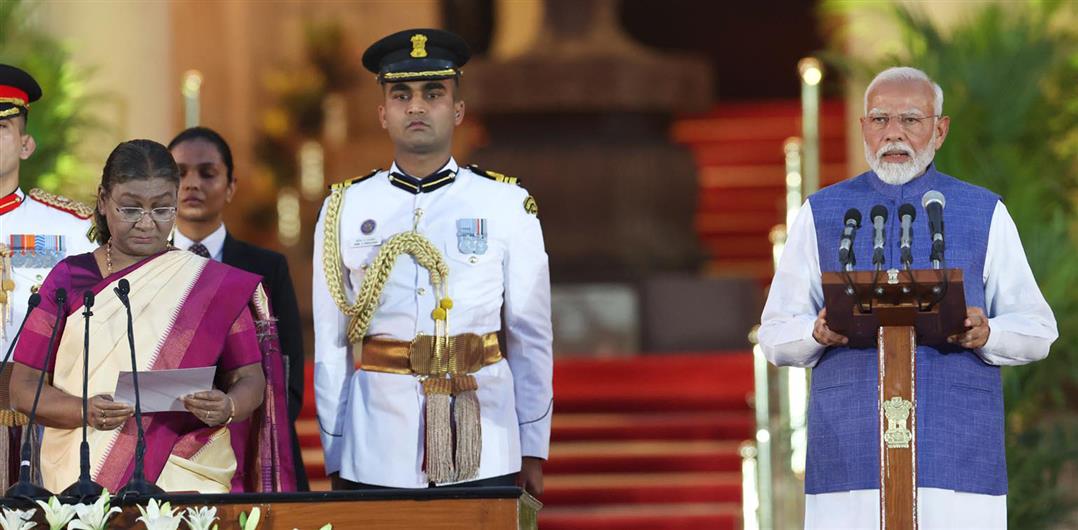
Prasad highlighted the historical importance of this victory, noting that Modi is poised to be sworn in for a third consecutive term, an event not seen since 1962. “We are happy for many reasons. The BJP USA is the largest party, securing 240 seats, which is remarkable considering the anti-incumbency factors that typically come into play after two terms,” Prasad said in an interview with New India Abroad.
Addressing the specific issues faced by the Indian diaspora, Prasad elaborated on the challenges non-resident Indians (NRIs) encounter, particularly concerning their property in India. He suggested forming a commission to tackle these issues. “When NRIs visit India, they often face difficulties with local authorities who delay their work, knowing they will not stay long,” he explained. To address this, Prasad proposed the establishment of an NRI commission. “We proposed this idea to Finance Minister Nirmala Sitharaman, and she liked it. We will push for it to be realized,” he stated.
The proposed NRI commission would primarily address problems such as property disputes and banking difficulties. To resolve issues, “a central commission can issue letters to local authorities to ensure follow-up even if the NRI returns abroad,” Prasad explained. He stressed that NRIs should have one point of contact to expedite communication and resolution.
Beyond property issues, Prasad pointed out other concerns, including the need for digital solutions to replace outdated practices like signature verification in banks. “In the digital age, it’s unnecessary to rely on decades-old signatures. An NRI commission can address these minor but significant issues,” he noted.
Prasad also commended the relentless efforts of OFBJP members and volunteers, who organized various activities and rallies across the United States to support Modi and the BJP. “We worked tirelessly every weekend, sacrificing time with our families to ensure our programs were successful,” Prasad remarked.
One notable event was the “Modi ka Parivar March,” which took place in over sixteen cities, including Atlanta, Washington D.C., the Bay Area, and Houston. This event exemplifies how the OFBJP, under Prasad’s leadership, has played a crucial role in coordinating large-scale events and rallying support for the BJP. The BJP’s influence and standing among the Indian diaspora in the US have been significantly boosted by these efforts.
Prasad expressed optimism about India’s future during Modi’s third term, emphasizing the importance of ongoing reforms and enhancing India’s global reputation. He praised Modi’s economic policies, citing how India’s economy has grown to become the fifth largest in the world, with expectations to become the third largest soon. Prasad reiterated Modi’s vision for India to become a world leader by 2047, stating, “Modi ji’s agenda is clear: work 24/7 to make India a Vishwaguru (world leader) by 2047.”
The President of the Overseas Friends of BJP (OFBJP) conveyed his approval of the Bharatiya Janata Party’s (BJP) performance in India’s Lok Sabha elections on June 4. He also praised the numerous accomplishments of the OFBJP and its continuous efforts to gather support for Narendra Modi’s party internationally.
Prasad emphasized the historical significance of this victory, as Modi is set to be sworn in for a third consecutive term, an event not seen since 1962. “We are happy for many reasons. The BJP USA is the largest party, securing 240 seats, which is remarkable considering the anti-incumbency factors that typically come into play after two terms,” Prasad said in an interview with New India Abroad.
Focusing on the specific issues of the Indian diaspora, Prasad detailed the challenges faced by non-resident Indians (NRIs), particularly with regard to their Indian property, and suggested the creation of a commission to address these concerns. “When NRIs visit India, they often face difficulties with local authorities who delay their work, knowing they will not stay long,” he explained. To address this, Prasad proposed the establishment of an NRI commission. “We proposed this idea to Finance Minister Nirmala Sitharaman, and she liked it. We will push for it to be realized,” he stated.
The proposed NRI commission would primarily address problems such as property disputes and banking difficulties. To resolve issues, “a central commission can issue letters to local authorities to ensure follow-up even if the NRI returns abroad,” Prasad explained. He stressed that NRIs should have one point of contact to expedite communication and resolution.
In addition to property issues, Prasad highlighted other concerns, including the need for digital solutions to outdated practices like signature verification in banks. “In the digital age, it’s unnecessary to rely on decades-old signatures. An NRI commission can address these minor but significant issues,” he noted.
Prasad commended the relentless efforts of OFBJP members and volunteers, who organized various activities and rallies across the United States to garner support for Modi and the BJP. “We worked tirelessly every weekend, sacrificing time with our families to ensure our programs were successful,” Prasad remarked.
The “Modi ka Parivar March” took place in more than sixteen cities, including Atlanta, Washington D.C., the Bay Area, Houston, and the Bay Area, and was just one example of how the OFBJP, led by Prasad, has played a significant role in coordinating massive events and rallying BJP support. The BJP’s standing and influence among the Indian diaspora in the US have been greatly enhanced by these endeavors.
Prasad spoke highly of India’s prospects during Modi’s third term in office, voicing optimism about the country’s future while stressing the importance of ongoing reforms and boosting India’s reputation abroad.
He praised Modi’s economic policies, mentioning how India’s economy has grown to become the fifth biggest in the world and is expected to third largest in the near future. Prasad reiterated Modi’s vision for India to become a world leader by 2047, stating, “Modi ji’s agenda is clear: work 24/7 to make India a Vishwaguru (world leader) by 2047.”
The President of the Overseas Friends of BJP (OFBJP) conveyed his approval of the Bharatiya Janata Party’s (BJP) performance in India’s Lok Sabha elections on June 4. He also praised the numerous accomplishments of the OFBJP and its continuous efforts to gather support for Narendra Modi’s party internationally.
Prasad emphasized the historical significance of this victory, as Modi is set to be sworn in for a third consecutive term, an event not seen since 1962. “We are happy for many reasons. The BJP USA is the largest party, securing 240 seats, which is remarkable considering the anti-incumbency factors that typically come into play after two terms,” Prasad said in an interview with New India Abroad.
Focusing on the specific issues of the Indian diaspora, Prasad detailed the challenges faced by non-resident Indians (NRIs), particularly with regard to their Indian property, and suggested the creation of a commission to address these concerns. “When NRIs visit India, they often face difficulties with local authorities who delay their work, knowing they will not stay long,” he explained. To address this, Prasad proposed the establishment of an NRI commission. “We proposed this idea to Finance Minister Nirmala Sitharaman, and she liked it. We will push for it to be realized,” he stated.
The proposed NRI commission would primarily address problems such as property disputes and banking difficulties. To resolve issues, “a central commission can issue letters to local authorities to ensure follow-up even if the NRI returns abroad,” Prasad explained. He stressed that NRIs should have one point of contact to expedite communication and resolution.
In addition to property issues, Prasad highlighted other concerns, including the need for digital solutions to outdated practices like signature verification in banks. “In the digital age, it’s unnecessary to rely on decades-old signatures. An NRI commission can address these minor but significant issues,” he noted.
Prasad commended the relentless efforts of OFBJP members and volunteers, who organized various activities and rallies across the United States to garner support for Modi and the BJP. “We worked tirelessly every weekend, sacrificing time with our families to ensure our programs were successful,” Prasad remarked.
The “Modi ka Parivar March” took place in more than sixteen cities, including Atlanta, Washington D.C., the Bay Area, Houston, and the Bay Area, and was just one example of how the OFBJP, led by Prasad, has played a significant role in coordinating massive events and rallying BJP support. The BJP’s standing and influence among the Indian diaspora in the US have been greatly enhanced by these endeavors.
Prasad spoke highly of India’s prospects during Modi’s third term in office, voicing optimism about the country’s future while stressing the importance of ongoing reforms and boosting India’s reputation abroad.
He praised Modi’s economic policies, mentioning how India’s economy has grown to become the fifth biggest in the world and is expected to third largest in the near future. Prasad reiterated Modi’s vision for India to become a world leader by 2047, stating, “Modi ji’s agenda is clear: work 24/7 to make India a Vishwaguru (world leader) by 2047.”



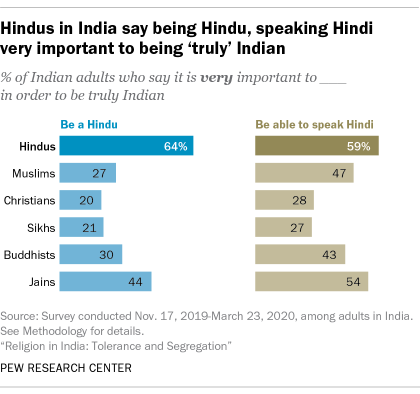
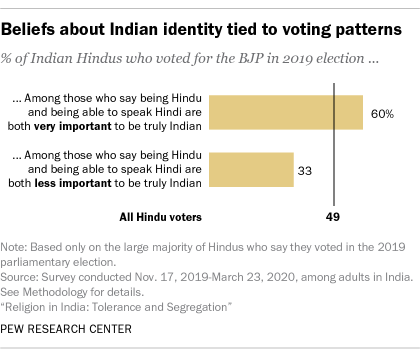
 Hindu nationalism in India also has a linguistic dimension. Hindus are more likely than other Indians to associate national identity with the Hindi language. While India has dozens of major languages, a majority of Hindus (59%) feel that being able to speak Hindi is very important to being truly Indian. Hindus who link their religion with national identity tend also to link the Hindi language with being authentically Indian.