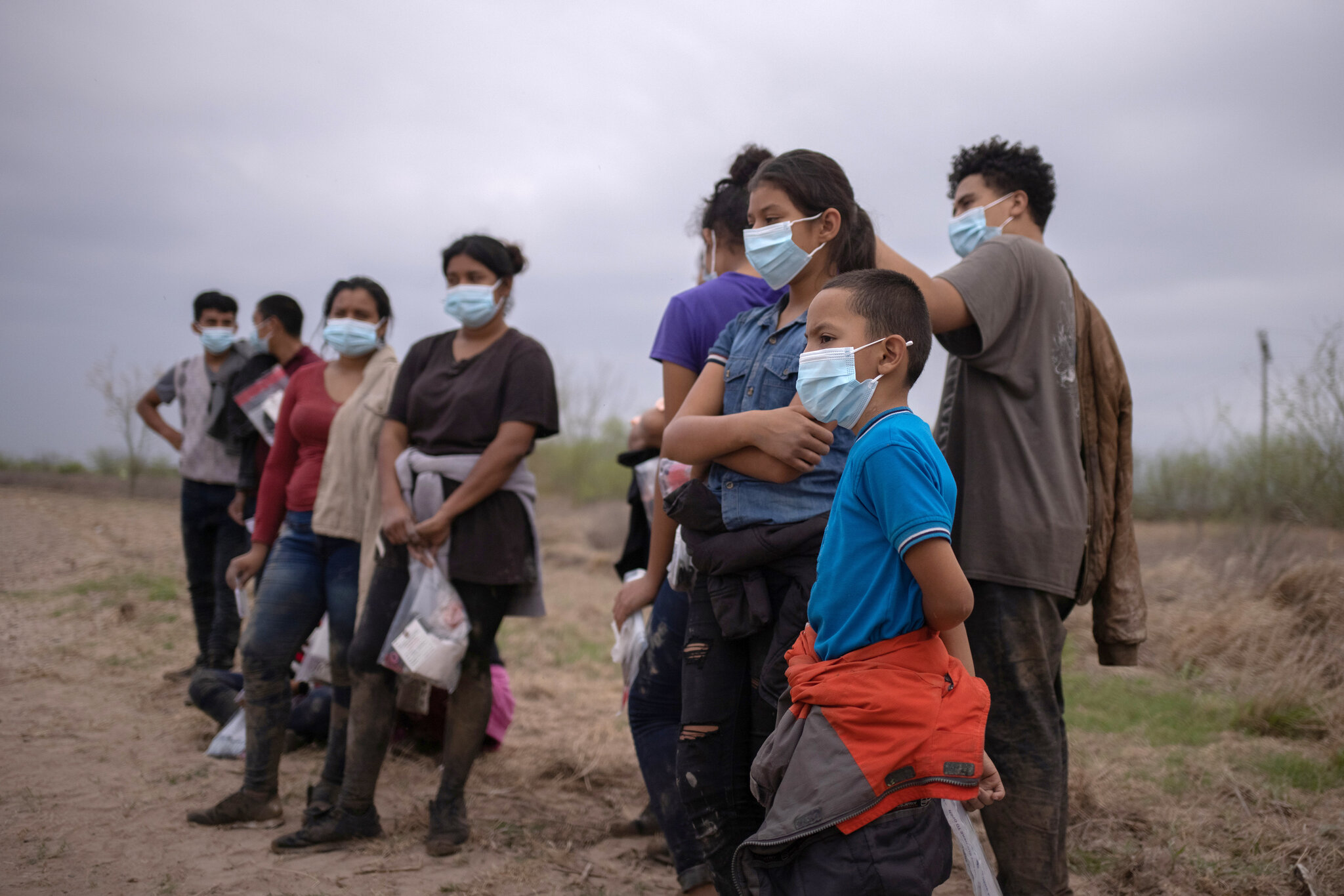
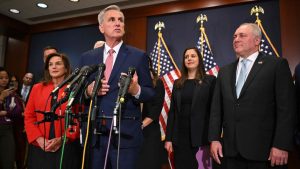
Efforts for a bipartisan immigration overhaul, together with enhanced border security, are emerging in the US Congress as migrants amass across the Mexican border ahead of the end of COVID-era border restrictions in May. In one such last-minute legislative push, U.S. border authorities may be granted similar expulsion powers allowed under the expiring COVID restrictions – referred to as Title 42 – for a period of two years, according to a congressional office involved in the talks.
Title 42 began under Republican former President Donald Trump in 2020 at the beginning of the COVID-19 pandemic and allows U.S. authorities to expel migrants to Mexico without the chance to seek asylum. Many Republicans and Democrats fear the end of the order will lead to a rise in migration that authorities are poorly equipped to face. A top border official recently told lawmakers that migrant crossings could jump to 10,000 per day after May 11th, nearly double the daily average in March.
Arizona Independent Senator Kyrsten Sinema, and North Carolina Senator Thom Tillis are leading the efforts to temporarily extend border expulsions. The pair view it as a short-term fix while they work on broader immigration reform. Sinema’s spokesperson, Hannah Hurley, said, “This is squarely about the immediate crisis with the end of Title 42.”
Separately, the Republican-controlled House of Representatives plans to pass a package of border security measures next week, placing tougher constraints on asylum-seekers, resuming the construction of a wall along the southwest border with Mexico, and expanding federal law enforcement. However, some Democrats characterise the House border legislation as inhumane, while several Democratic and Republican senators eagerly await such a bill. Tillis, who is pushing both the short-term fix for the Title 42’s expiration and a more comprehensive immigration package, said a House-passed bill would be “something we can build on”. He added that it could take two to three months to create a compromise, but senators had no illusions that this would be an easy task.
Since a 1986 immigration reform package, which provided some three million immigrants legal status, Congress repeatedly has failed to update the nation’s policies. There are around 11 million unauthorised immigrants in the United States who could have a stake in the outcome of this latest effort, along with US businesses desperately in need of workers.
To succeed in the Democrat-controlled Senate, the legislation would require 60 senators from both parties to support it, as well as the backing of the Republican-controlled House. Republican Senator from a border state, John Cornyn, described it as “a high-wire act,” adding it was “the only path forward.”
In addition, the United States Chamber of Commerce, the largest business association in the nation, has launched a campaign urging Congress to act. It has received endorsements from 400 groups, ranging from the American Farm Bureau Federation to the U.S. Travel Association. Republican-controlled states observe that their farming, ranching, food processing, and manufacturing businesses are in need of workers, a problem that immigrants could help solve if not for Washington’s clunky visa system.
Additionally, passage of an immigration bill coupled with increased border security could bolster President Joe Biden’s re-election campaign and give Republican candidates something to celebrate. The House bill would deal with some of the five “buckets” in the Tillis-Sinema effort, according to a Senate source familiar with their work. Overall, they include a modernisation of the plodding asylum system, improvements to how visas are granted, and measures to more effectively authorise immigrants, including labourers, healthcare workers, doctors, and engineers, to fill American jobs.
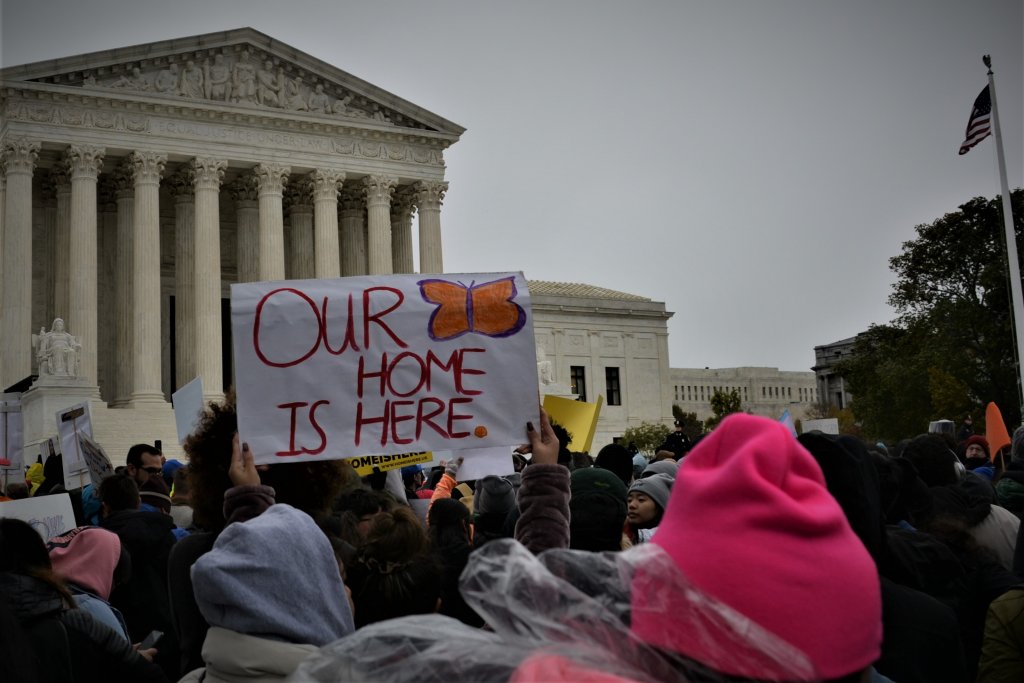
It also raises questions of what will happen to the 580,000 “Dreamers” enrolled in the Deferred Action for Childhood Arrivals (DACA) programme, who were brought illegally into the United States as children. Republicans have blocked their path to citizenship for two decades, arguing that it would encourage more people to take the dangerous journey to the border. Senators are aware that some of their goals may need to be abandoned to achieve a “sweet spot.” While Democratic Senator Chris Murphy was asked how the difficulty in winning immigration legislation stacks up to other recent battles, Senator Murphy said, “It’s an 11 on a scale of 10.”
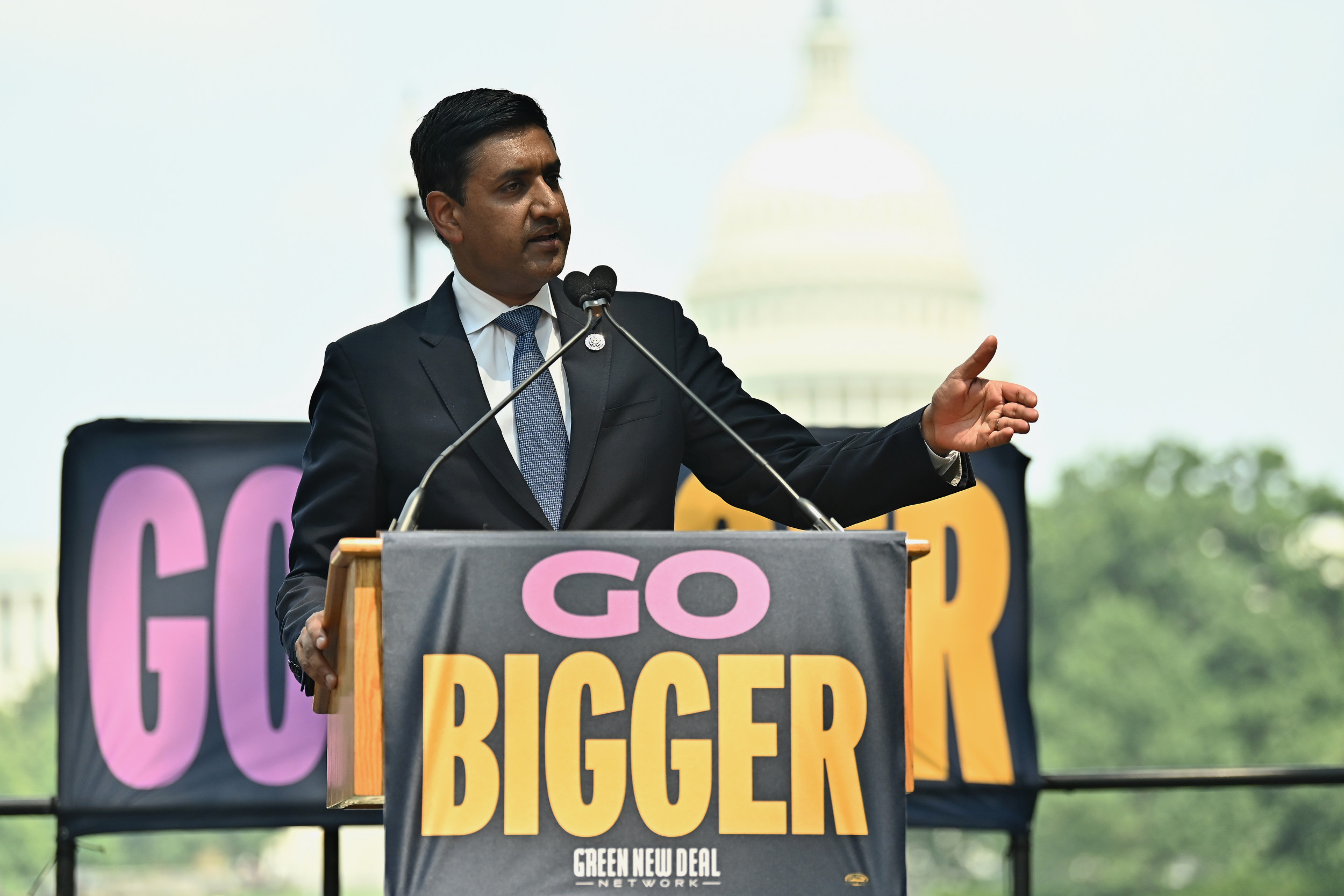
According to Rep. Ro Khanna (D-Calif.), the White House staff is “overprotecting” President Biden, and he believes that more public appearances and press conferences would benefit the president. In an interview with “America’s Newsroom” on Fox News, Khanna stated, “I think he’s actually really good. I think his staff overprotects him… Put him out there in a press conference. Who cares if someone makes a gaffe? Every person makes a gaffe in conversations. Let’s see the authentic President Biden.” Khanna praised Biden for being an empathetic person and said that more exposure would only improve his public image.
Biden faced some criticism after a photo of him holding a card with a reporter’s information and the outline of their question during a press conference with South Korean President Yoon Suk Yeol went viral online. However, the White House denied that Biden was given any questions in advance, and Press Secretary Karine Jean-Pierre explained that it is “entirely normal” for the president to be briefed on “the issues we expect” reporters might ask about, but he does not receive specific questions beforehand.
Opponents of Biden have raised concerns about his age and mental acuity as he seeks reelection for a second term. Biden, who is currently 80 years old, would be 86 at the end of his second term if reelected. However, Khanna believes that age will not be a significant factor in the 2024 race and that Biden is open to addressing it. Khanna added that Republicans would be making a “huge mistake” if they focus the 2024 race on Biden’s age. “Elections aren’t about the candidates,” Khanna said. “They’re about the American people.”
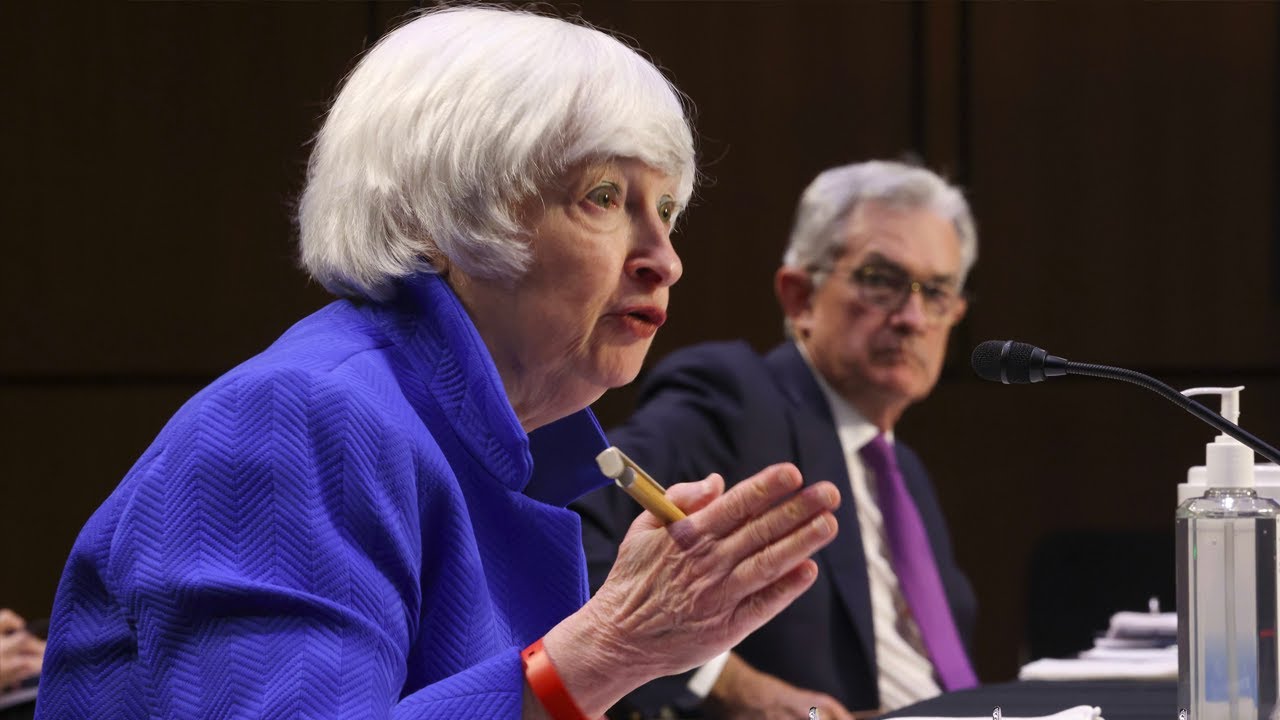
US Treasury Secretary Janet Yellen has issued a warning that the United States could run out of cash by 1 June if Congress fails to raise or suspend the debt ceiling. The country reaching the debt ceiling means the government would be unable to borrow any further money. On Monday, Yellen urged Congress to act quickly to address the $31.4 trillion debt ceiling. In response, President Joe Biden has called a meeting of congressional leaders to discuss the issue on May 9th.
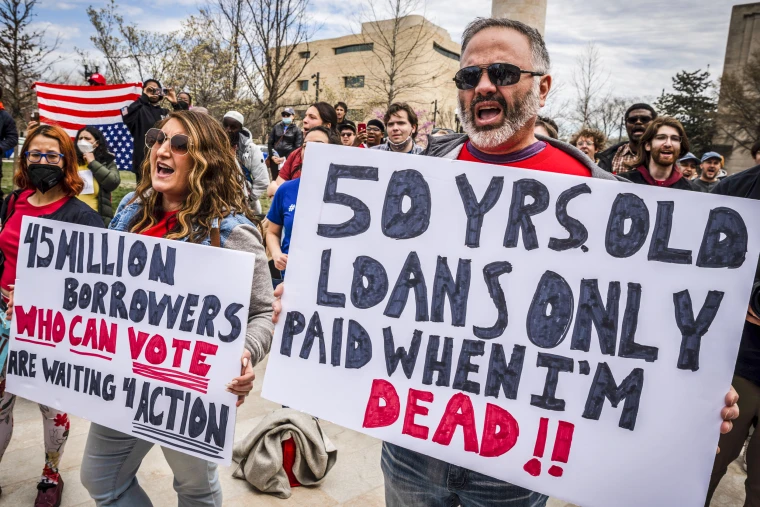
The debt ceiling has been raised, extended, or revised 78 times since 1960. However, in this instance, House Republicans are demanding drastic spending cuts and a reversal of some aspects of President Biden’s agenda, including his student loan forgiveness program and green energy tax credits, in exchange for votes to raise the debt ceiling. This has resulted in objections from Democrats in the Senate and from President Biden himself, who stated last week that the issue is “not negotiable.”
The president is coming under increasing pressure from business groups, including the US Chamber of Congress, to discuss Republican proposals. A default, which would be the first in US history, could disrupt global financial markets and damage trust in the US as a global business partner. Experts have warned that it could also lead to a recession and rising unemployment. It would also mean that the US would be unable to borrow money to pay the salaries of government employees and military personnel, social security checks, or other obligations such as defense contractor payments.
In addition, even weather forecasts could be impacted, as many rely on data from the federally-funded National Weather Service. In a letter to members of Congress, Yellen stated that “We have learned from past debt limit impasses that waiting until the last minute to suspend or increase the debt limit can cause serious harm to business and consumer confidence, raise short-term borrowing costs for taxpayers, and negatively impact the credit rating of the United States.”
Yellen added that it is impossible to know for sure when exactly the US will run out of cash. Her announcement came on the same day as the Congressional Budget Office (CBO) reported that there is a “significantly greater risk that the Treasury will run out of funds in early June.” The CBO report said that “The projected exhaustion date remains uncertain, however, because the timing and amount of revenue collections and outlays over the coming weeks are difficult to predict.”
The Treasury plans to increase borrowing through the end of the quarter ending in June, totalling about $726 billion – about $449 billion more than projected earlier this year. Officials have said that this is partly due to lower-than-expected income tax receipts, higher government spending, and a beginning-of-quarter cash balance that was lower than anticipated.
In a joint statement, Democratic Senate Majority Leader Chuck Schumer and House Democratic Leader Hakeem Jeffries said that the US “does not have the luxury of waiting until June 1 to come together, pass a clean bill to avoid a default and prevent catastrophic consequences for our economy and millions of American families.” The statement also accused Republicans of attempting to impose their “radical agenda” on America.
On the Republican side, House Speaker Kevin McCarthy accused President Biden of “refusing to do his job” and “threatening to bumble our nation into its first-ever default.” He further stated that “The clock is ticking… The Senate and the President need to get to work — and soon.”
In another letter sent to members of Congress in January, Yellen stated that the Treasury Department had begun “extraordinary measures” to avoid a government default. It is important to resolve this issue as soon as possible to avoid negative consequences for the US economy and its citizens.
King Charles III and his wife, Camilla, were crowned during a grand coronation ceremony at Westminster Abbey on Saturday, May 6th, 2023. The couple, escorted by around 200 members of the British military, began their procession from Buckingham Palace to the ceremony in a golden carriage drawn by eight horses.
During the grand and religious ceremony at Westminster Abbey, King Charles III was formally crowned as monarch of the United Kingdom and 14 other countries. Although Charles had ascended to the throne on the death of his mother, Queen Elizabeth II last September, his coronation was the traditional crowning of the monarch. This marked the first time since 1953 that a coronation was held at the historic site.
The Archbishop of Canterbury, Justin Welby placed the St. Edward’s Crown, a 360-year-old symbol of monarchy, on Charles’ head during the most significant moment of the day. Welby declared, “God Save the King” in a service that reflected the fact that Charles is not only head of state but also the Supreme Governor of the Church of England.
Picture : CNN
They were surrounded by over 1,000 soldiers, sailors, and Royal Air Force personnel. At Westminster Abbey, Charles and Camilla were welcomed by church officials and support staff before the formal ceremony began. One of Charles’ first speeches emphasized his intent to “serve, not to be served” and follow in the footsteps of the “king of kings.” After taking on a series of oaths, Charles was presented with symbolic items such as swords and spurs from various historical periods before putting on the heavy crown.
The coronation was completed with the oath of allegiance pledged by the highest members of Britain’s clergy and Charles’ son, Prince William. The ceremony, which was steeped in history and tradition, has been modernized in certain ways. During the service, when acknowledging the various faiths observed in the UK, the archbishop said the Church of England “will seek to foster an environment in which people of all faiths may live freely.”
One modern innovation saw the King become the first monarch to pray aloud at his coronation. Charles asked to “be a blessing” to people “of every faith and conviction.” This prayer was considered the most sacred part of the ceremony. The King was also anointed with holy oil by the archbishop and presented with the coronation regalia, including the royal Robe and Stole, during the investiture part of the service.
Picture : people
For the first time in coronation history, the archbishop invited the British public and those from “other Realms” to recite a pledge of allegiance to the newly crowned monarch and his “heirs and successors.” This invitation caused criticism from the media, and the Church of England then revised the text of the liturgy to offer a choice between saying “God save King Charles” and reciting the full pledge.
Music played a central role in the proceedings, with five new compositions commissioned, including an anthem by Andrew Lloyd Webber. The newly crowned king and his wife rode back to Buckingham Palace in a grand coach drawn by six horses, accompanied by the Household Cavalry, after which a much larger parade took place featuring 4,000 members of the armed forces, 250 horses, and 19 military bands.
The ceremony also featured a reading from the Bible by UK Prime Minister Rishi Sunak and gospel music, which was a first for a coronation. Following the coronation, Charles’ wife, Queen Camilla was crowned in her own, shorter ceremony with Queen Mary’s Crown, making it the first time in recent history that a new crown wasn’t made specifically for this occasion.
The weather was wet during the proceedings, which saw tens of thousands of well-wishers gather in central London despite the rain. The rain appeared to have little effect on the proceedings, which concluded with the customary balcony appearance by the King and family members, who watched a flypast of military aircraft.
Picture : Yahoo
The two-hour-long ceremony saw the monarch proclaim his faith and devotion to his subjects, invoking integrity and humility, and the whole nation. Charles’ coronation is a historic event that upholds the traditions of the British monarchy, representing a modern touch with the introduction of the pledge of allegiance and modern hymns. Charles will continue to work towards building a better future for the United Kingdom and its allies.
Royal ceremony witnesses global dignitaries and renowned personalities
Thousands of royal fans camped alongside the 1.3-mile (2km) route that extends from London’s Buckingham Palace, the official residence of the British monarchy, to Westminster Abbey, the coronation church since 1066, to catch a glimpse of King Charles III’s procession. However, the London Metropolitan Police Service had to close all the viewing areas along the processional path due to overfilling.
The size of the congregation, about 2,300 people was much smaller than that in 1953, when temporary structures had to be erected at the abbey to accommodate more than 8,000 people on the guest list. The abbey doors were opened just before 8 a.m. and guests, including top British officials, faith leaders, and international representatives, were expected to take their seats more than an hour before the ceremony began. The event was attended by hundreds of VIPs, hinting at the logistical challenges presented by a ceremony of this magnitude.
The guest list was comprised of notable British public figures and politicians like Rishi Sunak’s living predecessors as Prime Minister. Other attendees included UK opposition leader Keir Starmer, Mayor of London Sadiq Khan, and Chancellor of the Exchequer, Jeremy Hunt. Heads of states from approximately 100 countries and dozens of members of foreign royal families also made their way to London for the service. Notable international attendees include Canadian Prime Minister Justin Trudeau, Australian Prime Minister Anthony Albanese, French President Emmanuel Macron, European Commission President Ursula Von der Leyen, and European Council President Charles Michel.
US President Joe Biden was absent from the ceremony, and Jill Biden led the US delegation, sitting beside Ukrainian first lady Olena Zelenska. Several celebrities graced the occasion, including singers Lionel Richie and Katy Perry, musician Nick Cave, actresses Emma Thompson, Maggie Smith, Joanna Lumley, and Judi Dench, composer Andrew Lloyd Webber, and broadcaster Stephen Fry.
The last to arrive, just before the King and Queen, were Prince Charles’ siblings and children, including Prince Harry, who travelled from the United States to the UK without his wife, Meghan, the Duchess of Sussex, and their two young children. It was also Prince Archie’s 4th birthday. After the ceremony, Prince Harry did not join the family for the start of the traditional balcony appearance, and CNN revealed that he did not receive an invitation to join the family for this moment. Similarly, Prince Andrew was not present on the balcony due to his ties to Jeffery Epstein, a convicted pedophile. The prince announced that he would step back from royal duties in 2019 and, in January 2022, was stripped off his military titles and royal patronages after a judge ruled that a sexual abuse civil lawsuit filed against him by Virginia Giuffre would proceed. The case was later settled out of court for an undisclosed sum.
Challenges and Controversies Surrounding the Coronation of King Charles III
The Coronation ceremony of King Charles III has been a subject of controversy despite the grandeur of the occasion. While the British monarchy and its supporters relished the event, several citizens disapproved of the millions of pounds spent on the ceremony, calling it an insensitive use of taxpayers’ money, especially during the economic downturn.
The biggest challenge of the event was security, since security for such large-scale events is one of the costliest aspects. Given this, the London Metropolitan Police Service, ahead of time, announced that the coronation day would be the largest single-day policing operation in decades, with over 11,500 policemen on duty in the city. The event also faced unwanted anti-monarchy demonstrations, and a few protesters were arrested in Central London on Saturday morning, before the event commenced. Republic, a campaign group that vehemently opposes the monarchy, deemed the concept of the “homage of the people” on the coronation day “offensive, tone-deaf, and a gesture that holds the people in contempt.”
Earlier this week, the enforcement of a controversial UK public order bill, which has faced wide criticism, raised eyebrows. Since the Queen’s passing last year, there has been an increase in instances of anti-monarchists turning up unexpectedly at royal events to voice their objections to the monarchy. The new rule, signed into law by King Charles III just before the coronation, gives the police greater authority to take stronger legal action against peaceful protesters.
Despite the grandeur of the event, some people had criticized spending millions of pounds of taxpayers’ money on the ceremony amid an economic crisis. The security costs, which are usually the costliest part of large events, were also a concern, with over 11, 500 police officers on duty across London.
After returning from his coronation ceremony at Westminster Abbey, King Charles III and Queen Camilla were welcomed by hundreds of military personnel in ceremonial uniforms on the vast lawn at the rear of Buckingham Palace.
They then appeared on the long balcony at the front of the building, where thousands of supporters had gathered to catch a glimpse of the newly crowned King and Queen. Despite raining heavily, the couple was joined by select members of the royal family as the audience looked on.
While the Air Force jets roared overhead, leaving behind a trail of smoke in the national colors of red, white and blue, Charles raised his eyes but did not look up, seemingly preoccupied with managing the delicate balance of his crown.
Headlined by popular artists such as Katy Perry, Lionel Richie, and Take That, the “Coronation Concert” was held at Windsor Castle on Sunday evening, and people were encouraged to volunteer in their communities on Monday, the final day of the long holiday weekend.
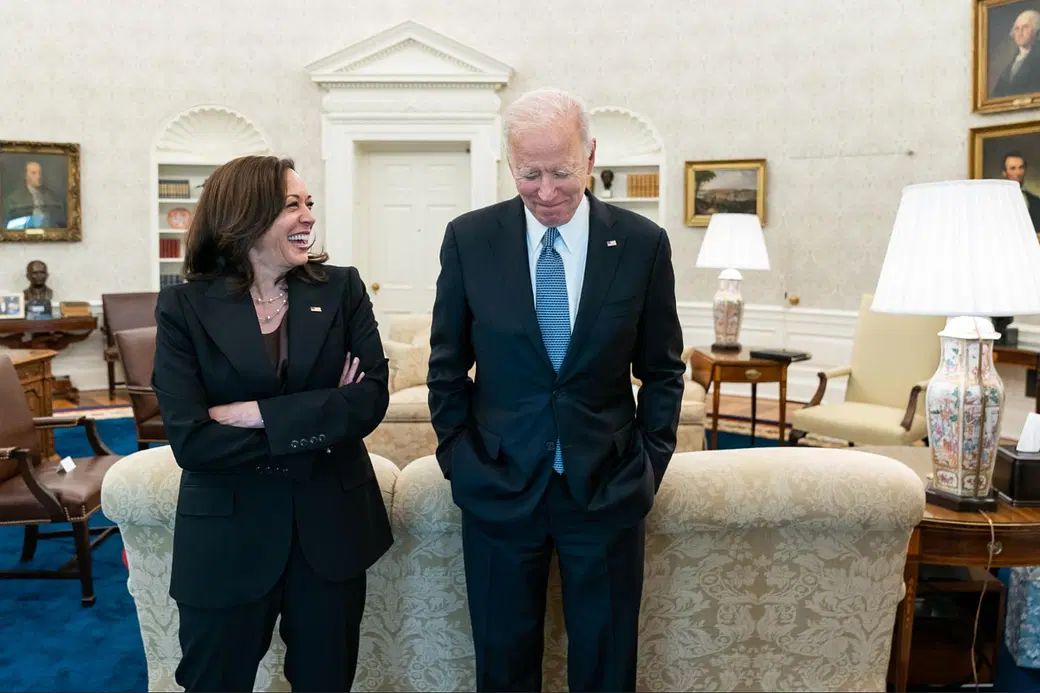
President Biden has come to the defence of Vice President Kamala Harris, claiming that she has not received the recognition she deserves. In a recent interview with MSNBC, Biden stated that “Vice President Harris hasn’t gotten the credit she deserves…she was an attorney general in the state of California. She has been a United States senator.” Biden went on to call the Vice President “very, very good” and expressed concerns that she has not received enough attention for her hard work.
This sentiment was echoed by Sen. Chris Coons (D-Del.), who stated on ABC’s “This Week” that Harris has struggled to receive positive press coverage and credit for her work. He emphasized that she is ready to run and be president if necessary and that both he and President Biden have great confidence in her abilities.
Harris has been playing a significant role in President Biden’s administration, with many speculating that she will be a key figure in the 2024 reelection campaign. There have been concerns raised about Biden’s age, and Harris has been touted as a potential successor. Acknowledging those speculations, Biden himself said that while he is “more experienced than anybody who’s ever run for the office,” he recognizes that Harris is a vital member of his team.
Harris’s record as attorney general and senator of California has been widely lauded. During her time as attorney general, she became known for her efforts to combat human trafficking and reduce recidivism. As a senator, she was an outspoken advocate for criminal justice reform and a champion for women’s rights. Her presence and work have been noted by her colleagues on both sides of the aisle.
Despite her impressive resume, Harris has faced criticism from some quarters, including suggestions that she received special treatment during her political career because of her ethnicity and gender. However, her supporters argue that these criticisms are baseless and that Harris has earned her place on the national stage through her hard work and dedication.
Moving forward, it seems likely that Harris will continue to play an instrumental role in President Biden’s administration, with many hoping that her influence will continue to grow. She has proven herself to be a hardworking and passionate public servant, and while she may not have received the recognition she deserves thus far, it seems clear that she is a force to be reckoned with. As President Biden himself noted, “I think I’ve proven myself to be honorable, as well as effective. And so has Kamala Harris.”
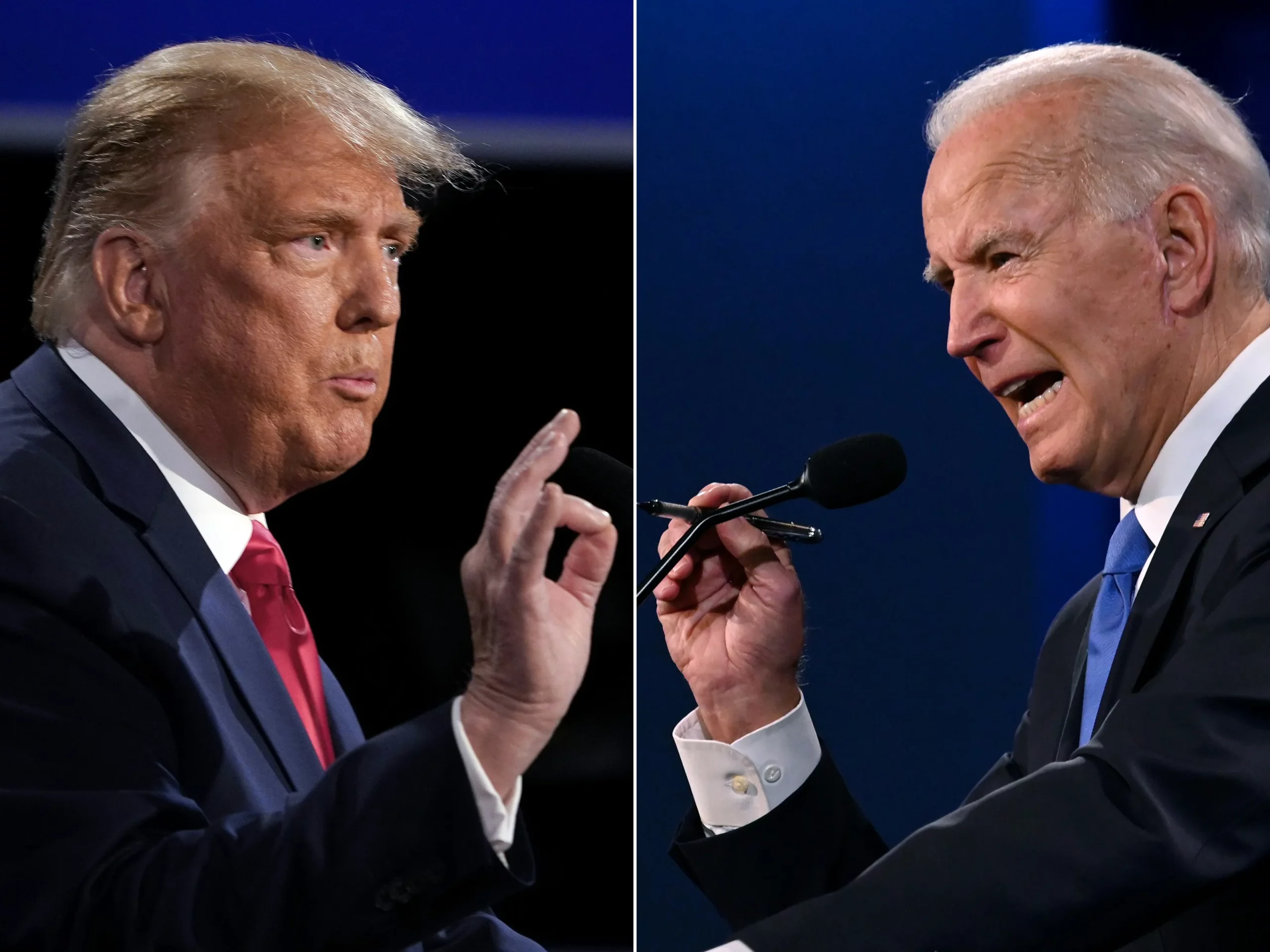
President Biden is reportedly set to announce his reelection campaign early next week, but many Americans express exhaustion over the prospect of a 2024 rematch between Biden and his predecessor, Donald Trump, according to a new Yahoo News/YouGov poll. The survey of 1,530 U.S. adults, conducted from April 14 to 17, found that 38% chose exhaustion out of eight emotions when considering another Biden-Trump campaign. Among registered voters, the number was even higher at 44%. No other sentiment managed to break the 30% mark among all Americans.
A Biden-Trump rematch would be the first general election for president since 1892 to feature the incumbent and his defeated predecessor competing as major-party nominees. Moreover, it would be the first White House race in U.S. history in which one candidate is facing indictment and possible criminal prosecution for conspiring to overturn his prior loss. Such factors naturally trigger fatigue and anxiety among voters.
However, voters are not as pessimistic about a Biden-Trump sequel as they were a few months ago. In December, a nearly a third of them (32%) told Yahoo News and YouGov that “if Joe Biden and Donald Trump run against each other for president again in 2024,” the result would be either “the worst thing that could happen” (15%) or “mostly bad” (17%); only 23% said it would be “mostly good” (11%) or “the best thing that could happen” (12%). Now, a negative view accounts for 29%, while 26% express a positive view. About 3 in 10 continue to say it’s “a mix of good and bad.” Positive views have increased since December among both Republicans (33%, up from 30%) and Democrats (24%, up from 17%).
In contrast, Republicans express hope (+20), excitement (+10), and pride (+5) at higher rates than Democrats. Much of the liberal aversion to another Biden-Trump contest likely reflects the former president’s staggering unpopularity among Democrats, with a full 68% of them expressing “very unfavourable” opinions of him. Yet Democrats’ overall negativity also underscores their unease about Biden. While they overwhelmingly approve (80%) of his performance in office, anxiety about Biden’s status as the oldest president in U.S. history—80 years old—seems to dampen confidence in his candidacy.
Republicans are more likely to see a rematch positively than negatively, while Democrats are more likely to see a rematch negatively than positively. Exhaustion, for example, is more prevalent among Democrats (44%) than Republicans (26%) by an 18 percentage-point margin, and fear (+12 for Democrats), sadness (+15), and anger (+9) are more common on the left as well.
Asked in June 2020 how concerned they were “about Joe Biden’s health and mental acuity,” just 28% of Democrats said they were either somewhat (10%) or very concerned (18%); the other 72% said they were either slightly (28%) or not at all concerned (44%). Over two and a half years later, however, the combined percentage of somewhat or very concerned Democrats has risen to about 40%, while the combined percentage who were slightly or not at all concerned has fallen by the same amount, to about 60%, according to a late February Yahoo News/YouGov poll. Overall, nearly 7 in 10 voters (68%) said in February that Biden would be “too old for another term,” with more Democrats agreeing (48%) than disagreeing (34%).
Despite Biden’s approval rating remaining below 50% among all Americans, it is now at its highest level (44%) since September 2021 (up from about 40% for much of 2022). His approval rating on the economy (at 40%) is now 4 points higher than it was in early February, while his approval rating on inflation (36%) increased by 5 points over the same period. And he performs three or four points better on each of those measures among registered voters.
Biden’s approval numbers are still lower than the White House would like them to be, but current trend lines favor the president over his recently indicted predecessor. In a general election matchup, Biden now leads Trump by a four-point margin (46% to 42%) among registered voters, up from a two-point lead the previous month.
In conclusion, Americans express exhaustion over the prospect of a 2024 rematch between Biden and Trump, but they are not as pessimistic as they were a few months ago. While some Republicans hope for a rematch, some Democrats feel anxious about Biden’s age and health. Biden’s approval rating on the economy and inflation has improved, and he enjoys a four-point lead over Trump in a general election matchup among registered voters.
The US Supreme Court has decided to maintain women’s access to a drug commonly used in abortions, rejecting lower-court restrictions while a lawsuit continues. The drug in question is mifepristone, which is used in combination with misoprostol in more than half of all abortions in the US. The drug has been approved for use in the country since 2000, with more than five million people having used it. The justices granted emergency requests from the Biden administration and Danco Laboratories, which makes mifepristone. They are appealing a lower court ruling that would roll back Food and Drug Administration (FDA) approval of the drug. Two of the nine justices voted to allow restrictions to take effect, with Justice Samuel Alito issuing a four-page dissent. The next stop for the case is at the US Court of Appeals for the 5th Circuit, which has set arguments for May 17.
The challenge to mifepristone is the first abortion controversy to reach the Supreme Court since its conservative majority overturned Roe v. Wade 10 months ago and allowed more than a dozen states to effectively ban abortion outright. Even with their court victory, abortion opponents returned to federal court with a new target: medication abortions, which make up more than half of all abortions in the US. Women seeking to end their pregnancies in the first 10 weeks without more invasive surgical abortion can take mifepristone along with misoprostol.
The FDA has eased the terms of mifepristone’s use over the years, including allowing it to be sent through the mail in states that allow access. The abortion opponents filed suit in Texas in November, asserting that the FDA’s original approval of mifepristone 23 years ago and subsequent changes were flawed. They won a ruling on April 7 by US District Judge Matthew Kacsmaryk, an appointee of former President Donald Trump, revoking FDA approval of mifepristone. The judge gave the Biden administration and Danco Laboratories a week to appeal and seek to keep his ruling on hold. Responding to a quick appeal, two more Trump appointees on the 5th U.S. Circuit Court of Appeals said the FDA’s original approval would stand for now.
Their ruling would have effectively nullified changes made by the FDA starting in 2016, including extending from seven to 10 weeks of pregnancy when mifepristone can be safely used. The court also would have halted sending the drug in the mail or dispensing it as a generic, and patients who seek it would have had to make three in-person visits with a doctor. Women also might have been required to take a higher dosage of the drug than the FDA says is necessary. The administration and Danco have said that chaos would ensue if those restrictions were to take effect while the case proceeds. Potentially adding to the confusion, a federal judge in Washington has ordered the FDA to preserve access to mifepristone under the current rules in 17 Democratic-led states and the District of Columbia that filed a separate lawsuit.
President Joe Biden praised the high court for keeping mifepristone available while the court fight continues. “The stakes could not be higher for women across America. I will continue to fight politically-driven attacks on women’s health. But let’s be clear — the American people must continue to use their vote as their voice, and elect a Congress who will pass a law restoring the protections of Roe v. Wade,” he said in a statement.
The justices weighed arguments that allowing restrictions contained in lower-court rulings to take effect would severely disrupt the availability of mifepristone. Alito questioned the argument that chaos would result, saying the administration “has not dispelled doubts that it would even obey an unfavorable order in
The U.S. House of Representatives on Wednesday, April 26, 2023 passed the Limit, Save, Grow Act of 2023 as the debt ceiling debate continues in the nation’s capital. House speaker Kevin McCarthy introduced the legislation on April 19, which would “limit federal spending, save taxpayer dollars,” and “grow the economy.”
The legislation passed 217-215. Four Republicans voted against the bill, which did not get a single vote from a Democrat.
The vote allows the US to raise the nation’s debt limit for one year and limit federal spending growth to 1% annually. The plan, titled the “Limit, Save, Grow Act of 2023,” would increase the debt limit by $1.5 trillion, or until March 31, 2024, whichever comes first.
McCarthy also plans to repeal key parts of Democrats’ signature legislative package and President Biden’s college student debt cancellation program. The GOP bill would also remove $80 billion that Democrats approved last year to improve the Internal Revenue Service (IRS). However, the Congressional Budget Office estimated that repealing the measure would increase the deficit.
McCarthy said on the House floor that limiting government spending would reduce inflation and restore fiscal discipline in Washington. He added that if Washington wants to spend more, it will have to find savings elsewhere, as every household in America does. McCarthy noted that Medicare and Social Security would not be impacted by the cuts. The framework also includes work requirements for adults without dependents enrolled in federal assistance programs.
According to a press release, the legislation would specifically:
“End the Era of Reckless Washington Spending
“Reclaim Unspent COVID Funds
“Defund Biden’s IRS Army
“Repeal ‘Green New Deal’ Tax Credits
“Prohibit [President Joe] Biden’s Student Loan Giveaway to the Wealthy
“Strengthen the Workforce and Reduce Childhood Poverty
“Prevent Executive Overreach and Restore Article I
“Lower Energy Costs and Utilities”
The plan also includes “a responsible debt limit increase.”
However, Democrats remain critical of any efforts to link debt ceiling negotiations to legislation that would require work requirements for those on assistance programs. David Scott, the House Agriculture Committee ranking member, said that holding food assistance hostage for those who depend on it in exchange for increasing the debt limit is a nonstarter.
The US hit its current debt limit of $31 trillion in January. The Treasury Department is employing what it refers to as extraordinary measures to essentially act as a band-aid for several months. Those measures are set to run out in early summer. Should Congress fail to raise the debt limit by then, there would be an unprecedented debt default, something that would throw worldwide financial markets into dire straits and likely lead to a recession.
In a speech, McCarthy blasted the president for not meeting with him to negotiate. The pair last met in February and remain at odds over how to address the debt limit. Biden has repeatedly said he wants to sign a clean debt limit bill. Senate Majority Leader Chuck Schumer has also said that efforts to address spending cuts “belong in the discussion about budget, not as a precondition for avoiding default.”
The proposal is likely to face opposition in the Democratic-controlled Senate. Passing the bill would require bipartisan support, which may be difficult given the current political climate. Nonetheless, McCarthy remains optimistic that the proposal will succeed.
“Limited government spending will reduce inflation and restore fiscal discipline in Washington,” McCarthy said. “If Washington wants to spend more, it will have to come together and find savings elsewhere — just like every single household in America.”
“Our plan ensures adults without dependents earn a paycheck and learn new skills,” he said. “By restoring these commonsense measures, we can help more Americans earn a paycheck, learn new skills, reduce childhood poverty and rebuild the workforce.”
“By including these radical proposals as a lever in debt limit negotiations, Speaker McCarthy and his extreme Republican colleagues are ensuring their failure,” David Scott, D-Ga., House Agriculture Committee ranking member, said of McCarthy’s proposal for work requirements.
“President Biden has a choice: Come to the table and stop playing partisan political games, or cover his ears, refuse to negotiate and risk bumbling his way into the first default in our nation’s history,” McCarthy said.
The US Senate has confirmed Radha Iyengar Plumb, a national security expert, as the Deputy Under Secretary of Defense for Acquisition and Sustainment, the latest Indian-American to be named by the Biden administration for a key position.
President Joe Biden had nominated Radha Iyengar Plumb, currently serving as Chief of Staff to the Deputy Secretary of Defense, to this prestigious position in June 2022.
“By a vote of 68-30, the Senate confirmed Radha Iyengar Plumb to be the Deputy Under Secretary of Defense,” US Senate Periodical Press Gallery tweeted on Tuesday.
Plumb had previously worked as a senior economist at the RAND corporation focused on improving the measurement and evaluation of readiness and security efforts across the Department of Défense and was previously Chief of Staff to the Deputy Secretary of Défense.
She has also worked at Google and Facebook. Plumb’s research covers a range of areas related to violence reduction and prevention, and she has a PhD in economics from Princeton University. In her LinkedIn profile, she describes herself as an experienced leader with deep technical analytical skills.
President Joe Biden had nominated Radha Iyengar Plumb, currently serving as Chief of Staff to the Deputy Secretary of Defence, to this prestigious position in June 2022.
“By a vote of 68-30, the Senate confirmed Radha Iyengar Plumb to be the Deputy Under Secretary of Defence,” US Senate Periodical Press Gallery tweeted on Tuesday.
Prior to her appointment as the Chief of Staff, she was the Director of Research and Insights for Trust and Safety at Google and had previously served as the Global Head of Policy Analysis at Facebook.
Plumb previously was a Senior Economist at the RAND Corporation where she focused on improving the measurement and evaluation of readiness and security efforts across the Department of Defence.
She also held a number of senior staff positions on national security issues at the Department of Defense, the Department of Energy, and the White House National Security Council.
At the outset of her career, she was an Assistant Professor at the London School of Economics and did her postdoctoral work at Harvard.
Plumb received her Ph.D. and M.S. in Economics from Princeton University, and she holds a B.S. from the Massachusetts Institute of Technology, according to her profile released by the White House in June last year.
In her Linkedin profile, Plumb describes herself as an experienced leader with deep technical analytic skills and a demonstrated history of working in the government, academia, and industry.
President Biden has formally announced his campaign for re-election in 2024, asking Americans for four years to “finish this job”, possibly setting up an extraordinary rematch with Donald Trump.
Biden said: “When I ran for president four years ago, I said we were in a battle for the soul of America – and we still are.”
Announcing his intention on Tuesday, April 25th, 2023 with a three-minute video, opening with pulsing images of the US Capitol attack, Biden warned that the US remains under threat from the anti-democratic forces unleashed by his predecessor, who he beat in 2020.
Biden launched his re-election campaign on the fourth anniversary of his return to politics in 2019, when he declared his third presidential run. Since then, the political landscape has changed.
Picture : Swarajya
The US is still grappling with the scars of a pandemic that killed more than 1.1 million and with inflation that has eased from historic highs but remains painful. Americans remain deeply divided, convulsed by the loss of federal abortion rights, near-weekly mass shootings and worsening climate disasters.
Already the oldest president, Biden would be 86 before the end of a second term, nearly a decade older than Ronald Reagan was when he left the White House in 1989. Trump is 76.
In his video, Biden warned that “Maga extremists” – Trump’s slogan is “Make America Great Again” – were working to strip away “bedrock freedoms”.
“Cutting social security that you’ve paid for your entire life while cutting taxes for the very wealthy,” Biden said. “Dictating what healthcare decisions women can make, banning books and telling people who they can love. All while making it more difficult for you to be able to vote.”
Biden is dogged by low approval ratings and concerns about his age. Only a quarter of Americans want him to run again, according to the Associated Press-NORC Center for Public Affairs Research. Among Democrats, that figure is 50%. Should Biden win the nomination, as expected, most Democrats will support him.
Hours after making his candidacy official, Biden was greeted by chants of “four more years” during remarks to union workers at a conference in Washington DC.
“Our economic plan is working,” the president said in a speech rife with references to his working-class upbringing in Scranton, Pennsylvania. “Let’s finish the job,” he declared.
Biden hasmade clear he plans to run on accomplishments secured in the first half of his presidency, when Democrats had majorities in Congress.
Biden signed the American Rescue Plan, delivering financial assistance to those hit hard by Covid. He also approved a $1 trillion infrastructure bill; signed the first major federal gun safety bill in nearly 30 years; pursued initiatives to both treat veterans exposed to toxic burn pits and boost the semiconductor industry;and made Ketanji Brown Jackson the first Black woman on the supreme court.
Perhaps Biden’s most significant legislative achievement to date is the Inflation Reduction Act, the most significant US response to the climate crisis. While Biden’s policies are broadly popular, he has struggled to earn credit. He has spent the last few months attempting to sell his economic policies and rally Americans before a showdown with congressional Republicans over the federal debt limit.
On the world stage, Biden has rallied a global coalition behind Ukraine in response to Russia’s invasion while seeking to strengthen US defenses against China. The chaotic withdrawal from Afghanistan, however, was among the lowest points of Biden’s presidency, even as he fulfilled a promise to end America’s longest war.
Republicans greeted Biden’s campaign announcement by assailing his handling of immigration and the economy. “Biden is so out-of-touch that after creating crisis after crisis, he thinks he deserves another four years,” said Ronna McDaniel, chair of the Republican National Committee. “If voters let Biden ‘finish the job’, inflation will continue to skyrocket, crime rates will rise, more fentanyl will cross our open borders, children will continue to be left behind, and American families will be worse off.”
In his campaign video, Biden warned that individual freedoms are under attack by far-right Republicans who have trampled reproductive, voting and LGBTQ+ rights. “This is not a time to be complacent,” he said. “I know America. I know we’re good and decent people.”
After nearly a half-century in public life including 36 years as a senator from Delaware and eight years as the vice-president to Barack Obama, Biden called himself a “bridge” to the next generation of Democrats. But only two fringe candidates have challenged him for the nomination: the self-help author Marianne Williamson and anti-vaccine activist Robert F Kennedy Jr.
The Republican field continues to grow. Nikki Haley, a former South Carolina governor and UN ambassador, has entered the race. The South Carolina senator Tim Scott has taken steps to run. The Florida governor, Ron DeSantis, is widely expected to announce soon. Mike Pence, Trump’s vice-president, is weighing a run.
Trump announced his candidacy after the midterms in November. He and Biden both face federal investigations over their handling of classified information. In Biden’s case, documents were discovered at his office and home. His lawyers have stressed they are cooperating.
In his video, Biden said: “Every generation of Americans has faced a moment when they’ve had to defend democracy. Stand up for our personal freedoms. Stand up for the right to vote and our civil rights.”
The US Supreme Court has granted a full stay in a case over the Food and Drug Administration’s (FDA) approval of the abortion pill mifepristone. The court’s decision was a 7-2 vote and preserves access to the drug as the Biden administration and manufacturer Danco Labs appeal a lower court’s ruling that would impose restrictions on the drug. The decision was applauded by the White House, which has pledged to continue to fight restrictions on the medication.
The case centers on the FDA’s approval of mifepristone, which was challenged in a lawsuit filed by a coalition of anti-abortion doctors and associations. Judge Matthew Kacsmaryk, a Trump-appointee, ruled in favor of the group in April, stating that the FDA exceeded its authority when it approved the drug in 2000.
The case has divided the nation, with more than 150 Republican lawmakers supporting the conservative plaintiffs, while Democrats and leading medical associations have pushed for mifepristone’s continued availability. Medication abortion quickly became the new focus of legal battles over abortion access following the Supreme Court’s decision to overrule Roe v. Wade last June.
“If allowed to take effect, the lower courts’ orders would thwart FDA’s scientific judgment and undermine widespread reliance in a healthcare system that assumes the availability of mifepristone as an alternative to more burdensome and invasive surgical abortions,” Solicitor General Elizabeth Prelogar told the Supreme Court in a filing this week. The Biden administration and Danco Labs have warned of possible wide-ranging consequences if the federal agency’s expertise were to be second-guessed. However, the Alliance Defending Freedom, representing opponents to the abortion pill countered the administration’s concerns amounted to a “sky-is-falling-argument.”
The 5th Circuit Court of Appeals is scheduled to hear oral arguments in the case on May 17th. The case has been watched closely by reproductive rights advocates and opponents, as any decision could have far-reaching implications for access to medication abortion across the country.
Mifepristone, also known by the brand name Mifeprex, is used in combination with misoprostol to terminate early pregnancies of up to 10 weeks’ gestation. The medication has faced restrictions in various states, including mandatory waiting periods and in-person visits with healthcare providers. The COVID-19 pandemic has made access to medication abortion even more difficult, with some states seeking to restrict access to telemedicine appointments and mail-order delivery of the medication.
The FDA approved Mifeprex in 2000 after reviewing extensive clinical data showing the medication to be safe and effective. The medication has been used by more than 4 million individuals in the US and is considered a safe alternative to surgical abortion, which requires anesthesia and often includes an overnight stay in a healthcare facility.
The case before the Supreme Court has implications not only for access to medication abortion but also for the FDA’s authority to regulate prescription drugs. It will be closely watched by medical and legal experts as well as advocacy groups on both sides of the abortion debate.
“As a result of the Supreme Court’s stay, mifepristone remains available and approved for safe and effective use while we continue this fight in the courts,” President Joe Biden said in a statement. “I continue to stand by FDA’s evidence-based approval of mifepristone, and my Administration will continue to defend FDA’s independent, expert authority to review, approve, and regulate a wide range of prescription drugs.”
The Biden administration is expanding federal health care services to Deferred Action for Childhood Arrivals (DACA) program recipients. According to a White House statement, the Department of Health and Human Services will shortly propose a rule amending the definition of “lawful presence,” for purposes of Medicaid and Affordable Care Act coverage, to include DACA recipients.
DACA recipients often referred to as Dreamers are eligible immigrants who came to the United States as children dependent on their parents’ work visas. While they have grown up and received their education in America they are not recognised as U.S. citizens or lawful permanent residents. The program does not grant them official legal status or a pathway to citizenship.
Picture : Idaho Capital sun
According to the statement, President Biden believes that the Dreamers strengthen U.S economy, and enrich schools and the community. His administration’s proposed plan will allow Dreamers to apply for coverage through the health insurance marketplace and through the state Medicaid agency just like other citizens.
“We are not done fighting for their pathway to citizenship, but we’re getting them the opportunities they deserve in the meantime,” Biden said making the historic announcement.
The democratic government aims to protect and strengthen the federal health insurance agencies by lowering costs and expanding coverage so that every American has the peace of mind that health insurance brings and the inclusion of DACA recipients is a step in that direction.
“The Administration continues to urge Congress to provide a pathway to citizenship to Dreamers, providing them the ultimate peace of mind they need and deserve,” the White House statement emphasized.
At present, schemes and programs available to DACA recipients include; AmeriCorps VISTA Program (to assist local organizations in alleviating poverty), a range of outdoor programming, environmental education, and volunteer service programs, and American job centers to help job seekers obtain employment and training to further their careers.
Amid massive ongoing layoffs in the tech sector, the top 30 H-1B visa employers hired 34,000 new workers in 2022 and laid off at least 85,000 workers in 2022 and early 2023, an Economic Policy Institute (EPI) analysis found.
According to EPI researchers, tech and outsourcing companies are exploiting the highly-skilled H-1B visa program, created to fill labor shortages in professional fields, by laying-off a bevy of workers employed in firms like Meta, Microsoft, Google, Amazon, etc.
“Most employers hire H-1B workers because they can be underpaid and are de facto indentured to the employer,” the EPI research said.
Also, 13 of the top 30 H-1B visa employers were outsourcing firms that underpay migrant workers and offshore US jobs to countries where labor costs are much lower.
“Its implementation has been bungled by the US Departments of Labor and Homeland Security,” the analysis said, adding that since employers aren’t required to test the US labor market to see if any workers are available before hiring an H-1B worker or pay their H-1B workers a fair wage, employers have exploited the program.
ECI said, in 2022, 48,000 employers registered with United States Citizenship and Immigration Services (USCIS) in hopes of hiring at least one H-1B worker, and nearly 30,000 employers ultimately hired at least one new H-1B worker.
Citing an example, the ECI research said Amazon was at the top of the list in terms of both new H-1B workers and layoffs. It hired 6,400 new H-1B workers in 2022, and hired the most new H-1B workers in 2021 as well, when it hired nearly 6,200 workers. The tech giant has either recently laid off or plans to lay off 27,150 of its employees — more than twice the number of H-1B workers it hired in 2021 and 2022 combined.
Google and Meta, both long-time top H-1B employers, together hired over 3,100 new H-1B workers last year.The duo laid off 33,000 employees, almost 11 times the number of new H-1B workers they hired in 2022.
The H-1B program is the largest US temporary work visa program, with a total of approximately 600,000 workers employed by 50,000 employers. Most of these workers are employed in occupations like computer systems analysis and software development.
Visas for new workers are capped at 85,000 per year, but many employers are exempt from that annual cap, including universities and their affiliated nonprofit entities, nonprofit research organizations, and government research organizations.
The study urged President Joe Biden to “implement regulations and policy guidance to prevent misuse of the program, stop the exploitation of college-educated migrant workers, and ensure the program is consistent with congressional intent”. (IANS)
The task force was created in coordination with the Biden administration’s U.S.-India initiative on Critical and Emerging Technology (iCET), which seeks to grow technological and industrial collaboration between the two nations.
A group of renowned Indian-origin academicians were appointed with varying roles to the newly created task force of The Association of American Universities (AAU), that aims to expand research and higher education partnerships between the United States and India.
The co-chairs of the AAU Task Force include Pennsylvania State University president Neeli Bendapudi, University of California San Diego chancellor Pradeep K. Khosla, University at Buffalo president Satish K. Tripathi, and current Johns Hopkins University Provost, senior vice president for Academic Affairs Sunil Kumar, who is set to become president of Tufts University on July 1, 2023.
The task force was announced by AAU President Barbara Snyder during the launch of the U.S.-India Initiative on Critical and Emerging Technology which was jointly launched by U.S. President Joe Biden and Prime Minister of India Narendra Modi in May 2022.
As per the mandate, the task force will make efforts to advance academic and research partnerships between both sides. The group of academicians are set to meet monthly to determine key focus areas for bilateral research and education cooperation, to identify existing programs that could provide blueprints for future partnerships, and to formulate strategies on how best to move forward, AAU said in a statement.
In addition to the co-chairs, several Indian-origin members from various universities were inducted into the task force. They include dean of engineering, Case Western Reserve University, Venkataramanan Balakrishnan, provost and executive vice president for academic affairs, Emory University, Ravi V. Bellamkonda, vice president for research and economic development, University at Buffalo, Venu Govindaraju, chief, Division of Infectious Diseases, Johns Hopkins University, Amita Gupta, professor and Qualcomm endowed chair, to name a few.
AAU is composed of America’s leading research universities. Association’s member universities collectively help shape policy for higher education, science, and innovation; promote best practices in undergraduate and graduate education; and strengthen the contributions of leading research universities to American society.
Fox News settled Dominion Voting Systems’ blockbuster defamation lawsuit just as it was about to go to trial, agreeing to pay it $787.5 million, media reports stated. “The parties have resolved this case,” Delaware Superior Court Judge Eric M. Davis said in court Tuesday afternoon.
It is the largest publicly disclosed settlement for a defamation lawsuit in US history. Davis, who has been presiding over the case, previously decided to push back the start of the case one day, giving lawyers for both sides an extra day to devote to settlement discussions.
Dominion CEO John Poulos criticized Fox for broadcasting lies about the company and thanks election officials throughout the US. “Fox has admitted to telling lies about Dominion that caused enormous damage to my company, our employees, and the customers that we serve,” he said. “Nothing can ever make up for that.”
In a statement, Fox News said it was “pleased to have reached a settlement” which it claimed represented a commitment to journalistic standards. “We acknowledge the Court’s rulings finding certain claims about Dominion to be false,” a Fox spokesperson said in an emailed statement. “This settlement reflects FOX’s continued commitment to the highest journalistic standards. We are hopeful that our decision to resolve this dispute with Dominion amicably, instead of the acrimony of a divisive trial, allows the country to move forward from these issues.”
Fox News hosts will not be required to issue retractions or many any other statements under the terms of the agreement, a person familiar with its terms told Insider. In a press conference after Davis announced the settlement, Justin Nelson, an attorney for Dominion, said the $787.5 million payout represented “vindication and accountability.”
“People across the political spectrum can and should disagree on issues even of the most profound importance,” he said. “For our democracy to endure for another 250 years and hopefully much longer, we must share a commitment to facts.”
At the same time, on the court docket, each side slung filings arguing over technical issues that could determine how much Dominion would be able to claim in damages in the trial.
On Tuesday morning, the case still seemed headed to trial as Davis completed jury selection. Dominion and Fox each had about two dozen lawyers present in court.
But Davis extended the jurors’ lunch break by more than two hours as he retreated to his chambers — beckoning attorneys from both parties to join him — and gave rise to more speculation among the journalists assembled in court that a settlement was imminent.
Dominion filed its lawsuit against Fox News and its parent company, Fox Corp., in March 2021. It alleged the network defamed it when its hosts Jeanine Pirro, Maria Bartiromo, and Lou Dobbs brought on conspiracy theorist lawyers Rudy Giuliani and Sidney Powell as guests.
Trump hired Giuliani and Powell to challenge his loss in the 2020 election. The two spun a fantastical, false tale claiming Dominion — in cahoots with rival election technology company Smartmatic — rigged the election by switching votes from Trump to now-President Joe Biden.
Fox News hosts, Dominion alleged, either endorsed or didn’t sufficiently push back against those claims when they invited Powell and Giuliani on their shows.
In brief remarks on Tuesday afternoon, Davis thanked the jurors for their service and praised attorneys from both Fox and Dominion for their professionalism and the quality of their legal briefs. “I’ve been on the bench since 2010, and I think this is the best lawyering I’ve ever had — ever,” he said.
Fox News’s secrets have already been spilled
Two years of litigation have already dealt Fox heavy blows. In court filings leading up to the trial, Dominion shared excerpts from numerous depositions, texts, and emails from Fox’s executives, hosts, and producers. They depicted a newsroom desperately trying to stay on Trump’s good side while fending off competition from Newsmax, a further-right media network that more explicitly embraced his election lies. Fox News was more interested in protecting its viewership ratings than reporting the news, Dominion argued.
“We are very, very close to being able to ignore Trump most nights,” Carlson wrote as he lost the 2020 election. “I truly can’t wait.” Murdoch had recognized that Fox News’s audience was in Trump’s thrall and said it “would have been stupid” to alienate them. After the January 6, 2021, insurrection at the US Capitol, he said it was time to make Trump a “non-person.”
Throughout this period, Dominion sent Fox 3,600 fact-checking messages, which it said were widely circulated throughout the network. One executive “received Dominion’s fact check so many times that on November 14 he wrote a colleague: ‘I have it tattooed on my body at this point,'” Dominion lawyers wrote in a filing.
After being told that Dobbs ran false information about election fraud on one of his shows, one producer responded, “Jesus Christ. Does anyone do a fucking simple google search or read emails?” according to a filing. A top executive said “the North Koreans do a more nuanced show” than Dobbs.
The case has also been beset by late twists. The judge has admonished Fox’s lawyers for withholding certain discovery evidence until right before the start of the trial. And Abby Grossberg, a former producer for Carlson and Bartiromo, alleged that Fox’s attorneys coached her answers in a deposition given for Dominion’s lawsuit. “They’re activists, not journalists,” Grossberg said of Fox News producers in court filings.
It was a common sentiment on Twitter: Fox News has disgraced American democracy by pushing lies that the 2020 election was stolen, Fox’s detractors say. A reckoning in a courtroom, where a judge has no patience for falsehoods, is an important way to bring a reckoning, these people say. A settlement — on the eve of a trial, no less — would let Fox News escape accountability once again, the argument goes.Fox is not out of the woods
The prospect of shareholder lawsuits may complicate any payout to Dominion. One such lawsuit, already working its way through Delaware Chancery Court, alleges Fox Corp. breached its fiduciary duties by allowing Fox News to broadcast election lies and expose it to litigation from Smartmatic and Dominion.
A settlement, First Amendment experts say, may also make Fox the target of future defamation lawsuits from plaintiffs who believe they’ll get a payout. Murdoch already has a record of settling lawsuits: A Washington Post analysis found his companies paid out nearly $750 million over the past 13 years to settle legal claims, including sexual harassment and hacking allegations.
“Dominion’s litigation exposed some of the misconduct and damage caused by Fox’s disinformation campaign. Smartmatic will expose the rest,” Smartmatic attorney J. Erik Connolly said in a statement Tuesday. “Smartmatic remains committed to clearing its name, recouping the significant damage done to the company, and holding Fox accountable for undermining democracy.”
Vice President Harris has found herself at the center of multiple key policy pushes and national debates in recent weeks, giving her a significant platform as she and President Biden ready a reelection campaign.
Harris became the highest-ranking Biden administration official to visit Africa when she traveled to the continent late last month. Last week, she made a quickly arranged trip to Nashville after two Black Democrats were expelled from the state legislature for engaging in gun violence protests.
And Harris has again found herself as the administration’s leading voice on protecting reproductive rights in the face of a judge’s ruling against a popular abortion drug and a Florida ban on the procedure after six weeks of pregnancy.
“I’ve been thrilled to see her in the spotlight on these two issues in particular over the past couple of weeks here. And it makes sense as we’re really starting to focus on the reelection campaign here,” said David Thomas, a Democratic strategist who was an aide to then-Vice President Al Gore.
“These are two issues, guns and abortion, that are really such stark contrasts between Democrats and Republicans, and the fact she’s out there being really active on these outside of Washington, D.C., is exactly where she should be,” Thomas added.
Picture : Citrus County Chronicle
The vice president stepped into the foreign policy spotlight late last month when she traveled to Ghana, Tanzania and Zambia as part of a week-long trip to Africa. Harris’s presence was intended to reiterate the Biden administration’s commitment to the continent, and it was backed up by billions of dollars in government and private sector investments in bolstering economic opportunities for women and efforts to adapt to the changing climate.
The trip also took on a personal tone for Harris, who is the first African American woman to serve as vice president. After touring an old slave trading post in Ghana, she delivered somber remarks about the need to remember history and learn from it.
Upon returning to the U.S., Harris quickly found herself at the center of a major national news story when she flew to Nashville with little notice to meet with the “Tennessee Three,” a trio of state lawmakers who were targeted for expulsion because of protests over gun violence on the state House floor following a school shooting.
Former government officials were particularly impressed with how rapidly the trip came together, as Harris was on the ground speaking with lawmakers in Tennessee within 24 hours of the expulsion votes.
This week, Harris has reprised her role as the White House’s leading voice on the issue of reproductive rights, with key developments over access to abortion playing out in the courts and statehouses.
A federal judge invalidated the Food and Drug Administration’s (FDA) approval of mifepristone, a popular abortion medication, in a decision the Justice Department appealed to the Supreme Court, which issued a temporary stay on Friday afternoon.
Meanwhile, in Florida, Gov. Ron DeSantis, a potential 2024 GOP presidential candidate, signed into law a ban on abortions after six weeks of pregnancy, though many women do not yet know they are pregnant by that point. Advocates have expressed concern that the Florida law will drastically limit abortion access across the South.
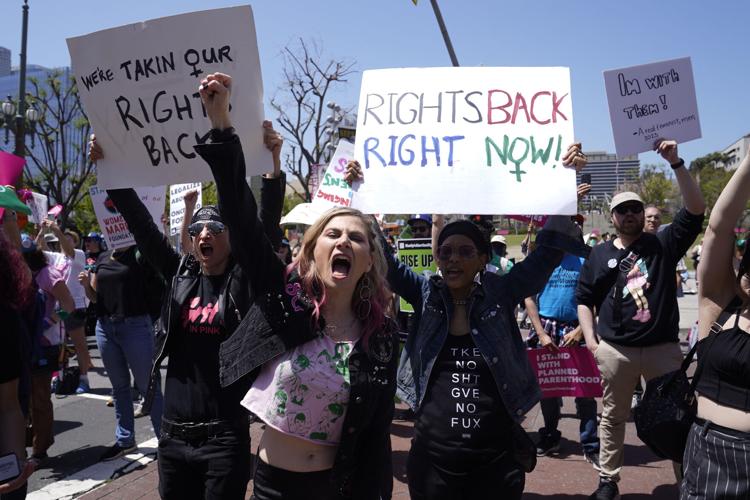
Harris on Wednesday hosted a meeting of the White House’s task force on reproductive health care to discuss ways to protect patient privacy. On Saturday, she appeared at a Los Angeles rally in support of reproductive rights.
On Tuesday, she will travel to Nevada for an event with actress Rosario Dawson and Reno Mayor Hillary Schieve to discuss how the fight for abortion access impacts young Americans.
“Let us clearly understand the moment we are in: a moment in which our hard-won freedoms are under attack,” Harris told a crowd of supporters Friday at the National Action Network’s convention.
A spokesperson for Harris stressed that the vice president has been active in addressing gun violence and abortion access throughout the Biden administration, noting her response to a shooting in Highland Park, Ill., and her visit to Buffalo, N.Y., after a shooting at a grocery store.
The recent stretch in the spotlight has been notable for Harris, who frequently attracts scrutiny from Republicans, particularly over her role as the White House’s point person on addressing migration from Central America.
Conservatives have repeatedly zeroed in on the influx of migrants at the southern border, placing the blame on Harris and questioning whether she’s qualified for the job.
Among Democrats, Harris’s performance has at times sparked speculation about whether Biden should consider picking a different running mate for 2024 — or if Democrats would unite behind Harris should Biden opt not to run for a second term. Sen. Elizabeth Warren (D-Mass.) made waves in January when she was asked if Harris should remain Biden’s running mate and said she’d defer to Biden.
A March 21 survey from Monmouth University found Harris with a 36 percent approval rating, 5 percentage points lower than Biden’s in the same poll. The vice president’s approval rating in that poll among Democrats was 76 percent, 10 percentage points lower than Biden’s with the same group.
Biden and his team have repeatedly voiced public support for Harris, and some Democratic strategists and Harris allies believe the vice president has shown she can be a valuable asset when she is outside of Washington, discussing issues such as gun violence and abortion, which have proven to be key drivers of turnout for the party.
Rev. Al Sharpton, a leading civil rights activist, welcomed Harris on Friday as a keynote speaker at the National Action Network’s convention in New York, hailing her as a symbolically and substantively important politician and comparing the vice president to the Biblical figure Esther.
“She was built for this. She was born for this. She was raised for this. She can take every shot you shoot, because she’s been through shots worse than this,” Sharpton said. “She’s tough enough, she’s strong enough.”
The pink auto has again taken the route of the US Embassy in India and this time, dropped off America’s ambassador Eric Garcetti has taken over as the new envoy. Garcetti, who arrived in India on Tuesday, April 11, 2023, came in a “pink auto” and met all the members of the Embassy, according to the video shared by US Embassy in India on its official Twitter account.
“Excitement fills the air as we welcome Ambassador-Designate Eric Garcetti to India! We are excited to personally greet him and confident the U.S.-India partnership will advance through his leadership. #USIndiaTogether,” US Embassy in India tweeted.
On Garcetti’s arrival in India, Indian Embassy in the US tweeted, “Namaste, Ambassador-Designate Eric Garcetti! We’re thrilled to welcome you to #IncredibleIndia and work with you to build even stronger ties between our two great nations.”
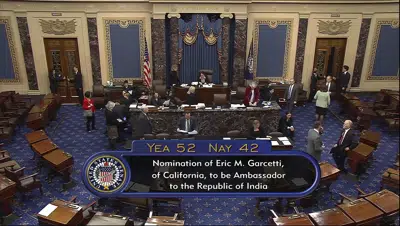
On March 24, Garcetti was sworn in by U.S. Vice President Kamala Harris as the new US Ambassador to India, after the U.S. Senate on March 15 confirmed the nomination of the former mayor of Los Angeles.
Garcetti, who is a close ally of Joe Biden, was nominated for the post by the US president in 2021. But his appointment was held up after allegations that he had overlooked accusations of sexual harassment against an aide when he was mayor. Garcetti denies any wrongdoing.
The US has not had an ambassador to India since January 2021 even though the two countries have strong security and trade ties.
Garcetti won the mandate by a vote of 52 to 42, a major victory for US President Joe Biden as well, who stuck by his political ally in the face of the allegations and the prolonged process that has left the world’s most populous democracies without US representatives.
After the result, Garcetti said in a statement, “I’m thrilled with today’s outcome, which was a decisive and bipartisan decision to fill a critical post that has been vacant for far too long. Now the hard work begins.”
Garcetti’s appointment also comes at a time when Russia has become a major irritant between Delhi and Washington. India’s neutral stance on Russia’s invasion of Ukraine has frustrated the US. Delhi has not explicitly condemned the war but has talked about the importance of “the UN Charter, international law, and respect for the sovereignty and territorial integrity of states”.
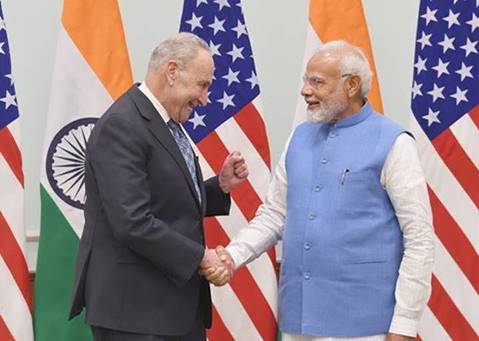
India is also the biggest market for Russian military equipment and continues to import huge quantities of crude oil from the country, ignoring bans in the US and parts of Europe. “The United States-India relationship is extremely important,” Senator Chuck Schumer said after a test vote on Wednesday. “It’s a very good thing we now have an ambassador.”
A graduate of Columbia University, Garcetti was an officer in the US Navy for 12 years before he made his foray into politics. In 2013, he became the youngest mayor of LA in 100 years and the first Jewish person to be elected for the role. He held the post until 2022.
“I’m deeply grateful to President Biden and the White House for the confidence and support throughout this process, and to all Senators on both sides of the aisle — whether they voted for me or not — for their thoughtful consideration. I’m ready and eager to begin my service representing our critical interests in India,” he added.
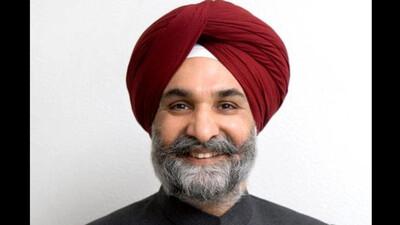
India’s ambassador to the US, Taranjit Singh Sandhu was conferred the ‘Sikh Hero Award’ along with other eminent Sikh Americans by Sikhs of America at an event organized in Washington DC on April 8, 2023.
Commenting on the honor, the seasoned bureaucrat expressed his gratitude and remembered the tenets of Sikhism. “Delighted to receive Hero Award from Sikhs of America. Spoke about important tenets of Sikhism: seva, brotherhood, equality, inclusion & honesty. Highlighted the strengthening of US-India partnership and tech and infra transformation taking place in India and huge opportunities for the youth,” he tweeted after the event.
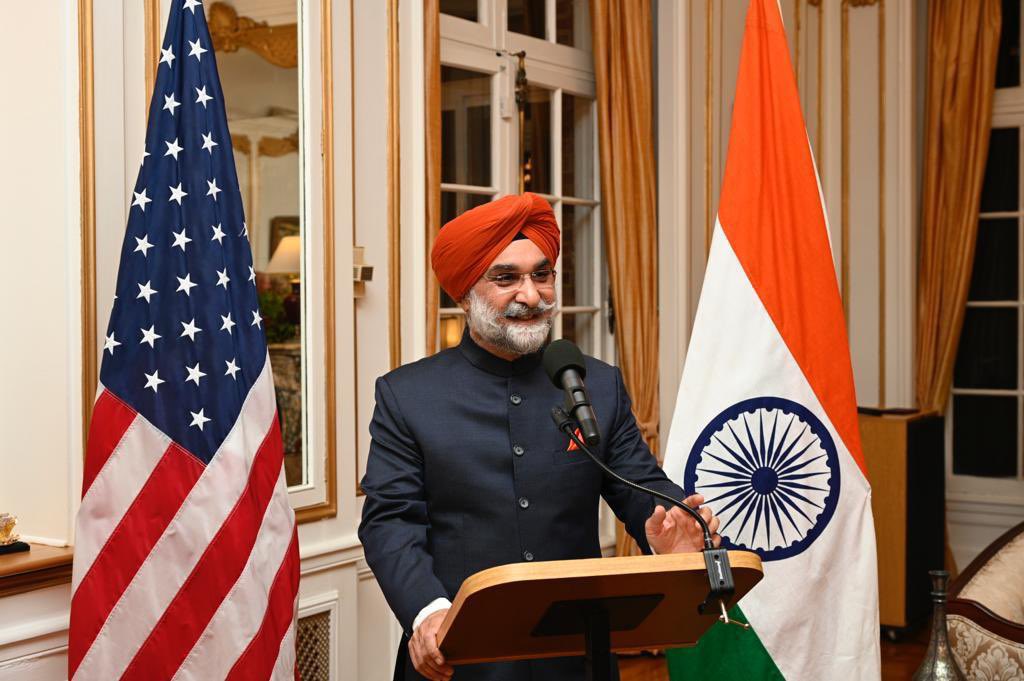
Refering to the recent acts by Sikh separists, Sandhu said, “Khalsa, which was created on the Baisakhi day, by Guru Gobind Singh is a uniting and not a dividing force.”
The ambassador also highlighted the Sikh community’s valuable contribution in different sectors including the economy, health and entrepreneurship, according to a release. In his call to Punjab and the youth in Punjab to connect with the multi-dimensional revolution happening in India, he underlined,“The government, people and in particular the youth must take advantage of the expanding partnership with the US in various fields that Prime Minister Modi and President Biden are trying to put in place.”
In his opening statement, the chairman of Sikhs of America, Jasdip Singh Jassee shared the contributions of the recipients of the ‘Sikh Hero Award’ in their respective fields and said that violence has no place in society.
Former New Jersey Attorney General Gurbir Singh Grewal, entrepreneur and philanthropist Darshan Singh Dhaliwal, former Hoboken Mayor Ravi Singh Bhalla, and entrepreneur Manraj Singh Kahlon were earlier awarded the ‘Sikh Hero Award.’ Late Sikh police officer Sandeep Dhaliwal was also presented the award posthumously.
Robert F Kennedy Jr, 69-year-old son of assassinated Senator Robert F Kennedy and nephew of President John F Kennedy has filed election paperwork to run for US president in 2024 as a Democrat.
The environmental lawyer’s campaign treasurer, John E Sullivan, confirmed the filing on April 5thm 2023. Kennedy is an outspoken anti-vaccine campaigner. Instagram removed his account in 2021 for “repeatedly sharing debunked claims”, the company said.
Both Democratic and Republican parties hold their own contests – called primaries – to find their presidential nominee. Kennedy will be a rank outsider for the Democratic nomination.
President Joe Biden has indicated he will run for re-election, though he has not yet formally declared his candidacy. He was previously expected to launch his campaign in early April, but aides say his timeline has shifted. CBS News, the BBC’s US partner, has reported that he is expected to formally announce a run in early summer. Last month, another Democrat, Marianne Williamson, joined the presidential race.
On the Republican side, Donald Trump was first to declare his candidacy and he has been joined by others including former US ambassador to the United Nations, Nikki Haley.
In March, Kennedy said on Twitter he was considering a run for president At the time, he said: “If I run, my top priority will be to end the corrupt merger between state and corporate power that has ruined our economy, shattered the middle class, polluted our landscapes and waters, poisoned our children, and robbed us of our values and freedoms.” Kennedy told a New Hampshire crowd in March that he had “passed the biggest hurdle” – his wife greenlighting the run.
As the co-founder of an environmental law firm, Kennedy won plaudits for campaigning on issues such as clean water, including working to clean up the Hudson River in New York. But his anti-vaccine views go back years and have provoked a strong backlash, including from his own family. In 2021 his sister, Kerry Kennedy, called him “very dangerous” on the issue.
In 2019, three other family members penned an op-ed in the news outlet Politico, denouncing Kennedy’s anti-vaccine views. His sister Kathleen Kennedy Townsend, brother Joseph P Kennedy II and niece Maeve Kennedy McKean said his views were “tragically wrong” and have “deadly consequences”.
In 2022, Facebook and Instagram removed accounts for an anti-vaccine group founded by Mr Kennedy, Children’s Health Defense, for “repeatedly” violating company policies on medical misinformation.
Although Kennedy’s vaccine scepticism long predates Covid, he found a new audience during the pandemic, when revenues to Children’s Health Defense doubled to $6.8m (£5.5m). Kennedy also published a book, The Real Anthony Fauci, in which he accused the former US infectious disease chief of “a historic coup d’etat against Western democracy”.
He also invoked Nazi Germany during an anti-vaccine speech in Washington, DC last year. Kennedy has a voice disorder, spasmodic dysphonia, which affects the muscles in his voice box. He married actress Cheryl Hines in 2014 and lives in Los Angeles, California. (Courtesy: BBC)
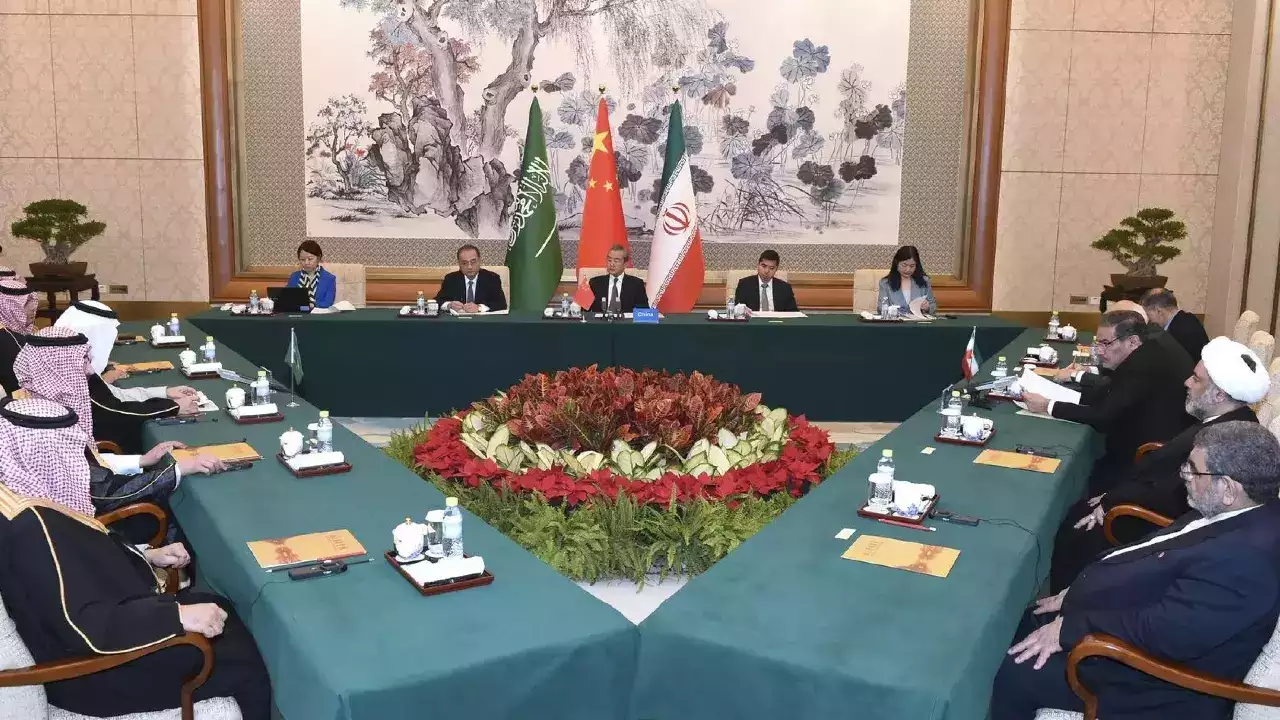
Long-time Mideast rivals Iran and Saudi Arabia took another significant step toward reconciliation last week, formally restoring diplomatic ties after a seven-year rift, affirming the need for regional stability and agreeing to pursue economic cooperation.
The agreement was reached in Beijing during a meeting between the Iranian and Saudi foreign ministers, a month after China had brokered an initial reconciliation agreement between the two regional powerhouses.
Picture : TOI
The latest understanding further lowers the chance of armed conflict between the rivals, both directly and in proxy conflicts around the region. It could bolster efforts by diplomats to end a long war in Yemen, a conflict in which both Iran and Saudi Arabia are deeply entrenched.
The announcement also represents another diplomatic victory for the Chinese as Gulf Arab states perceive the United States slowly withdrawing from the wider region.
But it remains to be seen how far the reconciliation efforts will progress. The rivalry dates back to the 1979 revolution that toppled Iran’s Western-backed monarchy, and in recent years the two countries have backed rival armed groups and political factions across the region.
Iranian Foreign Minister Hossein Amirabdollahian laid out details of the agreement in a tweet, after his talks with Saudi counterpart Prince Faisal bin Farhan Al Saud. The minister wrote that Thursday marked the beginning of “official diplomatic relations … economic and commercial cooperation, the reopening of embassies and consulates general, and the emphasis on stability, stable security and development of the region.” Amirabdollahian said that the issues are “agreed upon and on the common agenda.”
The official Iranian news agency, IRNA, said that in addition to reopening embassies in the two capitals, diplomatic missions would start operating in two other major cities — Mashhad in Iran and Jeddah in Saudi Arabia. The report said both sides also agreed to study the prospects of resuming flights and official and private visits between the two nations, in addition to how to facilitate the visa process for their people.
China’s Foreign Ministry last month reported that both sides had agreed to reopen their embassies and missions within two months. Chinese Foreign Ministry spokesperson Mao Ning said the two foreign ministers signed a joint statement and expressed their determination to improve ties in line with their talks in Beijing last month.
The state-run Saudi Press Agency carried a brief news item on the meeting, saying “discussions were held on joint relations and ways to enhance cooperation in many fields,” with both sides aiming to “enhance the security, stability, and prosperity of the two countries and peoples.”
Thursday’s talks in Beijing marked the first formal meeting of senior diplomats from the two nations since 2016, when the kingdom broke ties with Iran after protesters invaded Saudi diplomatic posts there. Saudi Arabia had executed a prominent Shiite cleric with 46 others days earlier, triggering the demonstrations.
The warming of ties shows that “regional countries have the will and ability to take the lead” in maintaining peace, Mao said at the briefing. She said China is ready to support both sides in fostering good relations, urging the international community to help the Middle Eastern countries resolve their differences. “The colonial hegemonic tactics of stirring up contradictions, creating estrangement and division should be rejected by the people all over the world,” she said.
The United States has welcomed diplomatic progress between Saudi Arabia, with which it has a close but complicated alliance, and Iran, which it considers a regional menace. But U.S. officials have also expressed skepticism about whether Iran will change its behavior.
“If this dialogue leads to concrete actions by Iran to curb its destabilizing activities in the region, including the proliferation of dangerous weapons, then of course, we would welcome that,” said Vedant Patel, the principal deputy State Department spokesman.
While the reopening of embassies would mark a major step forward, the extent of the rapprochement could depend on peace efforts in Yemen, where Saudi Arabia has been at war with the Iran-backed Houthi rebels since 2015, following the rebels’ capture of the capital and much of northern Yemen.
Saudi Arabia is also deeply suspicious of Iran’s nuclear program, which has advanced significantly since the U.S. unilaterally withdrew from a 2015 agreement with world powers to curb Iran’s atomic activities in exchange for sanctions relief.
“I know from my conversations with the Saudis, they are going to be watching the Yemen space,” Tim Lenderking, the Biden administration’s envoy for Yemen, told a think-tank audience in Washington earlier this week.
“If the Iranians want to show that they’re really turning a corner on the conflict, then there won’t be smuggling of weapons to the Houthis anymore in violation of U.N. Security Council resolutions.” He pointed to alleged Iranian involvement in smuggling narcotics as well.
Lenderking cited Iran’s support for an ongoing truce there as a recent positive sign, and called on Iran to support political efforts for a lasting peace agreement.
U.N. Secretary-General Antonio Guterres said the restoration of relations between Saudi Arabia and Iran is “a very important development” to increase stability in the region, spokesman Stephane Dujarric said Thursday.
US President Joe Biden announced that the United States had placed the nomination of Ajay Banga to be the next head of the World Bank, established in 1944. There will be no other official candidates for this job since—by convention—the US nominee is automatically selected for the post. This has been the case for the 13 previous presidents of the World Bank—the one exception was the acting president Kristalina Georgieva of Bulgaria, who held the post for two months in 2019. Georgieva is currently the managing director of the IMF.
In the official history of the International Monetary Fund (IMF), J. Keith Horsefield wrote that US authorities “considered that the Bank would have to be headed by a US citizen in order to win the confidence of the banking community, and that it would be impracticable to appoint US citizens to head both the Bank and the Fund.” By an undemocratic convention, therefore, the World Bank head was to be a US citizen and the head of the IMF was to be a European national . Therefore, Biden’s nomination of Banga guarantees his ascension to the post.
A month later, the New Development Bank’s Board of Governors—which includes representatives from Brazil, China, India, Russia, and South Africa (the BRICS countries) as well as one person to represent Bangladesh, Egypt, and the United Arab Emirates—elected Brazil’s former president Dilma Rousseff to head the NDB, popularly known as the BRICS Bank.
The BRICS Bank, which was first discussed in 2012, began to operate in 2016 when it issued its first green financial bonds. There have only been three managing directors of the BRICS Bank—the first from India (K.V. Kamath) and then the next two from Brazil (Marcos Prado Troyjo and now Rousseff to finish Troyjo’s term). The president of the BRICS Bank will be elected from its members, not from just one country.
Banga comes to the World Bank, whose office is in Washington, D.C., from the world of international corporations. He spent his entire career in these multinational corporations, from his early days in India at Nestlé to his later international career at Citigroup and Mastercard. Most recently, Banga was the head of the International Chamber of Commerce, an “executive” of multinational corporations that was founded in 1919 and is based in Paris, France.
As Banga says, during his time at Citigroup, he ran its microfinance division, and, during his time at Mastercard, he made various pledges regarding the environment. Nonetheless, he has no experience in the world of development finance and investment. He told the Financial Times that he would turn to the private sector for funds and ideas. His resume is not unlike that of most US appointees to head the World Bank.
The first president of the World Bank was Eugene Meyer, who built the chemical multinational Allied Chemical and Dye Corporation (later Honeywell) and who owned the Washington Post. He too had no direct experience working on eradicating poverty or building public infrastructure. It was through the World Bank that the United States pushed an agenda to privatize public institutions. Men such as Banga have been integral to the fulfillment of that agenda.
Dilma Rousseff, meanwhile, comes to the BRICS Bank with a different resume. Her political career began in the democratic fight against the 21-year military dictatorship (1964-1985) that was inflicted on Brazil by the United States and its allies. During Lula da Silva’s two terms as president (2003-2011), Dilma Rousseff was a cabinet minister and his chief of staff.
She took charge of the Programa de Aceleração do Crescimento (Growth Acceleration Program) or PAC, which organized the anti-poverty work of the government. Because of her work in poverty eradication, Dilma became known popularly as the “mãe do PAC” (mother of PAC). A World Bank study from 2015 showed that Brazil had “succeeded in significantly reducing poverty in the last decade”; extreme poverty fell from 10 percent in 2001 to 4 percent in 2013. “[A]pproximately 25 million Brazilians escaped extreme or moderate poverty,” the report said.
This poverty reduction was not a result of privatization, but of two government schemes developed and established by Lula and Dilma: Bolsa Família (the family allowance scheme) and Brasil sem Misería (the Brazil Without Extreme Poverty plan, which helped families with employment and built infrastructure such as schools, running water, and sewer systems in low-income areas). Dilma Rousseff brings her experience in these programs, the benefits of which were reversed under her successors (Michel Temer and Jair Bolsonaro).
Banga, who comes from the international capital markets, will manage the World Bank’s net investment portfolio of $82.1 billion as of June 2022. There will be considerable attention to the work of the World Bank, whose power is leveraged by Washington’s authority and by its work with the International Monetary Fund’s debt-austerity lending practices.
In response to the debt-austerity practices of the IMF and the World Bank, the BRICS Health/Sciencecountries—when Dilma was president of Brazil (2011-2016)—set up institutions such as the Contingent Reserve Arrangement (as an alternative to the IMF with a $100 billion corpus) and the New Development Bank (as an alternative to the World Bank, with another $100 billion as its initial authorized capital).
These new institutions seek to provide development finance through a new development policy that does not enforce austerity on the poorer nations but is driven by the principle of poverty eradication. The BRICS Bank is a young institution compared to the World Bank, but it has considerable financial resources and will need to be innovative in providing assistance that does not lead to endemic debt. Whether the new BRICS Think Tank Network for Finance will be able to break with the IMF’s orthodoxy is yet to be seen.
Since the 1990s, large numbers of Americans have left Christianity to join the growing ranks of U.S. adults who describe their religious identity as atheist, agnostic or “nothing in particular.” This accelerating trend is reshaping the U.S. religious landscape, leading many people to wonder what the future of religion in America might look like.
For years, church leaders and commentators have warned that Christianity is dying in America. They say the American church is poised to follow the path of churches in Western Europe: soaring Gothic cathedrals with empty pews, shuttered church buildings converted into skate parts and nightclubs, and a secularized society where one theologian said Christianity as a norm is “probably gone for good — or at least for the next 100 years.”
About 64% of Americans call themselves Christian today. That might sound like a lot, but 50 years ago that number was 90%, according to a 2020 Pew Research Center study. That same survey said the Christian majority in the US may disappear by 2070.
People who are religiously unaffiliated, sometimes called religious “nones,” accounted for 30% of the U.S. population. Adherents of all other religions – including Jews, Muslims, Hindus and Buddhists – totaled about 6%.
Picture : Wikipedia
Depending on whether religious switching continues at recent rates, speeds up or stops entirely, the projections show Christians of all ages shrinking from 64% to between a little more than half (54%) and just above one-third (35%) of all Americans by 2070. Over that same period, “nones” would rise from the current 30% to somewhere between 34% and 52% of the U.S. population.
As millions of Americans celebrated the holiest day in the Christian calendar on Sunday, a prediction about the future of Christianity in the US has come as a pleasant surprise. CNN asked some of the nation’s top religion scholars and historians recently about the future of Christianity in the US, they had a different message.
They said the American church is poised to find new life for one major reason: Waves of Christians are migrating to the US. And they said the biggest challenge to Christianity’s future in America is not declining numbers, but the church’s ability to adapt to this migration.
Joseph P. Slaughter, a historian and assistant professor of religion at Wesleyan University in Connecticut, says people have been predicting the extinction of Christianity in the US for over two centuries, and it hasn’t happened yet.
He pointed to Thomas Jefferson, one of the nation’s founding fathers, who predicted in the 1820s that Christianity would be replaced in the US by a more enlightened form of religion that rejected Jesus’ divinity and belief in miracles.
Instead, Jefferson’s prophecy was followed by a series of revivals, including the Second Great Awakening, which swept across America and reasserted Christianity as a dominant force in American life. “I’d never bet against American Christianity — particularly evangelicalism,” Slaughter says, “and its ability to adapt and remain a significant shaper of the American society.”
What’s happening in Europe is the church’s nightmare scenario
If one only looks at the numbers, Slaughter’s optimism seems misguided. Virtually every recent poll about Christianity in America has been brutal for its followers. The Covid-19 pandemic also hurt the church in America. Church attendance has rebounded recently but remains slightly below pre-pandemic levels. A 2021 Gallup poll revealed another grim number for Christians: church membership in the US has fallen below 50% for the first time.
In addition, a cascade of headlines in recent years have stained the church’s reputation, including sex abuse scandals in the Roman Catholic Church and the Southern Baptist Convention; the spread of White Christian nationalism; and the perception that the church oppresses marginalized groups such as LGBTQ people.
Church leaders in the US also have fretted about the rise of “nones.” These are people who describe themselves as atheists, agnostics or “nothing in particular” when asked their religious identity.
The ascent of nones will transform the country’s religious and political landscape, says Tina Wray, a professor of religious and theological studies at Salve Regina University in Rhode Island. About 30% of Americans now call themselves nones.
“The interest of the nones will soon outweigh those of the religious right in just a matter of years,” Wray says. “Nones are going to vote as a bloc and they’re going to be pretty powerful. White evangelicals will eventually be eclipsed by the unaffiliated.”
Wray says those who are optimistic about the future of the American church underestimate how quickly Christianity can lose its influence even in a place where it once thrived. She cites what’s happened in the Republic of Ireland, an overwhelmingly Catholic country.
The Catholic Church prohibits divorce and was once so powerful in Ireland that the country wouldn’t legally grant its citizens the legal right to a divorce until 1995, says Wray, author of “What the Bible Really Tells Us: The Essential Guide to Biblical Literacy.” But Wray adds that she recently traveled to Ireland and discovered many of its citizens have left the religion. Churches are being closed and turned into apartment buildings, she says.
“People who went to mass everyday stopped going,” she says. “There’s this cultural Catholic identity, but as far as practicing their faith, it’s just disappearing. So within a generation, that’s all it took. It’s just shocking.”
Why the American church’s future may be different than Europe’s
Most of the religious scholars CNN spoke to said the American church may find salvation in another demographic trend: the booming of Christianity in what is called the “Global South,” the regions encompassing Latin America, Africa and Asia.
The world’s largest megachurch, for example, is not in the US. It’s in South Korea. The Yoido Full Gospel Church has a weekly attendance of about 600,000 members.
Perry Hamalis spent time as a Fulbright Scholar in South Korea, where he personally witnessed the vitality of the Christian church in the Global South. He says the church is not perceived in South Korea as an instrument of oppression, but one of liberation. When South Korea was colonized by the Japanese in the early 20th century, the church aligned with Koreans to protest.
“Christianity was looked at not as a religion of empire and of the colonizers, but as the religion of the anti-colonial movement and of pro-democracy,” says Hamalis, a religion professor at North Central College in Illinois.
The US has more immigrants than any other country. People from Latin America and Asia now make up the overwhelming majority of immigrants to the US, and many are bringing their religious fervor with them.
This migration is known as the “Browning of America,” a phrase describing a demographic shift that is expected to make White people the minority in the US by 2045. Those who predict that the church in America will collapse often overlook how the migration of Global South Christians to America will revitalize the country’s religious landscape, scholars say. Christianity could rebound in America if White Christians embrace this one change, they say.
Tish Harrison Warren, a New York Times columnist, pointed out recently that Latino evangelicals are now the fastest-growing group of evangelicals in the US. “We cannot assume that America will become more secular so long as the future of America is less white,” Warren wrote.
The influx of Black and brown Christians from places like Latin America and Asia collides with another trend: a burgeoning White Christian nationalist movement that insists, incorrectly, that the US was founded as a White, Christian nation. It is hostile to non-White immigrants.
“Many congregations don’t realize how much of their Christian identity is wrapped up with a kind of (Christian) nationalist narrative,” Hamalis says. “There’s nothing wrong with loving one’s country, but from a Christian perspective that ought to always be secondary to the mission of building the body of Christ and witnessing to the Gospel in the world.”
How Christianity could re-establish its dominance
There are other factors hiding in plain sight that point to the continued vitality of Christianity, others say. For one, declining church membership doesn’t automatically translate into declining influence.
Consider some recent landmark events. White evangelicals played a critical role in getting former President Trump elected. Conservative Christian groups played a crucial role in the recent passage of state laws limiting LGBTQ rights. And the Supreme Court’s decision last year to overturn Roe vs. Wade was a massive victory for many conservative Christians.
And atheism remains a taboo in American politics. American voters still prefer candidates – including presidents Barack Obama, Donald Trump and Joe Biden – who profess or evoke Christian beliefs. “Christianity still holds a lot of capital in this country,” says Lee M. Jefferson, an associate professor of religion at Centre College in Kentucky.
“There has always been a popular notion that a religious community’s strength or influence is connected to numbers and attendance,” Jefferson says. “Even if there is ample space in cathedrals, Christianity will still hold some strong relevance in different landscapes in the US.”
Even the rise of the “nones,” the growing number of Americans who say they don’t care about religion, is not as much of a threat to the church as initial reports suggest, scholars say.
A growing number of Americans may no longer identify as Christian, but many still care about spirituality, says Hans Gustafson, author of “Everyday Wisdom: Interreligious Studies for a Pluralistic World.”
“Just because more Americans are disaffiliating with institutionalized religion — most notably Christian traditions — this does not always mean that people are becoming less religious,” says Gustafson, director of the Jay Phillips Center for Interreligious Studies at the University of St. Thomas in Minnesota.
“Many still practice spirituality: prayer, meditation… and sometimes even regularly attend religious houses of worship,” he says. Among Americans with no religious affiliation, some still pray daily and say religion is very important in their lives, Gustafson says.
He cites a surprising finding from a 2018 Pew Research Center study of religion in Western Europe. The study found that nones in the US are “much more likely” to pray and believe in God than their European counterparts, said Neha Sahgal, a vice president of research at Pew.
“In fact, by some of these standard measures of religious commitment, American ‘nones’ are as religious as — or even more religious than — Christians in several European countries, including France, Germany and the UK,” Sahgal wrote.
Why the Easter message offers a note of hope
Despite the optimism of many religious scholars, the future of Christianity in America still seems uncertain. Poll numbers about the decline of religiousness in the US cannot be ignored, along with something more intangible: the frailties of human nature.
What if the US enters another xenophobic period and limits migration from non-White Christians?
What if progressive Christians prove unwilling to align with non-White immigrants who tend to be more conservative on issues of sexuality and gender?
And what if some Christians still cling to the belief that America is supposed to be a White Christian nation, even if that assumption causes them to close their church doors to non-White immigrants who could be their salvation?
If that happens, an Easter morning symbol in American churches won’t just be an empty tomb, but empty pews.
But Hamalis, the religion professor who saw Christianity boom in South Korea, says Christians who fear that kind of future can take solace in the Easter message.
“From a Christian perspective, there’s nothing to fear because even death has been conquered,” Hamalis says. “When we are liberated from that fear, we can embrace the person who’s different from us, who speaks a different language or comes from a different culture. We can put ourselves out there in a way that we can’t if we’re just afraid.”
He and other scholars envision a vibrant future for Christianity in the US that’s shared by Warren, the New York Times columnist:
“The future of American Christianity is neither white evangelicalism nor white progressivism,” Warren wrote. “The future of American Christianity now appears to be a multiethnic community that is largely led by immigrants of the children of immigrants.”
If the American church can embrace this future and reverse its shrinking membership, it will have experienced its own resurrection. (Courtesy: CNN)
National Association for Diversity Empowerment (NADE) USA (https://nade-usa.org/ ), based in Houston, TX, has the mission to empower diverse talents in public affairs in the US, including politics, policy-making, business, industry, media, entertainment, cinema, literature, education, and academia. NADE USA and Houston Community College Southwest campus (hccs.edu)organized Fort Bend County Roundtable Leadership conference on March 24, 2023, in the HCC Southwest campus. The conference celebrated International Women’s Day 2023 and honored several accomplished women from various fields.
Those honored were: Judge Sonia Rash, Judge Juli Mathew, Prof. Dr Alice Mathew, Las Vegas, Ms Tanaz Choudhury, IT Entrepreneur, HH Queen Maria Amor, Neeta Sane, Fort Bend & Allef Trustee Laura Richard Fort Bend County Clerk, Terri Wang, community leader
Dr. Madeline Burrillo, Vice-Chancellor, HCC, Dr. Roksana Akter Khan, global peace ambassador, Roopa Gir, I-educate founder, Prema Isha, international human rights commission from Mauritius.
Sangeeta Dua founding member and Secretary welcomed the gathering and facilitated the meeting.
Picture : TheUNN
NADE President Kim Meijia in her presidential address indicated that women are increasingly making significant contributions in all walks of life. Women need to exhibit their femininity indicated by compassion, caring, multitasking, and integrity while working alongside menfolk.
Dr Mathew Joys, Board Member of Global Indian Council presented international award-winning documentary film titled ‘The Footprints of the Mahatma’. It depicted the relevance of Mahatma Gandhi’s non-violence in the modern world.
Congresswoman Shiela Jackson Lee honored Sangeeta Dua for her contributions to public life.
Neeta Sane led a panel discussion on women’s contributions and leadership in health, education, safety, and freedom. Council member Alice Chen of Stafford TX congratulated the honorees.
Global Indian Council Central Cochair for Cyber Security Dr. Joseph Ponnoly and Indo American Press Club General Secretary C G Daniel also felicitated the Honorees.
Sangeeta Dua, while expressing a vote of thanks, mentioned, “we have to come together as leaders in our respective fields, to assess, suggest and debate, on how to take the next step in the women’s movement, for more qualified and meaningful inclusion and empowerment, by incorporating feminine characteristics to our respective professions and public life, as much as possible, to build a better society and nation.”
President Joe Biden, on March 21, 2023, presented the 2021 National Humanities Medal to Indian American actress and producer Vera Mindy Chokalingam, popularly known as Mindy Kaling, during a White House ceremony.
The National Medal of Arts and Humanities is the highest award the government confers upon individuals who have made significant contributions to arts and humanities.
“Mindy Kaling’s work across television, film, and books inspires and delights—capturing and uplifting the experiences of women and girls across the nation,” Kaling’s award citation issued by the White House read.
Picture : TheUNN
Presenting the award to Kaling, Biden said that she is the first woman of color to create, write and star in a primetime sitcom. “She is hardworking and an adoring mom, just like her own mom was. And, Mindy, we know your mom is always with you in your spirit. We know that” the President added.
Kaling, 43, is a daughter of Indian immigrants and was born in Cambridge, Massachusetts, in 1979. She was earlier nominated for the prestigious Emmy Award recognizing her work in the NBC sitcom The Office.
The 12 recipients of the 2021 National Humanities Award include; Richard Blanco, Johnnetta Betsch Cole, Walter Isaacson, Walter Isaacson, Henrietta Mann, Ann Patchett, and Amy Tan.
Three children and three staff members were fatally shot at the Covenant School in Nashville, which one expert describes as part of an “astronomical increase” in violence on school campuses in recent years.
There is no universal definition of a school shooting, explains Jillian Peterson, an associate professor of criminology and the president of the Violence Project, a non-profit research center.
“In my research, we focus on school mass shootings, which is a really narrow definition where somebody comes, is heavily armed, fires indiscriminately, and kills four or more people,” she said.
The White House is blaming Republicans in Congress for the lack of action on guns, turning up the heat on the GOP to address rampant gun violence while appealing to voters fed up with America’s epidemic of mass shootings.
President Biden is focusing his anger over the elementary school shooting in Nashville this week squarely on Republicans, calling for lawmakers to show courage and warning that Congress will have to answer to families that have lost loved ones through gun violence.
“The Congress has to act. The majority of the American people think having assault weapons is bizarre, it’s a crazy idea. They’re against that,” Biden said on Tuesday. “I can’t do anything except plead with Congress to act reasonably.”
The federal government currently does not track the specifics of shootings that occur in schools. And while Peterson says they have been relatively rare over the past few years, there has been an increase in frequency in overall violence on school campuses that is undeniable, regardless of the methodology involved in data collection.
“I used to say mass shootings are rare, school shootings are rare,” Peterson said. “But it’s hard to keep saying that, you know, even though statistically they are, it’s getting harder to convince parents of that.”
By the Post’s measure, the total for 2022 was 46 — but that is only during school hours.
If the parameters are widened to incidents after school, over the weekend, when a gun is brandished, fired, or when a bullet hits school property, that number leaps to 303 in 2022, according to the K-12 School Shooting Database, an independent research project.
The K-12 database definition also includes gang shootings, suicides, and accidents.
“This information is recorded to document the full scope of gun violence on school campuses,” its website reads.
Peterson says that the database, which works in partnership with the Violence Project, demonstrates how community violence is bleeding into schools.
“That includes things motivated by interpersonal conflicts, domestic violence, retaliation, all of those things, fights that escalate because people are armed,” she said.
In 2023, the K-12 database has recorded 89 gun-related incidents at a school so far, nearly one for every day this year.
It finds that, including the deaths in Nashville this week, there have been 74 people killed or injured this year alone, not including the shooters. That includes 18 people fatally shot, and 56 more who were injured.
According to the Gun Violence Archive, there have been 130 mass shootings in the U.S. in 2023. That definition includes four or more people shot or killed, not including the shooter.
Another category that Peterson says has seen a surge in frequency are threats of violence made, online or in person, which can be difficult for schools to track and manage.
Peterson, who is the parent of three elementary school-aged children says that community engagement can be vital in managing those threats, and preventing more tragedies.
“One thing we do know is that the most likely perpetrator of a school shooting is a child in that school. It is a classmate,” she said. “It’s somebody that is getting seen every day. And so they are likely to tell their classmates that they’re planning on it. They give out warning signs.”
Part of Peterson’s research includes studying the life histories and pathways to violence for the perpetrators. And in many cases, they follow the same steps, including telling others about their plans, a term called “leakage.”
Because of this, Peterson says giving students a clear pathway to sharing any suspicions of these warning signs is crucial.
“The best thing we can do is actually just have really good relationships with our kids, making sure that they feel comfortable reporting,” she said.
She also says schools need to take steps to have crisis intervention teams, suicide prevention teams, school based mental health, and anonymous reporting systems to give at-risk students resources, in addition to campaigning for improved gun safety among parents that are firearms owners.
“I think pushing for safe storage campaigns [is key] because the majority of school shooters are taking guns from home. So the more we can help parents who own firearms make sure those are secured, that’s helpful,” she added.
The White House is blaming Republicans in Congress for the lack of action on guns, turning up the heat on the GOP to address rampant gun violence while appealing to voters fed up with America’s epidemic of mass shootings.
President Biden is focusing his anger over the elementary school shooting in Nashville this week squarely on Republicans, calling for lawmakers to show courage and warning that Congress will have to answer to families that have lost loved ones through gun violence.
“The Congress has to act. The majority of the American people think having assault weapons is bizarre, it’s a crazy idea. They’re against that,” Biden said on Tuesday. “I can’t do anything except plead with Congress to act reasonably.”
The president’s broadsides came one day after the deadly shooting at a private Christian elementary school in an upscale Nashville neighborhood. The 28-year-old suspect was armed with three guns, two of which were assault-type weapons, according to local authorities. The shooter killed three children and three adults before being killed by police.
While calling for an assault weapons ban on Tuesday, Biden said people ask him why he keeps urging reforms that Republicans repeatedly reject.
“Because I want you to know who isn’t doing it, who isn’t helping. Put pressure on them,” he said, adding that there’s “a moral price to pay for inaction.”
Picture : Politico
Monday’s tragedy has revived the on-again, off-again debate over gun violence on Capitol Hill, where the parties have vastly different ideas about how to address the epidemic. Democrats have, for decades, pushed tougher gun laws designed to keep firearms out of the hands of violent people, and they’re joining the White House in accusing Republicans of sitting on their hands while kids are killed.
“Every time one of these tragedies happens it’s a reminder of just how pathetic this institution is at addressing this,” said Rep. Jared Huffman (D-Calif.).
Republicans have defended their position, arguing that tighter gun restrictions would do little more than erode liberties guaranteed under the Second Amendment. The more effective strategy, they say, would be to focus on efforts to treat mental illness and fortify schools.
“We’ve talked about things that we can do, and it just seems like on the other side, all they want to do is take guns away from law-abiding citizens,” House Majority Leader Steve Scalise (R-La.), who was severely injured in a shooting in 2017, told reporters Tuesday.
In an effort to move new reform legislation, some House Democrats are eyeing a procedural move, known as a discharge petition, to compel floor votes even over the opposition of GOP leaders. Rep. Abigail Spanberger (D), a Virginia moderate, floated that idea at a closed-door meeting in the Capitol Tuesday morning. The strategy has little chance of bearing fruit, but Democrats hope it will draw a clear distinction between the parties when it comes to gun violence prevention.
“We should not assume that the House — or the Senate, for that matter — are impervious to public opinion,” said Rep. Joe Neguse (Colo.), who heads the Democrats’ messaging arm.
The White House’s strategy to blame Republicans has been fueled by recent comments from GOP lawmakers, some of whom say gun violence is simply an unavoidable fact of life.
“My daddy fought in the Second World War, fought in the Pacific, fought the Japanese, and he told me … ‘Buddy, if somebody wants to take you out and doesn’t mind losing their life, there’s not a whole heck of a lot you can do about it,’” he added.
Nonetheless, the White House maintains that an assault weapons ban, among other reforms, would help to stop the uptick of mass shootings. Biden was in the Senate when the last assault weapons ban, which expired after 10 years, passed under former President Clinton in 1994.
“The reality is, we need Republicans in Congress to get on board with an assault weapons ban, to get on board with universal background checks, to get on board with requiring safe storage … These are policies that work — it’s not rocket science here,” White House principal deputy press secretary Olivia Dalton said on Tuesday.
“I think the president will do everything in his power to continue to urge them to act,” she added. “All we can do is continue to fight.”
From the White House, Biden argues that he has done his part, between issuing executive orders on gun safety and signing the most comprehensive gun safety legislation in decades, which passed last year.
Just two weeks ago, Biden signed an executive order that aims to increase the number of background checks conducted before gun sales. The order builds on the bipartisan gun legislation that Biden signed into law in June.
“This president has been extremely forward-leaning and aggressive in trying to tackle this issue of gun safety,” Dalton said. “There’s a limit to his executive power, and there’s a need for Congress to do more in this moment.”
The debate comes ahead of the president officially announcing that he will run for reelection next year. Gun violence could play a factor in the next election, and the president is expected to tout his own gun safety agenda while highlighting the GOP’s inaction.
Sen. John Cornyn (Texas), who was a lead GOP negotiator on last year’s bipartisan gun reforms, said Monday that he doesn’t think the Senate will take further steps before next year’s elections. And other Republicans are already pushing back against Biden’s finger-pointing in the wake of the Nashville shooting.
“It doesn’t get much lower than blaming Republicans in Congress for a transgender killer who targeted a Christian school. Shameful,” Sen. Tom Cotton (R-Ark.) wrote on Twitter. The suspect in the Nashville shooting identified as transgender.
Meanwhile, Democrats argue it’s a good strategy for the White House to keep up the blame on Republicans lawmakers ahead of 2024 in the face of tragedies like Monday’s school shooting.
“If Republicans think that running on increasing access to guns is a winning argument, the White House should make them own every bit of the destruction and despair that they are creating,” said Democratic strategist Michael Starr Hopkins. “Most Democrats aren’t anti-gun, they’re anti dangerous people getting their hands on guns. I expect the president to hammer that message home.”
Another Democratic strategist, Antjuan Seawright, said the White House framing the gun debate as an issue for Republicans to come around on is the right move because people are frustrated and looking to Washington for solutions every time they hear of another mass shooting.
“I think the president is doing the right thing by saying look, it’s not that he’s not willing, it’s not that the Democrats are not willing, it’s not even that some Republicans are not willing,” he said. “It’s the majority of the Republicans who are not willing, so it’s the Republican Party.”
Dr. Ravi Kolli, President of the American Association of the Physicians of Indian Origin (AAPI), the largest ethnic medical organization in the United States was invited to be part of the 13th-anniversary celebrations of the Affordable Care Act on March 13th, 2023, at the White House in Washington, DC.
“It was such a privilege and an honor to be at the White House representing AAPI, to commemorate 13th anniversary of the Affordable Care Act. It was a memorable day to cherish,” Dr. Kolli described his experience joining with several other healthcare leaders at the White House to commemorate the Affordable Care Act signed into law by President Barack Obama. Other AAPI team members attending the White House ceremony included, Drs. Rupak Parikh, Roshan Shah, Sameer Gupta and Jay Bhat
Surrounded by several healthcare professionals, industry leaders, and heads of federal agencies, President Joe Biden along with Vice President Kamala Harris, Speaker Emerita Nancy Pelosi marked the 13th anniversary of the passage of the Affordable Care Act in the same room where his predecessor, Obama signed into law the historic Act benefitting millions.
Picture : TheUNN
The landmark Affordable Care Act also known as Obamacare was signed into law in 2010. The act aimed to provide affordable health insurance coverage for all Americans. The ACA was also designed to protect consumers from insurance company tactics that might drive up patient costs or restrict care. Millions of Americans have benefitted by receiving insurance coverage through the ACA. Many of these people were unemployed or had low-paying jobs. Some couldn’t work because of a disability or family obligations. Others could not get decent health insurance because of a preexisting medical condition, such as a chronic disease.
“Many of you joined us that day after fighting for decades to make it happen, and I remember three words I used at the time, I thought it was –” Biden said, smiling to invited guests in the White House East Room. “I thought it was a big deal. And I stand by the fact, it was a big deal.”
The president touted the progress his administration has made to advance health care policy through legislation, the Affordable Care Act. “Folks, look, we’re making health care more affordable in many other ways as well.” Biden also highlighted recent moves by several pharmaceutical companies to cap the price of insulin. “Well, I value everyone having a decent shot. It is about fairness. It is about dignity. My budget continues to build on the progress we made in the Affordable Care Act.”
Calling it historic, Dr. Kolli praised the current administration for the efforts to insure millions, providing them with affordable health benefits. Quoting statistics, Dr. Kolli pointed out, “During 2023 open enrollment a record high 16.4 million people signed up, with 4.4 million more people enrolled for health insurance since 2021. A new HHS report shows more than 40 million people are currently enrolled in Marketplace or Medicaid expansion coverage related to provisions of the Affordable Care Act — the highest total on record.”
Dr. Kolli thanked the Biden administration for the Open Enrollment outreach that was tailored to reach audiences that experience lower access to health care through cultural marketing experts to connect more people to resources including Asian American and Pacific Islander communities, African Americans, Spanish and English-speaking Latinos, and in multiple languages.
HHS released a report from the Office of the Assistant Secretary for Planning and Evaluation (ASPE) that shows more than 40 million people are currently enrolled in Marketplace or Medicaid expansion coverage related to provisions of the ACA — the highest total on record.
Referring to studies, Dr. Kolli said, ACA has helped a total of 40.2 million Americans gain coverage related based on 2022 and early 2023 enrollment data, the highest total on record. This represents 9.3 million more people enrolled than in 2021 (a 30% increase) and 27.6 million more people enrolled than in 2014 (a 219% increase, or more than triple). Survey results indicate that all 50 states and the District of Columbia have experienced substantial reductions in the uninsured rate since 2013, the last year before the implementation of the ACA.
Among the many benefits, Dr. Kolli pointed out that ACA covers many screenings and preventive services, which has been a theme advocated by AAPI: Focus on Preventive Care. “These usually have low copays or deductibles. The hope is that if you are proactive in your healthcare, you can avoid or delay major health problems later. This will benefit healthier consumers having to pay lower costs over time. For example, a diabetes screening and early treatment may help prevent costly and debilitating treatment later,” he pointed out.
Serving 1 in every 7 patients in the US, AAPI members care for millions of patients every day, while several of them have risen to hold high-flying jobs, shaping the policies and programs, and inventions that shape the landscape of healthcare in the US and around the world. For more details, please visit: www.appiusa,org
Treasury Secretary Janet Yellen on Wednesday pushed back against a GOP congressman who voiced skepticism about the threat of climate change, suggesting the issue was being used by the Biden administration to secure funding and was not a serious concern.
“Can you provide to me, or do you know any research on your own to justify this drastic climate change that we have to do today or the next four or five years this world’s going to come to an end?” Rep Jerry Carl (R-Ala.) asked Yellen at a hearing on the banking system.
When Yellen pointed to an “enormous amount of research” summarized by a United Nations group about the threat of climate change, Carl claimed that the global organization “makes a lot of money off the climate change scenario.”
“There is a strong scientific consensus and enormous body of research,” Yellen responded.
Picture : YouTube
Carl, who is a member of the House Committee on Natural Resources, downplayed the significance of the changing climate by pointing to the environment in his home state of Alabama. Carl noted one could go 300 feet above sea level and find oyster shells in an embankment, then travel 40 feet below sea level and find a petrified forest under water.
Carl said he believes the literal definition of climate change, but questioned the idea that it is a grave threat to the planet. He argued that the issue of climate change was being used by the Biden administration so it could secure funding for its various priorities.
“The way it’s being used now is like a Trojan horse. Everything you want to use it for to get into the conversation is climate change related,” Carl said.
“We’re seeing enormous increases in concentration of carbon dioxide in the atmosphere,” Yellen said. “Where in America are we seeing that?” Carl asked.
“It’s a global phenomenon; it’s not just in the United States,” Yellen replied, noting that an increase in the intensity of hurricanes is another cause of concern.
“Climate change, I believe, is an existential threat, and we will leave a world to our grandchildren and great grandchildren that will become uninhabitable if we don’t address climate change,” Yellen continued. “We have let decades pass in which we have understood that this was a problem and not taken meaningful action.”
Rep. Mario Diaz-Balart (R-Fla.) said he believed there is general skepticism among critics of the Biden administration that the billions of dollars being spent on the environment will meaningfully change the temperature of the planet.
Yellen has made fighting climate change a key part of her work as Treasury secretary, arguing that the U.S. economy will suffer if the planet continues to warm. The department previously created a climate hub, a division meant to drive investments toward projects to reduce carbon emissions and insulate the economy from extreme weather and other risks.
The Inflation Reduction Act, the administration’s signature piece of legislation passed last year, contains $27 billion in funding for green banks, credit unions, housing finance agencies and projects to cut pollution and energy costs.
(AP) — Bending to a wave of mass protests, Israeli Prime Minister Benjamin Netanyahu delayed his contentious judicial overhaul plan Monday and said he wanted “to avoid civil war” by making time to seek a compromise with political opponents.
The announcement appeared to calm some of the tensions that have fueled three tumultuous months of unrest. But it failed to address the underlying issues that have polarized the nation, and the anti-government protest movement vowed to intensify its efforts.
In his prime-time address, Netanyahu, who had previously rejected calls to delay the legislation, took a more conciliatory tone than in recent speeches. He acknowledged the deep divisions in the country and said he was hitting the pause button “to prevent a rift in the nation.”
“When there’s an opportunity to avoid civil war through dialogue, I, as prime minister, am taking a timeout for dialogue,” he said. He vowed to reach a “broad consensus” during the summer session of parliament, which begins on April 30.
He spoke after tens of thousands of Israelis demonstrated outside parliament, and the country’s largest labor union launched a nationwide strike in a dramatic escalation of the mass protest movement against his plan.
Netanyahu and his religious and ultranationalist allies presented the overhaul in January just days after forming their government, the most right-wing in Israel’s history.
The proposal has plunged Israel into its worst domestic crisis in decades. Business leaders, top economists and former security chiefs have all come out against the plan, saying it is pushing the country toward an autocracy. Fighter pilots and military reservists have threatened not to report for duty, and the country’s currency, the shekel, has tumbled in value.
The plan would give Netanyahu, who is on trial on corruption charges, and his allies the final say in appointing the nation’s judges. It would also give parliament, which is controlled by his allies, authority to overturn Supreme Court decisions and limit the court’s ability to review laws.
Netanyahu has argued that the overhaul is needed to rein in a liberal and overly interventionist court of unelected judges. But his opponents say the package would damage the country’s system of checks and balances by concentrating power in the hands of Netanyahu’s allies. They also say that he has a conflict of interest as a criminal defendant.
Tens of thousands of people, largely secular, middle-class Israelis, have regularly joined mass protests against the plan.
Those demonstrations ramped up Sunday night after Netanyahu abruptly fired Defense Minister Yoav Gallant, who had urged the prime minister to put his plan on hold, citing concerns about damage to the Israeli military.
The firing sparked a spontaneous outburst of anger, with tens of thousands of people taking to the streets in just one hour.
Chanting “the country is on fire,” they lit bonfires on Tel Aviv’s main highway, closing the thoroughfare and many others throughout the country for hours.
Demonstrators continued Monday outside the Knesset, or parliament, turning the streets surrounding the building and the Supreme Court into a roiling sea of blue-and-white Israeli flags dotted with rainbow Pride banners.
“This is the last chance to stop this move into a dictatorship,” said Matityahu Sperber, 68, who joined a stream of people headed to the protest outside the Knesset. “I’m here for the fight to the end.”
Israel’s main trade union, the histadrut, declared a general strike in what it said was the first time it has carried out such an action over a political issue.
The chaos shut down much of the country and threatened to paralyze the economy. Departing flights from the main international airport were grounded, stranding tens of thousands of travelers.
Large mall chains and universities closed their doors, and the union called for its 800,000 members to stop work in health care, transit, banking and other fields.
Diplomats walked off the job at foreign missions, and local governments were expected to close preschools and cut other services. The main doctors union announced that its members would also strike.
In a sign of easing tensions, the union said late Monday that it was halting the strike in response to Netanyahu’s delay.
The announcement appeared to buy the embattled Netanyahu several weeks of quiet. But it was far from clear whether the disputes could be resolved.
The country’s figurehead president, Isaac Herzog, said pausing the legislative blitz was “the right thing.”
“This is the time for frank, serious and responsible discussion that will lead urgently to calming spirits and lowering the flames,” he said.
Opposition leader Yair Lapid said he was willing to hold a “genuine dialogue” under Herzog’s sponsorship.
National Security Minister Itamar Ben-Gvir, an ultranationalist who has pushed for quick passage of the package, said he would respect the delay but showed few signs of compromise.
“The reform will pass,” he tweeted. “No one will scare us.”
The first of a series of laws — giving the coalition control over judicial appointments — had been scheduled to pass this week.
Before Netanyahu’s speech, some 20,000 right-wing Israelis attended a counter demonstration in support of the prime minister. That demonstration also took place near parliament and passed without violence.
“They won’t steal the election from us,” read a flyer for event, organized by Religious Zionist party. Netanyahu said he was “moved” by the show of support.
Shikma Bressler, one of the leaders of the anti-government protest movement, said the campaign would continue until the legislation is canceled.
“This is just an attempt to weaken the protests in order to enact Netanyahu’s dictatorship,” she said. “Now is not the time to reduce the pressure, but to increase it.”
Dozens of protesters from rival sides faced off late Monday in central Tel Aviv. The sides, kept apart by police, exchanged insults, but there was no violence. Police used a water cannon to disperse anti-government protesters.
Israel’s Palestinian citizens have largely sat out the protests. Many say Israel’s democracy is tarnished by its military rule over their brethren in the West Bank and the discrimination they themselves face.
The Biden administration, which has been uneasy with Netanyahu and the far-right elements of his government, welcomed the announcement as “an opportunity to create additional time and space for compromise,” White House press secretary Karine Jean-Pierre told reporters.
The polls do not bear well for President Joe Biden if he chooses to stand for reelection in 2024. Biden is locked in close hypothetical races with the two leading candidates for the Republican Party’s 2024 presidential nomination, according to a new poll.
A Quinnipiac University poll released this week found Biden leading former President Trump in a hypothetical 2024 rematch, with Biden receiving 48 percent support and Trump getting 46 percent among registered voters.
In a hypothetical election between Biden and Florida Gov. Ron DeSantis (R), the other front-runner at the moment for the GOP nomination, Biden trails 46 percent to DeSantis’s 48 percent.
Picture : NBC
The poll found Trump leading DeSantis in a head-to-head Republican primary matchup, with the former president earning 52 percent support to DeSantis’s 42 percent.
Biden, Trump, and DeSantis all had similar favorability ratings among registered voters, as well. For Biden, 37 percent of respondents said they had a favorable view of the president, compared to 56 percent who had an unfavorable view.
Meanwhile for Trump, 36 percent had a favorable view, and 58 percent had an unfavorable view. And 36 percent had a favorable view of DeSantis, while 39 percent had an unfavorable view, and 24 percent said they did not know enough about the governor.
The poll surveyed 1,600 registered voters from March 23-27. It has a margin of error of 2.5 percentage points.
The results reflect that Biden may be vulnerable in a reelection bid, with voters consistently concerned about his handling of the economy in particular. But it also underscores a persistent concern among Republicans, that Trump may be the one candidate who would lose to Biden in 2024.
Trump has already declared his candidacy for 2024, as has former Ambassador to the United Nations Nikki Haley. DeSantis is widely expected to enter the race in the coming months, but he has not yet formally launched a bid.
And while Biden’s intention to run for a second term does not seem to be in significant doubt, the president thus far has only reiterated his “intention” to run for the White House again.
(NPR) The economy continues to dominate as the most important issue facing the country, followed by preserving democracy, according to the latest NPR/PBS NewsHour/Marist poll.
Democrats face vulnerabilities when it comes to the economy, crime and whether to ban TikTok, while Republicans risk overstepping on transgender rights and business practices, the survey found.
“The image of the Republican Party has gotten even more extreme than it was” before the 2020 election, said Lee Miringoff, director of the Marist Institute for Public Opinion, which conducted the survey. “If winning the election in 2024 is predicated on picking up some swing voters in the middle, they’re moving in the opposite direction.
“For the Democrats, as much as the progressive wing is allowing President Biden some freedom to move toward the middle, you look at the issues on the economy and crime, and he is not where he wants to be in tying down the middle, either.”
The survey of 1,327 adults, including 1,226 registered voters, was conducted March 20 through Thursday, March 23 via live telephone callers to cellphones and landlines, through online research panels and via text message in English and in Spanish. It has a margin of error of +/- 3.5 percentage points, meaning results have a range of about 4 points lower or higher than the number reported.
The top issues facing the country
With inflation stubbornly high and interest rates increasing, there is plenty of economic uncertainty at the moment, and it remains the top issue for respondents in the survey — 31% said so, followed by preserving democracy (20%).
No other issue broke double-digits. Health care was third at 9%, then immigration and climate change at 8%. Crime, gun policy, abortion and education rounded out the topics people were asked about.
The policy priorities, as expected, are different by party — with Republicans and independents more focused on the economy and Democrats saying preserving democracy is tops, followed by the economy, health care and climate change.
Immigration and preserving democracy followed the economy for Republicans.
Biden struggles on the economy and crime
When it comes to the economy, Biden continues to get poor marks.
Just 38% approve of how he’s handling it, including just 28% of independents. The White House and Democratic strategists know Biden, who is expected to run for reelection, has to improve in how Americans view him on the economy in the next year and a half before the 2024 election.
Overall, Biden gets a 42% job approval rating. That’s about where it had been before his State of the Union address in February. An NPR survey that month, taken after Biden’s address, showed him getting a slight bounce. That appears to have receded.
On crime, Biden is particularly vulnerable. Just 35% approve of how he’s handling it, including just 27% of independents. There is a lack of approval across some key Democratic coalition groups, too, like nonwhites (37%) and people under 45 (34%).
Even though crime continues to not register as a top issue in polling, most people, by a 68%-to-31% margin, said it is a real threat to most communities and not an issue blown out of proportion by politicians as a way to win voters.
That includes 58% of Democrats and 7 in 10 independents. Notably, nonwhites, who are a pillar Democratic group, are among the most likely to say it’s a real threat. That’s in line with several core groups vital to former President Donald Trump’s political fortunes — whites without college degrees, white evangelical Christians and people who live in small towns.
Republicans have focused on increases in crime and brazen acts like smash-and-grabs and carjackings in big cities across the country.
Republicans vulnerable on transgender rights and business practices
Republican governors, legislatures and candidates across the country have focused on gender identity issues, something they see as a political wedge issue.
There is some evidence for that — 50% in the 2022 midterm exit polls, for example, said society’s values on gender identity and sexual orientation are changing for the worse.
And there has been an increase in support for criminalizing gender transition-related medical care for minors, from 28% in April of 2021 to 43% now. Almost two-thirds of Republicans support it.
But Republicans risk going too far. A majority, 54%, still oppose criminalizing this type of medical care, including 56% of independents.
There is also a big split between parents of children who are under 18 and those without kids — 59% of parents support criminalizing the practice, while 59% of people who aren’t parents are opposed.
What’s more, a majority of respondents said they oppose laws that would restrict drag shows or performances in their states. Earlier this month, Tennessee passed a bill to do just that, while in more than a dozen other states, there are GOP efforts afoot to do the same.
But the majority is not on their side — 58% oppose such laws. Republicans, on yet another issue, stand out against the majority, as 61% support these laws. Just a quarter of Democrats and fewer than 4 in 10 independents do.
It’s a similar story when it comes to socially conscious business practices.
Three-quarters said it would be more important to invest their money with companies that make money, but are also mindful of their business practices and impact on the environment and society, as opposed to investing in companies that make the most money regardless.
Even 63% of Republicans said they would rather invest with companies mindful of their impact on the environment and society. Many in the GOP have made ESG (Environmental, Social and Governance) and DEI (Diversity, Equity and Inclusion) practices in companies bogey men.
Some Republicans blamed the recent collapse of Silicon Valley Bank, for example, on these practices, when, in reality, the bank’s collapse was the result of bad investments, increased interest rates and depositors asking for their money back.
Younger people, in particular, believe in universal health care
Despite the patchwork health care system in this country, 83% said they believe that all Americans have a basic right to health care coverage. That includes 7 in 10 Republicans.
The disagreement comes in the intensity of that belief — and with who provides it.
Three-quarters of Democrats and 61% of independents strongly agree that health care is a basic right, while just a quarter of Republicans feel that way.
When asked if people think it’s the responsibility of the federal government to make sure all Americans have health care coverage, almost two-thirds say yes. That includes 9 in 10 Democrats, a majority (57%) of independents, but just a third of Republicans.
While “government” continues to be the brightest of dividing lines in this country, what also stands out on this question is the generational divide. Three-quarters of members of the Gen Z and Millennial generations say it’s the government’s responsibility, but just 60% of Gen Xers do, followed by 56% of Baby Boomers and 49% of the Silent/Greatest generation.
The finding is yet another example of younger Americans being more likely to want the government to step in on pocketbook issues, like raising taxes on the wealthy to help close the national debt and raising the minimum wage to $15 an hour.
The clock is ticking on TikTok, but there’s a risk for Biden
A majority of Americans support a ban on the popular social media app TikTok — 57% said so.
Three quarters said TikTok represents either a major or minor threat to national security. And it’s bipartisan — 7 in 10 Democrats and 8 in 10 Republicans see it the same way, though Republicans are more likely to see TikTok as a major threat.
Nearly two-and-a-half years after the Trump administration threatened to ban TikTok in the United States if it didn’t divest from its Chinese owners, the Biden administration is now doing the same.
The new directive comes from the multiagency Committee on Foreign Investment in the United States (CFIUS), following years of negotiations between TikTok and the government body. (CFIUS is the same group that previously forced a sale of LGBTQ dating app Grindr from Chinese ownership back in 2019.)
There’s a generational divide here, which is to be expected, considering younger Americans are more likely to use the app. Gen Z and Millennials, though they are split, are less likely to support a ban, and they are far less likely to see it as a national security threat.
Fifty-one percent of Gen Z/Millennials oppose banning TikTok, the most of any group, and just 27% see it as a major threat, the least of any group.
Biden has a precarious decision to make on TikTok. Ahead of his expected run for reelection, he has to balance whether to ban something the intelligence community clearly sees as a potential national security risk — or to finesse something less than a ban to stem the potential loss of support among a key voting demographic group that lives online.
Some in Washington have expressed concerns that the app could be infiltrated by the Chinese government to essentially spy on American users or gain access to US user data. Others have raised alarms over the possibility that the Chinese government could use the app to spread propaganda to a US audience. At the heart of both is an underlying concern that any company doing business in China ultimately falls under Chinese Communist Party laws.
Other concerns raised are not unique to TikTok, but more broadly about the potential for social media platforms to lead younger users down harmful rabbit holes.
Wait, didn’t all of this happen before?
If this latest development is giving you déjà vu, that’s because it echoes the saga TikTok already went through in the United States that kicked off in 2020, when the Trump administration first threatened it with a ban via executive order if it didn’t sell itself to a US-based company.
Oracle and Walmart were suggested as buyers, social media creators were in a frenzy, and TikTok kicked off a lengthy legal battle against the US government. Some critics at the time blasted then-president Donald Trump’s crusade against the app as political theater rooted in xenophobia, calling out Trump’s unusual suggestion that the United States should get a “cut” of any deal if it forced the app’s sale to an American firm.
Describing India as the mother of democracy, Prime Minister Narendra Modi on March 29th, 2023 said the India has become the fastest-growing major economy despite many global challenges and this proves that democracy can deliver. In a virtual address to the Summit for Democracy 2023, Modi said every initiative of his government is powered by collective efforts of the citizens of India.
“India is a democracy because we believe in saamanjasya (harmony)….. We are often told that India is the largest democracy. I would like countrymen to remember that we are not just the largest; India is the mother of all democracies,” Modi said.
“Democracy is not just a structure; it is also a spirit. It is based on the belief that the needs and aspirations of every human being are equally important. That is why, in India, our guiding philosophy is “Sabka Sath, Sabka Vikas”, meaning ‘’striving together for inclusive growth‘’, he went on to say.
The US State Department has said that respect for the rule of law and judicial independence is the cornerstone of any democracy and that Washington was watching Rahul Gandhi’s court case that resulted in his disqualification from the Lok Sabha. The US reaction came in the wake of large-scale protests by the Congress inside and outside Parliament over the issue.
The second Summit for Democracy is being co-hosted by US President Joe Biden, Costa Rica President Rodrigo Chaves Robles, Zambia President Hakainde Hichilema, the Netherlands Prime Minister Mark Rutte and South Korea President Yoon Suk Yeol.
In his address, Modi said the idea of elected leaders was a common feature in ancient India long before the rest of the world — “Our epic Mahabharata describes the first duty of citizens as choosing their own leader. Our sacred Vedas speak of political power being exercised by broad-based consultative bodies. There is also historical evidence of republic states in ancient India where rulers were not hereditary.”
“There are also many historical references to republic states in ancient India where the rulers were not hereditary. India is, indeed, the mother of democracy,” Modi said.
Modi had earlier referred to India as the “mother of democracy” in his speech at the United Nations General Assembly (UNGA) in September 2021, countering the generally held perception that the Athenian city-state, founded in Greece in the 6th century BCE, which gave the terms ‘Demos’ and ‘Kratos’ to mean people’s rule, preceded it.
India was among about 120 countries invited to the second edition of the virtually held Summit for Democracy. In a repeat of the first edition in 2021 the U.S. decided to invite India, Nepal and Maldives, while not including Bhutan, Bangladesh and Sri Lanka to the event.
A major theme of this week’s summit is to working to ensure technology is used to benefit democracy. Biden on Monday signed an executive order prohibiting the use of commercial spyware that poses a security risk to the U.S. government or risks improper use by foreigners.
A senior administration official said the summit is intended to highlight “a critical issue of our time. As President Biden has said, we’re currently at an inflection point when it comes to the future of democracy both within the United States and globally,” the official said. “When the president came into office, he said that a defining question of this moment is whether democracies will deliver for their people.”
The Biden administration hosted the first edition of the summit in late 2021 as part of the president’s broader efforts to strengthen democracies globally and combat the influence of authoritarian nations like Russia and China.
Russian President Vladimir Putin and Chinese President Xi Jinping earlier this month held talks amid concerns from the U.S. that China could provide support to Russia in its war effort.
This week’s summit is also taking place as concerns play out over whether some U.S. allies are backsliding with moves to weaken democratic institutions.
Biden administration officials have raised alarm over a proposal by Israeli Prime Minister Benjamin Netanyahu to give lawmakers more control over the country’s top court. Netanyahu agreed to pause the judicial reforms in the face of widespread protests this week.
Mexico in February passed a law that critics said weakened the agency that helps administer and oversee the country’s elections.
And Brazil in January saw supporters of former President Jair Bolsonaro storm federal government buildings after he was defeated in the country’s elections last year in images that evoked the chaos of Jan. 6, 2021, at the U.S. Capitol.
Opening the first session on Wednesday, UN Secretary-General Antonio Guterres made a special mention of attacks against democratic principles and freedom of the media worldwide.
“Freedom of expression is in freefall, dissenting voices are silenced. Human Rights Defenders face persecution, while prosecutors fighting corruption face reprisals, journalists confront censorship, detention and violence. The number of media workers killed across the world last year rose by a horrific 50%,” Mr. Guterres said, referring to a rise in the “siren songs of enlightened despotism”, which isn’t very “enlightened”, worldwide.
Speaking during the same session on “Democracy Delivering Growth and Shared Prosperity”, several leaders, particularly from the EU, referred in their speeches to the war in Ukraine, casting Russia, which was not invited, as carrying out an “attack on a democratic country”.
Dr. Ravi Kolli, President of the American Association of the Physicians of Indian Origin (AAPI), the largest ethnic medical organization in the United States was invited to be part of the 13th-anniversary celebrations of the Affordable Care Act on March 13th, 2023, at the White House in Washington, DC.
Picture : TheUNN
“It was such a privilege and an honor to be at the White House representing AAPI, to commemorate 13th anniversary of the Affordable Care Act. It was a memorable day to cherish,” Dr. Kolli described his experience joining with several other healthcare leaders at the White House to commemorate the Affordable Care Act signed into law by President Barack Obama. Other AAPI team members attending the White House ceremony included, Drs. Rupak Parikh, Roshan Shah, Sameer Gupta and Jay Bhat
Surrounded by several healthcare professionals, industry leaders, and heads of federal agencies, President Joe Biden along with Vice President Kamala Harris, Speaker Emerita Nancy Pelosi marked the 13th anniversary of the passage of the Affordable Care Act in the same room where his predecessor, Obama signed into law the historic Act benefitting millions.
The landmark Affordable Care Act also known as Obamacare was signed into law in 2010. The act aimed to provide affordable health insurance coverage for all Americans. The ACA was also designed to protect consumers from insurance company tactics that might drive up patient costs or restrict care. Millions of Americans have benefitted by receiving insurance coverage through the ACA. Many of these people were unemployed or had low-paying jobs. Some couldn’t work because of a disability or family obligations. Others could not get decent health insurance because of a preexisting medical condition, such as a chronic disease.
“Many of you joined us that day after fighting for decades to make it happen, and I remember three words I used at the time, I thought it was –” Biden said, smiling to invited guests in the White House East Room. “I thought it was a big deal. And I stand by the fact, it was a big deal.”
The president touted the progress his administration has made to advance health care policy through legislation, the Affordable Care Act. “Folks, look, we’re making health care more affordable in many other ways as well.” Biden also highlighted recent moves by several pharmaceutical companies to cap the price of insulin. “Well, I value everyone having a decent shot. It is about fairness. It is about dignity. My budget continues to build on the progress we made in the Affordable Care Act.”
Picture : TheUNN
Calling it historic, Dr. Kolli praised the current administration for the efforts to insure millions, providing them with affordable health benefits. Quoting statistics, Dr. Kolli pointed out, “During 2023 open enrollment a record high 16.4 million people signed up, with 4.4 million more people enrolled for health insurance since 2021. A new HHS report shows more than 40 million people are currently enrolled in Marketplace or Medicaid expansion coverage related to provisions of the Affordable Care Act — the highest total on record.”
Dr. Kolli thanked the Biden administration for the Open Enrollment outreach that was tailored to reach audiences that experience lower access to health care through cultural marketing experts to connect more people to resources including Asian American and Pacific Islander communities, African Americans, Spanish and English-speaking Latinos, and in multiple languages.
HHS released a report from the Office of the Assistant Secretary for Planning and Evaluation (ASPE) that shows more than 40 million people are currently enrolled in Marketplace or Medicaid expansion coverage related to provisions of the ACA — the highest total on record.
Referring to studies, Dr. Kolli said, ACA has helped a total of 40.2 million Americans gain coverage related based on 2022 and early 2023 enrollment data, the highest total on record. This represents 9.3 million more people enrolled than in 2021 (a 30% increase) and 27.6 million more people enrolled than in 2014 (a 219% increase, or more than triple). Survey results indicate that all 50 states and the District of Columbia have experienced substantial reductions in the uninsured rate since 2013, the last year before the implementation of the ACA.
Picture : TheUNN
Among the many benefits, Dr. Kolli pointed out that ACA covers many screenings and preventive services, which has been a theme advocated by AAPI: Focus on Preventive Care. “These usually have low copays or deductibles. The hope is that if you are proactive in your healthcare, you can avoid or delay major health problems later. This will benefit healthier consumers having to pay lower costs over time. For example, a diabetes screening and early treatment may help prevent costly and debilitating treatment later,” he pointed out.
Serving 1 in every 7 patients in the US, AAPI members care for millions of patients every day, while several of them have risen to hold high-flying jobs, shaping the policies and programs, and inventions that shape the landscape of healthcare in the US and around the world. For more details, please visit: www.appiusa,org
Higher education has long been a vehicle for economic mobility and the primary center for workforce skill development. But alongside the recognition of the many individual and societal benefits from postsecondary education has been a growing focus on the individual and societal costs of financing higher education. In light of national conversations about growing student loan debt and repayment, there have been growing calls for improved higher education accountability and interrogating the value of different higher education programs.
The U.S. Department of Education recently requested feedback on a policy proposal to create a list of “low-financial-value” higher education programs. The Department hopes the list will highlight programs that do not provide substantial financial benefits to students relative to the costs incurred, in hopes of (1) steering students away from those programs and (2) applying pressure on institutions on the list to improve the value of those programs—either on the cost or the benefit side. Drawing on my comments to the Department, in this piece, I outline the key considerations when measuring the value of a college education, the implications of those decisions on what programs the list will flag, and how the Department’s efforts can be more effective at achieving its goals.
WHY CREATE A LIST OF LOW-FINANCIAL-VALUE PROGRAMS?
Ultimately, whether college will “pay off” is highly individualized, dependent on students’ earnings potential absent education, how they fund the education, and some combination of effort and luck that will determine their post-completion employment. What value does a federal list of “low-financial-value” programs provide students beyond their own knowledge of these factors?
First, it is challenging for students to evaluate the cost of college given that the “sticker price” costs colleges list rarely reflect the “net price” most students actually pay after accounting for financial aid. Many higher education institutions employ a “high cost, high aid” model that results in students paying wildly different prices for the same education. Colleges are supposed to provide “net price calculators” on their websites to help students estimate their actual expenses, but a recent report from the U.S. Government Accountability Office found only 59% of colleges provide any net price estimate, and only 9% of colleges were accurately estimating net price. When students do not have accurate estimates of costs, they are vulnerable to making suboptimal enrollment decisions.
Second, it is difficult for students to estimate the benefits of postsecondary education. While on average individuals earn more as they accrue more education—with associate degree holders earning $7,800 more each year than those with a high school diploma and bachelor’s degree holders earning $21,200 more each year than those with an associate degree—that return varies substantially across fields of study within eachlevel of education and across institutions within those fields of study. Yet students rarely have access to this program-specific information when making their enrollment decisions.
The Department has focused on developing a list of “low-financial-value” programs from an individual, monetary perspective. But it is important to note there are non-financial costs and benefits to society, as well as to individuals. There are many careers that have high value to society, but that do not typically have high wages. Higher education institutions cannot control the local labor market, and there is a risk that in response to the proposed list, institutions would simply cut “low-financial-value” programs, worsening labor shortages in some key professions. For example, wages are notoriously low in the early education sector, where labor shortages and high turnover rates have significant negative effects on student outcomes. Flagging postsecondary programs that result in slightly higher wages for their childcare graduates is less productive than policy efforts to ensure adequate pay to attract and retain those workers into this crucial profession.
HOW TO MEASURE THE VALUE OF A COLLEGE EDUCATION?
This is not the first time the Department has proposed holding programs accountable for their graduates’ employment outcomes. The most analogous effort has been the measurement of “gainful employment” (GE) for career programs. As the Biden administration prepares to release a new gainful employment rule in spring 2023, elements of that effort offer a starting point for the current accountability initiative. Specifically, the proposed GE rules of using both the previously calculated debt-to-earnings ratio and setting a new “high school equivalent” benchmark for outcomes provide a framework for evaluating the broader set of programs and credential levels proposed under the “low-financial-value” effort.
SETTING BENEFITS BENCHMARKS
The primary financial benefits of a postsecondary education are greater employment stability and higher wages. The U.S. Census Post-Secondary Employment Outcomes (PSEO) data works in partnership with states to measure both outcomes, though wage data only includes those earning above a “minimum wage” threshold and coverage varies across states. With those caveats, I use PSEO to examine outcomes for programs in the four states reporting data for more than 75% of graduates (Indiana, Montana, Texas, and Virginia, limiting analysis to programs with at least 40 graduates).
The Department is deliberating on which benchmark to measure outcomes against, and here I examine how programs would stack up against two potential wage benefits benchmarks: 1) earning more than 225% of the federal poverty rate ($28,710, which is similar to a $25,000 benchmark frequently proposed); and 2) earning more than the average high school graduate ($36,600). These benchmarks are compared against the median reported earnings of a program’s median graduate; those where the median graduate’s earnings fail to meet the benchmark are at risk of being labeled a “low-financial-value” program.
Many certificate programs produce low wages
As illustrated in Figure 1, while only 2.8% of all programs fail the first benchmark of 225% of the federal poverty rate, 15% of postsecondary programs fail the second benchmark against high school graduate earnings. Failure rates vary across credential levels, with certificates being most likely to produce low wages. Though nearly all bachelor’s and master’s degree programs meet both benchmarks, 3% of associate degrees, 6% of long-term certificates (one to two years) and 10% of short-term certificates (less than a year) fail to produce median earnings above 225% of the federal poverty line, and more than a third of certificate programs have median graduate earnings below that of an average high school graduate.
That no master’s programs fail a high-school earnings benchmark is not surprising—the counterfactual for master’s program graduates is the earnings from holding a bachelor’s degree, not the earnings from a high school degree. However, calculating a “bachelor’s degree equivalent” benchmark would be challenging given wide variation in the returns to bachelor’s degrees, motivating the need to consider additional outcomes (e.g., employment) and contextualizing benefits with cost to understand the value of master’s programs.
More programs pass employment benchmarks
I next constructed a “high school equivalency” employment benchmark of more than 50% or 60% of graduates employed (in any field) five years after graduation. In Figure 2, I show that while fewer programs fail employment benchmarks than the earnings thresholds, many certificate programs see a substantial share of their graduates unemployed. About one fifth of short-term certificate programs fail to see 60% or more of their graduates employed five years after graduation.
Programs with comparatively worse earnings outcomes are not always those with worse employment outcomes. For example, about two thirds of short-term certificates in Family/Human Development programs (typically early childhood education programs) have median graduate earnings below 225% of the federal poverty level, but only 9% of those programs fail the employment benchmark, mirroring research finding many short-term certificates lead to employment stability, even if they do not result in high wages. Conversely, while virtually no master’s programs failed the earnings threshold, about 4% of master’s programs result in fewer than 50% of graduates employed.
COST-BENEFIT COMPARISON
While graduates’ earnings and employment are important outcomes, there are many programs where graduates meet these thresholds but perhaps not enough to justify the cost of the program, hence the Department’s intent to incorporate college costs in constructing a “low-financial-value” list. The Department could measure college costs in two ways—how much students pay up front (e.g., average net price) and how much they repay over the course of their lifetime (e.g., debt repayment, or a debt-to-earnings ratio as used in gainful employment rules). Each has advantages and disadvantages. Program-level cost of attendance estimates impose additional reporting burdens on institutions and don’t include the ongoing costs of loan interest. Debt-to-earnings ratios use more easily available data (and are already used for gainful employment) but only for borrowers and require complicated amortization decisions about what repayment plans to use.
These seemingly wonky decisions could result in substantially different debt-to-earnings estimates and would result in significant differences in which schools appear on a “low-financial-value” list. While the latest proposed income-driven repayment (IDR) plan is still under construction, the use of IDR plans has increased over time—from 11% to 24% of undergraduate-only borrowers and from 6% to 39% of graduate borrowers between 2010 and 2017. Under the proposed IDR plan, many students would have zero expected monthly payments, which other scholars have flagged would also eliminate the utility of the “cohort default rate” accountability measure. Using the standard repayment plan in accountability efforts is likely still the preferred option but would result in programs being flagged for having a higher debt-to-earnings ratio than their graduates actually face given these more affordable repayment options.
Even after deciding on a repayment plan, there are important decisions to make about acceptable benchmark levels. GE rules offer two potential debt-to-income thresholdsdebt comprising 8% to 12% of graduates’ monthly income (dubbed the “warning zone”) and 12% or more of monthly income (the GE failing rate). The College Scorecard reports limited program-level earnings and debt data. Using the latest field-of-study data, I examined the share of programs with at least 40 graduates and with non-suppressed debt and earnings data that failed those thresholds. I also calculated a more lenient benchmark of debt more than 20% of monthly income (since prior GE rules measured debt and earnings on a different timeline and sample than College Scorecard).
Here I see a reversal in the profile of institutions feeling accountability pressure. While all bachelor’s degree programs produced median earnings above the minimal poverty benchmark (recall Figure 1), Figure 3 shows they are more likely than subbaccalaureate programs to be in the warning zone for debt-to-earnings ratios, with 17% of the programs reporting median debt that exceeds 8% of median graduate earnings. Notably, many graduate-level programs fail even the more lenient benchmark, with 60% of first professional degree programs leaving graduates with monthly debt payments exceeding 20% of earnings. First professional degrees include law, medicine, pharmaceutical science, and veterinary medicine. These programs do produce high earnings but also high debt—though there is variance even within field of study.
In Table 1, I highlight the median income and debt for the three most common professional degree programs, looking separately by whether they pass or fail a 20% debt-to-earnings ratio. There are limitations to this analysis—many programs do not have data available in the College Scorecard. However, coverage is higher for first professional degree programs and the sample for these programs is similar to the number of accredited programs in the U.S. (e.g., my data includes 156 law programs, and the American Bar Association has accredited 199 law programs).
Table 1. Median wages and debt at first professional degree programs
Debt <20% Income
Debt >20% Income
Low vs. High DE Programs
Monthly Wages
Monthly Debt
N programs
Monthly Wages
Monthly Debt
N programs
Wage Difference
Debt Difference
Law
$7,468
$1,087
95
$5,371
$1,558
61
$2,097
$(471)
Medicine
$6,174
$1,059
7
$5,627
$2,107
89
$547
$ (1,048)
Pharmaceutical Science
$9,502
$1,151
67
$10,564
$2,441
19
$ (1,062)
$ (1,290)
Note: Compares median graduate earnings three years after completing highest credential to the median estimated payment for Stafford and Grad PLUS loan debt disbursed at that institution, for the first professional degree programs with the largest number of programs reporting data. Restricts sample to programs reporting at least 40 graduates to the Integrated Postsecondary Education Data System and those with non-suppressed debt and earnings data. Programs reported at the four-digit CIP level.
Limitations notwithstanding, the table illustrates the different wage and debt profiles that graduates encounter even within the same fields. In law and medicine, programs that pass my lenient debt-to-earnings threshold tend to have both higher wages and lower debt, while in pharmaceutical sciences the programs that pass the threshold have both lower wages and debt. There are many law and pharmaceutical science programs that pass the threshold, while fewer medicine programs do. These graduate-level comparisons are where a “low-financial-value” list could have a significant impact on students’ decision making—students are more likely to be geographically mobile for graduate studies and should know not all programs result in similar levels of financial stability. Further, sharing the raw wage and debt data as I do in Table 1 alongside metrics such as a debt-to-earning ratio can help students better understand their investment—students accumulate substantial debt for first professional degrees, and a ratio might mask the magnitude of the underlying wage and debt figures.
TO WHAT END? CONSIDERATIONS FOR LIST DISSEMINATION AND IMPACT
The Department of Education expects the proposed list of “low-financial-value” programs will provide prospective students with insights into which programs will not “pay off” and which they should be cautious about pursuing. However, evidence from previous Department accountability efforts indicate this list is unlikely to meaningfully affect students’ enrollment decisions. One analysis of the College Affordability and Transparency Center (CATC) lists found no effect on institutional behavior or student application patterns at schools flagged for having large year-over-year increases in costs. When the Department rolled out the College Scorecard, reporting detailed college cost and anticipated earnings information through a well-designed dashboard, researchers found schools with higher reported costs did not experience any change in SAT score submissions, and while schools with higher reported graduate earnings did receive slightly more SAT score submissions, those effects were concentrated among students attending private high schools and high schools with a lower share of students receiving free/reduced price lunch. In other words, the information appeared to primarily benefit students already well positioned to navigate college enrollment decisions.
Insights from behavioral science can inform how the Department can best design and share this information with students in order to steer students to more informed postsecondary enrollment decisions:
First, information should be proactive. Rather than hoping students will incorporate the “low-financial-value” list into their decision-making, the Department should engage in an outreach campaign to provide this information to students. For example, the Department could mail a copy of the “low-financial-value” list to anyone who files the Free Application for Federal Student Aid (FAFSA).
Second, information should be personalized, particularly to students’ geography. At minimum, any online display of these programs should be filterable by geography. Ideally, any Department proactive dissemination efforts would customize information by geography as well.
Third, information should be actionable—students should know what to do with this list. If the Department has specific recommendations on how students should behave based on this information, they should make it clear.
The Department has high hopes for this accountability effort, and it is in their best interests to design and disseminate information in a way that ensures students and families can easily understand the information. If the list cannot demonstrate an impact on students’ enrollment decisions, it is unlikely that programs will respond in any meaningful way to “improve” their value.
THE CAPACITY FOR IMPACT
“There is broad bipartisan consensus that the financing of higher education is in dire need of reform.”
On the surface, measuring the costs and benefits of college may seem to be a straightforward exercise. In practice, doing so requires several nuanced decisions about what to include in that formula. This analysis suggests that a pure “high school equivalency” wage benefit would be more likely to flag credentials and associate degree programs, and that a slightly higher annual wage threshold (a difference of ~$8,000) results in a dramatic increase in the share of programs flagged—going from 3% to 24% of associate degree programs. Few prior accountability efforts have focused on employment rates and doing so would include many more bachelor’s and master’s degree programs on the list. The Department will likely look to gainful employment rules to determine a cost-benefit comparison. The GE debt-to-earnings ratio would flag a smaller share of credential programs relative to just using a high school equivalency benchmark and would flag a substantial share of graduate programs—nearly all first professional degree programs would be in the “warning zone” for typical GE rules. Regardless of the exact metrics the Department selects, if the hope is to affect student enrollment and put pressure on institutions to improve their value, the Department should carefully attend to list design and proactive dissemination.
There is broad bipartisan consensus that the financing of higher education is in dire need of reform. Accountability will necessarily play a role in those reform efforts, though it is unclear the extent to which the proposed “low-financial-value” list will provide that accountability. The devil is in the details. Seemingly small decisions about which costs and benefits to include, for whom, and over what timeline matters for the conclusions we draw about higher education outcomes. If done well, this list has the potential to provide useful information to students in a complex college enrollment decision. Researchers, higher education leaders, and legislators have provided their advice to the Department on how to execute this policy, and I am eager to see how they incorporate that advice. (Katharine Meyer is a Fellow – Governance Studies, Brown Center on Education Policy)
President Biden went big in his $6.8 trillion annual budget proposal to Congress by calling for $5 trillion in tax increases over the next decade, more than what lawmakers expected after the president downplayed his tax agenda in earlier meetings. It’s a risky move for the president as he heads into a tough reelection campaign in 2024.
Senate Democrats will have to defend 23 seats next year, including in Republican-leaning states such as Ohio, Montana and West Virginia, and Americans are concerned about inflation and the direction of the economy.
Republicans say Biden’s budget plan marks the return of tax-and-spend liberal politics; they warn higher taxes on corporations and the wealthy will hurt the economy. Biden, however, thinks he can win the debate by pledging that he won’t raise taxes on anyone who earns less than $400,000 a year.
Sen. Mike Crapo (R-Idaho), the ranking member of the Senate Finance Committee, called Biden’s ambitious tax plan “jaw-dropping.”
“This is exactly the wrong approach to solving our fiscal problems,” he said of the $5 trillion aggregate total of proposed tax hikes. “I think this sets a new record, by far.”
Grover Norquist, the president of Americans for Tax Reform, a group that advocates for lower taxes, said “in dollar terms, it’s the largest tax increase in American history.”
A surprise and a ‘negotiating position’
Many lawmakers were expecting Biden to propose between $2 trillion and $2.5 trillion in tax increases, based on what he said in his State of the Union address on Feb. 7 and on what media outlets reported in the days before the White House unveiled its budget plan.
The $5 trillion in new tax revenues is more than what the president called for last year, when Democrats controlled the House and Senate.
In October of 2021, when Biden was trying to nail down a deal with Sen. Joe Manchin (D-W.Va.) on the Build Back Better agenda, he proposed a more modest $2 trillion in tax increases.
The headline number even surprised some Democratic policy experts, though they agree the federal government needs to collect more revenue.
“I didn’t expect to see a number that big, but I’m not alarmed by it. I think it’s a negotiating position,” said Jim Kessler, the executive vice president for policy at Third Way, a centrist Democratic think tank.
Biden told lawmakers at his State of the Union address that his budget plan would lower the deficit by $2 trillion and that he would “pay for the ideas I’ve talked about tonight by making the wealthy and big corporations begin to pay their fair share.”
The president then surprised lawmakers with a budget proposal to cut $3 trillion from deficit over the next decade and to do it almost entirely by raising tax revenues.
Biden has called for a 25 percent tax on the nation’s wealthiest 0.01 percent of families. He has proposed raising the corporate tax rate from 21 percent to 28 percent and the top marginal income tax rate from 37 percent to 39.6 percent. He wants to quadruple the 1 percent tax on stock buybacks. He has proposed taxing capital gains at 39.6 percent for people with income of more than $1 million.
Kessler noted that Biden’s budget doesn’t include significant spending cuts nor does it reform Social Security, despite Biden’s pledge during the 2020 election to reduce the program’s imbalance. Kessler defended the president’s strategy of focusing instead on taxing wealthy individuals and corporations.
“The amount of unrealized wealth that people have at the top dwarfs anything that we’ve ever seen in the past,” he said. “These are opening bids” ahead of the negotiations between Biden and Speaker Kevin McCarthy (R-Calif.) to raise the debt limit.
Senate Republicans are trying to chip away at Biden’s argument that his tax policy will only hit wealthy individuals and companies. “It’s probably not good for the economy. Last time I checked, most tax increases on the business side are passed on to consumers, and I think we need to control spending more than adding $5 trillion in new taxes,” said Sen. Lindsey Graham (R-S.C.).
Norquist, the conservative anti-tax activist, warned that if enacted, raising the corporate tax rate would reverberate throughout the economy. “The corporate income tax, 70 percent of that is paid by workers and lower wages,” he said.
He said raising the top marginal tax rate and capital gains tax rate would hit small businesses that file under subchapter S of the tax code. “When you raise the top individual rate, you’re raising taxes on millions of smaller businesses in the United States,” he said. “Their employees end up paying that because that’s money they don’t have in the business anymore.”
How does Biden compare to predecessors?
Norquist noted that Obama and Clinton both cut taxes during their administrations, citing Clinton’s role in cutting the capital gains rate and Obama’s role in making many of the Bush-era tax cuts permanent. “Both of them ran a more moderate campaign. This guy is going Bernie Sanders,” he said of Biden, comparing him to the liberal independent senator from Vermont.
Biden’s budget is a significant departure from the approach then-President Obama took 12 years ago, when he also faced a standoff with a GOP-controlled House over the debt.
In his first year working with a House GOP majority, Obama in his fiscal 2012 budget proposed cutting the deficit by $1.1 trillion, of which he said two-thirds should come from spending cuts and one-third from tax increases. Obama later ramped up his proposal in the fall of 2011 by floating a plan to cut the deficit by $3.6 trillion over a decade and raise taxes by $1.6 trillion during that span.
Concerning for some Democrats
Republican strategists say they’ll use Biden’s proposed tax increases as ammunition against Democratic incumbents up for reelection next year. National Republican Senatorial Committee Chairman Steve Daines (Mont.) said Biden’s budget provides “a contrast” ahead of the election.
Sen. Jon Tester (D-Mont.), who faces a tough re-election in a state that former President Trump with 57 percent of the vote, said he’s leery about trillions of dollars in new taxes.
Asked last week if he’s worried about how Montanans might react to Biden’s proposed tax increases, Tester replied: “For sure. I got to make sure that will work. I just got to see what he’s doing.”
Manchin, who is up for reelection in another red state, has called on his fellow Democrats to focus more on how the federal budget has swelled from $3.8 trillion in 2013 to $6.7 trillion today.
“Can we just see if we can go back to normal? Where were we before COVID? What was our trajectory before that?” he asked in a CNN interview Thursday. “How did it grow so quickly? How do we have so many things that are so necessary that weren’t before?” he said of the federal budget and debt.
The White House branded the House Freedom Caucus’ deficit plan as “tax breaks for the super wealthy and wasteful spending for special interests,” as the two sides continued to trade jabs amid an escalating debt ceiling battle.
“MAGA House Republicans are proposing, if spread evenly across affected discretionary programs, at least a 20 [percent] across the board cut,” White House Communications Director Ben LaBolt said in an initial analysis of the proposal.
LaBolt pointed to several typically Republican issue areas that would be impacted by such cuts, including law enforcement, border security, education and manufacturing.
“The one thing MAGA Republicans do want to protect are tax cuts for the super-wealthy,” he added. “This means that their plan, with all of the sacrifices they are asking of working-class Americans, will reduce the deficit by…$0.”
The Freedom Caucus on Friday unveiled its initial spending demands for a possible debt ceiling increase, as the potential for default looms this summer. The proposal would cap discretionary spending at fiscal 2022 levels for 10 years, resulting in a $131 billion cut from current levels. Defense spending would be maintained at current levels.
LaBolt claimed that the proposal would also defund police and make the border less secure, turning around two accusations that Republicans have frequently lobbed at the Biden administration.
Such spending cuts would, according to LaBolt’s analysis, eliminate funding for 400 state, local and tribal police officers and several thousand FBI agents and personnel and “deny the men and women of Customs and Border Protection the resources they need to secure our borders.”
He also criticized the Freedom Caucus’s calls to end President Biden’s student loan forgiveness plan and to rescind unspent COVID-19 and Inflation Reduction Act funds, claiming they would increase prescription drug and energy costs and ship manufacturing jobs overseas.
The analysis also accused the group of hard-line conservatives of making plans that would actually increase the federal deficit by $114 billion, and allow “the wealthy and big corporations to continue to cheat on their taxes.” Biden’s $6.8 trillion budget released on Thursday included tax hikes on the wealthy.
LaBolt’s 20 percent number represents a slight adjustment from Biden’s claim on Friday that the plan would require a 25 percent cut in discretionary spending across the board.
“If what they say they mean, they’re going to keep the tax cuts from the last president … no additional taxes on the wealthy — matter of fact reducing taxes — and in addition to that, on top of that, they’re going to say we have to cut 25 percent of every program across the broad,” Biden said during remarks on the economy. “I don’t know what there’s much to negotiate on.”
House Freedom Caucus Chairman Scott Perry (R-Pa.) hit back at the president on Friday, accusing him of misrepresenting their proposal. “For him to mention things like firefighters, police officers and health care — obviously, either he didn’t watch the press conference, he can’t read, or someone is, you know, got their hand up his back and they’re speaking for him, because those are just abject lies,” Perry told The Hill. “It’s the same old, you know, smear-and-fear campaign by the Biden administration.” (Courtesy: CNN)
Liquor industry leader Ann Mukherjee makes bold moves to fulfill her passionate belief in return on responsibility. “It’s not enough to be responsible. You have to get a return on it,” says Mukherjee, the 57-year-old chairwoman and CEO of Pernod Ricard North America, the largest operation at the world’s second biggest producer of wine and spirits. It makes Absolut vodka, Malibu rum, Jameson Irish whiskey, and Beefeater gin, among others. “I experienced personal traumas caused by others’ irresponsible drinking. That’s why my responsibility is to lend my voice and humanize issues,” she says.
Mukherjee was born in India, and raised in the U.S. An intoxicated adolescent boy sexually assaulted her at age four. A drunk driver killed her mother when she was a teenager. She held marketing management roles at several consumer product makers before surprising friends and family by joining the booze business.
Now she’s the first woman, person of color, and industry outsider to lead Pernod Ricard’s North American unit, which excludes Mexico. Shortly after her December 2019 arrival at the company, Mukherjee launched an Absolut Vodka campaign targeting sexual consent, and painted “sex responsibly” on her fingernails.
Next up, she will expand a Dallas pilot project that combats binge drinking and impaired driving. The “Safe Night” program, which Pernod cosponsors, hopes to soon add another major U.S. city. “We want to take this nationwide,” she says. A self-proclaimed “acceleration queen,” Mukherjee says she also aims to speed Pernod Ricard’s U.S. growth “to try to make us number one in the world.”
TIME recently spoke with Mukherjee about her employer’s other efforts to prevent drunk driving, the appetizing outlook for ready-to-drink cocktails, “war gaming” product launches, and why she yearns to own a restaurant.
This interview has been condensed and edited for clarity.
How does return on responsibility improve returns for your investors? Do you avoid taking a public stance on certain controversial issues because your position might hurt Pernod Ricard?
Consumers have a higher standard around brands they trust. They expect those brands to be walking the talk. Return on responsibility is what consumers expect of us. It actually drives return on investment. Making it part of your DNA not only future-proofs your business, it also creates the loyalty you need.
We only go after those issues that drive value, our company values, and our purpose of conviviality. Conviviality is about unlocking this magic of human connections. When somebody gets promoted, you’re celebrating over two flutes of champagne. We stay away if [an issue] isn’t about unlocking that magic.
Employees have asked me to speak against gun violence, a very important issue, but not our mission. So I am not going to [do so].
Why should executives speak out about issues related to their business? After all, most Americans want companies to stay out of social and political issues, some surveys find.
Every company needs to define their value creation model. You’re giving people something to buy into [because] you are a brand standing for timeless values. If sustainability issues are not about how you create value, don’t talk about them. Taking on topics du jour is another form of greenwashing. [Saying] you care about sustainability “because we’re supposed to’’ is not good enough. At Pernod Ricard, we talk about sustainability because nothing we make happens without agriculture. We won’t have a business if we don’t care about our farmers [or] don’t understand water conservation.
The Dallas pilot project epitomizes your return on responsibility commitment by training restaurants and bars to assist customers who drink too much. Given your horrific experiences involving alcohol abusers, why didn’t you initially launch a nationwide campaign against drunk driving?
The project’s approach had never been done before so we wanted to pilot it to make sure we got the right model [before] we start rounding it out to every city. Nationally, we do other things around responsible drinking. You attack it through helping the hospitality industry, education, and legislation. We worked very hard with Responsibility.org on a [relevant] piece of legislation in President Biden’s infrastructure package.
The package the president signed into law contains a provision that any car manufactured in the United States must soon be capable of preventing a drunk driver from operating the vehicle. I got pretty emotional the day that law got signed. I posted a picture of my mom to my family and told them how the provision will reduce drunk driving. It was a way to give her death some meaning.
The ready-to-drink cocktail market is flourishing. How much U.S. revenue might Pernod Ricard get from such cocktails five years from now?
I can’t give any forward-looking numbers, but it is a part of our growth equation. The U.S. market for ready-to-drink cocktails is expected to grow at a rapid pace. People looking for convenience [also] want brands and cocktails they know and trust. So Malibu making a ready-to-drink piña colada makes sense. Absolut making an espresso martini ready to drink makes sense.
It’s important enough for us that we are now investing capital behind it. We’ve installed [our first] ready-to-drink canning line in our Fort Smith, Ark., facility. That $22 million investment is expandable so as that business gets bigger, we have the ability to grow with it.
While chief marketing officer of Frito-Lay North America, you helped introduce biodegradable bags for its Sun Chips. But due to their loud crackling sounds, the bags got withdrawn. What key leadership lesson did that noisy flop teach you?
At that time, the company wanted to make bold statements. While [the bag] did not work, employees said, “Wow, we were willing to take a risk for what we believed in.” But [being] enamored by the technology clouded our better business judgment. Passion, if not done objectively, sometimes is not the smartest thing to do. I learned to have a war game plan ready to go if something goes wrong.
How do you use war gaming to lead Pernod Ricard North America effectively?
We war game to be ready. There could be possible problems involving innovation launches, new marketing campaigns or new technology. And even if it’s a success, what were the lessons learned?
A great example is Jameson Orange, the first real flavored whiskey launched under the Jameson franchise. It was probably the biggest [U.S.] innovation launch the industry saw last year. We war gamed everything. What did this teach us? You got to make sure your innovation is on the shelf before you do all that [promotional] display stuff. It was 100% against industry norms. We’re very excited about the results. We now launch innovation based on learnings around how consumers shop.
You often use nail polish to broadcast your views about hot topics. You painted Black Lives Matter or BLM on your fingernails after George Floyd’s murder in 2020. And you put a Ukrainian flag on your nails following Russia’s invasion last year. What message are you sending to your coworkers?
That it’s OK to be vulnerable. And it’s a way for me to use something illustratively to say, “I care. You matter.’’
You try to unleash gifts that colleagues don’t know they have, so they feel they can do the impossible. What impossible goal have you achieved?
Sitting in the chair I’m in today. I’ve been told, “You should be a homeless drug addict,’’ [because of] my story. I feel very privileged that people believe I can create positive change. Most people can achieve anything they want if they can get out of their own way. I try to get people out of their own way and give them inspiration and hope.
Not long ago, you said you were still trying to decide what you want to be when you grow up. Are you interested in becoming CEO of a publicly held company someday?
Why wouldn’t I be? That’s absolutely in the mix. I get [recruiter] calls. And what a training ground I’m in now! But I’m very happy where I am. I came [to Pernod Ricard] because I wanted to accomplish something from a business and responsibility perspective. Working for a company you believe in doesn’t come around every day.
I would [also] love to open my own restaurant and be the Stanley Tucci of India. Cooking is how I get rid of stress. I read cookbooks like novels. I love fusion cooking, bringing different cuisines together, and understanding culture through food. We [recently took] a three-week food extravaganza tour in Vietnam. I’ve got lots of dreams. Who knows what I’ll end up doing? (TIME.COM)
The International Criminal Court has reported that it has issued an arrest warrant for Russian President Vladimir Putin for war crimes, accusing him of personal responsibility for the abductions of children from Ukraine.
According to reports, this is the first time the global court has issued a warrant against a leader of one of the five permanent members of the U.N. Security Council. The ICC said in a statement that Putin “is allegedly responsible for the war crime of unlawful deportation of (children) and that of unlawful transfer of (children) from occupied areas of Ukraine to the Russian Federation.”
ICC President Piotr Hofmanski said in a video statement that while the ICC’s judges have issued the warrants, it will be up to the international community to enforce them. The court has no police force of its own to do so.
The ICC said its pre-trial chamber found “reasonable grounds” that Putin “bears individual criminal responsibility” for the child abductions “for having committed the acts directly, jointly with others and/or through others” and for failing to “exercise control properly over civilian and military subordinates who committed the acts.”
If tried and found guilty, the ICC can impose a maximum sentence of life imprisonment “when justified by the extreme gravity of the crime,” according to its founding treaty, the Rome Statute, that established it as a permanent court of last resort to prosecute political leaders and other key perpetrators of the world’s worst atrocities — war crimes, crimes against humanity and genocide.
The move was immediately dismissed by Moscow — and welcomed by Ukraine as a major breakthrough. Its practical implications, however, could be limited as the chances of Putin facing trial at the ICC are highly unlikely because Moscow does not recognize the court’s jurisdiction or extradite its nationals.
But the moral condemnation will likely stain the Russian leader for the rest of his life — and in the more immediate future, whenever he seeks to attend an international summit in a nation bound to arrest him.
Ukraine’s human rights chief, Dmytro Lubinets, has said that based on data from the country’s National Information Bureau, 16,226 children were deported. Ukraine has managed to bring back 308 children.
“So, Putin might go to China, Syria, Iran, his … few allies, but he just won’t travel to the rest of the world and won’t travel to ICC member states who he believes would … arrest him,” said Adil Ahmad Haque, an expert in international law and armed conflict at Rutgers University.
Others agreed. “Vladimir Putin will forever be marked as a pariah globally. He has lost all his political credibility around the world. Any world leader who stands by him will be shamed as well,” David Crane, a former international prosecutor, told The Associated Press.
The court also issued a warrant for the arrest of Maria Lvova-Belova, the commissioner for Children’s Rights in the Office of the President of the Russian Federation. The AP reported on her involvement in the abduction of Ukrainian orphans in October, in the first investigation to follow the process all the way to Russia, relying on dozens of interviews and documents.
Still, the chances of Putin or Lvova-Belova facing trial remain extremely remote, as Moscow does not recognize the court’s jurisdiction — a position it vehemently reaffirmed last week. Kremlin spokesman Dmitry Peskov said Russia doesn’t recognize the ICC and considers its decisions “legally void.” He called the court’s move “outrageous and unacceptable.” Peskov refused to comment when asked if Putin would avoid making trips to countries where he could be arrested on the ICC’s warrant.
Lvova-Belova, who was also implicated in the warrants, reacted with dripping sarcasm. “It is great that the international community has appreciated the work to help the children of our country, that we do not leave them in war zones, that we take them out, we create good conditions for them, that we surround them with loving, caring people,” she said.
Ukrainian President Volodymyr Zelenskyy called it a “historic decision, from which historic responsibility will begin.” Sergiy Kyslytsya, Ukraine’s U.N. ambassador, recalled that on the night of Russia’s invasion, “I said at the Security Council meeting that there is no purgatory for war criminals, they go straight to hell. Today, I would like to say that those of them who will remain alive after the military defeat of Russia will have to make a stop in The Hague on their way to hell.”
In Washington, President Joe Biden called the ICC’s decision “justified,” and that Putin “clearly committed war crimes.” While the US does not recognize the court either, Biden said it “makes a very strong point” to call out the Russian leader’s actions in ordering the invasion.
While Ukraine is also not a member of the global court, it has granted it jurisdiction over its territory and ICC prosecutor Karim Khan has visited four times since opening an investigation a year ago. Besides Russia and Ukraine, the United States and China are not members of the 123-member ICC.
During a visit this month, ICC prosecutor Khan said he went to a care home for children 2 kilometers (just over a mile) from front lines in southern Ukraine. “The drawings pinned on the wall … spoke to a context of love and support that was once there,” he said in a statement. “But this home was empty, a result of alleged deportation of children from Ukraine to the Russian Federation or their unlawful transfer to other parts of the temporarily occupied territories. As I noted to the United Nations Security Council last September, these alleged acts are being investigated by my office as a priority. Children cannot be treated as the spoils of war,” Khan said.
And while Russia rejected the allegations and warrants, others said the ICC action will have an important impact. “The ICC has made Putin a wanted man and taken its first step to end the impunity that has emboldened perpetrators in Russia’s war against Ukraine for far too long,” said Balkees Jarrah, associate international justice director at Human Rights Watch. “The warrants send a clear message that giving orders to commit, or tolerating, serious crimes against civilians may lead to a prison cell in The Hague.”
Crane, who indicted Liberian President Charles Taylor 20 years ago for crimes in Sierra Leone, said dictators and tyrants around the world “are now on notice that those who commit international crimes will be held accountable.” Taylor was eventually detained and put on trial at a special court in the Netherlands. He was convicted and sentenced to 50 years’ imprisonment.
On Thursday, a U.N.-backed inquiry cited Russian attacks against civilians in Ukraine, including systematic torture and killing in occupied regions, among potential issues that amount to war crimes and possibly crimes against humanity. The sweeping investigation also found crimes committed against Ukrainians on Russian territory, including deported Ukrainian children who were prevented from reuniting with their families, a “filtration” system aimed at singling out Ukrainians for detention, and torture and inhumane detention conditions.
Although the International Criminal Court (ICC) in The Hague has issued a warrant for President Vladimir Putin’s arrest, it is no more than the first step in a very long process. The United Nations clearly believes there is sufficient evidence to accuse the Russian leader of war crimes in Ukraine.
The court was established in 2002 by a treaty known as the Rome Statute. This statute lays down that it is the duty of every state to exercise its own criminal jurisdiction over those responsible for international crimes. The ICC can only intervene where a state is unable or unwilling to carry out the investigation and prosecute perpetrators. In all, 123 states have agreed to abide by it, but there are some significant exceptions, including Russia.
The idea of trying people for crimes against humanity pre-dates the existence of the ICC. It began in 1945 after World War Two with the Nuremberg Trials, which were held to punish key members of the hierarchy in Nazi Germany for the Holocaust and other atrocities.
Those included Nazi leader Adolf Hitler’s deputy Rudolf Hess, who was sentenced to life imprisonment and died by his own hand in 1987. Putin has not actually been charged with crimes against humanity, even though US Vice-President Kamala Harris has argued that he should be.
The arrest warrant is being seen as a signal from the international community that what is taking place in Ukraine is against international law. The court says the reason it is going public with these warrants is that these crimes are continuing. In doing so, it is trying to deter further crimes taking place.
Indian American Presidential nominee Arun Subramanian,43, was confirmed March 7, 2023, by the U.S. Senate, as a District Judge on the U.S. District Court for the Southern District of New York, considered one of the most active court on white-collar crimes in the country. Subramanian becomes the first Indian American and South Asian Judge to serve in the District Court of SDNY. He was confirmed with a 57-39 vote.
Born in Pittsburgh, Pennsylvania to parents who immigrated to America from India in the early 1970s, Subramanian graduated summa cum laude from Case Western Reserve University in 2001 with a bachelor’s degree in computer science and English. Three years later, he earned his law degree from Columbia Law School as a James Kent & Harlan Fiske Stone Scholar. He also served as executive articles editor for the Columbia Law Review.
A consumer protection expert, Subramanian currently serves as a partner with Susman Godfrey where he has dealt with cases on behalf of consumers and individuals injured by unfair and illegal practices, including public entities and whistleblowers. He’s also defended victims of trafficking in child pornography.
The Susman Godfrey website recounts his victories in court during his career. “Arun has tried and arbitrated high-stakes cases on both sides of the “v,” and has successfully recovered over a billion dollars for public and private entities who were the victims of fraud and other illegal conduct,” susmangodfrey.com says.
“Arun’s expertise isn’t limited to any practice area. He has taken up the cause of public entities and whistleblowers in False Claims Act cases, victims of trafficking in child pornography, consumers and individuals injured by unfair and illegal practices, and has for over a decade focused on complex commercial litigation, including antitrust, patent infringement, and breach of contract cases,” the site says.
Some of his major victories listed on susmangodfrey.com include securing over $400 million for state and federal governmental entities in United States ex rel. Kester v. Novartis Pharmaceuticals Corp.; Recovering $590 million in settlements in the ongoing LIBOR price-fixing class action;Achieving a complete jury victory in Tyler, Texas as co-lead counsel on behalf of defendant Globus Medical in a spinal insert patent infringement suit brought by Flexuspine, a local Tyler company; and securing what his law firm says is “a trailblazing judgment victory” of more than $100 million for client Assured Guaranty against Flagstar Bank in one of the first trials concerning repurchases of faulty RMBS—”a significant milestone in forcing banks to honor contractual commitments made which they sought to avoid after the financial crisis.”
He has served as a law clerk to Judge Dennis Jacobs on the Second Circuit Court, Judge Gerard Lynch in the Southern District of New York, and the late Justice Ruth Bader Ginsburg of Brooklyn, New York. He was also appointed by Chief Justice John Roberts to serve on the court’s AdvisoCommittee for the Federal Rules of Evidence.
Subramanian has engaged in considerable pro bono work for years, serving on the pro bono panel for the United States Court of Appeals for the Second Circuit. He serves as Chairperson of Susman Godfrey’s 2022 Pro Bono Committee, his law firm said. He is also a longtime Director of the Columbia Law Review. He was recently named a member of the Development Committee for The Appellate Project, an organization that provides minority lawyers and law students opportunities in the field of appellate law.
Upon his confirmation by the U.S. Senate, Sen. Charles Schumer who championed Subramanian’s nomination with the Biden-Harris Administration, described the Indian American as a “first-rate legal mind” who has defending consumers through his career.
“Arun Subramanian is the epitome of the American Dream and a history maker: the child of hard-working immigrants from India, he will become the first South Asian on the Southern District bench, in an area with a deep and diverse South Asian community,” Schumer said, adding, “I was proud to recommend Mr. Subramanian to President Biden and I’ve worked to confirm him as soon as possible. I am confident he will bring remarkable legal talent and experience, integrity and professionalism to the federal court. He will follow the law where it takes him, in the pursuit of fair and impartial justice.
Hundreds of Asian American Hotel Owners Association (AAHOA) Members and leaders from across the United States flew into Washington D.C. for AAHOA’s Spring National Advocacy Conference (SNAC) earlier this week to discuss critical issues impacting America’s hotel owners.
As the premier voice of hotel owners, AAHOA seeks to partner with elected officials in Washington, D.C. to identify viable solutions to the biggest challenges facing the industry. The 2023 AAHOA SNAC provided the opportunity for America’s hoteliers to meet with and cultivate relationships with more than 200 elected officials in Washington, D.C.
AAHOA Members focused on obtaining greater access to capital and addressing the severe labor shortages plaguing the industry. AAHOA leaders helped expand lawmakers’ knowledge around the importance of hotels to their communities and the economy at large. When AAHOA Members receive assistance, their local business communities see an uptick in employment rates, profitability, state and local tax contributions, and business sustainability.
“It was an honor to attend my final advocacy conference as Chairman of AAHOA. We brought nearly 200 AAHOA leaders to Washington, D.C., to advocate on behalf of our industry and on behalf of AAHOA’s 20,000 members,” said AAHOA Chairman Nishant (Neal) Patel. “Creating relationships with our elected officials is a top priority for AAHOA, and we will continue to work on your behalf, strengthening relationships so we can continue to represent the entire hospitality industry with your best interests at heart.”
Political affiliations aside, those in attendance were representing the interests and issues that are important to America’s hoteliers and the broader travel and hospitality industry.
“AAHOA provides a platform to voice our concerns by continuing to strengthen its position and influence in the hospitality industry, as well as in key political circles at the federal, state, and local levels,” said AAHOA President & CEO Laura Lee Blake. “We are making a true difference for the benefit of our members, and it is fantastic to see the impact we are having. I know policymakers will remember us the next time they make decisions affecting the hospitality industry.”
To ensure the sustainability of hotels and the broader American travel industry, AAHOA Members urged Congress to support the following four issues:
Promote access to capital by increasing SBA loan caps/limits
SBA 7(a) and 504 Loan Limits to $10 Million: Obtaining access to capital is a critical factor for small businesses to operate and thrive in a challenging economy. Currently, Small Business Administration (SBA) 7(a) and 504 loans are capped at $5 million, which was last set in 2010. For hoteliers, the costs of constructing and purchasing properties have skyrocketed over the past decade.
Permanently Expand the Earned Income Tax Credit (EITC)
Business owners across the country face critical labor shortages. Earned Income Tax Credit (EITC) improvements affecting workers without children that expired at the end of 2021 should be made permanent.
Address the industry’s labor shortage by significantly increasing the number of H-2B visas and creating a new H-2C visa.
Address the Hospitality Labor Shortage with H-2B visas: The unemployment rate in the leisure and hospitality sector is 5.2%, which is 36% higher than the 3.6% overall unemployment rate for the country, according to the latest February 2023 data from the U.S. Bureau of Labor Statistics.
Picture : Hotel Business
The Biden Administration announced its expansion of an additional 64,000 temporary nonagricultural worker H-2B visas for FY 2023. This is in addition to the 66,000 H-2B visas that are normally available each year. However, the total number of available visas does not come close to the estimated 1.5 million open jobs in the industry.
AAHOA seeks for Congress to: Eliminate caps on the H-2B visa program altogether so there are no constraints on addressing employers’ needs for additional seasonal workers. Also, if an already-approved worker is brought back, they should not be counted against the cap of a new visa.
Allow these visas to be valid for multiple years, so businesses do not have to undergo the onerous filing process every year.
Cosponsor the Essential Workers for Economic Advancement Act
The Essential Workers for Economic Advancement Act (EWEA) would help business owners address the critical labor shortage by filling a need currently unaddressed in the U.S. immigration system.
The EWEA creates an H-2C visa program for nonimmigrant, nonagricultural service workers. It is intended for small businesses in industries with lower educational thresholds and comparatively low sales per employee.
AAHOA further offers numerous opportunities for elected officials to utilize and learn about the needs of AAHOA Members and to speak directly with key constituents back home. These include attending regional conference meetings and speaking at AAHOA town halls as well as participating in interviews with Today’s Hotelier, AAHOA’s monthly magazine distributed to 20,000 Hoteliers.
AAHOA rounded out the event with a HerOwnership Panel with Sonali Desai, Executive Director of the House Democratic Caucus, along with Women Hotelier Directors Lina Patel and Tejal Patel. This panel was held in celebration of International Women’s Day, and focused on championing women in entrepreneurship in D.C. and giving women hoteliers the tools to take charge of their hospitality careers.
AAHOA is the largest hotel owners association in the nation, with Member-owned properties representing a significant part of the U.S. economy. AAHOA’s 20,000 members own 60% of the hotels in the United States and are responsible for 1.7% of the nation’s GDP. More than one million employees work at AAHOA member-owned hotels, earning $47 billion annually, and member-owned hotels support 4.2 million U.S. jobs across all sectors of the hospitality industry. AAHOA’s mission is to advance and protect the business interests of hotel owners through advocacy, industry leadership, professional development, member benefits, and community engagement.
Indian Prime Minister Narendra Modi might embark on a state visit to the United States in the third week of June. To decide on the visit’s dates, both parties have been involved in diplomatic negotiations. Modi’s visit to the United States is in the works and amongst things on the menu is a mega event on International Yoga Day on June 21, according to media reports.
Sources say that the Big Apple will be the likely venue and the UN building is being looked at where PM Modi may perform Yoga with the UN Secretary-General and other dignitaries and send the message of Yoga as the unifier in the world. This is expected to be a big message to the American people also as Yoga has been embraced as a key fitness regime in America.
“June 21 to 25 is a possible window both sides are looking at. There will be an announcement at the appropriate time,” said a source. US President Joe Biden’s team had reportedly extended an invitation to Modi for a bilateral summit later this year.
Reports say that the official state visit will begin in Washington DC with President Joe Biden rolling out a red carpet for the Indian Premier. Besides, delegation-level talks and a one-on-one meeting are also being planned.
Picture : Reuters
From security cooperation to trade, education, cyber security, defense and climate change, the menu is quite large. The indication that a special welcome awaits Prime Minister Narendra Modi was given by the US Secretary of State Anthony Blinken when he was in Delhi for the G-20 Foreign Ministers meeting earlier this month.
In Washington DC, the Prime Minister’s full agenda is still being worked out but from the captains of the business to lawmakers and the Indian diaspora there will be a packed schedule for PM Modi. On June 22 or June 23, a state dinner is being planned in the White House.
Post that Prime Minister Modi is expected to be in Chicago on June 24, where a big diaspora event is being planned along the lines of the Madison Square Garden event and Howdy Modi in Houston.
In Washington, there is complete unanimity that India is the chosen partner for the US and behind closed doors, they will continue to press each other to do more on issues of democracy and human rights, but on a broader canvas this is the best time for the relationship, and they must now let the momentum slip away.
Modi met Biden last on the margins of the G20 Leaders’ Summit in Bali, Indonesia, where both the leaders discussed global and regional developments. At the time, Biden said that he looks forward to continuing to support the G20’s work under India’s Presidency. The visit will be crucial against the backdrop of Ukraine war. India’s recent G20 meetings have been overshadowed by the West with no consensus over the ongoing conflict in Europe.
US and India have a strategic alliance. The leaders in their last in-person meeting in Indonesia took into account areas like crucial and emerging technologies and artificial intelligence. “They reviewed the continuing deepening of the India-US strategic partnership including cooperation in future oriented sectors like critical and emerging technologies, advanced computing, artificial intelligence, etc,” the MEA had said in a statement.
In the wake of the Ukraine conflict the leaders also discussed “topical global and regional developments” in the meeting held on the sidelines of the G20 Summit in Bali. Modi and Biden underlined the close collaboration between the US and India in groupings like Quad and I2U2. India, Israel, the US, and the United Arab Emirates are the members of the I2U2, whilst the Quad is made up of India, the US, Australia, and Japan.
Former Los Angeles Mayor Eric Garcetti won confirmation on March 15th from a divided Senate as the nation’s next ambassador to India, more than a year and a half after he was nominated by President Joe Biden.
The 52-42 vote gave the administration a long-sought victory with several Republicans breaking party discipline for the vote that they said was critical to fill one of the country’s highest-profile diplomatic posts. “It’s a national security imperative to immediately have an ambassador in place in India. We can’t afford to wait any longer,” said Indiana Sen. Todd Young, one of the Republican crossover votes.
The day began with uncertain prospects for Garcetti, a two-term, progressive Democrat first nominated to the diplomatic post by Biden in July 2021. With several Democrats defecting, Garcetti’s fate rested with Republican senators in a chamber often divided along partisan lines. He secured seven GOP votes, more than enough to make up for the Democratic breakaways.
Kansas Republican Roger Marshall said having an ambassador in place in India was vital in advancing relations among members of the “quad” — the U.S. India, Australia and Japan, which he said puts pressure on China. “We don’t agree on all the different policies he did as mayor, but I think he’s a good person at heart and he would be a good ambassador,” Marshall said. He said on the allegations: “He answered my questions adequately.”
At the White House, spokesperson Olivia Dalton said Biden “believes that we have a crucial and consequential partnership with India and that Mayor Garcetti will make a strong and effective ambassador.” The vacancy in the ambassadorship had left a significant diplomatic gap for the administration at a time of rising global tensions, including China’s increasingly assertive presence in the Pacific region and Russia’s war with Ukraine.
India, the world’s most populous democracy, is continuing to buy oil from Russia, while Western governments move to limit fossil fuel earnings that support Moscow’s budget, its military and its invasion of Ukraine. Russia also provides the majority of India’s military hardware.
The nomination had been freighted with questions about what the former mayor knew, and when, about sexual harassment allegations against his friend and once-close adviser, Rick Jacobs. A lawsuit alleges that Jacobs frequently harassed one of the then-mayor’s police bodyguards while Garcetti ignored the abuse or laughed it off.
Picture : AP News
Garcetti, the son of former Los Angeles district attorney Gil Garcetti, has repeatedly denied the claims. Jacobs has called the allegations against him “pure fiction.” The case is scheduled to go to trial later this year. At a Senate committee hearing in December 2021, Garcetti said, “I never witnessed, nor was it brought to my attention, the behavior that’s been alleged. … If it had been, I would have immediately taken action to stop that.”
Wednesday’s vote tested Democratic loyalty to Biden, and also measured assessments of Garcetti’s judgment and trustworthiness, stemming from the City Hall allegations that shadowed him in the #MeToo era. “I think we can find somebody that will do the job better,” said Sen. Sherrod Brown of Ohio, one of the Democrats who opposed Garcetti. Garcetti also failed to win over Democrat Mark Kelly of Arizona, who said he had “serious concerns.”
Rachel Rizzo, a nonresident senior fellow at the Atlantic Council, said she sensed frustration about the lack of an ambassador during a recent trip to India. She said it gave “an impression that the relationship isn’t important.” “It really points to the internal dysfunction in the U.S. Congress at the moment, and it makes it very hard for us to send the messages that we’re trying to send when it looks to our diplomatic partners that we don’t have our house in order,” she said.
Last May, a top Senate Republican released an investigation t hat concluded Garcetti “likely knew or should have known” that Jacobs was alleged to be sexually harassing city employees, a finding that appeared to contradict the mayor’s assertion that he was unaware of any inappropriate behavior. The 23-page report released by Sen. Chuck Grassley of Iowa found it was “extremely unlikely” that the mayor would not have been aware. The White House called that report a partisan smear.
The nomination, first announced in July 2021, cleared the Senate Foreign Relations Committee in January 2022 but was not considered by the full Senate. Biden renominated Garcetti early this year, and the White House has defended him as a well-qualified candidate.
On a politically divided vote, the committee again advanced the nomination to the full Senate early this month, though Jim Risch of Idaho, the top Republican on the panel, said that “new evidence” had raised questions about Garcetti’s judgment and prompted him to oppose the nomination.
Garcetti’s confirmation follows a contentious tenure at Los Angeles City Hall framed by rising homelessness, the pandemic and high crime rates as well as sexual harassment and corruption scandals. The Los Angeles area, once known for boundless growth, has seen its population decline.
Garcetti took office in 2013 with a “back to basics” agenda that centered on fixing L.A.’s notoriously cratered streets and sidewalks. But those early ambitions faded as out-of-control homeless encampments transformed the city and then the government shuttered businesses, restaurants and schoolrooms — and shed hundreds of thousands of jobs — in the depths of the pandemic.
Still, the former mayor has been credited with continuing a transit buildup in a city choked with traffic and establishing tougher earthquake safety standards for thousands of buildings. An Ivy Leaguer and Rhodes Scholar, he spent two decades in city government either as mayor or a city councilman and took a circuitous path toward the diplomatic corps. Ambassadorships are frequently a reward for political supporters.
Garcetti considered a 2020 White House run but later became part of Biden’s inner circle, emerging as a widely discussed possibility to join the Cabinet. He took himself out of the running after many of the plum jobs had been filled, saying the coronavirus crisis at the time made it impossible for him to step away from City Hall.
Vish Mishra, Venture Director, Clearstone Venture Partners, a former president and trustee of The Indus Entrepreneurs (TiE) Silicon Valley, said: “You never leave the ambassador’s spot vacant in any country with which you are candid and friendly,” he said. “We don’t have an ambassador spot vacant in Germany, France, England, or any other friendly country. But India is the exception. It’s been two years, and something needs to be done. I wish to ask the administration, why can’t you appoint an ambassador to India?”
Senator Mark Warner, Chairman of the Senate Select Committee on Intelligence, minced no words on the issue: “It is an embarrassment that we say this is one of the most valuable relationships in the world, and yet we’ve not appointed an ambassador.”
Warner was part of a Congressional delegation to India recently. He also said that Indians also raised the issue of the absence of an ambassador at this important time. Warner is co-chair of the Senate India Caucus, the largest and only country-specific caucus in the Senate.
(AP) — Former President Donald Trump can be sued by injured Capitol Police officers and Democratic lawmakers over the Jan. 6, 2021, insurrection at the U.S. Capitol, the Justice Department said Thursday in a federal court case testing Trump’s legal vulnerability for his speech before the riot.
The Justice Department told a Washington federal appeals court in a legal filing that it should allow the lawsuits to move forward, rejecting Trump’s argument that he is immune from the claims.
The department said it takes no position on the lawsuits’ claims that the former president’s words incited the attack on the Capitol. Nevertheless, Justice lawyers told the court that a president would not be protected by “absolute immunity” if his words were found to have been an “incitement of imminent private violence.”
“As the Nation’s leader and head of state, the President has ‘an extraordinary power to speak to his fellow citizens and on their behalf,’ they wrote. “But that traditional function is one of public communication and persuasion, not incitement of imminent private violence.”
Picture : Yahoo
The brief was filed by lawyers of the Justice Department’s Civil Division and has no bearing on a separate criminal investigation by a department special counsel into whether Trump can be criminally charged over efforts to undo President Joe Biden’s victory in the 2020 presidential election ahead of the Capitol riot. In fact, the lawyers note that they are not taking a position with respect to potential criminal liability for Trump or anyone else.
Trump’s lawyers have argued he was acting within the bounds of his official duties and had no intention to spark violence when he called on thousands of supporters to “march to the Capitol” and “fight like hell” before the riot erupted.
“The actions of rioters do not strip President Trump of immunity,” his lawyers wrote in court papers. “In the run-up to January 6th and on the day itself, President Trump was acting well within the scope of ordinary presidential action when he engaged in open discussion and debate about the integrity of the 2020 election.”
A Trump spokesperson said Thursday that the president “repeatedly called for peace, patriotism, and respect for our men and women of law enforcement” on Jan. 6 and that the courts “should rule in favor of President Trump in short order and dismiss these frivolous lawsuits.”
In the separate investigation into Trump and his allies’ efforts to keep the Republican president in power, special counsel Jack Smith has subpoenaed former Vice President Mike Pence, who has said he will fight the subpoena.
Trump is appealing a decision by a federal judge in Washington, who last year rejected efforts by the former president to toss out the conspiracy civil lawsuits filed by the lawmakers and police officers. U.S. District Judge Amit Mehta ruled that Trump’s words during a rally before the violent storming of the U.S. Capitol were likely “words of incitement not protected by the First Amendment.”
“Only in the most extraordinary circumstances could a court not recognize that the First Amendment protects a President’s speech,” Mehta wrote in his February 2022 ruling. “But the court believes this is that case.”
One of the lawsuits, filed by Rep. Eric Swalwell, D-Calif., alleges that “Trump directly incited the violence at the Capitol that followed and then watched approvingly as the building was overrun.” Two other lawsuits were also filed, one by other House Democrats and another by officers James Blassingame and Sidney Hemby.
The House Democrats’ lawsuit cites a federal civil rights law that was enacted to counter the Ku Klux Klan’s intimidation of officials. The cases describe in detail how Trump and others spread baseless claims of election fraud, both before and after the 2020 presidential election was declared, and charge that they helped to rile up the thousands of rioters before they stormed the Capitol.
The lawsuits seek damages for the physical and emotional injuries the plaintiffs sustained during the insurrection. Even if the appeals court agrees that Trump can be sued, those who brought the lawsuit still face an uphill battle. They would need to show there was more than fiery rhetoric, but a direct and intentional call for imminent violence, said Laurie Levenson, a Loyola Law School professor and former federal prosecutor.
“We are really far away from knowing that even if the court allows the lawsuit to go forward whether they would be successful,” she said. “Even if the court says hypothetically you can bring an action against a president, I think they’re likely to draw a line that is very generous to the president’s protected conduct.”
In its filing, the Justice Department cautioned that the “court must take care not to adopt rules that would unduly chill legitimate presidential communication” or saddle a president with burdensome and intrusive lawsuits.
“In exercising their traditional communicative functions, Presidents routinely address controversial issues that are the subject of passionate feelings,” the department wrote. “Presidents may at times use strong rhetoric. And some who hear that rhetoric may overreact, or even respond with violence.”
Multi-sport coach Jatin Patel received the Lifetime Achievement Award, from President Joe Biden, for his lifelong commitment aimed at building a strong nation through volunteer service. He also received an individual letter signed by the President.
His nomination based on his commitment and sincerity to public service is highly commendable. White House recognized his volunteerism since he moved to the USA in 1987 to empower communities through various non-profit organizations, Air Force and the Army.
“Receiving The President’s Lifetime Achievement Award with the words, ‘with grateful recognition the AmeriCorps and the office of the President of the United States honors Jatin Patel with The President’s Lifetime Achievement Award for their lifelong commitment to building a strong nation through volunteer service’ and signed by President Joseph R Biden, is one of the greatest honors I have ever received.” said Patel.
Picture : TheUNN
Patel is a Cricket Hall of Famer, multisport (cricket, soccer and baseball) coach, and Professional Sports Performance Analyst accredited by International Society of Performance Analysis of Sport (ISPAS) and Holds Advance Sport Performance and Analysis Diplomas (FIFA & Olympic Soccer repute). He is a renowned name in the Indian community for his various roles in cricket establishment in the USA.
Beyond helping US Air Force as Health Professionals Honorary Recruiter and US Army —Spartan medal & Certificate of Appreciation for Medical Recruiting during his early days / career in USA, he also contributed his free time and weekends to help communities through various non profit & charitable organizations and projects intended to help others in need for last three and half decades.
“Receiving an award of such high recognition signed by the President of the United States for volunteer service is beyond comparison and I send my heartfelt gratitude for the nomination. To be more precise, I can honestly say, all credits go to my parents, family and friends who supported me over the years. No doubt, count our forefathers and mentors who provided inspiration and motivation to serve others” said Patel.
One year into his war with Ukraine, Vladimir Putin’s world has shrunk. He’s lost his claim to be a global leader. Prior to his launching the invasion of Ukraine a year ago, the world treated Russia as a great power with a seat at the table on major international issues. Relations with the West may have been tense, but European and American officials continued to engage with Russia. Russia was an energy superpower with the geopolitical heft that went with that, and Putin had just established a “no limits” partnership with China’s President Xi. And Ukrainians were divided over how they viewed Russia.
What a difference a year has made. The devastation wreaked by Russians on the Ukrainian people has consolidated the entire country against them and ensured that Ukrainians will despise their large neighbor for a long time to come. Ukraine will emerge from this war with one of the most effective armies in Europe and with the prospect of European Union membership and close ties to NATO. Ukraine, as numerous officials reiterated at last weekend’s Munich Security Conference, will become part of the European family, the exact opposite of what Putin hoped to achieve with this war.
Putin visits mobilized troops as chaos plagues military draft
Russia’s relations with the West are broken and will remain so for the foreseeable future. Few Western leaders advocate engaging Russia anymore. And the collective West is united in its opposition to the war as it increases sanctions on Russia and severs economic ties. Russian officials are sanctioned, no longer welcome in many international fora. And Russian oligarchs have lost access to their homes and yachts in Europe.
Putin may have believed a year ago that Europeans were so dependent on Russian hydrocarbons that they would not jeopardize their access to them by opposing the war. But Europe has managed to wean itself from Russian oil and gas in a remarkably short time, jettisoning 50 years of energy interdependence. Russia will no longer have the geopolitical influence that had qualified it as an energy superpower even as it sets its sights on the Asian market.
Putin has closed the window on the West which his much-invoked favorite Tsar Peter the Great opened three centuries ago. But Russia’s ties with China remain strong. China repeats the Russian narrative about the West being responsible for the war, while indirectly criticizing Putin’s threats that Russia might use nuclear weapons. China does not want Russia to lose this war because of concerns that a leader who might succeed Putin might re-evaluate Russia’s ties to China. China needs Russia for ballast in this new era of great power competition. So China remains the anchor of Putin’s world, even as the relationship increasingly makes clear that Russia is the junior partner.
In one part of the world Russia is still a player. Since Russia’s 2014 annexation of Crimea, Putin has assiduously courted the developing world, the global South, and this part of his world has expanded in the past year. No country in Africa, the Middle East or Latin America has sanctioned Russia and some have abstained on United Nations resolutions condemning the invasion and subsequent annexation of four territories in Ukraine. Foreign Minister Sergei Lavrov was recently in South Africa, where he and his South African counterpart agreed to conduct joint naval exercises with China this week. Russia’s influence on the African continent has grown this year with the mercenary group Wagner becoming increasingly active in supporting autocratic leaders and profiting from their ample natural resources. Many countries in the global south view the Russia-Ukraine war as a regional European conflict of little relevance to them and refuse to take sides. Ironically, given their own experience of colonialism, they do not view Russia as a colonial power seeking to restore its lost empire.
Putin’s world may have shrunk, but he has used this past year to consolidate his power at home. The poor performance of the Russian military and the significant casualties — over 200,000 killed or severely wounded — have not damaged his political position. As many as 1 million Russians have left the country in the past year, many of them coming from the most dynamic parts of the economy, but those that remain by and large support the war or are indifferent to it. Greater repression and jail time for those who dare to question the “special military operation,” plus an endless barrage of propaganda about Russia fighting “Nazis” and NATO in Ukraine, have acted as a disincentive to oppose the war. Unlike during the Soviet-Afghan war, there is no independent Soldiers’ Mothers committee to protest. When Putin met recently with the mothers of dead soldiers, the cold-blooded words he offered them was that it was better that their sons die as war heroes than drink themselves to death.
‘Big mistake’: Biden responds to Putin’s nuclear treaty suspension
Putin has also made the Russian political elite accept the war by making clear that there is no alternative. Very few of them have left, perhaps out of fear about what might happen to them if they do. The rest, including those once known as pragmatic technocrats who favored ties to the West, have adapted to the war and its constraints. There is no obvious challenger to Putin. The Russian people have been told that Putin is the leader of great power fighting the West just as the USSR fought Nazi Germany in World War II and that Russia will prevail because, according to Putin, there’s no alternative. The degree of state control and repression which has grown in the last year, where anyone who dissents is branded a traitor, makes it unlikely that Russia’s fading international stature will backfire on him domestically.
Putin launched this war hoping to reincorporate Ukraine into the Russian state and gather in other lands which, he believes, Russia has a right to rule. Russia would emerge from the conflict a larger, stronger power with a sphere of influence in its neighborhood, regaining aspects of great power status which were lost when the USSR collapsed.
But Putin will emerge from this war no longer the leader of a great power. His status as a competent leader has been diminished by his army’s poor performance and by the West’s isolation of him. Russia may still have the largest number of nuclear warheads and a veto on the U.N. Security Council, but it will have lost its seat at the table of global leadership. (Angela Stent is a senior fellow at the Brookings Institution and the author of Putin’s World: Russia Against the West and with the Rest.)
Political scientists and forward-looking politicians have been debating the ultimate impact of the two youngest American generations — Plurals (Gen Z) and Millennials — on the nation’s partisan future for some time. With these two generations scheduled to become a majority of the American electorate later this decade, election results and a spate of recent data from Pew research are providing an increasingly persuasive answer. Younger voters should be a source of electoral strength for Democrats for some years to come.
Let’s start with the simple fact that, as Figure 1 illustrates, the Millennial generation is the largest generation in America today and the largest in American history.
FIGURE 1.
Population of Current U.S. Generations As Figure 2 illustrates, Millennials and some of their younger siblings, will be a majority of the electorate in just six years.

FIGURE 2.
Millennials and Plurals Will Be a Majority of Potential Voters by 2028 — Over Sixty Percent by 2036 Research on individual voting behavior over time supports the idea that early partisan predilections persist over an individual’s life span. Republicans need to take steps now to reverse these trends among young people before they become an unbreakable barrier to GOP electoral success and Democrats need to focus on Plurals and Millennials in the years ahead to take advantage of the opportunity that this emerging majority presents.[1]
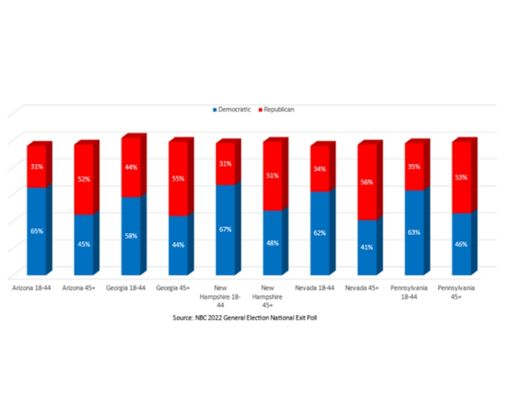
Younger Americans are tilting the electoral playing field strongly towards the Democrats and making it very likely that the “over/under” line in American politics will be 45, if not 50, for at least the rest of this decade.
For instance, the results of the 2022 midterm elections surprised many who didn’t believe the Harvard Institute of Politics (IOP) surveys that showed young people were very enthusiastic about voting in the 2022 midterms. Their influence enabled the Democrats to win almost every battleground statewide contest and increase their majority in the U.S. Senate, as illustrated in Figures 3 and 4.
FIGURE 3.
The 2022 Democratic Advantage Among Young Voters in Battleground States Allowed the Democrats to Recapture Senate Control The 2022 Democratic Advantage Among Young Voters in Battleground States Allowed the Democrats to Recapture Senate ControlAnd even though the Democrats failed to retain their majority in the House of Representatives, the preference for Democratic candidates among members of the Pluralist and Millennial generations limited the size of the new Republican majority to just five votes.
FIGURE 4.
America’s Youngest Generations Voted Overwhelmingly Democratic for Congress in the 2022 Midterm Elections
What should be of even greater concern to Republicans is that this Democratic advantage, at least in the 2022 midterm election, was particularly strong among African American and Hispanic voters under the age of 45. Moreover, despite Republican efforts to make inroads in these communities and a large Republican vote among Hispanics in places like Florida, young minority voters supported Democrats by substantial margins. Eighteen to 29-year-old white voters also supported Democratic congressional candidates over Republican ones by a 58% to 40% margin, validating IOPs pre-election predictions as shown in Figure 5.
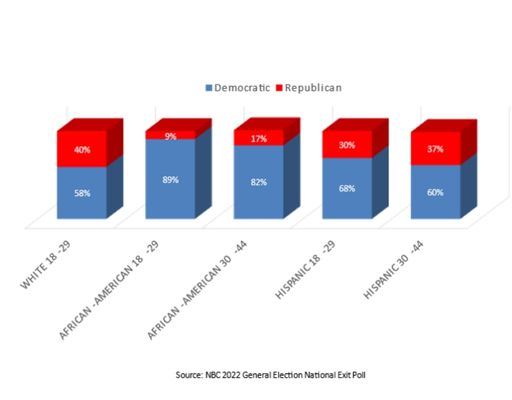
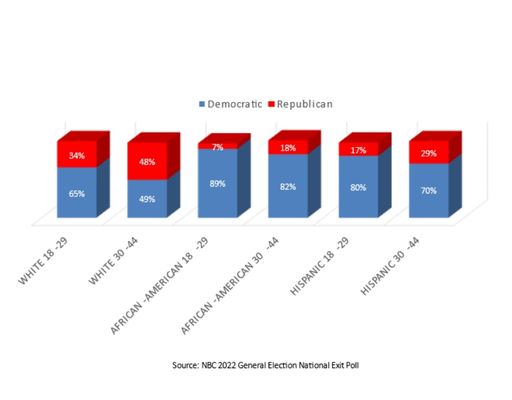
FIGURE 5.
The Democratic Advantage Among Young Voters Is True Among Key Racial and Ethnic Groups
Although the impact of Millennials’ and Plurals’ preferences for Democratic candidates among racial and ethnic voters varies based on congressional district lines and the nature of each’s state’s population, when it comes to voters under 45, and particularly among female voters of that age, their presence can be felt in every precinct in the country. See Figure 6.
FIGURE 6.
Young Female Voters Voted Overwhelmingly for Democrats in 2022 Linear projections of past trends are never definitive, especially in politics, and one election does not a trend make. But young people have now been voting solidly Democratic, and in increasing numbers, in every election since Donald Trump’s victory in 2016. In the 2018 midterm election, more than two-thirds (68%) of voters under 45 cast ballots for Democratic congressional nominees and in 2020, 58% voted for President Biden.
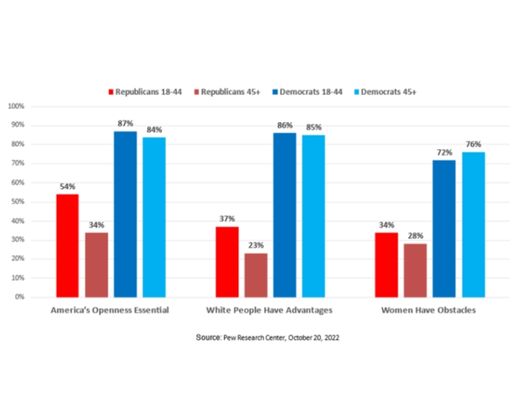
The rising importance of the Millennial and Pluralist generation brings with it three challenges Republicans will need to deal with if they want to win national elections in the future.
First, younger voters overwhelmingly support the Democratic Party’s positions on issues like abortion and inclusion that Republicans have traditionally opposed. Even worse for the GOP’s future, a majority of younger Republican voters are closer to the Democratic Party’s positions on these cultural issues than they are to their own party’s posture. However, the Republican generational gap is not significant on economic issues. To take advantage of this potential opening with younger voters, the Republican Party would have to reverse their current emphasis on “wokeness” and pound away on the country’s economic unease instead. See Figure 7.[2]
FIGURE 7.
Younger and Older Republicans Diverge Significantly on Social Issues, Democrats Broadly United Second, this divide by age on social issues within the Republican electorate is accompanied by a shrinking gender gap among younger voters, further unifying Democrats and making it harder for machismo-type Republican candidates to expand their appeal. Fifty-five percent of white male voters under 45 voted Democratic in 2022, as did 52% of younger white females. As Figure 8 illustrates, upwards of nine in ten male and female African American voters under 45 also voted Democratic in the midterms. Among both male and female Hispanics under 45, two-thirds voted for Democratic congressional candidates. To the extent that a gender gap still exists, in 2022 it is centered among older white and Hispanic voters. As Plural and Millennial voters become a larger and larger part of the American electorate, the gender gap in American politics is likely to shrink faster than the ozone layer.
FIGURE 8.
Democratic Advantage Among Plural and Millennial Voters Spread to All Racial and Ethnic Groups With Minimal Gender GapIf those two challenges weren’t enough to deal with, Republicans reliance on broadcast media, such as Fox News and talk radio, means their message isn’t even being heard by Plurals and Millennials who live in an entirely different information ecosystem, built around social media, especially TikTok and YouTube.[3] Figure 9 shows how different younger voters are when it comes to trust in media.
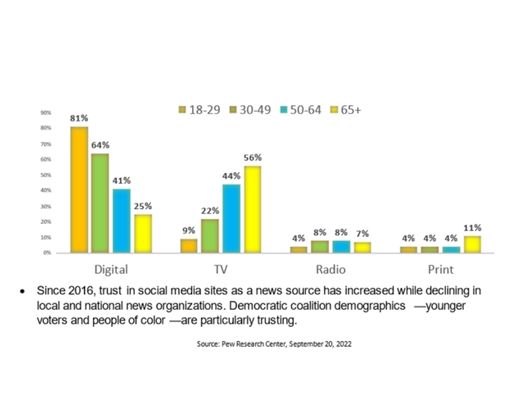
FIGURE 9.
Reaching Younger Voters Requires Using Social Media (Plurals and Millennials Prefer To Use Digital To Get News and Trust It More as a News Source) Of course, the Democratic party is not without its own challenges in adapting their strategies to an electorate dominated by younger voters. Older, embedded media commentators, pollsters, and campaign consultants, who make up the Democratic “permanent campaign complex,” are often slow to learn new tricks and less familiar with how to communicate with younger voters using their preferred platforms to talk about their policy priorities. For example, even in 2022, Democratic candidates for Senate in swing states such as Colorado and Ohio, recoiled in horror from President Biden’s proposal to forgive a portion of the two generations’ student debts, even though one of younger voters’ top priorities is making college more affordable, if not tuition free — ranking right up there with preserving reproductive rights and dealing with climate change.

If Democrats don’t run campaigns that focus on voters under 45, wherever they live and whatever their current political preferences, they could not only lose their chance for a sweeping victory in 2024 but potentially lose the allegiance of the large and growing majority of American voters for decades to come.
“Despite constituting less than 1% of the U.S. population, Indian-Americans are 3% of the nation’s engineers, 7% of its IT workers and 8% of its physicians and surgeons,” wrote the popular Forbes magazine in 2008. “The overrepresentation of Indians in these fields is striking–in practical terms, your doctor is nine times more likely to be an Indian-American than is a random passerby on the street.”
Fifteen years later, in 2023, the story of the Indian Americans has grown even stronger; their successes encompassing almost all areas of American life – living the American Dream. The less than four million Indian Americans appear to be gaining prominence and have come to be recognized as a force to reckon with in this land of opportunities that they have come to call as their adopted homeland.
Picture : TheUNN
In fact, Indian Americans have for some time been considered a “model minority” in the US — they are better educated, have better jobs, are wealthier than many other immigrant populations and enjoy both political and business clout. Here’s data that points to these factors:
At a virtual interaction with Nasa scientists who were involved in the historic landing of Perseverance on Mars on March 3, US President Joe Biden remarked, “Indian-of-descent Americans (sic) are taking over the country. You (Swati Mohan), my Vice President (Kamala Harris), my speech writer (Vinay Reddy).”
Biden, who was sworn in as the 46th president of the United States on January 20, is in a good place to judge that. He has created history by appointing at least 55 Indian-of-descent Americans to key positions in his administration. And of course, his vice- president, Kamala Harris, is also an American of Indian-descent.
The rise of Kamala Harris, daughter of an Indian mother, as the Vice President represents a coming-of-age of the Indian American community in the United States. Harris was born to civil rights activist parents a year before the Immigration and Nationality Act of 1965 was passed; this Act relaxed the quota regime that restricted foreigners. At that time, there was one Indian American lawmaker in the US House of Representatives — the Punjab-born Dalip Singh Saund, also from California.
The Senate India Caucus was created in 2004. Harris was elected to the US Senate in 2016. The following year, four Indian Americans were elected to the US House of Representatives, and more were elected to the Senate and Congress of other states. Two other persons of Indian origin — Bobby Jindal and Nikki Haley — served as Governors of Louisiana and South Carolina, respectively, in that period.
In 2022, there are as many as five persons of Indian Origin have been elected to the House of Representatives: Congressmen Raja Krishnamoorthi, Ro Khanna, Dr Ami Bera, Congresswoman Pramila Jayapal, and Shri Thanedar, a Karnataka-born entrepreneur – have been re-elected to the US House of Representatives
Today, more Indian Americans hold public office than ever before. However, politics is far from being the only sphere in which the Indian diaspora has gained influence in the last few decades.
Historically, Indians in the US worked in medicine, science & technology, engineering and mathematics-related jobs. Some, like the Patel community from Gujarat, took to the hotel industry and grew to dominate it. Others were entrepreneurs in Silicon Valley after the digital revolution of the 1980s.
In 1997, Ramani Ayer became the CEO of the Fortune 500 financial firm The Hartford, becoming the first in the list of Indian leaders heading American businesses.
At present, 2% of the Fortune 500 companies of American origin — including Microsoft, Alphabet, Adobe, IBM, and MasterCard — are led by Indian American CEOs. One in every seven doctors in America is of Indian descent;
Numbering about 3.8 million, or about 1.2 per cent of the US population, the Indian diaspora in the US is the richest, most educated and among the most successful ethnic groups in that country – pulling ahead of even white Americans on most counts. More than 75 per cent of Indian Americans have arrived in the US after 1990.
Picture : Quora
Looking ahead to the 2024 Presidential Elections, there are as many as three of them are seeking their way to be on the ballot. Two of the three Republicans who have announced plans so far to enter the US presidential race are Indian-Americans. While Nikki Haley is a familiar name, surprise candidate Vivek Ramaswamy is much less well known. If President Biden seeks reelection, the current Vice President, Harris is likely ot be on the ballot as his running mate in 2024.
Ramaswamy, a multimillionaire entrepreneur and author of the book Woke, Inc., announced his presidential bid on 21 February with an appearance on a Fox News show and a video laying out his political views. He wants to launch a “cultural movement to create a new American dream” based on the “pursuit of excellence” – and he says “diversity is meaningless if there’s nothing greater that binds” people. The 37-year-old, who was born in Ohio, studied at Harvard and Yale, earned his millions as a biotechnology entrepreneur and then founded an asset management firm.
Democrat Shekar Narasimhan, founder and chairman of the AAPI (Asian Americans and Pacific Islanders) Victory Fund, says that while he is happy to see more Asian-Americans gain prominence in politics, he isn’t confident about Mr Ramaswamy’s ideas.
“He is a business guy and has a clean slate, but what are his promises?” Mr Narasimhan asks. “Does he care about medical care for the elderly? What are his plans for infrastructure spending? He doesn’t have fixed positions and has not articulated his policies yet.”
Indian-American Republicans are predicting a “three-way race between Mr Trump, Mr DeSantis and Ms Haley” and prefer to wait instead of forging early alliances, especially as there is still uncertainty around the former president’s legal battles.
Dr. Sampat Shivangi says that he admires Ms Haley’s aggressive campaigning style and would support her in case Mr Trump is forced to withdraw from the race. “Mr Trump has 40% ratings and Ms Haley is in single digits, but she is our candidate. Her being Indian-American is the main reason why we are close to her,” he says.
Irrespective of political differences, the Indian-American community is happy about the sharp increase in their political participation, especially over the last three election cycles, and is proud of the rise of another of their own.
“A beautiful thing is happening: Indian-Americans are coming to the forefront,” Mr Gaekwad says, adding that the latest bid could encourage more Indian-Americans to run for elections even at the local level. Even political opponents agree with that. “If our children see Americans with a name like Ramaswamy run, and a Khanna or Krishnamoorthi can win, that’s a good thing,” Narasimhan says.
Republican presidential candidate Nikki Haley vowed on Friday to strip U.S. aid for countries that she said “hate us” if elected president. Haley said in an op-ed in The New York Post that taxpayers deserve to know where U.S. foreign aid is going and would be “shocked” to learn that much of it is supporting “anti-American” countries and causes.
She claimed that the United States has given more than $1 billion in recent years to Iraq, which she said is increasing ties to “murderous thugs” in Iran who have shouted “Death to America.” Iraq and Iran have improved their relations in recent years after a long history of being adversaries.
Haley noted that the U.S. has sent aid to Pakistan despite more than a dozen terrorist organizations residing there and China for “ridiculous” environmental programs.
“This is not just Joe Biden. It’s been happening for decades under presidents of both parties. Our foreign-aid policies are stuck in the past,” she wrote. “They typically operate on autopilot, with no consideration for the conduct of the countries that receive our aid.
She added that she is running for president to “restore our nation’s strength,” pride in the country and the public’s trust. “Backing American allies and friends like Israel and Ukraine is smart. Sending our tax dollars to enemies isn’t,” Haley said. “That’s why I will cut every cent in foreign aid for countries that hate us. A strong America doesn’t pay off the bad guys.”
Haley, who previously served as ambassador to the United Nations under the Trump administration and governor of South Carolina, said she often saw countries that “bashed” the United States in public and then privately “begged” it for money.
She said she supported former President Trump’s decision to cut almost $2 billion in military aid to Pakistan, but it did not go far enough. Haley became the second major Republican to launch their bid for the GOP nomination for president in 2024 earlier this month, following Trump into the race. Polling has shown Trump and Florida Gov. Ron DeSantis leading in hypothetical Republican primary polls.
The US-India Strategic Partnership Forum (USISPF) has welcomed the nomination of Indian-American Ajay Banga as the World Bank president, calling it a proud chapter in the success stories of the Indian-American diaspora.
If confirmed by the World Bank Board, Banga will be the first person of Indian descent and first Sikh-American to head the multilateral institution.
“It’s another proud chapter in the success stories of the Indian-American diaspora, and I wish Ajay all the best for this new inning” said USISPF President and CEO, Mukesh Aghi.
The USISPF, an independent not-for-profit institution dedicated to strengthening the US-India partnership, said Banga’s deep expertise and several years of experience in the fields of financial inclusion, public-private partnerships, and climate finance make him a phenomenal leader to head the Bank.
“Ajay’s background in his early years in India, gives him a deep understanding of the emerging market world and bridging the gaps in gender parity and working towards poverty alleviation, issues at the core ethos of the Bank’s mission,” Aghi said in a statement.
A tireless believer in both the strength of US-India ties and strengthening the relationship even further, Banga is also a founding trustee of USISPF.
The former Mastercard CEO has been instrumental in setting up USISPF as a founding board member and a vital pillar in USISPF’s success over the last five years.
Banga’s work with Citigroup, Mastercard, General Atlantic, and USISPF will allow for a seamless transition to mobilising resources in public-private partnerships to tackle issues on climate, water resources, food security, and healthcare, the USISPF said in a statement.
Banga, who was born in India and studied at Delhi’s St Stephen’s College, currently serves as vice chairman at General Atlantic.
While announcing his nomination on Thursday, the White House said that over the course of his career, Banga has become a global leader in technology, data, financial services and innovating for inclusion.
Banga was awarded the Foreign Policy Association Medal in 2012, the Padma Shri Award by India in 2016, the Ellis Island Medal of Honor and the Business Council for International Understanding’s Global Leadership Award in 2019, and the Distinguished Friends of Singapore Public Service Star in 2021. (IANS)
With US President Joe Biden nominating Ajay Banga, the former Indian American head of Mastercard, to head the World Bank, the top posts in the global financial institution will be held by Sikhs.
Before Banga, who is slated to take up job – which, by convention, been reserved for a US citizen – this May, the World Bank already as a Sikh in a top post, with Indermit Singh Gill its Chief Economist.
He is primarily known for pioneering the concept of the “middle-income trap” to describe how countries stagnate after reaching a certain level of income.
Gill, an Indian citizen, studied at St Paul’s School, Darjeeling and St. Stephen’s College, Delhi – where he was probably just a year (or perhaps two) junior to Banga.
Like Banga, Gill is also the son of a senior Indian Army officer.
Before taking over Chief Economist on September 1, 2022, Gill served as the World Bank’s Vice President for Equitable Growth, Finance, and Institutions, where he played a key role in shaping its response to the extraordinary series of shocks that have hit developing economies since 2020. Between 2016 and 2021, he was a professor of public policy at Duke University and non-resident senior fellow at the Brookings Institution’s Global Economy and Development program.
Widely regarded for his contributions to development economics, Gill spearheaded the influential 2009 World Development Report on economic geography, as per his World Bank profile. He has published extensively on key policy issues facing developing countries, among other things, sovereign debt vulnerabilities, green growth and natural-resource wealth, labour markets, and poverty and inequality.
Gill has also taught at Georgetown University and the University of Chicago. He holds a Ph.D. in economics from the University of Chicago
Biden’s nomination of Banga follows his Democratic predecessor, Barack Obama nominating Korean-American ‘Jim’ Yong Kim for World Bank chief to ensure that the World Bank is headed by someone with a developing-country background
Biden was then Vice President.
If confirmed by the World Bank Board, Bang will be the first person of Indian descent to head the World Bank. He will succeed David Malpass, who was appointed to head the bank by then President Donald Trump. (IANS)
As the Democrats now have a slim majority in Congress, his new nomination has a higher chance of going through. “Having a senior official on the ground that represents the President makes a big difference,” said Indiaspora member and former US Ambassador to India, Richard Verma, when commenting on the importance of getting a new ambassador chosen as soon as possible.
President Biden had renominated former Los Angeles Mayor Eric Garcetti to be U.S. ambassador to India on in January this year after Garcetti’s confirmation failed to advance through the U.S. Senate last year.
The White House also resubmitted nominations for roughly 60 people for jobs in key administrative posts or national security positions, as well as 25 judicial nominees who failed to win confirmation in 2022. Candidates must be renominated at the start of each new Congress.
Picture : TheUNN
Biden’s support for Garcetti, who was also renominated for the position last year, is notable given how long the nomination has lingered in Washington. The vacant diplomatic post comes as Biden looks to allies to help contain the rise of China and shore up support for Ukraine following Russia’s invasion. Indian Prime Minister Narendra Modi will also host the G-20 leaders in New Delhi in September.
White House Press Secretary Karine Jean-Pierre told reporters that Garcetti is “well-qualified” for the “vital role.” “We’re hopeful that the Senate will confirm him promptly,” Jean-Pierre said.
“I am grateful for the president’s confidence, and strong support on both sides of the aisle in the Senate,” Garcetti said. “I look forward to completing this process, so that I can begin serving in India and advancing this critical partnership as quickly as possible.”
Garcetti was announced as the White House pick for India in July 2021, but a vote on the appointment has never been scheduled following some Democratic senators’ concerns over sexual harassment allegations leveled against former Garcetti aide Rick Jacobs. At the same time, Sen. Joni Ernst (R-Iowa) has placed a hold on Garcetti’s nomination.
The former mayor has waited far longer for confirmation — more than 500 days — than all others whom Biden has designated to be ambassadors, according to the nonprofit Partnership for Public Service.
Newswise — Yesterday, the Biden administration announced its most restrictive border control method to date, saying that it will temporarily penalize asylum seekers who cross the border illegally or fail to seek protection in other nations they transit on their way to the United States.
Stephen Yale-Loehr, professor of immigration law at Cornell Law School and co-author of a leading 21-volume immigration law series, says that the rule faces serious legal challenges. If you’d like to connect with Professor Yale-Loehr about this development, Yale-Loehr says:
Picture : TheUNN
“Among other things, the proposed rule would generally deny asylum to migrants if they have not first sought protection in another country they passed through before reaching the U.S.-Mexico border. Exceptions would exist for people with an acute medical emergency, imminent and extreme threat of violent crimes such as murder, rape or kidnapping, victims of human trafficking, and people in other extremely compelling circumstances. Children traveling alone would also be exempted.
“The proposed rule is similar to a Trump-era rule known as the third country transit ban. A federal court prevented that rule from ever taking effect.
“Immigrants’ rights advocates have said they will sue to stop the new proposed rule from taking effect. They have denounced the proposed rule as violating U.S. law that protects the right to apply for asylum.
“The Biden administration is between a rock and a hard place. Congress has failed to reform our broken immigration system, and more and more people are attempting to enter the United States for a variety of reasons, including persecution, gang violence, and climate change. The Biden administration hopes its proposed rule will survive a court challenge. I doubt it.”
Estelle McKee, clinical professor at Cornell Law School and co-director of the Asylum and Convention Against Torture Appellate Clinic, says that this proposed rule is the latest attempt by the federal government to externalize our borders. If you’d like to connect with Professor McKee about this development, McKee says:
“This proposed rule is intended to ‘discourage irregular migration’ by requiring people to either apply for asylum in countries they traveled through before seeking asylum in the United States, or by using a Customs and Border Patrol app that has already proven unable to handle the requests it has received. Neither of these options is feasible for asylum seekers.
“Many asylum seekers who come through the southern border are fleeing gang activity and domestic violence. There is little protection for victims of either kind of persecution in Mexico, Guatemala, or other countries the administration proposes as potential havens for asylum seekers. Take Mexico, for instance. Mexico’s top security official, Genaro García Luna, was just convicted of taking massive bribes from the Sinaloa cartel. He is just the latest example of the widespread collusion between public officials in Mexico and drug cartels. Asylum seekers fleeing those very cartels cannot find protection in Mexico.
“The asylum infrastructures in Mexico, Guatemala, and other central and south American countries are woefully inadequate and entirely unable to handle the influx of people fleeing India/Mediaviolence and persecution from other countries. If the Biden administration is having trouble handling the numbers of people seeking entry into the United States to escape such violence, the answer is not to delegate to other countries our legal duty to process asylum claims. It is to allocate greater resources to our own institutions—expand the corps of asylum officers; create more immigration courts; expand the Board of Immigration Appeals, for example—so they are able to handle any influx of asylum seekers.”
A US Congressional delegation of nine Senators led by Senate Majority Leader Charles Schumer called on Prime Minister Narendra Modi Feb 20. The delegation included Senators Ron Wyden, Jack Reed, Maria Cantwell, Amy Klobuchar, Mark Warner, Gary Peters, Catherine Cortez Masto and Peter Welch.
Modi welcomed the Congressional delegation to India and appreciated the consistent and bipartisan support of the US Congress for deepening India-US bilateral ties. PM Modi referred to his recent phone call with President Biden and the shared vision of the two leaders for further elevating India-US Comprehensive Global Strategic Partnership to address contemporary global challenges.
Picture : TheUNN
Senate Majority Leader Charles ‘Chuck’ Schumer, D-NY, in his meeting with Prime Minister Narendra Modi in New Delhi Feb. 20, 2023, stressed the importance of strengthening U.S.-India ties to ‘outcompete’ China, advance tech opportunities and expand democracy. Over the course of his visit the Senator also visited major religious sites in India, including the Sis Ganj Gurudwara, Jama Masjid, Gaurishankar Mandir, and Central Baptist Church.
In a statement released after his meeting with Modi, Schumer said, “I am honored to lead the largest and most senior Senate delegation to India ever to meet with Indian Prime Minister Narendra Modi. This is only my second CODEL (Congressional Delegation) as a senator and my first as majority leader.”
The senior Senator went on to say, “I made India my first CODEL as majority leader to show my commitment to the important U.S.-India relationship,” adding, “We need nations such as India, the world’s largest democracy, to work with us to strengthen democracies in Asia and outcompete China and to counterbalance its aggressions.”
Senator Schumer called India “one of the leading powers of the world,” and emphasized that “a strong U.S.-India relationship is a must for democracy, technology advancement, and a strong world economy. I am proud that the senators of our delegation served as strong representatives of America’s commitment to the U.S.-Indian economic and security partnership,” he went on to say.
Describing the one-hour meeting as “substantive and productive” Sen. Schumer said the conversation covered the growing U.S.-India relationship and the common interests that unite the two largest democracies in the world, as well as their bilateral cooperation “on shared strategic interests including outcompeting China, combatting climate change, increasing trade, and deepening ties between our two countries.”
“I strongly believe a robust U.S.-India relationship will be the cornerstone for stability in the Indo-Pacific region for the 21st century,” the Senator said. “We also discussed with both Prime Minister Modi and the US Embassy the strong desire of our delegation to see our immigration laws for Indian Americans improved,” Sen. Schumer said, adding, “It is in our mutual interest for more Indians to be able to immigrate to America, which will bolster our economy on several levels. For example, being sent home 60 days after losing a job in tech and other industries is unfair for Indian Americans and bad for America.”
“All of us in the delegation expressed our commitment to continue working with Prime Minister Modi’s government to deepen our bilateral relationship to advance our mutual interest. While in India, the Congressional delegation visited Jaipur, and Jaipur Foot, the world’s largest rehabilitation organization, a press release from his office said. “Jaipur Foot has helped rehabilitate over 2 million people, including amputees and polio patients in India and in 27 countries around the world,” Schumer noted.
Schumer also issued statements after visits to each of the religious sites, noting their ideals and social work that they do.
(Reuters) – The U.S. nominee to lead the World Bank, ex-MasterCard CEO Ajay Banga, gained traction with leading members on Friday, a sign that he will likely have a smooth ride to confirmation by the bank’s executive board.
The finance ministers of France and Germany gave positive reviews to Banga, nominated on Thursday by U.S. President Joe Biden as a surprise choice to lead the institution’s transformation to fight climate change and other global challenges.
German Finance Minister Christian Lindner said on the sidelines of a G20 finance leaders in India that Banga‘s nomination was a “very remarkable” proposal because his private sector experience would be potentially helpful in mobilizing private investment in the fight against climate change and for development projects.
Lindner said that Germany would follow the nomination with “great attention” and expressed “sympathy” for the proposal.
The comments mark a turnabout from Tuesday, when German international development minister Svenja Schulze said the next World Bank chief should be a woman.
“I think he is a good candidate. I need to meet him to know a little bit more about him,” French Finance Minister Bruno Le Maire told Reuters.
Asked whether Europe would try to nominate its own choice, Le Maire said: “You know, we have this (U.S.) candidate, so I think it’s wise to meet him, get to know more about him.”
The G20 ministers meeting is being held on the outskirts of the Indian tech hub city of Bengaluru.
India’s finance ministry has not commented on the nomination of Banga, an Indian-born U.S. citizen, which played prominently in Indian media on Friday.
But the government was expected to support Banga, India’s new executive director at the International Monetary Fund, told Reuters in Washington.
Krishnamurthy Subramanian, the former top economic adviser to the Indian government, called the nomination “an elegant solution”.
ENSURING U.S. LEADER
The United States, the lender’s dominant shareholder, has chosen every World Bank president since the instititution’s founding at the end of World War Two.
U.S. Treasury Secretary Janet Yellen said she did not know whether there would be other nominees for the job, but said Washington moved quickly with a well qualified candidate to ensure that tradition would continue.
“… we’ve tried to find a nominee who was really well qualified and brings a unique set of skills to the job that we think will be attractive,” she said.
Other countries have until March 29 to nominate an alternative candidate and the World Bank board intends to announce a choice by early May.
But with the United States and European countries supporting Banga, along with some key emerging markets, a challenger would have almost no chance of succeeding and would be a largely symbolic effort to protest what is seen by many countries and stakeholders as a non-transparent selection process stacked for too long in Washington’s favour.
Yellen told reporters that Banga has “the right leadership and management skills, experience in emerging markets, and financial expertise” to lead the bank and reform it to boost lending on climate change, while maintaining its core anti-poverty mission.
By Emma Ashford, a columnist at Foreign Policy and a senior fellow with the Reimagining U.S. Grand Strategy program at the Stimson Center, and Matthew Kroenig, a columnist at Foreign Policy and senior director of the Atlantic Council’s Scowcroft Center for Strategy and Security.
Emma Ashford: Hey, Matt! Greetings from sunny Cartagena, Colombia, where I’m talking about U.S. foreign policy. I’m about as far from the war in Ukraine as you can get, yet with the war’s one-year anniversary this week, Ukraine is still looming large in discussions of the United States and its global role.
Matthew Kroenig: Colombia sounds nice. I was a bit closer to Ukraine this weekend at the Munich Security Conference, and Ukraine was obviously the dominant topic on the agenda there too.
How is the war being perceived in the global south?
Picture : Foreign Policy
EA: I’d draw a pretty clear distinction between two groups of countries. First, the Western coalition that the Biden administration has pulled together, which is quite united in its continued opposition to Russia and—at least in general—its willingness to bear some costs to do so. That’s the group you undoubtedly interacted with most in Munich, and I suspect the message you heard from it was quite triumphalist, focused on the success of U.S. and European efforts to arm Ukraine and turn the tide of the war on the ground.
The second group, however, comprises a wide variety of Latin American, African, and Asian states, many of which are conflicted about their response to Ukraine. Most of them oppose the invasion itself, but they’re also wary of damaging their ties with Russia and also extremely worried about spiraling costs created by the conflict in food and energy prices globally. That’s a much more mixed picture for U.S. officials to manage.
Did I characterize the Munich crowd correctly?
In Munich, there was a kind of naive assumption that if the West just takes the right steps, everyone will fall into line.
MK: Yes and no. There seemed to be a consensus that the outcome of the war would have enormous consequences for the future of European and even global security. Accordingly, the common view was that the goal needed to be a Ukrainian victory—and for many also a Russian defeat.
The global south was, however, another major topic of conversation. People were genuinely puzzled as to how so much of the world could be agnostic on the issue of a war of aggression in Europe. The search for answers, however, was often superficial and revealed what former U.S. National Security Advisor H.R. McMaster calls “strategic narcissism.”
The question seemed to be: “What did we do wrong?” Officials and experts wondered, for example, whether wealthy governments should have provided more COVID-19 relief. There was a kind of naive assumption that if the West just takes the right steps, everyone will fall into line. Instead, they should have showed some strategic empathy and tried to understand the issue from the perspective of the global south’s interests.
I assume you were able to see things more from that point of view in Cartagena.
EA: I think it really highlights that for all the valuable things about meetings like the Munich Security Conference, Aspen Security Forum, or World Economic Forum in Davos, Switzerland, they do often have a tendency to produce groupthink among like-minded officials and experts. I hope that some of the African and Latin American delegates in attendance were able to impress upon their European counterparts that it is hardly difficult to understand their viewpoint: They have interests, including the basic economic needs of their own populations, at stake in this conflict.
For that reason, I suspect Chinese Foreign Minister Wang Yi’s speech to the conference—in which he promised that China would shortly be presenting a peace plan for Ukraine, which Beijing has now revealed—might have been popular among some of those delegates. Of course, it seemed to be undermined almost immediately: Wang headed straight to Moscow after the conference, and U.S. officials alleged that Beijing is considering sending arms to Moscow to help its efforts in the war. So much for the appearance of Chinese impartiality!
MK: I’m glad you mentioned China and Russia because they are part of the other major grouping you left out above. The world is increasingly divided into three blocs: the free world (the United States and its formal allies in Europe and Asia), the revisionist autocracies (China, Russia, North Korea, Iran, and a few less capable rogues like Syria, Eritrea, and Belarus), and the new nonaligned movement (everyone else!).
China’s plan at Munich seemed to be to try to drive a wedge between Europe and the United States. Wang’s speech talked about how Europe and China could work together, but “hysterical” Americans have lost their minds and are shooting down weather balloons. You are right that they also tried to be the good guys by offering up promises of a peace plan—never mind that they only talked to the Russians, not the Ukrainians, about the plan.
China’s posturing at the conference was undermined most by the Biden administration releasing intelligence suggesting that China was preparing to provide weapons to Russia. Nothing could have made Beijing more unpopular in Europe than indications that it was getting ready to arm Russian President Vladimir Putin.
It was similar to Biden’s attempts during the early stage of the war in Ukraine to deter actions by revealing intelligence. Let’s hope it works this time.
EA: It was innovative the first time around, but at some point, I imagine it will cease to be an effective approach. Worth a try though, I guess.
The problem with these two conflicting worldviews—Western and Russian/Chinese—is that I think the last year has mostly shown they’re both wrong. The world isn’t fully united in opposing Russia’s invasion of Ukraine, and they’re definitely not on board with the Biden administration’s democracy versus autocracy framing. But at the same time, the world is not united against the United States, and many countries in the global south and elsewhere view Russian and Chinese intentions with deep suspicion. It suggests a more diverse set of global viewpoints.
And for that reason, I was rather disappointed to see Biden double down on his triumphalist rhetoric about democracy and the war in Ukraine in his big Warsaw speech in Poland.
Shall we chat about Biden’s secret trip to Kyiv and his speech in Warsaw?
MK: Sure. Let’s start with the trip to Ukraine’s capital. I think it was a brave show of support for Ukraine. It was also conducted with amazing operational security. It caught everyone by surprise. I chatted with several senior Biden administration officials in Munich, and none of them let out a peep. I assume you were less impressed.
The United States is slouching towards a presidential election that almost nobody wants. The 2024 vote seems increasingly likely to be a re-match between President Joe Biden and former President Donald Trump.
It would be only the seventh re-match in the 59 presidential elections in American history and the first since President Dwight D. Eisenhower faced off against Adlai Stevenson for a second time in 1956.
Voters in both major US political parties are looking for fresh faces to run for president in 2024, according to a new Reuters/Ipsos poll. A majority of Democratic voters, at 52 per cent, do not want Mr Biden to seek a second term, while 40 per cent of Republican voters do not want Mr Trump to seek another term in 2024. Trump, who lost the presidency in 2020 and was impeached by Congress for inciting a riot at the US Capitol but ultimately acquitted by the Senate, announced he would run again in November.
Nearly making it certain, . first lady Jill Biden gave one of the clearest indications yet that President Joe Biden will run for a second term, telling The Associated Press in an exclusive interview on Friday last week that there’s “pretty much” nothing left to do but figure out the time and place for the announcement that Biden will run for US Presidency in 2024.
Although Biden has long said that it’s his intention to seek reelection, he has yet to make it official, and he’s struggled to dispel questions about whether he’s too old to continue serving as president. Biden would be 86 at the end of a second term.
“How many times does he have to say it for you to believe it?” the first lady said in Nairobi, the second and final stop of her five-day trip to Africa. She added, “He says he’s not done. He’s not finished what he’s started. And that’s what’s important.”
Granddaughter Naomi Biden, who is on the trip, cheered the first lady’s comments after the interview. “Preach nana,” she said on Twitter.
Picture : USA Today
The president himself was asked about his wife’s comments just hours later in an interview with ABC News, and laughed when told of her remarks, adding, “God love her. Look, I meant what I said, I’ve got other things to finish before I get into a full-blown campaign.”
During the interview with ABC’s David Muir, Biden, 80, was asked whether he is considering his age when deciding whether to run again, to which he replied no. However, he said it is “legitimate” for people to raise concerns about it.
Biden aides have said an announcement is likely to come in April, after the first fundraising quarter ends, which is around the time that President Barack Obama officially launched his reelection campaign.
The first lady has long been described as a key figure in Biden’s orbit as he plans his future. “Because I’m his wife,” she laughed.
She brushed off the question about whether she has the deciding vote on whether the president runs for reelection. “Of course, he’ll listen to me, because we’re a married couple,” she said. But, she added later, “he makes up his own mind, believe me.”
The wide-ranging interview took place on the anniversary of the Russian invasion of Ukraine, and Jill Biden recalled her trip into the country last May to meet the besieged country’s first lady, Olena Zelenska.
President Biden said in a new interview that he has “other things to finish” before starting a “full-blown” 2024 presidential campaign. Well, apparently, someone interviewed my wife today, I heard. I gotta call her and find out,” Biden told ABC News’s David Muir when asked if he’s running again.
“No, all kidding aside, my intention … has been from the beginning to run, but there’s too many other things I have to finish in the near-term before I start a campaign,” Biden said. The president has long said he intends to run for another four years in the White House, and first lady Jill Biden gave a strong indication last week that he’ll do so.
They visited a school that was being used to help migrants who fled the fighting. Some of the families, Jill Biden said, had hid underground for weeks before making their escape. “We thought then, how long can this go on? And here we are, a year later,” she said. “And look at what the Ukrainian people have done. I mean, they are so strong and resilient, and they are fighting for their country.”
“We’re all hoping that this war is over soon, because we see, every day, the damage, the violence, the horror on our televisions,” the first lady added. “And we just can’t believe it.”
Jill Biden is the only first lady to continue her career in addition to her ceremonial duties, teaching writing and English to community college students. At 71 years old, she said she’s not ready to think about retirement. “I know that I will know when it’s enough,” she said. “But it’s not yet.”
She said she left detailed lesson plans for a substitute teacher while she was on her trip, and she’s been texting with students as she was traveling. She plans to be back in the classroom at 8 a.m. on Tuesday morning, after arriving home from Africa around 3 a.m. Monday.
Education has been a flashpoint in American politics, especially with conservative activists and politicians trying to limit discussion of race and sexuality in classrooms. “I don’t believe in banning books,” she said.
She added: “I think the teachers and the parents can work together and decide what the kids should be taught.” During the interview, Jill Biden reflected on the legacy of former President Jimmy Carter, who recently began home hospice care. The Carter Center, which the former president founded after leaving the White House, was key in helping to eliminate the Guinea worm parasite in African countries.
“That’s the perfect example,” she said. “He’s such a humble man. He didn’t go out and shout, ‘Look what I’ve done.’ He just did the work.” Jill Biden recalled Carter and his wife, Rosalynn, reaching out on the eve of Joe Biden’s inauguration two years ago. “They called and said congratulations,” she said. “And it meant so much to me and to Joe.”
She also talked about visiting the Carters at their home in Plains, Georgia, early in Biden’s presidency. “It’s not just that here are two presidents. It’s here are two friends,” she said. “Actually four friends, who have really supported one another over the years.
“It’s legitimate for people to raise issues about my age,” he told Muir. “It’s totally legitimate to do that. And the only thing I can say is, ‘Watch me.’” Biden, the oldest president in U.S. history, would be 82 when sworn in if reelected in 2024. Biden’s age has drawn concerns from both sides of the aisle. (Associated Press writer Chris Megerian in Washington contributed to this report.)
(AP) — The United States Supreme Court won’t have far to look if it wants a personal take on the “crushing weight” of student debt that underlies the Biden administration’s college loan forgiveness plan. Justice Clarence Thomas was in his mid-40s and in his third year on the nation’s highest court when he paid off the last of his debt from his time at Yale Law School.
Thomas, the court’s longest-serving justice and staunchest conservative, has been skeptical of other Biden administration initiatives. And when the Supreme Court hears arguments Tuesday involving President Joe Biden’s debt relief plan that would wipe away up to $20,000 in outstanding student loans, Thomas is not likely to be a vote in the administration’s favor.
But the justices’ own experiences can be relevant in how they approach a case, and alone among them, Thomas has written about the role student loans played in his financial struggles.
A fellow law school student even suggested Thomas declare bankruptcy after graduating “to get out from under the crushing weight of all my student loans,” the justice wrote in his best-selling 2007 memoir, “My Grandfather’s Son.” He rejected the idea.
It’s not clear that any of the other justices borrowed money to attend college or law school or have done so for their children’s educations. Some justices grew up in relative wealth. Others reported they had scholarships to pay their way to some of the country’s most expensive private institutions.
Picture : TheUNN
Of the seven justices on the court who are parents, four have signaled through their investments that they don’t want their own children to be saddled with onerous college debt, and have piled money into tax-free college savings accounts that might limit any need for loans.
Chief Justice John Roberts and Justice Neil Gorsuch have the most on hand, at least $600,000 and at least $300,000, respectively, according to annual disclosure reports the justices filed in 2022. Each has two children.
Justices Amy Coney Barrett, who has seven children, and Ketanji Brown Jackson, who has two, also have invested money in college-savings accounts, in which any earnings or growth is tax free if spent on education. None of the justices would comment for this story, a court spokeswoman said.
Thomas wrote vividly about his past money woes in his up-from-poverty story, recounting how a bank once foreclosed on one of his loans because repayment and delinquency notices were sent to his grandparents’ house in Savannah, Georgia, instead of Thomas’ home at the time in Jefferson City, Missouri.
Thomas was able to take out another loan to repay the bank only because his mentor, John Danforth, then-Missouri attorney general and later a U.S. senator, vouched for him.
Thomas noted that he signed up for a tuition postponement program at Yale in which a group of students jointly paid for their outstanding loans according to their financial ability, with those earning the most paying the most.
At the time, Thomas’ first wife, Kathy, was pregnant. “I didn’t know what else to do, so I signed on the dotted line, and spent the next two decades paying off the money I borrowed during my last two years at Yale,” Thomas wrote.
When he was first nominated to be a federal judge in 1989, Thomas reported $10,000 in outstanding student loans, according to a news report at the time. The Biden administration has picked the same number as the amount of debt relief most borrowers would get under its plan.
Personal experience can shape the justices’ questions in the courtroom and affect their private conversations about a case, even if it doesn’t figure in the outcome.
“It is helpful to have people with life experiences that are varied just because it enriches the conversation,” Justice Sonia Sotomayor has said. Sotomayor, like Thomas, also grew up poor. She got a full scholarship to Princeton as an undergraduate, she has said, and went on to Yale for law school, as Thomas did.
Keeping people from avoiding the kinds of difficult choices Thomas faced is a key part of the administration’s argument for loan forgiveness. The administration says that without additional help, many borrowers will fall behind on their payments once a hold in place since the start of the coronavirus pandemic three years ago is lifted, no later than this summer.
Under a plan announced in August but so far blocked by federal courts, $10,000 in federal loans would be canceled for people making less than $125,000 or for households with less than $250,000 in income. Recipients of Pell Grants, who tend to have fewer financial resources, would get an additional $10,000 in debt forgiven.
The White House says 26 million people already have applied and 16 million have been approved for relief. The program is estimated to cost $400 billion over the next three decades.
The legal fight could turn on any of several elements, including whether the Republican-led states and individuals suing over the plan have legal standing to go to court and whether Biden has the authority under federal law for so extensive a loan forgiveness program.
Nebraska and other states challenging the program argue that far from falling behind, 20 million borrowers would get a “windfall” because their entire student debt would be erased, Nebraska Attorney General Michael Hilgers wrote in the states’ main Supreme Court brief.
Which of those arguments resonate with the court may become clear on Tuesday.
When she was dean of Harvard Law School, Justice Elena Kagan showed her own concern about the high cost of law school, especially for students who were considering lower-paying jobs.
Kagan established a program that would allow students to attend their final year tuition-free if they agreed to a five-year commitment to work in the public sector. While that program no longer exists, Harvard offers grants to students for public service work.
At the time the program was created, Kagan said she wanted students to be able to go to work where they “can make the biggest difference, but that isn’t the case now.” Instead, she said: “They often go to work where they don’t want to work because of the debt burden.”
President Joe Biden has nominated a former boss of Mastercard with decades of experience on Wall Street to lead the World Bank and oversee a shake-up at the development organization to shift its focus to the climate crisis.
Ajay Banga, an American citizen born in India, comes a week after David Malpass, a Donald Trump appointee, quit the role. The World Bank’s governing body is expected to make a decision in May, but the US is the Washington-based organisation’s largest shareholder and has traditionally been allowed to nominate without challenge its preferred candidate for the post.
Malpass, who is due to step down on 30 June, was nominated by Trump in February 2019 and took up the post officially that April. He is known to have lost the confidence of Biden’s head of the US Treasury, Janet Yellen, who with other shareholders wanted to expand the bank’s development remit to include the climate crisis and other global challenges.
Ajay Banga, former president and CEO of Mastercard and current vice chairman of the private equity firm General Atlantic, is Biden’s nomination as the next president of the World Bank.
Biden, in a statement Thursday, called Banga – a native of India and former chairman of the International Chamber of commerce – “uniquely equipped” to lead the World Bank, a global development institution that provides grants and loans to low-income countries to reduce poverty and spur development.
Biden touted Banga’s work leading global companies that brought investment to developing economies and his record of enlisting the public and private sectors to “tackle the most urgent challenges of our time, including climate change.”
The Biden administration is looking to recalibrate the focus of the World Bank to align with global efforts to reduce climate change.
Malpass, nominated by former President Donald Trump, still had a year remaining on his five-year term as president. Malpass came under fire when he said, “I’m not a scientist,” when asked at a New York Times event in September whether he accepts the overwhelming scientific evidence that the burning of fossil fuels has caused global temperatures to rise. Former Vice President Al Gore, who called Malpass a “climate denier,” was among several well-known climate activists to call for his resignation.
Banga was the top executive at Mastercard from 2010 to 2020. He has served as a co-chair of Vice President Kamala Harris’ Partnership for Central America, which has sought to bring private investment to the region.
Treasury Secretary Janet Yellen applauded Biden’s pick. She said Banga understands the World Bank’s goals to eliminate poverty and expand prosperity are “deeply intertwined with challenges like meeting ambitious goals for climate adaptation and emissions reduction, preparing for and preventing future pandemics, and mitigating the root causes and consequences of conflict and fragility.”
Banga still needs confirmation by the bank’s board to become president. It’s unclear whether there will be additional nominees from other nations.
War has been a catastrophe for Ukraine and a crisis for the globe. The world is a more unstable and fearful place since Russia invaded its neighbor on Feb. 24, 2022. One year on, thousands of Ukrainian civilians are dead, and countless buildings have been destroyed. Tens of thousands of troops have been killed or seriously wounded on each side. Beyond Ukraine’s borders, the invasion shattered European security, redrew nations’ relations with one another and frayed a tightly woven global economy.
On Feb. 24, 2022, Russia invaded Ukraine—and until that date, the United States had done little to thwart it. This Friday marks one year since Russia launched its invasion of Ukraine. The war has killed thousands, displaced millions, and disrupted global food and energy markets—with no end in sight. To better understand how this conflict continues to shape geopolitics, and how geopolitics shapes it, Foreign Affairs is publishing an ongoing series of essays about what the war has taught us so far.
The war in Ukraine has touched almost every corner of the world — delivering death and suffering to Ukraine, an energy crisis in Europe, grain shortages in the Middle East and Africa, and compounding inflation across the globe.
“One year later, Kyiv stands. And Ukraine stands. Democracy stands,” the American president said as he stood next to Ukrainian leader Volodomyr Zelensky during his surprise visit to the Ukrainian capital, where life has returned more or less to normal since the initial Russian onslaught.
Inside Russia, all aspects of society and the economy have been warped or reoriented in a sprawling effort to support Vladimir Putin’s war effort. And while the vast number of casualties have been sustained by Russia and Ukraine, countries from Australia to Zambia have seen their own fighters killed in the war.
While the toll of the war is often described in sweeping statistics — 8 million refugees, 1,000 Russians killed in a day or $500 million in aid — over the past 12 months many groups and individuals have come to symbolize resistance to the war and resilience amid the carnage.
Millions of Ukrainians fled from their homeland in the early days of the war, with mostly women and children leaving their husbands, sons, fathers and brothers to fight the invading forces.
Leading scholars consider why some democracies have not joined the coalition against Russia, why Russian President Vladimir Putin persists despite his disastrous war, what can be learned about contemporary conflict from the battlefields in Ukraine, and more. Start reading below.
NATO was created to prevent a major war in Europe, a task it accomplished well for many decades. Apart from the brief Kosovo war in 1999, its members never had to fight together or coordinate a joint response to aggression—until a year ago, when Russia invaded Ukraine. NATO’s response thus offers fresh, real-world evidence about how contemporary alliances work in practice. Despite a series of blunders, miscalculations, and battlefield reversals that would have surely seen him thrown out of office in most normal countries, President Vladimir Putin is still at the pinnacle of power in Russia.
He continues to define the contours of his country’s war against Ukraine. He is micromanaging the invasion even as generals beneath him appear to be in charge of the battlefield. (This deputizing is done to protect him from blowback if something goes badly wrong in the war.) Putin and those immediately around him directly work to mobilize Russians on the home front and manipulate public views of the invasion abroad. He has in some ways succeeded in this information warfare.
The war has revealed the full extent of Putin’s personalized political system. After what is now 23 years at the helm of the Russian state, there are no obvious checks on his power. Institutions beyond the Kremlin count for little. “I would never have imagined that I would miss the Politburo,” said Rene Nyberg, the former Finnish ambassador to Moscow. “There is no political organization in Russia that has the power to hold the president and commander in chief accountable.” Diplomats, policymakers, and analysts are stuck in a doom loop—an endless back-and-forth argument among themselves—to figure out what Putin wants and how the West can shape his behavior.
Russian President Vladimir Putin announced on Tuesday that his country would suspend its participation in the New START agreement with the United States, throwing into question the future of the last remaining arms control accord between the world’s two largest nuclear powers. The treaty, which came into force in 2011, places limits on the number of intercontinental nuclear weapons that each country can have and was extended for an additional five years in 2021. Arms control had long been regarded as the last redoubt of constructive collaboration between Washington and Moscow.
Putin showed no signs of backing down as he used his annual state-of-the-nation address to rail against the United States and accuse Ukraine and the West of provoking the war days before the first anniversary of the Russian invasion. “They want to inflict a ‘strategic defeat’ on us and try to get to our nuclear facilities at the same time,” Putin said during his nearly 100-minute speech, which was met with applause from Russian lawmakers and senior officials. “In this context, I have to declare today that Russia is suspending its participation in the Treaty on Strategic Offensive Arms.”
President Vladimir Putin on Tuesday delivered a nuclear warning to the West over Ukraine, suspending a bilateral nuclear arms control treaty, announcing new strategic systems had been put on combat duty and warning that Moscow could resume nuclear tests.
Speaking nearly a year to the day since ordering an invasion that has triggered the biggest confrontation with the West since the depths of the Cold War, Putin said Russia would achieve its war aims and accused the West of trying to destroy Russia.
Cautioning the United States that it was stoking the war into a global conflict, Putin said that Russia was suspending participation in the New START Treaty, the last major arms control treaty between Moscow and Washington.
Responding to Putin’s announcement, NATO Secretary-General Jens Stoltenberg said, “With today’s decision on New START, the whole arms control architecture has been dismantled.”
Experts said it’s too soon to interpret Putin’s remarks as heralding a new nuclear arms race, but with the treaty set to expire in 2026, the Russian leader’s announcement will further complicate diplomatic efforts to extend or negotiate a new treaty between the United States and Russia, which together hold about 90 percent of the world’s nuclear weapons.
The biggest blow to democracy on a global scale was not the war itself but the fact that—despite all “never again” claims—European and Western countries in general agreed and accepted beforehand that another European nation might be deprived of its sovereignty, freedom, and independent institutions, and it might find itself militarily occupied. (If this isn’t how they felt, then they wouldn’t have evacuated their embassies in Kyiv.) President Biden vowed on Tuesday that the United States would “not tire” in its support of Ukraine, describing the American commitment to NATO and Ukraine as a battle for freedom against autocracy in a speech delivered just hours after President Vladimir V. Putin presented a radically different account of the war.
In his national address, Mr. Putin showed no sign that he would change course, instead signaling that Russians should prepare for a long war ahead. He accused the West of a “totalitarian” project to control the world under the guise of spreading liberal values, and declared Russia was suspending the one remaining nuclear arms treaty with the United States.
“They intend to transform a local conflict into a phase of global confrontation. This is exactly how we understand it all and we will react accordingly, because in this case we are talking about the existence of our country.” Defeating Russia, he said, was impossible.
In the year since Russia’s full-scale invasion of Ukraine, Western democracies have condemned Moscow, slapped wide-ranging sanctions on it, cut back on Russian oil and gas and sent unprecedented amounts of arms and ammunition to help Ukraine defend itself.
But the world’s biggest democracy — India — hasn’t done any of that.
India has solidified ties with Moscow. Prime Minister Narendra Modi met with Vladimir Putin in September and called their countries’ friendship “unbreakable.” He did tell the Russian president it’s “not a time for war.” But a year on, Modi still refuses to assign blame for the violence, and has voiced more concern over the spike in global food and fuel prices triggered by the war.
Meanwhile, as Europe eschews Russian oil and gas, India has doubled down on buying Russian oil at bargain prices — much to Washington’s chagrin. And India continues to place orders for Russian-made weapons.
All this is a reminder that, a year into this war, condemnation of Russia is far from unanimous. Much of the global south actually sees the West’s focus on Ukraine as a distraction from other, more pressing issues like food security, inflation and mounting debt.
Analysts and political scientists cite four main factors shaping India’s policy toward Ukraine and Russia: History, energy, arms and influence.
Factor #1: The India-Russia relationship goes way back
“It started out as strategic sympathy for the Soviet Union, in the backdrop of India getting independence from the British. So it’s an anti-colonial experience, anti-imperialism,” says Rajeswari (Raji) Pillai Rajagopalan, a political scientist at the Observer Research Foundation in New Delhi. “And as the Cold War picked up, it became a more anti-West, anti-U.S. sentiment they shared.”
The end of the Cold War didn’t change that. Neither has the Ukraine war. India’s nationalist TV news channels often accuse the United States — rather than Russia — of doing more to ruin Ukraine.
In November, Modi’s top diplomat, S. Jaishankar, traveled to Moscow, where he stood alongside his Russian counterpart Sergei Lavrov and called their countries’ relationship “steady and time-tested.”
Modi has called for a cease-fire in Ukraine, without condemning Russia’s attacks. Some of his political opponents say that doesn’t go far enough, and point toward India’s actions rather than its words.
“The actions that India is engaged in so far do not reflect any remorse or even mild criticism of the events in Ukraine,” says Praveen Chakravarty, a political economist affiliated with the opposition Indian National Congress party. “If anything, it seems to aid and abet.”
Factor #2: India wants cheap Russian oil
India has one of the fastest-growing economies in the world. (The IMF forecasts 6.8% growth for India this year, compared to just 1.6% for the United States.) By 2030, India is forecast to be the third-largest economy in the world, behind the U.S. and China.
It’s already the third-largest oil consumer in the world. And it needs even more to fuel all that growth. But because India has few oil and gas reserves of its own, most of the oil it needs has to be imported. It’s also a relatively poor country, particularly sensitive to price.
That’s where Russia comes in. India still buys more oil from Middle Eastern countries than Russia. But its Russian share has skyrocketed. In December, India imported 1.2 million barrels of Russian crude. That’s a whopping 33 times more than a year earlier. In January, the share of Russian crude rose to 28% of India’s oil imports — up from just 0.2% before Moscow’s invasion of Ukraine.
Indian officials have defended those purchases by saying it’s their job to find bargains for their citizens. And Jaishankar, the foreign minister, has suggested it’s hypocritical of wealthier Westerners to ask them not to.
“Europe has managed to reduce its imports [of Russian gas] while doing it in a manner that is comfortable,” Jaishankar told an Austrian TV channel last month. “At 60,000 euros or whatever is your per capita income, you’re so caring about your population. I have a population at 2,000 dollars [per capita annual income]. I also need energy, and I am not in a position to pay high prices for oil.”
India basically ignored that. But the Biden administration now says it’s actually fine with that.
Earlier this month, U.S. Assistant Secretary of State for Energy Resources Geoffery Pyatt said Washington is “comfortable” with India’s approach on Russian oil. And Karen Donfried, the assistant secretary of state for European and Eurasian Affairs, said the U.S. is not looking at sanctioning India for this.
Here’s one possible explanation for Washington’s change of heart: India is buying Russian crude at deep discounts — something the West can’t do because of sanctions, or doesn’t want to do because of the optics. Then India refines that same Russian oil and exports it onward to the U.S. and Europe. So the West gets Russian oil, without getting its hands dirty.
“U.S. treasury officials have two main goals: keep the market well supplied and deprive Russia of oil revenue,” Ben Cahill, a senior fellow at the Washington-based Center for Strategic and International Studies, recently told Bloomberg. “They are aware that Indian and Chinese refiners can earn bigger margins by buying discounted Russian crude and exporting products at market prices. They’re fine with that.”
Factor #3: Moscow is India’s biggest arms dealer
India’s military has historically been equipped with Russian and Soviet weapons. Most of those contracts date back to the Cold War, a conflict in which India was officially non-aligned but close to Moscow. So most of India’s arsenal was — and still is — Soviet-made.
By now, some those 30-something-year-old weapons are deteriorating. “Let’s just go to the [Indian] Air Force. Most of those Sukhois and MiGs [fighter aircraft] are referred to as ‘flying coffins.’ Very often Indian pilots die when they are testing, or flying, those,” says Aparna Pande, a political scientist at the Hudson Institute in Washington. “So India knows they need to be replaced.”
Indian defence experts may have been the only ones not surprised to see Russian tanks falling apart in Ukraine this past year, Pande says. They’ve been unhappy with Russian equipment for years.
So the Indian government has started replacing some of its Soviet-made aircraft and artillery with French, Israeli and American versions. But it’s a time-consuming and costly task to update India’s entire arsenal, Pande notes.
“Let’s say my entire apartment had only IKEA furniture, and now I decide, ‘OK now I want to change it, and I want West Elm.’ I cannot just replace one chair. I have to change my entire dining table and all the chairs,” Pande explains. “So what India has done [in terms of updating its weapons] is piecemeal. But those big ticket items are still Russian-made. So that’s the change which has to happen, and this is what will reduce the Russian influence.”
Despite the Indian government’s efforts to diversify, Moscow continues to be India’s biggest arms dealer — more than 30 years after the disintegration of the Soviet Union. Russia has reportedly supplied India with around $13 billion in weapons in the past five years alone. There’s one big reason India needs all these weapons: China.
Factor #4: India wants to prevent Putin from getting closer to China’s Xi Jinping
India’s biggest foreign policy preoccupation is not Ukraine or Russia. It’s China. The two countries share a more than 2,000-mile disputed border. Satellite imagery shows China may be encroaching on Indian territory. Soldiers clashed there in June 2020, and again this past December.
And as the West isolates Russia, India fears Putin is already looking eastward, toward Beijing. “You’re already seeing a very close Russia-China relationship emerging, even in the last few years,” says the ORF’s Rajagopalan. “So the current Indian approach is, we don’t want Russia to go completely into the Chinese fold. Because for India, China has become the No. 1 national security threat.”
Despite the Ukraine war, that’s true for Washington too. So even if Washington doesn’t like it, Biden administration officials say they understand why India has not condemned Russia’s invasion of Ukraine, and they’re willing to grant India a wide berth.
They may even see India’s continued ties with Putin as useful — to try to mitigate just how far the Ukraine war drives him into Xi Jinping’s arms.
President Joe Biden is delivering his second State of the Union address tonight. In this special edition newsletter, here’s a look at public opinion on some of the key issues facing the country.
Inflation: Despite signs that inflation may be easing, large shares of Americans remain concerned about prices. Three-quarters of U.S. adults say they are very concerned about the price of food and consumer goods, while six-in-ten express the same degree of concern about gasoline and energy prices and the cost of housing.
Ukraine: More Americans approve than disapprove of the Biden administration’s response to the Russian invasion of Ukraine, but the share of Americans who say the U.S. is providing too much support to Ukraine has grown, a shift largely driven by Republicans. In both parties – but especially among Republicans – fewer Americans now see the conflict as a major threat to U.S. interests than did so in March 2022, shortly after Russia invaded Ukraine.
Gun violence: Americans largely supported the gun bill passed by Congress and signed into law last year, but at the time they were not optimistic it would do much to reduce gun violence. The public remained divided on whether there would be fewer mass shootings if it were harder for people to obtain guns legally: 49% said there would be, while 50% said there would be no change or that there would be more mass shootings.
Budget deficit: Reducing the budget deficit is a higher priority for the public than in recent years: 57% of Americans currently see it as a top priority for the president and Congress in the year ahead, compared with 45% a year ago. Although concern has increased in both parties, Republicans are far more likely than Democrats to prioritize the issue (71% vs. 44%).
China: Half of Americans say China’s military power is a very serious problem for the U.S., while 57% say the same about the partnership between China and Russia. At least four-in-ten see tensions between China and Taiwan (43%), China’s policies on human rights (42%) and America’s economic competition with China (41%) as very serious problems.
Tech regulation: The public is divided in its views of whether technology companies are having a positive effect on the country or not, with Republicans’ views growing more negative in recent years. And in a survey last spring, 44% of U.S. adults favored greater regulation of tech companies. A large majority also said it is at least somewhat likely that social media sites censor political viewpoints they find objectionable.
Reducing crime and illegal drugs: Since 2021, reducing crime has risen as a priority among members of both parties, but especially among Republicans. Currently, 65% of Republicans and 47% of Democrats say this should be a top priority. And 53% of Americans overall say reducing the availability of illegal drugs, including heroin, fentanyl and cocaine, should be a top priority.
Investigating the Biden administration: Republicans ushered in their new House majority by promising to pursue investigations into Biden’s presidency and his family. But among the public, Americans are more concerned that Republicans will focus too much on investigating the administration, rather than too little. An overwhelming share of Democrats take this view, while Republicans are more likely to be concerned that the GOP will not focus enough on these investigations.
Immigration: Dealing with immigration is a leading priority for 53% of the public, but there is a large partisan gap: 70% of Republicans rate the issue as a top priority, compared with 37% of Democrats. Monthly encounters between U.S. Border Patrol agents and migrants attempting to cross into the U.S. at the southwestern border have been at near-record levels in recent months.
Police violence: Police brutality is back in the spotlight following the violent beating of Tyre Nichols in Tennessee. In a survey conducted earlier this year, majorities of Americans said police officers were doing an only fair or poor job when it comes to treating racial and ethnic groups equally, using the right amount of force and holding officers accountable for misconduct, with particularly low ratings among Black Americans. In a 2021 survey, 60% of Black Americans said police brutality was an extremely big problem for Black people living in the U.S., with Black adults nearly unanimous (95%) in saying policing practices need to change to ensure fair treatment of Black people.
Climate change: Majorities of Democrats say dealing with climate change and protecting the environment should be top priorities, but these remain among the lowest priorities for Republicans. Despite this deep partisan divide, a survey last May found that most Americans who had experienced extreme weather in the past year – including majorities in both political parties – saw climate change as a factor.
Political compromise: Most Republicans say they want their party’s leaders to take a hard line in their dealings with Biden and the Democrats. Democrats, in contrast, are more likely to say they would support efforts by their leaders to find common ground with Republicans. People in both parties are somewhat more open to compromise than they were last January.
Laura Lee Blake, President & CEO of the Asian American Hotel Owners Association (AAHOA), released the following statement in response to ongoing reports that economic headwinds could force more hotel owners into serious financial challenges, including bankruptcies – such as a recent filing by a leading Burger King Franchisee – and out-of-court restructurings this year:
“Our members have taken extraordinary steps over the past three years, and, in numerous cases, counted on pandemic relief aid to weather the worst of COVID-19. Many continue to operate on thin margins with smaller workforces. The tight labor market has made it difficult to hire.
“Hotels and other small businesses are the backbone of local economies, and AAHOA Members – the vast majority of whom are first- and second-generation immigrants – are resilient. However, staffing shortages, rising interest rates, and the possibility of a recession this year, even a mild one, are creating further strain on an industry that is still struggling to recover from a devastating pandemic.
Picture : Hospitality Net
“The Chapter 11 bankruptcy filing by TOMS King reminds us that small businesses, including restaurants and hotels, continue to suffer long-term impacts from COVID-19 and an overall uncertain economic environment with high inflation and labor shortages. As President Biden noted in his State of the Union speech this week, the entrepreneurial spirit is very much alive with a record number of Americans starting small businesses. But the outlook for many of those businesses remains cloudy.
“AAHOA Members need certainty and continued federal assistance while these economic headwinds rage. While restaurateurs received grants from the Restaurant Revitalization Fund, hoteliers have not seen the same support. Many need solutions to address, among other things, the pending payments due on COVID-19 Economic Injury Disaster Loans (EIDLs) by waiving interest and/or deferring for another year.
“Additionally, the government should lift constraints on H2-B visas by expanding eligibility to include India so there are options available for addressing employers’ needs for additional seasonal workers. Finally, for all franchisees, the Federal Trade Commission should thoughtfully review the Franchise Rule, including extending the Rule beyond the presale disclosure to protect small-business owners’ investments. AAHOA Members also support the 12 Points of Fair Franchising to promote long-term, mutually beneficial relationships between Franchisors and Franchisees that will help sustain the franchise business model and grow the hospitality sector.”
AAHOA is the largest hotel owners association in the world, with Member-owned properties representing a significant part of the U.S. economy. AAHOA’s 20,000 members own 60% of the hotels in the United States and are responsible for 1.7% of the nation’s GDP. More than one million employees work at AAHOA member-owned hotels, earning $47 billion annually, and member-owned hotels support 4.2 million U.S. jobs across all sectors of the hospitality industry. AAHOA’s mission is to advance and protect the business interests of hotel owners through advocacy, industry leadership, professional development, member benefits, and community engagement.
US President Joe Biden has hailed Air India’s decision to purchase 220 Boeing aircraft and hails it as a ‘historic agreement’. Releasing a statement of Joe Biden, the US said, “The United States can and will lead the world in manufacturing. I am proud to announce today the purchase of over 200 American-made aircraft through a historic agreement between Air India and Boeing.”
Aiming to upgrade its fleet and expand its operations, Tata-owned Air India on 14 February confirmed it will buy a total of 470 wide-body and narrow-body planes from Airbus and Boeing. On February 10th, reports stated that Air India signed agreements with Airbus SE and Boeing Co. for about 250 orders and commitments in total, made up of 210 of the A320 single-aisle family models and 40 A350s wide-bodies.
“The order comprises 40 Airbus A350s, 20 Boeing 787s and 10 Boeing 777-9s wide-body aircraft, as well as 210 Airbus A320/321 Neos and 190 Boeing 737 MAX single-aisle aircraft. The A350 aircraft will be powered by Rolls-Royce engines, and the B777/787s by engines from GE Aerospace. All single-aisle aircraft will be powered by engines from CFM International,” Air India said in an official statement.
“This purchase will support over one million American jobs across 44 states, and many will not require a four-year college degree. This announcement also reflects the strength of the U.S.-India economic partnership,” the statement added.
Apart from this, Biden in his statement expressed hope to deepen partnership even further by continuing to confront shared global challenges and create a more secure and prosperous future for people.
On AI-Boeing deal, PM Modi held telephone conversation with the President of the US Joe Biden on February 14th and expressed satisfaction at the deepening of the India-US Comprehensive Global Strategic Partnership, which has resulted in robust growth in all domains.
Both the leaders welcomed the announcement of a landmark agreement between Air India and Boeing as a shining example of mutually beneficial cooperation that will help create new employment opportunities in both countries. PM Modi also invited Boeing and other US companies to make use of the opportunities arising due to the expanding civil aviation sector in India.
Air India said that the first of the new aircraft will enter service in late-2023, while the bulk are expected to arrive from mid-2025 onwards. Adding more, the AI said that it has already started taking delivery of 11 leased B777 and 25 A320 aircraft to accelerate its fleet and network expansion.
The first of the refitted aircraft – with an entirely new cabin, new seats and inflight entertainment system – will enter service in mid-2024, said AI.
With AI signing MoUs for 68 Trent XWB-97 engines, it has now become the biggest ever order for the Trent XWB-97, which exclusively powers the Airbus A350-1000. Also, AI’s order of 12 Trent XWB-84 engines – the sole engine option for the Airbus A350-900 – is also being considered a huge order. Though no financial details of the order have been disclosed. This is the first time that an Indian airline has ordered the Trent XWB and the deal will make Air India the largest operator of the Trent XWB-97 in the world.
“Today’s announcement marks an exciting and truly remarkable occasion for Tata Group and Air India; the size and magnitude of this order reflects the level of their ambition for the future. I congratulate them on taking this bold step towards becoming one of the world’s greatest airlines and I would like to thank them for putting their trust in Rolls-Royce to power them on this journey,” Rolls-Royce plc’s CEO Tufan Erginbilgic said while sharing his thoughts.
Reacting on the deal, Tata Sons and AI’s Chairman N Chandrasekaran noted Air India is on a large transformation journey. He said, “Air India is on a large transformation journey across safety, customer service, technology, engineering, network and human resources. Modern, efficient fleet is a fundamental component of this transformation.”
“This order is an important step in realising Air India’s ambition, articulated in its Vihaan.AI transformation program, to offer a world class proposition serving global travellers with an Indian heart,” he said.
“These new aircraft will modernize the Airline’s fleet and onboard product and dramatically expand its global network . The growth enabled by this order will also provide unparalled career opportunities for Indian aviation professionals and catalyze accelerated development of the Indian aviation ecosystem,” he added.
Congressman Ro Khanna, 46, a Democrat who represents California’s 17th Congressional District, is the co-chairman of the Congressional Caucus on India and Indian-Americans, along with his Republican House colleague Mike Waltz (R-Fla) in the 118th Congress.
“The Indian-American diaspora can play such an important role in helping strengthen the US-India partnership. I think this is a historic moment for our community. I think we’re really emerging and coming into our own as a strong voice,” Khanna told the media.
Picture : Newsweek
The India Caucus is a bipartisan coalition of lawmakers that was established in 1993 to bolster New Delhi-Washington relations. Prior to Khanna, Congressman Ami Bera was the first Indian-American to be elected as the co-chair of the Caucus in 2015-2016 during the 115th Congress.
“I’m going to try to make it about not just us India, but also the Indian-American community and highlighting the contributions of that community,” Khanna was quoted to have said.
Indian Americans are the second-largest immigrant group in the US, with their population estimated to be around four million. As the profile of the community has grown, so too has its social, economic, and political influence.
There are presently five Indian Americans serving in the Congress, popularly known as the ‘Samosa Caucus’ — Ami Bera, Ro Khanna, Raja Krishnamoorthi, Pramila Jayapal, and Shri Thanedar. Khanna’s appointment comes amidst reports that he may be looking at a potential presidential run in 2024.
His recent moves have sparked speculation among Democrats in several key states that the Congressman has his eyes set on a higher office, according to Politico. “If President Biden didn’t seek re-election, his name would have to be on the list of top contenders,” Stacey Walker, founder of the Iowa-based firm Sage Strategies, said.
Khanna — son of immigrant parents from Punjab — is seen as one of the leaders of his party’s progressive wing, and a relative newcomer on the scene who has broad appeal and formidable skills.
On US-India relations, he said last month that the relationship between the two democracies could define the 21st century. Khanna had said in November 2022 that the US needs a strong defense and strategic partnership with India, especially in the face of escalating aggression from China. In September last year, he had introduced a standalone bill in the US House of Representatives seeking a waiver to India against the punitive CAATSA sanctions.
Rep. Ro Khanna will be a co-chair of the Congressional Caucus on India and Indian Americans, he said in an exclusive interview last week. Khanna, a Democrat who has been representing California’s 17th Congressional District since 2017, will co-chair the caucus with Rep. Mike Waltz,.
“When I started on this journey, in my 20s, there was a huge novelty to having someone of Indian origin even enter politics,” he said. “The Indian American diaspora can play such an important role in helping strengthen the U.S.-India partnership. … I think this is a historic moment for our community. I think we’re really emerging and coming into our own as a strong voice.”
The caucus, which was established in 1993 to strengthen relations between the U.S. and India, was previously chaired by Rep. Brad Sherman, D-Calif., and former Rep. Steve Chabot, R-Ohio. Khanna said he hopes to take the caucus beyond its original goal. The Indian diaspora in the U.S. has its own unique needs, he said, and the position could be an opportunity to bring them to the forefront.
“I’m going to try to make it about not just us India, but also the Indian American community and highlighting the contributions of that community,” he said. “I think being Indian America and being part of the community, knowing so many of the community leaders, knowing the passions and interests of young people, I’ll be able to do that.”
Khanna said that having spent much of his career in Northern California’s Silicon Valley, he has been immersed in Indian American issues for years. The rising tide of Hindu nationalism is on the forefront of the diaspora’s collective consciousness; from professional spheres to college campuses, reports of Islamophobia and casteism abound in South Asian spaces.
Khanna hasn’t shied away from such conversations, and his vocalness has sparked outrage from right-wing Indian Americans. In 2019, 230 Hindu and Indian American entities wrote letter criticizing Khanna for denouncing Hindu nationalism (also known as Hindutva) and for advocating religious equality on the subcontinent.
“It’s the duty of every American politician of Hindu faith to stand for pluralism, reject Hindutva, and speak for equal rights for Hindus, Muslims, Sikhs, Buddhist & Christians,” Khanna tweeted at the time.
They also criticized Khanna for joining the Congressional Pakistan Caucus and for speaking out against Indian Prime Minister Narendra Modi’s revoking the state of Kashmir’s autonomy.
“Of course, we have to fulfill the strategic partnership and we have to respect the democratically elected leadership in India,” Khanna told NBC News. “I will work to strengthen that while also upholding these human rights values.”
“When I started on this journey, in my 20s, there was a huge novelty to having someone of Indian origin even enter politics,” he said. “The Indian American diaspora can play such an important role in helping strengthen the U.S.-India partnership. … I think this is a historic moment for our community. I think we’re really emerging and coming into our own as a strong voice.”
“Of course, we have to fulfill the strategic partnership and we have to respect the democratically elected leadership in India,” Khanna told NBC News. “I will work to strengthen that while also upholding these human rights values.”
“These kids of H1B are like the Dreamers,” Khanna said. “You have kids who came here when they were 2 or 3. They don’t have citizenship. … Even though they have grown up their whole life here, they’re in a vulnerable position.”
With both Republican and Democratic representatives serving on the India Caucus, including Khanna’s co-chair Rep. Mike Waltz, R-Fla., Khanna is aiming to mobilize bipartisan support for safeguarding young adults who find themselves in this position.
Khanna held a town hall on Saturday, bringing awareness to Asian American and Pacific Islanders’ mental health in the wake of the deadly shootings in Monterey Park and Half Moon Bay, California. Though the shooters in both cases were Asian men, Khanna said they amplified a mounting fear of simply existing in community spaces once considered safe.
With numerous high-profile acts of violence against Asians in the last few years, community members are feeling more “distant” from America than ever, he said.
“We had so much outreach to our office from constituents…people afraid, concerned, anxious about being Asian American in the United States,” he said. “These shootings, even though the perpetrator was Asian American, I think they triggered for so many in our community a sense of vulnerability.”
Khanna says taking on this greater role in the India Caucus feels like the culmination of generations of work in the public sphere. His grandfather Amarnath Vidyalankar spent his life fighting for India’s independence from British rule, even spending a few years in jail for the cause. Vidyalankar became a member of India’s first Parliament after independence in 1947.
Growing up with this knowledge has shaped Khanna’s strong beliefs in equality and religious freedom, he said, something he hopes to bring with him while chairing the caucus. “Because of my grandfather, I was influenced by Gandhi’s thinking, by Nehru’s beautiful speeches about liberal democracy, about pluralism,” he said. “Those are the values I champion. … I’ve spoken out where I think those values are being challenged.”
(IPS) – Few policymakers ever claim credit for causing stagnation and recessions. Yet, they do so all the time, justifying their actions by some supposedly higher purpose. Now, that higher purpose is checking inflation as if it is the worst option for people today. Many supposed economists make up tall tales that inflation causes economic contraction which ordinary mortals do not know or understand.
Inflating inflation’s significance
Since early 2022, like many others in the world, Americans have been preoccupied with inflation. But official US data show inflation has been slowing since mid-2022.
Recent trends since mid-2022 are clear. Inflation is no longer accelerating, but slowing. And for most economists, only accelerating inflation gives cause for concern.
Annualized inflation since has only been slightly above the official, but nonetheless arbitrary 2% inflation target of most Western central banks.
At its peak, the brief inflationary surge, in the second quarter of last year, undoubtedly reached the “highest (price) levels since the early 1980s” because of the way it is measured.
After decades of ‘financialization’, the public and politicians unwittingly support moneyed interests who want to minimize inflation to make the most of their financial assets.
War and price
Russia’s aggression against Ukraine began last February, with retaliatory sanctions following suit. Both have disrupted supplies, especially of fuel and food. The inflation spike in the four months after the Russian invasion was mainly due to ‘supply shocks’.
Price increases were triggered by the war and retaliatory sanctions, especially for fuel, food and fertilizer. Although no longer accelerating, prices remain higher than a year before.
To be sure, price pressures had been building up with other supply disruptions. Also, demand has been changing with the new Cold War against China, the Covid-19 pandemic and ‘recovery’, and credit tightening in the last year.
There is little evidence of any more major accelerating factors. There is no ‘wage-price spiral’ as prices have recently been rising more than wages despite government efforts ensuring full employment since the 2008 global financial crisis.
Despite difficulties due to inflation, tens of millions of Americans are better off than before, e.g., with the ten million jobs created in the last two years. Under Biden, wages for poorly paid workers have risen faster than consumer prices.
Higher borrowing costs have also weakened the lot of working people everywhere. Such adverse consequences would be much less likely if the public better understood recent price increases, available policy options and their consequences.
With the notable exception of the Bank of Japan, most other major central banks have been playing ‘catch-up’ with the US Federal Reserve interest rate hikes. To be sure, inflation has already been falling for many reasons, largely unrelated to them.
Making stagnation
But higher borrowing costs have reduced spending, for both consumption and investment. This has hastened economic slowdown worldwide following more than a decade of largely lackluster growth since the 2008 global financial crisis.
Ill-advised earlier policies now limit what governments can do in response. With the Fed sharply raising interest rates over the last year, developing country central banks have been trying, typically in vain, to stem capital outflows to the US and other ‘safe havens’ raising interest rates.
Having opened their capital accounts following foreign advice, developing country central banks always offer higher raise interest rates, hoping more capital will flow in rather than out.
Interestingly, conservative US economists Milton Friedman and Ben Bernanke have shown the Fed has worsened past US downturns by raising interest rates, instead of supporting enterprises in their time of need.
Four decades ago, increased servicing costs triggered government debt crises in Latin America and Africa, condemning them to ‘lost decades’. Policy conditions were then imposed by the International Monetary Fund and World Bank for access to emergency loans.
Globalization double-edged
Economic globalization policies at the turn of the century are being significantly reversed, with devastating consequences for developing countries after they opened their economies to foreign trade and investment.
Encouraging foreign portfolio investment has increasingly been at the expense of ‘greenfield’ foreign direct investment enhancing new economic capacities and capabilities.
The new Cold War has arguably involved more economic weapons, e.g., sanctions, than the earlier one. Trump’s and Japanese ‘reshoring’ and ‘friend-shoring’ discriminate among investors, remaking ‘value’ or ‘supply chains’.
Arguably, establishing the World Trade Organization in 1995 was the high water mark for multilateral trade liberalization, setting a ‘one size fits all’ approach for all, regardless of means. More recently, Biden has continued Trump’s reversal of earlier trade liberalization, even at the regional level.
1995 also saw strengthening intellectual property rights internationally, limiting technology transfers and progress. Recent ‘trade conflicts’ increasingly involve access to high technology, e.g., in the case of Huawei, TSMC and Samsung.
With declining direct tax rates almost worldwide, governments face more budget constraints. The last year has seen these diminished fiscal means massively diverted for military spending and strategic ends, cutting resources for development, sustainability, equity and humanitarian ends.
In this context, the new international antagonisms conspire to make this a ‘perfect storm’ of economic stagnation and regression. Hence, those striving for international peace and cooperation may well be our best hope against the ‘new barbarism’. (IPS UN Bureau)
The U.S. military shot down a suspected Chinese spy balloon off the coast of South Carolina on Saturday afternoon, the Pentagon said, while China called the downing an overreaction.
“On Wednesday, President Biden gave his authorization to take down the surveillance balloon as soon as the mission could be accomplished without undue risk to American lives under the balloon’s path,” U.S. Secretary of Defense Lloyd Austin said in a statement.
Austin said military commanders “had determined downing the balloon while over land posed an undue risk to people across a wide area due to the size and altitude of the balloon and its surveillance payload.”
Speaking on Saturday, President Biden told reporters he gave the order on Wednesday. U.S. officials “said to me, ‘Let’s wait ’til the safest place to do it,’ ” he said. “They successfully took it down, and I want to compliment our aviators who did it,” Biden added.
The downing came shortly after the Federal Aviation Administration said it had “paused departures from and arrivals to” three East Coast airports — in Wilmington, N.C., Myrtle Beach, S.C., and Charleston, S.C. — “to support the Department of Defense in a national security effort.” Flights through these airports resumed shortly after 3 p.m.
China responds with “dissatisfaction and protest”
Picture : The Drive
U.S. and Chinese officials have given conflicting information on the balloon’s purpose. The Chinese government said the balloon is strictly used for meteorological research and accidentally went adrift into U.S. airspace. China’s foreign ministry on Saturday expressed “strong dissatisfaction and protest” over what it called the U.S.’s “use of force to attack a civilian unmanned airship.” It called the shooting down an “obvious overreaction and a serious violation of international practice.”
U.S. officials earlier this week decided against shooting down the balloon after the Biden administration said it did not pose a national security threat. The Pentagon shared reports on Friday of a second balloon, belonging to China, that could be seen floating over Latin America. Colombia’s Air Force said on Saturday that an object with characteristics of a balloon had traveled through its airspace on Friday.
The balloon traveling through the U.S. quickly became an internet celebrity as meteorologists, storm chasers and others shared sightings on social media as it continued on its path across the U.S. Others criticized the Biden administration for not taking quicker actions to stop it.
“The China balloon flying over the U.S. is a direct assault on our national sovereignty,” Texas Gov. Greg Abbott tweeted on Friday. “Biden’s refusal to stop it is a dereliction of duty. From flying balloons to open borders, Biden has no regard for our national security and sovereignty.”
After its downing on Saturday, Republican Sen. Tim Scott of South Carolina said it “should have been shot down before it crossed the continental United States, not after. We still don’t know what information was collected and where it was sent,” he said. “This was a dereliction of Biden’s duty, and let’s hope the American people don’t pay a price.”
Austin praised Biden’s decision to shoot down the balloon. The Canadian government assisted in the “tracking and analysis of the balloon,” according to Austin.
“Today’s deliberate and lawful action demonstrates that President Biden and his national security team will always put the safety and security of the American people first while responding effectively to the PRC’s unacceptable violation of our sovereignty,” he said in the statement.
On Saturday, people shared sightings of the balloon on social media. Earlier, in South Carolina, the York County Sheriff’s Office tweeted that the balloon was more than 60,000 feet in the air and urged people not to take matters into their own hands. “Don’t try to shoot it!!” the office tweeted. “Your rifle rounds WILL NOT reach it. Be responsible. What goes up will come down, including your bullets.”
President Joe Biden’s second ever State of the Union Address to the US Congress on Tuesday, February 7th was filled with optimism for the future– even in the face of open hostility.
The spectacle of Biden smiling and offering a pointed riposte through multiple rounds of heckling from some House Republicans was, in many ways, an apt illustration of his presidency and a useful preview of his likely 2024 candidacy.
A majority of Americans say he hasn’t accomplished much, many Democrats aren’t thrilled at the prospect of him running for reelection and he faces clear disdain from most Republicans.
But Biden powered through. Delivering what was widely viewed as a test run for his reelection announcement, Biden claimed credit for progress made during his first two years in office while stressing the job isn’t finished.
Picture : Newsweek
He faced sometimes-unruly Republicans, with whom he spiritedly sparred from the podium on spending cuts. The feisty display drew cheers inside the White House and offered the best preview to date of the energy Biden hopes to bring to the campaign trail soon.
The speech carried a strain of populism rooted in strengthening the middle class – vintage Biden, but delivered at a pivotal moment for his political future.
No president enters his State of the Union wanting to recite a laundry list of accomplishments and proposals, but – almost inevitably – the speech often veers in that direction. Biden’s was no different, even as the president sought to tie everything together with a refrain of “finish the job” – a phrase that appeared 12 times in his prepared text.
Rather than tout any one accomplishment, however, Biden hoped to address the national mood, one that remains downbeat even as the economy improves and the country attempts to return to normal amid the Covid-19 pandemic.
Biden spars with sometimes-unruly Republicans
In a room full of elected officials, identifying an adult shouldn’t be difficult. But heading into Tuesday’s speech, both Republican leaders and Biden’s team telegraphed a desire to act as the night’s “adult in the room” – the mature voice seeking common ground and lowering the temperature.
For the first 45 minutes of Biden’s address, that appeared to be the play for both sides. But when Biden began castigating Republicans for plans that would slash Social Security and Medicare, the decorum dropped.
Enter your email to sign up for CNN’s “What Matters” Newsletter.
For Biden, House Republicans act as a useful foil as he prepares to announce his intentions for 2024. His jousting on Tuesday was the best glimpse of how he’ll approach his candidacy, at least until a Republican opponent emerges from the GOP primary process.
White House officials were thrilled by the off script back and forth. “Couldn’t have written a better moment,” one official said. More than the substantive back and forth, one official noted how it appeared to animate Biden in real time.
“He gets energy from his audience,” the official said. It’s not a new view on how Biden operates – his advisers constantly talk about how he finds his energy from engaging with people.
Biden and his team believe a serious focus on governing contrasts favorably with House Republicans, who they accuse of threatening to send the nation into default and piling up distractions as they investigate the president and his family.
House Speaker Kevin McCarthy entered the speech vowing to treat Biden respectfully – and urging his Republican colleagues to do the same. It was a tall order, given the loose grasp he has on his conference and the propensity from certain Republicans for stunts.
As lawmakers like Georgia Rep. Marjorie Taylor Greene interrupted Biden, McCarthy was silent – but his glare into the crowd spoke for itself. Later he found himself shushing his conference multiple times at outbursts interrupted the president.
For the third year in a row, Biden set the record for the oldest president to deliver an address to a joint session of Congress. It’s an underlying fact of his presidency: No one older has ever served.
As Biden prepares to ask voters to keep him in office until he is 86, it was critical he look and sound like someone who is able to keep doing the job.
His delivery was energetic, even if he stumbled over a few of his prepared lines. When Republicans interrupted him, he responded quickly, deftly turning their heckles back around into challenges.
Over the weekend at Camp David, aides set up a podium, microphone, lights and teleprompter in a conference room inside the Laurel Lodge for Biden to practice his speech with his team. The potential for hecklers was something White House officials had in mind as they prepared for the speech.
At the White House, a similar set up has been used in the Map Room to practice the address. Aides were focused on the message – but also the language, ensuring the speech lent itself to a vigorous presentation. After all, for many in Biden’s television audience, Tuesday’s speech was one of the only times they actually heard and saw the president this year.
Vintage Biden
Perhaps more than his previous two addresses to Congress, Tuesday’s speech was salted with riffs and lines that appear nearly every time he speaks: inherited wisdoms from his father, anecdotes about inequality and his views of the middle class.
“So many of you feel like you’ve just been forgotten,” he said, directly appealing to a demographic that used to vote reliably for Democrats but has more recently turned to the GOP.
“Amid the economic upheaval of the past four decades, too many people have been left behind or treated like they’re invisible. Maybe that’s you, watching at home,” he said. “You wonder whether a path even exists anymore for you and your children to get ahead without moving away.”
“I get that,” he said. Appearing for the first time in front of a divided Congress, Biden also leaned into his record working across the aisle – even as he faced heckling from Republicans.
In many ways, both Biden and McCarthy hoped a more mature showing would set the tone for the next two years of divided government, even if they remain sharply divided on policy.
Biden hoped in his speech to bridge that gap, to demonstrate he cares about what Americans care about and to identify the problems he’s looking to fix.
His focus on highly specific issues – like eliminating “junk fees” for consumers or reining in tech companies – are areas the White House believes will resonate with Americans who aren’t necessarily attuned to the ins-and-outs of Washington.
At moments, his speech seemed tailor-made for a nation of annoyed consumers, down to annoyances about baggage fees on airlines and fine print on hotel bills.
“Americans are tired of being played for suckers,” he said, listing off the litany of common grievances.
But Biden and his team are acutely aware that simply telling people their lives are improving won’t cut it – they have to actually feel it. Many of the accomplishments Biden helped passed over the past two years are still in the implementation phase, making their effects elusive for now.
Biden seemed to acknowledge that when he urged lawmakers to extend a price cap on insulin – a benefit that is still coming into effect. (Courtesy: CNN)
“We want to make India’s Health Care a World Class Endeavor, by utilizing: A. Information Technology; B. Field of Medicine; C. Finance, Banking; and, D. Politics. Towards this end, he recommended that the Government of India must collaborate and harness the resources available in large organizations such as the American Association of Physicians of Indian Origin (AAPI) which is the largest ethnic medical organization in the United States, representing the interests of over 100,000 Physicians of Indian origin, who serve every 7th patient, making up of nearly 15% of the healthcare professionals in their adopted country,” Dr. Sampat Shivangi, a physician, an influential Indian-American community leader, and a veteran leader of the American Association of Physicians of Indian Origin (AAPI) said, while addressing the delegates during the Pravasi Bhrataiya Diwas in Indore, India on January 9th, 2023.
As a founding member of AAPI, “I want to stress the importance of working together with solid cooperation and partnership, which will make such a tremendous change in the Indian healthcare system,” Dr. Shivangi said, while pointing out the many contributions and initiatives of AAPI and its members, who contribute immensely in several states, especially in the healthcare sector both in the urban and rural areas across India, serving millions of people.
During the recent Covid catastrophe, AAPI has provided extensive support to their motherland, he said. AAPI helped raise more than 5 million US dollars, which were used to procure and provide 2300 Oxygen Concentrators, over 100 Ventilators, 200 High Flow Oxygen, setting up dozens of Oxygen plants, and providing several Chemiluminescence Immuno-Analyzers (CLIA), each costing Rs. 50 Lakh. In addition, AAPI has adopted several villages and closely coordinated the overall development by providing primary care and preventive medicine to dozens of rural villages across India.
A conservative lifelong member of the Republican Party, Dr. Shivangi is the founding member of the Republican Indian Council and the Republican Indian National Council. Dr. Shivangi is the National President of Indian American Forum for Political Education, one of the oldest Indian American Associations. Over the past three decades, he has lobbied for several Bills in the US Congress on behalf of India through his enormous contacts with US Senators and Congressmen.
A close friend to the Bush family, he was instrumental in lobbying for the first Diwali celebration in the White House and for President George W. Bush to make his trip to India. He had accompanied President Bill Clinton during his historic visit to India.


Dr. Shivangi is a champion of women’s health and mental health whose work has been recognized nationwide. Dr. Shivangi has worked enthusiastically in promoting India Civil Nuclear Treaty and recently the US India Defense Treaty that was passed in US Congress and signed by President Obama.
Health care across the world is regarded as an important determinant in promoting the general, physical, mental, and social well-being of people around the world and can contribute to a significant part of a country’s economy, development, and industrialization when efficiently improving human health and providing access to affordable high-quality health care.
While acknowledging that India is a global leader in the manufacturing of affordable, innovative & quality pharmaceutical & medical devices across the world, realizing India’s goal of “Vasudhaiva Kutumbakam,” Dr. Shivangi pointed to how medications manufactured by Indian pharmaceutical companies “flock every shelf of American general and pharmacies, at a fraction of the cost of their American counterparts.”
Quoting studies that point to the fact that Mental Health has emerged as an “ever-challenging task,” Dr. Shivangi said, “Nearly 1 in 5 Americans has some type of Mental illness. This has caused the US government to spend $225 million in 2019 alone towards treating Mental Health. During the Covid pandemic period, 78% of adults were experiencing a mental illness, an equivalent of over 50 million Americans, with millions of adults in the USA experiencing serious thoughts of suicide, with the highest rate amongst multi-racial individuals.
Responding to realities, the US Government has initiated several measures to help people struggling with mental health issues, Dr. Shivangi said. “In the US, there are an estimated 350 individuals for one mental health provider, with programs such as Division of Prevention, Traumatic Stress, and Special Programs, Division of State and Community Systems Development, Division of Service and Systems Improvement, and National Institute of Mental Health. In addition, the Federal Government has set up several services which are easily accessible to those struggling with mental health issues, and enabling them to receive Get immediate assistance. The Veterans Crisis Line is a free confidential resource that connects veterans 24/7 with trained responders. The Disaster Distress Helpline 800- 985- 5990, which provides immediate crisis counseling to anyone facing natural or human-caused disasters,” Dr. Shivangi pointed out.
Dr. Shivangi said, they can get instant help by calling #911 in crisis; they can call or Text #988 Suicide & Crisis lifeline, a new Nationwide service, attended by trained staff, trained crisis counselors who can counsel, guide and get them admitted into nearby crisis center, community mental health center or hospital immediately that includes ambulance service. “This has caught nationwide attention. I would strongly recommend that India should think along these lines.”
The SAMHSA Substance Abuse and Mental Health Services Administration is another major initiative of the US government. I serve on the Board of SAMHSA, a prestigious position, appointed by the President of the United States. I was first appointed by President Trump & now by the current President Joe Biden.”
Dr. Shivangi praised “India for making striking progress in health standards in the post-independence era. The sustained efforts to control the country’s population & the political will to march towards the SDG in health will help India to make a significant impact in the international health sector.”
The NFHS-5 carried out in this regard during 2019-20 has shown: There were 1,020 women for 1000 men in the country in 2019-2021; TFR has also come down below the threshold at which the population is expected to replace itself from one generation to next; Child Nutrition indicators show a slight improvement at an all-India level as Stunting has declined from 38% to 36%, wasting from 21% to 19% and underweight from 36% to 32% at all India level; • Incidence of anemia in under-5 children (from 58.6 to 67%), women (53.1 to 57%) and men (22.7 to 25%) has worsened in all States of India (20%-40% incidence is considered moderate).
Full immunization drives among children aged 12-23 months have recorded a substantial improvement from 62% to 76% at all-India levels. Institutional births have increased substantially from 79% to 89% at all-India Level
Focusing on Mental Health in India, Dr. Shivangi said, “Mental Health literacy is the gateway for mental health intervention in India. However, there is a lack of awareness, which can lead to overlooking, misjudging or dismissing the signs that someone needs help.
WHO estimates 1 in every 8 individuals worldwide suffer from a mental disorder, impairment in childhood, depression, anxiety, substance abuse, & psychosis in maturity and ending with dementia in old age. 5.6 crore Indians suffer from depression, while 3.8 crore suffers from anxiety disorders. Based on the analysis, due to these factors, “India will lose 1.03 trillion in economic value” based on a study by Lancet – British Medical Journal that reported that 35% increase in mental disorders in India.
Nearly 14% of India’s population required active therapeutic interventions, while only 1 out of every 10 people gets evidence-based treatment, in other words, 70% – 80% of persons in India receive no care affiliated with it.
Pointing that there are as many as 70 million mentally ill people in the country of 1.3 billion, there are only 20,000 beds in 42 mental hospitals, due to lack of planning and funding by the government, Dr. Shivangi said. There are only 4000 qualified Psychiatrists, which is 0.2 per 100,000 population as against an average of 1.2 Psychiatrists among the nations of the world.
While the health ministry proposed to increase India’s public health expenditure to 2.5% of its gross domestic product (GDP) by 2025, it has remained within a narrow band of 1.02-1.28% of GDP. India is one of the 57 countries with a critical HRH shortage.
In inequities between the rural and urban is even more disturbing. Rural India has a shortfall of 24% Sub-Centers, 29% Primary Health Centers and 38% Community Health Centres across the country as per the Rural Health Statistics (RHS) 2020.
The national density of doctors, nurses, and midwives was found to be 20.6 per 10,000 people compared to the World Health Organization (WHO) recommendation of 44.5. There are significant urban–rural differences in HRH with urban areas having four times greater doctor density than rural areas.
Dr. Shivangi recommended that India requires 3 mental health experts for every 10,000 people, which means India needs an additional 30,000 psychiatrists, 38,000 psychiatric social workers, 37,000 psychiatric nurses.
Dr. Shivangi urged the government of India to make efforts “to educate society to provide clients with prompt mental health support, prompt intervention, cognizance, & education of the issue. Therefore it is crucial to comprehend that individuals with mental illness have a right to spend their life with dignity and self-assurance.”
Among the many suggestions, Dr. Shivangi put forth included, “Integration of mental health with primary healthcare through NMHR; Provision of tertiary care institutions for treatment of mental disorders; Eradicating stigmatization of mentally ill patients and protecting their rights through regulatory institutions like the central mental health authority & State mental health authorities; Initiate agencies on the model of SAMHSA to minimize substance abuse, a federal agency; Starting of a nationwide Tele service on the US model of 988, 911; Incentives to programs of Psychologists, Psychiatrists, and social workers in the field of mental health; and, more importantly, an awareness of mental health among the general public.”
Dr. Sampat Shivangi, an obstetrician/gynecologist, has been elected by a US state Republican Party as a full delegate to the National Convention. He is one of the top fund-raisers in Mississipi state for the Republican Party. Besides being a politician by choice, the medical practitioner is also the first Indian to be on the American Medical Association, the apex law making body.
Dr. Shivangi has actively involved in several philanthropic activities, serving with Blind foundation of MS, Diabetic, Cancer and Heart Associations of America. Dr. Shivangi has number of philanthropic work in India including Primary & middle schools, Cultural Center, IMA Centers that he opened and helped to obtains the first ever US Congressional grant to AAPI to study Diabetes Mellitus amongst Indian Americans.
Dr. Sampat Shivangi was awarded the highest civilian honor, the Pravasi Bharatiya Diwas Sanman award in 2016 in Bengaluru by the Hon. President of India, Shri Pranap Mukhejee. He was awarded the prestigious Ellis Island Medal of Honor in New York in 2008. He is married to Dr. Udaya S. Shivangi, MD, and the couple are blessed with two daughters: Priya S. Shivangi, MS (NYU); Pooja S. Shivangi who is an Attorney at Law.
(AP) — Attorney General Merrick Garland on Thursday appointed a special counsel to investigate the presence of classified documents found at President Joe Biden’s home in Wilmington, Delaware, and at an unsecured office in Washington dating from his time as vice president.
Robert Hur, a onetime U.S. attorney appointed by former President Donald Trump, will lead the investigation and plans to begin his work soon. His appointment marks the second time in a few months that Garland has appointed a special counsel, an extraordinary fact that reflects the Justice Department’s efforts to independently conduct high-profile probes in an exceedingly heated political environment.
Both of those investigations, the earlier one involving Trump and documents recovered from his Mar-a-Lago estate in Florida, relate to the handling of classified information, though there are notable differences between those cases.
Garland’s decision caps a tumultuous week at the White House, where Biden and his team opened the year hoping to celebrate stronger economic news ahead of launching an expected reelection campaign. But the administration faced a new challenge Monday, when it acknowledged that sensitive documents were found at the office of Biden’s former institute in Washington. The situation intensified by Thursday morning, when Biden’s attorney said an additional classified document was found at a room in his Wilmington home — later revealed by Biden to be his personal library — along with other classified documents in his garage.
The attorney general revealed that Biden’s lawyers informed the Justice Department of the latest discovery at the president’s home on Thursday morning, after FBI agents first retrieved documents from the garage in December.
Biden told reporters at the White House that he was “cooperating fully and completely” with the Justice Department’s investigation into how classified information and government records were stored.
“We have cooperated closely with the Justice Department throughout its review, and we will continue that cooperation with the special counsel,” said Richard Sauber, a lawyer for the president. “We are confident that a thorough review will show that these documents were inadvertently misplaced, and the president and his lawyers acted promptly upon discovery of this mistake.”
Garland said the “extraordinary circumstances” of the matter required Hur’s appointment, adding that the special counsel is authorized to investigate whether any person or entity violated the law. Federal law requires strict handling procedures for classified information, and official records from Biden’s time as vice president are considered government property under the Presidential Records Act.
“This appointment underscores for the public the department’s commitment to both independence and accountability in particularly sensitive matters, and to making decisions indisputably guided only by the facts and the law,” Garland said.
Hur, in a statement, said: “I will conduct the assigned investigation with fair, impartial and dispassionate judgment. I intend to follow the facts swiftly and thoroughly, without fear or favor and will honor the trust placed in me to perform this service.”
While Garland said the Justice Department received timely notifications from Biden’s personal attorneys after each set of classified documents was identified, the White House provided delayed and incomplete notification to the American public about the discoveries.
Biden’s personal attorneys found the first set of classified and official documents on Nov. 2 in a locked closet as they cleared out his office at the Penn Biden Center in Washington, where he worked after he left the vice presidency in 2017 until he launched his presidential campaign in 2019. The attorneys notified the National Archives, which retrieved the documents the next day and referred the matter to the Justice Department.
Sauber said Biden’s attorneys then underwent a search of other locations where documents could have been transferred after Biden left the vice presidency, including his homes in Wilmington and Rehoboth Beach, Delaware. Garland said that on Dec. 20, the Justice Department was informed that classified documents and official records were located in Biden’s Wilmington garage, near his Corvette, and that FBI agents took custody of them shortly thereafter.
A search on Wednesday evening turned up the most recently discovered classified document in Biden’s personal library at his home, and the Justice Department was notified Thursday, Garland revealed.
The White House only confirmed the discovery of the Penn Biden Center documents in response to news inquiries Monday and remained silent on the subsequent search of Biden’s homes and the discovery of the garage tranche until Thursday morning, shortly before Garland announced Hur’s appointment. Biden, when he first addressed the matter Tuesday while in Mexico City, also didn’t let on about the subsequent document discoveries.
Press secretary Karine Jean-Pierre insisted that despite the public omissions, Biden’s administration was handling the matter correctly.
“There was transparency in doing what you’re supposed to do,” she said, declining to answer repeated questions about when Biden was briefed on the discovery of the documents and whether he would submit to an interview with investigators.
Pressed on whether Biden could guarantee that additional classified documents would not turn up in a further search, Jean-Pierre said, “You should assume that it’s been completed, yes.”
The appointment of yet another special counsel to investigate the handling of classified documents is a remarkable turn of events, legally and politically, for a Justice Department that has spent months looking into the retention by Trump of more than 300 documents with classification markings found at the former president’s Florida estate.
Though the situations are factually and legally different, the discovery of classified documents at two separate locations tied to Biden — as well as the appointment of a new special counsel — would almost certainly complicate any prosecution that the department might bring against Trump.
New House Speaker Kevin McCarthy, a California Republican, said of the latest news, “I think Congress has to investigate this. Here’s an individual that sat on ‘60 Minutes’ that was so concerned about President Trump’s documents … and now we find that this is a vice president keeping it for years out in the open in different locations.” Contradicting several fellow Republicans, however, he said, “We don’t think there needs to be a special prosecutor.”
The top Republican on the House Intelligence Committee has requested that intelligence agencies conduct a “damage assessment” of potentially classified documents. Ohio Rep. Mike Turner on Thursday also requested briefings from Garland and the director of national intelligence, Avril Haines, on their reviews by Jan. 26.
“The presence of classified information at these separate locations could implicate the President in the mishandling, potential misuse, and exposure of classified information,” Turner wrote the officials.
Broad student-loan forgiveness isn’t the only relief President Joe Biden is hoping to implement for borrowers this year.
On Tuesday, Biden’s Education Department officially proposed reforms to income-driven repayment (IDR) plans, which where created to give student-loan borrowers affordable monthly payments based on income, with the promise of loan forgiveness after at least 20 years.
As reports over the past year revealed, the plans seldom delivered on their promise. An NPR investigation found that some student-loan companies failed to track payments borrowers’ made on the plans, throwing them off of the path to forgiveness, and oftentimes borrowers had to submit requests themselves to get accurate information on where their payments stood.
In light of those flaws, the Education Department announced a series of reforms to the plans that included streamlining the path to loan forgiveness and cutting payments for undergraduate borrowers in half.
Picture : CNBC
“Today the Biden-Harris administration is proposing historic changes that would make student loan repayment more affordable and manageable than ever before,” Education Secretary Miguel Cardona said in a statement. “We cannot return to the same broken system we had before the pandemic, when a million borrowers defaulted on their loans a year and snowballing interest left millions owing more than they initially borrowed.”
Here’s what you need to know about these proposed reforms, and why some advocates are still pushing for further relief.
Is Biden creating a completely new IDR plan?
No – not completely new. The Education Department is amending the Revised Pay As You Earn (REPAYE) plan, the latest iteration of which calculates borrowers’ monthly payments based on their discretionary income with the promise of debt relief after a set number of years in repayment.
This revision mean that the department will also be phasing out other versions of income-driven repayment plans. It will phase out enrollment for borrowers in the Pay As You Earn (PAYE) and income-contingent repayment (ICR) plans, and limit when a borrower can switch to an income-based repayment (IBR) plan.
Who is eligible?
If you have a federal graduate or undergraduate student loan, who will be eligible for these reforms.
How will my monthly payments change?
If you make less than $30,500, or if you’re in a household of four with an income below $62,400, you will be given the option to make $0 monthly payments.
These reforms also cut payments for undergraduates in half — the new plan would require them to pay 5% of their discretionary income on their undergrad student loans, down from the current 10%. Borrowers who only have graduate school loans would continue to pay 10%, and borrowers who have both graduate and undergraduate loans would pay between 5 and 10%, based on average calculated from the share of loans borrower for undergraduate versus graduate studies.
When will I receive loan forgiveness on this plan?
According to the fact sheet, the department said it’s “concerned that borrowers with small balances are discouraged from using existing IDR plans – even if they would benefit from lower monthly payments – because of the length of time required to receive loan forgiveness.”
That’s why the department is proposing that borrowers who originally borrowed $12,000 or less will receive loan forgiveness after 10 years of payments. “Every additional $1,000 borrowed above that amount would add 1 year of monthly payments to the required time a borrower must pay before receiving forgiveness,” the fact sheet said.
The department estimated that 85% of community college borrowers would be debt-free after ten years of repayment with this change.
What’s the timeline for implementation?
These proposals will enter a 30-day public comment period, and senior administration officials told reporters that the department plans to implement them this year, alongside Biden’s plan to cancel up to $20,000 in student debt for federal borrowers (it’s currently headed to the Supreme Court on February 28).
Additionally, Congress did not increase funding for the Federal Student Aid office in its latest spending bill, suggesting hurdles to come with implementation of these reforms. The administration official said the department is disappointed with the lack of funding and notes that it will present a challenge.
What if I’m in default or delinquent on my loans?
The reforms are intended to help at-risk borrowers, as well. The department is proposing to automatically enroll borrowers who are at least 75 days behind on their payments into an IDR plan that would give them the lowest monthly payment. Borrowers already in default would also, for the first time, get access to an IDR plan.
Who is excluded?
Parents who took on PLUS loans — a type of federal student loan that allows a parent to borrow up to the full cost of attendance for their child’s education — are not included. A senior administration official told reporters on Monday that the Higher Education Act of 1965 does not allow parent PLUS loans to be repaid on an IDR plan, and the department is not making any changes to that law.
At this time, parent PLUS loan borrowers only have the income-contingent repayment plan — the most expensive type of plan — which requires them to pay 20% of their discretionary income for 25 years, and the remaining balance after that time period is forgiven.
Advocates lauded the proposed improvements but expressed disappointment with this exclusion. “It ignores the reality that low-income families—especially low-income families of color—are more likely to rely on Parent PLUS loans or need to get a graduate degree to earn the same salary as their wealthier white peers,” Persis Yu, deputy executive director of advocacy group Student Borrower Protection Center, said in a statement.
President Joe Biden has nominated former US Ambassador to India, Richard Verma, to the post of Deputy Secretary of State for Management and Resources at the State Department.
The White House in a statement on Friday said that Joe Biden announced his intent to nominate 54-year-old Richard Verma to be Deputy Secretary of State for Management and Resources. If confirmed by the US Senate, Richard Verma would be the highest ranking Indian-American in the State Department.
Currently Chief Legal Officer and Head of Global Public Policy at Mastercard, Richard Verma, served as the US’ Ambassador to India from January 16, 2015 to January 20, 2017.
If confirmed by the Senate, Verma, who served as 25th US Ambassador to India in New Delhi from 2015-2017, and widely credited for deepening US-India bilateral engagement, will be the highest ranking Indian American diplomat in the State Department. Verma who’s currently the Chief Legal Officer and Global Public Policy Head at Mastercard, also served as Assistant Secretary of State for Legislative Affairs from 2009-2011, in the Obama administration.
“Earlier in his career, he [Verma] was National Security Advisor to United States Senator Harry Reid (D-NV) while he was Democratic Whip, Minority Leader and then Majority Leader of the United States Senate,” a White House statement announcing his nomination said. “He has served as Vice Chairman of The Asia Group, Partner and Senior Counselor at Steptoe & Johnson LLP, and Senior Counselor at the Albright Stonebridge Group. He is a veteran of the United States Air Force, where he served on active duty as a Judge Advocate. He earned a B.S. at Lehigh University, a J.D. cum laude at American University, an LL.M. with distinction at Georgetown University Law Center, and a Ph.D. at Georgetown University.”
During the Obama administration, Richard Verma also served as Assistant Secretary of State for Legislative Affairs.
Earlier in his career, Richard Verma was National Security Advisor to United States Senator Harry Reid while he was a Democratic Whip, Minority Leader and then Majority Leader of the United States Senate.
He has served as Vice Chairman of The Asia Group, Partner and Senior Counsellor at Steptoe & Johnson LLP, and Senior Counsellor at the Albright Stonebridge Group. He is a veteran of the United States Air Force, where he served on active duty as a Judge Advocate.
The Indian diaspora here welcomed the nomination of Richard Verma to the top diplomatic position, saying Joe Biden has made an “inspired choice”.
“In nominating Verma to this very senior State Department role, President Biden and Secretary Antony Blinken have made an inspired choice,” leading diaspora organisation ‘Indiaspora’ said in a statement.
India to start digital university this New Year for higher education
This New Year, students across the country have a gift in the field of higher education – a digital university. The Ministry of Education is working closely with all stakeholders to start a digital university, and believes that from the year 2023, students will start reaping its benefits.
The special thing about this initiative is that this university will be connected to all other higher educational institutions and universities of the country as they will be affiliates of this digital university.
According to the Ministry, online medium will be recognised right from admission to all other related processes in this digital university. The admission of students in this digital university will also be through online mode.
The students of this digital university will be evaluated through online examinations, and the mode of teaching will also be online. Students will be able to study online through the portal ‘Swayam’ under the the Union Ministry of Education.
According to the University Grants Commission Chairman M. Jagadesh Kumar, the National Digital University is likely to be established on the ‘Hub and Spoke’ model. Under this initiative, all the students who have passed class 12 will be able to get access to higher education.
Kumar said that the number of admissions and seats for students in this digital university will not be limited. All the students will be able to get its benefit. Students from every part of the country will be able to enroll in the courses of their choice.
The Ministry has appealed for a strong industry-led education policy and working with a collective approach to boost the employability of the youth.
According to the Ministry, the facility of multiple entry and exit options along with Academic Bank of Credit (ABC) will also be available for the convenience of the students in the new digital university.
These options are being made available on the basis of the New Education Policy.
The Academic Bank of Credit (ABC) facilitates each student to open a unique personal academic bank account in digital form. In this, each account holder (student) is provided with a unique ID. The major functions of ABC are registration of higher educational institutions and opening of academic accounts of students, verification, credit verification, credit accumulation, credit transfer and promotion of ABC among stakeholders.
Academic Bank of Credit will keep records of academic data of students studying in various higher educational institutions. For this, colleges and universities will have to register themselves. After this, the account of the students will be opened in the academic bank.
After opening the account, a unique ID will be provided to all the students. Educational institutions will provide credit points in the academic account of the students on the basis of their courses. In this way, the data of students studying in colleges or other higher educational institutions will start being stored.
If a student leaves his/her studies midway due to some reason, then a certificate, diploma or degree will be awarded to him/her according to his/her credit (time period). The student will receive a certificate on passing the first year, diploma on passing the second year and a degree on completion of the course.
According to the official website of ABC, a total of 854 universities and other educational institutions are registered on their portal, and IDs of 48 lakh students have been made till now.
Rep. Kevin McCarthy’s (R-Calif.) bid to become the next House Speaker fell short on Tuesday over a string of three consecutive votes, marking a chaotic opening to a new Congress — and dampening the Republicans’ celebration as they took control of the House for the first time since 2018.
Failing to elect party leader Kevin McCarthy as the new speaker of the House, Republicans adjourned in disarray Tuesday night, ending a raucous first day of the new Congress but hoping to somehow regroup on Wednesday from his historic defeat.
The House of Representatives adjourned On January 3rd without a Speaker after three ballots for the gavel found no candidate with the majority.
Speaker nominee Rep. Kevin McCarthy (R-Calif.) lost 19 GOP votes on the first two ballots and 20 on the third ballot, leaving the conference in a stalemate on how to proceed.
All 434 members voted for a Speaker candidate, meaning 218 votes were needed to secure the post. With 222 House Republicans to 212 Democrats, McCarthy is well short of reaching that threshold.
Rep. Tom Cole (R-Okla.), a McCarthy ally, made the motion to adjourn, and it was adopted by voice vote. The House will return at noon on Wednesday.
It marks the first time in a century that the House has gone to multiple ballots for Speaker. In 1923, the Speaker election took nine ballots over three days.
The repeated failed votes for McCarthy were expected by much of the conference, particularly after rules change concessions and a heated House GOP meeting on Tuesday morning did not move any of McCarthy’s detractors or those on the fence.
Tensions rose as night fell on the new House majority, and all other business came to a halt. The House agreed to return at noon Wednesday. “Kevin McCarthy is not going to be a speaker,” declared Rep. Bob Good, R-Va., among the holdouts.
McCarthy had pledged a “battle on the floor” for as long as it took to overcome right-flank fellow Republicans who were refusing to give him their votes. But it was not at all clear how the embattled GOP leader could rebound after becoming the first House speaker nominee in 100 years to fail to win the gavel with his party in the majority.
The longtime GOP leader’s opponents coalesced around Rep. Jim Jordan (R-Ohio) for the second and third vote, despite the incoming House Judiciary Committee chairman supporting McCarthy and giving a floor speech nominating him ahead of the second ballot.
McCarthy, who remained stoic on the floor during the long voting process even as it became obvious he would lose, remains adamant he will eventually win the gavel.
“Remember how they all said they have this secret candidate? Their secret candidate nominated me, so where do they go now?” McCarthy said, referring to Jordan. “This can’t be about that. You’re going to leverage somebody for your own personal gain. I’m staying until we win,” McCarthy added. “It will eventually change.”
McCarthy privately huddled with allies including Jordan and Reps. Steve Scalise (R-La.) and Patrick McHenry (R-N.C.) after the second ballot.
But the third vote saw an uptick in the number of McCarthy detractors, with Rep. Byron Donalds (R-Fla.) flipping to support Jordan after he voted for McCarthy on the first two ballots.
“My concern has been, like, look. It’s been two months, bro. You got to close the deal,” Donalds said, referring to the time between the midterm elections and the start of the Congress. “You got two months. And so at this point now is that if you can’t close it, we got to find who can.”
The continued McCarthy opposition has frustrated his supporters and allies who have pledged to not waver in their support. Rep. Nancy Mace (R-S.C.) cast her votes for McCarthy as “Only Kevin.”
Rep. Dan Crenshaw (R-Texas) said that the McCarthy antagonists are putting the House GOP on a “path to suicide and getting [President] Biden reelected in ’24.” He said he has heard talk of Republican members negotiating with Dems to nominate a moderate Republican who would be more open to negotiation. Whether GOP members can come to any agreement is uncertain.
“We’re going to go have some more conversations tonight and see what’s next,” said Rep. Chip Roy (R-Texas), who voted for candidates other than McCarthy on all three ballots.
This year’s Republican deadlock was in stark contrast to the other side of the Capitol, where Senate GOP leader Mitch McConnell will officially become the chamber’s longest-serving party leader in history. Democrat Chuck Schumer of New York will remain majority leader.
Despite being in the minority in the Senate, where Democrats hold a slim 51-49 majority, McConnell could prove to be a viable partner as Biden seeks bipartisan victories in the new era of divided government. The two men are expected to appear together later in the week in the GOP leader’s home state of Kentucky to celebrate federal infrastructure investment in a vital bridge that connects Kentucky and Ohio.
Pope Benedict XVI, the first pontiff to step down since the 15th century, died on Saturday, December 31st, 2022 in Vatican City at age 95.
For several days, he had experienced declining health due to his advanced age, the Vatican press office said, with Pope Francis publicly sharing news of Benedict’s worsening condition earlier this week. Pope Francis will preside over Benedict’s funeral on Thursday at St. Peter’s Square, the Vatican said.
Born April 16, 1927, in Germany’s Bavaria, Joseph Ratzinger was a theologian by training. Following the death of Pope John Paul II in 2005, Ratzinger was elected his successor after serving for a quarter of a century as the Vatican’s top enforcer of orthodoxy. He was the first German pope since the 11th century.
Following the death of Pope Emeritus Benedict XVI, several international leaders expressed condolences to the Catholic Church.
Picture : Znith
Benedict broke centuries of tradition in which popes served until death, and the need to coexist with his predecessor has been a defining aspect of Francis’s tenure, coinciding with a period of growing polarization within the faith.
For traditionalists, Benedict became a symbol of opposition. Conservative figures in the church would seek audiences with him. Far-right politicians would quote him — or John Paul II — instead of Francis.
Intrigue about their relationship has been so intense that it even inspired a movie, “The Two Popes,” which imagined the two verbally sparring, and ultimately enjoying one another, in a period before Benedict’s abdication.
In a press release, the White House make known a statement from President Biden and his wife: “Jill and I join Catholics around the world, and so many others, in mourning the passing of Pope Emeritus Benedict XVI. I had the privilege of spending time with Pope Benedict at the Vatican in 2011 and will always remember his generosity and welcome as well as our meaningful conversation.
He will be remembered as a renowned theologian, with a lifetime of devotion to the Church, guided by his principles and faith. As he remarked during his 2008 visit to the White House, “the need for global solidarity is as urgent as ever, if all people are to live in a way worthy of their dignity.” May his focus on the ministry of charity continue to be an inspiration to us all.
The U.S. Department State said: “The United States mourns the passing of His Holiness Benedict XVI, Pope Emeritus — a holy man, witness to faith, and once Shepherd of the Catholic faithful. Pope Emeritus Benedict XVI was a dedicated leader and was committed to interfaith dialogue. He was an advocate for vulnerable persons, including refugees, internally displaced persons, and migrants. He supported international legal measures to defend them. He was a renowned theologian within the Catholic Church for decades. We offer our deepest condolences to the Catholic faithful around the world, the Holy See, and all those whose lives were enriched by Pope Emeritus Benedict XVI’s spiritual guidance.”
French President Emmanuelle Macron said: “Pope Emeritus Benedict XVI has left us, having marked the Church with the seal of his theological erudition and working tirelessly for a more fraternal world.
Born Joseph Ratzinger in 1927, he grew up in a modest Bavarian family which taught him a love of the piano, letters, history, and the fierce rejection of any form of fascism. His parents also transmitted their deep piety to him, so much so that at the age of 7, little Joseph asked for a Missal and a priest’s chasuble as a Christmas present. But while his mind turned to the priesthood, that of his contemporaries allowed itself to be plagued by Nazism. Like all his generation, he had to submit to the Hitler Youth at fourteen, then at sixteen to military service. Ulcerated by the ambient fanaticism, the young man refused to integrate the Waffen-SS, deserted his regiment in favour of the debacle, but was recaptured, and spent six weeks in prison before the German capitulation freed him.”
German Federal President Frank-Walter Steinmeier wrote his condolences to Pope Francis on the death of Pope Benedict XVI: “We in Germany were deeply saddened to learn of the death of Pope Benedict XVI. His faith, his intellect, his wisdom and his humility as a human being always profoundly impressed me.
“As a fellow countryman, this Pope bore a very special significance for us Germans also beyond the bounds of the universal Roman Catholic Church. For many people across the world, the election of a Pope from the home of the Reformation and of an intellectual who had made the dialogue between faith and reason his life’s work sent an important signal.
“The unity of Christendom, inter-faith dialogue and the coexistence of religion and society were matters particularly close to his heart. He sought dialogue with Jews and Muslims and with all Christian denominations throughout the world. High theological and philosophical concepts already combined with comprehensible language in the work of Professor Joseph Ratzinger. For this reason, many people, not only Roman Catholics, found clear orientation in his writings and addresses. He faced up to people’s searching and questioning.
The British Prime Minister said: “I am saddened by the news of the death of Pope Emeritus Benedict XVI. He was a great theologian whose visit to the United Kingdom in 2010 was a historic moment, both for Catholics as well as non-Catholics of our country. My thoughts today are with the Catholics of the United kingdom and of the whole world.
For his part, King Charles III, Successor of Queen Elizabeth II, wrote the following to Pope Francis: I received with profound sadness the news of the death of your Predecessor, Pope Emeritus Benedict XVI. I remember with fondness my meeting with His Holiness during my visit to the Vatican in 2009. His visit to the United Kingdom in 2010 was important in strengthening the relations between the Holy See and the United Kingdom.
I also recall his constant efforts to promote peace and goodwill to all people, and to strengthen the relationship between the global Anglican Communion and the Roman Catholic Church. My wife and I send you our continued good wishes for your own pontificate.”
Archbishop of Canterbury, Primate of the Anglican Communion. In a press release, he said: “Today I join with the Church throughout the world, and especially with the Holy Father, Pope Francis, and all in the Catholic Church, in mourning the death of Pope Emeritus Benedict XVI.

In Pope Benedict’s long life and ministry of service to Christ in His Church he saw many profound changes in the Church and in the world. He lived through the Nazi regime in Germany and served briefly in the Second World War. As a younger theologian and priest he witnessed first-hand the discussions of the Second Vatican Council. As a professor and then as an Archbishop he lived in a divided Germany but saw, too, the fall of the Berlin Wall and the reunification of his homeland.”
Patriarch Kirill sent a message of condolences to Pope Francis. The gesture has been interpreted by the specialized press in the Vatican as a thawing in ecclesiastical relations given the war in Ukraine. “I received with sadness the news of the death of your Predecessor, Pope Emeritus Benedict XVI. The many years of life of His Holiness marked a whole period in the history of the Roman Catholic Church, which he led in a difficult historical period associated with numerous external and internal challenges.
Benedict XVI’s unquestionable authority as eminent theologian enabled him to contribute significantly to the development of inter-Christian cooperation, to the witness of Christ in face of a secularized world, and to the defense of traditional moral values.”
Church historian Massimo Faggioli said he believes that by approaching the world from a purely intellectual and theological perspective, Benedict’s papacy was ultimately a failure. “Because to be pope you are not the theologian-in-chief, you are the pastor-in-chief. That’s the magic of the papal office,” Faggioli said.
Yet the historian said the real legacy of Benedict’s papacy was how he ended it. “Benedict XVI’s decision to resign was a very radical interpretation of Vatican II,” Faggioli said. “Going beyond the letter of Vatican II, that was revolutionary.”
O’Connell of America magazine said that in Benedict’s final remarks to the cardinals before leaving the Vatican, he said his successor was among them. “He promised that he would give loyalty and obedience to his successor, and he respected that commitment in a total, absolute way,” the correspondent said. After Pope Francis was elected in March 2013, Benedict lived quietly in a residence on Vatican grounds.
After more than a year of interviewing over 1,000 witnesses and the collection of hundreds of thousands of documents, gathering evidence and holding public meetings, the U.S. House of Representatives panel probing the Jan. 6, 2021 attack on the Capitol has concluded its final hearing on December 20, 2022 by referring former President Donald Trump for four criminal charges.
Marking the first time in history that the Congress has referred a former president for criminal prosecution, the select Democrats-led panel voted unanimously to refer Trump and others to the US Justice Department on charges of obstruction of an official proceeding, conspiracy to defraud the United States, conspiracy to make a false statement and conspiracy to defraud the US by assisting, aiding or comforting those involved in an insurrection.
It also referred four fellow members of Congress, all Republicans, to the House ethics committee for failing to comply with subpoenas. They are Reps. Kevin McCarthy of California, Jim Jordan of Ohio, Scott Perry of Pennsylvania and Andy Biggs of Arizona.
Rep. Jamie Raskin, D-MD, a member of the Jan. 6 panel who previously served as the lead manager in Trump’s second impeachment trial — told the media that ignoring or burying those recommendations would set “a terrible precedent for the future.” And he wen on to state: “An insurrection is a rebellion against the authority of the United States. It is a grave federal offense, anchored in the Constitution itself.”
“It’s of special concern when there’s an attempt to overthrow our election and essentially subdue our constitutional order and have someone seize the presidency who didn’t win it,” he said. “And if members of Congress have knowledge of that and may have been involved in it but refuse to say anything about it, we’re setting a precedent for future attacks on democracy itself. And that’s really the burden of our committee, to make sure that we prevent coups, insurrections, electoral sabotage and political violence in the future.”
Trump gave a fiery speech to his supporters near the White House the morning of Jan. 6, and publicly chastised his vice president, Mike Pence, for not going along with his scheme to reject ballots cast in favor of Democrat Joe Biden. Trump then waited hours to make a public statement as thousands of his supporters raged through the Capitol, assaulting police and threatening to hang Pence.
Trump satisfies the elements for obstructing an official proceeding, Raskin said, adding, “that was the whole purpose of his scheme and he succeeded in interrupting it for four hours, the only time that’s ever happened in American history.”
According to him, the former president also engaged in a conspiracy to make false statements and defraud the U.S. (through the fake electors scheme specifically), and that he “acted to incite, assist and give aid and comfort to an insurrection.” And it’s based on those facts and laws that Trump should be held accountable, Raskin argued. “In a society where all of us are treated equally under the law, the fact that he’s a former president would make no more difference than the fact that he’s a former businessman or TV star,” he said.
On why Trump bears responsibility
More than 900 people have been prosecuted for crimes like assaulting federal officers, destroying federal property, seditious conspiracy, attempt to overthrow or put down the government. Why should the foot soldiers be going to jail and not the ringleaders and the masterminds of this scheme to defeat American democracy? Look, if Donald Trump had succeeded, he’d be bragging about it, how he was the one who came up with the whole plan, Raskin said.
Ukrainian President Volodymyr Zelensky made a historic visit to Washington on on December 21st, leaving his country for the first time since Russia’s February invasion to address a joint session of Congress and make a direct appeal to Americans for more aid.
The visit, shrouded in secrecy until the last moment, was the first time Zelensky is known to have left his country since Russian President Vladimir Putin launched an invasion in February.
The Ukrainian president is meeting with his U.S. counterpart at the White House and addressed Congress in a special joint meeting on December 21st.
Zelenskyy’s visit was aimed at underscoring U.S. support as Russia’s war drags on. It’s his trip trip outside Ukraine since Russia launched its attack in February.
The Ukrainian leader and his allies in the Biden administration made the most of the moment, both creating and reveling in the spectacle.
Biden greeted Zelensky on the White House’s South Lawn, walked him along the edges of the Rose Garden to the Oval Office and held a press conference alongside him.
Later, before his speech to Congress, Zelensky was shown the splendor of the Capitol by Senate Majority Leader Charles Schumer (D-N.Y.) and Speaker Nancy Pelosi (D-Calif.).
His speech itself was punctuated by applause from members of both parties and reached its emotional crescendo as he presented a Ukrainian flag, apparently from the front lines in Donbas and signed by the troops, to the chamber.
He thanked Congress for the financial support his country has received over the 10 months of war that have ravaged the country.
“Your money is not charity. It’s an investment in the global security and democracy, that we handle in the most responsible way,” he said, seeming to address recent doubts from some GOP members that the U.S. should continue the flow of money to Ukraine.
He noted that while Russia possesses the power to stop its aggression, Congress, presumably with its pocket purse, has the power to speed up Ukraine’s victory. That would serve as a deterrent to other countries with thoughts of invasion, he added.
“It would be naïve to wait for steps toward peace from Russia, which enjoys being a terrorist state. Russians are still poisoned by the Kremlin,” he said. The road toward peace, he said, is dependent on bipartisan support from the U.S. “This battle cannot be frozen or postponed,” he said. “It cannot be ignored, hoping that the ocean or something else will provide a protection.”
“I hope my words of respect and gratitude resonate in each American heart,” Zelensky said. “Our two nations are allies in this battle, and next year will be a turning point. I know it — the point when Ukrainian courage and American resolve must guarantee the future of our common freedom.”
The Ukrainian military has shocked the world with its ability to repel Moscow’s invasion. Russia has been dealt major setbacks and the bulk of the fighting — now largely frozen in place — has been confined to the outer reaches of Ukraine. But a new wave of Russian attacks on the electrical grid have plunged much of Ukraine into darkness, leaving millions without heat and light.
The White House sees the war in Ukraine as a struggle that simply cannot be lost, for fear that such an outcome would embolden Putin and expose American weakness to rivals and adversaries such as China and Iran.
In the closing moments at the news conference, Biden sought to reassure Zelensky, telling him, “You don’t have to worry. We are staying with Ukraine as long as Ukraine is there.”
Speaker Nancy Pelosi (D-Calif.) is ending her long leadership tenure with a historic flourish, wrapping up two decades at the top of the party with a string of major victories — political, legislative and diplomatic — that are putting a remarkable cap on a landmark era.
Nancy Pelosi said that she will not seek a leadership position in the new Congress, ending a historic run as the first woman with the gavel and making way for a new generation to steer the party after Democrats lost control of the House to Republicans in the midterm elections.
The California Democrat, a pivotal figure in U.S. history and perhaps the most powerful speaker in modern times, said she would remain in Congress as the representative from San Francisco, a position she has held for 35 years, when the new Congress convenes in January.
President Joe Biden, who had encouraged Pelosi to stay on as Democratic leader, congratulated her on her historic tenure as speaker of the House. “History will note she is the most consequential Speaker of the House of Representatives in our history,” Biden said in a statement, noting her ability to win unity from her caucus and her “absolute dignity.”
Pelosi was twice elected to the speakership and has led Democrats through consequential moments, including passage of the Affordable Care Act with President Barack Obama and the impeachments of President Donald Trump.
First elected in 1987, Pelosi was among a dozen Democratic women in Congress. She was long ridiculed by Republicans as a San Francisco liberal while steadily rising as a skilled legislator and fundraising powerhouse. Her own Democratic colleagues have intermittently appreciated but also feared her powerful brand of leadership.
Pelosi first became speaker in 2007, saying she had cracked the “marble ceiling,” after Democrats swept to power in the 2006 midterm elections in a backlash to then-President George W. Bush and the wars in Iraq and Afghanistan.
The Ukrainian president has, since the Russian invasion began in February, emerged as the global symbol of democratic defiance in the face of the violent authoritarianism of Russian President Vladimir Putin. Zelensky’s visit, in particular, carried outsize significance.
“The 117th Congress has been one of the most consequential in recent history,” she wrote to fellow Democrats this week, taking a victory lap. She added that the lame-duck agenda has them leaving on “a strong note.”
During her remarks on the House floor, Pelosi recapped her career, from seeing the Capitol the first time as a young girl with her father — a former New Deal congressman and mayor — to serving as speaker alongside U.S. presidents. “I quite frankly, personally, have been ready to leave for a while,” she said. “Because there are things I want to do. I like to dance, I like to sing. There’s a life out there, right?”
Speaker Nancy Pelosi (D-Calif.) is ending her long leadership tenure with a historic flourish, wrapping up two decades at the top of the party with a string of major victories — political, legislative and diplomatic — that are putting a remarkable cap on a landmark era.
Nancy Pelosi said that she will not seek a leadership position in the new Congress, ending a historic run as the first woman with the gavel and making way for a new generation to steer the party after Democrats lost control of the House to Republicans in the midterm elections.
The California Democrat, a pivotal figure in U.S. history and perhaps the most powerful speaker in modern times, said she would remain in Congress as the representative from San Francisco, a position she has held for 35 years, when the new Congress convenes in January.
President Joe Biden, who had encouraged Pelosi to stay on as Democratic leader, congratulated her on her historic tenure as speaker of the House. “History will note she is the most consequential Speaker of the House of Representatives in our history,” Biden said in a statement, noting her ability to win unity from her caucus and her “absolute dignity.”
Pelosi was twice elected to the speakership and has led Democrats through consequential moments, including passage of the Affordable Care Act with President Barack Obama and the impeachments of President Donald Trump.
First elected in 1987, Pelosi was among a dozen Democratic women in Congress. She was long ridiculed by Republicans as a San Francisco liberal while steadily rising as a skilled legislator and fundraising powerhouse. Her own Democratic colleagues have intermittently appreciated but also feared her powerful brand of leadership.
Pelosi first became speaker in 2007, saying she had cracked the “marble ceiling,” after Democrats swept to power in the 2006 midterm elections in a backlash to then-President George W. Bush and the wars in Iraq and Afghanistan.
The Ukrainian president has, since the Russian invasion began in February, emerged as the global symbol of democratic defiance in the face of the violent authoritarianism of Russian President Vladimir Putin. Zelensky’s visit, in particular, carried outsize significance.
“The 117th Congress has been one of the most consequential in recent history,” she wrote to fellow Democrats this week, taking a victory lap. She added that the lame-duck agenda has them leaving on “a strong note.”
During her remarks on the House floor, Pelosi recapped her career, from seeing the Capitol the first time as a young girl with her father — a former New Deal congressman and mayor — to serving as speaker alongside U.S. presidents. “I quite frankly, personally, have been ready to leave for a while,” she said. “Because there are things I want to do. I like to dance, I like to sing. There’s a life out there, right?”
After more than a year of interviewing over 1,000 witnesses and the collection of hundreds of thousands of documents, gathering evidence and holding public meetings, the U.S. House of Representatives panel probing the Jan. 6, 2021 attack on the Capitol has concluded its final hearing on December 20, 2022 by referring former President Donald Trump for four criminal charges.
Marking the first time in history that the Congress has referred a former president for criminal prosecution, the select Democrats-led panel voted unanimously to refer Trump and others to the US Justice Department on charges of obstruction of an official proceeding, conspiracy to defraud the United States, conspiracy to make a false statement and conspiracy to defraud the US by assisting, aiding or comforting those involved in an insurrection.
It also referred four fellow members of Congress, all Republicans, to the House ethics committee for failing to comply with subpoenas. They are Reps. Kevin McCarthy of California, Jim Jordan of Ohio, Scott Perry of Pennsylvania and Andy Biggs of Arizona.
Rep. Jamie Raskin, D-MD, a member of the Jan. 6 panel who previously served as the lead manager in Trump’s second impeachment trial — told the media that ignoring or burying those recommendations would set “a terrible precedent for the future.” And he wen on to state: “An insurrection is a rebellion against the authority of the United States. It is a grave federal offense, anchored in the Constitution itself.”
“It’s of special concern when there’s an attempt to overthrow our election and essentially subdue our constitutional order and have someone seize the presidency who didn’t win it,” he said. “And if members of Congress have knowledge of that and may have been involved in it but refuse to say anything about it, we’re setting a precedent for future attacks on democracy itself. And that’s really the burden of our committee, to make sure that we prevent coups, insurrections, electoral sabotage and political violence in the future.”
Trump gave a fiery speech to his supporters near the White House the morning of Jan. 6, and publicly chastised his vice president, Mike Pence, for not going along with his scheme to reject ballots cast in favor of Democrat Joe Biden. Trump then waited hours to make a public statement as thousands of his supporters raged through the Capitol, assaulting police and threatening to hang Pence.
Trump satisfies the elements for obstructing an official proceeding, Raskin said, adding, “that was the whole purpose of his scheme and he succeeded in interrupting it for four hours, the only time that’s ever happened in American history.”
According to him, the former president also engaged in a conspiracy to make false statements and defraud the U.S. (through the fake electors scheme specifically), and that he “acted to incite, assist and give aid and comfort to an insurrection.” And it’s based on those facts and laws that Trump should be held accountable, Raskin argued. “In a society where all of us are treated equally under the law, the fact that he’s a former president would make no more difference than the fact that he’s a former businessman or TV star,” he said.
On why Trump bears responsibility
More than 900 people have been prosecuted for crimes like assaulting federal officers, destroying federal property, seditious conspiracy, attempt to overthrow or put down the government. Why should the foot soldiers be going to jail and not the ringleaders and the masterminds of this scheme to defeat American democracy? Look, if Donald Trump had succeeded, he’d be bragging about it, how he was the one who came up with the whole plan, Raskin said.
A group of Silicon Valley tech workers from India marched in San Jose, California, on Dec. 17 to demand better means to secure a green card.
Traditionally, tech startups have used H1B visas to legally hire skilled foreign workers who may eventually qualify for a permanent green card in about a year or two.
However, the cap on skills-based green cards issued per country has resulted in many workers from India being unable to get one.
The green card backlog was further exacerbated by former President Donald Trump in 2020 after he decided to stop all visa applications amid the COVID-19 pandemic.
When President Joe Biden revoked the ban the following year, the H-1B visa to green card backlog had already hit an all-time high of 1.4 million people.
Based on an estimate from the Cato Institute, Indians with advanced degrees seeking permanent residence in the U.S. should expect a wait time of 151 years.
According to the dozens of workers who joined the march, they have been waiting for their green cards for decades.
“We all have applied for a green card and it has been approved. Only thing is, we need to wait 150 years to get a green card,” Akhilesh Malavalli told KPIX CBS SF Bay Area. “A hundred fifty years! I’ll be dead. I’ll be dead by the time we see a green card.”
The protesters held a demonstration in front of Representative Zoe Lofgren (D, CA-19), chair of the House subcommittee on immigration, to urge her to bring her proposed bill to the House floor for a vote in the coming week.
HR 3648, a bill that would remove national origin as a consideration for the green card, was introduced by Lofgren last year alongside Rep. John Curtis (R, UT-03).
“What we are fighting for is basic equality,” Malavalli said. “Treat us based on what skills we bring to this nation and not necessarily based on where we were born.”
Under current laws, H1B workers who lose their jobs for whatever reason are granted only two months to find a new job to stay in the U.S. before they become illegal immigrants.
Immediate family members of H1B visa holders can receive an H-4 visa, which is linked to the time limit of the H1B. Children of H1B workers lack the protection that a green card offers in case their parents lose their jobs or die. The law states that they must leave the country when they turn 21, regardless of whether they’ve lived in the U.S. since they were born. (Yahoo.com)
Ukrainian President Volodymyr Zelensky made a historic visit to Washington on on December 21st, leaving his country for the first time since Russia’s February invasion to address a joint session of Congress and make a direct appeal to Americans for more aid.
The visit, shrouded in secrecy until the last moment, was the first time Zelensky is known to have left his country since Russian President Vladimir Putin launched an invasion in February.
The Ukrainian president is meeting with his U.S. counterpart at the White House and addressed Congress in a special joint meeting on December 21st.
Zelenskyy’s visit was aimed at underscoring U.S. support as Russia’s war drags on. It’s his trip trip outside Ukraine since Russia launched its attack in February.
The Ukrainian leader and his allies in the Biden administration made the most of the moment, both creating and reveling in the spectacle.
Biden greeted Zelensky on the White House’s South Lawn, walked him along the edges of the Rose Garden to the Oval Office and held a press conference alongside him.
Later, before his speech to Congress, Zelensky was shown the splendor of the Capitol by Senate Majority Leader Charles Schumer (D-N.Y.) and Speaker Nancy Pelosi (D-Calif.).
His speech itself was punctuated by applause from members of both parties and reached its emotional crescendo as he presented a Ukrainian flag, apparently from the front lines in Donbas and signed by the troops, to the chamber.
He thanked Congress for the financial support his country has received over the 10 months of war that have ravaged the country.
“Your money is not charity. It’s an investment in the global security and democracy, that we handle in the most responsible way,” he said, seeming to address recent doubts from some GOP members that the U.S. should continue the flow of money to Ukraine.
He noted that while Russia possesses the power to stop its aggression, Congress, presumably with its pocket purse, has the power to speed up Ukraine’s victory. That would serve as a deterrent to other countries with thoughts of invasion, he added.
“It would be naïve to wait for steps toward peace from Russia, which enjoys being a terrorist state. Russians are still poisoned by the Kremlin,” he said. The road toward peace, he said, is dependent on bipartisan support from the U.S. “This battle cannot be frozen or postponed,” he said. “It cannot be ignored, hoping that the ocean or something else will provide a protection.”
“I hope my words of respect and gratitude resonate in each American heart,” Zelensky said. “Our two nations are allies in this battle, and next year will be a turning point. I know it — the point when Ukrainian courage and American resolve must guarantee the future of our common freedom.”
The Ukrainian military has shocked the world with its ability to repel Moscow’s invasion. Russia has been dealt major setbacks and the bulk of the fighting — now largely frozen in place — has been confined to the outer reaches of Ukraine. But a new wave of Russian attacks on the electrical grid have plunged much of Ukraine into darkness, leaving millions without heat and light.
The White House sees the war in Ukraine as a struggle that simply cannot be lost, for fear that such an outcome would embolden Putin and expose American weakness to rivals and adversaries such as China and Iran.
In the closing moments at the news conference, Biden sought to reassure Zelensky, telling him, “You don’t have to worry. We are staying with Ukraine as long as Ukraine is there.”
(AP) — Long before the bobbleheads and the “Fauci ouchie,” Dr. Anthony Fauci was a straight-shooter about scary diseases — and “stick with the science” remains his mantra.
Fauci steps down from a five-decade career in public service at the end of the month, one shaped by the HIV pandemic early on and the COVID-19 pandemic at the end.
In an interview with The Associated Press, Fauci said he leaves excited by the prospect of advances such as next-generation coronavirus vaccines — but worried that misinformation and outright lies mark a “profoundly dangerous” time for public health and science.
“Untruths abound and we almost normalize untruths,” Fauci said. “I worry about my own field of health, but I also worry about the country.”
Fauci, who turns 82 on Christmas Eve, has been a physician-scientist at the National Institute of Allergy and Infectious Diseases for 54 years, and its director for 38 of them.
Picture : AP
Because he candidly puts complex science into plain English, Fauci has advised seven presidents, from Ronald Reagan to Joe Biden, about a long list of outbreaks — HIV, Ebola, Zika, bird flu, pandemic flu, even the 2001 anthrax attacks.
“Stick with the science and never be afraid to tell somebody something that is the truth — but it’s an inconvenient truth in which there might be the possibility of the messenger getting shot,” Fauci said. “You don’t worry about that. You just keep telling the truth.”
He added, with characteristic understatement: “That’s served me really quite well with one exception that, you know, the truth generated a lot of hostility towards me in one administration.”
For all his prior influence on national and even global responses to infectious diseases, it wasn’t until COVID-19 paralyzed the world in early 2020 that Fauci became a household name — giving the latest updates at daily White House press conferences and in frequent media interviews.
But eventually, Fauci found himself having to contradict then-President Donald Trump’s attempts to downplay the severity of the viral threat and promote unproven treatments. Trump and his allies began attacking Fauci, who even received death threats that required a security detail for his protection.
As the world enters another year of COVID-19, Fauci still is a frequent target of the far right — but also remains a trusted voice for millions of Americans.
Under his watch, researchers at the National Institutes of Health laid the scientific groundwork for the speedy development of powerful coronavirus vaccines. An analysis released by the Commonwealth Fund last week found the shots saved 3.2 million lives in the U.S. alone and prevented 18.5 million hospitalizations.
With another winter uptick underway, Fauci’s disappointed that just 14% of people eligible for the updated COVID-19 boosters — shots that add protection against omicron strains — have gotten one.
“That doesn’t make any sense at all, when you have a vaccine that you know is life-saving,” he said. But he’s also looking forward to next-generation vaccines that do a better job of preventing infection, citing promising leads like nasal vaccines.
For all the political attacks, the public did struggle to understand why some of his and others’ health advice changed as the pandemic wore on — such as why masks first were deemed unnecessary and later mandated in certain places.
Fauci said one of the pandemic’s lessons is to better convey that it’s normal for messages to change as scientists make new discoveries. “That doesn’t mean you’re flip-flopping. That means you’re actually following the science,” he said.
Fauci has had a hand in life-saving scientific advances for decades. As a young researcher at the National Institutes of Health, he helped develop highly effective therapies for rare but once-fatal blood vessel diseases known as vasculitis syndromes.
Then came the AIDS crisis and days that Fauci, treating patients in NIH’s hospital, recalled as “very dark and very difficult. As a physician you’re trained to heal people. And we weren’t healing anybody. Everybody was dying in front of us.”
Fauci created an AIDS division that, together with drug companies and universities, led research into drugs that eventually transformed HIV into a manageable chronic disease. Later, under President George W. Bush, Fauci helped develop PEPFAR, the President’s Emergency Plan for AIDS Relief, to bring those HIV medications to poor countries. The program is credited with saving more than 20 million lives over the past 20 years.
But it took years to get even the first anti-AIDS medications — and in the late 1980s and early ’90s, furious activists protested what they saw as government indifference. Fauci brought the activists to the table, making it standard practice for patient advocates to have a voice in government decisions about drug research. Unfortunately, he said, that experience can’t help bridge today’s political divisions that are hurting public health.
The AIDS activists “were theatrical. They were iconoclastic. They were provocative. They were confrontational, all of the above. But the fundamental core message that they had was a correct message,” Fauci said. “That is enormously different from what is going on right now with COVID, where untruths abound, conspiracy theories abound, distortions of reality abound.”
President Biden signed the Respect for Marriage Act at a White House ceremony Tuesday, December 13th, establishing federal protections for same-sex and interracial marriages.
“Today is a good day,” he said. “A day America takes a vital step toward equality, toward liberty and justice, not just for some but for everyone. To creating a nation where decency, dignity and love are recognized, honored and protected. “
President Biden signed the Respect for Marriage Act at a White House ceremony Tuesday, establishing federal protections for same-sex and interracial marriages.
“Today is a good day,” he said. “A day America takes a vital step toward equality, toward liberty and justice, not just for some but for everyone. To creating a nation where decency, dignity and love are recognized, honored and protected. “
Picture : Boston Globe
The South Lawn ceremony featured hundreds of enthusiastic guests, musical performances and remarks from Vice President Kamala Harris, Senate Majority Leader Chuck Schumer and House Speaker Nancy Pelosi. Among those performing was singer Cyndi Lauper, who spoke at a press briefing earlier in the day, saying, “Bless Joe Biden and all the people that worked on this for allowing people not to worry and their children not to worry about their future.”
Biden praised the bipartisan effort in Congress and the decades of legal battles from couples fighting for marriage equality, including the 1967 Loving v. Virginia ruling, which struck down laws in 16 states that banned interracial marriage.
“My fellow Americans, the road to this moment has been long, but those who believed in equality and justice, you never gave up, many of you are standing on the South Lawn here,” Biden said. “So many of you put your relationships on the line, your jobs on the line, your lives on the line to fight for the law I’m about to sign. For me and the entire nation, thank you, thank you, thank you.”
The push for the bill came amid fears that the conservative majority on the Supreme Court could overturn the 2015 ruling Obergefell v. Hodges, which found that same-sex couples have the right to marry. If Obergefell were to fall, individual states would be allowed to decide their policy on same-sex marriage, just as this summer’s overturning of Roe v. Wade allowed states to regulate abortion access.
The law does not force any state to allow same-sex marriages but does require it to recognize a union that occurred in another state. Under the new law, every state will have to recognize legal marriages regardless of “sex, race, ethnicity or national origin” and to guarantee access to federal spousal benefits and protections.
The law repeals a provision of the 1996 Defense of Marriage Act, or DOMA, that allowed states to discriminate against same-sex couples, adding that “an individual shall be considered married if that individual’s marriage is between 2 individuals and is valid in the State where the marriage was entered into.” The law also allows individual churches to refuse to hold same-sex weddings, part of religious freedom language used to court the necessary Republican votes in the Senate.
Jim Obergefell, the plaintiff in the case that bore his name, told CNN last month that he was not celebrating.
“I will say I’m happy that at least something has been done, something that we will have to fall back on should the Supreme Court overturn Obergefell in the future, but this act, I find it curious that it’s called the Respect for Marriage Act, because this act does not respect LGBTQ+ community, our marriages, our relationships or our families,” he said. “The fact that this act would allow states to once again deny marriage licenses to same-sex couples — where is the respect in that?”
Jim Obergefell, the plaintiff in Obergefell v. Hodges, speaks outside the U.S. Supreme Court on April 28, 2015, the day oral arguments were heard in the case. (Olivier Douliery/Getty Images)
Biden noted during his remarks that the fight is not done, citing the need for the Equality Act, which would expand federal civil rights protections from discrimination in areas like housing and employment to LGBTQ people.
“When a person can be married in the morning and thrown out of a restaurant for being gay in the afternoon, this is still wrong,” Biden said. “That’s why the people you heard speak today continue to fight to pass the Equality Act. When hospitals, libraries and community centers are threatened and intimidated because they support LGBTQ children and families, we have to speak out.”
The Respect for Marriage Act passed the House last week and the Senate at the end of November. Every Democratic legislator in both chambers voted in support, with 12 Republican senators and 39 GOP House members also voting yes.
When the bill passed the Senate last month, Schumer called it “vindication” for the plan that he and other supporters developed to delay pushing for the legislation until after the midterm elections, saying, “The wait was worth it.”
House Speaker Nancy Pelosi and Senate Majority Leader Chuck Schumer conduct a bill enrollment ceremony after the House passed the Respect for Marriage Act on Dec. 8. (Tom Williams/CQ Roll Call via Getty Images)
Enthusiasm for codifying protections for same-sex marriages increased this summer after the Supreme Court overturned Roe and stripped millions of Americans of access to abortion. In his concurring opinion, Justice Clarence Thomas suggested the court reconsider its positions on gay marriage and contraceptives. His comments came as Republicans across the country have increased their anti-LGBTQ rhetoric and legislative proposals, while law enforcement has warned of potential threats to the LGBTQ community. The president noted both Thomas’s opinion and the wave of legislation targeting transgender youth during his speech Tuesday afternoon.
The signing of the bill continues a personal evolution for Biden. As a senator he voted for DOMA in 1996, but as vice president he publicly supported same-sex marriage before then-President Barack Obama in 2012, saying, “I am absolutely comfortable with the fact that men marrying men, women marrying women and heterosexual men and women marrying one another are entitled to the same exact rights, all the civil rights.”
Supporters praised Sen. Tammy Baldwin, D-Wis., the first openly gay senator, for her work to negotiate the legislation, with Biden calling her “a real hero.” After the bill passed the House last week, the first congressman to voluntarily come out as gay, Barney Frank, touted her efforts.
“Tammy, through her own life experience, understood what troubles this [the possibility of Obergefell being overturned] caused for same-sex married couples all over the country, and she understood that resolving those fears was much more important than any political issues,” the longtime Massachusetts congressman, who retired in 2012, said. “She stood up, and she was proven right. And I hope people will now take this as an example of responsible legislating, not being panicked by people who have more emotion than intelligence on an issue. I just wanted to pay tribute to one of the great legislative achievements I’ve ever seen, Tammy shepherding this bill through.”
According to a top White House official, India is not merely an ally of the United States but rather another great power and there is no other bilateral relationship that has “deepened and strengthened” faster than the one between the two countries over the last 20 years.
India will not be an ally of the United States but will be another great power, a top White House official said Thursday asserting there is no other bilateral relationship that is being “deepened and strengthened” more rapidly than between the two countries over the last 20 years.
Responding to a question on India during his appearance at the Aspen Security Forum meeting in Washington, Kurt Campbell, the White House Asia coordinator, said that in his view India is the most important bilateral relationship for the United States in the 21st century.
Picture : First India
“The fact is, I don’t know of any bilateral relationship that is being deepened and strengthened more rapidly than the United States and India over the last 20 years,” the top White House official told a Washington audience. The United States needs to invest even more of its capacity, and building in people-to-people ties, working together on technology and other issues, he said.
“India has a unique strategic character. It will not be an ally of the United States. It has a desire to be an independent, powerful state and it will be another great power. But I think there are reasons to believe that our strategic alignment is growing across the board in almost every arena,” Campbell said. There are inhibitions in both of the bureaucracies and there are many challenges, he noted.
“But I do believe that this is a relationship that should have some ambition. We should look at things that we can do together, whether it’s in space, whether it’s education, whether it’s on climate, whether it’s on technology, and really move in that direction,” he said.
“If you look over the last 20 years and look at the hurdles that have been surmounted and the depth of engagement between our two sides, it’s remarkable,” he said.
India-US relationship, he asserted, is not simply built on anxiety around China. “It is a deeper understanding of the importance of the synergies between our societies,” he said, adding that the Indian diaspora in the US is a powerful connection.
Campbell acknowledged that Indians were ambivalent when President Joe Biden and his administration decided to take the Quad to the leader level.
“There were probably voices in their bureaucracy that were against it. But when President Biden made the direct appeal repeatedly to Prime Minister Modi, they decided that this was in their interests,” he said. The US is working very constructively with its Indian partners on the major set of initiatives in Covid-19 vaccine delivery, in maritime domain awareness and education, the White House official said.
“I’m thrilled to say that Prime Minister Albanese of Australia has invited us in 2023 for a major Quad meeting that we think will extend our coordination, cooperation, not just in Southeast Asia, and the Indo Pacific as well,” he said.
“I’m very bullish on the Quad. I think it will remain an unofficial venue. But it has many lines of communication, and it’s led to strengthening and deepening of coordination between these four key maritime democracies,” Campbell said. The Quad, known as the Quadrilateral Security Dialogue, is a group of four countries: the United States, Australia, India, and Japan. (This story has not been edited by thenn.com staff and is auto-generated from a syndicated feed.)
President Joe Biden has thrown his weight behind a legislation to speed up immigration for South Asians, primarily Indians, that is expected to come up in the House of Representatives soon and relieve the 90-year waiting period for some.
The proposed legislation, if adopted, would end the country caps which limit the number of green cards or permanent resident status leading to citizenship that can be issued to each country every year at 20,000, except for some immediate family members and for Mexicans and Canadians. This will make the employment-based Green Card system merit-based without regard to nationality.
Picture : NDTV
Calling it an effort to ameliorate the “the harsh effects of the immigrant visa backlog”, the president’s Executive Office expressed support for the legislation’s “goal of allowing US employers to focus on hiring immigrants based on merit, not their birthplace, by eliminating the per country limitation on employment-based immigrant visas (Green Cards)”.
Paving the way for the adoption of the legislation known as EAGLE Act – short for Equal Access to Green Cards for Legal Employment – the House Rules Committee on Monday, Dec. 5, 2022, approved sending it to the House for a vote and the House cleared on Tuesday the procedure for voting on it.
If it is passed by the House, it will have to get the approval of the Senate where a similar bill proposed by Republican Kevin Cramer and Democrat John Hickenlooper is pending.
In a race against time, the two versions of the bill will have to be reconciled and get final approvals before Congress ends it current session.
A similar legislation was passed by the House in 2019 and another version of it in 2020, but it died when the two chambers did not have time to reconcile the differences in their versions of the bill before the end of the session.
There are 369,000 Indians waiting for Green Cards based on their employment and a total of 700,000 including family, but cannot get them because of the country caps and are trapped in the limbo of unrealistic waits.
The latest State Department bulletin on Green Cards shows that applicants from April 2012 were only now eligible to get them.
The waiting time is expected to grow to 90 years as the pipeline swells with more eligible applicants, according to the Cato Institute think tank, which called it “an impossibly long wait”.
About 215,000 people who are waiting for their Green Cards will die before their turn to get them and more than 99 per cent of them will be Indians, it said. Meanwhile, many countries do not use up their quota letting their allocations go to waste.
The legislation sponsored by California Democrat Zoe Lofgren and co-sponsored by 83 others from both parties aims to gradually eliminate the country caps over a nine-year transition period. It will also set aside Green Cards on a priority basis for nurses and physiotherapists to meet an urgent need for them.
Reform of the H1B visa system, which grants temporary work permits for highly qualified workers, would also be reformed under the legislation to make the process more transparent and to ensure that American citizens have access to the jobs offered to foreigners.
The legislation also seeks to allow those waiting in the visa backlog for two years to file their formal Green Card applications while they wait so they can continue working when their temporary work permits expire and change employers or start businesses.
This would also ensure that their children do not lose Green Card eligibility when they turn 21.
USCIRF Commissioner David Curry expressed his deep frustration with the US State Department after its failure to designate India as a Country of Particular Concern (CPC).
A top US official has slammed the Biden administration for failing to formally designate India as one of the world’s worst religious freedom offenders over the country’s appalling record of violations against religious minorities.
Picture : TheUNN
The State Department’s decision to exclude India from its gallery of global religious freedom offenders was a “baldfaced political maneuver” and “shameful”, said Commissioner David Curry of the US Commission on International Religious Freedom (USCIRF) this week during a Congressional Briefing on Capitol Hill. He also added that Secretary of State Antony Blinken and the US State Department “did not honor the law” in its refusal to designate India as a Country of Particular Concern, despite the fact that India “clearly” qualifies as such.
“I cannot tell you how frustrated I, and all of us at USCIRF, are that the State Department did not take our recommendation to designate India as a CPC,” said Curry. “India clearly meets the threshold of a CPC as set out in the International Religious Freedom Act… This was a baldfaced political maneuver to ignore what’s happening in India. That’s why it’s so shameful.”
On November 22, USCIRF released a Country Update report on India, expressing concerns over rise in religious freedom violations and reiterating its recommendation that the State Department designate India as a CPC. Shortly after, Secretary Blinken and the State Department released the official CPC list for 2022, failing to include India despite multiple warnings from USCIRF.
“We reminded the State Department… [that] when the standards of the law are clearly met, they must designate the country as a CPC. They cannot waive action on the designation. They can only waive action once the designation is made, and that can only be done based on the important national interests of the United States,” said Curry.
Speaking specifically on India’s authoritarian crackdown on Muslim-majority Kashmir, Dr. Ather Zia, an associate professor of anthropology at the University of Northern Colorado, stated that “widespread xenophobia and Islamophobia, fueled by Hindu supremacy and ethnonationalism,” are at the heart of human rights abuses in the region.
“Kashmiris exist in a state of siege, caught amidst a dense web of Indian soldiers, checkpoints, barbed wires, bunkers, military convoys, trucks, drones, armored vehicles, garrisons, secret prisons, jails, and military bases,” said Zia.
“The State Department can and should designate Indian officials, like Uttar Pradesh Chief Minister Yogi Adityanath, who have committed religious freedom violations as Individuals of Particular Concern, effectively banning these individuals from entering or conducting business in the United States,” said Sunita Viswanath, Co-Founder of Hindus for Human Rights.
“December 9th is the International Day of Commemoration and Dignity of the Victims of the Crime of Genocide,” said Rasheed Ahmed, Executive Director of IAMC. “If there’s one thing the world should have learned from the Holocaust, it is that silence is complicity. That is why it’s of the utmost importance that Secretary Blinken and the State Department listen to the victims and designate India as a CPC in 2023.”
The briefing was cosponsored by Genocide Watch, World Without Genocide, Indian American Muslim Council, Hindus for Human Rights, International Christian Concern, Jubilee Campaign, 21Wilberforce, Dalit Solidarity Forum, New York State Council of Churches, Federation of Indian American Christian Organizations of North America, India Civil Watch International, International Commission for Dalit Rights, Center for Pluralism, American Muslim Institution, Students Against Hindutva Ideology, International Society for Peace and Justice, The Humanism Project and Association of Indian Muslims of America.
Have you ever heard about the surprising Corruption Perception Index (CPI)? In 1995 Transparency International developed CPI to measure Corruption across sectors and practices in various countries and rank them comparatively. The index now collects data from 180 countries. Organizations like the World Bank also capture corruption data through their Worldwide Governance Indicators.
Corruption is spreading everywhere where the easy money is involved, whether in politics, education, public works, transportation, the medical system, or even getting a basic driving license or a shop permit.
Corruption is a significant impediment to peace, security, and development. From education to the environment, from business to sports, from gender equality to access to your rights, justice, and more – Corruption undermines all areas of society’s development.
Corruption has existed in history from time immemorial. Some of the earliest writings on anti-corruption measures are in the Code of Hammurabi of Babylonia, the Great Edict of Horemheb in Egypt, and Arthashastra in India. These texts spoke about bribery practices among officers of the state and law.
“Corruption is cancer, cancer that eats away at a citizen’s faith in democracy, diminishes the instinct for innovation and creativity.” — Joe Biden said few years back at the same time, he was the vice president of the USA.
Globally, Corruption saps economic growth, hinders development, destabilizes governments, undermines democracy, and provides openings for dangerous groups such as criminals, traffickers, and terrorists.
Decades ago Muhammad Ali Jinnah, Pakistan’s first governor- general warned “One of the biggest curses from which India is suffering – I do not say that other countries are free from it, but I think our condition is much worse – is bribery and corruption. That is poison”.
Corruption significantly impacts poor people, as it directly increases costs and eats up the tax the citizen pays. For example, Corruption in the wholesale purchase of drugs and medical equipment now pushes prices up and can lead to sub-standard or harmful medicines. The greedy corrupting officials help the introduction of counterfeit drugs and vaccinations with health hazards, and the life-long impacts on children far exceed the financial costs.
In 2003, the world came together to adopt a landmark agreement named the United Nations Convention against Corruption (UNCAC). Since then, 188 parties have committed to the Convention’s anti-corruption obligations, showing near-universal recognition of the importance of good governance, accountability, and political commitment.
The world today faces some of its most significant challenges in many generations – challenges threatening prosperity and stability for people across the globe. When the U.N. Convention Against Corruption was adopted by the General Assembly in 2003, it decided to observe a special day against Corruption.
International Anti-Corruption Day is celebrated every year on December 9th, which goes much unnoticed.
The 2022 International Anti-Corruption Day (IACD) highlights the crucial link between anti-corruption and peace, security, and development. At its core is the notion that tackling this crime is the right and responsibility of everyone and that only through cooperation and the involvement of every person and institution can we overcome the negative impact of this crime. States, government officials, civil servants, law enforcement officers, media representatives, the private sector, civil society, academia, the public, and youth alike all have a role to play in this.
The 2022 IACD also marks the start of our efforts to keep the twentieth anniversary of UNCAC. This is reflected by the theme of this year’s international day, “UNCAC at 20: Uniting the World Against Corruption”. Over the next year, culminating with IACD 2023, together with partners worldwide, we will be reflecting on a world made better. Thanks to the collective push afforded by the Convention and what gaps remain to ensure this is a robust mechanism for the years ahead. The U.N. has launched a unique campaign on Corruption in the last two years with the theme ‘Recover with Integrity.’
In the USA, the Bureau of Democracy, Human Rights, and Labor (DRL) advocate for timely changes and demands accountability for those corrupt actors. It also promotes accountable regulations to prevent and combat crime by leading U.S. government engagement.
As a result, several anti-corruption initiatives, including the fight against foreign bribery, promote and regulate U.S. firms doing business overseas. There are measures advancing transparency and accountability in public financial management.
India is really in the grip of Corruption everywhere, and we are victims of that malpractice. We need to expose corrupt officials, politicians, and anyone who demands bribes for any service, one by one.
Integrity, transparency, and the fight against Corruption must be part of the culture. These ingredients have to be taught as fundamental values at the school levels. We have created bribery and Corruption, but now we need to eradicate the social evil that is spreading like cancer.
That is why an organization like Global Indian Council, Inc considers Corruption a crucial issue at all levels and moves forward with a responsible action plan for a ‘Campaign against Corruption in the days ahead.
Corruption is cancer, remove it- or it will kill you and the system that stabilizes society and democracy!
Donald Trump has had a bad month, probably the worst of his political career. His hand-picked Senate candidates lost winnable races in New Hampshire, Pennsylvania, Georgia, and Arizona, torpedoing Republicans’ chances of retaking the Senate. The same thing happened to the gubernatorial candidates he endorsed in Pennsylvania and Arizona. Meanwhile, Republican governors who kept their distance from him or criticized him publicly won landslide reelection victories in New Hampshire, Ohio, and Georgia.
Mr. Trump’s legal difficulties are compounding as well. On November 6, a New York court convicted the Trump Organization on 17 criminal charges of tax fraud and related offenses. Mr. Trump is facing numerous other state and federal investigations, and the January 6 committee may well include him in the criminal referrals it will send to the Justice Department before the end of December.
Picture : The New Yorker
Mr. Trump’s conduct since announcing his candidacy for the 2024 Republican nomination has weakened his credibility within his party. His decision to have dinner at Mar-a-Lago with a notorious Holocaust denier along with the anti-Semitic artist and Hitler admirer formerly known as Kanye West, led to a chorus of criticism from Republican elected officials and even his closest Jewish friends and supporters. His tweet calling for the suspension of the U.S. Constitution to reverse or redo the 2020 presidential election sent many of his long-time boosters running for the tall grass.
Against this backdrop, signs are multiplying that Mr. Trump’s party no longer sees him as the path to victory in 2024. A Marist poll conducted in mid-November found that only 35% of Republicans think he would be their strongest candidate, while 54% said “someone else.” A recently released Marquette University survey showed Joe Biden tied with Ron DeSantis in a potential matchup but leading Donald Trump by 10 points, 44% to 34%. Among the Republicans in this poll, Trump’s negatives were three times as high as DeSantis’s. Just 32% of the electorate has a favorable opinion of Trump; among Independents, just 22%.
Most Republican analysts believe that anti-Trump sentiment within their party has expanded significantly, in part because the former president’s recent conduct has been outrageous by even his standards, but largely because Trump is increasingly seen as a loser—and rightly so. In 2018, he led his party to a 42-seat loss in the House of Representatives. Two years later, he lost his reelection bid to Joe Biden by more than 7 million popular votes and by 74 votes in the Electoral College as five states he won in 2016 shifted into the Democratic column. Two months later, his ham-handed intervention in two Georgia senatorial runoffs gave Democrats control of the Senate. Against this backdrop, Republicans are increasingly viewing this year’s midterm election results as the continuation of a long trend that they need to disrupt.
Does all this mean that Trump is finished? Not quite, because he still has a narrow path to victory in 2024. He would probably lose a head-to-head contest with Ron DeSantis for the Republican nomination, but many other ambitious Republicans are lining up to join the race. Unless the contest narrows quickly, we could see a repetition of 2016, when the division of the anti-Trump vote among multiple candidates allowed Trump to rack up an insurmountable string of victories with only a plurality of the vote.
If Donald Trump becomes the Republican nominee, it is not hard to imagine circumstances in which he could defeat Joe Biden. For example, assume that inflation proves even more stubborn than the Federal Reserve chair Jerome Powell now believes and that the Fed is forced to keep raising interest rates well into 2023, triggering a recession that continues into 2024.
Granted, voters do not live by bread alone, as the recent midterm elections prove. But it would be dubious to assume that a recession following hard on the heels of the highest inflation in four decades would not have a significant impact on voter sentiment. Mr. Trump’s path back to the Oval Office has gotten narrower and steeper in recent months, but it is not yet completely blocked. (Brookings)
President Joe Biden has endorsed a major shake-up of the Democratic presidential nominating process that would make South Carolina the first state to vote.
Multiple outlets reported that Biden suggested South Carolina be followed by Nevada and New Hampshire on the same day, then Georgia and finally Michigan. Iowa, the traditional first state on the nominating calendar, would be knocked out of first five altogether.
Biden said in the letter that voters of color must have a voice in choosing the party’s nominee much earlier than they currently do. He said someone should not be the Democratic nominee and win a general election unless they show they have “overwhelming support” from voters of color, including Black, Brown and Asian and Pacific Islander individuals.
“Too often over the past fifty years, candidates have dropped out or had their candidacies marginalized by the press and pundits because of poor performances in small states early in the process before voters of color cast a vote,” he wrote.
The DNC is set to meet to discuss the order in which the states should vote to choose the Democratic presidential nominee in 2024.
Iowa and New Hampshire have for decades been the first two states to vote, but some within the party have long called for a shift toward prioritizing more diverse states earlier.
Biden said the early voting states should reflect the party and country’s economic, geographic and demographic diversity, adding that union households should be represented in greater numbers than before. He said urban, suburban and rural voters should continue to have strong representation in early voting states.
Biden also called for the DNC to no longer allow caucuses, which he said are “inherently anti-participatory.” He said caucuses require voters to go vote in public and spend significant amounts of time to cast a vote, disadvantaging hourly workers and anyone who does not have the flexibility to go to a voting location at a set time.
“It should be our party’s goal to rid the nominating process of restrictive, anti-worker caucuses,” he said. He said the DNC’s rules and bylaws committee should review the voting calendar every four years to ensure it represents the values and diversity of the party and country.
Biden’s proposal will likely carry significant weight among DNC members, but Iowa and New Hampshire Democrats have indicated they will oppose the plan.
The New Hampshire Democratic Party slammed the proposal in a statement, pledging to continue to hold its primary first. Chairman Ray Buckley said the state’s first-in-the-nation primary has been integral to its history for the past 100 years.
“The DNC did not give New Hampshire the first-in-the-nation primary and it is not theirs to take away,” he said.
Buckley also noted that New Hampshire state law says it must hold the country’s first primary of the season. “We will continue to do what we in New Hampshire do well – provide a level playing field for all candidates and ensure they are stronger and ready for the fights ahead,” he continued.
Sen. Maggie Hassan (D-N.H.) also denounced the proposal, saying in a statement that it is “deeply misguided,” but the state will continue to hold the first primary. She said the state’s small size allows candidates from “all walks of life” to compete, including those without a large amount of funding behind them.
“This ensures that candidates are battle-tested and ready to compete for our nation’s highest office,” she said.
Iowa’s representative on the DNC’s rules and bylaws committee, Scott Brennan, also signaled resistance to the plan. He told The Washington Post that the proposal is “merely a recommendation. We’re going to stand up for Iowa’s place in the process,” he said.
Iowa has held the first caucus in the country for decades, but recent criticism of its position being the first state to cast primary votes and its use of the caucus system emanated following technical difficulties during its 2020 caucus. The app that Iowa used for reporting results did not work in many precincts, and multiple areas had reporting issues. A few other states, like Nevada and North Dakota, also use caucuses for voters to choose their candidate preference.
(AP) When members of the small Pennsylvania chapter of Secular Democrats of America log on for their monthly meetings, they’re not there for a virtual happy hour.
“We don’t sit around at our meetings patting ourselves on the back for not believing in God together,” said David Brown, a founder from the Philadelphia suburb of Ardmore.
Picture : AP
The group, mostly consisting of atheists and agnostics, mobilizes to knock on doors and make phone calls on behalf of Democratic candidates “who are pro-science, pro-democracy, whether or not they are actually self-identified secular people,” he said. “We are trying to keep church and state separate. That encompasses LGBTQIA+, COVID science, bodily autonomy and reproductive rights.”
Brown describes his group as “small but mighty,” yet they’re riding a big wave.
Voters with no religious affiliation supported Democratic candidates and abortion rights by staggering percentages in the 2022 midterm elections.
And they’re voting in large numbers. In 2022, some 22% of voters claimed no religious affiliation, according to AP VoteCast, an expansive survey of more than 94,000 voters nationwide. They contributed to voting coalitions that gave Democrats victories in battleground states such as Pennsylvania, Wisconsin and Arizona.
The unaffiliated — often nicknamed the “nones” — voted for Democratic House candidates nationwide over Republicans by more than a 2-1 margin (65% to 31%), according to VoteCast. That echoes the 2020 president election, when Democrat Joe Biden took 72% of voters with no religious affiliation, while Republican Donald Trump took 25%, according to VoteCast.
For all the talk of the overwhelmingly Republican voting by white evangelical Christians in recent elections, the unaffiliated are making their presence felt.
Among all U.S. adults, 29% are nones — those who identify as atheist, agnostic or “nothing in particular” — according a 2021 report by the Pew Research Center. That’s up 10 percentage points from a decade earlier, according to Pew. And the younger the adults, the more likely they are to be unaffiliated, according to a 2019 Pew analysis, further signaling the growing clout of the nones.
“People talk about how engaged white evangelicals are, but you don’t know the half of it,” said Ryan Burge, a professor of political science at Eastern Illinois University who focuses on the interaction of religious and political behavior.
Atheists and agnostics form only a subset of nones and are less numerous than evangelicals. But they are more likely than evangelicals to make a campaign donation, attend a political meeting or join a protest, Burge said, citing the Harvard-affiliated Cooperative Election Study.
“When you consider how involved they are in political activity, you realize how important they are at the ballot box,” he said.
The nones equaled Catholics at 22% of the electorate, though they were barely half the figure for Protestants and other Christians (43%), according to VoteCast. Other religious groups totaled 13%, including 3% Jewish and 1% Muslim. Separately, 30% of voters identified as born again or evangelical Christians.
In several bellwether races this year, the secular vote made its impact felt, according to AP VoteCast.
__About four in five people with no religious affiliation voted against abortion restrictions in referendums in Michigan and Kentucky.
__Between two-thirds and three-quarters of nones supported Democratic candidates in statewide races in Arizona and Wisconsin.
__About four in five people with no religion voted for Josh Shapiro and John Fetterman, the Democrats elected Pennsylvania’s newest governor and senator, respectively.
While Shapiro openly speaks about his Jewish values motivating his public service, Fetterman has not incorporated any discernible religious tradition in his public statements. He often frames issues in ethical terms— such as promoting criminal justice reform and raising the minimum wage, even calling abortion rights “sacred” — without reference to a religious tradition.
The secular population is a diverse group, Pew reported in 2021. Two-thirds identify as “nothing in particular” — a group that is alienated from politics as well as religion, Burge said.
But atheists and agnostics, though only a third of the nones, punch above their weight, given their heavy involvement in politics.
The twin trends of a growing secular cohort among Democrats and the increased religiosity of Republicans are not coincidental.
Several prominent Republican candidates and their supporters have promoted Christian nationalism, which fuses an American and Christian sense of identity, mission and symbols.
That prompts a reaction by many secular voters, Burge said: “At least among white people, it’s become clear the Democratic Party has become the party for the non-religious people.”
Yet it’s not their party alone. The Democratic coalition draws heavily from religious groups — Black Protestants, liberal Jews, Catholics of color. The Black church tradition, in particular, has a highly devout base in support of moderate and progressive policies.
“I think the Democrats have the biggest problem in the world because they have to keep atheists and Black Protestants happy at the same time,” Burge said.
Tensions surfaced in 2019 when the Democratic National Committee passed a resolution praising the religiously unaffiliated in language that some saw as overstating their clout and denigrating religious values.
Differences between secular and religious Democrats showed up in VoteCast. Majorities of Democratic voters across all religious affiliations say abortion should be legal at least most of the time, but 6 in 10 Democratic voters unaffiliated with a religion say it should always be legal, compared with about 4 in 10 Democratic voters affiliated with Christian traditions. In general, 69% of Democratic voters unaffiliated with a religion identify as liberal, compared with 46% of Christians who voted for Democrats.
But growing secular constituency doesn’t worry Bishop William Barber, a leader in one of the nation’s most prominent faith-based progressive movements.
“Jesus didn’t worry about it, so why would I?” said Barber, president of Repairers of the Breach, which calls for moral advocacy by faith and other leaders on behalf of the poor, immigrants and other marginalized communities. “Jesus said the one who is not against me is for me.”
“We have a lot of people who claim they’re agnostic or atheist, and they will come to our rallies,” said Barber, who is also co-chair of the Poor People’s Campaign. “They will say, ‘I don’t necessarily believe in God, but I believe in right. I believe in love. I do believe in justice.’”
Brown, of the Secular Democrats group in Pennsylvania, said he had no problem supporting Democratic candidates like Shapiro, who talked openly about his Jewish values on the campaign trail. His opponent, Republican Doug Mastriano, incorporated Christian nationalist themes and imagery in his campaign.
“While on the one hand I am frustrated that politicians feel the need to justify their doing the right thing by religious affiliation, I also appreciate that this was a calculated decision to appeal to religious voters,” Brown said. “I have no problem with it because I feel it was in the service of defeating a Christian nationalist candidate on the other side.”
In fact, Brown even traveled to Georgia in late November to campaign door-to-door for an ordained minister — Georgia Sen. Raphael Warnock, the Democrat in a runoff election. And for the same reason — despite religious differences, he sees Warnock as sharing many of the values of secular voters. (AP polling director Emily Swanson contributed from Washington. Associated Press religion coverage receives support through the AP’s collaboration with The Conversation US, with funding from Lilly Endowment Inc. The AP is solely responsible for this content.)
Two Indian Americans – Congressman Ro Khanna and Vijaya Gadde – prominently figure in US President Joe Biden’s son Hunter Biden’s laptop story whose full disclosure Twitter CEO Elon Musk has announced would be released on the micro-blogging site.
Ro Khanna is the Democratic Congressman representing Silicon Valley in the US House of Representatives, while Vijaya Gadde, an attorney, served as general counsel and the head of legal, policy, and trust at Twitter, before she was fired by new boss and CEO Musk.
Musk, the world’s richest man who purchased Twitter last month, said on Friday that he would release details about what he characterised as Twitter’s “suppression” of a controversial story done by the New York Post newspaper about Hunter Biden’s laptop that was published before the 2020 US election. He also tweeted that it would be “awesome” and there would be a “live Q&A” on the topic.
The story claimed to contain emails retrieved from a laptop belonging to Hunter. The New York Post said it learned of the emails’ existence from Trump’s ex-White House chief strategist Steve Bannon, and obtained the emails from Trump’s personal lawyer at the time Rudy Giuliani.
Twitter initially limited the distribution of the story, citing concerns that it could be the result of a foreign disinformation campaign. But the social media company quickly backtracked on its response, with then-CEO Jack Dorsey calling the decision to block the link “unacceptable.”
Ro Khanna is the Democratic Congressman representing Silicon Valley in the US House of Representatives, while Vijaya Gadde, an attorney, served as general counsel and the head of legal, policy, and trust at Twitter, before she was fired by new boss and CEO Musk.
A series of tweets along with internal communications of Twitter was released by writer Matt Taibbi regarding the allegations that the social media platform during the 2020 election cycle had suppressed news and information related to the laptop of Hunter.
According to the information released by Matt Taibbi, Ro Khanna appears to have questioned the decision of Twitter to restrict access to an investigative report of the New York Post newspaper on the laptop of Hunter.
As the information started coming in, Musk in a tweet said: “Ro Khanna is great”. Mr Khanna in a confidential email to Vijaya Gadde opposed the so-called censorship by Twitter.
“I say this as a total Biden partisan and convinced he did not do anything wrong. But the story now has become more about censorship than relatively innocuous emails and it’s become a bigger deal than it would have been,” Ro Khanna wrote to Vijaya Gadde.
“In the heat of a presidential campaign, restricting dissemination of newspaper articles (even if New York Post is far right) seems like it will invite more backlash than it will do good,” Mr Khanna wrote to Vijaya Gadde and requested her not to share the text of their emails.
Khanna said that such a move by Twitter seems to be a violation of the 1st Amendment principles. “If there is a hack of classified information or other information that could expose a serious war crime and the NYT was to publish it, I think NYT should have that right. A journalist should not be held accountable for the illegal actions of the source unless they actively aided the hack,” Khanna said.
In response to Khanna’s email, Gadde defended Twitter’s policy and its decision on the Post story. “We put out a clarifying threat of Tweets earlier this evening to explain our policy around the posting of private information and linking directly to hacked materials,” she wrote.
“The press secretary’s account was not permanently suspended – we requested that she delete the tweet containing material that is in violation of our rules and her account is restricted until she complies,” Gadde wrote to Khanna.
Matt Taibbi wrote that some of the first tools for controlling speech were designed to combat the likes of spam and financial fraudsters. “Slowly, over time, Twitter staff and executives began to find more and more uses for these tools. Outsiders began petitioning the company to manipulate speech as well: first a little, then more often, then constantly,” Mr Taibbi wrote.
“By 2020, requests from connected actors to delete tweets were routine. One executive would write to another: ‘More to review from the Biden team.’ The reply would come back: ‘Handled,'” he noted. According to Taibbi, both parties had access to these tools.
For instance, in 2020, requests from both the Trump White House and the Biden campaign were received and honoured. However, this system wasn’t balanced, he wrote.
“It was based on contacts. Because Twitter was and is overwhelmingly staffed by people of one political orientation, there were more channels, more ways to complain, open to the left (well, Democrats) than the right,” he said in one of the tweets.
“The resulting slant in content moderation decisions is visible in the documents you’re about to read. However, it’s also the assessment of multiple current and former high-level executives,” Mr Taibbi said.
(Reuters) – India began its year-long presidency of the Group of 20 (G20) this week, taking over from Indonesia at a time of geopolitical tumult and uncertainty over post-pandemic economic recovery.
Formed in the wake of the financial crisis that swept through Southeast Asian economies in the late 1990s as a forum for finance ministers and central bank governors, the G20 was upgraded in 2007 to include heads of state and governments.
During and after the 2008 global financial crisis, the G20’s coordinated efforts helped tamp down panic and restore economic growth.

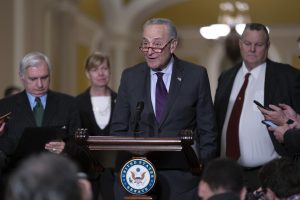
The grouping comprises 19 countries cutting across continents and the European Union, representing around 85% of the world’s GDP.
The G20 also invites non-member countries, including Bangladesh, Singapore, Spain and Nigeria, besides international organisations such as the United Nations, World Health Organization, the World Bank and the IMF.
What Does G20 Presidency Entail?
The G20 does not have a permanent secretariat, and one member takes over the presidency each year to steer the grouping’s agenda that is split into two tracks – one led by finance ministers and another by emissaries of leaders of member countries.
After India, Brazil will take over the presidency of the G20, followed by South Africa in 2025.
During its term, India will hold more than 200 meetings across some 50 cities involving ministers, officials and civil society, leading up to a marquee summit in the capital New Delhi in September 2023.
The summit will be attended by around 30 heads of state and government, from G20 members and invited countries.
What Is G20’s Upcoming Agenda?
Indian Prime Minister Narendra Modi has called for international cooperation to deal with global issues, outlining the country’s approach to the G20.
He said in a statement the challenges of “climate change, terrorism, and pandemics can be solved not by fighting each other, but only by acting together”.
Modi also underlined a need to “depoliticise the global supply of food, fertilizers and medical products, so that geo-political tensions do not lead to humanitarian crises”.
His statement reflects New Delhi’s stance that the conflict in Ukraine, triggered by a Russian invasion in February, must be resolved through dialogue and diplomacy.
Asked about Russia’s involvement in G20 during India’s presidency, a spokesperson for the Indian foreign ministry said that as Russia was a G20 member, “we would expect them to be participating in this process … the grouping needs to speak with one voice, particularly on important issues that are affecting the world”.
What Does The G20 Mean For India And Modi?
The timing of the summit, ahead of India’s general elections due in 2024, could help bolster Modi’s already growing reputation at home as a leader of international stature.
The 72-year-old leader also appears to have a personal rapport with many of his G20 counterparts, including U.S. President Joe Biden and French President Emmanuel Macron.
Still, the current complex geopolitical and economic situation will make it a challenge for India and Modi to shape the international response to multiple crises.
This is a moment for India to transition from being a “rule-taker to being a rule-maker”, said Rajiv Bhatia and Manjeet Kripalani of Indian think-tank Gateway House.
“The country has not invested much in multilateral rule-making institutions like the G20, but it is never too late to start.”
(AP) — Oath Keepers founder Stewart Rhodes was convicted Tuesday of seditious conspiracy for a violent plot to overturn President Joe Biden’s election, handing the Justice Department a major victory in its massive prosecution of the Jan. 6, 2021, insurrection.
A Washington, D.C., jury found Rhodes guilty of sedition after three days of deliberations in the nearly two-month-long trial that showcased the far-right extremist group’s efforts to keep Republican Donald Trump in the White House at all costs.
Picture : Reuters
Rhodes was acquitted of two other conspiracy charges. A co-defendant — Kelly Meggs, who led the antigovernment group’s Florida chapter — was also convicted of seditious conspiracy, while three other associates were cleared of that charge. Jurors found all five defendants guilty of obstruction of an official proceeding: Congress’ certification of Biden’s electoral victory.
The verdict, while mixed, marks a significant milestone for the Justice Department and is likely to clear the path for prosecutors to move ahead at full steam in upcoming trials of other extremists accused of sedition.
Rhodes and Meggs are the first people in nearly three decades to be found guilty at trial of seditious conspiracy — a rarely used Civil War-era charge that can be difficult to prove. The offense calls for up to 20 years behind bars.
It could embolden investigators, whose work has expanded beyond those who attacked the Capitol to focus on others linked to Trump’s efforts to overturn the 2020 election. U.S. Attorney General Merrick Garland recently named a veteran prosecutor, Jack Smith, to serve as special counsel to oversee key aspects of a probe into efforts to subvert the election as well as a separate investigation into the retention of classified documents at Trump’s Florida estate, Mar-a-Lago.
Garland said after the verdict that the Justice Department “is committed to holding accountable those criminally responsible for the assault on our democracy on January 6, 2021.”
“Democracy depends on the peaceful transfer of power. By attempting to block the certification of the 2020 presidential election results, the defendants flouted and trampled the rule of law,” Steven M. D’Antuono, assistant director in charge of the FBI Washington Field Office, said in an emailed statement. “This case shows that force and violence are no match for our country’s justice system.”
Using dozens of encrypted messages, recordings and surveillance video, prosecutors made the case that Rhodes began shortly after the 2020 election to prepare an armed rebellion to stop the transfer of presidential power.
Over seven weeks of testimony, jurors heard how Rhodes rallied his followers to fight to defend Trump, discussed the prospect of a “bloody” civil war and warned the Oath Keepers may have to “rise up in insurrection” to defeat Biden if Trump didn’t act.
Defense attorneys accused prosecutors of twisting their clients’ words and insisted the Oath Keepers came to Washington only to provide security for figures such as Roger Stone, a longtime Trump ally. The defense focused heavily on seeking to show that Rhodes’ rhetoric was just bluster and that the Oath Keepers had no plan before Jan. 6 to attack the Capitol.
Rhodes intends to appeal, defense attorney James Lee Bright told reporters. Another Rhodes lawyer, Ed Tarpley, described the verdict as a “mixed bag,” adding, “This is not a total victory for the government in any way, shape or form.”
“We feel like we presented a case that showed through evidence and testimony that Mr. Rhodes did not commit the crime of seditious conspiracy,” Tarpley said.
On trial alongside Rhodes, of Granbury, Texas, and Meggs, were Kenneth Harrelson, another Florida Oath Keeper; Thomas Caldwell, a retired Navy intelligence officer from Virginia; and Jessica Watkins, who led an Ohio militia group.
Caldwell was convicted on two counts and acquitted on three others, including seditious conspiracy. His attorney, David Fischer, called the verdict “major victory” for his client and a “major defeat” for the Justice Department. He also said he would appeal the two convictions.
In an extraordinary move, Rhodes took the stand to tell jurors there was no plan to attack the Capitol and insist that his followers who went inside the building went rogue.
(AP) — The Senate passed bipartisan legislation Tuesday to protect same-sex marriages, an extraordinary sign of shifting national politics on the issue and a measure of relief for the hundreds of thousands of same-sex couples who have married since the Supreme Court’s 2015 decision that legalized gay marriage nationwide.
The bill, which would ensure that same-sex and interracial marriages are enshrined in federal law, was approved 61-36 on Tuesday, including support from 12 Republicans. Senate Majority Leader Chuck Schumer said the legislation was “a long time coming” and part of America’s “difficult but inexorable march towards greater equality.”
Democrats are moving quickly, while the party still holds the majority in both chambers of Congress. The legislation now moves to the House for a final vote.
Picture : AP News
President Joe Biden praised the bipartisan vote and said he will sign the bill “promptly and proudly” if it is passed by the House. He said it will ensure that LGBTQ youth “will grow up knowing that they, too, can lead full, happy lives and build families of their own.”
The legislation would not force any state to allow same-sex couples to marry. But it would require states to recognize all marriages that were legal where they were performed, and protect current same-sex unions, if the court’s 2015 Obergefell v. Hodges decision were to be overturned. It’s a stunning bipartisan endorsement, and evidence of societal change, after years of bitter divisiveness on the issue.
A new law protecting same-sex marriages would also be a major victory for Democrats as they relinquish their two years of consolidated power in Washington, and a massive win for advocates who have been pushing for decades for federal legislation. It comes as the LGBTQ community has faced violent attacks, such as the shooting last weekend at a gay nightclub in Colorado that killed five people and injured at least 17.
“Our community really needs a win, we have been through a lot,” said Kelley Robinson, the incoming president of Human Rights Campaign, which advocates on LGBTQ issues. “As a queer person who is married, I feel a sense of relief right now. I know my family is safe.”
Robinson was in the Senate chamber for the vote with her wife, Becky, and toddler son. “It was more emotional than I expected,” she said.
The vote was personal for many senators, too. Wisconsin Sen. Tammy Baldwin, a Democrat who is the first openly gay senator and was the lead sponsor of the bill, tearfully hugged Schumer and others as the final vote was called. Baldwin, who has been working on gay rights issues for almost four decades, tweeted thanks to the same-sex and interracial couples who she said made the moment possible.
“By living as your true selves, you changed the hearts and minds of people around you,” she wrote.
Schumer said on Tuesday that he was wearing the tie he wore at his daughter’s wedding, “one of the happiest moments of my life.” He also recalled the “harrowing conversation” he had with his daughter and her wife in September 2020 when they heard that liberal Justice Ruth Bader Ginsburg had passed away. “Could our right to marry be undone?” they asked at the time.
With conservative Justice Amy Coney Barrett replacing Ginsburg, the court has now overturned Roe v. Wade and the federal right to an abortion, stoking fears about Obergefell and other rights protected by the court. But sentiment has shifted on same-sex marriage, with more than two-thirds of the public now in support.
Still, Schumer said it was notable that the Senate was even having the debate after years of Republican opposition. “A decade ago, it would have strained all of our imaginations to envision both sides talking about protecting the rights of same-sex married couples,” he said.
Passage came after the Senate rejected three Republican amendments to protect the rights of religious institutions and others to still oppose such marriages. Supporters of the legislation argued those amendments were unnecessary because the bill had already been amended to clarify that it does not affect rights of private individuals or businesses that are currently enshrined in law. The bill would also make clear that a marriage is between two people, an effort to ward off some far-right criticism that the legislation could endorse polygamy.
Though the tree has not been lit every single year across the century, it is the second-oldest White House tradition after the Easter egg roll.
(RNS) — It was Christmas Eve in 1923. A church choir sang, Marine band members played and the president of the United States pressed a button to light the first National Christmas Tree under the gaze of thousands of onlookers.
For 100 years, the tree has represented a symbol of civil religion as Americans mark the Christmas season.
On Wednesday (Nov. 30), President Joe Biden is set to do the honors just as President Calvin Coolidge did at that first lighting, and contemporary gospel singer Yolanda Adams is slated to sing for the crowds gathered on the Ellipse in the shadow of the White House.
Though the tree was not lit from 1942 to 1944 — due to the Second World War — it is the second-oldest White House tradition, after the Easter Egg Roll, which began in 1878.
“A hundred years is a fairly significant milestone to reach for consistently practicing a tradition,” said Matthew Costello, senior historian of the nonprofit White House Historical Association. “This is really part of the customs and the traditions of the White House and living in the White House.”
Picture : Share America
Whether the tree will continue as a symbol of civil religion — a Christian tradition, yes, but also a generic celebration of the holiday known for Santa and reindeer — is an open question, said Boston University professor of religion Stephen Prothero. In the wake of the Jan. 6 attack on the Capitol, the tree’s intersection of politics and religion may be seen as too fraught.
“At this point, these Christian symbols in the public square feel very different to me and to many other Americans, than they have in the past,” he said. “And that’s precisely because of the increasing power of white Christian nationalism in American society.”
Already, the tree can seem like a relic of an America that is now past. “You would think, based on separation of church and state, that the federal government wouldn’t get into the Christmas tree business, but we have been doing these kinds of things for a long time,” Prothero said.
But the tree has always been part of America’s balancing act of alternately welcoming or rejecting religion in the public square. “It used to be that there was a kind of a gentleman’s agreement — and I say, gentleman on purpose, because it was men who were making this agreement — and the agreement was that you could have religious symbols in the public space, but that they would have to be generic, that they wouldn’t be explicitly Christian.”
Here are five faith facts related to the National Christmas Tree:
1. It’s been a place for God-talk by Democrats and Republicans.
In 1940, before the U.S. entered the conflict in Europe, Franklin D. Roosevelt used the tree lighting to condemn the war, referring to the Beatitudes of Christ, and urging “belligerent nations to read the Sermon on the Mount,” a National Park Service timeline notes.
In 1986, Ronald Reagan offered a different interpretation of the holiday. “For some Christmas just marks the birth of a great philosopher and prophet, a great and good man,” he said. “To others, it marks something still more: the pinnacle of all history, the moment when the God of all creation — in the words of the creed, God from God and light from light — humbled himself to become a baby crying in a manger.”
More recently, Barack Obama, referring to baby Jesus, said at a 2010 ceremony that “while this story may be a Christian one, its lesson is universal.”
Donald Trump said in 2017 that the “Christmas story begins 2,000 years ago with a mother, a father, their baby son, and the most extraordinary gift of all, the gift of God’s love for all of humanity.”
2. The Christmas tree was joined by other symbols of faith.
At times, there has been a Nativity with life-sized figures near the National Christmas Tree. An Islamic star-and-crescent symbol also made a 1997 appearance on the National Mall not far from the White House but it was vandalized, losing its star.
“This year for the first time, an Islamic symbol was displayed along with the National Christmas Tree and the menorah,” said President Bill Clinton that year in a statement. “The desecration of that symbol is the embodiment of intolerance that strikes at the heart of what it means to be an American.”
A public menorah first appeared near the White House in 1979, when President Jimmy Carter walked to the ceremony in Lafayette Park. The candelabra moved to a location on the Ellipse in 1987, and a 30-foot National Menorah has continued to be lit annually as a project of American Friends of Lubavitch.
3. Its lighting continued amid difficult times.
Roosevelt lit the tree weeks after the bombing of Pearl Harbor in 1941, with British Prime Minister Winston Churchill standing behind him.
After the Nov. 22, 1963, assassination of President John F. Kennedy, his successor waited until a 30-day mourning period was over before lighting the tree. “Today we come to the end of a season of great national sorrow, and to the beginning of the season of great, eternal joy,” said Lyndon Johnson on Dec. 22 of that year.
A few months after the 9/11 terrorist attacks, President George W. Bush rode in a motorcade to the nearby Ellipse for the ceremony.
Costello contrasted these “people-oriented” instances to the more “policy-oriented” rhetoric of State of the Union speeches.
“We see after these moments of national catastrophe, disaster, tragedy, where this can be a really uplifting time for presidents to deliver a message directly to the American people, to remind them about what the season is all about, but also forward-looking,” he said.
4. While it’s kept its name, others have switched to “holiday.”
The neighboring Capitol Christmas Tree was a Capitol Holiday Tree for a time. It reverted back to the “Christmas” title in 2005.
“The speaker believes a Christmas tree is a Christmas tree, and it is as simple as that,” Ron Bonjean, spokesman for House Speaker J. Dennis Hastert, told The Washington Times that year.
Matthew Evans, then landscape architect of the U.S. Capitol, told Religion News Service in 2001 that the tree is “intended for people of all faiths to gather round at a time of coming together and fellowship and celebration.”
Around that time, some state capitols and statehouses also opted to name their pines, firs and spruces “holiday trees” instead.
But the National Christmas Tree has retained its longtime imprimatur.
5. The tree ceremony is really about kids.
President Herbert Hoover and first lady Lou Hoover light the National Christmas Tree on Christmas Eve 1929. Photo courtesy of LOC/Creative Commons
An ailing 7-year-old girl asked that President Reagan and first lady Nancy Reagan grant her “Make a Wish” program request that she join them for the tree lighting in 1983.
“The Christmas tree that lights up for our country must be seen all the way to heaven,” Amy Bentham wrote to the program, according to the NPS website. “I would wish so much to help the President turn on those Christmas lights.”
The Reagans granted her wish.
“The bottom line is what the president says and does, it matters; obviously, people listen,” Costello said. “But really, this is about kids, it’s about children and sort of the magical time of the year. And that was just one example, I think, that was especially poignant about why the ceremony matters.”
The US will have a divided government for the next two years as the Republican party finally secured the House of Representatives last week after polling in midterm elections closed on November 8th, 2022. Democrats will control the Senate, which they secured last week, and the White House, which was not on the ballot.
Republicans were expected to win both chambers, especially the House and with a huge majority in keeping with history. The party in control of the White House has always lost the first midterm of the incumbent president’s first term, and by huge numbers. In 2010, President Barack Obama’s first midterm, Democrats lost the House by 63 seats; and in 2018, President Donald Trump’s first midterm, the Republicans lost the House by 41 seats.
The days of ambitious legislations such as those that marked the first two years of President Joe Biden’s term – infrastructure, climate change and healthcare extension, are over. There will be instead a litany of congressional investigations into the Biden administration and bitter confrontations between the White House and the Republican-controlled House.
These tensions will be exacerbated by the 2024 presidential elections that got underway with former President Donald Trump announcing his third bid for the White House – 2016 and 2020 were the earlier two – on Tuesday. It will only pick up more heat from hereon.
Picture : NBC News
For now, however, Biden, who takes pride in his ability to work with the other side drawing upon nearly 50 years of political experience as senator, vice-president and now president, congratulated the Republicans and promised to work with them. “I congratulate Leader McCarthy on Republicans winning the House majority, and am ready to work with House Republicans to deliver results for working families,” he said in a statement.
But he also reminded the Republicans of the midterm verdict, which spared the Democrats the kinds of searing defeats that parties in power have historically suffered in the first midterm election of the first term of their man (there hasn’t been a woman president yet in the US) in the White House. Former President Barack Obama called his first midterm verdict a “shellacking”.
Democrats did stunningly better than anticipated and lost the House by what is likely to be a very thin margin, and have retained the Senate (they have also flipped three states snatching their governorships from Republicans).
“In this election, voters spoke clearly about their concerns: the need to lower costs, protect the right to choose, and preserve our democracy,” Biden said, adding, “As I said last week, the future is too promising to be trapped in political warfare. The American people want us to get things done for them. They want us to focus on the issues that matter to them and on making their lives better. And I will work with anyone – Republican or Democrat – willing to work with me to deliver results for them.”
House Speaker Nancy Pelosi said in a statement House Democrats “will continue to play a leading role in supporting President Biden’s agenda – with strong leverage over a scant Republican majority.”
Democrats have been buoyed by voters’ repudiation of a string of far-right Republican candidates, most of them allies of Trump, including Mehmet Oz and Doug Mastriano in Pennsylvania’s Senate and governor’s races respectively, and Blake Masters in Arizona’s Senate contest.
Even though the expected “red wave” of House Republicans never reached shore, conservatives are sticking to their agenda. In retaliation for two impeachment efforts by Democrats against Trump, they are gearing up to investigate Biden administration officials and the president’s son Hunter’s past business dealings with China and other countries – and even Biden himself.
Republicans have threatened to launch congressional investigations into the Biden administration’s handling of the migrant crisis on the southern border and its handling of the Afghanistan exit. They also plan to probe his son Hunter Biden’s business dealings when the senior Biden was vice-president.
But the Republicans will also be under tremendous strain because of its razor-thin majority. It will face its first stress test on January 3 when Kevin McCathy, who was re-elected leader of the congressional caucus on Wednesday, seeks the speakership, a position that goes to the leader of the majority party. McCarthy will need 218 votes to win. He cannot afford defections, because he is unlikely to make up for their loss with Democratic crossovers.
More than 40 Republican lawmakers voted for Andy Biggs, the challenger for the majority leadership, all of whom from the party’s ultraconservative wing known as the Freedom Caucus, many of whose members are fiercely loyal to Trump, and their votes and congressional positions could be cued by the ups and downs of the presidential primaries.
Trump, who still polls as the top choice among Republicans for the party’s presidential nomination, nevertheless suffered a series of setbacks as far-right candidates he either recruited or became allied with performed poorly on Nov. 8. Some conservative Republican voters voiced fatigue with Trump.
Former US President Donald Trump has announced his fourth bid for the White House, kicking off the 2024 presidential election cycle. “To make America great again, I am today announcing my candidacy for the President of the US,” Trump said at an event on Tuesday at his Mar-a-Lago estate in Palm Beach, Florida.
Shortly before his announcement, Trump also filed paperwork to officially run for President.
At the event, a voice over the loudspeaker introduced Trump as “the next president of the United States”, the BBC reported. He started his speech by digging into his successor President Joe Biden’s record and told supporters that “America’s comeback starts right now”.
Picture : Business Insider
Surrounded by allies, advisers, and conservative influencers, Trump delivered a relatively subdued speech, rife with spurious and exaggerated claims about his four years in office.Despite a historically divisive presidency and his own role in inciting an attack on the US Capitol on January 6, 2021, Trump aimed to evoke nostalgia for his time in office, frequently contrasting his first-term accomplishments with the Biden administration’s policies and the current economic climate.
Many of those perceived accomplishments – from strict immigration actions to corporate tax cuts and religious freedom initiatives – remain deeply polarizing to this day.
Touting his four years in office, the former President said: “In four short years, everyone was doing great… Everyone was thriving like never before.” He further claimed that the country’s economy was making a swift recovery when he left office, after falling during the coronavirus pandemic. “Now we are a nation in decline,” he said, citing high inflation rates.
Trump also said that Biden has brought the US to the brink of nuclear war with its handling of the conflict in Ukraine. “Even just today a missile sent in, probably by Russia, to Poland. The people are going absolutely wild and crazy and they’re not happy. They’re very very angry,” the BBC quoted the former President as saying.
Prior to his announcement on Tuesday, Trump had said that he would make an important announcement on November 15. In the recent months, he had been dropping hints about a potential third campaign for the White House, the BBC reported.
In October, he told a rally in Texas that he “will probably have to do it again”, while in September at an event in Pennsylvania, the former President said: “I may just have to do it again.” Just before the November 8 midterm elections, he told a Republican campaign rally in Sioux City, Iowa, that he would “very, very, very probably” be running for the White House again.
On the heels of last week’s midterm elections, Trump has been blamed for elevating flawed candidates who spent too much time parroting his claims about election fraud, alienating key voters and ultimately leading to their defeats. He attempted to counter that criticism on Tuesday, noting that Republicans appear poised to retake the House majority and touting at least one Trump-endorsed candidate, Kevin Kiley of California. At one point, Trump appeared to blame his party’s midterm performance on voters not yet realizing “the total effect of the suffering” after two years of Democratic control in Washington.
“I have no doubt that by 2024, it will sadly be much worse and they will see clearly what has happened and is happening to our country – and the voting will be much different,” he claimed.
Various media outlets have said this is the third; however, they have not taken into account his bid in 1999-2000 after affiliating with the Reform Party. In October 1999, during an episode of Larry King Live, Trump had announced his candidacy for the Reform Party nomination. A few months later, however, he suspended his campaign. Trump’s four presidential runs were, therefore, in 2000 (suspended), 2016 (won), 2020 (lost) and now, in 2022 (just announced).
Consternation could be one of the reactions from New Delhi to a comment by State Department Principal Deputy Spokesperson Vedant Patel citing the reinstatement of Prime Minister Narendra’s Modi’s US visa in 2014 as part of an answer about granting sovereign immunity to Saudi crown prince and Prime Minister Mohammed bin Salman (MBS).
Patel’s reference to Modi’s US visa reinstatement in 2014 came during a media briefing on November 18 in the context of the now controversial sovereign immunity for MBS.
Although the MBS immunity is consistent with the US policy of affording such immunity to heads of state who might be in some serious legal jeopardy on account of their transgressions in their respective countries, Patel’s juxtaposition of Modi with MBS could be diplomatically fraught.
This is what Patel said in reply to repeated questions about the MBS immunity: “It is a longstanding and consistent line of effort. It has been applied to a number of heads of state previously, some examples, President (Jean-Bertrand) Aristide in Haiti in 1993, President (Robert) Mugabe in Zimbabwe in 2001, Prime Minister Modi in India in 2014 and President (Joseph) Kabila in the DRC (the Democratic Republic of the Congo) in 2018. This is a consistent practice we have afforded to heads of state.”
There is nothing objectionable about Patel’s comments on the sheer facts of what he is saying. These are just bare facts and as a spokesperson it is his duty to offer them unvarnished. However, international diplomacy, especially between Modi’s India and President Joe Biden’s America, is often fraught.
It is from that standpoint that the seeming bracketing of Modi with MBS and other strongmen could be problematic for its optics. Of course, no government, either here in America or that in India, should feel the need to finesse facts no matter how unedifying they may be.
India’s External Affairs Ministry may not necessarily respond to this merely because the assertion came in the context of MBS but Modi’s detractors, and it is a rapidly growing constituency, could cite this as yet another blot on him.
By itself sovereign immunity should be noncontroversial because countries offer it as part of the international law. In the specific context of MBS though, the immunity is rife with the prospects of being seen as the Biden administration going soft on the prime minister in a calibrated fashion at a time when the US-Saudi relations are perhaps at their most tense.
A particular sticking point has been the Saudi decision to slash oil production in an apparent alliance with Russia at a time gas prices are running so high in America. There were suggestions of the Saudis under MBS humiliating Washington by gouging oil prices.
With this as the backdrop, sovereign immunity for MBS looks at the very least curious notwithstanding the longstanding practice as cited by Patel. Of course, Patel was at pains to repeatedly insist that, “This Suggestion of Immunity does not reflect an assessment on the merits of the case. It speaks to nothing on broader policy or the state of relations. This was purely a legal determination.”
He kept saying again and again at the presser the MBS immunity was no reflection on the legal merits of the Khashoggi murder case and accusations. But it has caused a great deal of outrage among certain quarters, specifically the media.
In a statement on Twitter Fred Ryan, the Washington Post’s publisher and CEO, said yesterday that President Biden is “granting a license to kill to one of the world’s most egregious human-rights abusers who is responsible for the cold-blooded murder of Jamal Khashoggi.”
The Biden administration made its declaration of immunity in a court filing in the lawsuit filed by Khashoggi’s fiancée, Hatice Cengiz. In a tweet Cenzig said, “Jamal died again today.”
Despite the fact that immunity is a longstanding practice, affording it to MBS has opened the door for other prospective violators of human rights who might become heads of state. (Courtesy: iNdica News)
The Biden administration on Friday urged the Supreme Court to clear one of the legal obstacles blocking its student debt relief program, as part of the administration’s broader legal effort to have the policy reinstated.
The administration is currently fending off two separate rulings issued over the last two weeks that have effectively halted President Biden’s student loan forgiveness plan, which would give federal borrowers making less than $125,000 a year up to $10,000 debt relief.
In its Friday filing, the Department of Justice (DOJ), on behalf of the administration, urged the justices to lift a ruling issued Monday by the St. Louis-based U.S. Court of Appeals for the 8th Circuit that halted the loan relief program, saying its current legal status has left “vulnerable borrowers in untenable limbo.”
“The [8th Circuit’s] injunction thus frustrates the government’s ability to respond to the harmful economic consequences of a devastating pandemic with the policies it has determined are necessary,” U.S. Solicitor General Elizabeth Prelogar told the justices.
Biden’s policy, which the Congressional Budget Office estimates will cost about $400 billion over 30 years, has drawn numerous legal challenges. Its aim is to forgive up to $10,000 in federal student loan debt for those making under $125,000 annually and up to $20,000 for recipients of Pell Grants, which assist students from lower-income families.
The administration’s move on Friday comes after a unanimous three-judge panel on the 8th Circuit halted Biden’s massive debt relief plan, which had already been blocked nationwide by a separate court ruling.
The panel, which comprised two Trump-appointed judges and one appointee of former President George W. Bush, said its order would remain in effect until further notice by the 8th Circuit or the Supreme Court.
The ruling was a win for six conservative-led states — Nebraska, Missouri, Arkansas, Iowa, Kansas and South Carolina — that challenged the program on the grounds that they were harmed by a freeze on the collection of student loan payments and interest. The court’s six-page ruling singled out the impact on a large, Missouri-based holder of student loans called the Higher Education Loan Authority of the State of Missouri.
“The equities strongly favor an injunction considering the irreversible impact the Secretary’s debt forgiveness action would have as compared to the lack of harm an injunction would presently impose,” the panel wrote. “Among the considerations is the fact that collection of student loan payments as well as accrual of interest on student loans have both been suspended.”
The White House, for its part, maintains that its policy is authorized by a 2003 federal law known as the Higher Education Relief Opportunities for Students Act, which both the Trump and Biden administrations have drawn upon to alleviate student borrowers’ financial strain during the global pandemic.
In a related legal development last week, a Trump-appointed federal judge in Texas invalidated the program, saying the presidential action unlawfully encroached on Congress’s power. The Biden administration has asked the U.S. Court of Appeals for the 5th Circuit to halt that ruling while it mounts a formal appeal.
Several other similar challenges to Biden’s plan have so far proved unsuccessful. Among them were two cases that eventually sought emergency relief in the Supreme Court but were unilaterally rejected by Justice Amy Coney Barrett.
The Supreme Court may be more inclined to intervene now that the U.S. government is the party seeking relief and as courts across the country reach different conclusions about the program’s lawfulness.
The DOJ, in its Friday filing, told the justices they could choose to construe the government’s request as a formal petition for appeal and place it on a procedural fast-track.
The DOJ filing comes as student loan borrowers are anxiously awaiting for payments to restart at the beginning of 2023.
Advocates have been pressuring the Biden administration to extend the pause on payments, which began at the beginning of the pandemic, while the debt relief program is going through the courts.
Before the legal challenges, millions of borrowers applied for the debt relief through an application on the Department of Education’s website. Borrowers were told to apply before Tuesday in order to have a chance at their debt being forgiven before the payments began.
Since then, the applications have been taken down, and borrowers could have to wait months to get a final decision on the legality of the program from the courts.
The Washington Post previously reported talks were happening in the White House to extend the payment pause again due to the court challenges, despite Biden telling borrowers there would be no more extensions.
However, there has been no official word from the White House on the issue with only a month and a half left before payments resume. (Courtesy: The Hill)
Ahead of time, the script for the G-20 summit in Bali, Indonesia, seemed to write itself. A grouping conceived in the heyday of globalization was meeting in person for the first time under the shadow of the new Cold War. China and Russia would clash with the United States and its allies. Ukraine would hog center stage. Indonesia made no secret of the fact that it feared that the interests of the rest of the world—sometimes dubbed the new nonalignment—would take second place.
Picture : Foregin Policy
There were moments in Bali that did conform to this script. Russian President Vladimir Putin declined to attend. Russia was at first represented by Foreign Minister Sergey Lavrov, who gave pugnacious press conferences in which he denounced Ukrainian fascists and brandished conspiracy theories about U.S. biolabs. Then Lavrov departed and Russia’s representation was reduced to the finance minister, effectively the junior tier of the G-20. When the missiles landed in Poland, the Indonesian president was obliged to delay a scheduled tour with journalists of a mangrove plantation, while U.S. President Joe Biden convened a war council of the G-7.
But if one takes the occasion as a whole, what is striking is how far the G-20 meeting succeeded in defying expectations.
It was, in fact, a relief that Putin chose to absent himself. It spared China and India the embarrassment of having to distance themselves from him too publicly. In Bali, there was no one who was keen to ally themselves with Russia. Ahead of the meeting, Chinese officials briefed the Western media more openly than ever before about the degree to which Moscow had left them in the dark ahead of the invasion.
This does not mean that China, India, and Brazil were going to fall in line with the United States and Europe in condemning Putin. In that crucial respect, they preserved their stance of nonalignment. But there was no hiding the fact that they regard the war in Ukraine as a threat to the world economy and are aghast at Putin’s nuclear saber-rattling.
Indonesia, which voted with the West against Russia in the United Nations, pushed for an end to the war, even if there was no unanimity. India provided the mantra that this is “not a time for war.” President Recep Tayyip Erdogan of Turkey strutted his stuff as the man who brokered the U.N. grain deal.
The emerging-market nations that might once have been regarded as junior members of the G-20 demonstrated clout and independence. Unlike their European counterparts, their autonomy and influence have grown with the crisis.
Meanwhile, on the most fundamental axis of global conflict, that between the United States and China, President Xi Jinping and Biden decided to talk. After the rather reckless escalation of recent months, there seemed to be a sense that it was time to reduce tension and find new protocols for engagement.
As Xi made clear to Prime Minister Justin Trudeau of Canada, this does not mean reaching for cheap headlines by spilling the beans on a private conversation with your Chinese counterpart. The Chinese may be bunkering themselves in behind the Great Firewall, but they follow what happens on our side and do not appreciate media stunts at their expense. The Biden team has less need for grandstanding and can be counted on to be more discreet. Not until the archives are opened will we have much idea of what was said in the three-hour conversation between Xi and Biden. And that is probably for the best. Discretion is a sign that things are getting serious.
The G-20 meeting ended with a leaders’ declaration, which made few new pledges but affirmed basic agreements, such as the commitment to the Paris climate accord.
None of this alters the fact that Russia’s war on Ukraine continues. The risk of escalation is serious. The tensions between the United States and China are real. China upholds its claims on Taiwan. The United States will likely continue its campaign of sanctions. Neither side has any room in domestic politics to back down. On both sides, talk of actual war is increasingly commonplace.
The two conflicts—Russia vs. West and China vs. United States—split the world. But there are also countervailing forces.
The nonaligned powers are a force to be reckoned with, more individually than as a group. But even individually they are significant players. They may be nonaligned and wary of any overt alignment with Washington, but at least, as far as Ukraine is concerned, they are not blind to the disruption caused by Putin and the risks of escalation. Clearly, both Beijing and Washington recognize the need to keep channels of communication open.
As in the Cold War, there are existential risks that require active management. If Bali is anything to go by, the G-20 may be one of the arenas in which that management takes place.
Picture : FP
The G-20 may appear like the cliché of globalization, but it was in fact born out of crisis. Its origins lie in the mishandling of the Asian financial crisis of 1997-98 and the perception in the Clinton administration that a new forum was needed to give legitimacy to the International Monetary Fund and the World Bank. Initially, it was a meeting of finance ministers and economic officials. The meeting was raised to the status of a head-of-government meeting in 2008, when the Bush administration was desperately trying to coordinate its response to the financial crisis.
Today, we are in crisis once again, and once again the G-20 is providing a useful forum for diplomacy, both to defuse tension and, as Indonesia insisted, to balance the claims of geopolitics against the interests of economic development.
The format works because it encompasses 60 percent of the world’s population and 80 percent of GDP but is less unwieldy than the U.N. General Assembly or the U.N.’s climate conference.
The Bali G-20 demonstrated that conducting diplomacy in an age of crisis does not mean that things are destined to blow up or fall apart.
The word “crisis” derives from the Greek and captures a moment not of disintegration or explosion but of decision, a turning point, a moment in which you face choices that define your identity. That is true on multiple fronts right now—from the war in Ukraine to U.S.-China tension to climate change. You can manage the moment by deferring, fudging the issue, accepting a further escalation, or making a choice. In Bali, we saw a mixture of all these options.
After leading the Democrats for the last two decades, the House Speaker has announced that she will step down next year from her spot at the top of the party, closing a momentous run for the most powerful woman in U.S. history while clearing the way for a younger generation of up-and-coming lawmakers to climb into the leadership ranks.
“With great confidence in our caucus, I will not seek reelection to Democratic leadership in the next Congress. For me the hour has come for a new generation to lead the Democratic caucus that I so deeply respect,” Pelosi said in a speech on the House floor. “I’m grateful that so many are ready and willing to shoulder this awesome responsibility.”
Pelosi said she will continue to represent her San Francisco district in the House.
Picture : Rolling Stone
In her remarks, Pelosi warned that democracy is “majestic, but it is fragile” and said voters in 2022 sent a message to Congress that they would not support those who supported violence or insurrection. She also applauded the chamber for becoming more diverse over the course of her 35-year career. When she first entered Congress in 1987 there were 12 women in the Democratic caucus and now there are 90. “And we want more,” she said.
Her decision comes a day after Republicans officially won control of the chamber in the 2022 midterms, and three weeks after the violent assault on her husband, Paul, at their San Francisco home.
The GOP is expected to have a razor-thin majority after the “red wave” never materialized on Election Day. Democrats defied historical expectations and performed better in governor, Senate and House elections than anticipated.
There has been a quiet desire among rank and file Democrats to elect a younger slate of leaders to replace Pelosi, who is 82, and the two other top House Democratic leaders, Rep Steny Hoyer, D-Md., and Rep. Jim Clyburn, D-S.C., who are also in their 80s.
Following Pelosi’s announcement, Hoyer, who is currently the House Majority Leader, said he will not run for a
Picture : Washington Post
leadership position in the next Congress. “Now is the time for a new generation of leaders,” Hoyer said in a statement, adding that he would support Democratic Rep. Hakeem Jefferies for the top leadership role.
At the top of the list is Jeffries of New York, Katherine Clark of Massachusetts and Pete Aguilar of California. All three serve in lower-tier leadership roles now and are interested in moving up the ladder.
Jeffries, who is 52, Clark, who is 59, and Aguilar, who is 43, would make an African American, a white woman and a Hispanic the new faces of the party. Reps. Ami Bera and Tony Cárdenas, both of California, have already announced campaigns to run the Democratic Congressional Campaign Committee, the Democrats’ campaign arm, for the 2024 election.
“I know because I’ve seen her in action during my career as Senator, Vice President, and now as President,” Biden said in a statement following her announcement. “Because of Nancy Pelosi, the lives of millions and millions of Americans are better, even in districts represented by Republicans who voted against her bills and too often vilify her,” the statement reads. “That’s Nancy — always working for the dignity of all of the people.”
Three South Asian Democrats were elected to the Georgia State Legislature in the recently held mid-term elections.
Sheikh Rahman was re-elected from State District 5, while Nabila Islam won her first election from Senate District 7.
Farooq Mughal, the son of immigrant parents from Pakistan and a public policy expert, has won the race for Georgia House District 105.
Islam will have the honor of being the first Muslim woman to represent the Georgia Senate. Mughal will be the first Muslim to serve the Georgia House.
“We won with 53% of the vote in a challenging year. Our margin of victory is a testament to our brilliant team & hard-working volunteers. We ran a strong campaign & fought hard. My sincerest thank you to the voters who put their trust in me to be their voice in the State Senate,” Islam tweeted after her win.
The daughter of Bangladeshi immigrants, Islam was raised in Gwinnett County. She graduated from Gwinnett County Public Schools and Georgia State University.
Farooq Mughal owns a government affairs firm and coordinated the first Asian American Legislative Day at the Georgia Capitol. He is a business leader, public policy expert, mediator, and former chairman of the Gwinnett County Community Outreach Board.
In May 2012, he served on the Steering Committee of the White House Initiatives on Asian Americans and Pacific Islanders Southeast Regional Summit hosted in Atlanta at Emory University. He also was instrumental in coordinating the first Asian American Legislative Day at the Georgia Capitol. Recognized for his leadership and work, Farooq was invited to the White House in May 2013 to meet President Obama and then-Vice President Joe Biden.
Senator Sheikh Rahman, who grew up in Bangladesh, is the first immigrant and first Asian American to serve in the Georgia State Senate. He is also the first Muslim Georgia Legislator. Elected in 2018, he represents the 5th Senate District in the heart of Gwinnett — Georgia’s most diverse county. He is the Chairman of the Gwinnett Senate Delegation. In the Senate, Sen. Rahman is the Secretary of the Urban Affairs Committee.
He also serves on the Agriculture and Consumer Affairs, Economic Development and Tourism, Government Oversight, and Special Judiciary committees. During his first term, Sen. Rahman was appointed by the Lt. Governor Geoff Duncan to serve on the Senate Higher Education Outcome study committee and Surgical Smoke Evacuation study committee. He was also awarded the Freshman Legislator of the Year by the Democratic Legislative Caucus. In 2019, Georgia Asia Times named Sen. Rahman the 25th Most Influential Asian American in Georgia. In 2020, he was named one of the 100 Most Influential Georgia Muslims by Islamic Speakers Bureau of Georgia.