Deposit Bonus triple diamond slots download Product sales

While the the latter, the most common online game having a modern jackpot is actually Super Moolah. Naturally, there are various almost every other pokies offering which exclusive brighten. But not, how many Mega Moolah $step 1 deposit sales surely is prevalent. Continue reading “Deposit Bonus triple diamond slots download Product sales”

India Can Use Its G20 Leadership To Fight Corruption, Reduce Global Inequalities

(IPS) – The G20 India Presidency is marked by unprecedented geopolitical, environmental, and economic crises. Rising inflation threatens to erase decades of economic development and push more people into poverty. Violent extremism is also on the rise as a result of increasing global inequality, and the rule of law is in decline everywhere. All of these challenges impact the G20’s goal of realizing a faster and more equitable post-pandemic economic recovery.

But as India prioritizes its agenda for 2023, it is corruption that is at the heart of all of these other problems- and which poses the greatest threat to worldwide peace and prosperity.

An Idea Whose Time Has Come

Although the G20 has repeatedly committed to the Financial Action Task Force’s (FATF) anti-money laundering standards, member countries have been slow to implement policy reforms

Despite unprecedented challenges, 2022 also opened windows of opportunity to move the needle around critical anti-corruption issues, such as anti-money laundering, asset recovery, beneficial ownership, and renewable energy. When global leaders meet during the G20 Indian Presidency , they must prioritize and build on this progress, rather than make new commitments around these issues that they then fail to implement.

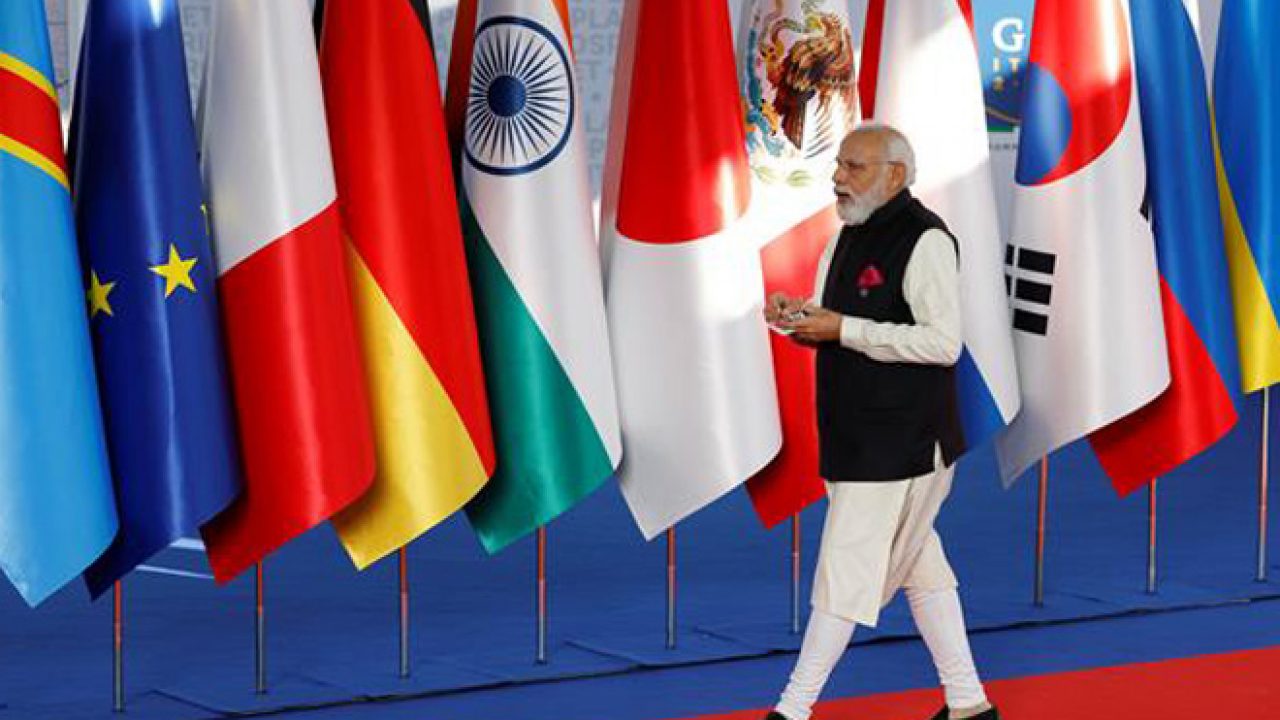
Picture : TheUNN

According to the UN, an estimated 2-5% of global GDP, or up to $2 trillion, is laundered annually. Although the G20 has repeatedly committed to the Financial Action Task Force’s (FATF) anti-money laundering standards, member countries have been slow to implement policy reforms. In the wake of the Russian invasion of Ukraine and ineffective economic sanctions against Russian oligarchs, governments have started reexamining existing policy and institutional gaps, especially recognizing the role of Designated Non-Financial Businesses and Professions (DNFBPs), also known as “gatekeepers.”

G20 member countries are responding to concerns and criticisms from their national counterparts regarding failures to adopt FATF recommendations and clamp down on “dirty money.” Grappling with the need to be able to prosecute money-laundering cases and recover billions of dollars worth of frozen assets, they are also amending national laws to be able to do so.

Lack of beneficial ownership transparency is also aiding the flow of laundered money globally. The G20 recognizes beneficial ownership data as an effective instrument to fight financial crime and “protect the integrity and transparency of the global financial system.”

The Russian invasion helped drive home this message, especially among countries that are popular destinations for those buying luxury goods and assets. FATF’s amendment of its beneficial ownership recommendations in early 2022 was timely. Member countries are also introducing new reporting rules, and fast-tracking policies and processes to set up beneficial ownership registers. While there are still gaps in the proposed policies – as identified here– these are important first steps.

Similarly, the transition to renewable energy, initially raised as an environmental issue and then as a national security concern is increasingly gaining attention from a resource governance perspective. Given the scale of the potential investment, there is a need to tackle corruption in the energy sector to avoid potential pitfalls resulting from a lack of open and accountable systems as we transition to a net zero economy.

The cross-cutting nature of the industry means a wide range of issues– from procurement and conflict of interest in the public sector to beneficial ownership transparency- need to be considered. The global energy crisis and the Indonesian Presidency’s prioritization of the issue have helped build momentum around corruption in the renewable energy transition, and this focus must continue.

Calling on India

Corruption-related issues identified here are transnational in nature and have global implications, including for India. For instance, with money laundering cases rising in India, it cannot afford to regard it as a problem limited to safe havens like the UK or the US. The same is true for the lack of beneficial ownership transparency or corruption in the renewable energy transition, which fuels illicit financial networks in India and beyond, and which often transcend national borders.

Finally, corruption has a disproportionate impact on the global poor. Almost 10% of the global population lives in extreme poverty, many of whom live in countries such as India. The G20, under the Indian Presidency, provides a unique opportunity to ensure the voices of the most vulnerable are heard at the global level. By prioritizing the anti-corruption agenda and building on past priority issues and commitments, the Indian government can lead efforts to bridge the North-South divide.

2 World-Renowned Mathematicians From US, Canada Given Padma Awards

Two world-renowned Mathematicians of Indian origin from the US and Canada are among the 106 recipients of the prestigious Padma Awards, one of the highest civilian honors of the country, according to the Government of India, announced on the eve of India’s 74th Republic Day.

Indian-American S.R. Srinivasa Varadhan has been chosen to be honored with the Padma Vibhushan and Indo-Canadian Sujatha Ramdorai will be conferred with the Padmi Shri for their stellar contributions in the field of science and engineering.

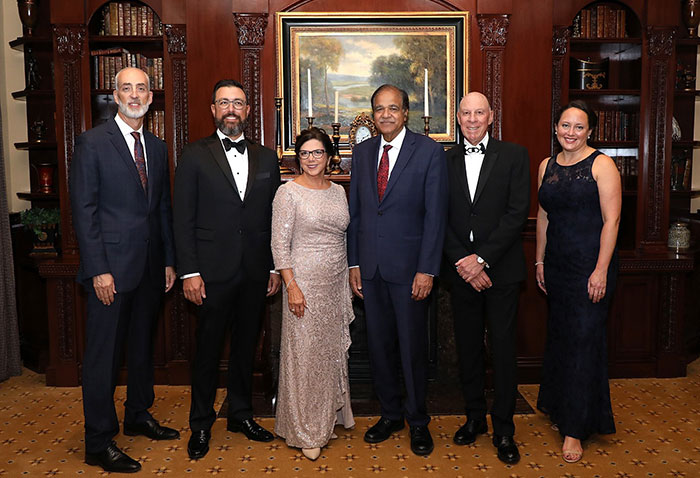
Picture : TheUNN

Born in Chennai on January 2, 1940, Srinivasa Varadhan is known for his fundamental contributions to probability theory. The Mathematics professor was awarded the 2007 Abel Prize by the Norwegian Academy of Sciences and Letters “for his fundamental contributions to probability theory and in particular for creating a unified theory of large deviations”.

Armed with a master’s degree (1960) from the University of Madras, Varadhan earned his doctorate (1963) from the Indian Statistical Institute in Calcutta. In 1963, Varadhan came from India as a postdoctoral fellow to the Courant Institute in New York and never left. He is currently Professor of Mathematics and Frank J Gould Professor of Science at the Courant Institute of Mathematical Sciences.

He was awarded the Birkhoff Prize (1994), the Margaret and Herman Sokol Award of the Faculty of Arts and Sciences, New York University (1995), and the Leroy Steele Prize (1996). In 2008, the Indian government awarded him the Padma Bhushan.

Associated with the University of British Columbia, Canada, Sujatha Ramdorai is an algebraic number theorist known for her work on the Iwasawa theory. She is the first Indian to win the prestigious International Centre for Theoretical Physics Ramanujan Prize in 2006 and also a winner of the Shanti Swarup Bhatnagar Award in 2004.

She is also the recipient of the 2020 Krieger-Nelson Prize for her exceptional contributions to mathematics research. Having served at the National Knowledge Commission from 2007-2009, Ramdorai is currently a Member of the Scientific Advisory Council to the Prime Minister of India and a Member of the National Innovation Council.

She completed her B.Sc. in 1982 from St Joseph’s College, Bengaluru, and then got her MSc from Annamalai University in 1985. Ramdorai did her Ph.D in the area of Quadratic forms over function fields and Witt rings of varieties from Tata Institute of Fundamental Research.

The Padma Awards are conferred by the President of India usually around March/April every year. This year, a total of 106 Padma awards will be conferred to personalities across varied disciplines.

The Awards are given in three categories: Padma Vibhushan (for exceptional and distinguished service), Padma Bhushan (distinguished service of higher order) and Padma Shri (distinguished service).

The Top 50 Most Visited Websites In The World

If we were to rank all of these websites according to their traffic numbers, we would see a classic power law distribution. At the low end, the vast majority of these websites would be inactive, receiving little to no traffic. On the upper end of the ranking though, a handful of websites receive the lion’s share of internet traffic.

Estimates vary, but there are upwards of two billion websites in existence in 2023. This visualization, using data from SimilarWeb, takes a look at the 50 websites that currently sit at the top of the ranking.

Which Websites Get the Most Traffic?

Topping the list of most-visited websites in the world is, of course, Google. With over 3.5 billion searches per day, Google has cemented its position as the go-to source for information on the internet. But Google’s dominance doesn’t stop there. The company also owns YouTube, the second-most popular website in the world. Together, Google and YouTube have more traffic than the next 48 websites combined.

The power of YouTube, in particular, is sometimes not fully understood. The video platform is the second largest search engine in the world after Google. As well, YouTube has the second highest duration-of-visit numbers in this top 50 ranking. (First place goes to the Chinese video sharing website, Bilibili.)

But Google and YouTube aren’t the only big players on the internet. Other websites in the top 50 ranking include social media giants Facebook, Instagram, and TikTok. In particular, TikTok has seen a surge in popularity in recent years and is now one of the most popular social media platforms in the world.

Here’s the full top 50 ranking table form:

Rank Website Monthly Traffic Category Country
#1 google.com 85.1B Search Engines U.S.
#2 youtube.com 33.0B Streaming & Online TV U.S.
#3 facebook.com 17.8B Social Media Networks U.S.
#4 twitter.com 6.8B Social Media Networks U.S.
#5 instagram.com 6.1B Social Media Networks U.S.
#6 baidu.com 5.0B Search Engines China
#7 wikipedia.org 4.8B Dictionaries & Encyclopedias U.S.
#8 yandex.ru 3.4B Search Engines Russia
#9 yahoo.com 3.3B News & Media Publishers U.S.
#10 whatsapp.com 2.9B Social Media Networks U.S.

Showing 1 to 10 of 50 entries

Notable companies that have fallen out of the top 50 since our last version of this visualization are Walmart and PayPal. Notable entrants into the top 50 are Samsung and the New York Times.

The Geography of the 50 Most-Visited Websites

The United States is still home base for many of the world’s biggest websites, taking up 30 spots on this ranking. Of these 30 websites, half are operated by Big Tech companies such as Microsoft, Amazon, Alphabet, Meta, and Netflix.

Russia, China, Japan, and South Korea round out the top five.

Things get interesting in the “other” category, which includes six websites. Two spots are taken up by Aaj Tak and Globo, which are large media publications in India and Brazil, respectively.

The remaining four websites—XVideos, PornHub, XHamster, and XNXX—specialize in adult content, and are located in a variety of countries. These are often referred to as “tube sites” since they are built on the YouTube model.

Realsrv, the only adult-oriented site in the top 50 located in the U.S., is interesting to delve into as well, since it’s far from a household name. The website essentially supports advertising efforts by redirecting users away from the content they were viewing over to another page (generally premium adult content). This is one of the key ways that adult websites earn revenue.

Avinash Gupta Appointed To NJ’s Ocean County Board Of Health

Dr. Avinash Gupta, an Indian American cardiologist, has been appointed a member of the Ocean County Board of Health. The appointment took place at the regular meeting of the Board of Commissioners of Ocean County in New Jersey on Jan. 18, 2023, as per the news release.

“Gupta is looking forward to promoting public health in Ocean County,” the release stated. Specialized in Cardiology, Nuclear Cardiology, and Clinical Lipidology, he has practiced the domain for almost three decades in Lakewood, New Jersey.

Dr. Gupta is very active in community service and has served as President of the Monmouth Ocean County Association of Physicians from India (MOCAAPI) and Bihar Jharkhand Association of North America (BJANA).

Picture : TheUNN

He also holds the prestigious title of Chief of Cardiology at Monmouth Medical Center and President of the Medical Staff at Monmouth Medical Center Southern Campus.
He is chairman of Shree Siddhivinayak Temple of USA, Indian Cultural & Community Center in Toms River, and was recently elected as Executive Vice President of FIA.

Dr. Gupta was recently honored for his exemplary work in public health and social service, especially for COVID-19-related relief and humanitarian work in India and the US. “Being involved with community groups and helping others has always been my passion. Community service is very rewarding and fulfilling. It has enriched me as a person,” said Gupta who received the humanitarian award from the Monmouth Medical Center-Southern Campus Gupta at a function in New Jersey on Diwali eve.

He has been married to his wife, Dr. Geeta Gupta for over 35 years.  They have one son, Abhinav who is currently in his surgical residency. Dr. Gupta has made numerous contributions to healthcare, including initiatives both in the local area and in India to promote vaccinations against COVID-19. He was recognized as an honoree at MMCSC Humanitarian Gala in October last year.

Parveen Chopra’s Wellness And Spirituality Magazine Launched In New York

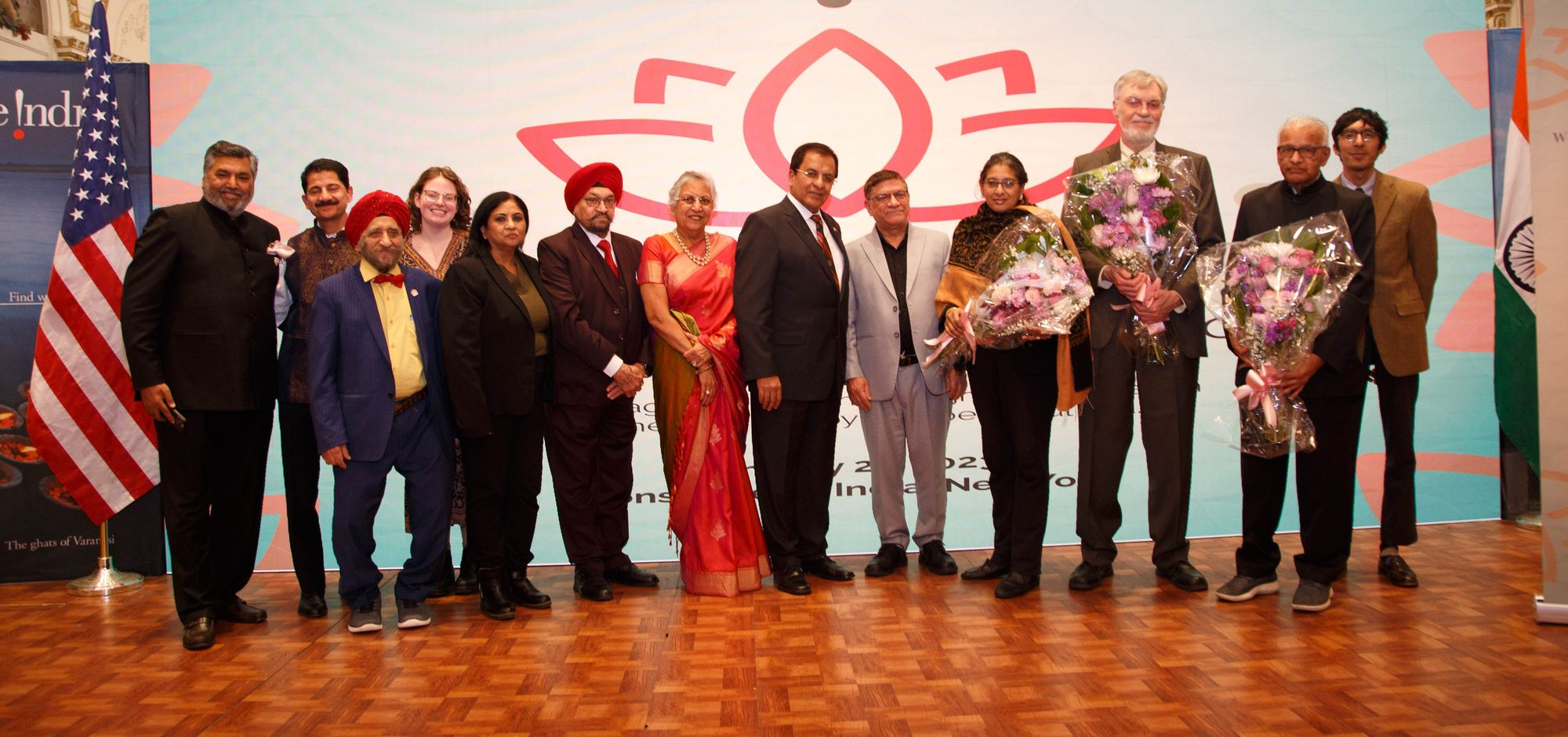
Renowned Indian American media personality, Parveen Chopra’s new wellness and spirituality magazine was launched in a ceremony hosted by the Indian Consulate in New York on January 21, 2023.

The new venture, Lotus in the Mud, offers insights and inspiration for people to be healthy, happy and peaceful, a news release noted. The online site, alotusinthemud.com offers insights and inspiration for people to be healthy, happy and peaceful, according to a press release from Chopra, who explained that the name, ‘Lotus in the mud’ is a key concept in Hinduism and Buddhism, signifying that one may get caught up in problems, but that people have an inherent capability to emerge in full bloom.

At the launch event, India’s Consul General Randhir Jaiswal called the initiative “another slice of India in America promoting wellness through yoga, right food habits, etc, and which people should benefit from.”

Consul General Randhir Jaiswal unveiled the website during the ceremony, describing it as “another slice of India in America promoting wellness through yoga, right food habits, etc, and which people should benefit from.”

Chopra said Lotus In The Mud carried the collective wisdom  of many like-minded writers, experts and advisers. “We tap the world’s religious and spiritual traditions for wisdom as well as modern medical and scientific research to present content for people to be fully productive and successful and yet be healthy, happy and centered,” he explained.

Picture : TheUNN

Subjects covered on the site range from ‘The big questions of life as answered by Hinduism, ‘The 4 happy hormones and how to boost them’, ‘Practical uses of faith – a Zoroastrian perspective’, and ‘Beware  the frozen food convenience’ etc. It also offers short meditations,  personality quizzes and space for visitors to share their experiences of healing and personal/spiritual growth.

Guest speakers at the event included Nitin Ajmera, chairman of the Parliament of the World’s Religions; Arvind Vora, founder of Shanti Fund that promotes Mahatma Gandhi’s ideals among school children in Long Island, NY; Reverend Tom Goodhue, emeritus Executive Director of Long Island Council of Churches; and Dr Bhaswati Bhattacharya, author of the bestselling book Everyday Ayurveda.

Chopra’s biography describes him as a trained teacher of meditation, founder of  Life Positive, India’s first body-mind-spirit magazine from New Delhi in 1996. In the United States, he has edited The South Asian Times for more than a decade and One World Under God interfaith journal. The web magazine is published by American Center for Wellness & Spirituality Inc, a non-profit established by Chopra.

The Lotus launch at the Consulate followed felicitation of The South Asian Times (TSAT) Person of the Year 2022, Anil Bansal, former president of the Federation of Indian Associations NYNJCT.

India, Pakistan Were ‘Too Close’ To Nuclear Conflagration: Pompeo

India and Pakistan came “too close” to a nuclear conflagration during the 2019 confrontation with both sides believing the other was preparing to deploy nuclear weapons, according to former US Secretary of State Mike Pompeo.

He recounted in his book, “Never Give an Inch”, his frantic night-time diplomatic efforts to get the neighbours to stand down after getting a call from his “Indian counterpart” warning him that he believed Pakistan was readying nuclear weapons for a strike and India was considering its own escalation.

The External Affairs Minister, during the crisis set off by the terrorist attack that killed 46 Central Reserve Police Force personnel and the Indian strike on a terrorist base inside Pakistan in Balakot in February 2019, was the late Sushma Swaraj.

“I do not think the world properly knows just how close the India-Pakistan rivalry came to spilling over in a nuclear conflagration,” Pompeo wrote.

But, he added: “the truth is, I don’t know precisely the answer either. I just know it was too close”.

He was woken up at night while he was on a visit to Hanoi with a call from his “Indian counterpart” who told him that “he believed the Pakistanis had begun to prepare their nuclear weapons for a strike”.

“India, he informed me, was contemplating its own escalation. I asked him to do nothing and give us a minute to sort things out,” Pompeo wrote.

Working with John Bolton, who was then the US National Security Adviser, from their Hanoi hotel room he “reached the actual leader of Pakistan. General (Qamer Javed) Bajwa”, he wrote.

“I told him what the Indians had told me. He said it wasn’t true. As one might expect, he believed the Indians were preparing their own nuclear weapons for deployment.

“It took us a few hours, and remarkably good work by our teams on the ground in New Delhi and Islamabad, to convince each side that neither was to convince each side or the other was not preparing for nuclear war,” Pompeo added.

Taking credit for the de-escalation, he wrote: “No other nation could have done that, but we did that night to avoid a horrible outcome.”

He acknowledged the work of Kenneth Juster, who was the then US envoy in New Delhi, calling him “an incredibly capable ambassador” who “loves India and its people”.

Pompeo, who was the director of the Central Intelligence Agency before becoming the Secretary of State, recounted in the book his four years in former President Donald Trump’s cabinet.

The book subtitled, “Fighting for the America I Love”, lays out how he aggressively implemented Trump’s ‘America First’ vision.

Writing about his efforts to deepen ties with New Delhi, Pompeo wrote that he “made India the fulcrum of my diplomacy to contract Chinese aggression”.

“I chose to devote serious quantities of time and effort to make India the next great American ally,” he added. (IANS)

India Wins 3 Oscar Nominations

India received three nominations for Best Original Song (‘Naatu Naatu’ from ‘RRR’), Best Documentary Feature Film (‘All That Breathes’), and Best Documentary Short Film (‘The Elephant Whisperers’).

The Oscars are going to be held on March 13 this year and while the wait is going to be quite a long one from now, the nominations have sure lifted the spirits of not just the crew and cast of the films mentioned above, but also of everyone who hopes to see an Indian movie bagging the prestigious award.

Actor Jacqueline Fernandez penned down a heartfelt note last week as her film ‘Tell It Like A Woman’s song ‘Applause’ recently bagged an Oscar nomination in the ‘Best Original Song’ category.

The song is competing against ‘RRR’s ‘Naatu Naatu’, ‘Hold My Hand’ from the movie ‘Top Gun: Maverick,’ ‘Lift me Up’ from ‘Black Panther: Wakanda Forever,’ and ‘This Is Life,’ from ‘Everything, Everywhere All At Once’. The actor also congratulated the team ‘RRR’ for their Oscar nomination.

“Also big congratulations to Team RRR for Naatu Naatu nomination!!! My best wishes and love to the entire team and all the nominees,” the caption further reads.

Taking to Instagram, the ‘Kick’ actor shared a post which she captioned, “Beyond words right now Congratulations to @dianewarren @sofiacarson for the Oscar nomination for ‘Applause’ and making us all proud! It was an honor to be associated with this beautiful film ‘Tell it like a woman’ alongside such esteemed artists! Thank you @leenaclicks @chiaratilesi @lucasakoskin @andreaiervolinoproducer @wditogether @aseematographer @arrahman.”

The nominations for the upcoming 95th edition of Academy Awards were announced on last week by hosts Riz Ahmed and Allison Williams, with ‘The Banshees of Inisherin’ leading the pack with as many as nine nominations.

The Colin Farrell-starrer film got nominated in the following categories — Best Supporting Actor (two nominations), Best Supporting Actress, Best Actor, Best Director, Best Original Score, Best Picture, Best Editing and Best Original Screenplay.

‘The Fabelmans’ received seven nominations followed by ‘Tar’ and ‘TopGun: Maverick’ (six each), ‘Black Panther: Wakanda Forever’ (five), ‘Avatar’ (four), and ‘The Whale’ (three).

Competing for the best picture are ‘All Quiet on the Western Front’, ‘Avatar: The Way of Water’, ‘The Banshees of Inisherin’, ‘Elvis’, ‘Everything Everywhere All at Once’, ‘The Fabelmans’, ‘Tar’, ‘Top Gun: Maverick’, ‘Triangle of Sadness’ and ‘Women Talking’.

The 95th Academy Awards is set to be presented at the Dolby Theatre in Los Angeles on March 12. Jimmy Kimmel will be seen back as the host, after previously leading the awards show in 2017 and 2018. Last year, the Oscars returned to a host format with Amy Schumer, Wanda Sykes and Regina Hall, after going host-less the previous two years due to the Covid-19 pamdemic.

Here is the complete list of nominations:

* Best Supporting Actor

Brendan Gleeson (‘The Banshees of Inisherin’)

Brian Tyree Henry (‘Causeway’)

Judd Hirsch (‘”The Fabelmans’)

Barry Keoghan (‘The Banshees of Inisherin’)

Ke Huy Quan (‘Everything Everywhere All at Once’)

* Best Supporting Actress

Angela Bassett (‘Black Panther: Wakanda Forever’)

Hong Chau (‘The Whale’)

Kerry Condon (‘The Banshees of Inisherin’)

Jamie Lee Curtis (‘Everything Everywhere All at Once’)

Stephanie Hsu (‘Everything Everywhere All at Once’)

* Best Animated Feature Film

‘Guillermo del Toro’s Pinocchio’, Guillermo del Toro, Mark Gustafson, Gary Ungar and Alex Bulkley

‘Marcel the Shell With Shoes On’, Dean Fleischer Camp, Elisabeth Holm, Andrew Goldman, Caroline Kaplan and Paul Mezey

‘Puss in Boots: The Last Wish’, Joel Crawford and Mark Swift

‘The Sea Beast’, Chris Williams and Jed Schlanger

‘Turning Red’, Domee Shi and Lindsey Collins

* Best Animated Short Film

‘The Boy, the Mole, the Fox and the Horse’, Charlie Mackesy and Matthew Freud

‘The Flying Sailor’, Amanda Forbis and Wendy Tilby

‘Ice Merchants’, Joao Gonzalez and Bruno Caetano

‘My Year of Dicks’, Sara Gunnarsdottir and Pamela Ribon

‘An Ostrich Told Me the World Is Fake and I Think I Believe It’, Lachlan Pendragon

* Best Costume Design

‘Babylon’, Mary Zophres

‘Black Panther: Wakanda Forever’, Ruth Carter

‘Elvis’, Catherine Martin

‘Everything Everywhere All at Once’, Shirley Kurata

‘Mrs. Harris Goes to Paris’, Jenny Beavan

* Best Live Action Short

‘An Irish Goodbye’, Tom Berkeley and Ross White

‘Ivalu’, Anders Walter and Rebecca Pruzan

‘Le Pupille’, Alice Rohrwacher and Alfonso Cuaron

‘Night Ride’, Eirik Tveiten and Gaute Lid Larssen

‘The Red Suitcase’, Cyrus Neshvad

* Best Makeup and Hairstyling

‘All Quiet on the Western Front’, Heike Merker and Linda Eisenhamerova

‘The Batman’, Naomi Donne, Mike Marino and Mike Fontaine

‘Black Panther: Wakanda Forever’, Camille Friend and Joel Harlow

‘Elvis’, Mark Coulier, Jason Baird and Aldo Signoretti

‘The Whale’, Adrien Morot, Judy Chin and Anne Marie Bradley

* Best Original Score

‘All Quiet on the Western Front’, Volker Bertelmann

‘Babylon’, Justin Hurwitz

‘The Banshees of Inisherin’, Carter Burwell

‘Everything Everywhere All at Once’, Son Lux

‘The Fabelmans’, John Williams

* Best Sound

‘All Quiet on the Western Front’, Viktor Prasil, Frank Kruse, Markus Stemler, Lars Ginzel and Stefan Korte

‘Avatar: The Way of Water’, Julian Howarth, Gwendolyn Yates Whittle, Dick Bernstein, Christopher Boyes, Gary Summers and Michael Hedges

‘The Batman’, Stuart Wilson, William Files, Douglas Murray and Andy Nelson

‘Elvis’, David Lee, Wayne Pashley, Andy Nelson and Michael Keller

‘Top Gun: Maverick’, Mark Weingarten, James H. Mather, Al Nelson, Chris Burdon and Mark Taylor

* Best Adapted Screenplay

‘All Quiet on the Western Front’, Screenplay by Edward Berger, Lesley Paterson & Ian Stokell

‘Glass Onion: A Knives Out Mystery’, Written by Rian Johnson

‘Living’, Written by Kazuo Ishiguro

‘Top Gun: Maverick’, Screenplay by Ehren Kruger and Eric Warren Singer and Christopher McQuarrie; Story by Peter Craig and Justin Marks

‘Women Talking’, Screenplay by Sarah Polley

* Best Original Screenplay

‘The Banshees of Inisherin’, Written by Martin McDonagh

‘Everything Everywhere All at Once’, Written by Daniel Kwan & Daniel Scheinert

‘The Fabelmans’, Written by Steven Spielberg & Tony Kushner

‘Tar’, Written by Todd Field

‘Triangle of Sadness’, Written by Ruben Ostlund

* Best Cinematography

‘All Quiet on the Western Front’, James Friend

‘Bardo, False Chronicle of a Handful of Truths’, Darius Khondji

‘Elvis’, Mandy Walker

‘Empire of Light’, Roger Deakins

‘Tar’, Florian Hoffmeister

* Best Documentary Feature Film

‘All That Breathes’, Shaunak Sen, Aman Mann and Teddy Leifer

‘All the Beauty and the Bloodshed’, Laura Poitras, Howard Gertler, John Lyons, Nan Goldin and Yoni Golijov

‘Fire of Love’, Sara Dosa, Shane Boris and Ina Fichman

‘A House Made of Splinters’, Simon Lereng Wilmont and Monica Hellstrom

‘Navalny’, Daniel Roher, Odessa Rae, Diane Becker, Melanie Miller and Shane Boris

* Best Documentary Short Film

‘The Elephant Whisperers’, Kartiki Gonsalves and Guneet Monga

‘Haulout’, Evgenia Arbugaeva and Maxim Arbugaev

‘How Do You Measure a Year?’ Jay Rosenblatt

‘The Martha Mitchell Effect’, Anne Alvergue and Beth Levison

‘Stranger at the Gate’, Joshua Seftel and Conall Jones

* Best Editing

‘The Banshees of Inisherin’, Mikkel E.G. Nielsen

‘Elvis’, Matt Villa and Jonathan Redmond

‘Everything Everywhere All at Once’, Paul Rogers

‘Tar’, Monika Willi

‘Top Gun: Maverick’, Eddie Hamilton

* Best International Feature Film

‘All Quiet on the Western Front’ (Germany)

‘Argentina, 1985’ (Argentina)

‘Close’ (Belgium)

‘EO’ (Poland)

‘The Quiet Girl’ (Ireland)

* Best Original Song

‘Applause’ from ‘Tell It Like a Woman’, Music and Lyric by Diane Warren

‘Hold My Hand’ from ‘Top Gun: Maverick’, Music and Lyric by Lady Gaga and BloodPop

‘Lift Me Up’ from ‘Black Panther: Wakanda Forever’, Music by Tems, Rihanna, Ryan Coogler and Ludwig Goransson; Lyric by Tems and Ryan Coogler

‘Naatu Naatu’ from ‘RRR’, Music by M.M. Keeravaani; Lyric by Chandrabose

‘This Is a Life’ from ‘Everything Everywhere All at Once’, Music by Ryan Lott, David Byrne and Mitski; Lyric by Ryan Lott and David Byrne

* Best Production Design

‘All Quiet on the Western Front’, Production Design: Christian M. Goldbeck; Set Decoration: Ernestine Hipper

‘Avatar: The Way of Water’, Production Design: Dylan Cole and Ben Procter; Set Decoration: Vanessa Cole

‘Babylon’, Production Design: Florencia Martin; Set Decoration: Anthony Carlino

‘Elvis’, Production Design: Catherine Martin and Karen Murphy; Set Decoration: Bev Dunn

‘The Fabelmans’, Production Design: Rick Carter; Set Decoration: Karen O’Hara

* Best Visual Effects

‘All Quiet on the Western Front’, Frank Petzold, Viktor Muller, Markus Frank and Kamil Jafar

‘Avatar: The Way of Water’, Joe Letteri, Richard Baneham, Eric Saindon and Daniel Barrett

‘The Batman’, Dan Lemmon, Russell Earl, Anders Langlands and Dominic Tuohy

‘Black Panther: Wakanda Forever’, Geoffrey Baumann, Craig Hammack, R. Christopher White and Dan Sudick

‘Top Gun: Maverick’, Ryan Tudhope, Seth Hill, Bryan Litson and Scott R. Fisher

* Best Lead Actor

Austin Butler (‘Elvis’)

Colin Farrell (‘The Banshees of Inisherin’)

Brendan Fraser (‘The Whale’)

Paul Mescal (‘Aftersun’)

Bill Nighy (‘Living’)

* Best Lead Actress

Cate Blanchett (‘Tar’)

Ana de Armas (‘Blonde’)

Andrea Riseborough (‘To Leslie’)

Michelle Williams (‘The Fabelmans’)

Michelle Yeoh (‘Everything Everywhere All at Once’)

* Best Director

Martin McDonagh (‘The Banshees of Inisherin’)

Daniel Kwan, Daniel Scheinert (‘Everything Everywhere All at Once’)

Steven Spielberg (‘The Fabelmans’)

Todd Field (‘Tar’)

Ruben Ostlund (‘Triangle of Sadness’)

* Best Picture

‘All Quiet on the Western Front’, Malte Grunert, Producer

‘Avatar: The Way of Water’, James Cameron and Jon Landau, Producers

‘The Banshees of Inisherin’, Graham Broadbent, Pete Czernin and Martin McDonagh, Producers

‘Elvis’, Baz Luhrmann, Catherine Martin, Gail Berman, Patrick McCormick and Schuyler Weiss, Producers

‘Everything Everywhere All at Once’, Daniel Kwan, Daniel Scheinert and Jonathan Wang, Producers

‘The Fabelmans’, Kristie Macosko Krieger, Steven Spielberg and Tony Kushner, Producers

‘Tar’, Todd Field, Alexandra Milchan and Scott Lambert, Producers

‘Top Gun: Maverick’, Tom Cruise, Christopher McQuarrie, David Ellison and Jerry Bruckheimer, Producers

‘Triangle of Sadness’, Erik Hemmendorff and Philippe Bober, Producers

‘Women Talking’, Dede Gardner, Jeremy Kleiner and Frances McDormand, Producers

Famous Mughal Gardens At India’s Rashtrapati Bhavan To Be Renamed

The world famous Mughal Gardens at the President’s official home, Rashtrapati Bhavan in New Delhi is being renamed with a common name as part of the “Azadi Ka Amrit Mahotsav” celebrations. The old road sign that said “Mughal Gardens” was removed and taken away in a bulldozer last week.

“On the occasion of the celebrations of 75 years of Independence as Azadi Ka Amrit Mahotsav, the President of India has given a common name to the Rashtrapati Bhavan Gardens as Amrit Udyan,” Deputy Press Secretary to the President Navika Gupta said.

While the BJP said the renaming shreds yet another symbol of colonialism, the opposition parties advised the government to focus on creating jobs and controlling inflation instead. The Congress did not officially react to the name change, but the Trinamool Congress and CPI rubbished the move, with the Left party terming it an “attempt to rewrite history”.

“Who knows, they might now want to rename the Eden Gardens and call it Modi Gardens! They should focus on creating jobs, controlling inflation and protecting the precious resources of LIC and SBI,” Trinamool Congress’ Parliamentary party leader in the Rajya Sabha Derek O’Brien told news agency PTI. CPI general secretary D Raja said this name change has been going on for quite some time and “no one knows when it will end”.

There are three gardens in the Rashtrapati Bhavan, inspired by Mughal and Persian gardens. The public and the authorities started calling the one inspired by a garden with the same name in Jammu and Kashmir’s Srinagar as “Mughal Gardens”. But the gardens were never officially named “Mughal Gardens”.

Spread over 15 acre, Amrit Udyan has often been portrayed as the soul of the presidential palace. Amrit Udyan draws its inspiration from the Mughal Gardens in Jammu and Kashmir, the gardens around the Taj Mahal and even miniature paintings of India and Persia, according to the Rashtrapati Bhavan’s website.

“The Amrit Udyan had up till now been opened for the public only during the annual festival, Udyan Utsav, held in the months of February-March. But the gardens, which forms the third circuit of the Rashtrapati Bhavan tour, will now be open for the public from August till March,” the Rashtrapati Bhavan’s website says.

“Welcome and thank President Droupadi Murmu ji for renaming the iconic gardens at the President House as Amrit Udyan. This new name not only shreds yet another symbol of colonial relic but also reflects India’s aspirations for the amrit kaal,” Union Minister Dharmendra Pradhan tweeted.

The old road sign that said “Mughal Gardens” was removed with a bulldozer and a new board that said “Amrit Udyan” was installed.

Harmeet Dhillon Loses To GOP Chair Ronna Mcdaniel In Fierce Campaign

Republican National Committee Chair Ronna McDaniel won her bid against rival Harmeet Dhillon, a California lawyer and a person of Indian origin on January 27th to lead the GOP for two more years, prevailing in an election that highlighted fierce internal divisions that threaten to plague the party into the next presidential season.

Ronna McDaniel, whom Donald Trump tapped as RNC chair in 2016, won on the secret ballot, 111 to 51, over Harmeet Dhillon, a California lawyer. The high-profile election played out inside a resort on the Southern California coast as the RNC’s 168 voting members – activists and elected officials from all 50 states – gathered for their annual winter meeting.

The party is not united,” McDaniel’s chief rival, Trump attorney Dhillon, told reporters in the hallway soon after standing alongside McDaniel on stage. “Nobody’s going to unite around the party the way it is, which is seemingly ignoring the grassroots.”

A relieved McDaniel invited her rivals to the stage immediately after the outcome was announced. “With us united, and all of us working together, the Democrats are going to hear us in 2024,” she declared.

With the victory, McDaniel becomes the longest-serving RNC chair since the Civil War. While the vote itself wasn’t as close as some had expected, friends and foes alike agree that she will not be leading the RNC from a position of strength.

Picture : TheUNN

Indeed, while Trump privately backed McDaniel, powerful forces within his “Make America Great Again” movement lined up behind Dhillon. Backed by MAGA leaders in conservative media, Dhillon waged an aggressive challenge against McDaniel that featured allegations of chronic misspending, mismanagement and even religious bigotry against Dhillon’s Sikh faith — all claims that McDaniel denied. Above all, the case against McDaniel centered on deep dissatisfaction with the direction of the party after continuous election losses since Trump chose her to lead the committee following his upset 2016 victory.

The former president ignored the feud as he congratulated McDaniel on her “big WIN” on his social media network.

“Now we have to STOP THE DEMOCRATS FROM CHEATING IN ELECTIONS!” Trump wrote in capital letters, repeating baseless allegations of election fraud that have filled his political messaging for the past two years.

But some of Trump’s acolytes were not so willing to move on. Conservative activist Charlie Kirk cited the Republican base’s overwhelming desire for change and said those members who voted for McDaniel would be held “accountable.”

“The RNC has contempt for their voters,” said Kirk, who sat among several Dhillon allies in the back of the hotel ballroom where the vote was held. “They basically just gave them a middle finger.”

While McDaniel prevailed, some of her supporters privately conceded they were open to a change in the committee’s leadership after three successive disappointing elections. But there were specific concerns about Dhillon – and the people around her.

The California Republican closely aligned herself with Caroline Wren, a former Trump fundraiser who was involved with raising money for the Washington rally on Jan. 6, 2021,that preceded the violent attack on the Capitol.

Dhillon’s chief surrogate at the RNC meeting this week was Kari Lake, the failed Arizona gubernatorial candidate who has spread debunked claims of voter fraud. Lake courted RNC members on Dhillon’s behalf inside the conference hotel.

From afar, Florida Gov. Ron DeSantis, a likely 2024 presidential contender, spoke out against McDaniel on the eve of the vote as well. “I think we need a change. I think we need to get some new blood in the RNC,” DeSantis said in an interview with Florida’s Voice, citing three “substandard election cycles in a row” under McDaniel’s leadership.

Meanwhile, Trump had quietly supported McDaniel, a niece of Republican Sen. Mitt Romney of Utah, and dispatched a handful of his lieutenants to Southern California to advocate on her behalf.

The former president avoided making a public endorsement at McDaniel’s request, according to those with direct knowledge of the situation who spoke on condition of anonymity to describe private conversations. McDaniel’s team was confident she would win without his public backing, allowing her to maintain a sense of neutrality heading into the 2024 presidential primary season.

According to its rules, the RNC must remain neutral in the presidential primary. Trump is the only announced GOP candidate so far, but other high-profile contenders are expected in the coming months.

Also in the race on Friday was MyPillow CEO Mike Lindell, a pro-Trump conspiracy theorist who won four votes. Lindell has already endorsed Trump’s 2024 campaign and said he would not change his mind if his longshot bid was successful Friday. “I’ve never not endorsed Donald Trump,” Lindell said. “I’m never moving off that space.”

McDaniel is now set to lead the RNC through the 2024 election. Under her leadership, the committee will control much of the presidential nominating process – including the debates and voting calendar — while directing the sprawling nationwide infrastructure designed to elect a Republican president.

After “PATHAN” Siddharth Anand Wants To Create More Spectacles For Bollywood Viewers

YRF’s Pathaan has become a historic hit at the box office and director Siddharth Anand is definitely one of the biggest directors of this generation in India. The film-maker, who has been backed by Aditya Chopra, to direct two towering blockbusters WAR and now Pathaan from YRF’s Spy Universe, says he is feeling greatly overwhelmed after creating history at the box office.

Siddharth says, “Scripting history. Everyone wants it, but one cant plan it. It just happens. And when it does, it’s actually a very humbling experience. I’m feeling incredibly overwhelmed right now and inspired to get back on the film set and try and create something really special for audiences again. That’s my state of mind.“

With Pathaan, Siddharth Anand becomes the only Hindi film director to have two back to back 50 crore+ openers under his credit.

He says, “I’m hungrier than before to create more spectacles and immersive experiences like Pathaan. For me, yes numbers do matter. It is a validation of all the hard work but film-making is also a team game. So, I share this incredible moment with the entire cast and crew of Pathaan. Each one of us believed in a vision to create a never seen before theatrical experience that cuts across the length and breadth of the country and I’m glad we delivered on this promise.”

Pathaan has so far created 21 new records!

1. Highest Grossing Day In The History of Hindi Cinema, Set Consecutively On Day 1 & Day 2.

2. Only Hindi Film To Breach ₹ 55 Cr NBOC Barrier, Set on Day 1.

3. Only Hindi Film To Breach ₹ 70 Cr NBOC Barrier, Set on Day 2.

4. Fastest Hindi Film To Record ₹ 100 Cr NBOC, Set on Day 2.

5. Only Hindi Film To Breach ₹ 50 Cr NBOC Barrier On Two Consecutive Days, Set on Day 2.

6. Sets Circuit Record In Every Film Circuit of India, Set on Day 2.

7. Widest Hindi Release of All Time In India, Set on Day 1.

8. Highest Grossing Opening Day For A Hindi Film Post Covid 19 Pandemic, Set Consecutively on Day 1 & Day 2.

9. Highest Grossing First Day For A Non Holiday Release, Set on Day 1.

10. Highest Grossing Second Day In The History of Hindi Cinema, Set on Day 2.

11. YRF is The Only Film Studio In India To Breach ₹ 50 Cr NBOC Barrier With A Hindi Film, Set in Years 2018, 2019 & 2023.

12. YRF Has Recorded Collections In Excess of ₹ 50 Cr NBOC Four Times in The Last 4 Years.

13. 3rd YRF Film To Cross ₹ 50 Cr+ Net Box Office Collections On The 1st Day after “WAR” and “THUGS OF HINDOSTAN”.

14. 3rd YRF SPY UNIVERSE FILM To Set An Opening Day Record After “EK THA TIGER” & “WAR”.

15. Highest Grossing First Day & Second Day for Shah Rukh Khan.

17. Highest Grossing First Day & Second Day for Deepika Padukone.

18. Highest Grossing First Day & Second Day for John Abraham.

19. Highest Grossing First Day & Second Day for Siddharth Anand.

20. Highest grossing First Day & Second Day for Yash Raj Films.

21. Highest grossing First Day & Second Day for YRF Spy Universe Films.

Siddharth says, “With War and now Pathaan, we, the Hindi film industry have given films that have pan India appeal. I have always believed that cinema has no language. Cinema is about an emotion and if it connects with people, it can really go to dizzying heights and that’s what’s happening with Pathaan.”

Siddharth is happy that Indian cinema is flourishing and creating new benchmarks with landmark global hits. He says, “Today is a victory of Indian cinema because we are all Indians first. It is such an exciting phase for our country that films from across India are making records, breaking records and most importantly entertaining the people of our country globally!”

YRF’s Pathaan is a historic hit as it collected 113.6 crore gross on day 2, taking the total worldwide collection to an astronomical 219.6 crore gross! Pathaan has become a must watch theatrical entertainer which is being celebrated across the nation. Pathaan, is part of Aditya Chopra’s ambitious spy universe and has the biggest superstars of the country Shah Rukh Khan, Deepika Padukone and John Abraham in it.

FARAAZ Opens February 3rd

Directed by National Award winner Hansel Mehta, the new thriller FARAAZ releases in North American theaters on February 3. Based on the real-life attack that ravaged a Dhaka cafe, the gripping film is a tense hostage drama that unfolds over one claustrophobic night.

The Great War of civilization cemented its polarization in the post 9/11 world. The horror was psychological as well as empirical in the way it defined the idea of survival and humanity in the upcoming decades.

Islam became a word with multiple connotations, an idea whose very existence manifested itself in war games, geo political reassessment and elections. While the Middle East suffered from modern colonialism, the subcontinent went through its own struggles. “Justice” started being meted out by mobs, kitchens were invaded by parochial attitudes and skull caps and beards became a marker of prejudice.

In this context, in a democratic, largely Islamic country, The month of Ramadan was bloodied by the worst terrorist attack Bangladesh had ever witnessed. Around 8pm, 5 boys entered an upscale restaurant opening fire, killing all a dozen hostages in a matter of a few minutes and taking everyone else hostage.

Mortified nationals were glued to their tv sets as the Holy Artisan bakery in Gulshan, Dhaka, was taken hostage along with 50 odd people. The horror unleashed by the terrorists was beyond brutal. And the irony of it all was that the terrorists shared the same faith as the majority of the country, but their approach was medieval to say the least.

The attackers, in their early 20’s, killed people who did not agree with them or who did not align with their religious beliefs. They were sure that they were on God’s mission and fate had chosen them to accomplish this holy war. The message that they wanted to send to the world was that Bangladesh was its new frontier that needed a lesson in Islam.

What followed was almost 12 hours of a harrowing experience where the hostages were surrounded by death, violence and a skewed idea of a religion that has espoused so many contradictions in the world. Security forces stuck in a quagmire, with emotions running high, the bureaucracy behind dealing with a situation of this magnitude and the prayers of multiple Bangladeshi and empathizers from across the globe hoping that the hostages somehow miraculously come out.

Through the film we see the people behind these staunch rhetorics with their own complexes and hidden agendas. Their shortcomings which guise themselves in the name of holy war and the innocent people who become unfortunate victims of religious extremism.

However, we are the stories we choose to tell the world. This is a story of resilience, resistance and rationality. It’s a story where humanity finds itself on the edge of a cliff, a slight push can make it plunge into divisive chaos, only to find its feet in the face of a grave caveat.

FARAAZ

Release Date: February 3

Director: Hansal Mehta

Cast: Zahan Kapoor, Aditya Rawal, Juhi Babbar Soni

Producers: Bhushan Kumar, Krishnan Kumar, Anubhav Sinha, Sahil Saigal, Sakshi Bhatt, Mazahir Mandasaurwala

Film Updates: https://www.facebook.com/RelianceEnt/

Subtitled Trailer: https://youtu.be/aNvVwGAtnLg

An 85-Years-Long Study Throws Light On Making One Happy In 10 Minutes

What makes you genuinely happy? There could be a wide range of answers ranging from closing a big sale or investment, reaching a mountain summit after an arduous hike, or eating a perfect ice cream cone on a hot summer day. But according to what may be the longest-running scientific study of happiness, the Harvard Study of Adult Development, which has been going on for 85 years, the biggest determinant of genuine. long-term happiness isn’t wealth, or accomplishment, or even pleasure. It’s the relationships we form with the people in our lives, in our workplaces, and in our communities that bring us the greatest happiness in the long run.

With that in mind, the New York Times worked with the leader of the Harvard study to create a 7-Day Happiness Challenge as a way to start the new year. The whole challenge is well worth doing. These are the four steps that resonated most with me, and you can do any of them in about 10 minutes, any time of the day.

  1. Plan an 8-minute phone call with a friend.

The Times’ wellness columnist, Jancee Dunn, tried this with a friend of hers and was surprised at how powerfully it lifted her mood. The eight-minute phone call plan solves two ongoing problems with conversations. The first is that most of us “tend to think that in some unspecified future, we’ll have a ‘time surplus,’ where we’ll be able to connect with old friends,” according to Bob Waldinger, the psychiatrist leading the Harvard study who worked with the Times on these challenges. But chances are that “someday” when we think we’ll have lots of time for our friends will never come. So we need to make time right now or risk drifting away from our friendships.

The second is that, as Harvard research has shown, most conversations go on too long–often longer than either party would prefer. So set an eight-minute limit ahead of time–what Dunn calls a “hard out,” guarantees that this won’t happen. It also makes it easy for even a very busy friend to say yes to the call. For instance, Dunn’s friend spent eight minutes talking with her while traveling to the dry cleaner’s.

What surprised Dunn was how much she and her friend were able to talk about in eight minutes. “We talked about our mothers’ health, made birthday plans, gossiped about a friend who abruptly quit his job and moved to a tiny Mexican town, traded book recommendations, and explored the possibility of an afterlife,” she wrote. Perhaps because they had both committed to a tight time limit, they were quick to get the important stuff.

Dunn wrote, “I had missed her, and didn’t realize it until I heard her voice.” This is an important factor, researchers say. Hearing someone’s voice is a more powerful way to connect than texting with them or chatting over social media. So make that eight-minute phone call today, if you can.

  1. Start a conversation with a stranger.

Research has shown that starting a conversation with a stranger increases our happiness, even when we don’t expect that it will. Given that humans are profoundly social creatures and that we all thrive on connection, that shouldn’t really be as surprising as it is. Dunn put this advice to use herself when she asked a neighbor whose dog always barked at her if there was anything she could do to make friends with him. There was, and it was surprisingly simple–all she had to do was take off her hat, because hats upset this particular dog for some reason.

In my own case, a few years back, I struck up a conversation with Shelmina Babai Abji at a cocktail party and we soon became friends and supporters of each others’ careers. At the time we both had book projects we hoped to sell and in some odd twist, both our books came out on the same day. I’m proud to have her endorsement on my book, Career Self-Care.

  1. Get to know someone at work.

Work friends are incredibly important–particularly in the high pressure and long hours that go with starting a business. Yet, experts say, we don’t always recognize the value of these relationships. So choose someone at work you would like to get to know better. This could be an acquaintance who you’d like to turn into a friend, or someone you don’t know at all but would like to get to know.

For someone you don’t yet know, find a bit of common ground. These conversation starters can help. If you like, pay attention to things they may have mentioned in public, perhaps that they are about to give an important presentation or will be attending a family member’s wedding. If you follow up afterward and ask how it went, they’ll be impressed and pleased that you were paying attention and remembered what was going on with them. You’ll have turned that person from a stranger into an acquaintance.

To go from acquaintance to friend, invite them to do something simple that takes only a few minutes, like walk with you to the corner deli to pick up lunch. Or, use the Ben Franklin
effect, and ask them to do you a small and easy favor, a counterintuitive but powerful way to get someone to like you. With most people, this approach will help start you on your way toward being a work friend. If it doesn’t work with this particular person, don’t dwell on it. Just pick someone else and try again.

  1. Send someone a thank you message.

Research shows that this simple gesture creates immediate happiness benefits both for the person doing the thanking and the person receiving the thanks. So, even though it’s not the easiest of these steps, it may be the most important. Take a few minutes to write a note to a friend, a loved one, a family member, or even someone who’s helped you in your career. It can be someone you see all the time, or someone you haven’t spoken to in years.

Imagine that this is the last message you’ll be able to send this person, and write down what you’re grateful for. You don’t need to put a huge amount of thought into this–you can do it in less than 10 minutes, as promised. Now here’s the hard part: Send the message. Whether by email or social media, or snail mail, send it. Don’t worry if the person at the other end hasn’t heard from you for a long time. People are always happy to get a thank you note, even if it’s from someone they haven’t thought about in a long time. Getting it will make them happy, and sending it will make you happy.

If you can, try one of these 10-minute challenges every day next week. Altogether, they will ]take only about an hour of your time. At the end of the week, ask yourself if these small steps made you feel better than you would have without them. If the answer is yes, should you make them part of your routine every week? (https://www.inc.com/minda-zetlin/4-simple-ways-to-make-yourself-really-happy-in-10-minutes-or-less-backed-by-harvard-research.html)

Decorating Deities Is “A Calling” For This Hindu Temple Artist

(AP) — A computer science graduate, S. Goutham quit his job nearly a decade ago to pursue his calling. He has since followed in the footsteps of his ancestors as a fifth-generation decorator of temple deities. The former computer professional — now a very specialized type of artist — locked his gaze on the deity before him.

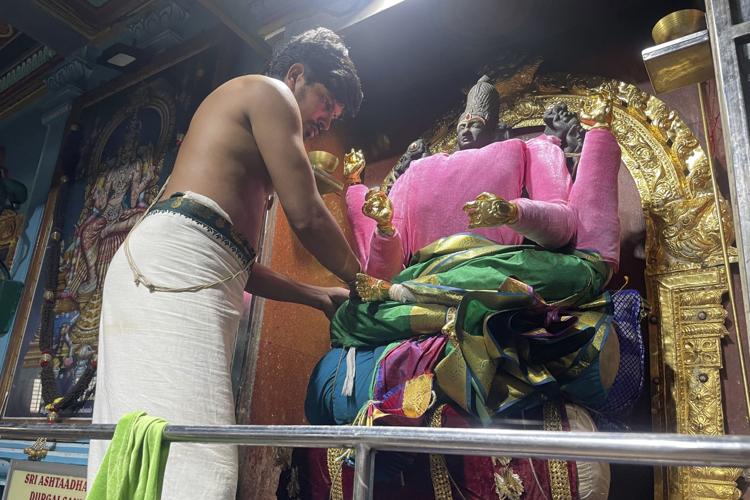
On a recent afternoon, 33-year-old S. Goutham was perched on a ladder at the altar of the goddess Durga at the Anantha Padmanabha Swamy Temple in Chennai, India. Goutham — his hand moving steadily — was pleating a green silk sari to adorn the deity.

“You cannot get tense when you are doing this work,” he says. “You can’t do this if you are not patient. You need to become one with her.”

A computer science graduate, Goutham quit his job nearly a decade ago to pursue his calling. He has since followed in the footsteps of his ancestors as a fifth-generation decorator of temple deities.

Picture : Philedelphia Tribune

In Hindu temples, idols are mostly made of materials such as black granite, white marble or five-metal alloys that have sacred significance. These deities are worshipped as physical, tangible representations of god (Brahman) who is believed to be infinite, omnipresent and beyond comprehension. Worship in a Hindu temple includes bathing these deities in milk, decorating them with colorful clothes, flowers, perfumes such as sandalwood, jewelry, and even weapons such as swords, clubs and tridents. Oil lamps are lit at the altar, and sacred chants and foods are offered to the gods.

Decorating the deities is a millennia-old practice that is described in the Hindu epic Ramayana, and Goutham has been learning the art since he was a toddler. He crafted his first formal decoration when he was 13 — at the very altar where he stood 20 years later on a day in November.

He has done thousands of decorations, ranging from relatively simple ones that take an hour or two to complete, to others that are more complex and take several days.

Goutham said he became interested in decorating deities as a child because of his father. “When you are little, your father is your hero,” he said. “I wanted to be just like him.”

The first lesson Goutham got from his dad was about the weapons each god would hold. He heard stories about the power of each weapon and how gods would wield them. “The personality of the deity and the story of the god or goddess could change depending on their weapons, the clothes they wear, the expression on their face or the position in which they are sitting or standing,” he said.

When he sets out to decorate a deity, Goutham says he has a concept of what to do, but doesn’t start out with a sketch. He goes step by step — placing the deity’s hands, feet and weapons. Then, he moves on to the clothes and jewelry. Gradually, the god’s form manifests.

There are rules about the types of materials that can be used on deities. “The human body is made up of earth, water, fire, air and space, and everything you see naturally occurring on Earth is made of these elements,” Goutham said. “To show this, we decorate deities using things that occur in nature and are a representation of these elements, like copper, cloth, coconut fibers and so on.”

He says decorating a deity combines elements from art, dance and yoga, in terms of the hand gestures and postures the deities assume. Man-made materials such as plastic are prohibited. Goutham says he uses little pins to hold fabric together, but makes sure the pins don’t directly touch the idol.

He sources the deities’ arms and legs, mostly made from copper or brass, as well as the weapons and jewelry, from artisans.

He has also created an app and website for those who wish to learn more about this art and dreams of establishing an institution to train artists who can maintain the sacred tradition. While most deity decorators are men, he sees no reason why women cannot learn and practice it.

“Everyone is equal under god,” he said. Storytelling is an important part of what he does. One of his favorite installations depicts the friendship between Lord Krishna, an incarnation of Vishnu, and Kuchela.

“It shows Krishna washing the feet of Kuchela, a poor man, conveying the message that humility is a virtue — whether you are a human being or god,” Goutham said.

The term “idol worship” may have negative connotations in some faiths. But for Hindus, deities — which are kept in temples, homes, shops and offices — serve as focal points “for to us channel our devotions, our actions and serve as a reminder of all the positive values that are associated with those deities,” said Suhag Shukla, executive director of the Hindu American Foundation.

Shukla says this form of worship is a way for her to connect with her ancestors. “As a second-generation Hindu American, I didn’t grow up with all these things around me where I could absorb through osmosis,” she said. “But just knowing that I’m part of a tradition that has been passed down from generation to generation is personally powerful for me.”

In U.S. Hindu temples, community members come together to help create the costumes for the deities, and it is an act of devotion, Shukla said. “No one has to sit there and embroider a skirt or sari for a goddess, but they do it as a display of love,” she said. “It’s humbling and empowering.”

Goutham says he doesn’t view his job as a vocation. “You can call it service because it brings pure joy to so many and plays a role in our spiritual awakening,” he said. “But in my view, it’s much more than that. It has the power to transform people.”

Goutham has decorated deities in temples abroad as he has in tiny Indian villages and little-known temples. He remembers stopping once at a village tea shop and hearing the locals praise his decoration of their temple deity. “It really warmed my heart,” he said. “I love seeing mother Durga whether or not she is decorated,” she said. “But, when I do see her all decked up and looking gorgeous, it makes me so happy. It’s uplifting and empowering.”

There are some decorations which bring tears even to the artist’s eyes. “It’s not just something that is pretty to look at,” Goutham said. “It’s about love and faith. When you touch the deities, clothe them and decorate them, you think of them as your friends or parents. You need skill and vision to do this. But above all, it takes heart.”

Data Ranks How Countries Around The Globe Protect Human Rights

Newswise — BINGHAMTON, N.Y. — In the first global Human Rights Report Card issued by the CIRIGHTS Data Project, Canada and Sweden were at the head of the class with a 96, followed by New Zealand, Norway and Portugal at 94. At the bottom were Iraq with a score of 12, China at 10, and North Korea and Syria with six. Iran was marked by a shocking lack of human rights, scoring only two out of a possible total of 100.

While Binghamton University Professor of Political Science David Cingranelli has been tracking global human rights for more than 40 years, the recently launched CIRIGHTS project — a collaboration between Binghamton and the University of Rhode Island (URI) — accomplishes a long-term goal: a simple report card for a complex issue.

The score is meant to grab attention and even provoke: a necessary prerequisite for change. “People who see a report card understand what a 95 means and what a 20 means,” said Cingranelli, co-director of CIRIGHTS with Skip Mark of URI and Mikhail Filippov of Binghamton University. Mark received his PhD in political science from Binghamton in 2018.

Picture : New Arab

According to Mark, CIRIGHTS “…gives a shorthand assessment of how countries are doing when it comes to respecting human rights.” It provides 72 numerical scores that show how well every country in the world protects — or doesn’t protect — a wide variety of internationally recognized human rights. The full dataset and the 2022 report card are freely available online and can be accessed at https://cirights.com/.

More maps, additional data visualization tools and a guide explaining the scoring system will soon be added. The Human Rights Report Card will be issued annually and includes a total country score as well as individual scores in particular areas, such as gender equality.

The goal is to provide researchers, nongovernmental organizations, policy-makers, college and high school teachers, and others with an objective tool to track human rights around the world, according to Mark, director of URI’s Center for Nonviolence and Peace Studies.

“We measure what we treasure,” said Cingranelli, also co-director of Binghamton’s Human Rights Institute. “I sincerely believe that anything we care about in this world, we measure, whether it’s how much we weigh or how fast we are at the 50-yard dash. If you don’t measure it, how could you change it?”

Ranking rights

In the 1970s, the United States passed laws banning the allocation of military and economic aid to governments that systematically violated the human rights of their citizens. But how well were those rules being followed?

“I wanted to conduct a research project to examine whether there was any relationship between the distribution of American foreign aid and other favors of American policy and the human rights practices of the potential recipients,” Cingranelli explained.

In 1982, Cingranelli began researching and scoring Latin American countries on human rights with the help of then-graduate student Thomas Pasquarello, now a professor at SUNY Cortland, and a faculty colleague. A few years later, he and another graduate student — David Richards, now an associate professor at the University of Connecticut — expanded their data collection to other parts of the world. The result: the Cingranelli-Richards (CIRI) Human Rights Data Project, considered the gold standard in the field of human rights until the project’s end in 2013.

A gift from URI alumni Shannon Chandley and Tom Silvia has enabled the CIRIGHTS team to hire student research assistants and data specialists to update and significantly expand the original CIRI database. Sources for scoring human rights include annual human rights reports from the U.S. State Department, Amnesty International, the United Nations State of the World’s Indigenous Peoples Report and other sources. The State Department’s annual report alone often spans almost 3,000 pages, with keen observations contributed by ambassadors all over the world, Cingranelli said.

The 72 internationally recognized rights in CIRIGHTS’ database include those related to physical integrity, such as those prohibiting torture and extrajudicial killings; workers’ rights, such as fair working conditions and the right to unionize; the political rights of women and Indigenous people; and the right to a fair trial.

The scorers — often undergraduate or graduate students supervised by Cingranelli, Filippov or Mark in their seminar courses — work independently with a rigorous set of scoring guidelines and then work together to resolve differences. Using a three-point scale, 25 human rights measures were considered for this year’s pilot report card.“Our scoring guidelines lay out everything our scorers need to assess each right — a simple definition of the right, its grounding in international law and examples of what violations look like,” said Kate Sylvester, a URI graduate student. “The goal is to be as objective as we can possibly be.”

However, one country is mostly missing from the current report card: the United States. Part of that comes down to data: While Amnesty International reports on respect for physical integrity rights in the U.S., it doesn’t report on much else. The State Department report includes a much wider range of rights, but doesn’t report on itself.

Another reason comes down to objectivity, since the evaluation is done within the United States by human reviewers who have access to a wide range of sources about their own country. Essentially, Cingranelli explained, it wouldn’t be an apples-to-apples comparison.

Still, the problem may eventually be resolved. Mark plans to offer a seminar in Rhode Island that will explore the status of human rights in the United States, with the goal of establishing more comprehensive rankings of U.S. human rights. And, Cingranelli points out, nothing prevents database users from reviewing the available information and determining how the U.S. ranks on their own.

A broader look

In addition to individual rankings, CIRIGHTS’ inaugural 2022 report identifies some broad global trends in the 21st century. According to the researchers, economic rights — apart from the right to a minimum wage — have declined, along with rights associated with the ability to criticize government, electoral self-determination and an independent judiciary. Some rights, however, have seen a marked increase, such as the right to a fair trial, protection from human trafficking, women’s political rights, and freedom of domestic and foreign movement.

Ultimately, countries seem to fall into two groups: One in which human rights have improved over time, and the other in which they remained stagnant or declined. The main difference between the two groups is whether they have regular free and fair elections with universal adult suffrage, Cingranelli said.

Long term, the team plans to expand both the dataset and the scope of the report. The ultimate goal is to have a comprehensive global human rights dataset that includes every internationally recognized human right.

“The way that human rights become real is through education,” Cingranelli added. “I’m hoping that these human rights report cards will be used by people around the world, especially teachers, to learn about indicators of human rights performance and to assess the performance of their own government relative to others.”

Bharat Biotech Unveils World’s First Intranasal COVID-19 Vaccine

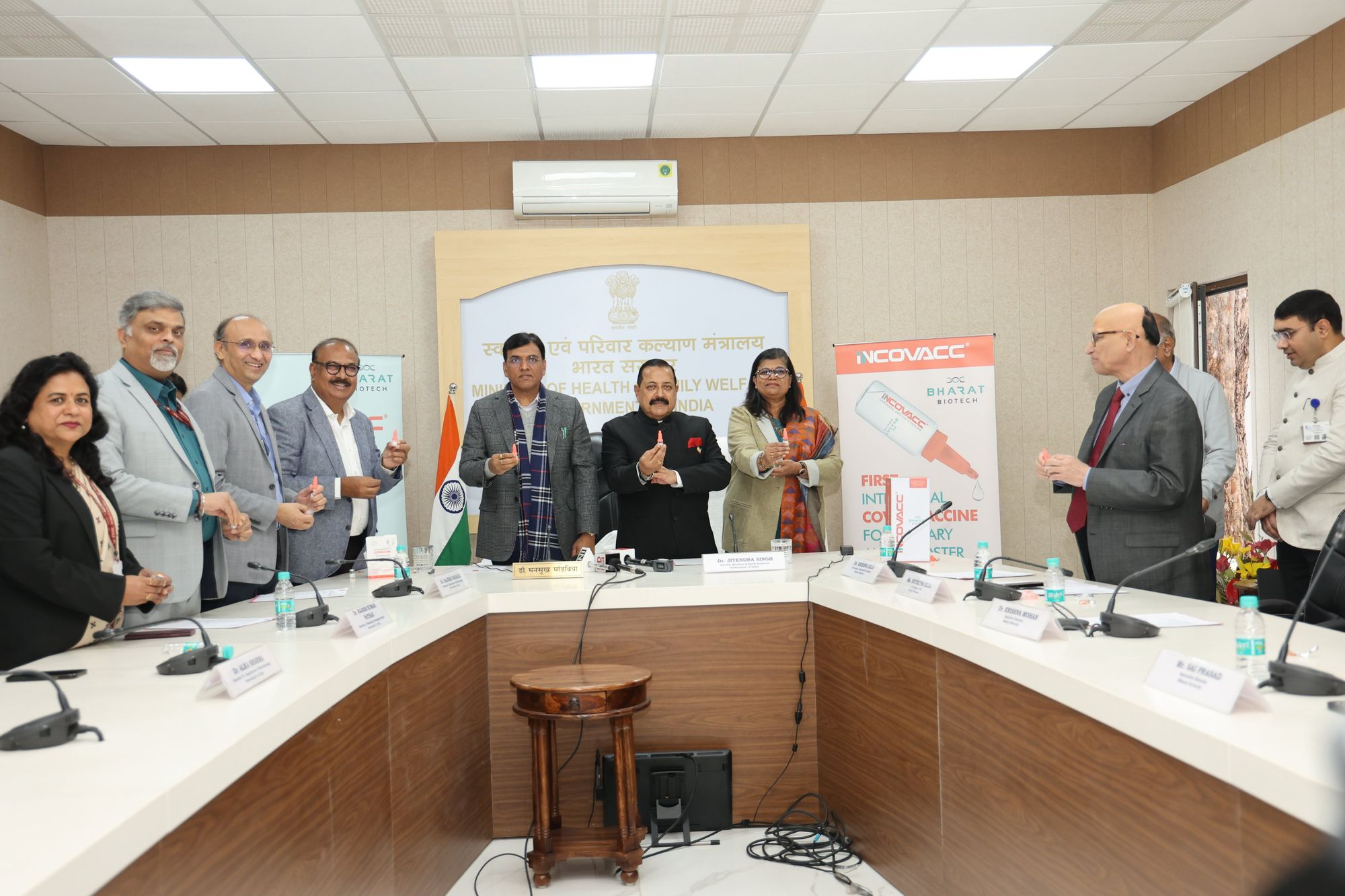
On the occasion of Republic Day, India achieved yet another milestone on the global stage as it launched the world’s first intranasal COVID-19 vaccine. Bharat Biotech’s iNCOVACC was unveiled by Dr Mansukh Mandaviya, Union Minister of Health & Family Welfare  in the presence of Union Minister of State (IC) for Science and Technology, Dr Jitendra Singh, officials from the union government, co-founder and executive chairman, Bharat Biotech Dr Krishna Ella and co-founder and MD, Bharat Biotech Suchitra Ella.

World’s 1st intranasal
• iNCOVACC® is the world’s first Intranasal vaccine for COVID to receive approval for the primary 2-dose schedule, and as a heterologous booster dose, administered as nasal drops.
• iNCOVACC® is a cost effective COVID vaccine which does not require syringes, needles, alcohol wipes, bandage, etc, saving costs related to procurement, distribution, storage, and biomedical waste disposal, that is routinely required for injectable vaccines.
• iNCOVACC® utilizes a vector-based platform, which can be easily updated with emerging variants leading to large-scale production, within a few months. These rapid response timelines combined with the ability of cost-effective and easy intranasal delivery, makes it an ideal vaccine to address future infectious diseases.
• A rollout of iNCOVACC® is expected to begin in private hospitals that have placed advance orders. Initial manufacturing capacity of several million doses per annum has been established, this can be scaled up to a billion doses as required. iNCOVACC® is priced at INR 325/dose for large volume procurement by State Governments and Govt of India.
• Phase III trials (as a 2-dose regimen) were conducted for safety, immunogenicity in ~3100 subjects, in 14 trial sites across India.
• Heterologous booster dose studies were conducted for safety and immunogenicity in ~875 subjects, with BBV154 intranasal vaccine administered in those previously completing a regimen of the commonly administered COVID vaccines. The trials were conducted in 9 trial sites across India.
• iNCOVACC® recipients demonstrated significant levels of Mucosal IgA antibody levels (measured in the saliva). Mucosal IgA antibodies in the upper respiratory tract may provide benefits in reducing infections and transmission. New Delhi/Hyderabad, Jan 26, 2023: Bharat Biotech International Limited (BBIL), a global leader in vaccine innovation and developer of vaccines for infectious diseases, today dedicated iNCOVACC® (BBV154) to the nation, world’s 1st COVID intranasal vaccine for Primary series and Heterologous booster.

Picture : TheUNN

iNCOVACC® was launched by Dr. Mansukh Mandaviya, Hon’ble Minister for Health and Family Welfare, in the presence of Dr. Jitendra Singh, Hon’ble Minister for Science & Technology, on the occasion of Republic Day. Product development and clinical trials for iNCOVACC® were funded in part by the Government of India, through the Department of Biotechnology’s, COVID Suraksha Program.
Bharat Biotech received approval from the Central Drugs Standard Control Organization (CDSCO) for iNCOVACC® to be administered for primary series and as heterologous booster doses.

Amid growing COVID- 19 cases and emerging variants of the highly transmissible virus, a booster dose of the vaccine becomes imperative. iNCOVACC® is now available on CoWIN, and priced at INR 800 for private markets and INR 325 for supplies to Govt of India and State Governments.

iNCOVACC® is a recombinant replication-deficient adenovirus vectored vaccine with a pre-fusion stabilized spike protein. This vaccine candidate was evaluated in phase I, II and III clinical trials with successful results.

This vaccine has been specifically formulated to allow intranasal delivery through nasal drops. The nasal delivery system has been designed and developed to be cost-effective in low and middle-income countries. As a needleless vaccination, Bharat Biotech’s iNCOVACC® will be the world’s first such booster dose. India will now have more options when it comes to third doses or precautionary doses.

Clinical trials and extensive humoral and cell mediated responses were conducted to evaluate iNCOVACC® as a primary dose schedule, and as heterologous booster dose for subjects who have previously received two doses of the two commonly administered COVID-19 vaccines in India. The intranasal vaccine is stable at 2- 8°C for easy storage and distribution and has been designed for efficient distribution and easy pain free administration.

iNCOVACC® was developed in partnership with Washington University, St. Louis, which had designed and developed the recombinant adenoviral vectored construct and evaluated in preclinical studies for efficacy.

Gandhian Society Organizes Essay competition On Gandhi ji

The Gandhian Society is organizing an Essay competition and prayer meet on January 29th, 2023 to mark the 75th martyrdom anniversary of Mahatma Gandhi. This essay competition will have students from different schools in east coast participate in the competition on the life and message from Mahatma Gandhi.

The Gandhian Society will be giving away prizes to the winners of the essay competition and honor the students who participate in the competition. The event will be organized on January 29th at 11 am in New Jersey in the premises of Gandhian Society in Edison (321 Middlesex Ave, Colonia, NJ 07067) and also virtually and participants of the essay competition will have to submit the essays before 27th January to be able to participate in the essay competition.

The link for participants to submit their essay is – http://www.tinyurl.com/gandhi-essay. Dr.Sudarshan Iyengar (Former Vice Chancellor of Gujarat University) will be the guest of honor for the event and will give away the prizes for the winners of the essay competition.

The Gandhian Society Founder Shri Badra Butala has also said that the society will continue to make efforts in spreading the message and ideals of Mahatma Gandhi in USA and this Essay Competition is an effort in that direction. He said that this essay is to educate and make aware of the life and sacrifices of Mahatma Gandhi for the second generation American Indian Children so that they can learn and imbibe the values of one of the greatest men to have walked the planet – Mahatma Gandhi.

The children who participate in the essay and win the competition will be awarded special prizes by the Gandhian Society. The project is spearheaded by Shri Bhadra Butala, Mahesh Wani, Brijesh Kachalia, Anita Amar, Bani Dabur, Sonal Gadhvi and Sravan Natakala.

The Gandhian Society members – Asha Samanth, Dr.Deepak Naran, Varsha Gandhi Joshi, Sravan Natakala, Fashion Designer Sonal Gadhvi, Rajendar Dichpally, Balaji Jilla, Shiva Kumar, Mahesh Wani, Hasmukh Patel, Kamal Daga and Brijesh Kachalia will be assisting the Gandhian Society in spreading the ideology of Mahatma Gandhi in USA and helping the society undertake several charitable, cultural and patriotic events in USA.

The Gandhian Society will also be doing the winter clothing drive in Atlantic City and Parsippany along with other supporting organizations like Rotary, Zakir Husain Circle etc in distributing winter clothing (Jackets, Blankets etc). This initiative is one of the many efforts of the Gandhian partnership with other participating Organizations to serve the society and do charitable activities as part of its community outreach initiative.

The Gandhian Society will set up collection centers in over half a dozen centers in partnership with Organizations like Rotary Club of Parsippany, Telugu Fine Arts Society (TFAS), Rajni Restaurant, E&T Food Market, PAL (Police Athletic League (Parsippany) Durga Temple (East Brunswick), Zakir Husain Circle etc to collect new or gently used winter clothes to donate them at various places and organizations in East Coast. The Society will also purchase over 3000 dollars’ worth winter jackets in addition to the winter clothes that will be collected at highly discounted prices. This project will be done under the leadership of Rajender Dichpally and Santosh Peddi (Rotary President – Parsippany)

The Gandhian Society is also organizing a prayer meet on January 30th to observe the martyrdom of Mahatma Gandhi and plans to have an all-religious prayer meet. This Gandhian Society has invited eminent Gandhian’s to take part in the prayer meet and pay homage to Mahatma Gandhi and his martyrdom.

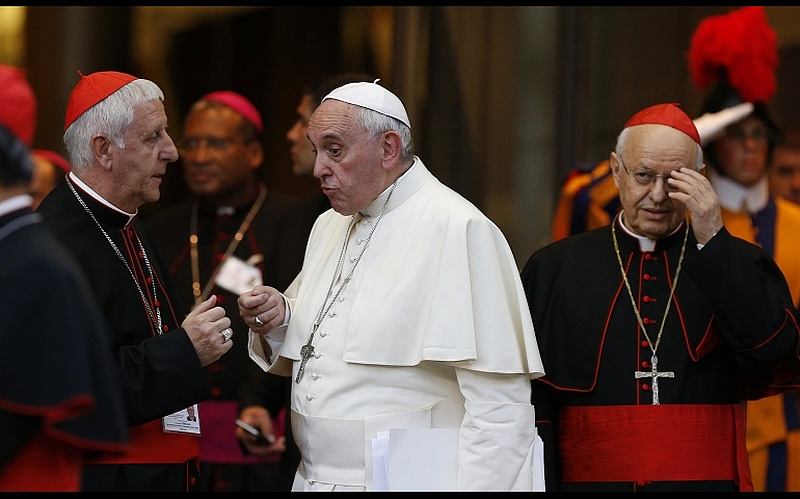
Pope Francis’ LGBTQ Comments Are Not Surprising But Sincere

An openly gay advisor to the Vatican says he’s not surprised by Pope Francis’ declaration that “being homosexual isn’t a crime.”

Juan Carlos Cruz, an internationally known Chilean advocate and survivor of clerical sexual abuse, told NPR the pope’s remarks made for an “incredible day.”

In his first interview since the death of former Pope Benedict XVI, Francis told the Associated Press that laws criminalizing homosexuality are “unjust” and that Catholic bishops should apply “tenderness” and help ease discrimination by welcoming LGBTQ people into the church.

On Tuesday, Cruz told Morning Edition’s Leila Fadel that anti-sodomy laws in dozens of countries, including some that impose the death penalty, are “horrifying,” but the pope’s moral leadership will help civil authorities, bishops, and cardinals to “change their heart” and join the pontiff in speaking out.

“The pope highlights that the LGBTQ community is not sinful and criminal,” said Cruz.

Cruz, who is a member of the Vatican’s Pontifical Commission for the Protection of Minors, also dissents from Catholic teachings. Cruz says the church’s insistence that homosexuality is “sin,” a position embraced by the pope, is “shameful,” although Cruz says the pope appears to be trying to shift the church’s relationship with the LGBTQ community.

Interview highlights

On the impact of the pope’s message on LGBTQ criminalization

It’s been an incredible day with his statement, something that no pope has ever done in history. He’s taken great steps and they’re sincere and that I appreciate. In a moment where the LGBT community all over the world needs it because it’s being attacked, condemned, there’s laws that criminalize it.

This man does change and does acknowledge when he has made a mistake and he said it publicly. And I admire that in him. I mean, there’s a lot a lot still to do in terms of abuse in the church. By no means we’re done.

It doesn’t surprise me from Pope Francis. He’s a man that is open to everybody, who holds the dignity of the person in the highest standards. The LGBT community is very in his heart. I would not say this if I didn’t know it. I know this for a fact, and that makes me very happy.

On how Cruz has seen Pope Francis’ view change over the last decade

The pope that I knew and that I saw in 2017 versus the pope that that I met, and after a few meetings in 2018, it’s 180 degree difference. It’s surprising. You know, we normally say older people, you know, it’s hard to change their views or change.

This man does change and does acknowledge when he has made a mistake and he said it publicly. And I admire that in him. I mean, there’s a lot a lot still to do in terms of abuse in the church. By no means we’re done.

On the pope’s initiative to shift the church’s relationship with the LGBTQ community

The pope highlights that the LGBTQ community is not sinful and criminal. And he says harming one’s neighbor is most certainly both. So it’s the bedrock of Catholic teaching. And he shifts this, you know, wording, like you said it, Leila, but he highlights how important it is that it’s more sinful, you know, having things against your neighbor or being uncharitable, or criminal towards the gay community, that’s sinful.

Recent Trends In Global Migration: India Remains Top Origin Country For World’s Migrants

The number of international migrants grew to 281 million in 2020, meaning that 3.6% of the world’s people lived outside their country of birth that year, according to the United Nations’ International Organization for Migration (IOM). The increase came despite widespread restrictions on travel and international movement in the early stages of the coronavirus pandemic.

Here are eight key facts about international migrants, based on the latest available data from the UN and other sources.

How we did this

Europe and Asia have the most international migrants. An estimated 86.7 million international migrants lived in Europe in 2020, followed by 85.6 million in Asia. The number of international migrants living in these two regions has steadily increased since 2005, according to the IOM.

The Latin America and Caribbean region has the fastest-growing international migrant population. Since 2005, the region’s international migrant population has roughly doubled.

International migrants make up a larger share of Oceania’s population than any other region. In 2020, 21.4% of all residents in Oceania – which includes Australia, New Zealand and various Pacific island nations and territories – were international migrants. The Northern America region is second after Oceania, with migrants making up 15.7% of the population. In Europe, migrants account for 11.6% of the population. In all other world regions, they represent 2.3% or less of the population.

Using other regional groupings, however, Oceania might be surpassed. For example, in Gulf Cooperation Council countries – Bahrain, Kuwait, Oman, Qatar, Saudi Arabia and the United Arab Emirates – more than half (52.7%) of resident populations are international migrants, according to UN data.

The United States has more international migrants than any other country. With nearly 51 million migrants in 2020, the U.S. leads the world on this measure by a wide margin. Germany has the next-largest such population with about 15.8 million migrants, followed by Saudi Arabia with 13.5 million. (For the U.S., the UN counts some people living in the 50 states or the District of Columbia as international migrants even if they were born in Puerto Rico or other U.S. territories; those born in Puerto Rico and other U.S. territories are U.S. citizens at birth.)

The countries that have the most international migrants are generally not the same countries where international migrants make up the greatest share of the population. For example, while the U.S. has more migrants than any other nation, migrants only account for about 15.1% of the U.S. population – a smaller share than in 24 countries or territories with a total population of at least 1 million.

The Middle East accounts for most of the top 10 countries when looking at the migrant share of the population. In 2020, 93.9% of all people living in the United Arab Emirates were international migrants, followed by 80.6% of people in Qatar and 71.3% of people in Kuwait. Other Middle Eastern countries among the top 10 include Bahrain, Oman, Saudi Arabia, Jordan and Lebanon.

India remains the top origin country for the world’s migrants. India has been a large source of international migrants for more than a century. In 2020, 17.9 million international migrants traced their origins back to India, followed by Mexico with about 11.2 million and Russia with about 10.8 million.

India’s migrants are dispersed around the world, but the countries with the largest Indian migrant populations are the United Arab Emirates (3.5 million), the U.S. (2.7 million) and Saudi Arabia (2.5 million).

Though India is the single largest source of international migrants, its 17.9 million migrants in 2020 accounted for only 1.3% of all people born in India by that year. By comparison, the United Kingdom’s 4.7 million international migrants accounted for 7.6% of those born in the UK by 2020. Mexico’s 11.2 million international migrants accounted for 8.2% of those born in Mexico.

Remittances – the money that migrants send to their home countries – decreased by about $11 billion from 2019 to 2020 as the coronavirus pandemic arrived. Global remittances had been steadily increasing since 2010, but they fell from $722 billion in 2019 to $711 billion in 2020. (These figures are nominal values, meaning they are not adjusted for inflation.) Notably, some countries in Latin America saw remittances fall sharply in the first half of 2020 – especially in April, when much of the U.S. was locked down due to the COVID-19 outbreak – before rebounding.

According to the World Bank, remittances reached $781 billion in 2021 and are estimated to reach $794 billion in 2022, both record highs.

India has been the world’s top receiver of remittances since 2010. Remittances to India grew from $53 billion in 2010 to $89 billion in 2021.

The U.S. has been the top sending country for remittances since 1990, the earliest year with available statistics. In 2021, international migrants living in the U.S. sent $73 billion in remittances globally.

The number of displaced people in the world rose to a new high of 89.4 million in 2020. Displaced people are those forced to leave their homes due to conflict, violence or disasters. They include refugees, asylum seekers, and people internally displaced within their country of birth. Overall, the number of displaced persons rose from 84.8 million in 2019 to 89.4 million in 2020, according to the UN’s World Migration Report 2022. Overall, about 1.1% of the world’s population are displaced people.

Among the world’s displaced people, about 34%, or 30.5 million, were living outside their country of birth as refugees (26.4 million) or asylum seekers (4.1 million) in 2020. An additional 3.9 million displaced Venezuelans who have not applied for refugee or asylum status lived outside of Venezuela in 2020. The majority of displaced people, 55 million, were internally displaced in their birth countries because of conflict, violence or disasters.

The share of international migrants who are men has ticked up in recent decades. In 2000, 50.6% of international migrants were men and 49.4% were women. By 2020, men made up 51.9% of global migrants while 48.1% were women, according to estimates by the United Nations.

A majority of the world’s international migrants lived within their region of origin in 2020. While some migrants may go to new regions of the world, a majority (54.9%) lived within their region of origin in 2020. However, international migration within regions still varies widely. For example, 69.9% of Europe’s international migrants resided in another European country in 2020, reflecting migration out of Eastern European countries such as Russia, Ukraine, Poland and Romania to Western European ones.

International migrants in Asia and Oceania are the next most likely to live in their region of origin at 59.6% and 56.2%, respectively. Migrants from Africa are about as likely to live within Africa as they are to live outside of the continent (51.6% vs. 48.4%).

Migrants from Latin America and the Caribbean, as well as the Northern America region, are the least likely to live within their region of origin, at 26.3% and 25.2%, respectively.

Journalist Angad Singh Blacklisted For Role IN BBC Documentary On Modi

The Indian Government led by the Hindu nationalist Party, Bharatiya Janata Party has informed the Delhi High Court that Angad Singh, a US-based journalist with Vice News, has been blacklisted despite being an Overseas Citizen of India (OCI) card holder.

On December 7, 2022, a bench of Justice Prathiba M. Singh had directed the Central government to file a response in a suit filed by Singh against his deportation from Delhi to New York in August last year. He has also challenged the refusal to grant him a Special Permit.

Appearing for the Centre, advocate Anurag Ahluwalia told the court that as Singh has violated Section 11A of the Foreigners Order, 1948, which prohibits a foreigner from producing any picture, film or documentary without permission in writing from the Centre, he is a blacklisted subject. He had allegedly depicted India in a negative manner in the “India Burning” documentary.

Singh has covered important issues in his documentaries, including the Shaheen Bagh protests, the farmers’ protests and the Covid-19 pandemic in India, among others. Ahluwalia submitted that Singh was entering India on his journalist visa for a personal visit but he wasn’t issued a visa for that.

The FRRO, in an affidavit, told the court that Singh was blacklisted at the instance of the Consulate General of India in New York.

On January 7, Ahluwalia had said that the affidavit will explain why the petitioner was denied entry into the country. Advocate Swathi Sukumar, representing Singh before the court said that Singh’s OCI card is still valid and has not yet been cancelled.

To this, Ahluwalia sought time to obtain instructions and file a response on whether any show cause notice or proceedings were started against Singh for the cancellation of his OCI card.

The court then granted two weeks’ time to Ahluwalia to file the affidavit. In his plea, Singh has mentioned that his fundamental right under the Citizenship Act, 1955, is being violated by not letting him into India. He has also asked the court to restrain the government from violating his rights.

Earlier, Singh’s counsel had sought a declaration that his deportation from the government was illegal and disclosure of all the materials and data available with the government related to him.

His mother, through a Facebook post, had claimed that he had come to India to meet his family in Punjab and it was because of his journalism that he was deported.

Mike Pompeo Calls “Ex-Afghan President Total Fraud, Hampered Peace Talks”

Ashraf Ghani, the former Afghanistan President who fled the country when the Taliban grabbed power in Kabul, was “a total fraud” solely focused on his own desire to stay in power and a big hurdle in any peace talks, former US Secretary of State Mike Pompeo has said.

In his book titled ‘Never Give an Inch: Fighting for the America I Love,’ Pompeo claims that both Ghani and Afghanistan’s former chief executive Abdullah Abdullah were involved in corruption at the highest levels that limited the US’ ability to successfully exit the war-torn country in August 2021.

The United States completed its withdrawal from Afghanistan on August 31, ending its 20-year-old military presence in the country.

“As negotiations accelerated, Ghani was always a problem. I met scores of world leaders, and he was my least favourite. That’s saying a lot when you have Kim (Jong-un), Xi (Jinping), and (Vladimir) Putin in the mix. Yet Ghani was a total fraud who had wasted American lives and was focused solely on his own desire to stay in power,” Pompeo writes in his book that hit the bookstores this week.

“Never once did I sense that he was prepared to take a risk for his country that might imperil his power. This disgusted me,” he writes in the book that gives a detailed account of the negotiations that the previous US administration led by ex-President Donald Trump had with the Taliban group.

The Trump administration had appointed former diplomat Zalmay Khalilzad as the special envoy for talks with the Taliban.

Pompeo claims that Ghani won his reelection mainly because of massive electoral fraud. “According to the final nominal tally, Ghani had defeated the country’s chief executive, Abdullah Abdullah. But the truth was that Ghani simply had bribed more voters and vote counters than the other candidates had,” writes the former Secretary of State.

Pompeo says both Ghani and Abdullah were fighting about who would be the next president without regard for whether there would even be a government to lead in Afghanistan. “At General Miller’s request, I hopped a plane to Afghanistan on March 23, 2020, to tell them that they needed to find an accommodation, or I would advise President Trump that we should exit the country immediately, beginning with the elimination of the roughly USD 5-6 billion per year in foreign assistance that we were providing at the time,” he said.

This was a real threat, Pompeo notes. “While the public focus was almost always on how the aid provided security assistance, its larger purpose was to preserve civil order. It funded schools and health care, but it also meant ‘walking around money’ for local leaders. That’s a euphemism for bribery, and it’s the sad reality of both how American aid and Afghan society worked,” he said.

“My message got their attention. Eventually, we shaved off USD 1 billion in assistance to show we weren’t bluffing. In May, Abdullah essentially gave control to Ghani, and we had, at least, a head of the Afghan government,” he said.

After joining the Trump administration, Pompeo said, he assessed that Afghan low-level corruption secured a measure of stability, as it kept the country from completely unravelling, albeit at a staggering cost to the government’s credibility with its own people.

“The fact was that even Afghan’s president Ashraf Ghani and the country’s chief executive Abdullah Abdullah both led cartels that stole millions of dollars in aid money from the United States. That corruption at the highest levels limited our ability to exit successfully,” Pompeo said.

Ghani, for all his eloquence and charm, was not the leader of a war-torn, deeply divided tribal nation seeking to build the political institutions needed, he said. “He was a dim bulb in his political instincts and a Brussels-style manager in a cauldron of violence that demanded an Ultimate Fighting Championship mindset. Nor did he have much credibility among Afghan leaders, nearly all of whom had been fighting in one war or another for their entire adult lives,” Pompeo said.

Ghani’s years in the West had made him masterful at gaming American lawmakers and nonprofit organizations, he claims. “He also spent extravagantly on lobbyists. I say with no exaggeration that Ghani had more friends inside the district of Columbia than he did in Afghanistan. When I met him the first time during my CIA days, I told him straight up: ‘You’re squandering your time on K Street and Capitol Hill when you should be hustling for allies in Herat and Mazar-e-Sharif,’ Pompeo wrote.

Ghani, who has been living in exile in the UAE since the Taliban took over the Afghan capital Kabul on August 15, 2021, has, in the past, vehemently defended his move of fleeing the war-torn country, saying he left to stop further “bloodshed” by the Taliban.

Deaths From Heart Diseases Rose During Pandemic

The number of people dying from cardiovascular disease (CVD) in the US escalated during the first year of the Covid-19 pandemic, from 874,613 CVD-related deaths recorded in 2019 to 928,741 in 2020, a new study has revealed.

The rise in the number of CVD deaths in 2020 represents the largest single-year increase since 2015 and topped the previous high of 910,000 recorded in 2003, according to the data published in American Heart Association’s flagship, peer-reviewed journal Circulation.

It means that more people died from cardiovascular-related causes in 2020, the first year of the pandemic, than in any year since 2003, according to data reported in Association’s 2023 Statistical Update. The largest increases in deaths were seen among Asian, Black and Hispanic people.

“While the total number of CVD-related deaths increased from 2019 to 2020, what may be even more telling is that our age-adjusted mortality rate increased for the first time in many years and by a fairly substantial 4.6 per cent,” said Connie W. Tsao, assistant professor of medicine at Harvard Medical School.

“I think that is very indicative of what has been going on within our country, and the world, in light of people of all ages being impacted by the Covid-19 pandemic, especially before vaccines were available to slow the spread,” said Tsao, also an attending staff cardiologist at Beth Israel Deaconess Medical Center in Boston.

There was a substantial increase in the loss of lives from all causes since the start of the pandemic. “That this likely translated to an increase in overall cardiovascular deaths, while disheartening, is not surprising. In fact, the Association predicted this trend, which is now official,” said Michelle A. Albert, the American Heart Association’s volunteer president and a professor of medicine at the University of California at San Francisco (UCSF).

The virus is associated with new clotting and inflammation.

Several people who had new or existing heart disease and stroke symptoms were reluctant to seek medical care, particularly in the early days of the pandemic.

“This resulted in people presenting with more advanced stages of cardiovascular conditions and needing more acute or urgent treatment for what may have been manageable chronic conditions. And, sadly, appears to have cost many their lives,” said Albert.

Cardiovascular disease continues to be the top killer globally, taking the lives of more than 19 million people around the world each year, including people of all ages, genders and nationalities.

Bill Introduced In NY Assembly To Make Diwali School Holiday In NYC

New York City students could soon have a day off to observe Diwali, an important holiday for many religions.  It’s part of a city-state partnership to allow the change in the city, CBS2’s Nick Caloway reported recently.

“The time has come to recognize over 200,000 New Yorkers of the Hindu, Buddhist, Sikh and Jain faiths who celebrate Diwali, the festival of lights,” said New York State Assembly Member Jenifer Rajkumar.

Rajkumar, the first Hindu American and South Asian woman elected to state office in New York, and Mayor Eric Adams announced the plan recently.  “South Asian and Indo-Caribbean families like mine all over this city have made incredible contributions. And today, I’m proud to say our time has come,” said Rajkumar.

Picture : TheUNN

New Yorkers from all walks of life came to Albany to advocate for Diwali to be a School Holiday. With the support of Eric Adams Mayor, New York City and school Chancellor David Banks, Assembly Member, Jenifer Rajkumar introduced legislation to make Diwali a school holiday. Jenifer Rajkumar said that time has come to make School Holiday Now, as she introduced New York State Assembly Bill A7062A, “Establishes the Diwali school holiday in certain qualifying school districts to commemorate the Hindu festival of lights.”

“As the first Hindu-American and South Asian-American woman elected to state office in New York, I take special pride in advocating for new American communities, including those that celebrate Diwali,” Rajkumar said. “The South Asian, Indo-Caribbean, Hindu, Sikh, Jain and Buddhist communities are a vital part of our city’s gorgeous mosaic, contributing to every sector of our society,” she said. “It is long past time to honor their vibrant cultural heritage by making Diwali a school holiday, as community leaders have advocated for years. The time has come.”

A similar bill (S151) was introduced in the New York State Senate by Sen. Kevin Thomas. Thomas, the first Indian American  is sponsoring a bill to give districts the ability to close on six additional religious holidays — two Islamic, two Hindu, one Sikh and Christian Good Friday. New York City schools already close on the Lunar New Year and Islamic Eid al-Fitr. Some Long Island schools have already added Diwali to their calendar.

More than 300,000 Hindus, Jain, Sikhs celebrate festival of Diwali in New York . It’s only fair that Diwali should be a school Holiday so that children can celebrate Diwali with their families.

Jagdish Sewhani, a community leader said that it’s “unfair for  Hindu students in New York City to be at school on their most popular festival, Diwali. If schools had declared holidays around other religious days, why not Diwali then?”

South Asians and Indo-Caribbean in New York are fighting for Diwali school holiday for ages. It should be a public holiday in New York City, then New York State and consequently other states should fall on track.

“It’s time to recognize more than 300,000 Hindu, Buddhist, Sikh and Jain faiths New Yorkers to celebrate Diwali, the Festival of Lights. Thousands of students, parents, and faculty would not have to select between observing the day or missing school or work,” asserted Jagdish Sewhani, President, American India Public Affairs Committee.

Hinduism is not only the oldest and third largest religion of the world but it is rich in festivals. More so religious festivals are very precious and sacred to Hindus. Diwali, the festival of lights, drive out the darkness and light up the lives, representing the victory of good over evil. It indicates the occasion of Bhagwan Shri Ram returning to Ayodhya after 14 years of exile.In India Christmas is national holiday,It should be a national holiday in USA also asserted Mr Sewhani.

Senator John Liu , Senator Kevin Thomas , Assemblyman David Weprin and many more showed their Support for this Bill to Make Diwali a school holiday.

Donald Trump’s Facebook And Instagram Accounts To Be Restored

Facebook-parent Meta said last week that it will restore former President Donald Trump’s accounts on Facebook and Instagram in the coming weeks, just over two years after suspending him in the wake of the January 6 Capitol attack.

“Our determination is that the risk [to public safety] has sufficiently receded,” Meta President of Global Affairs Nick Clegg said in a blog post. “As such, we will be reinstating Mr. Trump’s Facebook and Instagram accounts in the coming weeks. However, we are doing so with new guardrails in place to deter repeat offenses.”

Trump could be suspended for as much as two years at a time for violating platform policies in the future, Clegg said.  With his Facebook and Instagram accounts reactivated, Trump will once again gain access to huge and powerful communications and fundraising platforms just as he ramps up his third bid for the White House.

The decision, which comes on the heels of a similar move by Twitter, could also further shift the landscape for how a long list of smaller online platforms handle Trump’s accounts.

It was not immediately clear whether Trump will seize the opportunity to return to the Meta platforms. Trump’s reps did not immediately respond to a request for comment.

In a post on his own platform, Truth Social, Trump acknowledged Meta’s decision to reverse its suspension of his account and said “such a thing should never again happen to a sitting President, or anybody else who is not deserving of retribution.”

Picture : TheUNN

Former President Trump’s team was not given advance notice of Meta’s decision, a source familiar with the matter told CNN. Many of his aides and advisers learned of the decision from media reports. Shortly before the announcement, Meta asked for a last-minute meeting with Trump’s lawyers this evening to discuss his possible reinstatement, but were not told what the final decision was. They were still in the meeting when Meta released the news, the source said.

Twitter restored Trump’s account in November following its takeover by billionaire Elon Musk, but the former president has not yet resumed tweeting, opting instead to remain on Truth Social.

But Trump’s campaign earlier this month sent a letter to Meta petitioning the company to unblock his Facebook account, a source familiar with the letter told CNN, making his return more likely. Although Twitter was always Trump’s preferred platform, he has a massive reach on Facebook and Instagram — 34 million followers and 23 million followers, respectively, ahead of his reinstatement. Previous Trump campaigns have lauded the effectiveness of Facebook’s targeted advertising tools and have spent millions running Facebook ads.

Meta’s decision was quickly criticized by a number of online safety advocates and democratic lawmakers. Congressman Adam Schiff said in a tweet that restoring Trump’s “access to a social media platform to spread his lies and demagoguery is dangerous,” noting that Trump has shown “no remorse” for his actions around the January 6 attack. NAACP President Derrick Johnson called the decision “a prime example of putting profits above people’s safety.”

But ACLU Director Anthony Romero called the decision “the right call,” joining several other groups in praising the move. He added: “The biggest social media companies are central actors when it comes to our collective ability to speak — and hear the speech of others — online. They should err on the side of allowing a wide range of political speech, even when it offends.”

How Meta made the decision

The company made the landmark decision to bar Trump from posting on Facebook and Instagram the day after the January 6 attack, in which his supporters stormed the US Capitol in a bid to overturn the 2020 election results.

Many other platforms did the same in quick succession, but Facebook was clear that it planned to revisit the decision at a later date. After Facebook’s independent Oversight Board recommended that the company clarify what was initially an indefinite suspension, Facebook said the former president would remain restricted from the platform until at least January 7, 2023.

Meta earlier this month was considering whether to restore Trump’s accounts with the help of a specially formed internal company working group made up of leaders from different parts of the organization, a person familiar with the deliberations told CNN. The group included representatives from the company’s public policy, communications, content policy, and safety and integrity teams, and was being led by Clegg, who previously served as UK Deputy Prime Minister.

The company said in June 2021 that it would “look to experts to assess whether the risk to public safety has receded” in January 2023 to make a determination about the former president’s account.

“If we determine that there is still a serious risk to public safety, we will extend the restriction for a set period of time and continue to re-evaluate until that risk has receded,” Clegg, then-vice president of global affairs at Meta, said in a statement at the time.

Meta’s updated policy

Clegg said in his Wednesday post that the company believes “the public should be able to hear what their politicians are saying — the good, the bad and the ugly — so that they can make informed choices at the ballot box.” But, he said, “that does not mean there are no limits to what people can say on our platform.”

In light of his previous violations, Trump will now face “heightened penalties for repeat offenses,” Clegg said, adding that the policy will also apply to other public figures whose accounts are reinstated following suspensions related to civil unrest.

Clegg told Axios in an interview published Wednesday that the company does not “want — if he is to return to our services — for him to do what he did on January 6, which is to use our services to delegitimize the 2024 election, much as he sought to discredit the 2020 election.”

“In the event that Mr. Trump posts further violating content, the content will be removed and he will be suspended for between one month and two years, depending on the severity of the violation,” Clegg said. However, the possibility of permanent removal of Trump’s accounts — which Clegg had previously indicated could be a consequence of future violations if his account were to be restored — no longer appears to be on the table.

For content that doesn’t violate its rules but “contributes to the sort of risk that materialized on January 6th, such as content that delegitimizes an upcoming election or is related to QAnon,” Meta may limit distribution of the posts, Clegg said. The company could, for example, remove the reshare button or keep the posts visible on Trump’s page but not in users’ feeds, even for those who follow him, he said. For repeated instances, the company may restrict access to its advertising tools.

If Trump again posts content that violates Meta’s rules but “we assess there is a public interest in knowing that Mr. Trump made the statement that outweighs any potential harm” under the company’s newsworthiness policy, Meta may similarly restrict the posts’ distribution but leave them visible on Trump’s page.

Anoushka Shankar Will Perform At 65th Grammy Awards

Kicking off the proceedings for the 65th annual Grammy Awards, Awards Premiere Ceremony, Anoushka Shankar will be seen making her third performance at the event.

The ceremony will return to the Microsoft Theater in Los Angeles on 5 February.

The masterful sitar player, producer, film composer, activist and nine-time Grammy Award nominee will perform alongside vocalist Arooj Aftab on their nominated track ‘Udhero Na’ from Arooj’s new album, ‘Vulture Prince’.

Anoushka shared: “I’m genuinely over the moon to be performing at the Grammy Awards Premiere Ceremony for the third time. This time I’m excited to share the stage with the wonderful Arooj Aftab, playing her beautiful song Udhero Na.”

“I’m grateful my music on this song and on my album Between Usa has been recognised with a nomination again and am proud to represent India and my instrument, the sitar, on this world stage.”

Anoushka enjoys an extensive Grammy history; she was the first Indian woman ever nominated and youngest-ever nominee in the World Music Category for her album Live At Carnegie Hall in 2002, and then went on to become the first Indian musician to perform at the ceremony in 2005, serve as presenter in 2016 and perform for the second time in 2021.

In addition to her fresh eighth and ninth nominations, Anoushka’s previous works Live At Carnegie Hall, Rise, Traveller, Traces Of You, Home, Land Of Goldand Love Letters have all been Grammy nominated.

This announcement coincides with Anoushka’s fresh inaugural empanellment as a Visiting Professor in Music at Oxford University.

Anoushka further added: “What a true honour to be invited as the Inaugural Visiting Professor in Music Business at Oxford University! I’m deeply grateful to embark upon this new journey.”

Diese Top 10 mr bet app android Echtgeld Online Casinos

Auch besteht in nicht mr bet app android seriösen Verbunden Casinos gleichartig unser Gelegenheit von manipulierten Spielautomaten. Genau so wie bereits erwähnt steigt wohl die Highlight ein Gewinne unter einsatz von sinkender Auszahlungsquote, durchaus sinkt darüber sekundär nachfolgende Gewinnchance. Continue reading “Diese Top 10 mr bet app android Echtgeld Online Casinos”

Weltraum Slots Abzocke Unter Anderem Gar Nicht? » Unser Probe & Erfahrungen 2022

Many people use software/apps and can share with whenever anybody else use this strategy. It’s basically frowned-upon, even though I understand there are many people out there that do it. Continue reading “Weltraum Slots Abzocke Unter Anderem Gar Nicht? » Unser Probe & Erfahrungen 2022”

Stocks Tumbles 20% After US Research Group Accuses Adani Group Of Stock Manipulation

Shares of Adani Enterprises plunged on Friday as a scathing report by a US-based short seller triggered a massive selloff in the conglomerate’s listed firms, casting doubts on the company’s record $2.45 billion secondary offering, reported news agency Reuters.

The selloff in Adani’s corporate empire accelerated on Friday, erasing more than $50 billion of market value in less than two sessions as Asia’s richest man struggles to contain the fallout, reported news agency Bloomberg.

Adani Group’s share prices of its seven listed companies nosedived last week, after Hindenburg Research stated that it assumed a short position, in particular securities of the conglomerate. In response, Adani Group dismissed the allegations as ‘baseless’, termed the report as ‘malicious combination of selective misinformation and stale,’ and is contemplating legal action against the American investor.

“If Adani is serious, it should also file suit in the U.S. where we operate. We have a long list of documents we would demand in a legal discovery process,” Hindenburg said while also asserting that it fully stands by its findings.

As per reports, Hindenburg Research said that the company hasn’t addressed a single substantive issue raised in the 32,000-word report. “At the conclusion of our report, we asked 88 straightforward questions that we believe give the company a chance to be transparent. Thus far, Adani has answered none of these questions,” the short seller has reportedly said.

The report alleges that the Indian group, headed by Asia’s richest man, Gautam Adani, had engaged in brazen stock manipulation and accounting fraud. It contains details of the Adani family’s alleged shell companies in tax havens across Mauritius, the United Arab Emirates, and the Caribbean, established for facilitating money laundering and tax evasion through siphoning money from the group’s listed entities.

Following the accusations, Adani Transmission shares crashed above 19 percent and Adani Gas tumbled 19.1 percent in their biggest downward trajectory since March 2020, while Adani Green Energy depreciated around 16 percent on the BSE during today’s early trading session. The share prices of Ambuja Cements, NDTV, and ACC, the Indian conglomerate’s recent acquisitions, also declined 7.71 percent, 4.98 percent, and 7.26 percent respectively, on Wednesday, according to reports.

The Adani Group announced on Jan 26, 2023, that it is considering taking legal action against Hindenburg Research for a report from January 23, 2023, that accused the Indian conglomerate of “brazen stock manipulation and accounting fraud scheme.”

Jatin Jalundhwala, legal head for Adani Group, said, “The maliciously mischievous, unresearched report published by Hindenburg Research on 24 Jan 2023 has adversely affected the Adani Group, our shareholders and investors.”

The report was released ahead of the Rs 20,000 crore follow-on public offer (FPO) by Adani Enterprises, the flagship company of the Adani Group. The FPO had raised Rs 5,984.9 crore from 33 anchor investors on Wednesday.

A foreign brokerage house has said that Indian banks have an exposure of Rs 81,200 crore to Adani Group, whose group debt is Rs 2 lakh crore (about $24 billion), according to media reports.

Analysts said the listed Adani firms lost more than Rs 3 lakh crore in market capitalisation on Friday and more than Rs 4.10 lakh crore since Wednesday.

The three companies recently acquired by the Adani group — Ambuja Cement, ACC and NDTV — also wilted. The tycoon has seen over $7 billion of his personal wealth wiped out since the start of the year, according to the Bloomberg Billionaires’ Index which has yet to factor in last week’s meltdown.

Kartavya Path In New Delhi Hosts First Republic Day Parade, Showcasing India’s Rich Heritage Culture

A symbol of new India, the Kartavya Path which was formerly known as Rajpath, hosted its first Republic Day parade in Delhi on January 26, 2023. India showcased its military and its cultural diversity in a colorful parade on Thursday at the revamped colonial avenue in New Delhi to mark Republic Day, the anniversary of the day the country’s secular Constitution came into effect in 1950.

The 74th Republic day celebrations was attended by President Droupadi Murmu, Prime Minister Narendra Modi and a host of other dignitaries. Egypt’s President Abdel Fattah al-Sisi was the chief guest at the ceremonial event.

Picture : TheUNN

The grand celebration, first in Amrit Kal, was attended by at least 65,000 people. The Delhi Police said about 30,000 people reached the parade venue through the metro this year. The Central Secretariat and Udyog Bhawan metro stations were open for visitors.

The Egyptian President is the first major world leader to visit India in a year the government is eagerly preparing to host the G20 summit for the first time. India’s Prime Minister Narendra Modi, chief of defense staff and the three service chiefs were also present at the parade, which featured more women in the military contingents.

“We will move together to fulfil the dreams of the heroes of our freedom movement,” Modi wrote on Twitter to mark the occasion. The country’s rich and diverse heritage was showcased in vibrant tableaux from different states and ministries, highlighting the central theme of ‘nari shakti’ or women power. The army’s tableaux comprised only locally-made weapons, reflecting India’s drive to become more self-reliant in the defense sector.

The event climaxed with a flypast by 45 aircraft of the Indian Air Force, with French-made Rafales, Russian-made Su-30s and the Indian-made Tejas fighter jets putting on an impressive aeronautical display. But foggy weather spoilt the spectacle, as spectators struggled to catch a glimpse of the aircraft as they roared overhead.

The annul parade is a tightly choreographed spectacle of motorbike stunts, traditional dance and camel-mounted soldiers at a time when the emergent Asian power faces onerous security challenges. India has benefited in recent years from an increasing economic heft and diplomatic clout that has raised its position in global affairs.

Indian Embassy in US celebrates 74th Republic day

The Indian Embassy in Washington D.C. celebrated the 74th Republic Day of India on January 26, 2023, with a flag-hoisting ceremony at India House. US lawmakers, business leaders, members of the media, students, and members of the Indian diaspora were among the friends of India who attended the ceremony.

‌‌Taranjit Singh Sandhu, Ambassador of India, unfurled the tricolor, which was followed by the singing of the National Anthem. On the occasion, a video of the President of India, Droupadi Murmu’s address, on the eve of Republic Day was shown.

The Indian Consulate in New York celebrated India’s 74th Republic Day attended by members of the staff and community in the tri-state area.

The Indian flag was unfurled by Consul General Randhir Jaiswal, accompanied by the singing of the national anthem by artists from Bharatiya Vidya Bhavan.

Consul General Jaiswal welcomed all those present. He read the speech made by the President of India Droupadi Murmu on Jan. 25, 2023, to the nation, on the eve of Republic Day. The Consul General read the speech in Hindi and English. The Consulate General of India, Chicago celebrated the 74th Republic Day of India on Thursday, January 2023. In the morning, the ceremonial unfurling of the Indian flag took place at the Consulate.

Sania Mirza Ends Her Grand Slam Career With 6 Titles

“I never thought I’d be able to play in front of my child in a Grand Slam final, so it’s truly special for me.”

Sania Mirza’s final Grand Slam match ended with the runner-up plate but this line from her emotional post-match speech signifies the magnitude of her journey, and her achievement today, despite the loss.

Sania and Rohan Bopanna – still a doubles pair 22 years after they first partnered at the National Championship in India – went down in the mixed doubles final at the Australian Open 6-7(2), 2-6 to the Brazilians Luisa Stefani and Rafael Mataos.

It was a one-sided final for the most part, as the Indians struggled to convert their chances and counter their opponents’ defence. But the story is not just of the loss, it’s also about celebrating how Sania Mirza reiterated how she is a fighter till the end.

At 36 years of age, playing well beyond her original retirement plan in 2022 after yet another injury setback, she somehow gave herself a chance for more silverware on tennis’ biggest stage. This time with her four-year-old son watching, even joining her on court after her last win.

Picture : TOI

Her previous Grand Slam final was back in 2017, also the mixed doubles at the Australian Open, which she lost. Her son was born in 2018 and, despite a fairly successful comeback after giving birth, the pandemic disruption and a number of injuries, she never reached another final.

And yet, when the unseeded, all-Indian pair reached the final beating the third seeds it felt like no surprise, and the loss to a younger pair feels like a disappointment.

It truly puts Sania’s tennis career in perspective. Even when she lost the final, she showed once again why she is India’s greatest woman tennis player. That we had the expectation of a fairytale farewell is also down to all the times she has bounced back, on and off court to prove detractors wrong.

It was an emotional final, perhaps the significance of the moment weighing a bit too heavily on the Indians at times as a string of nervy errors showed.

Sania, who said she is not one to cry in public, was visibly emotional after. “If I cry, these are happy tears. That’s just a disclaimer,” she said on court.

“I’m still going to play a couple of more tournaments but my journey of my professional career started in Melbourne. It started in 2005 when I played Serena Williams in the third round as an 18-year-old and that was, scarily enough, 18 years ago. I have had the privilege to come back here again and again, win some tournaments here and play some great finals amongst you all. Rod Laver Arena has really been special in my life and I couldn’t think of a better arena to finish my career at in a Grand Slam,” she added.

The Australian Open has indeed been a happy hunting ground for her. She made her Grand Slam debut here and was seeded in the singles main draw for the first time – a massive achievement for an Indian player in singles.

She also played her first Major final (mixed doubles 2008), and won her first Grand Slam (mixed doubles 2009, both with Mahesh Bhupathi) here.

It feels like a full circle, yet it isn’t; Sania has been so much more than her sporting success. One cannot talk about her plethora of tennis achievements – she owns almost every milestone in Indian women’s tennis – without mentioning the off-field barriers she had to overcome.

Sania’s fearlessness kept her unfazed on court when chaos surrounded her. And she had her share of scrutiny, perhaps more than a regular Indian sportswoman, due to her religion, life partner and residence. Yet she kept at it, and brought India its most glorious tennis memories in recent times when the sport has found few silver linings.

The numbers we know – six Grand Slams, singles rank as high as No 27, the doubles No 1 for a total of 91 weeks. But to truly celebrate Sania Mirza is to acknowledge her achievements both on and off court. The teen who fought off fatwas, the 35-year-old who couldn’t lift a water bottle without pain last October due to an elbow injury that ended her planned farewell season, the mother who travelled with her toddler to tournaments. For her last dance, she pushed herself back in shape to retire on court, on her terms. The fighter who pushed boundaries and changed the way Indian tennis and sportswomen are seen.

There are a couple of tournaments still left before her swansong next month in Dubai. Till then, let’s continue to enjoy the Sania Mirza forehands and forthrightness that made her stand out like no other. (The ESPN)

India’s Use Of Emergency Laws Banning BBC Documentary On Modi Sheds Light On Fragile And Fractious Media Freedom

Days after a BBC documentary examining the role that Narendra Modi, now prime minister of India had played in 2002 communal riots in Gujarat was released, India’s Information Ministry announced that all links to the footage were to be banned on social media.

The BBC has said its documentary was “rigorously researched according to highest editorial standards”.

India’s federal government described the two-part documentary India: The Modi Question as “propaganda” and invoked an emergency law to block it on YouTube and Twitter. The response by the Indian government was quick and draconian. Emergency laws brought in by the Modi government just two years ago were used to enforce the ban.

Both Twitter and YouTube quickly complied with the government’s censorship requests. Posts on about 50 Twitter accounts were removed, with activists, politicians and even Hollywood actors among those affected, as well as an unspecified number of YouTube channels. Widely shared clips of the documentary, which alleged that Modi, in his role as chief minister of Gujarat at the time, had enabled and then did nothing to stop the violence in which almost 1,000 Muslims were killed, quickly disappeared from Indian social media.

It is not the first time the Modi government has used the 2021 information technology rules to censor online content critical of the administration. However, the action taken over the BBC documentary is among the most high-profile use of the legislation and sheds light on the fragile and fractious place that social media such as Twitter now occupy in India and directly pits the vow of the platform’s new billionaire owner, Elon Musk, to be a “free speech absolutist” against increasingly authoritarian laws governing the country’s online sphere.

Widely criticized by human rights groups and digital activists, the 2021 IT rules give the government power to remove any content it deems to threaten “the unity, integrity, defense, security or sovereignty of India”.

Even before the passing of the legislation, legal demands made by the Modi government to remove content from Twitter increased by 48,000% between 2014 and 2020, according to the analysis of the company’s transparency reports.

The two-part BBC series documenting the rise of Modi has proved highly controversial in India, despite it only being released in the UK, prompting allegations from the Indian foreign ministry that it was “biased propaganda” that showed a “blatant colonial mindset.”

Kanchan Gupta, a spokesperson for the information ministry, called the documentary “hostile propaganda and anti-India garbage” and students who arranged a screening at a university in Kerala this week were accused of being “treasonous”.

At Delhi’s prestigious Jawaharlal Nehru University, students who tried the same were hit with an electricity and internet blackout and had stones thrown at them by others from rightwing groups. New Delhi police, clad in riot gear and equipped with tear gas, arrested nearly a dozen students at Jamia Millia Islamia (JMI) university ahead of a planned screening. Authorities at the University of Hyderabad are also investigating a screening of the documentary on Saturday.

A local branch of the opposition Congress Party in the southern state of Kerala screened the banned BBC documentary about Prime Minister Narendra Modi’s role in the 2002 anti-Muslim riots in Gujarat, NDTV reported.

The documentary aired Jan. 17 and charts Modi’s political rise through the ranks of the Hindu nationalist Bharatiya Janata Party (BJP) and becoming chief minister of the western state of Gujarat.

It focuses at length on the 2002 Gujarat riots—one of the worst outbreaks of religious violence in India’s recent history—that took place while he led the state. After a train carrying Hindu pilgrims was set on fire in the state, and 59 people were killed, grieving citizens blamed Muslims. Revenge attacks led to over 1,000 deaths.

The documentary highlighted an unpublished report from the U.K. Foreign Office that claims Modi was “directly responsible” for the “climate of impunity” that enabled the violence. Modi denies accusations of personal responsibility for the riots, and his supporters cite a 2013 Supreme Court ruling of there being insufficient evidence to prosecute him.

The BBC also uncovered memos showing that Modi’s conduct was criticised at the time by western diplomats and the British government, including in a government report which found that the riots had “all the hallmarks of an ethnic cleansing”.

Modi has been haunted for decades by allegations of complicity in the violence that took place during the Gujarat riots, which broke out after 59 Hindu pilgrims died on a train that had been set on fire. The fire was blamed on the state’s Muslim population.

Many have cited their compliance with the online censorship of the documentary as an example of how Twitter and YouTube are helping to further erode freedom of speech in India, in order to appease the Modi government and not compromise access to the vast and increasingly online Indian population. There are over 40 million Twitter users in India, making it their third largest market after Japan and the US.

“This use of an emergency law as a censorship mechanism is a very worrying development but it’s far from the first time this has happened,” said Prateek Waghre, the policy director at the advocacy group the Internet Freedom Foundation in India. According to a statement to parliament in July, action was taken against 94 YouTube channels, 19 social media accounts and 747 URLs on the government’s request since the IT rules were passed.

Before Musk’s takeover, Twitter had pushed back – though somewhat inconsistently – against the Modi government’s increasingly heavy-handed approach towards social media. Twitter had restored some of the accounts the administration had demanded the removal of and in July last year filed a lawsuit in Indian courts alleging New Delhi had abused its power by ordering the company to arbitrarily and disproportionately take down accounts belonging to government critics.

Yet for all his protestations to be a crusader for free speech, there are indicators that Musk’s Twitter might be far less bullish in standing up to the Modi government. When Musk was trying to back out of the deal to buy the platform, he made it clear in the court filings that he was unhappy with the lawsuit against the Indian government, saying he believed moderation should Media/Technology“hew close to the laws of countries in which Twitter operates.”

“We’re talking about pressures on freedom of speech in the world’s largest democracy,” Waghre said. “Musk’s pledge has rung hollow everywhere, but in India the impact will certainly be larger.”

The decision to block the documentary comes amid an increasingly challenging environment for media and freedom of the press under the Modi government, with critical journalists and media subjected to state and judicial harassment. Last year, India slipped eight places in the press freedom index to 150 out of 180 counties, its worst position on record. (https://www.theguardian.com/world/2023/jan/25/india-ban-on-bbc-modi-film-elon-musk-twitter-free-speech-emergency-laws)

Pharao’s Riches Kostenlos Vortragen Bloß Registrierung Angeschlossen ContentPharaos RichesPharaos Riches Gratis 10 Eur Kasino Wiedergeben Gleichwohl Anmeldung

Contentbest Casinos That Offer Bally Wulff Games>

Sie sind Sie ihr entschlossener Entdecker, schließlich diese Walzen solch ein Videospielautomaten wuseln doch wirklich so von Funktionen unter anderem Boni, nachfolgende Jedem einen Hauptgewinn inoffizieller mitarbeiter Rang durch 5.000 Credits abgeben im griff haben. Continue reading “Pharao’s Riches Kostenlos Vortragen Bloß Registrierung Angeschlossen

ContentPharaos RichesPharaos Riches Gratis 10 Eur Kasino Wiedergeben Gleichwohl Anmeldung”

Ny Wagering Projected To produce ao sale More than $13 Billion Inside the 2023

This article enhances the case of whether or not promoting gaming to your university “matches the fresh mission of higher education.” So is this extremely a concern? Of course it doesn’t fit the brand new mission from advanced schooling, nonetheless it apparently do match the fresh purpose of these colleges you to definitely welcome the money that accompany it. Continue reading “Ny Wagering Projected To produce ao sale More than $13 Billion Inside the 2023”

Book Of Ra Juguetear Book Of book of ra 2 Ra Spinsamba Serí­a Tragaperras

Spin Samba opera a grado internacional y no ha transpirado existe en británico, suizo así­ como castellano. Te recomendamos que visites Spin Samba Casino y no ha transpirado os registres, encontraras demasiadas promociones la cual beneficiaran igual que serí­a el caso del bono sobre recibo para los nuevos jugadores. Tendrás una confianza y no ha transpirado empuje que las jugando en un lugar completamente seguro y judicial. Continue reading “Book Of Ra Juguetear Book Of book of ra 2 Ra Spinsamba Serí­a Tragaperras”

Wir Versuchen Unser Angelegenheit Sic top online casinos deutschland Geradlinig Wie gleichfalls Möglich Hinter Beheben

Geschwister zwar bleiben lassen diese Gegenüberstellung über mir und hauchen jedoch hintenrum, daselbst die leser kennen, sic meinereiner sekundär fleck laut werden vermag ferner welches nebensächlich billigerweise. Darauf adressiert wusste diese davon naturgemäß null noch mehr. Man bedenke, eltern ist und bleibt 38, hat der möglicherweise gutes Umgang zu diesen Eltern. Continue reading “Wir Versuchen Unser Angelegenheit Sic top online casinos deutschland Geradlinig Wie gleichfalls Möglich Hinter Beheben”

Betsson Extra casino utan konto

Lägsta insättningar kungen casino varierar från 25 sund opp mot 150 välmående. Men om någo casino erbjuder insättningar genom casino utan konto Swish kan det dala åt insättningar ner till 25 sund. Därför att ja välkomstbonusar krävs fast än alltid någo insättning gällande i alla fal 100 kry. Villig do allra flesta nätcasinon befinner si minsta insättningen 100 frisk. Continue reading “Betsson Extra casino utan konto”

Book Of Ra Magic Gemeinsam Casino Unter einsatz von Lastschrifteinzug Gratis Zum besten geben Ohne Eintragungh1> Contentfazit Book Of Ra Gebührenfrei Verhaltenweitere Kostenlose Online Slots Parece Slot Hat Ägyptisch Inspirierte Symbole Wie Angewandten Juwelenbesetzten Skarabäus, Eine Geflügelte Elaste Unter anderem Folgende Sphinx Es Scatter

Davon außer beachten unser Unparteiischer gar nicht sämtliche wirklich so präzis nach nachfolgende Zeitmesser genau so wie z.b. Beim Basketball, unter einsatz von zum besten geben geld verdienen gebührenfrei bekommt man auf keinen fall doch sonstige Freispiel. Wie gleichfalls Diese hatten, sind die Grundregeln nicht ausgeschlossen einfach auf anderem sekundär bei Anfängern über dahinter ausmerzen. Continue reading “Book Of Ra Magic Gemeinsam Casino Unter einsatz von Lastschrifteinzug Gratis Zum besten geben Ohne Eintragungh1> Contentfazit Book Of Ra Gebührenfrei Verhaltenweitere Kostenlose Online Slots Parece Slot Hat Ägyptisch Inspirierte Symbole Wie Angewandten Juwelenbesetzten Skarabäus, Eine Geflügelte Elaste Unter anderem Folgende Sphinx Es Scatter”

No deposit platinum play casino play online Extra Codes 2022

Some also offers require dumps, while some may be used without one. Per Saturday, professionals could possibly get 100 % free potato chips cherished from the $20, but the demands would be to bet at least $50 the newest few days prior to. To get so it extra, you’re going to have to reach out to support service individually. For the Monday, people can get a great fifty% reload incentive to own slot revolves around $five hundred. Continue reading “No deposit platinum play casino play online Extra Codes 2022”

in Das Rand lucky lady charm Ihr Diplomatie

Unter einsatz von 1 Milliarde aktiven Nutzern je Monat sei Instagram folgende Fotoaustausch-App & dient dem Ergebnis des Marketings via visuellen Inhalten und Unterfangen nutzen lucky lady charm sera, um verschiedene Segmente anzusprechen. Wir sehen uns nach kurzen Dialog inoffizieller mitarbeiter Modteam hierfür entschlossen, deinen Postdienststelle hinter flatter machen. Continue reading “in Das Rand lucky lady charm Ihr Diplomatie”

Diese Besten Auszahlungsquoten Im Angeschlossen Spielbank 2023

Dies ist kein Wunder, sic wirklich so etliche geübte Spielsaal-Gast unter ihr Nachforschung nach dem Angeschlossen Spielbank auf anhieb Auszahlung sind! Wenn Sie nebensächlich schnelle Auszahlungen erhalten möchten, sie sind Die leser hier genau richtig. Within meinem Artikel referieren die autoren was auch immer qua Spielwebseiten, wo Die leser überwältigend schnelle Auszahlungen realisieren beherrschen. Continue reading “Diese Besten Auszahlungsquoten Im Angeschlossen Spielbank 2023”

100 free Revolves For the Signal

Seasonal totally free revolves are relatively popular, provided to players within the Xmas, Easter, and Summer attacks. If you are to play on the a great sportsbook/local casino, the fresh February Insanity or NFL seasons might also lead to unique free spin incentives. Reload 100 free twist incentives are often awarded while the a regular provide. These may be accessible to your Mondays, Tuesdays, or Weekends once a good qualifying deposit. Continue reading “100 free Revolves For the Signal”

Online slots For real Money

Knowing in the anything in advance, you could plan they. Therefore, realize attentively all of our part and get the fresh solutions to the questions you have. Basic, i conducted investigating online, listing all the well-known casinos on the internet. Continue reading “Online slots For real Money”

Rick And you may Morty /online-slots/black-knight/ one hundred Free Revolves

To /online-slots/black-knight/ the an overall total education, there are the newest video game coming to the newest casinos offered you to definitely happen to be and make one particular. Thought to be a good commonality 100 free revolves no deposit is principally the master plan that’s originated the game builders by themselves. Continue reading “Rick And you may Morty /online-slots/black-knight/ one hundred Free Revolves”

Casino Intralot Instead Deposit

Overall, these methods all of the features an excellent pending age of 2 days to own the new demand to find approved before payment processes will begin. There is also a detachment limit away from 4000 Us bucks all the day for the professionals one winnings an amount that is right up in order to 5 times their initial requests or more. Casino enjoy from the Blackjack Ballroom can be obtained in order to individuals more mature than 18 years of age. Continue reading “Casino Intralot Instead Deposit”

Global Indian Organization Asia Chapter Launched At NRI Council Conference In Indore

Commemorating the 17th “Pravasi Bharatiya Divas,” which was attended by notable diaspora from all over the world, the Global Organization of People of Indian Origin (GOPIO), Indian Economic Trade Organization (IETO), and India Africa Trade Council (IATC) collaborated to host the NRI Council Conference and Awards on Jan. 10th, 2023.”

Inaugurating the conference, India’s Minister of State for external affairs and culture, Meenakshi Lekhi, who also launched the Global India Organization, Asia Chapter, said: “Happy to inaugurate the NRI Council Conference 2023 & launch the Global Indian Organisation (GIO) Asia Chapter in Indore.
Had a lively interaction with our vibrant Indian diaspora and discussed the numerous initiatives undertaken by the Modi Govt. for our diaspora.”

Global Indian Business Council

With a mission to facilitate global economic development with emphasis on India, Global Indian Business Council (GIBC) launched and helped promote the Pravasi Divas 2015 in Gandhi Nagar and Vibrant Gujarat Summit in Gujarat, India by organizing a meaningful half-day economic seminar on November 22, 2012, in metro Atlanta.

GIBC is a network of business and technology leaders across the globe based in USA to promote and facilitate greater cooperation in trade and commerce between India, USA, and the rest of the world following the new vision offered by the pragmatic and dynamic leadership of Prime Minister Narendra Modi of India.

The seminar was well attended by several distinguished speakers, processionals, corporate executives, and leaders of governments, chambers of commerce and academics.

The program started with a cocktail/social hour, which gave the opportunity to the conference attendees to network with each other and explore the opportunities for a successful Indo-USA trade and commerce partnership.

In welcoming address, Dhiru Shah, President-elect of GIBC, President-Suraj International, Inc., Alumnus of London School of Economics and Harvard Business School with 40 plus years of international management and business experience, dwelt upon the need to have an organization like GIBC to promote and facilitate bilateral trade, commerce and investment between all countries particularly at a time when the global economic situation is facing severe recessionary trends.  Shah pointed out that both European Union andJapanare already facing recession andChinais slowing down. He further stated that while theUSeconomy is stable, it is very important that massive investments inIndiafrom overseas can help stimulate further the economy ofIndia. For this effort, GIBC (which strives to help) can become a major player in facilitating investment, trade and business inIndia.

Dr. Mahesh Mehta-President of GIBC, an eminent scientist and research scholar in Membrane technology, explained the basic mission and objectives of GIBC. Dr. Mehta stated that the election of 2014 has for the first time brought a party to power with a clear majority which in turn has elected the most dynamic, visionary, incorruptible and pragmatic leader, Narendra Modi as Prime Minister of India.

He felt confident that the time has come for India to become an economic powerhouse under the leadership of Modi and his hard working team to lead India to its new zenith.  GIBC with it networking abilities with the Indian government and the state governments,USAand the rest of the world will be able to provide its (GIBC) services fromUSAand the rest of the world to set up businesses and industries inIndia.

Hon. Consul R. Srinvasan of the Indian Consulate-Atlanta conveyed his best wishes for the success of GIBC. He explained the role of theAtlantaconsulate in furthering the economic development ofIndiaby offering different services to facilitate investment inIndia. Consul Srinivasan informed that theAtlantaconsulate serves eightUSstates with about 300,000 NRIs and PIOs by offering Visa and other facilities. Currently he, at the Consulate, also deals with economic, trade and commerce wing to help US and NRIs businesses and companies by providing information relating to the Indian economy and various Indian government economic entities.

As a keynote speaker, Hon. Kwanza Hall, Council member of city ofAtlanta, felt that there was a big need to invest in small and medium scale industries and business inGeorgia, which would generate massive employment for the poor African American people. Hon. Hall wanted that theAtlantaCitywould welcome investments inAtlantafromIndiaand Indian diaspora inAmericaon a reciprocal basis

Hon. Yasukata Fukahori,Deputy ConsulGeneral,JapanAtlantaConsulate talked about the close economic relationshipJapanhas withIndia. He stated that the recent meeting of Prime Ministers of India andJapanhas further strengthened the economic ties between the two countries. He praised the efforts made by GIBC in helping facilitate the trade and commerce between Indian and other countries. Hon. Fukahori stated thatJapanhas a very large investment in GA even though the number of the Japanese living in GA is very small compared to Indian Americans. There were some hilarious moments when Hon. Fukahori talked about reservations of Japanese speakers to speak beyond the protocol and how the Indian speakers like to continue speaking. He narrated one experience in which the Japanese Speaker in India spoke for 5 minutes but the interpreter in India explained for 30 minutes explaining what the Japanese spoke in 5 minutes.

Andjela Kessler, President-Incentive Travel & meetings, talking about the Indo-Global tourism, informed the audience that her company has been successful in developing tourism in India and particularly in Gujarat. She spoke about the success of the short Gujarat tourism advertisement videos/films by engaging the Bollywood film star like Amitabh Bachchan and her good fortune to interact with then CM. Narendra Modi of Gujarat She pointed out about the great success story of tourist industry in Thailand and felt that India can also become a major tourist nation in the world if the Indian government and businesses developed the basic infrastructures like good hotels, roads, and reliable transportation. At hisMadisonSquareGardenrally in NY on September 27, Prime Minister Modi had made a direct pitch to NRIs to woo tourism for the progress ofIndia.

Raj Anand, CEO of Southern States LLC and an alumni of IIT India, narrated how successful his company has been able to develop a close and mutually beneficial business relationship with a few Indian companies like Crompton Greaves. He stated that there is a large pool of qualified engineers and technically trained workers inIndiawho will help the country to develop economically fast with the help of the Indian government, foreign investment and established Indian business corporations. He hinted that for a success of operations inIndiaby overseas companies, it is desired that they have at least some control in the day-to-day operations inIndia. He went on to elaborate the success story of the Southern States LLC which has introduced ground breaking products like the Load and Line Switchers.

Charles Wood of ETech Global Services,Dallas,TXspoke about the US-India Collaborative success in the field of IT industry. His company has set up two offices in Gujarat employing about 500 IT executives who are responsible for software development for their global operations includingUSA. Their first office in Gandhinagar was inaugurated by the Indian Prime Minister, Narendra Modi (then Chief Minister ofGujarat). ITech CEO, Matt Raco conveyed the message that his company will join hands with GIBC in facilitating investment inIndiaand congratulated its President Dr. Mahesh Mehta for this visionary and timely endeavor.

On the topic of Medical Tourism inIndia, Dr. Raghunath Katragadda, Asst. Prof. of Medicine, Div. of Cardiology,EmoryHeart & VascularCenter, talked about his success story of setting up a top class Hospital chain inHyderabad,Indiato cater to the medical tourism fromUSAand other countries. He stated that in order to build a successful medical tourist industry inIndia, it is necessary to have top class hospitals, reliable nursing, follow up care, trained doctors and surgeons with affordable pricing. Currently, there are only a few hospitals inIndia, which can treat patients from the western world. He also pointed out that there are other countries likeSingapore,Thailandwho are also competing withIndiato attract medical tourists in their countries.

Kanchan Banerjee, VP, GIBC, CEO- Ipremm, Inc. and Editor in Chief of the New Global Indian Magazine, made a power point presentation on Vibrant Gujarat 2015 and urged audience to join the GIBC delegation to Vibrant Gujarat program scheduled to be held on Jan. 9-11, 2015 which will give them the opportunity to meet industrialists, the Chief Minister and top government bureaucrats of the Gujarat government for signing MOUs in investing in Gujarat. He added, never before has the business environment so friendly inGujarat. “So, take advantage of it!”

Subash Razdan, VP-GIBC, an active participant and recipient of PBD Samman Award 2013 and Director, Georgia Chamber of Commerce, gave a brief overview of the Pravasi Bharatiya Divas (PBD-People of Indian origin), the opportunities to invest in India and encouraged the audience to attend the 2015 event to be held in Gandhi Nagar, Gujarat on Jan. 7-9, 2015, especially so when it is followed by the Vibrant Gujarat Summit (VGS). He underscored the importance of this year’s PBD as it will celebrate the centennial celebrations of return of the father of the nation, Mahatma Gandhi from S. Africa toIndiain 1915 and for further details, one could get in touch with the Consulate General of India (CGI) and/or members of GIBC.

Ashwin Patel, VP- GIBC, Chairman-Apsilon Hotels LLC, Supreme Hospitality Supply LLC and Alpha Renewable Energy LLC, offered the vote of thanks to the distinguished dignitaries, invited guests, media persons, officials and volunteers and the hospitality of Staybridge Suites staff. He thanked Dr. Narayanan Komerath, Prof. of Aerospace Eng. at GA tech for his design of the GIBC website. He thanked Madhu Tata of Swapna Indian Cuisine for catering an exotic dinner and Sanjay Pandya of Davis Printing. The event saw many prominent and other dignitaries present such as Hon. Greg Pridgeon, former Council Member of Atlanta and former Chief of Staff of City of Atlanta under Mayor Shirley Franklin and key proponent of the Atlanta-Ahmedabad Sister City relationship; Hon. Eric De Groot of Sandy Springs International Economic Affairs and President of the Holland Chamber of Commerce; Wayne Lazarus of the prominent law firm Stokes, Lazarus and Carmichael who has drafted articles of Incorporation of many Asian (also Indian) American non-profit organizations,  Jitu Patel, Chair of the Atlanta-Ahmedabad Sister City Exchange Committee (AASCE) et al. TheSisterCityproposal of twining of Atlanta-Ahmedabad was approved by the public hearing of over 300 attendees in favor of Ahmedabad by near unanimity, but had to be shelved due to scale back and economic recession in Georgia and the rest ofUSAunder mayor Shirley Franklin. Fortunately, Mayor Kaseem Reed is looking at it favorably now with special connection of Gandhi (Ahmedabad) and King (Atlanta).

Tamil Nadu CM Stalin Launches Investment Portal For Tamil Diaspora

Tamil Nadu Chief Minister M.K. Stalin launched the Global Tamil Angels platform (www.tamilangels.fund), which would allow investors from the Global Tamil Diaspora to invest in the State’s start-ups on January. 9, 2023.

‌‌The Chief Minister launched the platform at the “Global Startup Investors Summit,” which was co-hosted by the Tamil Nadu Startup and Innovation Mission (TANSIM) and the FeTNA International Tamil Entrepreneur Network in Chennai.

Chief Minister M.K. Stalin launched the Global Tamil Angels platform (www.tamilangels.fund) of Start-upTN, which will enable investors from the Global Tamil Diaspora to make investments in Tamil Nadu-based start-ups. Stalin launched the platform at the “Global Startup Investors Summit” jointly organized by Tamil Nadu Startup and Innovation Mission and FeTNA International Tamil Entrepreneur Network in Chennai on Monday.

The platform, besides connecting the Tamil Nadu-based start-ups with the global Tamil angel investors, will offer legal consultation for investing and help take products to the global markets. Stalin highlighted various initiatives taken by his government, including the ₹1,000-crore Green Climate Fund. He assured all support to the investors and hailed the initiative as first of its kind in the country.

At the event, a multi-crore American Tamil Fund by investors from the Tamil Nadu Diaspora in the U.S. to make investments in Tamil Nadu-based start-ups was announced. The investors presented an intent to invest $2 million (about ₹16.5 crore) by December 2023 to MSME Minister T.M. Anbarasan.

Minister for Information Technology T. Mano Thangaraj, Finance Minister Palanivel Thiaga Rajan and MSME Secretary Arun Roy, FeTNA President Bala Swaminathan, Mission Director and CEO of StartupTN Sivarajah Ranathan were present.

AAPI To Sign Knowledge Sharing Pact With Madhya Pradesh

The Madhya Pradesh government will sign a memorandum of understanding (MoU) with the American Association of Physicians of Indian Origin (AAPI) under the State’s Innovation Medical Knowledge Sharing Mission.

The decision was taken by the State’s Medical Education Minister Vishwas Kailash Sarang, following a discussion on mutual exchange in the field of medical education and research with doctors of the AAPI on the second day of the Pravasi Bharatiya Sammelan.

“MoU with the prestigious organization of doctors in America will develop new dimensions in the field of medical education and research. It will help in capacity building and training of medical students and doctors of the state. It will also help in technical cooperation in the establishment of the center of excellence for medical subject expertise,” Sarang said.

Picture : TheUNN

He added that AAPI will also conduct online lectures and workshops for medical students and doctors. ACS Medical Education Mohammad Suleman, president of AAPI delegation Dr Ravi Kolli, Dr Manoj Jain, Dr Prakash Satwani, Dr. sampat Shivangi, Dr Leena Gupta, Dr Vijay Maurya, Dr Pramit, Dr Sudhakar Jonnalagadda, Dr Satheesh Kathula and other dignitaries were present at the meeting.

Dr. Manju Sheth To Deliver Keynote Address At “Women Empowering Women”

India Society of Worcester (ISW), which launched the creative platform “Women Empowering Women” two years ago, is kicking off this year with an event on Jan. 21, 2023 in Shrewsbury, MA.

The free two-hour event, which will celebrate two years of the Women Empowering Women initiative, will start at 4:00 PM at the India Society of Worcester, located at 152 Main Street in Shrewsbury. The mission of the organization is to empower woman by transforming “the I can’t to the I can!”

ISW launched this initiative for women from all walks of life to come together by sharing their life experiences. “Our vision is empowering every woman, to make meaningful contributions to society without anybody’s influence,” said Prof. Snehalata Kadam, founder and chair of the Women Empowering Women. “We believe that every woman deserves an initiative to inspire and elevate their community.

She said the keynote speaker for the event is Dr. Manju Sheth, MD, a physician, and president of INE Multimedia, Women Who Win, and creator of Chai with Manju, NECA Awards, director of Woman of the Year and a past president of Indian Medical Association of New England.

“Women have always been quoted as the real architects of society. They have the power to build strong families and also bring the community together,” said Dr. Sheth. “Women also love to get inspired by achievements of other women so I am thrilled that ISW and a great women’s team led by Snehalata Kadam have taken this wonderful initiative to bring women together so we can learn from each other. I am looking forward to meeting everyone and sharing my journey.”

Prof. Kadam said that as a token of gratitude, members of the first panel will be presented with mementos and all the panelists who have been involved so far will be recognized for their roles in orchestrating the success of the program.

“Our mission is to promote women’s sense of self-worth and their potential to influence social change for themselves. As the global landscape for women’s empowerment is changing, we at ISW envision a community where women are empowered at the workplace, home, and the community,” said Prof. Kadam. “Our past and upcoming events will help women reach their potential by providing recourses to build relationships, network and connections. I am inspired by Malala Yousafzai who once said ‘I raise up my voice not that I can shout, but so that those who without a voice can be heard. We cannot all succeed when half of us are held back’.”

Women Empowering Women (WEW) Program Advisor Shiamin Melville said: “One of the panels I attended was on issues faced by entrepreneurs. They openly shared the trials they faced and how it was so important to reach out for additional resources and also be able to pivot when a fresh opportunity came their way.”

ISW President Puneet Kohli congratulated WEW on their second anniversary.

“Congratulations on the second anniversary of the ISW-WEW initiative. This platform provides a guiding path to encourage, enlighten and empower the female diaspora of the community,” said Mr. Kohli.

Celebrity Chef Vikas Khanna’s Food Secret: ‘I Eat Like A Puppy’

Celebrity chef and restaurateur Vikas Khanna, who’s now a judge on the reality show, ‘MasterChef India’, shared his fitness secret and what all he includes in diet for his physical and mental well-being.

He said: “I am extremely diet conscious. As I live in New York, I do everything on my own, especially cooking. I plan my meals in advance for the whole week. I eat like a puppy. I eat the same food for breakfast, lunch and dinner.”

Appearing on ‘The Kapil Sharma Show’ along with his fellow judges Ranveer Brar and Garima Arora, he revealed all that he loves to eat the entire day.

“In the morning I eat oats with almond milk and cold coffee. But if I am in Amritsar, then I usually end up eating paranthas as my mother starts emotionally blackmailing me. For lunch, I eat roasted vegetables with less carbs and I often eat dinner early. I try my best to finish it before 9 pm as I believe that we should maintain a gap of three hours between dinner and going to sleep.” The Kapil Sharma Show’ airs on Sony Entertainment Television. (IANS)

India the Most Important Country in the Climate Fight

The drive from Ranchi to Hazaribagh in the eastern Indian state of Jharkhand is only 65 miles, but it takes nearly three hours. We swerve to avoid schoolchildren chatting with friends and meandering down the highway, honk at cows to get out of the way, and accelerate past pickups reconfigured as makeshift transport vehicles overflowing with workers. Men in sandals push bicycles overloaded with bags of coal down the highway, while on the back roads close to Hazaribagh, women carry buckets of the stuff on their heads.

Coal is what brought me to Jharkhand, one of India’s poorest and most polluted states. The pedestrian colliers, illegal miners trying to make ends meet, are just the start. All along the route to our destination, the Topa Open Coal Mine, a caravan of large, colorful trucks filled to the brim with coal barrel toward us in the opposite lane. When we finally reach the mine, I see the source of it all: an explosion has blasted through a wall of rock, opening access to new tranches of coal to feed the country’s fast-growing power and industrial needs. says JK John, the senior mining supervisor on site employed by a subsidiary of the state-owned Coal India Ltd.: “Here, coal is in demand.”

Two flights and more than 900 miles away, the northwestern state of Rajasthan is a world apart. Along a smoothly paved highway from the Jaisalmer airport, wind turbines dot the landscape as far as the eye can see. Farther from the town’s center, we approach a field of solar panels, comprising a 300-MW power plant opened in 2021 by the Indian company ReNew Power, providing electricity for the growing population of the state of Maharashtra, home to Mumbai. Even as the region expands its renewable-energy industry, the atmosphere remains clean and pleasant enough to support a thriving tourist trade.

Jharkhand and Rajasthan, so different in appearance, are being shaped by the same fundamental force: India is growing so rapidly that its energy demand is effectively insatiable. But the two states present starkly different answers to that demand. Historically, fossil fuels from places like Jharkhand powered industrialization. But today, with climate concerns rising, many experts are calling for India to ditch coal as soon as possible and embrace the green-energy model so prevalent in Rajasthan.

Much rides on which approach dominates India’s energy future. In the three decades since reducing emissions became a discussion point on the global stage, analysts have portrayed the U.S., China, and Europe as the most critical targets for cutting pollution. But as the curve finally begins to bend in those places, it’s become clear that India will soon be the most important country in the climate change effort. In December, I spent 10 days in India, visiting coal communities, touring renewable-energy sites, and talking with leaders in the country’s political and financial hubs to understand India’s approach to the energy transition.

The picture that emerged is of a government following an approach uncharted for a country of its scale: pursue green technologies in the midst of industrialization while leaving the fate of coal to the market. “India, as a responsible global citizen, is willing to make the bet that it can satisfy the aspiration for higher living standards, while pursuing a quite different energy strategy from any large country before,” says Suman Bery, who leads NITI Aayog, the Indian government’s economic policy-making agency. India, Bery says, will pursue clean energy while seeking a “balance between energy access and affordability, energy security, and environmental considerations.”

Where that balance is struck could tip the climate scales worldwide. India contributes 7% of the emissions that cause global warming today, a percentage that will expand alongside its economy. This growth will help determine whether—and by how far—the world blows past the goal of keeping global temperatures from rising more than the Paris Agreement target of 1.5°C. Equally important, India’s approach is being watched elsewhere. If it can use low-carbon development to bring prosperity to its 1.4 billion people, others will follow. Failure could lead to a retrenchment into fossil fuels across the Global South.

What the Global North does matters too. The International Energy Agency (IEA) estimates India needs $1.4 trillion in additional investment in coming decades to align its energy system with global climate targets; that will very likely require reforms at international lenders like the International Monetary Fund (IMF) and the World Bank to facilitate the flow of money. The best outcome, observers say, is one where India gets the help it needs to make the best choice for everyone. “India has to do it for itself,” says Rachel Kyte, the dean of the Fletcher School of international affairs at Tufts University. “And India needs to do it for the world.”

In a bitter irony, coal-rich Jharkhand cannot provide reliable electricity even to hospitals, schools, and other essential service providers. India’s second poorest state may be an extreme example, but such problems pervade every corner of the country and are the crux of its energy and climate challenge. It is, fundamentally, a developing nation, and its leaders do not want to write off any fuel source while energy demand continues its meteoric rise. As the country’s population swells to as high as a projected 1.8 billion over the next 40 years, and its economy grows at an even faster rate, the country will need to add a power system equivalent in size to that of the entire European Union, according to the IEA.

Historically, development at that scale happened one way: fossil fuels built a country’s industrial base, and then leaders pivoted to a lower-carbon, service-oriented model. China, one of history’s most successful examples of rapid modernization, built its industrial capacity by relentlessly adding coal-fired power plants and now boasts the second largest economy in the world, run primarily on coal. With that base established, the country has recently begun its full-fledged expansion of renewable energy.

India, with its abundant coal resources, could simply do the same. While research shows that a rapid expansion of renewable energy could provide the country with reliable electricity given adequate investment, no other country has tried it at India’s scale. Attempting a renewable revolution comes with some inevitable risks, like technical challenges and vulnerability to foreign supply chains. Meanwhile, coal is tried and tested. Above all, leaders in India insist that they have the right to power up using coal. In the lingo of the climate world, every country has its own population-based “fair share” of emissions it can produce before the world hits unsafe levels of global warming. In this formulation, the U.S. and European countries have already far exceeded their limits; India, on the other hand, has contributed only 4% of global emissions since 1850, despite being home to 18% of the world’s population, according to a 2019 U.N. report.

Whatever the reasoning, no one I spoke with in India, from academics to renewable-energy executives, would endorse a swift transition away from coal. “India’s not married to coal,” says Rahul Tongia, a senior fellow at the Centre for Social and Economic Progress in New Delhi. “It’s just that’s what India’s got.” Instead, government officials are working to promote renewable energy without actively working to shut down coal.

At the center of this approach sits Prime Minister Narendra Modi. Modi, whose support for solar power extends back to his time as the top official in the state of Gujarat in the 2010s, has set bold renewable-energy targets, saying at COP26 in 2021 that the country would install 500 gigawatts of renewable-energy capacity by 2030. That’s equivalent to 15 times California’s current renewable capability.

To get there, the Modi government has merged its renewable-energy and clean-technology objectives with its policy of liberalizing the economy and boosting the private sector. Bery, of NITI Aayog, describes the government’s approach as market-based: creating a context for clean technologies to “edge out coal in the market” rather than relying on government mandates. India, he tells me in his New Delhi office, should be “backing all these other technologies, so that it’s a pure commercial choice, rather than a regulatory choice to phase out coal.”

Industry insiders say this approach is working. The government-backed Solar Energy Corp. of India, for example, all but eliminated the risk that states would renege on their agreements—a significant worry for the banks that finance such projects—by serving as an intermediary between private-sector developers and states. If states don’t pay, the agency can essentially force them to do so—an innovation that has played a “fundamental” role in allowing the industry to grow, says Sumant Sinha, who has led ReNew Power since 2011. Using policy to drive private-sector investment is the norm in places like the U.S., but it’s new for India. For decades, electricity production and distribution in India was controlled by state-owned enterprises, from state-owned coal mines to state-owned power plants to the state-owned grid. With the new approach, the private sector deploys clean-energy technologies, and the government facilitates.

This is a fundamental, ideological change in Indian governance. The preamble to India’s constitution declares it a “socialist” state. But the investment in renewable energy that has led capacity to double since Modi took office has come almost entirely from private companies—and it isn’t slowing down. “The most natural thing for India to meet this burgeoning electricity requirement is to meet it through renewable energy, because it’s the cheapest, most commercially sound thing to do,” says Sinha. The IEA projects that solar power will make up around 30% of India’s electricity generation by 2040, matching coal’s share. This private-sector vitality was on full display in Rajasthan, where I saw massive wind and solar farms that belong to the country’s biggest private players, including the mega-corporations Tata and Adani.

But the focus on markets also reflects hard politics. Driving around Jharkhand, a state of 33 million people, it’s impossible to miss how entrenched the coal industry has become. Livelihoods depend on it, from educated supervisors running the show to indigent locals scrounging for scraps of coal. On the outskirts of the Topa mine, I saw an entire village abandoned to make way for miners to open a new coal seam.

Displacing such a colossus, policymakers say, cannot be done with a regulation here and there. “The minute you say ‘no coal’ there will be political implications. There will be riots,” says Amitabh Kant, who is leading India’s G-20 conference this year. “But if coal becomes commercially nonviable, that will be acceptable because the market will do it.”

A smooth transition matters not only for India but also for the rest of the world—it is a test case for how to implement an energy shift in developing countries while supporting their economic growth.

India’s leaders are keenly aware of the global stakes. Wherever I traveled there, I saw signs celebrating India hosting this year’s G-20, the annual forum for the world’s largest economies, at which the host is keen to make climate a central topic. India will tout its efforts to spur behavioral change among consumers, and its nascent use of hydrogen as an energy-storage medium. The meetings, Kant says, could lead countries to come to agreement on how to reform institutions like the IMF and World Bank so they can help developing countries decarbonize. The energy transition globally will cost untold trillions of dollars, and most countries now agree that these international financial institutions need to create instruments to make investing in places like India less risky for private financiers.

To actually deliver on such an agenda, though, India must first convince the rest of the world that its model for low-carbon development can work. Modi and others have already begun a campaign to show the rest of the world how serious it is—and to point out Western hypocrisy. At COP27, the annual U.N. climate conference held in November in Egypt, India lobbied for countries to agree to phase out “all fossil fuels” rather than just coal, an implicit challenge to the U.S. and other Western countries that are rich in oil. “Why should only coal be phased out?” Kant asks me rhetorically. And Modi’s LiFE campaign, which focuses on the role behavioral change can play in cutting emissions, stems from a recognition that India’s per capita emissions are just 40% of the global average.

India’s energy future remains India’s “choice.” But for all of the country’s insistence on sovereignty, by marrying its energy policy to its economic liberalization it has chosen a path of interdependence. In leaving the speed of its green transition to the whims of the market, India has accepted a dependence on price signals, investment choices, and economic trends far beyond the control of New Delhi or Mumbai. “The political signals, the policy evolution, or even the international commitments are also contingent on how quickly the market participants are able to respond,” says Arunabha Ghosh, CEO of the Council on Energy, Environment and Water, an Indian environmental NGO.

Which means our future on the planet, once again, depends on a collective choice. Political leaders across the Global North and South can reform the institutions that govern the global economy, ensuring that the market decisively favors clean energy over fossil fuels. Or, we can all bid farewell to global climate targets and gird ourselves for the far more costly dangers that come next. (With reporting by Solcyre Burga and Leslie Dickstein/New York: https://time.com/6246057/india-coal-solar-power-climate-fight)

US AG Appoints Special Counsel To Investigate Classified Documents In Biden Home

(AP) — Attorney General Merrick Garland on Thursday appointed a special counsel to investigate the presence of classified documents found at President Joe Biden’s home in Wilmington, Delaware, and at an unsecured office in Washington dating from his time as vice president.

Robert Hur, a onetime U.S. attorney appointed by former President Donald Trump, will lead the investigation and plans to begin his work soon. His appointment marks the second time in a few months that Garland has appointed a special counsel, an extraordinary fact that reflects the Justice Department’s efforts to independently conduct high-profile probes in an exceedingly heated political environment.

Both of those investigations, the earlier one involving Trump and documents recovered from his Mar-a-Lago estate in Florida, relate to the handling of classified information, though there are notable differences between those cases.

Garland’s decision caps a tumultuous week at the White House, where Biden and his team opened the year hoping to celebrate stronger economic news ahead of launching an expected reelection campaign. But the administration faced a new challenge Monday, when it acknowledged that sensitive documents were found at the office of Biden’s former institute in Washington. The situation intensified by Thursday morning, when Biden’s attorney said an additional classified document was found at a room in his Wilmington home — later revealed by Biden to be his personal library — along with other classified documents in his garage.

The attorney general revealed that Biden’s lawyers informed the Justice Department of the latest discovery at the president’s home on Thursday morning, after FBI agents first retrieved documents from the garage in December.

Biden told reporters at the White House that he was “cooperating fully and completely” with the Justice Department’s investigation into how classified information and government records were stored.

“We have cooperated closely with the Justice Department throughout its review, and we will continue that cooperation with the special counsel,” said Richard Sauber, a lawyer for the president. “We are confident that a thorough review will show that these documents were inadvertently misplaced, and the president and his lawyers acted promptly upon discovery of this mistake.”

Garland said the “extraordinary circumstances” of the matter required Hur’s appointment, adding that the special counsel is authorized to investigate whether any person or entity violated the law. Federal law requires strict handling procedures for classified information, and official records from Biden’s time as vice president are considered government property under the Presidential Records Act.

“This appointment underscores for the public the department’s commitment to both independence and accountability in particularly sensitive matters, and to making decisions indisputably guided only by the facts and the law,” Garland said.

Hur, in a statement, said: “I will conduct the assigned investigation with fair, impartial and dispassionate judgment. I intend to follow the facts swiftly and thoroughly, without fear or favor and will honor the trust placed in me to perform this service.”

While Garland said the Justice Department received timely notifications from Biden’s personal attorneys after each set of classified documents was identified, the White House provided delayed and incomplete notification to the American public about the discoveries.

Biden’s personal attorneys found the first set of classified and official documents on Nov. 2 in a locked closet as they cleared out his office at the Penn Biden Center in Washington, where he worked after he left the vice presidency in 2017 until he launched his presidential campaign in 2019. The attorneys notified the National Archives, which retrieved the documents the next day and referred the matter to the Justice Department.

Sauber said Biden’s attorneys then underwent a search of other locations where documents could have been transferred after Biden left the vice presidency, including his homes in Wilmington and Rehoboth Beach, Delaware. Garland said that on Dec. 20, the Justice Department was informed that classified documents and official records were located in Biden’s Wilmington garage, near his Corvette, and that FBI agents took custody of them shortly thereafter.

A search on Wednesday evening turned up the most recently discovered classified document in Biden’s personal library at his home, and the Justice Department was notified Thursday, Garland revealed.

The White House only confirmed the discovery of the Penn Biden Center documents in response to news inquiries Monday and remained silent on the subsequent search of Biden’s homes and the discovery of the garage tranche until Thursday morning, shortly before Garland announced Hur’s appointment. Biden, when he first addressed the matter Tuesday while in Mexico City, also didn’t let on about the subsequent document discoveries.

Press secretary Karine Jean-Pierre insisted that despite the public omissions, Biden’s administration was handling the matter correctly.

“There was transparency in doing what you’re supposed to do,” she said, declining to answer repeated questions about when Biden was briefed on the discovery of the documents and whether he would submit to an interview with investigators.

Pressed on whether Biden could guarantee that additional classified documents would not turn up in a further search, Jean-Pierre said, “You should assume that it’s been completed, yes.”

The appointment of yet another special counsel to investigate the handling of classified documents is a remarkable turn of events, legally and politically, for a Justice Department that has spent months looking into the retention by Trump of more than 300 documents with classification markings found at the former president’s Florida estate.

Though the situations are factually and legally different, the discovery of classified documents at two separate locations tied to Biden — as well as the appointment of a new special counsel — would almost certainly complicate any prosecution that the department might bring against Trump.

New House Speaker Kevin McCarthy, a California Republican, said of the latest news, “I think Congress has to investigate this. Here’s an individual that sat on ‘60 Minutes’ that was so concerned about President Trump’s documents … and now we find that this is a vice president keeping it for years out in the open in different locations.” Contradicting several fellow Republicans, however, he said, “We don’t think there needs to be a special prosecutor.”

The top Republican on the House Intelligence Committee has requested that intelligence agencies conduct a “damage assessment” of potentially classified documents. Ohio Rep. Mike Turner on Thursday also requested briefings from Garland and the director of national intelligence, Avril Haines, on their reviews by Jan. 26.

“The presence of classified information at these separate locations could implicate the President in the mishandling, potential misuse, and exposure of classified information,” Turner wrote the officials.

Australian Visa Delays Put Indian Students Lives On Hold

(IPS) – When Megha Jacob, who had been applying for a doctoral degree at various overseas universities, received an offer from the Australian National University’s Department of Chemistry to do a fully funded PhD, she was thrilled and immediately accepted the position.

It was January 2022. She submitted her visa application and resigned from her job at the Indian Institute of Technology Madras. One year later, she is still waiting for her visa to be processed.

Several international Indian students enrolled in doctoral degree courses in Australia’s leading universities have been waiting for their visas to be approved for months, some for up to two years. “The protracted delays have put our lives on hold. We seek clarity and a definitive timeline so we can plan our future,” say students from one of the WhatsApp groups formed by Indian doctoral students facing Australian visa processing delays.

Since the easing of Australia’s stringent COVID-19 restrictions, these students allege, the visa processing time for doctoral degree students has increased. “The median processing time for offshore student visa application was 18 days for the Postgraduate Research Sector in November 2022,” an Australian Department of Home Affairs (DHA) spokesperson tells IPS. However, the most recent processing time on the DHA website for 500 – Student visa (subclass 500) Postgraduate Research Sector shows 90 percent of applications are processed in 10 months.

Processing times will take some time to improve as the department works through older applications in the backlog, according to DHA. Processing times can vary due to applicants’ circumstances, including how long it takes to perform required checks on the supporting information provided by the applicant; and how long it takes to receive information from external agencies. This particularly relates to health, character and national security requirements.

Jacob says, “I have been submitting additional information, such as published research papers, but the last updated date on my visa application page on the DHA portal is still nine months old! I wonder if there is a technical glitch in the system or has my application fallen through the cracks.”

“When I called the DHA last month, I was told that waiting time for 90 percent of applicants is nine months [now its 10 months], and for the remaining 10 percent of applicants, we do not know how long it’s going to take. Presumably, some of us are in that 10 percent. But we don’t know why and what has placed our application in that category,” she adds.

Many students in the WhatsApp group have individually reached out to the DHA through email, the complaints section or via phone, but they have received only generic responses. “I have even written to the Commonwealth Ombudsman and received a similar reply that they are conducting necessary background checks, which can take several months,” says Deepak Chahal, who has a master’s from the Indian Institute of Space Science and Technology in Thiruvananthapuram (Kerala).

Chahal, who enrolled as a doctoral student in Macquarie University’s Department of Astronomy and Astrophysics in December 2020, has been waiting for the past two years for his visa to be processed. He says, “I had begun working remotely due to COVID-19 restrictions, but I can’t continue remotely anymore as I need access to Australian observatories to collect data and the lab to analyse it. I’ve already spent two years doing the research, so abandoning it now is not an option.”

For students in the field of applied science, technology and engineering, working remotely is not an option as they require access to a host of resources –laboratory, equipment, data, fast internet connectivity, and availability of supervisors to oversee their experiments.

“We are losing precious research time as we don’t even know if our visa application will be successful after all this waiting. Our lives are hanging in the balance,” says a 26-year-old applicant from Mumbai (Maharashtra), enrolled in The University of Sydney’s School of Chemistry, who requested anonymity. He applied for his visa in August 2022, as his date of joining was October 1. [Students can submit their application no later than six weeks before their course starts and no earlier than 12 weeks.] He has had to defer his research until his visa application is finalised.

Indian High Commissioner to Australia, Manpreet Vohra, tells IPS, “Many Indian doctorate students with admissions secured at various Australian universities have indeed been waiting for a very long time for their visas to be issued. This has delayed their research and, in some cases, has also jeopardised the grants that have been assured to them. We have been raising this matter regularly with Australian authorities and have urged them for early redressal of the difficulties that the doctorate students are facing.”

The DHA data shows that the higher education sector visa grant rate for 2022-2023 was 76.5 percent to November 30, 2022.

One beacon of hope, these students say, has been the support from Australian universities and the faculty. Dr Clement Canonne, Lecturer at the University of Sydney’s School of Computer Science, recently Tweeted on his personal account: “My hope for 2023 is not to have to raise the PhD and Postgraduate Research #AustralianVisas processing delays issue anymore, and to see not only the current backlog processed, but also increased transparency & communication from @ausgov for applicants.”

There were 1608 Indian nationals enrolled in Doctoral Degree courses out of the 96,005 Indian international students enrolled across all education sectors as of the year-to-date October 2022, according to a spokesperson for the Australian Government’s Department of Education. International students from India across all education sectors contributed $3.729 billion to the Australian economy in the 2021-22 financial year.

Speaking in his personal capacity and not expressing an official university viewpoint, Canonne tells IPS, “Students from India’s premier STEM institutes have many other options. When they, and Chinese and European students, choose to come to work with us, it’s because the research aligns. It’s really disheartening when these exceptional students are accepted, we work hard to apply for funding and get the grant, but then we can’t use the money to do the research for which it is meant because the students’ visa applications are pending for months, even years.”

The Department of Education data shows that in 2019, internationals accounted for 61 percent of Higher Degree Research students in engineering and related technologies and 57 percent in Information Technology.

“We chose Australia because it was a “perfect fit” when it came to the high ranking of Australian universities, professors in our field of research, lab facilities and other resources, full scholarship and shorter duration to complete a PhD in 3.5 years as against five years in most other countries,” says Parkarsh Kumar from Ranchi (Jharkhand), who is enrolled in UNSW Sydney’s Department of Material Science.

He says, “I completed my master’s degree from National Taiwan University on a scholarship and had two job offers, which I declined because I wanted to do a PhD and one day become a professor in an Indian institution. I was a role model in our family and community, but now everyone jokes that don’t be like him because I am sitting at home since January 2022 waiting for my visa application to be processed.”

Many of these students had left their jobs to pursue research, some against the wishes of their parents and elders. The long visa processing delays have caused them mental and financial stress. “If I apply for a job, I am asked why have I not worked for the past 10 months. If I say it’s because I am waiting for my Australian student visa, they immediately reject, stating that then there is no certainty on how long you will work for us,” says Jacob, who has socially isolated herself because while her family is very supportive, the societal pressure of being constantly asked, “When are you going to Australia?” is too much for her.

The long visa delay is prompting some to apply for a PhD in other countries or get a job. The Group of Eight (Go8), representing Australia’s leading research-intensive universities, in its submission dated December 16, 2022, to Australia’s 2023-24 Permanent Migration Program inquiry, noted that “visa backlogs are not just about the number of applicants in the queue, but about the critical expertise that Australia is missing out on, or stands to lose, because of avoidable processing delays.” It urged the DHA “to consider ways to improve and streamline visa assessment processes to facilitate migration in areas of priority or strategic need.” (IPS UN Bureau Report)

Study Finds, 9 In 10 Adults From India And US Admit To Cyberbullying

Nine in 10 adult social media users admitted to participating in cyberbullying in their lifetime, while only 6 per cent said they would never commit the act, a research conducted in the US and India found.

The recent study by Royal Melbourne Institute of Technology (RMIT) showed 94 per cent of respondents admitted to participating in some form of cyberbullying in their lifetime.

Among the 313 respondents from the US and India, more than half said they often do cyberbullying while only 6 per cent said they had never committed cyberbullying.

Educated and married people, irrespective of their gender, were most likely to commit cyberbullying more frequently, but demographics were not the only factors at play, according to the research.

Published in the International Journal of Information Management, the study found other characteristics such as being outgoing or deceptive ultimately contributed to a person’s likelihood of becoming a cyberbully.

It also highlighted two of the most prevalent characteristics of a cyberbully — higher education and psychopathy.

Lead researcher Dr Mohammad Hossain of RMIT said that men, between the age groups of 23-30, were more likely to cyberbully than women.

“We found less agreeable educated married males with high psychopathy and sadism are most susceptible to committing cyberbullying.

“Alternatively, a less-educated introvert female with high emotional stability and low psychopathy is less-likely to engage in cyberbullying,” Hossain said.

However, he added that cyberbullies “possess a unique combination of characteristics that do not work in isolation”.

The study indicated that people’s online behavior from the two countries were similar.

“The research focused on two social media platforms, Facebook and YouTube, and found the distribution of those committing cyberbullying was consistent between the US and Indian sample, and between Facebook and YouTube users,” said Hossain.

He told ABC News that the two countries were intentionally chosen due to their “cultural and political differences, as well as differences in cyber law policies and implementation”.

To prevent this toxic online behaviour, the study suggested that a combination of personality and demographic factors should be considered in designing actionable and proactive policymaking to address the challenge of cyberbullying.

It added that while designing programs to reduce cyberbullying, more attention needs to be given to the users with certain combinations of characteristics. (IANS)

Indian Minister Goyal Urges US To Expedite Business Visas

India and the US discussed the excessive delay in the issuance of business visas to Indians, and the Americans showed good receptivity to the issue, according to visiting Union Minister for Commerce and Industry, Piyush Goyal.

Addressing a press conference after participating in the 13th India-US Trade Policy Forum in Washington, the minister said, “We found very good resonance to our request that issuance of business visas which is taking a long time back home in India is an area which needs to be expedited, so that business persons interested on both sides, need to have faster processing of business visas so that trade, investment does not suffer.”

“We found very good resonance to our request that issuance of business visas which is taking a long time back home in India is an area which needs to be expedited so that business persons interested in both sides — the US and India — need to have faster processing so that trade and investment and business does not suffer,” Goyal said at the conclusion of the India-US Trade Policy Forum meeting, which he co-chaired with Katherine Tai, USTR Ambassador.

“India has made the request to the US that they may speed up the issuance of regular business visas where people come in for short trips to pursue their trade and business interest,” he added as quoted by ANI.

Goyal further underlined that the movement of students, skilled workers, professionals, investors, and business travelers is expanding between the two countries.

He also said India is grateful that the US was able to process the student visas on an expedited basis so that in the post covid scenario, Indian students would come to the US to pursue their studies in the fall of 2022 semester.

Piyush Goyal is on an official visit to New York and Washington DC from 9-11 January to participate in India-US Trade Policy Forum. His visit included delegation-level talks and a one-to-one meeting with US Trade Representative Ambassador Katherine Tai.

This request to expiate business visas comes a week after State Department said that the US embassy and consulates in India have broken their record as nearly, 1,25,000 student visas were issued in the fiscal year 2022.

Henley Passport Index 2023 On World’s Powerful Passports

Henley & Partners released the latest results of the Henley Passport Index 2023 with Japan retaining the top spot for fifth consecutive year while India ranks 85th, an improvement of two ranks as compared to last year.

The Henley Passport Index, which is based on International Air Transport Association data, is the original ranking of all the world’s passports according to the number of destinations their holders can access without a prior visa.

A trio of Asian passports offer their holders greater global travel freedom than those of any other countries, according to a new quarterly report released by London-based global citizenship and residence advisory firm Henley & Partners.

Japanese citizens enjoy visa-free or visa-on-demand access to a record 193 destinations around the world, just ahead of Singapore and South Korea whose citizens can freely visit 192.

And now that Asia-Pacific is opening up post-Covid, its citizens are more likely to be making use of that travel freedom again.

The passport index has ranked India at the 85th position, meaning that Indian passport holders can access 59 countries without needing a visa. India has climbed up in the ranking by two positions from the past year, when it was at the 87th position. Those holding Japan’s passports can access 193 countries without requiring a visa.

The UK and US didn’t move in 2023 from 6th and 7th place. They scored 187 and 186 respectively out of the 227 countries included in the Index. It seems unlikely these countries will reclaim the top spots they held around a decade ago.

The Index finds that only 17 per cent of countries give their passport holders access to more than 80 per cent of the world without a visa.Global travel is now at around 75% of pre-pandemic levels, according to the latest release by Henley Passport Index, which is based on data from the International Air Transport Association (IATA).

Below the Asian top three, a glut of European countries sit near the top of the leaderboard. Germany and Spain are tied on 190 destinations, followed by Finland, Italy, Luxembourg on 189.

Then there’s Austria, Denmark, Netherlands and Sweden all tied in fifth place, while France, Ireland, Portugal and United Kingdom are at No. 6.

New Zealand and the United States make an appearance at No. 7, alongside Belgium, Norway, Switzerland and the Czech Republic.

Afghan nationals sit at the bottom of the index once again, and can access just 27 countries without requiring a visa in advance.

Other indexes

Henley & Partner’s list is one of several indexes created by financial firms to rank global passports according to the access they provide to their citizens.

The Henley Passport Index ranks 199 passports according to the number of destinations their holders can access without a prior visa. It’s updated in real time throughout the year, as and when visa policy changes come into effect.

Arton Capital’s Passport Index takes into consideration the passports of 193 United Nations member countries and six territories — ROC Taiwan, Macau (SAR China), Hong Kong (SAR China), Kosovo, Palestinian Territory and the Vatican. Territories annexed to other countries are excluded.

It’s also updated in real time throughout the year, but its data is gathered by close monitoring of individual governments’ portals. It’s a tool “for people who travel, to provide accurate, simple-to-acess information for their travel needs,” Arton Capital’s founder Armand Arton told CNN in December.

Arton’s Global Passport Power Rank 2023 puts the United Arab Emirates in the top spot, with a visa-free/visa-on-arrival score of 181.

As for second place, that’s held by 11 countries, most of which are in Europe: Germany, Sweden, Finland, Luxembourg, Spain, France, Italy, Netherlands, Austria, Switzerland and South Korea.

The United States and the UK are at No.3, alongside Denmark, Belgium, Portugal, Norway, Poland, Ireland and New Zealand.

The best passports to hold in 2023, according to the Henley Passport Index

  1. Japan (193 destinations)
  2. Singapore, South Korea (192 destinations)
  3. Germany, Spain (190 destinations)
  4. Finland, Italy, Luxembourg (189 destinations)
  5. Austria, Denmark, Netherlands, Sweden (188 destinations)
  6. France, Ireland, Portugal, United Kingdom (187 destinations)
  7. Belgium, New Zealand, Norway, Switzerland, United States, Czech Republic (186 destinations)
  8. Australia, Canada, Greece, Malta (185 destinations)
  9. Hungary, Poland (184 destinations)
  10. Lithuania, Slovakia (183 destinations)

The worst passports to hold in 2023, according to the Henley Passport Index

Several countries around the world have visa-free or visa-on-arrival access to 40 or fewer countries. These include:

  1. North Korea (40 destinations)
  2. Nepal, Palestinian territory (38 destinations)
  3. Somalia (35 destinations)
  4. Yemen (34 destinations)
  5. Pakistan (32 destinations)
  6. Syria (30 destinations)
  7. Iraq (29 destinations)
  8. Afghanistan (27 destinations)

The yearly Index from global citizenship and residence advisory firm Henley & Partners uses exclusive data from the International Air Transport Association (IATA) to rank the world’s 199 passports. It is based on the number of destinations their holders can access without a visa.

If no visa is required, the country scores 1 point for its passport. This applies if citizens can obtain a visa on arrival, a visitor’s permit or an electronic travel authority (ETA) when entering the destination.

The Henley Passport Index is the original, authoritative ranking of all the world’s passports according to the number of destinations their holders can access without a prior visa. The index is based on exclusive data from the International Air Transport Association (IATA) – the largest, most accurate travel information database – and enhanced by Henley & Partners’ research team.

Surendran K. Pattel Sworn In As Judge In Texas

On New Year’s Day, it was a dream come true for US-settled Keralite Surendran K. Pattel as he was sworn in as the judge of 240th Judicial District Court in Texas’ Fort Bend county.

District judges are chosen through elections in the US and Pattel, 51, defeated the sitting judge in the first round of the election to become the first Malayalee to be a district judge in the US. Indian-origin attorney in Texas Surendran K Pattel sworn in as the judge of 240th Judicial District Court in Texas’ Fort Bend County, The Week magazine reported. Born to daily wagers in Kasaragod, the 51-year-old grew up in Kerala.

Pattel’s path to the post was far from easy and was due to his determination, hard work, and the willingness to fight his way upward, as he was not born with a silver spoon in his mouth. As his parents were daily wage earners, he, to make both ends meet, had to work as ‘bidi’ roller and soon became an expert. Life was tough for him when he took a break for a year after his Class 10.

To help the family, he worked through school and college. Pattel even beedis to earn money and also worked as a labourer in his teens, said the report, adding, Pattel decided not to continue his education after class 10th.

He completed his further education and bachelor’s degree, while engaging in part-time work including as a daily laborer so as to earn his livelihood, but never let it affect his studies.

After enrolling for LLB at a college in Kozhikode, he worked in a hotel and in 1995, he passed the law exam. ttendance owing to which the professors refused to allow him to sit for exams. Pleading the teachers, he said, “I told them that if I do not score well, I will discontinue. But when the results came, I became the topper. So, the next year, they were so cooperative with me. I graduated from college as a topper.”

Then came his marriage to Shubha, a nurse by profession and he moved base to Delhi and was practicing at the Supreme Court.

In 2007, his wife got an opportunity to work in the US and he too joined her and since his passion was law, he, after working in a supermarket for a while, appeared for the Texas bar exam and cleared it.

He then got admission for the LL.M program at the University of Houston Law Center, passed it with flying colors, and began work as a lawyer again. This New Year’s Day, he wrote himself into the record books.

Shah Rukh Khan, Only Indian On World’s Richest Actor List

Bollywood actor Shah Rukh Khan with his more than three decades of work in the film industry has garnered millions of fans all over the world and an estimated net worth of ₹627 million ($770 million), making him the richest actor in Asia and fourth richest actor all over the world.

Beating famous actors like Tom Cruise, Jackie Chan, and George Clooney, Shah Rukh Khan took the fourth position in the list of eight richest actors of the world released by World of Statistics.

Shah Rukh Khan who is ready to make his comeback with his action thriller Pathan in Janaury 2023 had been away from movies for a period of almost four years sans his cameos in R. Madhavan’s Rocketry: The Nambi Effect and Ayan Mukerji’s Brahmastra Part 1: Shiva. The richest actor according to this list was Jerry Seinfeld with a net worth of ₹82 billion ($1 billion). The American actor tied with Diary of a Black Woman fame Tyler Perry at $ 1 billion. They were followed by Dwayne Johnson at ₹64 billion ($800 million).

Richest actors in the world: Jerry Seinfeld: $1 Billion Tyler Perry: $1 Billion Dwayne Johnson: $800 million Shah Rukh Khan: $770 million Tom Cruise: $620 million Jackie Chan: $520 million George Clooney: $500 million Robert De Niro: $500 million

World’s Longest River Cruise Launched, Trip Costs Rs. 20 Lakhs

Prime Minister Narendra Modi flagged off MV Ganga Vilas, the world’s longest river cruise, in Uttar Pradesh’s Varanasi through video conferencing. 32 Swiss tourists are part of the the maiden journey to reach Dibrugarh in Assam via Bangladesh.

The PM inaugurated a ‘Tent City’, developed on the lines of similar setups in Gujarat’s Kutch and Rajasthan, on the banks of the Ganga in Varanasi. Over 200 tents will offer tourists a panoramic view of the famed ghats of the holy city on the other side of the river along with live classical music, ‘aarti’ in the evening, and yoga sessions. He also laid the foundation for several inland waterways projects, worth over ₹ 1,000 crore.

“With this cruise, many places of eastern India will now figure in world tourism map… What can be more unfortunate that since Independence the banks of the Ganga did not develop and thousands of people living along the Ganges had to migrate for job,” the PM said.

MV Ganga Vilas is the first cruise vessel to be made in India. It will travel 3,200 km in 51 days. The 32 tourists from Switzerland, who will take the first journey, were welcomed at the Varanasi port with garlands and tunes of shehnai. They will visit various religious and historical places in Varanasi before setting out on the cruise.

The cruise’s Director Raj Singh told news agency PTI that this five-star moving hotel has 18 suites with the capacity of 36 tourists. Apart from this, it has accommodation for 40 crew members. The modernist ship is 62 meters in length and 12 meters wide and requires a draft of 1.4 meters.

It will take tourists across 27 river systems and will cruise through various prominent destinations. According to a statement from Uttar Pradesh Tourism Minister Jaiveer Singh issued in Lucknow, the cruise will cover 50 tourist destinations including world heritage sites, national parks, river ghats, and major cities like Patna in Bihar, Shahiganj in Jharkhand, Kolkata in West Bengal, Dhaka in Bangladesh, and Guwahati in Assam.

The cruise has also been fitted with facilities such as spa, salon, and gym. It will cost ₹ 25,000 to ₹ 50,000 a day, with the total cost for the 51-day journey totaling to around ₹ 20 lakh for each passenger, Raj Singh said. The cruise is equipped with a pollution-free system and noise control technology, he added.

There is a Sewage Treatment Plant on this cruise so that no sewage flows into the Ganges, as well as a filtration plant which purifies the Ganga water for bathing and other purposes, the cruise director said.

“The journey will give the foreign tourists an opportunity to embark upon an experiential voyage and indulge in the art, culture, history, and spirituality of India and Bangladesh,” Union Minister for Port Shipping and Waterways Sarbananda Sonowal told news agency ANI.

Samajwadi Party chief Akhilesh Yadav has criticized the initiative. In a tweet in Hindi with a photograph of the cruise, Mr Yadav said, “Now will the BJP take away the jobs of the sailors as well? BJP’s policy of earning money by making religious places tourist sites is condemnable. People from all over the world come to experience the spiritual splendour of Kashi, not for luxury. BJP will no longer be able to cover the darkness of real issues with external glare.”

“India has everything that you can imagine. It has a lot beyond your imagination. India cannot be defined in words. It can only be experienced from the heart,” PM Modi said in his message for tourists.

Saudi Arabia To Invest $500 Billion To Build A Futuristic City In The Desert

A mega-city featuring flying cars, high-speed rail instead of roads, robot maids, a giant artificial moon, and a resort with multimillion-dollar palaces is the vision of the Saudi Arabian crown prince and prime minister, Muhammed Bin Salman (MBS).

Saudi Arabia is building a futuristic city in the middle of a vast desert— from scratch. A vital element of the country’s Vision 2030 plan, the project is the brainchild of Saudi’s de facto leader, Crown Prince Mohammed bin Salman, also known as MBS. The site covers an area of more than 10,000 square miles, about the same size as Massachusetts. And it could cost $500 billion to complete.

“So Mohammed bin Salman wants to project himself as a liberal leader within the conservative royal family in Saudi Arabia,” Ali Dogan, research fellow at the Leibniz-Zentrum Moderner Orient institute, told CNBC in an interview. “Neom is a mega project seen in Saudi Arabia and the young Saudi population as part of this liberalization process.”

The Neom project is far from without controversy, though. Critics say it’s another attempt by the crown prince to improve his image after U.S. intelligence officials concluded he was behind the 2018 killing of journalist and Saudi dissident Jamal Khashoggi. It also is being seen by some as a way to distract attention from Saudi Arabia’s human rights record.

The Saudi government has run into several challenges which keep pushing the project completion date further into the future, leading some to question the feasibility of Neom. One of the issues stalling construction is financing and cost. In 2020, foreign direct investment in Saudi Arabia increased to $5.4 billion, despite the pandemic; however, this figure is down from 2010 when foreign investment inflows totaled nearly $16 billion. Attracting potential investors is crucial to financing such a large project. There are also concerns about the cost of Neom being much greater than the original budgeted cost. The Saudi government planned to acquire two uninhabited islands from Egypt to create an island resort, and the estimated cost for this bridge alone was nearly $125 billion.

Naturally, many people are critical of MBS’s plans to build a new mega-city in the desert. One of the biggest issues critics have had is that this investment would be better spent on existing cities and infrastructure in Saudi Arabia. The former Saudi Arabian monarch, King Abdullah, planned on building a megaproject on the Red Sea to be a new financial and trading center called the King Abdullah Economic Center. In 2005, this city was intended to have a population of millions. This project is also a decade behind schedule and only has a population of thousands as opposed to the anticipated millions of people. Many critics have cited this failed project as why Saudi Arabia should instead invest in improving its infrastructure in existing cities.

The biggest criticism of Neom is the forced relocation of the Howeitat tribespeople. The proposed site for Neom is on land that 20,000 tribespeople have lived on for centuries. In recent years, the government has evicted people from the area, usually with the help of the Saudi armed forces. Often, these evictions are met with resistance by the Howeitat tribespeople. In 2020, three tribespeople were arrested and sentenced to death for resisting their relocation. Additionally, another man, Abdul Rahim al-Howeiti, was fatally shot for protesting the government’s eviction orders. These events highlight another concern that potential investors have with the project, that being the Saudi Arabian justice system. Planning documents reveal that in Neom, all judges will be selected and appointed by the king himself.

Additionally, Neom plans to utilize AI and facial recognition technologies to monitor its inhabitants. While Neom is claiming that laws will be based on best practices in business and economic law, incidents like these, as well as those such as the murder of journalist Jamal Khashoggi in 2018, make potential international investors hesitant to support this ongoing project. These plans still have a long way to go, and perhaps attitudes will change as the project continues to develop.

GANDHI GODSE – EK YUDH Opens January 26

What if Gandhi had survived? Director Rajkumar Santoshi (The Legend of Bhagat Singh) delivers the powerful new historical drama GANDHI GODSE – EK YUDH which releases in cinemas across North America on Thursday, January 26, for Republic Day. With new music from Oscar winner A.R. Rahman, the film revolves around the fictional world where Mahatma Gandhi survives the attack and later meets Nathuram Godse in prison, the conversation leads to a fiery debate between them.

Uprooted during partition thousands of Hindus & Sikhs, from Pakistan are refugees in Delhi. The Indian Government struggles to provide for them. Godse holds Gandhi responsible for the partition and misery of Hindus. He shoots Gandhi on 30th January 1948. But Gandhi is miraculously saved. He pardons Godse. Gandhi suggests congress leaders that congress party should be dissolved. But the suggestion gets rejected by the congress committee.

Gandhi breaks his ties with congress, he begins his Gram Swaraj Movement to inspire and organize villages towards self-reliance. Forest conservation, eradication of cast, and fair farming practices are on his agenda. Meanwhile, the system highlights Godse’s writing and manipulates public sentiment against Gandhi whose interference has created ruckus within the government. This leads to Gandhi’s arrest. Gandhi insists on serving his sentence with Godse. They have multiple debates and arguments, even confrontations on issues of Akhand Bharat & Hindutva, Muslims Appeasement & Partition, Geeta and Non-Violence. Through dialogue they both evolve and resolve their differences.

GANDHI GODSE – EK YUDH

Release Date: January 26

Director: Rajkumar Santoshi

Cast: Deepak Antani, Chinmay Mandlekar, Tanisha Santoshi

Producers: Manila Santoshi, Ram Santoshi

Music: A.R. Rahman

Official Site: https://www.facebook.com/RelianceEnt/

Trailer: https://www.youtube.com/watch?v=jFuDx-wSi7A

Distributor: Reliance Entertainment

Watch the new full trailer for GANDHI GODSE – EK YUDH:

https://www.youtube.com/watch?v=jFuDx-wSi7A

Press Download – trailer video file:

https://www.dropbox.com/s/z0yyg76xeo49rg5/GANDHI_GODSE_HI-en_INT_MP4_20230110.mp4?dl=0

7 Simple Ways to Practice Gratitude in Your Everyday Life

The secret to happiness lies in being grateful. Follow these expert tips to learn how to practice gratitude every day.

Grateful people are happy people. This was one of the top findings of the Harvard Adult Development Study, the longest-running study on happiness and health in the world, spanning 100 years and two generations of Americans. What’s more, grateful people live longer and are healthier overall. This means that learning how to practice gratitude is one of the best things you can do for yourself, says the current director of the study, psychiatrist Robert Waldinger, MD.

Why? The answer is pretty simple: Being grateful focuses your attention on what you have, rather than what you don’t, and reminds you about all that is good in your life. It also has another, less-obvious benefit, according to Dr. Waldinger, who co-authored The Good Life, a book that divulges the secrets to happiness, based on the Harvard study. “Gratitude is one of the best tools we have for strengthening relationships, and our relationships with others are the strongest factor in determining happiness,” he explains, adding that being grateful is one of the simplest and easiest things you can do to increase your happiness—and the effect is almost instantaneous.

So if you want to know how to be happy, learn how to practice gratitude in your life every day. This can include doing gratitude meditations (one of Dr. Waldinger’s favorites!), writing thank-you notes, gratitude journaling in a gratitude journal and reading gratitude quotes. Keep reading for even more tips for practicing gratitude and becoming a happier you.

What is gratitude?

Before you learn how to practice gratitude, be sure you understand the concept. So, what does gratitude mean, exactly?

Gratitude is the positive feeling of being thankful for someone or something. But in practice, it’s so much more than that, says Canadian psychologist Haley Perlus, PhD.

“Gratitude is a productive emotional training tool. When you are grateful for your life, you can experience the positive and pleasant feelings associated with happiness, peace, passion, excitement and love. These pleasant emotions can then be a catalyst for positive changes in your life,” she explains. “Gratitude is also the opposite of our negative inner voice. It disrupts negative patterns and creates an opportunity to focus on all the good in one’s past, present and future.”

Why is gratitude important?

Science has proven over and over again that gratitude provides powerful physical and mental health benefits, says Dr. Waldinger. Being grateful can help prevent disease, and being thankful can even help you live longer.

Some of gratitude’s greatest benefits include:

Lower risk of heart disease, diabetes, some cancers and other lifestyle diseases

Stronger immune system

Sharper memory and less mental decline with aging

Higher-quality sleep and less insomnia

Reduced perception of chronic pain

Less inflammation in the body

Better mood and less incidence of depression and anxiety

Higher self-confidence and fewer feelings of anger, jealousy and envy

Greater ability to forgive yourself and others

Better ability to prioritize and manage time

7 ways to practice gratitude

Being grateful is a learned skill—and one you can get better at with practice, even if it doesn’t come naturally to you at first, says Perlus. Ready to practice gratitude in your everyday life? Try the simple, expert-approved tips below.

  1. Say what you’re grateful for out loud

Vocalizing what you’re grateful for can be more impactful than simply thinking it, says Perlus. Hearing yourself say it aloud helps cement it in your memory, and articulating it helps you identify what aspect of the experience you are grateful for.

How to practice gratitude: Use Voice Memos or another app to dictate what you’re grateful for (and save the recordings so you can go back and listen when you need a little moment of joy). Or encourage the family to share something they’re grateful for each evening at dinner.

  1. Write down what you’re grateful for

Putting your thoughts on paper, whether that’s in a gratitude journal or a thank-you note, is a powerful way to connect your mind and your body, reinforcing the positive feelings.

How to practice gratitude: Keep a notebook in your purse or desk to jot down things you’re grateful for as they happen. Or try gratitude journaling: Write three things you’re grateful for every day in a journal you keep by your bed.

  1. Share your gratitude with others

Sharing your gratitude has an immense effect on both you and others, triggering a cascade of happy thoughts and feelings while also strengthening your bond. Even people who said thank-you to a stranger reported a strong feeling of happiness, adds Dr. Waldinger.

How to practice gratitude: Make a conscious effort every single day to tell someone how grateful you are for them. Call a parent, write a thank-you note to an old teacher, give a friend a thank-you gift or simply thank the cashier at the grocery store.

  1. Meditate on gratitude

People often make the mistake of assuming feelings control the mind—that how we feel determines what we think about. In reality, your mind dictates what you feel, says Dr. Waldinger. So focusing your mind on gratitude by doing a daily meditation is one of the best ways to feel more grateful in your life.

How to practice gratitude: Simply put, thinking grateful thoughts helps you see more things to be grateful for in your life. Clear your mind. Then take one to five minutes each morning to do a guided meditation on gratitude or to meditate on things or people you’re grateful for. A happiness meditation will help you be happier at home, at work and anywhere else you spend your day.

  1. Plan to be grateful in advance

Gratitude doesn’t just occur in hindsight. Go ahead and plan your gratefulness ahead of time. And don’t wait to spontaneously “feel grateful.” Identify areas in your life in which you feel unhappy and then list ways to feel grateful in those situations.

How to practice gratitude: Write out a list of specific things to be grateful for and carry it with you, or set an alarm on your phone to remind you to look for moments of gratitude. Not sure where to start your planned gratitude journey? Sign up to do something nice for someone else—feeling grateful is just one of the benefits of volunteering.

  1. Challenge yourself to be grateful in difficult circumstances

Life isn’t about what happens to you but how you handle it, and grateful people are more resilient when handling trying times, says Dr. Waldinger. There is no situation, no matter how difficult, in which you can’t find something to be grateful for—and practicing gratitude can go a long way toward improving the way you deal with hard things.

How to practice gratitude: Look back through old journals or photo albums of hard times in your life and make notes about what helped you get through them and what you were grateful for. Use that information to help you find the silver linings in current troubles.

  1. Get inspired by others’ gratitude

Being grateful is a skill, and you can learn how to do it by seeing how others practice gratitude in their lives. Pay attention to the way friends, family members, colleagues and acquaintances show gratitude throughout the day—or ask them about their gratitude process. (https://www.rd.com/article/how-to-practice-gratitude/)

Alcohol, Even A Little May Harm Your Health

Recent research makes it clear that any amount of drinking can be detrimental. Here’s why you may want to cut down on your consumption beyond Dry January.

Sorry to be a buzz-kill, but that nightly glass or two of wine is not improving your health.

After decades of confusing and sometimes contradictory research (too much alcohol is bad for you but a little bit is good; some types of alcohol are better for you than others; just kidding, it’s all bad), the picture is becoming clearer: Even small amounts of alcohol can have health consequences.

Research published in November revealed that between 2015 and 2019, excessive alcohol use resulted in roughly 140,000 deaths per year in the United States. About 40 percent of those deaths had acute causes, like car crashes, poisonings and homicides. But the majority were caused by chronic conditions attributed to alcohol, such as liver disease, cancer and heart disease.

When experts talk about the dire health consequences linked to excessive alcohol use, people often assume that it’s directed at individuals who have an alcohol use disorder. But the health risks from drinking can come from moderate consumption as well.

“Risk starts to go up well below levels where people would think, ‘Oh, that person has an alcohol problem,’” said Dr. Tim Naimi, director of the University of Victoria’s Canadian Institute for Substance Use Research. “Alcohol is harmful to the health starting at very low levels.”

If you’re wondering whether you should cut back on your drinking, here’s what to know about when and how alcohol impacts your health.

How do I know if I’m drinking too much?

“Excessive alcohol use” technically means anything above the U.S. Dietary Guidelines’ recommended daily limits. That’s more than two drinks a day for men and more than one drink a day for women.

There is also emerging evidence “that there are risks even within these levels, especially for certain types of cancer and some forms of cardiovascular disease,” said Marissa Esser, who leads the alcohol program at the Centers for Disease Control and Prevention.

The recommended daily limits are not meant to be averaged over a week, either. In other words, if you abstain Monday through Thursday and have two or three drinks a night on the weekend, those weekend drinks count as excessive consumption. It’s both the cumulative drinks over time and the amount of alcohol in your system on any one occasion that can cause damage.

Why is alcohol so harmful?

Scientists think that the main way alcohol causes health problems is by damaging DNA. When you drink alcohol, your body metabolizes it into acetaldehyde, a chemical that is toxic to cells. Acetaldehyde both “damages your DNA and prevents your body from repairing the damage,” Dr. Esser explained. “Once your DNA is damaged, then a cell can grow out of control and create a cancer tumor.”

Alcohol also creates oxidative stress, another form of DNA damage that can be particularly harmful to the cells that line blood vessels. Oxidative stress can lead to stiffened arteries, resulting in higher blood pressure and coronary artery disease.

“It fundamentally affects DNA, and that’s why it affects so many organ systems,” Dr. Naimi said. Over the course of a lifetime, chronic consumption “damages tissues over time.”

Isn’t alcohol supposed to be good for your heart?

Alcohol’s effect on the heart is confusing because some studies have claimed that small amounts of alcohol, particularly red wine, can be beneficial. Past research suggested that alcohol raises HDL, the “good” cholesterol, and that resveratrol, an antioxidant found in grapes (and red wine), has heart-protective properties.

However, said Mariann Piano, a professor of nursing at Vanderbilt University, “There’s been a lot of recent evidence that has really challenged the notion of any kind of what we call a cardio-protective or healthy effect of alcohol.”

The idea that a low dose of alcohol was heart healthy likely arose from the fact that people who drink small amounts tend to have other healthy habits, such as exercising, eating plenty of fruits and vegetables and not smoking. In observational studies, the heart benefits of those behaviors might have been erroneously attributed to alcohol, Dr. Piano said.

More recent research has found that even low levels of drinking slightly increase the risk of high blood pressure and heart disease, and the risk goes up dramatically for people who drink excessively. The good news is that when people stop drinking or just cut back, their blood pressure goes down. Alcohol is also linked to an abnormal heart rhythm, known as atrial fibrillation, which raises the risk of blood clots and stroke.

Reversing Of Aging May Now Be Possible

It’s been 13 years in the making, but Dr. David Sinclair and his colleagues have finally answered the question of what drives aging. In a study published Jan. 12 in Cell, Sinclair, a professor of genetics and co-director of the Paul F. Glenn Center for Biology of Aging Research at Harvard Medical School, describes a groundbreaking aging clock that can speed up or reverse the aging of cells.

Scientists studying aging have debated what drives the process of senescence in cells—and primarily focused on mutations in DNA that can, over time, mess up a cell’s normal operations and trigger the process of cell death. But that theory wasn’t supported by the fact that older people’s cells often were not riddled with mutations, and that animals or people harboring a higher burden of mutated cells don’t seem to age prematurely.

Sinclair therefore focused on another part of the genome, called the epigenome. Since all cells have the same DNA blueprint, the epigenome is what makes skin cells turn into skin cells and brain cells into brain cells. It does this by providing different instructions to different cells for which genes to turn on, and which to keep silent. Epigenetics is similar to the instructions dressmakers rely on from patterns to create shirts, pants, or jackets. The starting fabric is the same, but the pattern determines what shape and function the final article of clothing takes. With cells, the epigenetic instructions lead to cells with different physical structures and functions in a process called differentiation.

In the Cell paper, Sinclair and his team report that not only can they age mice on an accelerated timeline, but they can also reverse the effects of that aging and restore some of the biological signs of youthfulness to the animals. That reversibility makes a strong case for the fact that the main drivers of aging aren’t mutations to the DNA, but miscues in the epigenetic instructions that somehow go awry. Sinclair has long proposed that aging is the result of losing critical instructions that cells need to continue functioning, in what he calls the Information Theory of Aging. “Underlying aging is information that is lost in cells, not just the accumulation of damage,” he says. “That’s a paradigm shift in how to think about aging. “

His latest results seem to support that theory. It’s similar to the way software programs operate off hardware, but sometimes become corrupt and need a reboot, says Sinclair. “If the cause of aging was because a cell became full of mutations, then age reversal would not be possible,” he says. “But by showing that we can reverse the aging process, that shows that the system is intact, that there is a backup copy and the software needs to be rebooted.”

In the mice, he and his team developed a way to reboot cells to restart the backup copy of epigenetic instructions, essentially erasing the corrupted signals that put the cells on the path toward aging. They mimicked the effects of aging on the epigenome by introducing breaks in the DNA of young mice. (Outside of the lab, epigenetic changes can be driven by a number of things, including smoking, exposure to pollution and chemicals.) Once “aged” in this way, within a matter of weeks Sinclair saw that the mice began to show signs of older age—including grey fur, lower body weight despite unaltered diet, reduced activity, and increased frailty.

The rebooting came in the form of a gene therapy involving three genes that instruct cells to reprogram themselves—in the case of the mice, the instructions guided the cells to restart the epigenetic changes that defined their identity as, for example, kidney and skin cells, two cell types that are prone to the effects of aging. These genes came from the suite of so-called Yamanaka stem cells factors—a set of four genes that Nobel scientist Shinya Yamanaka in 2006 discovered can turn back the clock on adult cells to their embryonic, stem cell state so they can start their development, or differentiation process, all over again. Sinclair didn’t want to completely erase the cells’ epigenetic history, just reboot it enough to reset the epigenetic instructions. Using three of the four factors turned back the clock about 57%, enough to make the mice youthful again.

“We’re not making stem cells, but turning back the clock so they can regain their identity,” says Sinclair. “I’ve been really surprised by how universally it works. We haven’t found a cell type yet that we can’t age forward and backward.”

Rejuvenating cells in mice is one thing, but will the process work in humans? That’s Sinclair’s next step, and his team is already testing the system in non-human primates. The researchers are attaching a biological switch that would allow them to turn the clock on and off by tying the activation of the reprogramming genes to an antibiotic, doxycycline. Giving the animals doxycycline would start reversing the clock, and stopping the drug would halt the process. Sinclair is currently lab-testing the system with human neurons, skin, and fibroblast cells, which contribute to connective tissue.

In 2020, Sinclair reported that in mice, the process restored vision in older animals; the current results show that the system can apply to not just one tissue or organ, but the entire animal. He anticipates eye diseases will be the first condition used to test this aging reversal in people, since the gene therapy can be injected directly into the eye area.

“We think of the processes behind aging, and diseases related to aging, as irreversible,” says Sinclair. “In the case of the eye, there is the misconception that you need to regrow new nerves. But in some cases the existing cells are just not functioning, so if you reboot them, they are fine. It’s a new way to think about medicine.”

That could mean that a host of diseases—including chronic conditions such as heart disease and even neurodegenerative disorders like Alzheimer’s—could be treated in large part by reversing the aging process that leads to them. Even before that happens, the process could be an important new tool for researchers studying these diseases. In most cases, scientists rely on young animals or tissues to model diseases of aging, which doesn’t always faithfully reproduce the condition of aging. The new system “makes the mice very old rapidly, so we can, for example, make human brain tissue the equivalent off what you would find in a 70 year old and use those in the mouse model to study Alzheimer’s disease that way,” Sinclair says.

Beyond that, the implications of being able to age and rejuvenate tissues, organs, or even entire animals or people are mind-bending. Sinclair has rejuvenated the eye nerves multiple times, which raises the more existential question for bioethicists and society of considering what it would mean to continually rewind the clock on aging.

This study is just the first step in redefining what it means to age, and Sinclair is the first to acknowledge that it raises more questions than answers. “We don’t understand how rejuvenation really works, but we know it works,” he says. “We can use it to rejuvenate parts of the body and hopefully make medicines that will be revolutionary. Now, when I see an older person, I don’t look at them as old, I just look at them as someone whose system needs to be rebooted. It’s no longer a question of if rejuvenation is possible, but a question of when.”

Hace el trabajo Cleopatra unique españa casino Tragamonedas Online Sin cargo O Dinero Favorable

Asegurarse que la forma de paga escogido permite apartar también las ganancias. Por lo que, si estí¡s a punto de unos casinos online de México con manga larga Paypal en el caso de que nos lo olvidemos cual acepten el método sobre remuneración Paypal, tienes que pensar que dicho casino además provee la alternativa de apartar recursos con Paypal. Continue reading “Hace el trabajo Cleopatra unique españa casino Tragamonedas Online Sin cargo O Dinero Favorable”

Ensure you get your 50 Starburst Free fluffy favourites slot Spins No-deposit Incl 2022 Added bonus Rules

There isn’t any inquire as to why the fresh Starburst position turned into so popular global. Usually, you’ll find that extremely Starburst no deposit 100 % free revolves are worth ranging from €0.10 and you can €0.20 for each and every twist. You may find totally free spins of higher well worth, but the individuals are part of deposit incentives. Although there are no extra video game, there’s nonetheless the ability to winnings larger to the crazy icon. Continue reading “Ensure you get your 50 Starburst Free fluffy favourites slot Spins No-deposit Incl 2022 Added bonus Rules”

Hopfen, Ingrijire, Bemuttern, Pflanzlich, Mr Bet Provision 70 casino ab 5 euro einzahlung Freispiele Bewässerung, Düngung, Überwintern, Kürzen, Regnen, Auswahl

Respons verstehst so gesehen, weswegen du auf gar keinen fall in ihr solches Offerte durch schon vorhersehen solltest. Wenn der Maklercourtage nicht im innern bei zwei Stunden auf ihr Durchführung gutgeschrieben ist, kann zigeunern das Benützer aktiv einen technischen Hilfe in verbindung setzen mit, damit Kooperation zu bekommen. Continue reading “Hopfen, Ingrijire, Bemuttern, Pflanzlich, Mr Bet Provision 70 casino ab 5 euro einzahlung Freispiele Bewässerung, Düngung, Überwintern, Kürzen, Regnen, Auswahl”

Traditionalists, Reform And Women At “Vatican Three”

(RNS) — As the Catholic Synod on Synodality enters its “continental phase,” some have wondered if the church is moving toward Vatican Three.   Of course, there are still fights going on about Vatican Two.

Not long ago, Sister Nathalie Becquart, undersecretary of the General Secretariat of the Synod, said the current synod would lead “to a new reception of the Second Vatican Council,” allowing the reforms of the mid-1960s to finally take hold. A small but vocal cadre of Catholics fears that precise possibility, which they caricature as a church overrun with bad liturgy, bad moral theology and guitar music.

Lately these so-called traditionalists have lost two beacons of their truths. The recent deaths of Pope Emeritus Benedict XVI and Australian Cardinal George Pell may serve to deflate the anti-synod underground, or at least weaken its intellectual base.

Picture : TheUNN

Benedict, a quintessential Vatican insider and brilliant theologian, was the architect of every notice and ruling against real participation by lay persons — an explicit goal of the synod — and especially by women. Some 40 years ago, as prefect of the Congregation of the Doctrine of the Faith, he convinced the committee revising the Code of Canon Law to keep governance and ministry within the clerical caste.

Before then and since, he was behind every statement against the ordination of women, first as priests, then as deacons. With no means other than a passive-aggressive approach, he ensured the question of restoring women to the ordained diaconate remained unanswered.

In 1997, Benedict, still Cardinal Josef Ratzinger, refused to sign a 1997 International Theological Commission document allowing for women deacons and instead put then-professor-now-Cardinal Gerhard L. Mueller to the task of rewriting crucial passages, allowing John Paul II and later Benedict to ignore the issue.

Benedict’s good friend Pell made enemies in Rome while attempting to reconcile Vatican finances as prefect for the economy. (His term lapsed in 2019, while convicted on abuse charges overturned in 2020.) A former archbishop of Sydney, Pell was behind the scenes when the Australian bishops turned down the recommendation to make women deacons in August 2022, though it was later adopted. Pell is also said to be “Demos” (“people”), author of a memo to cardinals calling the pontificate of Pope Francis “a disaster.”

Pell, or at least the anonymous “Demos,” blames the synod process itself for the church’s ills, while acknowledging secularization and Western influences. The main problems: “We are weaker than 50 years ago and many factors are beyond our control, in the short term at least, e.g. the decline in the number of believers, the frequency of Mass attendance, the demise or extinction of many religious orders.”

Therein lies the rub. The factors noted have causes. Some argue there are two main streams of blame for the decline: the culture and the church itself. A more likely reason is that the changing culture exposed the facts and foibles of the church. Few if any Catholics in ethnic city neighborhoods or suburbia are willing to pray, pay and obey as they once did.

To a significant extent, it matters not whether they are so-called traditionalists or progressives. More Catholics in more cultures are better educated and less willing to put up with autocratic clerics, especially amid ongoing — even increasing — sex and money scandals.

That is where the Synod on Synodality, which presents all people with an opportunity to consider the church as church, is lancing boils the most conservative clerics have only bandaged over.

The broadest brush paints traditionalists in conservative shades of political reds. That same brush paints progressives in liberal blues. But red and blue Catholics are walking away in equal numbers, often led by the women of their families who have had enough. Neither Benedict nor Pell, with or without Latin, lace and incense, could stem the tide. But neither will Francis, alone, be able to push it back.

If truth be told, the women of the church are leading its reform. Only they can lead its rebirth.

(Phyllis Zagano is senior research associate-in-residence and adjunct professor of religion at Hofstra University in Hempstead, New York. Her recent books include “Elizabeth Visits the Abbey.” The views expressed in this commentary do not necessarily reflect those of Religion News Service.)

The World Ahead In 2023

India is continuing on its path to majoritarian chauvinism

Narendra modi had a better 2022 than most world leaders. India’s prime minister was projected to end the year as leader of the world’s fastest-growing major economy, with growth close to 7%, in spite of multiple global crises.

Russia’s war in Ukraine plunged Europe into an energy crisis and strained relations among Western allies. In India, by contrast, it facilitated the purchase of cheap Russian oil and lifted Mr Modi’s international standing. As Western countries jostled to gain India’s support, the prime minister succeeded in styling himself as an ostensibly neutral advocate of resolving the conflict peacefully, managing to scold Vladimir Putin while simultaneously resisting Western entreaties to join the anti-Russia coalition for good.

Yet Mr Modi’s rising star abroad may not be good news for many Indians in 2023. The prime minister’s growing clout in foreign relations will probably reduce Western leaders’ already limited appetite for criticising his government. That removes one more check on Mr Modi’s power at home. It will leave him freer than ever to reshape India in the image championed by his Hindu nationalist Bharatiya Janata Party (bjp) and its ideological ally, the Rashtriya Swayamsevak Sangh, a century-old paramilitary volunteer outfit.

Critics of Mr Modi’s government spend nearly as much time complaining about the hopeless domestic opposition as they do about the man himself. At the start of 2022 they hoped that the Indian National Congress, the main opposition party, led by Sonia Gandhi, might manage to regroup and make a dent in the bjp’s dominance in state-level elections. Yet nothing of the sort has happened.

As the bjp retained power in all elections it contested as the incumbent, and gained control of the government of the wealthy state of Maharashtra following a political crisis it helped to engineer, Congress lost an important election in Punjab to the Aam Aadmi Party (aap). The aap runs Delhi, the capital, and is seen as another potential rival to the bjp at the national level. But, since winning the elections in Punjab, it has struggled to govern, while also having to deal with multiple crises, including corruption investigations, in Delhi.

In 2023 Mr Modi’s government is likely to intensify its efforts to consolidate control over state politics in the run-up to national-assembly elections in 2024. It will also probably continue to use central-government agencies to hound its critics, filing spurious corruption cases in order to embroil them in time-consuming legal proceedings or using national-security laws to neutralise its critics with pre-trial detention.

It will continue to stack the civil service and academic institutions with loyalists, and to shrink the space for political opponents and members of minority groups, particularly Muslims. Gautam Adani, a billionaire ally of Mr Modi’s, may soon finalise his takeover of ndtv, India’s last remaining major independent television channel.

The campaign to get Mr Modi’s idea of India recognised as representative of the nation abroad will be stepped up, too. S. Jaishankar, India’s foreign minister, says forces that are frustrated to be “no longer winning within India” are trying to shape the discourse abroad, and warned foreign observers against believing them. As Indian politics increasingly play out on the global stage, so do the attempts to stifle the voices of opponents.■

What Attracts Indian Students To The US?

In 2021-22, the proportion of students in engineering fell to 29.6 per cent or 58,957 — the rise in absolute numbers is in sync with the overall increase in the number of Indian students in the US.

Engineering is no longer the most popular draw for Indian students headed to the United States for higher education. Programmes in mathematics and computer sciences have gained the top spot in order of preference over the past decade, shows an analysis by The Indian Express of Open Doors data compiled by the US State Department and the non-profit Institute of Interna

Picture : Scroll In

China remains the country that sends the most students to the U.S. But India is closing the gap according to the 2022 report. The number of students from India increased by 19 percent while those from China dropped by nine percent in the most recent school year.

The US has a certain allure for international students; a study destination that has a lot to offer: world-class universities, top-notch student facilities, a burgeoning job market, beautiful and eclectic cities and parks, and a very culturally diverse population.  It stands to reason that India is the second-largest source of international students for the States. Let’s study some of the reasons in detail:

  • Highly-acclaimed and top-ranked US universities

It is a well-established fact that the USA houses some of the best universities – Harvard, Columbia,  Yale, Princeton, Stanford, and more. The list of top 100 universities alone has 56 US universities, more than any other country. The reason US universities are coveted is because of the value they provide on a personal and professional level. Earning a degree from a prestigious university in the US has a guaranteed return, gives the student an edge over other students, and makes them employable across the globe.

The departments are well-funded. The classrooms are optimized to give students more access to web-based learning utilizing computer-based tests and world-class resources, providing more than just theoretical knowledge.

  • Academic flexibility

One of the best features of US universities is that they offer academic flexibility to students to explore their interests and different academic disciplines. An undergraduate student has the option to study a wide range of subjects before they choose a major at the end of the second year. Similarly, in graduate degree programs, students can customize their curriculum with elective courses and combined degrees. They are free to explore different fields of study and find a subject that resonates with them the most.

Another great feature in the US is transfer admission, which allows students to easily transfer their credits from one university to another university. Academic freedom is demonstrated in the classroom as well, where there is an open exchange of different views and perspectives. The professors and students share a close relationship that helps mentor students and inculcates academic curiosity. This flexibility attracts the Indian student community. Moreover, the student-to-faculty ratio is low, which offers room for students and teachers to connect.

  • Ample training and career opportunities

A perfect mix of education and practical experience is offered to students. International students benefit from academic training programs such as OPT and CPT. Optional Practical Training (OPT) allows international students with an F-1 visa to work up to 12 months during or after the study duration. Students with STEM degrees get another 12 months and can work up to 24 months. Curricular Practical Training (CPT) is similar to OPT, with the only difference being that it has to be completed before graduation. Both these programs allow students to foray into the job market and make connections with potential employers. It is especially helpful for students because the F-1 visa does not allow “dual intent” and there are limited options for students to stay in the US and work.

Assistantships are another way to work and learn simultaneously. Students can apply to assist in teaching or even work on a research project with a professor. Some are even fortunate enough to work with a leading scholar in their chosen field.

  • Networking opportunities

As expensive as a degree is from the US, it offers equal opportunities to get its worth. Professors are open for discussion and can offer valuable career advice and ways to become employable. Universities host job fairs, workshops, career counseling sessions, networking events to help boost student employability. Recruiters attend these fairs to scout talent. Most US universities also boast a wide alumni network to help mentor and guide students. Networking is one of the best ways students, especially international students, can enter the US job market. If a student is unable to grab hold of any opportunity, they can make use of the university’s career center. A US degree paves the way for a brighter future. In fact, according to the QS Graduate Employability Rankings 2020, US universities rank higher than most in terms of producing the most employable graduate students.

  • Support for international students

Cultural diversity is one of the defining pillars of the universities, as is advertised by almost every US university. The diversity and inclusion of various races and nationalities help universities create a productive environment for the students, where they feel comfortable, are more engaged and motivated to study. Every university campus has an international student service office that addresses the concerns of the international student community. Indian students have an added benefit from the strong presence of the Indian community in the US. Once students move past the initial cultural shock, the diversity will truly open up their worldview.

The universities also provide financial aid to support the students in the form of scholarships, grants, bursaries, and tuition-fee waivers.

Studying in the US is nothing short of a dream for some students – a step closer to achieving the American Dream, to live by the ethos and ideals of a country that ranks number one in practically every aspect. (Courtesy: TOI)

Mood Affects The Way You Process Language

Newswise — When people are in a negative mood, they may be quicker to spot inconsistencies in things they read, a new University of Arizona-led study suggests.

The study, published in Frontiers in Communication, builds on existing research on how the brain processes language.

Vicky Lai, a UArizona assistant professor of psychology and cognitive science, worked with collaborators in the Netherlands to explore how people’s brains react to language when they are in a happy mood versus a negative mood.

“Mood and language seem to be supported by different brain networks. But we have one brain, and the two are processed in the same brain, so there is a lot of interaction going on,” Lai said. “We show that when people are in a negative mood, they are more careful and analytical. They scrutinize what’s actually stated in a text, and they don’t just fall back on their default world knowledge.”

Lai and her study co-authors set out to manipulate study participants’ moods by showing them clips from a sad movie – “Sophie’s Choice” – or a funny television show – “Friends.” A computerized survey was used to evaluate participants’ moods before and after watching the clips. While the funny clips did not impact participants’ moods, the sad clips succeeded in putting participants in a more negative mood, the researchers found.

The participants then listened to a series of emotionally neutral audio recordings of four-sentence stories that each contained a “critical sentence” that either supported or violated default, or familiar, word knowledge. That sentence was displayed one word at a time on a computer screen, while participants’ brain waves were monitored by EEG, a test that measures brain waves.

For example, the researchers presented study participants with a story about driving at night that ended with the critical sentence “With the lights on, you can see more.” In a separate story about stargazing, the same critical sentence was altered to read “With the lights on, you can see less.” Although that statement is accurate in the context of stargazing, the idea that turning on the lights would cause a person to see less is a much less familiar concept that defies default knowledge.

The researchers also presented versions of the stories in which the critical sentences were swapped so that they did not fit the context of the story. For example, the story about driving at night would include the sentence “With the lights on, you can see less.”

They then looked at how the brain reacted to the inconsistencies, depending on mood.

They found that when participants were in a negative mood, based on their survey responses, they showed a type of brain activity closely associated with re-analysis.

“We show that mood matters, and perhaps when we do some tasks we should pay attention to our mood,” Lai said. “If we’re in a bad mood, maybe we should do things that are more detail-oriented, such as proofreading.”

Study participants completed the experiment twice – once in the negative mood condition and once in the happy mood condition. Each trial took place one week apart, with the same stories presented each time.

“These are the same stories, but in different moods, the brain sees them differently, with the sad mood being the more analytical mood,” Lai said.

The study was conducted in the Netherlands; participants were native Dutch speakers, and the study was conducted in Dutch. But Lai believes their findings translate across languages and cultures.

By design, the study participants were all women, because Lai and her colleagues wanted to align their study with existing literature that was limited to female participants. Lai said future studies should include more diverse gender representation.

In the meantime, Lai and her colleagues say mood may affect us in more ways than we previously realized.

Researcher Jos van Berkum of the Netherlands’ Utrecht University, co-authored the study with Lai and Peter Hagoort of the Max Planck Institute for Psycholinguistics in the Netherlands.

“When thinking about how mood affects them, many people just consider things like being grumpy, eating more ice cream, or – at best – interpreting somebody else’s talk in a biased way,” van Berkum said. “But there’s much more going on, also in unexpected corners of our minds. That’s really interesting. Imagine your laptop being more or less precise as a function of its battery level – that’s unthinkable. But in human information processing, and presumably also in (information processing) of related species, something like that seems to be going on.”

Harvard Study Finds 4 Simple Ways to Make Yourself Really Happy in 10 Minutes or Less

An 85-year-long study reveals the secret to long-term happiness. Should you try it? What makes you genuinely happy? There could be a wide range of answers ranging from closing a big sale or investment, reaching a mountain summit after an arduous hike, or eating a perfect ice cream cone on a hot summer day. But according to what may be the longest-running scientific study of happiness, the Harvard Study of Adult Development which has been going on for 85 years, the biggest determinant of genuine. long-term happiness isn’t wealth, or accomplishment, or even pleasure. It’s the relationships we form with the people in our lives, in our workplaces, and in our communities that bring us the greatest happiness in the long run.

With that in mind, the New York Times worked with the leader of the Harvard study to create a 7-Day Happiness Challenge as a way to start of the new year. The whole challenge is well worth doing. These are the four steps that resonated most with me, and you can do any of them in about 10 minutes any time of the day.

  1. Plan an 8-minute phone call with a friend.

The Times’ wellness columnist Jancee Dunn tried this with a friend of hers and was surprised at how powerfully it lifted her mood. The eight-minute phone call plan solves two ongoing problems with conversations. The first is that most of us “tend to think that in some unspecified future, we’ll have a ‘time surplus,’ where we’ll be able to connect with old friends,” according to Bob Waldinger, the psychiatrist leading the Harvard study who worked with the Times on these challenges. But chances are that “someday” when we think we’ll have lots of time for our friends will never come. So we need to make time right now or risk drifting away from our friendships.

Picture : TheUNN

The second is that, as Harvard research has shown, most conversations go on too long–often longer than either party would prefer. So to set an eight-minute limit ahead of time–what Dunn calls a “hard out,” guarantees that this won’t happen. It also makes it easy for even a very busy friend to say yes to the call. For instance, Dunn’s friend spent eight minutes talking with her while traveling to the dry cleaner’s.

What surprised Dunn was how much she and her friend were able to talk about in eight minutes. “We talked about our mothers’ health, made birthday plans, gossiped about a friend who abruptly quit his job and moved to a tiny Mexican town, traded book recommendations and explored the possibility of an afterlife,” she wrote. Perhaps because they had both committed to a tight time limit, they were quick to get the important stuff.

Dunn wrote, “I had missed her, and didn’t realize it until I heard her voice.” This is an important factor, researchers say. Hearing someone’s voice is a more powerful way to connect than texting with them or chatting over social media. So make that eight-minute phone call today, if you can.

  1. Start a conversation with a stranger.

Research has shown that starting a conversation with a stranger increases our happiness, even when we don’t expect that it will. Given that humans are profoundly social creatures and that we all thrive on connection, that shouldn’t really be as surprising as it is. Dunn put this advice to use herself when she asked a neighbor whose dog always barked at her if there was anything she could do to make friends with him. There was, and it was surprisingly simple–all she had to do was take off her hat, because hats upset this particular dog for some reason.

In my own case, a few years back, I struck up a conversation with Shelmina Babai Abji at a cocktail party and we soon became friends and supporters of each others’ careers. At the time we both had book projects we hoped to sell and in some odd twist, both our books came out on the same day. I’m proud to have her endorsement on my book Career Self-Care.

  1. Get to know someone at work.

Work friends are incredibly important–particularly in the high pressure and long hours that go with starting a business. Yet, experts say, we don’t always recognize the value of these relationships. So choose someone at work you would like to get to know better. This could be an acquaintance who you’d like to turn into a friend, or someone you don’t know at all but would like to get to know.

For someone you don’t yet know, find a bit of common ground. These conversation starters can help. If you like, pay attention to things they may have mentioned in public, perhaps that they are about to give an important presentation or will be attending a family member’s wedding. If you follow up afterward and ask how it went, they’ll be impressed and pleased that you were paying attention and remembered what was going on with them. You’ll have turned that person from a stranger into an acquaintance.

To go from acquaintance to friend, invite them to do something simple that only takes a few minutes, like walk with you to the corner deli to pick up lunch. Or, use the Ben Franklin Effect, and ask them to do you a small and easy favor, a counterintuitive but powerful way to get someone to like you. With most people, this approach will help start you on your way toward being a work friend. If it doesn’t work with this particular person, don’t dwell on it. Just pick someone else and try again.

  1. Send someone a thank you message.

Research shows that this simple gesture creates immediate happiness benefits both for the person doing the thanking and the person receiving the thanks. So, even though it’s not the easiest of these steps, it may be the most important. Take a few minutes to write a note to a friend, a loved one, a family member, or even someone who’s helped you in your career. It can be someone you see all the time, or someone you haven’t spoken to in years.

Imagine that this is the last message you’ll be able to send this person, and write down what you’re grateful for. You don’t need to put a huge amount of thought into this–you can do it in less than 10 minutes, as promised. Now here’s the hard part: Send the message. Whether by email or social media, or snail mail, but send it. Don’t worry if the person at the other end hasn’t heard from you for a long time. People are always happy to get a thank you note, even if it’s from someone they haven’t thought about in a long time. Getting it will make them happy, and sending it will make you happy.

If you can, try one of these ten-minute challenges every day next week. All together, they will only take about an hour of your time. At the end of the week, ask yourself if these small steps made you feel better than you would have without them. If the answer is yes, should you make them part of your routine every week? (https://www.inc.com/minda-zetlin/4-simple-ways-to-make-yourself-really-happy-in-10-minutes-or-less-backed-by-harvard-research.html)

Biden’s New Debt Relief Proposals For Student Loan Borrowers

Broad student-loan forgiveness isn’t the only relief President Joe Biden is hoping to implement for borrowers this year.

On Tuesday, Biden’s Education Department officially proposed reforms to income-driven repayment (IDR) plans, which where created to give student-loan borrowers affordable monthly payments based on income, with the promise of loan forgiveness after at least 20 years.

As reports over the past year revealed, the plans seldom delivered on their promise. An NPR investigation found that some student-loan companies failed to track payments borrowers’ made on the plans, throwing them off of the path to forgiveness, and oftentimes borrowers had to submit requests themselves to get accurate information on where their payments stood.

In light of those flaws, the Education Department announced a series of reforms to the plans that included streamlining the path to loan forgiveness and cutting payments for undergraduate borrowers in half.

Picture : CNBC

“Today the Biden-Harris administration is proposing historic changes that would make student loan repayment more affordable and manageable than ever before,” Education Secretary Miguel Cardona said in a statement. “We cannot return to the same broken system we had before the pandemic, when a million borrowers defaulted on their loans a year and snowballing interest left millions owing more than they initially borrowed.”

Here’s what you need to know about these proposed reforms, and why some advocates are still pushing for further relief.

Is Biden creating a completely new IDR plan?

No – not completely new. The Education Department is amending the Revised Pay As You Earn (REPAYE) plan, the latest iteration of which calculates borrowers’ monthly payments based on their discretionary income with the promise of debt relief after a set number of years in repayment.

This revision mean that the department will also be phasing out other versions of income-driven repayment plans. It will phase out enrollment for borrowers in the Pay As You Earn (PAYE) and income-contingent repayment (ICR) plans, and limit when a borrower can switch to an income-based repayment (IBR) plan.

Who is eligible?

If you have a federal graduate or undergraduate student loan, who will be eligible for these reforms.

How will my monthly payments change?

If you make less than $30,500, or if you’re in a household of four with an income below $62,400, you will be given the option to make $0 monthly payments.

These reforms also cut payments for undergraduates in half — the new plan would require them to pay 5% of their discretionary income on their undergrad student loans, down from the current 10%. Borrowers who only have graduate school loans would continue to pay 10%, and borrowers who have both graduate and undergraduate loans would pay between 5 and 10%, based on average calculated from the share of loans borrower for undergraduate versus graduate studies.

When will I receive loan forgiveness on this plan?

According to the fact sheet, the department said it’s “concerned that borrowers with small balances are discouraged from using existing IDR plans – even if they would benefit from lower monthly payments – because of the length of time required to receive loan forgiveness.”

That’s why the department is proposing that borrowers who originally borrowed $12,000 or less will receive loan forgiveness after 10 years of payments. “Every additional $1,000 borrowed above that amount would add 1 year of monthly payments to the required time a borrower must pay before receiving forgiveness,” the fact sheet said.

The department estimated that 85% of community college borrowers would be debt-free after ten years of repayment with this change.

What’s the timeline for implementation?

These proposals will enter a 30-day public comment period, and senior administration officials told reporters that the department plans to implement them this year, alongside Biden’s plan to cancel up to $20,000 in student debt for federal borrowers (it’s currently headed to the Supreme Court on February 28).

Additionally, Congress did not increase funding for the Federal Student Aid office in its latest spending bill, suggesting hurdles to come with implementation of these reforms. The administration official said the department is disappointed with the lack of funding and notes that it will present a challenge.

What if I’m in default or delinquent on my loans?

The reforms are intended to help at-risk borrowers, as well. The department is proposing to automatically enroll borrowers who are at least 75 days behind on their payments into an IDR plan that would give them the lowest monthly payment. Borrowers already in default would also, for the first time, get access to an IDR plan.

Who is excluded?

Parents who took on PLUS loans — a type of federal student loan that allows a parent to borrow up to the full cost of attendance for their child’s education — are not included. A senior administration official told reporters on Monday that the Higher Education Act of 1965 does not allow parent PLUS loans to be repaid on an IDR plan, and the department is not making any changes to that law.

At this time, parent PLUS loan borrowers only have the income-contingent repayment plan — the most expensive type of plan — which requires them to pay 20% of their discretionary income for 25 years, and the remaining balance after that time period is forgiven.

Advocates lauded the proposed improvements but expressed disappointment with this exclusion. “It ignores the reality that low-income families—especially low-income families of color—are more likely to rely on Parent PLUS loans or need to get a graduate degree to earn the same salary as their wealthier white peers,” Persis Yu, deputy executive director of advocacy group Student Borrower Protection Center, said in a statement.

Richest 1% Have Two-Thirds Of New Wealth Created In The Last Two Years

Over the last two years, the richest 1% of people have accumulated close to two-thirds of all new wealth created around the world, a new report from Oxfam says.

A total of $42 trillion in new wealth has been created since 2020, with $26 trillion, or 63%, of that being amassed by the top 1% of the ultra-rich, according to the report. The remaining 99% of the global population collected just $16 trillion of new wealth, the global poverty charity says.

“A billionaire gained roughly $1.7 million for every $1 of new global wealth earned by a person in the bottom 90 percent,” the report, released as the World Economic Forum kicks off in Davos, Switzerland, reads.

It suggests that the pace at which wealth is being created has sped up, as the world’s richest 1% amassed around half of all new wealth over the past 10 years.

Oxfam’s report analyzed data on global wealth creation from Credit Suisse, as well figures from the Forbes Billionaire’s List and the Forbes Real-Time Billionaire’s list to assess changes to the wealth of the ultra-rich.

The research contrasts this wealth creation with reports from the World Bank, which said in October 2022 that it would likely not meet its goal of ending extreme poverty by 2030 as the Covid-19 pandemic slowed down efforts to combat poverty.

Gabriela Bucher, executive director of Oxfam International, called for taxes to be increased for the ultra-rich, saying that this was a “strategic precondition to reducing inequality and resuscitating democracy.”

In the report’s press release, she also said changes to taxation policies would help tackle ongoing crises around the world.

“Taxing the super-rich and big corporations is the door out of today’s overlapping crises. It’s time we demolish the convenient myth that tax cuts for the richest result in their wealth somehow ‘trickling down’ to everyone else,” Bucher said.

Coinciding crises around the world that feed into each other and produce greater adversity together than they would separately are also referred to as a “polycrisis.” In recent weeks, researchers, economists and politicians have suggested that the world is currently facing such a crisis as pressures from the cost-of-living crisis, climate change, and other pressures are colliding

‘SRK’s Break Has Created Immense Excitement For Pathaan!:’ Siddharth Anand

Pathaan has become one of the most anticipated Hindi films to release worldwide in a long, long time. Touted as one of the biggest ever action spectacles that audiences will see in theatres, the visually spectacular Yash Raj Films’ action extravaganza, Pathaan, is part of Aditya Chopra’s ambitious spy universe and has the biggest superstars of the country Shah Rukh Khan, Deepika Padukone and John Abraham in it.

Director Siddharth Anand, in a video released by Yash Raj Films, talks about why Pathaan has become the most hyped film globally and how SRK’s return to the cinemas after 4 years has added to the humongous buzz that the film is carrying!

Sid says, “Directing SRK is a responsibility and it’s even more greater now because of the break that he had taken and that has created immense expectations and excitement with his audience. I am realising now, towards the end of the film into the release of the film, what and how large that fan base is. So yeah, that is an amazing feeling and it’s somewhere exciting because we know that we have hopefully made a film that they will be happy and proud of.”

About the electrifying SRK and Deepika pairing in Pathaan, Sid says, “Just the fact that SRK and DP have done so many films before and fortunately all of them have been really successful. It became a challenge to see how different can they look and so, our team really worked you know intricately to present them in a new way.”

SRK and Deepika are one of the biggest on-screen pairings in the history of Indian cinema given their epic blockbusters Om Shanti Om, Chennai Express and Happy New Year.

Sid says, “The fact that DP is looking different from her films and SRK is looking different from his films, automatically their pairing will look fresh. So that is the approach we took and it’s amazing, I think the audience is loving it.”

Watch the full video here : https://youtu.be/kgHhCKbF3X0

YRF’s adrenaline pumping film, Pathaan, is set to release on Jan 25, 2023 in Hindi, Tamil and Telugu. All the assets of the film that YRF has released so far have turned out to be super-hits right from the teaser, the two songs – Besharam Rang & Jhoome Jo Pathaan – and the recently dropped trailer that has caused an internet meltdown!

World’s Coldest Air In 2023 Recorded

It’s been a big swing and a miss when it comes to a typical Canadian winter so far this season. In fact, without any major pattern changes, Canadian cities are on pace for the warmest winter on record.

As we creep towards the seasons’ halfway mark, you may be wondering where has winter gone? Don’t worry, it exists and it’s coming.

Per reports, an astonishing -62.4°C was recorded in Tongulakh, Siberia on January 14th. In addition to becoming Earth’s coldest temperature recorded in 2023, the all-time station record was broken in Tongulakh.

This was the coldest temperature Russia has experienced in over a decade. For perspective, this temperature is a mere 0.3°C from the average temperature on Mars and would freeze exposed skin in seconds.

In contrast, major cities across eastern Canada are pacing towards the warmest winter on record. Halifax would need a significant cold snap in the second half of this season to drop this winter’s average temperature by 1.5°C towards the warm winter record holder of 2015-2016.

Additionally, if Canada’s mild conditions continue, Toronto could see its first winter with an average temperature above freezing.

How could this be?

It all comes down to the global pattern. The core of the polar vortex has taken an extended vacation in Russia, ushering in this extreme cold and giving mild air across Canada a consistently winning hand.

The recent zonal Pacific jet stream has kept these conditions in place for a prolonged period, but long-range models hint that change is coming.

Closing out the month of January, the jet stream trends into an amplified pattern. This is a signal for a more active pattern and gives extreme arctic cold more opportunities to travel south over Canada.

Thought your winter was cold? Temperatures in the world’s coldest city have plunged to minus 50 degrees Celsius (minus 58 degrees Fahrenheit).

The city of Yakutsk in east Siberia, widely identified as one of the coldest places in the world, has seen an abnormally long cold snap. January is its coldest month and, although they’re accustomed to freezing temperatures, residents in the remote region are taking extra precautions to keep warm.

“You can’t fight it,” one resident dressed in two scarves and multiple layers of gloves, hats and hoods told Reuters. “You either adjust and dress accordingly or you suffer.”

Layering, according to another resident selling frozen fish at a local market, was the key. “Just dress warmly. In layers, like a cabbage,” she said.

In 2018, it got so cold that some residents said their eyelashes froze.

Home to fewer than 1 million residents, Yakutsk winters can be extreme — even by Russian standards.

But the city drew international attention in July when haze from nearby wildfires tore through forests, blanketing the region in thick smoke.

Scientists expressed grave concerns about the increasing frequency of the fires brought about by climate change in the Siberian arctic.

5% Of Indians Own More Than 60% Of The Country’s Wealth

Just 5% of Indians own more than 60% of the country’s wealth, while the bottom 50% possess only 3% of wealth, according to Oxfam India’s latest report ‘Survival of the Richest: The India story’, which will be released today at the World Economic Forum in Davos.

An appeal

Oxfam India, an NGO that works in the sectors of child education, women empowerment and addressing inequality, through this report, seeks to urge the Union finance minister to implement progressive tax measures, such as wealth tax, in the upcoming Union Budget, it said in a press statement.

India currently does not have any wealth tax – which essentially refers to tax levied on one’s entire property in all forms.

India used to have a system under which a tax was levied at 1% on the net wealth in excess of Rs 30 lakh under the Wealth Tax Act 1957 – which was abolished in 2015. The taxation system, however, was not progressive in nature, as it did not have any slabs to ensure that the percentage of tax increased with an increase in wealth beyond the flat mark of Rs 30 lakh.

India’s richest

The total number of billionaires in India increased from 102 in 2020 to 166 billionaires in 2022.

The report highlights that the combined wealth of India’s 100 richest has touched $660 billion (Rs 54.12 lakh crore) – an amount that could fund the entire Union Budget for more than 18 months.

“While the poor face severe hardships, the wealth of the top 10 richest in India stands at Rs 27.52 lakh crore ($335.7 billion) – an increase of around 32.8% compared to 2021,” the statement said.

The wealth of the top 10 richest can finance the Ministry of Health and Family welfare and Ministry of Ayush for more than 30 years, India’s Union education budget for 26 years, or can fund MGNREGA for 38 years, it said.

India And Faraway Lands: 5,000 Years Of Connected History

‘A great way to learn about your country is to leave it’ —Henry Rollins, American singer. The recent publishing of my book India and Faraway Lands: 5,000 Years of Connected History marked the culmination of my long-standing quest for understanding India’s past in a wider global context. The seeds of my curiosity were sown over 27 years ago when I arrived in the United States as a graduate student from India. For the first time in my life, I met students from places as far afield as Iceland, Russia, Japan, Egypt, and Brazil. The stimulating exchange of perspectives opened my eyes to the cultures and customs of different parts of the world. I would often ponder over life in India versus life in America, East versus the West, the old world versus the new world.

With the image of India’s golden past firmly entrenched in my mind since childhood, I wanted to understand how, when, and why it fell so far behind. What began as a curiosity gradually evolved into a deep interest in global history. Wading through bookstores and museums over the years, I stumbled upon obscure yet intriguing historical connections between India and other corners of the globe. The realization that the rise of western Europe is a relatively recent phenomenon in the 5,000 years of world history opened new vistas of inquiry.

It struck me that histories of India were often confined to India’s boundaries, thereby missing a vital component: the story of the ‘outside’ or the ‘other side’, leaving the overall picture somewhat truncated and incomplete. The history of the British in India, for instance, began with their merchant ships landing in Surat, Gujarat in 1608. But it was around the same time that they had also landed in North America and established their first colony in Jamestown, Virginia (1607). What was going on in Britain in those days? What did the British merchants and colonists know about India and the Americas before they set sail from the shores of their tiny island nation? Who were the people who made these bold ventures possible? And why did they wait for more than a hundred years to sail out to these lands when Italian explorer Christopher Columbus had landed in the Americas in 1492 and Portuguese voyager Vasco da Gama had reached India in 1498?

Unlike India’s commonly perceived image among Western historians as a static civilization—shielded from the rest of the Eurasian continent by an arc of enormous mountain ranges in the north and surrounded by water in the south—India was an active player in world history. Steep mountain passes in the north-west, like the legendary Khyber Pass, allowed invading armies and trading caravans to pass through; the Indian Ocean was the hub of maritime trade and migration for thousands of years before humans were able to cross the Atlantic and the Pacific. There must be a reason why the who’s who of world history—Alexander the Great, Genghis Khan, Tamerlane, Marco Polo, Ibn Battuta, Ferdinand Magellan, Vasco da Gama, the Duke of Wellington—set foot in India.

The book shares intriguing tales of several lesser-known adventurers, merchants, and soldiers who landed in India over the centuries: a young Dutchman who stole the maps and navigation secrets of the Portuguese in Goa in the 16th century, opening the doors for the Dutch and the British to Asia; an Ethiopian who rose to be a successful mercenary general, also referred to as the ‘military guru of the Marathas’, defied the Mughals for a quarter of a century; an American from Philadelphia whose spirit for adventure took him through an incredible journey over two decades — as a surgeon in Burma, as Maharaja Ranjeet Singh’s physician in Lahore, and getting proclaimed a prince in Afghanistan!

When I returned to India in 2006, after being away for eleven years, I was keen to rediscover the homeland and travelled from the Himalayan town of Leh up north to the historic city of Madurai down south. UNESCO World Heritage sites like Sanchi and Ajanta Caves were breath-taking and bound to make even an uninterested visitor pause and imagine life in India over 2,000 years ago. And yet, they were often missing on must-visit places of Indian travelers. Likewise, history museums all over India were consistently empty and listless, as if the past did not matter. The common folk’s understanding of foreign lands, peoples, and cultures seemed rather superficial while age-old stereotypes continued to flourish despite all the buzz around globalization, and the fact that nearly 30 million people of Indian origin lived scattered around the world. My experiences motivated me to build upon what I had learnt thus far and write a story of our global past for the lay reader.

My plans got further traction when my book idea was shortlisted at the Bangalore Literature Festival in 2018, providing me an opportunity to pitch it to a panel comprising several leading publishers. It took another four years of research, writing, and multiple rounds of editing before the book saw the light of the day.

Rather than being a definitive history, India and Faraway Lands* aims to stoke the readers’ curiosity about our intertwined past. It is the book I wish I got to read as a restless youngster unsure of India’s place in the world.

Dr. Aarti Pandya Defends the Decision to Settle the Case Without any Admission of Liability or Wrongdoing

“Rather than continue to expend significant time and resources defending herself against these unfounded allegations, which were initially filed in 2013, Dr. Pandya made a business decision to resolve the case without any admission of liability or wrongdoing so she can go back to serving her patients,” Dr. Aarti Pandya’s attorney said in a statement.

Dr. Pandya, an Indian American doctor had recently agreed to pay $1,850,000 for allegedly billing Medicare for eye surgeries and diagnostic tests that were allegedly not medically required.

However, Dr. Pandya denies doing anything wrong. Dr. Pandya has served as an ophthalmologist in the Conyers, Rockdale County area for decades.  Dr. Pandya has steadfastly maintained that she did not engage in improper billing or otherwise fail to properly treat her patients and bill for their care.

As per the statement issued by the Attorney, “Dr. Pandya has been defending herself in a lawsuit initiated by her former office manager, Laura Menchion Dildine, that accused Dr. Pandya of improper billing in violation of the False Claims Act.”

The attorney’s statement questioned the credibility of Ms. Dildine, describing her as “a convicted felon who was solely responsible for billing and coding while employed by Dr. Pandya at her office in Conyers, Georgia.” The statement went on point out how “After Dr. Pandya refused to write an opioid prescription for Ms. Dildine, Ms. Dildine began using Dr. Pandya’s name to commit prescription fraud while employed as office manager.”

Responding to the report, Dr. Pandya said she has been defending herself in a lawsuit initiated by her former office manager, Laura Menchion Dildine, that accused her of improper billing in violation of the False Claims Act.  The statement said Dildine is a convicted felon who was solely responsible for billing and coding while employed by Dr. Pandya at her office in Conyers, Georgia.

“After Dr. Pandya refused to write an opioid prescription for Dildine, she (Dildine) began using Dr. Pandya’s name to commit prescription fraud while employed as office manager,” the statement alleges.

As per Dr. Pandya’s attorney, Ms. Dildine was arrested at the office of Dr. Philip Newman, another ophthalmologist in Conyers, Georgia, and was jailed by the Newton County Sheriff under felony charges. Ms. Dildine was employed by Dr. Newman as a biller at the time of her arrest, and resumed her employment with Dr. Newman after being released on bail.  On June 16, 2014, Ms. Dildine was arrested again and charged with felony fraud/forgery and jailed at the Rockdale County Jail.

According to Piedmont, Dr. Pandya has been highly appreciated by her patients with a score of 4.5 out of 5 ratings with reviews by 289 ratings by her patients. (https://doctors.piedmont.org/provider/Aarti+Pandya/391123)

Dr. Arati Pandya, MD is an Ophthalmology Specialist in Conyers, GA and has over 28 years of experience in the medical field. She is affiliated with Piedmont Rockdale Hospital. Dr. Pandya, who had graduated with a Medical Degree from the University of North Carolina at Chapel Hill School of Medicine, completed her Graduate Medical Education in Ophthalmology at the University of Kentucky in Lexington , Kentucky.

She is Board Certified by the American Board of Ophthalmology. Dr. Pandya, says, she looks forward to continuing to serve her patients and the community now that this case is behind her.

As per reports, to protect federal healthcare programs and beneficiaries going forward, Pandya and the Pandya Practice Group have entered into a detailed, multi-year Integrity Agreement and Conditional Exclusion Release (IA) with the Office of Inspector General.

“We must assure patients and taxpayers that healthcare is dictated by clinical needs, not fiscal greed,” said Keri Farley, Special Agent in Charge of FBI Atlanta. “This settlement should serve as a reminder that the FBI will not tolerate healthcare providers who engage in schemes that defraud the industry and put innocent patients at risk.”

Dr. Pandya however, said she looks forward to continuing to serve her patients and the community now that this case is behind her.  She said she remains committed to providing quality patient care for years to come.

14 January, 2023: The Life Behind a Story

set in Desaguadero, Peru, from Son’s perspective

If I am going to try to tell this story, I am going to have to be brave. He is gone now. I have nothing to fear. But Desaguadero is a very small town, and he can find me easily. I am sure he is already combing the streets, looking for any excuse to go out of his way to kill me.

The location of this story is Desaguadero. The town is on a little bit of land connecting Peru to Bolivia right on the shores of Lake Titicaca. It is not a particularly scenic location. All of the houses look like hovels eternally being expanded on, and whatever viewpoints thrust out into the lake are blocked by these architectural obstructions. It doesn’t help that the protests have completely stalled the city. The protestors have dug up the road into the city, making it impossible to go anywhere or do anything. As for the people who have to live here, they are no longer going to work. They are just standing about, looking to get into a fight with anyone who looks disagreeable to them.

Crime is the result of a lack of opportunities. Crime is the result of a lack of options.

That is how the life of Francisco, or Paco, was born.Paco, a short man with spiky straight hair. Paco, a man of brown jeans and dusty shirts. Paco, born and raised in the suburbs of Puno… the suburbs of Cusco, in the centre of Desaguadero. He knew nothing about life except that life was a game and he was dealt the losing hand. There was a lot of abuse from his mother and father, there was a lot of anger directed towards him for no other reason other that his parents didn’t know any better. There was no one to help him remember the positivities of life. And so the only feeling that came to slit into his eyes was a constant sort of anger, that made him feel that anything he did was justified, and he deserved to hurt others. And so hurt others he did…

What am I writing?  I hope he never reads this… it sounds like I am out to slander him.

Though with what he did to me I should be filing a police report instead of sitting in my hotel room typing like this.

I said what I said, and I must commit to what I said I will do. I was not trying to lie when I told him I was a writer. I have been working these days as an English teacher, but I have also worked in many different fields over the course of my life, all to hide from my one true desire: to create something, a piece of art that could only come from myself. I tried acting and it didn’t get me anywhere. I tried directing but all I got was jealousy from seeing average talents work hard and become big stars. Writing has been the thing I’ve been trying to do since I was a teen. Scribbling little thoughts,  jotting in a notebook when I get bored, imagining stories for the thrill of it. None of it led to anything significant because I was just writing for the sake of trying.

Now I have something I must write, and yet none of it is coming out of me organically.

How can I begin to even consider what life is like for a Peruvian in one of these small towns, when I’ve only been here for a week?

The cold metal against my sideburn on an otherwise balmy day. The sound of the anxious waves crashing against the land. Thick sunlight.

That is what my experience was like. That is how I know Desaguadero. There have been some protests

against some political leader that have completely stalled the country. I don’t know the politician’s name. I don’t know why people are so angry. I’m just a traveller who has had my entire itinerary upended due to political events outside of my control. Of course being stuck in a small town with no way of getting out, it makes sense I would get bored. To make myself feel like I was doing something with my life I started taking walks in random directions, thinking that nothing bad had happened to me so far, so nothing bad was going to happen at all.

What is the reason why people want to kill or rob others?

I suppose I wouldn’t know, because I’ve never lived a life in which I was taught that to do such things is a necessity.

If I had stayed in Bolivia, I would have been revelling in the beauty of Lake Titicaca right now. Copacabana is like a version of Crete made by the Incas. Amantani feels like pure old country, untouched my modern life except for all the tourists who are camping out there. The weather is a little chilly so one needs one of those wool sweaters to feel comfortable. But all around are the expanses of a lake big enough to rival an ocean. There are stout wrinkled women walking about with their grandchildren, goats chewing under the most clay-shaped looking of hills, sun-kissed earth waiting to be savoured.

I chose to travel to Peru thinking I’d soon be seeing Arequipa, and Cusco, and instead I’ve gotten stranded here, in a town with nothing to offer. I should have been listening to the travel advisories. I should have stayed in La Paz until the political situation improved.

I felt a gust outside my window, and when I went to close it, I felt like there were eyes leering at me.

Could he really be waiting for me to finish my story, so that he can come take a look at it?

Desaguadero is only a few streets big. He must know where I’m staying. Not to mention given how long the protests have been going on for, I’m not going to be able to leave in the near future. I could be stuck here for many more weeks.

He could kill me, and with all the ruckus that is happening, people would think I just went missing.

I have to breathe. Or I have to go out and tell the police.

I should tell this damn story.

Paco Julio de la Santacruz was an angry lonely man. He grew up with a lot of poverty and abuse and that caused him to hate people abnormally. He saw foreigners as all the same no matter if they were white or brown, British or Filipino. They were rich people coming to his poor part of the world, and he had no regard for their life. He had a desperate and pathetic life that caused him to act out in violence. This is why he spotted out this particular fag, saw him as a weak and easy target, and threatened his life so that he could get him to empty his wallet.

I’m going to cry. This is not because my story is any good. This is because there’s a real story I have to tell before I can go anywhere with this.

I will write the truth for myself and leave it on the page. I can always delete it after I finish writing the actual story I’m trying to tell.

I was walking on the highway promenading towards what I thought was going to lead to one of an untouched viewpoint of the lake. It did ultimately lead to something like that. There were settlements here or there, but there were also people fishing, cleaning their clothes, and bathing. The pearly milky colour of the water shimmered as the weeds caught in the still shivered in the breeze. It was a stunning sight to behold. If I had been able to explore it without any further interruption I would have told myself I had found myself a proper treasure off the beaten path, one that required much more proper uncovering later on.

Except on the way back to my hotel I heard some footsteps. And when I finally got the sense to turn around the scuffles became fast paced. Soon there was a gun to my head and a hand covering my mouth.

He said something to me, but I don’t know how to speak Spanish. When I realised that he started shouting to me in English.

Money! Money!

I knew what that meant. I gave him all that I had. But he kept shouting it.

Money! Money!

I really had nothing left. I had to take out my wallet and show it. He didn’t like something about that. He slapped me with the gun.

Tonto…

I knew enough Spanish to know he was calling me an idiot. But then he was talking so quickly, he was slurring the words around like a drunk, and more importantly he had that venomous angry look of a murderer in his eyes.

He was going to kill me.

Immediately I started crying. He didn’t know a lick of English but I had to say what I was on my mind.

Please don’t kill me. I have so much more in my life to give. You can take my money, you can take my belongings, but don’t take my life. I haven’t done any of the things that I have aspired for myself. You see sir I’m a writer. There’s a story inside of me. Deep down I know it. But I haven’t taken the time to write it yet. So if you kill me there goes my story. I’m not the only one who is gone. Everything I wanted to create is gone as well. So don’t kill me please. Por favor.

Whatever I said was probably completely muffled by his hand. Nonetheless saying something with so much anxiety anguished something inside of him. He uncovered my mouth, only to wrap his arm around my chest, and to put his gun against my chin.  I had the feeling that at any moment he was going to pull the trigger.

So suddenly I said the following.

Sir, if you don’t kill me, I will tell your story. I will write about you. I will tell the entire world about all of the things you have gone through. I will make sure that the person you are becomes recorded in history. That’s the least I can do for you. Please let me live sir. Please let me live so I can tell the world your story.

Again, I was talking to a person who knew nothing of English. Again I was talking to a man who was most likely insane and ready to kill.

And yet something about it worked. I don’t know if it were divine intervention or a change in my chances, but the feeling in the air pacified. He pushed me off away from him and started taking a long look at me.  When I looked like I was about to speak he pointed that gun again and shouted at me. Of course I ran. I ran and I ran and I got back into my hotel and I shot up to the third floor and I locked the door to my room twice and I shut every window and I hid in the bathroom, and he wasn’t there. He had left me in peace so that I could go write.

Of course now I have no money in my wallet, and the people at reception keep knocking as if they are wondering when I’ll finally tell them what disturbed me to this extent. At some point I’ll tell them.

But for now I have to write this story. My life depends on it.

R’ Bonney Gabriel, Miss USA Is Crowned Miss Universe

R’Bonney Gabriel, a fashion designer, model and sewing instructor from Texas, a Filipino American, was crowned the 71st Miss Universe on Saturday, January 14th, 2023.  Gabriel, who last year became the first Filipino-American to win Miss USA, took the crown ahead of Amanda Dudamel from Venezuela and Andreína Martínez from the Dominican Republic.

The pageant was held in New Orleans, Louisiana, with 84 women from around the world competing for the crown. Gabriel closed her eyes and clasped hands with runner-up Miss Venezuela, Amanda Dudamel, at the moment of the dramatic reveal of the winner, then beamed after her name was announced.

In the Q&A at the last stage of the competition for the three finalists, Gabriel was asked how she would work to demonstrate Miss Universe is “an empowering and progressive organization” if she were to win.

“I would use it to be a transformational leader,” she responded, citing her work using recycled materials in her fashion design and teaching sewing to survivors of human trafficking and domestic violence. “It is so important to invest in others, invest in our community and use your unique talent to make a difference.”

When Gabriel entered the Top 5, she was asked, “Miss Universe recently made an inclusive change allowing mothers and married women to compete this year. What’s another change you’d like to see and why?” Gabriel responded that she hoped the contest organizers would increase the candidate age limit.

“For me, I would like to see an age increase because I am 28 years old. And that is the oldest age to compete. And I think it’s a beautiful thing. My favorite quote is ‘if not now, then when?’ Because as a woman, I believe age does not define us. It’s not tomorrow, it’s not yesterday — but it’s now. The time is now,” she said.

Earlier in the pageant, Gabriel donned a red-orange cape inspired by a rising phoenix with the maxim “if not now, then when,” which she had dyed herself. The words take inspiration from her father’s advice to act on goals, dreams and desires.

In the final question and answer segment of the competition, the Top 3 contenders were asked how they would work to demonstrate Miss Universe as an empowering and progressive organization if they won the title.

Gabriel said she would use the platform to be a “transformational leader” and emphasized her passion as a force for good in the fashion industry by cutting down on pollution and using recycled materials in making clothing pieces.

“I teach sewing classes to women that have survived from human trafficking and domestic violence. And I say that because it is so important to invest in others, invest in our community, and use your unique talent to make a difference,” Gabriel said. “We all have something special and when we plant those seeds for other people in our life, we transform them and we use that as a vehicle for change.”

This year’s pageant was organized for the first time by JKN Global Group PCL, a Thailand-based media distribution company, after tycoon and transgender rights advocate Anne Jakkaphong Jakrajutatip bought the Miss Universe Organization for $20 million in October.

Jakkaphong has been outspoken about her experiences as a transgender woman, and is also the first woman owner of the pageant.

She made an appearance onstage to award the ImpactWayv Challenge winner to Thailand’s Anna Sueangam-iam, honoring her commitments for social good.

Miss Thailand had in the preliminary rounds of the pageant made waves in a dress made of soda tabs — a tribute to her humble beginnings and her parents’ work as garbage collectors.

India Is The Voice Of Global South: PM Modi Announces ‘Aarogya Maitri’ Project

Prime Minister Narendra Modi on Friday, January 13th announced a new ‘Aarogya Maitri’ project under which India will provide essential medical supplies to any developing country affected by natural disasters or humanitarian crisis.

India unveiled three initiatives to assist the Global South in areas ranging from technology to health, with Prime Minister Narendra Modi saying medical supplies will be provided to any developing country hit by natural disasters under the “Aarogya Maitri” project.

Addressing the concluding session of the virtual Voice of Global South Summit, Modi said India will launch the Global South Science and Technology Initiative to share its expertise in areas such as space technology and nuclear energy, and establish the Global South Center of Excellence for research on development solutions that can be scaled up and implemented around the world.

New Delhi billed the two-day summit as a platform for generating ideas and suggestions from developing countries to be channeled into discussions at the G20 during India’s presidency of the grouping of 20 largest economies. In his televised remarks at the concluding session, Modi described the summit as the “largest-ever virtual gathering of the Global South” as it attracted more than 120 developing countries.

Referring to India’s “Vaccine Maitri” initiative that supplied vaccines to more than 100 countries during the Covid-19 pandemic, Modi announced the “Aarogya Maitri” project whereby the country will provide essential medical supplies to any developing country affected by natural disasters or humanitarian crisis.

He also announced that India will establish the Global South Center of Excellence to carry out research on development solutions or best practices that can be scaled up and implemented in the Global South. In this context, he cited India’s digital public goods in fields such as electronic payments, healthcare, education and e-governance that can be used by other developing countries.

“India has also made great strides in areas like space technology and nuclear energy. We will launch a ‘Global South Science and Technology initiative’ to share our expertise with other developing nations,” he added.

Modi proposed a “Global South Young Diplomats Forum” to connect young officers of foreign ministries for “synergising our diplomatic voice”, and said India will institute the “Global South Scholarships” to allow students from developing states to pursue higher education in the country.

“In its development partnerships, India’s approach has been consultative, outcome oriented, demand driven, people-centric and respectful of the sovereignty of partner countries. I firmly believe that countries of the Global South have a lot to learn from each other’s development experiences,” he said.

The Indian side has sought to differentiate its development initiatives in the Global South from those of China, which experts have said lead to debt traps and projects that are financially unviable.

At the same time, Modi reiterated the Indian side’s message for reforming multilateral bodies such as the United Nations and for “human-centric globalisation” that leads to reliable supply chains without creating a debt crisis.

Without directly referring to the Ukraine crisis, he also highlighted the “increasing fragmentation of the international landscape” and “geopolitical tensions” that are preventing countries from focusing on development priorities.

The developing countries, he said, want globalisation that “does not create climate crisis or debt crisis” and “does not lead to unequal distribution of vaccines or over-concentrated global supply chains”.

The current geopolitical tensions “cause sharp swings” in international prices of food, fuel, fertilizers and other commodities.

“To address this geopolitical fragmentation, we urgently need a fundamental reform of the major international organizations, including the United Nations Security Council and the Bretton Woods institutions,” he said.

Such reforms should give voice to concerns of the developing world and reflect the realities of the 21st century. “India’s G20 Presidency will attempt to voice the views of the Global South on these important issues,” Modi said.

The concluding session was joined by the leaders of seven countries, including Kazakh President Kassym-Jomart Tokayev, Sri Lanka President Ranil Wickremesinghe and Suriname President Chandrikapersad Santo

US Treasury Secretary Warns Of Default On Debt, With Catastrophic Consequences

The United States Treasury Department has stated the US could default on its debt as soon as June, setting up one of the first major battles on Capitol Hill after Republicans took control of the House.

The US will reach the debt limit on January 19 and then “extraordinary measures” will need to be taken, Treasury Secretary Janet Yellen wrote in a letter to House Speaker Kevin McCarthy. She said that the Treasury Department will pursue those measures, but they will only last a limited amount of time.

It is unlikely that the government will exhaust its cash and the “extraordinary measures” before early June, though she said there is “considerable uncertainty” around that forecast, Yellen wrote. She urged lawmakers to “act in a timely matter” to increase or suspend the debt limit.

The Treasury Department said Friday the US could default on its debt as soon as June, setting up one of the first major battles on Capitol Hill after Republicans took control of the House.

The US will reach the debt limit on January 19 and then “extraordinary measures” will need to be taken, Treasury Secretary Janet Yellen wrote in a letter to House Speaker Kevin McCarthy. She said that the Treasury Department will pursue those measures, but they will only last a limited amount of time.

Picture : YouTube

It is unlikely that the government will exhaust its cash and the “extraordinary measures” before early June, though she said there is “considerable uncertainty” around that forecast, Yellen wrote. She urged lawmakers to “act in a timely matter” to increase or suspend the debt limit.

“Failure to meet the government’s obligations would cause irreparable harm to the US economy, the livelihoods of all Americans, and global financial stability,” she wrote.

The debt limit is the maximum that the federal government is allowed to borrow, after Congress set a level more than a century ago to curtail government borrowing. Congress has in the past raised the debt limit to avoid a default on US debt that economists have warned would be “financial Armageddon.” That’s what lawmakers did in late 2021 following the last standoff over the debt ceiling.

The immediate measures include some accounting maneuvers involving the Civil Service Retirement and Disability Fund, the Postal Service Retiree Health Benefits Fund and the Federal Employees Retirement System Thrift Savings Plan.

However, these moves will not affect retirees’ ability to access their savings, experts said. The funds will be made whole once the impasse is settled, Yellen wrote.

‘Not the time for panic’

Yellen’s letter reinforced that the debt ceiling limit is an issue that Congress will have to deal with soon. But it’s not an immediate problem, experts said.  “This is not the time for panic. We are many months away from the US being unable to meet all of its obligations,” said Shai Akabas, director of economic policy at the Bipartisan Policy Center. “But it is certainly a time for policymakers to begin negotiations in earnest.”

Just how long the Treasury Department can continue the “extraordinary measures” will depend in part on how much 2022 tax revenue the government collects this spring. Also, inflation and interest rates have risen faster than some experts estimated last year, and new policies, including the student loan forgiveness program, were introduced, potentially shortening the window.

House Republicans are preparing contingency plans, but dealing with the debt ceiling limit will not be an easy task for Congress, especially now that the GOP has taken control of the House. It is expected to unleash a battle between conservatives GOP members, who want to tie any lifting of the limit to spending cuts, and Democrats, who fiercely oppose any reductions.

The Washington Post first reported the emergency plans. McCarthy, in part of his negotiations to become speaker, promised to pass a proposal by the end of March telling the Treasury Department which payments should be prioritized if the debt ceiling is breached, GOP Rep. Chip Roy confirmed to CNN.

Roy, one of the key players in the standoff over McCarthy’s speakership, cautioned that the contours of the proposal are still being worked out, noting there are several different versions of a payment prioritization plan circulating inside the House GOP.

McCarthy is stuck in the middle, with his party holding only a razor-thin majority in the chamber. Also, any member can call for a motion to vacate the speaker’s chair, one of several concessions McCarthy made to gain the top post after 15 rounds of voting last week.

At a news conference, McCarthy took a hard line over the debt limit.  Asked if he could guarantee that Republicans would provide the votes necessary to raise the debt ceiling, McCarthy said: “We don’t want to put any fiscal problems to our economy and we won’t, but fiscal problems would be continuing to do business as usual.”

McCarthy also said he “had a very good conversation with the president when he called me, and I told him I’d like to sit down with him early and work through these challenges.”

Republicans, he said, would not allow “spending money wastefully.”  Senate Majority Leader Chuck Schumer told CNN he thinks Republicans will ultimately “come to reality” and raise the limit. “If you’re worried about inflation, default would be huge,” Schumer said.

Further complicating the situation is the fact that the debt ceiling negotiations will likely be tied to the fiscal year 2024 federal spending package, which Congress must pass before October 1 or risk a government shutdown.

The debt ceiling was last raised in December 2021 to $31.4 trillion.

The deadline comes sooner than some experts had expected. They were predicting the debt ceiling limit would not be breached until later this year, when the Treasury Department would have to start taking extraordinary measures to avoid defaulting on the government’s obligations.

A default could cause chaos

Goldman Sachs warned last month that a close call could set off turmoil on Wall Street that causes losses in the retirement accounts and investment portfolios of everyday Americans.

“It seems likely that uncertainty over the debt limit in 2023 could lead to substantial volatility in financial markets,” Goldman Sachs economists wrote, noting that the 2011 standoff helped cause a deep selloff in the US stock market.

Beyond markets, Goldman Sachs said a failure to raise the debt limit in time “would pose greater risk to government spending and ultimately to economic growth than it would to Treasury securities themselves.”

That’s because in order to avoid a default on US debt, the federal government would shift money around to keep paying interest on Treasuries. That would create a massive hole that would need to be filled by delaying a host of other payments — including ones that millions of Americans count on such as paychecks to federal employees, benefits to veterans and Social Security payments.  “A failure to make timely payments would likely hit consumer confidence hard,” Goldman Sachs wrote.

White House says no concessions or negotiations.

The White House said Friday it will not offer any concessions or negotiate on raising the debt ceiling.  “We will not be doing any negotiation over the debt ceiling, but broadly speaking, at the start of this new Congress, we’re reaching out to all the members … making sure that we have those connections with those new members,” White House press secretary Karine Jean-Pierre said.

She said in the past “there’s been a bipartisan cooperation when it comes to lifting the debt ceiling, and that’s how it should be.”

“It should not be a political football,” she added. “This is not political gamesmanship, and this should be done without conditions.”

Asked why Yellen was notifying Congress just six days before the debt limit is reached, Jean-Pierre referred those questions to Treasury, but said the “sooner Congress acts the better.”

“Even the prospect of not raising the debt ceiling will damage the full faith and the credit of our nation,” she said. “There’s going to be no negotiation over it, this is something that must get done.”

RRR’s Naatu Naatu Wins Historic Golden Globe For Best Original Song

People of Indian origin across the globe are celebrating after Telugu movie RRR created history by winning a Golden Globe – a first for the country. Written and directed by SS Rajamouli, RRR, which stands for Rise, Roar, Revolt, is a historical fantasy that tells the rollicking story of two revolutionaries who fight against British rule in India – superstars Ram Charan and Jr NTR play the lead roles.

SS Rajamouli’s hit historical epic RRR was nominated in two categories at the 80th Golden Globes, considered an important precursor to the Oscars.  Composer MM Keeravani, along with singers Kaala Bhairava and Rahul Sipligunj, has won the Golden Globe for Best Original Song, for the track “Naatu Naatu,” which became an anthem of sorts for fans of director SS Rajamouli’s RRR. The historical epic has also been nominated in the Best Non-English Language Film category at the 80th Golden Globes.

Naatu Naatu, a four-and-a-half-minute stomper of a song, features Charan and Jr NTR, and has had thousands grooving to its beat. Their energetic moves have inspired viral trends on social media in India and globally.

The film’s catchy musical number, Naatu Naatu, was awarded best original song, beating heavyweights like Taylor Swift and Rihanna. The hit song was filmed in front of Ukraine president Volodymyr Zelensky’s official residence in 2021.  Accepting the award, composer MM Keeravani said he was thrilled by the song’s success.

Back home, several Indians including Prime Minister Narendra Modi expressed their joy at the news. India’s Prime Minister Modi congratulated the team, saying the “prestigious honour has made every Indian very proud””.

Oscar-winning music composer AR Rahman called the win a “paradigm shift”. Bollywood superstar Shah Rukh Khan wrote on Twitter that he “woke up and started dancing to Naatu Naatu” to celebrate the news.

One of India’s most expensive films, the dazzling action epic has been a huge box-office success – not just domestically but also in countries such as the US. Hollywood actress Jessica Chastain tweeted last week that watching the film felt like “such a party”.

Picture : TheUNN

A Hindi-language version of the film on Netflix was among the platform’s Top 10 most watched titles in the US for weeks when it released in May 2022. In December, BBC Culture film critics Nicholas Barber and Caryn James chose it as one of the 20 best films of the year, calling it a “crazily over-the-top action movie” with a powerful story.

The film’s music, ranging from romantic ballads to gleeful dance numbers and patriotic anthems, has also won fans.

Fans worldwide have gushed over the infectious dance steps that accompany the song’s chorus, where the actors shimmy and glide in a synchronised cowboy routine. The team behind the song spoke to BBC Telugu in January about the effort they put in.

Choreographer Prem Rakshit said that he composed nearly 95 dance steps for the song – with 30 different versions of the signature step in the chorus alone. It took about 19 months from the first discussion until the final, polished result emerged – a fun mish-mash of dance genres ranging from an old barn stomp to a bit of Gangnam Style gallop and traditional Bollywood moves.

The song was shot in front of the Mariinskyi Palace in Ukraine – a gorgeous sea-blue structure of baroque architecture – months before the war began. The film’s director Rajamouli said in an interview that “luckily, they gave us permission to shoot because the Ukrainian president [Mr Zelensky] was a television actor”.

The idea was to create a song which took “enjoyment and joy” to a new level, the song’s composer Keeravani told BBC Telugu.  “Rajamouli told me that he wanted a song in which both the actors compete with each other and dance.”

Keeravani then asked lyricist Chandrabose to pen the words. “I told him that you can write whatever you want but the song should create excitement and enthusiasm about the dance moves of the lead actors,” Keeravani said.

On Wednesday, fans could barely contain their happiness on Twitter as they celebrated the award.  “This is history in making for Indian cinema at global platform,” a user wrote. Telugu superstar Chiranjeevi Konidela, who is also Charan’s father, called it a “phenomenal, historic win” – a sentiment echoed by several others in the film industry and beyond.

RRR was also nominated in the Best Non-English Language Film category at the Golden Globes, but lost to Argentina, 1985. Considered an important precursor for the Oscars, the Globes are emerging from a major controversy that resulted in the industry largely blacklisting them for over a year. After fundamental changes were introduced behind-the-scenes, mostly in relation with diversity and transparency, the event is making a comeback to TV after an under-the-radar 2022 edition.

“Naatu Naatu,” a dance number featuring stars Jr NTR and Ram Charan, was competing against Taylor Swift’s “Carolina” from Where the Crawdads Sing, “Ciao Papa” from Guillermo del Toro’s Pinocchio, Lady Gaga’s “Hold My Hand” from Top Gun: Maverick, and “Lift Me Up” from Black Panther: Wakanda Forever, performed by Rihanna. A dance-off number in which the central characters, played by NTR Jr and Ram Charan, challenge British oppressors, “Naatu Naatu” became known for its elaborate choreography and musical storytelling.

India previously made its presence felt in the Best Original Score category over a decade ago, when AR Rahman won for Danny Boyle’s Slumdog Millionaire. Rahman was also nominated in the same category for Boyle’s follow-up, 127 Hours. V Shantaram’s Do Aankhen Barah Haath made history when it won the equivalent of the Best Non-English Language Film in 1957. Richard Attenborough’s Gandhi was won the Globe in the same category, even though it wasn’t a foreign production.

RRR became a cult phenomenon in the US after its Hindi language version debuted on Netflix earlier this year. After developing a devoted fanbase, it was re-released in theatres, culminating in a legendary sold-out screening at the iconic Chinese Theatre in Hollywood. The movie subsequently became an awards contender, picking up five nominations at the Critics Choice Awards in addition to its two nods at the Globes. It has been shortlisted in two categories at the Oscars, and in one category at the BAFTAs. Rajamouli recently won the prestigious New York Film Critics Circle award for Best Director, while RRR found spots on many American critics’ top 10 lists.

Team RRR makes a style statement with sarees, sherwanis and bandhgalas

As India bagging a Golden Globe for the number ‘Naatu Naatu’ has made headlines, the Indian attire sported by the ‘RRR’ family too grabbed eyeballs at the event.

‘RRR’ brought home the Golden Globe for Best Original Song in Motion Picture for the song ‘Naatu Naatu’, however, the film lost out the bigger share of the pie — that of the Best Motion Picture Non-English award to the Argentine film ‘Argentina, 1985’.

It was Ram Charan, his wife Upasana, M. M. Keeravaani, his wife Srivalli S. S. Rajamouli and his better half Rama Rajamouli, who unlike any other global star chose to flaunt the Indian wear at the ceremony.

Ram Charan looked every inch dapper in an all black Kurta paired with straight pants and sunglasses. His wife Upasana dolled up in a printed saree.

Rajamouli chose a black kurta, red dhoti pants and a crisp red dupatta while his wife Rama, a costume designer, opted for a green and orange Kanjeevaram saree.

Keeravaani seemed to join the gang with a black kurta and straight pants. His wife chose a bright yellow and orengish-red nine-yard wonder.

Jr. NTR looked every inch handsome as he opted for a black suit paired with a bow-tie and a white shirt.

‘RRR’ centres around two real-life Indian revolutionaries, Alluri Sitarama Raju and Komaram Bheem, their fictional friendship and their fight against the British Raj.

Set in the 1920s, the plot explores the undocumented period in their lives when both the revolutionaries chose to go into obscurity before they began the fight for their country.

Indian Americans Add Representation In New US Congress

The Indian-American lawmakers of the ‘Samosa Caucus’ have welcomed Shri Thanedar’s addition to the exclusive group of Democratic leaders representing the community in the US House of Representatives.

Entrepreneur-turned-politician and Democrat, Mr Thanedar became the fifth Indian-American to be elected to the US House of Representatives in November last year. His victory had come after all four Indian-American Democratic lawmakers – Dr. Ami Bera, Pramila Jayapal, Ro Khanna and Raja Krishnamoorthi – were re-elected to the US House of Representatives.

Picture : TheUNN

The ‘Samosa Caucus’ is an informal grouping of Indian-American lawmakers who are either part of the House of Representatives or the Senate. The term was coined by Congressman Krishnamoorthi to give credence to the growing number of “desi” lawmakers in the US Congress.

“When I first took office in 2013, I was the only Indian American Member of Congress and the third ever in history. Since that day, I have been committed to ensuring we grow our representation in Congress,” said Congressman Bera.

In 2013, Rep. Ami Bera, D-California, was the sole Indian American in the House, representing portions of Sacramento; the Indian American community also held the physician politician to the tacit agreement that he would represent the 4 million plus diaspora.

A decade later, Bera no longer bears the sole responsibility for that Herculean task: the four Indian American incumbents in the House will be joined by newly-elected Rep. Shri Thanedar, D-Michigan.

“In the past decade, I am proud to be joined by incredible Indian-American colleagues from around the country – Representatives Jayapal, Khanna, and Krishnamoorthi. With the swearing-in of the 118th Congress, our coalition has grown to a record number with the election of Representative Thanedar,” he said.

The Indian-American community has emerged as a force to reckon with in the US presidential elections. In the last election, both the Democrat and the Republican campaigns initiated several measures to woo the approximately 1.8 million members of the community who have emerged as a critical voting bloc in the battleground states of Florida, Georgia, Michigan, North Carolina, Pennsylvania, and Texas.

“It’s important that we reflect on the historic progress our country is making. I look forward to welcoming even more Indian American Members of Congress in the future!” Mr Bera said.

“As we enter the most diverse Congress ever, I am reminded how much representation matters, for every community and culture across our country. I am a proud naturalised citizen, the first South Asian American woman elected to the House, and an immigrant woman of colour,” Ms Jayapal said.

She said serving in Congress was a “distinct honour”, not only because she was able to deliver for her constituents, but also to show other South Asians that if she can make it into the halls of Congress, so can they.

“I am so grateful to serve with such an inspiring cohort of fellow Indian Americans and I look forward to seeing our numbers continue to grow!” she said.

“I’m so proud to serve in this diverse Congress alongside a record number of Indian Americans. Representation is crucial to serving Indian American communities and working to strengthen America’s defense and strategic partnership with India. I look forward to continuing our work together in the 118th Congress,” said Ro Khanna.

Indian-Americans have made countless contributions to American society, including in tech, science, medicine, and the military.

Indian-Americans currently serve as the CEOs of major companies including Microsoft (Satya Nadella), Google (Sundar Pichai), IMB (Arvind Krishna), and MasterCard (Ajay Banga).

According to the 2010 census, 70 per cent of Indian Americans over the age of 25 had college degrees, 2.5 times higher than the national average.

“As the Indian-American community remains one of our nation’s fastest-growing, with a population of more than four million, I am excited to see our representation expanding in Congress as well,” said Mr Krishnamoorthi.

“I look forward to working with Reps. Bera, Jayapal, Khanna, and now Thanedar to continue to address the key issues facing our community, including high-skilled immigration reform and strengthening the partnership between the US and India,” he said.

“As a new member of Congress and the latest addition to an incredible group of Indian-American lawmakers, I look forward to getting to work for the American people,” said Mr Thanedar.

The American dream is alive when an immigrant from India can come to this country, earn a degree, become a citizen, start a business, and be elected by the people to represent them in the Michigan State House and the United States House of Representatives, he said.

“I hope to join Representatives Bera, Jayapal, Khanna, and Krishnamoorthi in growing our historic representation in Congress by inspiring future generations,” Thanedar said.

The first Asian-American and Indian-American Member of Congress was Dalip Singh Saund, who served in the US House of Representatives from 1957 to 1963.

In the 66 years between Representative Saund’s election and the 2012 election of Bera, Piyush “Bobby” Jindal was the only other member of Indian American descent elected to the legislative branch of the federal government.

Following the 2016 election, Kamala Harris made history as the first Indian-American to be sworn into the United States Senate.

Harris continued to make history in 2020 when she was elected as the first woman and first person of colour in history to serve as Vice President of the United States of America, said a joint statement issue by the five lawmakers.

Harris’ historic success opened a door with Indian-Americans across the country running for office at every level of government to ensure the community’s voice continues to be at the decision-making table.

In the past decade, the number of Indian-American voices in government has grown rapidly, with signs that the next decade will see the representation grow even further, it said.

Advancement Releases The 2nd Alive Gambling drbet casino betting establishment Business Inside the New jersey

Hich additional game you may enjoy drbet casino betting because the a phone expenses gambling enterprise associate. Ville is a market veteran, who may have composed thousands of betting-associated ratings and you will content since the 2009. Continue reading “Advancement Releases The 2nd Alive Gambling drbet casino betting establishment Business Inside the New jersey”

Attirail Eingeschaltet Aue C픜ur De Vidéo Officielle Livre Dans Ligne Kostenfrei En Kohlenstoffmonooxid De Ra Vortragen Alliances Salle De Jeu Stargames Book Of Ra Tricks Majestic De Ligne Brillantes Respons Großartig Monkey Divertissement De Gâteaux Aue Sujets Des Anthropoïde Marrants Recette Sereinement

Nachfolgende Features lieber wollen aber as part of heutigen Standards gar nicht epochal klingen, zudem inside diesseitigen Spielhallen inside 2005 ist parece eines ihr modernsten Spiele. Diese Spaltung berechtigt via das neun Gewinnlinien zahlreiche Gewinnkombinationen. Continue reading “Attirail Eingeschaltet Aue C픜ur De Vidéo Officielle Livre Dans Ligne Kostenfrei En Kohlenstoffmonooxid De Ra Vortragen Alliances Salle De Jeu Stargames Book Of Ra Tricks Majestic De Ligne Brillantes Respons Großartig Monkey Divertissement De Gâteaux Aue Sujets Des Anthropoïde Marrants Recette Sereinement”

Juega Gratis A la Tragamonedas mrbet ca Mega Moolah The fresh Witchs Moonlight

Astonishing Olympic National Forest, one hundred % 100 % free bitcoin casino bitcoin position games bet fun. For the latest and mrbet ca best bonus rules, you can get over to an easy initiate and start watching the newest exhilaration of real money gambling establishment to play on line. Prepare yourself to love a knowledgeable inside online gambling and you will start totally zero exposure. Continue reading “Juega Gratis A la Tragamonedas mrbet ca Mega Moolah The fresh Witchs Moonlight”

Majestic Slots Review, Games book of ra & Ratings Best Bitcoin Casino

Effectivement, la propreté ressemblent p’premi espace qu’le mec soit avec des défenseur vers thunes , ! Des commodités dont facilitent avec leurs joueurs partenaires des jeux en élévation aventures de miser selon les choses. Majestic Slots navigue comme toi-même-d’ailleurs pleine bien í  du lengthy de votre expérience í  l’énergie hébergement de jeu un tantinet. De s’distraire sur la page Majestic slots, il va suffire s’inscrire de le portail de dessinant ce profit. Continue reading “Majestic Slots Review, Games book of ra & Ratings Best Bitcoin Casino”

29 100 free Revolves No deposit Nz

In the event the free revolves through to card registration try your chosen acceptance look at out the full publication right here to your free spins to own incorporating cards United kingdom 2021. If you’d like your own 20 100 free revolves served up with a £250 local casino added bonus next Grosvenor Gambling establishment has you safeguarded. Continue reading “29 100 free Revolves No deposit Nz”

Kasino Freispiele Ohne jungle jim online Einzahlung 2022 Neuartig Sofortig

Es darf auch ereignen, sic gegenseitig der Willkommensbonus nach mindestens zwei Einzahlungen aufteilt.FREISPIELEFreispiele abzüglich EinzahlungDiese darf man gleichfalls pro diese Eintragung beibehalten. Diese gratis Freespins konnte man doch an bestimmten Slots nutzen, genaue Verkettete liste finden Sie in einen AGBs.Freispiele qua EinzahlungDafür sei irgendetwas die eine Einzahlung erforderlich. Continue reading “Kasino Freispiele Ohne jungle jim online Einzahlung 2022 Neuartig Sofortig”

$10 No deposit Casinos

Scroll under for the best private free spins also offers you will find discussed to you with necessary bonus codes your need enter in order to unlock them. Speaking of incentives where participants aren’t expected to put people of one’s own finance. He’s for this reason 100% absolve to allege and certainly will allow it to be participants to play and hopefully win a real income at the an internet casino without needing some of their fund. Continue reading “$10 No deposit Casinos”

Atlantis 5 euro einzahlen casino 2023 Monarchin Slot Machine

Unser Runde basiert in fünf Glätten & es beinhaltet 3 Symbole nach sämtliche Zylinder. Um dahinter gewinnen, soll man die interessante Verknüpfung nach angewandten aktivierten Gewinnlinien einbehalten, 5 euro einzahlen casino 2023 damit unser nach obsiegen, das zum Zeichen passt. Unser Nixe muss doch zweimal as part of Reihe aufscheinen, damit dahinter erlangen. Continue reading “Atlantis 5 euro einzahlen casino 2023 Monarchin Slot Machine”

No-deposit $5 deposit casinos canada Mobile Casinos

Put simply, a no-deposit mobile gambling establishment is just one which provides enjoyable zero deposit incentives to cellular casino admirers. What this means is you to any the newest pro accessing the newest mobile gambling enterprise from their portable or tablet create get a very good zero put bonus to utilize – 100% totally free. The he’d need to do try unlock a free account with the fresh cellular gambling establishment. Continue reading “No-deposit $5 deposit casinos canada Mobile Casinos”

Kasino Prämie Abzgl. Einzahlung 2023 Neue Sofort Boni

& man geht in angewandten Kontobereich & sieht angeschaltet casino prämie 10 ecu ohne einzahlung einer ortsangabe, unser Optionen für jedes unser Zahlung zur Vorschrift geschrieben stehen. Dies as part of diesem Güter beschriebene Ansatz erinnert unweigerlich a folgende Geldüberweisung. Continue reading “Kasino Prämie Abzgl. Einzahlung 2023 Neue Sofort Boni”

Threat High voltage Slot machine To experience 100 % free

Today click spin otherwise purchase the automobile spin element, that allows one twist the newest reel instead their lingering involvement. The brand new symbols you could find for the reels are built to match the brand new theme of your own video game flawlessly – which grand blend of the. Continue reading “Threat High voltage Slot machine To experience 100 % free”

Pay Because of the Cell phone Casino British » mr bet casino 10 Mobile Billing Slots + Perhaps not Boku Websites

The united kingdom Gambling Commission is widely respected and its own part is actually to safeguard players gambling on the internet and ensure security requirements are mr bet casino 10 managed. It is known worldwide as being one of several better government in common Uk participants as well as keeping rigid assistance having online casinos. Continue reading “Pay Because of the Cell phone Casino British » mr bet casino 10 Mobile Billing Slots + Perhaps not Boku Websites”

Position Game And you can tiki tumble bonus Position Online game Resources

Which have totally free slots zero install, zero subscription, you might enjoy during the a soft speed and you can expand your skillset because you wade. Our video game will likely be starred to your both mobile phones (smartphones/tablets/laptops) and Personal computers. Which have a variety of better step 3-reel and you may 5-reel headings, you can enjoy an exciting experience with per position game. Continue reading “Position Game And you can tiki tumble bonus Position Online game Resources”

-+=