Fast Track Immigration – Trusted TravellerProgramme’ (FTI-TTP) is being launched at 21 major airports in India, in the first phase, along with Delhi airport, it will be launched at 7 major airports – Mumbai, Chennai, Kolkata, Bengaluru, Hyderabad, Kochi and Ahmedabad
India’s Home minister Amit Shah Sunday inaugurated the ‘Fast Track Immigration – Trusted TravellerProgramme’ (FTI-TTP) at Terminal-3 of Indira Gandhi International Airport, New Delhi last week.
The initiative marks India’s visionary step to enhance travel convenience and efficiency for Indian nationals and OCI (Overseas Citizen of India) passengers arriving from abroad.
Here are five key points about this new initiative and how it will ease the International travel:
Vision: Spearheaded by PM Narendra Modi, the FTI-TTP is designed to streamline immigration processes for Indian citizens and OCI cardholders returning from abroad. It is part of the Viksit Bharat @2047 agenda, focusing on enhancing travel convenience and efficiency.
Free Service: The initiative offers free-of-cost facilities to passengers to ensure faster, smoother, and safer immigration clearance. It features e-gates or automated border gates to minimize human intervention during the immigration process.
Implementation Stages: FTI-TTP will roll out in two phases. Initially, it will cover Indian citizens and OCI cardholders. In the second phase, foreign travellers will also benefit from this accelerated immigration pathway
Online Enrollment: Travelers interested in the scheme can register through an online portal managed by the Bureau of Immigration. After verification, approved applicants will be included in a White List of ‘Trusted Travelers’ eligible to use the e-gates for immigration clearance.
Operational Scope: The facility will commence at 21 major airports across India. In the first phase, it starts at seven airports including Delhi, Mumbai, Chennai, Kolkata, Bengaluru, Hyderabad, Kochi, and Ahmedabad, enhancing international travel facilities nationwide.
This year marks the 10th International Day of Yoga with the theme “Yoga for Self and Society.” Yoga, a transformative practice, represents the harmony of mind and body, the balance between thought and action, and the unity of restraint and fulfillment. It integrates the body, mind, spirit, and soul, offering a holistic approach to health and well-being that brings peace to our hectic lives. Its power to transform is what we celebrate on this special day.
Yoga is an ancient physical, mental and spiritual practice that originated in India. The word ‘yoga’ derives from Sanskrit and means to join or to unite, symbolizing the union of body and consciousness. Today it is practiced in various forms around the world and continues to grow in popularity. The International Day of Yoga aims to raise awareness worldwide of the many benefits of practicing yoga.
In the United States, there are over 36,000 yoga studios- that’s almost as many McDonalds chains operating across the globe! One in ten Americans practice yoga and through the dissemination of Indian culture and practices, yoga continues to gain popularity the world over.
A recent report, “Small Community, Big Contributions, Boundless Horizons,” in partnership with BCG (Boston Consulting Group) dives deep into the myriad of ways the American diaspora has shaped and continues to transform American society across economic, cultural, scientific, civic, social and philanthropic areas. In addition to a wealth of eye-opening statistics, the project will also profile inspiring individuals who epitomize the contribution of the diaspora across the full range of economic and cultural areas.
What is Yoga and why do we celebrate it?
Yoga is an ancient physical, mental and spiritual practice that originated in India. The word ‘yoga’ derives from Sanskrit and means to join or to unite, symbolizing the union of body and consciousness.
Today it is practiced in various forms around the world and continues to grow in popularity.
Recognizing its universal appeal, on 11 December 2014, the United Nations proclaimed 21 June as the International Day of Yoga by resolution 69/131.
The International Day of Yoga aims to raise awareness worldwide of the many benefits of practicing yoga.
The draft resolution establishing the International Day of Yoga was proposed by India and endorsed by a record 175 member states. The proposal was first introduced by Prime Minister Narendra Modi in his address during the opening of the 69th session of the General Assembly, in which he said: “Yoga is an invaluable gift from our ancient tradition. Yoga embodies unity of mind and body, thought and action … a holistic approach [that] is valuable to our health and our well-being. Yoga is not just about exercise; it is a way to discover the sense of oneness with yourself, the world and the nature.”
The resolution notes “the importance of individuals and populations making healthier choices and following lifestyle patterns that foster good health.” In this regard, the World Health Organization has also urged its member states to help their citizens reduce physical inactivity, which is among the top ten leading causes of death worldwide, and a key risk factor for non-communicable diseases, such as cardiovascular diseases, cancer and diabetes.
But yoga is more than a physical activity. In the words of one of its most famous practitioners, the late B. K. S. Iyengar, “Yoga cultivates the ways of maintaining a balanced attitude in day-to-day life and endows skill in the performance of one’s actions.”
Dr. Indranill Basu-Ray is a Cardiac Electrophysiologist and a Professor of Cardiology and Public health, based in Memphis, Tennessee, USA. He is the Founder Chairman of American Academy for Yoga in Medicine.
Finding time to care for our health can feel impossible in our fast-paced world. Busy schedules and unhealthy routines can leave us stressed and out of balance. That’s where yoga comes in—a holistic exercise that keeps our bodies flexible, our minds calm, and our spirits energized. Yoga provides a sanctuary of peace amidst the chaos, offering a path to inner harmony and well-being.
What is Yoga?
Yoga is an ancient practice that started in India over 5,000 years ago. It was developed to connect the mind, body, and soul, helping individuals reach a state of enlightenment. Today, yoga is popular worldwide to improve overall health and manage stress. It goes beyond the physical, touching every aspect of our lives and promoting peace and balance.
What Makes Yoga Unique?
Holistic Approach: Yoga integrates physical postures, breathing exercises, and meditation to promote overall well-being.
Accessibility: It can be practiced by people of all ages and fitness levels.
Picture: Canva Regular practice reduces stress and anxiety, fostering mental clarity and calmness.
Flexibility and Strength: Enhances physical strength, flexibility, and balance.
Mind-Body Connection: Encourages a deeper awareness of the body and mind, promoting mindfulness in daily activities.
International Yoga Day
International Yoga Day is celebrated every year on June 21. This special day highlights the importance of yoga and encourages people worldwide to practice it. It’s a global event that brings together yoga enthusiasts from all walks of life, celebrating yoga’s positive impact on our physical, mental, and spiritual well-being. Yoga Day is a reminder of the ancient practice’s enduring relevance and ability to transform lives.
History and Importance of International Yoga Day
Proposed by India’s Prime Minister Narendra Modi in 2014, International Yoga Day was first celebrated on June 21, 2015. The date, the longest day of the year, symbolizes the light and energy that yoga brings into our lives. This day promotes yoga’s mental and physical health benefits and fosters a sense of global unity and peace.
How International Yoga Day Contributes to Yoga Development
Global Awareness: Raises awareness about the benefits of yoga.
Community Building: Brings people together to practice and celebrate yoga.
Educational Events: Features workshops and sessions that educate people about yoga.
Encouragement: Inspires individuals to incorporate yoga into their daily lives for improved well-being.
Yoga’s Popularity and Benefits in Numbers
Yoga’s popularity continues to grow globally, supported by various studies and statistics:
Global Reach: Approximately 300 million people practice yoga worldwide, with over 36 million practitioners in the United States alone.
Health Benefits: Scientific studies show that yoga can reduce stress, lower blood pressure, improve heart health, and enhance mental clarity.
Regular Practice: About 37% of yoga practitioners have been practicing for five years or more, indicating long-term commitment and benefits.
Physical Fitness: Yoga improves flexibility, strength, and balance, with 86% of practitioners citing physical fitness as their main reason for practicing.
Mental Health: Yoga significantly reduces anxiety and depression, with 43% of practitioners stating it helps them manage mental health issues.
The Theme of International Yoga Day 2024
The theme for 2024 is “Yoga for Women Empowerment.” This theme aims to raise awareness about yoga’s benefits for women and encourage individuals to incorporate yoga into their daily lives for improved well-being. It emphasizes the role of yoga in promoting physical, mental, and emotional health, empowering women to lead balanced and fulfilling lives.
How to Celebrate International Yoga Day
Join a Virtual Event: Participate in online yoga classes and workshops.
Go on a Yoga Retreat: Spend time focusing on yoga and relaxation.
Practice with Family and Friends: Gather loved ones and practice yoga together.
Learn a New Pose: Challenge yourself with a new yoga pose.
Create a Yoga Space at Home: Set up a special place for your yoga practice.
Basic Rules for Practicing Yoga
Empty Stomach: Practice yoga on an empty stomach for comfort and effectiveness.
Start Slowly: Begin with simple poses and gradually move to more challenging ones.
Relax Before You Start: Take 10 minutes to relax your mind and body before beginning.
Use a Yoga Mat: Practice on a mat for support and cushioning.
Morning Practice: Doing yoga in the morning can help you feel energized all day.
Stay Regular: Practice yoga daily for the best results.
Family Yoga Practice
Yoga with your family strengthens your bonds and creates a peaceful and fun routine. Here’s why you should try family yoga:
Increases Mutual Understanding: Spending time together through yoga fosters love and respect.
Strengthens Bonds: Helps you understand and support each other.
Encourages Open Communication: Yoga creates a safe space for honest conversations.
Starts the Day Fresh: Relieves mental fatigue and energizes you.
Inculcates Healthy Habits: Promotes good habits like punctuality and empathy.
Yoga is a wonderful practice that improves flexibility, reduces stress, boosts immunity, and much more. Whether you’re a beginner or an experienced yogi, let’s roll out our mats this International Yoga Day and embrace the benefits of yoga! Let’s make this day a celebration of health, peace, and unity.
On June 20th, hundreds of New Yorkers gathered in Times Square, a bustling and chaotic hub, to practice yoga in celebration of both the summer solstice and the International Day of Yoga. This unique location underscored this year’s theme, “Mind Over Madness,” emphasizing the mental and spiritual aspects of yoga that can be accessed even in the midst of chaos.
Susan Hu, one of the instructors at the event, highlighted this idea: “If you can practice in Times Square, if you can do yoga in New York, you can do it anywhere.” Hu, who led one of the seven hour-long classes offered during the 22nd annual Solstice in Times Square event, expressed her feelings about transforming the typically frenetic environment of Times Square into a peaceful yoga space. “It felt like we were turning this place of Times Square, which is usually full of a lot of passion, a lot of that rajas energy, into a big yoga playground.”
Hu, known by her initiated name Brinda Kumari Devi Dasi, led nearly 300 participants in connecting their bodies, breath, and minds, sharing stories of Lord Shiva, whom she described as “the first creative being who practiced all 8,400,000 yoga poses.”
Originally from Shanghai, Hu grew up atheist and moved to New York in 2012. Before discovering Bhakti Yoga, a devotional form of yoga, she felt a lack of purpose. Now, she believes her mission is to share the ancient wisdom of yogic philosophy. “It’s not just a physical workout class, but rather it’s a way of helping us to connect with our souls. It teaches (us) how to conduct ourselves in society, how to interrelate with each other, how to deal with our internal world, but also gives us the compass of how to really live our lives.”
Although the International Day of Yoga is an annual event, Hu emphasizes that anyone, regardless of age, fitness level, or spiritual inclination, can benefit from yoga at any time. “Maybe their body feels less achy, and maybe they find a peace of mind for a moment,” she said. “It’s incredible how everywhere around the world, people are celebrating this day that’s dedicated to the practice of yoga.”
The International Day of Yoga, established by the United Nations in 2014 following a proposal by Indian Prime Minister Narendra Modi, aims to raise global awareness about the benefits of yoga. The UN acknowledges yoga’s origins in the Indian subcontinent and its “unmatched power to deliver healing, inner peace and physical, spiritual and mental wellbeing.” Today, it is estimated that around 300 million people worldwide practice yoga.
“On this important day, let us all be inspired by yoga’s timeless values and its call for a more peaceful and harmonious future,” stated UN Secretary-General António Guterres.
Dileepkumar Thankappan, known globally as Guru Dileep ji, played a significant role in establishing International Yoga Day at the UN. “I came from an interfaith family,” he explained. “I believe yoga is a universal teaching and should be beyond culture, language, ethnicity. It’s spiritual culture. Even imams will sing bhajans (devotional songs).”
In the West, yoga and meditation are often seen as physical exercises, popularized by practices like Hot Yoga or Core Power Yoga. However, the International Day of Yoga also serves as a reminder of yoga’s rich Indian heritage. Anu Sehgal, founder of the educational organization The Culture Tree, emphasizes the importance of acknowledging yoga’s origins in India. Growing up in an interfaith Hindu and Muslim family, Sehgal often took her school yoga classes for granted but later found comfort in the “universal” values they taught.
“Because yoga originated in India, yoga has been a part of our DNA,” said Sehgal. “There is just so much history that is transmitted to Indians, even Indians that are not born in India, about this ancient science that started in India. I think it prevails in our consciousness and culture at different levels.”
The Culture Tree, along with the Indian Consulate, is hosting an International Day of Yoga event on the historic ship Wavertree at Manhattan’s South Street Seaport. Sehgal hopes this event will help city-dwellers learn practical techniques to incorporate yogic philosophy into their daily lives. “People have to understand yoga is as much about our bodies as about controlling our mind,” she said. “It is about, you know, the root word yuj, which is uniting and joining and controlling our senses and ultimately our mind. That is the key thing. Once your mind is in control, you can do anything.”
Sehgal will also attend the UN’s International Day of Yoga celebration, featuring India’s top yoga and meditation practitioners. She believes the timing of the day, the longest of the year, is intentional. “I think today should be a real celebration of life and nature,” she said. “In our busy days, we just forget to appreciate things that have existed for centuries. You take a pause, you celebrate with family, with friends, you do some rituals, you do some prayers. But it’s all about just reminding ourselves that there is so much more to our lives than all the chaos that is happening.”
Nikita Bhasin, a 27-year-old Indian American yoga teacher and Hu’s mentee, integrates yoga into her daily work life at a startup. Raised in a religious Hindu household, Bhasin became a certified teacher at 17. “Having this practice and chanting and playing harmonium and learning more about the philosophy has helped me build more confidence to step into my identity,” said Bhasin, who now lives in New York.
Bhasin emphasizes that yoga does not have to be linked to Hindu religious devotion. “Yoga is a science, it’s a practice and then, religion is another practice, and you can connect them if you want to, but you also don’t have to,” she said.
Recently started teaching at Kala Yoga in Brooklyn, Bhasin was invited by Hu to be a demo teacher in Times Square. She described the experience as “pretty powerful,” with the contrast of Times Square’s usual hustle and the calm of hundreds of people practicing yoga. “It’s important to celebrate yoga and have a day to do that, which gives us the space and the attention,” she added. “But for many practitioners, like to me, every day is Yoga Day.”
Why did Narendra Modi come back to power? Why did the NDA manage to secure a majority? Why did the BJP not face a more comprehensive defeat?
It is a mark of the power of false narratives that we have not started to ask these questions. Much of the post-election analysis in the media is still stuck in a mistaken and self-serving question: What explains this unexpected electoral setback for the BJP? The question is mistaken, for the surprise in this instance lies in the eyes of the beholder.
The commentariat has not started reflecting on the possibility that there is nothing surprising about a bad, non-responsive and arrogant government losing an election, that the shock was entirely the creation of the media. It is self-serving as it draws the discussion exactly to the kind of minutiae blame games that helps to cover up the real issues. But once the dust settles, we can hope for more attention to the real issues and ask the counterfactual question: How did the BJP scrape through in an election that it was going to lose badly?
A precedence from the past
A comparison with the election of 2004 is very instructive here. Recall that it was the conclusion of a ‘successful’ five-year term of the NDA government led by the charismatic Atal Bihari Vajpayee. Riding on the slogan of ‘India Shining’, he was ‘widely expected’ to come back to power in 2009. All the pre-election polls and indeed the exit polls forecast a clear majority for the ruling coalition. Yet, the results belied all expectations and left everyone bewildered. Just as it did this month.
Fortunately, we have a post-poll survey conducted by Lokniti-CSDS in 2004 that asked the same questions that have been asked by the Lokniti survey after this election, whose findings have been made public.
Modi’s popularity ratings in 2024 are not very different from those of Vajpayee in 2004. When people were asked to name their choice for the PM, 38 per cent named Vajpayee, as compared to 41 per cent for Modi this year. In 2004, the nearest rival was Sonia Gandhi at 26 per cent. This year it was Rahul Gandhi at 27 per cent. Peoples’ satisfaction with the Vajpayee government was a shade higher than that with the Modi government: net satisfaction (satisfied minus dissatisfied) was 29 per cent in 2004 compared to 23 per cent in 2024. The critical question about whether the incumbent government should be given another chance elicited similar responses: Vajpayee was favored 48 to 30 percent, similar to Modi’s 46 to 39.
The striking similarities between what happened in 2004 and 2024
2004
2024
People’s choice for the next PM
Vajpayee/Modi
38
41
Sonia/ Rahul Gandhi
26
27
Satisfied with Central Govt?
Satisfied
57
59
Dissatisfied
28
36
Another chance for incumbent Govt?
Yes
48
46
No
30
39
Poll projections
Average for NDA in pre polls
287
373
Average for NDA in exit polls
257
339
Actual seats for NDA (BJP)
181
292
Source for 2004 and 2024 survey data: Lokniti-CSDS National Election Study 2004 and 2024; Average for NDA in pre polls and exit polls are authors’ calculations.
Yet, Vajpayee lost the 2004 election badly. Exit polls had predicted anything between 230 and 275 seats for the NDA. The alliance ended up with 181. The BJP was unseated and the UPA government was formed.
Why did that not happen in 2024? One good answer could be that the NDA’s starting point in 2024 was much higher than it was in 2004. Back then, the NDA was a fledgling coalition of 23 parties held together by Vajpayee whose BJP had won only 182 seats in the 1999 elections. An electoral setback pushed the BJP down by 44 seats. This is not very different from what happened to Modi’s BJP, down from 303 to 240.
A counterfactual scenario
At the same time, the question remains: Could the outcome have been substantially different? Could the BJP have been ousted from power in 2024? Once we stop focusing on the wrong question and look at the election outcome with new spectacles, we can see that Modi saved his government by the skin of his teeth.
The scenarios presented in Table 2 and Table 3 present us with various possibilities. Let’s take the final outcome of this election as the starting point. If there was an additional 1 percentage point swing against the NDA (loss to NDA and proportionate gains to its principal opponent), it would have lost 18 seats. A national-wide swing of 1.5 pp would have brought the NDA tally down to 261, well below the majority mark. It would have also brought the ruling coalition slightly below its principal rival: 261 for NDA and 263 for INDIA. Another half a percent would have taken it down further to 246 and INDIA above the majority mark at 275.
Just 1.5 percentage point Uniform National Swing would have unseated the BJP
Scenario/ Seats
BJP
Allies
NDA
Congress
Allies
INDIA
Others
Actual outcome
240
52
292
99
135
234
17
If 1% swing against NDA
224
50
274
105
146
251
18
If 1.5% swing against NDA
213
48
261
111
152
263
19
If 2% swing against NDA
201
45
246
118
157
275
22
Table 3 shows a more realistic scenario. Instead of assuming a uniform swing across all the states, it presents the likely outcome if a national-wide swing was distributed unevenly across different states, concentrated more in Hindi heartland states where there was a momentum against the BJP that could be pushed further. If we assume an additional swing of 2 percentage point each in Uttar Pradesh, Maharashtra, West Bengal, Bihar, Rajasthan, and Haryana, the NDA would be down to just 260 seats, well below the majority mark. In that scenario, the BJP would be at 214, too far away from staking a claim to form the government. All these would add up to just one percentage point national swing against the BJP.
Just 2 percentage point swing focused in select states, amounting to just over 1 pp (-1.1pp) national swing would have unseated BJP
SCENARIO: 2 pp SWING AWAY FROM NDA
State Name
Change in NDA seats
Change in BJP seats
UP
-15
-13
Maharashtra
-5
-2
West Bengal
-4
-4
Bihar
-3
-2
Rajasthan
-3
-3
Haryana
-2
-2
All India total
-32
-26
Remember this: Modi’s BJP was about 1 percentage point away from a comprehensive defeat that would have forced it to sit in the opposition.
Now the question for us and future historians to ponder is: what could have made a difference of 1 percentage point national vote? What may have helped the BJP avert this disaster? Did the BJP leaders know something that all of us did not know, or were prevented from knowing?
One obvious answer is alliances. It is now evident why the BJP had struck a strange alliance with Nitish Kumar (JDU) and Jayant Chaudhary (RLD), why it did a U-turn to join hands with Chandrababu Naidu (TDP) and why it pursued every ally in Bihar and Maharashtra. The allies not only shored up the numbers for the NDA, they also helped the BJP pick at least 10 additional seats in Andhra Pradesh, Bihar, Maharashtra, and Uttar Pradesh. In retrospect, we can also see the cost of TMC-Congress rift in West Bengal (3 seats) and the damage done by the VBA of Prakash Ambedkar (4) and AIMIM of Asaduddin Owaisi (1).
Consider another answer. Just imagine that the mainstream media had covered this election a shade less unfairly than it did. Lokniti-CSDS post-poll survey tells us that 83 percent of the voters had a TV at home, 66 percent watched news channels every day or sometimes (compared to 47 percent who received information from social media), all but a fraction named one or the other Godi media channel as the source of their information on elections. Just imagine what would have happened if TV news had presented a balanced picture of the performance of the Modi government? Let alone speak truth to power, if only they had not run blatant propaganda for the ruling party and the cringe-worthy interviews of the Supreme Leader? Imagine if they had simply reported that the 2024 election was not a one-way race, that it might be a close contest?
Remember, if just 1 out of the 66 people watching the sarkari propaganda had changed their mind, the Supreme Leader would have been the Leader of Opposition today.
Four members of the billionaire Hinduja family have been found guilty of exploiting underpaid servants at their Geneva villa, a significant verdict against one of India’s wealthiest and most influential families.
Ajay Hinduja, his wife Namrata, and his parents Prakash and Kamal, exploited staff hired from India, paying them wages far below the Swiss standard, according to Judge Sabina Mascotto’s ruling on Friday.
Prakash and Kamal Hinduja, who did not attend the trial due to health issues, were sentenced to 4 1/2 years in prison. Ajay and Namrata, who were also absent from the courtroom, received 4-year sentences. All four were acquitted of human trafficking, and it remains uncertain whether they will serve jail time.
Judge Mascotto emphasized the disparity between the wages the staff received and what they were legally entitled to in Switzerland. “They were exploited given the evident disproportion between what they were paid and should have been paid,” she stated. She highlighted that the staff, due to their precarious situation in India, lack of language skills, confiscated passports, and irregular payment intervals, were vulnerable. “The four Hindujas knew the vulnerabilities of the staff and knew what the rules were in Switzerland, as they all were Swiss citizens and Ajay was educated in Switzerland,” Mascotto added.
The Hindujas’ lawyers expressed their disappointment with the decision and have appealed. “We are appalled and disappointed by the decision. The family has full faith in the judicial process and remains confident that the truth will prevail,” they stated.
This judgment represents a notable success for Geneva’s top prosecutor, Yves Bertossa, who previously secured convictions against mining tycoon Beny Steinmetz on bribery charges in 2021 and rogue Credit Suisse banker Patrice Lescaudron in 2018.
Romain Jordan, Namrata’s lawyer, explained the defendants’ absence, citing a doctor’s letter from Monaco stating that Kamal Hinduja is seriously ill, necessitating the presence of Ajay, Namrata, and Prakash at her bedside. “We’re not talking about two people who are trying to flee justice,” Jordan remarked. Ajay’s lawyer, Yael Hayat, stressed that Ajay had attended all prior hearings and would not have missed the judgment if not for his mother’s illness.
Considering a prior civil settlement between the servants and the family, the judge ordered the Hindujas to pay a reduced compensation amount of 850,000 Swiss francs ($950,000) and 270,000 francs in legal fees.
Bertossa requested the judge to detain Ajay and Namrata or, failing that, to have them surrender their passports upon returning to Switzerland and pay 2 million francs each as bail. The hearing was adjourned as the judge deliberated on this request.
The Geneva court ultimately accepted Bertossa’s argument that the Hindujas exploited their servants’ lack of local knowledge and language skills, working them up to 18 hours a day, seven days a week without statutory time off or benefits, for wages far below Swiss norms.
Bertossa argued that employing the servants without proper Swiss documentation and renewing their short-term Schengen-zone European Union visas repeatedly was a deliberate attempt to deceive the authorities.
The Hindujas’ lawyers contended that the recruitment was handled through the Hinduja Group in India and that Ajay, being a busy businessman, was unaware of the contract details. They also argued that the servants’ wages included their board and lodging in one of Europe’s most expensive cities, not just the cash payments.
The case began in 2018 when Swiss prosecutors, acting on a tipoff, raided the villa and the offices of Hinduja Bank and other local businesses linked to the Hinduja Group, seizing documents related to the Swiss Hinduja family’s accounts and hard drives.
While the bank was not the target of the raids and is not suspected of wrongdoing, nor are the other three branches of the Hinduja family who live outside Switzerland, the case has put the spotlight on the family’s business practices.
Founded by Parmanand Deepchand Hinduja in 1914 in the Sindh region of British India, the Hinduja Group rapidly diversified from its origins in commodities trading, with early success in distributing Bollywood films internationally. Srichand Hinduja, the eldest of the four brothers who led the family’s expansion, passed away in 2023.
The remaining three brothers, Gopichand, Prakash, and Ashok, have interests in finance, media, and energy industries, and hold stakes in six publicly traded Indian companies. The family, which had internal disputes over their fortune, resolved their conflicts in 2022. With a collective wealth of at least $14 billion, the Hinduja family is among Asia’s 20 richest dynasties.
Neera Tanden, an Indian-American and the domestic policy advisor to President Joe Biden, emphasized the significant role the Indian diaspora has played in strengthening the India-US relationship. Speaking at the 7th Annual Leadership Summit in Washington, hosted by the US-India Strategic Partnership Forum (USISPF), she highlighted how personal connections between the two countries have been crucial, even during times of tension. “Even in past moments where there have been fraught tensions between the United States and India, or suspicion or concern, it’s the people — the people of both countries who have helped build the relationship,” Tanden stated. She noted that many Indians have family in the US, shaping their perception of America and fostering a deep connection. “Many Indians I know have family and relatives in the United States that have helped shape the vision that they have of the US. There’s just a deep connection to how India perceives the US, through how the US treats Indians. That is fundamentally important as we make progress,” she added.
The summit, held on June 17, featured prominent figures including USISPF chairman John Chambers, USISPF president Mukesh Aghi, and senators Steve Dains and Dan Sullivan. Chambers shared a personal story about his 85-year-old father’s life being saved by an Indian doctor, expressing profound gratitude for the significant contributions of Indian doctors in the US. “I’m very, very thankful for that, to have more doctors coming from India than any other country, grateful for what they do, not only their incredible expertise, but also their compassion,” he said.
Senator Dan Sullivan emphasized the vital role of the Indian-American community in bolstering the strategic partnership between India and the US. “The Indian-American community is going to be a key source of continuing to drive the strategic relationship between the United States and India even closer,” Sullivan said. Senator Steve Dains highlighted the unique human capital in both nations, which underpins their success and innovation. “The human capital is the most important capital of any nation. The fact is there’s incredible human talent in India and the United States,” Dains remarked. He praised the shared values of democracy and rule of law that foster a robust innovation ecosystem, stating, “We have the rule of law. We share the common values of democracy. That is what allows the innovation ecosystem to long-term win and allows us to succeed.”
Henry R. Kravis, the founder and co-executive chairman of Kohlberg Kravis Roberts and Co., was honored with the 2024 Global Leadership Award at the summit. Mukesh Aghi praised Kravis’s contributions, noting that his firm has evolved significantly, impacting economic diplomacy. “I think that all of these have had a massive impact on economic diplomacy as it goes around,” Aghi said. Under Kravis’s leadership, the firm has become one of the largest investors in India, investing over $11 billion in the past two decades across various sectors, creating numerous jobs and contributing to the Indian economy’s growth.
Kravis described the India-US relationship as “multidimensional,” highlighting shared values of democracy and significant Indian presence in the US. “If you think about our values and India’s values, we believe very strongly in democracy,” he said. He noted the large number of Indian Americans and students in the US, stating, “There are five million plus Indian Americans today. There are 270,000 students with visas in the United States. Last year alone, I think, was a record number of Indians looking for visas to come to the US.” Kravis pointed to the numerous opportunities in India, praising the country’s educated workforce, young population, and significant internet usage. He also commended the entrepreneurial talent in India. “There have been so many good things that PM Modi has been able to do, that have been absolutely fantastic for the average person,” Kravis said.
During the summit, Mukesh Aghi recalled President Biden’s remarks on the importance of the US-India relationship, calling it the most consequential of the 21st century. Aghi highlighted the extensive agreements made during the state visit last year, mentioning the ongoing discussions by National Security Advisor Jake Sullivan and his team in India about the iCET principles. “And what we are seeing in the state visit we had last year, over 170-plus different agreements were initiated,” Aghi said. He stressed that the US-India relationship extends beyond technology to encompass geopolitics, economic opportunities, and people-to-people connections. “I think it’s important that this [US-India] relationship is defined not just purely on technology, it’s defined on geopolitics, it’s defined on economic opportunity, but more importantly, defined on people to people,” he concluded.
The 7th Annual Leadership Summit underscored the deep-rooted and multifaceted ties between India and the US, driven significantly by the Indian diaspora. The summit highlighted the contributions of Indian professionals in the US, the shared democratic values, and the strategic importance of the bilateral relationship, which extends beyond economic and technological collaboration to include significant human and cultural connections.
As the world’s two oldest and largest democracies, the United States and India share a unique friendship, and National Security Advisor Jake Sullivan’s recent visit aims to strengthen this partnership, creating a safer and more prosperous Indo-Pacific, according to the White House.
Sullivan visited New Delhi from June 17 to 18, marking the first trip to India by a senior official from the Biden administration since Prime Minister Narendra Modi’s government secured its third term. During his visit, Sullivan met with Prime Minister Modi and his Indian counterpart, Ajit Doval, on Monday.
John Kirby, White House National Security Communications Advisor, highlighted the significance of the visit during his daily news conference on Monday. “As the world’s two oldest and largest democracies, the United States and India share a unique bond of friendship, and Mr. Sullivan’s trip will further deepen the already strong US-India partnership to create a safer and more prosperous Indo-Pacific,” Kirby stated.
In New Delhi, Sullivan will co-chair the US-India Initiative on Critical and Emerging Technology (iCET), a landmark partnership aimed at expanding strategic cooperation across key technology sectors. These sectors include space, semiconductors, advanced telecommunications, artificial intelligence, quantum technology, biotechnology, and clean energy.
Kirby refrained from commenting on the case of Indian national Nikhil Gupta, who has been accused of being involved in a murder-for-hire plot against Khalistani separatist Gurpatwant Singh Pannun on American soil. Gupta has been extradited to the US from the Czech Republic. “I don’t have more to add on the conversations that Jake’s having. He’s still over there having these conversations. But the main focus of his visit, as I said, was to look for ways to deepen the US-India bilateral relationship, particularly when it comes to emerging technology,” Kirby remarked.
Gupta appeared before a federal court in New York on Monday, where he pleaded not guilty. India has publicly stated that a high-level inquiry is examining the evidence shared by the US regarding the alleged plot to kill Pannun.
Sullivan’s visit underscores the importance of US-India relations, especially in the context of technological advancements and strategic cooperation. The iCET initiative represents a significant step in this direction, aiming to bolster collaboration in critical and emerging technologies that are pivotal for both nations’ security and prosperity.
The partnership between the US and India is built on shared democratic values and a commitment to a free and open Indo-Pacific region. Sullivan’s visit is expected to enhance this partnership, fostering greater cooperation in areas that are crucial for global security and economic growth.
The discussions during Sullivan’s visit are likely to cover a wide range of topics, including defense cooperation, trade relations, and regional security issues. Both countries are keen to address common challenges and leverage their strengths to promote stability and development in the Indo-Pacific region.
The US-India relationship has seen significant growth in recent years, with increased collaboration in various fields, including defense, trade, and technology. Sullivan’s visit is seen as a continuation of this positive trend, aiming to further strengthen the ties between the two nations.
In addition to his meetings with Modi and Doval, Sullivan is expected to engage with other Indian officials and business leaders to discuss opportunities for collaboration and investment. The focus will be on identifying areas where the US and India can work together to achieve mutual benefits and address global challenges.
The iCET initiative is a prime example of the strategic cooperation between the US and India, highlighting the importance of technological innovation in driving economic growth and enhancing national security. By working together on critical technologies, both countries can ensure their continued leadership in these fields and contribute to global progress.
Sullivan’s visit also reflects the Biden administration’s commitment to strengthening alliances and partnerships in the Indo-Pacific region. The US sees India as a key partner in its efforts to maintain a balance of power and promote stability in the region. The visit aims to reinforce this partnership and explore new avenues for cooperation.
Overall, Sullivan’s visit to India is a significant milestone in the US-India relationship, emphasizing the importance of strategic cooperation in critical and emerging technologies. It is expected to pave the way for deeper collaboration and stronger ties between the two democracies, contributing to a safer and more prosperous Indo-Pacific region.
The discussions and outcomes of Sullivan’s visit will likely shape the future trajectory of US-India relations, with both countries poised to benefit from enhanced cooperation and shared goals. The focus on emerging technologies and strategic sectors underscores the forward-looking nature of the partnership, aimed at addressing contemporary challenges and harnessing new opportunities.
Sullivan’s visit to India marks an important step in the ongoing efforts to deepen the US-India partnership. With a focus on critical and emerging technologies, the visit is expected to yield positive outcomes for both nations, fostering greater cooperation and contributing to regional and global stability. The strong bond of friendship between the US and India continues to serve as a foundation for this partnership, driving progress and prosperity in the Indo-Pacific and beyond.
Indian Prime Minister Narendra Modi, newly re-elected for a third consecutive term, shared through his official channels that he had met Pope Francis on the sidelines of the G7 Summit. Modi expressed his admiration for the Pope’s dedication to serving people and improving the world. Modi also extended an invitation to the Pope to visit India. This renewed meeting, following their initial encounter at the Vatican in 2021, has been widely covered by Indian media, resonating strongly with public opinion in India.
Indian news outlets extensively reported on Pope Francis’ speech at the G7 Summit, where he urged democratic and developed nations to prioritize human dignity in the development and application of artificial intelligence. This issue is particularly relevant for India as it navigates the challenges of technological advancement.
The renewed meeting between Pope Francis and Modi elicited mixed reactions. India’s Catholic community expressed optimism, hoping that the encounter would increase the likelihood of a papal visit to India and positively impact relations between India and the Holy See.
Conversely, some Hindu politicians from the Bharatiya Janata Party (BJP), Modi’s party, were displeased with the meeting, criticizing Modi for shaking hands and even embracing the head of the Catholic Church. Eleven Indian states, predominantly governed by the BJP, have implemented “anti-conversion laws.” These laws require judicial scrutiny for religious conversions and restrict freedom of conscience, primarily targeting Christian proselytism activities.
Opposition politicians also questioned Modi’s sincerity in meeting the Pope, pointing out his recent use of religious rhetoric to appeal to voters by portraying himself as a “messenger of God.” They expressed skepticism about Modi’s genuine intentions.
Father Cedric Prakash, an Indian Jesuit, commented on the situation, urging people to look beyond appearances and assess Modi’s actions. “We must understand and prove with facts that this is not the embrace of a hypocrite. Modi and his party have made the Muslim-Christian minorities in India suffer during these years of government. It must be proven with concrete political actions that the government respects the Constitution and the principles of citizenship for citizens of all religious beliefs,” said Prakash.
Father Prakash further emphasized the importance of a formal invitation to the Pope. He noted that while Modi’s verbal invitation is appreciated, it must be transformed into an official invitation from the Indian government to the Holy See. He recalled that an official invitation was expected in 2021 but was not formalized. Prakash highlighted the potential benefits of a papal visit, stating, “If the Pope comes to India, he will surely be able to highlight the plight of the poor, the weakest and suffering, the fishermen and farmers, the indigenous peoples: his presence among us would be a blessing. We therefore urge Prime Minister Modi to take concrete and real steps now to invite Pope Francis.”
Modi’s recent meeting with Pope Francis has sparked significant discussion and debate in India. The Pope’s message at the G7 Summit, emphasizing the importance of human dignity in the realm of artificial intelligence, has been well-received in Indian media. The Pope’s advocacy for ethical considerations in technological development aligns with global concerns, including those in India, about the implications of artificial intelligence on society.
The encounter has generated hope within India’s Catholic community, who view it as a step towards strengthening ties between India and the Vatican. They are hopeful that a papal visit could become a reality, enhancing the relationship and fostering a spirit of inclusivity and respect for all religious communities in India.
However, the meeting has also highlighted the ongoing tensions within India’s political landscape. The criticism from some BJP politicians reflects the broader issues surrounding religious freedom and the treatment of minority communities in India. The “anti-conversion laws” in several BJP-governed states are a point of contention, seen by many as measures that infringe on religious freedom and target Christian communities.
The skepticism from opposition politicians regarding Modi’s intentions underscores the complexities of Indian politics, where religion and political strategy often intersect. Modi’s portrayal of himself as a religious figure during elections raises questions about the authenticity of his outreach to religious leaders like Pope Francis.
Father Cedric Prakash’s call for concrete actions and a formal invitation to the Pope underscores the need for genuine efforts to improve interfaith relations and uphold constitutional values. His emphasis on the potential positive impact of a papal visit highlights the broader significance of such an event for India’s diverse population.
The meeting between Prime Minister Narendra Modi and Pope Francis has brought to the forefront various issues related to religious freedom, political strategy, and interfaith relations in India. While it has generated hope within the Catholic community, it has also exposed the underlying tensions and skepticism within the broader political and religious landscape. The call for a formal invitation to the Pope and concrete actions to support minority communities reflects the ongoing challenges and opportunities for fostering a more inclusive and respectful society in India.
Prime Minister Narendra Modi concluded his one-day visit to Italy on Friday, where he participated in the G7 summit and held bilateral discussions with several global leaders, including British Prime Minister Rishi Sunak, French President Emmanuel Macron, and Pope Francis.
In his address at the Outreach session of the G7 summit, held in Italy’s Apulia region, PM Modi emphasized the need to dismantle monopolies in technology, advocating for its innovative use to build an inclusive society. He stated, “Had a very productive day at the G7 Summit in Apulia. Interacted with world leaders and discussed various subjects. Together, we aim to create impactful solutions that benefit the global community and create a better world for future generations.”
PM Modi specifically addressed the importance of eliminating monopolies in technology, with a strong focus on artificial intelligence. He highlighted India’s proactive stance, noting that it is one of the first countries to develop a national strategy on artificial intelligence.
On the sidelines of the summit, PM Modi engaged in meetings with several world leaders, including US President Joe Biden, Canadian Prime Minister Justin Trudeau, French President Emmanuel Macron, British Prime Minister Rishi Sunak, Ukrainian President Volodymyr Zelenskyy, Italian Premier Giorgia Meloni, Pope Francis, and Japanese Prime Minister Fumio Kishida.
Notably, PM Modi’s meeting with President Macron marked his first official bilateral discussion with an international leader since he commenced his third term as Prime Minister earlier this month.
Apart from India, Italy extended invitations to leaders from 11 developing countries across Africa, South America, and the Indo-Pacific region to participate in the G7 Summit.
The Foundation for India and Indian Diaspora Studies (FIIDS) organized a significant advocacy day on Capitol Hill, focusing on immigration reforms, US-India relations, and Quad partnerships. Held on Thursday, the event saw numerous volunteers engaging with nearly 100 elected officials and their staff.
“It has been a historic day. Foundation for India and Indian Diaspora Studies (FIIDS) hosted almost 140 delegates from 22 different states in the USA. We had 83 appointments the whole day,” Khanderao Kand, president and chief of policies and strategy at FIIDS, shared in an interview with PTI.
FIIDS delegations raised five critical issues in their meetings: US-India relations, particularly in technology exports and defense partnerships, Quad trade and security partnerships in the Indo-Pacific region, the impact of the seven percent Green Card quota limit on Indian Americans, religious phobia, and critical minerals vital to the long-term interests of the United States.
“We also discussed the Quad expanding partnerships, both trade and security in the Indo-Pacific region, particularly on the background of China’s dominance in the global supply chain and competitive overtures around that,” Kand noted.
He highlighted the significant backlog faced by Indian Americans due to the seven percent Green Card quota limit, which affects H-1B visa holders. “We discussed the impact of the seven per cent countrywide Green Card quota limit, which has created a huge backlog on Indian Americans or rather the H-1B holders getting green cards. We discussed religious phobia and finally critical minerals, particularly in the long-term interest of the United States,” he added.
A Green Card, or Permanent Resident Card, allows immigrants to reside permanently in the US. The per-country caps restrict the number of Green Cards issued to individuals from specific countries. The H-1B visa enables US companies to employ foreign workers in specialized fields requiring theoretical or technical expertise.
Later at a reception at the Capitol Visitors Center, distinguished lawmakers, officials, and business advocacy leaders expressed support for the US-India relationship and addressed issues raised by FIIDS.
National Science Foundation (NSF) Director S Panchanathan emphasized NSF’s collaboration with Indian science and technology platforms. Congressman Ro Khanna highlighted the strength of the US-India relationship, stating, “We need India as an ally when it comes to making sure that China doesn’t have hegemony in the region and our trade creates jobs in America. Unlike the Chinese trade deficit, our trade with India actually creates jobs here.”
Congressman Rich McCormick congratulated Indian Prime Minister Narendra Modi on his historic third consecutive term. “It’s exciting to see democracy going the way it is over there and to see the strength of the nation that’s going to be strategically important to us in the future,” he remarked.
US-India Strategic Partnership Forum (USISPF) President and CEO Mukesh Aghi predicted that the US-India relationship would grow economically, geographically, and emotionally. Following the elections, the perception of India moving towards autocratic leadership diminished, he noted.
US-India Business Council (USIBC) President Atul Keshap underscored the importance of private sector collaboration between the two democracies. He stated, “When the world develops the deep tech and the future tech of the 21st century, whether it’s semiconductors or it’s cybersecurity or it’s artificial intelligence, or it’s quantum computing or its defense platforms, outer space, vaccines that the United States and India and our great democratic allies and partners stand at the forefront. It is critically important.”
Deputy Indian Ambassador to the US Sripriya Ranganathan emphasized the robust relationship between the two nations, saying, “The relationship now has come to a situation where the two nations rarely disagree. I think that the insights, the interventions, the advocacy, and the shared presence of the Indian American community have a great deal to contribute.”
Indian American community leader Yogi Chug acknowledged the critical nature of the US-India partnership, noting, “We had a conversation about the idea of critical minerals, how important it is for America with China hegemony to recognize that allies such as India can forge this world pact on critical minerals,” while also mentioning anti-Hindu hate crime and immigration reform as other key discussion areas.
Congressman Raja Krishnamoorthi lauded Prime Minister Modi’s phrase “Amazing India” and added, “I add another phrase: AI is Ascending Indefinitely. Amazing India Ascending Indefinitely. AI Square. You are the bridge between India and the United States. You are the ones making sure that this partnership goes to higher heights, becomes wider, becomes stronger, becomes deeper, cuts across all sectors, from security to commercial ties to people to people ties to everything in between.”
This advocacy day on Capitol Hill by FIIDS marks a significant step in addressing key issues impacting the Indian diaspora and strengthening the US-India relationship across various domains.
New US sanctions against Russia have resulted in the immediate halt of trading in dollars and euros on the Moscow Exchange (MOEX), the primary financial marketplace in the country.
On Wednesday, despite being a public holiday in Russia, both MOEX and the Russian central bank swiftly issued statements following the announcement of the new sanctions by Washington. These sanctions aim to curb the flow of money and goods supporting Moscow’s military actions in Ukraine.
The central bank stated, “Due to the introduction of restrictive measures by the United States against the Moscow Exchange Group, exchange trading and settlements of deliverable instruments in US dollars and euros are suspended.”
As a consequence, banks, companies, and investors will no longer be able to trade these currencies through the central exchange, which provides benefits such as enhanced liquidity and oversight. Instead, trades will now have to be conducted over the counter, where transactions occur directly between two parties. The central bank mentioned it would use data from these trades to establish official exchange rates.
Many Russians maintain savings in dollars or euros, considering past economic crises when the ruble’s value plummeted. The central bank assured citizens that their deposits were safe. “Companies and individuals can continue to buy and sell US dollars and euros through Russian banks. All funds in US dollars and euros in the accounts and deposits of citizens and companies remain safe,” it reassured.
An individual from a significant, non-sanctioned Russian commodities exporter commented to Reuters, “We don’t care, we have yuan. Getting dollars and euros in Russia is practically impossible.”
With Moscow seeking to enhance trade and political relationships with Beijing, the Chinese yuan has overtaken the dollar as the most traded currency on MOEX, making up 53.6% of all foreign currency transactions in May.
Typically, the dollar-ruble trading volume on MOEX is around 1 billion rubles ($11 million) daily, while euro-ruble trading volume is approximately 300 million rubles ($3 million) each day. In contrast, yuan-ruble trading volumes now frequently exceed 8 billion rubles ($90 million) daily.
Dollar rates have surged
Before the national holiday, the ruble closed at 89.10 to the dollar and 95.62 against the euro. Following the sanctions announcement, some banks rapidly increased their dollar rates.
Norvik Bank announced Wednesday that it was buying dollars for just 50 rubles but selling them for 200 rubles, although it later adjusted the rates to 88.20/97.80. Tsifra Bank was buying dollars at 89 rubles and selling them at 120.
The US Treasury declared it was “targeting the architecture of Russia’s financial system, which has been reoriented to facilitate investment into its defense industry and acquisition of goods needed to further its aggression against Ukraine.”
Russia’s central bank has been preparing for such sanctions for nearly two years. In July 2022, the bank stated it was modeling different sanctions scenarios with participants of the foreign exchange market and infrastructure organizations.
Russian broker T-Investments remarked on Telegram, “This is bad but expected news.”
Forbes Russia reported in 2022 that the central bank was considering a mechanism for managing the ruble-dollar exchange rate should exchange trading be stopped due to sanctions against MOEX and its National Clearing Centre, which was also affected by the new sanctions.
MOEX announced that share trading and money market trades settled in dollars and euros would also be suspended. The money market includes low-risk, short-term debt instruments like government bonds and commercial debt.
These recent developments underscore the significant impact of the latest US sanctions on Russia’s financial operations. The shift from central exchange trading to over-the-counter deals marks a substantial change in how financial transactions will be conducted in Russia. The central bank’s reassurance about the safety of deposits in dollars and euros aims to maintain public confidence, although the actual ability to trade these currencies has been drastically reduced.
The response from market participants, such as the adjustment of dollar rates by various banks, reflects the immediate economic adjustments being made in light of the new sanctions. The increased reliance on the yuan and the continued preparation by the Russian central bank highlight the ongoing strategic shift in Russia’s financial practices to mitigate the impact of Western sanctions.
As Russia deepens its financial and trade ties with China, the prominence of the yuan in the Russian financial market is likely to grow further. This realignment not only reflects the current geopolitical tensions but also suggests a long-term shift in the global financial landscape, with significant implications for international trade and currency markets.
The central bank’s proactive stance in simulating sanctions scenarios and developing contingency plans demonstrates a level of preparedness, although the full impact of these new sanctions will unfold over time. Market participants and the general public will closely watch the developments as Russia navigates through these challenging economic conditions.
Overall, the suspension of dollar and euro trading on the Moscow Exchange marks a pivotal moment in Russia’s financial sector, driven by geopolitical dynamics and strategic economic adjustments. The move to over-the-counter trading, the reliance on the yuan, and the central bank’s assurances are all part of a broader strategy to stabilize the Russian economy amidst increasing international pressure. The effectiveness of these measures and their impact on the Russian financial system and broader economy will be critical areas to monitor in the coming months.
The Group of Seven (G7) nations will convene for the Leaders’ Summit in Italy’s Apulia region from June 13 to 15. Italy took over the group’s presidency earlier this year. The summit is particularly important as the G7—comprising Italy, Canada, France, Germany, Japan, the United Kingdom, the United States, and the European Union—grapples with various global issues. Indian Prime Minister Narendra Modi, invited as an Outreach Country representative, will make his first international appearance in his third term at this summit.
The meeting’s agenda is extensive, focusing on upholding the “rules-based international system” in the face of Russia’s aggression towards Ukraine, addressing conflicts in the Middle East, and bolstering partnerships with developing countries, particularly in Africa. Other critical priorities include migration, climate change, food security, and the impacts of artificial intelligence (AI) on society.
Origins and Evolution of the G7
The G7 originated from a 1973 meeting of finance ministers and central bank governors in Paris, France, amidst significant economic turmoil, including an oil crisis, rising inflation, and the collapse of the Bretton Woods system. This system had pegged the US dollar to gold, with other global currencies linked to the dollar. Over time, the dollar became overvalued, necessitating a new mechanism for exchange rates that required global cooperation. Hence, the idea of a forum for major industrialized democracies to coordinate economic policies was conceived. The first G7 summit was held in 1975 in Rambouillet, France, with leaders from France, Germany, the United Kingdom, the United States, Italy, and Japan. Canada joined the following year.
Since 1977, representatives of the European Economic Community, now the European Union, have also participated. The group expanded to the G8 in 1998 with Russia’s inclusion but reverted to the G7 in 2014 after Russia was suspended due to its annexation of Crimea.
Evolution and Relevance of the G7
Over the years, the G7 has evolved from an economic forum to one addressing a broad spectrum of global challenges. Although it lacks a permanent administrative structure, the G7 rotates its presidency annually, with the presidency serving as a temporary secretariat. The annual summit concludes with a communiqué outlining political commitments, significantly influencing global governance, agenda-setting, and decision-making processes.
However, the G7’s relevance has been questioned as its members’ combined share of global GDP has declined. A Bruegel think tank analysis titled “The G7 is dead, long live the G7” noted that this share dropped from around 50% in the 1970s to about 30% in 2018. The economic rise of China, India, and other emerging economies has sparked calls for a more representative global governance structure. In contrast, the G20, established in response to the 2008 financial crisis, is seen as a more inclusive forum. Bruegel argued that the G20’s creation underscored the G7’s inadequacy in handling modern crises. However, due to its size, the G20 was considered “too big and heterogeneous to make decisions when not mired in deep crisis.”
Bruegel proposed a reconfigured G7+ that would include a common euro-zone representative and make room for China, India, and Brazil, thereby better reflecting the current global economic landscape in terms of both GDP and population.
There are also concerns about the G7’s internal cohesion. For instance, former US President Donald Trump often clashed with other G7 leaders and skipped a climate meeting at the 2019 summit.
Despite these challenges, the G7 has made significant contributions to international policies, including coordinating economic strategies, promoting free and fair trade practices, shaping global governance issues, and supporting security cooperation and development assistance.
Key Issues at the 2024 G7 Summit
The upcoming G7 summit in Italy is significant for several reasons. Firstly, it aims to coordinate economic policies to stabilize the global economy amidst concerns over inflation and trade tensions. Secondly, the summit will focus on addressing climate change by discussing strategies to reduce carbon emissions and promote sustainable energy sources. With climate records recently being broken, collective action is crucial.
Thirdly, learning from the Covid-19 pandemic, the G7 will prioritize global health initiatives, including pandemic preparedness and vaccine distribution. Additionally, the summit will address geopolitical tensions, particularly concerning relations with China and Russia, and ongoing conflicts with global implications. Lastly, the G7 will explore regulating emerging technologies, data privacy, and cybersecurity to ensure they benefit global development.
The G7’s ability to adapt to changing global dynamics and address contemporary challenges will be crucial for its continued relevance. The outcomes of this year’s summit will provide insight into how the group intends to navigate the complex issues facing the world today.
Pope Francis is scheduled to meet with leaders from the United States, Ukraine, France, and India during the Group of 7 (G-7) summit in Italy’s Borgo Egnazia, as confirmed by the Vatican on Thursday. This marks the first time a Pope will participate in G-7 discussions, reflecting his engagement with global issues including the implications of artificial intelligence, which he has previously cautioned against.
In a statement outlining his agenda for the summit, the Vatican disclosed that Pope Francis will engage in individual discussions with several world leaders and key figures. According to the Vatican’s announcement, “Francis will have a bilateral meeting with U.S. President Joe Biden, a fellow Catholic,” underscoring the significance of their shared faith and their potentially influential dialogue. Additionally, he is scheduled to meet privately with Ukrainian President Volodymyr Zelenskyy, French President Emmanuel Macron, and Indian Prime Minister Narendra Modi.
The Vatican’s statement further outlined Pope Francis’s extensive schedule, which includes meetings with a diverse array of global leaders. Among those scheduled are Brazilian former President Luiz Inacio Lula da Silva, Canadian Prime Minister Justin Trudeau, Turkish President Recep Tayyip Erdogan, Kenyan Deputy President William Ruto, Algerian President Abdelmadjid Tebboune, and Kristalina Georgieva, the Managing Director of the International Monetary Fund (IMF).
This initiative highlights Pope Francis’s proactive approach in engaging with international leaders to discuss pressing global issues, particularly focusing on the impact of technological advancements such as artificial intelligence. His participation in the G-7 summit underscores the Vatican’s commitment to contributing to discussions on matters crucial to global governance and societal well-being.
Delhi’s Lieutenant Governor Vinai Kumar Saxena has approved the prosecution of author Arundhati Roy under the stringent Unlawful Activities Prevention Act (UAPA) for her alleged provocative speech at a 2010 event, according to officials at Raj Niwas, as reported by PTI on Friday.
“Delhi Lt Governor VK Saxena has sanctioned the prosecution of Arundhati Roy and former Professor of International Law in Central University of Kashmir, Dr. Sheikh Showkat Hussain, under section 45 (1) of Unlawful Activities (Prevention) Act in the case,” a Raj Niwas official said.
Last October, Saxena had granted sanction to prosecute Roy and former Central University of Kashmir professor Sheikh Showkat Hussain under section 196 of CrPC for commission of offences punishable under different sections of the Indian Penal Code.
“The issues discussed and spoken about at the conference propagated the separation of Kashmir from India,” the Raj Niwas official said.
Apart from Roy and Sheikh Showkat Hussain, the speakers at the event included late Hurriyat leader Syed Ali Shah Geelani, SAR Geelani (the conference’s anchor and a key accused in the Parliament attack case), and Varavara Rao.
The complainant Sushil Pandit, an activist from Kashmir, had filed a complaint under Section 156(3) of CrPC before the Metropolitan Magistrate Court, New Delhi, which directed the registration of an FIR on November 27, 2010.
“It was alleged that Geelani and Arundhati Roy strongly propagated that Kashmir was never part of India and was forcibly occupied by the Armed Forces of India and every possible effort should be made for the independence of the J-K from India and recordings of the same were provided by the complainant,” the officials stated.
Subsequently, an FIR was filed and an investigation was conducted, they added.
Roy has been an outspoken critic of the Modi government, voicing dissent on various issues.
In a significant development, Delhi’s Lieutenant Governor Vinai Kumar Saxena has authorized the prosecution of acclaimed author Arundhati Roy under the stringent Unlawful Activities Prevention Act (UAPA) for her alleged provocative remarks at an event in 2010, as per officials at Raj Niwas cited by PTI on Friday.
“Delhi Lt Governor VK Saxena has given the go-ahead for the prosecution of Arundhati Roy and former Professor of International Law in Central University of Kashmir, Dr. Sheikh Showkat Hussain, under section 45 (1) of Unlawful Activities (Prevention) Act in this case,” a Raj Niwas official confirmed.
Last October, Saxena had cleared the prosecution of Roy and ex-professor Sheikh Showkat Hussain under section 196 of CrPC for offenses punishable under different sections of the Indian Penal Code.
“The issues discussed and spoken about at the conference advocated for the separation of Kashmir from India,” the Raj Niwas official remarked.
Apart from Roy and Sheikh Showkat Hussain, other speakers at the event included the late Hurriyat leader Syed Ali Shah Geelani, SAR Geelani (who chaired the conference and was a primary accused in the Parliament attack case), and Varavara Rao.
Activist Sushil Pandit from Kashmir had lodged a complaint under Section 156(3) of CrPC before the Metropolitan Magistrate Court in New Delhi, which directed the registration of an FIR on November 27, 2010.
“The allegation was that Geelani and Arundhati Roy vigorously asserted that Kashmir had never been a part of India and was forcibly occupied by the Indian Armed Forces, advocating for J-K’s independence from India, with recordings of these statements provided by the complainant,” officials elaborated.
Consequently, an FIR was lodged and an investigation ensued.
Roy has consistently criticized the Modi administration, expressing dissent on multiple fronts.
Cryptocurrencies have faced a challenging period following a robust performance in 2023 and the first quarter of this year. Bitcoin (BTC), in particular, surged to an all-time high of $73,750 in March, marking a significant milestone. However, momentum has since waned, with Bitcoin struggling below $70,000 for most of May and continuing into June. On June 13, Bitcoin briefly dipped below $67,000 before rebounding slightly to trade at $67,100.
The decline in Bitcoin’s value can be attributed to several factors, notably the Bitcoin halving event in April. This event, occurring roughly every four years, cuts the block reward by 50%, intended to limit the total supply of Bitcoin to 21 million coins. Historically, such reductions have spurred demand for cryptocurrencies, typically resulting in price increases. Despite these expectations, Bitcoin failed to regain its earlier momentum post-halving. Concurrently, a slowdown in the Wall Street rally during April, driven by concerns over inflation and potential interest rate hikes, also impacted Bitcoin’s performance.
While inflation showed signs of easing in April and May, alleviating immediate fears of aggressive rate hikes, uncertainty surrounding the Federal Reserve’s future rate cut plans unsettled investors. Federal Reserve Chairman Jerome Powell indicated a more cautious approach following the FOMC meeting, suggesting only one rate cut this year, a significant revision from the earlier projection of three cuts discussed in March. Powell emphasized that although inflation had decreased substantially over the past year, it remained above the Fed’s target of 2%, implying a prolonged period of higher interest rates. Such conditions typically dampen enthusiasm for growth assets such as technology stocks, consumer discretionary stocks, and cryptocurrencies.
Despite the recent setbacks, experts remain optimistic about Bitcoin’s long-term potential. Year-to-date, Bitcoin has still managed to gain 45.5%, building on its impressive 207% surge in 2023.
Turning attention to investment opportunities in the cryptocurrency sector, several stocks are poised for potential growth in 2024. Four notable picks, each carrying a favorable Zacks Rank, have been highlighted:
NVIDIA Corporation (NVDA), a leader in visual computing technologies, has transitioned from PC graphics to advanced solutions supporting AI, high-performance computing, gaming, and virtual reality platforms. NVDA boasts an expected earnings growth rate of 106.2% for the current year, with a Zacks Rank #1.
Interactive Brokers Group, Inc. (IBKR), a global electronic broker, facilitates cryptocurrency trading alongside traditional commodities futures. IBKR anticipates a 14.6% earnings growth rate for the current year, with a Zacks Rank #2.
Robinhood Markets, Inc. (HOOD), known for its financial services platform in the U.S., offers a range of investment options including stocks, ETFs, options, precious metals, and cryptocurrencies like Bitcoin and Ethereum through its Robinhood Crypto platform. HOOD projects substantial earnings growth this year, with estimates revised upwards by 110.3% over the last 60 days, earning it a Zacks Rank #2.
Coinbase Global, Inc. (COIN) provides critical infrastructure and technology supporting the global cryptocurrency economy, offering services from consumer accounts to institutional trading liquidity and developer tools for crypto applications. COIN expects significant earnings growth, with estimates improving by 219.1% over the last 60 days, securing a Zacks Rank #1.
While recent months have seen cryptocurrencies face headwinds due to regulatory uncertainties, inflation concerns, and interest rate expectations, the underlying bullish sentiment towards Bitcoin and select crypto-related stocks underscores potential opportunities for investors looking ahead to 2024.
India dispatched a military transport aircraft to Kuwait on Thursday to bring back the remains of over 40 Indians who perished in a catastrophic fire in a building housing foreign workers in southern Kuwait. According to Kuwaiti authorities, the fire resulted in the deaths of 45 Indians and three Filipinos. The tragedy claimed at least 49 lives and injured another 50.
Officials in Delhi stated that the Indian Air Force’s C-130J transport aircraft will return the bodies on Friday, initially landing in Kochi as most of the deceased were from Kerala. The aircraft is also expected to arrive in Delhi, catering to some victims from northern Indian states.
A Kuwaiti national and several foreigners were detained on Thursday on charges of manslaughter and causing injuries due to inadequate security and safety measures, following the fire that killed 49 people, including 45 Indians.
The fire broke out on Wednesday in a seven-story building in Mangaf, a southern city, where 196 migrant workers were residing. The blaze led to at least 49 deaths and 50 injuries.
“The Public Prosecution has mandated the provisional detention of a Kuwaiti citizen and several expats in connection with charges of manslaughter and causing injuries due to negligence in security and safety measures, following a fire incident in the Al-Mangaf area,” reported the Arabic-language daily Arab Times.
Investigations by the Kuwaiti Fire Force determined that the fatal fire was sparked by an “electrical circuit,” as confirmed by the Kuwaiti news agency KUNA.
Sheikh Fahad Al-Yousuf Al-Sabah, the First Deputy Prime Minister, Minister of Interior, and Minister of Defence, disclosed that 48 bodies have been identified, including 45 Indians and three Filipinos, as reported by the English-language daily Arab Times.
Minister of State for External Affairs Kirti Vardhan Singh arrived in Kuwait and met with the Kuwaiti Foreign Minister Abdullah Ali Al-Yahya, Interior Minister Al-Sabah, and Health Minister Ahmad Abdelwahab Ahmad Al-Awadi to address the situation.
Prime Minister Narendra Modi convened a meeting with National Security Advisor Ajit Doval, Foreign Secretary Vinay Kwatra, Principal Secretary to the Prime Minister PK Mishra, External Affairs Minister S. Jaishankar, and other officials to discuss the incident. Following the meeting, the Prime Minister directed the government to provide comprehensive assistance and announced an ex-gratia relief of Rs 2 lakh for the families of the deceased Indian nationals.
In a phone call, the Indian Minister of External Affairs urged Kuwaiti Foreign Minister Abdullah Ali Al-Yahya to expedite the repatriation process for the deceased individuals’ mortal remains.
Speculation about Priyanka Gandhi Vadra’s potential entry into electoral politics surged ahead of the Lok Sabha elections but was abruptly quelled when she opted not to run. However, the buzz has reignited, with sources informing NDTV on Thursday that the Congress leader might contest the bypoll from the Wayanad Lok Sabha constituency if Rahul Gandhi vacates the seat.
Rahul Gandhi, who secured significant victories from both Raebareli and Wayanad in the Lok Sabha polls, added fuel to the speculation about his sister’s political debut. He remarked on Tuesday that Prime Minister Narendra Modi would have lost “by two-three lakh votes” if Priyanka had contested against him in Varanasi.
Long History
The uncertainty surrounding Ms. Gandhi’s candidacy has been present since the 2019 Lok Sabha elections. During that period, there was talk that she might challenge PM Modi in Varanasi, especially as the Congress struggled against the BJP’s dominance. Despite the speculation, Ms. Gandhi did not contest. Subsequently, she suggested she might run in the 2022 Uttar Pradesh elections, where she was the Congress General Secretary for the state, even hinting at the possibility of being the chief ministerial candidate. However, she later clarified that she was speaking tongue-in-cheek.
Before the 2024 elections, Sonia Gandhi vacated the Raebareli seat, which she had held since 2004, to become a Rajya Sabha MP. This development intensified speculation, with reports suggesting that Priyanka Gandhi would contest from Raebareli while her brother aimed to reclaim Amethi from the BJP’s Smriti Irani.
Congress President Mallikarjun Kharge reportedly asked the Gandhi siblings to decide on their candidacies, indicating a preference for both to run. Kharge suggested that their participation would send a positive message to party workers, allies, and the NDA. Despite this, Ms. Gandhi chose not to contest, with sources close to her explaining that having three Gandhis in Parliament—herself, her mother, and her brother—would bolster the BJP’s criticism of dynastic politics.
Winning Call?
Priyanka Gandhi dedicated much of her campaign efforts to Raebareli and Amethi, both of which her party won by substantial margins. The Lok Sabha results saw the Samajwadi Party-Congress alliance surprise the BJP and pollsters by securing 43 out of 80 constituencies in Uttar Pradesh, with the Congress improving from one to six seats compared to its 2019 tally. The BJP, which had won 62 seats in the previous election, was reduced to 33, trailing the Samajwadi Party’s 37.
Rahul Gandhi praised his sister’s campaign contributions, thanking the people of UP after the results were announced.
Rahul Gandhi’s Dilemma
The prospect of Priyanka Gandhi contesting the Wayanad bypolls depends on Rahul Gandhi relinquishing the constituency in favor of Raebareli. Despite his statement on Wednesday about facing a dilemma and being undecided, sources suggest he is likely to choose Raebareli due to its national political significance.
Two senior Congress officials have also supported this idea. Kishori Lal Sharma, a close aide to the Gandhi family who orchestrated a surprising defeat for Union Minister Smriti Irani in Amethi, has advised Rahul Gandhi to retain the Raebareli seat. Meanwhile, Kerala Pradesh Congress Committee chief K Sudhakaran hinted that Rahul Gandhi might give up the Wayanad seat.
Sudhakaran remarked, “We should not be saddened as Rahul Gandhi who is supposed to lead the nation cannot be expected to remain in Wayanad. Therefore, we should not be sad. Everyone should understand that and give all their wishes and support to him.”
Congress workers in Wayanad have expressed their dismay, holding banners urging Rahul Gandhi not to leave. These banners also requested that Priyanka Gandhi “takes care of” the constituency if he decides to vacate it.
By-elections will be required within six months of Rahul Gandhi vacating the seat, potentially setting the stage for an intriguing electoral battle.
India is the world’s number one best-represented nation in the Times Higher Education Impact Rankings 2024, said Phil Baty, the British magazine’s Chief Global Affairs Officer, on Wednesday.
In a post on X, Baty shared the development and also thanked Prime Minister Narendra Modi for leading this successful nternationalization drive.
“India is the world’s number one best-represented nation in the @timeshighered Impact Rankings 2024. Over 100 universities are ranked, up from just 13 in 2019, thanks to the remarkably successful internationalization drive spearheaded by @narendramodi,” he wrote.
There were a total of 2,152 institutions ranked from 125 countries, and the nation with the most participation was India with 105 institutions.
This year’s results showed that some university systems are emerging as leaders when it comes to particular Sustainable Development Goals (SDGs).
Meanwhile, President of QS University Rankings Nunzio Quacquarelli has praised India for leading all G20 countries in the QS subject rankings performance growth this year.
In the latest subject rankings, Indian higher education institutions have improved their rankings in the STEM subjects, Biological Sciences, and Business Studies.
As mentioned in the report, the NEP largely drove the positive changes in higher education in the country. (IANS)
George Kurian, a seasoned politician, a lawyer by profession, and the BJP state general secretary in Kerala, has made history by becoming a Minister from the southern Indian state, Kerala in the newly formed Narendra Modi-led NDA government. George Kurien joined the cine actor turned politician, Suresh Gopi, who gave the saffron party a resounding win in the recently held Lok Sabha elections, by representing Kerala and the minority Christian community in a Hindu dominated Modi-led government that assumed charge of the largest democracy, India on June 9th, 2024.
Per reports, Kurien had reached Delhi on the day of the swearing-in ceremony to be part of the audience to watch and be part of the historic moment. After arrival in India’s capital city, Kurien, to his surprise, was informed that he was chosen to be on the podium with the ministerial designates. As a minister of state, Kurien is given the charge of the Ministry of Minority Affairs, in addition to the Ministry of Animal Husbandry and Dairying.
“I treat this as a recognition for a BJP worker and also as a new responsibility,” Kurien (63), told the media when asked about his entry into the ministry. The ministerial decoration of Kurian, who belongs to the Syro-Malabar Catholic Church, is also being seen in the backdrop of the BJP’s publicly demonstrated outreach to woo the Christian community in Kerala.
Kurian’s appointment to the Modi-led cabinet is seen as part of the BJP’s strategy to strengthen its foothold in Kerala by reaching out to the Christian community.
Asked about it, Kurien said: “The oath I took as minister has clearly stated that I shall discharge my responsibilities impartially with all. I, therefore, will work for the good of all sections of society, including the Christian community”.
Kurien is a devout Church-going Christian who is also totally committed to his political faith and work, starting his student politics during the Janata Party phase with closer affiliation with the Jan Sangh (previous avatar of BJP).
Kurien is known as a dyed-in-the-wool BJP man, unwaveringly sticking to his party and its ideology since his student days, at a time when most of his fellow Christians in Kerala had been indifferent to the saffron party. His journey in politics began in 1980 when, as a young man of 19, he joined the Bharatiya Janata Party (BJP), a right-wing Hindutva organization.
“I started with the Vidyarthi Parishad and then with Yuva Morcha (where he became a national officer-bearer) before starting to work with the BJP,” he said, recollecting his political journey.
Kurian’s decision to join the BJP, despite being a Christian, was met with criticism from various quarters, including his conservative Christian family circles. However, Kurian remained steadfast in his political choices, overcoming numerous challenges. Over the years, he has held various significant positions within the BJP, including membership in the national executive committee, serving as the national vice-president of BJP’s Yuvamorcha, and being the vice-chairman of the National Commission for Minorities.
During his tenure at the National Commission for Minorities, Kurian shared the concerns of the Christian community in Kerala on the “love jihad’’ controversy. When BJP veteran O Rajagopal was a union minister with the Vajpayee government from 1999 to 2004, Kurian served as his officer on special duty.
He never had a stint with the RSS but has many friends among the RSS activists. A soft-spoken politician-lawyer, currently a general secretary of the BJP Kerala Party and its regular spokesman in Malayalee TV news debates, Kurien has also in between fought some tough elections for his party and lost, including once against Congress stalwart Oommen Chandy from the latter’s Puthuppally fortress. But the leadership’s eye for him and his work was also evident when he was made vice-chairman of the National Commission for Minorities by the previous Modi government.
Kurian has been an organization man within the Kerala BJP for the past four decades after he entered politics through the Bharatiya Janata Yuva Morcha (BJYM). Despite being in a tough political climate in a state where the BJP has not had much success electorally, Kurian stayed with the party and worked overtime to increase its outreach to the minorities, especially the Christian community to which he belongs.
Kurian has served in the past as the national vice-chairman of the National Commission for Minorities and the officer on special duty (OSD) to O Rajagopal, the veteran BJP leader, during his term as Union minister in the AB Vajpayee government.
Kurian’s induction into the Union council is seen as the BJP’s acknowledgement of the Christian support to the party in the just-concluded elections, especially in Thrissur where the party won. It will also be seen as the party’s further outreach to the community in shoring up support ahead of the Assembly elections in the state in 2026.
This is not the first time the BJP has attempted to gain support from Christian voters in the state. In the first Modi government, Alphonse Kannanthanam was appointed as a minister, but it did not yield electoral benefits in Kerala in the 2019 elections.
Senior BJP leader P K Krishnadas told the media that Kurian’s induction into the Council of Ministers was a major recognition for the state. “We have now two ministers from Kerala. It shows that Narendra Modi has given due consideration for the state,” he said.
After assuming charge as a Minister,George Kurian was welcomed by Secretary Srinivas Katikithala and other senior officials of the ministry. Addressing the media on the occasion Mr. Kurian expressed his gratitude to the Prime Minister for giving the opportunity and said that he would work towards improving the socio- economic conditions of minority communities of the country.
Kurian’s inclusion in the Modi cabinet is expected to further boost the BJP’s efforts to make inroads into Kerala’s Christian community. Kurian’s journey from a young Christian youth to a cabinet minister in the NDA government is a testament to his dedication and perseverance. He has overcome numerous challenges and criticisms to reach his current position. Per political pundits, he is seen as a strong and articulate representative of the community, and his appointment is likely to resonate well with Christian voters in the state.
As the global economy undergoes significant transformation, Asia has risen to prominence as a major center for wealth creation. The region now hosts some of the world’s wealthiest individuals, whose substantial contributions have significantly bolstered their nations’ economic prosperity. The net worth of these affluent individuals surged notably in FY 2023–24.
Below is a compilation of the ten wealthiest individuals in Asia as of May 2024. This list includes three individuals from India, with the majority being from China.
Mukesh Ambani:
Mukesh Ambani is the chairman and managing director of Reliance Industries Limited, India’s most valuable company by market value. Under Ambani’s leadership, Reliance has diversified into refining, petrochemicals, retail, and telecommunications. Forbes has consistently ranked him as India’s richest person for the past decade.
Gautam Adani:
Gautam Adani is the founder and chairman of the Adani Group, a multinational conglomerate headquartered in Ahmedabad, Gujarat, India. He diversified his business interests into trading metals, textiles, and agro-products. In 1988, he established Adani Exports, now known as Adani Enterprises, focusing on agriculture and power commodities. Securing the Mundra Port contract in 1995 marked a significant milestone for Adani. His strategic acquisition of Holcim’s Indian assets in 2022 made him India’s second-largest cement producer.
Zhong Shanshan:
Zhong Shanshan, the visionary behind Nongfu Spring, a leading bottled water company, is currently the third richest man in Asia and the wealthiest individual in China. Born in 1963, Zhong started in the beverage industry in the 1980s and founded Nongfu Spring in 1996. The company has since become one of China’s largest beverage companies, offering products like water, juice, and tea. He also significantly influences Beijing Wantai Biological Pharmacy, a key producer of COVID-19 diagnostic tests.
Prajogo Pangestu:
Prajogo Pangestu is the wealthiest individual in Indonesia, known for his ventures in energy and petrochemicals. He began with a timber company, but his enterprise, PT Barito Pacific, has grown to be a leader in petrochemicals, plastic production, mining, and thermal energy in Indonesia. His wealth saw a notable rise in 2023 when two of his group’s companies, Petrindo Jaya Kreasi and Barito Renewables Energy, went public.
Colin Zheng Huang:
Colin Zheng Huang is the founder and chairman of Pinduoduo, a Chinese e-commerce company. Born in 1973, Huang began his career in technology before founding Pinduoduo in 2015. The company has quickly become one of China’s largest e-commerce platforms, focusing on social commerce and group buying. Though Huang stepped down as chairman a few years ago, he retains approximately 28% of the company shares. He also founded the online gaming company Xinyoudi and another e-commerce platform, Ouku.com.
Zhang Yiming:
Zhang Yiming is the founder and chairman of ByteDance, the Chinese tech giant best known for creating TikTok. Born in 1983, Zhang began in the technology sector and launched ByteDance in 2012. The company has grown into one of China’s largest tech companies, focusing on social media, e-commerce, and artificial intelligence, boasting a global user base exceeding 1 billion.
Ma Huateng:
Ma Huateng, also known as Pony Ma, founded Tencent Holdings, a leading Chinese technology company. Starting his career in the tech industry, Ma established Tencent in 1998. The company has grown to be one of China’s largest, specializing in social media, e-commerce, and gaming. He oversees WeChat, a messaging app with 1.3 billion users, and has significant stakes in global gaming, including Epic Games. Ma’s influence extends to investments in companies like Tesla and Spotify. He recently announced plans for Tencent to develop new artificial intelligence technologies to benefit humanity.
Savitri Jindal and Family:
Om Prakash Jindal and his wife Savitri Jindal founded Jindal Steel and Power, an Indian steel and power company. Following OP Jindal’s passing, the company diversified into power generation and real estate. Savitri Jindal, the richest woman in India, continues her husband’s legacy, supporting sectors such as education and healthcare.
Tadashi Yanai and Family:
Tadashi Yanai is the founder and chairman of Fast Retailing, a prominent Japanese retail company. Born in 1949, Yanai began his career in retail and founded Fast Retailing in 1963. The company has grown to become one of Japan’s largest retail firms, specializing in fashion and lifestyle products. Yanai drives Fast Retailing, which includes brands like Theory, Helmut Lang, J Brand, and GU, with Uniqlo as its flagship brand. Uniqlo operates over 2,400 stores in 25 countries. In October 2023, Uniqlo opened its first store in Mumbai, India, aiming to establish itself in the competitive local and international market.
Li Ka-Shing:
Li Ka-Shing, born in 1928, founded CK Hutchison Holdings and CK Asset Holdings, two conglomerates based in Hong Kong. His career began in the textile industry, leading to the establishment of CK Hutchison Holdings in 1950. The company has diversified into sectors such as real estate, energy, and telecommunications. Starting with $6,500 in savings and loans from relatives, he launched Cheung Kong Plastics at age 21. Through the Li Ka Shing Foundation, he has donated over $3.8 billion to various causes, primarily in Greater China. Recently, CK Hutchison Holdings and Vodafone Group agreed to merge their British telecommunications businesses, creating the UK’s largest mobile operator.
On June 4, the President of the Overseas Friends of BJP (OFBJP) expressed his satisfaction with the Bharatiya Janata Party’s (BJP) performance in India’s Lok Sabha elections. He praised the significant achievements of the OFBJP and its ongoing efforts to drum up support for the party led by Narendra Modi abroad.
Prasad highlighted the historical importance of this victory, noting that Modi is poised to be sworn in for a third consecutive term, an event not seen since 1962. “We are happy for many reasons. The BJP USA is the largest party, securing 240 seats, which is remarkable considering the anti-incumbency factors that typically come into play after two terms,” Prasad said in an interview with New India Abroad.
Addressing the specific issues faced by the Indian diaspora, Prasad elaborated on the challenges non-resident Indians (NRIs) encounter, particularly concerning their property in India. He suggested forming a commission to tackle these issues. “When NRIs visit India, they often face difficulties with local authorities who delay their work, knowing they will not stay long,” he explained. To address this, Prasad proposed the establishment of an NRI commission. “We proposed this idea to Finance Minister Nirmala Sitharaman, and she liked it. We will push for it to be realized,” he stated.
The proposed NRI commission would primarily address problems such as property disputes and banking difficulties. To resolve issues, “a central commission can issue letters to local authorities to ensure follow-up even if the NRI returns abroad,” Prasad explained. He stressed that NRIs should have one point of contact to expedite communication and resolution.
Beyond property issues, Prasad pointed out other concerns, including the need for digital solutions to replace outdated practices like signature verification in banks. “In the digital age, it’s unnecessary to rely on decades-old signatures. An NRI commission can address these minor but significant issues,” he noted.
Prasad also commended the relentless efforts of OFBJP members and volunteers, who organized various activities and rallies across the United States to support Modi and the BJP. “We worked tirelessly every weekend, sacrificing time with our families to ensure our programs were successful,” Prasad remarked.
One notable event was the “Modi ka Parivar March,” which took place in over sixteen cities, including Atlanta, Washington D.C., the Bay Area, and Houston. This event exemplifies how the OFBJP, under Prasad’s leadership, has played a crucial role in coordinating large-scale events and rallying support for the BJP. The BJP’s influence and standing among the Indian diaspora in the US have been significantly boosted by these efforts.
Prasad expressed optimism about India’s future during Modi’s third term, emphasizing the importance of ongoing reforms and enhancing India’s global reputation. He praised Modi’s economic policies, citing how India’s economy has grown to become the fifth largest in the world, with expectations to become the third largest soon. Prasad reiterated Modi’s vision for India to become a world leader by 2047, stating, “Modi ji’s agenda is clear: work 24/7 to make India a Vishwaguru (world leader) by 2047.”
The President of the Overseas Friends of BJP (OFBJP) conveyed his approval of the Bharatiya Janata Party’s (BJP) performance in India’s Lok Sabha elections on June 4. He also praised the numerous accomplishments of the OFBJP and its continuous efforts to gather support for Narendra Modi’s party internationally.
Prasad emphasized the historical significance of this victory, as Modi is set to be sworn in for a third consecutive term, an event not seen since 1962. “We are happy for many reasons. The BJP USA is the largest party, securing 240 seats, which is remarkable considering the anti-incumbency factors that typically come into play after two terms,” Prasad said in an interview with New India Abroad.
Focusing on the specific issues of the Indian diaspora, Prasad detailed the challenges faced by non-resident Indians (NRIs), particularly with regard to their Indian property, and suggested the creation of a commission to address these concerns. “When NRIs visit India, they often face difficulties with local authorities who delay their work, knowing they will not stay long,” he explained. To address this, Prasad proposed the establishment of an NRI commission. “We proposed this idea to Finance Minister Nirmala Sitharaman, and she liked it. We will push for it to be realized,” he stated.
The proposed NRI commission would primarily address problems such as property disputes and banking difficulties. To resolve issues, “a central commission can issue letters to local authorities to ensure follow-up even if the NRI returns abroad,” Prasad explained. He stressed that NRIs should have one point of contact to expedite communication and resolution.
In addition to property issues, Prasad highlighted other concerns, including the need for digital solutions to outdated practices like signature verification in banks. “In the digital age, it’s unnecessary to rely on decades-old signatures. An NRI commission can address these minor but significant issues,” he noted.
Prasad commended the relentless efforts of OFBJP members and volunteers, who organized various activities and rallies across the United States to garner support for Modi and the BJP. “We worked tirelessly every weekend, sacrificing time with our families to ensure our programs were successful,” Prasad remarked.
The “Modi ka Parivar March” took place in more than sixteen cities, including Atlanta, Washington D.C., the Bay Area, Houston, and the Bay Area, and was just one example of how the OFBJP, led by Prasad, has played a significant role in coordinating massive events and rallying BJP support. The BJP’s standing and influence among the Indian diaspora in the US have been greatly enhanced by these endeavors.
Prasad spoke highly of India’s prospects during Modi’s third term in office, voicing optimism about the country’s future while stressing the importance of ongoing reforms and boosting India’s reputation abroad.
He praised Modi’s economic policies, mentioning how India’s economy has grown to become the fifth biggest in the world and is expected to third largest in the near future. Prasad reiterated Modi’s vision for India to become a world leader by 2047, stating, “Modi ji’s agenda is clear: work 24/7 to make India a Vishwaguru (world leader) by 2047.”
The President of the Overseas Friends of BJP (OFBJP) conveyed his approval of the Bharatiya Janata Party’s (BJP) performance in India’s Lok Sabha elections on June 4. He also praised the numerous accomplishments of the OFBJP and its continuous efforts to gather support for Narendra Modi’s party internationally.
Prasad emphasized the historical significance of this victory, as Modi is set to be sworn in for a third consecutive term, an event not seen since 1962. “We are happy for many reasons. The BJP USA is the largest party, securing 240 seats, which is remarkable considering the anti-incumbency factors that typically come into play after two terms,” Prasad said in an interview with New India Abroad.
Focusing on the specific issues of the Indian diaspora, Prasad detailed the challenges faced by non-resident Indians (NRIs), particularly with regard to their Indian property, and suggested the creation of a commission to address these concerns. “When NRIs visit India, they often face difficulties with local authorities who delay their work, knowing they will not stay long,” he explained. To address this, Prasad proposed the establishment of an NRI commission. “We proposed this idea to Finance Minister Nirmala Sitharaman, and she liked it. We will push for it to be realized,” he stated.
The proposed NRI commission would primarily address problems such as property disputes and banking difficulties. To resolve issues, “a central commission can issue letters to local authorities to ensure follow-up even if the NRI returns abroad,” Prasad explained. He stressed that NRIs should have one point of contact to expedite communication and resolution.
In addition to property issues, Prasad highlighted other concerns, including the need for digital solutions to outdated practices like signature verification in banks. “In the digital age, it’s unnecessary to rely on decades-old signatures. An NRI commission can address these minor but significant issues,” he noted.
Prasad commended the relentless efforts of OFBJP members and volunteers, who organized various activities and rallies across the United States to garner support for Modi and the BJP. “We worked tirelessly every weekend, sacrificing time with our families to ensure our programs were successful,” Prasad remarked.
The “Modi ka Parivar March” took place in more than sixteen cities, including Atlanta, Washington D.C., the Bay Area, Houston, and the Bay Area, and was just one example of how the OFBJP, led by Prasad, has played a significant role in coordinating massive events and rallying BJP support. The BJP’s standing and influence among the Indian diaspora in the US have been greatly enhanced by these endeavors.
Prasad spoke highly of India’s prospects during Modi’s third term in office, voicing optimism about the country’s future while stressing the importance of ongoing reforms and boosting India’s reputation abroad.
He praised Modi’s economic policies, mentioning how India’s economy has grown to become the fifth biggest in the world and is expected to third largest in the near future. Prasad reiterated Modi’s vision for India to become a world leader by 2047, stating, “Modi ji’s agenda is clear: work 24/7 to make India a Vishwaguru (world leader) by 2047.”
Prime Minister Narendra Modi, in his inaugural overseas visit since assuming office for a third consecutive term, is set to participate in the annual summit of the G7 advanced economies in Italy this week. The summit, slated from June 13 to 15, is expected to grapple with pressing global issues such as the ongoing conflict in Gaza and the intensifying war in Ukraine. The venue for this high-profile gathering is the lavish resort town of Borgo Egnazia in Italy’s Apulia region.
The summit will see the participation of prominent world leaders including US President Joe Biden, French President Emmanuel Macron, Japanese Prime Minister Fumio Kishida, and Canadian Prime Minister Justin Trudeau. Notably, there is a scheduled meeting to discuss the Russian invasion of Ukraine, with President Volodymyr Zelenskyy.
Modi’s travel itinerary, as per sources familiar with the matter, indicates his departure for Italy on June 13, with a return slated for late June 14. This marks Modi’s premier foreign visit since commencing his third term as prime minister. While the formal announcement of Modi’s trip to Italy is pending, sources suggest he will be accompanied by a high-level delegation comprising NSA Ajit Doval, Foreign Secretary Vinay Kwatra, and External Affairs Minister S Jaishankar. Among the slated bilateral engagements, the prime minister is set to meet with Giorgia Meloni, the prime minister of Italy.
It’s noteworthy that Modi had attended the previous G7 summit in Hiroshima last May. Ahead of the summit, he engaged in discussions with Zelenskyy and various other global leaders. The G7, consisting of the United States, the United Kingdom, France, Italy, Germany, Canada, and Japan, is pivotal in shaping global agendas. Italy’s current presidency of the G7 entails hosting the summit.
Under Italy’s presidency, there is a clear emphasis on upholding the rules-based international order. Italy contends that Russia’s aggression towards Ukraine undermines these foundational principles, leading to escalating instability and crises worldwide. Additionally, the G7 aims to accord significant attention to the Middle East conflict due to its far-reaching global ramifications.
Originally established as the G8 in 1997, with Russia included, the bloc saw an expansion until 2013. However, Russia’s involvement was suspended in 2014 following its annexation of Crimea. As per tradition, the host country extends invitations to various countries and international organizations for summit participation.
Italy, besides India, has invited leaders from 11 developing nations across Africa, South America, and the Indo-Pacific region. Interestingly, despite not being a G7 member, the European Union participates in the annual summit, indicative of the event’s global significance.
India’s recent general election results have sparked an unusual interpretation. While the victors maintain a subdued demeanor, the runners-up are in celebratory spirits.
The NDA alliance, helmed by Prime Minister Narendra Modi, clinched a historic third term in power, securing over 290 seats in the 543-member parliament. However, Modi’s Bharatiya Janata Party (BJP) alone fell short of the crucial 272-seat mark required for forming a government independently. Consequently, Modi’s leadership is perceived as significantly weakened.
Conversely, the outcome signals a remarkable resurgence for the opposition INDIA alliance and its face, Congress party leader Rahul Gandhi. Despite falling short of the majority with just over 230 seats, they are yet to concede defeat even after more than 24 hours since the vote counting began.
Political analyst Rashid Kidwai describes the outcome as extraordinary, emphasizing the unexpected success of the opposition. He notes, “The result is surprising. The opposition has managed to pull off the unexpected.”
The Congress party, in its jubilant response, labels the verdict as “a moral and political defeat for Mr. Modi,” whose campaign heavily relied on his personal brand and track record. Gandhi, addressing a press conference, asserts, “The country has unanimously sent a message to Mr. Modi and [Home Minister] Amit Shah that we do not want you.”
The exuberance of the opposition finds its roots in a turbulent backdrop. Prior to the elections, the opposition appeared fragmented, with the Congress-led INDIA bloc, comprising over two dozen regional parties, facing internal strife. Experts questioned their ability to challenge Modi’s seemingly invincible position.
In the lead-up to the elections, the opposition encountered numerous obstacles. Government agencies raided parties and leaders, two chief ministers were incarcerated, including Arvind Kejriwal of Delhi, and Congress’s bank accounts were frozen by tax authorities.
Analyst Rashid Kidwai credits much of the opposition’s performance to Rahul Gandhi, despite his lineage drawing substantial criticism. Gandhi, representing the fifth generation of the Nehru-Gandhi dynasty, faced hostility from mainstream media and was portrayed as an unserious politician. However, Kidwai observes Gandhi’s efforts to reshape this perception through extensive outreach programs across the country.
Despite facing legal challenges, including a defamation conviction in Modi’s home state, Gandhi managed to rally support and transform his image. The BJP’s aggressive tactics to suppress the opposition inadvertently strengthened the resolve of the INDIA bloc.
Ajoy Bose, another political analyst, highlights the BJP’s miscalculations, asserting that their attempts to intimidate the opposition backfired. The fear of being marginalized led to the formation of the INDIA bloc, with echoes of past authoritarian measures fueling public discontent.
The election results reflect strong opposition in several states traditionally ruled by Modi’s party. Tamil Nadu’s ruling DMK party swept all 39 seats, while in West Bengal, Chief Minister Mamata Banerjee limited the BJP to 12 seats, down from 18 in the previous election. Similarly, in Maharashtra, the BJP’s seat count reduced to nine from 23, with its former ally Shiv Sena securing 18 seats.
However, the most significant blow to Modi and the BJP came from Uttar Pradesh (UP). Akhilesh Yadav’s Samajwadi Party (SP), in alliance with Rahul Gandhi, secured 43 out of 80 seats, surpassing the BJP’s tally of 33. This alliance’s success defied Modi’s earlier dismissal of Rahul Gandhi and Akhilesh Yadav as ineffective.
Despite banking on the Ram Mandir temple as a trump card, symbolized by Modi’s inauguration of the temple in Ayodhya, the BJP suffered setbacks in key constituencies. Abhishek Yadav, an SP youth-wing leader, notes a shift in public sentiment against the BJP due to economic grievances and changes in military recruitment policies.
However, despite the opposition’s commendable performance, Rashid Kidwai believes there were missed opportunities due to gaps in their strategy. He suggests that forging alliances in states like Andhra Pradesh and Odisha could have bolstered the INDIA bloc’s position.
Looking ahead, Kidwai emphasizes the need for the opposition to consolidate its alliance and for Rahul Gandhi to assume leadership actively. He anticipates continued government scrutiny of the opposition but urges a more tempered approach from the ruling party. Coalition politics, with Congress leading the charge, is seen as essential for maintaining parliamentary balance.
In this context, the Gandhis must transition from being custodians of power to active leaders. Rahul Gandhi, in particular, is urged to embrace his role and guide the opposition coalition effectively.
The National Democratic Alliance (NDA), led by the Bharatiya Janata Party (BJP), currently has 293 elected Members of Parliament (MPs), none of whom are from Muslim, Christian, or Sikh communities. This lack of representation is particularly stark given that India is home to over 200 million Muslims, more than 23 million Sikhs, and over 22 million Christians. This observation was highlighted in an analysis by the Hindustan Times.
Trinamool Congress leader and elected MP Mahua Moitra addressed this absence of minority representation, stating, “Over 200 million Muslims, 23 million Sikhs & 22 million Christians in India and yet NDA has zero representation in Lok Sabha. Modi Ke Saath Sabh Ka Vinaash.”
The BJP’s election campaign has often been criticized for promoting hate and making genocidal comments against Muslims, who are India’s largest religious minority. Prime Minister Narendra Modi has been reported to have delivered over a hundred speeches with such undertones. Over the past decade under Modi’s leadership, religious minorities, particularly Muslims and Christians, have endured various forms of violence ranging from right-wing street violence to state-sponsored actions.
In terms of caste representation within the NDA, upper-caste Hindus, including Brahmins, Rajputs, and others, form 33.2% of the elected MPs. Intermediate castes such as Marathas, Jats, Lingayats, Patidars, Reddys, and Vokkaligas account for 15.7%, while Other Backward Classes (OBCs), including Yadavs and Kurmis, make up 26.2%. In comparison, the INDIA alliance’s composition includes 12.4% upper-caste Hindus, 11.9% intermediate castes, and 30.7% OBCs.
Dalit representation is another significant aspect of the parliamentary demographic. Within the NDA, Dalits constitute 13.3% of the elected MPs, while in the INDIA alliance, they account for 17.8%. Tribal representation is 10.8% in the NDA and 9.9% in the INDIA alliance.
Muslims, despite their significant population in India, have very limited representation. The INDIA alliance has 7.9% Muslim MPs, with 22 Muslim MPs elected on INDIA alliance tickets. Across the entire 18th Lok Sabha, there are only 24 Muslim MPs. Christian representation in the INDIA alliance stands at 3.5%.
Interestingly, the Buddhist community has no representation in the winners from both the NDA and the INDIA alliances. This lack of diversity highlights ongoing issues regarding the inclusivity of India’s parliamentary representation.
Narendra Modi was sworn in today for his third consecutive term as Prime Minister, matching the feat of India’s first Prime Minister, Jawaharlal Nehru, with three electoral victories. The ceremony at the Rashtrapati Bhavan drew crowds, with Modi clad in a traditional white kurta and blue waistcoat, ascending the steps amidst a display of honor guards. Immediately following him were key Bharatiya Janata Party (BJP) figures Rajnath Singh, Amit Shah, and Nitin Gadkari.
While the event saw the presence of leaders from neighboring South Asian countries such as Bangladesh, the Maldives, and Sri Lanka, notable absences included top officials from China and Pakistan, India’s regional rivals.
Modi’s new cabinet comprises 30 Cabinet Ministers, 5 Ministers of State with Independent Charge, and 36 Ministers of State, reflecting a diverse array of talent and experience. This expansive team aims to tackle the multifaceted challenges facing the nation.
In the recent elections, Modi’s BJP secured 240 seats, falling short of a majority in the 543-member lower house. However, with the support of allies, particularly within the National Democratic Alliance (NDA), they managed to surpass the 272-seat majority threshold, securing a total of 293 seats.
The swearing-in ceremony witnessed the oath-taking of several prominent figures:
– Rajnath Singh
– Amit Shah
– Nitin Gadkari
– JP Nadda
– Shivraj Singh Chouhan
– Nirmala Sitharaman
– S Jaishankar
– Manohar Lal Khattar
– HD Kumaraswamy
– Piyush Goyal
– Dharmendra Pradhan
– Jitan Ram Manjhi
– Rajiv Ranjan Singh alias Lalan Singh
– Sarbananda Sonowal
– Dr Virendra Kumar
– Kinjarapu Ram Mohan Naidu
– Pralhad Joshi
– Jual Oram
– Giriraj Singh
– Ashwini Vaishnaw
– Jyotiraditya Scindia
– Bhupender Yadav
– Gajendra Singh Shekhawat
– Annapurna Devi
– Kiren Rijiju
– Hardeep Singh Puri
– Mansukh Mandaviya
– G Kishan Reddy
– Chirag Paswan
– CR Patil
Additionally, those taking oath as Ministers of State with Independent Charge include:
– Rao Inderjit Singh
– Jitendra Singh
– Arjun Ram Meghwal
– Prataprao Ganpatrao Jadhav
– Jayant Chaudhary
Furthermore, the Ministers of State are:
– Jitin Prasada
– Shripad Naik
– Pankaj Chaudhary
– Krishan Pal Gurjar
– Ramdas Athawale
– Ram Nath Thakur
– Nityanand Rai
– Anupriya Patel
– V Somanna
– Dr Chandra Sekhar Pemmasani
– SP Singh Baghel
– Shobha Karandlaje
– Kirti Vardhan Singh
– BL Verma
– Shantanu Thakur
– Suresh Gopi
– L Murugan
– Ajay Tamta
– Bandi Sanjay Kumar
– Kamlesh Paswan
– Bhagirath Chaudhary
– Satish Chandra Dubey
– Sanjay Seth
– Ravneet Singh Bittu
– Durga Das Uikey
– Raksha Khadse
– Sukanta Majumdar
– Savitri Thakur
– Tokhan Sahu
– Rajbhushan Chaudhary
– Bhupathiraju Srinivasa Varma
– Harsh Malhotra
– Nimuben Jayantibhai Bambhaniya
– Murlidhar Mohol
– George Kurian
– Pabitra Margherita
This extensive lineup reflects a diverse mix of leaders committed to serving the nation under Modi’s leadership, setting the stage for a dynamic and ambitious governance agenda ahead.
In a significant reshuffling of the Union Council of Ministers, the President of India, following the advice of the Prime Minister, has directed the allocation of portfolios among the members of the cabinet. The official announcement, released by the President’s Secretariat, outlines the responsibilities assigned to each minister, reflecting a strategic approach to governance and administration.
Prime Minister’s Responsibilities:
Prime Minister Shri Narendra Modi will continue to hold the positions of:
Ministry of Personnel, Public Grievances and Pensions
Department of Atomic Energy
Department of Space
All important policy issues
All other portfolios not allocated to any Minister
Cabinet Ministers:
Shri Raj Nath Singh – Minister of Defence
Shri Amit Shah – Minister of Home Affairs and Minister of Cooperation
Shri Nitin Jairam Gadkari – Minister of Road Transport and Highways
Shri Jagat Prakash Nadda – Minister of Health and Family Welfare, and Minister of Chemicals and Fertilizers
Shri Shivraj Singh Chouhan – Minister of Agriculture and Farmers Welfare, and Minister of Rural Development
Smt. Nirmala Sitharaman – Minister of Finance, and Minister of Corporate Affairs
Dr. Subrahmanyam Jaishankar – Minister of External Affairs
Shri Manohar Lal – Minister of Housing and Urban Affairs, and Minister of Power
Shri H. D. Kumaraswamy – Minister of Heavy Industries, and Minister of Steel
Shri Piyush Goyal – Minister of Commerce and Industry
Shri Dharmendra Pradhan – Minister of Education
Shri Jitan Ram Manjhi – Minister of Micro, Small and Medium Enterprises
Shri Rajiv Ranjan Singh alias Lalan Singh – Minister of Panchayati Raj, and Minister of Fisheries, Animal Husbandry and Dairying
Shri Sarbananda Sonowal – Minister of Ports, Shipping and Waterways
Dr. Virendra Kumar – Minister of Social Justice and Empowerment
Shri Kinjarapu Rammohan Naidu – Minister of Civil Aviation
Shri Pralhad Joshi – Minister of Consumer Affairs, Food and Public Distribution, and Minister of New and Renewable Energy
Shri Jual Oram – Minister of Tribal Affairs
Shri Giriraj Singh – Minister of Textiles
Shri Ashwini Vaishnaw – Minister of Railways, Minister of Information and Broadcasting, and Minister of Electronics and Information Technology
Shri Jyotiraditya M. Scindia – Minister of Communications, and Minister of Development of North Eastern Region
Shri Bhupender Yadav – Minister of Environment, Forest and Climate Change
Shri Gajendra Singh Shekhawat – Minister of Culture, and Minister of Tourism
Smt. Annpurna Devi – Minister of Women and Child Development
Shri Kiren Rijiju – Minister of Parliamentary Affairs, and Minister of Minority Affairs
Shri Hardeep Singh Puri – Minister of Petroleum and Natural Gas
Dr. Mansukh Mandaviya – Minister of Labour and Employment, and Minister of Youth Affairs and Sports
Shri G. Kishan Reddy – Minister of Coal, and Minister of Mines
Shri Chirag Paswan – Minister of Food Processing Industries
Shri C R Patil – Minister of Jal Shakti
Ministers of State (Independent Charge):
Rao Inderjit Singh – Ministry of Statistics and Programme Implementation; Ministry of Planning; Ministry of Culture
Dr. Jitendra Singh – Ministry of Science and Technology; Ministry of Earth Sciences; Prime Minister’s Office; Ministry of Personnel, Public Grievances and Pensions; Department of Atomic Energy; Department of Space
Shri Arjun Ram Meghwal – Ministry of Law and Justice; Ministry of Parliamentary Affairs
Shri Jadhav Prataprao Ganpatrao – Ministry of Ayush; Ministry of Health and Family Welfare
Shri Jayant Chaudhary – Ministry of Skill Development and Entrepreneurship; Ministry of Education
Ministers of State:
The complete list of Ministers of State includes 36 officials, each assisting with multiple portfolios. Some key appointments include:
Shri Jitin Prasada – Minister of State in the Ministry of Commerce and Industry, Minister of State in the Ministry of Electronics and Information Technology
Shri Shripad Yesso Naik – Minister of State in the Ministry of Power, Minister of State in the Ministry of New and Renewable Energy
Shri Pankaj Chaudhary – Minister of State in the Ministry of Finance
Shri Krishan Pal – Minister of State in the Ministry of Cooperation
Shri Ramdas Athawale – Minister of State in the Ministry of Social Justice and Empowerment
Shri Ram Nath Thakur – Minister of State in the Ministry of Agriculture and Farmers Welfare
Shri Nityanand Rai – Minister of State in the Ministry of Home Affairs
Smt. Anupriya Patel – Minister of State in the Ministry of Health and Family Welfare, Minister of State in the Ministry of Chemicals and Fertilizers
Shri V. Somanna – Minister of State in the Ministry of Jal Shakti, Minister of State in the Ministry of Railways
Dr. Chandra Sekhar Pemmasani – Minister of State in the Ministry of Rural Development, Minister of State in the Ministry of Communications
Prof. S. P. Singh Baghel – Minister of State in the Ministry of Fisheries, Animal Husbandry and Dairying, Minister of State in the Ministry of Panchayati Raj
Sushri Sobha Karandlaje – Minister of State in the Ministry of Micro, Small and Medium Enterprises, Minister of State in the Ministry of Labour and Employment
Shri Kirtivardhan Singh – Minister of State in the Ministry of Environment, Forest and Climate Change, Minister of State in the Ministry of External Affairs
Shri B. L. Verma – Minister of State in the Ministry of Consumer Affairs, Food and Public Distribution, Minister of State in the Ministry of Social Justice and Empowerment
Shri Shantanu Thakur – Minister of State in the Ministry of Ports, Shipping and Waterways
Shri Suresh Gopi – Minister of State in the Ministry of Petroleum and Natural Gas, Minister of State in the Ministry of Tourism
Dr. L. Murugan – Minister of State in the Ministry of Information and Broadcasting, Minister of State in the Ministry of Parliamentary Affairs
Shri Ajay Tamta – Minister of State in the Ministry of Road Transport and Highways
Shri Bandi Sanjay Kumar – Minister of State in the Ministry of Home Affairs
Shri Kamlesh Paswan – Minister of State in the Ministry of Rural Development
Shri Bhagirath Choudhary – Minister of State in the Ministry of Agriculture and Farmers Welfare
Shri Satish Chandra Dubey – Minister of State in the Ministry of Coal, Minister of State in the Ministry of Mines
Shri Sanjay Seth – Minister of State in the Ministry of Defence
Shri Ravneet Singh – Minister of State in the Ministry of Food Processing Industries, Minister of State in the Ministry of Railways
Shri Durgadas Uikey – Minister of State in the Ministry of Tribal Affairs
Smt. Raksha Nikhil Khadse – Minister of State in the Ministry of Youth Affairs and Sports
Shri Sukanta Majumdar – Minister of State in the Ministry of Education, Minister of State in the Ministry of Development of North Eastern Region
Smt. Savitri Thakur – Minister of State in the Ministry of Women and Child Development
Shri Tokhan Sahu – Minister of State in the Ministry of Housing and Urban Affairs
Shri Raj Bhushan Choudhary – Minister of State in the Ministry of Jal Shakti
Shri Bhupathi Raju Srinivasa Varma – Minister of State in the Ministry of Heavy Industries, Minister of State in the Ministry of Steel
Shri Harsh Malhotra – Minister of State in the Ministry of Corporate Affairs, Minister of State in the Ministry of Road Transport and Highways
Smt. Nimuben Jayantibhai Bambhaniya – Minister of State in the Ministry of Consumer Affairs, Food and Public Distribution
Shri Murlidhar Mohol – Minister of State in the Ministry of Cooperation, Minister of State in the Ministry of Civil Aviation
Shri George Kurian – Minister of State in the Ministry of Minority Affairs, Minister of State in the Ministry of Fisheries, Animal Husbandry and Dairying
Shri Pabitra Margherita – Minister of State in the Ministry of External Affairs, Minister of State in the Ministry of Textiles
This comprehensive allocation of portfolios underscores the government’s commitment to addressing diverse aspects of governance and ensuring effective management across various sectors. The reshuffle aims to bring in a balanced mix of experienced and new leaders, fostering a robust administrative framework to drive the nation’s development agenda forward.
The Christian community needs a broad spectrum of political support and cannot afford to make new enemies
Narendra Modi took the oath of office as prime minister of India for the third consecutive time at Rashtrapati Bhawan, home to its president, on a warm Sunday night, an unusual time for such magnificent functions of state.
Squirming under the cloudless night, lit not by the moon and the stars but by gigantic floodlights, were heads of government of neighboring South Asian countries barring Pakistan, India’s trillionaires, and political stars across party lines.
Only some in the several thousand invited gathering would have noticed that among those sworn in were two junior ministers from the tiny state of Kerala in the extreme south of the country.
One was a Christian who had not contested any seat in the elections but was a staunch loyalist of the prime minister’s Bharatiya Janata Party (BJP). Kurien George, a former vice chairman of the National Commission for Minorities, and a senior state leader of the party, was sworn in as a minister of state. He is expected to be made a member of the Rajya Sabha, the upper house of parliament, from one of the states where the BJP has significant strength in the legislative assembly.
The other new minister is also a strong BJP loyalist. Film actor Suresh Gopi created political history by winning for his party its maiden parliamentary seat in Kerala. The BJP had worked for it, conspired for it, and prayed for it, for all of half a century, without success. It had, though, come tantalizing close once when the then railway minister O Rajagopalan gave Congress star debater Shashi Tharoor a scare. Rajagopalan lost by a thin margin.
Gopi won rather handsomely from Trissur, beating seasoned professional politicians of both the Congress and Communist Party Marxist. In many ways, he did it without the help of Modi’s very noisy wooing of the Christian religious leadership in the state, and in New Delhi.
Observers attribute Gopi’s victory to not just his celebrity status as a popular film actor, but to his close connect with the people, particularly Christians who form a sizable chunk of the electorate in the Trissur constituency.
Gopi is chummy with bishops, is generous to local churches, and helps those in need. The bishops did not have to issue any calls from the pulpit to endear the people to this good Samaritan despite the baggage of his party’s image as a persecutor of Christians in north and northeast India.
Gopi by all accounts has also had more than a helpful nudge from the state’s Marxist Chief Minister Piniyari Vijayan, whose several visits to Trissur in the elections invited comment.
These developments are no less than a volcanic eruption and have sent strong shock waves through the state’s political structures.
For the Church, it is a time for introspection. The Catholic Church’s playing footsie with Modi and his party in Kerala, Mumbai (formerly Bombay), and some other regions, has not gone down well with the community which bears the brunt of the violence wreaked by the BJP’s militant associates in the militant Sangh Parivar or Hindu nationalists’ outfits affiliated to the Rashtriya Swayamsevak Sangh (RSS), the mother organization of the BJP, and alma mater of Modi.
Christians have traditionally been seen as supporters of the centrist Congress party which nationally is locked in a deathly tussle with the BJP-RSS.
For Vijayan, this is a fraught time. He too is a third-time elected head of government — of a state, though. Under his watch, his party has fared terribly, winning just one seat in the recent general election to parliament, with the remainder going to the Congress, an enemy in politics of the state, but a coalition partner in the rest of the country.
Vijayan faces criticism from his party as much for his personal style and family baggage, as for his poor stewardship, in managing the general election.
The spat this week between the chief minister and a local bishop has taken both Christians and Communists by surprise, though perhaps Modi, Gopi and George must have been greatly amused.
Mercifully for the Catholic Church — which is yet to get out of its own serious internal binds — no bishop of any of its three rites are involved.
The man in the spotlight is Dr. Geevarghese Mar Coorilose, the former Metropolitan of the Jacobite Syrian Church’s Niranam Diocese.
Mar Coorilose is a very popular and pleasant prelate known in the state as much for his simplicity and humor as for his commitment to the poor. This has earned him the sobriquet of being a leftist in the Church. He told people not to use the feudal “Thirumeni” in addressing him. He also resigned as bishop to spend his time in meditation and service.
It was possibly in that frame of mind that he took the chief minister to task for inviting an electoral defeat by his acts of commission and omission. In a Facebook post, Mar Coorilose said the huge defeat that the Marxists had to face in the general election was due to the erosion in people’s faith, and the poor performance of the second Pinarayi government, compared to the first one.
His advice was that the biggest political movement in Kerala, the Communist Party of India-Marxist, should not lose its relevance. And should be open to criticism. For good measure, the prelate seemingly mocked the relief packages the government had given to people impacted by the devastating floods in the state in 2018.
“Arrogance and opulence, if continued, would spell doom for the leftist government. Floods and epidemics will not come to your rescue every time, and the people will not fall for the ‘kit politics’ time and again, especially in Kerala,” Mar Coorilose posted on Facebook.
He cautioned that unless remedial steps were taken, the Marxists faced the sort of political wipeout they had faced in Bengal and Tripura, once their strongholds.
That touched the chief minister to the quick. He retorted with an epithet; language used more by young children in street fights than by a chief minister of a state.
“There has been no change in the behavior of this person, who once called a priest a wretch, and today he calls another priest ’empty-headed’. It can be understood that the nature of the caller has not changed,” said the Kerala Council of Churches (KCC), a joint confederation of Christian organizations, which came to the rescue of one of its own.
The last has not been heard of this exchange of words between the Church and the politician.
But beyond the bombast and brimstone, serious questions are being asked about relations between Church and State, and in particular, between the hierarchy and political parties and their leaders.
At 2.3 percent of India’s more than 1.4 billion people, the Christian community has no real say in the political processes, other than in Kerala, Goa, and the small states of the northeast such as Nagaland, Mizoram, Meghalaya, and Manipur. In the eastern states, the community has done well for itself in the general election this time. But in some states in North India, it is less than a tenth of a percent, and yet suffers in great measure with its nuns and pastors attacked, house churches outlawed, and schools and colleges vilified.
Also, though religious freedom is a constitutional right, the community still needs the goodwill of all political players in the land for its economic development and growth. The community needs a broad spectrum of political support and cannot afford to make new enemies.
This demands that its political, social and religious leaders work with all political parties in each one of the 30 states, big and small, to carefully impact policy-making and devolve resources from the state and federal exchequers to help the Dalits, tribal peoples and youth of the community.
The BJP, which is making friendly sounds in Kerala is hostile to the Christian community across the country. It has been vigorously curtailing Church activities through anti-conversion laws, curbs on foreign funding, and administrative pressure on its educational, medical institutions and activism.
A few weeks before the election that diminished Narendra Modi’s hold on India, the elite flocked to his home state of Gujarat. The event was described by an Indian writer as “likely the most ostentatious pre-wedding ceremony the modern world has ever seen”.
In March, to celebrate the forthcoming marriage of Anant Ambani, the youngest son of Mukesh Ambani, India’s richest man, Mark Zuckerberg, Bill Gates, and Ivanka Trump flew in. The entertainment included Rihanna and Akon. The nearby airport, typically reserved for India’s armed forces, received special permission for non-military jets to land, as reported by the media.
“When it comes to helping out his rich industrialist friends, prime minister Modi is willing to do anything,” Jairam Ramesh, a leading opposition politician, posted on X at the time.
After a decade in power, a recent study showed that 40% of India’s wealth is now in the hands of just 1% of the population. This stark inequality, embodied by Modi’s favored tycoons, may explain his shocking loss of majority in parliament this week.
Discontent has been simmering for years. When Modi attempted to scrap price protections for small farmers in 2020, protesters burned effigies of him and two moguls who have thrived under his rule, one being Ambani.
Ambani oversees an industrial empire founded by his father, amassing a $110bn (£86.4bn) fortune, comparable to the wealth of the US tech moguls who attended his son’s pre-wedding event. Ambani’s competitors have alleged that Modi’s administration facilitated his telecom venture’s dominance in the Indian market.
While the Ambanis have maintained good relations with the state across various administrations, the other effigy-burning protestors targeted a businessman whose rise is closely linked to Modi.
Gautam Adani supported Modi when he was Gujarat’s chief minister and became a pariah after overseeing riots that killed hundreds of Muslims. When Modi ascended to the prime minister’s office, propelled by his strong Hindu nationalism, he traveled to New Delhi on Adani’s private jet. Adani soon secured numerous government infrastructure contracts, boosting his wealth until he joined Ambani among the world’s top 20 richest individuals. Both tycoons praise the prime minister. Neither’s company responded to requests for comment.
Adani claims he is engaged in “nation-building”. His supporters, like Ambani’s, draw parallels with South Korea’s chaebol business clans, which enjoy privileges but drive economic growth. Under Modi, growth has been rapid enough for India to surpass the UK as the fifth largest economy.
However, the rise of Indian billionaires offers little to the millions of Indians barely scraping by. “There’s a lot of pain clouded by these huge top-line growth numbers,” said Sandipto Dasgupta, an expert on Indian politics at the New School for Social Research in New York.
A recent analysis by economists, including Thomas Piketty, suggested that India under Modi is now more unequal than it was under British rule. “It is unclear how long such inequality levels can sustain without major social and political upheaval,” they wrote. When asked about the study, Modi responded: “Should everyone be poor?”
Rahul Gandhi, who has led the opposition Indian National Congress party to a resurgence, focused on cronyism in his attacks. Early in Modi’s tenure, Gandhi labeled his administration a “suit-boot ki sarkar”, meaning a government for the wealthy.
Such criticisms seemed to have little impact on the seemingly invincible Modi for years. But Gandhi persisted, often mentioning Adani and Ambani. In May, Modi appeared to distance himself from the two tycoons, claiming they were providing “truckloads” of money to his opponents.
“During the campaign, people said nobody cares about this,” said James Crabtree, author of Billionaire Raj. “But maybe, actually, they did.” Defeats for Modi’s Bharatiya Janata Party (BJP) in Uttar Pradesh, India’s most populous state, suggest his anti-Muslim rhetoric failed to secure votes from poorer Indians, who remain affected by chronic unemployment.
If the stock market is any indicator, the election results spell trouble for the likes of Adani. When exit polls wrongly predicted a resounding BJP victory, prices soared for “Modi stocks”, including those in Adani’s companies. The actual results caused a sharp decline. At one point, Adani’s worth dropped by $25bn from its pre-election value.
For the first time, Modi will need to govern in coalition, requiring him to share ministries and their budgets with allies. This shift, according to Rohit Chandra, a political economist at the Indian Institute of Technology, will alter who benefits from state favoritism. “There will be different cronies from different regions. This is a welcome change.”
Congress leader Shashi Tharoor stated on Thursday, June 6, 2024, that the INDIA bloc will act as a strong and effective opposition. Speaking with ANI, Tharoor emphasized that the alliance’s numbers give them legitimacy, and there is no point in creating unnecessary drama. He said, “The truth is that they do have the numbers in a pre-poll alliance, so there’s no question of begrudging them their right to form the government. And I think the INDIA bloc decided very clearly there’s no point in trying to create drama out of this. Let them form the government and we will be a robust and effective opposition.”
Tharoor also highlighted that coalitions, contrary to being detrimental, can enhance accountability for the Prime Minister and his party. Reflecting on the past decade of governance, he remarked, “In the last ten years, the kind of governance we saw was my way or the highway, demonetize the currency and don’t even consult the cabinet and your Finance Minister.” He took a critical stance on Prime Minister Narendra Modi, indicating that Modi will now have to heed the views of his coalition partners due to the lack of a majority.
The Election Commission of India reported that the BJP won 240 seats, a significant drop from their 2019 tally of 303 seats. In contrast, the Congress party showed notable progress, securing 99 seats. The BJP-led National Democratic Alliance (NDA) won a total of 292 seats, whereas the INDIA bloc managed to secure over 230 seats, presenting a formidable challenge and surpassing many predictions.
Despite winning his third term, PM Modi’s BJP required the support of coalition partners, particularly JD(U) chief Nitish Kumar and TDP chief Chandrababu Naidu. NDA leaders passed a unanimous resolution during their meeting, re-electing Narendra Modi as their leader. PM Modi is scheduled to take the oath for the third time over the weekend.
Following the Union Cabinet’s recommendation, President Droupadi Murmu dissolved the 17th Lok Sabha on Wednesday, June 5. The Rashtrapati Bhavan issued a statement confirming the dissolution: “The President accepted the advice of the Cabinet on June 5, 2024, and signed the Order dissolving the 17th Lok Sabha in the exercise of the powers conferred upon her by Sub-Clause (2) of Article 85 of the Constitution.”
The pursuit of recognition is an intrinsic human trait, and this collective yearning is mirrored in a state’s quest for major-power status. In “The Unfinished Quest: India’s Search for Major Power Status from Nehru to Modi” (“The Quest”) by T.V. Paul, a professor of International Relations at McGill University, the journey of post-colonial India towards global recognition as a major power is thoroughly examined.
Throughout history, states have sought status recognition, traditionally tied to military might. T.V. Paul notes, “Victory in great power wars was the most prominent mechanism through which a state gained or lost status that had already been conferred on it.” This understanding of power was dominant during times when European nations, believing their languages and knowledge systems superior, pursued widespread colonization in Asia and Africa.
Colonization
Colonization entailed not just political domination but also religious and racial superiority. Paul emphasizes, “Closeness to the Christian religious establishments was the key element in nineteenth-century Europe, based on the ideas of ‘standards of civilization.’” The colonizers’ zeal to establish Christian supremacy in their colonies was a byproduct of their power dynamics.
Following World War II and especially after the USSR’s collapse in 1991, the criteria for power and status recognition expanded beyond military prowess to include economic strength, knowledge, and skills.
“The Quest” is a thorough exploration of India’s ongoing journey to significant global status. The book provides a detailed analysis of India’s political, economic, and strategic ambitions since its 1947 independence. Paul asserts, “No leader since the Nehru era has fundamentally reduced India’s hard-power asset acquisition.”
Hard Power Resources
Paul identifies ten critical components in a nation’s quest for major power status, termed “comprehensive national power capability.” These include four ‘hard-power resources’—military, economy, technology/knowledge, and demographics—and six ‘soft-power resources’—normative position, leadership in international institutions, culture, state capacity, strategy and diplomacy, and effective national leadership. He traces India’s trajectory from the early days under Prime Minister Jawaharlal Nehru to current leader Narendra Modi, weaving in internal political dynamics, economic growth, and strategic decisions.
When Nobel laureate V.S. Naipaul visited India in 1988 for his book “India: A Million Mutinies Now,” he encountered an India overshadowed by “pietistic Gandhian gloom.” Naipaul noted, “The talk among the talkers in the towns was of degeneracy, a falling away from the standards of earlier times.” This pervasive gloom reflected nearly four decades of unsuccessful Nehruvian socialism.
A Wounded Nation Rises
Centuries of Islamic and British colonization had transformed a historically prosperous and entrepreneurial society into one that was defeated and despondent. Today, however, optimism is sweeping across India. In a post-COVID world marked by inflation, rising food and energy prices, and prolonged conflicts in Europe and the Middle East, Indians are hopeful and eager to restore India’s pre-colonial economic and civilizational prominence.
Economic liberalization in the 1990s, initiated by Prime Minister P.V. Narasimha Rao, opened up India’s foreign investment markets. Although there were initial successes, economic progress faced hurdles. India’s international status has significantly advanced with nuclear tests in 1974 and 1998 and recent Moon and Mars missions.
An Outsider’s Perspective
Despite these achievements, Paul concludes that India’s major power status remains elusive, with an uncertain future. “The Quest” stands out as an academic work but is presented from an outsider’s perspective. During colonial times, non-native Western scholars began to control the intellectual discourse about India. This tradition continues, as illustrated by the critiques from homegrown Marxist/Leftist scholars detailed in Arun Shourie’s book “Eminent Historians: Their Technology, Their Line, Their Fraud.”
Paul mentions “caste” and “Hindutva” in “The Quest” but does not provide a framework for assessing India’s status quest on these parameters. Historically, “jati” (caste) has been part of Indian society, which has remained prosperous and knowledge-producing. The term ‘Hindutva’ is often used to demonize India’s assertive Hindu majority, as Vishwa Adluri and Joydeep Bagchee argue, “raises the spectre of Hindutva to scare off critics.”
India’s Statecraft
Paul critiques the “religious-nationalist coloration” in naming India’s weapons systems with “Sanskrit/Hindu mythological terms,” while overlooking ‘panchsheela,’ misspelled as ‘panschila’ in his book. He also refers to India’s “founding fathers,” although India is a civilizational nation not founded by a group of men in 1947.
Notably, Paul’s work omits significant concepts like Dharma and Kautilya. Dharma, the core Hindu philosophy of righteous deeds, underpins Hindu cosmology. Kautilya, a 4th-century BCE Indian scholar, is known for the Arthashastra, a foundational text on statecraft. Arshid Iqbal Dar states, “Kautilya’s realism is there in the DNA of India’s strategic culture and has been the default strategy for South Asia.” Yet, “The Quest” lacks references to these critical elements.
Overall, “The Quest” is an excellent academic examination of India’s journey, though it is presented through a 19th/20th-century colonial-Western narrative that overlooks native perspectives.
The results of India’s general election announced on Tuesday have sparked an unusual reaction: while the winners seem restrained, the runners-up are celebrating. The National Democratic Alliance (NDA), led by Prime Minister Narendra Modi, has secured a historic third term with over 290 seats in the 543-member parliament. However, Modi’s Bharatiya Janata Party (BJP) alone did not achieve the 272 seats needed to form the government, casting him as a diminished leader.
The outcome is seen as a significant comeback for the opposition INDIA alliance and its leader, Rahul Gandhi of the Congress party. Although the alliance won just over 230 seats and lacks the numbers to form a government, they have not conceded more than 24 hours after the vote counting began. “It’s an extraordinary story,” political analyst Rashid Kidwai told the BBC. “The result is surprising. The opposition has managed to pull off the unexpected.”
A jubilant Congress party declared the verdict “a moral and political defeat for Mr Modi,” whose BJP had heavily campaigned on his name and record. On Tuesday evening, Gandhi said in a press conference that “the country has unanimously sent a message to Mr Modi and [Home Minister] Amit Shah that we do not want you.”
This enthusiasm has a backdrop. Going into the election, the opposition seemed disorganized, and the Congress-led INDIA bloc, comprising more than two dozen regional parties, appeared on the brink of collapse. Experts doubted its ability to challenge Modi, who seemed unstoppable at the time. As the election approached, the opposition faced significant challenges: party leaders were raided by government agencies, two chief ministers were jailed, and Congress bank accounts were frozen by income-tax authorities.
Kidwai credits the opposition’s performance largely to Rahul Gandhi, the often-criticized scion of the Nehru-Gandhi dynasty. “He’s a fifth-generation dynast and came with a lot of historical baggage,” Kidwai explains. “The mainstream media in India was very hostile to him and social media didn’t take him seriously. He was targeted and projected as a non-serious politician who took too many holidays.” Nonetheless, Gandhi worked hard to change this perception, especially during his Bharat Jodo Yatra and Nyay March, where he met millions of people across the country, boosting his stature and gaining support.
Despite his efforts, Gandhi was not initially perceived as a threat to Modi. Last year, a court in Gujarat convicted Gandhi of defamation, resulting in his expulsion from parliament and a ban on contesting elections—until the Supreme Court suspended his conviction. Political analyst and author Ajoy Bose believes the BJP’s tactics to intimidate the opposition backfired. “The BJP got a bit arrogant and complacent. But their shock and awe tactics to intimidate the opposition worked against the BJP and led to the formation of the INDIA bloc.”
Bose suggests that many parties feared being wiped out and saw echoes of the Emergency era in the government’s functioning. India has “a history of competitive democracy,” he says, and there was a sense among the people of “disquiet and discomfort about the country turning into a one-party dictatorship.”
The results indicate that the BJP faced strong resistance in several opposition-ruled states. In Tamil Nadu, the ruling DMK party won all 39 seats, keeping the BJP out. In West Bengal, Chief Minister Mamata Banerjee limited the BJP to 12 seats, down from 18 in 2019. In Maharashtra, the BJP won only nine seats, compared to 23 in 2019, with its then-ally Shiv Sena winning an additional 18.
The biggest setback for Modi and the BJP came from Uttar Pradesh (UP). “Akhilesh Yadav and his Samajwadi Party (SP) is the biggest success story of this election,” says Bose. A clever alliance with Rahul Gandhi resulted in the SP winning 43 of the state’s 80 seats, reducing the BJP’s tally to 33, a significant drop from 62 seats in 2019 and 71 in 2014.
Modi had dismissed Gandhi and Yadav as “a pair of boys” whose alliance had “flopped” in the past. However, the election results proved otherwise. “A key takeaway from the election,” Bose notes, “is that the grand new Ram temple in Ayodhya city wasn’t enough for the BJP to win.” Despite the party banking on the Ram Mandir temple, the BJP candidate lost in the Faizabad constituency where it is located.
Abhishek Yadav, an SP youth-wing leader and prominent campaigner, told the BBC they initially believed the temple would help the BJP win. However, they noticed growing resentment against the BJP as large crowds gathered at their rallies. “Until early April, [the] election in the state had seemed like a one-sided contest with the odds stacked against us,” he said. But dissatisfaction over job shortages, high food and fuel prices, and changes in army recruitment became evident, rallying anti-BJP voters to the INDIA alliance.
Kidwai notes that despite the opposition’s strong performance, it was a missed opportunity as they failed to fully understand voter sentiments and capitalize on discontent with Modi’s government. “They spoke about joblessness, rural economic distress and were able to win over many voters – but there were lots of gaps in their strategy,” he says. “The NDA’s third term has come only because of weaknesses in the INDIA bloc. They could have forged alliances in Andhra Pradesh and Odisha and that would have made their tally stronger.”
With the NDA and Modi back in power, Kidwai argues that INDIA needs to institutionalize its alliance, and Gandhi, “the chief architect of the alliance,” must lead from the front. “It’s unlikely that the government will stop going after the opposition. But it also can’t be business as usual for the government. They cannot continue with their politics of vendetta; it will have to be toned down.”
He adds that the opposition’s strength in parliament could restore functional ties, emphasizing the need for coalition politics, with Congress leading the way. “The Gandhis consider themselves as trustees of power, not power-wielders. But now the time has come to change. Rahul Gandhi has to take on the mantle of leadership and lead.”
The 15-party National Democratic Alliance (NDA) officially named Prime Minister Narendra Modi as its leader for a third consecutive term on Wednesday, initiating the formation of a new government under his leadership.
“We are all proud that the NDA fought the 2024 Lok Sabha polls unitedly under the leadership of Prime Minister Narendra Modi and won. We, the leaders of the NDA, unanimously elect Narendra Modi as our leader,” declared a resolution in Hindi, endorsed by top NDA leaders.
This resolution emphasized the country’s comprehensive development over the past decade, attributing it to the pro-people policies of the NDA government under PM Modi. It highlighted the government’s dedication to serving the poor, women, youth, farmers, and marginalized sections of society.
The meeting, convened by PM Modi, saw attendance from 21 leaders, including key figures such as Bihar Chief Minister and Janata Dal (United) leader Nitish Kumar, Telugu Desam Party chief N Chandrababu Naidu, and Maharashtra CM and Shiv Sena chief Eknath Shinde. These three leaders are crucial for their numbers in the alliance. The TDP secured 16 Lok Sabha seats (along with two seats won by its partner, the Jana Sena, totaling 18), the JD(U) won 12 seats, and the Shiv Sena won 7 seats. Adding these 37 seats to the BJP’s 240 seats comfortably surpasses the majority threshold of 272.
Other notable NDA allies in terms of parliamentary strength include Chirag Paswan’s Lok Janshakti Party (RV) with 5 MPs, and Jayant Chaudhary’s Rashtriya Lok Dal and HD Deve Gowda’s Janata Dal (Secular), each with 2 MPs.
The NDA meeting occurred just hours after PM Modi officially submitted his resignation to President Droupadi Murmu, along with the Union Cabinet’s decision to dissolve the 17th Lok Sabha. President Murmu accepted PM Modi’s resignation and requested him to remain in office until the new government is constituted.
The Bharatiya Janata Party (BJP) emerged as the single largest party with 240 seats, falling 32 seats short of the majority mark. However, with support from MPs of 14 other parties, the NDA’s total reached 293 seats in the 543-member Lok Sabha.
With the NDA securing 293 seats, PM Modi is set to become only the second Prime Minister after Jawaharlal Nehru to secure a third consecutive term. Nevertheless, the BJP’s failure to achieve an outright majority independently places PM Modi at the mercy of his unpredictable allies, Nitish Kumar and Chandrababu Naidu.
India’s prime minister will balk at needing allies to stay in power, but coalition rule has proved to have benefits for large democracies.
From pundits to polls, there was a wide expectation this year that Indian Prime Minister Narendra Modi would not just win a rare third consecutive term but would secure an even bigger parliamentary majority than he had before. As it emerged on Tuesday, India’s voters had other ideas. Modi’s Bharatiya Janata Party (BJP) won the most seats—more than the entire opposition alliance combined—but will need the help of coalition allies to form a government. Modi has never needed to share power before, and it’s anyone’s guess as to how he will adapt to the vulnerabilities of coalition politics.
What will the surprising election results mean for politics in India and for India’s place in the world? I spoke with two experts on FP Live: Milan Vaishnav, the director of the South Asia program at the Carnegie Endowment for International Peace, and Yamini Aiyar, the former president of New Delhi’s Centre for Policy Research. Subscribers can watch the full discussion on the video box atop this page or download the FP Live podcast. What follows is a condensed and lightly edited transcript.
Ravi Agrawal: There was a wide expectation that Modi would return to power in a landslide. He didn’t. What went wrong?
Milan Vaishnav: If we rewind the clock to January and February of this year, before voting began, every pre-election survey pointed in one direction. And that was an overwhelming majority for the BJP, plus seats for the BJP’s allies known as the NDA. Exit polls reconfirmed that as recently as June 1. But that’s not what we saw. We saw a BJP that fell short of a governing majority. It will only be in power thanks to the help and assistance of its coalition partners.
The overarching message or takeaway for me was that it really wasn’t clear what this election was about. It’s such an obvious question to ask, but I have no answer for it. And this really hurt the BJP. There was no defining economic, national security, emotive issue. And what ended up happening, in broad strokes, was more of a classic state-by-state contest where local factors, incumbency, caste equations, party dynamics, alliances mattered much more. The BJP is on much weaker ground there. They have been the incumbent for 10 years. They have a motley group of opposition parties which have banded together with the explicit purpose of keeping the BJP out of power. There was some upset within the BJP’s ranks. They replaced over 100 of their sitting MPs, bringing in defectors and turncoats from other parties.This is important because the BJP is a rank-and-file, cadre-based party, so they don’t necessarily take very kindly to people coming from the outside. And so they really struggled to do something that we think of as part of the BJP’s strength, which is crafting a narrative.
The seven-phase general election in the world’s largest democracy, India, began on April 19 and ended on June 1. The results saw the Bharatiya Janata Party (BJP)-led National Democratic Alliance (NDA) winning 293 seats, while the INDIA Bloc secured an unexpected 232 seats. However, the significant story was the BJP’s surprising underperformance.
Despite predictions that the BJP would surpass 400 seats, the so-called ‘Modi Magic’ faltered, with the party winning only 240 seats and failing to achieve an absolute majority. Although the BJP emerged as the single largest party, the Indian National Congress celebrated a strong performance, winning 99 seats. This comeback was notable given that the Congress had been largely dismissed by political analysts and the media. Rahul Gandhi, the Congress leader, also achieved personal success by winning both Raebareli in Uttar Pradesh and Wayanad in Kerala.
On the day of the results, Indica interviewed Sam Pitroda, former Chairman of the Indian Overseas Congress (IOC), who resigned on May 8 following a controversial statement. Pitroda discussed the election outcomes and how the consecration of the Ram Janmabhoomi temple in Ayodhya, which was expected to be a major advantage for Modi, did not secure the majority for the BJP in the Lok Sabha polls. Pitroda, 82, also spoke about his relationship with Rahul Gandhi and expressed confidence that the INDIA Bloc would form the next government.
A key factor in the BJP’s diminished results was their poor performance in Uttar Pradesh, where they lost 29 seats, ending up with 33. Meanwhile, Akhilesh Yadav’s Samajwadi Party gained 37 seats, boosting the alliance’s standing.
One of the most shocking defeats was the BJP’s loss in Faizabad, which includes Ayodhya. Two-term incumbent BJP candidate Lallu Singh was defeated by Samajwadi Party’s Awadhesh Prasad. Pitroda commented that the temple inauguration appeared more as a spectacle for the wealthy rather than a significant event for the common people. “The jets which landed at the Ayodhya Airport, ferried the rich and famous,” he said. “The fancy clothes that they wore is not what Indian people are used to. It was a show.”
Pitroda identified another issue: public fear that a BJP majority would alter the constitution. He noted that the BJP’s silence on employment issues and their divisive strategies drove voters towards the opposition. “People rejected Modi, not the BJP, because everything was seen as Modi ki guarantee (Modi’s Guarantee). ‘Modi will deliver,’ and people feel that this is not the democracy that we want,” Pitroda said.
Pitroda praised Rahul Gandhi’s message of inclusivity. “I think the people of India have spoken, and Rahul’s message of inclusion went through well, saying we need opportunities for OBC, Dalit, minority, and we need jobs for the young and security for women, and the environment and we need to take care of the farmers,” he said.
Pitroda, who collaborated with Gandhi on the Congress manifesto, recalled their bond. He mentioned that Rahul would meet him whenever he visited India after Rajiv Gandhi’s death. “The mentorship, I wouldn’t call it a mentor but promoting him to the overseas audience since he was in the US several times. Even this morning we spoke, and I speak with him regularly,” he said. Pitroda shared that he and Rahul often communicate using emojis on WhatsApp, indicating Rahul’s happiness with the election results through three emojis.
Regarding the next steps for the INDIA Bloc, Pitroda said, “The partners will meet and decide what steps they should take, whether they should go forward and form the government or let the BJP form its third consecutive government.” He predicted that the hung government might not last a full five-year term and anticipated another election within a couple of years. However, he believes Narendra Modi will do everything possible to maintain his position as Prime Minister.
Pitroda explained his support for Rahul Gandhi, stating, “Because I believe in the Congress party. I was born in the British Raj, and so I am a product of the British Raj, but the fervor and ethos of the independence movement.” He emphasized the historical values of the Congress party and its role in shaping modern India. “I could go to college almost free, low fee, and how can I forget. All that was possible because the Congress party had the idea of democracy.”
Pitroda asserted that his loyalty to the Congress stems from its foundational values. “I have seen Rajiv as the custodian of the idea of India, and when he died, Sonia Gandhi became the custodian, and then Rahul became the custodian of the idea of India. There is nothing to do with dynasty.”
He highlighted the significance of the Bharat Jodo Yatra, a march led by Rahul Gandhi before the elections, as pivotal in the Congress’s revival. “Not just people, but it changed Rahul, and made him bold. Now Rahul speaks with confidence,” Pitroda said.
Pitroda also mentioned that the BJP-NDA often twisted his words to create false narratives, which led to his resignation. “The larger goal was no matter what I say, they will twist and make agenda for 24 hours, and so I resigned,” he said, adding that he did not want to negatively impact the party.
Commenting on Priyanka Gandhi Vadra’s role, he noted her effective campaigning. He suggested that had she contested a seat, her efforts would have been limited to that area. Instead, she campaigned extensively. He hinted that Rahul might give up the Raebareli seat, allowing Priyanka to contest it in a by-election.
In a press conference, Rahul Gandhi stated he had not yet decided which seat to retain. When asked if Rahul was suited to run the country, Pitroda affirmed his support, acknowledging that no one is perfect but grows into the role with time and support.
Indica also interviewed George Abraham, Vice-Chairman and Former President of the Indian Overseas Congress, who supported the INC’s campaign. Abraham said, “The people of India have unequivocally rejected the BJP’s agenda, which sought to undermine the constitution and transform the country.”
He stressed that if Modi and Amit Shah continue to lead, they must adhere to the constitution, stop divisive politics, and allow free expression and objective journalism. “We at the Overseas Congress salute the INDIA coalition and its leaders, especially AICC President Kharge Ji and Rahul Ji, for their tireless efforts in getting the message to the people,” he added.
Congress president Mallikarjun Kharge announced on Wednesday that the opposition’s INDIA bloc is open to welcoming all parties that share a fundamental commitment to the values enshrined in the Preamble of the Constitution. In his address at the opposition group’s first meeting following their significant success in the Lok Sabha election results of 2024, the Congress leader stated that the mandate was “decisively against Mr Modi.”
Kharge also emphasized that all INDIA bloc partners had fought the elections well, unitedly, and with determination. He made these remarks during a gathering of opposition leaders at his residence.
“The mandate is decisively against Mr Modi, against him and the substance and style of his politics. It is a huge political loss for him personally apart from being a clear moral defeat as well. However, he is determined to subvert the will of the people,” Kharge said, highlighting the alliance’s stance on Modi’s governance.
The purpose of the meeting was to discuss the possibilities of forming a government, strategizing for the alliance’s future, and potentially reaching out to former allies Nitish Kumar and N Chandrababu Naidu.
“The INDIA alliance welcomes all parties which share its fundamental commitment to the values enshrined in the Preamble to our Constitution and to its many provisions for economic, social and political justice,” Kharge remarked in his opening speech.
Expressing gratitude to the INDIA bloc partners, Kharge stated, “I welcome all INDIA alliance partners. We fought well, fought unitedly, fought resolutely.”
Following the meeting, Kharge addressed the media and conveyed the alliance’s appreciation for the public’s overwhelming support. “The constituents of the INDIA bloc thank the people of India for the overwhelming support received by our alliance. The people’s mandate has given a befitting reply to the BJP and their politics of hate, corruption. This is a mandate in defense of the Constitution of India and against price rise, unemployment and crony capitalism and also to save democracy. The INDIA bloc will continue to fight against the fascist rule of the BJP led by Modi…”
At least since the Bharatiya Janata Party’s (BJP) electoral victories in 2014, the term “Hindu nationalism” has been frequently invoked in both Indian and Western media, with Prime Minister Narendra Modi and his ruling party often described as promoting a Hindu nationalist agenda. But there is no widely accepted definition of what the term means, and little data exists on how common Hindu nationalist attitudes are in India and how they vary across the country.
A new Pew Research Center survey of nearly 30,000 Indian adults sought to measure multiple dimensions of Hindu nationalism by asking people how important certain attributes or behaviors are to “true” Indian identity. This survey was conducted several months after the BJP’s victory in the 2019 parliamentary elections and before the COVID-19 pandemic.
Hindus are far more likely than members of other religious groups to link Indian and Hindu identities: Nearly two-thirds of Hindus (64%) say it is very important to be Hindu to be truly Indian. Far fewer respondents among other religious communities in the country answer the same way, including 27% of Muslims who say being Hindu is very important to being truly Indian.
Hindu nationalism in India also has a linguistic dimension. Hindus are more likely than other Indians to associate national identity with the Hindi language. While India has dozens of major languages, a majority of Hindus (59%) feel that being able to speak Hindi is very important to being truly Indian. Hindus who link their religion with national identity tend also to link the Hindi language with being authentically Indian.
Altogether, about half of Hindus (51%) say being Hindu and speaking Hindi are both very important to being truly Indian. A substantial share of Jains (36%) also express both these sentiments, but Buddhists (25%), Muslims (23%), Sikhs (18%) and Christians (15%) are less inclined to offer these definitions of national identity. By contrast, large majorities of Indians across all major religions generally agree that respecting elders, respecting all religions, and respecting the country’s institutions and laws are each paramount to being truly Indian.
Among Hindus, opinion varies widely in different parts of the country on the importance of Hindu identity and speaking Hindi in relation to national identity. Hindus in the Northern (69%) and Central (83%) regions are the most likely to say being a Hindu is very important to be truly Indian, while Hindus in the South (42%) and Northeast (39%) express the weakest association between national and religious identities. Similarly, Hindus in the Northern (71%) and Central (87%) regions – which include the country’s “Hindi belt,” where Hindi is most prevalent – are the most likely to say it is very important to be able to speak Hindi to be truly Indian.
Hindus with a college degree are less likely to connect language and religion with national identity. Roughly half of Hindu college graduates (53%) tie being Hindu with being truly Indian, compared with nearly two-thirds of other Hindus (65%). Religious observance plays a role as well: Among Hindus who say religion is very important in their lives, 70% say being Hindu is very important to being truly Indian, compared with 34% among less religiously committed Hindus.
These beliefs about Hindu nationalism are strongly reflected in political behavior. Roughly half of Hindus who say they voted in the 2019 election say they voted for the ruling BJP (49%), but support for the BJP is considerably higher among those who say both being Hindu and speaking Hindi are very important to be truly Indian. Six-in-ten Hindu voters who place great importance on both of these attributes say they voted for the BJP in the 2019 parliamentary election. By comparison, 33% of those who say neither being Hindu nor being able to speak Hindi is very important to national identity reported voting for the party.
Although this group of Hindu BJP voters may see a special place for Hindus in India, they are just as likely as other Hindus to say respecting other religions is crucial to being truly Indian. And they are even more likely to say that religious diversity benefits India. Nearly two-thirds (65%) of this group – Hindus who say that being a Hindu and speaking Hindi are very important to be truly Indian and who voted for the BJP in 2019 – say religious diversity is a good thing for the country, compared with about half (47%) of other Hindu voters who say the same.
At the same time, Hindus who express this combination of Hindu nationalist positions also are more inclined to support a religiously segregated India – by opposing interreligious marriage, for instance. More than eight-in-ten in this group (83%) say it is very important to stop Hindu women from marrying into another religion, compared with roughly six-in-ten (61%) among other Hindu voters.
‘The people of India have unequivocally rejected the BJP’s agenda, which sought to undermine the constitution and transform the country,’ said George Abraham, Vice-Chairman of the Indian Overseas Congress, USA. ‘This election outcome is a resounding endorsement of the current constitutional framework, envisioned and implemented by Nehru and Ambedkar.’
It is also important to note that the BJP has not gotten a majority of its own. Narendra Modi himself has lost substantial vote share in his quest for reelection. Even the BJP candidate in Ayodhya had to concede defeat.
If Narendra Modi and Amit Shah persist in governing India through their makeshift coalition, it is imperative for them to uphold the constitution. They must cease the divisive and unscrupulous politics, halt the weaponization of investigating agencies, and govern the country by the law and its constitution. It is high time for people to exercise their inherent right to express their opinions without fear of arrest or the cancellation of their OCI cards. The Fourth Estate should be allowed to function freely, promoting objective journalism that reaches people without bias or prejudice. The judiciary ought to be respected for their independence and jurisprudence.
We are all once again reminded that democracy is not a majoritarian rule but respects diversity and facilitates equal justice regardless of caste, creed, language, religion, or region. We at the Overseas Congress salute the INDIA coalition and its leaders, especially AICC President Kharge Ji and Rahul Ji, for their tireless efforts in getting the message to the people, which elicited the current response through the ballot boxes. We express our special gratitude to all those IOC volunteers from across the globe who participated in the electoral process to save democracy back in their motherland.
Following projections indicating a potential third term for Prime Minister Narendra Modi, he convened a review meeting to discuss a 100-day program that his team aims to execute upon the completion of government formation. Senior bureaucrats of the government of India participated in this review meeting on June 2, where plans for the first 100 days of the new government were outlined.
Implementation Strategy:
Sources have revealed that at least 10 groups, each led by a Secretary-level official as a coordinator, have been established to execute this agenda over the initial 100 days of the new government. It has been reported that the plans are slated to be put into action by at least July 1.
Sectoral Group of Secretaries (SGOS):
An official disclosed that each Sectoral Group of Secretaries (SGOS) is headed by a Secretary of the government of India, accompanied by four or five senior officers. These groups, established in February, are responsible for fine-tuning plans, with a focus on governance, infrastructure, security, and the economy.
Key Initiatives:
Under the governance theme, the SGOS is tasked with evaluating the foundation courses of the Union Public Services Commission (UPSC) and introducing a ‘Karmayogi Talent Bank’, aimed at assessing civil servants before their promotions. Additionally, the BJP manifesto’s commitment to conducting simultaneous polls for the Lok Sabha and State Assemblies is a part of the 100-day plan, with a focus on creating a common electoral roll, vital to this exercise.
Prime Minister’s Involvement:
Some of these groups presented their plans to the Prime Minister, who also presided over review meetings on the aftermath of Cyclone Remal and the challenges arising from the heatwave affecting northern and western India.
As Prime Minister Modi prepares for a potential third term, the strategic planning and implementation of the 100-day program are indicative of the government’s focus on key governance and electoral initiatives. The Prime Minister’s active involvement in these discussions underscores the significance of these plans for the future direction of India.
After all the media hype of a Modi wave, and alleged abuse of government agencies to silence and intimidate political and independent minded opponents from all walks of life by the Narendra Modi led Government in India in the past 10 years, India’s nearly one billion people, who went to the elect their new government, have given their verdict on June 4, 2024.
According to the latest election results available, prime minister Narendra Modi’s National Democratic Alliance (NDA) is falling well short of expectations, and the Bharatiya Janata Party (BJP) is projected to lose its majority in Indian parliament after a decade. The opposition INDIA bloc has performed much better than projected in exit polls, as many expect the 20 party alliance could possibly form the fovern in New Delhi with other like minded parties.
As the election season began over two months ago, Modi and his ruling Bharatiya Janata Party (BJP) had hoped to win 400+ seats in the 543 member Indian parliament. However, BJP is projected to be short of the 272 needed to form a government, leading in 241 seats, which is well behind the 303 it won in the 2019 election.
The opposition bloc, known as the Indian National Developmental Inclusive Alliance (INDIA), which is made up of more than 20 opposition parties including the Indian National Congress, is on course to win more than 228 seats. Despite being behind, opposition leaders have not ruled out talks on forming their own governing coalition
Now that Modi’s ruling party is expected to lose its majority in parliament, forcing him to rely on allies to form a government. It’s a stunning blow to a leader who has dominated Indian politics since he first took power a decade ago. “India will likely have an NDA government, where the BJP does not have a majority on their own, and coalition politics will come into real play,” said Sandeep Shastri, the national coordinator of the Lokniti Network, a research programme at the New Delhi-based Centre for the Study of Developing Societies (CSDS).
The results also show that India has rejected the Hindutva ideology that Modi and his Party have been trumpeting for the past decade. In a major shock to Modi and his ideology, BJP has lost a seat in the Ayodhya constituency, a deeply symbolic loss after he opened a controversial Hindu temple there in January. BJP candidate, Lallu Singh, lost to a rival from the regional Samajwadi Party. Modi and his party had campaigned heavily at the temple dedicated to Lord Ram, built on the historic ruins of a mosque that was destroyed by Hindu mobs in 1992.
Modi is set to return to parliament as he wins national elections from his constituency Varanasi. After initially trailing behind his closest rival, Ajay Rai of Congress, he returned strong securing 612,970 votes beating his opponent by 152,513 votes.
Rahul Gandhi, the Congress party leader is leading by a whopping 350,000 votes, with his current vote tally at 623,539, according to the election commission. Annie Raja of the Communist Party of India, a member of the Congress-led INDIA bloc, is trailing there with 273,509 votes for her counted so far. He is also running from the family bastion of Rae Bareli in northern Uttar Pradesh state, where he is leading by more than 370,000 votes.
The vote, which began on April 19 and concluded on June 1, was carried out in seven phases over six weeks and saw over 1 billion Indians heading to the polls—making it the largest democratic election in the world. The Election Commission says a record-breaking 642 million voters cast their ballots in the staggered election.
There have been doubts expressed about the ability of the BJP to put together a ruling coalition, as there have been informal consultations started among various parties to join the INDIA Alliance in an attempt to form a non-BJP government.
Even if BJP is able to put together a government, a smaller-than-expected majority means that Modi may face a more powerful opposition than at any point over the past decade, making implementation more difficult unless the BJP works with smaller alliances and negotiates with opposition leaders.
Congress party leader Rahul Gandhi did not outright reject the possibility of his INDIA alliance forming a government. When a reporter asked him the question, he deflected it by saying that the bloc would meet tomorrow and discuss it.
Two of the BJP’s allies – the Janata Dal (United) and the Telugu Desam Party – are leading in close to 30 seats. The BJP – which has been restricted to around 240 seats – needs them to reach 272 seats to be able to form the government in New Delhi.
Both the TDP and the JDU are former Congress partners, and Gandhi did not rule out the possibility of holding talks with them. Chandrababu Naidu of Andhra Pradesh and Nitish Kumar of Bihar, hold the key to forming the next government.
“TDP has a pre-poll alliance with NDA and it will continue, no doubt about that,” party lawmaker K Ravindra Kumar told the media. JD (U) spokesperson Abhishek Jha said, “We are formally with this NDA alliance and will participate in making the government.”
Prime Minister Narendra Modi says the people of India have “placed their faith” in the BJP-led NDA alliance “for a third consecutive time. This is a historical feat in India’s history,” he posted on X, moments before he is expected to address party workers in New Delhi.
Shama Mohamed, a Congress party’s spokesperson said, leaders of the opposition knew that exit polls showing a wide-margin of victory for Modi’s alliance were not reflective of the reality on the ground. “You have to understand that there is a lot of unemployment in India, the price rise is huge. There is the capture of various institutions for example,” Mohamed added, referring to the opposition’s allegations that Modi’s government has consolidated power at key institutions, including the country’s election commission.”
The initial election results have spooked India’s financial markets, which had expected a hefty win for Modi.
While Modi government tried to project a “shining India” campaign, the reality of huge unemployment, inflation, a controversial army recruitment reform, Modi’s aggressive and divisive campaign, totalitarianism, abuse of government machineries and turning the impartial government agencies and Courts to act as stooges of the Modi government seem have had a negative impact, leading to the party’s down fall. “And the most compelling was the unemployment and that trumped the BJP in a way they did not expect,” as an analyst put it. The BJP has performed badly in India’s vast rural areas.
Modi’s ambitious slogan “Ab ki baar, 400 paar,” aiming for over 400 seats for his NDA alliance, may also have backfired, raising fears of constitutional changes with such a massive majority.
As Surendra Kumar Dwivedi, a political analyst summed it all: “The trend very clearly shows that in a state like Uttar Pradesh, which has Ram Temple, the temple is not the only deciding factor anymore and developmental issues especially, which are related to youths like rampant leaks of the competitive examination (services) and unemployment, had made an impact on the youths who were the largest chunk of voters.”
The Embassy of India in Muscat, in partnership with the National Archives of India (NAI), has undertaken an ambitious project to digitize over 7,000 historical documents belonging to Indian families who have lived in Oman for more than 250 years. This initiative, known as ‘The Oman Collection – Archival Heritage of the Indian Community in Oman,’ is the first of its kind by the NAI to archive documents from the Indian diaspora abroad.
The digitization project, conducted from May 19-27, 2024, involved contributions from 32 prominent Indian families originating from Gujarat. These families have been integral to Oman’s cultural and social fabric since the late 18th century. The process included meticulously scanning documents in various languages such as English, Arabic, Gujarati, and Hindi. Among the scanned materials, the oldest dates back to 1838, while most documents are from the late 19th and early 20th centuries. The project also captured oral histories from the elder members of the Indian community in Oman.
The collection comprises a diverse range of documents, including personal diaries, account books, trade invoices, passports, letters, and photographs. Together, these records paint a detailed picture of the Indian community’s life in Oman, illustrating their cultural practices, social engagements, and contributions to the local society.
Arun Singhal, Director General of the National Archives of India, emphasized the importance of this groundbreaking project, stating, “This is the first time that we have collected and digitized the private archives of diaspora documents from abroad. This marks a historic milestone for the NAI and a significant step towards preserving the rich heritage and narratives of the diverse overseas Indian community.”
The initiative also aligns with broader diplomatic objectives, as noted by Amit Narang, Ambassador of India to the Sultanate of Oman. He remarked, “This project aligns with Prime Minister Narendra Modi’s vision to strengthen connections with the Indian diaspora worldwide. By documenting and preserving the history of the Indian community in Oman, we are rekindling a vital part of our shared heritage and fostering a deeper engagement with our diaspora.”
Sheikh Anil Khimji, leader of the Indian community in Oman, expressed his appreciation for the project: “We thank Prime Minister Narendra Modi and External Affairs Minister Dr. S. Jaishankar for their vision of engaging and connecting with the Indian diaspora. The archiving of the historical documents of the Indian diaspora by the Embassy of India will go a long way in preserving their history and showcasing the time-tested bonds of friendship between India and the Sultanate of Oman.”
The National Records and Archives Authority (NRAA) of Oman played a crucial role in supporting the project by providing necessary logistical assistance and ensuring its smooth execution. The digitized documents will be accessible on ‘Abhilekh Patal,’ the NAI’s digital portal, thus making this valuable historical resource available for research and public access.
This digitization project highlights the Indian community’s enduring legacy in Oman. By preserving these documents, the project not only safeguards the history of Indian families in Oman but also enhances understanding of their significant contributions to the region. The collection includes an array of personal and official documents that offer insights into the daily lives, commercial activities, and social interactions of the Indian diaspora.
The collaborative effort underscores the close ties between India and Oman. The project is a testament to the longstanding relationship between the two nations and their shared commitment to preserving and celebrating their intertwined histories. By making these documents publicly accessible, the initiative supports both academic research and general interest in the rich heritage of the Indian community in Oman.
The digitization of over 7,000 historical documents by the Embassy of India in Muscat and the NAI represents a pioneering effort to preserve the cultural heritage of the Indian diaspora in Oman. This project, the first of its kind by the NAI outside India, highlights the significant contributions of the Indian community to Oman’s history and culture. The support from the NRAA of Oman and the availability of these documents on the NAI’s digital portal ensure that this invaluable resource will be accessible for future generations. The initiative not only strengthens diplomatic ties but also deepens the engagement with the Indian diaspora, celebrating their legacy and fostering a greater understanding of their role in the region’s history.
The final phase of India’s general election commenced on June 1, 2024, amid severe heatwave conditions that pose additional challenges for voters and election officials alike. This critical stage of voting is pivotal for determining the country’s political future.
The election, one of the world’s largest democratic exercises, involves a complex and extensive process spanning multiple phases. On the final day, millions of Indians are heading to the polls in various regions, including major cities like Kolkata. Voter turnout, which has been a focal point throughout the election, is under scrutiny as authorities aim to ensure a smooth and efficient process despite the harsh weather conditions.
The election’s outcome is set to shape India’s political landscape significantly. Prime Minister Narendra Modi’s Bharatiya Janata Party (BJP) is seeking re-election, while opposition parties, including the Indian National Congress led by Rahul Gandhi, are striving to regain influence. The stakes are high, with key issues such as economic policy, national security, and social justice at the forefront of voters’ minds.
Security measures have been heightened across the country to ensure the safety and integrity of the election. Law enforcement agencies and security personnel are on high alert to prevent any disruptions or incidents of violence. Additionally, special provisions have been made to accommodate voters and polling staff affected by the extreme heatwave, with medical teams and cooling facilities deployed at polling stations.
The Election Commission of India has been working diligently to address logistical challenges and ensure that every eligible voter has the opportunity to cast their vote. Efforts include deploying additional voting machines, providing transportation for voters in remote areas, and implementing measures to expedite the voting process.
As the final phase of voting unfolds, political analysts and observers are closely monitoring developments. Exit polls and preliminary results will provide early indicators of the election’s outcome, though official results will take time to finalize. The election has garnered significant attention both domestically and internationally, with implications for India’s role on the global stage.
The concluding phase of India’s general election is underway, marked by intense heat and heightened security. The results will have far-reaching consequences for the nation’s political and social trajectory.
Pope Francis issued an apology on Tuesday following a media storm sparked by his reported use of a vulgar term to describe gay men while reaffirming the Catholic Church’s prohibition on gay priests. The incident highlighted the tension between the church’s official stance on homosexuality and the presence of gay men within its ranks, as well as the desire of LGBTQ+ Catholics for full inclusion in the church.
Vatican spokesman Matteo Bruni acknowledged the controversy surrounding Francis’ remarks, delivered during a closed-door meeting with Italian bishops on May 20. According to reports in the Italian media, Francis used the term “faggotness” in Italian while restating the Vatican’s ban on admitting gay men to seminaries and ordaining them as priests.
Bruni emphasized that Francis never intended to offend or express homophobic sentiments, expressing apologies to those who were offended by the reported use of the term. However, Bruni neither confirmed nor denied the pope’s use of the word, adhering to the Vatican’s tradition of confidentiality regarding discussions behind closed doors.
For advocates of LGBTQ+ rights within the Catholic Church, the issue extended beyond the specific term used by the pope. Natalia Imperatori-Lee, chair of the religious studies department at Manhattan College, emphasized the damage caused by the church’s continued prohibition on gay men entering the priesthood.
“The LGBTQ community seems to be a constant target of offhand, off-the-cuff ‘mistakes’ from people in the Vatican, including the pope, who should know better,” she remarked.
The context of Francis’ remarks was a meeting with the Italian bishops conference, during which a new document outlining training for Italian seminarians was discussed. The document reportedly aimed to introduce celibacy as the primary criterion for priests, regardless of sexual orientation, thereby suggesting a potential modification to the Vatican’s absolute ban on gay priests.
The Vatican’s prohibition on gay priests dates back to a 2005 document from the Congregation for Catholic Education, reiterated in a subsequent document in 2016. Critics have long condemned this position as homophobic, particularly given the presence of gay priests within the clergy.
The late Richard Sipe, a psychotherapist and former Benedictine monk, estimated that up to 30% of the U.S. clergy was homosexually oriented. Similarly, the late Rev. Donald Cozzens argued that the priesthood in the U.S. was increasingly becoming dominated by gay men.
While Church teaching emphasizes the dignity and respect owed to gay individuals, it also categorizes homosexual activity as “intrinsically disordered.” Francis, known for his outreach to LGBTQ+ Catholics, has made efforts to engage with the community, but his comments have sometimes caused offense.
Francis’ use of colloquial language and informal style has occasionally led to controversy, as seen in his past remarks about homosexuality. Despite his efforts to promote inclusivity, he has faced criticism from LGBTQ+ advocates for maintaining certain traditional positions, such as opposing gender-affirming surgery.
New Ways Ministry, an organization advocating for LGBTQ+ Catholics, welcomed Francis’ apology but raised concerns about the underlying attitudes reflected in his comments and the broader ban on gay priests. Similarly, Andrea Rubera of Paths of Hope, an Italian association of LGBTQ+ Christians, expressed disappointment at the lack of a clear denial from the Vatican and called for a more inclusive dialogue within the Church.
Pope Francis’ apology for his reported use of a derogatory term underscored ongoing tensions within the Catholic Church regarding homosexuality and the inclusion of LGBTQ+ individuals. While the incident prompted reflection on the language used by church leaders, it also highlighted the need for a deeper dialogue and reconsideration of existing policies regarding gay priests.
As India prepares for the largest national elections ever conducted globally, the Christian community, though a minority, faces unique challenges highlighting the importance of their political representation.
The issues range from religious persecution to anti-conversion laws, with recent unrest in the Christian-majority state of Manipur underscoring the urgent need for Christian voices to be heard.
Comprising about 2.3 percent of India’s population, the Christian community is a significant part of this pluralistic society. However, this community often navigates a complex landscape of religious freedom and cultural integration. Despite constitutional protections, incidents of persecution persist, making political empowerment essential for safeguarding their rights.
A recent report by the United Christian Forum (UCF), a civil society organization based in Delhi dedicated to Christian concerns, revealed a significant decline in the fundamental rights and protections of Indian Christians in the first three months of this year.
The 2024 Indian election, which began on April 19 and concludes on June 1, has been a lengthy process.
The UCF reported 70 violent incidents against Christians in January, 62 in February, and 29 in the first half of March, totaling 161 incidents over two and a half months. These incidents included violence, assaults on churches or prayer meetings, harassment of individuals practicing their faith, social ostracism, restricted access to communal resources, and unfounded accusations, notably concerning “forced conversions.”
A.C. Michael, a former member of the Delhi state minority commission, told Religion Unplugged that he wants the ruling Bharatiya Janata Party (BJP), led by Prime Minister Narendra Modi, to lose the upcoming elections.
“The Christian community is in deep prayers these days,” he said. “They want this government to go. There is a fear among the Christian community that if this government comes to power the attacks on Christians will increase.”
He added that under BJP rule, Christians have faced both physical and legal violence, referring to the anti-conversion laws existing in 12 Indian states.
Persecution and representation
One of the most pressing issues for the Christian community in India is the prevalence of anti-conversion laws enacted by various states. These laws, justified as measures to prevent coerced conversions, have been criticized for their potential misuse against minorities. They create an atmosphere of suspicion and hostility, deterring individuals from freely choosing or changing their faith.
Christians and other minorities see these laws as impediments to their religious autonomy, emphasizing the need for sensitive and secular governance that Lok Sabha representatives can influence. Historically, the BJP has provided minimal representation to Christians. In the previous Lok Sabha, John Barla from Bengal was the only Christian BJP member of Parliament, serving as a deputy minister for minority affairs. During the last Parliament’s five-year term under Modi’s leadership, there were no Christian or Muslim cabinet ministers.
Modi and his party have been making efforts to establish a presence in Kerala, a state traditionally oscillating between the Marxist alliance and Congress-led governments. Currently, the Marxists govern the state, while Congress controls 19 out of 20 parliamentary seats.
The BJP has attempted to deepen divisions between Central Kerala’s Christian communities and the Muslims in the neighboring northern regions. In a bid to expand its reach in Kerala, the BJP succeeded in winning over Anil Antony, son of the renowned Congress leader and former defense minister A.K. Antony.
Christians running for office
This development represents a significant setback for Congress, a party deeply entrenched in the state and representative of diverse groups ranging from fishermen and boatmen to affluent stakeholders in the spices, tea, coffee, and rubber industries and business segments held by Christians. With a scant industrial presence, Kerala lacks a substantial corporate and industrial elite.
Despite these efforts, the BJP has not nominated additional Christian candidates in Kerala. The Congress-led United Democratic Front has five Christians in the race: Dean Kuriakose, Hibi Eaden, Benny Behanan, Anto Antony, and Francis George.
The Left Democratic Front (LDF) has nominated P.C. George. In Goa, Viriato Fernandes is contesting for a seat, and while the number of Christians running for the DMK in Tamil Nadu remains unclear, the state typically sends at least two Christians to Parliament.
Meanwhile, the count of Christian candidates in Andhra Pradesh and Telangana is complicated by several Dalit candidates possibly registering as Hindus. The Congress has nominated at least one known and one Dalit candidate from Telangana.
The northeast, often perceived as predominantly Christian, presents a stark contrast. Arunachal Pradesh features a Christian candidate from the Congress, and Assam has just one, RoslinaTirky. Jones IngtyKathar, a former bureaucrat, has support from the Autonomous Hills People Party. Except for Orissa and Jharkhand, which may collectively have about four Christian candidates representing Congress and its allies in Jharkhand and the Biju Janata Dal in Orissa, other states are unlikely to see Christian candidates from major parties.
Additionally, several individuals are running as independents or with support from lesser-known parties, such as Anson Thomas of the PPI Secular, a former official and activist, and Samuel Soni, a candidate in Punjab supported by a group of independent churches.
As India moves closer to another election, the Christian community, like many other minorities, stands at a crossroads. The choice of representatives could very well determine the course of their rights, security, and place within the Indian tapestry for the next several years.
The U.S. Commission on International Religious Freedom (USCIRF) published its latest report on Wednesday, spotlighting the countries with the most severe religious persecution globally.
This annual report serves as a guide for the State Department to advocate for religious freedom, often leading to sanctions against countries that violate these rights, with the aim of pressuring them to enhance their religious tolerance.
The report identifies Afghanistan, Azerbaijan, Burma, China, Cuba, Eritrea, India, Iran, Nicaragua, Nigeria, North Korea, Pakistan, Russia, Saudi Arabia, Tajikistan, Turkmenistan, and Vietnam as the worst offenders this year. USCIRF recommends that these nations be labeled as “countries of particular concern” (CPCs), a designation considered the U.S.’s “most powerful tool” for promoting religious freedom.
Afghanistan
Under Taliban rule, religious freedom in Afghanistan has deteriorated significantly. The report indicates that the Taliban enforces a strict apostasy law prohibiting conversions from Islam and has imposed numerous restrictions on women’s dress, movement, education, and employment. Despite these concerns, Afghanistan is not currently a CPC, although the Taliban is classified as an “entity of particular concern” (EPC).
Azerbaijan
Azerbaijan, a predominantly Muslim country, appears on USCIRF’s CPC list for the first time this year due to increasing violations of religious rights affecting both Azerbaijani Muslims and ethnic minorities, particularly Armenian Christians. The report states that Azerbaijani citizens are “routinely” harassed, fined, and imprisoned for their religious activities. In 2023, 183 “peaceful believers” were unjustly imprisoned. Following Azerbaijan’s violent takeover of Nagorno-Karabakh and the resulting mass exodus of Armenian Christians, several historic Christian sites were damaged. Concerns also remain about further threats to ancient religious sites, and Armenian Apostolic priests were evicted from the Dadivank Monastery.
China
China remains a regular feature on USCIRF’s CPC list due to its continued “sinicization” program, which enforces the Chinese Communist Party’s ideology on all citizens and religions. The Chinese government strictly controls all religious activities and punishes unauthorized religious practices severely. In 2023, Chinese authorities “forcibly disappeared” and convicted underground Catholic priests, including two bishops. The government continues its persecution of Muslim Uyghurs through forced labor and indoctrination camps, and thousands of Falun Gong practitioners are also imprisoned.
India
India, the world’s second-most populous country, is led by Prime Minister Narendra Modi’s Hindu Nationalist government, under which religious freedom has worsened. Despite constitutional protections, many regions enforce anti-conversion laws. In 2023, thousands of Christians and Muslims faced attacks and intimidation, and hundreds of churches and mosques were destroyed.
Iran
In Iran, religious freedom remains “extremely poor.” In 2023, the government systematically harassed, arrested, raped, tortured, and executed protesters against mandatory hijab laws and other religious restrictions. Religious minorities, including Sunni Muslims, faced severe punishments, sometimes execution, for violating strict Islamic laws.
Nicaragua
In Nicaragua, dictators Daniel Ortega and Rosario Murillo intensified their persecution of the Catholic Church and other religious groups in 2023. The government seized assets and properties of Catholic institutions and imprisoned and exiled hundreds of Catholics and political dissidents. Bishop Rolando Alvarez, a vocal critic of the regime, was sentenced to 26 years in prison and spent all of 2023 with little to no contact with the outside world before being exiled to the Vatican.
Nigeria
Nigeria saw over 8,000 Christians killed in 2023, with attacks peaking during Christmas weekend, resulting in 190 deaths in Plateau state. Nigerian Christians, who constitute 46% of the population, suffered widespread violence, kidnappings, and intimidation largely ignored by the government. Despite recommendations from USCIRF, Nigeria has not been designated a CPC by the State Department since 2021.
Pakistan
Pakistan experienced a significant increase in terrorist attacks against religious minorities and places of worship in 2023. The government further strengthened prohibitions against “blasphemy,” often used to target religious minorities. In August, a mob attacked a Christian community in Jaranwala over a blasphemy accusation, resulting in the destruction of homes and damage to at least 24 churches.
Other Concerning Trends
Transnational Persecution: USCIRF reported an increase in transnational repression by governments like China and India, which targeted religious minorities abroad. Kazakhstan, Tajikistan, Turkmenistan, and Uzbekistan were also noted for such activities.
Blasphemy Laws: Blasphemy laws, active in 96 countries, pose a significant challenge to global religious freedom by punishing actions deemed offensive to the prevailing religion or ideology. These laws often incite violence against religious minorities.
Europe:The report mentioned concerning trends in Europe, citing the arrest of U.K. citizen Isabel Vaughan-Spruce for silently praying outside an abortion clinic in Birmingham, and Finnish MP Päivi Räsänen facing human rights violation charges for expressing her religious views on sexuality and marriage.
The USCIRF report underscores the persistent and worsening state of religious persecution worldwide, urging the U.S. to use its influence to advocate for greater religious tolerance and freedom through diplomatic and economic pressure.
I have been living in Shimla, the capital of Himachal Pradesh, for the past one month. In my general conversations with many people living in Shimla from different parts of Himachal Pradesh, there has been some discussion about the Lok Sabha elections also. The election is to be held in the last phase on four Lok Sabha seats here. One day five-six BJP workers came to my house in Summerhill. As soon as I opened the door, a senior worker among them said, ‘We have come for Modiji . . .’ I welcomed them smilingly and asked them to first tell me about your candidate contesting from Shimla constituency. Narendra Modi is the Prime Minister of the country, everyone knows him. Pointing to the candidate’s photo printed on the poster they were holding, they said, ‘Yes, yes, he is our candidate from Shimla.’
While taking the election material from them, I apprised them that my vote was not here. I will definitely read your pamphlet. I kept talking about the elections with those workers for ten-fifteen minutes. They were not in a hurry. At my query they told me that there is a close contest on the Shimla seat. They further said that BJP’s victory in Hamirpur and Kangra seats is certain. The Congress may win the Mandi seat again. (The BJP candidate had won from Mandi in 2019 Lok Sabha elections. Congress won this seat in the midterm elections held in 2021 due to the death of the elected MP.) I asked why it seems that there is no tough competition in Mandi? The senior worker explained that such candidates can be fit in big cities. It is difficult for them to make a mark in a small city like Mandi. They all seemed to be very ordinary level workers of the party. During the entire conversation, they presented their assessment of the elections with a lot of neutrality and objectivity. I bid them farewell by saying my best wishes for your efforts.
A day before this, the Congress workers had come to our colony. I could not meet them. They had left their election material on the ground floor and put up posters in the compound and left. Maybe they thought that since the house is closed on the ground floor, there will be no one on the upper floors
There is little doubt in the minds of many today that this election is turning. It will not be the cakewalk that the BJP imagined it would be for the party. Seeking a third straight term, which was only recently seen as a given, is no more an easy task. There are many numbers being tossed, but almost all of them bring the BJP to and below the magic figure of 272. The only question that is being asked is how much can the party go down from that half-way mark required to form a government.
All indicators point to the ruling party taking heavy losses this time. What looked like rock-solid confidence has evaporated almost overnight. One clear indicator is that there is no talk anywhere in the BJP circles of a “char sau paar” (past the 400-mark) that was the hallmark of the BJP campaign as it began this run. Yet, it is good to add a cautionary note. There are still five phases of voting left and a month to counting-day itself. Anything can happen. The election will need careful monitoring and is all set to becoming a thriller.
Voter turnout in the first two phases of the election has been lower than expected. There are many ways to read this. One is the view that since the BJP put in so much effort in declaring right at the beginning that there is virtually no contest, and the message was sent out with the full force of its rather rich, well-funded campaign and machinery, the BJP voters were less than enthused and decided – what is the point in working since the end result is given? The other is the weather – the summer has been unusually hot this time. The third is that the BJP itself has not been able to move its cadres, one reason being that the election was declared as won before the first vote was cast, and the second and more important one being the influx of all kinds and varieties of non-BJP workers who have joined the ranks on their own accord or have been lured/forced to move to the BJP.
The odd mix of “Intruders” versus cadres Is In part causing a mismatch of chemistry, and so building a sense of despondency within the committed workers who now feel excluded from the party they have worked in and for over a number of years. The last reason could be despondency among a broader section of the electorate, and if this is the cause, then the lower turnout could go any way in terms of influencing the results.
Bad news for BJP
But as the week drew to a close, there was more bad news for the BJP. On one hand, Rahul Gandhi was virtually on fire, demanding that the Prime Minister Narendra Modi apologise to every girl and woman in the country for seeking votes for Prajwal Revanna, a “mass rapist”, and further saying that votes for Revanna would strengthen Modi. That was at an election rally in support of the BJP’s new ally, the JD(S), where the prime minister made as clear an appeal as he could in support of JD(S) candidates, including Revanna, who is the grandson of the former Prime Minister H D Deve Gowda. Revanna fled to Germany the day after polling ended in his constituency of Hassan in Karnataka on April 26, just as tapes of his advances and assaults against women were leaked. The BJP has not been able to respond to the questions on support for Revanna, which particularly exposed the prime minister himself, given that it has emerged that the party was warned well in advance of Revanna’s conduct and the allegations against him, and went ahead with endorsing his candidature.
On the other hand, bad news for the BJP also came from the failed attempt to stir up a controversy over allegations that the Congress wanted to redistribute wealth, or take it from the middle class and give it, as the BJP alleged, to minorities. This blatant and desperate attempt to bring in religion into an issue that has more to do with rising inequality, which has been highlighted by Rahul Gandhi, backfired with a laughable protest march by a section of students from Galgotias University, which claims to be NAAC Grade A+ with more than 300 national and international awards. Students in the protest march could barely read the placards against the Congress and knew nothing about the issues they said they had gathered to protest against! This deplorable display has not only highlighted the state of higher education, but the wages of a system under which fake news is fed and spread right from the very top of the political order, with students asking no questions and learning with no interest or curiosity. The university website begins with this headline: “Excellence is what we strive to achieve”.
In many ways, the BJP is suffering from the impact of its own over confidence, and its liberal use of communalism to get over the slide that it appears to be facing now. As Modi himself goes to the extreme in his attacks on the Congress (he claimed that the Congress manifesto “has the stamp of the Muslim League”), the party seems not to have calculated that there will be some price to pay for its role in the electoral bonds, the arrest of opposition leaders like Arvind Kejriwal and its attempt to get power at any cost, like it did in Maharashtra. Maharashtra is one state where the Opposition is getting huge traction.
Boast backfiring?
The story of how the BJP collected Rs.8,000 crores via the electoral bonds, revealed by the force of the Supreme Court, has led to the widespread view that the party is at its core corrupt. The “BJP washing machine” that cleans up the corrupt the moment they shift sides and join the BJP has also cost the party in terms of its image and standing, even among loyalists. The boast that it will get more than 400 seats has backfired because it has led to fears that this mandate would endanger the Constitution, with the BJP then in a position to trifle with some of the basic guarantees, like reservations. Further, there is also the huge fear of an impending dictatorial style being embedded into the nation’s democratic fabric should Modi get a third straight term.
All in all, the issues on the agenda are very different from the issues that the BJP thought would be on the agenda. The finals could go down to the wire and there will be many lessons learned once the votes are counted and the results are declared.
(The writer is the Managing Editor of The Billion Press. Views are personal. By special arrangement with The Billion Press)
Filmmaker Payal Kapadia achieved a historic milestone on Saturday by becoming the first Indian to win the Grand Prix at the 77th Cannes Film Festival. This award is the second highest honor after the Palme d’Or.
Kapadia’s film, “All We Imagine As Light,” is a drama about two Malayali nurses who move to a beautifully depicted Mumbai, exploring themes of life, love, and sisterhood. Remarkably, it is the first Indian film in three decades to compete in the main competition at Cannes.
“It was already a dream to be selected in competition and this was beyond my imagination,” Kapadia said in her acceptance speech, addressing the Cannes jury, which included director Greta Gerwig and actor Lily Gladstone. She added, “Please don’t wait another 30 years to have an Indian film,” eliciting applause from the audience.
The victory has caused a wave of celebration across India, with numerous people, including top politicians, acknowledging its significance on social media. Prime Minister Narendra Modi expressed his pride on X, saying, “Her remarkable talent continues to shine on the global stage, giving a glimpse of the rich creativity in India. This prestigious accolade not only honors her exceptional skills but also inspires a new generation of Indian filmmakers.”
Rahul Gandhi, a prominent leader of the Indian National Congress, along with Anasuya Sengupta, the first Indian actor to win Best Actress for her role in “The Shameless” in the festival’s Un Certain Regard section, also congratulated Kapadia. Gandhi noted, “Indian stars shining bright… These women have scripted history, and inspired the entire Indian film fraternity.”
Sooni Taraporevala, a screenwriter known for “Salaam Bombay!” which won the Camera d’Or at Cannes in 1988, commented to CNN on the significance of Kapadia’s “unprecedented” win. She emphasized that it “has personally touched women and those in the indie film space,” adding that it has “allowed us to dream and hope and celebrate her with unabashed pride and joy,” especially in an industry often dominated by mainstream productions.
“All We Imagine As Light” received an eight-minute standing ovation at its festival premiere, a testament to its powerful storytelling and emotional impact. The film’s portrayal of the romance between the protagonist Prabha (played by Kani Kusruti) and her Muslim boyfriend (Hridhu Haroon) is particularly bold, reflecting the country’s increasing polarization along religious lines.
Despite being the largest film-producing country in the world, India has often struggled to achieve the same level of international recognition and accolades as Hollywood. However, there have been notable successes. Last year, the Telegu-language historical fantasy “RRR” became the first Indian feature film to win an Oscar for best original song with its catchy and vibrant “Naatu Naatu.” Additionally, “The Elephant Whisperers,” directed by Kartiki Gonsalves, won the Oscar for best documentary short.
India’s cinematic achievements at Cannes have a storied history. In 1947, filmmaker Chetan Anand won Cannes’ top prize for his film “Neecha Nagar,” making him the only Indian to win that accolade until now.
Kapadia’s earlier work has also been celebrated at Cannes. In 2021, she won the festival’s L’Oeil d’Or award for her documentary “A Night of Knowing Nothing,” which follows a film student in India as she tries to maintain a relationship with her ex despite the challenges posed by their different castes.
This latest win by Kapadia at Cannes marks a significant moment not only for her career but also for Indian cinema as a whole. It highlights the rich narrative and artistic capabilities of Indian filmmakers and sets a new precedent for future generations. The global recognition of her film underscores the importance of diverse storytelling and the universal appeal of well-crafted cinema.
On June 4, after counting roughly 650 million votes, the Election Commission of India is scheduled to announce the winner of the 2024 parliamentary elections. Polls suggest it will be the Bharatiya Janata Party, led by Prime Minister Narendra Modi. If the BJP is voted back to power after a ten-year tenure, it would be a remarkable feat, driven largely by the prime minister’s personal popularity. According to an April poll by Morning Consult, 76 percent of Indians approve of him.
There are multiple theories for why Modi is so popular. Some attribute it to the fact that he has advanced the “Hindutva” agenda, which views India from a Hindu-first lens. Despite the periodic dog whistles against Muslims during the elections by Modi and his lieutenants, this agenda is a primary electoral concern for only a small fraction of India’s voters. In the 2019 elections, BJP’s vote share nationally was less than 38 percent, and obviously, an even smaller share are committed to the othering of religious minorities.
Another explanation is that Modi has managed the economy well, with India recently overtaking the United Kingdom to become the fifth-largest economy in the world, and soon surpassing stagnant Germany and Japan to become the third largest. His economic stewardship, some experts argue, is setting up the country and its 1.4 billion people to succeed in the future.
But India’s economic growth, although seemingly high compared with other countries, has not been large enough, or taken place in the right sectors, to create enough good jobs. India is still a young country, and over ten million youth start looking for work every year. When China and Korea were similarly young and poor, they employed their growing labor force and consequently grew faster than India is today. India, by contrast, risks squandering its population dividend. The joblessness, especially among the middle class and lower-middle class, contributes to another problem: a growing gulf between the prosperity of the rich and the rest.
The Modi administration has, of course, taken India forward in important ways, including building out physical infrastructure (so that transportation is quicker) and expanding digital infrastructure (so that payments are easier). Welfare benefits, such as free food grains and gas cylinders, now reach beneficiaries directly and without corruption. Startups abound, and Indian scientists and engineers have scored notable successes, such as sending a satellite to Mars and landing a rover on the moon’s south pole. Taken together, however, the last decade has been decidedly a mixed economic bag for the average Indian.
Some of the challenges India faces have been long in the making, but the administration’s policies have also contributed in important ways. The government’s 2016 ban on high-value currency notes hurt small and midsized businesses, which were further damaged by Modi’s mismanagement of the pandemic. Perhaps most concerning is the government’s attempt to kick-start manufacturing through a mix of subsidies and tariffs—a growth strategy modeled on China—while neglecting other development paths that would play to India’s strengths. The Modi administration has, in particular, underinvested in improving the capabilities of the country’s enormous population: the critical asset India needs to navigate its future.
In the ongoing election, the opposition has strived to highlight Indians’ economic anxiety. But Modi is a charismatic and savvy politician, and he has established a strong connection with ordinary Indians—in part by persuading them that his administration has made India into a respected global power. Many Indians will vote for him on the hope that he will eventually deliver progress, even if they have not seen much improvement in the last decade. Others will vote for him because of the government’s genuine success at efficiently delivering more benefits. Still more will vote BJP because the mainstream media, largely co-opted by the government, trumpets the government’s successes without scrutinizing its failures.
India needs to change economic course. That is less likely if the BJP wins with an overwhelming majority because the party will see victory as an affirmation of its policies. What is more worrying is that subsequent, growing authoritarianism—which shrinks the space for protest and criticism—may continue to grow, and further diminish the likelihood of a course correction. Conversely, if the election produces a strong opposition, no matter its identity, India has a fighting chance of securing the economic future its people desperately want.
Ever since the BJP/RSS came to power with Narendra Modi at its helm, institutions built under the Nehruvian-Ambedkar vision have been facing either servitude or total decimation. India’s election commission, one of the revered pillars of Indian Democracy, appeared to have suffered the same fate as many others in their ongoing battle to move the nation towards a majoritarian rule rooted in the Hindutva philosophy.
Under the visionary leadership of Jawaharlal Nehru and B.R. Ambedkar, India has created institutions that preserved freedom and Democracy for everyone. If we look back at history, many other countries that have gained independence along with India failed in their quest to safeguard freedom for their citizens. However, India has succeeded, whereas others have failed only because of those institutions that stood the test of time. Undoubtedly, the Election Commission is one institution that conducts free and fair elections and guarantees peaceful power transfer to the victor of the people’s mandate every time.
BJP was only interested in free and fair elections until they reached the pinnacles of the power structure. Soon, they started meddling all around, weakening institutions, muzzling media, and intimidating and removing civil society, all in their quest to perpetuate power and establish long-lasting control over every segment of society. In their second term, they must have been anxious for their tenuous hold on power, considering their mammoth failures in tackling the nation’s pressing problems, such as rampant inflation, youth unemployment, and unrest in the agricultural sector.
Towards that end, they have decided to remake the Election Commission to make it a handmaiden, a blow to Democracy and the established constitutional order. Democracy means that all the people in a nation have a say in one way or another in everything that affects their lives. That was the point of contention for a party like the BJP, which believed in majoritarian governance. Democracy is also a controversial concept often misused by dictators and single-party regimes to assert popular support to justify their power grab.
The Indian Constitution Article 324 establishes an independent election commission; Article 327 empowers Parliament to enact laws governing all aspects of elections. Article 329 provides a mechanism for resolving electoral disputes through review by an independent judiciary. These articles reflect the clear preference of the constituent assembly to ensure the autonomy and independence of the ECI, protecting it from Executive interference (Devi and Mendiratta, 2000). ECI has been considered one of the most trusted public institutions in India that ensured integrity and conducted 17 national and 370 state elections since India’s independence in one of the most populous countries in the world.
However, what has been happening during this election cycle under the watch of the current E.C. is genuinely disconcerting and tantamount to betraying their sacred duty as the chief guardian of Democracy in exercising their impartial judgment in the conduct of a free and fair election. The move to reorganize the ECI outside of the collegium, outlined by the Supreme Court, where the prime minister, the chief justice, and the opposition leader together choose election commissioners, was a grave mistake. As a result, the independence of the ECI has been lost, and it has become another instrument in the hands of an administration with a history of subjugation to achieve its political ends.
Consequently, the court system is forced to work extra hours and sit in judgment on the issue of compliance with the election laws or with the moral code of conduct violations by the parties or their candidates. The court has directly intervened and criticized the election commission for failing to address various complaints nationwide. E.C. has not taken any action on the complaints against the Prime Minister even after a month for violating the moral code by explicitly attacking a minority community in his campaign speeches. In that regard, E.C. sent a notice to the BJP President rather than the individual who made that offending statement. To any independent observer, it becomes clear that the level of communal statements and hate speeches during the election cycle is on a much larger scale than in any other election in the past. Subsequently, a Congress delegation met the Election Commission and gave a memorandum criticizing Modi’s statements that created false and divisive insinuations targeting a particular religious community, which is a clear provocation to the general public to act and breach the peace.
The Supreme Court’s dismissal of adding VVPAT to every EVM on the petition by the Association of Democratic Reforms was quite unfortunate, and it has become abundantly clear now that the people lack faith in the current E.C. to fix the problems associated with these voting machines. There are several reports of the malfunctioning of EVMS and subsequent delays in voting across the country. The storage and safekeeping of this equipment until the counting is also under scrutiny as reports of CCTV camera failures emerge in this unusually long election cycle. Why it would take two months to conduct an election and for whose convenience, etc., are also shrouded in mystery. There is little doubt that EVMs are under the spotlight now, and real fears over fairness and openness in this regard are no longer limited to civil society debates.
As India, the world’s largest democracy, heads to the polls, political parties are leveraging popular culture, particularly cinema, to influence voters. Historically, Indian films have both mirrored and shaped the nation’s political and social landscapes, but currently, Bollywood and regional films significantly bolster the ruling right-wing government.
Prime Minister Narendra Modi leads the Hindu nationalist Bharatiya Janata Party (BJP), which is aiming for a third consecutive term in office. The BJP, founded as the political branch of the RSS (Rashtriya Swayamsevak Sangh) — a paramilitary volunteer organization — is one of India’s two main political parties. With 80 percent of India’s population being Hindu, the BJP posits that India is inherently a Hindu nation. Their platform has resonated widely, partly because they portray India as a formidable post-colonial power. In contrast, the main opposition, the Indian National Congress, advocates secularism. During his campaign last month, Prime Minister Modi gave a speech that faced widespread criticism for being Islamophobic.
In a recent episode of the podcast Don’t Call Me Resilient, political scientist Sikata Banerjee from the University of Victoria and cinema studies scholar Rakesh Sengupta from the University of Toronto discuss how cinema and social media help propagate ideas that include “a vicious vocabulary of hate against minorities and dissenters” in India, potentially swaying voter opinions.
“In Modi’s India, when people are asking these questions, why am I poor? Why am I feeling so worthless? The answer is always the Muslims,” says Banerjee. “The Muslims have taken away your wealth. They’re taking all the jobs…You see very clearly how Modi is getting people on board with this idea of the Hindu imagined community.”
This blend of Islamophobia and modern Hindu pride has penetrated Bollywood, the world’s largest film industry, producing around 1,500-2,000 films annually. These films have promoted the vision of a reimagined, strong, and triumphant India. This narrative is further amplified by streaming platforms and social media such as YouTube and WhatsApp, which have even broader reach than traditional Bollywood films.
An example of this trend is last year’s ‘Tollywood’ movie RRR, which received accolades at the Oscars. RRR retells historical events from the perspective of the current “victors.” Another film accused of distorting history is Swatantra Veer Savarkar, which focuses on Vinayak Damodar Savarkar, the originator of the Hindu nationalist ideology of Hindutva.
Sengupta from the University of Toronto explains that the interplay between cinema and the state in India has always been historically significant. “You can always historically see a kind of reflection of the state of a particular time in the cinema of that time,” he notes. “Under the current regime of Hindu nationalism, we are witnessing more and more films being made on Hindu pride and Muslim violence.”
The election process in India began on April 19 and spans seven phases, concluding on June 1, 2024.
A healthy world is made of healthy nations. A healthy nation is made of healthy families.
It’s a global initiative that unites individuals, communities, and organizations in a shared commitment to prioritize and address pressing health issues.
In March 2020, while COVID-19 was declared a pandemic globally, many onlookers feared that India would be in trouble, just thinking about the poor sanitary conditions, water shortages, and crowded cities. The healthcare system in India must have limited success in curbing similar outbreaks.
Congratulations to the proficient writers with academic backgrounds like Dr. Joseph M Chalil and Ambassador Pradeep. K. Kapoor and Prof. M D Nalapat, the coauthors of their latest book “India Beyond The Pandemic-A Sustainable Path Towards Global Healthcare, recently published a release by the Konark Publishers, New Delhi.
This book opens up boundless opportunities for transforming the global healthcare system.
The Cowin Mobile App and its platforms created a global Interest from more than 50 countries to boast about its Indian legacy of ‘Vasudaiva Kudumbagam’( the world is one family). The book also narrates how COVID-19 tortured the rural and urban life. The authors successfully project that Covid-19 was a wake-up call to reform the Healthcare system.
Central and state scientific and administrative agency coordinators held hands together from scratch to produce Protective Personal equipment, 24×7 monitoring, and surveillance under a strategic framework for production and distribution.
However, strategically overcoming the so-called 18-month process, India has already administered over a billion doses and, soon after, completed the most significant public vaccinations in history, vaccinating more than 2.2 billion doses altogether.
However, the authors submit that Prime Minister Narendra Modi’s reformative agenda enabled policies and schemes to promote biotechnology, the National Digital Health Mission, and similar initiatives.
This book proves that India has also established itself as the world’s DPG ( digital public infrastructure).
I could browse through the book’s pages and appreciate precisely two chapters: (1) How the pandemic changed the world, in which the history of the outbreak is microscopically analyzed and chronologically narrated. Secondly, I highlight the chapter’ Tapping into the digital world and India’s Emergence as a global healthcare leader’.
In between these chapters, the authors explain the COVID waves sweeping thousands of innocent human lives. This book summarizes the fact that the future of medicine is intertwined with technological innovations. Even smartphones function as diagnostic tools, helping individuals to assess, diagnose, and prescribe medications and treatments without leaving the comfort zones of their homes.
The digital and bio-technological advances will surely help India lead the global healthcare system. With the increase in telemedicine, India already provides a significant share of the world’s doctors. India took the challenge of providing resources to rural and urban areas alike.
During the COVID era, India has also established itself as a pharmaceutical manufacturing hub.
In conclusion, the authors call for action to champion the motto “One India, One Healthcare.” India has victoriously demonstrated its capacity to envision and execute leadership to excellence, with sophisticated strategies and tools to contain any pandemic or bioterrorism in the future.
No doubt, this well-researched book will be a great source of inspiration, actionable insights and a guideline for policymakers, healthcare practitioners, innovators, and who all care for a better healthcare system.
Dr. Shiv Kumar Sarin, an esteemed Indian gastroenterologist, hepatologist, translational scientist, researcher, and educator, imparted invaluable wisdom regarding personal health ownership during a gathering at the Indian Consulate in New York. He urged individuals not to delegate their health concerns but to take charge of their well-being.
“Health cannot be bestowed; it must be earned,” emphasized the Padma Bhushan recipient, emphasizing the necessity for proactive engagement in one’s health journey.
Dr. Sarin delivered a comprehensive discourse on health and wellness, centering around his book ‘Own Your Body,’ during the session at the Indian Consulate in New York. In his book, Dr. Sarin delves into the strategies for cultivating a healthier self.
During the event, Dr. Sarin delineated ten principles for optimal health, stressing the significance of preventive actions, such as tracing one’s family health history to recognize genetic health susceptibilities.
“The initial principle is to construct a family health tree. It is your responsibility to ensure the well-being of your child and to safeguard the health of a fetus,” Dr. Sarin asserted.
He elucidated the pivotal role of the liver in metabolism and overall well-being, elucidating how a fatty liver can precipitate various health ailments, including diabetes, cardiovascular issues, and cancer. Dr. Sarin also offered practical advice for self-assessment of liver health, advocating for the monitoring of blood sugar levels, cholesterol, and liver enzyme levels. He advocated for proactive health management through early detection and lifestyle modifications.
Furthermore, he introduced four pillars for attaining and preserving health. “The foremost pillar is maintaining a slim and fit physique. It’s not merely about being lean but being both slim and fit. Understanding what constitutes fitness is imperative. Secondly, it entails knowing when to eat, what to eat, and in what quantity,” Dr. Sarin delineated. “The third pillar emphasizes the importance of restorative sleep, and my final fourth pillar pertains to medications. However, resorting to the fourth pillar should only be considered after exhausting the options offered by the first three pillars,” he added.
Dr. Sarin instilled a sense of empowerment in his audience, encouraging them to embark on a journey toward a prolonged, healthy, and fulfilling life through proactive management of their health.
In the midst of the world’s largest democratic exercise, celebrities, industrialists, and politicians turned out to vote in Mumbai, India’s financial powerhouse, as part of a weeks-long national election. This election will decide if Prime Minister Narendra Modi will secure another five-year term.
Polling took place on Monday across six constituencies in Mumbai, Maharashtra, and in 43 other constituencies nationwide. Millions of voters made their way to the polling booths to decide the leadership of the world’s most populous country.
In India’s wealthiest city, which also serves as the heart of Bollywood, numerous celebrities were photographed casting their votes, proudly displaying their ink-stained index fingers as proof of participation. Shah Rukh Khan, known as the “King of Bollywood,” was seen exiting a polling station in Mumbai with his family, including his wife Gauri, daughter Suhana, and sons Aryan and Abram. Another prominent Bollywood actor, Amitabh Bachchan, also voted at a booth in the Andheri suburb.
“As responsible Indian citizens we must exercise our right to vote this Monday in Maharashtra,” Khan wrote on X over the weekend. “Let’s carry out our duty as Indians and vote keeping our country’s best interests in mind. Go forth Promote, our right to Vote.”
Other notable figures, such as film stars Deepika Padukone and Ranveer Singh, who are expecting their first child, were also seen voting. Billionaire industrialist Mukesh Ambani, along with his wife Nita and son Akash, made their appearance at the polling stations as well.
Actor Akshay Kumar expressed his aspirations for India after casting his vote. “I voted… India should vote for what they deem is right…I think voter turnout will be good,” he said to local reporters, displaying his ink-stained finger.
Despite the star-studded turnout, voter participation in Maharashtra was relatively low, with only 54% turnout on Monday, and between 47-55% across Mumbai’s six constituencies, according to the Election Commission. In contrast, the northeastern state of West Bengal saw around 73% of eligible voters casting their ballots.
The main political players in Mumbai include Modi’s ruling Bharatiya Janata Party (BJP), the opposition Indian National Congress, and two rival factions of Shiv Sena, a local ultranationalist party with a significant influence in Mumbai politics.
Mumbai, home to more than 12 million people, is often compared to New York and is known as the “city of dreams,” where countless migrants from across India come in search of fortune and purpose. The city is a striking mix of extreme wealth and poverty, with skyscrapers standing next to slum dwellings and impoverished children begging at the windows of luxurious cars.
While many wealthy and famous individuals were seen voting, numerous migrant workers in the city were left out of the process. India’s election rules require voters to cast their ballots in their home constituencies, which means that those working outside their home state must travel back to vote. For many low-income, out-of-state workers, particularly those in the informal sector, the financial burden of traveling home is too great.
Mumbai voters have significant concerns about rising inflation and are seeking improvements in education and employment opportunities. Sachin Chaudhary, a 34-year-old grocer, previously told CNN, “The change I want to see is, things should become less costly,” emphasizing the need for better job prospects.
As India undertakes its massive democratic election, Mumbai’s participation showcased both the glitz of its celebrities and the struggles of its common citizens, all aiming for a better future under their chosen leadership.
The Indian stock market made history on Tuesday by achieving a market capitalization of $5 trillion for the first time. This milestone was reached after the market generated $1 trillion in wealth over just six months, despite foreign institutional investors (FIIs) withdrawing funds before the Lok Sabha election results on June 4.
The cumulative market capitalization of all listed stocks on the Bombay Stock Exchange (BSE) climbed to Rs 414.75 lakh crore ($5 trillion) during the day as investors continued to purchase stocks in the broader market, even though the Nifty and Sensex indices were struggling to find direction following last week’s rally.
Dalal Street’s journey from $4 trillion on November 29, 2023, to $5 trillion on May 21, 2024, took less than six months. The Nifty is now approximately 250 points away from its all-time high, while the mid-cap and small-cap indices reached new peaks during Tuesday’s session. This phase of the bull run is primarily driven by domestic institutional, retail, and high-net-worth individual (HNI) investors, even though FIIs have withdrawn at least Rs 28,000 crore this month.
India now ranks as the fifth-largest stock market globally, trailing only Hong Kong, Japan, China, and the United States. The country first hit the $1 trillion mark on May 28, 2007. It took another decade for the market to double to $2 trillion, a milestone achieved on May 16, 2017. The $3 trillion milestone came faster, within four years, on May 24, 2021.
Despite a volatile period in recent weeks due to election-related speculations, investors found reassurance in statements from Prime Minister Narendra Modi and Home Minister Amit Shah. “You will see that in one week within June 4, the day election results would be declared, market participants would get tired,” said PM Modi in an interview with NDTV. Similarly, Amit Shah advised investors to buy the dip, predicting a market upturn post-election results.
India is projected to become the third-largest economy by 2027, with the market cap expected to reach $10 trillion by 2030, assuming market returns align with historical trends and new listings continue. As a favorite among emerging market investors globally, India’s increasing market size is expected to attract significant attention from large investors, providing ample liquidity for major players.
Market depth in India has also increased significantly in recent years, with the number of stocks having a market cap of $1 billion nearly doubling to 500. India is among the major emerging market economies that have consistently delivered annualized returns greater than 10% over the last 5, 10, 15, and 20-year periods.
In the MSCI Emerging Markets (EM) index, India’s weightage is set to rise from 18.3% to nearly 19% from May 31, potentially leading to FII inflows of around $2.5 billion. “Over the next four years, India’s GDP will likely touch $5 trillion, making it the third-largest economy by 2027, overtaking Japan and Germany, being the fastest-growing large economy with the tailwinds of demographics (consistent labor supply), improving institutional strength, and improvement in governance,” said analysts from Jefferies.
The surge in India’s stock market capitalization can be attributed to several factors. New listings, whether through Initial Public Offerings (IPOs), Follow-on Public Offerings (FPOs), or Offers for Sale (OFS), contribute significantly to the increase in market cap. Jefferies analysts estimate that IPO and FPO issuances could account for 4%-5% of market cap as Indian unicorns mature over the next 5-7 years, and a new capital expenditure (capex) cycle triggers equity requirements across various sectors.
With cumulative funding of $100 billion, Indian unicorns currently hold a valuation of approximately $350 billion. Companies like Flipkart, Swiggy, Ola Electric, and PhonePe are expected to list on exchanges in the near to medium term. Additionally, Reliance Industries is anticipated to unlock value for shareholders by listing Reliance Jio and Reliance Retail.
The Indian stock market’s rapid ascent to a $5 trillion market capitalization reflects robust domestic investor participation, favorable economic projections, and significant contributions from new listings. Despite global uncertainties and election-related volatility, the market’s resilience and growth potential remain strong, positioning India as a formidable player in the global financial landscape. As Prime Minister Narendra Modi and Home Minister Amit Shah have indicated, the market is expected to stabilize and grow post-election, further solidifying India’s position as a key destination for investors worldwide.
Savarkar’s call for the “militarisation” of the “Hindu race” is deeply intertwined with the promotion of masculinity as a fundamental aspect of Hindutva. This vision encompasses the creation of a macho warrior figure whose existence relies on aggression against perceived enemies. Such a warrior is driven by the desire to avenge “historical wrongs” and views every non-Hindu as a potential adversary unless they atone for the alleged crimes of their ancestors by accepting punishment. This ideology fosters the belief that no Hindu, particularly if a Brahmin, can ever be a “terrorist,” and must always be seen as virtuous.
In his essay “Six Glorious Epochs of Indian History,” Savarkar criticizes Buddhism for its teachings of non-violence and universal brotherhood. He underscores the “necessity of creating a bitter sense of wrong” and promoting “political and masculine virility” to combat what he saw as India’s passive acceptance of aggression under the influence of Universalism and nonviolence. This idea of instilling a perpetual sense of grievance is evident in current efforts to rewrite Indian history as a continuous conflict between Hindus and Muslims.
RSS chief Mohan Bhagwat, in an interview with the Organiser, remarked, “Hindu society has been at war for over 1,000 years… [I]t is but natural for those at war to be aggressive… [T]his war is not against an outside enemy, but against an enemy within. So there is a war to defend Hindu society, Hindu Dharma and Hindu culture…” This perspective implies that women from the “other” community become easy targets to demonstrate “masculine virility.” The masculinisation of Hindutva, inherently violent, impacts how the movement mobilizes women.
In the drive towards a majoritarian India, women’s mobilisation serves two key purposes. Firstly, it involves women’s direct participation in aggressive Hindutva activities. Secondly, it reinforces the traditional role of the family, with women as ideal wives and mothers within Hindutva’s cultural-nationalist narrative. The Rashtra Sevika Samiti, established in 1936, aims to fulfill both roles.
Across the globe, right-wing politics often associates with the stereotype of passive women. However, women’s movements for social change have influenced right-wing structures, leading to the emergence of women leaders in these movements. Such leaders, in various contexts, propagate hate, defend traditional roles, and participate in aggressive mobilizations. In the US, women in white supremacist movements, and in Europe, those involved in anti-immigrant campaigns, mirror this trend. In Islamist societies, women leaders committed to fundamentalist ideologies defend the subordinate role of women as per patriarchal religious interpretations. In India, anti-minority hate speeches and lynching mobs often see leadership from right-wing women, backed by powerful patrons.
During the 1990s, around the Babri Masjid demolition, women like Sadhvi Rithambara and Uma Bharti spearheaded anti-Muslim campaigns with vehement abuse. Since then, other women leaders have followed suit. Their rhetoric combines hate against targeted communities, a sectarian nationalism, and the glorification of traditional female roles through male-centric rituals. Recently, young women have been trained in using weapons, showcased during religious festivals like Ram Navami in Bengal, where young girls wielded swords and chanted provocative slogans.
In Dharma Sansads, women deliver inflammatory speeches. Pragya Thakur, accused in the 2008 Malegaon bomb blast, praised Gandhi’s assassin Godse and encouraged Hindus to keep weapons at home for self-defense. Despite her controversial statements, Thakur was elected on a BJP ticket and enjoys support from top party leaders. This emboldens other women in the Hindutva movement to seek prominence through similar hate crimes and speeches. A BJP Mahila Morcha office bearer in Uttar Pradesh, Sunita Singh Gaur, called for the gang-rape of Muslim women in a Facebook post. Though she was removed from her position after protests, she faced no prosecution for hate speech.
In a Dharma Sansad in Raipur in December 2021, Vibhanand Giri urged men to “rape and impregnate Muslim women” if Muslim men even glance at Hindu girls. Nupur Sharma, whose derogatory comments about Prophet Mohammed drew international attention, was eventually sacked by the BJP but received strong support from the Hindutva ecosystem and protection from legal action.
Women who align with militant Hindutva and advocate violence are far from empowered; they follow the directives of the Hindutva family. This holds true for prominent BJP women leaders in the Modi government who have never condemned such statements. They uphold the ideology, reinforcing the belief that aggression against minorities is justified and necessary.
In light of this aggressive mobilization of women, the RSS, under Mohan Bhagwat’s leadership, is considering direct membership for women in its centenary year. Bhagwat noted that although the Rashtra Sevika Samiti exists, many women are more inspired by the RSS and seek direct membership. This move does not aim to break the male bastion or address issues like patriarchy, dowry deaths, sexual assault, or domestic violence. Instead, it is intended to cultivate more women who will propagate hate within the Hindutva framework, aligning with the organization’s militant agenda.
Indian-American lawmakers reaffirmed on Thursday their commitment to addressing human rights issues in India with its leadership but cautioned that lecturing New Delhi is counterproductive. They advocated for a constructive dialogue on these concerns.
“India was colonized for over 100 years,” said Congressman Ro Khanna, speaking to the Indian American community during the ‘Desi Decides’ Summit of Indian American Impact. “When discussing human rights with figures like External Affairs Minister S. Jaishankar, you have to understand that just coming in from the perspective of lecturing India… it is not going to be productive.”
Khanna, who co-chairs the Congressional India Caucus, was joined by Indian American lawmakers Shri Thanedar, Pramila Jayapal, and Dr. Ami Bera. The panel discussion, moderated by ABC national correspondent Zohreen Shah, addressed Prime Minister Narendra Modi’s relationship with the Muslim community.
“Having a conversation saying, here are the imperfections in our democracy, what are the imperfections in your democracy, and how do we collectively advance democracy and human rights, I think is a more constructive approach,” Khanna said.
Bera agreed with Khanna’s approach, emphasizing the importance of India maintaining its secular identity. “If India loses its secular nature, it changes who she is as a country and how the rest of the world views it,” he said. Bera drew a distinction between Modi’s leadership and a potential Trump presidency in the U.S., underscoring the resilience of American democracy. “Because we still have a vibrant democracy here. We have a vibrant opposition party in the Democratic Party. We still believe in the freedom of the press and those are all things that I worry about for India’s future.”
Bera expressed concerns about press freedom and the state of opposition in India. “You’re not really seeing a viable opposition party or it’s being dismantled. The vibrant democracy has to have all of those things, freedom of speech, freedom of the press, the ability to push back. I hope you don’t ever see a second Trump presidency. But if that were to happen, you will see our democracy survive the first time, push back, and our democracy will survive. I certainly hope India’s democracy survives.”
Jayapal concurred with both Bera and Khanna, emphasizing the importance of addressing imperfections both in the U.S. and globally. “The only thing I would add is that I think we have to be able to critique our own country’s imperfections and any other country’s imperfections. That’s actually our job in Congress. We shouldn’t lecture, I agree with Ro (Khanna). But we do have to think about all of the United States’ interests. That is economic, for sure. India is an important partner for us. It’s an important partner because of other regional dynamics as well and global dynamics.”
She stressed that holding India accountable does not contradict the U.S. values of promoting human rights and democracy. “It is also important for us to think about our values. Just like we criticize the Chinese government for the treatment of Uyghurs or any other country in the world, we have to be able to also look at what’s happening in India and call attention to it.”
Jayapal shared her personal experiences facing criticism for her stance on these issues. “I know that I have been called a bad Indian and all kinds of other things for raising these. But I would just say I’m not backing away from that because those are the values of the United States. Those are my values. I don’t think it means that you don’t appreciate or like or want a partnership between India and the United States to raise legitimate concerns about freedom of religion, freedom of the press, and all of the other things that we are seeing in India any more than if we raise it here it means somehow that we’re bad Americans. No, that is our job to be moving towards a more perfect union in the United States and with all of our global partnerships.”
Thanedar emphasized the strategic importance of a robust India-U.S. relationship, particularly in countering Chinese aggression. “We need a strong US-India relationship. India historically has been playing both sides, Russia and US. But it’s time for India to commit to a strong friendship with the United States, and that’s something that I want to work on. The United States has to recognize India’s power, its economic power, and India remains the best solution to counteract China’s aggression. So, I’m just working on a strong India-US relationship.”
Indian-American lawmakers are urging a balanced approach to discussing human rights with India, one that recognizes the historical context and promotes mutual democratic values. They stress the importance of maintaining a strong bilateral relationship while addressing issues like press freedom and secularism.
The fourth phase of the 2024 Lok Sabha election commenced today with voting underway for 96 seats across 10 states and union territories, alongside balloting for all 175 seats of the Andhra Pradesh Assembly and 28 of 147 in Odisha. As stated by the original article, “The Lok Sabha seats in play today are all 25 in Andhra Pradesh and 17 in Telangana, in addition to 13 in Uttar Pradesh, 11 in Maharashtra, eight each in Bengal and Madhya Pradesh, five in Bihar, four in Odisha and Jharkhand, and Jammu and Kashmir’s Srinagar.” With today’s voting, the Lok Sabha election 2024 marks its halfway point, having concluded polling for 381 of the Lower House’s 543 seats.
The electoral landscape features prominent figures, including Akhilesh Yadav of the Samajwadi Party vying from Kannauj and Mahua Moitra from the Trinamool Congress defending her Krishnanagar seat. Omar Abdullah, leader of the National Conference, stands from Srinagar, continuing the legacy of his father, Farooq Abdullah. The Congress’ Bengal chief, Adhir Ranjan Chowdhury, contests from Bahrampur against Trinamool’s Yusuf Pathan, a former Indian cricketer. Meanwhile, Dilip Ghosh of the BJP faces Kirti Azad, another ex-cricketer, in Bardhaman-Durgapur, reflecting the intense political dynamics in Bengal, where rivalries unfold amid the overarching narrative of the INDIA opposition bloc.
In Telangana, Asaduddin Owaisi of AIMIM faces BJP’s Madhavi Latha for the Hyderabad seat, continuing a long-standing political legacy. And in Andhra Pradesh, YS Sharmila, sister of Chief Minister Jagan Reddy, leads the Congress’ campaign from Kadapa, challenging her cousin, sitting MP YS Avinash Reddy. The BJP’s Giriraj Singh contests against Awadesh Kumar Rai in Begusarai, while Ajay Mishra Teni, also of the BJP, runs from UP’s Lakhimpur Kheri, a constituency that gained prominence during the 2021 farmers’ protest due to Teni’s son’s involvement in a controversial case.
In the 2019 elections, the BJP secured only 42 of the 96 seats up for grabs today, encountering challenges particularly in Telangana and Andhra Pradesh. The lead-up to this phase has been marked by controversies, with the Election Commission drawing attention for various issues, including notices to Mallikarjun Kharge and JP Nadda of the Congress and BJP respectively, following Prime Minister Narendra Modi’s comments on Muslims and wealth redistribution. The Election Commission also sent a notice to Kharge after his criticism of the commission’s credibility. Additionally, contentious remarks by Congress leader Sam Pitroda regarding inheritance taxes and racial diversity, along with the release of Delhi Chief Minister Arvind Kejriwal on bail, have contributed to the election narrative.
The voting process for the Lok Sabha elections of 2024 commenced today, encompassing 96 seats across various states and union territories, alongside elections for the Andhra Pradesh Assembly and a portion of seats in Odisha. This phase marks a significant milestone, with half of the Lok Sabha seats having completed the polling process. Notable contenders include Akhilesh Yadav from the Samajwadi Party, Mahua Moitra from the Trinamool Congress, and Omar Abdullah from the National Conference, each contesting from their respective strongholds. The electoral battleground in Bengal features intense rivalries, with key players from different political parties, including the Congress, BJP, and Trinamool, engaging in high-stakes contests. Telangana witnesses a high-profile clash between Asaduddin Owaisi of AIMIM and Madhavi Latha of the BJP for the Hyderabad seat. Meanwhile, in Andhra Pradesh, familial ties intertwine with political ambitions as YS Sharmila of the Congress challenges her cousin, sitting MP YS Avinash Reddy, in Kadapa. The BJP faces its own challenges, with Giriraj Singh contesting in Begusarai and Ajay Mishra Teni in Lakhimpur Kheri, amidst controversies surrounding the latter’s son. The BJP’s performance in the 2019 elections sets the backdrop for this phase, with the party striving to improve its standing in states like Telangana and Andhra Pradesh. Leading up to this phase, the Election Commission has been under scrutiny for various issues, including notices to key political figures and controversies surrounding remarks made by leaders from different parties.
The primary recipient of a genetically modified pig kidney transplant has passed away nearly eight weeks following the procedure, as announced by his family and the hospital where the operation was conducted, on Saturday.
Richard “Rick” Slayman, aged 62, underwent the transplant at Massachusetts General Hospital in March. The surgical team had expressed confidence that the pig kidney would remain functional for a minimum of two years.
In their statement, the transplant team at Massachusetts General Hospital expressed deep sorrow at Slayman’s demise and extended condolences to his family. They emphasized that there were no indications suggesting his demise was linked to the transplant.
Hailing from Weymouth, Massachusetts, Slayman marked history as the inaugural living recipient of such a procedure. Formerly, pig kidneys were transplanted into brain-dead donors on a temporary basis. There had been instances where two individuals received heart transplants from pigs, albeit both succumbed within months.
Slayman had previously undergone a kidney transplant at the same hospital in 2018. However, he had to revert to dialysis last year when signs of failure appeared in his transplanted kidney. Subsequent complications with dialysis, necessitating frequent procedures, prompted his medical team to recommend a pig kidney transplant.
Expressing gratitude, Slayman’s family conveyed appreciation to his medical caregivers. According to their statement, “Their enormous efforts leading the xenotransplant gave our family seven more weeks with Rick, and our memories made during that time will remain in our minds and hearts.”
They highlighted that Slayman opted for the surgery partly to instill hope in the thousands awaiting transplants to prolong their lives. “Rick accomplished that goal and his hope and optimism will endure forever,” the statement asserted.
Xenotransplantation denotes the practice of utilizing cells, tissues, or organs from animals to treat human patients. Historically, such endeavors faced setbacks due to immediate rejection by the human immune system of foreign animal tissue. Recent advances have focused on modifying pigs to render their organs more akin to human physiology.
Over 100,000 individuals are currently listed on the national transplant waiting roster, with a majority requiring kidney transplants. Tragically, thousands succumb annually before their opportunity arises.
Senior Congress leader Shashi Tharoor remarked on Sunday that there’s no need to wait until September 2025 for a change in leadership, asserting that Prime Minister Narendra Modi will no longer be in charge after the declaration of Lok Sabha poll results on June 4.
In response to AAP leader Arvind Kejriwal’s assertion that Modi is seeking votes for Home Minister Amit Shah as his successor post-September 2025, Tharoor stated, “A new government will come to power at the Centre in June. There is no need to wait till September 2025.”
During a press conference in Mumbai, Tharoor criticized Modi for diminishing the quality of public discourse and employing language unsuitable for the nation. He defended the Congress’ refusal to attend the consecration ceremony of the Lord Ram temple in Ayodhya, stating that Lord Ram is not under BJP’s exclusive domain. Tharoor emphasized, “I visit temples to pray, not to engage in politics. The ‘pran pratishtha’ ceremony in Ayodhya is being exploited for political gains. Should I relinquish Lord Ram to the BJP?”
Tharoor further accused the BJP of neglecting crucial issues such as inflation, unemployment, the failure to double farmers’ income, and the dwindling income of 80% of the population. Responding to Kejriwal’s comments about Modi’s “retirement age,” Tharoor questioned whether the BJP would make an exception for one individual, reiterating that Modi’s tenure as PM would end after the June 2024 elections.
Regarding the absence of Muslim candidates from Maharashtra in the Lok Sabha polls, Tharoor cited “compulsions of coalition politics,” explaining that in such scenarios, parties contest fewer seats. He emphasized that making concessions for the greater benefit of the alliance shouldn’t be viewed as surrender.
Tharoor highlighted the inclusive nature of the Maha Vikas Aghadi (MVA) alliance in Maharashtra, comprising the Congress, Shiv Sena, and NCP, contrasting it with the BJP-led NDA where allies like Akali Dal and BJD have distanced themselves from the BJP. He praised former PMs Atal Bihari Vajpayee and Manmohan Singh for their adept handling of coalition governments, implying that Modi’s approach leans toward a presidential style of governance, deviating from the parliamentary system.
Asserting the Congress’ commitment to preserving Mumbai’s cosmopolitan essence, Tharoor noted a noticeable shift in sentiment after three phases of polling. He campaigned for Congress candidates Varsha Gaikwad and Bhushan Patil contesting from Mumbai North Central and Mumbai North constituencies, respectively, against BJP’s Ujjwal Nikam and Union Minister Piyush Goyal. Tharoor expressed confidence in favorable outcomes for the Congress in the upcoming elections on May 20.
Overall, Tharoor’s statements reflect his conviction in the impending change in leadership at the national level and his party’s strategic positioning within coalitions while advocating for inclusive governance and addressing pressing socioeconomic concerns.
Amid a flurry of contentious statements, Sam Pitroda voluntarily resigned on Wednesday from his position as Chairman of the Indian Overseas Congress. His decision to step down was confirmed by Jairam Ramesh, the Congress General Secretary in-charge of Communications, who stated, “Mr. Sam Pitroda has decided to step down as Chairman of the Indian Overseas Congress of his own accord. The Congress President has accepted his decision.”
This move followed Pitroda’s latest remarks during an interview with The Statesman, where he sought to underscore India’s diversity by saying, “people in the East look Chinese, people on West look like Arab, people on North like, maybe, White, and people in the South look like African.” These comments triggered sharp criticism, notably from Prime Minister Narendra Modi who led the BJP’s condemnation.
In response to the uproar, the Congress swiftly distanced itself from Pitroda’s remarks. Jairam Ramesh stated, “The analogies drawn by Mr. Sam Pitroda in a podcast to illustrate India’s diversity are most unfortunate and unacceptable. The Indian National Congress completely dissociates itself from these analogies.”
Pitroda had courted controversy previously when he commented on the US inheritance tax, calling it “an interesting law and could be among issues that people in India debate and discuss.” Prime Minister Modi seized on these remarks during a rally in Chhattisgarh, targeting the Gandhi family and the Congress, suggesting that the party was eyeing the wealth of all Indians. Modi remarked, “The advisor to the royal family prince, and advisor to the father of the prince, has said more taxes should be imposed on the middle class. Now these people have gone a step further. The Congress now says it will impose an inheritance tax. That it will impose tax on the inheritance received from parents. The property you have accumulated through your hard work will not be given to your children. The Congress claws will snatch that too from you.”
Teenage chess sensation Gukesh Dommaraju, known as Gukesh D, clinched victory at the men’s Candidates Tournament held in Toronto, Canada, making history as the youngest player to achieve this feat. The 17-year-old grandmaster’s triumph paves the way for a potential showdown with current world champion Ding Liren of China at the upcoming 2024 World Chess Championship. Should Gukesh emerge victorious against Ding, who has faced recent struggles with his performance, he will shatter the longstanding record held by Garry Kasparov, becoming the youngest world champion at the age of 22.
Ranked 16th globally by the International Chess Federation (FIDE), Gukesh secured his title with a comfortable draw against world number 3 Hikaru Nakamura, a seasoned player more than twice his age. Gukesh’s achievement positions him as the youngest contender ever to vie for the world chess championship, a milestone he acknowledged with mixed emotions, stating, “I was completely emotional but after the game I’m feeling quite good. I don’t really care about [being] the youngest and all these records, but it’s a nice thing to say.”
Gukesh’s success drew jubilant crowds of Indian fans outside his hotel, underscoring the celebration of yet another rising star in the nation’s chess scene. Expressing his anticipation for the forthcoming championship, Gukesh remarked, “I’m very excited to play in the world championship and really looking forward to all the preparations,” noting that his journey is “only halfway through.”
The previous youngest winner of a Candidates tournament was Russian prodigy Kasparov, who claimed victory at the age of 20 in 1984. Kasparov, renowned for his subsequent multiple world championships, commended Gukesh and the burgeoning influx of chess talent from Asia and Asian diaspora communities, particularly in nations like the United States and Britain. Reflecting on the significance of Gukesh’s achievement, Kasparov remarked, “The Indian earthquake in Toronto is the culmination of the shifting tectonic plates in the chess world.”
Indian Prime Minister Narendra Modi also lauded Gukesh’s remarkable feat, praising his exceptional talent and dedication. Gukesh is poised to challenge Ding, the 31-year-old Chinese star who ascended to the world championship in 2023, succeeding Magnus Carlsen. The exact details regarding the date and venue of the 2024 World Chess Championship clash between Ding and Gukesh are yet to be disclosed.
In the women’s Challenger category, China’s Tan Zhongyi emerged victorious, earning the opportunity to contend for the world title against compatriot and reigning champion Ju Wenjun, with the specifics of the match also awaiting announcement. Meanwhile, India continues to showcase its wealth of young chess talent, with Rameshbabu Praggnanandhaa (R Praggnanandhaa), aged 18, making waves after his remarkable victory against Carlsen in 2022.
Affectionately known as “Pragg” among fans, he achieved the title of youngest international chess master at age 10, followed by becoming the world’s second-youngest grandmaster at 12. Notably, he and his sister, 22-year-old Rameshbabu Vaishali (R Vaishali), made history as the first sibling duo to attain grandmaster titles. Gukesh follows in the footsteps of legendary Indian player Viswanathan “Vishy” Anand, becoming the second Indian to compete in a world championship.
In a gesture of support, Anand expressed his pride in Gukesh’s performance, commending his resilience in navigating challenging situations. With these rising talents, India’s presence in the global chess arena continues to grow, fueled by a new generation of players poised to make their mark on the world stage.
Indian authorities are investigating senior figures from the ruling Bharatiya Janata Party (BJP) following a controversial social media post that has stirred accusations of anti-Muslim sentiment.
The contentious animated video portrays senior leaders from the opposition Congress party favoring Muslims over marginalized communities. The depiction sparked outrage, prompting swift action from law enforcement.
Shortly after the police initiated their inquiry, the Election Commission intervened, directing the social media platform X (formerly Twitter) to remove the video, citing a breach of Indian laws. Despite this, there has been no immediate response from either X or the BJP.
The Election Commission’s intervention came after its electoral officer in Karnataka, where the video originated, had previously instructed X to take down the post. However, this directive was not promptly executed. Notably, the video surfaced just days before voting in Karnataka, which concluded recently.
This is not the first instance of such divisive content from the BJP. Prime Minister Narendra Modi himself has echoed similar sentiments during campaign rallies, alleging preferential treatment towards Muslims by opposition parties.
As India progresses through a general election cycle, regulations prohibit political parties from exploiting religious issues for electoral gains. Nonetheless, critics argue that PM Modi and his Hindu nationalist party are resorting to blatant Islamophobia, flouting the electoral code of conduct.
India, with its substantial Muslim population of around 200 million, has witnessed a surge in anti-Muslim rhetoric since the BJP ascended to power in 2014.
The video, initially shared on the BJP’s social media platform in Karnataka, has garnered widespread attention, accumulating over nine million views on X. It depicts caricatures of prominent Congress leaders, Rahul Gandhi and Karnataka Chief Minister K Siddaramaiah, allegedly favoring Muslims over other marginalized groups.
Following a formal complaint lodged by the Congress party with the Election Commission, the Karnataka police registered a case against BJP President JP Nadda, the party’s Karnataka chief, BY Vijayendra, and the head of its IT department, Amit Malviya.
Criticism of the video has poured in from various quarters. Congress MP Manickam Tagore condemned the BJP’s tactics, urging the Election Commission to intervene and uphold the principles of unity in a democratic setup.
British academic Nitasha Kaul likened the video to propaganda reminiscent of 1930s Germany, emphasizing its violation of election regulations.
Opposition leaders and civil society groups have decried BJP’s campaign tactics as divisive and unacceptable. Trinamool Congress MP Saket Gokhale lamented the erosion of ethical standards in the ongoing election.
Congress leader Salman Anees Soz lamented the blatant anti-Muslim sentiment propagated by the BJP.
This incident follows a similar episode where the BJP posted a misleading video on Instagram accusing the Congress of favoring Muslims over non-Muslims, further exacerbating communal tensions.
Despite facing backlash, PM Modi continues to make controversial remarks, including accusations of “vote jihad” and insinuations aligning the Congress with Pakistan’s interests.
Critics argue that such rhetoric not only violates electoral norms but also exacerbates communal tensions in the diverse fabric of Indian society.
Voting is underway in 93 constituencies spread across 10 states and a Union Territory in the third phase of the staggered seven-round Lok Sabha polls. However, the election in the Anantnag-Rajouri constituency in Jammu and Kashmir has been postponed to May 25.
Here’s a concise rundown of the key highlights in this significant event:
Prime Minister Narendra Modi exercised his franchise this morning at a polling booth in Ahmedabad. Alongside him, Union Home Minister Amit Shah, Congress president Mallikarjun Kharge, Health Minister Mansukh Mandaviya, and Gujarat Chief Minister Bhupendra Patel also cast their votes. The Election Commission reported a turnout of 61.45 percent as of 8 pm, although this figure is provisional and subject to change.
This phase of the election marks the conclusion of polling for more than half of the 543 parliamentary seats and could potentially signify the country’s verdict. Notably, the BJP has secured victory in the Surat seat uncontested, following the rejection of the Congress candidate’s nomination and the withdrawal of other contenders.
The Phase 3 election primarily covered areas known as BJP strongholds. In the previous 2019 elections, the BJP clinched 72 out of the 92 seats contested today, with 26 of them located in Gujarat alone.
Karnataka, another state where the BJP historically performed well, has faced challenges amidst a significant sex scandal involving its ally Janata Dal Secular. The BJP has sought to distance itself from this controversy.
In Maharashtra, where 11 out of 48 seats were up for grabs, political dynamics have been complex due to seismic shifts in recent years. Notably, the key battles included familial conflicts within the Pawar clan in Baramati, with uncle Sharad Pawar and nephew Ajit Pawar striving for dominance.
The states participating in the Phase 3 elections comprised Assam (4 seats), Bihar (5), Chhattisgarh (7), Goa (2), Gujarat (25), Karnataka (14), Madhya Pradesh (8), Maharashtra (11), Uttar Pradesh (10), West Bengal (4), and Dadra and Nagar Haveli and Daman and Diu (2).
Additionally, polling occurred in Betul, Madhya Pradesh, where the election initially scheduled for Phase 2 was postponed due to the demise of a candidate from Mayawati’s Bahujan Samaj Party.
The postponement of the election in Jammu and Kashmir’s Anantnag-Rajouri constituency stemmed from concerns raised by the BJP regarding adverse weather conditions. The closure of a tunnel connecting both ends of the constituency posed significant hurdles to campaigning, particularly for the BJP, which opted not to contest from this seat.
Key candidates in this phase included Union ministers Amit Shah from Gujarat’s Gandhinagar, Jyotiraditya Scindia from Guna, Madhya Pradesh, Pralhad Joshi from Karnataka’s Dharwad, and former Chief Minister Shivraj Singh Chouhan from Vidisha, Madhya Pradesh.
Opposition stalwarts in the fray comprised Samajwadi Party’s Dimple Yadav from Mainpuri in Uttar Pradesh; Congress’s Adhir Ranjan Chowdhury from Baharampur, West Bengal, and Digvijaya Singh from Rajgarh, Madhya Pradesh, along with NCP’s Supriya Sule from Maharashtra’s Baramati. AIDUF’s Badruddin Ajmal contested from Assam’s Dhubri.
The next phase of the election is scheduled for May 13, with the counting of votes set for June 4 following the conclusion of the final phase on June 1.
In the lead-up to the G20 summit, the Narendra Modi administration frequently employed the phrases ‘mother of democracy’ and ‘vishwaguru’.
The term ‘mother of democracy’ seemed to be introduced as a counter to India’s swift decline in the global democracy index.
‘Vishwaguru’ aimed to convey the message that Modi is a global leader whose presence cannot be overlooked any longer.
India’s presidency of the G20 rotates, and last year it was India’s turn to host the summit. Yashwant Sinha reminisced about his chairing of the G20 during Atal Bihari Vajpayee’s tenure, noting that Vajpayee didn’t utilize it for cult-building purposes. However, the current government’s focus during the G20, symbolized by a globe resting on a lotus, was centered on projecting India as a robust democracy with Modi as its singular leader. This shift prompts the question: why has the BJP manifesto now replaced ‘Vishwaguru’ with ‘Vishwabandhu’?
Recently, several Western nations have expressed concerns about events in India. The US, for instance, has raised issues regarding communal tensions, religious freedom, and the arrests of political figures:
The US State Department’s annual human rights assessment highlighted “significant” abuses in Manipur;
It also voiced concerns about communal violence in Gurugram;
The US Commission on International Religious Freedom noted a ‘decline in religious freedom’ in India and urged the Modi government to release 37 individuals of various faiths detained for the ‘peaceful exercise of their freedom of religion or belief’.
State Department spokesperson Matthew Miller stated that the US closely monitored the arrest of Delhi Chief Minister Arvind Kejriwal and the freezing of Congress party bank accounts, emphasizing the need for fair, transparent, and timely legal processes.
A State Department official called on India to uphold its human rights obligations.
President Joe Biden’s absence as the chief guest at the Republic Day parade, the postponement of the Quad summit, and NSA Jake Sullivan’s cancellation of visits to India have been interpreted by some as indications of US disapproval. The latest negative comment was Biden’s labeling of India as ‘xenophobic’.
Even during the G20 summit in New Delhi, a resolution was passed advocating for religious freedom, freedom of peaceful assembly, and condemning all acts of religious hatred.
In response to criticism, the Modi government’s initial reaction has been to dismiss it as Western propaganda and minimize its impact on domestic politics. Television channels and print media have cooperated, often presenting carefully curated versions of reports that cast the government in a favorable light. Frequently, the mainstream media leads such stories with official denials before briefly acknowledging the criticism and dismissing it.
This age-old tactic, reminiscent of the Cold War era, was employed recently when Germany and the US commented on Kejriwal’s arrest. Envoys were summoned to the External Affairs Ministry and handed formal protests against ‘interference’ in India’s internal affairs. Simultaneously, the government launched a robust diplomatic offensive against what it deemed ‘disinformation’.
One strategy borrowed from the US involves leveraging trade and arms purchases as diplomatic tools, with mixed success. While France, India’s defense collaborator, and Gulf countries have remained relatively silent, India’s External Affairs Minister S. Jaishankar has defended India’s democracy in foreign capitals, and Indian embassies have been tasked with countering ‘Western propaganda’.
The Modi government’s unease with foreign criticism is understandable. Initially, the domestic media highlighted such criticism. However, within the first three years of Modi’s tenure, negative news was largely suppressed in mainstream media. Nonetheless, strategies like ‘sam, dam, dand, bhed’ have failed to silence external critics.
The BBC underwent tax raids and faced FDI inquiries, leading it to separate its Indian newsroom into a distinct company. Emily Schmall of The New York Times recounted being invited to meetings with the government, during which ministers would criticize foreign correspondents. At one such meeting, the “minister of information” read aloud headlines from articles written by the gathered correspondents in a seemingly random manner, with a hint of sarcasm. At least 13 journalists, nine of whom were Muslims in Kashmir, have been booked under the anti-terror Unlawful Activities Prevention Act. Schmall emphasized that journalism is under threat in India.
Last year, Information and Broadcasting Minister Anurag Thakur accused The New York Times of spreading lies after it published an article on press freedom in Kashmir. His response mirrored the government’s tendency to dismiss negative reports as false.
When Lancet questioned the accuracy and transparency of Indian healthcare data, the government dismissed it. Similarly, a Harvard study indicating 6.7 million malnourished children in India was labeled as fake news.
To refute the IMF’s lower GDP prediction, former Chief Economic Adviser Krishnamurthy Subramaniam criticized the IMF’s estimates as consistently inaccurate. Incumbent CEA Anantha Nageswaran has also questioned the metrics of ratings agencies like Fitch, Moody’s, and S&P.
Union Minister Rajiv Chandrasekhar described as ‘half-truths’ a report by The Washington Post claiming that India had requested Apple to ‘soften’ its hacking alert.
Despite these efforts, negative news about India continues to surface:
Reporters Without Borders stated that India’s ranking in the World Freedom Index for 2024 is 159 out of 176 countries, compared to 150 in 2022.
India ranked 111 out of 125 countries in the Global Hunger Index 2023, with the highest rate of child wasting at 18.7%. In the previous year, its ranking was 107 out of 121 countries.
India topped the Global Slavery Index for 2023 among G20 countries, followed by China, Russia, Indonesia, and the US.
Youth unemployment in India in 2022 was 23.22%, higher than in Pakistan (11.3%), Bangladesh (12.9%), China (13.2%), and Bhutan (14.4%), according to World Bank data.
Human Rights Watch, Amnesty International, and 10 other international rights groups have criticized the misuse of laws like UAPA and financial regulations to silence journalists, human rights activists, and government critics.
Accordingly, an all-out mobilization effort is underway by the Modi regime to counteract this negative narrative. To counter organizations like Freedom House, V-Dem, and the Economic Intelligence Unit, the government-run Niti Ayog has engaged the Modi-friendly Observer Research Foundation to create India’s own democracy index. The Adani group has announced the establishment of a new think-tank. Additionally, pro-government voices, including academic groups, intellectuals, lawyers, and retired judges associated with the Sangh Parivar, are encouraged to issue statements and contribute articles to the media.
The PMO is coordinating the media response, both in print and digital formats. It appears that Vishwabandhu feels he has nothing to lose but his world.
India is currently amidst a significant national election spanning six weeks, and amid this democratic process, the U.S. Commission on International Religious Freedom (USCIRF) has urged the U.S. State Department to include India in its roster of countries with severe violations of religious freedom. This bipartisan commission, established under the International Religious Freedom Act in 1998, holds the authority to recommend countries for special designations to the State Department. This year, in its 25th annual report, the commission called for India’s inclusion due to escalating hate speech, particularly targeting Muslims, in the lead-up to the elections.
According to the USCIRF report, hate speech has seen a surge in India, especially directed towards Muslims, ahead of the national elections. Commissioner David Curry highlighted instances where Prime Minister Narendra Modi and his Hindu-nationalist Bharatiya Janata Party have been accused of exacerbating tensions by making statements targeting religious minorities. In the northeastern state of Manipur, clashes between Hindu and Christian communities have resulted in the destruction of numerous places of worship.
The commission’s concerns extend beyond India. It has recommended that Afghanistan, Azerbaijan, Nigeria, and Vietnam be designated as “countries of particular concern” (CPC) due to their poor records on religious freedom. Additionally, the commission called for the retention of CPC designation for countries like China, Cuba, Iran, and Russia, among others.
In Nigeria, religious freedom conditions have remained dire, with thousands of Christians participating in protests following deadly attacks over the Christmas season. Commissioner Eric Ueland criticized the State Department for its failure to recognize Nigeria as one of the worst violators of religious freedom, emphasizing the government’s consistent failure to prevent or punish religiously motivated violence.
Azerbaijan and Kyrgyzstan have also come under scrutiny, with the former being recommended for CPC designation for the first time due to its refusal to register non-Muslim religious communities and its targeting of ethnic Armenians in disputed regions. Kyrgyzstan has been added to the special watch list for its strict penalties against religious practices.
The report also flagged China and India for engaging in “transnational repression,” with governments increasingly using digital surveillance to monitor religious minorities. However, there was a positive note regarding Syria, which was moved from the worst violators list to the special watch list due to changes in the nature of violations.
Commissioner Frank Wolf emphasized the need for meaningful consequences for governments designated as CPCs, suggesting that waivers based on other U.S. interests should not be reissued for countries like Pakistan, Saudi Arabia, Tajikistan, and Turkmenistan, which have avoided penalties for their abuses in the past.
“India Beyond the Pandemic: A Sustainable Path Towards Global Quality Healthcare,” a book co-authored by Dr. Joseph M. Chalil, Ambassador Pradeep K. Kapur, and Professor M.D. Nalapat has rapidly climbed Amazon’s Best Seller lists. Achieving #1 in Business Systems & Planning and Strategic Management and #2 in Disaster Relief, the book has won for itself a global audience keen on transformative healthcare strategies for the post-COVID-19 era.
The book was officially launched on April 30, 2024, at the India International Center, New Delhi. The event was attended by a constellation of eminent personalities in healthcare, diplomacy, academia, and politics, including India’s Federal Minister Hardeep Singh Puri, Amitabh Kant, Dr. Ruby Pawankar, and Lt. Gen. UK Sharma. Each offered an in-depth analysis and endorsed the transformative approach toward sustainable global healthcare detailed in the book by the international authors.
Others who were present and endorsed the book included, Ambassador SD Muni, Ambassador Venu Rajamony, and Ambassador Lakshmi Puri, as well as former Federal Minister of India, KJ Alphonse and Princess Lakshmi Bayi of the erstwhile Princely State of Travancore. Their presence underscored the book’s significance while dealing with matters related to global health and policy.
“It brings me great joy to officially launch our latest book, co-authored with Ambassador Pradeep K. Kapur and Professor M.D. Nalapat, titled “India Beyond the Pandemic: A Sustainable Path Towards Global Quality Healthcare,” published by Konark Publishers,” said Dr. Joseph M. Chalil, a co-author of the book and the co-publisher of the Universal News Network. “This work is our collective endeavor to illuminate the pathways towards a healthcare system that is equitable, innovative, and sustainable. Join us in a crucial dialogue on shaping a future where quality healthcare is a global reality.”
Hardeep Singh Puri, India’s Federal Minister for Housing & Urban Affairs, Minister for Petroleum and Natural Gas praised the book as an important contribution to the literature documenting India’s rising global health influence. He highlighted the book’s extensive exploration of India’s commendable vaccination drive and vaccine diplomacy, highlighting the nation’s vital role on the world stage during the unprecedented times characterized by the Pandemic.
Mr. Puri emphasized that the book is important for understanding India’s actions during the pandemic and the necessary policy reforms to enhance its global health leadership. He welcomed the book for being a narrative of resilience demonstrated by healthcare workers and a guide for future universal healthcare strategies.
Amitabh Kant, IAS, G20 Sherpa and Former CEO of NITI Aayog, lauded the book as a proactive “call to action,” commending India’s leadership during its G20 presidency and the strategic health policy initiatives such as the New Delhi Declaration. He expressed his pleasure in writing a Preface for the book and emphasized its significance in, among other matters, documenting India’s effective vaccination campaign and vaccine diplomacy. The G20 Sherpa highlighted India’s crucial role during the pandemic and acknowledged the resilience of healthcare workers and the innovations in healthcare technology that emerged during this period.
Mr. Kant described the book as a crucial guide for developing resilient healthcare systems to handle acute and chronic health challenges. He stressed the need for systemic health reforms and recognized India’s potential for ascending to a leadership role in global healthcare. In this context, he mentioned India’s presidency of the G20 in 2023 under Prime Minister Narendra Modi, highlighting its success in fostering global cooperation on health policies through initiatives like the New Delhi Declaration.
Mr. Kant portrayed the book as an essential resource for understanding and adapting India’s healthcare strategies for future challenges. Speakers positioned it as a blueprint for universal healthcare and a testament to India’s ingenuity and resilience in the face of a global crisis.
Prof. Dr. Ruby Pawankar, Executive Director and Former President of APAAACI and Former President of the World Allergy Organization, joined the launch event from Tokyo and described the book as an essential read for those committed to shaping a sustainable healthcare landscape, emphasizing its comprehensive approach and strategic use of technology during the pandemic.
Dr. Pawankar called the book “a must-read for all, dedicated to shaping a sustainable healthcare landscape and for health equity in these ever-changing environmental and geopolitical scenarios.” In her speech at the book launch, she emphasized the book’s detailed examination of India’s healthcare response during the pandemic, including its vaccine diplomacy and the strategic use of technology in healthcare.
Dr. Pawankar praised the book as a must-read for anyone interested in shaping a sustainable healthcare landscape and those dedicated to health equity in changing environmental and geopolitical scenarios. She commended the book for its role in documenting the adaptability and scientific progression that can guide future strategies for universal healthcare.
Lieutenant General Dr. UK Sharma, Former commandant of the Indian Army’s flagship Referral and Research Hospital, described the book as a seamless narrative that expertly portrayed India’s robust response to the pandemic. He praised the book’s portrayal of healthcare workers’ resilience and innovative solutions that emerged during the crisis, describing it as a vital resource for understanding global health challenges and India’s potential leadership in global healthcare.
General Sharma emphasized the book’s role as a vital resource for understanding the challenges faced by healthcare workers during the crisis and the innovative solutions that emerged. He appreciated the book’s discussion of India’s potential ascendancy in global healthcare leadership, viewing it as a blueprint for India acting as the catalyst for building resilient healthcare systems worldwide. General Sharma highlighted how the book is a testament to the ingenuity and resolve within the healthcare industry and is an invaluable guide for those committed to the noble cause of global health.
Publisher of the book, KPR Nair highlighted the book’s immediate success and its role in providing a detailed analysis of India’s healthcare response to the COVID-19 pandemic. He expressed pride in the collaborative effort of the co-authors, which resulted in a guide that is not only a retrospective account but also a forward-looking blueprint for global healthcare reforms and innovations.
Prof. M.D. Nalapat discussed the importance of understanding the comprehensive strategies and healthcare reforms that India had implemented, which could serve as a model for other nations. He noted the comments made about the in-depth analysis provided by the co-authors and their view that the book is a critical resource for anyone involved in healthcare policy and administration, as it offered a blueprint for future global health initiatives.
Prof. M.D. Nalapat stressed the need for continuous adaptation and learning in healthcare, suggesting that the lessons documented in the book needed to be learned, as this was vital for preparing for future health crises. Professor Nalapat agreed with the view of the key speakers at the launch that the book was a significant contribution to global healthcare management’s academic and practical aspects.
Ambassador Pradeep Kapur noted the book’s potential to guide other nations in strengthening their healthcare infrastructures and policies. He highlighted the authors’ collaborative efforts in bringing together diverse perspectives and insights, which enrich the book’s content and relevance. Ambassador Kapur also discussed the book’s broader implications for rural community empowerment and national digital financial infrastructure, underscoring its significance in advocating for systemic changes that can lead to improved global healthcare governance.
While sharing the broad themes and the impact of the book, Dr. Chalil highlighted the book’s exploration of India’s effective management of the COVID-19 pandemic, emphasizing the innovative healthcare strategies and resilience demonstrated by professionals across the country. Dr. Chalil stressed the importance of the book as a tool for understanding and preparing for future healthcare challenges. He pointed out that it is a blueprint for integrating technological advancements and systemic reforms in healthcare systems globally. Additionally, Dr. Chalil mentioned the need to shift from disease-centered care to genuine health care, advocating for a system that emphasizes prevention and holistic wellness rather than just treatment. His remarks encapsulated the book’s goal of offering actionable insights for building a more robust and equitable global healthcare infrastructure prepared to handle future pandemics and other health crises.
A panel discussion led by Supreet Singh with contributions from a diverse group of influential figures emphasized the critical role of technology in healthcare, the importance of holistic and preventive health, and the need for accessible and affordable healthcare as fundamental human rights. “India Beyond the Pandemic stands out as an essential guide to developing resilient healthcare systems capable of addressing future global health emergencies, thus fostering a more integrated and effective global health infrastructure. This reflects Dr. Chalil’s and his co-authors’ commitment to advancing healthcare dialogue and policy worldwide,” they said.
Dr. Joseph M. Chalil is a visionary leader in the healthcare industry, currently steering Novo Integrated Sciences, Inc., as Chief Medical Officer. His illustrious career spans various facets of healthcare, innovation, and policy-making, underscored by his role as a Chief Strategic Advisor for the American Association of Physicians of Indian Origin (AAPI) and President of both NovoAmerica Health Group and Clinical Consultants International, LLC. Dr. Chalil is a Fellow of the American College of Healthcare Executives and is recognized for his leadership in healthcare administration. His contributions to healthcare and policy are internationally recognized, with numerous awards highlighting his leadership and innovative thinking.
Professor M.D. Nalapat is the UNESCO Peace Chair at Manipal University, and Director of the Department of Geopolitics & International Relations. Currently, he is the Editorial Director of ITV Network (India) & The Sunday Guardian. He is also the Vice-Chair of Manipal Advanced Research Group and Director of the Department of Geopolitics & International Relations at Manipal University. He has been the Editor of the Mathrubhumi and the Times of India. He has played a key role in the literacy movement in Kerala, as the first honorary coordinator of the Kerala Association for Non-formal Education and Development. He has excelled as an Advisory Board member and Associate member in various institutions. He is also a member of the Resource Board, Centre for International Relations, Washington D.C.
Ambassador Pradeep Kapur is an acknowledged “luminary diplomat,” with a distinguished career working with leaders and policymakers in different continents of the world: Asia, Africa, Europe, North America, and South America. Author and editor of many books, Kapur was Ambassador of India to Chile and Cambodia and was the Secretary at the Indian Ministry of External Affairs before joining as an academic in reputed universities in the USA and India.
“This book is dedicated to the valiant hearts and resilient spirits of all those we have lost to the global pandemic. It is a homage to the selfless service of healthcare professionals—doctors, nurses, and all frontline workers—who have faced insurmountable challenges with courage and compassion,” said the authors of the book. “Their unwavering commitment has lit the path to recovery and hope. May their legacy inspire a robust, accessible, and equitable healthcare system for every citizen of the world.”
In January, despite the bone-chilling cold, a multitude gathered at Delhi’s Red Fort to hear Prime Minister Narendra Modi’s address. His message, encapsulated in the catchphrase “Viksit Bharat 2047,” outlines an ambitious vision to elevate India to the status of a developed nation by 2047. This mantra reflects Modi’s penchant for crafting memorable slogans. While “Developed India” might seem like a broad pledge, Modi, during his ten-year tenure since assuming power, has diligently worked to lay the groundwork for an economic resurgence.
Upon inheriting an economy teetering on the brink, characterized by sluggish growth and faltering investor confidence, Modi faced significant challenges. The legacy of bankruptcies among Indian billionaires burdened banks with massive unpaid loans, constraining their lending capacity. However, after a decade, India’s economic trajectory has shifted positively, outpacing other major economies. Despite the challenges posed by the pandemic, India’s growth has remained robust, its banking sector fortified, and government finances stabilized. Last year, India ascended to become the fifth largest economy globally, and analysts project a rise to the third spot by 2027, surpassing Japan and Germany.
India’s recent achievements have fostered a sense of optimism nationwide. Hosting the G20 summit, pioneering lunar exploration, and nurturing numerous unicorn startups underscore the nation’s progress. Moreover, the buoyant stock markets have augmented the wealth of the middle class, contributing to this optimism.
However, a deeper analysis reveals a more nuanced reality. While “Modinomics,” the economic vision of the ruling Bharatiya Janata Party (BJP), appears effective on the surface, substantial segments of India’s vast population still grapple with economic hardship. Despite strides in digital governance, which have revolutionized access to services for marginalized communities, substantial disparities persist.
The transformative impact of Modi’s infrastructure initiatives is evident in the proliferation of construction projects across India, symbolized by the sleek underwater metro in Kolkata. Over the past three years, infrastructure spending has exceeded $100 billion annually, significantly enhancing the nation’s public facilities. Additionally, bureaucratic hurdles have been alleviated, a longstanding impediment to India’s economic growth.
However, Modi’s policies have not uniformly benefited all sectors of society. The stringent lockdown measures during the pandemic, coupled with the ramifications of the 2016 cash ban and the flawed implementation of a new goods and services tax, have precipitated enduring structural challenges. The informal sector, comprising small enterprises vital to India’s economy, continues to grapple with the repercussions of these decisions. Furthermore, private sector investment remains subdued, diminishing as a proportion of GDP over the years.
The dire employment situation underscores the persistence of economic challenges. The influx of job seekers at government recruitment centers highlights the severity of India’s jobs crisis, exacerbating widespread disillusionment. Despite educational achievements, many youths, like Rukaiya Bepari, struggle to secure stable employment opportunities, reflecting the widening gap between skills and job availability.
Moreover, India’s manufacturing sector’s sluggish growth and the enduring dominance of agriculture underscore persistent structural challenges. The lack of substantial industrial development perpetuates reliance on agriculture, a sector increasingly beset by profitability concerns.
India’s economic growth post-pandemic has been characterized by unevenness, with the affluent prospering while the marginalized endure hardship. Despite ranking as the fifth largest global economy, India lags significantly in per capita terms, with inequality reaching historic highs. The ostentatious displays of wealth among the elite stand in stark contrast to the financial struggles faced by many.
Nevertheless, despite these challenges, experts remain optimistic about India’s economic prospects. Drawing parallels with China’s rapid growth trajectory in the early 21st century, analysts foresee India’s ascendance driven by demographic advantages, geopolitical shifts, and technological advancements. Infrastructure investments, combined with a focus on human capital development, are seen as critical for sustaining long-term growth.
While Modi’s economic policies have yielded tangible benefits for some, significant segments of society continue to grapple with economic insecurity. As India embarks on its next phase of development, addressing systemic inequalities and prioritizing inclusive growth will be imperative to ensure a prosperous future for all citizens.
The Global Organization of People of Indian Origin (GOPIO) will recognize four individuals and two organizations for outstanding community service at its Convention 2024 celebrating its 35th Anniversary on April 26-28, 2024 at Royal Albert Palace, Fords, New Jersey, USA. They will be honored at the Finale Awards Banquet of the convention on April 27th.
The four individual awardees are: Dr Neerja A. Gupta who is the first woman Chancellor of Gujarat University, Ahmedabad, India; Dr. V.K. Raju M.D. who has been providing great Service in eradicating childhood blindness; Dharmatma Saran who has been named as the cultural ambassador of India to the world for promoting networking of young women achievers through his annual Miss India Worldwide Pageant and Lion Hina Trivedi of Chicago as a great community builder.
GOPIO Community Service Awardees 2024: from l. to r.: Dr. Neerja Arun Gupta, Dr. V.K. Raju, Dharmatma Saran and Lion Hina Trivedi
Two organizations are also recognized, Heart and Hand for the Handicapped (HHH) for its great service to physically and mentally challenged children and South Asian Council for Social Services (SACSS)for its outstanding services to communities in the New York Area.
The convention is focusing on India’s Present and the Future and what role the Diaspora Indians can play in helping to realize this desirable future. Convention Theme is ‘Opportunities for Diaspora Indians in India’s Big Manifest Future.’
The convention will start with a welcome reception/dinner inauguration on Friday, April 26th. There are nine conference sessions on Saturday, Aprill 27that the convention which include how Diaspora can participate in India’s big manifest as well as some on the Diaspora life and social segments. Honored guests at the convention include India’s Deputy Consul General in New York Dr. Varun Jeph, Ambassador Samuel Hinds, Guyanese Ambassador to the USA.
The conference sessions are, Diaspora Youth and Young Achievers and the role they can play in India’s Future and how GOPIO can facilitate their participation; Diaspora Women and their Growing Contributions in Various Sectors; Technologies and AI and other Innovations: Diaspora Indians Leading Research and Innovations; GOPIO Chamber of Commerce and Industry and the Worldwide Networking of the Diaspora Businesses; Medical and Health Issues and how Diaspora Indians can Participate in India’s Frontline Role in Pharmaceuticals, Vaccines and Medical Tourism and in Propagating YOGA and its Benefits; Emergence of India as a Global PowerHouse for Digital Infrastructure, Supply Chain Logistics, and AI: How US Business can Participate; GOPIO Academic Council Roundtable; Diaspora Languages and Literature; and Diaspora Indians Aging Gracefully.
Entertainers include internationally acclaimed comedian Dan Nainan, Grammy Award Winner for best Children’s Album in 2022 Falu Shah and Sarangi instrumentalist Kamal Sabri.
One could register for the whole convention or selective events such as the conferences, Welcome Dinner and Awards banquet at www.eventbrite.com/e/827835537377/.
Consul General in New York
GOPIO COMMUNITY SERVICE AWARDEES FOR 2024
Dr Neerja A. Gupta – First Woman Chancellor of Gujarat University, Ahmedabad, India
Dr. Neerja A Gupta is the Vice-Chancellor of Gujarat University, Ahmedabad, Gujarat, India. Formerly Dr Gupta was the Vice-Chancellor of Sanchi University of Buddhist-Indic Studies, M.P., India prior to working as Principal of Bhavan’s College, Ahmedabad, Gujarat. A doctorate degree in English, with 36 years of academic, research and administrative experience, she is the Chief Editor of Bharatiya Manyaprad, an international journal published by Bharatiya Vidya Bhavan. Dr. Gupta has been serving as Chairperson of GOPIO Academic Council since 2016.
Dr. Gupta has authored 22 books and has more than 60 publications. Under her guidance 27 students have successfully completed their Ph. D. She knows 9 Indian and 2 foreign languages. As a distinguished academician and administrator, she plays a key role as a designated member of several distinguished Board and Executive councils of various reputed Universities and Government bodies. She has completed several research projects funded by various national and international funding agencies.
She was the Principal Director of the team constituted on Jammu and Kashmir as special region by Ministry of Home Affairs and the finding were substantially used towards the abrogation of Article of 370 in Jammu and Kashmir by Government of India. She is a member of the Inter-Religious Dialogue Committee constituted by the revered Pope in Vatican City.
Prof. Gupta is the recipient of several prestigious awards including Woman Icon Award 2024 by G.S.A. Global Eye Magazine USA; Champions of Change Award – 2024 by the Lions Club International; Bharat Kirtiman Padak 2023 from World Books of Records, London; ‘Aaj Ka Karmveer Award -2022; National Talent search Award – 2020; Bharat Manthan Award-2020; Atal Bihari Vajpayee Rashtriya Sanman in -2017; Shiksha Bharati Puruskar-2011; Best Multiple President-2001 by Lions Clubs Dist. 323.
She has played an active role in disaster relief in Gujarat earthquake, Kashmir Floods, Sri Lanka Tsunami, and Uttarakhanda Flash Floods. Her theme paper on G-20 found a special mention by Hon. Prime Minister Shri Narendra Modi in his Mann Ki Baat on 29th January 2023 as the part of published book ‘India the Mother of Democracy.’
Dr. V.K. Raju M.D., F.R.C.S., F.A.C.S. – Great Service in Eradicating Childhood Blindness
Dr. V.K. Raju was born in Rajahmundry, AP, India. He is a Clinical Professor of Ophthalmology at West Virginia University, Adjunct professor at Wilmer Eye Institute and Johns Hopkins University. He is also founder and president of The Eye Foundation of America, a non-profit organization dedicated to realizing a world without childhood blindness in 30 countries.
Dr. Raju has been presented with numerous awards including, AMA Foundation Nathan Davis Excellence in Medicine International Award, Four Time Awardee by The American Academy of Ophthalmology, Martin Luther King Jr Achievement Award from WVU, Lifetime Achievement Award from the WV State Medical Association, University of Toledo Global Medical Missions Hall of Fame, President’s Lifetime Achievement Award from President Barack Obama, Lifetime Achievement Award from the American Academy of Ophthalmology
Dr. Raju has published two books, seventeen chapters, and over 100 publications in scientific journals.
Dharmatma Saran – Cultural Ambassador of India to the World and Promoting Networking of Young Women Achievers
Originally from Patna, Bihar, Dharmatma Saran has been in the Unites States for over 50 years. Promoting Indian culture in the USA and around the world has been his passion.
From 1981, serving as the Chairman of Public Relations of Federation of Indian Associations (FIA) which organizes the biggest India Day Parade outside of India, Saran laid the foundation of cultural activities of FIA since its inception in 1978.
Also, as Past Chairman of International Cultural Committee of Global Organization of People of Indian Origin (GOPIO), Saran contributed to the cultural activities of GOPIO since its inception in 1989. He is also a Founding Member of GOPIO.
With this experience, Dharmatma Saran Started the first international Indian pageant “Miss India Worldwide” which has affiliates in over 35 countries. He has brought a new dimension to pageantry as his pageants promotes Indian culture, traditions, values and performing arts. With his wife, Neelam Saran, he travelled to over 35 countries to start Indian pageants. Often referred as “India’s Cultural Ambassador to the world”, he is solely responsible for starting Indian pageants in various parts of the world.
Saran has judged many pageants including being the first NRI to be invited to judge Femina Miss India (Times of India Group) in 1992. Recipient of various awards around the world for bringing international Indian community on one platform through pageantry including Shiromai Award 1996 presented by P.A. Sangma, the then Speaker of India’s Lok Sabha, and Bharat Gaurav Award from Sanskriti at The United Nations in 2017.
Saran commands a great respect and adulation from his past contestants and winners as well as from his State and National Directors in the USA and around the world.
Lion Hina Trivedi – A Great Community Builder
Lion Hina Trivedi, is a formidable force in both business and social activism. With a rich tapestry of experience and a plethora of accolades under her belt, she exemplifies dedication and leadership. As President of the GOPIO-Chicago Chapter and the Gujarati Pragati Mandal, Vice President of AIGC, and Past President of FIA Federation of Indian Associations, Past President AIA IL Chapter and the Chicago Indo US Lions Club, she has served more than 36 organizations and has been at the forefront of community-driven initiatives. Hina’s contributions have been recognized globally, earning prestigious awards such as the President’s Gold Medal, Melwin John’s Fellowship Award, MAFS Metropolitan Leader’s Award, and the US-Canada Fellowship Award. Her commitment to social causes extends across borders, collaborating with numerous NGOs worldwide and championing women’s empowerment through various social groups. Notably, Hina’s linguistic prowess, fluently conversant in nine languages, facilitates her bilingual services to those in need. Her dedication shines through her decade-long participation as a delegate at Pravasi Bhartiya Diwas, further cementing her as a stalwart in the international Indian community.
Heart and Hand for the Handicapped (HHH) – Great Service to Physically and Mentally Challenged Children
Heart and Hand for the Handicapped (HHH) is a not-for-profit tax-exempt 501(c) (3) organization that raises funds to support differently able children with physical and mental challenges such as polio, cerebral palsy, autism, Down’s syndrome and blindness and other vision problems in India and the US. HHH was founded in 1971 by five South Asian ladies who wanted to make a difference in the lives of differently able children in India. The organization is run by volunteers who lend their expertise in different areas.
HHH is an organization that serves the ideal of philanthropy and adhere to the highest standard of professional practice, treating everyone with respect and dignity. Over the years, funds have been donated to over 200 organizations in India and over 25 in the United States. HHH’s expense ratio per IRS filing is less than 15% of the revenue. Organizations that receive HHH’s grants must meet or exceed our rigorous standard for qualification and align with its mission. HHH raises funds through annual dinners, walk-a-thons, direct mail solicitations, United Way and corporate matching programs. HHH also accepts donations of stocks and bonds.
South Asian Council for Social Services (SACSS) – Outstanding Services to Communities in the New York Area
For 24 years, South Asian Council for Social Services (SACSSNY.ORG), based in the heart of Flushing, Queens, has been providing critical services and programs to improve the health and well-being of the South Asian and other underserved immigrant communities in New York City.
SACSS was established in 2000 at the Global Organization of People of Indian Origin (GOPIO) conference at the Kerala Center, after leaders of local nonprofits and public officials discussed creating a social service organization that focused on the needs of the South Asian community.
Today, SACSS stands out as a vibrant community hub, uniquely reflecting the diverse communities it serves through its multilingual staff that speaks 20 languages. It serves as a comprehensive gateway, offering a variety of culturally and linguistically appropriate services, including healthcare and mental health counseling, senior support, a weekly food pantry to combat food insecurity, English language classes, and computer classes for workforce development, “Stitch with SACSS” a women’s economic empowerment program, immigration assistance through a legal clinic, a youth leadership program, and civic engagement.
Note: For more information or question, please call GOPIO Convention Convener Prakash Shah at 908-267-5021
The extensive endeavor to elect the 18th Lok Sabha commenced today, marking the initiation of elections on 102 seats spread across 21 states and Union Territories. As the first phase drew to a close, approximately 60.03% of the electorate cast their votes. Instances of sporadic violence marred the process in Manipur and Bengal.
Here’s a concise breakdown of the key highlights from this significant event:
The Election Commission, overseeing the seven-phase electoral process spanning 43 days, affirmed, “The Election Commission is working strenuously to ensure a smooth, transparent, and inclusive electoral process in the subsequent phases of General Elections 2024.”
Sikkim and Arunachal Pradesh, which also held assembly elections concurrently, witnessed turnouts of 68% and 68.3%, respectively. In comparison, Sikkim had recorded an 80.1% voter turnout, while Arunachal Pradesh saw 65.1% in the 2019 elections.
Tamil Nadu, conducting a single-day election, registered a voter turnout of 67.2%, down from 72.4% in 2019. Rajasthan, sharing half of the 102 contested seats with Tamil Nadu, witnessed a voter turnout of 57.3%, a decrease from the previous 64%.
By 7 pm, Uttar Pradesh reported a voter turnout of 59.5%, while Madhya Pradesh recorded 66.7%. Bengal saw one of the highest turnouts at 77.6%, where the BJP aims to narrow the gap with Mamata Banerjee’s Trinamool Congress. In 2019, the BJP secured victory in 18 out of Bengal’s 42 seats.
The northeastern states, predominantly BJP-led, demonstrated substantial turnout rates: Assam at 72.3%, Meghalaya at 74.5%, Manipur at 69.2%, Arunachal Pradesh at 67.7%, and Tripura at a remarkable 80.6%.
Incidents of clashes between Trinamool Congress and BJP workers erupted in Cooch Behar, Bengal, with accusations of violence, voter intimidation, and assault on poll agents exchanged. Despite police denial of violence, gunfire was reported at a polling station in Bishnupur, Manipur, and a polling booth was vandalized in Imphal East district. Tragically, two elderly individuals, including a 77-year-old woman, passed away at polling booths in Salem district, Tamil Nadu.
The BJP, despite its confident stance on securing a third consecutive term for Prime Minister Narendra Modi, managed to secure only 50% of the contested seats in the previous general election. The NDA and UPA clinched 41 and 45 seats, respectively, with six seats undergoing redrawn boundaries as part of delimitation.
With ambitions set on achieving 370 seats, the BJP is placing significant reliance on southern states, particularly Tamil Nadu, where it has yet to establish a foothold, and Bengal. In an exclusive interview with NDTV, Union Minister and BJP’s chief strategist, Amit Shah, emphasized PM Modi’s popularity, expressing optimism that it will translate into the party’s success in the south.
Despite being marginalized in northern India, the Congress remains optimistic about its resurgence. Senior leader KC Venugopal anticipates an enhanced performance in several northern states, including BJP strongholds like Uttar Pradesh and Bihar. Bolstered by victories in Telangana and Karnataka assembly polls, and the alliance with DMK in Tamil Nadu, the party is confident about its prospects in the southern region.
US State Department spokesperson Matthew Miller has said that India is the world’s largest democracy and an important strategic partner of Washington.
His remarks came while answering a question on recent reports critical of the Indian government ahead of the Lok Sabha elections in the country.
Replying to a question raising concern on alleged “democratic backsliding in India” on Monday, he said, “India is the world’s largest democracy, it is an important strategic partner of the United States, and I expect that to remain true.”
In January, US state secretary Antony Blinken had hailed Prime Minister Narendra Modi and said that the latter’s policy and programmes have benefitted people and ally countries.
The bilateral relationship between the nations saw some unease after the US State Department, said that the US is closely following the reports of the arrest of Delhi Chief Minister Arvind Kejriwal.’
CM Kejriwal was arrested in connection with a corruption case linked to the alleged excise policy scam. Taking a strong exception to the comments of the US State Department, India had said, “We take strong objection to the remarks of the Spokesperson of the US State Department about certain legal proceedings in India.
In diplomacy, states are expected to be respectful of the sovereignty and internal affairs of others. This responsibility is even more so in the case of fellow democracies. It could otherwise end up setting unhealthy precedents.”
“India’s legal processes are based on an independent judiciary that is committed to objective and timely outcomes. Casting aspersions on that is unwarranted,” the MEA said. (IANS)
Expressing his concern over incidents of killings of Indian students in the US, External Affairs Minister S. Jaishankar on Monday stated that though the incidents are unconnected, he does share the worry of the kin.
Answering a question on murders of Indian students in the US in the last three and half months, he said: “If anything happens to the students, it is a great tragedy to the family, a big concern for us. Our embassy and consulates have looked at every case. They are actually unconnected. Some had personal issues, some had an accident and somebody was unfortunately murdered. So each case has been different.”
The External Affairs Minister said that people today are more aware and the number of Indian students is also strong enough.
“I do share the worry. Even if they are unconnected, we have told embassies to keep in close touch with them. Whenever new students come, they should talk to them. In new cities, there are some pockets where you have to tell people that they should not go and also to convey not to take foolish risks. We have presently 11 to 12 lakh students studying abroad in different countries,” he said.
“Every Indian going out you have Modi’s guarantee. The student welfare is particularly important for us and we are working on it.”
Answering a question on handling the changing scenarios of the world, the Minister said: “We are very cognizant. There are going to be difficult years. Actually. India is an oasis of stability. If you look at any part of the world, few can say that they are better off today compared to the last five or 10 years. We have progressed, secured ourselves and built capacities.”
“But, it should not blind us. We have big challenges. For this, you need an experienced, courageous Prime Minister as well as a team in which he has confidence,” he added.
Asked about whether India will ever get Katchatheevu Island from Sri Lanka like how Ram Mandir was built and Article 370 abolished, Minister Jaishankar maintained that they are different issues and can’t be compared.
“We take our manifesto seriously. Defence Minister Rajnath Singh headed the committee and Prime Minister Modi sat through the process of preparing the manifesto. Our promises are real. What you see in the manifesto, you will get it,” he said. (IANS)
(RNS) — For the past month, four road-trippers have been making their way across the United States, snacking on vegetarian treats and playing Hindu devotional music called bhajans on the car radio.
For the first time in North America, an image of Lord Ram is being paraded from temple to temple on a two-month-long road trip, just in time for the deity’s birthday, Ram Navami.
With them, a very important passenger: the idol of baby Ram, or Ram Lalla. For the first time in North America, Ram Lalla is being paraded from temple to temple on a two-month-long, 16,000-mile road trip, just in time for Ram Navami — the birthday of Lord Ram.
“I bought the van and I said, ‘I’m going to go, anybody wants to join?’” said Amitabh Mittal, joint general secretary of the World Hindu Council of America-VHPA, the group behind the Ram Rath Yatra, or Ram chariot procession. “‘Just be part of it,’ I said. ‘Don’t regret it later.’”
Rather than a chariot, Ram’s normal conveyance in Indian versions of Mittal’s trek, the baby Ram is seated in the back of a decked-out Honda Odyssey, visiting about 14 mandirs, or temples, per day for about 30 minutes at each. From makeshift temples in strip malls to grand architectural feats like the massive new BAPS Robbinsville Mandir in northern New Jersey, Ram and his companions are making history.
“I would say I had a blessing from Shri Ram,” said Manan Raval, one of the four road-trippers. “If he wishes something, he will make it done, and he has willed that Amitabh Mittal called me. It’s all about Shri Ram. I am blessed that he chose me.”
Rath Yatras occur during Hindu festivals throughout India, where deities are charioted through the streets so that the general public can experience a darshan — a mutual look between worshipper and the image of a precious god.
The VHPA, or Vishwa Hindu Parashad of America, is the American arm of one of India’s most powerful religious organizations closely knit with the Hindu nationalist group RSS and its political arm, the Bharatiya Janata Party. These groups frequently support yatras, especially for Lord Ram, who has become one of the most prominent religious figures of the Hindu nationalist movement.
The best known Ram Rath Yatra occurred in 1990, when a political and religious rally was organized by the BJP and VHP to gain support for a temple dedicated to Lord Ram at the site of the 15th-century Babri mosque.
More than 30 years later, the long-awaited mandir has finally been built, dedicated by Prime Minister Narendra Modi in January, in a promise kept by the popular BJP and Modi, who has touted the mandir’s opening in his reelection campaign.
“At that time, we never dreamed that this was going to happen,” said Raval, who is the head of Bharat TV, an independent media organization covering the Yatra, whose family participated in the 1990 rally. “Even I was like in that opinion, that ‘they’re saying they will but they aren’t able to do it.’ They have proved themselves. “
But this North American journey, VHPA officials say, is less about nationalist politics, and more about unity.
The Ram Rath Yatra in India comprised of visits to more than 500,000 temples, but Mittal is pleased that more than 850 temples on this U.S. tour have made themselves available for a short and sweet darshan. “People say, ‘What? There are that many temples in the U.S.?’” he said. “Thirty years ago, we were struggling to make one temple.”
On Tuesday (April 16), the travelers passed through the Shree Raam Mandir in Tampa, Florida, where devotees wore their festive best and a small child could be seen dressed up as Lord Hanuman, the monkey god who is known to be Ram’s most devoted follower. “It was full of buzz and excitement,” said Premnath Ramsawak, the mandir’s spiritual head.
Ramsawak says he heard of the yatra’s passing through his city only on Sunday. But “when God wants to be somewhere, he sends his messengers to make it happen.”
“He came back on his own birthday,” said Ramsawak, a Trinidadian immigrant who visited Ayodhya for the opening of the Ram temple there. “He came back to see me. Even though he lives in Bharat desh (an alternative name for India), his presence can be felt all the way here.”
Waking up at 6 in the morning and ending the day at midnight is not for everyone, said Mittal; otherwise, he thinks their chariot would be carrying more than four.
“Seriously, people don’t know how strong the Hindu community is here,” he said, pointing to the burgeoning South Asian and Indo-Caribbean Hindu population. “We just don’t show strength, and some people don’t know we exist. There are Hindus in every nook and cranny of the U.S.”
Raval, who founded Bharat TV, an online news service dedicated to “the new India,” started the company to get all Indians united through one thing many are famous for loving: entertainment. His channel runs programming in almost 10 Indian languages and has been live- broadcasting each temple visit and puja, or ritual, along the way. “To be very frank,” he said, “I have never gotten up at 6:30 in my life. But now, I’m always fresh and good to go.”
The group still has about half of the journey to go. But signs and miracles, they say, let the four know they are in the right place. Raval, one of the car’s drivers, narrowly avoided a collision with a loose tire that spun off a truck on the highway, a near miss he credits to God. And Mittal, who felt the urge to go to the bathroom and ended up in a gas station with two young Indian workers, said the girls had “teary eyes” when Mittal brought them out to get a look at the deity in the trunk.
“We were pulled over because Ram wanted to see them, more than they wanted to see Ram,” he said.
For Catherine Vander Vliet, another passenger who works for Bharat TV, the journey has already made her a “different person,” meeting people she would have never met otherwise, whom she credits with introducing her to the “patience, warmth, and perseverance” of the Hindu faithful. Americans like her, she says, “don’t know the real Bharat.”
“At the end of the day, we’re all one no matter who we say our prayers to,” she said. “They’re doing the same thing that we’re doing, they’re putting their heart and their soul into their God. That’s the same thing I do when I go to church.
“Maybe all the things I’ve done in my life have led to this.”
After months of build-up, the Lok Sabha polls got underway with 102 seats spread across 21 states voting. This marks the beginning of a rigorous electoral battle. Tens of millions of Indians have voted on the first day of a staggered general election that ends on June 1ST, 2024.
Almost a billion people are eligible to cast their ballots in a seven-phase election to the 543-seat lower house of parliament. Prime Minister Narendra Modi, of the ruling Bharatiya Janata Party (BJP), is seeking a third consecutive term.
Eleven states and Union Territories completed voting on Friday, April 19th, 2024. The states that voted today included all 39 seats in Tamil Nadu, all five seats in Uttarakhand, 12 constituencies in Rajasthan, five in Maharashtra, and all seats in six Northeastern states and three UTs. The Assemblies in Arunachal Pradesh and Sikkim are also going to polls. Of the 102 seats, 18 are reserved for Scheduled Castes and 11 for Scheduled Tribes.
Prime Minister Narendra Modi is seeking his third consecutive term, while the opposition bloc-INDIA- a coalition of opposing parties formed to take on the BJP in the general elections, is eyeing ousting him from power.
The 2024 elections are taking place at a time when opposition leaders, including Delhi Chief Minister Arvind Kejriwal, have been arrested on charges of corruption in the liquor policy case.
The opposition has alleged that they have been denied a level playing field, a charge denied by the ruling BJP. The Congress party also alleged that income tax authorities froze their accounts weeks before the elections and blamed the ruling party at the Centre.
The BJP centered its campaign on PM Modi’s popularity. Even its election manifesto emphasized Modi’s “guarantees” while seeking another term. The Congress-led INDIA bloc focused on issues like unemployment, farmers’ distress, and price rise amid its tussle for seat arrangements among allies.
In Tamil Nadu and Puducherry, with DMK-led alliance looking to continue its dominance and the BJP eyeing to make a mark in the Tamil region. About 6.23 crore voters will decide the fate of about 950 candidates on these 40 seats.
In Uttar Pradesh, with eight of the 80 seats voting today, UP sees a three-way contest among the NDA, INDIA bloc, and BSP. The election campaign in UP saw the BJP consolidating its Hindutva brand with events like Surya Tilak of Ram Lalla’s idol in the newly constructed temple in Ayodhya, while the Opposition bloc described their electoral campaign as a fight to save India’s Constitution.
In Bihar and Madhya Pradesh, four of the 40 seats in Bihar and six of the 29 LS seats in Madhya Pradesh are voting going to the polls today. In Bihar, the NDA had won all four — Aurangabad, Gaya, Jamui, and Nawada — in 2019.
In Madhya Pradesh, Nakul Nath — former CM Kamal Nath’s son and the richest candidate in the first phase of polls — is fighting to retain the only seat that the Congress had won in 2019 in the state.
In Jammu and Kashmir, the scrapping of Article 370 remains in focus in J&K, whose Udhampur-Doda is voted today. This is the first legislative election in J&K after its special status was revoked, statehood stripped and it was bifurcated into two almost five years ago.
Twelve of the 25 LS seats are going to the polls in Rajasthan in the first phase. All went to the BJP in 2019. In Maharashtra, the focus is on Nitin Gadkari’s seat, Nagpur, housing the RSS headquarters. Of five of the 48 seats voting today, the Congress had one Chandrapur — the only seat the party had won in 2019 in Maharashtra. It’s a high-pitched electoral battle between TMC, BJP, and Left-Congress alliance in the three of the 43 seats going to the polls today.
In the Northeast, Arunachal Pradesh and Sikkim are also voted in their assembly elections.
Of the 102 Lok Sabha seats, in 2019, the parties that now constitute the INDIA bloc and the NDA (in its current configuration) each won 48 of these seats, with the unaligned BSP and AIADMK winning three and one seats, respectively. The undivided Shiv Sena and NCP won a seat each. In terms of the vote share, the parties of the INDIA bloc secured 41.7% across these seats (excluding the five in Maharashtra, owing to the split in the NCP and Shiv Sena) compared to the NDA’s 34%.
In 2019, among these 102 seats that went to the polls today, the BJP alone won 40 of these seats across 12 states, followed by the DMK at 24 in Tamil Nadu, and the Congress at 15 in eight states.
There were 1,625 candidates in the fray on Friday. Given that all seats in Tamil Nadu are going to polls, most of the candidates (950) are from the state. Among the parties, the BSP has fielded the most candidates at 86, followed by the BJP at 77, and the Congress at 56.
Candidate analysis
Of the 251 candidates with criminal cases, 137 are in Tamil Nadu, followed by 28 in Uttar Pradesh. But in terms of the share of candidates with criminal cases, UP tops the first phase list at 35%, followed by Nagaland at 33% and Meghalaya at 30%. Sikkim, Chhattisgarh, Mizoram and Manipur have no candidates with pending cases. In six of the states and UTs going to polls, more than one-fourth of the candidates are facing cases. The BJP has the highest number of candidates facing cases at 28 among the parties.
A recent pre-poll survey by the Centre for the Study of Developing Societies (CSDS) revealed that the foremost concerns for voters in India are price rises and unemployment. The plight of tea garden workers will have a say in Assam as estate workers demand better facilities and wages.
Reportedly, health and education are also among the major demands raised by the estate workers. Assam will be voting in five Lok Sabha seats in the first phase out of the 14 constituencies. Inflation, farmers’ issues, crimes against women, and paper leaks were among the most discussed in states including Rajasthan, Chhattisgarh, West Bengal, Madhya Pradesh, and Uttar Pradesh, among others.
The United States has responded to India’s plea for a permanent seat at the United Nations Security Council (UNSC), initiated earlier this year by Tesla CEO Elon Musk.
Vedant Patel, Principal Deputy Spokesperson for the US State Department, has conveyed his nation’s support for reforms within the United Nations’ structures, aiming to modernize and render them more reflective of the current global scenario.
When questioned about his government’s stance on Elon Musk’s commentary during a press briefing, Patel affirmed, “The President has addressed this issue previously in his speeches to the UN General Assembly, and the Secretary has also made references to it. We unequivocally endorse reforms within the UN institution, including the Security Council, to ensure it mirrors the 21st-century world we inhabit.” Patel further stated, “I don’t have specific details to provide regarding these measures, but we do acknowledge the necessity for reform. However, I will refrain from elaborating further at this time.”
In January, billionaire Elon Musk expressed his view that India’s exclusion from a permanent seat at the UNSC is “illogical.” He expanded on this viewpoint in a social media post, suggesting that this status quo persists due to powerful nations’ reluctance to relinquish their authority.
In a post on X, the Tesla CEO remarked, “There must be a reassessment of the UN bodies at some juncture. The issue lies in the reluctance of those with excessive power to cede it. It’s absurd that India, despite being the most populous nation on Earth, lacks a permanent seat on the Security Council. Additionally, Africa as a whole should also have a permanent seat.”
In alignment with this sentiment, the Bharatiya Janata Party (BJP) under the leadership of Narendra Modi, in its election manifesto titled “Sankalp Patra” for the Lok Sabha polls, vowed to actively pursue permanent membership for India in the United Nations Security Council.
The BJP articulated in its election manifesto, “We are dedicated to seeking permanent membership in the UN Security Council to enhance India’s stature in global decision-making.”
A fresh legislative proposal presented in the House of Representatives seeks to denounce “Hinduphobia,” a term utilized by certain Hindu Americans to articulate what they assert as burgeoning anti-Hindu sentiments in the United States.
The bill was put forward by Democratic Representative Shri Thanedar, an Indian American hailing from Michigan. During a press conference on Monday, he delineated what he perceives as an escalating threat to Indian Americans who adhere to Hinduism, the world’s third-largest religion.
“Today I am seeing in the United States a substantial increase of attacks on Hinduism, a lot of misinformation being circulated,” he stated. “Having practiced Hinduism, having grown in a Hindu household, I know what Hinduism is. It is a very peaceful religion … It is not a religion that attacks others, it is not a religion that is aggressive against others.”
Thanedar’s resolution outlines various points, including the House’s acknowledgment of the contributions of Hindus to the U.S. and its condemnation of “Hinduphobia” and anti-Hindu bigotry.
However, progressive Hindu and South Asian groups have voiced apprehension about this legislation, contending that while anti-Hindu sentiment does exist, the term “Hinduphobia” was fabricated by the Indian far-right to stifle criticism of Prime Minister Narendra Modi’s government.
“In many cases, instances of anti-Indian sentiment, general xenophobia, or even mistaken Islamophobia are misleadingly labeled as ‘Hinduphobic’ regardless of whether or not there is any evidence to support claims of religious motivation,” remarked Hindus for Human Rights, a progressive civil rights organization, in a news release. “Even worse, claims of ‘Hinduphobia’ have routinely been weaponized to smear anyone — including self-identifying Hindus — who criticizes the current Indian government.”
During his press conference, Thanedar depicted the Hindu community as “inclusive” and asserted that it has been purposefully misrepresented by mainstream media. He also highlighted instances of vandalism on two California Hindu temples with graffiti reading “Modi is a terrorist” and slogans calling for an independent Sikh state.
“We have experienced substantially more events of this kind in recent months, and I have a feeling that this is just the beginning,” he remarked. “This is just the beginning of a very coordinated attempt against this community.”
Thanedar refrained from speculating about the perpetrators of these attacks but urged the FBI, the Department of Justice, and local authorities to intervene.
Modi’s government frequently faces criticism for its human rights record, including assaults on the media and anti-Muslim legislation. It’s also been accused of promoting Hindu nationalism both in India and among the diaspora.
In the U.S., Muslims and caste minorities have reported facing targeted attacks and violence for speaking out against far-right, Hindu nationalist actors aiming to establish India as a Hindu-dominated nation. Hindus for Human Rights contended in its release that Thanedar’s resolution could stifle these conversations by branding them as “Hinduphobic.”
In reality, the organization argued, the primary threat to Indian American immigrants in the U.S. is white nationalism.
“Though it claims to celebrate Hindu Americans and speak for our community’s interests, this resolution does not respond to real concerns about how Hindu Americans are affected by white Christian nationalism in the United States,” the release stated. “Instead, it reflects a longstanding effort by the Hindu supremacist movement in the United States to divide South Asian communities.”
The latest statement from Indian Prime Minister Narendra Modi regarding terrorism has drawn a response from the United States. US State Department spokesperson Matthew Miller expressed a preference for dialogue to resolve the issue between India and Pakistan. “We do encourage both India and Pakistan to avoid escalation and find a resolution through dialogue,” he stated.
Prime Minister Modi, along with Defence Minister Rajnath Singh, made remarks during a political rally asserting India’s determination to combat terrorism. In response, Miller emphasized the importance of avoiding escalation and seeking resolution through dialogue, without direct intervention from the US. He said, “We do encourage both India and Pakistan to avoid escalation and find a resolution through dialogue.”
India has consistently maintained its stance against cross-border terrorism, asserting that improving ties with Islamabad cannot come at the expense of addressing terrorism. New Delhi has stressed the responsibility of Islamabad to foster an environment free from terror, hostility, and violence.
Rajnath Singh, speaking in an interview with ANI, urged Pakistan to take decisive action against cross-border terrorism, emphasizing the need for clarity in Pakistan’s intentions.
Regarding the alleged assassination plot of Khalistani terrorist Gurpatwant Singh Pannun, Miller refrained from discussing the possibility of sanctions against India. He stated, “I am never going to preview any sanction actions, which is not to say that there are any coming, but when you ask me to talk about sanctions, it’s something that we don’t discuss openly.”
Gurpatwant Singh Pannun, designated as a terrorist by India, has posed repeated threats against the country. The US Justice Department has indicted Nikhil Gupta, an Indian national currently in custody, with the murder-for-hire of Pannun. The indictment also mentioned the involvement of an Indian government employee, whose identity was not disclosed, in recruiting Gupta to orchestrate the alleged assassination plot. This plot was reportedly thwarted by US authorities. Last year, India established a committee to investigate the allegations surrounding the foiled assassination attempt.
OFBJP supporters, led by Dr. Adapa Prasad, president of OFBJP-USA, organized a gathering dubbed “Modi Ka Parivar” at the iconic Times Square in New York City on Sunday, April 14, 2024.
The event witnessed hundreds of supporters of India’s Prime Minister Narendra Modi congregating to exhibit their solidarity, reinforcing their association with the Modi Parivar (family) and conveying a resounding message that the Modi Parivar transcends geographical boundaries, according to a press release from OFBJP-USA. Participants proudly displayed flags, banners, and placards adorned with slogans echoing their unwavering support.
Dr. Prasad commended the dedication of OFBJP volunteers, underscoring the significance of standing united in backing Prime Minister Modi’s vision for a prosperous and inclusive India.
Krishna Reddy, a leading volunteer, expressed his gratification, stating, “It’s heartening to witness so many people coming together to support our beloved Prime Minister. This gathering truly demonstrates the strength and unity of the Modi Parivar.”
Dr. Vasudev Patel, General Secretary of OFBJP-USA, extended gratitude to community leaders and volunteers for showcasing solidarity.
Charan Singh, a community leader, highlighted the overwhelming support from the NRI community. Notable figure Kalpana Shukla depicted Modi as a “savior for the world, tirelessly working for the betterment of people in India and around the globe,” as per the press release.
The event attracted supporters from New Jersey, all boroughs of New York, and Connecticut, as confirmed by organizers.
Additionally, various prominent community leaders and volunteers, including Amar Goswamy, Gunjan Mishra, Jayesh Patel, Sivadasan Nair, Jayasree Nair, Madhukar Reddy, Pranav Patel, Nilima Madan, Anand Gupta, along with numerous others, participated in the march.
Similar demonstrations took place in Detroit, Michigan, Chicago, Illinois, and Hollywood, California. At each location, over a hundred OFBJP supporters waved flags and chanted slogans in solidarity with Modi, while local community leaders delivered speeches.
The upcoming week marks the commencement of the world’s largest election, as 960 million eligible voters out of India’s 1.4 billion population prepare to cast their votes to determine the occupants of the 543 seats in the Lok Sabha, India’s powerful lower house of Parliament, and ultimately, the next Prime Minister of India.
The ruling Bharatiya Janata Party (BJP) faces off against a coalition of over a dozen opposition parties, notably the Indian National Congress, which has a historical legacy of governing India for more than five decades. Central to this electoral clash is the incumbent Prime Minister Narendra Modi, who ascended to power in 2014 on a platform promising economic reform and championing Hindu nationalism. A victory for Modi would see him join the ranks of India’s first Prime Minister, Jawaharlal Nehru, as a three-term leader.
The election unfolds as a protracted and resource-intensive endeavor, with voting scheduled to commence on April 19th and span seven phases over six weeks, culminating in the announcement of results on June 4th. Mirroring the 2019 election, this year’s iteration anticipates the establishment of over a million polling booths nationwide, staffed by nearly 15 million polling personnel, facilitating the voting process through electronic means. The meticulous orchestration of these proceedings falls under the purview of the Election Commission of India, with projections hinting at a cost surpassing the $8.5 billion expenditure of the preceding election.
In essence, India’s electoral mechanism aligns with the British parliamentary system inherited until independence in 1947, constituting a multiparty parliamentary framework with a bicameral legislature. The attainment of a majority, requiring 272 seats, enables a party or coalition to form a government and nominate a Prime Minister. The process unfolds across seven distinct phases, enabling the deployment of security personnel to safeguard the transportation of voting equipment and ensure the integrity of the electoral process.
Post-voting, the Election Commission undertakes a comprehensive tallying and verification process, following which the President of India extends an invitation to the victorious party to form a government, with its leader assuming the role of Prime Minister. In cases where no single party secures an outright majority, alliances with smaller parties typically ensue.
The primary electoral tussle manifests between India’s dominant political entities—the ruling Bharatiya Janata Party (BJP) and the opposition Indian National Congress (INC). The BJP, led by Prime Minister Modi since its 2014 ascension, governs in tandem with the National Democratic Alliance, securing a resounding triumph in the 2019 elections with 303 parliamentary seats. Modi’s tenure, marked by a transformation from an anti-corruption crusader to a polarizing figure, resonates strongly with India’s Hindu majority, fostering widespread support despite governance challenges such as pandemic mismanagement, unemployment, and minority persecution.
Facing Modi’s BJP juggernaut are figures such as Mallikarjun Kharge and Rahul Gandhi from the Congress Party, which has endured consecutive electoral setbacks in recent years. The party’s electoral prospects face hurdles, including financial constraints and legal entanglements, notwithstanding alliances forged with regional opposition parties under the banner of the Indian National Developmental Inclusive Alliance (INDIA). However, internal dissent and strategic divergences have undermined the cohesion of this united front.
The electoral discourse revolves around pressing socio-economic issues, notably unemployment and inflation, compounded by the plight of farmers grappling with debt and meager incomes. Despite India’s economic growth trajectory, job creation remains insufficient, particularly for the youthful demographic comprising a significant portion of the population. The BJP administration has implemented welfare measures dubbed “new welfarism,” subsidizing essential services and devising digital infrastructures to facilitate direct cash transfers, thus shaping voter expectations regarding continued government support.
Furthermore, Modi’s espousal of Hindu-centric policies and the erosion of secular principles through initiatives like the Citizenship Amendment Act and the abrogation of Kashmir’s autonomy have polarized public opinion. These measures, while consolidating Hindu support, have alienated the Muslim populace, accentuating societal fault lines and invoking scrutiny regarding India’s secular ethos.
The upcoming election assumes significance as a barometer of India’s democratic ethos amidst allegations of rights infringements and institutional subversion. Despite commendable voter turnout rates, concerns linger over the government’s stifling of dissent and curtailment of media independence, prompting scrutiny from international observers and a reassessment of India’s democratic credentials.
The 2024 Indian election signifies a pivotal juncture in the nation’s democratic trajectory, testing the endurance of democratic principles amidst socio-political turbulence and the legacy of a decade under Modi’s leadership.
A significant stride has been made in understanding the preventable risk factors associated with dementia, a debilitating condition affecting memory, cognitive function, and reasoning. Researchers from the Nuffield Department of Clinical Neurosciences at the University of Oxford have identified key factors that could potentially delay the onset of dementia. These findings are based on a study involving brain scans of 40,000 participants from the UK Biobank, focusing on what they term as “weak spots” in the brain – specific networks of higher-order regions vulnerable to degeneration.
The study underscores the critical role of controlling diabetes, limiting alcohol consumption, and reducing exposure to traffic-related air pollution as essential measures in preventing dementia. Dr. Pawan Ojha, Director of Neurology at Fortis Hiranandani Hospital, Mumbai, elaborates on the impact of these risk factors and offers insights into potential preventive strategies.
Diabetes emerges as a significant contributor to the vulnerability of key brain areas. Patients with Type 2 diabetes face an increased risk of Alzheimer’s disease due to the detrimental effects of elevated blood sugar levels on the hippocampus, the brain’s memory center. Excessive secretion of amylin hormone from the pancreas can further harm neurons, while impaired insulin function contributes to the formation of beta-amyloid plaque, a hallmark of Alzheimer’s disease. Additionally, abnormal inflammation in the brain exacerbates the neurodegenerative process associated with diabetes.
Air pollution from vehicular emissions poses another significant risk to brain health. Neurotoxicants present in traffic-related air pollution, such as particulate matter and nitric oxide, induce neuro-inflammation and oxidative stress, exacerbating cardiovascular diseases and negatively impacting cognitive function.
Heavy alcohol consumption is also strongly linked to dementia risk. Excessive alcohol intake, defined as more than 213 ml per week, leads to increased neurodegeneration, particularly affecting the brain’s white matter volume responsible for signal transmission between different brain regions. Prolonged alcohol abuse can result in the shrinkage of brain areas involved in memory, with consumption exceeding 28 units per week accelerating cognitive decline in older individuals.
To mitigate these risks, lifestyle modifications are paramount. Adopting a healthy diet, engaging in regular exercise, ensuring adequate sleep, and maintaining optimal weight are essential steps. Monitoring and limiting alcohol intake, along with reducing exposure to air pollution, are crucial preventive measures. Dr. Ojha stresses the importance of social interaction in maintaining cognitive health, highlighting the need for an active and engaged lifestyle.
The study also delves into genetic variations associated with dementia, focusing on seven genetic clusters related to immune and inflammatory responses. Genetic cluster 1 is specifically linked to Alzheimer’s disease, while clusters 2 and 4 show associations with both Alzheimer’s and schizophrenia, particularly in individuals with heavy alcohol consumption habits. Cluster 5, located in the MAPT region, plays a role in various neurodegenerative disorders. Furthermore, genetic loci on the X chromosomes, such as genes XG and CD99, are associated with early-life and environmental factors impacting health outcomes. Four genetic loci contribute to abnormal leukocyte inflow in the brain, contributing to inflammation observed in Alzheimer’s disease.
Understanding and addressing modifiable risk factors such as diabetes, air pollution, and alcohol consumption are crucial steps in preventing dementia. Lifestyle modifications, coupled with genetic insights, offer promising avenues for reducing the burden of this debilitating condition on individuals and society as a whole.
New Zealand announced on Sunday that it would be implementing immediate alterations to its employment visa scheme, citing concerns over the near-record levels of migration experienced last year, which it deemed “unsustainable.”
In a bid to address these concerns, the modifications entail the introduction of an English language proficiency requirement for low-skilled positions and the establishment of a minimum threshold for skills and work experience for the majority of employer work visas. Additionally, the maximum continuous stay for most low-skilled roles will be shortened from five years to three years.
Immigration Minister Erica Stanford emphasized the government’s aim to prioritize attracting and retaining highly skilled migrants, particularly in professions facing shortages such as secondary teaching. She stated, “The Government is focused on attracting and retaining the highly skilled migrants such as secondary teachers, where there is a skill shortage.”
However, Stanford also stressed the importance of ensuring that New Zealanders are given priority for jobs where there are no shortages of skills. She emphasized, “At the same time we need to ensure that New Zealanders are put to the front of the line for jobs where there are no skills shortages.”
According to official statements, last year witnessed nearly 173,000 individuals migrating to New Zealand, approaching a historical peak in migration numbers.
With a population of approximately 5.1 million, New Zealand has experienced a rapid surge in migrant numbers following the conclusion of the pandemic, prompting apprehensions regarding its potential to exacerbate inflationary pressures.
In response to similar concerns, neighboring Australia, which has also observed a significant influx of migrants, has announced plans to halve its intake of migrants over the next two years.
YouTube has greenlit numerous advertisements endorsing voter suppression and inciting violence ahead of India’s upcoming election, according to a recent investigation conducted by rights organizations Global Witness and Access Now, exclusively revealed to TIME.
India, renowned as the world’s largest democracy, is poised to conduct its election across seven phases from April 19 to June 1 of this year. Voters will determine whether Prime Minister Narendra Modi secures a third term or faces a setback to his Hindu nationalist agenda. With over half the global population participating in around 65 national elections this year, India’s election stands out as the largest and a pivotal test for social media platforms in combatting election misinformation, especially following industry-wide layoffs.
In a bid to assess YouTube’s efficacy in curbing disinformation, Global Witness and Access Now submitted 48 ads featuring election-related content banned by YouTube rules, written in Hindi, Telugu, and English. Surprisingly, within a 24-hour review window, YouTube gave the green light to all ads. Although the ads were withdrawn before publication, raising concerns about YouTube’s ability to halt the dissemination of paid disinformation during a significant global election. Namrata Maheshwari, senior policy counsel at Access Now, expressed disappointment, highlighting the broader issue of YouTube’s focus on particular countries.
Google refuted the report’s methodology, claiming it applies policies consistently worldwide and defended its enforcement process. The company asserted that none of the ads were published, and emphasized multiple layers of review to ensure policy compliance. YouTube’s massive user base in India, with over 450 million users, positions it as the second-most-popular tech platform after WhatsApp. Unlike WhatsApp, YouTube offers targeted advertising tools, which contributed to its substantial $9.2 billion ad revenue in the final quarter of 2023.
Some approved ads contained false information aimed at voter suppression, falsely stating ID requirements or suggesting voting by text message. Others hinted at violence, targeting religious communities or alleging electoral fraud hotspots. This report highlights a concerning global divide in platform enforcement against election disinformation, with the south often receiving less attention than the north.
The report’s authors contested Google’s response, arguing that the damage is already done once ads go live, even if later removed. They urged YouTube to enhance its efforts against disinformation before the Indian election begins. The organizations called for various measures, including evaluating the ad approval process, ensuring adequate resources for content moderation in local languages, and conducting an independent human rights impact assessment.
Henry Peck from Global Witness suggested recent layoffs in YouTube’s trust and safety division might have exacerbated the situation. Although Google didn’t disclose specific impacts of layoffs on ad review teams, they assured significant investments in countering election disinformation and highlighted a dedicated team for Indian languages.
As the election approaches, there’s an urgent need for YouTube to bolster its defenses against disinformation, ensuring a fair and transparent electoral process.
Jagdish Pal, a math graduate from Kanpur, Uttar Pradesh, found himself amidst fierce competition when he applied for a government job last year. Despite being aware of his overqualification, Pal, along with over 75,000 applicants, vied for the position, reflecting the dire job scarcity even for low-level roles in India. Pal expressed, “I knew I was overqualified but there are simply no jobs on offer, that’s why I applied.”
This predicament is not unique to Pal; it resonates with many young individuals across India. Despite the Indian economy’s rapid growth, exemplified by an 8.4% expansion in the fourth quarter of 2023, job creation struggles to keep pace with the influx of millions of young job seekers annually.
A significant contributing factor to this conundrum is the disproportionate growth between India’s services and manufacturing sectors. While the services sector has thrived, it’s not as labor-intensive as manufacturing. Santosh Mehrotra, a visiting professor at the University of Bath, highlighted the necessity for inclusive growth, emphasizing the need for job creation at all levels of the socioeconomic hierarchy.
The employment scenario in India is further exacerbated by persistently high unemployment rates, even among college graduates. This is aggravated by a mismatch between the skills possessed by job seekers and the requirements of available positions, with many new jobs emerging in sectors like agriculture and construction, unsuitable for the educated workforce.
The India Employment Report 2024, jointly released by the Institute for Human Development (IHD) and the International Labour Organisation (ILO), paints a grim picture of the employment landscape. The report reveals that nearly 83% of the unemployed workforce comprises youth, and the proportion of educated youth among the unemployed has significantly increased over the years.
As India gears up for general elections, scheduled to commence on April 19, youth unemployment emerges as a pivotal issue. Prime Minister Narendra Modi’s government, focusing on economic stewardship, faces scrutiny over its inability to address the unemployment crisis adequately. Despite substantial investments in infrastructure projects aimed at job creation, the efforts have fallen short, as highlighted by the IHD/ILO report.
Arun Kumar, an economist, emphasized the multidimensional nature of unemployment, underscoring its economic, social, and political ramifications. With a considerable expansion in education but a meager growth in job opportunities, unemployment among educated youth has emerged as a pressing concern.
The opposition parties have seized on this issue, attributing the problem to the Modi administration’s policies. Mallikarjun Kharge, president of the principal opposition Congress party, cited the ILO and IHD report, condemning the government’s purported indifference towards addressing unemployment.
As the elections draw nearer, unemployment has become a focal point for political campaigns, particularly given India’s predominantly young demographic, with approximately 65% of the population under 35 years old.
Women bear a disproportionate brunt of the jobs crisis in India. The IHD/ILO report highlighted that a higher proportion of educated unemployed youth comprises women compared to men. Additionally, India exhibits one of the lowest female labor force participation rates globally, standing at around 25%.
Lekha Chakraborty, a senior economist at the National Institute of Public Finance and Policy, identified three primary factors contributing to joblessness among educated women in India: inadequate care economy infrastructure policies, rigid social norms, and insufficient skills. She emphasized the need for integrating care economy considerations into macroeconomic policies and implementing concrete measures to combat labor market discrimination against women and marginalized groups.
Massachusetts General Hospital (MGH), a leading institution within the Mass General Brigham health care system, has achieved a groundbreaking feat by successfully completing the world’s first genetically-edited pig kidney transplant into a 62-year-old patient suffering from end-stage kidney disease (ESKD). This milestone procedure, conducted by surgeons from the Mass General Transplant Center, took place on Saturday, March 16, marking a significant advancement in the effort to address the scarcity of organ donors.
The surgical team, led by Dr. Leonardo V. Riella, along with Dr. Tatsuo Kawai and Dr. Nahel Elias, accomplished the transplant of a genetically-edited pig kidney with 69 genomic modifications into a living recipient. This achievement underscores Mass General Brigham’s longstanding commitment to pioneering innovations in organ transplantation, building upon past milestones such as the first successful human organ transplant in 1954 and the nation’s inaugural penile transplant in 2016.
Dr. Anne Klibanski, President and CEO of Mass General Brigham, praised the institution’s dedication to advancing medical science and addressing pressing health challenges, stating, “Our clinicians continue to push the boundaries of science to improve the lives of our patients worldwide.”
Acknowledging the collaborative effort behind this achievement, Dr. David F. M. Brown, President of Academic Medical Centers at Mass General Brigham, expressed gratitude to the hospital staff involved in the successful surgery and commended the patient for his bravery.
Dr. Tatsuo Kawai emphasized the collective endeavor spanning decades that led to this milestone, expressing hope that the transplant approach will offer hope to millions of kidney failure patients globally.
The pig kidney used in the transplant was sourced from eGenesis of Cambridge, Massachusetts, and underwent genetic editing using CRISPR-Cas9 technology to enhance its compatibility with humans. Measures were also taken to eliminate the risk of infection by inactivating porcine endogenous retroviruses. Collaborative research between MGH and eGenesis over the past five years culminated in this successful transplantation, with findings published in Nature in 2023.
Mike Curtis, CEO of eGenesis, hailed the achievement as a significant step forward in medical science, highlighting the potential of genome engineering to address the needs of millions of patients worldwide.
Dr. Nahel Elias underscored the multidisciplinary effort involved in the procedure, acknowledging the contributions of various teams and specialists at MGH.
This successful transplant represents a historic milestone in xenotransplantation, offering a potential solution to the global organ shortage crisis. With over 100,000 individuals in the U.S. awaiting organ transplants and 17 people dying each day due to the lack of available organs, this achievement holds profound implications for addressing the urgent need for organ donors.
The patient, Mr. Richard ‘Rick’ Slayman, is currently recovering well at MGH and is expected to be discharged soon. Praising Mr. Slayman’s courage, Dr. Joren C. Madsen, Director of the MGH Transplant Center, highlighted his role as a beacon of hope for individuals grappling with end-stage renal disease.
In a statement, Mr. Slayman expressed gratitude to the medical team at MGH for their unwavering support throughout his journey, emphasizing his trust in their expertise and commitment to improving patient outcomes.
Mr. Slayman, who has been battling Type 2 diabetes and hypertension, had previously undergone a kidney transplant from a deceased human donor in 2018. However, the transplanted kidney began to fail in 2023, leading to his inclusion in the groundbreaking pig kidney transplant procedure.
Dr. Winfred Williams, Mr. Slayman’s nephrologist, emphasized the potential of this breakthrough to address longstanding disparities in access to kidney transplants, particularly among ethnic minority patients.
The procedure was conducted under a single FDA Expanded Access Protocol (EAP), allowing access to experimental treatments for patients with life-threatening conditions. Mr. Slayman also received novel immunosuppressant drugs to support the success of the transplant.
Dr. Leonardo V. Riella, leading the team at Mass General Transplant Center, emphasized the significance of xenotransplantation in addressing the organ shortage crisis, expressing optimism about its potential to revolutionize the field of transplantation.
Massachusetts General Hospital, founded in 1811, stands as a pioneer in medical research and patient care, while Mass General Brigham continues to lead efforts in solving complex medical challenges through collaboration and innovation.
Mass General Brigham’s integrated academic health care system encompasses a comprehensive range of medical services, reflecting its commitment to patient care, research, and community service.
In a letter sent to the U.S. Department of Justice on Friday (March 29), five members of Congress of Indian and Hindu heritage requested a briefing on the status of investigations into recent vandalism incidents at Hindu temples across the country.
Members of the “Samosa Caucus” — an informal term for the group, coined by one of its founders, U.S. Rep. Raja Krishnamoorthi of Illinois — also urged Assistant Attorney General Kristen Clarke to outline the the DOJ Civil Rights Division’s “broader strategy against hate crimes targeting Hindus in the United States.”
Attacks from New York to California have “increased collective anxiety among Hindu Americans,” the letter indicated, adding that “It takes relatively few coordinated acts of hate to create fear within a community that has often been marginalized or neglected.”
The letter was signed by Krishnamoorthi and U.S. Reps. Ro Khanna and Ami Bera of California, Pramila Jayapal of Washington and Shri Thanedar of Michigan.
The lawmakers requested that the department provide the briefing no later than April 18. The DOJ said it has acknowledged receipt of the letter, but declined a request for comment.
According to the FBI’s most recently published hate-crime report, there were 37 instances of anti-Hindu hate crimes in 2021 and 2022, with at least three known attacks on Hindu mandirs, or temples, in California since December of 2023. The temples were defaced with graffitied slogans protesting India’s Prime Minister Narendra Modi and supporting the Khalistan movement, a Sikh-led separatist demand for a sovereign state in India’s Punjab region.
In March of 2023, the Indian Consulate of San Francisco was attacked by a group of protesters who stormed the building and installed small Khalistani flags inside. Another mob attempted to set the consulate building afire in July of that year.
These instances followed the vandalism and destruction of a Mahatma Gandhi statue in front of a mandir in New York’s Queens borough in 2021, also defaced with anti-Modi and pro-Khalistan sentiments.
“Such acts of hate shake the foundation of our collective values of tolerance, respect, and freedom of religion,” said Thanedar in a statement to RNS. “I urge a swift and thorough response from the Department of Justice to not only address these specific incidents but also to reinforce our nation’s commitment to safeguarding the rights and security of every religious group.”
Hindu advocates say the trend points to a lack of an adequate response from law enforcement, which they blame on anti-Hindu bias. Though the FBI in all instances indicated it would investigate the vandalism as hate crimes, the agency has not commented publicly on the status of these efforts.
The letter from the members of Congress said Hindu communities “remain concerned about law enforcement coordination regarding these bias-motivated crimes, and they are left wondering if there is appropriate federal oversight to ensure equal protection under the law.”
Others in the Indian American community took issue with the letter’s message. Sangay Mishra, a prominent scholar of the Indian American diaspora, took to X to explain his view that the instances of vandalism and the “alleged involvement of Khalistan supporters” reflect more complex political dynamics than the umbrella term of “hate crime” covers.
“It is hard for me to ignore the fact that diaspora is going through a moment of extreme polarization,” tweeted Mishra. “It is unfortunate that these members of Congress are treating these incidents only as a law and order issue and framing them as incidents of hate crime.
“As elected leaders from the community, you can play an important role in building bridges and starting constructive conversations,” he said in a message directed toward Jayapal and Khanna.
Khanna has himself previously criticized Hindus who “cry Hinduphobia,” arguing that he had never felt Hinduphobia “at any single point” in his “97 percent white and Christian” hometown.
Yet some Hindu leaders, such as Pushpita Prasad of the Coalition of Hindus of North America, consider Hinduphobia to be the “root cause” of pro-Khalistani vandalism and have made the attacks part of their yearslong effort to have Hinduphobia recognized at the federal level. They point to a 2022 study published by Rutgers University’s Network Contagion Lab detailing a “widespread, insidious yet underreported” phenomenon of Hinduphobia both online and in person.
“Freedom of religion means little when sacred spaces that are meant to be an oasis of peace and calm are vandalized with no consequences,” said Prasad, whose organization has campaigned in the California area to ensure lawmakers understand the gravity of the “ongoing Khalistani violence.”
“We are glad to see some much overdue attention to the issue of repeated and frighteningly frequent attacks on Hindu temples,” said Prasad. ”It’s been shocking to see how many had no idea what’s going on.”
The Hindu American Foundation, the nation’s largest advocacy organization for Hindu Americans, has similarly lobbied local law enforcement, the FBI and the DOJ, according to community outreach director Ramya Ramakrishnan, urging more awareness of “Khalistan extremism and lawlessness that, over the past couple of years, has grown increasingly violent.”
Leading IT and tech leaders have hailed Prime Minister Narendra Modi for his candid chat with Microsoft Co-founder Bill Gates on various topics, ranging from climate change to food to India’s advancements in digital technology.
A candid conversation between Prime Minister Narendra Modi and Business Tycoon and philanthropist Bill Gates about the AI revolution, India’s potential as a tech leader and more was live-streamed on Friday.
The teaser of the “interesting conversation”, where Gates told PM Modi that Indians are not only “adapting” to technology, but also leading the way, was released a day later building heavy anticipation.
“One of the themes that India brings to the table is that technology should be for everyone,” the billionaire said. During a discussion, Prime Minister Modi expressed his ambition to establish digital public infrastructure for rural India.
On Artificial Intelligence (AI), Modi explained to Gates that AI presents considerable challenges globally. He also emphasised the importance of comprehensive training for AI systems and proposed the idea of adding a watermark to AI-generated content.
The prime minister also highlighted his government’s initiatives aimed at empowering women, such as the Namo Drone Didi program, which equips women with drone piloting skills, thereby fostering economic independence and rural development.
Ronnie Screwvala, serial investor and Co-founder/Chairperson of edtech platform upGrad, posted on X: “Really well-spoken @narendramodi. Most of us debate so much about ‘work-life balance’ but the real answer lies here — if we love what we do, that’s the balance.”
Veteran investor and Info Edge Founder Sanjeev Bikhchandani termed the conversation between Bill Gates and PM Modi as “very interesting”.
“Wide range of topics covered — AI, data, climate, Green GDP etc., but the most interesting to me was the niche topic of millets and the PM’s advocacy of the various advantages of these grains in granular detail,” Bikhchandani posted on X. “As a millet consumer, I found it fascinating,” he added.
The conversation between PM Modi and Bill Gates also delved into the transformative role of technology in healthcare.
They explored India’s remarkable success in combating the Covid-19 pandemic with indigenously developed and produced vaccines, highlighting the nation’s self-reliance in crucial healthcare solutions.
Moreover, they also touched upon India’s proactive stance in addressing climate change, underscoring the country’s commitment to sustainable development. (IANS)
With just over two weeks remaining until the commencement of the 17th Lok Sabha elections, the Opposition INDIA bloc staged a rally on Sunday, igniting a discourse that is anticipated to deepen the divisions in the forthcoming contentious campaign: it cast aspersions on the integrity of the electoral process itself.
In a manner tantamount to questioning the validity of the poll process, senior Congress leader Rahul Gandhi accused Prime Minister Narendra Modi of attempting “match-fixing” — essentially, manipulating the election mechanism in favor of the ruling BJP. Furthermore, he issued a foreboding caution regarding the potential repercussions.
“If the BJP prevails in this rigged election and subsequently alters the Constitution, it will plunge the country into chaos… this nation will not endure… This is not a routine election. It’s about safeguarding the nation, defending our Constitution,” Rahul asserted.
Indeed, the focal point of the “save-democracy” Opposition rally at the Ramlila ground was precisely this concern. Convened primarily to protest against the arrest of Delhi Chief Minister Arvind Kejriwal on March 21, one leader after another contended that democracy would be imperiled and the Constitution endangered if the Modi government regains power.
The event witnessed the participation of top leadership figures from the Congress — party chief Mallikarjun Kharge, Sonia Gandhi, Rahul, and Priyanka Gandhi Vadra — alongside NCP (SP) chief Sharad Pawar, RJD’s Tejashwi Yadav, SP chief Akhilesh Yadav, and Shiv Sena (UBT)’s Uddhav Thackeray.
A majority of the speakers accused the Government of operating in a “dictatorial and arrogant” manner. Referring to the BJP’s “ab ki baar 400 paar” slogan, senior RJD leader Tejashwi Yadav remarked, “They are making claims… setting targets… it seems as though the EVMs have been tampered with in advance.”
In fact, three out of the five points in the charter of demands, as outlined by Priyanka at the conclusion of the rally, pertained to the fairness of elections.
The demands included: “The Election Commission of India must ensure a level playing field in Lok Sabha elections; ECI must halt the coercive actions by IT, ED, and CBI against Opposition political parties; immediate release of Hemant Soren and Arvind Kejriwal; immediate cessation of coercive actions aimed at financially crippling political parties in the Opposition during the elections; establishment of an SIT, under the supervision of the Supreme Court, to probe allegations of quid pro quo, extortion, and money laundering by BJP using Electoral Bonds.”
Since its establishment in June 2023, the Opposition coalition had frequently accused the Modi government of stifling democracy and flouting Constitutional norms. However, it is arguably the first instance where some of the leading figures of the alliance have, from the INDIA bloc platform, expressed apprehensions regarding the fairness of the ongoing election process.
“You must be familiar with the concept of match-fixing. When a match is unlawfully won by influencing umpires, purchasing players, coercing the captain… it is termed match-fixing in cricket. We are facing Lok Sabha elections. Who appointed the umpires? Narendra Modi. Even before the match commenced, two players (Kejriwal and Soren) from our team were detained… Narendra Modi is attempting to fix these elections,” Rahul asserted.
“The country is witnessing match-fixing… everyone can see it… Narendra Modi has appointed individuals within the Election Commission… two chief ministers have been incarcerated… you have frozen our bank accounts… you desire to prevent the Opposition from contesting elections… hence you have frozen the bank accounts of the Congress, planted your representatives in the EC… you are exerting pressure on the judiciary… because you wish to rig the match… the Constitution is being disregarded, and you seek to retain power,” he continued.
He contended that the BJP would be incapable of achieving the claimed “400 seats” without resorting to EVM tampering, match-fixing, influencing and purchasing social media and the press… they wouldn’t even surpass 180 collectively. Rahul’s tirade came in the wake of the Congress’s allegation that the Income Tax authorities had issued notices demanding a total of Rs 3,567 crore in taxes.
During a previous press conference with Sonia and Kharge earlier in the week, Rahul had accused the BJP of financially crippling the party on the eve of elections and had proclaimed that the “notion of India being a democracy is a sham.” On Sunday, he escalated his rhetoric significantly.
“This match-fixing isn’t solely orchestrated by Narendra Modi alone. It is orchestrated by Modi and three or four of India’s billionaires in unison… that’s the reality,” he stated, adding that the match-fixing is aimed at wresting the Constitution from the impoverished citizens of India.
“India cannot survive without the Constitution… Our Constitution represents the voice of the people; it is the heartbeat of India. India cannot endure without it. States will fragment… And that’s their objective… If the BJP triumphs in this rigged election and subsequently amends the Constitution, the entire nation will be engulfed in flames. This nation won’t endure (if the BJP wins this match-fixing election and changes the Constitution afterward, it will set the country on fire… This is not an ordinary election. This election is to save the country, protect our Constitution),” he asserted.
Priyanka Gandhi Vadra evoked the Ramayana to drive home a political message: “When Lord Ram fought for truth, he lacked power, resources, or even a chariot. Ravan possessed chariots, resources, an army, and golden Lanka, but Lord Ram had truth, hope, belief, love, kindness, modesty, patience, courage, and truth. I want to convey to those in power and Prime Minister Narendra Modi that the essence of Lord Ram’s life is that power is transient; it comes and goes, and arrogance is eventually shattered.”
Significantly, most leaders made fleeting references to bread-and-butter issues like unemployment, inflation, and MSP for farmers, maintaining their focus on the overarching theme of democracy in jeopardy for the day.
Thackeray expressed apprehensions about the country veering towards dictatorship, asserting that it is not merely an apprehension anymore, but a reality. He argued that the “one party, one person” government poses a threat to the nation, emphasizing the necessity for a coalition government that respects and honors the aspirations of every state and region.
Tejashwi also contended that there exists an “undeclared Emergency” in the country, alleging that the government has adopted a “dictatorial and arrogant” stance. “They lack faith in the Constitution. They seek to implement Nagpuria law… they endeavor to execute the RSS agenda,” he claimed.
While DMK chief and Tamil Nadu Chief Minister M K Stalin — whose speech was conveyed by his party colleague and Rajya Sabha MP Tiruchi Siva — remarked that “history demonstrates that nobody has prospered through tyranny” and that “people will never tolerate the nefarious machinations of tyrants,” Trinamool Congress’s Derek O’Brien framed the struggle as “BJP versus democracy.”
O’Brien’s party colleague and TMC Rajya Sabha MP Sagarika Ghose affirmed that the Trinamool Congress stands firmly with the INDIA bloc. “We understand the challenges faced by the AAP and Arvind Kejriwal
Larry Page and Sergey Brin, the co-founders of Google, were renowned for their love of pranks. From the early days of their company, they made a tradition of unveiling absurd concepts every April Fools’ Day. Among these antics was a job posting for a Copernicus research center on the moon and the announcement of a “scratch and sniff” feature for their search engine.
Their jokes became so exaggeratedly extravagant that people began to expect them as part of Google’s mischievous nature. However, in a move to break away from this pattern, Page and Brin decided to reveal something utterly unexpected on April Fools’ Day – Gmail.
The introduction of Gmail in 2004 marked a significant departure from the norm. Offering a free email service with 1 gigabyte of storage per account, Gmail seemed modest compared to today’s standards of one-terabyte storage in iPhones. Yet, at the time, this amount of storage was perceived as preposterously generous, dwarfing the mere 30 to 60 emails storage capacity of other leading webmail services like Yahoo and Microsoft.
Apart from the ample storage, Gmail also integrated Google’s advanced search technology, enabling users to swiftly retrieve information from their emails, photos, and other personal data stored on the platform. Moreover, it automatically threaded together related communications, creating a seamless conversation flow.
Former Google executive Marissa Mayer, who contributed to Gmail’s development, highlighted the original pitch’s focus on the three ‘S’s: storage, search, and speed. The novelty of Gmail was such that when news of its launch broke on April Fools’ 2004, many initially thought it was another of Google’s pranks.
Former Google engineer Paul Buchheit, who played a pivotal role in creating Gmail, reflected on the project’s three-year journey under the codename “Caribou.” Despite the absurdity of the name, Buchheit found it amusing, symbolizing the lightheartedness prevalent in Google’s culture.
The credibility of Gmail’s launch was affirmed when an Associated Press reporter was summoned to Google’s headquarters and given a firsthand demonstration by Larry Page himself. Page showcased Gmail’s sleek interface and emphasized its efficiency within Microsoft’s web browser, assuring the reporter that the lack of a delete button was deliberate, given the ample storage and robust search capabilities.
Gmail’s success surpassed expectations, boasting an estimated 1.8 billion active accounts today, each offering 15 gigabytes of free storage. This evolution reflects a broader shift towards digital hoarding, where users are inclined to accumulate vast amounts of data, necessitating additional storage solutions offered by companies like Google and Apple.
Buchheit explained that Gmail aimed to challenge the prevailing mindset of storage scarcity, encouraging users to rethink the necessity of deleting content. Beyond revolutionizing email services, Gmail laid the foundation for Google’s expansion into various other digital domains.
Following Gmail’s debut, Google introduced transformative products like Google Maps, Google Docs, and acquired YouTube. These developments, coupled with the Chrome browser and the Android operating system, solidified Google’s position as a dominant force in the digital landscape. However, Gmail’s approach to scanning email content for targeted advertising hinted at broader ambitions involving digital surveillance.
Despite its initial limited capacity, Gmail’s exclusivity generated significant demand, with invitations to join the service becoming a sought-after commodity, fetching high prices on platforms like eBay. Over time, as Google’s infrastructure expanded, access to Gmail became more accessible, culminating in its full-scale release to the public in 2007.
On April Fools’ Day of that year, Google unveiled “Gmail Paper,” a satirical feature offering to print users’ email archives on peculiar materials and mail them via postal service. This light-hearted gesture underscored Google’s playful approach to innovation during that period.
Social media companies in the United Kingdom have implemented nearly 100 modifications to their platforms to adhere to new standards aimed at enhancing online safety for children, as outlined in a recent report by the U.S.-based nonprofit Children and Screens: Institute of Digital Media and Child Development.
The U.K.’s Children’s Code, also known as the Age Appropriate Design Code, was enforced in 2020, granting social media firms a year to comply with the updated regulations. The alterations spotlighted in the report encompass adjustments that various social media giants, including popular platforms among youngsters such as TikTok, YouTube, Instagram, and Snapchat, have publicly announced. These adjustments also extend to platforms utilized in the United States.
Notably, these companies are part of the industry consortium NetChoice, which has actively opposed U.S. legislation concerning online safety by resorting to legal challenges.
Kris Perry, executive director of Children and Screens, applauds the report, stating, “It’s promising that despite the protests of the various platforms, they are actually taking the feedback from [researchers] and, obviously, policymakers.”
Similarly, child and adolescent psychologist Mary Alvord, co-author of The Action Mindset Workbook for Teens, acknowledges the companies’ responsiveness to feedback, noting, “It’s promising that despite the protests of the various platforms, they are actually taking the feedback from [researchers] and, obviously, policymakers.”
The modifications in platform design target four principal areas: youth safety and well-being, privacy, security, and data management, age-appropriate design, and time management.
To enhance youth safety and well-being, there have been 44 adjustments made across platforms. Instagram, for instance, has introduced features such as filtering out bullying comments and employing machine learning to detect bullying in photos. YouTube now notifies users about offensive comments and actively removes hate speech.
In terms of privacy, security, and data management, platforms have made 31 alterations. Instagram now notifies minors when they interact with adults flagged for suspicious behavior and prohibits adults from messaging minors who are more than two years younger than them.
Moreover, 11 changes across platforms aim to improve time management among minors. For instance, YouTube Kids has disabled autoplay by default, and regular reminders to take breaks are included for users aged 13 to 17.
Mitch Prinstein, a neuroscientist at the University of North Carolina at Chapel Hill and chief science adviser at the American Psychological Association, expresses optimism about the adjustments, remarking, “From what we know about the brain and what we know about adolescent development, many of these are the right steps to take to try and reduce harms.”
However, he highlights the lack of empirical evidence regarding the effectiveness of these measures in ensuring children’s safety and well-being on social media platforms.
Prinstein emphasizes the detrimental impact of addictive platform designs on children’s developing brains, particularly citing features like infinite scrolling, which aim to prolong user engagement but can be harmful to children’s ability to regulate their behaviors.
Furthermore, he commends the focus on eliminating hazardous or hateful content from platforms, emphasizing the importance of removing content that promotes disordered behaviors.
The report underscores that several U.S. states are considering legislation modeled after the U.K.’s Children’s Code. California, for instance, passed its own Age-Appropriate Design Code, although it faces temporary injunctions.
At the federal level, the U.S. Senate is poised to vote on the Kids Online Safety Act, a bipartisan initiative sponsored by Senators Richard Blumenthal and Marsha Blackburn. The bill seeks to compel social media platforms to mitigate harm to children and prioritize their privacy.
Despite legislative efforts, many families feel powerless as they await changes from both lawmakers and social media companies. Prinstein urges parents to engage in conversations with their children about their online activities, fostering digital literacy and awareness to promote safer usage of social media platforms.
Prinstein acknowledges the challenges ahead in enacting legislation but stresses the urgency of addressing children’s safety online without further delay.
India currently faces an unprecedented level of income inequality, ranking among the highest globally. This disparity between the affluent and the impoverished surpasses that of nations like the US, Brazil, and South Africa, and even exceeds historical records during colonial rule. This raises a crucial question: Despite the significant disadvantage faced by the majority, why do one billion voters opt to further enrich the wealthy during their democratic participation in the upcoming April and May elections?
A recent study conducted by the World Inequality Lab highlights this alarming trend, dubbing India’s current state as the “Billionaire Raj,” a nod to the colonial era. The study spans a century but focuses notably on the period between 2014 and 2022, encompassing the initial eight years of Prime Minister Narendra Modi’s tenure and his right-wing Hindu nationalist Bharatiya Janata Party (BJP).
Under Modi’s leadership, India has witnessed the emergence of an extremely privileged class. The report indicates that fewer than 10,000 individuals among the 920 million adult population earn an average annual income of 480 million rupees ($5.7 million), a staggering figure surpassing the average income by over 2,000 times. Astonishingly, nine out of ten Indians earn less than this average.
The Modi administration has remarkably favored the affluent, resulting in a doubling of real income for the elite few at the pinnacle of the economic hierarchy. This surge in wealth accumulation has outpaced the growth experienced by the median earner by fourfold. At the 99.99% percentile, wealth increased by a staggering 175%, a sharp contrast to the 50% growth observed at the midpoint.
A handful of business magnates, including Mukesh Ambani, Gautam Adani, and Sajjan Jindal, have ascended to the ranks of the world’s wealthiest individuals. However, their wealth accumulation hasn’t been fueled by global market innovation but rather by dominating domestic sectors such as transportation, telecommunications, energy, retail, and media. The Modi government has further incentivized large corporations through tax breaks, monopoly asset allocations like airports, and favorable policies, often at the expense of small businesses and workers.
Despite these economic windfalls for the elite, the benefits have failed to trickle down to the working class. The manufacturing sector, which could have alleviated unemployment, has shrunk significantly, accounting for only 13% of total output compared to China’s 28%. Real wages have remained stagnant for a decade, exacerbating India’s employment crisis, particularly among young college graduates.
Notably, mainstream media, predominantly influenced by wealthy business conglomerates, has neglected to cover protests by unemployed youth demanding government intervention. The dearth of employment opportunities has led to desperation among the youth, with some seeking jobs abroad or even engaging in conflicts like the Russia-Ukraine war.
Despite these economic challenges, voter behavior remains perplexing. In the 2019 elections, Modi’s BJP witnessed a significant increase in vote share, reaching 37%. This trend suggests a likelihood of Modi securing a third term, a forecast echoed by numerous analyses of the upcoming polls.
The affluent have significantly contributed to political funding, with $1.5 billion funneled to the BJP since 2018, comprising 58% of all known political donations. It’s evident that these contributions aim to further the interests of the wealthy elite. However, the anonymity surrounding these donations has drawn scrutiny, culminating in a Supreme Court ruling declaring them unconstitutional.
Despite growing discontent, there’s a prevailing belief among the wealthy that electoral polarization along religious lines will mitigate voter concerns regarding political-business collusion. Additionally, government subsidies have somewhat placated the poor, albeit accompanied by divisive rhetoric targeting minority communities.
India’s recent classification as an “electoral autocracy” by the V-Dem Institute underscores the influence of billionaires on the nation’s democratic integrity. The potential for a stock market surge following a Modi victory further solidifies the oligarchs’ grip on the economy and political narrative.
If current trends persist, a mere 100 million adults could wield unprecedented economic control, paving the way for oligarchic dominance over India’s future.
Physicians hailing from Indian backgrounds and experts across various medical disciplines from 57 nations congregated in Lucknow on March 16 and 17, 2024, to partake in the 14th Annual Conference organized by the Global Association of Physicians of Indian Origin (GAPIO).
With a turnout exceeding 500 attendees from countries like the USA, UK, Australia, Canada, the Middle East, Africa, UAE, and India, the conference delved into crucial healthcare matters while also featuring the presentation of GAPIO Awards.
The event saw distinguished figures in attendance, including India’s Defense Minister Rajnath Singh as the Chief Guest, alongside Brajesh Pathak, the Minister of Health and Family Welfare and Medical Education of Uttar Pradesh state, and Sudhanshu Trivedi, Member of Parliament, Rajya Sabha, as Guests of Honor, as detailed in a press release from GAPIO.
Over the years, the GAPIO conference has evolved into a prominent fixture in the medical community’s calendar, providing a platform for the exchange of insights on clinical skill enhancement, leadership development, women’s health, tackling contemporary health challenges, and modernizing healthcare delivery approaches.
Notably, the Uttar Pradesh Medical Council accorded three credit hours for participation in this conference, underscoring its significance in the medical fraternity.
Dr. Prathap C Reddy, the Founder President of GAPIO and chairman of Apollo Hospitals Group, emphasized the relentless pursuit of excellence among physicians of Indian origin, both domestically and internationally. He applauded their remarkable contributions worldwide, instilling a sense of pride among fellow Indians.
Furthermore, Dr. Reddy commended the awardees for their outstanding achievements, considering them as beacons of inspiration for others in the field. He expressed gratitude for the esteemed presence of dignitaries like Union Defense Minister Shri Rajnath Singhji and Deputy CM of UP Brajesh Pathakji, who added prestige to the awards ceremony.
Dr. Nandakumar Jairam, the president of GAPIO, highlighted the caliber of international and national experts participating in the conference, offering invaluable insights into cutting-edge advancements across various medical domains. The conference covered a diverse array of topics spanning Gastroenterology, Infectious Diseases, Endocrinology, ECMO, Physiotherapy, Women’s Health, Leadership Mantras, and more.
Dr. Anupam Sibal, Past President of GAPIO and Group Medical Director at Apollo Hospitals, underscored the dedication and commitment to academic excellence and social causes among GAPIO members. Despite geographical dispersion and diversities, this shared ethos binds the organization together, he noted. The hybrid format of the conference facilitated knowledge expansion and facilitated discussions on pressing issues faced in everyday medical practice.
Dr. Sudhir Parikh, Vice President of GAPIO and Chairman and Publisher of Parikh World Wide Media and ITV Gold 24×7 TV Channel in the USA, emphasized the significance of embracing technological advancements in medical sciences. He described GAPIO 2024 as an excellent opportunity to witness firsthand the integration of technology into medical practice and conference organization, aligning with GAPIO’s vision of improving health globally.
Dr. Mayank Somani, MD, and CEO of Apollo Medics Hospitals, Lucknow, stressed the role of research and innovation in enhancing healthcare delivery across India, particularly in addressing the country’s diverse health challenges.
Established in 2011 by Padma Vibhushan Dr. Prathap C Reddy, the Global Association of Physicians of Indian Origin (GAPIO) operates as a non-profit organization committed to fostering excellence in healthcare worldwide.
The conference also recognized exemplary individuals with various awards, celebrating their contributions to medicine:
– GAPIO Life Time Achievement Award – Dr. Gnanaraj Jesudian
– Dr. Prathap C Reddy Philanthropy Award – Dr. K V Ravishankar
– Dr. IA Modi award for excellence in Medicine in Distinguished Category – Dr. Sheffali Gulati
– GAPIO Surgical Excellence award in Distinguished Category – Dr. Achal Gulati
– GAPIO Excellence in Radiology / Radiation therapy award in Distinguished Category – Dr. Goura Kishor Rath
– GAPIO Excellence in Diagnostics award in Distinguished Category – Dr. Kashi Nath Prasad
– Dr. IA Modi award for excellence in Medicine in Young Category – Dr. Radha Vikas Taralekar
– GAPIO Surgical Excellence award in Young Category – Dr. Kirtikumar J Rathod
– GAPIO Excellence in Radiology / Radiation therapy award in Young Category – Dr. Pooja Nandwani Patel
– GAPIO Excellence in Diagnostics award in Young Category – Dr. Pradeep Kumar Dabla
– GAPIO Commendation Award for achieving excellence in Medicine – Dr. Nalini Mohan Guda
– GAPIO Commendation Award for achieving excellence in Surgery – Dr. J B Sharma
– GAPIO Commendation Award for achieving excellence in Radiology/ Radiation Therapy – Dr. Sanjay Gandhi
– GAPIO Commendation Award for achieving excellence in Diagnostic Medicine – Dr. Anoop Nigam
The GAPIO conference of 2024 served as a platform for medical professionals to engage in fruitful discussions, exchange knowledge, and honor outstanding contributions to the field, reaffirming GAPIO’s commitment to advancing healthcare globally.
Congressman Thomas Richard Suozzi marked his triumph in the special election of February 13, 2024, defeating Republican contender Mazi Pilip in New York’s District 3, as he basked in the revelry alongside his supporters, notably including many Indian Americans. The victory festivity unfolded at Leonard’s Palazzo in Great Neck, drawing an impressive crowd estimated at over eight hundred attendees, as disclosed in a press release.
During his address at the event, Congressman Suozzi underscored the imperative of bipartisan unity in confronting the formidable challenges confronting the nation. He extended gratitude to an extensive array of individuals and groups, encompassing his family, voters, supporters, campaign team, labor unions, civic organizations, activists, elected representatives, and the diverse constituent groups within his district, notably including the Indian American community.
Representing NY District 3, which boasts a significant Indian American population and stands as one of the nation’s most affluent congressional districts, Suozzi has a track record of engagement with Indian and South Asian affairs. Previously serving on the House Foreign Affairs Committee and as a member of the Congressional India Caucus, Suozzi has actively participated in cultural events within his district and engaged in discussions pertaining to India-U.S. relations. Notably, his 2018 visit to India included meetings with Prime Minister Narendra Modi and various Indian ministers.
Described as an attorney and CPA with a three-decade-long tenure in public service, encompassing roles such as Nassau County Executive, Mayor of Glen Cove, and Congressman for New York’s 3rd District, Suozzi has consistently championed the interests of Indian Americans and the broader South Asian community.
Throughout his campaign, Suozzi emphasized the universality of concerns such as crime, immigration, and taxation, framing them not as partisan issues but as matters of national importance. His assertion that “Crime and immigration and taxes is not a Republican message. It’s an American message,” and that “Democrats as well as Republicans need to be addressing these issues” resonated strongly with constituents.
In his victory speech, Suozzi reiterated the necessity of seeking common ground to enhance the country’s welfare, acknowledging the inherent challenges in doing so. Reflecting on his career in public service, he expressed fulfillment in his ability to fulfill his aspirations of aiding individuals, addressing environmental concerns, spearheading construction projects, resolving issues, and striving to improve people’s lives.
KANDHAMAL, India: In India’s Kandhamal district, the scars of brutal attacks on Christians 16 years ago still linger, evoking fear and uncertainty among the minority community. As the country braces for upcoming elections with Prime Minister Narendra Modi expected to secure another term, many Christians worry about the resurgence of violence and persecution.
The 2008 attacks, triggered by the murder of a Hindu priest, left a devastating impact, with mobs targeting Christians and leaving scores dead. Survivors like Deepti recall the horrors of that time, including incidents of gang rape and widespread sexual assault.
Last year, the Vatican initiated the beatification process for 35 individuals killed in the violence, offering a glimmer of hope for the community. However, for many, the trauma persists, overshadowing any sense of closure or justice.
The looming elections add to the apprehension, especially amid concerns of rising Hindu nationalism and the BJP’s alleged agenda to convert India into a Hindu state. Reports of attacks against Christians across the country further fuel anxiety, with memories of past atrocities still fresh.
Despite reassurances from political leaders, including Modi, many Christians remain wary, fearing a repeat of past violence. The recent inauguration of a temple in Ayodhya, a site marked by historical religious tensions, served as a stark reminder of the challenges faced by religious minorities in India.
While efforts are made to foster inclusivity and dispel fears, the specter of communal discord looms large, casting a shadow of doubt on the promise of religious freedom and harmony in the country. As Kandhamal’s survivors navigate between fear and hope, the road ahead remains uncertain, with the need for genuine reconciliation and peace more urgent than ever.
China has criticized the United States for interfering in its border disagreement with India, following Washington’s assertion that it recognizes the contested Arunachal Pradesh as a part of Indian territory.
“China strongly deplores and firmly opposes this,” remarked Lin Jian, a spokesperson for the Chinese Foreign Ministry, during a press conference in Beijing on Thursday. “The China-India boundary question is a matter between the two countries and has nothing to do with the US side.”
This reaction comes in response to the U.S. dismissing China’s “unilateral attempts” to push forward its territorial claims and intervening in a dispute between New Delhi and Beijing after Prime Minister Narendra Modi inaugurated a tunnel in Arunachal Pradesh.
This development adds to the escalating tensions between neighboring India and China, which have a shared border spanning 3,500 kilometers. China, known as Zangnan, asserts that Arunachal Pradesh is part of southern Tibet, a claim India vehemently rejects, maintaining that Arunachal Pradesh has always been an integral part of its territory.
The U.S. State Department intervened on Wednesday, stating, “The United States recognizes Arunachal Pradesh as Indian territory and we strongly oppose any unilateral attempts to advance territorial claims by incursions or encroachments, military or civilian, across the Line of Actual Control,” according to spokesperson Vedant Patel.
The Line of Actual Control (LAC) demarcates India-controlled territory from that controlled by China. China reiterated its claims over Arunachal Pradesh on Thursday, asserting, “Zangnan has always been China’s territory, a basic fact that is undeniable.”
“It is known to all that the US has consistently spared no efforts to provoke and take advantage of other countries’ conflicts to serve its selfish geopolitical interests,” Lin added.
Michael Kugelman, director of the South Asia Institute at the Wilson Center, highlighted the U.S.’s consistent efforts to align itself with India in its competition with China, indicating that U.S. support for India in this border dispute reflects this alignment.
Kugelman noted that while the U.S. typically refrains from commenting on certain Indian border disputes, such as the one with Pakistan over Kashmir, in this case, it is signaling its solidarity with New Delhi, akin to its efforts, including intelligence-sharing, to assist India in deterring Chinese aggressions on its northern border.
Earlier this month, Indian Prime Minister Narendra Modi inaugurated the “Sela Tunnel,” the world’s longest bi-lane tunnel situated at an altitude above 13,000 feet in Arunachal Pradesh, eliciting strong reactions from Chinese officials.
Border tensions between India and China have intensified in recent years, with a major escalation in 2020 resulting in a clash that claimed the lives of 20 Indian soldiers and four Chinese troops. Last year, China renamed 11 places in Arunachal Pradesh, a move vehemently opposed by India.
Senior Colonel Zhang Xiaogang, deputy director-general of the Information Office of China’s Ministry of National Defense, stated days after the road tunnel inauguration that “China never recognizes and firmly opposes India’s illegal establishment of the so-called ‘Arunachal Pradesh.'”
China’s defense ministry reiterated its claim over the northeastern state of Arunachal Pradesh last week. In response, India’s foreign ministry reiterated that Arunachal Pradesh “was, is, and will always be an integral and inalienable part of India.”
Regarding the U.S. siding with India, Harsh V. Pant, vice president for studies and foreign policy at Observer Research Foundation, noted the significant progress in India-U.S. relations. He remarked, “It shows how far India-U.S. relations have come. Even when it comes to the matter, which has been very sensitive, such as the India-China border dispute, the U.S. today is openly standing with India.
Archbishop Peter Machado of Bangalore has expressed deep concerns about the state of affairs in India, highlighting issues of poverty, economic inequality, unemployment, and erosion of democratic values. These concerns come ahead of the Day of Prayer and Fasting for Peace and Harmony in India, organized by the country’s bishops on March 22. Additionally, the timing of these prayers coincides with the upcoming general elections for the lower house of India’s parliament, scheduled between April 19 and June 1.
The political landscape of India is marked by a fierce contest between the Congress party and the ruling Bharatiya Janata Party (BJP). The Congress party has accused the BJP-led government, under Prime Minister Narendra Modi, of resorting to tactics such as freezing the party’s bank accounts and issuing tax notices dating back several years, which they perceive as attempts to undermine democracy. Former Congress chief Rahul Gandhi condemned these actions, alleging them to be a deliberate assault on democratic principles.
Archbishop Machado underscores the challenging circumstances prevailing in India despite its advancements in various sectors. He points to growing economic disparity, monopolization by select capitalists, escalating unemployment among educated youth, and large-scale migration of rural poor as alarming trends. He also highlights the proliferation of hate speech, systematic attempts to deprive citizens of their rights, and erosion of pluralistic and secular values enshrined in the constitution. According to him, India’s political sphere is plagued by populism, polarization, and the cult of personality, rendering democracy hollow.
Minority communities in India, particularly non-Hindu faiths, have voiced concerns over increased oppression since the BJP came to power. Archbishop Machado, who serves as the President of the Karnataka Regional Bishops’ Conference and Chairman of the All-Karnataka United Christian Forum for Human Rights, emphasizes the significance of prayer and fasting in combating falsehood, violence, and division while advocating for truth, non-violence, and justice.
Archbishop Anil Joseph Thomas Couto of Delhi, the Secretary General of the Catholic Bishops’ Conference of India, echoes similar sentiments, urging parishioners to pray continuously for 12 hours to intercede for the nation, especially during the upcoming elections. He expresses apprehensions about religious polarization and fundamentalist movements, which pose a threat to India’s pluralistic ethos and constitutional rights.
In an interview with Crux, Archbishop Machado emphasizes the bishops’ call for prayer and fasting during the Lenten season to promote peace and harmony, particularly amidst the fervor of the upcoming elections. He urges citizens to exercise their voting rights judiciously, emphasizing the importance of selecting leaders who uphold secular values and respect the constitution. According to him, it is imperative for every citizen to participate in the electoral process responsibly, ensuring the choice of candidates who embody moral values and principles.
Human Rights Watch is an independent, non-governmental organization that monitors and reports on human rights abuses by governments and non-state armed groups in about 100 countries around the world. This includes India, where we have done work for more than three decades, and the United States, where we have worked since our founding in 1978. To ensure our independence and impartiality we accept no government funding. We are non-partisan and do not endorse or oppose political parties or candidates in any country where we work.
The current human rights situation in India is immensely concerning.
In the 10 years since the election of Prime Minister Narendra Modi and his Hindu nationalist Bharatiya Janata Party (BJP), India’s government has accelerated a crackdown on civil society and the media and adopted an increasingly majoritarian form of governance that tramples on the rights of religious and ethnic minorities.
The authorities have prosecuted activists, journalists, and peaceful protesters on fabricated counterterrorism and hate speech laws. They have stifled civil society and human rights groups with pretextual investigations and prosecutions.
Authorities have also threatened diaspora critics and journalists with restrictions on their travel documents. An indictment of an Indian national in New York City in 2023, for allegedly attempting to hire an assassin to murder a Sikh Indian-American resident, echoes earlier accusations by the Canadian government about a similar plot in Canada.
The ruling BJP party has encouraged and supported local vigilante groups that employ hateful rhetoric and violence directed at religious minorities, including against Muslims, the minority Christian Kuki community in Manipur, and minority communities in several other parts of the country. In addition, BJP leaders, including elected officials, regularly vilify Muslims in speeches, and their hate speech or incitement have further increased vigilante violence.
Police complicity in violence, or dereliction in protection of victims, has also emboldened perpetrators. And in the wake of violent incidents, authorities typically focus on minority communities for legal enforcement or punish those that protest their discriminatory conduct by destroying their homes and property.
Security forces have also used excessive force and threats against farmers protesting about agricultural problems in Delhi and other locations, many of them Sikh. BJP party leaders have dangerously labeled the protesting farmers “separatists,” an accusation that increases their risk of suffering discrimination and violence.
In several areas facing unrest, authorities have shut down internet and communications platforms for long periods—actions that have imposed immense hardships on populations and made it difficult to document and communicate information about human rights abuses, especially during protests. Shutdowns hamper vital access to information and essential services like health care, banking and welfare services.
In the lead-up to India’s elections scheduled for April 2024, these problems have combined to create a perilous situation. Several actions and policies of the Indian government, in the lead up to the election, deserve particular attention.
Another issue concerns the site of the Babri Mosque in Ayodhya, a source of longstanding disputes between Hindus and Muslims and which has repeatedly led to incidents of violence. In December 1992, BJP supporters, encouraged by BJP leaders to march to the site, ended up destroying it, an event which then set off violence across India that killed thousands. In 2002, a prayer ceremony at the site led to another spate of violence, first when 59 Hindu pilgrims returning from Ayodhya to Gujarat were killed in a fire on their train that started during an attack by Muslims. In revenge attacks that followed across the state, mobs killed hundreds of Muslims and police did little to intervene. Modi was chief minister of Gujarat at that time, and the US government later revoked his visa to the US in connection with his role in the riots.
After being elected in 2014, the Modi government targeted human rights defenders who had documented his and other BJP leaders’ role in sparking violence in Gujarat, while publicly making the construction of a temple on the site a priority.
Also of concern is the government’s plan to move forward to create a National Register of Citizens: a process providing a basis for local officials to label persons’ citizenship as “doubtful” or otherwise challenge it, but which could set the stage for stripping people of their citizenship.
India’s new Citizenship Amendment Act of 2019 compounds fears that this NRC process could be used in a discriminatory and problematic way. The law specifically excludes Muslims from fast-track processing of people eligible for citizenship from Afghanistan, Bangladesh, and Pakistan. Indian officials in recent years have made numerous statements about Muslims from Bangladesh and Myanmar contending that they entered India illegally and are “infiltrators,” “migrants,” and “foreigners.”
These distinctions demonize Muslims. When the CAA and NRC processes were first floated five years ago, BJP leaders, including the Home Minister, were clear about its discriminatory intent. “Illegal immigrants are like termites and they are eating the food that should go to our poor and they are taking our jobs,” Home Minister Amit Shah said at a BJP election rally in September 2018. “They carry out blasts [bombings] in our country and so many of our people die.”
Combined with the Citizenship Amendment Act, the NRC process can create a system in which millions of Muslims could be rendered stateless—especially in border areas where their citizenship might be questioned by authorities. When the Citizenship Amendment Act was first enacted in December 2019, widespread protests broke out that led to over 50 deaths. Protesters specifically cited that NRC lists and voting rolls in the state of Assam, which borders Bangladesh, had been prepared in an arbitrary manner, rendering over a million people stateless, most of them Muslim.
Human Rights Watch and Amnesty International documented in Assam that in tribunals for deciding cases of “doubtful” citizenship, the burden of proof is placed upon individuals to prove their citizenship, and in a “process” that is arbitrary, discriminatory, inconsistent, and error-ridden. Tribunals are operated without uniform standards and are led, very poorly, by officials without any legal or judicial experience. Some individuals are expected to provide documentary evidence dating back over 50 years, a particularly difficult burden for more marginalized people, or those who had been repeatedly internally displaced because of common natural disasters such as floods, as well as outbreaks of violence.
As India hurtles toward the world’s largestelections next month, I mourn for the democracy of my homeland that once was. The press is increasingly muzzled, dissent is met with incarceration, and a palpable climate of fear pervades society. My country is inching closer to becoming a Hindu supremacist state, as Muslims are getting more excluded by the day.
India’s majority Hindu community seems largely oblivious or in denial of the brewing catastrophe. Despite their silence, a significant number of Indians, both within the country and among the diaspora, are actively resisting. I have been resisting in my own way, by creating a platform for Hindus—secular, cultural, or religious—who oppose both the caste system and the nationalist Hindutva ideology.
Watch more from TIME
I had previously been inspired by my dear friend and mentor, the late Swami Agnivesh, a radical monk who had devoted his life to ending bonded labor. But my colleagues and I at Hindus for Human Rights were keen to meet a new crop of brave religious leaders who reject hate. In 2023, we journeyed to India for a prema yatra, or “pilgrimage of love,” and met 15 Hindu leaders firmly opposed to Hindutva.
In our latest trip to India, in February 2024, we were joined by Swami Raghavendra, a leader of the organization Satya Dharam Samvad (SDS). As a monk with strong academic credentials, he represents a new generation of spiritual leaders who challenge Hindutva. In 2021, he organized the inaugural SDS gathering in Haridwar, in the BJP’s stronghold of northern India, as a counter to a hate assembly that explicitly called for a genocide of Muslims. At the SDS gathering that year, faith leaders took a “do or die” oath to protect secular India and the Hindu faith from Hindutva.
During the 2024 trip, Raghavendra and I were hosted by Swami Korneshwar, a leader in the Lingayat community, in Karnataka. The Lingayat movement was founded in the 12th century by the philosopher Basavanna, and is known for its staunch anti-caste stance and egalitarian ethos. But the community is at a crossroads, with some aligning with Hindutva while others strive to maintain their unique identity separate from mainstream Hinduism. Several prominent members of the Lingayat community have been assassinated by Hindutva proponents, most notably the journalist Gauri Lankesh. Others remain vocal, despite incessant death threats. During the visit, I saw how many Lingayats were willing to risk their lives to vocally oppose Hindutva.
In Kerala, we met with Swami Sandeepananda Giri, another vocal critic of Hindutva. We learned of the risks he’s faced because of his opposition to Hindutva, including a violent attack on his ashram by affiliates of the Hindu nationalist RSS paramilitary group. We were heartened by the growing resistance in Kerala, a state long known for its political diversity and progressive politics.
Our final stop was the Ayyavazhi ashram in Kanyakumari, at India’s southern tip, where we met Bala Prajapati. He represents the Ayyavazhi faith, a 19th century offshoot of Hinduism emphasizing egalitarianism, anti-casteism, and social reform. Despite the risk of violence—the ashram has a 24 hour police guard—Prajapati maintains a firm stance against Hindutva.
Overall, the journey illuminated the stark contrast between the oppressive, exclusionary nature of Hindutva, which is a much newer creation, just over 100 years old, and the inclusive, liberatory aspects of the many diverse and ancient Hindu traditions. The leaders who draw on the latter tradition can claim many progenitors, including anti-caste revolutionaries in Indian history like Basavanna, Akka Mahadevi, Vaikunda Swami, and Kabir Das.
But the challenge of combatting Hindutva is a steep one. The prevalence of nationalist symbols in unexpected places, like saffron flags on fishing boats along the beaches of Goa, one of India’s most diverse states, was a jarring reminder of this during our trip. The elections next month in India will also almost certainly see Prime Minister Narendra Modi of the Hindu nationalist Bharatiya Janata Party win a third five-year term.
Still, I remain an optimist. The brave Hindu leaders I have met, guardians of inclusive traditions that have survived millennia, are quick to admit that India is going through a dark period. But, they say, it will return to the path of secular democracy and unity. I hope that comes sooner than later.
India announced on Saturday that its general elections, spanning six weeks, will commence on April 19, with expectations leaning towards a triumph for Prime Minister Narendra Modi and his Bharatiya Janata Party (BJP), steeped in Hindu nationalism.
The electoral process, unfolding across seven phases, will witness various states voting at distinct intervals, culminating in the announcement of results on June 4. A staggering 970 million voters, constituting over 10% of the global populace, will cast ballots to select 543 members for the lower house of Parliament, serving a five-year term.
Prime Minister Modi, vying for a third consecutive tenure, confronts minimal opposition, with the primary challenger being an alliance of more than twenty regional parties led by the Indian National Congress, grappling with internal discord, defections, and ideological disparities.
Pundits speculate that these elections could solidify Modi’s position as one of India’s most influential and transformative leaders, intent on reshaping the nation from a secular democracy to an overtly Hindu-centric state.
The electoral process will unfold in successive phases, with each phase spanning a single day, enabling the government to deploy substantial security forces to deter violence and facilitate the movement of electoral officials and voting machines across diverse constituencies, encompassing populous cities and remote rural areas.
India employs a first-past-the-post multiparty electoral system, wherein the candidate garnering the highest number of votes emerges victorious.
In the lead-up to the polls, Modi has embarked on a nationwide tour, inaugurating infrastructure projects, delivering speeches, and engaging with the electorate. His popularity surged notably following the inauguration of a Hindu temple in the northern city of Ayodhya in January, perceived as the unofficial commencement of his election campaign, as it fulfilled a longstanding Hindu nationalist pledge of his party.
Modi, aged 73, ascended to power in 2014, riding on promises of economic progress and portraying himself as an anti-establishment figure challenging the entrenched political elite. Over the years, he has garnered increased support, blending religious rhetoric with politics—a strategy resonating profoundly with India’s Hindu majority, albeit at the expense of diluting the country’s secular foundations.
These elections coincide with India’s heightened influence on the global stage under Modi’s leadership, owing to its robust economy and its role as a perceived counterbalance to China’s ascendancy.
Critics highlight that Modi’s nearly decade-long tenure has witnessed a surge in unemployment, notwithstanding economic expansion, along with instances of Hindu nationalist violence targeting minority communities, particularly Muslims, and a shrinking space for dissent and independent media. The opposition warns that a victory for Modi’s BJP could imperil India’s secular and democratic ethos.
A potential victory for the BJP would follow its resounding triumph in the 2019 elections, where it secured an absolute majority with 303 parliamentary seats, eclipsing the Congress party’s tally of 52 seats.
Imagine a world where a single pill could ward off COVID-19, where diabetes could be cured with vegetable juices and herbal concoctions instead of insulin, or where asthma could vanish with just yoga and breathing exercises. These are the bold assertions put forward by Patanjali Ayurved, a major player in India’s traditional ayurvedic products industry, reflecting the ancient Hindu healing practices dating back 3,000 years. The term “ayurveda” originates from Sanskrit, combining “ayur” meaning life and “veda” meaning science or knowledge. Practitioners of ayurveda utilize herbs, animal extracts, and minerals prepared according to age-old texts.
Despite widespread acceptance among Indians, concerns linger among scientists regarding the safety and effectiveness of ayurvedic products. Unlike medicinal drugs, ayurvedic products are classified as dietary supplements in the United States, lacking the rigorous testing required for medical approval.
Under the Hindu-nationalist government in power since 2014, alternative systems of medicine, including ayurveda, have received unprecedented support. India’s Ministry of Alternative Medicine receives nearly $500 million annually, with the government actively promoting ayurveda on the international stage, boosting the fortunes of companies like Patanjali.
However, the Supreme Court of India has recently issued a temporary ban on certain Patanjali products. This move follows allegations by the Indian Medical Association that Patanjali and its brand ambassador Baba Ramdev made false claims against evidence-backed modern medicine and spread misinformation about COVID-19 vaccines.
“The entire country has been taken for a ride,” remarked one of the judges during the court proceedings. The case, brought to court in August 2022, highlights Patanjali’s bold advertisements in Indian newspapers, claiming the ability of ayurvedic products to cure chronic conditions like diabetes, high blood pressure, and heart diseases.
Notably, Patanjali’s public face, Baba Ramdev, is a vocal supporter of India’s ruling party, the BJP, and Prime Minister Narendra Modi. The company’s ties to the government have raised concerns among scientists who accuse the administration of prioritizing alternative medicines over modern medical practices to glorify India’s cultural heritage.
Despite court orders and warnings from regulatory agencies, Patanjali continues to defy restrictions on misleading advertisements. Critics allege the company’s close association with the ruling party shields it from accountability.
However, the rise of traditional medicine in India coincides with a broader cultural shift in healthcare policy. Since Modi assumed office in 2014, the government has significantly increased funding for traditional medicines, despite ongoing doubts about their efficacy.
“The worry is people are being misguided,” expresses Dr. Jayesh Lele of the Indian Medical Association, citing cases where patients suffered adverse effects from ayurvedic treatments due to misinformation.
Yet, skepticism persists among some experts, like Kishor Patwardhan of Banaras Hindu University, who believe that the promotion of ayurveda should be based on robust evidence rather than political agendas.
Critics accuse the Modi government of undermining scientific education and promoting historical inaccuracies, eroding public trust in evidence-based practices. The dissemination of unscientific ideas by influential political figures contributes to societal damage, undermining the progress of rational thinking and scientific inquiry.
The Indian Consulate in New York hosted a special event on March 7, 2024, that showcased the ‘Chalo India Global Diaspora Campaign’ launched by Prime Minister Narendra Modi.
India’s Consul General in New York Binaya S. Pradhan, speaking at March 7, 2024 event at Consulate. PHOTO: X @IndiainNewYork
The stately hall at the Indian Consulate was full, and during the event, a video showing the inauguration of the campaign by Prime Minister Modi in Jammu & Kashmir was presented to the audience.
Tourism in India is lagging despite good landscapes, history, culture, art, crafts, and music. We are still unable to attract more international tourists. In 2019, India attracted around 10.7 million tourists, which came down drastically due to Covid. Now, we have achieved around 70% of the pre-Covid level but India is receiving only 2% in terms of tourist spending, which is around $20 billion.
India urges members of the Indian diaspora to act as Incredible India campaign ambassadors so that each Indian member living abroad can bring five non-Indians to India thereby giving a boost to Indian tourism. “The contributions of those Indian diaspora members who send more people to India will be recognized during the Pravasi Bharatiya Divas in India and some awards will also be given to them in collaboration with the private sector.
Consul General of India in New York Binaya Srikant Pradhan, speaking at the event, encouraged members of the Indian diaspora “to act as Incredible India’s ambassadors” and inspire their American friends, Indian and non-Indian, and their families to visit and explore India’s diversity and beauty, a post on X, formerly Twitter, India in New York said.

 Dr. Indranill Basu-Ray is a Cardiac Electrophysiologist and a Professor of Cardiology and Public health, based in Memphis, Tennessee, USA. He is the Founder Chairman of American Academy for Yoga in Medicine.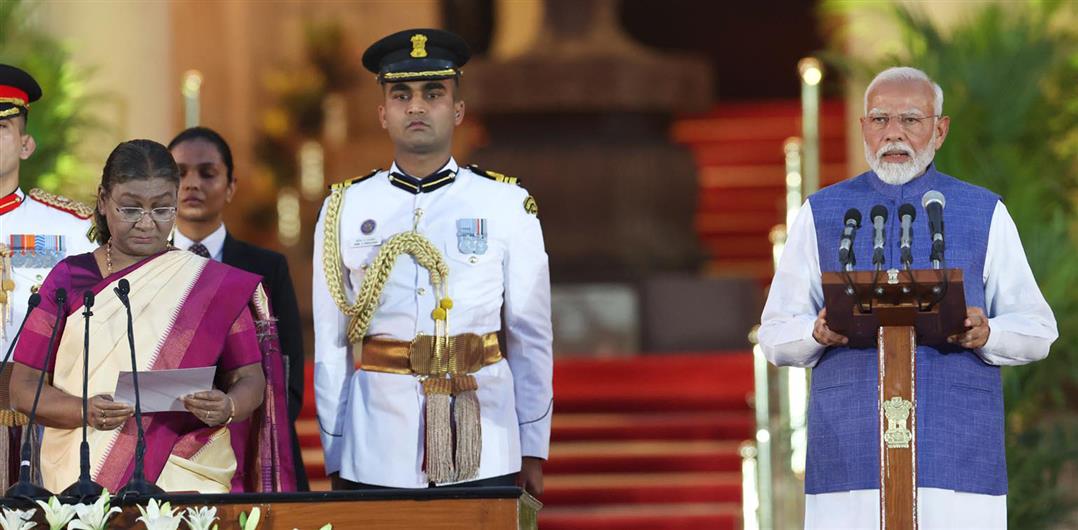
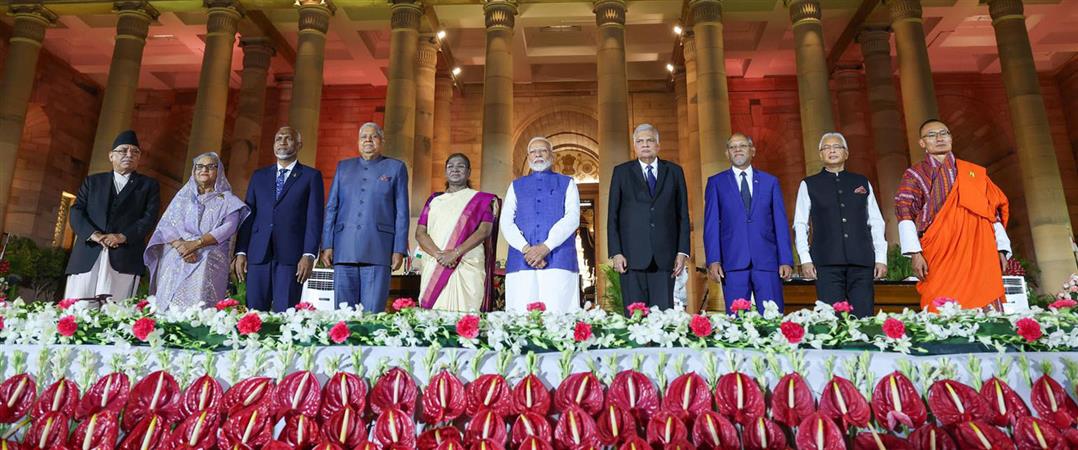
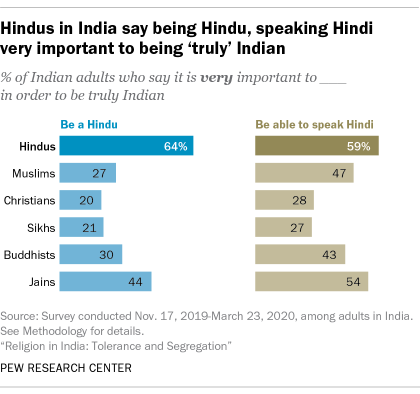
 Hindu nationalism in India also has a linguistic dimension. Hindus are more likely than other Indians to associate national identity with the Hindi language. While India has dozens of major languages, a majority of Hindus (59%) feel that being able to speak Hindi is very important to being truly Indian. Hindus who link their religion with national identity tend also to link the Hindi language with being authentically Indian.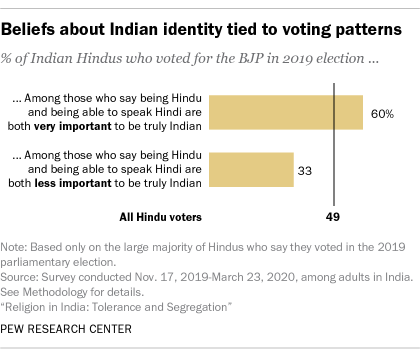
 Hardeep Singh Puri, India’s Federal Minister for Housing & Urban Affairs, Minister for Petroleum and Natural Gas praised the book as an important contribution to the literature documenting India’s rising global health influence. He highlighted the book’s extensive exploration of India’s commendable vaccination drive and vaccine diplomacy, highlighting the nation’s vital role on the world stage during the unprecedented times characterized by the Pandemic.
 Amitabh Kant, IAS, G20 Sherpa and Former CEO of NITI Aayog, lauded the book as a proactive “call to action,” commending India’s leadership during its G20 presidency and the strategic health policy initiatives such as the New Delhi Declaration. He expressed his pleasure in writing a Preface for the book and emphasized its significance in, among other matters, documenting India’s effective vaccination campaign and vaccine diplomacy. The G20 Sherpa highlighted India’s crucial role during the pandemic and acknowledged the resilience of healthcare workers and the innovations in healthcare technology that emerged during this period.
 Prof. Dr. Ruby Pawankar, Executive Director and Former President of APAAACI and Former President of the World Allergy Organization, joined the launch event from Tokyo and described the book as an essential read for those committed to shaping a sustainable healthcare landscape, emphasizing its comprehensive approach and strategic use of technology during the pandemic.
 Lieutenant General Dr. UK Sharma, Former commandant of the Indian Army’s flagship Referral and Research Hospital, described the book as a seamless narrative that expertly portrayed India’s robust response to the pandemic. He praised the book’s portrayal of healthcare workers’ resilience and innovative solutions that emerged during the crisis, describing it as a vital resource for understanding global health challenges and India’s potential leadership in global healthcare.
 Prof. M.D. Nalapat discussed the importance of understanding the comprehensive strategies and healthcare reforms that India had implemented, which could serve as a model for other nations. He noted the comments made about the in-depth analysis provided by the co-authors and their view that the book is a critical resource for anyone involved in healthcare policy and administration, as it offered a blueprint for future global health initiatives.
 Ambassador Pradeep Kapur noted the book’s potential to guide other nations in strengthening their healthcare infrastructures and policies. He highlighted the authors’ collaborative efforts in bringing together diverse perspectives and insights, which enrich the book’s content and relevance. Ambassador Kapur also discussed the book’s broader implications for rural community empowerment and national digital financial infrastructure, underscoring its significance in advocating for systemic changes that can lead to improved global healthcare governance.
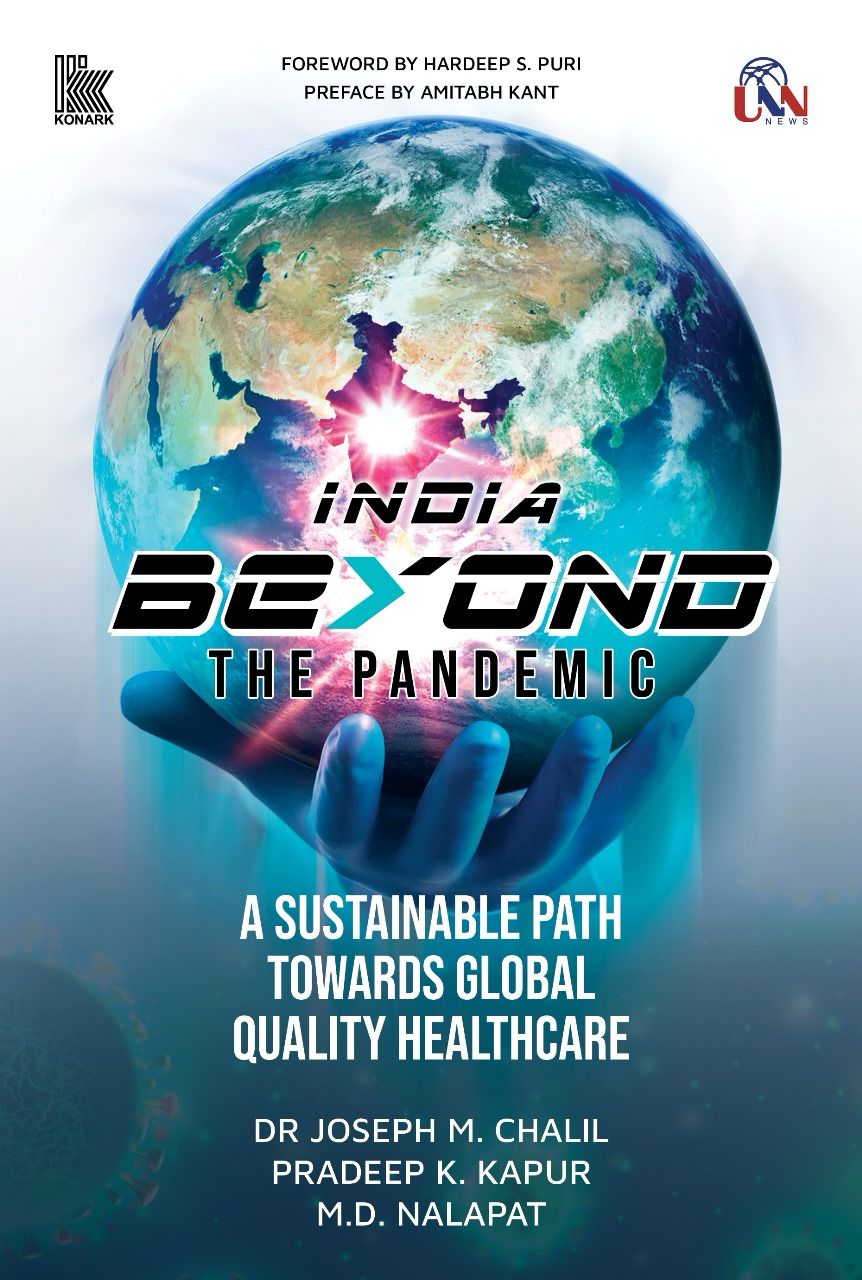

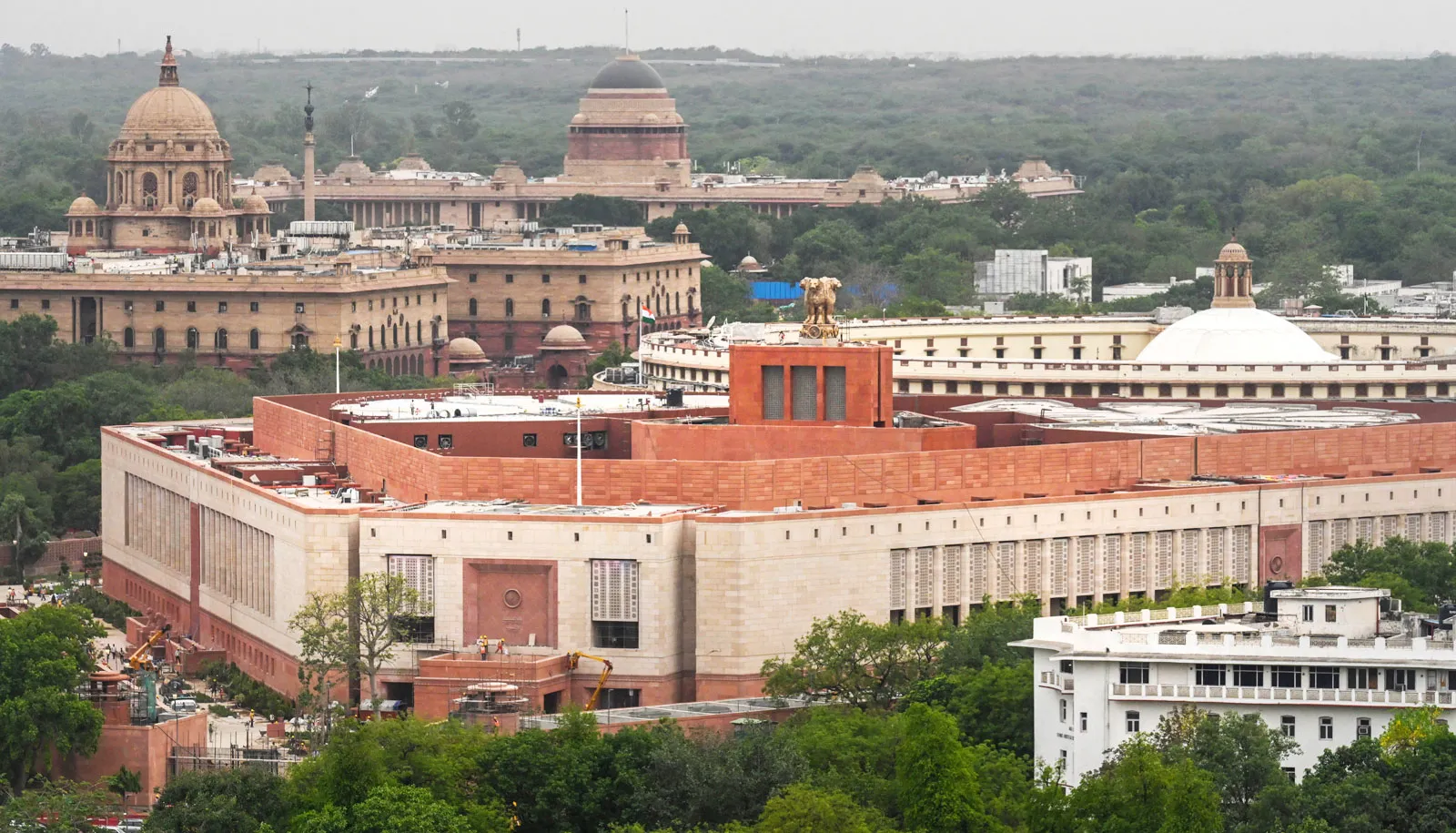

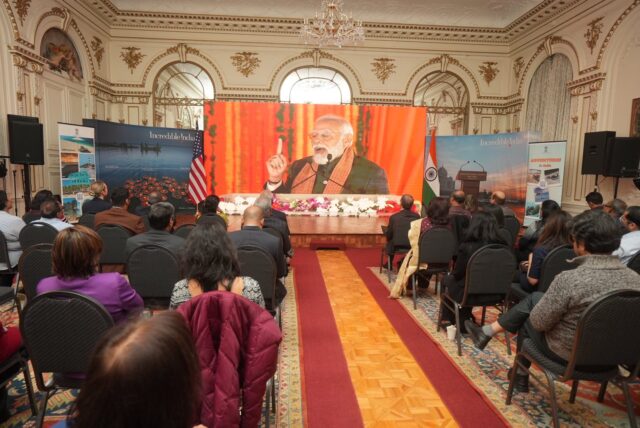 India’s Consul General in New York Binaya S. Pradhan, speaking at March 7, 2024 event at Consulate. PHOTO: X @IndiainNewYork
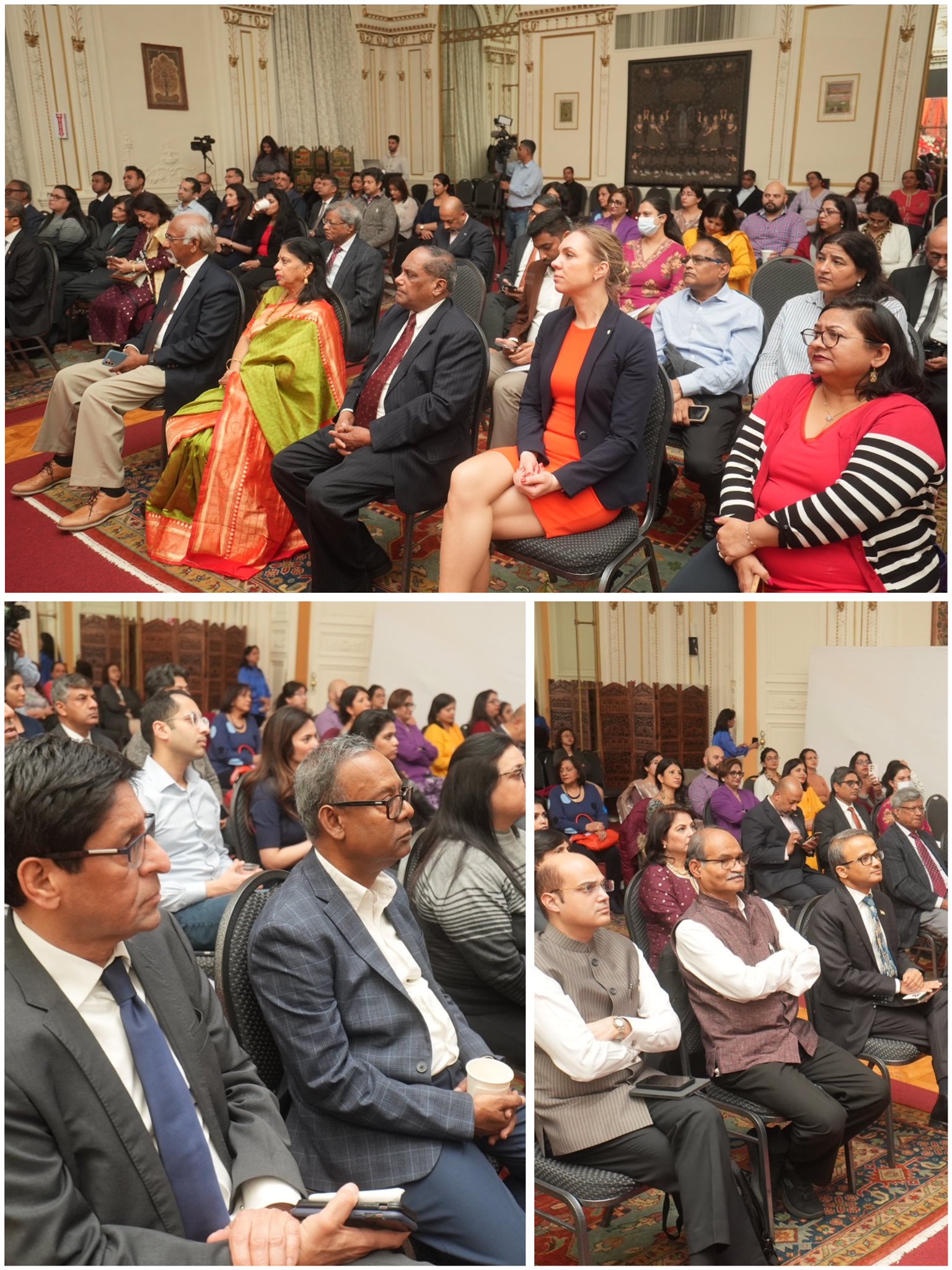 only 2% in terms of tourist spending, which is around $20 billion.