Susheela Jayapal Launches Congressional Campaign

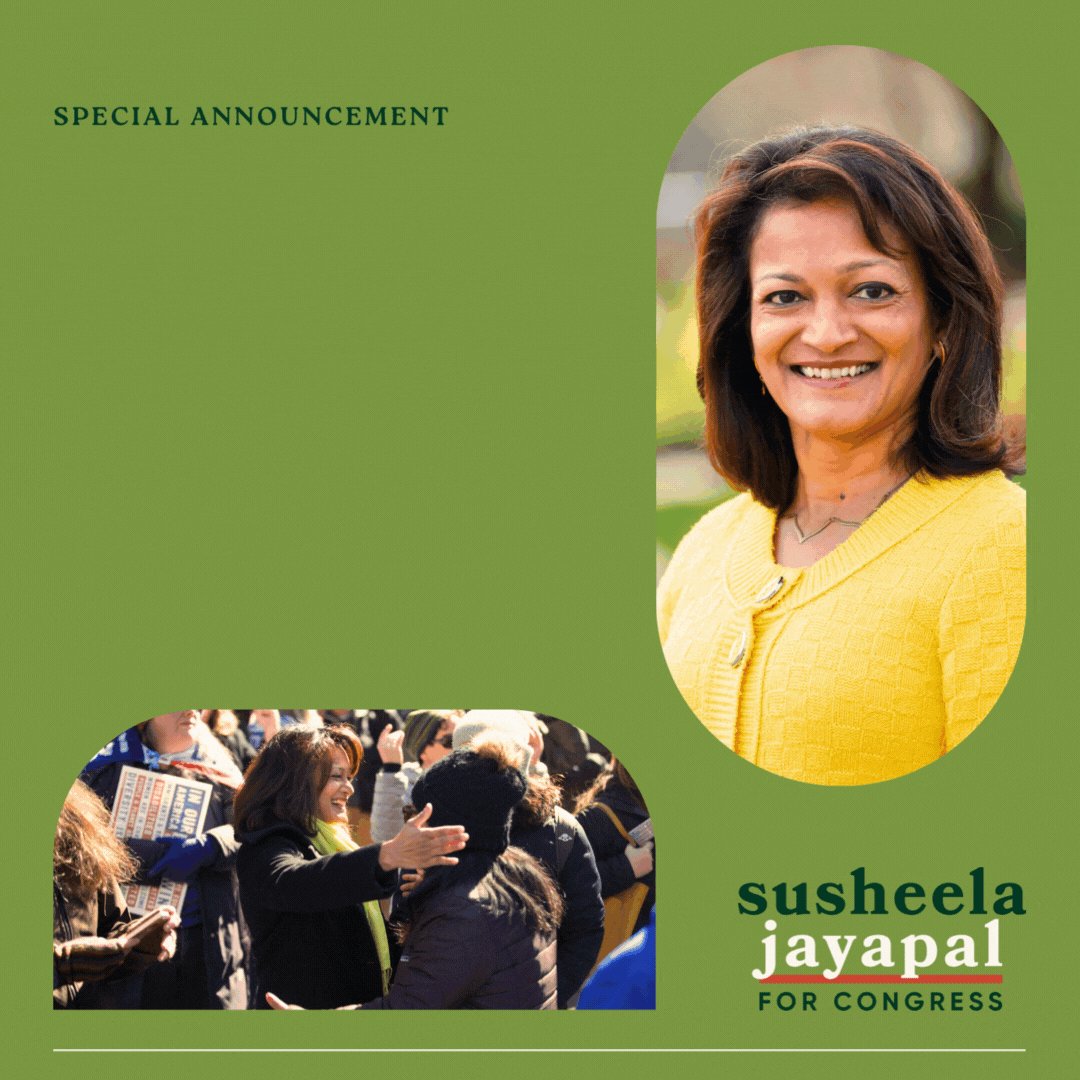
Susheela Jayapal, the sister of Indian American Congresswoman Pramila Jayapal, has launched her bid for the US Congress in Washington’s 3rd congressional district.

In a post on X last week, she said: “We need a progressive champion in Washington to carry on Congressman Blumenauer’s legacy, stand up to MAGA ideologues, and get things done for our community, without compromising our values. “Today, I’m proud to announce my candidacy for Congress.”

Congresswoman Pramila Jayapal has endorsed her sister Susheela Jayapal’s candidature

Susheela Jayapal Launches Congressional Campaign (X)
Picture: X

A former county commissioner in Oregon, Susheela Jayapal announced that she was looking to succeed Democratic Representative Earl Blumenauer, who said earlier this week that he will not seek a re-election to the state’s 3rd Congressional District.

Blumenauer, who was first elected in 1996, won a 14th full term last year with nearly 70 per cent of the vote. The 3rd Congressional District, which includes parts of Portland, is a Democratic stronghold.

Susheela Jayapal has served as District 2 Multnomah County Commissioner since January, 2019. She was born in India, and came to the United States when she was 16 to go to college.

Susheela is a lawyer, whose last legal job was as General Counsel for Adidas America; and has also spent two decades as a volunteer community leader/advocate for a number of community-based organizations. Her priorities include housing and homelessness; economic justice; clean air and climate resilience; and public safety.

Susheela Jayapal’s campaign said she is “committed to ensuring America lives up to its promise of opportunity for all, with no community left behind; and to the vision of a country that we can be proud to leave to our children and our grandchildren.”

India’s Gwalior Named As UNESCO Music City

UNESCO has included Gwalior as the city of Music under the Creative Cities Network (UCCN). 55 cities from all over the globe joined the UCCN. Gwalior was acknowledged for its strong commitment to harnessing culture and creativity as part of UNESCO’s development strategies, and displaying innovative practices in human-centered urban planning.

India’s Gwalior Named As UNESCO Music City (Instagram)
Picture: Instagram

The project was led by the Madhya Pradesh Tourism Board in cooperation with the Municipal Corporation of Gwalior, Gwalior Smart City Development Corporation Limited, Raja Mansingh Tomar Music & Arts University, music artists, and other stakeholders. The Network now includes 350 cities in over one hundred countries, representing seven creative fields: Crafts and Folk Art, Design, Film, Gastronomy, Literature, Media Arts, and Music.

Since 2019, continuous efforts have been made including multiple stakeholder consultations and a dedicated feasibility study of the city to map the potential for UCCN membership followed by the drafting of the application. Gwalior serves as an exemplary example of living cultural heritage and it houses one of the biggest annual music festivals of India; The Tansen Sangeet Samaroh to celebrate the rich culture of Madhya Pradesh.

Principal Secretary Tourism and Culture Department and Managing Director, MP Tourism Board Sheo Shekhar Shukla (IAS) said ‘Inclusion of Gwalior by UNESCO under the creative cities network is definitely a big shot in the arm which goes a long way to tell the whole world about the cultural richness of Madhya Pradesh. Gwalior being the city of Tansen, BaijuBawra, the birthplace of Dhrupad Music form and Gwalior Gharana, which are world known for musical practices and traditions which are alive even today, have been very persistently conserved and preserved and now on the occasion of Madhya Pradesh Foundation Day, it has been recognised by UNESCO by including Gwalior as a city of music.

I am sure the whole world will sit and take notice of the richness and depth of the cultural diversity, the cultural richness of Madhya Pradesh in general and Gwalior in particular. This will also go a long way in boosting international tourism in the city of Gwalior and also bringing them to showcase the best of the architectural and heritage assets.

It is a great opportunity for Madhya Pradesh and we are very thankful to UNESCO, the Minister of Culture, and the Government of India to the city of Gwalior and all the people who have ever, in any way associated with Gwalior. As a city of music, It is a massive achievement for everyone who is concerned with music and Gwalior.

Joint Director, Planning, Madhya Pradesh Tourism Board, Prashant Singh Baghel highlighted ‘Through the designation to the UCCN, we envision the realisation of the city’s goals towards achieving overall sustainable development with music as the key driver. This includes the creation of new economic and artistic opportunities for the local youth; making the city an education hub for music, cultural infrastructure development, linking of the music sector with tourism, urban renewal, and mobility and enhancing access to arts and culture.’ (IANS)

Secretary Janet Yellen Outlines Biden Administration’s Economic Strategy Toward The Indo-Pacific Region

The Asia Society Policy Institute(ASPI) hosted Secretary of the Treasury Janet Yellen to deliver an address outlining the Biden administration’s economic strategy toward the Indo-Pacific this afternoon on Thursday, November 2.

Below is the transcript of the opening speech delivered by Wendy Cutler, Vice President of the Asia Society Policy Institute, who introduced Secretary Yellen, as well as quotes from a brief Q&A session between Ms. Cutler and on-site reporters directly after the event. Additionally, two photos from the event are included below, and can be used with credit to Asia Society/Leigh Vogel.

TRANSCRIPT: Wendy Cutler’s Opening Speech

Good afternoon, everyone. Thank you for joining us today – in person and online. I’m Wendy Cutler, Vice President at the Asia Society Policy Institute and I run our D.C. office. Our institute is part of the broader Asia Society, and we focus on tackling policy challenges in the Indo-Pacific region and advancing solutions to these problems. We work with policy makers in both the United States and throughout Asia to promote fresh thinking on critical and emerging matters.

It is in this spirit that we are so delighted to be able to welcome Janet Yellen, the U.S. Secretary of Treasury, to our stage.

Secretary Yellen is a world-renowned economist, a widely-cited academic, a consummate public servant, an inspirational leader, and I also hear she’s great to work for and work with. As the only person in history to head the Treasury Department, the Federal Reserve Board and the Council of Economic Advisors, she has been a pioneer in her professional accomplishments and pursuits, and she heads the department at a time when Treasury’s role could not be more important with respect to domestic and international challenges.

Today, we are fortunate that she will share her insights and vision on the Biden administration’s economic strategy in the Indo-Pacific region, the fastest-growing and most dynamic region in the world.
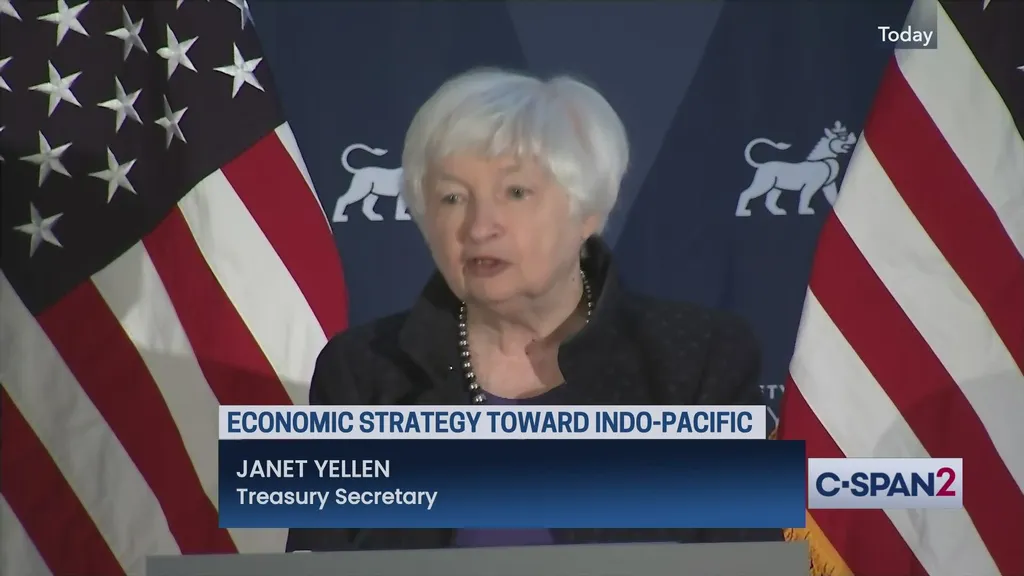
Secretary Janet Yellen Outlines Biden Administration’s Economic Strategy Toward The Indo Pacific RegionThe Treasury Department in particular has played a key role in developing and implementing the Biden administration’s economic agenda in this vital region. She and her colleagues have clearly heard the voices in the region that have pressed the U.S. to augment our security presence with a robust economic agenda.

Under her leadership and in close collaboration with other agencies, we have witnessed stepped up engagement on the economic front through bilateral initiatives, with allies and partners, through existing international and regional organizations like the G20 and APEC, as well as through new groupings like the Quad and IPEF.

The Secretary’s recent visit to China has helped stabilize our bilateral relationship and has re-opened important channels of communication.

But importantly, China has not been her sole focus. Her recent travels have taken her all over the region, including India, where I think she’s made four trips in the past year, Vietnam, Indonesia, Japan and Korea. These visits have underscored the administration’s commitment to promoting an affirmative economic agenda in the region, and not just one that is viewed through the prism of China.

This month’s going to be a very busy month for U.S.-Indo Pacific economic engagement with President Biden hosting APEC, with expected announcements to be announced under IPEF, and through a possible Biden and Xi summit that looks more likely every day.

But our regional economic engagement must not stop there. It will be important to build on these initiatives, and by doing so, we will leave no doubt in the minds of our regional allies and partners that the U.S. will continue to be an important and reliable financial trade, investment and supply chain partner, as we promote an economic security agenda that takes their concerns and interests into account.

Enough from me. I am delighted to turn the podium over to Secretary Yellen. Please join me in giving her a warm welcome.

Wendy Cutler’s Post-Speech Analysis

The Asia Society Policy Institute was honored to host U.S. Treasury Secretary Janet Yellen for a major speech today describing the Biden administration’s economic objectives, engagements, and initiatives in the Indo-Pacific region.

While a number of Cabinet officials have discussed U.S.-China relations, today’s speech refreshingly and crucially broadened the focus to the entire Indo-Pacific region. Her remarks explained how U.S. interests in the broader region are served by cultivating and building an affirmative economic agenda with countries, such as India and Vietnam, and by reinforcing economic ties with stalwart allies, such as Japan and South Korea.

I was pleased that the speech highlighted the mutual benefits of increasing trade and investment between the United States and its Indo-Pacific partners.

Secretary Yellen pointed to the rapid growth in trade and investment flows between the United States and the Indo-Pacific, which is a promising but not entirely unexpected development in light of the dynamism in the region. She did not signal, however, an interest pursuing market opening agreements, which is unfortunate given that these deals are being concluded between others without us.

Secretary Yellen provided several promising examples of how the administration is engaging in the region through bilateral initiatives with Vietnam and India, for example, and multilaterally through the G20, APEC, IPEF, the QUAD, and other channels.

If there was anything left unaddressed that the audience was eager to hear, it was probably the scarcity of details on next steps both during the APEC Leaders week, but also beyond then. In light of the upcoming APEC Summit in San Francisco this month, I had hoped to hear a general preview of the anticipated “deliverables” to be announced there, both with respect to APEC and IPEF. But, I’m sure we will be hearing more on this in the weeks ahead.

Finally, while the Secretary highlighted US-Vietnam economic ties, it would have been welcome to learn more about our ongoing and new intiaitives with other countries in Southeast Asia, an extremely innovative and fast growing sub-region of the broader Indo-Pacific.

On her assessment of Yellen’s speech:

Given my background, I couldn’t help but applaud the emphasis she put on bolstering trade and investment in the region and her making the case for why trade is important. You don’t hear that a lot in Washington these days, and I thought she was pretty forthcoming. She also very skillfully focused on the issues of tomorrow, including climate and supply chains. She’s a trooper — when you look at her travels over the past year or so, she’s probably been to Asia more than I have.

On Yellen’s engagement with the Chinese in setting up new consultation groups:

Those groups met for the first time this past week. My understanding was it was virtual and more of a discussion. I think these discussions on these Treasury-led issues are increasingly important, particularly given what’s going on in the global economy. But I would give this time, because maybe we will see modest deliverables coming out of not only these working groups but also out of the working groups that the Commerce Department is leading as well.

On how the message of Yellen’s speech might impact the state of US-China relations:

I think we are seeing a stabilization of the relationship. Remember, after her visit, we saw Secretary Raimondo and other high-level and working-level engagements, and obviously, we’re all anticipating the summit meeting between President Biden and Xi. So I think we’re in a different phase of US-China relations.

But our relations with China are strained. It took a while for them to get to this low and you’re not going to turn them around overnight. So in my view, we should have low expectations and really look to modest steps which over time could help build trust and maybe deliver some outcomes that are mutually beneficial.

On the potential Biden-Xi summit:

We should not have high expectations of major announcements coming out of this meeting. I don’t think there’ll be any breakthroughs. But as Secretary Yellen said, I think this continued engagement at all levels is extremely important. Even if we don’t see eye to eye on many issues, sitting down and talking is important not only to deepen our understanding of each other’s positions, but also hopefully to avert any mishaps that can happen and lead to an escalation in tensions between our two countries.

On IPEF negotiations:

My understanding is that there will be announcements made on specific outcomes and specific pillars in IPEF, and it’s quite possible that the pillars led by the Commerce Department will announce substantial conclusion. They’ve already concluded the supply chain pillar. The two other pillars might also be substantially concluded.

The trade pillar is facing some challenges. I’m not surprised by that. Trade negotiations take a long time, even when you’re offering market access. When you’re not offering market access, the onus is more on the demander – in this case, the United States — to show these other countries that there are benefits. But I do expect that coming out of the trade pillar, we’ll see certain chapters of the trade pillar substantially concluded, such as good regulatory practices or trade facilitation or inclusivity.

As I see it, there are currently three sticking points in the trade pillar: labor, environment and digital. On labor and the environment, my understanding is the U.S. is making robust requests to other countries and many are just not prepared at this juncture to agree. They just they need more time. With respect to digital, we may see some aspects of digital announced – for example, the aspects dealing with what I would call the trade facilitation aspects of digital, like promoting e-invoices, e-signatures, things like that. These are important frankly, and they’re important for businesses in the region, so I wouldn’t discount them. Obviously, there’s a lot of concern in our business community about the US position on data flows, source codes and localization. The administration needs more time to work those issues out.

On what up-and-coming topics she feels will emerge in the U.S. economic policy as pertaining to China:

I don’t discount that we may announce new restrictions through our export control policy or through our entity list in the coming months. There are some rumors of additional things that are being worked on. But from my perspective, I think the issue of excess capacity that particularly now we’re seeing in electric vehicles is an issue that the US, Europe, Japan, Korea and other countries are going to need to deal with, because the Chinese companies that are highly subsidized are changing the international landscape.

China is going to be the largest exporter of vehicles this year. This has happened very quickly. Companies are subsidized. Europe’s looking at restrictions through its countervailing duty law. In the US, we already have high tariffs and we also have restrictions under the IRA.

I was just in Japan and had some discussions on where Japan is headed in this area, and I’ve had similar discussions with Korea, so I think this is an area that we may be hearing a lot more about. I spent a lot of my career negotiating auto market access with respect to Japan and Korea, and even with our allies, those issues were so sensitive and so difficult to negotiate. So I think with respect to China, this is going to be an issue of growing concern.

Need To Put An End To India-Canada Friction

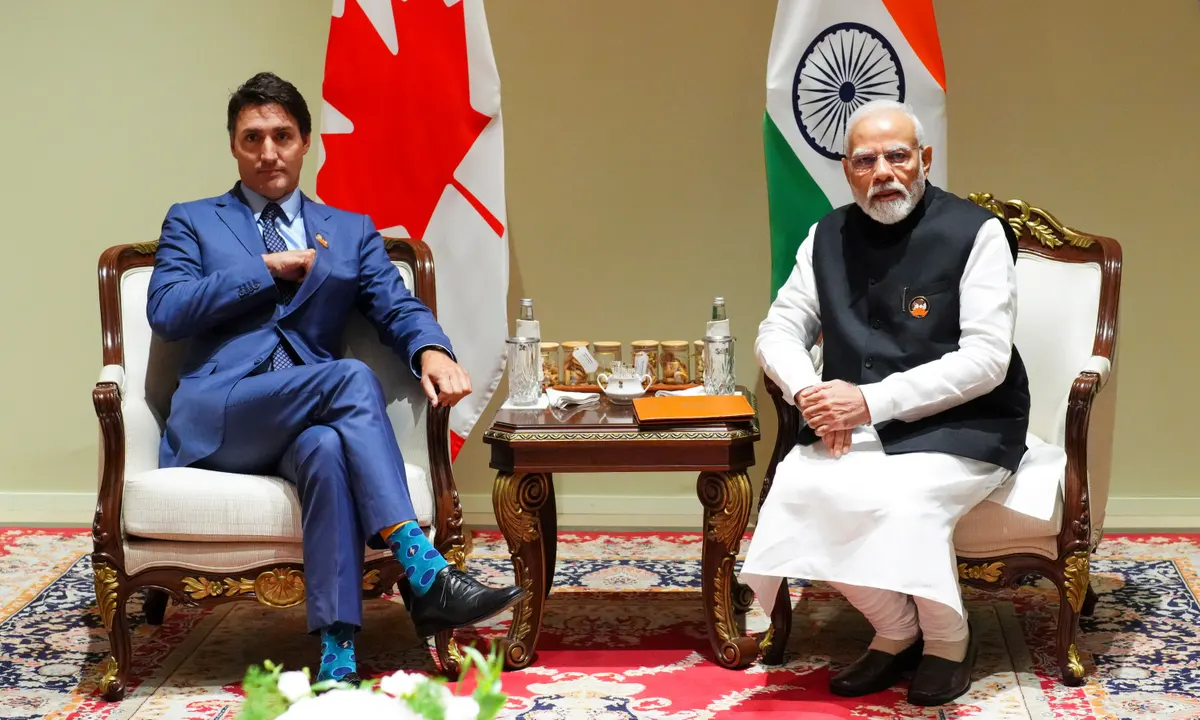
Justifiably, India and Sri Lanka are unhappy that the Canadian government is giving the freedom to operate to separatist movements in Canada and is keeping its eyes and ears closed to the violent objectives of the separatists.

It is evident that a large majority of the people living in India and Canada are highly concerned about the ongoing diplomatic friction between India and Canada and want the traditionally good relationship between both countries to be restored as early as possible.

While it serves no purpose at this stage to discuss who is responsible for developing such friction between these two democratic countries, many people in India and Canada think that Canadian Prime Minister Pierre Trudeau may have acted and spoken somewhat carelessly, attributing the death of a Sikh political leader in Canada to the machination of the Indian government. He has said this without adequate proof and that too in Canadian parliament. This statement has naturally irked India, as it would spoil the reputation of the country around the world.

 After this, one event followed another with Trudeau staying firm in his views. In the process, he has done enormous damage to the relationship with  India and the Indian government too seems to have overreacted to the accusation.

The fact that many people in Canada too are unhappy about the state of affairs became evident when Canada’s opposition leader said that he would work to restore a “professional relationship” with India if his party were to come to office in the next elections in Canada.  The question now is how to restore the relations between both countries to the traditional level.

Migrant population with twin loyalties

During the last several decades, Canada has been welcoming the migrant population liberally and has been providing citizenship to migrants from all over the world, probably without adequate checks and control from the point of view of national security.  In the process, Canada has a mixed population from various countries who have become citizens and belong to different religions including Christians, and Muslims. Sikhs, Hindus,  Buddhists and so on. Further, it appears that some of these migrant-turned-citizens have twin loyalties in their mindset to Canada as well as the country from which they have migrated.

Need To Put An End To India Canada Friction (The Guardian)
Picture: The Guardian

With such a large influx of migrants over the years and with an almost unchecked level of freedom given to the people in Canada, some of the migrants have been tempted to organise movements from Canadian soil to “fight “ for a separate state for a particular group in their original country. An immediate example is the LTTE movement freely operating in Canada to split Sri Lanka and the Khalistan movement freely operating in Canada to split India.

Justifiably, India and Sri Lanka are unhappy that the Canadian government is giving the freedom to operate to separatist movements in Canada and is keeping its eyes and ears closed to the violent objectives of the separatists. Probably, a few other countries too are unhappy with Canada for allowing separatist movements on its soil threatening the territorial integrity of those countries.

In the process of massive migration of people from different countries with varied traditional and cultural standards and value systems, the demographic structure of Canada is constantly changing with the migrant population getting considerable space in the Canadian parliament and government.  In the process, the political and electoral power of such migrants has also become strong, influencing Canadian politics.

Short-sighted policies

Probably, Trudeau feels that keeping the migrant Sikh population supporting the Khalistan movement in good humour would help him politically and hence made such a statement against India.  The twin loyalties of a section of the Canadian population became evident when the recent visit of Trudeau to a mosque in Canada was reportedly objected to by a section of Muslims living in Canada.

Obviously, Trudeau cannot afford now to backtrack since it would amount to eating his own words. However, there is concern in Canada that the country can suffer due to such short-sighted policies as the large student population from India going for higher education to Canada may start looking elsewhere.  There could be a loss of business opportunities for Canada just as it is for India too

What should be done now is that the spokespersons from both countries should remain silent for some time so that the dust settles down and saner voices can be heard from both countries.

(The author is a commentator on current affairs and a Trustee, NGO Nandini Voice for the Deprived, Chennai. Views are personal. He can be contacted at nsvenkatchennai@gmail.com)

Read more at: https://www.southasiamonitor.org/perspective/need-put-end-india-canada-friction

The Census Bureau Projects An Older, More Diverse America In 2100

By the end of the century, the U.S. population will be declining without substantial immigration, older adults will outnumber children and white, non-Hispanic residents will account for less than 50% of the population, according to projections released Thursday by the U.S. Census Bureau.

The population projections offer a glimpse of what the nation may look like at the turn of the next century, though a forecast decades into the future can’t predict the unexpected like a global pandemic.

The projections can help the U.S. prepare for change, from anticipating the demands of health care for seniors to providing insight into the number of schools that need to be built over the coming decades, said Paul Ong, a public affairs professor at UCLA.

“As most demographers realize, population projection is not an inevitable destiny, just a glimpse into a possible future,” Ong said. “Seeing that possibility also opens up opportunities for action.”

Population changes due to births and deaths, which are more predictable, and immigration, which is more uncertain. Because of that, the Census Bureau offers three different projections through 2100 based on high, medium and low immigration.

Under the low-immigration scenario, the U.S. population shrinks to 319 million people by 2100 from the current population of 333 million residents. It grows to 365 million people at the end of the century under the medium immigration scenario and to 435 million residents with high immigration. In each immigration scenario, the country is on track to become older and more diverse.

Americans of college age and younger are already part of a majority-minority cohort.

Aliana Mediratta, a 20-year-old student at Washington University in St. Louis, welcomes a future with a more diverse population and believes immigration “is great for our society and our economy.”

But that optimism is tempered by existential worries that things seem to be getting worse, including climate change and gun violence.

“I feel like I have to be optimistic about the future since, if I’m pessimistic, it disables me from doing things that I want to do, that are hard, but morally right to do,” Mediratta said.

Here’s a look at how the U.S. population is expected to change through 2100, using the medium immigration scenario.

2020s

By 2029, older adults will outnumber children, with 71 million U.S. residents aged 65 and older and 69 million residents under age 18.

The numeric superiority of seniors will mean fewer workers. Combined with children, they’ll represent 40% of the population. Only around 60% of the population that is of working age — between 18 and 64 — will be paying the bulk of taxes for Social Security and Medicare.

2030s

“Natural increase” in the U.S. will go negative in 2038, meaning deaths outpacing births due to an aging population and declines in fertility. The Census projects 13,000 more deaths than births in the U.S., and that shortfall grows to 1.2 million more deaths than births by 2100.

2050s

By 2050, the share of the U.S. population that is white and not Hispanic will be under 50% for the first time.

Currently, 58.9% of U.S. residents are white and not Hispanic. By 2050, Hispanic residents will account for a quarter of the U.S. population, up from 19.1% today. African Americans will make up 14.4% of the population, up from 13.6% currently. Asians will account for 8.6% of the population, up from 6.2% today.

Also in the 2050s, Asians will surpass Hispanics as the largest group of immigrants by race or ethnicity.

2060s

The increasing diversity of the nation will be most noticeable in children. By the 2060s, non-Hispanic white children will be a third of the population under age 18, compared to under half currently.

2080s

Under that medium immigration scenario, the U.S. population peaks at more than 369 million residents in 2081. After that, the Census Bureau predicts a slight population decline, with deaths outpacing births and immigration.

2090s

By the end of the 2090s, the foreign population will make up almost 19.5% of U.S. residents, the highest share since the Census Bureau started keeping track in 1850. The highest rate previously was 14.8% in 1890. It currently is 13.9%.

FOREIGN BORN AND IMMIGRATION

Experts say that predicting immigration trends is more difficult than in the past when migration was tightly linked to the pull of economic opportunity in the U.S.

The Census Bureau Projects An Older More Diverse America In 2100When immigration is instead driven by the push of climate change, social tensions exacerbated by authoritarian rulers and gangs, as well as fluctuating anti-immigrant sentiment in the U.S., it is harder to predict, said Manuel Pastor, a professor of sociology and American Studies & Ethnicity at the University of Southern California.

“In the past we would say we get immigration from economics, and you can make some reasonable projections,” Pastor said. “Now, we have these push pressures for people to come to the U.S., and we have a further racialized reaction to migration, we have a much wider band or error, or the potential to make mistakes.”

RELIABILITY

How reliable will the numbers be, especially as race and ethnic definitions change, and immigration levels are hard to predict?

While there is an extreme level of uncertainty projecting almost eight decades into the future, it is a good starting point, said Ong, the UCLA professor.

“Over 80 years, birth and death rates, fertility rates and migration rates can be changed through policies, programs and resources,” Ong said.

Mediratta, the college student, imagines that 20-year-olds like her two centuries ago were also concerned about the future, but they didn’t have TikTok or Instagram to amplify their worries.

“It seems like things are bad all the time,” Mediratta said. “I feel that things were probably bad all the time 200 years ago, but nobody could tell everyone about it.” (Source: AP)

ZEE5 Global Announces Digital Premiere Of Abhishek Bachchan And Saiyami Kher Starrer – Ghoomer

ZEE5 Global, the world’s largest streaming platform for South Asian content,  today announced the world digital premiere of ‘Ghoomer’. With an inspiring storyline, the movie features a stellar cast of Shabana Azmi, Abhishek Bachchan, Saiyami Kher, Angad Bedi and a special appearance by none other than Mr. Amitabh Bachchan. Helmed by R. Balki, Ghoomer is all set to make an indelible mark via its OTT release on 10th November exclusively on ZEE5 Global.

Produced by Hope Film Makers and Saraswati Entertainment, Ghoomer is an emotional story with multiple layers. In ‘Ghoomer,’ Saiyami Kher plays Anina Dixit, a talented cricketer whose dreams are shattered by a tragic accident leading to the loss of her right arm. Paddy (played by Abhishek Bachchan), a former test cricketer, becomes her coach and helps her become the first-ever one-armed spinner, propelling her to play for the Indian National Team. The coach gives her new hope, trains her with unconventional techniques and invents a Ghoomer bowling style to turn her fate around. ‘Ghoomer’ shows how people can win over tough times and get another shot at success beating all odds.

ZEE5 Global Announces Digital Premiere Of Abhishek Bachchan And Saiyami Kher Starrer – Ghoomer 2 (1)Archana Anand, Chief Business Officer, ZEE5 Global said, “Outstanding stories of might and perseverance hold the power to unite viewers across the globe. With the digital premiere of the critically acclaimed film Ghoomer on ZEE5, we hope to inspire viewers across the globe as the film’s remarkable story highlights the unbreakable human spirit. The title further expands our robust blockbuster movies library and is sure to resonate deeply with viewers worldwide.”

Director R. Balki said, “Ghoomer on ZEE5 Global will finally take the film to the widest possible audience the film deserves. Loved unanimously by those who have seen it in its limited release in the theatres, this magical story of a one-armed girl who is given a new lease of life by a man who believed in the impossible and changed the rules of the game, can atleast be witnessed by every home around the globe. I am thrilled now Ghoomer will finally reach the hearts of millions.

 Abhishek Bachchan shared his excitement, stating, “Working alongside Saiyami Kher and under R. Balki’s brilliant direction was an enriching experience that allowed us to delve deep into the intricacies of our characters. The success of this Ghoomer should be credited to the stellar team both on and off-screen who brought this story to life. I am thrilled that the film is set to make its digital premiere on ZEE5 Global, bringing this heartfelt tale to a wider audience who can now enjoy the film from the comfort of their homes.”

 Saiyami Kher mentioned, “Ghoomer has been the best experience of my life. The film has my blood, sweat, toil and my entire heart. Getting to play a differently abled cricketer, getting to work with the genius R. balki. Getting to share the screen with AB, Shabana ji and Angad has been a dream. This film is everything I could have asked for. I am delighted that the film will now be accessible to a wider audience on ZEE5 Global, allowing viewers to experience the magic of life, live Anina and paddy sir’s journey and get inspired by Anina’s courage.”

Viewers can catch ZEE5 Global’s unmissable slate and stock up on their yearlong entertainment by subscribing to the Annual pack and grabbing the limited-time special offer price.

ZEE5 Global Announces Direct-To-Digital Film ‘Kadak Singh’ Starring Pankaj Tripathi

ZEE5 Global, the world’s largest streaming platform for South Asian content, announced its next direct-to-digital film, Kadak Singh today. This will mark the second collaboration between national award-winning director, Aniruddha Roy Chowdhury and ZEE5 Global after the success of Yami Gautam starrer ‘Lost’ and the third direct-to-digital collaboration between national award-winning actor, Pankaj Tripathi and ZEE5 Global after the success of ‘Yours Truly’ and ‘Kaagaz’. Produced by Wiz Films (Andre Timmins, Viraf Sarkari & Sabbas Joseph), HT Content Studio (Mahesh Ramanathan), and KVN and co-produced by Shyam Sunder and Indrani Mukherjee, Kadak Singh also stars Sanjana Sanghi, Jaya Ahsan, Parvathy Thiruvothu, Dilip Shankar, Paresh Pahuja and Varun Buddhadev in prominent roles and is set to premiere on ZEE5 Global later this year.

Kadak Singh is an engaging thriller filled with mystery and suspense. The movie follows the perplexing journey of AK Shrivastav (Pankaj Tripathi) as he battles retrograde amnesia, uncovering a web of conflicting narratives from his past. Amidst the process of piecing together his life, the film delves into his quest to expose the truth behind a significant financial crime.

Pankaj Tripathi going live on Instagram two days ago and seeming a little lost and confused and ending the live abruptly, leaving people perplexed now makes sense as he seems to be playing out his character suffering from retrograde amnesia live for his virtual audience, giving them a sneak-peek into his character. The direct-to-digital film, Kadak Singh is set to premiere on ZEE5 Global later this year.

Archana Anand, Chief Business Officer, ZEE5 Globalsaid, “We are proud to unveil ‘Kadak Singh,’ our latest direct-to-digital release. We’ve delivered outstanding original content this year, earning the love of global audiences and are pleased to bring this film which marks our third collaboration with the phenomenal Pankaj Tripathi. We have full confidence that viewers will find ‘Kadak Singh,’a film well worth watching.”

Viraf Sarkari, Director Wiz Films and Producer of Kadak Singhsaid, “It’s been 12 years since I first thought of this story & started developing this film. I am so happy to finally realise this dream. We have done our best to put the best team of actors, director & crew to be a part of this film. On behalf of Wiz Films & my partners Andre Timmins& Sabbas Joseph I’d like to thank our Director Annirudha Roy Chowdhury, our producers KVN & Suprith, HT Content Studio’s Mahesh Ramanathan, & our co producers Shyam Sunder & Indrani Mukherjee, our writer Ritesh Shah and Music Director Shantanu Moitra for their love & support. Hope the audiences enjoy watching this film as much as we all did while making it”.

Director, Aniruddha Roy Chowdhury said, “Kadak Singh is a special film and talks about the responsibility of one government official towards the common people. Pankaj Tripathi and Sanjana Sanghi have done a fabulous job at portraying this complex father daughter story. Infact, I was in a paradise full of great actors including Parvathy and Jaya Ahsan and collaborators where each one of them has really pushed the boundary to deliver a terrific thriller. The highlight of this film is that it has relationships in different forms and how these relationships provide different perspectives and help the story move forward. It is also about a dysfunctional family coming on their own and becoming functional after a series of events leading to a rollercoaster of emotions. I hope that the film enriches people as it is a commentary on the society, and I am looking forward to another successful collaboration with ZEE5 Global”.

 Viewers can catch ZEE5 Global’s unmissable slate and stock up on their yearlong entertainment by subscribing to the Annual pack and grabbing the limited-time special offer price.

ZEE5 Global is the digital entertainment destination launched by Zee Entertainment Enterprises Limited (ZEEL), a global Media and Entertainment powerhouse. The platform launched across 190+ countries in October 2018 and has content across 18 languages: Hindi, English, Bengali, Malayalam, Tamil, Telugu, Kannada, Marathi, Oriya, Bhojpuri, Gujarati, Punjabi, including six international languages Malay, Thai, Bahasa, Urdu, Bangla and Arabic. ZEE5 Global is home to 200,000+ hours of on-demand content. The platform brings together the best of Originals, Movies and TV Shows, Music, Health and Lifestyle content in one destination. In addition, ZEE5 Global offers features like 15 navigational languages, content download options, seamless video playback and Voice Search.

Users can download the ZEE5 Global app from Google Play Store / iOS App Store. It is available on Roku devices, Apple TVs, Android TVs, Amazon Fire TV and Samsung Smart TVs. Users can also access ZEE5 Global on www.ZEE5.com

During Diwali, “Dispel the Inner Darkness through the Light of Knowledge”

Gopi Diwali at Times Square, presented by KIA, lit up the heart of Times Square, celebrating cultural diversity, equity, and inclusion. Aligned with the NYC Diwali school holiday, the event transcended the traditional symbolism of Diwali, focusing on illuminating the inner self and fostering unity, enlightenment, love, peace, and harmony for a more peaceful world.

“The festival aimed to unite people from diverse backgrounds, focusing on education to foster unity and diversity, prioritized including children and teaching them to be responsible citizens, compassionate individuals, and good neighbors.”, said the Founder of Diwali at Times Square, Neeta Bhasin.

One of the evening’s highlights was the grand Diya (lamp) lighting on stage, synchronized with the countdown on the One Times Square tower. The ceremony drew distinguished guests, including Eric Adams, NYC Mayor, Senator Chuck Schumer, Deputy Mayor Meera Joshi, Consul General of India Randhir Jaiswal, Assemblywoman Jenifer Rajkumar, Justice Karen Gopee, and various esteemed dignitaries.

During Diwali Dispel the Inner Darkness through the Light of Knowledge 2The Gopi, a California-based family-run dairy company, emphasized the universal message of peace and love through Diwali. Annie Keropian-Dilsizian, Gopi’s Marketing Manager, highlighted the event’s historic significance. Festival goers received complimentary full-size product samples, including Gopi Lassi and Paneer, to add joy and tradition to their Diwali celebrations.
Steven Center, COO & EVP of Kia America, expressed “Diwali’s core values of balance, harmony, and joy are mutual guiding principles of Kia’s ‘Opposites United’ design philosophy, which takes inspiration from the contrasts found in nature and humanity, that’s why Kia is proud to participate as presenting sponsor of Diwali in Times Square and recognize the festival of lights.”

The festival showcased an awards segment, honoring outstanding individuals: Neera Tanden the recipient of the “Woman of the Year in Public Service” US Domestic Policy Council Director, expressed gratitude “Celebrating Diwali in Times Square was a pleasure. Thanks to Neeta Bhasin and the Board for recognizing my commitment to improving lives. This event honored the invaluable contributions of the Indian American community, enriching and strengthening America”.

Procter and Gamble COO, Shailesh Jejurikar, was honored with the “Man of the Year in Private Service” Award said “I am humbled and honored by this recognition. As I reflect on my career, I am inspired by Procter & Gamble’s commitment since its founding 185 years ago to improve consumers’ everyday lives. This dedication fuels my determination to create a meaningful and lasting impact.”

Assemblywoman Jenifer Rajkumar who played a pivotal role in establishing the NYC School Holiday and strong support for Diwali at Times Square was honored with the ‘Samman Award’.

NYC Mayor Eric Adams declared October 28th as Diwali Day.

Senator Chuck Schumer who never misses Diwali at Times, loves the Indian community. In support of the community Senator said ‘I wrote laws to allow more Indians to come to America and New York. The more Indians are in New York, the better New York is. I will change the law to make it more so”.

Randhir Jaiswal, the Consul General of India, NY stated, “As we celebrate Diwali in Times Square, we mark not just a festival but a milestone in the recognition of our culture, as Diwali becomes a public holiday in schools.”

The “Light Up Concert” dazzled with Bollywood star Mika Singh, Indian American sensation Shuba, and local talents, making it a vibrant celebration of cultural diversity and impactful individuals.

A R Helping Hands Diwali at Times Square is an annual event that celebrates Diwali with grandeur, bringing together people from diverse backgrounds to embrace unity in diversity, honor outstanding achievements, and celebrate the festival of lights.

We are honored to receive a message from Prime Minister Modi, extending heartfelt greetings for the joyous occasion of Diwali.

India-US Défense Ties Key Pillar For World Peace, Stability: Blinken, Austin

Amidst the ongoing conflicts in Israel, Hamas, and the Russia-Ukraine war, the ongoing fifth India-US 2+2 Ministerial Level Talks in New Delhi, has been described as very crucial.

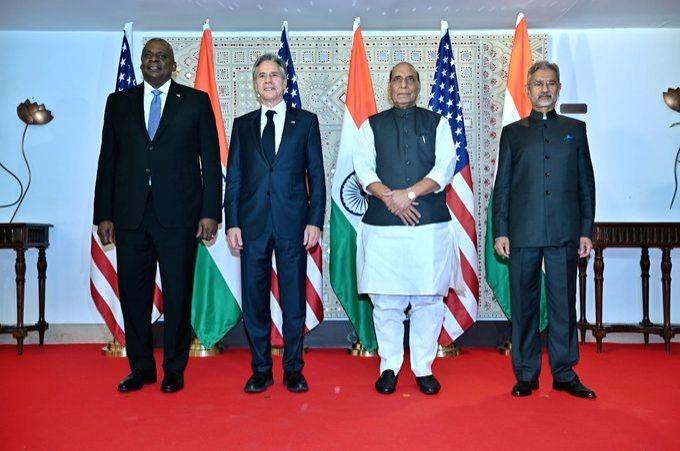
US Secretary of State Antony J Blinken and Secretary of Defense Lloyd Austin, both are for meetings with their Indian counterparts, Defense Minister Rajnath Singh and External Affairs Minister S Jaishankar.

Blinken has said that India-US defense cooperation is “a key pillar” for bolstering the partnership of the two countries in “international peace and security, and specifically, working to promote the rules-based order and uphold the principles at the heart of the UN Charter: sovereignty, territorial integrity, independence.”

“Our defense cooperation, which we’re strengthening again today, is a key pillar of that work,” Blinken said in his opening remarks at the 2+2 India-US Ministerial Dialogue that began in the national capital earlier in the day

Also in his opening remarks, US Defense Secretary Lloyd Austin said in his opening remarks that there have been “impressive gains in building our major defense partnership over the past year, and that will help us contribute even more together to the cause of peace and stability. We’re integrating our industrial bases, strengthening our interoperability, and sharing cutting-edge technology,” he added.

India US Défense Ties Key Pillar For World Peace StabilityBlinken said the two countries were taking very concrete steps to deliver on the vision that President Joe Biden and Prime Minister Narendra Modi put forward at their meeting in Washington in June.
“We are promoting a free and open, prosperous, secure, and resilient Indo-Pacific, including by strengthening our partnership through the Quad, with Japan and Australia,” he explained.

Blinken went on to say that “one significant way we’re doing that is by enhancing maritime domain awareness: sharing commercial satellite data with countries in the region to boost their capacity, for example, to combat illegal fishing, piracy, drug trafficking”.

“We’re also coordinating humanitarian relief and disaster response efforts in the Indo-Pacific. We’re harnessing together the power of innovation to make our economies more resilient and to make our communities more secure, while expanding inclusive economic opportunity.

“That’s evident in the cooperation on semiconductors and advanced biotechnology; on our unprecedented investments in deploying clean energy at scale in our countries as well as across the region; and our joint research and exploration projects in space,” he added.

The top diplomat mentioned the people-to-people ties between the two countries and the steps that are being taken to reduce visa wait times and facilitate travel between India and the US.

Jaishankar held “an open and productive discussion” with visiting US Secretary of State Antony Blinken here on Friday on strengthening strategic New Delhi-Washington ties, the fallout of the raging Israel-Hamas war and regional issues including the geopolitical situation in the Indo-Pacific region.

The meeting took place ahead of the fifth edition of the India-US 2+2 Defence and Foreign Ministers’ Dialogue. “Pleased to meet with Secretary of State @SecBlinken this morning. An open and productive conversation on further developing our strategic partnership,” Jaishankar posted on X.

“This visit has a particular significance because we need to follow up on PM Modi’s June visit and President Biden’s September visit. This is a 2+2 Ministerial Dialogue, so we take a broader view of what we are doing.”

The central focus of these talks is to address the ongoing conflicts and regional security concerns while strengthening the strategic ties between India and the United States. The agenda is expansive, encompassing the India-US Strategic Relationship, as well as exploring avenues to enhance bilateral relations and collaboration within international forums such as the QUAD (Quadrilateral Security Dialogue) and I2U2.

One prominent subject for discussion is the military standoff on the northern borders between India and China. Both countries have a vested interest in resolving this standoff amicably, thereby contributing to regional stability.

Another matter of great concern is the global security implications of the Russia-Ukraine war. As members of the QUAD, a coalition dedicated to ensuring security in the Indo-Pacific region, India and the U.S. are likely to deliberate on their respective roles in the context of this global event. The ongoing conflict between Hamas and Israel in the Gaza region may also find a place on the agenda, with a focus on containment to prevent further escalation.

Hillary Clinton Expresses Profound Appreciation For The Invaluable Contributions Of ITServe Alliance

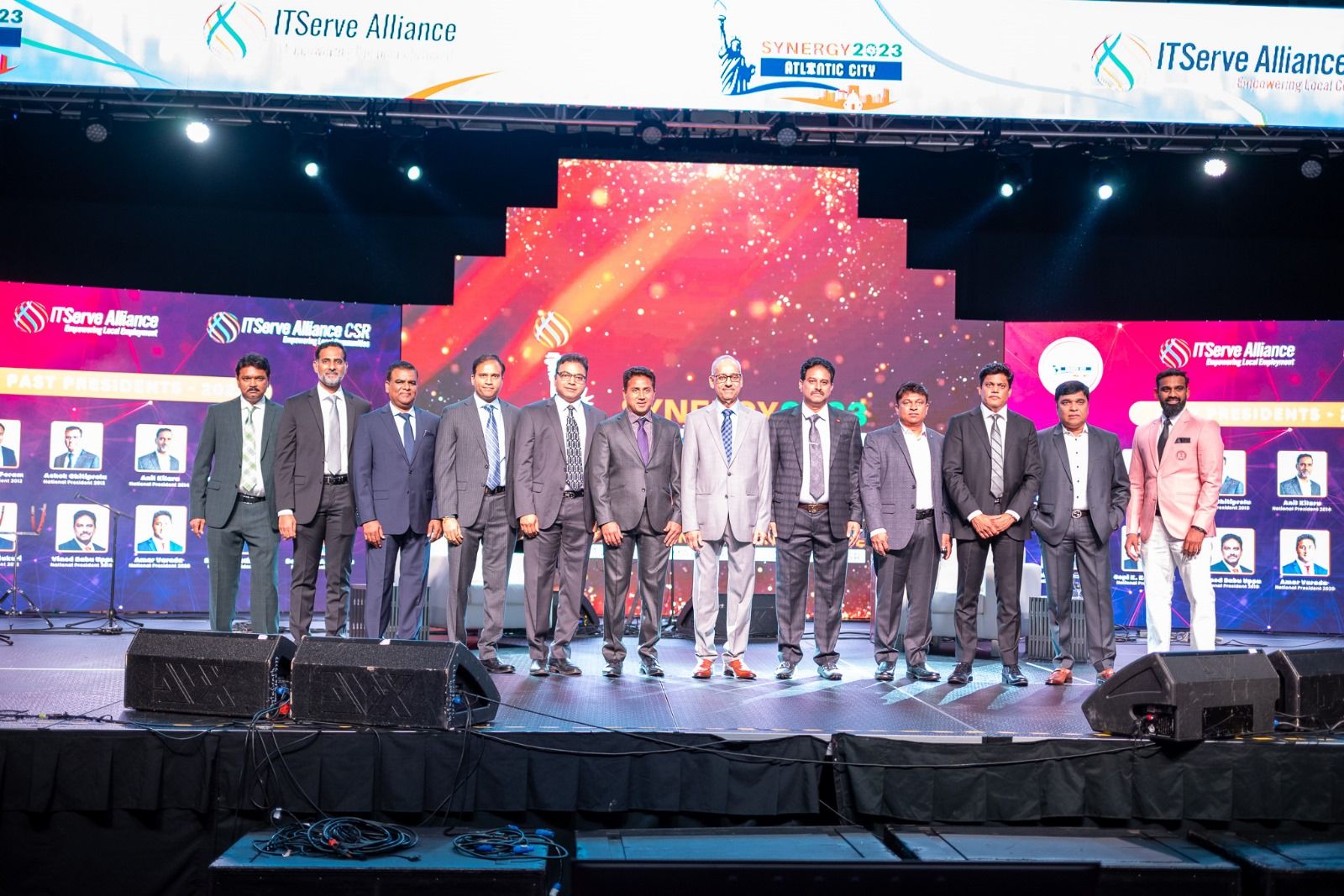
Networking, learning and sharing of knowledge, great and highly acclaimed speakers, insightful workshops, collaborating with one another, strengthening bonds, cultural and fun events, awards ceremony, showcasing of business booths and products, and delicious and multi-ethnic cuisine were the highlights of the ITServe Alliance’s flagship Synergy 2023 held from October 26th to 27th, 2023 at the popular Harrahs Resort in Atlantic City, NJ. Attended by over 2,200 members of ITServe Alliance, who are small and medium size companies of Information Technology, the annual event was a way of celebrating ITServe Members’ achievements and accomplishments.

In his address to the membership, Vinay K. Mahajan, National President of ITServe Alliance highlighted how under his able leadership, ITServe has grown and strengthened in its mission in protecting members interest, enhancing membership benefits, empowering local employment, empowering local community through various CSR programs including STEM education, and empowering ecosystem of innovation and thus maintaining the leadership of US in Technology.

“Travelling to all the 21 Chapters across the United States in 8 months after I assumed office, I was instrumental in achieving membership to newer heights with more than 700+ new members added in 2023. Two new Chapters were launched. IT Serve Alliance is led by highly talented individuals, phenomenally successful entrepreneurs, and Innovators who are enthusiastic about giving back to the community.” He strengthened STEM Education program by adding STEM Training and Internship programs and enhancing STEM scholarships program.”

Venu Sangani, Director of Synergy 2023, who led a dedicated and visionary team organizing this historic event said, “Synergy 2023 is our landmark flagship gathering, you have opportunities for growth and learning, forging a path with connections, with featuring seven keynote sessions from seven different domain panels, panel discussions, interactive breakout sessions. The essence of Synergy lies not only knowledge exchanges but inspiring one another. Let the success stories of fellow entrepreneurs ignite your ambitions.”

Vinodbabu Uppu, Governing Board Chair of ITServe said, “Synergy 2023 is the only one-of-a-kind conference delivering innovative strategies, unique insights, and proven tactics for success, exclusively for IT service companies and individuals. Synergy 2023 focused on developing strategic relationships with our partner organizations, sponsors, and supporters to work for a better technology environment by building greater understanding.”
Venu Sangani, Director of Synergy 2023, who led a dedicated and visionary team in organizing this historic event said, “Synergy 2023 is our landmark flagship gathering, with opportunities for growth and learning, forging a path with connections, featuring seven keynote sessions from seven different domain panels, panel discussions, and interactive breakout sessions. The essence of Synergy lies not only in knowledge exchanges but inspiring one another. Let the success stories of fellow entrepreneurs ignite your ambitions.”

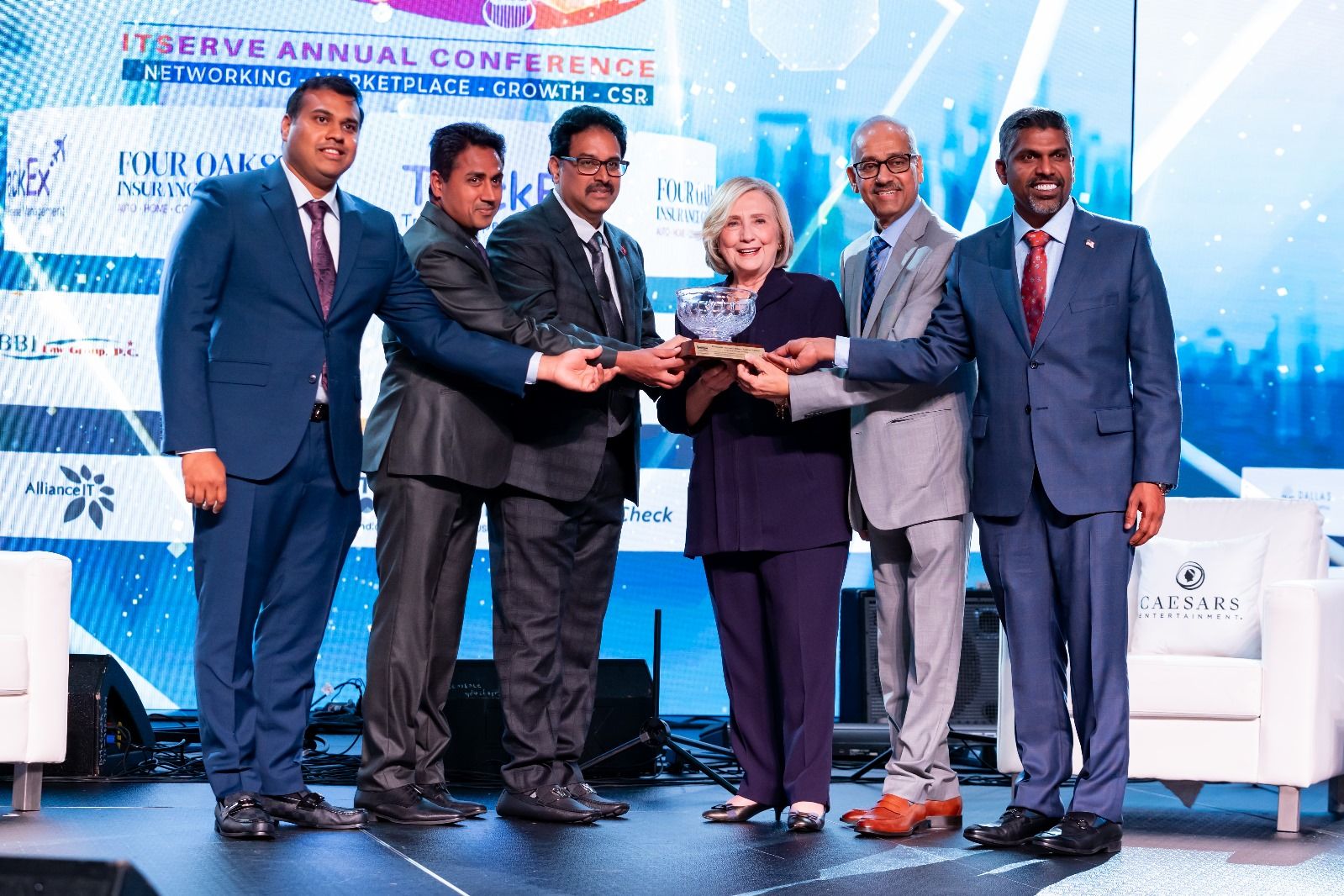
Secretary of State Hillary Rodham Clinton, the Chief Guest at ITServe Alliance’s Synergy 2023, shared with the audience about her life and aspirations, expressed appreciation for the contributions of the high skilled immigrant community and urged them to play an active role in the society. Ms. Clinton, the 67th Secretary of State of the United States has dedicated over four decades of her life in public service, serving as an advocate, attorney, First Lady, and US Senator.

Secretary Clinton praised the contributions and accomplishments of the high-skilled immigrants to this country. She said, “I’m so proud of the many accomplishments of the ITServe member companies in the United States. I really want to thank you and commend you for the extraordinary contributions to the nation.  I was so impressed by the many contributions you’ve made, in addition to building your businesses and providing employment for people.”

Secretary Clinton stressed the importance of Health Insurance program particularly for the children. When it comes to US immigration issues, she advocated for reforming our immigration system to attract the most talented individuals from around the globe. This, in turn, would drive innovation and foster growth in our nation. Additionally, she advocated for a bipartisan approach to address this issue.


ITServe members were filled with immense pride as they welcomed distinguished guests to their Synergy events. In 2021, they were honored to host President George W. Bush in Dallas, followed by President Bill Clinton and a former US Ambassador to the UN Nikki Haley in 2022 in Orlando. The pinnacle of their achievements came in 2023, as they were graced by the presence of Secretary Ms. Clinton at Synergy in Atlantic City.

These momentous occasions were a testament to the organization’s commitment to excellence and its ability to attract influential figures to its gatherings. These remarkable leaders graced the Synergy events with their presence, making each gathering a memorable and prestigious occasion for ITServe and its members.

Founded in 2010, ITServe Alliance is the largest association of Information Technology Services organizations functioning across the United States. Established to be the voice of all prestigious Information Technology companies functioning with similar interests across the United States, ITServe Alliance has evolved as a resourceful and respected platform to collaborate and initiate measures in the direction of protecting common interests and ensuring collective success. ITServe Alliance now has 21 Chapters in several states across the United States, bringing the Synergy Conference to every part of this innovation country. For more information, please visit: www.itserve.org

New England Choice Awards Gala In Boston Celebrates Accomplishments of Indian Americans

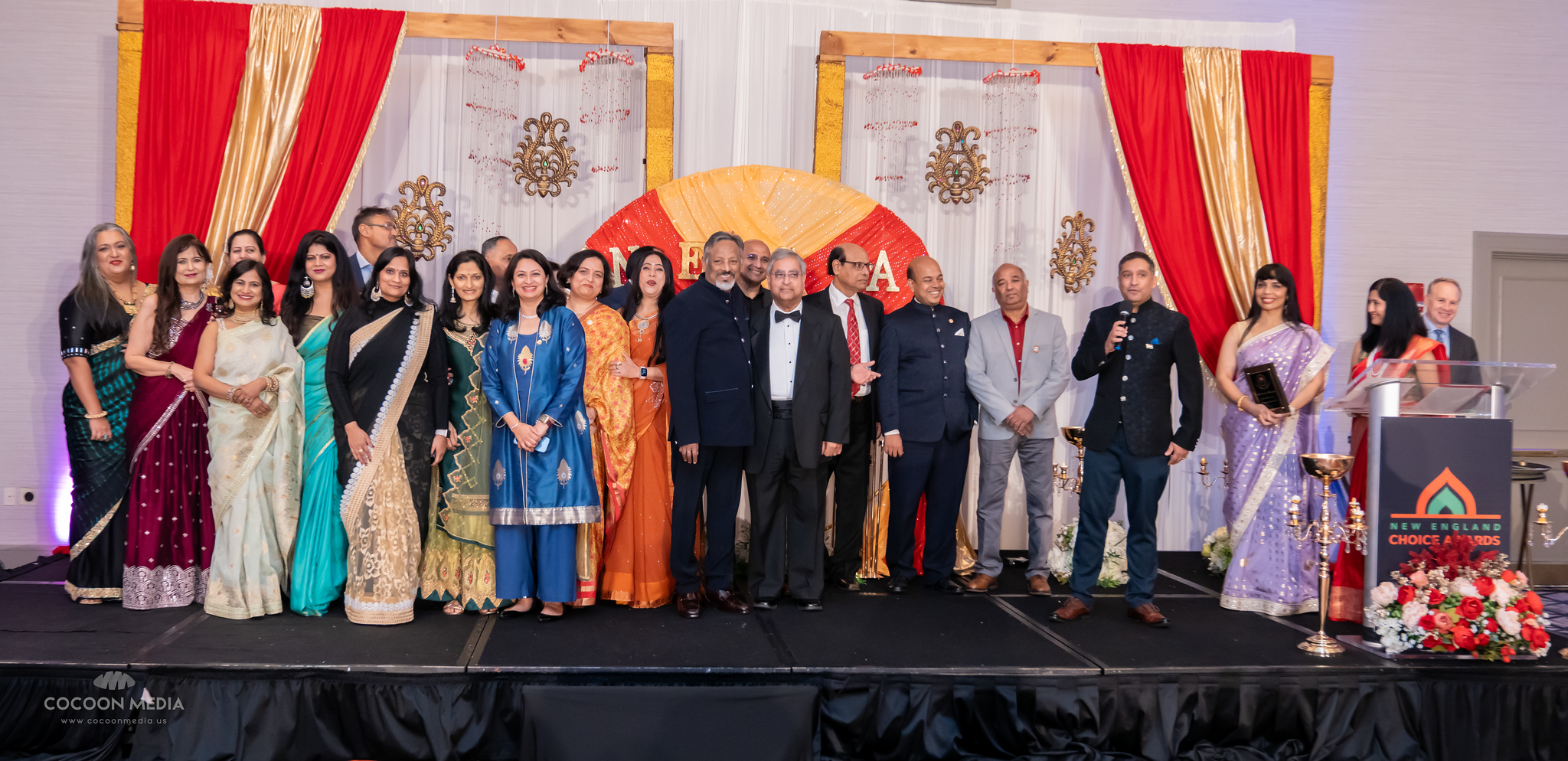
The New England Choice Awards, a prestigious event held annually celebrating the achievements and accomplishments of the Indian American community was held on Sunday, November 5th, 2023 in Boston, MA.

Organized by the non-profit INE MultMedia, Inc., in collaboration with INDIA New England News, New England Choice Awards gala was attended by, among others, Chief Guest and Keynote Speaker Boston Mayor Michelle Wu and Guest of Honor Pillar VC Founder and CEO Jamie Goldstein.

Over 400 entrepreneurs, corporate executives, philanthropists, educators and community leaders gathered in the packed Grand Ballroom of the Burlington Marriott to honor New England Choice Awards winners of 2023 and be part of the celebration of the fast growing Indian American community.

New England Choice Awards Gala In Boston Celebrates Accomplishments of Indian Americans (Cocoon Media) 2
Picture: Cocoon Media

This year’s NECA award recipients were: Ash Ashutosh, a serial tech entrepreneur and Global Director of Solution Sales at Google; Pranav Ghatraju, a rising Tabla player and New Product Development Engineer at Entegris; Dr. Salil Midha, MD, Cardiology Chief at Melrose-Wakefield Hospital;Priyamvada Natarajan, a Physics Professor and Theoretical Astrophysicist at Yale University, known for her work in mapping dark matter and dark energy; Trupti Patel, an immigration attorney and Saheli Advisory Board Member; Phil Scarff, a Saxophonist, Composer and Founder of world-jazz ensemble Natraj; and the India Society of Worcester, which is celebrating its 60th anniversary this year as a vibrant non-profit community organization.

Raj Sharma, Managing Director of Wealth Management and Head of The Sharma Group, a high-end boutique within Merrill Lynch’s Private Banking and Investment Group, received the 2023 Lifetime Achievement Award.

“For centuries, Boston has been the threshold to New England—our nation’s gateway to and for the rest of the world. And for centuries, we’ve benefited from the hearts and minds—the courage and vision—of those who have made our city home,” said Mayor Wu.

“This room, and the incredible individuals and organizations being honored here tonight, are a testament to the possibilities we unlock when we empower our communities to thrive. And I know that India New England shares that belief and our mission: To ensure that the Indian community here in New England is informed by your thoughtful coverage of global-to-local events; that your stories are centered and celebrated.”

Mayor Wu, congratulated all the winners Sunday night and shared her own story of growing up as a daughter of immigrant parents.

“Growing up as the daughter of immigrants from Taiwan, they always told me to get a stable job, that paid well, and wouldn’t get me into trouble. So you can imagine how they felt when I told them I’d decided to go into politics. But their perspective was colored by their experience as immigrants,” said Mayor Wu. “Never feeling fully welcomed, or valued; and when attention was directed their way it was rarely positive. So the idea that any of us could grow up to be leaders in a community where they didn’t even feel like we belonged wasn’t on their radar. The best thing we could do was keep our heads down and not make waves—blend in.”

Mayor Wu also thanked Dr. Manju Sheth and Upendra Mishra for creating this multimedia platform to empower the community. “I want to thank Upendra, and Dr. Manju, for your leadership here at India New England because standing out was dangerous. We didn’t have examples of leaders in government, the media, or business to look up to—or if we did, we didn’t know about them. Which is why the work that India New England does is so important,” said Mayor Wu.

“Because for every one of our stories that are told—for every event where we are celebrated for holding our heads high and making waves…The more we empower our young people to recognize that they can do and be whatever they want. So I want to take a minute to not only congratulate all of tonight’s awardees, but thank you for opening the door for the next generation: Ash, Pranav, Dr. Salil, Priyamvada, Trupti, Phil, everyone at the India Society of Worcester. And to Raj Sharma—who I am honored to be presented with this year’s Lifetime Achievement Award: Thank you!”

New England Choice Awards Gala In Boston Celebrates Accomplishments of Indian Americans (Cocoon Media)
Picture: Cocoon Media

Dr. Manju Sheth congratulated all the winners and thanked attendees and NECA supporters and sponsors. “Our goal at NECA Awards is to always outdo the previous year show and this was no exception,” said Dr. Sheth.  “The fun and excitement lies in raising the bar every year. It is only possible due to the support of an incredible team and the love and support that we get from the community . I am so happy and grateful for the incredible success of the show this year.”

Upendra Mishra welcomed everyone in his opening remarks and said that there was only goal of the evening: to share and celebrate success and inspire and get inspired by fellow leaders and pioneers of the community.

“Every year, after winners are selected by an independent committee of judges, we send them a set of questions, and eagerly wait for their answers,” said Mr. Mishra. “This year, my favorite questions were: If life gives you another chance, what will you do? And the second one was: what does success mean to you?”

All the winners had different definitions of success, but the core messages were the same: following their dreams and their passion, Mr. Mishra said. “For some, it is internal happiness, good health, a great family and a complete satisfaction with what one has achieved. Some say success is all about achieving peace of mind and personal fulfillment,” added Mr. Mishra. “And some said success is deeply personal, and everyone needs to craft their own definitions and keep refining them as they learn and grow in life. The definition of success evolves over time.”

The 2023 New England Choice Awards 2023 Committee consisted of Anu Chitrapu, Upendra Mishra, Mandy Pant, Anupendra Sharma, Manju Sheth and Aditi Taylor. The judging committee consisted of: Anu Chitrapu, Senior Vice President, Bank of America; Rohit Mahajan, Managing Partner, BigR.io; Girish Mehta, Founder, Indian Circle for Caring USA; Upendra Mishra, Publisher, INDIA New England News and Co-Founder of IneMultimedia and New England Choice Awards; Zenobia Moochhala, CEO, Sittercity & Co-Founder, Care.com; Deepti Nijhawan, Director, India Initiatives, Boston University Global Programs; Mandy Pant, Lead Technologist, Design Engineering Group at Intel; Jasmine Shah, Founder, Aangikam Dance Academy; Anupendra Sharma, CEO, AXLMED, Dr. Manju Sheth, MD, Co-founder, INE MultiMedia, Women Who Win, NECA and Physician at Harvard Vanguard / Atrius Health; Venkat Srinivasan, Founder and Managing Director of Innospark Ventures; Madhu Sudan, Gordon McKay Professor of Computer Science at Harvard John A. Paulson School of Engineering and Applied Sciences; and Aditi Taylor, Chief Risk Officer, MFS Investment Management.

Mouli Pal, an accomplished Odissi dance artist, choreographer and cultural ambassador, and recording artist Shraddha Agrawal provided the entertainment at the gala. NECA Sponsors included Atrius Health, Leader Bank, The Commonwealth of Massachusetts Asian American and Pacific Islanders Commission, IndUS Business Journal, Jay Patel, Women Who Win and Gourmet India. Community sponsors and supporters were, Cocoon Media, TaranOm Creations, SRAVEO, Boston Sound & Light Company, and Fotu Duniya.

India Beat South Africa By 243 Runs At Kolkata’s Eden Gardens

India beat South Africa by 243 runs at Kolkata’s Eden Gardens on Sunday, November 5th, 2023, with which the men in blue continue their perfect win streak in the ongoing edition of the 50-over World Cup.

Virat Kohli scored his 49th ODI century on Sunday to match Sachin Tendulkar’s world record. And there was perhaps no better day to achieve this feat than his 35th birthday. Eden Gardens also happens to be the ground on which Kohli had scored his first ODI century 14 years ago.

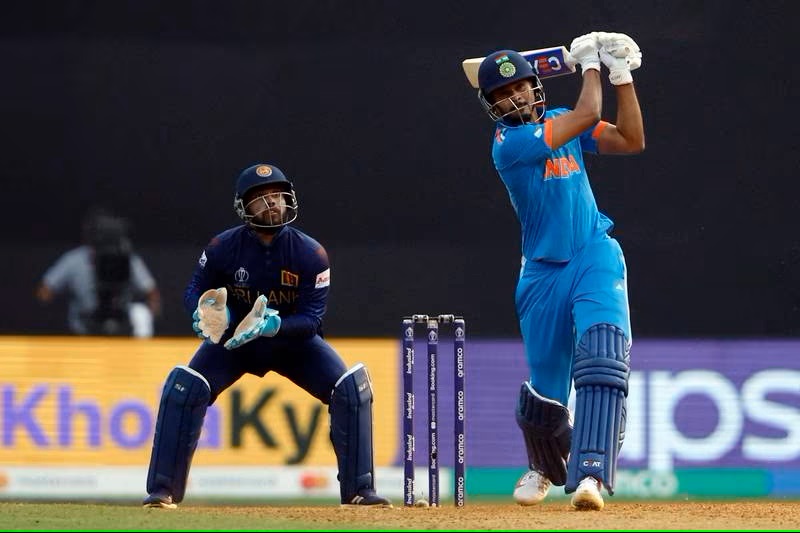
India won the toss and decided to bat first. The team put 326 on the scoreboard – with Kohli’s unbeaten 101 and Shreyas Iyer’s 77 run knock-off 87 deliveries – losing five wickets in 50 overs.

India Beat South Africa By 243 Runs At Kolkata's Eden Gardens 2Riding on Virat Kohli’s unbeaten 101 India put on 326 for 5 against South Africa at the Eden Gardens, celebrating his 35th birthday in the most befitting manner. Kohli reached the landmark when he scored a single off Kagiso Rabada in the 49th over of the Indian innings in front of a packed Eden Gardens crowd that kept chanting his name. Prior to the match against South Africa, Kohli narrowly missed out on his 49th ODI century during India’s match against Sri Lanka on Thursday at the Wankhede Stadium.

Kohli put on on brilliant 134-run stand for the third wicket with Shreyas Iyer (77), who played a sublime knock. Earlier, it was captain Rohit Sharma, whose 24-ball 40 gave India a flying start. Suryakumar Yadav (22 off 14 balls) and Ravindra Jadeja’s unbeaten 29 off 15 balls gave India a perfect flourish.

“Every opportunity to play for India is a big one for me, and to be able to do this (49th ODI hundred) on my birthday in front of such a huge crowd at the Eden Gardens is the stuff of dreams. It’s something that you wish for as a child. So I am very grateful to God that I am blessed with these kinds of moments. So much love from the fans as well. Just continue to try and help the team in any way possible,” Kohli said in the mid-innings interval.

The entire South African team was bowled out for 83 runs in less than 28 overs, with which India marked its eighth consecutive victory in the tournament. Ravindra Jadeja took five wickets in nine overs.

The win assumes more significance because South Africa is not just any team, but the No.2 in the ongoing tournament standings, and the only team other than India to have reserved a slot in the semi-finals. So, it was a big test for India.

Also, it was the heaviest-ever World Cup defeat, in terms of margin, for South Africa.

India are currently in terrific form, having won all seven matches they have played so far. Rohit Sharma and his team defeated Sri Lanka by 302 runs in their previous match, the second-biggest win in the tournament history. They have two batters with over 400 runs (Virat Kohli and Rohit Sharma), while Jasprit Bumrah, Mohammad Shami, Mohammed Siraj and Kuldeep Yadav are doing a terrific job with the ball.

Haley And Ramaswamy Get Nastier At 3rd Republican Presidential Debate

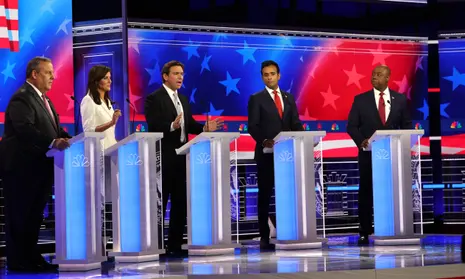
The fight between Indian-American Republican candidates got nastier with former South Carolina Governor Nikki Haley calling tech entrepreneur Vivek Ramaswamy “just a scumm” for bringing up her daughter as a reference at the party’s third presidential primary debate on Wednesday, November 8th, 2023.

At the debate held in Miami, the two leading Republican candidates sparred over the US policy on TikTok and whether it should be banned in the country because of its Chinese ownership.

The 38-year-old entrepreneur referred to Haley and said: “In the last debate, she made fun of me for actually joining TikTok while her own daughter was actually using the app for a long time, so you might want to take care of your family first.”

Haley And Ramaswamy Get Nastier At 3rd Republican Presidential Debate (The Guardian)
Picture: The Guardian

Haley then shot back saying, “Leave my daughter out of your voice”, and as Ramaswamy continued to speak, she told him, “You are just a scum.”

The former South Carolina Governor also took to her X handle on Wednesday to further slam the biotech entrepreneur, which was dismissed by a handful of netizens as “cringe.”

“Vivek, I wear heels. They’re not for a fashion statement — they’re for ammunition,” Haley said, inviting a comment from a user, which said: “All of the comebacks in the world, and you chose cringe.”

The two also locked horns in the previous presidential debate with Haley slamming him for his inexperience on foreign policy issues.

Hitting out at Haley, Ramaswamy’s campaign in a statement said that in a desperate attempt to raise funds for her languishing establishment campaign, the former US ambassador to the UN was intentionally lying about the tech entrepreneur.

Haley blasted Ramaswamy for not backing US allies, and said that “Vivek has no foreign policy experience and it shows.” Ramaswamy also used the ‘Namrata Randhawa’ instead of Nikki Haley on his website, which she said was a “childish name game.”

“I’m not going to get involved in these childish name games. It’s pretty pathetic. First of all, I was born with Nikki on my birth certificate. I was raised as Nikki. I married a Haley. And so that is what my name is,” Haley told Fox News in response.

Haley again called for reforming Social Security and other entitlement programs, drawing a contrast with Trump — and bringing up what Democrats say is a significant vulnerability for her candidacy.

“Any candidate that tells you that they’re not going to take on entitlements is not being serious,” she said. “Right now you have Ron and Trump joining Biden and Pelosi saying they’re not going to change, or do any entitlement reform.”

Haley has long called for making significant changes to the program, including raising the retirement age and removing cost of living increases in favor of increases based on the inflation rate.

She also called for limiting the program for the wealthy — namechecking Bernie Marcus, the former CEO of Home Depot and a major Republican donor, saying that he “hates getting that check.”

In a survey released on Monday by the Des Moines Register, Haley climbed 10 points to 16 per cent, putting her even with Florida Governor Ron DeSantis as he struggles to break through against former President Donald Trump.

In addition to Haley and Ramaswamy, three other candidates were on stage for the third debate — former New Jersey Governor Chris Christie, Florida Governor Ron DeSantis and South Carolina Senator Tim Scott.

The two-hour debate, hosted by NBC News, took off at the Adrienne Arsht Center for the Performing Arts of Miami-Dade County.

Trump, who has so far retained huge leads in polls, again skipped the debate, instead holding a rally not far from the Miami debate site in Hialeah, Florida.

The GOP candidates had one basic message for Israeli Prime Minister Benjamin Netanyahu: Do what you have to do to destroy the Hamas militant group.

“Finish the job,” DeSantis said. “Finish them,” Haley said. “Not only do you have the responsibility and the right to wipe Hamas off of the map, we will support you,” Scott said.

Ramaswamy ended the debate by calling not on his Republican rivals, but on Biden, to drop out. The president should “step aside and end his candidacy now so we can see whether it’s [California Gov. Gavin] Newsom or Michelle Obama or whoever else,” Ramaswamy said at the end of his closing pitch.

FDA Approves Zepbound, a Potent Weight Loss Drug – A Game-Changer in the Fight Against Obesity

The recent decision by the Food and Drug Administration (FDA) to greenlight the weight loss drug tirzepatide has introduced a robust addition to the rapidly expanding array of obesity medications. The drug, set to be marketed under the name Zepbound, shares its active compound with the diabetes medication Mounjaro, which has been utilized off-label for weight loss since its initial approval in May 2022. This FDA approval may pave the way for broader insurance coverage and increased prescriptions.

Zepbound represents the second drug in a novel class of obesity medications sanctioned for weight loss, following Wegovy. According to Dr. Scott Hagan, an assistant professor of medicine at the University of Washington, Zepbound is likely the most effective treatment for obesity, rivaling bariatric surgery. However, the availability of Mounjaro, which shares the same compound, has been limited since its market introduction in the previous year.

Dr. Andrew Kraftson, a clinical associate professor at Michigan Medicine, likened the situation to the demand surge witnessed with another medication, Ozempic. He anticipates a similar clamor for Zepbound among patients due to the heightened interest in weight loss medications.

The FDA has specified that Zepbound is approved for individuals with a body mass index (BMI) of 30 or higher, categorizing them as having obesity. Alternatively, individuals with a BMI of 27 or more, coupled with certain weight-related conditions like high blood pressure, are also eligible. Regulators recommend using the drug in conjunction with a reduced-calorie diet and increased physical activity.

Manufactured by Eli Lilly, Zepbound is the brand name for tirzepatide when employed for weight loss. When prescribed for diabetes, it goes by the name Mounjaro. Similar to semaglutide, the compound found in Ozempic and Wegovy, tirzepatide works by slowing down stomach emptying, leading to a quicker and prolonged feeling of fullness. Additionally, these drugs target the brain area that regulates appetite, reducing cravings. Tirzepatide, mimicking two hormones compared to semaglutide’s one, is believed to be more effective in inducing weight loss. In a 72-week clinical trial funded by Eli Lilly, participants with obesity taking the highest dose of tirzepatide experienced an average weight loss of around 18 percent.

For individuals already using Ozempic or Wegovy, the efficacy of these medications can vary from person to person. Dr. Janice Jin Hwang from the University of North Carolina School of Medicine emphasizes that factors like other health outcomes should be considered, especially for those at risk of heart failure or liver disease. The risks and benefits of switching medications need careful evaluation, as some individuals may experience excessive weight loss, particularly older people prone to muscle mass reduction.

The issue of insurance coverage and out-of-pocket costs remains a variable, with different plans potentially covering Zepbound for those meeting the FDA’s criteria. Eli Lilly expects Zepbound to be available in the U.S. by the year-end, with a list price of $1,059.87.

As with any medication, tirzepatide is associated with side effects, primarily gastrointestinal issues according to an Eli Lilly-funded study. The highest dose of tirzepatide resulted in approximately one-third of participants experiencing nausea and one-fifth reporting diarrhea. Other reported side effects included abdominal pain, vomiting, constipation, headache, dizziness, burping, hair loss, and gastroesophageal reflux disease, as outlined in the FDA approval. However, due to the novelty of tirzepatide, its long-term effects are not yet fully understood, and individuals using such drugs for weight loss are generally advised to continue them indefinitely.

Unprecedented Global Heat Crisis: Hottest 12 Months in 125,000 Years, 2023 Set to Break Heat Records, Urgent Climate Action Needed

In the past few months, the globe has experienced abnormal heat, resembling a disaster movie with soaring temperatures, wildfires, storms, and floods, as reported by scientists. The latest data reveals the exceptional nature of this global heat crisis. Two significant reports highlight this alarming scenario: one declares that humanity has just endured the hottest 12-month period in at least 125,000 years, while the other predicts that 2023 is “virtually certain” to become the hottest year in recorded history, following five consecutive months of record-breaking temperatures.

“We have become all too used to climate records falling like dominoes in recent years,” says David Reay, executive director of the Edinburgh Climate Change Institute at the University of Edinburgh. “But 2023 is a whole different ball game in terms of the massive margin by which these records have been broken.”

The period from November 2022 to the end of October 2023 marked the hottest 12 months, with an average temperature of 1.32 degrees Celsius above pre-industrial levels, according to Climate Central. This temperature surge is not normal, driven primarily by the excessive carbon dioxide released into the atmosphere from burning fossil fuels.

The impact of this extreme heat was felt by the vast majority of the global population, with 90% experiencing at least 10 days of high temperatures with distinct climate fingerprints. In India, 86% of the population (1.2 billion people) endured at least 30 days of high temperatures, intensified threefold by climate change. In the United States, this affected 26% of the population, equivalent to 88 million people.

Particular cities faced severe challenges, especially in the South and Southwest of the United States. Houston, for instance, witnessed the longest extreme heat streak of any major city globally, enduring 22 consecutive days of extreme heat between July and August.

A subsequent analysis by the European Union’s Copernicus Climate Change Service further emphasizes the gravity of the situation, declaring that 2023 is “virtually certain” to set a new record for the hottest year. The prediction follows the revelation that October 2023 was the hottest October on record, surpassing the previous record set in 2019 by 0.4 degrees Celsius.

Each month since June has shattered monthly heat records, with every month since July exceeding 1.5 degrees Celsius above pre-industrial levels. The year-to-date average is 1.43 degrees Celsius above pre-industrial levels, perilously close to the internationally agreed goal of limiting global warming to 1.5 degrees Celsius.

Despite scientists’ primary concern about long-term temperature trends, the past few months above the 1.5-degree threshold offer a forewarning of the intensified impacts of global warming. This includes more violent storms, heavier rains and floods, and more intense, frequent, and prolonged heatwaves, droughts, and wildfires.

In addition to record land temperatures, ocean temperatures have consistently been at record-high levels since May, fueling the development of hurricanes and tropical storms worldwide. Antarctic sea ice has also remained at record lows for six consecutive months.

The alarming statistics underscore the urgent need for action, adding extra significance to the upcoming UN COP28 climate conference in Dubai. Scientists stress the importance of ceasing the burning of oil, gas, and coal. However, a UN report indicates that governments plan to produce more than double the amount of fossil fuels, exceeding the limit required to cap global heating at 1.5 degrees Celsius.

“The only thing more remarkable than the magnitude of these increases in global temperature and sea ice loss,” remarks David Reay, “is our continuing failure to put the world on track to meet the Paris climate goals.”

How the Confidence in the UN Eroded Globally

Since 1947, when the UN General Assembly endorsed the partitioning of Palestine into Jewish and Arab states, the Middle East has been a focal point of UN deliberations. In the ongoing Israeli-Palestinian conflict, the UN has followed a consistent pattern: the US employs its veto to thwart criticism of Israel at the Security Council, while Arab states rally developing nations to support the Palestinians. Recent discussions at the UN after Hamas’s October 7 attack on Israel have adhered to this familiar script. The US vetoed a Security Council resolution urging a cease-fire in Gaza, but a General Assembly resolution for a “humanitarian truce” passed overwhelmingly in late October.

However, diplomats at UN offices in New York and Geneva express a sense that this crisis is distinct and could have repercussions beyond Israel and Gaza, impacting the UN’s integrity. Their concerns stem not only from the brutality of Hamas, the mounting casualties in Gaza, and the potential for regional escalation but also from a broader loss of confidence in the UN. Doubts about the effectiveness of an institution designed for twentieth-century power dynamics to address postwar challenges are not new. In the past year, the UN has appeared particularly adrift, failing to respond effectively to crises in Sudan, Nagorno-Karabakh, and the coup in Niger. Tensions between Russia and the West over Ukraine have further hindered UN discussions on unrelated issues in Africa and the Middle East. UN Secretary-General António Guterres warned of a “great fracture” in the global governance system at the annual General Assembly meeting in September.

The conflict between Israel and Hamas could exacerbate the erosion of the UN’s credibility in crisis response. This situation prompts a crucial reckoning for national governments and UN officials on how the UN can contribute to peace and security in a world where common ground among major powers is shrinking. The post-Cold War era witnessed calls for the UN to address conflicts as a matter of routine, but now the institution seems to be confronting its geopolitical limitations.

A revamped UN, suitable for the contemporary age, must adjust its ambitions. On security matters, the organization should prioritize a limited set of key issues and delegate crisis management responsibilities when possible. Some international problems will still necessitate the coordination uniquely possible at the UN. Even when diplomatic efforts among nations falter, the institution remains a platform where adversaries can negotiate differences and identify opportunities for collaboration. Rather than allowing ongoing conflicts to fracture the UN, both national governments and UN officials must collaborate to preserve its essential functions.

STARTING TO SPIRAL

The crisis of confidence in the UN has been escalating since Russia’s full-scale invasion of Ukraine. Initially, diplomats feared that tensions among major powers would paralyze the UN. However, despite intense debates over the war in Ukraine, Russia, the US, and European allies continued to coordinate on other matters. The Security Council imposed new sanctions on criminal gangs in Haiti and agreed on a mandate for the UN to collaborate with the Taliban government in Kabul to provide aid to suffering Afghans. Both Russia and the West demonstrated a willingness to use the UN for residual cooperation.

This delicate balance began to unravel in the spring. Russia increasingly acted as a spoiler at the UN, withdrawing UN peacekeepers from Mali and vetoing the renewal of a mandate for aid agencies in rebel-held parts of Syria. Moscow also exited the Black Sea Grain Initiative, disrupting a deal brokered by the UN and Turkey in 2022. The war in the Middle East highlighted this more aggressive approach to UN diplomacy. While China maintained a relatively neutral stance, Russia capitalized on the situation, criticizing the US for vetoing a resolution on humanitarian aid to Gaza and implying American complicity in fueling the conflict.

The US’s unwavering support for Israel has compounded diplomatic challenges, particularly in the General Assembly. The coalition of states supporting Ukraine fractured over Gaza, leading to a resolution for a “humanitarian truce” passing with a divided vote. The US voted against the resolution, citing its failure to condemn Hamas, causing a ripple effect. Diplomats from developing countries hinted at rejecting future UN resolutions supporting Ukraine due to perceived Western disregard for Palestinian concerns.

This recent division may undermine the US’s efforts to improve relations with the global South at the UN. The Biden administration’s push for Security Council reforms and promises to collaborate with financial institutions for developing countries now faces headwinds, as its stance on Israel and Gaza risks undoing progress made with these nations before the current conflict.

The wars in Ukraine and the Middle East have intensified diplomatic tensions among UN member states and placed significant strain on UN Secretary-General Guterres and the organization’s conflict-management system. The absence of unified support from the Security Council has hindered the UN’s ability to effectively manage conflicts, with trouble spots like Sudan, Mali, and the Democratic Republic of the Congo experiencing challenges in cooperation and peacekeeping efforts.


Governments and warring parties in these regions have resisted collaboration with UN mediators, and demands for the withdrawal of UN peacekeepers have been made without facing substantial consequences. Despite maintaining a humanitarian presence in places like Afghanistan, the UN is grappling with funding shortfalls due to reduced aid budgets from Western donors allocating significant resources to military and humanitarian assistance for Ukraine.

Guterres has become entangled in diplomatic disputes, particularly concerning events in the Middle East. His remarks on Hamas’s attack on Israel led to calls for his resignation from Israel, affecting cooperation with UN humanitarian officials. The incident underscores the vulnerability of UN aid operations to political discord, with tragic consequences on the ground, including the death of nearly 100 UN employees in Gaza.

The future of the UN’s presence in the Middle East hinges on the duration and extent of the conflict between Israel and Hamas. In a post-conflict scenario, the UN may play a significant role in recovery efforts or even be tasked with administering Gaza after the removal of Hamas. However, an extended and broader regional war could jeopardize the UN’s longstanding peacekeeping missions in southern Lebanon and the Golan Heights.

Regardless of the outcomes in the Middle East and Ukraine, ongoing trends at the UN signal future challenges. Diplomatic divisions and operational vulnerabilities are likely to persist or worsen as global rifts deepen. While the UN may not return to its Cold War-era prominence, it can adapt to a diminished role. Guterres’s “New Agenda for Peace” emphasizes a reduced focus on peacekeeping missions and encourages member states to address new security threats.

The UN could shift from deploying its own forces to supporting other crisis managers, including regional organizations and individual countries. This approach is already being tested, such as Kenya leading a multinational security assistance mission in Haiti. Despite current disagreements, the Security Council could find a new equilibrium, serving as a venue for resolving conflicts among major powers and addressing shared interests in cooperation.

Even with the Security Council facing challenges, the wider UN system retains a substantial role in international conflict management. UN relief agencies possess unique capacities to mitigate violence’s effects, and efforts are underway to explore conflict prevention methods independent of Security Council oversight, such as utilizing World Bank funds to support basic services in vulnerable states. In a period of geopolitical tension, the UN may not lead in resolving major crises, but it can contribute significantly to protecting vulnerable populations.

The Competition in Establishing Regulations for Artificial Intelligence

Artificial intelligence (AI) is making significant strides globally, with transformative technologies like ChatGPT holding the potential to reshape work, information interaction, and social dynamics. While these innovations can propel humanity into new realms of knowledge and productivity, there’s a growing concern about the rapid pace of AI development. Notable figures such as OpenAI CEO Sam Altman and Apple co-founder Steve Wozniak are cautioning against unregulated AI, emphasizing its potential for severe harm on individuals and societies, including the ominous possibility of rendering humans obsolete or even threatening humanity itself.

Amidst heightened criticism and scrutiny, technology companies are racing to advance AI capabilities. The pressure on Washington to formulate AI regulations is mounting, but the challenge lies in balancing regulatory measures with the imperative to foster innovation. The United States, China, and Europe are evolving distinct regulatory paradigms rooted in their values and incentives, not only reshaping domestic markets but also influencing the global digital landscape.

In the United States, a market-driven approach prevails, with a profound faith in markets and a limited role for government. Prioritizing free speech, a free internet, and innovation incentives, Washington views digital technologies as catalysts for economic prosperity and political freedom. This approach is underpinned by a deep-seated techno-optimism, positioning U.S. tech companies as drivers of progress. However, this emphasis on economic and geopolitical primacy has left substantive federal AI legislation largely absent. The U.S. approach leans on voluntary standards, as seen in the Blueprint for an AI Bill of Rights, reflecting a belief in tech companies’ self-regulation. Policymakers, including the chair of the Federal Trade Commission, Lina Khan, warn of potential costs and argue for government regulation, but comprehensive AI regulation faces obstacles amid political dysfunction and concerns about compromising innovation.

In contrast, China adopts a state-driven approach, seeking to become the world’s leading technology superpower. The government actively regulates the digital economy, leveraging AI for censorship, surveillance, and propaganda. Recognizing AI’s economic and political potential, China heavily subsidizes technologies facilitating mass surveillance. However, the authoritarian regime’s desire for control prompts strict regulations to ensure AI aligns with political goals. Recent regulations targeting deepfake technologies and recommendation algorithms illustrate China’s commitment to shaping AI development in line with its vision, even as generative AI poses challenges to censorship efforts.

The European Union (EU) departs from the U.S. and China by prioritizing a rights-driven approach, anchored in the rule of law and democratic governance. With a focus on user and citizen rights, the EU has enacted pioneering regulations like the General Data Protection Regulation and the Digital Markets Act. The recently adopted Digital Services Act holds online platforms accountable for hosted content. As AI advancements unfold, the EU has introduced the AI Act, a comprehensive draft law aimed at mitigating AI risks and protecting fundamental rights. Provisions in this legislation include prohibitions on AI systems exploiting vulnerabilities, predictive policing, and real-time facial recognition in public spaces, with tight regulations on AI systems leading to discriminatory outcomes.

In the final stages of the legislative process, the EU faces the challenge of regulating general-purpose AI, such as ChatGPT, presented to the public in November 2022 by OpenAI. The European Parliament emphasizes transparency requirements and designs that safeguard fundamental rights and prevent the generation of illegal content. Once finalized, the AI Act is poised to become the world’s first comprehensive AI regulation, setting a precedent for responsible AI development.

The landscape of artificial intelligence (AI) governance is witnessing the emergence of three distinct “digital empires” as the United States, China, and Europe vie for control over the future of technology, each advancing unique regulatory paradigms rooted in their values. This competition not only shapes domestic markets but also guides the expansion of these digital empires globally, influencing other nations in their approach to AI legislation.

The U.S. model is market-driven, grounded in techno-optimism, and emphasizes minimal government intervention, relying on voluntary standards for tech companies. However, the lack of regulation has led to market failures and widespread distrust in tech companies due to issues such as data exploitation and monopolistic practices.

China adopts a state-driven approach, intertwining AI development with political control, exemplified by its Digital Silk Road initiative exporting surveillance technologies globally. Despite its authoritarian model, China faces challenges in developing generative AI systems due to censorship rules limiting data for training, highlighting potential innovation drawbacks.

In contrast, the European Union (EU) pursues a rights-driven approach, seeking to balance corporate power, protect fundamental rights, and uphold democratic institutions. The EU’s stringent regulations, such as the General Data Protection Regulation and the Digital Services Act, are influencing global standards, a phenomenon known as the Brussels Effect. The recently introduced AI Act is poised to become the world’s first comprehensive AI regulation, extending the EU’s influence.

As the appeal of the U.S. approach diminishes and the Chinese model gains ground, the EU’s “Goldilocks” alternative becomes attractive to nations seeking to check corporate power while safeguarding rights. Europe’s regulatory approach may shape global AI development through the Brussels Effect, extending its digital sphere of influence.

The future of the AI revolution hinges on how nations navigate these competing regulatory models. The United States, facing growing domestic support for regulation and concerns about China’s influence, may shift toward embracing AI regulation, possibly aligning with the EU. Transatlantic cooperation becomes crucial in the face of shared concerns about China’s digital authoritarianism.

In the evolving AI landscape, winners and losers will emerge not only in technological advancements but also in regulatory approaches, with profound economic and political consequences. The choices governments make will determine whether the AI revolution serves democracy, fosters prosperity, or leads to unforeseeable societal harms. The cooperation between the U.S. and the EU could set joint standards promoting innovation, protecting rights, and preserving democracy in the face of growing global demand for Chinese surveillance technologies.

Mortgage Rates Experience Significant Drop, Easing Burden on Homebuyers

In a notable turn of events, mortgage rates witnessed the most substantial one-week decline since November of the previous year. This marks the second consecutive week of rate reduction following seven weeks of consecutive increases. The 30-year fixed-rate mortgage averaged 7.50% in the week ending November 9, down from the preceding week’s 7.76%, as reported by Freddie Mac.

A year ago, the 30-year fixed-rate had reached 7.08%, hitting its peak in 2022. This week’s decline of 26 basis points from the previous week’s rate is the most significant one-week drop since November. Sam Khater, Chief Economist at Freddie Mac, attributes this decline to the decrease in Treasury yields. He emphasizes the potential consequences of the rising household debt, urging significant decreases in mortgage rates for the housing market to avoid stagnation.

Khater stated, “Many consumers are feeling strained by the high cost of living, so unless mortgage rates decrease significantly, the housing market will remain stagnant.”

The average mortgage rate is based on data from Freddie Mac’s thousands of lenders across the nation, focusing on borrowers with a 20% down payment and excellent credit. Notably, the rates for current buyers may differ. Lower mortgage rates could potentially encourage hesitant homebuyers to re-enter the market.

The Mortgage Bankers Association reported a 2.5% increase in all loan applications compared to the previous week, with a 3% rise specifically in applications for home purchase loans. However, despite this uptick, Joel Kan, MBA’s Vice President, and Deputy Chief Economist highlighted that applications for both purchase and refinance loans remain at relatively low levels. The purchase index lags more than 20% behind last year’s pace, indicating a cautious approach by potential homebuyers waiting for increased inventory.

The recent decision by the Federal Reserve to maintain existing interest rates provided a brief reprieve for homebuyers grappling with soaring mortgage rates. Yet, the possibility of an additional Fed rate hike remains uncertain.

Jiayi Xu, an economist at Realtor.com, commented on the need for more economic indicators to determine the adequacy of current policies in addressing inflation. The October jobs report, revealing moderate job growth and reduced wage pressures, might influence policymakers’ confidence in the economy’s continued easing, affecting the upcoming December 12-13 meeting of the Federal Reserve.

Despite the dip in rates, the monthly cost of buying a home has reached a record high due to unaffordability. Realtor.com found that the median home price in October remained similar to the previous year. However, with mortgage rates exceeding 7% since mid-August, the monthly cost to buy a home increased by over $166, marking a 7.4% year-over-year rise—a new record.

While mortgage rates are still relatively high, the difference between current rates and those of a year ago has narrowed. Lisa Sturtevant, Chief Economist at Bright Multiple Listing Service, noted that market conditions are comparable to last November, with consumers adjusting their expectations about mortgage rates. She anticipates that some buyers will act swiftly when rates dip, while others may wait until after the first of the year, hoping for lower rates and increased inventory.

Sturtevant also remarked that while rates are expected to decrease in 2024, they are not projected to return to pre-pandemic levels. She stated, “We are in a new era for mortgage rates, where prospective homebuyers can expect rates to settle above 6%.”

2024 Election: Dissatisfied Voters in Battleground States Consider Alternative Candidates

The prospect of a 2024 election rematch between President Biden and former President Donald J. Trump has left voters in six battleground states dissatisfied and searching for alternatives, as revealed by recent polls conducted by The New York Times and Siena College.

In these key states, both Mr. Biden and Mr. Trump are viewed unfavorably by the majority of voters. A significant portion of voters dislike both candidates, and overall enthusiasm for the upcoming election has waned compared to the 2020 contest.

This frustration and disillusionment have led voters to consider other options. When asked about the likely 2024 matchup between Mr. Biden and Mr. Trump, only 2 percent of respondents expressed support for another candidate. However, when Robert F. Kennedy Jr.’s name was presented as an alternative, nearly a quarter of respondents indicated they would choose him.

It’s important to note that the support for Mr. Kennedy may be somewhat inflated, as two-thirds of those expressing support for him had previously mentioned a preference for one of the two major-party candidates.

The polling encompassed registered voters in Arizona, Georgia, Michigan, Nevada, Pennsylvania, and Wisconsin, and the results suggest that Mr. Kennedy is less a firmly established political figure in the minds of voters and more a symbol of their discontent with the choice between Mr. Biden and Mr. Trump.

Voters who hold unfavorable views of both major-party candidates, often referred to as “double haters,” played a significant role in the outcomes of recent presidential elections. The number of such voters has more than doubled since four years ago. Mr. Trump now enjoys more support from these voters in five of the six battleground states, with Arizona being the exception. Overall, 42 percent of “double haters” planned to vote for Mr. Trump, while 34 percent favored Mr. Biden, and 24 percent remained undecided.

The disapproval of both Mr. Biden and Mr. Trump is likely to fuel interest in outsider candidates like Mr. Kennedy, who recently transitioned from the Democratic primary to run as an independent. Cornel West, the liberal professor who switched from the Green Party to mount an independent campaign, is another candidate in the spotlight.

The accessibility of the ballot will present a significant challenge for independent candidates. Qualifying for the general election as a political independent is a costly endeavor, and legal obstacles from major parties may further complicate the process.

The appeal of outsider candidates stems from the widespread unpopularity of both Mr. Biden and Mr. Trump among voters in the battleground states. A majority of respondents held unfavorable views of both candidates, except for Black voters who had a favorable view of Mr. Biden.

Voters who dislike both major-party candidates but are open to alternative options are central to the potential impact of outsider candidates like Mr. Kennedy. The outcome in tightly contested states could be influenced by the presence of a candidate like Mr. Kennedy. In some states, he appears to benefit Mr. Trump, while in others, he aids Mr. Biden.

In a political landscape marked by polarization and increasing partisanship, third-party and independent candidates often reflect voter dissatisfaction with the choices offered by the major parties rather than genuine interest in outsider candidates. The impact of Mr. Kennedy as an independent candidate remains uncertain, as his support has fluctuated during his campaign. His potential to influence the 2024 election outcome may become clearer as the election season progresses.

Renowned Physician, Dr. Joseph Chalil, Shares His Remarkable Journey on “The Supreet Singh Show”

In the vast and ever-expanding world of podcasting, “The Supreet Singh Show” has just dropped its second episode, promising to keep the flames of inspiration and knowledge burning. This time, the spotlight shines on Dr. Joseph M. Chalil, the Chief Medical Officer at Novo Integrated Sciences, Whose journey from humble beginnings to global recognition is truly remarkable.

As is widely recognized, the host of the show – Mr. Supreet Singh is a multifaceted entrepreneur. Beyond his accomplished role as a certified broadcaster in Vancouver, he also serves as the Founder and CEO of the acclaimed pharmaceutical company- PCHPL (Psychocare Health Pvt. Ltd). Supreet Singh has also garnered multiple awards and recognition. His background in the medical industry facilitated an instant connection with Dr. Chalil.

During this riveting episode, Supreet Singh delves into the life and career of Dr. Chalil, leaving no stone unturned in unpacking the remarkable journey that has made him a prominent figure in the medical world. The episode is a captivating fusion of Dr. Chalil’s profound medical knowledge and Supreet Singh’s interviewing skills.

The episode explores various intriguing topics, from the future of healthcare to the impact of COVID-19 on healthcare systems. Listeners can expect to gain valuable insights into the challenges and triumphs of a medical career, as well as broader themes of dedication, perseverance, and the pursuit of excellence.

“The Supreet Singh Show” is rapidly establishing itself as a platform for uncovering the transformative journeys and life stories of individuals who have left an indelible mark in their respective fields. Each episode introduces the audience to a diverse range of backgrounds and experiences, ensuring that there is something for everyone to connect with and draw inspiration from.

This podcast is available on various platforms such as Spotify and YouTube, providing a diverse range of audiences the opportunity to engage with these impactful conversations. It fosters a sense of community where shared learning and growth become the cornerstones of the show’s message.

Listeners are encouraged to tune in to be inspired by the remarkable journey of Dr. Joseph Chalil and to explore the depths of knowledge and inspiration that “The Supreet Singh Show” has to offer.

England’s World Cup Dreams Dashed with a Sixth Defeat

In a heart-wrenching turn of events, England’s World Cup journey has taken a devastating blow with their sixth defeat in seven matches, leaving no room for mathematical possibilities of making it to the final four. This formidable defeat marked the end of their title defense aspirations. Fakhar Zaman, on the other hand, emerged as the savior for Pakistan, playing a spectacular innings to keep their semi-final hopes alive.

Currently, Pakistan and New Zealand find themselves in a neck-and-neck battle, both standing on equal points with one league game remaining. The outcome of this crucial fixture will determine their final rankings. Pakistan is set to face England in their last league match, while New Zealand takes on Sri Lanka. Kane Williamson’s Kiwi team, currently sitting at fourth place on the points table, holds the advantage in terms of net run rate.

Australia, on the other hand, continues to march on relentlessly, securing their fifth consecutive victory with a 33-run triumph over England. While their spot in the semi-finals is yet to be confirmed, they are well-positioned with upcoming matches against Afghanistan and Bangladesh.

Adding further intrigue to the mix, Afghanistan remains a dark horse, still in contention. They must clinch victories in at least one of their final two games against Australia and South Africa and heavily rely on their net run rate to keep their semi-final hopes alive. The World Cup stage is set for thrilling showdowns as teams vie for a coveted spot in the final four.

Record Surge in Indian Nationals Illegally Crossing US Border, Senator Highlights Asylum System Concerns

The most recent data from the US Customs and Border Protection (UCBP) reveals a record-breaking surge in the apprehension of Indian nationals attempting to enter the United States illegally. Between October 2022 and September 2023, a staggering 96,917 Indians were arrested while crossing the US border without proper authorization.

This surge in Indians attempting to cross the US border unlawfully represents a five-fold increase over the past few years. To put this into perspective, in 2019-20, the number of Indians apprehended was 19,883. In the following year, 2020-21, this number rose to 30,662. By 2021-22, the figure had skyrocketed to 63,927.

The geographical distribution of these arrests is notable, with 30,010 individuals caught on the Canadian border and 41,770 at the US-Mexico frontier. These apprehended individuals are categorized into four distinct groups: Accompanied Minors (AM), Individuals in a Family Unit (FMUA), Single Adults, and Unaccompanied Children (UC).

Single adults constitute the largest category, with a staggering 84,000 Indian adults crossing into the United States illegally in fiscal year 2023. Additionally, 730 unaccompanied minors were among those arrested during this period.

It’s essential to note that the US federal government’s fiscal year spans from October 1 to September 30.

In a separate development, Senator James Lankford shed light on the lengths some of these individuals go to in their journey to reach the US. Senator Lankford mentioned on the Senate floor that many of these individuals take multiple flights, sometimes including layovers in countries like France, in order to reach Mexico, which serves as the closest airport for their intended border crossing. From there, they take a bus, often arranged by criminal cartels, to reach the US-Mexico border, where they aim to enter the United States.

Senator Lankford also highlighted a concerning aspect of this situation, where individuals claim to be fleeing their home countries due to fear. He stated, “So they can say, ‘I have fear in my country.'”

Moreover, Senator Lankford has consistently emphasized that criminal cartels in Mexico are coaching migrants from various parts of the world on what to say and where to go in order to navigate the asylum process effectively and gain entry into the United States while awaiting an asylum hearing.

He expressed his concern that the United States appears to be one of the few nations still adhering to this approach, stating, “Listen, this doesn’t make sense to just about everyone in the world. Just about everyone in the world has shifted on this except for us. We’re literally inviting people from all over the world to exploit our system.”

Senator Lankford underscored the fact that asylum and refugee status are equivalent under international law. A refugee flees their home country out of fear of persecution and seeks refuge in a designated refugee center, eventually declaring to the United Nations their dramatic fear of persecution in their home country. The UN, in response, facilitates their relocation to various parts of the world, including the United States.

Senator Lankford stressed that asylum seekers are supposed to follow the same international standard, which entails going to the nearest safe place and requesting asylum there. However, the United States appears to deviate from this standard in its policy and practices regarding asylum seekers.

Pope Francis Encourages Theologians to Engage with Real-World Challenges

Pope Francis is urging Catholic theologians to align their work with the everyday struggles of ordinary people and to foster dialogues not only among believers but also with non-believers and those of different faiths.

In a document signed on November 1 and released by the Vatican, Pope Francis addressed the need to update the statutes governing the Pontifical Academy of Theology. The last revision was made almost 25 years ago during the papacy of his predecessor, John Paul II.

The Pope emphasized the necessity for theologians to grapple with “profound cultural transformations” without specifying particular issues. Instead, he encouraged them to embrace “openness to the world, to humanity in its concrete existential conditions, with all its complexities, wounds, challenges, and potentialities.”

This, Pope Francis asserted, represents a “paradigm shift” for theological reflection, enabling it to “interpret the Gospel within the contexts of people’s daily lives in diverse geographical, social, and cultural settings.” He stressed the importance of theologians immersing themselves in the cultures, worldviews, and religious traditions of different communities.

Theology, according to Pope Francis, must evolve within a culture of dialogue that encompasses “various Christian confessions and different religions” and engages openly with both believers and non-believers. He cautioned against theologians isolating themselves and becoming insignificant by turning inward.

Pope Francis also called for theology to be “attentive to the voices of the people,” promoting a “popular” theology that addresses the wounds of humanity, creation, and human history. This approach should prioritize knowledge derived from the “common sense of people.”

Four months ago, when selecting a theological advisor from his native Argentina to lead the Vatican’s doctrinal orthodoxy watchdog office, Pope Francis emphasized the department’s central purpose: safeguarding church teachings to provide hope and understanding, rather than condemning or pointing fingers. The Dicastery for the Doctrine of the Faith has the authority to discipline theologians whose work deviates from Catholic doctrine.

Throughout his ten-year papacy, Pope Francis has consistently advocated for the Catholic Church to exhibit greater compassion, especially toward those living on the fringes of society, and to adopt a more merciful perspective.

The Pontifical Academy of Theology, established in the early 18th century, serves as an advisory body that occasionally hosts conferences and other events.

Blooming BRICS: Former White House Economist Warns of Dollar’s Growing Challenge

The US dollar could encounter a formidable challenge from BRICS countries due to their expanding size and influence in global trade, warns former White House economist Joe Sullivan.

Sullivan, in a recent op-ed for Foreign Policy, highlighted the rising concerns that BRICS nations might introduce a currency to rival the US dollar in international trade. This potential currency could potentially displace the dollar from its current dominant position in global trade markets and as the primary reserve currency.

Although BRICS officials have denied the existence of such a rival currency, Sullivan cautioned that the bloc of emerging market countries, which has recently welcomed Argentina, Egypt, Ethiopia, Iran, Saudi Arabia, and the United Arab Emirates, poses a threat to the greenback based on its growing influence.

Sullivan also pointed out the substantial influence of the BRICS bloc in commodities markets. Saudi Arabia, Iran, and the United Arab Emirates are among the world’s leading exporters of fossil fuels, while Brazil, China, and Russia are significant exporters of precious metals.

The inclusion of Saudi Arabia, in particular, could provide BRICS+ with a significant advantage, as the Middle Eastern nation holds over $100 billion in US Treasury bonds, contributing to the total holdings of US Treasurys by BRICS countries surpassing $1 trillion, according to Sullivan.

Sullivan argued, “The BRICS+ nations do not need to wait until a shared trade currency meets the technical conditions typical of a global reserve currency before they swing their newly enlarged economic wrecking ball at the dollar.”

He also highlighted the growing prominence of China’s yuan in global trade, as Beijing’s trading partners increasingly use the renminbi.

Sullivan further warned that these trends could eventually place the US dollar in a position similar to that of the British pound in the 1800s when it lost its international dominance.

He explained, “The BRICS+ states do not even necessarily need to have a shared trade currency to chip away at King Dollar’s domain. If BRICS+ demanded that you pay each member in its own national currency to trade with any of them, the dollar’s role in the world economy would diminish. There would not be a clear replacement for the dollar as a global reserve. A variety of currencies would gain in importance.”

However, some economists hold a different view, suggesting that the US dollar’s role as the world’s primary trading and reserve currency will likely persist for an extended period. The data from the Bank of International Settlements and the International Monetary Fund show that the greenback continues to outperform rival currencies in international trade and central bank reserves by a significant margin. The yuan has only recently made modest gains in central banks’ holdings.

Obama Emphasizes Need for Acknowledging Complexity in Israeli-Palestinian Conflict Resolution

Former President Barack Obama emphasized the need to recognize the “complexity” of the Israeli-Palestinian conflict as a prerequisite for any constructive resolution. In an interview on the podcast “Pod Save America,” Obama stated, “If there’s any chance of us being able to act constructively to do something, it will require an admission of complexity and maintaining what on the surface may seem contradictory ideas that what Hamas did was horrific, and there’s no justification for it. And… that the occupation and what’s happening to Palestinians is unbearable.”

These remarks by the former president coincided with heightened Israeli military operations against Hamas in Gaza City and northern parts of the region. Additionally, American officials believe that Israel has limited time to achieve its stated goal of weakening Hamas in its ongoing operation before concerns about humanitarian suffering and civilian casualties reach a critical level.

Obama specifically criticized the discourse on social media and the activism seen on platforms like TikTok regarding the Israeli-Palestinian conflict. He argued that to truly address the issue, one must confront the complete truth and acknowledge that no one’s hands are entirely clean; everyone bears some level of complicity in the conflict.

Many people have turned to platforms like TikTok and Instagram to gain insights into the ongoing conflict. However, Obama expressed a preference for people engaging in direct conversations, especially with those they disagree with. He emphasized the importance of understanding differing perspectives and avoiding dismissive attitudes. Obama stated, “Including people who you disagree with. If you genuinely want to change this… you’ve got to figure out how to speak to somebody on the other side and listen to them and understand what they are talking about and not dismiss it.”

El Niño Winter Patterns Revealed: Where Snow Will Shine and Where It May Vanish

As the United States prepares for a winter significantly influenced by the first substantial El Niño event in several years, scientists from the National Oceanic and Atmospheric Administration (NOAA) have unveiled maps providing insights into potential snowfall patterns.

El Niño, a natural oceanic and atmospheric phenomenon in the tropical Pacific, is predicted to reach its most potent level since a very strong El Niño in 2015-2016, which led to the warmest winter ever recorded in the contiguous US, according to NOAA.

While no two El Niño winters are identical, the typical outcome involves wetter and cooler weather in the southern US, while the northern regions become drier and warmer. This is precisely what is anticipated for the upcoming winter.

Picture: CNN

However, it’s crucial to note that wetter weather doesn’t necessarily equate to more snow. Furthermore, when snow does fall, the amounts can vary significantly from one location to another.

The newly released maps provide information on where snow is more or less likely during El Niño winters compared to the average. However, it’s essential to understand that these maps are historical guidelines, not actual forecasts. Snowfall forecasts consider various atmospheric and climatological factors, not just El Niño.

“El Niño nudges the odds in favor of certain climate outcomes, but never ensures them,” clarified Michelle L’Heureux, one of the scientists responsible for the maps, in a NOAA blog post.

The first map illustrates the differences in snowfall from the average during all El Niño winters, regardless of the strength of El Niño. The tan and brown shading highlights the drier trend typically observed in the northern US, while the blue shading indicates the wetter and snowier trend in the southern US. This trend is attributed to the southward shift of the jet stream, which directs storms across the southern part of the country, increasing the likelihood of snow.

The impact of El Niño becomes more pronounced as its strength increases. The next map shows the same data for stronger El Niño winters. The darker hues represent more significant deviations in snowfall during strong El Niño events compared to average ones.

The regions that benefit most from increased snowfall during strong El Niño events include the mid-Atlantic, high elevations in the Southwest and California, and the southern US, with a noteworthy caveat. To witness snow, the temperatures must be low, so the chances of snow don’t vary significantly from normal in areas of Texas and the Southeast, where temperatures tend to remain too warm for snowfall.

Picture: CNN

The influence of El Niño’s jet stream effect is particularly evident in the high terrain of the West, where cold and snowy conditions are common. Mountains in the Southwest and California experience more snow, while the Northwest sees fewer storms.

Storms that impact the mid-Atlantic’s snowfall prospects typically follow a path along the Appalachian Mountains or move off the coast to become nor’easters. During El Niño events, these nor’easters can be enhanced by abundant tropical moisture and deliver an average of “two to three significant snowstorms,” according to Jon Gottschalck, chief of the Operational Prediction Branch at NOAA’s Climate Prediction Center.

This could lead to above-average snowfall in places like Washington, DC, and Baltimore, which received less than an inch of snow last winter.

Although the Northeast typically sees less snow during strong El Niño winters, a single massive storm, such as a potent nor’easter, can skew the snowfall totals for the entire season.

Snow enthusiasts in the Northwest and Midwest will also need to rely on substantial storms for significant snowfall, as stronger El Niño events have historically resulted in less snow than average.

By removing snowfall totals from the map and focusing on the number of strong El Niño events with below-average snowfall, it becomes apparent which areas are most often affected by snow deficits. Darker red areas on the map indicate regions that have experienced more years of below-average snowfall during moderate-to-strong El Niño winters, including parts of the typically snowy Midwest and Northeast. This suggests that these areas are most susceptible to having their snowfall “stolen” by El Niño.

FDA Proposes Banning Brominated Vegetable Oil from US Food Products

The US Food and Drug Administration (FDA) has put forward a proposal to discontinue the use of brominated vegetable oil (BVO) as an additive in food products across the nation. This move is in response to concerns about its safety and follows California’s recent ban on BVO, making it the first state in the US to do so. It’s worth noting that BVO is already prohibited in Europe and Japan.

James Jones, the FDA’s deputy commissioner for human foods, stated, “The agency concluded that the intended use of BVO in food is no longer considered safe after the results of studies conducted in collaboration with the National Institutes of Health … found the potential for adverse health effects in humans.”

Brominated vegetable oil is a substance created by modifying vegetable oil with bromine, a pungent, deep red chemical. It is typically used as an emulsifier in citrus-flavored beverages to prevent the separation of flavoring. Bromine is also commonly found in flame retardants.

While BVO is still used in some products, especially in sodas, the number of items containing this additive has decreased over the years due to previous restrictions by the FDA. In the 1970s, the FDA reevaluated BVO and determined that it was no longer “Generally Recognized as Safe,” leading to increased regulation of its use.

Furthermore, market pressure and consumer awareness played a significant role in companies voluntarily removing BVO from their products. A petition in 2012 with over 200,000 signatures highlighted the health concerns associated with this ingredient.

Health Risks Associated with Brominated Vegetable Oil

The Environmental Working Group (EWG), a nonprofit organization focused on consumer health and environmental issues, has identified several health risks linked to BVO. These include damage to the nervous system, headaches, irritation of the skin and mucous membranes, fatigue, loss of muscle coordination, and memory problems. BVO can also accumulate in the body over time.

While the studies that prompted the FDA’s decision were conducted on animals, they revealed negative health effects at levels that closely approximate real-world human exposure. One of the observed harms includes toxic effects on the thyroid gland, which is responsible for producing hormones critical for regulating blood pressure, heart rate, body temperature, and metabolism.

The proposal by the FDA to ban BVO is currently open for public comment until January 17, 2024, and it will undergo a review process before a final decision is made. In the meantime, consumers who wish to avoid BVO in their food products are advised to carefully check ingredient lists before making purchases.

Scott Faber, the senior vice president for government affairs at the EWG, expressed his support for the FDA’s move, stating, “Today’s announcement will ensure everyone has access to products that don’t contain BVO.” James Jones of the FDA emphasized that this proposed ban is a result of the agency’s commitment to monitoring emerging evidence and taking regulatory action when safety concerns arise.

 India’s Energy Policy and the Global Climate Debate: A Closer Look

As the global focus on India’s role in climate change intensifies, it’s apparent that many critics are quick to point fingers at New Delhi’s energy policies without considering the complexities at play. This lopsided debate calls for a more balanced perspective, considering the challenges India faces in its journey towards sustainable energy. The need for an equitable approach is evident.

New Delhi acknowledges the environmental drawbacks of coal, but it’s equally aware that a hasty exit from a carbon-based economy carries immense human costs. The real issue that warrants attention is whether developed nations have made substantial reductions in emissions. So, why impose rapid coal phase-out on India?

Let’s delve deeper into this argument with some illuminating statistics.

India requires power to uplift an estimated 75 million people who have fallen into poverty due to the pandemic, living on less than $2 per day. Power is the lifeline to eradicate poverty, improve nutrition, enhance education, boost healthcare, and increase industrial and agricultural productivity. In India, coal plays a critical role in power generation because viable alternatives are still in the early stages of development.

Consider India’s electricity consumption – it’s strikingly low. The annual per capita electricity consumption in India stands at 972 kilowatt-hours, merely 8% of what Americans and 14% of what Germans consume. India is gradually transitioning to cleaner cooking fuels and embracing bottled cooking gas, which not only reduces indoor air pollution but is also prevalent in many developing countries. Looking ahead to 2040, India’s energy demand is projected to grow significantly, making it the world’s largest growth in energy demand, as certified by the International Energy Agency.

Consequently, India will require a diverse mix of conventional and renewable energy sources, with coal playing a dominant role as it currently powers 75% of the country’s electricity generation. The rest comes from wind and solar power, which are still evolving.

India boasts an estimated 100 billion tonnes of coal reserves, and the state-owned Coal India, the world’s largest miner, produces around 600 million tonnes of coal annually. Coal is not just about power generation; it’s a vital source of employment and economic growth, driving India’s industrialization efforts. Over four million people are associated with the coal sector, and coal also contributes to various non-power sectors like cement, brick, fertilizers, steel, sponge iron, and other industries. More than 800 districts in India have coal dependence. This situation mirrors the experiences of developed nations when they embarked on their paths to prosperity.

But now, these very nations criticize India’s coal policy without considering the complexities. They underestimate the difficulties of transitioning millions of workers into green jobs, a process fraught with challenges. They also ignore that the UN Secretary-General Antonio Guterres has urged developed nations to lead in phasing out coal, not countries like India.

However, developed countries have not taken this step, instead allowing themselves flexibility in transitioning to renewables. Yet, they focus their criticism on India. This is nothing short of hypocrisy.

Take Germany as an example, often lauded as a green champion. It’s expected to witness its highest emissions surge in three decades, primarily due to increased coal use. Germany generates 27% of its electricity from coal, and this figure will rise when it closes its nuclear plants, leading to an additional 60 million tonnes of carbon emissions annually to meet electricity demand.

It’s crucial to recognize that India, as a billion-plus nation and the world’s third-largest emitter, is making determined efforts to decarbonize its power sector. The goal is to develop 450 gigawatts of renewable energy capacity by 2030, with plans to employ technologies like advanced battery storage for enhanced reliability. The installation of solar, wind, hydro, biomass, and nuclear plants is set to reach over 500 gigawatts by 2030, nearly tripling the current capacity and constituting 64% of India’s generation capacity.

New Delhi is also striving to become a global hub for green hydrogen and green ammonia production. However, coal will continue to account for half of India’s electricity generation until 2030, remaining the primary source of electricity. India aims to phase out 2 gigawatts of coal-burning plants by 2030, with plans to shut down 25 gigawatts of older plants.

Moreover, coal contributes significantly to government revenues through various taxes, including royalty, Goods and Services Tax (GST), and GST compensation cess. The central and state governments rely on coal for a substantial portion of their tax revenues. Electricity, largely generated from the coal sector, also contributes to energy tax revenues for governments. Phasing out coal, as proposed at the Conference of Parties (COP 26) in Glasgow, would have severe implications for government tax collections and could negatively impact the economy at various levels.

It is imperative for the West to consider all these factors before casting judgment. India is committed to phasing out coal but, like Western nations, it must do so on its terms, considering its unique challenges and priorities.

Trump’s 2024 Blueprint: Agenda47 Unveils Vision for a Potential Return to Power

Donald Trump, during his current presidential campaign, has spent a significant amount of time revisiting his 2020 election loss. However, behind the scenes, he and his team are actively crafting a plan for a potential return to power, with the intention of avoiding the pitfalls of his 2016 campaign.

For those wondering about Trump’s intentions if he were to be reelected in 2024, he’s leaving no room for ambiguity. This comprehensive plan is available in digestible portions on his campaign website, resonates through his rally speeches, and is documented by individuals entrusted with preparations for his second term, known as “Agenda47” in reference to his potential status as the 47th president of the United States.

In contrast to his 2016 bid, where he relied on a modest budget and a diverse team of political novices, Trump’s current preparations reflect a more organized and strategic approach. They are determined to avoid past mistakes and have formulated a playbook to navigate the complexities of governing, including potential resistance from a liberal bureaucracy.

Picture: CNN

This playbook has emerged throughout the year and covers a wide range of policy proposals. Some are visionary, such as investing in flying cars and creating “freedom cities” on federal land, while others are controversial, like relocating the homeless to tent camps outside cities. Trump delves into culture wars, advocating for patriotic values in state schools, and he emphasizes protectionist policies, calling for universal baseline tariffs on imports.

On immigration, he seeks to reinstate the policy of keeping undocumented migrants in Mexico during asylum applications and ending automatic citizenship for children of undocumented migrants born in the U.S. He pledges to cut international aid and potentially reduce U.S. involvement with NATO.

Energy is a top priority for Trump in 2024, with the goal of increasing supply to lower household bills, which he believes are contributing to inflation.

These policies are emblematic of Trump’s efforts to reshape the Republican Party, moving it away from the conservatism of previous Republican nominees and towards a blend of conservatism and populism.

To implement this agenda, Trump has established a network of organizations staffed by former senior Trump officials. These groups, with names like the Center for Renewing America and the America First Policy Institute, are generating position papers and documents to serve as a blueprint for policy implementation. They have recruited and trained conservatives who could be part of a future Republican presidential administration.

While Trump’s critics are concerned about the potential impact of such an administration, his supporters believe a more cohesive team could lead to a more effective presidency. The hope is that Trump will articulate a detailed agenda upon taking office, which would enable him to address critical issues, including energy, border security, and inflation.

However, a detailed agenda could also be used by Democrats as a basis for criticism. They may attempt to portray Trump and his advisers as out of touch with the majority of Americans, potentially criminalizing what many consider to be reasonable freedoms.

The ever-changing nature of Trump’s policies and the possibility of him discarding these proposals cannot be dismissed entirely. Nonetheless, those who know Trump well, including his former administration officials, are confident in their ability to influence his decisions.

In response to Democratic efforts to attack Trump’s agenda, his supporters are dismissive, believing that Trump’s unorthodox approach can ultimately engage the electorate, even when his proposals are controversial. They argue that Trump excels at breaking the mold of conventional political expectations.

PM Modi and UAE President Express Deep Concerns Over West Asia’s Security and Terrorism

Prime Minister Narendra Modi expressed shared concerns over terrorism, security issues, and civilian casualties in West Asia during a recent phone conversation with UAE President Mohamed bin Zayed. This discussion is part of India’s outreach to Arab nations amid the Israel-Hamas conflict.

Modi took to social media, stating, “Had a good conversation with my brother HH @MohamedBinZayed, President of UAE, on the West Asia situation. We share deep concerns at the terrorism, deteriorating security situation, and loss of civilian lives.”

He emphasized the importance of resolving the security and humanitarian challenges promptly and highlighted the mutual interest in achieving lasting regional peace, security, and stability.

India has strongly condemned the recent terrorist attacks by Hamas in southern Israel, asserting that there is no justification for any form of terrorism. Simultaneously, India has reiterated its enduring support for a two-state solution, leading to the establishment of a sovereign, independent, and viable Palestinian state living alongside Israel within secure and recognized borders.

The UAE stands as one of India’s closest strategic partners in West Asia, and both nations are part of the I2U2 grouping, which also includes Israel and the United States.

Modi’s conversation with the UAE President follows his previous phone calls with Egypt’s President Abdel Fattah el-Sisi and King Abdullah of Jordan. During the conversation with President Sisi on October 28, they discussed the deteriorating security and humanitarian situation in West Asia. Modi mentioned that India and Egypt share concerns about terrorism, violence, and civilian casualties. They agreed on the need for early restoration of peace and stability while facilitating humanitarian assistance.

On October 23, Modi engaged in a conversation with King Abdullah of Jordan, exchanging views on West Asian developments. They both expressed concerns regarding terrorism, violence, and civilian casualties, underscoring the necessity for concerted efforts to resolve security and humanitarian issues promptly.

Furthermore, Modi spoke with Israeli President Benjamin Netanyahu on October 10, reaffirming India’s strong support for Israel during challenging times. He unequivocally condemned terrorism in all its forms and manifestations.

Israel Rejects US Call for Gaza Ceasefire Amid Ongoing Conflict

Israel has rejected a plea from US Secretary of State Antony Blinken for a “humanitarian pause” in Gaza. Blinken discussed the idea with Israeli Prime Minister Benjamin Netanyahu and other officials during their meetings in Tel Aviv. However, Netanyahu, in a televised statement, dismissed the proposal, stating that Israel would not accept “a temporary ceasefire that does not include the release of our hostages.” He affirmed that Israel would continue its operations against Hamas.

The US diplomatic effort unfolded as Israeli military commanders reported that they had encircled Gaza City and were engaged in a challenging urban battle. Israel’s offensive, involving airstrikes and ground forces, was initiated in response to an attack on October 7, during which Hamas fighters killed 1,400 people in Israel and took more than 240 hostages.

Since then, Israel’s assault has resulted in the deaths of at least 9,200 people in Gaza, according to the Hamas-run health ministry.

During his visit to Tel Aviv, Blinken reiterated the United States’ support for Israel and sought assurances that Israel would take steps to protect Palestinian civilians. He addressed various key questions raised during their discussions, including how to enhance the flow of humanitarian aid, linking the pause to the release of hostages, and preventing Hamas from exploiting these pauses. Blinken also highlighted the entry of over 100 aid trucks into Gaza in the past 24 hours, emphasizing the need for more.

Blinken stated that the US had offered guidance to Israel on minimizing civilian casualties while pursuing its objectives against Hamas. He also discussed measures to allow more aid, including fuel, to reach Gaza. However, Netanyahu firmly stated that he would not permit any fuel into Gaza and rejected any talk of a ceasefire, insisting on the release of hostages as a condition for a temporary truce.

The US secretary of state emphasized that Israel’s security could only be achieved through the establishment of a Palestinian state, reaffirming the US commitment to a two-state solution. He stressed, “Two states for two peoples. Again, that is the only way to ensure lasting security for a Jewish and democratic Israel.”

During a news conference alongside Israeli President Isaac Herzog, Blinken acknowledged Israel’s right and duty to defend itself, aiming to prevent the events of October 7 from recurring. Herzog revealed efforts to warn Gazans about airstrikes, displaying a pamphlet dropped in the Strip instructing civilians to leave the conflict zone in the north.

Meanwhile, the families of Israelis taken hostage protested nearby. Herzog expressed sympathy for them, while Blinken reassured that the US was continually thinking about the hostages, including Israelis, Americans, and other nationals. White House officials revealed that Hamas had been preventing foreign nationals from leaving Gaza, suggesting that a significant pause in the Israeli offensive was necessary to have any hope of freeing the hostages.

On a political note, a Democratic representative, Rashida Tlaib, criticized President Biden for not demanding a ceasefire and accused him of supporting the “genocide of the Palestinian people.” She issued a warning, stating, “Support a ceasefire now or don’t count on us in 2024,” in reference to Biden’s potential re-election campaign.

Blinken is currently in Jordan, where earlier, the country recalled its ambassador from Israel. He is scheduled to meet with Arab leaders who have been increasingly critical of Israel’s actions in Gaza.

India’s Strong Presence in World Cup Semifinals

In the ongoing ICC World Cup 2023, Rohit Sharma-led team India is facing Temba Bavuma’s South Africa in their eighth match at Eden Gardens. India has already secured a place in the semifinals after a dominating performance against Sri Lanka, where they won by a massive 302 runs at the Wankhede Stadium in Mumbai. This marks the seventh time that India has reached the semifinals in the 50-over World Cup.

Historical Journey to the Semifinals

India’s journey to the World Cup semifinals dates back to the 1983 Prudential Cup in England when they clinched their maiden World Cup title. This victory established India’s reputation as a cricketing force. They reached the last four in the following two editions held in India, in 1987 and 1996.

In 2003, India reached the semifinals in South Africa and came close to the final. The 2011 World Cup, hosted by India, saw them in the semifinals again. They repeated this feat in 2015, 2019, and the current 2023 World Cup.

1983 Prudential Cup Victory

In 1983, India defied expectations as underdogs in the third World Cup, held in England. They progressed to the semifinals and faced the formidable hosts, England, in Manchester on June 22. India’s performance in this World Cup silenced many critics and skeptics.

India reached the finals and defeated Sri Lanka to win their second World Cup title. This historic victory played a crucial role in establishing India as a cricket powerhouse.

2015 World Cup Disappointment

In the 2015 World Cup, India faced Australia in the second semifinal held in Sydney. Australia outperformed India in all aspects of the game, ultimately winning by a margin of 95 runs.

Key performances from Australian players, including Steve Smith and Aaron Finch, powered Australia to a total of 328 runs for 7 wickets in 50 overs. India’s response fell short despite notable innings from players like MS Dhoni, Shikhar Dhawan, and Ajinkya Rahane.

2019 World Cup Heartbreak

The 2019 World Cup was held in England, and India reached their sixth semifinal in Manchester, the same place where they played their first World Cup semifinal in 1983. However, they faced a different opponent, New Zealand.

Indian bowlers raised hopes by restricting New Zealand to 239 for 8 in 50 overs, with Bhuvneshwar Kumar taking three wickets. Ross Taylor and Kane Williamson were the top scorers for New Zealand.

However, New Zealand’s Matt Henry removed Indian openers KL Rahul and Rohit Sharma early in the innings. Despite efforts from Ravindra Jadeja and MS Dhoni to stabilize the Indian innings, their departure marked the end for India. India lost the match by 18 runs.

Conclusion

India’s journey in the ICC World Cup semifinals has been marked by several highs and lows. They have shown remarkable consistency, with seven appearances in the last four stages, but victory has not always been guaranteed. The team’s historic win in the 1983 Prudential Cup set the stage for future success, and India’s strong presence in the 2023 World Cup semifinals reflects their enduring cricketing legacy. While they aim to clinch their third World Cup title, fans eagerly await their performance in the upcoming matches.

India’s Dominant Display Propels Them to World Cup Semi-Finals with a 302-Run Victory Over Sri Lanka

India secured their spot in the 2023 World Cup semi-finals with a commanding performance, overwhelming Sri Lanka by a staggering 302 runs in Mumbai on Thursday.

The unbeaten hosts executed a flawless strategy at the Wankhede Stadium, with three of their batsmen achieving half-centuries, propelling them to a commanding total of 357-8. Subsequently, their fast bowlers decimated Sri Lanka’s top order, reducing them to a precarious 3-4 and ultimately dismissing them for a meager 55 in just 19.4 overs.

Jasprit Bumrah (1-8) delivered a crucial breakthrough on the first ball of Sri Lanka’s chase, trapping Pathum Nissanka leg before with a late outswinger. Mohammad Siraj (3-16) followed suit, dismissing the other opener, Dimuth Karunaratne, with his first delivery.

The pivotal moment arrived when Siraj dismissed captain Kusal Mendis with a well-executed leg cutter. This sudden collapse, with Sri Lanka losing four wickets for just three runs, brought back memories of their dismal performance when they were bowled out for 50 by India in the Asia Cup final.

The in-form Mohammad Shami then took over, claiming two vital wickets in his opening over, further diminishing Sri Lanka’s resistance.

Picture: The National News

Shami was particularly lethal, taking five wickets for a mere 18 runs, including the dismissal of the last recognized batsman, Angelo Mathews, whose stumps were uprooted by an inswinging delivery, epitomizing Sri Lanka’s challenging day.

On the batting front, Virat Kohli narrowly missed equaling Sachin Tendulkar’s all-time record of 49 ODI hundreds, but it was still a memorable day for India.

Kohli and Gill’s partnership of 189 was disrupted after the early exit of India’s captain, Rohit Sharma. Despite this setback, Shreyas Iyer stepped up with a scintillating 82 off just 56 balls, which included six towering sixes, one of which measured an astonishing 106 meters.

Iyer’s explosive innings came to an end when he was caught out off Dilshan Madushanka, the left-arm pacer who left a lasting impression by finishing with figures of 5-80, making him the leading bowler in the World Cup with 18 wickets.

Sri Lanka had opportunities to dismiss both Gill and Kohli early in their innings. Gill was on eight when a diving Charith Aslanka dropped a challenging catch at backward point following a fierce drive off Madushanka. In the next over, Kohli was given a lifeline at 10 when pacer Dushmantha Chameera couldn’t hold onto a return catch from a leading edge.

Picture: The National News

These missed chances proved costly, as Kohli went on to complete a fifty at a run-a-ball rate, featuring eight boundaries. Gill, closely following Kohli’s lead, reached his half-century in 55 balls before smashing the first six of the match with a powerful pull shot over midwicket.

However, Gill’s promising innings came to an end just shy of a century when he was caught behind by wicketkeeper and Sri Lanka’s skipper, Kusal Mendis, while attempting an uppercut off Madushanka.

The atmosphere in the stadium turned somber as Kohli chipped a Madushanka cutter to cover-point, concluding a 94-ball innings that included 11 fours.

Despite this momentary dip in momentum, Iyer displayed his explosive prowess, propelling his team to an imposing total.

India’s dominant performance not only secured their place in the semi-finals but also sent a clear message to their competitors in the tournament.

European Travel Authorization System (ETIAS) Launch Delayed to Spring 2025 Due to IT Infrastructure Challenges

In 2016, the European Commission introduced a concept resembling a tourist visa, called the European Travel Information and Authorisation System (ETIAS). This program was initially set to launch in early 2024 but has faced multiple delays. The EU’s Justice and Home Affairs Council announced on October 19th that the timeline had been adjusted again, pushing the launch to Spring 2025, citing the need for new technology. Initially, ETIAS was planned to be active in 2021 and was then rescheduled for November 2023.

The primary reason for these delays is the construction of another significant IT infrastructure in Europe, the Entry/Exit System (EES), intended to replace manual passport stamping with electronic registration. According to European Commission Spokesperson Anitta Hipper, ETIAS cannot launch until EES is fully operational, as it relies on EES data to identify potential risks. The contractor responsible for these IT systems, eu-LISA, estimates EES will launch in autumn 2024, with ETIAS following approximately six months later.

The delay is attributed to various factors, including delays in system development by the contractor and EU Member States’ preparations for the necessary equipment at border crossing points. The Commission is working closely with Member States and eu-LISA to minimize the impact of these delays and ensure interoperability.

When ETIAS is eventually implemented, travelers from visa-exempt countries, including the US, Canada, Australia, and New Zealand, will need to apply online before traveling to Europe. The application process for ETIAS is relatively quick and straightforward, costing only €7 (about $8) for a three-year approval. Travelers will complete an online form with their biographical information, travel history, and answer security questions. Most travelers will receive approval within an hour, although some may undergo additional security checks, which could take up to 96 hours.

Sojourner White, a remote social worker and travel content creator, who has lived in Europe and plans to return, sees ETIAS as a minor inconvenience, particularly for US citizens who enjoy passport privileges. However, she acknowledges that the constant rescheduling of the program’s launch may confuse travelers. She recommends that travelers stay informed through the US Department of State website and enroll in the Smart Travelers Enrollment Program (STEP) to receive notifications of travel-related changes while abroad.

Unlocking Cosmic Secrets: Spooky Celestial Discoveries by NASA

The universe is a vast realm of enigmatic wonders, and as Halloween approaches, NASA has uncovered some eerie cosmic phenomena. From a haunting “face” on Jupiter to a ghostly skeletal hand-shaped nebula, these celestial discoveries are sending shivers down the spines of stargazers.

Jupiter’s Eerie ‘Face’

NASA’s Juno mission, which has been orbiting Jupiter and its largest moons since 2016, recently completed its 54th close flyby of the gas giant on September 7. During this pass, Juno’s JunoCam instrument captured stunning images of Jupiter’s northern regions along the terminator, the line that separates the day side from the night side.

In these images, observers with vivid imaginations may detect what resembles a Picasso-like face emerging from the turbulent atmosphere. This phenomenon, known as pareidolia, occurs when viewers perceive familiar shapes and objects in random patterns. The raw data from this flyby, publicly available on the JunoCam website, was meticulously processed by a citizen scientist named Vladimir Tarasov. The close proximity of Juno, approximately 4,800 miles (7,700 kilometers) above the planet’s cloud tops, allowed for a dramatic interplay of sunlight and shadows, enhancing the eerie appearance of this celestial face.

X-Rays Reveal Celestial Bones

Over a century ago, physicist Wilhelm Röntgen pioneered the use of X-rays to image the bones of his wife’s hand in 1895. Now, two X-ray telescopes have unveiled the “bones” of a luminous hand-shaped cloud that originated from the aftermath of a collapsing star.

This cloud of gas and dust, a nebula known as MSH 15-52, formed 1,500 years ago when a massive star exhausted its nuclear fuel and collapsed. Situated a staggering 16,000 light-years from Earth, the nebula boasts a remarkable history. When the star underwent its collapse, it left behind a dense remnant, a neutron star. Neutron stars that rotate rapidly and possess powerful magnetic fields are classified as pulsars. These pulsars emit energetic jets and powerful winds, giving rise to this particular nebula.

In 2001, NASA’s Chandra X-ray Observatory initially observed the pulsar, identified as PSR B1509-58, located at the “palm” of the hand-shaped nebula. A distinct jet emerging from the pulsar can be traced down to the “wrist.”

Mapping a Nebula’s Magnetic Field

Fast forward over two decades, and NASA’s Imaging X-ray Polarimetry Explorer (IXPE) embarked on a 17-day observation campaign of the nebula. Launched in December 2021, IXPE recorded its most extended observation period to date. The findings of this operation were recently published in The Astrophysical Journal.

Lead study author Roger Romani, a professor of physics at Stanford University in California, explained, “The IXPE data gives us the first map of the magnetic field in the ‘hand.'” He continued, “The charged particles producing the X-rays travel along the magnetic field, determining the basic shape of the nebula, like the bones do in a person’s hand.” This observation revealed the unique capability of IXPE to identify regions within the magnetic field where particles in the nebula are accelerated by turbulence.

As we approach Halloween, these otherworldly discoveries remind us that the cosmos is a realm of both beauty and mystery, offering glimpses of the extraordinary, even in the farthest reaches of space.

Glamorous Showdown: Deepika Padukone and Alia Bhatt Shine at Jio World Plaza Launch

Deepika Padukone and Alia Bhatt made individual appearances at the grand opening of the Jio World Plaza Launch on Tuesday. Both actresses looked dazzling as they posed for the paparazzi in their off-shoulder dresses.

Deepika opted for an elegant off-shoulder grey Louis Vuitton dress, which she complemented with knee-high black boots. Her look was finished off with a chic messy bun. Deepika graced the star-studded event without her actor-husband Ranveer Singh, graciously posing for the photographers before heading inside.

On the other hand, Alia Bhatt chose a different off-shoulder dress featuring bold design patterns near the waist. She kept her accessories minimal and her hair untied. Alia arrived without her actor-husband Ranbir Kapoor, exuding her own unique style.

Among the notable stars in attendance were Katrina Kaif, Neil Nitin Mukesh, Riteish Deshmukh with Genelia D’Souza, singer Kanika Kapoor, and Javed Jaffrey, among others.

Deepika’s Revelations on Koffee with Karan

Deepika has been in the spotlight since her appearance with Ranveer Singh on Karan Johar’s chat show, Koffee with Karan. During the episode, Deepika disclosed that she and Ranveer hadn’t committed to each other and that she continued to see other people until he proposed to her.

“I was going through a phase where I said, ‘I just don’t want to be attached, don’t want to be committed.’ And I had fun! And then he comes along, so I didn’t commit until he proposed to me. There was no commitment as such. Even if we were technically allowed to see other people, we would just keep coming back to each other,” she candidly shared.

After her comments garnered both attention and criticism, Congress leader Supriya Shrinate extended her support to Deepika with a heartfelt note. Actor-comedian Vir Das also humorously addressed the men upset by her comments in his recent social media post.

Upcoming Projects for Deepika and Alia

Deepika’s most recent appearance was in a special role as Shah Rukh Khan’s mother in the blockbuster film Jawan. Her next project is “Fighter,” alongside Hrithik Roshan, directed by Siddharth Anand. “Fighter” is set for release on Republic Day next year.

Alia Bhatt, who recently won the National Award for Best Actress for her outstanding performance in “Gangubai Kathiawadi,” is gearing up for her next film, “Jigra,” directed by Vasan Bala.

Government Denies Phone Hacking Allegations After Apple Alerts

Opposition Leaders Accuse Government of Hacking Attempts

Several Indian opposition leaders and journalists have accused the government of trying to hack into their phones after receiving warning messages from Apple. Apple’s alert stated that it believed the recipients were “being targeted by state-sponsored attackers” without specifying the attackers’ identity. The Indian government has dismissed these allegations, with federal ministers calling them “destructive politics.” However, they also noted that the government would “investigate to get to the bottom of these notifications.”

Around a dozen opposition politicians, including MPs from the Congress party and other opposition parties, confirmed receiving the messages from Apple. Congress leader Rahul Gandhi stated that he and his staff had also received the alert and expressed no fear, saying, “You can do as much [phone] tapping as you want, I don’t care.”

Some journalists, including Siddharth Varadarajan, a founding editor of news website The Wire, reported receiving the message as well. The government has asked Apple to participate in the investigation “with real, accurate information on the alleged state-sponsored attacks,” according to federal information technology minister Ashwini Vaishnaw.

Apple’s Statement on State-Sponsored Attacks

Apple’s support page for users explains that “state-sponsored attackers are very well-funded and sophisticated, and their attacks evolve over time.” These attackers target a “very small number of specific individuals and their devices.” However, Apple does not provide specific details about what triggers these threat notifications, as revealing such information could help state-sponsored attackers adapt their behavior to avoid detection in the future.

Technology analyst Prasanto K Roy explained that companies like Apple look for activity patterns to detect large-scale, coordinated malware attacks. While it is technically possible to attribute such attacks to a particular country or state agency, Apple prefers not to make specific attributions.

Political Reactions and Allegations

Indian politicians and journalists shared screenshots of the messages they received from Apple on social media, with some pointing out that no member of the governing Bharatiya Janata Party (BJP) had confirmed receiving the notification yet. Opposition leaders raised questions about the selectiveness of these notifications.

However, later in the day, BJP minister Rajeev Chandrasekhar stated that his colleague Piyush Goyal had also received the alert, prompting further discussions about the implications of the notifications.

Aam Aadmi Party MP Raghav Chadha connected the alerts to the upcoming general election and stated that they should be viewed within the context of ongoing attacks on the opposition.

BJP leaders responded to the allegations by calling them baseless and shifting the responsibility to Apple to clarify the meaning of the notifications.

Historical Surveillance Allegations

Several opposition leaders in India had previously accused Prime Minister Narendra Modi’s government of placing them under surveillance. In 2019, WhatsApp filed a lawsuit alleging that Indian journalists and activists were targeted by Pegasus, a surveillance software developed by Israeli firm NSO Group. NSO claimed to work only with government agencies.

In 2021, Indian website The Wire reported that over 300 phone numbers on a leaked database of thousands of numbers, associated with government clients of NSO, belonged to Indians.

Additionally, in the previous year, a political controversy arose after the New York Times reported that India had acquired Pegasus from Israel as part of a defense deal in 2017. The Indian government denied purchasing the spyware.

As the allegations continue to circulate, questions surrounding the notifications and their implications persist.

FBI Director Warns of Increased Threats and Attacks on Americans, Jews, and Muslims Amid Israel-Hamas Conflict

The FBI director issued a warning on Tuesday, highlighting how the Israel-Hamas conflict has elevated the threat level for potential attacks against Americans and intensified dangers for Jewish and Muslim communities in the United States.

Christopher A. Wray, Director of the FBI, expressed concerns about foreign terrorist organizations inciting violence against Jews in response to the October 7 terrorist attacks carried out by Hamas in Gaza. The conflict led Israel to impose a siege and bombardment of Gaza, which is controlled by Hamas.

Wray stated, “We assess that the actions of Hamas and its allies will serve as an inspiration the likes of which we haven’t seen since ISIS launched its so-called caliphate several years ago.”

He emphasized that the ongoing Middle East conflict has raised the threat of attacks against Americans within the United States, especially from violent extremists or lone actors influenced by messages promoting hatred and violence.

Before the Israel-Hamas conflict, the United States had already witnessed a surge in antisemitic incidents, partly attributed to white supremacist propaganda and nationalist groups. However, since the October 7 attack by Hamas, the frequency of antisemitic threats and acts has considerably increased. Director Wray described it as “a threat that is reaching in some way sort of historic levels.”

Wray underlined that the Jewish community is a target for various types of terrorists, including homegrown violent extremists, foreign terrorist organizations, and domestic violent extremists.

Foreign terrorist groups, in response to the Hamas attacks, have issued calls to attack Americans, particularly Jews. Notably, the Islamic State (ISIS) has called for attacks on Jewish communities in the United States and Europe, while Al Qaeda issued a specific call to attack the United States, making it the most explicit call to attack the U.S. in the past five years.

Wray emphasized the significance of this unprecedented level of calls for attacks by foreign terrorist organizations, raising the potential terror threats to the United States.

The Israel-Hamas conflict has also sparked division within the United States. Protests against Israel’s response to the attack and its treatment of Palestinians have led to the removal of posters depicting victims kidnapped by Hamas on several college campuses. Private companies, universities, and organizations such as the Writers Guild of America have faced criticism for their statements or lack thereof regarding the violence in the Middle East.

Alejandro N. Mayorkas, the Secretary of Homeland Security, mentioned that federal officials have witnessed an increase in threats against Jewish, Muslim, and Arab American communities and institutions in the United States since October 7.

While Jews make up less than 3% of the U.S. population, they were already the target of approximately 60% of religious-based hate crimes before the Israel-Hamas conflict, according to Wray, citing 2022 statistics.

Between October 7 and October 23, there were 312 antisemitic incidents in the United States, with 190 directly linked to the Israel-Hamas conflict, according to the Anti-Defamation League. These incidents include a case on October 15 at Grand Central Terminal in New York, where a Jewish woman was reportedly punched in the face due to her Jewish identity.

Wray also mentioned a recent arrest in Houston on October 19 of a Palestinian asylum seeker, Sohaib Abuayyash, who had been in the United States since June 2019 on an expired travel visa. Abuayyash was found to have been studying how to build bombs and had expressed support for violence against Jewish people. He was also illegally in possession of a firearm and had engaged with individuals who shared a radical mindset, according to the criminal complaint.

The Biden administration has maintained regular contact with Jewish communities across the country, with the FBI creating an intelligence fusion cell dedicated to addressing hate crimes and domestic terrorism. This proactive approach aims to comprehensively understand and respond to the evolving threat landscape.

In response to the rising number of antisemitic attacks and hate crimes against Palestinians after the Israel-Hamas conflict, New York Governor Kathy Hochul announced grants of up to $75 million for local police departments and houses of worship.

The conflict has not only fueled antisemitic incidents but has also led to an increase in hate-fueled attacks against Muslims and Arabs in the United States since October 7. The Council on American Islamic Relations reported over 700 complaints of bias incidents and threats against American Muslims between October 7 and October 25, reaching levels not seen since December 2015 when then-presidential candidate Donald Trump proposed a ban on Muslim travel to the United States.

One prominent incident involved the murder of a 6-year-old Palestinian American in Illinois, with the landlord arrested for stabbing the boy and his mother in what is being treated as a hate crime.

In New York, two men were arrested and charged with hate crimes for their involvement in an October 11 attack on three men, during which they shouted anti-Muslim slurs. The 2022 FBI report indicated that nearly 8% of religious-based hate crimes targeted Muslims, a level similar to 2021.

Poll Reveals Vivek Ramaswamy’s Popularity Declines as Voters Get to Know Him

A recent survey conducted by NBC News and the Des Moines Register, renowned for its reliability in Iowa, reveals that Vivek Ramaswamy’s popularity is on a downward slope as voters become more familiar with him.

The poll, which places former U.S. Ambassador to the United Nations Nikki Haley and Florida Governor Ron DeSantis at 16% each, positions them as secondary Republican candidates, with Donald Trump leading at 43%. Vivek Ramaswamy is trailing behind, standing at 4%, even falling behind Senator Tim Scott (R-SC) at 7% and former New Jersey Governor Chris Christie at 5%.

The concerning aspect for Ramaswamy is the significant increase in his unfavorable ratings. Back in late summer, 38% of respondents viewed him favorably, while only 20% held an unfavorable opinion. Now, the unfavorable rating has nearly doubled, reaching 37%, while his favorability has increased by just 5% to 43%.

These changes in perception seem closely linked to Iowans’ growing familiarity with Ramaswamy. In August, 41% of respondents didn’t know enough about him to form an opinion. That figure has now dropped to 20%. This shift is supported by anecdotes reported by Meryl Kornfield of The Washington Post.

The unfavorable trends continue for Ramaswamy as he fails to capture the second-choice preference of most Trump supporters. DeSantis is the preferred choice of 41% of Trump voters, followed by Haley at 16%. Even though Haley’s platform differs significantly from Trump’s, she is favored as the second choice by 15% of Trump voters, outperforming Ramaswamy.

Of note is Haley’s growing popularity, which coincides with Ramaswamy’s campaign’s stagnation, despite Ramaswamy’s attempts to position her as his foil. In a recent conversation with Tucker Carlson, Ramaswamy even insinuated that Haley’s call for the destruction of Hamas after a terror attack in Israel was motivated by a profit incentive.

“I don’t think she’s a child; I think that she is somebody, like many politicians, in a position to profit from war,” Ramaswamy told Carlson earlier this month.

This comment prompted a challenging interview from Fox News’ Sean Hannity, focusing on this accusation and Ramaswamy’s broader foreign policy views, ultimately leading to a challenging interview for Ramaswamy.

Corning’s Joint Venture to Manufacture Smartphone Cover Glass in India by 2024

Corning Inc, the world’s largest producer of smartphone cover glass, is set to commence the manufacturing of this product in India by the close of 2024, courtesy of its joint venture with Optiemus Infracom Ltd, a Noida-based contract manufacturer. This venture, named Bharat Innovation Glass Technologies, signifies a significant step in India’s journey towards self-reliance in smartphone manufacturing. As John Bayne, Senior Vice President, and General Manager of Mobile Consumer Electronics at Corning Inc, highlighted, “For the first time, cover glass will be made in India for both local and international OEMs that are assembling their devices in India. The technology is scalable and can be expanded to support an increase in supplies. It is consistent with the Make in India vision of the government.”

The decision to establish local manufacturing of smartphone cover glass in India is driven by Corning’s strategy to diversify its supply chains and reduce its reliance on China. Bayne elucidated, “During COVID, the world realized it was overly dependent on some regions, and a little more diversity would probably help just as a backup to avoid situations like [the pandemic] or natural disasters, or if a country shuts down. So you’ve seen people start to diversify in different countries in Asia, and our priority is to be close to our customers.”

The joint venture aims to initiate production with a target of 30 million units in India during its first phase, thereby generating employment opportunities for 500 to 1000 individuals. To facilitate this endeavor, discussions are underway with several state governments, including Tamil Nadu and Telangana, to secure suitable land for the factory.

Corning, renowned for its ‘Gorilla Glass’, stated that the joint venture is exploring the possibility of availing financial incentives for the manufacturing of electronic components and semiconductors.

Optiemus Infracom, a prominent player in the technology sector, is poised to venture into the domain of glass-cover manufacturing, where it will hold a 30% stake in the joint venture. The company, known for producing laptops, tablets, telecom equipment such as routers, as well as hearables and wearables for various brands, is diversifying its operations with this strategic partnership.

Cover glass, an integral component in mobile phone manufacturing, is currently imported into India for lamination with display panels. Corning’s decision to establish local manufacturing is expected to not only bolster the domestic production of smartphones but also encourage other companies to establish a presence in India’s burgeoning tech landscape.

The joint venture aspires to offer this crucial component at a comparable quality and cost while simultaneously reducing logistics and shipping expenses. Furthermore, as it achieves greater scale and capabilities, Corning has plans to introduce glass-sheet manufacturing and glass melting capacities in India, reinforcing the nation’s position as a prominent hub in the global electronics manufacturing ecosystem.

Republicans Struggle to Find Alternative to Trump as Iowa Caucuses Loom

As the Iowa caucuses draw nearer, the Republican Party finds itself in a race against time to rally behind a single candidate as an alternative to former President Trump. The recent exit of former Vice President Mike Pence from the race has increased pressure on low-polling candidates to follow suit, particularly as figures like former UN Ambassador Nikki Haley gain ground and Florida Governor Ron DeSantis faces a decline in popularity.

A new Iowa poll further underscores the challenge Republicans face in challenging Trump’s dominance. The NBC News/Des Moines Register/Mediacom poll revealed that Trump maintains a substantial 27-point lead over his nearest competitor in Iowa, an increase from his 23-point lead in August. Haley and DeSantis are tied for second place at 16 percent, with Haley gaining 10 points since August, while DeSantis has slipped by 3 points.

Non-Trump candidates continue to vie for the position of the primary alternative, but Trump’s substantial lead in key states and nationally poses a considerable hurdle. Republican consultant Nicole Schlinger of Iowa highlights the importance of undercard candidates confronting Trump head-on to improve their prospects.

While some minor candidates have dropped out during October, Pence’s withdrawal marks a significant exit from the race. Pence, a former Vice President and close ally of Trump, emphasized his conservative and religious values and the continuation of Trump’s policies but struggled to gain traction in polls and fundraising, particularly in a race dominated by Trump. His inability to meet fundraising requirements, despite having met polling criteria for the third GOP debate, demonstrates the challenges he faced.

Even in Iowa, where a strong evangelical base might have offered a significant opportunity for Pence, he garnered only 2 percent support in the poll.

Political economist Michael Strain suggests that candidates, except for Haley, should follow Pence’s lead. DeSantis has consistently held the second position in national and key state polls, though recent polls indicate that Haley is closing the gap. Republican strategist Saul Anuzis believes that the current polling data reflects movements in the race rather than determining the ultimate strength of fundraising or political infrastructure. He emphasizes that it is too early to make definitive judgments.

Anuzis does not expect Pence’s withdrawal to result in a major shift in the polls. However, the collective decision of some candidates to withdraw does increase the pressure on remaining contenders to make decisions about their future in the race.

The most likely opportunity to challenge Trump could be at the Republican convention, where delegates are unbound and allowed to vote for any candidate. The convention’s rules, set at the outset, will determine the viability of an alternative.

Rina Shah, a Republican strategist, believes that a larger field is not necessarily problematic at the beginning of the voting process. Voters have multiple options other than Trump. She suggests that it’s uncertain when a clear single alternative should emerge. Shah argues that Nikki Haley has a compelling case to be the primary alternative, given her strong performances in the first two GOP debates. She anticipates that Haley could benefit if former New Jersey Governor Chris Christie and Senator Tim Scott of South Carolina drop out and support her.

Shah points out that in 2020, many Republican voters felt compelled to support Trump even if they had reservations. Now, they have more choices. In 2020, Trump faced minimal opposition for the nomination, whereas the current larger primary field adds an element of unpredictability to the race.

Antarctic Ice Crisis: Vanishing Sea Ice, Unstoppable Glacier Melting, and Rising Sea Levels Pose Global Threat

A series of recent scientific analyses have brought to light the concerning state of Antarctica’s ice, raising alarm bells for humanity. From vanishing sea ice to the accelerated melting of the West Antarctic ice sheet and potential changes in East Antarctica, the implications for our world are profound.

First, let’s address the issue of sea ice. The sea ice around Antarctica experiences seasonal freezing during its winter, which occurs during the summer months in North America. However, due to the effects of climate change, the extent of this sea ice has been steadily decreasing. This year, the sea ice reached its smallest recorded extent since satellite tracking began in 1980. The diminished sea ice not only impacts Antarctica but also contributes to global sea-level rise through other mechanisms. Sea ice provides crucial protection for land-based glaciers and massive ice shelves, shielding them from storms and above-freezing ocean waters. Without this protective barrier, the ice on land melts faster, further exacerbating rising sea levels. Moreover, recovery is challenging, as exposed ocean water absorbs more heat than ice, hindering the refreezing process.

The National Snow and Ice Data Center’s analysis suggests a significant shift in the Antarctic sea ice system towards a regime influenced by warmer ocean waters, inhibiting ice growth. This change implies a difficult path for sea ice recovery after a year like this, as warmer waters prevent it from reforming effectively.

Picture: NPR

Beyond sea ice, the melting of Antarctica’s glaciers and ice shelves is an increasingly urgent concern. The West Antarctic ice shelf is the region most affected by climate change, with the potential to raise global sea levels by around 10 feet. Scientists have long warned that once ice loss begins in West Antarctica, it could become unstoppable within a human lifetime. Recent research indicates that the runaway melting process has already commenced, with the rate of ice melt and ocean warming in crucial areas of West Antarctica now three times higher than in the 20th century. Alarming as it is, even immediate and drastic reductions in greenhouse gas emissions would have little impact on slowing the melting rate in this region for the rest of this century. The situation appears to be spiraling beyond human control.

Kaitlin Naughten of the British Antarctic Survey emphasizes that while efforts today may not yield immediate results, they can make a difference for future generations, although substantial changes may only become apparent in the 22nd century. Despite the grim outlook, the research doesn’t predict the complete collapse of the West Antarctic ice shelf within the next century. There remains hope in protecting the East Antarctic ice sheet, a much larger and, currently, more stable counterpart. This part of Antarctica is believed to remain relatively secure for the next century.

However, a separate study published in Science Advances introduces a caveat to this optimism. It suggests that massive glaciers in East Antarctica might also melt faster than previously anticipated, as warm ocean water mixes with meltwater beneath the ice. While East Antarctica is expected to retain its stability for a century or more, this discovery raises concerns about the potential implications for the disintegration of West Antarctic glaciers.

Collectively, these findings create a bleak picture of a continent poised to drive significant sea level rise in the coming decades. The repercussions could be catastrophic for our planet if we don’t transition away from fossil fuels more rapidly. Some U.S. cities are already preparing for several feet of sea level rise this century, considering the predictions by the National Oceanic and Atmospheric Administration, which already account for Antarctic melting. The loss of ice in West Antarctica disproportionately affects sea level rise on the East and Gulf Coasts of the United States, influenced by complex ocean currents and ice dynamics.

In this context, courageous actions entail both emission reductions and comprehensive adaptation strategies. Simply cutting emissions is insufficient on its own, and forward-thinking planning is essential to mitigate human suffering and save lives. It’s imperative that we confront the profound challenges posed by Antarctica’s changing ice, as the consequences reach our very doorstep.

Despite Diplomatic Tensions, Canada Remains a Preferred Choice for Indian Students, Says Expert

In an exclusive interview with NDTV on Friday, prominent education consultant Viral Doshi expressed his belief that Canada will remain a favored destination for Indian students despite the recent India-Canada diplomatic tensions. Doshi also discussed the emergence of the UK as a top choice for Indian students and his encouragement for students to return to India, emphasizing the country’s vibrancy.

Doshi highlighted several key factors that have contributed to Canada’s popularity among Indian students over the years, including its welcoming and friendly atmosphere, abundant research and extracurricular opportunities, excellent job prospects, and the allure of obtaining permanent residency. While acknowledging concerns stemming from the recent political fallout, Doshi remained optimistic about the future of Indian student applications to Canada.

Doshi noted that many students and parents currently harbor concerns about visa processing times, the reception of Indian students in Canada, and post-education job opportunities. Despite these apprehensions, Doshi believed that applications would persist, albeit with a potential minor decrease, and applicants would adopt a wait-and-see approach.

He emphasized the reassuring role played by Canadian universities, which have actively communicated with students and parents to allay fears and encourage applications. Doshi was confident that these efforts would help maintain the appeal of Canada as a study destination.

When asked about alternatives to Canada, Doshi acknowledged the popularity of the United Kingdom, the United States, and Australia among Indian students. He pointed out that a majority of students choose one of these three countries for their higher education, while a smaller percentage opt for Australia, Europe, Singapore, Hong Kong, and Dubai.

While Europe is gaining some traction, particularly in the Netherlands, France, and Germany for technical education, Doshi emphasized that these countries haven’t experienced the same exponential growth as the primary destinations. He highlighted the challenges of language barriers and limited networking opportunities in European colleges.

Doshi stressed that the UK is emerging as a robust alternative for Indian students, driven by its competitive cost, shorter program durations, and improved job placement opportunities due to favorable visa policies. In the US, education costs in private colleges are a concern, but admissions are still expected to increase as students seek diverse options. Singapore, on the other hand, offers a limited selection of colleges, with Singapore Management University, National University of Singapore, and Nanyang Technological University as the main choices.

In light of the India-Canada diplomatic tensions, there have been concerns regarding the prospects for Indian students already studying in Canada and their future job opportunities. Viral Doshi, a prominent educational consultant, shared insights on this matter.

Doshi acknowledged the concerns among Indian students and their families but expressed his belief that the political fallout would not significantly impact employment in Canada. He emphasized that Canadian employers value Indian students for their hard work and academic excellence, making them attractive candidates for various companies. Doshi reassured that the political situation would not be a decisive factor in job placements and that Canadians are known for their welcoming and fair approach.

When asked if students in Canada should explore job opportunities in other countries after completing their studies, Doshi pointed out the challenges related to visas and suggested that returning to India could be a favorable choice. He highlighted India as a vibrant and dynamic place for career growth and encouraged students to consider working in India. For those aspiring to return to Canada, he advised gaining work experience in India before pursuing post-graduate studies in Canada, anticipating improved circumstances in the future.

Doshi emphasized that Indian educational institutions have matured and now offer high-quality education, making graduates from prestigious Indian colleges competitive in the job market. He noted that recruiters in India often prefer candidates with Indian education due to their adaptability and suitability for the Indian work environment. He encouraged students to pursue overseas education primarily for the educational experience and holistic development it offers, rather than expecting a distinct advantage in the Indian job market.

In closing, Doshi advised students to keep their options open when applying for colleges abroad. He recommended applying to multiple countries and making decisions in April or May of the following year when the situation is expected to improve, ensuring a balanced approach to their international education plans.

Ayodhya Prepares for Spectacular Deepotsava

In an extraordinary display of cultural and spiritual celebration, Ayodhya is gearing up for an unprecedented Deepotsava, aiming to set a world record by lighting an astonishing 24 lakh earthen lamps at 51 ghats along the serene Saryu River. With 25,000 dedicated volunteers, this three-day event, commencing from November 10 to 12, will illuminate the city and captivate the world, paving the way for a grand opening of the Ram temple in January.

The scale of this year’s Deepotsava is nothing short of historic, with a light and sound show scheduled to grace Ram Ki Pauri for the next five years. Furthermore, a monumental digital screen, purported to be the largest in the country, will be deployed to narrate the illustrious history of Ayodhya and the state of Uttar Pradesh.

During a recent review meeting in Ayodhya, Chief Minister Yogi Adityanath affirmed the significance of this event, stating, “Ek nav Ayodhya, ek bhavya Ayodhya ka darshan desh aur duniya ko dekhne ko milega. Iska pehla rehearsal deepotsava mein dekhne ko milega.” (Soon, the entire country and the world would see a new and grand Ayodhya, and Deepotsava in Ayodhya this year would be the first rehearsal for the same).

Ayodhya’s District Magistrate, Nitish Kumar, expressed, “Deepotsava this year will certainly be a grand event compared to the past. Apart from aiming to set a world record by lighting 24 lakh diyas, we are aiming to make other records like putting up the country’s biggest digital screen to display the history of Ayodhya as well as Uttar Pradesh.”

The festivities are set to commence on November 11 and extend for a week, encompassing not only the breathtaking illumination of lamps but also a series of cultural events. The awe-inspiring light and sound show at Ram Ki Pauri, making its debut this Deepotsava, will become a regular feature for tourists and pilgrims.

Deepotsav was initiated in Ayodhya six years ago during Chief Minister Adityanath’s first term. Notably, last year’s event saw 15 lakh diyas illuminate various ghats in Ayodhya.

Preparations have been thorough, with volunteers from different organizations, including 27 colleges and 19 intermediate colleges in Ayodhya and nearby areas affiliated with Ram Manohar Lohia Awadh University, receiving training in lighting diyas. The logistics are impressive, with approximately 65,000 diyas planned to be illuminated at Ram Ki Pauri alone.

Beyond the 50 ghats, diyas will adorn significant religious and historical locations throughout Ayodhya. Given the magnitude of this endeavor, volunteers will commence placing diyas from November 8 at various ghats. To streamline the process and facilitate an accurate count, these diyas will be arranged in approximately 12,500 blocks, each containing around 196 lamps.

As Ayodhya readies itself for this grand spectacle, the world awaits the illumination of millions of diyas, symbolizing the spirit of unity and celebration that lies at the heart of this historic Deepotsava.

Trump and Children Ordered to Testify in New York Business Fraud Case

Donald Trump and three of his children are set to provide testimony in a business fraud case in New York. A recent ruling by a judge has mandated that Ivanka Trump, the former president’s daughter, must testify in the case, despite her previous dismissal as a defendant. Her brothers, Eric and Donald Jr., remain involved in the case. The New York Attorney General’s Office has scheduled testimony from all four family members, starting with Donald Trump Jr., with the former president himself expected to testify on November 6th.

The trial, presided over by Judge Arthur Engoron, centers on allegations that Mr. Trump artificially inflated property values to secure favorable loans. Additionally, it encompasses six other claims, including falsification of business records, insurance fraud, and conspiracy. Trump and his co-defendants have consistently denied these allegations.

Donald Trump has expressed his willingness to testify from the outset. Ivanka, on the other hand, had previously sought to avoid providing testimony, citing her move to Florida and her disassociation from the Trump Organization in 2017. However, Judge Engoron determined that she still maintains connections to Trump-related enterprises and real estate in New York. Prosecutors argue that Ivanka Trump possesses crucial information relevant to the case.

In his decision to compel Ivanka’s testimony, Judge Engoron supported the prosecutors, asserting that “Ms. Trump has clearly availed herself of the privilege of doing business in New York.” He cited documentation illustrating her continued ownership or management involvement in some New York-based businesses and her ownership of Manhattan apartments.

This civil fraud case, initiated by New York Attorney General Letitia James, a Democrat, seeks penalties of $250 million and severe constraints on Mr. Trump’s businesses. The former president, currently the leading contender for the Republican nomination in the 2024 election, has consistently dismissed the case as politically motivated and a “sham.”

India’s Emergence as a Key iPhone Production Hub: Tata Group’s Role

India Gains Prominence in Apple’s iPhone Production

India is rapidly becoming a pivotal hub for Apple’s iPhone production, with the Tata Group gearing up to manufacture these sought-after devices for both domestic and international markets. The country’s Electronics and Technology Minister, Rajeev Chandrasekhar, has expressed his commitment to support this venture. Chandrasekhar announced that this ambitious project is set to be completed within two and a half years and pledged government support to Tata Group and other Indian electronics companies looking to collaborate with global brands. He stated, “@GoI_MeitY stands fully in support of the growth of Global Indian Electronics companies that will, in turn, support global Electronic brands that want to make India their trusted manufacturing and talent partner and to realize PM’s goal of making India a global electronics power.”

Tata Group’s Acquisition and Apple’s New Strategy

This significant development stems from Tata Group’s successful acquisition of Wistron Corp., a Taiwan-based contract manufacturer for Apple, for a sum of $125 million. Following board approval, Tata Group will hold a 100% stake in Wistron InfoComm Manufacturing (India) Private Limited (WMMI). The deal is now poised to navigate the requisite approval processes, ushering in a transformative phase for Apple’s manufacturing strategy.

Shifting from Traditional Chinese Production

Apple’s move to establish manufacturing capabilities in India marks a considerable shift from its conventional reliance on Chinese factories for the production of most of its iPhones, which are then distributed globally. Factors such as the ongoing trade tensions between the US and China and the escalating labor costs in China have motivated Apple to explore alternative production sources. India, boasting a substantial consumer market, a skilled workforce, and favorable governmental policies, has surfaced as an appealing alternative.

Apple’s Journey in India

Apple’s journey in India commenced in 2017 when it began assembling iPhones locally, initially starting with the iPhone SE. Since that time, the company has steadily expanded its operations, culminating in the local assembly of the iPhone 15 and iPhone 15 Plus.

This paradigm shift in Apple’s strategy underscores the growing importance of India in its global operations, as the country becomes an integral part of Apple’s production ecosystem. India’s favorable conditions, including its extensive consumer base and skilled labor force, have made it an attractive option for Apple as it seeks to diversify its manufacturing sources away from China.

The cooperation between Tata Group and Apple marks a promising chapter in India’s pursuit of becoming a global electronics manufacturing powerhouse. This partnership not only enhances India’s position in the global electronics industry but also paves the way for further collaboration with other international brands, aligning with the vision of India’s Prime Minister. The Indian government’s backing of this initiative reinforces its commitment to fostering a dynamic and globally competitive electronics sector within the country. With the impending completion of this project, India is poised to play a more pivotal role in Apple’s global production network.

Is it possible for an Israeli ground incursion into Gaza to achieve its objectives?

Israel’s leadership has issued strong statements regarding their intentions in the conflict with Hamas in Gaza. Prime Minister Benjamin Netanyahu has declared, “Every Hamas member is a dead man,” in response to a brutal attack by the militant group that left over 1,400 people dead. The Israeli government aims to dismantle Hamas’s “terror machine” and political structure. The military operation, known as Operation Swords of Iron, is expected to be more ambitious and lengthy than previous engagements in Gaza.

Picture: BBC News

The operation’s goals, however, raise questions about their feasibility and the potential risks involved. To fully dismantle Hamas, a group rooted in extremist Islamic ideology and part of the Muslim Brotherhood, is seen as highly complex. Amir Bar Shalom, a military analyst, suggests that the more realistic objective may be weakening Hamas to limit its operational capabilities.

Hamas is not just a military organization; it also has a significant social welfare infrastructure with tens of thousands of members. Destroying Hamas entirely would mean uprooting an ideological idea that has influenced Islamist movements globally. The primary aim for Israel is to disable Hamas’s military capacity, preventing it from threatening or harming Israeli civilians.

Picture: BBC News

The ground invasion poses numerous challenges and risks. Hamas’s armed wing, the Izzedine al-Qassam Brigades, is prepared for Israeli offensive actions with explosive devices, ambush plans, and a network of tunnels for attacks. Previous conflicts in Gaza have resulted in heavy losses for Israeli infantry battalions and civilian casualties.

The Israeli government has demanded the evacuation of the northern half of the Gaza Strip as a precaution. International pressure for a ceasefire is growing as the conflict continues, leading to a rising death toll, shortages of essential resources, and UN warnings of a potential humanitarian catastrophe.

Yossi Melman, a prominent security and intelligence journalist, notes that Israel currently believes it has international support but acknowledges that this might change if the situation deteriorates. He suggests that Israel’s allies might intervene if the conflict leads to mass starvation or an extended occupation of Gaza.

The operation’s complexity is heightened by the presence of hostages, including both Israelis and foreign citizens. The release of these hostages is a matter of concern for several governments, including the US, France, and the UK. The Israeli government faces the difficult choice of prioritizing hostage safety or causing as much harm as possible to Hamas.

The pressure on Israel’s leaders is mounting as families of hostages make emotional appeals. It’s worth noting that a previous prisoner exchange in 2011 led to the release of Yahya Sinwar, who has since become Hamas’s political leader in Gaza. This experience might influence Israel’s decisions regarding future prisoner releases.

Picture: BBC News

The duration and outcome of a ground offensive in Gaza are closely watched not only by Israel but also by its neighbors. Egypt, in particular, is under pressure due to the humanitarian crisis at the Rafah border crossing with Gaza, where limited aid is entering while foreign nationals and Palestinians with foreign passports seek to leave.

Ofir Winter from Israel’s Institute for National Security Studies points out that as Gazans suffer from the Israeli military campaign, Egypt is compelled to appear supportive of Palestinians. However, this doesn’t translate into Egypt allowing a mass influx of Gazans into northern Sinai. President Abdul Fattah al-Sisi has warned against such a move, as it could trigger massive protests in Egypt.

Jordan’s King Abdullah has also drawn a “red line” concerning any attempt to push Palestinian refugees out of Gaza, asserting that there would be no acceptance of refugees in Jordan or Egypt.

On Israel’s northern border with Lebanon, there have been cross-border attacks involving Hezbollah, an Islamist militant group. Communities on both sides have been evacuated, but it hasn’t escalated into a new front against Israel.

Iran, Hezbollah’s primary sponsor, is threatening to open “new fronts” against Israel, prompting a warning from US President Joe Biden against exploiting the situation.

The US has deployed two aircraft carriers, the USS Gerald Ford and USS Eisenhower, to the eastern Mediterranean, and placed 2,000 troops on alert to respond to unfolding events.

The question of Israel’s endgame for Gaza looms if Hamas were significantly weakened. Israel withdrew its army and settlers from Gaza in 2005, and it has no intention of returning as an occupying force. President Joe Biden emphasizes that this would be a mistake.

However, a power vacuum in Gaza could pose serious risks. Shifting power could potentially pave the way for the gradual return of the Palestinian Authority (PA), which was ousted from Gaza by Hamas in 2007. While the PA currently controls parts of the West Bank, its presence is weak there, and persuading it to return to Gaza would be highly complicated.

The international community might provide an interim solution, similar to when the UN administered Kosovo after Serbian forces withdrew in 1999. However, the UN faces significant mistrust in Israel.

Another option is to establish an administration in Gaza, managed by mayors, tribes, clans, and non-governmental organizations, with the involvement of Egypt, the US, the PA, and other Arab states.

Egypt’s president has shown little interest in controlling Gaza but has emphasized that if a “demilitarized Palestinian state had been created long ago in negotiations, there would not be a war now.”

Rebuilding Gaza’s devastated infrastructure will be a pressing issue. Israel will likely seek tighter restrictions on “dual-use goods” entering Gaza, items with both military and civilian purposes. There are also calls for an expanded buffer zone along the Gaza fence to enhance the protection of Israeli communities.

Regardless of the war’s outcome, Israel will be determined to prevent a similar attack in the future.

South Africa Edges Pakistan in World Cup Thriller

In a dramatic showdown in Chennai, South Africa secured a thrilling one-wicket victory against Pakistan, significantly denting Pakistan’s hopes in the ongoing World Cup. This was South Africa’s first World Cup triumph over Pakistan since 1999, a significant milestone in their cricket history. The loss marked Pakistan’s fourth consecutive defeat in a global tournament, a streak they had never experienced before.

Semifinal Race Analysis

As the World Cup intensifies, the race for the semifinals is heating up. Let’s take a closer look at the current standings and prospects for the teams:

South Africa: With a solid 10 points to their name, South Africa appears to be on the brink of securing a spot in the semifinals. Another victory will almost certainly seal the deal for them.

India: The host nation has been dominant, winning all five of their matches. They are on the verge of clinching a semifinal spot, with one more win likely to make it official.

New Zealand: With eight points in their bag, New Zealand aims to secure at least two victories in their remaining four games to solidify their semifinal chances.

Australia:Australia, with three wins out of five matches, is in a good position to reach the semifinals. Their upcoming matches against Afghanistan and Bangladesh provide them with opportunities to strengthen their standing.

Sri Lanka:Back-to-back wins have rejuvenated Sri Lanka’s campaign, bringing them back into the semifinal conversation. However, they might need to win all their remaining fixtures to ensure a spot in the semifinals.

Pakistan:Having suffered four defeats out of six matches, Pakistan’s semifinal hopes are hanging by a thread. To stay in contention, they likely need to win all their remaining matches and rely on favorable net run rate calculations.

Afghanistan:Although mathematically not out of the equation, Afghanistan will probably focus on adding more upsets to their credit, as they have already achieved two in the tournament.

Bangladesh:With only two points from five matches and a lackluster performance so far, Bangladesh’s chances of progressing to the semifinals seem increasingly dim.

England: The defending champions, England, have experienced a dismal title defense and are facing elimination. Their own assessment acknowledges that their journey in the tournament is near its end.

Netherlands: The Netherlands, despite their underdog status, have shown resilience and secured a notable upset. They will aim to defeat the other teams in the lower half of the points table before bidding farewell to the tournament.

The World Cup continues to offer thrilling moments and unexpected twists as teams battle for a coveted spot in the semifinals.

Glamorous Start to Jio MAMI Mumbai Film Festival 2023 with Star-Studded Opening Ceremony

The Jio MAMI Mumbai Film Festival’s opening ceremony was a glamorous event held at the Nita Mukesh Ambani Cultural Centre. It attracted a constellation of stars, with notable attendees including Priyanka Chopra, Sonam Kapoor, Rajkummar Rao, Kamal Haasan, and Sunny Leone, among others.

Priyanka Chopra, who also serves as the Chairperson of the Mumbai Film Festival, graced the occasion with her presence. She arrived in India for the event and was spotted wearing an elegant white gown adorned with golden stripes, complemented by a matching cape. Priyanka shared snapshots from her photoshoot on her Instagram account, captioning it with “Opening night ❤️?? Jio Mami Mumbai Film Festival @mumbaifilmfestival.” In the photos, she can be seen posing next to a grand black piano. Her husband, Nick Jonas, left a fiery comment on the post, though he didn’t accompany her to India this time. Their daughter, Malti, was seen traveling with Priyanka.

Sonam Kapoor also graced the opening ceremony, dressed in a chic black outfit reminiscent of Audrey Hepburn. The star-studded event further featured prominent figures from the entertainment industry, including actors Kamal Haasan, Rajkummar Rao, Sunny Leone, Tara Sutaria, Tejasswi Prakash, Avneet Kaur, Saiee Manjrekar, Raashi Khanna, Utkarsh Sharma, and Palak Tiwari.

Regarding MAMI 2023, this year’s festival opened with Hansal Mehta’s detective drama “The Buckingham Murders,” starring Kareena Kapoor. The festival lineup includes notable films like Aparna Sen’s “The Rapist,” featuring Konkona Sensharma and Arjun Rampal, Anurag Kashyap’s crime thriller “Kennedy,” with Sunny Leone and Rahul Bhat, and Varun Grover’s directorial debut, “All India Rank.” The festival also features international titles such as Bradley Cooper’s “Maestro.” MAMI 2023 is dedicated to celebrating the cinema of South Asia and is scheduled to run from October 27 to November 5.

Gun Violence in the United States: A Deeply Divisive Issue

Israel’s leadership has issued strong statements regarding their intentions in the conflict with Hamas in Gaza. Prime Minister Benjamin Netanyahu has declared, “Every Hamas member is a dead man,” in response to a brutal attack by the militant group that left over 1,400 people dead. The Israeli government aims to dismantle Hamas’s “terror machine” and political structure. The military operation, known as Operation Swords of Iron, is expected to be more ambitious and lengthy than previous engagements in Gaza.

The operation’s goals, however, raise questions about their feasibility and the potential risks involved. To fully dismantle Hamas, a group rooted in extremist Islamic ideology and part of the Muslim Brotherhood, is seen as highly complex. Amir Bar Shalom, a military analyst, suggests that the more realistic objective may be weakening Hamas to limit its operational capabilities.

Hamas is not just a military organization; it also has a significant social welfare infrastructure with tens of thousands of members. Destroying Hamas entirely would mean uprooting an ideological idea that has influenced Islamist movements globally. The primary aim for Israel is to disable Hamas’s military capacity, preventing it from threatening or harming Israeli civilians.

The ground invasion poses numerous challenges and risks. Hamas’s armed wing, the Izzedine al-Qassam Brigades, is prepared for Israeli offensive actions with explosive devices, ambush plans, and a network of tunnels for attacks. Previous conflicts in Gaza have resulted in heavy losses for Israeli infantry battalions and civilian casualties.

The Israeli government has demanded the evacuation of the northern half of the Gaza Strip as a precaution. International pressure for a ceasefire is growing as the conflict continues, leading to a rising death toll, shortages of essential resources, and UN warnings of a potential humanitarian catastrophe.

Yossi Melman, a prominent security and intelligence journalist, notes that Israel currently believes it has international support but acknowledges that this might change if the situation deteriorates. He suggests that Israel’s allies might intervene if the conflict leads to mass starvation or an extended occupation of Gaza.

The operation’s complexity is heightened by the presence of hostages, including both Israelis and foreign citizens. The release of these hostages is a matter of concern for several governments, including the US, France, and the UK. The Israeli government faces the difficult choice of prioritizing hostage safety or causing as much harm as possible to Hamas.

The pressure on Israel’s leaders is mounting as families of hostages make emotional appeals. It’s worth noting that a previous prisoner exchange in 2011 led to the release of Yahya Sinwar, who has since become Hamas’s political leader in Gaza. This experience might influence Israel’s decisions regarding future prisoner releases.

The duration and outcome of a ground offensive in Gaza are closely watched not only by Israel but also by its neighbors. Egypt, in particular, is under pressure due to the humanitarian crisis at the Rafah border crossing with Gaza, where limited aid is entering while foreign nationals and Palestinians with foreign passports seek to leave.

Ofir Winter from Israel’s Institute for National Security Studies points out that as Gazans suffer from the Israeli military campaign, Egypt is compelled to appear supportive of Palestinians. However, this doesn’t translate into Egypt allowing a mass influx of Gazans into northern Sinai. President Abdul Fattah al-Sisi has warned against such a move, as it could trigger massive protests in Egypt.

Jordan’s King Abdullah has also drawn a “red line” concerning any attempt to push Palestinian refugees out of Gaza, asserting that there would be no acceptance of refugees in Jordan or Egypt.

On Israel’s northern border with Lebanon, there have been cross-border attacks involving Hezbollah, an Islamist militant group. Communities on both sides have been evacuated, but it hasn’t escalated into a new front against Israel.

Iran, Hezbollah’s primary sponsor, is threatening to open “new fronts” against Israel, prompting a warning from US President Joe Biden against exploiting the situation.

The US has deployed two aircraft carriers, the USS Gerald Ford and USS Eisenhower, to the eastern Mediterranean, and placed 2,000 troops on alert to respond to unfolding events.

The question of Israel’s endgame for Gaza looms if Hamas were significantly weakened. Israel withdrew its army and settlers from Gaza in 2005, and it has no intention of returning as an occupying force. President Joe Biden emphasizes that this would be a mistake.

However, a power vacuum in Gaza could pose serious risks. Shifting power could potentially pave the way for the gradual return of the Palestinian Authority (PA), which was ousted from Gaza by Hamas in 2007. While the PA currently controls parts of the West Bank, its presence is weak there, and persuading it to return to Gaza would be highly complicated.

The international community might provide an interim solution, similar to when the UN administered Kosovo after Serbian forces withdrew in 1999. However, the UN faces significant mistrust in Israel.

Another option is to establish an administration in Gaza, managed by mayors, tribes, clans, and non-governmental organizations, with the involvement of Egypt, the US, the PA, and other Arab states.

Egypt’s president has shown little interest in controlling Gaza but has emphasized that if a “demilitarized Palestinian state had been created long ago in negotiations, there would not be a war now.”

Rebuilding Gaza’s devastated infrastructure will be a pressing issue. Israel will likely seek tighter restrictions on “dual-use goods” entering Gaza, items with both military and civilian purposes. There are also calls for an expanded buffer zone along the Gaza fence to enhance the protection of Israeli communities.

Regardless of the war’s outcome, Israel will be determined to prevent a similar attack in the future.

Jaishankar Emphasizes India’s Consistent Stance on Terrorism and Sound International Judgments

India’s External Affairs Minister, S. Jaishankar, emphasized the importance of India maintaining a consistent stance on terrorism, regardless of where it occurs. He made these remarks in the context of India’s recent abstention from a UN resolution related to the Israel-Hamas conflict. Jaishankar highlighted the need for India to uphold its credibility in addressing terrorism, considering its status as a victim of such acts.

During the UN vote, India supported Canada’s proposal to amend the resolution by including language condemning Hamas. However, since this amendment was not adopted, India chose to abstain from voting. Yojana Patel, Deputy Permanent Representative to the UN, underscored the global nature of terrorism, emphasizing that it transcends borders, nations, and races. She called for a unified, zero-tolerance approach to terrorism, regardless of differences.

Speaking at an event in Bhopal, Jaishankar elaborated on India’s foreign policy stances. He drew parallels between the importance of good governance domestically and making sound judgments on international matters. Jaishankar cited the example of India’s stance on purchasing oil from Russia. Despite international pressure, India stood firm on its decision, which ultimately protected its citizens from the adverse effects of higher oil prices and inflation.

Jaishankar pointed out that some European countries, which had advised against buying Russian oil, themselves continued to do so to shield their populations from negative consequences. He acknowledged that India faces pressure from the international community but emphasized that a strong and good government should prioritize the welfare of its people.

Jaishankar emphasized the need for India to maintain a consistent stance on terrorism, irrespective of where it occurs, to safeguard its credibility. He also highlighted the importance of making sound decisions on international matters, citing the example of India’s oil purchases from Russia and the government’s responsibility to protect its citizens’ interests.

A Fresh Face at the Helm: New House Speaker’s Vision for America

Mike Johnson, the freshly minted House speaker, is undergoing a swift transformation from relative anonymity to the highest-ranking elected Republican in the nation. In a candid conversation with Sean Hannity on Fox News, Johnson offered insights into his perspective, deeply rooted in the Bible, addressing concerns regarding his past opposition to LGBTQ rights, keeping his stance against abortion rights vague, and expressing his intention to tighten House rules to protect his position.

Despite these issues, Johnson’s immediate priority is negotiation with the White House on funding bills, with a clear message that Republican support comes with conditions.

Financial Wrangling: A Potential Shutdown and Ukraine Aid

Johnson emphasized his stance on budget cuts when it comes to funding the government, making it clear that he will insist on reductions when government funding lapses in less than three weeks. Given the current state of short-term funding bills, Johnson did not rule out the possibility of another stopgap measure when funding expires on November 17. Although he did not endorse a specific plan, Johnson and Hannity discussed a Republican proposal for an 8% cut in government spending, a measure unlikely to gain White House or Senate approval.

Johnson’s commitment to Ukraine’s support was evident, as he advocated for more funding to help Ukraine resist Russian aggression. However, he outlined 12 specific demands that Republicans would like to see met to ensure the effective use of these funds. The extent of aid that Republicans are willing to provide remains uncertain, considering the White House’s request for over $60 billion.

Furthermore, Johnson stressed that Republicans will not simply pass a bill providing additional funding to Ukraine and Israel without a catch. They will insist on separating these two issues and will demand budget cuts elsewhere in exchange for the $14.3 billion earmarked for Israel.

Congressional Oversight of Military Action: A Potential Shift

In a possible shift from the past, Johnson suggested that Republicans might attempt to restrict President Joe Biden’s authority to deploy U.S. military forces in the Middle East. Historically, every president since George W. Bush has relied on executive power to deploy troops for counterterrorism efforts. Johnson indicated that if U.S. troops were needed to rescue American hostages in Israel, Congress should have a say in the decision, emphasizing the limited authority of the executive branch without congressional consent.

Blaming the Human Heart, Not Guns

Regarding mass shootings and gun control, Johnson dismissed the idea that guns are responsible for these tragic events, arguing that the root cause lies in the human heart. He compared regulating guns to regulating vehicles, as both could potentially be used for harm. While he mentioned that he would consider legislation related to mental health, he didn’t go into specifics.

Respect for Biden Amid Criticism of His Leadership

Despite criticism of President Biden’s leadership, Johnson expressed respect for Biden’s position as the head of the nation. He acknowledged that while he might disagree with some of Biden’s policies, the presidency deserves respect. However, he agreed with Hannity that Biden’s mental acuity has declined in recent years, a point frequently raised by Republicans to question Biden’s leadership.

Core Principles of Conservatism: Guiding Johnson’s Approach

Johnson laid out a set of core principles he follows in both his speech to fellow lawmakers and his interview with Hannity. These principles, which he defines as “core principles of American conservatism,” include individual freedom, limited government, the rule of law, peace through strength, fiscal responsibility, free markets, and human dignity. Johnson intends to use these principles to counter the push towards what he sees as European-style socialism and to convince Democrats of his perspective.

A Worldview Rooted in the Bible

During his conversation with Hannity, Johnson addressed past writings and positions on LGBTQ rights that seem out of step with current societal norms. He clarified that many of his previous positions were based on religious freedom and emphasized his commitment to following the rule of law and treating all individuals with respect. He defended his beliefs and mentioned that his worldview is deeply rooted in the Bible.

Culture War Issues Take a Back Seat

While Johnson has not ruled out pushing for legislation related to gender or abortion rights, he asserted that there are more pressing issues to address, such as Israel, Ukraine, China, Iran, the economy, the border, and the fentanyl epidemic. Johnson considers these matters to be of higher priority, dismissing others as politically motivated attacks.

A Call for Opportunity and Collaboration

Johnson urged Democrats to give him a chance and expressed the hope that they would work together to address the nation’s challenges. Democrats will need to cooperate with him to pass legislation, making collaboration essential.

In his swift rise to prominence, Mike Johnson brings a unique blend of conservative values, religious conviction, and a focus on key national issues. His vision for America and his leadership style will undoubtedly be put to the test as he navigates the complex and often contentious world of politics in the United States.

Google CEO Sundar Pichai Testifies in Landmark Antitrust Trial

For the past six weeks, the Justice Department and a group of state prosecutors have been attempting to make a case that Google utilized its dominant market position to maintain its search engine’s supremacy. Now, it’s Google’s opportunity to present its defense in this pivotal trial.

The tech giant, valued at $1.7 trillion, is expected to argue that it leads in the search industry because of its superior technology, making it the preferred choice among users. To bolster its case, Google has summoned Alphabet and Google’s CEO, Sundar Pichai, as a star witness.

Pichai’s background is deeply intertwined with Google’s search engine operations. His anticipated testimony will emphasize that Google’s primary aim has always been to offer the best possible search product to consumers, thereby enhancing competition.

This courtroom clash between Google and the government marks the first major antitrust trial involving a tech monopoly in decades, particularly in the era of the modern internet. The last time a case of this magnitude was brought to trial was in 1998, when Microsoft faced similar allegations and was found to have violated antitrust laws.

While the concept of antitrust may appear unexciting to some, the Google trial has been filled with intrigue. The proceedings have seen accusations of document destruction and revelations about billion-dollar deals between some of the world’s wealthiest corporations. The government’s case featured around 30 witnesses, including experts, psychologists, and high-ranking executives from Apple and Microsoft, all aimed at demonstrating Google’s wrongdoing.

According to Kenneth Dintzer, the Justice Department’s lead attorney, “Google illegally maintained a monopoly for more than a decade.” He argued that if Google sets the rules, it will always be in its favor.

The government bears the responsibility of proving that Google’s actions harmed competition. The central claim is that Google orchestrated its business dealings to ensure its search engine appears as the default option on devices, leaving consumers with no real alternatives.

The Justice Department contends that Google achieved this through exclusive agreements with device manufacturers, web browsers, and mobile carriers, including giants like Apple, Mozilla, and AT&T. During the trial, evidence was presented indicating that Google paid Apple over $10 billion annually to secure its position as the default search engine on Apple devices. Eddy Cue, Apple’s senior vice president of services, testified that these deals were mutually beneficial.

The government’s case featured numerous other witnesses, including Microsoft CEO Satya Nadella, who claimed that he had unsuccessfully attempted for years to persuade Apple to switch its default browser from Google to Microsoft’s Bing. He emphasized that even a company as substantial as Microsoft could not compete without such a switch.

Executives from smaller search engines, such as DuckDuckGo and Neeva, also testified, asserting that Google’s exclusive deals hindered their efforts to gain market share. While some information regarding Google’s business practices was disclosed during the trial, much of it remained confidential, with significant portions of Eddy Cue’s testimony occurring behind closed doors.

Google’s defense has consistently downplayed the significance of its exclusive agreements with device manufacturers. The company contends that its success is primarily due to the quality of its products, implying that rival search engines like Bing simply do not measure up.

John Schmidtlein, Google’s lead attorney, argued during opening statements that “Microsoft has failed to invest, failed to innovate in a manner comparable to Google, in many areas that have nothing to do with scale.”

Google initiated its defense last Thursday and intends to maintain this stance over the next few weeks. Sundar Pichai, Google’s CEO, is expected to play a crucial role in presenting Google’s position. Given his history with the company, Pichai is well-suited to discuss the search products offered by Google.

In 2004, when he first joined the company, Pichai worked on the Google search toolbar. He later headed the team responsible for creating Google’s Chrome browser, which prominently features Google search as the primary option. Pichai was also instrumental in securing the exclusive agreements with Apple.

Currently, Google controls roughly 90% of the U.S. search engine market. The company’s argument is that, although it may be the default browser on most devices, users are not compelled to use its search engine. Google maintains that users can easily switch to another search engine with a few clicks or swipes, but they choose to stay.

In addition to Sundar Pichai, Google plans to call at least ten other witnesses. The trial is expected to continue until the end of November. As it is a bench trial, there is no jury, and the final decision will rest with Judge Amit Mehta.

If Google emerges victorious, the company is likely to continue its business practices as usual. However, if the ruling favors the Justice Department, the consequences for Google remain uncertain, ranging from potential fines to ending exclusive agreements or even corporate restructuring.

“This has the potential to be precedent-setting,” remarked John Kwoka, an economics professor at Northeastern University specializing in antitrust. “So, the stakes are high for everybody.”

Pope’s Vatican Summit Concludes: No Decision on Women Deacons, LGBTQ Catholics Not Mentioned

Pope Francis’ significant summit addressing the future of the Catholic Church concluded on October 28, but it deferred a decision on the potential ordination of women as deacons and did not openly acknowledge the profound tensions that arose during a month of discussions regarding the Church’s approach to LGBTQ members.

A comprehensive 41-page report, ratified and unveiled that evening, recommended that the findings from prior papal and theological commissions on women’s ordination as deacons should be presented for further evaluation at the forthcoming Synod of Bishops, scheduled for October 2024. The report, titled “A synodal church in mission,” came after an intense month of deliberations at the Vatican among approximately 450 participants, focusing on significant issues, including the involvement of women in church ministries, clerical sexual abuse, and improved inclusivity for LGBTQ Catholics.

In contrast to previous documents leading up to this closely-watched assembly, the synthesis report adopts a much more cautious tone. Although it proposes 81 ideas, they often remain quite open-ended or general, and the text calls for further theological or canonical exploration, evaluation, or deliberation on numerous occasions.

Pope Francis officially launched his “synod on synodality” in 2021, a multiyear, multi-phase process aimed at exploring how the Church’s ministries and structures can become more inclusive. The newly released report outlines areas of agreement, topics for consideration, and ideas discussed during this month’s assembly, expected to set the stage for ongoing debates in the year leading up to next year’s assembly.

The participants voted on each paragraph of the final text through the early evening of October 28, requiring a two-thirds majority of the voting members for passage. The paragraphs primarily concerning the possibility of women becoming deacons faced substantial opposition. One was approved by a vote of 277-69, while the other received approval with a vote of 279-67. A paragraph addressing clerical celibacy also faced significant opposition but was passed with a vote of 291-55.

Cardinal Jean-Claude Hollerich, one of the leading organizers of the synod, expressed his amazement that many people had voted in favor of the paragraphs discussing women’s leadership in the Church, suggesting that resistance might not be as significant as previously thought.

Regarding LGBTQ Catholics, Cardinal Mario Grech, who heads the Vatican’s synod office, emphasized the need to “respect everyone’s pace” and clarified that having a stronger voice does not guarantee success.

Jesuit Fr. James Martin, a popular spiritual author and editor of the LGBTQ Catholic publication Outreach, who participated in the synod as a voting member, expressed disappointment but not surprise regarding the outcome for LGBTQ Catholics. He wished that some of the open and candid discussions had been included in the final synthesis.

For the first time in the history of the Synod of Bishops, about 50 women were granted voting rights by Pope Francis at this assembly. While the final report they contributed to did not immediately call for the ordination of women as deacons or even mention the ordination of women as priests, it contained explicit language about the role of women in church leadership.

The text acknowledged that women in the assembly spoke of a Church harmed by clericalism, a chauvinistic mentality, and inappropriate expressions of authority. The assembly also made a “clear request” for the recognition and appreciation of women’s contributions and an increase in their pastoral leadership.

The report also asked how the Church can incorporate more women into existing ministries and raised the question of discerning new ministries and the process for doing so.

On the topic of ordaining women as deacons, the report took a balanced approach, acknowledging that some found it “unacceptable” due to a perceived break with tradition, while others viewed it as a way to respond to the signs of the times and revitalize the Church. Pope Francis had previously formed two special commissions to examine the historical aspects of ordaining women as deacons, although the results of these commissions have not been made public.

The report emphasizes the need to continue theological and pastoral research on women’s access to the diaconate, drawing on the results of the special commissions established by Pope Francis. It suggests that the outcomes of this research should be presented at the next session of the assembly.

The report also underscores the necessity for addressing employment injustices and unfair compensation for women in the Church, particularly those in consecrated life, who are often treated as inexpensive labor. Additionally, it proposes a review of liturgical texts and church documents to ensure gender-inclusive language and narratives that reflect women’s experiences.

The synod brought to the forefront emotional discussions on the Church’s response to LGBTQ Catholics, including the tragic testimonial of a bisexual woman who took her own life after feeling rejected by the Church. However, the final report mostly glosses over the tensions that arose on this matter.

Addressing issues related to sexuality and identity, the report acknowledges that these issues raise “new questions.” It emphasizes the importance of “listening and accompanying” such individuals or couples and cautions against using language or making “simplistic judgments” that could harm individuals and the Church.

The report reflects the deep sense of love, mercy, and compassion expressed during the assembly for those who have felt hurt or neglected by the Church. It highlights the need for a safe and welcoming place where individuals can be heard and respected without fear of judgment.

Despite this, the final report notably does not use the acronym “LGBT” or the word “gay.” This decision follows active debate during the synod discussions over the appropriateness of such language. While Vatican documents have used the term “LGBT” for at least five years, the report refrains from doing so.

Regarding the ongoing crisis of clergy sexual abuse, the report suggests creating additional structures to prevent abuse, including the possibility of establishing a new body to review abuse cases, separate from the bishops.

The report recognizes the challenge faced by many bishops in handling abuse cases and proposes exploring the appropriateness of assigning the judicial task to another body. It also recommends providing women with the necessary training to serve as judges in all canonical processes.

The report emphasizes the role of lay people in advising church leaders and makes recommendations for Vatican officials. It briefly touches on the issue of clerical celibacy.

In the section addressing the role of bishops, the report stresses that a bishop’s ministry is truly synodal when it includes co-responsibility, listening to the faithful People of God, and humility and conversion in liturgical celebrations. It proposes making episcopal councils, lay-led groups advising bishops, mandatory, instead of optional as it is now.

The report also suggests reviewing the criteria for selecting priests to become bishops and expanding consultation with the faithful People of God, including lay individuals and consecrated persons.

In terms of the pope and the Vatican’s role in governing the global church, the report recommends enhanced consultation with local bishops. It raises the question of whether curial officials, typically appointed as cardinals by the pope, need to be bishops.

The text addresses various social issues, including climate change and Laudate Deum, Pope Francis’ apostolic exhortation on environmental matters. It also discusses the Church’s relationships with Indigenous peoples, migrants, refugees, and those living in poverty. The report addresses the persistent issue of racism and calls for dialogue and discernment on racial justice.

Among other proposals in the final report:

– Creating new approaches to pastoral engagement with Indigenous peoples, focusing on collaboration rather than actions done to or for them.

– Establishing a permanent council of leaders of Eastern Rite Catholic Churches to advise the pope.

– Inviting more delegates from other Christian denominations to the October 2024 assembly.

– Expressing a desire for a common date to celebrate Easter in Catholic and other Christian churches.

The report briefly touches on clerical celibacy, acknowledging that different opinions exist on the topic. It recognizes the value of celibacy as a profound witness to Christ but also suggests further consideration of its theological appropriateness for priestly ministry in the Latin Church.

Elon Musk’s Vision for X: Transforming It into the Ultimate Financial Hub

Elon Musk has ambitious plans to transform X into the central hub for all things financial in people’s lives. He anticipates that these new features will be unveiled by the close of 2024. Musk shared his vision with X employees during a recent company-wide meeting, expressing his belief that users will be astounded by the platform’s capabilities.

In Musk’s words, “When I say payments, I actually mean someone’s entire financial life. If it involves money, it’ll be on our platform. Money or securities or whatever. So, it’s not just like send $20 to my friend. I’m talking about, like, you won’t need a bank account.”

Linda Yaccarino, the CEO of X, echoes this sentiment, stating that the company envisions this development as a full-fledged opportunity that could come to fruition in 2024. Musk reiterated his optimism by declaring, “It would blow my mind if we don’t have that rolled out by the end of next year.”

To achieve this transformation, the company is actively working to secure money transmission licenses across the United States. Musk has expressed his hopes of obtaining the remaining licenses that X needs in the coming months.

Musk has previously outlined his intention to mold X into a comprehensive financial center. He even renamed Twitter after his online bank from the dot-com era, X.com, which later became part of PayPal. His plans encompass a wide array of financial services, including high-yield money market accounts, debit cards, checks, and loan services, all with the ultimate goal of enabling users to send money globally in an instant and in real-time.

Musk couldn’t help but reflect on the original X.com vision during the internal meeting. “The X/PayPal product roadmap was written by myself and David Sacks actually in July of 2000,” Musk revealed. “And for some reason PayPal, once it became eBay, not only did they not implement the rest of the list, but they actually rolled back a bunch of key features, which is crazy. So PayPal is actually a less complete product than what we came up with in July of 2000, so 23 years ago.”

The vision of transforming X into a comprehensive financial services hub aligns with Musk’s broader goal of making the platform an “everything app,” similar to super apps like WeChat in China. These super apps offer users a one-stop destination for a range of services, from shopping to transportation, and more.

However, Musk is well aware that achieving this vision will be no easy task. Convincing users of the necessity and advantages of such a platform is just one of the many challenges. Gaining their trust to entrust X with their entire financial lives is another significant hurdle.

India Dominates England to Secure Sixth Consecutive Victory

The Indian cricket team at the World Cup has been unstoppable, and their latest triumph against England at the Ekana stadium only reinforced their dominance. England, once considered prime favorites and the defending champions, fell short in a 100-run loss as India put up a remarkable performance with both bat and ball.

India set a target of 230 runs, which England would have hoped to chase down, given the challenging conditions. However, it was India’s bowlers who stole the show, maintaining precision from the outset.

Jasprit Bumrah, the spearhead of the Indian bowling attack, played a pivotal role in England’s early downfall. He removed Dawid Malan and Joe Root in quick succession. Malan’s dismissal came as he attempted a risky cut and ended up chopping the ball onto his stumps. Root, known for his tendency to play across the front pad early in his innings, fell victim to a well-executed inswinger from Bumrah.

As India replaced Mohammed Siraj with Mohammed Shami, the pressure intensified on England. Ben Stokes struggled to connect with balls outside off-stump, resulting in a series of dot balls. His impatience led to his dismissal as he swung across the line and lost his stumps. In the same over, Jonny Bairstow played onto his stumps, leaving England at 45/4.

The introduction of Kuldeep Yadav in the 14th over further compounded England’s woes, and they found themselves at 52/5. Kuldeep’s deceptive delivery pitched outside off and spun back so fiercely that England’s captain, Jos Buttler, couldn’t prevent it from crashing into the stumps. Kuldeep also dismissed Liam Livingstone, ending with two crucial wickets. Shami finished with four wickets, while Bumrah cleaned up with a perfect yorker to Mark Wood’s stumps.

The win wouldn’t have been possible without Rohit Sharma’s exceptional performance with the bat. India was in early trouble at 40/3, but Sharma, along with KL Rahul, orchestrated a recovery with a 91-run partnership for the fourth wicket. While the rest of India’s top order struggled, Sharma showcased his ability to grind runs on a challenging pitch. Known for his pull shot against pace bowlers, Sharma’s footwork against spin often goes underappreciated. He displayed his nimble footwork against the spinners, using sweeps and deft placements to maneuver the field.

Rahul’s dismissal was a setback for India, and as he tried to clear the infield, the ball ended up safely in Bairstow’s hands. The slowness of the pitch eventually got the better of Sharma too. He had read Adil Rashid’s googly early but couldn’t clear the boundary, finding Livingstone at deep midwicket.

A surge from Suryakumar Yadav (49 runs off 47 balls) allowed India to cross the 200-run mark. Suryakumar’s ingenuity was on display as he played an array of innovative shots. Whether it was moving inside the line to help a short delivery over fine leg for six or executing fierce sweeps, Suryakumar’s innings was a crucial contribution to India’s perfect campaign.

India’s convincing victory over England showcased their strong team performance, with key contributions from Rohit Sharma with the bat and their potent bowling attack. England, once favorites, have struggled in the tournament, while India continues to shine in pursuit of World Cup glory.

Gun Violence in the United States: A Deeply Divisive Issue

Gun violence remains a persistent and divisive issue in the United States, sparking passionate debates between proponents of gun control and advocates of the right to bear arms. We delve into the numbers and trends surrounding firearms in the US, shedding light on the complex landscape of gun-related incidents and their impact on American society.

Rising Mass Shootings

The United States has witnessed a troubling increase in mass shootings, defined as incidents in which four or more individuals are injured or killed. The Gun Violence Archive reports that there have been over 560 mass shootings in the US so far this year. Notably, this issue encompasses shootings occurring both in public spaces and within homes. Over the past three years, the country has consistently experienced over 600 mass shootings annually, averaging nearly two per day.

The most devastating mass shooting occurred in Las Vegas in 2017, resulting in the deaths of more than 50 people and injuries to 500 others. However, the majority of mass shootings claim fewer than 10 lives.

Gun Deaths Breakdown

In 2021, there were 48,830 gun-related deaths in the US, marking an almost 8% increase from the previous year, which itself set a record for firearm-related fatalities. While mass shootings and gun homicides receive significant media attention, more than half of gun-related deaths in 2021 were suicides. Of the total deaths that year, over 20,000 were homicides, according to the US Centers for Disease Control and Prevention (CDC).

Disturbingly, the data indicates that over 50 individuals are killed daily by firearms in the United States. This figure represents a substantially higher proportion of homicides than in several other countries, including Canada, Australia, England, and Wales.

The Proliferation of Guns

Estimating the precise number of privately owned firearms worldwide is a challenging task, but the Small Arms Survey, a Swiss-based research project, reported that there were 390 million guns in circulation in the US in 2018. The US’s gun-to-resident ratio stands at 120.5 firearms per 100 residents, a considerable increase from 88 per 100 residents in 2011.

More recent data suggests a significant surge in gun ownership in recent years. A study published in February by the Annals of Internal Medicine revealed that 7.5 million US adults became new gun owners between January 2019 and April 2021. Consequently, 11 million people were exposed to firearms in their households, including 5 million children. This increase in gun ownership reflects a shift, with roughly 50% of new gun owners being women, and 40% identifying as black or Hispanic.

Gun Control Advocates and Public Opinion

Gun control enjoys broad support among the American public. According to Gallup polling, 57% of Americans surveyed expressed a desire for stricter gun laws, although this figure saw a slight decrease in the past year. Meanwhile, 32% believe that existing laws should remain unchanged, and 10% called for less stringent regulations.


However, the issue remains highly polarized, primarily falling along party lines. Gallup studies highlight this divide, with nearly 91% of Democrats supporting stricter gun laws, while only 24% of Republicans and 45% of Independent voters share this viewpoint.

In response to the ongoing gun violence problem, several states have taken measures to ban or rigorously regulate the ownership of assault weapons, with California leading the way in banning such firearms, allowing limited exceptions.

Conversely, some states have notably relaxed restrictions on gun ownership. Texas, for instance, passed a “permitless carry bill” in June 2021, permitting residents to carry handguns without a license or training. Similarly, Georgia became the 25th state to eliminate the need for a permit to carry a firearm openly or concealed. The NRA supported this move, hailing it as a significant moment for the Second Amendment.

Additional Insights into Gun Violence

Despite the divisive nature of the gun control debate, research and statistics help paint a clearer picture of the ongoing gun violence issue in the United States. While the country continues to experience a disturbing number of mass shootings, it’s important to note that gun deaths encompass not only homicides but also suicides, highlighting the need for comprehensive approaches to address the problem.

Moreover, the proliferation of firearms, including a significant increase in gun ownership over recent years, underscores the challenge of curbing gun violence in the country. These dynamics emphasize the importance of balanced and informed discussions surrounding gun control policies and regulations, taking into account the complexities and deeply held beliefs that underpin this issue.

New Speaker Mike Johnson Faces Challenges of Unity and Negotiation in Divided House

The longest House leadership conflict in modern times has finally concluded, but not without leaving scars on both sides. Congressman Mike Johnson assumed the role of the 56th Speaker of the House of Representatives amid cheers and standing ovations from his Republican colleagues. This outcome was unexpected, as tensions within the party had divided them for three weeks.

What made Johnson stand out was not just who he was but, perhaps more importantly, who he wasn’t. Unlike the previous three Speaker-designees, he did not belong to the existing Republican House leadership, which had faced resistance from hardline conservatives. He was also not an ideological firebrand like Jim Jordan, who had the support of Donald Trump and the party’s populist wing but faced resistance from centrists and institutionalists.

Johnson, a former chair of the House’s conservative Republican Study Committee, had the trust of the party’s right-wing without the baggage that created enemies elsewhere. While he had taken controversial stances on issues such as a nationwide abortion ban, supporting Trump’s election result challenges, and opposing gay marriage, he had done so quietly and, for the most part, away from television cameras.

His lack of ambition, evident by entering the Speaker race relatively late, made him a suitable choice for Republicans eager to move past weeks of political turmoil without specific concessions or commitments.

Congressman Ken Buck, who had previously objected to others for not acknowledging Joe Biden’s presidential victory, voted for Johnson without objection. Even those who may not agree with him on every issue praised his honesty and truthfulness.

However, Johnson faces significant challenges ahead. The Biden administration and Senate allies are advocating for a multi-billion dollar military aid bill for Israel, Ukraine, and Taiwan. Additionally, a temporary funding measure is set to expire on November 17, which could lead to a government shutdown unless Congress acts.

In a letter to his Republican colleagues, Johnson acknowledged the potential need for another temporary funding bill to buy more time for annual appropriations. He also stressed the importance of negotiating “from a position of strength” with Democrats in the Senate and the Biden White House.

During these negotiations, Johnson’s leadership will be put to the test. His predecessor, Kevin McCarthy, lost support when he was perceived to have conceded too much to Democrats on issues like raising the national debt cap and avoiding a government shutdown without obtaining significant concessions.

Johnson may have more flexibility with his party’s right-wing due to his established ties to them, but he will inevitably face strategic and ideological divisions within the party. He will need to determine when to compromise with the Democrats, who share control in Washington, and whether he can sell any agreement to the rest of his party.

Furthermore, there’s the question of whether Republicans will consider changing the rules that allowed a small group of them to join with Democrats to derail McCarthy’s leadership. Restoring the norms of House Republicans supporting the party in procedural votes and rallying behind the leadership chosen by a majority of their ranks will be another challenge.

Mike Johnson’s tenure as Speaker will be marked by the need to navigate complex legislative issues, negotiate with Democrats, and reconcile ideological divisions within the Republican Party. The success of his speakership will depend on his ability to unite his party and effectively lead in a highly polarized political environment.

Trump’s Legal Defense Morphs into Political Campaign Amid Legal Battles

A judge presiding over Donald Trump’s New York fraud trial confronted a dilemma that the political world has struggled to address: how to rein in the former president’s anger, tantrums, and disregard for rules. This extraordinary day in court saw Trump ordered to testify about his conduct, offering a glimpse of what lies ahead as he faces four criminal trials in the coming year, adding complexity to the upcoming election season.

In a surprising reversal of power dynamics, the judge in New York firmly rebuked the former president, declaring him “not credible” and underscoring that no one is above the law. As a defendant, Trump is now constrained from acting and speaking without restraint, a dynamic that will extend beyond the current trial, setting a pattern for his legal battles as he positions himself as the front-runner for the 2024 GOP nomination.

Despite two impeachments and an electoral defeat, Trump’s ability to incite public outrage, manipulate facts, and distort reality has been largely unchecked. However, the courtroom’s commitment to factual accuracy may pose a challenge.

Trump has exhibited simmering frustration during the ongoing fraud trial, which could result in his eponymous company being prohibited from conducting business in New York. The presiding Judge Arthur Engoron had ruled before the trial began that Trump, his organization, and adult sons had engaged in fraudulent activities by inflating the value of his assets, a ruling the former president has appealed.

Trump’s apparent frustration erupted in unusual incidents on Wednesday. He seemingly violated a gag order by making a new attack on the judge’s clerk, labeling Engoron as partisan. In response, the judge called a hearing and fined Trump $10,000 for breaching the gag order, which specifically prohibited him from targeting court personnel. Trump, however, denied the accusation and claimed he was referring to his former associate, Michael Cohen, who had testified against him. Trump was previously fined $5,000 for an earlier violation of the same gag order, involving a social media post targeting the judge’s clerk.

These fines may be relatively insignificant for Trump, considering his wealth, but they serve as a reminder of the legal consequences he may face in multiple trials. These trials cover a range of topics, from his business dealings to his efforts to overturn the 2020 election, mishandling classified documents, and a hush money payment to an adult film star. Trump denies any wrongdoing in all these pending cases.

In another dramatic moment, Trump left the courtroom in a huff after the judge refused to dismiss the case due to what appeared to be inconsistent testimony from Cohen regarding Trump’s request to inflate financial statements. The judge firmly rejected the motion, contradicting the Trump team’s argument that Cohen was a crucial witness.

Trump’s tendency to provide ongoing commentary to reporters, despite the trial not being televised, indicates that he might be a challenging client for his legal team. This behavior could persist in his future trials, potentially causing more problems. However, the courtroom customs and legal constraints do not bend to emotional or political arguments, rendering Trump’s outbursts ineffective.

Trump’s behavior aligns with his strategy of leveraging his fame and public profile to shape perceptions. While lawyers argue the case in the courtroom, Trump conducts his own public trial in the corridors. Trump expressed his belief that he’s being treated unfairly, stating, “We are being railroaded here.” Nevertheless, unlike his past as a business tycoon and president, his emotional outbursts won’t secure his desired outcomes, as the court’s rules and the law remain steadfast.


CNN’s senior legal analyst, Elie Honig, noted that aggressive cross-examination by Trump’s legal team is permissible, but inconsistencies in testimony do not automatically end a case. “It doesn’t mean game over, let’s go home,” Honig explained.

Trump’s legal defense strategy has evolved into a political campaign that portrays him as a victim of a legal system manipulated by President Joe Biden to undermine his 2024 White House bid. This strategy has been successful in the GOP primary, helping him amass campaign funds to cover legal expenses and maintain a strong media presence, diverting attention from his campaign rivals.

Several judges are grappling with how to handle Trump’s unconventional behavior. Judge Tanya Chutkan, overseeing the federal election subversion trial in Washington, temporarily suspended a gag order to consider Trump’s request to pause the order during his appeal. She previously warned Trump that as a criminal defendant, he has limitations on what he can say about a case, which Trump’s legal team challenged, claiming it’s an attempt to silence him and hinder his presidential campaign.

The American Civil Liberties Union and its Washington, DC, chapter surprisingly supported Trump in this case, arguing that the broad gag order violated his First Amendment rights. However, prosecutors requested Chutkan to reinstate the order, citing Trump’s recent social media posts about potential witnesses.

Trump’s history of acting with impunity, both in business and politics, is now shaping his defense in legal cases. In the federal election subversion case, his team argues that his efforts to overturn the election were part of his official duties and thus immune from prosecution. Special counsel Jack Smith countered this, asserting that such a stance would allow a sitting president to act unlawfully without fear of prosecution.

During his tenure, Trump often claimed unchecked authority, stating that “the authority is total” when one is the president and falsely asserting that he had the right to do anything as president due to Article II. Trump’s constitutional arguments suggest that a potential second term would be even more lawless, as he has hinted at using the legal system for retribution against his adversaries.

Former Rep. Liz Cheney warned that if Trump regains the presidency, there would be “no guardrails” in his administration. While Trump faces legal constraints for now, his future actions as a potential president remain uncertain.

Economic Surge in Late Summer and Early Fall Shows Robust Growth

During late summer and early fall, the US economy experienced a significant upswing, marked by strong consumer spending. Recent data revealed that the gross domestic product (GDP) expanded at an annual rate of 4.9% in the months of July, August, and September. This growth rate was more than double that of the previous quarter and represented the highest quarterly growth since the final quarter of 2021.

This robust economic performance is noteworthy, especially considering the concurrent rise in interest rates, which have reached their highest level in over two decades. The driving force behind this growth was the American consumer, who continued to open their wallets and indulge in various expenditures, including the purchase of cars, dining at restaurants, and even buying tickets for events like Taylor Swift concerts. Moreover, an increase in exports and heightened government spending contributed to the overall economic expansion.

Potential Challenges Ahead

However, despite the recent economic boom, analysts and forecasters are cautious about the sustainability of this rapid growth rate in the upcoming months. It is anticipated that economic growth will decelerate as the effects of elevated interest rates begin to take hold. Already, higher interest rates have had a dampening effect on the housing market and could potentially impede other consumer spending as well.

The key question is the extent to which the economy will slow down. Earlier in the year, there were concerns that increased borrowing costs might push the economy into a recession. While those fears have subsided, they are not entirely eliminated, as various challenges continue to loom over the economy. These challenges include the uncertainties arising from a volatile global environment.

A Closer Look at the Strong Economic Performance

The GDP growth rate of 4.9% for the months of July, August, and September showcases the robust state of the US economy during that period. This figure is particularly impressive as it represents a growth rate more than twice as fast as the previous quarter. Notably, it is the highest quarterly growth rate recorded since the final quarter of 2021, signifying a remarkable rebound and strengthening of the US economy.

Consumer spending has played a pivotal role in driving this growth. Americans have been actively contributing to economic expansion by increasing their expenditures. This has encompassed various sectors, such as the automotive industry, where car sales have surged, and the hospitality sector, with a notable increase in restaurant dining. Furthermore, even the entertainment industry benefited, with a surge in demand for events like Taylor Swift concerts.

Additionally, it’s worth highlighting the positive impact of increased government spending on the economy. As government initiatives and projects gained momentum, they provided a supplementary boost to economic growth. Moreover, a rise in exports further bolstered the economy’s performance during this period.

Challenges Ahead for Sustaining Growth

Despite the impressive performance, economic forecasters have sounded a note of caution regarding the sustainability of such a brisk pace of growth. The impending challenge lies in the form of higher interest rates. It is expected that the cumulative effect of these interest rate hikes will eventually curtail economic growth. In fact, the housing market has already experienced a slowdown due to these elevated rates, and this trend might extend to other consumer spending areas.

The critical question centers around the extent to which the economy will decelerate. Earlier in the year, there were concerns that the increased cost of borrowing might push the economy into a recession. While such fears have somewhat receded, they have not disappeared entirely. The economy faces a complex set of challenges, including the uncertainties stemming from the tumultuous global economic landscape. This unpredictability can potentially hinder the pace of economic recovery and growth in the near future.

The economic landscape, despite its recent strength, remains subject to a multitude of external factors, and it will be crucial to monitor these closely in the coming months to assess the durability of the ongoing recovery.

Cricket fraternity including Kapil Dev, Virender Sehwag attend last rites of Bishan Singh Bedi

The cricketing world, with luminaries such as Kapil Dev and Virender Sehwag, came together to bid farewell to the legendary Indian spinner, Bishan Bedi. Bedi, who had been battling illness, passed away at the age of 77. His last rites were attended by a host of Indian cricket legends, including the World Cup-winning captain Kapil Dev, Madan Lal, Virender Sehwag, Kirti Azad, Ashish Nehra, Ajay Jadeja, and Murali Kartik, who had learned the art of spin bowling under the guidance of Bedi.

This solemn gathering also included several first-class cricketers, emphasizing the profound impact Bedi had on both the professional and personal lives of those who shared the field with him.

Bishan Bedi, hailing from Amritsar and born in 1946, had a distinguished career, representing India in 67 Test matches. During his illustrious career, he managed to claim 266 wickets, which included an impressive 14 five-wicket hauls and one memorable 10-wicket haul. He was an integral part of Indian cricket’s renowned quartet of spin bowlers, alongside Erapalli Prasanna, Bhagwat Chadrasekhar, and Srinivas Venkataraghavan. Together, they formed the backbone of India’s bowling lineup for over a decade, from 1966 to 1978.

Not only was Bishan Bedi an exceptional cricketer, but he was also a remarkable human being, as acknowledged by a former cricketer who attended the ceremony at the Lodhi Crematorium.

In addition to his on-field achievements, Bedi made substantial contributions off the pitch. He briefly served as the manager of the Indian cricket team in 1990, accompanying them on tours to New Zealand and England. His cricketing acumen made him a valuable national selector, and he was a mentor to numerous budding spin bowlers, including Maninder Singh, Sunil Joshi, and Murali Kartik, all of whom cherished his technical insights.

Bishan Bedi was also celebrated for his leadership qualities. He captained the Indian cricket team for nearly four years in Test matches, taking the reins after the retirement of Mansur Ali Khan Pataudi in 1975 and leading the team until 1979. His legacy as a cricketer, leader, mentor, and human being remains etched in the annals of Indian cricket history, and his presence will be dearly missed by the cricketing fraternity.

Vatican statistics: Africa had biggest increase in Catholics, while numbers fell in Europe

New data from the Vatican reveals significant trends in the global Catholic population. The Vatican’s annual report, released on World Mission Sunday, covers the period from December 31, 2020, to December 31, 2021. The report indicates that Africa experienced the largest increase in the number of Catholics in 2021, while Europe continued to see a decline in Catholic numbers.

The global Catholic population reached 1,375,852,000 by the end of 2021, marking an overall increase of 16.2 million compared to the previous year. The African continent saw substantial growth during this period, with 40 million people added, including 8.3 million new Catholics.

Pope Francis demonstrated a particular focus on Africa by visiting the heavily Catholic regions of the Democratic Republic of Congo and South Sudan in early 2023. Despite this growth, the percentage of Catholics worldwide decreased slightly, standing at 17.67% in 2021 compared to 17.7% in the previous year.

The data also indicates changes in the number of Catholic priests globally. The total number of priests decreased by 2,347 to approximately 408,000. Europe experienced the most significant decline, with 3,632 fewer priests than the previous year. However, Africa and Asia recorded a net gain of more than 1,500 priests and half that many, respectively. The Americas saw a decrease of nearly a thousand priests, while Oceania had a minor gain of fewer than a dozen.

It’s worth noting that the decline in the number of priests in 2021 was less dramatic than in the previous year when there was a decrease of 4,117 compared to 2019.

The data also highlights variations in Mass attendance rates among Catholic populations. Some African countries, such as Nigeria, Kenya, and Lebanon, have high proportions of Catholics attending Mass weekly or more, with Nigeria leading at 94%. In contrast, countries like Germany, France, Switzerland, and the Netherlands have less than 15% of Catholics attending Mass weekly.

The number of permanent deacons saw little change, with a gain of 541 worldwide, totaling 49,176. Europe and the Americas recorded the most substantial gains, with 150 and 139 additional permanent deacons, respectively.

In contrast, the number of male religious decreased by nearly 800 globally, primarily due to losses in Europe, the Americas, and Oceania, partially offset by a gain of 205 religious men in Africa.

The situation for women religious was more challenging, with a decline of 10,588 during the study period. Europe experienced a significant loss of over 7,800 religious women, while the Americas also saw a reduction of more than 5,000. In contrast, Africa gained over 2,000 religious women.

The data indicates variations in the number of lay missionaries and catechists across continents. The Americas experienced a significant drop of almost 4,000, while Africa and Europe saw modest gains, and Asia recorded a more substantial gain of nearly 670.

When it comes to major seminarians, Africa was the only continent that registered an increase, with a net gain of 187. Africa also had the highest number of major seminarians overall, totaling nearly 34,000. In contrast, Asia, Europe, and the Americas experienced triple-digit losses, while Oceania’s numbers remained relatively stable. Overall, the number of major seminarians worldwide decreased by nearly 2,000 to around 110,000.

However, the total number of minor seminarians saw a global increase, with a gain of over 300, reaching 95,714. Africa led with a gain of more than 2,000, while Asia experienced the most substantial loss, with 1,216 fewer minor seminarians.

The Catholic Church operates a significant number of educational institutions and healthcare facilities worldwide. There are over 74,000 kindergartens, nearly 101,000 Catholic primary schools, and 50,000 secondary schools. The Church serves around 2.5 million Catholic high school students and 4 million university students.

Africa holds the highest number of infant pupils, Catholic primary schools, primary school students, and Catholic secondary schools. It ranks third in terms of secondary school students, following Europe and Asia. The Americas have the largest number of university students in Catholic schools, representing over half of all Catholic university students worldwide. Asia leads in the number of Catholic high school students, with 1.3 million.

Additionally, the Catholic Church operates 5,405 hospitals worldwide, along with 15,276 homes for the elderly and needy, and 9,703 orphanages, with Asia hosting the largest share of orphanages.

What Does the US State Department’s Worldwide Travel Advisory Actually Mean?

The U.S. State Department issued a global travel advisory on October 19, calling on American citizens to “exercise increased caution” when traveling abroad due to heightened tensions in various parts of the world, the potential for terrorist attacks, and demonstrations or violent actions against U.S. citizens and interests. This advisory is prompted by a combination of factors, including the ongoing conflict between Israel and Hamas in the Middle East and protests happening worldwide. It does not necessarily mean you should cancel your travel plans but serves as a reminder to be vigilant and informed while in unfamiliar environments.

Some travel experts recommend staying informed about your intended destination, considering your destination’s relative risk, and evaluating your personal risk tolerance. They also suggest avoiding areas with ongoing conflicts, studying maps to steer clear of danger zones, and purchasing travel insurance. It’s important to understand that events in one part of a country or region do not necessarily affect the entirety of that area.

The State Department’s travel advisories are usually specified by country, and they have raised advisories for specific regions, such as Lebanon, Israel, and the West Bank, to different levels based on the perceived risks. The highest level is “Level 4: Do not travel.”

Ultimately, the decision to travel or not should be based on your assessment of the specific risks, your own comfort level, and the conditions in your intended destination. Traveling requires preparedness and a readiness to navigate various situations, regardless of where you go. It’s crucial to follow the advisory’s recommendations to stay alert in tourist areas and enroll in the Smart Traveler Enrollment Program (STEP) to receive information and alerts.

While some travelers may choose to postpone their trips, it’s also worth considering that tourism is a significant part of many economies worldwide. The effects of broad travel advisories can be long-lasting, and if you’re uncomfortable traveling at the moment, postponing your trip may be a suitable choice. Ultimately, trust your instincts and make decisions that allow you to enjoy your trip safely.

Antarctic Ice Shelf Melting to Accelerate, Raising Concerns for Rising Sea Levels

A new study warns that increased melting of West Antarctica’s ice shelves is “unavoidable” in the coming decades, with potentially significant implications for future sea-level rise. Ice shelves, which extend into the ocean from the main ice sheet, play a crucial role in holding back glaciers. However, as these ice shelves melt, they can trigger the acceleration of ice behind them, releasing more into the oceans.

The findings of this study suggest that future sea-level rise may be more substantial than previously estimated, raising concerns about the impact on coastal communities. The lead author of the report, Dr. Kaitlin Naughten of the British Antarctic Survey (BAS), emphasized that these findings increase the likelihood that current estimates of sea-level rise will be exceeded.

In 2021, the Intergovernmental Panel on Climate Change (IPCC) released projections for global average sea-level rise by 2100, estimating a range between 0.28 meters and 1.01 meters. Melting glaciers and ice sheets were identified as a key factor contributing to this rise. Even a one-meter increase in sea levels can pose a significant threat to coastal regions, affecting millions of people worldwide.

However, the IPCC also acknowledged uncertainties related to “ice-sheet-related processes,” not directly included in their estimates. This latest study, published in the journal Nature Climate Change, is the first to simulate how ocean warming, driven by greenhouse gas emissions, will impact Antarctic ice shelves.

The study indicates that the Amundsen Sea, off the coast of West Antarctica, will warm at a rate approximately three times faster than historical averages. This rapid warming will lead to increased melting of ice shelves, even if significant efforts are made to reduce emissions. Dr. Naughten underlines the importance of taking immediate action to slow the rate of sea-level rise in the long term.

While the study’s conclusions are significant, the authors stress the need for further research to enhance confidence in their findings. The melting of ice shelves in West Antarctica is of particular concern due to its potential impact on the broader region.

West Antarctica contains a substantial amount of ice that, if fully melted, could raise global sea levels by approximately 58 meters. Most of this ice is located in East Antarctica, which has been relatively stable. In contrast, West Antarctica has been losing mass in recent decades, making it less stable.

Ice shelves are critical in holding back the ice mass on land. As these shelves melt due to warm ocean waters, the glaciers behind them may accelerate. This acceleration can result in more ice entering the ocean through melting or breaking off as icebergs. Moreover, a significant portion of West Antarctica is located below sea level, allowing glaciers to retreat into deeper waters, further accelerating ice loss.

One particularly vulnerable area is the Thwaites Glacier, often referred to as the “doomsday glacier” due to its potential to raise global sea levels significantly if it collapses entirely. The grounding line of the Thwaites Glacier is already retreating rapidly in some areas, highlighting its susceptibility to warming.

The processes initiated by accelerated ice shelf melting could lead to the collapse of the West Antarctic Ice Sheet. However, additional factors, such as snowfall, surface ice melting, and glacier flow rates, also influence the ice sheet’s response to warming and the speed of sea-level rise.

It is widely acknowledged that sea levels will continue to rise in the coming decades and centuries. The slow adjustment of ice sheets to recent rapid warming means further temperature increases are expected. This study adds weight to the idea that sea-level rise may happen more rapidly due to increased ice shelf melt, necessitating adaptation measures for societies worldwide.

Dr. Naughten emphasizes that it is essential to address the root causes of ice shelf melting by reducing greenhouse gas emissions. This action can offer societies the necessary time to prepare for and adapt to rising sea levels.

Alberto Naveira Garabato, a professor in physical oceanography at the University of Southampton, adds that this research should serve as a “wake-up call.” It underscores the urgency of reducing greenhouse gas emissions to protect the Antarctic Ice Sheet and mitigate the potential for sea-level rise.

Planet Earth III magnificent but horrifying, say reviewers

Sir David Attenborough’s latest installment of the Planet Earth series has garnered praise for its breathtaking visuals and poignant storytelling, but it has also evoked a sense of concern and sadness among viewers. The third season of this award-winning program debuted on BBC One, attracting an audience of 5.6 million.

The eight-part series offers a glimpse into the struggles of wildlife across the globe as they contend with ever-changing environmental conditions. The Guardian hailed the first episode as “majestic TV” from the venerable broadcaster, describing it as both awe-inspiring and disconcerting. Rebecca Nicholson, in a five-star review, noted, “It is possible to watch and enjoy it purely for the astonishing footage – but it will horrify you too.” She also emphasized the darker tone of this series compared to its predecessor, highlighting the concerning trends in the natural world.

Narrated by the 97-year-old Sir David, the documentary features footage from drones and remotely operated deep-sea submersibles, collected over a five-year period across 43 countries. The initial episode explores coastlines from Kent to South Africa, Mexico to Australia, and beyond. It presents two cautionary tales centered on the challenges faced by Caribbean flamingos on Mexico’s Yucatán Peninsula and the endangered green turtles of Raine Island on the Great Barrier Reef. The episode also includes vintage footage of a young Sir David visiting the same island more than 60 years ago, highlighting the impact of human activity on these ecosystems.

Carol Midgley of The Times, in a four-star review, praised the series as magnificent but also acknowledged its potential to evoke sadness. She cited examples such as desert lions hunting cormorants in the sea at night, a remarkable sight, but also the distressing scenes of Caribbean flamingos and their nests being destroyed by worsening storms, attributed to climate change. She noted, “Soaked and cold [they] will soon perish unless they can get out of the water. Some years no chicks survive.”

Ed Power of The Telegraph celebrated Sir David’s ability to convey the beauty and fragility of our planet. He marveled at the stunning visuals presented in the series, including mesmerizing shots of flamingos in flight and their vulnerable young struggling to survive in the rain. Power concluded that Sir David’s presence is reassuring at a time of uncertainty in the world.

This season, the series has moved to an earlier time slot to make it more accessible to children, giving them opportunities to connect with and understand the natural world. Sir David emphasized the importance of children’s innate understanding of nature while cautioning against deforestation and the encroachment on natural spaces. He highlighted the need for coexistence with the natural world, asserting that we must accommodate and protect it.

In his review for the Daily Mail, Christopher Stevens found every moment of the opening episode fascinating. He praised the series for being visually stunning, acknowledging that it’s challenging to single out a “best” Attenborough series from the past seven decades but suggested that Planet Earth III could be the most visually spectacular.

The I newspaper’s Gerard Gilbert, in a five-star review, characterized the show as spectacular, eye-opening, awe-inspiring, and terrifying. He underscored that this series reflects the closest Sir David Attenborough has come to despair, conveying a message of urgency to appreciate and safeguard the natural world before it’s too late.

The latest installment of the Planet Earth series has captivated viewers with its stunning visuals and powerful storytelling. It presents both the grandeur of the natural world and the urgent need to protect it, leaving audiences with a profound sense of wonder and concern.

“Speak Your Heart with Mine Diamonds”, Malabar Gold & Diamonds’ TVC Featuring

Kareena Kapoor Khan & Alia Bhatt Goes Viral – Crosses 100 million views.

Malabar Gold & Diamonds’ recent TV commercial, “Speak Your Heart with Mine Diamonds,” featuring brand ambassadors Alia Bhatt and Kareena Kapoor Khan, has taken the online world by storm, accumulating over 100 million views on all platforms in just 23 days. The views continue to surge.

This marks the first collaboration between the two Bollywood stars and highlights the exquisite Mine Diamond jewelry collection from Malabar Gold & Diamonds. The video emphasizes the intrinsic value of diamond jewelry and how they can express a range of emotions. Alia and Kareena guide viewers through various scenarios where diamonds make the perfect gift, such as proposals, anniversaries, birthdays, and other special occasions.

Kareena Kapoor Khan shared her thoughts on the experience, saying, “It has been an absolutely enjoyable experience being a part of this video. It does a great job of highlighting the momentous nature of diamonds in all our lives and how they can increase the sparkle of any occasion.”

Alia Bhatt, speaking about the video’s success, expressed, “Diamonds do let us speak our hearts, and this message could not have been conveyed more effectively. The fact that this video has crossed more than a 100 million views goes on to show how much people have connected with the message.”

Malabar Group Chairman, M.P Ahammed, praised the brand ambassadors, stating, “Being the faces of the brand, Kareena Kapoor Khan & Alia Bhatt were perfectly poised to get our message across, and they have done so in the most amazing way. I have every confidence that the video will attract an even larger viewership over the coming days, so that our message is spread far and wide.”

Malabar Gold & Diamonds, with over 335 showrooms across 11 countries, is currently ranked as the 6th largest jewelry retailer globally. Apart from the signature Mine-diamond jewelry collection, the brand offers more than 25 exclusive brands and collections with exquisite designs in Gold, Diamonds, and Precious Gem jewelry.

Established in 1993, Malabar Gold & Diamonds is the flagship company of Malabar Group, a leading Indian business conglomerate. With an annual turnover of $5.2 billion, the company ranks as the 6th largest jewelry retailer globally. They have a strong retail network of over 335 outlets across 11 countries, in addition to multiple offices, design centers, wholesale units, and factories spread across India, the Middle East, Far East, USA, and the UK.

The group is owned by more than 4,000 shareholders and employs over 21,000 professionals from more than 26 countries. Malabar Gold & Diamonds operates an online store, providing customers with the opportunity to purchase their favorite jewelry conveniently from their homes. They also run MGD – Lifestyle Jewellery, a retail concept offering trendy and lightweight jewelry designed to represent independent and modern women.

Environmental, Social & Governance (ESG) has been the primary commitment of the group since its inception. The key ESG focus areas of Malabar Group include Health, Housing, Hunger-Free World, Education, Environment, and Women empowerment. The group contributes 5% of its profit to such initiatives in the same country of operation, demonstrating its commitment to social responsibility and sustainability.

Lanka okays visa-free entry for Indians

Sri Lanka’s Cabinet has given its approval for the issuance of free visas to visitors from India, China, Russia, Malaysia, Japan, Indonesia, and Thailand. This initiative, introduced as a pilot project, took effect immediately and will remain in place until March 31, 2024. The announcement was made by Sri Lanka’s Minister of Foreign Affairs, Ali Sabry, via a tweet.

“Sri Lanka Cabinet approves issuing of free visas to India, China, Russia, Malaysia, Japan, Indonesia and Thailand with immediate effect as a pilot project till 31 March,**” Sabry posted on Twitter.

This move is a significant shift, allowing travelers from these countries to obtain visas for Sri Lanka without any charges. India, in particular, has historically been a major source of inbound tourism for Sri Lanka. In September, India led the statistics with over 30,000 arrivals, making up 26 percent of the total visitors. Chinese tourists were the second-largest group, with over 8,000 arrivals.

Sri Lanka’s tourism industry has faced challenges in recent years, primarily due to a decline in arrivals following the Easter Sunday bombings in 2019, which resulted in the loss of 270 lives, including 11 Indians, and left over 500 people injured.

Beyond the tourism sector, Sri Lanka has been grappling with severe economic challenges since gaining independence from Britain in 1948. The country is currently experiencing political turmoil, marked by protests calling for the resignation of President Rajapaksa.

The economic crisis has led to critical shortages of basic necessities such as food, medicine, cooking gas, fuels, toilet paper, and even matches. Sri Lankans have been enduring long queues outside stores for months, waiting for hours to purchase these essential items.

In light of these challenging circumstances, the Ministry of Tourism introduced a Cabinet Paper during a recent Cabinet meeting. This proposal suggested offering complimentary tourist visas to foreign travelers from five countries who plan to visit Sri Lanka for tourism.

The move to provide free visas to visitors from India, China, Russia, Malaysia, Japan, Indonesia, and Thailand is seen as a step to revive the country’s tourism industry and attract tourists from these nations, with the hope that it will contribute to the country’s economic recovery and stability.

India-NZ ODI most-watched online sports event worldwide

India’s triumph over New Zealand in the ongoing 2023 ODI World Cup ended a two-decade-long drought. Faced with a formidable challenge from New Zealand, Indian Tech and Infra proudly declared that the India versus New Zealand match became the most-watched online sports event worldwide.

Prime Minister Narendra Modi extended his heartfelt congratulations to the team, expressing on X, “Kudos to the Indian cricket team for their remarkable victory against New Zealand! This was a splendid collective effort where every player made significant contributions. The dedication and skills displayed on the field were truly commendable.”

The clash unfolded in Dharamshala, Himachal Pradesh, and delivered an exhilarating showdown, featuring a track set for a 300-plus total. Mohammed Shami left an indelible mark by claiming five wickets for 54 runs, securing his second five-wicket haul in an ODI World Cup and joining the elite company of Anil Kumble. Virat Kohli, with his 95 runs, steered India to a four-wicket triumph over New Zealand with two overs to spare.

This victory marked the Indian cricket team’s first win against New Zealand in the ODI World Cup since 2003. It not only ended a two-decade-long wait but also made a significant impact in the digital sphere. The match captured the attention of 43 million viewers worldwide, making it the most-watched online sports event globally.

Centre Proposes Inclusion of Traditional Medicine in WHO’s List

In a bid to gain global recognition for India’s traditional medicine, the Indian government has made a formal request for the inclusion of Ayurveda and related systems in the 11th revision of the World Health Organization’s International Classification of Diseases (ICD). This move is aimed at establishing a standardized language that can be utilized by healthcare professionals worldwide.

Vaidya Rajesh Kotecha, the Secretary of the Ministry of Ayush, emphasized the significance of this proposal, underscoring that it would play a crucial role in effectively regulating and integrating traditional medicine into the existing healthcare system. He shared his thoughts in an interview with The Hindu.

The envisioned inclusion of the second module for Ayurveda in ICD-11 is anticipated to streamline research and evaluation processes, ultimately establishing its efficacy within the global healthcare framework. This development follows the successful integration of Module-1, covering traditional medicine conditions originating from ancient China, into ICD-11.

The digitization of ICD-11 is an essential aspect of this effort, and the proposed integration of Ayurveda is seen as a major stride towards achieving various goals. It is expected to lead to better insurance coverage, improved reporting of adverse events, and the alignment of traditional medicine practices with global healthcare standards.
The Ministry of Ayush is actively involved in the development of Module-2, drawing upon the knowledge and experiences gained through the National Ayush Morbidity and Standardized Terminologies Electronic portal and the Ayush Health Information Management System.

This initiative is not just limited to the inclusion of Ayurveda in a global classification system; it is expected to have far-reaching implications. It is poised to facilitate the integration of traditional medicine into mainstream health information systems, bridging the gap between traditional and modern healthcare practices. Additionally, it aligns with the objective of achieving universal health coverage, a vision endorsed by the World Health Organization.

The proposed inclusion of Ayurveda and related traditional systems in the 11th revision of the International Classification of Diseases (ICD) is a significant step in promoting these age-old healthcare practices on a global scale. This initiative, led by the Indian government, is aimed at providing a common language for healthcare professionals worldwide to better understand and integrate traditional Indian medicine.

Vaidya Rajesh Kotecha, the Secretary of the Ministry of Ayush, highlighted the importance of this move. He emphasized that it would not only support the effective regulation of traditional medicine but also facilitate its integration into the existing healthcare system. This integration is crucial for ensuring that traditional Indian medicine, including Ayurveda, can coexist harmoniously with modern healthcare practices.

The proposed inclusion of the second module for Ayurveda in ICD-11 is expected to have several positive outcomes. It will streamline research and evaluation processes, allowing for a more comprehensive understanding of the effectiveness of Ayurveda and related systems in the context of global healthcare.

ICD-11 has already successfully included Module-1, which covers traditional medicine conditions originating from ancient China. With the digital transformation of ICD-11, the integration of Ayurveda is a significant step forward. It is anticipated to lead to better insurance coverage for traditional Indian medicine, improved reporting of adverse events, and the alignment of traditional healthcare practices with global healthcare standards.

The Ministry of Ayush is actively involved in the development of Module-2, drawing upon the experiences and knowledge gained through the National Ayush Morbidity and Standardized Terminologies Electronic portal and the Ayush Health Information Management System. This involvement demonstrates the government’s commitment to ensuring that Ayurveda and related systems are well-represented in the global healthcare classification system.

Furthermore, this move goes beyond the mere inclusion of Ayurveda in a classification system. It is expected to promote the seamless integration of traditional Indian medicine into mainstream health information systems. This integration will bridge the gap between traditional and modern healthcare practices, creating a more holistic approach to healthcare.

In line with the vision of the World Health Organization, this initiative aligns with the objective of achieving universal health coverage. By recognizing and standardizing traditional Indian medicine, it takes a step closer to making healthcare accessible to all. This is a noteworthy development that has the potential to positively impact the global healthcare landscape.

India to surpass Japan to become 2nd largest economy in Asia by 2030: S&P Global

India, currently the world’s fifth-largest economy, is on a trajectory to surpass Japan and become the third-largest economy by 2030, with a projected GDP of USD 7.3 trillion, according to S&P Global Market Intelligence’s recent PMI report.

After experiencing rapid economic growth in 2021 and 2022, the Indian economy has sustained its robust expansion into the 2023 calendar year. India’s GDP is expected to grow by 6.2-6.3 percent in the fiscal year ending in March 2024, positioning it as the fastest-growing major economy for the year. Notably, Asia’s third-largest economy expanded by a remarkable 7.8 percent in the April-June quarter.

S&P Global predicts that the Indian economy will continue its rapid expansion throughout the remainder of 2023 and into 2024, driven by strong growth in domestic demand. This growth is further supported by a surge in foreign direct investment over the past decade, reflecting the favorable long-term growth outlook for India. Factors contributing to this outlook include a youthful demographic profile and rapidly rising urban household incomes.

The report forecasts that India’s nominal GDP, measured in USD, will rise from USD 3.5 trillion in 2022 to USD 7.3 trillion by 2030. At this rate, India’s GDP is expected to surpass Japan’s GDP by 2030, positioning India as the second-largest economy in the Asia-Pacific region. By 2022, India’s GDP had already exceeded that of the UK and France, and by 2030, it is projected to surpass Germany.

The current largest economy in the world is the United States, with a GDP of USD 25.5 trillion, constituting a quarter of the global GDP. China follows as the second-largest economy with a GDP of approximately USD 18 trillion, making up nearly 17.9 percent of the world GDP. Japan is a distant third with a GDP of USD 4.2 trillion, trailed by Germany with a GDP of USD 4 trillion.

The long-term outlook for India’s economy is supported by several key growth drivers. One of the primary factors is the substantial and rapidly growing middle class in India, which is fueling consumer spending. India’s expanding domestic consumer market, coupled with its large industrial sector, has made it an attractive investment destination for multinational corporations across various sectors, including manufacturing, infrastructure, and services.

India’s ongoing digital transformation is expected to accelerate the growth of e-commerce, reshaping the retail consumer market over the next decade. Leading global technology and e-commerce companies are increasingly drawn to the Indian market, recognizing the immense potential it holds.

By 2030, an estimated 1.1 billion Indians will have internet access, more than doubling from the approximately 500 million internet users in 2020. This growth in e-commerce, coupled with the transition to 4G and 5G smartphone technology, is fostering the success of home-grown companies like Mensa Brands, Delhivery, and BigBasket, whose e-sales have seen significant growth during the pandemic.

India’s substantial increase in foreign direct investment (FDI) inflows over the past five years has continued, with strong momentum even during the pandemic years of 2020-2022. Notably, global technology giants such as Google and Facebook have been drawn to India’s vast and fast-growing domestic consumer market, contributing to the robust FDI inflows. Additionally, there has been a noticeable upswing in FDI from manufacturing firms.

India is expected to remain one of the world’s fastest-growing economies over the next decade. This positions India as a pivotal long-term growth market for multinational corporations spanning diverse industries, including manufacturing sectors such as automobiles, electronics, and chemicals, as well as services industries like banking, insurance, asset management, healthcare, and information technology.

President Biden’s Reelection Prospects: A Year Out from 2024

As we approach the one-year mark before the 2024 presidential election, new polling data sheds light on President Biden’s vulnerability. His consistently low approval ratings, concerns about his age, and neck-and-neck competition with former President Trump in head-to-head polls have raised alarms, particularly in battleground states.

Within the Democratic Party, there’s a division of opinion about the implications of these findings. Some criticize Biden’s team for perceived complacency, while others argue that he needs to energize his base. On a more optimistic note, some Democrats believe that Trump is a risky bet for a general election due in part to the aftermath of the January 6, 2021 events.

A Democratic strategist, speaking on the condition of anonymity, expressed concerns: “What the White House has not come to terms with is, next year’s election is going to be a referendum on the president — and right now he is losing that vote.”

The strategist further highlighted the astonishing aspect of Biden being tied with a former president facing numerous charges. Trump would be a slight favorite in a 2024 rematch if the election were held today, based on national polling and the electoral college dynamics.

National polling averages, such as RealClearPolitics (RCP), have shown Trump leading for the past month, although he trailed Biden during most of the summer. An Emerson College poll even gave Trump a 2-point lead nationally.

Moreover, recent Bloomberg/Morning Consult polls in key states, including Arizona, Georgia, Pennsylvania, and Wisconsin, revealed Biden trailing, though by relatively narrow margins. It’s worth noting that Biden won all four of these states in the 2020 election.

While not all polls indicate a grim outlook for Biden, the closeness of the numbers underscores ongoing concerns within Democratic circles. Biden’s age, as the oldest president ever, has raised red flags. Several surveys have shown that over 70 percent of the public has doubts about his ability to serve a second term.

His overall approval rating, as per data from FiveThirtyEight, was a mere 41 percent with 54 percent disapproving.

Vice President Harris shares a similar approval rating, which becomes electorally relevant due to concerns about Biden’s age. Republican presidential candidate Nikki Haley has consistently argued that a vote for Biden in 2024 would effectively usher in a Harris presidency.

For some on the left, given the tight election polls, it is imperative for Biden to energize the Democratic base, including Black and Latino voters, as well as younger voters.

As President Biden faces the lead-up to the 2024 election, energizing key demographics may prove to be a complex task. There have been limited advancements on issues significant to the Black community, such as voting rights. Immigration remains a contentious topic and one where the President’s approval ratings are notably lower. Additionally, young progressives often hold more progressive policy stances than the President, making it crucial to galvanize this base.

Michele Weindling, the political director of the Sunrise Movement, a youth-oriented progressive group, emphasized that simply portraying Biden as the “lesser of two evils” may not suffice. She noted that Biden’s age isn’t inherently a hindrance to rallying younger voters, pointing to the enthusiasm among youthful progressives for Senator Bernie Sanders, who is over 82 years old.

However, Weindling highlighted significant policy disparities between her group and the President, including issues like climate change and the Israel-Palestine conflict. She stressed the urgency of addressing ongoing conflicts, such as the Israel-Gaza situation.

Some Democrats are more optimistic about Biden’s chances in the 2024 election. They draw parallels with past Democratic presidents like Obama and Clinton, who overcame challenging polling periods in their first terms to secure reelection. Proponents also cite Biden’s robust job creation record, declining inflation, and the expectation that the benefits of his legislative achievements will become more apparent over time.

Biden’s experience and measured demeanor are seen as assets that could appeal to many voters. His recent visit to Israel and his efforts to address international crises, including the war in Ukraine, have been highlighted as indications of his leadership.

Nonetheless, the most significant factor buoying Democratic optimism is the current state of the Republican Party. Former President Trump, the presumed GOP nominee, is entangled in various legal matters, including a civil trial and allegations related to January 6, election interference in Georgia, business conduct in New York, and the handling of sensitive documents at Mar-a-Lago. Additionally, the Republican House has been without a Speaker for over two weeks, reflecting internal divisions and challenges in governing.

The general perception is that these factors may hinder the Republican Party’s ability to effectively govern, contributing to guarded Democratic optimism about the 2024 election. Despite the closeness of the polls, many Democrats would prefer to be in President Biden’s position than that of former President Trump.

As the 2024 election approaches, the political landscape appears finely balanced, keeping many Democrats on edge.

The Powerful Conclusion of “Killers of the Flower Moon”: A Cinematic Exploration

In contemporary film criticism, there’s a well-established rule: avoid revealing a movie’s ending unless your audience is particularly niche. Delving into the details of a final scene or closing shot is often met with disdain from the spoiler police. Yet, once in a while, a film’s ending is so emotionally charged, so impactful in its own right, and as the culmination of everything preceding it, that it warrants separate consideration. Martin Scorsese’s exceptional film “Killers of the Flower Moon,” adapted from David Grann’s 2017 book that delves into the systematic and macabre murders of wealthy Osage landowners in 1920s Oklahoma, is precisely one of those instances. The concluding moments of the film are so compelling that they underscore Scorsese’s profound connection with the material and enable us to express our own emotions about it. In my case, the movie lingered with me for days, even weeks, with memories of it resurfacing unexpectedly, like messages etched in smoke. If you haven’t seen “Killers of the Flower Moon” yet, please consider this your warning to stop reading here. However, if you’ve watched it and are haunted by it, this is an opportunity for us to share in that haunting together.

The film is set in Osage territory in the early 1920s in Oklahoma. Lily Gladstone delivers a mesmerizing performance as Mollie Burkhart, an Osage Indian whose oil-rich land, previously acquired through coercion by the U.S. government, has made her a wealthy woman. Ernest Burkhart (Leonardo DiCaprio), an ambitious but not particularly bright World War I veteran, pursues and marries Mollie. Much of this decision is influenced by his uncle, the corrupt cattleman William Hale (Robert De Niro), although Ernest seems to genuinely love Mollie. Nonetheless, he willingly becomes part of Hale’s nefarious plan to murder affluent Osage to obtain their oil rights.

One by one, Mollie’s family members are brutally murdered, with their deaths masked as accidents or coincidences. Ernest is aware of or directly involved in at least two of these murders, and he actively participates in the planned murder of his own wife. In reality, these heinous acts were part of a series of crimes, many of which remain unsolved and may have claimed the lives of around 100 members of the Osage nation, if not more. An upright Bureau of Investigation agent named Tom White (Jesse Plemons) arrives to investigate the community’s murders and eventually solves the case. However, Scorsese places the story’s emphasis on Mollie, her family, and Ernest’s terrible betrayal of the woman he genuinely loved. The primary narrative concludes with Mollie’s reluctant and painful acknowledgment of her husband’s role in the murders. But this ending is followed by a coda in which Scorsese himself makes an appearance, a moment where the storyteller reaffirms Mollie as the heart of this saga and reminds us that while life is fleeting, history endures.

This coda draws inspiration from the radio serials of the 1930s and 1940s, a time when home entertainment involved gathering around a device that sparked the imagination through sound, rather than visuals (which were reserved for the movies). In real life, the Osage murders were dramatized in a 1933 episode of “The Lucky Strike Hour,” with the approval of the Federal Bureau of Investigation’s chief, J. Edgar Hoover, who recognized its potential for positive public relations. “Killers of the Flower Moon” ends with a reimagined recreation of the broadcast recording, featuring a mostly male voice cast (including Larry Fessenden and musician Jack White) narrating the aftermath of the case. We learn that Hale and Burkhart were convicted but later pardoned, and the Osage perspective is presented through a voice actor using cartoonish pidgin English.

Through this coda, Scorsese conveys how events are remembered and retold and how they become part of history, typically by individuals who didn’t directly experience them. While storytelling keeps these stories alive, it’s often the people who suffered the most who lack the means to share their stories with the wider world. In the early 1930s, about a decade after the actual events, the story of the Osage murders was retold by a group of white voice actors dressed in suits and equipped with various Foley effects. Almost 95 years later, that story is recounted in meticulously researched form by a white journalist. And approximately a century later, it becomes a movie created by a white director, possibly the world’s greatest living director.

Scorsese has occasionally made uncredited appearances in his films, whether through his voice or brief glimpses on screen. It’s as if he has immersed himself so deeply in the act of storytelling that he can’t resist including himself in the narrative, even if subtly. He’s the artist who can’t help but secretly embed his own image on the canvas, akin to Jan van Eyck’s self-reflection in his painting.

However, Scorsese’s presence in “Killers of the Flower Moon” as a radio producer who steps up to the microphone for the last word in the reimagined “Lucky Strike Radio Hour” broadcast is distinct. In a few brief sentences, he encapsulates the essence of Mollie Burkhart’s obituary. She passed away in 1937, a full-blood Osage, and was laid to rest next to her family members who had preceded her in death. Then he adds a poignant detail. Although his tone is measured, you can’t help but wonder if his own heart is breaking as he reads it: “There was no mention of the murders.”

With this statement, Scorsese seems to be conveying how Mollie Burkhart’s life was assessed and summarized at the time of her death. In his book, Grann had provided more details about her story. In restructuring the material for the film, Scorsese attempts to further restore her dignity, although he recognizes the paternalistic nature of the notion of “restoring dignity.” A person’s, especially a woman’s, dignity is a personal matter, and does she truly need another person, particularly a man, to tidy it up and return it to her?

In a single sentence, Scorsese, a man who is dedicated to storytelling, implicitly acknowledges the inherent fallacy of this idea. Directors are generally self-assured individuals, at times to the point of hubris. However, in “Killers of the Flower Moon,” Scorsese’s concluding words are an act of humility, offered by a filmmaker who is aware that he is nearing the twilight of his career.

The film’s closing image is an Osage celebration, a circle of dancers depicted as a kaleidoscopic whirl. Mollie’s spirit, her history, lives on in them. Yet Scorsese, the outsider, wants to pay homage to her as well. He has done his utmost to bring her to life for us through Gladstone’s performance, in a film so vivid and empathetic that it leaves an indelible after-image. This is the greatest tribute he can offer to Mollie Burkhart. Nevertheless, he understands that it falls short of being enough.

Vijay’s “Leo” Roars with a Staggering $16 Million Global Debut

In a stunning feat, Indian actor Vijay’s latest blockbuster, “Leo,” raked in an astounding $16 million (₹140 crore) worldwide on its opening day. This phenomenal success was unveiled in a report by CNBC. Notably, “Leo” managed to outshine the collections of Shah Rukh Khan’s “Jawan,” which had hit the screens on October 19, 2023.

“Leo,” an action-packed thriller, was unveiled in multiple languages, encompassing Tamil, Telugu, Malayalam, Kannada, and Hindi. A social media post by the renowned film trade analyst Ramesh Bala, shared on X (formerly known as Twitter), disclosed that the movie swiftly crossed the remarkable ₹100-crore (US$ 12 million) milestone at the global box office within its opening day.

Citing information from industry tracker Sacnilk.com, CNBC confirmed that director Lokesh Kanagaraj’s “Leo” had scripted history by achieving the ‘most significant worldwide opening for a Kollywood (Tamil) film.’ Notably, this film marks the third installment in the Lokesh Cinematic Universe (LCU), following “Kaithi” (2019) starring Karthi and “Vikram” (2022) featuring Kamal Haasan. “Leo” drew inspiration from “A History of Violence” (2005), an adaptation of the graphic novel bearing the same title.

The star-studded cast of “Leo” includes Vijay in the lead role as Leo Das/ Parthiban, Sanjay Dutt portraying Antony Das, Arjun as Harold Das, Trisha taking on the character of Sathya, and director-cum-actor Gautham Vasudev Menon stepping into the shoes of a forest ranger. Complementing this ensemble are Madonna Sebastian, George Maryan, Mathew Thomas, Mansoor Ali Khan, Mysskin, and Sandy Master.

The film, initially announced in January 2023, marked Vijay’s 67th cinematic venture. The musical score for this cinematic spectacle was crafted by Anirudh Ravichander, known for his work on “Kaavaalaa.” Manoj Paramahamsa lent his expert touch as the cinematographer, and the editing was masterfully executed by Philomin Raj. The production of this cinematic marvel was overseen by S S Lait Kumar and Jagadish Palanisamy, under the esteemed banner of Seven Screen Studio. The script was expertly crafted by Lokesh Kanagaraj, Rathna Kumar, and Deeraj Vaidy.

Vijay’s last appearance on the silver screen was in “Varisu,” which premiered in January 2023 under the direction of Vamshi Paidipally. On the other hand, Trisha graced the screens as Kundavai in Mani Ratnam’s “Ponniyin Selvan: II,” released in April 2023.

The soaring success of “Leo” signifies the unwavering star power of Vijay and the enduring appeal of Indian cinema, captivating audiences across the globe.

Why children of married parents do better, but America is moving the other way

Economist Melissa Kearney’s recent book, “The Two-Parent Privilege: How Americans Stopped Getting Married and Started Falling Behind,” has sparked a wide range of reactions, with some critics accusing her of stigmatizing single mothers, while others view her findings as a validation of their support for marriage. In this book, Kearney argues that children raised by two parents have a higher chance of success, and the marital status of parents significantly impacts their children’s success.

Kearney’s argument runs counter to the trend in the United States, where an increasing number of children are being born and raised by single mothers. The U.S. has the highest rate of children living in single-parent households globally, with approximately 23% of U.S. children under the age of 18 living with a single parent and no other adults.

Kearney’s research shows that this trend is detrimental to children, widens inequality, and has far-reaching consequences for society as a whole. She is sounding the alarm and calling for a conversation on this issue.

“I’ve achieved what I aimed for, which was to initiate a discussion,” Kearney states. “But I am frustrated that the initial reaction is often knee-jerk.”

Critics on both sides have expressed their discomfort with Kearney’s focus on one family structure over another. However, Kearney emphasizes that she is not prioritizing one family type over another but is merely acknowledging the data, evidence, and the reality of the situation.

One undeniable fact is the increasing number of women who are choosing to have children and remain single. In 2019, almost half of all babies born in the U.S. were born to unmarried women, a significant increase from 1960 when only 5% of births were to unmarried mothers. This shift towards single motherhood is not due to divorce, as many unpartnered mothers have never been married.

While some children raised by single mothers achieve great success, the overall data indicates that those growing up in single-mother households face lower odds of high school graduation, college degrees, and high earnings in adulthood. Kearney’s research shows that families led by single mothers are five times more likely to live in poverty than those headed by married couples. The presence of two adults in a household who can contribute to the income significantly reduces the likelihood of poverty. Raising children demands various resources, including financial support, time, emotional energy, and more.

Single mothers often start from a disadvantaged position, with lower levels of education and income. This discrepancy exists across racial and ethnic lines. Many single mothers do not have support from other adults, such as grandparents or family members, which places the full burden of financial support and caregiving on the mother. This situation can lead to exhaustion and added stress, with no one to provide support when needed.

Kearney’s focus on single mothers is based on their large number, as single fathers represent a much smaller fraction. Kearney is especially concerned about boys growing up without fathers as role models, which can have negative consequences. Data shows that boys from disadvantaged homes are more likely to face difficulties at school and within the criminal justice system.

In summary, Kearney’s research underscores that single parenting, particularly when the mother is unmarried, can have a profound impact on children’s outcomes and can contribute to inequality and reduced social mobility. While the decline in marriage rates and the evolving definitions of family structures have changed societal norms, Kearney emphasizes that the data indicates the benefits of a stable, long-term, two-parent household in raising children.

The decline in marriage rates and the challenges faced by men without college degrees have led to more women entering the workforce and an increase in their earnings, making them less likely to marry men who cannot provide economic security or stability. The economic changes and shifts in gender roles have altered the dynamics of marriage and family structures.

Kearney aims to draw attention to the issue of single parenting and its impact on inequality and mobility in the United States, seeking to engage both conservatives and progressives in a much-needed conversation on this complex and important topic.

I apologize for any confusion. I understand your request, and I will provide a paraphrased version of the article.

Escalating Violence in the West Bank Raises Concerns

Recent weeks have witnessed a surge in deadly violence in the West Bank as the Israeli military takes action against Palestinian militants in the aftermath of the Hamas attack from Gaza. During this period, more than 90 Palestinians have lost their lives in the Israeli-occupied territory, primarily in clashes with Israeli forces.

This surge in violence has the potential to open another front in the ongoing conflict and places additional pressure on the internationally recognized Palestinian Authority. This authority administers portions of the West Bank but faces widespread unpopularity among Palestinians due to its cooperation with Israel on security matters.

The toll of casualties includes six Palestinians who lost their lives in various incidents on a recent Sunday, including two individuals who perished in an airstrike on a mosque located in the volatile Jenin refugee camp. Israel’s justification for the airstrike was that the mosque was allegedly being used by militants. Another airstrike occurred during a battle in a different West Bank refugee camp last week, resulting in the deaths of 13 Palestinians, including five minors, as well as a member of Israel’s paramilitary Border Police.

It’s worth noting that Israel seldom deploys air power in the occupied West Bank, despite its use in the ongoing bombardment of Hamas-controlled Gaza since the militant group’s cross-border incursion on October 7.

The overall death toll in Israel since the conflict’s initiation exceeds 1,400 individuals, with the majority being civilians who tragically lost their lives during the initial Hamas assault. According to the Hamas-run Health Ministry in Gaza, over 4,300 Palestinians have perished.

In the West Bank, the Palestinian Health Ministry reports that 91 Palestinians have been killed since October 7. In the year leading up to the Hamas attack, 197 Palestinians lost their lives.

In addition to military operations, Palestinians have also been killed during anti-Israel protests marked by violence and, in some instances, by attacks from Jewish settlers.

In response to the Hamas assault, Israel swiftly tightened its control over the region, closing crossings and checkpoints between Palestinian communities. According to Israel, its security forces have detained over 700 suspects in the West Bank, including 480 Hamas members, since the conflict’s onset.

The recent resumption of aerial attacks by Israel, which reached a level of intensity in Jenin not seen since the Palestinian uprising against Israel two decades ago, suggests a shift in military tactics.

The Israeli military has described the Al-Ansar Mosque in Jenin as a militant compound linked to Hamas and Islamic Jihad, a smaller but more radical Palestinian militant group. They claim that these militants have conducted multiple attacks in recent months and were planning another imminent assault.

This escalation of violence follows more than a year of increasing raids and arrests in the West Bank and deadly Palestinian attacks on Israelis.

Israel took control of the West Bank, along with Gaza and east Jerusalem, during the 1967 war. The Palestinians aspire to have all three of these regions as part of a future state. However, over 500,000 Israelis reside in settlements across the West Bank, which are considered illegal by most of the international community. More than 2.5 million Palestinians in the West Bank live under Israeli military rule.

The settlements are viewed by Palestinians as the principal obstacle to resolving the conflict with Israel. The last significant peace negotiations, addressing substantive issues, broke down over a decade ago.

Settler violence against Palestinians has also increased since the Hamas attack. According to Palestinian authorities, at least five Palestinians have been killed by settlers, and human rights organizations report incidents of settlers torching vehicles and assaulting small Bedouin communities, leading to their evacuation to other areas.

The West Bank Protection Consortium, a coalition of non-governmental organizations and donor countries, including the European Union, has reported that at least 470 Palestinians in the West Bank have been forcibly displaced due to settler violence since October 7. This is in addition to the more than 1,100 who were displaced since 2022.

Like Sachin Tendulkar in 2011, Virat Kohli carries Team India on his shoulders

Virat Kohli came tantalizingly close to matching Sachin Tendulkar’s record of 49 ODI centuries. With just five runs needed to chase down New Zealand’s 274, Kohli was on 95 when he flicked a delivery from Matt Henry straight into the hands of Glenn Phillips. He acknowledged the crowd’s applause with a sheepish smile and a wave of his bat as he walked back to the dugout, just shy of his century.

While Kohli missed reaching the three-figure mark on this occasion, it seems only a matter of time before he equals and then surpasses his idol’s record. But beyond individual achievements, Kohli is playing a role akin to Tendulkar’s during the 2011 World Cup. He serves as the talisman and nucleus of the Indian team. In the 2011 World Cup, Tendulkar was India’s highest run-scorer, amassing 482 runs at an average of 53.55, including two centuries and two half-centuries. In the current campaign, Kohli has already accumulated 354 runs at an average of 118 in five matches. With the exception of the Pakistan game, he has played a crucial role in all of India’s victories in this tournament.

When asked about Kohli’s form and approach, Indian captain Rohit Sharma was left almost speechless, stating, “Nothing much to say about Virat. We’ve seen him do this for so many years. He backs himself to do the job.” Describing Kohli’s genius seems to have exhausted superlatives.

As much as Kohli is an asset to his own captain, he poses a formidable challenge to rival captains. New Zealand’s stand-in captain, Tom Latham, explained the difficulties of facing Kohli, saying, “As a captain, you have to be proactive but also work to your plans. Virat has a response to most plans.” These sentiments mirror the descriptions of Tendulkar’s batting.

All of Kohli’s performances in this World Cup have come at critical junctures of the matches and have had a significant impact. In the opening game against Australia, he came to the crease early, with India chasing 201 on a turning wicket. Despite early setbacks, Kohli displayed composure and provided a masterclass on anchoring a chase on difficult pitches. His approach was typical Kohli, with sharp running between the wickets, precise placement of singles, occasional boundaries, and gradually asserting dominance over the bowlers.

Kohli followed this with an unbeaten half-century against Afghanistan on a batting-friendly track and a vital 16 against Pakistan. He then played a match-winning knock of 103 not out against Bangladesh in a tricky situation when India lost both openers early. In these scenarios, Kohli has consistently brought calmness and patience, guiding the team to victory. Since Tendulkar’s retirement, Kohli has taken on the role of carrying the hopes of a billion people on his shoulders.

It’s symbolic that Kohli carried Tendulkar on his shoulders for a lap of honor at the Wankhede Stadium after India’s World Cup triumph in 2011. Kohli described this gesture poetically, saying, “He has carried the hopes of a nation for so many years. This was that gift from all of those people for him because he kept giving, giving, giving for India, and I thought what better way at his home ground to realize his dream and then he gets a lap of honor.”

For the next decade or more, Kohli would shoulder the hopes of his nation. He was already an established batsman, but in the years that followed, he became the flag-bearer of the nation, excelling in all formats, becoming an all-time legend, arguably the finest ODI batsman the game had ever seen, and a successful captain who molded the team in his own image, making them an indomitable unit.

If MS Dhoni was the finisher, Kohli carved a niche as the chase-master. Steep run chases brought out the best in him, with 23 of his 48 centuries coming in successful chases. He boasts an astonishing average of 90.40 in 96 games that India has won while chasing. But it’s not just the numbers; it’s the way he approaches chases that makes it an unforgettable experience. His settling in, gradually setting the tempo with boundaries, accumulating singles and doubles, and achieving the target with minimal fuss – this is the spectacle of Kohli. His innings of 95 against New Zealand was quintessential Kohli.

From this point on, fans will eagerly flock to stadiums and screens, not only to witness India’s victories but also to see Kohli equal Tendulkar’s record. Even more gratifying for Kohli and his team would be if someone carries him on their shoulders for a lap of honor on the night of November 19th in Ahmedabad.

New report reveals 98% of world population experienced alarming trend this summer: ‘Virtually no one on Earth escaped’

A recent study conducted by Climate Central has unveiled the ramifications of escalating temperatures in the year 2023 and has emphasized the role of humanity in exacerbating this issue. The discoveries are truly enlightening and serve as a poignant reminder of the collective responsibility we all share in addressing the underlying causes of global warming.

So, what precisely did this study reveal? In accordance with the research group Climate Central, this peer-reviewed investigation, as summarized by Euronews Green and Reuters, has brought to light a startling statistic. It was determined that a staggering 98% of the global populace encountered temperatures higher than the norm between the months of June and August in the current year. Moreover, these elevated temperatures were found to be twice as likely to be attributable to human-induced pollution.
This study delved into global heat events and employed advanced modeling techniques to eliminate the influence of pollution, enabling a determination of the potential high temperatures in a world untouched by human factors. By analyzing data from 180 countries and 22 territories, it was estimated that approximately 6.2 billion individuals endured at least one day of substantially high average temperatures that would have been extremely improbable to attain in the absence of carbon pollution.

The influence of human activities made these temperatures five times more likely to occur.

The Vice President for Science at Climate Central, Andrew Pershing, emphasized the far-reaching impact of global warming during the past three months, stating, “Virtually no one on Earth escaped the influence of global warming during the past three months.”

One of the most disconcerting revelations of this study pertains to the month of July, which emerged as the hottest on record. Additionally, August witnessed an average temperature increase of 2.7 degrees Fahrenheit when compared to the same month before the onset of widespread industrial activities.

The gravity of this situation becomes even more apparent when considering that these concerning heat trends were observed not only in traditionally warmer regions but globally. As Andrew Pershing noted, “In every country we could analyze, including the Southern Hemisphere, where this is the coolest time of year, we saw temperatures that would be difficult — and in some cases nearly impossible — without human-caused climate change.” This statement raises significant concerns, particularly in light of the devastating heatwaves and wildfires that have ravaged the United States and Southern Europe in 2023.

In examining isolated heatwaves, climate scientist Friederike Otto from the Grantham Institute for Climate Change and the Environment underscored that these extreme events had become “infinitely more likely” due to the planet’s rising temperatures, as reported by Euronews Green.

So, what actions can we take to mitigate the human impact on our climate? This study consistently points to human-induced pollution as the driving force behind the alarming heat trends. In light of this, it is imperative that we work towards reducing the harmful gases released into the atmosphere.

Initiating changes in our daily lives, such as opting for eco-friendly modes of transportation like walking, biking, or using public transit instead of relying on fossil fuel-powered vehicles, can be a significant step forward. Additionally, making a conscious effort to reduce meat consumption in our weekly diets can contribute positively to the environment. It is worth noting that the agricultural processes associated with beef, pork, and chicken supply chains make substantial contributions to global pollution and deforestation, as highlighted by the Organisation for Economic Co-operation and Development.

Given that 98% of the global population has experienced elevated temperatures in the year 2023, it is in the best interest of everyone to collectively address the root causes of this phenomenon. Each of us plays a crucial role in preventing further exacerbation of this issue and safeguarding the planet for future generations.

Supreme Court will decide Biden-GOP clash over social media and COVID disinformation

The Supreme Court has granted a second major case on social media, focusing on whether the Biden administration violated the 1st Amendment by urging platforms to combat “misinformation and disinformation” related to COVID-19.

Three conservative justices dissented, advocating to maintain a judge’s order that prohibited administration officials from contacting social media sites, emphasizing the importance of protecting private speech. Justice Samuel A. Alito Jr., joined by Justices Clarence Thomas and Neil M. Gorsuch, criticized the court’s decision to take on the issue, considering it “highly disturbing.”

The Supreme Court now faces two opposing perspectives on how the 1st Amendment’s free speech right applies to social media. These perspectives were supported by conservative judges from the 5th Circuit Court of Appeals in New Orleans.

The first perspective argues that a state (in this case, Texas) doesn’t violate the 1st Amendment by imposing heavy fines on privately operated social media platforms for alleged discrimination against conservative viewpoints.

The second perspective suggests that federal officials violated the 1st Amendment by “significantly encouraging” social media sites to remove disinformation.
In both cases, Republican officials from Texas, Louisiana, and Missouri, along with 5th Circuit judges, assert that conservative viewpoints are unfairly suppressed on social media.

In the previous month, the Supreme Court agreed to hear a free-speech challenge to a Texas law granting the state the authority to regulate prominent social media platforms like Facebook, Twitter, and YouTube. The law was criticized by NetChoice, a coalition of tech groups, for violating the free-speech rights of social media sites, but the 5th Circuit upheld it on the basis of combating “censorship.” The Supreme Court temporarily blocked the law with a 5-4 vote.

The new case emerged from a lawsuit initiated by Republican state attorneys general from Missouri and Louisiana, who alleged that federal officials, including the surgeon general and the FBI, had conspired to “censor disfavored speech” by “significantly encouraging social media platforms” to remove certain content.

They brought their complaint to U.S. District Judge Terry Doughty, a Trump appointee in Monroe, Louisiana, who issued a broad order on the Fourth of July that prohibited numerous federal officials and agencies from “urging or encouraging” the removal of “protected speech” from social media. He described the administration’s actions as “arguably … the most massive attack against free speech in United States’ history.”

The Biden administration appealed to the 5th Circuit, and in early September, a different panel of three judges upheld most of the judge’s ruling. They argued that administration officials had engaged in a campaign to pressure social media companies into suppressing content disapproved by the government.

The injunction prohibits the White House and its employees from taking actions that coerce or significantly encourage social media companies to remove protected free speech content. U.S. Solicitor General Elizabeth B. Prelogar, representing the government, filed an emergency appeal to the Supreme Court, asking it to block the judge’s order and rule on the constitutional dispute.

She contended that the case involves an unprecedented injunction that empowers the U.S. District Court for the Western District of Louisiana to oversee the Executive Branch’s communications with and about social media platforms. She argued that the states lacked standing to sue, and White House officials had the right to speak out against the spread of falsehoods about COVID vaccines or the 2020 election.

The complaints from the Republican state attorneys general extended beyond COVID-19, as they claimed that “the FBI orchestrated a deceptive campaign to induce platforms to censor the New York Post’s October 14, 2020 story about Hunter Biden’s laptop, just before the 2020 election.” They also alleged that federal censorship activities intensified when President Biden took office in early 2021.

Jeff Landry, the Louisiana attorney general who initiated the lawsuit, was elected as the state’s governor last week.

Stanford scientist, after decades of study, concludes: We don’t have free will

In the past, epilepsy was misunderstood as being caused by factors like the moon or brain phlegm, leading to the stigmatization of those suffering from seizures. People believed it was linked to witchcraft or demonic possession, resulting in tragic consequences. Nowadays, we recognize epilepsy as a neurological condition, and we no longer blame individuals for accidents caused by seizures. This represents progress, but according to Stanford University neurobiologist Robert Sapolsky, there’s still much to understand.

Having spent over 40 years studying humans and primates, Sapolsky has come to a controversial conclusion: most human behavior is beyond our conscious control, just like seizures or the beating of our hearts. He argues that individuals who commit harmful actions have no more control over their fate than those who become unintended victims. He urges us to stop attributing actions to free will, as he believes it doesn’t exist.

Sapolsky acknowledges that his viewpoint is unconventional. Most neuroscientists, philosophers, and the general population believe in some degree of free will. Free will is integral to how we perceive ourselves and plays a role in our achievements and failures. Sapolsky, who dislikes interpersonal conflict, hesitated to write his new book, “Determined: A Science of Life Without Free Will,” due to the potential for controversy.

Analyzing human behavior through a single discipline allows for the possibility of personal choice. However, after a diverse career spanning multiple disciplines, Sapolsky contends that it’s intellectually dishonest to conclude anything other than free will being a myth. He asserts that accepting this fact will lead to a more just society.

His book “Determined,” a follow-up to his 2017 bestseller “Behave: The Biology of Humans at Our Best and Worst,” explores the neurochemical factors influencing human behavior, from the milliseconds leading to a trigger pull to long-term societal influences.

Sapolsky takes his argument a step further, asserting that since no single neuron or brain can act without external influences, free will cannot logically exist.
While it’s widely accepted that various factors affect our decisions, can everything be attributed to factors beyond our control? Can we not make choices about our careers, relationships, or even simple actions like picking up a pen?

According to Sapolsky, even seemingly insignificant actions like picking up a pen are influenced by subconscious impulses. These impulses are shaped by external factors, like missing lunch or subliminal associations. Additionally, factors that brought individuals to a particular moment, such as confronting a professor, are subtly influenced by their backgrounds and cultural influences.

Sapolsky points out how algorithms predict people’s actions based on their online activities, similar to how the forces behind our decisions bring us to specific choices. Many external factors combine to lead us to decisions, making it challenging to determine how much we truly “choose.”
Sapolsky’s personal journey is intertwined with his beliefs. Raised in an Orthodox Jewish household, he was deeply connected to religion. However, a revelation in his early teens reshaped his worldview. He came to the conclusion that God doesn’t exist, free will is an illusion, and humans are essentially on their own. This transformative moment has guided his path ever since.

Sapolsky’s assertion that free will is a myth challenges conventional beliefs, but he believes that accepting this notion could lead to a fairer society. While it’s a provocative stance, it encourages us to reevaluate how we perceive and judge human behavior.

Skeptics may raise questions to counter his arguments: How can someone raised in a deeply religious, conservative household transform into a self-proclaimed liberal atheist?

According to him, change is always possible, but it stems from external stimuli. Sea slugs, for example, can learn to instinctively retreat from an electrical shock. In a similar vein, humans are altered by exposure to external events, often in unexpected ways.

He offers an example: a group of friends watches a biographical film about an inspiring activist. The next day, one friend applies to join the Peace Corps, while another enrolls in a filmmaking course after being captivated by the beautiful cinematography. The rest, however, express annoyance that they didn’t watch a Marvel movie.
Their responses were primed by various factors. Maybe one friend had heightened adrenaline due to a near miss with another car on the drive to the theater. Another might have been in a new relationship, flooded with oxytocin, the so-called love hormone. Each had different levels of dopamine and serotonin in their brains, unique cultural backgrounds, and varying sensitivities to sensory distractions in the theater. None consciously chose how the film’s stimulus would affect them, just as a sea slug didn’t “choose” to wince when shocked.

For proponents of determinism, the belief that a person in any situation couldn’t have acted differently than they did, his scientific support is reassuring.
Gregg Caruso, a philosopher at SUNY Corning, noted, “Who we are and what we do is ultimately the result of factors beyond our control, and because of this, we are never morally responsible for our actions in the sense that would make us truly deserving of praise and blame, punishment and reward.” He added, “I am in agreement with Sapolsky that life without belief in free will is not only possible but preferable.”

Caruso co-directs the Justice Without Retribution Network, which advocates for a focus on preventing future harm rather than assigning blame in response to criminal activity. This approach, concentrating on the causes of violent or antisocial behavior, he believes, would lead to more humane and effective practices and policies.
However, this viewpoint remains in the minority.

Sapolsky’s stance is challenged by Peter U. Tse, a neuroscientist from Dartmouth and author of the book “The Neural Basis of Free Will.” Tse argues that neural activity is highly variable, with identical inputs often yielding non-identical responses in individuals and populations. Instead of determining specific outcomes, inputs impose parameters. The vast variability at play suggests that our behavior isn’t predetermined.

Moreover, Tse asserts that promoting determinism is detrimental. He says, “Those who push the idea that we are nothing but deterministic biochemical puppets are responsible for enhancing psychological suffering and hopelessness in this world.”

Even those who believe biology constrains our choices are cautious about openly embracing this idea.

Saul Smilansky, a philosopher at the University of Haifa, disagrees with the notion that we can transcend all genetic and environmental constraints through sheer will. To build a just society, he argues, we must believe that we can. “Losing all belief in free will and moral responsibility would likely be catastrophic,” he contends, and encouraging such thinking is “dangerous, even irresponsible.”

A widely referenced 2008 study found that people who read passages dismissing the concept of free will were more prone to cheating on subsequent tests. Other studies suggest that individuals who feel less control over their actions are less concerned about making errors in their work and display increased aggression and reduced helpfulness.

Sapolsky addresses these concerns in his book, ultimately concluding that the effects observed in these experiments are too small and often not reproducible enough to support the idea that society will collapse if people believe they can’t control their destinies.

He finds a more persuasive critique in a short story by speculative fiction writer Ted Chiang titled “What’s Expected of Us.” In the story, a new technology convinces users that their choices are predetermined, leading them to lose their will to live.

Sapolsky acknowledges that the greatest risk of abandoning belief in free will is not that people will be inclined to commit wrongdoing, but that, devoid of a sense of personal agency, they may lose motivation to do anything at all.

“It may be dangerous to tell people that they don’t have free will,” Sapolsky concedes. “The vast majority of the time, I really think it’s a hell of a lot more humane.”
Sapolsky acknowledges that he won’t persuade most of his readers. Convincing people who have been harmed that wrongdoers deserve less blame due to their history of poverty is challenging. Similarly, convincing the privileged that their achievements deserve less praise because of their history of privilege is an uphill battle.
His true hope, he says, is to foster greater compassion. Perhaps, if people understand how profoundly an early history of trauma can rewire the brain, they will cease to yearn for harsh punishments. Perhaps, if individuals realize they have a brain condition such as depression or ADHD, they will stop resenting themselves for struggling with tasks that seem easier for others.

Sapolsky asserts that, as with previous generations’ beliefs that seizures were caused by witchcraft, some of our current beliefs about personal responsibility may ultimately be debunked by scientific discovery.

Sapolsky maintains that we are machines, remarkable in our ability to perceive our experiences and experience emotions. Hating a machine for its failures is senseless.
Yet there is one last thread he cannot resolve. “It is logically indefensible, ludicrous, meaningless to believe that something ‘good’ can happen to a machine,” he writes. “Nonetheless, I am certain that it is good if people feel less pain and more happiness.”

GOPIO-CT Organizes Meet And Greet With The New Students At UCONN

GOPIO-CT organized a highly successful Meet and Greet session with the new students enrolled at the University of Connecticut Business School on Friday, October 20th at the Hampton Inn
and Suites in Stamford, CT.

An Interactive Discussion Panel tiled “Tips on How to Market Oneself in America and to Succeed in America,” followed. It was moderated by GOPIO-CT President Dr. Jaya Daptardar MHA, Chief Strategy and Compliance Officer, Bridges Healthcare, Milford, CT.

Panelists were: Vijay Anand, CEO, Everest DX, Stamford, CT; Indira Yedavalli, Vice President, Franklin Templeton Investments, New York; Sushanth Krishnamurthy, Director of IT, UBS, Stamford, CT; Prashanthi Reddy, Esq, Immigration Attorney, New York, NY; Amit Lakhotia, Founding Principal ADH (A Real Estate Development and Management Company), Westport, CT; Padmini Viswanath MPH, Monitoring, Evaluation and Learning Manager, Last Mile, New York City; Anand Chavan, Senior Director of S&P Global Market Intelligence, New York. Many GOPIO-CT members also attended, so the students had one to one interaction with senior members of our community. The program was coordinated GOPIO Trustees Prasad Chintalapudi and Dr. Thomas Abraham.

Indian American Muslim Council Holds National Convention in Texas

The Indian American Muslim Council hosted its annual convention on Saturday, October 14, 2023, anchored on the theme of “Upholding Democracy and Human Rights: A Global Call to Action.” The event was convened at the Plano Events Center in Plano, Texas, and saw over 1,000 attendees.

In addition to a full day of panel discussions on human rights in India and the US, the event featured a wide-ranging bazaar with local vendors selling South Asian apparel, as well as Islamic art, books, children’s toys, and even solar panel installation services. Also included in the bazaar were book displays on the global persecution of Muslims, the increasing presence of Hindu far- right nationalist groups in the United States, and young adult fiction. Anchoring rows of tables was a candle-light memorial kept burning all day with the names of victims of anti-minority attacks in India superimposed on the famous India Gate in Delhi.

Panels convened throughout the day to offer convention participants the opportunity to learn about conditions that Muslims, Christians, Dalits, and other persecuted minorities are facing in
India, the rise of Hindu nationalist groups in India and the United States, and the need to organize across faiths in order to present a united front against India’s ruling Hindutva (or Hindu
nationalist) party, the Bharatiya Janata Party. According to The Guardian, Hindutva is rooted in Hindu supremacism, an ideology that aims to transform India into the Hindu Rashtra (nation)
where Muslims and Christians are reduced to second-class citizens and Hindus enjoy higher status.

After a rousing prayer led by Plano’s own Dr. Zafar Anjum, Imam at Colony Masjid, Shaikh Omar Suleiman delivered the convention’s keynote address.

US SEC’s Action Halts $130 Mn Fraud Targeting Indian Americans

US market regulator Securities and Exchange Commission (SEC) has announced that it has obtained a temporary restraining order, asset freeze, and other emergency relief to halt an ongoing fraud targeting the Indian-American community that has raised nearly $130 million since April 2021.

The fraud is allegedly being committed by Nanban Ventures LLC; its three founders, Gopala Krishnan, Manivannan Shanmugam, and Sakthivel Palani Gounder; and three other entities that
the founders control, an SEC release said.

The SEC’s complaint, unsealed on Monday in the Eastern District of Texas, alleged that the defendants raised more than $89 million from over 350 investors for investments in purported venture capital funds that the founders managed via Nanban Ventures and more than $39 million from 10 investors that invested directly in the three other entities.

The complaints claimed that the founders overstated the profitability of the investments and paid investors at least $17.8 million in fake profits that were actually Ponzi payments. Further, the defendants misrepresented Krishnan’s expertise and success using his eponymous “GK Strategies” options trading method.

Krishnan claimed in a YouTube video that he achieved returns of “more than a hundred per cent,” and Nanban Ventures claimed in its venture capital funds’ private placement memorandums that Krishnan would manage the funds to generate returns that would “consistently overperform the S&P 500 Index”.

The SEC’s complaint claimed that the actual trading returns using GK Strategies were, with limited exceptions, lower than the returns of the S&P 500 index, lower than the percentage
returns that Krishnan claimed in YouTube videos, and negative on numerous occasions.

“We allege that the defendants engaged in a large-scale affinity fraud that targeted hundreds of investors, largely from the DFW-area Indian American community,” said Gurbir S. Grewal,
Director of the SEC’s Division of Enforcement.

“Through allegedly false promises of unrealistic returns and lies about the success of their investing strategies, the defendants raised nearly $130 million from investors. But in classic Ponzi fashion, the complaint alleges, the defendants used investor money to make fake profit distribution payments, while allegedly siphoning off millions in investors’ funds for themselves,”
Grewal added.

SEC urged all investors to confirm the credentials of supposed investment professionals and to view investments that advertise outsized returns skeptically.

In addition, the complaint said that Nanban Ventures and the founders were all investment advisers who violated their fiduciary duties by causing the venture capital funds to invest more than $70 million into companies the Founders controlled.

The founders commingled that money with more than $39 million from at least 10 other investors and then used the commingled funds to, among other things, make Ponzi payments and pay themselves at least $6 million, the SEC statement read.

The SEC’s complaint charged all defendants with violating the antifraud provisions of Section 17(a) of the Securities Act of 1933 and Section 10(b) of the Securities Exchange Act of 1934 and Rule 10b-5 thereunder.

It also charged the founders and Nanban Ventures with violating the antifraud provisions of Section 206 of the Investment Advisers Act of 1940 and Rule 206(4)-8 thereunder.

The complaint sought permanent injunctions, disgorgement of ill-gotten gains with prejudgment interest, and civil penalties from all the defendants, in addition to an order prohibiting the founders from acting as officers or directors of a public company. (IANS)

India, 5 th Largest Economy Ranks 111 out of 125 Countries in the Global Hunger Index

Even as nearly one million children of Gaza face a genocidal campaign by Israel driven by relentless bombing and a cruel embargo on essential supplies, the Global Hunger Index 2023 has drawn our attention to the growing pangs of hunger across the world. The GHI2023 report attributes the alarming global hunger scene to a combination of recent developments like the Covid pandemic and Russia-Ukraine war apart from deeply embedded socio-economic reasons and the rapidly worsening climate crisis. Now Israel’s genocidal siege and invasion of Gaza reminds us how in today’s world hunger can still be inflicted as a form of war. If Israel is not immediately restrained, we will soon witness a veritable famine and thousands of people dying of hunger and thirst in Gaza.

The GHI 2023 report indicates a general stagnation and even reversal on the front of combating hunger. The hunger index is calculated as a combined measure of four factors – undernourishment (among children as well as adults), child stunting (percentage of children below five years of age with low height for their age, reflecting chronic undernutrition), child wasting (percentage of children below five years of age with low weight for their height, indicating acute undernutrition) and child mortality (the mortality rate of children under the age of five). The two most critical regions of the world in terms of the spread and scale of hunger are South Asia and Sub-Saharan Africa with a GHI value of 27.0, way above the global average of 18.3.

Picture: IAS Compass

The biggest contributor to South Asia’s alarming situation is none other than India which has been steadily slipping in GHI rankings over the last one decade. With a GHI score of 28.7, India now stands at 111 out of 125 countries. Each of India’s South Asian neighbours fares significantly better than India – Pakistan ranks 102 with a GHI value of 26.6 while Nepal (GHI 15.0) and Bangladesh (GHI 19.0) have made remarkable progress occupying respectively the 69th and 81st positions. Sri Lanka, of course, still has the best record in South Asia with a GHI score of 13.3 and the 60th rank. Among the four factors making up the GHI index, India has the most alarming child wasting rate of 18.7% which reflects acute undernutrition. The overall GHI score of 28.7 puts India in the ‘serious’ category of hunger-stricken countries. Undernutrition is not just stunting the growth of millions of India’s children; an alarming 58.1 percent of India’s women suffer from various levels of anaemia.

The response of the Modi government to the GHI 2023 report has been similar to its standard response to all such global reports – be it the Oxfam inequality report or India’s alarming decline
in terms of press freedom or various other indices or measures of democracy. The Modi government lives in a perpetual denial mode and even contemptuously rubbishes these reports as foreign or western conspiracies.

India has been the only country to find fault with the GHI report, but the authors of the report have convincingly rebutted Modi government’s objections. The data used in the GHI report are
collected from verified sources including statistical updates issued periodically by concerned countries and studies by various multilateral agencies. The GHI findings are corroborated by other global studies on hunger and food security. The Global Food Security Index report released annually by the British weekly magazine The Economist placed India at 71st position out of 113 countries in 2021 and at 68th position in 2022. While India with 57.2 points was placed at the same level as Algeria, China stood at 25th position with a score of 74.2.

While the GHI report focuses on undernutrition, child stunting, child wasting and child mortality, the GFSI report is based on measures of food security driven by factors like affordability, availability, quality and safety and natural resources and resilience. The problem in India is now not so much with availability of food where India ranks 42 with a score of 62.3 as with affordability where India finishes 80th with a score of 59.3. The lack of affordability can only be overcome by running a powerful public distribution system, stopping profiteering of food and by improving the purchasing power of the common people. The Modi governmen’s policies are taking the country in the opposite direction. While the regime denies the shocking reports of hunger and lack of food security, in election time it projects the claim of distributing ‘free ration’ to 80 crore people as its biggest achievement. This claim itself is the strongest official testimony to India’s abysmal performance as revealed by the global reports on hunger and food security.

One look at the reports focusing on inequality, hunger and the conditions of India’s workers is enough to deflate the hype manufactured around the G20 summit and the celebration over the tag
of the world’s fifth largest economy. The government keeps talking of demographic dividends and empowerment of women.

The GHI report throws light on the alarming health conditions of India’s children and young women. Add to this the gloom caused by the trajectory of India’s jobless, nay job-loss, economic growth and the precarious conditions of India’s young working and job-seeking population and we know how the Indian people are being systematically impoverished and ruined. The question
of the Indian people’s right to food and effective and universal food security cannot be reduced to the Modi government’s cynical vote-seeking in the name of ‘free ration’. The GHI and GFSI
reports tell us that continued neglect of the agenda of food security is bound to push India into a bigger disaster.

Abir Karmakar: Nightjar Opens at Aicon Gallery

Curated by Ambika Trasi and featuring Abir Karmakar’s most recent oil paintings of his city of residence, Baroda, in Gujrat, India is opening at the famous Aicon Gallery7 in New York City on Thursday, November 2, 6-8pm with an artist talk from 7:30-pm

Born in Siliguri in West Bengal, the works in Nightjar consider the artist’s relationship to the Baroda as a resident whose roots are removed from the local culture and who does not speak the
regional language or have access to a community. At a time when right wing politics and Hindu nationalism have taken hold in India, there is a sense of mounting insularity throughout the nation, as well as a distrust and social alienation of migrants and minority residents.

Karmakar’s eye is keen and observant, enabled by his invisibility and illegible presence. His paintings consider the psychogeography of the city: the social and psychological effects of urban architecture on the individual and community. His use of hyperreal and trompe l'oeil aesthetics give his works a filmic quality that push the boundaries of painting and blur reality and fiction. Through his style, the artist creates a simulacrum of the city: one that is stark and eerily absent of people– a Baroda that feels closer to his own (and to the outsider’s, migrant’s, or other’s) lived experience of it.

Yet throughout Karmakar’s paintings, nature transgresses and declares itself an uncontainable force that resists the dense concrete of Baroda. Unruly shrubs and grasses are seen growing outside of the homes and over the walls and gates in his Dead Hours series. The artist’s skies, meanwhile, appear pastoral and boundless. In Towards Oblivion, Karmakar removes any specific markers of location or time to disorient the viewer and create a transcendental experience. The sky acts as a sublime space that provides respite from the solid, angular structures of the built environment and from earthly notions of property and borders. In painting the piece, Karmakar blends into his environment like a nightjar or a transparent eyeball, underlining his (and everyone’s) fundamental right to belong.

An accompanying exhibition catalog for Abir Karmakar: Nightjar is available for purchase through the gallery. The publication features an essay by curator Ambika Trasi and includes illustrations of all 12 of Karmakar’s paintings from the exhibition. Nightjar will be on view from November 2 through December 2, 2023.  For more information, please info@aiconcontemporary.com

New York Indian Consulate and GOPIO Manhattan Organize ‘Meet Greet’ for Students from India

The Consulate General of India in New York in cooperation with GOPIO Manhattan organized the ‘Meet and Greet Students from India’ studying in the Northeast to connect them to the community and providing mentoring opportunities as well as to raise awareness of Consular services to students from the Consulate. Students from many universities in the New York area
including Columbia, NYU, Tandon School of Engineering, Tauro, Pace, New York Institute of Technology, Rutgers, Univ. of Penn. and as far as Boston including Harvard and Babson participated in person and via Facebook Live.

The program started with a welcome by Deputy Consul General of Indian Dr. Varun Jeph, who emphasized the unique and strong relationship between India and the United States, highlighting
it as a comprehensive strategic partnership. He stressed the significance of the knowledge and education aspect, innovation, research engagement, and the role of international students in this
partnership. Dr. Jeph invited, Consulate General of India at New York, honorable Consul General Mr. Randhir Jaiswal addressed the gathering.

CG Jaiswal said, “In the United States, the concept of a knowledge partnership is extensive, and while there are challenges, there’s a lot of positivity coming from India, such as the success of
Chandrayaan and the historic visit of the Indian Prime Minister to Washington, resulting in new partnerships in technology and knowledge exchange. There’s a strong focus on supporting the Indian student community in the U.S. The speaker expressed well wishes for students studying and working in the U.S. and celebrating Diwali. He emphasized that the knowledge partnership
extends beyond the student community.”

Jaiswal added, “Over the past 20 years, three notable educational projects, including the Indian School of Business, Ashoka University in Haryana, and the upcoming “Passion” project, have emerged. The name “Passion” symbolizes the source from which knowledge flows. The speaker highlighted the growing number of Indian students studying abroad, contributing to India’s demographic dividend, and impacting global socio-economic and technological landscapes. The speaker welcomed the audience, engaged in conversation, and expressed gratitude for their presence.”

Following that, host of the evening Ms. Bhavya Gupta, Founder ACE Consultants and Secretary at GOPIO Manhattan, expressed pride in the large number of Indian students in the U.S. and hoped that the panel discussion would provide valuable insights to help these students adapt and succeed in the academic, social, and cultural aspects of American life. She mentioned the idea of the event is not only to come together and gain from the experiences and learnings of the accomplished panel, but also to become part of the Indian American community, as an extended family. The discussion aimed to better inform and educate the students about their future in the United States.

Ms. Gupta then invited, Dr. Thomas Abraham, Founder and Chairman of GOPIO International and advisor to GOPIO Manhattan, in collaboration to which the event took place, who addressed the gathering. Dr. Abraham said, “Around 50 years ago, when I arrived in New York as a student at Columbia University, communication with our homeland was very limited and expensive. Making an international call could cost up to $3 and take a whole day to connect. Back then, foreign students were assigned host families. However, in today’s networked world, we are all
connected through platforms like WhatsApp and social media. There are now 4.5 million people of Indian origin living in the United States, ready to support and guide you. Since 2018, we’ve
organized a program to welcome new students with a dinner event in Stamford, Connecticut. We shared this idea to do a program in New York’ve had support from the Consul General of Indian, even though we had to skip 2020 due to the COVID-19 pandemic. Now, in 2021 and beyond, we’ve resumed these welcome programs. This marks the fourth one, and we’ve invited students from colleges in the New York area, including some from Harvard. The United States is a fantastic country that provides opportunities for all. You can pursue any path, whether it’s a career in a large corporation, managing an investment fund, scientific research, teaching, or entrepreneurship. Personally, I’m involved in advanced materials and nanotechnology consulting, but my true passion has been building community institutions since I arrived in 1973. I’ve established seven such institutions in the last 50 years, including the Federation of Indian Associations (FIA) New York I initiated in 1976.”

GOPIO, it is a secular community organization for Indian expatriates (NRIs) and people of Indian origin (PIO), with a non-religious and non-political nature, encompassing over 100 chapters in 35 countries. The newest chapter is located in Manhattan and actively engages in community service. Students are welcome to volunteer their time for activities such as community feeding programs, which are conducted on the last Monday of every month. If an interest in volunteering arises, the vice president Dr. Vimal Goyle can be reached out to. The primary goal of this event was to establish connections between students and the Indian American community, offering opportunities for interaction with consulate officials, speakers, presenters, and mentors in attendance.

GOPIO Manhattan Board Member Raj Panjabi introduced the moderator and panelists. Dr. Nilanjan Sen, Ph.D., CFA, a Professor of Finance) in the School of Business at the University of Albany, State University of New York was the moderator. He brought a wealth of experience from his role as the former Dean of the School of Business at the University of Albany, effectively bridging the corporate and academic realms. The panel also featured Dr. Mohini Mukherjee, the Executive Director of International Student Services at Rutgers, who offered insights into the academic perspective. Additionally, Mr. Debasis Sahu, Partner Price Waterhouse Cooper (PwC), shared his corporate expertise, drawing from his over 25 years of experience in the United States. He shed light on what companies seek when hiring graduates.

Ms. Prashanthi Reddy Esq. provided valuable guidance on immigration-related matters, guiding students on transitioning from F1 to CPT/OPT and ultimately to the coveted H1B status. Last but
not least, Ms. Suruchi Saini, Founder Holistic Bonfire LLC, a Board certified licensed professional counselor and tele mental health provider, addressed the challenges of managing stress and anxiety, particularly in the academic context.

The Discussion started with Immigration Attorney Prashanthi Reddy, with her legal insights. She emphasized on the importance of understanding and following the guidelines to avoid legal issues and maintain a successful academic and professional journey in the United States. She mentioned, “Here are some key points to remember for international students in the United States. Your visa duration depends on your course length, so ensure you maintain full-time enrollment and stay informed about changing regulations, especially for online classes. Avoid fraudulent universities and use Curricular Practical Training (CPT) judiciously, following your school's guidelines. Steer clear of illegal activities, including using fake IDs, and never work without proper authorization. In case of legal issues, consult an immigration attorney. Stay updated on immigration policies and comply with specific regulations for foreign students when taking online courses.”

Dr. Mohini Mukherjee shared, “Connect with your campus’s International Student Services office, attend their programs, and follow them on social media for support. Use the many resources available on your campus, from career services to academic writing support, to enhance your experience. Remember to maintain your legal status by staying informed about updates and reporting changes. Be open to the opportunities around you.”

Ms. Suruchi Saini advocated a holistic approach to life, combining the science of yoga, psychology, and neuroscience. She emphasized the importance of staying connected with one’s
mind and taking care of the brain, considering it one’s most valuable asset. This holistic approach includes understanding the impact of food on brain function and the connection between physical and mental well-being. She added, “Daily self-reflection, meditation, or even just a few minutes of quiet time to sharpen one’s focus and maintain a strong connection between the mind and body.” She suggested, “Such practices not only promote relaxation but also help individuals envision their future, set long-term and short-term goals, and track their progress. Additionally, she advised maintaining emotional intelligence and logical thinking separately, using the logical brain in professional contexts and understanding that constructive feedback is about improving tasks, not personal rejection.

Mr. Debasis Sahu imparted wisdom to students, emphasizing the unique educational journey he embarked on, in New York. He stressed on the significance of perpetual learning and self- improvement since knowledge is readily available, making adaptability a competitive advantage. He said, “Overcoming self-doubt and taking charge of one’s career by practicing self-reflection is encouraged. It’s suggested that students find their purpose and passion, as this naturally draws knowledge and information. The importance of collaborating with others and honing effective communication skills is also highlighted. In essence, students are advised to seize their opportunities, focus on continuous learning and growth, and nurture vital skills like collaboration and clear communication for a prosperous career.”

One of the very intriguing questions thrown to them in the panel was about how to tackle the challenges students come across in their journey in a new country. To which Dr. Mohini Mukherjee said, “The importance of preparation as a key element for success, especially in the context of interviews and planning for various aspects of life as international students.” Furthermore, she emphasized the fact that interviews are an opportunity for mutual assessment, with students learning about the company while the company assesses the students. Overall, she underscored the value of preparation in navigating challenges and making the best impression in various situations.

Sahu added to this, “I’ve received and personally adopted some valuable advice that continues to guide me. One piece of advice is to embrace discomfort because growth often arises from
challenging and uncomfortable situations. Another is to recognize that life is a journey, so it's essential to pace yourself and prioritize your well-being. Stress and anxiety are part of life, but
managing them through activities like exercise, talking to someone, and maintaining your fitness is crucial for your career and avoiding burnout. These principles have proven helpful for me.”
Reddy said, “In my journey, I discovered the importance of venturing beyond my comfort zone. While I initially pursued a career in law and thought of myself as solely a lawyer focused on
legal briefs and client communication, I eventually embarked on the path of running my own business. Transitioning into this role required me to step into the realm of marketing, which was
far from my comfort zone as I wasn’t inclined to self-promotion. However, as I took the leap, I found that I not only enjoyed it but also learned the value of embracing self-marketing. I realized that it’s more fulfilling for people to recognize me for who I am as a person rather than merely for my professional role.”

Dr. Sahani followed by saying, “My advice to you all is to dive wholeheartedly into your vision, explore and gather resources, and maintain a balance between your personal and professional
growth. Challenges will arise, but with self-awareness and the ability to focus, you can overcome them. Keep emotions in check, stay logical and focused, and you’ll not only overcome challenges but also be in a position to uplift those around you. Wishing you all the best!”

This panel discussion served as a valuable resource for international students, providing them with guidance, motivation, and strategies to navigate their unique educational journey in a new
country. It reinforces the idea that preparation, self-reflection, embracing discomfort, and venturing outside one's comfort zone are key elements in achieving success and personal growth.
The vote of thanks was given by Ms. Bhavya Gupta on behalf of Mr. Shivender Sofat, President GOPIO-Manhattan, highlighting the importance of the takeaways from the accomplished panel.
There were many other volunteers from GOPIO-Manhattan including Co-Secretary Dr. Lisa George and Venkat Boyalla and student volunteers from NYU Tandon School of Engineering Priya Kundu Sneha Kripa Tirchy Shekar. In the end, the shared wisdom and experiences of these esteemed panelists underscore the message that international students can achieve not only their
academic and professional goals but also their personal growth and fulfillment. With the right mindset and preparation, they can embrace their unique journey, overcome challenges, and
ultimately thrive in a new country.

See the video of the program streamed through Facebook live at
https://fb.watch/nFwfjgTgv3/?mibextid=KQpadY
This report was prepared NYU’s Tandon School of Engineering student Priya Kundu. For more
info on GOPIO Manhattan, call President Shivender Sofat at 731-988-6969, e-mail:
info@gopiomanhattan.org or visit here: https://gopiomanhattan.org/

Allu Arjun’s National Award Triumph: Fans Accord Grand Welcome With Flowers And Dhol

Pan-India superstar Allu Arjun, who has received the National Award for ‘Best Actor’ for his movie ‘Pushpa: The Rise’, was accorded a grand welcome on his arrival at home, with fans welcoming their favorite actor with dhol and crackers.

On Tuesday, Allu Arjun was bestowed with the National Award at the 69th National Awards held in New Delhi, and the happiness among the fans seeing him receive the National Award was at its peak. Following his return to Hyderabad, the actor’s triumph was celebrated by the fans with full enthusiasm. The celebration was sort of like a festival.

The video that went viral on social media, shows Allu Arjun in a black kurta and white pyjama. He is seen coming out of the sun roof of his car, and waving at people. The fans are showering flower petals on him, and are holding flags bearing ‘AA’. The fans are also seen holding placards of Allu Arjun’s movies, while they clicked pictures of the actor.

Allu Arjun has made history by winning the National Award as in the history of Telugu cinema, he is the only actor to have the Award for the best actor.

His performance in the role of iconic Pushpa Raaj received unanimous love from the fans and the masses across the globe. The movie has also received the award for Best Music Direction, which was given to Devi Sri Prasad.

The actor also took to Instagram and shared the photos from the ceremony. He wrote: “Honoured to receive the National Award. I want to thank the jury, the Ministry, the Government of India,
for this recognition. This award is not only a personal milestone, but belongs to all people who have supported and cherished our cinema. Thank you, @aryasukku garu. You are the reason behind my achievement.”

On the professional front, Allu Arjun is currently shooting for his highly-anticipated movie ‘Pushpa: The Rule’, which is scheduled to release on August 15, 2024.

The first installment, ‘Pushpa: The Rise’ depicted the rise of coolie Pushpa Raj (Allu Arjun) in the smuggling syndicate of red sandalwood, that grows only in the Seshachalam Hills of Chittoor
in Andhra Pradesh.

‘Pushpa 2: The Rule’ is directed by Sukumar and also stars Rashmika Mandanna, and Fahadh Faasil. The film is produced by Mythri Movie Makers. (IANS)

NYC Mayor Eric Adams Hosts Diwali At Gracie Mansion & Across New York City Boroughs

New York City Mayor Eric Adams said on Tuesday, October 17th that Diwali is a reminder for all to push away darkness and usher in light. He further urged people to embrace the spirit of Lord Ram, Goddess Sita and Mahatma Gandhi in order to become better humans. Adams emphasized the significance of Diwali as a symbol of dispelling darkness and welcoming light during the annual Diwali celebration held at his New York residence, Gracie Mansion. The celebration was the first of others palnned as part of the inaugural 5 Borough Diwali Tour hosted by Assemblywoman Jenifer Rajkumar and the Mayor in NYC.

In his speech at the annual event, which was attended by many influential members of the Indian-American and South Asian communities, as well as representatives from other diasporas and the government, Adams said that Diwali is about more than just lighting candles or oil lamps; it is about "lighting up our lives."

“There is so much darkness that we are seeing every day. So if we truly believe in the life of Ramayana, if we truly believe in the life of Sita, if we truly believe in the life of Gandhi, then we must continue Gandhi’s steps. We cannot only be worshippers; we must be practitioners,” he said.

He said this while speaking at the annual Diwali celebration hosted at his New York residence, Gracie Mansion. He further requested everyone to support the effort to eradicate the darkness
consuming the world and causing the deaths of innocent people.

“Diwali is more than just a holiday. It is a reminder to all of us that we must push away the darkness wherever we see it and bring light. That is what the Festival of Lights is about,” Adams said. This annual celebration was attended by hundreds of prominent members of the Indian- American and South Asian community as well as diaspora from other nationalities and government officials. Adams said Diwali is more than just lighting a candle; it is about “lighting up our lives”.

“There is so much darkness that we are seeing every day. So if we truly believe in the life of Ramayana, if we truly believe in the life of Sita, if we truly believe in the life of Gandhi, then we must continue Gandhi’s steps. We cannot only be worshippers; we must be practitioners,” he said.

Assemblywoman Jenifer Rajkumar, who was instrumental in establishing Diwali as a school holiday in New York City, expressed that the Indian-American community has reached a level of influence and strength like never before. “We are unstoppable, and we have arrived at the table of power in this state,” she said.

She further emphasized that, especially given the turmoil in various parts of the world and the rising intolerance and prejudice against different communities, the Indian-American community has a unique opportunity to lead the way toward peace and harmony.

Mayo Adams announced he will be making several stops in his Diwali ‘tour’ visiting all the five boroughs of New York City. “This holiday was so important to us. I look forward to doing this five-borough tour to let everyone know that with the tour and celebration we are going to push away the darkness and bring in a new light,” the Mayor declared. Next day, the Mayor tweeted out a message and pictures from the Gracie Mansion event, saying, “I’m so proud to stand with our Hindu community and last night we welcomed them to the People’s House for a special
#Diwali celebration.”

The Mayor thanked all those involved with the push to make Diwali a public school holiday, starting with Rajkumar.  “I want to really thank our Assemblywoman who has been a real partner
in moving this important holiday to the forefront. I remember last year hearing so many people who wanted this holiday as we moved around the city. And she took that energy to Albany and
ensured that we will live up to the commitment and promise of this important holiday,” the Mayor said. “But I also want to thank my partners who are here in government as well.

He dwelt on the story of Ramayana, and on his visit to India, and lauded the role also played by Sita.  “So, we often hear about the greatness of Ram and what Ram represented. He was the power and the force against evil, and he pushed to ensure to rid the entire globe of darkness,” he said, adding, “But there was another significant part of the story of Ramayana. It was Sita. Sita was his other half. She was a woman of strength and integrity. She was willing to sacrifice her life to ensure that Ram was able to accomplish the task.”

The Mayor used that analogy to emphasize the need to recognize Sita’s role. “… as we move forward in a particularly male dominated society, let’s not forget, we will never be able to defeat
darkness if we do not acknowledge all the Sitas that are in the universe fighting on behalf and side by side with us,” he said.

He recalled his visit many years ago to India where, “I’ll never forget going to the home of Mahatma Gandhi and seeing his last steps. They were permanently in the sidewalk in the pavement. And it’s symbolic that the bullet took his life, but it’s up to us to continue the journey. His physical transformation through that murder should not stop the spiritual journey.”

Following the example of Ram, Sita and Gandhi, the Mayor said, “We cannot only be worshippers, we must be practitioners. And so as we leave today from under this tent of Gracie Mansion, let’s leave with the energy of taking away the darkness that we are seeing all across our globe and the loss of innocent lives. We cannot continue to watch this engulf our future and engulf humanity.”

“Let’s be better human beings, and let’s live in the spirit of Diwali. Let’s live in the spirit of Gandhi. Let’s live in the spirit of Sita. Let’s live in the spirit of Ram. And then we will live up to the expectations of what this holiday really means,” said the Mayor.

The Diwali celebration at Gracie Mansion, launching the colorful event which included a Hindu prayer, lamp lighting and in the presence of an enthusiastic crowd that included one of the main
drivers behind making Diwali a public school holiday starting in 2024, NY State Assemblywoman Jenifer Rajkumar.

Assemblyman Grace Lee, Councilperson Brewer, a longtime friend, former borough president. Councilman (Shekar) Krishnan, Councilmember Lee, and all of our state and assembly lawmakers who assisted, particularly Assemblyman and Speaker Carl Heastie and Majority Leader Andrea Stewart Cousins for getting this bill through and making this holiday happen,” Mayor Adams added.

Deputy Commissioner Dilip Chauhan, Trade, Investment and Innovation, Mayor’s Office of International Affairs, praised the role played by Rajkumar, describing her as “a proud Hindu American” and lauding her efforts to bring Diwali mainstream. He also praised the Mayor for fulfilling the promise he made during his election campaign to make Diwali a holiday.

Deputy Commissioner Chauhan said this year’s Gracie Mansion celebration of Diwali included many who had not been there in past years. “More than 80 organizations participate in this Diwali, Mayor,” he said, noting that he followed up on the Mayor’s directive to “create the new list, people who didn’t visit Gracie Mansion City Hall.”

Assemblywoman Rajkumar recalled how her election made history making her the first Indian woman ever elected to a New York State office, and the first Hindu ever elected to a New York
State office. She called out to Indian origin attendees at the event including Hindus from the diaspora, like the Caribbean, apart from India.

“Today I am proud to stand before the whole world and say that from now on and forever Diwali will be a school holiday in New York City. And today our government says to over 600,000 Hindus, Buddhists, Sikhs and Jains, we see you, we recognize you, we hear you — and Diwali is an American holiday,” Rajkumar said.

She spoke about how it was the strength of the community which made the Diwali legislation a reality, and the Mayor’s support for the cause. She described the five-borough tour a historic first, adding, “We’re starting here in Gracie Mansion. We’re going to go to Times Square to celebrate Diwali. And then we’re going to go to every corner of this city and every borough; and together, we will bring light and prosperity to every corner of this city.”

Pandit Ravi Sivacharya from the Ganesh temple in Flushing, Queens, offered prayers and led the diya lighting ceremony.  Dr. Vasundhara Kalasapudi, Indo-American Arts Council chairman Dr.
Nirmal Mattoo, Dr. Hari Shukla, Musician Ustad Kamal Sabri, and Grammy nominee Chandrika Tandon, were presented citations by the Mayor’s office at the event in recognition of their various achievements and service to the community.

After the Mayor’s reception at Gracie Mansion, the celebrations will continue with events in various locations, including Times Square on October 28, Vishnu Mandir on November 4, ISKCON New York City – Hare Krishna Center on November 12, Staten Island Hindu Temple on the same day, and the final event at BAPS Shri Swaminarayan Mandir on November 13.

Leela Dance Collective Announces $1 Million Endowment Fund

Leela Dance Collective, the Los Angeles-based internationally-touring kathak dance company that combines classical dance from North India with contemporary influences, announces today that it has reached its initial $1 million goal for The Leela Foundation. This endowment fund is the only one of its kind, designed to support the future of kathak dance and Hindustani classical music in the United States.

Founded in 2016, Leela Dance Collective is a critically-acclaimed dance company that advances kathak, classical dance from North India. Through traditional works and cross-genre collaborations, Leela brings the richness and depth of Indian classical dance to contemporary audiences. Leela Dance Collective is led by the artistic direction of renowned kathak artists Rukhmani Mehta (previously Rina Mehta), Seibi Lee, and Rachna Nivas, and engages some of today’s leading dancers and musicians, as well as collaborative artists of other genres.

Leela Dance Collective has created groundbreaking productions including SPEAK, Son of the Wind, ReSound, and more. Past highlights include appearances at Ford Theaters, The Broad Stage, Kimmel Center, the Green Music Center, Yerba Buena Center for the Arts, National Center for the Performing Arts in Bombay, Maui Arts & Cultural Center, and NC State LIVE.

Leela also trains the next generation of kathak artists, offering classes, training, and intensives through studios in Los Angeles, San Francisco, Denver and New York, plus online courses.  In 2016, Leela launched a campaign to establish The Leela Foundation, the first United  States- based endowment for North Indian artistic and cultural heritage. The Leela Foundation aims to build the financial infrastructure necessary for kathak dance and Hindustani classical music to thrive for generations to come, through direct funding for artists in the form of salary support, fellowships, awards, and artist residencies.

“The leaders of Leela Dance Collective are dedicated to the future of our art form: to supporting our fellow professional dancers and musicians, to training the next generation of kathak artists,
and to artistic excellence with our field,” comments Leela Dance Collective Co-Artistic Director Rukhmani Mehta. “Currently, it is virtually impossible for kathak dancers and classical
Indian musicians to pursue a full-time career in their chosen field. This lack of infrastructure is directly tied to the legacy of colonialism, particularly the British dismantling of Indian artistic
and cultural traditions. We still feel the effects of these historical events more than a century later.”

In 2020, The Leela Foundation granted inaugural Artist Awards, providing direct support to some of today’s leading musicians.These first Artist Awards were presented to artists Jayanta
Banerjee, sitarist, musician and composer; Ben Kunin, sarod artist and senior disciple of the maestro, Ud. Ali Akbar Khan; Debashis Sarkar (posthumously), vocalist and musician; and Satyaprakash Mishra, tabla percussionist. In 2021 the fund supported three kathak dance artists: Gretchen Hayden, Joanna DeSouza, and Madhuri Devi Singh.

In 2022, The Leela Foundation supported bansuri artist Jay Gandhi (Hindustani flute). “A $1 million endowment is modest in the world of philanthropy and Western fine arts, but huge for
our field of Kathak and Hindustani classical music,” continued Mehta. “So many incredibly talented and acclaimed classical Indian dance and music artists struggle to support their artistry and lives financially. This endowment fund aims to provide artists with the support they need to thrive and advance these art forms. Without such support, these artists and artistic traditions are at risk. I know this is just the beginning for what our community can build together, to secure and grow the future of our art form. We are so incredibly grateful to the individuals and funders who have helped us reach this initial goal.”

“Leela Dance Collective is one of the very few professional touring companies elevating  classical Indian dance and music on the world stage,” commented Shirish Dayal, Executive Vice President of the Tarsadia Foundation. “We believe in their mission to advance and sustain cultural traditions and strengthen infrastructure for kathak dance and Hindustani classical music, and are proud to provide lead support for The Leela Foundation.”
Moving forward, each year 4% of the endowment’s market value will be distributed. The Leela Foundation aims to grow the fund annually through investment income, new donations, and/or bequests.

Endowment Patrons
Lead contributors to the Leela Dance Collective endowment fund include:
Tarsadia Foundation

Shruti Mahajan & Kashyap Deorah
Ushakant & Irma Thakkar
Dinesh & Shaila Mehta
Yogesh & Bina Nivas
Amar & Vinita Singh
Leah & Gary Schoolnik
Prabhu & Poonam Goel
For a list of Leela Dance Collective Board of Directors, click here.
About Kathak Dance & Hindustani Classical Music

Kathak dance and Hindustani classical music are the primary classical dance and music traditions of North India.The forms are inextricably linked. Both traditions have evolved side by side over several centuries. Kathak dance is traditionally performed to a Hindustani music trio or quartet. Exchange and improvisation between dancers and musicians are an integral part of
the performance; historically these forms were considered as one whole system of expression vs separate forms.

Hindustani classical music was born from a cultural synthesis of several musical streams: the vedic chant tradition dating back to approximately one millennium B.C.E., the equally ancient Persian tradition of Musiqi-e assil, and also folk traditions prevalent in the region. Hindustani music is an oral tradition and musical compositions are transmitted directly from teacher to student. Hindustani music has a rich vocal tradition and the major vocal forms associated with Hindustani classical music are dhrupad, khayal, and thumri. The form has also developed a  rich instrumental tradition including sitar, sarod, sarangi, bansuri, harmonium, tabla, pakhawaj and more.

Kathak is one of India’s eight classical dance forms and is said to have originated in Northern India around 400 BCE. The word kathak comes from the Sanskrit word katha, meaning story and a Kathak dancer is referred to as kathaka, the one who tells a story. Modern day Kathak is characterized by percussive footwork, swift pirouettes, dynamic movement, crisp stances, and expressive storytelling. Kathak dancers wear ghungroos, or ankle bells, that add musicality and ornamentation to their footwork and movements. Kathak is traditionally a solo art form that is performed along with live Indian classical music in an intimate setting. When studied, practiced and performed in its fullest capacity, kathak is ultimately a spiritual path to oneself, the world, and the divine.

About the Co-Artistic Directors of Leela Dance Collective

Rukhmani Mehta (previously Rina Mehta) brings a singular voice and vision to the art form of Kathak, classical dance of North India. She is a senior disciple of the legendary Kathak master, Pt. Chitresh Das, and was a principal dancer in his company, the Chitresh Das Dance Company, for over a decade. As Co-Founder and Co-Artistic Director of Leela Dance Collective, Mehta has created numerous original works that bring Kathak dance to contemporary audiences. These works include SPEAK, a Kathak-tap collaboration; Son of the Wind, a dance drama based on India’s epic, the Ramayana; and Encounters with Beauty, a collaboration between Kathak and contemporary chamber music.

She has performed at prestigious venues across the United States and India such as NC State Live, The Broad Stage, Kimmel Center for the Performing Arts, Green Music Center, Yerba Buena Center for the Arts, National Centre for Performing Arts Mumbai, and more. Her artistic works have been funded by the National Endowment for the Arts, New Music USA, California Arts Council, Mid-Atlantic Arts Foundation, Zellerbach Family Foundation, and more. She has received the ACTA Apprenticeship Grant and has been twice nominated for an Isadora Duncan
Dance Award. Mehta is also Artistic Director of Leela Youth Dance Company, a pre-professional performing group that empowers young women to develop their voices and be artists and leaders. The Leela Youth Dance Company has been featured at the San Francisco Museum of Modern Art, Philadelphia Youth Festival, and LA County’s Annual Televised Holiday Celebration.

Seibi Lee is a consummate kathak artist known for her powerful mastery, refined musicality,and dramatic brilliance in character portrayal. A distinguished disciple of Pandit Chitresh Das,she is one of the founders of Leela Dance Collective. Seibi has toured worldwide earning accolades and deep respect for her artistry, including an Isadora Duncan Dance Special Award and  two subsequent nominations. As principal dancer of the Chitresh Das Dance Company,Seibi evolved a singular perspective and style through the development of virtuosic character roles in several of Das’s critically acclaimed works, including the dual roles of the tormented demon Marich and beloved tribal prince Hanuman in Sita Haran. Her outstanding portrayal of Hanuman became the inspiration for the central character and creation of Leela’s Son of the Wind – the full-length dance drama bringing to life Hanuman’s rarely told heroic and valorous adventures from the epic Ramayana.

Rachna Nivas is a distinguished torchbearer of legendary master Pandit Chitresh Das’s  treasured lineage. She is a founding artist of the Leela Dance Collective, producing powerful works through the collective creativity of trailblazers in kathak. Rachna is co-creator of SPEAK, a kathak-tap collaboration, Son of the Wind, a traditional dance-drama, and Meera, a solo work based on one of India's greatest female poet-saints. Rachna's works have been featured on main stages across the U.S. including The Broad Stage, Yerba Buena Center for the Arts, Maui Arts and Cultural Center, Kimmel Cultural Campus, and more. Her works have been funded by the National Endowment for the Arts, New Music USA, California Arts Council and Zellerbach Family Foundation. Prior to her work with Leela Dance Collective, Rachna was principal dancer with the Chitresh Das Dance Company, performing world-wide in the company's productions and receiving two nominations for an Isadora Duncan Dance Award.

Funding Credits 
Leela Dance Collective is supported by the California Arts Council, City of Los Angeles Department of Cultural Affairs, Los Angeles County Arts Commission, National Endowment for the Arts, and New Music USA.

Sikh Coalition Joins Interfaith Education Panel on Capitol Hill

The Interfaith Education Panel, hosted by Congressman Jamie Raskin (D-MD) on Wednesday, October 18, focused on interfaith approaches to preserving academic freedom and inclusivity in
our nation’s public school classrooms and libraries. The Sikh Coalition joined allies including the American Library Association, Students Engaged in Advancing Texas, and the Interfaith
Alliance for the conversation.

In the course of the conversation, panelists discussed how our communities can fight back against efforts to ban books that are inclusive of different communities, as well as the wider nationwide campaign to constrain public schools and libraries in the service of extreme political and religious views. The Sikh Coalition understands these issues to be closely linked to highly politicized conversations about “Critical Race Theory” in our nation’s recent political dialogue; to understand how fear-mongering around inclusive education harms our efforts to ensure Sikhi is represented and respected in classrooms, read our community FAQ on this issue.

We continue to believe that all children deserve to feel safe and included in school, which means seeing themselves and their experiences reflected in both instruction and reading materials. As Sikhs, we know what it is like to have inaccurate information about our community taught in schools, and to be left out of classroom conversations entirely—which is why we choose to fight
alongside other communities against this latest wave of marginalization.

Earlier this week, the Sikh Coalition was proud to join a panel discussion titled Banned Beliefs: How People of Diverse Faiths are Fighting to Protect Our Public Schools and Libraries.

The Sikh Coalition continues our comprehensive work to ensure Sikh representation and inclusion in educational materials and classrooms across the nation so that our children feel both
safe and seen by the education system. Earlier this month, we celebrated as Connecticut joined 17 other states and Washington, DC, in adding Sikhi to their state social studies standards as a
result of advocacy by our organization and the local sangat. And in September, the Sikh Coalition was also proud to launch our new Education Advisory Committee, welcoming six Sikh educators, DEI experts, community activists, and parents who bring a wealth of experience and expertise to our ongoing campaigns.

Finally, as a reminder, our ‘Back to School Toolkit’ includes a wide range of content—including our Educator’s Guide to Sikhism; lesson plans and classroom content for both elementary and
middle/high school-aged students; anti-bullying content for parents and administrators; content for librarians; accommodation letters (scroll down after clicking link) for students who maintain
articles of faith; and more—all available for free on our website.

Prof. Bellamkonda K. Kishore Awarded Nelson Mandela Leadership Award 2023

Prof. Bellamkonda K. Kishore of Utah has been awarded with the prestigious Nelson Mandela Leadership Award 2023by The NRI Welfare Society of India, during a solemn ceremony held at
St. Hilda College at the University of Oxford, United Kingdom.

The NRI Welfare Society of India (http://www.nriwelfaresocietyindia.com/ ), with chapters in various countries, was founded in 1981 by Harbhajan Singh, Member of the Press Council of
India (1982-1988), Editor of the English fortnightly The Indian Observer, president of the All India Small & Medium Newspapers Federation, and recipient of the 2000 UNESCO Mahatma
Gandhi Gold Medal.

Founded on the life and principles of the Nobel Laureate in Peace, Nelson Mandela, who emphasized – Education is the most powerful weapon which you can use to change the world – the NRI Welfare Society felicitates those who matter from various fields for their outstanding services, achievements, and contributions. This year the award ceremony took place in St. Hilda College at the University of Oxford, United Kingdom.

Dr. Kishore is an academician and innovator who turned to entrepreneurship recently. His academic life with research, teaching and mentoring in the field of medicine spans for 40 years in Asia (India & Japan), Europe and the United States, including the Intramural Research Program of the US National Institutes of Health, and the US Department of Veterans Affairs. During this period, Dr. Kishore did impactful research with seminal discoveries in kidney diseases, obesity, and related conditions, and obtained patents for the development of novel therapies. In recognition of his innovative work in academics, Dr. Kishore has been inducted as the Senior Member of the National Academy of Inventors, Washington DC.


Dr. Kishore is also a decorated editor of medical journals, being the Founding Editor-in-Chief of the Journal of the American Association of Physicians of Indian Origin (JAAPI), and recipient of
Outstanding Editor Award from the Frontiers in Renal Physiology and Pathophysiology, a Switzerland-based peer-reviewed journal.

Dr. Kishore has been active in community service, non-profit organizations, and in mentoring and training students and medical graduates from India seeking residency programs in the USA.
He published two motivational and self-improvement books for students and youth (available on Amazon). Dr. Kishore believes that a passionate and purpose-oriented life is far superior to an
ambitious success-driven life. A passionate and purpose-oriented life leads to success one day in abundance. https://www.bkkishore.online/

Sikhs Second Most Targeted Religious Group In US For Hate Crimes

The FBI expanded its data collection to include additional categories of religiously motivated hate crimes, including anti-Sikh incidents as a response to advocacy efforts by organisations like the Sikh Coalition.

Today, the Federal Bureau of Investigation (FBI) released its annual report of hate crimes statistics, reflecting information about hate crimes for 2022. The data reflect the highest-ever reported number of hate crime victimizations, with a 7 percent increase from 2021 to 2022.

Religiously motivated hate crime victimizations were at their highest since 2001, with an increase of 17 percent since 2021. Anti-Sikh hate crime victimizations were recorded by the FBI as the highest number ever at 198, and Sikhs still remain the second-most targeted group in the nation for religiously-motivated hate crime incidents. Victimizations were also on the rise for numerous other faith communities, with 1,217 anti-Jewish hate crimes, 200 anti-Islamic hate crimes, and 29 anti-Hindu hate crimes.

Picture: NDTV

In 2015, the FBI began collecting data about more categories of religiously motivated hate crimes (including anti-Sikh, anti-Hindu, and others) as a result of the Sikh Coalition’s advocacy.
We continue to believe that addressing hate remains an urgent policy priority in the United

States, and that Sikhs remain disproportionately under threat—due to our distinct and highly visible articles of faith as well as other intersectional aspects of identity.

We are encouraged that the White House consulted organizations like the Sikh Coalition to develop “Allied Against Hate: A Toolkit for Faith Communities” to help address hate crimes. However, this FBI data underscores the need for stronger initiatives by the federal government—especially as both international conflicts and divisive political rhetoric (in the United States and abroad) that demonizes marginalized groups continues to fuel more acts of hate against multiple different communities.

At the same time, as the Sikh Coalition has argued for years, the FBI’s hate crime data remains woefully incomplete so long as hate crime reporting is not mandated and undertaken with serious
care and standardized processes in law enforcement agencies across the country. This year’s data shows a fifth consecutive year of declines in law enforcement agency participation in the FBI’s
hate crime statistics program.

The Sikh Coalition and other leading civil rights organizations continue to document additional inaccuracies in hate crime reporting; as a reminder, federal-level estimates from the Bureau of
Justice Statistics put annual hate crime victimizations at 246,900, but this most recent data only captures 4 percent of that number.

Advocacy for federal and state policies that prevent, combat, and track hate crimes remains a top priority for the Sikh Coalition. We recently celebrated the passage of AB 449 in California, which will require every law enforcement agency across the state to adopt a hate crimes policy with detailed, specific protocols instructing officers on how to identify, respond to, and report hate crimes. Additionally, our flagship policy document, Combating Bias, Bigotry, and Backlash: Sikh American Civil Rights Policy Priorities, contains detailed recommendations for both Congress and the Biden Administration on how to improve, enforce, and gain better data from hate crime laws and policies.

Dating For Seniors?

In the era of online dating and the advancement of technology, love knows no boundaries. Romance has found new avenues that do not adhere to any barriers, especially to that of age.  It is reported that there is a steady rise in the number of senior users on their app by dating app QuackQuack. It ran a poll among its senior users to better understand the changing dynamics of love and companionship.

The online survey ran for three days among a total of 6,000 participants from metros and smaller cities. The survey participants ranged between 50 and 68 years; a majority of them are retired,
and a portion of these daters are business owners. The survey results show the paradigm shift in societal attitudes towards love and romance in the later stages of life.

Breaking Bad Norms 

38 per cent of seniors from Tier 1 cities on the app explained how society would rather have them join a golf club or a yoga class, but dating is pretty much taboo for a retired individual. A man or a woman above 50 looking for romantic endeavors still instigates a lot of talks, but these seniors revealed they pay no heed to such gossip because having a healthy love life is much more satisfying than poking your noses into other’s business. They also mentioned how they find dating apps a more private way of finding love, keeping your love under wraps, especially from nosey neighbors.

Online dating to the rescue 

34 per cent of male daters from Tier 2 cities between the ages of 50 and 65 explained how online dating has turned out to be their saviour. 7 per cent of these men are widowed, 9 per cent
divorced, and 18 per cent never married. They disclosed the difficulties of dating in a small Indian city.

Firstly, women of that age are under more pressure from society than men. Hence, finding a suitable partner with the same emotional maturity and freedom to choose love over societal stigma is the biggest challenge. But on dating apps, they stated, people can connect from any part of the country, and not just their locality. Moreover, it offers the kind of privacy that is not possible in real life. Plus, the facility to chat with a person for a while before taking it IRL allows these men ample time to evaluate if they are being duped.

Companionship Over Love 

27 per cent of women above 50 voiced that companionship, the genuine kind, is superior to love, and that is what they are seeking. They mentioned being in relationships, experiencing true love,
and even truer heartbreaks when they were young, and after all these years, they have come to realise that comfortable companionship is what matters in the end. They also disclosed the exact
requirements on their bio, so no man will come with expectations that do not align with what they are willing to offer.

Success Stories 

8 per cent of the survey participants claim to have found genuine love on the app. 12 per cent of women mentioned they have found friends like family and urged more seniors to start using dating and friendship apps; age should never be the factor in deciding whether one deserves to find real connections. (IANS)

USIBC Hosts India-US Health Delegations In Washington

The US India Business Council (USIBC) hosted the health delegations from the governments of India and the United States on October 13. The reception and dinner took place on the sidelines of the U.S.-India Health Dialogue, which was held at the headquarters of the U.S. Chamber of Commerce in Washington, D.C.

India-US Health Summit underscored the shared dedication of both nations to elevate healthcare outcomes, with a focus that extends beyond their respective populations to impact people on a
global scale.

The delegation included prominent figures such as Secretary Sudhansh Pant, the Union Health Secretary of India, Dr. Rajiv Bahl, Secretary of the Department of Health Research and director-
general of the Indian Council of Medical Research (ICMR), Dr. Atul Goel, director general of Health Services, and Atul Gawande, the USAID assistant administrator for Global Health.

The event underscored the shared dedication of both nations to elevate healthcare outcomes, with a focus that extends beyond their respective populations to impact people on a global scale.
According to the USIBC, the collaboration goes beyond mere cooperation between two countries; it signifies a united endeavour to harness their collective strength, expertise, and resources to address pressing global health issues.

The recent COVID-19 crisis has demonstrated the transformative power of such collaborations.Whether through the sharing of medical resources, vaccines, or joint efforts in research and development, both nations have joined forces to combat this formidable virus, USIBC said in a LinkedIn post.

“Dancing The Christian Hymns”

The first of seven online seminars planned for 2023-2024, by the hostess, Sylvie Lagache, a contemporary dancer, therapist with a master's degree in theology specializing in liturgy is
scheduled for November 4 at 4 p.m. on the theme: “Dance in the liturgy.” Says Lagache, “I will develop the importance of a spiritualized body for a liturgy that is less mechanical, flat, reduced to formalism, but more lively, celebrating the living.”

Lagache will develop the concept  of a “spiritualized body” for a liturgy less reduced to formalism, but more lively, celebrating the Living. She will also talk about mystical dance and the parallel between the bodily learning of a dancer and the learning of the inner way.  “Being in your body as a temple of God and dance the prayer,” says Lagache.

The first seminar will focus on mystical dance and the parallel between the bodily learning of a dancer and the learning of the inner path: breath, anchoring, verticality and meditation and projection (giving and receiving). We will dialogue together on the universal dimension of dance as unity between religions.

“I have chosen to present to you a dance on the Kyrie Eleison, because for me, it is the message that Christ came to bring, that is to say the inner movement that every Christian must go through:
recognizing his errors, his transgressions, his negative emotions (anger, fears…) for a possible transformation which is metanoia, conversion,” says Lagache. “It's going from the Old Man bent and closed in on himself to the New Man, straight and open, on the move! It is Man resurrected in Christ, a subject developed in my book “The Unified and Spiritualized Body.”

Lagache says, she invited to this seminar first of all people who have been with her, one Ana for over 30 years and the other Beto for over 10 years, in Brazil. Both continue basic classical dance
classes with breathing online. They will give their testimony in relation to dance and spirituality.  Then she invited a dancer and dance therapist from Ivory Coast who lives his Christian faith
deeply and who will come and talk to us about the importance of dance in the Church.

“So the dance that I propose is not of the order of representation, but rather it is a communion between Man and God and God and Man. It is a prayerful dance, because instead of praying with
words we will pray with the body. The gestures purport to express prayer, repentance, listening, contemplating, bowing, begging, rising up, receiving grace,” adds Lagache.

The zoom link is https://us02web.zoom.us/j/9414526266. Visit:
https://youtu.be/dUK45NusSF8 . One can register at DanceAndSpirituality@gmail.com

Hackensack Meridian Health, NJ Opens Brand-New, Expanded Carrier Behavioral Health

Hackensack Meridian Health, New Jersey’s largest and most comprehensive healthcare network, has officially opened the brand-new, expanded Carrier Behavioral Health at Raritan Bay Medical Centerin the Garden State last week. This is part of Hackensack Meridian Health’s $24 million investment into the community.

“Raritan Bay Medical Center has provided high quality, compassionate care to the Perth Amboy community for more than a century.  The need for Behavioral Health services in our communities is greater than ever.  This investment will serve our patients now and into the future,” said Robert C. Garrett, FACHE, CEO of Hackensack Meridian Health.

“We are excited to officially open our expanded 81 bed center of excellence to the public”, said Patricia Carroll, FACHE, president, chief hospital executive, Raritan Bay and Old Bridge Medical Center’s. “With the growing need for Behavioral Health services around the state, this will be a new soothing and healing environment for our patients, and the communities we serve.”

Over the summer, Carrier Behavioral Health at Raritan Bay Medical Center expanded its reach by offering Electroconvulsive Therapy (ECT), an option for people with  treatment resistant depression and other psychiatric disorders that have not been satisfactorily treated by medications and other therapies.

“The expansion of this facility will provide more world-class care for the community,” said Assembly Speaker Craig Coughlin. “Access to in-patient mental health and behavioral services is a priority for our state and I’m so pleased to see more of that need met here at Raritan Bay with the expertise of Carrier.”

“New Jersey Human Services has long supported the goal of compassionate care close to home, recognizing how important it is for people experiencing a crisis to connect with support quickly
and safely,” said Department of Human Services Commissioner Sarah Adelman. “The State budget investment in this project is an example of the Murphy Administration’s commitment to
increasing access to mental health and substance use disorder treatment, and this expansion will help so many more residents of Perth Amboy and Middlesex County get excellent care in their
own backyard.”

“My colleagues and I on the Board of County Commissioners strongly believe that the nationwide behavioral health crisis is one of the defining issues of our time, and we are committed to facing it head-on,” said Middlesex County Commissioner Director Ronald G. Rios. “The wellbeing of our County residents is crucial, and this 81-bed inpatient unit will make a tremendous difference for those who are struggling with behavioral health issues and substance use disorders.”

“We’re thrilled to open this new unit at Raritan Bay! Combining Carrier Clinic’s unprecedented expertise with Raritan Bay Medical Center’s expanded behavioral health services, programs and
facility, make this an incredible partnership for the needs of our patients,”  said Don Parker, president, Behavioral Health Care Transformation Service, Hackensack Meridian Health.  Carrier Behavioral Health at Raritan Bay Medical Center is a regional hub of the nationally recognized Hackensack Meridian Carrier Clinic. The Behavioral Health program at Raritan Bay Medical Center is the first in the Hackensack Meridian Health network to receive the Carrier Behavioral Health designation. The Medical Center’s behavioral health services include  specialized programs and units for adults, older adults, neuromodulation (ECT) services and care for individuals with  both mental health and substance use disorder diagnoses (referred to as dual-diagnoses).

In addition to the new Carrier Behavioral Health at Raritan Bay Medical Center, Raritan Bay is a full service, acute care hospital that has many different inpatient and outpatient units, ranging
from the Emergency Department, Maternity, ICU, Cardiac, Long Term Acute Care Hospital, Bariatrics, Center for Wound Healing, radiology, Physical Therapy and Rehabilitation, etc.

What Does Friendship Look Like In America?

Americans place a lot of importance on friendship. In fact, 61% of U.S. adults say having close friends is extremely or very important for people to live a fulfilling life, according to a recent Pew Research Center survey. This is far higher than the shares who say the same about being married (23%), having children (26%) or having a lot of money (24%).

How we did this

We decided to ask a few more questions to better understand how Americans are experiencing friendship today. Here’s what we found:

Number of close friends

A narrow majority of adults (53%) say they have between one and four close friends, while a significant share (38%) say they have five or more. Some 8% say they have no close friends.

There’s an age divide in the number of close friends people have. About half of adults 65 and older (49%) say they have five or more close friends, compared with 40% of those 50 to 64, 34% of those 30 to 49 and 32% of those younger than 30. In turn, adults under 50 are more likely than their older counterparts to say they have between one and four close friends.

There are only modest differences in the number of close friendships men and women have. Half of men and 55% of women say they have between one and four close friends. And 40% of men
and 36% of women say they have five or more close friends.

Gender of friends

Most adults (66%) say all or most of their close friends are the same gender as them. Women are more likely to say this than men (71% vs. 61%).

Among adults ages 50 and older, 74% of women – compared with 59% of men – say all or most of their close friends are the same gender as them. Among adults younger than 50, the difference
is much smaller: 67% of women in this age group say this, as do 63% of men.

majority of adults (63%) say all or most of their close friends are the same race or ethnicity as them – though this varies across racial and ethnic groups. White adults (70%) are more likely than Black (62%), Hispanic (47%) and Asian adults (52%) to say this.

This also differs by age. Adults 65 and older are the most likely (70%) to say all or most of their close friends share their race or ethnicity, compared with 53% of adults under 30 – the lowest
share among any age group.

Satisfaction with friendships

Picture: FOX

The majority of Americans with at least one close friend (72%) say they are either completely or very satisfied with the quality of their friendships. Those 50 and older are more likely than their
younger counterparts to be highly satisfied with their friendships (77% vs. 67%).

The survey also finds that having more friends is linked to being more satisfied with those friendships. Some 81% of those with five or more close friends say they are completely or very satisfied with their friendships. By comparison, 65% of those with one to four close friends say the same.

The survey didn’t ask adults who reported having no close friends about their level of satisfaction with their friendships.

What do friends talk about?

Of the conversation topics asked about, the most common are work and family life. Among those with at least one close friend, 58% say work comes up in conversation extremely often or often,
while 57% say family comes up this often. About half say the same about current events (48%).

There are differences by gender and age in the subjects that Americans discuss with their close friends:

Differences by gender

Women are much more likely than men to say they talk to their close friends about their family extremely often or often (67% vs. 47%).

Women also report talking about their physical health (41% vs. 31%) and mental health (31% vs.15%) more often than men do with close friends. The gender gap on mental health is particularly
wide among adults younger than 50: 43% of women in this age group, compared with 20% of men, say they often discuss this topic with close friends.

By smaller but still significant margins, women are also more likely than men to talk often about their work (61% vs. 54%) and pop culture (37% vs. 32%) with their close friends.  Men, in turn, are more likely than women to say they talk with their close friends about sports (37% vs. 13%) and current events (53% vs. 44%).

Differences by age

Those ages 65 and older (45%) are more likely than younger Americans to say they often talk with their close friends about their physical health.

There are two topics where young adults – those under 30 – stand out from other age groups.

About half of these young adults (52%) say they often talk with their friends about pop culture.This compares with about a third or fewer among older age groups. And young adults are more
likely to say they often talk about their mental health with close friends: 37% say this, compared with 29% of those 30 to 49 and 14% of those 50 and older.

Brathukamma Festival Celebrated At The Dayton Hindu Temple In Ohio

Over 600 people from across the state of Ohio, colorfully dressed in traditonal Indian attire came together to celebrate and be part of the Brathukamma Festival celebrations, Organized by Premalatha Kathula and the Board of Hindu Community Organization in Dayton. OH at the Dayton Temple in Dayton, Ohio on Saturday, October 21st, 2023. Women and children, dressed in vibrant traditional attire, participated in group dances like the Bathukamma dance, adding to the festive atmosphere.

“The presence of hundereds of participants in this beautiful floral festival was a wonderful experience,” said Dr. Satheesh Kathula, President-Elect of the American Association of Physicians of Indian Origin. “The coming together of the people of Indian origin from the North, South, East and West to celebrate the culture and festivities was an amazing and memorable experience,” he added.

The popular Dayton Hindu Temple, which was constructed in 1978, hosts Navaratri celebrations every year throughout this festive season, with every day of the colorful festive season is hosted by one particular community that takes the lead and organizes and celebrates the festival.

The festivities organized on October 21 st , 2023 by the Telugu community in the region, celebrated the Bathukamma, a vibrant and culturally rich festival in the Telangana state. This nine-day celebration steeped in tradition and history, was a joyous occasion that brings together communities to worship and revel in the beauty of nature.

Bathukamma Festival is a vibrant and culturally significant celebration in the Indian state of Telangana and some parts of Andhra Pradesh. The festival typically lasts for nine days and is celebrated with great enthusiasm and grandeur. The Saddula Bathukamma is celebrated on the 9th day which is on the 22nd of October, Sunday.

Bathukamma is a Telugu word, “Bathuku”which means “life” or “alive.” It signifies vitality and existence. “Amma” is a term used in Telugu and many other Indian languages to refer to “mother” or a revered female figure. Bathukamma refers to “Mother Goddess” or “Life-Giver Goddess.” It symbolizes the worship of a female deity, often representing nature, fertility, and the source of life itself. The Bathukamma festival 2023 celebrates the goddess’s blessings and the vitality she brings to the land, especially during the harvest season.

The Bathukamma Festival 2023 began with the gathering of seasonal flowers and leaves from fields, gardens, and wild areas. Women and girls come together to create a colorful and intricate floral arrangement called “Bathukamma.” This arrangement is the centerpiece of the festival.

Each of the nine days of the Bathukamma festival 2023 has a specific name and ritual associated with it. Devotees perform various rituals, including prayers, songs, and dances around the Bathukamma. The rituals are dedicated to the goddess Gauri, who represents life and nature.Telangana festival Bathukamma is not just about flowers and rituals; it’s a cultural extravaganza.

Throughout the Bathukamma festival 2023, there were performances of traditional Telugu folk songs and dances.

The Bathukamma Festival 2023 is also a time to savor traditional Telugu cuisine. Special dishes are prepared and offered to the goddess as Naivedyam (food offerings). These dishes include sweets like bobbatlu and savory items like atlu (dosas). Bathukamma fosters a sense of community and togetherness. Women of all ages come together to create Bathukammas, sing songs, dance, and pray. It’s a time for families and friends to unite, reinforcing social bonds. Bathukamma promotes environmental consciousness. The use of seasonal flowers and organic materials in the floral arrangement is not only visually stunning but also eco-friendly. After the Bathukamma festival 2023, the flowers are traditionally immersed in water bodies, ensuring minimal environmental impact. Bathukamma has gained popularity as a tourist attraction. People from different parts of India and around the world visit Telangana to witness the grandeur of the celebrations and experience the unique culture of the region.

The Bathukamma Festival 2023 celebrates womanhood and empowers women to take the lead in cultural and religious activities. Women play a central role in the creation and worship of Bathukamma. The Bathukamma 2023 End date was on 22nd October 2023, which was the grand ending of the Bathukamma Festival 2023, known as Saddula Bathukamma or Pedda Bathukamma. On this day, the Bathukammas are immersed in local water bodies, symbolizing the goddess’s return to nature.

Bathukamma has ancient origins, dating back to the rule of the Chola Dynasty in the 3rd century CE. It was traditionally celebrated by women as a prayer for a good harvest and the well-being of
their families.

On the last day Ashwayuja Ashtami (Durga Ashtami) the grand culmination, Saddula Bathukamma or Pedda Bathukamma, is celebrated on the ninth day with a larger floral arrangement. It is the most significant and colorful part of the Bathukamma festival 2023, symbolizing the goddess’s return to nature.

Five types of rice and one sweet dish: Curd Rice, Lemon Rice, Tamarind Rice, Tamarind Rice with Coconut Powder, Tamarind Rice with Sesame Seed Powder and Malleda (Balls made with
chapati and sugar). These offerings are common, but there may be regional variations in the types of foods offered during the Bathukamma Festival 2023.

Regardless, these nine days are a time of cultural richness and spiritual devotion, celebrating the goddess and the harvest season. The Bathukamma Festival 2023 in Telangana is a spectacular
celebration of culture, nature, and community. It is a testament to the rich heritage and traditions of the region and serves as a beautiful expression of gratitude to the goddess for her blessings.

69th National Film Awards Honors Indian Actors For Their Outstanding Performances

The 69th National Film Awards ceremony was held in Delhi on Tuesday, October 17, 2023,recognizing and honoring actors for their outstanding performance in Indian cinema.The President, Droupadi Murmu, who presented the award said that films are the most effective medium to spread awareness and sensitivity. The ceremony took place at the Vigyan Bhawan in New Delhi. Also present was India’s Federal Minister Anurag Thakur.

From Alia Bhatt to Kriti Sanon, Pankaj Tripathi and Allu Arjun several others won the prestigious awards for their projects.

Actor Alia Bhatt was conferred with the Best Actress Award for her performance in the film ‘Gangubai Kathiawadi’ at the 69th National Film Awards.

On receiving the prestigious award, Alia Bhatt, who arrived at the ceremony along with her husband and actor Ranbir Kapoor, said, “It is a very big moment and I am very grateful.”

She won everyone’s hearts with her sartorial choice at the event as she marked her presence in the same saree that she wore during her wedding ceremony with Ranbir. She styled the saree in a
different manner this time. Also, she tied her hair in a bun instead of keeping it open. She accessorized her hair bun with white flowers, and opted for subtle make-up that comprised defined brows, kohl-rimmed eyes, nude lips and a small red bindi, with a gold and pearl choker necklace. Ranbir complemented her in a black bandhgala blazer.

Actor Kriti Sanon was also conferred with the Best Actress Award for her performance in the film ‘Mimi’.  Kriti arrived at the ceremony along with her parents, in a pastel saree. Reacting to
her win, Kriti said, “Just very very overwhelmed. I feel very blessed & grateful. It is a very special moment, especially for Mimi & also my parents were here watching me. I don’t think
I’ve felt this before.”

Telugu star Allu Arjun was honored with the Best Actor Award at the 69th National Film Awards for his role in ‘Pushpa: The Rise – Part 1. This is Allu Arjun’s first National Award.  Allu Arjun took to social media and expressed his gratitude. "A huge congratulations to all the national award winners across various categories and languages throughout the nation. Your accomplishments are truly commendable. & I would like to express my gratitude for the love and wishes pouring in from all corners of the country. Feeling honored and humbled by it all. Thank you for the love. Humbled," he wrote.

Allu, who played the titular gangster in Pushpa: The Rise, will now reprise the role in the sequel 'Pushpa: The Rule'. The film is set to be released in cinemas on August 15, 2024. Directed by Trivikram, the film promises to be a massive entertainer.  Actor Rakshit Shetty’s film ‘777 Charlie’ won the Best Kannada Film award. He received the award on behalf of team ‘777 Charlie’ from President Droupadi Murmu. For the award ceremony, Shetty donned an all-black suit.

Picture: India Tribune

Actor Pankaj Tripathi received the Best Supporting Actor award for his performance in the film ‘Mimi’. Talking to ANI, Tripathi said, “There is hard work of whole team/unit behind any film. I
am thankful to the jury for choosing me for this award… I dedicate this award to my father.”  Pallavi Joshi bagged the Best Supporting Actress award for her performance in the film ‘The Kashmir Files’. Talking to ANI, she said, “Whenever one receives a national award, it feels really good… My expectations are very high now regarding audience view, after the level of recognition that ‘The Kashmir Files’ subject has got.”

‘The Kashmir Files’ also won the Nargis Dutt Award for Best Feature Film on National Integration. Director Vivek Agnihotri received the award on behalf of the team.  Ace music composer MM Keeravani was felicitated with the National Award for the Best Background Score for director SS Rajamouli’s ‘RRR’. Keeravani’s son Kaala Bhairava, too, won best playback singer for the song ‘Komuram Bheemudo’.

Filmmaker Karan Johar’s production ‘Shershaah’ starring Sidharth Malhotra and Kiara Advani bagged the Special Jury Award. Karan and director Vishnu Vardhan accepted the award on behalf of the team from President Droupadi Murmu.

Actor Sidharth Malhotra dropped a post and reacted to the film’s prestigious win.  He wrote, “Special Jury Award at the 69th National Film Awards for #Shershaah! The award received today is a tribute to hardwork, determination, and patriotism. Its significance will remain etched in my heart forever. Deep gratitude and respect to my entire team, and above all, to you for your constant support.”

Actor R Madhavan’s directorial project ‘Rocketry: The Nambi Effect’ bagged the Best Feature Film at the 69th National Film Awards. On receiving the award, Madhavan said, “I feel very happy and proud. It is a lovely award. It feels gratifying.”

Veteran actress Waheeda Rehman was conferred with the Dadasaheb Phalke Lifetime Achievement Award. She received a standing ovation as she went up to the stage to receive the award. After the honor, the veteran actress, in a speech, said, “I feel very honored, very humbled.

But the place where I am standing today is all because of my love for the film industry. Luckily, I got to work with the best directors, producers, technicians, writers, and music directors, and
they all supported me. They gave me love and respect.”

A short video was also played at the ceremony that showcased Waheeda Rehman’s film work over the years. She attended the ceremony in a graceful cream saree. She looked extremely emotional when she received the honor.

Singer Shreya Ghoshal received the Best Female Playback Singer award for the song ‘Mayava Chayava’ from the Tamil film ‘Iravin Nizhal’. This marks Shreya’s fifth National Film Award.  Renowned music director Devi Sri Prasad won the Best Music Director Award for his composition in the Telugu blockbuster film ‘Pushpa: The Rise’.  On receiving the award, Devi Sri Prasad told ANI, “I will always be grateful to everyone. This is one of the most prestigious awards. It is the biggest dream of any artist. The dream has come true today.”  Complete Winners’ List

The winners of the 69th National Film Awards were announced at the National Media Center in New Delhi for Feature and non-feature films certified by the Central Board of Film Certification
(CBFC) between January 1, 2021, and December 31, 2021, were eligible for contention.

Here is the full list of winners at the 69th National Film Awards:
Best Feature Film: Rocketry
Best Director: Nikhil Mahajan, Godavari
Best Popular Film Providing Wholesome Entertainment: RRR
Nargis Dutt Award for Best Feature Film on National Integration: The Kashmir Files
Best Actor: Allu Arjun, Pushpa
Best Actress: Alia Bhatt,  Gangubai Kathiawadi  and Kriti Sanon, Mimi
Best Supporting Actor: Pankaj Tripathi, Mimi
Best Supporting Actress: Pallavi Joshi, The Kashmir Files
Best Child Artist: Bhavin Rabari, Chhello Show
Best Screenplay (Original): Shahi Kabir, Nayattu
Best Screenplay (Adapted): Sanjay Leela Bhansali & Utkarshini Vashishtha, Gangubai
Kathiawadi
Best Dialogue Writer: Utkarshini Vashishtha & Prakash Kapadia, Gangubai Kathiawadi
Best Music Director (Songs): Devi Sri Prasad, Pushpa
Best Music Direction (Background Music): MM Keeravaani, RRR
Best Male Playback Singer: Kaala Bhairava, RRR
Best Female Playback Singer: Shreya Ghoshal, Iravin Nizhal
Best Lyrics: Chandrabose, Konda Polam’s Dham Dham Dham
Best Hindi Film: Sardar Udham
Best Kannada Film: 777 Charlie
Best Malayalam Film: Home
Best Gujurati Film: Chhello Show
Best Tamil Film: Kadaisi Vivasayi
Best Telugu Film: Uppena
Best Maithili Film: Samanantar
Best Mishing Film: Boomba Ride
Best Marathi Film: Ekda Kaay Zala
Best Bengali Film: Kalkokkho
Best Assamese Film: Anur
Best Meiteilon Film: Eikhoigi Yum
Best Odiya Film: Pratikshya
Indira Gandhi Award for Best Debut Film of a Director: Meppadiyan, Vishnu Mohan
Best Film on Social Issues: Anunaad – The Resonance
Best Film on Environment Conservation/Preservation: Aavasavyuham
Best Children’s Film: Gandhi and Co
Best Audiography (Location Sound Recordist): Arun Asok & Sonu K P, Chavittu
Best Audiography (Sound Designer): Aneesh Basu, Jhilli
Best Audiography (Re-recordist of the final mixed track): Sinoy Joseph, Sardar Udham
Best Choreography: Prem Rakshith, RRR
Best Cinematography: Avik Mukhopadhayay, Sardar Udham
Best Costume Designer: Veera Kapur Ee, Sardar Udham
Best Special Effects: Srinivas Mohan, RRR

Best Production Design: Dmitrii Malich and Mansi Dhruv Mehta, Sardar Udham
Best Editing: Sanjay Leela Bhansali, Gangubai Kathiawadi
Best Make-up: Preetisheel Singh, Gangubai Kathiawadi
Best Stunt Choreography: King Soloman, RRR
Special Jury Award: Shershaah, Vishnuvardhan
Special Mention: 1. Late Shri Nallandi, Kadaisi Vivasayi 2. Aranya Gupta & Bithan Biswas,
Jhilli 3. Indrans, Home 4. Jahanara Begum, Anur

‘India Calling’

The Consulate General of India in New York, in collaboration with Shanti Fund, organized a special event called ‘India Calling’ on October 16, 2023, at the Walt Whitman Museum in
Huntington, New York.

This event paid homage to Walt Whitman, a renowned American poet, essayist, and thinker, who had a profound spiritual connection with India.

The ‘India Calling’ exhibit, housed at the Walt Whitman Birthplace Museum in Long Island, delves into Whitman's ties to ancient Indian philosophy. Walt Whitman's literary style was a fusion of transcendentalism and realism, earning him the title of the pioneer of free verse.

Among his notable works is the epic poem “A Passage to India” which spans2300 words and seven pages. In it, Whitman weaves together his romanticized visions of India with modern marvels like the transcontinental railway in the USA and the Suez Canal. He also celebrates India's unique contributions and its breathtaking landscapes.

The event drew a distinguished audience from the community, including Mr. Rakesh Kaul, Vice-Chair of the Indo-American Arts Council, who shed light on Whitman’s literary legacy and his
affinity for India. Cynthia Shor, Executive Director of the Walt Whitman Birthplace Association (WWBA), extended a warm welcome and provided insights into the activities of the WWBA.

Jo-Ann Raia conveyed greetings on behalf of the Board of Trustees of WWBA. Addressing the gathering, Mr. Randhir Jaiwal, Consul General of India in New York, spoke about Walt Whitman’s life, enduring influence, and his deep-rooted interest in India.

He also delved on the deep historic and philosophical and spiritual connects between India & the U.S. Mr. Arvind Vora of Shanti Fund expressed gratitude on behalf of the organization,
underscoring the significance of the event. The event was a testament to the enduring connection between Walt Whitman, India, and the rich tapestry of shared ideals and inspirations.

United States Opens Registration for Diversity Visa Program for 2025

The United States initiated the registration process for the Diversity Visa Program earlier this month. Aspiring candidates can now submit their applications for the Diversity Visa (DV) 2025 from October 4 to November 7, 2023. Here’s a comprehensive guide to the visa program and how to apply.

Understanding the US Diversity Visa Program

The US Diversity Visa, commonly known as the Diversity Visa (DV) program, provides an opportunity for individuals from countries with low immigration rates to the United States to enter a random selection process for potential immigration.
Selection Process

The Diversity Visa program employs a strict selection process with eligibility criteria determined through a random computer drawing conducted by the Department of State. The program ensures that diversity is maintained by distributing DVs across six different regions, thereby preventing any single country from receiving more than seven percent of the available visas.

For the fiscal year 2025, a total of 55,000 DVs are up for grabs, and the best part is that the registration for this program is absolutely free. However, applicants who are selected and scheduled for an interview will be required to pay a visa application fee. During this interview, a consular officer assesses the applicant’s eligibility for the Diversity Visa.

It’s crucial to emphasize that being selected in the DV program does not guarantee approval for a visa, as numerous factors come into play during the application process.

Eligibility for Indian Nationals

Indian nationals often wonder whether they can participate in the US Diversity Visa Program. The answer is a bit disheartening for them. Since India, along with China, Canada, and a handful of other countries, has a high number of immigrants in the United States, Indian nationals are not eligible to apply for the Diversity Visa.
The program’s rules state that, for DV-2025, individuals from countries from which more than 50,000 natives have immigrated to the United States in the previous five years cannot apply. These countries include Bangladesh, Brazil, Canada, The People’s Republic of China (including both mainland and Hong Kong-born individuals), Colombia, Dominican Republic, El Salvador, Haiti, Honduras, India, Jamaica, Mexico, Nigeria, Pakistan, Philippines, Republic of Korea (South Korea), Venezuela, and Vietnam.

With the exception of the United Kingdom and its dependent territories, which are now eligible for DV-2025, there have been no changes in the eligibility criteria compared to the previous fiscal year.

In Conclusion

The US Diversity Visa Program, with its random selection process and stringent eligibility criteria, offers an opportunity for individuals from countries with lower immigration rates to potentially secure a visa for the United States. While the program is open to applicants from various countries, it is essential to be aware of the specific eligibility requirements and the list of countries that are excluded from participating in this initiative.

For Indian nationals and citizens of other countries with significant US immigration rates, this program may not be an option, but it remains a valuable opportunity for individuals from countries meeting the eligibility criteria to explore the possibility of living and working in the United States. The Diversity Visa Program for 2025 is now open for registration, so eligible candidates should take advantage of this chance to participate and pursue their American dreams.

-+=