BRICS Summit Highlights Putin’s Global Coalition Amid Geopolitical Tensions

Nearly three years after Russia’s invasion of Ukraine, which resulted in widespread condemnation of Moscow by countries around the world, Russian leader Vladimir Putin is hosting a summit that signals a shift in global alliances. This event marks the rise of an emerging coalition of countries that, contrary to popular belief, stand behind Russia.

The BRICS summit, a gathering of significant emerging economies—Brazil, Russia, India, China, and South Africa—began in the southwestern Russian city of Kazan on Tuesday. This is the first meeting since the group expanded earlier this year, bringing in Egypt, the United Arab Emirates, Ethiopia, and Iran. The three-day summit is expected to be one of the most significant international gatherings Russia has hosted since the war in Ukraine began.

On the summit’s first day, Putin met with Chinese President Xi Jinping, afterward describing their partnership as a “model of how relations between states should be built.” Other notable attendees include Indian Prime Minister Narendra Modi, Iranian official Masoud Pezeshkian, and South African President Cyril Ramaphosa. Turkish President Recep Tayyip Erdogan is also expected to attend, while Brazilian President Luiz Inacio Lula da Silva canceled his participation due to an injury.

This summit offers Putin an opportunity to demonstrate that Russia is not isolated, but rather a part of a growing group of nations looking to shift the global balance of power. For countries like Russia, China, and Iran, this summit presents a chance to counter the influence of the United States and the West.

Both Putin and Xi are expected to project a message that the West, with its sanctions and alliances, is the party that is truly isolated. They plan to emphasize that a “global majority” stands behind them in challenging American dominance. Putin even stated on Friday that the growing political and economic power of BRICS nations is an “undeniable fact,” and added that if BRICS and interested countries work together, they “will be a substantial element of the new world order.” However, Putin denied that BRICS is an “anti-Western alliance.”

The timing of the summit is especially significant, coming just days before the U.S. elections. A potential victory for former President Donald Trump could bring changes to U.S. policy, including a reduction in support for Ukraine, which would further alter the global dynamics.

Alex Gabuev, director of the Carnegie Russia Eurasia Center in Berlin, noted that this summit is a major win for Putin. “The message will be: how can you talk about Russia’s global isolation when all these leaders are coming to Kazan?” Gabuev said. According to him, Russia aims to present BRICS as a leading force in driving the world toward a more equitable global order.

However, the unity Putin might hope for among these leaders is limited. BRICS countries have diverse viewpoints and interests, making it difficult for the group to present a unified message, especially one that would align with Putin’s desires.

The contrasts at this year’s gathering are stark, especially compared to last year’s BRICS summit in Johannesburg, where Putin was only able to attend via video link due to an International Criminal Court arrest warrant for alleged war crimes related to Ukraine. Now, Putin is at the helm of the first BRICS summit since the group’s expansion, hosting leaders against a backdrop of shifting global crises.

Although BRICS is primarily focused on economic collaboration, the war in Ukraine dominated last year’s summit. This year, that conflict remains, but leaders are also expected to address the escalating situation in the Middle East, where Israel is engaged in battles with Iranian proxies. Putin has confirmed that Palestinian leader Mahmoud Abbas will join the summit, and the Russian president is likely to use the anger many in the Global South feel toward the U.S. for its support of Israel to further his argument for a new global order without the U.S. in control.

Both Russia and China have called for a ceasefire in the Israel-Hamas conflict, while the U.S. has defended Israel’s right to retaliate against militant groups Hamas and Hezbollah. Many BRICS leaders view the situation in the Middle East as an example of why their group should have more global influence, according to Jonathan Fulton, a senior non-resident fellow at the Atlantic Council. However, Fulton noted that these leaders are using the conflict more as a way to criticize the status quo rather than taking action to resolve it.

Observers will also be watching to see if China and Brazil use the summit to promote their joint peace proposal for the war in Ukraine, as they did at the recent United Nations General Assembly. At that time, Ukrainian President Volodymyr Zelensky criticized their plan, saying it would benefit Moscow and telling Beijing and Brasilia, “you will not boost your power at Ukraine’s expense.”

The upcoming U.S. elections and the challenges Zelensky faces in promoting his own plan to end the war have created an opportunity for China to further its position on Ukraine, according to Gabuev.

The summit will also give Putin the chance for one-on-one meetings with fellow BRICS leaders and other dignitaries in attendance. Iran’s recent inclusion in BRICS strengthens Russia’s relationship with Tehran, which has reportedly supplied Moscow with drones and short-range ballistic missiles for use in the war, though Iran denies this. Meanwhile, China has been accused of indirectly supporting Russia’s war effort by providing dual-use goods like machine tools and microelectronics, claims that Beijing denies, maintaining that its trade with Russia is normal and that it is neutral in the conflict.

Leaders at the summit are expected to discuss efforts to establish a system for settling payments outside of the U.S. dollar-based system, using BRICS currencies and banking networks. This move could provide economic benefits but also help member countries like Russia bypass Western sanctions. The leaders are also likely to discuss cooperation in areas such as energy, technology, and satellite data sharing.

However, despite these goals, the divisions among BRICS countries remain a challenge. The group has always been an amalgamation of countries with different political and economic systems, which complicates its ability to act as a unified bloc.

The first BRICS summit in 2009 brought together Brazil, Russia, India, and China as emerging markets before expanding to include South Africa. The group launched the New Development Bank in 2015 to act as a counterpart to the World Bank and International Monetary Fund. While BRICS has focused on increasing its global influence, internal differences continue to limit its potential.

India and China, for instance, have long-standing tensions over their border, yet they form two critical pillars of BRICS. These divisions have become more apparent as relations between the U.S. and China have grown strained, while India has moved closer to the U.S.

As BRICS expands and more than 30 additional countries express interest in joining or cooperating with the group, these geopolitical tensions further complicate its direction. Manoj Kewalramani, head of Indo-Pacific studies at the Takshashila Institution in India, noted that China and Russia have attempted to reposition BRICS as a counterbalance to Western dominance, but new and aspiring members may not want to choose sides. Instead, they are looking to grow their economies and engage with the world pragmatically, rather than ideologically.
Netanyahu Faces Mounting Pressure as War Drags On Amid Military Successes

When Israeli forces eliminated Hamas leader Yahya Sinwar in Gaza, many hoped it would mark a turning point for Prime Minister Benjamin Netanyahu to declare victory and pursue a ceasefire. However, over a week later, it is evident that this expectation was misguided. Despite securing several military victories, including Sinwar’s death and the earlier killing of Hezbollah leader Hassan Nasrallah, Netanyahu has shown no signs of de-escalating the conflict. Instead, he has vowed to continue the fight, leaving observers questioning his endgame.

Netanyahu, Israel’s longest-serving prime minister, marked his 75th birthday while leading the country through its longest war. Although his international allies and many within Israel are pressuring him to end the conflict, particularly after the major military successes, Netanyahu’s focus appears to be on broader ambitions beyond neutralizing Hamas and Hezbollah. His rhetoric suggests a desire to alter the region’s power dynamics, with the death of Nasrallah described as a “necessary step” toward reshaping regional power for the foreseeable future. This ambition has raised concerns that Netanyahu may even be willing to escalate tensions with Iran.

The possibility of a direct confrontation with Iran looms large. On October 1, Iran launched a significant ballistic missile attack against Israel, heightening the risk of a larger conflict. Although Netanyahu vowed to retaliate, three weeks have passed without any concrete action, leaving the world waiting to see Israel’s next move. While the U.S. and other allies have urged Netanyahu to avoid targeting Iran’s nuclear and oil assets, it remains uncertain whether their calls for restraint will be heeded.

Netanyahu has stated that his military’s primary objective is to eliminate Iran’s proxies, namely Hamas in Gaza and Hezbollah in Lebanon. However, the situation on the ground has shown how difficult this goal may be to achieve. The Israeli military has already withdrawn from northern Gaza twice, each time claiming to have defeated Hamas in the region, only to return when signs of Hamas’ resurgence appeared. This area has once again become a war zone, with civilians bearing the brunt of the renewed violence.

In Lebanon, Hezbollah remains undeterred despite Israel’s military efforts. Over the weekend, a drone from Lebanon managed to bypass Israeli defenses and strike Netanyahu’s beach house in Caesarea, about 50 miles from the Lebanese border. This incident highlighted the ongoing threat posed by Hezbollah, even as Israel’s military campaign continues.

Netanyahu’s refusal to entertain a ceasefire deal, despite his military accomplishments, has sparked widespread anger within Israel. Weekly protests demanding an agreement with Hamas to secure the release of 101 hostages still held in Gaza have resumed. Aviv Bushinsky, a former adviser and spokesperson for Netanyahu, emphasized the significance of the hostage issue for Netanyahu’s legacy. He noted that if Netanyahu fails to secure the hostages’ release, whether through military or diplomatic means, the prime minister’s leadership will be remembered for that failure. Bushinsky remarked, “If Netanyahu is not able to release any more hostages, either by military means or by diplomatic means, (people) are going to say he failed.”

The prospect of ending the war without achieving the release of the hostages has led to some questioning the decision to kill Sinwar, despite its initial popularity across Israel. Bushinsky warned, “People will say, ‘oh, you see, we made a mistake by eliminating the single individual you could negotiate with … who knows what would have happened, but at least you had some kind of door to knock on.’”

Netanyahu’s political situation is highly complex, as he is attempting to navigate the conflicting demands of his domestic allies. His government depends on far-right figures, such as Security Minister Itamar Ben-Gvir and Finance Minister Bezalel Smotrich, who openly advocate for Israel to continue occupying Gaza and have even proposed establishing Jewish settlements there. This political alliance limits Netanyahu’s ability to pursue a ceasefire, as ending the war is not an option for his coalition partners.

Political scientist Gayil Talshir from Hebrew University pointed out that Netanyahu’s political circumstances have changed. “The usual Netanyahu that we’ve seen for the last 15 years would have probably gone for a national unity government and a big (ceasefire) agreement with the support of the U.S. But this is not the political situation we are actually in, so politically, with this coalition, he has no incentive to end the war,” she explained.

Furthermore, a national unity government would likely trigger a public inquiry into the failures that led to the October 7 attacks, something Netanyahu would want to avoid. Additionally, Netanyahu is still on trial for multiple charges of fraud, breach of trust, and bribery. His testimony in the trial is scheduled to begin in December, making him the first sitting Israeli prime minister to appear in court as a defendant. Prior to the October 7 attacks, Netanyahu attempted to push through controversial judicial reforms that would have granted his government greater control over the courts, potentially influencing his trial. A national unity government would not allow for such reforms, further complicating his options.

Netanyahu also faces mounting pressure from the U.S. The Biden administration has been clear in its desire for Israel to move towards a deal that would end the war. U.S. Secretary of State Antony Blinken visited Israel earlier this week, urging Netanyahu’s government to de-escalate tensions. However, Netanyahu seems increasingly indifferent to U.S. pressure. Blinken’s trip marked his 11th visit to the Middle East in a year, but like his previous efforts, it appeared to yield little progress.

Netanyahu’s relationship with U.S. President Joe Biden has been fraught with tension, and this dynamic is likely to worsen in the coming months. With the U.S. presidential election on the horizon, Biden must carefully balance his approach to Israel to avoid alienating key voter groups. He needs to address the humanitarian crisis in Gaza to retain the support of Arab-Americans and progressives, while continuing to back Israel to satisfy moderate and Jewish voters.

Talshir noted that the outcome of the U.S. election will significantly impact Netanyahu’s strategy. “He has a window of opportunity because there’s very little chance that Biden can restrain Netanyahu now. But after November 5, things are going to change,” she said, adding that Biden may exert greater pressure on Israel to end the war during the two-month period between the election and the new president’s inauguration. Biden has already signaled that this pressure could increase, warning that U.S. arms supplies to Israel might cease unless the humanitarian situation in Gaza improves.

Netanyahu’s aspirations may include waiting for former President Donald Trump to return to power, hoping that a Trump administration would help forge a defense alliance between the U.S., Israel, and Saudi Arabia, a move that would bolster Netanyahu’s standing at home. Bushinsky suggested that if Netanyahu secures such a major victory, he might even consider stepping down. “Most people think that he won’t, but I worked with him…if he is able to end up as a big hero, someone who has done some kind of Churchillian act for the State of Israel, he would say to himself, enough is enough,” Bushinsky said.

Netanyahu’s ultimate goal seems to be securing his legacy as the prime minister who saved Israel. If he can achieve that, Bushinsky speculated, he might negotiate a deal to avoid a criminal record, allowing him to transition into a lucrative post-political career.

John Kelly Criticizes Trump, Labels Him Fascist and Recounts Praise for Hitler’s Generals

In a striking series of interviews, John Kelly, the retired Marine general who served as Donald Trump’s White House chief of staff, openly criticized the former president. Kelly stated that Trump fits “into the general definition of fascist” and shared that Trump expressed a desire for the “kind of generals Hitler had.” The comments, published just two weeks before Election Day, have sparked further concerns about how Trump may wield power if re-elected.

Kelly’s accusations are part of a growing trend of former White House aides warning about Trump’s approach to leadership. In his interviews, Kelly detailed his time working with Trump, saying the ex-president preferred a dictator-like approach to governance. As Trump’s chief of staff from 2017 to 2019, Kelly observed Trump’s admiration for authoritarian figures, leading him to question Trump’s commitment to democratic principles.

Speaking to The New York Times, Kelly reinforced these concerns by stating that Trump “certainly prefers the dictator approach to government.” Furthermore, in a separate conversation with The Atlantic, Kelly confirmed Trump’s unsettling praise for Nazi-era generals. Trump reportedly told Kelly that he wished his military personnel would show him the same loyalty that Adolf Hitler’s generals showed to the German dictator. When Kelly questioned whether Trump truly meant Hitler’s generals, Trump affirmed his comment. “Yeah, yeah, Hitler’s generals,” Trump said, according to Kelly. In response, Kelly recounted explaining that some of those generals, such as Rommel, had been involved in a plot to assassinate Hitler and were forced to commit suicide.

Trump’s campaign has vehemently denied these allegations. Alex Pfeiffer, a campaign adviser, dismissed the claims, calling them “absolutely false” and asserting that “President Trump never said this.” Despite the denial, the accusations have already been seized upon by Trump’s political opponents. Minnesota Governor Tim Walz, running as Vice President Kamala Harris’ running mate, reacted strongly to the reports. At a rally in Wisconsin, Walz expressed his disgust, stating, “The comments about Hitler’s generals make me sick as hell.” He continued, “The guardrails are gone. Trump is descending into this madness—a former president of the United States says he wants generals like Adolf Hitler had.”

Kelly’s remarks come during a critical point in the 2024 presidential campaign. Trump has increasingly hinted at using the U.S. military against his political opponents, whom he has referred to as the “enemy within.” These comments have alarmed Democrats, with Harris describing Trump as “unhinged” and warning that his rhetoric poses a threat to democratic values. “This is a democracy,” Harris said in an interview with Fox News. “In the United States of America, the president should be able to handle criticism without threatening to lock people up for it.”

Kelly criticized Trump’s inflammatory language, cautioning that even mentioning such ideas for political gain is dangerous. According to The New York Times, Kelly read out a definition of fascism during one of his interviews: “It’s a far-right authoritarian, ultranationalist political ideology characterized by a dictatorial leader, centralized autocracy, militarism, and forcible suppression of opposition.” Kelly then noted that Trump’s behavior and views align with this definition, explaining that Trump “certainly falls into the general definition of fascist, for sure.”

In Kelly’s view, Trump’s inability to grasp constitutional principles and the proper role of government officials was a key issue. “Trump never accepted the fact that he wasn’t the most powerful man in the world — and by power, I mean an ability to do anything he wanted, anytime he wanted,” Kelly said. He added that Trump’s desire to control officials in the same way he managed his business dealings showed a fundamental misunderstanding of how government functions. According to Kelly, Trump struggled to grasp that top officials’ loyalty was to the Constitution, not to him personally.

Trump’s campaign has been quick to reject Kelly’s accusations, labeling him as someone suffering from “Trump Derangement Syndrome.” Campaign communications director Steven Cheung dismissed the comments, saying Kelly had “totally beclowned himself with these debunked stories.”

One of the more shocking aspects of Kelly’s interviews was his account of Trump praising Adolf Hitler. “He commented more than once that, ‘You know, Hitler did some good things, too,’” Kelly told The New York Times. This sentiment reportedly surfaced multiple times during Trump’s presidency, and Kelly confirmed similar accounts to The Atlantic. Jeffrey Goldberg, editor-in-chief of  The Atlantic, noted that Trump’s admiration for Hitler was one of the most disturbing things Kelly had encountered while serving in the White House.

Trump’s frustration with the U.S. military leadership has been well-documented. According to Goldberg, Trump was frequently annoyed by the fact that American military officers swore an oath to the Constitution rather than to the commander-in-chief. The former president’s desire for absolute loyalty, similar to that shown by Nazi generals, was a recurring theme in Kelly’s retelling.

CNN’s Jim Sciutto also reported similar claims in his book The Return of Great Powers. Sciutto shared an incident where Trump allegedly praised Hitler’s role in rebuilding the German economy. Kelly confronted Trump about the comment, reminding him that Hitler’s actions ultimately led to global conflict and immense suffering. Kelly recounted saying to Trump, “Sir, you can never say anything good about the guy. Nothing.”

In 2022, reporters Peter Baker and Susan Glasser documented another instance of Trump comparing his military officers to German generals in their book The Divider: Trump in the White House. According to the book, Trump lamented that his generals were not more like Hitler’s. Kelly confirmed these accounts to The Atlantic, describing a similar exchange with Trump.

The Atlantic also revealed a separate, troubling story about Trump’s reaction to the cost of a fallen servicemember’s funeral. According to sources cited by the publication, Trump had initially volunteered to pay for the funeral of Fort Hood Pfc. Vanessa Guillen, who had been murdered while on duty. However, when presented with the $60,000 bill, Trump allegedly refused to pay, making disparaging remarks about the servicemember’s ethnicity. Trump’s former chief of staff, Mark Meadows, was instructed not to cover the costs. Trump’s campaign has denied this account, with Pfeiffer calling it “an outrageous lie” designed to smear Trump just two weeks before the election.

With the 2024 election fast approaching, Kelly’s criticisms highlight the ongoing concerns over Trump’s leadership style and his potential return to power. Despite the former president’s denials, these claims will likely continue to fuel debates surrounding Trump’s view of the presidency and the U.S. military.

Harris Holds Slim Lead Over Trump in Key Battleground States Ahead of Election

With Election Day fast approaching, Vice President Kamala Harris is leading former President Donald Trump in four key battleground states, while Trump holds narrow leads in two others. The polling, released Monday by the Washington Post-Schar School, surveyed voters in seven swing states that are critical in determining the outcome of the election.

According to the poll, Harris is leading Trump among likely voters in Georgia, Michigan, Pennsylvania, and Wisconsin, while Trump is ahead in Arizona and North Carolina. In Nevada, the two candidates are tied, each securing 48 percent of voter support.

In Georgia, Harris has a slight advantage with 51 percent of the vote compared to Trump’s 47 percent. The Peach State, which narrowly favored President Joe Biden in the 2020 election, has become a significant focus of Harris’s campaign. Her late-entry campaign efforts have centered heavily on Georgia, as she seeks to build on the Democratic momentum from the previous election.

Harris also holds a lead in Wisconsin, where she has 50 percent of voter support, compared to Trump’s 47 percent. Michigan is another close state, with Harris leading by just two percentage points over Trump. Both states are crucial for the Democrats, and Harris has benefited from the active campaigning of Wisconsin Governor Tony Evers and Michigan Governor Gretchen Whitmer, both of whom are Democrats.

Pennsylvania, with its 19 electoral votes, is seen as one of the closest contests in the election. Harris currently has a 49 percent to 47 percent lead over Trump in the state. Pennsylvania is a crucial swing state that could play a decisive role in determining the overall winner of the election.

Meanwhile, Trump is ahead in Arizona, a state that was narrowly won by Biden in 2020. Arizona has become a key battleground once again, and Trump’s focus on immigration issues has resonated with voters there. According to the poll, Trump leads Harris 49 percent to 46 percent in the state. His efforts to regain control of Arizona have centered on his strong stance on immigration, which remains a central issue for voters in the region.

Trump is also leading in North Carolina, another important state in the upcoming election. The poll found Trump has 50 percent of voter support in the state, compared to Harris’s 47 percent. Both candidates plan to make campaign visits to North Carolina in the coming days, especially in light of the recent devastation caused by Hurricane Helene, which struck the western part of the state.

As the election nears, both candidates are fighting for every vote in these critical states, knowing that the outcome in these regions could determine who wins the presidency. Harris’s campaign has focused on continuing the work of the Biden administration, particularly in addressing economic and social issues, while Trump has positioned himself as a candidate who can restore the policies and priorities from his first term in office, particularly with regards to immigration, the economy, and foreign policy.

The polling data from The Washington Post-Schar School adds to the broader picture of a highly competitive election. According to a separate aggregation of polls from The Hill/Decision Desk HQ, Harris currently has a 1.5 percentage point lead over Trump. This suggests that while Harris may have an edge in several swing states, the race remains tight, and the final outcome is far from certain.

The Washington Post survey was conducted from September 29 to October 15, gathering responses from 5,016 voters across the seven battleground states. The margin of error for the survey is 1.7 percentage points, indicating that while Harris leads in several states, the results are close enough that the race could still shift in favor of either candidate as Election Day approaches.

As the final two weeks of campaigning unfold, both candidates are expected to ramp up their efforts in these swing states, making frequent visits and targeting key voter demographics in an attempt to sway undecided voters. The remaining time will be crucial as Harris and Trump aim to solidify their support and secure the electoral votes needed to win the presidency.

Both campaigns are expected to focus on a few major issues that are particularly relevant to voters in these states. For Harris, the emphasis has been on economic recovery, healthcare access, and social justice reforms, while Trump has focused heavily on immigration, law and order, and rebuilding the economy in the wake of the pandemic.

The closeness of the race in several states reflects the deep political divisions that have marked this election cycle. Both Harris and Trump have their respective bases of support, but the key to winning may lie in convincing the relatively small number of undecided voters who are still weighing their options.

In Georgia, where Harris leads by 4 percentage points, the Democratic Party is hoping to replicate the success it had in 2020, when Biden narrowly won the state. Harris has made several trips to Georgia in the closing weeks of her campaign, highlighting the importance of voting rights and economic recovery. Trump’s campaign, meanwhile, is counting on a strong turnout from his supporters in rural areas of the state, where his message of economic revival and conservative values resonates deeply.

In Wisconsin and Michigan, Harris’s slim leads are bolstered by the active support of Democratic governors who are popular in their respective states. Both Tony Evers of Wisconsin and Gretchen Whitmer of Michigan have campaigned alongside Harris, emphasizing her commitment to expanding healthcare access, protecting workers’ rights, and addressing climate change.

Trump, however, remains a formidable opponent in these states, particularly in areas that have experienced economic hardship in recent years. His message of bringing back manufacturing jobs and revitalizing the economy has found a receptive audience among many voters in the industrial Midwest, where economic concerns often take precedence over social issues.

The race in Pennsylvania is perhaps the most closely watched, given its significant electoral vote count and its history as a swing state that can determine the outcome of national elections. Harris’s narrow lead in the state reflects the importance of voter turnout in urban areas like Philadelphia, as well as the support she has garnered from labor unions and progressive groups. Trump, meanwhile, has focused on rural and suburban voters, where his message of economic revival and his tough stance on crime and immigration have resonated strongly.

As Election Day approaches, both campaigns are preparing for a final push to win over undecided voters in these battleground states. With just two weeks left, the outcome of the election remains highly uncertain, and it is clear that every vote will count in determining the next president of the United States.

Zelensky Unveils “Victory Plan” Aimed at Ending War with Russia

Ukrainian President Volodymyr Zelensky has unveiled a much-anticipated “victory plan” to the members of parliament, designed to bolster Ukraine’s position and ultimately bring an end to the ongoing conflict with Russia.

In his address to the Ukrainian parliament in Kyiv, Zelensky stated that the plan has the potential to conclude the war, which began with Russia’s large-scale invasion of Ukraine in February 2022, by next year.

Key components of the strategy include a formal request for NATO membership, lifting restrictions imposed by allies on the use of long-range Western-supplied weaponry against targets deep within Russia, a steadfast commitment to preserving Ukraine’s territorial integrity, and the continuation of military operations into Russia’s western Kursk region.

The Kremlin dismissed Zelensky’s initiative, with a spokesperson suggesting that Kyiv needed to “sober up.”

During his address, Zelensky also condemned China, Iran, and North Korea for their support of Russia, labeling them a “coalition of criminals.” He went further to assert that Russian President Vladimir Putin had “gone mad,” emphasizing Putin’s intent to wage wars.

Zelensky indicated that he would be presenting this victory plan at an EU summit scheduled for Thursday. “We are at war with Russia on the battlefield, in international relations, in the economy, in the information sphere, and in people’s hearts,” he stated in parliament.

The plan consists of five essential points:

  1. An invitation for Ukraine to join NATO.
  2. Enhancing Ukraine’s defense capabilities against Russian forces, which includes seeking permission from allies to deploy their long-range weapons on Russian territory and continuing military operations within Russia to prevent the establishment of “buffer zones” in Ukraine.
  3. The implementation of a non-nuclear strategic deterrent package on Ukrainian soil to contain Russia.
  4. Joint protection of Ukraine’s vital natural resources by the United States and the European Union, along with collaborative economic initiatives.
  5. For the post-war period, a proposal to replace some US troops stationed in Europe with Ukrainian soldiers.

Zelensky also mentioned that three “addendums” related to the plan would remain confidential and only be disclosed to Ukraine’s partners.

In Kyiv, residents expressed their views to the BBC, with many showing support for Zelensky’s initiative. “We should not give up territory,” said Anatoly, who added that he hoped for Ukraine’s NATO membership and increased support from its allies. Nadia emphasized that the effectiveness of the plan hinged on the security guarantees Ukraine could secure. Another resident, Maria, highlighted the urgent desire for a swift conclusion to the war, stating, “people want to end the war as soon as possible.”

Zelensky’s proposal was shared with US President Joe Biden, as well as presidential candidates Kamala Harris and Donald Trump, in September. Key allies, including Britain, France, Italy, and Germany, have also reportedly been briefed on the plan. On Wednesday evening, Zelensky updated Biden on the “victory plan.”

He expressed gratitude for a new $425 million defense assistance package from the United States, which includes air defense systems and long-range weaponry. The White House characterized the package as encompassing “a range of additional capabilities,” including air defense and artillery systems, along with ammunition and hundreds of armored vehicles. In response to Zelensky’s “victory plan,” the White House noted that “the two leaders tasked their teams to engage in further consultations on next steps.”

Last month, officials from the Biden administration expressed concern that the plan lacked a comprehensive strategy, suggesting it was merely a reiteration of requests for additional weaponry and the removal of restrictions on the use of long-range missiles, as reported by the Wall Street Journal. Analysts in both Ukraine and the West speculate that the White House is keen to avoid escalating tensions with Russia in light of the upcoming US presidential election.

However, Oleksandr Merezhko, a member of Zelensky’s Servant of the People party, downplayed concerns regarding the implications of a potential Trump presidency on the war. He told BBC Newshour that “no matter who becomes the next American president, he or she will have to follow American interests and it is in the best American interest to support Ukraine.”

Zelensky’s conditions for peace appear increasingly at odds with the surrounding circumstances. In his speech before parliament, he acknowledged the rising fatigue within the nation. His own weariness was evident as he remarked, “victory has become for some an uncomfortable word and it’s not easy to achieve.”

National morale is waning under the strain of a mounting death toll, a contentious mobilization law, and persistent Russian assaults on Ukrainian territory. It is increasingly believed that any peace agreement would necessitate Ukraine conceding territory in exchange for security guarantees. Nevertheless, Zelensky showed no signs of yielding to compromise that could bring the war to a close. Instead, he reaffirmed his commitment to compelling Russia to negotiate without ceding any Ukrainian territory, aiming to bolster Ukraine’s military capabilities.

Merezhko asserted that Zelensky’s address did not imply any territorial concessions, categorizing such ideas as “out of the question.” He contended that the comprehensive plan could be realized with the consent of Ukraine’s allies rather than involving Russia.

In public statements, Zelensky continues to portray the war as existential, cautioning that Putin is intensifying his position. He framed his vision as a prospective investment opportunity for Western allies concerning natural resources and economic potential.

Zelensky is determined that his beleaguered troops continue to fight. However, with the Ukrainian military heavily dependent on Western support, the success of his “victory plan” will hinge on the endorsement of the next US president.

NATO’s new Secretary-General, Mark Rutte, responded to Zelensky’s proposal by calling it a “strong signal” from Kyiv. “That doesn’t mean that I here can say I support the whole plan – that would be a bit difficult because there are many issues that we have to understand better,” he added. Rutte expressed confidence that “in the future, Ukraine will join us [NATO].”

Immediately following Zelensky’s address, the Kremlin dismissed the plan as an “ephemeral peace plan,” insisting that Ukraine must “sober up.” Kremlin spokesman Dmitry Peskov remarked that the only path to ending the war was for Ukraine to “realise the futility of the policy it is pursuing.”

Kamala Harris Criticizes Trump in Heated Fox News Interview, Defends Biden Administration’s Record

In her first appearance on Fox News since taking office, Vice President Kamala Harris used the opportunity to attack her Republican rival, Donald Trump, while defending her record and the Biden administration’s policies. The interview, held Wednesday, highlighted Harris’s efforts to appeal to disaffected Republican and independent voters as the 2024 presidential race heats up.

When questioned on issues such as illegal border crossings and violent crimes involving undocumented immigrants during President Joe Biden’s tenure, Harris directed her criticism at Trump. She repeatedly mentioned the former president’s opposition to a bipartisan border security bill earlier in the year. “We have a broken immigration system,” she said, laying the blame on Trump for his refusal to back reforms.

Harris also didn’t shy away from addressing concerns about Biden’s age and mental sharpness, an issue raised frequently by Republicans. Turning the tables, she labeled Trump as “unstable” and questioned his fitness for office, emphasizing, “We should all be concerned.”

The vice president further accused Fox News of downplaying Trump’s divisive rhetoric, noting that the former president had often referred to political opponents as “the enemy within.” She said, “Here’s the bottom line: He has repeated it many times, and you and I both know that. And you and I both know that he has talked about turning the American military on the American people. He has talked about going after people who are engaged in peaceful protest. He has talked about locking people up because they disagree with him.”

Harris made it clear that, in a democracy, the president should be able to handle criticism without threatening retribution. “This is a democracy,” she stated, “And in a democracy, the president of the United States – in the United States of America – should be willing to be able to handle criticism without saying he would lock people up for doing it.”

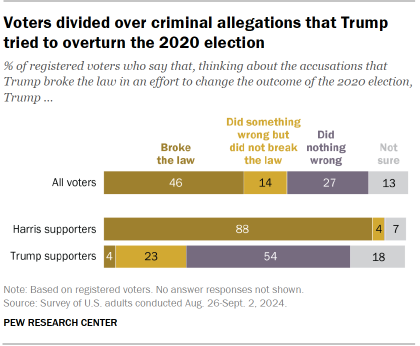
The interview was part of Harris’s broader effort to appeal to Republican voters who are uncomfortable with Trump’s attempts to overturn the 2020 election. In recent weeks, Harris has been campaigning alongside prominent Republican figures like former Wyoming Representative Liz Cheney and others from Trump’s administration who have distanced themselves from the former president.

Earlier on Wednesday, Harris spoke at an event in Washington Crossing, Pennsylvania, near the historic site where George Washington crossed the Delaware River during the American Revolution. The event gathered over 100 Republicans supporting her campaign, including figures such as former Illinois Representative Adam Kinzinger and former Georgia Lieutenant Governor Geoff Duncan.

During the Fox News interview, Harris also sought to differentiate herself from President Biden, a departure from her earlier statements. She stressed that her presidency, if elected, would not be a continuation of Biden’s administration. “My presidency will not be a continuation of Joe Biden’s presidency,” Harris told Fox News anchor Bret Baier. “I represent a new generation of leadership,” she added. “I, for example, am someone who has not spent the majority of my career in Washington, DC. I invite ideas, whether it be from the Republicans who are supporting me who were just onstage with me minutes ago, and the business sector and others who can contribute to the decisions I make.”

In another key segment of the interview, Harris was pressed about a Trump campaign ad that highlighted her previous stance on gender-affirming care for prisoners, a position she supported during her time as a California senator and presidential candidate in 2019. When asked whether she still supports using taxpayer funds for such care, including for undocumented immigrants, Harris was careful to emphasize her commitment to following the law.

“I will follow the law, and it’s a law that Donald Trump actually followed. You’re probably familiar with, now it’s a public report that under Donald Trump’s administration, these surgeries were available on a medical necessity basis, to people in the federal prison system,” she explained. Harris pointed out that the Trump administration had allowed such services, calling the ad’s criticism hypocritical: “I think, frankly, that ad from the Trump campaign is a little bit of like throwing, you know, stones when you’re living in a glass house.”

Pressed again by Baier on whether she would personally advocate for taxpayer funding of gender-affirming surgeries, Harris remained firm, reiterating her position: “I would follow the law, just as I think Donald Trump would say he did.”

Throughout the interview, Harris repeatedly referred to the bipartisan border security bill that was blocked by Republicans earlier this year. She argued that the failure to pass this legislation has exacerbated the challenges at the US-Mexico border, where facilities are overwhelmed by the number of migrants entering the country.

Baier challenged Harris on the Biden administration’s decision to roll back Trump-era immigration policies, leading to several tense exchanges between the two. At one point, Baier pressed Harris to estimate how many undocumented immigrants had been released into the U.S. during Biden’s presidency. “Just a number. Do you think it’s 1 million, 3 million?” he asked. Harris refused to provide a figure, instead reiterating her point about the broken immigration system.

“Bret, let’s just get to the point, OK? The point is that we have a broken immigration system that needs to be repaired,” she responded. Harris acknowledged the tragic consequences of a system in disrepair, including the case of Laken Riley, a 22-year-old Georgia nursing student who was killed by an undocumented immigrant released by U.S. authorities. “First of all, those are tragic cases. There’s no question about that. There is no question about that, and I can’t imagine the pain that the families of those victims have experienced for a loss that should not have occurred,” she said.

But Harris was quick to return to her criticism of Republican opposition to border security reforms, saying, “It is also true that if a border security bill had actually been passed nine months ago. It would be nine months that we would have had more border agents at the border, more support for the folks who are working around the clock trying to hold it all together.”

Harris maintained that both parties agree on the need to fix the system: “I have no pride in saying that this is a perfect immigration system,” she admitted. “I’ve been clear — I think we all are — that it needs to be fixed.”

In response to questions about her stance on benefits for undocumented immigrants, Harris remained evasive, reiterating only that she would “follow the law.” She also confirmed that she does not support decriminalizing illegal border crossings. “I do not believe in decriminalizing border crossings, and I’ve not done that as vice president,” she said. “I will not do that as president.”

Kamala Harris Seen as Key to Tackling Medical Debt Crisis Amid Presidential Campaign

Patient and consumer advocates are turning to Vice President Kamala Harris as they hope she will intensify federal efforts to alleviate medical debt should she win the upcoming presidential election. Harris, the Democratic nominee, is viewed as a critical figure in safeguarding access to health insurance for Americans, which experts agree is the best protection against debt caused by medical expenses.

Under the Biden administration, strides have been made to strengthen financial protections for patients. This includes a notable proposal by the Consumer Financial Protection Bureau (CFPB) to eliminate medical debt from consumer credit reports. President Biden’s 2022 signing of the Inflation Reduction Act, which includes a $35-a-month cap on insulin for Medicare enrollees, has also helped ease some financial burdens. Additionally, bipartisan efforts across state legislatures have led to laws aimed at curbing aggressive debt collection practices.

Despite these advancements, advocates argue that there is much more the federal government could do to address the problem affecting 100 million Americans. The weight of medical debt often leads individuals to work extra jobs, lose their homes, or reduce spending on essentials like food.

“Biden and Harris have done more to tackle the medical debt crisis in this country than any other administration,” said Mona Shah, senior director of policy and strategy at Community Catalyst, a nonprofit organization leading efforts to strengthen protections against medical debt. “But there is more that needs to be done and should be a top priority for the next Congress and administration.”

However, these advocates fear that a second term for former President Donald Trump could reverse progress. During his first term, Trump and congressional Republicans attempted to repeal the Affordable Care Act (ACA), a move that analysts predicted would strip health coverage from millions of Americans and raise costs for those with pre-existing conditions like diabetes and cancer. Trump also promoted cheaper “skinny plans” that offered minimal coverage but left people vulnerable to significant out-of-pocket expenses if they became ill. Though Trump signed the bipartisan No Surprises Act, which shields consumers from certain surprise medical bills, his stance against the ACA and his intent to roll back the Inflation Reduction Act continue to raise concerns.

“People will face a wave of medical debt from paying premiums and prescription drug prices,” warned Anthony Wright, executive director of Families USA, a consumer group advocating for federal health protections. “Patients and the public should be concerned.”

The Trump campaign has not offered detailed plans regarding health care or medical debt in the run-up to the election. Trump has hinted at improving the ACA but has yet to provide specifics.

Harris, on the other hand, has pledged to protect the ACA and extend expanded subsidies for insurance premiums under the Inflation Reduction Act. These subsidies are set to expire next year, and Harris has voiced strong support for renewing them. Additionally, she has endorsed more government spending to purchase and cancel old medical debts. While these efforts have brought relief to hundreds of thousands, many advocates believe retiring old debts only offers a temporary solution without more systemic reforms.

“It’s a boat with a hole in it,” said Katie Berge, a lobbyist for the Leukemia & Lymphoma Society. Her group was one of over 50 organizations that last year urged the Biden administration to take more aggressive steps in addressing medical debt.

“Medical debt is no longer a niche issue,” said Kirsten Sloan, a federal policy expert at the American Cancer Society’s Cancer Action Network. “It is key to the economic well-being of millions of Americans.”

One significant proposal currently in development is a set of CFPB regulations that would bar medical bills from appearing on consumer credit reports. This move could boost credit scores, making it easier for Americans to rent apartments, secure jobs, or obtain loans. Harris has expressed strong support for this initiative, stating in June that medical debt “is critical to the financial health and well-being of millions of Americans.” She added, “No one should be denied access to economic opportunity simply because they experienced a medical emergency.”

Minnesota Governor Tim Walz, Harris’ running mate, has also taken steps to address medical debt. Walz, who has shared that his family struggled with medical debt during his youth, signed a law in June cracking down on aggressive debt collection practices in his state.

CFPB officials expect the new regulations to be finalized early next year. However, it remains unclear whether Trump would continue supporting these protections. His administration took little action on medical debt, and congressional Republicans have long been critical of the CFPB.

If Harris prevails in the election, consumer groups hope she will push the CFPB to take even more significant measures, including stricter oversight of medical credit cards and similar financial products offered by hospitals. These products often lock patients into interest payments on top of their existing debt.

“We are seeing a variety of new medical financial products,” noted April Kuehnhoff, senior attorney at the National Consumer Law Center. “These can raise new concerns about consumer protections, and it is critical for the CFPB and other regulators to monitor these companies.”

Beyond the CFPB, advocates are calling on other federal agencies, particularly the Health and Human Services (HHS) department, to become more involved. HHS oversees billions of dollars through the Medicare and Medicaid programs, giving the federal government substantial influence over hospitals and medical providers. Yet, to date, the Biden administration has not fully leveraged this power to address medical debt.

There are signs of what could come, however. North Carolina state leaders recently won federal approval for a program requiring hospitals to help alleviate patient debt in exchange for government aid. Harris has praised this initiative, and some see it as a potential model for future federal action.

Ultimately, for patients and consumer advocates, the stakes of the 2024 election are high. Harris’ focus on expanding health protections offers hope for more comprehensive solutions to the growing medical debt crisis. On the other hand, fears loom that a Trump victory could undo many of the hard-won gains and leave millions more vulnerable to the crushing burden of medical debt.

The New Divide in American Politics: Education as the Deciding Factor

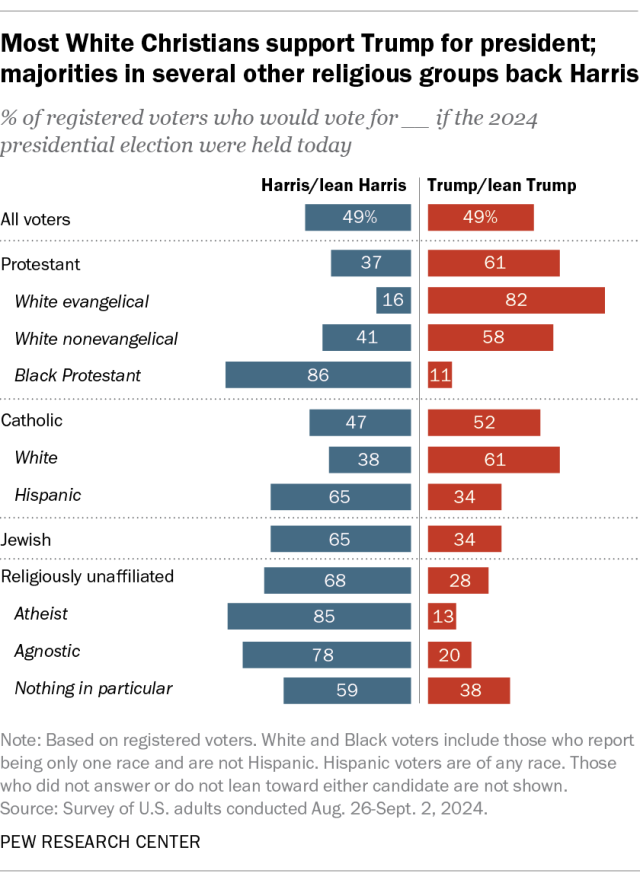
American voters are increasingly divided across various lines, including gender, race, and geography, all of which are commonly used to explain the current state of politics. The gender divide has been particularly prominent, with more women supporting Democrats—a gap likely to widen after the fall of Roe v. Wade, which turned the U.S. into a patchwork of states with either abortion rights or abortion bans. This issue may significantly affect upcoming elections.

In addition to gender, the role of race remains a pivotal factor. Former President Donald Trump’s ability to draw support from voters of color, especially among Latinos and Black men, could play a decisive role in key battleground states where close margins are expected. Geographical divisions are also clear, with rural voters typically favoring Republicans and urban voters leaning towards Democrats. The suburbs, however, remain a crucial battleground, with the candidate who can sway these voters likely to emerge victorious in November.

However, according to longtime Democratic strategist Doug Sosnik, who served as former President Bill Clinton’s political director, the most significant divide in modern American politics is education. Sosnik is well known for his detailed political analyses, and he believes that the current education gap is reshaping the political landscape.

The Rise of the Education Gap

“The biggest single, best predictor of how someone’s going to vote in American politics now is education level. That is now the new fault line in American politics,” Sosnik explained on the “CNN Political Briefing” podcast. He attributes this growing divide to Trump’s influence over the past three election cycles, which accelerated an education-based political realignment that had been slowly forming since the 1970s. According to Sosnik, the roots of this shift trace back to the early days of the decline of the middle class in America.

As the U.S. continues its transition into a 21st-century economy, a stark division has emerged between those who attain higher education and those who do not. “That’s become the basic Democratic Party,” Sosnik said, referring to the more educated segment of society. Conversely, those who feel left behind by economic changes have coalesced into the core of the modern Republican base.

Economic Inequality and Political Alignment

This education gap is closely tied to growing economic inequality in the U.S., with data backing up Sosnik’s claims. A report from the Federal Reserve Bank of St. Louis in August highlighted the stark differences in wealth between households led by college graduates and those without higher education. According to the report, for every dollar of wealth in a household headed by a college graduate, a household headed by a high school graduate has just 22 cents. The disparity improves slightly for households headed by someone with some college education but no degree, who hold 30 cents for every dollar of wealth in a college graduate’s household.

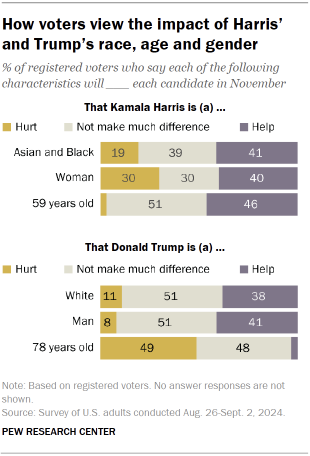
In broader terms, college graduates account for about three-quarters of the nation’s wealth, despite making up only around 40% of the population. The political implications of this economic divide are clear: voters with a college degree made up 41% of the electorate in 2020, according to CNN’s exit polls, and 55% of them supported President Joe Biden, while 43% backed Trump. On the other hand, Trump maintained a strong grip on about two-thirds of White voters without a college degree, but he struggled to win over White college-educated voters.

How Education Shapes Battleground States

Sosnik took his analysis further by explaining that the battleground states, where the 2024 election is likely to be decided, also fall in the middle of the national spectrum on educational attainment. These states—such as Pennsylvania, Michigan, and Wisconsin in the Rust Belt, and Georgia, North Carolina, and Arizona in the Sun Belt—are not significantly skewed toward either highly educated or less-educated populations, which is why they remain competitive.

A report from the Lumina Foundation, using census data, ranks states by levels of educational attainment, including post-high school certifications and associate degrees. This ranking supports Sosnik’s point: the battleground states typically hover around the national average in terms of education. One notable exception is Nevada, a battleground state with one of the lowest educational attainment levels in the country. Interestingly, some states with high educational attainment, such as those in the Northeast, tend to be solidly Democratic, while Utah, a conservative state, ranks near the top in education levels.

The New Swing Voters

In this shifting landscape, the traditional concept of swing voters—those who can be persuaded to choose between candidates—is evolving. Sosnik identified two groups of swing voters in the 2024 election. The first group consists of political independents or moderate Republicans, such as supporters of Nikki Haley, who may still be swayed by campaign messaging.

However, Sosnik emphasized a second, potentially more influential group of swing voters. These individuals are not choosing between candidates; instead, they are deciding whether to vote at all. For Trump, this group consists primarily of non-college-educated White men who, if they turn out to vote, will almost certainly support him. For Harris, the critical swing voters might be women who do not typically vote but are motivated by the Supreme Court’s ruling on abortion to participate in the 2024 election.

Young voters, who have historically been less reliable at the polls, also fall into this second category of swing voters. Sosnik noted that Trump’s political success has largely been built on appealing to those who are not traditional voters, a strategy that has redefined how campaigns are run and elections are won.

A New Paradigm in Presidential Elections

Sosnik argued that the growing importance of education in politics has also flipped a long-standing trend in voter turnout between presidential and midterm elections. Traditionally, Democrats have performed better in presidential elections, thanks to infrequent voters who are more likely to align with the Democratic Party. In contrast, Republicans tended to fare better in midterm elections when high-propensity voters, who are often more conservative, dominated the electorate.

However, this pattern has been upended in the Trump era. “Up until Trump, Democrats always did better in presidential years because infrequent voters were Democratic,” Sosnik explained. “Republicans always did better in off years because the high propensity voters were Republican. That’s completely flipped on its side now.”

As the 2024 election approaches, the educational divide appears poised to play a defining role. With both parties vying for the support of suburban voters and attempting to mobilize their respective bases, education will likely remain the critical factor shaping the future of American politics.

Donald Trump’s Radical Vision Looms Large as Kamala Harris Faces Critical Election Challenge

Donald Trump is outlining an extreme vision for a new White House term, one that could drastically alter America and send shockwaves around the globe. Vice President Kamala Harris has only three weeks to counter this, as she works to regain momentum in what has become a highly competitive race leading up to Election Day.

Trump, the Republican nominee, has intensified the most inflammatory anti-immigrant rhetoric in recent U.S. political history. He has made false claims, such as asserting that Haitian migrants living legally in the U.S. were eating pets in Ohio, and warned that outsiders with “bad genes” had “invaded” the country. During a rally in Arizona on Sunday, Trump baselessly suggested that if Harris won, “the entire country will be turned into a migrant camp.” In Colorado, just two days earlier, he vowed to initiate the “largest deportation operation in the history of the United States,” stating, “We will close the border. We will stop the invasion of illegals into our country. We will defend our territory. We will not be conquered.”

Trump escalated his rhetoric further over the weekend, threatening to use the military against what he called “the enemy from within.” In an interview on Fox News’ “Sunday Morning Futures,” he hinted at turning the military on his political opponents. The former president, who incited violence after losing the 2020 election, had also said at a rally on Saturday that a heckler, who was exercising her right to free speech, should “get the hell knocked out of” her.

In another display of how Trump might use presidential power for personal and political advantage, he threatened to withhold federal disaster aid from California, a state run by Democrats. Trump also falsely accused Harris and President Joe Biden of denying aid to Republican districts affected by hurricanes. He even suggested that CBS should lose its broadcasting license because he disagreed with how the network handled Harris’ interview on “60 Minutes,” an interview he had declined to participate in. Trump’s allies raised concerns about how the potential new administration might treat big business, threatening to cancel Deloitte’s federal contracts after an employee allegedly leaked private messages from Senator JD Vance criticizing Trump.

Details have also emerged regarding Trump’s ties to foreign autocrats. The Kremlin recently confirmed that Trump had sent COVID-19 tests to Russia’s authoritarian leader, Vladimir Putin, during the pandemic—a pandemic Trump had frequently downplayed.

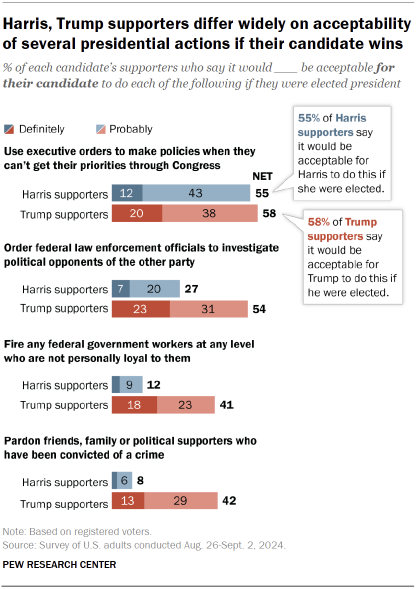
Although Trump has a history of making grand promises that do not always materialize, his past actions suggest his threats should not be dismissed. Furthermore, a recent Supreme Court ruling, which grants broad immunity to presidents, highlights the minimal constraints on executive power, raising concerns about Trump’s potential for authoritarian rule.

Trump’s increasingly extreme rhetoric has amplified the pressure on Kamala Harris. Prominent Democratic figures, including former Presidents Bill Clinton and Barack Obama, are urging voters in critical swing states to support Harris, particularly among Black and Latino communities. These voters will be essential in preventing Trump’s return to power.

Harris, during a rally in North Carolina on Sunday, sharpened her criticisms of Trump, accusing him of refusing to release his medical records and evading a second debate with her. She also noted his decision to decline an interview with “60 Minutes.” “He’s not being transparent with the voters,” Harris said. “It makes you wonder, why does his staff want him to hide away? One must question, are they afraid that people will see that he is too weak and unstable?”

Democratic Fears Rise

Many Democrats are becoming increasingly concerned that the initial excitement surrounding Harris’ campaign has not translated into a decisive lead over Trump. Despite her strong entry into the race and a successful debate performance, national polls show no clear leader.

The most recent polling averages suggest a tight race, and Democrats fear that, like Hillary Clinton in 2016, Harris could win the popular vote but lose the Electoral College. The fact that the contest remains so close despite Trump’s extreme positions suggests that his message is resonating with a significant portion of the electorate. Republicans have blamed the Harris-Biden administration for rising inflation, and Trump has frequently pointed to the chaotic U.S. withdrawal from Afghanistan as evidence of the current administration’s perceived weakness on the global stage. Additionally, Democrats’ failure to address immigration early in Biden’s term has left them vulnerable to Trump’s aggressive stance on the issue.

The close contest also reveals that, despite Trump’s unapologetic extremism, Democrats have once again struggled to produce a candidate or message that can decisively reassure voters. While many liberals and moderates are alarmed by Trump’s authoritarian vision, he continues to lead on what voters say is the top issue: the economy. A recent ABC News/Ipsos poll showed that 59% of respondents believe the economy is worsening, even though inflation has eased, interest rates are declining, and the job market remains strong.

Harris, as the incumbent vice president, faces an uphill battle. Her failure to distinguish herself from Biden’s policies in a recent interview with “The View” could prove costly, as Trump is likely to exploit this weakness all the way to Election Day. Harris has outlined policies to address housing affordability, healthcare costs, and immigration reform, but these initiatives have often been overshadowed by Trump’s dramatic promises to deport migrants, impose tariffs on trade rivals, and restore order to a chaotic world.

Still, there are signs of hope for Democrats. Trump’s polling numbers rarely exceed 48%, suggesting that his support remains capped, while Harris may still have room to gain. In a recent NBC News poll, 10% of voters indicated they might change their minds, and a small but potentially decisive portion of the electorate remains uncommitted. In key battleground states like Pennsylvania, Michigan, Arizona, and Georgia, even minor shifts in support could make a significant difference.

What Harris Must Do

Democratic strategist Doug Sosnik believes the election remains a 50-50 contest and that Harris has stalled while Trump has gained ground. He suggested the race could come down to which candidate can effectively position themselves as a change agent.

In a memo released Sunday, Trump’s campaign claimed that Harris had already lost the argument on change. “She can’t convince the voters that she is ‘the change agent’ in the race, that she will be better on the economy, inflation, immigration, crime, or improving people’s financial situation,” the memo stated. “The bottom line is that voters say President Trump will do a better job.”

Sosnik argued that Harris must rise to the pressure and scrutiny, giving voters a clear reason to support her. “They don’t feel like she has given them enough reason to vote for her,” he said.

Harris faces a complicated path, made more difficult by the lack of direct engagement with Trump, who has avoided most mainstream media and refuses to participate in a second debate. Trump’s rallies, once a staple of cable news coverage, now receive limited attention outside conservative media, meaning many voters may not fully grasp the extent of his increasingly extreme positions.

Obama, appearing at a rally for Harris in Pennsylvania last week, expressed disbelief at Trump’s continued popularity. “There is absolutely no evidence that this man thinks about anyone but himself,” Obama said. “Donald Trump sees power as nothing more than a means to an end.”

Nevertheless, Trump, despite his impeachments, criminal conviction, and attempts to undermine democracy, remains within striking distance of reclaiming the presidency—with a more radical agenda than ever before.

Kamala Harris vs. Donald Trump: Will America Elect Its First Female President?

On November 5, voters across the U.S. will cast their ballots to elect the next president. Initially anticipated to be a repeat of the 2020 election, the race was drastically altered in July when President Joe Biden withdrew his bid for re-election and endorsed Vice-President Kamala Harris. This shift has set up a historic showdown: will Kamala Harris become the first female president, or will Donald Trump secure a second term?

As election day nears, poll trackers are closely monitoring the race for the White House, gauging the influence of campaign events on voter preferences.

Who Leads the National Polls?

Since her entry into the race at the end of July, Harris has held a steady lead over Trump in national polling averages. These polls, regularly updated and rounded to the nearest whole number, show Harris maintaining her advantage in the race.

One significant campaign event was a televised debate on September 10 in Pennsylvania, which attracted more than 67 million viewers. Polls conducted in the week following the debate suggested Harris gained momentum, with her lead growing from 2.5 percentage points before the debate to 3.3 points a week later.

Most of this gain can be attributed to a slight dip in Trump’s polling numbers. Although Trump’s popularity had been rising in the lead-up to the debate, his numbers fell by half a percentage point afterward.

The poll tracker indicates these marginal shifts, with trend lines showing the changing averages and dots representing the individual poll results for both candidates.

While national polls provide insight into each candidate’s popularity, they are not necessarily predictive of the election outcome. This is because the U.S. does not use a simple popular vote system to decide the president. Instead, an electoral college system determines the winner, with each state allocated a certain number of votes, reflecting its population size. A candidate needs 270 electoral votes out of 538 to win the presidency.

Who Leads in Swing State Polls?

In the current electoral race, the real battleground is in the swing states. Of the 50 states, only a few—referred to as battleground or swing states—are truly up for grabs. These are the states where the election will likely be decided, as most other states consistently lean toward one party.

Polling in the seven key battleground states reveals an extremely close race, with only one or two percentage points separating Harris and Trump. Pennsylvania, a pivotal state with the highest number of electoral votes among the battlegrounds, is particularly critical. Winning Pennsylvania would make it significantly easier for either candidate to reach the necessary 270 electoral votes.

Interestingly, the dynamics of the race have shifted dramatically since Harris replaced Biden as the Democratic nominee. On the day Biden dropped out, he was trailing Trump by nearly five percentage points in these battleground states. Harris has narrowed that gap considerably, reflecting her growing strength in these crucial regions.

However, it’s important to note that fewer state-level polls are conducted compared to national polls, meaning less data is available. Additionally, all polls have margins of error, which means actual voter preferences could differ slightly from the poll results.

Despite these limitations, the trends since Harris joined the race indicate some areas where she holds an advantage. Polling averages show that Harris has been leading in three key battleground states—Michigan, Pennsylvania, and Wisconsin—since early August. Yet, these leads are narrow.

Historically, all three of these states were Democratic strongholds until Trump turned them red in 2016, helping him win the presidency. Biden managed to flip them back to the Democratic column in 2020, and if Harris can do the same this year, she will be well-positioned to win the election.

How Are Polling Averages Calculated?

The polling averages presented in this article are sourced from 538, a polling analysis website operated by ABC News. 538 gathers data from various polling companies, both at the national level and within battleground states.

To ensure accuracy, 538 uses strict quality controls and only includes polls from companies that meet certain transparency standards. For example, polling firms must disclose the number of people surveyed, the timing of the poll, and the method used—whether it was conducted by phone, online, or via text.

This level of detail is critical in ensuring the reliability of the polling averages.

Can We Trust the Polls?

As of now, polls suggest that Kamala Harris and Donald Trump are neck-and-neck in the crucial swing states. With the race so close, predicting the outcome is difficult.

Recent elections have shown that polls can underestimate Trump’s support. This happened in both 2016 and 2020, when polling companies failed to accurately predict his level of backing. Polling organizations are working to address this issue by refining their methods, aiming to ensure their results better reflect the makeup of the voting population.

One major challenge for pollsters is accounting for voter turnout. Accurately predicting who will actually show up at the polls on November 5 remains a guessing game, despite efforts to improve polling accuracy.

The 2024 U.S. presidential election is shaping up to be a close and potentially historic race. While Kamala Harris has a slight edge in national polls and is gaining ground in key battleground states, Donald Trump remains a formidable opponent. The election will ultimately be decided by the voters in a handful of crucial swing states, where the margins are razor-thin. As November 5 approaches, both candidates will be making their final push to sway undecided voters in these pivotal areas. The stakes are high, and the outcome is anything but certain.

Biden’s Diplomacy Faces Setbacks Amid Gaza War and Hezbollah Strikes  

A year after the October 7 attacks and the beginning of Israel’s offensive in Gaza, U.S. President Joe Biden became the first sitting president to visit Israel during wartime. During his visit, he told Israel, “You are not alone,” but also warned its leadership not to make the same mistakes the U.S. did after 9/11.

In September of this year, Biden once again addressed the situation during the United Nations meeting in New York, urging restraint between Israel and Hezbollah. Israeli Prime Minister Benjamin Netanyahu, however, responded defiantly, claiming Israel’s reach extended throughout the region. Less than two hours later, Israeli forces used American-supplied “bunker buster” bombs to strike southern Beirut, killing Hezbollah leader Hassan Nasrallah. This airstrike marked a significant turning point in the ongoing conflict since Hamas’s attack on Israel.

Biden’s diplomatic efforts appeared increasingly futile in the aftermath of the bombing, which used U.S.-supplied weapons. Over the past year, I have witnessed firsthand the complexities of U.S. diplomacy, following Secretary of State Antony Blinken on his trips back to the Middle East. Blinken has been at the center of these efforts, attempting to broker a ceasefire for the release of hostages in Gaza, but with little success so far.

The stakes in Gaza remain high. A year after Hamas broke through Israel’s militarized fence, killing over 1,200 Israelis and kidnapping 250 people, many hostages are still in captivity, including seven U.S. citizens. Some of them are believed to be dead. Israel’s retaliatory strikes have devastated Gaza, killing nearly 42,000 Palestinians, according to figures from the Hamas-run health ministry. The region has been reduced to ruins, with tens of thousands displaced, missing, or facing hunger.

As the war escalates, the conflict has expanded into the occupied West Bank and Lebanon, and last week, Iran fired 180 missiles at Israel, retaliating for Nasrallah’s assassination. This development threatens to engulf the region in broader conflict.

Diplomatic Struggles and Limitations

Throughout the conflict, the Biden administration has attempted to both support and restrain Netanyahu. However, its efforts to defuse tensions and achieve a ceasefire have been consistently thwarted. Biden’s administration claimed that U.S. pressure altered the course of Israel’s military operations. This is likely a reference to the belief that the invasion of Rafah in southern Gaza was less severe than it could have been, despite the extensive destruction there.

Before the invasion, Biden temporarily paused a shipment of 2,000-pound and 500-pound bombs to Israel in an effort to prevent a full-scale assault. This decision prompted backlash from Republicans in Washington and Netanyahu himself, who criticized it as an “arms embargo.” Though Biden partially lifted the suspension, it was never reinstated. The State Department asserts that U.S. involvement has facilitated more humanitarian aid to Gaza, despite the ongoing humanitarian crisis and accusations of Israel blocking shipments. “It’s through the intervention and the hard work of the United States that we’ve been able to get humanitarian assistance into those in Gaza, which is not to say that this is… mission accomplished,” stated department spokesman Matthew Miller.

Blinken has taken on the brunt of diplomatic efforts in the region, making ten trips to the Middle East since October, while the CIA has worked behind the scenes to broker a Gaza ceasefire between Israel and Hamas. However, many attempts to close a deal have fallen short. On Blinken’s ninth visit, in August, optimism about a potential agreement quickly soured. In Doha, Blinken was informed that the Emir of Qatar, a key player in communicating with Hamas, was too ill to meet him. Although officials later claimed they had spoken by phone, the trip ended in failure after Netanyahu insisted on keeping Israeli troops along Gaza’s border with Egypt, a deal-breaker for Hamas and Egypt. A U.S. official accused Netanyahu of deliberately sabotaging the agreement.

During Blinken’s tenth visit to the region, he notably avoided visiting Israel, a sign of mounting frustrations and stalled progress.

Criticisms and Defense of U.S. Strategy

For critics, the Biden administration’s call for an end to the war, while supplying Israel with billions of dollars in military aid, is either a failure to apply leverage or a blatant contradiction. “To say [the administration] conducted diplomacy is true in the most superficial sense… they never made any reasonable effort to change the behavior of one of the main actors – Israel,” said former intelligence officer Harrison J. Mann, who resigned in protest of U.S. support for Israel’s offensive in Gaza.

However, Biden’s supporters argue that his diplomacy has made important gains, pointing to last November’s truce, which led to the release of over 100 hostages in Gaza. Additionally, U.S. officials claim the administration prevented an Israeli invasion of Lebanon earlier in the conflict, despite the ongoing exchanges of rocket fire between Hezbollah and Israel. Senator Chris Coons, a Biden loyalist, emphasized the importance of Biden’s efforts, stating, “He has been successful in preventing an escalation… despite repeated and aggressive provocation by the Houthis, by Hezbollah, by the Shia militias in Iraq.”

Former Israeli Prime Minister Ehud Olmert also supported Biden’s approach, acknowledging his unprecedented support for Israel, including deploying U.S. military resources to the region. Yet Olmert criticized Netanyahu for repeatedly obstructing Biden’s diplomacy, attributing the failure to Netanyahu’s reliance on far-right ultranationalists in his government, who oppose any ceasefire. Olmert believes Netanyahu’s political alliances make it difficult for him to agree to a ceasefire, as it would weaken his coalition. “Ending the war as part of an agreement for the release of hostages means a major threat to Netanyahu, and he’s not prepared to accept it,” said Olmert.

Netanyahu, however, has denied blocking any ceasefire deals, insisting that he was in favor of U.S.-backed plans but that Hamas repeatedly changed its demands.

The Biden-Netanyahu Relationship

The relationship between Biden and Netanyahu is complex, with decades of history between them. While Biden is a passionate supporter of Israel, his critics argue that this stance has limited his ability to leverage real change. Thousands of protesters have taken to the streets in the U.S. to denounce Biden’s policies, with many carrying signs calling him “Genocide Joe.”

Rashid Khalidi, Professor Emeritus of Modern Arab Studies at Columbia University, claims that Biden’s view of Israel was shaped by a time when the Jewish state was seen as being in existential danger, resulting in an outdated perspective on the region’s dynamics. Khalidi noted that many young Americans today, exposed to images of Gaza through social media, have a very different view. “They know what the people putting stuff on Instagram and TikTok in Gaza have shown them,” he said.

Looking ahead, the U.S. election could bring further change. Vice President Kamala Harris, who will face Donald Trump in the upcoming presidential election, does not carry the same generational baggage as Biden. However, neither Harris nor Trump has outlined specific plans for resolving the conflict, leaving the future uncertain.

Biden’s Balancing Act: US Diplomacy Faces Hurdles in Israel-Gaza Conflict

A year after Hamas launched its deadly attack on Israel, sparking a brutal war in Gaza, US President Joe Biden finds himself navigating a precarious path between support for Israel and efforts to broker a ceasefire. On October 7, 2023, after Hamas attacked, killing more than 1,200 people and kidnapping 250, including US citizens, Biden became the first sitting US president to visit Israel during a time of war. During his visit, he assured Israeli leaders, including Prime Minister Benjamin Netanyahu, that “You are not alone,” but he also warned them not to repeat the mistakes made by the US in the aftermath of 9/11.

A year later, Biden’s efforts to restrain the escalation of violence while supporting Israel appear to be faltering. In September 2024, Biden led calls for de-escalation between Israel and Hezbollah at the United Nations, only for Israeli airstrikes to kill Hezbollah leader Hassan Nasrallah shortly after. This assassination, carried out with US-supplied bunker buster bombs, marked a significant turning point in the conflict, and Biden’s diplomacy seemed buried beneath the ruins of Beirut.

The US has made multiple attempts to broker a ceasefire and negotiate the release of hostages taken by Hamas. Secretary of State Antony Blinken has traveled to the Middle East ten times since the October 7 attacks, seeking to mediate between Israel and Hamas. Despite these efforts, US diplomacy has struggled to gain traction, and Blinken’s mission to secure a ceasefire has been repeatedly thwarted. On his ninth visit to the region in August 2024, optimism that a deal might be close evaporated when the Emir of Qatar, a key player in talks with Hamas, became unavailable, and Netanyahu insisted on keeping Israeli troops along Gaza’s border with Egypt. This condition was a deal breaker for both Hamas and Egypt, and the negotiations collapsed.

The situation on the ground in Gaza has deteriorated rapidly. Israel’s retaliatory offensive has killed nearly 42,000 Palestinians, according to figures from the Hamas-run health ministry. Thousands more remain missing, and the United Nations has reported record numbers of aid workers killed in Israeli strikes. Humanitarian groups accuse Israel of blocking essential aid, though the Israeli government denies these claims. The conflict has also spread beyond Gaza, with violence erupting in the occupied West Bank and Lebanon, and Iran firing missiles at Israel in retaliation for Nasrallah’s death.

Despite Biden’s administration claiming some success in moderating Israeli military actions, particularly in Gaza’s southern city of Rafah, where the invasion was reportedly less extensive due to US pressure, the overall goal of achieving a ceasefire remains elusive. Biden temporarily suspended a shipment of bombs to Israel in an attempt to restrain the military’s escalation, but this move was met with backlash from Netanyahu and US Republicans, leading the administration to partially lift the suspension soon after.

In Gaza, the humanitarian crisis continues to deepen, with famine-like conditions reported earlier in 2024. US officials, however, claim that their intervention has led to increased aid deliveries to the region. “It’s through the intervention and the involvement and the hard work of the United States that we’ve been able to get humanitarian assistance into those in Gaza, which is not to say that this is… mission accomplished,” says Matthew Miller, a State Department spokesman. “It is very much not. It is an ongoing process.”

Critics argue that US diplomacy has been superficial, given the billions in military aid sent to Israel. Some former officials claim that the US has failed to use its leverage over Israel to halt the violence. “To say [the administration] conducted diplomacy is true in the most superficial sense in that they conducted a lot of meetings. But they never made any reasonable effort to change the behavior of one of the main actors—Israel,” says Harrison J. Mann, a former US Army Major who worked in the Middle East and Africa section of the Defense Intelligence Agency. Mann resigned earlier this year, in protest of US support for Israel’s military operations, citing the high civilian death toll caused by American-supplied weapons.

However, Biden’s allies staunchly reject this criticism, pointing to the diplomatic success of last November’s truce, which resulted in the release of over 100 hostages in exchange for 300 Palestinian prisoners. The administration also claims credit for preventing an Israeli invasion of Lebanon earlier in the conflict, despite cross-border rocket fire between Hezbollah and Israel. Senator Chris Coons, a Biden ally, argues that the president has managed to prevent the war from spiraling even further, despite provocations from Iran-backed militias and other regional actors. “He has been successful in preventing an escalation—despite repeated and aggressive provocation by the Houthis, by Hezbollah, by the Shia militias in Iraq—and has brought in a number of our regional partners,” Coons says.

Former Israeli Prime Minister Ehud Olmert attributes Biden’s efforts to an unprecedented level of support for Israel, pointing to the extensive US military deployments in the region following the October 7 attacks, including aircraft carriers and a nuclear submarine. However, Olmert also believes that Netanyahu’s resistance has hindered Biden’s diplomacy. He suggests that Netanyahu’s reliance on far-right, ultranationalist cabinet members has prevented him from agreeing to a ceasefire. “Ending the war as part of an agreement for the release of hostages means a major threat to Netanyahu, and he’s not prepared to accept it,” Olmert says.

Netanyahu has consistently denied that he is blocking a ceasefire deal, asserting that he supports US-backed plans but has sought clarifications, while accusing Hamas of shifting its demands. The relationship between Netanyahu and Biden, shaped over decades, has been a key factor in the dynamics of US-Israel diplomacy. Though Biden has long been a staunch supporter of Israel, critics argue that his unyielding support has become a liability. As Gaza’s death toll rises, protesters in the US, many of them Democrats, have taken to the streets, denouncing Biden’s policies and accusing him of facilitating war crimes.

Rashid Khalidi, Professor Emeritus of Modern Arab Studies at Columbia University, believes Biden’s diplomacy is rooted in an outdated view of the region, one that fails to account for the decades of Palestinian suffering under occupation. “I think that Biden is stuck in a much longer-term time warp. He just cannot see things such as… 57 years of occupation, the slaughter in Gaza, except through an Israeli lens,” Khalidi says.

As the conflict drags on, Biden faces increasing pressure to shift his approach, both from within his own party and from a new generation of Americans who view the Gaza conflict through the lens of social media, witnessing the devastation firsthand. Vice President Kamala Harris, Biden’s successor as the Democratic candidate in the upcoming election, represents a break from this generational mindset, though she, like her Republican rival Donald Trump, has yet to outline any concrete plans for ending the conflict. How the US election may influence the course of the Israel-Gaza war remains to be seen.

Biden Questions Netanyahu’s Motives Amid Middle East Conflict and Election Concerns

President Joe Biden has expressed uncertainty about whether Israeli Prime Minister Benjamin Netanyahu is delaying a potential Gaza ceasefire agreement to influence the upcoming U.S. election. During an unplanned appearance at a White House press briefing on Friday, Biden was asked if he thought Netanyahu’s reluctance to agree to a ceasefire might be an effort to affect the election. He responded, “Whether he’s trying to influence the election, I don’t know – but I’m not counting on that.”

Biden did not hold back when addressing his long-time ally. He firmly stated, “No administration has helped Israel more than I have. None, none, none,” and emphasized that Netanyahu should not overlook this fact.

This exchange comes as some Democrats express concern over Netanyahu’s stance on the ceasefire. There are fears that Netanyahu is ignoring Biden’s requests for a ceasefire and a hostage release deal, potentially to undermine the Democratic Party’s chances in the November election. Democratic Senator Chris Murphy highlighted these concerns earlier this week in an interview with CNN, stating, “I don’t think you have to be a hopeless cynic to read some of Israel’s actions, some of Prime Minister Netanyahu’s actions, as connected to the American election.”

The conflict in the Middle East, particularly the escalating violence and lack of a diplomatic resolution, is believed to be negatively impacting both Biden and Vice President Kamala Harris, who is set to replace him as the Democratic candidate. Polls suggest that the administration’s inability to secure a ceasefire and other diplomatic agreements is hurting their approval ratings, especially among Arab-American voters.

Biden’s support among Arab-Americans has notably decreased over the past year, a trend largely attributed to U.S. backing of Israel’s military actions. This growing discontent could pose a significant challenge for the Democratic Party in the upcoming election. For months, Biden has been advocating for a diplomatic resolution between Israel and Hamas, hinting several times that an agreement was near. A ceasefire deal ahead of the election would be a considerable achievement for the president and his party, but as the election draws closer, the possibility seems increasingly remote.

While the Biden administration has primarily criticized Hamas for its failure to negotiate a deal, the president has also been openly frustrated with Netanyahu. Recently, Biden publicly stated that Netanyahu was not doing enough to secure an agreement, signaling a shift in tone between the two leaders.

For his part, Netanyahu has denied claims that a deal is imminent. Earlier this month, in response to a U.S. official’s statement that a ceasefire agreement was 90% complete, Netanyahu said, “Hamas is not there with a deal. There’s not a deal in the making, unfortunately.” His rejection of such statements has highlighted the increasing strain between him and Biden, despite their decades-long relationship.

This growing rift stands in stark contrast to Netanyahu’s relationship with former U.S. President Donald Trump, the current Republican nominee, with whom the Israeli leader enjoyed a notably warm rapport.

As Israel continues its military actions in Gaza, it has also pushed forward with ground operations in southern Lebanon and has vowed to retaliate against Iran following a ballistic missile strike earlier this week. These developments are heightening tensions across the region and adding to the complexity of the situation.

During his Friday press briefing, Biden addressed concerns about the possibility of Israel retaliating by targeting Iranian oil fields. In response to reporters’ questions, he remarked, “The Israelis have not concluded what they are going to do in terms of a strike. If I were in their shoes, I’d be thinking about other alternatives than striking oil fields.”

Biden’s remarks came just a day after oil prices surged following his statement that the U.S. was in discussions with Israel about potential strikes on Iran’s oil infrastructure. This news has fueled speculation about potential repercussions in global energy markets and the broader geopolitical landscape.

For now, the relationship between Biden and Netanyahu continues to face challenges as the situation in the Middle East remains unresolved. With the U.S. election just around the corner, the political and diplomatic stakes could not be higher for both leaders.

Indian-Origin Doctors Call for Immigration and Healthcare Reform Ahead of U.S. Presidential Election

As the U.S. prepares to elect its next president in just a month, Indian-origin medical professionals are urging the incoming administration to prioritize immigration and healthcare reform. Dr. Satheesh Kathula, the president of the American Association of Physicians of Indian Origin (AAPI), emphasized the importance of addressing immigration issues, particularly for physicians from India. In an exclusive interview with PTI, Dr. Kathula outlined key concerns, including healthcare access, visa challenges, technological advancements in medicine, and anti-discrimination efforts.

Founded in 1982, AAPI is the largest ethnic medical organization in the United States, representing over 120,000 Indian-origin physicians. Dr. Kathula highlighted that many of these doctors, despite spending over 15 to 20 years in the U.S., are still on H-1B work visas. He stressed the need for fast-tracking green cards for these professionals to ensure they can continue serving without the constant worry of visa uncertainties. “We have to fast track their green cards to ensure they can live in the U.S. and continue their work without worrying about their visa status,” he said. Many of these physicians work in underserved areas, where local doctors are reluctant to practice.

He explained that the presence of Indian-origin doctors is crucial in such areas, warning that the departure of these professionals would severely disrupt the local healthcare systems. “If they really leave, then the whole healthcare system collapses in some towns. So that’s why we have to really fast-track green cards and prioritize this. Any government that takes over, this is very important,” Dr. Kathula emphasized.

One of his main concerns is that physicians are grouped with other H-1B visa holders, such as those in the tech industry. This categorization makes it harder for doctors to get prioritized in the immigration system. “That’s what makes it difficult. There should be some priority for people who are actually taking care of sick people,” he said, pointing out that one in seven patients in the U.S. is treated by a doctor of Indian origin. The H-1B visa, which allows U.S. companies to hire foreign workers in specialized fields, is heavily used by tech companies to recruit employees from countries like India and China. However, Dr. Kathula believes that physicians deserve distinct consideration because of their essential role in healthcare.

The physician shortage in the U.S. is another significant issue that Dr. Kathula believes should be tackled. He noted that while nurse practitioners and physician assistants are filling some gaps, the country still lacks enough doctors in certain areas. He estimates that by 2030, the U.S. will need approximately 125,000 more physicians. “That’s why we need to increase the residency positions, work on medical education, opening more medical schools,” Dr. Kathula added.

Additionally, international medical graduates, who often face hurdles in obtaining licenses and practicing in the U.S., should be given more support to help them integrate into the healthcare system. Dr. Kathula also pointed out that anti-discrimination measures and diversity initiatives should be on the next administration’s agenda. These issues, alongside healthcare reforms and immigration policies, need immediate attention.

With the U.S. Presidential elections set for November 5, the nation will choose between Republican nominee and former President Donald Trump, and Democratic candidate Vice President Kamala Harris. According to Dr. Kathula, the next president should also focus on technological advancements in medicine. This would involve ensuring proper funding for research and supporting innovative care models. “All these things should be given priority by the next government. That’s what AAPI is looking at, and AAPI members are looking at,” he said.

Dr. Kathula expressed that broader healthcare reforms should aim for affordable healthcare, improving the public health infrastructure, economic growth, job creation, and rebuilding vital systems. He stressed that ensuring affordable education and promoting racial and social justice must also be priorities. Alongside these, immigration reform is essential, with a focus on creating a fair system that welcomes skilled workers, particularly those in critical fields like healthcare. “Fair human immigration system should be given priority. Bring people who are skilled workers and it’s important that we fast track their immigration,” he reiterated.

Dr. Kathula, a board-certified hematologist and oncologist based in Ohio, assumed the role of AAPI President in July 2024. Reflecting on the contributions of the Indian diaspora in the U.S., he described their influence across various sectors as “just mind-boggling.” He observed that over the past 30 years, people of Indian origin have made significant contributions to the U.S. economy and society.

He praised AAPI for its role in supporting both the U.S. and India, particularly during the COVID-19 pandemic. The organization raised over five million dollars and sent thousands of ventilators, oxygen concentrators, and other critical medical supplies to India during the height of the crisis. This demonstrated the strong bonds between the Indian diaspora and their home country, as well as their commitment to global health.

Dr. Kathula also noted the strategic importance of the relationship between India and the U.S. He believes that both countries will continue to strengthen ties, especially in response to shared concerns over China’s growing influence in the Indo-Pacific region. The U.S., he said, will continue to support India’s role in maintaining security and stability in the area. He also highlighted the role of the Indian diaspora in diplomacy, remarking that their influence will further bolster the partnership between Washington and New Delhi.

“Overall, the trajectory of the India and U.S. relationship under the next administration [in the U.S.] is expected to remain positive, with a continued focus on defence, trade, climate change, technology and shared democratic values,” Dr. Kathula stated. He acknowledged that there could be challenges, particularly around trade disputes or human rights concerns, but he emphasized that the strategic importance of the relationship would ensure ongoing cooperation and growth.

Dr. Kathula urged the next administration to recognize the pivotal role that Indian-origin physicians play in the U.S. healthcare system and to take immediate steps to address the immigration and visa challenges they face. He remains hopeful that the next government will prioritize these reforms to ensure that both countries continue to benefit from the valuable contributions of Indian professionals.

Jobs Report and End of Port Strike Offer Relief to Harris Campaign

A better-than-expected jobs report, coupled with the swift resolution of a longshoremen’s strike, has provided a significant boost to Vice President Kamala Harris’s campaign. The strike, which had the potential to severely disrupt the U.S. economy, was the most politically dangerous of several challenges Harris and the White House faced recently.

The White House moved swiftly to end the strike, applying pressure on both the International Longshoremen’s Association (ILA) and the U.S. Maritime Alliance (USMX) to reach a deal. The strike, which began after the two sides failed to agree on a contract by Monday, shut down key ports along the East and Gulf Coasts. It threatened to bottleneck the economy just a month before the election, posing a major risk to Harris and the administration.

Fortunately for Harris, the strike was resolved Thursday night, with the longshoremen’s union and port operators reaching a tentative agreement after two days of stoppage. This resolution was further bolstered by Friday’s jobs report, which showed a stronger labor market than anticipated.

In September, the U.S. added 254,000 jobs, far surpassing the 140,000 jobs forecasted by economists. Additionally, revisions for July and August showed an extra 72,000 jobs were created during those months, suggesting that earlier concerns about a weakening labor market were overstated. The unemployment rate dropped slightly to 4.1%, further easing fears of rising joblessness.

This encouraging jobs report came as inflation moved closer to the Federal Reserve’s target. After peaking at 9.1% in June 2022, the highest in 40 years, inflation has since dropped to 2.5% as of August. Meanwhile, wage growth continues to outpace inflation, with average hourly earnings rising 4% over the past year.

The Federal Reserve, which had previously raised interest rates to combat inflation, indicated it was winding down its inflation-fighting efforts by lowering rates for the first time in September, with a 50-basis-point cut.

Mark Zandi, chief economist at Moody’s Analytics, praised the latest economic data, stating, “The jobs report for September cements my view that the economy is about as good as it gets.” He added, “The economy is creating lots of jobs across many industries, consistent with robust labor force growth, and thus low and stable unemployment.”

Zandi went on to emphasize that the U.S. economy is currently at full employment. “Wage growth is strong, and given big productivity gains, it is consistent with low and stable inflation. One couldn’t paint a prettier picture of the job market and broader economy,” he said.

President Joe Biden appeared at the White House press briefing to highlight both the resolution of the port strike and the positive jobs report. “The past two days, we’ve gotten some very good news about the American economy,” Biden said on Friday.

“Just yesterday, shipping carriers, after some discussion with the International Longshoremen’s union, came to an agreement to keep the ports of the East Coast and the Gulf ports open,” Biden noted. He emphasized the importance of this agreement, stating, “We averted what could have become a major crisis for the country.”

He also expressed excitement about the jobs numbers, saying, “Today, I got more incredible news.” Biden attributed the quick resolution of the port strike and the positive jobs report as signs that the economy was on solid footing.

According to Ernie Tedeschi, director of economics at the Yale Budget Lab and former chief economist at the White House Council of Economic Advisers, the good economic news was a boost for Harris’s campaign. “Harris is not literally running for reelection, but she is coming out of an incumbent administration, so she is being judged on the state of the current economy,” Tedeschi said. “Anything that is good about the current economy probably helps her, whether fairly or unfairly.”

Although Harris has lagged behind former President Donald Trump in terms of handling the economy since joining the race in late July, recent polls suggest she has been making gains. A Marist poll conducted in September showed Harris trailing Trump by just four points on the economy, a notable improvement from the nine-point gap Biden had in June. Likewise, in a Fox News poll last month, Harris was only five points behind Trump, compared to Biden’s 15-point deficit in March.

Despite these improvements, Harris still trails Trump on economic issues in what is shaping up to be a close election. The Hill-Decision Desk HQ polling average shows Harris leading Trump by a slim 3.4%.

Had the port strike dragged on, it could have severely hurt Harris’s campaign. Experts estimated that the strike could have cost the economy as much as $5 billion a day, with consumers beginning to feel its effects if the strike had lasted several weeks.

Tedeschi warned that a prolonged strike could have reignited inflation, particularly short-term inflation similar to what was seen during the pandemic when supply chain disruptions caused prices to spike. “A port strike carried with it a lot of risk of inflation going forward, especially short-run inflation,” Tedeschi said, recalling the “supply chain bottleneck inflation” of the pandemic era.

The tentative deal between the longshoremen and port operators includes a 62% wage increase for dockworkers over a six-year contract. Additionally, both sides agreed to extend the current contract until January 15 to continue negotiations on other unresolved issues.

Had there been any weakening in the labor market, it could have also posed problems for Harris. The weaker-than-expected jobs report in July had led to concerns that the Federal Reserve had waited too long to lower interest rates, raising the risk of a recession.

Although the Fed opted for a more aggressive rate cut in September, Fed Chair Jerome Powell defended the bank’s earlier decision to hold rates steady, a move now seen as justified by the recent economic data.

However, the Trump campaign was quick to attack Harris following the release of Friday’s jobs report, criticizing her on manufacturing, immigration, and the lingering effects of inflation.

“Kamala Harris and Joe Biden have built back broke, losing 34,000 manufacturing jobs in just the past two months as foreign countries benefit from Harris’s weak economic policies,” said Karoline Leavitt, national press secretary for the Trump campaign.

Leavitt also argued that the administration’s “open border policies” had “destroyed” 825,000 jobs for native-born Americans in the past year, while creating 1.2 million jobs for foreign-born workers during the same period.

However, this trend is largely attributed to the retirement of baby boomers, as many U.S.-born workers have exited the workforce. Tedeschi and other economists have pointed out that the percentage of native-born Americans with jobs is at its highest level since the federal government began tracking this data.

Special Counsel Jack Smith Lays Out Case Against Trump’s Alleged Election Scheme Amid Political Tensions

Special counsel Jack Smith has presented a detailed strategy outlining how prosecutors intend to build their case against former President Donald Trump, who is charged with orchestrating an illegal plan to overturn the results of the 2020 presidential election. This filing, made public on Wednesday, sheds new light on Trump’s “increasingly desperate” attempts to retain power, despite numerous efforts by those around him to convince him he had lost the presidency. The case, which is central to Trump’s ongoing legal battles, could play a significant role in the upcoming presidential election, scheduled for just over a month away.

The Republican presidential nominee has consistently labeled the case against him as politically motivated. In an interview with NewsNation, Trump referred to the filing as “pure election interference” and accused the government of “weaponization” against him.

The Prosecutors’ Claims

At the heart of the legal maneuver is an attempt to persuade U.S. District Judge Tanya Chutkan that the charges against Trump should move forward, despite a Supreme Court ruling in July that granted former presidents broad immunity from prosecution. The ruling established that former presidents have a presumptive immunity for actions taken in their official capacity. However, the court clarified that this protection does not extend to actions performed in a private capacity.

Smith’s team is building a case around the argument that Trump acted not as a president but as a private candidate for office when he attempted to overturn the election results. This distinction is crucial because it strips Trump of the immunity usually afforded to a sitting or former president. As the prosecution put it, Trump “must stand trial for his private crimes as would any other citizen.”

Prosecutors assert that while Trump was still the sitting president during the events in question, his actions were rooted in his role as a candidate, not a commander-in-chief. “Although the defendant was the incumbent President during the charged conspiracies, his scheme was fundamentally a private one,” they wrote in the filing. Working alongside private co-conspirators, Trump allegedly engaged in a fraudulent scheme to disrupt the lawful process of vote collection and counting. As prosecutors emphasize, this was a process in which Trump, as president, had no official role.

The Path Leading to This Point

The road to this latest legal development has been long and complex. The trial was originally scheduled for March in Washington’s federal court. However, proceedings were delayed in December last year when Trump’s legal team filed appeals claiming broad presidential immunity. Trump’s team argued that prosecuting a former president for official acts would erode the vital independence of the presidency.

While the Supreme Court declined to dismiss the case outright, it did remove some of the charges relating to Trump’s interactions with the Justice Department. The court sent the case back to Judge Chutkan to determine which of the remaining allegations pertain to Trump’s official duties and which could be categorized as actions taken in a private capacity, potentially subject to prosecution.

In August, Smith’s team adjusted the indictment to align with the Supreme Court’s ruling. Although the criminal charges remained unchanged, the scope of the allegations was narrowed.

What’s Next?

As the legal battle continues, Trump’s defense team has criticized the prosecution’s recent filing, accusing them of trying to influence public opinion and damage Trump’s campaign in the critical weeks before the election. Trump’s legal team will soon have the opportunity to respond to Smith’s arguments. While Trump’s response was originally due later in October, the defense was granted an extension by Judge Chutkan, moving the deadline to November 7.

Trump’s lawyers are also actively working to have the case dismissed. On Thursday, the defense filed additional legal documents, arguing that prosecutors have overextended the law by suggesting that Trump is responsible for the events of January 6, 2021, when rioters stormed the U.S. Capitol.

The defense insists that Trump’s discussions with his vice president and efforts to influence state election officials were integral to his responsibilities as president, not actions outside the scope of his role. John Lauro, Trump’s attorney, argued in a recent hearing that the Supreme Court’s ruling necessitates the case’s dismissal. However, Judge Chutkan has made it clear that she does not share this view.

Even if the judge ultimately sides with the prosecution, the trial will not proceed in the near future. Any rulings by Judge Chutkan are expected to be appealed, potentially sending the case back to the Supreme Court.

There is also the question of what happens if Trump wins the 2024 election. Should he prevail over Vice President Kamala Harris, he would have the power to appoint an attorney general who could seek to dismiss the case, along with other federal charges Trump faces. Additionally, Trump could attempt to pardon himself if convicted.

Political Ramifications

The latest filing has provided fresh material for Democrats as they campaign against Trump. It serves as a reminder to voters of the serious allegations surrounding the former president, even as ballots have already been cast in some states ahead of Election Day.

Trump, however, has been quick to capitalize on the filing, portraying it as yet another politically motivated attempt by his adversaries to weaken his campaign. This strategy has resonated strongly with his base and has significantly boosted his fundraising efforts.

Despite the new details in the filing, it is unclear how much it will affect voters’ decisions. Much of the information about Trump’s efforts to overturn the 2020 election has been in the public domain for some time. Additionally, Trump is facing multiple indictments, which may lessen the impact of this particular case on public opinion.

Polling data suggests that voters are more concerned with economic issues than with the defense of democratic institutions. For instance, a recent CNN poll revealed that 4 in 10 likely voters cited the economy as their top issue when deciding how to vote, compared to 2 in 10 who identified protecting democracy as their primary concern.

Protecting democracy seems to resonate more with Democratic voters, particularly those already backing Harris. Approximately 4 in 10 Harris supporters identified it as their top priority. In contrast, among Republicans and Trump supporters, the economy remains the dominant issue, with 6 in 10 naming it as their top concern. Immigration follows as the second most important issue. Only 5% of Trump supporters view protecting democracy as their main concern.

As the 2024 election approaches, the legal and political ramifications of this case will continue to unfold. Whether or not Trump’s legal battles ultimately sway voters remains to be seen.

Vance and Walz Face Off in Heated, But Predictable, Vice Presidential Debate

Ohio Republican Senator JD Vance and Minnesota Democratic Governor Tim Walz took the stage for a highly anticipated vice presidential debate, one of the final opportunities to sway voters before Election Day. However, according to operatives from both parties, neither candidate did much to sway undecided voters, a group that has remainedlargely unmoved by vice presidential debates historically.

Both political strategists and analysts believe that vice presidential debates rarely play a decisive role in elections, a trend that seems likely to hold true this year. With one of the presidential candidates being former President Donald Trump, who enjoys universal name recognition, the debate was seen more as a formality than a significant factor in voter decision-making.

“Nobody in history has voted for a presidential candidate based on a VP debate,” stated Matt Bennett, co-founder of the center-left think tank Third Way and a former campaign aide during Michael Dukakis’ 1988 presidential run. Reflecting on his past experiences, he added, “I watched the 1988 VP debate in a Dukakis campaign office, and when [former Sen. Lloyd] Bentsen dropped his ‘you’re no Jack Kennedy’ line, we high-fived in glee. Then we went on to lose 40 states.”

As expected, both candidates stuck to familiar talking points during Tuesday night’s debate, held in New York City. While the city prides itself as a cultural hub, its influence on the rest of the country is often debated. Both Vance and Walz used their opening statements to highlight their backgrounds and appeal to their respective bases.

Vance emphasized his working-class roots and military service, portraying himself as a champion of the common man. He credited Trump with bringing “stability in the world” by fostering “deterrence” and called into question Walz’s stance on abortion. Vance’s narrative focused on presenting Trump as a decisive leader who kept America safe and stable.

Walz, in turn, highlighted his upbringing in a small Nebraska town and his own service in the National Guard. He praised Vice President Kamala Harris for her “steady leadership” in international affairs and emphasized the importance of alliances. Walz also criticized Vance for scapegoating migrants, arguing that blaming them for various problems was unfair and misleading.

Despite the candidates’ differing views, there were a few moments of tension during the debate. In one heated exchange over the legal status of migrants in Springfield, Ohio, the candidates’ microphones had to be muted. Toward the end of the debate, Walz put Vance on the spot, pressing him to clarify his stance on Trump’s 2020 election loss and the January 6, 2021, Capitol riot. Vance avoided directly answering the question, deflecting the topic.

While the debate had its share of fiery exchanges, it was also notable for the contrasting styles of the candidates. Walz initially appeared shaky but found his footing as the debate progressed. Vance, on the other hand, maintained a more polished demeanor throughout the night, a reflection of his media experience.

Both campaigns were quick to declare victory after the debate, with the Trump campaign releasing a statement that read: “Senator Vance unequivocally won tonight’s debate in dominating fashion. It was the best debate performance from any Vice-Presidential candidate in history,” according to top aides Susie Wiles and Chris LaCivita.

Meanwhile, Harris’ campaign chair, Jen O’Malley Dillon, countered with her own statement, proclaiming, “On every single issue — the economy, health care, foreign policy, reproductive freedom, gun violence — Governor Walz won.”

Despite these claims of success, most of the attacks made during the debate were directed at the presidential candidates rather than at Vance or Walz themselves. The debate felt more like a clash of their running mates’ policies than a personal confrontation between the two vice presidential hopefuls. Both candidates even acknowledged their opponents’ genuine attempts to address critical issues, contributing to an overall tone of civility, unusual for such political events.

“Zero movement. Something for each side to like,” commented Democratic strategist Pete Giangreco. This sentiment was echoed by a national GOP strategist, who texted ABC News an image of a Venn diagram illustrating the overlap of “people interested enough in politics to watch the VP debate” and “Undecided voters.” The circles, unsurprisingly, did not intersect.

“Both did what they had to do. No major mistakes,” the GOP source observed. “Neither will break anything.”

In a lighthearted moment near the end of the debate, Walz referenced popular TV programs competing for viewers’ attention that evening, including “Dancing with the Stars.” This comment underscored the challenge of garnering attention for vice presidential debates, which traditionally attract smaller audiences.

Though both campaigns will likely race to highlight key moments from the debate in hopes of swaying voters, history suggests that vice presidential debates rarely shift the political landscape. It’s often said that the primary goal of a running mate in a debate is to “do no harm,” and while a strong performance may not significantly boost a ticket, a poor showing can be damaging.

According to a former senior Trump administration official, some voters tuned in to the debate to get a sense of Harris’ potential administration due to her limited media presence. They praised Vance, stating he “was in a different class tonight.” However, this official also acknowledged that many undecided voters were likely watching other events, such as the MLB playoffs or reruns of popular sitcoms like “Seinfeld,” rather than tuning into the debate.

In the end, both Vance and Walz managed to avoid any major blunders, maintaining the status quo. While they may have given their respective parties reasons to cheer, it is unlikely that their performances will have a lasting impact on the election. The debate left undecided voters largely where they started – still undecided – and with more interest in upcoming presidential debates or, perhaps, entirely different distractions.

Harris Declines Al Smith Dinner: Impact of Abortion Politics and Party Divide

Since September 21, when Democratic presidential candidate Vice President Kamala Harris declined an invitation to the Archdiocese of New York’s annual Al Smith Dinner, a fundraising event for children in need, Catholic media and commentators have been buzzing with analysis. The decision has raised eyebrows, particularly because the event is a major platform for political figures during election years.

New York Cardinal Timothy Dolan expressed surprise at the decision, noting, “We’re not used to this. We don’t know how to handle it.” He further added that such a situation hadn’t occurred in 40 years, recalling the last time when Walter Mondale declined in 1984, joking, “He lost 49 out of 50 states.”

However, it’s important to note that Harris’ decision, though rare, isn’t unprecedented. Since 1984, three of nine Al Smith Dinners held during presidential election years have taken place without either candidate in attendance. In the 1990s and again in 2004, Cardinals John O’Connor and Edward Egan chose to exclude candidates, citing the divisiveness of the campaigns. In fact, abortion has often been at the center of the drama. In 1980, Jimmy Carter was booed by attendees over his stance on abortion, and many speculated that John Kerry’s position on the issue influenced his exclusion in 2004.

Many believe that the tension around the Democratic Party’s abortion stance played a significant role in Harris’ decision. Steven Millies, a professor of public theology at Catholic Theological Union in Chicago, suggested that Cardinal Dolan’s perceived friendliness with Donald Trump may have also contributed. Millies pointed out, “There’s just discomfort there that Cardinal Dolan has not gone to the lengths to seem nonpartisan” as his predecessors had done.

The Archdiocese of New York did not comment on efforts to persuade the Harris campaign to attend the dinner.

Natalia Imperatori-Lee, a professor of religious studies at Manhattan University, echoed these sentiments, suggesting that Harris’ caution may also be linked to the broader political climate. “The Al Smith dinner may have been a ‘lighthearted fundraising event’ in the past, but now, with the increasing influence of Catholic bishops in U.S. politics, particularly in support of conservative causes, it may be perceived differently,” she said. She pointed to how some bishops have been vocally critical of President Joe Biden, particularly over his stance on abortion rights, with some even threatening to withhold Communion from him.

“If that’s the way they treated the Catholic president, why would she go?” Imperatori-Lee added, referencing Harris’ support for abortion rights, which has been a key part of her campaign.

Millies also speculated that Harris may be calculating that leaving Trump as the sole speaker could give him more opportunities to make controversial statements. “There’s a better than 50-50 chance that Trump will put his foot in his mouth at the Al Smith dinner anyway, and I wouldn’t want to get in his way if I were Kamala Harris when he does that,” Millies said.

Trump has a history of turning religious events into political battlegrounds. In 2016, during his appearance at the Al Smith Dinner, which traditionally features humorous remarks, Trump used the opportunity to launch personal attacks on his then-opponent, Hillary Clinton. He accused her of being “corrupt” and anti-Catholic, drawing boos from the audience. “Here she is tonight, in public, pretending not to hate Catholics,” Trump remarked about Clinton.

Clinton, for her part, responded by raising concerns about Trump’s allegations of a “rigged” election, adding, “I didn’t think he’d be OK with a peaceful transition of power.” Her comments foreshadowed Trump’s later controversies regarding the 2020 election results.

Trump’s pattern of mixing politics with religious events didn’t stop there. Four years later, at the National Prayer Breakfast, Trump, fresh from his first impeachment trial, used the platform to criticize House Speaker Nancy Pelosi and Senator Mitt Romney. He accused Pelosi of lying when she said she prayed for him and attacked Romney for “using” his faith as justification when he voted to convict Trump. “I don’t like people who use faith for justification for doing what they know is wrong,” Trump said at the time.

The fallout from these appearances has had a lasting impact. The National Prayer Breakfast has since been scaled back, moving from a large gathering to a smaller, more intimate event held at the U.S. Capitol.

Imperatori-Lee suggested that Harris’ decision to skip the Al Smith Dinner might also be due to the compressed nature of her campaign. Harris officially launched her presidential bid only two months ago, leaving little time to participate in non-essential events. “Vice President Harris is probably being very cautious about where she spends her time,” Imperatori-Lee said.

She further questioned whether the Al Smith Dinner holds much importance for the average Catholic voter. “Maybe Catholics in New York care about the Al Smith dinner,” she said. “But are Catholics in New York really a demographic that is going to move the needle for Vice President Harris or for any down-ballot people that she might be interested in helping? No.”

More significantly, Millies suggested that Harris’ decision signals a broader shift in the political landscape, with Catholic voters increasingly aligning with the Republican Party. He explained, “Catholics are now settling into being a niche constituency of one party rather than a national constituency that’s available to both parties.”

Given this political reality, skipping the dinner might be a wise move for Harris, especially with the election expected to be extremely close. “The Catholic vote, to all appearances, isn’t going to do her any good,” Millies concluded.

Despite the absence of both Harris and Trump, the Al Smith Dinner is still expected to be a significant fundraising success. Cardinal Dolan told New York’s archdiocesan media that this year’s event is projected to raise around $9 million. He added that the dinner typically raises more money during presidential election years.

Reflecting on the importance of the event, Dolan said, “When we speak about the culture of life, the dignity and sacredness of human life from the moment of conception to natural death, we need to put our money where our mouth is. The dinner exists for these causes, not the other way around.”

In the end, Harris’ decision to decline the Al Smith Dinner invitation highlights the growing polarization around issues like abortion within U.S. politics, particularly as they intersect with religious communities. With the 2024 election drawing near, the event once again serves as a flashpoint for the ongoing debate about faith, politics, and public life.

Harris vs. Trump: A Historic Election on the Horizon

On November 5, U.S. voters will head to the polls to elect their next president. What was initially expected to be a rematch of the 2020 election between President Joe Biden and former President Donald Trump took an unexpected turn in July when Biden ended his campaign and threw his support behind Vice-President Kamala Harris. This surprising move has left the nation asking one key question: Will America elect its first female president, or will Donald Trump win a second term in office?

As election day nears, the focus has shifted to how the candidates are performing in the polls. It remains to be seen whether the dynamics of the race will change before November.

Who is Leading the National Polls?

Since entering the race in late July, Harris has consistently led Trump in national polling averages. The margin has remained small but steady. In a highly anticipated debate between the two candidates held in Pennsylvania on September 10, over 67 million viewers tuned in to see how they would fare.

Harris’ performance in the debate seems to have given her a slight boost. Polls conducted in the week following the debate indicated that her lead over Trump increased slightly, rising from 2.5 percentage points to 3.3 percentage points. While this gain is marginal, it reflects a shift in momentum.

The slight increase in Harris’ lead appears to be more a result of a drop in Trump’s numbers than a significant surge in her own. Trump’s polling average had been climbing before the debate but saw a decrease of half a percentage point afterward. These small movements in the polls are tracked in national polling averages, which illustrate how each candidate is trending over time.

However, national polls, while informative, do not provide a comprehensive picture of how the election will play out. The U.S. presidential election is not determined by the national popular vote but rather by the electoral college system.

The Role of Battleground States

The outcome of the election will be decided in a handful of battleground states. While there are 50 states in the U.S., most of them consistently vote for the same party in every election. This leaves a small number of key states where the outcome remains uncertain and where both candidates have a real chance of winning. These states are critical in determining the final outcome and are known as battleground states.

At present, the race in these battleground states is extremely close, with only a one or two percentage point difference separating Harris and Trump in most of them. Pennsylvania, in particular, is a crucial battleground because it has the largest number of electoral votes among these key states. Winning Pennsylvania could be the key to securing the 270 electoral votes needed to win the presidency.

Before Harris became the Democratic nominee, Biden had been trailing Trump by nearly five percentage points in the seven battleground states. However, Harris’ entry into the race has shifted the dynamics. She is now performing better in several of these states than Biden had been before he exited the race.

Although there are fewer state-level polls than national polls, making it more difficult to draw conclusions, the available data shows that Harris has been gaining ground in certain battleground states. The margin of error in state polls also complicates the picture, as the actual numbers could be slightly higher or lower than reported.

Nonetheless, the trends since Harris entered the race suggest that she is in a stronger position in some key states. Polling averages show that Harris has been leading in Michigan, Pennsylvania, and Wisconsin since the beginning of August. These states, once considered Democratic strongholds, flipped to Trump in 2016, contributing to his victory. Biden won them back in 2020, and if Harris can do the same, she will be well on her way to winning the election.

How Polling Averages Are Created

The polling data used to track the race comes from various sources, including the well-known polling analysis website 538, which is affiliated with ABC News. 538 compiles data from numerous individual polls conducted both nationally and in battleground states. The polls come from a variety of polling companies, and 538 applies strict quality control measures to ensure that only polls meeting specific criteria are included in their averages. These criteria include transparency regarding the number of people polled, the time frame in which the poll was conducted, and the methodology used (e.g., phone calls, text messages, or online surveys).

By aggregating data from multiple polls, 538 creates an average that offers a more reliable indicator of where the race stands than any individual poll could provide. The methodology ensures that only credible polls are considered, reducing the likelihood of inaccurate results.

Can We Trust the Polls?

Although polls provide valuable insights, their accuracy in predicting the final outcome remains uncertain. In both the 2016 and 2020 elections, polls underestimated support for Trump, leading to unexpected results. Polling companies are working to address these past mistakes, adjusting their models to better reflect the composition of the voting population.

However, even with these adjustments, there are still challenges. One of the biggest unknowns is voter turnout. Pollsters must make educated guesses about who is most likely to vote on November 5. Voter turnout is notoriously difficult to predict, and it can have a significant impact on the election’s outcome.

At the moment, polls suggest that Harris and Trump are neck and neck in battleground states, with only a few percentage points separating them. When the race is this close, it becomes nearly impossible to predict the winner with certainty.

While Harris has the advantage in national polls, the electoral college system means that the results in a few key states will ultimately decide the election. As election day approaches, both candidates will likely focus their efforts on winning over voters in these battleground states, knowing that even a small shift in the polls could determine the next president of the United States.

While the current polling suggests that Harris has a slight edge, the election remains too close to call. With both candidates vying for victory in a handful of battleground states, the outcome will likely hinge on voter turnout and the final days of campaigning. As the country watches and waits, one thing is clear: this election has the potential to make history.

Kamala Harris Leads Trump by 38 Points Among Asian American Voters, Survey Reveals

Vice President Kamala Harris holds a commanding 38-point lead over former President Donald Trump in a recent survey targeting Asian American voters. This survey, conducted by the Asian and Pacific Islander American Vote (APIAVote) and AAPI Data, shows Harris’s dominance in this key demographic as she continues her campaign for the 2024 presidential election.

The poll, carried out by the National Opinion Research Center (NORC) at the University of Chicago, indicates a significant surge in support for Harris and the Democratic ticket. Since President Biden’s decision to step out of the race, Harris’s support among Asian American voters has grown by 23 points. The data places Harris in a strong position, with 66 percent of Asian American voters backing her, compared to just 28 percent supporting Trump. The remaining six percent are either undecided or favor other candidates.

Christine Chen, co-founder and executive director of APIAVote, spoke to the significance of these results: “These results reinforce what we’ve been hearing and seeing from the Asian American community since July: they are re-energized and poised to once again play a decisive role in the election.” The growing enthusiasm among Asian American voters suggests that this demographic could indeed be a major factor in determining the outcome of the 2024 election.

The survey further highlights Harris’s increasing favorability among Asian American voters. Sixty-two percent now view her positively, reflecting an 18-point rise in approval since the April-May period of 2024. Meanwhile, Trump’s favorability among the same group remains far lower, with only 28 percent of respondents holding a positive opinion of the former president. A significant 70 percent of respondents view Trump unfavorably, underscoring the challenges his campaign faces in winning over this growing demographic.

The popularity of the Democratic ticket extends beyond Harris, as the poll also indicates that Tim Walz, the Democratic vice-presidential nominee, is far more popular among Asian American voters than his Republican counterpart, JD Vance. Walz enjoys a 56 percent favorability rating, while only 21 percent of respondents view Vance positively. This disparity in favorability between the two vice-presidential candidates further strengthens the Democratic Party’s appeal among Asian American voters.

Karthick Ramakrishnan, executive director of AAPI Data, emphasized the importance of the Asian American and Pacific Islander (AAPI) electorate in the upcoming election. “Asian American and Pacific Islander voters are poised to play a pivotal role in this election. Instead of speculating about how AAPI voters are reacting to the Harris, Walz, and Vance candidacies, we have nationally representative survey data to inform news coverage and public understanding,” Ramakrishnan said. His remarks underscore the growing influence of AAPI voters, whose voting patterns have often been overlooked in previous elections.

In addition to favorability ratings, the survey also reveals a notable rise in voter engagement within the Asian American community. Seventy-seven percent of Asian American voters expressed certainty that they would vote in the upcoming election, a significant increase from 68 percent earlier in the year. This heightened level of voter commitment suggests that outreach efforts by both political parties are having an impact.

The Democratic Party appears to be making more significant inroads with Asian American voters, as 62 percent of respondents reported having been contacted by the Democratic Party. In comparison, 46 percent said they had been contacted by the Republican Party. This difference in voter outreach may further explain Harris’s strong lead among Asian American voters, as consistent communication often plays a crucial role in securing voter loyalty.

Harris’s appeal to Asian American voters is multifaceted. While her identity as an Asian Indian or South Asian is significant to some, her identity as a woman resonates more strongly within this demographic. Thirty-eight percent of Asian American voters in the survey emphasized the importance of her gender, while 27 percent highlighted her ethnic background. This demonstrates that voters are responding to both Harris’s gender and heritage, though her role as a woman appears to carry more weight with a larger portion of the electorate.

The findings of the 2024 AAPI Voter Survey provide valuable insights into the voting trends of Asian Americans, Native Hawaiians, and Pacific Islanders. The survey, conducted between September 3 and 9, 2024, reflects the growing importance of these communities in the national political landscape.

As the fastest-growing electorate in the United States, Asian American voters are increasingly viewed as a crucial bloc in the race for the presidency. The support Harris has garnered within this group further solidifies her position as a formidable candidate. Given the increasing voter engagement, as evidenced by the survey results, Asian American voters may very well play a decisive role in shaping the outcome of the 2024 election.

This shift in favor of the Democratic ticket among Asian American voters is a significant development as both parties compete for key demographic groups in battleground states. Harris’s ability to connect with Asian American voters, particularly as a woman and a representative of their community, is proving to be a vital asset for the Democratic campaign.

In contrast, Trump’s inability to improve his favorability among this demographic suggests that his campaign faces an uphill battle in trying to win over Asian American voters. With 70 percent of respondents viewing him unfavorably, it remains unclear how the former president plans to reverse these trends before Election Day.

The rise in voter engagement among Asian Americans also reflects broader efforts to increase participation within historically underrepresented communities. With voter turnout among Asian Americans rising, both political parties will likely continue to invest in outreach efforts to win over this crucial voting bloc.

The 2024 AAPI Voter Survey underscores the pivotal role that Asian American voters are expected to play in the upcoming election. With Harris holding a significant lead over Trump and the Democratic ticket receiving strong support from this demographic, the results suggest that Asian American voters will be instrumental in shaping the outcome of the 2024 presidential race. As voter outreach efforts intensify and engagement continues to rise, Asian American voters are poised to make their voices heard in a significant way this election season.

Jack Smith’s Filings Could Reveal New Evidence in Trump Election Subversion Case

Special counsel Jack Smith has presented new evidence in the election subversion case against former President Donald Trump. These documents, now with the federal court, include witness testimonies from key figures such as former Vice President Mike Pence, Ivanka Trump, and former White House chief of staff Mark Meadows. It is now up to District Judge Tanya Chutkan to decide how much of this evidence will be made available to the public and when it will be released.

The documents were filed under seal by 4:40 p.m. ET, according to Peter Carr, the spokesperson for the special counsel’s office. These submissions could potentially offer the public the most detailed account of Smith’s case, which alleges that Trump conspired to overturn the results of the 2020 election by defrauding the United States.

The evidence includes grand jury transcripts, FBI interview notes with witnesses, and other documentary evidence. This material is crucial for prosecutors as they aim to support their updated indictment against Trump, particularly in light of a recent Supreme Court ruling concerning presidential immunity.

The Supreme Court’s decision requires the prosecutors to convince Judge Chutkan, and possibly higher courts, that Trump was not acting within his official duties when he and his supporters took actions leading up to and on January 6, 2021, when the Capitol was attacked. Trump’s defense will likely argue that his actions fell under his presidential duties, which could grant him immunity.

One key aspect of the filings is expected to detail Trump’s pressure campaign on Pence. This conduct, which occurred in the lead-up to the Capitol attack, could be protected by presidential immunity according to the Supreme Court’s decision. Additionally, the documents could provide new insights into the events of January 6, including the rally at the Ellipse and Trump’s attempts to convince state officials to block the certification of the 2020 election results.

Prosecutors have indicated they intend to file a version of these documents with proposed redactions. This version, also filed under seal, may eventually be made public once the court reviews and approves it. The redacted filings could offer the public a glimpse into the evidence without compromising sensitive information.

Smith had previously obtained permission to submit a lengthy brief, stretching to 180 pages—four times the typical length. This brief will not include the additional exhibits that prosecutors plan to attach to their arguments. Prosecutors have described these exhibits as “substantial,” with the footnotes referencing them taking up over 30 pages of the main brief.

Trump’s legal team has strongly opposed the timing of the brief. They argue that it resembles special counsel reports that are usually released only after a special counsel’s work is completed. According to Trump’s lawyers, filing this brief now would be premature.

However, in a decision issued on Tuesday, Judge Chutkan approved the prosecutors’ plan to file the brief. She referred to the Supreme Court’s language from the July immunity ruling, which stated that Trump had absolute immunity for actions related to his “core” executive duties. However, for other official actions, the court indicated that immunity is only “presumptive.” This means it can be challenged if prosecutors can demonstrate that criminalizing Trump’s conduct would not interfere with the essential functions of the executive branch.

In her decision, Chutkan emphasized the need for a detailed analysis of the allegations in the indictment. She referenced the Supreme Court’s directive for a “close” and “fact-specific” examination of Trump’s actions, particularly his interactions with state officials and private individuals during the efforts to overturn the 2020 election. This analysis will also consider evidence that wasn’t included in the original indictment but provides important context for understanding Trump’s conduct.

Chutkan wrote, “It anticipated that the analysis would require briefing on how to characterize ‘numerous alleged interactions with a wide variety of state officials and private persons,’… and supplementing other allegations with ‘content, form, and context’ not contained in the indictment itself.”

Trump’s legal team will have the opportunity to respond to the prosecutors’ brief. Their response is due by October 17, after which further legal proceedings will continue. The forthcoming filings could play a pivotal role in shaping the trajectory of the case and determining whether Trump’s actions leading up to January 6 will be shielded by presidential immunity or subjected to legal scrutiny.

As the case unfolds, the public will likely learn more about Trump’s alleged attempts to interfere with the certification of the 2020 election and the efforts of his allies to challenge the electoral outcome. If Judge Chutkan allows portions of the sealed filings to be made public, Americans may gain a deeper understanding of the events that led to the January 6 attack and Trump’s role in them.

These developments come as Trump faces multiple legal challenges related to his time in office and his post-presidency actions. The case presented by Smith is one of several high-profile legal battles that could impact Trump’s political future and legacy.

Given the importance of the filings and the potential legal precedent at stake, all eyes are on Judge Chutkan as she deliberates on how much of this evidence to reveal and when the public will get a chance to see it.

Modi Wraps Up US Visit Without Meeting Trump, Despite Earlier Claims

Prime Minister Narendra Modi concluded his three-day official visit to the United States, notably avoiding a meeting with former President Donald Trump, despite the latter’s public announcement of such a meeting. Trump had claimed at a rally in Flint, Michigan, that Modi would join him, but this encounter did not materialize.

According to Fox News, Modi was expected to attend Trump’s rally on Long Island on Sunday, yet despite Trump’s comments, Indian officials had dismissed the possibility of such a meeting even before Modi left for the U.S. Indian Foreign Secretary Vikram Misri confirmed that there was no “specific meeting at present” planned with the former President.

Throughout his U.S. visit, Modi participated in several high-profile events. He attended the Quad Leaders’ Summit in Wilmington, addressed a large gathering of Indian-Americans on Long Island, met with U.S. technology leaders, and spoke at the United Nations’ Summit of the Future on Monday. Additionally, Modi held bilateral meetings with world leaders on each of the three days of his visit. However, despite the political significance of this trip, Modi chose not to meet either of the U.S. presidential candidates—Vice President Kamala Harris and Donald Trump.

The decision not to meet Trump raised eyebrows, particularly after Trump claimed at a rally that Modi, his “fantastic friend,” would be coming to the U.S. specifically to see him. “He’s fantastic. I mean, fantastic, man. A lot of these leaders are fantastic,” Trump told supporters during the town hall event in Flint, Michigan, just days before Modi’s visit.

Modi Declines to Reignite ‘Abki Baar, Trump Sarkar’

This recent decision stands in stark contrast to Modi’s previous engagements with Trump, where he had, in subtle ways, endorsed Trump’s re-election. During Trump’s presidency, Modi demonstrated a strong camaraderie with him, and the two leaders were often portrayed as having a solid personal bond, underscored by shared political ideologies. Both had been vocal about policies aimed at bolstering their respective countries’ self-reliance, with Modi’s “Make in India” campaign drawing parallels to Trump’s “America First” approach.

The friendship between the two became a focal point in global media, particularly during the 2019 “Howdy, Modi” rally in Houston. At the time, Trump was seeking a second term as president, and Modi, as a foreign leader, shared the stage with him at an event attended by 50,000 Indian-Americans, a crucial voter demographic for Trump. It was at this event that Modi famously said, “Abki Baar, Trump Sarkar,” which loosely translates to “This time, it’s Trump’s government,” a statement seen by many as an endorsement of Trump’s re-election campaign.

Modi’s enthusiastic participation in the “Howdy, Modi” rally had a significant impact, particularly among Indian-American voters, many of whom tend to lean Republican. Trump capitalized on this moment, portraying himself as a strong ally of the Indian community in the U.S.

In February 2020, Modi hosted Trump for the “Namaste Trump” event in Ahmedabad, India, where over 100,000 people gathered to welcome the American president. This grand reception further reinforced the idea that the two leaders shared a close bond, and it was widely seen as a strategic move to boost Trump’s appeal among Indian-American voters during his re-election campaign.

However, this year, there was a noticeable absence of similar support or endorsement from Modi. While Trump had publicly expressed expectations of a meeting, Modi’s decision to avoid such an encounter suggests a deliberate move to distance himself from the former president, particularly as the U.S. political landscape shifts ahead of the 2024 election.

Despite the close rapport they had shared in the past, Modi’s decision not to meet Trump or endorse him this time could reflect a shift in India’s foreign policy approach. As the U.S. gears up for another highly charged election, Modi may be seeking to maintain neutrality or avoid appearing to favor one candidate over another. This could also signal India’s broader strategy of focusing on strengthening ties with the current U.S. administration and other global leaders, rather than becoming entangled in American electoral politics.

By refraining from repeating the “Abki Baar, Trump Sarkar” slogan or attending a rally with Trump, Modi has shown a more cautious approach, likely aimed at preserving India’s diplomatic flexibility. While the earlier endorsements helped to solidify India’s ties with Trump during his presidency, the political climate has since changed, and Modi may be recalibrating his approach accordingly.

In contrast to the past, where personal rapport between leaders took center stage, this visit demonstrated Modi’s emphasis on formal bilateral relations and multilateral engagements. His meetings with U.S. tech leaders, participation in the Quad Leaders’ Summit, and address at the U.N. Summit of the Future highlight India’s growing global role. By choosing to focus on these aspects of the visit, rather than rekindling a personal alliance with Trump, Modi underscored India’s priorities in a rapidly changing international order.

The lack of a meeting with Trump, despite the latter’s anticipation, sends a clear signal that India is focused on its broader foreign policy agenda, rather than being swayed by the dynamics of U.S. domestic politics. It also reflects a shift in the nature of diplomacy, where leaders may prefer to focus on long-term strategic partnerships rather than short-term political alignments.

Ultimately, Modi’s visit to the U.S. highlighted India’s increasing influence on the world stage, while his decision to skip a meeting with Trump marked a significant departure from the past. Whether this decision will have any impact on Trump’s re-election efforts remains to be seen, but it certainly underscores India’s cautious and calculated approach to international relations in an era of global uncertainty.

Doctors Rally Behind Kamala Harris, Citing Health Concerns for a Second Trump Term

Doctors across the U.S. are increasingly aligning with Democrats, with many backing Kamala Harris’ presidential campaign and using social media to warn of the potential dangers of another Trump administration. This shift is part of a broader trend that has seen a political reorientation among medical professionals over the past two decades. While some doctors fear this trend could undermine trust in public health, Harris’ supporters see their involvement in politics as a moral obligation.

“Elections do matter for your health,” said Dr. Suhas Gondi, an internal medicine resident at Brigham and Women’s Hospital in Boston, who is actively involved in organizing for Harris. He explained to POLITICO, “It’s hard for me to not be engaged in politics.”

Historically, doctors favored Republican candidates in every election cycle since the 1990s, except for 2008. However, growing concerns about patients’ rights, healthcare policies, and the rise of Donald Trump in 2016 spurred many educated professionals, including doctors, to support the Democratic Party.

Some doctors worry that their colleagues’ growing partisanship might affect patient trust. Conservative patients, in particular, may lose faith in their doctors if they see them as politically biased. This could have serious consequences for public health, leading to lower vaccination rates and missed cancer screenings.

Dr. John Mandrola, a cardiologist from Kentucky, is among those who believe doctors should avoid overt political activism. “What matters in the clinic is that I build a rapport with the patient, learn their problem and preferences, and find a therapy that fits with their preferences,” he wrote on his Substack site. “You can’t do that if they don’t trust you. Or if they view you as a biased partisan.”

Mandrola’s call for doctors to remain apolitical sparked backlash on social media, with many physicians arguing that the stakes are too high to stay silent. They believe advocating for science-based policies and ensuring the freedom to practice medicine is more critical than trying to appease all political factions.

Harris has encouraged physicians to use their trusted status to spread her message. Nearly 1,600 people attended a recent virtual event for Health Care Providers for Harris, where over $100,000 was raised for her campaign.

However, the trust that Harris is counting on has been declining. A July survey showed that trust in doctors and hospitals dropped from over 70 percent at the start of the pandemic to just above 40 percent, with declines across all demographic groups.

Despite this, many doctors who have long advocated for progressive policies appreciate the increased support for their cause. “American medicine has changed profoundly,” said Dr. Ed Weisbart, national board secretary of Physicians for a National Health Program. He believes that doctors are beginning to realize that their responsibility to advocate for their patients extends beyond the exam room and into the political sphere.

Democrats have seized on this shift, appealing to doctors’ sense of responsibility to their patients. California Rep. Raul Ruiz, a physician and Democrat, emphasized this on the Health Care Providers for Harris call. “You put that love for your patient into action by advocating for them day-in and day-out,” Ruiz said. “That is the type of dedication and effort that Kamala Harris will have for the American people.”

The COVID-19 pandemic was a turning point for many doctors, as the Trump administration’s response left many feeling that public health was being sidelined in favor of political priorities. This sentiment translated into a record amount of individual campaign contributions from doctors in the 2020 election cycle, with nearly $129 million donated to Democrats and $62 million to Republicans, according to OpenSecrets, which tracks political donations.

In 2022, the Supreme Court’s decision to overturn Roe v. Wade further galvanized doctors into political action. The ruling allowed states to limit or ban abortions, causing many healthcare providers to advocate more vocally for Democrats, whom they see as defenders of reproductive rights.

“We need to ensure that Democrats are elected up and down the ballot,” said Dr. Anna Igler, an obstetrician-gynecologist from Wisconsin, during the Harris campaign event. “Our message should be clear: Reproductive rights and access are all on the line. The stakes in this election could not be higher.”

The political battle over gender-affirming care has had a similar effect, with many doctors pushing back against Republican-led states that have restricted such treatments, despite endorsements from major medical organizations.

However, Republicans still have considerable support among physicians, particularly those opposed to abortion and gender-affirming care. Several GOP doctors serve in Congress, including Rep. Greg Murphy, a urologist and co-chair of the GOP Doctors Caucus. He has warned his colleagues about the dangers of politicizing medicine, saying that doctors “must be careful not to undermine the integrity of our profession by infusing politics into the sacrosanct doctor-patient relationship.”

The Trump campaign has also hit back at doctors supporting Harris, accusing her of being the real threat to public health. Karoline Leavitt, the campaign’s national press secretary, cited Harris’ support for abortion rights and her economic policies, which she claims have driven up healthcare costs for Americans.

Despite the political divide, there is evidence that doctors, like other highly educated professionals, are increasingly aligning with the Democratic Party. A Pew Research Center report from April found that 61 percent of voters with a postgraduate degree now lean Democratic.

Most doctors interviewed by POLITICO agreed that political views should be kept out of the exam room. However, many also feel a responsibility to publicly oppose policies they believe harm their patients.

“Trust is something that creates an enormous responsibility but also lends some political power and power that I’m pleased we’re trying to start using,” said Gondi, the Boston-based resident.

Nevertheless, some doctors caution that engaging in political activism could erode trust in the medical profession. Dr. Mary Braun Bates, an internist from New Hampshire, believes it is better for doctors to keep their political views private. “It’s better for patients if doctors keep their political views to themselves,” she said, adding that her stance on policies such as abortion legislation is “irrelevant for whether or not I can treat heart failure.”

Bates has seen firsthand how patients’ political sensitivities can affect the doctor-patient relationship. After casually mentioning a conversation with the governor of New Hampshire, one patient remarked, “That’s not my governor.” The patient never returned.

Other doctors, like Dr. Adam Cifu, an internist from Chicago, believe there is a middle ground. He thinks it’s reasonable for doctors to speak out on issues where they have specialized knowledge or that directly affect their practices. However, he warns that even these comments could strain the doctor-patient relationship, which he considers his “greatest responsibility.”

Cifu also highlighted how precarious trust in the medical profession has become, saying, “Physicians take for granted, a little bit, the respect that we’re still held in. That’s on shakier and shakier ground.”

This internal debate within the medical community reflects the broader polarization of American society. Even the American Medical Association (AMA), once a conservative bastion, has shifted leftward, calling for peace in Palestine and Israel, decriminalizing drug use, and ending the death penalty.

As the political divide within the medical community grows, doctors must navigate the tension between advocating for their patients and maintaining trust in an increasingly polarized country. As Dr. Luis Seija, chair of the AMA’s Minority Affairs Section, put it: “We are committed to doing what’s right. You’re either with us or you’re not.”

Biden Hosts Quad Leaders in Hometown, Showcasing Legacy in Indo-Pacific Partnership

President Joe Biden is emphasizing his Indo-Pacific legacy as he hosts the leaders of Australia, Japan, and India in his hometown of Wilmington, Delaware. This gathering, held on Saturday, marks the culmination of his efforts to nurture and elevate the so-called Quad partnership during his presidency. With this summit potentially being the final Quad meeting under his leadership, Biden is looking to cement his influence on U.S. foreign policy and his focus on the Indo-Pacific.

When Biden took office, he aimed to revitalize the Quad, a coalition of the United States, Australia, Japan, and India. The group previously held meetings only at the foreign minister level. Biden sought to elevate this to leader-level meetings, aligning with his vision to pivot U.S. foreign policy away from the Middle East and toward addressing both the challenges and opportunities in the Indo-Pacific region. Since 2021, the Quad leaders have met in person four times, with Saturday’s summit being the sixth overall gathering of the group.

Biden added a personal touch to this event, hosting the leaders in his hometown and organizing a joint meeting and formal dinner at Archmere Academy, the high school he attended. The gathering comes ahead of the leaders’ appearances at the United Nations General Assembly in New York.

“You’ve heard the president say many times that all politics is personal, all diplomacy is personal,” stated Jake Sullivan, Biden’s national security adviser. He noted that Biden’s personal engagement with foreign leaders has been central to his approach to foreign policy. “Developing personal relationships has been core to his approach as president,” Sullivan continued, emphasizing that hosting the leaders of India, Japan, and Australia at his home demonstrates the value Biden places on these relationships.

Biden started the weekend by welcoming Australian Prime Minister Anthony Albanese to his home, situated on a pond in a wooded area near downtown Wilmington. On Saturday, Biden hosted the Prime Ministers of Japan and India, Fumio Kishida and Narendra Modi, for talks before bringing all the leaders together at Archmere Academy.

Describing Biden’s meeting with Albanese, Sullivan said the two leaders spent time reflecting on their political careers and discussing broader global issues in an informal setting. He remarked that the meeting felt like “two guys — one at the other guy’s home — talking in broad strokes about where they see the state of the world.”

Although Biden has placed a significant emphasis on personal diplomacy, the meetings remained private. Reporters were not allowed to cover his individual conversations with the leaders, and unlike traditional international summits, Biden chose not to hold a press conference. This decision marked a departure from the usual practice of question-and-answer sessions at such events.

The summit was not just a symbolic gesture but also resulted in tangible outcomes. The leaders announced initiatives aimed at improving maritime security, focusing on increased coast guard cooperation across the Pacific and Indian oceans. These initiatives are intended to counterbalance China’s growing assertiveness in the region. Additionally, plans to improve cooperation on humanitarian response missions were outlined.

Discussions between Biden and Modi were expected to touch upon a range of topics, including Modi’s recent visits to Russia and Ukraine, as well as shared concerns regarding China. Modi stands out as a prominent leader of a nation that has maintained a neutral stance on Russia’s invasion of Ukraine. Sullivan noted that Biden planned to emphasize the importance of upholding “sovereignty and territorial integrity” and to encourage countries like India to take a stronger stance against supporting Russia’s war efforts. “Every country, everywhere, should refrain from supplying inputs to Russia’s war machine,” Sullivan asserted.

The meeting also presented an opportunity for Biden and Japan’s Prime Minister Kishida to reflect on their shared accomplishments before stepping away from office. Both leaders are nearing the end of their terms, with Biden’s tenure concluding in January 2025, and Kishida facing dwindling public support at home. One of the key achievements for both leaders has been the strengthening of security and economic ties between the U.S., Japan, and South Korea, especially as North Korea continues to advance its nuclear program, and China becomes more assertive in the Pacific.

Biden praised Kishida for his efforts in improving relations with South Korea, a country with a long and complicated history with Japan. The improved cooperation between the two nations has been particularly significant given the escalating tensions in the Pacific. Biden commended Kishida’s “courage and conviction in strengthening ties” with South Korea, a key move in the current geopolitical landscape. During their conversation, they also addressed China’s “coercive and destabilizing activities” and discussed Russia’s invasion of Ukraine and technological advancements.

Despite the strong relationship between the U.S. and Japan, the two countries are navigating a rare moment of tension. A proposed $15 billion bid by Japan’s Nippon Steel to acquire U.S. Steel, an American company, has faced opposition from Biden, as well as from U.S. political figures like Kamala Harris and Donald Trump. The deal has not yet received a formal assessment from the U.S. government, and the review may be delayed until after the upcoming November election.

Sullivan refuted speculation that the timing of the report could signal Biden’s wavering opposition to the deal. “There’s no change in the president’s position,” he said, stressing that the review process would move forward without political interference.

The summit leaders agreed to issue a joint statement that would contain the strongest language to date on China and North Korea, reaffirming their commitment to regional stability and security. This statement was anticipated to send a clear signal of unity among the Quad nations in response to the growing challenges posed by these two countries.

As the leaders gathered to discuss geopolitical issues, they also turned their attention to a cause close to Biden’s heart: cancer prevention. The summit featured a significant announcement related to Biden’s Cancer Moonshot Initiative, a long-standing project aimed at reducing cancer mortality rates. Biden’s personal connection to this cause stems from the death of his son, Beau, who passed away from brain cancer in 2015 at the age of 46.

In a related announcement, the leaders unveiled a new collaboration focused on reducing cervical cancer in the Indo-Pacific region. This initiative is part of Biden’s broader efforts to promote health and well-being across the globe.

As Biden’s presidency nears its end, the White House is also celebrating the creation of a bipartisan “Quad Caucus” in Congress. This group is designed to ensure that the Quad partnership remains strong, regardless of the outcome of the November election.

Biden’s efforts to solidify ties among the Quad nations have been central to his foreign policy vision, and the Wilmington summit underscores the importance of these relationships as the Indo-Pacific region continues to play a critical role in global security and economic stability.

House Republicans Reject Trump’s Push for Shutdown Over Voting Bill

House Republicans are pushing back against former President Donald Trump’s call for a government shutdown unless a proof-of-citizenship voting bill is enacted. This public divergence from the GOP presidential nominee comes ahead of the November election, with most Republicans opposed to the idea.

Earlier this week, a group of Republicans rejected a bill that combined a six-month continuing resolution (CR) with Trump’s desired voting legislation, a move that hindered Speaker Mike Johnson’s (R-La.) strategy to fund the government. Now, Johnson is preparing to move forward with a clean three-month stopgap, defying Trump’s demands. Many Republicans are expected to support this alternative plan, despite the former president’s objections. While Republicans widely support the voting bill, they argue that forcing a government shutdown over the issue would harm their party’s prospects.

“Everybody wants to go home and campaign, and there are some, particularly those in really tough races, who want to go home even more,” said Rep. Gary Palmer (R-Ala.), the policy chair of the House GOP conference. Palmer also raised concerns about the potential national security risks of a shutdown. “A government shutdown would embolden our enemies and further undermine our reliability and respect among our allies. So, I don’t think a shutdown is good for anybody,” he added.

For weeks, Trump has been urging House Republicans to tie government funding to a conservative voting bill, and Johnson initially followed through on this request. However, last week, Trump escalated his demand, urging Republicans to shut down the government if they couldn’t secure “absolute assurances on Election Security.” He reiterated this stance just hours before the House voted down the six-month stopgap-plus-SAVE Act package.

“If Republicans don’t get the SAVE Act, and every ounce of it, they should not agree to a Continuing Resolution in any way, shape, or form,” Trump posted on his social media platform, Truth Social. He added, “BE SMART, REPUBLICANS, YOU’VE BEEN PUSHED AROUND LONG ENOUGH BY THE DEMOCRATS. DON’T LET IT HAPPEN AGAIN. Remember, this is Biden/Harris’ fault, not yours!”

Trump’s demands, however, are in direct contrast with the broader GOP strategy. Many Republicans saw the CR-plus-SAVE Act as an initial offer, intended to address Trump’s past false claims of a stolen election and his continued skepticism of the voting system. They knew, however, that it would not be the final measure to prevent a shutdown. Even if the House had passed the bill, the Democratic-controlled Senate and the White House would not have accepted it, especially since noncitizen voting is already illegal, and there are concerns about making voting more difficult for eligible voters.

Republicans are aware that they would likely bear the blame for any shutdown. Senate Minority Leader Mitch McConnell (R-Ky.) referred to a potential shutdown at this time as “politically beyond stupid,” and predicted that the GOP would be held responsible if the government shut down.

House Republicans echo this sentiment. Rep. Kevin Hern (R-Okla.), chair of the Republican Study Committee, the largest conservative caucus in the House, stated, “I don’t know that a shutdown really helps us right now, and what we’re trying to accomplish — keep the majority, win the White House.”

Similarly, Rep. Dave Joyce (R-Ohio), a subcommittee chair on the House Appropriations Committee, emphasized the importance of keeping the government open during the election cycle. “Closing down the government during this process is not a good idea for anyone involved, certainly for our government, certainly for momentum going into an election,” Joyce said. “I think it’s important that we stay open and get through this election and then make decisions in November and December.”

Despite Trump’s insistence, the House GOP’s leadership is moving toward a plan B: a clean, short-term stopgap that will keep the government open until December. Johnson, who has maintained a strong relationship with Trump, now faces the delicate task of balancing the former president’s expectations with the practical need to avoid a shutdown. Johnson’s role as Speaker may depend on Trump’s continued support, especially if Republicans hold the House after the election.

Johnson has spoken with Trump about the government funding fight, according to a source familiar with the matter. The Speaker met with Trump in Washington on Thursday, marking their second meeting in a week. Johnson declined to go into detail about their conversation, but noted that Trump “understands the situation” Republicans face.

“I’ve had a lot of conversations with President Trump, and I won’t divulge all of them, but he understands the situation that we’re in, and he is doggedly determined to ensure that election security remains a top priority,” Johnson said. He continued, “And I am as well, which is why I put the SAVE Act with the CR. We want to make sure that everybody understands, it is illegal to vote if you’re a noncitizen, and we’re gonna press that at every opportunity.”

Johnson’s office has continued to promote the SAVE Act vote, highlighting that 206 House Democrats opposed the bill that requires proof of citizenship to register to vote. On Friday, Johnson posted a screenshot of Trump’s Truth Social post that read: “IF YOU VOTE ILLEGALLY, YOU’RE GOING TO JAIL.”

When asked about Trump’s push for a shutdown and the prospects of a funding lapse, Johnson sought to downplay concerns. In an interview with CNBC on Wednesday, just before the House rejected the six-month CR vote, Johnson said, “no one needs to worry” about a shutdown. Later that day, after the vote failed, Johnson told Fox News, “I don’t think it’s going to come to a shutdown. I believe we can get this job done.”

While many Republicans oppose a shutdown, some fiscal conservatives believe Johnson should use it as leverage to pressure Democrats into accepting the SAVE Act. Rep. Ralph Norman (R-S.C.) expressed frustration with Johnson’s resistance to using a shutdown as a bargaining tool. “Trump is saying, have a shutdown. And just hadn’t happened. We got to fight at some point,” Norman said, adding that he did not “buy” the argument that a shutdown would endanger vulnerable House Republicans.

Rep. Chip Roy (R-Texas), a major proponent of the SAVE Act and member of the conservative House Freedom Caucus, also believes that Republicans should not shy away from a shutdown. “Everybody knows that I’m certainly comfortable with fighting and having a shutdown to force the question on whether or not we’re gonna fund government at the right levels, which means cutting spending, and make sure that we ensure that only citizens vote,” Roy said. “I’d be happy to do that. But you got to have the votes to go do it.”

Those involved in the details of government funding strongly disagree. “We can’t have a shutdown,” said Rep. Mario Diaz-Balart (R-Fla.), another appropriator. “A shutdown would be catastrophic for our national defense, for our economy.”

Star-Studded Virtual Event Supports Kamala Harris Campaign with Celebrity Endorsements and Emotional Appeals

A virtual event hosted by Oprah Winfrey on the evening of September 19 aimed at energizing Kamala Harris’ presidential campaign saw emotional moments and celebrity appearances, attracting a massive audience across social media platforms. Titled “Unite for America,” the event was organized in collaboration with the activist group Win with Black Women. It focused on voter registration and rallying support for Harris in key battleground states such as Pennsylvania, Georgia, and Michigan, all of which are expected to play a decisive role in the November 5 election.

One of the event’s most poignant moments came when Shanette Williams, the mother of Amber Nicole Thurman, a 28-year-old Georgia woman who passed away in August 2022 due to a delayed hospital treatment under the state’s restrictive abortion laws, addressed the virtual audience. Fighting back tears, Williams shared her grief: “You’re looking at a mother that is broken, the worst pain ever that a mother, that a parent can ever feel.” Harris responded empathetically: “I’m just so sad. And the courage that you all have shown is extraordinary.” The response drew tears from many in the studio audience of about 400 people.

Another emotional moment occurred when 15-year-old Natalie Griffith, a student at Apalachee High School in Georgia, sat in the front row alongside her parents. Natalie had recently survived a shooting in her math class just two weeks earlier, during which she was shot twice. Her mother, Marilda Griffith, expressed her frustration and sorrow: “What are we doing? We have a job, that job is to protect our children. We have to stop it.” Her plea moved many in both the virtual and in-person audience to tears.

Kamala Harris, along with the Democratic Party, has made significant promises regarding two key issues that were highlighted during the event. First, they have committed to restoring national abortion rights, which were severely impacted by the Supreme Court’s 2022 ruling. Second, Harris has vowed to push for a ban on assault weapons, which are frequently used in mass shootings like the one that affected Natalie Griffith.

The event also featured a host of celebrity appearances, lending their voices in support of Harris’ campaign. Among them were comedians Chris Rock and Ben Stiller, along with actors Julia Roberts, Meryl Streep, and Bryan Cranston. The celebrities offered their endorsements for Harris or posed questions to her during the event. Chris Rock, who was particularly enthusiastic about Harris’ candidacy, remarked, “I want to bring my daughters to the White House to meet this Black woman president.”

Oprah Winfrey, acting as the evening’s host, acknowledged Harris’ remarkable rise after President Joe Biden withdrew from the race in late July. Winfrey praised Harris for “stepping into her power” and taking command of her campaign. Harris reflected on the significance of this moment, saying, “You know we each have those moments in our lives when it’s time to step up.”

Harris’ strength as a presidential candidate had been questioned earlier in the campaign, even by some Democrats, including Biden himself. However, since Biden’s departure, Harris has managed to revitalize the Democratic Party’s prospects. Her campaign has brought in renewed enthusiasm and a surge in fundraising, boosting the party’s momentum going into the final stretch of the election.

One candid moment during the event occurred when Winfrey revealed that she had been unaware of Harris’ ownership of a firearm until the candidate’s debate with Republican rival Donald Trump. Harris responded with humor and honesty: “If somebody breaks in my house, they’re getting shot.” Realizing the weight of her statement, Harris quickly added, “Probably should not have said that.”

Harris’ campaign advisors reported that close to 200,000 people had signed up to watch the event live, and by the end of the night, the YouTube stream alone had nearly 100,000 viewers. The event was also broadcast on Instagram, Facebook, TikTok, and Twitch via the accounts of both Winfrey and Harris, further expanding its reach.

The virtual event brought together a number of grassroots organizations in a show of unity and support for Harris. Groups such as Latinas for Harris, White Dudes for Harris, and Win With Black Men had each been organizing and fundraising independently since Harris became the Democratic nominee. Thursday night’s event marked the first time they had all joined forces in a single, collective effort.

Polling data released ahead of the event provided a glimpse into the state of the race. According to a Reuters poll, Harris held a narrow lead over her opponent Donald Trump, with 47% of the vote to Trump’s 42%. In key battleground states, Harris had a slight advantage. She led in states such as Michigan, Pennsylvania, Wisconsin, Nevada, and North Carolina, while Trump was ahead in Georgia. The candidates were tied in Arizona, another crucial state in the upcoming election.

Despite Harris’ growing support, her campaign team remained cautious. “And while we have this extraordinary growing enthusiasm that the Vice President and Governor Walz are seeing everywhere, we are still in a margin of error race. It’s tied. It’s tied right here in Michigan. It’s tied in all the battleground states,” campaign chief Jen O’Malley Dillon warned the audience.

Earlier on September 18, the Uncommitted National Movement, a pro-Palestinian grassroots organization with a significant presence in Michigan, announced that it would not be endorsing Harris in the election. While the group expressed opposition to both Harris and Trump, it stopped short of encouraging its supporters to vote for third-party candidates.

As Harris continues to make her case to voters, her campaign has garnered increased attention and support from a wide range of Americans, including celebrities, activists, and everyday citizens. The emotional appeals and high-profile endorsements from the event hosted by Oprah Winfrey are expected to play a pivotal role in energizing voters as the November 5 election approaches.

Trump to Meet Modi During Upcoming US Visit Amid Trade Criticisms

Former US President Donald Trump has announced that Indian Prime Minister Narendra Modi will meet with him next week during Modi’s scheduled three-day visit to the United States. Despite his past criticisms of India as an “abuser” in terms of import tariffs, Trump praised Modi as a “fantastic man.”

Prime Minister Modi’s visit to the US is planned from September 21 to 23. Trump made this announcement during his first public appearance since an apparent assassination attempt. On Tuesday, Trump said, “He (Modi) happens to be coming to meet me next week, and Modi, he’s fantastic. I mean, fantastic man. A lot of these leaders are fantastic.” He reiterated his criticism of India’s high tariffs on imports, which has been a point of contention in the past.

Trump revealed this information during a town hall in Flint, Michigan, while addressing issues related to trade and tariffs. He highlighted, “So when India, which is a very big abuser… These people are the sharpest people. They’re not a little bit backwards… You know the expression, they’re at the top of their game, and they use it against us.” Trump added, “But India is very tough. Brazil is very tough…. China is the toughest of all, but we were taking care of China with the tariffs.” This reflects Trump’s broader critique of international trade practices and his stance on tariffs.

In his remarks, Trump outlined his approach to reciprocal trade policies. He stated, “If anybody charges us 10 cents, if they charge us USD 2, if they charge us a hundred per cent, 250, we charge them the same thing. And what’s going to happen? Everything’s going to disappear, and we’re going to end up having free trade again. And if it doesn’t disappear, we’re going to take in a lot of money.” This approach underscores his belief in a tough stance on trade imbalances to foster fairer global trading practices.

Trump is currently engaged in a competitive race for the White House against Vice President and Democratic nominee Kamala Harris. However, he did not provide additional details regarding the specifics of his upcoming meeting with Modi.

The Ministry of External Affairs in New Delhi has yet to respond to Trump’s comments or provide any additional insights regarding the visit.

Prime Minister Modi’s visit to the US will commence with the Quad Leaders’ Summit, hosted by President Joe Biden in Wilmington, Delaware. The summit will also include Australian Prime Minister Anthony Albanese and Japanese Prime Minister Fumio Kishida. Additionally, Modi is scheduled to address a community event in Long Island on September 22, followed by a speech at the Summit of the Fu.

Modi’s trip is timed just under two months before the US presidential election, with Trump and Kamala Harris as the leading candidates. The general election is set to take place on November 5.

Trump and Harris Neck-and-Neck as Election Nears, Catholics Show Divided Support

As the 2024 U.S. presidential election nears its final stretch, a new Pew Research Center poll reveals a close race between former president Donald Trump and Vice President Kamala Harris. The poll highlights a sharp divide among U.S. religious groups, especially Catholics, whose loyalties appear to be split between the two candidates. While Trump has garnered a slim majority of support from Catholic voters, Harris has maintained strong backing from key minority groups within the Catholic community.

The Pew survey, released on Monday, indicates that 52% of Catholics plan to vote for Trump, while 47% favor Harris. The slim lead for Trump is mainly attributed to his strong support among white Catholics. According to the poll, Trump commands the backing of 61% of white Catholic voters, while Harris is favored by 65% of Hispanic Catholics. These findings underscore a significant racial divide within the Catholic community, as both candidates vie for this crucial voting bloc.

The religious breakdown in the Pew survey aligns with longstanding trends in U.S. politics. “U.S. religious groups that traditionally have leaned Republican are backing former president Donald Trump by wide margins,” the poll reported, while “groups that have historically backed Democrats are mostly supporting Vice President Kamala Harris.”

Among Protestants, white evangelical Christians, a traditionally conservative group, continue to rally behind Trump. The Pew survey showed that Trump has the overwhelming support of white Protestants, another group that has leaned heavily toward Republican candidates in recent elections. Meanwhile, Harris enjoys the backing of large majorities of atheists, agnostics, and Black Protestants, with 86% of Black Protestants indicating they plan to vote for her.

This religious divide reflects the broader national picture, where Trump and Harris are locked in a tight race. According to Pew, both candidates are supported by 49% of the electorate, suggesting that the race could come down to key demographic groups, such as religious minorities and swing voters, as the election approaches.

In February, Pew conducted an earlier survey that highlighted a more unfavorable view of Trump among Catholics. At that time, 42% of Catholics held a favorable opinion of Trump, while 57% viewed him unfavorably. The shift in support for Trump among Catholics, as shown in the latest poll, suggests a potential realignment within this religious group, particularly among white Catholics.

However, not all surveys reflect the same level of Catholic support for Trump. A separate poll conducted by EWTN News and RealClear Opinion Research, released just a week prior, painted a different picture of Catholic voter preferences. In that survey, 50% of Catholics backed Harris, while only 42% supported Trump. The EWTN/RealClear poll surveyed 1,000 Catholic voters between August 28 and 30, and had a margin of error of +/- 3 percentage points.

The EWTN/RealClear poll also revealed significant variations in support among different racial groups within the Catholic community. Harris held a substantial lead among African American Catholics, with 82% backing her compared to just 12% supporting Trump. Similarly, Harris had the support of 58% of Catholic Asian voters, while 35% favored Trump. Meanwhile, non-Hispanic white Catholics showed a preference for Trump, with 52% supporting the former president and 42% backing Harris.

The contrasting findings between the Pew and EWTN/RealClear polls underscore the fluidity of the race and the importance of religious and racial identity in shaping voter preferences. The Pew survey, which was conducted between August 26 and September 2, had a significantly larger sample size, polling 9,720 voters, and recorded a margin of error of about 1.5 percentage points. This broader sample size provides a more comprehensive view of voter trends, though the differences between the two surveys highlight the challenges in predicting the final outcome.

Beyond the candidates themselves, the Pew poll also shed light on the key issues driving voters’ decisions in the 2024 election. According to the survey, there was widespread agreement across religious groups on the most pressing concerns. At least six in 10 registered voters from every religious group surveyed said that the economy would be a very important factor in their voting decision. Other prominent issues included health care, appointments to the Supreme Court, and foreign policy, all of which ranked as significant concerns for voters across the religious spectrum.

Despite the religious divisions, the Pew poll revealed common ground among voters on certain policy priorities. “Half or more in almost every religious group say the same about health care, Supreme Court appointments, and foreign policy,” the survey reported, suggesting that while religious identity may influence candidate preference, voters are largely united on the core issues that will shape the country’s future.

For Trump, winning over Catholic voters, particularly white Catholics, will be crucial in the final weeks of the campaign. His campaign has historically relied on the support of religious conservatives, and the Pew poll indicates that this base remains strong, particularly among white evangelical Christians and conservative Catholics. Trump’s ability to maintain and grow this support could be a decisive factor in what is shaping up to be a razor-thin election.

On the other hand, Harris’s strong performance among Hispanic and African American Catholics, as well as her overwhelming support among secular voters and Black Protestants, provides her with a solid foundation as she seeks to mobilize these key demographic groups. With both candidates polling evenly among the electorate, the outcome may ultimately depend on voter turnout and the ability of each campaign to energize its base.

As the election draws near, the battle for Catholic voters and other religious groups will likely intensify. Both Trump and Harris are seeking to secure every possible vote in what promises to be one of the most competitive and closely watched presidential elections in recent history. With the electorate so evenly divided, the Pew poll suggests that the final outcome may hinge on the preferences of religious voters, making them a critical battleground in the race for the White House.

Melania Trump Defends Nude Modeling, Promotes New Memoir Amid Low Political Profile

On Wednesday, former first lady Melania Trump posted a new video on social media, defending her previous nude modeling work while promoting her upcoming book. The video, shared on X, formerly known as Twitter, addressed the ongoing scrutiny of her past modeling career, including the nude photoshoots that gained significant attention during the 2016 presidential campaign.

“Why do I stand proudly behind my nude modeling work? The more pressing question is: Why has the media chosen to scrutinize my celebration of the human form in a fashion photo shoot?” Melania Trump said in the video. She expressed her frustration at how the media has focused on her past work, rather than embracing the artistic side of the photos. The former first lady elaborated, “Are we no longer able to appreciate the beauty of the human body? Throughout history, master artists have revered the human shape, evoking profound emotions and admiration.”

Melania Trump stressed the importance of honoring and celebrating the human body, explaining that art has long been a means of self-expression. “We should honor our bodies and embrace the timeless tradition of using art as a powerful means of self-expression,” she added.

Despite these statements, a spokesperson for Melania Trump did not provide any further explanation about the specific media scrutiny she was addressing or if the nude photos had been the subject of recent attention.

The video also served as a promotion for her upcoming memoir titled Melania, set to be released in October by Skyhorse Publishing. According to a statement from her office, the book is described as “a powerful and inspiring story of a woman who has carved her own path, overcome adversity, and defined personal excellence.”

Melania Trump’s history of nude modeling first made headlines during the 2016 presidential campaign when The New York Post published a series of nude photos from a 1995 photoshoot. These images were originally taken for a French men’s magazine, now defunct, and had not been previously available online. The cover story, titled “The Ogle Office,” caused a stir in the media, but her husband, Donald Trump, quickly came to her defense. He told the newspaper, “The photographs were taken for a European magazine before the two knew each other and that ‘pictures like this are very fashionable and common.’”

Additionally, a 2000 British GQ cover that featured Melania Trump posing nude on Donald Trump’s private plane resurfaced during the campaign. Around the same time as the publication of this photoshoot, Melania Trump received a green card through the EB-1 program, which is reserved for individuals with extraordinary abilities. This raised some eyebrows, as her eligibility for this elite immigration program came into question. *The Washington Post* reported on this aspect of her legal residency, but it did not significantly impact her husband’s campaign.

Donald Trump and Melania were married in 2005, and she became his third wife. His previous two marriages, to Ivana Zelníčková and Marla Maples, were also to models, establishing a pattern in the former president’s personal relationships. During his business career, Donald Trump also had ties to the modeling industry, having owned Trump Model Management, which he later closed after assuming the presidency in 2017.

In contrast to the flurry of media attention during the 2016 campaign, Melania Trump has maintained a relatively low public profile during her husband’s 2024 presidential run. Since the former president announced his bid for a third term in the White House, she has made only a handful of public appearances. These include his campaign kickoff at their Mar-a-Lago estate in November 2022, a brief appearance in March when she accompanied him to vote in the Florida primary, and her attendance at the Republican National Convention in Milwaukee over the summer.

While her public visibility has been limited, Melania Trump has voiced her support for her husband. In July, after an assassination attempt on Donald Trump during a rally in Pennsylvania, she released a letter expressing gratitude to the Secret Service and law enforcement for their role in protecting him. She also shared her thoughts on the American people in the aftermath of the incident, writing, “I am thinking of my fellow Americans” in the wake of the attempted attack.

In recent months, Melania Trump has gradually returned to the political scene as the 2024 election campaign intensifies. Earlier this month, she posted a series of politically charged videos on social media, signaling her involvement in her husband’s political endeavors as the race for the presidency continues to heat up.

According to Trump campaign advisers and close associates, Melania has been privately supportive of her husband’s political aspirations. However, they emphasize that she has remained focused on raising their son, Barron, and that her political appearances have been carefully chosen. They describe her as being very selective about the events she attends.

Though she has avoided the public eye for much of the year, Melania Trump has appeared at several private events. In July, she hosted a fundraiser for the Log Cabin Republicans, a conservative LGBTQ group, at her New York City residence in Trump Tower. She also joined her husband at an April fundraiser held at the home of investor John Paulson.

As the 2024 presidential campaign enters its final stages, Melania Trump’s level of involvement remains to be seen. However, her recent re-emergence in the political spotlight through social media and selective appearances suggests that she may be positioning herself to play a more prominent role as her husband’s campaign moves forward.

Her upcoming memoir, which is expected to offer personal insights into her life and experiences, could also provide a deeper understanding of her perspective on both her past modeling career and her time as the first lady of the United States. Whether or not she will address the controversy surrounding her nude modeling photos directly in the book remains uncertain. However, her recent public statements defending her work suggest that she continues to stand by her past and remains unapologetic about the artistic expression involved in her early modeling career.

House Defeats Speaker Johnson’s Government Funding Plan Amid GOP Division

On Wednesday, the House of Representatives voted against Speaker Mike Johnson’s government funding proposal, with 14 Republicans opposing the measure and two others abstaining. The bill was defeated with a final count of 202 votes in favor, 222 against, and 2 members voting present. Surprisingly, three Democrats voted in favor of the bill, crossing party lines.

After the vote, Speaker Johnson expressed disappointment but remained optimistic about finding a solution to prevent a government shutdown. “We ran the play. It was the best play; it was the right one. So now we go back to the playbook. We’ll draw up another play, and we’ll come up with a solution,” Johnson stated. He added that he was already in discussions with his colleagues to gather ideas. Despite the setback, Johnson indicated there was still time to avert a shutdown, and his team would act quickly, concluding his remarks by saying, “Stay posted.”

The proposal, which Johnson had put forth, would have funded the government for six months. However, it also included the SAVE Act, a piece of legislation that has the support of Republican leadership and former President Donald Trump. The SAVE Act requires individuals to show proof of U.S. citizenship in order to vote. This component of the bill faced strong opposition from Democrats, who argue that it is redundant, as non-citizens are already prohibited from voting in federal elections. According to Democrats, the inclusion of such a measure made the bill unacceptable.

The timing of the vote was crucial, as the government needs to pass a funding measure by October 1st to avoid a shutdown. Johnson initially intended to push the bill through the House the previous week but was forced to pull it from the floor due to insufficient support. His fellow Republicans were divided on the measure for different reasons. Some believed it would exacerbate the national deficit, while defense-focused Republicans were concerned that the six-month extension would negatively impact the Department of Defense’s operational readiness.

Despite these concerns, Johnson was determined to pass the bill. However, when asked about his next course of action, he declined to provide specific details on what his plan would be going forward.

Meanwhile, former President Trump made his stance clear, strongly advocating for the government to shut down if the SAVE Act was not passed. Trump took to his social media platform, Truth Social, to urge Republicans to demand guarantees on election security. He warned that without such guarantees, Republicans should not approve a continuing resolution to keep the government running. “If they don’t get absolute assurances on Election Security, THEY SHOULD, IN NO WAY, SHAPE, OR FORM, GO FORWARD WITH A CONTINUING RESOLUTION ON THE BUDGET,” Trump wrote.

Johnson was asked about Trump’s comments and whether Republicans should let funding lapse under such circumstances. Johnson responded by emphasizing the importance of election security. “No, look, President Trump and I have talked a lot about this. We talked a lot about it with our colleagues who are building consensus on the plan. We all believe that election security is of preeminent importance right now.”

Just hours before the vote, Trump reiterated his position, calling for a government shutdown if the SAVE Act was not fully included in any funding bill. His call for a hardline stance on the SAVE Act placed added pressure on Republicans ahead of the vote.

However, Senate Minority Leader Mitch McConnell, the leading Republican in the Senate, voiced a different perspective. McConnell strongly opposed the idea of a government shutdown, especially with just seven weeks remaining until Election Day. He described a potential shutdown as a politically catastrophic move for Republicans. “I think we first have to wait and see what the House sends us. My only observation about this whole discussion is the one thing you cannot have is a government shutdown,” McConnell stated. “It’d be politically beyond stupid for us to do that right before the election, because certainly we’d get the blame.”

On the other side of the aisle, Democrats urged Speaker Johnson to drop his current funding plan and introduce a clean, short-term funding bill to keep the government operational. House Minority Leader Hakeem Jeffries emphasized that the only viable path forward was a bipartisan agreement that excluded controversial measures like the SAVE Act. Jeffries had been clear about his opposition to what he considered “extreme” provisions in the bill.

Senate Majority Leader Chuck Schumer also spoke out on the issue, calling on the House to focus on passing a bill with broad support. Schumer criticized the House for wasting time on proposals that lacked bipartisan backing and warned that such delays could lead to a government shutdown. “In order to avoid a shutdown, the worst thing our colleagues in the House can do right now is waste time on proposals that don’t have broad bipartisan support,” Schumer remarked on Monday.

As the October 1 deadline looms, the pressure is mounting on lawmakers to come to an agreement that will keep the government open and functioning. While Johnson remains determined to find a path forward, the deep divisions within the Republican Party, particularly over issues like election security, complicate his efforts. With Trump pushing for a harder stance and McConnell warning of political fallout, it remains to be seen whether a compromise can be reached in time.

As negotiations continue, both parties are acutely aware of the political stakes. A government shutdown just weeks before Election Day could have significant repercussions for both Republicans and Democrats, making the outcome of these discussions critical for the future of government operations and the upcoming election.

Secret Service Responds to Elon Musk’s Deleted Comment About Biden and Harris

The U.S. Secret Service confirmed on Monday that it was aware of a social media post by billionaire Elon Musk, in which he commented on the absence of assassination attempts against President Joe Biden and Vice President Kamala Harris. Musk, the owner of the platform X, formerly known as Twitter, made the remark after a man suspected of plotting to kill former Republican President Donald Trump was arrested at Trump’s golf course in West Palm Beach on Sunday.

In his post, Musk, a supporter of Trump and the CEO of Tesla, reflected on the situation and wrote: “And no one is even trying to assassinate Biden/Kamala,” concluding his post with an eyebrow-raising emoji. The statement quickly drew backlash from both sides of the political spectrum, with users of X expressing concern that Musk’s words could potentially incite violence against the current president and vice president, who are key figures in the upcoming 2024 U.S. presidential election.

Musk’s post, which was visible to his nearly 200 million followers, was soon deleted. However, the Secret Service, whose primary responsibility is the protection of current and former U.S. leaders and other high-profile officials, had already taken note of the comment.

A spokesperson for the Secret Service stated in an email to Reuters, “The Secret Service is aware of the social media post made by Elon Musk and as a matter of practice, we do not comment on matters involving protective intelligence.” The agency emphasized, “We can say, however, that the Secret Service investigates all threats related to our protectees.”

Although the agency did not reveal whether they had directly contacted Musk regarding the matter, the billionaire responded to the criticism in subsequent posts on X. He appeared to dismiss the seriousness of the original comment, describing it as a joke. “Well, one lesson I’ve learned is that just because I say something to a group and they laugh doesn’t mean it’s going to be all that hilarious as a post on X,” Musk wrote. He acknowledged that humor often does not translate well in text, adding, “Turns out that jokes are WAY less funny if people don’t know the context and the delivery is plain text.”

Musk’s initial remark followed an incident in which a man allegedly planned to kill Trump. While no harm came to the former president, the situation drew widespread attention, particularly given the political atmosphere as the 2024 presidential election nears. Trump, who has already announced his bid for a second term in the White House, is expected to face Biden in the election. Vice President Harris, also a key figure in the campaign, is set to run for re-election alongside Biden.

In response to the news of the attempted assassination plot against Trump, both Biden and Harris expressed their relief that the former president had not been injured. Harris, a Democrat, issued a statement on Sunday night, while Biden also publicly condemned any form of political violence. The vice president’s office reiterated the importance of ensuring the safety of all political figures, regardless of party affiliation.

As expected, Musk’s post did not sit well with the White House. On Monday, Andrew Bates, a spokesperson for the White House, addressed the situation directly, condemning the tone of Musk’s remarks. “Violence should only be condemned, never encouraged or joked about. This rhetoric is irresponsible,” Bates said, emphasizing that political discourse, particularly in a tense election cycle, should not include comments that could potentially fuel harmful behavior.

The backlash Musk received for his post is not surprising, given his large and diverse following on X. With nearly 200 million people subscribed to his updates, his statements carry significant weight, and as the owner of the platform, his influence has grown even further. Despite this, Musk’s response to the controversy focused on the misunderstanding of his intended humor, rather than addressing the broader concerns about the potential impact of his words.

While it remains unclear whether the Secret Service will take any further action regarding Musk’s post, the agency’s statement highlights its ongoing responsibility to investigate any perceived threats to its protectees. Given the heightened security concerns surrounding both Biden and Harris as the 2024 election approaches, any comments, whether intended as jokes or otherwise, are likely to be taken seriously by law enforcement and government agencies.

This incident adds to the growing tension in the political landscape as the United States moves closer to another presidential election. The rise of social media and its role in shaping political discourse has been a key issue, with platforms like X serving as a battleground for public opinion, political strategy, and, in some cases, controversy.

Musk’s ownership of X has brought additional scrutiny to the platform, particularly as he often uses it to voice his opinions on various matters, including politics. Since acquiring the platform, Musk has made a number of changes, both to its structure and its policies, drawing both praise and criticism. His approach to free speech on the platform has been lauded by some as a defense of open dialogue, while others have criticized it for allowing misinformation and harmful rhetoric to spread more easily.

As the 2024 election season continues to unfold, public figures like Musk, who hold significant influence through social media, will likely face increased scrutiny for their statements. The debate over the responsibilities of social media platforms in moderating content, particularly when it comes to political discourse, is unlikely to fade anytime soon.

In this case, Musk’s deleted post serves as a reminder of the fine line between free speech and the potential consequences of public remarks, especially when made by individuals with vast platforms and influence. As the Secret Service continues to monitor threats against the president, vice president, and other officials, the role of social media in shaping political narratives and possibly inciting violence remains a critical issue for both law enforcement and the public at large.

Trump Safe After Apparent Assassination Attempt on Florida Golf Course

On Sunday, Donald Trump, the Republican presidential candidate, was unharmed after what the FBI has described as an attempted assassination. The incident occurred while Trump was golfing at his West Palm Beach, Florida course. According to law enforcement officials, Secret Service agents opened fire on a gunman who had positioned himself in bushes near the property line. The assailant was several hundred yards away from where Trump was playing.

The gunman left behind an AK-47-style assault rifle along with other belongings before fleeing the scene in a vehicle. He was arrested later. This event occurred two months after Trump had been shot at during a campaign rally in Pennsylvania, suffering a minor injury to his ear. Both incidents are clear examples of the difficulties involved in protecting presidential candidates during an intense and polarized election campaign, with just over seven weeks remaining until the November 5 election.

In a post on social media, Trump addressed the situation: “I would like to thank everyone for your concern and well wishes – It was certainly an interesting day!” He also expressed gratitude to the Secret Service and local police for ensuring his safety.

Multiple media outlets, including CNN, Fox News, and The New York Times, identified the suspect as 58-year-old Ryan Wesley Routh from Hawaii, based on information from anonymous law enforcement sources. That same evening, agents from the Secret Service and Homeland Security searched a home in Greensboro, North Carolina, which neighbors confirmed had previously been owned by Routh.

The attack raises concerns about the adequacy of Trump’s security detail, particularly since he is no longer in office. In response to inquiries from reporters, officials acknowledged that because Trump is a private citizen, the entire golf course was not sealed off. “If he was, we would have had the entire golf course surrounded,” stated Palm Beach County Sheriff Ric Bradshaw during a briefing on Sunday. “Because he’s not, security is limited to the areas that the Secret Service deems possible.”

Following the incident, Trump sent an email to his supporters, declaring: “Nothing will slow me down. I will NEVER SURRENDER!”

President Joe Biden later issued a statement confirming that he had directed his team to ensure that the Secret Service had all necessary resources to maintain Trump’s safety.

Suspect’s Background and Support for Ukraine

Routh had reportedly traveled to Ukraine after Russia’s invasion in 2022, expressing his desire to assist in recruiting foreign fighters for the Ukrainian cause after he had been deemed too old to serve. In an interview with Newsweek Romania, Routh stated, “A lot of the other conflicts are grey, but this conflict is definitely black and white. This is about good versus evil.”

He further elaborated on his views, saying, “If the governments will not send their official military, then we, civilians, have to pick up the torch and make this thing happen. We have gotten some wonderful people here, but it is a small fraction of the number that should be here.” Routh was visibly emotional during the interview, urging people from around the globe to take a stand “for humanity, for human rights, for everything that is good with the world” by supporting Ukraine.

Profiles on social media platforms such as X, Facebook, and LinkedIn that appeared to belong to Routh also expressed support for Ukraine. However, Reuters was unable to confirm whether these accounts belonged to the suspect. Law enforcement officials declined to comment on the matter, and public access to the Facebook and X profiles was removed just hours after the shooting.

When contacted by Reuters, Routh’s son Adam, who works at a hardware store in Hawaii, said he was unaware of the assassination attempt and had no information. “It’s not something I would expect my father to do,” Adam remarked. Shortly after the initial conversation, Adam left work due to an emergency.

The Incident and Response

According to Sheriff Bradshaw, the gunman was first detected by a Secret Service agent who spotted the barrel of a rifle poking out from the bushes around 400 to 500 yards away from where Trump was playing. This occurred as agents were securing the course, ensuring there were no threats present before Trump advanced to the next hole.

At approximately 1:30 p.m. on Sunday, agents engaged the suspect, firing at least four shots. The gunman abandoned his rifle, leaving behind two backpacks and other items, before fleeing in a black Nissan. Fortunately, a witness was able to capture photos of the suspect’s vehicle and license plate, aiding in his capture.

The suspect was apprehended by deputies from Martin County while traveling on Interstate 95, about 40 miles from the golf course.

In a statement, the White House said both President Biden and Vice President Kamala Harris were briefed on the situation and were relieved that Trump was unharmed. Trump is currently in a tight race against Harris, who has gained momentum in the polls since being named the Democratic Party’s candidate, replacing Biden in July. Harris shared her thoughts on the matter in a post on X, stating, “Violence has no place in America.”

Democracy and the Election

Earlier this year, Routh had warned in a post on X that the U.S. democracy was at risk in the upcoming election. This sentiment has been echoed by Harris, who has consistently argued that another term under Trump would endanger the nation’s democratic institutions. She has also maintained strong support for Ukraine as it continues to fight against Russian aggression.

In contrast, Trump has taken a more ambiguous stance on the Ukraine conflict. When asked during a recent debate whether he wanted Ukraine to emerge victorious, Trump replied that he wanted the war to end.

This latest attack brings renewed attention to the July 13 shooting during Trump’s campaign rally in Pennsylvania, where the former president was grazed on the right ear, and one person in attendance was killed. That event marked the first time in over four decades that a U.S. president or major party presidential candidate had been the target of gunfire. The security failure led to the resignation of Secret Service Director Kimberly Cheatle, following significant pressure from Congress.

Trump Targeted in Second Apparent Assassination Attempt While Golfing

Former President Donald Trump faced another apparent assassination attempt on Sunday while playing golf in Florida, marking the second such attempt on his life in less than three months. This latest incident comes just nine weeks after Trump was shot in the ear at a rally in Pennsylvania. The timing adds another layer of tension as the 2024 election approaches, with Trump expected to face off against Vice President Kamala Harris in a closely contested race.

Secret Service Fires on Armed Suspect

On Sunday, Trump was golfing at his West Palm Beach course when Secret Service agents spotted a man armed with a rifle at a distance between 300 and 500 yards. The suspect, identified by authorities, had pushed the muzzle of the weapon through the perimeter bushes. Secret Service agents quickly reacted by firing at the man, who fled the scene in a car after dropping his AK-47-style rifle.

The Palm Beach County Sheriff’s Office was immediately contacted by the Secret Service at around 1:30 p.m. The area was sealed off, and authorities tracked the suspect down on Interstate 95, apprehending him in Martin County. Sheriff Ric Bradshaw confirmed that the suspect had left behind an AK-47 rifle with a scope, along with two backpacks and a GoPro camera. Around an hour after the confrontation, Trump’s campaign reassured the public with a statement saying the former president was “safe.”

Suspect Identified as Ryan Wesley Routh

Authorities identified the suspect as 58-year-old Ryan Wesley Routh, a white male. NewsNation, citing a law enforcement source, reported that Routh had been convicted in 2002 of possessing a weapon of mass destruction. Despite this history, Routh had not been on law enforcement’s radar prior to the Sunday incident, according to Palm Beach County State Attorney Dave Aronberg.

Investigators have not yet established a motive for the assassination attempt, but Routh’s social media activity suggested he had a vocal stance on the war in Ukraine. The New York Times reported that Routh had been featured in an article about pro-Ukrainian foreign fighters last year. Originally from Greensboro, North Carolina, Routh traveled to Ukraine in 2022, where he recruited former Afghan soldiers to fight against the Russian invasion. He had also lived in Hawaii before the incident, where he ran a shed-building company with his son.

Authorities believe Routh may face charges related to terrorism and weapons offenses, although these charges are still pending further investigation.

Fears of Political Rhetoric Leading to Violence

The assassination attempt comes at a time of heightened political tension and increasingly aggressive rhetoric on both sides of the aisle. After Sunday’s incident, Republican figures were quick to blame the Democrats for what they perceived as inflammatory political language. Representative Roger Williams (R-Texas) took to social media, writing, “Enough is enough! The left continues to push their hateful and dangerous rhetoric.”

Hung Cao, a Republican Senate candidate in Virginia, also voiced concerns about the political atmosphere, stating that Trump’s opponents used “extreme rhetoric” to label him as a “dictator” and a “threat to democracy.” Democrats, including Trump’s electoral rival, Vice President Harris, expressed their relief that Trump was unharmed and condemned the violence. Harris tweeted, “Violence has no place in America,” while Senate Majority Leader Chuck Schumer (D-N.Y.) emphasized the need for prosecution, adding, “There is no place in this country for political violence of any kind.”

This incident comes in the wake of a similar assassination attempt in July at a Trump rally in Pennsylvania. That shooting raised concerns about whether Trump’s political rhetoric had contributed to the growing violence, a point that Democrats have often highlighted, citing the January 6, 2021, Capitol attack as another example.

Secret Service Response and Scrutiny Over Security

The shooting in July put a spotlight on the Secret Service’s preparedness, and many lawmakers criticized the agency’s handling of that incident. Former Secret Service Director Kimberly Cheatle came under heavy scrutiny for failing to address the public after the Pennsylvania shooting, leading to her resignation shortly after a House Oversight and Accountability Committee hearing in which she was questioned about the agency’s inadequate response.

In contrast to the July incident, Sunday’s events saw a much quicker response from authorities. The Secret Service, FBI, Palm Beach County Sheriff’s Office, and state officials held a joint briefing around 5 p.m. on the same day, providing updates on the situation. However, some lawmakers continue to voice concerns about the level of protection offered to political figures during an election cycle, with many still wary of how the agency handled the previous attack on Trump.

The assassination attempt in July also led to increased security for presidential candidates. For example, independent candidate Robert F. Kennedy Jr. was granted a Secret Service detail just two days after the attack on Trump.

Election Campaign Amid Tight Race

As the election draws nearer, the assassination attempts against Trump are taking place during one of the most contentious presidential races in recent memory. Despite both Republicans and Democrats calling for more tempered political rhetoric following the July attack, the heat of the campaign has largely drowned out those appeals.

It remains to be seen how these attempts on Trump’s life will impact the way both candidates move forward with their campaigns. Trump’s team has already scaled back outdoor rallies due to safety concerns following the July incident.

In response to Sunday’s attempt, Trump’s campaign wasted no time addressing supporters through fundraising emails. One such email read, “Nothing will slow me down. I will never surrender.” His campaign managers also urged staffers to stay vigilant and maintain a heightened awareness of their surroundings in the aftermath of the attack.

With just over seven weeks until Election Day, tensions continue to escalate. Political violence and security concerns remain at the forefront of the election narrative, and both sides of the aisle are grappling with how to ensure safety without derailing their respective campaigns. As the events of this weekend show, the election season is already marked by unprecedented levels of intensity and unpredictability.

Kamala Harris Takes Five-Point Lead Over Trump After Debate

Vice President Kamala Harris has gained a notable five-point lead over former President Donald Trump in two major national polls conducted shortly after their recent debate. Many political analysts have declared Harris the clear winner of the debate, with her strong performance boosting her standing among voters.

Key Poll Findings

In a poll conducted by Morning Consult on Wednesday, Harris is ahead of Trump by a margin of 50% to 45%, marking her largest lead so far in this survey group. This is a slight improvement from her previous four-point lead in a poll taken on the day of the debate, and it builds on her earlier three-point lead in surveys conducted before the event. The survey sampled 3,317 likely voters.

Similarly, a two-day Reuters/Ipsos poll concluded on Thursday shows Harris maintaining a five-point lead, with 47% of respondents supporting her compared to 42% for Trump. This is a one-point increase from a previous poll conducted by the same group between August 21 and August 28.

The Reuters/Ipsos poll also revealed that 53% of voters who had followed the debate believed Harris emerged victorious, compared to only 24% who thought Trump had won. A significant portion of the respondents did not provide an answer on this matter. The poll further showed that 91% of Democrats considered Harris the winner, while only 53% of Republicans felt the same about Trump.

Additionally, 52% of the respondents familiar with the debate said Trump did not appear as sharp as they expected, while only 21% said the same about Harris.

Pundits Weigh In

Several political analysts and commentators widely praised Harris for her debate performance. Former Fox News anchor Chris Wallace and NBC News presidential historian Michael Beschloss were among those who noted that Harris managed to put Trump on the defensive multiple times throughout the night. She questioned him about his ongoing legal troubles, criticized the size of his rally crowds, and referenced his loss in the 2020 election. Harris even brought up how U.S. military leaders allegedly view Trump as a “disgrace.”

Harris’ ability to rattle Trump and shift the narrative worked in her favor, according to many experts. By addressing key issues and managing to corner Trump on various points, she significantly strengthened her position in the race.

Poll Numbers Before and After Debate

Before the debate, Harris had been leading Trump by 2.7 points, according to polling averages compiled by FiveThirtyEight. While her lead has grown since then, polling trends suggest that her momentum may be leveling off. In one of the first major polls taken after the debate, conducted by The New York Times and Siena College from September 3 to September 6, Trump actually managed to edge out Harris by one point, securing 48% to her 47%.

Significance of the Debate

The debate, held last Tuesday, was the first and only scheduled face-off between Trump and Harris and was regarded as one of the most critical events of the 2024 presidential campaign. It marked the first time the two candidates met in person and was especially significant for Harris. Given that she entered the race later than most candidates, she is less well-known to voters from both a personal and policy standpoint.

Despite the high stakes, Harris did not introduce any new policy initiatives during the debate. Instead, the discussion largely centered around familiar topics, with the two candidates exchanging sharp criticisms over issues such as the economy, the U.S. withdrawal from Afghanistan, border policies, and abortion rights.

Harris’ performance in the debate came just over two months after President Joe Biden’s disastrous debate with Trump, which many believe ended his bid for the Democratic nomination. With Biden effectively out of the race, Harris has been able to secure her position as the Democratic frontrunner.

Debate Moderation Controversy

While Harris was widely considered the debate’s winner, some of Trump’s supporters criticized the moderators. ABC’s Linsey Davis and David Muir, who hosted the debate, were accused of showing bias by fact-checking Trump on multiple occasions but not doing the same with Harris.

Many news outlets that analyzed the candidates’ statements during the debate found that Trump made more false or misleading claims than Harris. For example, Trump inaccurately claimed that inflation was the worst it had ever been, which was widely debunked by fact-checkers. Although Harris also stretched the truth in a few instances, such as when she claimed that her stance on fracking was clear during the 2020 election, she was not corrected by the moderators.

Trump’s Reaction to the Debate

Following the debate, Trump took to his social media platform, Truth Social, to declare that he would not participate in another debate with Harris. He criticized her performance and suggested she had failed in her role as Vice President over the last four years, writing, “THERE WILL BE NO THIRD DEBATE!” Trump further accused Harris of calling for a second debate only because she lost the first one, comparing her to a “fallen UFC fighter” who wants a rematch.

As the 2024 presidential race heats up, Kamala Harris’ recent debate performance has given her a boost in national polls, leading Donald Trump by five points. While there are still months to go before the election, Harris’ ability to take control during the debate and effectively challenge Trump on key issues has strengthened her position as a strong contender for the presidency. However, with Trump’s continued presence and his refusal to debate Harris again, the dynamics of the race remain fluid. Political observers and voters alike will be closely watching how both candidates move forward in the coming weeks.

Trump’s Growing Alliance with Far-Right Activist Laura Loomer Raises Concerns Among GOP

Former president Donald Trump has been making headlines this week as he tours the country with far-right activist Laura Loomer. Her presence has left some of Trump’s Republican allies uneasy, given Loomer’s history of spreading conspiracy theories and making inflammatory remarks.

Sen. Lindsey Graham (R-S.C.) expressed his discomfort with Loomer’s association with Trump, stating, “The history of statements by Ms. Loomer are beyond disturbing. I hope this problem gets resolved. I think we should be talking about things that people are concerned about, and this issue, I think, doesn’t help the cause.”

Loomer accompanied Trump during his stops on Wednesday to commemorate the 23rd anniversary of the Sept. 11, 2001, terrorist attacks, standing close by as Trump, alongside Sen. JD Vance (R-Ohio), met with firefighters in New York City. Her involvement in these events is particularly controversial, as Loomer had previously posted a video on X claiming the 9/11 attacks were an “inside job.”

Adding to the tension, Loomer recently made a racially charged comment about Trump’s Democratic opponent, Vice President Kamala Harris, who is of Indian descent. Loomer wrote that if Harris were to win, the White House “will smell like curry & White House speeches will be facilitated via a call center.” She has also made the baseless claim that Harris is a “drug using prostitute.”

In addition to accompanying Trump in New York, Loomer was seen arriving in Philadelphia before Trump’s debate with Harris. Following their time in New York, she also joined him on a trip to Shanksville, Pennsylvania, for further 9/11 commemorations.

While Loomer insists she doesn’t officially work for Trump, the campaign has been evasive about why she has been traveling with him. This has led to increased scrutiny from both Democrats and some Republicans. Trump’s history of promoting conspiracy theories, such as the false claim that former president Barack Obama was not born in the United States, adds another layer of concern. Loomer, in turn, has been a frequent proponent of her own conspiracy theories, including claiming that the 2018 school shootings in Parkland, Florida, and Santa Fe, Texas, were staged.

Despite the criticism, Loomer has doubled down, saying, “I stand by everything I have said.” Loomer, who has run for Congress twice, gained attention with her anti-Muslim rhetoric and even called herself a “proud Islamophobe.” She has faced backlash from various social media platforms and payment services, including Facebook, Instagram, Lyft, Uber, Venmo, PayPal, GoFundMe, and Cash App, which have all banned her due to her inflammatory comments.

Rep. Marjorie Taylor Greene (R-Ga.), a staunch Trump ally but also a long-time critic of Loomer, voiced her concerns this week, saying that Loomer’s “rhetoric and hateful tone” pose a significant problem for the Republican Party. Greene explained that Loomer’s behavior does not reflect the values of the MAGA movement or the Republican Party as a whole. “I don’t think she has the experience or the right mentality to advise a very important presidential election,” Greene said.

In response to the criticism from Graham and Greene, Loomer quickly took to social media to lash out at both of them. Meanwhile, the Harris campaign did not comment on Loomer’s connection to Trump. However, White House press secretary Karine Jean-Pierre condemned the association, saying, “No leader should ever associate with someone who spreads this kind of ugliness, this kind of racist poison.”

House Minority Leader Hakeem Jeffries (D-N.Y.) also weighed in, criticizing Loomer’s presence at Trump’s 9/11 memorial events. He said her attendance should “shock the conscience of all decent Americans,” describing it as “shocking and irresponsible,” especially given the solemn nature of the occasion and the sacrifices made by first responders and others who died during the attacks.

Despite the backlash, Trump’s campaign has not addressed Loomer’s involvement directly. Instead, they sought to focus on the significance of the 9/11 anniversary. Campaign spokesperson Karoline Leavitt remarked, “The day wasn’t about anyone other than the souls who are no longer with us, their families, and the heroes who courageously stepped up to save their fellow Americans on that fateful day.”

Graham, still unsure about Loomer’s exact role in Trump’s campaign, voiced his concerns about her past statements, calling some of them “cruel,” especially in reference to her personal attacks on Claudia Conway, daughter of former Trump adviser Kellyanne Conway.

Loomer initially gained notoriety as part of the undercover investigative group Project Veritas during Hillary Clinton’s 2016 presidential campaign. She later left the group and began staging her own provocative stunts, such as chaining herself to Twitter’s New York headquarters in protest and leading undocumented immigrants to trespass on a property owned by former House Speaker Nancy Pelosi.

Loomer has also unsuccessfully run for Congress twice, both times in Florida. Her provocative views, including her anti-Muslim rhetoric, have led to her being banned from multiple platforms. Recently, Loomer has positioned herself as a vocal supporter of Trump during the 2024 Republican primary, using her platform to attack one of Trump’s main rivals, Florida Gov. Ron DeSantis. She accused DeSantis and his wife of using Mrs. DeSantis’s breast cancer diagnosis to garner voter sympathy.

Loomer describes herself as an investigative journalist working on behalf of Trump’s reelection. “I’m happy to dedicate all my time to helping Trump because if Trump doesn’t get back in, I don’t have anything,” she told The Washington Post in March. Loomer revealed that she had been in talks with Trump’s team about working on his reelection campaign earlier in 2023.

Although Trump reportedly considered hiring Loomer, a fierce backlash from his loyalists, including Greene, ultimately prevented it. Still, Trump has maintained a close relationship with Loomer, even inviting her to his private balcony at his Bedminster golf course and allowing her to travel on his plane during the Republican primary. At a rally in Iowa, Trump called Loomer a “very important person, politically,” and at a fundraiser in March, he praised her as a “woman with courage.”

Trump continues to share Loomer’s content on his Truth Social platform. She was also the first person to introduce Trump to the idea of questioning Harris’s racial identity, circulating a graphic comparing headlines about Harris’s Indian-American and African-American heritage. This narrative was later echoed by Trump at a National Association of Black Journalists conference.

Loomer has also spread the unfounded conspiracy theory that Haitian immigrants in Ohio are abducting and eating pets, a claim Trump repeated during his debate with Harris. Loomer’s attacks on Harris over her Indian heritage come at a time when other Indian Americans, such as Vance’s wife, Usha Vance, are also playing prominent roles in the presidential race.

The controversial remarks have drawn condemnation from various Republicans, including Greene, who labeled Loomer’s post about Harris “appalling and extremely racist.” Graham also condemned Loomer’s comments, expressing concerns about their political impact, particularly in states like Georgia, which has a significant Indian American population.

In Tied Presidential Race, Harris and Trump Have Contrasting Strengths, Weaknesses

What if they win? Harris and Trump supporters differ over the acceptability of presidential actions by their own candidate.

Ahead of the scheduled Sept. 10 presidential debate between Vice President Kamala Harris and former President Donald Trump, the presidential race is deadlocked. About half of registered voters (49%) say if the election were held today, they would vote for Harris, while an identical share say they would back Trump.

Chart shows Trump leads on economy, Harris leads on abortion, several personal traitsWith less than two months before the November election, the candidates bring contrasting strengths and weaknesses to the presidential contest.

Trump’s key advantage is on the economy, which voters regard as the most important issue this year. A 55% majority of voters say they are very or somewhat confident in Trump to make good decisions about economic policy, compared with 45% who say that about Harris.

Harris’ lead over Trump on abortion is a near mirror image of Trump’s on the economy: 55% of voters have at least some confidence in Harris, while 44% express confidence in Trump.

And Harris holds sizable leads over Trump on several personal traits and characteristics, including being a good role model (a 19 percentage point advantage), down-to-earth (13 points) and honest (8 points).

The latest national survey by Pew Research Center, conducted among 9,720 adults (including 8,044 registered voters) from Aug. 26 to Sept. 2, 2024, highlights how much has changed in the campaign – and what hasn’t – since President Joe Biden withdrew from the race and Harris became the Democratic nominee.

Trump’s advantage on “mental sharpness” has disappeared. Currently, 61% of voters say the phrase “mentally sharp” describes Harris very or fairly well, compared with 52% who describe Trump this way. Two months ago, more than twice as many voters viewed Trump as mentally sharp (58%) than said that about Biden (24%). (Read more about perceptions of the candidates in Chapter 3.)

Democratic satisfaction with the candidates has increased. The share of Harris supporters who are very or fairly satisfied with the presidential candidates is nearly triple the share of Biden supporters who were satisfied in July (52% now vs. 18% then). As a result, Harris backers now are more likely than Trump backers to say they are satisfied with the candidates, a clear reversal from just two months ago. (Read more about voter engagement and views of the candidates in Chapter 5.)

Chart shows Less than 2 months until Election Day, a deadlocked presidential race

The state of the race. The overall patterns of support for each candidate have changed little since last month. For instance, Trump holds a lead among White voters (56% to 42%), while Harris maintains large advantages with Black voters (84% to 13%) and Asian voters (61% to 37%). Latino voters, whose support was evenly divided between Biden and Trump in July, now favor Harris, 57% to 39%. (Read more voter preferences in Chapter 1 and explore demographic breaks on voter preferences in the detailed tables.)

Americans’ views of the economy continue to be largely negative. Americans’ views of the national economy are about as negative today as they were at the start of this year. Only 25% rate national economic conditions excellent or good. Prices for food and consumer goods continue to be a major concern for most Americans, and increasing shares express concerns about housing costs and jobs. (Read more about economic attitudes in Chapter 7.)

In a historic election, how voters view the impact of candidates’ races and ethnicities, genders and ages

If she wins in November, Harris will make history by becoming the first woman president. She would also be the first Asian American and first Black woman president. If Trump wins, he will become the oldest person to take office, at 78. (Read more about voters’ views of the candidates’ demographic characteristics in Chapter 4.)

Chart shows How voters view the impact of Harris’ and Trump’s race, age and gender

Voters overall have mixed views of the impact of Harris’ gender and race and ethnicity on her candidacy. More say the fact that Harris is a woman and that she is Black and Asian will help her than hurt her with voters this fall. Somewhat more voters see Harris’ gender as a potential negative (30%) than see her race and ethnicity this way (19%).

Harris supporters are far more likely than Trump supporters to say the vice president’s gender and race will be a liability. More than twice as many Harris supporters (42%) as Trump supporters (16%) say the fact that Harris is a woman will hurt her with voters. Fewer Harris supporters think her race and ethnicity will be a hindrance (31%), but just 8% of Trump supporters say the same.

Nearly half of voters say Trump’s age will hurt his candidacy. Far more voters say Trump’s age will hurt him (49%) than help him (3%) in the election; the remainder say it will not make much difference. The reverse is true for how voters see the effect of Harris’ age: 46% say the fact that she is 59 will help her with voters, while just 3% say it will hurt her.

Harris, Trump supporters weigh in: What actions are acceptable for a president?

Chart shows Harris, Trump supporters differ widely on acceptability of several presidential actions if their candidate wins

Looking ahead, Harris and Trump supporters have very different ideas about the kinds of presidential actions that would be acceptable if their preferred candidate takes office (read more about these views in Chapter 6):

Investigating political opponents

More than half of Trump supporters (54%) say it would definitely or probably be acceptable for Trump to order federal law enforcement officials to investigate Democratic opponents. Half as many Harris supporters (27%) say it would be acceptable for Harris to order investigations into GOP opponents.

Pardoning family, friends and supporters; firing disloyal federal workers

Trump supporters also are far more likely than Harris supporters to say it would be acceptable for their candidate to pardon friends, family or political supporters who have been convicted of crimes and to fire federal workers at any level who are not personally loyal to them.

Executive orders

Majorities of both Trump supporters (58%) and Harris supporters (55%) say it would be acceptable for their candidate, if they win, to use executive orders to make policies when they can’t get their priorities through Congress.

Other findings: An uncertain election outcome, the more critical candidate, Trump and the 2020 election

Trump is widely viewed as too personally critical of Harris. About two-thirds of voters (66%) say Trump has been too personally critical of Harris. By comparison, fewer (45%) say Harris has been too personally critical of Trump. About four-in-ten Trump supporters (41%) say Trump has been too critical of his opponent, compared with just 12% of Harris supporters who say the same of Harris.

Most say it’s not yet clear who will win. Only 20% of voters say it is already clear which candidate will win the election, while 80% say it is not yet clear. Voters who say it is clear who will win overwhelmingly say their preferred candidate will prevail. When those who say it is not yet clear are asked for their “best guess,” they also opt for their candidate.

Chart shows Voters divided over criminal allegations that Trump tried to overturn the 2020 election

Trump’s role in the 2020 election remains divisive. More than four-in-ten voters (46%) say Trump broke the law in an effort to change the outcome of the 2020 election, while another 14% say he did something wrong but did not break the law. Another 27% say Trump did nothing wrong. These views are largely unchanged since April. While Harris supporters overwhelmingly say Trump broke the law (88% say this), Trump backers are divided: 54% say he did nothing wrong while 27% say either he did something wrong or broke the law. Trump supporters (18%) are more likely than Harris supporters (7%) to say they are not sure.

Voters also divided on Trump’s New York fraud case. The survey was completed before a New York judge delayed sentencing in the criminal case against Trump in which he was found guilty of falsifying business records and other charges related to “hush money” payments to Stormy Daniels. Among all voters, 39% say Trump should serve time in jail, while 45% say he should not. About seven-in-ten Harris supporters (72%) think Trump should have to serve jail time, while an even larger share of Trump supporters (81%) say he should not.

Source Credit: Pew Research Center

Pope Francis Criticizes U.S. Candidates on Abortion and Migration, Urges Voters to Choose Lesser Evil

Pope Francis expressed strong criticism toward both U.S. presidential candidates, focusing on their stances regarding abortion and migration. He urged American Catholics to vote in the upcoming election by determining who represents the “lesser evil” between the two. The Pope condemned both candidates for promoting what he labeled “anti-life” policies, highlighting the moral dilemmas faced by voters.

“Both are against life, be it the one who kicks out migrants, or be it the one who kills babies,” Pope Francis remarked during a news conference held aboard a plane as he returned to Rome following his four-nation visit to Asia.

Although Pope Francis did not directly name the Republican candidate Donald Trump or the Democratic candidate Kamala Harris, his remarks addressed two major issues central to the U.S. election. His strong criticism reflected his deep concerns about the stance of each candidate on abortion and migration, topics that are significant to the Catholic Church.

Abortion and Migration as Moral Concerns

Throughout his papacy, Pope Francis has prioritized advocating for the rights of migrants, speaking out passionately on the topic. He also upholds the Catholic Church’s long-standing position against abortion but has not placed the same level of emphasis on this doctrine as his predecessors. In his recent comments, the pontiff made his position on abortion clear, calling it a form of killing.

“To have an abortion is to kill a human being. You may like the word or not, but it’s killing,” Pope Francis stated. He added, “We have to see this clearly.”

His comments reflect the church’s unwavering stance on the sanctity of life from conception, a key belief upheld by Catholics worldwide. However, he also took the opportunity to emphasize that denying migrants entry and disregarding their human rights is equally concerning.

Voting and Moral Responsibility

When asked how American Catholics should approach their decision at the polls, Pope Francis emphasized the importance of exercising one’s civic duty to vote. He acknowledged that neither candidate may represent an ideal choice, but stressed that it is still necessary to participate in the electoral process.

“One should vote, and choose the lesser evil,” Pope Francis said. He explained that voters need to examine their conscience to determine which candidate aligns more closely with their values. “Who is the lesser evil, the woman or man? I don’t know,” he added, acknowledging the difficulty of the decision.

While neither Trump nor Harris was directly named in the Pope’s remarks, his comments were clearly directed toward their policies on abortion and immigration. Both campaigns, however, did not immediately respond to these statements when asked by The Associated Press.

Biden and the Catholic Church

U.S. President Joe Biden, a practicing Catholic, supports abortion rights, aligning with his running mate Kamala Harris on the issue. This stance has led to some controversy within the Catholic community, with conservative bishops and others calling for Biden to be denied Communion. Despite this, Biden has maintained a positive relationship with Pope Francis, particularly following a 2021 meeting in which the Pope reportedly assured Biden that he remained a “good Catholic.”

This issue of abortion has created divisions within the church, with some U.S. bishops taking a hardline stance. However, Pope Francis has urged bishops to focus on their pastoral duties, advising them to avoid becoming overly political. He has previously stated that bishops should not act like politicians when dealing with such sensitive issues.

Previous U.S. Election Commentary

This is not the first time that Pope Francis has commented on a U.S. presidential election. During the 2016 election, he criticized Trump’s plan to construct a wall along the U.S.-Mexico border, stating that anyone who seeks to build barriers to prevent migrants from entering “is not Christian.” At that time, Francis condemned the exclusionary policies that he saw as being contrary to Christian values.

In his remarks on Friday, Francis recalled a past Mass he celebrated at the U.S.-Mexico border, during which he was struck by the suffering endured by migrants. “There were so many shoes of the migrants who ended up badly there,” the Pope recounted, once again highlighting the ongoing humanitarian crisis at the border.

Migration and Its Role in the Election

Migration continues to be a significant issue in U.S. politics, and Trump has reiterated his stance on the matter, promising large-scale deportations if re-elected. During his first campaign, Trump’s immigration policies faced significant legal, financial, and political challenges, but he has remained committed to similar proposals in his current bid for the presidency.

On the other hand, the U.S. bishops’ conference has identified abortion as the “preeminent priority” for American Catholics when considering their vote. Harris has consistently defended abortion rights and advocated for the restoration of federal protections for abortion access.

Pope Francis reiterated the church’s position on abortion during the news conference, referencing scientific findings about the development of a fetus. “On abortion, science says that a month from conception, all the organs of a human being are already there, all of them. Performing an abortion is killing a human being,” he stated. He continued, “You can’t say the church is closed because it does not allow abortion. The church does not allow abortion because it’s killing. It is murder.”

Despite the Pope’s strong stance, scientific understanding of fetal development differs slightly. The American College of Obstetricians and Gynecologists clarifies that organs begin forming early in pregnancy, but full organ development does not occur until later in the first trimester, around 13 weeks.

Other Remarks from the Pope

In addition to discussing the U.S. election, Pope Francis touched on several other topics during the news conference. He firmly denied a report from French media claiming he would attend the inauguration of the restored Notre Dame Cathedral in Paris this December. He confirmed that he has no plans to visit Paris at that time but expressed a desire to travel to the Canary Islands to draw attention to the plight of migrants in that region.

Speculation has also continued to swirl around the possibility of the Pope returning to his homeland of Argentina later this year. Francis has not visited Argentina since he was elected pope in 2013, but on Friday, he stated that while he hopes to return, no decision has been made. “There are various things to resolve first,” he added, without providing further details.

In a more hopeful tone, Pope Francis described China as “a promise and a hope” for the Catholic Church and reiterated his desire to visit the country one day. He has long expressed optimism about the future of Catholicism in China.

Finally, Francis addressed the issue of sexual abuse within the church, calling the recent revelations about French priest Abbe Pierre “demonic.” His strong words underscored the church’s ongoing efforts to confront and address instances of abuse.

North Korea Reveals Uranium Enrichment Facility Amid Escalating Tensions

For the first time, North Korea has provided a glimpse into one of its uranium enrichment facilities, which produces material for nuclear weapons. Photos published by state media show leader Kim Jong Un inspecting the facility. Kim has previously vowed to dramatically expand the country’s nuclear arsenal, and during this visit, he reportedly called for an increase in uranium production.

According to the state-run Korean Central News Agency (KCNA), Kim’s inspection included a review of the facility’s operations. The report quoted him saying he “felt strong” upon seeing the facility, signaling his approval. The images released by KCNA show Kim walking past rows of centrifuges and conversing with military officials. These centrifuges are essential for enriching uranium, a crucial component in the production of nuclear warheads. The photographs come at a time of heightened tensions on the Korean Peninsula, where North Korea’s ongoing nuclear ambitions have been a point of significant concern for its neighbors and the international community.

Although the KCNA report provided details about Kim’s inspection, it did not specify when the visit occurred or which facility he toured. There was no confirmation as to whether this facility is part of the Yongbyon nuclear complex, North Korea’s most prominent nuclear site, or a separate, previously undisclosed location. Experts have long believed that North Korea operates at least one secret uranium enrichment facility in addition to Yongbyon.

Leif-Eric Easley, a professor at Ewha University in Seoul, told the BBC that North Korea’s decision to reveal the facility appears to be a calculated move to flaunt its nuclear capabilities. “North Korea has disclosed the facility to boast of its nuclear development and signal that its weapons program is irreversible,” Easley said. He also suggested that this might be a way for North Korea to demonstrate its continued diplomatic and economic support from Russia and China, despite the ongoing nuclear buildup.

The revelation of the uranium enrichment facility has prompted strong reactions from South Korea. The government in Seoul condemned North Korea’s plans to ramp up its nuclear weapons production. “Any nuclear threat or provocation by North Korea will be met with an overwhelming and strong response from our government and military, based on the solid extended deterrence of the South Korea-US alliance,” the South Korean Ministry of Unification stated. The ministry added that the publicizing of such nuclear capabilities constitutes a violation of multiple United Nations Security Council resolutions.

North Korea’s increasing nuclear ambitions are not new. Kim Jong Un has made it clear that he sees nuclear weapons as key to ensuring the survival of his regime. His government has consistently rejected calls for denuclearization, viewing its nuclear arsenal as a deterrent against perceived threats from the United States and its allies in the region.

In light of the recent photographs, some analysts believe that North Korea is also sending a message to the international community, particularly to the United States. With a U.S. presidential election on the horizon, Hong Min, a senior researcher at the Korea Institute for National Unification, suggested that the images could be intended to signal to the next U.S. administration that North Korea’s nuclear status is non-negotiable. “The photographs could be a message to the upcoming US presidential election, meant to show the next administration that it would be ‘impossible to denuclearise North Korea,'” Hong said. He further added that the images serve as a demand for other countries to recognize North Korea as a nuclear-armed state.

North Korea’s nuclear capabilities remain shrouded in mystery. While it is difficult to ascertain the exact number of nuclear weapons the country possesses, recent estimates suggest that North Korea could have around 50 nuclear warheads. Additionally, experts believe the country has enough fissile material to produce another 40. These estimates highlight the rapid progress North Korea has made in its nuclear weapons development over the past few decades.

The secrecy surrounding North Korea’s nuclear program has long been a source of frustration for the international community. Efforts to negotiate a halt to its nuclear activities, including numerous rounds of talks with the United States, have repeatedly stalled. Despite various diplomatic initiatives, including high-profile summits between Kim Jong Un and former U.S. President Donald Trump, North Korea has continued to expand its nuclear arsenal.

The situation on the Korean Peninsula remains tense. North Korea’s ongoing missile tests and nuclear developments have sparked concern not only in South Korea but also in Japan and the broader international community. In recent months, North Korea has conducted multiple missile tests, demonstrating its ability to strike targets across the region. These actions have further isolated North Korea on the global stage, but they have also underscored the regime’s determination to secure its position as a nuclear power.

The South Korean government’s condemnation of North Korea’s latest nuclear revelations reflects the broader regional anxiety over the potential for conflict. South Korea, which relies heavily on its alliance with the United States for security, has been particularly vocal in its opposition to North Korea’s nuclear ambitions. The South Korean military has conducted joint exercises with U.S. forces to prepare for potential contingencies, and both countries have reaffirmed their commitment to deterring any aggression from the North.

However, the path forward remains unclear. The international community is divided on how best to handle North Korea’s nuclear program. While the United States and its allies have advocated for stronger sanctions and diplomatic pressure, countries like Russia and China have been more reluctant to fully enforce such measures. Both Russia and China share a border with North Korea and have longstanding economic and political ties to the regime. This dynamic has complicated efforts to present a unified front against North Korea’s nuclear ambitions.

In the meantime, Kim Jong Un’s government appears to be pressing ahead with its nuclear agenda, undeterred by international condemnation. The recent photographs of the uranium enrichment facility serve as a stark reminder that North Korea remains committed to its nuclear weapons program, despite the potential consequences for regional stability. As tensions continue to rise, the future of the Korean Peninsula remains uncertain, with no clear resolution to the nuclear issue in sight.

As South Korea and the United States brace for the possibility of further provocations, the world watches to see how the situation will unfold. The ongoing developments in North Korea underscore the challenges of dealing with a regime that views nuclear weapons as essential to its survival. Whether through diplomatic engagement or military deterrence, the international community faces a complex and difficult road ahead in its efforts to address the growing nuclear threat posed by North Korea.

White Protestants and Catholics support Trump, but voters in other U.S. religious groups prefer Harris

Heading into the fall campaign for president, U.S. religious groups that traditionally have leaned Republican are backing former President Donald Trump by wide margins, while religious groups that traditionally have favored Democratic candidates are mostly supporting Vice President Kamala Harris.

The latest Pew Research Center survey, conducted Aug. 26-Sept. 2, 2024, finds that majorities of registered voters in three key religious groups say they would vote for Trump or lean toward doing so if the election were today:

A diverging bar chart showing that most White Christians support Trump for president; majorities in several other religious groups back Harris.
Picture: pewresearch.org
  • 82% of White evangelical Protestants
  • 61% of White Catholics
  • 58% of White nonevangelical Protestants

Harris currently has the backing of roughly two-thirds or more registered voters in various other religious groups:

  • 86% of Black Protestants
  • 85% of atheists
  • 78% of agnostics
  • 65% of Hispanic Catholics
  • 65% of Jewish voters

The survey includes responses from Muslims, Buddhists, Hindus and people from many other religious backgrounds. However, it does not include enough respondents from these smaller religious groups to be able to report on them separately.

How we did this

Harris has improved on Biden’s performance with some religious groups

The new survey marks the first time that the Center has asked about voters’ preferences between Trump and Harris – without asking about any third-party candidates – since President Joe Biden withdrew as the Democratic nominee and independent Robert F. Kennedy Jr. suspended his campaign.

Harris currently garners more support from Black Protestants and Hispanic Catholics than Biden did in April, when 77% of Black Protestants and 49% of Hispanic Catholics backed him.

Otherwise, the religious dynamics of the U.S. presidential campaign look about as they did in the spring.

Support for Trump varies by church attendance

A diverging bar chart showing that support for Trump is higher among White evangelicals and White Catholics who attend church regularly.
Picture: pewresearch.org

Among White evangelicals, support for Trump is higher among those who attend church regularly – that is, at least once or twice a month – than among those who don’t. Support for Trump is also marginally higher among White Catholics who attend Mass at least monthly than among White Catholics who attend Mass less often.

By contrast, among White Protestants who are not evangelical, support for Trump is somewhat lower among regular churchgoers than among those who don’t attend church regularly.

There are no such differences in support for Harris among Black Protestants: 86% of both regular churchgoers and those who don’t often go to church support her.

How U.S. religious groups view key issues in the election

We also asked respondents how important a variety of issues will be to their vote in the presidential election.

Certain issues are highly important to voters regardless of religious group. For instance, at least six-in-ten registered voters in every religious group say the economy will be very important in their voting decision. And half or more in almost every religious group say the same about health care, Supreme Court appointments and foreign policy.

White evangelical Protestant voters stand out for the high level of importance they attach to immigration. Roughly eight-in-ten White evangelicals (79%) say immigration will be very important in their voting decision – higher than any other group. A large majority of White Catholics (72%) also say immigration will be a key factor in their decision.

Abortion, in turn, is rated as a very important issue by more atheists (a group that mostly supports legal abortion) than by people with other religious identities. Roughly three-quarters of atheists (77%) say abortion will be very important in deciding who to vote for. Around six-in-ten agnostics (62%), Jewish voters (59%) and Black Protestants (57%) also say abortion will be very important in deciding how to vote this fall. Fewer Catholics (44%) and White Protestants (including 48% of evangelicals and 43% of nonevangelicals) say the same.

A table showing that White evangelicals, Catholics especially likely to see immigration as a key issue.
Picture: pewresearch.org

These differences across religious groups reflect broader partisan patterns. White evangelicals and White Catholics mostly identify with or lean toward the Republican Party and support Trump in the current election. And the new survey shows that more Republican voters than Democratic voters say immigration will be very important to their choice this fall.

On the other hand, most atheists, agnostics, Black Protestants and Jewish voters identify with or lean toward the Democratic Party and support Harris in the current campaign. The new survey shows that abortion is a key issue for more Democratic voters than Republican voters.
Note: Here are the questions used for this analysisthe topline and the survey methodology. Here are details about sample sizes and margins of error for groups analyzed in this analysis.

Source Credit: Pew Research Center

Child Poverty Rises Sharply, Bringing Economic Policies Into Focus for 2024 Election

The number of children living in poverty surged significantly in the past year, presenting a pressing issue for both major candidates as the U.S. presidential election heats up. From 2022 to 2023, an additional 979,000 children were classified as living in poverty, raising the total number of impoverished children in the U.S. to nearly 10 million, or 9,962,000, according to the latest Census Bureau data.

These alarming figures were released as part of the Census Bureau’s Supplemental Poverty Measure (SPM), which accounts for a wider range of income sources, government assistance, and expenses than the traditional poverty metric. The SPM reflects a more comprehensive view of financial struggles in America. According to this measure, overall poverty rose from 12.4% in 2022 to 12.9% in 2023, while child poverty increased at an even faster rate, growing from 12.4% to 13.7% in just one year.

Although the increase in child poverty is concerning, the data also suggests that public policy measures have the potential to significantly alleviate this issue. Refundable tax credits, which provide payments to families even if they don’t owe any taxes, played a crucial role in lifting millions out of poverty in 2023. According to the Census Bureau’s report, these credits helped 6.4 million people escape poverty, including 3.4 million children. Among these, the refundable child tax credit proved to be particularly effective, pulling one-third of those individuals above the poverty line.

Steven Durlauf, a professor at The University of Chicago and director of the Stone Center for Research on Wealth Inequality and Mobility at the Harris School of Public Policy, emphasized the importance of these credits. He stated, “The obvious answer to reducing poverty is to increase assistance to the poor. The effectiveness of such a policy is evident when one considers the effects of the Child Tax Credit.”

The refundable child tax credit, which was expanded under President Joe Biden’s American Rescue Plan, became a key policy tool in the fight against child poverty. In 2021, the credit was increased to $3,600 per child and made fully refundable, leading to a significant drop in child poverty rates that year. However, this expanded credit expired in December 2021, and over the course of the following year, more than 5 million children fell back into poverty. Despite widespread calls for its renewal, there has been little legislative action on the matter.

As the 2024 presidential election approaches, the issue of child poverty and tax credits is gaining renewed attention. Vice President Kamala Harris, now a candidate for president, has put forward a proposal to restore the expanded child tax credit. Harris’ plan includes reintroducing the $3,600 credit for working families and providing an additional $6,000 tax credit for parents in their child’s first year of life.

“Billionaire-bought Donald Trump’s ‘plan’ for making child care more affordable is to impose a $3,900 tax hike on middle-class families,” said Joseph Costello, a spokesperson for Harris’ campaign, in a statement to Business Insider. “The American people deserve a president who will actually cut costs for them, like Vice President Harris’ plan to bring back a $3,600 Child Tax Credit for working families and an expanded $6,000 tax cut for families with newborn children.”

Meanwhile, JD Vance, Donald Trump’s running mate, has suggested a different approach. Vance floated the idea of a $5,000 child tax credit as part of their campaign’s platform. Republicans, however, have been critical of Harris’ policies, with RNC Spokesperson Anna Kelly commenting on the correlation between Harris’ tenure and the struggles families face.

“As this data shows, there is a terrible, direct correlation between Kamala Harris’ policies and parents struggling to keep their children housed and nourished,” Kelly remarked. “Families across the country know that they were better off four years ago, and they are ready to return to lower costs and commonsense policies under President Trump.”

As the election nears, economic concerns have taken center stage for voters. According to a recent Pew Research Center survey conducted between August 26 and September 2, 81% of voters indicated that the economy is a very important issue for their vote. For parents, in particular, the worsening child poverty rate may sharpen their focus on what each candidate plans to offer in terms of economic relief.

Adam Ruben, vice president of campaigns and political strategy at Economic Security Project, highlighted the urgency of restoring successful anti-poverty programs, saying, “The facts speak for themselves: millions of children are going to bed hungry and parents can’t access basic needs like groceries, gas, and prescription drugs, all because polarized politicians have failed to keep this historically effective program going.”

Despite the rise in child poverty, the broader economy still shows signs of strength, at least by some measures. The official poverty rate, which is based on more traditional metrics and excludes government assistance programs, dropped slightly from 11.5% in 2022 to 11.1% in 2023, signaling that the U.S. economy remains relatively strong overall.

“The official poverty rate ticking down tells us that the macroeconomy is strong,” said Josh Bivens, chief economist at the Economic Policy Institute. However, Bivens noted that the SPM’s increase suggests that the current system of anti-poverty programs is inadequate. “The fact that it is still 11.1% at near-full employment and the SPM rose tells us the U.S. system of anti-poverty programs needs strengthening. These programs keep tens of millions out of poverty, but if we expanded them, they’d bring tens of millions more out of poverty,” Bivens explained.

With child poverty becoming a central focus in political discussions, the debate around economic policies will likely intensify as the presidential campaigns progress. Both candidates’ approaches to addressing poverty, through child tax credits and other measures, are bound to play a major role in shaping voters’ opinions as they consider which leader can best tackle the financial struggles facing many American families. As the election nears, the solutions offered by the candidates will be critical, especially in the eyes of parents and those who have been hit hardest by rising poverty levels.

Rahul Gandhi Calls for India-US Collaboration to Counter China’s Non-Democratic Production Model

Congress leader Rahul Gandhi emphasized the growing need for India and the United States to collaborate in offering the world an alternative to China’s “non-democratic production vision.” In his speech, Gandhi stressed that the two countries have an opportunity to challenge China’s dominance in global manufacturing by proposing a democratic approach to production that could benefit other nations.

During his discussion at the National Press Club in Washington DC, Gandhi expressed confidence in the bipartisan support that India-US relations enjoy. He mentioned that the relationship has strong backing in both countries, and there is little difference between the approach taken by the Congress party and that of Prime Minister Narendra Modi’s administration regarding these ties. “I don’t see ourselves changing direction very much from what he’s doing,” Gandhi said, adding that the same continuity applies to Vice-President Kamala Harris’ and former President Donald Trump’s positions on the bilateral relationship.

Rahul Gandhi’s trip to the United States is part of a three-day visit, beginning in Dallas, Texas. While in Washington, he held wide-ranging discussions at the National Press Club, addressing various topics, including the future of India-US cooperation, China’s rising influence, and domestic Indian politics. Earlier on Tuesday, Gandhi also met with several US lawmakers, including Indian-American representatives Ro Khanna and Shri Thanedar, progressive Congresswoman Ilhan Omar, and Congressman Brad Sherman.

Addressing the state of India-US relations, Gandhi outlined two key aspects. The first, he said, was defense cooperation, an area where he expressed satisfaction with the current status. The second issue, however, required greater attention, in Gandhi’s view. He highlighted the growing influence of China’s production model, which he described as a non-democratic system of prosperity. “China has placed in front of us a vision for production and prosperity in a non-democratic environment,” Gandhi remarked.

He questioned whether India and the US would sit idly by and let China become the world’s primary producer or whether they would respond with an alternative. “What is our response? Are we simply going to just sit there and say, okay, China can be the producer of the world and we’re not going to do anything? Or do we have a response? What is our response to the Belt and Road, right?” Gandhi inquired.

China’s Belt and Road Initiative (BRI) has been a central part of its strategy to expand global influence. However, the initiative has been criticized for its “predatory funding mechanisms,” which many argue lead developing nations into debt traps, jeopardizing their independence and sovereignty. Rahul Gandhi reiterated this concern, warning about the potential pitfalls of China’s economic expansion. “China’s Belt and Road Initiative traps needy countries by funding developments through extremely predatory funding mechanisms that compromise their independence and sovereignty,” he explained.

Gandhi argued that India and the US must find a way to offer a more democratic and inclusive vision for global production and manufacturing. “I don’t see one,” he said, referring to the current lack of a comprehensive strategy to counter China’s rise. “So to me, that’s really where US and India cooperation needs to go. How can we provide a democratic vision of production, of manufacturing that actually works to the rest of the world?” he asked.

In Gandhi’s view, both India and the US bring unique strengths to the table, which could form the basis of a strong partnership aimed at reshaping global production systems. “I think both countries bring different things to the table, and I think there’s a huge opportunity there,” he stated, suggesting that this cooperation could help democratize global prosperity.

In addition to international relations, Rahul Gandhi also addressed domestic political issues during his visit. When questioned about whether he would like to see the US exert pressure on Prime Minister Narendra Modi over domestic political matters, Gandhi strongly pushed back, asserting that India’s internal political struggles are for Indians to resolve. “The fight for democracy in India is an Indian fight. With all due respect, it (has) nothing to do with anybody else. It’s our problem, and we’ll take care of it,” he said.

This statement reflects Gandhi’s stance on India’s political independence, as he reaffirmed that external powers should not interfere in the country’s domestic challenges. His comments suggest a firm commitment to addressing political issues within the democratic framework of India, rather than relying on external intervention.

Rahul Gandhi’s remarks about the need for closer India-US cooperation come at a time when the geopolitical landscape is undergoing significant shifts. As China continues to expand its influence across Asia and Africa through its Belt and Road Initiative, countries like India and the US are seeking ways to counterbalance this rise. Gandhi’s emphasis on offering a democratic alternative to China’s production model aligns with growing concerns in Washington and New Delhi about China’s increasing global economic and political clout.

By calling for a collaborative effort to present a “democratic vision of production,” Rahul Gandhi highlights the potential for India and the US to work together in shaping the future of global trade and manufacturing. His comments suggest that such a partnership could challenge the dominance of China’s state-led model, which has been characterized by its non-democratic approach to governance and economic development.

Rahul Gandhi’s visit to the US and his speech at the National Press Club underscored the need for stronger cooperation between India and the US to present an alternative to China’s non-democratic production model. With the bipartisan support that the India-US relationship enjoys, and the shared interests of both countries in promoting a more democratic approach to global production, Gandhi believes that there is a significant opportunity for the two nations to work together in shaping a better future for the world. At the same time, he remains firm in his belief that India’s political issues should be addressed internally, without external interference.

Taylor Swift Backs Kamala Harris for President, Criticizes Misinformation Spread by AI

On Tuesday, Taylor Swift publicly announced her support for Vice President Kamala Harris in the 2024 presidential race. This ends weeks of speculation about whether the globally renowned singer would share her political views ahead of the upcoming election. Swift, who has largely stayed quiet on political matters until recent years, used her Instagram platform to share her perspective following the debate between Harris and former President Donald Trump on ABC News.

“Like many of you, I watched the debate tonight,” Swift wrote. “If you haven’t already, now is a great time to do your research on the issues at hand and the stances these candidates take on the topics that matter to you the most. As a voter, I make sure to watch and read everything I can about their proposed policies and plans for this country.” Her post came shortly after the conclusion of the debate, where Harris faced off against Trump, her main Republican rival.

Swift took the opportunity not only to declare her support for Harris but also to address concerns about misinformation, particularly regarding the misuse of artificial intelligence (AI). “Recently I was made aware that AI of ‘me’ falsely endorsing Donald Trump’s presidential run was posted to his site. It really conjured up my fears around AI, and the dangers of spreading misinformation,” she wrote. “It brought me to the conclusion that I need to be very transparent about my actual plans for this election as a voter. The simplest way to combat misinformation is with the truth. I will be casting my vote for Kamala Harris and Tim Walz in the 2024 Presidential Election.”

Harris became the Democratic Party’s nominee earlier in August after President Joe Biden withdrew from the race. Shortly after, she named Minnesota Governor Tim Walz as her running mate. Swift acknowledged this in her endorsement, highlighting the qualities that attracted her to Harris and Walz.

“I’m voting for @kamalaharris because she fights for the rights and causes I believe need a warrior to champion them. I think she is a steady-handed, gifted leader and I believe we can accomplish so much more in this country if we are led by calm and not chaos,” Swift stated in her post. She went on to praise Harris’ choice of Walz as a running mate, pointing out his long-standing advocacy for LGBTQ+ rights, reproductive freedom, and in vitro fertilization (IVF). “I was so heartened and impressed by her selection of running mate @timwalz, who has been standing up for LGBTQ+ rights, IVF, and a woman’s right to her own body for decades.”

As a frequent advocate for her fanbase to engage in civic responsibility, Swift urged her followers to do their own research before making any decisions about voting. She also emphasized the importance of registering to vote. “I’ve done my research, and I’ve made my choice. Your research is all yours to do, and the choice is yours to make,” she wrote, specifically addressing first-time voters. “Remember that in order to vote, you have to be registered! I also find it’s much easier to vote early. I’ll link where to register and find early voting dates and info in my story.”

In a playful yet pointed conclusion to her post, Swift referred to herself as a “childless cat lady,” humorously alluding to a derogatory comment previously made by JD Vance, Trump’s running mate, who had used the phrase to criticize Democrats.

Swift’s endorsement quickly garnered attention from both political sides. The next morning on Fox News, Trump was asked about Swift’s support for Harris. He responded by labeling the pop star as “a very liberal person,” and predicted that her political stance might affect her popularity. “She will probably pay a price for it in the marketplace,” Trump added.

The Trump campaign also responded with a statement through spokesperson Karoline Leavitt. “More evidence that the Democrat party has become the party of the wealthy elite. President Trump will fight for the American worker, the struggling family who can’t afford groceries and gas, and the angel families who have lost loved ones due to Kamala’s open border policy,” Leavitt remarked. “Taylor Swift may not understand those problems but President Trump does.”

This is not the first time Swift has expressed her political opinions. In the 2020 presidential election, she voiced her support for Biden and Harris, an announcement that marked a shift in her previously apolitical public image. For much of her nearly 20-year career, Swift steered clear of political discussions. That changed during the 2018 midterms when she publicly backed two Democratic candidates from her home state of Tennessee. Since then, Swift has been a vocal supporter of Democratic policies, often encouraging her fans to vote while advocating for causes such as women’s rights, reproductive health, and LGBTQ+ issues.

Swift’s 2020 documentary, “Miss Americana,” shed light on her evolving political stance. In one scene, Swift spoke candidly to her father, Scott Swift, expressing regret for not having been more outspoken on political matters earlier in her career. She stressed the importance of being on “the right side of history,” indicating her growing awareness of the influence she wields as a public figure. The film also showed her criticizing Trump, further signaling her shift toward more active political engagement.

The singer’s influence has extended beyond her personal endorsements. A group of Swift’s fans, known as Swifties, have mobilized around the 2024 election, forming an online community called “Swifties for Kamala” shortly after Biden’s exit from the race. While Swift herself is not directly affiliated with the group, they have garnered thousands of followers on social media platform X and raised over $122,000 during a two-hour kickoff event in August. The virtual event featured prominent speakers such as Massachusetts Senator Elizabeth Warren and singer-songwriter Carole King.

“We believe Harris-Walz will fight for our rights and the rights of our loved ones, and help make this country safer for everyone,” said Irene Kim, the communications director of Swifties for Kamala, in a statement to CNN.

Swift’s recent political engagement and endorsement of Kamala Harris for the presidency solidify her position as an influential voice in the political sphere, despite criticisms from some conservatives. As the 2024 election draws nearer, Swift’s role in encouraging voter participation—particularly among her younger fanbase—may have significant implications for the outcome.

Child Poverty on the Rise: A Key Issue in the 2024 Presidential Election

The rise in child poverty in the United States has emerged as a significant concern, one that could become a central issue for both presidential candidates as the 2024 election approaches. Data from the Census Bureau shows a troubling increase in the number of children living in poverty, signaling that more Americans are struggling to make ends meet.

Between 2022 and 2023, nearly one million more children fell into poverty, with 979,000 additional children under the age of 18 entering the poverty category. This brought the total number of children in poverty last year to 9,962,000. The figures are based on the Census Bureau’s Supplemental Poverty Measure (SPM), which offers a broader view of poverty than the traditional official poverty line by taking into account factors like government assistance and various expenses.

The overall Supplemental Poverty Measure showed a modest increase, rising from 12.4% in 2022 to 12.9% in 2023. However, child poverty rose at a faster rate, climbing from 12.4% to 13.7%. While these numbers paint a grim picture, they also highlight the impact that government policy can have on alleviating poverty, especially for children.

According to the Census Bureau report, refundable tax credits for parents played a crucial role in reducing child poverty. These credits, which are paid out even if a family doesn’t owe taxes, helped lift 3.4 million children — and 6.4 million people overall — out of poverty in 2023. Of these, the refundable Child Tax Credit was particularly impactful, pulling one-third of those Americans above the poverty line.

“The obvious answer to reducing poverty is to increase assistance to the poor,” said Steven Durlauf, professor at The University of Chicago and director of the Stone Center for Research on Wealth Inequality and Mobility at the Harris School of Public Policy, in a statement to Business Insider. “The effectiveness of such a policy is evident when one considers the effects of the Child Tax Credit.”

The Child Tax Credit, which was expanded and made fully refundable to $3,600 per child under President Joe Biden’s American Rescue Plan in 2021, led to a sharp decline in child poverty that year. However, this expanded credit expired in December 2021, and without its continuation, over 5 million children slid back into poverty over the following year. Despite calls for renewing the expanded credit, no legislative action has been taken so far.

As the 2024 presidential election heats up, the Child Tax Credit has resurfaced as a major policy debate. Vice President Kamala Harris has proposed reinstating the enhanced Child Tax Credit as part of her campaign platform. Under her plan, lower- and middle-income parents would receive a $6,000 credit during their child’s first year of life. Harris is positioning her proposal as a direct contrast to the policies of former President Donald Trump.

“Billionaire-bought Donald Trump’s ‘plan’ for making child care more affordable is to impose a $3,900 tax hike on middle-class families,” Joseph Costello, a spokesperson for the Harris-Walz 2024 campaign, told Business Insider. “The American people deserve a president who will actually cut costs for them, like Vice President Harris’ plan to bring back a $3,600 Child Tax Credit for working families and an expanded $6,000 tax cut for families with newborn children.”

On the other side, JD Vance, Trump’s running mate, has suggested a $5,000 child tax credit as part of their platform. The Republican National Committee (RNC) has also been vocal in blaming Harris for the rising rates of child poverty. “As this data shows, there is a terrible, direct correlation between Kamala Harris’ policies and parents struggling to keep their children housed and nourished,” RNC spokesperson Anna Kelly said in a statement. “Families across the country know that they were better off four years ago, and they are ready to return to lower costs and commonsense policies under President Trump.”

With the economy already being a top concern for voters, the issue of child poverty is likely to weigh heavily on their minds as they decide who to support. According to a Pew Research Center survey conducted from August 26 to September 2, 81% of voters indicated that the economy is a very important issue for their vote. As child poverty continues to increase, the ability of candidates to address the needs of parents could become a critical factor in determining the outcome of the election.

“The facts speak for themselves: millions of children are going to bed hungry, and parents can’t access basic needs like groceries, gas, and prescription drugs, all because polarized politicians have failed to keep this historically effective program going,” said Adam Ruben, vice president of campaigns and political strategy at the Economic Security Project, in a statement to Business Insider.

The Census Bureau’s latest report also contained some positive news. The official poverty rate, which is a more narrow measure than the SPM, declined slightly, dropping from 11.5% in 2022 to 11.1% in 2023. While this decrease is encouraging, it doesn’t fully reflect the struggles many Americans continue to face.

“The official poverty rate ticking down tells us that the macroeconomy is strong,” said Josh Bivens, chief economist at the Economic Policy Institute. “The fact that it is still 11.1% at near-full employment and the SPM rose tells us the U.S. system of anti-poverty programs needs strengthening. These programs keep tens of millions out of poverty, but if we expanded them, they’d bring tens of millions more out of poverty.”

As child poverty remains a pressing issue in the United States, the role of government assistance programs like the Child Tax Credit will be critical in shaping the national conversation. Both presidential candidates are offering contrasting solutions to address the needs of parents and children, and their policies will likely resonate with millions of voters who are feeling the financial squeeze.

Whether the expanded Child Tax Credit is reinstated or a new policy is introduced, it is clear that the economic well-being of America’s children will be a defining issue in the 2024 presidential election. As the country grapples with rising poverty, both sides will need to present a compelling vision for how to lift families out of hardship and provide them with the resources they need to thrive.

Kamala Harris and Donald Trump Exchange Sharp Accusations in Heated First Debate of the 2024 Presidential Election

In their first face-off of the 2024 US presidential election, Kamala Harris and Donald Trump engaged in a fiery debate filled with mutual accusations, highlighting their sharply contrasting visions for America’s future. Both candidates accused each other of weakness and dishonesty throughout the exchange, reflecting the intense stakes of the race.

Debate Over Leadership and Accomplishments

In their closing statements, Harris emphasized her focus on the future, pointing to plans that she believes will steer the country forward. Trump countered by questioning her effectiveness as Vice-President, suggesting that if she had concrete plans, she should have already implemented them during her current tenure.

Contention Over Afghanistan

The debate heated up when the topic shifted to Afghanistan. Harris criticized Trump’s approach of meeting with the Taliban, arguing that it undermined U.S. credibility. In response, Trump defended his actions, insisting that the Biden administration mishandled the pullout deal he had orchestrated, leading to a chaotic withdrawal.

Clashing Views on Israel and Middle East Policy

On the issue of Israel, Trump asserted that there would be no war if he were still president, positioning himself as a strong leader on foreign policy. Harris, in contrast, called for a “two-state solution” and an end to ongoing conflicts, signaling a more diplomatic approach to resolving tensions in the region.

January 6 Riot and Calls for Accountability

When asked about the January 6 Capitol riot, Trump refused to express any regrets about his actions or statements surrounding the event. Harris, however, condemned the chaos of that day and urged the nation to “turn the page” and move forward, presenting herself as a candidate who seeks healing and unity.

Debate Over Abortion Rights and State Autonomy

On the contentious issue of abortion rights, Trump highlighted his role in returning the issue to the states, framing it as a victory for state autonomy. Harris, however, criticized this position by referencing Project 2025, arguing that state-level bans deny women essential healthcare, painting Trump’s stance as a direct threat to women’s rights.

Exchange of Insults Over Foreign Policy and Leadership

The debate reached a peak when Harris accused Trump of being soft on Vladimir Putin, stating, “Putin is a dictator who will eat you for lunch.” Trump fired back, labeling Harris “the worst vice-president in history,” underscoring the personal animosity between the two candidates.

As the 2024 presidential race unfolds, this debate has set the stage for a bitter contest where both candidates are prepared to go head-to-head on critical issues facing the nation, from foreign policy and national security to reproductive rights and the future of democracy.

Kamala Harris and Donald Trump Prepare for High-Stakes Debate with Starkly Different Strategies

Kamala Harris and Donald Trump are preparing for Tuesday’s presidential debate, employing vastly different approaches that highlight their contrasting political styles and visions for the nation. The vice president is taking a meticulous, focused approach, while Trump has opted for a more improvisational strategy, relying on instinct over extensive preparation.

Harris has chosen a historic hotel in downtown Pittsburgh as her base, where she can concentrate on crafting precise two-minute responses, in line with the debate’s rules. Aides have been working with her since Thursday, and her chosen location offers the additional benefit of allowing her to engage with voters in the crucial swing state.

Meanwhile, Trump, the Republican candidate, has largely dismissed traditional debate preparation. Instead of intensive rehearsals, he continues to attend campaign events, believing he will be prepared once he steps on stage at the National Constitution Center in Philadelphia.

“You can go in with all the strategy you want, but you have to sort of feel it out as the debate’s taking place,” Trump remarked during a town hall hosted by Sean Hannity on Fox News. He reinforced his point by quoting former boxing champion Mike Tyson, saying, “Everybody has a plan until they get punched in the face.”

Harris is well aware of Trump’s potential to throw insults and misrepresent facts during the debate. However, her campaign sees value in remaining focused on issues that matter to middle-class Americans, such as economic growth and the nation’s future.

“We should be prepared for the fact that he is not burdened by telling the truth,” Harris noted in a radio interview with the Rickey Smiley Morning Show. “He tends to fight for himself, not for the American people, and I think that’s going to come out during the course of the debate.”

In her preparation, Harris has been working with Philippe Reines, a Democratic consultant and former aide to Hillary Clinton, who is standing in as Trump during her practice sessions. Harris has frequently criticized Trump’s approach, accusing him of following a “playbook” of falsehoods used against prominent Democrats like Clinton and Barack Obama.

Harris also claims that she understands Trump’s mindset on a psychological level, which has shaped her strategy for confronting him in the debate. During speeches such as her remarks at the Democratic National Convention, she has sought to position herself as a stronger leader than Trump, a direct challenge to his focus on projecting strength.

Trump’s debate against President Joe Biden on June 27 reshaped the election, ultimately leading Biden to step aside as the Democratic nominee and throw his support behind Harris. Both campaigns are aware that Tuesday’s debate could be a pivotal moment in what has become a closely contested race.

Trump, who has repeatedly questioned the impartiality of the media, is already criticizing the ABC News moderators set to oversee the debate. Nevertheless, he insists he will let Harris speak, just as he did during his debate with Biden. “I let him talk. I’m gonna let her talk,” Trump said during the Hannity town hall.

Despite the lack of formal preparation, Trump’s team insists he is ready for the debate. According to his aides, the strategy will be similar to his approach in the previous debate—no stand-ins, no mock debate setups, and no elaborate rehearsals.

Trump’s aides point to his frequent appearances in interviews, long press conferences, and podcasts as his method of staying sharp on the issues. These informal sessions, they argue, help keep him well-versed in the topics that could arise during the debate.

“We have meetings on it. We talk about it. But there’s not a lot you can do. You either know your subject or not. You either have good policy or not,” Trump said in a New Hampshire radio interview.

Ahead of the previous debate, Trump prepared with prominent Republicans like Senator Marco Rubio, who was then under consideration as a potential running mate. This time, his team has turned to Tulsi Gabbard, the former Democratic congresswoman and presidential candidate who is now backing Trump. Gabbard, who debated Harris during the 2020 Democratic primary, has been brought in to help Trump fine-tune his strategy. She also recently hosted a town hall with Trump in Wisconsin.

Trump’s campaign is intent on putting Harris on the defensive, portraying her as too liberal and connecting her policies to Biden’s economic record. They plan to highlight her shifting stances on issues such as her previous support for a fracking ban, which she has since renounced.

“We look forward to the opportunity for Americans to see her on stage, incapable of defending her policies and flip-flops,” said Trump campaign spokeswoman Karoline Leavitt. “The president’s proven he has a command of the issues, she does not.”

Harris’s team is betting that Trump will come across as too extreme during the debate. They hope to use the event to build on the momentum generated by her relatively brief campaign. Over the weekend, the campaign plans to hold 2,000 events across the country, aiming to reach more than one million voters.

“With hundreds of offices and thousands of staff across the battlegrounds, we are able to harness all the buzz around the debate and break through to hard-to-reach voters,” Dan Kanninen, the campaign’s battleground states director, said in a statement.

The debate is shaping up to be a critical moment in the election, with both candidates keen to capitalize on the opportunity to sway undecided voters. For Trump, the goal is to paint Harris as out of touch with middle America, while Harris aims to show she is a more credible leader with a vision for a stronger, more united country.

As both candidates gear up for the high-stakes debate, their divergent approaches reflect not only their individual personalities but also the broader ideological battle at the heart of this election. Harris, with her disciplined preparation and focus on policy, is preparing to meet Trump’s unorthodox, instinct-driven approach head-on. The outcome of their clash could have far-reaching implications for the future of American politics.

Ajay Bhutoria Releases Bollywood-Inspired Campaign Song to Rally South Asian Voters for Kamala Harris

Ajay Bhutoria, a well-known Indian American community leader and member of the National Finance Committee for Kamala Harris’ presidential campaign, has launched a Bollywood-inspired campaign song. The goal of the song is to energize nearly 5 million South Asian voters to support Harris, the Democratic nominee for President. The song, titled *Nacho Nacho*, draws its inspiration from the hit 2022 movie *RRR* by SS Rajamouli.

The campaign specifically targets key battleground states such as Michigan, Pennsylvania, Wisconsin, Georgia, Nevada, Arizona, and North Carolina, where the South Asian vote could play a significant role. These states are crucial to determining the outcome of the 2024 election, and Bhutoria is hopeful that the new song will resonate with the voters in these areas.

In a statement regarding the release, Bhutoria highlighted Harris’s platform and the contrast with her Republican rival. “Vice President Harris is running for the future and to turn the page on the division of Donald Trump,” Bhutoria explained. “She represents hope for over 4.4 million Indian Americans. We are harnessing the power of Bollywood music to connect with our community and ensure their voices are heard.” He emphasized how important it is for the Indian American community to participate in this election.

*Nacho Nacho* is performed by popular Bollywood singer Shibani Kashyap and produced by Ritesh Parikh, who is the founder of Awesome TV. The production team worked hard to ensure that the song appeals to a wide audience. It features messages in multiple languages, including Telugu, Tamil, Gujarati, Punjabi, and Hindi, demonstrating a deliberate effort to connect with the diverse South Asian diaspora in the U.S.

Ritesh Parikh, speaking about the campaign’s message, said, “Bollywood has always been about breaking barriers and telling stories that unite us. Kamala Harris embodies that same vision—bringing people together and championing a future where diversity is our greatest strength. Her journey is a story we all believe in.” He pointed out how Harris’s candidacy represents the potential for uniting Americans of all backgrounds, and the song serves as a symbol of that message.

Bhutoria revealed that this isn’t the last of the Bollywood-inspired music videos they have planned. He mentioned that several other similar projects will be released in the near future to encourage voter turnout, not only for Kamala Harris but also for candidates like Minnesota Governor Tim Walz. Bhutoria is confident that the success of the campaign’s Bollywood-themed videos from 2020 will be replicated this election season. “In the 2020 campaign, we saw Bollywood-based videos go viral, and we will repeat that success. The South Asian vote could be decisive in this election, and we will work tirelessly to turn out every vote.”

The South Asian community has been an important voting bloc for Democrats, and the campaign sees a massive opportunity to boost turnout by appealing to this group’s cultural preferences and traditions. By blending the excitement of Bollywood with the themes of unity and hope, Bhutoria and his team hope to maximize engagement, particularly among younger voters and first-time voters in the community.

Bhutoria also took to social media to promote the song and its release, encouraging others to share it widely. “Excited to share the release of our new music video, ‘Nacho Nacho,’ supporting @VP Kamala Harris for President! Let’s mobilize and turn out the South Asian vote in key battleground states,” Bhutoria posted on Twitter. He tagged several major news outlets and networks, including @DNC, @CNN, @ABC, @maddow, @aajtak, @ndtvindia, @IndiaToday, and @republic, indicating the widespread media outreach for the video’s release.

As the campaign heads into its final months, Bhutoria and his team are ramping up their efforts to ensure voter turnout for Harris. He reiterated the importance of this election, drawing a strong distinction between Harris and Donald Trump. “Elections are about choices. The contrast between Kamala Harris’s vision for the future and Donald Trump’s divisiveness will be clear at the September 10 debate. We are prepared to organize, mobilize, and win this race,” Bhutoria said.

Bhutoria is no stranger to campaigning for Harris, having played a significant role in her vice-presidential campaign in 2020. That year, Harris made history as the first woman of South Asian and African American descent to hold the office of Vice President. Now, in 2024, Bhutoria and her supporters aim to build on that success and propel her to the presidency.

“In 2020, we made history by electing the first woman of South Asian and African American descent as Vice President. Now, in 2024, it’s time to make her our next President,” Bhutoria stated, emphasizing the historic nature of Harris’s candidacy. He stressed that the South Asian community has the potential to make a significant impact on the outcome of the 2024 election and that it’s crucial for them to come out in full force at the polls.

Bhutoria’s optimism is rooted in his belief that Harris’s message will resonate with voters, especially those in the Indian American community. As one of the fastest-growing minority groups in the U.S., Indian Americans have become a powerful voting bloc, and their influence is particularly noticeable in key swing states.

“Let’s come together once again,” Bhutoria urged. “And vote for hope, for unity, and for Kamala Harris as our next President. Join me, and let’s ‘Nacho Nacho’ all the way to the polls! Let’s make history again in 2024!”

With the release of *Nacho Nacho* and the promise of more Bollywood-inspired campaign efforts on the way, Bhutoria’s team is determined to energize voters in the critical last stretch of the campaign. The music, the message, and the enthusiasm surrounding Kamala Harris’s candidacy are all part of a broader strategy to build a coalition of diverse voters who believe in a unified, inclusive future for America.

Indian American Voters: Divided Loyalties in the 2024 Presidential Election

Satish Dharni, a 57-year-old resident of Draper, Utah, is an Indian immigrant who relocated to the United States in 2005. At that time, Dharni faced the daunting task of establishing a new life for his family, including his wife and two sons, in a foreign land. Now a registered independent, Dharni has participated in three elections, supporting former President Donald Trump in the last two. For the upcoming election, he plans to vote for Trump once again, though he has a special admiration for Vice President Kamala Harris due to her Indian heritage.

Recent data from a Deseret News and HarrisX national survey reveals that most voters perceive the Democratic Party as more welcoming to Hindus, Buddhists, and Sikhs. Although a significant portion of Indian Americans are traditionally loyal to the Democratic Party—with about three-quarters planning to vote for President Joe Biden—Trump’s tax policies, focus on small businesses, and close relationship with Indian Prime Minister Narendra Modi attract many within this demographic.

Despite his reservations about Trump’s “foul mouth,” Dharni appreciates the benefits of Trump’s Tax Cuts and Jobs Act, which he believes contributed to economic growth through deductions and reduced tax rates for both businesses and individuals. Dharni’s daughter-in-law, Shreya Chopra, who operates hotels in Utah, Idaho, and Nevada, also opposes Harris’ proposal to increase taxes for top earners and disapproves of her stance on border issues.

Dharni has criticized the current administration for not taking a firm stance against the Khalistan movement, a Sikh group advocating for an independent state separate from India. He contends that the Biden administration is quick to criticize India’s human rights record. During President Biden’s visit to Modi in New Delhi last September, Biden stated, “And, as I always do, I raised the important (subject) of respecting human rights and the vital role that civil society and a free press have in building a strong and prosperous country with Mr. Modi.”

Despite his discontent with Democratic policies, Dharni expresses a certain fondness for Harris. “I am sorry to say that I would love Kamala to be elected,” he admitted. Dharni sees Harris’s Indian heritage as a win-win situation for conservative voters like himself.

Harris’ mother, Shyamala Gopalan, was born in India and moved to the U.S. in 1958 for her college education. Harris grew up learning about Hindi culture and frequently visited her mother’s homeland. Her name, “Kamala,” meaning lotus, is associated with Goddess Lakshmi, symbolizing wealth, good fortune, happiness, youth, and beauty.

The influence of Indian American voters could be substantial in the 2024 election. Chintan Patel, executive director at the Indian American Impact Fund, highlighted the significance of South Asian American voters in key battleground states such as Arizona, Georgia, Michigan, Nevada, North Carolina, Pennsylvania, and Wisconsin. “When you look at a state like Georgia, where in 2020 the Biden-Harris campaign won that state by 11,000 votes, there are close to 100,000 South Asian American eligible voters,” Patel noted. He emphasized that the election could hinge on just a few thousand votes, with the South Asian community potentially swaying the outcome.

Patel also pointed out the heightened sensitivity of this voter bloc due to the Republican Party’s stance on immigration. He mentioned that recent support for mass deportations among Americans has increased, with nearly 60% of voters endorsing such efforts according to a CBS News poll. Patel observed, “When members of our community take a look at those signs, what they see is a party and a candidate in Donald Trump, who is trying to tear apart hundreds of thousands of South Asian American families.”

Milan Vaishnav, director and senior fellow at the Carnegie Endowment for International Peace’s South Asian program, cited a 2020 survey indicating that 45% of Indian American respondents felt Harris’s inclusion on the Democratic ticket made them more likely to vote. “Of those reporting they were more likely to vote, nearly half (49%) said Harris’ choice as Biden’s VP candidate made them more enthusiastic about the Democratic ticket. The number one reason given? Her Indian American heritage,” Vaishnav reported.

Malavika Kirtane Deo, a Salt Lake City resident and business owner of Spice Symphony, reflected on her voting decision. “I absolutely adore Joe Biden. But then it’s the same thing for Kamala Harris, again, more because I’m a woman. I wanted to see a woman president in my lifetime for the U.S.,” she said. Deo expressed frustration with the historical pattern of female candidates being undermined and highlighted her dissatisfaction with the Republican Party’s current state. “I decided, no more Republicans until they have the courage to stand up and say, ‘This is not a candidate for our party because he’s destroying the country,’” Deo stated.

Deo, who has lived in the U.S. for 35 years, noted her appreciation for Harris’s passion for public service, regardless of her Indian heritage. She believes Harris’s message about advocating for the underdog resonates with her children, reflecting values of standing up for the marginalized.

On the Republican side, efforts to appeal to Indian American voters continue. South Asian Women for Harris raised $250,000 during a two-hour Zoom call in late July. Vaishnav observed that while Indian Americans generally align with the Democratic Party, Republicans are making significant efforts to win over this electorate. “However, Republicans have consistently tried to woo Indian and South Asian voters and, this election, both sides are making a big push to win over their votes,” Vaishnav said. He added, “My sense is that the organizational, enthusiasm, and demographic advantages are with the Democrats right now.”

Former President Trump has made several efforts to court Indian American voters, including hosting the “Howdy Modi” summit in 2019, which attracted over 50,000 attendees. Trump also expressed support for giving green cards to foreign students graduating from U.S. universities, a policy likely to resonate with South Asians.

Indian Americans are increasingly active in politics. Besides Harris, the 2024 Republican primary featured candidates of Indian heritage, such as former U.N. Ambassador Nikki Haley and businessman Vivek Ramaswamy. Although these candidates have withdrawn from the race, Vice Presidential nominee Sen. JD Vance’s wife, Usha Vance, also has Indian roots. Vaishnav commented that while vice presidential candidates and their spouses typically have a limited impact on electoral outcomes, the current Republican Party’s ideologies may not align well with most Indian American voters. “As time has gone on, this race has settled down and Indian American voters are strongly behind the Harris-Walz ticket. As incomes continue to rise and the diversity of the Indian diaspora grows, it is natural that more Indian Americans will support the Republican Party. But, ideologically, this version of the Republican Party is too extreme for most Indian Americans,” Vaishnav concluded.

Goldman Sachs Analysts Predict Economic Impact of Potential Trump Presidency

Analysts from Goldman Sachs have issued a warning that former President Donald Trump’s return to office and the implementation of his proposed economic policies could result in a decline in U.S. economic performance. In particular, they highlighted that Trump’s plans to impose stricter immigration policies and levy new tariffs on Chinese goods could significantly reduce the country’s gross domestic product (GDP) growth.

Goldman Sachs’ forecast suggests that if Trump wins the 2024 election, the U.S. economy could experience a reduction in GDP growth by about half a percentage point in the latter half of 2025. However, the report also indicated that the economy could see some recovery the following year. “We estimate that if Trump wins in a sweep or with divided government, the hit to growth from tariffs and tighter immigration policy would outweigh the positive fiscal impulse,” Goldman analysts wrote in their analysis on Tuesday.

According to their predictions, Trump’s economic policies, particularly those focused on tariffs and immigration, would have a greater negative impact on growth than the potential benefits from any fiscal stimulus measures his administration might introduce. The Goldman analysts were cautious about how these proposals could affect broader economic conditions, particularly in relation to international trade and labor markets.

Trump’s proposal to increase tariffs on Chinese imports, aimed at reducing America’s trade deficit, was a key point in his economic agenda during his previous tenure. However, while such measures may aim to protect American industries, they also risk escalating trade tensions with China, one of the United States’ largest trading partners. These tariffs could lead to increased costs for U.S. consumers and businesses, which might slow down economic growth.

Moreover, the report raised concerns about Trump’s intention to tighten immigration laws. Restrictive immigration policies could limit the availability of labor, particularly in industries that heavily rely on immigrant workers, such as agriculture, construction, and healthcare. A shortage of workers in these sectors could disrupt supply chains and drive up wages, leading to inflationary pressures.

On the other hand, Goldman Sachs analysts provided a contrasting economic outlook in the event of a Harris presidency, particularly if Vice President Kamala Harris were to win the 2024 election with Democratic control of Congress. They predicted that her economic policies could lead to more favorable growth outcomes, with spending initiatives and tax credits acting as significant drivers of economic expansion.

Goldman analysts argued that Harris’s proposed policies would “more than offset” the negative impact of a higher corporate income tax rate, which she has suggested raising to 28 percent. The analysts believe that these spending initiatives would stimulate the economy by boosting investments in infrastructure, education, and healthcare, among other areas.

The corporate tax rate has been a contentious issue in U.S. politics. Trump’s 2017 Tax Cuts and Jobs Act reduced the corporate tax rate from 35 percent to 21 percent, a move that was designed to spur business investment and economic growth. However, Harris, like President Biden, has called for the corporate tax rate to be increased to 28 percent to fund social programs and reduce the national deficit. Biden’s recent budget proposal also included this tax increase as a way to balance the government’s fiscal policies.

In a scenario where Harris wins the presidency but Congress remains divided between Republicans and Democrats, Goldman Sachs predicted a more neutral outcome for the economy. In this case, policy changes would likely be minimal, resulting in little to no effect on GDP growth. “Policy changes would be small and have a neutral effect on GDP,” the Goldman report stated.

The Harris-Walz campaign expressed optimism about their economic vision. Joseph Costello, a spokesperson for the Harris-Walz campaign, highlighted the positive impact their policies could have on middle-class families and small businesses. “Vice President Harris has a positive vision to strengthen the economy by building up the middle class, cutting taxes and lowering costs for working families and small businesses, and creating opportunities for all Americans to get ahead. On the economy, the choice could not be any more clear this November,” Costello said.

Despite the attention on Trump’s and Harris’s policies, the Trump campaign has yet to provide a response to Goldman Sachs’ predictions. The analysis of the economic outlook for a potential Trump presidency comes at a time when the country is already facing numerous challenges, including inflation, labor shortages, and fluctuating job market conditions.

In addition to concerns about the long-term economic policies of the next administration, Goldman Sachs also pointed out the potential impact of short-term monetary policy changes under the Federal Reserve. The Federal Reserve is widely expected to lower interest rates in September, marking the first rate cut in over five years. According to the CME Fed Watch tool, as of Wednesday, there is a 57 percent chance of a quarter-point rate cut.

A report from the U.S. Labor Department released on Wednesday, which showed weaker-than-expected job openings, has increased the likelihood of a more significant rate cut. However, most analysts believe that a quarter-point reduction remains the most probable scenario.

This news follows the release of the July jobs report, which revealed a slight increase in unemployment, rising from 4.1 percent to 4.3 percent. While this uptick is modest, it has raised concerns about the overall strength of the labor market. A slowdown in hiring, combined with ongoing inflationary pressures, could influence the Federal Reserve’s decisions in the coming months.

Further complicating the economic picture is the ongoing behavior of bond markets, where yield curves are beginning to show signs of renormalization. Yield curves, which plot the interest rates of bonds of varying maturities, have been inverted for the past two years. An inverted yield curve, where short-term bonds yield more than long-term bonds, is often seen as a signal of an impending recession. However, the bond market is now showing signs that this inversion may be coming to an end, with the 10-year Treasury yield starting to pay out more than the 2-year Treasury yield.

Despite these warning signs, a recession has yet to materialize, leaving some market analysts cautiously optimistic. Nevertheless, the outcome of the 2024 election could significantly shape the future economic landscape, as the next president will inherit an economy facing numerous challenges, from inflation to labor shortages to international trade tensions.

As the election approaches, voters will have a stark choice between two very different economic visions. While Trump’s policies focus on protecting American industries through tariffs and reducing immigration, Harris has positioned herself as a champion of the middle class, advocating for higher corporate taxes and increased government spending to stimulate economic growth.

Ultimately, the direction of the U.S. economy in the coming years will depend not only on the policies of the next president but also on global economic conditions and domestic market dynamics. As Goldman Sachs analysts have shown, the economic consequences of the 2024 election could be significant, making it a critical issue for both policymakers and voters alike.

Trump Sentencing Delayed Until After Presidential Election

A New York judge on Friday granted former President Donald Trump a delay in his sentencing until November 26, ensuring that he will not face any criminal penalties before the 2024 presidential election. This development is part of a broader legal strategy Trump has employed in hopes of postponing or dismissing his criminal cases while seeking to reclaim the White House.

Trump has faced multiple criminal cases, three of which have already been deferred or entangled in pretrial matters beyond the election. The Friday ruling provided a similar outcome for Trump in the hush money case, which stands as the only one resulting in a guilty verdict thus far.

The sentencing for this case, originally scheduled for September 18, was postponed by Judge Juan Merchan. The decision came after Trump argued that a delay was necessary for various reasons, including his intent to appeal if Merchan did not dismiss the 34-count conviction on the grounds of presidential immunity. The ruling offers Trump yet another legal victory in his ongoing efforts to manage his court proceedings while campaigning for the presidency.

In explaining the delay, Merchan stressed the importance of not allowing the case to influence the outcome of the upcoming election or to be influenced by it. “This matter is one that stands alone, in a unique place in this Nation’s history,” Merchan wrote, emphasizing that he had presided over the case from its start and that careful consideration would be necessary moving forward.

Judge Merchan added, “Were this Court to decide, after careful consideration of the Supreme Court’s decision in Trump, that this case should proceed, it will be faced with one of the most critical and difficult decisions a trial court judge faces — the sentencing of a defendant found guilty of crimes by a unanimous jury of his peers.”

Trump has a long history of seeking to delay legal proceedings against him. Despite numerous efforts to postpone his hush money trial, including an attempt to move the case to federal court, most of these efforts have been unsuccessful. A federal judge swiftly rejected Trump’s attempt to transfer the case, stating that the former president had failed to demonstrate “good cause.”

However, following a recent U.S. Supreme Court ruling that carved out certain protections for former presidents, Trump has experienced new success in slowing the legal processes against him. This ruling established that former presidents have presumptive criminal immunity for official acts carried out during their time in office. Any protected actions cannot be presented as evidence in related cases.

Reacting to the delay, Trump posted on his Truth Social account, expressing his belief that the case should be dismissed entirely. “This case should be rightfully terminated as we prepare for the Most Important Election in the History of our Country,” Trump wrote.

The case involves 34 charges of falsifying business records, linked to hush money payments made during Trump’s 2016 presidential campaign. Merchan initially scheduled sentencing for July, with Trump’s legal team not objecting at the time. However, after the Supreme Court’s ruling on presidential immunity, Trump’s lawyers pushed for further delays, which Merchan granted, rescheduling the sentencing for September. The defense team argued that the jury had improperly seen social media posts, ethics documents, and testimony from White House aides, which they claimed were protected by presidential immunity.

Judge Merchan was originally expected to rule on Trump’s immunity arguments by September 16, raising concerns about potential last-minute legal challenges before the sentencing. Trump’s legal team filed a request for a further delay, citing the limited time available to protect Trump’s rights. “A single business day is an unreasonably short period of time for President Trump to seek to vindicate these rights, if he must, in order to avoid the ‘prospect of an Executive Branch that cannibalizes itself’ in future generations,” his attorneys wrote.

With the new delay in place, Merchan is set to rule on Trump’s immunity claims by November 12, just days after the presidential election. If the conviction is not overturned, sentencing will proceed on November 26.

In justifying the delay, Merchan emphasized that the court must remain impartial and independent. “The Court is a fair, impartial, and apolitical institution,” Merchan wrote, adding that the delay would avoid any suggestion that the court’s decisions could influence the political landscape. “Adjourning decision on the motion and sentencing, if such is required, should dispel any suggestion that the Court will have issued any decision or imposed sentence either to give an advantage to, or to create a disadvantage for, any political party and/or any candidate for any office,” he stated.

Following the judge’s decision, Steven Cheung, a spokesperson for Trump’s campaign, reiterated that there should be no sentencing at all in this case. He cited the Supreme Court’s decision on presidential immunity, arguing that Trump’s hush money case and other legal challenges should be dismissed. On the other hand, a spokesperson for the Manhattan District Attorney’s office pointed to the unanimous conviction by a New York jury, affirming the case’s legitimacy. “The Manhattan D.A.’s Office stands ready for sentencing on the new date set by the court,” the spokesperson said.

Prosecutors did not oppose the delay but deferred to Judge Merchan, citing logistical challenges and security concerns. They also highlighted issues in Trump’s previous delay efforts, including claims regarding the judge’s daughter’s work at a progressive digital agency, which had been rejected. While prosecutors expressed reservations about some of Trump’s arguments, they ultimately deferred to the court’s decision. “The People respectfully defer to the Court on the appropriate post-trial schedule,” they wrote.

This delay continues a pattern in Trump’s legal strategy, as he seeks to defer proceedings until after the 2024 election, hoping to regain political power and potentially shield himself from further prosecution. The delayed sentencing now leaves Trump with time to focus on his campaign, while the courts continue to navigate the complexities of his legal battles.

Trump’s Legal Battle Over January 6 Prosecution Returns to Courtroom Amid Immunity Debate

Former President Donald Trump’s legal team and federal prosecutors faced off in court on Thursday, marking a significant moment in the ongoing legal battle over his January 6th-related criminal prosecution. The case had been on hold for months as Trump appealed to the Supreme Court, arguing that presidential immunity protected him from prosecution. The Supreme Court’s ruling in July left it to U.S. District Judge Tanya Chutkan to decide the extent of Trump’s immunity, leading to Thursday’s hearing—the first in nearly a year where both sides returned to her courtroom.

At the conclusion of the hearing, Chutkan stated she would issue an order later that day outlining the case’s next steps. However, she refrained from setting a final trial date, suggesting it would be an “exercise in futility” given the uncertain circumstances surrounding the case, including Trump’s ongoing appeal and the upcoming presidential election.

Who Should Go First?

The proceedings started with Trump’s legal team formally entering a not-guilty plea to the new version of his indictment. Much of the hearing was then consumed by the question of which side should initiate further arguments on the Supreme Court’s ruling about presidential immunity.

The Supreme Court had clarified that core presidential actions were immune, with other official acts being presumptively immune, while private conduct was not protected. Now, Judge Chutkan must decide which parts of Trump’s conduct fall into each category.

Prosecutor Thomas Windom, representing special counsel Jack Smith’s team, suggested that the prosecution should go first in presenting arguments to defend the indictment. Windom proposed, “We would set forth for the court why we believe the conduct in the brief is private in nature and therefore not subject to immunity.”

However, Trump’s attorney, John Lauro, argued that it would be prejudicial to allow the prosecution to start. He insisted that Trump’s legal team should make the first move, suggesting they should file a motion to dismiss the new charges in the superseding indictment—a move that could halt the case entirely. Lauro stated, “We want an orderly process that does honor to the Supreme Court ruling,” while pointing out that it was “a very sensitive time in our nation’s history.”

Judge Chutkan reacted with a slight, soft “oh” at one point during Lauro’s comments and swiveled her chair, suggesting that Lauro might be thinking about the upcoming presidential election. She speculated that Trump’s team wanted to avoid the public release of evidence before Election Day—a notion Lauro denied. Chutkan responded firmly, “This court is not concerned with the electoral schedule. That’s nothing I’m going to consider.”

The Pence Factor

One key issue in Trump’s indictment revolves around the pressure campaign he allegedly waged against then-Vice President Mike Pence. Trump’s attorney, Lauro, contended that Trump’s conversations with Pence should be protected under the Supreme Court’s presidential immunity ruling. Lauro emphasized his stance, saying, “I’m an originalist,” and took the ruling “literally.”

Judge Chutkan, however, swiftly corrected him, asserting that the Supreme Court did not give blanket immunity to Trump for his communications with Pence. She reminded Lauro that the justices left it to her to determine the application of immunity in this case. “They sent it back to me to figure that one out,” she said.

Lauro argued that the Pence-related allegations are a “gateway legal issue,” meaning that if Trump’s efforts to pressure Pence to certify fake electors are deemed immune, it could unravel the entire indictment. However, prosecutor Windom pointed out that the defense seemed to be selectively interpreting the Supreme Court’s ruling, saying the court did not suggest the indictment would disappear even if Trump’s conversations with Pence were deemed immune.

Evidence in Focus

The hearing also touched on how evidence would be handled moving forward. Windom clarified that the government would not push for a so-called minitrial, which would include live witness testimony. Instead, they were prepared to present their case on paper, offering a factual basis that could include grand jury transcripts, documents, and exhibits that had not yet been made public.

Lauro, in response, expressed that Trump’s team would need time to thoroughly review the discovery materials, suggesting that the government had not yet turned over all the evidence they were entitled to. Prosecutors, however, dismissed this claim, with Windom stating, “You can set a deadline for today,” and adding that the government had already fulfilled its discovery obligations.

Challenge to Special Counsel’s Authority

Trump’s legal team also plans to file a motion challenging the legality of Jack Smith’s appointment as special counsel, echoing a strategy they successfully employed in Trump’s Florida-based classified documents case. In that case, Judge Aileen Cannon ruled that Smith’s appointment was unlawful, although Smith has since appealed the decision.

This move has surprised some legal experts, as it challenges 50 years of legal precedent regarding special counsel appointments. Lauro pointed to a concurring opinion from Supreme Court Justice Clarence Thomas, which raised questions about special counsel authority. Lauro claimed Thomas “in effect directed us” to pursue this argument.

However, Judge Chutkan indicated she might not view the argument favorably, noting that she didn’t find Cannon’s ruling persuasive. “You want me to go against binding circuit precedence?” she asked, referring to Thomas’s remarks as “dicta in a concurrence,” which means they were merely passing comments and not binding.

At one point during this discussion, Smith was seen smiling and laughing, while Lauro continued to outline his legal strategy, also signaling plans to cite a recent Supreme Court ruling that limited the use of obstruction charges against January 6 defendants—a charge that Trump himself faces.

Setting a Trial Date?

Towards the end of the hearing, Chutkan declined to set a trial date for Trump’s case, predicting further delays as Trump’s legal team is expected to file more appeals. She noted that any decision she made would likely be appealed, which would almost certainly prolong the case.

Chutkan acknowledged that the upcoming 2024 presidential election could complicate the case’s timeline, especially if Trump wins the election and his Justice Department moves to dismiss the charges against him. Nevertheless, she reiterated that the election itself is “not relevant” to the court’s proceedings and will not influence her decisions.

Reunion in the Courtroom

Thursday’s hearing also marked a rare reunion between Trump’s legal team and prosecutors, with both sides returning to Chutkan’s courtroom for the first time in nearly a year. Jack Smith attended the hearing, sitting in the front row of the courtroom gallery, though Trump was absent, as the judge had accepted his waiver for not appearing.

Trump’s attorneys have had several tense exchanges with Chutkan in the past, even asking for her recusal. Despite these disagreements, the hearing on Thursday also had its lighter moments. When Chutkan entered the courtroom, she joked, “You look rested, Mr. Lauro,” to which Lauro humorously responded, “Life was almost meaningless without seeing you.”

However, the tension soon returned as Chutkan expressed skepticism about many of Lauro’s arguments, at one point telling him, “I don’t need any more rhetoric on how serious and grave this is.” Lauro replied, “It’s not rhetoric, it’s called legal argument.”

The court proceedings continue as both sides brace for what promises to be a long and contentious legal battle.

Kamala Harris Calls for Action on Gun Violence After Georgia School Shooting

Democratic presidential candidate and current Vice President Kamala Harris, on September 4, made an impassioned plea for Americans to put an end to the “epidemic of gun violence” in the country. This call to action came in response to a mass shooting that took place at Apalachee High School in Winder, Georgia, which claimed the lives of four individuals. Harris used the occasion to once again push for stricter gun safety measures, including a ban on assault weapons, despite the staunch opposition from Republican leaders.

Speaking at a rally in New Hampshire, Harris expressed her deep sorrow over the shooting in Georgia, which added to the growing number of mass shootings across the nation in recent years. “This is just a senseless tragedy, on top of so many senseless tragedies,” Harris stated, reflecting the emotions of many Americans who have become all too familiar with the frequent news of gun violence.

The mass shooting at the Georgia high school was one of the hundreds of such incidents that have rocked the United States in 2024 alone. Harris pointed to this tragic reality, acknowledging the fears that parents across the country experience daily. “It’s just outrageous that every day in our country, in the United States of America, that parents send their children to school worried about whether or not their child will come home alive,” she said. Harris emphasized that while these mass shootings have become alarmingly common, they do not represent an inevitable reality for the country. “We have to end this epidemic of gun violence in our country once and for all. It doesn’t have to be this way,” she stressed.

In the wake of this tragedy, Harris renewed her call for stronger gun control measures, specifically advocating for a ban on assault weapons. Such a position has drawn fierce resistance from many Republicans who argue that it infringes on the rights of gun owners. Despite this opposition, Harris remains committed to her stance on gun control, echoing a sentiment she has shared throughout her political career. She highlighted the need for Congress to pass a new assault weapons ban, similar to the one that had been enacted in 1994 during President Joe Biden’s time as a senator. That law had expired in 2004, and efforts to reinstate it have repeatedly stalled in Congress since then.

Harris didn’t stop at the assault weapons ban. She also called for universal background checks, a policy that would ensure all firearm buyers undergo a criminal history review, regardless of where they purchase their guns. In addition, she advocated for the adoption of “red flag” laws, which would allow authorities to prevent individuals deemed dangerous from buying or possessing firearms. These red flag laws, known as state protective orders, aim to reduce gun violence by proactively identifying potential threats before they escalate into tragedy.

“It is a false choice to say you’re either in favor of the Second Amendment or you want to take everyone’s guns away,” Harris said, addressing a long-standing argument from gun rights advocates. Harris has repeatedly argued that common-sense gun control laws can coexist with the constitutional rights of Americans to bear arms. “I’m in favor of the Second Amendment, and I know we need reasonable gun safety laws in our country,” she added.

Meanwhile, former President Donald Trump, Harris’ main Republican opponent in the upcoming election, responded to the shooting with a message of condolence. Trump, who is widely recognized as a champion of gun rights by his party, expressed his sorrow over the incident. He took to social media to post, “Our hearts are with the victims,” and went on to describe the shooter as a “sick and deranged monster” responsible for taking the lives of “cherished children…far too soon.” Trump, however, stopped short of endorsing any new gun control measures, reflecting his strong alignment with Republican opposition to such regulations.

Gun control has long been a divisive issue in American politics, with advocates for stricter laws arguing that they are necessary to reduce the frequency of mass shootings and gun-related deaths, while opponents, particularly within the Republican Party, argue that such laws infringe on constitutional rights and fail to address the root causes of violence. This ideological clash has contributed to the political deadlock that has stymied legislative efforts to pass comprehensive gun reform at the federal level.

Harris, a former prosecutor and California Attorney General, has positioned herself as a vocal advocate for gun safety laws throughout her career. She has often pointed to her experience in law enforcement as evidence of her understanding of the complexities of the issue. Her support for gun control has been consistent, even as the debate over gun rights continues to polarize American voters. Harris’ background in law enforcement also lends credibility to her arguments for reasonable restrictions on firearms without compromising the constitutional rights of responsible gun owners.

As the presidential race heats up, gun violence is emerging as a key issue on the campaign trail. With hundreds of mass shootings taking place in the U.S. each year, the debate over how to address gun violence has gained renewed urgency. For Harris, this issue is a central part of her campaign platform, and she has promised to make gun safety reforms a priority if she is elected president.

Despite the broad public support for some gun control measures, such as background checks, the political landscape remains challenging for those advocating for stricter laws. The powerful gun rights lobby, particularly the National Rifle Association (NRA), continues to wield significant influence over Republican lawmakers, making it difficult for Democrats like Harris to advance their proposals.

Harris’ campaign message is clear: gun violence in America has reached an unacceptable level, and immediate action is necessary to prevent further tragedies. She believes that by implementing measures such as an assault weapons ban, universal background checks, and red flag laws, the country can significantly reduce the number of mass shootings and protect innocent lives.

In contrast, Trump and other Republican leaders argue that the focus should be on mental health and other factors contributing to violent behavior rather than restricting access to firearms. The division between these two perspectives is likely to remain a contentious point throughout the 2024 election cycle.

With the Georgia shooting fresh in the minds of many voters, Harris’ appeal for action on gun violence may resonate with those seeking solutions to an issue that has long plagued the nation. As the election draws closer, both candidates will likely continue to address the topic, albeit from very different viewpoints, making gun control a central issue in the race for the White House.

Trump Shifts Focus in Battleground States as Kamala Harris Gains Ground in Polls

Former President Donald Trump is adjusting his campaign strategy, scaling back efforts in key states he had aggressively targeted just six weeks ago. This shift reflects how Vice President Kamala Harris’ rise in the polls has reshaped the dynamics of the 2024 presidential race.

Key Adjustments in Trump’s Strategy

The Trump campaign is pulling back from New Hampshire, Minnesota, and Virginia. Instead, it is concentrating resources on Pennsylvania, Michigan, and Wisconsin, commonly referred to as the “Blue Wall” states. These states are critical for both Republicans and Democrats in securing the White House.

Additionally, Trump is refocusing on North Carolina, Arizona, and Nevada. These states were initially considered strongholds for Trump before Harris entered the race, making them much more competitive.

This stands in stark contrast to late July when Trump, fresh off the Republican National Convention in Milwaukee, appeared to have a smooth path toward a potential victory. At that time, the Trump campaign was optimistic about its chances in Minnesota and Virginia, even claiming that both states were “prime opportunities to flip.”

However, the political landscape changed significantly when President Joe Biden exited the race, and Kamala Harris emerged as the presumptive Democratic nominee, putting Trump on the defensive.

New Hampshire: A Shift in Focus

In New Hampshire, the Trump campaign is notably drawing down its operations. A volunteer within the campaign shared in an email that the state was no longer viewed as a battleground and urged staff to shift their focus to Pennsylvania.

The campaign has denied this claim, maintaining that their Manchester, New Hampshire office remains fully operational. However, this volunteer’s statement highlights the changes in the campaign’s strategic approach.

Minnesota: Mixed Signals

In Minnesota, the situation is more complex. Trump’s campaign initially saw the state as a prime battleground and planned an extensive ground game. Following the Republican convention, Trump and his running mate, Ohio Senator JD Vance, held a rally in St. Cloud, Minnesota. At that time, the campaign was confident, announcing plans to open eight campaign offices and expand staff in the state.

Despite these bold claims, most of the roughly dozen campaign offices were established before Harris and Minnesota Governor Tim Walz, her running mate, joined the Democratic ticket. Since then, the campaign has hired only two full-time staff members—a state director and a senior advisor. However, a spokesperson for the Minnesota Republican Party confirmed that at least 14 full-time staffers are currently dedicated to Trump’s reelection efforts.

Minnesota Republican Party chair David Hann admitted that “the [state] party and Trump campaign have been working jointly with our local organizations to get those [offices] staffed up.” He emphasized that the campaign remains invested in the state and cited strong voter outreach efforts and volunteer engagement.

Virginia: Early Momentum Fades

In Virginia, Trump and Vance both held rallies earlier in the summer before Harris entered the race. Trump appeared in Chesapeake on June 28, just one day after his debate with Biden. Vance made his first solo appearance as the vice-presidential nominee in Radford, Virginia, on July 22, shortly after the GOP convention.

Although Trump’s campaign has continued to express optimism about winning Virginia, polls now show that Harris has overtaken Trump’s lead, securing a small but significant advantage in the state. “I truly believe we’re going to win the state,” Eric Trump said recently.

However, in the last six weeks, Trump has not held a rally in Virginia, and the campaign has seemingly ceased issuing memos touting internal polling data that once suggested the state was flippable. This quiet retreat from the state suggests that the campaign may be rethinking its earlier confidence.

Renewed Focus on the Blue Wall States

Meanwhile, Trump’s campaign has dramatically increased its spending on advertising in Pennsylvania, Michigan, and Wisconsin, indicating the importance of these Blue Wall states to his strategy. The campaign has also ramped up spending in states that were once considered safe for Trump but are now becoming more competitive due to Harris’ growing momentum.

In North Carolina, for instance, both Trump’s campaign and MAGA Inc., a super PAC supporting him, have collectively spent over $16 million on ads, a sign of how seriously they are taking Harris’ growing appeal in the state.

What Trump’s Campaign is Saying

Trump’s campaign remains publicly optimistic despite these changes in focus. Rachel Reisner, Trump’s battleground states director, emphasized that the campaign continues to build a powerful ground operation. “Team Trump continues to build out the most robust and modern ground game ever,” Reisner told Axios.

Reisner also highlighted the campaign’s steady growth, stating, “Our team is only expanding—we have new staff, offices, and volunteers weekly—with more enthusiasm, energy, and support from people and states Democrats take for granted.”

While the campaign insists that it is continuing to expand its operations and volunteer base, the shift away from earlier targeted states such as New Hampshire, Minnesota, and Virginia shows that the political landscape has changed. The rise of Kamala Harris as a competitive contender has forced Trump to refocus his efforts on crucial battleground states that will likely determine the outcome of the election.

Trump’s campaign strategy has undergone significant recalibration in response to Harris’ ascent in the polls. While the campaign was once confident in its chances of flipping traditionally Democratic states, the current focus is now on fortifying support in key battleground states where Harris’ competitiveness has shifted the dynamics. With both campaigns pouring resources into the Blue Wall and other critical states, the battle for the presidency is far from settled.

Asian American Voter Registration Sees Significant Growth in 2023

Sarah Poontong, a 49-year-old immigrant from Thailand, became a U.S. citizen in late 2022. One of the first actions she took was to register to vote. She is now part of a growing trend among Asian American, Native Hawaiian, and Pacific Islander communities, which have seen the largest increase in voter registrations compared to other racial groups in the U.S. between January and June this year.

According to a report by civic engagement nonprofit APIAVote and the research firm TargetSmart, this trend represents the most substantial growth in voter registration seen in any racial group since the 2020 election cycle. The factors behind this rise include a surge in the number of first-generation immigrants becoming naturalized citizens, a younger generation of U.S.-born Asian Americans reaching voting age, and broader efforts encouraging voter participation.

From 1960 to 2019, immigrants from Asia to the United States increased dramatically, a 29-fold jump. A significant portion of this group has chosen to become naturalized citizens, making Asian Americans the fastest-growing segment of eligible voters since 2020. For Poontong, who works in operations and finance in Chicago, her voting journey took on a new urgency after witnessing the January 6th insurrection at the U.S. Capitol.

“I realized just how important it is to vote in your local elections and the presidential election,” Poontong shared. “So I made the conscious choice to get my citizenship and register to vote, and I voted for the first time in the primaries.”

Christine Chen, the executive director of APIAVote, attributes this surge in voter registration not only to the increasing population of Asian Americans of voting age but also to the political momentum built during the pandemic. Activism and organizing against the rise of anti-Asian hate crimes, which became more visible during the pandemic, have spurred many to become politically engaged.

The efforts of community groups that have long worked on voter engagement have helped increase awareness and participation. Chen emphasized that Asian American and Pacific Islander voters were a decisive force in several key states during the 2020 election, including Georgia, where their votes exceeded the margin of victory.

“There’s just a feeling of not being safe and not being secure. So I think people are looking for change,” Chen remarked. “They’re recognizing that this is part of the equation — that they need to lean in and actually participate.”

The research analyzed voter registration data up until June 4, 2023, the latest date for which figures from all 50 states were available, and compared it to the same period in 2020. The findings were striking: voter registration among Asian American, Native Hawaiian, and Pacific Islander communities surged by 43%, from 550,682 to 787,982. This growth far outpaced that of other racial groups, with the registration increase being more than double that of new Black and white voters.

Historically, the Asian American community did not see such substantial gains in political participation, Chen explained. However, the 2020 election marked a turning point. Asian Americans experienced a double-digit increase in voter turnout, and in the years since, both resources and community organizations have dedicated more energy to promoting political engagement.

“So leading into 2020, there were a lot more efforts from the community to talk about building political power and connecting that to voting,” said Chen. “Then you have the rise of anti-Asian violence and the pandemic. … People are still feeling that elected officials, not enough of them are hearing from us and paying attention to us. And so I think that also continued to drive the growth.”

Karthick Ramakrishnan, co-founder of the nonprofit research organization AAPI Data, agreed that the rise in voter registration is largely fueled by naturalized citizens, who make up the majority of eligible Asian American voters. In the 2022 fiscal year, roughly 1 million lawful immigrants became U.S. citizens, nearing the record highs seen in 1996 and 2008.

Ramakrishnan noted that immigrants who have lived in the U.S. for an extended period are more likely to become politically engaged and register to vote after becoming naturalized citizens. “But if they’ve lived in the country longer, they tend to be more interested in politics, more likely to be engaged, more likely to be reached out to, and therefore more likely to register to vote if they’re naturalized,” he said.

Ramakrishnan also highlighted that some states have made the voter registration process easier and more accessible, benefiting newly naturalized citizens. He pointed to changes in voter registration laws that have made the process more automatic in certain states, simplifying what can be a challenging process for immigrants to navigate.

“Changes in voter registration rules in a handful of states that are making it much easier and much more automatic for people to be registered to vote,” Ramakrishnan explained.

The upcoming election cycle also seems to be a particularly polarizing one, with many Asian American voters feeling compelled to register and participate. Ramakrishnan noted that the election’s divisive nature has sparked greater interest in political engagement, saying, “It’s hard to have a neutral stance on Trump.” He added, “It’s undeniable that Donald Trump has increased people’s interest in engaging with politics. He’s a polarizing figure. Either people are energized in support of Trump or opposed to Trump.”

For Poontong, this election feels like a pivotal moment, and she is determined to be a part of it. She has even adjusted her vacation schedule to ensure she can vote in person in November. Her primary concern centers around reproductive rights, which she considers her top priority.

“That’s my No. 1 issue — just to make sure that we, moving forward, have bodily autonomy,” she said.

As the data examined in the report ended before Vice President Kamala Harris entered the race, Ramakrishnan believes the rise in Asian American voter registration may be even more significant than reflected.

“We’re seeing this more generally, regardless of race and ethnicity, but especially what I’ve seen is among younger voters, among female voters, voter registration has gone up significantly in the last month,” he stated. “I would expect the Harris candidacy to also drive higher voter registration and higher voter interest among Asian Americans.”

As the U.S. heads into another election season, the role of Asian American voters continues to grow. With this demographic representing a significant portion of the electorate, their increasing participation could be a decisive factor in determining the outcome of elections across the country.

Acclaiming Indian civilization’s contribution to the world

Comments from some eminent people in the US and India assessing India’s contribution to the world and its emerging role.

Soaring in the opinion polls, Vice President Kamala Harris may get elected as the first South Asian President of America. And if the Trump-Vance ticket triumphs, Usha Vance will become the first Hindu Second Lady.

Indian diaspora has dazzled the world by reaching the top echelons, not just in politics. India has become a global power player, earning the sobriquet,  ‘Vishwabandhu’ (friend of the world), particularly after supplying vaccines during the Covid pandemic to many nations.

Indians themselves would not be surprised by this welcome shift, however. Independent India may be only 77 years old, but it has at its back many millennia of civilizational wisdom rooted in the ancient texts of the Vedas and Upanishads, and the philosophical traditions of Buddhism and Jainism. This was elaborated by several eminent people in India and America invited to comment by New York-based ALotusInTheMud.com for a feature published to mark India’s 78th Independence Day.

Another running strain in their comments is that India has antidotes to many of the world’s ills. Its perennial principles of ahimsa and vasudhaiva kutumbakam (the world is one family), underscoring the importance of compassion, tolerance, and unity in diversity, are a beacon for addressing global challenges, promoting interfaith harmony and world peace, and fostering a sustainable and inclusive future. Read on for some comments excerpted from ALotusInTheMud.com:

Insight into the true nature of reality

~ Rajiv Mehrotra

India’s rich civilizational heritage is a diverse blend of cultural, philosophical, religious, and scientific contributions. These have had a profound impact not only on the Indian subcontinent but also on the rest of the world. Rooted in ancient traditions and knowledge systems, this heritage continues to evolve and adapt while inspiring and responding to present-day challenges.

At its core, it draws on spiritual traditions that encompass sophisticated, profound, and diverse mind-training techniques. These techniques combine method and wisdom to help us achieve a deep understanding and realization of the true nature of reality. This liberates us from the experience of ‘dukkha’, or the unsatisfactoriness we feel in our lives.

Different approaches to this are offered to individuals with different mental inclinations. These range from the path of action and devotion to knowledge and working with the body and mind to more esoteric and mystical practices. This celebration of diversity respects all faiths and traditions.

One of the most secular, inclusive, and accessible approaches is the practice of different forms of meditation. Science has empirically validated many of these practices, which can be pursued independently of any specific faith or belief system.

Meditation practice first trains our minds to concentrate, a valuable skill applicable in various areas of life. It then guides us to nurture compassion for all sentient beings, recognizing our interdependence with others, including our precious Mother Earth, and that change, or impermanence is the only constant in the scheme of things. This fosters a softening of our exaggerated sense of the ‘self’ (the I, my, me, mine) that suffers and spontaneously leads to values such as non-violence and a sense of the human species as a community.

Despite the time we dedicate to training ourselves for our professions or to appear physically attractive to others, we neglect to invest in training our minds to live peacefully with ourselves and others. India’s civilizational heritage, which has evolved and refined over thousands of years, offers us a way to achieve this. There is no greater contribution to our shared human heritage.

Rajiv Mehrotra is Honorary Trustee & Secretary, The Foundation for Universal Responsibility, Of H.H. The Dalai Lama, New Delhi

 A perfect prescription for a perfect world

~ Suma Varughese

I hesitate to make sweeping assertions about the glory of Indian civilization because I know very little about other civilizations, particularly the indigenous wisdom of Africa, Native America, or South America.

But I can safely say that no matter how lofty their wisdom, others may equal but never exceed the breadth and depth of Indian thought. It was this country that audaciously proclaimed that Oneness was the truth of existence. That the Creator and creation were one. Is there anything more inclusive than this? Oneness embraces everything and everyone. Nothing, and nobody, is left out. And what’s more, not only are we One, but all of creation, from the human to the amoeba, is holy.

The implications of a world that is both interconnected and divine are dazzling. If all of us internalized this understanding and lived by it, it would mean an end to all selfishness, conflict, and exploitation. Because in a world of Oneness, any wrong we do to the other is eventually visited upon ourselves. We are seeing this truth vividly unfold in the environmental crisis that grips us. The centuries of exploitation of our natural resources have today resulted in such extreme weather conditions that we still don’t know if we will survive it even if the planet does.

In a world that is breaking apart and looking blindly for answers, the Indian civilization can show the way out. From our systems like Ayurveda and Siddhi, architectural models like Vaastu Shastra, the gurukul education model, our art and dance traditions, our approach to astrology, our four-fold goals of human life – dharma (ethical conduct), artha (wealth), kama (fulfillment of desires) and moksha (liberation), and the four stages of human life from bachelorhood to renunciate, the world will learn how to live, heal, relate, eat, create, love and look after others.

Best of all, these systems are also designed to lead us to enlightenment, so not only will we lead lives of happiness, health, and harmony, but eventually and organically we will also evolve!

A perfect prescription for a perfect world.

Suma Varughese is a writing and spirituality mentor based in Mumbai. Former editor of Life Positive and Society magazines, she is the author of three books – Travelling Light, Travelling Lighter, and 50 Life Lessons.

Enhancing global advancement and cultural enrichment

~ Saket Bhatia

Indians excel globally due to their strong emphasis on education, family values, and adaptability. Education is paramount, and it drives them to pursue and excel in advanced studies. Strong family support provides stability and encourages individuals to take risks and innovate. India’s multicultural society promotes adaptability, allowing Indians to thrive in different environments and contribute positively.

Indians are making landmark contributions in the tech sector through innovation and development. Corporate leaders like Sundar Pichai and Satya Nadella, CEOs of Google and Microsoft, respectively, have scaled their organizations to new heights and continue transforming the technology industry with their visionary leadership and capability. Other esteemed CEOs such as Arvind Krishna of IBM and Shantanu Narayen of Adobe are pivotal in advancing technologies that touch and interact with daily life. Hundreds of thousands of other Indian technologists and entrepreneurs are pioneering trends in artificial intelligence, IT, education and healthcare by driving startups and innovating.

Indians have also made significant contributions globally in medicine, academia, arts, and humanities. At Novartis, CEO Vasant Narasimhan aims to discover new ways to improve and extend people’s lives. Nobel laureate Amartya Sen has influenced economics and social sciences.

In sports, India dominates in cricket and competes in the top echelons of badminton, field hockey, wrestling, and chess. In arts, Indians, at home or abroad,  have made a major contribution in movies, music and literature. Ravi Shankar and A.R. Rahman have introduced Indian music to the global audience. Bollywood, with its vibrant movies, has captivated audiences worldwide, promoting Indian culture and entertainment.

The Indian lifestyle continues to positively impact through its emphasis on wellness and spirituality. Yoga and meditation have received worldwide recognition, and their benefits in promoting mental and physical well-being are well-documented. India’s rich culinary history, acknowledged for its flavors and spices, is reshaping global cuisine. Indian festivals such as Diwali and Holi have become calendar events in many countries, fostering cross-cultural appreciation and understanding.

Indians’ contributions in almost all spheres of modern life highlight their diversity and impact in shaping global advancement and fostering cultural enrichment.

Saket Bhatia has a PhD in Electrical Engineering and founded two companies. Based in the Bay Area, he also has a PhD in Astrology and Numerology and sits on the Board of the International Association of Vedic Astrology and Numerology.

 Balanced approach to solve humanity’s problems

~ Nidhi Bhasin

As I reflect on the current state of global affairs, I am reminded of Charles Dickens’ quote that “it was the best of times, it was the worst of times…”. We have entered an era of conflicts which has resulted in supply chain disruptions, forced displacement of population, etc. Global climate change has aggravated, leading to food security issues. Violence against underprivileged women and children has also increased.

We can take guidance and inspiration from ancient Indian scriptures and philosophy, which teaches balance between science (for advancement of human race), spirituality (for growth of the soul), good governance (for overall prosperity of nation and equality in justice) and might (for protecting citizens from external attacks by an ethical military).
While we should not dwell in the past, we must apply the lessons learnt from India’s ancient tradition and apply them in the present to avoid past pitfalls.
I firmly believe that humanity needs to, now more than ever, drop their conceptions of old wrongs done to them, make peace with their enemies and live in harmony. This planet is facing an external threat, which is bigger than wars going on now, and that is the climate change crisis. Humanity needs to unite to face this issue together, else this planet will soon run out of food and water and will see massive ecological disasters, which will then displace millions of people resulting in increased social evils. Technology needs to be used as an enabler to fight climate change, to improve regenerative farming and increase farm yields, to enable underprivileged to skill and create financially sustainable livelihoods, and to help all sections access equitable justice.
Creating a world through nonviolence would be India’s greatest export and contribution to saving humanity from wars and miseries.

CEO of the NASSCOM (National Association of Software and Service Companies) Foundation, Nidhi Bhasin is a social development sector professional based in New Delhi.

India’s enduring legacy of peace, unity, and yoga

~ Rashmee Sharma

India’s civilizational contributions to the world are profound, particularly in the realms of non-violence, the concept of a unified humanity, and the spiritual discipline of yoga. These tenets form the bedrock of India’s long-standing ethos and offer invaluable insights into contemporary global challenges.
At the forefront of India’s philosophical heritage is the principle of non-violence, or ‘Ahimsa,’ eloquently championed by luminaries such as Mahatma Gandhi. This doctrine transcends mere abstention from physical aggression; it embodies a profound respect for all life forms and advocates for conflict resolution through dialogue and compassion.

Gandhi’s revolutionary application of non-violence catalyzed India’s struggle for independence and inspired global civil rights movements, showcasing the potency of peace in the pursuit of justice.
Inextricably linked to the pursuit of non-violence is the Indian vision of Vasudhaiva Kutumbakam, or ‘the world is one family.’ This ethos promotes a holistic worldview transcending geographical and cultural boundaries, embodying an ideal where cooperation and mutual respect supplant divisive ideologies. This ancient wisdom resonates with urgency in a polarized world, urging humanity toward collective harmony and understanding.
Moreover, India’s gift of yoga – an intricate tapestry of physical practice, mental discipline, and spiritual endeavor – is a testament to its civilizational legacy. Yoga fosters physical well-being and cultivates a sense of interconnectedness, urging practitioners toward unity with the self and the cosmos. As it gains global traction, yoga is a vital conduit for promoting mindfulness and compassion in an age marked by rapid change and disconnection.
Thus, India’s contributions – rooted in non-violence, a unified worldview, and the practice of yoga – offer essential paradigms for a world yearning for peace, understanding, and holistic wellness.

Dr Rashmee Sharma, PhD, is the Co-Founder and co-CEO of Roshni Media Group, RAYWA, and FireTalk777, exploring life’s brilliance through media, spirituality, and conversations. She is based in Florida.

(Courtesy: www.ALotusInTheMud.com)

Trump Reverses Stance on Florida Abortion Measure Amid Backlash from Conservatives

Donald Trump has announced his intention to vote against a ballot measure in Florida designed to protect abortion rights, following criticism from conservative supporters. This announcement came just one day after an NBC News interview where Trump seemed to endorse the measure, prompting a strong backlash from anti-abortion activists.

In a Friday interview with Fox News, Trump expressed his belief that Florida’s six-week abortion ban is excessively restrictive. Despite this, he confirmed he would vote “no” on the ballot measure that aims to amend the state’s constitution to safeguard abortion rights. “You need more time than six weeks,” Trump remarked. “I’ve disagreed with that right from the early primaries when I heard about it.”

Trump’s opposition to the measure was explained with his unfounded claim that Democrats support allowing abortions at any stage of pregnancy. This assertion was used to justify his decision to vote against the Florida measure. According to KFF, a non-profit health organization, while abortion laws differ widely across the US, procedures performed after 21 weeks are uncommon and generally occur due to severe fetal anomalies or risks to the mother’s health.

Trump’s decision to vote against the measure followed his comments on Thursday, where he stated, “I think the six week is too short. It has to be more time. I told them that I want more weeks.” He reiterated, “I am going to be voting that we need more than six weeks” when pressed further.

Vice President Kamala Harris quickly criticized Trump’s announcement, indicating that his stance reflects a continued anti-abortion position. “Donald Trump just made his position on abortion very clear: He will vote to uphold an abortion ban so extreme it applies before many women even know they are pregnant,” she said.

Trump’s comments on Thursday, which appeared to suggest support for the constitutional amendment, were met with significant backlash from leaders within the anti-abortion movement, a key force in shaping conservative politics. Erick Erickson, a conservative commentator, criticized Trump’s position, saying, “If Donald Trump loses, today is the day he lost.” He added, “The committed pro-life community could turn a blind eye, in part, to national abortion issues. But for Trump to weigh in on Florida as he did will be a bridge too far for too many.”

Albert Mohler Jr., president of the Southern Baptist Theological Seminary, expressed concern that Trump’s comments seemed deliberately designed to alienate pro-life voters. “Pro-life Christian voters are going to have to think clearly, honestly, and soberly about our challenge in this election – starting at the top of the ticket,” Mohler stated.

Following the NBC interview, Trump’s campaign and his running mate, JD Vance, clarified that the former president had not yet finalized his position on the ballot initiative. Vance mentioned that Trump would make his own decision on how to vote based on “his own judgement.”

Trump had previously criticized Florida’s six-week abortion ban, calling it a “terrible mistake” when Florida Governor Ron DeSantis signed it into law. DeSantis, who was competing against Trump in the Republican primary at the time, faced this criticism from the former president.

In the broader context, the abortion laws in the US vary significantly from state to state. Following the Supreme Court’s 2022 decision to overturn the nationwide right to abortion, states like Florida implemented bans such as the six-week restriction. The proposed amendment in Florida, supported by reproductive rights advocates, seeks to protect abortion access up to the point of fetal viability, approximately 23-25 weeks of pregnancy, instead of specifying a strict timeframe.

Current opinion polls reflect significant support for abortion access among Americans. A July poll conducted by the University of North Florida showed that 69% of likely voters backed the Florida ballot measure, while 23% were opposed.

The political fallout from the end of Roe v. Wade has posed a challenge for Trump, who initially gained support from the religious right, known for its stance on restricting abortion. During his first presidential campaign, Trump promised to appoint Supreme Court justices who would overturn Roe v. Wade, a promise he fulfilled by appointing three conservative justices who ultimately voted to dismantle the precedent.

In his 2024 campaign, Trump has advocated for leaving abortion policy decisions to individual states, a stance that has led to conflicts with many conservatives who support nationwide restrictions. Despite this, the rank-and-file party members continued to support Trump at the Republican National Convention in July.

Adding another layer of complexity to Trump’s position is his recent proposal to have the government or insurance companies cover the costs of in-vitro fertilization (IVF), a procedure some anti-abortion and religious groups oppose due to its involvement with embryos.

Young Democrat Aims to Unseat Indicted Republican in Suburban Atlanta Senate Race

A young Democratic candidate from Georgia is garnering significant national support and funding by positioning a suburban Atlanta senate race as a crucial opportunity to unseat a Republican labeled as an “election denier.”

The Republican incumbent, Shawn Still, was one of the 18 people indicted alongside Donald Trump in Fulton County, Georgia, in 2023. However, Still contends that his first-time opponent, Ashwin Ramaswami, is wrongfully accusing him of being involved in a partisan conspiracy.

While the race is unlikely to affect the Republican-controlled Georgia Senate, which holds a 33-23 majority due to gerrymandering, Democrats view this race as a chance to weaken Republican support in suburban Atlanta. They aim to attract voters who are disillusioned with Trump and his refusal to accept the 2020 election results. This race will be a test of whether Democrats can replicate their success in statewide races in local elections.

Unlike President Joe Biden, who has actively campaigned against election denial, Vice President Kamala Harris has not emphasized this issue in her campaign. Nonetheless, Democrats continue to frame themselves as the protectors of democracy against Republican threats.

Still was among three Trump electors charged with felonies in Fulton County, alongside Trump, Rudy Giuliani, and 14 other Trump associates. Prosecutors have labeled the 16 Republicans who met in the Georgia Capitol in December 2020 as “fake electors.”

Ashwin Ramaswami, a 25-year-old candidate who studied computer science at Stanford University, learned about Still’s involvement while he was still in law school last year. Ramaswami said he was working on a similar case in Wisconsin when he recognized Still’s name from testimony before the House Jan. 6 committee. “There’s this pattern of Shawn Still really trying to undermine our votes, of Democrats and Republicans alike,” Ramaswami said.

Still, however, argues that Ramaswami is unfairly portraying him as an anti-democratic extremist. “I think that’s all he has to run on. So he’s going to punch me in the face with that singular thing,” Still said. “There’s no merit to it.”

The district, designed to favor Republicans, spans northern Atlanta suburbs in Fulton, Forsyth, and Gwinnett counties. However, two years ago, Democratic Senator Raphael Warnock won this district over Trump-backed Herschel Walker, despite voters supporting Republican Governor Brian Kemp and Still defeating his Democratic challenger by 14 points. Ramaswami hopes to replicate Warnock’s success by appealing to voters who are uneasy about Trump and by connecting with the district’s sizable Indian population, which constitutes over 30% of the area—the highest proportion in Georgia.

Ramaswami’s campaign has raised more than $460,000, a substantial sum for a legislative race, with many contributions coming from out-of-state donors. In contrast, Still has raised just over $145,000, though Republican organizations might inject more funds if they perceive Still to be at risk.

During the 2020 Trump elector meeting, Still served as the secretary, signing and filing documents that prosecutors claim were fraudulent. Still maintains that he acted on the advice of party officials and lawyers to safeguard Trump’s legal options amidst a lawsuit challenging Georgia’s election outcome. “I would characterize my involvement as being a good soldier who did what he was told to do and was following the advice of attorneys who do this for a living,” Still said.

He also emphasized that his involvement was limited to that meeting. “I build swimming pools for a living,” Still said. “I don’t think anyone really thought for half a second that I was some political mastermind plotting anything that led to what happened.”

Ramaswami, however, criticizes Still for going along with what he views as illegal actions by his colleagues, calling him a “useful idiot for the Republican party.” Ramaswami also points to other actions Still took after the 2020 election, such as a lawsuit he filed contesting results in Georgia’s Coffee County shortly before the electors met. Additionally, Ramaswami argues that Still failed to adequately accept responsibility during his testimony before the Jan. 6 Committee.

If elected, Ramaswami says he would focus on “common sense” solutions to issues such as gun violence, healthcare, and abortion rights, with one of his top priorities being investment in education. “We need as a community to look into investing in our future, not on relitigating the past,” he said.

Ramaswami believes his experience in cybersecurity, where he has interned under leaders from both parties, would help him build bipartisan relationships. He has interned with Republican Georgia Attorney General Chris Carr’s office and also worked with the federal Cybersecurity and Infrastructure Security Agency, where he claims to have assisted in protecting local election officials and small businesses from cyber attacks.

Still, who is 51, has been a dependable Republican vote during his first two-year term but claims he has engaged with Democrats and demonstrated a “desire and willingness to work with both sides of the aisle.” He has largely refrained from making partisan remarks on the Senate floor.

Still considers his most significant legislative achievement to be a law that allows students to transfer to a different public school district without needing permission from their current district. This provision was included in a bill primarily aimed at creating a $6,500 voucher for private school tuition and homeschooling. Still says he wants to remain in office to work on issues such as human trafficking.

Still also questioned Ramaswami’s qualifications for office, stating, “He’s not remotely qualified to be a state senator. He hasn’t lived in the district since he graduated high school. He has no life experience. He’s done nothing. His only jobs have been internships. He has accomplished nothing for himself by himself.”

Despite Still’s experience, some conservative voters are hesitant to support him. Bisvas Pokala, an information technology professional, usually leans Republican but is undecided due to Still’s indictment, expressing that he’s “very concerned about it.”

Pokala was working at a booth during the Festival of India in suburban Duluth in July, where Ramaswami was seen mingling with vendors and shoppers. Many recognized Ramaswami and waved to him.

Ram Raju, a vendor and Democrat, noted that while many Indians in the business community tend to lean Republican, he believes Still is not contentious enough to lose the support of party loyalists. However, Ramaswami believes he can help voters of all backgrounds see through Still’s actions.

“The fact that Shawn Still is now trying to portray himself as a moderate and really distance himself from what’s going on is evidence that it’s something he wants to stay away from, and it is something which the voters don’t approve of,” Ramaswami said.

Still, meanwhile, has developed many relationships in the district. Dilip Mehra, a festival vendor and Still supporter, recalled Still’s outreach at a business event. “He said, ‘if you have any problem, if your community has any problem, if you want any help from us, please come to me,’” Mehra said. “He seemed like a very nice person.”

Controversial Trump Film “The Apprentice” Set for U.S. Release Before Election Day

A new film titled “The Apprentice,” centered on former President Donald Trump, is slated for release in the United States just before the upcoming Election Day. The film is scheduled to debut on October 11th in both the U.S. and Canada, distributed by Briarcliff Entertainment.

Director Ali Abbasi shared his excitement about the film’s release on social media, posting on platform X on Friday, “Soooo excited to show the movie to its home audience!!! America here we come.”

However, the Trump campaign has strongly criticized the film. Steven Cheung, communications director for Trump’s campaign, dismissed the movie as “pure fiction which sensationalizes lies that have been long debunked.” In a statement to The Hill on Friday, he further condemned the film, saying, “This ‘film’ is pure malicious defamation, should never see the light of day, and doesn’t even deserve a place in the straight-to-DVD section of a bargain bin at a soon-to-be-closed discount movie store, it belongs in a dumpster fire.”

The controversy surrounding “The Apprentice” isn’t new. In May, Trump’s legal team took action against the filmmakers. A cease-and-desist letter was sent to the creators of “The Apprentice,” which features Sebastian Stan, known for his role in “Captain America: The Winter Soldier,” portraying a young Trump. Jeremy Strong from “Succession” plays Roy Cohn, Trump’s infamous lawyer. Trump’s legal team sought to halt the film’s release and warned of potential legal action.

The letter from Trump’s attorney, David Warrington, to Ali Abbasi and screenwriter Gabriel Sherman, accused the filmmakers of misrepresenting the film as a factual account of Trump’s life. “The Movie presents itself as a factual biography of Mr. Trump, yet nothing could be further from the truth,” the letter stated. Warrington further claimed that the film is “a concoction of lies that repeatedly defames President Trump and constitutes direct foreign interference in America’s elections.” The letter warned, “If you do not immediately cease and desist all distribution and marketing of this libelous farce, we will be forced to pursue all appropriate legal remedies.”

Despite the pushback from Trump’s team, the film’s producers have defended their work. In a statement previously provided to Variety, the producers described “The Apprentice” as “a fair and balanced portrait of the former president.” They emphasized their desire for the public to watch the film and form their own opinions, saying, “We want everyone to see it and then decide.”

The Hill has reached out to Briarcliff Entertainment for further comment on the release and the ongoing controversy surrounding the film. As of now, the movie is set to hit theaters as planned, adding yet another layer of drama to the already heated political climate leading up to Election Day.

While “The Apprentice” aims to provide a cinematic depiction of Trump’s rise, it has undoubtedly sparked significant debate and backlash, particularly from those who believe it portrays the former president unfairly. The film’s release is expected to fuel further discussion and division, particularly in the politically polarized atmosphere of the current U.S. election season.

Critics and supporters alike are awaiting the film’s release to see how it handles the complex and often contentious subject of Trump’s early career and legal battles, as depicted by notable actors in a high-profile Hollywood production.

The debate over “The Apprentice” reflects broader tensions in the U.S. over media representations of political figures and the potential impact of such portrayals on public opinion and election outcomes.

As the release date approaches, all eyes will be on both the film and the public’s reaction, with many questioning whether “The Apprentice” will influence voters or merely add to the cacophony of voices in an already charged political environment. The film’s impact remains to be seen, but it has already achieved one thing: it has captured the attention of the nation, stirring emotions on both sides of the political spectrum.

Briarcliff Entertainment’s decision to release “The Apprentice” so close to Election Day is seen by some as a strategic move, while others view it as an attempt to sway opinions at a critical time. Regardless of its intention, the film has undoubtedly become a focal point in the ongoing debate about media influence, political bias, and the role of entertainment in shaping public discourse.

“The Apprentice” is more than just a film; it has become a symbol of the broader cultural and political battles being fought in America today. With its impending release, it promises to be a talking point across the country, as people from all walks of life prepare to watch, critique, and discuss this contentious portrayal of one of the most polarizing figures in recent American history.

Kamala Harris Surges Ahead of Donald Trump in Latest USA TODAY/Suffolk Poll

In a recent USA TODAY/Suffolk University Poll, Democrat Kamala Harris has taken a notable lead over Republican Donald Trump, showing a 48%-43% advantage. This represents an eight-point turnaround from late June, when Trump led President Joe Biden by nearly four points in the same survey.

The shift in the race is largely attributed to significant changes in key demographic groups that have traditionally been vital for Democrats. Harris’s lead has been notably influenced by shifts among Hispanic, Black, and young voters. For instance, among those with annual incomes under $20,000, Trump’s previous three-point lead over Biden has transformed into a 23-point lead for Harris over Trump as of August.

This development marks a significant achievement for Harris, who has managed to secure a lead over Trump, something Biden had struggled to accomplish this year. Despite the small margin, Harris’s advantage reflects a shift in momentum, particularly following the Democratic National Convention in Chicago, which had a rallying effect on party supporters.

The poll, conducted among 1,000 likely voters via landline and cellphone from Sunday to Wednesday, has a margin of error of plus or minus 3.1 percentage points. The focus on likely voters, as opposed to registered voters in previous polls, marks a shift in the survey’s methodology as the election approaches.

The detailed results, without rounding, show Harris with an edge closer to four points rather than five, at 47.6%-43.3%.

The success of Harris’s campaign strategies, particularly the targeted appeals made at the Democratic convention, is evident. David Paleologos, director of the Suffolk University Political Research Center, noted, “With the ‘Brat Summer’ of Kamala Harris emojis winding down, young people, persons of color, and low-income households have swung dramatically toward the vice president. These same demographics were emphasized and woven together by numerous speakers at the convention.”

Significant changes since June include:

– Voters aged 18 to 34 have shifted from supporting Trump by 11 points to supporting Harris by 13 points, now favoring her 49%-36%.

– Hispanic voters, a group that the Republican campaign has been actively trying to engage, have shifted from supporting Trump by two points to supporting Harris by 16 points, with a current split of 53%-37%.

– Black voters, who have traditionally been a strong Democratic base, have moved from supporting Biden by 47 points to supporting Harris by 64 points, now showing 76%-12% in her favor.

– Harris has gained support among lower-income voters, who now back her 58%-35%. She has emphasized her commitment to an “opportunity economy” that focuses on affordable housing and addressing food price gouging, although she has not yet provided detailed policy plans.

The election dynamic has evolved as Harris stands as the first woman of color and the first person of South Asian descent nominated for president by a major party. At 59, she is considerably younger than Trump, who is 78, and Biden, who is 81.

Amy Hendrix, a 46-year-old independent voter from Fort Worth, Texas, expressed her enthusiasm, saying, “I think people are cautiously optimistic that they’re going to have a lot better chance with Harris than they would have had with Biden going head-to-head with Trump. I’m very excited to vote for a woman, and that’s just the truth.”

However, not all reactions have been positive. Jason Streem, a 46-year-old dentist from the Cleveland suburbs who supports Trump, criticized the manner in which Harris became the nominee. He remarked, “She was never part of the running process. She never received the primary votes.” He described the nomination process as “the most undemocratic way of picking a nominee.”

The rapid shift in the Democratic nomination occurred after Biden’s decision to step back from his reelection bid just over a month ago, influenced by party leaders and donors concerned about his chances of winning. This unexpected move paved the way for Harris’s swift nomination.

In the USA TODAY/Suffolk poll, Biden’s support this year never exceeded 37.5%, and he trailed Trump by as little as half a percentage point in the spring, to nearly four points after the Biden-Trump debate in early summer.

This poll is the first since independent candidate Robert F. Kennedy Jr. withdrew from the race and endorsed Trump. Current independent candidate Cornel West stands at 2%, while Green Party nominee Jill Stein and Libertarian candidate Chase Oliver each hold 1%. When asked about their second choice among third-party supporters, 32% preferred Harris, 24% chose West, and 15% opted for Trump.

Harris Gains Edge Over Trump in Latest Poll as Election Approaches

A recent poll released on Tuesday reveals that more Americans believe Vice President Kamala Harris has a better chance of winning the White House in November compared to former President Donald Trump. According to the Yahoo News/YouGov survey, 39 percent of respondents think Harris “has the best chance of winning” the election, which is now only 69 days away. In contrast, 36 percent believe Trump has the better chance of securing victory in the upcoming fall election.

Harris’s elevation to the top of the Democratic presidential ticket came after President Joe Biden stepped aside and endorsed her last month. This shift has generated significant enthusiasm and energy within the Democratic Party, largely due to Harris’s perceived stronger likelihood of winning this year’s election compared to Biden.

However, the survey also revealed that 25 percent of participants are uncertain about whether Harris or Trump will win the presidency in the forthcoming election.

When asked about the qualifications of the party nominees for serving in the Oval Office, 50 percent of respondents indicated they believe Harris is fit for the role. In comparison, 47 percent expressed the same view about Trump. The poll also showed that 37 percent believe Harris is not fit for the presidency, while 47 percent hold the same opinion about Trump. Additionally, 22 percent of respondents were unsure about Harris’s fitness for office, whereas 8 percent were unsure about Trump’s suitability.

In an average of national polls conducted by The Hill/Decision Desk HQ, Harris holds a 4-point lead over Trump, with the vice president receiving 49.5 percent support. The upcoming election is expected to be competitive as Trump and Harris are scheduled to face off in a debate hosted by ABC News in a few weeks. Although Trump has recently raised concerns about his participation in the debate, he stated on Tuesday that he had “reached an agreement” with what is presumed to be Harris’s campaign.

The Yahoo News/YouGov poll was carried out from August 22 to August 26, involving 1,788 participants, and has a margin of error of 2.7 percentage points.

Kamala Harris Discusses the Path Forward, Policy Changes, and Her Presidential Bid

Vice President Kamala Harris expressed deep emotion after seeing a photo of her young grandniece, in pigtails, watching her speak at the Democratic National Convention in Chicago last week. Although Harris hasn’t made it a focus, she stated her intention to run for president to represent “all Americans,” the image symbolized the potential historic nature of her candidacy. “It’s very humbling. Very humbling in many ways,” she said in an interview with CNN’s Dana Bash.

During this interview, the first she gave alongside her running mate, Minnesota Governor Tim Walz, Walz also mentioned his son Gus’s emotional reaction to his convention speech. “Our politics can be better. It can be different. We can show some of these things, and we can have families involved in this,” Walz said. He added, “I hope people felt that out there, and I hope that they hugged their kids a little tighter because you never know. Life can be kind of hard.”

Harris discussed how her positions on several issues, including fracking and border security, have evolved since her initial presidential run in 2019. She also offered a glimpse into how she plans to explain these changes to voters during her debate with former President Donald Trump and as the campaign continues. “My values have not changed,” she emphasized.

She also aimed to frame the 2024 race as an opportunity for the American people to choose “a new way forward,” moving beyond a political era dominated by Trump. Harris’ campaign has been described as one of optimism, contrasting with the former president’s darker rhetoric that often portrays political opponents, the media, and others as adversaries. Harris and Trump are both preparing for their first debate on September 10, to be aired on ABC.

Clarifying Position on Fracking

In 2019, Harris, as a presidential candidate, opposed fracking, a stance that could have negatively affected her in Pennsylvania, where fracking is a significant employer. Now, she says she supports it. “As vice president, I did not ban fracking. As president, I will not ban fracking,” Harris stated. Fracking, or hydraulic fracturing, is a method of extracting natural gas from shale rock. While progressives have opposed fracking due to environmental concerns, the Inflation Reduction Act, a $750 billion bill focused on health care, taxes, and climate change, has led to both an expansion of fracking and growth in clean energy efforts in the U.S. Harris clarified that she had already revised her stance on fracking by 2020, stating during the vice-presidential debate that Biden “will not end fracking.”

“I have not changed that position, nor will I going forward,” she reiterated. Harris pointed to the Biden administration’s actions to foster growth in clean energy, saying, “What I have seen is that we can grow and we can increase a thriving clean energy economy without banning fracking.”

Consideration of a Republican in the Cabinet

When asked if she would appoint a Republican to her Cabinet, Harris responded, “Yes, I would.” However, she did not provide specific names or potential roles. “No one in particular,” she noted. “We have 68 days to go in this election, so I’m not putting the cart before the horse. But I would.” Harris has emphasized the importance of diverse opinions in decision-making processes. “I have spent my career inviting diversity of opinion,” she explained, suggesting it could benefit the American public to have a Republican in her Cabinet.

Ignoring Trump’s Identity Politics

Harris mostly avoided addressing Donald Trump’s remarks about her racial and gender identity. Trump recently questioned her racial identity at a conference, insinuating that she had previously identified as South Asian but “happened to turn Black” for political reasons. Harris dismissed this, calling it part of Trump’s “same old tired playbook.” When pressed for further comment, she simply said, “Next question, please,” indicating her campaign’s strategy to avoid engaging with such attacks.

A Pivotal Phone Call

On the morning of July 21, Vice President Harris was at home making breakfast for visiting relatives and doing a puzzle with her nieces when she received a phone call from President Joe Biden. “It was Joe Biden, and he told me what he had decided to do,” Harris said. The call signaled Biden’s decision to end his re-election bid and endorse Harris to lead the Democratic ticket. Harris was initially more concerned about the impact on Biden, who had faced calls for resignation following a challenging debate performance. “I asked him, ‘Are you sure?’ and he said ‘Yes,’” Harris recalled.

Harris praised Biden’s presidency as “transformative” and described his decision to withdraw as reflective of his character, depicting him as “quite selfless and puts the American people first.” She also defended the administration’s achievements, including investments in infrastructure and efforts to reduce drug costs and strengthen international alliances. “I am so proud to have served as Vice President to Joe Biden,” she added.

Border Security and Criticism of Trump

Harris responded to Trump’s critiques of the Biden administration’s border policies by attributing much of the blame to Trump. She highlighted his opposition to a bipartisan border security bill that would have added 1,500 agents to the border. “He told his folks in Congress, don’t put it forward. He killed the bill — a border security bill,” she said. Harris vowed that if elected president, she would ensure such a bill reached her desk and would sign it. She also clarified her stance against decriminalizing illegal border crossings, a reversal from her 2019 position, stating, “We have laws that have to be followed and enforced that deal with people who cross our border illegally, and there should be consequences.”

Walz Reflects on Past Mistakes

Governor Walz also addressed his past misstatements, including a 2018 video where he inaccurately referenced carrying “weapons of war” during his military service, despite never being in a combat zone. He admitted to misspeaking, adding, “My wife, the English teacher, told me my grammar’s not always correct.” He also corrected a claim about using in vitro fertilization, clarifying it was another form of fertility treatment. “I certainly own my mistakes when I make them,” he stated.

Walz emphasized his commitment to civility, contrasting his approach with that of his Republican opponent, Ohio Senator JD Vance, who had made inflammatory comments about Harris. Walz stated he would not insult Republicans, highlighting the contrasting tones of their campaigns as they prepare for their October 1 debate hosted by CBS.

Looking Beyond the Trump Era

Harris acknowledged questions about why her proposed policies haven’t been implemented during her time as vice president, explaining that she was “talking about an era that started about a decade ago,” referring to Trump’s emergence in politics. She argued that leadership should be about uplifting people, not “who you beat down.” Harris concluded, “That’s what’s at stake, as much as any other detail that we could discuss, in this election.”

Supreme Court’s Arizona Ruling on Voter Registration Sparks Controversy

The legal battles over the 2024 U.S. election are already intense, with recent actions by the Arizona election board drawing significant attention. Last week, the U.S. Supreme Court indicated it would revisit a previously settled issue, allowing a new Arizona law to take effect that requires proof of citizenship to register to vote. By reopening this matter so late in the process, the Court is creating a misleading narrative that noncitizens are a threat to U.S. elections. This decision signals that the justices, who appear aligned with former President Donald Trump, may intervene in the election unless the results are indisputable.

The case, Republican National Committee v. Mi Familia Vota, involves the Republican National Committee (RNC) seeking last-minute changes to Arizona’s voter registration laws, despite the fact that the state’s vote-by-mail registration period is already underway. The RNC’s legal actions threaten voting rights by potentially disenfranchising tens of thousands of eligible Arizona voters and perpetuating the false claim that noncitizens are voting in U.S. elections. As the libertarian Cato Institute pointed out, “there is no good evidence that noncitizens voted illegally in large enough numbers to actually shift the outcome of elections.” The stakes are high: Joe Biden won Arizona in 2020 by just 10,457 votes, and it is unclear how this new ruling might affect the upcoming election.

The Court’s unsigned order allows Arizona’s new law, which requires proof of citizenship for voter registration, to take effect. This suggests that the Court’s conservative justices, including three appointed by Trump, may ultimately strike down a part of the 1993 National Voter Registration Act (NVRA), a significant federal voting rights law. This would mark a shift from its previous position supporting the Act.

While the Court permitted the new law requiring proof of citizenship for new voter registrations, it stopped short of allowing the RNC’s request to remove the 42,301 already registered voters who lack documentation. However, Justices Clarence Thomas, Samuel Alito, and Neil Gorsuch supported removing these voters as well.

The threat of further interference in Arizona’s voter rolls remains. For example, Stephen Miller, a former Trump advisor, and his America First group recently filed a lawsuit in Maricopa County to force the county recorder to submit the names of voters without documentation to the Department of Homeland Security and the state attorney general.

Although Miller’s lawsuit may not succeed, the Court’s intervention could still impact the election, even if it only affects future registrations. Voter registration has surged since President Joe Biden’s exit from the race, with nonpartisan group Vote.org reporting tens of thousands of new registrants, 83 percent of whom were under the age of 34, in just the first two days following Biden’s announcement. While data from Arizona is not yet available, the trend is consistent across other battleground states. With registration ongoing, the Court’s ruling changes the previously provided information to voters about registration requirements, complicating efforts to ensure all eligible voters can participate.

How did we reach this point? Three decades ago, during a period when voting rights had more bipartisan support, Congress passed the NVRA to standardize voter registration across the U.S. This Act created a national registration form requiring applicants to declare under penalty of perjury that they are U.S. citizens, but it did not require them to provide supporting documents. In 2004, Arizona passed Proposition 200, which required proof of citizenship, such as a passport or birth certificate, to register to vote.

The Supreme Court ruled in 2013 that Arizona could not enforce this requirement. In a 7–2 decision authored by Justice Antonin Scalia and joined by Chief Justice John Roberts, the Court held that the NVRA preempts Arizona’s conflicting requirements because “the power of Congress over the ‘Times, Places and Manner’ of congressional elections ‘is paramount, and may be exercised at any time, and to any extent which it deems expedient.’”

Currently, Arizona mandates proof of citizenship to vote in state elections, and most voters comply. However, there are several thousand “federal-only” voters who have not submittedadditional documentation, many of whom register on college campuses, suggesting they are likely college students without driver’s licenses rather than noncitizens.

In 2022, Arizona Republicans, encouraged by a political climate that often challenges constitutional norms, passed a law reimposing the citizenship documentation requirement for federal elections. This directly contradicted the Supreme Court’s 2013 ruling, which clarified that the NVRA “precludes Arizona from requiring a Federal Form applicant to submit information beyond that required by the form itself.” Despite this precedent, the Court’s recent decision allows Arizona’s new law to go into effect, requiring proof of citizenship for all new registrations. The Court may revisit this case next year, potentially impacting the status of over 40,000 already registered voters.

The Court’s conservative justices have reversed themselves on this issue, displaying what some view as hypocrisy. In the 2020 election, Justices Brett Kavanaugh and Neil Gorsuch cited the “Purcell principle,” which advises against federal court interference with state voting laws close to an election. However, the Court’s current actions could alter the outcome in November. Not all voters without an ID are Democrats, but many are, including college students who may lack the necessary documentation required by Arizona’s new law. Among registered voters aged 18 to 29 in battleground states, Harris leads Trump by 9 points.

Beyond voter suppression, the RNC’s push to bring this case so close to the election appears intended to cast doubt on the election results by reviving debunked theories about noncitizen voting. Twenty-four states filed an amicus brief supporting Arizona, alleging that “aliens are illegally voting in elections” in significant enough numbers to have influenced past election outcomes. These claims rely on a single, flawed, and widely debunked study.

Contrary to these conspiracy theories, there are many benign reasons why people might lack proof of citizenship, often related to income levels. Research shows that nearly 9 percent of voting-age citizens “do not have a non-expired driver’s license,” while “another 12 percent (28.6 million) have a non-expired license, but it does not have both their current address and current name.” The same study found that “people in lower income groups are more likely to think photo IDs are not required for voting in person or to be unsure.” Access to these documents may be hindered by them being stored in a bank safety deposit box or lost during periods of hardship. The NVRA’s oath requirement is effective because it allows individuals who lack easy access to documentation to vote while imposing criminal penalties if they lie.

Arizona’s restrictions are not only burdensome but unnecessary. States already have multiple safeguards to prevent noncitizens from voting, such as cross-referencing state DMV records, jury duty lists, and Social Security records.

The Supreme Court’s recent ruling raises serious concerns about its potential impact on voter registration and turnout, especially as the 2024 election approaches.

Harris Narrows Trump’s Lead in Latest Polls, Gains Among Key Demographics

In a series of recent polls, Vice President Kamala Harris has significantly reduced former President Donald Trump’s lead. This marks a shift in the competitive landscape of the upcoming presidential race. According to a Rasmussen Reports poll conducted between August 11 and 14, Trump’s lead over Harris has decreased to 4 points. The survey found Trump at 49 percent and Harris close behind at 45 percent. This is a notable drop from a July poll by the same organization, which showed Trump leading by 7 points, with 50 percent to Harris’ 43 percent.

Trump, who frequently highlights favorable polls from Rasmussen Reports on his Truth Social account, may find these results surprising. The pollster, which AllSides media bias rating describes as “lean right,” has typically shown Trump with a more substantial lead. Despite this, Trump’s overall lead in the latest poll has narrowed by one point over the past week. However, there is a silver lining for Trump in terms of his appeal to independent voters.

Interestingly, Trump’s support among independents has increased by 2 points since last week. In the latest poll, Trump has secured 51 percent of the independent vote, compared to Harris’ 40 percent. Just a week prior, Trump held a 9-point advantage among these unaffiliated voters, which has now grown even larger. This could suggest a solidifying of support among a key voter demographic, despite the tightening race overall. As Rasmussen mused in a post on X (formerly known as Twitter), “Is Trump getting a DNC Convention bounce?”

While Trump has made gains with independents, Harris has made progress in winning over women voters. The latest poll shows that Harris has flipped a 2-point deficit among women to a 2-point lead, with 48 percent compared to Trump’s 46 percent. Historically, women voters have leaned heavily Democratic, and Harris appears to be benefiting from this trend. Most polls continue to show Harris leading among women, which could be a critical factor in the final election outcome.

Since Harris announced her candidacy, national polls have generally shown her overtaking Trump. According to FiveThirtyEight’s poll tracker, Harris has been consistently ahead of Trump since July 26 in six of the seven key swing states. During this period, only four national polls have placed Trump in the lead, underscoring the challenges he faces in regaining ground. Overall, Harris now holds a 3.6-point lead over Trump nationally, which is her largest average lead to date.

However, the dynamics of the race could shift if independent candidate Robert F. Kennedy Jr. decides to drop out. Reports suggest that Kennedy’s participation as a third-party candidate has been siphoning more votes away from Trump than from Harris. In various state and national polls, including a Fox News survey conducted among 1,034 Pennsylvania voters between July 22 and 24, 10 percent of Trump’s two-way supporters indicated they would prefer another candidate if third-party options were available. In contrast, only 7 percent of Harris supporters said the same.

The influence of third-party candidates is just one factor that could change the current standings. Some pollsters caution against viewing Harris’ recent gains as a guaranteed victory. A memo from July by Tony Fabrizio, a pollster for the Trump campaign, predicted a “short term” increase in Harris’ poll numbers, which he attributed to a temporary surge in enthusiasm following her entry into the race. He referred to this period as the “Harris Honeymoon,” suggesting that her bump in the polls might not be a lasting trend.

Mark Mellman, who was the lead pollster for then-Senator John Kerry, echoed a similar sentiment. He stated that Harris’ lead is not “unreal” or “unnatural” but also “not necessarily permanent.” Mellman explained to Politico, “I can certainly imagine a situation where both candidates’ favorabilities decline a little bit.” His comments reflect a broader uncertainty in the race, with many factors still at play that could influence voter sentiment before the election.

As the race continues to evolve, both candidates are likely to experience shifts in their polling numbers. The inclusion or exclusion of third-party candidates like Robert F. Kennedy Jr., demographic shifts among key voter groups, and the overall political climate will all play crucial roles in determining the final outcome. For now, Harris seems to have the momentum, but whether she can maintain and build on her lead remains to be seen. The coming weeks and months will be critical for both campaigns as they seek to solidify their bases and sway undecided voters in what is shaping up to be a highly competitive election.

Robert F. Kennedy Jr. Endorses Donald Trump, Withdraws from Presidential Race

Independent White House candidate Robert F. Kennedy Jr. has withdrawn from the presidential race and endorsed Republican nominee Donald Trump. Kennedy, a longtime Democrat and a prominent member of the Kennedy political dynasty, made this announcement at a rally in Arizona, standing beside Trump on stage. He stated that the same principles that drove him away from the Democratic Party now compel him to support Trump.

At a press conference in Phoenix on Friday, Kennedy, 70, revealed plans to remove his name from the ballot in ten crucial battleground states. Before bringing Kennedy to the stage, Trump promised to release all remaining documents related to the 1963 assassination of President John F. Kennedy if he is elected. At the rally in Glendale later, Trump lauded Kennedy as “phenomenal” and “brilliant.”

Democratic rival Kamala Harris, meanwhile, responded to Kennedy’s move by stating her intention to “earn” the support of his voters. As the November election approaches, Kennedy’s polling numbers have declined sharply from their earlier double-digit highs, largely due to dwindling funds and reduced national media coverage.

Kennedy, the son of U.S. Senator Robert F. Kennedy and nephew of President John F. Kennedy, belongs to one of the most storied families in Democratic politics. His decision to back a Republican candidate for the White House has provoked outrage among his relatives. Earlier this year, they had criticized his use of the family name in a Super Bowl advertisement. His sister, Kerry Kennedy, described his endorsement of Trump as a “betrayal of the values that our father and our family hold most dear,” adding, “It is a sad ending to a sad story.”

Addressing the personal difficulties arising from his decision, Kennedy stated, “This decision is agonising for me because of the difficulties it causes my wife and my children and my friends.” However, he also expressed a sense of clarity and peace, saying, “I have the certainty that this is what I’m meant to do. And that certainty gives me internal peace, even in storms.” His wife, Cheryl Hines, an actress known for her role in HBO’s “Curb Your Enthusiasm,” voiced her support for his decision to suspend his campaign in a post on X (formerly Twitter), though she did not comment on his endorsement of Trump.

Kennedy emphasized that Trump’s commitment to ending the war in Ukraine through negotiations with Russia was a major factor in his decision to support Trump’s campaign, stating, “Trump’s insistence he could end the war in Ukraine by negotiating with Russia alone would justify my support for his campaign.” He acknowledged that they still have “very serious differences” on many issues but are aligned on key matters.

Kennedy has already begun removing his name from the ballots in key battleground states like Arizona and Pennsylvania. However, election officials indicated that it is too late for him to withdraw from swing states such as Michigan, Nevada, and Wisconsin. Kennedy initially launched his campaign in April 2023 as a Democrat, citing the legacy of his father and uncle as “champions of the Constitution.” However, he claimed he left the party because it had transformed into one of “war, censorship, corruption, big pharma, big tech, big money.”

Kennedy cited “media control” and efforts by the Democratic Party to thwart his campaign as reasons for suspending his run. “In my heart, I no longer believe I have a realistic path to victory in the face of relentless and systematic censorship,” he explained. At his peak, Kennedy polled between 14% and 16% but has since seen his support diminish to single digits, particularly after Kamala Harris secured the Democratic nomination.

Despite Kennedy’s offer to collaborate with Harris on her presidential bid, Democrats appeared largely unconcerned by his withdrawal and subsequent endorsement of Trump. Mary Beth Cahill, a senior adviser for the Democratic National Committee, commented, “Donald Trump isn’t earning an endorsement that’s going to help build support; he’s inheriting the baggage of a failed fringe candidate. Good riddance.”

Kennedy’s campaign has been closely associated with the anti-vaccine movement, stemming from his leadership role in the Children’s Health Defense organization, formerly the World Mercury Project. His controversial actions, such as recounting a 2014 incident where he dumped a dead bear cub in New York’s Central Park as a joke, have drawn significant public and media attention. Additionally, earlier in his campaign, it was revealed that Kennedy had suffered from a brain parasite over a decade ago, which led to severe memory loss and brain fog.

Rumors have swirled in recent days that Kennedy’s endorsement of Trump could be an attempt to secure a position in a potential future Trump administration. While Trump told CNN he would be “certainly open” to the idea, Trump’s son, Donald Trump Jr., suggested Kennedy might be suited to “blow up” a federal department. This speculation reflects broader concerns about the two-party system in the U.S. and the challenges new ideas and candidates face in breaking through the political process. As Merrill Matthews, a resident scholar with the conservative Institute for Policy Innovation, noted to the BBC, Kennedy’s decision underscores “how difficult it is to get new ideas and fresh people into the process.”

Kennedy’s withdrawal and endorsement of Trump mark a significant turn in the 2024 presidential race, reshaping the dynamics just months before Americans head to the polls.

Kamala Harris Accepts Democratic Nomination, Promises Unity and Change

Vice President Kamala Harris accepted the Democratic Party’s nomination for the 2024 presidential election on August 22, setting a new direction for her political career while contrasting herself with her Republican opponent, Donald Trump. In her acceptance speech, she emphasized her desire to lead the United States as a unifying figure, standing in stark opposition to what she described as Trump’s divisive tactics.

“On behalf of everyone whose story could only be written in the greatest nation on Earth, I accept your nomination for president of the United States,” Harris declared, her words met with roaring applause from the Democratic supporters gathered at their national convention.

Harris’s ascent to the Democratic nomination occurred just over a month ago, after President Joe Biden, at 81 years old, was pressured to withdraw from the race by his own supporters. If Harris succeeds in her bid, she will make history as the first woman elected to the U.S. presidency.

The four-day Democratic National Convention was a star-studded event, drawing major figures from both the political and entertainment worlds. On the final night, the United Center in Chicago was filled to capacity, with its 23,500 seats occupied, prompting staff to temporarily prevent more attendees from entering due to safety concerns declared by the city’s fire marshal.

Prior to her speech, Biden personally called Harris to offer his best wishes, according to a White House spokesperson. Harris, in her address, aimed to set a tone of inclusivity, promising to “be a president for all Americans,” a statement that directly counters Trump’s often polarizing rhetoric on the campaign trail.

Four Years of Challenges and Ambition

Kamala Harris, who previously served as California’s attorney general, has long harbored presidential aspirations. Her 2020 campaign was fraught with challenges and missteps, which also marked her nearly four-year tenure as vice president. However, she now sees the 2024 election as an opportunity for the nation to “move past the bitterness, cynicism and divisive battles of the past,” and to embark on what she called “a New Way Forward.” Harris emphasized that this new direction should be driven not by partisan loyalties but by a collective identity as Americans.

Entertainment for the evening included a performance by country band The Chicks, who sang the national anthem, and Pink, who energized the crowd with her music. The convention also featured a moving appearance by the Central Park Five—Black men who were wrongfully convicted of rape as teenagers and spent years in prison before being exonerated. They received a standing ovation from the crowd and criticized Trump, who had vocally condemned them during their trial and never retracted his statements even after their exoneration.

Senator Elizabeth Warren, a former presidential candidate in 2020, delivered a passionate endorsement of Harris, becoming emotional as she described Trump as “the felon.” Warren’s words were met with enthusiastic approval from the audience, further intensifying the anti-Trump sentiment that permeated the convention. The event also featured victims of gun violence, including former U.S. Representative Gabby Giffords, who survived an assassination attempt in 2011.

Former U.S. Representative Adam Kinzinger, one of the few Republicans who voted to impeach Trump, also spoke at the convention. “Democracy knows no party,” he said, appealing to his fellow Republicans by emphasizing that “Democrats are as patriotic as us. They love this country as much as we do.”

Throughout the convention, Democrats positioned themselves as the party embodying true American values, resonating with voters from small towns to urban centers. Harris’s dynamic speeches have generated considerable enthusiasm among voters ahead of the upcoming November 5 election. Her campaign has raised an unprecedented $500 million in just a month, and she has either narrowed the gap or taken the lead in many battleground state polls.

Contentious Issues Beyond the Convention

While the atmosphere inside the United Center was one of unity and hope, outside the convention, a different scene was unfolding. Thousands of Palestinian supporters gathered to protest U.S. support for Israel amidst its ongoing conflict in Gaza. This issue remains one of the most contentious within the Democratic Party and was largely avoided during the convention, a decision that could potentially affect voter turnout in the upcoming election.

Adding to the controversy, delegates from the Uncommitted National Movement—who rallied nearly 750,000 voters to withhold support from Biden during the primaries—entered the venue in a show of protest. These delegates had camped outside the convention the previous night to demonstrate against the Democratic National Committee’s refusal to include a Palestinian speaker in the program.

Despite her high-profile acceptance speech, Harris has yet to fully articulate her comprehensive vision for the nation. Critics, particularly from the Republican side, argue that the Democrats have focused more on attacking Trump than on outlining their policy proposals. To address this, Harris’s aides have indicated that she plans to discuss a range of domestic and economic issues, including tax cuts for most Americans, efforts to increase the housing supply, and measures to combat what she calls “price gouging” by grocery chains. Additionally, her campaign has proposed raising the corporate tax rate from 21 percent to 28 percent.

Her upcoming speeches are expected to cover various aspects of foreign policy and will include narratives from women affected by abortion restrictions and other limitations on reproductive rights, according to her campaign aides and advisers.

As Harris gears up for the final stretch of her campaign, the stakes are high, not just for her but for the Democratic Party as a whole. With the election drawing near, her ability to consolidate support and articulate a clear, inclusive vision for America’s future will be critical in determining whether she can break yet another glass ceiling and become the nation’s first female president.

Kamala Harris Faces Daunting Challenges in Presidential Race Against Donald Trump

At the Democratic National Convention this week, party members confidently predicted that Kamala Harris would emerge victorious against Donald Trump. They hailed her as a historic leader, a beacon of hope, and referred to her as “the president of joy.” Amid this overwhelming optimism, however, former First Lady Michelle Obama issued a sobering caution: “No matter how good we feel tonight or tomorrow or the next day, this is going to be an uphill battle.” Her warning was soon overshadowed by the excitement of the 17,000 attendees at the convention in Chicago, but it underscored a pressing reality for Harris: the real challenge is only beginning.

More than a month after President Joe Biden endorsed her, Harris has yet to present detailed plans on how she would tackle the nation’s most significant issues, such as immigration, crime, and climate change. She has not yet sat down for a comprehensive media interview to address tough questions about her past policy shifts, leadership style, and the scrutiny surrounding her race and gender as a historic candidate. As John Anzalone, a pollster for the last three Democratic presidential nominees, pointed out, “We can’t put our heads in the sand. She’s a Black woman. The bar is going to be higher for everything. And guess what? That means, even mistakes. Mistakes are going to be magnified.”

Harris’ supporters acknowledge that she remains largely undefined to many voters, having spent much of the past four years in Biden’s shadow. This relative anonymity presents both opportunities and risks. David Axelrod, a former chief strategist for President Barack Obama, noted, “The bad thing about vice presidents is that nobody knows who you are. The good thing about vice presidents is nobody knows who you are.”

With just over two weeks to prepare for her only scheduled presidential debate against Trump on September 10, which could significantly influence the race’s trajectory, Harris’ team feels no urgency to release a comprehensive policy platform or engage in media interviews that might disrupt the positive momentum her campaign has generated. So far, her advisers have positioned her policy agenda as an extension of Biden’s first-term accomplishments, especially in economic matters, though some specifics may differ.

For instance, Harris has abandoned her opposition to fracking and her previous support for Medicare for All, key positions in her 2019 presidential run. Her aides argue that while her values remain consistent, she has adopted more centrist policies out of practicality. “She’s going to work to support and lead pragmatic common sense policies that are going to directly relate to improving the lives of Americans,” said Brian Nelson, a senior campaign policy adviser.

Meanwhile, Harris’ allies anticipate that Trump will eventually settle on an effective line of attack against her. In recent days, he has employed a broad-based strategy, targeting her racial identity, demeanor, record as vice president, and perceived liberalism. “He’ll figure out how to get a message and land a political punch,” said Pennsylvania Governor Josh Shapiro. “What you’ve seen with her is an ability to absorb the criticism and just keep going. And that is a really, really important political trait.”

However, some acknowledge that as Election Day approaches, the scrutiny on Harris will intensify. Sarah Longwell, a leader of Republican Voters Against Trump, commented, “People ask this question: Will people vote for a Black woman? And I actually think that’s always the wrong question. I think the question is, Will they vote for Kamala Harris, with her particular set of both skills and baggage? The biggest problem for Kamala Harris is that people view her as too progressive, and that’s going to hurt her with these swing voters.”

Polls indicate that public perception of Harris has shifted since Biden withdrew and she became the presumptive nominee. In a June AP-NORC poll, only 39% of Americans viewed her favorably, with 12% unsure. By August, those figures had improved to 48% favorable, with only 6% expressing uncertainty. Additionally, 27% of respondents reported a “very” favorable opinion, up from 14% in June. This rapid change suggests that public opinion could shift again as voters learn more about Harris.

This shift also suggests that Harris’ current surge might be less about her candidacy and more about Democrats’ relief over Biden stepping aside. Before he withdrew, nearly two-thirds of Democrats expressed opposition to another Biden run, with about half stating they would be dissatisfied if he were the nominee. Quentin Wathum-Ocama, president of Young Democrats of America, expressed mixed feelings of relief and excitement over Harris. “Do people know her? People are aware of her,” he said. “I can be excited, but I still want more.”

However, he may have to wait, as Harris has yet to release comprehensive policy details. Randi Weingarten, president of the American Federation of Teachers, noted that past Democratic efforts to provide detailed policy plans did not resonate with voters. “We used to do 10-point plans; they weren’t even satisfied with five-point plans,” Weingarten said. “I think that that’s not where Americans are.”

So far, Harris has provided a glimpse of her policy intentions. She has proposed federal limits on price increases for food producers and grocers, pledged to make permanent a $3,600 per child tax credit for eligible families, and introduced a new $6,000 tax credit for families with newborns. Additionally, she plans to build three million new housing units over four years and expand down payment assistance for renters. She also wants to accelerate a Biden initiative to allow Medicare to negotiate drug prices, aiming to reduce costs by 40% to 80% by 2026.

Trump’s campaign has focused on the lack of specifics in Harris’ platform and her avoidance of media interviews. At a recent rally in Asheboro, North Carolina, Jerry Zimmerman, a Trump supporter, acknowledged the challenge of defeating Harris, saying, “If they can prove that everything went fair, I’ll be cool with it. I think a lot of people will be cool with the outcome.”

With the election timeline compressed, both candidates have little time to pivot dramatically. Early voting in key states like Pennsylvania begins on September 16, with more states following shortly after. Both campaigns have already committed substantial resources to television ads, with Democrats planning to spend over $270 million compared to the Republicans’ $120 million.

Michelle Obama warned that mistakes are inevitable and urged Democrats to stay focused on defeating Trump. “The minute something goes wrong, the minute a lie takes hold, folks, we cannot start wringing our hands,” she said. “We cannot get a Goldilocks complex about whether everything is just right. And we cannot indulge our anxieties about whether this country will elect someone like Kamala, instead of doing everything we can to get someone like Kamala elected.”

Modi’s Historic Visit to Ukraine: A Diplomatic Balancing Act Amid Ongoing Conflict

Indian Prime Minister Narendra Modi arrived in Kyiv on Friday for a highly anticipated meeting with Ukrainian President Volodymyr Zelensky. The visit is being closely watched by Russia, as its ongoing military campaign in Ukraine continues to face international scrutiny and resistance.

This marks Modi’s first visit to Ukraine since it gained independence and comes shortly after his recent trip to Moscow. That visit, the first foreign trip of his new term, included discussions with Russian President Vladimir Putin. These talks were met with criticism from Kyiv, highlighting the delicate diplomatic position India occupies amid the ongoing conflict.

Following the discussions in Kyiv, India’s Minister of External Affairs, S. Jaishankar, reiterated India’s commitment to facilitating an end to the war. “We are very, very keen that this conflict should come to an end,” Jaishankar stated during a press briefing.

Despite calls for a ceasefire and peace in Ukraine, India has refrained from condemning Russia’s invasion outright. This stance is part of India’s strategy to maintain its relationship with Moscow, a key arms supplier and a long-standing partner that India views as important in balancing its strained relations with China.

India has also become an economic lifeline for Russia, significantly increasing its purchase of Russian crude oil. This surge in oil imports follows global sanctions imposed on Russia, which have economically isolated the country. According to trade and industry data cited by Reuters, India recently surpassed China to become the world’s largest importer of Russian oil.

Defending India’s decision to buy oil from Russia, Jaishankar emphasized that it was a matter of energy needs rather than political alignment. “India is a big oil consumer; it is a big oil importer, because we do not have oil. It is not like there is a political strategy to buy oil, there is an oil strategy to buy oil, there is a market strategy to buy oil,” he explained.

Throughout the conflict, Ukraine has sought to persuade countries with close ties to Russia, such as India and China, to influence Putin toward accepting Kyiv’s peace terms. Zelensky praised Modi’s visit as “historic” and “symbolic,” expressing gratitude to India for its “support of our sovereignty and territorial integrity” over the two-and-a-half years of war.

Modi’s arrival in Kyiv occurred just a day before Ukraine’s Independence Day. This followed a two-day visit to Poland, where Modi strengthened India’s ties with the NATO member. During a press conference in Warsaw, referencing conflicts in Ukraine and the Middle East, Modi reiterated India’s position that “no problem can be solved on the battlefield.”

“We support dialogue and diplomacy for the early restoration of peace and stability. For this, India, along with its friendly countries, is ready to provide all possible support,” Modi stated alongside Polish Prime Minister Donald Tusk.

Tusk lauded Modi’s “intention to help end the war in Ukraine in a quick, peaceful, and fair manner.”

A Pivotal Moment in the Ukraine Conflict

Modi’s visit to Ukraine comes at a crucial juncture in the ongoing conflict. Earlier this month, Ukrainian forces launched a significant offensive into Russian-held territory, a move that Moscow is now struggling to counter. In response, Zelensky and Ukrainian officials are urgently seeking to expand international support for their peace plan, which centers on the withdrawal of Russian troops from Ukrainian soil.

The looming U.S. presidential election has also raised concerns in Kyiv about the possibility of diminished American support if Republican candidate Donald Trump, who has been critical of NATO and U.S. aid to Ukraine, is elected.

Ukraine has consistently urged countries with strong Russian ties, like India and China, to press Putin toward negotiating peace on Kyiv’s terms. However, while India participated in a Kyiv-backed international peace summit in Switzerland in June, it stopped short of endorsing the summit’s final statement. India maintained that resolving the conflict requires “sincere and practical engagement between the two parties to the conflict.”

During Modi’s visit to Ukraine, discussions with Zelensky are expected to cover a wide range of topics related to bilateral relations, including trade, infrastructure, and defense, according to India’s Foreign Ministry. “This landmark visit, of course, takes place against the backdrop of the ongoing conflict in Ukraine, which will also form part of discussions,” said Tanmaya Lal, the ministry’s secretary for the West.

The Ukrainian presidential office stated that Modi and Zelensky would “discuss issues of bilateral and multilateral cooperation” and that several documents would be signed. Later, Jaishankar confirmed that four agreements were signed during the visit, covering community development projects, drug control standards, cultural exchange, and agriculture.

In recent months, officials from both India and Ukraine have expressed a desire to restore trade relations, which have suffered during the war. Annual data from Ukraine shows a significant drop in trade with India.

Modi and Zelensky have met twice on the sidelines of G7 summits since the conflict began, most recently in June in Italy. However, Zelensky was critical of Modi’s recent meeting with Putin, which coincided with a Russian assault on several Ukrainian cities, including a deadly strike on a children’s hospital.

Following that meeting, Zelensky expressed deep disappointment with Modi, calling it “a huge disappointment and a devastating blow to peace efforts to see the leader of the world’s largest democracy hug the world’s most bloody criminal in Moscow on such a day.”

Modi did not directly address the strikes during his visit to Moscow, but he made what were perceived as some of his most critical remarks on the war to date. “Any person who believes in humanity is troubled when there are deaths, especially when innocent children die,” he stated, also calling for a “path to peace through dialogue.”

Modi’s trip to Ukraine underscores India’s complex role in global diplomacy amid the ongoing conflict. As a nation striving to balance its relationships with both Russia and the West, India remains committed to its stance on promoting dialogue and diplomacy while navigating the geopolitical tensions of the current era.

Democrats Push ‘Joy’ Strategy in 2024 Race, Positioning Kamala Harris as a Unifying Force

Democrats are placing their bets on the belief that American voters are eager to move beyond the divisive era shaped by former President Donald Trump. At the Democratic National Convention (DNC) in Chicago, the party showcased a strategy centered on “joy,” with Vice President Kamala Harris being positioned as the candidate to lead the nation into a more hopeful future.

Former President Bill Clinton emphasized this theme by declaring that Harris brings “sheer joy” to the 2024 presidential race. Meanwhile, Oprah Winfrey encouraged the nation to “choose joy.” Transportation Secretary Pete Buttigieg further contrasted Trump’s “darkness” with the more uplifting political approach offered by Harris and her running mate, Minnesota Governor Tim Walz, stating, “it just feels better to be part of.”

This messaging shift highlights how quickly the dynamics of the 2024 presidential race have changed since President Joe Biden exited the race last month. While Biden’s campaign was heavily focused on the dangers Trump posed to democracy, Harris has taken those concerns and wrapped them in a more forward-looking narrative centered on themes of freedom and joy. The convention was designed to reflect this new tone, complete with a party-like atmosphere.

The evening’s entertainment featured performances by John Legend, drummer Sheila E., and Stevie Wonder, who delivered a rousing rendition of “Higher Ground.” The celebratory mood extended to the appearance of alumni from Mankato West High School’s football team, which had previously won a state championship under Walz’s guidance as an assistant coach. They appeared on stage in their old jerseys as a pep band played the school’s fight song. “Thank you for bringing the joy to this fight,” Walz told the audience.

Six Key Moments from the DNC’s Third Night

  1. Tim Walz, the ‘Happy Warrior,’ Makes His Case

Governor Tim Walz, relatively new to the national stage, used his moment to introduce himself as more than just a politician. Before becoming Harris’s running mate, Walz had never delivered a speech to a national audience, let alone used a teleprompter. Yet, instead of leaning on his political credentials as a two-term governor and former congressman, he presented himself as a high school teacher, football coach, hunter, and neighbor.

Walz used his speech to argue that Democrats are the true champions of freedom. “In Minnesota, we respect our neighbors and the choices they make. Even if we wouldn’t make the same choices ourselves, we’ve got a golden rule: Mind your own damn business,” Walz said. He linked this philosophy to Harris’s policy positions on health care, abortion rights, and homeownership, speaking in tones reminiscent of the late Minnesota Senator Paul Wellstone.

“When we Democrats talk about freedom, we mean the freedom to make a better life for yourself and the people you love,” he said. “Freedom to make your own health care decisions. And yeah, your kids’ freedom to go to school without worrying about being shot dead in the hall.”

The governor’s heartfelt address also touched on personal struggles, particularly the fertility challenges he and his wife, Gwen, faced. He emotionally addressed his family, saying, “Hope, Gus, and Gwen, you are my entire world, and I love you.” His son Gus stood up with tears in his eyes, applauding his father.

Walz concluded his speech with a call to action, urging Democrats to give their all in the remaining 76 days of the campaign, saying, “We’re gonna leave it on the field.” He exited the stage to Neil Young’s “Rockin’ in the Free World,” a song that Harris’s campaign received special permission to use, marking a sharp contrast to Young’s previous legal battle to prevent Trump from using it.

  1. Oprah Winfrey Ties Harris to a Legacy of Progress

Oprah Winfrey took the stage to draw a historical connection between Harris and previous generations of African American trailblazers, portraying the vice president as representing “the best of America.” Winfrey recounted the story of Tessie Prevost, who passed away last month, and three other Black girls who, at the age of six, bravely began desegregating New Orleans elementary schools in 1960.

Winfrey noted that the “New Orleans Four” paved the way for Harris, who nine years later became part of the second class to integrate public schools in Berkeley, California. Now, Winfrey declared, Harris is on the cusp of making history.

“Soon and very soon, we’re going to be teaching our daughters and sons about how this child of an Indian mother and a Jamaican father, two idealistic and energetic immigrants… grew up to become the 47th president of the United States,” Winfrey said, to a roaring crowd chanting “U-S-A.” She also addressed Ohio Senator JD Vance’s derogatory remarks about childless women, making a powerful statement about the shared humanity of all Americans.

  1. Bill Clinton’s Stark Choice: ‘For the People’ or ‘Me, Myself, and I’

Former President Bill Clinton framed the election as a choice between Harris, who is “for the people,” and Trump, who he described as being solely about “me, myself, and I.” Clinton, whose influence within the party has diminished over the years, still holds a unique appeal to White working-class voters, making his appearances at conventions particularly noteworthy.

Clinton discussed Harris’s policies on housing, health care, and job growth, while also painting Trump as a self-centered figure. He quipped, “So the next time you hear him, don’t count the lies. Count the I’s.” This line drew attention to Trump’s focus on his grievances, vendettas, and conspiracy theories.

  1. A Generational Shift in the Democratic Party

The convention in Chicago also symbolized a generational shift within the Democratic Party. While the primary goal was to build momentum for Harris, the event also highlighted the passing of the torch from seasoned figures like Biden, Clinton, and former House Speaker Nancy Pelosi to newer leaders.

Bill Clinton, aware of his own mortality, reminded the crowd of his long history with the Democratic National Convention and urged voters to support Harris, saying, “If you vote for this team… you’ll be proud of it for the rest of your life. Your children will be proud of it. Your grandchildren will be proud of it.”

  1. The Struggles of Hostage Families

In a poignant moment, Rachel Goldberg-Polin, mother of a hostage taken by Hamas, expressed the agony that she and her husband, Jon Polin, have endured. She thanked the Biden-Harris administration for their support, while also acknowledging the suffering on all sides of the Israel-Hamas conflict.

  1. Defending Democracy: Trump Betrayed Us

Even as Harris reframed the Democratic message, the convention retained a strong focus on defending democracy. Aquilino Gonell, a former U.S. Capitol Police sergeant, accused Trump of betraying the officers who defended the Capitol on January 6, 2021. His emotional testimony was a reminder of the stakes in the upcoming election, underscoring the enduring relevance of the fight to preserve democratic values.

Oprah Winfrey Calls for ‘Common Sense Over Nonsense’ at DNC, Endorses Kamala Harris and Tim Walz

Television icon Oprah Winfrey made an unexpected appearance at the Democratic National Convention (DNC) in Chicago, her hometown, urging both Democrats and independent voters to choose “common sense over nonsense.” The 70-year-old Winfrey, who has largely stayed away from the political limelight in recent years, took to the stage to support Vice-President Kamala Harris and her running mate, Minnesota Governor Tim Walz, during the third night of the four-day convention.

Addressing a cheering crowd on Wednesday, Winfrey stated, “Let us choose truth, let us choose honour, let us choose joy,” adding, “Because that is the best of America.” Her words resonated with the audience, underscoring her call for unity and integrity in the upcoming elections. Winfrey’s appearance, timed just before Walz’s primetime speech to formally accept the party’s nomination for vice-president, added a significant boost of star power to the event. Her endorsement helped energize the convention, which had already featured other well-known figures, such as rapper Lil Jon.

The DNC’s tradition of featuring celebrities at party conventions was mirrored by the Republicans, who last month filled their own gathering with notable figures, including musician Kid Rock and wrestler Hulk Hogan. Winfrey’s speech, however, went beyond mere star appearances. She subtly criticized the Republican challengers, former President Donald Trump and Ohio Senator JD Vance, without naming them directly.

“Despite what some would have you think, we are not so different from our neighbours,” Winfrey remarked, offering a message of unity. “When a house is on fire, we don’t ask about the homeowner’s race or religion, we don’t wonder who their partner is or how they voted. No. We just try to do the best we can to save them.” This analogy highlighted the shared humanity that should transcend political differences.

In a pointed jab at Vance, Winfrey added, “And if the place happens to belong to a childless cat lady, well, we try to get that cat out, too.” This comment was a clear reference to a controversial 2021 interview in which Vance had labeled Democratic politicians as “a bunch of childless cat ladies who are miserable at their own lives and the choices that they’ve made and so they want to make the rest of the country miserable, too.” Vance’s remarks had gone viral after Trump announced him as his running mate, drawing widespread criticism. Notably, Oprah Winfrey does not have any children, making her comment particularly pointed.

Winfrey’s involvement in the convention marked her return to the political stage after a significant hiatus. In 2007, she had endorsed then-Illinois Senator Barack Obama in his bid for the presidency, a move that was seen as pivotal in his campaign. At that time, Winfrey, who shared a close connection with Obama through their Chicago roots, hosted fundraisers and actively campaigned for him in Iowa. However, in recent years, Winfrey had distanced herself from political endorsements, focusing on her media empire and personal projects.

On Wednesday night, however, Winfrey embraced her political voice once again, casting herself as an Independent. She urged other like-minded voters to rally behind the Democratic ticket in the upcoming November elections. “You’re looking at a registered Independent who’s proud to vote again and again and again because I’m an American, and that’s what Americans do,” she declared, emphasizing the importance of participating in the democratic process.

The impact of Winfrey’s speech was immediate. Tracy Prince and Kathy Sykes, who were in attendance at the convention, leaped out of their seats when they saw Winfrey take the stage. Both Prince and Sykes hail from Mississippi, Oprah’s birthplace, and they felt a deep connection to her. “We love Oprah so much,” Mrs. Sykes told BBC News, expressing the pride Mississippians feel in claiming Oprah as one of their own. She added that Oprah’s speech was a “powerful message” specifically directed at independent voters, encouraging them to support Kamala Harris. “She gave very good reasons why – to choose common sense over nonsense,” Mrs. Sykes said, reflecting on the resonating message from the convention hall.

Wednesday night’s program was not only about Oprah Winfrey’s star-studded return to the political scene; it also included appearances by other celebrities like Stevie Wonder, Mindy Kaling, and Kenan Thompson. The Democratic Party has been strategically leveraging the influence of its famous supporters to draw attention to the convention, hoping that their involvement will encourage more voters to engage with the electoral process and cast their votes for Kamala Harris in November.

The effectiveness of celebrity endorsements in political campaigns has been a topic of debate. Research suggests that while big-name endorsements can generate significant publicity for a party, their impact on actual voting behavior is less certain. Some studies indicate that personal relationships, such as those with friends and family, may have a more substantial influence on an individual’s voting choices. In certain instances, celebrity endorsements might even deter some voters, depending on the celebrity’s public persona and the context of their support.

Nonetheless, Oprah Winfrey’s appearance at the DNC served as a powerful reminder of her enduring influence and the weight her words carry in the public sphere. As the Democratic Party gears up for the final stretch of the campaign season, they are undoubtedly hoping that Winfrey’s call for “truth, honour, and joy” will resonate with voters across the nation, motivating them to choose common sense over nonsense when they head to the polls in November. The convention’s emphasis on unity and integrity, highlighted by Winfrey’s speech, sets the tone for what promises to be a fiercely contested election, with both parties vying for the hearts and minds of the American electorate.

Kamala Harris Raises $500 Million for 2024 Campaign, Setting Fundraising Records

U.S. Vice President Kamala Harris’ 2024 election campaign has garnered significant financial support, amassing an unprecedented $500 million since she officially became the Democratic presidential candidate, according to sources familiar with the matter. This substantial fundraising achievement reflects the strong enthusiasm among donors as the November 5 election approaches.

Four individuals closely involved with the fundraising efforts disclosed to Reuters that Harris’s campaign had successfully accumulated this considerable sum in the four weeks following her entry into the race on July 21. The rapid inflow of campaign funds highlights the critical role that financial resources play in modern elections, particularly in financing advertising and voter mobilization initiatives aimed at swaying undecided voters.

Harris’s decision to enter the presidential race came after President Joe Biden stepped down from the top of the Democratic ticket, a move that reignited a wave of funding that had largely dried up following Biden’s challenging debate performance against Republican contender Donald Trump. In the initial week of her campaign, Harris raised an impressive $200 million, quickly securing the support needed to become the party’s nominee.

In total, Harris’s team raised $310 million in July alone, bringing the combined fundraising total for her and Biden, before he exited the race, to over $1 billion. This rapid accumulation of funds marks the quickest achievement of such a significant fundraising milestone in U.S. political history, according to the Harris campaign.

On the Republican side, Donald Trump’s campaign reported raising $138.7 million in July, with cash reserves amounting to $327 million. Trump’s campaign had previously outpaced Biden’s in fundraising during the second quarter of the year.

Despite the competition, enthusiasm for Harris has remained strong. Her campaign reported having $377 million in cash on hand as of July, with the momentum continuing into August. This ongoing support is evident not only from large donors but also from small-dollar contributors, as thousands of people have been attending her rallies in key swing states across the nation.

To put this fundraising success in perspective, Biden’s campaign committee raised a total of $1.04 billion during the 2020 election cycle, a figure that swelled to $1.62 billion when combined with contributions from outside groups, as reported by OpenSecrets, a watchdog organization that tracks money in politics.

At the Democratic National Convention in Chicago, Harris expressed her appreciation for Biden’s leadership, while the president himself took the opportunity to highlight his record and urge voters to support Harris and her running mate, Minnesota Governor Tim Walz, in the upcoming election.

Former President Barack Obama, a significant figure in Democratic fundraising, also played a role in bolstering Harris’s campaign. Obama delivered a speech at the convention on August 20, while Harris continued her efforts to energize voters in nearby Wisconsin. Obama has already participated in two major fundraisers with Biden and has offered his assistance to Harris in organizing additional fundraising events.

Throughout her campaign, Harris has consistently referred to herself as the underdog in the race against Trump, a tactic intended to prevent complacency among her supporters and maintain a high level of engagement from both her voter base and her donors.

With less than three months remaining until Election Day, Harris’s fundraising prowess and strong donor enthusiasm place her campaign in a formidable position as she continues to rally support across the country in her bid to become the next President of the United States.

Obamas Steal the Show at Democratic National Convention with Powerful Speeches

The Democratic National Convention on Tuesday night was dominated by the Obamas, highlighting an extraordinary reality: the party’s two most compelling orators are married to each other. The only debate among Democrats seemed to be which of the two delivered the more impactful speech.

Former President Barack Obama aimed to elevate the conversation, drawing on former President Lincoln’s call for Americans to summon the “better angels” of their nature, hoping for a future where the nation could transcend its current turmoil. Meanwhile, former First Lady Michelle Obama delivered a more impassioned and confrontational address, directing several pointed critiques at former President Trump, albeit without frequently mentioning his name. She urged Democrats to take decisive action to prevent his reelection.

The Obamas overshadowed other speakers, including second gentleman Douglas Emhoff, who didn’t attempt to compete. Here are the five major takeaways from the evening:

Barack Obama Calls for Unity Amid Division

Twenty years ago, at the Democratic National Convention in Boston, a state senator gained national attention with a speech arguing that the differences between “blue” and “red” America were overstated, particularly by those who benefit from such division. That state senator was Barack Obama, who would be elected to the U.S. Senate later that year and to the White House—becoming the nation’s first Black president—just four years later.

On Tuesday night, Obama’s address echoed similar themes but was tempered by experience, marked by more battles, and acutely aware of the deepening divisions in the country. “We live in a time of such confusion and rancor,” Obama said, “with a culture that puts a premium on things that don’t last—money, fame, status, likes.” However, he maintained that “away from all the noise, the ties that bind us together” still endure.

Obama’s political message was that Democrats must articulate their belief in those ties to win in November. He also emphasized the importance of freedom, aligning with Vice President Kamala Harris’s campaign theme. Obama defined freedom broadly, including same-sex marriage, religious freedom, and environmental rights. He also criticized Trump, mocking his “weird obsession with crowd size” and his “whining about his problems.”

Obama praised President Joe Biden as a leader who “defended democracy at a time of great danger.” Ultimately, the speech was a display of the soaring rhetoric that propelled Obama to the presidency, still thrilling his party as much as it ever did.

Michelle Obama’s Fiery Address

Michelle Obama’s speech was even more impassioned than her husband’s, targeting Trump repeatedly while refraining from naming him until later in her address. She criticized the advantages of the wealthy and privileged, making it clear that Trump was her target. “Most of us will never be afforded the grace of failing forward,” she stated, adding that not everyone has “an escalator waiting to take us to the top”—a clear reference to Trump’s famous descent down the escalator in Trump Tower in 2015 to announce his first presidential run.

The crowd at the United Center in Chicago, Michelle Obama’s hometown, erupted with applause at her pointed reference to “the affirmative action of generational wealth.” This was a jab at both Trump’s background as the son of a wealthy developer and Republican criticisms of programs designed to support marginalized communities, especially Black communities.

Obama drew parallels between herself and Harris, portraying them as two women of color from modest backgrounds who had to fight for their achievements, which in turn gave them a greater capacity for empathy. “Kamala knows, like we do, that regardless of where you come from, what you look like, who you love, how you worship, or what’s in your bank account, we all deserve the opportunity to build a decent life. All of our contributions deserve to be accepted and valued,” she said.

She also cautioned Democrats to prepare for the kind of attacks on Harris that she and her husband had previously faced. At the same time, Obama warned that the stakes in the election were too high for voters to approach it with a “Goldilocks complex about whether everything is just right.”

Harris as the People’s Champion, Trump as Self-Serving

The overarching theme of the convention was clear: Harris is a champion of the middle class, while Trump is only interested in serving himself. The convention’s purpose was not just to energize the base but also to craft a compelling campaign message. Democrats aimed to portray Harris as a forward-thinking leader dedicated to the middle class, in contrast to Trump’s self-serving nature.

Republicans, of course, reject this narrative, arguing that Democrats are too liberal for the average American. However, nearly every speech on Tuesday reinforced the central theme of Harris as a leader for the people.

Senate Majority Leader Chuck Schumer (D-N.Y.) highlighted this when he spoke of working with Harris in the Senate, saying, “I saw a leader who was fearless, who stood up for middle-class families like the one she was raised in.” Whether the electorate will accept this portrayal remains to be seen, but Democrats are united in their message.

Emhoff’s Personal Touch

Second gentleman Douglas Emhoff, aware that he couldn’t match the grand rhetoric of the Obamas, opted for a more personal approach. He shared anecdotes about his early relationship with Harris, including leaving a “rambling” message on her voicemail. Emhoff’s self-deprecating humor was evident when he quipped that “my mother is the only person in the whole world who thinks Kamala is the lucky one for marrying me.”

Emhoff presented himself as an everyman, still connected to his high school friends and somewhat awed by his current position. While his speech may not have swayed many opinions, it effectively served its purpose.

Biden’s Quick Fade from the Spotlight

One of the most striking aspects of the second day of the convention was how rapidly President Biden seemed to recede from prominence. While Barack Obama praised Biden, Michelle Obama didn’t mention him at all. The party’s relief in rallying around Harris was palpable.

Biden had already left Chicago for California, a move that, while perhaps strategic, also highlighted his swift marginalization. The convention underscored the party’s shift of focus toward Harris, signaling a new chapter in Democratic leadership.

BLS Revises Job Growth Downward by 818,000: Implications for U.S. Economic Policy and 2024 Election

The U.S. economy added 818,000 fewer jobs between March 2023 and March 2024 than previously reported, according to recent data from the Bureau of Labor Statistics (BLS). This significant downward revision in job growth marks a larger-than-usual adjustment compared to typical annual revisions.

Each year, the BLS revises its job gain estimates, but the latest revision reflects a 0.5 percent decrease from the originally reported employment growth figures for 2023. Historically, these revisions usually alter the previous year’s employment numbers by only about 0.1 percent, making this year’s correction notably substantial.

Economists and financial experts were already anticipating a significant downward revision. Goldman Sachs had projected a potential decrease of up to 1 million jobs, and both Goldman Sachs and Wells Fargo predicted that the revised figures would show at least 600,000 fewer jobs than earlier estimates. Meanwhile, forecasters at JPMorgan Chase expected a decline of around 360,000 jobs. The BLS’s final revision, which turned out to be the largest since 2009, exceeded even the most pessimistic forecasts.

This major revision has sparked concerns that the Federal Reserve may not be keeping up with the economic changes needed to adjust interest rates accordingly. Over the past year and a half, the Fed has raised interest rates significantly, from nearly zero in March 2022 to a range of 5.25 percent to 5.5 percent by July 2023. These rate hikes, which have pushed interest rates to a 23-year high, were intended to combat inflation, which has been a pressing issue for the U.S. economy.

The Federal Reserve’s goal has been to reduce inflation to a 2 percent target, but the impact of these rate hikes has been a source of debate among economists and policymakers. Although inflation finally dropped below 3 percent in July 2023 for the first time since the pandemic, the Federal Reserve is expected to consider cutting interest rates at its upcoming meeting in September.

The implications of this job growth revision extend beyond economic policy. Vice President Kamala Harris is currently tasked with shaping a strong economic message as the Biden administration faces continued criticism over its handling of the economy and inflation. President Biden has faced considerable challenges in addressing concerns over the economic recovery and the spike in inflation, which reached a pandemic-driven peak of 9 percent in June 2022.

The Federal Reserve operates independently of the executive branch, meaning it does not take direction from the president or other elected officials regarding interest rate decisions. However, the political fallout from economic conditions is unavoidable, particularly as Americans grapple with the dual pressures of rising prices and increased borrowing costs. Inflation has become a central issue in the political arena, with former President Donald Trump and other Republicans frequently using it as a key point of criticism against the Biden administration in the run-up to the November election.

Despite these economic challenges, recent polls indicate a close race between Vice President Harris and former President Trump. According to an analysis of polling data by The Hill and Decision Desk HQ, Harris currently holds a narrow 3-point lead over Trump. However, Trump still maintains a strong advantage when it comes to public trust in his ability to manage the economy.

A recent poll conducted by ABC News, Washington Post, and Ipsos revealed that Trump leads by 9 points over Harris in terms of trust to handle the economy and inflation. These issues are particularly significant to the majority of Americans, as they directly impact their daily lives. The poll results underscore the importance of economic issues in the upcoming election and suggest that voters remain deeply concerned about the current state of the economy.

The BLS’s substantial downward revision of job growth figures for 2023 highlights significant challenges for the U.S. economy and presents potential risks for the Biden administration’s economic agenda. As the Federal Reserve weighs its next steps in response to inflation and job market conditions, the political implications of these economic factors will undoubtedly play a central role in the upcoming 2024 election.

Hillary Clinton Advocates for Kamala Harris as First Female President

At the Democratic National Convention, Hillary Clinton expressed her hope that Kamala Harris will shatter the “highest, hardest glass ceiling” by becoming the first female president of the United States. Clinton, who herself made history by being the first woman to secure a major party’s presidential nomination, drew parallels between her journey and Harris’s potential achievement.

“When a barrier falls for one of us, it clears the way for all of us,” Clinton stated, reflecting on her 2016 convention speech. Despite her historic bid for the presidency in 2016, which ended in defeat to Donald Trump, Clinton remains optimistic about Harris’s prospects. As the Democratic Party seeks to put a woman in the White House, Clinton emphasized the progress made and the future possibilities.

“Together, we’ve put a lot of cracks in the highest, hardest glass ceiling,” Clinton said. “On the other side of that glass ceiling is Kamala Harris raising her hand and taking the oath of office as our 47th President of the United States.”

Delegates and politicians at the 2024 DNC in Chicago observed that the political landscape has evolved since Clinton’s campaign. Unlike Clinton, Harris has chosen not to emphasize her gender prominently in her campaign. The effectiveness of this strategy and whether it is sufficient to propel her to the presidency remains uncertain.

Minyon Moore, chair of the Democratic National Convention Committee, acknowledged Clinton’s impact but noted the ongoing challenges. “Mrs Clinton shattered a lot of glass for many people,” Moore said. “But it’s not easy. We’re trying to shift the mindset of people.”

Women in politics continue to face obstacles both in running for office and while serving. Mallory McMorrow, a state senator from Michigan, recalled a comment made by a constituent during her 2018 campaign. The woman questioned McMorrow’s suitability for office because of her status as a mother, stating, “This is not a job for a mom.” Despite this, McMorrow became the second senator in Michigan history to give birth while in office.

Judy Mount, the first African-American female chair of the Florida Democrats, highlighted the slow progress for women in leadership roles. “People just do not want to see a woman in charge of anything,” she said. “They do not.”

During her 2016 presidential run, Clinton faced significant criticism related to her appearance, clothing, and even the sound of her voice. Deloris Hudson, an Ohio delegate at the DNC, noted that Clinton entered the race with more “baggage” compared to other candidates, including public scrutiny of her relationship with former President Bill Clinton. Hudson pointed out that many women judged Clinton harshly for staying with her husband after his affair with Monica Lewinsky, a White House intern.

Clinton’s loss to Trump in 2016 was a pivotal moment that ignited widespread activism, including women’s marches and a surge in female candidates in 2018. As a result, women now make up 28.5% of the House of Representatives, up from 19.1% in 2017, according to Pew Research Center. Furthermore, the percentage of Americans who believe men are better suited for politics than women has steadily decreased over the past decade, as reported by the University of Chicago’s National Opinion Research Center.

Today, Kamala Harris faces a different environment than Clinton did. McMorrow observed that the increased number of women in politics has provided more freedom and flexibility for female candidates. “Since then, we’ve seen more women running and winning at every single level,” McMorrow said. “It allows us more freedom and flexibility to be ourselves.”

While Harris’s aides and supporters have highlighted the sexism she has encountered throughout her career, Harris has opted to focus on her achievements rather than her gender. Unlike Clinton, who built her campaign around the slogan “I’m with Her,” Harris has avoided emphasizing her gender identity. This shift reflects both an intentional strategy and a natural evolution in the political landscape, according to McMorrow. “There are so many more of us [women politicians] that I don’t think you have to mention it anymore,” she said.

Harris’s supporters, including women and voters of color, have been instrumental in her campaign, raising substantial funds and presenting her as a dynamic alternative to the 78-year-old Trump. Her candidacy has injected momentum into the Democratic ticket as the election approaches.

For some Democrats, like U.S. Congresswoman Debbie Dingell of Michigan, Harris’s potential victory represents significant progress for women in politics. However, Dingell emphasized that there is still work to be done to ensure inclusivity. “We need to make sure that we include everybody, that no demographic feels left behind because someone else succeeds,” Dingell said. “As a country, I think that’s something we’ve got to continue to work at.”

Joe Biden Defends His Legacy at Democratic National Convention

It was not the speech Joe Biden had envisioned for this year, especially under the current circumstances. However, given his experiences with tragedy and adversity, the president understands how swiftly fortunes can shift.

At the Democratic National Convention’s opening night in Chicago, Biden delivered a passionate defense of his presidency, revisiting many themes from his 2020 campaign and his more recent bid before his mid-July withdrawal following a poor debate performance.

“Like many of you, I gave my heart and soul to this nation,” Biden said towards the end of his nearly hour-long speech, which was met with enthusiastic shouts of “Thank you, Joe.”

Introduced by his daughter Ashley and his wife, Jill, Biden took the stage with visible emotion. Jill described witnessing Biden’s deep reflection as he decided to withdraw from the presidential race, and Biden dabbed at his eyes with a tissue, touched his heart, and straightened up at the lectern, smiling broadly as the crowd cheered.

His address reflected on his historical significance and also praised his vice president, whom he hopes will succeed him. “Selecting Kamala was the very first decision I made when I became our nominee and it’s the best decision I made my whole career,” Biden remarked. “She’s tough, she’s experienced, and she has enormous integrity.”

While Biden did not explicitly mention passing the torch to a new generation, the sentiment was evident. Following his remarks, Vice President Kamala Harris and her husband, Doug Emhoff, joined Biden and Jill on stage. Harris mouthed “I love you” to Biden after their embrace.

Although Biden’s focus was on Harris, acknowledging that her performance against Donald Trump in the upcoming election could shape how history and his party view him, earlier speakers paid tribute to the current president.

The evening began with a surprise appearance by Harris, who received a standing ovation as she took the stage. “Joe, thank you for your historic leadership and for your lifetime of service to our nation and for all you continue to do,” she said. “We are forever grateful to you.”

Delaware Senator Chris Coons, a close ally of Biden, also praised the president. “I’ve never known a more compassionate man than Joe Biden,” Coons said. “I’ve never known a man who has taken from his own loss and his own faith and delivered so much for the future of so many others.”

Hillary Clinton, who appeared earlier in the evening, lauded Biden for restoring “dignity, decency and competence” to the White House. She received a long ovation and highlighted that while she did not break the “highest, hardest glass ceiling” by becoming the first woman president, “on the other side of that glass ceiling is Kamala Harris taking the oath of office.”

The reception Biden received from the packed Democratic convention hall was vibrant. The Chicago Democrats had been jubilant all day, but the applause for Biden also seemed to acknowledge his reluctant decision to step aside, alongside honoring his lengthy political career that began in 1972 when he was first elected to Congress at 29.

Former Presidents Barack Obama and Bill Clinton are set to address the convention later this week. Unlike them, Biden will not have the opportunity to run for re-election. Instead, he used his speech to define and defend his legacy as a one-term president, a speech that may stand as his final address to a large American audience unless a significant national event occurs in the next five months.

At the speech’s conclusion, Biden quoted a line from the song “American Anthem.” “Let me know in my heart when my days are through, that America, America, I gave my best to you,” he said, eliciting another round of applause from the audience.

Eight years ago, Biden chose not to run for president in favor of Hillary Clinton, partly due to pressure from Obama. Four years ago, although he won the nomination, the Covid pandemic prevented him from enjoying the full Democratic convention experience with a celebratory balloon drop.

This convention marked one of Biden’s closest experiences to a traditional Democratic convention moment in the spotlight. After his speech, he departed for Air Force One and a flight to California for a holiday. His time in Chicago was brief, and despite his hopes from a few months prior, his remaining term as president will be limited to months rather than years.

Chicago Hosts 2024 Democratic National Convention Amid High Stakes and Celebrity Appearances

With just three months remaining until the 2024 election, thousands of individuals have convened in Chicago for the Democratic National Convention (DNC). This event, rooted in tradition since the 1830s, marks a significant moment for the Democratic Party, as delegates gather to solidify their platform and energize their base.

The convention’s origins can be traced back to the 1830s when Democratic delegates supporting President Andrew Jackson assembled in Baltimore to nominate him for a second term. Over time, this gathering has evolved into a major event, filled with speeches, celebrity appearances, and political strategy.

This year’s convention, taking place at the United Center Arena in Chicago, began on Monday, August 19, and will continue through Thursday, August 22. While the event will uphold many longstanding traditions, it comes with some notable changes. The most significant is that the party has already officially nominated Vice-President Kamala Harris through a virtual roll call, following President Joe Biden’s decision to withdraw from the race.

As a result, the convention’s focus has shifted to speeches from key Democratic figures and the finalization of the party’s platform. The platform, which has already been drafted, addresses a wide array of issues, such as reducing inflation, combating climate change, and curbing gun violence. The draft also contrasts the Democratic Party’s positions with those outlined in Project 2025, a conservative blueprint developed by the Heritage Foundation for a potential second Trump administration. Although Trump has distanced himself from the project, several of his allies were involved in its creation.

Throughout the week, the convention will feature speeches from a range of prominent Democrats. On Tuesday, former President Barack Obama and former First Lady Michelle Obama are expected to deliver remarks. Senate Majority Leader Chuck Schumer, Vermont Senator Bernie Sanders, and Illinois Senator Tammy Duckworth are also slated to speak. Other notable speakers include Illinois Governor JB Pritzker, New Mexico Governor Michelle Lujan Grisham, Mesa, Arizona Mayor John Giles, and Second Gentleman Doug Emhoff, the husband of Kamala Harris.

Wednesday’s lineup is expected to feature former President Bill Clinton and former Speaker of the House Nancy Pelosi, among others. Minnesota Governor Tim Walz, Harris’s running mate, will deliver the prime-time speech on Wednesday night after his official nomination. However, the most significant moment of the convention will occur on Thursday when Vice-President Harris takes the stage to formally accept the presidential nomination and deliver her speech, which will be the culmination of the event. House Minority Leader Hakeem Jeffries will also make an appearance during the week.

Already, several notable figures have addressed the convention. President Joe Biden, who was the headline speaker on Monday, delivered an emotional speech defending his presidency. Introduced by his wife Jill and daughter Ashley, Biden stated, “America, I gave my best to you.” The same evening, 2016 presidential candidate Hillary Clinton praised Biden and expressed hope that Kamala Harris could finally shatter the “highest, hardest glass ceiling” by becoming the first female president. Other speakers on Monday included progressive lawmaker Alexandria Ocasio-Cortez, individuals affected by abortion bans in Republican-led states, and representatives from the labor movement, including United Auto Workers head Shawn Fain.

The convention is expected to draw around 50,000 attendees, including thousands of delegates chosen by state Democratic parties and super delegates, who are significant elected officials and members of the Democratic Party. The media presence will also be substantial, with thousands of members of the press covering the event.

In addition to the political figures, the convention will feature appearances from various celebrities. In previous years, actors such as Julia Louis-Dreyfus, Eva Longoria, Elizabeth Banks, and America Ferrera have attended the DNC. This year, rumors have circulated about potential appearances by mega-stars Beyoncé and Taylor Swift, although neither has confirmed their attendance.

While the convention itself is a highly orchestrated event, it is not without controversy. Demonstrations have been organized outside the DNC venue, primarily opposing U.S. support for Israel’s war in Gaza. On Monday, thousands of protesters marched, calling for a ceasefire in Gaza and an end to U.S. support for Israel. Although the protest was mostly peaceful, several arrests were made when some demonstrators breached a security fence. The turnout was reportedly lower than expected, falling short of the 15,000 participants claimed by organizers.

During his speech on Monday, President Biden acknowledged the protesters, stating, “The activists have a point,” and added, “A lot of innocent people are being killed, on both sides.”

For those unable to attend the convention in person, there are multiple ways to follow the coverage. Members of the public can only attend by volunteering, but national media outlets are providing extensive coverage. The convention itself is offering live streams on social media platforms, ensuring that the public can stay informed. BBC News is among the media organizations providing in-depth coverage, with special reporting and analysis available on their website and app, as well as on their live-stream. The BBC News Channel is also airing special coverage each night from 20:00 ET (01:00 BST). Additionally, special episodes of The Global Story and Americast podcasts can be found on BBC Sounds and other podcast platforms.

As the 2024 election draws nearer, the Democratic National Convention serves as a critical moment for the party to rally its supporters and present a unified front. With speeches from key figures, the adoption of a comprehensive platform, and the nomination of Kamala Harris as the presidential candidate, the convention will set the stage for the final stretch of the campaign.

Kamala Harris’ Entry Shakes Up 2024 Electoral Landscape

The 2024 electoral race has seen a significant shift since Vice President Kamala Harris took the helm of the Democratic ticket, altering the political map that once appeared to be a rematch between an unpopular, aging incumbent president and the former president, now a convicted felon, whom he defeated four years ago.

This latest analysis of the “Road to 270” electoral map shows several moves favoring Harris, indicating she has more pathways to securing the 270 electoral votes needed to win the presidency than President Joe Biden had when he led the Democratic Party. The current outlook resembles the situation in the final days of the 2020 campaign, focusing on seven battleground states and one congressional district in Nebraska. These areas are expected to receive the most attention and resources from both campaigns as they vie for the White House. In the month since Biden announced he would not run for re-election, these seven states have witnessed $240 million in advertising spending, split almost evenly between the two parties, according to AdImpact.

Previously, former President Donald Trump held a clear advantage in the race to 270 electoral votes. However, Harris’ entry into the race and her swift success in unifying the Democratic Party and regaining support from key groups, including voters of color, young voters, and women, has erased that advantage. Although the momentum has shifted in Harris’ favor, the race remains extremely close, with no clear frontrunner. Both Trump and Harris have multiple routes to achieving the necessary 270 electoral votes.

In this new analysis, four states have shifted from leaning Republican to being classified as toss-up battlegrounds: Michigan, Georgia, Nevada, and North Carolina. Together, these states account for 53 electoral votes, which were previously considered to lean toward Trump.

Trump now has 24 states and one congressional district in Maine either solidly in his favor or leaning in his direction, giving him a total of 219 electoral votes, 51 short of the 270 needed to win. Meanwhile, Harris has 19 states plus the District of Columbia either solidly in her favor or leaning her way, totaling 225 electoral votes, 45 votes shy of the required 270.

Currently, seven states and one Nebraska congressional district, amounting to 94 electoral votes, are classified as true toss-ups as the Democratic National Convention approaches and the summer draws to a close.

It is crucial to understand that this electoral outlook is a snapshot of the current state of the electoral college, not a prediction of the final outcome in November. The analysis is based on public and private polling, discussions with campaign advisers, political operatives from both parties, members of Congress, and professionals involved with outside groups active in the race.

As some Sun Belt states, such as Arizona, Nevada, Georgia, and North Carolina, have become more competitive with Harris in the race, her most straightforward path to 270 electoral votes likely involves maintaining the “Blue Wall” states—Pennsylvania, Michigan, and Wisconsin—and retaining the Omaha-area congressional district in Nebraska in the Democratic column.

For Trump, the most direct route to 270 electoral votes would involve holding onto all the states he won in 2020 and flipping Georgia and Pennsylvania—two states he won in 2016—back to his column. Keeping North Carolina from slipping away is also critical for Trump, which may explain his recent focus on the state, including two visits in as many weeks and increased spending on television ads there.

The current electoral map breaks down as follows:

Solid Republican (188 Electoral Votes):Alabama (9), Alaska (3), Arkansas (6), Idaho (4), Indiana (11), Iowa (6), Kansas (6), Kentucky (8), Louisiana (8), Mississippi (6), Missouri (10), Montana (4), Nebraska (4), North Dakota (3), Ohio (17), Oklahoma (7), South Carolina (9), South Dakota (3), Tennessee (11), Texas (40), Utah (6), West Virginia (4), Wyoming (3).

Leans Republican (31 Electoral Votes):Florida (30), Maine 2nd Congressional District (1).

Toss-ups (94 Electoral Votes):Arizona (11), Georgia (16), Michigan (15), Nebraska 2nd Congressional District (1), Nevada (6), North Carolina (16), Pennsylvania (19), Wisconsin (10).

Leans Democratic (50 Electoral Votes): Colorado (10), Minnesota (10), New Hampshire (4), New Mexico (5), Oregon (8), Virginia (13).

Solid Democratic (175 Electoral Votes):California (54), Connecticut (7), Delaware (3), District of Columbia (3), Hawaii (4), Illinois (19), Maine (3), Maryland (10), Massachusetts (11), New Jersey (14), New York (28), Rhode Island (4), Vermont (3), Washington (12).

Vice President Kamala Harris Unveils Ambitious Plan to Tackle America’s Housing Affordability Crisis

Americans, regardless of their political beliefs, are united in acknowledging that rent costs are high and purchasing a home feels almost out of reach. The housing affordability crisis in the United States is rooted in fundamental economic principles of supply and demand. The housing market is suffering from a severe shortage of available homes, as many sellers are reluctant to put their properties on the market. This hesitancy is largely due to the fear that moving to a new home will result in higher mortgage payments, given the current historic mortgage rates. Meanwhile, demand for homes surged during the pandemic and has remained strong, despite rising prices and interest rates.

Although there are indications that the worst of the housing affordability crisis may have passed, the market remains constrained. This issue is so pressing that it has become a key topic for voters in the 2024 presidential election. On Friday, Vice President Kamala Harris introduced a comprehensive plan aimed at making housing more affordable. While some analysts welcomed certain aspects of her proposals, others expressed concern that some elements might exacerbate existing issues in the housing market.

Harris’ plan, which builds on previously announced proposals by President Joe Biden, includes several key initiatives:

– Up to $25,000 in down-payment assistance for first-time homebuyers.

– A $10,000 tax credit for first-time homebuyers.

– Tax incentives for developers who build starter homes intended for first-time buyers.

– Expansion of tax incentives for the construction of affordable rental housing.

– The creation of a $40 billion innovation fund to encourage innovative housing construction methods.

– The repurposing of federal land for affordable housing projects.

– A ban on the use of algorithm-driven tools that landlords use to set rental prices.

– The removal of tax benefits for investors who purchase large numbers of single-family rental homes.

Several economists concurred that adding more homes to the market through these incentives would help alleviate the affordability issue by increasing inventory and potentially driving down prices. However, there was skepticism about the effectiveness of capping rent.

Joe Brusuelas, principal and chief economist at RSM US, commented on the plan, saying, “What I’ve seen is three parts substance and one part symbolism.” He praised the focus on increasing housing supply through financial channels, describing it as a solid and forward-thinking proposal. However, he viewed the rent caps as more symbolic than practical.

President Biden’s July proposal to limit rent increases to 5% is likely to resonate with the public, according to Brusuelas. However, he noted that the current economic conditions are already easing rent pressures, making such caps potentially redundant. The Consumer Price Index data for July, released on Wednesday, showed that the “rent of shelter” index had risen by 5.1% annually, according to the Bureau of Labor Statistics. Despite this, recent trends indicate that rents are decreasing, with landlords offering incentives like free parking and rent-free months to attract tenants. Brusuelas believes that this makes the proposed price caps ineffective.

Lanhee Chen, director of domestic policy studies at the Hoover Institute at Stanford University and a former campaign adviser for Republicans like Senator Mitt Romney, criticized the rent control measures in Harris’ plan. “What is effectively a federal rent-control measure… was a bad idea when President Biden proposed it a few weeks ago,” Chen said. He also expressed concerns about the $40 billion innovation fund, suggesting that it might be another financial giveaway to local governments without clear accountability for results.

Chen also voiced apprehension about the down-payment assistance initiative. While it may seem appealing to potential homebuyers, it could inadvertently increase demand and drive up housing costs even further. Brusuelas shared a similar viewpoint, noting that while the down-payment assistance might appeal to Gen Z voters, its overall impact on the market is uncertain.

Despite these concerns, Brusuelas emphasized that the most substantial part of Harris’ plan is the proposal to add 3 million housing units to the market. Long before the pandemic and the subsequent supply chain disruptions and rise in remote work, the U.S. housing market was already struggling with chronically low inventory levels. This scarcity of homes has been a significant factor in driving up prices and worsening the affordability crisis.

“The proposal released Thursday from the Harris campaign is the only one I’ve seen that directly addresses the concerns around the supply of housing,” Brusuelas said. He highlighted the need for a coordinated effort by federal, state, and local governments to increase housing supply, as the nation currently faces a shortage of approximately 3 million homes.

Chen agreed that increasing housing supply is the most commendable aspect of Harris’ plan. “There’s bipartisan support for repurposing federal lands for the construction of affordable housing, and the concept of creating the right tax and economic incentives for builders to construct more new housing,” he said. However, Chen expressed some concerns about the targeting of these incentives but acknowledged that these “supply-side” reforms are long overdue.

Former President Donald Trump has also proposed using federal land to address the housing shortage. During a news conference on Thursday, Trump stated, “We’re going to open up tracts of federal land for housing construction. We desperately need housing for people who can’t afford what’s going on now.”

The Republican National Committee’s platform also emphasizes the importance of promoting homeownership through tax incentives and support for first-time buyers. The platform includes a commitment to reducing unnecessary regulations that increase housing costs and lowering mortgage rates by curbing inflation.

Jeffrey Zabel, an economics professor at Tufts University, expressed cautious optimism about Harris’ plan. However, he noted that turning these promises into reality will be challenging. “While this is a step in the right direction, let’s wait and see what they can actually implement,” Zabel said. He emphasized that proposing such measures is one thing, but successfully implementing them is another. Even if these proposals are enacted, Zabel believes that much more needs to be done to restore balance to the housing supply.

While Vice President Kamala Harris’ housing plan has sparked debate, it addresses the critical issue of increasing housing supply, which many experts agree is essential to solving the housing affordability crisis. The effectiveness of rent caps and down-payment assistance remains uncertain, but the proposal to build 3 million new homes may be the key to alleviating the strain on the housing market.

Kamala Harris’ Nomination Sparks New Enthusiasm Among Female Voters, Shaping 2024 Election Dynamics

The nomination of Vice President Kamala Harris as the Democratic presidential candidate has introduced a significant shift in the race, with implications that are still unfolding. Her potential to become the first female U.S. president brings the role of the women’s vote into sharp focus for the upcoming November election.

Looking back at the 2022 midterm elections, the women’s vote played a crucial role in countering the expected “red wave,” leading Democrats to perform better than anticipated. This election took place shortly after the Supreme Court’s Dobbs decision, which overturned Roe v. Wade, allowing states to impose strict limitations on abortion access. The ruling galvanized a higher-than-expected turnout among women, particularly young women, who supported Democratic candidates in the House of Representatives and state elections.

Now, with Vice President Harris stepping into the role of the Democratic candidate, there is a renewed wave of enthusiasm among Democrats, especially women. Polls conducted weeks before Harris’ nomination showed President Joe Biden trailing behind his Republican opponent, Donald Trump. However, Harris’ emergence has energized many, with women’s health, abortion rights, and reproductive freedom—issues Harris has long championed—taking center stage in the campaign. According to Brookings Institution’s Elaine Kamarck, these issues will be pivotal in the election. Harris has also advocated for policies important to women, including paid parental leave, child care, and economic policies that resonate with younger and minority women. The support for Harris from women’s groups is already visible through increased funding and outreach efforts.

With Harris leading the ticket, the question arises: Will this newfound enthusiasm and potential surge in female voter turnout be sufficient to secure her victory in November? To explore this, it’s essential to review the role of women’s votes in recent presidential elections, identify the demographics most favorable to Democratic candidates, and examine how gender differences in voter turnout could provide women with an electoral advantage. Additionally, analyzing the demographic shifts among female voters from 2012 to the present reveals a rise in Democratic-leaning groups within this electorate. Finally, a simulation of the 2024 election, based on recent polling data, offers insights into Harris’ chances if this enthusiasm translates into increased voter turnout and support among women.

Historically, women have shown a consistent preference for Democratic candidates in presidential elections. Since 1984, women have consistently voted for Democrats over Republicans. This trend is evident in recent elections, as illustrated by the Democratic-Republican (D-R) vote margins by gender from 2000 to 2020. In each election, the D-R margins have been positive for women, who have leaned more Democratic than men, regardless of the party that ultimately won the presidency.

The 2020 election, in particular, highlighted significant gender disparities in voting patterns across battleground states. In seven key states, only one of which (North Carolina) was won by Trump, women exhibited positive D-R margins, while men showed negative margins. The most pronounced gender disparities were observed in Wisconsin, Pennsylvania, Michigan, and Georgia, where women’s votes were crucial in securing Democratic victories.

These gender differences extended across various demographic groups in the 2020 election. Women’s D-R margins were higher than men’s in groups that traditionally lean Democratic, such as Black voters, Hispanic voters, and young voters aged 18 to 29. Even among non-college-educated white women, who generally favor Republicans, the negative D-R margins were smaller compared to their male counterparts. The only exception was among Asian American voters, where men’s D-R margins were higher than women’s.

Beyond partisan preferences, voter turnout rates will play a crucial role in determining women’s influence in the upcoming election. Since 1980, women have consistently exhibited higher turnout rates than men in presidential elections. In the 2020 election, these turnout rates reached their highest levels in decades. Due to their higher turnout and longer life expectancy, there were 9.7 million more female voters than male voters in 2020.

Women’s higher turnout rates also contributed to their majority share of the electorate, comprising 53% of all voters in 2020. However, this share varies across different demographic groups. For instance, women accounted for 58% of Black voters, 55% of Asian voters, and 54% of Hispanic voters. Among voters aged 65 and older, 54% were women. Even within the white non-college graduate group, which tends to favor Republicans, women still made up a majority of 52%.

As the size of the female electorate continues to grow, its demographic composition is also evolving. Between 2012 and 2024, there have been notable shifts in the profile of eligible female voters by race and education. Specifically, there have been gains in women’s groups that are more likely to vote Democratic—such as white college graduates and women of color—and a decline in the women’s group that tends to favor Republicans—white non-college graduates. For the first time in a presidential election, the latter group will comprise less than 40% of the female electorate.

Similar demographic shifts are evident in the battleground states, where the female electorate has become more diverse and Democratic-leaning. In states like Wisconsin, Pennsylvania, Michigan, Arizona, Nevada, Georgia, and North Carolina, there has been a decline in the share of white non-college-educated women and an increase in the share of women of color. For example, in Nevada, the proportion of white non-college-educated women decreased from 48% in 2012 to 35% in 2024, while the proportion of women of color increased from 36% to 47% over the same period. These demographic changes have contributed to a more Democratic-leaning voter profile among women in these states.

As polls conducted before and after Harris’ nomination reveal, there are early indications of how the 2024 election might unfold. Three polls of likely voters conducted by the New York Times/Siena College on June 26, July 3, and July 25—after Biden’s endorsement of Harris—show shifts in D-R voting margins among men and women. Notably, the D-R margin for women stood at 14% in favor of Harris versus Trump on July 25, while the negative D-R margin for men remained high at 17%.

Vice President Kamala Harris’ nomination as the Democratic presidential candidate has the potential to reshape the dynamics of the 2024 election, particularly with regard to the women’s vote. The enthusiasm and support for Harris among women, coupled with the changing demographic composition of the female electorate, suggest that women will play a decisive role in the outcome of the election. If this newfound enthusiasm translates into higher voter turnout and increased support for Harris among women, it could significantly boost her chances of winning the presidency in November.

Kamala Harris Targets High Food and Housing Costs in Economic Policy Push

Vice President Kamala Harris is intensifying her focus on high food and housing costs, a central concern for voters, as she prepares to deliver an economic policy speech in North Carolina. In her speech, Harris is expected to advocate for a federal ban on price gouging in groceries and outline strategies to reduce other living costs, positioning these initiatives as extensions of the current administration’s efforts.

Although inflation has recently hit its lowest point in over three years, food prices remain significantly elevated, with a 21% increase compared to three years ago. Former President Donald Trump, now the Republican presidential nominee, has been critical of the Biden administration’s handling of inflation, making it a key issue in his campaign.

Housing costs, another major contributor to inflation, are also a focal point of Harris’s policy proposals. She plans to leverage federal resources to facilitate the construction of three million new housing units, legislate to curb rent hikes, and offer $25,000 in down-payment assistance to first-time homebuyers if elected. Harris is aligning herself closely with President Joe Biden’s legislative and economic record, framing her plans as continuations of their joint work over the past three and a half years.

The proposed Harris housing plan includes the introduction of a tax credit for builders who develop starter homes aimed at first-time buyers and the expansion of a $20 billion “innovation fund” from the Biden administration to support housing construction. The down-payment assistance plan would also significantly build on Biden’s existing proposal to offer federal aid to first-time homebuyers.

Earlier this week, both Biden and Harris celebrated their administration’s achievements in lowering prescription drug prices at an event in Maryland. This marked Harris’s first joint speaking engagement with Biden since she assumed the lead on the Democratic ticket nearly four weeks ago. During the event, they announced that negotiated drug prices would reduce the costs of ten of Medicare’s most expensive drugs, cutting prices by hundreds or even thousands of dollars. This program, a result of the 2022 Inflation Reduction Act focused on health care and climate, was made possible through Harris’s tiebreaking vote in the Senate, which allowed Democrats to overcome unified Republican opposition. As Biden noted, “The tiebreaking vote of Kamala made that possible,” adding his confidence that Harris would be a formidable president.

Biden has also undertaken initiatives to combat rising food prices, including the establishment of a “competition council” aimed at reducing costs by fostering competition within the meat industry. This is part of a broader strategy to demonstrate that his administration is actively working to tackle inflation. When questioned on Thursday about whether he was concerned Harris might distance herself from his economic policies, Biden assured reporters, “She’s not going to.”

Public opinion, however, reveals a mixed response to Harris’s economic capabilities. According to the latest poll from the Associated Press-NORC Center for Public Affairs Research, 45% of Americans believe Trump is better suited to handle the economy, while 38% favor Harris. Notably, about one in ten respondents expressed trust in neither candidate regarding economic management.

Speaking at his golf club in Bedminster, New Jersey, Trump criticized Harris’s proposals, labeling them as “communist price controls” that would exacerbate shortages, hunger, and inflation. As he made these remarks, Trump was flanked by popular grocery items to underscore his point about rising food costs.

Harris’s housing plan also includes measures to address data-sharing and price-setting tools used by landlords to determine rents and the elimination of a tax incentive that has led investment firms to acquire substantial portions of the nation’s housing stock. Harris plans to contrast her approach with Trump’s, referencing a lawsuit brought against him by the Justice Department five decades ago for housing discrimination.

Consumer confidence surveys indicate that high prices continue to frustrate shoppers, especially those in lower-income brackets, despite the overall cooling of inflation. Prices across the board are about 21% higher than they were before the pandemic, although average incomes have risen slightly more, sustaining consumer spending even as many Americans report a pessimistic outlook on the economy.

Certain meat prices have risen even more steeply than overall inflation: beef prices have surged nearly 33% since the pandemic began, chicken by 31%, and pork by 21%, according to government data. Pandemic-related supply chain disruptions played a role in these increases, as many meat processing plants temporarily shut down due to COVID-19 outbreaks among workers.

The Biden administration, however, has argued that corporate consolidation in the meat processing industry has been a more significant factor, enabling a few large companies to hike prices beyond their costs. In late 2021, the White House noted that four major companies control between 55% and 85% of the beef, chicken, and poultry markets, naming Tyson Foods and JBS among the dominant players. These companies have paid out hundreds of millions of dollars to settle price-fixing lawsuits for chicken, beef, and pork, though they have not admitted to any wrongdoing.

Some economists have suggested that large food and consumer goods companies took advantage of pandemic-era disruptions, a phenomenon economist Isabella Weber at the University of Massachusetts, Amherst, termed “seller’s inflation.” Others have referred to it as “greedflation.”

Harris’s proposals to curb price gouging come at a time when there is some evidence that this “seller’s inflation” is easing. Consumers are becoming more selective and are opting for lower-cost alternatives over more expensive options. The government reported Wednesday that grocery prices, on average nationwide, have risen just 1.1% in the past year, aligning with pre-pandemic price increases.

The meat industry has long been defending against allegations of price gouging and price-fixing. Major players in the industry dispute claims that their consolidation is responsible for high prices. Glynn Tonsor, an agricultural economist at Kansas State University, explained that the increased costs of raising animals, processing meat, and delivering it to consumers have contributed to higher prices. “Yes, consumers are seeing higher prices, but it doesn’t necessarily mean somebody is gouging them,” Tonsor said.

Julie Anna Potts, President, and CEO of the Meat Institute trade group, echoed this sentiment, arguing that Harris’s proposal would not address the underlying causes of inflation. “Consumers have been impacted by high prices due to inflation on everything from services to rent to automobiles, not just at the grocery store,” Potts said. “A federal ban on price gouging does not address the real causes of inflation.”

Kamala Harris Faces Economic Messaging Challenge as Inflation Eases, but Recession Fears Loom

Federal Reserve officials and leading economists now agree that the U.S. has made significant progress in controlling inflation. The challenge now falls on Vice President Kamala Harris to convince voters that the economy will remain stable in the wake of this achievement.

The job market is beginning to show signs of slowing down. Major banks such as JPMorgan Chase and Goldman Sachs are revising their forecasts, increasingly predicting a U.S. recession. Additionally, a growing number of Americans are defaulting on credit card and auto loan payments, with delinquency rates—indicating the likelihood of missed debt payments—reaching their highest levels since the peak of the Covid-19 lockdowns.

These economic concerns are arising just as various indicators suggest that the Federal Reserve’s prolonged battle against inflation is nearing its end.

According to the Labor Department’s announcement on Wednesday, inflation has slowed to its lowest rate since early 2021. Prices increased at an annual rate of 2.9 percent, bringing inflation closer to the Fed’s target of 2 percent, and even the growth in “core” economic sectors has moderated.

This new data indicates that the primary concern has shifted from runaway inflation to the broader health of the economy. While controlling prices remains a priority, Federal Reserve policymakers are increasingly focusing on the impact of two years of high interest rates on consumers—particularly those with low or moderate incomes—along with businesses and the labor market.

“This gives [the Fed] permission to do whatever they need to for the employment side of the mandate,” said Jason Furman, a Harvard University professor and former chief economist for President Barack Obama, in a post on X following the release of the Consumer Price Index report. He added that if the August jobs report is as weak as July’s, the markets might expect the Fed to cut interest rates by as much as half a percentage point—twice the usual adjustment.

As these dynamics shift, Harris and other Democrats will need to recalibrate how they present their economic policies to voters. The White House and its supporters have spent months emphasizing how their policies have maintained the economy’s stability despite rising prices and high borrowing costs. Now, just as inflation reaches a point where the Fed might consider lowering interest rates, that economic stability is beginning to show signs of strain.

“I’m glad I’m not responsible for messaging about the economy,” remarked Jim Manley, a veteran Democratic strategist and former adviser to ex-Senate Majority Leader Harry Reid (D-Nev.). “You can’t just go out there and tell everyone everything is fine.”

“If you try to jam it, they’re going to balk,” he cautioned.

Instead, Harris is expected to refine her economic message in a speech in Raleigh, North Carolina, on Friday. She plans to outline how her administration intends to lower costs for middle-class families and tackle corporate price gouging.

This speech could bolster her surprising rise in the polls against former President Donald Trump on economic issues. While President Joe Biden has consistently received low marks from voters on economic policy, Harris has enjoyed more favorable ratings.

Trump is scheduled to hold a rally in Asheville, North Carolina, later the same day, where he plans to criticize Harris for the “economic hardships” that he claims are the result of the Biden administration’s policies, according to his campaign.

Trump’s strategy is to tap into the dissatisfaction among voters. A majority of Americans already believe the U.S. is in a recession—although technically it is not, or at least probably not. High prices continue to be a significant burden for many families, particularly in areas like housing. Even if consumer sentiment adjusts to disinflation, voter perceptions of the economy are not solely driven by price increases.

As inflation has slowed through the first half of this year, the percentage of registered voters identifying it as the top issue influencing their vote has decreased from 14 percent to 6 percent, according to surveys conducted by NYT/Siena. A larger portion of voters now express concern about the overall state of the economy—including the labor and stock markets—rather than just cost-of-living issues.

Despite this, the drop in inflation could make Harris’ economic messaging “simpler and cleaner,” noted Tobin Marcus, a former aide who now leads U.S. Policy and Politics at Wolfe Research.

He pointed out that most people will not face job losses or wage cuts, and “it’s already too late for [an economic] softening around the margins to be a political problem.” Instead, he said, “the benefit of lower rates is more immediate.”

Should the Fed decide to cut rates in September, the effects could quickly be seen in reduced credit card borrowing costs, lower rates on new mortgages, and other forms of financing. This could encourage businesses to expand after two years of holding back due to higher interest rates.

“Inflation has fallen below 3 percent and core inflation has fallen to the lowest level since April 2021,” President Biden stated on Wednesday. “We have more work to do to lower costs for hardworking Americans, but we are making real progress.”

Kamala Harris Surges Ahead in Presidential Race: Can She Sustain the Momentum?

Kamala Harris, the current Vice President, has quickly risen to the forefront of the presidential race just three weeks into her campaign. This surge has put her ahead in horserace polling, a challenge that former President Joe Biden struggled to overcome during his time as a candidate. However, the sustainability of this momentum remains uncertain.

The political landscape in the United States has been particularly tumultuous in recent weeks. Significant events, such as the July 13 assassination attempt on Donald Trump, the Republican convention, Trump’s selection of a running mate, Biden’s decision to exit the presidential race, and Harris’s choice of a vice-presidential candidate, have all contributed to the current dynamics. Each of these events alone would typically cause a temporary shift in polling numbers. However, the cumulative impact of these occurrences makes it difficult to determine the true state of the race. With the Democratic convention approaching, yet another potential shift in voter sentiment looms.

As the race evolves, questions arise about its structural changes and the possibility of Trump regaining the lead. A surge of polling in the coming days will begin to shed light on these uncertainties, followed by a critical two-month period of intense polling. Several key metrics have emerged as indicators of Harris’s early success, including her rising personal favorability and the narrowing gap in Trump’s advantage on economic issues, a core aspect of his campaign.

Neil Newhouse, lead pollster for Mitt Romney’s 2012 presidential campaign, commented on the nature of the race, saying, “Presidential campaigns are a marathon, and this one has turned into a sprint. And that tends to favor the candidate who is new on the horizon.”

To gain a deeper understanding of the current state of the race, five key numbers should be closely monitored beyond the basic horserace polling.

Kamala Harris’ Favorability Rating

On June 27, Harris’s favorability rating stood at 39 percent, according to a RealClearPolitics average. As of now, that number has climbed to 45 percent. Voters are beginning to see Harris in a new light since she became the Democratic presidential candidate.

For the past three years, there has been a significant disparity between the number of voters who viewed Harris favorably and those who held an unfavorable opinion of her. However, that gap has narrowed. In a recent New York Times/Siena College poll, likely voters in key battleground states such as Michigan, Pennsylvania, and Wisconsin were nearly evenly split in their views of Harris, with 50 percent holding a favorable opinion and 48 percent an unfavorable one.

Despite this improvement, there is no guarantee that it will last. Trump’s campaign has already launched an advertising blitz in battleground states, attempting to portray Harris as “dangerously liberal.” This negative campaigning could potentially erode her favorability ratings, particularly as her record faces increased scrutiny following the initial excitement of her campaign rollout.

“Image is a precursor to ballot change,” said Newhouse. “You’ll see her image change before the ballot changes. You’ll see her unfavs go up, her very unfavs in particular.”

Trump, too, is experiencing a high point in his favorability, at least since the 2020 election. This surge follows the assassination attempt and the Republican convention, but it’s possible that his numbers might also recede to more typical levels, which have generally been unfavorable.

“With Kamala Harris, it’s like ‘A Star is Born,’” observed Mark Mellman, lead pollster for then-Sen. John Kerry in the 2004 presidential race. “It’s not unreal. It’s not unnatural. It’s not fake. But it’s not necessarily permanent. I can certainly imagine a situation where both candidates’ favorabilities decline a little bit.”

Third-Party Vote Share

On July 21, the percentage of voters indicating support for one of the three independent or third-party candidates—Robert F. Kennedy Jr., Cornel West, or Jill Stein—stood at 12.2 percent, according to a RealClearPolitics average. Today, that number has dropped to 7.1 percent.

While this metric is technically part of the horserace question, it also provides insight into an election where a larger portion of voters now appears to favor their primary options. This shift is attributed to Harris’s surge in popularity and the post-assassination and post-conviction rise in Trump’s favorability. Before Harris replaced Biden on the Democratic ticket, a significant portion of voters expressed dislike for both Biden and Trump, with as many as a quarter of voters falling into this category.

These voters, often referred to as “double-haters,” were seen as potentially decisive in the election. However, their numbers have dwindled. A recent Monmouth University poll revealed that only 8 percent of registered voters now hold unfavorable views of both major-party candidates. Consequently, there are fewer voters inclined to support Kennedy, West, or Stein.

Voter Enthusiasm

Among Democrats, 62 percent are “very enthusiastic” about the election, according to a New York Times/Siena College poll of likely voters in Michigan, Pennsylvania, and Wisconsin. Among Republicans, the figure is slightly higher, at 63 percent.

While higher enthusiasm doesn’t always translate into victory, as seen in the 2012 election where Romney supporters were more enthusiastic than Obama’s, Harris has managed to energize the Democratic base in a way that Biden and the fear of a second Trump term had not. In the New York Times/Siena College polls, Democrats and Harris supporters expressed enthusiasm for voting at levels comparable to Republicans and Trump supporters.

The enthusiasm gap is even more pronounced in the Monmouth poll, where 85 percent of Democrats described themselves as enthusiastic about the Harris-Trump race, compared to 71 percent of Republicans. The level of enthusiasm among Republicans remained unchanged from June, when Monmouth pollsters inquired about a potential Trump-Biden rematch. However, for Democrats, this represents a significant shift, as only 46 percent expressed enthusiasm about the rematch before the debate.

While enthusiasm alone doesn’t guarantee more votes, it could play a crucial role in a close race by closing the energy gap between supporters of different candidates.

Perceptions on Economic Leadership

In June, Trump held a substantial lead over Biden on the economy, with 54 percent of voters favoring him compared to Biden’s 45 percent, according to an NPR/PBS News/Marist College poll. Now, the gap has narrowed significantly, with Trump at 51 percent and Harris at 48 percent.

Trump’s strong advantage on economic issues has been a central feature of his campaign. However, Harris’s entry into the race has disrupted this dynamic. Polls now show a much closer contest on economic leadership between Trump and Harris, with Trump holding a slight edge of 3 points in a national NPR/PBS News/Marist College poll and 6 points in the Rust Belt battlegrounds surveyed by the New York Times/Siena College.

Harris is eager to establish her own record on the economy. She has planned an event in North Carolina to present her plan to lower costs, signaling her intent to differentiate herself from Biden’s record on inflation, which could be a significant challenge for her campaign.

National Direction Perception

On June 27, 25 percent of voters believed the country was heading in the right direction, while 65 percent thought it was on the wrong track. Today, these figures remain unchanged.

Although this metric hasn’t shifted, voters’ perceptions of it may be evolving. Previously, Trump was seen as the candidate representing change, a favorable position given that two-thirds of voters viewed the country as heading in the wrong direction. However, Harris’s entry into the race has complicated Trump’s status as the candidate of change. She is now positioning herself as the fresh, new face of the campaign, with an emphasis on her youth and vision for the future. This contrasts with Trump, who at 78 years old, is the first person in 80 years to be his party’s presidential nominee in three consecutive elections.

Trump and his supporters will likely focus on convincing voters that Harris, as vice president, bears responsibility for the current state of the country and should be held accountable for the perceived wrong direction.

The Kamala Harris story personifies rising Indian American aspirations in a changing America

M R Rangaswami, Silicon Vally entrepreneur, angel investor and philanthropist, and a community leader who founded Indiaspora, said: “I never thought in my wildest dreams that we would have an Indian American running for President of the United States but this is now a reality”.

Four years ago, on August 11, 2020, a biracial woman politician, with Indian and African ethnic roots, made history when she was nominated as the Democratic Party candidate for the Vice President of the United States. The American media then rather evocatively described the senator and California attorney general as being a “heartbeat away” from being the President of the United States.

That transition may not happen as was being dramatically projected, but a progressive presidential health concerns that became a national talking point has led the US-born Indian-origin Kamala Harris, whose mother hailed from Tamil Nadu, in southern India, to be propelled almost overnight into being the putative Democratic presidential candidate with an even chance of being anointed the 46th President of the United States on January 20, 2025.

And this has once again put the spotlight on the small, but respected and high-achieving Indian American community, which is just one per cent of the national population and yet has become known not just as the most educated and wealthiest community group in the US but one that is steadily growing in profile and prominence.

As she rapidly climbed the political ladder, from a California district attorney to attorney general, the first female and African American attorney general in the country’s most populous and culturally diverse state, she did not go out of her way to project her “Indianness”, her Indian heritage. So in her initial years as San Francisco’s black elected district attorney, she went largely unnoticed by the Indian American community.

It was only in her 2018 memoir “The Truth We Hold: An American Journey”, that she spoke fondly of her Indian roots, her grandparents in Tamil Nadu, and how she and her younger sister Maya were raised with a strong awareness and appreciation of Indian culture.  “There is no title or honour I’ll treasure more than to say I am Shyamala Gopalan Harris’s daughter,” she wrote of her mother, a cancer researcher, whom she lost in 2009, ironically to cancer.

Trump shows desperation

It is potentially a measure of his desperation that her Republican rival Donald Trump raised a red herring to raise questions on her ethnicity, alleging that she, after being of “Indian heritage” for many years, had “turned black” only in recent years.

“She was always of Indian heritage, and she was only promoting Indian heritage. I didn’t know she was black until a number of years ago, when she happened to turn black, and now she wants to be known as black. So I don’t know, is she Indian or is she black?” Trump remarked at the National Association of Black Journalists, suggesting to them that her background should be investigated, an identity trope that the Republicans had brought up with Barack Obama as well during his presidential campaign.

Harris responded strongly, while sidestepping the ethnicity slur, accusing the Republicans of taking the nation “backward” with the  “same old show, the divisiveness and the disrespect”. The American people deserved better, she declared.

As the campaign season goes in to the final leg, Trump looks poised to make his attacks more personal, more racial and even sexist, as he seems to be looking for ways to counter the mounting ratings of Harris, an opponent he had not counted on. Biden’s withdrawal, his quick endorsement of his vice president and the way Harris has been able to mobilise Democratic support from across the spectrum, including from Obama and his wife Michelle, while raising record campaign funds, has thrown a spanner in Republican calculations who were counting on a facile victory.

A changing America

Trump appears to have been caught off-balance and out of touch with the mood of a demographically changing nation, which many had long foreseen. When Harris was announced as his running mate by Biden in 2020, Yonat Shimron wrote in the Religious News Service that “in a time of expanding religious pluralism, the country’s younger generation, many of them children and grandchildren of immigrants, will recognise in Harris a kind of multifaith and spiritual belonging unfamiliar to the mostly-white Chritian majority of past decades”.

Four years later the same news service, while headlining its article on her “Indian and Black, Hindu and Baptist: The multiplicities of Kamala Harris”, said Trump’s accounting of Harris’ racial identity was curious, given that Indian Americans have at times felt that the vice president had muted her Indian and Hindu heritage in favor of her identity as a Black Baptist Christian that carried potential resonance with a larger population of American voters.

Indian American vote

There is a lot of speculation on how the politically important Indian American community will vote. Trump had realised the community’s importance early on when a Trump campaign official was quoted saying “The powerful Indian Americans are a force to reckon with today. You have not realised your own power, but President Trump understands your power”.  The Trump presidency, marked by a strategic partnership with India and personal bonding between him and Prime Minister Narendra Modi, saw many American Hindus strongly support Trump and gravitate towards the Republican party and its conservative value systems.

Although the majority of Indian Americans – who comprised about 2.5 million eligible voters – were still Democrat supporters, the Bush and Trump presidencies had substantially changed the perception that Republicans were not traditionally well disposed towards India as the Democrats were, with support for a close multidimensional relationship with India, especially as a hedge against China in the Indo Pacific region, garnering cross-aisle nonpartisan support.

But Harris’ nomination could tilt the scales of the community in her favour even as she is said to be also gaining  broad-spectrum support of various interest lobbies – women, Indian, South Asian, Asian,  Black, LGBTQ – because of her mixed heritage as well as her liberal-left policy stances. M R Rangaswami, Silicon Vally entrepreneur, angel investor and philanthropist, and a community leader who founded Indiaspora, said: “I never thought in my wildest dreams that we would have an Indian American running for President of the United States but this is now a reality”.

Now, with Harris having narrowed the ratings considerably with some astute moves, including the choice of a Midwesterner in Tim Walz as her running mate, both Trump and Harris are running almost neck and neck in popularity ratings.  As Vice President to an ageing President, Joe Biden, she may still be a heartbeat away from the presidency till inauguration day on January 20, 2025; but as far as the presidential contest is concerned, Harris is now, as the Daily Beast put it, just a coin-toss away.

A coin-toss contest that the Indian American community – steadily acquiring political muscle with more and more of them joining mainstream political contests as never before – and Indians across the world would be watching with acute interest.

(The writer is a veteran journalist and author-editor of the book “Kamala Harris and the Rise of Indian Americans”. Views are personal. He can be reached at tarunbasu.sps@gmail.com)

Read more at: https://www.southasiamonitor.org/spotlight/kamala-harris-story-personifies-rising-indian-american-aspirations-changing-america

News Outlets Decline to Reveal Details of Leaked Trump Campaign Material Amid Speculation of a Hack

At least three major news outlets, including Politico, The New York Times, and The Washington Post, have been leaked confidential materials from inside Donald Trump’s campaign, including a report that vetted JD Vance as a potential vice presidential candidate. Despite receiving this sensitive information, each outlet has chosen not to disclose the specific details of what they obtained.

These media organizations have instead focused on reporting about the potential breach of the Trump campaign and have described the materials they received only in broad terms. This approach contrasts sharply with the 2016 presidential campaign, when a Russian hack led to the exposure of emails related to Hillary Clinton’s campaign manager, John Podesta. The website Wikileaks published these emails, leading mainstream news outlets to cover the content extensively.

Politico reported over the weekend that it began receiving emails on July 22 from an individual identified only as “Robert.” These emails included a 271-page campaign document about JD Vance and a partial vetting report on Senator Marco Rubio, who was also considered as a possible vice president. Both Politico and The Washington Post stated that two sources independently confirmed the authenticity of these documents.

The New York Times described the Vance report, noting that “like many such vetting documents, they contained past statements with the potential to be embarrassing or damaging, such as Mr. Vance’s remarks casting aspersions on Mr. Trump.”

The source of the leaked materials remains unknown. Politico reported that it did not know the identity of “Robert,” and when they communicated with the supposed leaker, he advised them not to inquire about the origins of the documents.

The Trump campaign claimed that it had been hacked and suggested that Iranian agents were behind the breach. However, the campaign has not provided any evidence to support this assertion. This accusation surfaced a day after a Microsoft report outlined an attempt by an Iranian military intelligence unit to compromise the email account of a former senior advisor to a presidential campaign, though the report did not specify which campaign was targeted.

Steven Cheung, a spokesperson for Trump’s campaign, stated over the weekend, “any media or news outlet reprinting documents or internal communications are doing the bidding of America’s enemies.”

On Monday, the FBI released a brief statement confirming that they are investigating the matter.

The New York Times declined to discuss the reasons behind its decision not to publish the details of the internal communications. Meanwhile, a spokesperson for The Washington Post commented, “As with any information we receive, we take into account the authenticity of the materials, any motives of the source, and assess the public interest in making decisions about what, if anything, to publish.”

Brad Dayspring, a spokesperson for Politico, explained that the editors there determined “the questions surrounding the origins of the documents and how they came to our attention were more newsworthy than the material that was in those documents.”

In fact, it didn’t take long after Vance was announced as Trump’s running mate for various news outlets to uncover unflattering statements that the Ohio senator had made about Trump.

Reflecting on the 2016 campaign, it’s easy to recall how candidate Trump and his team eagerly encouraged media coverage of documents related to the Clinton campaign that Wikileaks had obtained from hackers. The coverage was widespread: for instance, a BBC story highlighted “18 revelations from Wikileaks’ hacked Clinton emails,” and Vox even detailed Podesta’s advice on making superb risotto.

At that time, Brian Fallon, a spokesperson for the Clinton campaign, remarked on how quickly the initial concern about Russian hacking gave way to a fascination with the content of the emails. “Just like Russia wanted,” he noted.

Unlike the current situation, the Wikileaks material in 2016 was made publicly available, creating significant pressure on news organizations to publish. This led to some regrettable decisions, as in certain cases, outlets misrepresented some of the material to be more damaging to Clinton than it actually was, according to Kathleen Hall Jamieson, a communications professor at the University of Pennsylvania who authored “Cyberwar,” a book about the 2016 hacking.

Jamieson believes that news organizations have made the right decision this year not to publish details from the Trump campaign materials because they cannot be certain of the source. “How do you know that you’re not being manipulated by the Trump campaign?” she questioned, adding that she takes a cautious approach to publishing decisions “because we’re in the misinformation age.”

Thomas Rid, director of the Alperovitch Institute for Cybersecurity Studies at Johns Hopkins, also agrees that the news outlets made the correct choice, but for different reasons. He believes that an effort by a foreign agent to influence the 2024 presidential campaign is more newsworthy than the leaked material itself.

However, some journalists believe that the media could have done more. Jesse Eisinger, a senior reporter and editor at ProPublica, suggested that the outlets could have provided more insight than they did. While he acknowledged that many of Vance’s past statements about Trump are easily accessible, he argued that the vetting document could have revealed which statements were of most concern to the campaign or disclosed information that journalists were previously unaware of.

Once the accuracy of the material is confirmed, Eisinger believes that newsworthiness should take precedence over the source. “I don’t think they handled it properly,” he said, adding, “I think they overlearned the lesson of 2016.”

Paris 2024 Olympics Conclude with Star-Studded Ceremony, Los Angeles Prepares for 2028

Paris wrapped up an unforgettable two-and-a-half weeks of Olympic sports and emotional moments with a vibrant, celebrity-filled closing ceremony at France’s national stadium on Sunday. The city ceremoniously passed the torch to Los Angeles, the next host of the Summer Games in 2028.

The event featured a dramatic display of Hollywood flair as Tom Cruise made a spectacular entrance, descending from the top of the stadium to the iconic “Mission Impossible” theme. He greeted athletes before receiving the Olympic flag from gymnastics star Simone Biles. Cruise then placed the flag on a motorcycle and exited the stadium. In a prerecorded segment, he continued his adventure, riding past the Eiffel Tower, boarding a plane, and skydiving over the Hollywood Hills. As he descended, three rings were added to the famous Hollywood sign, transforming it into the five interlaced Olympic rings.

This scene was just one of many highlights of the closing ceremony, which marked the end of Paris’ first Olympic Games in a century. The artistic show celebrated Olympic themes with dazzling fireworks, and thousands of athletes joined in the festivities, dancing and celebrating late into the night.

Amidst the excitement, athletes enthusiastically rushed the stage during a highlight reel of the Games, prompting stadium announcements in both French and English to encourage them to return to their seats. Some athletes lingered, surrounding the Grammy-winning French pop-rock band Phoenix as they performed, before security and volunteers gradually cleared the stage.

For Los Angeles, following in Paris’ footsteps could prove to be a formidable challenge. The French capital brilliantly utilized its iconic landmarks, such as the Eiffel Tower, to enhance the spectacle of the Games, making the city itself a star. These landmarks served as backdrops and, in some cases, even as venues for competitions, adding a unique and memorable dimension to the event.

However, Los Angeles is bringing its own star power to the table. Music icons such as Billie Eilish, the Red Hot Chili Peppers, and Snoop Dogg — a familiar face at the Paris Olympics — along with his longtime collaborator Dr. Dre, performed at Venice Beach as part of the handover ceremony from Paris to LA. Each of these artists hails from California, and H.E.R., another California native, performed the U.S. national anthem live at the Stade de France, which hosted Olympic track and field events as well as rugby sevens. The ceremony was attended by an audience expected to exceed 70,000.

The closing ceremony began with a roar from the stadium crowd as French swimmer Léon Marchand, dressed sharply in a suit and tie instead of his usual swimwear, was shown on giant screens collecting the Olympic flame from the Tuileries Gardens in Paris. During the Games, the Olympic cauldron, powered by electricity instead of fossil fuels, lit up the French capital each night, thrilling crowds as it ascended into the sky on a balloon.

As the sun set, casting a pink glow over the stadium, athletes from 205 countries and territories marched in, waving their national flags in a powerful display of global unity. This scene unfolded against the backdrop of global tensions, including conflicts in Ukraine and Gaza, with stadium screens bearing the message, “Together, united for peace.”

With 329 medal events completed, an estimated 9,000 athletes, many proudly wearing their medals, filled the arena, dancing and cheering to the pulsating music. In contrast to the 2021 Tokyo Games, which were delayed by the COVID-19 pandemic and held with minimal fan attendance, the athletes and the crowd in Paris celebrated with unrestrained joy, singing along to Queen’s “We Are the Champions.” French athletes crowd-surfed, while members of the U.S. team jumped and cheered in their Ralph Lauren jackets.

International Olympic Committee President Thomas Bach, who sat alongside French President Emmanuel Macron during the ceremony, delivered a speech emphasizing the Games’ power to foster cultural peace. He highlighted how the athletes “respected each other even if your countries are divided by conflict.”

The Stade de France, France’s largest stadium, has a dark history, having been one of the targets of the Islamic State attacks on November 13, 2015, which claimed 130 lives in and around Paris. The joy and celebration that filled the city during these Games, as Marchand and other French athletes won a total of 64 medals, including 16 golds, marked a significant milestone in the city’s recovery from that night of terror.

The closing ceremony also featured the awarding of the final medals, each containing a piece of the Eiffel Tower. In a fitting gesture for the first Olympics aimed at achieving gender parity, the last medals were awarded to the women’s marathon winners — gold, silver, and bronze — earlier that Sunday. This marked a significant shift from previous Games, where the men’s marathon traditionally closed the event. Paris made a concerted effort to shine a brighter light on the achievements of female athletes, an endeavor fittingly tied to the city that first saw women participate in the Olympics in 1900.

The U.S. team once again topped the medal table, with a total of 126 medals, including 40 golds. Among these, three gold medals were won by Simone Biles, who made a triumphant return to the Olympic stage after prioritizing her mental health over competition at the Tokyo Games in 2021.

In contrast to the rain-soaked but spirited opening ceremony along the Seine River, the closing ceremony took on a more subdued tone, blending space-age and Olympic themes. A golden figure descended spider-like from the sky into a darkened world of smoke and swirling stars, with Olympic symbols taking center stage, including the Greek flag, representing the birthplace of the ancient Games, and the five Olympic rings illuminated in white as tens of thousands of lights glittered in the stadium like fireflies.

Thomas Jolly, the artistic director behind both the opening and closing ceremonies, faced criticism for elements of the opening ceremony. The show was condemned by figures including former U.S. President Donald Trump and French bishops, who believed it mocked Christianity. Jolly and his creative team received death threats and faced online abuse, leading them to file police complaints. The controversy centered on a segment featuring drag queens and a DJ who is also an LGBTQ+ icon, which some critics believed parodied Leonardo Da Vinci’s painting “The Last Supper.” Jolly and his team vehemently denied any such intention, receiving support from President Macron, who expressed his dismay at the backlash, stating he was “outraged and sad” by the controversy.

Kamala Harris Surpasses Trump in Key Swing States, Boosting Democratic Hopes Ahead of Election

A significant new poll indicates Kamala Harris has overtaken Donald Trump in three pivotal swing states, marking a substantial momentum shift for the Democratic party just three months before the election.

The poll shows the vice-president leading the former president by four percentage points—50% to 46%—across Wisconsin, Pennsylvania, and Michigan. This survey, conducted by the New York Times and Siena College, sampled nearly 2,000 likely voters between August 5 and 9.

This polling period coincided with Harris’s announcement of Tim Walz, the governor of Minnesota and a former high school teacher from the Midwest, as her running mate for the November Democratic ticket.

The poll results offer the most definitive snapshot yet of voter sentiment in critical battleground states since Joe Biden exited the race, throwing his support behind Harris amid increasing concerns about his cognitive health and capacity to serve a second term. This development follows months of polling that showed Biden either neck-and-neck with or slightly trailing Trump.

Registered voters in these states perceive Harris as more intelligent, honest, and temperamentally suited to govern the country compared to Trump.

These findings, released on Saturday by the New York Times, are likely to energize the Democratic base as Harris and Walz continue their campaign across the country. This week marks their first together on the campaign trail, with multiple events planned in swing states that could determine the election outcome.

On Saturday, Harris and Walz held a rally in Las Vegas, Nevada—a state that Biden and Harris won by over two points in the 2020 election.

Although the poll offers only a brief glimpse into the current state of the race, Democrats may find optimism in the fact that 60% of surveyed independent voters—a crucial demographic in determining election outcomes—expressed satisfaction with the presidential candidates. This is a marked increase from the 45% reported in May.

The shift appears to be largely influenced by changing voter perceptions of Harris, who has garnered praise for her positive and forward-looking speeches on the campaign trail. In Pennsylvania, where Biden narrowly defeated Trump by just over 80,000 votes in the previous election, Harris’s favorability rating among registered voters has increased by 10 points since last month, according to the Times/Siena polling data.

To secure a Democratic victory, Harris must win in Wisconsin, Pennsylvania, and Michigan—key battleground states that Biden won in 2020.

The latest polls may further frustrate Trump, whose recent campaign events have been dominated by anger and apparent disbelief at the swift change in momentum. Just weeks ago, Trump announced JD Vance, Ohio senator and former venture capitalist, as his running mate during the Republican national convention, which had a celebratory atmosphere.

Vance has faced criticism from Democrats, who have labeled him as “weird” due to his controversial comments in 2021 about the United States being run by “childless cat ladies.” The new poll shows that the majority of independents, Democrats, and even some Republicans view Vance unfavorably or with little enthusiasm.

Despite this, Democrats still face challenges in effectively communicating Harris’s vision for the country. The poll reveals that 60% of registered voters believe Trump has a clear vision for the nation, compared to 53% for Harris.

Moreover, Trump continues to lead in voter confidence on handling the economy and immigration—two of the three most critical issues for voters, according to the polls.

Nevertheless, Harris holds a significant 24-point lead over Trump on the issue of abortion, which Democrats hope will mobilize voters in crucial swing states like Arizona and Wisconsin. Harris is also perceived far more favorably than Trump regarding democracy. Trump remains embroiled in legal challenges, including charges related to his alleged efforts to overturn the 2020 election results and his involvement in the January 6 Capitol insurrection.

In response to the poll, Tony Fabrizio, the Trump campaign’s chief pollster, asserted that the new surveys “dramatically understated President Trump’s support,” pointing to polling errors in the 2020 election that overestimated Biden’s margin of victory.

U.S. Appeals Court Upholds Work Authorization for H-1B Spouses, Benefiting Indian Tech Workers

An appeals court in the United States has upheld a federal rule allowing spouses of H-1B visa holders to work in the country, a decision that has been met with relief by many in the tech community. The U.S. Court of Appeals for the District of Columbia Circuit made this ruling, dismissing a challenge by Save Jobs USA, a group representing American-born tech workers. This judgment maintains the “Employment Authorization for Certain H-4 Dependent Spouses” regulation, which was introduced during the Obama administration and has been in effect since 2015.

Key Aspects of the Ruling

The Department of Homeland Security (DHS) implemented this rule under President Obama in 2015. It permits certain spouses of H-1B visa holders, who are in the U.S. on H-4 visas, to seek employment. This ruling came after Save Jobs USA appealed a March 2023 decision that favored the rule. The appeals court justified its decision by citing precedent and affirming the DHS’s authority to implement such a regulation.

Support for this rule has been strong among leading technology companies and business groups, which argue that it is vital for retaining highly skilled foreign professionals.

Overview of H-1B and H-4 Visas

The H-1B visa is a nonimmigrant work visa that allows U.S. employers to hire foreign workers with specialized skills, typically requiring at least a bachelor’s degree. H-1B visa holders are often employed in fields such as technology, engineering, finance, and architecture. This visa is crucial for the U.S. tech industry, which depends heavily on the expertise of foreign professionals.

The H-4 visa, on the other hand, is granted to the dependents of H-1B visa holders, including their spouses and unmarried children under the age of 21. This visa allows them to live in the U.S. while the primary visa holder works. In certain cases, H-4 visa holders can apply for work authorization, enabling them to seek employment in the country.

Eligibility and Process for H-4 Visa

To be eligible for an H-4 visa, applicants must be the spouse or unmarried child under 21 of an H-1B visa holder, have a primary visa holder in valid status, demonstrate financial support from the primary visa holder, and have no criminal record. The process involves determining eligibility, collecting necessary documents, completing the application, scheduling and attending a visa interview, and receiving the visa upon approval. The government filing fee for an H-4 visa is $205.

Legal Challenge by Save Jobs USA

Save Jobs USA, representing U.S.-born tech workers, argued that the DHS lacked the authority to permit H-4 spouses to work in the U.S. The group first challenged the H-4 employment authorization rule in 2015, but the case was put on hold during the Trump administration. Save Jobs USA contended that the rule posed a threat to American jobs and should be rescinded.

The court, however, rejected this argument, referencing previous litigation involving Optional Practical Training (OPT) for F-1 students. In that case, the court had interpreted the Immigration and Nationality Act (INA) in favor of DHS’s authority to regulate employment conditions for visa holders. “Save Jobs USA failed to provide a meaningful distinction between their case and the precedent, leading the court to uphold the district court’s summary judgment in favor of DHS,” Reuters reported.

Impact of Supreme Court Ruling

Save Jobs USA also argued that the Supreme Court’s ruling in the Loper Bright Enterprises v. Raimondo case, which limited the powers of federal agencies, should affect their lawsuit. The Supreme Court decision ended the practice of “Chevron deference,” where courts deferred to federal agencies’ interpretations of ambiguous laws they enforce.

The DC Circuit court acknowledged the Supreme Court ruling but clarified that their earlier decision was not solely based on Chevron deference. They also found that federal law clearly authorized the DHS rule in question. As a result, the Supreme Court’s ruling did not impact the appeals court’s decision to uphold the H-4 employment authorization regulation.

Support from the Tech Industry

The H-4 rule has garnered strong support from leading technology companies and business organizations. Firms like Google, Amazon, and Microsoft filed briefs with the lower court, arguing that allowing H-4 spouses to work would benefit the U.S. economy. They asserted that removing H-4 work authorization could harm the U.S. gross domestic product and drive talent and innovation to other countries.

The business community also emphasized that allowing H-4 spouses to work would encourage H-1B workers to pursue permanent residency (green cards), making it easier for companies to retain highly skilled employees. “This retention is important for maintaining the competitiveness and innovation of the U.S. tech industry,” these companies stated.

Implications for Indian Skilled Workers

The court’s decision has significant implications for the U.S. tech industry and its ability to attract and retain highly skilled foreign workers. By allowing H-4 spouses to work, the regulation helps create a more favorable environment for H-1B visa holders, who might otherwise be reluctant to relocate to the U.S. without their spouses having the opportunity to work.

Indian outsourcing firms are the leading users of H-1B visas, with half of the top thirty employers of H-1B visa holders in 2021 being outsourcing firms. This move is likely to be particularly beneficial to the spouses of H-1B visa holders, many of whom are from India.

Kamala Harris Eyes Wealth Tax and Income Inequality in Potential Presidency

In the current economic landscape, having substantial wealth has always been advantageous, but now more than ever, it seems to be a particularly opportune time to be affluent. The Institute for Policy Studies highlights that during the COVID-19 pandemic, American billionaires saw their wealth increase by 62%. Meanwhile, Oxfam reports that the wealthiest 1% of the world amassed two-thirds of the $42 trillion in new wealth generated in the years following the pandemic.

Vice President Kamala Harris, who is positioning herself as a strong candidate for the presidency, shares concerns with her current superior, President Joe Biden, regarding these statistics. Both see these figures as indicative of an unhealthy level of wealth inequality and economic disparity in the country. Should Harris secure a victory in the November election and work with a cooperative Congress, the wealthy in America might find themselves facing significant changes, particularly those with large fortunes.

Harris’s Wealth Tax Proposal

One of Harris’s primary focuses as a potential president would be to implement tax policies that target the wealthiest Americans. Dennis Shirshikov, a professor of finance, accounting, and economics at the City University of New York, and a seasoned real estate investor, anticipates that a Harris administration would advocate for significant tax reforms aimed at increasing the tax burden on high-income earners. “A Kamala Harris presidency could bring significant changes to the tax landscape for the wealthy,” Shirshikov notes.

A critical component of these potential changes is the introduction of a wealth tax. This idea is embedded in the Biden-Harris 2025 budget proposal, which argues that the current tax code is skewed in favor of the wealthy, allowing them to pay disproportionately low taxes compared to middle-class Americans. The proposal aims to impose a minimum tax of 25% on individuals with wealth exceeding $100 million, addressing what it describes as a glaring inequity in the tax system.

Taxing Capital Gains and Unrealized Gains

Another area of focus for Harris would be closing tax loopholes that disproportionately benefit the wealthy. The Biden-Harris budget proposal plans to treat capital gains as regular income for individuals earning $1 million or more, a significant shift from current tax policies. This change would also eliminate the carried interest loophole, which allows investment fund managers to pay lower tax rates than average workers, and the like-kind exchange loophole, which lets real estate investors defer taxes indefinitely.

Perhaps the most groundbreaking proposal is the taxation of unrealized gains for the ultra-wealthy, a concept described by IFC Media as a “radical departure from normal taxation.” Traditionally, unrealized gains — the increase in value of an asset that has not yet been sold — are not taxed. However, Harris’s proposed 25% tax on these gains for individuals with fortunes exceeding $100 million would mark a significant shift in U.S. tax policy.

Implications for High Earners

Harris’s tax proposals are not limited to the ultra-rich. She also supports raising the top marginal tax rate, a move that would affect a broader range of high-income earners. According to Shirshikov, “This approach aligns with her broader goal of addressing income inequality and ensuring that the wealthiest Americans contribute a fairer share to public revenues.”

The Biden-Harris 2025 budget proposal specifically seeks to repeal the tax cuts implemented under former President Donald Trump’s 2017 Tax Cuts and Jobs Act, which reduced the top tax rate for high earners to 37%. Under the new proposal, the top tax rate would be restored to 39.6% for single filers earning more than $400,000 annually and married couples earning more than $450,000. Although these income levels might seem modest compared to billionaire wealth, they place individuals in the top 2% of earners, according to the Tax Foundation. The Biden-Harris administration believes that targeting this group is a reasonable step in addressing income inequality.

The anticipated tax changes under a Harris presidency are intended to generate revenue for social programs and address the widening wealth gap in America. However, these measures are also expected to have significant implications for investment strategies and financial planning among the affluent. As Shirshikov advises, individuals in this income bracket would be wise to start preparing now by consulting with their financial advisors.

Final Thoughts

A Kamala Harris presidency could bring about profound changes in the way the wealthy are taxed in the United States. Her proposals, embedded in the Biden-Harris 2025 budget, aim to create a more equitable tax system that ensures the wealthiest Americans pay a fairer share. Whether through the introduction of a wealth tax, the taxation of unrealized gains, or the increase in the top marginal tax rate, Harris’s potential policies are likely to have a significant impact on the financial landscape for high-income earners in America.

South Asian American Voters Energized by Kamala Harris’s Presidential Campaign as Racial Attacks from Trump Intensify

In the days leading up to President Biden’s decision to withdraw from the presidential race, a poll from Asian and Pacific Islander American Vote (APIAVote) indicated a 19 percent decline in support for him among South Asian Americans. Now, with an Indian American at the forefront of the Democratic presidential ticket, the response from South Asian organizers has been unprecedented.

“We’ve been inundated with interest that I have never seen before,” said Neha Dewan, who established South Asians for Biden in 2020. “Our phones have not stopped ringing. We have received hundreds of messages, and it’s just overwhelming.”

Anurima Bhargava, founder and director of Anthem of Us and an organizer of a “South Asian Women for Harris” Zoom call, noted the difficulty in energizing voters for Biden before Harris’s presidential run. “I think for, for young and old, it’s been a tough year to try and get people really energized. And I think what we’ve seen in the last two weeks is a real space for hope on multiple fronts,” Bhargava stated.

In just two weeks, South Asian organizers across the country have held numerous events, such as phone banking, door-knocking, and letter-writing to support Harris. Zoom calls hosted by both South Asian men and women saw tens of thousands of participants within days of Harris’s campaign launch.

“We’ve already launched a Pennsylvania phone bank that’s coming up this weekend that has nearly 300 phone bank and volunteer sign-ups,” remarked Chintan Patel, executive director of Indian American Impact. “The energy has been phenomenal.”

The formation of a multiethnic coalition around Harris has also been well-received by South Asians. Dibya Sarkar, a leader of They See Blue, a South Asian group aimed at increasing voter turnout in battleground states, expressed surprise at the positive response. “I actually didn’t think that people would react to Kamala the way they have. I mean, especially men, white men,” Sarkar said. “So that’s actually really, really, really surprised me in a good way, and I’m really glad.”

Former President Trump has escalated racial attacks on Harris, including claims that she is attempting to conceal her Black identity. Harini Krishnan, one of the co-directors of South Asians for Harris, condemned Trump’s actions. “We see you, Donald, for the racist xenophobe that you are, trying to pit one community against another with your divisive garbage,” Krishnan said. “Kamala Harris is a Black woman, a South Asian American woman and has spoken repeatedly with pride about both of her heritage and roots and represents all our communities in everything she is.”

South Asian organizers have dismissed Trump’s attacks, asserting that he is trying to divide communities of color but will not succeed. “Trump has been part of a concerted effort to either erase race or use race to divide America. Yesterday, he tried and failed once again,” Bhargava added. “Vice President Kamala Harris, and all of us in America, are so much more than the limits he imagines.”

South Asian voters are significant in the U.S., with the 2020 census showing approximately 6.5 million South Asians residing in the country. AAPI Victory Fund co-founder Shekar Narasimhan estimates that there are about 750,000 Indian American voters in swing states like Michigan, Pennsylvania, Georgia, and Wisconsin. In Michigan and Georgia, the number of eligible South Asian voters exceeds the margin of victory in the last election. In Pennsylvania, there are 85,000 eligible South Asian voters—Biden won the state by 80,555 votes in 2020, according to an August report from AAPI Data. Narasimhan added that close to 40 percent of those voters have never cast a ballot.

“What you saw in that poll was a lot of apathy,” Narasimhan told The Hill, referring to the APIAVote poll that indicated declining support for Biden. “The switchover at the top of the ticket, obviously, it’s a plus.”

Narasimhan emphasized the importance of drawing attention to the race, especially for those who were apathetic or unenthusiastic. “I think the question is, how do we ensure that for all that group that was apathetic or unenthusiastic or had sort of not paid attention that we do bring attention to this race and to make sure that people know that somebody who looks, who thinks like us, who … is a first-generation immigrant, is on the ticket,” he said. “That’s the effort that’s going on, and it’s very organic, and it’s completely spectacular what’s happening.”

Many of these organizing groups did not exist before Trump’s presidency, but within less than a decade, they have established themselves for a moment like this. According to Patel, South Asian organizers were “ready to hit the ground running.”

Rep. Ami Bera (D-Calif.) recalled that when he first ran in 2010, none of these groups existed. “There was very loose infrastructure within the South Asian or Indian American community. So a lot of it was just going out and trying to find a handful of folks that were involved in politics, more involved in the donor community and building some of that.”

Organizers and political strategists believe the key to maintaining Harris’s momentum is to emphasize how her identity helps her understand the challenges faced by common Americans.

While many South Asian political organizers value her heritage identity, they do not want Harris to center her campaign solely on that aspect. “We have to reintroduce her as the person that she is, this multidimensional American with this origin story, and how she understands your problems in your life situation,” Narasimhan said. “How are we going to make life better for Americans, including you? But the origin story is what I think will resonate.”

Pawan Dhingra, a South Asian studies professor at Amherst University, stressed the need for Harris to do more to convert support into votes. “She can talk about the issues that people care about, not as in a general policy way, but also lean into them in terms of how as, you know, an immigrant, a child, a child of immigrants, as an Indian American, how those issues matter to her.”

Rep. Raja Krishnamoorthi (D-Ill.) added that Harris should continue to address economic issues faced by South Asian entrepreneurs, as well as bottlenecks in legal immigration.

South Asians, especially young voters of color, have been leading efforts related to the Israel-Palestine conflict, according to Sree Sreenivasan, former president of the South Asian Journalists Association, who helped organize the “South Asian Men for Harris” Zoom call.

Palak Sheth, an organizer of the “South Asian Women for Harris” call, noted, “An area of particular importance for South Asians is the war in Gaza, and what’s happening with the genocide in Gaza.”

Nikil Saval, the first South Asian elected to serve as a state senator in Pennsylvania, pointed out the diminished support among South Asians concerned about Biden’s policies in Gaza.

Harris has not explicitly diverged from Biden’s strong support for Israel, but during a press meeting after speaking with Israeli Prime Minister Benjamin Netanyahu, she raised concerns about the scale of civilian deaths in Gaza and has shown more empathy towards the Palestinian plight than Biden.

“What has happened in Gaza over the past nine months is devastating,” Harris said after the July meeting with Netanyahu. “The images of dead children and desperate hungry people fleeing for safety, sometimes displaced for the second, third or fourth time. We cannot look away in the face of these tragedies. We cannot allow ourselves to become numb to the suffering, and I will not be silent.”

Sree Sreenivasan commented on Harris’s stance, stating, “I have no illusions that she’s going to be able to say much necessarily, but I do think that it’s an issue that she has already shared a few sentiments on that feels slightly different than what has come up before in the Biden campaign.”

Neha Dewan mentioned that the youth team within South Asians for Biden had struggled to engage young voters due to apathy linked to the war in Gaza and Biden being the incumbent. However, this changed after Harris became the nominee.

“The reaction that we have gotten from the youth team is unbelievable. People who were never interested and hadn’t voted are suddenly coming out of the woodwork and saying how can we get involved,” Dewan told The Hill.

“There’s definitely been a shift because the biggest concern brought to us from youth organizers was that they didn’t like Biden administration policy on the war in Gaza,” said Bejay Chakrabarty, a youth organizer with South Asians for Harris. “More people are coming in now.”

“It feels like she is much more willing to listen to us,” Chakrabarty added.

Kamala Harris Takes Command of 2024 Campaign, Poised to Challenge Trump

Following President Biden’s unexpected exit from the presidential race, Kamala Harris has swiftly assumed the role of the Democratic standard-bearer for the 2024 election.

Harris’s initial public move was a striking appearance at Biden’s Wilmington, Delaware headquarters, where she launched a strong offensive. Recounting her career, the vice president highlighted her experience prosecuting “predators who abused women, fraudsters who ripped off consumers, cheaters who broke the rules for their own gain.”

In a pointed remark, Harris added with emphasis, “So, hear me when I say: I know Donald Trump’s type.”

When Trump backed out of a scheduled ABC News debate in September, Harris responded with a sharp retort that quickly went viral: “Well, Donald, I hope you’ll reconsider meeting me on the debate stage. Because, as the saying goes, ‘If you’ve got something to say, say it to my face.’” The crowd’s enthusiastic reaction was instantaneous.

Kamala Harris is clearly setting the tone for the upcoming three months with each public appearance. Recognizing that successful candidates focus on the electorate and their future, she has incorporated into her campaign a resonant call-and-response line: “We’re not going back.”

Harris’s political acumen didn’t develop overnight. In 2019, she entered the presidential race with some hesitation, despite a promising start. However, her campaign ended prematurely, before any votes were cast.

Over her four years as vice president, however, Harris has sharpened her political instincts. After the Supreme Court overturned Roe v. Wade in 2022, she issued a scathing response to the court’s majority: “How dare they?” In the ensuing months of town halls and public forums, her growing confidence became increasingly evident.

A year later, following a tragic school shooting in Tennessee, Harris made another bold move. After the expulsion of two Black state legislators, Justin Jones and Justin J. Pearson, for advocating for gun control, and the silencing of another, Gloria Johnson, who is white, Harris altered her schedule to address the issue directly. She traveled to Tennessee with minimal preparation and delivered a powerful speech, telling the “Tennessee Three” that their voices deserved to be heard, and concluding with, “We march on.” The crowd’s reaction was electric, marking a defining moment in Harris’s political career.

For the past 17 months, Harris has been diligently advocating for Joe Biden’s reelection, often working behind the scenes. All the while, she has been honing her political strategy to be ready for this moment.

The development of political talent is often a gradual process. During his first congressional campaign in 1946, John F. Kennedy was described by a Boston politician as “not built for politics.” The reserved and hesitant Kennedy eventually transformed into the charismatic leader who announced his presidential candidacy 14 years later.

Similarly, Ronald Reagan spent years delivering speeches for General Electric before he became known as the “great communicator.” His years of practice on the speaking circuit turned him into a political phenomenon who won decisive victories in every general election he contested.

In the same vein, George W. Bush’s political talent was not immediately apparent. During his unsuccessful congressional campaign in 1978, his wife, Laura Bush, criticized his stump speech for its lack of impact, prompting Bush to crash his car into the wall of his house in frustration.

However, by 1994, Bush’s political abilities were undeniable. That year, he delivered a surprising defeat to Texas Governor Anne Richards, a seasoned political figure. Six years later, he was a dominant force in Texas politics, well on his way to securing the presidency.

Donald Trump has never faced an opponent with the raw political talent of Kamala Harris.

In 2016, Hillary Clinton was not known for her political charisma. For much of her life, she had supported her husband Bill Clinton’s political endeavors. When she entered politics herself in 2000, she won a U.S. Senate seat against a relatively weak Republican challenger.

By 2016, Clinton’s distrust of the media had made her a somewhat reserved and cautious public figure. In this regard, she bore similarities to another unsuccessful presidential candidate, Republican Thomas E. Dewey, who lost to Democrat Harry Truman in 1948.

Joe Biden, Trump’s opponent in 2020, campaigned during a period when the country was under lockdown due to the COVID-19 pandemic. Traditional campaigning was largely absent. For the first time in many years, the nation sought a return to normalcy and valued a candidate with substantial government experience. Biden fit this role perfectly.

With Kamala Harris now leading the Democratic ticket, Trump appears unprepared and off-message. His previously strong ability to captivate and hold the public’s attention seems to have diminished.

As Harris remarked in response to Trump’s attacks on her racial heritage, “It was the same old show.” It’s evident that Trump’s political instincts have dulled after four years out of office.

Moreover, Trump’s running mate, J.D. Vance, offers little in the way of political prowess to help bolster the GOP ticket.

For the first time, Donald Trump is up against a politically talented opponent. Kamala Harris is more than ready to take on Trump and engage in the cutthroat world of politics. It’s clear that Harris is not only aware of her capabilities but is also finding enjoyment in this challenging endeavor.

Donald Trump has never faced anything like this.

Surge of South Asian Support for Kamala Harris Following Biden’s Exit from Presidential Race

In the days leading up to President Biden’s withdrawal from the presidential race, a poll by Asian and Pacific Islander American Vote (APIAVote) revealed a 19 percent decrease in support for Biden among South Asian Americans. However, with Kamala Harris, an Indian American, now leading the Democratic presidential ticket, South Asian organizers have experienced a significant surge in enthusiasm.

“Our phones have not stopped ringing. We have received hundreds of messages, and it’s just overwhelming,” stated Neha Dewan, the founder of South Asians for Biden in 2020. According to Dewan, this level of interest is unprecedented.

Anurima Bhargava, the founder and director of Anthem of Us and one of the organizers of a “South Asian Women for Harris” Zoom call, noted that it had been a challenging year to motivate people to vote for Biden. However, Harris’s candidacy has dramatically altered the situation.

“I think for, for young and old, it’s been a tough year to try and get people really energized. And I think what we’ve seen in the last two weeks is a real space for hope on multiple fronts,” Bhargava commented.

In just two weeks, South Asian organizers have arranged numerous events nationwide, including phone banking, door-knocking, and letter-writing campaigns supporting Harris. The launch of Harris’s candidacy saw South Asian men and women hosting Zoom calls attended by tens of thousands.

“We’ve already launched a Pennsylvania phone bank that’s coming up this weekend that has nearly 300 phone bank and volunteer sign-ups,” said Chintan Patel, the executive director of Indian American Impact. “The energy has been phenomenal.”

South Asians have also appreciated seeing a multiethnic coalition form around Harris. Dibya Sarkar, a leader of They See Blue, a South Asian group focused on mobilizing voters in battleground states, shared, “I actually didn’t think that people would react to Kamala the way they have. I mean, especially men, white men… So that’s actually really, really, really surprised me in a good way, and I’m really glad.”

Amid this growing support, former President Trump has intensified his racial attacks on Harris, including claims about her allegedly hiding her Black identity. Harini Krishnan, one of the co-directors of South Asians for Harris, addressed these attacks: “We see you, Donald, for the racist xenophobe that you are, trying to pit one community against another with your divisive garbage. Kamala Harris is a Black woman, a South Asian American woman and has spoken repeatedly with pride about both of her heritage and roots and represents all our communities in everything she is.”

South Asian organizers have dismissed Trump’s remarks, viewing them as an attempt to divide communities of color that will ultimately fail. “Trump has been part of a concerted effort to either erase race or use race to divide America. Yesterday, he tried and failed once again,” Bhargava added. “Vice President Kamala Harris, and all of us in America, are so much more than the limits he imagines.”

The significance of South Asian voters in the upcoming election is considerable. According to the 2020 census, the U.S. has about 6.5 million South Asians. AAPI Victory Fund co-founder Shekar Narasimhan estimates there are around 750,000 Indian American voters in key swing states like Michigan, Pennsylvania, Georgia, and Wisconsin. In several of these states, the number of eligible South Asian voters exceeds the margin of victory from the last election. For instance, in Pennsylvania, there are 85,000 eligible South Asian voters, while Biden won the state by 80,555 votes in 2020.

Narasimhan noted that nearly 40 percent of these voters have never cast a ballot. Reflecting on the APIAVote poll showing declining support for Biden, Narasimhan explained, “What you saw in that poll was a lot of apathy… The switchover at the top of the ticket, obviously, it’s a plus.” He added, “I think the question is, how do we ensure that for all that group that was apathetic or unenthusiastic or had sort of not paid attention that we do bring attention to this race and to make sure that people know that somebody who looks, who thinks like us, who … is a first-generation immigrant, is on the ticket… That’s the effort that’s going on, and it’s very organic, and it’s completely spectacular what’s happening.”

Many of the organizing groups supporting Harris did not exist before Trump’s presidency. However, in less than a decade, they have mobilized for this moment. Patel emphasized that South Asian organizers were prepared to take swift action. Rep. Ami Bera (D-Calif.) recalled, “When I first ran in 2010 none of these groups existed… There was very loose infrastructure within the South Asian or Indian American community. So a lot of it was just going out and trying to find a handful of folks that were involved in politics, more involved in the donor community and building some of that.”

To sustain Harris’s momentum, organizers and political strategists believe it’s crucial to emphasize how her identity allows her to relate to the struggles of everyday Americans. Narasimhan stated, “We have to reintroduce her as the person that she is, this multidimensional American with this origin story, and how she understands your problems in your life situation… How are we going to make life better for Americans, including you? But the origin story is what I think will resonate.”

Pawan Dhingra, a South Asian studies professor at Amherst University, suggested that Harris “needs to do more to bring this support to the ballot box.” He explained, “She can talk about the issues that people care about, not as in a general policy way, but also lean into them in terms of how as, you know, an immigrant, a child, a child of immigrants, as an Indian American, how those issues matter to her.”

Rep. Raja Krishnamoorthi (D-Ill.) added that Harris should continue to address “economic issues” faced by South Asian entrepreneurs, as well as challenges in legal immigration.

South Asians, particularly young people of color, have been at the forefront of organizing efforts related to the Israel-Palestine conflict. Sree Sreenivasan, the former president of the South Asian Journalists Association and organizer of the “South Asian Men for Harris” Zoom call, highlighted this. Palak Sheth, an organizer of the “South Asian Women for Harris” call, pointed out, “An area of particular importance for South Asians is the war in Gaza, and what’s happening with the genocide in Gaza.”

Nikil Saval, the first South Asian elected to serve as a state senator in Pennsylvania, noted that there was “diminished support” among South Asians concerned about Biden’s policies in Gaza. Sheth added, “I think one of the strongest sentiments we heard from the folks joining and participating via the chat is that they want to see what she’s going to do about this more than none of us really feel comfortable and somewhat helpless about the genocide.”

Although Harris has not explicitly deviated from Biden’s strong support for Israel, she has expressed concerns about the scale of civilian deaths in Gaza. After a meeting with Israeli Prime Minister Benjamin Netanyahu, she stated, “What has happened in Gaza over the past nine months is devastating… We cannot allow ourselves to become numb to the suffering, and I will not be silent.”

Dewan observed that the youth team within South Asians for Biden initially faced difficulties engaging young voters due to apathy related to the Gaza conflict and Biden being the incumbent. However, since Harris became the nominee, there has been a noticeable shift. “The reaction that we have gotten from the youth team is unbelievable,” Dewan said. Bejay Chakrabarty, a youth organizer with South Asians for Harris, remarked, “It feels like she is much more willing to listen to us.”

Astrology and the 2024 U.S. Election: Are the Stars Aligning for Kamala Harris?

Is the outcome of Election Day predestined by the cosmos? According to some astrologers, it might be. When political events and planetary movements intersect, the forecasts can be compelling.

In July, the political landscape was shaken when President Joe Biden unexpectedly announced he would not seek re-election, instead endorsing Vice President Kamala Harris as his successor. With less than four months until Election Day, this news was a bombshell in American politics — but not for many astrologers.

Some astrologers claim they foresaw this exact scenario in Harris’ and Biden’s natal charts, which are astrological tools based on the planetary positions at the time of a person’s birth. These astrologers have long been informing their audiences about Harris’ ascendant fortune and Biden’s waning influence. In fact, some even predicted the exact weekend of a major political shift, tied to a full moon. For these astrologers, the notion of Biden’s exit from the race was a long time coming.

“Astrologers have observed signs of illness in Biden’s chart for many years,” said astrologer Catherine Urban, who predicted in June that Biden’s health might deteriorate this year, potentially leading him to endorse Harris.

Predictive astrology involves various techniques to arrive at conclusions, many of which include analyzing a person’s birth date, time, and place to construct their natal chart. Astrologers then track planetary and star movements to predict how a person’s life might unfold, including critical moments in their career.

Mo, an astrologer who co-hosts the “Fixed Astrology” podcast and asked to keep her full name private due to her job, predicted Harris would be a “wartime president” back in May. She explained that Harris’ natal chart shows she would rise to power under challenging circumstances, due to an “enemies of the moon configuration” in her fall solar return. This configuration suggests that Harris will face slander and criticism, which is indicated by planets like Mars or Saturn forming a “difficult aspect” with the moon. A “difficult aspect” in astrology refers to the geometric angles between planets that suggest turmoil or conflict.

Even if you are skeptical of astrology, many others are captivated by the narratives it spins. A quick search on TikTok will reveal astrologers’ predictions about Election Day, including potential outcomes like candidate deaths and election results, drawing tens of thousands of views. One TikTok user, commenting on a video that accurately predicted Biden’s exit from the race, said, “This is my whole FYP [for you page] AND I CAN’T GET ENOUGH.”

The influence of astrology in politics is not a new phenomenon.

Urban attributes the growing interest in political astrology to the high stakes of this U.S. election, noting that “people often look to modalities like astrology to give us hope.”

However, the intersection of astrology and politics is far from new; it’s an ancient tradition. Alexander Boxer, a data scientist and author of *A Scheme of Heaven: The History of Astrology and the Search for Our Destiny in Data*, contends that astrologers were the first data scientists.

“Mapping the emotions of the stars onto politics is the original use of astrology. And it hasn’t ever really gone away,” Boxer told HuffPost.

During the reigns of Roman emperors like Augustus and Tiberius, astrologers wielded considerable power, as their predictions influenced who would become the next emperor and how long they were likely to live.

Astrologers have often been part of rulers’ inner circles. For example, Queen Elizabeth I had a court astrologer who advised her during her reign. In the U.S., Nancy Reagan famously consulted an astrologer after the 1981 assassination attempt on her husband, using astrology to determine auspicious dates for President Ronald Reagan’s trips and public appearances.

“Astrology, I’d say, both invented and in many ways perfected the art of taking a bunch of data, which maybe by itself is meaningless, and putting it together in a very compelling story,” Boxer explained.

Boxer compares ancient astrologers to modern-day election forecasters like Nate Silver. Using complex mathematical models that are difficult for the average person to understand, both astrologers and forecasters can craft a convincing narrative, even when their predictions are wrong. “There’s a particular seduction we have to a story told with data and numbers,” Boxer said.

As for who astrologers believe will win in November, the consensus points to a period of nationwide upheaval.

Pluto is returning to the same celestial configuration it held on July 4, 1776, the day the U.S. was founded. This means Pluto is moving toward the same position in the universe as it was during the nation’s birth. Urban explains that this final phase of the nation’s Pluto return marks a time of “massive death and rebirth,” signaling a restructuring of the current system.

Urban predicts Harris will win the election over former President Donald Trump by a “narrow margin,” based on how the planets and signs in her natal chart align with Election Day and the inauguration.

Both Harris and Trump have Jupiter — the planet associated with luck, opportunity, and abundance — near significant points in their natal charts. However, since Harris is a Gemini rising and 2024 is a “Gemini-ruled year,” she is expected to benefit more from Jupiter’s influence. “Jupiter helped her be in the right place at the right time,” Urban said.

Conversely, Urban forecasts that Trump will feel “crushed” around Election Day, but his influence won’t disappear. “There are signs in his chart that the things he becomes known for haven’t even happened yet,” Urban noted, adding that Trump’s chart appears “very authoritarian,” and he’s already leading a movement. The question remains, “What would happen to that movement?”

Mo adds that astrologers like herself consider the charts of both running mates when making predictions. Trump’s choice of Sen. JD Vance (R-Ohio) has not boosted his chances, according to her. “If Trump picked someone with better activations… maybe we would be having a different conversation,” she said, referencing the idea that Vance’s chart doesn’texhibit “taking the helm” energy. In astrology, “activation” refers to times when a zodiac sign or planet gains significance due to the timing of certain events.

Astrologer Lisa Stardust, who has long predicted Biden would be a one-term president, suggests the outcome of November’s election will hinge on the chart of Harris’ running mate.

Stardust predicts that by September 17, the winner of the November election should be clear, as Harris will experience a lunar eclipse in Pisces, affecting her 10th house of public image. This, she says, will be the “tipping point” for Harris.

Astrology can have as much meaning as you choose to give it. It can be entertaining, but it’s important not to let it dominate your life.

Mo notes that while astrology can provide themes, it cannot predict every detail of your life. “I can’t tell if you had a matcha latte for breakfast,” she said. “But I could say that maybe you had a very energetic start to your day Tuesday morning based on whatever [planetary] transits you were having.”

Boxer, who does not believe in astrology, warns against placing too much trust in predictions, especially regarding the November election. “Astrology is the template of data science and, in particular, the template for how we tell stories with numbers and data and how we can easily deceive others and ourselves.”

Jess Holt, an astrologer and licensed clinical social worker in New York, advises that astrology can be a helpful tool for coping with uncertainty. However, if reading election horoscopes “makes you feel anxious, if it compels you to constantly check for updates, or if it leads to despair, then it’s probably not the right tool for you.”

In essence, use astrology to align with your values, but don’t let it trap you in a cycle of endless information. As Holt said, “That’s not a helpful use of the tool.”

Moreover, don’t rely on astrological predictions to excuse yourself from political action. Urban emphasizes the importance of active participation in shaping the nation’s future.

“There are certain things that are written,” Urban acknowledged. “However, there’s also free will, and when it comes to deciding the fate of a nation, everyone needs to participate. Everyone’s will isparticipating.”

Vice President Harris Selects Minnesota Governor Tim Walz as Running Mate for 2024 Election

Vice President Kamala Harris has officially chosen Minnesota Governor Tim Walz as her running mate for the upcoming November election, where they will face off against former President Donald Trump. Harris made the announcement on Tuesday, both through an Instagram post and a text message to her supporters, highlighting Walz’s commitment to middle-class families and his diverse background, which includes service in the National Guard and experience as a teacher.

Harris praised Walz in her Instagram post, emphasizing his strong background and how it has shaped his political career. She wrote, “I share this background both because it’s impressive in its own right, and because you see in no uncertain terms how it informs his record.” Harris was particularly struck by Walz’s dedication to his family, naming his wife Gwen and their children, Gus and Hope. “But what impressed me most about Tim is his deep commitment to his family: Gwen, Gus, and Hope,” she noted. Harris also mentioned her husband, Doug Emhoff, expressing their eagerness to collaborate with Walz and his family in building an administration that reflects shared values. “Doug and I look forward to working with him and Gwen to build an administration that reflects our shared values.”

The vice president also shared her excitement about the upcoming campaign, stating, “We are going to build a great partnership. We are going to build a great team. We are going to win this election.”

Walz, who is 60 years old, was not initially seen as a frontrunner for the vice-presidential spot. The early stages of the selection process were dominated by speculation around more prominent figures like Pennsylvania Governor Josh Shapiro and Arizona Senator Mark Kelly. However, Walz’s standing improved significantly over the past week, especially after a viral cable news interview where he criticized some Republicans as “weird.” This comment resonated with national Democrats, who soon adopted this line of criticism.

The selection of Walz comes after a rapid and intense two-week period that began with President Joe Biden announcing the end of his reelection bid. Harris quickly consolidated support within the Democratic Party, becoming the presumptive nominee, and her team moved swiftly to vet potential running mates.

The choice of Walz has been met with approval from both progressive and moderate Democrats. Progressive leader Rep. Alexandria Ocasio-Cortez of New York expressed her approval on social media, stating, “Vice President Harris made an excellent decision in Gov. Walz as her running mate. Together, they will govern effectively, inclusively, and boldly for the American people. They won’t back down under tight odds, either – from healthcare to school lunch.” This sentiment was echoed by Rep. Lloyd Doggett of Texas, who was the first House Democrat to suggest that Biden should not seek reelection. Doggett described Walz as a “solid, decent former colleague with good humor, a former teacher and veteran, who represented a Minnesota district usually represented by the GOP.” He further added, “You can’t not get along with no-nonsense Tim. As Governor, he offers a straight-talking, compassionate leader delivering the progress we need.”

Harris took her time finalizing her decision on a running mate, with reports indicating that she had not made up her mind until late Monday night, only hours before the announcement. Walz was ultimately seen as a safe choice, especially when compared to other potential candidates who had faced criticism from various factions within the Democratic Party. Shapiro, for example, had been under scrutiny for his handling of pro-Palestinian protests following the Israel-Hamas war, and both he and Kelly had drawn criticism from union leaders.

Another factor that made Walz an appealing choice is his Midwestern roots. Trump has increasingly focused on flipping Midwestern states like Minnesota, a state that Biden won by seven points in 2020. Although no Republican has won Minnesota in a presidential election for more than 50 years, Trump and his running mate, Ohio Senator JD Vance, have intensified their efforts to campaign in the state.

However, Walz is not without potential weaknesses. Republicans are expected to use his stances on issues like abortion and LGBTQ rights to portray him as a radical liberal, a tactic they have previously used against Harris. Walz’s tenure as governor during the riots that erupted after George Floyd’s murder in Minneapolis will likely be a focal point of Republican attacks. The Trump campaign has already linked Harris to the unrest, criticizing her for supporting a bail fund for protesters arrested during the unrest in Minnesota.

Trump campaign press secretary Karoline Leavitt issued a statement attacking the Harris-Walz ticket, saying, “It’s no surprise that San Francisco Liberal Kamala Harris wants West Coast wannabe Tim Walz as her running-mate – Walz has spent his governorship trying to reshape Minnesota in the image of the Golden State.” Leavitt went on to criticize Walz’s policies, including his support for a carbon-free agenda, stricter emission standards for gas-powered cars, and voting rights for convicted felons. “From proposing his own carbon-free agenda, to suggesting stricter emission standards for gas-powered cars, and embracing policies to allow convicted felons to vote, Walz is obsessed with spreading California’s dangerously liberal agenda far and wide,” she said. Leavitt also warned voters about the Harris-Walz ticket, saying, “If Walz won’t tell voters the truth, we will: just like Kamala Harris, Tim Walz is a dangerously liberal extremist, and the Harris-Walz California dream is every American’s nightmare.”

Despite the criticism, Harris and Walz are moving forward with their campaign, with plans to visit several battleground states this week. Their first stop is in Philadelphia on Tuesday evening, followed by visits to Wisconsin, Michigan, Arizona, and Nevada. Scheduled trips to North Carolina and Georgia have been postponed due to the impact of Hurricane Debby in the Southeast.

The Harris-Walz campaign is expected to be a closely watched race as they prepare to challenge Trump and Vance in what promises to be a highly contested election.

Indian and Black, Hindu and Baptist: The multiplicities of Kamala Harris

Kamala Harris’ hyphenated identity has become a chance for Americans to discuss how one person can represent multiple religions and races at once.

(RNS) — When former President Donald Trump startled a live audience at the National Association of Black Journalists convention on Wednesday (July 31) with a dubious claim about Vice President Kamala Harris’ multiracial identity, he also, likely unwittingly, tapped into the profound pluralistic theology of Harris’ mother’s Hindu faith.

“She was always of Indian heritage, and she was only promoting Indian heritage,” said Trump in response to a question about Harris’ being called a “DEI hire” by Republican opponents. “I didn’t know she was Black, until a number of years ago, when she happened to turn Black, and now she wants to be known as Black.”

The former president and current GOP candidate’s accounting of Harris’ racial identity was curious, given that American Hindus have at times felt that the vice president has muted her Indian and Hindu heritage in favor of her identity as a Black Baptist, wishing perhaps that Harris would take to heart a reminder she’d heard her immigrant mother, Shyamala Gopalan, that she did not “fall out of a coconut tree.”

But many Americans have long been conscious of Harris’ racial background, as well as her religious identity as a Baptist in an interfaith marriage with a Jew, and regard it as exemplary of modern American religious belonging. This commitment to diversity in her own home arises, some religious observers say, from the deep-rooted pluralism that for many defines Hinduism.

“One of the things that distinguishes the Hindu tradition is its ability to hold multiplicities,” said the Rev. Abhi Janamanchi, senior minister at Cedar Lane Unitarian Universalists in Bethesda, Maryland, who refers to himself as a “UU Hindu.” “The Hindu way of being in the world is both, not either-or. We don’t engage in binaries, which is why there’s really no strong belief in heaven or hell or sin and salvation, this life or the next life.

“That’s not how we are spiritually or theologically oriented, which to me, creates an openness and a holy curiosity toward other ways of being, which in turn, only enriches, not diminishes.”

Janamanchi, who draws from multiple religions’ scriptures in the pulpit, was raised in the reform Hindu tradition of Brahmo Samaj before finding Unitarian Universalism as a young adult. Brahmo Samaj, he explained, developed in the 19th century hoping to “eradicate some of the superstitious practices, rituals and customs that sought to run counter to the values of the Hindu tradition.”

Vice President Kamala Harris speaks before President Joe Biden at an event on the campus of George Mason University in Manassas, Va., Tuesday, Jan. 23, 2024, to campaign for abortion rights, a top issue for Democrats in the upcoming presidential election. (AP Photo/Susan Walsh)
Vice President Kamala Harris speaks at George Mason University in Manassas, Va., Jan. 23, 2024. (AP Photo/Susan Walsh)

His own history, he said, allows him to “understand and relate to (Harris’) ability to live and move with integrity in that hyphenated space.”

Harris’ mother came to the U.S. from Tamil Nadu, in southern India, in 1958 as a breast cancer researcher looking for a higher degree at the University of California, Berkeley. There she met Jamaican American economist Donald J. Harris, and after they married Gopalan converted to her husband’s Christianity. But in addition to regularly attending church, she instilled in her two daughters a reverence for Hindu temples.

This combinaton is less radical than it may seem to anyone unfamiliar with Hinduism, said Anantanand Rambachan, a religion professor at St. Olaf College and author of “Pathways to Hindu-Christian Dialogue.”

“In so many of the leading teachers and organizations is a deep affirmation of the figure of Jesus, but a rejection of institutionalized Christianity,” said Rambachan, pointing to Swami Vivekananda, Ramakrishna and Mahatma Gandhi. “So Jesus as a great teacher, as a guru, many Hindus felt that we could identify with him, but not necessarily with Christianity.

“I’m wondering if her mom did not, in some way, absorb that approach,” said Rambachan, “and therefore didn’t see necessarily any contradiction or problem in having daughters attend the Christian church. She was perhaps not thinking of Christianity so much doctrinally, but as a spiritual religious tradition, and she wanted her children to have that kind of experience.”

Harris has been open about how her mother’s spirituality influenced her own, and Rambachan said it is up to Harris to choose “what that dimension of her identity means to her, and how it would appear in terms of her role as a political leader.”

Part of what she has drawn from her Hindu side is her commitment to social justice, Harris has said, recalling her maternal grandfather’s dedication to the freedom struggle against the British during the Partition of India in the 1940s.

The Rev. Neal Christie, a United Methodist minister who is executive director of the Federation of Indian American Christian Organizations, said many Indian immigrants “stand on the shoulders of the Civil Rights Movement,” during which new quotas for immigration were established that allowed Asians to come to the U.S. He points to the relationship forged between Black Americans and Indians schooled in Mahatma Gandhi’s ahimsa, the Sanskrit term for nonviolence.

It is especially significant, then, that Gopalan chose to adopt a traditional Black denomination, the Church of God, for herself and her children, said Christie.

Democratic vice presidential candidate Sen. Kamala Harris, D-Calif., speaks at Triumph Church, Sunday, Oct. 25, 2020, in Southfield, Mich. (AP Photo/Carlos Osorio)
Democratic vice presidential candidate Sen. Kamala Harris, D-Calif., speaks at Triumph Church, Oct. 25, 2020, in Southfield, Mich. (AP Photo/Carlos Osorio)

“This is where we want to celebrate Kamala Harris’ mother,” he said. “The fact that we need to build bridges around racial justice and identity, that her mother made an intentional decision as an upper-caste secular Hindu to choose the Church of God. That’s a prophetic choice.”

Identity politics will not win Harris the election, said Christie, who says it will be important for Harris explain to voters exactly how that background informs her policy toward justice.

“I’d like to think that as she leans into her Indian ancestral identity, she kind of pulls from the very best of what that identity was,” said Christie. “What created her grandfather that gave him the spirit to serve, what created her mother and gave her the opportunity to do the research that she was doing.”

Janamanchi said he finds Harris a refreshing candidate who is not “touting her faith,” or “carrying it like a badge of honor, pulling the religion card depending on who she is with.” Her various “Christian, Hindu and Jewish influences seem to provide her with a broad and inclusive perspective,” he said.

As voters get to know her, Rambachan believes, they will find that Hinduism’s tenet of inherent divinity within all human beings suits the American democratic ethos. “One of the most fundamental values of the Hindu tradition is articulated in that beautiful prayer, ‘Loka samastha sukhina bhuvantu: May all be happy.’ Public policy has to be focused on the good life for all.”

Kamala Harris Narrows Trump’s Lead, Ties in Key Swing States as Campaign Momentum Grows

Vice President Kamala Harris has significantly reduced former President Donald Trump’s lead since she assumed the role of Democratic presidential candidate from Joe Biden. According to recent polls, Harris is now tied with Trump in crucial swing states and leads him by a slim margin nationwide.

Key Facts

A CBS News poll released on Sunday reveals that Harris holds a one-point lead over Trump nationally, a shift driven in part by increased support from younger and Black voters, along with women who believe Harris will advocate for their interests (margin of error 2.1 points). The CBS News survey, conducted from July 30 to August 2, also shows a deadlock between Harris and Trump across seven key battleground states, namely Michigan, Pennsylvania, Arizona, Wisconsin, Georgia, North Carolina, and Nevada.

Further support for Harris emerges in an Economist/YouGov poll released on Wednesday, which places her two points ahead of Trump, 46% to 44%, in a five-way race that includes third-party candidates Robert F. Kennedy Jr., Jill Stein, and Cornel West. This trend is consistent with several other polls taken since Biden withdrew from the race. Harris is currently ahead in at least four more surveys, although Trump maintains a lead in at least eight others. Many of these polls, however, indicate that Harris has eroded Trump’s advantage over Biden and that her approval rating has improved since she launched her campaign.

Morning Consult’s weekly poll, conducted from July 26 to 28, shows Harris with a one-point lead over Trump, 47% to 46%, marking the second consecutive week she has outperformed Trump in their poll. Additionally, a Reuters/Ipsos poll released on Tuesday indicates Harris is leading by one point, 43% to 42%, although this is a slight decrease from her two-point lead in their previous survey conducted July 22-23.

In contrast, Trump led Harris by three points in a Harvard CAPS-Harris poll conducted from July 26 to 28 when respondents were given the option to choose “don’t know/unsure.” This marks a four-point drop from Trump’s seven-point lead over Biden in a June Harvard CAPS-Harris poll. In a two-way matchup, Trump maintains a four-point lead over Harris, consistent with his previous lead over Biden in June.

Other polls reflect a narrow advantage for Trump. A New York Times/Siena poll conducted from July 22 to 24 shows Trump with a one-point lead, 48% to 47%. Similarly, a Wall Street Journal poll from July 23 to 25 and a HarrisX/Forbes online survey released on June 26 both show Trump leading by two points, 49% to 47% and 47% to 45%, respectively.

Additional polls present a consistent, albeit slight, lead for Trump. He is ahead by three points, 49% to 46%, in an online CNN/SSRS survey conducted July 22-23, by two points, 47% to 45%, in another Morning Consult poll, by one point, 46% to 45%, in a NPR/PBS/Marist poll, and by three points, 44% to 41%, in an Economist/YouGov poll conducted from July 21 to 23. The latter poll also finds Kennedy with 5% support.

Despite these mixed results, polls consistently show that Harris outperforms Biden. Before Biden exited the race, he trailed Trump by six points in polls conducted by Morning Consult, CNN/SSRS, The Wall Street Journal, and Times/Siena.

Big Number

Trump leads Harris by an average of 0.8 points, according to the latest RealClearPolitics polling average. Conversely, FiveThirtyEight’s weighted average gives Harris a 1.5-point lead.

Surprising Fact

The New York Times/Siena poll highlights an increased voter engagement following the June 27 Biden-Trump debate, which was largely viewed as a poor showing for Biden. Since the debate, 64% of respondents reported paying close attention to the election, up from 48% before the debate.

Harris vs. Trump in Swing States

Harris leads Trump by one point overall in the seven battleground states that are likely to determine the election outcome: Michigan, Pennsylvania, Wisconsin, Nevada, Arizona, North Carolina, and Georgia, as indicated by a Bloomberg/Morning Consult poll conducted from July 24 to 28. Harris is ahead in Michigan, Wisconsin, Arizona, and Nevada, while Trump leads in Pennsylvania and North Carolina. The two are tied in Georgia.

Tangent

Democrats appear more enthusiastic about Harris than they were about Biden, as shown by the Times/Siena survey. Nearly 80% of Democratic-leaning voters express a preference for Harris as the nominee, compared to just 48% who said the same about Biden three weeks earlier. The contrast is also evident in perceptions of mental fitness, with 56% of voters in a Reuters/Ipsos poll stating that Harris is “mentally sharp and able to deal with challenges,” compared to 49% who said the same about Trump and only 22% for Biden. Moreover, a 19th News/SurveyMonkey poll found that 87% of Americans support Biden’s decision to end his campaign. More respondents believe this decision will benefit the Democratic Party (45%) rather than the Republican Party (29%).

The 19th News survey also indicates a divide in public opinion regarding Harris’ gender and race. Thirty-one percent of respondents think her being a woman will help her, while 33% believe it will hurt her, and 34% see no impact. There is more optimism regarding Harris’ identity as Black and Indian American, with 32% viewing it as a benefit, 24% seeing it as a disadvantage, and 41% expecting it to have no impact.

Contra

Tony Fabrizio, a pollster for the Trump campaign, predicted a temporary boost in Harris’ polling numbers, coining the term “Harris Honeymoon” in a memo released after the Reuters/Ipsos poll became public. Fabrizio suggested this surge would be short-lived as her entry into the race is expected to energize Democratic voters.

Kamala Harris: The Fight to Break the Glass Ceiling and Face Trump

Vice President Kamala Harris stands on the cusp of a historic opportunity: the chance to defeat former President Donald Trump and become the first female president of the United States. As she steps into the spotlight following President Joe Biden’s decision on July 21 to step aside, Harris’s path is both promising and fraught with challenges.

Despite the excitement among Democrats about Harris’s potential nomination, national polling averages suggest Trump holds a lead over her, particularly in key swing states. These leads, however, are narrower than those he held over Biden.

Prominent Democratic women are watching Harris’s rise with a mixture of hope and caution. Patti Solis Doyle, who managed Hillary Clinton’s 2008 presidential campaign, notes that Harris benefits from not having the same long-standing public scrutiny that Clinton endured. Doyle explained, “Clinton had been on the national political stage for more than a decade…You either loved Hillary Clinton or you hated Hillary Clinton and it was cemented.” In contrast, Harris, who has been on the national stage for a much shorter time, doesn’t carry the same burden.

However, Doyle acknowledges that Harris will still need to overcome voter biases that come with being a woman in politics. She remarked, “While we have come a long way, there is still work to do. It is 2024 and this country has not elected a woman president. I find that astonishing.”

Harris’s candidacy offers several unique advantages, particularly against Trump. Some of these advantages are demographic, such as her likely greater appeal to female voters. Others are issue-based, with Harris expected to emphasize Democratic arguments about reproductive rights. Moreover, as a Black, female former prosecutor, Harris is seen as uniquely positioned to challenge Trump, who has faced multiple allegations of inappropriate behavior towards women, including a civil case last year where he was found liable for the sexual abuse of writer E. Jean Carroll.

Yet, the possibility of a female president still evokes anxiety among some voters. While women have ascended to many powerful positions in politics, the presidency remains elusive. Beyond Clinton, other female candidates, including Harris herself and Senator Elizabeth Warren, fell short of expectations in the 2020 Democratic primary.

Observers anticipate a particularly harsh campaign ahead. Kristy Sheeler, a communication studies professor at Indiana University Indianapolis and author of “Woman President,” a book on political culture, predicts that the rhetoric will be “really ugly around gender and race.” Democratic strategist Julie Roginsky adds, “Having Harris as the nominee provides tremendous opportunity, and at the same time, it’s not a safe choice. We are still a very misogynistic country. Unlike Britain or India or Pakistan, the United States has never had a woman lead it.”

Republicans and conservatives, however, reject the idea that Harris’s gender should be a focal point. They argue that focusing on her gender is a form of identity politics and detracts from her ability to lead. Some in the GOP suggest that Harris’s race and gender have actually aided her career rather than hindered it, dismissing her rise as a result of diversity, equity, and inclusion (DEI) initiatives. Former President Trump himself alluded to this during an interview at the National Association of Black Journalists in Chicago, inaccurately claiming that Harris only “happened to turn Black” recently.

Karoline Leavitt, the national press secretary for Trump’s campaign, echoed this sentiment, stating, “Race and gender have nothing to do with why Kamala Harris is the most unpopular Vice President in history.” She criticized Harris for her performance as Border Czar and accused her of supporting Biden’s “disastrous policies,” while also accusing her of dishonesty regarding Biden’s cognitive abilities. Leavitt added, “She is weak, dishonest, and dangerously liberal.”

Leavitt also defended Trump’s treatment of women, asserting that the negative media portrayal of Trump in this regard is “entirely false.” She claimed that Trump is well-liked by millions of women and is known by those close to him as “supportive, generous, and kind.” In terms of policies, Leavitt pointed out that Trump’s first term was marked by efforts to uplift women economically and that he prioritized expanding childcare and paid family leave. She assured that in a second term, “President Trump will make America strong, safe, and prosperous again for all women.”

The complex dynamics surrounding female candidates in U.S. elections are undeniable. The 2016 election, for example, revealed surprising voting patterns, with exit polls showing that white women favored Trump over Clinton by a nine-point margin, despite the release of the infamous “Access Hollywood” tape shortly before the election. Meanwhile, Black and Latino women largely supported Clinton.

When it comes to issues like abortion, the gap between male and female perspectives is not as wide as often portrayed. A CBS News/YouGov poll conducted in June, which marked the second anniversary of the overturning of Roe v. Wade, found that 37 percent of women believed abortion should be illegal in all or most cases, compared to 43 percent of men who held the same belief.

As Harris prepares for the campaign ahead, Democrats, particularly women, are hopeful that she will be the one to finally shatter the glass ceiling. However, the road ahead is lined with obstacles, and she will need to overcome significant resistance to achieve this historic milestone.

Harris Surges Ahead of Trump in Multiple Polls Amidst Tight Electoral Race

Kamala Harris, the presumptive Democratic nominee for the 2024 presidential election, is now leading former President Donald Trump in eight recent national polls. These polls, conducted by various research firms, reveal a competitive race with Harris holding a slight edge over her Republican opponent.

The latest poll by RMG Research, released on Friday, shows Harris with a 5-point lead over Trump, with 47% of the vote compared to Trump’s 42%. This survey, conducted among 3,000 registered voters between July 29 and July 31, suggests a growing support base for Harris as the campaign intensifies.

Similarly, a Civiqs poll conducted between July 27 and July 30 indicates Harris leading Trump by 5 points. Out of 1,123 registered voters surveyed, Harris garnered 49% of the vote, while Trump received 45%. This poll’s margin of error is plus or minus 3 percentage points, meaning Harris’s lead is statistically significant.

In a poll conducted by Leger between July 26 and July 28, Harris leads Trump by 3 points. The poll surveyed 1,002 U.S. residents and showed Harris with 49% of the vote to Trump’s 46%. Notably, this represents a 4-point increase for Harris since Leger’s June poll. When third-party candidates were factored into this poll, Harris’s lead extended to 7 points, with 48% compared to Trump’s 41%.

Four other national polls show Harris with a narrower lead of 2 points over Trump. These include a poll by The Economist and YouGov, where Harris polled at 46% among 1,434 registered voters, within the poll’s margin of error of 3%. Other polls conducted by Redfield and Wilton Strategies, Angus Reid, and Florida Atlantic University, all conducted between July 23 and July 30, similarly showed Harris leading by 2 points, also within their respective margins of error.

The smallest lead for Harris was observed in a Morning Consult poll conducted between July 26 and July 28, where she led Trump by just 1 point. In this poll, Harris had 47% of the vote to Trump’s 46% among 2,223 registered U.S. voters. The margin of error for this poll is plus or minus 2 percentage points, indicating a very tight race.

The recent polling data reflects a positive trend for Harris since she officially launched her campaign two weeks ago. These polls suggest that Harris has managed to close the gap on Trump, a shift from when President Joe Biden was at the top of the Democratic ticket. Additionally, Harris is leading in multiple swing states, which could prove decisive in the upcoming November election.

However, despite these favorable polls for Harris, some experts still believe Trump remains the frontrunner to win the presidency. Election analyst and statistician Nate Silver has suggested that while Harris might win the popular vote, Trump could have the upper hand in the Electoral College.

Silver’s model gives Trump a 54.9% chance of winning the Electoral College, compared to Harris’s 44.6% chance. In the popular vote, Harris has a 53.5% chance of winning, while Trump’s chances stand at 46.5%. This model also shows a close contest in critical battleground states. For example, Harris is slightly favored to win Michigan with about a 54% chance, while Trump has a similar chance to win Wisconsin, another key state. In Pennsylvania, Trump has a narrow edge with a 53% chance of winning, compared to Harris’s 47%. Trump holds stronger leads in other swing states, including Arizona, Nevada, Georgia, and North Carolina.

Nate Silver is renowned for his accurate predictions, having correctly forecasted 49 of 50 states in the 2008 presidential election, which adds weight to his current projections.

While these national polls show Harris leading, aggregate polls from The New York Times, The Hill, and RealClearPolitics present a slightly different picture. These aggregates show Trump leading Harris by 1 to 2 points. However, it is noteworthy that Trump’s lead over Harris is smaller compared to his margin over Biden before the latter exited the race.

As the race heats up, Harris is expected to announce her vice-presidential running mate soon. Once the decision is made, Harris and her running mate will embark on a campaign tour across key swing states in an effort to maintain the momentum her campaign has built since she took over the Democratic ticket. The Democratic National Convention, where Harris will formally accept the nomination, is scheduled to take place next week in Chicago.

Meanwhile, Trump continues his campaign with planned events aimed at rallying his base. He is scheduled to hold campaign rallies in Atlanta, Georgia, on August 3, and in Bozeman, Montana, on August 9, according to his campaign website.

As both candidates intensify their campaigns, the polling data suggests a fiercely contested election ahead. With Harris leading in several national polls but Trump still maintaining a strong position in key swing states, the 2024 presidential election is shaping up to be one of the most competitive in recent history.

U.S. Unemployment Spike Stirs Recession Fears, but Economic Signals Remain Unclear

The recent surge in the U.S. unemployment rate has unsettled financial markets, sparking new concerns about a potential recession. Despite these worries, the situation may not be as dire as it seems.

The latest jobs report, released last Friday, indicated a slowdown in hiring, coinciding with other signs of an economic cooling. High prices and increased interest rates have added to these concerns. A survey of manufacturing firms revealed a significant weakening in activity during July. Additionally, Hurricane Beryl’s impact on Texas, which occurred during the same week the government compiles its job data, might have contributed to the restrained job growth.

Traditionally, the U.S. economy has offered clear signals when it was approaching or entering a recession. However, since the onset of the COVID-19 pandemic, these indicators have become less reliable. Over the past few years, warning signs of economic downturns have surfaced repeatedly, only for the economy to continue expanding.

As the presidential election approaches, discussions about a recession have become increasingly politicized. Former President Donald Trump’s campaign criticized the latest jobs report, describing it as “more evidence that the Biden-Harris economy is failing Americans.” On the other hand, President Joe Biden emphasized the strength of the job market since he and Vice President Kamala Harris took office, highlighting the addition of nearly 16 million jobs and the drop in the unemployment rate to historic lows. While some of these gains are a rebound from the pandemic, the U.S. now has 6.4 million more jobs than before the crisis.

Nonetheless, the Labor Department’s report has rekindled recession fears. The Dow Jones Industrial Average plummeted over 600 points, or 1.5%, on Friday, with the broader S&P 500 dropping almost 2%. Market anxiety was fueled partly by the rise in unemployment to 4.3% last month, the highest since October 2021, which triggered the Sahm Rule.

The Sahm Rule, named after former Federal Reserve economist Claudia Sahm, suggests that a recession is almost certainly underway if the three-month average unemployment rate increases by half a percentage point from its lowest point over the past year. This rule has accurately signaled every U.S. recession since 1970. However, Sahm herself is skeptical about an imminent recession. Speaking before the latest data was released, she remarked, “If the Sahm Rule were to trigger, it would join the ever-growing group of indicators, rules of thumb, that weren’t up to the task.”

Several other previously reliable recession indicators have also failed to hold true in the post-pandemic period, including:

– The “inverted yield curve,” a bond market measure that typically signals a recession.

– The rule that two consecutive quarters of declining economic output constitute a “technical recession.”

Federal Reserve Chair Jerome Powell acknowledged the Sahm Rule and its implications during a news conference last Wednesday but noted that other recession signals, such as changes in bond yields, have not been reliable in recent years. “This pandemic era has been one in which so many apparent rules have been flouted,” Powell stated. “Many pieces of received wisdom just haven’t worked, and it’s because the situation really is unusual or unique.”

Powell made these comments after the Federal Reserve chose to keep its key interest rate unchanged but hinted at a potential rate reduction at its next meeting in September. He downplayed the significance of the Sahm Rule, describing it as a “statistical regularity” rather than a definitive economic law. “It’s not like an economic rule where it’s telling you something must happen,” he explained.

Economists have struggled for four years to interpret an economy that was initially shut down by the COVID-19 pandemic, only to rebound with such vigor that it reignited inflationary pressures dormant for four decades. When the Federal Reserve began raising interest rates aggressively in March 2022 to curb inflation, most economists predicted that the resulting higher borrowing costs would trigger a recession. However, this recession has yet to materialize.

Post-pandemic shifts in the U.S. labor market may have temporarily diminished the accuracy of the Sahm Rule. The steady rise in unemployment is not primarily due to widespread job cuts but rather because a large number of people have entered the job market, with many unable to find employment immediately. A significant portion of these new job seekers are immigrants, including those who entered the country illegally. They are less likely to participate in Labor Department job surveys, leading to an undercount of employed individuals.

The inverted yield curve is another indicator traditionally associated with recessions. This phenomenon occurs when the interest rate on shorter-term Treasury bonds, such as two-year notes, exceeds the rate on longer-term bonds like the 10-year Treasury. This inversion has been ongoing since July 2022, the longest such period on record, and typically suggests that the Federal Reserve will need to cut rates to stave off a recession. Historically, the inverted yield curve has predicted each of the last ten U.S. recessions, often with a lead time of one to two years, though there was a false signal in 1967.

However, this time, the yield curve’s prediction has yet to materialize. David Kelly, chief global strategist at J.P. Morgan Asset Management, notes that the curve usually inverts because long-term yields fall in anticipation of a rate cut by the Fed during a recession. But currently, investors expect rate cuts not due to an impending recession but because inflation is declining. “The perception of why the Federal Reserve might cut short rates right now is quite different from the past, and that’s why the yield curve is not nearly as ominous as it has been in previous episodes,” Kelly explained.

Tiffany Wilding, an economist and managing director at bond giant PIMCO, attributes the muted impact of the Fed’s rate hikes to the government’s massive financial assistance packages in 2020 and 2021, totaling around $5 trillion. These funds bolstered consumers and businesses, allowing them to spend and invest without relying as heavily on borrowing, thereby dulling the recessionary signal from the inverted yield curve.

In 2022, the government reported that gross domestic product (GDP) had declined for two consecutive quarters, a classic recession indicator. Then-House Speaker Kevin McCarthy declared that the U.S. was in a recession, but he was later proven wrong. While headline GDP figures showed a decline, a closer look revealed that underlying economic activity, excluding volatile factors like inventories and government spending, continued to grow at a robust pace.

Despite the rise in unemployment last month, which some economists fear could signal a broader economic slowdown, consumer spending, especially among higher-income households, remains strong. As long as layoffs stay low, consumer spending is expected to continue.

“It doesn’t seem to me like the U.S. economy has fallen out of bed,” said Blerina Uruci, chief U.S. economist at T. Rowe Price’s fixed income division. “I’m still not in the camp that the U.S. economy is headed for a hard landing.”

Kamala Harris to Announce Running Mate Ahead of Swing State Campaign Blitz

Vice President Kamala Harris is gearing up to announce her running mate by Tuesday, coinciding with her first rally alongside her chosen candidate in Philadelphia. This rally will kick off a whirlwind campaign tour across seven key swing states over four days. The cities on the itinerary include Philadelphia, western Wisconsin, Detroit, Raleigh, Savannah, Phoenix, and Las Vegas.

This campaign tour marks the first significant campaign event since Harris became the presumptive Democratic presidential nominee, following President Joe Biden’s unexpected exit from the race. The decision to embark on this tour reflects the campaign’s belief that the electoral landscape has broadened since Biden handed over the reins to Harris.

The Harris campaign shared the details of this tour exclusively with POLITICO. The choice to start the tour in Pennsylvania’s largest city has sparked speculation about her potential vice presidential pick. One of the leading candidates under consideration is Pennsylvania Governor Josh Shapiro. His inclusion would make Philadelphia an ideal location to unveil the decision, given his roots in the city’s suburbs. However, Philadelphia is also a diverse and voter-rich city crucial for any presidential candidate, due to Pennsylvania’s 19 electoral votes. Therefore, the choice of location might not necessarily indicate anything beyond strategic electoral considerations.

An aide from the Harris campaign advised against drawing too many conclusions from the choice of Philadelphia as the tour’s starting point. Harris herself stated that no final decision on her running mate has been made yet. When asked by reporters on Tuesday if she had selected her running mate, she responded, “not yet.”

In the coming days, Harris plans to interview several potential vice presidential candidates, according to sources familiar with the vetting process, who spoke on the condition of anonymity. Among the other names being considered are Arizona Senator Mark Kelly, Minnesota Governor Tim Walz, Kentucky Governor Andy Beshear, and Transportation Secretary Pete Buttigieg.

Governor Shapiro confirmed on Tuesday that he had not spoken to Harris since July 21, the day President Biden withdrew from the race. In recent days, Shapiro has been actively campaigning for Harris across Pennsylvania, a move that many Democrats interpret as an audition for the vice-presidential role. Shapiro headlined a rally with Michigan Governor Gretchen Whitmer in the Philadelphia suburbs on Monday, promoted the IRS’s free tax filing program with Treasury Secretary Janet Yellen on Tuesday, and participated in a Harris endorsement event with building trades unions on Friday.

During a visit to a youth basketball program in Philadelphia on Tuesday, Shapiro praised Harris as “a tough-as-nails prosecutor” while criticizing Trump’s running mate, Senator JD Vance of Ohio, stating he is “not exactly off to a good start.”

When asked about his interest in the vice-presidential role or whether he had submitted vetting materials to Harris’s team, Shapiro avoided a direct answer, instead emphasizing the importance of Harris’s choice. “The vice president has a very deeply personal decision to make right now: who she wants to run with, who she wants to govern with, and who can be by her side when she has to make the toughest decisions for the American people. I trust she will make that decision on her own terms when she is ready,” Shapiro stated.

Meanwhile, other vice-presidential contenders have been publicly showing their support for Harris, both in media appearances and fundraising efforts. Governor Tim Walz garnered attention for his viral remark that Trump’s GOP is made up of “weird people,” while Governor Andy Beshear took a jab at Senator Vance, stating on MSNBC that “JD Vance ain’t from here.”

Next week’s campaign tour will be Harris’s first extended tour through key battleground states, although she has already made some early campaign appearances. Last week, she held a rally in Wisconsin, and on Tuesday, she was in Georgia for another rally.

This tour is set to be a pivotal moment for the Harris campaign, as she looks to solidify her position and rally support across critical states. The outcome of her choice for a running mate and the success of this tour could have a significant impact on the overall trajectory of the campaign, as well as on the Democratic Party’s chances in the upcoming election.

Chilkur Balaji: The Indian Temple Granting Faithful Followers a Ticket to the American Dream

In India, while some deities are believed to grant wealth or luck, one particular god is sought after for a more tangible blessing: successful visa applications, particularly to the United States. The Chilkur Balaji temple, located on the outskirts of Hyderabad, attracts more than 1,000 Hindu devotees daily, all hoping for divine intervention in their journey to a new life abroad.

Worshippers at the temple pray for permission to travel, specifically to the U.S., and often return to give thanks if their prayers are answered. Satwika Kondadasula, a 22-year-old preparing to leave for New York to pursue her master’s degree, shared her experience. “Every single member of my family who is in the US has come here,” she said. While she acknowledges her own capabilities in securing a visa, she also credits her success to the deity, Balaji. “I got the visa because of my capability of course, but I have luck of god as well,” she added. “I definitely believe coming here really helped me out.”

Balaji, an incarnation of Vishnu, a major deity in Hinduism known for maintaining cosmic order, is revered in this temple not just for his divine presence but also for his supposed influence over international travel. The temple has not always been associated with visas. Its reputation as a “visa temple” developed over time, particularly after 1984 when the temple’s elderly priest, C.S. Gopalakrishna, experienced an unusual event. While performing a ritual by walking around the temple’s sanctum 11 times, water mysteriously appeared before a shrine to the god. This event attracted attention, and soon, people began visiting the temple to pray for various wishes, including successful marriages, healthy children, and admission to prestigious Indian universities.

Over time, the temple became known for helping those seeking opportunities abroad, especially in the United States. The ritual practiced by the pilgrims involves walking around the temple’s sanctum 11 times, mimicking Gopalakrishna’s original circuit. If their prayers are fulfilled, devotees return to complete another 108 laps as a sign of gratitude. The practice is precise, with visitors chanting Balaji’s name in unison and using yellow sheets of paper marked with numbered boxes to keep track of their laps.

Despite the temple’s reputation, Gopalakrishna emphasizes that divine help is not guaranteed. “You should work hard,” he told AFP, reinforcing the idea that effort is essential alongside faith. “Balaji will help if you have blind belief in him,” he added.

India, now the world’s fifth-largest economy, continues to see a significant number of its citizens seeking better opportunities abroad, particularly in the United States. Despite India’s rapid economic growth, the allure of the American Dream remains strong. The most recent U.S. census showed a 50% increase in the Indian-origin population, reaching 4.8 million by 2020. Additionally, over a third of the nearly 1.3 million Indian students studying abroad in 2022 chose the United States as their destination.

Visa consultant Sakshi Sawhney, who assists Indians with the often complex process of obtaining travel permits to Western countries, acknowledges that “America is still the dream land.” This sentiment, she believes, is unlikely to change anytime soon. Sawhney, who once lived in the U.S. before returning to India to help others navigate the visa process, revealed that she had visited the Balaji temple herself while waiting for her own visa. Although she doesn’t explicitly advise her clients to visit the temple, many of them do so on their own initiative.

The upcoming U.S. presidential elections have brought attention to the achievements of Indian-origin Americans. Notably, the mother of Democratic vice-presidential nominee Kamala Harris was born in Chennai, India, before moving to the United States to pursue her master’s degree at Berkeley. Similarly, Usha Vance, the wife of Donald Trump’s vice-presidential pick, was born in San Diego to Indian immigrant parents with roots near the Chilkur Balaji temple.

For many, the successes of Indian-origin individuals in the U.S. serve as inspiration. “It is a great, inspiring moment. Indians are moving around the world and they are in better positions right now,” said Ajay Kumar, another devotee at the temple. Kumar, 25, recently returned to the temple to give thanks to Balaji, filled with excitement about his upcoming move to Tampa Bay, Florida, where he will work as a chef. “America is the place where all my dreams will be fulfilled,” he said.

The Chilkur Balaji temple stands as a symbol of hope for many Indians aspiring to a better life abroad. Whether it’s through hard work, faith, or a combination of both, the temple offers a unique blend of spirituality and aspiration, making it a significant cultural and religious site for those seeking new opportunities far from home.

President Biden Calls for Supreme Court Reforms in Landmark Speech at LBJ Library, Emphasizes Legacy and Civil Rights

President Joe Biden marked the 60th anniversary of the Civil Rights Act on Monday with a visit to the LBJ Presidential Library, where he delivered remarks on his new proposals to reform the U.S. Supreme Court. This speech was his first significant address since announcing his decision to exit the 2024 presidential race.

Speaking in Austin, Texas, Biden highlighted his administration’s efforts to protect civil rights and called for reforms to the Supreme Court. His proposals include implementing term limits for justices, establishing an enforceable code of conduct, and proposing a constitutional amendment to prevent presidential immunity. However, these reforms face significant challenges in a politically divided Congress, where a Republican-controlled House and a closely divided Senate reduce the likelihood of approval.

“In recent years, extreme opinions that the Supreme Court has handed down have undermined long established civil rights principles and protections,” Biden stated. He expressed his respect for institutions and the separation of powers as outlined in the Constitution but criticized the current state of affairs, noting, “What’s happening now is not consistent with that doctrine of separation of powers. Extremism is undermining the public confidence in the court’s decisions.”

Biden cited recent Supreme Court decisions as the impetus for his reform proposals, accusing the court of undermining long-established civil rights protections. He expressed particular concern over the Supreme Court’s ruling in Trump vs. the United States, which established that a sitting president could have immunity for potential crimes committed while in office. “This nation is founded on the principle that there are no kings in America. Each of us is equal before the law. No one is above the law!” Biden asserted.

The significance of Biden’s remarks was heightened by the setting—he is the first sitting president since Lyndon B. Johnson to not seek reelection. With his focus now shifted from the campaign trail, Biden is intent on “finishing the job” in the final months of his presidency, aiming to solidify the legacy of his long political career.

Stephen Benjamin, director of the White House Office of Public Engagement, emphasized Biden’s determination to make the remaining months of his presidency impactful. “The president is focused like a laser beam on making sure that the next six months matter to the American people,” Benjamin told reporters. He added that Biden is actively seeking input from both within his administration and across the country, asking, “What is left undone, what else do we need to work to secure?”

Benjamin also indicated that Biden’s priorities would include holding the Supreme Court accountable, strengthening the economy, and reducing prices for American families. Biden’s proposal for an 18-year term limit for Supreme Court justices is aimed at ensuring the court undergoes regular changes and reducing the potential for any one presidency to have disproportionate influence on future generations. “That would make timing for the court’s nomination more predictable and less arbitrary,” Biden explained, arguing that such a measure would diminish the impact of an “extreme court attacking the confirmation process.”

Despite Biden’s push for these reforms, congressional Republicans have already signaled strong opposition. House Speaker Mike Johnson dismissed the proposed Supreme Court reforms as “dangerous” and declared them “dead on arrival in the House.” Similarly, Senate Minority Leader Mitch McConnell criticized the administration’s push for reform, arguing that it stems from political disagreements with the court’s recent decisions. “Why is the Biden Harris administration so willing to put the crown jewel of our system of government, the independent judiciary, to the torch? Because it stands in their way,” McConnell argued.

Biden concluded his speech by speaking about Vice President Kamala Harris, who has been supportive of his court reform proposals and is now the leading contender for the Democratic presidential nomination. “I’ve made clear how I feel about Kamala,” Biden said. “She has been a champion of rights throughout her career. She will continue to be an inspiring leader and project the very ideal of America.”

This speech underscores Biden’s commitment to ensuring that his remaining time in office is used to advocate for significant reforms and to leave a lasting impact on the country. His focus on the Supreme Court, civil rights, and the economy highlights his priorities as he seeks to cement his legacy in his final months as president.

As 100 Days Remain in Tumultuous Election, Key Questions Loom Over VP Picks, Debates, and Polls

With Sunday marking 100 days until voters cast their ballots in what has already been a turbulent election cycle, the coming months are anticipated to be just as unpredictable. The presidential race has experienced dramatic changes in under a month, including President Biden’s disappointing debate performance, the assassination attempt on former President Trump, and Biden’s subsequent withdrawal from the race in favor of endorsing Vice President Harris.

As we approach the final 100 days, attention turns to several key developments:

Who Will Harris Choose as VP?

As Harris appears set to become the Democratic nominee, the spotlight now shifts to her choice of running mate. Politicians such as Pennsylvania Governor Josh Shapiro, Arizona Senator Mark Kelly, Kentucky Governor Andy Beshear, and Minnesota Governor Tim Walz have all been asked to provide vetting materials.

The vice-presidential pick will be crucial in shaping the campaign against Senator JD Vance, Trump’s running mate. Beshear has emerged as a vocal critic since Biden’s exit, branding Vance as a “phony” who is not “one of us,” referring to people from Appalachia. Kelly has also targeted Vance over his position on the Russia-Ukraine conflict and previous controversial remarks about “childless cat ladies” running the country.

Democratic strategists argue that many of the potential vice-presidential candidates could significantly enhance the party’s appeal and performance in crucial states like Pennsylvania. The suggested picks seem to be more moderate, potentially balancing the ticket ideologically.

“Each of those candidates is going to bring new voters along with them, whereas Vance’s selection did the opposite,” commented Democratic strategist Jeff Rusnak, suggesting that Vance appeals primarily to “extreme” conservatives.

Will Trump and Harris Debate?

Biden’s lackluster performance in what turned out to be a historic debate prompted a series of events leading to his withdrawal and Harris stepping into the spotlight. Although Biden and Trump had agreed to a second debate scheduled for September on ABC, the future of this event remains uncertain.

The Biden campaign had previously indicated that Harris had accepted an invitation for a vice-presidential debate from CBS News in August. However, the Trump campaign has been hesitant to commit, citing uncertainty about the Democratic ticket.

Trump has criticized ABC for its role in hosting the debate, accusing the network of bias and suggesting that Fox News should host the next one. He stated, “I hope for ‘many’ debates,” despite his campaign’s reluctance to finalize a debate date with Harris until the Democrats formally select their nominee.

Harris has responded by expressing her readiness, accusing Trump of “backpedaling” on their previous agreement. “I have agreed to the previously agreed upon Sept. 10 debate. He agreed to that previously,” Harris told reporters. “Now, here he is backpedaling, and I’m ready, and I think the voters deserve to see the split screen that exists in this race on a debate stage, and so I’m ready. Let’s go.”

How Will Polls Evolve?

Prior to the debate, Trump and Biden’s polling numbers were largely stagnant, with the two candidates nearly tied nationally and Trump slightly ahead in key battleground states. Since Biden’s exit, polling models have paused for more data to assess the current race dynamics. The shift from Biden to Harris follows a series of dramatic events, including an assassination attempt on Trump, the Republican National Convention, and Biden’s unprecedented decision not to seek reelection close to Election Day.

Nominating conventions typically provide a temporary boost to a candidate’s poll numbers, and with multiple significant events converging, the effects on the race are uncertain.

“This was thought to be a sleepy grudge match between two cranky old men, and now it has become a red-hot race again,” remarked Republican strategist Matthew Bartlett. “Nothing has changed, but everything has changed.”

Early polling suggests Harris might be gaining ground against Trump in critical states. Surveys indicate improved standings in traditionally blue states like New Hampshire and Maine, which Republicans had started to target.

The Trump campaign’s pollster predicted a temporary “Harris Honeymoon” period where she would benefit from increased media coverage, but this is expected to level out once the race stabilizes. He emphasized that the “fundamentals” of the race remain unchanged.

Democrats acknowledge the race will remain close but express renewed optimism following the switch to Harris. “I think what we’ve seen is it’s going to be an enormously close race,” said Democratic strategist Justin Barasky. “I don’t think that’s changed. I don’t think anyone, especially with the campaign, would say anything differently, but it’s clear that Republicans are concerned, and I’d rather be us than them.”

What Other Surprises Might Occur?

With Election Day still over three months away and Labor Day not yet arrived, there is ample time for additional developments that could impact the election. Both Trump and Biden were set to be the oldest major party nominees in history, increasing the possibility of health-related issues affecting the race, a scenario that still applies to Trump.

Following the shooting at a Trump rally, both parties have called for a reduction in political rhetoric to decrease the intensity of the political climate. However, both sides continue to attack each other, suggesting a return to a more contentious environment.

Both campaigns are now adjusting to the new political reality. Harris, who was already a vice-presidential candidate, is now preparing for a presidential run with just 100 days to go. Meanwhile, Trump, who has been campaigning for over a year and a half, must now refocus his messaging to target Harris instead of Biden.

Republican strategist Nicole Schlinger pointed out that Harris is not a “unknown quantity” due to her time as vice president, which means the GOP can leverage existing research. “All of that research was already being done and so we don’t start from zero,” she noted.

“Will having Kamala Harris at the top of a ticket, will that change which states are in play, and perhaps where we deploy some of our voter contact resources?” Schlinger added. “So I think some of those decisions will be carefully analyzed, but in terms of the overall message and the direction of the campaign, she’s already a known factor.”

-+=