Washington, D.C. (July 17, 2025) — Senior officials from the United Nations and United States, along with leading human rights experts, urged the US government to designate India as a Country of Particular Concern (CPC) over serious and ongoing violations of human rights and religious freedoms. The call was made during a Congressional Briefing on Capitol Hill on Thursday, July 17, attended by over 100 congressional staffers.
Speakers included Professor Nicolas Levrat, UN Special Rapporteur on Minority Issues; Ed O’Donovan, Senior Adviser to the UN Special Rapporteur on Human Rights Defenders; Dr. Asif Mahmood, Vice Chair of the United States Commission on International Religious Freedom (USCIRF); Freedom House President Annie Boyajian; and Ria Chakrabarty, Senior Policy Director at Hindus for Human Rights (HFHR).
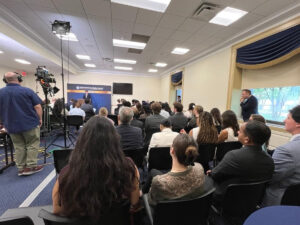
Professor Levrat stated that while India portrays itself as the world’s largest democracy, it is “currently not living up to this appellation, as it fails to protect the most fundamental human rights of millions of its citizens.”
“India is falling short, very short of its legal obligations. Its current government is not only failing to protect persons belonging to minorities, but creates and actively promotes conditions that deliberately targets persons belonging to minorities, putting them at risk, not only as regards their way of life, but also as regards their very life,” said Professor Levrat.
“Not only is India failing its responsibility to protect its own citizens, especially those belonging to minorities, but the authorities are actually creating conditions for extremists groups or local authorities to maintain and even increase insecurity for Muslims and other religious minorities in India,” Professor Levrat added. “This leads not only to violation of their freedoms, but also to killings. Governments should guarantee respect for human rights for all, including persons belonging to minorities.”
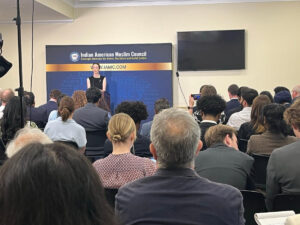
Professor Levrat further noted that he and two other UN Special Rapporteurs wrote to the Indian Government in 2024, asking for measures to be taken to guarantee the safety of minorities and to avoid hate speech by government officials. In this letter, Special Rapporteurs flagged concerns about Prime Minister Narendra Modi’s use of hate speech during Indian elections, as well as the reported refusal of state police and the Electoral Commission to acknowledge complaints made regarding such speeches and failing to conduct formal investigations.
“Unfortunately, and despite its commitment as a Member State of the UN, the Indian Government never answered this allegation letter,” he said.
The Special Rapporteur called on elected representatives to pressure governments, including the government of India, to guarantee respect for human rights for all.
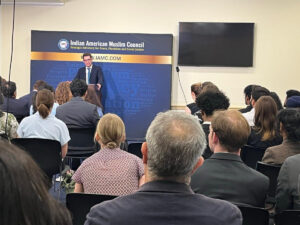
Freedom House President Annie Boyajian expressed serious concerns about declining freedoms in India, targeting of the political opposition and spoke extensively on reasons behind downgrading India from “Free” to “Partly Free.”
“We have unfortunately seen 19 consecutive years of decline in freedom around the world, including in India. India’s score has declined in the last decade, and it has lost 15 points since 2014, and this is fairly significant due to discriminatory policies and a rise in persecution,” Boyajian said in her remarks.
“In our most recent edition, which came out in February, India’s score dropped by 3 points because of challenges to the political opposition during Parliamentary elections in the spring,” she added.
On transnational repression, she said that “India is the only democracy we have tracked that is involved in transnational repression. Since 2014, we have documented 14 incidents perpetrated by India.”
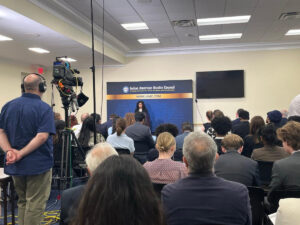
Boyajian called on the Indian government to review and restructure the anti-conversion laws, build legal and societal protections for victims of religious violence, strengthen police accountability and field-level response, protect religious spaces and ensure the prosecution of perpetrators and prevent impunity. She also called on the US Department of State to designate India as a Country of Particular Concern, [and] impose sanctions on individuals and entities.
Ed O’Donovan, Senior Adviser to UN Special Rapporteur on Human Rights Defenders, Mary Lawlor called the treatment of human rights defenders in India as “wanton cruelty” and said that the overall environment continues to grow more hostile by the day.
“Counter terrorism measures have been weaponized to crush dissent, limit access to resources and spread disinformation, where human rights defenders are labelled as “anti state” or “terrorists”. Those most impacted are activists from oppressed communities and religious ethnic minorities,” O’Donovan said in his remarks.
He raised concerns about the judicial harassment and arbitrary detention of activists working on a range of issues including defenders of Dalit, Adivasi and Muslim rights.
“Indian authorities have perverted the concept of due process and turned it into punishment,” he said.
He also spoke about arrests of activists, academics and lawyers in the Bhima Koregaon case, shuttering of thousands of NGOs by revoking their Foreign Contribution (Regulation) Act (FCRA) licenses “to stifle dissent and restrict civil society space.” He also raised concerns about the crackdown on civil society in Jammu and Kashmir including arrest of activist Khurram Parvez and journalist Irfan Meraj, both of which remain languished behind bars under the draconian anti-terror law UAPA since 2021 and 2023 respectively.
According to O’Donovan, the office of UN Special Rapporteur on Human Rights Defenders has sent 40 letters to the Indian government since 2020 making it the country which received the third highest numbers of allegation letters from the mandate. The Indian government has only responded to 20 percent of these letters.
He called on the International community, including the UN and the elected representatives to call out the Indian government for its violations against human rights defenders and called for congressional visit focusing on the legal framework for civil society and human rights defender and designating India as Country of Particular Concern and inducing human rights clauses to weapons sales to India.
Dr. Asif Mahmood, Vice Chair of the United States Commission on International Religious Freedom (USCIRF), who submitted pre-recorded remarks, emphasized that USCIRF has been recommending that India be designated as a CPC since 2020. The State Department has yet to make this designation.
“In USCIRF’s 2025 annual report, we recommended that the US government impose targeted sanctions on individuals and entities, including India’s Research and Analysis Wing for their culpability in transnational repression, most notably the 2023 assassination attempt of a Sikh activist in New York and the killing of another Sikh activist in Canada,” said Dr. Mahmood. “We urge members of Congress to conduct full investigations into transnational repression allegations. We will also continue to push the US government to designate India as a CPC and to take concrete policy actions, including imposing financial and visa restrictions.
“From majoritarianism to oligarchy to anti-democratic governance, Modi has used every tool in the authoritarian playbook to crush the spirit of Indian democracy,” said Ria Chakrabarty, Senior Policy Director at Hindus for Human Rights.
“And the only way to protect a democracy and the rights of the people is to retake power from aspiring autocrats and the movements that support them,” Ria added.
The briefing was cosponsored by the Indian American Muslim Council, Genocide Watch, World Against Genocide, Hindus for Human Rights, New York State Council of Churches, The Religious Nationalisms Project, American Muslim Institution, Association of Indian Muslims of America, The Humanism Project (Australia), and the Center for Pluralism.

 The International Day of Yoga is a day of recognition for yoga, celebrated annually around the world on 21 June, following its adoption by the