UNITED NATIONS, Apr 26 2021 (IPS) – The United Nations– which is desperately seeking funds to help developing nations battling a staggering array of socio-economic problems, including extreme poverty, hunger, economic inequalities and environmental hazards– has continued to be one of the strongest advocates of disarmament.
The world body has relentlessly campaigned for reduced military spending in an attempt to help divert some of these resources into sustainable development and humanitarian assistance.
But according to a new report released April 26 by the Stockholm International Peace Research Institute (SIPRI), world military expenditure rose to nearly $2 trillion in 2020, an increase of 2.6 percent, in real terms, from 2019.
The COVID-19 pandemic, which brought the world to a virtual standstill for the last 14 months, apparently has had no impact on military spending.
Ironically, four of the five biggest spenders were permanent members of the UN Security Council (UNSC), namely the US, China, Russia and UK. The fifth biggest spender was India, currently a non-permanent member of the UNSC.
Military spending by China, which is currently in a new Cold War with the US, grew for the 26th consecutive year.
The latest figures of rising arms expenditures by some of the big powers makes a mockery of the UN’s longstanding pleas for cutbacks and diversion of funds from the military into sustainable development.
William D. Hartung, Director, Arms and Security Program at the Washington-based Center for International Policy told IPS: “At a time when a global pandemic, climate change, and racial and economic injustice pose the greatest risks to human lives and livelihoods, the increase in global military expenditures in 2020 marks a dismal failure by policymakers across the world to address the most urgent challenges we face”.
He argued that even a fraction of. the nearly $2 trillion spent on the military last year could have gone a long way towards sustainable investments in public health, environmental protection, and combating inequality. “World leaders can and must do better,” said Hartung.
The UN Office for Disarmament Affairs (UNODA) points out that over the past century, governments have sought ways to reach a global agreement on reductions in military expenditures. Various proposals were discussed in the League of Nations, and later in the UN. Early proposals in the UN focused on reducing the expenditures of States with large militaries, and on freeing up funds for development aid.
“But proposals for cutting military spending did not materialize,” says UNODA. However, they led to the development of the UN Standardized Instrument for Reporting Military Expenditures in 1981—later renamed United Nations Report on Military Expenditures (MilEx)—under which countries are encouraged to report on their military expenditures.
Dr. Natalie J. Goldring, a Senior Fellow and Adjunct Full Professor with the Security Studies Program in the Edmund A. Walsh School of Foreign Service at Georgetown University, told IPS “the latest military spending data from SIPRI are difficult to reconcile with the reality of the world we live in today”.
In a year in which the global community was dealing with the horrors of the Covid-19 pandemic, SIPRI’s data show that military spending continued unabated. Military spending increased in nine of the 10 countries with the highest military expenditures, she pointed out.
Even though the global economy as measured by global gross domestic product (GDP) decreased by 4.4 percent, she said, global military spending increased 2.6 percent over the year. Global military spending is going in exactly the wrong direction.
“Unfortunately, the United States continues to lead the world in military spending, accounting for 39 percent of the global total,” said Dr Goldring, who is Visiting Professor of the Practice in Duke University’s Washington DC program and also represents the Acronym Institute at the United Nations on conventional weapons and arms trade issues.
According to SIPRI’s data, that’s more than the rest of the top 10 military spenders combined. And It’s more than twice the total of the countries which are most commonly perceived by US policymakers as its main military competitors, Russia and China, she added.
Dr. Alon Ben-Meir, professor of international relations at the Center for Global Affairs at New York University, told IPS it is indeed ironic that four of the five permanent members of the UNSC are the largest military spenders.
“The more ironic problem is the fact that all of these countries spend a small fraction of these amounts on social programs, which explains to a great extent the growing poverty in all of these countries”. Needless to say, he noted, the key to reducing military budgets is directly connected to the level of tension between the various countries.
“I do not expect any serious discussion about world disarmament unless many of the consuming conflicts are resolved, and in particular the growing, rather than diminishing, tension between the United States, Russia, and China,” Dr Ben-Meir declared.
‘The recent increases in US military spending can be primarily attributed to heavy investment in research and development, and several long-term projects such as modernizing the US nuclear arsenal and large-scale arms procurement,’ said Alexandra Marksteiner, a researcher with SIPRI’s Arms and Military Expenditure Programme.
Meanwhile, China’s military expenditure, the second highest in the world, is estimated to have totalled $252 billion in 2020. This represents an increase of 1.9 per cent over 2019 and 76 per cent over the decade 2011–20. China’s spending has risen for 26 consecutive years, the longest series of uninterrupted increases by any country in the SIPRI Military Expenditure Database.
In an open letter to Secretary-General Antonio Guterres last September, the Berlin-based International Peace Bureau called for world disarmament and the reduction of global military spending. “We write to you on behalf of the International Peace Bureau and more than 11.000 signatories to express our support for your call for a global ceasefire. We would also like to emphasize the need for (nuclear) disarmament and the reallocation of money from the military to healthcare, social, and environmental needs – to the fulfilment of the Social Development Goals.”
This pandemic has also made clear that states need to re-prioritize their spending. While many of the problems raised by the pandemic could have been at least partially solved, it was the lack of funding which hindered it, the letter declared.
Last month, the United Nations was hoping to raise soma $3.85bn from more than 100 governments and donors at a virtual pledging conference. The funds were meant to avert widespread famine in the world’s worst humanitarian crisis in Yemen,
But the total pledges amounted to only $1.7bn – less than half – in what the UN secretary general described as a “disappointing outcome”. “Millions of Yemeni children, women and men desperately need aid to live. Cutting aid is a death sentence,” António Guterres said in a statement.
In its latest study, SIPRI said even though military spending rose globally, some countries explicitly reallocated part of their planned military spending to pandemic response, such as Chile and South Korea. Several others, including Brazil and Russia, spent considerably less than their initial military budgets for 2020.
‘We can say with some certainty that the pandemic did not have a significant impact on global military spending in 2020,’ said Dr Diego Lopes da Silva, Researcher with the SIPRI Arms and Military Expenditure Programme. ‘It remains to be seen whether countries will maintain this level of military spending through a second year of the pandemic.’
Dr. Goldring pointed out that in 2020, approximately 1.8 million people around the world died of covid. SIPRI’s military spending figures suggest that the countries with the highest military expenditures decided that business as usual was the correct direction to follow, despite the covid pandemic.
“This is a time for reevaluating priorities. Countries should be giving priority to the health and welfare of their people, rather than continuing to fund the military-industrial complex. Cutting military spending would free funds for human needs and sustainable development.”
“The UN has suggested diverting funds from military expenditures to fund sustainable development. But in reality, this isn’t a question of diverting funds – it’s devoting them to what they should have been allocated to in the first place.”
“In the early days of his Administration, President Biden has not shown an inclination to reverse the United States’ excessive military spending patterns. He is proceeding with expensive new nuclear weapons and continuing to propose bloated military budgets.
There’s still time to reevaluate this approach, restructure US military spending, and focus on human needs. Cutting the military budget would also free US financial resources to help deal with the urgent global problems of the covid pandemic and the climate crisis.”
“More than a decade ago, then UN Secretary-General Ban Ki-moon said, “The world is over armed, and peace is underfunded.” Unfortunately, this statement continues to be true.”
(Thalif Deen is the author of the newly-released book on the United Nations titled “No Comment – and Don’t Quote Me on That.” The 220-page book is peppered with scores of anecdotes– from the serious to the hilarious– and is available on Amazon worldwide and at the Vijitha Yapa bookshop in Sri Lanka. The links follow: https://www.rodericgrigson.com/no-comment-by-thalif-deen/ https://www.vijithayapa.com/)

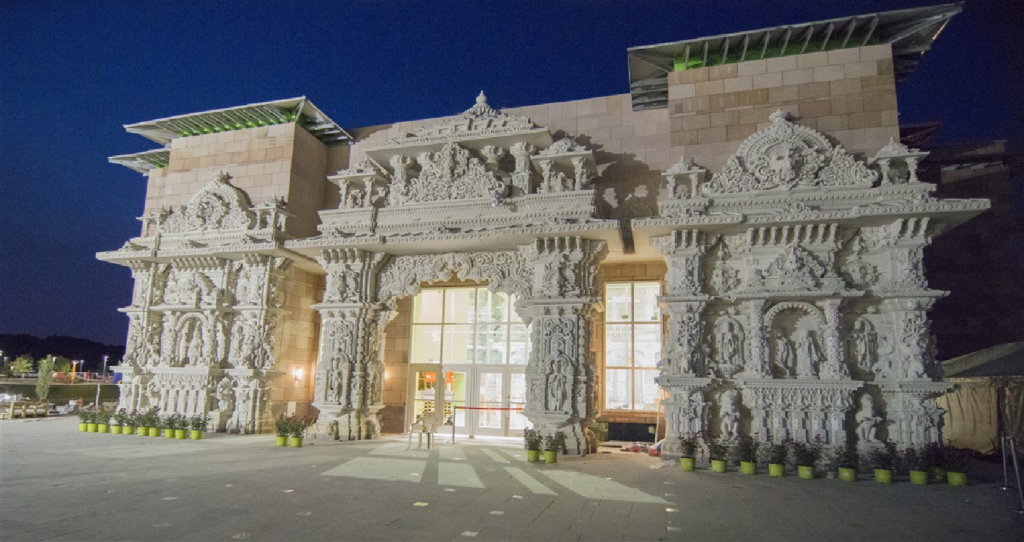 BAPS has been accused of human trafficking and wage law violations. An FBI spokesperson confirmed that agents were at the temple on “court-authorized law enforcement activity,” but wouldn’t elaborate. One of the attorneys who filed the suit said some workers had been removed from the site May 11.The lawsuit has been filed a month after New Jersey labor authorities halted work by a contractor at the Robbinsville temple and at a BAPS temple in Edison. The new lawsuit is a proposed class action complaint, alleging around 200 workers on religious immigration visas endured forced manual labor for the ongoing construction and expansion of the religious property on the 100-acre site.
 BAPS is a global sect of Hinduism founded in the early 20th century and aims to “preserve Indian culture and the Hindu ideals of faith, unity, and selfless service,” according to its website. The organization says it has built more than 1,100 mandirs — often large complexes that essentially function as community centers. BAPS is known for community service and philanthropy, taking an active role in the diaspora’s initiative to help India amid the current COVID-19 surge. According to the website for the Robbinsville mandir, its construction “is the epitome of volunteerism.”“Volunteers of all ages have devoted their time and resources from the beginning: assisting in the construction work, cleaning up around the site, preparing food for all the artisans on a daily basis and helping with other tasks,” the website says. “A total of 4.7 million man hours were required by craftsman and volunteers to complete the Mandir.”
 Harris has become increasingly involved in promoting the Biden administration’s infrastructure proposal currently being considered by Congress, known as the American Jobs Plan. She’s taken part in meetings with the Congressional Black Caucus as well as
  Bills using reconciliation in the Senate can advance with just a simple majority, rather than 60 votes. With an evenly divided Senate, liberal lawmakers’ hope of passing gun control and voting rights were dashed last week when a key Democrat, Sen. Joe Manchin of West Virginia, said he would oppose the changes to the filibuster, which creates a 60-vote threshold.
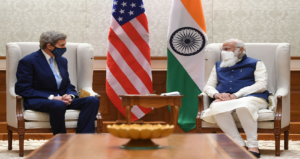 Indian government sources said the South Asian country was unlikely to bind itself to the 2050 goal as its energy demand was projected to grow more than that of any other country over the next two decades.
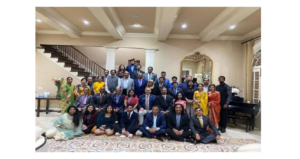 Governor McMaster presented the proclamation to KV Kumar, President & CEO of IAICC at the inauguration and appreciated the work of IAICC. While speaking at the event, Governor McMaster welcomed IAICC to South Carolina and said his administration will work with IAICC and support its initiatives in the State.
 Welcoming the gathering, KV Kumar appreciated Governor McMaster’s efforts in the State and thanked him and the First Lady Peggy McMaster for graciously hosting the IAICC inauguration and the reception at the Governor’s Mansion. He also thanked the Indian Ambassador to the US, Mr. Taranjit Singh Sandhu, and the Consul General of India in Atlanta, Dr. Swati Kulkarni for their continued support to IAICC. Kumar said he missed the Ambassador at the event, and congratulated him for bringing several key initiatives to strengthen India-US relations. During her address,
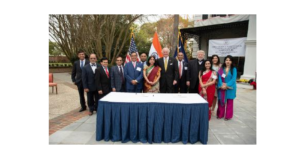 IAICC SE Regional Chairman, Dr. Narasimhulu Neelagaru also thanked Governor McMaster for his support and said he looked forward to working him and the State of South Carolina. At the event, Mr. Kumar introduced Ms. Bhavna Vasudeva, President of IAICC-SC Chapter.
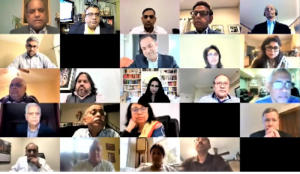 Representing the most impacted Hotel/Hospitality, Shelly Nichani, President, Infinity Hospitality Group, Stamford, CT, said, while the industry has been severely affected by the pandemic, “financial help from the Federal government has helped much, without which it would have been catastrophic.” While stating that the hospitality industry in CT has been doing overall very well, but the pandemic has halted the path to progress. He was optimistic that with the vaccines and state help, the industry will return to normal soon.