Dr. Suresh Reddy Leads Oak Brook Village’s India Independence Day Celebrations

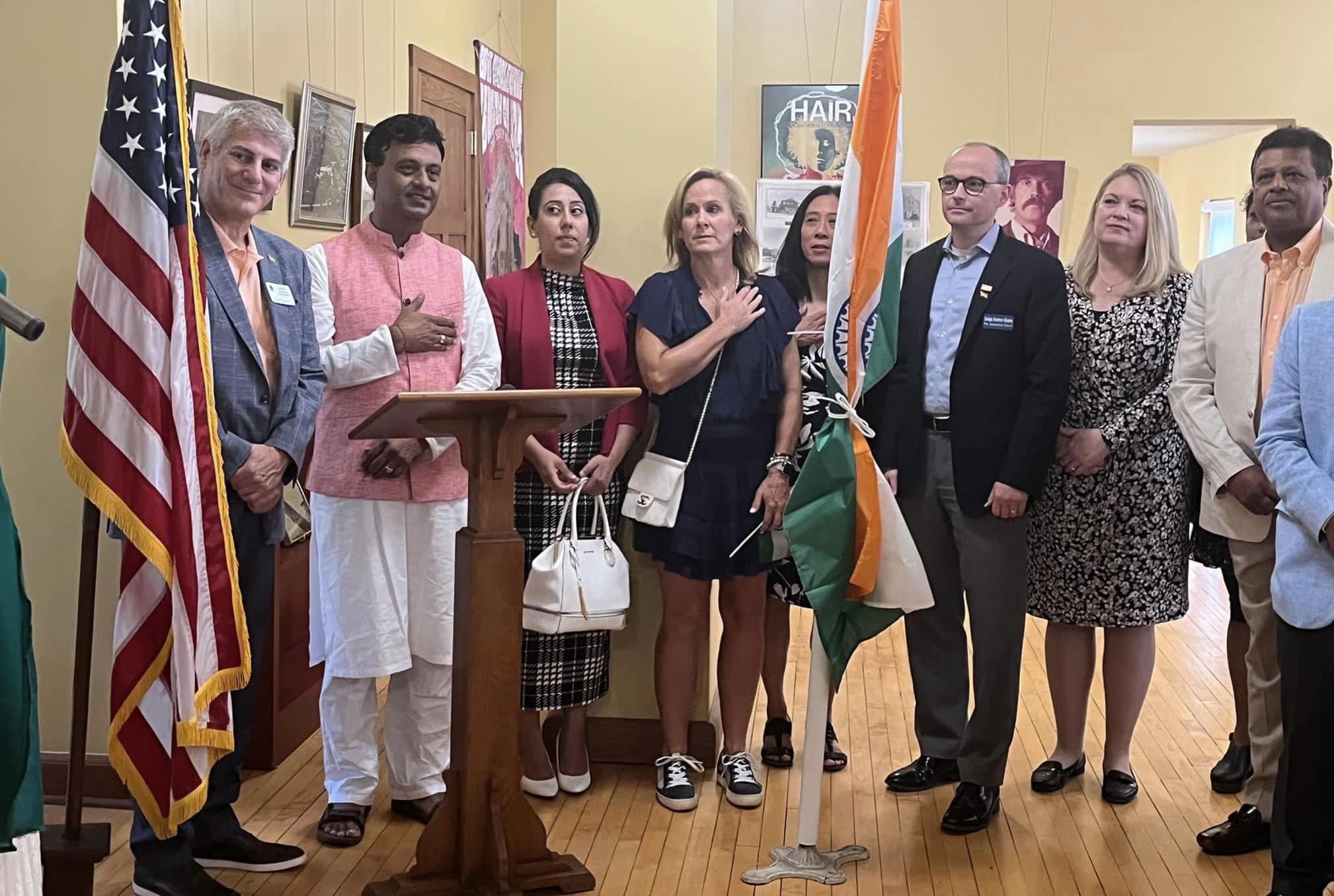
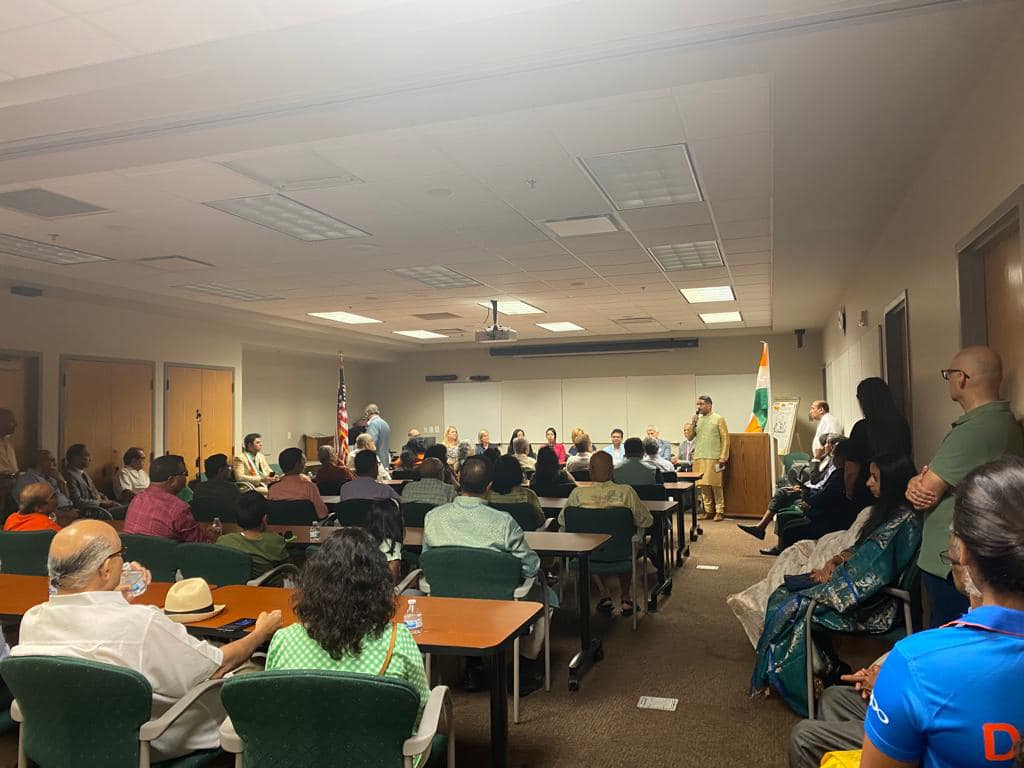
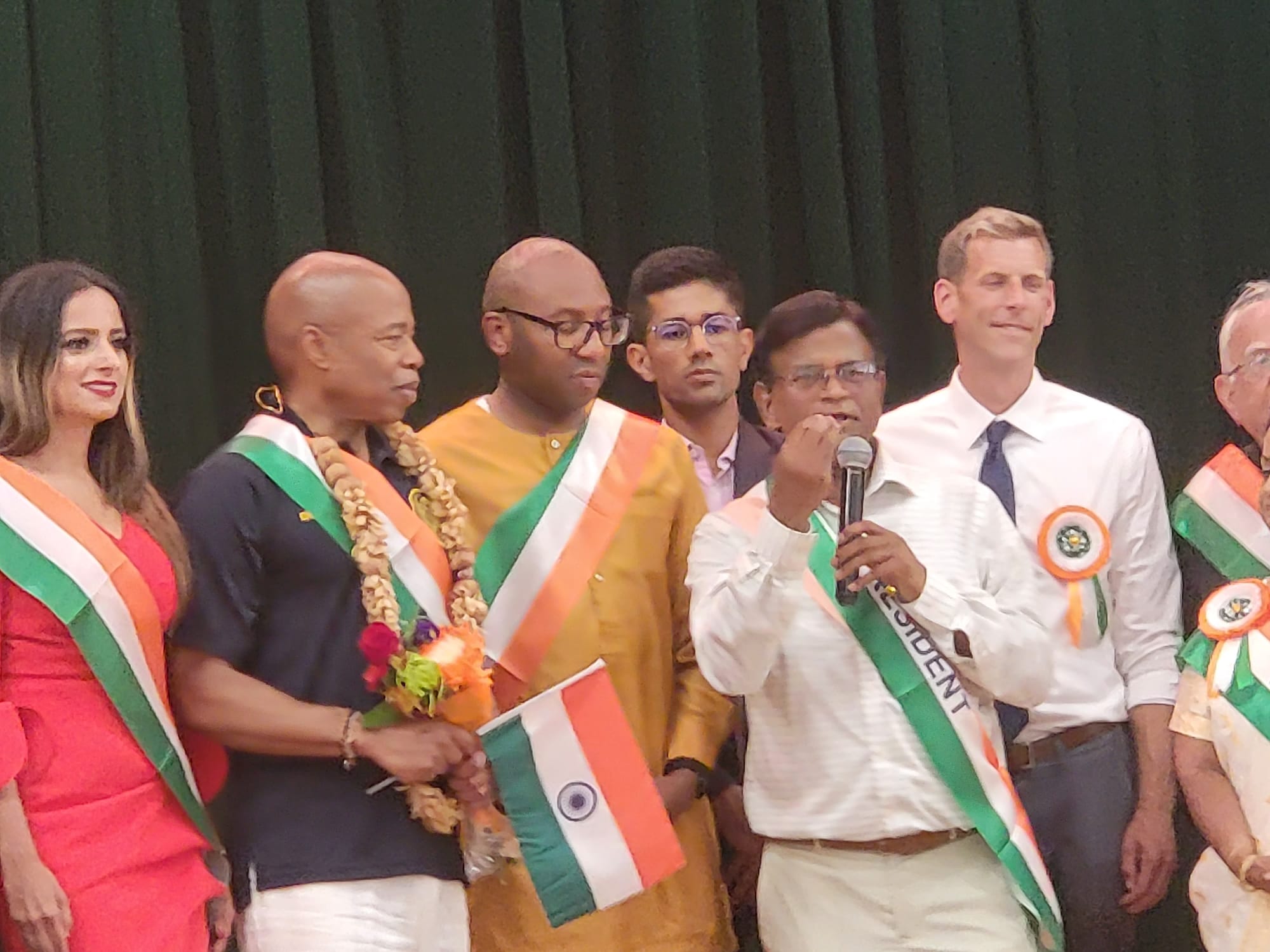
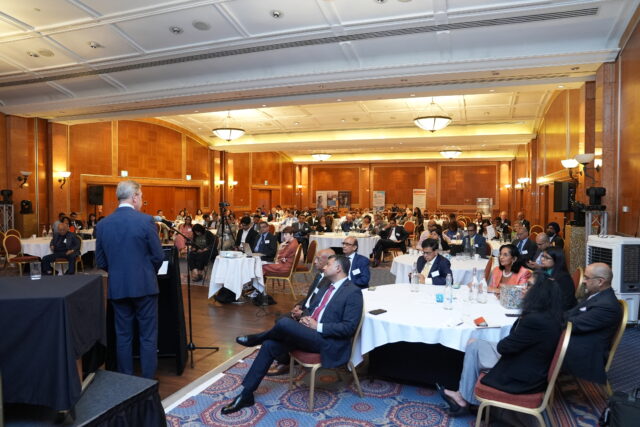
Dr. Suresh Reddy, a Trustee of the Village of Oak Brook, located 15 miles west of the Chicago Loop led the 77th annual India Independence Day Celebrations at the Oak Brook Historical Society and West Wing conference Room on August 15th, 2023. The event was co-hosted by Oak Brook Village’s past President Dr. Gopal Lalmalani and Trustee Michael Manzo.
Picture : TheUNN

“Attended by a large number of community members and elected officials, the India Day celebration is a testament to the growing importance of the Indo-US relationship,” said Dr. Reddy, who was elected overwhelmingly as a Trustee of the Village in 2021.  “It was heartening to witness as the community members of Oak Brook enthusiastically joined in the celebrations, saluting the US and the Indian flags and singing their national anthems,” said Dr. Reddy.

Prominent among those who participated and greeted India on the occasion of her 77th Independence Day were: Oak Brook President Larry Herman, Consul General of India in Chicago, Somnath Ghosh, Illinois State Senator Suzie Glowiak Hilton, Illinois State Rep Jenn Ladisch Douglas, DuPage Board Members Sadia Gul Covert, Lucy Chang Evans, Kari Galassi, Trustee Yasmeen Bankole, and several other elected officials. Community leaders Sunil Shah, Vinita Gulabani, and many others graced the event as well. Dr. Anuj Gupta, a Cardiologist and President of the Indian American Caucus graced the vent as a Guest of Honor.

Dr. Reddy, expressed his gratitude to the Village Trustees Jim Nagle, Melissa Martin, and Naveen Jain, Village Clerk Scarpiniti, Past Trustee Moin Saiyed, and Village  Manager Greg Summers. Others who had attended the event included: Larry HermanSadia Gul CovertLucy Chang EvansKari GalassiYasmeen Bankole, Suzy Glowiak Hilton, Jenn Ladisch DouglassSunil ShahVinita Gulabani, and Michael A. Manzo.

Picture : TheUNN

Dr. Suresh Reddy won the election to be a Trustee of the Village of Oak Brook convincingly at the elections held on April 6th, 2021.  Having a population of nearly 10,000 people, Oak Brook is served by a network of major federal, state, and county roads including the Tri-State Tollway system, the East-West Tollway, and the Eisenhower Expressway. One of the most affluent communities in the nation, Oakbrook’s adjacent neighbors include the communities of Villa ParkElmhurstLombardOakbrook TerraceWestchesterWestmontClarendon HillsDowners Grove, and Hinsdale.

Picture : TheUNN

Dr. Reddy comes with immense experience and proven leadership. He grew up in the suburbs of Hyderabad in Southern India. A financial conservator, Dr. Reddy, always had a passion for “uniting and bringing people together.” In his address, Dr. Reddy said, “I am grateful to the citizens of my hometown Oak Brook  and to the key leaders of Oak Brook, including several members of the governing body of Oak Brook for coming out to celebrate the freedom India achieved through nonviolence from the might British Empire.”

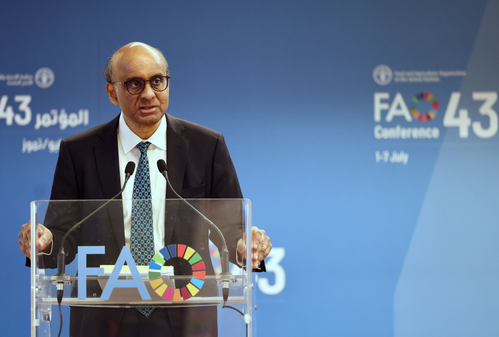
Tharman Shanmugaratnam Qualifies To Contest Singapore Presidential Election

Indian-origin former minister Tharman Shanmugaratnam and two others have been issued the certificates of eligibility for Singapore’s presidential election slated to take place on September 1, the Elections Department said in a statement on Friday.

At the close of applications for a Certificate of Eligibility on Thursday, the Presidential Elections Committee (PEC) received a total of six applications.

Out of these, the PEC qualified 66-year-old Tharman, former GIC investment chief Ng Kok Song, 75, and former National Trades Union Congress Income chief Tan Kin Lian, 75.

The committee, headed by Public Service Commission chairman Lee Tzu Yang and two Supreme Court judges, found that all three men were of integrity, good character and reputation.

“Based on the information available to the Committee, it is satisfied that Mr Tharman is a man of integrity, good character and reputation,” the Election Department said in a statement.

“The Committee is also satisfied that Mr Tharman has met the public sector service requirement under Article 19(3)(a), having held office for a period of 3 or more years as Minister,” the statement added.

Tharman, who had formally launched his presidential campaign last month with a pledge to evolve the country’s culture, filed his application for a certificate of eligibility on August 7.

In Singapore, candidates must apply for the Certificate of Eligibility if they wish to enter the presidential contest.

It is given to those who meet public or private sector requirements, among other criteria.

In addition, there is a community declaration, which allows candidates to declare if they are from the Chinese, Malay, Indian or “Other Minority” communities.

The ELD said it has notified all individuals on the outcome of their applications, and also told the unsuccessful applicants the reasons for rejecting them.

However, it added that the PEC will not publish the names of the unsuccessful candidates and the reasons for rejecting them.

The decision was taken after concern was expressed in the Report of the Constitutional Commission 2016 that potential applicants may be dissuaded from stepping forward to contest the elections for fear of embarrassment.

Tharman announced his intent to run in the city-state’s presidential election in June, after giving 22 years to active politics.

Prior to joining politics, Tharman was an economist and a civil servant at the Monetary Authority of Singapore.

Singapore will hold its first Presidential Election since 2011, after eighth and first female president, Halimah Yacob, announced this year that she will not seek a second term. (IANS)

US Congressional Delegation Meets PM Modi, Strengthening Indo-US Ties

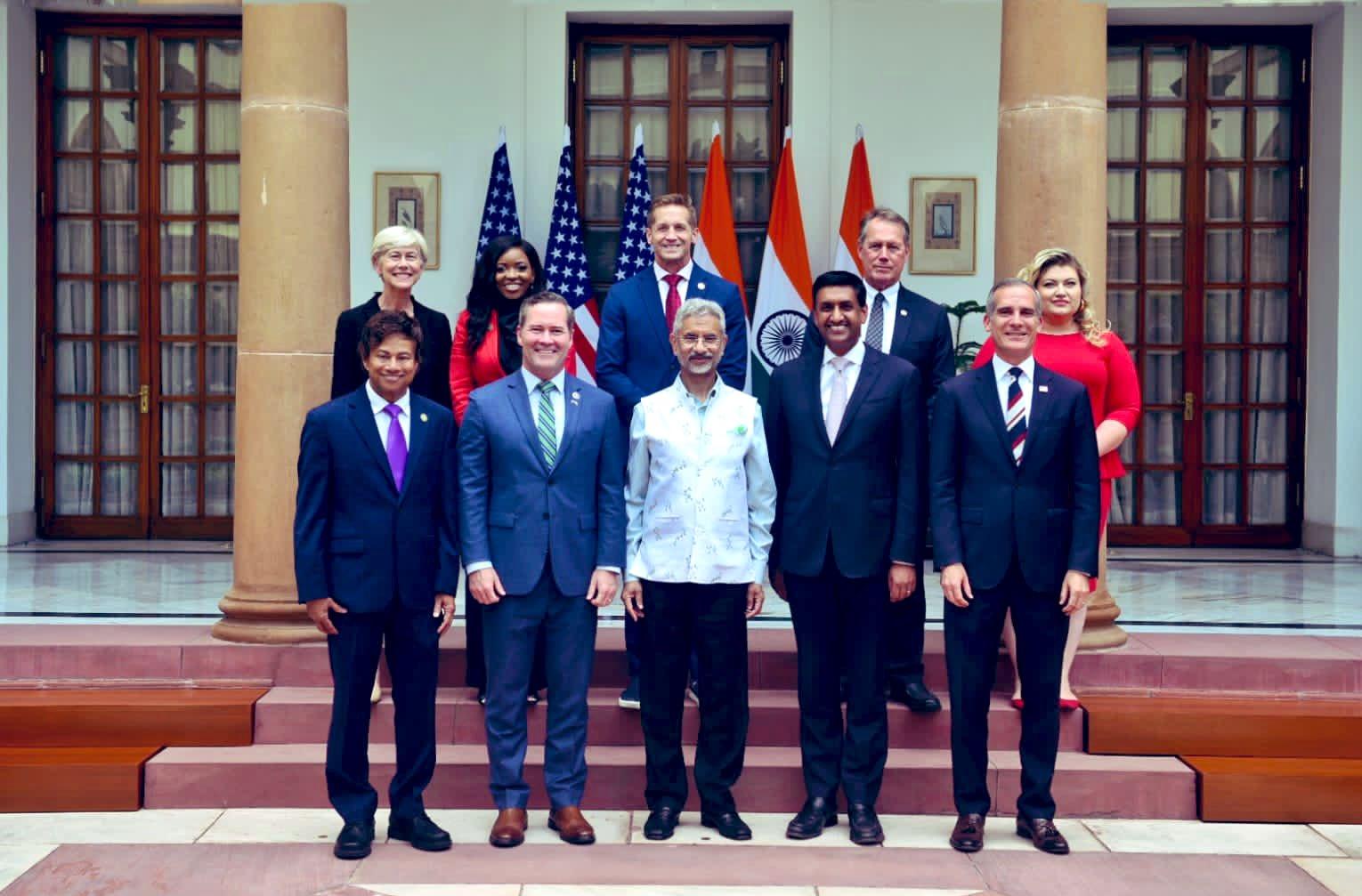
A Bipartisan US Congressional delegation in India for the nation’s 77th Independence Day met with India’s Prime Minister Narendra Modi on Wednesday, August 16, 2023 in New Delhi. During the meeting, Modi praised the bipartisan support as key to strengthening the bilateral strategic relationship between the two democracies.

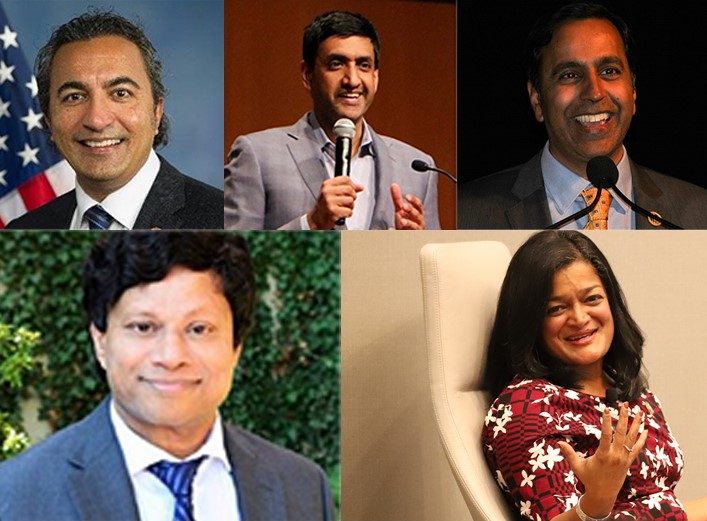
The delegation included US Representative Ro Khanna of California, Democratic co-chair of the India Caucus, Rep. Michael Waltz of Florida, Republican co-chair of the India Caucus, as well as Representatives Ed Case, D-Hawaii, Kat Cammack, R-Florida, Deborah Ross, D-North Carolina, Jasmine Crockett, D-Texas, Rich McCormick, R-Georgia, and Shri Thanedar, D-Michigan.

Taking to X, formerly known as Twitter, PM Modi said, “Glad to receive a Congressional delegation from US, including co-chairs of India Caucus in the House of Representatives, Rep. @RoKhanna and Rep. @michaelgwaltz. Strong bipartisan support from the US Congress is instrumental in further elevating India-US Comprehensive Global Strategic Partnership.”

Picture : New India Abroad

Welcoming the delegation to India, PM Modi conveyed his appreciation for the “consistent and bipartisan support” of the US Congress and highlighted his recent visit. “Prime Minister fondly recalled his historic State Visit to the US in June at the invitation of President Biden during which he had an opportunity to address a Joint Session of the US Congress for a second time,” the Prime Minister’s office said in a press release on Wednesday.

“Prime Minister and the US delegation highlighted that the India-US Comprehensive Global Strategic Partnership is based on shared democratic values, respect for rule of law and strong people-to-people ties,” the PMO said.

During his June visit to US, PM Modi also attended various events, apart from the address to Congress. He was hosted by Biden as well as First Lady Jill Biden for a state dinner at the White House as well as a State Luncheon by the US Secretary of State Antony Blinken, and US Vice President Kamala Harris.

External Affairs Minister S. Jaishankar also met US Congressional delegation on August 16, and discussed the transformation underway in India. The two sides exchanged views on advancing the bilateral partnership between India and US. They discussed the global situation and collaboration between India and US on multilateral, regional and global issues.

“A good interaction with US Congressional delegation today. Glad they could join as we celebrated #IndependenceDay. Discussed the transformation underway in India, especially its outcomes of better governance. Shared our aspirations and expectations for Amritkaal. Also exchanged views on our advancing bilateral partnership. Shared perspectives on the global situation and our collaboration on multilateral, regional and global issues,” Minister Jaishankar tweeted after the meeting.

“Representatives Khanna, Thanedar, Waltz and others are doing a great service to the bilateral relationship in undertaking this visit. The Indian Embassy in Washington, DC and several other stakeholders have been working closely with them to create an impactful itinerary,” says Sanjeev Joshipura, the Washington DC based executive director of Indiaspora.

This historic visit holds symbolic significance, marking the first time Indian American lawmakers are part of a US House delegation to India, highlighting the growing influence of Indian Americans in US politics and their commitment to enhancing bilateral relations.

For Rep. Khanna, this is history coming full circle. His grandfather Amarnath Vidyalankar was an Indian freedom fighter who spent four years in jail alongside Gandhi and later was part of India’s first parliament.

“As co-chairs of the Congressional Caucus on India and Indian Americans, we are proud to lead a bipartisan delegation to India. We will be there to discuss how to strengthen economic and defense ties between our two counties, the oldest and largest democracies,” Khanna said prior ro his visit to India.

“Both of us believe that the U.S. India relationship will be a defining one of the 21st century. India is a key partner in ensuring multipolarity in Asia and the denial of China as a hegemon. We must continue to strive to make progress and build our partnership based on our shared founding values of democracy, freedom of the press and assembly, and human rights. This delegation is a historic opportunity to drive further collaboration and advance shared aims,” Khanna said

Earlier this year, Khanna and Waltz hosted a historic US-India Summit on the Hill featuring panels and remarks from government leaders, experts, and Indian American leaders from across the country.

“His grandfather Amarnath Vidyalankar was an Indian freedom fighter who spent four years in jail alongside Gandhi and later was part of India’s first parliament,” the US government said in its press release referring to the history Ro Khanna and his family share with respect to the Indian Freedom struggle.

On his visit to India, Khanna said, “As co-chairs of the Congressional Caucus on India and Indian Americans, we are proud to lead a bipartisan delegation to India. We will be there to discuss how to strengthen economic and defense ties between our two counties, the oldest and largest democracies.”

India’s 77th Independence Day Celebrations Held at Times at Times Square

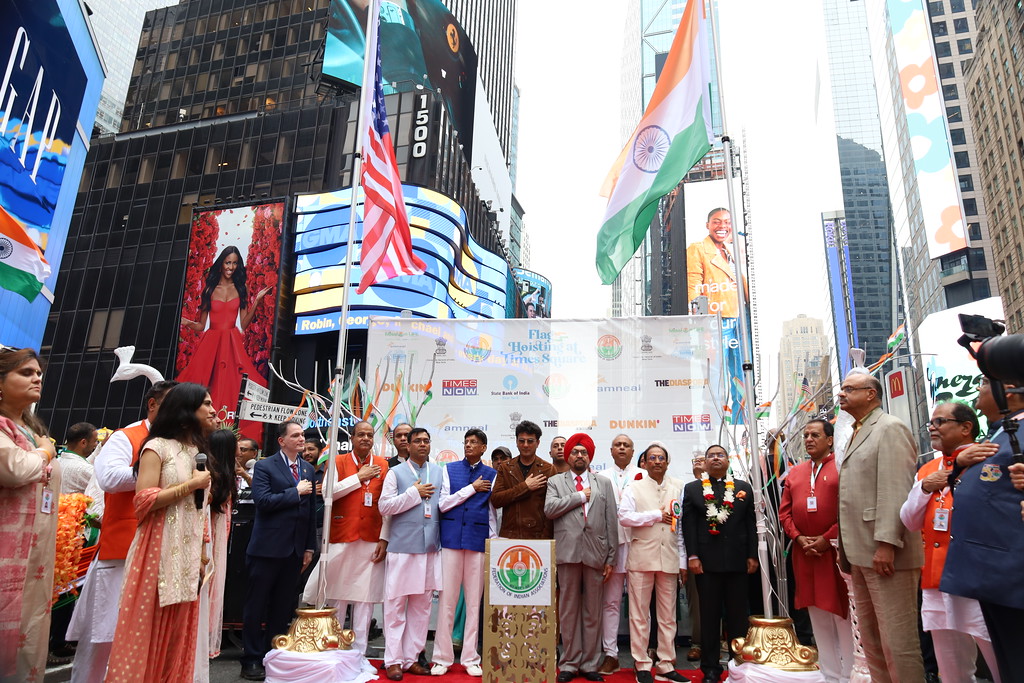
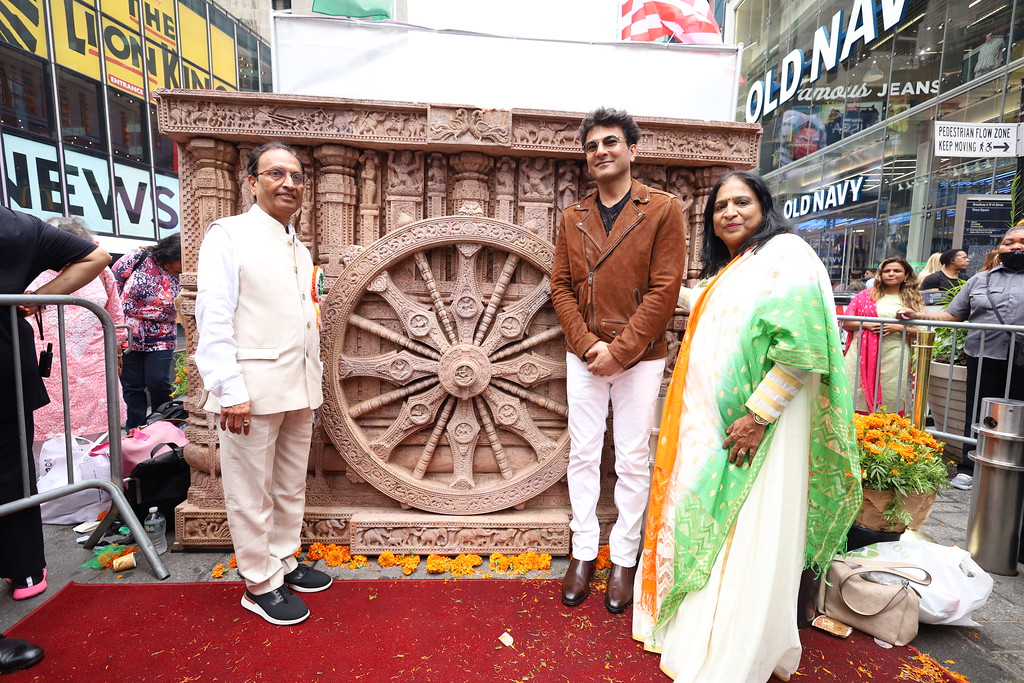
The Federation of Indian Associations (FIA) paid homage to India on its 77th Independence Day by hoisting the tricolor at the iconic Times Square. The event was made more special by the unveiling of a striking 1,800 kg ‘Chakra’ sculpture, a remarkable replica of Odisha’s Konark wheel. The artefact, weighing approximately 4000 pounds, is a replica of the wheel that adorns the famous Konark Temple in Odisha that is dedicated to Surya or the Sun God.

Picture : FIA

Celebrity chef Vikas Khanna unveiled the famous Konark Sun Temple wheel. He was joined by Randhir Jaiswal, the Consulate General of India in New York, Indo-American Arts Council and Indian-Americans who turned up in huge numbers to witness the flag hoisting ceremony on Tuesday, August 15th. Several artists from Odisha’s Lalitagitri village have worked for months on the handcrafted replication, which is made of sandstone and weighs approximately 4,000 pounds.

The ceremony was led by the Consul General of India in New York, Randhir Jaiswal, and was accompanied by resounding chants of ‘Bharat Mata ki Jai,’ ‘Vande Matram,’ and ‘Jai Hind,’ as participants proudly waved both Indian and American flags. Ustad Maestro Ahmad Ali Khan was the guest of honor at the event and celebrity chef Vikas Khanna was also present.

Picture : FIA

FIA chairman, Ankur Vaidya, and FIA president, Kenny Desai, along with the Board of Trustees, Srujal Parekh and Alok Kumar, and the FIA team as a whole, played crucial roles in organizing the celebration. The entire team of FIA, led by its legendary member Padma Shri Dr. HR Shah, Chairman of TV Asia, and other Community leaders came together to extend heartfelt wishes to the vibrant community on the occasion of India’s 77th Independence Day.

“This commemoration is not merely an observance of history; it is a celebration of our shared future,” remarked President Desai. “The unveiling of the ‘Chakra’ sculpture serves as a reminder that just as the Konark wheel has endured the test of time, so too shall the enduring friendship between India and the United States.” FIA also commemorated occassion by lighting up the Empire State Building in the Indian Tricolor.

“While I have been dreaming and conceptualising about this moment for almost five years, the brilliant artists at work in India have toiled day and night for many, many months to make this come alive! This will be a magical moment!,” Khanna had tweeted earlier.

The art replica will also be displayed as a symbol of unity between the Indian diaspora and America in Khanna’s upcoming New York City restaurant in 2024. Khanna had said that he was inspired by the sand Konark wheel sculpted by Odisha’s renowned sand artist Sudarshan Pattnaik.

Responding to a video of the unveiling, Pattnaik wrote on X (formerly Twitter): “You have created history by unveiling the replica of world heritage monument Konark wheel in Timee Square on the occasion of Indian Independence Day. This is a proud moment for all of us. Thank you again for contributions in promoting Indian art and culture.”

It took 12 years and 12,000 artisans to build the 13th century Konark Sun Temple, a monumental representation of the chariot of the sun god, which is a UNESCO-designated World Heritage Site. The 24 wheels of the chariot are decorated with symbolic designs and led by seven horses symbolising time.

Speaking on the occasion, Randhir Jaiswal said, “The Chakra or wheel stands as a shining symbol of India’s heritage, thought and timeless wisdom. Through the display of Chakra at Times Square, we not only celebrate the rich culture of India but also the enduring friendship that binds our two nations – United States and India. This sculpture, a faithful replica of one of the twenty fours Chakras that adorn the Konark Temple dedicated to Surya or the Sun God, carries with it the essence of India’s history, resilience, and unity.”

The Indo-American Arts Council (IAAC), in collaboration with The Consulate General of India in New York and The City of New York, held the Inauguration Ceremony of The Indian Independence Exhibition, featuring the Chakra Sculpture.

Picture : FIA

Menwhile at Bowling Green Arena NYC Mayor Eric Adams, Indian American Assemblywoman Jenifer Rajkumar, NYC Deputy Mayor Meera Joshi, Health Commissioner Ashwin Vasan and the Consulate General of India in New York Randhir Jaiswal participated in the Indian flag hoisting ceremony.

Describing NYC as the New Delhi of America, the Mayor praised the Indian American community, stating, “I am so proud to have so many representatives of our Indian community serving in my administration.”

New York State Governor Kathleen Hochul also extended her wishes to India and the Indian community in the state on Indian Independence Day. She acknowledged the Indian community’s contribution in diverse roles from educationist to entrepreneur.

She said, “From Buffalo to Queens, nearly 400,000 Indian Americans call New York home and their countless contributions are woven into the fabric of our state!”  In a video message, she praised Indian American contribution “We are so better off because of Indian immigrants, who chose to come here in search of the opportunities.”

India Day Parade In Queens, NY Attracts Large Crowds

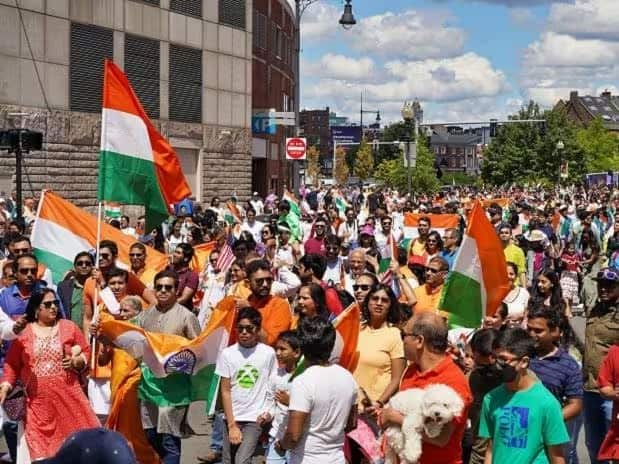
The 8th Queens India Day Parade, which filled Hillside Avenue in tricolor, celebrated India’s 77th Independence Day with crowds lined up on both sides of the road to cheer on the marchers, who defied the scorching heat, and proclaimed the pride of Indian heritage with that country’s flag. The grand marshal was Kanishka Soni, an actress in Bollywood and a noted singer.

The parade started at 263rd Street on Hillside Avenue and ended at St. Gregory the Great School on 246th Street. The public meeting and cultural programs were held in the school auditorium. A large presence of women dressed in the colors of the flag was noticeable as more than twenty organizations and institutions marched with banners along with several floats.

Picture : TheUNN

The Floral Park – Bellerose Indian Merchants Association (FBIMA), the organizers of the parade hosted different communities and cultures at the parade. Association President Koshy O Thomas, Secretary Mary Philip, Chairman Subash Kapadia, founder leader Hemant Shah, Parade Committee Chair Dincil George, and others lined up in front of the parade. It was followed by a group of youths on bikes.

Members of the Uttar Pradesh Association of New York, Jain Temple of New York, Queens Village Republican Club, and many other organizations were among the participants in the parade. The accompaniment of chenda melam (drum beats) by teams Kerala Cultural Association, Syro Malabar Church, and Drum Beats of Long Island added to the festivities.

Several organizations including the Federation of Malayalee Associations of Americas (FOMAA), Federation of Kerala Associations of North America (FOKANA), World Malayali Council, Indian Nurses Association, Indian Overseas Congress, etc. participated with attractive floats and won praises. The Nurses Association float was the most attractive with women dressed in the tricolor were accompanied by a woman dressed as Bharata Mata.

New York State Senator Kevin Thomas, who is running for US Congress from Congressional District 4, joined the parade and greeted the people. Biju Chacko, who is running as legislator from Nassau County District 13, and James Chow, who is running for New York City Council from Queens’ 23rd District, were also joined the parade. Chow will face Linda Lee, the incumbent in District 23.

Picture : TheUNN

Dr. Jacob Thomas, president, led the float of FOMAA, while Dr. Kala Shahi, general secretary, led the float of FOKANA. Thomas Mottackal, global president of World Malayalee Council, Dr. Anna George of the Indian Nurses Association of New York, Dr. Thomas Mathew of ECHO, Leela Maret of Indian Overseas Congress along with New York Malayalee Sports Club and Pioneer Club of Keralites in North America joined the parade.

The Queens Republican Committee participated in the parade in full force. They carried a pro-Trump flag. Hillside shops supplied water, buttermilk and soft drinks to the marchers who appreciated the gesture during the scorching heat.

Besides, Leela Maret, Indian Overseas Congress Vice-Chair George Abraham, President Mohinder Singh Gilzian, and other leaders gathered at the Indian Overseas Congress float.

Earlier, the meeting and performances were held at the Open Stage at Padawan-Feller Park on 263 Street. Although the new venue reduced travel distance, it was felt the old   open-air stadium was more suitable. The old place had spacious tents and stalls, which was lacking in the new venue. Fr. John Thomas from the Orthodox Church recited the opening prayer. He prayed a non-religious for prosperity and peace in both countries.

Many local political and social leaders also participated in the meeting, including Senator John Liu and District Attorney Melinda Katz. New York City Mayor Eric Adams was the chief guest who described his Indian connection with pride to a standing ovation. He recalled visiting Gandhi Memorial during his visit to India. He noted that Gandhi’s last footprints were engraved there. That footprint carries a message. We should continue Gandhiji’s journey from where he left off.

‘When gun violence continues, our brothers live homeless, and people’s rights are denied, Gandhi’s dreams are thwarted. Gandhi taught us to stand for the oppressed and the suffering. We are bound to follow that path.’ He expressed satisfaction that now on New York City schools get a holiday for Diwali.

Jennifer Rajkumar, the first Indian American woman elected to the New York State Assembly, said that Mayor Adams was described as an Indian Mayor. Adams is a vegetarian who loves Indian food and is also a fan of Gujarati dance ‘Garba.’ He is a person who goes to the temple on Sunday and then to the gurudwara. We have been pushing for Diwali school holidays in New York City for decades. Many said it was impossible. But Mayor Adams didn’t just say it was possible; he made it happen. She also noted that she is the first Hindu elected to the state assembly.

Queens Borough President Donovan Richards praised the Indians for their work and service to the community. He also pointed out that the African American people gained many rights in the civil rights movement inspired by Gandhi. Queens District Attorney Melinda Katz highlighted the diversity of Queens. ‘There is no other place where people from so many countries live together.’

Koshy Thomas, thanked the Government, the City, and the Indian Consulate for their support. He also thanked the organizations and people for joining the parade. He pointed out that many people from Pennsylvania and New Jersey came to the parade. He expressed special thanks to Mayor Adams for his leadership and support to the Indian community. Parade Chair Dincil George also spoke.

WHO Summit On Traditional Medicine In Gujarat Attended by 75 Nations

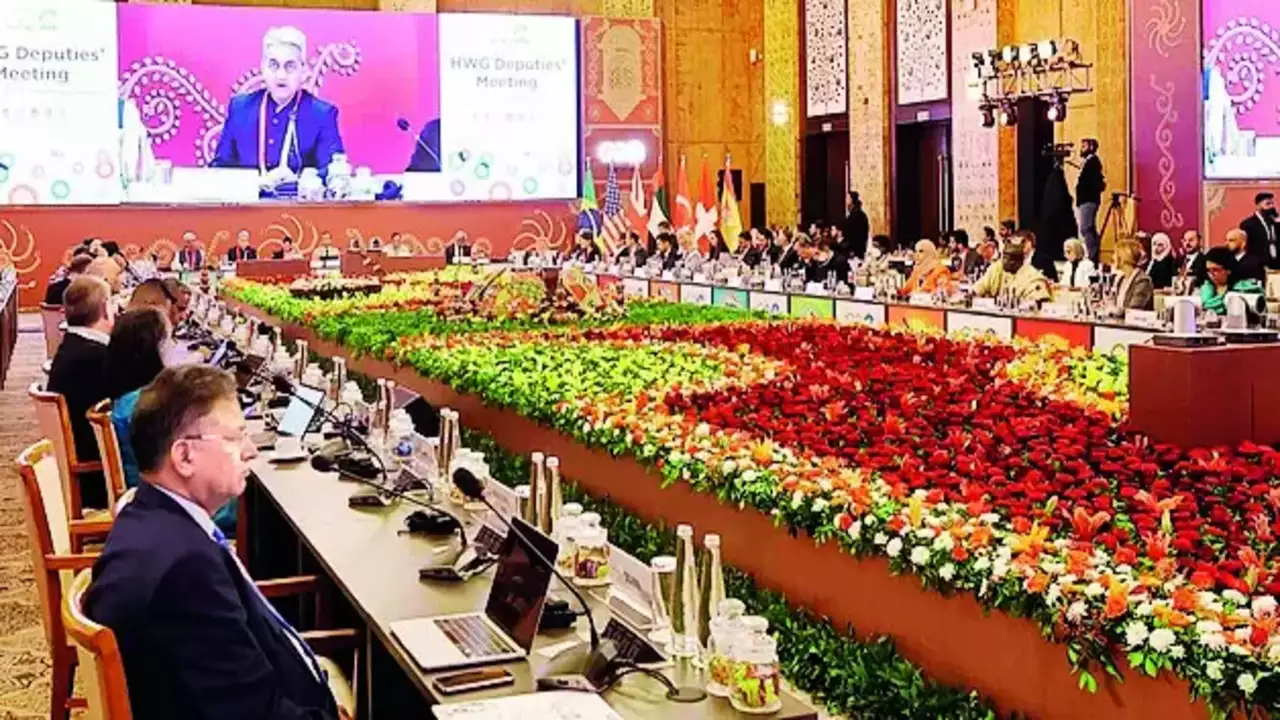
The first-ever global summit on traditional medicine organized by The World Health Organization (WHO) held in Gujarat, India on August 17-18, 2023 had participation from over 75 nations. The Ministry of Ayush, Government of India co-hosted the summit, which explored the role of traditional, complementary, and integrative medicine in addressing pressing health challenges and driving progress in global health and sustainable development.

It was held alongside the G20 health ministerial meeting, to mobilize political commitment and evidence-based action on traditional medicine, which is a first port of call for millions of people worldwide to address their health and well-being needs. Technical discussions on research, evidence and learning; policy, data, and regulation; innovation and digital health; and biodiversity, equity and indigenous knowledge took place at the summit.

Speaking at the inauguration, Dr Tedros Adhanom Ghebreyesus, WHO Director-General said, “One of the great strengths of traditional medicine is the understanding of the intimate links between the health of humans and our environment. That’s why WHO is committed to supporting countries to unlock the potential of traditional medicine, through the Global Traditional Medicine Centre in Jamnagar.”

Picture : TOI

Stressing that traditional medicine was “as old as humanity itself”, the WHO chief urged countries to examine how best to incorporate traditional and complementary medicine into their health systems through the Gujarat Declaration, the outcome document of the summit, which was adopted at the summit’s conclusion.

India’s Minister of Health and Family Welfare Dr. Mansukh Mandaviya, in his address, highlighted the role of the Global centre of traditional medicine in Gujarat in leading the way towards a more prominent role of traditional medicine in mainstream healthcare.

“The pharmaceutical and cosmetic industries are both showing significant interest in traditional medicine and more than 170 countries around the world are utilizing it,” he said adding that the summit provides an ideal platform for international collaboration and the exchange of ideas to promote best practices in the sector.

An experiential Ayurveda, Yoga and Naturopathy, Unani, Siddha and Homeopathy (AYUSH) Exhibition Zone was the highlight of the summit. It featured an exhibition of traditional medicine systems from WHO’s six regions. The theme of the exhibition was ‘Ayush for Planetary Health and Well-being’. The Zone welcomed visitors with a display of medicinal plants including those used in Ayurveda.

The exhibition also had interactive kiosks, which allowed visitors to access comprehensive information about Ayush, including the location of all Ayush hospitals and a digital library with research papers related to the field. A virtual reality experience of Ayush Healthcare services was available, where visitors could engage in an immersive experience, featuring an AI-based Ayurveda Pulse diagnosis, body constitution analysis, and even a live Yoga demonstration.

For centuries, traditional and complementary medicine has been an integral resource for health in households and communities. It has been at the frontiers of medicine and science laying the foundation for conventional medical texts. Around 40% of pharmaceutical products today have a natural product basis, and landmark drugs derive from traditional medicine, including aspirin, artemisinin, and childhood cancer treatments.

New research, including on genomics and artificial intelligence are entering the field, and there are growing industries for herbal medicines, natural products, health, wellness and related travel. Currently, 170 Member States reported to WHO on the use of traditional medicine and have requested evidence and data to inform policies, standards and regulation for its safe, cost-effective and equitable use.

In response to this increased global interest and demand, WHO, with the support of the Government of India, established in March 2022 the WHO Global Centre for Traditional Medicine as a knowledge hub with a mission to catalyse ancient wisdom and modern science for the health and well-being of people and the planet. The WHO Traditional Medicine Centre scales up WHO’s existing capacity in traditional medicine and supplements the core WHO functions of governance, norms and country support carried out across the six regional Offices and Headquarters.

The Centre focuses on partnership, evidence, data, biodiversity and innovation to optimize the contribution of traditional medicine to global health, universal health coverage, and sustainable development, and is also guided by respect for local heritages, resources and rights.

Ramaswamy Ties Desantis For Second Place In GOP Primary

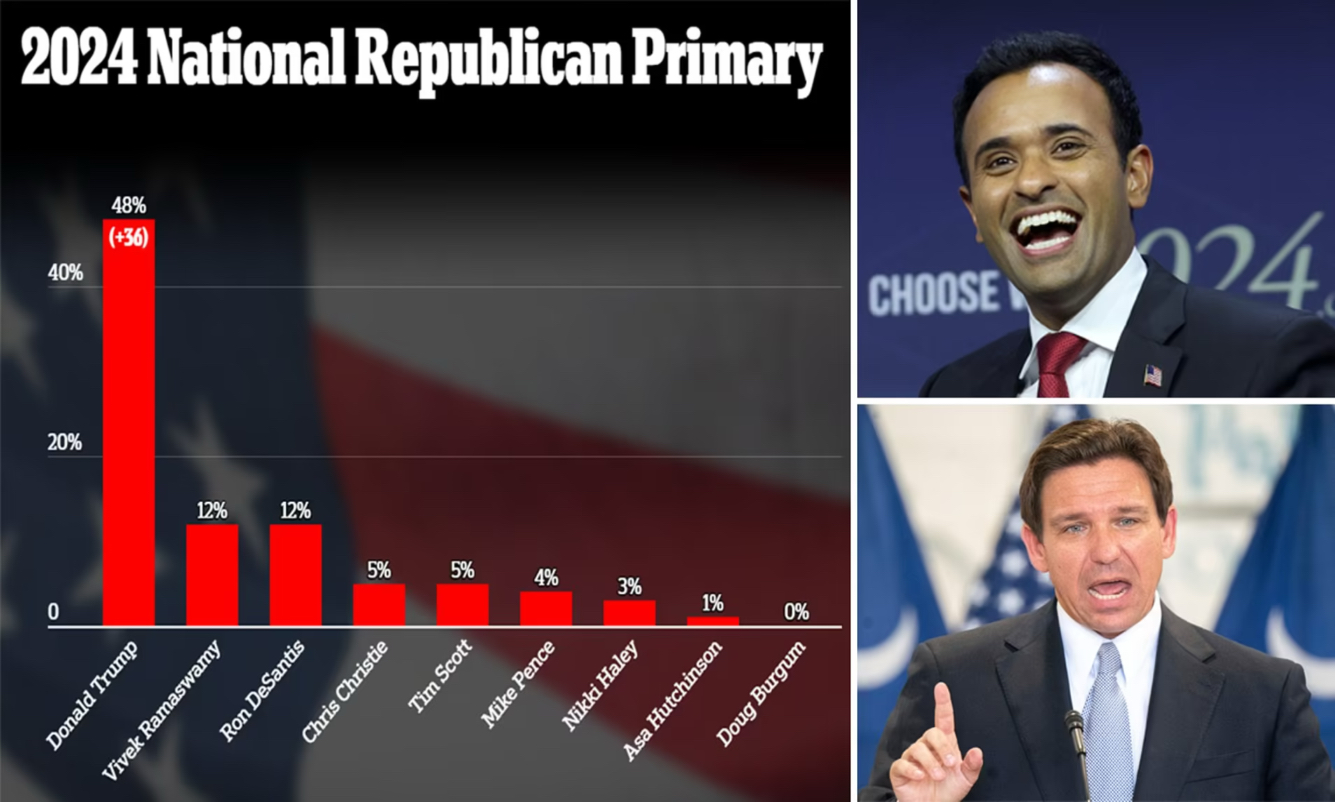
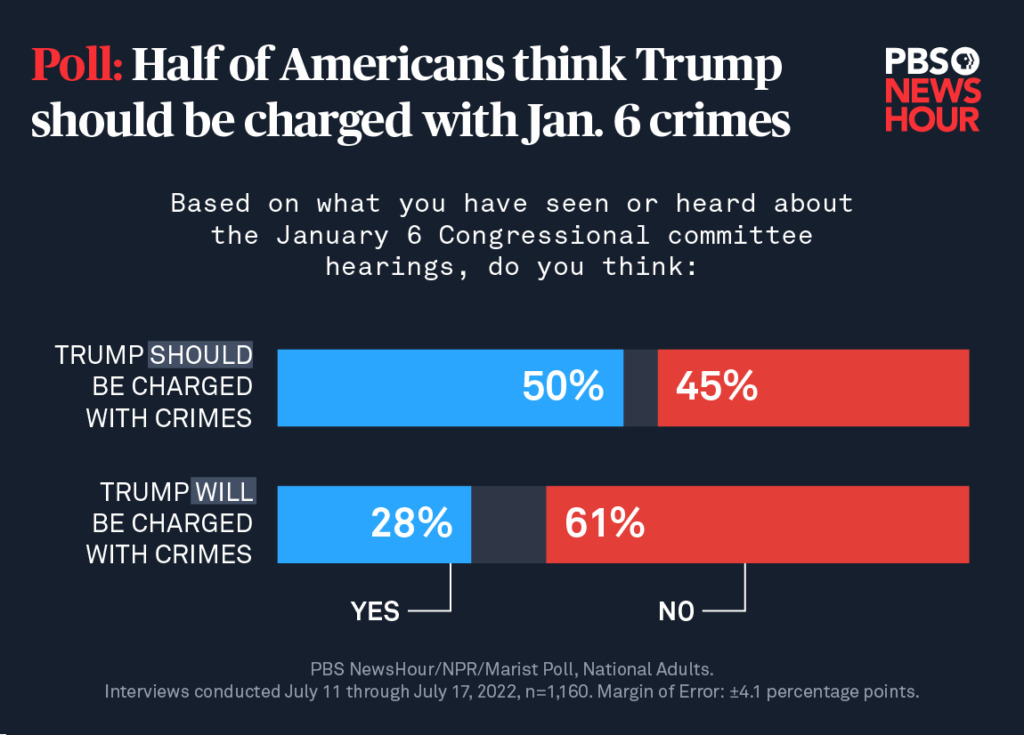
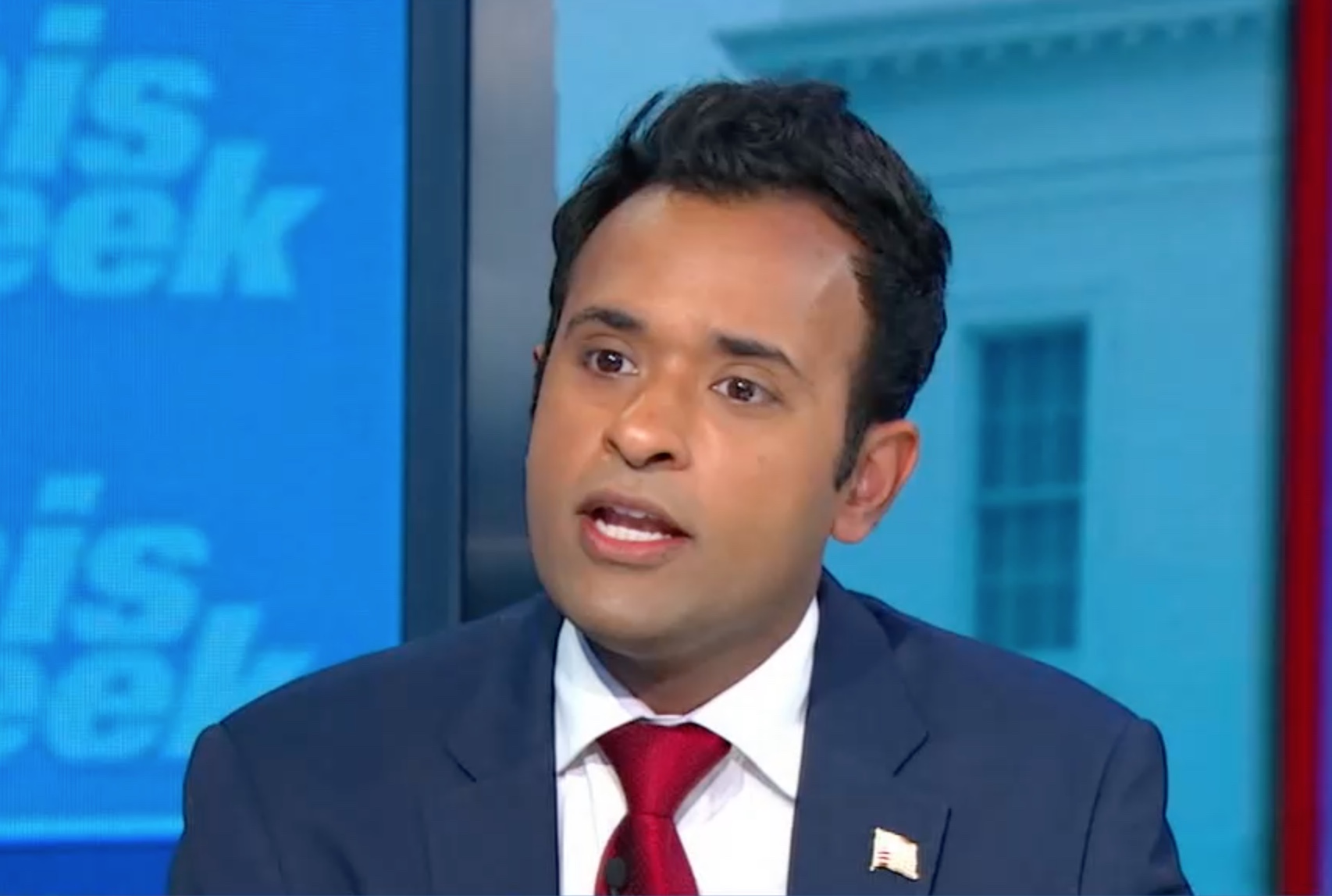
Indian American entrepreneur turned politician Vivek Ramaswamy is tied with Florida Gov. Ron DeSantis (R)  for second place in the Republican presidential field in a new poll. An Emerson College poll showed DeSantis and Ramaswamy tied at 10 percent each, trailing former President Trump, who leads with 56 percent. DeSantis kept his position in second place from previous polls, but he registered a big drop from the 21 percent he had in June. Ramaswamy rose from just 2 percent then.

According to reports, the poll’s release comes as a leaked memo from the super PAC supporting DeSantis’ candidacy, Never Back Down, urged DeSantis to “take a sledgehammer” to Ramaswamy. Some polling has shown Ramaswamy closing in on DeSantis for second place, and the memo appears to acknowledge a few other candidates also gaining momentum behind the Florida governor.

“Another boring, establishment attack from Super PAC-creation ‘Robot Ron’ who is literally taking lame, pre-programmed attack lines against me for next week’s debate. ‘Hammer Ramaswamy,’” Ramaswamy responded to the memo on X, formerly known as Twitter.

Emerson College Polling Executive Director Spencer Kimball said in a release that Ramaswamy has made improvements in voters with postgraduate degrees, taking 17 percent of that group, and with younger voters, winning 16 percent of those younger than 35.

The release states that DeSantis’s drop is similar to that of Emerson’s New Hampshire poll that showed former New Jersey Gov. Chris Christie (R) surpassing DeSantis by 1 point for second place in the state, a statistical tie.

Pollsters also found somewhat more shaky support among DeSantis supporters than among those for Ramaswamy. Almost half of Ramaswamy backers said they will definitely vote for him, while only a third of DeSantis supporters said the same.  Meanwhile, more than 80 percent of Trump supporters said they will definitely vote for the former president.

DeSantis, Ramaswamy and several other GOP presidential candidates will have their clearest opportunity yet to stand out on a national stage at the first Republican primary debate next week, especially with Trump seemingly planning to skip it.

More than 80 percent of Republican primary voters said they plan to watch the debate.  The poll was conducted from Aug. 16 to 17 among 1,000 registered voters, including 465 who said they plan to vote in their state’s Republican primary or caucus. The credibility interval was 3 points.

On the ground, Ramaswamy has styled his politics on the agendas of the two men he hopes to usurp, making his stand against the “woke” ideology of the American left his signature policy issue. “We are in the middle of a national identity crisis,” he says darkly, accusing the country’s elites of metastasizing a “cultural cancer” — particularly when it comes to LGBTQ issues. His message has found an appreciative audience, and his book, “Woke, Inc.,” in which he develops this thesis, is currently near the top of the New York Times list of bestselling nonfiction.

While some candidates are beginning to aim their fire at former president Donald Trump, the 38-year-old Ramaswamy has moved toward the front of the chasing pack by placing himself firmly in the frontrunner’s slipstream. “I think I’m best positioned to advance our America First agenda, take it even further than Trump did, but also unite the country in the process,” the multimillionaire biotech entrepreneur recently told public broadcaster PBS.

Ramaswamy trails Trump by a seemingly unbridgeable gap, but he has spent millions of his own money in his bid to be best placed should the presumptive nominee fall by the wayside amid his growing tangle of legal problems. And the first-time candidate, a father of two young children, has been rewarded with higher poll numbers than most of his more experienced rivals.

A political novice by any measure, Ramaswamy started his campaign with no national profile but has shocked primary watchers by rising to second in the Republican primary field, five months ahead of the first vote in Iowa.

Mob Rampage At Nordstrom Store In Los Angeles In Day Light

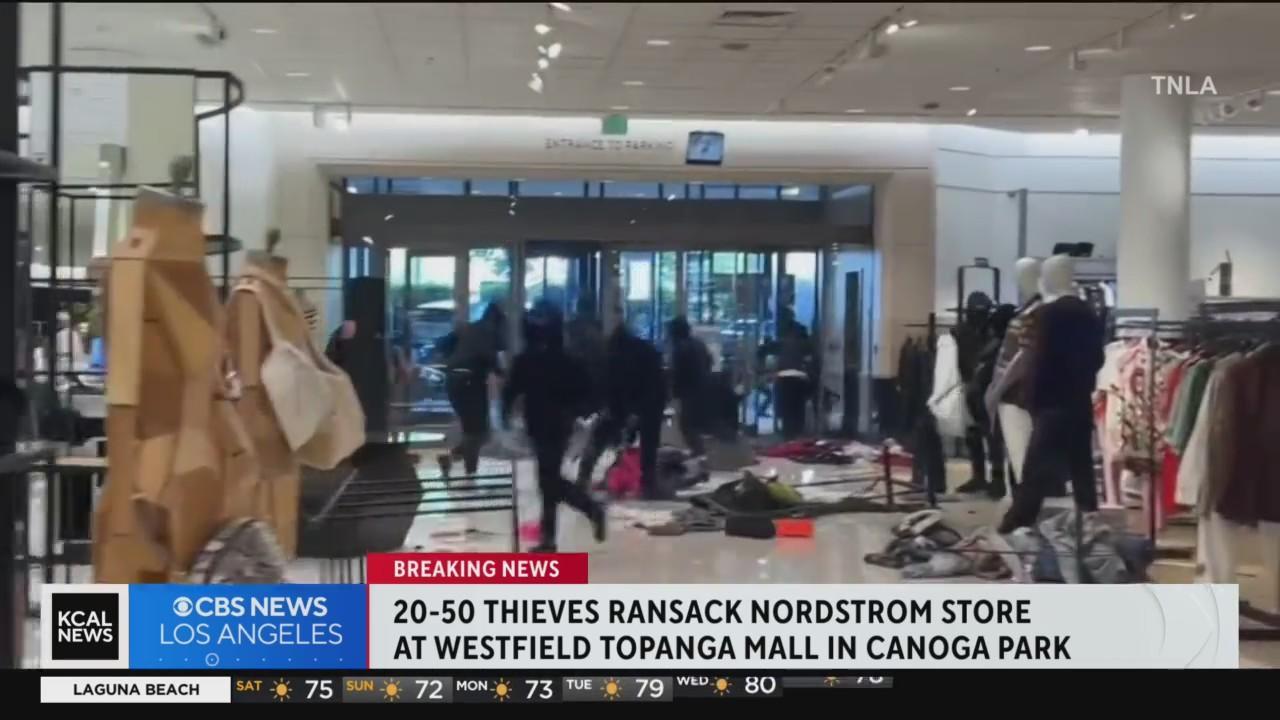
In a startling video, a brazen crowd of around 30 individuals rampaged through a Nordstrom department store in Los Angeles. The audacious robbery unfolded on a Saturday when a sizable group of roughly 30 people infiltrated the Nordstrom outlet situated within the Topanga Mall in Woodland Hills. The culprits swiftly seized a selection of clothing and handbags before making their escape.

A captured video footage depicting the incident from inside the store revealed the group, dressed in dark attire, assaulting security personnel with bear spray. This aggressive act enabled them to forcibly enter the establishment, causing destruction to displays as they swiftly snatched valuable items. The trespassers then promptly fled the premises.

Picture : CBS News

The Los Angeles Police Department disclosed that the robbery transpired at approximately 4 p.m. The loot predominantly consisted of handbags and garments, amounting to a limited number of items. The store’s official statement was shared via its Twitter account, indicating that approximately 25 purses, 15 dresses, and 24 perfume bottles were purloined, resulting in an estimated loss exceeding $200 million.

LAPD emphasized their commitment to addressing the incident, stating, “To those who live in the area and patronize the Topanga Mall, it is a loss of feeling safe. The LAPD will exhaust all efforts to bring those responsible into custody and seek criminal prosecution.”

The robbery has generated fear and unease among the local populace, prompting concerns about safety and the enforcement of the law. Expressions of distress surfaced on social media platforms. One Twitter user exclaimed, “California Has Fallen… Mass Mob Smash & Grab Robbery in Full Daylight Results in $30K Worth of Stolen Merchandise at Nordstrom in Los Angeles.”

Another commentator voiced apprehensions about the broader consequences, writing, “Another shoplifting bonanza at a Nordstrom outside of Los Angeles. This is not sustainable. The state of California is going to collapse. It is only a matter of time.”

Addressing the grave issue, Los Angeles Mayor Karen Bass issued a statement condemning the incident, stating, “What transpired at the Nordstrom in the Topanga Mall today is utterly unacceptable. Those responsible for this and similar acts in neighboring areas must be held accountable. The Los Angeles Police Department remains committed not only to identifying the perpetrators behind this incident but also to preventing such assaults on retailers from reoccurring in the future.”

It appears that store robberies have become an unsettling “routine” in the city under Democratic administration, as this occurrence marks the second incident within a fortnight. On August 8, a comparable robbery unfolded at a Yves Saint Laurent store situated at the Americana in Glendale.

Despite apparent parallels between the two incidents, law enforcement has not yet confirmed any direct link between the Yves Saint Laurent robbery and the Nordstrom robbery.

NASA Telescope Spots Cosmic Question Mark In Deep Space

A luminous symbol resembling a question mark, originating from the cosmos, has unexpectedly appeared in the background of NASA’s most recent imagery obtained through the James Webb Space Telescope. Experts are now speculating about the identity and nature of this enigmatic cosmic feature.

Unveiled on July 26, the initial near-infrared depiction portrayed a pair of fledgling stars denominated as Herbig-Haro 46/47. These stars are located within the Vela constellation of the Milky Way galaxy, situated at a distance of 1,470 light-years. These youthful stars are in an active phase of formation and are engaged in an intimate orbital dance around each other.

Although space and ground-based observatories have been scrutinizing these two stars since the 1950s, the extraordinary sensitivity of the Webb telescope has permitted the capture of the most intricate and high-resolution image to date. Distinguishing itself from its predecessors, the Webb telescope is designed to perceive the universe through longer wavelengths of light, offering a unique vantage point for exploration.

The James Webb Space Telescope serves as a beacon of insight into the origins of the cosmos. However, the presence of an enigmatic entity in the background of this image has sparked a multitude of questions, eclipsing the available answers. This cosmic question mark has yet to be subjected to meticulous observation and study, thus leaving scientists uncertain about its origin and composition.

Picture : NASA

Yet, grounded in the object’s form and position, scientists are constructing hypotheses. Matt Caplan, an assistant professor of physics at Illinois State University, noted, “The very first thing you can rule out is that it’s a star in the Milky Way… Stars always have these really big spikes… because stars are point-like.” This diffraction phenomenon, emanating from the mirror edges and camera supports, is a stark contrast to the anomaly’s structure. Caplan elaborated that the Webb telescope typically reveals six to eight stellar “prongs,” which unequivocally dismisses the possibility of it being a star.

Christopher Britt, an education and outreach scientist at the Space Telescope Science Institute, responsible for managing the Webb telescope’s scientific operations, posited the possibility of the object being a merger between two galaxies positioned billions of light-years away. This distance far surpasses the proximity of Herbig-Haro 46/47. According to Britt, the universe houses an array of galaxies beyond the confines of our own Milky Way, and their interactions, including collisions, lead to various configurations. These collisions can result in diverse shapes, even resembling a question mark.

While this specific entity’s appearance may be unprecedented, the amalgamation of galaxies into question mark-like configurations has manifested before. A contrasting variation of this form emerged from the Antennae Galaxies in the Corvus constellation. Moreover, most galaxies have undergone numerous interactions similar to this throughout their existence. However, these shapes are often transient, fleeting through cosmic time.

“The nature of space defies precise determination,” stated Caplan, underscoring the inherent complexity of cosmic movements. The Earth’s sun, partaking in its orbit around the galaxy, and the galaxy itself, composed of stars, experience gravitational forces tugging them in myriad directions. This ceaseless interplay underscores the dynamism of celestial mechanics.

This cosmic interplay is also the ultimate destiny for our own Milky Way galaxy, which will eventually merge with the Andromeda galaxy in approximately 4 billion years, as predicted by Britt. However, the precise configuration of this amalgamation remains uncertain.

Britt further hypothesized that the question mark shape might indicate a gravitational interaction between the two galaxies. “That hook of the question mark on the top looks a lot, to me, like what we call a tidal tail, where the stream of stars and gas has been kind of ripped off and has flown out into space,” he explained. To unravel the mysteries of this enigma, more data in the form of spectroscopic analyses is required, as emphasized by both Britt and Caplan. Such analyses could divulge essential details about the object’s distance and chemical composition.

“Nobody’s going to do this, though, because this is very much ‘a local man finds a chicken tender that looks like George Washington,’” Caplan said. “But there (are) observations you could make if you were motivated enough.”

CBS News Chief Neeraj Khemlani Is Stepping Down

CBS News President and co-head Neeraj Khemlani, who has guided the news division and local TV stations for a little over two years, made a sudden announcement on Sunday regarding his departure from his current position.

In a memo addressed to the staff, Khemlani conveyed his decision with clarity, stating, “I have some news to share today, and I don’t want to bury the lede. After an exhilarating run, and before the next season starts, I’ve decided to step back from my current role and start a new exciting chapter.”

Khemlani disclosed that he has entered into a “multi-year, multi-platform first look deal with CBS to develop content” for the network, encompassing projects such as “documentaries, scripted series, and books for Simon & Schuster.”

The successor to Khemlani remains uncertain, although Wendy McMahon, who shares the same title as president and co-head of CBS News and TV stations, is being considered as a potential candidate.

George Cheeks, the CEO of CBS, lauded Khemlani’s contributions in a separate memo to the staff, assuring them that he would soon provide updates regarding “information about the new leadership and structure for the division.”

The absence of an immediate announcement about a new network chief or interim leadership team following Khemlani’s unexpected departure on Sunday underlines the abrupt nature of his decision.

Noteworthy news programs like “60 Minutes,” “CBS Sunday Morning,” “Face the Nation,” and the “Evening News” fall under the purview of the CBS News president.

While CBS News holds a dominant position in Sunday programming, the network has struggled to secure a higher position against NBC and ABC in daily programming. However, it managed to enhance its ratings under Khemlani’s leadership.

During his tenure, Khemlani bolstered the reporting team at CBS News, successfully attracting well-known journalists such as Robert Costa and Cecilia Vega to the network. Despite his ability to draw esteemed reporters to the organization, Khemlani encountered challenges along the way. Earlier this year, he became the subject of a human resources investigation.

Khemlani’s departure marks the third instance of a network news chief exiting in 2023. Chris Licht was dismissed from CNN earlier in the year following a tumultuous period, and in January, Noah Oppenheim left NBC News.

Honoring India’s Richness: A Celebration of Hidden Travel Wonders

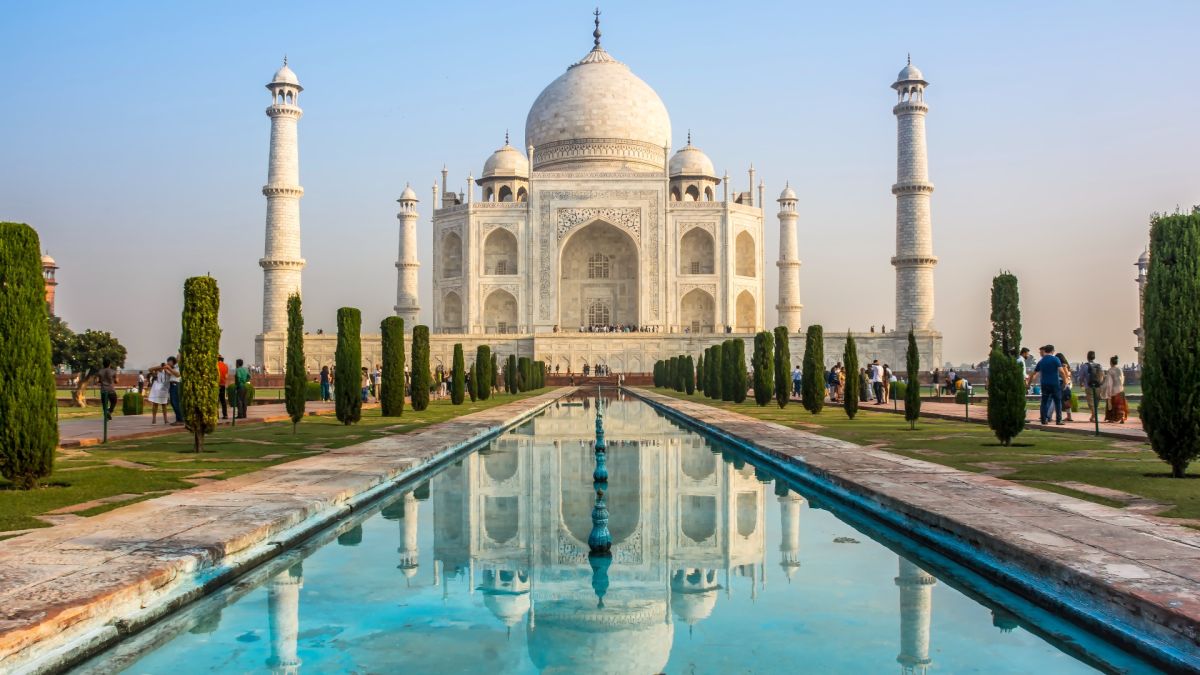
As India eagerly approaches its 77th Independence Day, it is essential to pay tribute to the multitude of treasures that the country holds and to remember the sacrifices made by our predecessors who valiantly protected the legacy that has led us to this momentous juncture. What better way to achieve this than by delving into India’s lesser-explored travel marvels, thus commemorating our nation’s independence? In pursuit of this goal, the Ministry of Tourism has collaborated with the travel platform MakeMyTrip to unveil over 600 remarkable destinations that demand exploration.

This endeavor has given rise to an innovative platform known as the ‘Traveller’s Map of India’ microsite, specifically tailored to help travel enthusiasts uncover concealed tourism gems according to their preferences. Crafted by MakeMyTrip, this microsite seamlessly aligns with the ideals of the Indian Government’s ‘Dekho Apna Desh’ initiative.

In a press release, G Kishan Reddy, the Union Minister of Tourism, Culture, and DoNER, conveyed his appreciation for MakeMyTrip’s endeavor to highlight the diverse destinations within India and to stimulate domestic tourism. He extended an invitation for more such endeavors, underlining the collective aspiration to showcase the nation to the global audience.

The compilation of this travel selection was curated by the travel company through an examination of India’s travel search history. Based on this foundation, destinations that are relatively unknown and confined to specific pockets of the country were chosen. To simplify the process for travelers, these destinations have been categorized with tags like adventure, wildlife, heritage, mountains, beaches, and more, allowing them to choose their preferred genre of exploration.

Picture : Live Science

Rajesh Magow, co-founder and group CEO of MakeMyTrip, expressed his thoughts on this initiative, highlighting how the ‘Traveller’s Map of India’ resonates with the desires of nearly every Indian traveler. He emphasized its fitting commemoration of August 15th and MakeMyTrip’s continuous advocacy for India’s diverse tourism offerings. The intent behind the initiative is to encourage each Indian to become an advocate for the country’s cultural, historical, natural, and geographical wonders. Magow conveyed gratitude to the Ministry of Tourism for its support, which bolsters MakeMyTrip’s mission to position India as the foremost sought-after global tourism destination.

Furthermore, this initiative, as stated in the release, not only acknowledges the potential of domestic tourism as a potent instrument for socio-economic development but also directly contributes to the multifaceted expansion of India’s economy.

For those unfamiliar, ‘Dekho Apna Desh’ stands as a government initiative designed to invigorate domestic tourism across the nation. Through endeavors like these, India’s rich tapestry of hidden travel wonders comes to the forefront, serving as a testament to the multifaceted celebrations of the nation’s 77th Independence Day.

GOPIO-CT Leads 76th Independence Day Celebrations; Connecticut General Assembly honors India

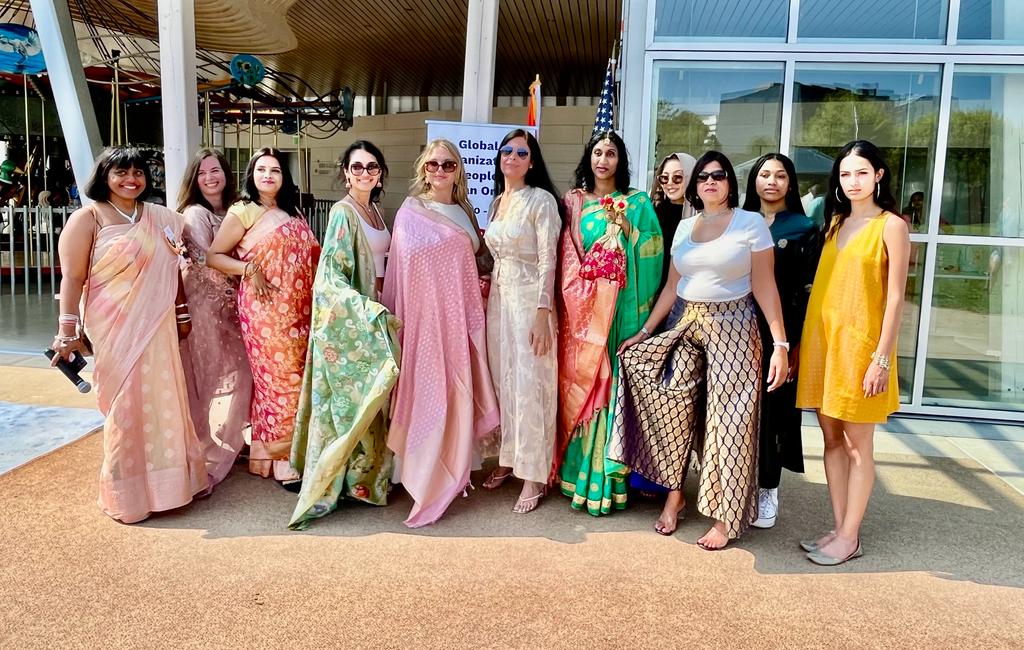
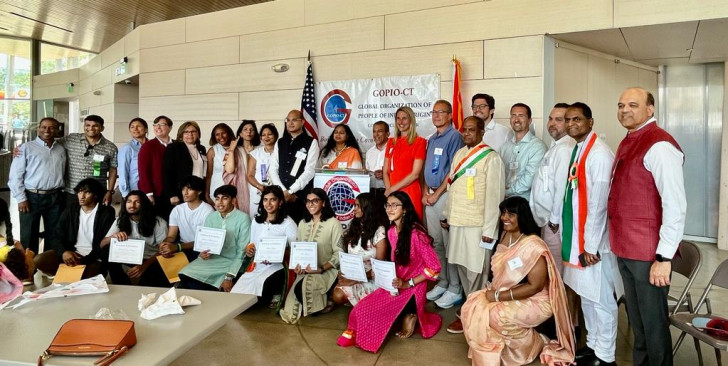
The Connecticut Chapter of the Global Organization (GOPIO-CT) celebrated India’s upcoming 76th Independence Day with a flag hoisting at the Stamford Govt Center on August 6, a ceremony with elected Connecticut officials and dignitaries and a festival with dances and music of India at the Mill River Park in Stamford.

According to GOPIO-CT, a floating crowd of over 3,000 people attended flag hoisting followed by the India Festival and kite flying at the Mill River Park.

A press release said, “Dressed in colorful traditional Indian attire, with melodious music from the popular Bollywood world, dances depicting the wide variety of Indian culture, kite flying, spicy Indian cuisine, and booths decorated with Indian symbols and face art, the festivities were a treat to the fast-growing Indian American community in the state of Connecticut and New York’s Westchester County.”

The day-long celebrations began with the hoisting of the American and Indian flags at the Stamford Government Center by Stamford Mayor Caroline Simmons and Chief Guest India’s Deputy Consul General Dr. Varun Jeph. GOPIO-CT President Dr. Jaya Daptardar hoisted the Connecticut State flag. American and Indian national anthems were sung students of Stamford’s Hindi School.

Mill River Park Collaborative Board Chair Arnold Karp extended a warm welcome and said the park has become focal point for the community to come together and celebrate.

“The India Festival in Stamford, CT is a tribute to a strong and vibrant Indian-American community that has excelled in almost all areas of life in this adopted nation of ours,” said GOPIO-CT Trustee/Advisor and Chairman of GOPIO International Dr. Thomas Abraham.

“Through events like the India Festival, we are cultivating and developing community networking with all the younger elected officials,” Dr. Abraham added.

Stamford Mayor Caroline Simmons proclaimed August 6 as India Independence Day in Stamford to commemorate Indian Independence and thanking the dedication of the Indian American community.

Picture : TheUNN

Prominent among those who addressed and greeted the Indian American community included State Senator Ryan Fazio, State Assembly Representatives Domique Johnson and Rep. Anabel Figueroa. New Haven Mayoral candidate Tom Goldenburg spoke of his connection with India where he stayed over a decade in Kerala.

Two other non-profit community organization representatives, Norwalk International Cultural Exchange Founder Janet Evelyn and Stamford’s Building One Community Program Director Fanny Ferreira also greeted the audience.

High School graduates for area schools were honored with certificates and gift cards and was coordinated by GOPIO-CT Executive Vice President Mahesh Jhangiani.

Picture : TheUNN

Many other nonprofit organizations like NAMI, EKAL Foundation, and Hindi Pathshala also joined. The program ended with the grand fashion show with Kashi Collection presented by Prachi Narayan.

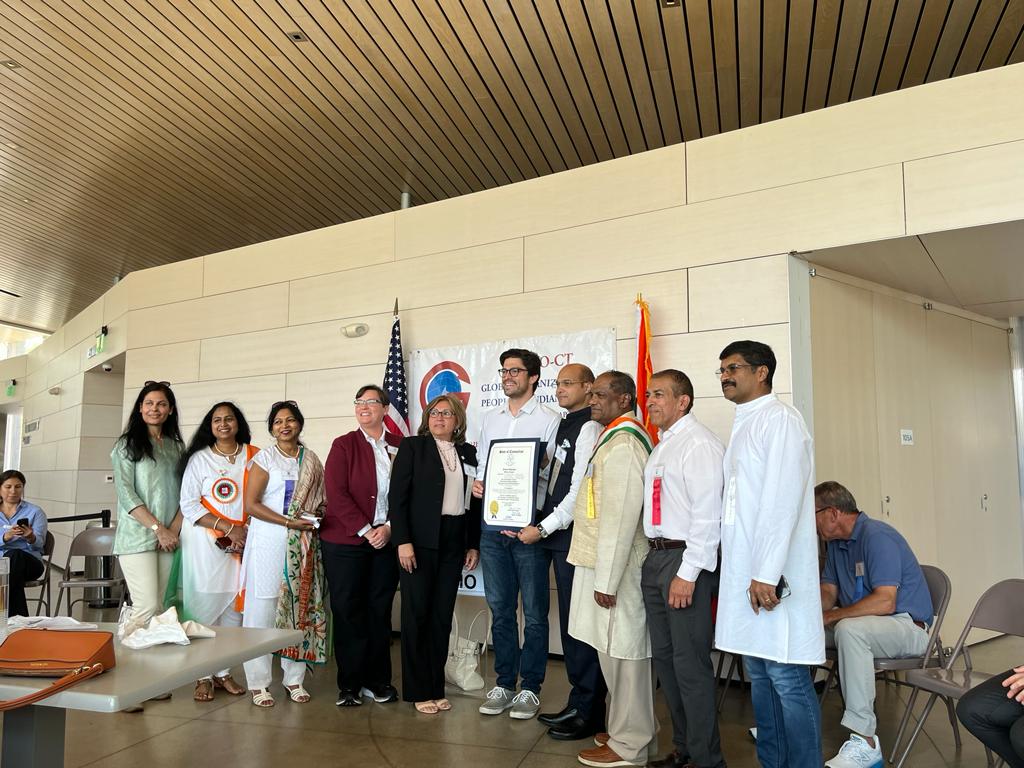
Connecticut General Assembly has issued a citation honoring the India Day Celebration to mark the 76th Anniversary of Indian Independence from British colonial rule on August 15 1947.

Signed by state assembly’s Pro Tempore Marten M. Looney, House Speaker Matt Ritter and Secretary of State Stephanie Thomas, the citation was presented to the Connecticut Chapter of the Global Organization (GOPIO-CT) which organized the celebration on Aug 6.

The citation read, “In recognition of the 76th Anniversary India’s Independence from British Colonial Rule on August 15th, 1947, today we come together to celebrate the occasion with GOPIO-CT and other community organizations to help promote awareness of Indian culture, customs and contributions of people of Indian origin. The entire membership extends its very best wishes on this memorable occasion and expresses the hope for continued success,” it added.

Musical Concert Held In NY Indian Consulate Celebrating Independence Day

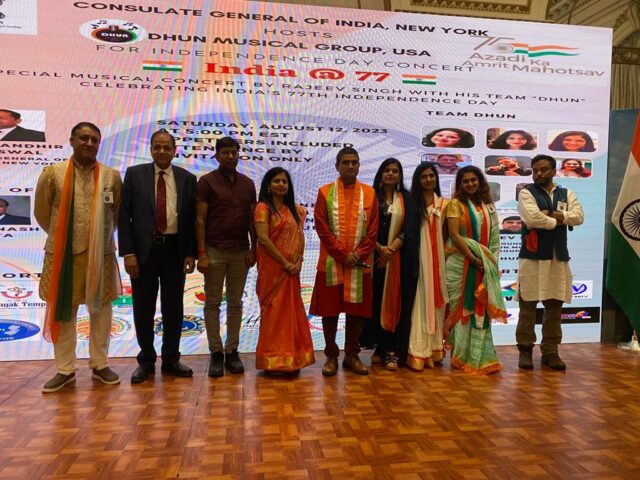
The Consulate General of India, New York hosted the DHUN Musical Group for an India Independence Day special musical concert on Saturday, August 12, 2023.

The DHUN Musical Group, founded by Rajeev Singh, focuses on identifying and encouraging local tri-state talent and giving it a platform. It has been performing at various events and for numerous organizations, fundraising events as well as hosting musical events of its own.

India’s Vice Consul Pragya Singh spoke at the event, thanking  DHUN for presenting this special concert and recalling its August 13, 2021 performance for India 75th Independence Day.

Picture : Desi Talk

In his message Dr Gupta appreciated and thanked India’s Consul General Randhir Jaiswal, diplomats and staff of the consulate for their exceptional work in bringing the Indian American community closer to the Indian government. He also appreciated and thanked Rajeev Singh for promoting Indian musical arts in America and providing a platform to new talent.

Several other community leaders and dignitaries attended, including chief trustee of the Shree Siddhivinayak temple Dr. Geeta Gupta who is also a physician and social worker, and  Bihar Foundation’s vice chairman Ranjeet Kumar.

The talented singers of the team DHUN included Sandeep Singh, Amrisha Singh who was also the host of the event, Rajib Sarkar, Bhavisha Patel, Vasanti Anand and Rajeev Singh.

Several community organizations helped to make the event a success, including FIA -NY/NJ/CT; Shree Siddhivinayak Temple USA, BJANA (Bihar Jharkhand Association of North America), BITSAANA (BIT Sindri Alumni Association of North America), IFM (India-US Forum of Monroe Township NJ) , Bihar Foundation, and Lions International Club.

Media covering the event included ITV Gold, Parikh Worldwide Media, TV Asia and Mana TV. (Desi Talk)

US House Celebrates India’s Independence Day

US lawmakers are celebrating India’s Independence Day in a big way with a House resolution declaring it a National Day of Celebration and a bipartisan group traveling to New Delhi to attend the festivities at historic Red Fort.

The House resolution introduced by a group of lawmakers led by Indian-American Congressman Shri Thanedar declares India’s Aug 15 Independence Day as the “National Day of Celebration of the World’s Two Largest Democracies.”

Thanedar will also join a bi-partisan Congressional delegation led by Indian American Congressman Ro Khanna and Congressman Michael Waltz going to India to participate in the festivities including Prime Minister Narendra Modi address to the nation from the ramparts of Red Fort on Aug 15.

The House resolution expresses the belief that the strong partnership between the United States and India, rooted in shared democratic values, will continue to advance global democracy and foster peace, stability, and prosperity for all nations.

Picture : TheUNN

Co-sponsored by Buddy Carter and Brad Sharman, the resolution says Modi’s official state visit on June 22, “anchored the two nations in a new level of trust and mutual understanding based on common interests and shared commitments to freedom, democracy, pluralism, the rule of law, and respect for human rights.”

“Americans with Indian heritage enhance public life in the United States as government officials, military personnel, and law enforcement officers who diligently uphold the principles of the US Constitution and contribute to the enriching diversity of the nation,” it says.

“It is proper and desirable to celebrate with the Indian people, and to reaffirm the democratic principles on which the two nations were born,” the resolution adds.

Meanwhile, the US Congressional delegation led by Khanna and Waltz, co-chairs of the bipartisan Congressional Caucus on India and Indian Americans, will also visit Raj Ghat, a historic memorial dedicated to Mahatma Gandhi, according to a media release.

They will meet with business, tech, government, and Bollywood leaders in Mumbai, Hyderabad, and New Delhi.

Picture : TheUNN

The delegation includes Deborah Ross, Kat Cammack, Jasmine Crockett Rich McCormick and Ed Case. For Khanna, this is history coming full circle. “His grandfather Amarnath Vidyalankar was an Indian freedom fighter who spent four years in jail alongside Gandhi and later was part of India’s first parliament,” the release noted.

“As co-chairs of the Congressional Caucus on India and Indian Americans, we are proud to lead a bipartisan delegation to India. We will be there to discuss how to strengthen economic and defense ties between our two counties, the oldest and largest democracies,” Khanna and Waltz stated.

“Both of us believe that the US-India relationship will be a defining one of the 21st century. India is a key partner in ensuring multipolarity in Asia and the denial of China as a hegemon,” they stated.

“We must continue to strive to make progress and build our partnership based on our shared founding values of democracy, freedom of the press and assembly, and human rights. This delegation is a historic opportunity to drive further collaboration and advance shared aims.”

Earlier this year, Khanna and Waltz hosted a historic US-India Summit on the Capitol Hill featuring panels and remarks from government leaders, experts, and Indian-American leaders from across the country.

Khanna, 46, is the second Indian-American after Ami Bera to hold the position of co-chair of the Congressional Caucus on India and Indian Americans since its inception in 1993.

Narendra Modi Highlights India’s Unprecedented Growth Story At Independence Day Celebrations

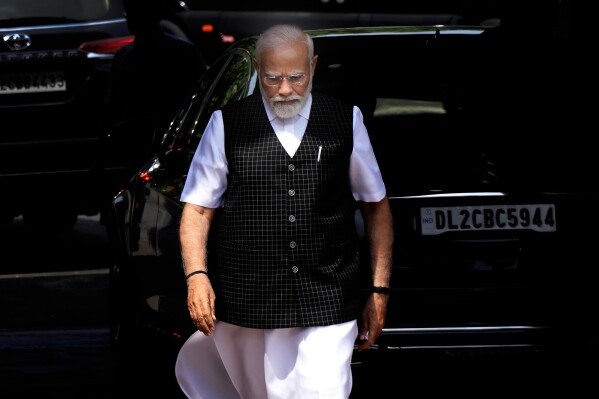
Prime Minister Narendra Modi on Tuesday said there has been an unprecedented surge in India’s exports and noted that India is now the world’s fifth-largest economy due to the efforts of 140 crore citizens.

Addressing the nation from the ramparts of Red Fort on India’s 76th Independence Day, the Prime Minister said India will become the third-largest economy in the next few years.

“In coming years, India will be in the top three economies. This is Modi’s guarantee,” PM Modi said.

He said the government has taken several steps to tackle corruption, stop leakages and contain inflation.

“Today, inflation’s impact is felt by everyone, including us. However, India has taken resolute measures to contain and manage inflation,” PM Modi said.

“When we came to power in 2014, we were at the 10th position in the global economic system. Today, with the efforts of 140 crore Indians, we have reached the fifth position, This did not happen just like that. The demon of corruption that had the country in its clutches — we stopped leakages and created a strong economy.”

“Our primary goal remains the minimization of inflation, ensuring that the citizens of this great nation can lead prosperous and fulfilling lives,” he added.

For his 10th Independence Day address from the ramparts of the iconic Red Fort, PM Modi carried forward a custom — of wearing colourful turbans — that has become his style statement on this day.

Continuing with his tradition from 2014, PM Modi donned a multicolour Rajasthani bandhani print turban with an off-white kurta and churidar for the Independence Day celebrations.

PM Modi was received by Defence Minister Rajnath Singh and other dignitaries as he arrived at the Red Fort and began his customary address to the nation after raising the tricolour at the iconic monument.

This year’s Independence Day will culminate the ‘Azadi Ka Amrit Mahotsav’ celebrations, which were launched by the Prime Minister from Sabarmati Ashram in Ahmedabad, Gujarat on March 12, 2021, and will usher the country into the ‘Amrit Kaal’ (golden era).

He said India faced a struggle for several centuries before it gained Independence in 1947.
“I am talking about the last 1000 years because I see that there is opportunity before the country once again. What we do in this era, the steps we take, and the decisions we take one after the other will decide the direction, future of the country in the coming 1000 years,” he said.

“Today, we have demography, democracy and diversity – these three together have the ability to realize the dreams of the nation. The trinity of demography, democracy and diversity has the power to realize the dreams of the nation,” he added.

“Today, we have demography, democracy and diversity — these three together have the ability to realize the dreams of the nation,” PM Modi said.

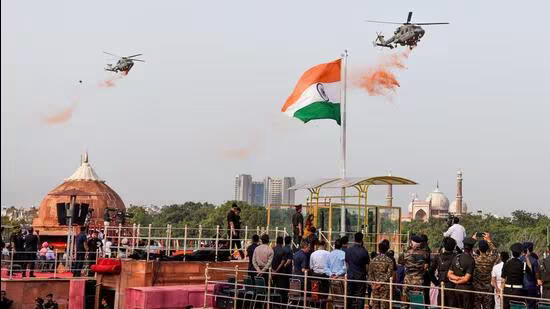
As soon as the national flag was hoisted by the Prime Minister, flower petals were showered at the venue by two Advanced Light Helicopters Mark-III Dhruv of the Indian Air Force.

Modi appealed for peace in strife-torn Manipur saying that people across the country stand with the people of the Northeast state. “The whole country stands with the people of Manipur. Peace is the only way to resolve all disputes. The Centre and the Manipur government are making every effort to ensure that peace returns to the state at the earliest,” PM Modi said.

Modi expressed concern over the heavy rainfall that has wreaked havoc in many states. “…This time, natural calamity has created unimaginable crises in several parts of the country. I express my sympathies to all families who faced this….” PM Modi said. The prime minister assured that both the Centre and the state will help the affected families during times of crisis so they can start their life again. “I assure you about it”.

“Bharat Mata Is The Voice Of Every Indian” Rahul Gandhi

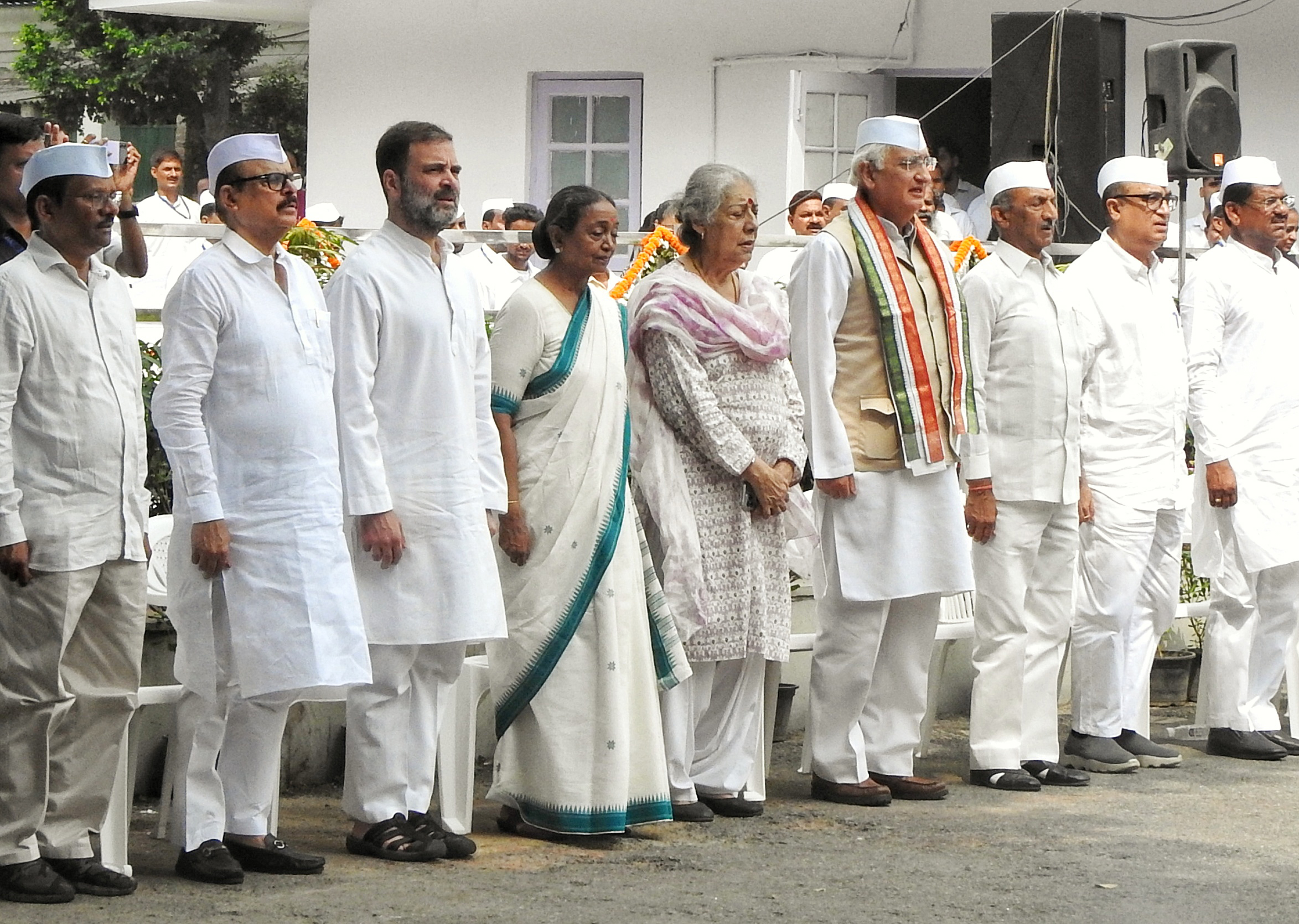
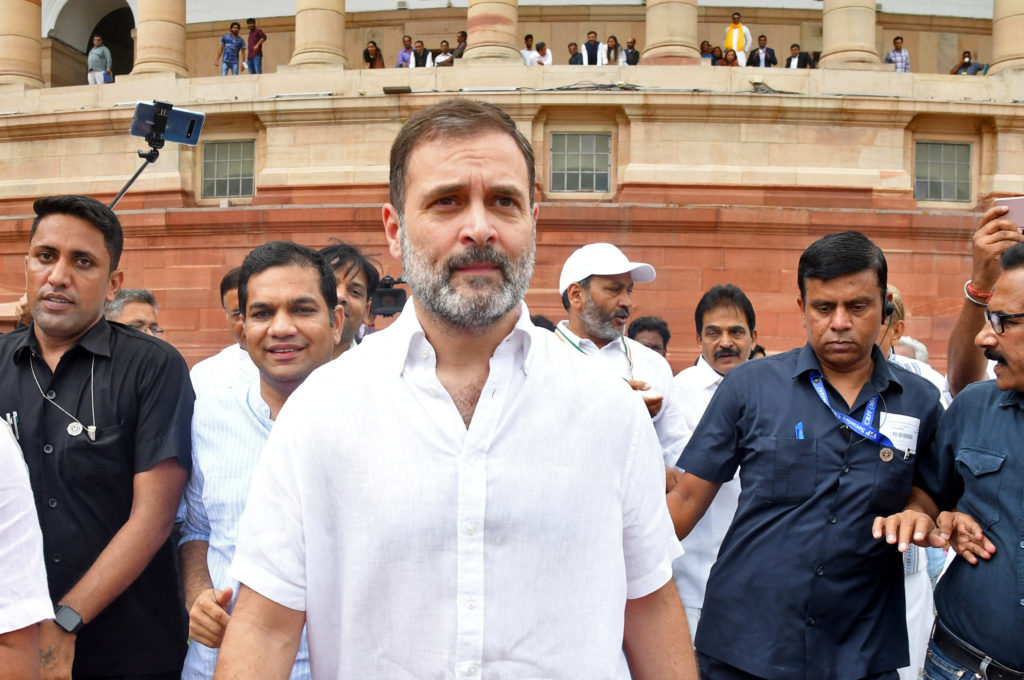
India’s Congress Party leader Rahul Gandhi on Tuesday extended his wishes on India’s Independence Day to the people of the country and called Bharat Mata as the voice of every Indian.

Taking to social media platform X, formerly known as Twitter, the Congress leader said, “Bharat Mata is the voice of every Indian! Happy Independence Day to all the countrymen.”

The Congress leader also shared his experience of ‘Bharat Jodo Yatra’ and said that he started the hundred and forty-five days walk at the edge of the sea and reached the soft snow of Kashmir.

“Last year I spent a hundred and forty-five days walking across the land I call home. I started at the edge of the sea and walked through heat, dust and rain. Through forests, towns and hills, until I reached the soft snow of my beloved Kashmir,” he said.

He also mentioned the pain he faced while continuing his yatra and the motivation that helped him in continuing the yatra.

Picture : Indica News

“Within a few days, the pain arrived. My old knee injury, one that hours of physiotherapy had banished, was back. A few days into the walk, my physio joined us, he came and gave me sage advice. The pain remained. And then I started to notice something. Every time I would think about stopping, every time I considered giving up, someone would come and gift me the energy to continue,” he said.

“The Yatra progressed. But soon the numbers of people became so large, the pain so persistent that I started to observe and listen,” he added.

Meanwhile, in view of the Independence Day celebrations, Delhi Police have beefed up security arrangements in the national capital.

Police personnel checked vehicles as security tightened up across the national capital on the occasion of Independence Day celebrations.

Various iconic buildings and monuments in India have been illuminated in the Tricolours lights ahead of Independence Day.

Old Delhi Railway Station, New Delhi Railway Station and India Gate were light-up as the city soaks in Independence Day fervour.

This year’s Independence Day will culminate the ‘Azadi Ka Amrit Mahotsav’ celebrations, which were launched by the Prime Minister from Sabarmati Ashram in Ahmedabad, Gujarat on March 12, 2021, and will, once again, usher the country into Amrit Kaal with renewed vigour to realise PM Modi’s dream of making India a developed country by 2047.

A number of new initiatives have been taken to celebrate the 77th Independence Day. A large number of guests have been invited as compared to last year.

Parliament Of The World’s Religions Hopes To Harness Faith To Address World’s Ills

(RNS) — Thousands of religious leaders — from Buddhists to Zoroastrians — gathered at Chicago’s cavernous McCormick Place conference center on Monday, August 14th for the opening day of the Parliament of the World’s Religions, a historic and influential gathering.

Picture : RNS

More than 6,500 religious leaders from 95 countries who had gathered in Chicago, urged attendees to appreciate both the uniqueness of their own spiritual traditions as well as the traditions of their neighbors — and to work together to address the world’s biggest problems.

The Rev. Vance Henry, the chief of faith engagement for Chicago’s mayor, told attendees that the world remains filled with darkness and division. But that darkness, he said, can be overcome if people of faith work together.

He drew on a story from his childhood and from a parable of Jesus to make his point — saying it is better to light a candle than to curse the darkness. “If we decided to put our lights together — we can force the darkness away,” he said.

The Rev. Asayo Horibe, president of the Buddhist Council of the Midwest, described the Parliament as both a spiritual event and a gathering of friends. Horibe, who greeted attendees in English, Spanish and Hawaiian, said she first attended a Parliament gathering in 1993, the last time it was held in Chicago. The Parliament traces its history to an event in 1893, also in Chicago, which is credited with inspiring the interfaith movement in the United States.

“I am so grateful for the friendships that have come my way since the beginning of this journey,” Horibe said. She urged attendees to learn from each other — and to share what they learn. Talk to everyone,” she said. “Greet everyone. And go home with the treasures you have received at this gathering.”

The Rev. Selena Fox of Circle Sanctuary greets another participant in the Parade of Faiths in downtown Chicago on Aug. 13, 2023. The parade preceded the Parliament of the World’s Religions, which began Aug. 14. Photo by Lauren Pond for RNS

Eboo Patel, the founder of Chicago-based Interfaith America, told Religion News Service that much of the nation’s interfaith movement, including the organization he leads, was inspired by the work of the Parliament.  “This week it gives a profound gift to the world: demonstration that faith is a source of inspiration, not domination; a bridge of cooperation, not a barrier of division,” he said.

As of Monday afternoon, more than 6,500 attendees from 95 countries, representing 212 spiritual traditions, had registered for the Parliament, with more attending online.

Along with plenary sessions about climate change and defending human rights, the Parliament’s meeting offers hundreds of workshops and panels — as well as networking opportunities.

In her remarks during the Parliament’s opening session, Barbara Abrajano, president of the Council of Religious Leaders of Metropolitan Chicago, reminded attendees of the power of interfaith cooperation.

“No single community of faith working alone can resolve the challenges that all of us face together,” she told attendees. “But if we stand together for all we believe, then our diversity is our greatest strength. We show people that there is another, better way.”

Rashad Hussain, the U.S. ambassador-at-large for religious freedom, echoed the idea that religious diversity is a source of strength. “We don’t seek uniformity,” he told attendees. “But we must have a unity in purpose.”

Hussain, who is Muslim, also stressed the importance of protecting religious freedom for all. During his comments, he pointed out that he succeeded former Ambassador Sam Brownback, who is Christian, and Rabbi David Saperstein, who is Jewish.

In an interview after the opening session, Hussain said he continues to work with his predecessors on matters of religious freedom, which remains a bipartisan issue. Their collaboration and their differing faith backgrounds serve as an example of interfaith cooperation.

“It sends a powerful signal to the world that we will stand up for the rights of all people,” Hussain said. He also said the Parliament can be an example of the way religious communities can help address global challenges.

“Religion can be such a powerful force for good all around the world in bringing us together and addressing some of the challenges that we face,” he said. “And it should always be a force for good. It should never be used to harm people or oppress people.”

Speakers at the Parliament’s opening sessions spoke openly about the ways religion can be viewed with suspicion or used to harm others. That makes the Parliament’s work all the more important, said the Rev. Paul Raushenbush, president of the Interfaith Alliance.

Raushenbush, who was to give a plenary address on Tuesday, told RNS the Parliament’s focus on both religious freedom and human rights is essential, especially at a time when authoritarian forms of organized religion are on the rise.

“The reason the interfaith movement was born was because people decided they were not going to kill each other because they believe different things,” he said. “And we still have people killing each other for believing different things.”

In his address later this week, Raushenbush said, he plans to challenge attendees to put their beliefs and their cooperation into action to counter authoritarian political and religious groups. 

“We are really focusing on the rise of authoritarianism and the rise of the threat of a certain elevation of one religious tradition over others,” he said. “And this is happening around the world working in concert with political and other kinds of power.”

Questions about the role of religion in the world drew a small group of students and staff from Queens University in Charlotte, North Carolina, to the Parliament.

“We’re here to really ask some serious questions about working together to build a thriving world community,” said Queens University chaplain Adrian Bird.

Katie Pittman, a senior religion major at Queens, said the Parliament was a chance for her to experience a wide range of religious diversity in person. “I’m really here to just soak everything up and learn.”

Trump’s Georgia Election Indictment Highlights Attempts To Illegally Access Voting Equipment

(AP) — A day after the Jan. 6, 2021, attack on the U.S. Capitol, as the country was still reeling from the violent attempt to halt the transfer of presidential power, a local Republican Party official greeted a group of computer experts outside the election office in a rural county in south Georgia, where they were given access to voting equipment.

Their intent was to copy software and data from the election systems in an attempt to prove claims by President Donald Trump and his allies that voting machines had been rigged to flip the 2020 election to his challenger, Democrat Joe Biden, according to a wide-ranging indictment issued late Monday.

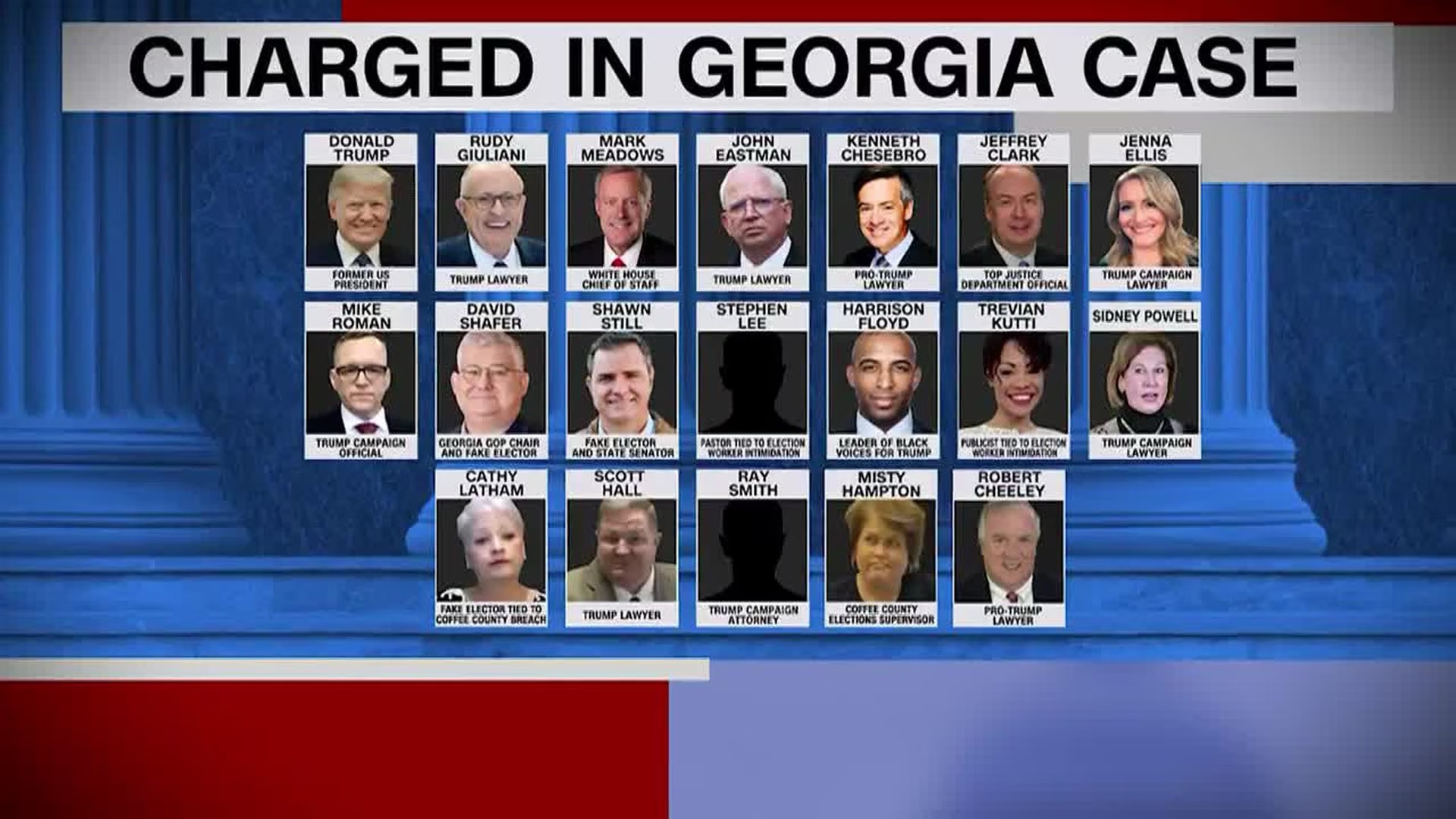
Several of those involved are among the 19 people, including the former president, charged with multiple counts in what Georgia prosecutors describe as a “conspiracy to unlawfully change the outcome of the election in favor of Trump.”

The charges related to the breach of election equipment in Coffee County highlight that the pressure campaign by the former president and his allies didn’t stop with state officials and lawmakers, but extended all the way down to local government. Relying on Georgia’s racketeering law, the type of prosecution more typically associated with mobsters, the indictment alleges the events in Coffee County were part of a wider effort by Trump associates to illegally access voting equipment in multiple states.

“The one thing that Coffee County shows, and these other counties as well, is that the effort behind Jan. 6 didn’t stop on Jan. 6,” said Lawrence Norden, an election security expert with the Brennan Center for Justice at NYU’s School of Law. “The ongoing effort to undermine and sabotage elections has continued.”

The security breach inside the election office in Coffee County, about 200 miles southeast of Atlanta, is among the first known attempts by Trump allies to access voting systems as they sought evidence to back up their unsubstantiated claims that such equipment had manipulated the presidential vote. It was followed a short time later by breaches in three Michigan counties involving some of the same people and again in a western Colorado county that Trump won handily.

While the county-level equipment breaches have raised alarms about election data falling into the wrong hands and prompted two other prosecutions, they were absent from the recent federal indictment of Trump alleging interference in the 2020 election. The Georgia case is the first to argue that the breaches were part of a conspiracy by Trump and his allies to overturn the results.

Four people face six counts related to the breach in Coffee County, including conspiracy to commit election fraud, conspiracy to commit computer theft and conspiracy to defraud the state. They are lawyer and Trump ally Sidney Powell, former Coffee County elections director Misty Hampton, former Coffee County GOP Chair Cathy Latham, who also served as a false elector for Trump, and Scott Graham Hall, an Atlanta-area bail bondsman who prosecutors say is associated with longtime Trump adviser David Bossie.

A lawyer for Powell declined comment, while messages seeking responses from the others were not immediately returned.

Although Trump continues to promote his claims about the election, multiple reviews, audits and recounts in the battleground states where he disputes his loss — including in Georgia, which counted the presidential ballots three times — have confirmed Biden’s win. Trump’s claims also were rejected by dozens of judges, including several he appointed. His attorney general and an exhaustive review by The Associated Press found no evidence of widespread fraud that could have changed the results.

After the 2020 election, Trump and Powell pushed various conspiracy theories about voting machines, specifically related to the Dominion Voting Systems equipment used in Georgia. Dominion earlier this year reached a $787 million settlement with Fox News over false claims aired on the network, including by Powell.

Court documents in Georgia show Powell hired a forensic data firm on Dec. 6, 2020, to collect and analyze Dominion equipment in Michigan and elsewhere, and prosecutors allege the breach of election equipment in Coffee County was “subsequently performed under this agreement.”

On Jan. 7, 2021, Hall and employees of the data firm traveled to the election office to copy software and data from voting equipment and were greeted outside by GOP official Latham and then taken on a tour of the office by elections director Hampton, according to the indictment and video surveillance obtained in an unrelated case about Georgia’s electronic voting machines.

Picture: WWNY

Later videos showed Hampton opening the office on Jan. 18, when it was otherwise closed for the Martin Luther King Jr. holiday. She allowed in Douglas Logan and Jeff Lenberg, both of whom have been active nationally in efforts to challenge the 2020 election and were part of the effort to examine voting machines in Michigan.

Neither Logan or Lenberg were charged in Monday’s indictment.

Logan’s company, Cyber Ninjas, a Florida-based firm with little election experience, was later hired by GOP lawmakers in Arizona to conduct a review of the 2020 election in Maricopa County. It ultimately confirmed Biden’s win but claimed to find various irregularities — claims that election experts said were inaccurate, misleading or based on a flawed understanding of the data.

In Coffee County, the men worked late into the evening, returning the following day. Lenberg also was seen at the office on at least three more days later that month, according to information collected in the separate voting machine lawsuit. Hampton resigned soon after their visits amid allegations of fraudulent timesheets.

This week’s indictment also mentions a Dec. 18, 2020, session in the Oval Office, where Trump allies including Powell and Michael Flynn, the former national security adviser, proposed ordering the military to seize voting machines and appoint a special prosecutor to investigate allegations of voter fraud in Georgia and other battleground states Trump lost.

In Michigan, authorities have charged three people in connection with breaches in three counties, including former Republican state attorney general candidate Matthew DePerno, who along with the others has pleaded not guilty.

So far, the special counsel assigned to the case has not charged any of the employees who handed over the voting equipment nor has he charged those who were asked to analyze them. In a statement, the special counsel said they had been deceived.

With Monday’s indictment, Hampton becomes the second top county election official to be charged in connection with a security breach in their office. The first was Tina Peters, the former clerk in Mesa County, Colorado, who has emerged as a prominent figure among those who say voting machines are rigged. Both are no longer working in elections.

Prosecutors allege Peters and her deputy were part of a “deceptive scheme” to provide unauthorized access to the county’s voting systems during a May 2021 breach that eventually resulted in a copy of the voting system hard drive being posted online.

Weeks afterward, Peters appeared at an event hosted by Trump ally Mike Lindell, the MyPillow CEO who has been seeking to prove the 2020 election was stolen and has called for a ban on voting machines.

Peters has denied wrongdoing and faces trial later this year, Her deputy pleaded guilty to lesser charges as part of an agreement with prosecutors.

Experts have described the unauthorized Colorado release as serious, saying it could provide a “practice environment” that would allow anyone to probe for vulnerabilities that could be exploited during a future election. Experts also worry it could be used to spread misinformation about voting equipment.

Colorado’s chief election official, Democratic Secretary of State Jena Griswold, said accountability is crucial to deterring any future attempts to illegally access voting systems. “We cannot allow election officials to destroy elections from within,” she said.

Articles Of Impeachment Against Joe Biden Introduced In Congress

Rep. Greg Steube, a Republican from Florida, has taken a step ahead of his fellow party members, as he introduced articles of impeachment against President Biden on Friday. While various congressional committees are assembling a multifaceted argument for the removal of President Biden from office, Steube emphasized that the time for action has arrived. He submitted impeachment articles against Biden, alleging that the president had been complicit in his son Hunter’s alleged transgressions and had endeavored to shield him from legal consequences.

Steube declared, “The moment to impeach Joe Biden has long passed. He has eroded the credibility of his position, cast a shadow on the Presidency, breached the trust vested in him as President, and engaged in activities that undermine the authority of the law and justice, all at the expense of the American populace.”

The articles of impeachment filed by Steube encompass four allegations of grave offenses and misdemeanors attributed to Biden. The first charge contends that the president abused the power of his office by purportedly accepting bribes, engaging in extortion under the Hobbs Act, and committing honest services fraud in connection to his official role. These allegations stem from claims of Biden’s involvement in familial business transactions, including allegations that Hunter and James Biden (the president’s brother) attempted to sell access to then-Vice President Biden between 2009 and 2017 in exchange for monetary compensation and business openings from both foreign and domestic business partners.

Rep. James Comer, the chairman of the House Oversight Committee and a Republican from Kentucky, released a memorandum on Wednesday claiming that foreign payments to the Biden family totaled over $20 million. However, Democrats assert that none of the evidence suggests that President Biden accepted any payments or engaged in misconduct.

The second impeachment article accuses President Biden of obstructing justice, citing testimony from an IRS whistleblower. This testimony asserts that “members of the Biden campaign inappropriately collaborated with officials from the Justice Department (DOJ) to improperly interfere with investigations into potential tax violations involving Hunter Biden.” Both the Justice Department and special counsel David Weiss, who was appointed to investigate Hunter Biden, have denied any interference by the Biden administration in Weiss’ work.

The third and fourth impeachment articles allege that Biden was involved in “fraud” and financed Hunter Biden’s unlawful drug use and interactions with prostitutes, respectively. Steube emphasized, “The evidence continues to accumulate daily – the Biden family has personally profited from Joe’s governmental positions through acts of bribery, intimidation, and deception. Joe Biden should not be permitted to remain in the White House, jeopardizing our nation for personal gain.”

Simultaneously, on the same day, Steube introduced a legislative proposal requiring the Secret Service chief to present a report on the illicit use of controlled substances within the White House. This initiative followed the conclusion of the Secret Service’s investigation into cocaine discovered at the White House the previous month, which failed to identify a suspect. Steube named the proposed legislation the “Helping Understand Narcotics Traces at the Executive Residence (HUNTER) Act.”

Steube stated, “The United States Secret Service (USSS) boasts itself as one of the most elite law enforcement organizations globally. It is wholly unacceptable that the USSS has been unable to determine who was responsible for introducing cocaine into one of the most secure edifices in the world. The American people merit answers. My legislation demands information concerning the closed investigation into the July discovery of cocaine at the White House and concentrates on how Congress can exert oversight to forestall future unauthorized use of controlled substances at the White House.”

Steube’s articles of impeachment have leapfrogged over at least four committee investigations led by GOP members that were exploring avenues for impeaching Biden or his senior officials. The White House has derided suggestions of removing President Biden from his position.

White House press secretary Karine Jean-Pierre commented in July, “We will not delve into the hypothetical intentions or actions of House Republicans. That is their prerogative. Our focus is solely on the tasks at hand. The economic indicators are surpassing economists’ expectations, largely due to the accomplishments of this President. Our emphasis will remain on how we can enhance the lives of Americans, affording them some additional room to breathe.”

The Essay Writing Competition conducted by Indo American Press Club

The Indo-American Press Club invites entries to the Essay Competition organized in conjunction with the 9th International Media Conference of the IAPC.

IAPC was formed to unite the media groups and the Indian diaspora media fraternity across North America under one umbrella to work together, support one another, and provide a unified voice to the mainstream media world and the larger community.

The competition is conducted in two categories namely Junior (Ages 8 – 14) and Senior (15 – 20).

The topic for Junior Category: ( Why I like / dislike social media ) should not exceed 1000 words.

Senior Section Topic: (Press freedom in danger) Not exceeding 1200 words.

Your entries in English must be received by the email address: mattjoys@gmail.com before August 30, 2023. Contestants from anywhere in the world can participate.

Winners’ essays will be included in the IMC 2023 Souvenir, released during the Conference. Cash awards and certificates for the winners will be distributed at the IAPC International Media Conference from October 7 to 9 at the Hilton Stamford Hotel in Connecticut.

19th Annual Saraswathi Awards Festival Announced

The 19th annual Saraswati Awards will be held on September 16 at the Tyson Center, 26 Tyson Ave, Floral Park, New York 11001, Jojo Thomas, President of Saraswathy Awards announced here.

The Saraswati Awards was founded with the objective of promoting music and dance among the children of Indian origin growing up in America.

Competitions will be held in classical music, music in Indian languages, Bharatanatyam and folk dance.

The age group from 5 years to 15 years is divided into Pre-Junior, Sub-Junior and Junior categories.

Music and Dance students interested in participating in the competition should register in advance.

Please contact for more information via Email: saraswathiawards@gmail.com

Indian American Judge Moxila Upadhyaya Presides Over Trump Arraignment

Former US President Donald Trump appeared in federal court on August 3, facing charges related to his alleged efforts to overturn the 2020 presidential election.

Former US President Donald Trump appeared in the US District Court in Washington in connection with charges of his alleged attempts to overturn the outcome of the 2020 presidential election. The charges were filed as part of special counsel Jack Smith’s investigation into the matter.

Trump is facing a total of four counts: conspiracy to defraud the United States, conspiracy to obstruct an official proceeding, attempt to obstruct an official proceeding, and conspiracy against rights. The former President appeared before Indian American Magistrate Judge Moxila A. Upadhyaya, who presided over his third arraignment.

Picture : TheUNN

Judge Upadhyaya served as a law clerk to Eric T. Washington, former Chief Judge of the D.C. Court of Appeals. She also practised complex commercial and administrative litigation at Venable LLP’s Washington, D.C. office. Upadhyay dedicated her pro bono efforts to representing indigent clients in post-conviction proceedings.

Throughout her career, Upadhyaya has been actively involved in the legal community. She served as the co-chair of the D.C. Bar Litigation Section Steering Committee and contributed to organizations such as the D.C. Access to Justice Foundation and Council for Court Excellence. Her commitment to upholding the law and ensuring access to justice has made her a respected figure in the legal sphere.

Judge Upadhyaya, who traces her roots to the Gujarat state of India received a Bachelor of Journalism from the Missouri School of Journalism and a Bachelor of Arts with honors in Latin from the University of Missouri. She went on to earn her J.D. from the American University, Washington College of Law, where she earned accolades for her trial work and was a valued member of the Administrative Law Review.

‘Absolute Breakdown Of Law And Order In Manipur’

Saying that there was a “complete breakdown” of law and order and constitutional machinery in Manipur and the state police had “lost control over the situation”, the Supreme Court on Tuesday summoned the state Director General of Police (DGP) at the next hearing on August 7.

In a status report submitted to the court, the state government said a total of 6,523 FIRs were registered, including 11 related to violence against women and children; 252 people were arrested in connection with these FIRs; there were 5,101 cases of arson; and 12,071 preventive arrests.

Solicitor General Tushar Mehta told the Bench led by Chief Justice of India D Y Chandrachud that two of the 11 FIRs on violence against women and children had been transferred to the CBI.

Asked what the state intended to do about the other FIRs, Mehta said they could be transferred to the CBI. The Bench, which included Justices J B Pardiwala and Manoj Misra, asked if the CBI could investigate over 6,000 FIRs.

Mehta said all the 11 FIRs related to violence against women and children could be transferred to the CBI. The court could then take a call later, he said.

“But what about the remaining (FIRs), assuming they don’t go to the CBI? The state police is incapable of investigating. It’s so obvious they have lost control over the situation. There is no law and order left. Absolutely no law and order left,” the CJI said.

Mehta objected and said: “Your Lordships may not say that. There are repercussions. Statements can be used, misused”.

“We are in the midst of a war of a different dimension. So anything that’s said in the court will have repercussions,” Attorney General R Venkataramani said.

Pulling up the police for their “tardy” probe, the court questioned the delay in registering FIRs. “Look at the way the investigation is so lethargic. It appears that except for one or two FIRs, there was no arrest at all… statements recorded after such a lapse of time,” the CJI said.

“Not justifying, but given the situation on the ground, that (delay) may have happened. Maybe they were deployed more on the law and order front,” Mehta said.

“That means for two months, the situation was not conducive for recording FIRs… It seems to give us the impression that from the beginning of May until towards the end of July, there was no law… there was a breakdown of constitutional machinery in the state. To the point that you cannot even…register an FIR, the police cannot make an arrest,” the CJI said.

“You may be right that the police could not make an arrest because the situation was out of control. An officer of the police could not enter the locality to make an arrest,” he said. “Assuming that is so, does this not point to the fact that there is a complete breakdown of law and order and of the machinery of the state,” he added.

In a severe indictment of the Manipur government for its abject failure to curb bloody Kuki-Meitei clashes and horrific crimes against women, the Supreme Court on Tuesday said there was an absolute breakdown of law and order and constitutional machinery in the sensitive border state in the past three months.

A bench headed by CJI D Y Chandrachud said the state government’s status report pointed to delayed registration of FIRs, lethargic investigation, big delays in recording of statements and only a small number of arrests.

When solicitor general Tushar Mehta said this could have happened because of the volatile situation on the ground, the bench said, “Assuming that the ground situation was such to prevent police from taking action against the accused, does it not point to the fact that there was a complete breakdown of law and order machinery in the state. If the law and order machinery cannot protect the people, where do they go?”

DGP summoned

The apex court ordered the Manipur director general of police (DGP) to appear before it on Monday with a break-up of FIRs lodged based on the gravity of offences.

He was asked to apprise the court on the action taken against the policemen who allegedly handed over to a mob the two hapless women who were stripped, paraded naked and sexually assaulted.

The state government said until July 25, the death toll from the ethnic strife was 150, with two Imphal districts accounting for 60 deaths, followed by Churachandpur 28, Kakching 21 and Bishnupur 20.

It said as many as 5,107 incidents of arson took place, with two Imphal districts recording 1,176 cases, Churachandpur 1,044 and Kangpokpi 1,124 cases.

Lokesh Edara, New BOT Chair of AAPI Wants to Enhance Medical Education in India

“In my role as the Chair of Board of Trustees, AAPI, among others, I want to promote and enhance medical education, advocate and work for the promotion of the art and science of medicine and the betterment of public health, including promoting and advocating for better global health,” Dr. Lokesh Edara, declared immediately after assuming office as the the new Chair of the BOT of the American Association of Physicians of Indian Origin (AAPI), the over four decades old medical association, representing the interests of the over 100,000 physicians of Indian Origin in the United States.

Along with Dr. Edara, Dr. Anajana Samadder assumed charge as the President of AAPI. Dr. Satheesh Kathula was administered the oath of office as the President-Elect; Dr. Amit Chakrabarthy as the Vice President; Dr. Sumul Raval as the Secretary; and Dr. Sreeni Gangasani as the Treasurer of AAPI during the recently concluded 41st annual Convention in Philadelphia on July 8th, 20203.

A Board-Certified Physician in Allergy and Immunology in Private Practice since 1990, the soft spoken Dr. Edara completed his Fellowship in Allergy & Immunology at Thomas Jefferson University, Philadelphia. Dr. Edara, who immigrated to USA in1983 from India, serves as an  Assistant Professor at WMU School of Medicine Kalamazoo, Michigan. Dr. Edara is the former President of Michigan Allergy Asthma Society and a former President of the Calhoun County Medical Society and was the President of the Association of Allergists and Immunologists from India from 2001-2003.

Picture : TheUNN

Dr. Edara is a former House of Delegate at the American College of Allergy Asthma Immunology and serves as the Chairmen of AAPI Global Medical Education 2023-2024. Dr. Edara has been collaborating with the Government of India on efforts with “the objective of making every MBBS graduate from India to be the best in the world through programs and activities on AAPI platform.”

A scholar and dedicated to sharing his skills and knowledge with the rest of the world, Dr. Edara has published numerous articles in addition to contributing multiple-choice assessments in undergraduate and post graduate medical education in India. A strong advocate for eLearning systems, Dr. Edada believes that “They are a vital active learning tool for medical education to help higher transfer of knowledge, which helps in public health.”

A strong advocate to make mandatory Emergency Medicine Department in all the 701 Medical Schools in India, Dr. Edara is proud to state that “This is now approved by the Government of India and the Indian Medical Association and that now all the Medical Colleges in India are establishing Emergency Medicine Department.:

Picture : TheUNN

As the BOT Chair, “Now, our goal is to establish an Emergency Medicine Program at every Post-Graduate level school in India, and thus adding to the work pool, a minimum of 5,000 Emergency Medicine Physicians every year. In addition, we are advocating to have BSE EMT a four year program. I believe, we need a minimum of10,000 EMT (paramedics) graduating in India annually to bring good EMS across India,” he adds.

Dr. Edara is the Co-Founder of the Indian Resuscitation Council Federation (IRCF) along with Dr. Chakra Rao, and has worked for the last 5 years with IRCF, and is now serving as a Council Member of the International Liaison Committee on Resuscitation (ILCOR).

His passion has been enhancing of medical education. He cofounded a medical student association called “Global Association of Indian Medical Students (gaims.org). Dr Edara was instrumental in establishing the Global Journal of Medical Students (www.thegjms.org).

He has been instrumental in the Concept Proposal for Nationalized Formative and Summative Assessments to Enhance the Preparedness of Medical Students for the National Exit Test (NExT) and Solution for Low Resource Countries, with insights from NBME Examinations in the USA.

A proven leader and dedicated to the health and wellbeing of Indians, Dr. Edara says, “I have been the Chairmen of TANA   Foundation, the largest Telugu Association in the United States. I established with Tana leadership, The Tana Foundation for India, a nonprofit organization  in India over a decade ago with the FCRA approval from the Government of India. The Foundation has been carrying out several charitable programs in India, spending millions of Dollars.”

Using the same model, Dr. Edara has been instrumental in establishing the AAPI India Foundation, a nonprofit organization in India with the approval of the AAPI Governing Body. “With the establishment of the Foundation, AAPI plans to extend more charitable activities across India with the objective of  improving the overall health and wellbeing of Indian citizens,” Dr. Edara says.

AAPI BOT has set up four grants towards medical projects thus far. “We want to expand the grants and establish more such projects, helping larger population in India,” Dr. Edara says. “Thus. through AAPI India Foundation, we will continue charitable projects and advocacy in India.”

Dr. Edara plans to continue with the advocacy to have the best emergency medical health system while promoting post-graduation in Emergency Medicine and EMT BSE Training across India. In addition, he wants to advocate to have the Indian medical service to help global medical education.

Among other areas, Dr. Edara wants to focus on include, working towards establishing mandatory neonatal department, a mandatory medical oncology department in all 250 medical colleges with a minimum of 250 medical seats.

Dr. Edara has been a strong advocate for the assessment of all medical university examinations including MBBS, Postgraduate and Super Specialties in India to be computerized to 100 MCQF format similar to nEXT with higher standards and for better transfer of knowledge. Dr. Edara says, he will work towards promoting diversity in medicals schools across the United States.

Dr. Edara’s noble initiatives have not gone unnoticed. He has been recognized for his works, contributions and accomplishments. He has been instrumental in establishing several awards benefitting the young and upcoming new generation of physicians of Indian origin.

The AAPI-QLI  Ajay Lodha Memorial Award will be granted to a medical student, resident or fellow who wins the First Place in the Poster Presentation Program being held at the Annual Convention during the BOT Luncheon. Dr. Raj Gupta Award will be given to a female, pre-med/medical student/resident/fellow, who requires financial support for educational resources.

The Bridgewater Asset Group Award will be granted to a medical student, resident or fellow who needs financial support for a community service project in India. The BOT Community Service Award is established to any US medical student/resident/fellow in an accredited US program who is in need for financial support for a community service project in the US.

Dr. Anajan Sammader praised the leadership of Dr. Edara as the BOT Chair and wants “to work with you and the entire BOT and Executive Committee of AAPI towards the well-being and dedicated to advancing AAPI’s mission for a brighter future, fostering improved access to healthcare, promoting diversity and inclusion, and amplify the collective voice of our community.”

Open Communication Is Key In Every Relationship: Aditya Roy Kapur

Kindness is one of the most attractive qualities in a person and 41 per cent of Indian Gen Z respondents on the social networking app, Bumble, consider being unkind to strangers as a deal breaker in a relationship. Bumble also found that an overwhelming majority (76 per cent) of those surveyed stated that how they define what makes a great partner has changed dramatically over the past five years. 46 per cent of Indian respondents say that they are no longer willing to date someone who doesn’t make time for them and 44 per cent of respondents say they are no longer willing to put up with toxic behaviours.

Picture : Lifeberrys.com

The women-first dating app launched a global integrated campaign titled Kindness is Sexy featuring new content with actor Aditya Roy Kapur. This partnership comes at a time when singles in India are more focused on kindness as a key element of their dating decisions. According to its latest survey, an overwhelming majority (81 per cent) of respondents in India agree that kindness is sexy now more than ever before and 56 per cent of respondents value kindness over physical attributes in a potential partner.

“When we approach dating with kindness, we help create an environment of respect and compassion, and for connections to grow,” said Whitney Wolfe Herd, founder and CEO of Bumble. “Kindness is a core value here at Bumble, and we know it is the driving force behind our mission of creating healthy and equitable relationships. This new content helps redefine the idea of attraction and encourages us to never lose sight of the most valuable traits in a relationship.”

The campaign’s new film embodies this sentiment as it features popular actor, Aditya Roy Kapur exploring modern online dating as he redefines stereotypical tropes of sexy through the lens of different facets of ‘kindness’ in a relationship-respect, vulnerability to empathy. The film leverages a playful, humourous twist in the end which ultimately shows how kindness is sexy and goes a long way in making meaningful connections.

Speaking on this partnership, actor Aditya Roy Kapur shares, “At the end of the day, the heart of everything lies at being good to people around you, including your romantic relationships. I think it’s great what Bumble is doing by telling everyone, who is on their platform and whoever wants to join, that what matters is being good to each other, being accountable and responsible on the platform. By showing kindness is sexy, I think they have set the tone very clearly about the kind of interactions and the kind of people they want on the platform – I think more power to Bumble for doing that!”

IANSlife caught up with Aditya Roy Kapur to get his opinion and thoughts regarding the campaign and dating:

According to you, what are the simple acts of kindness that can make a positive impact in the dating culture these days?

Aditya: I think open communication is key in every relationship, being open to listening and understanding each other is an act of kindness. So I would say being comfortable with each other is important and expressing gratitude in any kind of relationship goes a long way too!

Any tips for your fans to make kindness a habit?

Aditya: I think whenever you think someone is doing something nice, make them know that you notice and appreciate it. It feels nice to know that someone has noticed good things that you do and good qualities, if they have been nice to you or checked in with you – let them know that you notice because it matters to them that you see them for the good.

How does it feel to associate with Bumble for Kindness is Sexy Campaign? What message do you hope to communicate through this collaboration?

Aditya: What Bumble is trying to put across is something that resonated with me. I think being kind, asking people how you like to be treated with empathy should be at the core of any healthy relationship, whichever form it may take. So, when I heard of the campaign and what its message was, I looked at it only as something that can be positive, and I felt that Bumble always goes about putting their ideas across in a fun way. I really liked the stuff that they have done for their other campaigns as well. So, it was a really exciting prospect to collaborate with them on something that I felt would be fun, interesting and also a positive message. (IANS)

Rep. Ro Khanna Felicitated Near Boston

On a picturesque Sunday afternoon, the New England Indian American community gathered once again to extend a warm welcome to Congressman Ro Khanna, renowned as a member of the esteemed “samosa caucus,” representing Silicon Valley and California’s 17th district. The lunch meet and greet fundraiser, hosted by the US India Security Council’s President, Mr. Ramesh Vishwanath Kapur, along with esteemed co-hosts Thomas Arul,  Mr. Ashok Bhatt, Dr. Suvas Desai, Sanjay Gokhale, Priya Samant, Amar Sawhney, Deepika Sawhney, Pramit Maakoday, Manoj Schinde and AbhishekSingh proved to be a remarkable occasion for celebration and camaraderie.

The event took place at the Clay Oven restaurant, nestled in the historic town of Lexington, MA, and was graced by the presence of many distinguished business and community leaders, including Mr. and Mrs. Puran Dang, Mrs. Ranjani Saigal, Ms. Amrita Saigal, Mr. Gope Gidwani, Mr. Dhruba Sen, Mr. Archan Basu, Dr. Smita Joshi, Puneet Kohli, Paru Sanghvi, Vijay and Madhu Narang, Dr. Dinesh Patel, Mr and Mrs. Yash Shah Mr. Guruprasad Sowle, Krishna Srinivasa and many others.

Ramesh Kapur, in his opening address, welcomed Congressman Ro Khanna to New England, emphasizing the Congressman’s unwavering perseverance and determination that led him to triumph in his third election, eventually defeating the incumbent. Notably, Congressman Khanna played a significant role in inviting Indian Prime Minister Narendra Modi last month to address the joint session of the US Congress.

Picture : TheUNN

During his remarks, Congressman Khanna emphasized the importance of recognizing India’s elected leaders and acknowledged that the relationship between India and the United States is pivotal. He stressed that India’s emergence as a powerful nation, two generations removed from colonialism, requires realistic expectations in terms of alignment with US policies.

In his closing statements, Kapur shed light on the upcoming visit of Congressman Khanna and other esteemed members of Congress to India in August, signifying the continued commitment to strengthening India-US ties.

This momentous event marked not only a celebration of Congressman Ro Khanna’s achievements but also a testament to the cohesive spirit and vibrant engagement of the New England Indian community in furthering bilateral relations between India and the United States.

The Indian American Community of Massachusetts successfully raised over $25,000 at this event.

“Made In Heaven Season 2” With A Stunning New York Segment

Get ready for the much-awaited return of “Made in Heaven Season 2” on Amazon Prime Video, premiering on August 10, 2023. To announce this momentous release date and ignite excitement worldwide, an exuberant promo was crafted in three iconic locations – Mumbai, London, and New York City.

Neha Lohia, an acclaimed female Filmmaker from India now based in the USA, takes immense pride in her role as segment director of the New York portions for the launch promo of Made In Heaven Season 2 which showcases a groundbreaking team with a majority of All Female Directors, writers, and creatives at the helm.

With Reema Kagti co-writing and directing alongside Zoya Akhtar, Alankrita Srivastava, and Nitya Mehra, the show is majorly led by an inspiring female team. Neha’s direction captures the grandeur of an Indian Baraat in the vibrant American backdrop of Times Square. Fueled by her passion for authentic storytelling and admiration particularly for Reema Kagti, one of the show creators, Neha’s creative brilliance shines brightly in this captivating promo.

“This project was both challenging and immensely enjoyable,” shared Neha Lohia. “With a three-camera setup and an enthusiastic team, we turned Times Square into a global celebration. The response from onlookers and the incredible performances from the all-woman band and talented actors made it truly memorable, nobody wanted to stop dancing in this baraat.”

The 7-episode series, co-produced by Excel Media & Entertainment and Tiger Baby, promises to be a cinematic masterpiece, boasting an impressive lineup of directors, including Alankrita Shrivastava, Neeraj Ghaywan, Nitya Mehra, Reema Kagti, and Zoya Akhtar.

Featuring a stellar cast in New York, including Hervender Pal Singh, Kaitlyn N.S. Mitchell, Reena Sharma, Madison Hadley, Christine Mendes, and Kai Whitehead, the promo exudes the spirit of a true Indian wedding celebration touching hearts globally. The all-woman Brass Queens NYC band provided a lively and spirited musical performance, amplifying the grandeur of this Baraat promo.

Assisting in the coordination of this international project were Abhishek Singh from Celebbazaar for the New York leg and Chaitanya Bagai from Tryz Innovationz in Mumbai.

The promo, launched on YouTube and Instagram, surpassed expectations with over 500,000 views within a day, garnering global attention. Audiences eagerly anticipate the return of “Made in Heaven Season 2.”

As the director of the New York portion, Neha Lohia artfully helped build the show’s reputation, co-creating an unforgettable and attention-grabbing visual spectacle with the worldwide creative teams headquartered in India. “Reema has been an inspiration for me and her work in the past with her film particularly Talaash has helped me tremendously in my personal life, I hope to meet her in person someday and share with her how much her work has impacted and healed me. This promo work is my thank you and expression of gratitude to her,” said Neha Lohia, the Segment Director for this promo.

“Made In Heaven Season 2” promises to deliver more spice, mad fun, and unbridled celebrations, leaving audiences worldwide on the edge of their seats. This show has garnered accolades, including nominations for Best Actor at the International Emmy Awards in season 1, and promises to be a heart-stealer in this second round.

The worldwide premiere of “Made In Heaven Season 2” on August 10 invites viewers to embark on a journey of love, celebration, and the complexities of life. Brace yourself for a captivating exploration of high-end wedding planners portrayed by Sobhita Dhulipala and Arjun Mathur in the bustling city of New Delhi. Their performance in this promo itself sets the stage and teases audiences for what lies ahead in the show with their flare and flamboyance.

Prepare to immerse yourself in the opulence and drama of Indian weddings globally while embracing the heartfelt storytelling that brings the world together. Join the grandest baraats, and get ready to revel in the wedding season and relationship dynamics once again!

“Neha Lohia’s Directorial Brilliance Sparks Global Celebration and Anticipation with a Grand Indian Baraat Promo Embracing Indian-Origin Content”

About “Made In Heaven Season 2”: “Made In Heaven Season 2” is a highly anticipated web series returning after four years, streaming on Amazon Prime Video. The show is known for its compelling storytelling, star-studded cast, and captivating visuals, making it a global favorite among audiences giving a taste of India to the entire world.

About Neha Lohia: Neha Lohia is an accomplished award-winning director with a passion for creative storytelling and visual excellence. With an impressive portfolio of successful projects, Neha’s conscious creations, talent, and expertise continue to create a significant contribution to the entertainment industry. Watch the GRANDEST BARAAT promo here: https://www.youtube.com/watch?v=QKQJvnnl32w More: www.nehalohia.com or www.creatrixentertainment.com

Air India Plans Nonstop Flights from Boston, Los Angeles

Air India is eyeing expansion of its service network in the United States. The airline would operate nonstop flights to India from Boston, Los Angeles and other US cities in the next few months, as part of its 5-year development plan named Vihaan.AI. Currently, Washington DC, New York JFK, Newark EWR, Chicago ORD, and San Francisco are the only destinations of Air India’s nonstop flights to USA from India.

“The reports of Air India planning to add Los Angeles and Boston to its US-India nonstop service corridor is no surprise to us. In our exclusive news article about the airline’s $70bn aircraft deal, we had hinted at Air India’s potential plans for penetrating the US market further. However, we had little idea that Boston and LAX would steal the show while Atlanta, Seattle, Houston and Dallas have been lobbying with Indian authorities for nonstop flights for years,” said Sourav Agarwal, the Editor of Travel Beats.

The most likely launch of Boston and Los Angeles to India nonstop flights is anticipated to coincide with the induction of six A350-900 aircraft into Air India’s long-haul fleet in October or November 2023. This is just a fraction of the airline’s order of 40 A350s, including 34 A350-1000 aircraft. In his most recent interviews, CEO Campbell Wilson said that the ageing fleet with outdated cabins had been a deterrent to the Tata airline’s growth and expansion in international markets.

Six A350-900s will add a total of 144 premium economy seats to Air India flights for international service. Indians of Southern California and New England would get a taste of Air India’s Premium Economy service on board if A350-900s are deployed for the upcoming new routes between USA and India. Each Airbus 350-900 will come with 24 Premium Economy, 28 Business and 264 Economy seats. A350-900s have business class seats with direct aisle access and doors for passengers’ privacy. With 31-inch seat pitch, economy seats will be a breather for travelers.

“Our customers who have taken Air India’s premium economy flights from SFO and JFK to Delhi, Mumbai, and Bengaluru are all praise of the seats, meals and other inflight service. We are thrilled to share with you the below feedback from the traveler named Diwakar,” said the chief travel advisor of Indian Eagle, a most trusted air-ticketing partner of Indian Diaspora in America,

“We recently traveled by Air India from Mumbai to San Francisco in Premium Economy class. The entire journey was most comfortable. It was a great surprise by Air India for travelers preferring nonstop travel. In the last 20 years, we have traveled to USA many times. It was our 18th trip and the BEST travel experience. Kudos to AIR INDIA!”

Why are Boston and Los Angeles being targeted as highly potential destinations for new nonstop Air India flights to USA? The primary reason being the growing Indian immigrant community in Southern California and New England. In Southern California, Greater Los Angeles alone houses an inflated Indian-origin populace of more than 200,000. New England comprising Massachusetts, Maine, Connecticut, Rhode Island and Vermont in the northeast US, is home to a growing base of over 1 lakh Indians.

Boston is centrally located in New England, which makes Boston Logan Airport seamlessly accessible from Albany, Hartford, Milford, New Haven, Stamford, Cambridge, Providence, Springfield, Greenwich and other cities. Los Angeles International Airport is much nearer than SFO to Arizona and Southern Nevada by road. If Air India’s nonstop flight service to LAX becomes a reality, it will be a double celebration for Indians in Southern California. They are most likely to get an Indian Consulate in Los Angeles as an online petition is garnering their support.

Currently, IndianEagle.com has best deals for LAX and Boston to India flights by Emirates, Qatar Airways, Lufthansa, Turkish Airways, SWISS Airlines and others. Once Air India’s plans for nonstop travel from Boston and Los Angeles  to India take shape, it will trigger a fare war with other airlines on these routes.

Justice Samuel Alito Says Congress Has ‘No Authority’ To Regulate Supreme Court

Justice Samuel Alito said Congress has “no authority” to regulate the Supreme Court in an interview with the Wall Street Journal’s opinion section published Friday, pushing back against Democrats’ attempt to mandate stronger ethics rules.

Alito, one of the high court’s leading conservatives, is just one of multiple justices who have come under recent scrutiny for ethics controversies that have fueled the renewed push.

“I know this is a controversial view, but I’m willing to say it,” Alito told the Journal. “No provision in the Constitution gives them the authority to regulate the Supreme Court — period.”

Although the Constitution enables Congress to structure the lower federal courts, it explicitly vests judicial power within a singular Supreme Court.

Alito and some legal observers argue that means Congress can’t prescribe certain regulations for the high court without running afoul of separation of powers issues.

Picture : TheUNN

Chief Justice John Roberts has also questioned Congress’s ability to act, but not as definitive as Alito’s new remarks. Many court watchers who disagree with the premise believe that Roberts’ questioning has given fodder to Republican objections.

“I don’t know that any of my colleagues have spoken about it publicly, so I don’t think I should say,” Alito told the paper. “But I think it is something we have all thought about.”

Rep. Alexandria Ocasio-Cortez (N.Y.) was among the Democrats who rejected Alito’s reasoning, writing on X, formerly known as Twitter, “What a surprise, guy who is supposed to enforce checks and balances thinks checks shouldn’t apply to him.”

The piece also revealed Alito’s first public comments on the recent ethics push since he authored an op-ed for the same paper that was shared just before a ProPublica investigation into an undisclosed Alaskan fishing trip the justice accepted in 2008 paid for by a conservative donor was made public. Alito also conducted an interview with the Wall Street Journal in April.

One of the two authors of the piece, David Rivkin, is an attorney for conservative judicial activist Leonard Leo. Rivkin earlier this week penned a letter rebuffing Democratic lawmakers’ request for information about the Alaska trip, which Leo reportedly facilitated, and Rivkin also actively practices before the court. James Taranto, the other author, is the Journal’s editorial features editor.

“I marvel at all the nonsense that has been written about me in the last year,” Alito said.

The revelations about the Alaska trip followed a ProPublica investigation into luxury trips accepted by fellow conservative Justice Clarence Thomas. The Associated Press later raised concerns about an aide to liberal Justice Sonia Sotomayor pushing book sales, and other justices past and present have also faced criticisms for a variety of other ethics dilemmas.

In the wake of the new reports, the Senate Judiciary Committee voted along party lines to advance a Supreme Court ethics reform bill, though the legislation faces slim odds of passage.

Republicans have portrayed the push as an attempt to tear down the court’s conservative majority, and some have similarly cited constitutional concerns.

India To Host World Coffee Conference In September

India is gearing up to host its first-ever World Coffee Conference (WCC), marking the fifth edition of this significant event promoted by the International Coffee Organisation (ICO). Scheduled to take place in Bengaluru from September 25 to September 28, the conference serves as a platform for fostering cooperation and promoting coffee trade among coffee-producing and consuming nations, with ICO being the primary intergovernmental organization dedicated to this cause.

At a preview ceremony in Bengaluru, the Coffee Board of India’s CEO and Secretary, K G Jagadeesha, revealed exciting news regarding the event’s brand ambassador. Renowned tennis player Rohan Bopanna will be taking on this role, adding further prestige to the conference. The ICO, in partnership with the Coffee Board of India, has taken the initiative to organize this remarkable event.

Picture : IndiaItaly

One of the primary objectives of WCC 2023 is to provide significant benefits to coffee farmers in India. Mr. Jagadeesha emphasized this by stating, “WCC (2023) is being organized for the first time in Asia and it is set to bring immense benefits to coffee farmers in India.” The global stage that the event offers will enable the promotion of Indian coffees, opening up new opportunities and markets for the farmers in the country.

The central theme of the conference is “Sustainability through Circular Economy and Regenerative Agriculture.” This important topic will be addressed through various conferences, exhibitions, skill-building workshops, a forum for CEOs and global leaders, as well as a growers’ conclave, making the event comprehensive and engaging for participants.

WCC 2023 is expected to draw representatives from more than 80 countries, including producers, curers, roasters, exporters, policy makers, and researchers. The diverse participation from various nations emphasizes the global significance of the coffee industry and highlights the importance of collaboration and cooperation in this sector.

The conference has previously been held in four different countries: England in 2001, Brazil in 2005, Guatemala in 2010, and Ethiopia in 2016. With India hosting the event this time, it not only solidifies the country’s position in the global coffee trade but also showcases the nation’s commitment to the coffee industry’s growth and development.

India’s upcoming hosting of the World Coffee Conference 2023 presents an excellent opportunity for the nation’s coffee farmers to showcase their products on the global stage. The event’s central theme of “Sustainability through Circular Economy and Regenerative Agriculture” reflects the industry’s growing focus on responsible and sustainable practices. With participants from over 80 countries expected to attend, the conference promises to be a platform for cooperation and collaboration among coffee-producing and consuming nations, further elevating the significance of the coffee industry in the global market. As the event unfolds in Bengaluru, the world will witness the potential and growth of India’s coffee trade, fostering new opportunities and markets for the country’s coffee farmers.

DHS Issues Guidance for Stateless Noncitizens in the United States

The Department of Homeland Security (DHS), through U.S. Citizenship and Immigration Services (USCIS), today issued new guidance to assist stateless noncitizens in the United States who wish to obtain immigration benefits or have submitted other requests to USCIS. Stateless individuals are those who are not legally considered a citizen of any country, and therefore may be denied legal identity, and struggle to access education, healthcare, marriage, and job opportunities.

Individuals can be born stateless or become stateless because of discrimination, war and conflict, or changing borders and laws. The new guidance clarifies when and how USCIS may consider a noncitizen stateless for the purpose of adjudicating immigration benefits or other requests.

“All over the world, people who are stateless live with fear and uncertainty. DHS is fully committed to addressing the global issue of statelessness and to breaking down barriers that these individuals face in the United States,” said Secretary of Homeland Security Alejandro N. Mayorkas. “With this historic step, stateless individuals will be given the opportunity to apply for immigration protections and benefits for which they are eligible.”

Picture : Homeland Security Today

Following today’s release of this guidance, and with the goal of helping stateless individuals to take advantage of the opportunity, USCIS will create and implement new procedures to assist USCIS officers when assessing an individual’s potential statelessness. This includes updating existing training documents on statelessness, developing more robust training procedures for officers, and setting up standard operating procedures for officers to request an internal assessment of potential statelessness where it may be relevant to an individual’s application or benefit request.

Specially trained USCIS personnel will provide the adjudicating officer with an advisory report clarifying how the officer might consider an individual’s statelessness in making decisions about an individual’s application or benefit request. This new guidance also provides examples of documentation or evidence that may help USCIS officers determine whether noncitizens may be considered stateless for USCIS purposes.

Implementing this update also will enable USCIS to gather more comprehensive and accurate data on this vulnerable group of people. The United Nations High Commissioner for Refugees (UNHCR) estimates there are approximately 218,000 stateless people residing in the United States.

Prioritizing Southeast Asia in American China Policy

A new Task Force on U.S.-China Policy report, Prioritizing Southeast Asia in American China Policy, lays out reasons why Southeast Asia is a critically important but under-appreciated region when it comes to U.S. interests and U.S. competition with China, and recommends actions for the U.S. government, in the face of China’s growing influence in the region.

Southeast Asia has, in recent decades, become an engine of growth for the global economy, with a combined GDP among its 11 nations of more than $3.6 trillion. Much of the world’s trade moves through Southeast Asia’s strategically important waters – the South China Sea and the Malacca Strait.

China is now the region’s top trading partner and one of its top investors. While many Southeast Asians view their region’s economic relationship with China favorably, concern is growing about how China uses its economic clout for political leverage and strategic positioning, sometimes at the expense of Southeast Asian interests. In response, Southeast Asians are increasingly seeking ways to counterbalance China’s growing influence in the region.

Picture : RAND Corporation

The report explains why there is room, and good reason, for the United States to strengthen its already considerable economic, political, and strategic ties with the region. It includes perspectives shared by Southeast Asian policy experts from each of the 10 Association of Southeast Asian Nations (ASEAN) countries, in two days of closed-door dialogue with the Task Force on U.S.-China Policy’s Working Group on Southeast Asia, hosted by the ISEAS-Yusof Ishak Institute in Singapore in May 2023, under the Chatham House Rule.

The Task Force on U.S.-China Policy is co-chaired by Asia Society Vice President and Arthur Ross Director of the Center on U.S.-China Relations Orville Schell, and by Susan Shirk, the founding chair of the University of California, San Diego’s 21st Century China Center.

The report gives recommendations for U.S. policy both from the perspective of the Working Group’s Southeast Asian dialogue partners, and from the Working Group itself.

Southeast Asian recommendations include:

  • Be consistent in the U.S. approach to the region. Episodic, inconsistent and self-serving governmental engagement has been America’s greatest failing and weakness, leading to a perception that the U.S. may not be a reliable long-term partner.
  • Forget about American “primacy.” The region is now genuinely multipolar. America is only one of several regional actors.
  • Get in the regional economic game. Joining regional economic organizations is imperative. If you can’t join CPTPP or RCEP, give serious thought to negotiating a regional U.S.-ASEAN foreign trade agreement.
  • Significantly improve U.S. diplomacy, and public diplomacy. Show Southeast Asians that they matter to the United States, and get better at telling what the U.S. is already doing to help them.
  • Take ASEAN seriously as an organization. Increase U.S. Mission to ASEAN staff and develop ASEAN-wide initiatives, rather than merely pursuing bilateral relationships.

The Working Group’s recommendations include:

  • Resist viewing the region only or mostly through the lens of competition with China
  • Increase top-level U.S. governmental visits to Southeast Asia
  • Strengthen U.S. embassy capacities throughout the region
  • Create a Regional Development Initiative that offers aid and other assistance to improve public health, food and water security, environmental sustainability, and more.
  • Increase U.S. public diplomacy, and strengthen U.S. soft power and influence
  • Upgrade diplomatic relations and interactions with ASEAN
  • Play to American strengths in commerce, with U.S. as part of the regional economic architecture
  • Strengthen US intelligence and counter-intelligence cooperation with Southeast Asian counterparts

Continue the full range of in-country military/security assistance programs

The Working Group on Southeast Asia was led by David Shambaugh, Gaston Sigur Professor of Asian Studies, Political Science & International Affairs and Director, China Policy Program, George Washington University, who was also the report’s lead author.

Other Working Group members were:

Orville Schell, Vice-President and Arthur Ross Director, Center on US-China Relations, Asia Society

Daniel Russel, Vice-President for International Security and Diplomacy, Asia Society Policy Institute, and former Assistant U.S. Secretary of State for East Asian and Pacific Affairs (2013–2017)

Ambassador Charlene Barshefsky, Chair, Parkside Global Advisors & former U.S. Trade Representative (1997–2001)

Professor Steven F. Jackson, Fellow, Woodrow Wilson International Center for Scholars

Mary Kay Magistad, Deputy Director, Center on US-China Relations, Asia Society, and former NPR Southeast Asia correspondent

Zack Cooper, Senior Fellow, American Enterprise Institute

Gen. (Rtd.), Karl W. Eikenberry, former U.S. Ambassador to Afghanistan (2009–2011).

To connect with any of the speakers directly for an interview, please reach out to pr@asiasociety.org.

Using Smartphone In Toilet? Avoid It Or You Will End Up In Hospital, Says Study

People are now aware of the significance of maintaining cleanliness and hygiene as a result of Covid-19. Nearly everyone uses hand sanitizers and cleans their hands frequently. In any case, imagine a scenario where we let you know that even after all the cleaning and cleanliness rehearses, you are conveying a large number of microscopic organisms with you day in and day out. Yes, you are, and your smartphones contain these bacteria. Quite, your cell phone can be perhaps of the dirtiest thing you convey and can hold onto however many microbes and microscopic organisms as a latrine seat.”

Picture : TOI

As per a concentrate by NordVPN, six out of 10 individuals take their telephones to the washroom while leading their business, particularly youths. 61.6 percent of the study’s participants admitted to checking their social media accounts while sitting on the toilet seat, including Facebook, Twitter, and Instagram. “A third (33.9%) remain in touch with current affairs on the toilet, while a quarter (24.5%) use the time to take care of life admin by messaging or even calling their loved ones,” the research adds.

Smartphone addiction is a bad habit that makes smartphones into breeding grounds for harmful bacteria and pathogens, which is even worse. Bacteria and germs also make their way onto the smartphone’s surface through hands as people entertain themselves on toilet seats. These bacteria can eventually enter our bodies through our mouths, eyes, and noses if we use our smartphones constantly throughout the day.

Report proposes, microbes can live on cell phone evaluates for as long as 28 days. In a report, Dr Hugh Hayden, infection control specialist told Yahoo Life UK. ” It’s obviously true’s that cell phones can convey up to multiple times a larger number of microbes than latrine seats, and from a cleanliness perspective, touchscreens have been portrayed as the ‘mosquito of the computerized age’ as being vectors of irresistible illness.”

“At the point when we contact shared surfaces then, at that point, utilize our cell phone screen there is a gamble of cross tainting, the actual telephone then, at that point, turns into a wellspring of disease,” he further said.

Fundamentally, latrine seats can hold onto different destructive microorganisms, including Staphylococcus aureus. Infections of the urinary tract, abdominal pain, diarrhea, food poisoning, skin infections like abscesses, respiratory infections like sinusitis, and other complications can be brought on by these pathogens.

All in all, don’t take your telephone to the washroom. In addition to your telephone can get sullied; you could likewise risk sullying your headphones or different devices you convey with you in the washroom with hurtful microbes. As a result, for your health, it’s best to avoid entertainment and prioritize hygiene.

Could Ethnic Conflict In India Become An Issue Modi Cannot Ignore?

It’s been the same old thing recently for Prime Minister Narendra Modi of India: honorary pathway trips abroad, strip cuttings and political meetings at home.

However, he has largely avoided discussing the ethnic violence that has been raging for months in the northeastern state of Manipur. Mobs of the majority ethnic Meitei community have destroyed villages of the minority Kuki and other tribes, killing more than 150 people and forcing over 60,000 people to flee their homes.

The tumult has been broad to the point that huge number of public safety powers shipped off suppress the distress have attempted to reestablish quiet, with the region really parceled along ethnic lines in the thing occupants are portraying as a nationwide conflict.

However a few senior figures inside Mr. Modi’s Bharatiya Janata Party have gotten more engaged with the emergency, the state leader has kept a concentrated on quietness.

The flash was a court deciding that undermined a fragile equilibrium by basically giving greater government advantages to the Meiteis. In spite of the fact that they control the switches of state power, they have had a little portion of the state’s territory.

Meitei mobs, which activists and rights groups contend are enabled by the state government, attacked tribal communities as they protested the ruling. India’s Supreme Court  has since proclaimed the lower court’s decision “totally genuinely off-base,” yet halting the violence was past the point of no return.

To drive Mr. Modi to address inquiries on the issue, India’s opposition groups depended on something exceptional last week: a motion in Parliament to vote against his government’s no-confidence.

The move, which is merely procedural and is Mr. Modi’s second such vote in his nearly decade in power, There is no chance that voters will remove his government.

Yet, it has featured how India’s most impressive forerunner in many years has reshaped the country’s parliamentary majority rule government. With an outright greater part in the governing body permitting him to obstruct and crash banter; a tyrannical national media that largely follows his lead and conceals difficult topics; Mr. Modi wields power increasingly unchecked by India’s political system’s previous guardrails and an overwhelmed judiciary.

Also, experts say what is happening in Manipur epitomizes India’s more extensive weaknesses even in the midst of the country’s ascent as a monetary and strategic power. Misusing homegrown separation points in the immensely assorted country opens room that foes at its boundary could take advantage of.

It also puts India’s military at risk. The division that is primarily in charge of providing security along China’s extensive border, where the two sides have been at odds for more than two years, sent troops to Manipur.

The opposition leader Gaurav Gogoi, who initiated the vote of no confidence, referred to it as an effort “to force” Mr. Modi, who rarely attends sessions or debates, to discuss Manipur.

Mr. Gogoi, deputy leader of the Indian National Congress party in the lower place of Parliament, said that the ethnic gatherings engaged with the savagery were spread across a few states and that “gradually expanding influences” were conceivable. In a region that has a history of violent insurgencies, he added, mobs had robbed police weapons depots, leaving approximately 5,000 weapons unaccounted for.

“The way that there are these weapons which are at large — monstrous number of refined weapons — is an extremely tremendous gamble to our public safety,” Mr. Gogoi said in a meeting.

Mr. Modi’s quietness, experts said, reflects how vital his image is for the estimations of his administering party, known as the B.J.P., around the following year’s overall decisions. He has been able to save state and local elections where the B.J.P. was having trouble because he is personally more popular with voters than the party he leads. Party pioneers need to try not to connect him in the public brain with Manipur.

Amit Shah, Mr. Modi’s  home minister, visited Manipur last month and told Parliament last week that he was able to have a conversation in the interest of the public authority. In addition, he and other officials informed the local media that Mr. Modi had been frequently briefed on the government’s efforts to restore order through security operations, legal action, and meetings between Meiti and Kuki groups.

Insurgencies based on tribal and ethnic grievances have plagued India’s northeast region ever since it became a republic seven decades ago. Many have resulted in fragile cease-fires, creating a delicate equilibrium between tribes competing for resources and land from New Delhi as well as a share of illicit trade along the border. Connections through the northeast, which have been prioritized by successive national governments, have the potential to expand trade with Bangladesh, Myanmar, and Southeast Asia as a whole.

The winding in Manipur “brings into question something beyond India’s homegrown story, more than India’s network story,” Avinash Paliwal, a researcher at SOAS College of London and the writer of a forthcoming book on India’s northeast ” You are making old wounds worse.

The Meiteis are to a great extent Hindu and the Kukis generally Christian, yet the savagery has been more along ethnic lines than strict.

Strains had stewed for quite a long time as Biren Singh, the Meitei chief minister of the B.J.P., adopted an inexorably biased strategy to the ancestral networks, especially the Kuki and the Kuki-Zo, portraying them as outcasts usurping land. In the ongoing emergency, he has portrayed the contention as between the state and what he named “psychological oppressors,” alluding to Kuki gatherings.

In any case, the Indian Armed force’s head of safeguard staff said the “circumstance in Manipur doesn’t have anything to do with counterinsurgency and is essentially a conflict between two nationalities.”

Mr. Singh has stayed in his occupation in spite of far and wide requires his renunciation, some from his own party. Ancestral administrators from the B.J.P. have basically denounced Mr. Singh of complicity in the viciousness..

Rather than holding Mr. Singh responsible, examiners said, the public authority has attempted to put a top on Manipur, hindering web access in the state.

As of late Mr. Modi talked diagonally about Manipur when a viral video on Twitter dodged the web closure. It showed a Meitei crowd strutting ancestral ladies stripped and attacking them. His remark zeroed in on the “disgrace” of the episode prior to lumping it with maltreatments against ladies and savagery during nearby surveys in resistance run states.

His administration moved to pressure Twitter into bringing the video down, and authorities told the neighborhood news media that the one who had recorded it had been captured.

The government has really divided Manipur — keeping Mr. Singh as boss clergyman to care for the Meitei regions, while the areas of Kukis and different clans are run from New Delhi, with the military attempting to keep a support zone, experts and occupants said.

“This ought to be a contextual investigation on how not to deal with the rule of law circumstances, not to mention ones of ethnic partitions,” said Vikram Singh, a previous senior police official.

Among those compelled to escape was Ngaliam, a Kuki lady in her 60s. At the point when she and her sibling got away from their town, her 38-year-old child, Thangkhochon, remained behind. The family claims that a mob with police assistance carried out the attack that resulted in his death. It was impossible to verify that assertion.

Ngailam, who utilizes just a single name, is presently at a help camp in the Churachandpur region. Via telephone, she said she was confused for how to sort her life back out.

Volunteer medical caretakers depicted her as melancholy and said she discusses how she feels remorseful for abandoning her child.

Lunminthang Kipgen, one of the nurses, stated in a telephone interview, “She wakes up crying in the middle of the night and saying, ‘My son is looking at me and blaming me for being alive.'”

India Plans World’s Largest Museum In Delhi

In New Delhi, the world’s largest museum will soon open. On Wednesday, Prime Minister Narendra Modi gave a speech at the opening of the convention center at Pragati Maidan. He talked about the idea for the museum called “Yuge Yugeen Bharat,” which will show India’s rich and varied history.

Talking at the India Trade Promotion Organisation (ITPO) perplexing, the State leader said, “Soon, there will be the world’s greatest historical center in the Public Capital. Imagine something amazing, think beyond practical boundaries and act enormous.”

Yuge Yugeen Bharat Museum

The Sanskrit name “Yuge Yugeen Bharat” means “never-ending India” in English. It catches the everlasting person of the nation’s set of experiences.

The public historical center will be worked out of the ongoing North Block and South Block structures, as per Times Now. The notable blocks were built by Edwin Lutyens and Herbert Cook during the 1930s and have long filled in as the center of Indian administration.

The Prime Minister’s Office, the External Affairs Ministry, and the Defence Ministry are situated in the South Block, while the  Finance Ministry and the Home Ministry are located in the North Block.

The public authority made arrangements to transform the North and South Blocks into exhibition halls in 2021.

One-stop objective for India’s rich culture and history

The exhibition hall would have 950 rooms spread over a cellar, ground floor, and two additional accounts, covering 1.17 lakh square meters of room. The design will house various “khands,” or divisions, that follow the improvement of 5000+ year of Indian civilisation.

Its design emphasizes not only the splendor of Indian history’s various epochs but also the country’s vibrant cultures, animals, and plants.

Picture : Kumparan

As indicated by Swarajya Magazine, the exhibition hall will archive the scholarly and creative achievements of ancient India, the Indus Valley Civilisation, the Vedic period, and India’s top colleges like Takshashila and Nalanda. The Maurya, Gupta, Pandya, Pallav, Chola, Kushans, Kashmir, and Rashtrakut administrations who kept up with exchanging associations with countries like Rome and Greece, will likewise be featured. Huge realms like the Rashtrakutas, Gurjara-Pratiharas, and Palas will likewise get a decent lot of support during the time spent making a country. The bravery of the Rajputs, the Mughal era, the Sultanate, the British Empire, and India’s struggle for independence.

The engineering entryways will open to show the unmistakable metallurgical custom of the country’s verifiable social classes, for example, the extraction of zinc in Zawar, Rajasthan, the magazine said in a report. A whole floor will be dedicated to the old Sindhi-Saraswati civilisation, with a fixation on areas like Harappa, Mohenjo-Daro, and Lothal.

A section will likewise be committed to the changed fauna and plants of the country, which have contributed fundamentally to shaping the way of life of the locale and are subsequently still worshipped vigorously now. The collectorate will also have the nation’s sacred peethas and temples to preserve the holy heritage.

The fifth part of the historical center will be committed to the fights that the progressives battled to win all through the very long term English occupation to liberate their country from unfamiliar abuse. The Sannyasi insurrection in Bengal in 1770, in which Sadhus rebelled against the oppressive government, and the Indian Revolt in 1857, in which some Indians attempted to overthrow the East India Company completely, are two instances of this.

The last segment will then stress the battle for social liberties, logical turns of events, and other huge realities like the thought behind the ongoing Indian constitution. Individuals like CV Raman, HJ Bhabha, and JC Bose will go about as good examples for our nation’s rising gifts.

The gallery will likewise feature India’s commitments to math, science, and innovation. Stressing the commitments of Vallabhbhai Patel, Dr BR Ambedkar, and Mahatma Gandhi, the top state leader said that historical centers will currently interestingly perceive ancestral autonomy warriors.

“The redevelopment of Mahaparinirvana Sthal of Dr BR Ambedkar into a National Memorial at 5, Alipore Street in Delhi (is in progress)… alongside the improvement of Panch Teerth connected with his life, in Mhow where he was conceived, in London where he resided, in Nagpur where he took commencement, and the Chaitya Bhoomi in Mumbai where his Samadhi exists today,” he expressed, as per Hindustan Times.

The Indian chief went on by saying that the galleries will likewise give a connoisseur experience, reporting many years of Indian history connected with Ayurveda and millets, which are as of now turning into a worldwide pattern. He argued that museums should actively support the preservation of resources for future generations. It is encouraging to observe that younger generations are drawn to these museums, which are becoming destinations and potential places of employment.

For anyone inquisitive about the set of experiences and culture of the country, the exhibition hall will act as a one-stop objective.

240 recovered objects

PM Modi also emphasized during his speech at Pragati Maidan that the destruction of libraries and manuscripts during hundreds of years of slavery resulted in the loss of a significant portion of the territory’s heritage. He underscored that the misfortune impacted India as well as the worldwide social inheritance in general. He likewise censured India’s post-autonomy government for neglecting to do whatever it takes to reestablish and safeguard the nation’s for some time failed to remember social legacy.

“We must be grounded previously yet work for what’s to come. We need to respect our inheritance, as we work to make a superior and more promising time to come,” he said.

The  Prime Minister communicated his fulfillment that different countries had begun returning bits of Indian history, which mirrored India’s rising global standing. In the past nine years, he claims, more than 240 ancient artifacts have been discovered and returned to India.

He likewise featured a significant decrease in social relic carrying from India during this period and encouraged craftsmanship devotees and historical center experts overall to improve joint effort in this space, focusing on the significance of guaranteeing that no work of art got unscrupulously tracks down a spot in any gallery. The Prime Minister concluded by promising to create a new legacy while preserving India’s past.

World’s ongoing biggest gallery

With north of 73,000 square meters of display region, the Louver in Paris, France, is presently the biggest historical center.

It is home to the absolute most notable bits of craftsmanship in the whole world, like the Mona Lisa and the Venus de Milo.

The exhibition hall, which is situated in the focal point of Paris, is coordinated into eight divisions, each showing craftsmanship from an alternate time span. These offices incorporate Traditional Ancient pieces, Archaic and Renaissance Craftsmanship, Current and Contemporary Workmanship, Ornamental Expressions, Prints and Drawings, Islamic Workmanship, and Egyptian Artifacts. The Louvre has attracted art enthusiasts from all over the world for centuries.

MIT Expert Calls For A Total Overhaul Of The U.S. Health Insurance System

Alexander Hamilton played a crucial role in the development of the world’s first national, mandatory health insurance policy. This historical 1798 plan, financed by taxpayers and approved by Congress, aimed to provide coverage for sick and disabled seamen. Hamilton’s vision for this policy was driven by his concern for the well-being of humanity.

Fast forward to modern times, and the United States has made numerous attempts to offer medical care to those in need who cannot afford it. While the efforts trace back to Hamilton’s initiative, they have evolved over the years, encompassing policies that mandate emergency-room care for all and extend insurance to individuals with specific serious illnesses.

Despite these endeavors, no policy has been able to fully address the healthcare needs of the entire U.S. population. Presently, around 30 million American citizens still lack health insurance. Even for those who are insured, the costs frequently surpass the benefits provided by the plans. This has resulted in a staggering $140 billion in unpaid medical debt, surpassing all other forms of personal debt combined, with a significant portion being incurred by people with health insurance.

Picture : LinkedIn

In light of these challenges, MIT Professor Amy Finkelstein, in collaboration with economist Liran Einav of Stanford University, advocates for a comprehensive overhaul of the U.S. health insurance system in their new book titled “We’ve Got You Covered: Rebooting American Health Care,” published by Portfolio. The authors propose a two-layered approach, involving one layer of free and automatic health insurance for everyone, coupled with another layer of private insurance for those seeking additional healthcare amenities.

Finkelstein, renowned for her empirical studies on health insurance and healthcare, acknowledges that the U.S. has always had a commitment to providing care to the ill, and now it is imperative to do so effectively and efficiently. She emphasizes that the current health care system is far from ideal and calls for a transformation.

The existing health care landscape in the U.S. comprises patchwork programs that fail to comprehensively cover the population. Approximately 150 million Americans depend on private employer-provided insurance, leaving them vulnerable to losing coverage if they change jobs. Conversely, those reliant on public health insurance, such as Medicaid, face the risk of losing eligibility if their household income exceeds the poverty line. Consequently, about one in four Americans below the age of 65 will experience periods without insurance within the next two years.

Interestingly, a significant number of these individuals are eligible for free or heavily discounted coverage, but they remain unenrolled due to a lack of information and complex signup procedures. Even Medicare, the primary public insurance program for seniors, imposes out-of-pocket expenses without a cap, leading a quarter of Medicare beneficiaries to spend a quarter of their income on healthcare.

While some reforms have improved coverage for certain groups, such as the Affordable Care Act of 2010, which enabled 10 million previously uninsured Americans to gain coverage, they did not resolve the issues of insurance loss or inadequate coverage that often results in considerable medical debt.

The authors argue that the U.S. has attempted to address health coverage problems through a series of piecemeal policies. One such approach involved creating disease-specific care subsidies, starting with the extension of Medicare in 1972 to cover individuals with end-stage kidney disease. Subsequent programs were implemented to cover patients with tuberculosis, breast and cervical cancer, sickle cell anemia, ALS, HIV/AIDS, and Covid-19.

However, Finkelstein and Einav express skepticism towards this approach due to its fragmented nature, which inevitably leaves gaps in coverage. They propose a more straightforward solution: universal inclusion of everyone into the healthcare system, thus eliminating the need for separate laws for different illnesses.

“When you think about covering all the gaps, that’s what universal basic coverage is,” Finkelstein says.

Land of the free

According to “We’ve Got You Covered,” the current approach to health insurance in the United States is not set in stone. The origins of employer-provided health care only trace back to the 1950s. The authors argue that the continuous implementation of policies to ensure basic care for all, such as open emergency rooms and subsidies for severe diseases, reflects the nation’s underlying expectation of providing humane care when it is most needed.

Finkelstein, one of the authors, points out that the existence of various healthcare measures is due to a social norm or unwritten contract in the United States. This norm dictates that society does not allow people to die on the streets due to lack of medical resources. Thus, when individuals face dire medical situations without resources, there is a collective compulsion to help them. From this perspective, both the issues faced by the insured and the uninsured result from failures to uphold these societal commitments rather than a lack of such commitments.

To address these problems, Finkelstein and Einav propose a solution: free, basic healthcare for everyone, without the hassles of sign-ups or charges for essential care. Additionally, people would not lose their insurance when leaving their jobs, and surpassing the poverty line would not mean losing public insurance coverage.

Under their proposal, there would still be a layer of private health insurance available for those who desire additional amenities in their medical care, like private hospital rooms or elective services. Essentially, people could pay for upgrades if they choose to.

While this system would not achieve absolute equality in healthcare, Finkelstein believes it would be an improvement over the current situation. The key, in his view, is to ensure that everyone receives essential basic coverage.

The book suggests that the U.S. can indeed afford such a system of free, basic, and automatic-enrollment health care. Currently, the country spends 18 percent of its GDP on healthcare, with half going to public healthcare and the other half to private care. Interestingly, European countries that offer universal coverage spend approximately 9 percent of their GDP on public health systems. Therefore, the book argues that the U.S. is already paying for universal coverage, though it has not achieved it yet, and could implement it at a similar cost to these other countries.

“We’ve Got You Covered” also opposes modest co-pays, despite studies showing that they reduce doctor visits. The authors believe that such co-pays conflict with the idea of universal coverage, which aims to provide essential medical care without financial barriers.

Until the impossible becomes inevitable

However, even if the Finkelstein-Einav health insurance system is logical and reasonable, is there any possibility of it becoming a reality?

“One thing that makes me, if not optimistic, then at least not unduly pessimistic, is that this is an argument that will and does appeal to people across the political spectrum,” Finkelstein contends

The book highlights that although expanding health insurance is typically linked with progressive politicians, it also showcases several conservatives who, even in the 21st century, have advocated for universal coverage.

Although the immediate implementation of a free basic care system may not be imminent, Finkelstein and Einav propose in their book “We’ve Got You Covered” that they are following the advice of economist Milton Friedman. They aim to develop ideas and keep them publicly discussed until what seems politically impossible eventually becomes politically unavoidable.

Meanwhile, Finkelstein and Einav strongly advise individuals to give greater consideration to the implicit assumption in U.S. health care policy that we ought to assist everyone, driven by the same rationale that motivated Hamilton’s desire to aid seamen – namely, to safeguard them from destitution and suffering in their lives.

New Research Paints Richer Picture Of Physician Earnings

University of Chicago researchers, led by health economist Joshua Gottlieb, PhD, have embarked on a project to better understand the earnings of physicians in the top 1 percent of income earners. Although physicians are among the most common high-income occupation, accurately measuring their earnings has proven challenging.

The researchers sought to address this issue by creating a comprehensive dataset that links administrative data on physicians to tax records from 2005 to 2017. This dataset allows them to measure physician earnings and explore the impact of healthcare policies on their incomes, labor supply, and talent distribution.

“Combining the administrative registry of U.S. physicians with tax data, Medicare billing records, and survey responses, we find that physicians’ annual earnings average $350,000 and comprise 8.6 percent of national healthcare spending,” the authors wrote in their working paper.

In their working paper titled “Who Values Human Capitalists’ Human Capital? The Earnings and Labor Supply of U.S. Physicians,” the team presents key findings derived from the new dataset:

  1. On average, a physician’s annual earnings amount to $350,000, representing 8.6 percent of the nation’s healthcare spending. In 2017, the average physician earned $243,400 in wages and $350,000 in total individual income. The median total individual income was $265,000 per year. Notably, more than 25 percent of physicians earned over $425,000, and the top 1 percent earned more than $1.7 million.
  2. Physician earnings vary significantly across different specialties. Primary care physicians have the lowest average income at $201,200, while procedural specialists and surgeons are the highest earners, making on average 2.3 times more than primary care physicians.
  3. Age plays a role in the variation of physician earnings, accounting for 14 percent of the difference. Physicians typically earn around $60,000 on average during their late 20s while still in training. This increases to an average of more than $185,000 in their early 30s and approximately $425,000 at age 50.
  4. Gender disparities persist among physicians, with female physicians earning 30 percent less than their male counterparts. This pay gap has significant long-term implications, potentially resulting in $900,000 to $2.5 million less in career earnings for women, depending on their medical specialty.
  5. The geographic location significantly impacts physicians’ income, with 70 percent of the income disparity across areas being attributed to local market factors rather than the individual characteristics of the physicians.
  6. Physicians in parts of the Great Plains enjoy the highest incomes, contrary to the broader economy, where high incomes are typically concentrated on the coasts.

The researchers then delved into the effects of government policies on physician earnings, using income tax, Medicare billing, and specialty choice data. They focused on two types of insurance policy changes: changes in coverage and changes in payment rates.

WP

Their analysis revealed that short-term reimbursement changes led to 25 percent of marginal Medicare reimbursement dollars flowing into physician earnings. For permanent changes in demand resulting from the public insurance expansions under the Affordable Care Act, the authors observed a 6 percent pass-through of public spending to physician incomes.

Furthermore, the study found that higher earnings in a particular medical specialty attract physicians with higher test scores while displacing those with lower scores and less choice. For instance, a 5 percent increase in primary care earnings, while keeping the number of available slots and earnings of other specialties constant, led to a 4.8 percent increase in the probability of top-five medical school graduates entering primary care.

“The upshot is that government payment rules play a key role in valuing and allocating one of society’s most expensive assets: physicians’ human capital,” the researchers conclude. “Taken together, the results here suggest that policies subsidizing surgery will increase surgeons’ incomes and allocate more top talent to surgical specialties, improving surgery for a generation. Subsidizing primary care will instead increase these physicians’ incomes and

The University of Chicago’s research provides valuable insights into physician earnings and the factors influencing them. By linking administrative data with tax records, the researchers have shed light on the complexities of physician income determination and the impact of healthcare policies on this essential group of high-income earners. Understanding these dynamics can aid in formulating policies to better support healthcare professionals and optimize talent allocation within the medical field.

Indian Companies Can Now Apply For Overseas Listing: Finance Minister

Finance Minister Nirmala Sitharaman said today that Indian companies can now go in for direct listing on foreign exchanges as well as on the International Financial Services Centre (IFSC) bourse in Ahmedabad.

The approval, which came after three years of announcement as part of the Covid relief package, will enable domestic companies to access foreign funds by listing their shares on various exchanges overseas.

A proposal regarding this was first floated as part of the liquidity package announced during the pandemic in May 2020.

Picture : Rise of Indian Americans 2

“A direct listing of securities by domestic companies will now be permissible in foreign jurisdictions. I’m also pleased to announce that the government has taken a decision to enable direct listing of listed and unlisted companies on the IFSC exchange. So, this is a major step forward. This will facilitate access to global capital and better valuation,” Ms Sitharmanan said.

The minister was speaking at an event to launch AMC Repo Clearing and a corporate debt market development fund to help deepen the corporate bond market.

Further, she called for a regulatory impact assessment so that regulated entities in particular and the markets in general can better understand the fallout of their decisions.

She also asked financial market regulators to focus on the quality, proportionality and the effectiveness of their decisions so that companies find further ease in doing their business.

Urging large municipal bodies to tap the debt market for their funding needs, Sitharaman said the government has been and will continue to incentivise cities to improve their credit ratings so that they get better pricing for their bonds.

Trump Indicted On Jan. 6 Charges

Former President Trump was indicted Tuesday by a Washington grand jury on charges stemming from his efforts to remain in power after losing the 2020 election.

The 45-page indictment from special counsel Jack Smith puts Trump at the center of a lawless campaign to block the transfer of power, charging him with conspiracy to defraud the U.S. and other crimes.

At its core, the Justice Department contends Trump embarked on a campaign of “dishonesty, fraud and conceit” to obstruct a “bedrock function” of a democracy — the counting of votes — generating charges for conspiracy to defraud the U.S.

Picture : PBS

“Despite having lost, the Defendant was determined to remain in power. So for more than two months following election day on November 3, 2020, the Defendant spread lies that there had been outcome-determinative fraud in the election and that he had actually won,” the indictment states.

“These claims were false, and the Defendant knew that they were false,” it continues. “But the Defendant repeated and widely disseminated them anyway—to make his knowingly false claims appear legitimate, create an intense national atmosphere of mistrust and anger, and erode public faith in the administration of the election.”

That lie was the basis for charges on four counts, alleging Trump was the director of a conspiracy to defraud the U.S. and was also central to a campaign to block the certification of votes on Jan. 6.

That campaign spurred charges for obstruction of an official proceeding, the same charge brought against many of those who followed Trump’s Jan. 6 rally call for action and later stormed the Capitol in a deadly rampage.

The indictment also says Trump’s violated the rights of millions of Americans to cast a vote for the candidate of their choice, a right enshrined in the Constitution but further protected from “Conspiracy Against Rights.”

The indictment indicates that Trump will be charged alongside six co-conspirators who, though unnamed, point to a series of close advisers to the former president.

The assertion that Trump knew he lost advances the case beyond was what laid out by the House committee investigating the Jan. 6 attack on the Capitol — an allegation the panel made but was not fully able to prove.

The indictment breaks down a series of incidents in which allies who either supported Trump or “who personally stood to gain by remaining in office” like Vice President Mike Pence, informed Trump that he had lost the election and there was no evidence of widespread voter fraud that could unwind the results.

“Defendant was notified repeatedly that his claims were untrue — often by the people on whom he relied for candid advice on important matters, and who were best positioned to know the facts — and he deliberately disregarded the Truth,” the indictment states.

Title: From N.P. (Nani Palkhivala) to N.P. (Naipaul, V.S.): Observations through the eyes of an overseas citizen of India

Synopsis: The author, an ophthalmologist who has lived abroad (in England and the USA) longer than in India, has visited India more than 120 times since 1977. Each visit was a working vacation to combat avoidable blindness among Indians, especially children.  He founded “Eye Foundation of America” in 1979 who is active in India and 21 other developing countries.

As an avid reader of non-medical subjects, he discovered the extraordinary books by Nani and also the books by Nobel Laureate V.S. Naipaul. Nani brought to his readers the best of India and its roots, while also pointing out many shortcomings of present-day India. Naipaul criticizes India (and even its roots) with remarks that are both explosive and cruel.

In spite of their contrasting perspectives, the writings of both N.P. and N.P. contain elements of truth. The author (V.K.R.), while expressing his gratefulness to Mother India for giving him the best medical education almost for free, will attempt to discuss the voluminous historical and philosophical material in these books and to connect them with present-day India.

Finally, the author’s own account, “The Tragedy of Childhood Blindness in India,” illustrates numerous points—the good, the bad, and the ugly—from both Nani and Naipaul.

Thieves Targeting South Asians For Jewellery In Massachusetts

Indian and South Asian families in several towns of the US state of Massachusetts are being increasingly targeted by thieves for their expensive jewelleries, a media report said.

According to CBS News, the robbery cases are now being investigated by the law enforcement, including the FBI, who are looking into incidents in Billerica, Natick, Weston, Wellesley, Easton and North Attleboro towns of Massachusetts.

Calling these “opportunity crimes”, Middlesex District Attorney Marian Ryan said the “sophisticated” thieves target homes whose owners have gone for a period of time.

Ryan said that the homeowners are watched, or their whereabouts noted on social media.

No artwork or electronics are taken and there are few traces of the crime, he said.

While the law enforcement is still trying to identify those behind the robberies, thieves targeted Indian-American Samir Desai’s home in Lincoln earlier this month.

They entered through a second floor window that had no alarms while the family travelled for ten days in early July, the report said.

“They left the upstairs completely trashed, and stole jewelry, many purses, watches, and other items,” Desai had said in a Facebook post.

“We are very visible with jewellery. That’s how we celebrate our heritage, how we live, that is not a material thing for us, it’s something that is passed from generation to generation,” Desai told CBS News.

According to Desai and other community members, the gang members seem to know when home owners are away, when to enter their homes, what to take and disappear.

“When a community whether it is Indian or otherwise gets targeted by a gang or anything else, the state has a responsibility and I believe they should step up,” Desai.

Last June, the FBI warned the Asian American community in New Jersey saying that they are at an increased risk of being burglarised.

In October 2022, police in Nassau County, New York, arrested four members of an alleged Colombian burglary ring accused of targeting Indian-Americans for their jewellery and valuables.

In the same month, Lathan Johnson from California, was charged for targeting, attacking and robbing 14 Indian-American women. He ripped necklaces from the necks of the victims and sped away in a car

The estimated worth of all the stolen necklaces was found to be around $35,000, according to the Santa Clara County District Attorney’s Office.

In May 2021, five New Jersey men and three from Pennsylvania were arrested and charged with “a massive burglary ring that targeted families of Asian descent. (IANS)

Death Will Be ‘Optional’ And Ageing ‘Curable’ By 2045, Say Genetic Engineers

“Dying Could Become Optional in 27 Years, Genetic Engineers Claim, as Immortality and Reversible Ageing Are on the Horizon”

During the book presentation of “The Death of Death” in Barcelona, two genetic engineers, José Luis Cordeiro and David Wood, made bold assertions about the future of human mortality and ageing. Cordeiro, hailing from Venezuela with Spanish roots and associated with the Massachusetts Institute of Technology (MIT) in the USA, and Wood, a mathematician from Cambridge (UK) and co-founder of the ‘Symbian’ operating system, firmly believe that dying may become optional within the next 27 years, and that ageing could become reversible.

Their book explores the possibility of achieving immortality through scientific means, and they assert that this milestone could come sooner than previously imagined. According to their predictions, by approximately the year 2045, humans would only die from accidents and never from natural causes or illnesses, given the advancements in medical science and genetic engineering.

Picture : MedIndia

A crucial aspect of their vision involves reclassifying old age as an “illness” to enable publicly-funded research aimed at finding a “cure” for ageing. They emphasize the significance of nanotechnology and other genetic manipulation techniques as central to the process. The proposed approach includes transforming detrimental genes into healthy ones, removing dead cells from the body, repairing damaged cells, implementing stem cell treatments, and even 3D printing vital organs.

At the core of the ageing process lies the shortening of DNA ‘tails,’ known as ‘telomeres,’ in chromosomes. In most cells (except red blood and sex cells), these chromosomes have 23 pairs, and as telomeres become progressively shorter, ageing occurs. Factors like exposure to toxins, such as smoking, alcohol, and air pollution, can accelerate this shortening process, leading to premature ageing.

Cordeiro and Wood’s research has led them to believe that within the next decade, diseases like cancer will become curable. Major corporations, including Google and Microsoft, are already expressing interest in medical breakthroughs related to ageing, with Microsoft setting up a cryopreservation center to investigate cancer’s potential complete eradication.

The engineers point out that the immortality they envision won’t necessarily lead to overpopulation concerns. They argue that the Earth still has ample space for more inhabitants, especially since modern societies tend to have fewer children than in the past.

Additionally, they predict that living in space will be a feasible option by that time, further expanding human habitation possibilities.

Addressing concerns about the cost of anti-ageing treatments, Cordeiro likens it to the initial high prices of smartphones, stating that the cost will gradually decrease as the technology becomes more accessible and widespread. They draw parallels with technological advancements, which initially tend to be costly and exclusive but eventually become democratic and affordable.

The engineers disclose that they have already been applying their techniques for two years, albeit illegally, in Colombia due to the country’s less stringent regulations regarding genetic manipulation. They highlight the case of Elisabeth Parrish, their first human patient, who sought their treatment after experiencing signs of ageing. Although the treatment is deemed risky and currently illegal, Parrish has not experienced any adverse side effects, and her blood’s telomere level has reportedly become “20 years younger than before.”

“I want Spain to have a place in the world of these technologies and show that we’re not mad, it’s just that people still don’t know about them,” Wood concluded.

Their book, “The Death of Death,” will be published in Spanish, English, Portuguese, and Korean, with all proceeds from sales reinvested into their research.

While their predictions may be met with skepticism, Cordeiro and Wood’s vision represents a bold and ambitious leap into the future of medical science and genetic engineering. Only time will tell if their optimism is justified and if humankind can indeed overcome the barriers of mortality and ageing through groundbreaking scientific innovations.

Half Of Adults Have Interest In Weight Loss Drugs

In a new poll released last week, 45 percent of adults expressed some degree of interest in taking a prescription medication for weight loss if it was shown to be “safe and effective.”

Among the 1,022 adults who took part in the KFF survey, 18 percent said they were “very interested” in taking a weight loss drug, and 27 percent said they were “somewhat interested.”

Picture : YouGov

The poll also found that 70 percent had heard of the new class of weight-loss drugs that include Ozempic, Wegovy and Mounjaro. While Wegovy has been approved for weight loss, Ozempic and Mounjaro are indicated for treating diabetes, and a prescription of those drugs for losing weight would be considered off-label use.

Interest in these drugs has partly been driven by pop culture, with many public figures alleged to have used them for rapid weight loss. Tesla CEO Elon Musk openly credited Wegovy for his change in weight last year.

According to the National Institute of Diabetes and Digestive and Kidney Diseases, 1 in 3 U.S. adults are overweight and more than 2 out of 5 have obesity.

Ozempic and Wegovy are both semaglutide, which mimics a hormone secreted in the gut in response to food. This hormone, GLP-1, causes the body to produce more insulin and suppresses appetite.

These drugs are not without their risks or side effects, however, particularly when it comes to their use in losing weight. A study from 2022 found that stopping semaglutide injections resulted in some rebound weight gain.

The American Society of Anesthesiologists recently warned that patients should discontinue taking these weight-loss drugs before undergoing surgeries that require sedation due to reports of complications, including a delay in stomach emptying or “stomach paralysis.”

Stomach paralysis is a phenomenon that occurs when the muscles don’t function correctly, resulting in a delay in the stomach contents being emptied. This can in turn result in heartburn, acid reflux or malnutrition.

Just this week, a lawsuit was filed by a Louisiana woman against Novo Nordisk and Eli Lilly, who manufacture Ozempic and Mounjaro respectively, alleging the companies downplayed the risks in taking the medications.

Samantha Ruth Prabhu To Lead NY’s India Day Parade

Samantha Ruth Prabhu, a well-known Tollywood actress, has received a prestigious invitation, demonstrating her international acclaim. She has been given the rare opportunity to take part in the India Parade, which is organized by the Federation of India Association in New York as part of the 41st World Largest India Day Parade. The upcoming celebration of India’s Independence Day on August 20 in New York City will be historic.

Picture : TheUNN

The Federation of Indian Associations (FIA) of New York, New Jersey, and New England recently announced that Samantha Ruth Prabhu, a popular Indian actor, will be the chief guest for their 41st Annual India Day Parade, which will be held on August 20, 2023, at Madison Avenue in New York City. The 41st Indian Parade is anticipated to witness the highest number of floats and marching groups ever.

“Fedederation of Indian Associations NY-NJ- CT is pleased to announce your beloved celebrity for the 41st Annual NYC India Day Parade, Chief Guest,Indian Super Star Actress Samantha Ruth Prabhu. @Samanthaprabhu2 #indiadayparade #nycparade #76thindependenceday #samantha #MissionLiFE,” she tweeted.

The parade, which has gained recognition as one of the largest celebrations of India’s independence outside India, has been lead by popular celebrities from India annually. Most recently, the 2022 parade was lead by Grand Marshall Allu Arjun of Pushpa fame. In preparation for the parade, FIA has been regularly holding parade council meetings to discuss significant aspects of the parade.

Speaking on the occasion, FIA president Kenny Desai, outlined the planned events for the forthcoming Independence Day, which includes the parade, the flag hoisting at Times Square and lighting of the Empire State Building.

Saurin Parikh, vice president of FIA said the upcoming parade would feature the highest number of floats and marching groups ever, showcasing the culture and heritage of India in the United States. Chairman, Ankur Vaidya, also revealed that the finale of the parade has been planned on the biggest private yacht on the East Coast and will feature a host of celebrities performing as well as entertaining performances including Garba and Bhangra by prominent celebrities.

GAPIO, Representing 1.6 Million Physicians, Holds 11th Mid-Year Conference In UK

The Global Association of Physicians of Indian Origin, GAPIO, held its 11th midyear conference  July 22-23, 2023 in collaboration with the British Association of Physicians of India Origin, BAPIO. The global meeting was inaugurated by the High Commissioner of India to the UK Vikram Doraiswamy.

He urged advocacy for inclusive and affordable healthcare and applauded the contributions of India to meet global shortfalls of healthcare personnel, a press release from GAPIO said.

Picture : Desi Talk

Several eminent speakers and delegates from the USA, India, the UK, Africa and Europe attended the two-day meetings. The lead participant from India included Dr Bipin Batra, Dr Arun Gupta, Dr N K Ganguly, Dr Anupam Sibal, Dr Shuchin Bajaj and Dr Girish Tyagi. The theme of conference was “Global Trends in Healthcare Sustainability.” Sessions were held on important topics like the Digital Revolution, Artificial Intelligence in Healthcare, Ageing and Longevity, Women’s health as central for sustainability and strengthening primary care globally.

Professor Dr Bipin Batra delivered the keynote speech on Artificial Intelligence in Medical Education, and Dr Girish Tyagi spoke on Risk Assessment in Healthcare. Dr Anupam Sibal and Dr Shuchin Bajaj highlighted emergence of India as “Vishwaguru” in healthcare and entrepreneurship for doctors respectively.

Dr Ramesh Mehta, CBE; President, BAPIO and Past President of GAPIO, noted that Indian doctors worldwide have contributed immensely to health and wellbeing. Dr Mehta was instrumental in establishing GAPIO with support of Indian Diaspora of physicians from USA and Australia. Dr Parag Singhal, CEO of BAPIO Training Academy presented the model of skilling Indian healthcare towards sustainability of the National Health Service workforce.

Dr Payal Mehta, GP from BAPIO, London, highlighted the importance of yoga and holistic well-being in sustainable health care.

The next annual conference of GAPIO is scheduled to be held on March 16-17, 2024 in Lucknow.

Retina Specialist, Dr. Ravi Parikh Of New York Receives ‘Outstanding Service’ Award

Dr. Ravi Parikh, a noted ophthalmologist in New York, was recently awarded one of the highest recognitions from the American Society of Retina Specialists, ASRS, at its annual conference in July 2023.

The ASRS presented Dr. Parikh the 2023 Honor Award “For Outstanding Service to the Society’s Scientific and educational Programs, Original Papers, Panel Discussions, Instructional Courses.”

A Board-Certified Ophthalmologist Dr. Parikh of Manhattan Retina and Eye is a retina specialist whose goal is to combine clinical medicine, health policy, management, and to better deliver care to patients in the U.S. and abroad, is known for his forward looking approach to care, including using artificial intelligence and spreading awareness about telemedicine. Dr. Parikh received his medical training at Vanderbilt University and earned a Masters of Public Health in Policy and Management from Harvard University. He trained as a resident at Yale University School of Medicine/Yale Eye Center/Yale New Haven Hospital.

He has been the Director of Healthcare Delivery Research, Department of Ophthalmology, NYU Grossman School of Medicine/NYU Langone Health. His hospital appointments include New York University Langone Health 2019; Bellevue Hospital, New York Health and Hospitals Corporation New York, 2019; and Mount Sinai Hospital New York, NY, 2019.

Dr. Parikh is a member of the American Academy of Ophthalmology’s Health Policy Committee and the American Society of Retina Specialists’ Federal Affairs Committee.

At the ASRS 2023 meeting, Dr. Parikh spoke on the issue “Biosimilar Paradox: How Biosimilar Use Will Increase Patient and Healthcare Cost.”

“Great American society of retinal specialists meeting. Happy to see friends, learn a lot, and present on the biosimilar paradox and how we will need to advocate to make sure our patients have access to low cost repackaged bevacizumab. Also humbled to get the ASRS honor award!,” Dr. Parikh is quoted saying on Linkedin.

He has published numerous papers in top journals such as Ophthalmology and JAMA ophthalmology and his work has been cited in Bloomberg Businessweek (https://www.bloomberg.com/news/articles/2020-10-28/how-private-equity-helped-corner-the-cancer-care-market-in-naples-florida) as well as Wired Magazine (the leading technology magazine in the United States https://www.wired.com/story/us-government-pay-doctors-use-ai-algorithms/).

After finishing his fellowship, Dr. Parikh went on to publish numerous studies in Ophthalmology and JAMA Ophthalmology (the two leading ophthalmic research journals) while running his own practice (Manhattan Retina and Eye Consultants) along with studies in numerous other journals.

His work (almost all of which he has led the study as corresponding author) has included several firsts such as the first and largest evaluation of national anti-VEGF use over 10 years and across all diagnoses (published in ophthalmology), the first global use of anti-VEGF across the US, UK, Australia, and Asia (published ophthalmology retina), the largest study evaluating surgical errors in ophthalmology and how to improve/reduce errors (published in Ophthalmology), the first study to describe medical malpractice cases D ophthalmic trainees (published in Ophthalmology), the first study showing the increase of and trend of private equity acquisitions in ophthalmology (published in Ophthalmology), the first study assessing telemedicine usage before and after COVID 19 beyond a single institution (published in Ophthalmology), and the first study demonstrating economic/reimbursement challenges in using artificial intelligence to identify diabetic retinopathy (published in Ophthalmology and featured in Wired Magazine).

Amazon, Google Wooed By India For $750 Million Cricket Rights

India’s cricket governing body is trying to lure global giants Amazon.com and Alphabet to bid in a media rights auction of its team’s games amid waning interest from firms who had recently competed fiercely for the wildly successful Indian Premier League.

The proposed starting date of the auction process for the media rights of the so-called bilateral series, played by the Indian team against other countries, for the next five years got postponed by at least two weeks as the Board of Control for Cricket in India reaches out to more firms to drum up interest in the property, according to people familiar with the matter.

Picture : Economic Times

The lukewarm response by media firms ahead of the auction highlights the struggle to make money amid weak advertising revenues, with the shorter-format IPL being the top cricket property garnering higher viewership over the years. BCCI invited bids for the media rights on Wednesday and gave firms time up to Aug. 25 to buy the bid documents, the governing body said on its website.

The sale process is running two weeks behind a timeline suggested by its adviser, Ernst & Young, under which auctions would have been completed by August end, they said, asking not to be named as the information is not public. EY expects the sale of rights to 102 matches to raise at least $750 million, almost the same price for what it was sold five years back, the people said.

In contrast, the rights to IPL, which was auctioned last year, had surged almost threefold from the previous offering. The IPL remains one of the world’s most popular sporting contests and is still garnering the most eyeballs among cricket events.

BCCI raised record amounts of money by selling media rights for the IPL through an auction as Viacom, controlled by billionaire Mukesh Ambani, and Walt Disney Co. outbid rivals, including Sony. However, Ambani’s JioCinema put the 2023 edition of IPL online for free and Disney struggled to make profits due to weak advertisement revenues.

Viacom 18 will aggressively bid for the digital media rights to the bilateral series, while Disney undergoing a round of cost reduction globally, might take a cautious stance, the people said.

Representatives for BCCI, Disney and EY declined to comment. Spokespersons Viacom 18, Amazon and Alphabet didn’t respond to emails seeking comments.

Star India, a Disney unit since 2019, had bought rights for the bilateral series in the five years from 2018 for 61 billion rupees ($741 million) and has clocked losses of about 10 billion rupees from the asset, the people said. A decision on breaking up the media rights into digital and linear this time around and conducting an e-auction is yet to be taken, they said.

India Introduces Ayush Visa For Foreign Nationals Seeking Treatment

The introduction of the Ayush visa is in line with government’s aim to promote India as a medical tourism destination in the world

The Ministry of Home Affairs officially announced a new category of Ayush (AY) visa for foreign nationals seeking treatment under Ayurveda, Yoga and Naturopathy, Unani, Siddha and Homeopathy (Ayush) or Indian systems of medicine. The new visa category was announced by the Prime Minister at the Global Ayush Investment and Innovation Summit (GAIIS) in Gandhinagar, Gujarat in April 2022.

According to a government statement, the introduction of the Ayush visa is part of the “Heal in India” initiative, which is aimed at promoting the country as a medical value travel destination. The Ministry of Ayush and the Ministry of Health and family welfare are working together to develop a one-stop “Heal in India” portal to promote the country as a medical tourism destination of the world.​

Picture : InsuranceDekho

Commenting on its significance, Union Minister of Ayush and Ports, Shipping and Waterways Sarbananda Sonowal, said, “The creation of a new category of Ayush (AY) visa for foreign nationals seeking treatment under Indian systems of medicine is a significant step. It will boost the medical value of travel in India. This initiative will strengthen our endeavour to accomplish PM Modi’s vision for making Indian traditional medicine a global phenomenon. I also want to compliment Amit Shah, Union Home Minister for his efforts in creating a special Ayush Visa category.”

A new chapter 11A – Ayush Visa has been incorporated after Chapter 11 – medical visa of the manual, which deals with treatment under the Indian systems of medicine accordingly necessary amendments have been made in various chapters of the Visa Manual, 2019, the release said.

The Ayush ministry has been working on many fronts to promote the Ayush system of treatment nationally and globally. Recently, a memorandum of understanding (MoU) with the India Tourism Development Corporation (ITDC) and the Ministry of Tourism, was signed to work together for the promotion of medical value travel in Ayurveda and other traditional systems of medicine.

‘War No Longer An Option,” Pakistan PM Wants Talks With India

Pakistan and India cannot be “normal neighbours” if they do not communicate, said Pakistan Prime Minister Shehbaz Sharif.

Pakistan Prime Minister Shehbaz Sharif said the country is ready to hold “peaceful and meaningful discussions” with India to address all serious and outstanding issues. The PM made the comments at the inaugural session of the Pakistan Minerals Summit in Islamabad on August 1, 2023.

Sharif expressed that communication was key if Pakistan and India were to be “normal neighbours”. His comments come a little over a month since India’s External Affairs Minister Dr S. Jaishankar said India couldn’t have normal relations with Pakistan until they shun the policy of cross-border terrorism.

“We are prepared to talk with everyone, even with our neighbour, provided the neighbour is serious to talk serious matters on the table because war is no more an option,” the Prime Minister said, in a discernible reference to India, as per media reports.

Bilateral relations between India-Pakistan have remained strained since August 5, 2019, when the Narendra Modi government bifurcated the state of Jammu and Kashmir into two union territories. Sharif said relations would not become normal until the “abnormalities” are removed and “serious issues are understood.”

T​he Pakistani leader also spoke about the history of war between India and Pakistan saying it impacted the overall well-being of both countries and the people. India and Pakistan are nuclear powers, with the latter having a larger arsenal. While the countries have not engaged in nuclear warfare with each other yet, experts have predicted that the ongoing tensions could reach a point where things are escalated beyond the use of conventional weapons.

India has declared a No First Use policy meaning it will never use nuclear weapons first if a conflict arises. While Pakistan has not declared the same, in his recent address, “War is no longer an option,” Sharif said stressing that “Pakistan is a nuclear power, not for aggression but for our defence purposes.”​

Foreigners, Nris Travelling To India Can Use UPI For Payments

RBI enables UPI access for foreign nationals and NRIs in India to promote cashless payments, with provisions for G-20 travelers and NRI mobile numbers linked to NRE/NRO accounts.

The Reserve Bank of India (RBI) announced that foreign nationals and Non-Resident Indians (NRIs) visiting India can access digital transactions by using Unified Payments Interface (UPI). Union Minister for State for Finance, Dr Bhagwat Kisanrao Karad, made the announcement, aiming to promote cashless payments and enhance the ease of financial transactions. The announcement came in the form of a written reply to a question in the Lok Sabha on July 31.

Picture : YouTube

To enable the growth of India’s digital payment ecosystem and enhance the experience of travelers and NRIs during their stay in the country, a circular dated February 10, 2023, issued by the Reserve Bank of India enabled foreign nationals and NRIs to use UPI.

In addition to this, RBI has also implemented the provision to grant UPI access to travelers from G-20 countries at select international airports, including Bengaluru, Mumbai, and New Delhi, specifically for merchant payments.

Furthermore, the RBI has also made provisions to provide UPI access to NRIs who have international mobile numbers linked to their NRE (Non-Residential External) and NRO (Non-Resident Ordinary) accounts.

The National Payments Corporation of India (NPCI) has further informed that the UPI facility for foreign nationals and NRIs is currently available for travellers from ten countries. These countries include Singapore, Australia, Canada, Hong Kong, Oman, Qatar, USA, Saudi Arabia, UAE, and the United Kingdom.

The UPI transaction numbers have soared from 3746.3 million users in 2018 to 7403.9 million in 2022.

Vivek Ramaswamy Emerges As A Strong Contender 

Vivek Ramaswamy has emerged as something of a breakout star in the 2024 GOP presidential primary, raising speculation over his future within the party.

Many Republicans have praised the 37-year-old biotech entrepreneur, calling him an effective communicator with an impressive professional resume for a political outsider.

The biotech entrepreneur and author of “Woke, Inc.: Inside Corporate America’s Social Justice Scam” is an audience favorite at multicandidate events and has polled well despite not being nationally known when he entered the race.

“Take it from me as a young person — I’m 37 years old. I was born in 1985. I truly hope and pray and believe that my best days may still be ahead of me,” he said at the Faith and Freedom conference in Washington, D.C. in June.

Ramaswamy’s campaign says he met the donor threshold earlier this year. This summer he rolled out “Vivek’s Kitchen Cabinet” to boost his donor numbers even more, by letting fundraisers keep 10% of what they bring in for his campaign.

While there’s heavy scepticism that Ramaswamy will win any of the early-state primaries, many see him as a rising figure within the party’s ranks.

Picture : MediaLite

“I think that his message is resonating well with the Republican activist crowd, and he is being positive enough with regards to [former President] Trump to basically be an alternative without being an anti-Trump guy,” said GOP strategist and former Michigan GOP Chairman Saul Anuzis.

“I think that resonates with many of the Trump supporters and let’s say soft Trump supporters who would like to move on, but yet see somebody who’s not running kind of on a message of attacking Trump and his legacy,” he added.

Initially considered a long-shot candidate when he launched his campaign in February, the “Woke, Inc.” author entered the race known in part for his staunch opposition to environmental, social and corporate governance (ESG) policies.

But the political outsider and first millennial to run for president on the GOP side has started to catch some momentum in the GOP primary.

He’s garnered attention for some of his stances and proposals, including pushing every candidate in the GOP primary to commit to pardoning Trump over the Justice Department’s indictment alleging the former president mishandled and obstructed attempts to retrieve classified documents. Other Republican contenders like Perry Johnson have also vowed to pardon the former president.

Earlier this month, Ramaswamy gained some praise after a video went viral of him engaging with a protester who interrupted his Iowa event. After the woman turned to leave after interrupting his remarks, Ramaswamy offered for her to come back to ask a question.

“There is a division in our country and I think people are hungry to start talking openly again, and I think Vivek has a unique skill that he’s able to really lead people and rally people around what this country was founded upon, which is free speech, which is an open debate,” said Ramaswamy campaign senior adviser Tricia McLaughlin.

“I think that’s what not only the GOP electorate is hungry for, but I think independents and even disaffected Democrats,” she added.

National polling, too, suggests voters are starting to give Ramaswamy a serious look.

A RealClearPolitics polling average shows Ramaswamy placing third at 5.4 percent, behind Trump in first place with 52.4 percent and DeSantis at 18.4 percent.

Still, most national polls show the biotech entrepreneur in the single digits compared to Trump, who remains the front-runner in surveys. Some early state polls in New Hampshire and South Carolina show Ramaswamy trailing some of the other GOP candidates, such as Florida Gov. Ron DeSantis and Sen. Tim Scott (S.C.).

Republicans also acknowledge more GOP voters will start to tune into the primary around next month’s debate in Milwaukee and note there’s still months to go until the first early states’ primaries.

Not all Republicans are buying the Ramaswamy hype. GOP pollster and consultant Whit Ayres said the GOP millennial is “not a serious contender for the presidency” and waved off Ramaswamy’s recent polling.

“It’s a sign just like Herman Cain caught something in 2011 and Ben Carson caught something in 2015 and Andrew Yang caught something in 2020,” Ayres said, referring to presidential candidates who appeared to have momentum at one point in their primary before sputtering out.

New Hampshire-based strategist Matthew Bartlett similarly suggested that Ramaswamy doesn’t have a viable path to the presidency. Putting it bluntly, Bartlett said, “No one is expecting him to win,” and he said he didn’t see Ramaswamy going after the former president in the primary but was “looking to cozy up to Trump.”

“His campaign was not looking to end up in the Oval Office. His campaign was to promote himself and to some degree, his ideas and articulate that,” he added.

But that hasn’t stopped members of the party from suggesting that Ramaswamy could have a bright future ahead, saying he could run for Senate, be picked for a presidential cabinet position or even selected as someone’s running mate.

“There’s so many people even after the Family Leadership Summit [who] said, ‘Boy, what a young, positive, inspirational guy. He has a bright future. He’d be good in somebody’s cabinet. He might be a vice president,’” explained Bob Vander Plaats, president and CEO of the influential Family Leader in Iowa.

“His biggest hurdle right now is crossing that threshold where people say, ‘No, I think he can be president.’ So he’s gotten a lot of people excited about his candidacy. Now he needs to make that transition: ‘Now they can see me be president,’” he added.

Ramaswamy for his part has previously said he’s not interested in being a vice presidential pick or taking a cabinet position, saying he’d return to the private sector instead if he didn’t win the GOP presidential primary. But his campaign argues he shouldn’t be underestimated.

“I think Vivek has already done what everyone said he couldn’t do. The fact that he is beating … the most former vice president, multiple governors, the former U.N. ambassador, a sitting senator … four or five months ago, no one knew who Vivek Ramaswamy is,” McLaughlin, the senior Ramaswamy campaign adviser, said. “And now he’s third in national polls. That in itself is meteoric.”

Republican strategists, too, say that while Trump is still the front-runner in the primary, a strong showing in Iowa can help galvanize a candidate heading into the next few states.

“I wouldn’t count anyone out that’s coming in the top three in Iowa,” said GOP strategist Alice Stewart, who’s an alum of multiple presidential campaigns. “And the objective of Iowa has never been to choose the party nominee, it’s to winnow the field.”

How India’s Economy Will Overtake U.S. Economy?

Angus Maddison, the esteemed economic historian, estimated that India held the position of the world’s largest economy for an astonishing period of one and a half millennia. However, by 1820, China surpassed India, and the two countries continued to dominate the global economy until 1870 when the Industrial Revolution in the West and European colonization began to take effect. Consequently, Britain emerged as the leading economic power, but by 1900, the United States took over this mantle. Nevertheless, with the growing discussion about Asia’s rise, there is speculation that the world economy might be returning to its historical norm.

The potential for such a shift cannot be underestimated. China, with an economy already at 70% of the U.S. and a growth rate more than double that of the latter, is poised to become the world’s largest economy between 2035 and 2040. Yet, the focus now shifts to whether India’s economy will also surpass that of the U.S. and when this might occur.

Several factors work in favor of India. To begin with, its GDP per capita is currently less than 20% of China’s and merely 5% of the U.S.’s. However, this productivity gap presents significant opportunities for India to catch up. By accumulating capital and imparting skills to its workforce, the country can achieve substantial productivity increases simply by deploying existing superior technologies.

Picture : India CSR

India’s young and sizable population provides a dual advantage. Firstly, a larger workforce translates into potentially higher output per capita. Secondly, as the young tend to save for old age, this leads to higher savings and consequently increased investment. These factors not only contribute directly to output but also facilitate the adoption of advanced technology. Additionally, a younger population injects more energy and dynamism into the nation, fostering innovation.

To fully leverage its young population, India must focus on raising its labor participation rate, particularly among women. Currently, less than one-quarter of women aged 15 and above are part of India’s workforce, whereas in China and the U.S., three-fifths of women participate. Improving education at all levels will play a crucial role in achieving this objective.

Population size is another advantage for India, which likely surpassed China to become the world’s most populous country. This population advantage leads to economies of scale in the provision of public goods. For instance, India’s digital payments infrastructure built on the Aadhaar biometric identity system and the UPI platform benefits from a larger user base, reducing the per-capita cost of building the infrastructure. The same principle applies to other sectors like transportation, electricity, and water supply.

The larger population also aids in creating supply chains, allowing for agglomeration and cost efficiencies. With increasing risks in China, multinational corporations are adopting the “China+1” strategy, seeking an alternative, less risky, and cost-effective location for investments. India stands out as a strong contender for this strategy due to its substantial single market size, enabling smoother movement of components without customs barriers. Moreover, the large internal labor market enhances the potential for a better match between required skills and available workforce.

To realize its potential, India needs to reduce trade protectionism, which remains relatively high. Sustaining growth rates of at least 8% to overtake the U.S. economy requires embracing globalization. Lowering tariffs, engaging in more free trade agreements with major economies and trade blocs, and reducing the use of anti-dumping measures are crucial steps.

Additionally, India must address certain areas of concern. Swift privatization of public sector enterprises, particularly banks with a history of low or negative returns, is essential. Tax reform is another priority, as businesses, especially small- and medium-sized ones, have voiced complaints about overzealous tax authorities and a complex system.

Ultimately, India should hark back to the spirit of its economic reforms in 1991, which emphasized liberalization, privatization, and globalization, and have already contributed to accelerated growth. If India aims to regain its position among the world’s top two economies in the next 50 years, it must deepen and broaden the reforms initiated three decades ago.

India’s PM Narendra Modi To Face No-Confidence Vote In Parliament

Indian Prime Minister Narendra Modi’s government is facing a no-confidence vote in parliament due to a deadlock with the opposition concerning violence in Manipur, a state in northeastern India.

On Wednesday, a member of the opposition Congress party introduced a no-confidence motion, aimed at pressuring Mr. Modi to address the issue of ethnic clashes that erupted in Manipur between the Meitei group, the majority population, and the tribal Kuki minority in May. The violence has led to the deaths of at least 130 people and displacement of tens of thousands.

Despite the no-confidence motion, Mr. Modi’s government is unlikely to lose the vote, given that his party and its allies hold a clear majority in parliament. However, the move is expected to compel the Prime Minister to address the concerns related to Manipur in the parliamentary session.

Picture : AP News

The situation in Manipur escalated last week when a video surfaced showing two women being paraded naked by a mob, triggering global outrage and condemnation. In response to the incident and mounting pressure, Mr. Modi finally broke his silence on the matter, expressing his shame over the incident and vowing to hold the attackers accountable.

Federal home minister Amit Shah had also indicated the government’s willingness to discuss the violence in the Lok Sabha, the lower house of parliament. However, he accused the opposition of obstructing the discussions on the matter.

This marks the second time that Mr. Modi’s government has faced a no-confidence motion since coming into power in 2014. In 2018, a similar motion was brought forward, centered on the issue of granting a special category status to the state of Andhra Pradesh. That motion was ultimately defeated after a 12-hour debate.

To initiate a no-confidence motion, it must be presented in the Lok Sabha and requires the support of at least 50 lawmakers. Once accepted, the speaker will schedule a debate and vote within 10 days. If the government fails to prove its majority, it would be compelled to resign.

In the present case, two motions were moved on Wednesday—one from the Congress party and the other from the Bharat Rashtra Samithi. The speaker, Om Birla, has stated that he will finalize the date for the debate and vote after consulting with leaders from all political parties.

“We are well aware that the numbers are not in our favour,” Manoj K Jha, an opposition MP, said on Wednesday. “But it is not about the numbers, the PM will have to speak in parliament following a no-confidence motion.”

The opposition was “forced to move the no-confidence motion as it was the last weapon”, Congress leader Manickam Tagore said.

Indian Prime Minister Narendra Modi’s government is facing a no-confidence vote in parliament over the handling of the violence in Manipur. Although the government is expected to retain its majority and survive the vote, the no-confidence motion serves as a means to pressure Mr. Modi to address the concerns surrounding the ethnic clashes in the state.

The situation has attracted international attention, particularly due to a shocking incident involving the public humiliation of two women. The government has expressed its willingness to discuss the issue in parliament, but it has accused the opposition of hindering the process. This is the second time Mr. Modi’s government has faced a no-confidence motion, highlighting the political tensions and challenges the government has encountered during its tenure. The final date for the no-confidence vote will be determined after consultation with leaders from various political parties.

Rahul Gandhi Reinstated As Member Of India’s Parliament

India’s top court on Friday remained Rahul Gandhi’s defamation conviction, offering a pivotal respite for the beset previous seat of the country’s fundamental resistance who was precluded as a legislator following a preliminary he kept up with was politically spurred.

The  Supreme Court request prepares for Parliament to restore Gandhi’s lawmaker status and let his case be settled on merits in preliminary, permitting him to challenge Prime Minister Narendra Modi in the 2024 election.

Gandhi’s legal advisor, KC Kaushik, affirmed the decision to the Press Trust of India, one of India’s biggest news organizations, and said parliament ought to reestablish his lawmaker’s status “however quick as it might have been renounced.”

Gandhi, the former Indian National Congress leader, was viewed as at fault for criticism and allowed a two-year prison sentence in March, connecting with a discourse he made during a political race in 2019.

Gandhi’s Congress party criticized the conviction, blaming Modi for involving the courts as a method for removing him from parliament and quietness his faultfinders.

From that point forward, the resistance chief has been in and out of courts, battling for a suspension of his sentence that would permit him to be restored as a legislator.

Picture : PBS

Under Indian law, an individual from parliament can be excluded for political decision offenses including “advancing hatred between two gatherings,” pay off, unnecessary impact, or personation – the demonstration of casting a ballot while acting like another citizen.

In the event that a legislator is indicted for some other offense and condemned to a time of two years or more, they can likewise be excluded.

Addressing the Press Trust of India after the decision, Gandhi’s lawyer, K.C. Kaushik, said parliament ought to reestablish his administrator’s status “however quick as it might have been renounced.”

Gandhi was viewed as at legitimate fault for criticism by a court in western territory of Gujarat, for a discourse he made in 2019, in which he alluded to cheats as having a similar family name as Modi. Gujarat is the state Modi used to run prior to becoming prime minister.

The ensuing exclusion took steps to fix one of a handful of the resistance figures that had the sort of name acknowledgment to challenge Modi.

Gandhi strolled 3,500 kilometers (2,175 miles) across India last year to meet citizens and resuscitate interest in the Congress – a once strong party that has as of late battled to win votes.

In the main huge measure of elector opinion since that trial, the Congress unseated the BJP in pivotal state races in southwest Karnataka state.

Last month, the Congress and a few other  opposition parties held hands to frame a coalition, known as INDIA, in a bid to unseat Modi in the following year’s political decision.

Nonetheless, while the BJP can put money on the fame of Modi, the INDIA partnership has not yet advanced a pioneer to challenge him one year from now. Gandhi is one of only a handful of exceptional resistance figures considered to have the sort of star power and name acknowledgment to remain against Modi in an overall political decision.

He is the child of previous Indian  Prime Minister Rajiv Gandhi. His grandma Indira Gandhi was India’s most memorable female pioneer, and his incredible granddad, Jawaharlal Nehru, was the nation’s founding Prime Minister.

His grandma was killed while in office, and his dad was killed by a bomb impact while he was battling in the southern territory of Tamil Nadu.

The Trump Indictment For History To Remember

The criminal indictment of ex-President Donald Trump for his alleged attempts to subvert democracy and incite the Jan. 6, 2021, melee in Washington has been a long time coming. Now that it’s here, two-and-a-half years after a mob listened to Trump, marched about a mile eastward, and ransacked the U.S. Capitol in service of his lies about a stolen 2020 election, it hits a little different than the charges previously brought against Trump.

A federal grand jury on Tuesday charged Trump with an alleged conspiracy to defraud the United States, a conspiracy to obstruct an official proceeding, obstruction of and attempt to obstruct an official proceeding, and a conspiracy against voting rights. The charges are a remarkable escalation of the legal troubles chasing Trump during what he hopes is a brief return to civilian life. Trump, who is running for President again in 2024 and is the runaway front-runner in the Republican field, could face years in prison if convicted. Now Trump has made history once again, becoming a thrice-indicted ex-Commander in Chief. Well, at least if the normal rules of political gravity still matter. History is being made, but not all history is good.

It was a day a lot of the folks who experienced the attack in Washington on Jan. 6 had been seeking for a long time. The wall-to-wall coverage on cable, the constant refreshes of social-media sites, and even the text chains around Capitol Hill all reflected an anxiety that this may be a false start. It will be similar when Trump is due in court on Thursday in D.C.

Picture : Vanity Fair

Politicos of both parties in D.C. watched in horror more than two years ago as a riot descended on Capitol Hill, the mob raiding offices, menacing lawmakers, and fighting hand-to-hand combat with police. The top leadership of both chambers followed evacuation protocols to make sure their branch of government wouldn’t be decapitated. Vice President Mike Pence was pinned down and forced to hide at a loading dock while White House aides unsuccessfully lobbied Trump to direct his legion of followers to stop terrorizing democracy. Partisanship fades when Hill staffers talk about that day, even if many of their bosses have publicly retreated from prior criticism of Trump and sought to shade the painful facts.

The Trump years numbed the country to the word “unprecedented,” amid the constant reverberations of history being made. From the day Trump took office as the only person ever elected to the presidency with zero government or military experience, around every corner came norm-breaking and precedent-smashing. His tweets broke the fourth wall, he was the only President impeached twice, became the first in 150 years to refuse to attend his successor’s inauguration, and his Administration paid so little heed to laws prohibiting politicking on the government dime that he held the Republican convention on the South Lawn of the White House.

Trump’s team has already started telling allies on the Hill that these latest indictments will not matter at all for his reelection hopes. Republicans cite “indictment fatigue,” hoping to plant the idea that voters don’t much care about it and have already accepted that Trump is a bad dude who doesn’t play by the rules. It’s going to be “Old News!” on the socials and “Witch Hunt!” in the hallways. The messaging leaves responsible conservatives squeamish, but they’ll still carry it for fear of being branded insufficiently MAGA, and thus vulnerable in a primary from someone who wears the red hat proudly.

Trump’s past two indictments suggest this one may, perversely, benefit him as well. The aftermath of those charges—totaling at least 78 felony allegations and counting—brought a fundraising boon and a polling surge . That’s right: the self-described billionaire will collect millions in donations from his fans who see the real estate mogul as a victim of a weaponized Justice Department. His best days of fundraising have been his worst ones legally.

It’s worth taking a beat to appreciate how casually we all blew through the phrase “past two indictments” in the previous paragraph. And the fact that a former President now accused of a “conspiracy to defraud the United States” remains the frontrunner for the Republican Party’s re-nomination next year. A thrice-indicted, convicted sexual abuser, alleged election interferer and wealth fabulist is on course to coast to the general election, past capable governors, investors, ambassadors, and even his own former Vice President. Trump could still return to power facing federal charges and, in turn, dodge accountability for any of his alleged misdeeds. (This is why the state-based cases, where Trump will lack pardon powers, may be the real places to watch.)

But that doesn’t mean the next year-plus will be easy for Trump. His troubles are as epic as they are history-making—and, maybeincompatible with his campaign schedule. Trump is due in court in October to answer a $250 million civil lawsuit brought by the New York Attorney General on allegations the Trumps falsified business records. He is scheduled to begin a New York County criminal trial in March of next year on 34 charges that he falsified Trump Organization business records to pay off a porn star.

A federal judge ruled on July 19 the case in Manhattan should continue there, and not be moved into the federal track. Trump was arraigned last month on charges he had classified documents at his Florida vacation club and defied subpoenas to return them, a case also brought by special counsel Smith. He pleaded not guilty to 37 charges. Another three were added last week. A trial date could start in May in Florida.

On top of all of this, Trump faces potential criminal charges of election tampering in Georgia for a call asking the state’s balloting chief to change the winner; an indictment has been considered imminent in a county-based case since February, and a new grand jury was seated last week. A decision, it seems, is imminent.

Yet, somehow, there remains a better-than-even-odds chance he squirms out of any consequences, which would leave a lot of the witnesses to the chaos of Jan. 6 deeply skeptical about the evenhandedness of the criminal justice system if not dejected and cynical. After all, a high-wattage series of congressional hearings last year into Trump’s conduct surrounding the riot resulted in a collective shrug, and two impeachment trials—one of which was also about Jan. 6—failed to deliver convictions.

Those earlier indictments cut some parts of Trump’s clout down to size. But those haven’t yet been enough to take him down, because Presidents stand like giants. That may be changing, as instead of standing with Sequoia-like titans like Franklin D. Roosevelt and Dwight D. Eisenhower, John F. Kennedy and Ronald Reagan, the Trump sapling is being cut into a stump. With this latest indictment, which is a federal criminal probe that goes beyond fibbing on tax forms and mishandling spycraft files and includes a bodycount, Trump has few chances to rise to his predecessor’s heights, at least beyond a shady corner of his partisan bonfire. It’s why Tuesday’s indictment is not like the earlier ones: it may be the one cited in the first line of future history books. He may well dodge jail time, but even the one-time most-powerful person on the planet cannot escape the accountability of historians.

US To Hold Second Round Of H-1B Visa Lottery For FY 2024

In a move that could benefit Indians, the US Citizenship and Immigration Services (USCIS) announced that it will hold a second random lottery selection from the previously submitted H-1B visas for fiscal 2024.

In March this year, the USCIS conducted an initial random selection on properly submitted electronic registrations for the fiscal year 2024 H-1B cap, including for beneficiaries eligible for the advanced degree exemption.

Only those petitioners with selected registrations for FY 2024 are eligible to file H-1B cap-subject petitions.

The initial filing period for those with selected registrations for FY 2024 was from April 1, 2023, through June 30, 2023.

USCIS, the federal agency that oversees lawful immigration to the country, recently determined that it would need to select additional registrations to reach the FY 2024 numerical allocations.

“Soon, we will select additional registrations from previously submitted electronic registrations using a random selection process,” the USCIS said in a statement released on Thursday.

“We will announce once we have completed this second selection process and have notified all prospective petitioners with selected registrations from this round of selection that they are eligible to file an H-1B cap-subject petition for the beneficiary named in the applicable selected registration.”

The immigration agency further said that those with selected registrations will have their myUSCIS accounts updated to include a selection notice, which includes details of when and where to file.

The H-1B visa allows companies and other employers in the US to temporarily employ foreign workers in occupations that require the theoretical and practical application of a body of highly specialised knowledge and a bachelor’s degree or higher in the specific specialty, or its equivalent.

Every year the US gives 65,000 H-1B visas open to all and 20,000 to those with advanced US degrees. Indians are the biggest beneficiaries of the H-1B visas getting about 75 per cent of them, according to the US government. (IANS)

56 US Lawmakers Ask Biden Administration to Provide Relief to High-Skilled Visa Holders

Congressmen Raja Krishnamoorthi (D-IL) and Larry Bucshon, M.D. (R-IN) led 56 of their colleagues have sent in a bipartisan letter July 28, 2023 to Secretary of State Antony Blinken and Department of Homeland Security Secretary Alejandro Mayorkas, urging the Biden Administration to take executive action to provide relief to high-skilled employment-based visa holders.

Indian immigrants comprise the overwhelming number of H1-B visa holders and applicants.

In their letter, lawmakers request that the Administration mark all dates for the filing of employment-based visa applications in the Bureau of Consular Affairs’ published Employment-Based Visa Bulletin as “current.”

Marking all dates as “current” would allow employment-based applications to be filed regardless of applicants’ country-based priority date, which would provide relief to thousands of individuals attempting to legally navigate the U.S. immigration system and could potentially also make some eligible for Employment Authorization Documents (EADs) to change jobs, start businesses, and travel abroad to visit family without penalty.

“Without this administrative action, which was also used during the administration of President George W. Bush, individuals are left in a constant state of limbo and, in some cases, are punished for utilizing a pathway of legal immigration by being forced to stay with one company or organization due to their green card status,” a press release from Krishnamoorthi’s office said.

“I’m proud to join my colleagues in urging the Biden Administration to address bureaucratic delays in our legal immigration system that are holding back our economy while leaving so many families in limbo,” Krishnamoorthi is quoted saying in the press release. “By using its authority under existing law, the Administration can ease this burden while strengthening our economy and helping to create jobs.”

“Indiana is home to many hardworking immigrants who are legally working as doctors, engineers, and in other critical professions. Unfortunately, due to bureaucratic red tape in our nation’s legal immigration system, they are caught in the visa backlog and don’t have the flexibility to change jobs, start businesses, and travel abroad without penalty. I believe that it’s important for the Administration to act within current law to make it easier for these legal immigrants to navigate our immigration system and continue making a positive contribution to our nation and our economy.” said Dr. Bucshon.

“This commonsense measure proposed in the letter by Congressmen Krishnamoorthi and Bucshon would be an absolute game changer to provide basic human rights—such as the ability to change jobs and travel—for nearly 1 million high skilled immigrants whose status in the United States can end at an any moment, and is entirely dependent upon the whims of their employer,” said Aman Kapoor, President of Immigration Voice. “The entire basis for this problem is a discriminatory immigration system that requires Indian nationals to have to wait 200 years for a green card while people from 150 other countries have no wait at all,” Kapoor added.

“While this larger problem cannot be fixed without legislation, our organization of over 100,000 members is absolutely thrilled with the bipartisan effort of Congressmen Krishnamoorthi, Bucshon and 56 other members of Congress to call on the Biden Administration to adopt this change,” calling on the Biden Administration “to do the right thing and heed the call of this rare bipartisan letter and give high-skilled immigrants here for over a decade the same rights to work and travel that people being paroled into the United States for the first time just this week have”.

Congressmen Krishnamoorthi and Bucshon were joined on the letter by U.S. Reps. Auchincloss (D-MA), Baird (R-IN), Bera (D-CA), Blunt Rochester (D-DE), Carter (R-GA), Casar (D-TX), Castro (D-TX), Cherfilus-McCormick (D-FL), Chu (D-CA), Crockett (D-TX), Davis (D-IL), Davis (D-NC), Dean (D-PA), Deluzio (D-PA), Dingell (D-MI), Evans (D-PA), Fitzpatrick (R-PA), Fletcher (D-TX), Frankel (D-FL), Gimenez (R-FL), Goldman (D-NY), Gomez (D-CA), Harder (D-CA) Houlahan (D-PA), Jackson Lee (D-TX), Jayapal (D-WA), Johnson (D-GA), Kamlager-Dove (D-CA), Keating (D-MA), Khanna (D-CA), Kim (D-NJ), Manning (D-NC), McGarvey (D-KY), McGovern (D-MA), Meng (D-NY), Morelle (D-NY), Nadler (D-NY), Pallone (D-NJ), Panetta (D-CA), Phillips (D-MN), Porter (D-CA), Raskin (D-MD), Ross (D-NC), Ruppersberger (D-MD), Salazar (R-FL), Schiff (D-CA), Smith (D-WA), Stanton (D-AZ), Swalwell (D-CA), Thanedar (D-MI), Trahan (D-MA), Trone (D-MD), Velázquez (D-NY), Wasserman Schultz (D-FL), Watson Coleman (D-NJ), Wexton (D-VA).

The letter from the U.S. Representatives is available at Krishnamoorthi.house.gov

Christians in India Suffer More Than Two Attacks a Day

(ZENIT News – Aid to the Church in Need / Manipur, 07.27.2023).- Violence in Manipur, India has been going on for more than two months, and has resulted in the loss of hundreds of churches and many lives. Added to this reality are 400 violent incidents against Christians in 23 states of India. The state that has experienced most violence is Uttar Pradesh, with 155 incidents reported. Last year during the same period – January to June –, 274 cases were presented of violence against Christians.

Six districts of Uttar Pradesh has registered such incidents: 13 in Jaunpur, 11 in Rae Bareilly and Sitapur, 10 in Kanpur and 9 in each of the districts of Azamgarh and Kushinagar. However, the greatest number of violent incidents against Christians is in district of Bastar in Chhattisgarh with 31 incidents.

According to reports registered by the United Christian Forum (UCF), the month of June 2023 witnessed the greatest number of cases against Christians with 88, that is, almost three a day. March followed with 66, February with 63, January  with 62, May with 50  and April with 47. During the same period last year, sadly, January was at the top of the table with 121 incidents, almost four a day. After 40 cases in May, there were 31 in February, 29 in April, 28 in March and 25 in June.

All these violent incidents against Christians occurred throughout the country, regardless of the political party in power. 23 states are witnessing such violence against Christians. Uttar Pradesh leads with 155 incidents, followed by Chhattisgarh with 84, Jharkhand with 35, Haryana with 32, Madhya Pradesh with 21, Punjab with 12, Karnataka with 10, Bihar with 9, Jammu and Cashmere with 8, Gujarat with 7, Uttarakhand with 4, Tamil Nadu with 3, West Bengal with 3, Himachal Pradesh with 3, Maharashtra with 3, Odisha with 2, Delhi with 2, Andhra Pradesh with 1, Assam with 1, Chandigarh with 1 and Goa also with 1.

The UCF reports that the incidents have been increasing markedly and constantly since 2014: there were 147 cases in 2014; 177 in 2015; 208 in 2016; 240 9n 2017; 292 in 2018; 328 in 2019; 279 in 2020; 505 in 2021; 500 in 2022 and 400 in the first 1909 days of 2023.

Despite being victims of all these atrocities, Christians are the ones that face more complaints than the accused, as the police doesn’t investigate or prosecute the perpetrators of the violence. There are 63 complaints presented against Christians over false accusations of conversions under the Law of Freedom of Religion. There are still 35 Pastors in prison with bail repeatedly denied. Moreover, those that are free on bail are imprisoned due to bureaucratic delays in the process of their release. Several representations of leaders of the Christian community continue waiting for an answer from the President, the Prime Minister and the Minister of the Interior.

Petition to the Supreme Court of India

The matter reached a hearing on July 10, 2023 and the Indian government opposed the petition. It was then that lawyer Colin Gonsalves decided to present a petition so that the special investigation team would include officials outside the respective states to register complaints, investigate and prosecute. He also requested police protection petition meetings held by the Christian community and the provision of legal assistance to all the victims. For now, the last thing known is that the next hearing [would] be on July 14, 2023.

Chandrika Tandon To Release New Album

Indian American businesswoman and philanthropist Chandrika Tandon is all set to release her fifth album, titled Ammu’s Treasures, in September. According to a press statement, Chandrika’s new recording described as “a hug for the world,” was inspired by her grandchildren.

The 3-volume collection of 35 familiar songs and 20 soothing chants features a distinguished lineup of musicians including Béla Fleck, Kenny Werner, Eugene Friesen, Romero Lubambo, Rakesh Chaurasia, Purbayan Chatterjee, and the Czech National Symphony Orchestra. “This album, which began as a simple gift from a loving grandmother to her grandchildren, has become an expression of intergenerational love and wisdom for everyone,” a release said.

Tandon has released four albums, including the Grammy-nominated Soul Call (2009) and Shivoham – The Quest (2018), an oratorio that premiered in a sold-out concert at the Kennedy Center. Her performances have reached iconic venues including Lincoln Center, the Smithsonian, Olympiastadion (Berlin), NYC’s Cathedral of Saint John the Divine, and the World Culture Festival (New Delhi).

The Grammy-nominated musician is recognized for her donation of US$100 million to New York University (NYU), where the School of Engineering now bears her name. She chairs the board of the NYU Tandon School of Engineering and is a trustee of the University, NYU Langone Health; and also a board member of the NYU Stern School of Business.

Tandon is a Harold Acton Fellow at NYU and a Sterling Fellow at Yale University, where she serves on the President’s Council on International Activities. She was one of the eminent personalities whom Indian Prime Minister Modi met at the United Nations during his visit to the US last month.

The New York-based businesswoman came to the United States at the age of 24, earning her bachelor’s degree from Madras Christian College, Chennai, and an MBA from the Indian Institute of Management (IIM) Ahmedabad.

Indian-American Democrats Support Vivek Ramaswamy Amid Attacks On His Hindu Faith

Indian-American Democrats Raja Krishnamoorthi and Ro Khanna have come out in support of Republican presidential candidate Vivek Ramaswamy over an attack on his Hindu faith.  At a public event, Hank Kunneman, the senior pastor of the non-denominational Lord of Hosts Church in Omaha, Nebraska and a televangelist targeted Ramaswamy’s faith in an attempt to prevent people from voting for him.

According to a video posted on Twitter by Right Wing Watch, Kunneman said that as a country, America is in danger. “Listen to me Generation Z, listen to me millennials, those of you who are watching that like this new young guy (Ramaswamy). If he does not serve the Lord Jesus Christ and stand primarily for Judeo-Christian principles, you will have a fight with God.

“You’re gonna have some dude put his hand on something other than the Bible? You’re gonna let him put all of his strange gods up in the White House and we’re just supposed to blink because he understands policies?” Kunneman was heard saying in the video. “Those of you that like this new young guy — if he does not serve the Lord Jesus Christ and stand primarily for Judeo-Christian principles, you will fight with God…”

Reacting to Kunneman’s disparaging comments, Congressmen Raja Krishnamoorthi and Ro Khanna said they don’t agree much with Ramaswamy but condemned the “bigoted remarks” against the 37-year-old.

“I don’t agree with @VivekGRamaswamy on much, but one thing is certain: all political parties in America should welcome individuals of all faiths, including Hindus. I condemn the bigoted remarks directed toward Ramaswamy, and I hope that Republican electeds and others do the same,” Krishnamoorthi tweeted on Tuesday.

“I have had spirited disagreements with @VivekGRamaswamy. But this is a disgusting and anti-American attack on his faith. We are a nation of many faiths, & the fact that so many Christian American Republicans are willing to support Vivek speaks to that ideal,” Khanna said in his tweet.

Seen as former President Donald Trump’s supporter, Kunneman calls himself a “prophet” and had said earlier that Trump’s 2020 election loss was God’s way of refuting prophets on Earth.

Ramaswamy was raised by Indian immigrants and is a practicing Hindu, which poses a dilemma for some conservative Christian voters who make up a significant share of the Republican primary electorate and are accustomed to evaluating candidates not just on their policy proposals but also on their biographies and personal beliefs, including religious faith.

“I’m not Christian. I was not raised in a Christian household. But we do share the same Christian values that this nation was founded on,” the Republican presidential hopeful had said in one of his campaign events.

In his address to prospective voters, Ramaswamy often rues that faith, patriotism, hard work and family “have disappeared, only to be replaced by new secular religions in this country”.

In response to a query on faith at a gathering in Nashua, New Hampshire on July 11, Ramaswamy said that the US was founded on Judeo-Christian values.  He clarified, “I am not running to be a pastor-in-chief. I am running to be our commander-in-chief.”

Indo-American Arts Council Announces Annual Festival Of Indian Music

The much-anticipated IAAC Festival of Indian Music is back for its second year, promising three incredible days filled with mesmerizing melodies, soulful rhythms, and a celebration of India’s rich musical heritage. From the 11th to the 13th of August, New York City will come alive with the harmonious sounds of renowned artists, and pay homage to the late Pandit Vijay Kichlu, one of the greatest proponents of Indian classical music.

The line-up of events includes:

  • Tribute to Late Pandit Vijay Kichlu
    August 11, 2023 at 5:30 p.m. ET
    The Consulate of India in New York, 3 E 64th St, New York, NY 10065
    On the opening day of the festival, we pay tribute to the esteemed Pandit Vijay Kichlu, whose contributions to the world of classical music are immeasurable. This emotional journey will be accompanied by exclusive screenings of snippets from the documentary Raga Revelry, shedding light on the extraordinary life and musical journey of Pandit Vijay Kichlu.
  • Queen of Folk, Malini Awasthi In Concert
    August 12 at 5:30 p.m. ET
    Merkin Hall, Kaufman Music Center, 129 West 67th Street, New York, NY 10023
    Tickets: Click here
    Prepare to be enthralled as Merkin Hall, Kaufman Music Center, plays host to the soul-stirring melodies of folk music sensation, Malini Awasthi. With her powerful voice and remarkable talent, Malini Awasthi effortlessly captures the essence of Indian folk music, transporting the audience to the culturally diverse landscapes of India. This unforgettable evening promises to be a celebration of the country’s rich folk traditions, showcasing the beauty of its regional music. She will present a collection of foot tapping songs in various languages – Hindi, Awadhi, Bhojpuri, Bundelkhandi & more. She will also present semi-classical compositions from her vast repertoire. Accompanied by: Anubrata Chatterjee – Tabla, Monty Lalani – Dholak,  Brij Joshi – Keyboard,  Mayank Patel – Octopad, Rohan Prabhudesai – Harmonium.
  • Three Generations In Concert
    August 13 at 5:30 p.m. ET
    Symphony Space Level, 2537 Broadway, New York, NY 10025
  • The grand finale of the Music Festival will feature a breathtaking performance by the legendary Sarod Maestro Amjad Ali Khan, accompanied by his exceptionally talented sons, Amaan Ali Bangash and Ayaan Ali Bangash. Joining them on stage will be Ayaan’s twin sons, Abeer Ali Bangash & Zohaan Ali Bangash, marking a truly remarkable display of three generations of musical brilliance. Symphony Space will reverberate with the captivating sounds of the sarod, enchanting the hearts of all music enthusiasts. It is an incomparable journey where the Guru leads you from the visible to the invisible, from the material to the divine, from the ephemeral to the eternal.

A wonderful and strange mystery of Indian classical music is the fact that one can spend a lifetime trying to obtain knowledge and perfection and still feel that one has only touched a mere drop of an ocean. The learning never stops along the Journey of searching and discovering. Indian Classical music has indeed had a very spiritual and scientific development and growth. This was a phenomenon that existed from Vedic times.

The Sarod Quintet concert will start with a solo presentation by Maestro Amjad Ali Khan. This will be followed by a Sarod duet by Amaan Ali Bangash and Ayaan Ali Bangash. They present a traditional Raga of Indian Classical music set to various rhythmic time cycles. Keeping India’s ethos of traditions and legacies alive, Three Generation Quintet represents the 6th, 7th and 8th generation of musicians coming together on stage and performing together. This will be the third segment featuring Sarod Grand Master Amjad Ali Khan and his virtuoso sons Amaan Ali Bangash and Ayaan Ali Bangash on Sarods.

They will be joined by Ayaan’s Twins Zohaan Ali Bangash and Abeer Ali Bangash. They present a Tribute to India’s ongoing 75th year of Independence celebration. Amit Kavthekar and Anubrata Chaterrjee, two brilliant Tabla (Indian two-piece drums) players provide accompaniment for this concert.

Dr. Nirmal Mattoo, IAAC Chairman, remarked, “Preserving the rich traditions of folk and classical music is of utmost importance in today’s rapidly evolving world. The IAAC Festival of Indian Music serves as a platform to cherish and uphold these age-old traditions, allowing us to connect with our roots and experience the profound beauty of our musical heritage.”

Sunny Thakkar, Music Festival Director, expressed his excitement for the event, saying, “After the grand success of last year’s star studded Festival of Music specially organized for India@75, we are thrilled to curate the festival again this year and continue to bring something special to the audiences in New York City. Our aim is to create an immersive experience that showcases the diversity and magnificence of Indian music. This year’s lineup promises to be an extraordinary journey through the realms of classical, folk, and inter generational performances.”

About Indo-American Arts Council (IAAC):
The IAAC supports all the artistic disciplines in classical, fusion, folk and innovative forms influenced by the arts of India. We work cooperatively with colleagues around the U.S. to broaden our collective audiences and to create a network for shared information, resources and funding. Our focus is to help artists and art organizations in North America as well as to facilitate artists from India to exhibit, perform and produce their work here. The IAAC is a 501(c)(3) tax-exempt organization. All donations are tax-deductible to the fullest extent allowable by law. For information, please visit www.iaac.us.

Vivek Ramaswamy And the Christian Language of Hinduism

(RNS) — Like many Republican presidential candidates, Vivek Ramaswamy has been outspoken about the role of faith and society. An enthusiastic second-generation Indian American, Ramaswamy also isn’t shy about talking about his own faith.

“I’m a person of faith. Evangelical Christians across the state are also people of faith,” he said in a July interview with NBC News. “We found commonality in our need to defend religious liberty, to stand for faith and patriotism and stand unapologetically for the fact that we are one nation under God.”

To reach evangelical Christians, the largest religious group skewing Republican, Ramaswamy has affirmed both his Hindu identity and the Judeo-Christian civic religion in which he was raised. Ramaswamy attended Catholic School where he studied the Bible, uniquely positioning him to use both fai

Not everyone is happy with that message. Earlier this week, a conservative pastor went viral for his condemnation of Ramaswamy’s faith.

“If he does not serve the Lord Jesus Christ and stand primarily for Judeo-Christian principles, you will have a fight with God,” said Hank Kunneman, of One Voice Ministries, in a video tweeted by Right Wing Watch on July 24. “You are going to let him put all of his strange gods up in the White House and are we just supposed to blink because he understands policies? No.”

Hindu Americans across the country condemned the pastor’s remarks, including Democratic Congressmen Raja Krishnamoorthi and Ro Khanna. The United States-India Relationship Council, a political action committee dedicated to supporting political candidates who are pro-India, released a public statement.

“We need to expose and condemn this bigotry,” said Amit Desai, founder of the PAC. “By doing so, people will get educated.”

The ancient tradition of Sanatana Dharma — more commonly known as Hinduism — has long been misunderstood by unfamiliar audiences, especially in places like the United States, where Christianity predominates.

A tradition that has more than a billion adherents worldwide, Hinduism does not always fit neatly into categories understood by those more familiar with Abrahamic faiths like Christianity, Islam and Judaism. Hindus hold a pluralistic worldview in which many paths exist to experiencing the supreme, eternal spirit of reality known as Brahman.

Brahman, sometimes referred to as God, is a genderless and metaphysical concept, but Hindus believe it manifests itself in the sometimes human-like forms of gods and goddesses. Many Hindus can see the divine revealing itself in the holy people of other religious traditions.

Hindus worship at temples and within their homes to as many murtis as they wish, or embodied forms of God. Families and communities within Hinduism can also have a patron deity, known as an Ishta Devata, that they especially venerate.

To help people from other backgrounds better understand their faith, Ramaswamy, like other American Hindus, has emphasized the elements of Hinduism that relate closely to Christianity — such as a focus on one God that all of humanity shares.

The Hindu American Foundation, the largest nonprofit representing the religious community, has started shifting away from using the word “idol,” instead using “deity,” so as to eliminate the chance of misunderstanding by Christians.

Suhag Shukla, executive director of HAF, says that even though God might not necessarily be the appropriate word to equate to Brahman, saying God is the fastest way to communicate with other faith traditions.

“When your goal is to educate people who are wholly unfamiliar with a tradition or a philosophy or religion, you have to meet them where they are,” said Shukla. “The words that might have some resonance for Christians is a good starting point.”

Anantanand Rambachan, a Hindu theologian and author of “Pathways to Hindu-Christian Dialogue,” says that, while it is not incorrect to say Hindus worship one divine being, practitioners should not shy away from explaining that this one being has infinite names and forms. The faith is neither polytheistic nor monotheistic, he says, but something entirely more complex.

“In communicating our tradition, we should not be afraid to be different,” said Rambachan. “To reduce the murtis (idols) only to a symbol, is not to be faithful to centuries of a very sophisticated theology.”

Back in 2007, as the first non-Christian chair of the Religion Department at St. Olaf College, a Lutheran school in Minnesota, Rambachan faced his share of backlash from critics who insisted he could not serve a largely Christian student body.

“Communicating the Hindu point of view in all of its richness and its integrity is possible, but it takes time,” said Rambachan. “Those who are formed and steeped in an exclusive theological position — it is not easy to open their hearts and minds.”

While Hindus have overwhelmingly voted Democrat, some in the community say they are disappointed with the party for not standing against anti-Hindu hatred they say is rampant.

For Desai, a leader of USIRC, Ramaswamy’s battle against what he calls “woke-ism” and his embracing of young voters is enough to sway his vote. He points to Rishi Sunak, the prime minister of the UK and a member of the Conservative Party, as an example of someone who has held his Hindu faith on unapologetic display.

Hirsh Vardhan Singh Of New Jersey Announces Bid For US President

Filing his candidacy, Hirsh Vardhan Singh, an Aerospace engineer from New Jersey, has become the fourth Indian-American to enter the race for 2024 US Presidential Polls. On Thursday, July 27, 2023, he formally submitted his candidature to the Federal Election Commission.

He is the third Indian American to join numerous Republicans vying for their party’s endorsement to run for President. The other two are former governor of South Carolina Nikki Haley and entrepreneur Vivek Ramaswamy.

Taking to X, formerly known as Twitter, Singh posted a video and said he is a “lifelong Republican” and “America First” conservative who worked to restore a conservative wing of the New Jersey Republican Party. In the video, he criticized the “corruption” of Big Tech and pharmaceutical firms, saying they had “relentlessly attacked our freedoms.”

“We need strong leadership to reverse the changes that have occurred in the past few years and restore American values. That is why I have decided to seek the Republican Party’s nomination for the 2024 election for the office of president of the United States,” Singh said in his video, according to The Hill.

With a dozen contenders vying for the Republican nomination, including former president Trump, Singh joins a crowded field.
Singh entered the Republican primaries for New Jersey governor in 2017 and 2021, a House seat in 2018, and the Senate in 2020, but he was unable to secure the party’s nod.

Aerospace engineer Hirsh Vardhan Singh has become the third Indian-American vying for the Republican nomination for the 2024 US presidential race after former South Carolina Governor Nikki Haley and entrepreneur Vivek Ramaswamy.

Singh joins a crowded list of Republican candidates vying for presidency, which includes Trump, former New Jersey Governor Chris Christie, Florida Governer Ron DeSantis, former Vice President Mike Pence, Ramaswamy, Haley, Senator Tim Scott and businessman and pastor Ryan Binkley.

Singh, 38, introduced himself as a lifelong Republican and an “America First constitutional carry and pro-life conservative who helped restore the conservative wing of New Jersey’s Republican Party starting in 2017” in a video message posted on Twitter on Thursday.

He ran unsuccessfully for the US Senate in 2020, and the present bid is the fourth time the defense and aerospace industry executive is eyeing public office.

According to Singh, Americans face grave threats from the corruption of both, big tech and big pharma, and in addition, there is an all out attack on American family values, parental rights and open debate.

“While Big Pharma has made massive profits working with the government to compel everyone to take the experimental vaccines, Big Tech has become the Big Brother, who invades our privacy and indulges in censorship of our political and contrarian viewpoints,” her said in an over three-minute-long video.

“We need strong leadership to restore American values. That is why I have decided to seek the Republican Party’s nomination for the 2024 election,” he added.

While praising fellow Republican candidate Donald Trump as the “greatest president of my lifetime”, Singh said that “America needs more”.

“It is time to move past outdated politicians of a bygone era,” Singh said, calling himself the “only pure blood candidate for the President” as he never gave in to the Covid vaccinations. “Even New Jersey’s Democrat Senate President labelled me as ‘Trump on steroids,” he said in his video message.

According to a recent Morning Consult poll, 59 per cent of voters support Trump, 16 per cent would vote for DeSantis, 8 per cent to Ramaswamy, 6 per cent to Pence, and 2 per cent to Scott.

Born to Indian immigrant parents, Singh has a bachelor’s degree in engineering from the New Jersey Institute of Technology in 2009. Entering New Jersey politics in 2017 as a candidate for Governor, Singh finished third in the race, securing a meagre 9.8 per cent of the vote share.

He was awarded Aviation Ambassador in 2003 by the American Institute of Aeronautics and Astronautics. (IANS)

Tirlok Malik Hosts Happy Life Yoga Workshop For Indian American Seniors

Happy Life Yoga, founded by the renowned EMMY Nominated Filmmaker Tirlok Malik, brought waves of laughter and joy to the hearts of Indian American seniors at a simultaneous in-person and online event in Queens, New York. Hosted by India Home in Jamaica Estate, the event was jointly organized by the Indo-American Senior Citizen Center, GOPIO Manhattan, NY chapters, and  The Indian Panorama.

Happy Life Yoga, unlike traditional yoga, doesn’t require mats or physical movements. It is a unique blend of Indian philosophy, Ayurveda, and Yoga, focusing on internal movements of joy, laughter, and happiness through conscious laughter, affirmations, gratitude, forgiveness, and simple breathing techniques. The workshop specially catered to senior citizens, providing them with practical tips and techniques to live happier and healthier lives.

“The power of laughter and joy can transform lives, and Happy Life Yoga is the door that leads to a joyful life,” said Tirlok Malik, the driving force behind this holistic approach. “Through our workshops and events, we want to inspire inner transformation and create a community of individuals across all age groups embracing happiness and self-empowerment.”

The event witnessed a packed house filled with roaring laughter and positive energy, as Tirlok Malik shared his expertise and insights. Having previously conducted workshops for frontline workers, corporates, and global communities worldwide, the Happy Life Yoga team has been making a significant impact on people’s lives.

“We are delighted to see the overwhelming response and enthusiasm from the senior citizen community,” said Neha Lohia, the Director of Happiness for Happy Life Yoga. “The journey towards a happier life begins with self-discovery, and that’s exactly what Happy Life Yoga offers. It was such a joy to see the unstoppable laughter in the room.”

The event was graced by brand partners Get Zage, a specialized service for the elderly in NYC, represented by Claudine and Jack Harplen. Team members who are also filmmakers like John Pina, and Bohan Chen were also present at this event helping with the audience interaction, and filming. The media and news friends from various publications and TV stations were also present to witness Tirlok Malik live in action and to cover the event.

Mukund Mehta, President India Home ,Jagdish Patel President Indo -American Senior Cittizen Center of New York ,Pankaj parikh,Vice President Indo-American Citizen of New York ,Ashok Sheth Vice president -Finance Indo -American Senior Citizen Centterr of New york and Dr. Vasundhara Kalasapudi Executive Dirrector India Home , all said Tirlok Malik’s presntaion of Happyy Life Yoga was extraordinary since seniors overwhelming enjoyed it .The Happy Life yoga workshop was unique in many ways . There were burst of laughters along with many useful tips to stay healthy and Happier for Seniors.

Happy Life Yoga has big plans for the future, including workshops for kids, educational institutes, global and NRI communities, and diverse groups of people both physically in New York and worldwide through online sessions. Their upcoming book and updated website will further contribute to spreading laughter and happiness across the globe through thier meaningful and much needed work.

“We invite everyone to join us on this transformative journey,” said Tirlok Malik. “Embrace Happy Life Yoga, and discover the power of living life to the fullest, with joy, purpose, and fulfillment. Oh and you dont need a mat, the only thing that will move is your belly, jawline and your internal state of mind with tons of laughter, that is my promise.”

About Happy Life Yoga: Happy Life Yoga is a holistic and practical approach to living a happier, healthier, and more fulfilled life. Led by the esteemed EMMY Nominated Filmmaker Tirlok Malik, the organization aims to spread joy, laughter, and happiness through a unique blend of Indian philosophy, Ayurveda, and Yoga. Happy Life Yoga offers interactive workshops, engaging lectures, and uplifting events, empowering individuals to embrace happiness, health, and inner transformation. For more information about Happy Life Yoga and upcoming events, please visit www.happylifeyoga.org.

Shiva Ayyadurai Announces 2024 U.S. Presidential Bid

The 2024 United States Presidential elections is turning out to be an Indian American affair as tech entrepreneur Shiva Ayyadurai became the fourth candidate from the community to announce his bid for the country’s top post.  Scientist and entrepreneur, Shiva Ayyadurai is running as an independent candidate.

Announcing his campaign bid recently, the 59-year-old Mumbai-born said he wants to serve America, beyond “Left” and “Right” to deliver solutions people need and deserve.

“I am running for President of the United States of America. We stand at the crossroads where we can either head into a Golden Age or into the Darkness… America becomes great when innovators, entrepreneurs, working people with skills and those committed to using common sense and reason run this country,” Ayyadurai said. “We stand at crossroads where we can either head into a Golden Age or the Darkness. I stand before you as someone who is a personification of the American Dream.”

On his campaign website, Ayyadurai maintained that America becomes great when innovators, entrepreneurs, working people with skills and those committed to using common sense and reason run the country. He added, “The Founders of America were blacksmiths, engineers, soldiers, architects, entrepreneurs, scientists — they worked for a living and produced through their labor, products and services to help other citizens.”

He is now the fourth Indian-American to bid for the US presidency, following Indian-American aerospace engineer Hirsh Vardhan Singh, former South Carolina Governor Nikki Haley, and entrepreneur Vivek Ramaswamy.

A Fulbright Scholar with four degrees from the Massachusetts Institute of Technology, Ayyadurai has started seven hi-tech companies, including EchoMail, CytoSolve, and Systems Health. He is said to have “invented email” at the age of 14. Currently, he serves as the Founder and CEO of CytoSolve, Inc, which is working on discovering cures for major diseases, from pancreatic cancer to Alzheimer’s.

The 59-year-old MIT scholar, who “invented email” when he was just 14, had earlier made headlines when he expressed interest in taking up the position of Twitter’s chief executive officer after Elon Musk said he wishes to step down from the post.

Mumbai-born Ayyadurai is an award-winning scientist and recently invented CytoSolveⓇ, a revolutionary platform for modeling complex biological phenomena, to support the development multi-combination medicines without animal testing. His parents immigrated to the US in 1970, when he was seven years old and settled in Paterson, New Jersey.

The question remains, if a foreign born US citizen is able to run for President’s office!

Vivek Ramaswamy Leans Into His Hindu Faith to Court Christian Voters

This spring, Bristol Smith, a manager at a McDonald’s in Maryville, Tennessee, came across the name Vivek Ramaswamy shortly after the entrepreneur Mr. Ramaswamy announced that he was running for president. Mr. Smith was drawn in. He liked Mr. Ramaswamy’s plan to send the military to the southern border to fight drug cartels and the way he “stands up against the wokeness.” He regarded Mr. Ramaswamy’s insight as a money manager worth countless dollars.

Then, at that point, Mr. Smith, 25, looked for Mr. Ramaswamy’s confidence. Mr. Smith is an evangelical Christian who recently established a modest church at his parents’ house.

He recalled, “I looked up his religion and saw he is Hindu.” I planned to decide in favor of him until that surfaced.” Mr. Smith believes that the nation needs to be “put back under God,” and he doesn’t want to risk it with a non-Christian.

By then, he said, “I got back on President Trump’s train.”

Mr. Ramaswamy, 37, is a practicing Hindu who was brought up in India by immigrants. Some conservative Christian voters, who make up a significant portion of the Republican primary electorate and are accustomed to evaluating candidates not only based on their policy proposals but also on their biographies and personal beliefs, including religious faith, face a dilemma as a result of this.

A candidate’s faith is a sign of a candidate’s values, lifestyle, loyalties, and priorities as a leader for many conservative voters. It’s the classic Sunday morning question about which candidate you’d like to have a beer with most: Who is a good fit for your church?

“It’s another obstacle individuals need to cross to go to him,” Weave Vander Plaats, a powerful fervent forerunner in Iowa, said of Mr. Ramaswamy.

Mr. Vander Plaats as of late had Mr. Ramaswamy’s family over for Sunday dinner at his home, where the feast opened with a request and the perusing of an entry from the Good book. He said that Mr. Ramaswamy’s message aligned with the priorities of many evangelical voters and that he left impressed. He referred to Mr. Ramaswamy’s list of ten fundamental “truths,” the first of which is as follows: God really exists. The subsequent: There are men and women.”)

“I believe he’s truly interfacing with the crowds in Iowa,” said Mr. Vander Plaats, who has not embraced an up-and-comer. ” He is open to more in-depth inquiries. In the most recent national polls, Mr. Ramaswamy receives less than 5% of the vote.

Mr. Ramaswamy has taken the direct approach of addressing the issue and arguing that he shares more similarities with observant Christians than they might think.

“I’m not Christian. In June, he addressed Mr. Vander Plaats in front of a small audience at the Family Leader’s headquarters. “I was not raised in a Christian household.” However, we truly do have the very Christian qualities that this country was established on.”

In a meeting in late June, in the wake of leaving a gathering with a couple dozen ministers in New Hampshire, Mr. Ramaswamy said his confidence instructed him that Jesus was “a child of God, totally.” ( That “a” will be a sharp qualification from the focal Christian conviction that Jesus is the child of God. Many Hindus believe in a plethora of deities, and some even consider Jesus to be a single teacher or god.) Hinduism is a fluid and expansive religion.

Mr. Ramaswamy pointed out that even though he is not a Christian, he openly discusses why belief in God is important, why increasing secularism in the United States is bad for the country, and values like marriage fidelity, duty, religious liberty, and self-sacrifice.

Regarding the theological differences between Hinduism and Christianity, he stated, “I don’t have a quick pitch to say, ‘No, no, that doesn’t matter.'” It’s that I see precisely why that would make a difference to you.”

Mr. Ramaswamy cites Thomas Aquinas and makes references to Bible stories at campaign stops, including the crucifixion of Jesus. He frequently discusses his time spent attending a Cincinnati “Christian school” (Catholic St. Xavier High School). Also, he differentiates “religions like our own,” which have gone the distance, with the contending perspectives of “wokeism, climatism, transgenderism, orientation belief system, Covidism,” as he put it to a group of people in New Hampshire.

The campaign of Mr. Ramaswamy has distributed videos of him responding to a New Hampshire man who asked about his “spiritual beliefs” at a town hall and of a pastor in Iowa comparing him to King David from the Bible. A woman blessed Mr. Ramaswamy in the name of Jesus Christ by placing her hand on his chest in Iowa.

“So be it,” Mr. Ramaswamy said as she closed her request.

Mr. Ramaswamy will be able to win over evangelical primary voters in the crowded Republican field in part because of outside forces. Rather than seeking a “pastor-in-chief,” many conservative voters now say they are looking for someone who shares their political and cultural goals and will fight on their behalf.

“The culture has changed, but theology is important. America has changed,” said David Brody, the boss political expert for the Christian Telecom Organization, who has talked with Mr. Ramaswamy. Mr. Brody stated that the fight against “cultural Marxism” and reversing the course of “a country gone haywire” are currently the most important goals.

He compared evangelical priorities in the Iowa caucuses the following year to those in 2008 and 2012, when conservative Christian candidates Rick Santorum and Mike Huckabee won.

Mr. Brody stated, “I don’t buy it at all the lazy narrative that he’s Hindu so he can’t appeal to evangelicals.”

As political divides have widened, theological boundaries have become increasingly muddled. Few temples split nowadays over old discussions like the specific timing of the final days or the job of through and through freedom in salvation. About portion of American Protestants presently say they like to go to a congregation with individuals who share their political perspectives, as per surveying from Lifeway Exploration.

Mr. Ramaswamy’s accentuation on his faith in one God has a long history for Hindus in the US, particularly those addressing white Christian crowds, said Michael Altman, a teacher of strict examinations at the College of Alabama.

Master Vivekananda, who addressed Hinduism at the Parliament of the World’s Religions in Chicago in 1893, went to considerable lengths to portray his confidence as monotheistic, rather than the generalizations of its devotees as “pagan” polytheists. Although the religion has a number of deities, they are typically subordinate to a single supreme “reality.” Its theology, according to many scholars and Hindus, is too complicated to be classified as either entirely monotheistic or entirely polytheistic.

“The polytheism obstacle is the principal thing that must be tended to” for the majority American Christian crowds, Mr. Altman said. He believes that Mr. Ramaswamy’s argument against “wokeism” is a way to dispel myths that Hinduism is synonymous with yoga, hippies, and vegetarianism.

According to evangelical observers, former President Donald J. Trump paved the way for Republican candidates who weren’t necessarily the kind of people voters would expect to sit next to on Sunday mornings at church. Numerous fervent citizens embraced the rough, threefold wedded gambling club financier not on the grounds that he was one of them but since they accepted he would battle in the public square for their benefit.

Most Indian Americans, including Hindus, are leftists. However, a segment of the population that places a high value on family, marriage, and education presents a chance for conservatives. Mr. Trump celebrated Diwali at the White House while serving as president, and the Republican National Committee introduced a brand-new Republican Hindu and Indian American Coalition in April. When he appeared with President Trump in Houston in 2019, Indian Prime Minister Narendra Modi drew a crowd of 50,000 people, making him a well-known figure to a growing group of right-wing Indian Americans. Mr. Ramaswamy talked last year at a celebration coordinated by the conservative U.S. bunch HinduPACT, which is lined up with Mr. Modi’s style of patriotism.

Nikki Haley, one more Indian American competitor in the 2024 essential, has also underlined her experience as the girl of foreigners. However, Ms. Haley converted to Christianity and now attends a large Methodist church in South Carolina, despite the fact that she was raised Sikh. Bobby Jindal, a Republican from Louisiana who ran for president in 2016, was born and raised Hindu, but he has said that he is an “evangelical Catholic.”

Mr. Ramaswamy goes to a similar sanctuary in Dayton, Ohio, that he did as a youngster that his folks actually do.

In 2015, he had his wedding in New York City officiated by one of the priests from the temple. His wife, Dr. Apoorva Ramaswamy, stated that he, his wife, and their two young sons attend the temple on holidays and for special occasions, including the younger son’s first birthday in early July.

Dr. Ramaswamy, who has spoken out about the family’s faith on the campaign trail, stated that serious and nominal adherents to the same faith share more similarities than committed believers from different traditions.

Dr. Ramaswamy stated, “The fact that we are believers, that we have that sense of humility, that we raise our children with true respect, fear, and love of God — that is so much more unifying than the name of the God to whom people pray.”

The inquiry for her significant other’s mission is whether enough Christian citizens will concur.

Ken Bosse, the pastor of New Life Church in Raymond, New Hampshire, said that he is “an extreme follower of Jesus Christ” and that, all things considered, he would rather have a Christian in the White House. But because “we have had some professing Christians in that position who didn’t follow biblical principles,” he would be open to the right candidate who is not a Christian.

Mr. Bosse welcomed Mr. Ramaswamy to convey a concise discourse at his congregation on a Sunday morning in April. He enjoyed the competitor’s accentuation on recovering a positive American personality, he expressed, and on his story as an independent tycoon who is the offspring of workers. Right now, in any case, Mr. Bosse is inclining in the direction of supporting Mr. Trump. (Courtesy: The New York Times)

In Effort to Appeal to Conservative Voters, Vivek Ramaswamy Releases Conservative Pool of Supreme Court Picks

Vivek Ramaswamy, a business visionary running for the Republican presidential nomination, has released a rundown of expected decisions for the U.S. Supreme Court, with an end goal to feature his moderate certifications to early-state citizens who might have one or two serious misgivings of an up-and-comer without a political foundation.

The move reverberations one made by Donald J. Trump in the 2016 official mission, when he was all the while confronting inquiries from Republican electors about his past as a Democrat from New York who had once upheld fetus removal privileges and had showed up additional moderate on specific issues.

The roster includes two senators — Ted Cruz, R-Texas, and Mike Lee, R-Utah — former Solicitor General Paul Clement and a half-dozen of the nation’s most conservative federal appellate court judges. Some of them have worked to limit abortion and transgender rights.

Ramaswamy also named seven judges, from various federal district courts, the U.S. Court of International Trade and the U.S. Court of Federal Claims, as a pool from which he would select U.S. circuit court nominees if he is elected.

“We were looking for diversity of vantage points on the Constitution, but without a diversity of commitment to the originalist understanding of the Constitution,” Ramaswamy said in an interview with NBC News.

Ramaswamy’s rundown, detailed prior by Axios, incorporates legal advisers who have controlled on different parts of the Republican culture wars, including strict issues, free discourse, antibody commands and transsexual privileges. In a proclamation, Mr. Ramaswamy looked to differentiate his way to deal with that of President Biden, who promised during his mission to designate the main Person of color to the most noteworthy court, which he did when he named Ketanji Brown Jackson. Mr. Ramaswamy excused that move as “purely skin-deep diversity.”

Ramaswamy stated, “The unwavering dedication to the principles of originalism and commitment to a constitutionalist judicial philosophy is what each of the individuals I would appoint share.” Our courts are the last line of guard against a managerial express that guidelines by fiat, enacts from the seat, smothering opportunity and truth.”

Ramaswamy said he, his staff and what helpers portray as “outsider associations” went over every one of the compositions and choices of the nine appointed authorities on his rundown, zeroing in on originalism — the legal way of thinking that depends on the expressions of the Constitution when it was composed rather than an understanding in light of current perspectives — and a “guarantee to a constitutionalist legal way of thinking.”

In early-state and national polls, Ramaswamy is polling well behind Mr. Trump and Florida Gov. Ron DeSantis. Be that as it may, Mr. Ramaswamy has committed broad opportunity to Iowa, where his rundown of judges for a potential open Supreme Court seat could matter.

His list includes Senators Mike Lee of Utah and Ted Cruz of Texas. Mr. Lee was on Mr. Trump’s initial list in 2016. Mr. Cruz has been mentioned on lists of prospective conservative jurists, but his decision to object to certifying the 2020 election’s Electoral College outcome would raise hackles among Democrats, who may cite other objections as well.

Judge James Ho, who serves on the Court of Appeal for the Fifth Circuit, which incorporates Louisiana, Mississippi and Texas, is additionally on the rundown. An individual from the moderate Federalist Society and a previous representative for Equity Clarence Thomas, Judge Ho has been a vocal rival of the right to a fetus removal.

Another legal adviser, Judge Lawrence Van Dyke of the Court of Appeals for the Ninth Circuit, was designated for that situation by Mr. Trump in 2019. At that point, the American Bar Association said in a letter that it had worries that he wouldn’t be reasonable for L.G.B.T.Q. individuals.

Others on the rundown incorporate Appointed authority Lisa Branch, an individual from the Federalist Society who sits on the Court of Allures for the eleventh Circuit; Paul D. Forebearing, a previous specialist general; Judge Thomas M. Hardiman of the Court of Allures for the Third Circuit, who was on Mr. Trump’s underlying short rundown to supplant Equity Antonin Scalia; Judge Justin R. Walker of the Court of Allures for the Locale of Columbia Circuit; and the Sixth Circuit Court of Appeals Judge John K. Bush.

United Opposition Call Themselves INDIA

While politicians in the U.S. fuss and fret over whether there should be a third political party, India is preparing for a grand electoral fight between two alliances, one consisting of 26 parties and the other 38.

One month after the commencement of discussions on forming a united front against the BJP, the multi-party coalition has christened itself as the Indian National Developmental Inclusive Alliance or INDIA. This nomenclature, decided upon during the Opposition conclave, reflects a noteworthy and politically significant collaboration between the Congress and the Trinamool Congress.

Additionally, the coalition announced that its next meeting will be held in Mumbai, tentatively scheduled for the latter half of August, with the Shiv Sena (UBT) acting as the host. Despite being a relatively recent entrant to the anti-BJP sphere, the Shiv Sena has faced considerable pressure from the BJP in Maharashtra. The Mumbai gathering may witness the Opposition parties’ first joint rally, as well as a decision regarding the appointment of an alliance convenor.

The Bengaluru meeting brought together representatives from 26 parties, a substantial increase from the 16 parties that convened in Patna on June 23. One of the significant outcomes of this meeting was the establishment of an 11-member coordination committee, comprising major parties, as well as a ‘secretariat’ in Delhi. The secretariat’s primary roles will involve campaign management and coordination of various sub-committees, each tasked with addressing specific issues.

The suggestion to name the alliance INDIA initially came from senior Congress leader Rahul Gandhi. Before finalizing the name, Rahul sought the approval of West Bengal Chief Minister Mamata Banerjee through K C Venugopal, the Congress general secretary (Organisation). Mamata readily agreed to the name but proposed that the letter ‘N’ should represent “new” instead of “national.” Subsequently, there was informal deliberation on whether the letter ‘D’ should stand for democratic or developmental. After a late-night discussion, it was decided that Mamata would propose the name at the meeting.

During the meeting, some leaders, including Nitish Kumar, Sitaram Yechury, D Raja, and G Devarajan, expressed reservations about naming the alliance INDIA. However, Rahul Gandhi fervently supported the name, arguing that it would enable the Opposition to create an “INDIA vs. NDA” narrative, implying that Narendra Modi and the BJP were “against INDIA,” while all those opposing the BJP were “INDIA.” Alternative names like People’s Alliance for India and Progressive People’s Alliance were suggested, with Mehbooba Mufti proposing ‘Bharat Jodo Alliance’ in reference to Rahul’s successful Bharat Jodo Yatra.

The alliance’s coordination between Mamata Banerjee and the Congress did not sit well with the Left parties. Mamata was reportedly upset with Yechury’s remarks that “secular parties,” including the Left and Congress, would take on both the BJP and the TMC in Bengal. Amidst these discussions, the central theme emerged that the battle was not merely between political factions, but for the soul of the country, an idea encapsulated by the alliance’s name, Indian National Developmental Inclusive Alliance (INDIA).

It was emphasized that the battle for INDIA was against the NDA and its ideology, which seeks to stifle and subjugate the voice of the nation. Rahul Gandhi underscored that the parties would strategize and prepare an action plan in Mumbai to take their fight to the people.

She added: “All the focus, all the publicity, all the campaigning, all the programmes will be under the banner of INDIA. If anybody can challenge this, catch us if you can.”

Rahul said the battle is no longer between two political formations or Opposition and the BJP, but for the voice of the country which is being “silenced and crushed”. “The battle is for the idea of India. That is why we came up with this name… the Indian National Developmental Inclusive Alliance. That means INDIA. The battle is between the NDA and INDIA, their ideology and INDIA. And you know who wins when somebody stands against India.”

As of now, the composition of the coordination committee and sub-committees has not been revealed. However, these panels will play crucial roles in drafting a common program and communication points for the 2024 general elections, as well as devising a joint program comprising rallies, conventions, and agitations to rally support for the alliance’s objectives.

Ironically, it is the Bharatiya Janata Party (BJP) of Prime Minister Narendra Modi, which will have ruled for ten years by the 2024 parliamentary elections, that is going to depend on the alliance with 38 parties. This notwithstanding the fact that Modi has been known to say that he alone is formidable enough for the entire opposition, the implication being that he does not need the support of other parties.

However, the reality of 26 opposition parties cobbled into an alliance by the Indian National Congress Party appears to have made the prime minister sit up and take notice. The opposition alliance came together in Bengaluru under the somewhat labored acronym INDIA or Indian National Developmental Inclusive Alliance. The acronym may have the feel of an unimaginative political hack’s slapdash creation, as a challenge to Modi and his National Democratic Alliance (NDA) it seems to pack considerable punch.

In a measure of that potential threat the BJP also quickly called a meeting of its own 38-party alliance in New Delhi even while some of its constituents mock the acronym INDIA.

That 64 political parties will slug it out for the votes of electorate of 600 million plus people in 2024 may seem extraordinary to an American watcher but it is quite routine in India, where according to its Election Commission there are 6 national parties, 54 state parties, and 2,597 unrecognized parties.

Although within INDIA there are parties that are antagonistic to one another, this coming together was explained by Congress Party president Mallikarjun Kharge saying, “We are setting aside our political differences to save democracy.” At a news conference to announce the alliance various leaders gave versions of how they believe the BJP and Modi were stifling opposition voices and violating the letter and spirit of the country’s constitution.

INDIA faces an uphill battle taking on the NDA with the BJP controlling more than 300 seats in the 543-member parliament. Despite mounting attacks on him by the opposition Modi remains highly popular. His party acolytes frequently boast that the next election is as good as won by them and there may not be any prospect for the opposition even in 2029.

However, there is serious belief that if INDIA manages to field one-on-one candidates against the NDA rivals across the country, they could defeat them considering there is a great deal of disquiet across the country over several existential issues such as rampaging inflation and high unemployment along with a certain amount of communal toxicity whipped up through social media.

Despite its latest defeat in the Karnataka state elections, the BJP rules in 15 out of 28 states and eight federally administered territories either on its own or with coalitions. It has deep coffers with a reported cash reserves of 19.17 billion rupees or over $233 million, which by the U.S. standards is rather minuscule but makes it the country’s richest party.

The acronym INDIA is politically fraught. BJP leaders are known to make a distinction between India and Bharat, preferring the latter to the former, on the grounds that Bharat is the historical entity rooted into hearts and minds of its people unlike India which is a western construct used by the political elites. There are already barbs doing the rounds of social media on that distinction. On the opposition’s side, they are already raising questions such as “Can the BJP take on INDIA?”

It is still early days to determine whether INDIA will shake up NDA but if the BJP’s response is any indication, they want to take no chances. There is every indication that 2024 will be an intensely fought elections where India’s core cultural and political identity will be a top issue at the front and center apart from the many existential crises.

They decided to form an 11-member coordination committee, when they meet next in Mumbai, to formulate the opposition’s strategy to stop the Modi juggernaut from securing third consecutive Lok Sabha victory in 2024.

A resolution

The front released a declaration of a “Samuhik Sankalp” — joint resolution — for implementation of the caste census among other programmes, and mentioning Manipur violence, role of governors and LGs, and demonetisation.

PM candidate and Gandhis

While Congress president Mallikarjun Kharge said his party is not interested in having a PM candidate, Sonia Gandhi’s name was suggested as the chairperson of INDIA, with Bihar CM as its convener. Rahul said, “The idea of India is under attack today. The idea of an inclusive India is being attacked by the ideology of the BJP.”

India Pavilion at the Texworld Apparel and Home Textile Sourcing Show in New York

Ambassador of India to the United States, Shri Taranjit Singh Sandhu inaugurated the India Pavilion at the Texworld Apparel and Home Textile Sourcing Show in New York last week.

There are over two dozen Indian companies from the apparel, fabric and home textile sectors participating in the Texworld fair being held over three days from 18-20 July 2023.

India’s participation in the Texworld fair is being anchored by the Handloom Export Promotion Council and the Cotton Textiles Export Promotion Council (TEXPROCIL).

After the inauguration, Amb. Sandhu interacted with Indian companies and visited their stalls.  He encouraged them to push hard to enhance India’s textile exports to the US and, in this regard, noted that the Commercial Wing at the Embassy and Consulates stand ready to offer all possible support.

He further added that the world-class textile products from India already have a large presence in the US, but there was potential to do more, especially in areas of sustainable textiles and organic products.  India’s textile exports to the US in 2022-23 stood at US$  10.4 billion, roughly accounting for 9-10% of the US textile imports.

Majority of the Indian textile companies participating in the fair are from two main clusters in India – Panipat in Haryana and Karur in Tamil Nadu.  There are several new-age products made of Bhagalpuri silk, bamboo, jute and 3D prints on display at the fair.

U.S. Dependence on Taiwan For Critical Semiconductor Presents Strategic And Economic Risks

A new report from the Asia Society Center on U.S.-China Relations and the Hoover Institution identifies U.S. dependence on Taiwan for semiconductors as “a considerable strategic and economic risk,” and states that “mitigating this risk must be an urgent priority for U.S. policy.”

As Taiwan comes under increasing pressure from China to come under its direct control, Silicon Triangle: The United States, Taiwan, China, and Global Semiconductor Security lays out how the United States and its allies can reduce risk while also protecting Taiwan’s autonomy.

Taiwan produces most of the world’s semiconductors, which run everything from mobile phones to advanced weapons system. “Semiconductors link our geopolitics, our ongoing economic prosperity, and our technological competitiveness,” the report states.

The report offers recommendations for how the United States and its allies can ensure a reliable supply of semiconductors. “It is not enough to simply constrain China,” the report says. “It is not even enough to innovate in design. The United States must run faster, harder, and with longer-term vision.”

Drawing on the shared thinking of a working group of senior former U.S. government officials and military leaders, technologists, economists, military strategists, industry players, and regional policy experts that met together over 18 months, the report’s recommendations include that the U.S. increase domestic capability to manufacture semiconductors and:

  • Invest in education on semiconductors within the United States, starting in K-12.
  • Increase Research & Development funding in both basic and applied research.
  • Set immigration rules that welcome and retain top scientists and engineers in this field.
  • Use a market-oriented, government-led industrial policy to strengthen the semiconductor sector within the United States.

The working group is co-chaired by the Arthur Ross Director of the Asia Society Center on U.S.-China Relations Orville Schell, Hoover Institution Senior Fellow Larry Diamond, and retired U.S. Navy Admiral Jim Ellis, Hoover Institution Annenberg Distinguished Fellow. A Foreign Affairs article by the co-chairs, lays out the report’s key recommendations.

Some highlights from the report:

“Restoring U.S. leadership requires close cooperation with reliable partner countries. It also requires an international talent pool of scientists and engineers from around the world, with immigration rules that welcome and retain this talent.”

“Taiwan is one of Asia’s most prosperous and successful liberal democracies, the world’s leading innovator in and producer of semiconductors, and a trusted partner in critical supply chains.”

“We believe it is in the interest not only of Taiwan’s twenty-four million people, but also of the United States and the entire Indo-Pacific region to deter PRC aggression against the island.”

“The United States should pursue comprehensive, market-oriented industrial policy measures as part of a long-term critical-technology global competitiveness agenda.”

“The United States should ensure that its imports of finished semiconductors and key inputs in the supply chain come from reliable and broadly ideologically compatible trading partners, such as current foreign industry leaders Taiwan, South Korea, and Japan.”

“The United States should increase federal R&D funding in basic and applied research that spans established fields such as conventional semiconductors as well as frontier fields.”

“The long-term solution to the critical shortage of home-grown science and engineering talent in the United States must include substantial enhancements of K–12 education. Students should be exposed to high-tech industries, including semiconductors, at an early age.”

“We urge corporations, government agencies, universities, and society at large to make the pursuit of engineering and careers in critical technologies as rewarding, well compensated, and esteemed as pathways as possible. Put simply, we must retain our own talent once they are trained, while attracting as much international talent as we can.”

Canada Work Permit — Opportunity or Option For Indians?

It took just 48 hours for Canada’s recently announced Open Work Permit Slot to reach its cap of 10,000 applications. Interestingly the slot that was filled in just two days, was given a period of one year.

This overwhelming, or as some say even a desperate response, showcases the sky-high demand among Indians on work visas in the US, to look for an alternate plan given the state of immigration for Indians in the US.

Canada’s open work permit scheme was launched with a view of increasing labor mobility between the US and Canada. Under the program if you hold an H-1B visa in the US, then you can be eligible to get a three-year open work permit to live and work in Canada.

The fact that the application window was filled to its maximum limit in such a short span of time shows the same alacrity with which the H-1B visa cap limit is reached in the US each year.

So, does this reflect that Indians on work visas in the US are desperate to get out of the long immigration rigmarole in the US or is Canada being seen as the new land of opportunities?

Sumit Singh, an IT professional working with a start up in the Bay Area says, “The program did generate a lot of buzz in the expat groups for a few days. Even though I have an H-1B visa, I have chosen to skip it for now as my family isn’t really looking to relocate for now. But my sense is that most of the people who applied used it as a plan B in case things do not work out in the US.”

While both the authorities and immigration watchers may have been stunned at the speed with which the cap limit was reached, there are others who were expecting the cap to fill out even sooner.

“I think it would have only taken 24 not 48 hours for the slots to get filled if the filing process was smoother and less confusing. Even if you had a month-long career gap you had to click as unemployed for that period. Many people thought it was a glitch and gave up in between.”

Many professionals on H-1B currently admit that they have filled the form just as a back-up option and currently have no plans to shift to Canada.

Shalini Shah says, “I admit that we have used it as an option if things don’t go the way we want them to. I see no wrong in it. If one wants to have a back-up option or a cushion, there can be no reason to chastise that person.

“I did see that there was some trolling in expat groups about people who owned up that they may be using it as a just-in-case scenario. This was totally unnecessary and uncalled for. Having an option given the current state of H-1B visa is only a wise thing to do.” (American Bazaar)

India Receives Record Remittances

India received close to $90 billion in remittance flows from around the world in 2022. The total remittance flows during the 2021-22 fiscal year were the highest received by India in a single year, data from India’s Ministry of Finance showed. India’s fiscal year starts on April 1 and ends on March 31.

The US, the world’s largest economy, was the biggest source of remittances to India, with a 23.4 per cent share in total remittance flows, followed by the UAE at 18 per cent. The UK was in third place with a 6.8 per cent share and Singapore was fourth with a 5.7 per cent share.

Singapore also ranked among the top remittance-sending countries to India. The Gulf countries, including the UAE, play a significant role in supporting India’s economy, as a large number of Indians residing there send money back home.

Saudi Arabia, the Arab world’s largest economy, was the sixth biggest source of remittances to India with a total share of 5.1 per cent in total remittances, while Kuwait, Oman and Qatar had a share of 2.4 per cent, 1.6 per cent and 1.5 per cent, respectively.

Recently, India and the UAE signed agreements to promote the use of local currencies and enhance cross-border transactions, further strengthening economic ties between the two nations.

The agreements, which promote the use of the Indian rupee and the dirham bilaterally, are expected to boost investments and remittances between the two countries, the Reserve Bank of India said on its website.

The two countries also agreed to co-operate on linking their fast payment systems – India’s Unified Payments Interface with the UAE’s Instant Payment Platform – to ease cross-border money transfers.

Last year, India and the UAE also signed a comprehensive economic partnership agreement, boosting economic ties between the two countries.

Plants Can Remove Cancer-Causing Toxins from Air

A momentous report has revealed that plants have the capacity to effectively eliminate harmful gas exhaust, including cancer-causing substances like benzene, from indoor air.

The exploration was led by Associate Professor Fraser Torpy, a bioremediation master from the University of Technology Sydney (UTS), in a joint effort with a main Australian plantscaping arrangements organization Ambius.

The specialists found that the Ambius little green wall, containing a blend of indoor plants, was exceptionally compelling at eliminating destructive, malignant growth causing poisons, with 97% of the most harmful mixtures eliminated from the encompassing air in only eight hours.

Poor indoor air quality is liable for 6.7 million unexpected losses internationally, as indicated by the World Health Organisation. The vast majority invest 90% of their energy inside at home, school, or the working environment, so embracing new methodologies to further develop air quality is basic.

Ambius General Manager Johan Hodgson said the exploration introduced new proof of the basic pretended by indoor plants and green walls in cleaning the air we inhale rapidly and economically.

“We realize that indoor air quality is frequently essentially more contaminated than outside air, which thus influences mental and actual wellbeing. Yet, the incredible news is this study has shown that something as straightforward as having plants inside can have a colossal effect,” Mr Hodgson said.

Past examinations on indoor plants have shown they can eliminate an expansive scope of indoor air impurities, in any case, this is the initial review into the capacity of plants to tidy up gas fumes, which are one of the biggest wellsprings of poisonous mixtures in structures around the world.

Workplaces and private apartment complexes frequently interface straightforwardly to parking structures, either by entryways or deep openings, making it challenging to stay away from unsafe gas related compounds saturating work and neighborhoods. Numerous structures are additionally presented to fuel vapor from neighboring streets and interstates.

Breathing fuel vapor can prompt lung disturbance, migraines, and queasiness, and has been connected to an expanded gamble of malignant growth, asthma, and other persistent illnesses from longer-term openness, adding to diminished future.

Associate Professor Torpy said the review results, in light of estimations from a fixed chamber, had far surpassed their assumptions when it came to eliminating fuel poisons from the air.

“This is whenever establishes first have been tried for their capacity to eliminate fuel related compounds, and the outcomes are amazing. Besides the fact that plants eliminate can most of contaminations from the air very quickly, yet they likewise eliminate the most hurtful fuel related toxins from the air most effectively, for instance, known cancer-causing agent benzene is processed at a quicker rate than less destructive substances, similar to alcohols.

“We likewise found that the more gathered the poisons in the air, the quicker and more viable the plants became at eliminating the poisons, showing that plants adjust to the circumstances they’re filling in,” Academic administrator Torpy said.

Mr. Hodgson said the discoveries affirmed criticism they’d got in the wake of introducing plants in many places of business the country over.

“At Ambius, we see again and again the impacts plants have in further developing wellbeing, prosperity, efficiency, and office participation for the a great many organizations we work with. This new exploration demonstrates that plants shouldn’t simply be viewed as ‘ideal to have’, yet rather a vital piece of each and every working environment health plan.

“Basically awesome, generally financially savvy, and most reasonable method for combatting destructive indoor air pollutants in your work environment and home is to present plants,” Mr. Hodgson said.

US Citizens Need Visa To Europe in 2024

The times of visa travel all through the majority of Europe are going to change. Beginning right on time one year from now, the European Association will execute the European Travel Data and Approval Framework requiring all guests from without visa nations to acquire head out approval preceding their flight.

Application Cycle

The European Travel Data and Approval Framework isn’t your conventional visa. It’s a clear web-based application process with endorsement conveyed by email. Explorers should finish up a web-based structure with essential historical data, itinerary items and travel history, alongside security questions. While most candidates will get endorsement in no less than 60 minutes, some might encounter a stand by of as long as 96 hours for additional checks. The expense of the application is around $8, relevant to voyagers, everything being equal. When supported, the movement approval will be substantial for various passages north of three years or until the voyager’s identification lapses.

Numerous Americans were anxious about the extra travel report, yet as additional insights regarding European Travel Data and Approval Framework arise, voyagers are finding the interaction easier than anticipated.

“It’s still simple for us to venture out to Europe,” said Alexa Moore, a successive voyager to Europe for both business and relaxation. ” It’s only another step we need to ponder before our outing.”

European Travel Data and Approval Framework will be expected for movement to all part nations including full Schengen individuals, similar to Spain, France, and Italy, European Deregulation Affiliation nations, similar to Iceland, Norway, and Switzerland, future Schengen member, similar to Bulgaria and Cyprus, and European microstates, similar to Andorra and Monaco.

It Will Improve Line Security and Advanced Screening

The essential point of European Travel Data and Approval Framework is to fix line security, carefully screen and track voyagers entering and leaving the nations. The program’s motivation and application process are much the same as the Electronic Framework for Movement Approval program for guests to the U.S., making voyagers more comprehension of the new prerequisite.

As Europe gears up for the rollout, it’s memorable’s fundamental that the time frame American sightseers can spend in Europe stays unaltered. US identification holders are as yet permitted to keep awake to 90 days inside a 180-day time span without a visa. For stays longer than 90 days, a unique visa will be required.

Albeit the specific day for kickoff of the new travel approval is questionable, it is far-fetched the European Travel Data and Approval Framework will deter anybody from venturing out to Europe.

“I’m freeloaded about it, however it appears to be adequately simple,” says travel blogger Nicki Post, recognizing the reasonableness of responding section necessities between countries.

6 Kids of Indian Origin Among 10 Finalists in Prestigious 3M Young Scientist Challenge 2023

Six Indian American students are among this year’s top ten finalists in the annual 3M Young Scientist Challenge, the nation’s premier middle school science competition.

This year’s finalists ranging in age from 11-14 identified an everyday problem in their community or the world and submitted a one- to two-minute video communicating the science behind their solution.

Six Indian Americans among top 10 2023 3M Young Scientist Challenge finalists are: Anisha Dhoot, Portland, Oregon; Ishaan Iyer, Rancho Cucamonga, California; Shripriya Kalbhavi, San Jose, California; Anish Kosaraju, Saratoga, California; Adhip Maitra, Oviedo, Florida; and Shruti Sivaraman, Austin, Texas.

The competition event will take place from Oct 9-10, 2023, at the 3M Innovation Center in Minneapolis.

Each finalist in the competition for students in grades 5-8 will be evaluated on a series of challenges, including a presentation of their completed innovation.

Each challenge will be scored independently by a panel of judges. The grand prize winner will receive $25,000, a unique destination trip, and the title of America’s Top Young Scientist.

Anisha Dhoot’s project focuses on utilizing kelp seaweed to improve soil quality and crop selection. She applied to 3M Young Scientist Challenge to share her passion of STEM learning and research with others and to motivate younger students to achieve their true potential.

“Girls are underrepresented in STEM field in both high school/college level and later in professional careers and I want to reverse that trend,” Dhoot says.

In 15 years she hopes to be a successful STEM professional working in a technology company on some of the world’s hardest problems to improve the life of every person on earth.

Ishaan Iyer created a cost-effective Braille device that encodes the English alphabet into Braille language and converts it into a tactile Braille cell.

He entered the 3M Young Scientist Challenge because he is “passionate about science and technology, and I believe that the competition provides an excellent opportunity for me to showcase my skills and ideas in these areas.”

In 15 years he hopes to be a rocket scientist working on designing and building inexpensive and eco friendly spacecrafts that common man can use to explore the universe.

Shripriya Kalbhavi developed EasyBZ, a cost-effective microneedle patch that allows for self-automated drug delivery without pills or needles.

She entered the 3M Young Scientist Challenge because she wants to help change lives. “I host a podcast called ‘Famous Personalities,’ and as part of the theme of my show, I research women scientists and speak about their lives, achievements, and research. Scientific research and innovations have always interested me, and I find the scientists, especially doctors, all around me to be extremely inspiring because they work to help people every day.”

In 15 years she hopes to be “wading through my residency training after I finish med school so that I can fulfill my dream of becoming a practicing neurosurgeon.”

“I have always felt a calling towards contributing to my community in the field of medicine, especially when it comes to neuroscience and womens’ health, and I would love the opportunity to perform precise work as a neurosurgeon,” she says.

Anish Kosaraju built a new method to improve cybersecurity measures by combating cyber account takeovers that does not require Multi Factor Authentication.

He hopes to use the resources and mentorship provided by the 3M Young Scientist Challenge to take his project to the next level and improve the safety of the internet.

In 15 years Kosaraju hopes to be a cybersecurity expert who helps companies and individuals improve their security.

Adhip Maitra developed a computer program that can detect cases of Ptosis, a condition in which the upper eyelid droops abnormally low.

He has “a love for science and I think this experience will be a great scientific learning opportunity for me as the research process teaches many aspects to me.”

In 15 years Maitra hopes to beg continuing research and development in future for the benefit of the masses.

Shruti Sivaraman created a low-cost device and app that can detect and diagnose diabetic retinopathy (DR) by taking retinal images without the use of dilation drops.

She “entered the 3M Young Scientist Challenge because I believe that it is an extraordinary once-in-a-lifetime opportunity that will allow me to present my ideas to a science community as well as get the chance to expand my ideas making DR-Check the product I first imagined it to be!”

In 15 years Sivaraman hopes to be a computer engineer and help solve some of the big challenges faced in the world. I enjoy helping people around me. I like to observe the challenges or problems people face and solve those.

From 2012 until 2020, America’s Top Young Scientist title has gone to six Indian American students: Deepika Kurup (2012), Sahil Doshi (2014), Maanasa Mendu (2016), Gitanjali Rao (2017), Rishab Jain (2018), and Anika Chebrolu (2020).

The 3M Young Scientist Challenge, recognizing innovative young minds in the US, has 6 Indian American kids among its 10 finalists. Their projects range from a cost-effective Braille display device to early detection of ptosis, a smart app for diagnosing Diabetic Retinopathy, machine learning-based cybersecurity solutions, microneedle patches for painless medication, and utilizing kelp seaweed for sustainable soil nutrition and climate change mitigation.

The winner of the challenge, scheduled for October, will be awarded a $25K grand prize, while all finalists receive $1000 and an exclusive summer mentorship program with a 3M scientist.

India Bans Rice Shipments to Curb Price Rises

India has banned the product of non-basmati white rice trying to avert approaching homegrown cost spikes. Rice prices have increased by more than 11% over the past year as a result of the country’s crops being damaged by heavy rains.

Non-basmati white grain presently represents about a fourth of India’s rice trades, the Service of Shopper Undertakings said as it declared the strategy change. Specialists cautioned the move could push up worldwide food costs.

Emma Wall, head of investment analysis and research at Hargreaves Lansdown, stated, “It’s fair to say this will have quite an impact on global food prices.”

Following Russia’s withdrawal this week from a deal guaranteeing the safe passage of Ukrainian grain, including wheat, food supplies are already under pressure.

India is the largest rice exporter in the world, shipping more than 40% of all rice shipped worldwide. Non-basmati rice is chiefly traded to nations in Asia and Africa.

Last year, the Indian government forced a 20% commodity duty to attempt to beat unfamiliar deals down. It has additionally restricted wheat and sugar shipments. Be that as it may, trading can be more worthwhile for Indian ranchers than selling locally.

The public authority said that ranchers would in any case have the option to send out different sorts of rice, including long-grain basmati, guaranteeing they “get the advantage of gainful costs in the global market”.

The state will likewise consider solicitations to permit shipments to different nations in view of food security needs, the Directorate General of Unfamiliar Exchange said. The invasion of Ukraine the previous year led to an increase in global food prices.

While those tensions have since facilitated at a global level, in India, terrible weather conditions has harmed crops in numerous northern states, provoking the expense of numerous things – including tomatoes and onions – to pointedly rise.

Vegetable costs hopped 12% from May to June, adding to the increasing cost for many everyday items. Expansion rose to 4.8% last month, which was surprisingly high because of the climbing food costs.

The increasing cost for most everyday items has placed political tension on the public authority in India, in front of public races one year from now. The nation will likewise see state-level races before long.

Expert in Indian agriculture policy Devinder Sharma stated that the government was attempting to foresee a production shortfall, with rice-growing regions in the south also vulnerable to dry rain when the El Nino weather pattern arrives later this year. “The government is taking a very, very precautionary kind of approach,” he said.

Asia Society Museum Presents Buddha, Sage of the Shakya Clan

Asia Society Museum presents a selection of 15 masterworks from the Asia Society’s renowned Mr. and Mrs. John D. Rockefeller 3rd Collection, depicting the “Eight Great Events” from the life of Siddhartha Gautama Buddha.

Works in the exhibition date from the second to eighteenth centuries and represent some of the finest examples of Buddhist art, drawn from the Asia Society’s Mr. and Mrs. John D. Rockefeller 3rd Collection.

Buddhism, founded in India the late sixth century B.C.E., has assumed many different forms but generally draws from the life experiences of the Buddha, his teachings, and the “spirit” or “essence” of his teachings, (dharma), as models for religious life.

While the actual life events of the Buddha are not well documented, there are several legendary stories about significant moments in his life, which became codified in a visual language by around 100 AD. This exhibition is anchored by an illuminated manuscript from the great Indian Buddhist monastic learning center, Nalanda, depicting the “Eight Great Events” around which these legendary stories are centered, including:

  • The Buddha’s princely birth as the son of King Suddhodana and Queen Maya of the Shakya warrior clan
  • His defeat over the demon Mara and attainment of enlightenment
  • The first turning of the wheel of dharma at Sarnath, representing the teaching of the Four Noble Truths
  • Performing of miracles at Sravasti
  • Descending from the heaven of thirty-three gods (Trayastrimsha Heaven) after preaching to the gods and his mother
  • Taming the wild elephant Nagiri
  • Receiving the loyal monkey’s gift of honey leading to the its rebirth as an enlightened being
  • His death and attainment of parinirvana

The scenes illustrated in the exhibition began to appear by the second century in Mathura, in modern-day Uttar Pradesh, India, and within the Buddhist centers of the Gandharan Kingdom, areas in modern-day Afghanistan and Pakistan.

Several of the works in the exhibition just returned from a multivenue tour to New Orleans, LA; Jacksonville, FL; Chapel Hill, NC; Fort Worth, TX, and A Coruña, Spain, as part of the enthusiastically received exhibition Buddha and Shiva, Lotus and Dragon.

The exhibition is curated by Laura Weinstein, John H. Foster Associate Curator, Pre-Modern Art, Asia Society.

Buddha, Sage of the Shakya Clan is on view at Asia Society Museum in New York from June 13–August 27, 2023. Find out more and plan your visit at AsiaSociety.org/NY

How to Keep Your Home Cool in Extreme Heat

Global temperatures have reached alarmingly high levels across the U.S., Europe, and Asia as heat waves set record highs this week.

Parts of European countries including most of Italy, eastern Croatia, southern Spain, southern Bosnia and Herzegovina, and Montenegro are under red alert, the European Union’s Emergency Response Coordination Centre said on Wednesday. Meanwhile, as of July 18, Phoenix had experienced 19 consecutive days of 110°F temperatures or higher. And Beijing is also experiencing a record stretch of 95°F heat.

The extreme heat comes as weather phenomenon El Niño, which occurs every two to seven years and brings higher global temperatures along the northern hemisphere, takes place. It also arrives at a critical point in global warming.

“Extreme heat events in the United States are already occurring and expected to become more common, more severe and longer lasting due to climate change,” said Claudia Brown, a health scientist at the Centers for Disease Control and Prevention.

Some scientists say that 2023 could be the warmest year on record, posing a problem for millions across Europe where air-conditioning is relatively rare. Only about 3% of homes in Germany and less than 5% of homes in France have an air cooling unit in their home, according to the Washington Post. That’s compared to 90% of homes in the U.S.

TIME spoke to experts about how to keep cool in your home. Here’s what they said.

Block out sunlight

The main thing to do when attempting to keep your house cool, is to block sunlight from entering the home.

“What you want to do is stop the heat before it gets through the glass or any other wall,” David Wright, a solar environmental architect, says. “You can use outside shading techniques or shades that go up and down and block sunlight at certain times of the day, or horizontal shading devices like arbors, trellises, and awnings.” Any sort of plant life that can absorb sunlight before it hits a wall is helpful, he adds.

While blocking sunlight and heat from the outside before it has a chance to enter the home—such as by having trees around your house—is the most efficient way to keep your home cool, there are tricks for people living in apartments too, says Wright, pointing to blackout curtains as a good option.

“If sunlight is allowed to come through glass into the house, once it gets inside and strikes an object,” explains Wright, “the wavelength goes from long wave to shortwave. And the short waves don’t go back through the glass. That’s what traps heat.”

Homeowners can opt for insulated glass or low-e glass—which has a thin coating that reflects heat—to prevent heat from entering the home. Applying a tint to windows in your home may also be beneficial, Miami Chief Heat Officer Jane Gilbert writes to TIME in an email statement.

Gilbert adds that residents can paint their roof a reflective white to help block out sunlight, while Wright suggests people invest in a heat pump or air conditioner to help with additional cooling.

Improving insulation in ceilings, attics, crawl spaces and even walls, will also reduce heat, according to Gilbert. Residents can also get a deal when fixing their homes as “utilities offer rebates and the IRS provides tax credits for insulation,” Gilbert tells TIME.

Use the nighttime to your advantage

If you live in a house with thermal mass (meaning it’s made of brick or concrete and retains heat well), Wright says that you can try to cool your home at night without air conditioning. He suggests homeowners take note when the outside temperature drops below the interior temperature, and then open all the windows and doors that you can.

Of course, Wright mentions, this should only be done if safety is not a concern. Low lying windows or doors are especially beneficial when doing this technique because hot air rises.

Wright also mentions that any part of your house that is built into the ground, like a basement, is going to be much cooler than other parts of your house because it is touching the surrounding earth, which is likely cooler than the air temperature. Spending time there may be optimal for cooling.

Know when a fan is efficient

Wright says that ceiling fans with large paddles, or Casablanca fans, are most helpful. “It pushes the heat up toward the ceiling and provides evaporative cooling around the body of the person,” Wright tells TIME.

Sonia Singh is the marketing communications supervisor for Maricopa County, Ariz., where Phoenix is located. There, it can get so hot that simply slipping on the concrete can lead to second-degree burns. Singh says that fans “become insufficient for cooling the air at a safe temperature” when its hotter than 90°F. At that temperature, residents without air conditioning should move to a space with air conditioning.

Know when to move to a cooling center

Brown emphasizes that air conditioning is the most efficient way of staying cool when temperatures are particularly high.

357 Churches in India Set On Fire With the Support of the Authorities

(ZENIT News) The Thursday, 20th July the monsoon session of India’s parliament was disrupted by politicians demanding an emergency debate on a video footage of two women being led naked by a mob in Manipur – before they were gang raped, according to reports.

The event occurred on 4th May, the day after the uprisings which spiraled into violence against the Christian-majority Kuki and Naga ethnic groups broke out, but the footage only surfaced on the web (Wednesday, 19th July).

Although reports have not confirmed that the women were Christian, they belong to the Kuki ethnic group. Last week, senior BJP politician R Vanramchhuanga resigned over his party’s failure to condemn violence against Christians.

In his resignation letter, dated 13th July, Vanramchhuanga wrote that even though 357 churches and other buildings belonging to Christian organizations had been destroyed by Meitei militants in Manipur that BJP leaders from local and national governments had not spoken out against the targeting of Christians.

Christians belonging to the Meitei ethnic group were also targeted during the attacks. The vicious persecution in India’s Manipur state – where hundreds of churches have been destroyed – has entered a new stage as a video showing women being paraded naked went viral.

Vanramchhuanga, the former BJP vice president in Mizoram which neighbors Manipur, expressed the view that there was political support for the violence against religious and ethnic minority groups.

He wrote: “I do believe that massive demolition of Christian Churches in Manipur was supported by the state and central authorities”.

Earlier India’s PM Narendra Modi responded to parliamentarians’ outrage over the footage of the two women by condemning the incident. He said: “I assure the nation, no guilty will be spared. The law will take its course with all its might. What happened with the daughters of Manipur can never be forgiven.”

According to the Indigenous Tribal Leaders’ Forum: “The gang rape of the women happened after the village was burnt down and two men – one middle-aged and another a teenager – were beaten to death by the mob.” The incidents occurred in B Phainom village in Kangpokpi District.

Former Kerala CM Oommen Chandy Passes Away at 79

Denoting the conclusion of an important time period in the Congress as well as legislative issues in Kerala, Oommen Chandy, 79, died right off the bat Tuesday morning after a long fight with disease. In an impression of the notoriety of quite possibly of Kerala’s most cherished political pioneer, sympathy messages poured in from across partisan divisions, including from State head Narendra Modi.

A critical part of this fame was Chandy’s openness, being that uncommon pioneer who didn’t fabricate hindrances around him and trusted in being among individuals. He likewise decided to stay in state legislative issues notwithstanding close connections with the Congress public authority practically all through his profession in legislative issues.

The end came at an emergency clinic in Bengaluru. Chandy’s body would be traveled to Thiruvananthapuram, and kept in state at his home, trailed by the Secretariat and Congress office, for individuals to offer their appreciation. On Wednesday, the body will be taken to Kottayam by street, and the burial service will happen Thursday early afternoon at Chandy’s local spot Puthuppally.

The LDF government in Kerala has proclaimed a two-day grieving, and allowed a one-day public occasion for all workplaces on Tuesday.

A drawn out swarm puller for the Congress, Chandy was the Kerala CM from 2004 to 2006 and 2011 to 2016, the Head of the Resistance from 2006 to 2011, and filled in as a priest in legislatures drove by K Karunakaran and A K Antony, taking care of the arrangement of Work, Money and Home.

An MLA from the Puthuppally seat for quite a long time, winning it whenever back in 1970, Chandy’s dynamic political profession first was entwined intimately with the tale of the Congress in Kerala.

He entered politics through the Kerala Students’ Union, the Congress’ student wing, and rose to become its president from 1967 to 1969. He was born in October 1943 and graduated from law school. In 1970, he turned into the leader of the State Youth Congress, and worked side by side with senior pioneers Karunakaran and Antony, aside from Vayalar Ravi, to fabricate a mass base for the party in Kerala.

Chandy’s ascent was breathtaking and by 1977, he was a Work Pastor under a Karunakaran-drove Congress government. In the contention ridden Kerala Congress however, Chandy was viewed as a feature of the Antony camp, named the A Gathering. On the opposite side was the I Gathering drove by Karunakaran.

In 1994, when the ISRO spy case shook Congress governmental issues in Kerala, Chandy, as the convener of the Congress-drove Joined Popularity based Front (UDF), drove conferences with partners, which finished in unseating of then CM Karunakaran.

Chandy emerged from Antony’s shadow in 2004 when he moved his political base to Delhi. Chandy also helped Congress maintain its support among the Christian community in Central Kerala thanks to his warm rapport with leaders of the community. Shockingly, that was never the reason for any strain in the Congress relations with its principal partner, the Indian Association Muslim Association, with Chandy in charge.

In 2011, when Chandy accepted office for his second and last term as CM, the hole between the UDF and LDF was only two MLAs. Despite the fact that his administration was shaken by pulls and tensions from partners, and embarrassments going from bar pay off to sunlight based, Chandy’s adaptability and logical legislative issues assisted the Congress with finishing the term.

After Karunakaran, he was, as a matter of fact, the main Congress CM in Kerala to have an entire five years in office. During this second term as CM, Chandy sent off a mass contact program under which he would go to general society to hear their complaints and guarantee alleviation. The program was commended as a novel vote based explore, with the CM meeting huge number of individuals straightforwardly. The program was honored with the United Nations Global Award for Public Service in 2013.

During Chandy’s tenure, crucial state infrastructure projects like the Kochi Metro, Vizhinjam international seaport, Kannur international airport, Vallarpadam container transhipment project, Smart City IT project, and others were completed. The idea of a rapid rail passageway, presently being supported by the Pinarayi Vijayan-drove Left government, was likewise first mooted by the Chandy system.

However, this term of Chandy was overshadowed by the solar scam, which resulted in the arrests of three of his close aides for connections to the woman behind the fraud. Chandy kept up with that his “public life has forever been very easy to read before individuals. I have done nothing against my still, small voice”.

Last year, the CBI gave a perfect chit to Chandy, finding the body of evidence against him manufactured. During his term in power or later, Chandy appeared to be the most joyful among individuals. Legend had it that the CM was only a call away for any state inhabitant, at any hour, and that he was similarly open to party pioneers as grassroot-level specialists.

Consistently, he would be tracked down in his body electorate Puthuppally, where individuals would drop in at his Karott Vallakalil house, and he would go to Sunday Liturgy at St George’s Conventional Church.

He gave his house in Thiruvananthapuram the name “Puthuppally” because he cared so much about his district. His family consists of Chandy’s wife Mariyamma, daughters Achu and Mariyam, and son Chandy Oommen, a leader of the Youth Congress. As Chandy’s last rites closed at the burial ground at the town church, tens of thousands showed up to say goodbye to the pioneer they warmly called “Kunjunju.”

India, US Resolve All 6 Trade Disputes During PM Modi’s State Visit

“The United States and India are pleased to notify the DSB (dispute settlement body), in accordance with Article 3.6 of the Understanding on Rules and Procedures Governing the Settlement of Disputes, that the parties have reached a mutually agreed solution to the matter raised in this dispute,” according to a communication of the WTO dated July 17.

The dispute panel has been urged by the two nations to limit its report to a brief description of the case and information that the two nations have reached a solution.

The exchange question which was settled relates to a protest documented by the US in 2019 against India.

India had forced extra traditions obligations on 28 US items including chickpeas, lentils and apples in reprisal to the US expanding obligations on specific steel and aluminum items.

Against this goal, India would eliminate extra obligations on eight US items, including chickpeas, lentils and apples, which were forced in 2019 because of America’s action to increment taxes on specific steel and aluminum items, government sources said.

Six World Trade Organization (WTO) disputes were settled during Prime Minister Narendra Modi’s recent state visit to the United States, and these retaliatory tariffs on certain US products were lifted.

In 2018, the US forced an import obligation of 25% on steel items and 10 percent on specific aluminum items on grounds of public safety. In reprisal, India in June 2019 forced traditions obligations on 28 American items.

New Cardinals Appointments Reflect Pope Francis’ Emphasis on Unity and Reconciliation in the Church

Vatican observers agreed that Pope Francis, who has named more than two-thirds of the men who will vote for his successor, was aiming to consolidate his legacy when he announced on Sunday (July 9) that he would be making 21 new cardinals. In any case, history shows that the School of Cardinals has its own brain with regards to casting a ballot, a reality Francis, chose by thirty years of moderate popes’ deputies, probable appreciates.

All things considered, the new harvest of cardinals might express more about Francis’ emphasis on a school worked for compromise and beating divisions inside the congregation.

These characteristics will be significant to the outcome of the highest point of Catholic diocesans and laypeople that starts Oct. 4 in Rome, intended to address probably the most disruptive issues in the congregation and in more extensive society: the consideration of ladies and LGBTQ individuals. The consistory, the function when the new cardinals will be made, will happen Sept. 30, just a short time previously.

“Can we just be real for a moment, we live in an exceptionally spellbound society. Today’s a troublesome world. In an interview on Wednesday, Archbishop Christophe Pierre, the Vatican’s representative in the United States and one of the candidates for cardinalhood, stated, “People are separated by ideologies.” The mission of the congregation is particularly to live in this general public which is captivated and separated, yet not to rehash the polarization but rather fix this general public,” he said.

As opposed to just fortifying Francis’ hang on the congregation, Pierre said, he sees his main goal as a cardinal will be to hold the strain in the profoundly isolated U.S. church.

Positively a portion of Francis’ new arrangements are obviously intended to give weight to other late arrangements in the Vatican order. His choice to give a red cap to Diocese supervisor Víctor Manuel Fernández, a long-term companion and individual Argentine as of late delegated to direct the Dicastery for the Tenet of the Confidence, proposes that the pope needed to additionally stress ecclesiastical endorsement for Fernandez’s initiative.

The promotion of American-born Archbishop Robert Prevost, who heads the Vatican department that oversees bishops, is analogous. The red cap for Ecclesiastical overseer José Cobo Cano, as of late tapped to lead the Archdiocese of Madrid, is a significant piece of housekeeping, giving Spanish-talking cardinals a main voice at a future gathering.

In any case, there is an effectively recognizable string of solidarity going through the resumes of large numbers of the cardinals-to-be.

Archbishop Stephen Brislin of Cape Town, South Africa, stated in a Zoom Wednesday interview, “The church has a very important role to play in terms of healing relations for us in Southern Africa.” Brislin said he sees his arrangement as a directive for compromise brought into the world from the encounters of isolation and prejudice during his country’s long period of politically-sanctioned racial segregation.

In addition, Brislin, who is currently in charge of the South African Bishops’ Conference, refuted the notion that the upcoming consistory is only meant to select a successor to Pope Francis who shares his views.

Brislin stated, “It’s not all about looking out for his legacy,” adding that he believes the appointments are intended to promote a people-centered church. He stated that diversity can still lead to unity, stressing that “a lot can be done at the local level, without clearly breaking away from the universal church.”

Variety has been a topic of Francis’ cardinal arrangements; He has created 113 cardinals from 64 nations, some of which have never had a cardinal before. He expanded this record with the principal cardinal from the Muslim-larger part nation of Malaysia, Minister Sebastian Francis of Penang. Ecclesiastical overseer Stephen Ameyu Martin Mulla will turn into the principal cardinal in the troubled African country of South Sudan.

The soul of compromise is likewise seen in the arrangements of the Latin patriarch of Jerusalem, Pierbattista Pizzaballa, who shuffles Catholic relations in the upset Blessed Land, and Diocese supervisor Claudio Gugerotti, who heads the Vatican Dicastery for Eastern Houses of worship and was ecclesiastical nuncio to Ukraine until 2020.

Francis will likewise raise Ecclesiastical overseer Luis José Rueda Aparicio of Bogotá, in Colombia, which has been wrecked by a decades-in length nationwide conflict. Remarking on his arrangement, Rueda appealed to God for all Catholics in the country “to cooperate toward harmony, life and compromise for all Colombians.”

The new cardinal arrangement in Hong Kong, Diocesan Stephen Chow Sau-Yan, endorsed under a disputable power dividing bargain among the Chinese government and the Catholic people group attached to Rome, has been dynamic in advancing solidarity between the formally acknowledged Catholic Church in the nation and the Catholic people group attached to Rome.

As though to underline the subject for the new bunch of cardinals, Francis chose to give the last red cap to 96-year-old Capuchin Minister Luis Dri, who gos through his days offering admissions — authoritatively referred to in the congregation as the ceremony of compromise — to the reliable at the Altar of Our Woman of Pompeii in Buenos Aires, Argentina.

Dri, however past the qualified age to choose the following pontiff, features the needs of this pontificate. As priests and lay unwavering plan to accumulate in Rome for the Assembly on Synodality, the capstone of Francis’ vision for the congregation, zeroing in on solidarity, compromise will get you a lot farther than governmental issues and philosophies.

However the requirement for — and, surprisingly, the meaning of — compromise changes broadly starting with one new cardinal then onto the next, wherever Francis gives off an impression of being communicating something specific that the soul of solidarity will get the congregation farther than wading into controversy or philosophies.

It’s a message that Pierre, as ecclesiastical emissary to the U.S., says will take time. ” He stated, “I will certainly continue in my own mission. I don’t know if I have done it well up to this point.” so that even the bishops themselves will start to realize that their job is to bring people together in love and peace, not to cause polarization and culture wars.

Trump Notified, He is Target in DOJ’s Jan. 6 Investigation

Former President Trump said Tuesday last week that he has been alerted he is a target of the Justice Department’s Jan. 6 investigation focusing on his efforts to stay in power after losing the 2020 election. Trump said he received the “target letter” Sunday evening.

“Deranged Jack Smith, the prosecutor with Joe Biden’s DOJ, sent a letter (again it was Sunday night!) stating that I am a TARGET of the January 6th Grand Jury investigation, and giving me a very short 4 days to report to the Grand Jury, which almost always means an arrest and indictment.”

It had been clear that Trump’s actions would be a central focus of the Department of Justice (DOJ) investigation, as Attorney General Merrick Garland appointed a special counsel to review the matter last year to determine “whether any person or entity unlawfully interfered with the transfer of power.”

But, as Trump states, receiving a target letter is often a sign someone could soon face charges in a matter where prosecutors have gathered substantial evidence.

Trump pursued a multi-pronged plan to remain in office, turning to the DOJ, state officials and even his own supporters, who ransacked the Capitol after then-Vice President Mike Pence refused Trump’s request to overturn the election results.

It’s unclear what specific charges Trump could face if prosecutors decide to move ahead.

model prosecution memo analyzing publicly available details about the DOJ investigation suggested the former president could face charges on conspiracy to defraud the United States after creating fake electoral certificates that were submitted to Congress.

Creating those fake electoral certificates could also invoke statutes that prohibit obstruction of an official proceeding, a charge also leveled at numerous rioters who entered the building, including members of the Oath Keepers and military and chauvinist group the Proud Boys.

Prosecutors in recent weeks have called a number of Trump allies before the grand jury, including Trump’s son-in-law Jared Kushner and former aide Hope Hicks. Prosecutors reportedly asked questions about whether Trump knew he had lost the election, as demonstrating intent is key for some charges.

An indictment would mark the third time this year Trump has been charged with a crime, and the second time in a matter of months that he would face federal charges. He was charged in Manhattan in April over an alleged hush money scheme to keep quiet an affair, and in June he pleaded not guilty to federal charges over his handling of classified documents upon leaving office. The former president is still under investigation in Georgia over his efforts to overturn the 2020 election results in the state. The district attorney leading the investigation has signaled charges could be filed in August.

Trump has repeatedly claimed that the myriad investigations into his conduct are part of an attempt to undermine his 2024 White House bid, pointing to his sizable lead in Republican primary polls, as well as some surveys that have shown him narrowly leading President Biden in a hypothetical rematch.

“THIS WITCH HUNT IS ALL ABOUT ELECTION INTERFERENCE AND A COMPLETE AND TOTAL POLITICAL WEAPONIZATION OF LAW ENFORCEMENT!” Trump said Tuesday. “It is a very sad and dark period for our Nation!”

The Biden White House has been adamant that they have had no contact with the DOJ about cases involving Trump.

In the case over his handling of classified materials, a May 19 letter from the DOJ notified Trump he was a target of the investigation, according to court filings. Trump posted on social media June 8 that he had been indicted.

In this case, however, it appears Trump has been given until Thursday to appear before the grand jury in Washington.

Trump’s office did not immediately respond to questions about whether he will appear before the grand jury — a chance to offer his own evidence in the case — and Smith’s office declined to comment on the matter.

In the halls of Congress, Republicans defended Trump, repeating his claims that he is being unfairly targeted.

Speaker Kevin McCarthy (R-Calif.), who in the days after the Jan. 6 attack said that Trump “bears responsibility” for the riot, sounded a different tune Tuesday morning.

“Recently, President Trump went up in the polls and was actually surpassing President Biden for reelection. So, what do they do now? Weaponize government to go after their No. 1 opponent,” he told reporters. “This is not equal justice. They treat people differently and they go after their adversaries.”

On the day of the insurrection, McCarthy called Trump, pleading with him to make a public statement to call off his supporters, at one point reportedly telling the then-president that “they are trying to fing kill me.” “Yeah, it’s absolute bulls,” Rep. Marjorie Taylor Greene (R-Ga.) said. “This is the only way that the Democrats have to beat President Trump.”

But Democrats argued Trump’s plan to stay in power was an effort to subvert democracy, one that should carry serious consequences.

“A mob of insurrectionists violently attacked the U.S. Capitol on January 6th in order to halt the peaceful transfer of power,” House Minority Leader Hakeem Jeffries (D-N.Y.) wrote on Twitter.

“The American people deserve to know the truth, the whole truth and nothing but the truth.”

Rep. Jerry Nadler (D-N.Y.), the top Democrat on the House Judiciary Committee, called a potential case among the most serious Trump would face.

“If he’ll be facing charges with respect to the Jan. 6 insurrection, those are perhaps the most serious charges,” he said. “If he’s convicted of insurrection, he’s ineligible to ever hold any office of profit or trust under the United States.”

Bollywood Star, Cricket Greats Combine To Launch World Cup Campaign

The International Cricket Council (ICC) and the Board of Control for Cricket (BCCI) have joined forces to unveil a new campaign ahead of the ICC Men’s Cricket World Cup in India later this year.

The ‘It Takes One Day’ campaign was launched in Mumbai on Thursday just 77 days out from the first match at this year’s World Cup, with the campaign aiming to connect fans across the world to the ‘Navarasa’ which symbolises the nine emotions fans most commonly experience during a cricket match.

A film featuring Bollywood superstar Shah Rukh Khan – along with renowned cricketers JP Duminy, Shubman Gill, Dinesh Karthik, current World Cup winning captain Eoin Morgan, Muttiah Muralitharan, Jonty Rhodes and Jemimah Rodrigues – was released in conjunction with the campaign launch and showcases many decorated moments in the history of the Men’s Cricket World Cup.

The campaign displays the journey of raw emotions experienced by both players and fans collectively over One Day, with the film connecting the nine ‘Navarasa’ emotions – anguish, bravery, glory, joy, passion, power, pride, respect and wonder – and explores how it takes one day to experience this rollercoaster.

ICC CEO Geoff Allardice was thrilled to launch the campaign and is eagerly awaiting the commencement of the World Cup in Ahmedabad on October 5.

“This campaign is a true celebration of One Day International cricket and builds a sense of anticipation of what we can expect when the ICC Men’s Cricket World Cup 2023 returns to India. The emotions, or Navarasa, are felt by fans and players alike during One Day and this campaign brings to life that shared experience,” Allardice said in a statement.

“Cricket and cinema are at the heart of Indian psyche, and we’ve infused the two to create appeal far and wide. The involvement of Bollywood superstar Shah Rukh Khan together with an exceptional line-up of cricketers will only help us deepen our connect in this country, while captivating the attention worldwide.”

BCCI secretary Jay Shah echoed Allardice’s sentiments. “The ODI format holds an unparalleled significance with its ability to deliver thrilling moments, intense battles, and unpredictable outcomes that will truly captivate fans globally. As we embark on this journey, we are proud to see the launch of the Men’s Cricket World Cup campaign and create real excitement for the event across the world,” he said.

“We are fully committed to creating a world-class event that will witness the birth of a new generation of heroes, providing fans with unforgettable experiences and we believe the campaign does this. The ICC Men’s Cricket World Cup 2023 in India will be a celebration of cricketing excellence, cultural diversity, and the unifying spirit of the game.” (IANS)

Fednow Instant Payment Service For Banks Launched

(AP) — The Federal Reserve launched a new instant payment service Thursday. FedNow allows banks and credit unions to sign up to send real-time payments so they can offer customers a quicker way to send money between banks.

FedNow, which was first announced in 2019, published a list of banks and credit unions that are already signed up to the service. However, it might take longer for customers to be able to use the service with their bank.

Here’s what you need to know about FedNow.

HOW DOES FEDNOW WORK?

FedNow offers instant payment services for banks and credit unions to transfer money for their customers. Unlike other private money-transferring services like PayPal or Venmo, FedNow services are not offered to customers directly through a third-party app or website. The services will only be available through banks or credit unions. However, once banks have adopted FedNow, they’re expected to make it available on their websites and apps.

Once a bank offers the FedNow services, customers will be able to send money instantly. The service is also available 24 hours a day, seven days a week.

Among the banks that will offer the FedNow services soon are Wells Fargo and JPMorgan Chase.

WHY DID THE FED CREATE FEDNOW?

By creating FedNow, the Fed is making it quicker and more accessible for people to send and receive online payments. The Fed is also catching up with other countries that already have real-time payment systems like FedNow, including England, China, Sweden and India.

FedNow will also equip banks with tools to identify and combat fraud attempts. These tools include the ability for banks to flag suspicious accounts and limit the amount and frequency of payments by those accounts.

WHO CAN USE FEDNOW?

Customers, including individuals and businesses, whose banks or credit unions offer FedNow services will be able to send and receive money in real-time. If, for example, a customer wants to send money to a friend, both people have to bank with institutions that offer FedNow services.

WHAT ARE SOME SCENARIOS WHERE I CAN USE FEDNOW?

Given the speed of transactions, this service can be beneficial for customers in many ways.

Here are some examples:

— If your employer sends your paycheck through FedNow, the paycheck will be able to clear in seconds rather than days.

— If you forgot to pay your rent until the last minute, you will be able to send the money late at night without waiting to have it cleared the next business day.

WHEN WILL FEDNOW BE AVAILABLE TO ME?

FedNow is now live but it might take months or years for customers to be able to use this service, it all depends on when your bank makes it available.

WILL MY PRIVACY BE PROTECTED WITH FEDNOW?

The Federal Reserve and the FedNow service cannot access people’s bank accounts and it doesn’t have the authority for additional surveillance, according to Fed officials.

WILL FEDNOW REPLACE VENMO, PAYPAY OR OTHER SERVICES?

There are key differences between the FedNow service and apps such as Venmo and PayPal. FedNow is a service offered directly to banks and not to customers, which means FedNow does not have an app or website where customers will be able to send money to each other.

WHAT IS THE DIFFERENCE BETWEEN FEDNOW AND ZELLE?

AND ZELLE?

While both FedNow and Zelle allow customers to make online transactions, there are some key differences. Zelle is a private app that works with some financial institutions while FedNow is backed by the Federal Reserve and is envisioned to be adopted by the majority of banks in the country.

Zelle lets you send and receive money instantly but the money might not be available for customers until days after the transaction. With FedNow, the Fed says the money will be available within seconds. Zelle has a customer-facing platform that allows customers to send money through their app while FedNow will not directly interact with customers but rather offer the services to banks.

WILL FEDNOW REPLACE CASH?

Fed officials have stressed FedNow is unrelated to the notion of a government-run digital currency, which social media users also falsely claim would lead to the elimination of cash.

“The Federal Reserve has made no decision on issuing a central bank digital currency (CBDC) & would not do so without clear support from Congress and executive branch, ideally in the form of a specific authorizing law,” the agency wrote in a series of tweets in April “A CBDC would not replace cash or other payment options.”

Bruce Lee, Martial Arts Legend Fondly Remembered 50 Years After His Death

(AP) — Fans of late martial arts legend Bruce Lee, who broke negative stereotypes around Asian men in films, gathered in Hong Kong this week to commemorate their idol’s death half a century ago, remembering his legacy and his life philosophy on persistence.

Lee, who was born in San Francisco but raised in the Asian financial hub, was famous for his martial arts talent and his fight against racist portrayals of Asians on big and small screens in the 1960s and 70s. He died at the height of his fame due to an allergic reaction to painkillers when he was 32.

The 50th anniversary of Lee’s death on Thursday drew fans to exhibitions in Hong Kong on his life and career. They also laid flowers at his statue at the Avenue of Stars, a tourist attraction modeled on the Hollywood Walk of Fame on the Kowloon shore of Victoria Harbor.

A government-run museum organized a camp for students to learn about Lee’s legacy by introducing them to Jeet Kune Do, the martial arts style that Lee invented and practiced. The museum also screened his films.

Many of Lee’s supporters said his philosophy inspired them since they were young, even though many only learned about him and his works after his death.

Sophie Uekawa, a translator, said she was initially attracted to Lee’s muscular body and smooth moves on TV. But she was later impressed by his words, including about how unhappy circumstances eventually pass. When Uekawa was bullied by schoolmates in secondary school, Lee’s quotes helped her endure feelings of helplessness.

“It can be said that he is my savior,” Uekawa said.

Lee began his career as a child actor in the 1940s and started learning Chinese kung fu when he was 13. He moved back to the U.S. in 1959 and studied philosophy at the University of Washington.

The superstar fought hard against racist stereotypes in the U.S. entertainment industry where Asian men were often portrayed as servants, unskilled workers or evil geniuses in Hollywood.

Lee eventually went back to Hong Kong and made hits like “The Big Boss” and “Fist of Fury.” His last film, “Enter the Dragon,” was released six days after his death and became his most popular movie. He was one of the first Asian actors to attain Hollywood megastardom and fanned a kung fu craze that swept the world.

On Thursday, W Wong, the chairperson of a Bruce Lee fan club in Hong Kong, was touched to see fans from different countries including Britain and Korea gathering at Lee’s statue to pay tribute to him.

But Wong said demographics of the club established nearly three decades ago are changing as members grow older and that it has only one member in his 20s.

“We face problems in passing on our work,” Wong said, although the group still has some 600 members.

An instructor at a martial arts institute in Hong Kong’s Jordan district says more than half of the studio’s Jeet Kune Do students came to learn the martial arts style because of Lee.

Here’s the latest for Thursday July 20th: Winning ticket sold for Powerball $1b jackpot; US reaches out to North Korea about soldier; Protesters storm Swedish embassy in Baghdad; Tornado wrecks major pharmaceutical plant.

Teacher Ricky Fong said adaptability is important in Jeet Kune Do and life and pointed to one of Lee’s most famous sayings: “Be water, my friend.” The phrase was frequently used by protesters in Hong Kong’s 2019 pro-democracy movement to describe their guerrilla strategy of moving fluidly across the city.

One of Fong’s students, Adrian Li, said he admired Lee’s martial arts skills and philosophy. He added that Lee’s eagerness to keep learning has influenced him deeply. “Not be bounded by anything. One can learn a lot,” he said.

Legal Cases Pending Against Trump

Former President Trump predicted Wednesday that he will soon face arrest and indictment for his role in the Capitol riot of Jan. 6, 2021.

Trump is basing that assessment on the fact that his attorneys have been informed he is a target of the federal grand jury in Washington, D.C.

If Trump is indeed indicted, it would be the third case in which he has been charged this year. Possible charges loom in a fourth case in Georgia.

Here is a roundup of the legal challenges Trump faces.

New York and the hush money payments

Trump’s first criminal indictment is in many ways the least compelling.

In early April, Manhattan District Attorney Alvin Bragg laid out 34 counts of falsifying business records in the first degree.

The charges relate to three stories about Trump’s personal life. The most famous of these centers on porn actress Stormy Daniels, who alleges she had a sexual encounter with Trump in 2006. A $130,000 deal to buy Daniels’s silence was sealed by Michael Cohen, Trump’s now-estranged attorney, in the closing weeks of the 2016 presidential campaign.

The Bragg indictment also encompasses payments made by Trump allies to another woman — former Playboy model Karen McDougal — who alleges she had a sexual relationship with him, and an additional, smaller deal allegedly aimed at silencing a former Trump Tower doorman.

The charges, in simple terms, are that the Trump Organization concealed these hush-money payments in its official business records.

Theoretically, Trump could face a four-year jail sentence on every count, which would make for a maximum sentence of 136 years. However, most legal experts consider it inconceivable the sentence would be anywhere close to that punitive, even if he is found guilty.

Trump has pleaded not guilty. His allies contend that a criminal case would not even have been brought against a private citizen who engaged in the same conduct.

Mar-a-Lago and the classified documents

Trump’s second indictment — and the first to come from special counsel Jack Smith, who is also investigating Jan. 6 — is significantly stronger.

Trump has been charged with 31 counts of willful retention of national defense information, one count of conspiracy to obstruct justice, one count of making false statements and four additional offenses pertaining to different forms of concealment.

A Trump aide, Walt Nauta, is the co-defendant on five of the charges and has been individually charged for making false statements.

The indictment lays out its case in some detail, with several accompanying photos.

It includes a transcript of a conversation in which Trump appears to acknowledge that at least one document in his possession is “secret information” and “highly confidential.”

There are also allegations that, if true, look like textbook examples of obstruction. The indictment includes an episode where, under subpoena to produce documents, Trump muses as to whether his legal team could simply not “play ball,” or deny he possesses the relevant documents.

There are also allegations that boxes of documents were moved at Trump’s direction, seemingly to hide them from Trump’s own attorney.

The obstruction charge alone carries a maximum sentence of 20 years.

Trump pleaded not guilty to all the charges at a June 13 arraignment in Miami. He has furiously attacked Smith in speeches and on social media, and his legal team has sought to delay a trial until after the 2024 election.

The investigation into Jan. 6

In his Truth Social post Wednesday morning, Trump said that the official notification that he was a target “almost always means an arrest and indictment.”

The former president is correct on that point.

Former Vice President Mike Pence, former White House Chief of Staff Mark Meadows and “Stop the Steal” organizer Ali Alexander are among those reported to have testified to the grand jury.

An indictment is expected any day now, and much speculation concerns what the actual charges will be.

Multiple news outlets reported Wednesday that the warning letter mentions federal statutes relating to deprivation of rights, conspiracy to defraud the U.S. and tampering with a witness.

The referrals made to the Department of Justice (DOJ) by the House Select Committee investigating Jan. 6 late last year also provide some possible clues.

Referrals have no real legal force, but the committee prodded the DOJ to look at possible charges of inciting or aiding an insurrection; obstruction of an official proceeding; conspiracy to defraud the United States; and conspiracy to make a false statement.

If charges are indeed pressed, Trump is virtually certain to plead not guilty.

In a second Truth Social post Wednesday, he contended he had “the right to protest an Election that I am fully convinced was Rigged and Stolen.”

The ongoing Georgia probe

Fulton County (Ga.) District Attorney Fani Willis first asked for a grand jury to be empaneled in January 2022. Her request was fulfilled four months later.

Willis’s original request contended that there was a “reasonable probability” that the 2020 presidential election results in Georgia were “subject to possible criminal disruptions.”

Even among Trump loyalists, there has long been trepidation about the Georgia probe.

The main reason is that Trump was recorded during a phone call with Georgia Secretary of State Brad Raffensperger (R) on Jan. 2, 2021.

In that call, Trump — still the president — pressed Raffensperger to “find” enough votes to overcome President Biden’s narrow margin of victory in the state. Biden had carried the Peach State by fewer than 12,000 votes.

Trump also warned ominously that Raffensperger could face criminal consequences if he did not comply. Raffensperger later wrote that he construed Trump’s words as “a threat.”

It’s possible, of course, that Willis in the end indicts nobody — or that she indicts Trump allies but not the former president himself.

She has suggested a charging decision will be made by Aug. 18

India Denies Visas To U.S. Panel On Religious Freedom

India has turned down a travel request for members of a U.S. government panel seeking to review its religious freedom, saying such foreign agencies had no standing to assess the constitutional rights of citizens.

Since taking power in 2014, the Indian government has faced criticism for attacks on Muslims and the panel has called for the world’s biggest democracy to be designated a “country of particular concern”, along with China, Iran, Russia and Syria.

The call by the U.S. Commission on International Religious Freedom (USCIRF) was made in an April report urging sanctions against officials of Prime Minister Narendra Modi’s government after it excluded minority Muslims from a new citizenship law.

Foreign Minister Subrahmanyam Jaishankar said the government firmly repudiated the surveys of the commission, which had little knowledge of the rights of Indian citizens, describing it as biased and prejudiced.

“We have also denied visas to USCIRF teams that have sought to visit India in connection with issues related to religious freedom,” he told a lawmaker from Modi’s ruling group in a June 1 letter.

The step was taken because the government saw no grounds for a foreign entity such as the USCIRF to pronounce on the state of Indian citizens’ constitutionally protected rights, he added.

Reuters has reviewed a copy of the letter to Nishikant Dubey, an MP who had raised the issue of the panel’s report in parliament.

USCIRF spokeswoman Danielle Saroyan Ashbahian said its team wanted to travel to India for constructive dialogue with the government.

“As a pluralistic, non-sectarian, and democratic state, and a close partner of the United States, India should have the confidence to allow our visit, which would give it the opportunity to convey its views directly to USCIRF in a constructive dialogue,” she said in an email.

The commission is a bipartisan U.S. government advisory body that monitors religious freedom abroad and makes policy recommendations to the president, the secretary of state, and Congress. However, these are not binding.

IOCUSA Leaders Interact With K. Raju, National Coordinator- SC, ST, OBC And Minority Department Of AICC

IOCUSA leaders met with Shri. K. Raju, who is the National Coordinator of the Indian National Congress for SC/ST/OBC and Minority Affairs and exchanged views on how to improve the messaging to the Diaspora while increasing the reach of the organization. Mr. Raju, formerly an IAS officer, resigned from service in 2013 to join the Congress party. Prior to his resignation from service, he served as Additional Secretary, Govt of India at the National Advisory Council (NAC) headed by Smt. Sonia Gandhi.

IOCUSA team headed by President Mr. Mohinder Singh Gilzian and Vice-Chair George Abraham briefed him on the activities of the IOCUSA and assured him of our support and commitment as the Congress party is at the forefront of fighting for the cause of the common man. The meeting also assessed the deteriorating situation in India as regards democracy and religious freedom.

Raju applauded the grand reception organized for Rahul Gandhi and said, “Rahul Gandhi spoke to the Diaspora from the depths of his heart.” He also urged the Diaspora to make use of the technologies available to counter the false messaging and propaganda emanating from the BJP circles.

Phuman Singh, Chairman, Punjab Chapter, Rajeswar Reddy Gangasani, President, Telangana Chapter, Sharath Chandra and  Baldev Randhawa also participated in the discussions.

Comedian Rajiv Satyal Set to Tape Hollywood Special

(Los Angeles, CA) International veteran comedian Rajiv Satyal is recording his long-anticipated full-length standup special.  It’s taking place at The Bourbon Room in Hollywood on Thursday, July 27.

Satyal’s 2-min video, I AM INDIAN, has been viewed over 100 million times across online platforms.  The video was used to introduce Indian Prime Minister Narendra Modi in Shanghai and in Dubai.  Satyal emceed Modi’s 2015 speech in San Jose in front of 17,000 people.

The Burbank-based comedian has been busy hosting his online talk show, What Do You Bring to the Table?  Between that and his red carpet interviews, he has chatted 1:1 with Deepak Chopra, Malala Yousafzai, Marisa Tomei, Paul Reiser, Hasan Minhaj, Lilly Singh, Kumail Nanjiani, Matt Walsh, and Danny Pudi.

In 2009, Satyal was the first person to perform an hour of standup comedy anywhere in India.  He has now performed in 11 states across India.  Satyal is the only person ever to perform standup comedy on all seven continents.

In fact, Satyal has interviewed more high-profile South Asian American celebrities than anyone and has done a lot of work in the South Asian community, hosting many charity events for Pratham, the Hindu American Foundation, and 23 events for Akshaya Patra.

For a year, he has brought the community together with his monthly Entertainment Meet-Ups that assemble creatives and businesspeople in the Industry.

Satyal’s team is confident in their plan to submit this 75-min set to streamers NetflixAmazon, and Max.  After all, in May, Satyal filmed a special for Dry Bar Comedy, one of the hottest outlets in standup.

Because Satyal has worked in offices, in cubicles, on factory floors, on TV sets, and on stages, he possesses a deep understanding of everything from current events to history to social justice issues to leadership to romantic relationships.  It’s like he’s got a permanent 5-TB hard drive wired to his head.

Satyal tapped his vast network and enlisted 35 of his closest friends (including Russell Peters, Maz Jobrani, et al) to help him assemble a 90-sec promo video.

Two of LA’s hottest DJs will spin before and after Satyal’s set to keep the event moving.  Satyal elaborated, “Post-pandy… OK, in non-Zoomer language:  after the pandemic, it seems like the right time.  Dress up:  you might end up on camera.  It’s gonna be a party.  It’s about relieving and reliving.

This allows parents responsible for kids at home to relieve their babysitters and allows non-parents to relive their college years by raging on a Thursday.  Well, irresponsible parents, too. Like me.  What I bring to the table is that, once you walk out of the room — hopefully at the end of the show and not in the middle — you feel like you really got to know me.”

Still a few tickets left.  Get yours now before they run out.

  • Rajiv Satyal will perform “Let Me Be Clear” at The Bourbon Room.
  • Location:  Near Hollywood and Vine.  6356 Hollywood Blvd., Los Angeles, CA 90028.  
  • One night only:  Thursday, July 27, 2023.  
  • Doors at 7:00 PM, Showtime at 8:00 PM.  DJ at 10:00 PM.  
  • Tickets are $25 in advance and $30 at the door.  
  • Venue is 21+.  
  • All info/tickets:  com.
  • All assets are here on Dropbox.
  • Additional info and pics at com/bio

The Top Economies in the World(1980-2075)

As per a new report from Goldman Sachs, the equilibrium of worldwide financial power is projected to move decisively in the next few decades.

In the realistic above, we’ve made a knock diagram that gives a verifiable and prescient outline of the world’s best 15 economies at a few achievements: 1980, 2000, 2022, and Goldman Sachs projections for 2050 and 2075.

Projections and Features for 2050

Rank Country Real GDP in 2050 (USD trillions)
1  China $41.9
2  US $37.2
3  India $22.2
4  Indonesia $6.3
5  Germany $6.2
6  Japan $6.0
7  UK $5.2
8  Brazil $4.9
9  France $4.6
10  Russia $4.5
11  Mexico $4.2
12  Egypt $3.5
13  Saudi Arabia $3.5
14  Canada $3.4
15  Nigeria $3.4

The accompanying table shows the extended top economies on the planet for 2050. All figures address genuine Gross domestic product projections, in light of 2021 USD.

A significant subject of the beyond a very long while has been China and India’s inconceivable development. For example, somewhere in the range of 2000 and 2022, India bounced eight spots to turn into the fifth biggest economy, outperforming the UK and France.

By 2050, Goldman Sachs accepts that the heaviness of worldwide Gross domestic product will move significantly more towards Asia. While this is somewhat because of Asia beating past figures, it is additionally because of BRICS countries failing to meet expectations.

Prominently, Indonesia will turn into the fourth greatest economy by 2050, outperforming Brazil and Russia as the biggest developing business sector. Indonesia is the world’s biggest archipelagic state, and right now has the fourth biggest populace at 277 million.

The Top Economies On the planet in 2075

The accompanying table incorporates the fundamental numbers for 2075. Yet again figures address genuine Gross domestic product projections, in light of 2021 USD.

Rank Country Real GDP in 2075 (USD trillions)
1  China $57.0
2  India $52.5
3  US $51.5
4  Indonesia $13.7
5  Nigeria $13.1
6  Pakistan $12.3
7  Egypt $10.4
8  Brazil $8.7
9  Germany $8.1
10  UK $7.6
11  Mexico $7.6
12  Japan $7.5
13  Russia $6.9
14  Philippines $6.6
15  France $6.5

Projecting further to 2075 uncovers a radically unique world request, with Nigeria, Pakistan, and Egypt breaking into the main 10. A significant thought in these evaluations is quick populace development, which ought to bring about a huge workforce across each of the three countries.

In the mean time, European economies will keep on slipping further down the rankings. Germany, which was once the world’s third biggest economy, will sit at 10th behind Brazil.

It ought to likewise be noticed that China, India, and the U.S. are supposed to have comparative GDPs at this point, recommending fairly equivalent monetary power. Accordingly, how these countries decide to draw in with each other is probably going to shape the worldwide scene in manners that have sweeping ramifications.

‘I Was Pushed into A Corner in Bollywood:” Priyanka Chopra’s Journey to the West

How Priyanka Chopra called out Bollywood’s failure post her Hollywood success, said she chose to head West over grovelling to Bollywood cliques

Actor Priyanka Chopra, who is making strides in Hollywood, has recently started speaking freely about shortcomings of the Hindi film industry and how it pushed her to seek a career in the West.

In 2018, when asked on Koffee With Karan season 6 which Bollywood star she looks up to, Priyanka Chopra boldly replied, “None.” Her response might have hit a raw nerve of many in the Hindi film industry, considering her success in Hollywood with the American series Quantico and roles in films like A Kid Like Jake and Baywatch. Many Bollywood stars dipped their toes in Hollywood waters and eventually returned, but Priyanka chose a different path, one that would redefine her career and make her one of the biggest female stars of her generation.

While she taught people in the West about India’s culture and how many here speak multiple languages including Hindi and not ‘Indian,’ she meticulously chose roles that didn’t typecast her as an Indian or South Asian.

Beyond acting, she took strides to build her brand, proving that she was much more than just a Bollywood actress. And it is only after finding her feet in the West that Priyanka became confident to speak freely about factors that made her exit Bollywood at the peak of her career. In her recent interviews, she has spoken about facing rejection due to politics and nepotism in the Hindi film industry.

Priyanka forayed into Hollywood as a singer. She crooned songs like In My City and Exotic, featuring her and Will.I.Am and Pitbull. In a conversation with Dax Shepherd on his podcast Armchair Expert, Priyanka spoke about being tired of the politics in Bollywood and saw these songs as her gateway to America.

‘I was pushed into a corner in Bollywood’

She said, “I was being pushed into a corner in the industry (Bollywood). I had people not casting me, I had beef with people, I am not good at playing that game, so I kind of was tired of the politics and I said I needed a break. This music thing gave me an opportunity to go into another part of the world, not crave for the movies I didn’t want to get, but I would require to schmooze certain clubs and cliques of people. It would require grovelling and I had worked a long time by then that I didn’t feel like I wanted to do it. So when this music thing came I was like ‘fu** it I’am going to America.”

According to Priyanka, her success wasn’t received well by some in the Hindi film industry as they attempted to undermine her career. Talking on The Ranveer Show, she said, “Very few of us are happy for somebody else’s success. I’ve also had people wanting to jeopardise my career—take away from work, make sure that I wasn’t cast just because I was doing well in what I was doing.”

‘I was terrified my films not working… I am not a nepo baby’

Nepotism has been a longstanding debate in Bollywood, and even Priyanka, with her two-decade-long career, acknowledged its prominence. She told Dax Shepherd, “I was terrified when those 6 movies didn’t do well because I’m not a nepo baby. I didn’t have that kind of support that exists in a big way in Bollywood movies. You know they are multi-generational actors that come in and get multiple opportunities versus the ones that come in from outside. You don’t have your uncle making a movie for you just because your last one tanked, right? You have to get it, and you have to hustle for it.”

Advertisement

Being an outsider, Priyanka knows the value of a merit-based work environment and she advocated the same during promotions of her international web show Citadel. She spoke to indianexpress.com about ways to make the Hindi film industry a safe place for outsiders and end the supremacy of certain camps.

‘Workplace should be merit-based’

She said, “I think having conversations around opportunity and merit is important. Now that we are living in the world of streaming, there is so much more. The Hindi film industry has changed so much in the last five to ten years. You have so many talents – writers, directors, actors that come from outside the industry. When I first started, that was not the case, at all. So I think having conversations around the fact that the workplace should be merit-based, that the workplace should be a positive environment, that casting should be a casting director’s job instead of the politics and the drama.”

In a career spanning 22 years, Priyanka was paid equal to her male co-star only in her recently released web show Citadel. During an interview with Amazon Studios head Jennifer Salke at the South by Southwest Film Festival (SXSW) 2023, Priyanka said, “I might get into trouble for saying this, depends on who’s watching. I’ve been working in the entertainment industry for now 22 years, and I have done almost 70-plus features and two TV shows. But when I did Citadel, it was the first time in my career that I had pay parity. I’m laughing about this, but it’s kind of nuts.”

After being sidelined by influential figures in Bollywood, Priyanka shifted her focus to Hollywood, and now, with her meteoric rise in the West, she is involved in fewer Hindi film projects, if any. While she was supposed to star in Farhan Akhtar’s Jee Le Zaraa, rumours about her exiting the film have been circulating. Currently, she is busy shooting for another Hollywood film titled Heads of State, alongside Idris Elba and John Cena.

Lack Of Consensus on Ukraine at G20 Meet in India

The third assembly of the G20 Finance Ministers and Central Bank Governors (FMCBG) in Gandhinagar concluded last week with a Chair Summary and Outcome Document due to the absence of a consensus on the “language” to be used in a communique concerning the Russia-Ukraine conflict. As the host country, India faced challenges in reconciling differing views, particularly regarding the characterization of the conflict as a “war.”

Following the two-day meeting, Union Finance Minister Nirmala Sitharaman addressed the media, explaining, “We have issued a chair statement because we have not yet arrived at a common language regarding the Russia-Ukraine conflict. We are bound by the language agreed upon at the Bali Leaders’ Summit and cannot unilaterally change it. Consequently, the final decision on this matter will be left to the leaders during the G20 Leaders’ Summit scheduled for September. We deemed it inappropriate to make alterations without proper authorization.”

As the host country, India struggled to find a consensus among the participating nations, as some insisted on categorizing the Ukraine conflict as a “war” and demanded that it be mentioned as such in the final communique.

Indian officials emphasized that the Russia-Ukraine conflict lay beyond the purview of the G20. Sitharaman noted, “While there was agreement on several issues, there was a need for more time to determine the appropriate language to use.”

During the discussions, numerous G20 nations also expressed condemnation of Russia’s decision to suspend a critical deal that permitted the export of grain from Ukraine by sea. Sitharaman further elaborated, stating, “Several members voiced their disapproval and raised concerns about the disruption of food shipments through the Black Sea.”

The Outcome Document and Chair Summary released after the G20 meeting conveyed the following, “A majority of members strongly condemned the ongoing war in Ukraine and emphasized its devastating impact on human lives, exacerbation of global economic vulnerabilities, hampering of growth, rise in inflation, disruption of supply chains, escalation of energy and food insecurity, and elevation of risks to financial stability. While differing opinions and assessments of the situation and the implementation of sanctions were expressed, it was acknowledged that the G20 is not the appropriate platform for resolving security issues. Nonetheless, the assembly recognized that security concerns can have significant ramifications for the global economy.”

On July 16, Janet Yellen, United States Secretary of the Treasury, pledged “equivocal support for Ukraine”, saying “Another key priority this week is to redouble our support to Ukraine as it continues to defend itself against Russia’s illegal and unprovoked attack… Ending this war is first and foremost a moral imperative and the single best thing we can do for the global economy.”

The FMCBG meeting concluded with a Chair Summary and Outcome Document comprising 26 paragraphs and two annexures. “We ended with a rich Chair Summary which reflects the deliberations held during the meeting and conveys the wide support that the Indian G20 Presidency received for various deliverables envisaged for 2023,” Sitharaman said.

The Outcome Document released after the meeting emphasized the condemnation of the war and its far-reaching consequences on human suffering, global economy, and various aspects of international stability. The matter is now set to be discussed at the G20 Leaders’ Summit in September, where the leaders will have the authority to make the final decision on the language used in addressing the Russia-Ukraine conflict. While recognizing the limitations of the G20 in resolving security matters, it was acknowledged that such issues could have significant implications for the global economy.

Ramaswamy Clinches Donor Threshold For First GOP Debate

Republican presidential hopeful Vivek Ramaswamy has achieved the necessary donor threshold to qualify for the first GOP debate, his campaign confirmed on Friday. Tricia McLaughlin, a senior adviser on Ramaswamy’s campaign, verified that he had surpassed the required minimum of 40,000 donors, reaching an impressive 65,000 unique donors.

The Republican National Committee (RNC) had outlined specific criteria in June for candidates to participate in the debate. Apart from the donor threshold, candidates must also meet polling requirements. They should have at least 1 percent support in three national polls or 1 percent support in two national polls and one state poll from early primary or caucus states, such as Iowa, New Hampshire, Nevada, and South Carolina.

Ramaswamy’s achievement comes at a time when his campaign is gaining some momentum. Recent polling averages from FiveThirtyEight show him in third place among GOP primary contenders with 6.8 percent support, a remarkable increase of over four points in the last month, placing him comfortably above the RNC’s threshold.

Interestingly, Ramaswamy took the opportunity to criticize the current GOP frontrunner, former President Donald Trump, during a town hall event in Cedar Rapids, Iowa. This approach is quite different from his previous tactics, as he had largely avoided directly targeting Trump. Ramaswamy argued that Trump’s polarizing nature might hinder the party’s progress, suggesting that a significant portion of the population suffers mentally when he is in office. Despite this criticism, Ramaswamy has shown loyalty to the former president, even supporting him amidst legal challenges, including the potential indictment over the January 6, 2021 Capitol riot.

As the date of the first GOP debate draws near, Ramaswamy’s rise in the polls may indicate a shift in his campaign strategy. The debate is scheduled for August 23 in Milwaukee and will be moderated by Fox News.

It is evident that Ramaswamy’s ability to secure a substantial number of donors showcases his growing support within the party. His surge in popularity, surpassing the required polling and fundraising benchmarks, positions him as a serious contender for the GOP nomination.

In the upcoming debate, Ramaswamy will have the opportunity to present his ideas and policy proposals to a nationwide audience. This platform could be a game-changer for his campaign, allowing him to introduce himself to a broader audience and potentially increase his support base.

With the debate just a few weeks away, all eyes will be on Ramaswamy and the other candidates vying for the GOP nomination. The dynamics of the race may change as candidates seek to distinguish themselves and articulate their visions for the party’s future.

It’s worth noting that Ramaswamy’s decision to critique Trump directly could be a strategic move to set himself apart from other candidates who have been more cautious in their remarks about the former president. By addressing the potential challenges posed by Trump’s polarizing leadership style, Ramaswamy may be attempting to appeal to a broader segment of the Republican electorate.

The debate itself will be a critical event for Ramaswamy and his fellow candidates. It will offer them the chance to showcase their policy expertise, articulate their stances on various issues, and demonstrate their ability to lead the country effectively.

As the debate approaches, the candidates will likely intensify their campaigning efforts, seeking to secure more donors and improve their polling numbers. The primary race is highly competitive, and each candidate will be striving to make a strong impression on potential voters.

Ramaswamy’s rise in the polls and his qualification for the debate indicate that he is gaining traction and support within the Republican Party. However, the road ahead is challenging, with numerous hurdles to overcome before securing the nomination.

The first GOP debate will be a significant moment in Ramaswamy’s campaign journey. How he performs and how voters respond to his ideas and message will undoubtedly shape the trajectory of his candidacy.

As the date of the debate draws closer, the focus will be on the candidates’ preparations, their debate strategies, and their ability to connect with the American public. The nation will be eagerly watching the event, eager to see which candidate emerges as a front-runner in the race for the Republican nomination.

“Here’s a reality about my friend, Donald Trump,” Ramaswamy said. “I respect what he did, but it’s just a fact, it’s not even his fault — 30 percent of this country becomes psychiatrically ill when he’s in the White House.”

Vivek Ramaswamy’s successful qualification for the first GOP debate by meeting the donor threshold is a noteworthy accomplishment, indicating a growing momentum in his campaign. His rise in the polls and willingness to directly address concerns about Donald Trump’s leadership style suggest a change in campaign strategy. With the debate set to take place in August, Ramaswamy and his fellow candidates will have a crucial opportunity to showcase their visions and positions on the national stage. The debate’s outcome could have a significant impact on the Republican primary race, influencing the direction of Ramaswamy’s candidacy and shaping the competition for the party’s nomination.

The Last Time Our Planet Was This Hot, Woolly Mammoths Roamed the Earth

If you could go back to the Eemian period—from 116,000 to 129,000 years ago—you’d feel right at home. OK, the woolly mammoths lumbering about might take you aback, as might the hippopotami roaming freely across what would one day be the streets of Europe. But when it comes to climate, things would not be all that different. Mean global temperatures today are about 1ºC warmer than they were in the pre-industrial era, leading to the extreme weather and other events we’ve been experiencing: heat waves, wildfires, droughts, floods, super storms, savage hurricanes, and more.

In the Eemian, things were warmer still, close to 2ºC hotter than in the pre-industrial era, surely leading to even more severe conditions. Individual weather events like hurricanes are too brief to be preserved in the so-called climate archive that Earth scientists use to study climate history, particularly deep cores drilled from ice sheets, the ocean floor, lake silt, and the land. But computer models coupled with the data from the cores do suggest a turbulent Eemian.

1.5°C of Warming in Next 5 Years, U.N. Warns

“We are not exclusively tied to the climate archive,“ says Syee Weldeab, professor of Earth Science at the University of California, Santa Barbara. “We can run [computer] models that change [the weather] as we increase the energy in the atmosphere and the ocean.”

One study in Research Gate found that Eemian hurricanes were stronger and more northerly than those observed today—even increasing the incidence of winter storms, which lasted well beyond the contemporary hurricane season. Another, in Scientific Reports, found Eemian droughts and brush fires in Australia that lasted multiple centuries at a time.

Yet more research in the Proceedings of the National Academy of Sciences reports that the Eemian was characterized by “‘superstorms’ more intense than any observed historically.” If the Eemian is Earth’s past, it is also Earth’s portent—a potential warning of the kind of climatological upheaval we face if we allow our global temperature to creep past the 1ºC threshold to the 2ºC that defined the Eemian.

No matter how violent the Eemian was, planetary scientists today are alarmed that our current era marks the warmest the planet has been since a period that occurred so long ago. After all, it took the Eemian more than 16 millennia to unfold and fade. Human-caused climate change required less than 300 years—since the dawn of the fossil-fueled industrial age in 1760—to cause such disruption in the one world we’ve got.

“It’s amazing,” says Gifford Miller, distinguished professor emeritus of geological sciences at the University of Colorado, Boulder. “I think a lot of people struggle to imagine that us little, tiny human beings can actually alter the energy balance so much that it will fundamentally change the climate.”

Why the Earth Ran a Fever

Unlike contemporary climate change, the global warming and knock-on weather effects of the Eemian had little to do with greenhouse gasses in the atmosphere. Analysis of the archive cores indicates that the concentration of carbon dioxide and other greenhouse gasses in the atmosphere back then was about 280 parts per million (ppm), according to Miller. Today, the National Oceanic and Atmospheric Administration puts the figure at an alarming 417.06 ppm. Even if humans turned off the CO2 spigot today, the emissions already in the system would continue to warm the world for decades.

So if greenhouse gasses were little more than a bit player in the extreme warming of the Eemian, what was responsible? The answer is the angle of the Earth and the relative positions of the planet and the sun. Earth does not spin evenly around its axis, but rather, can wobble like a top—a process called precession. At the beginning of the Eemian, that wobble pointed the North Pole toward the sun, slightly increasing the 23.7 degree angle the Earth usually maintains, and exposing the northern hemisphere to more sunlight than it would usually get.

“The north leaned closer to the sun,” says Miller, ”and there was about 9% more solar energy being absorbed by the planet.”

Then too, there was the proximity of the Earth and the sun. The average distance between the two bodies is 150 million km (93 million mi.). But that figure changes over the course of the year. Once every 12 months, the Earth reaches what is known as its aphelion—or furthest approach—drifting out to about 150 million km (94.5 million mi.). Six months later, it reaches its perihelion, drawing closer to 147 million km (91.4 million mi.).

But eccentricities in the Earth’s orbit can sometimes disturb this cycle. Periodically the planet will linger close to the perihelion distance—generally for a few thousand years or so. A handful of millennia are nothing on a cosmic scale, but, as with hemispheric tilt, the phenomenon can dramatically affect energy absorption. “Those two combinations,” says Miller, “a higher tilt and being closer to the sun resulted in an overall increase of 12% of the sun’s energy received.”

The Parallels Between Then and Now

That 12% made a big difference in a lot of ways similar to the ones we’re seeing with contemporary global warming. ​​For starters, there’s the oceans, which absorb enormous amounts of heat and evaporate more water vapor in the process—a sort of feedback loop since water vapor is itself a potent greenhouse gas.

Northward migration of plant life exacerbated climate change in the Eemian too, something that ancient, preserved DNA from the Canadian Arctic revealed—and something that’s happening today as well. At temperatures warm, Arctic areas that once weren’t hospitable to trees begin to support them. Leaf canopies cover up bright, white snow, which would ordinarily reflect sunlight back into space. Instead the leaves absorb the heat, warming up the Arctic forests and causing them, like the oceans, to release temperature-raising water vapor into the atmosphere.

Then too there is the lesser-known matter of methane hydrates—again both an Eemian and likely contemporary problem. A combination of methane and water, methane hydrates usually remain in a frozen state in the deep ocean. As the ocean warms, however, the deposits thaw and separate, releasing the methane alone—another powerful greenhouse gas, allowing it to rise up in the water and escape into the atmosphere.

“There’s a long-term climatic feedback process in this,” says Weldeab, “something that amplifies the warming.”

The Eemian ultimately came to an end after the Earth straightened its tilt a little and returned to its usual aphelion-perihelion cycle; by the time that happened—13,000 years after the Eemian began—the ice from the prior glaciation had been lost. Compare that slow melt to the mere decades it’s taken human-induced climate change to do such damage to vast expanses of ice in Greenland and Antarctica and create the likelihood of an ice-free Arctic summer as early as 2030. Overall, humans have needed just 263 years, since the dawn of the Industrial Age, to create their own overheated Eemian. Unlike the last one, there is no natural process like the realignment of the planet that will step in and set things to rights. We made the mess—and it’s ours to clean up. (TIME.COM)

Bill to Double H-1B Visas to Boost US Economic Competitiveness Introduced

Congressman Raja Krishnamoorthi (IL-08) introduced H.R. 4647, the High-Skilled Immigration Reform for Employment (HIRE) Act, which would strengthen U.S. competitiveness by helping to close the skills gap – the space between the skills required for jobs that employers need to fill, and the skills possessed by current prospective employees.

The Bill, supported by ITServe Alliance, the largest association of IT Services organizations functioning across the United States, aims to close the skills gap and foster economic growth by investing in domestic talent and drawing the best minds from around the world to drive technological innovation.

The HIRE Act would help to close the skills gap by providing additional funding to strengthen U.S. elementary and secondary school science, technology, engineering, and math (STEM) education programs while also doubling the number of H-1B visas available annually from 65,000 to 130,000 to allow American employers, including in critical technology sectors, to draw the best talent from around the world.

“Creating jobs and building the economy of the future requires us to lead the way in technology by developing our domestic workforce while drawing the best talent from around the world,” said Congressman Raja Krishnamoorthi. “That is why I am proud to introduce the HIRE Act to increase investments in elementary and secondary school STEM education while doubling the number of available H-1B visas from 65,000 to 130,000. By investing in our homegrown talent while attracting the best minds from around the world, we can create better paying jobs and harness the technology of tomorrow.”

“The U.S. needs to maintain its leadership in technology and innovation,” Vinay Mahajan, ITServe Alliance President, said. “The startup Eco System needs to be supercharged. One critical component of both is high-skilled workers. The U.S. has a large skills gap – availability of workers vs the openings for talent in IT. The HIRE Act focuses on reducing this gap through high-skilled immigration and funding for growing local STEM talent. We need the brightest minds from all over world to keep our wide lead in technology and innovation.”

The US runs the H-1B visa program to make up for the shortage of specialty workers, although critics have argued that the shortage is highly exaggerated and that the program is being used by American companies to use less expensive foreign workers brought here by IT services companies.

An estimated 75% of the H-1B visa granted in a year add up to 85,000 — 65,000 workers hired abroad and 20,000 recruited from foreign students enrolled in US colleges and universities — are known to go workers from India, hired by some of the largest US tech giants such as Amazon, Microsoft, Google and Facebook as well as IT services behemoths like Infosys, TCS and Wipro.

In the past similar Bills were introduced but did not move forward due to lack of support in Congress.

The Innovation Employment Act, introduced by Representative Gabrielle Giffords, an Arizona Democrat, was introduced in the Congress with an effort to increase the cap in H-1B visas from 65,000 a year to 130,000 a year. In addition, there would be no cap on H-1B applications for foreign graduate students attending U.S. colleges and studying science, technology and related fields. Currently, there’s a 20,000-a-year cap on visas for graduate students in all fields. The legislation would increase the H-1B cap to 180,000 in 2010 to 2015 if the 130,000 cap is reached the year before. However, this Bill did not pass the Congress.

Microsoft’s former Chairman Bill Gates had called for an increase in the H-1B visa cap while testifying before the House of Representatives Science and Technology Committee. In recent years, the H-1B cap has been filled days — or even the same day — after the government opened the application period.

“We provide the world’s best universities … and the students are not allowed to stay and work in the country,” Gates said. “The fact is, [other countries’] smartest people want to come here and that’s a huge advantage to us, and in a sense, we’re turning them away.”

The legislation “would boost America’s competitiveness by giving U.S. employers the flexibility they need to hire the best talent available to fill a severe shortage of qualified U.S. high-skilled workers,” Jack Krumholtz, management director of federal government affairs for Microsoft, had said in a statement. The bill would also increase U.S. jobs; Microsoft hires an additional four people to support each H-1B worker, Krumholtz said.

The U.S. government will begin accepting visa applications for next year in April, and Microsoft predicted the cap would be filled the same day, as it was in the past. “The current system effectively prevents American companies from hiring this year’s foreign-born university graduates,” Krumholtz added.

India’s Opposition Parties Unite For 2024 National Elections to Counter BJP

The 26 opposition parties in India, which met in Bengaluru over two days, have resolved to bring out an “alternative political, social and economic agenda” to counter the BJP, even as seat-sharing arrangements to take on the ruling party on the ground remained a challenging hurdle.

The parties, including national and regional parties have been splintered at the national level, account for less than half the 301 seats the BJP has in the 542-member lower house of parliament. They have, however, sought to sink their differences to challenge BJP after Rahul Gandhi, leader of the main opposition Congress party, was convicted in a defamation case and disqualified from parliament in March.

While the multi-party front gave itself a name – INDIA, or Indian National Developmental Inclusive Alliance – proposed by TMC chief Mamata Banerjee, Bihar CM and JD(U) chief Nitish Kumar asked how a political alliance could be named INDIA. Caught by surprise, Left leaders Sitaram Yechury, D Raja and G Devarajan were not immediately convinced either.

Meanwhile, as all eyes were on the Opposition and NDA meetings in Bengaluru and Delhi, parties like BSP, BJD, JD(S), Akali Dal, BRS, YSRCP, INLD, AIMIM and AIUDF stayed away from either due to the politics at play in their states, their equations with specific parties, or their desire to come across as neutral.

Their campaign to unite all parties opposed to the ruling BJP got a shot in the arm in May when Congress trounced BJP in a key state election, exceeding expectations and gaining fresh momentum ahead of more state elections due this year and national elections in April-May 2024.

Although Modi remains popular and is widely expected to win a third term without much difficulty, opposition leaders say a joint campaign and straight, one-on-one constituency contests against BJP could turn the tables.

“Everyone has agreed that we will all work together in the interest of the country,” Nitish Kumar, chief minister of the eastern state of Bihar, of which Patna is the capital, told reporters.

“There is agreement to go together, there has been agreement to fight the elections together,” said Kumar, who hosted the meeting, adding that a second meeting would be held next month to seal Friday’s discussions.

Gandhi said the fight against BJP was an “ideological battle” and opposition parties were united in it.

“There certainly will be some differences among us but we have decided we will work together, work with flexibility,” Gandhi said.

India’s opposition parties have formed alliances to challenge governments – led by both Congress and BJP – in the past and win elections but have a mixed record of sticking together and running governments smoothly.

The Congress party has asserted that the Opposition unity would be “a game changer” for the Indian political scenario. This comes as the BJP conducted a grand show of strength of its alliance with party president J P Nadda asserting that 38 constituents of the ruling NDA attended the meeting.

Why is Modi Silent on Manipur?Manipur Issue Creates Pandemonium in Parliament

The Monsoon Session of Parliament has been facing continuous disruptions over Manipur violence since it began on July 20th. The violent killings, rape, and destruction of properties continued to rock Parliament as monsoon session proceedings in both Lok Sabha and Rajya Sabha have been paralyzed.

The Bharatiya Janata Party (BJP) government led by Narendra Modi has said, it was ready for a debate in both Houses with a response from the home minister, but the Opposition parties remained adamant on their demand for a statement by prime minister Modi, which will be followed by a debate without any time restriction. They sought a statement by the Prime Minister on the Manipur violence “inside the House and not outside.”

The Rajya Sabha and Lok Sabha were adjourned each day of the Monsoon session amid protests by Opposition parties who are demanding discussion on Manipur violence and a recent horror video that came out on social media platforms. In Manipur, the viral video showed two women, stripped naked, held and groped by a mob of men, and dragged to a field.

Chilling details

As the Manipur police launched a massive manhunt to nab all the culprits, an FIR filed in the sexual assault case on June 21 detailed how an armed mob, nearly a thousand strong, had attacked a village in Kangpokpi district and allegedly torched, looted houses, killed and raped wantonly before abducting the two tribal women.

Amid growing protests against the sexual assault of the two women in Manipur, the four arrested men were remanded in 11-day police custody while the house of another suspect was set on fire by angry locals in the second such incident in connection with the case.

The incident in a village in Kangpokpi district that was captured in the 26-second video took place on May 4, a day after ethnic violence erupted in the northeastern state.  The footage surfaced only last week and became viral after the internet ban was lifted. The government has asked Twitter and other social media platforms to take down the video of the incident since the matter is being probed.

‘Dismiss Biren govt’

The Congress party demanded that President Droupadi Murmu exercise her powers to dismiss the N Biren Singh government in the state.

Nationwide outrage

Eminent personalities in Manipur described the incident as “barbaric, shameful and against the human race” and demanded “strictest” punishment for the culprits.

Different tribal organizations in Jharkhand organized a protest march in capital Ranchi against the violence and alleged torture of women in Manipur.

In Assam, the Congress party organized an earthen lamp lighting program at its state headquarters, in Guwahati as a show of support for the two survivors in Manipur.

In Churachandpur, braving heavy downpour, thousands of tribals raised their demand for a separate administration and stringent punishment for the perpetrators involved in the crime.

Meanwhile, an organization of former militants has asked Meiteis from Manipur to leave Mizoram for their “own safety” citing “anger among Mizo youths” over the horrific video.

PM breaks silence finally, after months of violence

“Today, when I am standing by this temple of democracy my heart is full of pain and anger,” PM Modi said in his first public comments on July 19th about the Manipur violence, which has led to the killings of hundreds and the destruction of tens of thousands of homes and the displacement of millions in the past several months.

“I want to assure the countrymen that no guilty will be spared. Law will act with its full might and firmness… What has happened to these daughters of Manipur can never be forgiven,” he told reporters ahead of the monsoon session of Parliament last week.

Hitting out at the government, Congress leader Jairam Ramesh said the PM had broken his silence on Manipur, but it was “too little too late.”

A warning

A bench headed by CJI Chandrachud took cognizance of the video and warned that the apex court would take action if “nothing is happening on the ground”. A man who was allegedly part of the mob and was seen dragging one of them in the video was among four persons arrested last week.

The Congress Party has said that the Modi government was rattled by the Opposition unity under ‘INDIA’ as its members are ‘marjivdas’ (living martyrs) and it was the reason why BJP is showing signs of frustration. It said that northeast is an integral part of India and any unrest there will have implications on the national security of the country.

Addressing a press conference at the party headquarters in New delhi, Congress Lok Sabha MP and party spokesperson Manish Tewari said: “Northeast is one of the most integral part of India and if something happens over there then it will have far reaching consequences on the country and have direct implications on national security.”

Hitting out at the government over the Manipur violence that has been going on since May 3, the Congress leader said that the condition in the northeastern state is very bad and the Prime Minister himself before the commencement of Monsoon Session of Parliament admitted that the incidents that had happened in Manipur makes us to feel ashamed. Tiwari asked,  “Why cannot he come to the Lok Sabha and Rajya Sabha and speak there?”

Kamala Harris Swears in Ambassador for Global Women’s Issues

Vice President Kamala Harris officiated at a July 10, 2023, swearing-in ceremony for Geeta Rao Gupta, PhD, the Biden Administration’s choice for Global Women’s Issues Ambassador.

The ceremony was held at the Vice President’s Ceremonial Office in the Eisenhower Executive Office Building in Washington, D.C., where Gupta was accompanied by her husband, Arvind and daughter Nayna, sister-in-law Manjuli Maheshwari, and friend Carolina Rojas.

Following the brief oath-taking, Vice President Harris tweeted, “Congratulations to Geeta Rao Gupta, our next Ambassador-at-Large for Global Women’s Issues at the State Department. A lifelong advocate, Ambassador Gupta will continue the fight to lift up women and girls everywhere and to secure their basic freedoms and rights.”

The Bombay-born Gupta was cleared by the US Senate on May 12, and soon after her swearing-in, she was off on a diplomatic mission to several countries.

A graduate of Delhi University with a PhD from Bangalore University, Gupta has been a well-known women’s issues leader, and is the fourth Ambassador-at-Large for Global Women’s Issues at the State Department, and the first woman of color to hold that position.

Among those credited for pushing her candidature are Senators Charles Schumer, D-NY, Democratic Majority Leader; Jeanne Shaheen, Tim Kaine, and Robert Menendez.

Gupta was most recently at the United Nations Foundation as Executive Director of the 3D Program for Girls and Women .

Prior to that she was Deputy Executive Director at UN International Chiildren’s Education Fund for five years; was a Senior Fellow at the Bill and Melinda Gates Foundation.

She served her longest at the International Center for Research on Women, ICRW, where she rose to become President of the organization, starting as a Project Manager in 1989.

US Defence Act Bill Opens Door For Deeper US Cooperation With India

The Senate Armed Services Committee (SASC) has put forward a proposal as part of the National Defence Authorisation Act (NDAA) to bolster the United States’ defense cooperation with India. This draft legislation, if implemented, would deepen collaboration between the two countries in key areas of defense and security. The SASC has called on the Pentagon to consider India’s eligibility for various security cooperation benefits, recognizing it as a major defense partner.

The proposed NDAA urges the US defense secretary to expand cooperation with India in crucial domains, including artificial intelligence (AI), undersea domain awareness, air combat and support, munitions, and mobility. Additionally, it advocates for joint efforts in counter-terrorism operations, maritime and border security operations, and military intelligence operations to build capacity.

The Senate’s version of the NDAA, though not the final act, carries weight as it enjoys bipartisan support and is based on inputs from the Department of Defense (DOD) as well as the result of increased engagement between the US Congress and India in recent months. High-level diplomatic interactions, such as the visit of Senate Majority Leader Chuck Schumer to India, underscore the significance of the partnership between the two nations in the context of competition with China.

The NDAA draft proposes four specific lines of effort to ensure India’s benefits as a major defence partner:

1. “Eligibility for funding to initiate or facilitate cooperative research, development, testing, or evaluation projects” in areas like AI, undersea domain awareness, air combat, munitions, and mobility.

2. “Eligibility to enter into reciprocal agreements with the Department of Defence for the cooperative provision of training” in areas such as counter-terrorism, border security, military intelligence, and cyberspace security.

3. “Eligibility to enter into a memorandum of understanding or other formal agreement with the Department of Defence for conducting cooperative research and development projects on Défense equipment and munitions.”

4. “Eligibility for Indian companies to bid on contracts for the maintenance, repair, or overhaul of DOD equipment located outside the US.”

The proposed legislation also requires the defense secretary to provide a briefing to relevant Senate and House committees on the status of security cooperation activities with India in the specified areas by March 1, 2024.

Sameer Lalwani, an expert on South Asia at the US Institute of Peace, emphasized the significance of this proposed legislation in enhancing the US-India defense relationship. He noted that the legislation moves beyond mere expressions of optimism and offers guidance on specific areas of focus and modalities.

Highlighting the next steps, Lalwani added, “But after assessing India’s eligibility, Congress may then have to tackle potential regulatory or procedural hurdles and appropriate the requisite resources to ensure these efforts of joint research, training, and sustainment remain robust and sustained over time.”

In conclusion, the proposed NDAA reflects the growing importance of the US-India partnership in the defense and security domain. It outlines specific measures to deepen collaboration, emphasizing the need to address challenges and allocate adequate resources for sustained efforts in building capacity and enhancing security cooperation. As the House of Representatives finalizes its version of the NDAA, the proposed legislation sets the stage for further strengthening the defense ties between the two nations in the face of shared regional challenges and interests.

Silicon Valley Venture Capitalist Invests In America’s New Pro Cricket League

Anand Rajaraman left India to study abroad at Stanford University three decades before he invested in a T20 professional league in the hopes of finally igniting cricket in the United States. He wondered if he was leaving behind his beloved sport permanently.

Rajaraman, who was born in Chennai and grew up with many of his older brothers and sisters, fell in love with cricket after India, the underdog team, won the World Cup in 1983, a historic victory that changed cricket forever.

However, progression in innovation, with famous cricket site Cricinfo being one of the main well known sports locales on the web, guaranteed this maturing tech wizard had his fix in landscape where the well known English bat and ball game was scarcely noticeable.

Just at the right time, too, as a new generation of flamboyant cricket players, led by the legendary Sachin Tendulkar, began to make a mark for India, a rising powerhouse.

In an interview, Rajaraman, co-owner of the groundbreaking San Francisco Unicorns in Major League Cricket, told me, “People from previous generations who moved from India to the U.S. or wherever couldn’t follow the sport anymore because there was no internet.”

“Yet, I moved when the web was simply starting and that permitted me to follow the game and stay in contact with it despite the fact that I wasn’t in India.

“We additionally had interestingly the capacity to utilize satellite dishes to observe live broadcast of games in the U.S.”

Rajaraman played cricket with a tennis ball socially during his school years, frequently prompting confounded looks from those strolling by considering what was happening.

In those days Rajaraman would never have forecasted that a very long time down the track he would be a main piece of a juvenile cricket association in his took on country, tricking top players from stalwart cricket countries with solid compensation.

“I never envisioned that the chance would emerge despite the fact that I’ve forever been a gigantic fan,” he said.

After school, Rajaraman put his focus on Silicon Valley and left on an exceptionally fruitful profession as a business person. Alongside Venky Harinarayan, co-proprietor of the Unicorns, he was an establishing accomplice of early online business organization Junglee, which was procured by AmazonAMZN – 0.9% in 1998 for $250 million.

They additionally later established Kosmix, which was gained by WalmartWMT 0.0%, and were early financial backers in Facebook.

Indeed, even in the midst of a feverish vocation, Rajaraman’s energy for cricket never faltered and he was perceptibly mixed in 2008 by the coming of the Indian Chief Association – the breathtaking expert T20 association which has progressively turned into a juggernaut throughout recent years.

“It was the start of cricket moving from a game that was being played between public groups and turning into an establishment model,” he said. ” That alongside the T20 design which required a five-day sport and bundled it into a three-hour design.

“Both these developments I believed were the right things expected to carry cricket into the U.S, which is an establishment sports country.”

After useful examples, most quite in 2004 when an eight-group T20 proficient association called Ace Cricket collapsed after only one season, improvement for MLC began toward the end of last decade.

Rajaraman was inevitably approached early about owning a franchise due to his background and natural enthusiasm for cricket. Naturally, he was captivated by the extravagant plans. Obviously, as a quick financial speculator, he needed to assess the proposition completely.

He stated, “Clearly I wanted to evaluate it not only as a passionate cricket fan but also as a business opportunity because I invest in start-ups for a living.”

“The large scale factors are extremely, positive. We have the largest sports market in the world and the second most popular sport in the world. In the United States, there are sufficient cricket devotees who stay up late to watch games.

“So that shows the potential in the event that you can make a nearby establishment association, where games are being played at early evening for the neighborhood crowd. That potential is enormous,” he continued.

Rajaraman was persuaded, and he and Harinarayan began constructing a franchise from the ground up.

The six establishments – San Francisco, Los Angeles, New York, Seattle, Texas and Washington – are in key business sectors with a solid number of ostracizes from South Asia.

Having lived in the Sound Region city of Palo Alto for north of thirty years, Rajaraman was the conspicuous contender to assume control over the San Francisco establishment.

The Golden State Warriors, the NBA’s most powerful team and the seventh most profitable sports franchise in the world, are now part of the Bay Area’s sports scene, and the pressure to establish an identity has begun with a name.

“We needed to pick a name for the group that mirrors the district, in addition to a dull name that is normal for a games group,” he said about the decision for the San Francisco establishment to be called Unicorns.

“San Francisco Inlet Region is about innovation and Silicon Valley, that is individuals’ opinion on San Francisco.

“In Silicon Valley, an organization that is massively fruitful is known as a unicorn. That term has grown over time, now referring to extremely successful athletes as unicorns.

The unmistakable name, notwithstanding, was at first welcomed with some suspicion.

“Many individuals, incorporating individuals engaged with the association, saw it to be an extremely dangerous name since it isn’t utilized for sports groups,” Rajaraman said.

“Yet, Silicon Valley is tied in with facing challenge and succeeding. It’s not necessary to focus on doing the anticipated move.”

The Unicorns’ playing unit and logo will be orange, light blue and naval force blue tones addressing the Brilliant Entryway Scaffold, San Francisco Sound and the Pacific Sea.

The new group drove by previous Australia captain Aaron Finch, be that as it may, will not be playing at home in the debut season beginning on July 13 with all games in the 18-day competition to be played in Dallas and Morrisville, North Carolina.

An arena in St Nick Clara is in progress and set to have global cricket in spite of the fact that won’t be prepared for the following year’s T20 World Cup in the U.S. furthermore, Caribbean. ” It won’t be an immense arena, I’m thinking around 10,000 (swarm limit),” Rajaraman said.

“Something like the little grounds in New Zealand, where you have a couple of stands however really lush banks for families. That is the energy we are going for with an American feel to it.”

“We needed to pick a name for the group that mirrors the district, in addition to a dull name that is normal for a games group,” he said about the decision for the San Francisco establishment to be called Unicorns.

“San Francisco Inlet Region is about innovation and Silicon Valley, that is individuals’ opinion on San Francisco.

“In Silicon Valley, an organization that is massively fruitful is known as a unicorn. That term has grown over time, now referring to extremely successful athletes as unicorns.

The unmistakable name, notwithstanding, was at first welcomed with some suspicion.

“Many individuals, incorporating individuals engaged with the association, saw it to be an extremely dangerous name since it isn’t utilized for sports groups,” Rajaraman said.

“Yet, Silicon Valley is tied in with facing challenge and succeeding. It’s not necessary to focus on doing the anticipated move.”

The Unicorns’ playing unit and logo will be orange, light blue and naval force blue tones addressing the Brilliant Entryway Scaffold, San Francisco Sound and the Pacific Sea.

The new group drove by previous Australia captain Aaron Finch, be that as it may, will not be playing at home in the debut season beginning on July 13 with all games in the 18-day competition to be played in Dallas and Morrisville, North Carolina.

An arena in St Nick Clara is in progress and set to have global cricket in spite of the fact that won’t be prepared for the following year’s T20 World Cup in the U.S. furthermore, Caribbean. ” It won’t be an immense arena, I’m thinking around 10,000 (swarm limit),” Rajaraman said.

“Something like the little grounds in New Zealand, where you have a couple of stands however really lush banks for families. That is the energy we are going for with an American feel to it.”

In the volatile American cricket scene, after years of disappointment and false dawns, anticipation is growing for a tournament that is expected to spread throughout the United States and beyond.

“For what reason we’re ready to get top players into the MLC is because of the great compensation cap, which is vital,” Rajaraman said. ” In the next five to ten years, I believe MLC has a chance of becoming one of the top three cricket tournaments in the world.

“Being a part of it is very exciting. I had no assumption this would occur, all my vocation has been about innovation.

“It’s amazing to combine the things I love, and we’re really looking forward to creating a long-term, successful franchise with devoted Bay Area fans,”

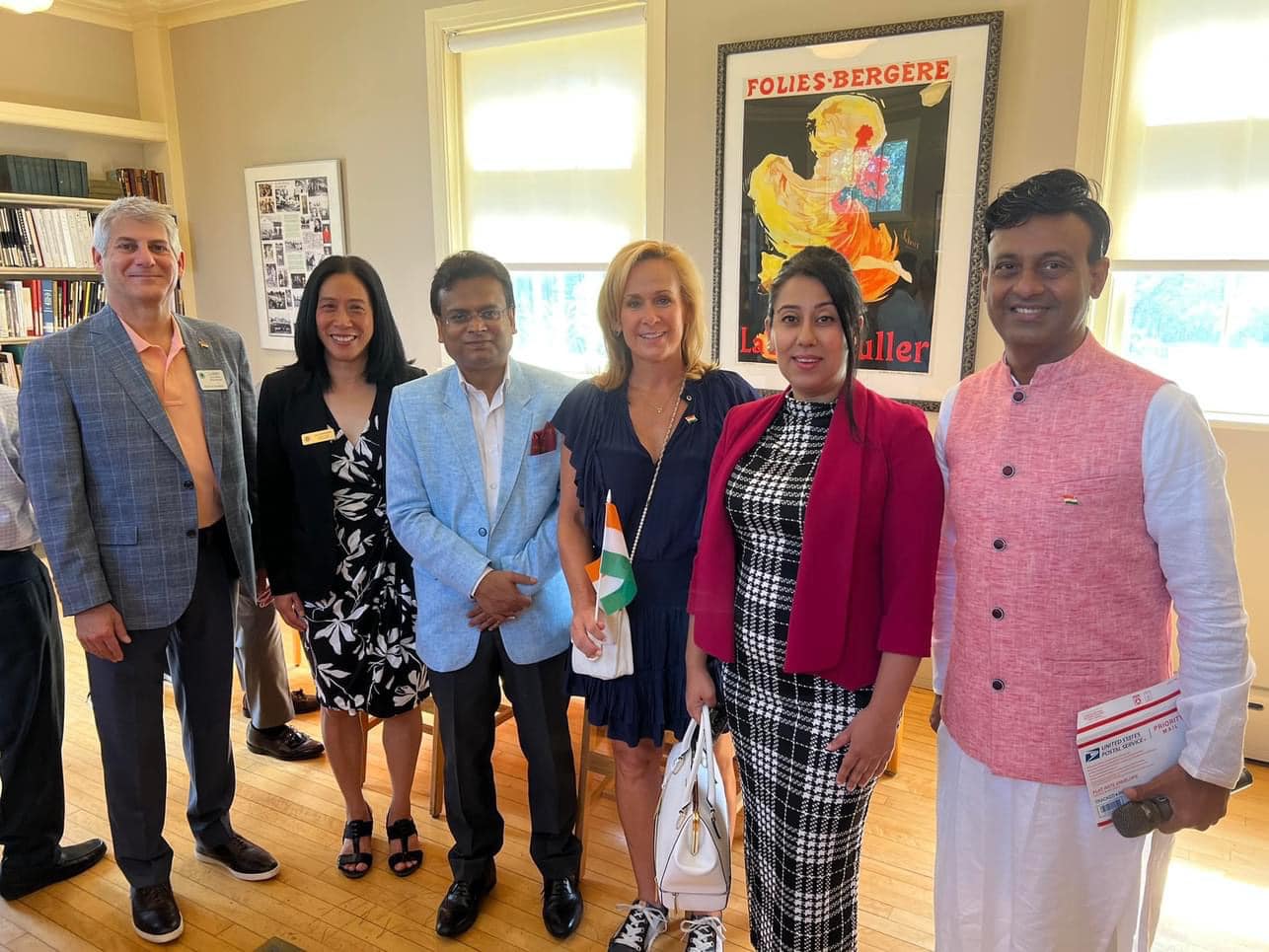
-+=