
(New York, NY: April 20, 2021) Isolation due to COVID-19 has reshaped the face of humanity. While the world faces great uncertainty with the coronavirus’ strength waxing and waning, the “new normal” has included extended periods of lockdown. With restrictions tied to the coronavirus outbreak leaving millions confined to their homes, everyone is feeling the effects of extended periods of quarantine on the body and mind. One major outcome of sustained solitude is being stuck in loneliness. Human beings are inherently social creatures, and the experience of loneliness can cause profound damage, including impairments in well-being, productivity, creativity, focus, as well as psychological harms and shortened life-spans.
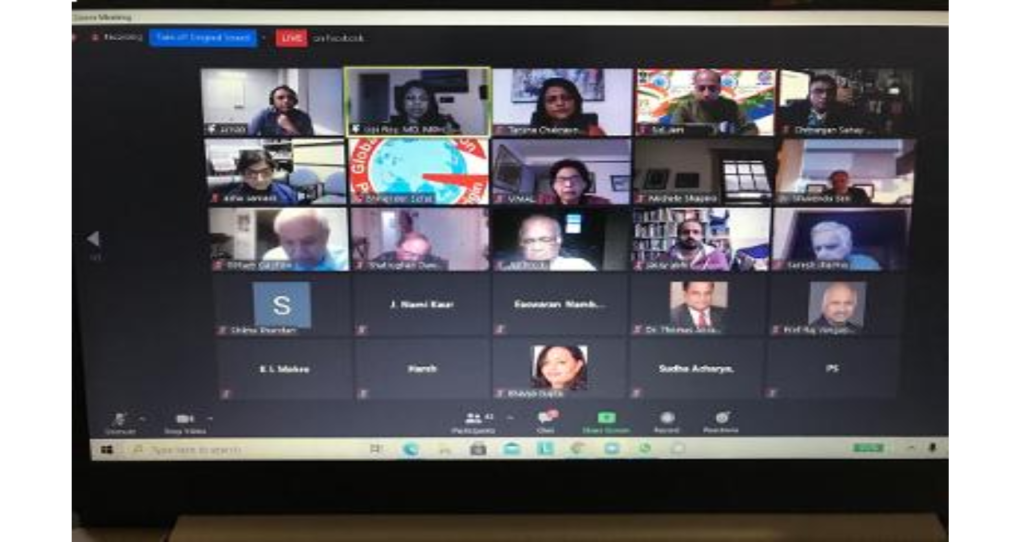
In this context, a timely discussion by an experts’ panel organized virtually by GOPIO-Manhattan on “Alone But Not Lonely – Living In The Reality Of New Normal” on Friday, April 16th, 2021, was attended by hundreds of participants from around the world and broadcast live via Facebook.
The panel of experts included: Dr. Lipi Roy, an internal medicine physician board certified in addiction medicine as well as an MSNBC and NBC News Medical Contributor; Dr. Shuvendu Sen, a pioneer in multiple collaborations leading to superior Institutional performances, has been credited for adopting dynamic and innovative measures to foster higher productivity, employment, and education; Dr. Taruna Chakravorty, a Visiting Professor at Hans Raj College in New Delhi, India, where she teaches Spanish; and, Dr. Arnab Ghosh, physician-scientist is a medical oncologist who specializes in hematopoietic stem cell transplantation, with focus of research being making tumor immunotherapy more effective. During a lively and inspiring discussion they shared their wisdom thoughts with anecdotes and real life experiences.
Dr. Lipi Roy, who is a sought-after, charismatic speaker and media personality with mission to educate and empower the public to make healthy decisions through addiction awareness, nutrition, and mindfulness, said, “The past year been very difficult as the Covid pandemic has affected us in unique and universal ways.” Stating that most people have been “isolated from routine life, the pandemic has affected our normal ways of life.” Recalling how a year ago in April 2020, everything was shut down, with Streets empty, turning out crowded cities into Ghost town, “It’s been a very tough year for all of us. Many of us had to start collecting unemployment benefits, which is a new experience for many. This pandemic has been devastating. And it was a tough go for most of us in many ways,” she added.
Dr. Roy reminded the audience that “We are all social beings. We thrive on social connections. This need transcends all barriers universally.” While admitting that “Pandemic has affected people differently.” Dr. Roy pointed out: “There are tools within each of us that we can use. We have ways to connect with people. Practicing Meditation, deep breathing. Watching comedies, and talking to people” are effective ways to combat loneliness, Dr. Roy said and added, “Love is the biggest game changer.”
 In his address, Dr. Shuvendu Sen, an Ambassador of the New Jersey Re-entry Commission, who contributes to the behavioral and medical health of the formerly incarcerated female population, and a best-selling author of the book, Why Buddha Never Had Alzheimer’s: A Holistic Treatment Approach through Meditation, Yoga and the Arts, thanked GOPIO for its contributions to enhance Indian values and for the many accomplishments. Dr. Sen reminded the audience that “This is not the first time it has happened. The world has experienced similar calamities, changing our well structures lifestyles. We have seen it time and time again. However, whenever we have been hurt, humanity is tremendously powerful to resurface from the dust.”
While so many of us have experienced the feelings of doom during the pandemic, we have had the HOPE that humanity will come out of that even stronger, Dr. Sen said. Sharing his own personal experiences, Dr. Sen said, My hope came not from scriptures, but from my patients whom I treat every-day. They showed me the Strength of humanity. They gave me hope through their personal stories, which have been very compelling and moving.” Stating that his “mission is to use holistic medicine, using one’s inner strength, Dr. Sen said, “This is an opportunity to regain our strength and to rediscover ourselves. We need to appreciate the goodness and the strength in ourselves.”
Dr. Sen shared about how physician burn out and public distrust have impacted his life. He admitted that when the pandemic broke out, there were uncertainties of the treatment modalities. At the beginning of the pandemic, physicians were fearing for their own lives and were unable to support and help patients. “You have to take care of yourself first before taking care of others.” He stressed the need for “Friendship, fellowship and honesty.” Dr. Sen concluded by saying, “We have every reason is to be optimistic. Optimism is the opium” for a better more fulfilling life, he said. He mentioned about the National Suicide Prevention Lifeline available to all in the USA that one can call 1 (800) 273 TALK (8255) and talk to a person and get the help they need.
Dr. Taruna Chakravorty, wife of former Consul General in New York, Ambassador Sandeep Chakravorty, a life coach, motivational speaker and healer, said, she loves to work with people of all ages, helping them to live their lives happily and joyously. Her mantra is “The human spirit is meant to soar the skies in jouful abandon, free from fear, full of love and compassion.” Dr. Taruna Chakravorty shared her knowledge about this state of being which is not elusive after all. Her mantra is “Happiness is yours to experience and is well within the reach of us all.”
“We forget to be grateful for the many things that we have in our lives,” Dr. Chakravorty said. “Our sense of gratitude builds positivity within us. There is no need looking for something outwards, but look inwards,” she said and the way to the inward journey is through “Meditation that leads to inner sense of peace.” According to her, When we can give to others, and when we can do something good to others, and when are instrumental in giving love and compassion to others, we find that inner peace and joy. “The more you give, the more you receive,” she said.
Dr. Chakravorty shared about her own personal story of she and her family transitioning from New York to Delhi during the pandemic and how it has impacted her family. In the face of losing one’s dear ones in life and the many challenges, especially while living in a virtual world and the many anxious moments in life we face, Dr. Chakravorty stressed the importance “to look inward rather than outward, by prating the techniques in mediation. Experience for yourself about the brilliance of how meditation impacts us.
Be conscious of what make you happy and uplifts you. And you can impact and help all around you. It is in our hands and we need to make the decision. Being happy is a conscious choice.” she stressed.
Dr. Arnab Ghosh, whose goal is to develop strategies in preclinical models and translate them into clinical studies, was instrumental in putting together the panelists. Dr. Ghosh said, The objective of the discussion is “Sharing knowledge and empowering the community, while learning how the pandemic t has impacted the community. And the focus is on people’s life stories and how they have been personally impacted.” He suggested that “doing simple things like wearing masks and distancing and learning how one behavior affects me and the society at large. We are all in this together. Science has given us the hope.”
There were several video presentations by people as to how they have been impacted by Covid and how they have coped with the pandemic. Dr. Asha Samant, the International Coordinator of GOPIO in her introduction shared about the series of panel discussions the GOPIO Manhattan Chapter has initiated with the objective of educating the public.
Dr. Thomas Abraham, Chairman of GOPIO International reminded the audience who for over a year, we are homebound. He said, Vaccination gives us hope. He commended the US government for the great roll out of the vaccination. “We are grateful to Dr. Ghosh, who has become a great assets to the Chapter.” He thanked Vimal Goyal and Asha Samant and the GOPIO Manhattan leadership, especially Shivender Sofat, GOPIO Manhattan President.
Mr. Sofat thanked the panelists and participants to the timely and very important discussion on COVID and on ways to live the new reality after Covid pandemic has impacted all. He shared about some of the initiatives by the Chapter in the recent past, especially the political and community engagement, supporting the student population and Community Feeding every month organized by the Chapter. He urged the community to support the initiative by being a volunteer and or a sponsor. Dr. Vimal Goyal proposed vote of thanks.
Call National Suicide Prevention Lifeline for those needing assistance: 1 (800) 273 TALK (8255)
 Biden also renewed calls for Americans to wear masks, framing the choice as a “patriotic duty.” “I need the American people do their part as well. Mask up, mask up. It’s a patriotic duty. It’s the only way we ever get back to normal,” he said. With a nod to the role of the private sector, Biden also suggested businesses should also require the use of masks. “The failure to take this virus seriously precisely what got us to this mess in the first place, risk more cases, more deaths,” he said.
 Consul General Jaiswal, in his address, commended GOPIO Manhattan for organizing the event and several others, honoring India and Indians. “Today is the Red Letter Day in the history of India,” the Indian diplomat with over three decades of diplomatic services around the world, told the hundreds of community leaders from around several continents who joined the celebration. “We honor today the legendary freedom fighters, recalling their bravery and love for our motherland.” Describing today’s celebrations as unique, Ambassador Jaiswal recalled the founding of the
  In 1913 Lala Har Dayal formed the Ghadar Party to organize a rebellion against the British government of India. He fled to Switzerland and then to Berlin, where he tried to foment an anti-British rising in northwestern India. After the German defeat in World War I, Har Dayal settled in Stockholm as a professor of Indian Philosophy and wrote Forty-Four Months in Germany and Turkey. He moved to the USA in the late 1920s and became a Professor of Sanskrit at the University of California, Berkeley.
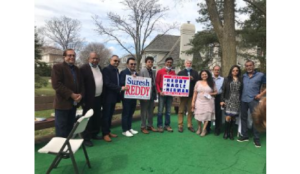 Dr. Reddy comes with immense experiences and proven leadership. Dr. Reddy grew up in the suburbs of Hyderabad in Southern India. A financial conservator, Dr. Reddy always had a passion for “uniting and bringing people together.” Recalling his childhood, the dynamic leader says, “It all started during my childhood with bringing neighborhood kids together to play “gully cricket” and also bringing people together in college to organize events, demonstrations, and educational tours. Bringing opposing parties to the table for resolving issues has always been my strong strength since my schooling days.”
 What motivates him to take on yet another challenging role for the betterment of the community? “My mantra is: If you don’t lead, someone else will lead you. If you don’t pick the right leader, the wrong leader will pick you, and as my good friend US Congressman Raja Says, and if you are not on the table, you will be on the menu
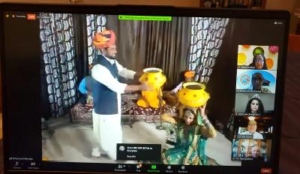 Holi has become known as India’s most vivid, joyous-festival. Holi is being celebrated in the Indian subcontinent for centuries, with poems documenting celebrations dating back to the 4th century CE. It marks the beginning of spring after a long winter, symbolic of the triumph of good over evil. It is celebrated in March, corresponding to the Hindu calendar month of Phalguna. On the eve of the festival, large pyres are lit in many parts of India to signify the burning of evil spirits. People often throw wood, dried leaves and twigs into bonfires, Ambassador Jaiswal explained.
 “The vibrancy of colors is something that brings in a lot of positivity in our lives and Holi being the festival of colors is actually a day worth rejoicing,” Motwani said. “Holi is considered as one of the most revered and celebrated festivals of India and it is celebrated in almost every part of India, transcending every region, and people of all faiths, including Hindus, Muslims, Sikhs, Christians, Parsees, Buddhists, and Jains. It represents the uniqueness of Indian culture as we, from all backgrounds stand united to welcome Spring, as Mother Nature breathes freshness into our lives and that of every living creature on Earth. Welcome to each and every one of you and wishing you and your families A VERY HAPPY HOLI!”
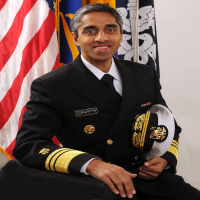 “Dr. Vivek Murthy represents the next generation of Indian American physicians,” Dr. Amit Chakrabarty, Secretary of AAPI said. “Dr. Murthy was America’s youngest-ever top doctor, and he was also the first surgeon general of Indian-American descent, when appointed by President Barack Obama in 2014. Now that he has been confirmed by the Senate, Dr. Murthy will play a key role in the administration’s response to many daunting healthcare issues, including the pandemic that has taken the lives of hundreds of thousands of Americans.”
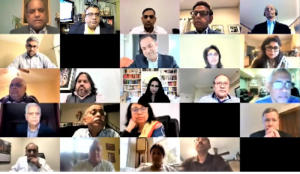 Representing the most impacted Hotel/Hospitality, Shelly Nichani, President, Infinity Hospitality Group, Stamford, CT, said, while the industry has been severely affected by the pandemic, “financial help from the Federal government has helped much, without which it would have been catastrophic.” While stating that the hospitality industry in CT has been doing overall very well, but the pandemic has halted the path to progress. He was optimistic that with the vaccines and state help, the industry will return to normal soon.
 Dr. Sheth had a passion for writing from school days onwards. “I always loved to write and was also the editor of my school magazine and wrote for local magazines as well. Although journalism was not the most popular career for women in India, especially in those days, “it remained a big passion for me. I have always been intrigued by people’s stories. And once I was well settled in my medical career, I decided to pursue my passion for media as well. The media world has given me the opportunity to meet amazing people, and bring a platform to unique and powerful stories.”
 Dr. Sheth was the co-founder and CEO of INE MultiMedia, a non-profit organization devoted to promoting and supporting charitable organizations, art, culture, education and empowerment through workshops, seminars and multimedia. Dr. Sheth is a former trustee of the Indian-American Forum for Political Education. Dr. Sheth is very dedicated to the education of the community about health related issues, and is also the producer and chair of the annual free mega Health & Wellness Expo.
 Born out of combination of her passions for both media and women empowerment, this noble initiative was co-founded by Dr. Sheth, her daughter, Shaleen Sheth, and her close friend, Deepa Jhaveri. The new global media platform is founded with the “mission to empower women across all ages, industries, and backgrounds, bringing women from around the world together daily with our inspiring, relatable, and relevant original stories,” Dr. Sheth explains. “With thousands of members and daily readers, our membership and our readership spans over 80 countries, and across the United States on our
  She served as the president of Indian Medical Association of New England in 2013. Upon her election to be the president of Indian Medical Association of New England (IMANE) Dr. Sheth said, “My goals for the group in the coming year include strengthening ties with the research and academic medical community, deepening IMANE’s many charitable, social and professional activities and organizing a collaborative health expo that will bring various hospitals and health care providers together with the Indian community.” At the end of her presidency, she had accomplished her goals and was highly praised for her leadership.
 Although Dr. Sheth and her accomplishments are well known in the New England region, she says, “My greatest achievement in life is being a mother and raising my beautiful daughter. She is everything that a mother could dream off in a child. She’s smart, kind, compassionate and she has a lot of gratitude for the opportunities that life has brought her.” One of the first things that she taught her daughter as well was her favorite quote is that “if you reach for the moon then at least you land among the stars.”
 Ambassador Taranjit Singh Sandhu greeted AAPI and FAPI members as “we are commemorating the 74th year of India’s Independence.” Pointing to how the pandemic has changed our lives, he said, “Covid has taken a toll on human lives. I congratulate AAPI and FAPI for organizing this special Medical Symposium.”
 Dr. Amit Chakrabarty, Secretary of AAPI introduced Ambassador Taranjit Singh Sandhu as “one of the most experienced Indian diplomats on US affairs, having served in the Indian Mission in Washington DC in various capacities and at the Permanent Mission of India to United Nations, New York.”
  Dr. Sudhakar Jonnalagadda, President of AAPI, said, “This year India celebrates its 74th Independence Day remembering the sacrifices made by the freedom fighters, political leaders and citizens in order to free the motherland from colonial rule. This year, COVID-19 has eliminated the ability for spectators and celebrations. The virtual world allows celebrations to proceed in a different manner, but this is also an opportunity to be re-inspired by the legacy of the Father of Nation. After all, isn’t service of mankind the best way to celebrate India’s Independence?”
 In his keynote address, Stamford Mayor David Martin, greeted India and the People of Indian Origin on the occasion of India’s 74th Independence Day. He praised the great contributions of GOPIO and the Indian American community. ““Global Organization of People of Indian Origin (GOPIO) is one organizations which not only helps its Diaspora community but all other communities,” said Stamford Mayor David Mart You have been very gracious and have supported the people and served them generously. Your services and sacrifices have saved several lives in this time of pandemic,” he told the fast growing Indian American community in Stamford and across the state of Connecticut.
 Enumerating the great contributions of India and the Indian Americans, Dr. Abraham said, “India sent a large number of its brightest to America who have made substantial contributions in building up the economy. Our contributions have come to be recognized very well in the Health Care sector, as our doctors and nurses are in the frontline combating Covid. We have also made outstanding contributions in hospitality, science and technology and education. We are also not behind in political process. In addition to many lawmakers across the nation, we are proud that one of our own, an African/Indian American woman Senator Kamala Harris has been selected as the Vice Presidential candidate by Democratic Presidential candidate Joe Biden. We are very proud of Senator Harris, our community’s achievements in political process and our contributions to the American society.”
 As part of the celebrations, GOPIO recognized and honored High School graduates, who graduated from Connecticut School Systems, with scholarships to some students with need and achievements. “You are our future and we are very proud of you. Best wishes to you on your achievements and aspirations. Reach for the star,” said Beena Ramachandran, who had coordinated the program.
 Harris, 55, becomes the first Black woman on a major presidential ticket in U.S. history and providing him with a partner well suited to go on the attack against Republican President Donald Trump. Harris, a former prosecutor and state attorney general in California, is well known for her sometimes aggressive questioning style in the Senate, most notably of Brett Kavanaugh during his 2018 Supreme Court confirmation hearing.
 The daughter of an Indian mother and a Jamaican father, Harris has knocked down barriers throughout her career. She was the first woman to serve as San Francisco’s district attorney, elected to that office in 2003, and the first woman to serve as California’s attorney general, elected to that office in 2010.
 Senator Harris’ early years also included a brief period in Canada. When Ms Gopalan Harris took a job teaching at McGill University, Ms Harris and her younger sister Maya went with her, attending school in Montreal for five years.
 The report details the actions of 58 non-profit organizations re-purposing their efforts in response to the pandemic and illustrates the power of the Indian Diaspora community. “Never before have we witnessed such a united all-out community relief effort amongst the diaspora. One of the most unique aspects we witnessed was the efforts by the next generation of philanthropists through their incredible volunteer efforts,” said Gabrielle Trippe, Indiaspora Philanthropy Initiatives Manager.
 In 2020, more opportunities are before Indian-Americans, such as those running for statewide offices, Srinivas Preston Kulkarni running for the U.S. House of Representatives from Texas District 22; Sara Gideon, speaker of the Maine lower house, who is challenging long time Republican incumbent Susan Collins; Nina Ahmad vying for Auditor General of Pennsylvania; and Ronnie Chatterjee in the running for Treasurer of North Carolina. “These are tough races and we want to get behind these candidates and get the people behind them,” Makhija said.
 Honorable Consul General of India in Atlanta, Swati Kulkarni introduced Dr. Jonnalagadda and offered her best wishes to the President of AAPI during the 1st ever Virtual Change of Guard Ceremony that was live cast on social media platforms around the world. In her address, she praised Dr. Jonnalagdda for his leadership and contributions to the society. Describing AAPI as a world leader in Medical Education and Healthcare Delivery, Dr. Kulkarni urged AAPI to be more politically active. Along with the new President, a new executive committee members took oath. They included, Dr. Anupama Gotimukula, President-Elect; Dr. Ravi Kolli, Vice President, Dr. Amit Chakrabarty, Secretary of AAPI; Dr. Satish Kathula, Treasurer of AAPI, Dr. Sajani Shah, Chair of AAPI’s BOT; Dr. Ami Baxi, YPS President; Dr. Kinjal Solanki, MSRF President; and Dr. Surendra Purohit, Chair of AAPI Charitable Foundation.
  In his acceptance speech, Dr. Jonnalgadda has vowed to take the nearly four decades old organization to the next level and “bring all the AAPI Chapters, Regions, Members of the Executive Committee and Board of Trustees to work cohesively and unitedly for the success of AAPI and the realization of its noble mission.” He wants to increase AAPI membership by offering more benefits and opportunities for members. “AAPI has given me so much — networking, advocacy, and education — and I am honored to serve this noble organization. I sincerely appreciate the trust you placed in me as the President of AAPI, and I am deeply committed to continue to work for you,” declared Dr. Sudhakar Jonnalagadda, the new President of AAPI. Dr. Jonnalagadda will lead AAPI as its President in the year 2020-2021, the largest Medical Organization in the United States, representing the interests of the over 100,000 physicians and Fellows of Indian origin in the United States, serving the interests of the Indian American physicians in the US and in many ways contributing to the shaping of the healthcare delivery in the US for the past 39 years. “AAPI must be responsive to its members, supportive of the leadership and a true advocate for our mission,” he said. Dr. Suresh Reddy, the out going President of AAPI through a video, presented some of the major accomplishments of his presidency under unique circumstances. Expressing gratitude to the AAPI fraternity for entrusting the role of leading AAPI, Dr. Reddy said, AAPI is stronger and is in safe hands, as he passed on the traditional gavel and the coat to the new President of AAPI. Dr. Seema Arora, the out going Chair of AAPI Board of Trustees, shared her experiences while working with a dedicated Team of AAPI leaders, contributing to strengthen AAPI and help AAPI reach greater heights. Dr. Sajani Shah, the very first to be a second generation physician of Indian origin, assumed charge as the Chair of AAPI Board of Trustees. In her inaugural address, she promised to work with the entire AAPI Body, and help AAPI realize its mission. In his opening remarks, Hon. Amit Kumar, Consul General of India in Chicago and the Chief Guest at the event praised the contributions of Indian American Physicians. He lauded the efforts of AAPI especially during the COVID pandemic. He urged AAPI to collaborate in pharma sector and Ayushmaan Bharat as well as in telehealth related issues providing guidelines in collaboration with the MCA of India. While lauding g Dr. Reddy for his great accomplishments during the year of pandemic, Mr. Kumar offered his best wishes to the incoming President of AAPI, Dr. Jonnalagadda and Team.
  Dr. Stella Gandhi, the outgoing President of YPS, Dr. Pooja Kinkhbwala, the outgoing president of MSRF, Dr. Chander Kapasi, the outgoing president of AAPI CF were others who had addressed the audience. A visual presentation of the history of “Change of Guard” took the AAPI members down the lane through its 37 tears of great historical growth under AAPI leaders. Earlier the event began with an Inter-Faith Prayer and Meditation, led by leaders of various Faiths and parying for several AAPI leaders who have been critically ill due to the pandemic and those who have lost their lives. Dr. Jonnalagadda was born in a family of Physicians. His dad was a Professor at a Medical College in India and his mother was a Teacher. He and his siblings aspired to be physicians and dedicate their lives for the greater good of humanity. “I am committed to serving the community and help the needy. That gives me the greatest satisfaction in life,” he said modesty. Ambitious and wanting to achieve greater things in life, Dr. Jonnalagadda has numerous achievements in life. He currently serves as the President of the Medical Staff at the Hospital. And now, “being elected as the President of AAPI is greatest achievement of my life,” As the President of AAPI, the dynamic physician from the state of Andhra Pradesh, wants to “develop a committee to work with children of AAPI members who are interested in medical school, to educate on choosing a school and gaining acceptance; Develop a committee to work with medical residents who are potential AAPI members, to educate on contract negotiation, patient communication, and practice management; Develop a committee to work with AAPI medical students, and to provide proctorship to improve their selection of medical residencies.” Dr. Jonnalagadda wants to emphasize the importance of Legislative Agenda both here in the US and overseas, benefitting the physicians and the people AAPI is committed to serve. According to him, “The growing clout of the physicians of Indian origin in the United States is seen everywhere as several physicians of Indian origin hold critical positions in the healthcare, academic, research and administration across the nation.” He is actively involved with the Indian community and member at large of the Asian Indian Alliance, which actively participates in a bipartisan way to support and fund electoral candidates.His vision for AAPI is to increase the awareness of APPI globally and help its voice heard in the corridors of power. “I would like to see us lobby the US Congress and create an AAPI PAC and advocate for an increase in the number of available Residency Positions and Green Cards to Indian American Physicians so as to help alleviate the shortage of Doctors in the US.” . A Board-Certified Gastroenterologist/Transplant Hepatologist, working in Douglas, GA, Dr. Jonnalagadda is a former Assistant Professor at the Medical College of Georgia. He was the President of Coffee Regional Medical Staff 2018, and had served as the Director of Medical Association of Georgia Board from 2016 onwards. He had served as the President of Georgia Association of Physicians of Indian Heritage 2007-2008, and was the past Chair of Board of Trustees, GAPI. He was the Chairman of the Medical Association of Georgia, IMG Section, and was a Graduate, Georgia Physicians Leadership Academy (advocacy training). “AAPI and the Charitable Foundation has several programs in India. Under my leadership with the pioneering efforts of Dr. Surender Purohit, Chairman of AAPI CF, we will be able to initiate several more program benefitting our motherland, India,” Dr. Jonnalagadda said. Dr. Jonnalagdda expressed gratitude to his predecessor, Dr. Suresh Reddy and Dr. Anupama Gotimukula and the current Team for initiating the AAPI Endowment Fund, which he plans to strengthen during his presidency, making AAPI financially viable and stronger in the years to come.In all of his efforts, Dr. Jonnalagadda wants to work with his executive committee and all branches of AAPI membership in a congenial and non-competitive manner, focusing on the noble mission of this prestigious organization. His experiences in organizing conferences and meetings which help to bring members together and attract new members is vital to the success of the organization. Dr. Jonnalagadda is committed to upholding and further augment the ideals for which AAPI stands. “I am confident that my experience, work ethic and firsthand experience in organizing Conventions and fundraisers are best suited to carry on the responsibilities and lead this noble organization to new heights.”AAPI represents more than 100,000 physicians and fellows of Indian Origin in the US, and being their voice and providing a forum to its members to collectively work together to meet their diverse needs, is a major challenge. With the changing trends and statistics in healthcare, both in India and US, we are refocusing our mission and vision, AAPI would like to make a positive meaningful impact on the healthcare delivery system both in the US and in India. AAPI will continue to be an active player in crafting the delivery of healthcare in the most efficient manner in the United States and India. “We will strive for equity in healthcare delivery globally.” Dr. Jonnalagadda is confident that with the blessings of elders, and the strong support from the total membership of AAPI and his family, he will be able to take AAPI to stability, unity, growth and greater achievements.”
 Dr. Jonnalagadda, who will be administered the oath of office as the President of AAPI at the 1st ever Virtual Oath ceremony on July 11th, 2020, has vowed to take the nearly four decades old organization to the next level and “bring all the AAPI Chapters, Regions, Members of the Executive Committee and Board of Trustees to work cohesively and unitedly for the success of AAPI and the realization of its noble mission.” He wants to increase AAPI membership by offering more benefits and opportunities for members.
 As a very compassionate, goal oriented and with strong leadership skills, Dr. Jonnalagadda will be assisted by an executive committee consisting of Dr. Anupama Gotimukula, President-Elect; Dr. Ravi Kolli, Vice President, Dr. Amit Chakrabarty, Secretary of AAPI; Dr. Satish Kathula, Treasurer of AAPI, and Sajani Shah, Chair of AAPI’s BOT.
 He was born in a family of Physicians. Dr. Jonnalagadda’s dad was a Professor at a Medical College in India and his mother was a Teacher. He and his siblings aspired to be physicians and dedicate their lives for the greater good of humanity. “I am committed to serving the community and help the needy. That gives me the greatest satisfaction in life,” he says with modesty.
 In order for us to help and support the youngsters who want to pursue Medicine and want to succeed in their dreams to be successful healthcare professionals, “I envisage a plan for young aspiring physicians of Indian origin,” he had told them. “I want to launch a program that will, Educate the Residents from India on ways to negotiate contract with insurance companies and Medical Institutions; Identify Centers/Areas across the US for Clinical Observership Program for aspiring young physicians; and, help Youth who want to pursue medicine as their career, guide them with the skills for participating in interviews and ways to succeed in school. This is the first time ever AAPI is embarking on this new initiative and I am excited to be able to take this to the next level”
 Dr. Jonnalagadda was the Chair, AAPI Awards Committee in 2015, and had served as the Alumni Chair, Atlanta AAPI Convention in 2006. His leadership and commitment were much appreciated when he had served as the Convener of AAPI 2012 Fundraiser, and helped AAPI raise $150,000, and in the 2013 Fundraiser, he had helped AAPI raise $120,000 in Atlanta. In 2016, he had helped in AAPI 2016 Fundraiser through his efforts in Atlanta raise funds for Hurricane Harvey.
 Republicans who have spoken with Trump in recent days describe him as depressed and “down in the dumps.” “People around him think his heart’s not in it,” a Republican close to the White House said. Torn between the imperative to win suburban voters and his instincts to play to his base, Trump has complained to people that he’s in a political box with no obvious way out. To console himself, Trump still has moments of magical thinking. “He says the polls are all fake,”
 A new poll finds


 Penguin behavior









 “I always had connectivity to my Alma Mater and kept up with my professors and the pioneers in establishing this Medical College and many other institutions. Since I had the close affinity with my Alma-mater, I took keen interest in establishing and being the president of Kasturba Medical College Alumni which is one of the largest alumni associations in US, UK and many other countries and had kept up communication with these Associations. Kasturba Medical college, I was honored as an outstanding Alumni of Kasturba Medical college, which is a great honor and that I am much grateful to the Academy.”
 Besides being the founding president of the American Association of Physicians of Indian origin in Mississippi, he was also the past president and chair of the India Association of Mississippi and was Advisor to US Department of Health & Human Services at NHSC Washington, DC 2005-2008 during President Bush Administration.
 Dr. Sampat Shivangi, an obstetrician/gynecologist, has been elected by a US state Republican Party as a full delegate to the National Convention. He is one of the top fund-raisers in Mississippi state for the Republican Party. Besides being a politician by choice, the medical practitioner is also the first Indian to be on the American Medical Association.
 “Dr. Shivangi’s commitment to advancing America’s first principles, his distinguished career as a physician, and a leader at the state and national levels has made a profound difference in the lives of many,” Joel Anand Samy said. “We look forward to working with Dr. Shivangi in his new capacity as an Executive Advisory Board Member of ILS in advancing principled policies in America and strengthening the US-India ties on the healthcare, economic and security fronts.”



 This year’s theme for the annual event was New York, New York, which had featured live music from
  Best of New Haven by Readers Poll in 2018 and 2019,
  New Haven Register wrote that “Coromandel is a cut above and offers intoxicating cuisine from a land where colors dance on the palate.” New Haven Advocate says, “A restaurant like Coromandel is the much needed corrective to pink-dyed, faux- Tandoori Chicken and what a corrective it is.”




 Attended by nearly 100 AAPI members and their families, the gala was planned and organized by it Leadership Team consisting of Dr. Sampat Shivangi, President; Dr. Vani Vijayakumar, Vice President; Dr. Indira Veersetti, Secretary; Dr. Udaya Shivangi, Treasurer; and, Dr. Leena Gupta, Entertainment Chair Dr. Swati Kulkurni, the Indian Consul General at Atlanta, GA, who was the Chief Guest at the Gala, enlightened the delegates with latest on healthcare and about the US-India business relationship.
 Recognizing the contributions of local leaders, AAPI MISSISSIPPI honored and presented plaques and bouquets to all who had helped organize the event and raised funds for this spectacular event.
 Dr. Shivangi, President of AAPI Mississippi, thanked all the members of the Chapter for attending the gala and for working hard to bring in sponsors and medical booths. A special note of appreciation was offered to all the beautiful women for their willingness to attend and to participate in the Entertainment part of the Fashion show.
 Elected Officials from Long Island, including Town Supervisor Judy Bosworth, Councilman Peter Zuckerman, Supervisor Bosworth attended the event and presented Citations from the Town of North Hempstead to the dedicated AAPIQLI team.
 To entertain the audience, ballet troupe led by dance teacher Marcia Krengel, came all the way from Patchogue and gave a very lively rendering of “Mamma Mia”, along with 2 other dazzling performances, “Lion” and “Never Give Up”! So appropriate! Mathy Pillai sang an operatic, outstanding version of our National Anthem; and Jyoti Gupta sang a very lovely Hindi number about motherhood.
 Dr. Shivangi, founding president of American Association of Physicians of Indian-origin in Mississippi, said, “Having served on the Mississippi State Board of Mental Health for more than a decade as Vice Chair and Chair, this is a unique honor for me to serve on the National Advisory Council and I look forward to serve the nation with my best of abilities.” He thanked President Trump and Secretary Alex Azar for their consideration and the opportunity to serve.
 Dr. Shivangi is the National President of Indian American Forum for Political Education, one of the oldest Indian American Associations. Over the past three decades, he has lobbied for several Bills in the US Congress on behalf of India through his enormous contacts with US Senators and Congressmen.


 International Leaders Summit’s partners included Biocon Biologics, a subsidiary of Biocon Ltd, American Association of Physicians of Indian Origin representing 80,000 Indian American physicians and TiE DC, a chapter of The Indus Entrepreneurs.
 Dr. Sudhakar Jonnalagadda, President-Elect of AAPI, highlighted the role of government in 10 areas in improving health care quality and safety in the United States. He pointed to examples of proposed federal actions to reduce medical errors and enhance patient safety are provided to illustrate 10 general roles: (1) the regulation of the purchase of health care, (2) the regulation of provision of health care, (3) ensure access to quality care for vulnerable populations, (4) the regulation of health care markets, (5) supporting research and acquisition of new knowledge, (6) development and evaluation of health technologies and practices, (7) monitoring health care quality, (8) informing health care decision makers, (9) development of the health care workforce, and (10) providing framework and venues to convene stakeholders from across the health care industry.
 In this traditional dance form, women clad in traditional Kerala attire with gold brocade attached to it and wearing jasmine garlands on their heads, rhythmically moved around a lighted Nilavilakku, singing and clapping their hands, to the tune of a particular genre of songs called Thiruvathirappaattu, which is meant solely for this graceful dance.
 The cultural events consisted of several live dances, classical Bharatnatyam, fusion, Bollywood, folk and contemporary dances, live music and songs, sung in Malayalam, a language spoken by Malayalees around the world. Children from the ages of five to older adults delighted the audience with their melodious voices, and several dances both cinematic and traditional art. Through “Oppana” another traditional art from Kerala, a group of young talented kids presented yet another tradition of Kerala.
 Another attraction and a much appreciated item powerfully portrayed by a group of talented young girls was a Dance Drama called “Jatayu Moksham” derived from the Epic Ramyayana, where Sita was kidnapped by Ravana, who was instigated by his sister Shurpanaka, who wanted to take revenge on Ram and Lakshman for “humiliating’ her by not giving into her urges to marry her.
 In his Onam message, Mahabali told the audience that the “beauty of the festival lies in its secular fabric. People of all religions, castes and communities celebrate the festival with equal joy and verve. Onam also helps to create an atmosphere of peace and brotherhood by way of various team sports organized on the day,” he added.
 Onam is a festival celebrated in the south-western state of Kerala, India. The Keralites or the Malayalees, the illustrious people of the beautiful state are known around the world, celebrate the festival of Onam wherever they are.
 Speaking about the MOU, Dr. Prathap Reddy, Chairman and Founder, Apollo Hospitals Group, and President of Global Association of Physicians of Indian Origin (GAPIO), said, “This collaboration will provide people across the country access to the best specialists of Indian origin residing in the United States. This collaboration is another example of our continuous endeavor to provide affordable and best healthcare services to people across India.”


