Sue-Lin Wong and David Rennie Win Osborn Elliott Journalism Prize

Asia Society is pleased to announce that the 2023 Osborn Elliott Prize for Excellence in Journalism on Asia is being awarded to Sue-Lin Wong and David Rennie of The Economist for their China coverage. The $10,000 cash award is presented annually by an independent jury to the best example of journalism about Asia during the previous calendar year.

In announcing the award, the Osborn Elliott Prize Jury issued the following statement: “We are pleased to award the 2023 Osborn Elliott Prize to The Economist’s Sue-Lin Wong and David Rennie for their deeply reported, engagingly accessible coverage of China. In an eight-part podcast, ‘The Prince,’ Wong explained how Xi Jinping skillfully navigated his way to power, drawing on the personal history and circumstances that shaped his world. Rennie’s definitive primer on what Xi’s rising, sometimes righteous, often resentful Communist Party-led China wants offers insight into looming geopolitical and economic challenges.”

“Rennie and Wong recognize China’s many recent historical achievements, but also have experienced the limits of life under Xi. Wong, who also poignantly reports on how Beijing has shorn once-freewheeling Hong Kong of its autonomy, has had to leave the city. Rennie, who writes about Xi’s drive for absolute command of society, spent nearly two years separated from his wife and child by China’s draconian COVID lockdowns.”

The two will be honored at an awards ceremony and discussion at Asia Society in New York, on Tuesday, June 6.

Sue-Lin Wong is The Economist’s South-East Asia correspondent. She was previously China correspondent and host of “The Prince”, a podcast about Xi Jinping. Prior to joining The Economist, she was South China correspondent at the Financial Times covering politics, business and technology in Hong Kong and mainland southern China. Before that, she was a correspondent at Reuters with beats including the Chinese economy and North Korea. She opened the Shenzhen bureaus of the Financial Times and Reuters. She is a graduate of the Australian National University.

David Rennie is Beijing bureau chief of The Economist. He is the author of its weekly “Chaguan” column on China and co-host of the “Drum Tower” podcast. He joined The Economist in 2007. From 2007-10 he was the EU correspondent and “Charlemagne” columnist, based in Brussels. From 2010-12 he was British political editor and “Bagehot” columnist, in London. In the summer of 2012 he moved to Washington DC. He was “Lexington” columnist 2012-17, and Washington bureau chief 2013-18. In May 2018 he moved to China as Beijing bureau chief, launching “Chaguan” that year. He has written special reports for The Economist on China and the world order, on the China-U.S. relationship, on Hispanics in America, and on the enlargement of the EU to take in formerly communist countries.

Previously, he was on the foreign staff of the Daily Telegraph, with postings in Sydney, Beijing, Washington DC and Brussels. From 2006 until he joined The Economist he was also a contributing editor to the Spectator. He is a contributing panelist on the “1A” program on NPR/WAMU. He is a graduate of Cambridge University.

The Jury praised a number of other entries this year. Their citations follow:

“Uditha Jayasinghe and Devjyot Ghoshal of Reuters, reporting from Sri Lanka, dispassionately captured the country’s tragic descent into economic crisis, as a nepotistic government made a series of bad decisions that left farmers without fertilizer, hospitals without life-saving drugs, and petrol stations without fuel. They then covered the massive protests that eventually overturned the government, leading to a China vs. India rivalry for influence that emerged in the revolution’s wake.”

“Nikkei Asia’s Cheng Ting-Fang and Lauly Li, two of the world’s most knowledgeable tech reporters, delivered an extraordinarily detailed package of coverage that demonstrated the futility of efforts to shorten and nationalize semiconductor supply chains, a critical national-security and economic question for many countries.”

The People’s Archive, from India, published a detailed, important look at the difficulties many of the 200 million Indians living in Uttar Pradesh have accessing healthcare, often because of reasons of caste or socioeconomic status.”

The jury for the Osborn Elliott Prize is chaired by Marcus Brauchli, managing partner of North Base Media and the former top editor of both The Washington Post and The Wall Street Journal. Jurors for the 2023 prize are: Barbara Demick, journalist, author, and 2006 Osborn Elliott Prize winner; Dorinda Elliott, Executive Director of the Fairbank Center for Chinese Studies at Harvard University and formerly with Newsweek; Nisid Hajari, author, member of the Bloomberg editorial board and a former top editor at Newsweek; and Norman Pearlstine, media executive and advisor and former top editor at the Los Angeles Times, Time Inc., and The Wall Street Journal.

The Osborn Elliott Prize for Excellence in Journalism on Asia, affectionately referred to as the “Oz Prize,” honors the late Osborn Elliott, legendary journalist, author and former editor-in-chief of Newsweek. Elliott was a leading figure in the field of journalism who became one of the earliest practitioners of “civic journalism”—the deliberate focusing of the journalistic enterprise on urgent issues of public policy.

Find out more about the Oz Prize at AsiaSociety.org/OzPrize.

Google’s Change To Search Engine Results With AI Is Raising Concerns For Online Publishers

At its recent annual developer conference in Mountain View, California, Google unveiled a host of new features, such as innovative writing tools for Gmail and immersive directions in Google Maps. However, one announcement that may have slipped under the radar could potentially bring about the most significant transformation to the internet since Google became the world’s leading search engine in the early 2000s.

Google intends to revolutionize the way it displays search engine results by leveraging artificial intelligence (AI). To avoid exaggerating the possible implications, this shift could be akin to detonating a nuclear bomb on an already beleaguered online publishing industry.

During the conference, Google showcased its plans to incorporate generative AI in search engine results—a feature not yet available to the general public. They demonstrated this using a sample search query: “what’s better for a family with kids under 3 and dog, Bryce Canyon or Arches?” In traditional Google Search, this question about U.S. national parks might not yield a comprehensive answer. However, as shown in the screenshot below, the AI-driven search generates a response in a conversational tone that takes into account both the children’s ages and the dog.

So, how does generative AI accomplish this? It’s akin to a magic trick. The AI is trained by “reading” all accessible content on the open web and uses that information to formulate answers to questions conversationally. Google clarified in its presentation, “Then if you want to dig deeper, there are links included in the snapshot.”

Why might this spell trouble for the online publishing industry? Because Google is essentially crafting answers to complex questions using all available content on the open web without requiring users to visit the pages containing that information. Modern online publishing relies on users visiting a page to convert views into advertising revenue and subscriptions. This holds true for major publishers like the New York Times and Forbes, as well as independent authors and journalists writing on platforms like Substack and Twitter.

The million-dollar question is whether the links on the right, which I’ve circled below, will ever receive clicks.

Google claims that its new AI-driven search feature will generate clicks, as it aims to be transparent about the sources of its information. However, one could argue that this is similar to expecting users to click on Wikipedia’s sources listed at the bottom of each entry. While a small percentage of users deeply interested in a topic might click on those links, most will simply read the Wikipedia entry without concern for the sources.

This behavior is understandable, as users typically just want quick answers to their questions without any additional effort. For instance, when someone wants to know Walt Disney’s birthplace, they aren’t looking for an assignment; they just want a trivial fact. Disney was born in Chicago, and while Wikipedia cites a 2009 Chicago Sun-Times article as its source, very few people will actually click on that link. This is how Google Search’s AI-generated responses could potentially cannibalize content currently provided by newspapers, magazines, and online news outlets.

Some may even view this as a form of plagiarism, as one tech critic pointed out in a recent Substack post. Regardless of what it’s called, the outcome will likely involve fewer views for content creators’ websites and more for Google, which essentially compiles the world’s information and aims to keep users within its ecosystem. Google can then monetize those views through advertising – revenue that might have otherwise gone to publishers on their own websites.

As views are the lifeblood of the commercial web for content creators, it’s challenging to envision many websites surviving such a drastic change to Google’s flagship product. The analogy of a nuclear bomb being dropped on the web is fitting, considering Google Search’s dominant market share both in the U.S. and worldwide. Google Search is the go-to method for most people seeking answers to their questions, whether it’s about a baseball game’s schedule or a chicken noodle soup recipe.

The exact launch date for Google’s new Search capability remains unclear. The company plans to roll it out on a trial basis in the coming weeks, taking a cautious approach, as reported by The Verge. However, with competitors like ChatGPT gaining popularity, it’s difficult to imagine Google allowing other tech companies to surpass it. Many users have already replaced Google searches with ChatGPT, which is precisely what concerns Google.

While some critics argue that AI technology is overhyped and won’t work as advertised, this concern may be beside the point. The real question is whether these tools will alter how internet users consume information, and it appears the answer is a resounding yes.

Predicting the future is always challenging, but if one were to speculate about the impact of Google’s Search plans on the open web, it seems likely that it would:

  1. Devastate the already struggling ad-supported industry on which many newspapers and magazines depend, and
  1. Push more content creators to implement paywalls, another strategy previously unthinkable for some, including Paleofuture.

Google is poised to unleash a bomb that could obliterate countless websites, though the exact timeline remains uncertain. The efficacy of conventional defenses—such as subscriptions and Facebook-driven traffic—against this impending threat is also questionable.

Shashi Tharoor Inaugurates South Asian Literary Festival In Washington

Shashi Tharoor, a member of the Parliament of India and former Under Secretary-General of the United Nations on May 5, 2023 participated in a discussion and responded to a wide range of topics including India’s digital and economic progress, UK-India relations, Britain’s colonial past in India, and ongoing global crises, while inaugurating the third annual DC South Asian Literary Festival at the Jewish Community Center.

Thanking the founders of the DC South Asian Arts Council, Manoj Singh, and Geeta Singh, for their incredible work in promoting the Arts in Maryland, Lieutenant Governor of Maryland, Aruna Miller said, “I am more excited to have an individual like Dr. Shashi Tharoor, who is here all the way from India. What an incredible orator he is – an author, and a humanitarian. He’s everything that we should all aspire to be. So, I am so honored to welcome him to the state of Maryland.”

During a 90-minute Q&A discussion, moderated by immigration attorney, Sheela Murthy, Tharoor talked about the positive influence his parents had on his life, his sisters’ support, views on Hinduism – his admiration for the teachings of Swami Vivekananda and Mahatma Gandhi, and his experience in writing fiction and non-fiction books among other topics. He also answered questions from the audience.

Tharoor, who is the longest serving Member of Parliament from Thiruvananthapuram, Kerala, said the top three areas of concern for him are the Russia-Ukraine war, China-Taiwan tension, and the India-Pakistan issue. He fears that if there is “temptation” by Russia to use nuclear weapons against the Ukrainians, and the growing China-Pakistan relationship and their coordinated attacks against India.

He noted that India is the fastest growing major economy in the world, and that it cannot to be distracted by conflicts with bordering neighbors. “I would say that the potential is just enormous,” noting India’s progress on tech horizon, such as Unified Payments Interface, mobile revolution, access to internet, and Artificial Intelligence.

According to Tharoor, “unemployment is a huge worry,” and India needs to focus on education and technical skills for youngsters. He said India can still serve as a workforce for the world given the median age of India’s population is just 29.

While recalling his May 2015 debate at Oxford Union, where he spoke about “Britain owes reparations to her former colonies,” Tharoor noted “The opportunity to actually lay a case against colonialism in Britain to a British audience, was what I thought was worth doing.”

In particular, Tharoor pointed out in the preceding 10 to15 years, British writers and historians in their books argued that colonialism was a good thing and went on to quote Neil Ferguson saying that, “India’s success in the world of globalization was entirely due to the underpinnings of the British… and Lawrence James saying the British Empire was the greatest experiments of altruism in human history.”

He said a few weeks later the debate was posted on YouTube, and it went viral. “I was astonished when Prime Minister [Modi]… actually stood up in a public forum and said that this speech was an example of the right person saying the right thing at the right place, which was for me, immensely, immensely surprising, as well as gratifying.”

According to him, his speech caused some concerns since Modi was to travel to the United Kingdom on his first ever official visit in November 2015. So, there was some nervousness on both sides “as to whether this might actually cast a blight on his visit” but the visit went well.

Tharoor said he again visited England to speak about his book in 2017, and this time he made “a fuss about the absence of an apology” from the British. “And I said, I’m not looking for reparations, but I’m looking for atonement. And they said, what’s atonement, and I said three things that Brits could be doing,” noting they should teach their kids colonial history, setup a museum to colonialism, and tender a “simple apology” on April 13, 2019. It was the Centenary of Jallianwala Bagh massacre where the British massacred 1600 unarmed protestors on the occasion of Baisakhi in Amritsar.

He reminded that the massacre was a result of nonviolent protests by innocent people against the Rowlett Act which was a “really rigorous infringement on human freedoms,” at a time when the British had promised a Dominion status for India for its support during the First World War, and eventually broke their promise. Tharoor also recalled how the British massacred 100,000 innocents in 1858, “after the so-called mutiny” including women and children in the streets of Delhi to teach Indians a lesson.

About issuing an apology, he continued, “I said, if a government or politically elected government finds it difficult, doesn’t matter. Send a minor member of the Royal family because everything was done in the name of the Crown. I had thought they might send Meghan [Markle] there…” and the audience burst into laughter.

Then, six months before the Centenary, he heard from a senior British official that a note about apology had made it through the Cabinet to the Prime Minister. Tharoor said, “I was waiting with bated breath for the 13th of April 2019… And then Prime Minister Theresa May spoke in Parliament,” adding she only expressed “regret” and not an “apology.”

To a question about India’s relationship with Britain, he said “I think that it’s getting better. It certainly had ups and downs,” while noting there are still issues on the trade front. He praised Britain for electing Rishi Sunak as its Prime Minister, and commended the recent announcement of King Charles, that India is one of the first countries he would like to visit after his Coronation. Tharoor said somebody recently asked him whether he [King Charles] will apologize, and Tharoor continued “Who knows he’s somebody who thinks enough outside the box to be able to surprise us.”

Tri-State Sindhis Network Celebrates Ancestry, Culture At Sindhi Mela

Pyaara Sindhi USA Inc., a newly established organization, held its first Sindhi Mela on Sunday April 30, 2023 at Asamai Temple Auditorium in Hicksville, New York to help connect all Sindhis in the tri-state area. In spite of bad weather, about 400 people attended the mela, organizers said in a press release.

Community leader and founder president of Pyaara Sindhi USA, Indu Gajwani said starting this organization was a dream come true. Gajwani, with the help of friends and community leaders, formed Pyaara Sindhi USA Inc.

“Every community except the Sindhis have their own exclusive events and melas,” organizers noted. Now the community has one of its own.

The other officeholders of Pyaara Sindh USA Inc. include President Harish Shahdadpuri, Vice President Jagdish Kakwani, Secretary Poojaa Makhijani, Treasurer Kishore Mulchandani, Director Ashok Chainani.

Indu Gajwani also thanked her husband Shyam Gajwani, “without whose support, guidance and help this would not be possible,” the organization said.  Indu Gajwani welcomed everyone and introduced the committee members. A Sindhi prayer, Behrano of Jhulelal (Sindhi God), was performed by Sindhi Pundit Hemant.

It was a free for all event with Sindhi food was served including sindhi snacks like chola dabal, boondi singar, pattice, pakora , with milkrose and tea. Attendees sported colorful traditional Sindhi outfits.

The cultural program brought Sindhi Sufi songs sung by famous singer Mahesh Chander along with Gope Chander’s family – Aarti, Haresh and Anil. The group was supported by Vijay Kumar on the keyboard, Sammy on tabla and Nuncha on dholak.

Pundit Hemant rendered soulful music and Sindh kalaams.  This was followed by cultural dances by children as well as adults.  Indu Gajwani also performed a Sindhi dance.

The Emcees of the show were Indu Gajwani and Kishore Mulchandani.

Raffles were drawn and prizes were given. This event ended with sindhi delicacies for dinner – Sai Bhaji Pulao, Bhee Wadi Patata, Daal Pakwan, Sevaian kheer and gulab jamun. There were also cupcakes for children.

Pyaara Sindhi USA Inc thanked the nearly 20 sponsors who came forward to support the event and make it a success. Scores of volunteers stepped up to help organize the event and were recognized and thanked by Indu Gajwani.

AIA Celebrates 75th Anniversary Of India’s Independence In NY

To commemorate the 75th anniversary of India’s Independence the Association of Indians in America (AIA National) recently hosted its 25th Honor Banquet in Flushing Meadows Park, New York. The sold out event was attended by over 250 prominent members of the organization and the Indian community.

US Senate Majority Leader, Chuck Schumer, Mayor of New York City, Eric Adams, Consul General of India at New York Randhir Jaiswal graced the occasion as chief guests. New York Assemblywoman Jennifer Rajkumar also attended the event.

The celebrations began with an invocation followed by both the American and Indian National Anthem. A classical dance performance by Maheshwari Jagabattula on A.R. Rahman’s Vande Mataram song brought in the patriotic fervour among the audience.

Picture : TheUNN

Schumer in his speech shared details about his recent trip to India and how fascinated he was with the country. He further emphasized the significance of the US-India bilateral relations and said, “Our partnership has a huge potential for growth in the 21st century.” Similar thoughts were expressed by Counsul General Jaiswal, who spoke at length of strengthening the relationship between the two nations.

Addressing the gathering, AIA National president Gobind Munjal highlighted India’s culture and values and the progress made by Indian Americans. “Indians in America bring distinct vision, values, needs and goals and we and our next generations should fully assimilate and participate in the political system and take active role in shaping the future of this great country,” he remarked.

Appreciating Indian culture, NYC Mayor said, “I like the Indian culture, tradition, values, the education and close family system and I like you to retain and enrich main stream America. I also want you to fully participate in the political system by getting everybody to register to vote and put forward candidates to have your voice heard.”

During the event, two distinguished guests received AIA’s “Honor Award” for their outstanding achievements. They included Padma Bhushan Arvind Panagariya, Ph.D. Professor of Economics and Jagdish Bhagwati Professor of Indian Political Economy in the School of International and Public Affairs (SIPA) at Columbia University since 2004 and Renu Khator, Ph.D Chancellor and President of the University of Houston, Texas.

Banquet committee chair, Dr Buddhadev Manvar and chair Board of Trustees, Dr Samin Sharma also addressed the gathering and applauded the AIA team for organizing the event.

The Association of Indians in America (AIA) is the oldest not-for-profit organization of Asian Indians established in 1967. It is the grassroots national organization of Asian immigrants in the United States. With chapters and membership spread across the United States of America, AIA represents the hopes and aspirations of those immigrants who are united by their common bond of Indian Heritage and American Commitment.

Asian Americans Advocate To Invest in NYC’s AAPI Communities

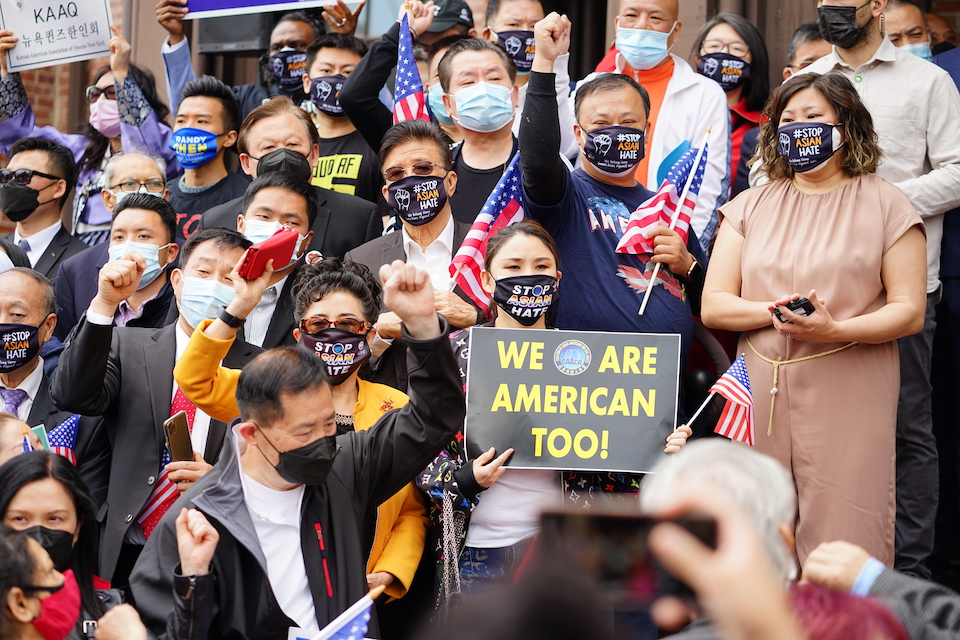
The Coalition for Asian American Children and Families (CACF) and the 18% and Growing Campaign gathered in front of Queens Borough Hall Wednesday to call on City Council to invest in New York City’s AAPI communities.

Over 70 advocates, service providers, and community members attended Wednesday’s rally, in which speakers and attendees urged City Council members to support the collective fiscal requests of the greater AAPI community that would enhance the health, wellness, and economic well-being of thousands of New Yorkers.

The rally was the first 18% and Growing Campaign rally in Queens, a borough that is home to some of New York City’s oldest Asian American communities.

First founded in 2008, the name of the 18% and Growing Campaign takes its name from the fact that AAPI New Yorkers now comprise more than 18% of the City’s population. Today, the 18% and Growing Campaign is a unified coalition of 90 AAPI-led and serving community-based organizations from across the five boroughs.

But despite the AAPI community’s expansive growth and development, funding for AAPI communities in New York City has historically lagged behind.

Picture : TheUNN

“Over the course of the last 15 years, the 18% and Growing Campaign has been at the forefront of the push to get AAPI New Yorkers the resources and support they both need and deserve. Though persistent and harmful stereotypes like the model minority myth lead many to believe that all AAPI New Yorkers are thriving, the reality is quite different,” said CACF’s Co-Executive Directors Anita Gundanna and Vanessa Leung. “Enhancing programs like the AAPI Community Support Initiative will allow community-based organizations across the city to continue to improve and expand their programming for those who need language access support, mental health resources, and more. While there have been tremendous strides made when it comes to City Council support for our communities in recent years, we are reminded of just how much we still have to do – especially in terms of getting AAPI New Yorkers who are most marginalized the critical, culturally responsive support they need.”

In order to get our communities the support they need, the 18% And Growing Campaign will be advocating for the following critical funding needs:

  • Enhance the AAPI Community Support Initiative to $7.5 million to expand social services by AAPI serving community-based organizations to address the fiscal equity needed to build bridges between culturally competent and linguistically accessible services and the most vulnerable AAPI New Yorkers.
  • Enhance the Communities of Color Nonprofit Stabilization Fund (CCNSF) to $7.5 million to provide capacity-building support to Black, Latinx, and AAPI-led community-based organizations.
  • Enhance the Access Health Initiative to $4 million to support community-based organizations (CBOs) who provide education, outreach, and assistance to marginalized New Yorkers on how to access health care and coverage.

“Asian Americans and Pacific Islanders make up 18 percent of New York City’s population, yet our communities rarely receive the funding and support they need to thrive,” said CACF’s Director of Policy and Government Relations Felicia Singh. “As we continue to experience the economic and health-related consequences of the pandemic, it’s become clear that the city has to do more to increase access to mental health care, culturally responsive youth programming, and gender-based violence prevention programs. As budget negotiations continue to ramp up, we’re calling on City Council to continue to build on last year’s investment in our communities by supporting our proposal in full.”

Several members of 18% and Growing Campaign spoke at Wednesday’s rally, including Tsering Lama, Policy Manager at Adhikaar, Christine Serdjenian, New York Organizer at Armenian-American Action Network, Mohamed Q. Amin, Founder and Executive Director at Caribbean Equality Project, Mitch Wu, Director of Queens Community Services at Chinese-American Planning Council (CPC), Micah Dicker, Outreach Worker and Communications Specialist at CIANA, Shaaranya Pillai, Deputy Director at India Home, Julie Ma, Director of Strategy at the Korean American Family Service Center (KAFSC), Josh Bentley, Grants and Advocacy Coordinator at Korean Community Services of Metropolitan New York, Inc (KCS), Sandra Choi, Civic Participation Director at the MinKwon Center for Community Action, and Ngawang Tsering, Vice President at Tibetan Community of New York & New Jersey (TCNYNJ).

“Every day in our bustling worker center, we are providing essential services like Workforce Development, Health Care Support, Community Safety Support, Adult Literacy classes, Civic Engagement and Legal Services,” said Tsering Lama, Policy Manager at Adhikaar. “At this critical time, where CBOs remain the lifeline of the City for many communities, it’s critical that the NYC legislators fund AAPI CBOs like Adhikaar and our members of the 18% and Growing Coalition.”

“Being underfunded results in our communities being underserved. An equitable budget would help Armenian-Americans with data collection and disaggregation, increase access to much-needed mental health care services, and create culturally responsive educational curriculum and youth programming,” said Christine Serdjenian, New York Organizer at Armenian-American Action Network. “We are proud to be a part of the 18% and Growing Campaign and echo the fiscal requests of the greater AAPI community that would enhance the health, and economic and social well-being, of all AAPI New Yorkers.”

“New York City is home to the largest Indo-Caribbean and South Asian foreign-born population, many of whom live in immigrant communities like Richmond Hill and South Ozone Park in Queens. For the past three years, community-based organizations have been on the front lines providing life-saving services through resource mobilization,” said Mohamed Q. Amin, Founder and Executive Director at Caribbean Equality Project. “The 18% and Growing Campaign amplifies the intersectionality and growth of the diverse AAPI communities and our collective fight for fiscal equity, an investment in community-driven solutions to create thriving, sustainable immigrant communities.”

“It is difficult to ignore how AAPI New Yorkers have been neglected and how they have not been accounted for when it comes to funding social services and public benefits,” said Emira Habiby Browne, Founder and CEO at CIANA. “Budget equity means fighting for the most essential needs- health, education, language access, safety, and more- that are being kept from nearly one-fifth of our city’s population.”

“We pride ourselves in providing the tailored services our communities need, addressing gaps that conventional senior center programs just fail to address,” said Shaaranya Pillai, Deputy Director at India Home. “Despite how challenging and how expensive it is to find culturally competent care and personnel, we continue to invest in our older adults.”

“Access Health is an imperative program – it is essential. It allows community-based organizations to help our new neighbors or long-tenured friends get the benefits they deserve,” said Josh Bentley, Grants and Advocacy Coordinator at Korean Community Services of Metropolitan New York, Inc (KCS). “And yet, if the equity budget, the city, and the state continue to neglect us, we cannot continue to offer these services to the extent we wish.”

“The investment that Asian Americans receive falls short of our community’s numbers here in New York City,” said Tina Han, Community Leader at MinKwon Center for Community Action. “WE DEMAND OUR FAIR SHARE!”

“The Tibetan community here in New York City is the largest in North America and we have around more than 20,000 Tibetans in NY/NJ,” said Ngawang Tsering, Vice President at Tibetan Community of New York & New Jersey (TCNYNJ). “We need our community center to help us preserve our culture.”

“As a member of the AAPI community, KAFSC recognizes the urgent need for greater investments and resources to support our rapidly growing and diverse community, particularly for immigrant survivors of gender-based violence,” said Jeehae Fischer. Executive Director at the Korean American Family Service Center (KAFSC). “KAFSC stands in solidarity with our fellow community members in advocating for transparent investments and equitable opportunities that will allow our AAPI community to thrive. Together, we can build a more just and humane social ecosystem that supports and uplifts all New Yorkers, regardless of race or ethnicity.”

“New York City continues to struggle to get AAPI New Yorkers – many of whom are from immigrant and limited English proficient backgrounds – the resources they need to lead fulfilling and productive lives. To close that gap, resources must be allocated to community-based organizations like ours that have the trust and deep ties in the community to provide human services, health care, mental health supports, and racial literacy programming,” said Wayne Ho, President and CEO at the Chinese-American Planning Council (CPC). “We join the 18% and Growing Campaign members to call on the City to enhance the AAPI Community Support Initiative to $6 million so that Asian American community members can receive culturally relevant and language-accessible services needed to not only survive but also thrive in these troubling times.”

Wednesday’s 18% and Growing Campaign rally was the second of four planned budget rallies across New York City. We will next rally on May 16th at McKinley Park in Brooklyn, and on May 24 in Little Yemen in the Bronx. To RSVP, head here.

For more information, please contact Winnie Kong, CACF’s Communications Associate, at wkong@cacf.org.

More Indian Students Go To UK Than Chinese Students

More Indian students are now proceeding to the UK for higher studies than any other country, including China according to the British High Commissioner to India, Alex Ellis . He was speaking at a public lecture on ‘India-UK Relations’, at O.P. Jindal Global University in Haryana.

“The degree of human connection between our two countries is extraordinary, yet there is potential to take the India-UK relationship to a deeper and profound level,” Ellis said stressing on the need to develop stronger people-to-people connect. “It is the human level that is more important. I’d like to get more British people coming to India to understand the reality of India.”

During his first visit to the University, the High Commissioner also addressed students of international affairs, law and other disciplines, giving them a diplomatic and strategic overview of the relationship between the world’s two important democracies.

Alluding to the trade relations between the two countries, the High Commissioner said negotiations for a free trade agreement were going on and it’s important to look at not only the economic value it provides but also the strategic value.

Speaking of the different areas of cooperation, Ellis emphasized, “Together, as nations we will try to deal with some of the biggest problems the world faces, especially climate change! We have already demonstrated how well we have cooperated in the research and production of Covishield vaccine during the pandemic.”

The High Commissioner added that India is also number one in different kinds of visas on which Indians are travelling to the UK and also referred to India becoming the third country in the world from where illegal migrants cross the British channel on boats.

Professor Dr C. Raj Kumar, founding vice chancellor, of O.P. Jindal Global University welcomed the High Commissioner. In his address he said, “Among the post-colonial relationships of the world, the India-UK relationship is one of the most defining relationships of the last 35 years. Education plays a very significant role as this relationship transcends the usual boundaries of strategy, security, trade, investment and more.”

Most U.S. Parents Pass Along Their Religion And Politics To Their Children

Which are American parents more likely to pass along to their kids – their religion or their politics?

Turns out, most parents pass along both kinds of affiliation, and they do so at similarly high rates, according to a new analysis of several Pew Research Center surveys.

How we did this

This may be surprising, considering that parents are more likely to prioritize the transmission of their religious views than their political views. In a fall survey by the Center, 35% of U.S. parents said it was extremely or very important that their kids grow up to share their religious views, while fewer than half as many (16%) said the same about their political views. Notably, parents saw both religious and political transmission as much less important than passing along other values, such as being honest and ethical, hardworking, and ambitious.

Still, people in some religious groups did place a high priority on raising their kids to carry on their faith. For example, 70% of White born-again or evangelical Protestant parents said it was extremely or very important for their children to hold similar religious beliefs, compared with just 8% of religiously unaffiliated parents.

As every parent knows, though, wanting a child to do something is not the same as getting a child to do something. So how successful are American parents, overall, at transmitting their religious and political affiliations to their children?

One way of answering the question is to compare U.S. teenagers and their parents. That’s what we did in a 2019 survey of more than 1,800 teens ages 13 to 17, each of whom was interviewed along with one parent. In most cases, the parent was a biological mother or father, but sometimes it was an adoptive parent, stepparent, foster parent, grandparent or other guardian.

The survey indicated that the vast majority of parents with teens have passed along their political loyalties. Roughly eight-in-ten parents who were Republican or leaned toward the Republican Party (81%) had teens who also identified as Republicans or leaned that way. And about nine-in-ten parents who were Democratic or leaned Democratic (89%) had teens who described themselves the same way.

The transmission of religion through American families appears to be similarly efficient. In the same 2019 survey, 82% of Protestant parents had teens who also identified as Protestant, 81% of Catholic parents had Catholic teens, and 86% of religiously unaffiliated parents – those who described themselves as atheist, agnostic or nothing in particular – had teens who were also “nones.”

The survey sample was not large enough to estimate transmission rates among parents who belong to non-Christian religious groups, such as Jews and Muslims. But there were enough parents from some Christian subgroups to estimate their “success” at passing on their faith. Among evangelical Protestant parents of all races and ethnicities, for example, 80% had teens who identified as evangelicals, and an additional 7% had teens who identified with other Protestant traditions. Just 12% had teens who were unaffiliated and 1% had teens who were Catholic.

In other words, even though evangelical Protestants place much higher importance on passing their religion to their children than religiously unaffiliated parents do, the two groups are about equally successful at actually doing so, at least through about age 17.

Still, many people switch religious affiliations or leave organized religion entirely between the ages of 18 and 29. So another way to gauge the transmission of religion is to look at how American adults describe the religion of the person or people who raised them, and then compare it with their own religious affiliation today. That’s what we did in another survey in 2015.

The survey found that most people who were raised in a single religion – either by two parents of the same faith or by a single parent – retained that religion. Roughly eight-in-ten of those raised Protestant (79%) were still Protestant. About six-in-ten of those raised Catholic were still Catholic (62%), and an identical proportion of those raised with no religious affiliation were still unaffiliated (62%).

There was much more flux among the roughly one-in-five U.S. adults (21%) who were raised in interfaith households. Among those raised by two people, one of whom was Protestant and the other unaffiliated, the Protestant identity proved to be “stickier”: 56% identified as Protestant, while 34% were unaffiliated, 3% were Catholic, and 7% belonged to other religions.

Among those raised by two people, one of whom was Catholic and the other unaffiliated, 42% were unaffiliated in adulthood while 32% were Catholic, 20% were Protestant, and 5% identified with other religions.

Meanwhile, among those who were brought up by two people, one Protestant and one Catholic, the outcome was close to a toss-up. In adulthood, 38% identified as Protestant, 29% were Catholic, 26% were unaffiliated, and 7% belonged to other religions.

Hyderabad Airport Is World’s Most Punctual Airport

Aviation analytical firm, Cirium in a report has stated that the GMR Hyderabad International Airport Limited (GHIAL) is the only airport to achieve 90.43 percent on-time-performance (OTP) in March this year, making it the world’s most punctual airport.

Cirium said it reviewed more than 5 million flights globally during March, and the Hyderabad airport came on top both in the ‘Global Airports’ and ‘Large Airports’ categories being the only airport to cross the 90 percent mark.

The Hyderabad airport served 29 airlines and 77 routes and had 14,658 scheduled single-segment flights in March. Bengaluru’s Kempegowda International airport  came second at 86.14 percent OTP followed by Bogota’s El Dorado International airport in Colombia.

Over the years, GHIAL has brought in several first-of-its-kind technological innovations for the airport sector in the country, including the first-ever integrated and centralized Airport Operations Control Center (AOCC) and modern passenger information systems and technological initiatives.

In the medium and small airports category no Indian airports made it to the top 20. The country is one of the fastest growing aviation markets in the world, with passenger traffic reaching an all time high in 2022. Additionally, India has constructed more airports in the last decade than most of the countries globally, including both domestic and international facilities.

Family Of Slain Indian-American Woman Raise Money To Fight Gun Violence

The family members of a 33 year-old Indian-American woman, who was allegedly shot at and killed by her husband last month, are raising money to help prevent gun violence.

Nabaruna Karmakar, an engineer by profession, was found with two gunshot wounds after officers arrived at her home in Morrisville, North Carolina, responding to a 911 call, police said.

Karmakar’s husband Michael Aaron Matthews, who placed the 911 call to report a purported double suicide, was been arrested and charged for shooting and killing his wife at their home on April 14.

Despite the report of a double suicide, Karmakar was the only person hit by gunfire at the scene, and police believe she was murdered, the People reported.

The fundraiser set up by the victim’s family has so far raised close to $10,882.

“We are all deeply saddened by the death of Nabaruna Karmakar, a beautiful girl with a smart mind whose life was claimed by gun violence. Hoping there will be no more victims, Naba’s family is raising money to benefit Everytown for Gun Safety Support Fund,” the GoFundMe page read.

Formed in 2013, the non-profit organization advocates for gun violence prevention, according to its website.

Indians working and living in the US have not been spared from the scourge of gun violence, with Aishwarya Thatikonda from Telangana being the latest victim.

The first four months of gun violence in 2023 as of May 1, saw 5,971 deaths, 11,035 injuries, 184 mass shootings and 290 children shot, according to the non-profit Gun Violence Archive.

Prior to her death, Karmakar worked in research at the SAS Institute and earned master’s and doctorate degrees in industrial engineering from North Carolina State University, the People reported.

The motive for the murder is yet to be ascertained with police officials carrying out further investigations into the case.

Matthews appeared before a court on April 17 where the judge announced that he would remain locked up without bond for the time being.

If convicted of the murder, Matthews could face the death penalty or life in prison.

Mortal remains of 27-year-old Aishwarya Thatikonda, who was killed in a mass shooting at a mall in the United states on May 6, have been brought home.

The body arrived at Rajiv Gandhi International Airport Hyderabad late Wednesday and the last rites will be performed Thursday.

The woman engineer from Hyderabad was among nine persons killed in a mass shooting at a mall near Dallas.

Aishwarya and eight others were killed when a gunman opened fire at Allen Premium Outlets mall in Allen near Dallas in Texas State.

Her Indian friend was also injured. A total of seven persons were wounded in the incident.

A resident of Saroornagar area in Hyderabad, Aishwarya was working as project manager in a company called Perfect General Contractors LLC in Texas.

Her father Narsi Reddy works as a judge in Rangareddy district court. The family was planning to leave for the US to bring the mortal remains. However, Telugu Association of North America (TANA) made the arrangements to send the body in coordination with various agencies.

Aishwarya, who obtained a Bachelor’s degree in civil engineering from Osmania University, did her MS in construction management from Eastern Michigan University.

‘Mughal-E-Azam’ To Tour North America

The musical production will tour 13 cities starting with Atlanta on May 26, 2023

Indian theatrical Mughal-e-Azam will be making its American debut. The cast and crew of the musical play will be touring 13 cities in North America in May 2023.

Picture : TheUNN

An interpretation of K Asif’s hit classic film that was released in 1960, the play is set in the Mughal era when Emperor Akbar was in power. It is centred around the forbidden love story of Akbar’s son Prince Salim and the courtesan Anarkali. Emperor Akbar who disapproves of the relationship is forced to take the difficult choice between responsibility towards his subjects and duty as a father.

Produced by Shapoorji Pallonji Group and directed by Feroz Abbas Khan, the play will be enacted in both Hindi and Urdu with dance sequences, spectacular lighting, extravagant costumes, and live singing. With 70 people on the cast and 150 crew members working behind the scenes, the musical is one of the most expensive theatre productions to have toured in India.

Prominent Indian designer Manish Malhotra has designed over 600 costumes for the play using rich silks, velvets, bandhani, and brocades, and crafted with zardozi embroidery. Its value is worth crores of rupees, making Mughal-e-Azam’s costume design the most expensive in the history of Indian theatre.

The play has received critical acclaim and has scooped up several awards in the year following its premiere. Some of the awards to the play’s credit include Best Costume Design, Best Choreography, Best Original Set Design, Best Original Lighting Design, and Best Ensemble Cast. Director Khan was honoured with the award for Best Director at the BroadwayWorld India Awards. It also won the award for Best Play.‌

Bollywood stars Rishi Kapoor, Anil Kapoor, filmmaker Karan Johar, and industrialist Mukesh Ambani have praised the play. The North American tour will kick off on May 26 in Atlanta, followed by New York, Baltimore, Lakeland, Chicago, Newark, Dallas, Houston, Phoenix, and San Jose among others. Tickets are available on Cinema On Stage’s website.

Narendra Modi’s First State Visit To The US In June

Prime Minister Narendra Modi is set to embark on an official state visit to the United States from June 21 to 24, where he will be welcomed by President Joe Biden at the White House. This marks Modi’s first state visit to the US during his nine-year tenure as prime minister, with the last Indian leader to make a state visit being former Prime Minister Manmohan Singh from November 23 to 25, 2009. Although PM Modi has made several trips to the US, none have been classified as state visits, which hold the highest rank in diplomatic protocol.

State visits are characterized by a head of state or government traveling to a foreign country in their sovereign capacity. As such, they are officially referred to as a “visit of [name of state]” rather than “visit of [name of leader].” In the US, state visits occur only upon the invitation of the president, acting in their capacity as the head of state. These visits often span several days and consist of various elaborate ceremonies, depending on the visiting leader’s itinerary. For instance, in the US, these may include a flight line ceremony, a 21-gun salute White House arrival ceremony, a White House dinner, exchange of diplomatic gifts, an invitation to stay at the Blair House, and flag street lining. Modi’s visit will feature a state dinner on June 22.

Not every trip made by a foreign leader is considered a state visit. State visits hold the highest rank and ceremonial significance compared to other types of visits, and they symbolize the pinnacle of friendly bilateral relations. They are relatively rare in order to maintain their prestige and symbolic status. For example, under US diplomatic policy, the president can host no more than one leader from any nation once every four years.

Lower-ranked visits are classified as official visits, official working visits, working visits, guest-of-government visits, and private visits, according to US diplomatic policy. The key distinction between these visits and a state visit is that state visits are carried out in a sovereign capacity, with only the head of state allowed to make such visits. Other visits can be made by various high-ranking leaders, including crown princes, vice-presidents, and ceremonial heads of state. State visits also involve numerous elaborate ceremonies, whereas invitations for other visits are sent out more freely.

PM Modi’s previous trips to the US were categorized as a working visit (2014), working lunch (2016), and official working visit (2017). The US Department of State website describes his 2019 visit as one where he “Participated in a rally in Houston, Texas.”

Indeed, state visits hold the utmost prestige and ceremonial importance. However, when it comes to actual diplomatic work, the classification of the visit does not necessarily determine its effectiveness. Working visits can be just as successful in nurturing healthy relationships between countries as state visits. In fact, due to the infrequency of state visits and the numerous ceremonial events associated with them, most diplomatic work is often accomplished during other types of visits.

The Karnataka Story: Truth Finally Triumphs

The Congress has virtually swept the election in Karnataka winning 136 seats out of 224. This time, the voters proved cleverer as they did not leave any opportunity for the BJP to use either its money or muscle power to come to power. The party has not won even half the seats the Congress has won.

A party, which declared its ambition of ushering in a Congress-mukt Bharat has to reconcile itself to a BJP-mukt Dakshin Bharat. The BJP has only itself to blame for the drubbing it received.

The party had no right to form a government but it managed to form one by engineering defections. Once it came to power through dubious means, it thought that it had the mandate to do whatever that pleased their leaders and cadres.

Soon, the government became synonymous with 40 percent, the cut the ministers expected in the awarding of government contracts. In comparison, Pakistani leader Benazir Bhutto’s husband was known only as “Mr Ten Percent”!

When the people of Karnataka were suffering from price rise and unemployment, the government sought to divert their attention to a non-issue. The BJP felt threatened by the hijab that some Muslim girls wore while attending classes.

The BJP declared a war on Muslim girls by not allowing hijab-wearing girls from attending schools and colleges. It did not matter to them that they were depriving the girls an opportunity to study and do well in life.

The defiance by a hijab wearer was the kind of stuff that enthused a whole lot of the population, not just Muslim women. Forget good governance, even governance was put on the back-burner as the BJP sought to drive the Christians to the wall. For no rhyme or reason, it enacted a stringent anti-conversion law, euphemistically called the Freedom of Religion Bill.

To give some nuggets of wisdom contained in the law, mass conversion was defined as conversion of two and more people. Which means if a husband and wife couple converted to Christianity, it would be declared as a mass conversion, inviting harsher punishment. If a poor child is admitted to a good school, not a government school, and the fee is taken care of by a Christian, it will be treated as an allurement.

Hijab was not the only card it used against the Muslims. They enacted a stringent anti-cow slaughter law and removed the Muslims from the Other Backward Classes (OBCs), eligible for reservation.

The government did not bestir itself when fringe groups like the Hindu Janajagruti Samiti and the Sri Ram Sene unleashed campaigns against halal meat and letting Muslim businessmen participate in temple fairs.

They even wanted a ban on the use of loudspeakers in masjids. Chief minister Basavaraj Bommai did not think it necessary to rein in these elements so much so that one BJP leader had the gumption to say that his party did not need the support of Muslims. A BJP legislator was seen egging on his supporters to bash up the Christians and if they faced any problem, he was there to help them.

One had even doubts whether the BJP was leading a democratic government in the state. What the party did not appreciate was that a large majority of the common people, meaning a majority of the Hindus, were not happy with the kind of politics they were indulging in.

For tens of thousands of Hindus who studied in Christian schools or who benefited from Christian medical institutions like St. John’s Medical College, Bangalore, it was scandalous to claim that they were there to convert people.

Crisis often brings out either the best or the worst in man. In the case of the Metropolitan Archbishop of Bengaluru Peter Machado, it was an occasion for him to prove his mettle. He made it clear that the Christian community would not be browbeaten by anyone and it would defend its rights to do their bit for the development of the country.

Unlike some bishops of Kerala, who talked about quid pro quo like offering Christian votes for increased rubber price and who talked about the glorious past when Christians were Hindus, Archbishop Machado went to the Supreme Court defending the Christian right to practice and propagate their faith.

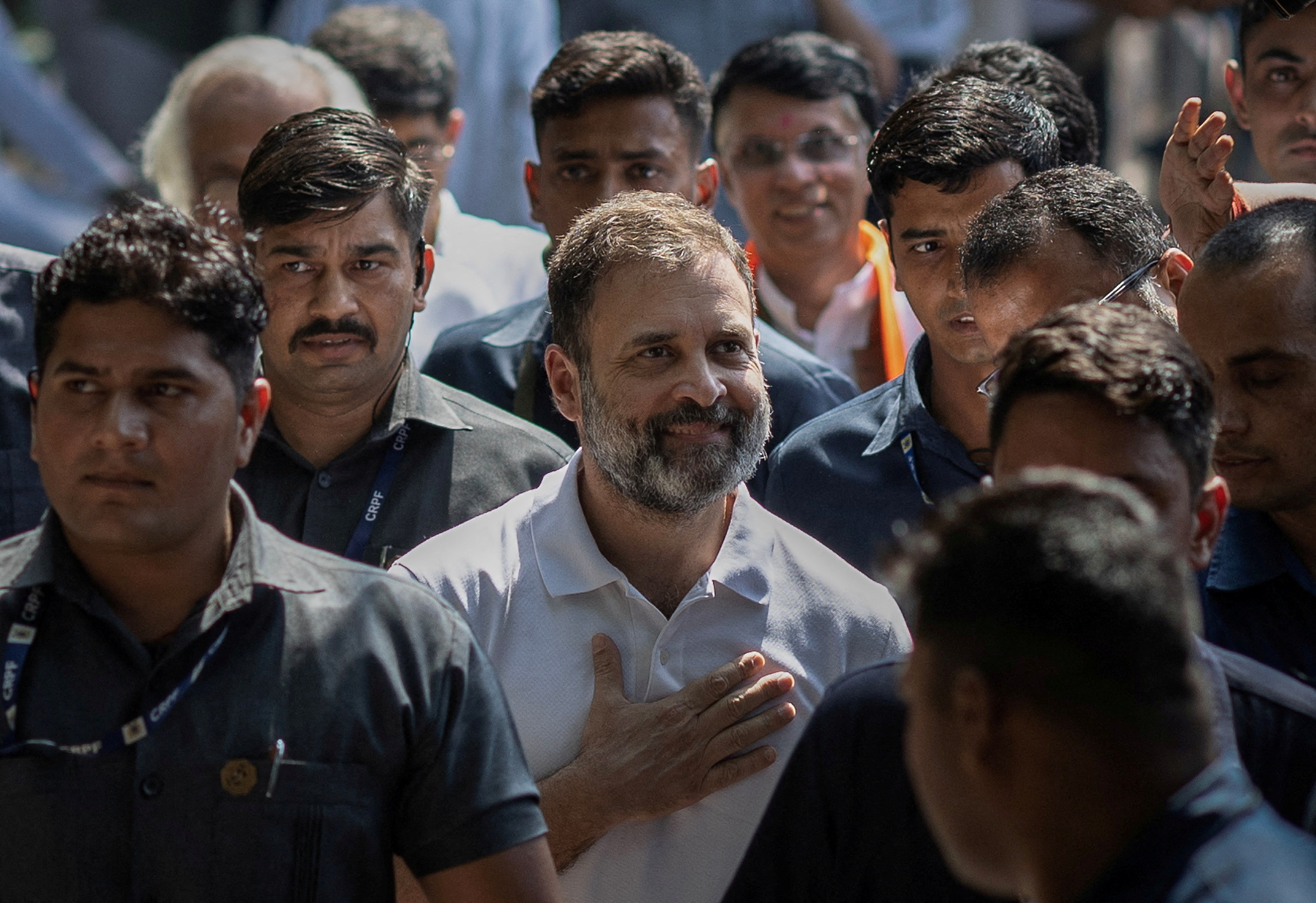
All this had its impact on the voters who were only waiting for an opportunity to vote out the Bommai government. When Congress leader Rahul Gandhi began his Bharat Jodo Yatra from Kanyakumari, the BJP leaders were stunned by the kind of response he received in Kerala.

They took consolation in the hope that Gandhi would have to walk alone through Karnataka. The government did everything possible to disrupt his journey. But wherever he went, lakhs of people were there to cheer him up. He was mobbed at every point.

It was obvious that Gandhi had struck a chord with the masses. The results have revealed that a majority of the constituencies through which he walked have voted in favour of the Congress.

Of course, the BJP knew about the groundswell of support the Congress enjoyed. It tried to counter it by resorting to crass communalism. There was a mention of organisations like the PFI and the Bajrang Dal in the Congress manifesto. All it said was that if they tried to take the law into their own hands, it would be dealt with.

Leaders like Narendra Modi and Amit Shah, who were the star campaigners of the BJP, tried to emotionally blackmail the voters by claiming that the Congress was against Lord Hanuman. It is a different matter that the Bajrang Dal never championed the cause of the unemployed Hindus and those who lost their jobs during the Covid period. True, it was founded in Karnataka but it never won the hearts of the people by taking up people’s causes.

So when Narendra Modi exhorted the people to vote for the BJP by chanting slogans in favour of the god of love, compassion, devotion, strength and intelligence, they knew that he was conceited and, therefore, paid no attention to his exhortation.

Amit Shah, who addressed more rallies than Modi and BJP chief Jagat Prakash Nadda, claimed that the party would get 150 seats in a House of 224. The people knew that he was talking through his hat for he had no clue of the Kannadiga mind.

In all the other states where the party is in power, it is either by engineering defection as in Madhya Pradesh or joining hands with the winner as in Nagaland. In the last election in Himachal Pradesh, where the Hindus are about 97 percent of the population, the BJP failed to retain the state despite the two bearded leaders from Gujarat vigorously campaigning in the BJP president’s home state.

And in UP, the BJP won mostly because of the appeal of Yogi Adityanath, not because of the gentlemen from Gujarat. Yet, an impression has been created by the media that Modi is invincible. He could not even win the Delhi Municipal elections, though he is a voter there.

The Karnataka elections prove that the communal card does not always work. The film The Kerala Story was released with a view to influencing the voters in Karnataka. Modi used the election to promote the film.

The film was based on the claim that 32,000 women from Kerala were swayed by Love Jihad and they were indoctrinated and sent to fight in Afghanistan, Syria and other places where the Islamic State, also known as the Islamic State of Iraq and the Levant, is in combat.

The fact of the matter is that there were over 42,000 IS warriors, who were recruited from countries like Germany, France, the US etc. There were not even 100 Indians among them, although India has the third largest Muslim population in the world.

Modi should have been happy that Indians did not join the ranks of a terrorist organisation. Instead, he was busy promoting the film. When the film’s claims were critically examined, it transpired that only three, yes only three, women from Kerala joined the IS ranks.

Three became 32,000 in the film and the BJP government found it necessary to give the film tax exemption. In the past, films that promote national integration, family planning etc were given tax exemption. Under Modi’s regime, hate films like The Kerala Story that promotes lies and calumny get tax exemption!

Why did Modi’s campaign not make any impact in Karnataka? Because they knew that what he and Amit Shah were talking about was false. In fact, Amit Shah said at a rally that Kerala was Karnataka’s neighbour and he did not want to say anything about it. As if Kerala was a gone case.

And when John Brittas, a CPM MP, questioned him in a newspaper article, the Rajya Sabha chairman thought it necessary to summon the MP and seek a clarification. It is not known under what law he asked for such a clarification.

Of course, the people of Karnataka knew that the campaign of calumny against Kerala, which Modi once compared to Somalia in sub-Saharan Africa, was absolutely baseless. In Mangalore, which borders Kerala where Malayalam and Kannada are spoken, the people voted for a Muslim who contested on the Congress ticket.

Out of the 15 or so Congress MLAs who defected to the BJP, a majority lost the election this time. Why? People did not approve of their conduct. They knew that they would have taken money to change sides and defeat the purpose of the voters who elected them.

Defection is not something which people want. It is against this backdrop that the defeat of Jagadish Shettar, former chief minister, who contested on the Congress ticket should be seen.

The local Congress leaders had been campaigning against him and all of a sudden when they were asked to vote for him because he did not get a ticket from the BJP, they found it a difficult task. The point is that the people do not approve of the politics of turncoats like Shettar.

The Congress, perhaps, did not know that the BJP was skating on thin ice and it could fall any time.

One reason why the Congress could do well was because there was complete unity of purpose among its leaders. The state leaders played as important a role as leaders like Rahul Gandhi and his sister Priyanka Gandhi.

The strike rate in terms of rallies held and seats won of the siblings was much more than that of Modi, Shah and Nadda put together. Yet, the funny thing is that Gandhi is ridiculed as Pappu when the sobriquet fits well the two from Gujarat.

There were some armchair intellectuals who supported Shashi Tharoor when he contested against Mallikarjun Kharge for the post of Congress President. They argued that he was younger and could articulate better in English.

When the BJP tried to corner Kharge in Parliament over his remark about the BJP’s patriotism outside of the House, he stood like a rock and paid no attention to the demand that he make amends. Finally, the BJP had to end its campaign against him.

That he was at the helm of the Congress, too, played a significant role in the Congress victory in Karnataka. There is a Malayalam saying that which is sown in fire would not fade in sunlight. Kharge came up in politics the hard way and he is not likely to wilt like the lotus that wilted in Karnataka.

It is a challenge for the Congress party to elect a leader and form a government. However, they cannot complain that the voters have not given them a clear mandate.

The BJP’s defeat is not confined to Karnataka alone. It failed miserably to snatch the Jalandhar Lok Sabha seat in Punjab, held by the Congress, and the Jharsuguda Assembly seat in Odisha. In UP, it was able to win two Assembly seats by supporting an ally. What the results show is that the BJP is no longer its former self and its Modi-Shah leadership is like the “post-dated cheque drawn on a failing bank”, to quote Mahatma Gandhi. (Courtesy: The Indian Currents)

India Is ‘A Country of Particular Concern’

The United States Independent Commission on Religious Freedom (USICRF), in its report released on May 1, 2023, categorized India as ‘a country of particular concern’ for its ‘severe violations of religious freedom or belief’ in the year 2022.

The USICRF, a bipartisan government advisory body created by an Act of the Congress in 1998, in its latest annual report asked the US Congress to take up the issue of religious freedom in India through hearings, briefings, letters and Congressional delegations.

In response, India termed the comment as ‘biased and motivated’, a traditional response without any feeling. To quote, Arindam Bagchi, the spokesman of the federal external affairs ministry, “we reject such misrepresentation of facts, which only serves to discredit the USICRF itself”.

Further, the ministry advised the USICRF to develop a better understanding of India, its plurality, democratic ethos and constitutional mechanisms. This advice is over and above the complaints raised by India in the past as regards the so called attempts to tarnish the image of India.

It is not the first time India scores this merit of a ‘country of particular concern’. It has been doing so for the fourth consecutive years. The USICRF report in 2023 states, ‘conditions of religious freedom in India continue to worsen in 2022’. The worsening situation is a matter of grave concern, which India is either slow to realize or is refusing to admit.

A ‘country of particular concern’ is a designation for a nation engaged in severe violations of religious freedom under International Religious Freedom Alliance, which is a network of like-minded countries fully committed to the Declaration of Principles for advancing freedom of religion or belief around the world.

Imposing anti-conversion laws in 10 States, attacking Churches and Christians, mob-lynching of Muslims in the pretext of cow slaughter, targeting human rights defenders and media persons, and the like are proofs for the brutal attacks on religious freedom. India seems to conveniently close the eyes at these foul instances and thus play the fool, by habit so, in view of a false and goody-goody image.

The bone of contention here is the contradiction between theory and practice. The theory of India is the deafening ‘self-talk’ about becoming the ‘vishwa guru’, super power, saare jahaan se achha, and the like. The practice is its utter failing in some of the basic lessons of life, like waste management, along with aping the west in almost everything in the name of development. This discrepancy is a matter of ‘particular concern’, too.

It is true that India is a land of ‘diversity’, more so than perhaps the entire world. But, the breakdown in honouring and learning from differences, the time-to-time frictions and crack down between groups, the difficulties in knitting together as a nation, the majoritarian ‘hindutva’ politics, the change of history books, the blatant half truths and full lies in the public space, etc. pose a major question at the unity and integrity of the country. This is a point of particular concern, as well.

Yet again, India is the largest democracy in the world, considering the vote bank. But the undemocratic way of politicians easily jumping over to other parities, lack of democracy in the social and economic arenas, the chunk of the population being poor, like ‘bheedchaal’ (crowd-like following) and ‘bhedchaal’ (sheep-like following), and the autocratic way of capturing the autonomous institutions squarely stare at the real spirit of democracy. This is another matter of particular concern.

India has a Constitution that is one of the best in the world. Its Preamble contains an amalgam of human values of the supreme order, very much in a condensed form. But, the blatant violation of the Constitutional values in the system of governance as well as the failure in measuring out justice to the citizens and communities make a topsy-turvy of the values of the Constitution, shockingly so. This is yet another particular concern.

The discredit of ‘particular concern’ the country has earned is not only in the area of religious freedom, but also of caste, gender, ideology, food habits, dress patterns and other socio-cultural realities. Considerations of high and low in caste, familiar and strange, rich and poor, of this religion and that religion, and the like, challenge the very fabric of clicking together with fellowship as a nation.

In addition, India never tires shouting on the top of its voice that it is a ‘religious country’. But, in point of fact, the Himalayan heap of superstitions, ceremonial rituals, theological abstractions, myths and stories, pilgrimages and the like, hardly make any impact in life. The sheer lack of ethics in life, as against the time, energy and money spent in the name of religion, is a matter of ‘particular concern’ in India.

Well, ‘particular concern’ is symbolic of a pathological state of affairs. It is like being on the ‘ventilator’, supported by an artificial supply of oxygen. How long can a country survive as a ‘country of particular concern’, that too, a country restlessly aspiring for securing a permanent membership in the United States Security Council? How could India ever realize the dream or slogan ‘21st century is for India’?

It is high time India should look into the mirror, secure a correct self-understanding and do the necessary homework for improving its look, for oneself and for the entire world. I believe, G 20 is a great occasion for India to achieve an awareness of ‘who’s who’, while global leaders meet and international concerns come to the table, along with the required alterations in policy and practice.

‘Religious freedom’ is granted by the Constitution of India. The government, may it be of any political party, has no business to meddle with its provisions. It is the primary duty of all governments, of the Centre and of the States alike, to enforce the same. Playing the fool by stating that it is an ‘internal matter’ will only risk India being dumped into the category of a ‘country of particular concern’. I believe, this state of affairs has to end, sooner the better, in view of enhancing the global image as well as well-being at home.

(Courtesy: The Indian Currents. The writer is Director, Institute of Harmony and Peace Studies, New Delhi.)

Biden Invites Modi For Official State Visit

To mark the deepening partnership between the United States and India, President Biden and First Lady Jill Biden will host Prime Minister Narendra Modi for an official state visit at the White House on June 22, 2023.

This will be Modi’s first-ever state dinner at the White House, and Biden’s third state dinner for world leaders, coming after the President of South Korea, Yoon Suk Yeol in April 2023, and President of France, Emmanuel Macron in December 2022. The last state dinner for an Indian Head of Government was hosted by President Barack Obama in November 2009 for Prime Minister Manmohan Singh.

“President Joe Biden and First Lady Jill Biden will host Prime Minister Narendra Modi of the Republic of India for an Official State Visit to the United States, which will include a state dinner, on June 22, 2023,” the White House Press Officer Karine Jean Pierre announced May 10.

“The upcoming visit will affirm the deep and close partnership between the United States and India and the warm bonds of family and friendship that link Americans and Indians together,” Jean Pierre said.

While this is not Prime Minister Modi’s first trip to the White House, an official state visit goes beyond every-day diplomacy, in displaying the pomp and circumstance as well as depth and significance of a bilateral relationship.

And this is a time when the bilateral relationship is at its height in terms of expanding the reach to the Indo-Pacific. And like all past visits, US-India relations have always had challenges that require a public face and a private negotiation, this time with Ukraine and the Russian invasion and India’s domestic politics, moving simultaneously with increased defense and national security collaboration.

Both Biden and Modi have met not just as part of The Quad for Indo-Pacific at the White House, but they’ve been together and other forums be it in East Asia or Europe. And top officials and lawmakers like Senate Majority Leader Chuck Schumer, from both administrations have been meeting on a regular basis both in Washington and New Delhi, some for their own agendas and constituencies in US, and others for ironing out the nitty gritty of defense, trade, visa, Russia, and even rights issues.

President Biden has probably the highest number of Indian-American appointees and nominees during his three years in office than any previous administration. But the most difficult appointment to push through was that of an Ambassador to India, a position that lay vacant until recently when Ambassador Eric Garcetti was finally cleared by the US Senate.

“The visit will strengthen our two countries’ shared commitment to a free, open, prosperous, and secure Indo-Pacific and our shared resolve to elevate our strategic technology partnership, including in defense, clean energy, and space,” the spokesperson said.

“The leaders will discuss ways to further expand our educational exchanges and people-to-people ties, as well as our work together to confront common challenges from climate change, to workforce development and health security,” Jean Pierre added.

However, during a press briefing the same day, questions about whether human rights would be discussed when the two leaders meet. Jean-Pierre told reporters Biden believes “this is an important relationship that we need to continue and build on as it relates to human rights.”

New Delhi called it a ‘historic visit’ which “offers a valuable opportunity for India and the US to further deepen a comprehensive and forward-looking global strategic partnership.”

India’s Ministry of External Affairs put out a statement echoing Washington’s views about the June 22 visit. “The visit will underscore the growing importance of the strategic partnership between India and the United States as the two nations collaborate across numerous sectors,” the MEA statement said.

“The leaders will have the opportunity to review strong bilateral cooperation in various areas of mutual interest, including technology, trade, industry, education, research, clean energy, defense, security, healthcare, and deepening people-to-people connections,” the Government of India said.

“Prime Minister Modi and President Biden will also explore ways to strengthen India-US collaboration in pluri-lateral and multilateral fora, including in the G20. They would reflect on their shared vision for a free, open, and inclusive Indo-Pacific and discuss opportunities to expand and consolidate the Quad engagement,” MEA added.

US experts monitoring US-India relations are confident that Indian Prime Minister Narendra Modi’s visit will be “really productive and positive.” They believe the visit will highlight the growing strategic partnership in the Indo-Pacific, progress in defense and security areas, and foresee advancement in the initiative on Critical and Emerging Technology (iCET) dialogue.  However, they say progress in commercial engagement is still “lagging” but are confident that the Russia-Ukraine war will not overshadow this important visit.

(President Joe Biden and Prime Minister Modi announced the U.S.-India initiative on Critical and Emerging Technology (iCET) in May 2022, and it was launched Jan. 31, 2023, with the express objective “to elevate and expand our strategic technology partnership and defense industrial cooperation between the governments, businesses, and academic institutions of our two countries.”)

Modi visited the White House in September 2021 to attend the Quad Summit, where the Indian Prime Minister along with Biden, Prime Minister of Australia, Scott Morrison, and Prime Minister of Japan, Yoshihide Suga reviewed progress about their “Commitments to advance our shared and positive agenda for a free and open Indo-Pacific.”

In a statement, the White House said the visit would strengthen the shared commitment to a free, open, prosperous, and secure Indo-Pacific and the desire to elevate the bilateral strategic technology partnership, including in defense, clean energy, and space.

“I would say the security relationship between our governments is moving along at a pretty good pace – between operations and between attempts to find new ways to share defense technology,” Richard Rossow, senior adviser and Chair in US-India Policy Studies at the Center for Strategic and International Studies, told News India Times. He emphasized that both governments would work towards strongly advancing iCET.

“I do hope they find interesting ways to further deepen the commercial relationship. The numbers are pretty good, but so far, our governments haven’t really found useful ways to try to accelerate commercial engagement,” Rossow said. “They have a tough time resolving small problems,” he contended. “So hopefully, at least in commercial areas that have strategic significance, we can begin to see real tangible progress, following the national security advisors visit in January…commercial is lagging a bit, but I know that’ll be highlighted in the visit.”

“It shows the importance that the Biden administration attaches to its relationship with India,” Lisa Curtis, senior fellow and director of the Indo-Pacific Security Program at the Center for a New American Security, told News India Times, reflecting on the implications of the visit.

“This will be a great opportunity to expand on iCET, that was launched by the National Security Advisors in January to discuss mutual concerns on how to deal with a rising China,” Curtis added. She termed Modi’s state visit “very significant,” as such visits are not accorded to every leader.

Curtis foresees there will be progress on the iCET dialogue and went on to say, “It is really important because of the US-China competition and the race to gain a technological edge right now. So, iCET really shows that the US is interested in working closely with India on creating resilient supply chains when it comes to critical and emerging technologies,” while adding “And it also shows the importance of India having the defense capabilities it needs to defend itself and in particular to face down any Chinese aggression at the border.”

About security partnerships, Curtis pointed out “India really has not made a major defense purchase from the United States since President Trump visited India over three years ago when they made the major helicopter purchase from the United States. So, I think the expectation is that we might see something on the defense and security side, come to fruition.”

Rossow and Curtis both noted that Biden and Modi would meet at the Quad Summit later this month in Sydney, and again in September in New Delhi for the G20 Leaders’ Summit. They emphasized that continued engagement is vital for US-India relations.

Curtis recalled that Modi’s visit was preceded by important visits by US-Indo-Pacific partners since January, including Prime Minister of Japan, Kishida Fumio, President of South Korea, Yoon Suk Yeol, and President of Philippines, Ferdinand Marcos Jr. “Now with India, it sort of taps off this very momentous six months, the US really operationalizing Indo-Pacific policy and strategy with all these important partners and of course India is certainly one of those.”

Regarding the impact of the Russia-Ukraine war on US-India relations, Rossow said “It will be brought up. I’m sure that we’d love to see India’s position stiffen a little bit more on Russia’s invasion. If you look at some of the numbers, India’s trade with Russia and imports from Russia have really been spiking. So, India is providing, a critical economic lifeline to Russia during this war period. And I’m sure it’ll get raised but it won’t be the focus of the visit. It’ll be a talking point…”

Touching upon the Russia-Ukraine war, Curtis said, “I think the US has been willing to set aside the differences with India over Russia, in order to really maximize the potential of the relationship and build on the strategic convergences that are there which is in promoting a free open rules based Indo-Pacific,” adding that this is one of the top priorities of US, and India is an integral part in fulfilling that vision.

Curtis, acknowledged that there are some areas of tension in the US-India trade relationship, but believes that the positive aspects of the partnership outweigh the negative. She noted that during the Trump administration, there was an excessive focus on the trade differences between the two countries, but the Biden administration seems to be prioritizing the broader strategic relationship and cooperation in the free and open Indo-Pacific region. Although trade will still be discussed, Curtis doesn’t think it will be as prominent as it was during the previous administration.

Congress Wins Karnataka State Elections, Boosting Opposition Chances In 2024

In a significant victory for the Indian National Congress, the opposition won control of the southern Karnataka state, taking it from the ruling Hindu nationalist Bharatiya Janata Party (BJP) led by Prime Minister Narendra Modi. The result will breathe new life into opposition parties, which have been divided. They hope to form a united front to challenge Modi’s government in the general election next year, as he seeks a third consecutive term as prime minister. The defeat of the BJP in Karnataka means the party has lost the only southern state it has ever controlled. It is believed that the BJP had been banking on Modi’s popularity to win the state, but this had been damaged by recent religious tensions.

Picture : Reuters

Over the last few weeks, Modi had been campaigning hard in Karnataka, which has a population of 65 million people. The Election Commission of India has stated that the Congress has won 123 seats and is leading in 12 others, giving it the majority of 113 in the state assembly. The BJP has won or is leading in 64 seats, while another regional party, the Janata Dal (Secular), has won 20 seats. India’s Election Commission, which is yet to declare full results, expects to confirm the Congress victory on Saturday.

Jairam Ramesh, the Congress General Secretary, attributed his party’s win to its focus on local issues such as “livelihood and food security, price rise, farmer distress, electricity supply, joblessness, and corruption”. He went on to comment that “The PM injected divisiveness and attempted polarisation. The vote in Karnataka is for an engine in Bengaluru that will combine economic growth with social harmony.”

In turn, Rahul Gandhi, the leader of the Congress party, expressed his joy at the party’s win. He said that “The markets of hate have been shut down and the shops of love have opened”.

Karnataka is India’s second wealthiest state, and the BJP had placed great weight on winning there. The polarisation of communities between Hindu and Muslim inhabitants has increased in Karnataka over the past few years. The BJP had supported the banning of girls from wearing headscarves as part of their school uniform, further stoking religious tensions. According to the 2011 census, 84% of Karnataka’s population were Hindu, almost 13% Muslim, and less than 2% were Christian.

Modi’s BJP had promised social welfare measures and pledged to spur development, but before the election, it moved towards its usual play, Hindu nationalism, saying that the Congress had ignored Hindu values and sought only to appease minority groups, particularly Muslims. The BJP also withdrew a 4% reservation in job and education quotas for Muslims and allocated it to two Hindu caste groups. By contrast, the Congress built its campaign around claims of rising inflation, alleged corruption, and poor infrastructure provision. It promised electricity subsidies, rations for poor families, and financial support for unemployed graduates.

This latest defeat for the BJP comes after it also lost the Himachal Pradesh state to the Congress in December 2017. While the Congress had been previously routed by the BJP in national polls, this victory in Karnataka could revive its fortunes and lay the groundwork for winning a substantial share of seats in next year’s general election. It is understood that the Congress has a better chance of winning more southern states, which are less sympathetic to the BJP’s Hindu nationalist policies, while the BJP stands a better chance of winning in the north and west of India where its policies have had a stronger following.

If the BJP’s defeat in Karnataka is a sign of things to come in the general election, Modi’s third consecutive term in office is looking uncertain.

G-7 Finance Leaders Pledge Support for Ukraine and Sanctions Against Russia

The Group of Seven (G-7), comprised of the world’s top financial leaders, have pledged their allegiance to Ukraine while vowing to enforce sanctions against Russia for its aggression towards the country. The group issued a joint statement after three days of talks in Niigata, Japan, saying that they would bring inflation under control while aiding those who are suffering the most from surging prices. Moreover, they are committed to building more stable, diversified supply chains for developing clean energy sources and to “enhance economic resilience globally against various shocks.” However, their statement did not mention China’s economic coercion tactics, causing outrage from the country’s officials.

Given the immense stake most countries have in China’s rising power and economy, the Finance leaders were hesitant to overtly condemn their behaviours at the talks in Niigata, Japan. As the talks concluded, Japanese Prime Minister Fumio Kishida recorded that the international community is facing a historic turning point, with divisions and conflicts, including Russia’s invasion of Ukraine and Sudan.

Picture : WAMU

At the upcoming summit of G-7 leaders in Hiroshima, which President Joe Biden is expected to attend despite a national crisis concerning the U.S. debt ceiling that could lead to a national default, the stakes for the global economy and the future look to be high. If not resolved, the situation would bring an economic catastrophe, destroying hundreds of thousands of jobs, and potentially disrupting financial markets across the globe. Treasury Secretary Janet Yellen warned that no mention of the matter was made at the finance leaders’ statement.

Although the G-7 economies comprise only tenth of the world’s population, about 30% of economic activity, this was down from roughly half 40 years ago. Developing economies such as China, India, and Brazil have made huge gains, raising questions regarding the relevance and role that the G-7 plays in leading the world economy – which relies increasingly on growth in less wealthy nations.


China has criticized the U.S. and other G-7 countries for claiming to protect a “rules-based international order” against “economic coercion” from Beijing and other threats, dismissing their being accused of the ‘economic coercion’ term as hypocrisy. The group was expected to voice confidence in the global financial system despite recent turmoil in the banking industry and the potential of a U.S. national debt default.

The host of the G-7 this year, Japan, was also seeking support from the finance leaders for developing a “partnership” to strengthen supply chains to reduce the risk of similar disruptions to those seen during the pandemic when supplies of items from medicines to high-tech computer chips ran short in many countries.

Tensions with China and with Russia; the country’s war on Ukraine have been a focus during the talks in Japan, the only Asian member of the G-7. The finance ministers and central bank chiefs of the G-7 have said that they want to discuss ways to prevent what they call “economic coercion” by China, drawing sharp retorts from Beijing. The Chinese Foreign Ministry spokesman, Wang Wenbin, said that China is a victim of economic coercion, and if any country should be criticized for economic coercion, it should be the United States.

China accuses the U.S. of hindering its rise as an increasingly affluent, modern nation through trade and investment restrictions. Yellen said these measures were narrowly targeted to protect American economic security. The G-7 finance ministers and central bank chiefs also pledged to work together within the G-7 and with other countries to enhance economic resilience globally against various shocks, notwithstanding standing firm to protect shared values and preserve economic efficiency in upholding the free, fair, and rules-based multilateral system.

Deepika Padukone is Bridging the Gap Between Bollywood and Global Audiences

Deepika Padukone, Indian actress and the highest-paid actress in India, has spoken about her desire to make a global impact while still being rooted in her country. She is well-known as the Queen of Bollywood, having appeared in over 30 films and generated almost $350 million in global box-office revenues. Despite the cut-throat nature of Bollywood, known for valuing youth and looking for the next new thing, Padukone’s 16-year career has been an exception, which she believes is due to India’s growing influence in the world.

The rise of smartphones, streaming services and social media has helped to find new audiences for India’s century-old film industry, which tells around 1500 stories a year on the screen. Meanwhile, Netflix and Amazon are keen to create content for a vast South Asian viewership of nearly 2 billion people around the world. However, they are also interested in content beyond Bollywood especially when Telugu-language films like Bahubali and RRR have become commercially successful.

As India’s influence extends globally, Padukone hopes to continue making an impact while staying true to her roots. “My mission has always been to make a global impact while still being rooted in my country,” she said during a break from shooting India’s first aerial-action film, Fighter. However, tensions simmer under the surface as the right-leaning Indian government monitors the stories India tells about itself on celluloid.

Deepika Padukone, is a quiet trailblazer who makes her own rules, all the while representing the feminine ideal that Bollywood adores. She has emerged from the hopes and dreams of modern Indian women, someone with the utmost freedom to choose how she lives, works, and rests.

Growing up in Bangalore during India’s economic liberalization, Padukone is a “typical Bangalore girl,” someone with the world at their fingertips, says her agent, Vijay Subramaniam. Now a globally recognized name, Padukone regularly wows audiences on the red carpet and is the first Indian brand ambassador for luxury brands like Louis Vuitton and Cartier.

At a recent photoshoot, Padukone arrived early with her entourage, including four bodyguards, two agents, two personal photographers, a stylist, makeup and hair artists, and a few more assistants. She poses effortlessly for the camera while her personally curated playlist blasts in the background.

After the shoot, we joined Padukone at the Taj Lands End hotel, where she wanted to gaze at the Arabian Sea while we chatted. While her life is currently a lot, she feels fulfilled and is trying to figure out what’s next. “I didn’t have a game plan for how to get here, but I didn’t see failure on my vision board,” she says.

However, despite being a global icon, Padukone remains grounded and committed to her Indian heritage. “This is India’s moment,” she says. “So how can I marry the best of the East and the West?” In her quest to stay true to her roots, Padukone became the voice of “Naatu Naatu,” the Oscar-winning Best Original Song from the movie RRR.

Through her success, Padukone represents the ideals of modern Indian women, someone confident and free, who can choose their own path in life. As she contemplates her next move, one thing is sure: Padukone will continue to inspire and uplift those around her. “I am going to focus on projects that resonate with me. It’s more about putting out good creative content than about anything else.”

Deepika Padukone: From Outsider to Bollywood Superstar

Deepika Padukone’s rise to fame in Bollywood has been anything but smooth. An outsider to the industry, Padukone has managed to defy the odds and establish herself as one of the most sought-after actresses in Hindi cinema. Her journey began with her debut film, Om Shanti Om, a tribute to the golden age of Bollywood. Paired with superstar Shah Rukh Khan, Padukone managed to hold her own and make a mark in the industry.

However, it wasn’t all smooth sailing for Padukone after her debut. While critics and audiences alike showered her with praise for her performance in Om Shanti Om, her subsequent films failed to match the success of her debut. Critics began to view her acting as mediocre at best, and her choices were scrutinized.

Despite the criticism, Padukone remained undeterred. She acknowledged her mistakes and recognized that she was still figuring out her way in the industry. Speaking about her early years in Bollywood, Padukone said, “in those years is this girl who was touted as the next big thing, but actually, she was only just figuring her way out.”

Padukone’s resilience paid off, as she continued to work hard and take on challenging roles. Her performances in films like Cocktail, Chennai Express, and Bajirao Mastani garnered critical acclaim, cementing her status as a leading lady in Bollywood. She even ventured into Hollywood with her role in xXx: Return of Xander Cage.

Her journey to stardom has not been without its challenges, however. As an outsider to the industry, Padukone faced constant scrutiny over her acting, appearance, and personal life. In particular, the pervasive issue of nepotism in Bollywood has sparked heated debate in recent years, with many insiders acknowledging the inherent advantage that celebrity children have in the industry.

Despite the challenges, Padukone remains firm in her commitment to her craft. She has proved time and again that talent and hard work can overcome even the toughest obstacles. As her co-star and collaborator Shah Rukh Khan put it, working with Padukone is like “working with family.”

Deepika Padukone,has been making strides both in India and internationally through her acting career and social activism. While she has faced backlash for her political views and controversial film roles, she remains steadfast in her mission to push boundaries and elevate Indian cinema on a global stage.

Padukone’s evolution as an actress has been praised by Hindi film critic Anupama Chopra, who notes that her breakthrough roles in films like “Cocktail,” “Chennai Express,” and “Goliyon Ki Raasleela Ram Leela” led to her unforgettable performance in “Piku,” where she showcased her comedic skills and broke away from typical Bollywood stereotypes.

In 2017, Padukone made her Hollywood debut in “xXx: Return of Xander Cage” alongside Vin Diesel, a step that allowed her to push different boundaries and explore new opportunities. Reflecting on her experience, she admits that acting in English for the first time was strange but ultimately rewarding.

Despite her success, Padukone has also faced fierce opposition from conservative Hindu nationalists who have taken issue with her film roles and political views. For instance, her starring role in the 2018 film “Padmaavat,” which depicted the relationship between a Hindu queen and Muslim Sultan, led to rumors of a love scene between the two characters and sparked violent protests from Hindu vigilantes. The ruling Bharatiya Janata Party even offered a bounty of $1.5 million for her beheading, and local police detained the official responsible.

In 2020, Padukone made headlines when she stood silently at a student protest against an anti-Muslim citizenship law at New Delhi’s Jawaharlal Nehru University. While Bollywood stars traditionally do not speak up or protest, her actions were a rare example of a public figure calling out the Indian government under the leadership of Prime Minister Narendra Modi.

Padukone has chosen to remain silent about these controversies and continues to take on controversial film roles, including the part of a Pakistani spy in her upcoming film “Pathaan.” Despite facing constant political backlash, she takes a minimalist approach to the controversy, saying, “I don’t know if I’m supposed to feel something about it. But the truth is, I don’t feel anything about it.”

While Bollywood has faced criticism for its storytelling and content, Padukone believes that India needs to focus on making better Hindi cinema that connects with the rest of the country. She has served on the eight-member jury of the 75th Cannes Film Festival and has been vocal about the need to showcase more Indian films on a global stage. She notes that Hindi cinema has evolved, but there is still much work to be done, and more diverse content needs to be recognized.

Padukone believes that India’s movie industry is not limited to Hindi films and wants to see more recognition for Indian films on a global level. She hopes that the recognition of more diverse content will inspire India’s film industry to elevate its storytelling and push the boundaries of what is expected from Hindi cinema.

“I don’t think we should be happy with one Oscar for a song and one Oscar for a documentary,” Padukone says. “I hope we can look at this as the beginning of an opportunity.”

Padukone has been open about her struggles with depression and founded the Live Love Laugh foundation to raise awareness and support for mental health resources. Her actions have sparked conversation about mental health across India, where an estimated 56 million people suffer from depression. Padukone is grateful for the support she has received from fans and is committed to staying grounded and true to herself. Her husband, Ranveer Singh, is a fellow actor who supports her dreams and ambitions.

In 2015, Padukone shocked the public when she publicly shared her experience with depression, although she was at the height of her career. By speaking out, she knew she was taking a risk with her job security and reputation. “But when I spoke about it, it just felt extremely liberating,” she says. It led her to create the Live Love Laugh Foundation which is operated by her sister, and it is aimed to create awareness about mental health in India.

Her actions have had an enormous impact on her fans in India, where mental health services are in short supply. “A lot of other celebrities have spoken about [mental health] since then, but more importantly, a lot of non-celebrities have also spoken about it,” says Anisha, Padukone’s sister. “This is an illness that doesn’t discriminate.” Her honesty and authenticity have made Padukone one of the most popular stars in India.

Besides acting, Padukone has launched her own cosmetic brand, 82°E, out of the desire to talk about self-care more broadly. She is thrilled to be able to give back to her fans and support them as they go through their mental health struggles. “The beautiful part is that millions of them will probably never meet me, but they’re still on the journey of life with me,” she says. “They understand my body language, my expressions, my silences.”

Despite her success, Padukone is committed to staying true to herself. She believes that honesty and authenticity are vital to maintaining a healthy mind and staying grounded. “I will also give myself a little bit of credit that, for whatever reason, I’ve been able to keep myself grounded,” she says. She credits her husband, fellow actor Ranveer Singh, for helping her stay true to herself.

Singh is known for his quirky personality and sense of humour. He often plays pranks on his co-stars and has been known to pose nude for photoshoots. He also supports his wife in everything she does. The couple just returned from a holiday in Bhutan, where they spent their time sightseeing, walking and enjoying local cuisine. Padukone is grateful for their time together, saying, “With him, I am my most vulnerable self.”

Indian actress and style icon Deepika Padukone has become a major force in the fashion industry, endorsing brands from Levi’s to Louis Vuitton and generating millions of dollars in media impact value through her social media presence. Her 2018 wedding, where she married fellow actor Ranveer Singh in a lavish ceremony, has also had a major impact on the Indian wedding market, inspiring other couples and cementing her status as a fashion icon. The couple’s nuptials remain one of the most popular posts on Instagram, with wedding aesthetics in India estimated to be worth around $50 billion.

Padukone’s star power has made her a valuable asset for fashion brands looking to break into the growing Indian market, and she has helped brands like Louis Vuitton and Dior to connect with Indian consumers. Dior recently held its first official show in the country, near the Taj Mahal Palace Hotel in Mumbai, signalling the brand’s recognition of the potential of the Indian market. In addition to luxury brands, India is also becoming a major market for apparel and footwear, with the industry predicted to be worth over $83 billion by 2025.

Padukone acknowledges the rich heritage of India, but also recognises the emergence of a new and young India. Her stardom places her at the fulcrum of these two Indias, and she is excited by the intersection of tradition and modernity that characterises India today. Her appeal to Indian consumers is indicative of an emerging trend in the fashion industry, with brands increasingly turning to local influencers to connect with local audiences.

As Padukone explains, “There’s the India with our roots, our heritage, our history, but there’s also a new and young India that’s emerging. It’s these two Indias coming together that I find really fascinating at this moment.” Her influence and popularity point to a bright future for the Indian fashion industry, as brands seek to tap into this growing market and connect with Indian consumers. (TIME)


Biden Faces Legal Risks, Financial Peril With 14th Amendment

The extraordinary measure of President Biden invoking the 14th Amendment to prevent a national default could potentially result in legal ambiguity surrounding the already delicate financial system. Markets are worried about a possible default, which might occur as early as June 1 if Biden and legislators fail to reach an agreement. However, if the president were to take unilateral action, the financial system could suffer, with the risk of a default being entangled in legal disputes.

On Tuesday, President Biden acknowledged that discussions have taken place regarding the possibility of invoking the 14th Amendment to avoid a default, but added, “I don’t think that solves our problem now. I think that only solves your problem if, once the court has ruled that it does apply for future endeavors.” If he were to act on his own, Biden might face lawsuits from Treasury bondholders waiting for debt payments from the US. Additionally, Republican lawmakers could sue the president, claiming that he violated Congress’s authority over federal spending and taxation by disregarding the debt limit.

Legal questions loom over strategy

The legal debate centers on a clause stating that the US sovereign debt “shall not be questioned.” This amendment was adopted after the Civil War, and the relevant section pertains to suppressing future insurrections. Nevertheless, some legal experts believe it also grants the president authority to instruct the Treasury to continue borrowing money and disregard the debt limit.

David Super, a constitutional law expert at Georgetown University, said that if the president deems the debt limit unconstitutional, he can invoke the 14th Amendment. However, he cautioned about the severe consequences of such an unprecedented move. “Given how polarized the country is and how determined the Republicans are to use the debt limit for extortion, they surely would arrange for somebody to sue,” Super mentioned.

He added that if someone with standing to sue were found, “the courts could determine whether the president’s determination is correct and could conceivably order him to cease making payments.” However, this would be a monumental decision and likely wouldn’t happen quickly.

Jonathan Turley, a legal scholar at George Washington University, warned that “any litigation would come with potentially high political and legal costs.” He explained that “the House has the constitutional control of the purse and is using that authority to seek budget cuts in future expenditures, including some not previously approved by Congress.”

Senior White House officials reportedly consider the notion of Biden acting unilaterally as a last-resort emergency measure. Treasury Secretary Janet Yellen cautioned that invoking the 14th Amendment to avoid a default could spark a “constitutional crisis.”

This situation places the Biden administration in a legal predicament. The debt limit seems to conflict with both the 14th Amendment and laws requiring the federal government to make specific expenditures, such as Social Security payments. Although other ideas, like minting a trillion-dollar coin, have been suggested, Biden has publicly dismissed them.

Financial fallout

The Biden administration is considering all potential options to avert a disastrous default, which could undermine global confidence in US debt, increase borrowing costs for Americans, and cause millions of job losses, as per Moody’s Analytics analysis. The US Treasury market serves as the foundation of the financial system since all assets are compared to historically risk-free Treasury bonds.

However, experts warn that utilizing the 14th Amendment—where the Treasury Department continues to issue debt beyond the statutory limit—poses its own risks to financial stability. During an extended period of legal uncertainty, buyers might perceive newly-issued Treasury bonds as riskier or illegitimate, potentially causing interest rates to skyrocket. Long-term political instability could also drive investors away from the US market, experts noted.

If a court issued an injunction preventing the federal government from issuing new debt or invalidating bonds issued after the limit was breached, the nation could fall into default anyway. “One of the great virtues of US government debt is that there’s no credit risk. If that debt is invalidated, suddenly you’ve introduced it,” said Brian Knight, senior research fellow at the Mercatus Center at George Mason University.

On the other hand, some experts believe that if the Treasury Department were allowed to issue debts beyond the limit, it would find plenty of buyers interested in securing higher interest rates until the crisis is resolved. “The debt that would be issued to bridge this period would end up being very, very short-term debt,” said Daniel Alpert, managing partner of Westwood Capital. “First, you’ll see a spike in rates, but when people actually start getting paid, that will calm down.”

The financial system is still recovering from three of the four largest bank collapses in US history. Banks are holding massive unrealized losses on Treasury bonds that lost value when the Federal Reserve aggressively increased interest rates. Opponents of the debt limit view the 14th Amendment as a long-term solution to credit risk that arises every time the GOP threatens to block an increase. Prominent bankers, including JPMorgan Chase CEO Jamie Dimon, have called on Congress to abolish the debt ceiling.

The constitutionality of the debt limit has not been challenged in court until recently. On Monday, the National Association of Government Employees sued to end the debt limit, stating that the statute grants the president “unchecked discretion to cancel or curtail the operations of government approved by Congress without the approval of Congress.” The union, representing 75,000 federal government workers, cited the 14th Amendment in its complaint. “This litigation is both an effort to protect our members from illegal furloughs and to correct an unconstitutional statute that frequently creates uncertainty and anxiety for millions of Americans,” said David Holway, the union’s president, in a statement. The lawsuit targets Biden and Yellen. If a court ruled in the union’s favor, the Biden administration could simply choose not to appeal, according to legal experts.

Eric Garcetti Presents Credentials To President Of India

Eric Garcetti, the United States Ambassador to India presented his credentials to the President of India, Droupadi Murmu during an official ceremony at Rashtrapati Bhavan on May 11, 2023.

According to the U.S. Embassy in India, Garcetti will officially begin his duties as Ambassador and make his first trips to Mumbai and Ahmedabad in the coming week. The embassy also posted a new video introducing the new ambassador to the people of India on Twitter.

Speaking of the new role, the Ambassador said, “It was an honor to present my credentials to the President, and it’s an honor to be back in India at such an exciting and historic time in the U.S.-India relationship.  I look forward to working with the Indian people to raise our partnership to new heights.”

Garcetti, the former Mayor of Los Angeles, was appointed to the top diplomatic post by President Biden in July 2021 and confirmed in March 2023. According to the embassy, the ambassador has studied Hindi and Indian culture and history while pursuing his degree at Columbia College.

Koh-I-Noor Diamond Absent From King Charles III’s Coronation

Amidst the glitter and glamour of King Charles III’s coronation, the Koh-i-noor diamond was missing. The diamond, whose name means “mountain of light” in Persian, is a 105-carat jewel, which according to legend, was discovered over 800 years ago on the banks of the Krishna River in Southern India.

Over the years, it has passed through various empires, including the Mughal, Persian, Afghan and Sikh, until it eventually became the property of Queen Victoria in the mid-19th century. However, the diamond has remained steeped in controversy, and many believe that it is cursed. Traditionally, only female members of the British royal family wear the diamond, particularly queen consorts, due to its curse which supposedly affected the male members.

The diamond was last worn by Elizabeth, wife of King George VI, during her coronation in 1937 and subsequently during the coronation of her daughter, Elizabeth II in 1953. However, there is no known record of the current Queen wearing the diamond. According to tradition, King Charles III’s wife, Camilla would have been the next person to wear the diamond at this weekend’s coronation ceremony. However, instead, she wore a different crown adorned with 2,200 smaller diamonds because the Koh-i-noor has become a point of contention due to its controversial history.

Picture : WPLG

The diamond was believed to be cursed, and many male royals who wore it suffered from calamities. Anita Anand, a historian who co-authored the book “Koh-i-noor: The History of the World’s Most Infamous Diamond,” stated that “Every time you bring someone over from India or Pakistan, they just swear at it! Swear at the fact that it’s here.” The diamond is wanted back by India and several neighbouring countries, including Iran and Afghanistan, whose rulers and royals, over the centuries, had possession of it.

Despite the diamond’s controversial past, the British monarchy still claims ownership of the diamond and intends to keep it. As a result of the protests, the Koh-i-noor has become a “symbol of conquest” deeply rooted in British soil, a fact which has outraged the Indians who are visitors to the Tower of London, where the gem is currently kept on display. The Indian government has repeatedly raised the issue of repatriating the diamond with the British government. After Queen Elizabeth’s death last year, Buckingham Palace made an announcement: The Koh-i-noor diamond would not be a part of King Charles III’s coronation ceremony, remaining safe and secure in the Tower of London.

Unearthing a Coconut-Sized Diamond

Centuries ago, diamonds were discovered by surfacing up to the Earth’s topsoil before being mined. The Golconda alluvial mines in southern India were particularly known for this phenomenon, where the largest diamond of the time was discovered approximately 800 years ago. “People used to go to the rivers and take baths, and there were no soaps or cosmetics at the time, so they used the wet clay next to the riverbanks and applied it to their bodies,” explains Mohan Devarapalli, a local tour guide who specialises in Koh-i-noor-themed tours. While collecting clay, someone stumbled upon the diamond, which was rumoured to be the size of a coconut.

Believing that the diamond was a gift from the holy river, the locals presented it to the 12th century Hindu kings of the Kakatiya dynasty to keep it safe. Unfortunately, India was full of warring states at the time, making it challenging to protect the diamond from the prying eyes of others. They placed the diamond inside the eye socket of a large golden statue of the Hindu goddess Durga, located in a temple that is still in use today in Warangal city, near a lake. One eye was diamond, and the other was glass, with both appearing identical except for the kings who knew the diamond was hidden inside.

“One of the [goddess’] eyes was the diamond, which no one knew — except the kings — because it looked like glass. Even the priests, they would not have known it,” explained Devarapalli. As a result, it was one of the most well-kept secrets to hide the diamond. For a few centuries, the ploy of hiding the gemstone in plain sight appeared to work.

Since then, the diamond has had an eventful journey. After the Mughal Empire’s conquest of the region, the diamond became part of their spoils and an essential part of numerous battles. Eventually, the British moved the diamond to the Tower of London as the spoils of war in the mid-19th century, where it is currently a part of the Queen’s crown jewels. Despite the diamond’s journey across history, it remains one of the most famous and important diamonds globally, with its folklore and symbolism continuing to captivate the world.

The Koh-i-noor: A Diamond of Bloodshed and Conquest

The Koh-i-noor diamond has a long and disputed history, originating from the Golconda area of southern India. Its story begins with the Kakatiya dynasty, who guarded the precious gem until it was pillaged by invaders from the north in the 14th century. The diamond eventually ended up embedded in the Peacock Throne of Shah Jahan, the Mughal emperor who also built the Taj Mahal. The Peacock Throne was later captured by Nadir Shah of Iran, who passed the diamond on to Ahmad Shah Abdali, founder of Afghanistan. The Afghans believe strongly that the diamond belongs to them.

As the diamond changed hands from one conqueror to another, legends of curses began to circulate. Indian astrology teaches that only a pure man without sin – a great man – can wear a diamond without risking bad luck. Anyone who is flawed, or any diamond that is flawed, must be treated with caution. The Koh-i-noor diamond, with its disputed history and murky past, has been the subject of many curses.

The arrival of the British added another chapter to the story of the diamond. The East India Company arrived in the 17th century, followed by British colonial rulers. By this time, the diamond was only worn by women. Queen Victoria had a particular interest in the Koh-i-noor and was keen to add it to her collection. In 1849, the British obtained possession of the diamond and presented it to Queen Victoria, who had it re-cut to improve its brilliance.

Today, the Koh-i-noor diamond remains a highly prized treasure, and its history and origins are still a matter of dispute and disagreement. As historian William Dalrymple says, “it’s the nearest thing to the ring of power in Lord of the Rings. Whenever it goes, it stirs up anger, greed, murder and bloodshed!” Its storied past adds to its mystique and allure, and it remains one of the most famous diamonds in the world.

The Koh-i-noor: A Gift to Queen Victoria from a Conquered Nation

The diamond has a long history, having been possessed by various rulers, including the Sikh Maharaja Duleep Singh. In 1849, during the second Anglo-Sikh war, British diplomats befriended the young prince and confiscated the diamond. It was then presented to Queen Victoria, who had it fashioned into a brooch.

Today, the Koh-i-noor remains in the UK’s possession, and its loss is still a source of frustration and hurt for many Indians. This is highlighted in a sound-and-light show for tourists in Hyderabad, where the famous Indian actor Amitabh Bachchan laments the diamond’s location. The show projects a holographic replica of the diamond, which is met with disappointment from the audience who believe it to be the real thing.

Many Indians feel that this is a clear example of the British colonial past, where items were taken from their rightful owners without return. Saudamini Sharma, a tourist visiting the fort, explains: “The British never apologized about anything…civilized people don’t steal — don’t take away stuff and never return it.”

The Koh-i-noor is a symbol of a complex history between India and the UK, and whilst it remains in the UK’s possession, it will continue to be a contentious issue.

India’s Demand for the Return of a Stolen Gem

The question of ownership surrounding the Koh-i-Noor diamond has been a sensitive issue for many years, with calls growing louder for the diamond to be returned to its original home. The diamond has been held in what is now India, Pakistan, Iran, and Bangladesh, and even the Taliban claim it is theirs.

Western governments are starting to address ownership issues surrounding cultural heritage, such as Jewish art looted by the Nazis and colonial artifacts in British museums. The Benin Bronzes were recently returned to Nigeria, and Greece is currently asking the British Museum to return the Elgin Marbles.

Despite these movements, the UK government and the Royals have rarely commented on the Koh-i-Noor. In 2010, then-Prime Minister David Cameron said returning the diamond would set a dangerous precedent for British institutions. He stated, “What tends to happen with these questions is that if you say yes to one, you suddenly find the British Museum would be empty!”

As of now, the British sell tickets to see the diamond, with prices for adults being around $37. The Koh-i-Noor was the star attraction at the World Exhibition at the Crystal Palace in London in 1851. It was for this exhibition that the diamond was cut down, reducing it by at least 85 carats, following technological advancements in “brilliant” cut diamonds which required a reshaping of the diamond to refract more light.

“To Indians, it’s actually a perfect metaphor for what India went through: It was reshaped and re-cut and diminished into something that suited a British palate and British needs,” says journalist and writer Anita Anand. She highlights that it represents the wider issue surrounding the history of the British Empire, which is rarely taught in British schools. “We don’t really learn about the history of empire! It’s painted as if it’s something very long ago, not really interesting—and yet, it shapes the world we live in today.”

Last year, India and Pakistan celebrated 75 years of independence from the British crown, but for many, the story is incomplete while the British crown still holds their diamond. The call for its return has grown louder, highlighting the need for Western governments to consider issues of ownership in regards to cultural heritage.

AAPI’s 41st Convention Will Focus On “True And Total Health Is The Wellbeing Of Mind, Body, And Spirit”

“True and Total Health is the Wellbeing of Mind, Body, and Spirit” will be the theme for the 41st annual Convention 2023 of the American Association of Physicians of Indian Origin (AAPI) planned to be held at the iconic Marriott Downtown in Philadelphia, PA from July 6th-9th, 2023” Dr. Ravi Kolli, President of AAPI announced during a press meet on April 25, 2023.

The virtual press conference was addressed by Dr. Ravi Kolli, President of AAPI, Dr. V. Ranga, Chair of AAPI Board of Trustees, Dr. Satheesh Kathula, Vice President of AAPI, Dr. Meher Medavaram, Secretary of AAPI, Dr. Sumul Raval, Treasurer of AAPI, and Dr. Sreeni Gangasani, CME Chair, who has been newly elected as the Treasurer-Elect of AAPI.

Dr. Kolli informed the media that AAPI successfully concluded its annual election with the participation of over 5,000 members to elect a new leadership team that will be taking charge at the convention. Headed by Dr. Anjana Samadder, the only 5th woman president of AAPI in its 41 years long history, the new team will comprise of Dr. Satheesh Kathula as the President-Elect, Dr. Amit Chakrabarty as the Vice President, Dr. Sumul Raval as the Secretary; Dr. Sreeni Ganagasani as the Treasurer; and Lokesh Edara – as the Chair, Board of Trustees.

Dr. Ravi Kolli will continue to serve AAPI as the Immediate Past President of AAPI and help the leadership in their tasks as needed. In response to a question on his tenure as president of AAPI, Dr. Kolli said “I maintained good relations with everyone, every group, every region, and everybody. I am very proud of my contributions in bringing people together and reaching out to team members to reach their with full potential.”

While describing the schedule for the three-day convention, Dr. Kolli said, the convention will be addressed by eminent speakers, including Indian- American Congressmen, Ro Khanna, Raja Krishnamoorthi, and Ami Bera, and Congresswoman Pramila Jayapal as well as senators, Governors of Pennsylvania and New Jersey. Mika Singh will perform at the convention along with other artists, and Miss England will also attend as a special guest.

Additionally, Spiritual guide of Heartfulness Meditation and Padma Bhushan awardee, Kamlesh Patel commonly known as Daaji, Her Holiness Jagadguru Sai Ma, representatives from Bochasanwasi Akshar Purushottam Swaminarayan Sanstha (BAPS), and other spiritual institutions have been invited. CME speakers and faculty from prestigious institutions including U Penn, Harvard and Stanford will also participate in the convention, AAPI president Ravi Kolli informed.

Dr. Kolli said that the event will host panel discussions on the future of health care, CEO forums, and sessions on artificial intelligence and emerging technologies in conjunction with entertainment and cultural sessions.

According to Dr. Ranga, “The American Association of Physicians of Indian Origin Convention offers an exciting venue to interact with leading physicians, health professionals, academicians, and scientists of Indian origin. Physicians and healthcare professionals from across the country will convene and participate in the scholarly exchange of medical advances, to develop health policy agendas, and to encourage legislative priorities in the coming year.”

“AAPI Convention will focus on addressing physician burnout and the Convention team has planned several wellness packages,” said Dr. Anjana Samadder, President-Elect of AAPI. “As we witness a significant increase in physician burnout, Convention will be an opportunity to relax, interact with your colleagues, and learn effective ways to address the challenges in caring for patients and care for self and thus avoid burn out,” Dr. Samadder added.

“Our Annual Convention in Philadelphia is just around the corner.  Our team is working very hard with great enthusiasm, and they are all very excited to see you in this fantastic memorable event. Some of the highlights of the convention are: Very informative CMEs, product theaters; Women’s Forum, CEO Forum, Financial Seminars, Spiritual sessions &Yoga, Obesity awareness walk, Alumni reunions, Local Tours, Special programs for non-physician spouses, and lots more,” said Dr. Raghunandan Lolabhattu, CEO & Acting Chair of Convention 2023 and Vice Chair of Board of Trustees, AAPI.

“We will have one of the very best conventions in history,” Dr. Kathula said. “The convention will focus on Mental Health as well as Physical health and various other medical specialty updates, Dr. Sanjay Gupta, Convener of the Convention stated that “Medical Jeopardy, Research, and Poster presentations by medical students, will be a great way to bring the next generation of physicians into AAPI  and will help accomplish the mission of AAPI. In addition, advocacy to dismantle the stigma of mental illness and Suicide Prevention will be the highlight of the program.”

While describing the many initiatives of AAPI both in India and the United States over the past four decades, Dr. Medavaram said, “The American Association of Physicians of Indian Origin Convention offers an exciting venue to interact with leading physicians, health professionals, academicians, and scientists of Indian origin. Physicians and healthcare professionals from across the country will convene and participate in the scholarly exchange of medical advances, to develop health policy agendas, and to encourage legislative priorities in the coming year.”

Dr. Raval said, “The scientific program, comprising of CMEs and workshops at the convention are developed by leading experts with contributions from the Scientific Advisory Board and the International Scientific Committee. The workshops will be led by world-famous physicians on topics relevant to the needs of the time.” Discussions and deliberations will address the Stigma of Mental illness, Suicide prevention, Management of Chronic diseases and NCD and, other health issues including Climate Change and its impact on health will be discussed, he added.

Dr. Gangasani referred to some of the topics for the CMEs will include Psychiatry, Ophthalmology, Pediatrics, Gastroenterology, Neurology, and Oncology. “In our efforts to realize the core mission of AAPI, which is to share the best from leading experts from around the world, to collaborate on clinical challenges, the convention will have clinical tracks that are of vital to healthcare leaders and members,” Dr. Gangasani added.

While urging all AAPI members to make plans and be part of the historic Convention, Dr. Kolli said: “We have a wonderful team planning and organizing the event to make the 2023 annual convention a memorable experience. Please reach out to any one of the representatives from the Philly team for any of your queries and visit www.aapiconvention.org for more details or call the AAPI office at (630) 990 2277 for further information.

29-Year-Old Woman From Bengal Designs Dress For Queen Camilla, Brooch For King Charles III

Priyanka Mallick, the 29-year-old fashion designer, hopes that the king and the queen will wear the brooch and the dress respectively during the coronation to be held at Westminster Abbey in London.

A woman fashion designer from a village in West Bengal’s Hooghly district has designed a dress for British Queen Camilla and a brooch for King Charles III and received a letter from the Royal family thanking her and inviting her to attend the coronation ceremony on Saturday.

When 29-year-old fashion designer Priyanka Mallick from West Bengal got to know about the coronation of King Charles and Queen Camilla, she thought of designing a brooch and dress for them respectively. She wrote to the representative of the Royal family about her idea and sent her designs to them hoping for the best.

Mallick was delighted to get a letter of appreciation in response as the royals liked her designs. Buckingham Palace also extended her an invitation to attend the coronation in person on May 6 at London’s Westminster Abbey. The Indian designer is hoping that the King and Queen will be wearing her design on coronation day.

“It was an incredible feeling when I came to know that the queen and the king appreciated my designs of the dress and brooch. When I received the letter of appreciation, I was thrilled. One email or letter from Buckingham Palace means a lot more to me,” Mallick told PTI.

Malik said, “It was a very proud moment when I found out that the Queen and the King had appreciated my dress and brooch designs. When I received the letter and email from Buckingham Palace, I am very happy because it really means a lot to me.”

Malick is a resident of Badinan village, some 12 km away from Singur railway station in Hooghly district. Though she has received the invitation to attend the coronation ceremony, she was not there as her health would not permit her to do so. “My doctors have advised me not to step out of home as I am not well,” she said.

She, however, would attend the function that is organised on the occasion by the British Deputy High Commission in Kolkata on Saturday evening.

On the flip side, Mallick said, nobody from the village congratulated her on her achievement as, probably, they are not aware of what it is.

Mallick, after completing her class XII from Singur Golapmohini Girls HS School, graduated in fashion design from Milan University in Italy through the online mode.She also completed her master’s from there. She was an excellent student and has been the winner of the International Fashion Designer Marathon and Fashion Stylist of the Year titles in Milan. She also won the Real Super Women Award in 2022 while in India.

“I won the International Fashion Designer Marathon in Milan, Italy in 2019, Fashion Stylist of the Year in Milan, Italy in 2020, and the Real Super Women Award in India in 2022,” she claimed. Mallik said her designs on the coronation special will be launched on the British government website also.

Super-Deep Diamonds Reveal The Secrets Of Earth’s Interior

In 1905, a package arrived at S Neumann & Co, a mining sales agency in London. The plain cardboard box was addressed to the agency and weighed just over a pound, but it carried cargo that was far from ordinary. Three months earlier, the surface manager of the Premier Mine in South Africa had been doing a routine inspection when he saw a reflected light in the rough wall above him. He thought it was a piece of glass that a colleague had placed there as a joke. Just in case, he took out his pocketknife to dig it out. Unfortunately, the knife snapped, and it took a lot of effort to remove the rock. Once it was removed, it turned out to be a monster of a diamond weighing 3,106.75 carats, almost the size of a fist. The Cullinan diamond, as it came to be known, was not just enormous but also unusually transparent.

After being polished and cleaved into several more manageable stones, the largest crystal it yielded would shine like the cool glow of a star in a distant galaxy, now known as the Great Star of Africa. The Cullinan diamond is the largest diamond ever found, known across the globe for its size and transparency. These characteristics were no accident. They were Clippir diamonds, a special category of the largest and clearest diamonds ever found, and they hold enigmatic stories of the Earth’s interior.

Today, the Cullinan diamonds are part of the British Crown Jewels, normally kept in the Tower of London and brought out for state events. The Cullinan I is in the Sovereign’s Sceptre, and the Imperial State Crown is embedded with its next-largest sibling, the Cullinan II. The less famous Cullinan III, IV, and V also featured in King Charles III’s coronation, placed on Camilla’s head during the ceremony on May 6th.

Before the rough diamond could take its place in history, however, it needed to be sold, which led to a significant concern: how do you transport such a valuable stone 7,926 miles (12,755km) without it being stolen? The precious rock was ultimately sent from Johannesburg by ordinary registered post for a mere three shillings, while a replica, placed conspicuously within the captain’s safe, was transported by steamboat to London, heavily guarded by police.

Clippir diamonds are fragments of the deep Earth, intriguing geological anomalies found disguised as mere jewellery. They are capsules from Earth’s mysterious realm of unfathomable pressures, swirling green rock, and elusive minerals far below the surface. Scientists worldwide have been studying them for decades to unlock the region’s secrets, and it’s the diamonds that we value most that are transforming our understanding of Earth’s interior.

The largest diamonds, like the Cullinan, have the most intriguing stories to tell. These special diamonds are stowaways from a world that we are rarely aware of, reaching the surface and providing clues about our planet’s otherwise inaccessible depths. These diamonds are unlike any other object that has made it out of the Earth’s interior without being changed to an unrecognizable extent.

The Cullinan diamond and other Clippir diamonds are captivating geological specimens. Their value is not just in their aesthetic appeal, but also in their tales about an enigmatic realm beyond our immediate experience. Clippir diamonds are transforming our understanding of Earth’s deep interior, and it’s a story that never fails to captivate the imagination of many.

Challenges in Diamond Research

Diamonds are some of the rarest and most valuable minerals on earth. They hold scientific value as well as commercial value, and researchers are always seeking new insights into their formation and characteristics. However, obtaining large, high-value diamonds for scientific research is no easy task. Even researchers who work regularly with diamonds find it difficult to acquire large specimens.

Maya Kopylova, a professor of mineral exploration at the University of British Columbia, acknowledges the challenges of obtaining diamond samples for research purposes. “Researchers have to have a good relationship with companies and they will never give you valuable samples,” she says. “So, they will never give us diamonds that are 6mm (0.2 inches) in size or larger.”

The obstacles to obtaining diamond samples are significant. Access to high-security facilities where diamonds are sorted is required, and identifying the specimens to be studied takes time and effort. Then comes the paperwork – all diamonds must travel with a Kimberley Process certificate, which proves their provenance and helps to prevent conflict or “blood” diamonds from entering the market.

Despite these challenges, Evan Smith, a research scientist at the Gemological Institute of America (GIA), has access to one of the largest collections of diamonds on the planet – millions of gems that have been sent there to be valued, so that they can be insured or sold. “Every few days, you might get to borrow a diamond for maybe a few hours, maybe a day or two and study it,” says Smith.

Smith and an international team of scientists requisitioned 53 of the largest, clearest, and most expensive diamonds available, including some from the same mine as the Cullinan diamond, one of the largest diamonds ever found. What they found was revolutionary. Nearly three-quarters of the diamonds contained tiny pockets, or “inclusions” of metal that had avoided rusting, while the remaining 15 contained a kind of garnet which only forms within the Earth’s mantle, the layer above its molten core.

Together, these inclusions provide a wealth of chemical clues that reveal how the diamonds were formed and under what conditions. These clues indicate that the diamonds could only have formed no fewer than 360km (224 miles) and no more than 750km (466 miles) below the earth’s surface. In this Goldilocks zone, it’s deep enough to explain the metal inclusions that hadn’t been exposed to oxygen, which is abundant higher up, and it’s not so deep that the garnet rocks would have broken down under the immense pressures of the lower mantle. Ordinary diamonds originate below the crust, just 150-200km (93-124 miles) down.

Smith’s latest research project involved examining a diamond worth almost as much as a small country – about the size of a walnut, with 124 carats of wonderous brilliance. Smith carefully stretched some rubber gloves over his fingers, peered into the microscope’s lenses, and examined the diamond for inclusions. Working with high-value diamonds is always a tricky business, but at GIA, Smith has access to the equipment, facilities, and expertise necessary to conduct cutting-edge research.

Together with Wuyi Wang, who is vice president of Research & Development at GIA, Smith analysed the 124-carat diamond and found that it formed at the deeper end of the possible range – at least 660km (410 miles) below the earth’s surface. Their findings have important implications for our understanding of the processes that shape our planet, as well as for the mining industry and the global economy.

From the depths

According to Evan Smith, “From a geological perspective, diamonds [in general] are really strange minerals.” Interestingly, humans invest millions of dollars every year in the search for diamonds, despite the destruction and chaos that often comes with the mining of these precious stones. The unusual properties of diamonds make them intriguing and valuable rocks. In fact, diamonds are unique in comparison to other rocks on Earth because they form at much deeper levels – up to 600 km below the surface. Even magma that reaches the surface comes from around 400 km down, but that is melted rock. Thus, diamonds that emerge on the surface are a significant composition of the Earth’s deeper layers.

Every diamond besides lab-grown ones that has ever been sold or worn is at least 990 million years old and crystallized during a time when there were only primitive algae on the planet, just starting to grow on land. Some diamonds are more ancient, originating from at least 3.2 billion years ago, when the planet was mostly water with no visible land or continents. After forming at such substantial depths, it takes an unusual series of events to bring diamonds to the Earth’s surface.

First, magma containing diamonds, developed over hundreds of millions of years of movement in the mantle, reaches closer to the surface as part of massive “plumes”. Next, it has to be in the right spot at the right time to be blasted to the surface. Then the diamond has to be in the right place at the right time, to be blasted up in magma. Finally, the diamond has to be located within kimberlite rock, where it is preserved for millions of years before being discovered.

In the last few decades, scientists began to notice that while most diamonds have a considerable amount of nitrogen, some larger diamonds contain much less. Typically, these are the Type II diamonds, which were exceptionally rare until discovered in large, high-quality diamonds like the Cullinan. “It’s not just that they’re big that sets them apart,” says Smith. “When you look at these big, high-quality [type II] diamonds, like the Cullinan, there turned out to be something strange about them that makes them more likely to fall into this category that should otherwise be something very rare. This was kinda a long-standing mystery.”

After studying some of these super-deep diamonds found at the Cullinan and Letseng mines in South Africa, researchers discovered that some diamonds had formed deeper in the Earth’s mantle than others. However, Smith’s team found a mineral in their 124-carat specimen that was discovered only six years ago – bridgmanite, the most abundant mineral on Earth that can only exist at the extreme pressures found in the lower mantle, the layer above the Earth’s molten core. Smith concludes that the sparkle of super-deep diamonds is due to the unusual formation process at extreme depths, which causes them to contain a unique mineral.

Despite these scientific insights, mining for diamonds remains a challenging and controversial activity. The pursuit of scientific knowledge must continue, but “the budget of any research project” is comparatively small in comparison to that of the diamond industry. Thus, although mining for diamonds and the geological properties of these stones coincide, ethical considerations need to be taken into account while harvesting these rocks.

Ancient carbon

The formation of the world’s largest and most valuable diamonds is a result of their unusual qualities, according to renowned diamond expert, Evan Smith. Regular diamonds are believed to start as a fluid, most likely ancient seawater trapped deep underground along with sinking oceanic plates. However, super-deep diamonds such as the Cullinan are formed from carbon dissolved within liquid metal, far down in the planet’s interior.

These vanished, subducting plates that are usually heavier, oceanic ones, eventually drift down into the lower mantle, but it has never been confirmed. Smith explains that super-deep diamonds provide important clues to confirm this phenomenon, as they may be composed of what these subducting plates are made of.

In addition to confirming what happens to oceanic plates that end up in our planet’s interior, super-deep diamonds can also reveal the kinds of things that may exist in the lower mantle. Carbon is a key component of these diamonds, but scientists have also discovered a rare super-deep diamond from Juína, Brazil, which contains a pocket of hydrous ringwoodite, a high-pressure form of olivine. Interestingly, this type of ringwoodite contains around 2.5% water and suggests that water is stored lower down in the mantle, where many super-deep diamonds form. Scientists have believed for years that all water on the Earth’s surface ultimately comes from the mantle; however, where it is stored has been up for debate considering olivine does not store water well.

Smith emphasizes that super-deep diamonds aren’t just extraordinarily valuable in monetary terms, but they also provide valuable scientific data about the Earth’s inner workings. “The more scientists learn about them, the clearer it becomes that super-deep diamonds aren’t just extraordinary valuable in monetary terms – without them, many of the processes inside the Earth would have remained hidden from view,” says Smith.

Furthermore, the rough form of diamonds can offer valuable insights into their formation. When diamonds emerge from the Earth, they’re lumpy and coarse, with none of the sparkle they acquire after they’ve been cut and polished. However, these lumps reveal a history of their adventures underground and may provide scientists with a chance to analyze diamonds in their natural state.

Super-deep diamonds offer valuable insights into the inner workings of the Earth. From confirming the process of subduction to understanding the storage of water in the mantle, these unusual diamonds have the potential to unlock a wealth of scientific data. As Evan Smith puts it, “There’s kind of a weird duality, where super-deep diamonds are both extraordinarily scientifically valuable, but also very commercially valuable.”

“The diamond can be chemically etched away by magma, and you end up with these really unusual shapes and intricate features… the natural surfaces that have been sculpted by all these different forces over millions of years. That is unique, and I see a lot of beauty in that.”

US Consulate To Begin Student Visa Interviews In Mid May

The US Consulate in Hyderabad announced that the first batch of student visa appointments will commence from mid-May and more batches will be released in the future. This comes after Consul General Mike Hankey’s announcement in Mumbai that the US aims to increase visa interview appointments for Indian students by 30 percent this summer.

“Attention students! In mid-May, the U.S. Mission to India will open the first batch of appointments for the upcoming student visa season. Additional appointments will be released later in the season. Prepare for your appointments and stay tuned for more student visa related announcements!” the Consulate tweeted.

The US government recently announced the extension of the visa waiver scheme for in-person interviews for some students, professors, research associates, specialists, and others till December 31, 2023.

Under the programme, consular officers will be able to waive the visa interview needs for a few first-time and while renewing F, M, and academic J applicants. Those who were earlier granted any type of visa, who have never been refused a visa unless such refusal was overcome or waived, and who have no apparent ineligibility or potential ineligibility will be eligible to avail of it.

For some first-time F, M, and academic J applicants who are citizens or nationals of a nation that take part in the Visa Waiver Programme (VWP), in-person interviews can also be waived as long as they have no apparent ineligibility or potential ineligibility and have previously visited the US using a permit obtained through the Electronic System for Travel Authorization (ESTA).

However, the US State Department said that “Consular officers may still require an in-person interview on a case-by-case basis, taking into account local conditions. We encourage applicants to check embassy and consulate websites for more detailed information about this development, as well as current operating status and services.”

Indians Abroad Earn 120% To 500% More

Indian workers benefit from increased pay and opportunities abroad while their families benefit from remittances the report highlighted.

A recent World Bank Report found that Indians earn higher wages abroad than in their home country. Their earning in foreign countries are 120 to 500 percent higher enabling them to have higher standards of living and better education.

According to the report titled,’Migrants, Refugees and Societies’, every working-class Indian immigrant has experienced a salary increase when working abroad. Low-skilled Indian workers can expect up to a 500 percent rise in salary in the US and up to 300% more in nations like the United Arab Emirates.

The report suggests that the reason for the large disparity in pay is India being an underdeveloped and developing nation that cannot pay high stipends to the working class. As a result, many Indians to relocate to countries with better opportunities and higher pay.

The report notes that the benefits of working abroad are so significant that it could take decades for low-skilled workers in some countries of origin to earn what they do by migrating to a high-income country. The tech sector, in particular, is booming with more prospects for international applicants, with Indians positioning themselves in top positions in Silicon Valley companies like Google, YouTube, Microsoft, and Adobe.

The World Development Report said: “In many cases, migrants, returnees, and diaspora communities transfer ideas, knowledge, and technology, spurring job creation and modernization—just as US Silicon Valley expatriates did when they helped nurture India’s information technology sector.”

The report highlights that remittances provide a consistent source of income for migrant families, allowing them to invest in their children’s education, healthcare, housing, and entrepreneurial activity. India is the country that receives the most remittances internationally, with remittances nearing US$100 billion last year with low-skilled Indian migrants in Gulf countries sending nearly 70 percent of their earnings back to their families.

GOPIO Virginia Honors 9 NRIS For Contributions In Arts, Culture, Education, And Philanthropy

The Virginia chapter of the Global Organization of People of Indian Origin (GOPIO) hosted an award gala to mark its 14th anniversary on April 30, 2023. Nine members of the Indian American community received awards of excellence from Virginia Senators David Marsden and Chap Petersen as well as 43rd Speaker Eileen Filer Corn during the event.

The recipients were recognized for their contributions to education, medicine, science, technology, philanthropy, the arts, culture, choreography, and community service.

They included Michael Rao, president of Virginia Commonwealth University for Education, Siva Subramaniam, emeritus professor George Town University, Rahul Gupta director of National Drug Policy Control (White House) for Public Service, Sant Gupta for Science & Technology, Mayur Shah for Philanthropy, Ghazal singer Vatsala Mehra (Arts & Culture), Choreographer Navin KC (Arts & Culture), Rajeev Bhambri for Journalism and Mayur Modi for Community Service.

Senators and Delegates from Virginia, Dev. Marsden, Chap Petersen, Eileen Filler-Corn, David Bulova, Holly Siebold, and Fairfax county board of Supervisors chairman Jeff McKay, graced the packed event. Several American, Hispanic, and diverse Asian community leaders were also present.

Speaking at the event GOPIO Virginia president, Jay Bhandari, congratulated the award winners and said “Many people of Indian Origin are holding high positions in the US and are extremely accomplished and have demonstrated innovations and leadership in almost every field. They have significantly contributed to building a strong relationship between India and the USA towards economic, social, educational, and cultural progress of both these great nations.”

The event also had cultural performances including classical and Bollywood Dances as well as live music performances that entertained the guests. The event concluded with a 5-course vegetarian dinner for the guests.

Neera Tanden Appointed As US Domestic Policy Adviser

US President Joe Biden has picked Indian-American Neera Tanden to serve as Assistant to the President and Domestic Policy Advisor, following former Ambassador Susan Rice’s exit from that role.

Tanden, who currently serves as Senior Advisor to President Biden and Staff Secretary, will be the first Asian-American to lead any of the three major White House policy councils in history.

“I am pleased to announce that Neera Tanden will continue to drive the formulation and implementation of my domestic policy, from economic mobility and racial equity to health care, immigration and education,” Biden said.

Tanden was initially nominated by Biden to head the Office of Management and Budget but her nomination was withdrawn earlier this year. She served in both the Obama and Clinton administrations, as well as presidential campaigns and think tanks.

Most recently, Tanden was the President and CEO of the Center for American Progress and the Center for American Progress Action Fund. “As Senior Advisor and Staff Secretary, Neera oversaw decision-making processes across my domestic, economic and national security teams. She has 25 years of experience in public policy, has served three Presidents, and led one of the largest think tanks in the country for nearly a decade,” Biden said in a statement released by the White House.

Tanden previously served as senior advisor for health reform at the Department of Health and Human Services, working on President Barack Obama’s health reform team in the White House. Prior to that, she was the director of domestic policy for the Obama-Biden presidential campaign, and served as policy director for the Hillary Clinton presidential campaign.

She was a key architect of the Affordable Care Act and helped drive key domestic policies that became part of Biden’s agenda, including clean energy subsidies and sensible gun reform. “While growing up, Neera relied on some of the critical programs that she will oversee as Domestic Policy Advisor, and I know those insights will serve my Administration and the American people well. I look forward to continuing to work closely with Neera in her new role,” Biden said.

She served as senior advisor to the Chancellor of the New York City Schools and also served as Associate Director for Domestic Policy in the Clinton White House and Senior Policy Advisor to the First Lady. Tanden was named one of the “Most Influential Women in Washington” by National Journal and received the India Abroad Publisher’s Award for Excellence in 2011. She was recognized as one of Fortune magazine’s “Most Powerful Women in Politics”, and received her bachelor of science from UCLA and her law degree from Yale Law School.

Turbotax Customers Can Claim $141M Settlement Money

(AP) — Millions of Americans who qualified for free tax services — but were instead deceived into paying TurboTax for their returns — will soon get settlement checks in the mail.

In a settlement last year, TurboTax’s owner Intuit Inc. was ordered to pay $141 million to some 4.4 million people across the country. Those impacted were low-income consumers eligible for free, federally-supported tax services — but paid TurboTax to file their federal returns across the 2016, 2017 and 2018 tax years due to “predatory and deceptive marketing,” New York Attorney General Letitia James said.

All 50 states and the District of Columbia signed the May 2022 settlement, which was led by James.

Consumers eligible for restitution payments do not need to file a claim, the New York Attorney’s General Office said Thursday. They will be notified by an email from Rust Consulting, the settlement fund administrator, and receive a check automatically.

Checks will be mailed starting next week, and continue through the month of May. The amount paid to each eligible consumer ranges from $29 to $85 — depending on the number of tax years they qualify for.

“TurboTax’s predatory and deceptive marketing cheated millions of low-income Americans who were trying to fulfill their legal duties to file their taxes,” James said in a Thursday statement. “Today we are righting that wrong and putting money back into the pockets of hardworking taxpayers who should have never paid to file their taxes.”

At the time of the May 2022 settlement, James said her investigation into Intuit was sparked by a 2019 ProPublica report that found the company was using deceptive tactics to steer low-income tax filers away from the free, federal services they qualified for — and toward its own commercial products instead.

Under the terms of last year’s settlement, Intuit Inc. agreed to suspend TurboTax’s “free, free, free” ad campaign. According to documents obtained by ProPublica, Intuit executives were aware of the impact of advertising free services that were actually not free for everyone.

“The website lists Free, Free, Free and the customers are assuming their return will be free,” an internal company PowerPoint presentation said, per ProPublica. “Customers are getting upset.”

When contacted by The Associated Press on Friday, Inuit pointed to the company’s May 2022 statement following the settlement agreement.

“Intuit is pleased to have reached a resolution with the state attorneys general that will ensure the company can return our focus to providing vital services to American taxpayers today and in the future,” Kerry McLean, Intuit’s executive vice president and general counsel, said at the time.

Ekal Vidyalaya Organizes A Tribute To The Musical Diversity Of Bollywood

A lilting melody, familiar lyrics, outstanding voices of legend, and there is nothing more evocative of our yesteryears than Bollywood music.

The mere onset of a favorite song instantly transports us to our motherland, flooding people  with a sea of memories that are the fabric of our being. The rich musical tapestry of Bollywood songs tugs at hearts, bringing comfort and yearning alike, and most of all creating an enchanting experience for all.

Ekal Vidyalaya invites you to witness a magical experience like that at its Bollywood fundraiser concert “Maa Tujhe Salaam” on May 13, 2023 at Cameron Middle School, in Framingham, MA from 3 – 6 pm.

Picture : TheUNN

Featuring Vishwanath Batunge and his talented group of Sa Re Ga Ma fame from India, it promises to be a fantastic musical experience.

“Maa Tujhe Salaam will celebrate our love for our motherland along with giving tribute to all mothers, while benefiting Bharat Mata’s underprivileged kids and women at the same time,” said Manisha Jain, President Ekal USA, New England chapter. “What better way to begin Mother’s Day celebration than attending an enchanting concert!”

Doors will open at 2pm for the social hour at Cameron Middle School in Framingham, and guests will be able to enjoy free refreshments sponsored by Maya Indian Bar & Grill. Photo opportunities will be galore with the talented husband wife duo of Ammara’s Photography.

Several small businesses and non-profit organizations will be showcased, notably, SheSha Indian clothing, Mayin Arts fashion accessories, Vastra Collections clothing store, Bewitched Boutique Desi Bazaar, Indian Circle of Caring, New York Life Insurance, and Dreamhomes with Geetanjali Pathak to name a few.

Guests will also have the opportunity to Shop for a Cause, at the Ekal Ethnic Clothes Table, for new and gently used Indian clothing at a fraction of a cost – with all proceeds supporting Ekal’s work in remote rural India. Seating begins at 3pm and the concert will begin at 3:30 sharp.

The Ekal Vidyalaya Foundation, USA is a nonprofit service organization which dedicates itself to bringing education and village development to rural India. With ongoing work in the remote and tribal villages of India, the Ekal movement is the largest grassroots NGO in

India. Ekal’s Integrated Village Development (IVD) is a focused effort to help rural villages become prosperous and self-reliant through education, health services, and skills training.

Ekal looks forward to a wonderful musical evening with its supporters and patrons. Click here for tickets and donations. https://tinyurl.com/EKALMA .

Billionaire Republican Donor Pays Tuition Fees For US Supreme Court Justice’s Grandnephew

Billionaire Republican donor, Harlan Crow, paid the tuition fees for the grandnephew of US Supreme Court Justice Clarence Thomas, according to a new report by non-profit news organisation ProPublica. Crow claimed to have paid fees for pupils in the past from his own personal funds. This follows ProPublica’s revelation last month of Crow treating Justice Thomas and his wife to lavish holidays. The report prompted calls for ethics and disclosures to be reviewed by America’s top court. While Supreme Court justices are required to annually disclose gifts, Justice Thomas did not publicly declare the tuition fees paid for Mark Martin, who he has raised as his son since the age of six. Martin neither knew that Crow paid his tuition fees, nor declared them himself.

According to the report, Crow also paid for Martin’s tuition at Randolph-Macon Academy, a Virginia day and boarding school attended before and after Hidden Lake Academy. It is uncertain how much Crow paid in total. It is public knowledge that tuition and boarding fees at Randolph-Macon Academy are $43,873 annually.

Harlan Crow, through his office, did not directly address the payment of Martin’s tuition but stated that he has always believed in the importance of quality education and has been passionate about giving back to the less fortunate. “It’s disappointing that those with partisan political interests would try to turn helping at-risk youth with tuition assistance into something nefarious or political.”

Mark Paoletta, a friend of Justice Thomas and former official in Donald Trump’s administration, defended the Supreme Court Justice by arguing that he did not have to report Martin’s tuition under a 1978 law that requires judges to disclose gifts to a “son, daughter, stepson or stepdaughter.” Paoletta stated, “Harlan Crow’s tuition payments made directly to these schools on behalf of Justice Thomas’s great nephew did not constitute a reportable gift. Justice Thomas never asked Harlan Crow to pay for his great nephew’s tuition.” He described ProPublica’s report as “malicious” and an attempt “to manufacture a scandal about Justice Thomas”.

This new report, coupled with last month’s revelation, has increased scrutiny on ethics and disclosures at the US Supreme Court. Democratic senators have called for an investigation into Justice Thomas while some Republican senators have accused their colleagues of targeting the nation’s highest court for political reasons. At a Senate hearing on Tuesday, lawmakers were divided on whether Supreme Court ethics rules should be reformed. Democratic Senator Dick Durbin argued that ethical standards for Supreme Court justices are too lenient. He argued that judges and other public officials in lower offices are held to a higher standard. Meanwhile, Republican Senator Lindsay Graham claimed that the left is attempting to delegitimise the court. The Supreme Court currently has a 6-3 conservative majority.

Justice Thomas has not commented on the ProPublica report at this time. A statement by Thomas in response to last month’s report stated that he had sought guidance on whether to report gifts from friends such as Crow from colleagues in the judiciary. He was told that “personal hospitality from close personal friends, who did not have business before the Court, was not reportable.” Thomas describes Crow and his wife Kathy Crow as long-time friends of over 25 years.

Record-High Ocean Surface Temperatures Could Trigger El Niño And More Extreme Weather

The World Meteorological Organization (WMO) has predicted that El Niño is on its way this fall, due to soaring ocean temperatures. The anomaly is likely to disrupt weather patterns and cause more extreme weather in the US and across the world. Forecasters suggest that the pattern may change rainfall patterns, increase average air temperatures and fuel more intense storm systems. El Niño will combine with climate change to raise air and sea temperatures still further, with a significant detrimental impact anticipated. In June, sea surface temperatures hit levels not seen for four decades.

John Abraham of the University of St. Thomas says that rising surface temperatures add moisture and heat to the atmosphere intensifying weather patterns resulting in extreme weather. El Niño and the broader trend of rising global temperatures are likely to lead to record temperatures and increase the harm caused by climate change.

The globe has experienced a La Niña trend for the previous three years, which has had a moderating effect. However, the WMO has now forecast an 80% chance of El Niño arriving by September 2018.

El Niño is generally associated with cooler, wetter weather in the southern half of the US and warmer weather in the north. The forthcoming phenomenon could lead to a prolonged dry season in parts of the US such as the Ohio River Valley. Ocean temperatures in turn are calculated by machines that monitor temperature movement in the sea. Rising sea temperatures indicate the beginning of the El Niño.

Ocean waters retain much more of the energy produced by human warming than the atmosphere does. More than 90% of the energy imbalance caused by human activity is absorbed by the oceans. This means that the rising temperatures are creating a significant issue for people, agriculture and societies, rather than just animals such as seals or polar bears.

Scientists at the Scripps Institution of Oceanography say that ocean heat content is the most important metric in predicting climate change because the added heat is largely contained beneath the sea surface. “Ocean heat content is the most important metric we should be paying attention to when we think about climate change because it’s really at the heart of what this global imbalance is,” said Sarah Purkey, assistant professor of physical oceanography. Within the ocean, scientists have found an unwavering warming trend.

Biden Administration Warns About Growing Risks Of Medical Loans And Medical Credit Cards

The Biden administration has issued a warning to Americans concerning the financial risks associated with medical credit cards and other loans for medical bills. In a recent report, the Consumer Financial Protection Bureau (CFPB) estimated that Americans paid $1 billion in deferred interest on medical credit cards and other medical financing between 2018 and 2020. The agency found that interest payments can increase medical bills by almost 25 percent, which can deepen patients’ debts and threaten their financial security.

CFPB’s Director, Rohit Chopra, stated that “lending outfits are designing costly loan products to peddle to patients looking to make ends meet on their medical bills. These new forms of medical debt can create financial ruin for individuals who get sick.” Nationally, KFF Health News found that approximately 100 million people, including 41 percent of adults, have healthcare debt. This large scale problem is feeding a multibillion-dollar patient financing business, with private equity and big banks looking to capitalize on the situation when patients and their families are unable to pay for care. The profit margins in the patient financing industry top 29 percent, according to research firm IBISWorld, which is seven times what is considered a solid hospital profit margin.

One of the most prominent financing options is credit cards like CareCredit offered by Synchrony Bank which is often marketed in physician and dentist waiting rooms to help pay off medical bills. These cards typically offer a promotional period where patients pay no interest, but if the patient missed a payment or could not pay off the loan during the promotional period, they could face interest rates that rise as high as 27 percent, according to the CFPB. Patients are also increasingly drawn into loans administered by financing companies such as AccessOne.

These loans, which often replace no-interest instalment plans that hospitals once commonly offered, can add hundreds or thousands of dollars in interest to the debts patients owe. Hospital and finance industry officials insist that they take care to educate patients about the risks of taking out loans with interest rates. However, federal regulators have found that many patients remain confused about the terms of the loans.

According to the CFPB, the risks are particularly high for lower-income borrowers and those with poor credit. About a quarter of people with a low credit score who signed up for a deferred-interest medical loan were unable to pay it off before interest rates jumped. By contrast, just 10% of borrowers with excellent credit failed to avoid the high interest rates. Regulators found that many patients remained confused about the terms of the loans and that patients often didn’t fully understand the products’ terms and found themselves in crippling financing arrangements.

Despite this, the new CFPB report does not recommend new sanctions against lenders. The study cautioned that the system still traps many patients in damaging financing arrangements. It also stated that “consumers complain that these products offer confusion and hardship rather than benefit, as claimed by the companies offering these products.” The report concluded that “many people would be better off without these products.”

The growth of patient financing products pose risks to low-income patients. Patients should be offered financial assistance to pay large medical bills, but instead, they are funnelled into credit cards, debt consolidations or personal loans that pile interest on top of medical bills they cannot afford.

An investigation conducted by KFF Health News with NPR explored the scale and impact of the nation’s medical debt crisis. They found that 41% of adults have some form of healthcare debt. In the patient financing industry, profit margins are over 29%, which is nearly 7x higher than what is considered to be a solid hospital profit margin. A UNC Health public records analysis found that after AccessOne began administering payment plans for the system’s patients, the percentage of people paying interest on their bills increased from 9% to 46%.

According to the CFPB, “Patients appear not to fully understand the terms of the products and sometimes end up with credit they’re unable to afford.” Federal regulators warned that patient financing products pose another risk to low-income patients. They should be offered financial assistance with large medical bills, but instead, they are being routed into credit cards or loans that pile interest on top of medical bills they cannot afford.

Medical credit cards and other loans for medical bills can deepen patients’ debts and threaten their financial security. The number of people with healthcare debts is increasing, and many patients remain confused about the terms of the loans. Profit margins in the patient financing industry are high, and patients are often funnelled into credit cards rather than offered financial assistance with large medical bills. This can lead to confusion and financial ruin for those who get sick. The report concluded that “many people would be better off without these products.”

White House Calls Drone Attack Against Moscow As  “Blatant, Bold Lie”

John Kirby, a spokesperson for White House national security has denied claims that the US was involved in an alleged drone attack on Moscow, describing the allegation as a “blatant, bold lie”. Speaking in response to a drone attack on Moscow on Wednesday, which Russia claims showed evidence of an attempted attack on President Vladimir Putin, Kirby refused speculation as to who was responsible for the two drones.

However, Kirby rejected the claim from Kremlin spokesperson Dmitry Peskov that the US had worked with the Ukrainian government on the attack, saying: “One thing I can tell you for certain is that the United States was not involved in this incident in any way, contrary to Mr. Peskov’s lies. And that’s what they are, just lies.”

“It perfectly fits in his frame, the framing that President Putin has tried to label this war as,” Kirby said. He pointed to Russia’s increase in attacks in Ukraine, which have included missile strikes that resulted in the deaths of scores of people.

Kirby made it clear that the US is not conducting an investigation into the incident in Moscow, but that officials are monitoring developments.

As been reported by the media, two drones were sighted in the Russian capital, one of which crashed into a government building in what President Putin described as a “provocation”. One drone was detonated and a second was retrieved and publicly displayed by the security services.

The second drone, which was designed to carry a small tank of fuel, a detonator, and ball bearings, was intercepted before it could be armed. The Ukrainian security services denied involvement in the incident.

Bipartisan Immigration Bill To Address Border Security And Crisis At The Mexican Border

Efforts for a bipartisan immigration overhaul, together with enhanced border security, are emerging in the US Congress as migrants amass across the Mexican border ahead of the end of COVID-era border restrictions in May. In one such last-minute legislative push, U.S. border authorities may be granted similar expulsion powers allowed under the expiring COVID restrictions – referred to as Title 42 – for a period of two years, according to a congressional office involved in the talks.

Title 42 began under Republican former President Donald Trump in 2020 at the beginning of the COVID-19 pandemic and allows U.S. authorities to expel migrants to Mexico without the chance to seek asylum. Many Republicans and Democrats fear the end of the order will lead to a rise in migration that authorities are poorly equipped to face. A top border official recently told lawmakers that migrant crossings could jump to 10,000 per day after May 11th, nearly double the daily average in March.

Arizona Independent Senator Kyrsten Sinema, and North Carolina Senator Thom Tillis are leading the efforts to temporarily extend border expulsions. The pair view it as a short-term fix while they work on broader immigration reform. Sinema’s spokesperson, Hannah Hurley, said, “This is squarely about the immediate crisis with the end of Title 42.”

Separately, the Republican-controlled House of Representatives plans to pass a package of border security measures next week, placing tougher constraints on asylum-seekers, resuming the construction of a wall along the southwest border with Mexico, and expanding federal law enforcement. However, some Democrats characterise the House border legislation as inhumane, while several Democratic and Republican senators eagerly await such a bill. Tillis, who is pushing both the short-term fix for the Title 42’s expiration and a more comprehensive immigration package, said a House-passed bill would be “something we can build on”. He added that it could take two to three months to create a compromise, but senators had no illusions that this would be an easy task.

Since a 1986 immigration reform package, which provided some three million immigrants legal status, Congress repeatedly has failed to update the nation’s policies. There are around 11 million unauthorised immigrants in the United States who could have a stake in the outcome of this latest effort, along with US businesses desperately in need of workers.

To succeed in the Democrat-controlled Senate, the legislation would require 60 senators from both parties to support it, as well as the backing of the Republican-controlled House. Republican Senator from a border state, John Cornyn, described it as “a high-wire act,” adding it was “the only path forward.”

In addition, the United States Chamber of Commerce, the largest business association in the nation, has launched a campaign urging Congress to act. It has received endorsements from 400 groups, ranging from the American Farm Bureau Federation to the U.S. Travel Association. Republican-controlled states observe that their farming, ranching, food processing, and manufacturing businesses are in need of workers, a problem that immigrants could help solve if not for Washington’s clunky visa system.

Additionally, passage of an immigration bill coupled with increased border security could bolster President Joe Biden’s re-election campaign and give Republican candidates something to celebrate. The House bill would deal with some of the five “buckets” in the Tillis-Sinema effort, according to a Senate source familiar with their work. Overall, they include a modernisation of the plodding asylum system, improvements to how visas are granted, and measures to more effectively authorise immigrants, including labourers, healthcare workers, doctors, and engineers, to fill American jobs.

It also raises questions of what will happen to the 580,000 “Dreamers” enrolled in the Deferred Action for Childhood Arrivals (DACA) programme, who were brought illegally into the United States as children. Republicans have blocked their path to citizenship for two decades, arguing that it would encourage more people to take the dangerous journey to the border. Senators are aware that some of their goals may need to be abandoned to achieve a “sweet spot.” While Democratic Senator Chris Murphy was asked how the difficulty in winning immigration legislation stacks up to other recent battles, Senator Murphy said, “It’s an 11 on a scale of 10.”

TSA Introduces Self-Service ID Scanners With Facial Recognition At Airports

The Transportation Security Administration (TSA) is implementing an updated ID scanner equipped with a biometric camera that uses facial recognition technology to confirm passengers’ identities. The new machines compare the facial scans of travelers to the photos on their driver’s license or passport and verify that they are a ticketed airline passenger. The machines are self-service, and travellers simply insert their ID into the machine and look at the camera. After their identity is validated, they are allowed to proceed to the security checkpoint. While the final approval is still with the security officer, this new technology is expected to make airport security checkpoints more seamless and quicker.

The new technology is already rolling out to airports, with a pilot version being trialed last fall at Ronald Reagan Washington National Airport in Washington, D.C. During the trial, which was open to TSA PreCheck travelers, the facial recognition scanners were tested as a potential solution to reduce touchpoints during the pandemic. However, the new scanners are now voluntary but accessible to everyone. Travelers are allowed to opt-out and request manual identity verification from the officer at the podium.

The TSA has invested $128 million in an initial batch of 1,500 of the new facial recognition scanners at 16 airports around the country. The TSA predicts that the number of travellers this summer season will be “comfortably above” pre-pandemic figures, making the technology’s implementation vital. The new facial recognition scanners are called credential authentication technology (CAT) machines. “This technology is valuable because it enhances detection capabilities for identifying fraudulent IDs such as driver’s licenses and passports at a checkpoint and it increases efficiency by automatically verifying a passenger’s identification,” Christopher Murgia, TSA’s federal security director for Maryland, said in a release.

The photos from the facial scans are only used to compare travelers’ picture IDs and are not saved or used for any other purposes, according to the TSA. In addition to driver’s licenses and passports, the machines can read thousands of different types of IDs, including permanent resident cards, U.S. visas, military common access cards, and Global Entry cards.

Travelers should still carry their boarding passes to the airport to show airline representatives at their departure gate to board the plane, even though the first-generation CAT machines eliminated the need for passengers to scan boarding passes at the podium pre-security.

Earlier this week, Baltimore-Washington International Airport was among the first facilities in the country to install the new scanners. However, the number of facilities with the new machines is likely to expand rapidly. Travelers are allowed to opt-out of using the new facial recognition scanners and request manual identity verification, making the process less intrusive. As the TSA implements more of the new CAT machines across the country, they are expected to make airport security checkpoints more efficient and less time-consuming for passengers.

New RSV Vaccine Approved by US FDA To Save Lives

The US Food and Drug Administration (FDA) has granted approval for a new vaccine that can help fight respiratory syncytial virus (RSV), an illness that leads to the death of thousands of people each year in America. The vaccine, named Arexvy by the UK-based manufacturer GSK, has been hailed as a significant breakthrough that could save many lives. However, it still needs evaluation from the US Centers for Disease Control and Prevention (CDC) before it can be made available to the public.

Dr Peter Marks, who leads the Center for Biologics Evaluation and Research at the FDA, said, “Today’s approval of the first RSV vaccine is an important public health achievement to prevent a disease which can be life-threatening.”

RSV is a respiratory disease that typically causes cold-like symptoms for adults. However, it can prove dangerous for young children, those with underlying health conditions, and older adults aged over 65 who suffer from the virus. On average, it kills between 100 and 300 children under the age of 5 in America every year, and causes between 6,000 to 10,000 fatalities among adults over 65 annually, leading to between 60,000 to 120,000 hospitalisations.

According to the CDC, the quickest way to prevent RSV is through vaccination. Arexvy is the first vaccine capable of preventing RSV anywhere in the world, having been in development for over 60 years. Arexvy has an efficacy rate of 82.6%, according to a study by GSK in February.

The most common side effects are “mild or moderate,” such as discomfort around the injection site or fatigue, typically subsiding within two days. Officials say the vaccine could be available to people aged over 60 within the next few months.

Dr Susanna Naggie, an infectious disease specialist, at Duke University School of Medicine, in Durham, North Carolina said, “This is a very important and long-awaited advance for an infection that causes significant morbidity and mortality, particularly in older adults.”

The breakthrough vaccine could potentially save numerous lives, and its approval by the FDA is a critical step in the fight against RSV.

Recognizing the Signs of Respiratory Syncytial Virus (RSV) in Children

RSV typically begins with a stuffy or runny nose, followed by a dry cough, fever, and occasionally, difficulty breathing. In most cases, it is mild and can be managed with infant paracetamol or ibuprofen. If your child is not drinking enough fluids, having difficulty breathing or has a temperature that won’t go down, consult your doctor or seek medical attention. If your little one is having trouble breathing to the point of exhaustion – muscles around their ribs are prominently drawing in as they take each breath and they are pale and sweaty – immediately call emergency services.

Is Recession Imminent?

As fears of a looming recession rise, David Rosenberg, president of Rosenberg Research and former chief North American economist at Merrill Lynch, suggests that a recession might be imminent. Despite recent GDP figures showing growth, Rosenberg forewarns that the leading indicators hint that a recession could start as early as this quarter.

With inflation on the rise, Americans are struggling with wages that cannot keep up with the increasing cost of living. Should a recession occur, it could cause worse financial difficulties for many. Rosenberg explains a recession as a “haircut to national income” that is comparable to “the whole country taking a pay cut.” The effects of a recession will not only impact individuals but could also spell trouble for the stock market.

The outbreak of the pandemic, coupled with variations, broke the world’s economy, and a recession was just one of many repercussions. Even as the world struggled to recover from the pandemic’s impact, the United States Federal Reserve began hiking interest rates in early 2022. This move caused fears among investors as rates influence the economy and the stock market. Although the GDP figures indicate an expanding economy, Rosenberg warns that a recession might be closer than anticipated.

An economic recession could lead to increased unemployment, lower wages, and volatile stock markets, further exacerbating the gap between the rich and the poor. Therefore, policymakers must put measures to prevent such economic shockwaves, as a recession has far-reaching impacts on the nation’s livelihood and global economies.

Bear Market

According to David Rosenberg, he believes that he is bearish on equities as he’s not confident that all recessions are fully priced in, given the current valuations. He asserts that investing in investment-grade corporate bonds could be a plausible route to take due to the attractive yields on offer with debt offering priority over equity in a company’s capital structure. Among other opportunities, private credit investments have also emerged which offer a higher yield for investors who are looking to diversify their portfolios, but aren’t satisfied with most conventional savings accounts or certificates of deposit (CDs).

The S&P 500 took a bad hit in 2022, plunging 19.4%, and although it has experienced some revival in 2023 with a 9% uptick year-to-date, Rosenberg doesn’t believe this will be long-lived. On account of valuation, he highlights that there is a pressing concern regarding the 19 forward multiple. In his view, this will only result in a 5.3% earnings yield, whereas, he could “pick up 5.4% in single-A triple-B corporate credit” to “wind up in a better part of the capital structure”.

While bondholders will be given the first bite of the cherry, David Reilly, Chief Investment Officer at Nuveen’s Global Private Markets Group, highlights that these investors will often come with other expenses. The cost of investing in corporate credit to access these desirable yields could potentially see investors being forced to invest in leveraged loans or more higher-risk credit. Regardless of the obstacles, it is evident that there is a lot of funds in this space, given the record low-interest rates and a thirst for yield.

Furthermore, while commercial real estate has been enjoying high rewards too, there is significant debate concerning its future given flexible working now being the norm over an office-based environment. Consequently, alternative forms of profitable investments continue to shine and could serve as an alternative means for investors to access the exposures they desire.

From Weak Hands To Strong Hands

David Rosenberg has predicted that the S&P 500 will see a drop of around 23% due to a forthcoming recession in the US economy. His prediction, which is based on an assumption of a “classic 20% hit to earnings” and multiples falling to 15 or 16, puts the target price at 3,200. While the prospect of a significant downturn is not generally good news for investors, Rosenberg believes that those who have “dry powder and liquidity” will have an opportunity to purchase assets at better prices. This is because during a recession, assets tend to fall from weaker hands to stronger ones. The cleansing effect of the recession on the market means that it could be a good time to invest, providing the investor has the necessary liquidity. Rosenberg’s portfolio is currently underweight in equities, with the lowest weighting since 2007. Instead of stock investments, he has turned to bonds, gold, and alternative investments as uncorrelated supports to GDP.

Individuals looking to prepare for an economic downturn can invest in alternative assets, such as real estate. With as little as $100, those without extensive investment portfolios can diversify their holdings and potentially gain consistent income. Several assets offered today are well suited to taking advantage of trends in real estate, including real estate investment trusts, which provide periodic income and portfolio diversification. Investors can also turn to private real estate funds that invest in various types of property, such as commercial or residential, to further diversify their portfolio. Those with an entrepreneurial spirit can even take part in crowdfunding campaigns, which give access to small, high-yielding, long-term projects.

Despite the fears of market downturns, many investors are still seeing opportunities for growth and expansion. The current market conditions do not predict immediate economic disaster, and the ability to protect wealth and diversify through alternative assets offers investors a resilient portfolio. As we continue further into the 21st century, alternative asset classes will become an increasingly important component of investment portfolios.

A Planet Being Engulfed By A Star

A group of scientists from MIT, Harvard University, Caltech and other institutions have made an extraordinary observation of a planet being engulfed by a star. For the first time, researchers have witnessed a star swallowing a planet, which provides crucial insight into how Earth will meet its end. The event observed was a hot Jupiter-size world that spiralled towards a dying star, approximately 1,000 times larger, until it was eventually ingested. This caused the star to grow rapidly and become over 100 times brighter in just 10 days, before gradually fading from view. The novel observation bolsters researchers’ understanding of what Earth’s finale is likely to be. Many astronomers believe that Earth will be subject to a similar fate billions of years down the line when the sun consumes its closest planetary neighbours.

Kishalay De, the lead author of the study and a postdoctoral student at MIT, commented that “all that we see around us, all the stuff that we’ve built around us, this will all be burned in a flash when the Sun decides to evolve and become puffy in 5 billion years”. This means that Earth, along with all of humanity’s creations, will disappear when the sun becomes a red dwarf.

Despite this pessimistic prediction, the researchers involved in the study are thrilled by their groundbreaking observation. The event witnessed allows us to gain a better understanding of the nature of celestial bodies and cosmological phenomena, improving our knowledge of the universe we inhabit. By being able to witness and understand this event, scientists can further their knowledge of how galaxies form and develop over time.

“Wow! That is my first reaction,” Amanda Karakas, an astrophysicist at Monash University in Australia who was not involved in the study, said in an email. “It certainly provides clues as to what will happen to the planets in our solar system and the Earth, many years from now.”

A Star Engulfed a Planet: Discovery by Accident

A team of astrophysicists from the California Institute of Technology have discovered that a star in the Milky Way galaxy, 12,000 light years away in the Aquila constellation, recently consumed a Jupiter-sized planet. The team was initially analyzing data in search of eruptions of binary star systems, in which two stars orbit each other and one brightens as it pulls mass from the other.

However, they noticed that one star became far brighter over roughly a week. When the researchers investigated its chemical composition using observations from the Keck Observatory in Hawaii, they found it was surrounded by molecules that can only exist at cold temperatures. After taking infrared observations nearly a year later, the team discovered the star was still shining brightly in the infrared bands of light, even though it was no longer visible to the naked eye, which suggests the star was brightening as a result of merging with something else. This led the team to estimate the total amount of energy released by the star to be 1,000 times smaller than past observations of stars merging with one another, leading Dr. De, a Caltech investigator, to declare “what you have is the star that engulfed the planet.”

The team also suggested that planet engulfments are in fact quite common, though hard to spot, because they are usually much less pronounced than big flares that emanate from stars caused by other violent events such as binary mergers. The infrared data has illuminated these processes, previously obscured by brighter eruptions. Co-author Mansi Kasliwal stated that when “it’s just a planet merging into a star, it’s intrinsically very weak, so it’s harder to find them…When something is harder to find, all we need is a more powerful camera.”

This theory was then put to the test by other members of the team who modelled the observations and reconstructed what may be happening. The team hypothesised that the initial bright flash was the final moments of the planet getting eaten by the star, which led to a blast of the star’s outer layers. This then settled as cold dust over the following year, which accounts for the leftover dust also observed.

While it is challenging to detect these events, researchers are growing increasingly skilled at observing them with updated technology. As this continues to develop, scientists foresee the discovery of many more similar events on a much larger scale. For instance, Dr. Anna Ho, other Caltech astronomer, suggested that a recently discovered dimming star could have been caused by the merger of a smaller star or planet with a much larger one.

Dr. Emily Levesque, an astronomer at the University of Washington, echoed this sentiment, stating that this discovery is “interesting and exciting” for the field. She went on to say that the “idea of planets falling into their stars is not that new…. [Planet engulfment is] something that we do expect to happen, but we don’t know that much about the occurrences … [That is] why getting any observational handle on the candidates is really important for our theoretical understanding and modeling of what’s going on.” The sheer amount of observational data that astrophysicists have access to continues to grow, and this is paving the way for more discoveries of this kind in the years ahead.

Indian Scientists Launch 104 Satellites From A Single Rocket

Indian scientists have successfully launched 104 satellites from a single rocket, marking a new global record. The country sent the spacecraft into orbit from the southern spaceport of Sriharikota, with the rocket carrying 101 satellites from international customers along with India’s own earth-observation satellite, totalling a payload of 1378 kilograms. The country had beaten Russia’s earlier record of 37 satellites launched at once.

The head of India’s space agency, AS Kiran Kumar, said it was “a remarkable feat” and that the satellites were successfully placed in orbit. Prime Minister Narendra Modi was among those to praise the successful launch on social media. Indian President Pranab Mukherjee tweeted: “Heartiest congratulations to @isro (Indian Space Research Organisation) on the successful launch of PSLV-C37 and CARTOSAT satellite together with 103 nano satellites!”

Scientists discovered a new instrument that can measure extreme ultraviolet light in a way that is ten times better than any previous method. The instrument, called the time-resolved extreme ultraviolet microscopy with nickel-filtered spectroscopy (TREX), was developed by an international team of researchers led by Liang Gao, a mechanical engineering professor at the University of Illinois.

TREX uses a method called “dispersive Fourier transform” to produce brighter, crisper images of the very short wavelengths of UV light used in semiconductor manufacturing, carbon dioxide laser research and other fields. Unlike previous methods which were limited to producing either spectral information or spatial images, TREX enables researchers to track both in real-time. The technology “is applicable not only to better understand many fundamental physics problems but also to many industrial process controls,” Gao said.

10 Key Traits Of Trustworthy People

When it comes to trusting someone, certain traits help in establishing a sense of reliance. From honesty to accountability, here is a list of qualities often found among trustworthy people:

Honesty:

Signs that someone may not be entirely honest are difficulty making eye contact, nervous body language, and changing stories.

Reliability:

Consistency and following through on commitments indicate reliability. From being punctual to meeting deadlines without fail, trusted people remain dependable when called upon.

Consistency:

Unexpected changes in behavior and decision-making can pose as a warning sign – if you’re looking for someone to trust it’s best to observe their consistency across various scenarios over time.

Responsibility:

Taking initiative and dealing with problems before they arise sets responsible people apart from those who cannot be trusted, as they will always take ownership of their actions rather than shifting blame onto others.

Integrity:

Moral and ethical principles create an internal compass ensuring decisions will be made justly regardless of any external influences – making these people good role models for others to learn from.

Transparency:

By being open about thoughts, feelings, and intentions transparency creates a level of trustworthiness due to the knowledge that you’re never in the dark about how another person truly feels or what is really going on within them.

Loyalty:

Whether we’re talking about friendship or romantic relationships, loyalty is essential for another person to be considered trustworthy – staying committed even when times get tough or shinier alternatives come along!

Accountability:

In line with taking responsibility for their actions, accountable people are willing to face consequences if things do not go according to plan while also learning from mistakes so they don’t repeat them in the future as well as happily taking glory when success is achieved.

Empathy:

Having empathy means being able to understand how one feels and put yourself in their shoes – leading towards more favorable outcomes when another can identify with your experience at a human level instead of acting solely based on logic.

Confidentiality:

When confiding in someone any violation of secrecy shows lack of trustworthiness which applies both personally or within the workplace context where sensitive information needs protection from gossip or loose lips!

Reducing Physician Burnout and Improving Professional Achievement

A year into the pandemic, the impact on physicians varied based on specialties, personal experiences and geography. But physicians now face staffing shortages, anti-science aggression, incivility and new dimensions of moral distress. These factors have contributed to a sharp increase in the burnout rate to 63% this year, compared to previous years. Professional fulfilment, on the other hand, refers to the sense of satisfaction and enjoyment that emanates from work.

Between Dec. 9, 2021, and Jan. 24, 2022, nearly 2,500 U.S. physicians responded to a survey conducted by researchers from the AMA, the Mayo Clinic, Stanford University School of Medicine and the University of Colorado School of Medicine. Their findings were alarming, with professional fulfilment scores dropping from 40% in 2020 to a mere 22.4% in 2021.

The study says that “At the organization level, a number of randomized and controlled trials as well as systematic reviews and meta-analyses have reported that organizational interventions both work and are critical to creating an organizational culture and practice environment that cultivates professional fulfilment”.

In light of the reported decline in professional fulfillment and increased burnout among physicians, here are six ways to make a difference and improve joy and meaning in work:

Build Resilient Health Systems

Resilient health systems support and protect the individuals within. To address the systemic drivers of physician burnout and support the full spectrum of professional fulfillment and well-being, it is important to use feedback from physicians to drive meaningful changes, have critical conversations and track progress.

Measure the State of Staff Well-being

Ochsner performs an “Organizational Biopsy™,” which includes a burnout assessment and an expanded set of questions across key domains of organizational culture, practice efficiency and individual self-care. This allows leaders to identify drivers of professional fulfillment and assess issues such as intent to reduce work hours or leave the organization at granular department and service-line levels, while also benchmarking against other health systems.

Ease In-Basket Burden to Restore Joy in Medicine

The pandemic led to a 57% increase in patient medical advice requests via inbox messages, and the increased work demands have become the new normal for physicians. This added workload has cut into physicians’ time, and each message adds an extra 2.32 minutes of EHR active-use time while also contributing to physician burnout. Some organizations have found ways to ease this in-basket burden to restore joy in medicine. For instance, Atrius Health was able to cut the inbox volume by 25% for primary care physicians who previously received about 100 messages daily.

Gain Insight into an Organization

A chief wellness officer (CWO) can help an organization systematically improve and maintain the well-being of physicians and other health professionals. However, before implementing changes, it is important for the CWO to study and understand the organization.

Improve Organizational Culture

To reduce burnout, interventions like advanced models of team-based care with in-room support can improve practice efficiency. At the same time, interventions to improve organizational culture, including connections with colleagues and improved local leadership, can improve professional fulfillment and reduce burnout.

Focus on Joy and Meaning in Medicine

Achieving joy and meaning in medicine is essential, especially in today’s context. Organizations aiming to help physicians and other health professionals attain joy and meaning in medicine need to focus on improving operational efficiency and care experience.

Reducing physician burnout remains a critical component of the AMA Recovery Plan for America’s Physicians. The AMA develops resources that prioritize well-being and highlight workflow changes so physicians can focus on what matters: patient care. “It’s critical that we address this issue now so that we can rebuild the health care workforce and maintain access to care for millions of Americans,” said Susan R. Bailey, MD, president of the AMA.

Rep. Ro Khanna Says, White House Staff ‘Overprotects’ President Biden

According to Rep. Ro Khanna (D-Calif.), the White House staff is “overprotecting” President Biden, and he believes that more public appearances and press conferences would benefit the president. In an interview with “America’s Newsroom” on Fox News, Khanna stated, “I think he’s actually really good. I think his staff overprotects him… Put him out there in a press conference. Who cares if someone makes a gaffe? Every person makes a gaffe in conversations. Let’s see the authentic President Biden.” Khanna praised Biden for being an empathetic person and said that more exposure would only improve his public image.

Biden faced some criticism after a photo of him holding a card with a reporter’s information and the outline of their question during a press conference with South Korean President Yoon Suk Yeol went viral online. However, the White House denied that Biden was given any questions in advance, and Press Secretary Karine Jean-Pierre explained that it is “entirely normal” for the president to be briefed on “the issues we expect” reporters might ask about, but he does not receive specific questions beforehand.

Opponents of Biden have raised concerns about his age and mental acuity as he seeks reelection for a second term. Biden, who is currently 80 years old, would be 86 at the end of his second term if reelected. However, Khanna believes that age will not be a significant factor in the 2024 race and that Biden is open to addressing it. Khanna added that Republicans would be making a “huge mistake” if they focus the 2024 race on Biden’s age. “Elections aren’t about the candidates,” Khanna said. “They’re about the American people.”

Taj Mahal Night Viewing Tickets Now Available For Online Booking

Tourists visiting the iconic Taj Mahal in Agra can now book tickets for night viewing online. The Archaeological Survey of India (ASI) has announced that tickets for night viewing of the monument will now be available online.

Previously, tourists could only purchase tickets for the night viewing of the Taj Mahal in person at the booking office. But with the introduction of online booking, visitors will now have the convenience of purchasing tickets from the comfort of their homes.

According to the ASI, the online booking facility has been launched to provide a hassle-free experience for visitors. The move is also expected to reduce overcrowding at the booking office and help manage the flow of visitors.

“The online ticket booking system has been introduced to provide convenience to tourists and reduce the rush at the booking counters,” said an ASI official.

The night viewing of the Taj Mahal is a popular activity among tourists visiting Agra. The monument is open for night viewing for five nights every month, including the full moon night and two nights before and after it.

Tourists are reminded that the night viewing of the Taj Mahal is subject to certain rules and regulations. Visitors are advised to read the guidelines carefully before booking their tickets.

“The night viewing of the Taj Mahal is subject to certain rules and regulations. Visitors are advised to read the guidelines carefully before booking their tickets,” said the ASI official.

This move by the ASI to introduce online ticket booking for the night viewing of the Taj Mahal is expected to improve the overall tourist experience and help promote tourism in the region.

Visitors can purchase tickets for the night viewing of the Taj Mahal online at https://asi.payumoney.com/.

Salman Khan Wants To Be A Father, Says Law Doesn’t Support It

Bollywood superstar Salman Khan, who recently made a successful comeback with the film “Kisi Ka Bhai Kisi Ki Jaan” has expressed his desire to become a father. In a recent interview on the show “Aap ki Adalat,” the actor shared his plans for fatherhood, stating, “Abhi main kya bolu woh toh plan toh tha. Bahu ka nahi tha, but bachay ka tha. Lekin ab law ke hisaab se woh toh Hindustan mein ho nahi sakta. Toh ab dekhenge kya kare (I had plans. It wasn’t for a daughter-in-law, but for a child. But according to the Indian laws, it’s not possible. Now, let us see what can be done).” He also mentioned how he had been trying to follow in the footsteps of director Karan Johar, who had twins through surrogacy.

“Bachchon ka bada shauk hai mujhe. I love kids,” said Khan, expressing his fondness for children. However, he added that having children would also mean having a mother in their lives, and he already has a lot of “mothers” in his family. “Maa unke liye bahut acchi hai, lekin hamare ghar mein maa hi maa padi hai sir. Humare paas pura zila hai, pura gaon hai. Woh unka accha khayal rakh lengi. Lekin uski maa, meri patni hogi (A mother is good for them, but we have a lot of mothers at home. But my kid’s real mother will also be my wife),” he said.

The actor also joked about his bad luck in love when asked about his marriage plans, saying that it’s all in God’s hands now. “I am unlucky in love,” he quipped. However, he also added that if he has children in the next 4-5 years, he will have plenty of time to play with them for the next 20-25 years.

Salman Khan’s desire to become a father through surrogacy has sparked a debate in India, as surrogacy laws in the country have been tightened in recent years. While surrogacy is still legal in India, it is only allowed for married couples, and only if they have been unable to conceive naturally after five years of trying. Khan’s comments have led to discussions about whether the laws should be revised to allow more people to have children through surrogacy.

Khan also mentioned that he has been keeping up with Karan Johar, who had twins through surrogacy in 2017. “Wahi main koshish kar raha tha lekin woh law shayad change ho gaya hai. Toh ab dekhenge (That’s what I was trying to do. But, that law may have changed, so let’s see),” he said.

Salman Khan’s desire to become a father has delighted his fans, who are eagerly waiting for him to start a family. With his star power and influence, the actor’s comments may also lead to a wider discussion about surrogacy laws in India, and whether they need to be revised to allow more people to have children.

20,000 Russian Soldiers Killed In Ukraine Fighting Since December

According to newly declassified intelligence, more than 20,000 Russian soldiers have been killed and 80,000 wounded in the ongoing fighting in Ukraine since December. National Security Council spokesman John Kirby confirmed these figures, stating that half of the dead were from the Wagner mercenary company, who have been attacking the eastern Bakhmut city. Russia has been attempting to take the small city in a grinding war of attrition for the past year, and Moscow currently holds most of Bakhmut. However, Ukrainian troops still control a small portion of the city in the west.

This fierce battle has taken on huge symbolic importance for both sides, with Ukrainian officials claiming that they are using it to wear down Russia’s reserves and kill as many of their troops as possible. “Russia’s attempt at an offensive in the Donbas [region] largely through Bakhmut has failed,” Mr Kirby told reporters. “Russia has been unable to seize any real strategic and significant territory. We estimate that Russia has suffered more than 100,000 casualties, including over 20,000 killed in action.” He added that he was not giving estimates of Ukrainian casualties because “they are the victims here. Russia is the aggressor.”

The capture of Bakhmut would bring Russia slightly closer to its goal of controlling the whole of Donetsk region, one of four regions in eastern and southern Ukraine annexed by Russia last September following referendums widely condemned outside Russia as a sham. However, analysts say that Bakhmut has little strategic value, but it has become a focal point for Russian commanders who have struggled to deliver any positive news to the Kremlin.

The Wagner mercenary group has taken center stage in the Russian assault on Bakhmut, with its leader, Yevgeny Prigozhin, staking his reputation and that of his private army on seizing the city. In a rare in-depth interview to a prominent Russian war blogger, he vowed to withdraw Wagner fighters if they were not provided with much-needed ammunition by the Russian defense ministry. Wagner fighters could be redeployed to Mali, he warned. He has often clashed with Russia’s defense ministry during the war, accusing officials of not providing his fighters with enough support.

Mr. Prigozhin also called upon the Russian media and military leadership to “stop lying to the Russian population” ahead of an expected Ukrainian spring counteroffensive. “We need to stop lying to the Russian population, telling them everything is all right,” he said. He praised the Ukrainian military’s “good, correct military operations” and command.

A top Ukrainian general said on Monday that counterattacks had ousted Russian forces from some positions in Bakhmut, but the situation remained “difficult”. New Russian units, including paratroopers and fighters from Wagner, are being “constantly thrown into battle” despite taking heavy losses, Gen Oleksandr Syrskyi, the commander of Ukraine’s ground forces, said on Telegram. “But the enemy is unable to take control of the city,” he said.

Warnings Of Potential Cash Shortage By June 1st, If Debt Ceiling Not Raised

US Treasury Secretary Janet Yellen has issued a warning that the United States could run out of cash by 1 June if Congress fails to raise or suspend the debt ceiling. The country reaching the debt ceiling means the government would be unable to borrow any further money. On Monday, Yellen urged Congress to act quickly to address the $31.4 trillion debt ceiling. In response, President Joe Biden has called a meeting of congressional leaders to discuss the issue on May 9th.

The debt ceiling has been raised, extended, or revised 78 times since 1960. However, in this instance, House Republicans are demanding drastic spending cuts and a reversal of some aspects of President Biden’s agenda, including his student loan forgiveness program and green energy tax credits, in exchange for votes to raise the debt ceiling. This has resulted in objections from Democrats in the Senate and from President Biden himself, who stated last week that the issue is “not negotiable.”

The president is coming under increasing pressure from business groups, including the US Chamber of Congress, to discuss Republican proposals. A default, which would be the first in US history, could disrupt global financial markets and damage trust in the US as a global business partner. Experts have warned that it could also lead to a recession and rising unemployment. It would also mean that the US would be unable to borrow money to pay the salaries of government employees and military personnel, social security checks, or other obligations such as defense contractor payments.

In addition, even weather forecasts could be impacted, as many rely on data from the federally-funded National Weather Service. In a letter to members of Congress, Yellen stated that “We have learned from past debt limit impasses that waiting until the last minute to suspend or increase the debt limit can cause serious harm to business and consumer confidence, raise short-term borrowing costs for taxpayers, and negatively impact the credit rating of the United States.”

Yellen added that it is impossible to know for sure when exactly the US will run out of cash. Her announcement came on the same day as the Congressional Budget Office (CBO) reported that there is a “significantly greater risk that the Treasury will run out of funds in early June.” The CBO report said that “The projected exhaustion date remains uncertain, however, because the timing and amount of revenue collections and outlays over the coming weeks are difficult to predict.”

The Treasury plans to increase borrowing through the end of the quarter ending in June, totalling about $726 billion – about $449 billion more than projected earlier this year. Officials have said that this is partly due to lower-than-expected income tax receipts, higher government spending, and a beginning-of-quarter cash balance that was lower than anticipated.

In a joint statement, Democratic Senate Majority Leader Chuck Schumer and House Democratic Leader Hakeem Jeffries said that the US “does not have the luxury of waiting until June 1 to come together, pass a clean bill to avoid a default and prevent catastrophic consequences for our economy and millions of American families.” The statement also accused Republicans of attempting to impose their “radical agenda” on America.

On the Republican side, House Speaker Kevin McCarthy accused President Biden of “refusing to do his job” and “threatening to bumble our nation into its first-ever default.” He further stated that “The clock is ticking… The Senate and the President need to get to work — and soon.”

In another letter sent to members of Congress in January, Yellen stated that the Treasury Department had begun “extraordinary measures” to avoid a government default. It is important to resolve this issue as soon as possible to avoid negative consequences for the US economy and its citizens.

Pope Francis Offers Help in Returning Ukrainian Children Taken to Russia During War

Pope Francis has expressed his willingness to help facilitate the return of Ukrainian children who were taken to Russia during the war. During an airborne press conference on Sunday, the Pope said the Vatican had already assisted in mediating some prisoner exchanges and would do “all that is humanly possible” to reunite families. He stressed the importance of humane gestures and added that “gestures of cruelty don’t help”.

In addition, the Pope disclosed that a secret peace “mission” was underway but did not provide any details when asked about peace initiatives during his recent talks with Hungarian Prime Minister Viktor Orban or the representative of the Russian Orthodox Church in Hungary. The Pope said, “There’s a mission that’s not public that’s underway; when it’s public I’ll talk about it”.

Last month, the International Criminal Court issued an arrest warrant for Russian President Vladimir Putin and Russia’s children’s commissioner, accusing them of war crimes for abducting children from Ukraine. Russia has denied any wrongdoing and claimed that the children were moved for their safety.

Last week, Ukrainian Prime Minister Denys Shmyhal met with Pope Francis at the Vatican and requested his help in returning Ukrainian children taken following the Russian invasion. Shmyhal expressed his gratitude for the Pope’s willingness to help and said, “I asked His Holiness to help us return home Ukrainians, Ukrainian children who are detained, arrested, and criminally deported to Russia”.

Pope Francis recalled that the Holy See had facilitated some successful prisoner exchanges in the past, working through embassies, and was open to Ukraine’s request to reunite Ukrainian children with their families. He said, “The Holy See is available to do it because it’s the right thing…We have to do all that is humanly possible”.

The Pope’s commitment to helping reunite families and facilitate peace efforts has been praised by many. The situation involving Ukrainian children being taken to Russia during the war has been a source of great concern and controversy, and the Pope’s intervention could potentially help bring about a resolution to the issue.

Artificial Intelligence Pioneer Geoffrey Hinton Quits Google Amid Growing Fears of Dangerous AI

Geoffrey Hinton, one of the pioneers of artificial intelligence (A.I.), has quit his job at Google and has become one of a growing number of critics concerned about the risks of generative artificial intelligence. Generative A.I. is the technology that powers popular chatbots like ChatGPT. Despite being credited with creating the intellectual foundation for the development of A.I. systems that are considered to be the key to the future of the tech industry, Hinton is now expressing regret for his life’s work. The fear is that the new A.I. systems, which could be as important as the introduction of the web browser in the early 1990s, could pose profound risks to society and humanity.

Picture : Barrons

Hinton’s journey from an A.I. pioneer to doomsayer marks an important inflection point for the technology industry. Industry leaders believe that generative A.I. systems could lead to breakthroughs in various fields, including drug research and education. However, many industry insiders fear that they are releasing something dangerous into the wild, as generative A.I. can already be a tool for misinformation and could be a risk to jobs and humanity in the future. Hinton believes that it is hard to see how bad actors can be prevented from using it for bad things.

After OpenAI released a new version of ChatGPT in March, more than 1,000 technology leaders and researchers signed an open letter calling for a six-month moratorium on the development of new systems because A.I. technologies pose “profound risks to society and humanity.” This was followed by a letter from 19 current and former leaders of the Association for the Advancement of Artificial Intelligence warning of the risks of A.I.

Hinton, often called “the Godfather of A.I.,” did not sign either of those letters and said he did not want to publicly criticize Google or other companies until he had quit his job. He notified the company last month that he was resigning and talked by phone with Sundar Pichai, the CEO of Google’s parent company, Alphabet. He declined to publicly discuss the details of his conversation with Pichai. Jeff Dean, Google’s chief scientist, said in a statement: “We remain committed to a responsible approach to A.I. We’re continually learning to understand emerging risks while also innovating boldly.”

Hinton is a 75-year-old British expatriate and lifelong academic who has always been driven by his personal convictions about the development and use of A.I. In 1972, as a graduate student at the University of Edinburgh, Hinton embraced an idea called a neural network, which is a mathematical system that learns skills by analyzing data. Few researchers believed in the idea at the time, but it became his life’s work.

In the 1980s, Hinton was a professor of computer science at Carnegie Mellon University but left the university for Canada because he was reluctant to take Pentagon funding. At the time, most A.I. research in the United States was funded by the Defense Department. Hinton is deeply opposed to the use of artificial intelligence on the battlefield, which he calls “robot soldiers.”

Google has spent $44 million to acquire a company founded by Dr. Geoffrey Hinton and his two students, which led to the development of new chatbots like ChatGPT and Google Bard. Dr. Hinton and two other collaborators received the Turing Award often called “the Nobel Prize of computing,” in 2018 for their work on neural networks. They believed that neural networks, which learn from vast amounts of digital text, were a powerful way for machines to understand and generate language but were inferior to human language processing.

However, last year, Dr. Hinton’s views changed as Google and OpenAI built systems using much larger amounts of data. He believed that while the systems were inferior to the human brain in some ways, they were surpassing human intelligence in others. This made him concerned that as companies improve their AI systems, they become increasingly dangerous. He warned that the rapid advancement of AI technology is a scary prospect and believes it will eventually upend the job market.

Dr. Hinton’s immediate concern is that the internet will be filled with false information that will make it difficult for people to differentiate between what is true and what is not. He is also worried about AI technology’s potential to create autonomous weapons, and that future versions of the technology could pose a threat to humanity because they often learn unexpected behavior from the vast amounts of data they analyze.

Dr. Hinton believes that the race between Google, Microsoft, and other tech giants to develop AI technology will escalate into a global race that will not stop without some form of global regulation. However, he acknowledges that this may be impossible because there is no way of knowing whether companies or countries are working on the technology in secret.

Dr. Hinton suggests that the world’s leading scientists collaborate on ways of controlling the technology before scaling it up further. He said, “I don’t think they should scale this up more until they have understood whether they can control it.”

Dr. Hinton used to respond to people’s concerns about working on potentially dangerous technology by quoting Robert Oppenheimer’s statement: “When you see something that is technically sweet, you go ahead and do it.”

India’s Historical Monuments Featured on Indian Currency Notes

Indian currency notes are not only a means of exchange but also a reflection of India’s rich cultural heritage. They showcase the country’s historical monuments, events, and achievements. A Twitter user, Desi Thug, recently shared a thread that went viral, featuring various Indian currency notes and the historical sites depicted on them.

The Rs. 10 banknote features the Konark Sun Temple, a UNESCO World Heritage Site, which is a monumental representation of the sun god Surya’s chariot. The Rs. 20 banknote showcases the Kailash Temple, a 13th-century temple in Ellora that was built from top to bottom, rather than the conventional bottom to top method. It is also a UNESCO World Heritage Site.

The Rs. 50 note displays the Hampi Stone Chariot, built in the 16th century by King Krishnadevaraya of the Vijayanagara Empire. This chariot was inspired by the Konark Sun Temple during a war with Kalinga. The Rs. 100 note showcases Rani Ki Vav, a stepwell in Gujarat, built in the 11th century in the unique Maru-Gurjara architectural style.

Picture : Mintage World

The Rs. 200 note features the Sanchi Stupa, which was built by Emperor Ashoka to preserve and spread Buddhist philosophy. It is a UNESCO World Heritage Site. The Rs. 500 note displays the Red Fort in Delhi, built by Shah Jahan, with construction beginning in 1639 and completed after nine years, as stated by the Archaeological Survey of India (ASI).

Lastly, the Rs. 2000 banknote, the highest denomination in India, showcases Mangalyaan, India’s first successful Mars mission. According to NASA, the mission aimed to explore the planet’s features, morphology, mineralogy, and atmosphere.

The tweet received an overwhelming response from users, with comments such as “Amazing facts and thread,” “Excellent information,” and “Amazing thread.” The thread has since garnered over 1.7 million views and counting.

The Indian currency notes not only serve as a medium of exchange but also showcase India’s rich cultural heritage through the historical monuments, events, and achievements depicted on them. The Twitter thread featuring these sites and events has gone viral, prompting an enthusiastic response from users. The tweet serves as a reminder of the importance of preserving and promoting India’s rich cultural heritage for future generations.

Tamil Nadu Govt Says, People Have Right To Practice And Spread Religion Peacefully

The Tamil Nadu government has informed the Supreme Court that citizens of India have the right to freely choose their religion and propagate it peacefully. The government stressed that unless unlawful means are employed, spreading Christianity by missionaries is not illegal as per the Constitution of India. The Dravida Munnetra Kazhagam (DMK)-led government submitted to the court that anti-conversion laws are prone to misuse against minorities, and it would not be appropriate for the government to interfere with personal belief and privacy.

In an affidavit filed recently, the Tamil Nadu government maintained that there have been no incidents of forceful conversion reported in the state in the past several years. It criticized PIL petitioner-advocate Ashwini Upadhyay for attempting to target Christian missionaries by filing a “religiously motivated petition” requesting a CBI probe into alleged cases of forcible conversion and a draft on anti-conversion law by the law commission of India.

The government acknowledged that citizens have the right to propagate their religion as per Article 25 of the Constitution. However, if their act of spreading their religion is against public order, morality, health, or fundamental rights, it must be viewed seriously. The Tamil Nadu government cited Articles 21 and 25 of the Constitution, stating that “every citizen has the opportunity to practice and spread his religion peacefully” and the right to have faith in a particular religion is an inviolable right that the state is obligated to protect.

The state emphasized that citizens have the right to change their beliefs, and the government must maintain a balance between the right to propagate religion and public order. The MK Stalin-led government revealed that in 2002, the state had passed the Tamil Nadu Prohibition of Forcible Conversion of Religion Act, which was later repealed in 2006 due to popular opposition.

The government also denied Upadhyay’s claims regarding the suicide of a minor girl named Lavanya in Tamil Nadu after she was allegedly forced to convert by the Christian institution where she was studying. The state stated that the Central Bureau of Investigation is still investigating the cause of Lavanya’s death, and as per the state police’s investigation, there is no concrete proof or clinching evidence to say that she committed suicide because of compulsion to convert to Christianity.

The Tamil Nadu government sought the dismissal of Upadhyay’s PIL, arguing that the petitioner belongs to the Bharatiya Janata Party (BJP) and has attempted to convert the court proceedings into a political fight. The government stated that Upadhyay’s request for a CBI probe into the alleged cases of forcible conversions and a draft on anti-conversion law by the law commission of India are baseless and unwarranted.

As per the Tamil Nadu government, anti-conversion laws can be misused against minorities, and citizens have the right to freely choose their religion and propagate it peacefully. The government’s submission to the Supreme Court highlights the need for maintaining a balance between the right to propagate religion and public order. The government’s stance reiterates the Constitution’s guarantee of every citizen’s right to propagate their religion peacefully and change their beliefs.

Tamil Nadu Hosts Medical Value Travel Conclave For Hospitals From 21 Countries

Tamil Nadu, India’s southernmost state, hosted a two-day medical value travel conclave on Saturday and Sunday, April 29-30th, 2023, which was inaugurated by Chief Minister M.K. Stalin. The conclave, titled “Tamil Nadu – Where the World Comes to Heal,” was aimed at bringing together accredited hospitals from Tamil Nadu with hospitals from 21 source countries. The event was jointly organized by the Tourism and Health departments.

The medical value travel sector is worth $25 billion globally and is growing rapidly. Patients from other countries come to India, either referred by hospitals or via agents. However, the sector is not very organised and needs streamlining. Around 80 representatives from hospitals listened to experts in 10 specialties, including plastic surgery, gastroenterology, cancer, and heart and lung transplant. The hospitals included those under the Ayush Ministry, and a session on holistic healing was also held.

The conclave included a B2B session where hospital representatives met each other without the interference of agents. A special secretariat would be set up to keep in touch with foreign hospitals, and meetings like this would be held annually, according to Tourism Secretary B. Chandra Mohan.

“Through this conclave, we hope to promote Tamil Nadu as a destination for medical value travel. The state has a wealth of qualified medical professionals and state-of-the-art hospitals, making it an ideal location for medical tourists,” said Mohan.

The event was attended by Ministers Ma. Subramanian, K. Ramachandran, T. M. Anbarasan, and T. Mano Thangaraj, Health Secretary P. Senthilkumar, and Director of Tourism Sandeep Nanduri, according to a press release.

In his speech, Chief Minister M.K. Stalin said, “Medical tourism can provide a significant boost to our state’s economy, and we must work together to ensure that we provide the best possible care to our patients.”

Overall, the conclave was a great success, bringing together hospitals from around the world and promoting Tamil Nadu as a destination for medical value travel. With the medical value travel sector growing rapidly, it is important to streamline the sector and provide the best possible care to patients.

Unlocking the Power of Your Senses: Enhancing Happiness, Productivity, and Relationships with Gretchen Rubin’s ‘Life in Five Senses

A decade ago, the author Gretchen Rubin embarked on a personal journey to find ways to lead a happier life. Through rigorous scientific research and testing the wisdom of the ages, she learned several ways of improving relationships, boosting energy, and other techniques that lead to a fulfilling life. However, years later, she realized she was disconnected from other people and herself. After introspection, she realized that she was treating her body as a vehicle driven by the brain rather than a means to connect with the world through the senses.

During the exploration that led to the book “Life in Five Senses,” the author discovered how the senses could help people focus on living happier, more productive lives. She found that different senses under different circumstances could bring calmness, creativity, higher awareness, energy, and more.

Sense Of Smell To Boost Energy And Mood

One of the surprising ways to boost energy and happiness is through the sense of smell. Every time one indulges in a lovely scent, it ties them to the present, with a feeling of being transported into the past. Scent memories can be powerful, prompting a person to remember the most loving moments of their past. Enjoying lovely fragrances helps people recall happy times. “With a scent, you can’t bookmark it, rewind it, stockpile it, or save it for later. It ties you the present moment,” says the author in the book.

Picture : Organi Aromas

Utilize Your Sense of Touch to Alleviate Stress

Another sense that people can tap into to calm their anxious selves is the sense of touch. Holding something cuddly and warm can be comforting in anxiety-ridden situations, such as medical facilities. “My aunt works in palliative care, and they recently put in a big order of light, cuddly throws. It’s comforting for people to touch something soft and warm,” the author explains. Similarly, the author has her way of using touch to address anxiety-ridden situations involving public speaking. She says, “I hold a pen when I’m in a situation that makes me anxious, like being backstage before giving a big talk.”

Boost your focus and productivity by harnessing the power of sound

Those distracted and feeling unproductive can use their sense of sound to help focus. One way to address the challenge of controlling the surroundings is to take breaks from enclosed spaces in a quieter and more serene atmosphere. For instance, one could work in a coffee shop or similar bustling environment while secluding oneself to a private space at the library or other areas designated to promote quiet workspaces.

Boost your creativity with your sense of sight

On the other hand, those seeking to boost their creative inspirations can use their sense of sight. Rather than getting lost in thought during a walk, the author suggests looking for small details. For example, during the daily walks, find small details such as colors, tree types, or materials on buildings. Notably, the author advises looking closer each day for the more beauty and surprises that likely exist. The author gained insights into mismatched details on a street she had walked on hundreds of times before.

Want to feel more connected to people? Tap into your sense of taste

Lastly, for those seeking to connect better with others, she recommends using taste. Sharing unique foods and flavors brings people together, as it is an ancient human custom. In creating shared sensory experiences, people loosen up and feel closer. Thus, the author organized a “Taste Party” event where her guests examined various flavors and rated them. They explored the five basic tastes of sweet, sour, salty, bitter, and umami, asked each other about childhood candy, and continually laughed throughout the evening. It was a tremendous experience, made their conversations feel unusually warm and intimate.

The five senses can help people to live healthier, happier, and more fulfilled lives. The author’s journey to find ways to enhance the quality of life led to her inspirational book “Life in Five Senses.” By tapping into the power of the senses, individuals can connect to the ordinary moments of life that they want to experience and remember.

(Gretchen Rubin is a happiness researcher and bestselling author of “The Happiness Project.” Her most recent book is “Life in Five Senses: How Exploring the Senses Got Me Out of My Head and Into the World.” She’s also host of the popular podcast, Happier with Gretchen Rubin, and founder of the award-winning Happier app.)

Factors Contributing To India’s Massive Population

According to recent calculations made by the United Nations, India will surpass China in terms of population by the end of this weekend. While China has held the title of the world’s most populous country for many years, restrictive policies limiting families to one child have led to a dramatic decrease in China’s birth rate and allowed India to advance. However, becoming the most populous country in the world is not a title that is necessarily desirable.

Prime Minister Narendra Modi has expressed concern about India’s “population explosion” and has praised families who carefully consider the impact of having more children. “In 21st-century India, the ability to fulfill dreams starts with a person, starts with a family. If the population is not educated, not healthy, then neither the home nor the country can be happy,” Modi has said.

But how did India’s population become so large, and how long will it continue to grow? The World Population Prospects data of the United Nations was analyzed, and experts were consulted by journalists to gain insight into India’s demographic shift.

What factors contributed to India’s massive population?

Understanding fertility rates is essential in determining a country’s population growth or decline. It is generally accepted that the average fertility rate, which is the number of children per woman, must be at least 2.1 for a population to maintain itself, and even more for it to grow. In the 1960s, India’s fertility rate was at 6, similar to some African countries today. However, the government’s latest nationwide assessment period from 2019 to 2021 showed that India’s total fertility rate dropped to 2.0, down from 3.4 in 1992 to 1993. Despite the decrease in fertility rates, the population continues to grow due to demographic momentum, where large cohorts of younger individuals grow into the age when they become parents.

Frank Swiaczny, a senior researcher at the Federal Institute for Population Research, explained that “when the fertility rate drops, the population continues to grow for several decades. And that is because younger, large cohorts are still growing into that age when they become parents.” Therefore, even with a replacement or sub-replacement fertility rate, India’s population will continue to grow slowly because of the significant number of women entering their reproductive years.

India’s fertility rate is unevenly distributed across the country, leading to a north-south divide that sees more babies born in the north. However, even the highest fertility rate in India, which is 3.0 in Bihar, is not considered high, according to Barbara Seligman, chief strategy and growth officer, and senior vice president at PRB, a non-profit organization that focuses on demographic data and population research. Seligman added, “It’s really striking to see just how many states are below replacement level. All but five states — Bihar, Meghalaya, Uttar Pradesh, Jharkhand, Manipur — are at that level, and notably, they’re all in the north.”

In contrast, southern states, such as Goa, have a fertility rate similar to some countries in southern Europe that are currently struggling to support an aging population with a shrinking workforce. Experts say India’s leaders would wise not to ignore this trend. According to the UN’s classification, India is now an “aging society,” where 7% of its population is aged 65 or older. In some states, such as Kerala in southern India, the population over 65 has doubled in the last 30 years and is now at 12%. This trend is expected to extend to more states, given the low total fertility rate.

“We’re going to see more and more states over the course of the next 30 years aging in the way that Kerala is now,” Seligman said. This trend can have significant implications for India’s economy, healthcare system, and social infrastructure, as older populations tend to have greater healthcare needs and require support from younger populations, who are the ones who have to bear the burden of such support.

India’s leaders must consider these implications as they shape policies to manage the country’s demographic trends. While India’s population growth may slow down due to lower fertility rates, the aging trend must be addressed. To ensure that India’s aging population can live comfortably and with dignity, long-term planning and investment in infrastructure, including health, housing, and employment, are critical. In conclusion, India’s leaders must recognize the demographic reality and take necessary measures to tackle these challenges. As Frank Swiaczny noted, “maintaining a balance between the size, composition, and distribution of the population is more important than when confronted with the choice of adopting policies to either raise or reduce fertility.”

India’s Population Growth Rate Slows Down

India has a rapidly growing population, but its growth rate has slowed down, according to UN data. The country’s population is expected to peak at 1.7 billion in 2064. Currently, over 40% of India’s population is under the age of 25, with an estimated median age of 28 in 2023, which is almost a decade younger than China’s. India’s working-age population is more than 900 million, which is expected to reach 1 billion in the next decade. This young and relatively low-paid workforce is largely English-speaking, digitally literate, and known for their entrepreneurship, making India an attractive alternative manufacturing hub for Western companies.

However, India’s contribution to the share of the world’s working-age population is expected to decline in the coming years, giving way to a younger population of workers emerging from Africa. While India has a significant number of working-age people, experts caution that the nation needs strong policies to capitalize on its youth. “A large number of people is not enough, we need to come up with a holistic plan,” said Sonalde Desai, Director of the National Council of Applied Economic Research (NCAER) and Professor at the University of Maryland.

India needs people with the skills to fill high-value jobs, and an economy that produces these types of jobs. “We need people who have the skills to fill some of the high-value jobs and an economy that produces these high-value jobs,” said Desai. Poonam Muttreja, the Executive Director of the Population Foundation of India, said that addressing this gap is “imperative for India to progress to fulfill its aspirations of being a developed country.”

India’s reputation for entrepreneurship, combined with a young and digitally literate workforce, has made it an attractive destination for foreign investment. However, the country must ensure that its young workforce is equipped with the skills needed for the jobs of the future. The government should focus on policies that enable the development of higher-value jobs and invest in programs that provide education and training for workers to meet the demands of a changing economy. “The challenge for India is to make sure that a young population translates into a productive workforce,” said Desai.

What’s next for India?

India, one of the world’s poorest countries per capita, is experiencing unprecedented economic growth, moving up global economic league tables. Its economy is now the fifth largest, and among the fastest growing, in the world at nearly $3.5 trillion. However, India’s fortune is not evenly distributed, and poverty is a daily reality for millions of Indians. Moreover, while India has a large young population willing to work, figures show that there aren’t enough jobs for them, particularly in economically disadvantaged regions in the north, reliant on agriculture.

According to the World Bank, India is expected to outperform all other major economies, with growth of 6.6% by 2023, compared to 4.3% for China and just 0.5% for the United States. Some projections estimate that India will take the third position in the next 10 years and become only the third country with a GDP worth $10 trillion by 2035. Experts say that population growth can be a tremendous productive force for the economy, but economic growth hinges on providing good quality, productive, and well-remunerated jobs.

Sabina Dewan, a senior visiting fellow at the Center for Policy Research, said, “If India doesn’t get the balance right, it risks squandering the considerable advantage of being the world’s most populous country with the world’s largest share of working-age human capital. The challenge of educating, providing training, and enough good quality jobs is huge. If we don’t create enough good jobs, we waste the tremendous potential of our workers. And we could be looking at a youth population that has greater aspirations than ever before but few opportunities for income generation.”

India needs to invest more in education beyond primary school, particularly for women. Although comparisons show that India has a significant population of younger women ready and willing to work,  their participation level in the labor force – the estimation of the active workforce and people looking for work – was just 19% in 2021, which was less than half the overall labor force participation rate of 46%, one of the lowest in Asia. In comparison, China and the United States’ comparative rates were 68% and 61%, respectively.

Furthermore, the problem is worse in economically disadvantaged regions in the north, such as Uttar Pradesh, which is home to 17% of India’s population but has only 9% of its industrial jobs. For this reason, India needs to strengthen its secondary school system’s safety and provide it closer to where the girls are because many parents do not send their daughters to secondary schools, which are far away, because of security concerns. “Education is the best contraceptive pill that can be given to a woman,” said Muttreja.

India needs better policies to put women to work and ensure they stay there. More options for temporary contraception are needed to give women more control over childbearing. According to Desai, “Education is the best contraceptive pill that can be given to a woman.” If India creates better policies for women, it could reap the rewards of a larger and more productive workforce.

Cold Salty Water Sinking To Great Depths Off The Coast Of Antarctica

Trillions of tons of cold salty water sinking to great depths off the coast of Antarctica drive the deepest flows of the “overturning” circulation – a network of strong currents spanning the world’s oceans. This circulation carries heat, carbon, oxygen, and nutrients around the globe and fundamentally influences climate, sea level, and the productivity of marine ecosystems.

However, there are concerns that these currents are slowing down and may even collapse, which could deprive the deep ocean of oxygen, limit the return of nutrients back to the sea surface, and potentially cause further melt back of ice as water near the ice shelves warms in response. Such a scenario would have major global ramifications for ocean ecosystems, climate, and sea-level rise. A new research published on March 29 in the journal Nature uses ocean model projections to show that the Antarctic overturning circulation will slow down, and the deep ocean will warm over the next few decades.

Physical measurements confirm that these changes are already well underway, and climate change is to blame. As Antarctica melts, more freshwater flows into the oceans, disrupting the sinking of cold, salty, oxygen-rich water to the bottom of the ocean. This disruption could end the normal spread of this water northwards, which ventilates the far reaches of the deep Indian, Pacific, and Atlantic Oceans, and all of this could happen in our lifetimes.

Antarctic Overturning Circulation: The Consequences of a Slowdown or Collapse

Approximately 250 trillion tons of frigid Antarctic surface water descends to the ocean abyss each year as part of the overturning process, which is offset by upwelling at different latitudes. The resulting overturning circulation brings oxygen to the deep ocean and eventually returns nutrients to the sea surface, providing support for marine life.

If the Antarctic overturning slows, nutrient-rich seawater will accumulate on the seafloor, potentially damaging fisheries. Furthermore, a change in the overturning circulation could increase the amount of heat reaching the ice, particularly in West Antarctica, accelerating global sea-level rise. A slowdown would also reduce the ocean’s capacity to absorb carbon dioxide, increasing greenhouse gas emissions in the atmosphere, which would worsen the situation.

A weakening of the Antarctic overturning circulation caused by melting could shift tropical rainfall bands northward by around 1,000 kilometers. In summary, a reduction or collapse of the overturning circulation would have significant and potentially irreversible impacts on our climate and marine environment.

Antarctic Ocean Melting

Planning and executing field campaigns in the remote oceans surrounding Antarctica is a daunting task due to the challenging conditions. The long voyages, harsh weather, and sea ice make it difficult to access the area, resulting in limited data on the changes in the Antarctic margin.

However, the available data indicates an increase in warm water transport towards Antarctica, leading to ice melt in critical locations. The signs of melting around Antarctica’s edges are evident, with a considerable amount of freshwater flowing into the ocean, resulting in reduced salinity and density of the nearby waters. Consequently, the overturning circulation slows down as denser water sinks, and lighter water does not.

How was it found out?

Insufficient data and incomplete models have restricted our comprehension of ocean circulation in the Antarctic region, as per a recent study. The latest analysis of global coupled model projections by the Intergovernmental Panel on Climate Change demonstrates biases in the region, limiting the models’ capacity to anticipate the future of the Antarctic overturning circulation. To explore potential changes, the researchers utilized a high-resolution global ocean model that realistically mimics the development and sinking of dense water near Antarctica.

They conducted three separate experiments to isolate the effects of changes in temperature, wind, and meltwater from Antarctica and Greenland. The study discovered that the overturning circulation around Antarctica is expected to slow by over 40 percent in the next 30 years, primarily due to pulses of meltwater. Moreover, the model also predicts a 20 percent reduction in the renowned North Atlantic overturning circulation, which moderates Europe’s climate, leading to a significant decrease in the renewal and overturning of the ocean interior. The study’s outcomes suggest that the Antarctic region will experience changes similar to those of its northern hemisphere counterpart.

Next Step

According to research, much of the abyssal ocean has experienced warming in recent decades, particularly near Antarctica, which is consistent with model simulations. However, the projections for the future extend only until 2050, beyond which continued warming and melting of ice sheets are expected without significant reductions in greenhouse gas emissions.

As a result, the Southern Ocean’s overturning is predicted to continue slowing throughout the century and beyond, directly related to the influx of freshwater from melting ice. This meltwater flow is a direct consequence of global warming caused by greenhouse gas emissions.

The study also warns that continuing ice melt could alter the massive overturning circulation currents, leading to further ice melt, sea level rise, and climate and ecosystem damage worldwide. The study concludes that urgent action is necessary to address the climate crisis.

Airlines to Blame For Increased Flight Cancellations During Pandemic

According to a report released by the Government Accountability Office (GAO) on Friday, airlines were responsible for most of the flight cancellations that occurred during the pandemic recovery period. The report also highlighted that airlines took longer to recover from disruptions, such as storms. The GAO examined flight data from January 2018 to April 2022 to understand the reasons behind the increase in flight cancellations and delays.

The GAO report found that weather was the primary cause of cancellations before the pandemic. However, the percentage of airline-caused cancellations began increasing in early 2021. From October to December 2021, airlines caused 60% or more of cancellations, which is higher than at any time in 2018 or 2019. Much of the increase in airline-caused cancellations occurred at budget airlines, but the largest carriers also made more unforced errors, according to government data.

The report also noted that airlines are taking longer to recover from disruptions such as storms. Surges in cancellations in late 2021 and early 2022 lasted longer than they did before the pandemic. The report highlights that airlines are understaffed and have struggled to replace thousands of workers who left during the pandemic. The airlines took $54 billion in taxpayer money to keep employees on the job through the pandemic, but they reduced workers anyway by paying them incentives to quit.

The GAO report was requested by Republican leaders of the House Transportation Committee. The report shows that many of the issues that led to the increase in cancellations were within the airlines’ control, such as maintenance issues or lack of a crew. Airlines have clashed with Transportation Secretary Pete Buttigieg over blame for high rates of canceled and delayed flights in the past two years. Airlines argue that the government is at fault for not having enough air traffic controllers, while Buttigieg has blamed the carriers.

A spokeswoman for trade group Airlines for America said the majority of cancellations this year have been caused by severe weather and air traffic control outages. The spokeswoman also said, “Carriers have taken responsibility for challenges within their control and continue working diligently to improve operational reliability as demand for air travel rapidly returns. This includes launching aggressive, successful hiring campaigns for positions across the industry and reducing schedules in response to the FAA’s staffing shortages.”

The GAO report found that several airlines agreed to reduce schedules in New York this summer at the request of the FAA, which has a severe shortage of controllers at a key facility on Long Island. In 2019, Hawaiian Airlines and Alaska Airlines had the highest percentages of their own cancellations being caused by an airline-controlled issue. In late 2021, they were joined by low-fare carriers Allegiant Air, Spirit Airlines, JetBlue Airways, and Frontier, each of whom were responsible for 60% or more of their own total cancellations, according to GAO. The percentage of cancellations caused by the airline also increased at Southwest, Delta, American and United.

The GAO said the Transportation Department has increased its oversight of airline-scheduling practices. The Transportation and Justice departments are investigating whether Southwest scheduled more flights than it could handle before last December’s meltdown. The Southwest debacle has led to calls to strengthen passenger-compensation rules.

Charles III Crowned As King Of United Kingdom In Once-In-A-Generation Ceremony

King Charles III and his wife, Camilla, were crowned during a grand coronation ceremony at Westminster Abbey on Saturday, May 6th, 2023. The couple, escorted by around 200 members of the British military, began their procession from Buckingham Palace to the ceremony in a golden carriage drawn by eight horses.

During the grand and religious ceremony at Westminster Abbey, King Charles III was formally crowned as monarch of the United Kingdom and 14 other countries. Although Charles had ascended to the throne on the death of his mother, Queen Elizabeth II last September, his coronation was the traditional crowning of the monarch. This marked the first time since 1953 that a coronation was held at the historic site.

The Archbishop of Canterbury, Justin Welby placed the St. Edward’s Crown, a 360-year-old symbol of monarchy, on Charles’ head during the most significant moment of the day. Welby declared, “God Save the King” in a service that reflected the fact that Charles is not only head of state but also the Supreme Governor of the Church of England.

Picture : CNN

They were surrounded by over 1,000 soldiers, sailors, and Royal Air Force personnel. At Westminster Abbey, Charles and Camilla were welcomed by church officials and support staff before the formal ceremony began. One of Charles’ first speeches emphasized his intent to “serve, not to be served” and follow in the footsteps of the “king of kings.” After taking on a series of oaths, Charles was presented with symbolic items such as swords and spurs from various historical periods before putting on the heavy crown.

The coronation was completed with the oath of allegiance pledged by the highest members of Britain’s clergy and Charles’ son, Prince William. The ceremony, which was steeped in history and tradition, has been modernized in certain ways. During the service, when acknowledging the various faiths observed in the UK, the archbishop said the Church of England “will seek to foster an environment in which people of all faiths may live freely.”

One modern innovation saw the King become the first monarch to pray aloud at his coronation. Charles asked to “be a blessing” to people “of every faith and conviction.” This prayer was considered the most sacred part of the ceremony. The King was also anointed with holy oil by the archbishop and presented with the coronation regalia, including the royal Robe and Stole, during the investiture part of the service.

Picture : people

For the first time in coronation history, the archbishop invited the British public and those from “other Realms” to recite a pledge of allegiance to the newly crowned monarch and his “heirs and successors.” This invitation caused criticism from the media, and the Church of England then revised the text of the liturgy to offer a choice between saying “God save King Charles” and reciting the full pledge.

Music played a central role in the proceedings, with five new compositions commissioned, including an anthem by Andrew Lloyd Webber. The newly crowned king and his wife rode back to Buckingham Palace in a grand coach drawn by six horses, accompanied by the Household Cavalry, after which a much larger parade took place featuring 4,000 members of the armed forces, 250 horses, and 19 military bands.

The ceremony also featured a reading from the Bible by UK Prime Minister Rishi Sunak and gospel music, which was a first for a coronation. Following the coronation, Charles’ wife, Queen Camilla was crowned in her own, shorter ceremony with Queen Mary’s Crown, making it the first time in recent history that a new crown wasn’t made specifically for this occasion.

The weather was wet during the proceedings, which saw tens of thousands of well-wishers gather in central London despite the rain. The rain appeared to have little effect on the proceedings, which concluded with the customary balcony appearance by the King and family members, who watched a flypast of military aircraft.

Picture : Yahoo

The two-hour-long ceremony saw the monarch proclaim his faith and devotion to his subjects, invoking integrity and humility, and the whole nation. Charles’ coronation is a historic event that upholds the traditions of the British monarchy, representing a modern touch with the introduction of the pledge of allegiance and modern hymns. Charles will continue to work towards building a better future for the United Kingdom and its allies.

Royal ceremony witnesses global dignitaries and renowned personalities

Thousands of royal fans camped alongside the 1.3-mile (2km) route that extends from London’s Buckingham Palace, the official residence of the British monarchy, to Westminster Abbey, the coronation church since 1066, to catch a glimpse of King Charles III’s procession. However, the London Metropolitan Police Service had to close all the viewing areas along the processional path due to overfilling.

The size of the congregation, about 2,300 people was much smaller than that in 1953, when temporary structures had to be erected at the abbey to accommodate more than 8,000 people on the guest list. The abbey doors were opened just before 8 a.m. and guests, including top British officials, faith leaders, and international representatives, were expected to take their seats more than an hour before the ceremony began. The event was attended by hundreds of VIPs, hinting at the logistical challenges presented by a ceremony of this magnitude.

The guest list was comprised of notable British public figures and politicians like Rishi Sunak’s living predecessors as Prime Minister. Other attendees included UK opposition leader Keir Starmer, Mayor of London Sadiq Khan, and Chancellor of the Exchequer, Jeremy Hunt. Heads of states from approximately 100 countries and dozens of members of foreign royal families also made their way to London for the service. Notable international attendees include Canadian Prime Minister Justin Trudeau, Australian Prime Minister Anthony Albanese, French President Emmanuel Macron, European Commission President Ursula Von der Leyen, and European Council President Charles Michel.

US President Joe Biden was absent from the ceremony, and Jill Biden led the US delegation, sitting beside Ukrainian first lady Olena Zelenska. Several celebrities graced the occasion, including singers Lionel Richie and Katy Perry, musician Nick Cave, actresses Emma Thompson, Maggie Smith, Joanna Lumley, and Judi Dench, composer Andrew Lloyd Webber, and broadcaster Stephen Fry.

The last to arrive, just before the King and Queen, were Prince Charles’ siblings and children, including Prince Harry, who travelled from the United States to the UK without his wife, Meghan, the Duchess of Sussex, and their two young children. It was also Prince Archie’s 4th birthday. After the ceremony, Prince Harry did not join the family for the start of the traditional balcony appearance, and CNN revealed that he did not receive an invitation to join the family for this moment. Similarly, Prince Andrew was not present on the balcony due to his ties to Jeffery Epstein, a convicted pedophile. The prince announced that he would step back from royal duties in 2019 and, in January 2022, was stripped off his military titles and royal patronages after a judge ruled that a sexual abuse civil lawsuit filed against him by Virginia Giuffre would proceed. The case was later settled out of court for an undisclosed sum.

Challenges and Controversies Surrounding the Coronation of King Charles III

The Coronation ceremony of King Charles III has been a subject of controversy despite the grandeur of the occasion. While the British monarchy and its supporters relished the event, several citizens disapproved of the millions of pounds spent on the ceremony, calling it an insensitive use of taxpayers’ money, especially during the economic downturn.

The biggest challenge of the event was security, since security for such large-scale events is one of the costliest aspects. Given this, the London Metropolitan Police Service, ahead of time, announced that the coronation day would be the largest single-day policing operation in decades, with over 11,500 policemen on duty in the city. The event also faced unwanted anti-monarchy demonstrations, and a few protesters were arrested in Central London on Saturday morning, before the event commenced. Republic, a campaign group that vehemently opposes the monarchy, deemed the concept of the “homage of the people” on the coronation day “offensive, tone-deaf, and a gesture that holds the people in contempt.”

Earlier this week, the enforcement of a controversial UK public order bill, which has faced wide criticism, raised eyebrows. Since the Queen’s passing last year, there has been an increase in instances of anti-monarchists turning up unexpectedly at royal events to voice their objections to the monarchy. The new rule, signed into law by King Charles III just before the coronation, gives the police greater authority to take stronger legal action against peaceful protesters.

Despite the grandeur of the event, some people had criticized spending millions of pounds of taxpayers’ money on the ceremony amid an economic crisis. The security costs, which are usually the costliest part of large events, were also a concern, with over 11, 500 police officers on duty across London.

After returning from his coronation ceremony at Westminster Abbey, King Charles III and Queen Camilla were welcomed by hundreds of military personnel in ceremonial uniforms on the vast lawn at the rear of Buckingham Palace.

They then appeared on the long balcony at the front of the building, where thousands of supporters had gathered to catch a glimpse of the newly crowned King and Queen. Despite raining heavily, the couple was joined by select members of the royal family as the audience looked on.

While the Air Force jets roared overhead, leaving behind a trail of smoke in the national colors of red, white and blue, Charles raised his eyes but did not look up, seemingly preoccupied with managing the delicate balance of his crown.

Headlined by popular artists such as Katy Perry, Lionel Richie, and Take That, the “Coronation Concert” was held at Windsor Castle on Sunday evening, and people were encouraged to volunteer in their communities on Monday, the final day of the long holiday weekend.

President Biden Praises VP Kamala Harris Ahead Of 2024 Campaign

President Biden has come to the defence of Vice President Kamala Harris, claiming that she has not received the recognition she deserves. In a recent interview with MSNBC, Biden stated that “Vice President Harris hasn’t gotten the credit she deserves…she was an attorney general in the state of California. She has been a United States senator.” Biden went on to call the Vice President “very, very good” and expressed concerns that she has not received enough attention for her hard work.

This sentiment was echoed by Sen. Chris Coons (D-Del.), who stated on ABC’s “This Week” that Harris has struggled to receive positive press coverage and credit for her work. He emphasized that she is ready to run and be president if necessary and that both he and President Biden have great confidence in her abilities.

Harris has been playing a significant role in President Biden’s administration, with many speculating that she will be a key figure in the 2024 reelection campaign. There have been concerns raised about Biden’s age, and Harris has been touted as a potential successor. Acknowledging those speculations, Biden himself said that while he is “more experienced than anybody who’s ever run for the office,” he recognizes that Harris is a vital member of his team.

Harris’s record as attorney general and senator of California has been widely lauded. During her time as attorney general, she became known for her efforts to combat human trafficking and reduce recidivism. As a senator, she was an outspoken advocate for criminal justice reform and a champion for women’s rights. Her presence and work have been noted by her colleagues on both sides of the aisle.

Despite her impressive resume, Harris has faced criticism from some quarters, including suggestions that she received special treatment during her political career because of her ethnicity and gender. However, her supporters argue that these criticisms are baseless and that Harris has earned her place on the national stage through her hard work and dedication.

Moving forward, it seems likely that Harris will continue to play an instrumental role in President Biden’s administration, with many hoping that her influence will continue to grow. She has proven herself to be a hardworking and passionate public servant, and while she may not have received the recognition she deserves thus far, it seems clear that she is a force to be reckoned with. As President Biden himself noted, “I think I’ve proven myself to be honorable, as well as effective. And so has Kamala Harris.”

WHO Declares End To COVID-19 Global Health Emergency

The World Health Organization (WHO) declared on Friday that Covid-19 is no longer a global health emergency; a decision reached after the International Health Regulations Emergency Committee discussed the pandemic at its 15th meeting on the virus. WHO Director-General Tedros Adhanom Ghebreyesus confirmed that the public health emergency of global concern, or PHEIC, declaration should end, stating that “for more than a year the pandemic has been on a downward trend”. However, while Covid-19 remains a threat, the virus is evolving, and the WHO has said it would not hesitate to convene another emergency committee meeting and declare a global health emergency again if there was a significant rise in Covid-19 cases or deaths in the future.

Picture : KFF

A PHEIC creates an agreement in which countries abide by the WHO’s recommendations for managing the emergency. Each country then makes its own public health emergency declaration, declarations that carry legal weight. Countries use them to marshal resources and waive rules to ease a crisis. However, Dr. Maria Van Kerkhove, WHO’s Covid-19 technical lead and head of its program on emerging disease, said that the emergency phase of the Covid-19 crisis is over, but the disease is “here to stay” and the coronavirus that causes the disease is not going away anytime soon, as cases are expected to continue to occur epidemiologically.

Dr. Mike Ryan, the Executive Director of WHO’s Health Emergencies Programme, noted: “There’s still a public health threat out there, and we all see that every day in terms of the evolution of this virus, in terms of its global presence, its continued evolution and continued vulnerabilities in our communities, both societal vulnerabilities, age vulnerabilities, protection vulnerabilities, and many other things”.

While the pandemic appears to be decreasing, Covid-19 cases and deaths remain significant, with more than 765 million confirmed cases worldwide and nearly seven million people dead. Europe has had the most confirmed cases overall, but the Americas have reported the most deaths, approximately 1 in 6 of all total deaths being American. Cases reached their highest rate in December 2022 as Omicron swept the globe, hitting the Western Pacific significantly. However, billions of vaccine doses have already been administered globally, and deaths have remained far below previous peaks.

Tedros has emphasised that Covid-19 “has left and continues to leave deep scars on our world” and that these should be a permanent reminder of the potential for new viruses to emerge with devastating consequences. Tedros also highlighted that “one of the greatest tragedies of Covid-19 is that it didn’t have to be this way. We have the tools and technologies to prepare for pandemics better, detect them earlier, respond to them faster, and communicate their impact. But globally, a lack of coordination, a lack of equity, and lack of solidarity meant that those tools were not used as effectively as they could have been”. He went on to stress the importance of developing better preparedness and coordination for any future global health emergencies.

There remains a global disparity in vaccine distribution, with billions of people unvaccinated and at risk of contracting Covid-19, and officials continue to warn against complacency and the need to maintain vigilance in managing the pandemic. Van Kerkhove said “While we’re not in the crisis mode, we can’t let our guard down. Epidemiologically, this virus will continue to cause waves. What we are hopeful of is that we have the tools in place to ensure that the future waves do not result in more severe disease, don’t result in waves of death and we can do that with the tools we have at hand”.

While Covid-19 is no longer considered a global health emergency by the WHO, the virus remains a threat, and the need for preparedness, collaboration, and vaccine distribution to manage future waves of the pandemic are crucial. As the world struggles to emerge from the pandemic, officials warn that complacency is not an option and that vigilance is needed to protect lives, reduce transmission, and prevent future pandemics.

Vivek Murthy Urges Americans To Combat Loneliness And Prioritize Relationships

Loneliness and social isolation have become prevalent issues that are affecting the mental and physical health of Americans, according to a warning from the surgeon general issued on Tuesday. The advisory is the first of its kind to address the problem of loneliness. It points out a 2021 poll that found more than half of Americans are lonely, with young adults twice as likely to feel isolated as those over 65.

Surgeon General Dr. Vivek H. Murthy, who has written a book on the subject “Together: The Healing Power of Human Connection in a Sometimes Lonely World,” is calling for the country to strengthen its social fabric by prioritizing meaningful relationships. Dr. Murthy advises that everyone can benefit from rebuilding and cultivating connections with others, regardless of whether they consider themselves lonely or not. In light of this, he has offered some practical advice on addressing loneliness.

Dr. Murthy emphasizes the importance of acknowledging loneliness as a normal and prevalent experience. In seeking solutions, he encourages people to build up their support networks by prioritizing relationships and setting aside time for socializing. He advises setting realistic expectations when making connections, accepting that building strong relationships takes time and effort.

Dr. Murthy also recommends that people take steps to develop deeper connections through activities that involve shared interests and values. Social media can be helpful in fostering existing relationships, but Dr. Murthy recommends focusing on in-person interactions whenever possible. In conclusion, he emphasizes that loneliness affects everyone differently, and that there is no one-size-fits-all solution to the problem of social isolation. However, by taking steps to strengthen our social bonds, we can all benefit from the healing power of human connection.

Nurture Relationships

Maintaining healthy relationships is a vital part of our lives. Whether it is familial or platonic, relationships require nurturing. Dr. Vivek H. Murthy, former Surgeon General of the United States, recommends taking 15 minutes each day to connect with a friend or family member. Dr. Murthy suggests putting a reminder in your calendar as a helpful tool to make this a priority.

“Those brief in-person interactions can make us feel good for a long time because we are hard-wired to connect,” says Dr. Murthy.

Dr. Murthy advises people to “be real” when conversing with others. You do not have to pretend to be someone you are not, just be the real you. At first, this might be scary, but remember that people are wired to connect. Sharing honestly and inviting others to reciprocate can be “incredibly powerful,” according to Dr. Murthy. Remember, your relationships need nurturing to thrive, so take time to connect with your loved ones.

Put Down Your Devices and Focus on In-Person Communication

Cell phones have the ability to distract us from personal interactions and reduce the quality of our relationships. It is important to give people our full attention, and to listen attentively to what they have to say. According to a recent report, despite the rise of social media, Americans report having fewer friends than they had in the past. This decrease in social connection has been attributed to disconnected communication caused by technology.

In-person communication enables the exchange of more than just words, but also allows for the exchange of nonverbal cues and a deeper experience of connection. It is important to remember to put down cell phones, reduce use of social media, and provide full attention while communicating in person to create more meaningful relationships.

“Over thousands of years we evolved to not only understand the content of what someone was saying but also to respond to the tone of their voice, to read their body language, and to experience their presence,” said Dr. Murthy, emphasizing the importance of face-to-face communication.

Don’t Ignore Calls, Pick Up and Talk

Imagine receiving a call from your college best friend whom you haven’t talked to for a while. However, instead of picking up, you decline the call, intending to call back later when you have enough time to talk.

Next time, Dr. Murthy said, pick up the phone and talk. If you’re in the middle of something, say, “Hey, it’s really good to hear your voice,” and then find another time to talk.

“That 10 seconds feels so much better than going back and forth on text,” he said.

Volunteering for Others Can Help Combat Loneliness

According to research, volunteering can alleviate loneliness and expand our social connections. You could contribute your time to a local organization or offer assistance to your family, colleagues, or acquaintances.

“When we help other people we establish an experience or a connection with them — but we also remind ourselves of the value that we bring to the world,” Dr. Murthy said. “And that’s essential because when people struggle with loneliness over time, it does erode their self-esteem and their sense of self. It can make them believe over time that they’re lonely because they’re not likable or they’re not lovable. And when we serve others, we come to see that that’s not the case.”

Seek Assistance

If you are experiencing loneliness, do not hesitate to confide in a family member, friend, therapist, or healthcare provider. Additionally, if persistent feelings of sadness and hopelessness are disrupting your daily routines and hindering your participation in activities you enjoy, seeking professional help is crucial. Having thoughts of harming yourself is a serious issue that requires immediate attention, so use the 988 crisis hotline for assistance.

India Slips To 161 Position Out Of 180 In World Press Freedom Index

India’s ranking has fallen to 161 in the World Press Freedom Index-2023 in the list 180 countries. It is for the second year India is slipping in the ranking. According to the report by global media watchdog Reporters Sans Frontiers (RSF) alias Reporters without Borders, India is down 11 points in the index this year. The situation has gone from “problematic’’ to ‘very bad’ in three countries, including India and Tajikistan, it added.

World Press Freedom Index 2023 is revealed by the overseer of Media Industry, Reporters Without Borders (RSF). This is the 21st edition of the annual report, according to which, Norway acquired the topmost position whereas the lowest was North Korea. Norway has a self-regulated press and it is for the 7th time that this Northern European Country remained dominant.

Reporters Without Borders is a non-profit organisation that examined 180 nations across the world and highlighted their working conditions in terms of Journalism and Mass Media. India has shown a disheartening performance in the index as it got a poor global score of 36.62.

Picture : Human Rights Watch

In its annual report, the Reporters Sans Frontiers (RSF) assessed the state of freedom for media countries. In 2021, India’s ranking was 150, down from a ranking of 142 on the press freedom index. The report also stated that violence against journalists, the politically partisan media and the concentration of media ownership all demonstrate that press freedom is in crisis in the world’s largest democracy.

The RSF released the report on Wednesday with details of media freedom collected from across 180 countries. Pakistan is ranked at 150, seven points up, while Nepal is at 95. Sri Lanka is up 11 points at 135, while Myanmar at 173 has moved 3 points higher. The report has stated that the Indian media landscape is like India itself–huge and densely populated–and has more than 1,00,000 newspapers including 36,000 weeklies, and 380 TV channels.

“Originally a product of the anti-colonial movement, the India press sued to be seen as fairly progressive, but things changed radically when Narendra Modi became prime minister and engineered a spectacular rapprochement between his party, the BJP and the big families dominating the media.”

In 2022, India reached the 150th rank and now it lost 11 positions to get down to 161 which is quite bad for the journalism environment. RSS is of the view that the situation is worse than it seems. The organisation evaluated the situation as “very serious” in 31 countries and “difficult” in 42.

Not only this, the status of the press is termed as “problematic” across 55 nations and “good” or “satisfactory” in 52. Only 3 out of 10 nations reveal satisfactory results in the worldwide record of 2023.

The report said that Mukesh Ambani owns more than 70 media outlets across India that are followed by at least 800 million Indians. “Indian journalists who are too critical of the government are subjected to all-out harassment and attack campaigns”, the report stated.

It further said: “At the national level, the Central government has seen that it can exploit this to impose its own narrative, and is now spending more than 130 billion rupees a year on ads in the print and online media alone.”

The list focuses on the quality of the mass media environment around the globe which has declined in the past few years. It explains disturbances and changes that are simultaneously occurring in the Media Industry. These revolutions can be social, political and technological considering today’s scenario.

World Press Freedom Day was held on May 03 (Wednesday) this year and the report of the global rankings was also published on the same day. India got the 161st position out of all 180 countries that were given global scores as well.

India’s Supreme Court Allows Waiver Of Waiting Period For Divorce

The Supreme Court has made a significant ruling that it has the authority to dissolve marriages based on “irretrievable breakdown of marriage” invoking special powers under Article 142. This ruling comes with a further decision that the mandatory waiting period of six months for divorce through mutual consent can be waived, provided certain conditions are met.

The Constitution Bench comprising of Justices Sanjay Kishan Kaul, Sanjiv Khanna, AS Oka, Vikram Nath, and JK Maheshwari has laid down factors that can determine when there will be an irretrievable breakdown of marriage. They have also outlined how to balance out equities, specifically with regard to maintenance, alimony, and the rights of the children.

The Court grants a “cooling-off” period of six months to a couple seeking a divorce, with the aim to save the marriage. However, the Supreme Court has ruled that this period of six months can be waived if certain requirements and conditions are met.

The Court stated that “The time gap is meant to enable the parties to cogitate, analyse and take a deliberated decision. The object of the cooling-off period is not to stretch the already disintegrated marriage, or to prolong the agony and misery of the parties when there are no chances of the marriage working out. Therefore, once every effort has been made to salvage the marriage and there remains no possibility of reunion and cohabitation, the court is not powerless in enabling the parties to avail a better option, which is to grant the divorce. The waiver is not to be given on mere asking, but on the court being satisfied beyond doubt that the marriage has shattered beyond repair”.

The court further clarified that a party cannot directly approach the Supreme Court and seek relief of dissolution of marriage on the ground of irretrievable breakdown of marriage directly from it. The remedy of a person aggrieved by the decision of the competent judicial forum is to approach the superior tribunal/forum for redressal of their grievance.

The original issue referred to the Constitution Bench was whether the mandatory waiting period for divorce by mutual consent, as prescribed under Section 13B of the Hindu Marriage Act, could be waived by the Supreme Court. However, during the hearing, the Constitution Bench decided to consider the issue of whether marriages could be dissolved on the ground of irretrievable breakdown.

“Article 142 must be considered in light of the fundamental rights. It should contravene a non-derogable function of the Constitution. Court under the power is empowered to complete justice,” the bench said.

This case was referred to a five-judge bench seven years ago by a Division Bench of Justices Shiva Kirti Singh and R Banumathi. After hearing arguments, the Constitution Bench reserved its judgment on September 29, 2022.

This ruling has far-reaching implications on the divorce proceedings in India, as it empowers the Supreme Court to dissolve marriages based on irretrievable breakdown, thereby reducing the burden on family courts and lessening the time required for obtaining a divorce. The ruling also provides relief to those couples who may have been forced to remain in a broken marriage due to the mandatory waiting period of six months.

The Supreme Court has provided a groundbreaking decision that has significant implications for divorce proceedings in India. The Court’s ruling that it has the power to dissolve marriages on the ground of “irretrievable breakdown of marriage” and its waiver of the mandatory waiting period of six months subject to certain conditions will help reduce the burden on family courts and provide relief to couples who may have been forced to remain in a broken marriage.

Ajay Banga Confirmed as New World Bank President: An In-Depth Look into the Future of the Global Development Lender

Ajay Banga has been appointed as the next president of The World Bank, as the development lender faces increasing pressure to reshape its role in order to better address climate change. Mr. Banga is due to take over from David Malpass on June 2, for a five-year term, and has been tasked with leading the bank through a difficult period for the world economy, characterized by slowing global growth and high interest rates in many major economies. Mr. Banga will also be required to play a leading role in driving forward the lender’s evolution plans, which aim to allow it a $50bn lending boost over the next decade, helping it to address global challenges like climate change.

The appointment of Mr. Banga is significant not only because he will be leading The World Bank through a challenging period, but also because the appointment comes at a time when there have been growing calls from emerging and developing economies for the US to relinquish its grip on the presidency of the lender. As a US citizen himself, Mr. Banga’s appointment has been met with a mixture of anticipation and skepticism, with many voices in the developing world demanding that the appointment does not dilute the bank’s focus on the pressing economic development needs of developing economies.

One of Mr. Banga’s key priorities, according to a statement from the bank, will be to work with the private sector to help tackle financing for global problems. “There is not enough money without the private sector,” he said, adding that the World Bank should set up a system that could share risk or mobilize private funds to achieve its goals.

In recent years, there has been growing concern about the ability of low-income countries to cope with the double shock of higher borrowing costs and a decline in demand for their exports due to the tough economic conditions prevailing in many developed economies. The IMF’s chief Kristalina Georgieva warned last month that this situation could fuel poverty and hunger, and called for urgent action to address it. It is hoped that Mr. Banga’s experience in bringing together governments, the private sector and non-profits to deliver on ambitious goals will help The World Bank to meet this challenge.

Mr. Banga himself has acknowledged the difficult conditions facing the global economy, but has expressed his confidence that The World Bank will be able to rise to the challenge. “These are all tools in the toolkit and I’m going to try and figure it out,” he said.

One of the most pressing challenges facing The World Bank is the need to address climate change, conflict and the pandemic, which the bank estimates will require developing countries to find $2.4tn every year for the next seven years. Plans to reform the bank have been broadly welcomed, but there is concern that new objectives could relegate the pressing economic development needs of member countries. “We want to make sure that the development agenda is not diluted in the climate agenda,” said Abdoul Salam Bello, a member of The World Bank’s executive board representing 23 African countries.

Despite these concerns, many experts believe that Mr. Banga’s appointment marks a turning point for The World Bank, and that his leadership will be instrumental in helping the lender to take a more decisive approach to the global challenges facing it. The appointment of Mr. Banga is just one step along the way for The World Bank, but it is an important one, and if he can navigate the many challenges facing the lender, he could leave behind a lasting legacy.

Messi’s Saudi Arabia Adventure Raises Eyebrows Ahead Of 2030 World Cup

Paris Saint-Germain (PSG) has suspended superstar Lionel Messi for two weeks and intends to dock his pay following his decision to fly to Saudi Arabia to attend promotional events for Visit Saudi, his personal sponsor. Messi’s absence from PSG’s upcoming matches could compromise the club’s chances of securing what would be a historic 11th Ligue 1 title, as they are only five points ahead of the team in second place, Marseille, with five matches left to play. As senior officials at PSG have stated, the club intends to create a culture focused on a collective brand rather than on individual stars.

This point is particularly relevant to PSG, which has previously been accused of having a “team of superstars” rather than a true team working together. Hence, this suspension is the club’s way of drawing a line and setting the record straight. PSG’s President, Nasser Al-Khelaifi, who leads Qatar Sports Investments, is determined to establish a new culture of team spirit at the club.

While PSG’s decision to suspend Messi is a brave one, it could cost them his services in the future. Despite being on a two-year deal, it’s likely that Messi will leave PSG this summer, with rumours of possible moves to Saudi Arabia, Inter Miami, or even back to Barcelona.

This incident comes in the months following Qatar’s successful bid to host the 2022 World Cup and this year’s world cup which saw Messi finally lift the trophy he had been chasing for so long. In contrast, Saudi Arabia hosted some of Messi’s promotional events. However, Qatar and Saudi Arabia may face a different type of battle: hosting the 2030 World Cup.

Picture :TheUNN

The bidding process for hosting the 2030 World Cup began in June this year, and the winner will be announced at the 74th FIFA congress in 2024. There are currently four confirmed bids. The first is a joint bid by Spain, Portugal, and Ukraine which was announced in 2022. The second bid is a South American co-production comprised of Argentina, Uruguay, Paraguay, and Chile. In March of this year, Morocco replaced Ukraine and joined forces with Spain and Portugal following their semi-final finish at the World Cup. Finally, Saudi Arabia, Egypt, and Greece are expected to submit a combined bid.

However, Saudi Arabia’s bid may be negatively impacted by Messi’s recent suspension, which could suggest a lack of discipline and possibly affect the country’s ability to host large international tournaments.

“A South American bid for 2030 is very strong,” its co-ordinator Fernando Marin told The Athletic. “The region is a generator of talent that expresses itself all over the world. Additionally, on the 100th anniversary of the first World Cup in Uruguay in 1930, it would be a fitting location.”

Lionel Messi’s recent agreement to promote tourism in Saudi Arabia could possibly hinder South America’s joint bid to host the 2030 World Cup. Messi became an ambassador for “Vision 2030” last year, which according to the government is a “unique transformative economic and social reform blueprint that is opening Saudi Arabia up to the world”. As hosting the World Cup is linked to promoting tourism, it is speculated that Saudi Arabia’s bid for the tournament is connected to their overall vision. Saudi Arabia has been making efforts to improve its reputation globally by making it more attractive for foreign investors. Some of these include acquiring the English Premier League club Newcastle United, backing the LIV Golf breakaway tour, a 10-year, $650million deal to host Formula One races, and hosting the 2019 heavyweight boxing match between Anthony Joshua and Andy Ruiz.

Messi signed the agreement with Saudi Arabia last year, and its terms and length have not been disclosed. Cristiano Ronaldo reportedly rejected a promotional offer worth over £5million per year to promote Saudi tourism. However, sources familiar with ambassadorial roles in the Gulf region claimed that Messi’s deal may be worth five times Ronaldo’s annual fee. Representatives for Messi declined to disclose the figures involved, and the Saudi government did not respond to requests for comment.

The joint bid between Argentina, Uruguay, Paraguay, and Chile for the 2030 World Cup was first introduced in 2017, where Messi and Luis Suarez of Barcelona teamed up to promote their countries. While Messi initially expressed great interest in supporting the bid, his role as an ambassador for Saudi Arabia’s tourism industry is raising concerns that it could impact South America’s chances of hosting the tournament.

The bid itself has been seen as a symbolic one, as the inaugural World Cup was held in Uruguay in 1930, with Argentina finishing runners-up in that tournament. However, it has also been received with mixed reviews due to political tensions between Chile and Argentina that emerged from the Falklands War. The bid is also in competition with the United Kingdom, Ireland, and Morocco for the hosting rights.

Messi’s ambassadorial role in Saudi Arabia’s tourism industry has raised questions due to Saudi Arabia’s human rights record which includes the imprisonment of activists and financing of international terrorism. Since Saudi Arabia is considered a controversial destination for sports teams and fans due to these issues, Messi’s agreement has been met with criticism from fans and human rights organisations like Amnesty International.

The relationship between Messi’s role in Saudi Arabia and the 2030 World Cup bid remains uncertain. While there is some concern that Messi’s Saudi ties could harm the South American joint bid, there has been no official statement from the Argentina Football Association or Messi himself on the matter. For many fans, the priority remains on the ethics of Messi’s association with Saudi Arabia and the impact it could have on promoting tourism in a country with a questionable human rights record.

“This is not his first visit to the kingdom and it will not be the last,” said Ahmed al-Khateeb, the Saudi minister of tourism, in a tweet that showed Messi’s welcome at King Abdulaziz International Airport.

“Discovering the Red Sea #VisitSaudi,” read the caption on Instagram, where Messi has over 370 million followers. The post was labelled as a “paid partnership” with Visit Saudi, which is a subsidiary company of the Saudi Tourism Authority.

Messi later joined Princess Haifa Al-Saud, assistant minister of tourism, on a tour of old Jeddah. “I am glad that he was mesmerized by its essence, heritage and beauty,” Princess Haifa said on Twitter.

Amidst a great number of scandals concerning the Kingdom of Saudi Arabia, Lionel Messi has taken  a role in promoting their country as a tourist destination. The page now on the Visit Saudi website featuring Messi urges people to “unleash their inner thrill-seeker” and take part in all that the nation has to offer. Whilst his representatives have been tight-lipped about how regularly he will visit or if this partnership will clash with his home country’s efforts to host a World Cup in 2030 – the potential conflict of interests between him and UNICEF remain unclear.

The region is reportedly backed by ample resources which may aid in staging the global sporting event nine years from now should they choose to pursue their bid; however, there are worries that Morocco’s involvement with Spain/Portugal’s joint bid may steal away votes from Middle Eastern/North African countries who may have otherwise supported them, thus making it more likely for them to wait for 2034. Coupled with this, FIFA pulled out of sponsoring Visit Saudi for the Women’s World Cup following protests by many nations – though Messi’s mission remains vital. When asked about Neymar Jr.’s agreement to promote tourism in Saudi Arabia despite any alleged human rights violations, his team were not available for comment.

As a Goodwill Ambassador for UNICEF since 2010, it raises suspicion as to whether his connection with such a state could go against his position. For example, UNICEF reported in 2021 that over 10,000 children had suffered death due to Saudi-led conflicts in nearby Yemen – but neither NEYMAR JR., UNICEF nor any other associated parties responded when asked about this apparent dilemma. Regardless of these issues, Neymar Jr.’s involvement is expectedly driven by immense financial gain – having earned an estimated $120million during 2020 according to Forbes Magazine alone – through partnerships such as one with Cryptofan Token Firm Socios ($20million deal), NFT-based game Sorare and much more besides Adidas, Pepsi, Budweiser and Ooredoo. Clearly there exists an ever growing tension between how much our most influential figures are willing to be used and what degree we are prepared accept them being sponsored/associated with depending on its negative influences – if any exist at all.

Therefore one can assume it may only get harder for Messi and other celebrities like him to make decisions and form relationships without coming under scrutiny from those around them.

“Dancing on the Grave”

Shakereh Khaleeli was described as “rich and beautiful” and belonging to one of the “most aristocratic families” in southern India, yet she tragically vanished in 1991. For three years, her second husband – Murali Manohar Mishra, who went by Swami Shraddhananda – made up stories about her whereabouts. It was only in 1994 that her remains were excavated from beneath their Bengaluru home after Shakereh had been drugged, forced into a wooden casket and buried alive. In 2003, the trial court convicted Shraddhananda for her murder and issued him the death penalty which was later confirmed by the High Court. The courts found that he had married her for her wealth and properties worth billions of rupees. However, it was ultimately commuted to life imprisonment without remission by the Supreme Court-describing it as a case of “a man’s vile greed coupled with devil’s cunning”.

Picture : TheUNN

Recently, there has been renewed interest in this tragic story due to Amazon Prime Video releasing a four-part web series called “Dancing on the Grave” – derived from reports that Shraddhananda held dance parties over Shakereh’s grave. Chandni Ahlawat Dabas of India Today Originals Production states that “despite being 30 years old, we felt that this was a crime that needed to be shared because it’s such a mystery even today”. After immersing viewers into Shakereh’s life with its first two episodes (granddaughter of Sir Mirza Ismail- credited with building several landmark buildings and monuments; fashionista who drove vintage cars), the docuseries next looks at shocking circumstances surrounding her murder- namely how someone so affluent could have been swayed by Shraddhananda despite his lack of social background or magical powers claims.

Throughout investigations and trials which lasted thirty long years, Shraddenanda continuously insisted on his innocence. Now while viewing Dancing on the Grave you may be grappling with doubts- however producer Patrick Graham asserts “we hear his side of the story more so because we never heard from him in past three decades…and moreover he gave us invaluable insights into Shakereh’s character”.

Through interviews with jail inmates and drawings done by Shraddenada himself revealing intricate details about his lifestyle during imprisonment; one single question comes to mind- did he commit this heinous act out of an innate desire for power? Or is he truly innocent? The show does not definitively answer this query however questions posed are undeniable refreshing compared to regular true crime episodes where criminals come across as geniuses – something Schradenada can categorically be excluded from due to playing psychological games as evident when producers claimed they were done getting swayed by him after having robust conversations leading up to his rant about being innocent aboard unjustly treated.

This series is sure to captivate audiences across all ages offering suspenseful flashbacks while ultimately concluding “with viewers drawing their own conclusions” just like eight judges did before them- sentencing Shakereh Khaleeli’s murderer thirty long years ago.

Indian Artisans Create Sustainable Sisal Carpet for Met Gala 2023

The recent Met Gala 2023 event witnessed many stunning celebrity looks, debuts, and some memorable moments. However, one constant factor throughout the evening was the beautiful carpet laid on the stairs for attendees to walk on. The carpet was created by Indian artisans and made in India with sustainability as its core value. The white carpet with blue and red stripes was designed by Neytt.Extraweave, a Kerala-based brand founded by Sivan Santhosh and Nimisha Srinivas. This year’s carpet measured around 6,960 sq meters and was made using sisal fiber sourced from Madagascar.

“We sourced the best quality sisal fiber, which is durable, specifically from Madagascar. The carpet was weaved using 120 cm of the raw material,” said Sivan. The carpet took between 60 to 70 days to create from scratch and had the input of Japanese architect Tadao Ando, who decorated this year’s Met steps along with event planner Raul Àvila. Interestingly, this is not the first time Neytt. Extraweave’s carpet was laid on the Met steps, as they designed one for last year’s event as well.

The carpet’s sustainable properties come from the fact that it was made using sisal fiber, which is a natural and biodegradable resource. Additionally, the carpet was manufactured using a machine in India, and hand-painted in the United States. Indian artisans have long been known for their craftsmanship, and Neytt.Extraweave is continuing that tradition while also prioritizing the environment.

The carpet’s vibrant design was eye-catching and proved to be a stunning backdrop for some of the night’s most memorable fashion moments. A number of celebrities walked on the carpet, including Alia Bhatt and Priyanka Chopra Jonas, both of whom made their debut at the event. With sustainability becoming an increasingly important issue in the fashion industry, the use of natural and biodegradable materials such as sisal fiber can serve as a model for others to follow.

The carpet’s success is a testament to the hard work and dedication of the Indian artisans who created it. Their expertise and craftsmanship, along with the sustainable materials used, brought the design to life, and the result was a stunning work of art that perfectly complemented the Met Gala’s glamorous atmosphere. As the fashion industry continues to evolve, it is important to remember the importance of responsible stewardship of our planet’s resources, and firms such as Neytt.Extraweave are setting an example for others to follow.

Extraweave, the company responsible for manufacturing  process expressed their excitement about showcasing their product to the world. According to an Instagram post by the company, “It was a huge day for us, and for India. We are proud to showcase our beautiful sisal carpet…” The carpet was woven in Alleppey and hand-painted in the US, and the company was honored to share the stage with famous designers and celebrities.

For the Kerala-based manufacturers, it was a proud moment to display their skills and craftsmanship to a global audience. The founder of Extraweave, Sivan, said, “We were a little unsure of how the design would look when we got the first draft, but the way it was laid out — it was looking beautiful.” The carpet’s appearance added to the glamour of the event, and it was recommended to Met Gala organizers by a US-based customer.

Americans Express Not Enthused Over Prospects of Biden-Trump Rematch in 2024

President Biden is reportedly set to announce his reelection campaign early next week, but many Americans express exhaustion over the prospect of a 2024 rematch between Biden and his predecessor, Donald Trump, according to a new Yahoo News/YouGov poll. The survey of 1,530 U.S. adults, conducted from April 14 to 17, found that 38% chose exhaustion out of eight emotions when considering another Biden-Trump campaign. Among registered voters, the number was even higher at 44%. No other sentiment managed to break the 30% mark among all Americans.

A Biden-Trump rematch would be the first general election for president since 1892 to feature the incumbent and his defeated predecessor competing as major-party nominees. Moreover, it would be the first White House race in U.S. history in which one candidate is facing indictment and possible criminal prosecution for conspiring to overturn his prior loss. Such factors naturally trigger fatigue and anxiety among voters.

However, voters are not as pessimistic about a Biden-Trump sequel as they were a few months ago. In December, a nearly a third of them (32%) told Yahoo News and YouGov that “if Joe Biden and Donald Trump run against each other for president again in 2024,” the result would be either “the worst thing that could happen” (15%) or “mostly bad” (17%); only 23% said it would be “mostly good” (11%) or “the best thing that could happen” (12%). Now, a negative view accounts for 29%, while 26% express a positive view. About 3 in 10 continue to say it’s “a mix of good and bad.” Positive views have increased since December among both Republicans (33%, up from 30%) and Democrats (24%, up from 17%).

In contrast, Republicans express hope (+20), excitement (+10), and pride (+5) at higher rates than Democrats. Much of the liberal aversion to another Biden-Trump contest likely reflects the former president’s staggering unpopularity among Democrats, with a full 68% of them expressing “very unfavourable” opinions of him. Yet Democrats’ overall negativity also underscores their unease about Biden. While they overwhelmingly approve (80%) of his performance in office, anxiety about Biden’s status as the oldest president in U.S. history—80 years old—seems to dampen confidence in his candidacy.

Republicans are more likely to see a rematch positively than negatively, while Democrats are more likely to see a rematch negatively than positively. Exhaustion, for example, is more prevalent among Democrats (44%) than Republicans (26%) by an 18 percentage-point margin, and fear (+12 for Democrats), sadness (+15), and anger (+9) are more common on the left as well.

Asked in June 2020 how concerned they were “about Joe Biden’s health and mental acuity,” just 28% of Democrats said they were either somewhat (10%) or very concerned (18%); the other 72% said they were either slightly (28%) or not at all concerned (44%). Over two and a half years later, however, the combined percentage of somewhat or very concerned Democrats has risen to about 40%, while the combined percentage who were slightly or not at all concerned has fallen by the same amount, to about 60%, according to a late February Yahoo News/YouGov poll. Overall, nearly 7 in 10 voters (68%) said in February that Biden would be “too old for another term,” with more Democrats agreeing (48%) than disagreeing (34%).

Despite Biden’s approval rating remaining below 50% among all Americans, it is now at its highest level (44%) since September 2021 (up from about 40% for much of 2022). His approval rating on the economy (at 40%) is now 4 points higher than it was in early February, while his approval rating on inflation (36%) increased by 5 points over the same period. And he performs three or four points better on each of those measures among registered voters.

Biden’s approval numbers are still lower than the White House would like them to be, but current trend lines favor the president over his recently indicted predecessor. In a general election matchup, Biden now leads Trump by a four-point margin (46% to 42%) among registered voters, up from a two-point lead the previous month.

In conclusion, Americans express exhaustion over the prospect of a 2024 rematch between Biden and Trump, but they are not as pessimistic as they were a few months ago. While some Republicans hope for a rematch, some Democrats feel anxious about Biden’s age and health. Biden’s approval rating on the economy and inflation has improved, and he enjoys a four-point lead over Trump in a general election matchup among registered voters.

US Supreme Court Allows Abortion Drug For Now

The US Supreme Court has decided to maintain women’s access to a drug commonly used in abortions, rejecting lower-court restrictions while a lawsuit continues. The drug in question is mifepristone, which is used in combination with misoprostol in more than half of all abortions in the US. The drug has been approved for use in the country since 2000, with more than five million people having used it. The justices granted emergency requests from the Biden administration and Danco Laboratories, which makes mifepristone. They are appealing a lower court ruling that would roll back Food and Drug Administration (FDA) approval of the drug. Two of the nine justices voted to allow restrictions to take effect, with Justice Samuel Alito issuing a four-page dissent. The next stop for the case is at the US Court of Appeals for the 5th Circuit, which has set arguments for May 17.

The challenge to mifepristone is the first abortion controversy to reach the Supreme Court since its conservative majority overturned Roe v. Wade 10 months ago and allowed more than a dozen states to effectively ban abortion outright. Even with their court victory, abortion opponents returned to federal court with a new target: medication abortions, which make up more than half of all abortions in the US. Women seeking to end their pregnancies in the first 10 weeks without more invasive surgical abortion can take mifepristone along with misoprostol.

The FDA has eased the terms of mifepristone’s use over the years, including allowing it to be sent through the mail in states that allow access. The abortion opponents filed suit in Texas in November, asserting that the FDA’s original approval of mifepristone 23 years ago and subsequent changes were flawed. They won a ruling on April 7 by US District Judge Matthew Kacsmaryk, an appointee of former President Donald Trump, revoking FDA approval of mifepristone. The judge gave the Biden administration and Danco Laboratories a week to appeal and seek to keep his ruling on hold. Responding to a quick appeal, two more Trump appointees on the 5th U.S. Circuit Court of Appeals said the FDA’s original approval would stand for now.

Their ruling would have effectively nullified changes made by the FDA starting in 2016, including extending from seven to 10 weeks of pregnancy when mifepristone can be safely used. The court also would have halted sending the drug in the mail or dispensing it as a generic, and patients who seek it would have had to make three in-person visits with a doctor. Women also might have been required to take a higher dosage of the drug than the FDA says is necessary. The administration and Danco have said that chaos would ensue if those restrictions were to take effect while the case proceeds. Potentially adding to the confusion, a federal judge in Washington has ordered the FDA to preserve access to mifepristone under the current rules in 17 Democratic-led states and the District of Columbia that filed a separate lawsuit.

President Joe Biden praised the high court for keeping mifepristone available while the court fight continues. “The stakes could not be higher for women across America. I will continue to fight politically-driven attacks on women’s health. But let’s be clear — the American people must continue to use their vote as their voice, and elect a Congress who will pass a law restoring the protections of Roe v. Wade,” he said in a statement.

The justices weighed arguments that allowing restrictions contained in lower-court rulings to take effect would severely disrupt the availability of mifepristone. Alito questioned the argument that chaos would result, saying the administration “has not dispelled doubts that it would even obey an unfavorable order in

Facebook Users Can Apply For A Share In $725 Million Lawsuit Settlement

Meta, the parent company of Facebook, has agreed to pay out $725 million as part of a settlement for a privacy lawsuit that stemmed from the Cambridge Analytica scandal. The former British political consulting company reportedly accessed the personal information of approximately 87 million Facebook users in 2018, which they used to target voters during the 2016 US presidential campaign. Users who held Facebook accounts from May 2007 to December 2022 are now eligible to apply for a share of the settlement funds.

To apply, individuals can either submit their forms online or send them by mail before the deadline of August 25th. The application form requires users to provide their personal information, such as name, address, contact information, birthday, Facebook handle, and payment information.

Mark Zuckerberg, the CEO of Facebook, faced scrutiny from the US Congress on account of the scandal. The members accused the social media platform of failing to protect user data. The settlement represents one of the world’s largest privacy-related payouts, reflecting the severity of the allegations leveled against Facebook.

In the words of Meta’s general counsel, “We are pleased to have reached a settlement in this case, which we believe is fair and reasonable.”

The settlement amount will be split among eligible users, with individual payouts varying based on the number of valid claims. The company also committed to tightening its data protection policies and implementing measures to prevent instances of data misuse.

According to the lawsuit, Facebook was accused of not monitoring third-party access to user data or use of that data. This legal action was taken after it was discovered in 2018 that Cambridge Analytica had obtained private information from millions of Facebook users’ profiles without their consent, in one of the biggest data breaches in Facebook’s history. As a result, Cambridge Analytica was able to use the social media activity of millions of users in the United States to create voter profiles that were then used to assist Donald J. Trump’s 2016 campaign.

Meta previously denied any wrongdoing, but the company agreed to settle the lawsuit by setting aside $725 million for claimants. Claimants will receive one point for each month they had an activated Facebook account. The total number of points assigned to all claimants will be calculated and then divided by the net settlement amount, which is $725 million minus administrative costs and other fees, in order to determine the amount of money available for each point. Each claimant will receive the amount multiplied by the number of points they were assigned.

It’s important to note that Meta’s directors and legal representatives are not eligible for the settlement, and users have until August 25 to file their claims by filling out their mailing addresses, email addresses, phone numbers and Facebook user names, and confirming their use of Facebook between May 24, 2007 and Dec. 22, 2022. The final hearing to approve the settlement is scheduled for September 7 in the United States District Court for the Northern District of California.

As Meta continues to face scrutiny over privacy concerns on its social media platforms, the company has recently announced that it will be introducing more tools to protect user privacy. However, the settlement for this lawsuit serves as a reminder of the importance of user privacy and the consequences that companies may face if they fail to protect it.

As stated on the settlement’s website, “Users who participated in Facebook’s service between May 24, 2007 and December 22, 2022 must be given proper control over sharing their personal information with third parties. This settlement is a reminder that we must enforce our rights to privacy.”

Pope Francis Gives Women Right To Vote At Synod

The Pope will for the first time allow women to vote at an influential global meeting of bishops in October – a move that has been welcomed as a historic first.

The new rules announced on Wednesday will give five religious sisters voting rights at the synod, which is a papal advisory body.

In the past, women were only allowed to attend the gathering as auditors.

Men will still cast the majority of the votes at the influential gathering.

Nevertheless, the reforms are seen as a significant shift for the Roman Catholic Church, which has been male-dominated for centuries.

The US-based Women’s Ordination Conference, which advocates for women priests, has called the reform “a significant crack in the stained glass ceiling”.

“For years Vatican representatives and bishops resisted, moving the goalpost with every synod as to why women were not allowed to vote,” the group wrote on Twitter. “The unspoken reason was always sexism.”

“In the near future, we hope that the synod continues to develop into a fully representative body of the people of God.”

In a further break with tradition, Pope Francis announced that voting rights would also be extended to 70 hand-picked non-clerical members of the religious community, moving the synod away from being a meeting solely of the Church hierarchy.

The Pope, who has championed reform, has said that he hopes half of these will be women and there has also been an emphasis on including young people.

“It’s an important change, it’s not a revolution,” said Cardinal Jean-Claude Hollerich, a top organizer of the synod.

Christopher Lamb, Vatican correspondent for the Catholic news publication The Tablet, told BBC World Service’s Newshour programme that the changes were “highly significant” and an attempt by the Pope to make decisions about the Church’s future more inclusive.

He added that the reforms concerning women reflected an “unprecedented” dialogue over the issue of female representation that had been happening for some time.

But Mr Lamb predicted the Pope would face “significant resistance” from some parts of the Church over this latest decision.

GOP-Led Congress Passes “Limit, Save, Grow Act of 2023”

The U.S. House of Representatives on Wednesday, April 26, 2023 passed the Limit, Save, Grow Act of 2023 as the debt ceiling debate continues in the nation’s capital. House speaker Kevin McCarthy introduced the legislation on April 19, which would “limit federal spending, save taxpayer dollars,” and “grow the economy.”

The legislation passed 217-215. Four Republicans voted against the bill, which did not get a single vote from a Democrat.

The vote allows the US to raise the nation’s debt limit for one year and limit federal spending growth to 1% annually. The plan, titled the “Limit, Save, Grow Act of 2023,” would increase the debt limit by $1.5 trillion, or until March 31, 2024, whichever comes first.

McCarthy also plans to repeal key parts of Democrats’ signature legislative package and President Biden’s college student debt cancellation program. The GOP bill would also remove $80 billion that Democrats approved last year to improve the Internal Revenue Service (IRS). However, the Congressional Budget Office estimated that repealing the measure would increase the deficit.

McCarthy said on the House floor that limiting government spending would reduce inflation and restore fiscal discipline in Washington. He added that if Washington wants to spend more, it will have to find savings elsewhere, as every household in America does. McCarthy noted that Medicare and Social Security would not be impacted by the cuts. The framework also includes work requirements for adults without dependents enrolled in federal assistance programs.

According to a press release, the legislation would specifically:

  • “End the Era of Reckless Washington Spending
  • “Reclaim Unspent COVID Funds
  • “Defund Biden’s IRS Army
  • “Repeal ‘Green New Deal’ Tax Credits
  • “Prohibit [President Joe] Biden’s Student Loan Giveaway to the Wealthy
  • “Strengthen the Workforce and Reduce Childhood Poverty
  • “Prevent Executive Overreach and Restore Article I
  • “Lower Energy Costs and Utilities”

The plan also includes “a responsible debt limit increase.”

However, Democrats remain critical of any efforts to link debt ceiling negotiations to legislation that would require work requirements for those on assistance programs. David Scott, the House Agriculture Committee ranking member, said that holding food assistance hostage for those who depend on it in exchange for increasing the debt limit is a nonstarter.

The US hit its current debt limit of $31 trillion in January. The Treasury Department is employing what it refers to as extraordinary measures to essentially act as a band-aid for several months. Those measures are set to run out in early summer. Should Congress fail to raise the debt limit by then, there would be an unprecedented debt default, something that would throw worldwide financial markets into dire straits and likely lead to a recession.

In a speech, McCarthy blasted the president for not meeting with him to negotiate. The pair last met in February and remain at odds over how to address the debt limit. Biden has repeatedly said he wants to sign a clean debt limit bill. Senate Majority Leader Chuck Schumer has also said that efforts to address spending cuts “belong in the discussion about budget, not as a precondition for avoiding default.”

The proposal is likely to face opposition in the Democratic-controlled Senate. Passing the bill would require bipartisan support, which may be difficult given the current political climate. Nonetheless, McCarthy remains optimistic that the proposal will succeed.

“Limited government spending will reduce inflation and restore fiscal discipline in Washington,” McCarthy said. “If Washington wants to spend more, it will have to come together and find savings elsewhere — just like every single household in America.”

“Our plan ensures adults without dependents earn a paycheck and learn new skills,” he said. “By restoring these commonsense measures, we can help more Americans earn a paycheck, learn new skills, reduce childhood poverty and rebuild the workforce.”

“By including these radical proposals as a lever in debt limit negotiations, Speaker McCarthy and his extreme Republican colleagues are ensuring their failure,” David Scott, D-Ga., House Agriculture Committee ranking member, said of McCarthy’s proposal for work requirements.

“President Biden has a choice: Come to the table and stop playing partisan political games, or cover his ears, refuse to negotiate and risk bumbling his way into the first default in our nation’s history,” McCarthy said.

Russia’s Richest Billionaires Added $152 Billion To Their Wealth in 2022

Russia’s richest individuals have seen their collective wealth increase by $152 billion over the past year, according to Forbes Russia. The billionaires on Forbes’ list increased to 110, up 22 from last year, and their total wealth has grown to $505 billion. However, the list would have been longer if it were not for five billionaires renouncing their Russian citizenship.

The Forbes’ report highlights that “last year’s rating results were also heavily influenced by predictions about the Russian economy, which led to apocalyptic projections”. Forbes said the total wealth of Russia’s billionaires had reached $606 billion in 2021, before the Ukrainian war.

Despite the war, which led to the West imposing severe sanctions on Russia’s economy, the country was able to sell oil, metals, and natural resources to global markets, particularly to China, India, and the Middle East. Last year, the price of Urals oil, the lifeblood of the Russian economy, averaged $76.09 per barrel, up from $69 in 2021, and fertilizer prices were high.

The International Monetary Fund (IMF) raised its growth forecast for Russia in 2023 to 0.7% from 0.3% earlier this month, but lowered its forecast for 2024 to 1.3% from 2.1%, citing labor shortages and the exodus of Western companies that could harm the country’s economy.

According to Forbes’ Russia list, Andrei Melnichenko, who has made a fortune in fertilizers, was the country’s richest man, with an estimated worth of $25.2 billion, more than double his estimated worth from last year. Vladimir Potanin, the president and biggest shareholder of Nornickel, the world’s largest producer of palladium and refined nickel, was ranked as the second wealthiest person in Russia with a fortune of $23.7 billion. Vladimir Lisin, who controls steelmaker NLMK and was ranked as Russia’s richest person last year, was placed third on the Forbes Russia list with a fortune of $22.1 billion.

Over the past year, several billionaires renounced their Russian citizenship, including DST Global founder Yuri Milner, Revolut founder Nikolay Storonsky, Freedom Finance founder Timur Turlov and JetBrains co-founders Sergei Dmitriev and Valentin Kipyatkov. The Forbes’ report suggests that Russian domestic demand has remained strong despite years of sanctions, as new billionaires have emerged from snacks, supermarkets, chemicals, building, and pharmaceuticals.

The billionaires on the Forbes’ list made their fortunes during the Soviet Union’s collapse, and a small group of tycoons known as the oligarchs convinced the Kremlin to hand over control of some of the world’s largest oil and metals companies. The privatization deals often catapulted the tycoons into the league of the world’s wealthiest individuals. Under Putin, original oligarchs, such as Mikhail Khodorkovsky and Boris Berezovsky, were stripped of their assets, which eventually ended up under the control of state companies typically run by former spies.

Western sanctions are viewed as clumsy and even racist by many of Russia’s billionaires. Although sanctions have disrupted some industries, the country has diversified its exports and attracted investments from non-Western economies. Also, domestic demand has remained strong, with middle-class Russians weathering the economic downturn.

Russia’s billionaires have become more prominent in the nation’s politics, with some billionaires financing opposition parties, while others support Putin’s United Russia party. The Kremlin has vigorously resisted Western efforts to curb the influence of Russian billionaires, even as several have become subject to international investigations, raising suspicions of corruption and fraud.

The nation’s economic progress in recent years has prompted some observers to question whether Putin’s aggressive foreign policy and authoritarian rule are sustainable. The Kremlin has used the nation’s newfound wealth to promote its agenda abroad, including military interventions in Syria and the Middle East. However, Russia’s economic growth is now showing signs of stagnation. The nation’s GDP growth rate has been below 2% since 2013, and economists predict it will stay that way until structural reforms are undertaken.

In conclusion, Russia’s billionaires have seen a sharp increase in their collective wealth over the past year, driven by high commodities prices and their ability to diversify into non-Western economies. Despite years of sanctions and geopolitical tensions, their domestic businesses have remained buoyant. However, geopolitical risks and structural challenges could threaten the nation’s continued economic growth.

Warren Buffett Worried About Nuclear Threats And Pandemics

Warren Buffett, the billionaire investor, expressed that he is not worried about the success of his company, Berkshire Hathaway, despite current economic headwinds such as banking failures and rising interest rates. Speaking on CNBC’s “Squawk Box,” the 92-year-old said, “I never go to bed worried about Berkshire and how we’ll handle a thing.” He added that, at his age, he has other things to worry about, such as “the nuclear threat” and “a pandemic in the future.”

Berkshire Hathaway, under Buffett’s leadership since 1965, has become one of the world’s largest companies with a market capitalization above $707 billion. Its portfolio of investments includes Geico, Dairy Queen, Duracell, and Fruit of the Loom. Buffett’s history of optimism is well-documented, with data scientists identifying a surplus of positivity in his annual letters to shareholders.

Buffett’s investment strategy is to choose investments he believes in, regardless of their current price, and take advantage of stock drops to buy more of companies he trusts. During a volatile market period in 2016, he advised investors not to watch the market closely when stocks are down. He is known to be supremely self-confident, with “99 and a fraction percent” of his net worth invested in Berkshire, along with several family members.

When confronted with scary issues that are outside of his control, such as nuclear war or future pandemics, Buffett attempts to reduce his stress by focusing on situations and tasks that he can actually solve himself. “I worry about things nobody else worries about, but I can’t solve them all,” he said. “But anything that can be solved, I should be thinking about that.”

Regarding Berkshire’s future, Buffett has already selected the company’s next CEO, Greg Abel, who has stated that he does not plan to diverge from Buffett’s successful formula. Buffett trusts the leaders of Berkshire’s portfolio companies to make the right business decisions and expects Abel to do the same. “I am not giving [Abel] some envelope that tells him what to do next,” but Berkshire Hathaway is “so damn lucky” to have Abel taking the reins, Buffett said.

In conclusion, Warren Buffett’s optimism and confidence have helped him build and sustain one of the world’s largest companies. Despite economic headwinds, he remains unworried about the future of Berkshire Hathaway and instead focuses on things he can control. With a trusted successor in place, Buffett is confident that the company’s success will continue long after he steps down.

NYU Researchers Find Ways To Prevent Grey Hair

Researchers at the Grossman School of Medicine at NYU have discovered new evidence as to why human hair loses its natural colour over time, which they believe can also be applied to preventing the greying of human hair. The study examined the melanocyte stem cells (McSCs) that control hair colour, and found that earlier in life, these cells can be remarkably dynamic. However, with age, these cells tend to slow down, getting trapped in what is known as the hair follicle bulge, meaning they do not get a chance to finish the job they were created to do. Reinforcing these cells could mean the end of grey hair, according to the team at NYU.

“The newfound mechanisms raise the possibility that the same fixed positioning of melanocyte stem cells may exist in humans. If so, it presents a potential pathway for reversing or preventing the graying of human hair by helping jammed cells move again,” said study leader, Qi Sun,a postdoctoral fellow at NYU Langone Health

Lab mice that had their hair “physically aged” by plucking and forced regrowth were observed to have a 15% higher concentration of McSCs stuck in that follicle bulge before their hairs were pulled. Following the intervention, the percentage of hairs that no longer had pigment generating abilities rose to nearly 50%. With the greater understanding of the stalled-out cells and their probable responsibility for loss of hair colour, researchers are now focusing on how to get the McSCs back on track.

The next research step will be “to investigate means of restoring motility of McSCs or of physically moving them back to their germ compartment, where they can produce pigment,” according to lead researcher Professor Mayumi Ito,PhD

Dr Doris Day, a dermatologist affiliated with Lenox Hill Hospital in New York City, commented that although the new study is interesting and needed, it is still “early days” for any human hair solution.

Mathematician Srinivasa Ramanujan Honoured at MIT

Indiaspora and Agastya International Foundation celebrated esteemed mathematician Srinivasa Ramanujan at the Massachusetts Institute of Technology (MIT) on Thursday, April 20, 2023. The day began with a ribbon-cutting ceremony to unveil a bronze bust of Ramanujan that was donated to MIT by the Agastya International Foundation.

“Indian mathematicians have left an indelible legacy over the centuries, having developed some of the earliest mathematical concepts such as the decimal system, zero, and algebra,” said Indiaspora founder MR Rangaswami.

Indiaspora’s Executive Director, Sanjeev Joshipura, Indiaspora founder MR Rangaswami, renowned philanthropist Dr. Desh Deshpande, Padma Vibushan Dr. Vasudev Aatre,  Head of the MIT Math Department Professor Michel Goemans, Indiaspora Board Member Professor Priya Natarajan, and Indiapsora friend Professor Ranu Boppana spoke briefly in the morning session acknowledging Ramanujan’s unparalleled stature, the importance of education, vital educational experiences and supportive institutions.  There was a tour of the “South Asia and the Institute: Transformative Connections” exhibit. The campus events wrapped up with a screening of the movie The Man Who Knew Infinity, a biopic about Ramanujan’s life.

There was a reception in the evening at The Royal Sonesta Hotel for Boston area Indiaspora community leaders. The inspiring session included a fireside chat with leading CEOs Reshma Kewalramani, MD FASN, and Niren Chaudhary  and a panel with academics Priya Natarajan,  Sunil Kumar (Tufts), Tarun Khanna  and Sunand Bhattacharya.

The Tamil Nadu-born Ramanujan — who was only 32 when he died in 1920 — grew up in Kumbakonam, Tamil Nadu, in a one-room house he shared with five other family members. He had no formal education, and developed his theorems from his own discoveries. No one in his village or his state could understand his work; thus, the young mathematician started writing to professors at various colleges in England.

Sir Francis Spring, a civil engineer who worked in Madras, is credited with discovering Ramanujan, a clerk in his office. Spring sent the young mathematician’s work to GH Hardy at Cambridge University.

“He proved more theorems in one day than many of us do in one year,” the luminary Princeton mathematician Manjul Bhargava said, during a preview of a film based on Ramanujan’s life “The Man Who Knew Infinity.”

In 2010, the Agastya Foundation donated a bust to Cambridge University to memorialize Ramanujan at his alma mater. The Agastya Foundation has also gifted a bust of Ramanujan to TIFR’s Centre for Applicable Mathematics in Bangalore, and the Indian Institute of Technology – Madras, with the aim of inspiring and sparking creativity amongst young Indians.

China Balks At India Overtaking It As World’s Most Populous Country

China has responded indignantly to news that India, its neighbor and rival, will soon surpass it as the world’s most populous country. Reports have suggested that India may already have overtaken China as the most populous country. Both countries will have almost 1.43 billion people, according to the United Nations World Population Dashboard. China is facing a demographic crisis that could hamper its bid to rival the United States, with Chinese officials arguing that western coverage of the population statistics is an excuse to “bad mouth” Beijing.

Chinese officials and state media are arguing that America and the West are focusing only on population size, rather than education, industrial output, and economic clout, the latter seeing China far outweigh India. Chinese Foreign Ministry spokesman Wang Wenbin stated that it was important to look at not just the size but also the quality of its population. The state broadcaster CCTV suggested that China was being “slandered” despite “creating a miracle of sustainable and stable economic development with a huge population”.

To China, being the most populous nation does not count for anything in and of itself. What’s important is to be seen as a developing, modern, and functional country. Dimitar Gueorguiev, an associate professor who teaches Chinese politics at Syracuse University, suggests that what matters to China is consumer and investor confidence. He said: “it is not hard to see why Chinese officials are pushing back on the argument that a population decline spells economic decline”.

China has a far larger economy than India, with its GDP almost seven times that of India, which is placed fifth. However, both countries face their own challenges. China’s aging population fell last year for the first time in six decades, and this raises serious questions about the country’s ability to maintain, let alone enhance, its economic status. India has not achieved the same development in manufacturing and infrastructure as China. Its population is younger, but more of them are unemployed or living in extreme poverty.

Despite a booming technology sector, India is struggling to create enough jobs to keep up with demand. Only 2.2% of workers between the ages of 15 and 59 have received formal vocational training, according to government figures. In China, 26% of the workforce are classified as “skilled”. Despite the population statistics, India does not seem entirely thrilled about claiming the top spot. A survey conducted by the UN in conjunction with this week’s report found that many Indians listed economic issues as their top concern when thinking about population change, followed by worries about the environment, health, and human rights.

Andrea Wojnar, the United Nations Population Fund’s representative for India, said that the findings suggest that “population anxieties have seeped into large portions of the general public,” even though the numbers should be seen as a sign of development, rather than a cause for anxiety.

Despite the fierce competition between China and India, some Chinese citizens are unconcerned about the population news. “Population does not equal national power,” said Zhang Han, 29, a business student from the eastern province of Shandong. Retired teacher Liu Quan, 57, said he doesn’t care about the population news at all. “We just want peace” between the quarrelling neighbours, he said. “I believe both India and China don’t want conflict.”

In conclusion, while China is facing a demographic crisis, it believes that its economic strength and quality of its population are more important than just population size. India may be set to become the world’s most populous nation, but it is struggling to create enough jobs and provide sufficient vocational training for its young people. However, despite the fierce rivalry between the two countries, some Chinese citizens do not believe that population size equals national power and want peaceful relations with their

Even Short Walks After Meals Can Reduce Blood Sugar Levels

Walking after a meal has long been considered a beneficial habit for clear thinking and improved digestion. However, it has been discovered that even small amounts of walking, for as little as two to five minutes, can activate benefits, particularly reducing blood sugar levels. A recent meta-analysis published in the journal Sports Medicine looked at seven studies that examined the effects of walking versus sitting or standing on heart health. The studies showed that light walking after a meal can improve blood sugar levels, which is particularly helpful in warding off Type 2 diabetes.

Dr. Kershaw Patel, a preventive cardiologist at Houston Methodist Hospital, who was not involved in the study, says that “each small thing” you do will have benefits.

For example, light walking almost instantly impacts blood sugar levels, especially when done within 60-90 minutes after eating a meal. This can make a significant difference in minimizing blood sugar spikes. Walking during this time can reduce the risk of developing Type 2 diabetes because sharp spikes and crashes in blood sugar levels are thought to contribute to developing the condition.

Very light walking reduces blood sugar levels

The seven studies that examined walking versus sitting or standing showed that light walking improves blood sugar levels compared to sitting at a desk or lounging on the couch. When participants walked even for short amounts of time, their blood sugar levels rose and fell more gradually. For people with diabetes, sharp fluctuations in blood sugar levels can be particularly problematic, making it more important for them to stabilize their levels. Those with pre-diabetes or Type 2 diabetes can benefit from walking, as spikes and troughs in blood sugar levels can contribute to a higher risk of developing the disease.

Walking within 60 to 90 minutes after eating delivers the best results.

Standing also helps lower blood sugar levels, but it does not have the same degree of impact as light walking. Standing has some benefits, but the researchers found “light-intensity walking was a superior intervention.” Light walking challenges muscles and uses fuel from food circulating in the bloodstream, reducing excess glucose in the muscles. Jessie Inchauspé, author of the book Glucose Revolution: The Life-Changing Power of Balancing Your Blood Sugar, says that “your muscles will soak up some of that excess glucose,” indicating that light walking helps reduce the impact of a meal on the body.

Mini-walks are more practical during the workday

Aidan Buffey, a graduate student at the University of Limerick in Ireland and author of the research paper, recommends a mini-walk of two to three minutes during a workday. It is more practical to perform during the workday, and people are more likely to engage in this activity than to go for a run. Buffey suggests getting up to make coffee, walk down the hallway or take a stroll after lunch. These activities can lead to measurable changes, as shown in the studies, and will enhance other dietary changes that people may be making to improve their blood sugar levels.

Dr. Euan Ashley, a cardiologist at Stanford University, who was not associated with the study, says “moving even a little bit is worthwhile.” He provides a continuum concept of incremental benefits that show each step or walk seems to have a benefit. Dr. Patel agrees with this concept and indicates that the benefits of physical activity exist on a continuum. He notes that “it’s a gradual effect of more activity, better health.”

Taking a small walk after a meal can benefit those who want to stabilize blood sugar levels, which is especially important for people with diabetes and for those who want to avoid developing it. Walking for just two to five minutes after a meal can make a difference in comparison to sitting at a desk or lounging on the couch. For the most significant impact on stabilizing blood sugar levels, taking a short walk within 60 to 90 minutes of eating is the most effective. A mini-walk of two to three minutes during a workday is more practical and feasible for most people, which makes it an excellent option to improve overall health.

Indian Food, Tea And Turmeric Lowered Covid Severity, Deaths

Indian diet rich in iron, zinc, and fibre, regular consumption of tea, and use of turmeric in meals lowered severity and death due to Covid in the country, according to a study published in the April edition of the Indian Journal of Medical Research by the Indian Council of Medical Research (ICMR).

During the Covid-19 pandemic, the death rate was reportedly 5-8 fold lower in India which is densely populated as compared to lesser-populated western countries.

The study, conducted by an international team of scientists including from India, Brazil, Jordan, Switzerland, and Saudi Arabia, aimed to investigate whether dietary habits were associated with the variations in Covid-19 severity and deaths between Western and Indian population.

“Our results suggest that Indian food components suppress cytokine storm and various other severity-related pathways of Covid-19 and may have a role in lowering severity and death rates from Covid-19 in India as compared to western populations,” said the researchers including from Centre for Genomics and Applied Gene Technology at Institute of Integrative Omics & Applied Biotechnology, in West Bengal, and Policy Center for Biomedical Research at Translational Health Science & Technology Institute in Haryana.

“However, large multi-centered case-control studies are required to support our current findings,” they added. The findings showed that the components of Indian diets, which maintain high iron and zinc concentrations in blood and rich fibre in foods, played a role in preventing carbon dioxide (CO2) and lipopolysaccharide (LPS)-mediated Covid-19 severity.

LPS is a common inflammatory mediator to induce inflammatory processes in the brain.

Further, regular consumption of tea by Indians helped maintain high HDL (high-density lipoprotein), also called “good” cholesterol. The catechins in tea also acted as a natural atorvastatin (a statin medication used to prevent cardiovascular diseases) in lowering triglyceride in blood.

Importantly, they said, regular consumption of turmeric in daily food by Indians led to a strong immunity. The curcumin in turmeric may have prevented pathways and mechanisms associated with SARS-CoV-2 infection and Covid-19 severity and lowered the death rate, said the researchers.

On the other hand, increased consumption of red meat, dairy products and processed foods resulted in an increase in the severity and death due to Covid in the western populations.

These foods “activate cytokine storm-related pathways, intussusceptive angiogenesis, hypercapnia and enhance blood glucose levels due to high contents of sphingolipids, palmitic acid and by-products such as CO2 and LPS” they wrote in the study.

Palmitic acid – the most common saturated fatty acid found in the human body – also induces ACE2 expression and increases the infection rate, the team said.

Coffee and alcohol that are highly consumed in western countries also led to an increase in severity and death rates from Covid-19 by deregulating blood iron, zinc and triglyceride levels.

For the study, the team used blood transcriptomes of severe Covid-19 patients from three western countries (showing high fatality) and two datasets from Indian patients.

Gene set enrichment analyses were performed for pathways, metabolites, nutrients, etc., and compared for Western and Indian samples to identify the food- and nutrient-related factors, which may be associated with Covid-19 severity.A

Data on the daily consumption of twelve key food components across four countries were collected and a correlation between nutrigenomics analyses and per capita daily dietary intake was also investigated. (IANS)

Creating New Records AAHOA CON23 Concludes

The 2023 Asian American Hotel Owners Association (AAHOA) Convention & Trade Show in Los Angeles last week broke various records in the association’s history.

AAHOA, the largest hotel owners association in the world, hosted its annual Convention & Trade Show, AAHOACON, with nearly 8,000 attendees at the Los Angeles Convention Center for what is dubbed the “Super Bowl” of hospitality events.

There were 20+ education sessions, 500+ exhibiting companies, an immersive do-it-yourself product demo experience, top-level keynote speakers, and four networking events, including the Welcome Reception at the world-famous LA Coliseum.

With a record level of booth sales for the trade show, it was the largest trade show in AAHOA’s 34-year history, and a 22% increase over 2022. There were nearly 520 total exhibiting companies, the second largest exhibitor total in AAHOACON history.

The AAHOACON23 Trade Show was sold out, and a wait list was created – the first time ever in AAHOA history! AAHOACON23 also generated a very strong number of first-time exhibitors, 167, which is the second-largest number of first-time exhibitors in AAHOA history.

On top of that, the Exhibit Sales team achieved a new record in exhibit booth sales for AAHOACON24. A total of 170 exhibitors have rebooked and will return for AAHOACON24 in Orlando next year. This number represents more than 40% of the show floor space and 100% of all exhibiting hotel brands rebooked for AAHOACON24.

Word from the exhibit floor is that AAHOACON23 was the best trade show for business transactions in recent memory, and the excitement for Orlando is mounting.

“The adjectives and praise to describe AAHOACON23 and our remarkable AAHOA Team keep pouring in,” said AAHOA President & CEO Laura Lee Blake. “I could not be prouder of how AAHOACON23 turned out, and we are so thankful for all the sponsors, exhibitors, speakers, and attendees who helped make this convention and trade show one of the very best. We could not have done any of this without each and every one of you.”

Our General Session special guests and keynote speakers included comedian and activist Hasan Minhaj, BAPS Leader Swami Brahmaviharidas, and the Honorable Sadhguru. AAHOACON23 also offered HerOwnership-driven workshops and learning sessions created just for women hoteliers, including a luncheon and a HerOwnership & Women Own the Room panel, along with two Young Professionals Sessions and a Young Professionals Reception.

Florida hotelier Bharat Patel, CHO, CHIA, became the new Chairman of AAHOA’s Board of Directors, and Rahul Patel of Bradenton, Florida, became the new AAHOA Secretary.

AAHOA Members also elected 10 members to the Board of Directors to replace those with expiring terms, recognized the achievement and excellence of the AAHOA Award recipients, and partnered with Covenant House California at this year’s AAHOACON to help raise money and awareness for youth facing homelessness and trafficking.

To give back, AAHOA Members bought AAHOACON23-branded socks and t-shirts at the AAHOA Booth during the Trade Show, where up to 80% of the proceeds went directly to Covenant House California.

AAHOA also announced the launch of its AAHOA Charitable Foundation. Forming later this year as an IRS-recognized 501(c)(3) nonprofit, the AAHOA Charitable Foundation will aim to support humanity, providing disaster relief, educational scholarships and grants, charitable initiatives for worthy causes, and humanitarian aid.

Two other notable items included Virdee taking home the top prize in the 2023 AAHOA Tech Pitch Competition, Co-Powered by HFTP. Members were able to take part in the AAHOA Garage, a new feature for AAHOACON23, which included a demo area for exhibitors to showcase tips and tricks to solve common issues that many owner/operator hoteliers face in areas such as housekeeping, maintenance, repairs and troubleshooting. Additionally, there were new learning opportunities for members in the form of deep-dive masterclasses.

“Becoming AAHOA Chairman at such a historic and record-breaking event is an incredible feeling,” AAHOA Chairman Bharat Patel said. “I received so many thank yous and expressions of gratitude for a job well done that I lost count, and I want to return the same showing of appreciation to everyone who attended and made AAHOACON23 one for the record books.”

Vedant, Actor Madhavan’s Son Bags 5 Gold Medals

Indian Actor R Madhavan’s son Vedaant participated in the 58th MILO/MAS Malaysia Invitational Age Group Swimming Championships and has won five gold medals for India. Madhavan expressed delight in sharing the news about his son’s victory in Kuala Lumpur, Malaysia. “Elated and very grateful,” Madhavan shared on Twitter.

According to the tweet, Vedaant participated in the 58th MILO/MAS Malaysia Invitational Age Group Swimming Championships. Photos shared on social media also feature Madhavan’s wife Sarita Birje with Vedaant.

Vedaant has also gained recognition at the Khelo India 2023 tournament. He represented team Maharashtra and won five gold medals in the 100m, 200m, and 150m events, as well as two silver medals in the 400m and 800m events. Madhavan shared the news in February on social media.

The 17-year-old, born in 2005, won his first international title in the form of a bronze medal at the Latvia Open in March 2021 and then bagged seven medals (four silver and three bronze) at the Junior National Aquatic Championships in the same year. He then bagged a gold medal at the Danish Open swimming event in April 2022. He moved to Dubai for a six-months swimming training in 2021. He has also won the 48th Junior National Aquatics Championships.

Vedaant received greetings from the film and sports fraternity to which Madhavan responded. Legendary cricketer Sachin Ramesh Tendulkar said, “This is the start of a beautiful journey.”

Music Mozart A R Rahman appreciated the parents and said, “Credits to you and your wife for the sacrifice and right decisions taken to nurture him.” Actor Abhishek Bachchan congratulated Vedaant on Twitter.

Dr. Dattatreyudu Nori’s Take On Cancer Care In India

Dr. Dattatreyudu Nori, a world renowned Indian-American oncologist, has been appointed as the senior advisor to the Chennai-center of the Memorial Sloan Kettering Cancer Center from New York. The Padma Shri awardees was named one of the top doctors in America for the treatment of cancers, especially in women. Memorial Sloan Kettering Cancer Center (MSKCC), a cancer treatment and research institution in the borough of Manhattan in New York City is one of the world’s top cancer centers.

Picture : TheUNN

The center’s Chennai facility is its first overseas center, which opened last year. Dr. Nori stated that the opening of the center in India is a big deal and aims to bring the best practices of cancer treatment from the United States to India. He also emphasized the importance of providing the best treatment for cancer patients. The center’s presence in India will help to increase awareness in the fight against the deadly disease and save a large number of lives.

Speaking to the media, Nori said that he gets a lot of patients from India whom he treats at MSKCC. He noted that Indian patients look out for different hospitals and opinions, and they spend a lot of money going to different centers before reaching MSKCC. And therefore, he had aimed to have one of its centers open in India.

According to him the India centre will make a second opinion option available to Indians within the country, eliminating the need to travel to the US. Nori emphasized that the first treatment for cancer cure should be the best. “There is no room for catching up,” the doctor said.

A MSKCC centre was opened in Chennai, India in 2020. However, Nori mentioned that good cancer centers are coming up in the country in the last ten years, but they are not able to cater to the needs of all cancer patients. He recommended the Indian government to focus on controlling the incidents of cancer through screening and early detection. The doctor is also trying to introduce new programs in India that were successful in the US.

Speaking on the importance of early screening, Nori said that in the US it has reduced the occurrence of cervical cancer by 24 per cent, mammography has reduced the mortality of breast cancer, and awareness programs about smoking caused a downward trend of lung cancer. He revealed that he will be introducing some of these programs in India.

The Padma Shri awardee who hails from Andhra Pradesh obtained his medical degree from Kurnool Medical College and a postgraduate degree from Osmania Medical College. He is known for the development and application of brach.

Arjun Tendulkar Makes IPL Debut

Arjun Tendulkar, son of the legendary Sachin Tendulkar made his debut in Indian Premier League (IPL) on April 16, 2023. He was bowling for Mumbai Indians, the team once captained by his father. The Tendulkars became the first father-son duo to play in IPL, which started in 2008.

The 23-year-old left-hander was given the new ball in the match against the Kolkata Knight Riders at Mumbai’s Wankhede Stadium. Arjun went wicketless in his two over spell, giving away 17 runs.

After the match, Sachin penned an emotional note on social media marking his son’s debut. “Arjun, today you have taken another important step in your journey as a cricketer. As your father, someone who loves you and is passionate about the game, I know you will continue to give the game the respect it deserves and the game will love you back,” he wrote on Twitter.

“You have worked very hard to reach here, and I am sure you will continue to do so. This is the start of a beautiful journey. All the best!,” hiz tweet further read.

Junior Tendulkar made his national team debut for the U19 side in 2018. In a Test series against Sri Lanka, he picked up his first wicket for the national team. He played his first domestic T20 match for the Mumbai team during the 2020/21 Syed Mushtaq Ali trophy.

Kumar Barve Appointed To The US State’s Public Service Commission

Maryland Governor Wes Moore has announced that Delegate Kumar Barve will be appointed to the Public Service Commission. The appointment will occur after the 2023 legislative session.

“I am proud to announce the selection of Delegate Kumar Barve to serve on the Public Service Commission. He is a veteran of the Maryland House of Delegates and his leadership within the Environment and Transportation Committee makes him the ideal candidate for this role.” said Gov. Moore. “I am confident in Delegate Barve’s ability to bolster my administration’s commitment to environmental stewardship while ensuring ratepayers are protected.”

Barve has been a member of the House of Delegates since 1991 and is the first Indian-American elected to a state legislature in the US. The Public Service Commission regulates public utilities and certain passenger transportation companies in Maryland.

While representing District 17 in Montgomery County, Barve served as Chair of the Environment and Transportation Committee since 2015 and his policy accomplishments include economic development, environmental regulation, energy generation, energy conservation, greenhouse gas reduction, and tax policy.

Delegate Kumar Barve was the first Indian-American elected to a state legislature in the United States. He has been a member of the House of Delegates since January 1991. While representing District 17 in Montgomery County, he served as Chair of the Environment and Transportation Committee since 2015. He served as Democratic House Majority Leader from 2003-2015.

Delegate Barve’s various policy accomplishments include economic development, environmental regulation, energy generation, energy conservation, greenhouse gas reduction, and tax policy. He sponsored several climate change laws, led Maryland’s effort to promote high tech job creation, and was a central player in closing corporate tax loopholes and in transforming Maryland’s tax code to be more progressive.

Delegate Barve also has more than 40 years of experience as an accountant. He has been the Chief Financial Officer of the Environmental Management Services, Inc. since 1993; he was the Financial Manager of UNISYS Corporation from 1987 to 1990; and from 1981-1987, he was the Economic/Proposal Manager of the Space Communications Corporation.

Delegate Barve earned his Bachelor of Science in accounting from Georgetown University. He is the recipient of numerous awards.

After Indian Court Rejects Rahul Gandhi’s Appeal, Vacates Bungalow

A court in Gujarat’s Surat city has rejected Congress leader Rahul Gandhi’s application for a stay on his conviction in a criminal defamation case over his “Modi surname” remark. The court rejected Gandhi’s application – filed on April 3 – for a relief pending his appeal against a lower court’s order sentencing him to two years in jail in the case.

The conviction in the criminal defamation case and two-year jail term led to Gandhi’s disqualification from the Lok Sabha. He represented Wayanad in Kerala as an MP.

The verdict prolongs the uncertainty over whether he will be able to participate in the national elections scheduled for next year. Gandhi was sentenced to two years in prison for making remarks about Prime Minister Narendra Modi’s surname during an election rally in 2019. He will not be arrested until he has exhausted all legal remedies.

His lawyer, Kirit Panwala, has stated that they will contest the decision in the Gujarat High Court. Furthermore, Gandhi lost his parliamentary seat a day after his conviction on 23 March due to a Supreme Court order that disqualifies a lawmaker who is sentenced to two or more years in jail with immediate effect.

The Congress party has criticized Mr. Gandhi’s conviction and accused the ruling Bharatiya Janata Party (BJP) of political vendetta. However, the BJP has rebutted these allegations, stating that due judicial process was followed in the case. Earlier this month, Mr. Gandhi had filed petitions to suspend his sentence or secure bail, and to suspend his conviction in a court in Surat. The court granted him bail to appeal against his conviction, but it is the stay or suspension of his conviction that is critical to reinstating him as a Member of Parliament.

The case against Mr. Gandhi, brought by BJP lawmaker Purnesh Modi, centered around his remarks made in Karnataka state in 2019 during an election campaign, where he said, “Why do all these thieves have Modi as their surname? Nirav Modi, Lalit Modi, Narendra Modi.” Nirav Modi is a wanted Indian diamond merchant, while Lalit Modi is a former chief of the Indian Premier League who has been banned for life by the country’s cricket board. Modi’s complaint stated that the comments defamed the entire Modi community. However, Mr. Gandhi said that he made the comment to expose corruption and that it was not directed against any specific community.

A stay on conviction by the sessions court could have paved the way for Gandhi’s reinstatement as a Member of Parliament. Now that his application for stay has been rejected, he will continue to remain disqualified.

Gandhi can now appeal against the rejection in a higher court and the same cycle of hope and despair would continue. He can only be reinstated as a Lok Sabha MP only after the conviction is stayed or dismissed.

The Congress on Thursday said it will continue to avail all options still available under the law. “Isn’t it exceptional enough to get a 2 years sentence for criminal defamation? Just long enough to be disqualified from Parliament,” Congress MP Shashi Tharoor tweeted.

The BJP hailed the court’s decision as “victory” of the judiciary and the people. BJP leader Sambit Patra said that the decision is a “slap on the face of the Gandhi family”.

Hindu And Indian American Coalition Launched In Support Of Republican Party

In an effort to reach out to the Indian American community ahead of the 2024 elections, the Republican Party has launched a new Republican Hindu and Indian American Coalition, with well-known Indian-American Shalabh “Shalli” Kumar serving as its national chairman.

Making the announcement, Republican National Committee (RNC) chairwoman Ronna McDaniel said, “Republicans stand shoulder-to-shoulder with Hindu and Indian American families and I am excited to announce this important coalition, alongside Shalli, to build upon our historic investments in Hindu and Indian American communities.

“We celebrate the contributions of the Hindu and Indian American community at large for strengthening America as entrepreneurs, tech innovators, physicians, IT professionals, owners of hundreds of thousands of small businesses and service members, ” she added.

According to the official statement, the new coalition will expand outreach to the important Indian American community in 2024 as well as build upon the Republicans’ permanent investment in Hindu and Indian communities across the country.

Picture : TheUNN

Describing the chairwoman as a true ally of the 6 million strong community of Hindu Americans, Kumar said, “I am honored to serve on the RNC’s Hindu and Indian American Coalition, to continue my work alongside Chairwoman McDaniel to convert a large number of Hindu and Indian American voters permanently from Democrat to Republican and also strengthen the bond between the United States and India.”

A Punjabi industrialist based in Chicago, Kumar came to the United States for further studies in 1969 and went on to found the AVG Group of Companies, which designs and manufactures electronic components and products supplied worldwide.

He has also founded the National Indian American Public Policy Institute (NIAPPI), a think tank focusing on issues relevant to Indian Americans and the Republican Hindu Coalition. Kumar is known for playing a crucial role in Donald Trump’s 2016 presidential campaign, which has been documented by James Kahrs in a book titled “Ab Ki Baar Trump Sarkar.” The formation of the coalition by the Republicans reflects the significance of the Indian diaspora community in US electoral politics.

Radha Pyati Named Chancellor Of Penn State Berks

Indian-American academician Radha Pyati has been named the next chancellor and dean of Penn State Berks, effective July 1, 2023. She will succeed former chancellor George Grant Jr.,according to Penn State Press.

An award-winning environmentalist and a leader in STEM education, Pyati is presently dean of the college of sciences and mathematics at West Chester University (WCU). Under her leadership, the College of Sciences and Mathematics raised over US$3.4 mn for scholarships, faculty support and STEM programming, and planned the US$130 mn Science and Engineering Complex.

Lauding Dr Pyati’s appointment, Kelly Austen, vice president for Commonwealth Campuses and executive chancellor of Penn State, said “She has a proven track record of success as an educator and academic leader. The faculty, staff and students at Penn State Berks will benefit from her experienced leadership. She deeply understands the essential mission of our Commonwealth Campuses, and shares these values of the University — all have which have made her the right person to lead Penn State Berks.”

Pyati has championed efforts to increase the diversity of faculty and students in her college and led several major environmental research projects in the Lower St. Johns River Basin.

Reacting to the news, Pyati commented, “I met some wonderful students, faculty and staff during my visit, and I can’t wait to work with them. Elevating student outcomes and the growth of Penn State Berks is an inspiring mission to me.”

Before WCU, Pyati worked at the University of Colorado, and the University of North Florida. Most recently, she was a Fulbright Specialist at the University of ĐàNẵng in Vietnam. An accomplished researcher and City of Jacksonville Environmental Protections Board Award of Merit recipient, she has authored many papers, book chapters, and reports in chemistry and environmental science and participated in over thirty research projects as a principal investigator.

Vidya Balan Named Brand Ambassador For Seattle-Based Shobitam

Shobitam, a Seattle-based ethic clothing brand, co-founded by Indian-American sisters Aparna and Ambika, has appointed renowned actress Vidya Balan as their brand ambassador. Vidya Balan is globally recognised to be a passionate supporter of Handloom.

Credited for reviving the saree on the red carpet and making it fashionable for a new generation, Balan has significantly aided social programmes that support the economic independence and quality of life of traditional handloom weavers, the brand said in a statement.

Sharing thoughts on this partnership, the actress said “Shobitam is a leading ethnic fashion brand and I love the beautiful sarees and ethnic wear that they offer to customers. As a brand ambassador, I am pleased to support the vision of Shobitam to work closely with our talented weavers to deliver unique creations with Silk Mark Certified quality to customers globally. Together, we look forward to creating products which truly stand out in quality, variety, value, and service.”

Aparna Thyagarajan, Co-founder at Shobitam said, “We are excited to have Vidya come on board as our brand ambassador, as we look forward to growing our brand connect with our customers globally. Vidya is an influential global icon who perfectly embodies the saree drapes and resonates well with the brand ethos of Shobitam, with her real and approachable persona.”

The strategic relationship will help Shobitam pave the road for client acquisition from the Indian diaspora both in India and around the world, promote quick expansion, and support its status as a world-class ethnic wear brand, the news release noted.

NITI Aayog Vice Chair Suman Bery Leads Discussion On Indian Economy In New York

The Indian Consulate in New York held a Round Table on India’s economy on April 20, 2023, which was led by India’s Vice Chairman of Niti Aayog Suman Bery, who is on a visit to the United States.

The Round Table was entitled, Indian Growth Story: Speed, Scale, and Opportunities, and it was attended by high-profile guests from the business sector such as Deepak Raj, managing director of private investment firm Raj Associates and Padma Shri recipient Dr. Sudhir Parikh, chairman of Parikh Worldwide Media.

Caption: Vice Chairman of India’s NITI Aayog Suman Bery, speaking at the Round Table on India’s economy held April 20, 2022, at the Indian Consulate in New York. PHOTO: Indian Consulate.

“It was a pleasure participating in the roundtable discussion on the Indian Growth Story: Speed, Scale and Opportunities at the Consulate General of India, New York (@IndiainNewYork) last evening,” Bery, an economist who took over at NITI last year in May, tweeted after the meeting.

The event was attended by approximately 50 corporate leaders from various sectors such as IT, technology, finance, healthcare, high-level executives, and policymakers.

Picture : The Hindu

Dr. Sudhir Parikh, chairman of Parikh Worldwide Media, asking a question at the April 20, 2023, Round Table on India’s economy with Vice Chairman of NITI Aayog Suman Bery, held at the Indian Consulate in New York. Also seen are other high profile participants, as well as India’s Deputy Consul General Dr. Varun Jeph, right. PHOTO: Indian Consulate

Among the subjects discussed were the markers of India’s economic growth making it one of the world’s fastest-growing economies; elements of India’s energy transition, New Delhi’s Free Trade Agreements which give a strong push to Indian trade, India’s G20 leadership, women’s empowerment, etc.

Businessman from New Jersey Deepak Raj, addressing India’s NITI Aayog Vice Chairman Suman Bery (not in picture) at the April 20, 2023, Round Table on India’s economy, held at the Indian Consulate in New York. PHOTO: Indian Consulat

The International Monetary Fund estimates India’s growth projections at 5.9 percent in 2023, and 6.3 percent in 2024, compared to the much lower World Output at 2.8 percent in and 3.0 percent, Bery noted accompanied by a visual table.

India has signed 13 Free Trade Agreements and 6 preferential pants so far with its trading partners for ensuring greater market access for domestic goods and promoting exports, Bery pointed out, with appropriated visual representations. The most recent FTAs signed are with Mauritius, UAE, and Australia.

More than 50 high- profile attendees were present at the April 20, 2023, Round Table on the Indian economy, held at the Indian Consulate in New York, with Vice Chair of India’s NITI Aayog Suman Bery. PHOTO: Indian Consulate

India is also actively engaged in FTA negotiations with countries like United Kingdom, European Union, and Canada.

India’s energy transition includes elements of – increasing electrification; higher penetration of cleaner fuels in energy mix; accelerated adoption of energy-efficient technologies; rising digitalization, among other efficiencies, Bery noted.

On the same day, April 20, Bery was the chief guest at a Student Roundtable and Lunch in Columbia University’s Center on Global Energy Policy at the School of International and Public Affairs.

Before being appointed Vice Chair at NITI Aayog, Bery served in various capacities – Senior Visiting Fellow at the Centre for Policy Research, New Delhi; a Global Fellow in the Asia Program of the Woodrow Wilson International Centre for Scholars in Washington D.C.; and a non-resident fellow at Bruegel, an economic policy research institution in Brussels.

In 2012 until mid-2016, Bery was Shell’s Global Chief Economist, where he advised the board and management on global economic and political developments. He was also part of the senior leadership of Shell’s global scenarios group.

Prior to that, Bery served as Director-General of the National Council of Applied Economic Research, one of India’s leading socioeconomic research institutions.

Bery also served at various times as a member of the Prime Minister’s Economic Advisory Council, of India’s Statistical Commission, and of the Reserve Bank of India’s Technical Advisory Committee on Monetary Policy.

He also worked at the World Bank, engaged in research on financial sector development and country policy and strategy, focusing on Latin America and the Caribbean.

Do The Rich Pay Their ‘Fair Share’?

Tax Day has recently passed and according to a recent Pew Research poll, Americans’ frustration with the tax code has reached its highest point in recent years. The majority of Americans, 56%, say they pay “more than their fair share” of taxes, with the number having increased from 51% from 2019.

It is also no surprise that almost two-thirds of Americans believe that the wealthy do not pay enough taxes, with 61% supporting the idea of raising taxes on households earning over $400,000. However, the definition of what constitutes a “fair share” of taxes is subjective and many Americans may not understand how much of the tax burden the rich bear.

In 2020, the top 1% of taxpayers paid $722 billion in income taxes, which accounted for 42.3% of all income taxes paid – the highest percentage in modern history. In contrast, the bottom 90% of taxpayers paid $450 billion in income taxes, or just 26.3% of the total, representing their lowest percentage of the tax burden in decades. This means that the top 1% of taxpayers pay a far greater share of the nation’s tax burden than 142 million of their neighbors combined.

Picture : Federal Budget

The wealthy do not pay a larger amount solely because they earn the most money. In 2020, the top 1% of taxpayers earned 22% of all adjusted gross income, while their 42.3% share of income taxes is nearly twice their income share. The opposite is true for the bottom 90%, who earned more than half of the nation’s income but paid only 26.3% of the taxes, representing roughly half of their share of the nation’s income. This was not the case in 1980, where the tax burden was more evenly shared. The bottom 90% earned 68% of the nation’s income and paid 52% of the income taxes, while the top 1% earned 9.6% of the nation’s income and paid 17% of the income taxes.

One of the reasons for the progressive tax system in the United States is the massive expansion of social programs delivered through the tax code over the past three decades. Many of the most significant programs aimed at lower-income families and those with children, such as the Child Tax Credit and the Earned Income Tax Credit, are run through the IRS, which deliver roughly $180 billion in benefits each year, much of which is refundable. Since the mid-1990s, tax credits have multiplied, with credits for adoption, child care, senior care, college tuition, buying electric cars or solar panels, and buying health insurance, among other things. However, these responsibilities are beyond the capacity of a tax collection agency, making it difficult for the IRS to function.

Record numbers of taxpayers now pay no income taxes after claiming their credits and deductions, with 34% of tax filers paying no income taxes due to generous credits and deductions in the tax code. In 2019, 54 million tax filers, equal to 34%, paid no income taxes because of the tax code’s generous credits and deductions. In 1980, only 21% of tax filers paid no income taxes due to credits and deductions.

Despite politicians’ rhetoric about ensuring the fair share of taxes, the burden on top earners continues to climb. If the wealthy were indeed able to use loopholes to avoid paying taxes, many of them would need better accountants.

India’s Workforce Is Weighed Down By People With Worthless College Degrees

India’s education system is failing the country’s workforce, with scores of people graduating from small private colleges lacking the skills required to secure employment. While some of India’s tech industry leaders come from top colleges, such as Sundar Pichai of Alphabet and Satya Nadella of Microsoft, lesser-known private institutes frequently have incompetent teachers, outdated curricula, and no opportunities for on-the-job training. This has resulted in a glut of incompetent workers within the workforce, with a study by employee assessment firm Wheebox revealing that half of all future graduates in India are expected to be unemployable.

Despite the lack of opportunities that many colleges provide, Bloomberg’s interviews with youths in India revealed several reasons for spending money on higher education, such as increasing their economic status to attract better suitors for marriage and securing government employment. However, the pursuit of higher education at private universities has also led to fraud, with one such institution investigated by the Indian government for selling fake degrees.

Manav Bharti University in the northern state of Himachal Pradesh sold up to 36,000 degrees since its founding in 2009, with qualifications being offered for as low as $1,362. Such fraudulent behavior highlights a need for greater regulation and accreditation of educational institutions in India. The country’s unemployment rate is 7.45% as of February, according to the Indian news outlet, The Economic Times.

The failing education system is particularly concerning as India’s population is set to overtake China’s by mid-2023, with the United Nations Population Fund’s “State of World Population Report” estimating India’s population will reach 1.4286 billion, which is 2.9 million more than China’s 1.4257 billion people. Anil Sadgopal, a former dean of education at Delhi University, has stated that “calling such so-called degrees as being worthless would be by far an understatement.” He told that Bloomberg,”When millions of young people are rendered unemployable every year, the entire society becomes unstable.”

The education system failures are particularly evident in small private colleges that lack adequate resources to provide quality courses, leading to an imbalance in employment opportunities between those who have attended top-tier schools and those who have attended lower-tier schools that may lack resources or accreditation. While there is great potential in India’s youth, particularly in the tech industry, it is a need of the hour to restructure and regulate the country’s higher education system to ensure that all young people have access to high-quality education that prepares them for the workforce.

Inadequate training and poor educational opportunities for the majority of Indian college students mean that few graduates are equipped with the skills or critical thinking abilities necessary for the modern workplace, particularly in fields such as technology, engineering, and business. Such issues have led to the creation and implementation of new regulations, such as the National Education Policy, designed to revamp India’s education system and reduce the number of unemployable college graduates.

In conclusion, India’s higher education system is failing its youth, and the consequences are dire. Millions of young people are graduating from inadequate programs with limited prospects for employment, which threatens to create instability throughout society. Moreover, the fraudulent practices occurring by some educational institutions have further discredited India’s education system. Therefore, it is essential that the government takes the necessary steps to revamp and regulate the education system to ensure quality education for all. Such initiatives will help India to fully leverage its greatest asset, its youth, to drive the country’s growing economy and social development.

Indian-Americans Protest Against Racist Hate Crimes

A peaceful rally was held by Indian Americans in California to protest against a Democratic senator’s proposed bill in the state’s Senate seeking to ban caste-based discrimination. State Senator Aisha Wahab, the first Muslim and Afghan American elected to the state legislature, introduced the bill on March 22. If passed, California, America’s most populous state, could become the first state to outlaw caste-based bias in the United States.

Participants at the peace rally organized by the Coalition of Hindus of North America (CoHNA) expressed that the legislation introduced by Senator Wahab contradicts the fundamental principles of equality and justice for all, regardless of race, religion, and ancestry. Harsh Singh, a Fremont city resident and tech worker, said, “This bill presumes guilt, profiles and stereotypes Hindus and Asians, which will increase hate and target our kids.”

Protesters displayed posters and banners against the legislation, appealing to California lawmakers not to single out Hindus or presume that they are guilty of being oppressive simply due to their birth. Participants of the peaceful rally in front of Senator Wahab’s office said that legislation SB-403 proposes to add “caste” as a protected category in California. The protesters argued that the proposed bill is based on unproven and biased data that targets South Asians, along with other people of color such as those from the Japanese, African, and South American communities. CoHNA argued that if passed, the bill would violate the civil rights of South Asians and other people of color and deny them equal protection and due process.

The bill was introduced exactly one month after Seattle became the first US city to outlaw caste discrimination after its local council passed a resolution moved by an Indian-American politician and economist, Kshama Sawant. Sudha Jagannathan, a Bahujan Hindu American and a mother, expressed her anger and frustration that America is forcing this identity on her while “all my life this was never an issue.” She said, “SB 403 will entrench the false and dangerous concept of caste as solely connected to Hindus. It reinforces the very discrimination that its supporters claim to stop via SB 403! My children and children will be branded with a caste, despite not knowing what it is!”

Aldrin Deepak, a tech worker, LGBTQ, and Dalit American activist, expressed dismay at how hate groups like Equality Labs seek to co-opt his identity and weaponize it against the very traditions that nourished and gave succor to millions through the ages. He said, “They seek to deny the place of Valmiki and Vyasa, authors of the world’s most glorious and influential epics-the Ramayana and Mahabharata.” He rejected the attempts from Equality Labs and California lawmakers to speak for him or his community. Mr. Deepak expressed his concern that SB403 would profile them and leave them subject to being judged by so-called experts based on subjective criteria like last names, dietary preferences, skin color, and more.

Nearly 100 people went to speak at Fremont City Hall to make their concerns heard after the peace rally. After introducing the legislation last month, Ms. Wahab told reporters that the “historic legislation is about workers’ rights, women’s rights, queer rights, and civil rights.” She said, “We want to ensure organizations and companies do not entrench caste discrimination in their practices or policies, and in order to do that, we need to make it plainly clear that discrimination based on caste is against the law.” Ms. Wahab also said, “Caste goes beyond religion and nationality. This legislation primarily protects millions who live in silence and have never had such protection because there is little understanding of this issue. This bill is about protecting people who are vulnerable.”

Equality Labs, which led the movement against caste discrimination in Seattle and is now spearheading a nationwide campaign, has asserted that caste-based discrimination exists in various sectors in California, such as technology, education, construction, restaurants, domestic work, and medicine. However, some Indian Americans are apprehensive that including caste in public policy could exacerbate instances of Hinduphobia in the US.

There have been reports of Hindu temples and statues, including those of Mahatma Gandhi and Maratha emperor Shivaji, being vandalized in the last three years, which many believe is aimed at intimidating the Hindu community.

Indian Americans constitute the second-largest immigrant group in the US, with approximately 4.2 million individuals of Indian origin according to the 2018 American Community Survey (ACS) conducted by the Census Bureau. It is worth noting that India has prohibited caste discrimination since 1948 and enshrined it in the Constitution in 1950.

MIT Neuroscientist On What Sets People With ‘Excellent Memory’ Apart From Others

A strong memory is essential to maintaining a healthy and productive lifestyle. Neuroscientists at MIT Sloan have discovered two simple exercises to boost both working and long-term memory. These exercises can be done daily to improve memory.

  1. Chunking: Strengthen your working memory

The first exercise is chunking, breaking down long or complex pieces of information into smaller chunks. A phone number like “3-3-2-1-6-7,” can be divided into “33,” “21,” and “67” and given a special meaning. Chunking is also useful for presentations where lengthy talks can be divided into key points with a list of catchphrases to remember them.

  1. Space repetition: Strengthen your long-term memory

The second exercise is space repetition, which focuses on memory retention over longer intervals. After learning a fact, it should be repeated out loud a few times, then again after a few hours, days, and weeks. If needed, start the process again to reinforce the memory.

In addition to memory exercises, a healthy lifestyle can also contribute to improved cognitive function. Exercise plays an important role, with cognitive decline being almost twice as common among adults who are inactive. The Centers for Disease Control and Prevention recommends at least 150 minutes a week of moderate-intensity physical activity or 75 minutes of vigorous-intensity activity for adults.

A healthy diet is also essential for cognitive function with a colourful variety of vegetables and plants being recommended. Darker vegetables such as kale and eggplants are particularly beneficial, as are foods containing high levels of polyphenols, such as coffee and dark chocolate in moderation.

Clearing headspace can help reduce information overload. Taking time to think about what is important and what is easily recalled can enable intentional changes to be made in daily life, leading to a reduction in forgetfulness.

According to MIT Sloan neuroscientist, “Chunking and space repetition are two easy exercises that can be done daily to improve the memory strength of an individual especially to help to ward off memory issues later on. Any mentally stimulating activity will boost your brainpower, but it is important to have plenty of exercise, a healthy diet and clear up headspace on regular basis”, she added.

Centers for Disease Control and Prevention recommends at least 150 minutes a week of moderate-intensity physical activity or 75 minutes of vigorous-intensity activity for adults. A healthy diet is also essential for cognitive function with a colourful variety of vegetables and plants being recommended.

Dr. Tara Swart Bieber is a renowned neuroscientist, medical doctor, and senior lecturer at MIT Sloan. She is the author of “The Source: The Secrets of the Universe, the Science of the Brain,” and hosts the podcast Reinvent Yourself with Dr. Tara. She works with leaders to help them achieve mental resilience and peak brain performance. 

Radha Iyengar Plumb Confirmed As Deputy Under Secretary Of Défense

The US Senate has confirmed Radha Iyengar Plumb, a national security expert, as the Deputy Under Secretary of Defense for Acquisition and Sustainment, the latest Indian-American to be named by the Biden administration for a key position.

President Joe Biden had nominated Radha Iyengar Plumb, currently serving as Chief of Staff to the Deputy Secretary of Defense, to this prestigious position in June 2022.

“By a vote of 68-30, the Senate confirmed Radha Iyengar Plumb to be the Deputy Under Secretary of Defense,” US Senate Periodical Press Gallery tweeted on Tuesday.

Plumb had previously worked as a senior economist at the RAND corporation focused on improving the measurement and evaluation of readiness and security efforts across the Department of Défense and was previously Chief of Staff to the Deputy Secretary of Défense.

She has also worked at Google and Facebook. Plumb’s research covers a range of areas related to violence reduction and prevention, and she has a PhD in economics from Princeton University. In her LinkedIn profile, she describes herself as an experienced leader with deep technical analytical skills.

President Joe Biden had nominated Radha Iyengar Plumb, currently serving as Chief of Staff to the Deputy Secretary of Defence, to this prestigious position in June 2022.

“By a vote of 68-30, the Senate confirmed Radha Iyengar Plumb to be the Deputy Under Secretary of Defence,” US Senate Periodical Press Gallery tweeted on Tuesday.

Prior to her appointment as the Chief of Staff, she was the Director of Research and Insights for Trust and Safety at Google and had previously served as the Global Head of Policy Analysis at Facebook.

Plumb previously was a Senior Economist at the RAND Corporation where she focused on improving the measurement and evaluation of readiness and security efforts across the Department of Defence.

She also held a number of senior staff positions on national security issues at the Department of Defense, the Department of Energy, and the White House National Security Council.

At the outset of her career, she was an Assistant Professor at the London School of Economics and did her postdoctoral work at Harvard.

Plumb received her Ph.D. and M.S. in Economics from Princeton University, and she holds a B.S. from the Massachusetts Institute of Technology, according to her profile released by the White House in June last year.

In her Linkedin profile, Plumb describes herself as an experienced leader with deep technical analytic skills and a demonstrated history of working in the government, academia, and industry.

IMF Discusses India’s Innovations In Digital Public Infrastructure

On the side-lines of the 2023 Spring Meetings of the World Bank and the International Monetary Fund (IMF), an IMF Seminar held on the theme, “Digital Public Infrastructure [DPI]: Stacking Up the Benefits,” on April 14, 2023, discussed India’s advancement and achievements on DPI and important lessons the world can benefit from its digital innovations.

Her Majesty Queen Máxima of the Netherlands, India’s Minister of Finance, Nirmala Sitharaman, Managing Director of IMF, Kristalina Georgieva, Co-chair, Bill & Melinda Gates Foundation, Melinda Gates, Co-Founder and Chairman, Infosys Technologies Limited, Nandan Nilekani, and President and CEO, PayPal, Dan Schulman participated in the seminar, which was moderated by Anchor, CNN International, Julia Chatterley.

Appreciating Queen Máxima and Minister Sitharaman for their participation in the seminar, Georgieva said, “I’m very deeply touched that Queen Máxima has… come again to the IMF to talk about digital infrastructure and the role it plays to promote deeper financial inclusion, a topic that Her Majesty has championed for years,” adding she was “equally very, very grateful to Minister Sitharaman. India is a shining light in this area, and I could not be more excited to have a chance to hear from you about India’s experience.”

Noting the importance of financial inclusion and DPI’s role in enabling access to resources and opportunities, Georgieva commended efforts by both Queen Máxima and Sitharaman. “But it is not going to happen without concerted attention and effort, and Queen Maxima as the United Nations (UN) Secretary General’s Special Advocate for Inclusive Finance for Development has been marshalling to the world in the right direction,” she said. “And secondly, to say that when we discuss this topic, it is so much more effective not to talk only about the things we aspire to do. But to talk about the things we have actually done, and who is better but Minister Sitharaman to talk about the things that are actually done.”

In her opening remarks, Queen Máxima while reminding everyone that “These are challenging times for the world economy and people living in emerging markets are being hit particularly hard,” highlighted, that as the UN Secretary-General’s Special Advocate, in the past decade, she has witnessed “how inclusive DPIs can have a transformative impact on even the poorest households and businesses.”

She said DPIs helped deliver welfare straight to digital wallets, and exemplified India. “India has shown one way with India Stack. It combines foundational digital ID, an interoperable payments system, a digital credentials ledger, and account aggregators to support empowerment and protection. The results have been dramatic: India has achieved over 80 per cent financial inclusion in just six years – compared to the 46 years it would have taken without a DPI approach. So, six years versus 46 years.”

In her role as the Honorary Patron of the G20 Global Partnership for Financial Inclusion, Queen Máxima said, “I am really delighted that we are crafting policy recommendations for DPI under the Indian Presidency.”

Underscoring the importance of DPI, Sitharaman, recalled, “In India, during the last couple of years, we have seen how DPI can contribute to targeted, quick and efficient and inclusive service delivery through innovative methods developed by both public and private sector initiatives,” adding “digital payments and consent based data sharing has helped us to improve our governance, bring ease of doing business, and enable ease of living for our people.”

Pointing out to India’s 462.5 million low-cost bank accounts with 56 per cent women account holders, Sitharaman noted, “This has enabled us to transform the garment service delivery by building the world’s largest [DPI based] direct benefit transfer systems…” helping 650 million people receive $322 billion directly into their accounts, and ultimately resulting in $27 billion of overall savings across key government services and initiatives.

“The interoperability of DPI, as in the case of India, allows for multiple solutions to be developed for promoting inclusion. For instance, the UPI [Unified Payments Interface] our payment system is used not only for smartphones, but also feature phones by just dialing a *99# or in assisted mode, with no phone at all,” Sitharaman said. “As a result, UPI transactions are increasingly rapidly moving forward. Today, more than 68 per cent of total payments are made through UPI in India in March 2023. In just March 2023, alone, India has witnessed 8.7 billion UPI transactions and overall growth of 82 per cent in financial year 2022-23 over the previous year.”

Nilekani said, a digital ID, bank account, and a smart phone are three key tools for the New World. About India’s digital transformation that started a decade ago, Nilekani said “Well, I think Digital Public Infrastructure is actually a philosophy and a belief that technology can actually transform a society, can improve our lives, can do financial inclusion, then can create economic growth in a more equitable manner.”

Calling Prime Minister Narendra Modi and Sitharaman as “Digital First Ministers” Nilekani said, “when they look at a public policy issue, they say, can we do this digitally? And that’s how companies think how to be digital. First, we have governments thinking about that. So that’s a big part of the success of the Indian model,” while crediting the political will for India’s success.

Gates credited DPI in helping weather COVID related economic shocks in India. “If you’re a woman in society, when you get money in your hands, it’s power, money is power. And it changes everything in your household. And so I have met women all over the world, in Tanzania and Kenya and India and Bangladesh who say everybody in my household looks at me differently when I have money…” Gates said. “We’re actually finally talking about power and societal change. And I think as was said, well from the minister [Sitharaman], yeah, it brings in so many people who are on the margins of society to now participate in economic opportunity.”

Schulman, when asked about his view of DPI from a private sector point of view, said “All of our lives are digitizing rapidly, whether it be payments or any other form of our lives…” adding “And so I think the private and public sector need to come together here. We need to have an infrastructure that we can build on. It needs to be interoperable. And that’s an issue that I think we all need to think about because one country building a digital infrastructure that doesn’t have the same standards or regulations aligned with other countries makes it very difficult for the private sector…”

Tim Cook Impressed By Seeing Kids In India Learn Via Tech

Apple has always believed that education is the great equalizer for people and the tech giant will continue to expand education and skilling initiatives in India to connect more underprivileged kids to the mainstream, Apple CEO Tim Cook told IANS on Wednesday.

Returning to India after seven years to launch Apple’s first own-branded retail store here, Cook paid a visit to Sitaram Mill Compound municipal school in Lower Parel area in Mumbai where Apple has integrated iPads and Apple TVs into the classrooms.

The English medium BMC school is run by teachers and staff members who are part of The Akanksha Foundation, a non-profit organisation. The school currently has 470 students and 55 alumni, and each class has up to 40 students.

Picture : BlzzBuzz

“Since the founding of the company, we’ve been very focused on education. It’s very deep in our DNA. The programs like this really make my heart sing because we can see our products live in a learning environment,” Cook told IANS.

The Akanksha Foundation now runs 26 junior kindergarten through Grade 10 schools in economically-deprived areas in Mumbai, Pune and Nagpur.

Student selection is done by lottery to ensure equity, and in addition to the core academic subjects, Akanksha places a strong emphasis on Socio-emotional and Ethical Learning.

Apple has sponsored their work since 2015. In addition to financial support, the company also helped them integrate iPad and Apple TV into their classrooms and several of their teachers have achieved Apple Professional Learning Specialist designation.

“You can clearly see how the learning cycles are accelerating these kids and the engagement that they bring is simply great. This education program is something that really makes me happy and we would expand such programs in India to help more kids leverage our technologies,” Cook noted enthusiastically, as local Mumbai trains continue to pass by.

Mandira Purohit is the school leader and has been with The Akanksha Foundation for 17 years.

According to her, iPads are helping kids develop creative and reading skills in a natural way and Cook’s first-ever visit to the school instilled a lot of confidence in not only kids but the entire teaching staff.

“iPads have changed the way teaching and learning is imparted here. We are sharing a lot of software skills when kids are working in groups or collaborating on various subjects. Moreover, Cook’s reactions to the kids as he visited their classrooms was very inspiring for all of us,” she told IANS.

Cook also met Nirjala, an alumnus of the school who comes from a large family with six children that was heavily impacted financially by the pandemic.

Nirjala surprised her teachers by reaching the top 10 per cent of her class within two years. When she graduated two years ago, she was selected to be an alumni ambassador for her class, wherein she connects and coordinates engagement events for her classmates.

She represented Akanksha at a New York fundraiser hosted by Bollywood actor Boman Irani. “It became so easy for us to learn with iPad and Apple TV in the classroom apart from books. Apps like Book Creator and iMovie and a host of other animation apps on iPad opened a new world for us,” Nirjala told Cook.

According to Chitra Pandit, Head of Communications and Development, they have been fortunate to have this Apple partnership going on since 2015. “It has just grown from strength to strength. Next year. We’re going to have all our 26 schools with iPads and we can’t wait to see all our children learn in a better and effective way so that they can perform at higher levels like children from anywhere,” Pandit told IANS.

For Cook, visiting the Sitaram Mill Compound municipal school was a heartening experience and the company will expand such initiatives to more schools and children in the country.

Diwali Comes To Disney World

The first-of-its-kind Diwali celebrations will take place at Florida’s Disney Springs, Disney’s Animal Kingdom Theme Park, and EPCOT as Jashn Productions will host a Diwali Dance Fest at Walt Disney World® Resort.

According to a statement by the organizers the event will take place from October 26-29th, 2023 and will feature the sights and sounds of the popular Indian festival. A showcase of vibrant colours, stunning costumes, and incredible performances by the dancers of South Asian dance schools from across North America will be the event’s highlight.

“We are thrilled to bring Diwali to Walt Disney World® Resort for the first time ever, ” said Jashn productions director, Jeanie Beri. “We want to share the joy and excitement of this important festival with the South Asian dance community. We hope that the Diwali Dance Fest will become an annual event at Walt Disney World® Resort, bringing people together to celebrate the rich cultural heritage of South Asia.”

The three-day festival will feature an official parade at Disney Springs, a dance showcase at Disney’s Animal Kingdom® Theme Park, and a VIP party at EPCOT, the organizers revealed.

Led by award-winning South Asian American dancer Beri, who is of South-Asian origin, Jashn Productions provides a platform for South Asian artists to display their talents on a world stage. Under Beri’s leadership South Asian talent has gained recognition at the Walt Disney World, NBA, and the Broadway stage!

New York Mayor At Indian American CEOs Roundtable

Eric Adams, the mayor of New York City addressed CEOs of leading Indian companies from diverse sectors such as banking, finance, pharmaceuticals, retail, diamond and IT at a CEO roundtable organized by the Consulate General of India in New York in partnership with the NYC Mayors Office for International Affairs on April 18th, 2023 at the New York Indian Consulate in New York.

CEOs participating in the roundtable included Suresh Muthuswamy, Chairman, North America, Tata Consultancy Services, Michael McCabe, Tata Sons Country Head – North America, Bhavani Parameshwara, Executive Director and President, Indievat Inc. (an ITC-owned company). Amneal Pharmaceuticals Co-CEO New York Branch Chintu Patel, Strides Pharma Chief Business Officer Shivprasad Naikoti, State Bank of India (SBI) New York Branch CEO Prashant Tripathi, Canara Bank CEO Jaya Rajappan, Empire State Titans Founder and Owner Hiren Kumar, Kushal Choksey, co-founder of Tattva Truffles, Gaurav Varma of USISFP, Anjan Lahiri of Naikenz, Chief Regional Manager Amit Malik from Bharat Electronics,  Akshay Chaturvedi Country Head-USA for ICICI Bank Ltd, Tejas Shah CEO of Kiran Jewels, Sandeep Shah of Sandeep Diamond and  Co-Founder of Recognize Franscisco D’Souza.

Picture : TheUNN

Mayor Eric Adams said, “It is very important that we understand the role of the Indian community in the city’s prosperity in three areas. One, I want to encourage them to participate in the political scene, which should be part of their business plan.”  Also, the Mayor suggested “making a bridge between school, high school kids and youth. With the company who has required skills our kids will need for the future. And lastly, it’s important that we give them the tools to help our kids intern and volunteer. We want to continue to expand and let them know that we are a partner in growing their business together,” Adams said.

Randhir Jaiswal, Consul General of India in New York, said the mayor’s discussion and roundtable with CEOs of major Indian companies provide an opportunity to see “how we can strengthen our business engagement with New York City and India.” On India-US relationship, he said, it helps,  especially in economic ties in the startup, tech, finance, and energy sectors. Jaiswal highlighted that India is the world’s fastest growing major economy and the country is expanding digital public infrastructure at the fastest pace globally and the roundtable amplified this message.

Picture : TheUNN

Dilip Chauhan,  Deputy Commissioner for New York City Mayor Office for  International Affairs, highlighted the priority and importance the Mayor’s Office places on attracting international businesses and companies to base as well as expand in the city. Chauhan said the office is focused on increasing economic engagement with the international business community and outlined the incentives being offered to companies looking to expand their footprint in the city’s five boroughs – Brooklyn, Bronx, Queens, Manhattan, and Staten Island. Chauhan stressed that the mayor’s message is “GET STUFF DONE” New York City is a City of YES. Chauhan manages the portfolio of trade, investment and innovation for the Middle East, Asia, Africa, Australia, and New Zealand.

Officials accompanying the mayor included Mira Joshi, Deputy Mayor for Operations, Andrew Kimball, President and CEO of the New York City Economic Development Corporation, and Edward Mermelstein, New York City Commissioner for International Affairs.

Deputy Commissioner for Policy and Strategic Initiatives and Chief of Staff in the NYC Mayor’s Office for International Affairs Aisata Camara, Deputy Chief Counsel in the Office of the Mayor and Chief Counsel for City Hall Rahul Agarwal, Deputy Commissioner for Public Private Partnerships and Economic Development NYC Mayor In the Office of International Affairs Kristen Edgren Kaufman and senior official Rana Abbasova.

New York Mayor Names Udai Tambar To Racial Advisory Board

New York City Mayor Eric Adams appointed Indian-American CEO Udai Tambar to the newly formed advisory board on implementation of the Racial Justice Charter Amendments on April 17, 2023. The youth advocate will serve as part of the board that will advise the mayor on ways to fight racial injustice and end systemic inequity.

Tambar was named along with fourteen other diverse leaders to the board, which will help ensure the city continues to lead the nation in innovative, racial equity work and carries out the city’s newly enshrined charter changes, according to a news release by the Mayor’s office.

photo:-Jay Mandal/On Assignment

Champion of youth welfare, Tambar to has devoted much of his career to serving youth, including serving as chief of staff and director of Youth and Children Services for the NYC Deputy Mayor for Health and Human Services and as the Executive Director for South Asian Youth Action (SAYA!), which provides comprehensive youth development services for NYC’s under-resourced South Asian community.

Most recently, the Cornell University graduate served as vice president of Community Health at Northwell Health and is currently the president and CEO of New York Junior Tennis & Learning, the largest nonprofit youth tennis and education program in the nation, serving 85,000 K-12 NYC youth.

Speaking of the significance of the board, Mayor Adams said, “Our city has come a long way in the fight for racial justice, but there is still much more work to do to end systemic inequity. We are proud to announce the launch of this advisory board, which will help us apply the critical actions needed to these important initiatives. We are fully committed to advancing equity for New Yorkers from all backgrounds and walks of life.”

India Is The Most Populous Country

India has surpassed China to become the world’s most populous nation with 142.86 crore people, according to a UNFPA (United Nations Population Fund) State of World Population report. China stands second with an estimated population of 142.57 crore, the report states.

India has not conducted a census since 2011 hence most population figures published are not accurate but approximate calculations, a UN official said. The new data also marks the first time India has topped the UN list of most populous countries since the organization started collecting population data in 1950.

The data has revealed that 25 percent of India’s population is aged between 0-14 years, 18 percent is in the 10 to 19 age group, 26 percent are of 10 to 24 years, 68 percent between 15 to 64 years, and 7per cent are above 65 years. It further noted that India’s population is expected to keep rising for nearly three decades before it peaks at 1650 million and later begins to decline.

Commenting on the recent data, UN’s Chief of Population Estimates and Projection, Patrick Gerland, said in an interview with the BBC that any numbers about India’s real population size are “naive assumptions based on fragmented information. We don’t have real official data coming out from India,” he added.

It is to be noted that India has not conducted a census since 2011. The 2021 census was cancelled because of the COVID pandemic and has currently been pushed back again to 2024.

According to the new UNFPA data, China recorded a looming demographic decline as birth rates fell and the country’s workforce aged.  According to the latest UN report, the global population will hit 8.045 billion by mid-2023. It further noted that countries in Europe and Asia could expect a demographic slump in the coming decades.

Dell Launches Next-Gen Poweredge Servers In India

Dell Technologies has expanded its top-selling server portfolio, with an additional 13 next-generation Dell PowerEdge servers, designed to boost performance and reliability for powerful computing across core data centers, large-scale public clouds and edge locations.

Dell PowerEdge server portfolio expansion offers more performance, including up to 2.9x greater AI inferencing, the company said in a statement. Indian businesses across industries are looking at managing and working with increasing quantities of data.

“The next-generation Dell PowerEdge portfolio will accelerate their digital transformation with AI-driven innovation, automation, and zero-trust adoption,” said Manish Gupta, VP and GM, Infrastructure Solutions Group, Dell Technologies, India.

Next-generation rack, tower and multi-node PowerEdge servers, with 4th Gen Intel Xeon Scalable processors, include Dell software and engineering advancements, such as a new Smart Flow design, to improve energy and cost efficiency.

Expanded Dell APEX capabilities will help organisations take an as-a-Service approach, allowing for more effective IT operations that make the most of compute resources while minimising risk, the company added.

“We have consistently deployed innovations in power management, thermals and processor upgrades that have increased the energy efficiency of the PowerEdge portfolio while dramatically reducing their energy intensity,” Gupta added.

Dell PowerEdge servers are designed with sustainability in mind, offering customers a 3x performance improvement, compared to 14th Generation PowerEdge servers with Intel Xeon Scalable processors launched in 2017.

Later this year, Dell Technologies will expand its Dell APEX portfolio to offer bare metal compute services on-premises, at the edge, or in colocation facilities.

Dell PowerEdge R760 has been available since February while Dell PowerEdge HS5620, HS5610 are available in April. Additional next-generation Dell PowerEdge servers will be global availability throughout the first half of 2023. Dell APEX compute services are planned for the second half of 2023, said the company. (IANS)

-+=