Introduction:
“What Dethroned Bharat: Lessons for a New Era” celebrates the profound legacy of Bharat, a civilization built on Dharma, inclusivity, and cultural richness. Spanning from Gandhar (modern Afghanistan) to Southeast Asia, Bharat thrived as a beacon of prosperity and innovation, excelling in agriculture, trade, and craftsmanship. Its ethos of plurality and ethical governance fostered unparalleled unity in diversity. However, the civilization’s dynamic journey was shaped by challenges that tested its resilience, such as adapting to external influences and evolving technologies. Dr. Shashank Heda reflects on Bharat’s enduring potential, emphasizing the importance of collaboration, innovation, and self-awareness in embracing a brighter future. This inspiring narrative calls for reigniting the spirit of Bharat by fostering unity and evolving with changing times, paving the way for a new era of cultural and economic leadership.
What Dethroned Bharat: Lessons for a New Era. It is one of the stories full of pathos. It churns feelings deeply and evokes a raucous sense of how best to vanquish the lost status. However, after emotions recede and wisdom dawns, reflections reveal fulminant observations. The entire Indian subcontinent extended from the eastern frontiers of the Persian and the Bactrian Empire. Today’s Afghanistan (including its ethnicities) was part of Gandhar. From Gandhar until the archipelagoes of Indonesia in Southeast Asia, from Tibet to Sri Lanka (Tamraparni, an island Nation, too, was part of the cultural, religious, and ethnic legacy and heritage), was one monolithic civilization resting on certain shared principles. I shared my perspectives in three parts –
A. The Origin and Characterization of Bharat
B. Bharat: A Civilization’s Rise, Prosperity, and Vulnerability (The Prosperity and Affluence)
C. The Deprecation and the Decadence
A. The Origin and Characterization of Bharat:
Let us delve into Dharma, which is synonymous and runs the same age as Bharat. I wish to equate Dharma with Bharat. If you revisit the principles of Dharma, it is unimaginable to realize that a civilization as robust, resilient, and diverse as Bharat could have existed in those times. It makes me realize that Western civilization is still confabulating and at odds with dating this mammoth civilization’s real timeline or origin. Still, it leans on relics that have far deprecated by the nuances of time. I will cite two examples before moving on to what is Bharat. Carbon dating, the measuring aid Western archaeologists use, is misleading because of its acute dependence on tree-ring dating. I wonder why they have not used reliable methods such as Potassium-Argon Dating, Uranium-Series Dating, Thermoluminescence (TL) Dating, Fission Track Dating, or Electron Spin Resonance (ESR). I won’t say they want to propagate a bias, but it makes sense to use benchmarks with contemporary civilizations existing during that time frame. In my view, Thermoluminescence or Electron Spin may offer better reliability as they both rest on the electrons trapped.
What is Bharat (India)?
While there are various versions, disagreement may exist on accepting one version. (Frankly speaking, India didn’t exist when the British arrived and conquered, but India emerged as a grandiose outcome of their conquest. Bharatiyatva is a meta-abstract of values, culture, and rituals firmly strewn and robustly resting on the bedrock weaved by the ethos and values of its epics and millennium-old texts. Boundaries of the various nations within the subcontinent constantly changed over decades. However, the tenets on which the edifice of these nations was built remained constant as a character.
Bharat’s Soul: The Dharma That Built a Civilization
My observations after retrospection, contemplation, and analysis of Bharat’s Heritage are as follows –
Evolution and Assimilation: It is weaved, for a time immemorable, by the principles of Sanatan Dharma, the core of which is intricately tied to evolution and assimilation.
Diversity, Inclusion, and Interchange: It is pertinent to note that exclusion or extremism is automatically relegated.
Plurality: Multiculturalism, multiethnicity, and multireligion were the norm. Despite their ideological debates and differences, Ajivika, Charvaka, Shramanism, Buddhism, Jainism, and Hinduism (equated with Vedic religion) concurrently existed. Heterogeneity, synonymous with identity and pluralism, is a default standard for Bharat. Exclusion or exterminism was a feature that was imported to the land with the immigration of Islam.
Kshatra Dharma (क्षात्रधर्म): While the kings and Emperors fought and conquered each other, they explicitly followed the tacit Dharma of war. Winners never plundered the land; the riches disrobed the betrothed, the vulnerable, and the weak. Generally, it was against the principles of plundering conquered land.
The Code of Conduct: While Hamirabi’sHamirabi’s code was primordial to several of the Abrahamic religions, Manusmriti, Manu’sManu’s code, provided the foundation for the evolving civilization while humanity was traversing through the ashrama (life stage) of life and living. However, the Asetics and the Sages kept evolving to a primordium of traits that formed the fabrics such as Rita ( that governs natural laws, seasons, and human conduct), Moksha (salvation), Satya (truth), Ahimsa (non-violence), Nishkama karma (working without expectation), Satyagraha, Kshama (Khammat Khamna aka Jainism), Dana, Brahmacharya, Shaucha (the purity of mind, body, and spirit), and where ethos and righteous was considered Dharma.
B. The Prosperity and Affluence:
Civilization flourished upon the edifice of Dharma. Agriculture and, later, manufacturing ecosystems prospered. Going by the evidence, enslavement was not a feature of the Dharma. A few pockets might have existed. However, the institutionalization of slavery was not the character of the civilization, or else the Emperors and Kings never used enslaved people to build pyramids. They did not enslave. Instead, numerous anecdotes mention how the rulers were invested in the well-being of their society.
The primordial economy, initiated by agriculture, flourished and paved the way for manufacturing and later Trade. The economy flourished, and so did affluence. Traders from the far-off Middle East (Egypt) and Southern Europe established trade routes to the land of Gold. Human resources provided opportunities to expand beyond agricultural subsistence and create another economy that supported the cultural fabric.
An example is the weaving industry and the birth of the garment industry. These are not synonymous; the garment industry rests on the foundation of the weaving industry. Economic abundance emerged with a lavish lifestyle. Ideas flowed along with Diamonds, Gems, stones, Textiles, Garments, Cotton, Silk, Spices, and Indigo, which were primarily exported and exchanged for Gold and other precious metals. The land was surplus with foreign money (in the form of Gold and metals). Traders used the Mansoon currents to navigate their ships from Southern India to reach the Nile and later to the Red Sea. Between 2000 BC and almost 800 AD, Myos Hormos, Berenice, Alexandria, and Canal of the Pharaohs linked the Nile River to the Red Sea; Persian Gulf ports (Basra, Hormuz); Khyber Pass in the North. The Golden Peacock glittered with Gold.
The Biggest Plunderers:
Several of the riches of that era are still visible in some of the world’s most prominent museums. London, UK, has the most stolen Art and Artifacts from Bharat. Some of the best artifacts will be seen adorning the British Museum (London, UK), Victoria and Albert Museum (London, UK), Royal Armouries Museum (Leeds, UK), Bodleian Library (Oxford, UK), British Library (London, UK), Tower of London (UK). The next is the US, France, Germany, Canada, and the Netherlands (To get a comprehensive list of items, please get in touch with the author).
C. The Deprecation and the Decadence
As kingdoms fragmented, there was no alignment on the core concept of the nations. Kingdoms (then called nations) conflicted for identity and existence. Whether this conflict of agreement on a nation led to the creation of multiple kingdoms or the fragmentation resulted in conflict on the core concept of nation and nationality is subject to interpretation. However, these warring kingdoms denuded human resources, resulting in the loss of labor required to create the economy and the sub-ecosystems of other ancillary businesses.
Internecine wars and conflicts were a significant reason for these conquests. Kingdoms and Empires in India fought so vehemently against each other that they could throttle each other’s necks.
More importantly, history is ripe with corruptibles, who often open the gates of forts. Now, let us not stay latched on to the fact that every defeat was because the corruptible opened the Gates, but the corruptible dominated in various ways to defeat the kingdom.
The Britishers, the Dutch, and the Spaniards exploited these warring rivalries. The Europeans swarmed India; the native kings were familiar with the traders from the West, Middle East, and Central Asia. It started with the Portuguese (Goa, Diu, and Daman, 1498), the Dutch (Pulicat (1610), Surat, Chinsurah, and Nagapattinam, 1605), the Britishers (1612, with almost 78 years to expand from Surat, Chennai, Mumbai, and Kolkatta. The French, too, attempted to establish primarily along the East Coast, near Chennai and Kolkatta. The Danes followed the last, creating their local headquarters in Eastern Shores.
If you review the history of Europe, especially Western Europe, consisting of the UK, France, Germany, Spain, etc., you will see that they, too, fought several battles, but they knew where to draw the lines. If I review history more meticulously, they always united against external enemies.
The history of the Hindu subcontinent is replete with scores of examples of leaders with valor and vision but the ultimate character of slicing each other’s throats, stifling and defeating each other rather than building coalitions and collaborations. However, the kings were not aware of the modern military technologies, such as Guns, that these traders carried. While some were lured into using these technologies against their enemies, it was a surprise to see these Western traders involved directly or indirectly in their internecine war. The Europeans exploited the differences and established their garrisons by siding with select kings, usually the weaklings in the conflict. The weaklings made good prey of themselves, initially leveraging the European’s arms and later succumbing to their conditions.
What followed was the total annihilation of the Indian peninsula, colonization, and exploitation of the population. It was not limited to economic loss; it was a deep deprivation of the inner ethos, values, and culture and a replacement of Western standards. Not everything can be blamed on the Westerners; they exploited the internal differences to the hilt. It was not limited to the Kings and Emperors; it went beyond the differences between class and castes. The lessons learned are at multiple levels – the root cause can be pinpointed as our lack of yearning for innovation, adoption of change (reflected in the stagnation of technology), internecine wars, and stifling of social mobility can be some of the causes. What are the primordial issues?
From Subjugation to Strength: Reviving Bharat’s Spirit
In conclusion, I still see these pervasive in our civilization. What dethroned India is still latently active within us and unless we make that change, we are still vulnerable. I will share and often cite examples of Japanese research collaborators with whom I worked at the UT Southwestern Medical Center. While the Indian investigators were numerous, the Japanese were a handful. Like in any workplace, the competition was stiff, and the PI made it worse. We all struggled to work on the latest hypothesis and often fought amongst ourselves. However, the Japanese had their meetings to resolve their differences. If you look at any Indian organization, in India or abroad, you will find that character pervasive. Have we got rid of that? We will continue to be vulnerable and subjugated unless we change and adopt the change as a new character.
Conclusion:
In conclusion, Bharat’s remarkable journey, rooted in Dharma, diversity, and inclusivity, offers timeless lessons for the present. Its legacy of cultural brilliance, economic affluence, and ethical governance underscores the need for unity and collaboration in overcoming challenges. While historical divisions and stagnation tested its resilience, the path forward lies in fostering innovation, embracing change, and rekindling the spirit of collective progress. By drawing on its rich heritage, Bharat can reclaim its position as a global leader and beacon of inspiration.







 For those of us who grew up in the 1960s and 70s as students, cinemas were a very different type of culture. Very different from today. First, with no television, no computers, no internet, no video games, with only the government controlled All India Radio, cinemas were like a window in our little lives to peep through now and then. But at the same time, as per the standards of those days, cinemas were also expensive. With an average price of 1.50 rupees for a chair ticket, it was equivalent to the price of a lunch in a casual restaurant or the price of an RTC bus ticket to travel to another town 40 km away or to reach a city that is 100 km away by train.



 Indo-American Festivals, Inc. (IAF) organized its 26th Annual Grand Dushahra Festival on October 5, 2024, at the scenic Lake Papaianni Park in Edison, New Jersey. The day-long cultural celebration attracted more than 15,000 attendees, making it one of the most anticipated events in the Indo-American community. Families and friends enjoyed a vibrant array of activities, performances, and cultural performances.
 The event was graced by esteemed guests, including Edison Councilman Ajay Patil and Grammy Award-winning artist Falguni Shah, who made a special appearance. The festival was also supported by generous sponsors and volunteers, whose dedication made the day a resounding success.
 Now it is well known that from the reign of Elizabeth I to almost the coronation of Elizabeth II there is an entire unrecorded parallel history of pillaging of Indian treasures. Far beyond the overhyped stories of the Hukumat-i-Britannia’s ceremonial durbars, maharajahs’ balls, Viceregal tiger shoots, cricket matches, Anglicized curries, parades, pageants, and shenanigans in Shimla, there exists the shameful colonial legacy of theft. Notwithstanding the British Empire’s assertion of its benevolence in introducing modern medicine, law, civil services, progressive education and railways in India all the expensive art pieces and artifacts stolen from India are now safely placed in the galleries and vaults of Britain’s museums and stately manors. They signify grave crimes that were committed in India in the name of racial superiority. The British program of plundering was essentially an indomitable endeavour to destroy India’s splendid history and obliterate our nation’s historical accomplishments as if they never existed.





 To Saigal, who is a trained purohita, or family priest, and a Bharatanatyam teacher, Hinduism is a “star-studded, gem-filled” tradition that has a real power to connect with youth. For her granddaughter’s first birthday, Saigal was able to gift her a copy of her own children’s book: “My First Om,” intended for the very youngest of Hindus.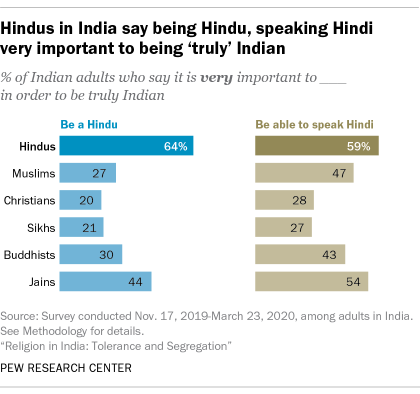
 Hindu nationalism in India also has a linguistic dimension. Hindus are more likely than other Indians to associate national identity with the Hindi language. While India has dozens of major languages, a majority of Hindus (59%) feel that being able to speak Hindi is very important to being truly Indian. Hindus who link their religion with national identity tend also to link the Hindi language with being authentically Indian.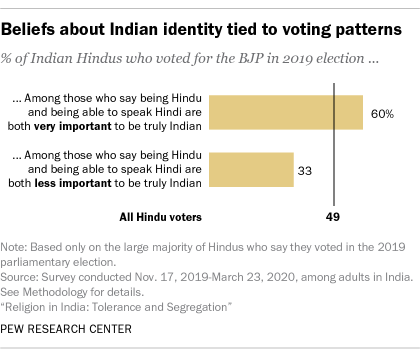



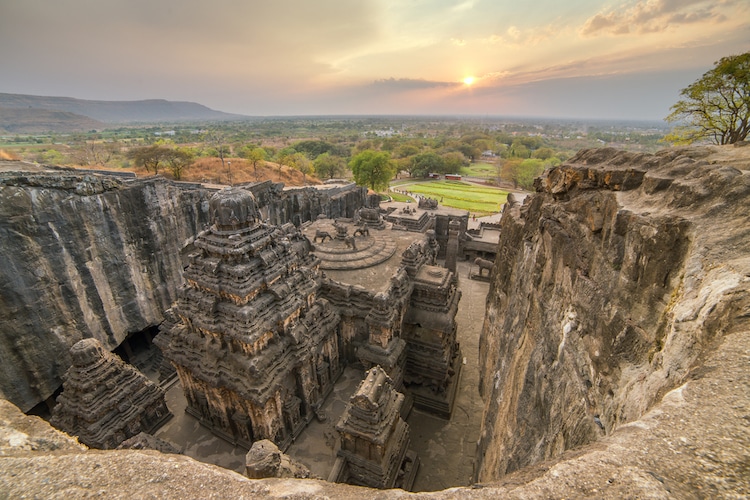 Maharana Kumbha of the Mewar dynasty built the Vijaya Stamba in 1448 AD. The construction of the structure was done to honour his victory over Mahmud Khilji’s unified forces from Malwa and Gujarat. The tower honours the military and architectural splendour of the Mewar era; it stands for the pride, valour, and glory of the Rajput warriors in their victories.