Newswise — The United States should prepare for a triumphant or ascending People’s Republic of China – scenarios that not only align with current PRC national development trends but also represent the most challenging future scenarios for the U.S. military, according to a new RAND Corporation report that examines China’s grand strategy out to 2050. The authors make the case that the kind of country China becomes, and the way that its military evolves, is neither foreordained nor completely beyond the influence of the United States or U.S. military. However, Beijing’s intense preoccupation with internal security and deep suspicions regarding U.S. intentions toward China may frustrate attempts by Washington to improve bilateral relations and encourage more liberal domestic policies. “The experience of COVID-19 is a prime example,” said Andrew Scobell, the study’s lead author and a senior political scientist at RAND, a nonprofit, nonpartisan research organization. “Beijing’s secretive approach to the pandemic has exacerbated tensions with a wide array of other countries, including the United States, and contributed to economic dislocation (aka ‘decoupling’) between China and some of its key trading partners. While Beijing seems to have been effective in dealing with the pandemic at home, this has been accomplished through draconian and repressive measures.” To map out potential future scenarios – What will China, and its military, look like in 2050? What will U.S.-China relations look like in 2050? – researchers studied trends in the management of politics and society and analyzed the specific national-level strategies and plans that China’s Communist Party rulers have put in place to further their vision of a China that is well governed, socially stable, economically prosperous, technologically advanced, and militarily powerful by 2049, the centenary of the founding of the PRC. The report describes four possible scenarios for China at mid-century – triumphant, ascendant, stagnant and imploding – with the middle two most likely. If China proves ascendant, the U.S. military should anticipate increased risk to already threatened forward-based forces in Japan, South Korea, and the Philippines, as well as a loss of the ability to operate routinely in the air and sea space above and in the Western Pacific. The report recommends that the U.S Army be prepared for a China whose role on the Asia-Pacific and global stages grows steadily. To prepare for military conflict in such circumstances, the U.S. Army should optimize its abilities to deter hostilities, get troops and equipment to hotspots quickly, operate from forward bases, and work with allied forces. The U.S. could field more robust cyber and network attack capabilities and other means to counter China’s unmanned aircraft systems, the authors assert. The capacity to respond quickly and effectively to China’s burgeoning reconnaissance-strike system will play an important role in determining the extent to which China’s leadership remains risk averse when considering military options to resolve regional disputes. The report, conducted for the U.S. Army, is based on a review of Chinese and Western literature on the PRC’s long-term strategic development and security plans and objectives, official statements by high-level Chinese officials and institutions, speeches by paramount leaders, white papers published by the Ministry of National Defense and other PRC government agencies, authoritative People’s Liberation Army (PLA) texts, as well as Western and other non-Chinese analyses of these documents. Other authors of the study, “China’s Grand Strategy: Trends, Trajectories, and Long-Term Competition,” are Edmund J. Burke, Cortez A. Cooper III, Sale Lilly, Chad J. R. Ohlandt, Eric Warner and J.D. Williams. Research for the study was conducted within RAND Arroyo Center’s Strategy, Doctrine and Resources Program. RAND Arroyo Center is a federally funded research and development center sponsored by the United States Army.
Author: Staff Reporter
Coronavirus vaccine: When will we have one?
Coronavirus still poses a significant threat, but there are no vaccines proven to protect the body against the disease it causes – Covid-19. Medical researchers are working hard to change that, and the UK government has ordered 100 million doses of a vaccine that isable to trigger an immune response and appears safe. Why is a coronavirus vaccine important? The virus spreads easily and the majority of the world’s population is still vulnerable to it. A vaccine would provide some protection by training people’s immune systems to fight the virus so they should not become sick. This would allow lockdowns to be lifted more safely, and social distancing to be relaxed. What sort of progress is being made? Research is happening at breakneck speed. About 140 are in early development, and around two dozen are now being tested on people in clinical trials. Trials of the vaccine developed by Oxford University show it can trigger an immune response and a deal has been signed with AstraZeneca to supply 100 million doses in the UK alone. The first human trial data back in May indicated the first eight patients taking part in a US study all produced antibodies that could neutralise the virus. A group in China showed a vaccine was safe and led to protective antibodies being made. It is being made available to the Chinese military. Other completely new approaches to vaccine development are in human trials. However, no-one knows how effective any of these vaccines will be. When will we have a coronavirus vaccine? A vaccine would normally take years, if not decades, to develop. Researchers hope to achieve the same amount of work in only a few months. Most experts think a vaccine is likely to become widely available by mid-2021, about 12-18 months after the new virus, known officially as Sars-CoV-2, first emerged. That would be a huge scientific feat and there are no guarantees it will work. Four coronaviruses already circulate in human beings. They cause common cold symptoms and we don’t have vaccines for any of them. What do I need to know about the coronavirus?A SIMPLE GUIDE: How do I protect myself?AVOIDING CONTACT: The rules on self-isolation and exerciseHOPE AND LOSS: Your coronavirus storiesLOOK-UP TOOL: Check cases in your areaVIDEO: The 20-second hand wash What still needs to be done? Multiple research groups have designed potential vaccines, however, there is much more work to do. Trials need to show the vaccine is safe. It would not be useful if it caused more problems than the disease Clinical trials will also need to show vaccines provoke an immune response, which protect people from getting sick A way of producing the vaccine on a huge scale must be developed for the billions of potential doses Medicines regulators must approve it before it can be given Finally there will be the huge logistical challenge of actually immunising most of the world’s population The success of lockdowns has made the process slower. To know if the vaccine works, you need people to actually be infected. The idea of giving people the vaccine and then deliberately infecting them (known as a challenge study) would give quicker answers, but is currently seen as too dangerous and unethical. How many people need to be vaccinated? It is hard to know without knowing how effective the vaccine is going to be. It is thought that 60-70% of people needed to be immune to the virus in order to stop it spreading easily (known as herd immunity). But that would be billions of people around the world even if the vaccine worked perfectly. How do you create a vaccine? Vaccines harmlessly show viruses or bacteria (or even small parts of them) to the immune system. The body’s defences recognise them as an invader and learn how to fight them. Then if the body is ever exposed for real, it already knows what to do. The main method of vaccination for decades has been to use the original virus. The measles, mumps and rubella (MMR) vaccine is made by using weakened viruses that cannot cause a full-blown infection. The seasonal flu jab takes the main strains of flu doing the rounds and completely disables them. Some scientists, particularly those in China, are using this approach. There is also work on coronavirus vaccines using newer, and less tested, approaches called “plug and play” vaccines. Because we know the genetic code of the new coronavirus, Sars-CoV-2, we have the complete blueprint for building it. The Oxford researchers have put small sections of its genetic code into a harmless virus that infects chimpanzees. They appear to have developed a safe virus that looks enough like the coronavirus to produce an immune response. Other groups are using pieces of raw genetic code (either DNA or RNA depending on the approach) which, once injected into the body, should start producing bits of viral proteins which the immune system can learn to fight. However, this approach is completely new. Would a vaccine protect people of all ages? It will, almost inevitably, be less successful in older people, because aged immune systems do not respond as well to immunisation. We see this with the annual flu jab. It may be possible to overcome this by either giving multiple doses or giving it alongside a chemical (called an adjuvant) that gives the immune system a boost. Who would get a vaccine? If a vaccine is developed, then there will be a limited supply, at least initially, so it will be important to prioritise. Healthcare workers who come into contact with Covid-19 patients would top the list. The disease is most deadly in older people so they would be a priority if the vaccine was effective in this age group. The UK has also said other people considered to be at high risk – potentially included those with some conditions or from certain ethnicities – may be prioritised
In Hour of Need “Ekal Foundation” Stands By The Community By Prakash Waghmare
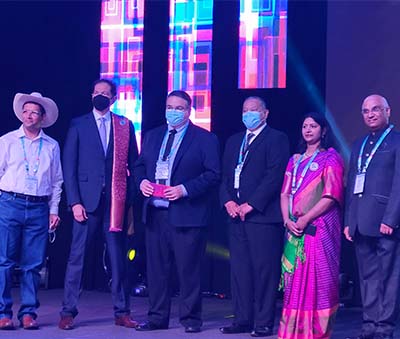
When the ‘Covid-19’ pandemic brought the worldwide life to a grinding halt, it posed a grave economic concern to Ekal movement. Currently, it has presence in over 102,000 villages and reach to 300,000 such pockets of humanity. In absence of usual stage performances for fundraising, the future of its numerous projects was in jeopardy. Concerts or no-concerts, Ekal has always enjoyed generosity of its loyal donors to shoulder a portion of movement’s annual tab but that wasn’t enough in this critical phase. Moreover, as a brand name in North America, ‘Ekal’ was part of the Indian community’s social consciousness – an institution – for classy entertainment, everywhere. The community longed for Ekal to provide refreshing relief – even in this ‘new world order’. Therefore, ‘Ekal-USA’ launched a series of virtual concerts across North America, with groups of Ekal chapters as focal points for each of them.
In essence, Ekal, was obligated to preserve the heightened enthusiasm and expectations of the countless volunteers, well-wishers and the supporters. The two troupes engaged for virtual concerts had, not only, the huge fan following, but also, had the proven record of success for fund-raising. One of the troupes was headed by Sa, Re, Ga, Ma contest winner ‘Sanjeevani Bhelande’ and another was headlined by Milind Oak’s ‘Niche’ banner.
‘Event committee’, in consultation with ‘Technology-Team’ provided significant support to the chapters in strategic transatlantic hook ups while the Artistes performed live in the Indian studios. The Chapter-groups assigned for each concert did a remarkable job in marketing their concert by engaging the community and social organizations around them. Chapters beyond the spheres of the concert-regions also helped out in propagating these events. Between May 23 and July 25, Sanjeevani’s troupe had four virtual concerts and Milind Oak had two.
All concerts were interactive and the donations were realized ‘live’ in ‘real time’. The montage of Video-clips and narration about ‘Present day’s Ekal’ prepared by ‘Media-Teams’ were very helpful. The Concert on May 23 for Midwest Regions by Sanjeevani raised $162,510; Concert on June 20 for Central Regions by Sanjeevani raised $367,830; Concert on June 28 for Northeast Regions by Milind Oak raised $239,800; Concert on July 11 for Washington DC by Sanjeevani raised $381,290 and the Concert on July 18 for Central Regions by Milind Oak raised $177,100.
In this endeavor, Ekal-Canada has also come a long way in last 5 years. With their Concert for Canada-East on July 25 by Sanjeevani it has raised CA $420,000 for the year, so far. Essentially in two months, ‘Ekal’ has managed to raise approx. $1.65 Million during virtual concerts. There are still couple of more concerts yet to follow – e.g. on Aug 1, there is concert for Southwest region by ‘Hemant Kumar Group’ and on Aug 8 for Canada-West by Milind Oak’s group. Before the official ‘clamp-down’ in late-March, Ekal in fact, had started the year by hosting 10 fund-raising stage-events that highlighted fascinating rural-tribal artistry and their unique culture. These events took place basically in sunshine and southern states and raised $650,000. According to Arun Gupta, Chairman of ‘BOD’ of Ekal-USA, “this is a splendid testament to donor’s trust in Ekal movement”.
During ‘Covid-19’ pandemic, the schools were closed and virtual tutoring & home assignments for the students had come to an end. Outdoor group-activities were not available either. Therefore, Ekal undertook a creative approach to channelize youth’s pent-up energy and brain-power for their mutual benefit. It was the need of the hour. Numerous ‘Do-it-yourself’ (DIY) projects – where youths provided virtual tutoring to other youths – were floated on Ekal platform.
Since the youths opted to tutor subjects that touched with Science, Technology, Engineering, Arts and Math, this campaign was headlined with ‘STEAM’ as its acronym. This is an on-going effort till the schools open. As of this moment, in 17 such active series youths from 7 states have been enrolled, raising sizable amount for Ekal. Swetha Mulukutla, Isabelle Bodkhe & Spandana Gandhi raised $4130 by tutoring PSAT classes to support ‘skill-training’ for migrant workers in EKAL villages while Ritvik Shah raised more than $3314 by tutoring Python classes to equip few Ekal schools with tablets. In New England area, Jharna Madan and Parveen Minocha (Ekal volunteers) are spearheading another effort to bring light-hearted fun to people of all ages during the current Corona crisis. ‘Indi Art’ is national art competition organized in collaboration with “Khula Asmaan”, an art portal in India. On their behalf 30 art teachers acting as ‘Ekal Indi Art’ ambassadors are offering free workshops in various artforms like MadhuBani, Warli, Watercolors, Acrylic, Textured Art, Tanjore Painting, 3D Art, Digital Art etc. Over 500 have already benefited from these workshops which are open to people of all ages and approx. $10,000 have been raised through these efforts. For more details on activities and forth-coming events, kindly visit www.ekal.org. “Ekal V. Foundation” (“EVF”) is in 10 countries and is tax-exempt in several of them, including U.S & Canada. It renders all services free-of-cost, irrespective of caste, faith and gender. For this reason and specifically for its enormous work in empowering the rural-tribal folks, the Government of India honored “EVF” with Iconic “Gandhi Peace Prize”, two years back.
Amitabh Bachchan Shares Message on Religious Harmony from Hospital While Being Treated for Covid
Amitabh Bachchan has shared a message on religious harmony. The veteran actor, who is undergoing Covid treatment in a hospital here, took to his verified Twitter account July 23 to post the message. Big B shared two photographs of himself, one with folded hands and the other where he stretches his palms in prayer. “Mazhab toh yeh do hatheliyaan batati hain, jude to ‘puja’ khule toh ‘dua’ kehlaati hain (The two hands describe religion. Whenever they are folded it is called puja and when they are stretched it is called dua),” he tweeted. Amitabh, his son Abhishek Bachchan, daughter-in-law Aishwarya Rai Bachchan and granddaughter Aaradhya are currently hospitalized with coronavirus infection. Reacting to Bachchan’s tweet, fans shared their prayers and wishes for a speedy recovery. Unconfirmed reports claim that the veteran actor is recovering and might be discharged from hospital soon. Big B, meanwhile, July 23 evening tweeted to refute a news reports claiming he has tested Covid-19 negative. On his verified Twitter account, he shared a video clip of a TV news channel that claims “Amitabh Bachchan tests negative for COVID” as “breaking news.” “.. this news is incorrect, irresponsible, fake and an incorrigible LIE !!” Big B tweeted on his official account, @SrBachchan. The Bollywood icon seems quite disturbed by the fake news surrounding his health. He also retweeted a tweet posted by a fan that reads: “That’s playing with someone’s privacy. Why do media play with people’s emotions? Take Care Sir Ji.” Earlier on July 22, Amitabh Bachchan shared a video on social media that shows students of Wroclaw University, Poland, paying a tribute to his father, poet Harivansh Rai Bachchan. Big B shared the video on Instagram, where students from the university recite a few lines from his father’s renowned poem “Madhushala.” Alongside the clip, Big B wrote: “Last year the Mayor of Wroclaw declared me as the Ambassador of the City of Wroclaw, in Poland… Today they organized a recitation of my Babuji’s Madhushala by the University students on the roof of the University building. “As Wroclaw was awarded the title of a UNESCO City of Literature, they could pass on the message to Babu Ji’s lovers from all around the world – Wroclaw is a City of Dr Harivansh Rai Bachchan. Moved beyond emotion .. thank you Wroclaw .. in this time of my trial it brings so much cheer to me.” Sharing about his life in general from his Covid ward, Bachchan took to his blog July 21 and wrote: “It is the silence and the uncertainty of the next … it is a wonder of the nature of life .. of all that it brings to us each moment, each living breathing day… In the activity driven past days of normalcy, never was there inclination to assess or sit back and think of what thoughts invade us now.””But they do now with a regularity that fills those idle hours, sitting, thinking, looking out into nowhere .. “.. in these conditions thoughts race at greater speed and in a vividity that had eluded us before .. they were always there, but just the presence of them remained silenced by the mind in its other business of existence ..the business is dormant now. The thespian added that “the mind is freer.” “It reflects greatly more than ever .. and I wonder if this is correct, admissible pertinent or not.” He wrote that a wandering mind often leads to “destinations that, because of their complex vagaries, brings on that which at times be not what you may want to hear or see .. but you do .. the eventuality of all that surrounds us blows heavily about us.” “Ignorance of it would not be a considered act .. so you succumb to it .. bear it .. live it .. caress it at times .. play with it at others.. wish it away, hold on to it, embrace it and accept .. but never be able to desist its presence ..” He says the time “today gives liberty to stretch the gravitas of the cerebrum.” “We may never get opportunity to be involved in this act, but given the circumstance, I would like to believe that each one of us .. each individual has the will and the capacity to be what they may have believed, they would never be.” Talking about his health, Bachchan wrote: “In the condition of the solace in the room of cure .. the restlessness keeps in the search for reaction .. for a connect .. for something to respond to .. to do .. to do just more than what the condition dictates..” “At times you find it .. at times you stare at barren walls and with empty thoughts .. and you pray that they be filled with the life of existence .. of reaction and company .. All of you push your prayers and concern each hour I know .. and I have only folded hands ..”
Want to live a healthy life? Have sex once a week
Having sex at least once a week halves the risk of early death, say researchers, adding that regular action between the sheets is linked to lower odds of dying from cancer, heart disease and other illness. According to researchers from Washington University in the US, sex is equivalent to “moderate intensity exercise,” and has similar health benefits for those partaking.
For the findings, the research team picked more than 15,000 adults. They had an average age of 39 and were quizzed on their sex lives for around 11 years, the mirror.co.uk reported.
The researchers found that almost three quarters engaged in sexual activity at least once a month and 36 per cent at least once a week. Over the course of the lengthy study, 228 died, including 62 from cancer and 29 from cardiovascular disease.
The study showed that those who had sex weekly were 49 per cent less likely to die than those who only had sex once a year or less. Their odds of dying from cardiovascular disease were 21 per cent less and from cancer 69 per cent lower.
According to the media reports, The researchers said that sex releases feel-good chemicals, which boost mental health and promote the activity of “natural killer cells”.
Those cells lower the risk of cancer and viral illness, prevent infections of the lungs and improve other conditions, such as asthma, they claimed. (IANS)
‘Hopes Of Developing Vaccine Against Covid Rising
The race to develop the first effective vaccine against COVID-19 involves an awfully crowded field, with 137 candidate vaccines in pre-clinical study worldwide and another 23 actually in development. But a leader seemed to emerge today with research published in the Lancet reporting promising results in a robust study by investigators at Oxford University in England. The study began in April, with a sample group of 1,077 adults aged 18 to 55—an age group young enough to tolerate exposure to SARS-CoV2, the virus that causes COVID-19, with less risk of adverse effects than would be seen in older, more vulnerable adults. The group was divided more or less in half, with 543 participants receiving the experimental COVID-19 vaccine, and the other 534 serving as a control group, receiving an existing vaccine against meningococcal vaccine. (The investigators chose not to use an inert saline solution for the control group because both vaccines can cause side effects such as achiness, fever and fatigue. Saline would cause no such symptoms and would thus reveal which group was the control group and which was not.)
The vaccine uses a harmless-to-humans chimpanzee adenovirus as a delivery vector. That virus is modified to carry spike proteins from SARS-CoV-2—the component of the coronavirus that, in theory, should induce the sought-after immune response in humans. What the researchers were looking for were two kinds of immune reaction: humoral immunity, or the system-wide generation of antibodies against the virus; and cellular immunity, or the activation of immune system T-cells that attack human cells infected with the COVID-19 virus. Oxford vaccine triggers immune response, trial findsA Covid-19 vaccine candidate developed by the Oxford University has safely prompted a protective immune response in hundreds of volunteers who got the shot in an early trial, preliminary findings published Monday in the journal Lancet said. The vaccine, ChAdOx1 nCoV-19 (also called AZD1222), designed by Oxford and developed by AstraZeneca, the Anglo-Swedish pharma major, triggered a dual immune response in people aged 18 to 55 that lasted at least two months. The preliminary findings are from the placebo-controlled, phase-I trial held between April 23 and May 21, involving 1,077 participants. 543 were administered the vaccine ChAdOx1 nCoV-19, another 534 a control vaccine (to rule out placebo). Further, ten participants were given a booster shot of the ChAdOx1 nCoV-19 vaccine. All participants who received the vaccine developed spike-specific antibodies by day 28, an immune response similar to those who recover from Covid-19. Spikes are the spike proteins on the surface of the SARS-CoV-2 coronavirus that it uses to attach to human receptor cells. The ten who received a booster shot produced neutralizing antibodies (antibodies in higher titers). The vaccine also triggered T cells, a type of white blood cell that “remembers” and attacks the coronavirus. Side effects including fever, headaches, muscle aches, and injection site reactions were observed in about 60% of patients; but all these were deemed mild or moderate and were resolved during the trial. T-cells and antibodies: That the vaccine has induced antibodies and T cells are significant. T cells can stay in the body for a longer period in a dormant state, and can re-emerge to attack the virus in case of an infection. The science behind the Oxford vaccine
Preliminary data from the phase I/II trial of the Covid-19 vaccine developed by Oxford University showed it was safe and prompted an immune response that lasted at least two months. More on that and India’s role in the eventual rollout of the vaccine in today’s Times Top10. Here, we delve deeper into the science behind the vaccine.
Oxford’s candidate, ChAdOx1 nCoV-19 (also called AZD1222), is a non-replicant viral vector vaccine. The vector (the carrier) is derived from adenovirus (ChAdOx1) taken from chimpanzees. This is a harmless, weakened adenovirus that usually causes the common cold in chimps. It is genetically engineered so that it does not replicate itself in humans. Now, a gene (the load) from the coronavirus, SARS CoV-2, that instructs cells to build spike proteins is loaded into the vector.
Remember, coronaviruses have club-shaped spikes on their outer coats — the ‘corona’. These spike proteins allow the virus to attach to the ACE2 receptors in human cells. When the genetically engineered ChAdOx1 with the spike-responsible gene from coronavirus is administered in a person, the gene is “expressed”, causing the build-up of spike proteins. The body’s immune system recognises this and begins to create the antibodies to defeat the foreign object. Note: the vaccine vector is non-replicant so it doesn’t harm the person, but the spike proteins nevertheless trigger antibodies. The preliminary findings showed participants also produced T cells, a type of white blood cell that “remembers” and attacks the coronavirus infection. Oxford researchers led by Professor Sarah Gilbert were able to quickly develop the vaccine candidate as they had been working on the ChAdOx1 platform against Ebola and MERS viruses.
And other vaccine candidates?
India’s hope: Pune-based Serum Institute of India, under an agreement with AstraZeneca, is to bulk produce the Oxford vaccine. The company’s CEO, Adar Poonawalla, had earlier said it will produce 5 million doses per month for the first 6 months before ramping up the production. The findings are from the phase-I/II trial. The larger, phase-III trials of the vaccine have already begun in Brazil and South Africa. A vaccine being developed by China’s CanSino Biologics and China’s military research also appeared to safely induce both antibodies and T cells, a mid-stage study released Monday said. Both CanSino’s and Oxford’s vaccines are based on a similar science of using a non-replicating viral vector to trigger the immune response. Hyderabad-based Bharat Biotech has announced that the Phase-I clinical trials of India’s first indigenous Covid-19 vaccine Covaxin began across the country on July 15. “This is a randomized, double-blind, placebo-controlled clinical trial on 375 volunteers in India,” the company said in a brief statement. The leading vaccine maker had announced on June 29 that it successfully developed Covaxin in collaboration with the Indian Council of Medical Research (ICMR) and National Institute of Virology.The SARS-CoV-2 strain was isolated in NIV, Pune and transferred to Bharat Biotech. The indigenous, inactivated vaccine was developed and manufactured in Bharat Biotech’s BSL-3A (Bio-Safety Level 3) High Containment facility located in Genome Valley, Hyderabad.
The vaccine developed by China’s CanSino Biologics in partnership with the country’s military research wing also relies on a viral vector, but a weakened human cold virus, adenovirus 5 (Ad5). CanSino, too, published its findings from phase I/II trial on Monday that showed it safely prompted an immune response.
But… the vaccine was inadequate to induce immunity response in people aged 55 or older — a group vulnerable to Covid-19. Researchers contend an additional dose given between the third and sixth month could negate this. The use of Ad5 itself has left some scientists unconvinced. Since most people would have already been infected by Ad5 (cold virus), they fear the immune system induced would focus on the Ad5 parts of the vaccine rather than the SARS-Cov-2 material fused to it.
Two other advance candidates are developed by Massachusetts-based Moderna and Germany’s BioNTech in partnership with Pfizer. These are messenger-RNA based candidates. They rely on synthetic mRNA that delivers the genetic code for spike proteins, thus triggering an immune response. Early findings by Moderna and BioNTech-Pfizer, too, showed they prompted an immune response.
Another reason to be hopeful about the Oxford vaccine: Viral vector-based vaccines need only be cold stored, whereas mRNA vaccines need to be in a frozen state — a challenge for developing countries.
‘Trump the most divisive in century, but 1968 US election was even worse’
Will the 2020 United States Presidential Election be the most divisive one in the past 100 years? Donald Trump may be the “most divisive major party candidate in the last 100 years” but the balance between the two parties has been “about as even” as in the last 70 years , says a respected US political analyst, adding that “things are bad this year”, but 1968 was even worse.
“It depends on what you mean by ‘divisive’. We have the most divisive major party candidate in the last 100 years in Donald Trump. Partisan loyalties are as strong as they have been in the last 100 years and the balance between the two parties is about as even as it’s been in at least 70 years. On the other hand, you could make a good case that the most divisive election in the last 100 years was in 1968,” John Mark Hansen, the Charles L. Hutchinson Distinguished Service Professor at the University of Chicago’s Political Science Department, told IANS in an email interview.
In 1968, the American public was deeply divided over the Vietnam War, school desegregation, law and order, and other issues. Martin Luther King Jr. was assassinated in April and Robert F Kennedy in June.
President Lyndon Johnson gave up plans to run for re-election when a “peace” candidate, Gene McCarthy, got 42 per cent in the New Hampshire primary. Richard Nixon, “who got his big break in politics as a red-baiter”, was the Republican nominee and he chose Spiro Agnew, a “clownish bully”, as his running mate. George Wallace ran as a third party candidate on a racist platform and chose Gen. Curtis LeM(“Bomb ’em back to the Stone Age” as his running mate); they won 13.5 per cent of the vote and five states, Hansen pointed out.
“Bad as things are this year, it doesn’t come close to 1968, in my view,” added Hansen, one of the nation’s leading scholars of American politics and whose research focuses on interest groups, citizen activism, and public opinion.
It is said that Donald Trump owes his 2016 victory to the fact that working class White people, particularly the ones without a college education, rural voters and others who felt overlooked by the establishment and left behind by the coastal elite made their voices heard. Does this category, or the Middle American Malaise as some choose to describe it, still feel as strongly to vote in the same manner in 2020?
“The wins Trump made in the Rust Belt were decisive, no question. He tapped into the resentment of white working class voters over the loss of their economic and social position, particularly resentment toward trade. That was real. Ironically, it required a Republican candidate to repudiate a bedrock principle of his party. Trump’s trade war might have made some people feel good – take that, China! – but it really hasn’t changed anything in any material way.
“The President’s only major legislative achievement is a big tax cut for corporations and the wealthy. And now he’s presiding over minus five per cent GDP growth and over 10 per cent unemployment. Voters in the Rust Belt have a lot more to worry about now than the trade balance with China,” Hansen explained.
Be that as it may, he admitted that overall, the economy will be a major issue in the election. “It was a solid point for him at the beginning of the year. It’s a major negative for him now. He will be lucky if growth rises to zero per cent and unemployment falls below 10 per cent, and that will still be bad for him. He may well have made matters worse for himself by pressing so hard to reopen the economy late in the Spring. Given where things are heading with Covid, we may well be in full lockdown again by the beginning of the campaign season in September. He wanted a big bounce back but he may have gotten himself (and us) a prolongation of the pain,” Hansen maintained.
Will the BLM movement sustain till Election Day and what will its impact be? “Yes. A lot of African American voters who turned out for Barack Obama in the Rust Belt and the South stayed home in 2016. The stakes are pretty clear in 2020. I expect the Democrats to benefit from higher Black turnout in key states,” Hansen said.
Linked to this, what will the impact be of the anti-Confederate movement – removal of statues, changes in state flags et al -on the election?
“This is pretty interesting. Trump has tried and tried to swing White voters back in his direction by activating racial divisions. At least so far, it’s not working. It’s not 1968 or 1988. As far as we have to go, Whites’ racial attitudes have liberalized. Perhaps even more important, race baiting looks like an attempt at diversion when you’re worried about your job or worried about getting sick,” Hansen said.
At the bottom line, Trump’s biggest asset is the loyalty of Republican voters as this is what kept him close enough to win some close states in 2016, Hansen said, adding: “He’s had a hard time holding on to White suburban women in 2018 and it’s no better now. His support among the elderly also seems to have eroded.” “The biggest question mark for the fall is how Covid will affect theactual voting. If conditions in the South and West are as bad in October as New York, New Jersey, and Illinois were in May, there may be some Republicans who wish they’d gotten behind mail-in ballots (that give voters a chance to decide in advance on how they will cast
their votes),” Hansen concluded .
In A New Poll, Trump Trails Biden by 14 Points Nationally
Presumptive Democratic nominee Joe Biden is leading President Trump by 14 points, 50 to 36 percent, in the latest general election poll by The New York Times and Siena College. The poll is the most recent of several national surveys that have shown Biden ahead of Trump by double digits. The New York Times/Siena College poll also shows Biden leading or tied with the president among all age demographics. Biden and Trump both poll at 44 percent support with those aged between 45 and 64, and Biden is within the 3-point margin of error in his 47-45 percent lead among those 65-years-old and older. It’s a similar story across education levels of voters — the president trails Biden with voters who completed some high school and/or trade school, as well as with those who hold bachelors degrees and graduate degrees. Trump and Biden are tied with those who have completed “some college” with 43 percent support each. And it’s the latest poll to show that Trump’s 2016 support among blue-collar workers and white voters has ebbed. Trump and Biden are statistically tied with white voters with the president up one point at 44-43 percent. The ABC News/Washington Post poll released on Sunday last week revealed a close margin, 54 per cent for Biden and 44 per cent for Trump, was the fifth consecutive high-quality national poll that showed the former Vice President ahead of Trump by 10 points or more, reports Politico news.Of the nine such polls conducted since the second half of June, Biden has led Trump by double digits in seven of them. Prior to the release of the ABC News/Washington Post poll on Sunday, Biden held a 9-point lead in the RealClearPolitics average. Meanwhile, a Quinnipiac University poll released last week, 45 per cent of registered voters had a favorable opinion of Biden, and 43 per cent viewed him unfavorably. That was up slightly from 42 per cent favorable, 46 per cent unfavorable in June. Similarly, 44 per cent of voters surveyed by an NBC News/Wall Street Journal poll last week said they had a positive opinion of Biden, while 46 per cent viewed him negatively. Meanwhile, Trump’s favourable ratings are in the tank, the Politico news report said. Majorities in the Quinnipiac (61 per cent unfavourable) and NBC/WSJ (54 per cent negative) polls gave the President poor image ratings. Meanwhile, Trump’s re-election campaign has disputed the results of public polling, arguing that the President runs stronger against a “defined” Biden in their internal tests. But the Trump campaign’s efforts to define Biden with a bombardment of negative advertising, especially in the battleground states, has yet to dent the former Vice President, the Politico report added.
PM Modi delivers keynote address at United Nations Economic and Social Council session
Prime Minister Shri Narendra Modi delivered a keynote address virtually at this year’s High-Level Segment of the United Nations Economic and Social Council (ECOSOC) session on Friday, 17th July 2020 at the United Nations in New York. This was the first address by PM to the broader UN membership since India’s overwhelming election as a non-permanent member of the Security Council on 17th June, for the term 2021-22.
The theme of the High-Level Segment of the ECOSOC this year is “Multilateralism after COVID19: What kind of UN do we need at the 75th anniversary”.
Coinciding with the 75th Anniversary of the founding of the UN, this theme also resonates with India’s priority for its forthcoming membership of theUN Security Council. Prime Minister reiterated India’s call for a ‘reformed multilateralism’ in a post-COVID-19 world, which reflects the realities of the contemporary world.
In his address, PM recalled India’s long association with the ECOSOC and the UN’s developmental work, including for the Sustainable Development Goals. He noted that India’s developmental motto of ‘SabkaSaath, SabkaVikaas, Sabka Vishwas’ resonates with the core SDG principle of leaving no one behind.
Prime Minister pointed out that India’s success in improving the socio-economic indicators of its vast populationhas a significant impact on global SDG targets.He spoke about India’s commitment to also support other developing countries in meeting their SDG targets.
He spoke about India’s ongoing development efforts, including for improving access to sanitation through the “Swacch Bharat Abhiyan”, empowering women, ensuring financial inclusion, and expanding availability of housing and healthcare through flagship schemes such as the “Housing for All” programme and the “Ayushman Bharat” scheme.
Prime Minister also highlighted India’s focus on environmental sustainability and bio-diversity conservation, and recalled India’s leading role in the establishment of the International Solar Alliance and the Coalition for Disaster Resilient Infrastructure.
Speaking about India’s role in its region as a first responder, Prime Minister recalled the support provided by the Indian government and Indian pharma companies for ensuring medicine supplies to different countries, and for coordinating a joint response strategy among SAARC countries.
This was the second time that Prime Minister addressed the ECOSOC. He had earlier delivered the keynote address at the 70thanniversary of the ECOSOC in January 2016.
This year we celebrate the 75th Anniversary of the founding of the United Nations. It is an occasion to recognise the UN’s many contributions to human progress. It is also an opportunity to assess the UN’s role and relevance in today’s World: PM @narendramodi
Dr. Sudhakar Jonnalagadda Led AAPI Team Commits to Take AAPI to Newer Heights
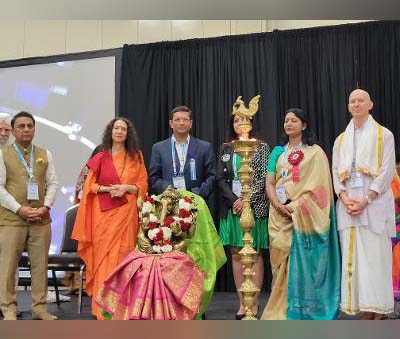
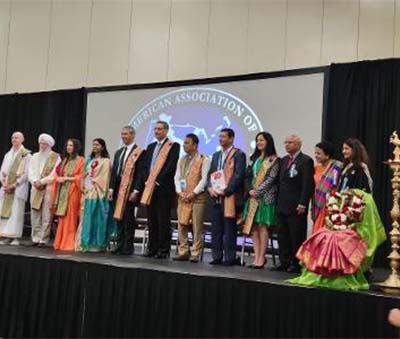
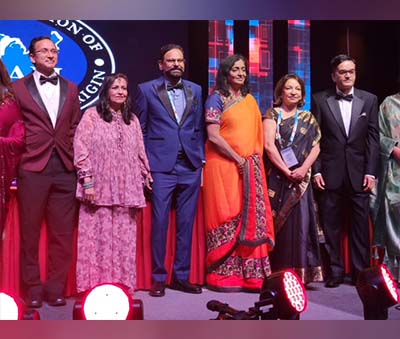
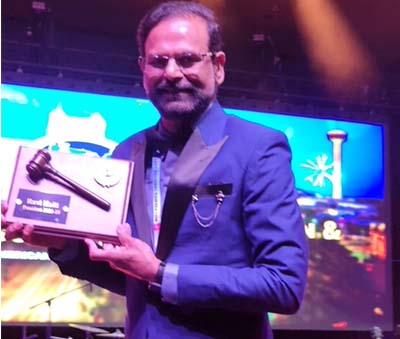
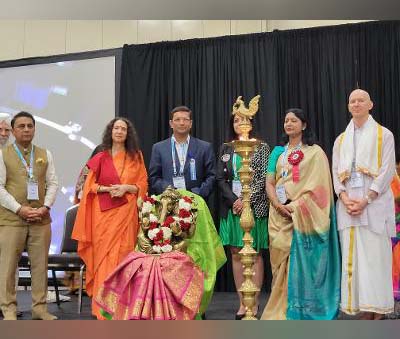
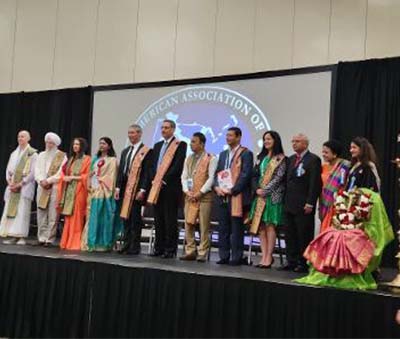
(Chicago, IL: July 20th, 2020) A new Executive Committee led by Dr. Sudhakar Jonnalagadda, as the 37th President of American Association of Physicians of Indian Origin (AAPI) assumed charge of this nearly four decades old organization representing the nearly 80,000 Indian American Physicians and Fellows, during the first ever Virtual Change of Guard Ceremony on Saturday, July 11, 2020.
Others who constitute the Executive Committee include, Dr. Anupama Gotimukula, President-Elect; Dr. Ravi Kolli, Vice President, Dr. Amit Chakrabarty, Secretary of AAPI; Dr. Satish Kathula, Treasurer of AAPI, Dr. Sajani Shah, Chair of AAPI’s BOT; Dr. Ami Baxi, YPS President; Dr. Kinjal Solanki, MSRF President; and Dr. Surendra Purohit, Chair of AAPI Charitable Foundation.
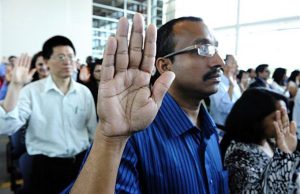
“I will work to make AAPI stronger, more vibrant, united, transparent, politically engaged, ensuring active participation of young physicians, increasing membership, and enabling that AAPI’s voice is heard in the corridors of power,” Dr. Jonnalagadda, announced immediately after being administered the oath of office.
Dr. Jonnalgadda has vowed to take the nearly four decades old organization to the next level and “bring all the AAPI Chapters, Regions, Members of the Executive Committee and Board of Trustees to work cohesively and unitedly for the success of AAPI and the realization of its noble mission.” He wants to increase AAPI membership by offering more benefits and opportunities for members.
The new team will lead AAPI the largest ethnic Medical Organization in the United States, in the year 2020-2021, serving the interests of the Indian American physicians in the US and in many ways contributing to the shaping of the healthcare delivery in the US for the past 37 years. “AAPI must be responsive to its members, supportive of the leadership and a true advocate for our mission,” he said.
Dr. Jonnalagadda, born in a family of Physicians, aspired to be physicians and dedicate their lives for the greater good of humanity. “I am committed to serving the community and help the needy. That gives me the greatest satisfaction in life,” he said modesty. Ambitious and wanting to achieve greater things in life, Dr. Jonnalagadda has numerous achievements in life. He currently serves as the President of the Medical Staff at the Hospital. And now, “being elected as the President of AAPI is greatest achievement of my life,”
Dr. Anupama Yeluru Gotimukula, President-Elect, AAPI, who will be the President of AAPI in the year 2021-22, says, “We are going through a deadly pandemic now. AAPI members are putting their best efforts to help our patients, especially those impacted by COVID. Several of our physicians have been affected in this pandemic. Our healthcare heroes are putting their lives on frontline and working in every possible way to eradicate COVID-19, through preventive efforts, clinical, therapeutic and research trials, doing philanthropic services and many more other activities to help the community!
Dr. Gotimukula, a resident of San Antonio, TX, is a board certified Pediatric Anesthesiologist and is affiliated with Christus Santa Rosa Health System-San Antonio, and has been in practice in San Antonio for nearly 13 years. After graduating with distinction from Kakatiya Medical College, NTR Univ of Health Sciences, she completed her Residency from University of Miami, Fellowship in Pediatric Anesthesiology from University of Michigan.
Beginning her long association with AAPI as a volunteer at one of the Governing Body Meetings in San Antonio in 2009, which motivated her to become a life member of AAPI. Inspired by the great works being done by AAPI, she started the leadership track at local level as Treasurer of TIPSSW chapter. Her passion, dedication, leadership and people skills made her President of Texas Indo-American Physician Society (TIPSSW Chapter) and had served as the Treasurer of AAPI Convention in San Antonio ( 2014) which was the stepping stone to Anupama to serve several leadership roles in AAPI. Dr. Gotimukula served as Regional Director of AAPI for 2 years, served as the IT Chair and later on, she was elected as the Treasurer of AAPI in 2017, Secretary (2018), Vice President (2019) with huge majority and is currently serving as President-Elect.
With a vision to make AAPI financially strong, Dr. Gotimukula was instrumental in creating $250,000 Endowment Fund for operations in 2020, with a goal to reach $2.5 Million in the next five years. Another area, she wants to focus is to offer CMEs & Educational & Leadership Seminars for Members, to help build a healthier community & address the common ailments in the community through AAPI “YouTube Channel” and provide education to the larger community on health related issues.
In addition, Dr. Gotiumukula wants to provide Educational Projects in India by forming a Medical Student Council in India and help mentor them to get the best medical education in India and abroad. Organized Medicine on Healthcare Reforms by being proactive in collaboration with AMA and other similar organizations, ensuring Policy Changes in Healthcare delivery . Philanthropy by regularly organizing Medical Mission Service trips, serving the needy in the most rural areas in India and other countries, are some of the other interests , Dr. Gotimukula wants to undertake while serving in leadership roles at AAPI. “We dedicate our professional expertise and services to both India (Janmabhoomi) and the United States, (Karmabhoomi).”
While dedicating her talents, skills, and experiences for the AAPI family, which she has come to call as her own, Dr. Gotimukula says, “I am looking forward to get the best wishes & blessings from our members in my pursuit to lead this prestigious organization and do the best to our physician community and save the human race.”
Dr. Ravi Kolli, Vice President of AAPI is a Board Certified Psychiatrist with additional qualifications in Addiction, Geriatric and Forensic Psychiatry, and serves as Psychiatric Medical Director of Southwestern Pennsylvania Human Services. A former Clinical Asst. Professor of Psychiatry, University of Pittsburgh and West Virginia University, Dr. Kolli had served as the Secretary of AAPI 2019-20, Regional Director of AAPI 2017-18, Past President of Pittsburgh Chapter of AAPI (TAPI), Past President of Rangaraya Medical College Alumni of North America and as the Past President of Association of Telugu Medical Graduates in USA
“In my role as the Vice President of AAPI, I will be working closely with President and President Elect of AAPI to make AAPI a more dynamic and vibrant organization playing a meaningful and relevant part in advocating health policies and practices that best serve the interests of all patients and promoting the physician’s role as the leaders of the team based health care delivery,” Dr. Kolli says.
As the Chair of Membership Committee, Dr. Kolli “Will diligently work to recruit new members to AAPI, especially the younger physicians and recent graduates. I will also be promoting the mission and vision of AAPI by working closely with AAPI’s 120 + patron Chapters to align all of our goals and activities and also bring in new Chapters into AAPI fold.
A Psychiatrist by profession, Dr Kolli wants to “focus on battling the stigma of mental illness and access to quality mental health care broadly. I will be forming liaison with mental health professionals in India and globally and bring awareness of various biopsychosocial therapeutic options to promote wellness and recovery from mental illness and substance use disorders. We will also actively promote physician wellness and self care to address the challenges of physician burnout and suicide.”
For Dr. Amit Chakrabarty, Secretary of AAPI, it’s been a very long journey with AAPI, from being an ordinary member to a Regional Leader, Vice Chair of the Board of Trustees (BOT) and now being elected as the national Secretary of AAPI that he calls as his second family and has come to adore. “Since my membership to AAPI In 1997, for more than two decades I have been a dedicated foot soldier for the American Association of Physicians of Indian Origin,” Dr. Amit Chakrabarty is a Consultant Urologist, Poplar Bluff Urology, Past Chairman of Urologic Clinics of North Alabama P.C., and the Director of Center for Continence and Female Pelvic Health.
“It’s my belief that being an elected official of this noble organization, I will continue to give my heart and soul to make AAPI a more vibrant, united, transparent, politically engaged, ensuring active participation of young physicians, increasing membership, and enabling that AAPI’s voice is heard in the corridors of power,” Dr. Chakrabarty, a multi-talented physician says.
Dr. Chakrabarty wants to “Recognize the role of Young Physicians in AAPI, making AAPI financially sound, lobbying on Capitol Hill on policies important to AAPI, continuing partnership in health care education across the globe, making AAPI a global health leader, be part of the decision-making process of WHO and UN on health policies, are only some of the many goals I have for AAPI.”
Dr. Chkrabarty is “blessed to have imbibed the values of giving, leading, and being passionate about what I am committed to do, from my parents. My wife and children have encouraged me to take time off from work and family, devoting my talents and skills for the realization of the mission of AAPI. I have diverse experience and skills to achieve each of these goals, and I am committed to move AAPI forward by serving as AAPI’s National Secretary.”
Dr. Satheesh Kathula, the newly elected Treasurer of AAPI is a board certified hematologist and oncologist from Dayton, Ohio. Practicing Medicine for nearly two decades, Dr. Kathula is a clinical professor of medicine at Wright State University- Boonshoft school of medicine, Dayton, Ohio. He graduated from Siddhartha Medical College, Vijayawada, Andhra Pradesh, India in 1992. He has been actively involved in community service locally, nationally and internationally for the last 18 years. He has been awarded with the “Man of the year-2018, The Leukemia and Lymphoma Society’”
Dr. Kathula has served in numerous capacities, before being elected as the Treasurer of AAPI-2020-21. He had served as the Chair, IT Committee- 2019-20; Editor, Enewsletter-2019-20; a member of AAPI’s Board of Trustees- 2014-17; and Regional Director- 2012-14, in addition t several roles at the local and regional level. He has served as the President and founding member of Association of Indian Physicians from Ohio; President, Miami Valley Association of Physicians of Indian Origin; President, ATMGUSA; and has worked with Ohio State Medical Association on various issues.
A recipient of several Community Service/Awards, Dr. Kathula says, “As a treasurer, I will keep custody of all accounts, receipts and disbursements, and make them transparent. Will work to make AAPI financially stronger and viable. I will work to strengthen Indo-US relations.”
At the national level, Dr. Kathula wants to “Make AAPI a mainstream organization and work on issues affecting physicians including physician shortage, burnout, and credentialing, while leveraging the strength of 100,000 doctors at legislative level.” Another area, he wants to work is to “Encourage and engage next generation/young physicians in AAPI activities. While working closely with other physician organizations such as AMA.”
In all of his efforts leading AAPI, Dr. Jonnalagadda wants to work with his executive committee and all branches of AAPI membership in a congenial and non-competitive manner, focusing on the noble mission of this prestigious organization. His experiences in organizing conferences and meetings which help to bring members together and attract new members is vital to the success of the organization.
With the changing trends and statistics in healthcare, both in India and US, we are refocusing our mission and vision, AAPI would like to make a positive meaningful impact on the healthcare delivery system both in the US and in India.
AAPI will continue to be an active player in crafting the delivery of healthcare in the most efficient manner in the United States and India. “We will strive for equity in healthcare delivery globally.” Dr. Jonnalagadda is confident that with the blessings of elders, and the strong support from the total membership of AAPI and his family, he will be able to take AAPI to stability, unity, growth and greater achievements.”
American Hindus Against Defamation Urges School Children to be Educated on Swastikas
American Hindus Against Defamation (AHAD) an initiative of World Hindu Council of America (VHPA), has issued the following statement on NY State Senate Bill SS 6648: NY State Senate Bill SS 6648 sponsored by Senator Todd Kaminsky (D) 9TH SENATE DISTRICT and co-sponsored by Senators Joseph Addabbo Jr (D) 15TH SENATE DISTRICT, Alessandra Biaggi (D, WF) 34TH SENATE DISTRICT, John Brooks (D) 8TH SENATE DISTRICT, and David Carlucci (D) 38TH SENATE DISTRICT has a stated purpose to require that the New York school children be educated regarding the meaning of swastikas and nooses as symbols of hatred and intolerance.
Ajay Shah, Convenor of American Hindus Against Defamation (AHAD), an initiative of World Hindu Council of America (VHPA) said that, “the proposed NY State Sentate Bill SS 6648 requiring instruction regarding symbols of hate to be incorporated into the curricula for grades six through twelve perpetuate ignorance and promotes HinduPhobia in schools across New York state. AHAD pledges to work with other Hindu organizations to ensure that this legislation is modified to remove the references to Swastika.”
American Jewish Committee (AJC) working with the VHPA and other Hindu organizations in Washington, DC has produced a brochure titled, “Understanding Swastika, Use and Abuse of a sacred symbol.” The AJC brochure quotes, the following from Declaration of the Second Hindu-Jewish Leadership Summit, held in February 2008, Jerusalem, “The Svastika is an ancient and greatly auspicious symbol of the Hindu tradition. It is inscribed on Hindu temples, ritual altars, entrances, and even account books.
A distorted version of this sacred symbol was misappropriated by the Third Reich in Germany, and abused as an emblem under which heinous crimes were perpetrated against humanity, particularly the Jewish people. The participants recognize that this symbol is, and has been sacred to Hindus for millennia, long before its misappropriation.” Shah said, “We believe that this brochure in itself is sufficient to remove Swastika from the purported purpose of this legislation.” Swastika is considered one of the most sacred symbols by religious traditions that evolved in India (dharmic traditions), including Hindu, Jain, Buddhist and Sikh faiths. The history of the Swastika is over 10,000 years old. It has appeared in several civilizations all throughout the world. From Greece and Rome to the Druids and Celts.
Today, the Swastika is an integral part of many cultures including India and East Asian cultures that adhere to Buddhism. It has regularly been donned on Hindu homes, businesses, temples, and other objects. Hindu families gather round to place it in front of their homes for good luck and protection. Unfortunately, 10,000 years of a symbol of wellbeing was desecrated by the monstrous regime of Nazi Germany, in the first half of the 20th century. Hitler perverted a symbol of goodness to fuel his agenda of hate. Utsav Chakrabarty,
World Hindu Council of America Director of Advocacy and Awareness said, “We acknowledge the horrid way the swastika has been misused and misinterpreted. Even though Hitler never used the word “Swastika”, and instead used the same symbol, calling it Hakenkreuz, for the past 70 years, the Swastika continues to remain a vilified and maligned symbol. This must be corrected. Instead of censoring the symbol, we must celebrate the positive history of it. We must reclaim it from Hitler and the followers of his hateful ideology. This wrong must be righted.”
To label the Swastika as a symbol of hate would be a grave insult to 1.8 billion Hindus and Buddhists around the world. It would be a grave insult to over 300,000 Hindu New Yorkers who come from diverse ethnic and racial backgrounds, and contribute immensely to the community and economy. Today’s political climate demonstrates the importance of diversity and celebrating ones’ heritage. Maligning this ancient heritage would be a step backwards in promoting interfaith harmony and would lead to increase in hate crimes and Hinduphobia. AHAD demands that the meaning and significance of Swastika be included in the educational curriculum so that the hate crimes against Hindus are not perpetuated.
(AHAD) is the first and the most prominent Hindu organization against defamation in the USA. An initiative of World Hindu Council of America (VHPA), AHAD has been actively monitoring mass media, products, public places etc. to ensure respectful and accurate representation of Hindu dharma, culture, images and icons. Active since 1997, hundreds of thousands of Hindus have participated in various advocacy activities led by AHAD.
World Hindu Council of America (VHPA) is the most prominent organization of Hindus in the USA. Founded in 1970, it has chapters across the country. VHPA runs educational programs for Hindu children and youth in addition to community service (Seva) activities, and initiatives such as Hindu Mandir Executives’ Conference (HMEC), Hindu Womens’ Network, American Hindus Against Defamation (AHAD), Hindu Policy Research and Advocacy Collective USA (HinduPACT).
Anil Cheriyan Appointed as Strategy, Technology Executive Vice President at Cognizant
Global software major Cognizant on Monday announced the appointment of Anil Cheriyan as Executive Vice President of Strategy and Technology. Cheriyan who recently served as the US Presidential Appointee in charge of Technology Transformation Services, will oversee global IT led by Rakesh Bhardwaj, Global Security led by Dan Smith, and the Strategy, Alliances, and Business Development (including Accelerator) team led by Brad Berry.
This is the first time Cognizant will have a technology leader reporting directly to the CEO. “Cheriyan’s immediate priority, once he joins on August 3, will be to take the reins of our IT and Security remediation efforts from Greg Hyttenrauch, who has led these efforts on my behalf since April,” Cognizant CEO Brian Humphries said in a statement.
As the US Presidential Appointee, he drove the technology transformation strategy, roadmap, and agenda across the US federal government, oversaw a $100 billion technology budget, and worked closely with the White House, Agency leadership and the Federal CIO.
He helped accelerate the transformation of several federal agencies, leveraging industry-leading talent in AI, cloud, digital platforms, data and analytics, identity, and citizen experience.
Prior to his government role, Cheriyan served as Executive Vice President and CIO of SunTrust Banks. He has also held senior leadership roles at IBM Global Services and PwC Management Consulting.
“As we prepare for the second half of 2020, we have good reason to feel confident about Cognizant’s strong position in the COVID era. Our momentum and competitiveness are growing. Our client relationships are robust. And our digital portfolio is becoming a larger portion of our revenue mix,” said Humphries. (IANS)
Cranberry Orange Muffins By Certina Romel
These muffins are a perfect breakfast treat as well as a healthy snack-on dessert. Loaded with berries and flavoured with orange, you’ll make it again and again. How I developed this recipe?
Beautifully red tart cranberries are my favourite. N it’s rare that I get good ones. I wanted to bake a less sugary yet yummy treat for my family that they could enjoy anytime of the day and I thought these muffins would be perfect. It’s wholesome, berrylicious, zesty and just yum! Whats special about this recipe? Cranberries- These lovely red berries are not only a powerhouse of antioxidants, but also medically proven to prevent UTIs, boost immunity and brain power.. Orange- As everyone know orange is rich in Vitamin C and it’s citrusy punch is so refreshing. I’ve used both its zest and juice in this recipe to extract most of the goodness from it. What you’ll need-
. 1 cup cranberries, preferably fresh. One by fourth a cup orange juice. 1-2 teaspoons orange zest . 1 teaspoon vanilla extract . 3 by 4th a cup softened butter. 1 and 1 by 4th a cup butter. 1 and a half cup all-purpose flour . 2 teaspoons baking powder . One by fourth a teaspoon salt How to make-
Preheat the oven to 180 degrees Celsius. Coat muffin pan with liners.- Cut the cranberries in half and toss in 2 tablespoons of sugar and set aside.
- Cream butter and sugar until light and fluffy.
- Add the orange juice, zest, eggs (one at a time) and vanilla. Mix to combine scraping down the sides of the pan, preferably with a rubber spatula.
- In another bowl, whisk up the flour, baking powder and salt.
- Fold in the dry ingredients into the wet, just until incorporated.
- Now gently fold in the cranberries too.
- Pour the batter into the lined tray filling 2 by 3rd of each and bake for 20-25 minutes, until done in the middle.
- Once out of the oven, you could either eat it as it is or drizzle some melted white chocolate and sprinkle some almond slices over it- as I did !
Notes, tips & suggestions-
. Never add cut cranberries right straight away into the batter as it’s too tart and may not taste right texture wise or on the palate.. If you don’t like cranberries, you could always substitute it with equal amounts of your favourite berries/chopped fruits in this recipe.. If you don’t like to decorate your muffins with white chocolate and almonds, I would suggest dark chocolate and toasted coconut or any other nuts with a light drizzle of salted caramel instead or have it simple as it is paired with your daily cup of coffee or tea!
TK Mathew Announces Candidacy For Tax Collector
TK Mathew, a 20-year veteran businessman who’s lived in Hillsborough County since 1991, has announced his candidacy for Hillsborough County Tax Collector. Mr. Mathew believes that those who live in Hillsborough County pay for top-quality service and they deserve to get it. His years in the private sector have prepared him to take the Hillsborough county tax collector’s services to the next phase, with high efficiency and high quality in every aspect of the office’s operations around the county, making the Hillsborough County Tax Collector’s office, “the most modern, fast and efficient agency in the United States.”
In addition to his experience in the private sector, Mr. Mathew spent four years working for Mr. Belden in the Hillsborough county tax collector’s office. Because of this, he understands the challenges confronting both sides of the tax collection process. This crucial experience has given him a unique perspective and motivated him to enter the tax collector’s race with the hope of streamlining services and processes so that individuals, business owners, and the county are all better off.
Hillsborough County is growing rapidly, and we need to address new challenges and expand our service accordingly. Mr. Mathew would like to bring the latest technology available to our office so we can serve our citizens better and faster. He hopes to work with other agencies within the Hillsborough county government, to include if possible, opening satellite offices in underserved areas in Hillsborough County. He also intends to provide Hillsborough county’s almost 100,000 veterans, first responders, and law enforcement officers with expedited service as a thank you for their service to our nation and citizens.
In pursuit of this goal, Mr. Mathew has set forth a plan that includes opening more neighborhood locations to serve Hillsborough County taxpayers. In addition, he plans on hiring enough well qualified and trained representatives so that wait times are minimized and quality customer service becomes a greater priority.
Along with increasing the number of service locations and well qualified personnel, Mr. Mathew has made known his intention of restructuring the salary of all Tax Collector Office employees in order to increase employee retention and workplace quality. This will lead to greater customer service and customer satisfaction. “The Tax Collector’s office is spending millions in training new employees – and they’re leaving within short periods of time because of better paying jobs and other benefits offered by private sector employers. We need to pay them a fair wage for the work they’re doing because it’s important work. I would like to offer a better salary & benefits package which is equal to or better than the private sector employers for similar work because our employees deserve it and our citizens deserves quality customer service too,” he says.
Mr. Belden has said, “If it’s not broken, improve upon it.” This is TK Mathew’s motto as he enters the race for Hillsborough County Tax Collector. He believes that we have a good system in place that can be improved by increasing efficiency with newer technology and taking advantage of the existing resources with better management and training. He fully plans on taking the foundation we built up and improving upon it in every way possible to save money and save time for every single taxpayer in Hillsborough County.
Drive East 2020: Sanctuary Indian Dance and Music Festival August 9 – 16, 2020
Celebrating eight highly acclaimed New York seasons, Drive East’s ninth season will live stream to your living room in its first ever, fully virtual, global experience from August 9-16, 2020. From bharatanatyam to hindustani ghazals, kuchipudi to kathakali, and veena to sarod, there is something for everyone in this one-of-a-kind experience of Indian classical arts. Featuring seasoned artists alongside undiscovered gems from New York City, San Francisco, Chennai, Bangalore, Delhi, Assam and Kolkata, this year, Drive East offers the unique opportunity to immerse yourself in the unification of music and dance styles across cultures right from your home in this virtual, week-long movement.
“This year, Drive East pays a special homage to the importance of art & storytelling traditions: a universal sanctuary for expression and human connection. We wanted to draw connections from those traditions to what is going on in our world today.” says Co-Director, Sridhar Shanmugam. “With the world changing in drastic ways, Drive East 2020 is also about the importance of having access to these timeless art forms now, more than ever. The artists we have curated from around the world are grappling with what sanctuary means, both artistically and politically,” says Navatman Co-Director Sahasra Sambamoorthi.
“We want to examine just how the Indian classical arts can play a role in giving voice and safe spaces for expression during times of crisis,” adds Sambamoorthi.“ “This is also the first year we will be broadcasting the concerts in 4K UHD, giving patrons a completely different experience than some of the live streams happening now” continues Shanmugam. “Viewers will be able to tune in from all over the world, meet their favorite artists, engage with new exclusive content, and access a live theater experience through multiple angles and surround sound. We are calling back the temporal experience of art – these streams will not be accessible outside the scheduled concert times.”
Some of the highlights include Delhi-based Rama Vaidyanathan premiering “Back to the Stage” with collaborator and daughter Dakshina Vaidyanathan; their past duets have been described by the New York Times as “two sides of a coin.” Los Angeles-based Aditya Prakash (carnatic vocalist who has toured worldwide with Ravi Shankar, Anoushka Shankar, Karsh Kale, and Akram Khan) looks at what it means to foreign in the universal language of music. New York-based Hidayat Khan (a 7th generation sitar player hailing from a prestigious lineage of artists) presents an emotional exploration of what sitar can evoke. New Jersey-based Ramya Ramnarayan (with facial expressions that “rivets our attention” according to the New York Times) creates new bharatanatyam work on the bias of colorism in South Asian communities.
San Francisco-based Ganesh Vasudeva and Dancers perform a bharatanatyam interpretation of the famed Yann Martel novel, Life of Pi. Mesma Belsare (described by the New York Times as “a tour de force…a true act of transcendence…”) performs “What is Justice?” by choreographer Maya Kulkarni in response to the political upheaval going on right now. Chennai-based Ashwath Narayanan (named “Outstanding Vocalist” in the prestigious Music Academy in 2017, Chennai, and tours worldwide) examines caste privilege within classical music and curates a list of composers from different religious backgrounds.
A number of rare arts are featured at Drive East this year, including Anwesa Mahanta (awarded the Yuva Puruskar by the Sangeet Natak Akademi in 2014) presenting sattriya dance from the state of Assam, rarely seen in NYC or SF, Los Angeles-based Vijayalakshmi presenting mohiniyattam dance from the state of Kerala, with only a few California-based practitioners, and the sarangi by Delhi-based Kamal Sabri. The week also includes the performance of rarely-heard carnatic saxophone by Oakland-based Prasant Radhakrishnan.
Additional artists and performers for Drive East are: violin-duet by VV Subrahmanyam & VVS Murari (Chennai), live music and bharatanatyam dance by Navatman Dance Company (New York), a carnatic choir performance by Navatman Music Collective (New York), a hindustani vocal concert by Sandip Battacharjee (Kolkata), and a kathak concert by Jayeeta Dutta (Bangalore). Talk back sessions are interspersed throughout the week, highlighting the growth of Indian arts over the decades – particularly of note is the talk back session where artists and others in the field will discuss the the way politics shape or influence their art, in depth interviews with a number of artists, and talk of how the worldwide lockdown has changed the way they practice and perform their work.
Drive East is produced through Navatman, Inc. and supported in part by the Dance/NYC Coronavirus Dance Relief Fund. Drive East is also made possible by local partnerships with Nava Dance Theatre (San Francisco), Eyakkam Dance Company (Dallas), and a collaboration with technology company, APEtech. ABOUT NAVATMAN, INC. Navatman, Inc., led by Co- Artistic Directors Sridhar Shanmugam and Sahasra Sambamoorthi, is a performing arts organization that empowers the individual to nurture his or her personal evolution through interactions with the Indian classical arts. Founded with an eye towards creating a home for the Indian classical performing arts in NYC, Navatman is best known for our Manhattan based and now online classes, critically acclaimed productions, dynamic dance company, stellar music ensemble, and Drive East – a week long collaborative festival celebrating our mission.
Co-Director Sridhar Shanmugam received training at the Kalakshetra School of Dance — one of the most prestigious schools of dance in India — and his later training in Rangoli painting, modern and post-modern dance, acting, choreography, stage lighting, theatre and stage technique. For many years he toured internationally as the legendary dancer choreographer Chandralekha’s primary male artist and later worked with such famous artists as Pina Bausch, Suzanna Linke, Philip Glass and countless others, earning awards and accolades from the governments of India, Great Britain and Italy. He has taught extensively and conducted workshops at several leading institutions including Columbia University, New York University and the Brooklyn Museum of Arts. He maintains relationships with many of the top arts foundations such as Carnegie Hall and Lincoln Center by serving on their boards and panels.
As choreographer, teacher, dancer and director, Co-Director Sahasra Sambamoorthi’s experience being born and raised in the diaspora only serves to widen her ability to connect with both Indian and non-Indian audiences. She has earned accolades and scholarships from the New Jersey State Council of the Arts Folk Arts Apprenticeship, and is seen by many as a trailblazer forging a new understanding of South Asian arts in the United States.
T20 World Cup 2020 To Be Delayed By A Year
The International Cricket Council (ICC) on Monday confirmed that 2020 ICC Men’s T20 World Cup in Australia has been postponed due to the ongoing pandemic. The tournament will now be held in the October-November window next year, with the final slated for November 14.
In fact, the IBC Board (the commercial subsidiary of world cricket’s governing body) decided on the windows for the next three ICC men’s events to “bring clarity to the calendar and give the sport the best possible opportunity over the next three years to recover from the disruption caused by Covid-19”.
That means the men’s T20 World Cup scheduled to be held in 2021 — two men’s T20 World Cups were scheduled to be held in back-to-back years — has also been pushed back a year, to October-November 2022, with the final on November 13. However, one decision not yet made is in which order Australia and India will host the T20 World Cups. In the original rights cycle, India was scheduled to host the event in 2021, after this year’s event in Australia.
And while India will be hosting the 2023 ICC Men’s Cricket World Cup, the original window of February-March was pushed back to October-November, with the summit clash on November 26. The Women’s World Cup, in New Zealand in February next year, has not yet been postponed, with the ICC saying that planning for the event continues “as scheduled”.
Though the announcement took some time, it isn’t a surprise. Cricket Australia (CA) had reiterated more than once that it was going to be difficult to host the tournament during the pandemic with 16 teams taking part. The then CA chief executive Kevin Roberts had said in May that it was a “very high risk” to conduct the tournament. Later, CA chairman Earl Eddings echoed the pessimism, saying it was “unlikely” and “unrealistic” when the pandemic was “spiking” worldwide.
Score update: England beat West Indies by 113 runs in the second Test at Old Trafford on Monday to level the three-match series 1-1. Ben Stokes was named Player of the Match. The final Test begins on Friday, at the same venue.
Lionel Messi Tops Soccer Season, Wins La Liga golden boot for a record seventh time
Lionel Messi claimed a record seventh La Liga golden boot after scoring twice in a 5-0 win over Alaves on Sunday as Barcelona ended their disappointing season on a more positive note. This is the fourth season in succession that Messi has finished as La Liga’s top scorer, while he was also top of the pile in 2009/10, 2011/12 and 2012/13. Barcelona may have been beaten to La Liga title by Real Madrid but its talisman, Lionel Messi, has won the Pichichi Trophy awarded to the top scorer of the league for the record seventh time. Messi scored twice in Barcelona’s 5-0 drubbing of Alaves late Sunday to take his total tally to 25 goals. Real Madrid’s Karim Benzema could not beat the mark after failing to score in the 2-2 draw with Leganes later in the evening. For the record, Messi has top-scored in: 2019-20, 2018-19, 2017-18, 2016-17, 2012-13, 2011-12, and 2009-10. That’s seven times in 12 seasons! He has scored 444 goals in the league since his debut as a 16-year-old in the 2003-04 season. After him is Cristiano Ronaldo, now with Juventus, with 311 goals. With 21 assists, Messi also broke the record that had been safe with his former teammate Xavi since 2008-09 season. Barcelona would hope the Argentine wasn’t bowing out with a flourish, as the stalemate over his contract extension continues. The diminutive Argentine has been with the Catalan club since he joined the club’s famed academy, La Masia, in 2002. Ballon dOr, the prestigious award given by the France Football magazine, will not be awarded for the first time since 1956, the organisers said on Monday citing the disruptions caused by the pandemic. “It isn’t a decision we took lightly but we had to accept it couldn’t be a normal or typical Ballon d’Or winner, and what really worried us it that it wouldn’t be fairly awarded,” France Football editor Pascal Ferre said. Messi had won the award six times in his career, one more than Cristiano Ronaldo. Messi delivered a stinging assessment after that game but Setien said he still believes Barcelona, at their best, can win the Champions League next month.”Today was very different,” said Messi after the Alaves win. “We have taken an important step in terms of attitude and commitment and things can follow on from that. We have shown we can change.” As for his seventh golden boot, Messi added: “Individual prizes and objectives are secondary. It’s an important achievement to win it seven times but I would have liked it to have been accompanied by the La Liga title.”
Bipasha Basu Believes In Self Love And Self Appreciation
Bollywood actor, Bipasha Basu believes in self love and self appreciation, going by her new social media post. The actress took to her verified Instagram profile and posted a picture of herself in a grey and black low-waist saree, paired with a bandeau blouse. “Self Appreciation Post #loveyourself #throwback,” she captioned the image. Bipasha’s husband and actor Karan Singh Grover dropped a romantic message from his verified account in the comment section. He gushed: “This is me appreciating yourself.” Recently, Bipasha shared that she is missing the energy and exuberance of performing in front of a live audience. She took to her verified Instagram account, where she shared a throwback picture of herself performing on stage. She said she cannot wait for it to happen soon. Bipasha and Karan, who worked together in the film “Alone”, tied the knot in April 2015. On the work front, the two will be seen sharing screen space in the upcoming film “Aadat”. Bipasha Basu took to Instagram to share a stunning monochrome picture from her modelling days. Sharing it, she said: “Looking at You.” In the picture, Bipasha is wrapped in a flowing gossamer white fabric, that obviously flatters her beautiful frame. The picture has been shot by the beachside. Among those who responded to her post was husband Karan Singh Grover, who asked: “Who me?” and later dropped a bunch of heart eyes emojis. Actor Neelan Kothari Soni too left red heart emojis in the comments section. Bipasha’s fans were full of praise for the actor writing “Awesome”, “Stunning” and “Nice” in the comments section. Another fan wrote: “I will die from your beauty.” While another fan responded, “Those legs could make nations fall!” Bipasha was in news recently when she reacted to Hindustan Unilever’s decision to drop “fair” from its products and had said she has been associated by the word “dusky” since childhood. She had written: “From the time I was growing up I heard this always, ‘Bonnie is darker than Soni.She is little dusky na?’ Even though my mother is a dusky beauty and I look a lot like her. I never knew why that would be a discussion by distant relatives when I was a kid. Soon at 15/ 16 I started modelling and then I won the supermodel contest … all newspapers read … dusky girl from Kolkata is the winner.I wondered again why Dusky is my first adjective?” She had added how her skin colour followed her to her modelling in New York and later in the Hindi film industry. She has continued, “Then I went to New York and Paris to work as a model and I realised my skin colour was exotic there and I got more work and attention because of it. Another discovery of mine:) Once I came back into India and film offers started… and finally I did my first film and from an absolute Ajnabee to Hindi film industry …I suddenly was accepted and loved. But the adjective stayed which I started liking and loving by then.DUSKY girl wows the audiences in her debut film.” Bipasha’s post had found favor with a lot of her fans and industry colleagues. Many like Neelam Kothari, Sophie Chowdry and Hrithik Roshan’s former sister-in-law Farah Ali Khan appreciated her honesty.
Passenger Flights From US To India To Resume July 23
The government of India has agreed to allow U.S. air carriers to resume passenger services in the U.S.-India market starting July 23, the U.S. Transportation Department said on Friday. The Indian government, citing the coronavirus, had banned all scheduled services, prompting the U.S. Transportation Department in June to accuse India of engaging in “unfair and discriminatory practices” on charter air carriers serving India. The Transportation Department said it was withdrawing an order it had issued requiring Indian air carriers to apply for authorization prior to conducting charter flights, and said it had approved an Air India application for passenger charter flights between the United States and India. A group representing major U.S. airlines and the Indian Embassy in Washington did not immediately comment on Friday. India‘s Ministry of Civil Aviation said on Twitter it was moving to “further expand our international civil aviation operations” and arrangements from some flights “with US, UAE, France & Germany are being put in place while similar arrangements are also being worked out with several other countries.” “Under this arrangement,” it added, “airlines from the concerned countries will be able to operate flights from & to India along with Indian carriers.” The U.S. Transportation Department order was set to take effect next week. The Trump administration said in June it wanted “to restore a level playing field for U.S. airlines” under the U.S.-India Air Transport Agreement. The Indian government had banned all scheduled services and failed to approve U.S. carriers for charter operations, it added. The U.S. government said in June that Air India had been operating “repatriation” charter flights between India and the United States in both directions since May 7.
FIA Officers Administered Oath of Office Virtually By Consul General Randhir Kumar Jaiswal
The new Board of Trustees of the Federation of Indian Association of NY, NJ, CT (FIA Tristate) led by Chairman Ankur Vai was sworn-in in a virtual oath ceremony by the new Consul General of India in New York, Randhir Kumar Jaiswal, barely a few hours after he arrived in New York on on July 19, 2020.
Vaidya is joined by Bipin Patel, as vice chairman and Jayesh Patel as the general secretary. The current Board also consists of distinguished community stalwarts including Rambhai Gadhavi, Chandrakant Trivedi, Prabir Roy, Dr. Parvin Pandhi, Andy Bhatia, Srujal Parikh, Anand Patel, Dipak Patel and Kanubhai Chauhan. Longtime veteran community leader, Albert Jasani of Royal Alberts Palace serves as the Unifying-Unity Trustee of the group, along with Yash Paul Soi as Emeritus Vice Chairman for FIA’s Golden Jubilee Year.
Speaking as a newly sworn-in Chairman, Vaidya welcomed the new Consul General, announced his brief accomplishments and expressed his surprise and gratitude for Jaiswal to hit the ground running and sending a positive message to the Indian American community.
Prior to being appointed the Consul General of India in New York, Jaiswal was the Joint Secretary-cum-Social Secretary to the President of India Ramnath Kovind. A 1998 Indian Foreign Service officer, Jaiswal headed the foreign affairs office of the Rashtrapati Bhavan and advised the President on India’s foreign policy. Prior to that he served as the Consul General of India in Johannesburg in South Africa. He has also worked as a Counselor at India’s Permanent Mission to the United Nations in New York.
During a special meeting attended by FIA President Anil Bansal, Secretary Parveen Bansal, and 14 out of the 16 current Board members, immediately after the sudden passing away of its long time Chairman of the Board, Ramesh Patel, Mr. Vaidya was elected Chairman of FIA, the largest Indian American organization. Established in 1970, the FIA of the tri-state area of New York, New Jersey and Connecticut is one of the largest umbrella organizations in the Indian community. It represents over 500,000 strong and vibrant Asian-Indians who provide significant grass root support.
Sri Padmanabhaswamy Temple will be run by the Indian royal family: SC Royal dynasty wins right to run the Sri Padmanabhaswamy Temple – one of the world’s richest places of worship
India’s Supreme Court on Monday upheld the right of a former royal dynasty to run the Sri Padmanabhaswamy Temple in Kerala, one of the world’s richest places of worship, after the state government tried to take it over when the family patriarch died. The historic Sree Padmanabhaswamy Temple in Thiruvananthapuram (Trivandrum), Kerala, India. The temple which is more than 260 years old recently came into the spotlight after gold coins and precious
When one of the vaults of the towering centuries-old Hindu temple in Thiruvananthapuram in Kerala state was opened in 2011, it was found to hold diamonds by the sackful along with tonnes of gold coins and jewellery – a hoard estimated at more than $20 Billion.
Several Hindu temples in India have wealth running to the billions of dollars as devotees give gold and other precious objects as gifts to spiritual or religious institutions that run hospitals, schools and colleges.
“We allow the appeal of the royal family of Travancore. Death does not effect Shebaitship (management and maintenance of the deity) of the Travancore Family,” justices UU Lalit and Indu Malhotra said in their order. The Supreme Court upheld the right of the erstwhile royal family of Travancore as the custodian of the properties belonging to the deity of Sree Padmanabhaswamy temple in Thiruvananthapuram, overruling a 2011 Kerala High Court judgment that the state government take control of the temple and its vast riches. The SC had in 2011 stayed the High Court ruling and ordered an assessment of the temple’s wealth. Following this, jewellery, coins and precious stones with a nominal value of Rs 1 lakh crore were discovered after one of the six kallaras, or vaults, was opened to public audit for the first time.
The history: The centuries-old temple complex is an eclectic mix of Dravidian and classic Kerala architecture. Its definite age is not known — perhaps 6th or even 3rd century — but the structure we see today is the result of a renovation undertaken during the reign of Anizhom Thirunal Marthanda Varma, between 1729 and 1758 CE. In 1750, the king surrendered his kingdom and the wealth to the deity. After India became a republic, the administration of the temple was vested in a trust under a 1949 agreement of the accession between the then ruler, Chithira Thirunal Balarama Varma, and Govt of India. About the vaults: The temple has six vaults. Four of these are periodically opened as per rituals. Vaults A and B are said to have not been opened for centuries. In 2011, the SC ordered they be for “making an inventory of the articles and then closed”. Vault A was opened, but the royal family opposed the opening of Vault B, saying it would disturb the spiritual energy and bring ill-fortune.About the rights: In 2007, a lawsuit by devotees alleged mismanagement by the trust and challenged the right of Utradam Thirunal Marthanda Varma, the younger brother of Chithira Thirunal, who died in 1991. In 2011, Kerala High Court ruled that the state has the administrative right over the temple since the 26th amendment of the constitution, 1971, had abolished privy purses and privileges of erstwhile rulers of princely states. The apex court’s latest ruling said the royal family’s shebaitship survives the death of the ruler. But it directed the formation of a committee, with Thiruvananthapuram district judge as the chairperson, to administer the temple. A nominee of the trustee (the family), the chief priest, a nominee of the state and a nominee of the Union ministry of culture would be the other members. An advisory committee headed by a retired High Court judge will also be set up. SC did not rule on the vaults, leaving the decision to the committees.
Will the Indian-American Candidate in Maine Deliver US Senate Majority to Democratic Party?
With the rising popularity of an Indian-American candidate for the U.S. Senate from Maine, Sara Gideon, against long time US Senate incumbent Susan Collins, a Republican, the odds of the Democratic Party taking back Senate Majority in November has become stronger. The Maine Democratic Party primary is on July 14, 2020 and Gideon is expected to sail through and will face off against a formidable GOP Senator this November 3. An early July poll by RealCearPolitics which called the seat a “toss-up” showed Gideon 2.5 points ahead of Collins. The Cook Political Report has also called the race a “toss-up.” A report in Forbes list Collins among the “most vulnerable” Senators. The New York Times ran a telling headline on July 7th about this heated race – “Hemmed In by the Pandemic, Collins Battles for Survival in Maine.” The Times also called it “the toughest re-election race of her (Collins’) career.” Made even more so because the Republican Party’s control of the Senate rests on her win this November. Currently speaker of the Maine House of Representatives, Gideon, 48, has garnered endorsements from influential groups like Emily’s List, and most recently, the Maine AFL-CIO which represents some 160 plus unions across Maine. In endorsing the Indian-American, one of the groups under the Maine AFL-CIO, The Iron Workers Local 7, tweeted, “We are proud to endorse Sara Gideon for US Senate because we’ve worked together to raise wages on construction jobs, promote worker training and apprenticeship, and build an economy that works for all us, not just the wealthy few.” When the influential organization Emily’s List endorsed Gideon for the Senate seat from Maine, it described her as “A proven leader and dedicated public servant.” Gideon , the daughter of an Indian-American father and Armenian mother, has positioned herself to defeat Sen. Collins, by building a varied support base and raising millions of dollars. She is expected to sail through the July 14, Democratic primary in her state. In every re-election to her state House of Representatives since she was first elected in 2012, Gideon has garnered more than 65 percent of the popular vote. The Jewish Telegraphic Agency carried a report July 9, 2020, with the headline, “Sara Gideon could flip Susan Collins’ Senate seat blue. She’s building a wide base of Jewish support to do so.” Collins, a four-term incumbent, has long been seen as a moderate Republican, but some of her votes over the last year, including the support for Supreme Court nominee Brett Kavanaugh, and for President Trump during the impeachment trial have put her in the crosshairs of many moderates in Maine. “Sara is a champion for Maine working families, and she has an outstanding record of achieving results,” Emily’s List said. “She has passed landmark legislation to help families gain financial independence, and under divided government she worked tirelessly to pass bills that that both lifted Maine families out of poverty and increased the number of higher-skilled workers to grow Maine’s economy,” it said, adding, “Let’s show this champion for Maine working families our full support to help her flip this seat from red to blue — and let’s take back the Senate.” Federal Election Commission filings show that as of June 24, 2020, Gideon had total contributions of $22,158,023, of which an overwhelming majority, $21,813,536 was in individual contributions. Her cash on hand by end of June was $5,494,743. Sen. Collins was a few million short of her rival with total contributions by the same date at $15,169,062, and individual contributions at $12,266, 69. However, her cash on hand was neck-and-neck at $5,006,945.
Dr. Sampat Shivangi Elected Delegate For GOP Convention In Florida
Dr. Sampat Shivangi, a physician, an influential Indian-American community leader, a Member of the National Advisory Council, National Mental Health Center, SAMSHA, Washington, DC, Chair of Mississippi State Board of Mental Health, and a veteran leader of the American Association of Physicians of Indian Origin (AAPI) , has been elected as a Republican delegate for the fifth consecutive term to the party’s convention that would formally nominate US President Donald Trump as its candidate for the November presidential elections. The Republican National Convention (RNC) in Jacksonville, Florida is scheduled to be held from August 24 to August 27. “It is a great honor to be a part of this historic convention to re-nominate and re-elect Trump for another four years,” he said. “Under President Trump, the United States has made unprecedented progress. Until, we were hit by coronavirus, the US economy was at an all time best. And to top it all, under President Trump, India and Indian-Americans have the best ever friend in the White House,” Dr Shivangi, the national president of Indian-American Forum for Political Education and a long-time Republican leader, said. A conservative life-long member of the Republican Party, Dr. Shivangi is the founding member of the Republican Indian Council and the Republican Indian National Council, which aim to work to help and assist in promoting President Elect Trump’s agenda and support his advocacy in the coming months. Dr. Shivangi is the National President of Indian American Forum for Political Education, one of the oldest Indian American Associations. Over the past three decades, he has lobbied for several Bills in the US Congress on behalf of India through his enormous contacts with US Senators and Congressmen. Dr. Shivangi is a champion of women’s health and mental health whose work has been recognized nationwide. Dr. Shivangi has worked enthusiastically in promoting India Civil Nuclear Treaty and recently the US India Defense Treaty that was passed in US Congress and signed by President Obama. Dr. Sampat Shivangi, an obstetrician/gynecologist, has been elected by a US state Republican Party as a full delegate to the National Convention. He is one of the top fund-raisers in Mississippi state for the Republican Party. Besides being a politician by choice, the medical practitioner is also the first Indian to be on the American Medical Association. Dr. Shivangi has actively involved in several philanthropic activities, serving with Blind foundation of MS, Diabetic, Cancer and Heart Associations of America. Dr. Shivangi has been carrying on several philanthropic works in India including Primary & Middle Schools, Cultural Center, IMA Centers that he opened and helped to obtain the first ever US Congressional grant to AAPI to study Diabetes Mellitus amongst Indian Americans. The Indian-American physician was first elected as a delegate at the Republican convention in New York City in 2004, to nominate President George W Bush. In 2008, he was elected as a Republican delegate at Minneapolis to nominate John McCain and in 2012 at Tampa, to nominate Mitt Romney. In 2016, Dr. Shivangi attended the RNC convention in Cleveland, Ohio as a delegate to nominate and elect the current president, Donald Trump. “This is my fifth time to be part of the RNC delegation to nominate and help to elect our next president of USA,” Dr. Shivangi said. “This convention and the upcoming presidential election is going to be historic for our nation, possibly for India and to the whole world. I am glad that I can contribute a little, to my beliefs in nation building,” he said in a statement.
2020 Indiaspora Recognizes 58 Executives of Indian Heritage Leading Global Corporations
Indiaspora, a nonprofit organization of global Indian diaspora leaders from various backgrounds and professions, released their inaugural list honoring executives of the Indian diaspora who are leading the largest global corporations in 2020. Drawing from the latest editions of Fortune and Forbes U.S. and global lists, the Indiaspora Business Leaders List includes 58 executives serving at the helm of their respective companies as Chief Executive Officer, President, or Chairman of the Board. Under their leadership, these companies collectively employ more than 3.6 million worldwide and account for a combined USD $1 trillion in revenue and $4 trillion in market capitalization. Headquartered across 11 different countries including the U.S., Canada, England, and Singapore, these companies have delivered annualized returns of 23 percent during the tenure of these executives, outperforming the S&P 500 by 10 percent. “This inaugural list shares so many shining examples of the quintessential immigrant story,” said Indiaspora Board member Rajan Navani, Vice Chairman and Managing Director of Jetline Group of Companies. “Hardworking, enterprising, and innovative, these executives have achieved the highest success in their respective fields, often drawing on their Indian heritage to help guide and ground them along the way. No doubt they will inspire generations to come.” The list includes immigrants from India as well as professionals born in countries such as Uganda, Ethiopia, England, and the U.S. “I’m amazed to see how far we’ve come in terms of representation in business,” said Raj Gupta, former CEO of Fortune 300 company Rohm and Haas, and one of the first executives of the Indian diaspora to join the ranks of corporate leadership along with pioneers such as Indra Nooyi of PepsiCo and Dinesh Paliwal of Harman International. “There used to be only a handful of us leading corporations. Now that we are reaching prominence, I am eager to see how the next generation leaves its own legacy.” Mr. Gupta, an Indiaspora member, serves as Chairman of two companies on the Business Leaders List, Aptiv and Avantor.
Agents for Change and Inclusion
“It is gratifying to see the growing impact of individuals from the Indian community on business on a global scale,” said Indiaspora Board Member Arun Kumar, Chairman and CEO at KPMG India, who also served as Assistant Secretary of Commerce in the Obama administration. “I have had the opportunity to work with several of the individuals on our 2020 Business Leaders List in a professional and personal capacity, and can attest to their dynamism as leaders not only of their companies, but also for the larger diaspora community. In addition, many of them bring a remarkable sensitivity to issues relating to social change.” Many of these diaspora executives have led their companies in advancing social change by addressing racial injustice, climate and sustainability justice, and the disproportionate effects of COVID-19 through policy and financial commitments. For example: · Tech industry leader Sundar Pichai, CEO of Alphabet, has announced new goals for racial equity, including improving leadership representation of underrepresented groups at Google, and an “economic opportunity package” for the Black community. · Many of the leaders’ companies have created or contributed funds in response to COVID-19, with monetary and humanitarian aid totaling more than $400 million. · More than a dozen leaders have aligned their companies’ business practices to meet United Nations Sustainable Development Goals and are members of the UN Global Compact. “It’s inspiring to see so many leaders of Indian heritage playing a significant role in business and in society,” said Ajay Banga, President and CEO of Mastercard. “Our culture and our values are a common starting point. But it’s what we do with the opportunities presented to us that make a difference. When we lean into our diverse experiences to deal with challenges like the pandemic or racial injustice, we can have an even greater impact on the lives of those around us.” The Indiaspora Business Leaders List also calls attention to the presence of a glass ceiling that women, including Indian women, still face. Out of 1,000 companies represented on the Fortune 500 list, only 61 have women CEOs; the Indiaspora List has a marginally higher percentage of women, yet includes only five women out of the 58 leaders. “It’s an honor to join so many outstanding leaders on this year’s Indiaspora Business Leaders list, each of whom is making a meaningful impact within their industry,” said Reshma Kewalramani, M.D., CEO and President of Vertex Pharmaceuticals. “As a physician and CEO dedicated to creating transformative medicines that improve the lives of people with serious diseases, I believe deeply in the critical role a diverse and inclusive culture plays in being able to achieve that mission at Vertex. We are committed to developing the next generation of leaders from all backgrounds, and I look forward to some of those names showing up on this list and others like it in the years to come.”
About the Indiaspora Business Leaders List
The following lists were used to identify honorees: Fortune 500 (which features 1,000 companies), Forbes Global 2000, Fortune Global 500 and the Forbes Largest Private U.S. Companies.
| 2020 Indiaspora Business Leaders List | |||||
| Rank | First Name | Last Name | Company | Title | Revenue (B) |
| 1 | Sundar | Pichai | Alphabet | Chief Executive Officer | $166.30 |
| 2 | Satya | Nadella | Microsoft | Chief Executive Officer | $138.60 |
| 3 | Arvind | Krishna | IBM | Chief Executive Officer | $76.50 |
| 4 | Lakshmi | Mittal | ArcelorMittal | CEO, Chairman | $70.50 |
| 5 | Raj | Subramaniam | FedEx | President, CEO | $69.70 |
| 6 | Vivek | Sankaran | Albertsons | President, CEO | $62.46 |
| 7 | Vasant | Narasimhan | Novartis | Chief Executive Officer | $48.60 |
| 8 | Punit | Renjen | Deloitte Global | Chief Executive Officer | $46.20 |
| 9 | Bharat | Masrani | TD Bank | CEO, Group President | $44.80 |
| 10 | Mike | Mohan | Best Buy | President, CEO | $43.60 |
| 11 | Bob | Patel | LyondellBasell Industries | Chief Executive Officer | $37.40 |
| 12 | Rajeev | Suri | Nokia | Chief Executive Officer | $25.80 |
| 13 | Revathi | Advaithi | Flex | Chief Executive Officer | $25.00 |
| 14 | Sunny | Verghese | Olam International | Group Chief Executive Officer | $24.20 |
| 15 | Prem | Watsa | Fairfax Financial | Chief Executive Officer | $20.70 |
| 16 | Sanjay | Mehrotra | Micron Technology | CEO, President | $19.60 |
| 17 | Saum | Sutaria | Tenet Healthcare | President, CEO | $18.50 |
| 18 | Ajay | Banga | Mastercard | CEO, Chairman-elect, President | $17.00 |
| 19 | Ivan | Menezes | Diageo | Chief Executive Officer | $16.80 |
| 20 | Laxman | Narasimhan | Reckitt Benckiser Group | Chief Executive Officer | $16.40 |
| 21 | Sonia | Syngal | Gap Inc. | Chief Executive Officer | $16.40 |
| 22 | Siva | Sivaram | Western Digital | President | $16.10 |
| 23 | Kevin | Lobo | Stryker | Chief Executive Officer | $15.00 |
| 24 | Piyush | Gupta | DBS Group | Chief Executive Officer | $14.50 |
| 25 | Raj | Gupta | Aptiv | Chairman of the Board | $14.40 |
| 25 | Raj | Gupta | Avantor | Chairman of the Board | $6.04 |
| 26 | Bob | Pragada | Jacobs Engineering | Co-President, CEO | $13.00 |
| 27 | Shantanu | Narayen | Adobe | Chairman, CEO, & President | $11.60 |
| 28 | Rajiv | Malik | Mylan | President | $11.50 |
| 29 | Aloke | Lohia | Indorama Ventures | Group Chief Executive Officer | $11.40 |
| 30 | Sri Prakash | Lohia | Indorama Ventures | Chairman of the Board | $11.40 |
| 31 | Niraj | Shah | Wayfair | Co-Chairman, President & CEO | $9.10 |
| 32 | Ravi | Saligram | Newell Brands | CEO, President | $8.90 |
| 33 | Milind | Pant | Amway | Chief Executive Officer | $8.40 |
| 34 | George | Kurian | NetApp | President, CEO | $5.60 |
| 35 | Steve | Sanghi | Microchip Technology | CEO, Chairman | $5.30 |
| 36 | Sumit | Singh | Chewy | Chief Executive Officer | $4.80 |
| 37 | Reshma | Kewalramani | Vertex Pharmaceuticals | Chief Executive Officer | $4.80 |
| 38 | Rahul | Kanwar | SS&C Technologies Holdings | President, CEO | $4.70 |
| 39 | Gary | Bhojwani | CNO Financial Group | Chief Executive Officer | $3.90 |
| 40 | Sandeep | Biswas | Newcrest Mining | Chief Executive Officer | $3.80 |
| 41 | Samir | Kapuria | NortonLifeLock | President | $3.70 |
| 42 | Sean | Aggarwal | Lyft | Chairman of the Board | $3.62 |
| 43 | Francis | deSouza | Illumina | CEO, President | $3.60 |
| 44 | Aneel | Bhusri | Workday | Chief Executive Officer | $3.60 |
| 45 | Rajiv | Prasad | Hyster-Yale Group | CEO, President | $3.29* |
| 46 | Rakesh | Sachdev | Regal Beloit | Director, Chairman of the Board | $3.24 |
| 47 | Dinesh | Lathi | Tailored Brands | CEO, President | $3.00 |
| 48 | Aman | Bhutani | GoDaddy | Chief Executive Officer | $2.99 |
| 49 | Prahlad | Singh | PerkinElmer | CEO, President | $2.88 |
| 50 | Anant | Bhalla | American Equity Investment | CEO, President | $2.60 |
| 51 | Jayshree | Ullal | Arista Networks | CEO, President | $2.40 |
| 52 | Anirudh | Devgan | Cadence Design | President | $2.40 |
| 53 | Nikesh | Arora | Palo Alto Networks | CEO, Chairman | $2.27 |
| 54 | Sundaram | Nagarajan | Nordson | CEO, President | $2.25 |
| 55 | Sharmistha | Dubey | Match Group | Chief Executive Officer | $2.10 |
| 56 | Naren | Gursahaney | ServiceMaster | Chairman of the Board, Interim CEO | $2.08 |
| 57 | Sumit | Roy | Realty Income | CEO, President | $1.50 |
| 58 | Ajei | Gopal | Ansys | CEO, President | $1.50 |
| Note: Raj Gupta appears twice on this list as the Chairman of two different companies. | |||||
| * This is the revenue for Hyster-Yale Materials Handling, Inc. Hyster-Yale Group is HYMH’s operating company | |||||
Carnegie Corp Honors Indian Americans Raj Chetty, Siddhartha Mukherjee as ‘Great Immigrants’
Carnegie Corporation of New York released its annual list of Great Immigrants, honoring 38 naturalized citizens, including two Indian Americans, who have enriched and strengthened the nation and democracy through their contributions and actions.Each Fourth of July since 2006, the philanthropic foundation has invited Americans to celebrate these exemplary individuals by participating in its online tribute, “Great Immigrants, Great Americans,” the corporation said in a news release.This year, the corporation is highlighting the work of millions of immigrants who are playing an essential role in the global health crisis as COVID-19 responders.Among the group were Raj Chetty, professor of economics at Harvard University; and Siddhartha Mukherjee, author and physician.A third of the honorees are helping the recovery by serving as nurses and doctors, as well as scientists who are striving to find effective treatments and a vaccine, the release said.The corporation also honored clergy and community leaders who are providing food and vital services to those in need.Overall, the 2020 Great Immigrants represent 35 countries of origin and a wide range of contributions to American life, from human rights and computer science to art, business, education, health care, journalism, music, politics, religion, research and sports, it said.Among the COVID-19 responders:Chetty launched a real-time data tracker to measure the economic impact of the pandemic and assisted decision-makers as they implemented new public policies.Mukherjee, a Pulitzer Prize-winning author, used his communication skills to educate the public and build awareness about COVID-19 through forums and his widely read essays.Born in New Delhi, India, Chetty came to the United States at the age of 9 with his sister, his mother, a pediatrics professor who almost wasn’t given the opportunity to attend college, and his father, an economics professor who grew up in a family of modest means.For Chetty, the American dream unfolded like the ideal: he earned his Ph.D. from Harvard University at 23, joining the faculties at U.C. Berkeley and then Stanford University before going on to become one of the youngest professors to be granted tenure in Harvard’s history. His groundbreaking research has earned him numerous honors.The big data research that has made Chetty one of the world’s best-known economists has laid bare the gap between that idealistic American dream and — for many — the disheartening reality.In addition to his position as the William A. Ackman Professor of Economics at Harvard University, Chetty directs Opportunity Insights, a research lab that aims to identify barriers to economic and social mobility and develop scalable policy solutions to overcome them, it added.Most recently, Chetty helped launch a resource to monitor the real-time economic impact of COVID-19 on people, businesses, and communities across the United States.Mukherjee is a noted biologist, oncologist, and the author of several acclaimed books, including the Pulitzer Prize-winning The Emperor of All Maladies: A Biography of Cancer (2010).Since 2009, he has served on the faculty of Columbia University, where he is associate professor of medicine and a practicing physician at New York-Presbyterian Hospital, it added.Mukherjee and his team at Columbia research the biology of normal and malignant blood development, focusing on diseases such as leukemia.During the COVID-19 pandemic, Mukherjee has used his gifts as a science communicator to educate the public about the virus through essays, in media interviews, at public forums, and via his social media accounts, Carnegie said.Mukherjee has stressed the importance of following guidelines to social distance, to wear masks, and to self-isolate when necessary.In May, Mukherjee was selected by New York Governor Andrew Cuomo to serve on the 15-member blue-ribbon commission focusing on improving telehealth and broadband access in response to the public health crisis, the bio said.
800,000 Indians could be forced to leave Gulf state
The National Assembly’s legal and legislative committee has determined that the draft expat quota bill is constitutional, Kuwait Times reported. The bill is to be transferred to the respective committee so that a comprehensive plan is created. According to the bill, Indian’s should not exceed 15 percent of the population. This could result in 800,000 Indians leaving Kuwait, as the Indian community constitutes the largest expat community in Kuwait, totaling 1.45 million. Since the beginning of the pandemic, there has been a spike in anti-expat rhetoric as lawmakers and governmental officials call for reducing the number of foreigners in Kuwait. Last month, Kuwait’s prime minister, Sheikh Sabah Al Khalid Al Sabah, proposed decreasing the number of expats from 70 per cent to 30 per cent of the population. The current population of Kuwait is 4.3 million, with Kuwaitis making up 1.3 million of the population, and expats accounting for 3 million. Kuwait will no longer hire expatriates for jobs in its oil sector as the OPEC member moves to reduce the number of foreigners in the country.Non-Kuwaiti nationals won’t be hired at Kuwait Petroleum Corp., the main state-run energy producer, and its subsidiaries for 2020-2021, Kuwait News Agency reported, citing Oil Minister Khaled Al-Fadhel. Kuwait doesn’t want to be an expat-majority nation anymore. Kuwait’s prime minister last week said the country’s expatriate population should be more than halved to 30% of the total, as the coronavirus pandemic and a slump in oil prices send shudders through Gulf economies. Foreigners account for nearly 3.4 million of Kuwait’s 4.8 million population, and “we have a future challenge to redress this imbalance,” Sheikh Sabah Al Khalid Al Sabah said. A Kuwaiti lawmaker has proposed replacing expatriates in jobs at the parliament amid a stepped-up campaign in the country to curb the numbers of foreigners in the country. Foreigners account for nearly 3.4 million of Kuwait’s 4.8 million population. MP Osama Al Chahin said he has tabled his proposal to the National Assembly or the parliament to “Kuwaitise” all permanent and temporary advisory jobs in the legislature. “My proposal is based on the vital importance of giving all public jobs to Kuwaitis,” he said, according to Kuwaiti newspaper Al Rai. “Advisory jobs are very important in phrasing the [parliament’s] reports, recommendations and results,” he added. The parliamentarian called for replacing all foreigners working in various committees and offices of the assembly within a timeframe to be set and made public by the legislature. The number of foreign employees at the Kuwaiti parliament is not clear. In recent weeks, several Kuwaiti public figures have demanded curtailing numbers of expatriates in the country, accusing them of straining the country’s health facilities and increasing the COVID-19 threat. Earlier this month, Kuwait said it would no longer employ expatriates in its oil sector. Last month, a number of Kuwaiti lawmakers presented a draft bill suggesting a quota system for employing foreigners as one way to redress the demographic imbalance in the country. According to the proposed quota system, the numbers of Indian workers should not exceed 15 per cent of the overall Kuwaiti population while those of Egyptian expatriates should stand at a maximum 10 per cent. Indians and Egyptians are among the largest foreign communities in Kuwait. The authors of the draft said that the demographic imbalance in Kuwait has spawned problems in recent years, becoming more conspicuous and serious since the outbreak of the novel coronavirus.In April, the Kuwaiti government announced a pardon plan for illegal migrants in the country to encourage them to leave the country. The pardon offers the illegal expatriates exemption from punishment and free home return flights. Thousands of expats have reportedly applied to be covered by the amnesty and ensuing repatriation.
India has announced nine more repatriation flights from the UAE, ticket sales for which will open later on Friday. Air India Express will operate these flights under the Vande Bharat Mission to south Indian cities from Sharjah, according to the Indian Consulate in Dubai.
“All Indian nationals are advised to take note of direct sale of Air India Express flights from Sharjah. Following flights will be opened for sale effective 4 p.m. UAE Time on July 3. Make sure to book your tickets once the sale is live,”
The flights scheduled to operate from July 9 to 14 are flying to Madurai, Coimbatore, Thiruvananthapuram, Tiruchirappalli, Kochi and Hyderabad, Gulf news reported.
Some Indians later in the evening posted on the Twitter page of the mission that all tickets were sold out soon, while some others stated that they faced some technical issues in purchasing the ticket online.
One post said: “Within few minutes tickets are sold. There are thousands of people stranded and few flights are not enough. Please add more flights or give permission to additional UAE airlines. We are struck here without job, money and 1 or 2 flights not enough. Please help us.” Sources said the airline was looking into the complaints.
Homemade Eggless Brioche
Nothing smells & tastes better than homemade bread! I’m sharing a buttery golden versatile brioche recipe which is eggless and effortless. And guess what, this bread is just perfect for your morning french toasts, PB&J sandwiches and yeah.. this is the same family favourite recipe I had mentioned in my previous recipe for garlic bread. How I developed this recipe-
So the first thing you should know about brioche bread is that its a quite rich loaf of bread generally made with eggs & dairy. So when I wanted to try a better yet eggless recipe for my pure vegetarian friend, the first thing I didn’t want to compromise with was the density, richness, texture and flavour of it which makes a brioche beautiful. For this, I took notes from many eggless bread recipes including ladi pav (soft indian dinner rolls usually had as a snack with a spiced potato-veggie gravy—known as ‘pav bhaji’) and even buttery English dinner rolls. What’s special about this recipe-
. Easy- Unlike most recipes for better rising fluffy breads like the Japanese milk breads/sandwich loaves, this recipe does not require a tangzhong (Japanese word for cooked pre-bake bread dough) or a consistently feed sourdough starter or a lot of rolling/kneading time. . Eggless- Many vegetarians miss out enjoying a good French toast/sandwich ,etc. just because good quality brioche from restaurants/cafes/grocery stores aren’t eggless. This recipe being an eggless one is in favour for especially those people. . Zero additives- Being a lovely homemade bread recipe, this is additive free unlike almost every store bought breads that have preservatives, emulsifiers, improvers, artificial flavouring substances, etc. Bread is a staple in every household and you never wanna feed yourself or your family with small doses of chemicals everyday. Do you? What you’ll need- . 2.5 cups all-purpose flour. 1 teaspoon table salt. 1 cup lukewarm milk. 1 tablespoon sugar. Half tablespoon instant dry yeast. 3 tablespoons unsalted butter, at room temperature How to make- . Dissolve sugar in milk and stir-in yeast. Keep aside covered (preferably in an oven with only lights on) for the yeast to bloom ~10 minutes. . In a big bowl, mix salt and flour. Make a well in the middle and pour the bloomed yeast mixture to incorporate. . Start kneading the dough adding butter in little additions when the dough has come together. . Knead for 20 minutes by hand or half the time in a stand mixer with dough hook attachments. You can stop kneading only when the dough is smooth, improved gluten and thus not sticky anymore. . Cover up this big dough bowl in an even bigger greased bowl with a clinwrap and let it rise in the above mentioned ideal place for about 40 minutes to an hour- until your bread dough has doubled in size. . Punch down the risen dough to release the air and cut into 8 equal parts. Shape each part into round balls using your palms. . Slightly roll out each ball again -this time using a rolling pin and roll up into tiny cylindrical loaves. Arrange each cylindrical mini loaves touching each other vertically through the lengthy part of each of it inside a loaf pan (refer attached brioche photo to understand). . Lightly cover with a clinwrap film and let it rise for another hour until it has doubled in size. . Bake at 200 degree celsius for 20 minutes. Take it out from the oven and brush with extra butter on all sides right away. Cover in a lightly moist cloth for a while before slicing to get a beautiful loaf of buttery golden brioche. Notes, Tips & Suggestions- . Cover your loaf halfway through with a piece of foil of it starts to brown too much. . Enjoy freshly baked brioche as it is or with dips or spreads; one day old bread for cheese toasts or sandwiches; 2 days old for French toasts or bread puddings; and make toasted bread crumbs with older bread.
Neelam Shah, Naggena Ohri named 2020 National Students of the Year
Neelam Shah of Mechanicsville, Maryland and Naggena Ohri of Leonardtown, Maryland have been named the 2020 National Students of the Year by The Leukemia & Lymphoma Society (LLS). Together their team, Fly4aCure, raised over $450,000 in seven weeks for LLS, according to a press release. Shah and Ohri campaigned for their cause and hosted Rhythm 2020, a multicultural showcase in their local community of St. Mary’s County. The girls had 180 performers and drew over 700 people in their music and dance program held on Saturday, February 22, 2020. The Leukemia & Lymphoma Society is a non-profit organization whose mission is to cure blood cancers and also improve the quality of life of patients and their families. Every three minutes someone is diagnosed with a blood cancer; LLS has invested more than a $1 billion in research aimed at helping these patients live longer healthier lives. Since 1960 there has been an 87% increase in survival rates of childhood leukemia. The organization’s work not only benefits those with blood cancers; 40% of new cancer therapies approved from 2010-2015 were first approved for blood cancer pts. Now these new therapies are being used to treat breast, kidney, liver, lung cancers, as well as arthritis and diabetes. Shah and Ohri participated in the Students of the Year program (SOY), a campaign run by LLS as team members in 2018. Team Fly4acure discovered this program online when researching LLS and the impact it has in the lives of families affected by blood cancer. “We were amazed to see that there was something specifically targeted towards high school students to make a difference,” said Shah. This campaign takes highly motivated high school students who are interested in leadership, volunteerism, and philanthropy and allows them to make a difference in the lives of those affected by blood cancers. It’s a 7-week campaign where teams from all over the country compete to raise the most funds for LLS, and whoever raises the most money regionally and nationally is announced the winner. The Students of the Year Program in 2018 mobilized over 600 high school students to raise awareness of blood cancers. In total, these young men and women raised over 13 million dollars for blood cancer research. This year, Maryland SOY 2020 alone raised over $900,000 and National SOY raised $30,000,000. Rhythm 2020 was a multicultural showcase of acts from all around the world performed by local high school students. Shah and Ohri, as dancers themselves, performed a semi-classical Indian dance as the final production. In addition to Rhythm, Shah and Ohri had the opportunity to perform their dance and speak about their campaign to raise awareness at the AAPI Governing Body Meeting in Long Island and the Greater Washington AAPI Heart Gala, both in February. The duo were helped by their Presenting Sponsor, AAPI, which with the generosity of its members were able to donate $100,000 to the campaign. AAPI was honored at the Maryland LLS Gala on March 7, 2020 in Baltimore. Dr. Suresh Reddy, Dr. Gautam Sammadar, Dr. Naresh Parikh, and Dr. Raj Bhayani were relentless in their support of Team Fly4aCure and LLS. Two years ago, Shah brother, Samir, and cousin Saar similarly won the title of National Students of the Year for LLS in 2018. They had raised $413,000 with the help of AAPI. They created Team Fly4acure, and Neelam and Naggena were able to continue their legacy of philanthropy, the release said. Shah’s connection to LLS is a personal one, as her father, Dr. Amish Shah, was diagnosed with Primary Mediastinal B Cell Lymphoma when she was 10. Now in remission, the entire family is grateful for the support and research breakthroughs that led to his recovery. Both Samir and Neelam have grown up with AAPI. Their grandfather, Dr. Vinod K. Shah, served as AAPI President in 2009-2010 and is very active in the group. Their grandparents, parents, uncles, and aunts are all AAPI members, as well. Shah, currently a junior in high school, plans to follow in the footsteps of her grandparents, parents and brother in pursuing a career in medicine. She will be a third generation AAPI member. She is grateful for the opportunity that LLS has provided and blown away by the generosity of her Indian and AAPI family.
Yoga Will Improve Reproductive, Sexual Health
Yoga is an ancient method of relaxation, exercise, and healing that has gained a wide following across the world. It rejuvenates the mind, body and soul. It may come as no surprise, then, that yoga may also serve to enhance sexual function. According to a study published online in The Journal of Sexual Medicine (Nov 12, 2009), regular yoga practice improves several aspects of sexual function in women, including desire, arousal, orgasm, and overall satisfaction, points out Dr Arockia Virgin Fernando, Fertility Specialist, Obstetrician and Gynaecologist at Cloudnine Group of Hospitals. The expert shares some benefits of yoga on sex life and during pregnancy. Benefits of Yoga on your Sex life More and more people are discovering the benefits of practicing yoga, from building strength to relieving stress. 40 percent of women with fertility related issues have anxiety, stress or both. Yoga and mindfulness exercises like deep breathing helps in reducing the cortisol levels in our blood which is a marker for stress. High levels of cortisol damages the fine balance between the hormones which control the brain, heart and reproductive system. Many fertility groups who conduct support group meetings to help the anxious couples trying to conceive- have included yoga in their program. It can improve your sex life. Here’s how: Yoga can target your sexual zones. Many forms of yoga refer to the root lock “Mula Bandha,” which is the root of the spine, the pelvic floor, the perineum. Bringing awareness to these areas in a yoga class will help you be more in touch with them overall and can help you enjoy having sex more. In the challenging physical postures such as downward dog, chatarunga, supta konasana and plow pose, engaging Mula Bandha actually helps lift the pelvic-floor muscles, which increases core strength, which then functions to support and protect the spine. Engaging Mula Bandha can help with balance in postures such as warrior 3 and crow pose. You’ll feel better in your skin: Yoga is a series of physical exercises and postures that are geared toward improving one’s flexibility, strength and balance. A regular practice helps to strengthen, and tone your body, and all of these will make you feel better about yourself. Improved self-thoughts about your appearance will boost your body confidence and self-esteem. All of these will help you boost your personal life. Yoga helps reduce stress and anxiety: By transferring focus and attention to breathing and the body, yoga can help to lower anxiety and release physical tension. Lower stress levels at the end of the day can lead to feeling better about being with your partner. If you are not worried about other things and feel mentally balanced, you are more likely to want and be able to give to your significant other. It will allow you to relax and enjoy sex, which makes it even better. The calming, toning practice can be a wonderful escape from the stressors of daily life, while increasing your flexibility and strength to boot. This will also bring increased relationship satisfaction along with improvements in sex life and intimacy levels. It brings overall satisfaction, better communication and trust among couples along with the overall reduction in stress and anxiety. Yoga can increase the beta endorphin hormone release from the brain which gives a sense of well-being, improve immunity and prevents infections in turn increasing our reproductive health. With better hormone balance, there is increased sexual desire and reproductive function, also an increase in sperm production. Regular yoga practice may improve the interaction between the brain and the reproductive system in both men and women. There are many positive and negative feedback systems in our reproductive endocrinology and even a subtle imbalance disrupts the whole system.With better hormone balance, there is increased sexual desire and reproductive function, also an increase in sperm production. Yoga indirectly improves the reproductive health by improving immunity and thereby decreasing infections which damages the vaginal, tubal and uterine bacterial flora and thus preventing pregnancy. It increases the success rates of Assisted Reproductive Technologies like In vitro Fertilisation and Intra uterine Insemination by reducing the stress levels; thereby improving ovulation and sperm production. Women with high levels of stress biomarkers like cortisol have less chance of conceiving during ovulation and also an increased risk of miscarriage. Therefore Yoga can play a major role in these people. Breathing, meditation, asanas can reduce pain levels in people suffering from painful periods and pain during sexual intercourse, thus in turn increasing the odds of conception. The beginners should focus on breathing and poses which are comfortable. Above all it is safe. The key is to start slow. Benefits of Yoga during pregnancy Yoga helps you in dealing with the symptoms of pregnancy like morning sickness and mood swings, ensuring smoother and easier delivery, and faster recovery after childbirth. So, if you want to make your pregnancy and childbirth a peaceful and easy journey, you must go for a prenatal yoga class during and after your pregnancy. Look for a prenatal yoga programme where you are comfortable with the activities, style, and the yoga class environment. Always remember doing “Lamaze” which is a simple breathing yoga techniques, it always encourages you to be active throughout your pregnancy and increases your sense of wellbeing. All the exercises should be started pre pregnancy so as to have the best result during pregnancy. Do not start exercise for the first time in the first trimester except the breathing exercises under the supervision and consultation of your gynaecologist/ fertility expert. (IANS)
Rahman: Composing music doesn’t have any formula
Oscar and Grammy-winning Indian composer AR Rahman feels composing music is a thing of the heart, and the whole album of “Dil Bechara” has been carefully curated and is filled with memories of late actor Sushant Singh Rajput. The entire music album of “Dil Bechara” is done by Rahman. “Composing music doesn’t have any formula, it is a thing of the heart. When I write songs, I let them breathe for some time and then present it to the director,” Rahman said. “It was a great experience collaborating with Mukesh Chhabra on this film; his enthusiasm is infectious. This whole album is carefully curated because the film has so much heart, and now, memories of Sushant. It was a pleasure to work with lyricist Amitabh Bhattacharya on this soundtrack of love. The songs are eclectic and feature an amazing lineup of India’s top singers and musicians. I hope you will like the album,” he added. The entire music album of the film was released on Friday. The soundtrack to “Dil Bechara” comprises a diverse mix of songs. The film’s title track, sung by Rahman, is a vibrant celebration of life’s ups and downs; “Maskhari” is a lighthearted song about friendship, features Sunidhi Chauhan and Hriday Gattani on the vocals. There’s also Shreya Ghoshal and Mohit Chauhan’s “Taare gin”, “Khulke Jeena Ka” (an adaptation of Rahman’s unreleased Tamil track “Kannil oru thali”). “Main tumhara” is sung by Jonita Gandhi and Hriday Gattani. “Dil Bechara” is the official remake of 2014 Hollywood romantic drama “The Fault In Our Stars”, based on John Green’s popular novel of the same name. Budding actress Sanjana Sanghi stars opposite Sushant in the film. Casting director Mukesh Chhabra is making his directorial debut with the film. Talking about the music of the film, Mukesh said: “Befitting the story of the film, its music album is an emotional rollercoaster of romance, friendship and the odds pitted against two young people in love. Having A.R. Rahman aboard for the music of my directorial debut is a dream come true. What’s amazing about the genius of Rahman in this album is that it beautifies the narrative and takes it forward. I can only hope that the listeners enjoy it.” Sushant’s last film “Dil Bechara” will premiere on the OTT platform Disney+ Hotstar on July 24. (IANS)
Making Straws From Coconut Leaves
Thatched roofs, woven bags, brooms and even toothpicks — there are innumerable uses for coconut leaves as a natural alternative to other products.
And this Bengaluru-based English Professor’s innovation from coconut leaves can potentially eradicate one of the biggest environmental hazards — plastic straws.
According to this 2018, India Today report, India creates 25,000 tonnes of plastic waste every single year of which only 9 per cent of it has been recycled.
Saji Varghese, 51, an associate professor at the Department of English, Christ University, Bengaluru first came across the thought of making straws out of coconut leaves when he noticed several dry coconut leaves lying on the campus ground.
‘Each year a coconut tree naturally loses upto six of its leaves. From the results of a study I carried on the same subject, I found out that in many rural areas in our country, these leaves are simply burnt due to the difficulty in its disposal. That’s when I decided to create an eco-friendly product out of it in 2017,’ Saji explains.
In just two years, he developed unique coconut leaf straws that sell at a Rs 3-10/straw. He claims to have received orders for more than 20 million straws from over 10 countries since he introduced the product in the market.
The straws received a patent in 2018 and are now sold under the brand name, Sunbird Straws.
From The Coconut Tree To Your Drink
Saji has conducted various experiments and extensive research on several biodegradable materials at the campus incubation centre at the university, due to his interest in the area. With the support of the college, he even launched a start-up named ‘Blessing Palms’ to promote these biodegradable and eco-friendly innovations.
‘When I first wanted to make the straw, I started out by steaming the leaves to clean them and that’s when I noticed the natural wax from these leaves was coming out on its own. We can use this natural wax to make the straws anti-fungal and hydrophobic (water repellant),’ he explains.
In October 2017, he came out with a single layer coconut leaf straw as the first sample. But by 2018, with the help of a team comprising students from Christ University and design engineers who helped developed in-house machinery for large scale production, Saji created coconut leaf straws that ranged from 3mm to 13mm.
Chirag MG, who is a stakeholder in the company and is also a student of the University says, ‘We tested the straws with all kinds of beverages, from water and sodas to milkshakes and even bubble tea. The straws are 4-8 inches in length and have a shelf life of six months making them ideal for restaurants and hotels.’
‘The coconut leaves undergo a three-step cleaning process which we follow with scraping and rolling. All this is done by the in-house machinery so that the straw is hygienic. Besides this, we use a food-grade adhesive for glue, making it free of chemicals,’ says Saji.
Empowering Rural Women
Initially, the college funded his innovation but soon several corporates like Accenture and HCL in association with Ahmedabad-based Entrepreneurship Development Institute of India helped with the funding to take the project forward.
‘One of the key visions of the company was to support rural communities and since we primarily source our raw materials from rural coastal areas, we decided to provide employment opportunities to the women in these areas. As part of this initiative, we set up production units in Madurai, Kasargod and Tuticorin and currently have around 18 women who are employed under the company,’ he says.
‘What motivated me to join the venture was Saji Sir’s urge to solve everyday problems. It not only helps in solving environmental problems but also ensures the empowerment of rural communities,’ says Chirag. ‘In the coming three months, we plan on starting atleast 20 more production units and employ around 200 women across villages in India,’ he adds.
Going Global With Coconut Straws
Sandeep U, who has been working with the team since its inception in 2017 says, ‘We entered the Climate Launchpad Award in the Netherlands and won the award for Best Innovation for Social Impact against 45 competing countries. This automatically pushed us into the international market and soon we started receiving orders from countries like Malaysia, the USA, UK, Germany, Australia, and the Philippines.’
Several hotel chains like JW Marriot have also approached the company to place bulk orders.
Neena Gupta, 32, an entrepreneur based in the United States who has been buying these straws for over a year shares, ‘I fell in love with these straws when I first used them. They are so durable and don’t get soggy like paper straws. I was surprised that they were single-use. I’ve used many natural straws but these by far are the best that I’ve come across. And the fact that they are made from agri-waste makes me so happy to know that valuable resources are not being over-utilised.’
Mindy Kaling’s “Never Have I Ever” Gets Second Season On Netflix
Indian American Teen comedy Never Have I Ever, featuring a breakout performance from Maitreyi Ramakrishnan, is coming back for a second season on Netflix. Mindy Kaling’s “Never Have I Ever” a coming-of-age comedy featuring an Indian-American teenager played by Indo-Canadian Maitreyi Ramakrishnan, is going to have another season, a testament to its popularity.
Ramakrishnan will reprise her lead role as high school student Devi Vishwakumar alongside returning cast including Poorna Jagannathan, Richa Moorjani, Jaren Lewison, Darren Barnet, Lee Rodriguez and Ramona Young.
The show follows the complicated life of a modern-day first-generation Indian American teenage girl, dealing with issues of family, sexuality and high school. Ramakrishnan’s Vishwakumar is a 15-year old from Sherman Oaks, CA, who wants to change her social status after a horrible year that included losing her father and being confined to a wheelchair for three months.
Though the first season was released just two months ago, in bagging a second season Kaling displays how her knack for capturing cultural complexity with empathy and humor, appeals to a broad range of viewers.
“Never Have I Ever” contains some of Kaling’s own growing-up angst, is portrayed by the main character Devi Vishwakumar (played by Ramakrishnan), her mother Dr. Nalini Vishwakumar (Poorna Jagannathan), her cousin Kamala (Richa Moorjani), her high-school frenemy Ben Gross (Jaren Lewison, her high-school crush Paxton Hall-Yoshia (Darren Barnet), and her bosom buddies played by Romona Young and Lee Rodriguez.
Photo that Mindy Kaling tweeted on her site March 19, saying, “My friend Julia Powell found this pic of me from high school! I think we were rehearsing the musical Rags, where I played a rag picker. What a time.” (Photo: Kaling Twitter @mindykaling)
Kaling has the ability to flesh out complex characters and plots that take unexpected turns. At the risk of divulging the plot for the first season for those who haven’t yet seen it, Devi loses her father early we find out; her mother’s somewhat high-handed handling of a boisterous daughter has a story behind it; Devi’s best friend finds out she is gay; her high-school crush has a very special sister with a heart of gold; and her cousin Kamala is a master at navigating Indian and Western mores to get what she wants.
It was not for nothing that Kaling picked a newcomer to the screen out of 15,000 applicants because Ramakrishnan has a freshness-cum-awkwardness with the acting genre that actually ends up working in her favor.
In a July 1, 2020 interview with Variety magazine, Ramakrishnan said she had seen so many young people saying ‘Oh my God, I can relate to this so much.’ Like her character on the show, Ramakrishnan comes out as the perky youth she is.
“I’m livin’ and chillin’,” Ramakrishnan told Variety about being quarantined with her parents and grandparents and dog Melody. “I’ve seen a lot of messages about ‘I’ve already seen Season 1 … where is Season 2’, Ramakrishnan said fans were messaging. “I think I’ll always be the girl from Mississauga,” Canada, she also said. Being a South Asian lead, Ramakrishnan said, “we’re so used to being sidekicks, we’re so used to comic relief …” and while there was nothing wrong with that, “It isn’t okay when its offensive and when that’s all you get.”
As with the first season, it is almost certain Kaling will find ways to keep it as engaging. Her interwoven plot, sometimes sad, sometimes heartfelt, peppered with more than the usual interesting and thought-provoking incidents, will keep fans of the path-breaking Indian-American creator, watching.
The show, which launched in April, has been applauded for its s accurate depiction of high school as well as its inclusivity and breaking South Asian stereotypes.
“I think it’s great that we have a story like Never Have I Ever but it’s depressing that this is happening in 2020 and even though we can applaud breaking stereotypes but we can’t forget that we still have so much work to do,” Ramakrishnan told Deadline last month. “Devi is only one story. Hopefully as much as this show inspires other minorities around the world, it will also inspire directors, producers, creators, writers to start bringing that natural inclusion into their shows.”
Shantiniketan in Tavares, Florida Celebrates Fourth of July
Residents of Shantiniketan in Tavares, Florida celebrated the Birthday of their adopted land and a great Nation: United States of America. Despite the COVID-19 virus and the hot weather, residents with all precautions against the virus as per CDC guidelines, unfurled the US flag alongside India’s tri-color flag to celebrate the 244th birthday of the United States.

Thus the Indian Americans from the largest democracy celebrated the birthday of the oldest democracy in the World. Included in the celebrations were hoisting of the flags; singing the National Anthems, pledging allegiance to the flag of the United States, followed by speeches and snacks. The entire program was coordinated by Geeta Chandran, Director for Cultural Activities at SN and Secretary of the Condo Owners Association. On this occasion residents spoke about the special celebration of the birthday of US.
Among the speakers who traced the history, sacrifices made and accomplishments made by the most powerful Nation in World were: Kedar Verma, Ram Chandran, Ashwin Pandya, Rasila Shah, Dick Sharad, Shantilal Goradia, and Girish Parikh. Rajeshwar Prasad, President of the Association in his brief remarks added that USA got Independence on July 2, 1776 but the Declaration of Independence was approved by the Congress on July 4, 1776.
Shantiniketan is the first Indian American Retirement complex in the United States of America operating since 2009. There are three Shantiniketans within 6 miles and when fully completed will have provision for about 300 condos. Already about condos have been completed and occupied
Alia Bhatt, Hrithik Roshan on Oscars Academy Awards Jury
Bollywood stars Alia Bhatt and Hrithik Roshan are among 819 artistes and executives who have received invitations to join the Academy of Motion Picture Arts and Sciences. Those who accept the invitation will have voting rights at the 93rd Academy Awards.
The 2020 invitees also include costume designer Neeta Lulla, documentary director Nishtha Jain (“Gulabi Gang”, “Lakshmi” and “Me”), writer Sabrina Dhawan (“Kaminey”, “Monsoon Wedding”), casting directors Nandini Shrikent (“Gully Boy”, “Life of Pi”) and Tess Joseph (“Lion”), visual effects artists Vishal Anand (“War”, “Bharat”) and Sandeep Kamal (“Panipat”, “Jal”), and V Senthil Kumar, the co-founder of the digital streaming company Qube Cinema Technologies.
With the new list, the Academy continues its work on increasing diversity, reports variety.com. If all 819 invitees accept their invitations, it would bring the total membership to 9,412. In turn, that would mean 45 per cent of the new members will be women and 36 per cent will be from underrepresented ethnic/racial communities. International make-up is 49 per cent from 68 countries.
“The Academy is delighted to welcome these distinguished fellow travelers in the motion picture arts and sciences. We have always embraced extraordinary talent that reflects the rich variety of our global film community, and never more so than now,” Academy president David Rubin said in a statement.
The 2020 batch also boasts of Hollywood names like Cynthia Erivo, John David Washington, Constance Wu, Zazie Beetz, Florence Pugh, Zendaya, Awkwafina, Yalitza Aparicio, Mackenzie Davis, Ana de Armas, Adele Haenel, Thomasin McKenzie, Olivia Wilde and others.
The stars of multiple Oscar-winning South Korean movie “Parasite” — Jang Hye-Jin, Jo Yeo-Jeong, Park So-Dam and Lee Jung-Eun — are also invited to join the Academy. Directors Lulu Wang, Ari Aster, Terence Davies, Matthew Vaughn, Robert Eggers, Matt Reeves, Alma Har’el are on the list as well.
In 2016, the Academy promised to at least double the number of women and underrepresented ethnic/racial communities by this year. “Through dedicated and intentional work by the Board of Governors and members on the branch executive committees, the Academy has surpassed both these goals,” the organisation said.
Now, the Academy wants to advance inclusion and representation in membership and the film community, as part of the goal till 2025. “We take great pride in the strides we have made in exceeding our initial inclusion goals set back in 2016, but acknowledge the road ahead is a long one,” Academy CEO Dawn Hudson said.
“We are committed to staying the course. I cannot give enough thanks to all our members and staff who worked on the A2020 initiative and to our head of Member Relations and Awards, Lorenza Munoz, for her leadership and passion in guiding us through to this point and helping to set the path going forward. We look forward to continuing to foster and Academy that reflects the world around us in our membership, our programs, our new museum, and in our awards,’ Hudson added.
“Actors not only in the West but over here also are working directly on the OTT. (Web) has created a huge opportunity for actors to showcase their talent,” Actress Alia Bhatt said while using the recent success of web series like Sushmita Sen-starrer web series “Aarya” and “Special Ops” series to support her point.
“If I’m offered something that I connect with, I would love to do an investigative type limited TV show. It would be quite interesting,” she added. Alia’s “Sadak 2” is skipping the traditional theatrical route, and going for a digital platform.
On the personal front, the actress said she is spending her lockdown period by learning guitar and doing meditation. “I thought learning guitar would be easy, but it is hard. I have also started taking meditation classes, and helps me keep calm during this time.. I have also spent my time watching content on my TV,” she said.
Anita Dongre Hosts First-Ever Virtual Trunk Show over Independence Day Weekend
Pivoting during the pandemic, House of Anita Dongre, best known for its supreme craftsmanship of Indian textiles through designs created by female village artisans with sustainable practices, is presenting its first-ever U.S. virtual trunk show to be held during July 4th weekend. She brings her latest collection of bridal couture, menswear, women’s ready-to-wear and silver jewelry through a unique selling platform that combines online sales with virtual stylist appointments for customers all over America.
“We are in a unique position during this pandemic, as we are the only Indian couture designer with a permanent presence in the U.S. market through our storefront,” says Yash Dongre, Business Head of House of Anita Dongre Limited. “Given that designers from India are unable to travel currently and shipments of merchandise are also delayed, we encourage brides and grooms who are proceeding with their weddings (whether virtually or more intimately) to make appointments with our bridal experts in New York via Skype or Zoom to find the perfect wedding outfits for their important day.”
Dongre is the first and only Indian designer to have a brand flagship in the United States. The Anita Dongre store in New York City occupies three floors of a 1900s brownstone building at the prime address of 473 West Broadway in Soho.
The prominent Indian designer has dressed every major fashion icon from Beyonce to Kate Middleton to Hillary Clinton to Priyanka Chopra. Dongre is often referred to in fashion circles as the “queen of prêt” and largely draws inspiration from the embellishment styles and needlework made famous by the northern Indian state of Rajasthan.
From an early age, she knew she wanted to helm her own fashion house. Having spent her summer holidays growing up in Jaipur and later armed with a degree in Fashion Design, Anita’s style showed an affinity for indigenous craft tradition, coupled with a modern aesthetic that soon made her one of the India’s leading fashion houses. The Anita Dongre Foundation has given countless rural women an equal voice by providing them with livelihood opportunities and skills training. An ethical vegan, environmentalist and revivalist of local craft, Anita advocates compassionate living, which is why her designs doe not use any fur or leather. Dongre believes fashion plays a defining role in enhancing a person’s confidence and sense of self. She seeks to create luxurious designs that leave unforgettable impressions on the world and are yet versatile enough to transcend people, places and occasions.
Ankur Vaidya Appointed FIA-NY NJ CT Chairman
The primary purpose of the meeting was to address the inter-organizational review and brainstorm ways to point the organization in the right trajectory towards serving the community in these testing times.Slow-roasted Whole Duck in Spiced Ginger Cranberry sauce
This recipe is the perfect one you were looking for if you wanted to surprise your family and friends with a lovely dinner. It’s one of my personal favourite recipes and though little tedious the results are just out of the world. The meat is so tender, juicy and the bird comes out crispy from the oven ready to be drenched in an awesome brown sauce.. How I developed this recipe- I love duck meat unlike many. Because I’ve found that it’s much more flavourful than any other poultry like chicken/turkey.etc, ‘IF’ cooked the right way at the right temperatures. Whole roasted duck isn’t an as commonly eaten bird as the overrated classic English chicken/turkey roast. And the above could be the main reason for this. Since my childhood I loved my mom’s spicy duck roast with caramelised onions and I believed no other duck dishes could beat that. But believe me.. this one almost did-mom agreed! When you find that it’s quite an English recipe, you may think it’s less flavourful but it’s not. After lot of references and trials I have incorporated more flavours into this dish -tangy, spicy, lil’ sweet & that umami from the charred duck skin! It’s the ultimate duck recipe you’ll ever wanna prepare and so just go for this delectably rich birdy.. What’s special about this recipe-
. Perfectly oven-roast duck— As I had mentioned above, the slow-roasting technique used in this recipe will never leave you disappointed. Cooking the duck with right temperature adjustments, patiently, renders a lovely browned crispy skin on the outside and juicy meat inside. . Spices & herbs— Though not too spicy, i have added a few spices such as cloves, cardamom, fennel, pepper, bay leaves and herbs such as thyme & parsley in minimal amounts to create the sauce that’s packed with full of flavour and compliments your ducky beautifully. . Cranberry, orange zest and ginger— These are not only rich in antioxidants and micronutrients, but also gives this dish it’s unique flavour and taste.
. Special brown sauce— Its made using a brown stock that’s made from browning the duck left-overs and cooking it along with veggies in chicken stock and later reducing it down adding spices, vinegar, booze and condiments..worth drooling for! What you’ll need— . 1 Whole duck (with skin-on)-quite big enough! For marinade-. 1 teaspoon paprika . 4 cloves of crushed garlic. 2 tablespoons of orange zest. 1 teaspoon grated ginger. 1 teaspoon pepper. A handful of fresh herbs . 3 shallots, finely chopped . Olive oil. Salt For brown duck stock- . Duck leftovers (wing & fat trimmings, gizzards..) – of 1 bird, cut into 1 inch pieces . 1 big carrot, chopped into 1 inch pieces . 1 celery, chopped into 1 inch pieces. 1 sprig thyme . Half teaspoon pepper. 1 big bay leaf. Olive oil. 4 cups chicken stock. 5 cloves crushed garlic. Salt For spiced ginger cranberry sauce- . 1 cup cranberries . Half tablespoon orange zest. 1 tablespoon minced garlic. Half tablespoon grated ginger. 1 star anise. 1/4 teaspoon fennel. 2 cardamom pods. 5 cloves. 1.5 tablespoons brown sugar . 0.25 cup balsamic vinegar . 2 tablespoons red wine vinegar . O.25 cups red wine (dry). Parsley. 1.5 tablespoons cornflour . 2 tablespoons butter/olive oil. Salt For roasted onions & crispy potatoes- . 4 small floury potatoes cut chunky with skin-on. 7 shallots, peeled and halved. 2 big red onions, peeled and cut into big rings. 0.25 teaspoon oregano . Half teaspoon red chilli flakes . 0.25 teaspoon paprika . Half tablespoon all-purpose flour . Half tablespoon cornstarch . A pinch of baking powder . 0.25 teaspoon crushed coriander seeds . Salt to taste . 1 tablespoon strained fat that dripped onto the tray on oven-roasting the duck. Fat from top of cold brown stock How to make—
For the brown stock-
- Heat oil in a pan and brown the leftovers/trimmings.
- Then add the spices, thyme and veggies into it with little salt and sauté well.
- Now pour in the stock and cook slightly covered, simmer on low flame for around 2 hours.
- Strain the stock when cool & reserve the liquid.
For Oven-roasting duck-
- Preheat the oven to 250 degree Celsius.
- Wash your duck in water mixed with a tablespoon of vinegar, scrubbing with coarse salt to remove the scum.
- Drain and towel dry your bird before marinating.
- Marínate with the ingredients listed above -for marinade.
- Place the marinated duck onto a metal rack above a baking tray, so that the melting fat and juices which is to be used later, would ooze out onto the tray.
- Heat for 15 mins with the breast side up under this high temperature. Then as you find your duck has browned well on top with a beautiful crispy skin, flip it onto the other side and bake for 30 mins at 200 degrees Celsius, then flip it again and bake for another 30mins . Finally flip it one more time and bake for 20-30 minutes.
- During the time your duck is inside the oven, you could prepare the sauce.
For the sauce-
- Caramelize a mixture of brown sugar, balsamic vinegar & red wine vinegar.
- Thin it out by adding the brown stock little by little.
- When it starts to boil, add the spices, cranberries, ginger, rest of the zest & garlic.
- Cook for 10 minutes uncovered on low & mash up the berries.
- Add the red wine into the boiling mixture.
- Strain it out and reserve the liquid.
- Mix cornflour in 2-3 tablespoon of cooled down liquid and add gradually into the entire reserve little by little.
- Heat the above in a saucepan, stirring continuously until it reaches the right thickened saucy consistency & turn-off the heat.
- Add the butter/olive oil to add to the glaze.
For roasted onions-
- In an oven-proof roasting pan, spread the onions and mix it with the stock fat, salt and a bit of pepper.
- Take out your bird from the oven when done and cover it with an aluminium foil for 30 minutes.
- Place your onion-containing roasting pan into the oven (at 200 degree Celsius) and roast for about 8-12 minutes, until charred a bit.
For crispy potatoes-
- Into a small bowl, mix-in the rest of the ingredients listed under-‘for roasted onions & crispy potatoes’ on the ingredients list , and pour it over the potatoes mixing well.
- Air fry/ roast it in a preheated air-fryer/oven for 5-8 minutes at 180 degree Celsius first and then at 200 degree Celsius for 10-11 minutes.
Assembling–
- Place the duck onto a hot wide-open serving platter and put the roasted onions all-over.
- Pour the hot spiced cranberry ginger sauce all over it and place crispy potatoes on sides.
- Sprinkle chopped parsley and finely chopped ginger on top of the duck. Bon appetit!
Notes, Tips & Suggestions-
- It’s always better to rest your roasted/grilled meat for minimum 15-30 minutes depending of the type of meat, before cutting. So never skip this step if your want your bird to be tender & juicy.
- You could add more paprika while marinating or more pepper in your stock, if you want your duck to be more spicy.
- It’s recommended to serve this dish with a glass of your favourite red wine to enjoy the most of it.
Trump Orders International students to leave US if their schools have online-only learning
International students who are pursuing degrees in the United States will have to leave the country or risk deportation if their universities switch to online-only courses, Immigration and Customs Enforcement announced this week. The Trump administration has also made a litany of changes to the US immigration system, citing the coronavirus pandemic, that have resulted in barring swaths of immigrants from coming to the country The move may affect thousands of foreign students who come to the United States to attend universities or participate in training programs, as well as non-academic or vocational studies.Universities nationwide are beginning to make the decision to transition to online courses as a result of the coronavirus pandemic. At Harvard, for example, all course instruction will be delivered online, including for students living on campus. For international students, that opens the door to them having to leave the US. Many U.S. colleges were scrambling to modify plans for the fall semester in the midst of the coronavirus pandemic a day after the Trump administration issued an order that could force tens of thousands of foreign students to leave the country if their schools hold all classes online. “There’s so much uncertainty. It’s very frustrating,” said Valeria Mendiola, 26, a graduate student at Harvard’s Kennedy School of Government. “If I have to go back to Mexico, I am able to go back, but many international students just can’t.” In a news release Monday, ICE said that students who fall under certain visas “may not take a full online course load and remain in the United States,” adding, “The U.S. Department of State will not issue visas to students enrolled in schools and/or programs that are fully online for the fall semester nor will U.S. Customs and Border Protection permit these students to enter the United States.” The agency suggested that students currently enrolled in the US consider other measures, like transferring to schools with in-person instruction. There’s an exception for universities using a hybrid model, such as a mix of online and in-person classes.Brad Farnsworth, vice president of the American Council on Education, said the announcement caught him and many others by surprise. “We think this is going to create more confusion and more uncertainty,” said Farnsworth, whose organization represents about 1,800 colleges and universities. “What we were hoping to see was more appreciation for all the different possible nuances that campuses will be exploring.”One concern with the new guidance, Farnsworth said, is what would happen if the public health situation deteriorates in the fall and universities that had been offering in-person classes feel they have to shift all courses online to stay safe. Visa requirements for students have always been strict and coming to the US to take online-only courses has been prohibited. The guidance, Bacow continued, “undermines the thoughtful approach taken on behalf of students by so many institutions, including Harvard, to plan for continuing academic programs while balancing the health and safety challenges of the global pandemic. We will work closely with other colleges and universities around the country to chart a path forward,” he said. There are more than a million foreign students at U.S. colleges and universities, and many schools depend on revenue from foreign students, who often pay full tuition.The U.S. Immigration and Customs Enforcement (ICE) agency said institutions moving entirely to online learning must submit plans to the agency by July 15. Schools that will use only in-person learning, shortened or delayed classes, or a blend of in-person and online learning must submit plans by Aug. 1. The guidance applies to holders of F-1 and M-1 visas, which are for academic and vocational students.
21-year-old Meera Mehta, volunteer with Shrimad Rajchandra Love and Care honoured with The Diana Award from UK
21-year-old young COVID-19 warrior from India, Meera Mehta, volunteering with the global non-profit Shrimad Rajchandra Love and Care, has been recognised with The Diana Award – the most prestigious accolade a young person aged 9-25 years can receive for their social action or humanitarian work. Established in memory of Princess Diana of Wales, the Award is given out by The Diana Award charity and has the support of both her sons, The Duke of Cambridge and The Duke of Sussex.
Inspired by the vision and guidance of her spiritual mentor Pujya Gurudevshri Rakeshbhai, founder of Shrimad Rajchandra Love and Care, Meera was nurtured with a desire to serve selflessly since a young age. For the benevolent initiatives of Shrimad Rajchandra Love and Care, she has been dedicatedly raising funds to uplift the underprivileged sections since the past 10 years.
“Make compassion your nature, not hobby, habit or mood.” – Pujya Gurudevshri Rakeshbhai
Since a tender age of six, Pujya Gurudevshri Rakeshbhai inspired Meera to volunteer for various projects undertaken by Shrimad Rajchandra Love and Care, for the remote communities of South Gujarat, India. Talking about how through this holistic experience, deep virtues of empathy and compassion were sown within her, Meera shares, “I will always remember the day at the first tribal camp I visited. When I gave a tribal child a gift, Pujya Gurudevshri Rakeshbhai encouraged me to say thank you to that child and told me that it is a privilege to be able to serve the less fortunate.” Thus, implementing this teaching, she began raising enormous funds for many benevolent initiatives of Shrimad Rajchandra Love and Care including the health and education projects, including tertiary healthcare for a rural charity hospital, a Science college for the tribal students, primary and secondary education for indigenous communities, an ICU unit for new-born, and a skill development program for rural women.
“What Pujya Gurudevshri taught me changed my entire perspective towards fundraising. While I continue to actively raise funds, I am also studying hard to become a doctor,
and help tribal children in more ways than one.” – Meera Mehta
As a true changemaker, she has inspired and inducted numerous youngsters to volunteer and raise funds effectively. In fact, Meera was also selected as an ‘Inspirational Change Agent’ at the Mumbai Marathon 2019, alongside the eminent boxer Mary Kom, for her impactful fundraising endeavors. Across her 10-year journey, she has raised over Rs. 1.5 crore, garnering massive support from corporates, celebrities and organisations. In addition to several awards and accolades won for fundraising, Meera was also presented the ‘Youth Leader 2015’ award by The Global Education & Leadership Foundation, India for her unique social impact project ‘Poster to Shelter’.
Meera continues to work for the greater good through several endeavours of Shrimad Rajchandra Love and Care across 5 continents focused on the welfare of mankind, animals, and the environment. Even amidst the current COVID-19 pandemic, she continues to display an extraordinary passion to serve by actively contributing to Shrimad Rajchandra Love and Care’s 360-degree COVID-19 Relief Initiatives. These relief activities provide essential resources to front liners, healthcare professionals, daily wagers, and stray animals. Owing to its Mission Statement “Realise one’s True Self and Serve Others Selflessly”, 2500 volunteers are selflessly working in over 50 cities across the world, distinctly catering to each community’s personal needs amidst this crisis.
Having raised over Rs. 33 lakhs to support vulnerable communities during the pandemic, Meera has been instrumental in sponsoring 2 buses for migrant workers to return to their hometown in Bihar, providing over lakhs of meals for daily wagers and support to thousands frontline workers with PPE Kits, masks etc. For Shrimad Rajchandra Love and Care’s recent initiative for proving migrants’ workers leaving in Mumbai for their hometown with nutritious meal for their journey, encouraged Meera to prepare handmade meals too. Meera aims to raise Rs. 50 lakhs to support Shrimad Rajchandra Love and Care’s extensive Covid relief work, that committedly provides safety and sufficiency to lakhs across the globe.
“We congratulate all our new Diana Award recipients who are changemakers for their generation. We know by receiving this honour they will inspire more young people to get involved in their communities and begin their own journey as active citizens.” -Tessy Ojo, CEO of The Diana Award.
With inspiration from her mentor Pujya Guru
21-year-old young COVID-19 warrior from India, Meera Mehta, volunteering with the global non-profit Shrimad Rajchandra Love and Care, has been recognised with The Diana Award – the most prestigious accolade a young person aged 9-25 years can receive for their social action or humanitarian work. Established in memory of Princess Diana of Wales, the Award is given out by The Diana Award charity and has the support of both her sons, The Duke of Cambridge and The Duke of Sussex.
Inspired by the vision and guidance of her spiritual mentor Pujya Gurudevshri Rakeshbhai, founder of Shrimad Rajchandra Love and Care, Meera was nurtured with a desire to serve selflessly since a young age. For the benevolent initiatives of Shrimad Rajchandra Love and Care, she has been dedicatedly raising funds to uplift the underprivileged sections since the past 10 years.
“Make compassion your nature, not hobby, habit or mood.” – Pujya Gurudevshri Rakeshbhai
Since a tender age of six, Pujya Gurudevshri Rakeshbhai inspired Meera to volunteer for various projects undertaken by Shrimad Rajchandra Love and Care, for the remote communities of South Gujarat, India. Talking about how through this holistic experience, deep virtues of empathy and compassion were sown within her, Meera shares, “I will always remember the day at the first tribal camp I visited. When I gave a tribal child a gift, Pujya Gurudevshri Rakeshbhai encouraged me to say thank you to that child and told me that it is a privilege to be able to serve the less fortunate.” Thus, implementing this teaching, she began raising enormous funds for many benevolent initiatives of Shrimad Rajchandra Love and Care including the health and education projects, including tertiary healthcare for a rural charity hospital, a Science college for the tribal students, primary and secondary education for indigenous communities, an ICU unit for new-born, and a skill development program for rural women.
“What Pujya Gurudevshri taught me changed my entire perspective towards fundraising. While I continue to actively raise funds, I am also studying hard to become a doctor,
and help tribal children in more ways than one.” – Meera Mehta
As a true changemaker, she has inspired and inducted numerous youngsters to volunteer and raise funds effectively. In fact, Meera was also selected as an ‘Inspirational Change Agent’ at the Mumbai Marathon 2019, alongside the eminent boxer Mary Kom, for her impactful fundraising endeavors. Across her 10-year journey, she has raised over Rs. 1.5 crore, garnering massive support from corporates, celebrities and organisations. In addition to several awards and accolades won for fundraising, Meera was also presented the ‘Youth Leader 2015’ award by The Global Education & Leadership Foundation, India for her unique social impact project ‘Poster to Shelter’.
Meera continues to work for the greater good through several endeavours of Shrimad Rajchandra Love and Care across 5 continents focused on the welfare of mankind, animals, and the environment. Even amidst the current COVID-19 pandemic, she continues to display an extraordinary passion to serve by actively contributing to Shrimad Rajchandra Love and Care’s 360-degree COVID-19 Relief Initiatives. These relief activities provide essential resources to front liners, healthcare professionals, daily wagers, and stray animals. Owing to its Mission Statement “Realise one’s True Self and Serve Others Selflessly”, 2500 volunteers are selflessly working in over 50 cities across the world, distinctly catering to each community’s personal needs amidst this crisis.
Having raised over Rs. 33 lakhs to support vulnerable communities during the pandemic, Meera has been instrumental in sponsoring 2 buses for migrant workers to return to their hometown in Bihar, providing over lakhs of meals for daily wagers and support to thousands frontline workers with PPE Kits, masks etc. For Shrimad Rajchandra Love and Care’s recent initiative for proving migrants’ workers leaving in Mumbai for their hometown with nutritious meal for their journey, encouraged Meera to prepare handmade meals too. Meera aims to raise Rs. 50 lakhs to support Shrimad Rajchandra Love and Care’s extensive Covid relief work, that committedly provides safety and sufficiency to lakhs across the globe.
“We congratulate all our new Diana Award recipients who are changemakers for their generation. We know by receiving this honour they will inspire more young people to get involved in their communities and begin their own journey as active citizens.” -Tessy Ojo, CEO of The Diana Award.
With inspiration from her mentor Pujya Gurudevshri, coupled with the passion of volunteers at Shrimad Rajchandra Love and Care, Meera Mehta strives to take mighty strides in creating hope and happiness in the lives of thousands.
devshri, coupled with the passion of volunteers at Shrimad Rajchandra Love and Care, Meera Mehta strives to take mighty strides in creating hope and happiness in the lives of thousands.
Modi Warns China of Expansionism, As Beijing Urges Caution
“The enemies of India have seen the fire and fury of our forces,” Prime Minister Narendra Modi said during his surprise visit to Leh, Ladakh, to interact with the Army, Air Force and ITBP personnel stationed at Nimu. “The age of expansionism is over; we are now in an age of development and open competition,” the PM said. “History is rife with examples of countries that had adopted an expansionist attitude and threatened world peace but were eventually either destroyed or had to beat an ignominious retreat,” he added. Modi also visited the soldiers injured during the clash with Chinese troops at the Galwan Valley on June 15 at the military hospital. Prime Minister Narendra Modi flew on Friday into the northern border region where Indian and Chinese troops are locked in a stand-off, and said the military stood ready to defend his country. His comments prompted Beijing to call for restraint at the tense border area in the northern Himalayan region of Ladakh. Modi, making his first trip to the Ladakh region since the Indian army lost 20 soldiers in a clash with Chinese soldiers last month, said his country’s commitment to peace should not be seen as a sign of weakness. “Today India is becoming stronger, be it in naval might, air power, space power and the strength of our army. Modernization of weapons and upgradation of infrastructure has enhanced our defense capabilities multifold,” he said in a speech to soldiers near Leh, the regional capital. India says Chinese troops have intruded across the Line of Actual Control, or the ceasefire line separating the two armies in the high altitude Ladakh region, and the clash on June 15 occurred because Chinese troops sought to erect defenses on India‘s side of the de facto border. China says the whole of the Galwan valley where the clash occurred is its territory and that it was frontline Indian troops that had breached the border, which is not demarcated. China’s foreign ministry said on Friday the two countries were holding talks to reduce tensions. Spokesman Zhao Lijian, responding to a question about Modi’s visit to the border region, said both sides were in communications through diplomatic and military channels to ease the situation. “In these circumstances, neither side should take actions that might complicate the border situation,” he said at a daily news briefing in Beijing.
The most serious crisis on the India-China border in years has erupted while Beijing is embroiled in disputes over the South China Sea, Taiwan and its tightening grip over Hong Kong, which have all fanned fears of an expansionist policy. In a separate development, India‘s power ministry stipulated that Indian companies will need government permission to import power supply equipment and components from China, amid rising military tensions between the two countries. In Beijing, a spokesperson for the Chinese foreign ministry said “artificially setting up barriers” for trade “not only violates WTO rules, but also hurts India’s interests”. He was responding to a question on union minister Nitin Gadkari’s statement about blocking Chinese firms from highway projects. “China will take all necessary measures to safeguard the legitimate rights of Chinese businesses,” he added. He said the two countries should work to meet the “consensus reached by the leaders of the two countries and uphold overall bilateral relations”. “India should avoid a strategic miscalculation with regard to China.” Chinese embassy in India, in a tweet, said the accusation of “expansionism” is “groundless”. “China has demarcated boundary with 12 of its 14 neighboring countries through peaceful negotiations, turning land borders into bonds of friendly cooperation. It’s groundless to view China as ‘expansionist’, exaggerate and fabricate its disputes with neighbors,” the tweet said. A sign of China’s expansionist agenda is clear as the Chinese spokesperson criticized Japan (on Senkaku islands), the Philippines (Paracel Islands), Australia (on an APSI report on China) and the United States at the same press briefing. China also conflicts with Vietnam, Singapore, Taiwan, Brunei, Indonesia and Malaysia in the South China Sea.
Choreographer Who Made Bollywood Sparkle, Saroj Khan Is No More
‘Masterji’ to the stars, Legendary Bollywood choreographer Saroj Khan died of a cardiac arrest at the age of 71 on Friday, July 3rd, 2020. Admitted to Mumbai’s Guru Nanak Hospital since June 17 after she complained of trouble in breathing, she tested negative for Covid-19. Her funeral took place on Friday morning in Malad.
Fondly called ‘Masterji’ by stars whom she choreographed, Saroj directed over 2,000 songs in her long and storied career. Born as Nirmala Nagpal, she started her career as a child artiste and graduated to a backup dancer in the ’50s, working with choreographer B Sohanlal. She rose from the ranks, and was the first woman to become chief choreographer, before it was a thing, in Bollywood.
Saroj Khan was born in that place, the 1st of 6 kids. She recalled dancing with shadows there as a toddler, fascinated even then by what would grow to be her contacting. To complement the family’s profits, her father managed to get her operate in Mumbai’s booming movie sector as a little one actress at the age of three, below the title Saroj.
She experienced little roles in a amount of movies in advance of starting to be a qualifications dancer at the age of 10, showing up in the basic “Howrah Bridge,” starring the actress Madhubala.
On the eve of the Diwali vacation, Ms. Khan labored up the braveness to check with the matinee star Shashi Kapoor for enable. “I had just finished one song with him, I was the group dancer,” she mentioned. “I went to him and told him, tomorrow is Diwali and I have nothing at home. I will get paid only after a week. He said, ‘I have 200 rupees right now, please take it.’ I’ll never forget it, that money helped me so much.”
Khan never ever formally experienced as a dancer. Most classical dancers devote several years learning below a instructor in advance of they at any time conduct in general public, but with a household to enable help, that was not an choice for Ms. Khan.
Although nonetheless a younger woman, she turned an assistant to the choreographer B. Sohanlal, doing work with him on some of the most important movies of the . He taught her the basic principles of kathak, a classical Indian dance.
“When he started teaching me, I realized that I can’t keep a posture, I don’t know how to do this,” she recalled in the documentary. “He made me work very hard, I had to remain in the same posture for hours at a , but he turned me into a good dancer.”
Her first break as an independent choreographer came with Geeta Mera Naam (1974) and she would taste fame with the song Hawa Hawai from Mr. India (1987). Her collaboration with Sridevi on other projects like Chandni (think Nau Nau Choodiyan) and Nagina (Main Teri Dushman) further boosted her profile.
But it was her collaboration with Madhuri Dixit that transformed the careers of both the artistes, beginning with Ek Do Teen (Tezaab), and then Tamma Tamma Loge (Thanedaar), Choli Ke Peeche Kya Hai (Khalnayak) and Dhak Dhak Karne Laga (Beta).
Saroj was also the one who gave Shah Rukh Khan his iconic open arms pose, in Baazigar. Other standout choreographies included Tu Cheez Badi Hai Mast Mast (Mohra), Nimbooda (Hum Dil De Chuke Sanam) and Radha Kaise Na Jale (Lagaan). Her last film was Kalank (2019), where she choreographed Tabaah Ho Gaye, picturised on Madhuri. She also won National Awards for choreographing Dola Re Dola (Devdas), all the songs of Tamil film Sringaram, and Yeh Ishq Haaye (Jab We Met). Saroj was also the very first recipient of the Filmfare Award for Best Choreography, when the category was introduced in 1989. With 8 wins, she holds the record of most awards in this category. Bollywood stars have mourned the death of the legendary Khan. Shekar Kapoor tweeted: “She defined a generation of heroines. Certainly #MrIndia would not have been same film without #SarojKhan. You had to see her dance as she rehearsed with SriDevi. She was messmerizing. And what energy! You could shoot all night, yet she smiled and danced constantly fresh.” Madhuri Dixit said, “I’m devastated by the loss of my friend and guru, Saroj Khan. Will always be grateful for her work in helping me reach my full potential in dance. The world has lost an amazingly talented person. I will miss you. My sincere condolences to the family. #RIPSarojji.” Akshay Kumar tweeted: “Woke up to the sad news that legendary choreographer #SarojKhan ji is no more. She made dance look easy almost like anybody can dance, a huge loss for the industry. May her soul rest in peace.”
Seeing is Believing: Effectiveness of Face Masks – FAU College of Engineering and Computer Science Researchers Use Flow Visualization to Qualitatively Test Facemasks and Social Distancing
Newswise — Currently, there are no specific guidelines on the most effective materials and designs for facemasks to minimize the spread of droplets from coughs or sneezes to mitigate the transmission of COVID-19. While there have been prior studies on how medical-grade masks perform, data on cloth-based coverings used by the vast majority of the general public are sparse.
Research from Florida Atlantic University’s College of Engineering and Computer Science, just published in the journal Physics of Fluids, demonstrates through visualization of emulated coughs and sneezes, a method to assess the effectiveness of facemasks in obstructing droplets. The rationale behind the recommendation for using masks or other face coverings is to reduce the risk of cross-infection via the transmission of respiratory droplets from infected to healthy individuals.
Researchers employed flow visualization in a laboratory setting using a laser light sheet and a mixture of distilled water and glycerin to generate the synthetic fog that made up the content of a cough-jet. They visualized droplets expelled from a mannequin’s mouth while simulating coughing and sneezing. They tested masks that are readily available to the general public, which do not draw away from the supply of medical-grade masks and respirators for healthcare workers. They tested a single-layer bandana-style covering, a homemade mask that was stitched using two-layers of cotton quilting fabric consisting of 70 threads per inch, and a non-sterile cone-style mask that is available in most pharmacies. By placing these various masks on the mannequin, they were able to map out the paths of droplets and demonstrate how differently they perform.
Results showed that loosely folded facemasks and bandana-style coverings stop aerosolized respiratory droplets to some degree. However, well-fitted homemade masks with multiple layers of quilting fabric, and off-the-shelf cone style masks, proved to be the most effective in reducing droplet dispersal. These masks were able to curtail the speed and range of the respiratory jets significantly, albeit with some leakage through the mask material and from small gaps along the edges.
Importantly, uncovered emulated coughs were able to travel noticeably farther than the currently recommended 6-foot distancing guideline. Without a mask, droplets traveled more than 8 feet; with a bandana, they traveled 3 feet, 7 inches; with a folded cotton handkerchief, they traveled 1 foot, 3 inches; with the stitched quilted cotton mask, they traveled 2.5 inches; and with the cone-style mask, droplets traveled about 8 inches.
“In addition to providing an initial indication of the effectiveness of protective equipment, the visuals used in our study can help convey to the general public the rationale behind social-distancing guidelines and recommendations for using facemasks,” said Siddhartha Verma, Ph.D., lead author and an assistant professor who co-authored the paper with Manhar Dhanak, Ph.D., department chair, professor, and director of SeaTech; and John Frakenfeld, technical paraprofessional, all within FAU’s Department of Ocean and Mechanical Engineering. “Promoting widespread awareness of effective preventive measures is crucial at this time as we are observing significant spikes in cases of COVID-19 infections in many states, especially Florida.”
When the mannequin was not fitted with a mask, they projected droplets much farther than the 6-foot distancing guidelines currently recommended by the United States Centers for Disease Control and Prevention. The researchers observed droplets traveling up to 12 feet within approximately 50 seconds. Moreover, the tracer droplets remained suspended midair for up to three minutes in the quiescent environment. These observations, in combination with other recent studies, suggest that current social-distancing guidelines may need to be updated to account for aerosol-based transmission of pathogens.
“We found that although the unobstructed turbulent jets were observed to travel up to 12 feet, a large majority of the ejected droplets fell to the ground by this point,” said Dhanak. “Importantly, both the number and concentration of the droplets will decrease with increasing distance, which is the fundamental rationale behind social-distancing.”
The pathogen responsible for COVID-19 is found primarily in respiratory droplets that are expelled by infected individuals during coughing, sneezing, or even talking and breathing. Apart from COVID-19, respiratory droplets also are the primary means of transmission for various other viral and bacterial illnesses, such as the common cold, influenza, tuberculosis, SARS (Severe Acute Respiratory Syndrome), and MERS (Middle East Respiratory Syndrome), to name a few. These pathogens are enveloped within respiratory droplets, which may land on healthy individuals and result in direct transmission, or on inanimate objects, which can lead to infection when a healthy individual comes in contact with them.
“Our researchers have demonstrated how masks are able to significantly curtail the speed and range of the respiratory droplets and jets. Moreover, they have uncovered how emulated coughs can travel noticeably farther than the currently recommended six-foot distancing guideline,” said Stella Batalama, Ph.D., dean of FAU’s College of Engineering and Computer Science. “Their research outlines the procedure for setting up simple visualization experiments using easily available materials, which may help healthcare professionals, medical researchers, and manufacturers in assessing the effectiveness of face masks and other personal protective equipment qualitatively.”
Pandemic threatens to veer out of control in U.S., public health experts say
By Alvin Powell from the The Harvard GazetteHarvard public health experts said the nation’s COVID-19 epidemic is getting “quite out of hand” and that, with cases rising rapidly in the hardest-hit states and a two-week lag between infection and hospitalization, the situation appears set to worsen quickly.
“I have this awful feeling of déjà vu, like it’s March all over again,” said William Hanage, associate professor of epidemiology at the Harvard T.H. Chan School of Public Health.
Hanage, who spoke with reporters during a conference call Thursday morning, said that hospitals are nearing capacity in Arizona and Houston and are likely to be stressed elsewhere soon. And, in contrast to the nation’s early spike in COVID-19 cases that were concentrated in a few states, the current surge is much more widespread and so has greater potential to take off.
“The increases that we’re seeing right now have the capacity to cause far more disease in the future,” Hanage said.
Barry Bloom, the Joan L. and Julius H. Jacobson Research Professor of Public Health, who also fielded reporters’ questions Thursday, said other countries have shown that the epidemic can be contained by acting swiftly when cases appear. Even Italy, once on the verge of health system collapse, has regained control of its epidemic, Bloom said. Italy on Tuesday reported just 113 new cases and 18 deaths.
“If you only look at what you see today, you’re three weeks behind the curve. … It’s trying to imagine what will be three weeks from now … that should be determining policy.”— Barry Bloom, Harvard Chan School
“When political leaders wait until it gets really bad, that’s where we are now,” Bloom said. “If you only look at what you see today, you’re three weeks behind the curve. … It’s trying to imagine what will be three weeks from now — rather than what you see today — that should be determining policy.”
Hanage said he understands political leaders’ reluctance to reimpose lockdowns, but with few tools to fight the coronavirus and more moderate steps like masking and hand-washing most effective when numbers are also more moderate, a shutdown may turn out to be what’s needed.
“Let me be clear: I do not like shutdowns. But if they’re the only thing to prevent a worse catastrophe, you have to use them,” Hanage said.
A bright spot in the current epidemic is that the age of those contracting COVID-19 appears to be declining. Hanage said that he didn’t view it as a sign of the epidemic evolving, but rather a marker of testing being more widespread and catching more cases than during the March-April spike. Though younger people have better survival rates, that good news is tempered by the fact that we’ve been largely ineffective at keeping the virus away from those most susceptible for severe illness: the elderly and people with pre-existing conditions. But that may nonetheless mean there is a window of opportunity to suppress the epidemic before it takes hold among those more vulnerable populations.
“Let me be clear: I do not like shutdowns. But if they’re the only thing to prevent a worse catastrophe, you have to use them.”— William Hanage, Harvard Chan School
“If there is a window of action, it’s now,” Hanage said.Hanage struck a similar note on lower death rates in the current spike, saying deaths lag behind cases, so we should wait for a few weeks before concluding that anything different is going on.
Bloom said the difference between the U.S. and nations where the pandemic appears to be controlled is that those countries had uniform national policies and didn’t lift lockdowns until case numbers were very low. The fact that some of them have experienced new outbreaks — like the recent spate of cases in Beijing — is to be expected. Once the local epidemic is controlled, easing the lockdown will inevitably lead to new cases. The strategy then is to use testing to quickly identify cases and use contact tracing and isolation to contain outbreaks before they become widespread. In a state like California, with 7,000 new cases reported Tuesday, tracing the contacts of each positive test becomes a monumental task.
Rather than flinging the doors wide, the two said reopening should more closely resemble refining the shutdown, letting some things resume with safeguards in place that can be tightened should cases rise. Leaders should consider risk versus value to society in deciding what to reopen and when. For instance, bars, casinos, and churches, where people are crammed together and which have been shown to be hotspots of infection in some instances, may need to stay closed in order to keep the overall infection rate in the community low enough that we can safely reopen places with broad societal benefit, Bloom and Hanage said.
“We should be wanting to be able to open schools, and schools should have a higher priority, arguably, than other parts of the economy,” Hanage said. “What those [other parts of the economy to reopen] are, ought to be debated. … What we should be thinking about in reopening is not reopening everything in a safe way, but which things we want to reopen and being able to do that without enhancing community transmission.”
Even well-honed strategies will fail if citizens are noncompliant, however, Bloom said. In New York City, contact tracing programs have run into people not answering phones or refusing to isolate after hearing they’ve been exposed to infection. “If people are ignoring the epidemic, it’s going to be very hard to control,” Bloom said, “and leadership should be inspiring people to be more cautions.”
Will India Have A Covid-19 Vaccine By Aug 15?
Indian Council of Medical Research (ICMR) head Dr Balram Bhargava on July 2 wrote to all 12 trial sites for the Covid-19 vaccine candidate, Covaxin, that all clinical trials had to be completed by August 15, in time for a public launch. Bioethics experts, however, have questioned how all three phases of testing for a vaccine candidate yet to even begin human trials can be crunched into a timeframe of a month.
What is Covaxin? It has been developed by the company Bharat Biotech India (BBIL) in collaboration with ICMR’s National Institute of Virology (NIV). It is an “inactivated” vaccine — one made by using particles of the Covid-19 virus that were killed, making them unable to infect or replicate. Injecting particular doses of these particles serves to build immunity by helping the body create antibodies against the dead virus, according to BBIL.
Is ICMR serious? The August 15 deadline given by the Indian Council of Medical Research (ICMR) for the launch of the indigenous Covid-19 vaccine being jointly developed by Bharat Biotech International (BBIL) — called Covaxin — has raised a storm within the scientific and medical community about the unrealistic timeline. That apart, it appears even the company may be unable to meet the target. Here’s why:
What ICMR wants: The ICMR has written a letter to 12 select hospitals across the country, practically warning them that “non-compliance will be viewed very seriously” if they failed to enrol human test subjects by next week Tuesday. The country’s governing body for medical research said that this measure was being taken “in view of the public health emergency due to Covid-19 pandemic” and that BBIL was “working expeditiously to meet the target”.
Really now? However, BBIL CMD Dr Krishna Ella, in an interview to The New Indian Express said on Thursday that he expects the “vaccine to be available early 2021“. In fact, BBIL, in its filing to the Clinical Trial Registry of India (CTRI) has stated that follow-ups for the clinical trial will be conducted on the 14th, 28th, 104th and 194th day — which clearly means a timeline of beyond 6 months. Additionally, the company lists the date of enrolment for the first phase of clinical trials from July 13 — almost a week after the ICMR’s deadline for enrolment.
Scrunch & crunch: Vaccine development is a long drawn process, usually spread over a number of years to determine any side-effects. Human clinical trials are a three phase process — starting from a small batch of healthy humans, usually between 40-50, moving on to a larger pool of over 100 with variations on dosage and frequency before the final phase, wherein randomly selected thousands or perhaps hundreds of thousands of volunteers are administered the vaccine. Under fire: While independent experts have been aghast at the ICMR’s vaccine-by-deadline approach, the governing body’s chairperson of ethics advisory committee Vasantha Muthuswamy conceded (as reported by Scroll) that “a month to decide whether to release a vaccine is a very short time” and that even if the vaccine was fast-tracked, “it will take a minimum of one year“.
Indo American Press Club Awards IAPC EXCELLENCE AWARDS 2020
(New York, NY: July 4, 2020) During the solemn virtual induction ceremony live telecast on social media and viewed by thousands from around the world, Indo American Press Club honored three prominent Indian Americans for their contributions to the larger society and for their great achievements on Sunday, June 28th, 2020. Bob Miglani was presented with the IAPC Literature Excellence Award by Dr. Mathew Joys, IAPC Vice Chairman BOD. Badal Shah was given the IAPC Business Excellence Award by Biju Chacko, IAPC BOD Member. Ravinder Singh was honored with the IAPC Technology Excellence Award by Ms. Annie Koshy, Executive VP of IAPC. Several world renowned media personnel from around the world felicitated the new officers and IAPC, the largest Indian American Association of Media Personnel begin a new journey under the stewardship of two great leaders well known for their commitment and leadership.
The highlight of the ceremony was Dr. Joseph M. Chalil assuming charge as the Chairman, while Dr. SS Lal became the President of Indo American Press Club. Also, along with the two dynamic leaders, several new members of the Board of Directors, Executive Committee members, and Local Chapter leadership were administered the oath of office. In his acceptance speech, Dr. Chalil said, “Your choice humbles me, and I promise to do my duties with the best of my abilities.” Describing current phase in human history as “unprecedented times for the journalists and the media,” he pointed out that “AT LEAST 146 JOURNALISTS HAVE DIED FROM CORONAVIRUS IN 31 COUNTRIES.” The new Executive Committee led by Dr. S S Lal, Annie Koshy, C G Daniel, James Kureekattil, Prakash Joseph, Sunil Manjanikara, Biju Chacko, Andrews Jacob, Raj Dingra, Annie Chandran, Neethu Thomas, Innocent Ulahannan, Baiju Pakalomattom, O. K. Thyagarajan, Shiby Roy and Korasan Varghese were administered the oath of office by Chairman Dr. Joseph M Chalil.
In his Presidential Address, Dr. Lal highlighted the importance of journalists and the need to coordinate and bring together journalists under one umbrella. “And it is the commitment and sacrifice of the leaders and members of this organization that has helped us build collaborations between the journalists and writers of the US and India,” Dr. Lal said. Ambassador Pradeep Kapur, in his keynote address stressed the importance of the media, especially in these challenging times as they work hard to bring the truth before the public. Dr. Shashi Tharoor, a Member of Indian Parliament, in his message stressed the importance of media and congratulated IAPC for its contributions to the society. Isaac John Pattaniparambil from Khaleej Times in Dubai, MG Radhakrishnan from Asianet NewsTV, Srikantan Nair from 24News, Preetu Nair from Times of India were others who addressed the IAPC members and felicitated the organization for its growth and success in a short period of seven years,
BOB MIGLANI: Bestselling Author, Speaker and Founder of Embrace the Chaos – a change & transformation company. His Washington Post Bestselling book titled, Embrace the Chaos:How India Taught Me to Stop Overthinking and Start Living – celebrated the India experience of dealing with uncertainty and learning to embrace change in our daily lives and to always be moving forward. Bob’s other books include Treat Your Customers, about business lessons he learned working at his family’s Dairy Queen store and Make Your Own Luck, which he launched in India in November 2019. Today, Bob speaks, writes and advises companies on change and transformation. He lives in New Jersey, USA.
BADAL SHAH: Badal Shah is another recent exemplar of an Indian coming from humble background from India and fulfilling his American dream. A 22 year old pharmacist who came to US in 2012, in search of his dream, rose through the ranks to become the youngest Managing Director of QPharma Inc.- a premium Medical, Commercial and Compliance partner of Pharmaceutical companies and was recently declared as one of the top 100 healthcare leaders in 2020 by IFAH (International Forum on Advancement in Healthcare). He pioneered the unique approach of “How to achieve effective medical communication and optimize field force during drug launch” which helped in successfully launching more than 25 drugs that were paramount in treating various diseases. He created the entire Health analytics services in last three years at QPharma and created unique platforms and solutions, which are being used by more than 2500 pharmaceutical leaders from top 20 pharmaceutical companies all over the world.
Ravinder (Ravi) Pal Singh: An award Winning Technologist, Rescue Pilot and Investor with over 50+ global recognition and 17 Patents. Ravi’s body of work, is considered groundbreaking and considered first in the world in making a difference within acute constraints of culture and cash via commodity technology. He has been acknowledged as one of the world’s top 25 CIOs and one of the top 10 Robotics Designers in 2018. Ravi is a global speaker and has delivered over 100+ lectures and papers in Asia, Europe, USA and Africa in 2018-19. Ravi is advisor to board of 9 enterprises where incubation and differentiation is a core necessity and challenge. He sits on the advisory council of 3 global research firms where he contributes in predicting practical future automation use cases and respective technologies. In the acceptance speeches, the awardees congratulated the new Office Bearers, and felicitated the organization for its collective activities and recognizing exceptional professionals from media, medical and innovations by young entrepreneurs. Indo American Press Club (IAPC) is the fast growing syndicate of print, visual, online, and electronic media journalists and other media related professionals of Indian origin working in the United States, Canada, and Europe. IAPC is committed to enhance the working conditions of our journalists, exchanging ideas and offering educational and training opportunities to our members, aspiring young journalists and media professionals around the globe; and also by honoring media people for their excellence, and for bringing in positive changes through their dedicated service among the community. Today IAPC envisages its vision through collective efforts and advocacy activities through its 15 Chapters across the US and Canada, in the larger public sphere
Pope Francis Backs UN Call for Ceasefire to Deal with Covid-19 – ‘May this Security Council Resolution Become a Courageous First Step Towards a Peaceful Future’
Pope Francis has offered his support for this week’s call by the United Nations for a general ceasefire to allow humanitarian relief in combat zones hit by the Covid-19 virus. The Holy Father’s statement of support came after he prayed the noonday Angelus on July 5, 2020, with pilgrims gathered in St. Peter’s Square. “This week the United Nations Security Council adopted a Resolution which proposes some measures to deal with the devastating consequences of the Covid-19 virus, particularly for areas in conflict zones,” Pope Francis said. “The request for a global and immediate ceasefire, which would allow that peace and security necessary to provide the needed humanitarian assistance is commendable. I hope that this decision will be implemented effectively and promptly for the good of the many people who are suffering. May this Security Council Resolution become a courageous first step towards a peaceful future.” On July 1, members of the United Nations Security Council unanimously adopted a resolution demanding “a general and immediate cessation of hostilities in all situations on its agenda.” The resolution calls on parties to armed conflicts to immediately in a “durable humanitarian phase” provide aid to countries to help fight the COVID-19 pandemic, according to Vatican News. In the resolution, the Council also voiced support for UN Secretary-General Antonio Guterres, who first proposed a global ceasefire on 23 March. That appeal has been echoed by world leaders, including Pope Francis, who, at the Angelus on 29 March invited everyone “to follow it up by ceasing all forms of hostilities, encouraging the creation of corridors for humanitarian aid, openness to diplomacy, and attention to those who find themselves in situations of vulnerability.”
COVID-19 Fatality Risk Is Double Earlier Estimates: Study New estimates are based on robust New York City data are underline the importance of infection prevention, particularly among older adults whose risk is significantly elevated – By Columbia University, Mailman School of Public Health
Newswise — In one of the most robust studies of COVID-19 mortality risk in the United States, researchers estimate an infection fatality rate more than double estimates from other countries, with the greatest risk to older adults. Columbia University Mailman School of Public Health scientists and New York City Department of Health and Mental Hygiene colleagues published the findings on the pre-print server medRxiv ahead of peer review.
Researchers estimate an overall infection fatality rate (IFR) of 1.45 percent in New York City, from March 1-May 16, 2020—in other words, between 1 and 2 percent of New Yorkers infected with COVID-19 including those with no or mild symptoms died during this period. The new estimate is more than double the IFR previously reported elsewhere (e.g., about 0.7 percent in both China and France where most IFR estimates have come from). So far, IFR in the U.S has been unclear.
Greatest Risk to Older People
The new study finds mortality risk was highest among older adults, with IFR of 4.67 percent for 65-74-year-olds and 13.83 percent for 75+ year-olds. Younger people had far lower chances of dying from the disease: 0.011 percent among those younger than 25 and 0.12 percent among 25-44-year-olds. However, risk to young people should not be taken lightly, especially given cases of post-infection Multi-system Inflammatory Syndrome in Children, the researchers caution.
“These dire estimates highlight the severity of COVID-19 in elderly populations and the importance of infection prevention in congregate settings,” the authors write. “Thus, early detection and adherence to infection control guidance in long-term care and adult care facilities should be a priority for COVID-19 response as the pandemic continues to unfold.”
Robust Data Points to Elevated Risk
New York City has among the most complete and reliable data on COVID-19 deaths—specialists review all death certificates and rapidly record deaths into a unified electronic reporting system. For this reason, the new estimate likely more accurately reflects the true higher burden of death due to COVID-19. Further, given the likely stronger public health infrastructure and healthcare systems in New York City than many other places, the higher IFR estimated in the new study suggests that mortality risk from COVID-19 may be even higher elsewhere in the United States, and likely other countries as well.
“It is thus crucial that officials account for and closely monitor the infection rate and population health outcomes and enact prompt public health responses accordingly as the pandemic unfolds,” the authors write. “As the pandemic continues to unfold and populations in many places worldwide largely remain susceptible, understanding the severity, in particular, the IFR, is crucial for gauging the full impact of COVID-19 in the coming months or years.”
About the Model and Its Uncertainties
During the pandemic, the Columbia Mailman School of Public Health and the New York City Department of Health and Mental Hygiene have been collaborating in generating real-time model projections in support of the city’s pandemic response. Weekly projections are posted on Github.
In the current study, researchers used a computer model to analyze mortality data, including 191,392 laboratory-confirmed COVID-19 cases and 20,141 confirmed and probable COVID-19 deaths occurred among New York City residents from March 1-May 16, 2020. The model, which was developed to support the City’s pandemic response, estimated IFR based on case and mortality data combined with mobility information from cell phone data used to model changes in COVID-19 transmission rate due to social distancing. The model includes a number of uncertainties on questions such as the number of New Yorkers initially infected and the movement of people between New York City neighborhoods.
The model’s estimates are in line with serology surveys (e.g., 19.9 percent positive in New York City, as of May 1, 2020, likely from testing of 25-64-year-olds). In addition, spatial variation estimates were in line with other reports (i.e., highest in the Bronx and lowest in Manhattan).
Estimating the IFR is challenging due to the large number of undocumented infections, fluctuating case detection rates, and inconsistent reporting of fatalities. Further, the IFR of COVID-19 could vary by location, given differences in demographics, healthcare systems, and social construct (e.g., intergenerational households are the norm in some societies whereas older adults commonly reside and congregate in long-term care and adult care facilities in others).
Study authors include Wan Yang, Sasikiran Kandula, and Jeffrey Shaman at Columbia Mailman School; and Mary Huynh, Sharon K. Greene, Gretchen Van Wye, Wenhui Li, Hiu Tai Chan, Emily McGibbon, Alice Yeung, Donald Olson, and Anne Fine at the New York City Department of Health and Mental Hygiene.
This study was supported by the National Institute of Allergy and Infectious Diseases (AI145883), the National Science Foundation Rapid Response Research Program (RAPID; 2027369), and the NYC DOHMH. Jeffrey Shaman and Columbia University disclose partial ownership of SK Analytics, an infectious disease forecasting company. Shaman also discloses consulting for Business Network International.
Indo American Press Club Holds Virtual Induction Ceremony – Dr. Joseph Chalil Inducted As Chairman, Dr. S.S. Lal As President of IPAC
(New York, NY: June 29, 2020) During a solemn virtual ceremony live telecast on social media and viewed by thousands from around the world, Dr. Joseph M. Chalil assumed charge as the Chairman, while Dr. SS Lal as the President of Indo American Press Club on Sunday, June 28th, 2020. Also, along with the two dynamic leaders, several new members of the Board of Directors, Executive Committee members, and Local Chapter leadership were administered the oath of office.
Several world renowned media personnel from around the world felicitated the new officers and IAPC, the largest Indian American Association of Media Personnel begin a new journey under the stewardship of two great leaders well known for their commitment and leadership.
Ginsmon Zachariah, the Founding Chairman of IAPC administered the oath of office to Dr. Chalil, along with 3 new members to the Board of Directors: Mathewkutty Easow, Mini Nair & Thampanoor Mohan. Ajay Ghosh, the Founding President of IAPC introduced Dr. Chalil as the Co-founder and Publisher of The Universal News Network. Dr. Chalil is an Adjunct Professor and author of several scientific and research papers in international publications. A veteran of the U.S. Navy Medical Corps, Dr. Chalil is board certified in healthcare management and has been awarded Fellowship by the American College of Healthcare Executives. Dr. Chalil holds several U.S. Patents, and his research includes Clinical Trial Management in Cystic Fibrosis, Food Allergy, Multiple Myeloma.
In his acceptance speech, Dr. Chalil said, “Your choice humbles me, and I promise to do my duties with the best of my abilities.” Describing current phase in human history as “unprecedented times for the journalists and the media,” he pointed out that “AT LEAST 146 JOURNALISTS HAVE DIED FROM CORONAVIRUS IN 31 COUNTRIES.”
“The safety of media workers is particularly at risk in this crisis because you must continue to provide information on the ground and report news by visiting hospitals, interviewing politicians, doctors, nurses, and patients. IAPC offers condolences to families and colleagues of the deceased,” Dr. Chalil, who is a Physician by profession said. “In this pandemic, the significance of traditional media is all the more important to provide fair, balanced, and UpToDate information to the population. You are all the HEROS similar to the doctors and nurses in this war against the COVID-19.”
The new Executive Committee led by Dr. S S Lal, Annie Koshy, C G Daniel, James Kureekattil, Prakash Joseph, Sunil Manjanikara, Biju Chacko, Andrews Jacob, Raj Dingra, Annie Chandran, Neethu Thomas, Innocent Ulahannan, Baiju Pakalomattom, O. K. Thyagarajan, Shiby Roy and Korasan Varghese were administered the oath of office by Chairman Dr. Joseph M Chalil.
Dr. S. S. Lal was introduced by Reji Philip, Treasurer of IAPC. In his Presidential Address, Dr. Lal highlighted the importance of journalists and the need to coordinate and bring together journalists under one umbrella. “And it is the commitment and sacrifice of the leaders and members of this organization that has helped us build collaborations between the journalists and writers of the US and India,” Dr. Lal said.
Sharing his own experiences in the media world, Dr. Lal recalled, “It was Asianet, one of the first two satellite channels of India, that gave me the opportunity to work for a visual media way back in 1993. This is how I got an opportunity become a media person and learn the dynamics within the field of media, an area which I would not have explored at all while pursuing my career as a medical doctor.” Dr Lal said, he considers this leadership role in IAPC as “an additional opportunity for me to serve the people in broader areas of life and further strengthen the partnerships between the media personnel of USA, Canada and India.”
Dr. Lal is a world renowned Health Expert, Columnist and Guest Speaker on various Visual Media, In 2013, he moved to Washington DC, USA to lead a global department of PATH, an American international health organization, in charge of the Department of Controlling contagious diseases (TB), with head quarters in Washington DC. Dr. Lal has been working for WHO in various countries, and has been instrumental in the setting up and management of its Global Fund at Geneva. He is a key member in various Advisory Councils of the WHO and often appears on TV sharing valuable thoughts on public health. Many of his scientific articles and findings have been published in various international journals. He is also a frequent columnist in various accredited Online and Print media.
Since 1993, for the first time in India, Dr. Lal initiated the broadcasting of Health Shows (Pulse, Asianet) and he was the Anchor for more than 500 biweekly episodes, until the end of 2003. He has published so many Short Stories and Novels, and “Tittoni” a collection of his short stories was published by D.C. Books. He has been appointed the new president of the Kerala unit of the All India Professionals’ Congress (AIPC).
Ambassador Pradeep Kapur, in his keynote address stressed the importance of the media, especially in these challenging times as they work hard to bring the truth before the public. Dr. Shashi Tharoor, a Member of Indian Parliament, in his message stressed the importance of media and congratulated IAPC for its contributions to the society.
Isaac John Pattaniparambil from Khaleej Times in Dubai, MG Radhakrishnan from Asianet NewsTV, Srikantan Nair from 24News, Preetu Nair from Times of India were others who addressed the IAPC members and felicitated the organization for its growth and success in a short period of seven years,
IAPC honored with special awards three Indian Americans for their excellence and contributions to the society. Bob Miglani was presented with the IAPC Literature Excellence Award by Dr. Mathew Joys, IAPC Vice Chairman BOD. Badal Shah was given the IAPC Business Excellence Award by Biju Chacko, IAPC (EC) General Secretary. Ravinder Singh was honored with the IAPC Technology Excellence Award by Ms. Annie Koshy, Executive VP.
Parveen Chopra, a member of BOD introduced the office bearers of Toronto, Dallas and Philadelphia Chapters and Oath of office was administered by Kamlesh Mehta, IAPC Director and Publisher of The South Asian Times. New Teams led by veteran leaders of Vancouver was introduced by Thampannoor Mohan, Director; Niagara Falls Chapter by Ashley Joseph; Atlanta, Houston and Alberta Chapters were introduced by Mini Nair, Director and thereafter administered the oath of office by Dr. S.S. Lal.
On behalf of the newly inducted Chapters, Bince Mandapam (Toronto), Azad Jayan (Niagra Falls), Milly Philip (Philadelphia), Anitha Naveen (Vancouver), Joseph John (Alberta), C G Daniel (Houston), Meena Nibu (Dallas), and Sabu Kurian (Atlanta), delivered Acceptance Speeches.
Mathewkutty Easow, National BoD Secretary welcomed the participants and guests to the Virtual Ceremony. Annie Koshy served brilliantly as the Master of ceremony. Thomas Mathew (Anil) IAPC Director proposed vote of Thanks.
Indo American Press Club (IAPC) is the fast growing syndicate of print, visual, online, and electronic media journalists and other media related professionals of Indian origin working in the United States, Canada, and Europe. IAPC is committed to enhance the working conditions of our journalists, exchanging ideas and offering educational and training opportunities to our members, aspiring young journalists and media professionals around the globe; and also by honoring media people for their excellence, and for bringing in positive changes through their dedicated service among the community. Today IAPC envisages its vision through collective efforts and advocacy activities through its 15 Chapters across the US and Canada, in the larger public sphere.
FIA Organizes 6th International Day of Yoga
Yoga enthusiasts of all age groups attend 5 different sessions offered on Zoom, maxing out the capacity of the streaming platform.
The Federation of Indian Associations of NY-NJ-CT (FIA-Tri-state) successfully commemorated the 6th annual International Day of Yoga on June 21, 2020. Since the inception of the International Day of Yoga, the FIA, in partnership with the Consulate General of India in New York, has celebrated the day which highlights the importance of yoga.
Yoga enthusiasts of all age groups a logged on to the virtual celebration on Zoom, which included five simultaneous yoga segments, taught by renowned yoga teachers. The event was very well received by The Indian diaspora, maxing out the capacity of the streaming platform.
Highlighting the importance of yoga, FIA President Anil Bansal said it is the “greatest gift” from Bharat to the world. “Besides so many benefits of yoga, it improving our lung resiliency has become more pronounced during this Covid-19 pandemic,” he said.
Yoga is an ancient physical, mental, and spiritual practice that originated in India. The word ‘yoga’ derives from Sanskrit and means to join or to unite, symbolizing the union of body and consciousness. Today it is practiced in various forms around the world and continues to grow in popularity.
The International Day of Yoga has been celebrated annually on June 21, 2015, following its inception in the United Nations General Assembly in 2014. The International Day of Yoga aims to raise awareness worldwide of the many benefits of practicing yoga.
Alok Kumar, FIA Immediate Past President and one of the organizers of the Yoga Day 2020 celebration, said the International Day of Yoga an initiative from the Government of India “has added a positive vibe” to millions across the world. He conveyed his gratitude to Consul General of India in New York, Sandeep Chakravorty, including the CGI-NY Team as well as the Yoga 2020 team, including Himanshu Bhatia, Saurin Parikh, Falguni Pandya, and Andy Bhatia, for successfully implementing all the logistics and coordination needed to make the event a grand success.
Consul General Chakravorty, in his address to the participants, noted that June 21, 2020, had a special significance, because, along with the International Day of Yoga, it was also the summer solstice, Father’s Day, and a day when parts of the world witnessed a solar eclipse. “Today is the coming together of celestial as well as manmade phenomena,” he said. He highlighted the importance of yoga in helping create a physical and mental balance, “particularly in these times when we cannot indulge in outdoor activities.” The Consul General also took this opportunity to bid farewell to the attendees and members of the community as his New York term comes to an end.
Speakers gave an overview of the importance of yoga and talked about how yoga has integrated into our daily life.
Vijay Kumar of the North American Institute of Vihangam Yoga talked about the different forms of yoga and their significance and stressed on the importance of asana and pranayama. “Asana is irreplaceable,” Vijay Kumar said, as it not only stabilizes the outside body but also works on the organs inside the body. He conducted a session on ancient meditation techniques.
Eddie Stern, a New York-based Ashtanga Yoga teacher, author, and lecturer, conducted a session on beginner yoga where he taught attendees some breathing techniques, basic asanas and modified Surya Namaskar or sun salutations.
Aashka Amin, a certified yoga teacher, conducted the kids yoga session. She has been trained to work with kids, especially with disabilities and trauma. She believes that yoga can provide much-needed relief to troubled kids and those with special needs.
Rahul Bhalerao of Subodh Yoga focused on Raj Yoga meditation, a simple form of meditation without rituals or mantras and can be practiced anywhere at any time.
Mitali Das focused on pilates, a physical fitness system developed in the early 20th century by Joseph Pilates, after whom it was named. Pilates primarily focuses on trying to relax muscles which are tense and provide strengthening of the numerous muscles of the body.
The virtual event was deemed very successful. The FIA team, once again, maintained its commitment to bringing authenticity and spirit community in each of their events.
Sushant, your untimely passing will inspire many to timely check in on their close ones: Prashantt Guptha
Sushant and I met years ago. May of 2013, to be precise. If you are aware of my writing and know that I wear my heart on my sleeve, please read this. In 2013, my life went through a traumatic phase of multiple setbacks and lows. But this is not about all that. It is to reflect on mental health in the midst of this illusionary industry of which a bright young man has now gone. When I decided to sell my house in 2013, my broker after months of trying, called me one day, and said, ‘sir offer aaya, lekin aapki asking price se thoda kam’. I was going to cut the phone, but he interjected to say, ‘Sir ek baar mil lo, woh jo abhi Kai Po Che! (2013) picture aayi hai na, uska hero hai Sushant Singh Rajput’. I immediately said yes to the offer. It made me feel relevant to showbiz, that’s how far out I was made to feel. Silly thought perhaps, but not half as ridiculous as everything I was going through. A dead end career low, crippling mental health, dwindling appearance, mother in law at her last stage, etc. The deal was set. my wife (Mansi) and I met Sushant and his then girlfriend along with our brokers in a Malad office. Though he was already famous before KPC, this one film changed his life, and my two releases from a few years prior dusted off faster than powder on a mirror. In that first meeting, I knew everything about him and he didn’t know me at all. How could he, no one did. I would hardly look him straight because of my own busted self esteem, and Mansi barely spoke a word. I remember him asking me what I do, and I hesitantly said, ‘Uh, well, umm, actually I’m also an actor’. His warm ‘aah ok’ seemed sympathetic. Perhaps only an actor can empathise with the plight of an actor’s anonymity. I was no one, no where close, even when it always felt like the success was ‘just around the corner’. All I could loosely examine over the course of the next two days was his bustling confidence, glowing smile, that gifted thick mane mopping over his aviators and picture perfect physique. Not to say that I didn’t have all those attributes just a few years prior. But I had seized to be that Prashantt due to extended circumstances of the times. I confess, I’ve been at the brink and brunt of mental health collapse, and jealousy has plagued me more than I’d wish upon an enemy. In fact, only until recently, when I came upon this quote that if you are going to compare yourself to someone else, make sure you compare it in totality, or else don’t. As soon as I signed the agreement, I was free to leave. He on the other hand, had a dozen officers awaiting selfies and a mini photo blitz. I stopped to see all that with a fading twinkle in my eyes, ‘mera din kab aayega’. Never to think ‘uska aisa din aayega’. What he did yesterday, has fortunately never crossed my mind. But I lament in accepting that so often, I, too, wished that it would all somehow end. Life can do that sometimes, this industry often so. Yesterday’s numbing tragedy has sealed the fact that crores, a fancy car, fame, followers, industry acceptance, and all that glitterati doesn’t add up to absolute contentment, if at all. Lets hang up the fallacy. I cannot come to terms with him having lost life’s juice when it seemed to me that his cup must be overflowing.
Sushant, your untimely passing will inspire many to timely check in on their close ones. I myself have been called by a few since yesterday, I thank you for that… Thoda aur jee leta, roothe khwaabon ko manaa leta. Chal, see you around the corner. And this time i hope the corner is far off.
Prashantt Guptha is an actor, who has worked in movies such as Issaq (2013), Neerja (2016) and The Tashkent Files (2019)
While Trump Wants to Ban Foreign Workers, 155 Indian Companies Create Nearly 125,000 Jobs in US
President Trump has been calling for ban on immigrant workers to the US. He has suspended work visas to the end of the year. However, as per a report from CII, a total of 155 companies with origins in India are responsible for generating over $22 billion in investments and nearly 125,000 jobs in the US, according to a report by the Confederation of Indian Industry.
The report titled ‘Indian Roots, American Soil 2020’ showed that the states with the top concentrations of Indian companies reporting were New Jersey, Texas, California, New York, Illinois and Georgia.
The corporate social responsibility and research and development expenditure of the companies stood at $175 million and $900 million, respectively.
Texas, California, New Jersey, New York, and Florida are home to the greatest number of workers in the US directly employed by the reporting Indian companies.
The surveyed companies disclosed the highest amounts of foreign direct investment were in Texas, New Jersey, New York, Florida, and Massachusetts.
Indian investments in 20 U.S. states stand at over $100 million each, showed the survey.
Around 77 percent of the companies plan to make more investments in the world’s largest economy and 83 percent of the companies plan to hire more employees locally in the next five years.
The CII survey respondents are from sectors including pharmaceuticals, telecommunications, aerospace and defense, financial services, manufacturing, tourism and hospitality.
Chandrajit Banerjee, Director General, CII, said: “The survey results show that the U.S. is a preferred investment destination for Indian companies which are contributing significantly to supporting local jobs. The results in the survey capture a snapshot in time, documenting tangible investments and direct jobs only, so I believe that the actual economic impact of Indian FDI in the U.S. is much larger.”
He further said that it is critical that the U.S. government continues to provide a supportive policy environment for Indian companies to flourish and enhance their operations in the U.S., especially to aid economic recovery at this time.
India is 4th worst hit among 213 countries infected by COVID-19
Chilli Cheese Garlic Toast
. You could make this cheese spread ahead and refrigerate. It will stay good upto 3-4 days in the refrigerator. So that you could try making this toasts faster whenever you need.HUL’s decision to axe ‘fair’ from ‘Fair and Lovely’ lauded
In the wake of all the anti-racist movements taking place across the globe, especially after US-based George Floyds tragic death, Hindustan Unilever Limited (HUL) recently announced the rebranding of its flagship brand Fair & Lovely.
The decision has found support across segments and groups in the country. While netizens welcomed the move by the company to rebrand the cream, celebrities too took to social media to laud the move.
Bollywood actress Kangana Ranaut took to Twitter to express her support for the decision. On her behalf, her team wrote, “It has been a long and sometimes a very lonely battle but results only happen when the whole nation participates in the movement”.
Shah Rukh Khans daughter Suhana hailed this decision. Shah Rukh Khan’s Daughter Suhana Supports HUL’s Decision To Axe ‘Fair’ From Fair & Lovely
The star kid took to her Instagram story and wrote, “Hindustan Unilever announced that it would rebrand its skin-lightening cream ‘Fair and Lovely’ and drop the word ‘Fair’ from the product’. It has also committed that it will remove all suggestions that success is linked to skin tone or colour in its communication.” She further added: “It has also committed that it will remove all suggestions that success is linked to skin tone or colour in its communication.”
In a statement, HUL said over the last decade, Fair & Lovely’s advertising has evolved to communicate a message of women’s empowerment. The brand’s vision is to adopt a holistic approach to beauty that cares for people, that must be inclusive and diverse – for everyone, everywhere.
In early 2019, the brand’s communication moved away from the benefits of fairness, whitening and skin lightening, towards glow, even tone, skin clarity and radiance, which are holistic measures of healthy skin.
HUL also removed from Fair & Lovely’s packaging, words such as ‘fair/fairness’, ‘white/whitening’, and ‘light/lightening’ that could indicate a fairness-led transformation. The cameo with two faces showing shade transformation, as well as the shade guides were removed from the packs. The Company will continue to evolve its advertising, to feature women of different skin tones, representative of the variety of beauty across India.
The new name is awaiting regulatory approvals and HUL expects to change the name in the next few months.
Indian economy to slide at 60 year low, says IMF
India’s economic downturn is all the more steep considering that in the fourth quarter, India was one of the select few emerging market economies which performed better than expected — along with China, Thailand, Vietnam, Chile and Malaysia.
According to the IMF, the contraction in India’s economy marked a “historic low” and is the lowest since 1961, when the IMF started maintaining records of India’s GDP data. It also projected that India’s fiscal deficit is expected to increase by over 50%, from the earlier projection of 7.5% of GDP to 12.1% of GDP while debt will increase to 84% of GDP, from the April WEO projection of 74.4% of GDP.
“There’re two main reasons for the downgrade for India — one, the partial lockdown has lasted much longer than we had assumed…and second, because, we’re still seeing rising cases in India,” said Gita Gopinath, Chief Economist, International Monetary Fund (IMF), unveiling the World Economic Outlook report, which projected that the Indian economy is set to contract by 4.5% in 2020-21, while the world economy would contract by 4.9% in 2020 in what has been dubbed as “the worst recession since the Great Depression” of the 1930s.
In April, the IMF had projected that the Indian economy will grow at 1.4% in the current fiscal year. The silver lining? There’s expected to be a sharp rebound in the next financial year, 2021-22, with a GDP growth rate of 6% — which however, will be lower than the April WEO projections of 7.4%.
The IMF’s Chief of World Economic Studies Division, Malhar Nabar, said that “there’s scope for more monetary policy support”, in response to a question if the downgrade reflected dissatisfaction at the Rs 20.97 lakh crore ‘stimulus’ package announced by the government last month. While appreciating the RBI’s interest rate cuts, that he said were more in the nature of “liquidity support actions”, and which “helped avert an even worse downturn”, Nabar added that India had “further room for support on the monetary policy side” to prevent “an even deeper slide”.
Asia has been among the fastest-growing regions in the world. During previous crises such as the Asian financial crisis in 1997 and the global financial crisis around 2008-2009, the region still managed to grow, said the International Monetary Fund.
But for the first time in 60 years, Asia as a region will not register any economic growth this year because of the coronavirus pandemic, according to IMF forecasts.
“While there is huge uncertainty about 2020 growth prospects, and even more so about the 2021 outlook, the impact of the coronavirus on the region will — across the board — be severe and unprecedented,” Chang Yong Rhee, director of IMF’s Asia and Pacific Department, wrote in a blog post.
Countries with Early Adoption of Face Masks Showed Modest COVID-19 Infection Rates
AAPI’s First Ever Virtual Summer Summit From June 16th to 28th, 2020 – Ambassador Amit Kumar, Rep. Raja Krishnamurthi Inaugurate the Virtual Summit
Congressman Raja Krishnamurthi praised the sacrifices and generosity of AAPI members. “You are very influential and we very much appreciate and we look to your guidance on healthcare policy and programs,” he told AAPI members. Reminding them that he is aware of the many issues affecting the physician community, the Indian born Congressman said, Describing them as “Heroes” who rose to the occasion and proved to be of immense support and service selflessly to the sick especially during these times of great adversity, He told AAPI that represents over 100,000 Indian American physicians, said, “You touch the lives of 13 percent of Americans, while serving 1 out of every 7 patients.” The powerful orator urged AAPI leaders to continue their civic engagement, encouraging them to consider running for political office. “If you dream it you can achieve it,” he told AAPI delegates.Soundarya Sharma Gives Up Her Seat on Repatriation Flight from USA to Accommodate Needy
Actress Soundarya Sharma, who had approached the Indian embassy and Ministry of External Affairs for assistance to return to India amid a coronavirus pandemic, has opted out of travelling by the repatriation flight phase one so that people who are in distress can travel back home first.
Soundarya said, “I am certainly missing my folks back home but the priority is not me. It’s for those who are in a difficult situation here and have to get back. As it’s a must have for them and I always have felt my happiness should not be at anyone cost. My appeal was for the people and I am so thankful to everyone for mission VANDE BHARAT,” she added.
Soundarya had approached the Indian embassy and Ministry of External Affairs for assistance, along with more than 400 Indians including students who are stranded in the USA amid the coronavirus pandemic. The actress was in Los Angeles to attending an acting course at Lee Strasberg Theatre and Film Institute.
The actress, who featured in the film Ranchi Diaries, had earlier said, “I would humbly request the Indian embassy and the MEA for a stimulus package for all those students and fellow Indians who are stuck here to help overcome this situation and hopefully arrange an evacuation flight back to India,” she said.
Actress Soundarya Sharma believes getting stuck in Los Angeles due to COVID-19 pandemic and experiencing the struggle to get access to essentials things has turned out to be a life-altering period for her. She says that she tries not to think about when she will be able to return to India because the wait is “never-ending”.
“Honestly, it’s been a true life-learning experience for me. I had never even imagined myself to be in lockdown in a place like Los Angeles,” Soundarya told IANS.
“I had come here to attend an intensive acting course at Lee Strasberg and New York Film Academy and then we were shooting in Universal Studios the day they announced this pandemic. Since then, things changed completely. The corona happened and now these protests are going on. The situation is quite grim and things are different, so it’s been an experience and I’ve learnt so many things during this time,” she added.
Reflecting upon the challenges that came with the global shutdown, she said: “When they announced this pandemic, I was here in Los Angeles and I used to go out every day at 6 am in the morning, standing in the queues, I could not get grocery for almost one-one and half month and I had to manage with very little whatever I used to get. There was so much paranoia. Then, I did not have masks and sanitisers and gloves, initially. So, that was again a big challenge. I had to make my own mask.
“My flight was cancelled almost 5 times. So that was another challenge for me. Now because of these protests and riots which were happening, my apartment where I used to live was West Hollywood, West Beverly Hills and I had to move out of my apartment because of the situation. Now, I have moved to a much safer place in Central Beverly Hills. I mean challenges were there at different levels, we all do have challenges,” she added.
The actress, who made her debut in the digital world with “Raktanchal”, is coping up with her struggles by keeping a positive attitude.
“I am learning Spanish. I am watching a lot of performances, as in movies and important shows. Because being a medical student, I never watched films and performances so I am doing my homework that way. I do lots of workouts, I go for a walk because it was not a 100% lockdown, so I used to go for my workout. Since, I’m spiritually inclined, I meditate a lot. It really helps me. I realise that we all do take things so much for granted in our life but life has its own plans now, it’s become like we are taking it day-wise. So, this whole period of quarantine and lockdown has been really different and evolving, as in on a personal level,” she said.
She has realised that “life is not about just achievement, it’s about fulfilment”.
“I felt fulfilled by helping and doing my bit for people who were needy, who needed the most and people who were stranded, whatever bit I could do, I cooked for them for Eid. I had to give up my seat on the repatriation flights. So, this whole process, this whole thing has made me very selfless and made me realise the value of things and grateful for even the smaller things we have in a nutshell. This is a quite selfless period for me,” she added.
The actress who has worked in the Bollywood film “Ranchi Diaries” is not spending her time fretting over getting back to India.
“I try not to think too much about when I’ll be flying back home because it’s never-ending. It’s been almost 5 months for me to be here and months that I’ve seen my folks. So stuck in a foreign land alone can be quite emotionally challenging. I’m just taking it day-by-day. I do face-time my family but then being on your own and dealing with things and you know so many things happening, it can be quite emotionally draining and challenging,” she said.
On the work front, she was recently seen in the web series “Raktanchal”. The crime drama is inspired by real events that happened in Purvanchal, Uttar Pradesh, in the eighties, around the time when state development work was distributed through tenders. It streams on MX Player.
Jenifer Rajkumar Wins NY State-Level Primary
Indian American candidates in New York had a great night June 23 in the New York state primary, with Jenifer Rajkumar and Jeremy Cooney winning their state-level races.
Rajkumar was successful in her bid to unseat Democratic incumbent Assemblyman Michael Miller, winning with 49.47 percent of the vote (2,624 votes) to Miller’s 24.51 percent (1,300 votes). Joseph de Jesus finished third with 20.89 percent and 1,108 votes, according to the New York Registrar of Voters.
Jenifer is a lawyer, Professor at CUNY and former New York State Government official. With early roots in public service and giving back, Jenifer graduated from Stanford Law School with distinction for her pro bono legal work on behalf of vulnerable individuals. She graduated from the University of Pennsylvania at the top of her class magna cum laude, phi beta kappa where she received the Alice Paul Award for exemplary service to women and families.
Jenifer has been dynamic, passionate and persistent in her efforts to make a difference in the lives of others. For Jenifer, service is a way of life. She served for years as the people’s lawyer, fighting corporate fraud and excess, and advocating for workers, women, and families in vulnerable situations. Later, she served at high levels of state government, appointed by the Governor of New York as a Special Counsel and as Director of Immigration Affairs for New York State. She also proudly dedicates her time to uplifting our city’s youth, as a Professor of Political Science at the City University of New York (CUNY).
But her proudest accomplishments are for her neighbors right here at home. For her work for the people of Queens providing access to counsel to people in vulnerable situations, and working for youth and immigrant communities, the Queens Courier honored her as a 2017 “Rising Star” and the Queens Tribune awarded her its “Glass Ceiling Award” for being a path-breaking woman serving the Queens community.
The Governor of New York Andrew M. Cuomo appointed Jenifer as the Director of Immigration Affairs & Special Counsel for New York State in the age of Trump. Working out of New York’s Department of State and the Governor’s Executive Chamber, Jenifer led the Liberty Defense Project, a first-in-the-nation $31 million dollar state-led public-private project to assist immigrants in obtaining legal services. Jenifer also represented New York State in litigation before Administrative Law Judges. She served as an ethics officer, handling ethics matters for the State. She was a state-wide surrogate for the Governor on the State’s signature policy items. She traveled from the farms of upstate New York to her home in Queens to help New York’s communities. Inspired by the people of New York, she is more motivated than ever to dedicate herself to service.
Beyoncé Urges US Citizens to Vote ‘Like Our Life Depends on it’
Beyoncé on Sunday night was presented with BET’s highest honor, its humanitarian award, which she dedicated to protesters taking to the streets around the nation. The singer was given the award by Michelle Obama, who said that Beyoncé’s activism “demands justice for Black lives.”
Beyoncé was given the award for her work supporting the Black community through her foundation, BeyGOOD, and for ensuring that coronavirus test kits were available for Black residents living in Houston, Texas, the city where she grew up. Earlier this month, she released a song that celebrates Juneteenth called Black Parade that is also the name of a new directory of Black-owned enterprises she launched last week
In her acceptance speech, Beyoncé urged Americans to vote “like our life depends on it” in the upcoming U.S. election, and called on people to help “dismantle a racist and unequal system” in the country. “I want to dedicate this award to all of my brothers out there, all of my sisters out there inspiring me, marching and fighting for change. Your voices are being heard and you’re proving to our ancestors that their struggles were not in vain,” she said. “Now we have one more thing we need to do to walk in our true power, and that is to vote.”
The BET awards celebrate Black artists and sports figures—previous recipients of the humanitarian award include legendary boxer Muhammad Ali and actor Denzel Washington.
Beyoncé has called on American citizens to vote in the upcoming presidential election during an acceptance speech for a humanitarian BET award she was given by Michelle Obama. She dedicated the award to protesters around the U.S. and encouraged viewers of the award show to vote “like our life depends on it,” adding “because it does.”
“You can see it in everything she does, from her music that gives voice to Black joy and Black pain, to her activism that demands justice for Black lives,” Michelle Obama said before presenting Beyoncé with the award. Obama celebrated Beyoncé for “calling out sexism and racism when she sees it.”
Beyoncé was one of many artists that spoke out against racism at the BET award ceremony this year, which celebrates Black artists and athletes. She called on voters to “dismantle a racist and unequal system.” Roddy Ricch wore a Black Lives Matter shirt while performing
Global Fashion Designer Anita Dongre Hosts First-Ever Virtual Trunk Show on Independence Day Weekend
(New York, NY – June 29, 2020) Pivoting during the pandemic, House of Anita Dongre, best known for its supreme craftsmanship of Indian textiles through designs created by female village artisans with sustainable practices, is presenting its first-ever U.S. virtual trunk show to be held during July 4th weekend. She brings her latest collection of bridal couture, menswear, women’s ready-to-wear and silver jewelry through a unique selling platform that combines online sales with virtual stylist appointments for customers all over America.
“We are in a unique position during this pandemic, as we are the only Indian couture designer with a permanent presence in the U.S. market through our storefront,” says Yash Dongre, Business Head of House of Anita Dongre Limited. “Given that designers from India are unable to travel currently and shipments of merchandise are also delayed, we encourage brides and grooms who are proceeding with their weddings (whether virtually or more intimately) to make appointments with our bridal experts in New York via Skype or Zoom to find the perfect wedding outfits for their important day.”
Dongre is the FIRST and ONLY Indian designer to have a brand flagship in the United States. The Anita Dongre store in New York City occupies three floors of a 1900s brownstone building at the prime address of 473 West Broadway in Soho.
The prominent Indian designer has dressed every major fashion icon from Beyonce to Kate Middleton to Hillary Clinton to Priyanka Chopra. Dongre is often referred to in fashion circles as the “queen of prêt” and largely draws inspiration from the embellishment styles and needlework made famous by the northern Indian state of Rajasthan.
India elected to United Nations Security Council with overwhelming majority
Rejecting Trump’s Order, Supreme Court Upholds DACA, Says Young Immigrants Can Stay
The Supreme Court on Thursday rejected President Donald Trump’s effort to end legal protections for 650,000 young immigrants, the second stunning election-season rebuke from the court in a week after its ruling that it’s illegal to fire people because they’re gay or transgender.
The U.S. Supreme Court has upheld the program that protects immigrants who were brought to the country as children and allows them to work. The court on Thursday ruled President Donald Trump didn’t properly end the program, which then-President Barack Obama created in 2012. Trump attempted to end the Deferred Action for Childhood Arrivals program in 2017 shortly after being elected on a largely anti-immigrant platform. Here’s what the high court’s decision means:
Immigrants who are part of the 8-year-old Deferred Action for Childhood Arrivals Program will retain their protection from deportation and their authorization to work in the United States — safe almost certainly at least through the November election, immigration experts said.
The 5-4 outcome, in which Chief Justice John Roberts and the four liberal justices were in the majority, seems certain to elevate the issue in Trump’s campaign, given the anti-immigrant rhetoric of his first presidential run in 2016 and immigration restrictions his administration has imposed since then.
The justices said the administration did not take the proper steps to end DACA, rejecting arguments that the program is illegal and that courts have no role to play in reviewing the decision to end it. The program covers people who have been in the United States since they were children and are in the country illegally. In some cases, they have no memory of any home other than the U.S.
Chief Justice John Roberts sided with the liberal wing of the court in a 5-4 decision. Roberts, citing the Administrative Procedure Act, called the administration’s reasoning for ending the protections “arbitrary and capricious.”
The justices rejected administration arguments that the eight-year-old Deferred Action for Childhood Arrivals program (DACA) is illegal and that courts have no role to play in reviewing the decision to end it.
“We do not decide whether DACA or its rescission are sound policies,” Roberts wrote. “We address only whether the agency complied with the procedural requirement that it provide a reasoned explanation for its action. Here the agency failed to consider the conspicuous issues of whether to retain forbearance and what if anything to do about the hardship to DACA recipients.”
Trump, through the Department of Homeland Security, committed in September 2017 to ending the program, leading to the court challenges. He blasted the decision in a series of tweets on Thursday, calling it “horrible and politically charged.”
Trump didn’t hold back in his assessment of the court’s work, hitting hard at a political angle. “These horrible & politically charged decisions coming out of the Supreme Court are shotgun blasts into the face of people that are proud to call themselves Republicans or Conservatives. We need more Justices or we will lose our 2nd Amendment & everything else. Vote Trump 2020!” he wrote on Twitter, apparently including the LGBT ruling as well.
DACA was created by President Barack Obama in 2012 after intense pressure from immigrant advocates who wanted protections for the young immigrants who were mostly raised in the U.S. but lacked legal status.
The program protects them from deportation — granting a two-year reprieve that can be extended and by issuing a work permit and a Social Security number.
DACA recipients must meet several requirements, including having no criminal record. Immigrants who are accepted into the program and later get arrested face deportation to their home country.
They also must have been 30 or younger when the program was launched and brought to the U.S. before age 16.
The application cost is nearly $500, and permits must be renewed every two years. The application and renewal process take several weeks, and many immigrants hire lawyers to help navigate the process.
DACA does not give beneficiaries legal U.S. residency; they are simply given a reprieve from deportation while being allowed to legally work. The overwhelming majority of DACA recipients are from Mexico. One in four of them live in California.
Frustration grew during the Obama administration over repeated failures to pass the “Dream Act,” which would have provided a path to legal U.S. citizenship for young immigrants brought to the country as children.
The last major attempt to pass the legislation was in 2011. Immigrant activists staged protests and participated in civil disobedience in an effort to push Obama to act after Congress did not pass legislation. DACA is different than the Dream Act because it does not provide a pathway to legal residency or citizenship. Still, DACA recipients are often referred to as “Dreamers” — a reference to the earlier proposals that failed in Congress before Obama’s action.
Years of impasse in Congress over passing comprehensive immigration reform are what prompted then-president Barack Obama to create DACA by executive order in the first place, in 2012. The program gives people two-year renewable reprieves from the threat of deportation while also allowing them to work.
DACA recipients were elated by the ruling. “We’ll keep living our lives in the meantime,” said Cesar Espinosa, a DACA recipient who leads the Houston immigration advocacy group FIEL. “We’re going to continue to work, continue to advocate.”
India-China Clash In Ladakh Region
The deadly clash between Indian and Chinese troops has officials from both sides blaming each other for the violence that erupted amid a seven-week long military stand-off at their
At least 20 Indian soldiers have died after a “violent face-off” with Chinese troops along the countries’ de facto border in the Himalayas late Monday, the Indian army announced. Indian media say there are 35 Chinese casualties but Beijing has not confirmed if any of its troops were killed or injured.
The incident occurred during a “de-escalation process” underway in the Galwan Valley in the disputed Aksai Chin-Ladakh area, where a large troop build-up has reportedly been taking place for weeks now on both sides of the border, before senior military commanders began talks earlier this month.
The current stand-off is reported to have been triggered by India’s construction of a road in the Galwan Valley, its latest project in years of infrastructure build-up by both sides in the border region.
On June 6, after a videoconference between diplomats, top generals from both sides
met in Chushul-Moldo, in the eastern part of Ladakh. Details of the four-hour discussion were few and far between but the comments made after that were reassuring. In the days that followed, the Indian establishment indicated through leaks to the media that troops from both sides would disengage in some areas while officials would continue talks to ease the situation.
The fighting occurred in the precipitous, rocky terrain of the Galwan Valley. Indian media say soldiers engaged in direct hand-to-hand combat, with some “beaten to death”. During the fight, one newspaper reported, others fell or were pushed into a river.
Indian forces appear to have been massively outnumbered by Chinese troops. A senior Indian military official told the BBC there were 55 Indians versus 300 Chinese, who he described as “the Death Squad”.
“They hit our boys on the head with metal batons wrapped in barbed wire. Our boys fought with bare hands,” the officer, who did not want to be named, said. His account, which could not be verified, tallies with other reports in the Indian media detailing the savagery of the combat.
The Indian army had earlier said three soldiers had died, but added on Tuesday that a further 17 troops “who were critically injured in the line of duty at the standoff location and exposed to sub-zero temperatures in the high altitude terrain have succumbed to their injuries.” The deaths are the first military casualties along the two countries’ disputed border for more than 45 years.
India’s Subrahmanyam Jaishankar said China tried to erect a structure inside Indian territory, while China’s Wang Yi said Indian troops attacked first. Senior military officials from both sides are currently meeting to defuse the situation, the statement added.
“India and China have been discussing through military and diplomatic channels the de-escalation of the situation in the border area in Eastern Ladakh,” said India’s External Affairs Ministry spokesman Anurag Srivastava on Tuesday. He said senior commanders had “agreed on a process for such de-escalation” during a “productive meeting” on Saturday, June 6, and ground commanders had met regarding the implementation.
“While it was our expectation that this would unfold smoothly, the Chinese side departed from the consensus to respect the Line of Actual Control (LAC) in the Galwan Valley,” he said in the statement.
“Both sides suffered casualties that could have been avoided had the agreement at the higher level been scrupulously followed by the Chinese side,” he added. “Given its responsible approach to border management, India is very clear that all its activities are always within the Indian side of the LAC. We expect the same of the Chinese side. We remain firmly convinced of the need for the maintenance of peace and tranquility in the border areas and the resolution of differences through dialogue. At the same time, we are also strongly committed to ensuring India’s sovereignty and territorial integrity.”
Earlier Indian Prime Minister Narendra Modi said the Indian deaths “will not be in vain” and that India would be “proud that our soldiers died fighting the Chinese” in the clash in the Ladakh region on Monday.
Addressing the confrontation for the first time in a televised address on Wednesday, he said: “India wants peace but when provoked, India is capable of giving a fitting reply, be it any kind of situation.”
An Indian government statement following the phone conversation said that Chinese troops had tried to put up a structure on the Indian side of the de facto border, the Line of Actual Control (LAC), in the strategically important Galwan Valley.
It described this as “premeditated and planned action that was directly responsible for the resulting violence and casualties” and urged China to “take corrective steps”. The statement concluded that neither side would take action to escalate matters.
Meanwhile a Chinese statement quoted Mr Wang as saying: “China again expresses strong protest to India and demands the Indian side launches a thorough investigation… and stop all provocative actions to ensure the same things do not happen again. Both sides should resolve the dispute through dialogue, and keep the border safe and tranquil,” he added.
China’s People’s Liberation Army (PLA) released a statement Tuesday night calling on the Indian army to immediately stop what it described as “provocative actions” and to “resolve the issue through the correct track of dialogue and talks.”
“The sovereignty of the Galwan Valley region has always belonged to China,” Zhang Shuili, the spokesman of the Western Theater said in a statement on China’s Ministry of Defense website. “Indian troops violated its commitment, crossed the borderline for illegal activities and deliberately launched provocative attacks.” Zhang added that the “serious physical conflict between the two sides” had “resulted in casualties.”
The clash has provoked protests in India, with people burning Chinese flags. China has not confirmed how many of its personnel died or were injured. The BBC’s Robin Brant in Beijing says that China has never given contemporaneous confirmation on military deaths outside of peacekeeping duties.
This is not the first time the two nuclear-armed neighbors have fought without conventional firearms on the border. India and China have a history of face-offs and overlapping territorial claims along the more than 3,440km (2,100 mile), poorly drawn LAC separating the two sides.
The prime minister did say: “India wants peace but, if instigated, it is capable of giving a befitting reply.” But this is seen as aimed more at his political rivals and supporters domestically, rather than as a warning to Beijing. China is not Pakistan and memories of the humiliating defeat in the 1962 war are all too real for any misadventure.
How tense is the area?
The LAC is poorly demarcated. The presence of rivers, lakes and snowcaps means the line can shift. The soldiers either side – representing two of the world’s largest armies – come face-to-face at many points. Border patrols have often bumped into each other, resulting in occasional scuffles.
The two nuclear-armed neighbours have never agreed on the length of the border or how to demarcate it. The dispute dates back to when the British ruled India – a 1914 conference with the governments of Tibet and China set a boundary, known as the McMahon line, but this was never recognized by china. Beijing claims about 90,000 square kilometres of territory, comprising almost all of India’s Arunachal Pradesh state.
In 1959, when India’s first prime minister Jawaharlal Nehru went to Beijing, he questioned the boundaries shown on official Chinese maps, prompting Chinese Premier Zhou Enlai to reply that his government did not accept the colonial frontier.
In 1962, Chinese troops swarmed the disputed frontier with India during a row over the border’s demarcation. It sparked a four-week war that left thousands dead on the Indian side before China’s forces withdrew.
Beijing retained Aksai Chin, a strategic corridor linking Tibet to western China. India still claims the entire Aksai Chin region as its own, as well as the nearby China-controlled Shaksgam valley in northern Kashmir.
Another flashpoint has been Nathu La, a high mountain pass in India’s northeastern Sikkim state that is sandwiched between Bhutan, Chinese-ruled Tibet and Nepal.
During a series of clashes in 1967, which included the exchange of artillery fire, New Delhi said some 80 Indian soldiers died and counted up to 400 Chinese casualties.
In 1975, shots were reportedly fired across the official border at Tulung La in Arunachal Pradesh. Four Indian soldiers were ambushed and their deaths marked the last time anyone was known to have been killed in the long-running dispute until now. Then, Delhi blamed Beijing for crossing into Indian territory, a claim dismissed by China.
Three years ago, India and China had a months-long high-altitude stand-off in Bhutan’s
Doklam region after the Indian side sent troops to stop China constructing a road in the area.
The Doklam plateau is strategically significant as it gives China access to the so-called “chicken’s neck” – a thin strip of land connecting India’s northeastern states with the rest of the country.
It is claimed by both China and Bhutan, an ally of India. The issue was resolved after talks. In 2018, India said Chinese troops advanced around 300-400 metres inside the Demchok area and pitched five tents. Three were later removed after talks between the two armies.
The last firing on the border happened in 1975 when four Indian soldiers were killed in a remote pass in the north-eastern state of Arunachal Pradesh. The clash was variously described by former diplomats as an ambush and an accident. But no bullets have been fired since.
At the root of this is a 1996 bilateral agreement that says “neither side shall open fire… conduct blast operations or hunt with guns or explosives within two kilometres of the Line of Actual Control”.
But there have been tense confrontations along the border in recent weeks. In May Indian and Chinese soldiers exchanged physical blows on the border at Pangong Lake, also in Ladakh, and in the north-eastern Indian state of Sikkim hundreds of miles to the east.
India has accused China of sending thousands of troops into Ladakh’s Galwan Valley and says China occupies 38,000 sq km (14,700 sq miles) of its territory. Several rounds of talks in the last three decades have failed to resolve the boundary disputes. India also disputes part of Kashmir – an ethnically diverse Himalayan region covering about 140,000 sq km – with Pakistan.
There are several reasons why tensions are rising again now – but competing strategic goals lie at the root. The two countries have devoted extensive money and manpower to building roads, bridges, rail links and air fields along the disputed border.
Both India and China see each other’s construction efforts as calculated moves to gain a tactical advantage, and tensions often flare up when either announces a major project.
“We have not had casualties on the Line of Actual Control for at least 45 years,” said Happymon Jacob, an associate professor and political analyst at New Delhi’s Jawaharlal Nehru University. “This is perhaps a game-changer. This is perhaps the beginning of the end of the rapport that India has enjoyed with China for 45 years.”
AIF Raises Over Rs 15 Crore at the AIF-NDTV Telethon for #RebuildingLives of Migrant Workers
Children’s Hope India Raises $52,000 For Covid Relief
AAPI’s First Ever Virtual Summer Summit From June 16th to 28th, 2020
(Chicago, IL: June 17th, 2020): “The First Ever Virtual Summer Summit by the American Association of Physicians of Indian Origin (AAPI) is being held from June 16thth to 28th, 2020,” Dr. Suresh Reddy, President of AAPI, announced here today.
“The deadly pandemic, COVID-19 that has been instrumental in the lockdown of almost all major programs and activities around the world, could not lockdown the creative minds of AAPI leadership. The lockdown due to COVID-19 has led to the cancellation of the much anticipated 38th annual convention in Chicago. Taking the lockdown and the social isolation as a challenge, the organizing committee of AAPI Convention has come up with this idea of conducting a full-fledged conference online,” Dr. Reddy added.
Dr. Seema Arora, Chair, BOT said, “An all-inclusive first ever convention virtually, including Keynote Speeches, Workshops, Medical Jeopardy, Cutting Edge CMEs to the physicians, Plenary Sessions, CEOs Forum, and a Women’s Leadership Forum, the convention will be addressed by senior world leaders, Nobel Laurates, and celebrities from the Hollywood and Bollywood world.”
A dedicated pool of Physicians, led by Dr. Meher Medavaram, Convention, Cahir, are working hard to make the convention a memorable experience for all. “The fabulous Donald Stephens Convention Center, a world class facility will afford an intimate setting that will facilitate our ability to convey cutting-edge research and CMEs, Medical Jeopardy, promote business relationships, and display ethnic items,” says Dr. Medavaram.
“The American Association of Physicians of Indian Origin Convention offers an exciting venue to interact with leading physicians, health professionals, academicians, and scientists of Indian origin,” Dr. Sudhakar Jonnalagadda, President-Elect of AAPI, who will assume charge as the President of AAPI on the final day of the convention said. “The physicians and healthcare professionals from across the country will convene virtually and participate in the scholarly exchange of medical advances, to develop health policy agendas, and to encourage legislative priorities in the coming year,” he added.
Dr. Anupama Gotimukula, Vice President of AAPI, says, “Given that a physician of Indian origin sees every 7th patient in this country and every 5th patient in rural and inner cities across the nation, the reach and influence of AAPI members goes well beyond the convention.” Urging all corporate and local sponsors not to miss the opportunity, Dr. Gotimukula says, “Sponsorship fills the need when an organization requires customized marketing plans to meet their desired outcomes. They are flexible and can accommodate specific products, services, target market goals, brand requirements, and budgetary limits.”
“The convention offers a variety of ways to reach physicians and their families. It provides access to thousands of health professionals who are leaders and decision-makers regarding new products and services, as wells as to national and international health policy advisors,” Dr. Ravi Kolli, Secretary of AAPI, says.
“AAPI offers customized and exclusive sponsorship packages to meet your needs. These can include keynote speaker opportunities (non-CME), awards and recognition,” says Dr. Raj Bhayani, Treasurer of AAPI.
Representing the interests of the over 100,000 physicians of Indian origin, leaders of American Association of Physicians of Indian Origin (AAPI), the largest ethnic organization of physicians, for 38 years, AAPI Convention has provided a venue for medical education programs and symposia with world renowned physicians on the cutting edge of medicine, says Dr. Subodh Agrawal.
“The 2020 AAPI ‘s Virtual Summit offers an exciting venue to interact with leading physicians, health professionals, academicians, and scientists of Indian origin. Physicians and healthcare professionals from across the country will convene and participate in the scholarly exchange of medical advances, to develop health policy agendas, and to encourage legislative priorities in the coming year. We look forward to meeting you all virtually from June 16th to 28th!” says Dr. Suresh Reddy. For more details, and sponsorship opportunities, please visit: www.aapiconvention.org and www.aapiusa.org

Dexamethasone, the cheap steroid hailed as ‘big breakthrough’ against Covid
Rajiv Shah Is Hopeful Vaccine Being Developed In India Will Help Covid Patients
While USA Is Abandoning WHO!
Most of the underdeveloped countries were shocked about President’s sudden announcement that the United States is leaving and discontinuing its funding to World Health Organization (WHO). Why is it so devastating to the worldwide public health scenario.?
President Trump has been strongly criticized for the delay in handling the spread of Corona virus in the US; in turn Trump blames WHO for its slow response in raising the alarm over the global threat of the Pandemic Covid-19. Due to the fact that WHO is possessed by Chinese domination, Trump named WHO as “ China-centric”, as they mismanaged and covered up the spread of corona virus, which is suspected to have been leaked and started spreading from a laboratory in Wuhan, China.
The world so far was considering the US, UK, Germany, France, Japan, Canada and Italy are the real representatives of world’s advanced economies; and they decide the fate of the world. President Trump at least concords that there are emerging countries like China, Australia, India, Brazil, and South Korea, which are emerging countries to be considered to promote democratic values for the betterment of the world. In front of the Covid pandemic; all nations have knelt down, in controlling the spread or finding an effective vaccine to stop its forward journey.
WHO was founded as the UN global health body in 1948 with the ultimate mandate of promoting global health, protect the human beings against infectious diseases and to serve the vulnerable from health emergencies. We have found its immediate responses to combat communicable diseases like cholera, yellow fever, plague, swine flu, HIV, plague, Ebola etc. it is the directing and coordinating authority on international health within UN for their 194 member countries. But why they failed when the new enemy started engulfing the whole world?
Especially when the whole world is looking to the US for leadership, and the so called leader is leading only in their daily death rate; US also lost its supremacy, as they were uncontrollable just like any other nation. But to a great extent Americans think that Trump is not the right leader to do anything during critical situations. And they join with the media in accusing Trump for the wrong way he has been handling the issue of Pandemic Covid, killing already about 125,000 innocent Americans, and still continuing.
Looking back to the 72 years of the history of WHO, the US has been the largest sponsor. America has off late contributed $893 million, 15% of the entire budget and the contribution is more than twice as much as any other country so far done. Hence USA has been the center of importance of the public health system all over the world.
USA has an assessed contribution of $237 million as its membership dues. But America generosity has provided with additional $656 million during 2018-19. The contributions were earmarked specifically as for Polio (166M), Health & Nutrition Services (121M), Vaccines for Preventable diseases (58M), Tuberculosis (41M), Emergency Preparedness (36M), HIV & Hepatitis (34M), Infectious Hazard Management (32M), Leadership & Governances (30M), Prevention & Control of Outbreaks (27M), Reproductive, Material, newborn & Child Health (27 M) etc.
Even during the Covid-19 pandemic spreading in America, Trump has liberally helped many other countries, in spite of his helplessness to harness the situation with lack of enough masks and PPE, and no panacea or vaccine is invented to curb the unexpected enemy. US helped 64 of the world’s most-at-risk countries with a bulk foreign assistance of $274 million.
USA as the leader of health services has failed to arrest the vast spread, as WHO or CDC had failed to alert the worl. Trump believes that WHO was hiding the facts for the sake of China. In spite of the vast support to WHO and UN, US did not get any first hand information, and China played a dirty game.
Trump was blamed that he could not help the Americans or the rest of the world. Whether WHO or his advisors failed to lead Trump for a speedier-actions, Trump was largely without any coherent scientific inputs into his immediate plans and policy making. His slow response, even complacency, in the early days of the epidemic exploding in China is sympathetically “understandable”. Media accused him that “A pandemic plan was in place. Trump abandoned it – and science- in the face of Covid-19.”
On May 29th, Trump announced his hard decision of terminating the relationship and support to WHO, though it may need at least a year to fully discontinue membership and terminate agreement with WHO. President Trump’s rhetoric is impacting the whole world, more than his decision to quit supporting Paris Agreement on climate change.
Keeping up the pressure for these kinds of economic changes, will lead the world to more perilous situations; nevertheless the support of the superpower cannot be ignored. Making the accord work without United States will require other developing nations like China and India to come forward, but it will be a limited support. The real impact of this withdrawal from WHO, will be visible outside USA. US Scientists and Public Health experts will have limited access to the communication on important global health issues. Just like the data from China was not available to US or other leading nations.
“Trump’s decision is extremely problematic” said Devi Sridharan, the chairperson of global public health at the University of Edinburgh, as Trump’s assault on the reliability of WHO data and early warning systems. For instance, some of the nations have cut back their funding in recent years and the effects are already visible as Ebola virus is still not contained in West Africa.
Faced with reduced income, WHO will be compelled to scale back its budget. It may have to slash down its Human Resources. Ultimately the world is going to face severe consequences, if any epidemic or pandemic is unknowingly crept into any part of our world in the near future. Will WHO be equipped to sound the alarming siren sufficiently earlier to bring the outbreak under control, or a much severe suit follow than we face now with Covid-19!
OPT Suspension Would Force Highly-Educated Graduates to Leave the U.S.
International graduates in the US Optional Practical Training (OPT) program may have to deal with OPT suspension soon. This comes as the US government considers further immigration restrictions to manage the devastating impact of COVID-19.
The OPT is a student visa extension which allows eligible international graduates to work in the US for up to 12 months after completing their studies. STEM majors get an additional 24 months. OPT is one of the only options available to graduating international students to stay and work in the United States and suspending OPT would mean that most international students who get a degree from a U.S. college or university would be forced to leave the country after graduating.
News reports suggest the Administration will soon take steps to suspend OPT, the Optional Practical Training program for international students who graduate from U.S. colleges and universities, along with restrictions to other legal immigration channels. This would be a significant mistake that will hurt our economy long term while providing no substantial impact on job or wage growth in the short term.
[Suspending OPT] would be a significant mistake that will hurt our economy long term while providing no substantial impact on job or wage growth in the short term. Research shows that each foreign-born STEM graduate who stays and works in the U.S. creates 2.62 jobs for native-born Americans. Suspending OPT would mean that most international students who get a degree from a U.S. college or university would be forced to leave the country after graduating.
First, the US government took the first step by suspending entry of immigrants deemed risky to the US. Then, it released an executive order directing agencies to “address this economic emergency by rescinding, modifying, waiving, or providing exemptions from regulations and other requirements that may inhibit economic recovery”.
If the Administration immediately ends OPT and stops issuing renewals and extensions, many international graduates, including those graduating this year with pending OPT applications, might no longer qualify for their immigration status and could be forced to leave before having an opportunity to fully contribute to the U.S.
OPT allows international students who are studying at or have graduated from universities and colleges in the U.S. to maintain their student status and be authorized to work for an American employer in their field of study. Approximately 200,000 international students are living in and contributing to the United States thanks to OPT today.
Providing options to stay and work in the country after graduation is critical for retaining U.S. educated graduates, and for attracting future students, as well. Over the last few years, the Trump Administration’s ongoing efforts to limit legal immigration have contributed to alarming drops in international student enrollment rates, costing the U.S. economy more than $11 billion. Meanwhile, countries like Canada have rolled out more options for international students, and have seen enrollment rates grow as a result.
Because international students typically pay full tuition, their enrollment helps subsidize costs for domestic students and expands teaching and research capacity. However, recent drops in enrollment have cost some universities millions of dollars in lost revenue, and experts are already predicting a 25% drop in international enrollment next year because of COVID-19. Ending OPT could dramatically accelerate these losses.
International students are also economic contributors, providing $41 billion to the national economy and supporting 458,290 jobs. Research shows that each foreign-born STEM graduate who stays and works in the U.S. creates 2.62 jobs for native-born Americans, and that OPT in particular is associated with increased innovation and higher earnings for residents, with no discernible negative impact on employment.
If graduates are forced to leave, America’s investment in their education will directly benefit our competitors and leave a massive gap in our skilled workforce. With no prospect of employment after graduation, many students would stop coming to study in the first place, sacrificing one of America’s greatest competitive advantages and abandoning our role as the global leader in education and innovation.
International graduates on OPT make critical contributions to America’s national security and economy; that’s why more than 324 employers in trade, industry, and higher education associations wrote to the President, urging him to keep OPT in place.
Recently 21 Republican Members of Congress wrote to Secretary of State Mike Pompeo and Acting Homeland Security Secretary Chad Wolf ahead of an announcement, urging the Administration to keep OPT intact. The letter explains:
“We urge the administration to publicly clarify that OPT will remain fully intact so we send the right messages abroad about the U.S. as an attractive destination for international students. As countries like Canada, the United Kingdom, China and Australia bolster immigration policies to attract and retain international students, the last thing our nation should do in this area is make ourselves less competitive by weakening OPT. The program is essential to the many international students who desire not just to study in the U.S. but also have a post completion training experience.”
Bipartisan Appeal To Trump To End Citizenship Delays
FIA to Host Virtual Yoga Event to Observe International Day of Yoga
The Federation of Indian Associations of NY-NJ-CT (FIA-Tri-state) is calling yoga enthusiasts as well as novices of all age groups to attend their virtual celebration to commemorate the 6th annual International Day of Yoga on June 21, 2020. The event is held in association with the Consulate General of India in New York.
The virtual yoga event will begin at 9:00 a.m., with an address from FIA President Anil Bansal and Consul General of India in New York Sandeep Chakravorty.
The event will include four simultaneous yoga segments, taught by renowned yoga teachers. The sessions include Kids Yoga, Gentle Yoga, Intermediate Yoga and Pranayama and other styles of yoga. Each segment will have its own zoom id, which will be shared at the time of the event. Each segment will have its own instructor as well.
To register for the event, please email: info@fianynjct.org
Yoga is an ancient physical, mental and spiritual practice that originated in India. The word ‘yoga’ derives from Sanskrit and means to join or to unite, symbolizing the union of body and consciousness. Today it is practiced in various forms around the world and continues to grow in popularity.
The International Day of Yoga has been celebrated annually on June 21, 2015, following its inception in the United Nations General Assembly in 2014. The International Day of Yoga aims to raise awareness worldwide of the many benefits of practicing yoga.
The draft resolution establishing the International Day of Yoga was proposed by India and endorsed by a record 175 member states.The proposal was first introduced by Prime Minister Narendra Modi in his address during the opening of the 69th session of the General Assembly, in which he said: “Yoga is an invaluable gift from our ancient tradition Yoga embodies unity of mind and body, thought and action … a holistic approach [that] is valuable to our health and our well-being. Yoga is not just about exercise; it is a way to discover the sense of oneness with yourself, the world and the nature.”
The resolution notes: “The importance of individuals and populations making healthier choices and following lifestyle patterns that foster good health.” In this regard, the World Health Organization has also urged its member states to help their citizens reduce physical inactivity, which is among the top ten leading causes of death worldwide, and a key risk factor for non-communicable diseases, such as cardiovascular diseases, cancer and diabetes.
A Big Step for Religious Freedom – A new executive order puts the neglected issue at the heart of U.S. foreign policy.
Views of the current racial situation from an African American Hindu/Vedic leader
By Benny J Tillman
South Asians and Black Americans have long held a special bond. Now it’s our turn to step up in solidarity with #BlackLivesMatter
By Ashvin
White supremacy is like an octopus whose arms reach far and long across the globe. One arm wrapped tightly around America early on, leading to the genocide of over 99% of Native Americans and slavery and oppression for black Americans ever since the white man set foot on its soil. Another arm wrapped itself around India–the brutal British empire who stole uncountable lives, wealth, and culture from India for nearly a hundred years. A man key to India’s freedom from the arm, Gandhi, helped inspire another man halfway across the world in America to lead his fight for freedom from white supremacy–Martin Luther King. The Civil Rights Movement ended de jure segregation and helped enact immigration reforms that allowed our communities to come to this country.
And just like how the scars of British Colonialism linger in Indian politics today, the scars of slavery, segregation, and systemic injustice remain in black communities across America today. South Asians have a duty to stand in solidarity with organizations like #BlackLivesMatter the same way Gandhi stood with King half a century ago.
Don’t forget that South Asians can be the victims of police brutality and racism as well. We all remember when kind Indian grandfather Sureshbhai Pate was viciously attacked and left paralyzed after an encounter with a police officer in Alabama when visiting family in 2015. Indians have also been killed in hate crimes by white supremacists since Trump was elected. We have nothing to lose and everything to gain by standing with the black community against systemic injustice.
So what can you do to help? The first step towards allyship is introspection. examine your personal biases towards black people. How would you feel if your child dated a black person or if you saw a black man walking alone on the street? Acknowledging the bias is the hard part. Examine why you feel that way and how it might be harmful to others, and removing the bias becomes simple.
The next step is proactively working to become an anti-racist, which means to be actively fighting to stop systemic racism rather than just not being racist in your personal life-. You can join protests if you feel safe to do so, donate to organizations like ACLU or Black Lives Matter and educate yourself through books like “How To Be An Antiracist”, by Ibram X Kendi or “The End of Policing” by Alex Vitale.
Fight your reflexes to immediately reject activist demands such as #DefundPolice, and instead try to understand their proposals. Finally, try to share your learnings and attitudes with your friends and family. Martin Luther King famously said “The arc of the moral universe is long, but it bends towards justice.” But that arc requires ALL of us to fight together.
Ashvin is a Software Engineer who grew up in Austin, currently working in Los Angeles in the gaming industry. He graduated from UT Austin in Computer Science and Government in 2019.
India Eases Travel Restrictions For Certain Foreigners, OCI Card Holders
OCI card holders who wish to come to India on account of family emergencies like critical medical conditions of immediate family members or death have also been granted permission to travel to India.
Dr. Ankit Bharat performs first known U.S. lung transplant for covid-19 patient
Dr. Ankit Bharat, chief of thoracic surgery and surgical director of Northwestern’s lung transplant program, said organ transplantation may become more frequent for victims of the most severe forms of covid-19. The disease caused by the new coronavirus most commonly attacks the respiratory system but also can inflict damage on kidneys, hearts, blood vessels and the neurological system.
“I certainly expect some of these patients will have such severe lung injury that they will not be able to carry on without transplant,” said Bharat, who performed the operation. “This could serve as a lifesaving intervention.”
A former covid-19 patient has received a double-lung transplant, a surgery believed to be the first of its kind in the United States since the pandemic began, medical officials announced Thursday.
Northwestern Medicine in Chicago said the recipient, a woman in her 20s who would not have survived without the transplant, is in intensive care recovering from the operation and from two previous months on lung and heart assistance devices.
Surgeons in Austria on May 26 performed the world’s first known lung transplant to save the life of a covid-19 survivor, a 45-year-old woman stricken with a severe form of the disease. Bharat said he and others in his field are not aware of another organ transplant of any kind in the United States involving a recipient who had contracted the coronavirus.
The United Network for Organ Sharing, a nonprofit that coordinates transplantation in the United States, has no record of an organ transplant into a covid-19 patient as of May 29, spokeswoman Anne Paschke said. However, hospitals have two months from the date of surgery to report a transplant to the Richmond organization, she said.
The United States has suffered a severe shortage of transplant organs for many years, with more than 100,000 people on waiting lists for kidneys, livers, lungs, hearts and other organs. During the worst weeks of the pandemic in March, the numbers of transplants dipped even more, UNOS statistics show.
But the picture has improved in recent weeks, and because the number of transplants performed in 2020 was ahead of 2019’s pace before the pandemic began, the totals for the two years are comparable, the statistics show.
Bharat’s patient, who has not been publicly identified, was on immunosuppressant medication for a previous condition when she contracted the coronavirus, he said. Perhaps for that reason, the virus devastated her lungs, leaving physicians few options. She developed secondary bacterial infections that could not be controlled by antibiotics because her lungs were so badly damaged, he said.
“They develop these strange holes in the lungs,” Bharat said. “If you were to cut the lung, it kind of resembles a Swiss cheese.”
As the woman’s lungs deteriorated, her heart also began to fail, followed by other organs that were not receiving enough oxygen. She was placed on a mechanical ventilator to help her breathe and later an extracorporeal membrane oxygenation device, which adds oxygen to blood outside the body and helps the heart pump blood through vessels.
Doctors repeatedly tested fluid from her lungs to be certain she was negative for the coronavirus before operating, Bharat said. By that time, she was even sicker, he said. “This is one of the toughest transplants I’ve done,” he said. “This was truly one of the most challenging cases.”
Ajay Jain Bhutoria Elected As Joe Biden’s Delegate For August Convention
South Asian Arts Resiliency Fund awards grants to 24 artists from various disciplines over two-month period
A total of 24 South Asian artists from various disciplines, including dance, visual art, theatre, film and design, have been awarded grants by the The South Asian Arts Resiliency Fund (SAARF), an arts project funding program created by the India Center Foundation (ICF), over two rounds since mid-April. A third round is currently underway with an application deadline of June 15th. The Fund, open to South Asian-American artists and arts workers who have been impacted by the economic fallout of COVID-19, has already raised about $40,000, which is being rapidly distributed to grantees.
“The money is being donated mostly by individuals who are passionate about the arts and want to support those who dedicate their lives to it,” says Raoul Bhavnani, one of ICF’s Co-Founders. “From filmmakers to performance artists, visual artists, writers and musicians, the grantees hail from across South Asian countries of origin who represent its culture through their art here in the U.S.”
Nepali musician and grant winner Shyam Nepali says, “This grant is very important for me because as a musician from Nepal living in the U.S., I am here not just for me, but as an ambassador wanting to give Nepali music a wider audience. To focus on creative work is not easy without financial support, as gigs have been cancelled. I now have time to work on my Sarangi tutorial materials, and the grant allows me the freedom and time to focus on that.”
Taapsee Pannu, Anupam Kher, Anubhav Sinha & Neena Gupta Headline ECSA Global Online Film Festival, Co-Presented by DFW SAFF & NYC SAFF
Indian film industry heavyweights Taapsee Pannu, Anupam Kher, Anubhav Sinha and Neena Gupta will ALL make an “online” appearance this month at ECSA: Escapist Cinema of South Asia, a seven-weekend-long virtual film festival co-presented by sister festivals DFW SAFF and NYC SAFF. At its midway point, the weekly online series has already live streamed 16 short films and three feature films, attracted a global audience of more than 1500 cinephiles and donated hundreds of surgical masks to TIPS (Texas Indo American Physicians Society), as part of its WATCH A FILM, SAVE A LIFE charity initiative.
“We are proud to be the first major South Asian Film Festival in the U.S. to create a contiguous, seven-weekend-long, online film series,” said DFW SAFF and NYC SAFF Founder and Festivals Director Jitin Hingorani, also Principal/CEO of producing sponsor JINGO Media. “In the past month, we have screened the National Award-Winning Gujarati film HELLARO, heard Grammy-nominated singer/songwriter Falu Shah perform and hosted the versatile television, screen and stage actress Lillete Dubey as a ‘virtual’ guest. Our loyal audiences have been planning their Saturday evenings around our programming, and this is exactly the kind of escapism we wished to provide global cinephiles who are either locked down or choose to shelter-in-place during the pandemic.”
The remaining three weekends in June will showcase unique, curated content, such as comedy programming, Sikh-centric films and a major tribute to Indian Bollywood icon, Rishi Kapoor. Each Saturday evening’s live stream (7 to 10 p.m. CDT) will be followed by a Zoom post-screening Q&A with actors and directors; audience members can engage by asking questions through live chat. Each evening will end with a live or taped performance by an up-and-coming artist. Screenings are FREE for lifetime members of DFW SAFF and will cost the general public $6 per block of programming (to commemorate six years of SAFF). Audience members can log in to www.onlinefest.us from anywhere in the world, create an account, pay for their screenings in advance and receive reminders leading up the live event(s).
WATCH A FILM, SAVE A LIFE: For every person who registers, the festival will donate a surgical face mask to Texas and NYC hospitals or organizations in need. The goal is to help keep our medical workers safer on the front lines. The more people who watch, the more people we will be able to protect!
JUNE HIGHLIGHTS INCLUDE:
*June 13th – Funny Business: Comedienne Zarna Garg interviews comedian Tushar Singh, after his docu-comedy AMERICAN HASI (trailer)
*June 20th – Indian film critic Rajeev Masand interviews actor Anupam Kher after his British Sikh film THE BOY WITH THE TOPKNOT (trailer)
*June 27th – Producer & SAFF Board Member Viveck Vaswani moderates Q&A between director Anubhav Sinha and actors Neena Gupta and Taapsee Pannu, after one of Rishi Kapoor‘s last films MULK (trailer)
Despite many of the applicants being accomplished in their fields, they are finding it hard to fund their work during this pandemic. Round two grantees include artists like sitarist and teacher Abhik Mukherjee from New York, who has received a scholarship from India’s Ministry of Culture and is a member of the immensely popular Brooklyn Raga Massive. Awardee Sanjib Bhattacharya from Ohio is a globally recognized Manipuri dancer who is also an award recipient from former Indian President, Dr. A.P.J. Abdul Kalam. Illinois arts worker and artist Tulika Ladsariya’s paintings have been written about in publications such as Elle and Time Out.
Mr. Bhavnani adds, “Despite the easing of lockdowns around the country, artists are likely to see restrictions on the ability to practice their crafts for many more months. In years to come, it will be their creativity that will help us recollect this unprecedented time. It’s so important to give them the resources now to do just that.” A full list of awardees and a link to donate to the Fund can be found on the ICF website, TheIndiaCenter.us.
Eight Tips for Success for University Students
When you go to University, it is very important to be successful. University prepares you for your future job. When you apply for jobs, your future employers will look at your university transcripts. In addition, if you want to go to professional or graduate school, you will need to do well. There are a number of steps you can take to be successful at University, including taking advantage of an essay writing service. Read on to learn how to be successful in school.
- Don’t Skip Your Classes
Oftentimes, college students have a budget of how many classes they will cut each semester. It’s easy to think you will get the notes from someone else. However, getting the notes isn’t the same thing as being there, so you will miss some of the content. That will likely affect you when it is time for the exams. You should plan to go to your classes so that you are prepared for your exams.
- Use a Planner
When you go to the University, you will not have your parents there to remind you of what you need to do. It will be your responsibility to go to your classes, study, and get things done. The best way to manage this is to have a planner and write out what you need to do every week. You will be more organized, and you will be more successful as well.
- Get to Know Your Professors
In addition to teaching your classes, your professors will have office hours throughout the week. This time is specifically set aside to work with students and help them understand material. You should get to know your professors and go over anything you have questions about. Students often don’t realize how easily they can understand concepts if they simply ask the questions. Something that seems ridiculously complicated might be cleared up very easily by asking the questions.
- Take Advantage of Essay Writing Services
Sometimes it can be overwhelming to balance all of your courses with work, studying, and writing papers. Some classes will require papers, and you may not have enough hours in the day to get it done. Rather than pulling an all-nighter and stressing out over it, take advantage of an essay writing service. These people know how to get the paper done quickly, and it can be a learning experience for you as well. When you have an example of how the paper should be done, you can learn tips for writing your next paper.
- Take One Class Each Semester That Satisfies Your Intellectual Curiosity
In addition to general studies requirements and requirements for your major, you will have electives as part of your courses needed for graduation. Each semester, choose one elective that is something you want to learn about. This will provide balance in your education so that you have something you look forward to doing as a part of your studies.
- Study Efficiently
Many students are not aware that a lot of your learning is done outside of the classroom. You will have lectures where your professors discuss concepts and teach you, but it is up to you to read the assigned reading and take notes. You need to plan time every day to devote to studying for your courses. If you wait until the exams, you will not be able to prepare. Taking notes on your reading every week and keeping them organized will make it much simpler when you are getting ready for the final.
- Learn About Professors Before You Take Their Classes
It is a good idea to learn as much as you can about professors before you sign up for their classes. You may be able to find an online lecture and ask other students. You can find out whether the professor has a straightforward teaching style or whether he or she is engaging and interesting. You want to learn as much as possible in your classes, so it is a good idea to make sure that you find out if people have had bad experiences with a professor.
- Answer the Questions Literally on Exams
Usually professors have planned every question they ask you on an exam, and they will expect you to respond specifically to that question. It may be tempting to fill in other information, but you should look at the question and answer exactly what is asked. Try to draw on your lectures, your reading, and other information and develop an answer based on the question. Most of the time, your professor will have hinted at what kinds of questions will be on the exam during the lectures. Pay attention to what your professor talks about because he or she will spend more time covering topics that are likely to appear on your tests.
Here are 4 Ways to Get Out of Debt Quick & Easy
Apply for a Payday Loan
Get a Job
Sell Articles You Don’t Need
Ask a Close One for Help
Technological Solutions That Help with Common Sleeping Disorders
For most adults, getting seven to nine hours of sleep is enough to wake up rested and keep us functioning throughout the day. Granted, some people can manage to sleep a lot less, while others don’t want to leave the warmth of their bed. However, the problem occurs when we want to sleep only to find ourselves being restless in bed or continuously waking up unable to get a good night’s sleep.
However, there’s no reason to worry. We’ve comprised a list of the most common sleeping disorders and technological solutions for them, which you can make use of and get some shuteye.
Insomnia
According to stats, 30% of the grown-up Americans experience insomnia. It causes people to have difficulty falling asleep or staying awake, which can then result in daytime sleepiness, depressed mood, irritability, and low energy.
Insomnia may occur either independently or as a result of another problem, such as chronic pain, heart failure, restless leg syndrome, and stress. The first steps in treating insomnia are lifestyle changes and better sleep hygiene.
When it comes to technological solutions, you can use bulbs that stop the blue light, such as the Good Night Biological LED Bulb. Also, you can try blackout shades or devices like Ebb Insomnia Therapy.
Sleep Apnea
Sleep apnea is a sleeping disorder that affects up to 20% of the world’s population, and it causes a person’s breathing to be interrupted during sleep. There are two main types of sleep apnea—obstructive sleep apnea (OSA) and central sleep apnea (CSA). Common reasons that cause sleep apnea are enlarged tonsils or adenoids, smoking, frequent alcohol use, and weight.
Between the two, OSA is the more common one, and it occurs when the soft tissue in our throat collapses while we’re asleep. Its symptoms are daytime sleepiness, restlessness, gasping for air while sleeping, snoring, and fatigue.
When it comes to CSA, the issue starts in our central nervous system. Our breathing isn’t interrupted, but our brain fails to relay the information to our body to breathe.
Many inventions can help with sleep apnea, such as slumberBUMP that nudges you into sleeping on your side. As a result, it prevents the blocking of your airways. Another solution is EPAP by Theravent that regulates your airflow and creates a gentle pressure in your airway, keeping it open and reducing vibration.
Snoring
If you snore, you’re not alone. Approximately 40% of men and 20% of women snore, which is more than two billion people. It may be caused by sleep deprivation, sleep position, nasal problems, alcohol consumption, or simply due to our mouth’s anatomy.
For example, when muscles surrounding our throat relax during sleep, they cause the airway to get narrower, which then causes the tissue in our throat to vibrate as air passes through.
Luckily, since it’s one of the most common sleeping disorders around the globe, there are many technological solutions that can help with snoring, such as Hupnos’ Snoring Mask, URGONight EEG Headband, as well as many different sleeping solutions by Philips.
Light Penne Pasta in Sun-dried Tomato Sauce with Spicy Grilled Chicken Chunks & Spring Onions
This recipe is a lovely one as its the first pasta dish and moreover the first one pot meal recipe I’m sharing on my page. Unlike most classic pasta recipes like the basic red sauce/ white sauce ones, pesto, etc., this dish is sure to be appreciated for its unique flavour from the sun-dried tomatoes and its light no-cheese base.
How I developed this recipe-
I love sun-dried tomatoes. I usually have it I’m subs and focaccia bread. I was wanting to try it in pastas as classic italian red sauce pastas like the bolognese, arrabiata .. uses canned/ fresh diced tomatoes and tomato paste for its tangy taste and texture. But the substitution of sun-dried tomatoes have this dish it’s very distant and added tangy sweet taste and color.
Another peculiar thing is the use of white sauce in this pasta for the base instead of adding cream or cheese into this pasta. I did so because, I wanted this pasta to be light and more towards a tangy yet lightly texture.
What’s special about this recipe-
. Sun-dried tomatoes- Unique flavour-subtle sweetness, light smokiness, tangy – this substitutes the canned tomatoes in usual recipes without comprising with the nutritional goodness of the fresh tomatoes.
. No-Cheese/cream base- This is a light pasta recipe and thus I wanted the base to be low fat and low calorie.
. Lean protein- I have used chicken breast and grilled them in small chunks to reduce the calorie intake and keep it lean without excluding most of our favourite chicken in the dish.
What you’ll need-
. 1 cup penne
. 1 chicken breast (~300g), cut into small bite sized cubes
. 5 pieces sun-tomatoes, finely chopped
. Olive oil
. 1.5 tablespoons butter
. 2 tablespoons flour
. Half cup milk
. 1 teaspoon lemon juice
. Half teaspoon pepper powder
. 1 teaspoon red chilli flakes
. Half tablespoon minced garlic
. Half teaspoon ginger-garlic paste
. One by fourth teaspoon coriander powder
. Half teaspoon oregano
. 2 tablespoons spring onion bulb
. 2-3 tablespoons chopped spring onion greens
. Salt to taste
How to make-
. Boil water in a deep bottom sauce pan with a few pinches of salt and a teaspoon of olive oil. Put the pasta into it and cover cooked for 5-10 minutes, till Al-dente (there should not be any thick white circle of uncooked traces when you bite into the penne).
Drain and keep put the pasta into a bowl of ice cold water. And keep the starchy pasta water aside for the base.
. Marínate the chicken chunks with pepper, half of chilli flakes, lemon juice, ginger-garlic paste and salt for 10-20 minutes.
. To make the white sauce: heat the butter in a small sauce pan till melted and add the flour. Sauté it until starting to turn brown (but still off-white/white) and add milk little by little at this point stirring continuously.
Turn of the heat and stir it without forming lumps until the sauce is thickened enough to coat the back of a spoon. Add a pinch of salt.
. In another bigger sauce pan, heat some olive oil and grill the chicken chunks until browned on all sides. Keep it aside transferred into a bowl.
. Sauté the spring onion bulbs and garlic in the same pan. Sprinkle rest of the chilli flake and oregano. Add-in the sun-dried tomatoes and sauté again till the onions and garlic starts turning golden.
. Now add the pasta, half cup of pasta water and the white sauce to combine.
. Cooked covered for a minute and cook open for another adding the grilled chicken chunks .
. Serve hot sprinkled with chopped spring onion greens.
. You can use any type of your favourite pasta- fusilli, spaghetti, gnocchi, fettuccine, penne, etc.
. Strain the white sauce to double check for lumps.
. You can add more pepper or chillies flakes to make it more hot according to your preference.
. If you can’t go without cheese in this dish, sprinkle some grated Parmesan over the pasta before serving and as Parmesan is salty enough, you may have to reduce the salt input in this recipe.
India Denies Visas to US Religious Freedom Panel
India has declined to give visas to teams from a US government body monitoring international religious freedom, as it has no locus standi to make pronouncements on Indian citizens’ “constitutional-protected rights”, India’s External Affairs Minister S. Jaishankar has stated.
The visa snub to the US Commission on International Religious Freedom (USCIRF) on Wednesday came as the US Congress released its own religious freedom report while a top Trump administration official said he was “very concerned” about the South Asian country’s situation.
The contents of the letter were reported by Indian media, including PTI, on Wednesday – just a few hours before US Secretary of State Mike Pompeo released the 2019 International Religious Freedom Report in Washington.
As per the PTI report, Jaishankar had conveyed the Ministry of External Affairs’ position to BJP MP Nishikant Dubey who had raised the issue concerning the USCIRF seeking sanctions against home minister Amit Shah in case the Citizenship Amendment Act was passed, during the winter session of Lok Sabha last year.
“We have also denied visa to USCIRF teams that have sought to visit India in connection with issues related to religious freedom, as we do not see the locus standi of a foreign entity like USCIRF to pronounce on the state of Indian citizens constitutionally protected rights,” he wrote, after stating that the US government body was known to make “prejudiced” observations about India.
“We do not take cognizance of these pronouncements and have repudiated such attempts to misrepresent information related to India,” the minister wrote.
This is not the first time that the USCIRF has claimed that its teams have been denied visas. In its 2019 annual report, USCIRF had reported that it has been unable to visit India since 2001. “…on three different occasions—in 2001, 2009, and 2016—the government of India refused to grant visas for a USCIRF delegation despite requests being supported by the State Department,” it said.
After the citizenship amendment bill was passed in the Lok Sabha, the USCIRF had recommended, on December 9, 2019, that the “United States government should consider sanctions against the Home Minister and other principal leadership”.
The MEA spokesperson had retorted that the USCIRF had “chosen to be guided only by its prejudices and biases on a matter on which it had little knowledge and no locus standi“.
India’s Foreign Minister Subrahmanyam Jaishankar said the government firmly repudiated the surveys of the USCIRF, which had little knowledge of the rights of Indian citizens, describing it as biased and prejudiced.
“We have also denied visas to USCIRF teams that have sought to visit India in connection with issues related to religious freedom,” he told a legislator from Modi’s governing party in a June 1 letter.
The step was taken because the government saw no grounds for a foreign entity such as the USCIRF to pronounce on the state of Indian citizens’ constitutionally protected rights, he said, adding that India would not accept any foreign interference or judgement on matters related to its sovereignty.
Reuters news agency said it has reviewed a copy of the letter to Nishikant Dubey, an MP who had raised the issue of the panel’s report in parliament.
The US embassy in New Delhi referred all queries to the commission based in Washington, DC, which was not immediately available to respond.
Since taking power in 2014, India’s Hindu nationalist government led by Prime Minister Narendra Modi has faced criticism for attacks on Muslims and other minorities.
In its report in April, the USCIRF had called for the world’s biggest democracy to be designated a “country of particular concern”, along with China, Iran, Russia and Syria
The panel had urged sanctions against officials in Modi’s government after it excluded Muslims from the controversial Citizenship Amendment Act (CAA) passed in December last year.
“In 2019, religious freedom conditions in India experienced a drastic turn downward, with religious minorities under increasing assault,” the report said.
The USCIRF is a bipartisan US government advisory body that monitors religious freedom abroad and makes non-binding policy recommendations.
This April, USCIRF had recommended that the state department include India on the list of “countries of special concern,” alongside 13 other countries which included China, Pakistan, North Korea, Saudi Arabia and Russia. This was the first time that the USCIRF had proposed the inclusion of India on the special list since 2004.
In the official rebuttal, MEA spokesperson Anurag Srivastava had highlighted the dissension within the commission. “We reject the observations on India in the USCIRF Annual Report. Its biased and tendentious comments against India are not new. But on this occasion, its misrepresentation has reached new levels. It has not been able to carry its own Commissioners in its endeavour. We regard it as an organisation of particular concern and will treat it accordingly,” he stated.
In his speech on Wednesday, Pompeo referred to China, Nigeria, Nicaragua as countries which had special issues over religious freedom. However, there was no mention of India.
Hours later, Samuel Brownback, US ambassador-at-large for International Religious Freedom told foreign journalists that the US was very concerned about what was happening in India in terms of religious freedom.
In response to the 2019 International Religious Freedom Report that listed out incidents of atrocities against minorities and passage of controversial CAA, MEA spokesperson Anurag Srivastava on Thursday again dismissed it.
“The report is published annually by the department of state as part of its legal requirement to the US Congress and is an internal document of the US government. India’s vibrant democratic traditions and practices are evident to the world. The people and government of India are proud of our country’s democratic traditions. We have a robust public discourse in India and constitutionally mandated institutions that guarantee protection of religious freedom and rule of law,” he claimed
Srivastava added that India’s position “remains that we see no locus standi for a foreign entity to pronounce on the state of our citizens’ constitutionally protected rights”.
Trump Wants India To Be Part Of Expanded G-7
Prime Minister Narendra Modi has accepted President Trump’s invitation to attend the G-7 meet as a guest, and has also welcomed Trump’s proposal to include India in an expanded G-7.
The G-7 nations include the United States, Britain, France, Japan, Germany, Italy and Canada, and the European Union.
With the planned expansion, it’s unsure as to how the endgame is going to be. Trump is looking at “G-10 or G-11” with India, South Korea, Australia and Russia as additional members. The math is clear; it should become the G-11. Why G-10? Russia. It was kicked out of the group in 2014 (when G-8 became G-7) for annexing Crimea and it remains in the doghouse for most G-7 heads, who don’t share Trump’s enthusiasm for Russia.
But this uncertainty alone should not cast doubts on Trump’s plans for G-7 overhaul. Negotiators had looked at competing numbers for the 1997-99 expansion as well, but had settled on the smaller number to keep it manageable. India made it to that group.
The endgame is unclear, as it was then. Trump is looking at “G-10 or G-11” with India, South Korea, Australia and Russia as additional members. The math is clear; it should become the G-11. Why G-10? Russia. It was kicked out of the group in 2014 (when G-8 became G-7) for annexing Crimea and it remains in the doghouse for most G-7 heads, who don’t share Trump’s enthusiasm for Russia.
But this uncertainty alone should not cast doubts on Trump’s plans for G-7 overhaul. Negotiators had looked at competing numbers for the 1997-99 expansion as well, but had settled on the smaller number to keep it manageable. India made it to that group.
There was a clear need for a broader platform in 1997 to address challenges to global financial stability due to the widening economic crisis in Asian countries. And the G-20 provided an answer. The forum played an effective role after the 2008 crisis.
Trump’s expansion plan, on the other hand, is not well-thought-out. It does not appear to be about the coronavirus pandemic, the worst health crisis faced by the world in 100 years. If he believed in multilateralism to deal with it or prevent the next, he would have continued to fund the World Health Organization and forced to change it from within.
There was a clear need for a broader platform in 1997 to address challenges to global financial stability due to the widening economic crisis in Asian countries. And the G-20 provided an answer. The forum played an effective role after the 2008 crisis.
Trump’s expansion plan, on the other hand, is not well-thought-out. It does not appear to be about the coronavirus pandemic, the worst health crisis faced by the world in 100 years. If he believed in multilateralism to deal with it or prevent the next, he would have continued to fund the World Health Organization and forced to change it from within.
President Bill Clinton had broached the need for broadening the Group of Seven nations, called the G-7, in the wake of the Asian economic crisis of 1997. And that led to the launch of the G-20 in 1999, a group of 19 countries and the European Union. Today, President Donald Trump, has called for expanding the same body, G-7, on the basis that it is “very outdated.”
It was unclear whether Trump’s desire to invite the additional countries was a bid to permanently expand the G7. On several previous occasions, he suggested Russia be added, given what he called Moscow’s global strategic importance.
Russia was expelled from what was then the G8 in 2014 when Trump’s predecessor, Barack Obama, was U.S. president, after Moscow annexed the Crimea region from Ukraine. Russia still holds the territory, and various G7 governments have rebuffed previous calls from Trump to readmit Moscow.
U.S. President Donald Trump said on Saturday he would postpone a Group of Seven summit he had hoped to hold next month until September or later and expand the list of invitees to include Australia, Russia, South Korea and India.
Speaking to reporters on Air Force One during his return to Washington from Cape Canaveral in Florida, Trump said the G7, which groups the world’s most advanced economies, was a “very outdated group of countries” in its current format.
“I’m postponing it because I don’t feel that as a G7 it properly represents what’s going on in the world,” Trump said. Most European countries offered no immediate comment on the proposal, with a spokesman for the German government saying Berlin was “waiting for further information”.
The decision to postpone the G7 summit is a retreat for Trump, who had sought to host the group of major industrialized countries in Washington as a demonstration that the United States was returning to normal after the coronavirus epidemic, which has killed more than 113,000 Americans to date. Trump had canceled an in-person G7 meeting scheduled for March as the virus spread, but had recently sought to revive it.
French President Emmanuel Macron backed the idea of an in-person meeting, according to the White House. But Canadian Prime Minister Justin Trudeau declined to endorse it, saying there were too many health-related questions. This week, German Chancellor Angela Merkel said she could not attend.
South Korea is aware of Trump’s invitation and will discuss the matter with the United States, a government official in Seoul told Reuters on Sunday. It’s also not about the economic crisis that has accompanied the pandemic.
All Trump cares about, at this time, is his re-election prospects. That’s why German chancellor Angela Merkel, the sharpest of politicians in the western world, who has made it a practice to not visit the United States in election years, is skipping the summit, although, to be sure, she has other reasons.
Goldman Predicts A ‘Blue Wave’ In The November Elections
- Goldman Sachs sees an increased possibility of a “blue wave” in the November elections, which could impact corporate profits and dividends.
- That could lead to a partial or full reversal of the Tax Cuts and Jobs Act corporate tax reform legislation.
- “We estimate that a full reversal would lift the effective S&P 500 tax rate from 18% back to 26% and reduce our 2021 EPS forecast of $170 by $20 (11%) to $150,” Goldman vice president of equity strategy Cole Hunter and chief US strategist David Kostin wrote in a Thursday note.
Goldman Sachs said the possibility of a “blue wave,” or round of Democratic victories, is increasing ahead of the November 2020 elections.
“The 2020 election is just five months away, and prediction markets now price a 77%, 50%, and 51% likelihood of Democratic victories in the House, Senate, and presidential races, respectively,” Goldman vice president of equity strategy Cole Hunter and chief US strategist David Kostin wrote in a Thursday note.
According to Goldman, that could lead to a partial or full reversal of the 2017 Tax Cuts and Jobs Act, sweeping corporate tax reform legislation. Rolling the legislation back or dashing it entirely would have a negative impact on the earnings and dividends of companies, Goldman said.
“We estimate that a full reversal would lift the effective S&P 500 tax rate from 18% back to 26% and reduce our 2021 EPS forecast of $170 by $20 (11%) to $150,” Hunter and Kostin wrote.
The increasing odds of a Democratic “blue wave” in November have also raised the chances of a corporate tax hike, according to a Goldman Sachs report.
“The 2020 election is just five months away, and prediction markets now price a 77%, 50%, and 51% likelihood of Democratic victories in the House, Senate, and presidential races, respectively,” the report said.
“Our political economists believe that such an outcome could lead to a full or partial reversal of the 2017 Tax Cuts and Jobs Act corporate tax reform legislation.”
Some of the major elements of the act, which was backed by congressional Republicans and the Trump administration, include reducing tax rates for businesses and individuals and reducing the alternative minimum tax for individuals and eliminating it for corporations.
The observation appeared in a study about how long-dated S&P 500 dividends are trading at a discount to the firm’s top-down estimates.
The report noted that the S&P 500 has surged 38% from its March 23 low. While long-dated S&P 500 dividend swaps and futures have historically traded with a high beta to the underlying equity index, the report said, the 2023 S&P 500 dividends per share has risen by only 7% during the period.
High beta stocks are those that are positively correlated with returns of the S&P 500, but at an amplified magnitude.
Fifty-six companies accounting for 8.1% of 2019 S&P 500 dividends per share have cut or suspended their payouts year-to-date as companies reassess their balance sheets in light of uncertainty caused by the coronavirus pandemic.
Airlines, cruise operators, hotels, casinos, retail, and energy companies account for much of the list, the report said, but dividend cuts have been fairly broad-based.
In addition to a possible Democratic victory, the report noted that the equity rally has been narrowly concentrated among firms that pay minimal or dividends.
Also, the recent higher move in equities has been driven by an expansion in P/E multiples rather than earnings growth.
Still, Goldman noted that high-tax-paying equities have actually outperformed their low-tax peers since March – gaining 44% and 38%, respectively. This could imply that investors may not be pricing in the risk of an increase in taxes, according to the note.
This is just one factor that Goldman sees contributing to the underperformance of long-dated dividends, the note said.
Other contributors include that the equity market has been disproportionately driven by valuation expansion as opposed to earnings growth. Also, the market has become increasingly concentrated in big-tech companies such as Facebook, Apple, Amazon, Google, Netflix, and Microsoft.
Meanwhile, a new national poll indicates that President Trump’s approval rating is dropping and that he trails Democratic challenger Joe Biden by double digits if November’s presidential election were held today.
According to a CNN survey released on Monday, the president’s approval rating stands at 38 percent, a dive of 7 percentage points from CNN’s previous poll, which was conducted in early May. And Trump’s disapproval rating jumped from 51 percent month ago to 57 percent now.
And the poll shows the former vice president and presumptive Democratic nominee topping the GOP incumbent in the White House by 14 points — 55 to 41 percent. That’s nearly triple the 5-point margin – 51-46 percent – Biden led by a month ago in CNN polling.
The president, who rarely misses an opportunity to blast a poll that he doesn’t like, took to Twitter soon after the survey’s release to charge that “CNN Polls are as Fake as their Reporting.” CNN Polls are as Fake as their Reporting. Same numbers, and worse, against Crooked Hillary. The Dems would destroy America!, Trump wrote.
The 14-point lead for Biden in the new CNN survey is double the 7-point advantage for the former vice president over Trump in an NBC News/Wall Street Journal poll released on Sunday. An average of the last national general election matchup polls compiled by RealClearPolitics indicates Biden on top by 7.8 percent over the president.
The CNN poll was conducted Tuesday through Friday – which means it questioned voters nearly entirely before Friday’s stunning unemployment report, which indicated 2.5 million jobs were created last month and that the nation’s jobless level had dropped. The numbers were boosted by states reopening their economies after being mostly shut in late March and April in order to limit the spread of the coronavirus pandemic.
Indian American Community Mourns the Passing Away of Ramesh Patel, Chairman of FIA
Mr. Ramesh Patel, 78, the Chairman of The Federation of Indian Associations (FIA) of New York, New Jersey and Connecticut, and a veteran Indian American community leader has died of Covid-19 on Sunday, June 6th, 2020, a deadly pandemic that has consumed over 100,000 people’s lives in the United States. He was under treatment for Covid-10 complications for over two months.
Mr. Patel was the proud recipient of prestigious Ellis Island Medal of Honor and many other National and International recognitions. Mr. Patel is survived by his wife Suchetaben, his son, Dr. Suvash Patel, Daughers, Manisha and Kunjal, and their families.
India’s Ambassador to the US Taranjit Singh Sandhu expressed condolences on the death of Patel. “Very sad to learn about the passing away of Ramesh Patel, the Founder Member and Chairperson of Federation of Indian Associations (FIA), after 2 month long fight against COVID-19. A highly respected Indian American Community leader, we will miss him very much. RIP!” Sandhu tweeted.
India’s Consul General in New York Sandeep Chakravorty tweeted that Patel’s death is a “big loss to the Indian American community.” “A pioneer who brought together the Community & worked on many issues. I particularly value his strong support to the Consulate,” Chakravorty tweeted.
In a condolence message sent to the Indian American community, announcing the passing away of Mr. Patel, Mr. Anil Bansal, the current President of FIA, said, “The loss of the effervescent Mr. Patel who is a doyen of the Indian American community and a man of many skills, is irreplaceable. The Founder of FIA, Mr. Patel has been the face of the organization since it was formed in 1970. In his death, we have a lost a great leader, pioneer, visionary and community leader who had dedicated his entire life for the Diaspora.”
“We as the members of the Indian community have lost a great visionary, who has been the pioneering community leader who was instrumental in bringing all the communities of Indian origin in the US together under one organization that has become the face of the Indian Diaspora,” Mr. Bansal added.
Mr. Patel has grown with the expansion of FIA, just as this organization has grown with him as he led FIA to newer heights. He was responsible for rendering this most important organization of the Indian Diaspora to be among the largest umbrella organization representing over 500,000 Indian Americans in the tristate region.
It was his initiatives after the visit of Prime Minister Indira Gandhi to the United States in the 1970’s that gave birth to FIA and the many accomplishments that this great organization is proud of today.
In 1970, a group of Indian-Americans led by Mr. Patel decided to form the Federation of Indian Associations in order to showcase India’s culture and history to the U.S., something that simultaneously allowed them to keep in touch with their roots and to bring them closer to each other and to India. FIA was founded with the goal of enhancing and promoting the rich culture and traditional values of the motherland and to achieve this goal the FIA, the largest, non-profit umbrella organization in the tri-state area, was formed.
10 years later in 1981, FIA finally got a permit to host the first India Day Parade in New York City on Madison Avenue. There was only one float and around 100 people in the parade. Zubin Mehta was the Grand Marshall, along with the then Indian Ambassador to the US, Mr. K R Narayanan.
Thanks to community leaders such as Mr. Patel, FIA has a very illustrious and inspiring track record of the largest celebration of India’s Independence Day anywhere in the world. It has attracted thousands of spectators from the tri-state area and other states, representing a spectrum of diversified ethnicities of people,
The India Day Parade in New York has become the stellar milestone event celebrated to mark the Indian Independence Day. Mr. Patel emphasized the fact that FIA along with the celebrations of Indian Independence and Republic Day is also at the forefront in addressing and fighting for burning community issues like immigration, domestic injustice, discrimination, bias and hate crimes etc.
In the very beginning these celebrations were held in school and university auditoriums and finally in the 1981, FIA was able to get a permit to hold the first India Day Parade on Madison Avenue between 56th and 23rd Streets and thereafter got permission to hold it each year on the Sunday closest to Aug. 15.
As the head of one of the joint forensic sciences departments, Mr. Patel reflected in brief on how the parade as an event has evolved and how the support from the community needs to grow to further the outreach and grandeur of the parade festivities. It is the only event in New York City that showcases India’s glory on a large scale.
A man who was recognized and was invited to meet and dine with almost every Prime Minister of India, diplomats and the US Senators and Congressmen in the past four decades, Mr. Patel advocated strongly for stronger cooperation between the world’s largest and greatest democracies. He had advocated for the India’s Nuclear Deal with the US and worked hard with the Senators and Congressmen to speak for India and the concerns of the Diaspora.
Mr. Patel had initiated the efforts to have the iconic Empire State Building lit in tricolor in celebration of Diwali and India’s Independence Day. The tower lights up with millions of festive lights in Orange, the color of the Diya or the lamp and cast a beautiful hue across the night sky of New York City spreading the message of oneness in celebrating the victory of good over evil.
In addition to organizing the largest Indian Day Parade in the world celebrating India’s Freedom, Mr. Patel was instrumental in imitating several noble initiatives for the wellbeing of the Indian American Community. He was in the forefront to voice our concerns to the US government and be the spokesperson for us.
Mr. Patel was instrumental in hosting the first ever First Indian Visa Camp in New Jersey, March 2015, spearheading the initiative to address problems Indian-Americans face to go through the consular process for visas and other documentation needed,
Mr. Patel served as President of the National Federation of Indian American Associations (NFIA) from 1992 to 1996 and as its Chairman from 1996 to 1998. While serving as President of FIA (1988-1990), Patel assisted in the NFIA organized First Global Convention of People of Indian Origin, held in New York in 1989, where Global Organization of People of Indian Origin (GOPIO) was formed.
Mr. Patel adored FIA and was elected President of FIA in 1988 and 1989. He served as the President of NFIA, and as the Chairman and Chairman of the Board of Trustees of FIA, until he breathed his last.
Vandana Sharma who had worked in USA as Regional Manager USA & Canada and is now in Delhi serving as the Deputy General Manager Commercial for Air India, said, “Ramesh Bhai was a vocal supporter and true friend of Air India. As Air Indiais the bridge between the land of birth and the land of karm, Ramesh Bhai valued the importance of sustaining and strengthening this bridge for the well being of the Indian American community. I am grateful for his staunch support to Air India and Air Indians. Today his energizing voice is silent. Today his contagious enthusiasm, his animated persona, his laughing visage- have been stilled. His work to foster unity and harmony amidst celebration of cultural diversity will go on. His place in our hearts, will live on. Memories will overtime become a comforting blanket to guide and comfort those who live on.”
Mrs. Chitra Sarkar, Retired Executive Director Air India. Who has known Mr. Patel during her tenure in New York, said, “I’m deeply saddened to hear that Ramesh Bhai lost his courageous battle against the Corona virus. We will miss him very much, both personally and as Air Indians. Ramesh Bhai was on a mission for the good of India and the Indian American community – he had dedicated his life to this cause, and succeeded at it so well. It will be difficult to find another father-figure like him. We pray for the peace of his soul. Please take good care of your health in this hour of grief.”
Seema Andhare who was Air India’s Regional Director USA & Canada. And now living in Pune, India, said in a message, “I’m saddened by this news and most because of a prolonged suffering due Covid virus. I remember him as a most energetic sincere personality. He always had a soft spot for us all at Air India and found time to chat with me whenever he could despite being a busy person with numerous Indian community events. Like you said he remembered names and never failed to acknowledge us past RDs by name whenever the occasion arose. He was large hearted and gracious and had the requisite personality to carry his community members forward – lending guidance and a helping hand. I last met him about 2 years back when I was in NYC and we had nice talk reminiscing about our earlier interactions when I was posted there.”
Mr. Andy Bhatia, Past President of FIA and a current BOT Member, described Mr. Patel as “one of a kind, who had dedicated his life for the betterment of his fellow human beings and especially the Indian American community. His dedication to serve the community will never be forgotten. His legacy will live on. He leaves behind a young and dedicated team that will carry on his work in serving the community. As a visionary, Mr. “Patel had mentored and groomed many of our young men and women for leadership roles. They all called him ‘Kakka’ affectionately and Suchita’Kakki’. We mourn his loss but the best tribute we can pay to him is to celebrate his life- a well lived life in service of others,” Mr. Andy Bhatia added.
Mr. Bhatia, while describing him as “a very good friend of Air India. There is 14 days morning period and Zoom prayers are being held every night at 9 pm for next two weeks for the departed soul. He was one of a kind and dedicated his life for the well-being of Indian community. I remember he used to tell people at gatherings to fly AI so that the money goes to the airline of mother India.”
NFIA President Angela Anand said, “NFIA family is saddened to learn the passing away of Ramesh Patel, a fixture of India Independence Day parade on the streets of New York with film personalities as parade marshal with lot of pomp and show,”
“His legacy will live on and his contributions to India and Indian Americans of this country will be remembered for a long time to come – a vacuum requiring dedication by several which he did year after year with little help from others in fund raising to make the event successful, “ Mr. Anand added.
GOPIO Chairman Dr. Thomas Abraham said, “Ramesh should be credited with highly successful India Day Parade in New York City, year after year, from the late 1980s. There are only very few community leaders in the USA who have over forty years of continuous community service and we will miss him in our community campaign and service activities,” Dr. Abraham added.
Calling Mr. Rameshbhai Patel as “a very visionary dynamic veteran community leader with a distinguished track record of community service for 55 years,” Mr. Chandrakant Trivedi, a member of FIA’s BOT said, “He was the champion of community causes. He was the pillar of Indian American Community and a very bold leader. He was a great patriot and was loved by his vast circle of friends all over the world. He fought with authorizes for the sake of the Indian American community and advocated for Simpson Mazoli Immigration Bill, Dot Buster, and to deny military weapons to Pakistan that were often used to undermine India.”
Ms. Indu Jaiswal, Chairperson of Indian American Forum Inc,. said in a message: “We are extremely sad to hear the news of passing away of Mr Ramesh Patel. He and his family are well known in the Tri state area for their leadership, support and contributions. We express our condolences to their families. Please keep them in your prayers. Our prayers, condolences and sympathies are for the family.”
To pay homage and pray for his dep0arted soul, a Drive By Viewing has been planned for Thursday, June 11th from 4 to 8 pm.
“In his death, we have a lost a great leader, pioneer, visionary and community leader who has dedicated his entire life for the Diaspora. I want express my sincere condolences to Mr. Patels’s family and all of his dear ones,” Mr. Anil Bansal, President of FIA, added.
NRIs Criticize Vandalizing Of Mahatma Gandhi’s Statue In Washington, DC
The vandalisation of Mahatma Gandhi’s statue in Washington DC is disrespectful and such incidents do not bring people together, top US lawmakers have said.
The statue, which is across the road from the Indian Embassy, was vandalised with graffiti and spray painting on Wednesday, prompting the mission to register a complaint with the local law enforcement agencies.
The incident happened during the week of nationwide protests against the custodial killing of African-American George Floyd in Minneapolis on May 25. The incident is reported to have taken place on the intervening night of June 2 and 3, officials said.
It was an appalling low point in the gross vandalism, looting and arson that accompanied nationwide protests in the wake of the murder of George Floyd: the statue of Mahatma Gandhi, in Washington, DC, was desecrated with graffiti and spray paint by unidentified miscreants, earlier this week.
The mindless vandalism of the statue drew widespread condemnation, including from the Trump campaign, who termed it “very disappointing”. The State Department said: “We condemn this disrespectful act and are working with the relevant authorities and the Embassy of India to rectify the situation.” The US Ambassador to India Ken Juster apologized, tweeting, “So sorry to see the desecration of the Gandhi statue in Wash, DC. Please accept our sincere apologies.”
“More evidence that violent radicals and run of the mill crazies have hijacked legitimate protests to create anarchy or for their own purposes,” Senator Marco Rubio said on Thursday.
“It’s disgraceful to see the defacing of the Gandhi statue in DC,” North Carolina Senator Tom Tillis said. “Gandhi was a pioneer of peaceful protesting, demonstrating the great change it can bring. Rioting, looting and vandalizing do not bring us together, he said.
“It is sad to learn that the statue of greatest apostolate of Peace, Gandhiji in Washington, DC was vandalized last night, a person who stood for peace, racial harmony and equality in the world,” said Dr. Sampat Shivangi, President Indo-American Political Forum, Inc, and a veteran leader of AAPI.
An Indian Embassy spokesperson has said,” Mahatma Gandhi statue at the Mahatma Gandhi Memorial Plaza in front of the Embassy was vandalized with graffiti/spray paint by unknown persons during the late hours of Tuesday, 2 June, 2020.”
“The embassy has taken up the matter with the US Department of State for early investigation into the matter, as also with the Metropolitan Police and National Park Service,” the spokesperson said.
The embassy is working with the US Department of State, Metropolitan Police and National Park Service for expeditious restoration of the statue at the park.
According to the Indian Embassy website, the sculpture of Mahatma Gandhi is cast in bronze as a statue to a height of 8 feet 8 inches. It shows Gandhi in stride, as a leader and man of action evoking memories of his 1930 protest march against salt-tax, and the many padyatras (long marches) he undertook throughout the length and breadth of the Indian sub-continent.
Since its inception in 2000, the beloved statue of the Apostle of Peace, installed on a triangular island along Massachusetts Avenue, in front of the Embassy of India, is garlanded and honored every year by the Indian Ambassador to the US, on Gandhi’s birth anniversary, on October 2nd.
Devotional songs are sung; community members flock to it. The day earmarks a quiet celebration of the Mahatma’s extraordinary life and legacy that touched millions of people around the world; made a huge difference in dozens of freedom struggle and peace movements, including here in the US.
The statue, designed by Kolkata sculptor Gautam Pal, was a gift from the Indian Council for Cultural Relations, and was dedicated on September 16, 2000, during a state visit of Indian Prime Minister Atal Bihari Vajpayee in the presence of President Bill Clinton, according to Wikipedia.
The 2.64 m bronze statue depicts Gandhi in ascetic garb, in reference to his famous 1930 salt march. It’s mounted on a 16-ton plinth of ruby granite from Ilkal, Karnataka, standing in a circular plaza of gray granite pavers. Behind it are three slabs of Karnataka red granite with inscriptions honoring Gandhi’s memory, and in front of it is a seat also of red granite. The statue bears an inscription with Gandhi’s answer to a journalist who asked for his message to the world: “My life is my message.”
While Gandhi never visited the US, his influence on the peace movement here was huge, and striking his statue is akin to defacing a statue of Martin Luther King Jr.
Charles C. Walker, writing in MKGandhi.org, noted Gandhi’s influence on the peace movement in the US was felt as early as the 1920s. An early and effective exponent of Gandhi’s ideas here was John Haynes Holmes, a prominent Unitarian minister and reformer, and an outspoken pacifist in World War I. He first set forth his discovery of Gandhi in a sermon titled “The Christ of Today” which was widely circulated. In another sermon in 1922 called “Who is the Greatest Man in the World Today?” his designation of Gandhi amazed many listeners, most of whom had never heard the name before.
Walker wrote that Reinhold Niebuhr, an influential figure in religious circles and in movements for social justice, as far back as 1932 urged American Negroes to adopt satyagraha in the struggle for racial justice.
In the magazine The World Tomorrow (1934), Cranston Clayton argued that Gandhian methods were especially appropriate to the American scene and were necessary as a stage beyond the traditional methods of persuasion and education. It was not until two decades later that this idea began to flower in the civil rights movement.
Indian historian Ramachandra Guha, writing in the Wall Street Journal, last year, which was also the 150th birth anniversary of the Mahatma, noted that Gandhi’s struggle in India was widely reported in the African-American press. Thinkers such as W.E.B. Du Bois and E. Franklin Frazier wrote about him, and several influential African-Americans visited him to seek advice, including Howard Thurman, later a mentor to Martin Luther King, Jr.
Thurman wrote of how he had been subjected to an intense examination by the Indian leader: “persistent, pragmatic questions about American Negroes, about the course of slavery, and how we had survived it.” As Thurman prepared to leave, Gandhi offered him this hopeful prediction, wrote Guha: “It may be through the Negroes that the unadulterated message of nonviolence will be delivered to the world.”
The philosophy and inspiration life story of Gandhi was taken up by King, is noted by Bloomberg columnist Mihir Sharma, who this week, wrote that “When Americans debate non-violent protest in moral terms, they miss the point. It is not a purely moral question; it is about both morality and tactics. Gandhi and King were politicians who recognized that they needed to create demonstrations of will and also of moral superiority if they wanted to change minds. Choosing violence instead, they argued, would only justify – in the oppressors’ minds – further repression.”
Obviously, the violent protesters who vent their anger on the statue, never came close to understanding that. Those protesters, who never might have heard of President Obama’s wish to dine with Gandhi, when asked the one person in history he would like to do so, might well heed the words of Georgia Rep. John Lewis, a civil rights movement leader, who said: “Rioting,
Poorna Jagannathan On Her Role In Netflix Comedy Never Have I Ever
Back in April last year, writer and actress Mindy Kaling tweeted an open casting call for her upcoming semi-autobiographical Netflix show centered around the complexities of navigating life as a first-generation Indian-American teenager. On offer were the show’s three pivotal parts – the lead role of a high school sophomore, the role of the 40-something mother, and that of the 20-something cousin from India. Part of the reason for opening up – and by extension, democratising – the casting process on social media stemmed from Kaling’s dissatisfaction at seeing “28-year-old, gorgeous Bollywood stars audition for parts” they looked nothing like.
A total of 15,0000 applicants poured in, including 18-year-old Canadian newcomer Maitreyi Ramakrishnan who was eventually cast in the titular role of Devi Vishwakumar. The other two parts went to Indian-American actresses Richa Moorjani who stars as Kamala, Devi’s attractive cousin and Poorna Jagannathan – last seen in the second season of Big Little Lies – plays Devi’s widowed mother Nalini. From the onset, Kaling made one thing clear: striving for authenticity was the show’s raison d’être.
A year later, that calling card comes to a head in the fourth episode of Never Have I Ever, the 10-part Netflix series Kaling co-created with writer Lang Fisher, which makes a train-wreck out of representation, flattening cultural specificities into recognizable theatrics.
If you’ve owned a television set in the last decade, there’s a very good chance you’ve encountered Poorna Jagannathan. Since starring in the 2011 Bollywood classic Delhi Belly, the Tunisia-born actress has won praise for her performances in a number of acclaimed shows, including Big Little Lies, Better Call Saul, and The Night Of, where she portrayed an immigrant mother whose life is torn apart after her son is falsely accused of murder.
Jagannathan can currently be seen in the Apple TV+ drama Defending Jacob as well as the new Netflix comedy Never Have I Ever, where she plays Nalini Vishwakumar, a widowed woman from India raising her 15-year-old daughter, Devi, in a California suburb. In an assessment of the show, the critic Sonia Saraiya wrote in Vanity Fair that she’s “seen a lot of actors attempt to flesh out the stereotypically demanding Indian mom, but I’ve never seen anyone do it as well as Jagannathan does.”
Jagannathan recently spoke with Asia Blog about her current projects, what she looks for when considering a role, and her work as an advocate for gender equality in India.
What do you look for when you consider a new project? Is there an underlying thread between the various characters you play?
Definitely good writing. I like to portray roles where the writing does the heavy lifting and then acting feels effortless. The emotion behind a scene or the humor just flies off the page, without you having to work at making it work.
What attracted you to the role of Nalini Vishnakumar? How much do you identify with her? How are you and her different?
There’s a lot about my character that I relate to. My son is 13 and close in age to Devi, who is 15. So you’ll actually see some ways I parent on screen. Especially the shouting parts! But Nalini is a lot more traditional and strict than I am; she’s someone who holds her emotions in, which I don’t. What really drew me to the character is the writing. She’s a richly written, nuanced character. And as an actor, you’re only as good as the writing. Nalini gave me the opportunity to portray an immigrant woman’s journey and explore one of the most universally fraught relationships: that of mother and daughter.
I actually say “no” to a lot of roles that have immigrant Indian women in them, because they are usually portrayed as caricatures: submissive and preoccupied with getting their children married off. Their own stories are hugely subsumed by these tropes. But in this show, I got to play a single mother, who is in grief, dealing with the loss of her beloved husband. She is an immigrant awkwardly straddling two cultures and raising a daughter who is out of control. This show is targeted to young adults, but it contains very adult themes: that of isolation and tremendous loss.
There were scenes that were so emotionally hard to shoot, like the scene with the lovely Sendhil Ramamurthy, who plays my husband where he’s consoling me after a miscarriage. Or the last episode where we are throwing his ashes into the sea. At a time in America where immigrants are seen as the enemy, shows like this and Netflix’s Gentefied go a long way in shifting perception and creating empathy.
At a time in America where immigrants are seen as the enemy, shows like this and Netflix’s Gentefied go a long way in shifting perception and creating empathy.
What struck me when watching Never Have I Ever is that the show resists shopworn archetypes for Devi and her friends — the teenagers are presented with more nuance than we’re accustomed to seeing. What insight did portraying Nalini give you into the lives of high schoolers today? How are they different from previous generations?
We’re so used to seeing the life of white teenagers documented on screen. We’ve grown up knowing about their struggles, their headspace, and their internal life, endlessly portrayed in movie after movie. And not that teens of color grapple with totally different things — being a teenager is somewhat a universal thing. But it’s refreshing to see a show with teenagers of color have to add their race and culture into the mix, on top of everything else. The notion of belonging is really important as a teen and is definitely heightened when it comes to teens of color.
In addition to Never Have I Ever, you’re also starring in a show on Apple TV+ called Defending Jacob. What was that experience like? And how does it feel to be involved with two projects airing at the same time that are so different in their tone and stories?
I had a wonderful time shooting Defending Jacob. I have huge respect for Mark Bomback, the writer. And I really love how that show turned out. I was floored by the acting on set: Chris Evans, Michelle Dockery, Jaedyn Martell, and Cherry Jones will blow you away. Their acting is so moment-to-moment and steeped in realism. Again, Jaedyn — like [Never Have I Ever star Maitreyi Ramakrishnan] — is so young and is able to carry a show effortlessly.
You’ve been an outspoken advocate for gender equality in India, particularly in the wake of a notorious gang rape and murder in Delhi in 2012. To what extent have gender relations in the country changed since then?
We’ve become more aware of the epidemic of sexual violence. We have become more vocal about it. We are using the right language to describe it. Sexual assault used to be called “molesting” by some, and that’s really not what it is. But we have such a long way to go. Victim blaming and shaming is still the go-to mechanism. And as the recent “BoisLockerRoom” incident shows, teaching young boys about consent and respect is where the work needs to be done. And there really hasn’t been much progress in that space.
US unemployment rate falls to 13.3%
The US labor market improved unexpectedly in May raising hopes that economic damage tied to the pandemic will be less harmful than feared. The unemployment rate fell to 13.3%, down from 14.7% in April, as businesses started hiring again.
Firms in the food, construction and health care sectors took on staff. In total, employers added 2.5 million jobs, with the education and retail sectors also recruiting. It came as US states started rolling back some of the tough measures put in place to control the spread of the coronavirus.
The job gains surprised economists, many of whom had warned the country could see the unemployment rate rise past 20% to a post-World War Two high.
Economist Justin Wolfers, a professor at the University of Michigan, tweeted: “It’s hard to escape the conclusion that the economy bottomed in early/mid May,” he said. “We’re in a massive and deep hole, and it’ll take a while to climb out, but at least the hole isn’t getting any deeper.”
President Donald Trump, who has maintained the economic rebound will be swift, immediately took to Twitter to celebrate the numbers and claim credit. “Really Big Jobs Report. Great going President Trump (kidding but true)!” he wrote.
‘Worst is behind’
The gains go only a small way towards making up for the more than 21 million jobs US employers cut in March and April, as lockdowns forced many businesses to shut their doors. In April, the unemployment rate hit 14.7%, the highest level since the Great Depression in the 1930s.
But Labor Secretary Eugene Scalia said the report showed that the economic re-opening has been more robust than thought.
“It appears that the worst of the coronavirus’s impact on the nation’s job markets is behind us,” he said.
The news cheered investors, sending the Dow Jones Industrial Average and S&P 500 up more than 2%, continuing a recovery in share prices from their March lows.
The job gains were not limited to the US.
In Canada, employers added 290,000 jobs – far more than expected. However, the unemployment rate shot to 13.7% – the highest level on record in data back to 1976.
‘Easy part of the recovery’?
As recently as February, the jobless rate in the US was hovering at 50-year lows of 3.5%.
On Friday, economists warned the path of the economic recovery still remained uncertain. They pointed out that the hiring in May came as the government released billions of dollars in emergency aid to businesses to cover wages for employees, encouraging recipients to recall staff.
Hiring by restaurants and bars accounted for roughly half of the jobs created last month. Dentist offices accounted for another 10%.
Many of the gains also came from individuals who had told surveyors that their layoffs were temporary.
“This means this was all the easy part of the recovery,” said economist Jason Furman, a top economic advisor to President Barack Obama.
The losses have hit minority and low-wage workers hardest, a trend that continued in May.
Among white workers, the unemployment rate fell to 12.4% from 14.2% in April. Unemployment also declined among Hispanic workers, from 18.9% to 17.6%.
For black workers, however, the unemployment rate ticked up from 16.7% to 16.8%.
Image copyright Getty Images Image caption As businesses start reopening, firms are beginning to rehire employees
The US Labor Department has warned that the headline figures in recent months may underestimate the true jobless rate, due to discrepancies in how people describe their out-of-work status.
Economists say the unemployment rate is likely to still be about 10% at the end of the year – still quite high, and comparable to the peak following the financial crisis.
“We still think it will be a long time before the labour market is anywhere near back to its pre-virus state,” said Michael Pearce, senior US economist at Capital Economics.
But at a press conference on Friday, Mr Trump rejected those forecasts.
“We’ll go back to having the greatest economy anywhere in the world,” he said. “This is a rocket ship.”
Wealth Of US Billionaires Rose By $565 Billion During Pandemic
The past three months have been financially painful for many Americans — but not for billionaires. However, US billionaires have become $565 billion richer since March 18, according to a report published last week by the Institute for Policy Studies, a progressive think tank.
Total wealth for billionaires now stands at $3.5 trillion, up 19% from the low point near the beginning of the pandemic, the report said. Amazon (AMZN) boss Jeff Bezos alone is worth $36.2 billion more than he was on March 18.
Since that day, nearly 43 million Americans have filed for initial unemployment benefits. Lower-income workers, especially in travel and service-sector jobs, have been hit particularly hard by the health crisis.
With the anxiety and distress you may be feeling, wearing clothes that are in any way uncomfortable is simply not an option.
The numbers put an exclamation point on the deep divide between haves and have-nots that is helping to fuel unrest across the United States. Wealth inequality is likely to get even worse because of this crisis, experts say.
The acceleration of wealth for the richest Americans is being driven by the remarkable recovery of the stock market, which has skyrocketed in large part because of unprecedented action from the Federal Reserve.
“The stock market taking off — and decoupling from the real economy — is exacerbating inequality,” said Kristina Hooper, chief global market strategist at Invesco.
Despite the turmoil on the streets of US cities and a record 43 million Americans filing for unemployment benefits, the Nasdaq is on the cusp of hitting record highs — an astonishing feat that underscores how quickly Wall Street has rebounded.
The Fed’s emergency response, including slashing interest rates to zero and promising to buy unlimited amounts of bonds, was designed to make risky assets like stocks look more attractive. Investors have essentially been forced to gamble on equities — and Big Tech in particular is benefiting from that.
Large tech companies aren’t just surviving during the pandemic — many of them are thriving. The crisis has made Amazon, for instance, even more essential than it already was. Amazon shares have spiked 47% from their mid-March lows.
Facebook (FB) also swiftly recovered to record highs. The net worth of Mark Zuckerberg, the company’s co-founder and CEO, has climbed $30.1 billion since March 18, the IPS report found.
The report calculated billionaire wealth using data provided by the Forbes Global Billionaires List, a real-time assessment of net worth. March 18 is used as the starting date because that is the date tied to the 2020 Forbes Global Billionaire survey. It also roughly matches up with when US states and the federal government began imposing health restrictions.
Other tech power players have also amassed more wealth over the past three months. The net worth of Tesla (TSLA) boss Elon Musk, Google founders Sergey Brin and Larry Page and former Microsoft (MSFT) CEO Steve Ballmer have all climbed by $13 billion or more apiece since March 18, the report found.
Unemployment could soon hit nearly 20%
Meanwhile, the United States has been gripped by mass unemployment caused by social distancing requirements imposed to fight the pandemic.
Economists expect Friday’s jobs report to show the United States lost another 8 million jobs in May, lifting the pandemic tally to 28.5 million — three times the number of jobs lost during the Great Recession. The unemployment rate is expected to climb to nearly 20%, higher than it’s been since the Great Depression.
“Surging billionaire wealth juxtaposed with the suffering and plight of millions undermines the social solidarity required for us to recover together in the years ahead,” Chuck Collins, co-author of the IPI report, said in a statement.
Of course, millions of average Americans are also benefiting from the V-shaped recovery in the stock market. The rebound has lifted the value of investment portfolios, pension funds and retirement accounts. Even just betting on a vanilla fund that tracks the S&P 500 would have given investors a tidy return of nearly 40% since the March 23 lows.
About 52% of families owned stocks directly or indirectly through retirement plans like 401(k)s, according to 2016 stats from the Federal Reserve.
Yet a surging stock market helps the rich more than the rest of the country. That’s because the top 10% of households owned 84% of all stocks in 2016, according to NYU professor Edward Wolff.
These trends help explain the unrest that has gripped the United States. Although the initial catalyst was police brutality, the protests and riots are taking place in a nation divided across racial and economic lines. And those fault lines appear to be growing during the pandemic.
“You’ve got a combustible concoction of lost income and inequality,” said Joe Brusuelas, chief economist at RSM International.
Condemning Racism
By Michael Dimock and Susan K. Urahn
As Americans, we are appalled and heartbroken by the death of George Floyd. His name—along with Ahmaud Arbery’s and Breonna Taylor’s—is among the most recent we have come to know. We mourn them all. And in doing so, we are reminded that many of our fellow citizens have lost their lives to bigotry and racism, and that there are others whose stories we have yet to hear.
Systemic racism is an unacceptable aspect of our culture. It has deep roots. But that does not mean that it cannot be examined, recognized, and addressed.
For decades, we have sought to understand and explain the unique experience of people of color in the United States. In 1995, The Pew Charitable Trusts began funding public opinion surveys designed to examine the trends shaping our nation. Since its establishment in 2004, the Pew Research Center has focused on race and ethnicity as a key variable in explaining the full spectrum of the American experience: economics, family, work, politics, technology, identity, and faith. It has included deep dives into the views and experience of African Americans, Asian Americans, Hispanics, and those of mixed racial and ethnic heritage.
We know that the experience of black Americans is different than that of white Americans in many ways. The Center’s exploration of issues of discrimination, policing, and online harassment make that clear. In 2019, for example, its “Race in America” report showed that among those who say being black hurts people’s ability to succeed, 84% of black Americans— compared with 54% of white Americans—say racial discrimination is a major reason why blacks may have a harder time getting ahead. And African Americans are roughly five times as likely as whites to report having been unfairly stopped by police.
While the Pew Research Center has rigorously documented these and other disparities and experiences, The Pew Charitable Trusts has sought ways to directly address some of the challenges that disproportionately affect people of color, including incarceration, juvenile justice, debt, and access to credit. We will continue to listen, learn, document disparities, and work toward much-needed change.
The protests across the country—many peaceful, some sadly violent—reflect the anxiety, rage, and helplessness that many people feel so acutely at this moment. We hope to contribute to national conversations that are long overdue and seek data-driven solutions to some of the obvious problems our country faces.
First and foremost, as nonprofit leaders devoted to making a difference, we want to hear more from our employees. Building an inclusive, respectful culture is hard work. It begins in our own workplaces and in our own families. It requires solid information and data, but it also requires difficult personal conversations that allow individuals to share their thoughts, experiences, anger, and sadness.
We also intend to deepen our examination of America, what divides us as well as what binds us. There are uncomfortable truths and diverse voices that need to be understood if we are to move forward as a nation. The unique experiences of people of color must be conveyed, in all their pain and strength, in order to be heard and then addressed. We are committed to that goal and stand with our many partners doing the difficult work of confronting racism and working for a better America.
Google Being Sued For $5 Billion
Search engine Google is being sued for $5 billion in a class action suit filed in a California court for violation of its users’ privacy, even when they browse in the incognito mode. A similar case was filed last week too. So what wrong has Google committed?
The suit alleges that “Google tracks and collects consumer browsing history and other web activity data no matter what safeguards consumers undertake to protect their data privacy”, such as in the incognito mode and thereby gains “a complete, cradle-to-grave profile” of the users without their consent. Among other things, it accuses Google of “collecting, at minimum, the consumer’s IP address, browser and device information and the webpage content that the consumer is actually looking at”.
What’s incognito mode: Google’s incognito mode offers people the chance to keep their browsing history private, especially on shared devices, claiming that none of a user’s “browsing history, cookies and site data, or information entered in forms are saved” on the device. It also adds that even “Chrome doesn’t tell websites, including Google, when you’re browsing privately in Incognito mode”.
However…Google also cautions users that their browsing history even in incognito mode is still visible to their school, employer or their internet service provider. It also says that the incognito mode doesn’t “prevent the websites you visit from serving ads based on your activity during an incognito session”.
The billions: The petitioners however contend that not only is Google’s snooping in on their browsing history in incognito mode, but that the company was benefitting monetarily from this privacy breach. According to the petitioners, Google has collected and sold off its users’ personal information to third party advertisers — with data on web browsing histories fetching $52 per year as per a study cited in the suit, with the highest value reserved for details like Social Security Number, which is worth $240, while credit card details are worth $150.
The penalty: The petitioners say that since Google has violated the privacy of people numbering in multiples of million, each should receive more than $5,000 at the very least — which would make the minimum payout due $5 billion, if Google loses. However, considering that there are 1.5 billion active account users….you can do the math!
The lawsuit is aiming to utilize the Federal Wiretap Act that provides users with the right to sue if their private communications are intercepted.
A Google spokesperson denied the claim.
“We strongly dispute these claims, and we will defend ourselves vigorously against them,” a Google spokesperson was quoted a saying.
“Incognito mode in Chrome gives you the choice to browse the internet without your activity being saved to your browser or device. As we clearly state each time you open a new incognito tab, websites might be able to collect information about your browsing activity during your session,” the company spokesperson added.
Many users think that once they are logged into Internet via Incognito Mode, their search history isn’t being tracked.
Incognito mode within Google’s Chrome browser gives users the choice to search the internet without their activity being saved to the browser or device.
But the websites visited can use tools such as Google Analytics to track the usage.
A joint study from Microsoft, Carnegie Mellon University and University of Pennsylvania last year investigated 22,484 sex websites using a tool called “webXray” revealed that 93 per cent of pages track and leak users’ data to third-party organisations.
“Tracking on these sites is highly concentrated by a handful of major companies,” said the researchers who identified 230 different companies and services tracking users in their sample.
Of non-pornography-specific services, Google tracks 74 per cent of sites, Oracle 24 per cent and Facebook 10 per cent, said the study.
Air India opens bookings to US, Canada
75 special repatriation flights to 7 US and Canadian cities between June 5 & June 30
State-run carrier Air India has opened bookings for around 300 flights to various destinations in the USA, Canada, UK and Europe under phase-3 of the Vande Bharat Mission. The move resulted in “overwhelming” demand from travelers as the airline received around six crore hits on its website during the first two hours of opening the bookings.
“Demand for seats from India on flights planned under Mission Vande Bharat-3 is overwhelming. Sectors/ Flights are being opened in a systematic manner for booking, on the website,” AIR INDIA tweeted.
“Those who wish to travel to US and Canada and fulfil required entry conditions can book themselves on these outbound flights. Some foreign airlines have already carried out evacuation flights & are planning to operate more flights. These flights will also take foreign nationals,” Aviation Minister Hardeep Singh Puri informed on Twitter on Wednesday.
However, he added that normal international civil aviation operations will only start when the situation normalises. “Right now most of our metro cities are under some form of restrictions due to which people from other cities cannot travel to catch flights and we also have a requirement for mandatory quarantine on arrival. We have to wait for the domestic operations to touch about 50-60 per cent and consider the behaviour of the virus and its spread to fully lift these restrictions and lockdown. Till then flights under Vande Bharat Mission are facilitating both inbound and outbound international passengers,” he said in a series of tweets.
Also, the behaviour of the virus and its spread will be taken into account before a decision is taken about international travel. Till then flights under Vande Bharat Mission are facilitating both inbound and outbound international passengers, the minister said.
According to the latest MHA guidelines, international flights can resume in the third phase of unlocking, which does not yet have a tentative deadline to it.
The airline later tweeted again, “Bookings for select destinations in USA, Canada, UK & Europe etc under Phase3 of #MissionVandeBharat opened at 5pm today. Around 60 million hits received till 7 pm on our website & 1700 seats sold through website alone in 2 hrs. Bookings continue & tickets are being issued.”
The third phase of the mission will begin from (Thursday) June 11 and continue till June 30. Air India will operate five flights in this phase of Vande Bharat Mission to evacuate nearly 1,200 Indians nationals stranded in the UK between June 18 to June 23. The airline will operate 70 flights to evacuate Indians stranded in the US and Canada between June 11 to June 30, Civil Aviation Minister Hardeep Singh Puri had said.
How Americans envision a post-pandemic world order
Many Americans are anticipating changes in the global balance of power and the importance of international cooperation even as the coronavirus outbreak continues to rage across the United States and around the world, according to three recent Pew Research Center surveys. Americans are divided in their outlooks, mainly along ideological lines, but are more united on opinions relating to China’s place in the world.
Here are four key findings on how Americans view the reshaping of international relations from surveys of U.S. adults conducted from March to May 2020.
- Half of Americans expect China’s global influence to wane after the pandemic. China’s response to the virus has been met with disapproval by many Americans, half of whom believe the country’s international reputation will take a hit as a result of the virus. About a third (31%) of Americans think China’s influence will remain the same, and roughly a fifth (17%) expect it will grow.
A sizable majority of Republicans and Republican-leaning independents think Chinese influence will be negatively impacted by the pandemic, compared with only four-in-ten Democrats and independents who lean toward the party.
On the other hand, Democrats are about twice as likely as Republicans to expect China’s power to increase after the outbreak.
Americans’ perceptions of China’s military strength relative to other major military powers have also fallen. Just 6% of Americans now view China as the world’s top military power – down from 12% in 2016 – though three-in-ten still see China as the leading economic power. And only 4% of Americans think a situation in which China is the world’s leading power would be better for the world than one in which the U.S. is dominant.
Still, many Americans see Chinese power and influence as a major threat to the U.S. That share has climbed 14 percentage points since 2018.
- Many Americans say the outbreak will have no impact on their country’s international standing. The largest share of Americans (41%) expect U.S. influence in world affairs to be about the same after the coronavirus outbreak compared to beforehand. The rest are evenly split, with 29% saying the U.S. will have more influence and less influence, respectively.
Republicans and Republican-leaning independents are more likely than Democrats and Democratic leaners to think the U.S. will have more influence in world affairs, while Democrats are more likely than Republicans to think their country’s international standing will decline.
Meanwhile, a clear majority of liberal Democrats think the U.S. will emerge from the pandemic with its international reputation diminished.
Despite relatively few Americans expecting an expansion of U.S. influence after the pandemic, this year has seen a marked increase in the shares that see the U.S. as a top power, both economically and militarily. About six-in-ten Americans think their country has the world’s strongest economy, increasing from only half in 2019. Similarly, about eight-in-ten think the U.S. is the world’s leading military power, an increase from 72% in 2016. In addition, an overwhelming majority of Americans agree that the world would be better off with the U.S. as the leading power, rather than China.
- Most expect the European Union’s influence in world affairs to be unchanged by the pandemic. A majority of Americans say the EU will emerge from the pandemic with roughly the same amount of influence in world affairs as it had beforehand, while about a fifth think its position will improve and a similar share expect its power to decline.
Republicans and Republican-leaning independents are more likely than Democrats and Democratic leaners to think the EU’s influence will be weaker after the outbreak, while Democrats are more likely than Republicans to think it will be stronger.
Currently, only 4% of Americans consider the EU the world’s dominant economy.
- There is no consensus on the future of global cooperation. Americans are about evenly split in their expectations on the direction of international cooperation after the outbreak, with 35% expecting countries to increase their focus on cooperation after the outbreak, 29% expecting more focus on countries’ own national interest and 34% expecting no change in the extent to which countries cooperate with one another.
While Americans are largely split on whether they think the outbreak will result in enhanced global cooperation, most agree that cooperation is a priority for their country. About six-in-ten (62%) think many of the problems facing the U.S. can be solved by working with other countries. Similarly, 61% think the U.S. should consider the interests of other countries rather than following its own interests alone.
Adults under 30 are more likely than older adults to expect no changes in international cooperation to result from the outbreak – 46% of Americans ages 18 to 29 think the status quo will be maintained, compared with only about a third of 30- to 49-year-olds and those 50 and older.
The Humanitarian Cost of COVID-19
The Indian Overseas Congress condemns the act of violence, racism
The Indian Overseas Congress strongly condemns the act of violence, racism, and eventually, the death of George Floyd. IOC, USA believes in the ideals of the Founding father of India – Mahatma Gandhi, who taught the world that discrimination of any sort (based in religion caste, color) is unacceptable.
George Abraham – Vice Chairman (IOC, USA) condemned the racial killing of George Floyd and appealed for peace and sanity. He said that the desecration of the statue of Mahatma Gandhi, the greatest apostle of peace, was not acceptable and said that protests should be peaceful, non-violent, and meaningful. If a segment of the citizenry strongly feels that there is unequal justice, the very foundation of civil and democratic society will begin to rot and eventually crumble. However, we need to adopt Gandhian and Martin Luther King’s methods of peaceful protests to fight for justice. Any violence associated with the George Floyd protests only naturally diminishes the cause and his memory’.
Mohinder Singh Gilzian – President (IOC, USA) said that the recent turmoil in US is one of the biggest tragedies in American History and said that IOC has always stood for equality in race relations where all human beings are respected irrespective of race, religion and Country of origin.
Harbachan Singh – the Secretary-General (IOC, USA) said that a Child is born like a clean slate, without bias. If he grows up, we can keep his environment free of biases, and we will end up living in a nicer world.
Ravi Chopra – Vice President (IOC, USA) said that the racial killing is unacceptable in a developed country like America and hoped that peace and sanity would prevail and normalcy will return as the Country is already in turmoil with the COVID crisis and Businesses, especially small business have been hurt.
Rajender Dichpally – National General Secretary (IOC, USA) feels that this is a historic turning point in the Country, and there will be strict laws enforced against such acts going forward to deter such acts in the future and that discrimination based on color has no place in a civilized society. He also condemned the riots in the name of protests and said that law and order must be maintained.
Sophia Sharma, Esq. – National General Secretary (IOC, USA) said that Racial Inequality in any form is unacceptable. The world will only progress when there is unity and we all come together as one despite our differences. Let us take this as a lesson to build a better future, a better world for our children. The color of our skin should not define who we are and should not limit who we can be.
Hindu Policy Research and Advocacy Collective USA condemns racism
Hindu Policy Research and Advocacy Collective USA (HinduPACT USA), an initiative of World Hindu Council of America (VHPA), has issued the following statement on the killing of George Floyd. Commenting on the killing on police killing of George Floyd, Ajay Shah, Convener of HinduPACT USA and Executive Vice President of VHPA said: We condemn the brutal killing of George Floyd. We stand for racial justice, equality, and civil rights. “Life, Liberty and the pursuit of Happiness,” embodied in our Declaration of Independence should be our guiding spirit. Hindu ethos, as expressed by a Hindu poet eloquently says, “
A true Vaishnava (Hindu) is the one who feels the pain of others.” Currently, as people of faith we feel the pain of injustice and the killing of George Floyd. We call for a national dialog on race relations. We fully endorse the right to peacefully protest injustice. As Rev. Martin Luther King said, “we will not be satisfied until justice rolls down like waters and righteousness like a mighty stream.”
However, we are unambiguously against riots and looting, and the attacks on those entrusted to protect us. Utsav Chakrabarti, Executive Director of HinduPACT USA and Director of Advocacy and Awareness for VHPA said: The murder of George Floyd is a reminder that we must reinvigorate our pursuit for equity in our society. But those groups that are using this tragedy and the cover of the protests for looting businesses and resorting to violence, are doing a great injustice to the cause of civil rights.
It is shocking to see Pakistani-American anarchist Urooj Rahman along with Colinford Mattis, pass along fire bombs to some protestors in an attempt to kill law enforcement officers and peaceful protestors in New York City. There is nothing more sinister than trying to use injustice towards Black lives, as a tool to further one’s geopolitical agenda. Today, the statue of Mahatma Gandhi in front of the Embassy of India was vandalized by some of these elements, masquerading as protesters.
I urge Hindu Americans who form a big section of the ‘South Asian community’ to be cognizant of such mala fide efforts, and promote peace and healing in the communities they live in. HinduLounge, HinduPACT USA’s weekly Facebook Live program on Hindu American issues extensively covered the killing and the aftermath. The local VHPA chapters are working with the interfaith and community groups to work towards justice and equality. The Cincinnati, OH chapter of VHPA has signed the letter seeking justice by EquaSion and the Interfaith Community on the killing of George Floyd.
About HinduPACT USA HinduPACT USA is an initiative of the World Hindu Council of America (VHPA). HinduPACT USA aims to bring Hindu ethos and dharmic values of unity in diversity, plurality, compassion and, mutual respect amongst religions to policy and advocacy for human rights, environmental protection, gender equality, and, interfaith dialog. HinduLounge is a weekly Facebook Live program by HinduPACT USA. HinduLounge focuses on contemporary Hindu American issues. About World Hindu Council of America (VHPA) World Hindu Council of America (VHPA) is the most prominent organization of Hindus in the USA. Founded in 1970, it has chapters across the country. VHPA runs educational programs for Hindu children and youth in addition to community service (Seva) activities, and initiatives such as Hindu Mandir Executives’ Conference (HMEC) and American Hindus Against Defamation (AHAD)