
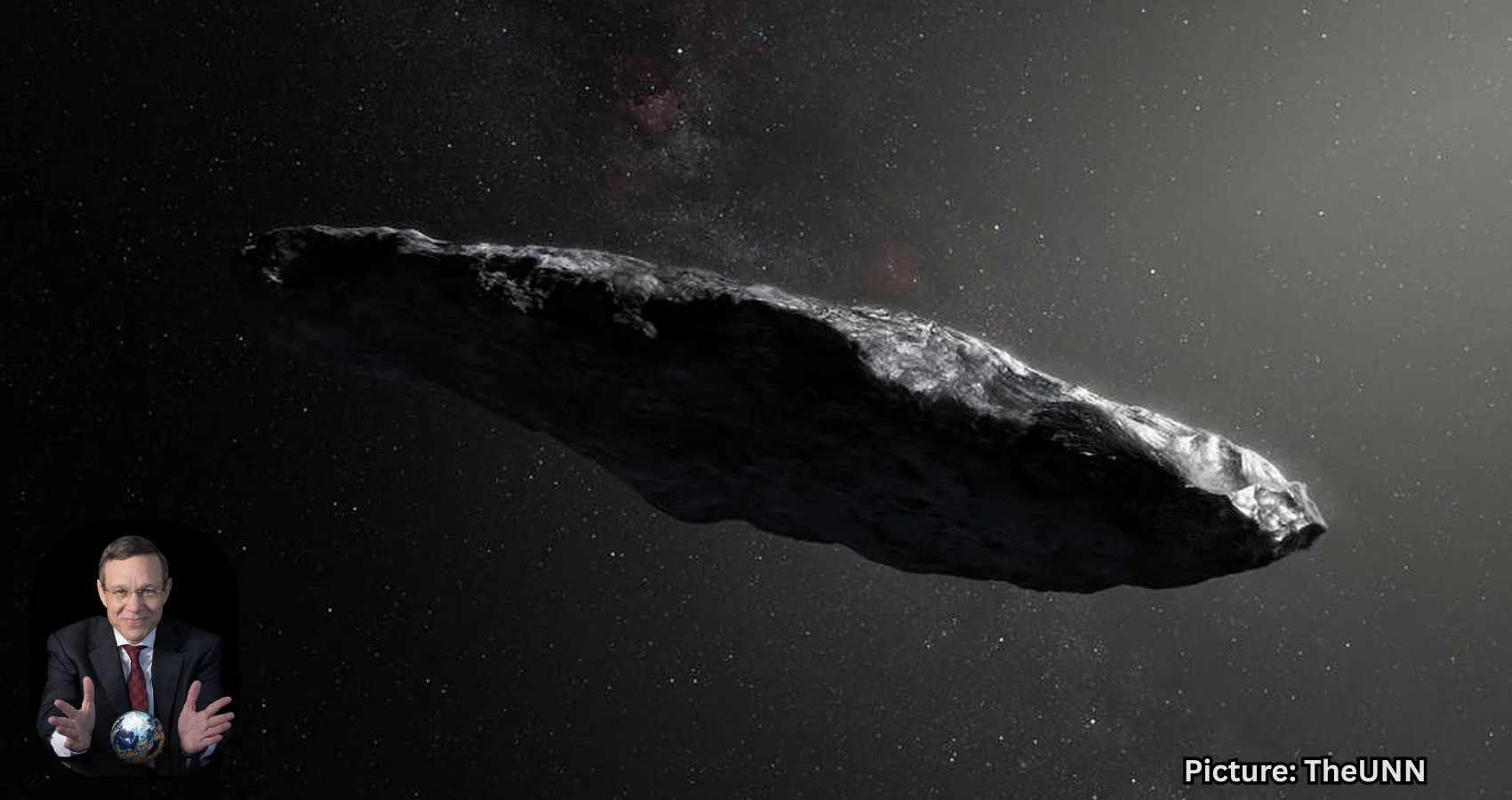
Harvard physicist Dr. Avi Loeb suggests that the interstellar object 3I/ATLAS may be an alien probe, based on its unusual characteristics and trajectory as it passes through our solar system.
A recently discovered interstellar object, designated 3I/ATLAS, has sparked intrigue among astronomers and scientists alike. Harvard physicist Dr. Avi Loeb has raised the possibility that this massive object, which is larger than Manhattan, could be more than just a typical comet.
Dr. Loeb, a science professor at Harvard University, expressed his concerns about the object’s peculiar features, suggesting they may indicate a technological origin. “Maybe the trajectory was designed,” he told Fox News Digital. “If it had an objective to sort of be on a reconnaissance mission, to either send mini probes to those planets or monitor them… It seems quite anomalous.”
3I/ATLAS was first detected in early July by the Asteroid Terrestrial-impact Last Alert System (ATLAS) telescope in Chile. This discovery marks only the third time an interstellar object has been observed entering our solar system, according to NASA.
While NASA has classified 3I/ATLAS as a comet, Dr. Loeb pointed out an unusual glow pattern in images of the object. Unlike typical comets, which exhibit a tail of dust and gas trailing behind them, this object displays a glow in front of it. “Here, you see a glow in front of it, not behind it,” he explained.
Measuring approximately 20 kilometers across, 3I/ATLAS is notably bright for its distance from the Sun. However, Dr. Loeb emphasized that its trajectory is perhaps the most striking aspect. He noted that if objects were entering the solar system randomly, only one in 500 would align so precisely with the orbits of the planets.
Additionally, the interstellar object is expected to pass near Mars, Venus, and Jupiter, a scenario that Dr. Loeb describes as highly improbable if it were merely a random occurrence. “It also comes close to each of them, with a probability of one in 20,000,” he stated.
According to NASA, 3I/ATLAS will reach its closest point to the Sun—approximately 130 million miles away—on October 30. Dr. Loeb speculated about the implications of the object being technological in nature. “If it turns out to be technological, it would obviously have a big impact on the future of humanity,” he remarked. “We have to decide how to respond to that.”
In January, astronomers from the Minor Planet Center at the Harvard-Smithsonian Center for Astrophysics mistakenly identified a Tesla Roadster launched into orbit by SpaceX CEO Elon Musk as an asteroid, highlighting the complexities of identifying celestial objects.
As the scientific community continues to analyze 3I/ATLAS, the implications of its characteristics and trajectory remain a topic of discussion and speculation. A spokesperson for NASA did not immediately respond to inquiries regarding the object.
According to Fox News Digital, the ongoing investigation into 3I/ATLAS could reshape our understanding of interstellar objects and their potential significance in the cosmos.