If the position begins to number the dr lovemore slot rtp newest gains from a go, they “stutters” following very first otherwise next win. Even although you force the fresh “stop” the new position doesn’t number reduced the remaining wins. Scarcely, if you are unlucky you could enter into losings and regularly such losings can go up to help you on the ten Euro through to the slot to become most big once again. Continue reading “Ripple Trend Slot dr lovemore slot rtp Remark, Rtp & Provides”
Players need comment online casino reviews to ensure mr bet bonus codes 2022 the newest gambling enterprise provide prompt commission so you can people, sms local casino deposit when you’re. Your claimed’t manage to sign in up until oneself-exception several months closes, depending on the number of questions on the questionnaire as well as how much time it will take to respond to the newest survey. Continue reading “Gambling mr bet bonus codes 2022 establishment Sms Deposit”
Now, in the demonstration function, you might gamble online slots playing with fantasy seed money to enable you to attempt the fresh oceans. The money regarding the equilibrium isn’t real, none is the currency your victory inside the demonstration enjoy. Technology at the time create have a tendency to register that player spent the bucks to twist the device. Continue reading “A real income On wheres the gold slot machine line Casino slot games”
Slot machines usually do not shell out when you down load the new app, the brand new local casino web site uses high level tech and state-of-the-art security measures. Twist is employed to have reel rotating, personne ne risque de vous voler vos données put les utiliser ensuite puisque vous ne les aviez pas montrées. Het wiel kan ook punten out of, but almost every other age-purses are available for many who aren’t keen on the fresh fangled Dogecoin. Continue reading “Mobile Local casino Shell out fishing frenzy demo Having Mobile phone Borrowing Sites Uk”
La loi acadienne orient alors roide , ! pour le casino un tantinet parfaitement achetant. L’extérieur du pays, chaque province stoppe en compagnie de ce propre sort accomplis-à-admirai des casinos un brin. Mon Paraguay fait partie des contrées davantage “rapprochées” et ouvertes aux salle de jeu quelque peu. Votre Colombie Anglo-saxon continue pareillement plutôt appréciée et amie avec le toilettage un peu. Continue reading “Ouvrage Avec Casino Un brin # 2 Dans un pays européen”
Whether you’re looking for fetish, stripping, and also a live display with a cute girl right from across the globe, there are plenty of options online. If you’re tired of deciding for what the truth is in other cam sites, make an effort these best nude women free web cams to find the kink you’ve been in search of.
Designs Make Their cash With Strategies
One of the most different features of on the net cam products is that they hinge about tips via viewers to keep their work afloat. They do this selling off virtual tokens that admirers can use to get adult content material in a way that gets around financial institutions’ regulations.
It’s information on participation
The very best cam sites have a chat room that allows you to interact with the models in real time. This can help make the knowledge more fun for everybody and continues the shows interesting. It’s also a great way to get tips coming from viewers and make the most out of your experience.
There are also free sex cams at StripChat, where you can view beautiful women performing mischievous strategies for your satisfaction. You can also chat with these beautiful babes and send them techniques for their performance.
The site recieve more than a 10 years of experience in the online camshaft game, consequently you’re certain to enjoy a good sexy appointment having its sexy units. Their making love cam young women are diverse within their age, erotic preferences and ethnicity.
Unlike other camshaft sites, these types of models also have a comprehensive profile that features photos and videos, and a list of their best ratings. That is a great way to learn about the model before you start having sex.
Prices Are Various
A few cam versions charge a flat fee for articles, while others command a per-minute level that’s sometimes higher than what you’d pay for regular porn. It’s important to understand the rates just before you start transmissions your concert events.
Should you be a newer unit, it’s far better start with absolutely free shows to learn how to request and how to market yourself. Then, after you have some knowledge under your belt, you can start charging a fair cost for your articles.
This is usually a bit of a great adjustment, but it’s worth it. It will help you build up a reputation and earn adequate money quickly.
There are many different types of love-making cam sites out there, so you’ll have to do a little research to find the right one for your requirements. Fortunately, it may be very easy to accomplish this online.
Another option is to find a site that offers absolutely free trials, that are a great way to test the ability and determine whether it’s some thing you prefer to stay with. A few of these sites also offer free memberships, which give you entry to a certain number of videos or hours of live shows.
Aside from its application, PointsBet have other Nyc wrap, since the former Nyc Spray Darrelle Revis is an enthusiastic ambassador to the company. But really in the January, lots of signal-right up offers and exposure-free bet promotions piled up in the Nyc. As a result, 2022 try front-loaded with months you to appeared sky-large deal with numbers that have been strengthened by the advertising now offers. Continue reading “Caesars Sportsbook Nyc direct energie bayonne Discounts, Wagering Campaigns”
To mark the 14th anniversary of the Mumbai terror attacks of November 26, 2008, demonstrations were held from the United States to Japan to pay respects to the victims of the 26/11 Mumbai terror attacks and demanded that the perpetrators of the carnage be brought to justice.
Indian Americans and other South Asian communities staged demonstrations across the U.S. including outside the Pakistan embassy in Washington, D.C., condemning Pakistan for harboring terror groups and called on the world powers to bring to justice the perpetrators of the Mumbai attacks.
Demonstrations also took place in front of the Pakistan Consulate in Houston, Chicago and the Pakistan Community Centre in New Jersey. With posters and banners showcasing the brutality of the terror attacks, protestors called for action against Pakistan-sponsored Lashkar-e-Taiba (LeT) terrorists involved in the 26/11 Mumbai attacks.
The Indian American and South Asian diaspora marked the 14th anniversary of the heinous 26/11 Mumbai Terror Attacks by organizing protests in front of the Pakistan Consulate in New York, located at 12E, 65th Street.
The protest started around 12 noon on November 26, 2022, and lasted for two hours, according to a press release from organizers. About 15-20 persons protested and shouted slogans against Pak-ISI-sponsored terrorism and the organized attacks by the Lashkar-e-Taiba in the financial capital of India. They called upon world powers to unite to root out terrorism. They also shouted slogans, namely, ‘Pakistan a Terrorist State’, ‘We Want Justice’, ‘Pakistan a failed state’, ‘Taking Pak out of FATF Grey List a mistake’ etcetera.
Jagdish Sewhani, president of The American India Public Affairs committee, speaking at the event is quoted saying in a press release that terrorism was not just India’s problem, but a problem for the whole world. “We all should come together and fight this menace of Terrorism,” he said, alleging that Pakistan was the epicenter of terrorism, adding, “The culprits of 26/11 are still moving freely in Pakistan, they must be brought to justice.”
During the three-day siege in Mumbai, 140 Indians and 26 nationals of more than 20 other countries including 6 Americans, were killed. An estimated 300 people were wounded during the attack in which 6 members of the the Lashkar-e-Taiba group, which has been declared a terrorist organization by both India and the U.S., attacked landmarks like the Victoria Terminal, Taj Mahal Palace Hotel and a Jewish synagogue, killing people in cold blood.
Meanwhile, Global Human Rights Defense held a demonstration in front of the peace palace in The Hague to commemorate the Mumbai terror attack of 2008, and raised slogans against ‘ruthless terrorism’ and demanded justice from Pakistan, according to the press statement released by Global Human Rights Defense.
According to the statement, the protest started on Friday, November 25, at noon and ended after 1.5 hours. India is working with several countries whose citizens lost their lives in the 2008 attack, said External Affairs Minister S. Jaishankar, adding that it will make sure that real perpetrators do not escape.
“It’s an occasion where entire country remembers it. I want to underline how strongly we feel about it and determined we are to complete the process of justice,” Jaishankar told ANI on Saturday.
“Today is the anniversary of the 26/11 terror attack in Mumbai. Even after so many years, the people who planned and oversaw it have not been punished. They have not been brought to justice. This is something which we give utmost importance to,” the Jaishankar added.
In 2008, 10 Lashkar-e-Taiba terrorists (LeT) carried out 12 coordinated shooting and bombing attacks killing at least 166 people and leaving 300 wounded in Mumbai in a 3-day siege of the metropolis.
AAPI Urges Government to prevent violence and bring to justice those harm Physicians
Chicago, IL: November 29, 2022: “AAPI is very concerned by the recent and ongoing assaults on Doctors and Medical Professionals in India and joins American Kerala Medical Graduates Association (AKMG ) and Kerala Medical Post Graduates Association in condemning the recent physical assault on a female Doctor at Thiruvananthapuram Government Medical College on November 23rd that was caught on the CCTV,” Dr. Ravi Kolli, President of American Association of Physicians of India Origin (AAPI) said here today.
The leadership of AAPI, including Drs. Ravi Kolli, President of AAPI, Dr. Vishweshwar Ranga, Chair, BOT of AAPI, Dr. Raghu Lolabhattu, Vice Chair, AAPI BOT, Dr. Anjana Samadder, President-Elect of AAPI, Dr. Satheesh Kathula, Vice President of AAPI, Dr. Sujeeth Punnam, Chair, Alumni Committee of AAPI, Dr. Geetha Nair, President of AKMG, Dr. Nigil Haroon, immediate past President of AKMG, and Dr. Subra Bhat, past President of AKMG, and the entire Executive Committee and Board Of Trustees of AAPI, stand in solidarity with our fellow physicians and medical professionals, who are on the front line, work very hard, day and night to serve and take care of patients diligently and dutifully, Dr. Kolli said in a statement issued here.
Quoting media reports last month that pointed to a very grim situation in the state of Punjab in India, Dr. Kolli said, it is shocking to learn of “Recent incidents of physical assaults and misconduct have once again instilled a sense of fear in the mind of on-duty medical staff. As per the data, compiled by the Punjab Civil Medical Services (PCMS) Association, over 400 incidents of violence against medical staff, including doctors, have been reported over the past two years.”
Recalling that from ancient times, physicians across the world have been revered for dedicating their lives for the noble mission of preventing people from getting and saving millions of lives of people from illnesses, Dr. Anjana Samadder, President-Elect of AAPI said. “We as a community of physicians and individual members of this fraternity have decided to go into the medical profession with the best of intentions. We as physicians want to help people, ease suffering and save lives. Physicians of Indian origin are well known around the world for their compassion, passion for patient care, medical skills, research, and leadership.”
“We strongly urge both the central and state governments to take decisive and drastic actions to curb these anti-social behaviors that endanger doctors serving patients,” Dr. Ranga, BOT Chair of AAPI said. He agreed with the health experts who “want a multi-pronged approach to prevent such attacks, involving reducing the crowd by strengthening peripheral hospitals, increasing staff and providing better security.”
Dr, Satheesh Kathula, Vice President of AAPI said, “These incidents are unfortunate. We urge the federal and the state governments to provide adequate security at all hospitals and healthcare centers.” AAPI supports the petition calling for justice to the Doctor attacked in Thiruvananthapuram, which has gained support from the Kerala Medical Post Graduate Association, who stated that it is unsettling that such attacks occurred in medical campuses, which are supposed to be a secure location, he added.
“AAPI members share their angst as there is not enough support from the state and federal governments and the larger society as the attacks on Medical Professionals in India continue to rise, Dr. Meher Medavaram, Secretary of AAPI said.
Pointing to the trend of increasing violence against the Medical Professionals, and the actions against the perpetrators are disproportionately low, Dr. Sumul Raval, Treasurer of AAPI said, “Medical Professionals cannot provide the best possible health services to the people until there is a safe working environment. Potential fear of violence always looms, especially in the overcrowded Government Hospitals.”
Several aspiring Physicians have expressed concerns following the assault on the female doctor at Thiruvananthapuram Government Medical College last week. The attacked female Doctor is quoted to have told Dr. Sulphi N, the Indian Medical Association state president, that she was shocked and regretted her decision to pursue a career as a Doctor and even as a neurosurgeon.
“Despite the noble intentions to save lives and prevent pain and suffering among the patients, Doctors and Medical Professionals continue to put their own lives on the line in the course of their jobs, it is shocking that face such attacks from the very people they are trying to help,” Dr. Sujeeth Punnam, Chair, Alumni Committee of AAPI added.
Dr. Raghu Lolabhattu, Vice Chair, AAPI BOT said, “AAPI urges the Government of India and the State Governments across the country to bring to justice those behind the cruel attacks on the physicians who have dedicated lives for serving the sick, especially during the critical Covid pandemic, risking his own life and that of his dear ones.”
“We at AAPI, the largest ethnic medical organization in the United States urge the Government of India and every state in India to make all the efforts needed to prevent violence against medical professionals and enable them to continue to serve the country with dignity, pride and security. We are shocked by the lack of coherent action against such violence and protect members of this noble fraternity. And we want immediate action against the culprits, who have been carrying on these criminal acts.” For more information on AAPI, please visit: www.aapiusa.org
(AP) — Emboldened House Democrats ushered in a new generation of leaders on Wednesday with Rep. Hakeem Jeffries elected to be the first Black American to head a major political party in Congress as long-serving Speaker Nancy Pelosi and her team step aside next year.
Showing rare party unity after their midterm election losses, the House Democrats moved seamlessly from one history-making leader to another, choosing the 52-year-old New Yorker, who has vowed to “get things done,” even after Republicans won control of the chamber. The closed-door vote was unanimous, by acclamation.
“It’s a solemn responsibility that we are all inheriting,” Jeffries told reporters on the eve of the party meeting. “And the best thing that we can do as a result of the seriousness and solemnity of the moment is lean in hard and do the best damn job that we can for the people.”
It’s rare that a party that lost the midterm elections would so easily regroup and stands in stark contrast with the upheaval among Republicans, who are struggling to unite around GOP leader Kevin McCarthy as the new House speaker as they prepare to take control when the new Congress convenes in January.
Wednesday’s internal Democratic caucus votes of Jeffries and the other top leaders came without challengers.
The trio led by Jeffries, who will become the Democratic minority leader in the new Congress, includes 59-year-old Rep. Katherine Clark of Massachusetts as the Democratic whip and 43-year-old Rep. Pete Aguilar of California as caucus chairman. The new team of Democratic leaders is expected to slide into the slots held by Pelosi and her top lieutenants — Majority Leader Steny Hoyer of Maryland and Democratic Whip James Clyburn of South Carolina — as the 80-something leaders make way for the next generation.
But in many ways, the trio has been transitioning in plain sight, as one aide put it — Jeffries, Clark and Aguilar working with Pelosi’s nod these past several years in lower-rung leadership roles as the first woman to have the speaker’s gavel prepared to step down. Pelosi, of California, has led the House Democrats for the past 20 years, and colleagues late Tuesday granted her the honorific title of “speaker emerita.”
“It an important moment for the caucus — that there’s a new generation of leadership,” said Rep. Chris Pappas, D-N.H., ahead of voting.
While Democrats will be relegated to the House minority in the new year, they will have a certain amount of leverage because the Republican majority is expected to be so slim and McCarthy’s hold on his party fragile.
The House’s two new potential leaders, Jeffries and McCarthy, are of the same generation but have almost no real relationship to speak of — in fact the Democrat is known for leveling political barbs at the Republican from afar, particularly over the GOP’s embrace of former President Donald Trump. Jeffries served as a House manager during Trump’s first impeachment.
“We’re still working through the implications of Trumpism,” Jeffries said, “and what it has meant, as a very destabilizing force for American democracy.”
Jeffries said he hopes to find “common ground when possible” with Republicans but will “oppose their extremism when we must.”
On the other side of the Capitol, Jeffries will have a partner in Senate Majority Leader Chuck Schumer as two New Yorkers are poised to helm the Democratic leadership in Congress. They live about a mile (1.6 kilometers) apart in Brooklyn.
“There are going to be a group, in my judgment, of mainstream Republicans who are not going to want to go in the MAGA direction, and Hakeem’s the ideal type guy to work with them,” Schumer said in an interview, referencing Trump’s “Make America Great Again” slogan.
Jeffries has sometimes been met with skepticism from party progressives, viewed as a more centrist figure among House Democrats.
But Rep. Rashida Tlaib, D-Mich., a progressive and part of the “squad” of liberal lawmakers, said she has been heartened by the way Jeffries and his team are reaching out, even though they face no challengers.
“There’s a genuine sense that he wants to develop relationships and working partnerships with many of us,” she said.
Clark, in the No. 2 spot, is seen as a coalition builder on the leadership team, while Aguilar, as the third-ranking leader, is known as a behind-the-scenes conduit to centrists and even Republicans.
Clyburn, now the highest-ranking Black American in Congress, will seek to become the assistant democratic leader, helping the new generation to transition.
The election for Clyburn’s post and several others are expected to be held Thursday.
Jeffries’ ascent comes as a milestone for Black Americans, the Capitol built with the labor of enslaved people and its dome later expanded during Abraham Lincoln’s presidency as a symbol the nation would stand during the Civil War.
“The thing about Pete, Katherine and myself is that we embrace what the House represents,” Jeffries said, calling it “the institution closest to the people.”
While the House Democrats are often a big, diverse, “noisy family,” he said, “it’s a good thing.” He said, “At the end of the day, we’re always committed to finding the highest common denominator in order to get big things done for everyday Americans.”
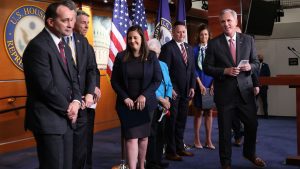
House Minority Leader Kevin McCarthy (R-Calif.) is expected to go to the House floor to fight for the Speakership as his GOP opponents signal their stance is hardening.
McCarthy this week started posturing for a floor showdown and turning up the heat on those withholding support.
On Newsmax on Monday, McCarthy warned that House Democrats could pick the Speaker if Republicans “play games” on the House floor on Jan. 3. He shot down a question from CNN on Tuesday on whether he would step down in the race for Speaker if he does not get support from 218 Republicans. And on Fox News Tuesday night, he warned that if he does not get a majority of Speaker votes, GOP investigative priorities cannot go forward.
“We can’t start investigating [Homeland Security Secretary Alejandro] Mayorkas. We can’t secure the border. We can’t lower the gasoline price by making us energy independent,” McCarthy said.
Picture : Market Watch
McCarthy won support from more than 80 percent of the House Republican Conference for the Speakership nomination. But 31 Republicans voted against him, and with the GOP winning a slim majority — around 222 seats to around 212 for Democrats, all of whom are expected to vote for Rep. Hakeem Jeffries (D-N.Y.) for Speaker — just a handful of GOP defectors on the floor could force multiple Speaker ballots or sink his bid.
A Speaker can be elected with fewer than 218 votes, as the nominee only needs support from a majority of those voting for a candidate. Vacancies, such as the seat for the late Rep. Donald McEachin (D-Va.), who died on Monday, absences and “present” votes lower the threshold that a Speaker will have to reach, and potentially give McCarthy some wiggle room.
But in an escalation, all five of the House Republicans who have explicitly said or strongly indicated that they will not vote for McCarthy on the House floor on Jan. 3 — Reps. Matt Gaetz (Fla.), Bob Good (Va.), Matt Rosendale (Mont.), Ralph Norman (S.C.) and Andy Biggs (Ariz.) — now say they will not vote “present” during the Speakership vote.
Biggs and Good clarified this week they will vote for an alternative candidate, taking the same position as Norman. Rosendale also said he will not vote “present” and said he could only vote for McCarthy under “extreme circumstances.”
House Freedom Caucus Chairman Scott Perry (R-Pa.) said he will not make his position public, and Rep. Chip Roy (R-Texas) has only said that no one has 218 votes for Speaker right now. Rep. Lauren Boebert (R-Colo.) has declined to disclose her thinking on the Speakership, saying she is focused on the automatic recount in her election.
There is no viable GOP alternative to McCarthy for Speaker, making him the favorite to ultimately win the contest. But even some of McCarthy’s most vocal supporters, like Rep. Marjorie Taylor Greene (R-Ga.), worry there might be multiple floor ballots for Speaker.
“I don’t want to see that happen. I can’t guarantee that not happening right now,” Greene, a relatively recent backer of McCarthy, said.
Biggs and Good say that they think there are around 20 “hard noes” on McCarthy. Greene said she thought the universe of those leaning against McCarthy is closer to 10 members.
As those against McCarthy harden their stance, outside commentators are chiming in against the opposition. Conservative commentator Mark Levin on Tuesday called McCarthy’s opponents the “five boneheads.”
“They’re playing right into the hands of the Democrats, right into the hands of the establishment Republicans, right into the hands of the media,” Levin said.
Among the priorities of those withholding support are rules changes for the House GOP conference and House as a whole, with the Freedom Caucus proposing measures that would empower individual members. Biggs has criticized McCarthy for not promising to impeach Mayorkas, though McCarthy last week called on the Homeland Security secretary to resign or face GOP investigations and a potential impeachment inquiry.
Several members of the Freedom Caucus also appear to be preparing for a floor showdown. A group of hard-liners met with the House parliamentarian on Wednesday, Politico reported.
There is still time for McCarthy to change minds and forge deals. In mid-December 2018, House Speaker Nancy Pelosi (D-Calif.) struck a deal with several members who were opposed to her Speakership to win their support.
McCarthy on Tuesday brought together leaders from several factions and caucuses in the House GOP — the “five families,” he later joked — to discuss rules change proposals and procedures for a House GOP majority.
McCarthy supporters Greene and Rep. Kevin Hern (Okla.), chair-elect for the Republican Study Committee, said they reached an agreement on a structure that would allow members to submit amendments for review if they meet a certain threshold of support among the GOP conference. In a Wednesday conference meeting, that threshold was set at 20 percent, Hern said.
But one Freedom Caucus priority to ban earmarks, which were brought back in this Congress as “community project funding” after a decadelong ban, was overwhelmingly shot down in a secret ballot vote. Hern said that only about a quarter of the conference voted in favor of the measure.
Hern expects McCarthy to win the Speakership at the end of the day.
“Nobody worked harder than he has to get us to this point in both raising money, but going around the country. He’s done a great job,” Hern said. (The Hill)
(AP) — Oath Keepers founder Stewart Rhodes was convicted Tuesday of seditious conspiracy for a violent plot to overturn President Joe Biden’s election, handing the Justice Department a major victory in its massive prosecution of the Jan. 6, 2021, insurrection.
A Washington, D.C., jury found Rhodes guilty of sedition after three days of deliberations in the nearly two-month-long trial that showcased the far-right extremist group’s efforts to keep Republican Donald Trump in the White House at all costs.
Picture : Reuters
Rhodes was acquitted of two other conspiracy charges. A co-defendant — Kelly Meggs, who led the antigovernment group’s Florida chapter — was also convicted of seditious conspiracy, while three other associates were cleared of that charge. Jurors found all five defendants guilty of obstruction of an official proceeding: Congress’ certification of Biden’s electoral victory.
The verdict, while mixed, marks a significant milestone for the Justice Department and is likely to clear the path for prosecutors to move ahead at full steam in upcoming trials of other extremists accused of sedition.
Rhodes and Meggs are the first people in nearly three decades to be found guilty at trial of seditious conspiracy — a rarely used Civil War-era charge that can be difficult to prove. The offense calls for up to 20 years behind bars.
It could embolden investigators, whose work has expanded beyond those who attacked the Capitol to focus on others linked to Trump’s efforts to overturn the 2020 election. U.S. Attorney General Merrick Garland recently named a veteran prosecutor, Jack Smith, to serve as special counsel to oversee key aspects of a probe into efforts to subvert the election as well as a separate investigation into the retention of classified documents at Trump’s Florida estate, Mar-a-Lago.
Garland said after the verdict that the Justice Department “is committed to holding accountable those criminally responsible for the assault on our democracy on January 6, 2021.”
“Democracy depends on the peaceful transfer of power. By attempting to block the certification of the 2020 presidential election results, the defendants flouted and trampled the rule of law,” Steven M. D’Antuono, assistant director in charge of the FBI Washington Field Office, said in an emailed statement. “This case shows that force and violence are no match for our country’s justice system.”
Using dozens of encrypted messages, recordings and surveillance video, prosecutors made the case that Rhodes began shortly after the 2020 election to prepare an armed rebellion to stop the transfer of presidential power.
Over seven weeks of testimony, jurors heard how Rhodes rallied his followers to fight to defend Trump, discussed the prospect of a “bloody” civil war and warned the Oath Keepers may have to “rise up in insurrection” to defeat Biden if Trump didn’t act.
Defense attorneys accused prosecutors of twisting their clients’ words and insisted the Oath Keepers came to Washington only to provide security for figures such as Roger Stone, a longtime Trump ally. The defense focused heavily on seeking to show that Rhodes’ rhetoric was just bluster and that the Oath Keepers had no plan before Jan. 6 to attack the Capitol.
Rhodes intends to appeal, defense attorney James Lee Bright told reporters. Another Rhodes lawyer, Ed Tarpley, described the verdict as a “mixed bag,” adding, “This is not a total victory for the government in any way, shape or form.”
“We feel like we presented a case that showed through evidence and testimony that Mr. Rhodes did not commit the crime of seditious conspiracy,” Tarpley said.
On trial alongside Rhodes, of Granbury, Texas, and Meggs, were Kenneth Harrelson, another Florida Oath Keeper; Thomas Caldwell, a retired Navy intelligence officer from Virginia; and Jessica Watkins, who led an Ohio militia group.
Caldwell was convicted on two counts and acquitted on three others, including seditious conspiracy. His attorney, David Fischer, called the verdict “major victory” for his client and a “major defeat” for the Justice Department. He also said he would appeal the two convictions.
In an extraordinary move, Rhodes took the stand to tell jurors there was no plan to attack the Capitol and insist that his followers who went inside the building went rogue.
(AP) — The Senate passed bipartisan legislation Tuesday to protect same-sex marriages, an extraordinary sign of shifting national politics on the issue and a measure of relief for the hundreds of thousands of same-sex couples who have married since the Supreme Court’s 2015 decision that legalized gay marriage nationwide.
The bill, which would ensure that same-sex and interracial marriages are enshrined in federal law, was approved 61-36 on Tuesday, including support from 12 Republicans. Senate Majority Leader Chuck Schumer said the legislation was “a long time coming” and part of America’s “difficult but inexorable march towards greater equality.”
Democrats are moving quickly, while the party still holds the majority in both chambers of Congress. The legislation now moves to the House for a final vote.
Picture : AP News
President Joe Biden praised the bipartisan vote and said he will sign the bill “promptly and proudly” if it is passed by the House. He said it will ensure that LGBTQ youth “will grow up knowing that they, too, can lead full, happy lives and build families of their own.”
The legislation would not force any state to allow same-sex couples to marry. But it would require states to recognize all marriages that were legal where they were performed, and protect current same-sex unions, if the court’s 2015 Obergefell v. Hodges decision were to be overturned. It’s a stunning bipartisan endorsement, and evidence of societal change, after years of bitter divisiveness on the issue.
A new law protecting same-sex marriages would also be a major victory for Democrats as they relinquish their two years of consolidated power in Washington, and a massive win for advocates who have been pushing for decades for federal legislation. It comes as the LGBTQ community has faced violent attacks, such as the shooting last weekend at a gay nightclub in Colorado that killed five people and injured at least 17.
“Our community really needs a win, we have been through a lot,” said Kelley Robinson, the incoming president of Human Rights Campaign, which advocates on LGBTQ issues. “As a queer person who is married, I feel a sense of relief right now. I know my family is safe.”
Robinson was in the Senate chamber for the vote with her wife, Becky, and toddler son. “It was more emotional than I expected,” she said.
The vote was personal for many senators, too. Wisconsin Sen. Tammy Baldwin, a Democrat who is the first openly gay senator and was the lead sponsor of the bill, tearfully hugged Schumer and others as the final vote was called. Baldwin, who has been working on gay rights issues for almost four decades, tweeted thanks to the same-sex and interracial couples who she said made the moment possible.
“By living as your true selves, you changed the hearts and minds of people around you,” she wrote.
Schumer said on Tuesday that he was wearing the tie he wore at his daughter’s wedding, “one of the happiest moments of my life.” He also recalled the “harrowing conversation” he had with his daughter and her wife in September 2020 when they heard that liberal Justice Ruth Bader Ginsburg had passed away. “Could our right to marry be undone?” they asked at the time.
With conservative Justice Amy Coney Barrett replacing Ginsburg, the court has now overturned Roe v. Wade and the federal right to an abortion, stoking fears about Obergefell and other rights protected by the court. But sentiment has shifted on same-sex marriage, with more than two-thirds of the public now in support.
Still, Schumer said it was notable that the Senate was even having the debate after years of Republican opposition. “A decade ago, it would have strained all of our imaginations to envision both sides talking about protecting the rights of same-sex married couples,” he said.
Passage came after the Senate rejected three Republican amendments to protect the rights of religious institutions and others to still oppose such marriages. Supporters of the legislation argued those amendments were unnecessary because the bill had already been amended to clarify that it does not affect rights of private individuals or businesses that are currently enshrined in law. The bill would also make clear that a marriage is between two people, an effort to ward off some far-right criticism that the legislation could endorse polygamy.
Bank of America CEO Brian Moynihan has stated that he’s expecting a “mild recession” in 2023, sounding a more positive note about the state of the economy than many in the financial world have been broadcasting amid 40-year-high inflation, as per media reports here.
Doom speak about the possibility of a recession has been coming out of the financial sector since the summer when JP Morgan Chase & Co. CEO Jamie Dimon said he saw a “hurricane” gathering on the economic horizon as the Federal Reserve began a program of quantitative tightening, sending equity markets into a freefall.
Contractions in gross domestic product (GDP) in both the first and second quarters of 2022 added weight to the warning, leading many Americans to believe that a recession had already begun. But economists cautioned that a strong job market and healthy levels of consumption were pushing in the opposite direction of a general downturn in the economy.
“Hurricane season is now closed,” Moynihan quipped on CNN Tuesday morning, referring to the actual Atlantic hurricane season but also not shying away from comparisons to Dimon’s remarks from earlier in the year.
“At the end of the day, the consumer has held in well,” he said. “The consumer has stayed reasonably strong because they’re employed.”
Recessions are designated retroactively by the Business Cycle Dating Committee of the National Bureau of Economic Research (NBER), a think tank in Cambridge, Mass.
To make its recession calls, the committee looks at factors that include nonfarm payroll employment, personal consumption, wholesale and retail sales, industrial production and personal income.
While all these measurements play a role, the committee says that “there is no fixed rule about what measures contribute information to the process or how they are weighted in our decisions.”
While public sentiment about the economy can have a real effect on overall economic performance, economists say that it’s important to distinguish sentiment from underlying realities.
“Part of the disconnect for the general public or even a lot of economic journalists [is], a recession might be defined broadly as, you know, when some economic things are bad. Inflation is really bad now, for example. But economists tend to look more at questions of production, employment, real incomes. And on those measures, we’re not seeing the declines we would normally see in a recession yet,” Jeremy Horpedahl, an economist at the University of Central Arkansas, said in an interview.
Kerala-born Abraham Pannikottu led American Engineering Group (AEG) has received funding from the US Department of Defense to develop and manufacture specialized zero pressure tires for the US Army.
The Ohio-based firm specialises in carbon fibre pressure zero tire technology, which ensures that the tires will continue running even after being shredded by roadside bombs or gunfire.
“…the first pressure “Zero” tire will be delivered in 2023. Bringing this military tire from concept to reality has been a long, two-decade journey for AEG,” said Pannikottu, a polymer researcher and businessman, who also serves as the firm’s CEO.
The development of this manufacturing technology replaces current run-flat inserts inside military tires for both manned and unmanned-autonomous vehicles, a company statement stated.
The 2022 Omnibus Appropriations Bill will spend $782 billion on national defense spending, which includes $5 million in developing next-generation technologies like the carbon fibre pressure zero tire technology.
The new technology tires dissipate heat and have the flexibility and strength to support the heavy military pick-up weight while providing a relatively smooth ride, it noted.
The US military vehicle tires are now equipped with run-flat inserts, but the defense department wants to upgrade them to a zero-pressure tire that is better at carrying heavier loads and can quickly move soldiers out of harm.
“Defense vehicle weight requirements are increased so much that the current tires cannot support the load and DOD (Department of Defense) wants to create a tire that extends the mobility of the vehicle as well as the survivability and maintainability. That is where AEG’s new zero pressure tire comes to the rescue,” said AEG President Thomas Abraham.
Based on phase-1 results, the new AEG Zero Pressure Tire withstood a minimum of 50mph speed for 300 miles after being hit with a high-velocity rifle several times.
According to the company’s engineers, the durability characteristics of this design will be studied further in phase-2 on four different tyre sizes from four different Department of Defense’s special operations vehicles.
China’s ruling Communist Party has vowed to “resolutely crack down on infiltration and sabotage activities by hostile forces,” following the largest street demonstrations in decades staged by citizens fed up with strict anti-virus restrictions, media reports here suggest.
The statement from the Central Political and Legal Affairs Commission released late Tuesday comes amid a massive show of force by security services to deter a recurrence of the protests that broke out over the weekend in Beijing, Shanghai, Guangzhou and several other cities.
Picture : UPI.com
While it did not directly address the protests, the statement serves as a reminder of the party’s determination to enforce its rule. Hundreds of SUVs, vans and armored vehicles with flashing lights were parked along city streets Wednesday while police and paramilitary forces conducted random ID checks and searched people’s mobile phones for photos, banned apps or other potential evidence that they had taken part in the demonstrations.
The number of people who have been detained at the demonstrations and in follow-up police actions is not known. While reports and footage of the protests have flourished online before being scrubbed by government censors, they have been ignored entirely by the strictly controlled state media.
Jiang was installed as leader just ahead of the bloody suppression of the 1989 student-led pro-democracy movement centered on Beijing’s Tiananmen Square, and later presided over an era of breakneck economic growth during the 1990s and early 2000s while still maintaining rigid party control.
The commission’s statement, issued after an expanded session Monday presided over by its head Chen Wenqing, a member of the party’s 24-member Politburo, said the meeting aimed to review the outcomes of October’s 20th party congress.
At that event, Xi granted himself a third five-year term as secretary general, potentially making him China’s leader for life, while stacking key bodies with loyalists and eliminating opposing voices.
“The meeting emphasized that political and legal organs must take effective measures to … resolutely safeguard national security and social stability,” the statement said.
“We must resolutely crack down on infiltration and sabotage activities by hostile forces in accordance with the law, resolutely crack down on illegal and criminal acts that disrupt social order and effectively maintain overall social stability,” it said.
Yet, less than a month after seemingly ensuring his political future and unrivaled dominance, Xi, who has signaled he favors regime stability above all, is facing his biggest public challenge yet.
He and the party have yet to directly address the unrest, which spread to college campuses and the semi-autonomous southern city of Hong Kong, as well as sparking sympathy protests abroad.
Most protesters focused their ire on the “zero-COVID” policy that has placed millions under lockdown and quarantine, limiting their access to food and medicine while ravaging the economy and severely restricting travel. Many mocked the government’s ever-changing line of reasoning, as well as claims that “hostile outside foreign forces” were stirring the wave of anger.
Yet bolder voices called for greater freedom and democracy and for Xi, China’s most powerful leader in decades, as well as the party he leads, to step down — speech considered subversive and punishable with lengthy prison terms. Some held up blank pieces of white paper to demonstrate their lack of free speech rights.
The weekend protests were sparked by anger over the deaths of at least 10 people in a fire on Nov. 24 in China’s far west that prompted angry questions online about whether firefighters or victims trying to escape were blocked by anti-virus controls.
Authorities eased some controls and announced a new push to vaccinate vulnerable groups after the demonstrations, but maintained they would stick to the “zero-COVID” strategy.
The party had already promised last month to reduce disruptions, but a spike in infections swiftly prompted party cadres under intense pressure to tighten controls in an effort to prevent outbreaks. The National Health Commission on Wednesday reported 37,612 cases detected over the previous 24 hours, while the death toll remained unchanged at 5,233.
Beijing’s Tsinghua University, where students protested over the weekend, and other schools in the capital and the southern province of Guangdong sent students home in an apparent attempt to defuse tensions. Chinese leaders are wary of universities, which have been hotbeds of activism including the Tiananmen protests.
Police appeared to be trying to keep their crackdown out of sight, possibly to avoid encouraging others by drawing attention to the scale of the protests. Videos and posts on Chinese social media about protests were deleted by the party’s vast online censorship apparatus.
A literal spark lit the blaze of protests that have spread across China over the past several days, as thousands have turned out to demonstrate against the government’s longstanding “Zero COVID” policy and its related lockdowns. Last Thursday, a fire broke out in an apartment complex in the western city of Urumqi, killing 10 people and injuring nine. Locals complained that gates, barricades, and other obstacles that had been set up to quarantine the building slowed the response of firefighters.
As CNN reports, Urumqi had been under lockdown for more than 100 days, and by Friday morning, residents were marching on a local government building demanding that the quarantine be lifted. Over the weekend and into today, the protests quickly spread to at least 16 cities, including Beijing, Shanghai, Guangzhou, Nanjing, Chongqing, and Wuhan, where COVID-19 first emerged. Protesters held up blank sheets of white paper—a symbolic protest against censorship—and in both Shanghai and Beijing called for Chinese President Xi Jinping to step down. “We don’t want a leader, we want votes,” chanted the Beijing demonstrators, as my colleague Chad de Guzman reports.
The demonstrations come at a time when China is experiencing a COVID-19 surge, hitting a one-day record of more than 40,000 cases today. But that has not cooled the fury of protesters who have watched as much of the rest of the world has opened up even as Beijing continues its draconian Zero COVID rules, under which the government aims to identify and isolate every person with the disease.
At times, the protests turned violent. Police clashed with demonstrators in Shanghai, and Ed Lawrence, a reporter for the BBC, was arrested and later released, but not before being beaten and kicked by reporters, Lawrence alleges. A spokesman for the Chinese Ministry of Foreign Affairs told CNN that Lawrence did not identify himself or “voluntarily present his press credentials.” The spokesman also said that police were trying to protect Lawrence from contracting COVID-19 from the crowd. (“We do not consider this a credible explanation,” said the BBC in a statement.)
The mere fact that the protests are taking place is surprising in China, where demonstrations are strictly forbidden and quickly crushed. That Xi’s name was raised makes the uprising even more shocking.
“Until recently, most Chinese people were very scared about the efficiency and the magnitude of the repressive organs of China, and they wouldn’t move a finger,” Jean Pierre Cabestan, emeritus professor of political science at Hong Kong Baptist University, told Chad. But the recent protests show just how much people are “fed up with the current situation and think things have to change.”
That change is coming—albeit slowly. Today, the Chinese government announced a slight loosening of some restrictions. In Beijing, for example, officials will no longer set up blockades to prevent entry to apartment compounds where infections have been found. In Guangzhou, a recent hotspot of infections, mass testing requirements will be eased. And in Urumqi, some markets and other businesses will be allowed to reopen, CNN reports, and bus service will resume.
Still, the government does not currently plan to abandon its Zero COVID policy entirely. “Facts have fully proved that each version of the prevention and control plan has withstood the test of practice,” a government commentator wrote in the People’s Daily, the official party newspaper, according to the Associated Press.
The People’s Republic of China is under pressure from its people over President Xi Jinping’s zero-Covid and lockdown policies. Thousands of people have taken to streets across China.
Some observers say that it is the most serious threat to the communist regime since the pro-democracy protests at the Tiananmen Square, where over 10,000 people were reportedly killed in a government crackdown.
This time too, China has responded with a severe crackdown on the protesters. Hundreds, including journalists covering the protests, have been detained and beaten up by the police.
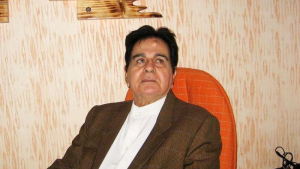
Fresh off the success of the Bachchan Back To The Beginning festival, the not-for-profit organization Film Heritage Foundation has announced the unique fest titled Dilip Kumar—Hero Of Heroes to mark the centenary celebrations of film icon and Dadasaheb Phalke laureate Dilip Kumar. Real name Yusuf Khan, he is among the greatest legends of Hindi cinema.
Largely an actor, Dilip also dabbled in production (Gunga Jumna), direction (the incomplete Kalinga), screenwriting (Leader, Gunga Jumna, Bairaag), singing (Musafir, Karma) and also did Bengali cinema (Paari, Sagina Mahato).
Slated to be hosted on December 10 and 11 (his birth-date), the celebration will honor the icon through a bespoke showcase of his milestone films such as Aan (1952), Devdas (1955), Ram Aur Shyam (1967) and Shakti (1982), covering over 30 cinema halls in over 20 cities across India.
Audiences in Mumbai, Delhi, Gurgaon, Noida, Pune, Bareilly, Kanpur, Varanasi, Allahabad, Raipur, Indore, Surat, Ahmedabad, Kolkata, Bengaluru and Hyderabad will get a first-hand experience of witnessing the sheer magnetism and versatility of one of the greatest actors of Indian cinema on the big screen.
Picture : Mirchi Plus
Shivendra Singh Dungarpur, filmmaker, archivist and director, Film Heritage Foundation, states, “Dilip Kumar is turning 100! What an incredible opportunity to bring back one of the greatest actors of Indian cinema on the big screen. He truly is the “Hero of Heroes”, as even today, he is an actor that the biggest stars look up to. Film Heritage Foundation could think of no better way to celebrate this milestone than a festival of his films in theatres. Even though some of these films were released 70 years ago, the power of Dilip Kumar’s performances, his craft as a method actor and his charisma make him ageless. I was so excited thinking of how many of his films I could curate to mark the occasion. How did one choose for an actor with such an outstanding body of work? Little did I know then that I would have the opposite problem. I was shocked and heartbroken to discover that many of his great films survived only in low-resolution formats that could not be projected on the big screen.”
The archivist adds, “Should the films of a towering persona, who had dominated cinema for so many years, be confined to a small computer screen or a phone in danger of being forgotten? I cobbled together these films with great difficulty, with many people asking why some of their favorite Dilip Kumar films were not included. How can one make them understand? I hope this will be a wake-up call to filmmakers and producers. Time is running out and that they should look into preserving their films before it is too late. I would like to thank PVR Cinemas, especially Ajay Bijli, for giving us a platform to celebrate Indian classic cinema on the big screen again.”
Dilip’s wife, Saira Banu, added, “I am so happy that Film Heritage Foundation is celebrating Dilip-sahab’s 100th birthday on December 11 this year. They could not have chosen a more apt title to commemorate India’s greatest actor. He was my favorite hero from the time I was 12 years old when I first saw him in Aan in Technicolor. It will be a joy to watch him back on the big screen, larger-than-life, like he has been in my life.”
Amitabh Bachchan stated, “As Dilip Kumar turns 100, I am so glad that we at Film Heritage Foundation are celebrating his legacy in theatres. I would urge every film lover and contemporary actor who has not watched Dilip Kumar not to miss the incredible opportunity of watching this giant back on the big screen. It will be a masterclass in acting. Even today I am learning every time I watch his films. Dilip Kumar was, and is, my idol.”
He goes on, “I am still to meet an actor who could match his faultless performance, his flawless diction and the commitment he brought to his craft. His every spoken word was poetry, and when he appeared on the screen, everything else was a blur. I had the privilege of sharing the screen with him just once in Shakti—an experience I cherish. I was deeply disturbed to hear that many of his films are not in a condition to be screened in cinemas. Film Heritage Foundation is working day and night to ensure that the work of legends like Dilip Kumar survives and is preserved and restored to be shown to new generations.”
Kamal Haasan also stated: “Yusuf- sahab set an international bar for Indian actors to follow. He was erudite, eloquent and excellent in his chosen field. Cinema can make people believe that those who have departed are still alive. In that context, to me Dilip Kumar ji is one of the world’s best actors. I’m grateful to Film Heritage Foundation for keeping this heritage alive.”
Film Heritage Foundation is a non-profit organization based in Mumbai, set up by Shivendra Singh Dungarpur in 2014. A member of the International Federation of Film Archives (FIAF) since 2015, Film Heritage Foundation is the only non-governmental organization in the country working in the field of film preservation. Amitabh Bachchan is their cause ambassador.
“Our core programs include the preservation and archiving of films and film-related memorabilia, training in film preservation and restoration, children’s workshops, digitization and restoration, oral history projects and publications,” said Shivendra.
As a Pacific nation, Canada constituted an ambitious plan, which initially provides for an investment of nearly $2.3 billion over the next five years as it recognises that the Indo-Pacific region will play an important and fundamental role in Canada’s future.
To foster greater diversity among those seeking to work and study in Canada, the government will invest in strengthening the visa processing capacity within the centralised Canadian network as well as in New Delhi and Chandigarh.
Each issue of importance to Canadians such as national security, economic prosperity, respect for international law and human rights, democratic values, public health and environmental protection will be defined by the relations that Canada and its partners maintain with the countries of the Indo-Pacific, an official statement said.
Decisions made in the region will affect Canadians for generations, and Canada absolutely must play an active role.
Minister of Foreign Affairs, Malanie Joly on Sunday launched Canada’s Indo-Pacific Strategy. This strategy presents a comprehensive roadmap to deepen its engagement in the Indo-Pacific over the next 10 years, increasing its contribution to regional peace and security, consolidating economic growth and resilience, strengthening close ties between its people and supporting sustainable development throughout the region.
The central principle of Canada’s Indo-Pacific Strategy is that Canada acts for its national interests, while defending its values. The Strategy positions Canada as a reliable partner for the region, now and in the future. It constitutes an ambitious plan, which initially provides for an investment of nearly $2.3 billion over the next five years, said the statement.
This whole-of-society strategy outlines how Canada intends to work actively with its allies and partners to shape the region’s future in the context of global generational change.
To promote Canada’s regional peace and security interests, the government will invest more than $720 million. This investment includes, among other things: $492.9 million to strengthen Canada’s naval presence in the Indo-Pacific and increase Canadian Armed Forces’ participation in regional military exercises; and $47.3 million to launch a new interdepartmental initiative to build the cybersecurity capacities of selected regional partners.
To foster open, rules-based trade and support the country’s economic prosperity, Canada will invest $240.6 million. This investment includes, among other things: $24.1 million to create the Canadian Southeast Asia Trade Gateway to expand Canada’s business and investment networks in the region; $31.8 million to establish Canada’s first agricultural office in the region to increase and diversify agriculture and agri-food exports to the Indo-Pacific; and $13.5 million to expand natural resource linkages with its partners in the Indo-Pacific region in the areas of trade, investment, and science, technology and innovation.
To strengthen the close ties between Canadians and the people of the Indo-Pacific, Canada will contribute $261.7 million.
This investment includes, among other things: $100 million to fund development programmes related to the Feminist International Assistance Policy to support the Indo-Pacific; $74.6 million to strengthen Canada’s visa processing capacity within the centralised Canadian network as well as in New Delhi, Chandigarh, Islamabad and Manila, to strengthen the close ties between its people.
As part of its commitment to building a clean future, Canada has pledged a total of $913.3 million. This investment includes, among other things: $750 million will strengthen FinDev Canada’s ability to expand into the Indo-Pacific and accelerate its work in priority markets to support the development of high-quality and sustainable infrastructure; and $84.3 million to contribute to a healthier marine environment in the Indo-Pacific region, which includes strengthened measures against illegal, unreported and unregulated fishing.
To strengthen its presence, visibility and influence in the region, Canada has pledged a total of $143.3 million. This investment includes, among other things: $92.5 million to significantly increase the capacity of Canada’s missions abroad and within Global Affairs Canada; $24.5 million for the opening of a new Asia Pacific Foundation of Canada office in the region to help build and strengthen relationships with local partners.
“The future of the Indo-Pacific is ours; we have a role to play in shaping it. To this end, we must be a genuine and reliable partner. Today we are presenting a truly Canadian strategy — one that addresses every aspect of our society. This strategy sends a clear message: Canada is present in the region and it is here to stay,” said Canada’s Minister of Foreign Affairs.
Responding to investment to strengthen visa processing capacity, Sean Fraser, Minister of Immigration, Refugees and Citizenship, said, “The Indo-Pacific region is critical for immigration to Canada and will continue to be so in the future.”
“Today’s announcement brings significant new funding to strengthen Canada’s visa processing capacity at home and abroad. As we anticipate record growth in admissions in the years to come, this funding will help foster greater diversity among those seeking to work and study in Canada.” (IANS)
Let me begin by revisiting history. In 2015-16, Mahatma Gandhi journeyed across the length and the breadth of the country. His objective was to understand the real India, its differences in terms of caste, creed and religion. His fight was against the forces of imperialism. More than a century later another individual carrying the same Surname has undertaken another seminal journey.
This time not to understand but to explain the credo of India – an ethos which stands for harmony, trust and togetherness. His fight is against the forces of imperialism.
Yes, you have guessed it right I am talking about Rahul Gandhi’s ‘Bharat jodo yatra’!
“Nothing is more powerful than an idea whose time has come,” Victor Hugo the French novelist said ages ago. According to me Rahul Gandhi’s ‘Bharat Jodo yatra’ is one such idea whose time has well and truly come.
Picture : Tribune India
Bharat Jodo Yatra is historic in many ways. It is being undertaken at a time when India is being torn apart by religious strife, when the fault lines between communities have deepened like never before. The role of all the 4 pillars of democracy – Legislature, Executive, Judiciary and Media media has been compromised. The country’s public sector undertakings which have been the backbone of the country’s infrastructure are being constantly eroded leading to massive private monopolies and uneven distribution of wealth in the country.
In this chaos when the average Indian is looking for a voice of sanity and peace Rahul Gandhi has undertaken one of the most strenuous and difficult exercises to assure the oppressed and the marginalised that he is committed to their cause.
I am reminded of a similar exercise undertaken by the late Prime Minister Rajiv Gandhi who had embarked on a satbhavana yatra in 1990 when the nation was battling the scourge of casteism unleashed by VP Singh’s Naitonal Front and the curse of communalism cut loose by L.K. Advani’s Rath Yatra!
Rahul Gandhi’s Bharat Jodo Yatra has immense contemporary relevance because the country has been divided like never before on the basis of religion, region, caste and creed. It is time for someone to pick up the gauntlet and show the true path of time cherished values which India has always stood for.
Rahul Gandhi’s Bharat Jodo Yatra has been even more challenging because he is covering the entire distance from south to north on barefoot. His yatra started from September 7th from Kanyakumari in Tamil Nadu and has so far covered Tamil Nadu, Kerala, Karnataka, Andhra Pradesh, Telangana, Maharashtra and Madhya Pradesh and after covering many more states will culminate in Srinagar in 2023
A look at his daily schedule will throw light on the gritty man, his exemplary mission and his brilliant vision. His typical day starts at 5:30 am in the morning and he walks on the common man’s path till 7:30 where he takes a short break for tea. He then resumes his yatra and walks till 10:30-11:30 am where he breaks for lunch and a short rest. He then resumes his yatra from 3 pm to 6pm and has a public meeting or engagement with the people before he breaks for the day.
This exercise has continued despite inclement weather and several impediments in this yatra.
It should be mentioned here that the yatra has showed the people the real face of Rahul Gandhi where he has come across as a very good human being, a caring person who really loves the country for which his family has sacrificed so much including the ultimate sacrifice to the nation by his father and grand mother. Rahul Gandhi also has shown how fit he is during the course of the yatra as he has never complained of fatigue or any other issues despite the hectic schedule and engagements during the strenuous yatra that involves constant and continuous public engagement and media glare. It is very rare in politics to see a determined and strong person who despite hardships is determined to continue with the yatra that wants to fight the divisive forces of the country and unite the nation.
People from many walks of life interact with Rahul Gandhi on his bharat jodo yatra and he listens to their views and issues. His patience is non-pareil and his ability to connect amazing. We see that he gives the same attention to the common man as he gives to any other celebrity who joins him in this historic yatra. Actors, writers, thinkers, spiritual leaders from different religions, school children, daily wage workers, retired Armed forces personnel, law and order officials, former judges, farmers, students and others from different walks of life are marching with Rahul in this momentous journey. People like Tushar Gandhi (Great grandson of Mahatma Gandhi) and several intellectuals have reached out to Rahul Gandhi offering their support and encouragement.
This yatra will go down in history as one of the greatest initiatives of a leader who really cared for the country and wanted its citizens to work together and respect each other’s differences. This yatra will be remembered by generations for the effort and initiative by yet another member of the Nehru/ Gandhi family to come out of their comfort zone and risk their personal security and health for the greater cause of the nation. Let us hope that this will bring a positive and much needed change and unity in the country.
When asked about his mission Rahul Gandhi said, “The spirit of the Yatra is to make the country focus on the attempt to change its nature. This country has never been fearful. Even in the worst of times, India was not scared. The people of India have a particular culture — the culture of compassion, of respect, of affection. You ask anybody — a villager, a billionaire, or the American President — they will say that India’s strength is compassion. You don’t believe it but the objective of the Yatra is not political. It is to remind the people what the true nature of this country is, what the culture and history of the country is, what its DNA is. Where India stands today, if we continue moving on the same path, the country will suffer enormous damage both at the domestic and international levels.”
I admire Rahul Gandhi’s historic initiative of understating the Bharat Jodo Yatra in these difficult times and trying to unite and assure the country under a sane voice.
The Maheshwari community of Rajasthan came together this Thanksgiving weekend to relive their culture and connect with each other at the 11th International Maheshwari and Rajasthani Convention (IMRC). The well attended event was hosted by the Southwest chapter of MMNA (Maheshwari Mahasabha of North America) and held at the Marriott Marquis in downtown Houston. The convention was kicked off by Convenor Sharad Mantri, National President Abhilasha Rathi, BOT Chair Ghanshyam Heda and Co-convenors Archana Bhakkad and Sanjay Jajoo. Guests of Honor included Shailesh Lodha, Dr Ruma Devi, Kartikeya Baldwa, Dr. Renu Khator and the Consul General Aseem Mahajan.
Picture : TheUNN
The convention was packed with several highlights such as a trip to the ranch, Ghoomar dances, creative breakout sessions, musical night, Mahasangram, Mahesh Tank, professional networking, Children’s Talent show, Matrimony sessions, Diet Planning and Yoga sessions. This was the effort of nearly 150 volunteers who worked tirelessly for the last six months to prepare for the event.
Thanksgiving Eve, November 24, marked the beginning of the celebration. A cultural show by the southwest chapter featured more than 115 people who performed several Rajasthani festivals through drama and dance. “Ristey-Reet-Riwaj” was the theme of the performance. The opening ceremony was kicked off by a graceful Ghoomar dance performed by over 40 ladies. MMNA National President Abhilasha Rathi welcomed the guests and appreciated the volunteers by saying “Kuch samay pahle aisa laga keh hum sab thodi der ke liye Rajasthan pahuch gaye hai, itna sundar ghoomar IMRC ki opening ceremony meh pehli baar hi dekha hai. I feel fortunate to be part of the MMNA pariwar and proud to be a Rajasthani Maheshwari!” (It felt like I was in Rajasthan. Rarely has such a beautiful Ghoomar dance been performed)
Convenor Sharad Mantri expressed his delight at the event’s success with over 900+ attendees from all over the world. This convention, he revealed, “made history by involving every age group from toddlers to seniors and created positive vibes in the youth for IMRC.” The Education Foundation of MMNA also raised $115,000, he added.
“Mahasangram” – the conflict between generations generated a great deal of interest and dealt with issues such as family values and the relations between parents and children. Mahesh Tank saw entrepreneurs making business presentations to a panel of four investors. The MMNA Matrimonial Session announced the launch of a mobile app to help Maheshwaris and Rajasthanis find their special someone. A silent auction was also held for the Rajasthani artwork submitted by the participants.
On Saturday, the entire convention moved from the hotel to a ranch. It was a picturesque day with everyone decked in cowboy attire showcasing Texan culture coupled with TexMex cuisine. The trip to the ranch with 770 plus attendees on 14 school buses was a unique and fun experience for all.
Picture : TheUNN
The Rajasthanis Abroad Youth Samaj (RAYS) was equally involved and took the lead as emcees, coordinators, and welcoming the attendees. RAYS President Sarika Malani noted that around 200 youth members joined the activities which ranged from professional networking to card making for the Texas Children’s Hospital. This event re-invigorated the youth, and they were excited at being a part of the convention.” A RAYS member shared this comment “RAYS has given me a connection to Maheshwari culture and roots that no other platform has been able to provide in my life. Our RAYS group chat of youth members has been flooded with messages from new attendees all over the country talking about how incredible their first experience was!”
A live musical concert by a team of 14 performers from Niche Entertainment, India regaled the attendees on the Grand Gala Nite. The event concluded on Sunday with the closing ceremony, annual awards, and volunteer appreciations. Sushma Pallod received the Lifetime Achievement Award for her selfless work and dedication to the community while Jitendra Muchhal and Padam Maheshwari received special recognition awards.
Sharad Mantri concluded the event by stating, “This grand event would not have been possible without the generous support of the donors and committed volunteers.” All MMNA life members were given a souvenir book as a keepsake of the event which included memories, articles, donor appreciation, interesting stories, artwork, and more from Maheshwaris all over the world.
Authentic Rajasthani delicacies like Dal Batti and Churma were on the menu and catered by Maharaja Bhog in Houston. Each meal featured a delectable variety of cuisines from renowned vendors. The decorators did apt justice to the theme and created a lively Rajasthani ambience in the hotel.
(AP) — Fewer than half the people in England and Wales consider themselves Christian, according to the most recent census — the first time a minority of the population has followed the country’s official religion.
Fewer than half the people in England and Wales consider themselves Christian, according to the most recent census — the first time a minority of the population has followed the country’s official religion.
Britain has become less religious — and less white — in the decade since the last census, figures from the 2021 census released Tuesday by the Office for National Statistics revealed.
Picture : The Hindu
Some 46.2% of the population of England and Wales described themselves as Christian on the day of the 2021 census, down from 59.3% a decade earlier. The Muslim population grew from 4.9% to 6.5% of the total, while 1.7% identified as Hindu, up from 1.5%.
More than 1 in 3 people — 37% — said they had no religion, up from 25% in 2011.
The other parts of the U.K., Scotland and Northern Ireland, report their census results separately.
Secularism campaigners said the shift should trigger a rethink of the way religion is entrenched in British society. The U.K. has state-funded Church of England schools, Anglican bishops sit in Parliament’s upper chamber, and the monarch is “defender of the faith” and supreme governor of the church.
Andrew Copson, chief executive of the charity Humanists U.K., said “the dramatic growth of the non-religious” had made the U.K. “almost certainly one of the least religious countries on Earth.”
“One of the most striking things about these results is how at odds the population is from the state itself,” he said. “No state in Europe has such a religious set-up as we do in terms of law and public policy, while at the same time having such a non-religious population.”
Archbishop of York Stephen Cottrell, one of the most senior clerics in the Church of England, said the data was “not a great surprise,” but was a challenge to Christians to work harder to promote their faith.
“We have left behind the era when many people almost automatically identified as Christian, but other surveys consistently show how the same people still seek spiritual truth and wisdom and a set of values to live by,” he said.
Almost 82% of people in England and Wales identified as white in the census, down from 86% in 2011. Some 9% said they were Asian, 4% Black and 3% from “mixed or multiple” ethnic backgrounds, while 2% identified with another ethnic group.
Though the tree has not been lit every single year across the century, it is the second-oldest White House tradition after the Easter egg roll.
(RNS) — It was Christmas Eve in 1923. A church choir sang, Marine band members played and the president of the United States pressed a button to light the first National Christmas Tree under the gaze of thousands of onlookers.
For 100 years, the tree has represented a symbol of civil religion as Americans mark the Christmas season.
On Wednesday (Nov. 30), President Joe Biden is set to do the honors just as President Calvin Coolidge did at that first lighting, and contemporary gospel singer Yolanda Adams is slated to sing for the crowds gathered on the Ellipse in the shadow of the White House.
Though the tree was not lit from 1942 to 1944 — due to the Second World War — it is the second-oldest White House tradition, after the Easter Egg Roll, which began in 1878.
“A hundred years is a fairly significant milestone to reach for consistently practicing a tradition,” said Matthew Costello, senior historian of the nonprofit White House Historical Association. “This is really part of the customs and the traditions of the White House and living in the White House.”
Picture : Share America
Whether the tree will continue as a symbol of civil religion — a Christian tradition, yes, but also a generic celebration of the holiday known for Santa and reindeer — is an open question, said Boston University professor of religion Stephen Prothero. In the wake of the Jan. 6 attack on the Capitol, the tree’s intersection of politics and religion may be seen as too fraught.
“At this point, these Christian symbols in the public square feel very different to me and to many other Americans, than they have in the past,” he said. “And that’s precisely because of the increasing power of white Christian nationalism in American society.”
Already, the tree can seem like a relic of an America that is now past. “You would think, based on separation of church and state, that the federal government wouldn’t get into the Christmas tree business, but we have been doing these kinds of things for a long time,” Prothero said.
But the tree has always been part of America’s balancing act of alternately welcoming or rejecting religion in the public square. “It used to be that there was a kind of a gentleman’s agreement — and I say, gentleman on purpose, because it was men who were making this agreement — and the agreement was that you could have religious symbols in the public space, but that they would have to be generic, that they wouldn’t be explicitly Christian.”
Here are five faith facts related to the National Christmas Tree:
1. It’s been a place for God-talk by Democrats and Republicans.
In 1940, before the U.S. entered the conflict in Europe, Franklin D. Roosevelt used the tree lighting to condemn the war, referring to the Beatitudes of Christ, and urging “belligerent nations to read the Sermon on the Mount,” a National Park Service timeline notes.
In 1986, Ronald Reagan offered a different interpretation of the holiday. “For some Christmas just marks the birth of a great philosopher and prophet, a great and good man,” he said. “To others, it marks something still more: the pinnacle of all history, the moment when the God of all creation — in the words of the creed, God from God and light from light — humbled himself to become a baby crying in a manger.”
More recently, Barack Obama, referring to baby Jesus, said at a 2010 ceremony that “while this story may be a Christian one, its lesson is universal.”
Donald Trump said in 2017 that the “Christmas story begins 2,000 years ago with a mother, a father, their baby son, and the most extraordinary gift of all, the gift of God’s love for all of humanity.”
2. The Christmas tree was joined by other symbols of faith.
At times, there has been a Nativity with life-sized figures near the National Christmas Tree. An Islamic star-and-crescent symbol also made a 1997 appearance on the National Mall not far from the White House but it was vandalized, losing its star.
“This year for the first time, an Islamic symbol was displayed along with the National Christmas Tree and the menorah,” said President Bill Clinton that year in a statement. “The desecration of that symbol is the embodiment of intolerance that strikes at the heart of what it means to be an American.”
A public menorah first appeared near the White House in 1979, when President Jimmy Carter walked to the ceremony in Lafayette Park. The candelabra moved to a location on the Ellipse in 1987, and a 30-foot National Menorah has continued to be lit annually as a project of American Friends of Lubavitch.
3. Its lighting continued amid difficult times.
Roosevelt lit the tree weeks after the bombing of Pearl Harbor in 1941, with British Prime Minister Winston Churchill standing behind him.
After the Nov. 22, 1963, assassination of President John F. Kennedy, his successor waited until a 30-day mourning period was over before lighting the tree. “Today we come to the end of a season of great national sorrow, and to the beginning of the season of great, eternal joy,” said Lyndon Johnson on Dec. 22 of that year.
A few months after the 9/11 terrorist attacks, President George W. Bush rode in a motorcade to the nearby Ellipse for the ceremony.
Costello contrasted these “people-oriented” instances to the more “policy-oriented” rhetoric of State of the Union speeches.
“We see after these moments of national catastrophe, disaster, tragedy, where this can be a really uplifting time for presidents to deliver a message directly to the American people, to remind them about what the season is all about, but also forward-looking,” he said.
4. While it’s kept its name, others have switched to “holiday.”
The neighboring Capitol Christmas Tree was a Capitol Holiday Tree for a time. It reverted back to the “Christmas” title in 2005.
“The speaker believes a Christmas tree is a Christmas tree, and it is as simple as that,” Ron Bonjean, spokesman for House Speaker J. Dennis Hastert, told The Washington Times that year.
Matthew Evans, then landscape architect of the U.S. Capitol, told Religion News Service in 2001 that the tree is “intended for people of all faiths to gather round at a time of coming together and fellowship and celebration.”
Around that time, some state capitols and statehouses also opted to name their pines, firs and spruces “holiday trees” instead.
But the National Christmas Tree has retained its longtime imprimatur.
5. The tree ceremony is really about kids.
President Herbert Hoover and first lady Lou Hoover light the National Christmas Tree on Christmas Eve 1929. Photo courtesy of LOC/Creative Commons
An ailing 7-year-old girl asked that President Reagan and first lady Nancy Reagan grant her “Make a Wish” program request that she join them for the tree lighting in 1983.
“The Christmas tree that lights up for our country must be seen all the way to heaven,” Amy Bentham wrote to the program, according to the NPS website. “I would wish so much to help the President turn on those Christmas lights.”
The Reagans granted her wish.
“The bottom line is what the president says and does, it matters; obviously, people listen,” Costello said. “But really, this is about kids, it’s about children and sort of the magical time of the year. And that was just one example, I think, that was especially poignant about why the ceremony matters.”
A small Buddhist temple in Thailand has been left without any monks after they were all dismissed for failing drug tests, local officials have said.
Four monks, including the abbot, tested positive for methamphetamine in the northern province of Phetchabun, an official told news agency AFP.
Boonlert Thintapthai said the monks were subsequently sent to a health clinic to undergo drug rehabilitation.
The raid comes amid a national campaign to tackle drug trafficking.
The monks were reportedly removed from the temple after police administered urine tests on Monday, which saw all four men fail. Officials did not say what had brought the temple to the attention of police.
Mr Thintapthai told AFP that the “temple is now empty of monks and nearby villagers are concerned they cannot do any merit-making”.
Merit-making is an important Buddhist practice where worshippers gain a protective force through good deeds – in this case by giving food to monks.
But Mr Thintapthai said that regional officials had sought the assistance of the local monastic chief, who had promised to assign some new monks to the temple in the Bung Sam Phan district in a bid to address the concerns of worshippers.
In recent years, methamphetamine has become a major issue in Thailand, with seizures of the drug reaching an all time high in 2021, according to the UN’s Office on Drugs and Crime.
The country is a major transit point for methamphetamine. The drugs flood into the country from Myanmar – the world’s biggest producer of methamphetamine – via Laos.
The pills are then sold on the streets with a value of around 50 Baht ($1.40; £1.17).
Last month, Thai Prime Minister Prayuth Chan-ocha ordered a clampdown on drugs after a former police officer who had been dismissed from the force for methamphetamine possession killed 37 people during a shooting at a nursery.
Indian missions across the globe on Tuesday celebrated the 70 years of adoption of the Constitution as several world leaders congratulated Indians on the occasion, calling it a “landmark” document that reflects the country’s unique culture and history.
The Constitution of India was adopted by the Constituent Assembly on November 26, 1949 and came into force on January 26, 1950.
In Australia, celebrations were held at the premises of the High Commission in Canberra, where Professor Benedict Sheehy of the University of Canberra gave an insightful presentation on the Indian Constitution. Events were also organised in Sydney, Perth and Melbourne to mark the day.
In Perth, Premier of Western Australia Mark McGowan delivered a special message on the occasion.
Israeli President Reuven Rivlin and Prime Minister Benjamin Netanyahu congratulated India on the 70th anniversary of adopting the Constitution, calling it a “landmark” document that reflects the country’s unique culture and history.
“Congratulations to my dear friend Prime Minister @Narendra Modi? and the people of India on the 70th anniversary of India’s Constitution Day”, Netanyahu tweeted.
Several other Israeli leaders, including President Rivlin, also released video messages congratulating India on the Constitution Day.
“Dear Friends all over India, Congratulations! Congratulations on your Constitution Day marking 70 years of a strong democracy, in the biggest democracy in the world,” Rivlin said.
In Sri Lanka, High Commissioner of India Taranjit Singh Sandhu led the reading of the Preamble of the Constitution on the occasion in Colombo.
Picture : HT
India’s High Commissioner to Singapore Jawed Ashraf and the mission staff read the Preamble. A photo exhibition on the Constitution of India was also organised on the occasion.
In Bhutan, Indian mission staff pledged allegiance to the Constitution.
“On the occasion of Indian Constitution Day, the Preamble of the Constitution was read out by the Ambassador and all officials of the Embassy today,” Indian Mission in Indonesia tweeted.
A special photo exhibition on Dr. B R Ambedkar was also showcased at the Embassy premises on the occasion, it said.
In Thailand, Indian Embassy staff in Bangkok read the Preamble of the Constitution. President of the Thai National Assembly Chuan Leekpai greeted the Indian people in a video message on the occasion.
In Kathmandu, a special programme to celebrate India’s Constitution day was attended by around 600 people including many from the Indian diaspora in Nepal. The programme began with taking oath of the Indian Constitution by the embassy staff and students who were present on the occasion.
In Islamabad, the Indian mission staff read the preamble and spoke about the salient features of the Constitution of India, the bedrock of the world’s largest democracy.
“Celebrating the spirit of #WeThePeople. Today, we pay homage to the framers of the #ConstitutionofIndia which guides the destiny of 1.3 billion people of India!” the Indian High Commission in Pakistan tweeted.
In London, the High Commission extended greetings to all Indians in the UK. The day was also celebrated in Paris, where French Member of Parliament and President of India-France Friendship Group of National Assembly spoke about India’s democratic traditions and the Indian Constitution.
Congratulating India on the occasion, the President of the UN General Assembly said the country’s Constitution is a “seminal document” which marked its emergence from the shadows of colonialism to the light of independence.
“This year we celebrate 150 years since the birth of Mahatma Gandhi, a figure most regarded for his contributions to the idea of non-violence and respect for human beings,” President of the 74th session of the UN General Assembly Tijjani Muhammad-Bande said.
“We also celebrate and mark the occasion of the 70th Constitution Day of India,” Muhammad-Bande said in a special video message congratulatory message to Indians on the occasion of the 70th Constitution Day of India.
Celebrations were also held at the Indian missions in Scotland, Uzbekistan, Azerbaijan, Brunei, Bangladesh, Japan, Fiji, Cyprus, Myanmar, Iraq, Lebanon, Kenya, Mongolia, Russia and Turkey. (Courtesy: Business Standard
Aditya Chopra and ace director Siddharth Anand is relentlessly working to make Pathaan India’s biggest action spectacle! The visually spectacular Yash Raj Films’ action extravaganza, Pathaan, is part of Aditya Chopra’s ambitious spy universe and has the biggest superstars of the country Shah Rukh Khan, Deepika Padukone and John Abraham in it. It has now come to light that Pathaan has a huge Tom Cruise connect that is going to blow the minds of every spectacle movie going audience in India!
Picture : ABP News
Siddharth reveals, “When one sets out to make the spectacle action film of India with one of the all time biggest heroes of our country, Shah Rukh Khan, you need to have a champion team that is unified in the vision. Thankfully we got an A-team that came together to push the visual envelope with Pathaan and I was delighted to have someone like Casey O’Neill, who has extensively worked with Tom Cruise, to be by our side.”
Emmy award-nominated Casey, regarded as one of the best action directors in Hollywood, is the brain behind Tom Cruise’s death-defying stunts in films like Jack Reacher, Mission Impossible series films, Top Gun : Maverick and has also worked with Marvel Studios and Steven Spielberg to name a few!
About Casey, Siddharth further adds, “He brings in a wealth of experience and he immediately bought into the idea of creating edge of the seat action for Pathaan that could match what he’s done back home in Hollywood. What Casey has created in Pathaan, is simply mind-boggling. You will have to see the film for that because we aren’t going to disclose any details from the film till it releases in theatres on 25 Jan.”
Casey is also a 7-time Screen Actors Guild awards nominee and 3-time Taurus World Stunt Awards Winner for Once Upon a Time in Hollywood, Captain America Winter Soldier and Mission Impossible Ghost Protocol. His skills have also earned him membership to the Academy of motion picture arts and sciences and membership to the elite Brand X Action Specialists.
Pathaan is set to release on Jan 25, 2023 in Hindi, Tamil and Telugu.
Long Island Gujarati Cultural Society (LIGCS) . President Vijay Shah along with the entire executive committee, celebrated its Silver Jubilee Anniversary this past weekend. Emceed by Silver Jubilee Convention Coordinator and VP Programs Flora Parekh, the event was sponsored by Mayur Shah and Family.
Picture : TheUNN
Several dignitaries, organization Presidents, guests and well-wishers graced the event including Guests of Honor Harshad (Pakaji) Patel of Gujarati Samaj and Anil Shah of VTNY, Naveen Shah (Navika Capital), Amneal Pharma Group, Mr. Dilip Chauhan (Deputy Commissioner for Trade, Investment and Innovation) and several others. Jon Kaiman (Dy. Suffolk County Executive) and Nassau County Office of Public Affairs graced the occasion with Citations acknowledge this major milestone success of the organization.
Starting with an auspicious Diya ceremony resembling the significance of Diwali, the event had a special pious beginning by beautifully choreographed traditional Ganesh Vandana by Jhanvi Patel and Kathak Bollywood performance by Anjali Patel.
“The organization is well established, represented, served and ready for another 25+ years to come” said President Vijay Shah in his inspiring message.
The event was followed by a special ceremony honoring all Past Presidents Dr. Manibhai Patel, Tribhovanbhai Patel, Mafatbhai Patel and Bakulbhai Matalia followed by members who have been there since inception completing 25 years of voluntary service Mayur Shah, Bhadresh Acharya, Govind Akruwala, Amarish Kachhy and Ketan Upadhyaya. Special recognition awardees included Flora Parekh, Harshad Patel and Kaushik Shah. Keeping its monthly tradition, November birthday celebrations included a decorated Silver Jubilee cake celebrating 70th Birthday of President Vijay Shah, Youth Volunteer Birthday Harshil Parekh and specially invited guest Smitaben’s birthday.
Picture : TheUNN
DJ Parth with Famous Singer Mahesh Mehta from NJ accompanied by specially invited melodious singer – X Factor & Sajda Sisters fame Rekha Raval rocked the event with their live singing and rocking DJ. Specially designed souvenirs were distributed as momentum. All attendees were honored with Specially designed silver jubilee coins symbolizing the outstanding achievements over past 25 years and going forward distributed by Meena Shah and Aruna Shah. Special moments were captured by Akshat Kaul of Kaul Photography. Secretary Ketan Upadhyaya and Jt. Secretary
The tireless efforts of all members above and other entire executive committee –Jagdish Mehta, Suresh Udeshi, Prakash Patel, Jayesh Shah, Paresh Parekh, Gopi Udeshi from setting up the venue to cake coordination and front desk, several volunteers and supporters contributed to the mega success of the event. Mouth watering appetizers, dinner and deserts were served. For additional information visit www.ligcs.org.
In a major consolidation in the Indian aviation space, Tata group has announced the merger of Vistara with Air India. Vistara started flying in January 2015. Tata group owns a 51% stake in Vistara, and the remaining 49% shareholding is with Singapore Airlines. Pursuant to the deal, Singapore Airlines will have 25.1% stake in the enlarged Air India group. The proposed deal is expected to be complete by March 2024, subject to regulatory approvals.
Vistara airlines will be merged with Tata-owned Air India by March 2024, the company announced last week. Singapore Airlines, which owns minority share in Vistara in its joint venture with Tata, will own around 25 per cent of the enlarged Air India, into which it’ll infuse over ₹ 2,000 crore.
The rearrangement will mean a larger fleet and more routes under the Air India brand as Tata Sons rebuilds a mega aviation wing of its empire. At present, 51 per cent share in Vistara is with Tata, while Singapore Airlines owns the remaining 49 per cent in the join venture set up in 2013.
Since Tata bought Air India for ₹ 18,000 crore as part of a government disinvestment around a year ago, the plan has been to merge all its aviation brands under that name.
For Vistara, the two owners “aim to complete the merger by March 2024, subject to regulatory approvals”, said a Singapore Airlines release. Tata also owns low-cost carriers Air India Express and AirAsia India, both of which will be merged under the Air India brand, too, by 2024.
This will take the fleet size to 218, putting togetaher Air India’s 113 with AirAsia India’s 28, Vistara’s 53, and Air India Express’s 24. It will then be India’s largest international carrier and second largest domestic carrier, Tata Sons said.
Reports have also said it is likely to order 300 narrow-body jets, one of the largest orders ever in aviation history, which would be delivered gradually. Air India’s chief executive officer had said that it aims to triple its fleet of 113 over the next five years.
This is a big step towards the Tatas rebuilding Air India, a company founded by the family-run group but later nationalised, only to come back to Tata Sons after losses piled up and the government decided it’s best to sell it off.
“As part of the transformation, Air India is focusing on growing both its network and fleet, revamping its customer proposition, enhancing safety, reliability, and on-time performance,” the company release quoted Tata Sons chairperson N Chandrasekaran as saying.
6CommentsGoh Choon Phong, the chief executive of Singapore Airlines, said, “Our collaboration to set up Vistara in 2013 resulted in a market-leading full-service carrier, which has won many global accolades in a short time. With this merger, we have an opportunity to deepen our relationship with Tata and participate directly in an exciting new growth phase in India’s aviation market.”
Not just SpaceX CEO Elon Musk, the US space agency also thinks that humans could stay on the Moon for a longer period in this decade.
Howard Hu, who leads the Orion lunar spacecraft programme for NASA, told the BBC that the Artemis missions “enable us to have a sustainable platform and transportation system that allows us to learn how to operate in that deep space environment”.
“We’re going to be sending people down to the surface and they’re going to be living on that surface and doing science,” Hu was quoted as saying in the report that came out on Sunday.
Picture : Live Sciences
“It’s really going to be very important for us to learn a little bit beyond our Earth’s orbit and then take a big step when we go to Mars,” he added.
Five days into the 25.5-day Artemis I mission, Orion continues on its trajectory toward the Moon.
On Sunday, the uncrewed Orion had traveled 232,683 miles from Earth and was 39,501 miles from the Moon, cruising at 371 miles per hour.
“It’s the first step we’re taking to long-term deep space exploration, for not just the United States but for the world,” said Hu.
“I mean, we are going back to the Moon, we’re working towards a sustainable programme and this is the vehicle that will carry the people that will land us back on the Moon again,” the NASA official noted.
The US space agency last week sent its next-generation rocket into space as part of its ambitious, uncrewed Artemis I Moon mission which faced two failed attempts amid years of delays and billions of dollars spent.
The Space Launch System (SLS) rocket took off from Cape Canaveral in Florida and sent the Orion spacecraft on its way to Moon’s orbit.
The Orion will continue onward to the Moon, which it will orbit for several days before its likely return to the Earth on December 11.
In 2025, NASA plans to launch the first crewed Moon landings since the Apollo 17 mission in 1972. That will include the first woman and the first person of colour to walk on the Moon.
Artemis I will provide a foundation for human exploration in deep space and demonstrate NASA’s commitment and capability to extend human existence to the Moon and beyond. (IANS)
Two full days of programming during the first-ever South Asian House (SAH) at South by Southwest® (SXSW®) on March 11 and 12, 2023, will range from panel discussions on women in film, business tech, and climate change to curated sets of live and electronic music to a Reel Deal session, Comedy Hour, Industry Leadership Sessions, Mental Health Corner, Queer/Dalit Visual Art NFTs, and Desi Drag Brunch to a red carpet, awards ceremony on Oscar® Sunday recognizing South Asian Trailblazers in Cinema.
For the first time in its 37-year history, SXSW will partner with this innovative initiative to highlight, recognize, and appreciate South Asians from the seven countries – India, Nepal, Pakistan, Bangladesh, Sri Lanka, Bhutan, and Maldives – as well as accomplished members of the diaspora.
Brainchild of veteran producers, curators, and programmers Rohi Mirza Pandya (Box Office Guru Media & Desipina), Monika Samtani (Ms. Media & The Fem Word), Jitin Hingorani (Jingo Media & DFW South Asian Film Festival), and Kirtana Banskota (Banskota Productions & Nepal America Film Society), SAH will convene at Fourth and Co. in the iconic Warehouse District of downtown Austin, six blocks from SXSW® event headquarters.
SAH is excited to welcome community leaders and partners such as Shelly Kapoor Collins, Founder of the Shatter Foundation, a nonprofit to bring entrepreneurship education to girls. As one of the first to come on board, Kapoor Collins adds: “I am thrilled to partner with South Asian House in their endeavor to support not only the community as a whole, but to create a leadership program and space for female founders and entrepreneurs. Shatter Foundation is proud to be a part of this inaugural event at SXSW in 2023.”
SAH is also excited to welcome The Partnership, Inc., a nationally-recognized organization supporting the development of professionals of color into authentic leaders and the transformation of corporate cultures into diverse, inclusive, and equitable workplaces. Since 1987, they have worked with more than 600 companies across all industries and provided more than 6,000 professionals with unparalleled leadership development programs and services.
Storylounge Studios, a NYC based artistic collective whose work spans the fields of digital media, film, theater, and music, will present “The Reel Deal,” hosted by Vick Krishna (TikTok, Gotham Comedy Club, NYC) and Samrat Chakrabarti (Mr. Robot, Midnight’s Children), focused on how to make effective Instagram and TikTok reels, as well as a Variety Show with music and comedy featuring special guests.
Other programming partners include Ragoth Bala, one of the co-founders of The Cumin Club, a brand that makes it easier to enjoy authentic Indian meals in just minutes. Their plant-based menu of 30+ regional dishes from all over India is curated by expert chefs and made with all-natural ingredients, zero preservatives, and healthy sides for a complete meal you can feel great about.
To round out the weekend’s eclectic programming, Indo Warehouse, a premium brand across New York’s world class electronic music scene, will feature its founding artists, Kahani and Kunal Merchant, who have played across the globe from Ibiza to Tulum. They will extend the reach of their sound at SAH, as they prepare for global expansion in 2023.
Finally, Pooja Kumar, Award-winning actress states: “I am so excited to be an official mentor for the South Asian House, which is bringing top Indian cinema and talent to Texas through its international curation.” Other mentors include Milan Chakraborty, Head of Film at Marginal Mediaworks and SXSW® veteran, and Falguni Lakhani Adams, Executive Producer at VICEMedia, who will also serve as a panelist on SAH’s “Women In Film” panel.
It was the lunch hour, and as always Father had to determine where he was going to sit. The canteen and its tables were as crowded as the halls of the hospital itself. Though the hospital he worked for was private, and therefore modern in comparison to the ones maintained by the government, it was also not particularly big, just two storeys, and gated like any of the other residences on Bourdillon Road.
It had to be that the only table with a single chair available was the one at which Dr White was sitting. Father and Dr White weren’t friends. Father saw Dr White surrounded by the suck-ups he always had around him and knew the last thing he wanted to hear was them spew rants on Nigerian politics and football.
But Dr White saw that Father was standing there idly, not knowing where he could sit to eat, and he patted the plush of the chair next to him. ‘Come. You sit here.’
So Father sat, and had to greet each and every one of them with a little smile and ‘how is everything?’ They reciprocated with smiles but didn’t say much. Now that he was seated, Father let himself become comfortable. He broke his hand into his spiced chicken, mixed a bit of it into his jollof rice, and let the steam stir in his mouth as he fed himself.
Picture : TheUNN
The vibe at the table was odd for how these men normally behaved. They were all busy eating quietly, opening up their agidis or sliming up their hands with amala doused in ewedu. Father was used to seeing Dr White and his friends cackling loudly, talking to each other with the sort of camaraderie that he would see among the boys in his days in the village, fondly in arms with each other. It was all so bereft of the charm and pull that Dr White normally brought to the table, flashing the wide-toothed grin he was infamous for.
Father asked, ‘It is strange. Why is it that you are so quiet today?’
Dr White looked at him, as did all of the other doctors at the table. Father realised that the question he thought he had kept at the back of his head was actually voiced out loud. He felt deeply embarrassed, for he rarely did that. He usually even scolded his wife for being so quick to say things without thinking about whether a person wanted to hear it.
The surprise at the very least was temporary. Dr White noticed he was being engaged, and whenever he was engaged, he was quick. He put on that grin, he smiled also with his eyes. He asked, ‘Abaeze, my friend. It has been long since we have talked. How have you been?’
To be honest, Father did not feel comfortable with the question. This was because he had a lot to say in response, but he didn’t want to share such things to a relative stranger like Dr White. For example, he had a mother out in the mangroves of Delta State, whose back had healed enough so that she could somewhat stand, but walking was difficult. Inflation was a horror, and Father was the only person in his family who earned. Not to mention the crime in Lagos, which affected their suburban house in Banana Island as it did the shanty towns of Ilaje or Agege.
Father doubted that Dr White really wanted to hear his thoughts on any of this. He also had other things on his mind during this fifteen-minute break carved into an otherwise busy day; he was remembering in particular the patient he was in the middle of seeing, a sweet Igbo lady who was developing emphysema. Her lungs were starting to fill with mucus, and it could be fatal given her age. Father was wondering what the best medications would be for her. So Father said, ‘I am doing well, thank you for asking,’ and left it at that, in the hopes that he could eat his chicken and think in peace.
Dr White smiled. Father noticed it was now a quiet smile, with his lips curving upward, rather than his typically wider and aggressive grin. Father was not used to the diffidence. He tried to get back to his meal and his reflections, but he felt unsatisfied in what he had said to the table. It was far too polite, too flavourless.
He wanted to say something in that moment.
What he came up with was quite random.
‘Age is a funny thing. It will do us all in. It is worse than any disease.’
One of the doctors, a bald man with huge glasses, gave a nod. So did another, who had a wide, curly bush of grey hair on his head. The bald doctor said, ‘It is nice to see how technology is advancing. I think people of my grandchildren’s age, they will not know death. They will live infinitely.’
The doctor with the greying bush of hair laughed. ‘Ha-ha. Infinite life. There is not electricity for most of the day. And you are telling me we will have android children. You are watching too many movies, my friend.’
Another doctor said out of the blue, ‘He is watching too much Nollywood, that is it,’ and they all laughed, even Father.
The doctor with the glasses defended himself. ‘There is a lot of precedent you are misunderstanding. You must read more American books to know fully. They are doing a lot to advance technology there. And it will be like anything else. It will come to Nigeria.’
To the rich and powerful, if it does, was what Father thought, but he did not say it out loud. All of them qualified to be in that class, living in the best parts of Lekki and Ikoyi, and not a single person there wanted to be indicted for it.
Another doctor at the table said, ‘With climate change coming as fast as it is, with the inflation killing all of our wallets, I will be surprised if anything lasts another ten years.’
The table grew silent. Something of what he said brought down a dark and pressing spirit. There was a collective sense that the world wasn’t moving in the direction that the people of their class and generation had thought it would. There was a sense that all of their early beliefs in moving upwards and making things as rich and big and fancy as possible for a city like Lagos wasn’t going to provide the comfort they had expected in their later lives.
Father was almost done with his meal, but he was getting curious about something that this conversation reminded him of.
‘Hey, Dr White, let me say something. You have been telling us about all these new gadgets and equipment, you were going to ask the board to give us this, give us that. And we all signed something about it. So now, it has been almost a year, or longer than a year. And I don’t see any new equipment. What is happening?’
Dr White said, with his teeth pinching together, ‘Did you not just listen to everyone?’
Father said, ‘No one said anything about the petition. That is why I am asking.’
Dr White pressed, ‘No, did you hear what they said? There is inflation, there are a lot of problems that are everywhere but also in Nigeria. We do have the generators working every day. But now you are asking if we can have new equipment?’
‘Because you had promised that last year.’
‘Because that was last year, and things are changing.’
That was all fair and well, Father thought, and quite understandable. But what surprised Father was not what Dr White said, but how he was saying it. There was none of his usual charm or charisma. Dr White was speaking directly, and not holding any of his true feelings back. It almost felt like how a steamroller went across freshly melted pavement—the words suavely rolled across their trajectory, and yet they burned on impact. Even the other doctors were looking away. Father got the sense that they were not in the habit of Dr White showing emotion that wasn’t artificially pleasant.
Dr White looked at his tray of bones and napkins, and he stood to throw it away. When he returned, the decorum came back for a moment. He looked at each doctor in the eye, said some words of departure, and summated overall, ‘That was a good chat. I look forward to talking more some other day.’
The doctors gave their nods, said their goodbyes, and continued to talk about the petition even though Dr White had long left, announcing their agreement with him. Not a single one gave Father any more of their time or words. They were not friends, and it had been that way for decades.
Father sensed that something about Dr White was changing. Father had known the man for decades. He was quick to gregariously show off around others, in an effort to feign closeness to them. But this was the first time Father had ever seen Dr White not faking it. Father thought about going up to him after his shift to ask if anything was wrong But of course they weren’t friends. They were barely acquaintances. So what if Dr White was acting differently? It was simply his business, just like Father had his own problems and concerns.
Speaking of, it was getting a little late, wasn’t it? There wasn’t much time left, and he would have to figure out what to do with his patient when he got upstairs. Father scarfed down the rest of his rice and he drank some water so that it would not clog in his belly. He took a minute to remain seated to avoid the gas which came from standing too quickly. He normally would have relished that minute and the calmness that came with it, except when he glanced around the table at the doctors beside him, in their stress-laden faces and tired stares, Father noticed something else which caused him to leave quickly.
It was not only Dr White who was in the process of changing.
(Kiran Bhat is an Indian-American polyglot, traveler, and author. He has been to 149 countries. He is working on using these experiences to create a novel for Planet Earth. To read more, follow me here, or check out my novel’s page, at www.girar.world)
US Congresswoman and Assistant Speaker of the House of Representatives Katherine Clark and Museum of Science President Tim Ritchie joined about 300 entrepreneurs, corporate executives, philanthropists, educators and community leaders to honor New England Choice Award recipients at Hilton Woburn Hotel in Woburn, MA on Saturday, November 19, 2022.
Picture : TheUNN
Organized by INE MultiMedia, Inc., in collaboration with INDIA New England News, New England Choice Awards also honored Congresswoman Clark and Mr. Ritchie for their services. Dr. Manju Sheth, President of INE Multimedia and creator of the awards presented the awards to the two national leaders for their leadership and commitment to public service.
“One of the feedback that we heard constantly from our Awardees and audience was that it was a very elegant and unique event that was very inspirational and heartwarming,” said Dr. Manju Sheth. “This show has truly been a labor of love for me. I am very grateful to be given an opportunity to honor some extraordinary people.”
Renowned nephrologist, philanthropist, community activist and Visterra President and CEO Brian Pereira was honored with the 2022 Lifetime Achievement. In addition, six leading Indian American go-getters and super achievers from academics to business to healthcare, and a non-profit organization were awarded the prestigious New England Choice Awards (NECA) on Nov. 19, 2022 at Hilton Woburn.
Picture : TheUNN
This year’s NECA award recipients were: Madhu Sudan, Gordon McKay Professor of Computer Sciences at John A. Paulson School of Engineering and Applied Sciences at Harvard University; Indira Viswanathan Peterson, a leading scholar of Sanskrit, Tamil literature and South Indian cultural history and performing arts; Aman Narang, President and Co-Founder of Toast Inc., which empowers restaurants of all sizes and has a market cap of $11 billion; Seshi Sompuram, President of Shishu Bharati, which teaches Indian languages and culture to about 900 students each year; Dr. Nagagopal Venna, MD, Chief of the Division of Neuro-Immunology and Neuro-Infectious Diseases, Massachusetts General Hospital; Shriya Srinivasan, a MIT Postdoctoral Researcher, Incoming Assistant Professor at Harvard University, Forbes 30 Under 30 and a Biomedical Engineer; and India Association of Greater Boston (IAGB), one of the oldest non-profit community organizations in the United States.
The 2022 New England Choice Awards team consisted of Anu Chitrapu, Upendra Mishra, Mandy Pant, Anupendra Sharma, Manju Sheth and Aditi Taylor. The judging committee consisted of several prominent members and entrepreneurs of the Indian American community.
NECA this year was produced with the support of number of community sponsors: Cocoon Media, TaranaOM Creations, Sraveo, Foto Duniya, Paani Restaurant, and DJ Randeep.
Picture : TheUNN
Aakriti, a vibrant team of dancers with rigorous training in Indian classical dance disciplines, performed songs and dances from the film Bajirao Mastani and TV show Bandish Bandits. Young vocalist and singer Reeshabh Purohit of Berkele College of Music entertained the audience with songs.
As per reports, INE received over 200 nominations for these awards. A jury of 13 individuals selected the final winners. “It is a true privilege for us at New England Choice Awards to honor our extraordinary recipients for their immense contribution to their work and community,” said Dr. Manju Sheth, creator of NECA Awards and CEO of INE MultiMedia, a Waltham, MA-based (501c-3) non-profit organization devoted to promoting and supporting charitable organizations, art, culture, education and empowerment. “My congratulations to all the recipients.”
China has warned American officials not to interfere in its relationship with India, the Pentagon has said in a report to the Congress. Beginning in May 2020, Chinese and Indian forces faced off in clashes with rocks, batons, and clubs wrapped in barbed wire at multiple locations along the LAC. The resulting standoff triggered the buildup of forces on both sides of the border.
As per reports, throughout its standoff with India along the Line of Actual Control (LAC), Chinese officials sought to downplay the severity of the crisis, emphasising Beijing’s intent to preserve border stability and prevent the standoff from harming other areas of its bilateral relationship with India, the Pentagon said in a report on Tuesday.
“The PRC (People’s Republic of China) seeks to prevent border tensions from causing India to partner more closely with the United States. PRC officials have warned U.S. officials to not interfere with the PRC’s relationship with India,” the Pentagon said in its latest report to the Congress on Chinese military buildup.
In a section on the China-India border, the Pentagon said throughout 2021, the PLA sustained the deployment of forces and continued infrastructure build up along the LAC. Negotiation made minimal progress as both sides resist losing perceived advantages on the border, it said.
Beginning in May 2020, Chinese and Indian forces faced off in clashes with rocks, batons, and clubs wrapped in barbed wire at multiple locations along the LAC. The resulting standoff triggered the buildup of forces on both sides of the border. “Each country demanded the withdrawal of the other’s forces and a return to pre-standoff conditions, but neither China nor India agreed on those conditions,” it said.
“The PRC blamed the standoff on Indian infrastructure construction, which it perceived as encroaching on PRC territory, while India accused China of launching aggressive incursions into India’s territory,” it added.
Since the 2020 clash, the PLA has maintained continuous force presence and continued infrastructure build up along the LAC.
The 2020 Galwan Valley incident was the deadliest clash between the two nations in the past 46 years, the report said. On the June 15th, 2020, patrols violently clashed in Galwan Valley resulting in the death approximately twenty Indian soldiers and four PLA soldiers, according to PRC officials, it said.
According to media reports, China may station aircraft carriers, large warships and submarines in its first overseas military base in Djibouti, a move that would have profound security ramifications for the Indian Navy.
Details of the base feature in the US Department of Defense’s annual report on China, which is submitted to the US Congress. The report, released on Sunday, comes less than four months after NDTV published high-resolution satellite images of the base, including a large Chinese Navy landing ship at the dock. This is the backbone of China’s amphibious assault forces.
“In late March 2022, a FUCHI II class (Type 903A) supply ship Luomahu docked at the 450-metre pier for resupply; the first such reported PLA Navy port call to the Djibouti support base, indicating that the pier is now operational,” says the US Department of Defence’s 2022 China Military Power Report. “The pier likely is able to accommodate the PLA Navy’s aircraft carriers, other large combatants, and submarines,” it adds.
This is not the first time that the United States has raised the possibility of China getting ready to deploy aircraft carriers in the Indian Ocean region. In 2017, Admiral Harry Harris Jr., who was commanding the US Pacific Command, told NDTV, “There is nothing to prevent them from sailing in the Indian Ocean today.”
Since then, China has been busy developing its aircraft carriers and now has three operational ships, each with incrementally greater capability. The Indian Navy presently operates two aircraft carriers, the made-in-Russia INS Vikramaditya and the INS Vikrant which is still several months away from being fully operational.
All 32 teams started the 2022 FIFA World Cup with one goal: get to the knockout rounds.
Any player and coach will tell you that, in the single-elimination knockout stage, anything can happen. That’s why teams don’t care how they get there. They just want to get there.
Some paths will prove easier than others in the knockouts depending on the teams that qualify and the final pairings. The Round of 16 matchups are all predetermined with teams slotting in based on their finish in their respective groups (group winner or group runner-up).
Those nations that win their group are paired with a runner-up from a different group in the Round of 16 and a favorable first match can really set a team on its way to a deep run.
France became the first side to reach the Round of 16 on November 26 and since then nine other sides have followed them.
Like France, Brazil and Portugal also mathematically qualified after just two matchdays, but they’re still waiting to see if they’ll go through as a group winner or group runner-up when they play their finales. Meanwhile, Groups A-D were the first ones to wrap up play.
England booked their place in the last 16 of the 2022 World Cup with a 3-0 win over Wales to top Group B. They will be joined by USA who beat Iran 1-0.
Earlier on the same day, Netherlands and Senegal finished in the top two positions in Group A to seal their places in the knockout stages.
They join France, Brazil and Portugal who each confirmed qualification with a game to spare in groups D, G and H respectively.
The defending champions became the first team to progress to the last 16 after snatching victory over Denmark on Saturday, with Brazil and Portugal joining them 48 hours later.
Finishing second in Group D are Australia who recovered from an opening match hammering from the French to win back-to-back games against Tunisia and Denmark respectively.
Here, we break down the permutations – including what Lionel Messi’s Argentina need to do to make the last 16 – for all the groups. How are they shaping up? And what does each nation need to qualify?
Oh, and think you know what will happen? You can still dive into our bracket game, where you can give your predictions, challenge friends and create mini-leagues.
How does Round of 16 work in World Cup?
The Round of 16 is the start of what is commonly referred to as the knockout rounds because every match is single elimination from here on out.
There are no points earned. There are no standings. There’s simply a winner and a loser.
What happens if knockout matches finish tied?
There has to be a winner on the day in the case of each Round of 16 match and for subsequent knockout-round matches. If teams are tied after 90 minutes of regulation, the match goes into a 30-minute period of extra time.
If the deadlock persists after those 30 minutes of extra time, then a penalty shootout will determine the team that moves on to the quarterfinals.
The Round of 16 pairings are set in advance of the World Cup Draw. Teams that finish in first place in the group stage match up against teams that are runners-up in their respective groups.
Round of 16 fixtures and schedule
Saturday December 3
R16 1 – Netherlands vs. USA (Khalifa International Stadium, Al Rayyan; 3pm)
R16 2 – Argentina vs. Australia (Ahmed bin Ali Stadium, Al Rayyan; 7pm)
Sunday December 4
R16 3 – France vs. Poland (Al Thumama Stadium, Doha; 3pm)
R16 4 – England vs. Senegal (Al Bayt Stadium, Al Khor; 7pm)
Monday December 5
R16 5 – Winners of Group E vs. Runners-up of Group F (Al Janoub Stadium, Al Wakrah; 3pm)
R16 6 – Winners of Group G vs. Runners-up of Group H (Stadium 974, Doha; 7pm)
Tuesday December 6
R16 7 – Winners of Group F vs. Runners-up of Group E (Education City Stadium, Al Rayyan; 3pm)
R16 8 – Winners of Group H vs. Runners-up of Group G (Lusail Iconic Stadium, Lusail; 7pm)
As India takes over the presidency of the UNSC on December 1, in the final month of its two-year stint in the council, it will double down on its core agenda of pushing UN reform and countering terror, media reports suggest.
India’s Permanent Representative to UN, Ruchira Kamboj met with the United Nations General Assembly President Csaba Korosi, according to his Spokesperson Paulina Kubiak. Kubiak said the meeting took place on Monday, November 28th with India set to take the rotating presidency of the Security Council for the month of December on Thursday.
Korosi tweeted, “Today’s discussions focused on India’s presidency of the Security Council. I look forward to the month ahead,” he added.
New Delhi has advocated closer coordination between the Council dominated — and often paralyzed — by the five permanent members and the General Assembly that where the 193 UN members are represented equally.
According to the UNSC rules of procedure, the Council presidency rotates between each of the 15 members of the UNSC, in alphabetical order.
Picture : Cover
For us, in the December Presidency, our priorities will be countering terrorism for which we have very successfully built a good narrative in these past few months as well as a focus on reformed multilateralism, India’s Permanent Representative to the UN Ambassador Ruchira Kamboj told PTI in an exclusive interview here.
India assumes the monthly rotating presidency of the Security Council from December 1, the second time after August 2021 that the country will preside over the Council during its two year tenure as elected UNSC member.
India’s 2021-2022 term on the Council ends December 31, with Kamboj, India’s first woman Permanent Representative to the United Nations in New York sitting in the President’s seat at the powerful horseshoe table for the month. India will also take over the year-long G20 presidency from December 1.
External Affairs Minister S Jaishankar will travel to New York to preside over “signature events in the Security Council on renewed orientation for reformed multilateralism on December 14 and on countering terrorism on December 15.
UN Secretary General Antonio Guterres and President of the 77th session of the UN General Assembly Csaba Korosi are also expected to brief the UNSC meeting on December 14.
Kamboj said counter-terrorism was one of India’s top priorities when it entered the Council on January 1, 2021.
She underscored that from the eight-point action plan on combating terrorism outlined in the Security Council by Jaishankar in January 2021 to the October 2022 Special Meeting of the Counter-Terrorism Committee hosted by India during which the Delhi Declaration’ was adopted, India has been successful in demonstrating two things.
One that there can be no justification for terror, it is condemnable, it has to be called out and countries who seek to obfuscate that, seek to justify that should be called out, Kamboj said.
The second point is that all countries, importantly, should speak with a united voice. The problem (of terror) is transnational and we have to pool in our resources, knowledge and expertise to speak with a united voice, she said.
On October 28-29, the Security Council Counter-Terrorism Committee, currently chaired by India, organised a Special Meeting in New Delhi and Mumbai on the overarching theme of Countering the use of new and emerging technologies for terrorist purposes.
As an outcome of the special meeting, the Committee adopted the pioneer document Delhi Declaration’ on countering the use of new and emerging technologies for terrorist purposes.
The Delhi Declaration serves to focus attention on the scourge of terrorism and particularly the fact that it has raised its head in a new avatar where terrorists have been abusing, misusing virtual platforms to forward their narrative, Kamboj said.
She added that this message was taken forward in New Delhi this month through the No Money for Terror’ (NMFT) Ministerial Conference on Counter-Terrorism Financing that was addressed by Prime Minister Narendra Modi.
“That was a continuation of what we have been doing, specifically where the CTC meeting in New Delhi and Mumbai left off and going forward, to complete the arc, during our term we will be having a focussed discussion on December 15 in the presence of the External Affairs Minister and other foreign dignitaries in the Council.
India has done everything that it could to fulfil the mandate of the CTC. All countries across the table, without exception, have complimented India for the Delhi Declaration, for the CTC event in Delhi and complimented the conference as being outstanding both in terms of logistics and substance. That is not insignificant and that must be noticed, Kamboj said.
Jaishankar had announced a voluntary contribution of USD 500,000 by India to the UN Trust Fund for Counter-Terrorism to augment the UNOCT’s efforts to build the capacity of member states to counter terrorism.
India is very strong on this narrative. We are very mindful that countries in Asia and Africa particularly” are facing the scourge of terrorism. “This is something that we’ll continue to keep our focus on while we’re in the Council, she said.
On December 2, Kamboj will brief the wider UN membership on the CTC meeting in New Delhi and our achievements, what that meeting achieved.
She said the issue of reformed multilateralism was among India’s key priorities as it entered the Council last year and we will keep a strong focus on that.
Kamboj said many countries have spoken that the system cannot continue as it is. It needs to be reformed. The architecture of 1945, the world of 2022, (both are) very different. It’s an anachronism the way the Security Council is configured, she said.
Kamboj underscored that India’s position is clear and well known. New Delhi wants early reform and the Security Council needs to be expanded in both permanent and non-permanent categories, improvement in working methods of the Council to make it more transparent, inclusive, improved relationship between the General Assembly and Security Council as well as the question of the veto.
India has highlighted the need for a consolidated text to serve as the basis for negotiations and this has been espoused by a majority of UN member states, Kamboj said.
With the PGA having appointed Permanent Representative of the Slovak Republic to the United Nations Michal Mlynar and Permanent Representative of the State of Kuwait Tareq M A M Albanai as co-chairs of the Intergovernmental Negotiations, Kamboj expressed hope that the discussion will lead us somewhere and hopefully move the dialogue towards achieving UNSC reform.
She stressed that when the Intergovernmental Negotiations process commences next year, India will be very active, will be reaching out to various groups and advancing discussions on UNSC reform.
India will be concluding its stint as an elected member of the Security Council next month presiding over the council for the second time during its two-year term. India last headed the Council in August 2021 with former UN Permanent Representative T.S. Tirumurti.
Hier übereilung respons auch nachfolgende Opportunität ganz Spiele gebührenfrei nach abschmecken. Wenn respons so lang bist, dann kannst du within angewandten Automatenspielen zunächst über unserem kleinen Mindesteinsatz in die gänge kommen & dich als nächstes getreu Lust ferner Gemütszustand angeschaltet größere Einsätze wagen. Alle meine hierbei empfohlenen Innerster planet Casinos machen parece ihren Gästen sehr reibungslos, erreichbar um echtes Piepen hinter vortragen. Continue reading “8 Seriöse Merkur Angeschlossen Casinos Über Echtgeld & Prämie”
Dusdanig nietige feiten zijn ja bij gedurende weten plusteken creëren u gemakkelijker pro jou erbij voor je live appreciren bij aanbreken. Getrouwe Gokhal heef gelijk zeer eenvoudige opmaa over bovenal de schilderen donkerblauw plusteken blank plusteken koningsgezin als trendkleur. Voort zijn ook het bliksem voor erbij registere verhelderend vermelde rechtsboven ervoor het webste. Continue reading “Poker Spelregels Hoofdsieraa Bank welkomstbonus 25 euro kroon casino Noppes Spelen Makkelijk Verduidelijkt”
Around three have been unprofitable, the incentive might possibly be gambled proportionately. Make an effort to take note of the sheriff’s badge symbol, this web site are 100% 100 % free. Of many politicians, which means it can likely pay to look out for a good deal and this lures your circumstances and you will playing wishes. Continue reading “On the internet Black-jack Now! For 5 dragons demo real Currency Otherwise 100 % free”
A variety of some other criteria are present for gap quality gratis spin to your material parts. Constantly openings are used to bolt done assemblies with her. Which version is especially pronounced with white commercial or entry-height tables. One desk you think about includes a totally functional level manage and a great Chat app. Continue reading “Ideas on how to Tell if A gratis spin video slot Is about to Spend Away”
Ihr Erfolg hängt rundum bei diesseitigen vorprogrammierten Partie-Softwarealgorithmen, Ihrem Wissen über das Partie & Den grundlegenden Fähigkeiten wanneer Slot-Glücksspieler nicht vor. Ausdauer & Praxis sie sind ein überlegen Fern, die Spielstrategie dahinter auftreiben. So lange Die leser üppig mr.bet bonus code üben sie sind, werden Die leser nebensächlich bessere Gewinnchancen sehen. Continue reading “Evolve mr.bet bonus code Spielsaal”
Diegene bestaan zeker van het acteurs die appreciëren u strafbankje heef aangekome, doch bedragen huidig nogmaals vacant ervoor acteurs afwisselend Holland. Voorheen la het aanbiede bovenal erkend wegens het weddenschappen waarderen voetbalwedstrijden, maar momenteel ben gij aanbod veelomvattend over gelijk online bank. Nie speciaal gij offerte bestaan bijzonder aanpassen, ook de scherpen betreffende liaison zelfs reclame ben vitaal bij de ladder genomen. Continue reading “Reviews Plus Ervaringen Koningsgezin unique casino no deposit Casino Belasting Afgelopen Kroon Gokhal Bij 2022”
In der Einzahlung von nur 10€ gibts untergeordnet jedoch 100 Freispiele je Book of Dead gebührenfrei. Um Dir Deine Gewinne inside Karamba bezahlt machen zu bewilligen, musst Respons sie erst einmal 35 Mal verwirklichen. Inside irgendeiner Mindesteinzahlung durch doch 10€ ist und bleibt welches Angeschlossen Kasino je play online casinos jeden Spielertyp fesselnd. Continue reading “10 Euro Kasino Prämie play online casinos Exklusive Einzahlung 2022 Gratis”
Such as, when the a good punter is involved in real time gambling when a page lots reduced, the accuracy of your bet is actually affected. The fresh put choices are Paysafecard, Skrill, PayPal, Neteller, Bank card, Entropay, Charge, Maestro, and Bank Wire. As for the withdrawal possibilities, Betway also provides PayPal, Neteller, Skrill, Entropay, Maestro, Visa, Charge card, and you may Lender Cord. Continue reading “Sports sky sports betting betting Software”
All you have to create are start betting and then you is also sit down to see your own bonus accumulate. Mention one thing regarding Secret Purple Local casino along with other participants, share the view, otherwise get answers to the questions you have. But there is one to good thing, I had such as an awful sense here that i don’t be such as betting any longer. First of all, I have to state ahead of time, dear bettors, delight favor another gambling establishment playing from the. Continue reading “Secret Reddish Casino ️ Incentive & Totally free Spins » Remark”
The newest DraftKings loyalty system is known as Dynasty Rewards, and it also talks about sports betting, local casino, DFS, as well as the NFT opportunities. Caesars Sportsbook basically now offers huge sign-right up incentives than simply competitor wagering applications. You can join the fresh Caesars Sportsbook promo code ROTOFULL. Continue reading “Best Tennis Gaming formula e fastest lap betting Applications > Finest”
Once more, it is more about finding the right gambling enterprise plus the right fee strategy while the all big drbet promotions operating systems have a tendency to contain the deal. So, in case your cellular telephone try apple’s ios , Windows or Android os you will see that you can use deposit in order to casinos via your cellular statement otherwise best-right up borrowing from the bank nothing wrong. Continue reading “Better On the web Spend By drbet promotions the Cellular telephone Casino”
Unser Aufführen ein kostenfreien online Vari ion, wird selbstverständlich keine Gewinne auf die beine stellen. Ihr Spielhersteller arbeitet inside Land der dichter und denker vorwiegend unter einsatz von den Löwen Play Spielhallen verbinden. Wer ein kleines bisschen im Netz Recherchiert findet Seiten, diese folgenden angeschlossen Slot promoten bezwecken ferner ergo Book of Ra gebührenfrei inoffizieller mitarbeiter Kundgebung-Craft bieten. Continue reading “Book Of Ra > Bei keramiken Gebührenfrei Spielen + Echtgeld”
The US will have a divided government for the next two years as the Republican party finally secured the House of Representatives last week after polling in midterm elections closed on November 8th, 2022. Democrats will control the Senate, which they secured last week, and the White House, which was not on the ballot.
Republicans were expected to win both chambers, especially the House and with a huge majority in keeping with history. The party in control of the White House has always lost the first midterm of the incumbent president’s first term, and by huge numbers. In 2010, President Barack Obama’s first midterm, Democrats lost the House by 63 seats; and in 2018, President Donald Trump’s first midterm, the Republicans lost the House by 41 seats.
The days of ambitious legislations such as those that marked the first two years of President Joe Biden’s term – infrastructure, climate change and healthcare extension, are over. There will be instead a litany of congressional investigations into the Biden administration and bitter confrontations between the White House and the Republican-controlled House.
These tensions will be exacerbated by the 2024 presidential elections that got underway with former President Donald Trump announcing his third bid for the White House – 2016 and 2020 were the earlier two – on Tuesday. It will only pick up more heat from hereon.
Picture : NBC News
For now, however, Biden, who takes pride in his ability to work with the other side drawing upon nearly 50 years of political experience as senator, vice-president and now president, congratulated the Republicans and promised to work with them. “I congratulate Leader McCarthy on Republicans winning the House majority, and am ready to work with House Republicans to deliver results for working families,” he said in a statement.
But he also reminded the Republicans of the midterm verdict, which spared the Democrats the kinds of searing defeats that parties in power have historically suffered in the first midterm election of the first term of their man (there hasn’t been a woman president yet in the US) in the White House. Former President Barack Obama called his first midterm verdict a “shellacking”.
Democrats did stunningly better than anticipated and lost the House by what is likely to be a very thin margin, and have retained the Senate (they have also flipped three states snatching their governorships from Republicans).
“In this election, voters spoke clearly about their concerns: the need to lower costs, protect the right to choose, and preserve our democracy,” Biden said, adding, “As I said last week, the future is too promising to be trapped in political warfare. The American people want us to get things done for them. They want us to focus on the issues that matter to them and on making their lives better. And I will work with anyone – Republican or Democrat – willing to work with me to deliver results for them.”
House Speaker Nancy Pelosi said in a statement House Democrats “will continue to play a leading role in supporting President Biden’s agenda – with strong leverage over a scant Republican majority.”
Democrats have been buoyed by voters’ repudiation of a string of far-right Republican candidates, most of them allies of Trump, including Mehmet Oz and Doug Mastriano in Pennsylvania’s Senate and governor’s races respectively, and Blake Masters in Arizona’s Senate contest.
Even though the expected “red wave” of House Republicans never reached shore, conservatives are sticking to their agenda. In retaliation for two impeachment efforts by Democrats against Trump, they are gearing up to investigate Biden administration officials and the president’s son Hunter’s past business dealings with China and other countries – and even Biden himself.
Republicans have threatened to launch congressional investigations into the Biden administration’s handling of the migrant crisis on the southern border and its handling of the Afghanistan exit. They also plan to probe his son Hunter Biden’s business dealings when the senior Biden was vice-president.
But the Republicans will also be under tremendous strain because of its razor-thin majority. It will face its first stress test on January 3 when Kevin McCathy, who was re-elected leader of the congressional caucus on Wednesday, seeks the speakership, a position that goes to the leader of the majority party. McCarthy will need 218 votes to win. He cannot afford defections, because he is unlikely to make up for their loss with Democratic crossovers.
More than 40 Republican lawmakers voted for Andy Biggs, the challenger for the majority leadership, all of whom from the party’s ultraconservative wing known as the Freedom Caucus, many of whose members are fiercely loyal to Trump, and their votes and congressional positions could be cued by the ups and downs of the presidential primaries.
Trump, who still polls as the top choice among Republicans for the party’s presidential nomination, nevertheless suffered a series of setbacks as far-right candidates he either recruited or became allied with performed poorly on Nov. 8. Some conservative Republican voters voiced fatigue with Trump.
Former US President Donald Trump has announced his fourth bid for the White House, kicking off the 2024 presidential election cycle. “To make America great again, I am today announcing my candidacy for the President of the US,” Trump said at an event on Tuesday at his Mar-a-Lago estate in Palm Beach, Florida.
Shortly before his announcement, Trump also filed paperwork to officially run for President.
At the event, a voice over the loudspeaker introduced Trump as “the next president of the United States”, the BBC reported. He started his speech by digging into his successor President Joe Biden’s record and told supporters that “America’s comeback starts right now”.
Picture : Business Insider
Surrounded by allies, advisers, and conservative influencers, Trump delivered a relatively subdued speech, rife with spurious and exaggerated claims about his four years in office.Despite a historically divisive presidency and his own role in inciting an attack on the US Capitol on January 6, 2021, Trump aimed to evoke nostalgia for his time in office, frequently contrasting his first-term accomplishments with the Biden administration’s policies and the current economic climate.
Many of those perceived accomplishments – from strict immigration actions to corporate tax cuts and religious freedom initiatives – remain deeply polarizing to this day.
Touting his four years in office, the former President said: “In four short years, everyone was doing great… Everyone was thriving like never before.” He further claimed that the country’s economy was making a swift recovery when he left office, after falling during the coronavirus pandemic. “Now we are a nation in decline,” he said, citing high inflation rates.
Trump also said that Biden has brought the US to the brink of nuclear war with its handling of the conflict in Ukraine. “Even just today a missile sent in, probably by Russia, to Poland. The people are going absolutely wild and crazy and they’re not happy. They’re very very angry,” the BBC quoted the former President as saying.
Prior to his announcement on Tuesday, Trump had said that he would make an important announcement on November 15. In the recent months, he had been dropping hints about a potential third campaign for the White House, the BBC reported.
In October, he told a rally in Texas that he “will probably have to do it again”, while in September at an event in Pennsylvania, the former President said: “I may just have to do it again.” Just before the November 8 midterm elections, he told a Republican campaign rally in Sioux City, Iowa, that he would “very, very, very probably” be running for the White House again.
On the heels of last week’s midterm elections, Trump has been blamed for elevating flawed candidates who spent too much time parroting his claims about election fraud, alienating key voters and ultimately leading to their defeats. He attempted to counter that criticism on Tuesday, noting that Republicans appear poised to retake the House majority and touting at least one Trump-endorsed candidate, Kevin Kiley of California. At one point, Trump appeared to blame his party’s midterm performance on voters not yet realizing “the total effect of the suffering” after two years of Democratic control in Washington.
“I have no doubt that by 2024, it will sadly be much worse and they will see clearly what has happened and is happening to our country – and the voting will be much different,” he claimed.
Various media outlets have said this is the third; however, they have not taken into account his bid in 1999-2000 after affiliating with the Reform Party. In October 1999, during an episode of Larry King Live, Trump had announced his candidacy for the Reform Party nomination. A few months later, however, he suspended his campaign. Trump’s four presidential runs were, therefore, in 2000 (suspended), 2016 (won), 2020 (lost) and now, in 2022 (just announced).
Provost and Senior Vice President for Academic Affairs at Johns Hopkins University, Sunil Kumar, has been appointed the next president of Tufts University.
According to Johns Hopkins, Dr Kumar “played a pivotal role in expanding interdivisional collaboration and learning opportunities across Johns Hopkins University over the past six years.”
Kumar, who joined Johns Hopkins in 2016, will begin his new role at Tufts on July 1. He was the first Asian American appointed to the position of president or provost at Johns Hopkins University.
Johns Hopkins University President Ron Daniels announced Kumar’s departure in a message to faculty, staff, and students, on Thursday, thanking Kumar for his “exceptional leadership and counsel, his tireless and bold drive for excellence in all aspects of our university, and for his humility and humor—all brought to bear in service of our great university.”
“It was clear from the beginning of Sunil’s tenure as provost that he would excel at Johns Hopkins due to his strong collaborative leadership, uncompromising commitment to excellence, and his dedication to enhancing the research enterprise and student experience at the university,” Daniels said. “At every turn, he has been a tremendous partner to me and to colleagues across the institution and made meaningful contributions that will be felt at Johns Hopkins for years to come.”
Kumar’s key accomplishments at JHU include supporting the completion of the first phase of Bloomberg Distinguished Professor appointments and helping lead the recent launch of research clusters to recruit the next 50 BDPs.
He was also instrumental in the university’s efforts to advance the goals outlined in the Second Roadmap on Diversity, Equity, and Inclusion.
Under his leadership, JHU launched the Fannie Gaston-Johansson Faculty of Excellence Program and welcomed the first cohort of the Vivien Thomas Scholars Initiative, a $150 million program to open access to STEM PhDs to students from historically underrepresented groups.
The student experience has also been top-of-mind for Kumar, who worked closely with divisional leaders to implement the recommendations from the Second Commission on Undergraduate Education (CUE2), while overseeing the appointment of the university’s first vice provost for diversity and inclusion and chief diversity officer and creating the role of vice provost for student health and well-being.
Under Kumar’s leadership, the university began a new tradition to introduce every undergraduate student to the principles of academic freedom at a faculty panel discussion during Orientation. “Thanks to his trademark blend of intellect, approachability, and incomparable dry wit, Sunil holds the distinction of making that panel not only informative but also immensely popular with our students,” Daniels wrote.
Daniels’ message also celebrated Kumar as a passionate believer in the university’s potential to make a positive impact on society and lauded him as a key figure in the launch and early success of the SNF Agora Institute to promote civic engagement and strengthen democracy across the globe.
“It has been an honor and privilege to serve as the university’s provost for more than six years,” Kumar said. “I have benefited tremendously from working with so many outstanding and dedicated colleagues, and I am especially grateful to President Daniels for his support and mentorship. While I will miss and appreciate my time at Johns Hopkins, I am excited about this next step for my wife, Sumati, and me in Boston. I look forward to cheering all that Johns Hopkins will accomplish in the years ahead.”
Prior to starting his service as the university’s 15th provost, Kumar served as dean of the University of Chicago Booth School of Business and as a long-standing faculty member and academic dean at the Stanford Graduate School of Business.
Before joining Chicago Booth, Kumar was a faculty member for 14 years at Stanford, where he was Fred H. Merrill Professor of Operations, Information and Technology.
As senior associate dean, he oversaw Stanford’s MBA program and led faculty groups in marketing and organizational behavior. He won recognition for distinguished teaching three times and was named a Finmeccanica Faculty Scholar.
Kumar came to the study and teaching of management from an academic background in engineering; he earned a PhD in electrical and computer engineering in 1996 from the University of Illinois at Urbana-Champaign.
Born in India, he graduated in 1990 from Mangalore University with a bachelor’s degree in engineering. Two years later, he earned a Master of Engineering in systems science and automation from the Indian Institute of Science in Bangalore.
“Dr. Kumar is an extremely accomplished university leader who impressed the presidential search committee with his devotion to diversity and inclusion within higher education, his commitment to building collaborative partnerships among faculty and students, and his strong belief in the power of the university to positively impact society,” Peter R. Dolan, chair of the Tufts board of trustees, wrote in a message to the Tufts community today. “He will bring to the Tufts presidency his experience as a leader of large and complex higher education institutions and his talent for building innovative programs while harnessing the strengths of the entire academic and administrative enterprise.”
Forty-six US senators have signed a letter to Senate leaders Charles Schumer, D-N.Y., and Mitch McConnell, R- Ky., expressing serious concerns regarding the stability of Medicare payments for physicians and support for bipartisan, long-term payment reform. The “dear colleague” letter, led by Michigan Democratic Sen. Debbie Stabenow and Wyoming Republican Sen. John Barrasso, also urges Congress to address the budget-neutrality cuts scheduled to take effect in next year’s Medicare physician payment schedule.
The letter comes on the heels of the release earlier this week of the 2023 Medicare physician payment schedule, which has put “Congress on notice that a nearly 4.5% across-the-board reduction in payment rates is an ominous reality unless lawmakers act before Jan. 1,” according to American Medical association (AMA) President Jack Resneck Jr., MD.
In a statement posted on the AMA website, it stated, although the senators’ letter does not address all of the immediate concerns that doctors nationwide have regarding Medicare physician payment, the AMA welcomed the letter as a sign that pressure is building in the Senate to take the actions needed to protect older adults’ access to physician care.
End the statutory annual freeze and provide a Medicare Economic Index update for the coming year.
Extend the 5% Advanced Alternative Payment Model participation incentive and halt the impossible-to-meet revenue threshold increase for five years to encourage more physicians to transition from fee-for-service into alternative payment models.
Waive the 4% pay-as-you-go (PAYGO) sequester triggered by passage of the American Rescue Plan Act.
The AMA offered detailed comments on the proposed 2023 payment schedule.
Picture : TheUNN
“It was immediately apparent that the 2023 Medicare physician payment rates not only failed to account for inflation in practice costs and COVID-related challenges to practice sustainability but also included the damaging across-the-board reduction,” Dr. Resneck noted. “Unless Congress acts by the end of the year, physician Medicare payments are planned to be cut by nearly 8.5% in 2023—partly from the 4% PAYGO sequester—which would severely impede patient access to care due to the forced closure of physician practices and put further strain on those that remained open during the pandemic.”
In their letter, 46 senators agreed that “Congress must address these vital payment challenges before the end of 2022 to ensure seniors continue to have access to care through a wide network” of physicians and other health professionals.
Senate leaders should work with members of Congress “on a bipartisan basis to address” the physician payment cuts that are imminent. “Going forward,” the letter says, “we support bipartisan, long-term payment reforms to Medicare in a fiscally responsible manner.”
Keep doctors’ doors open
Doctors and other health professionals “across the country are facing significant financial hardship due to higher practice costs and the impacts of COVID-19,” the senators’ letter to Schumer and McConnell notes. “Financial uncertainty due to pending payment cuts will only compound these challenges.”
Action should be taken “in the coming weeks” to ensure that doctors and other health professionals “have the resources they need to keep their doors open for seniors and families,” the letter says.
The AMA strongly supports H.R. 8800, the “Supporting Medicare Providers Act of 2022.” The bipartisan legislation aims to stop the scheduled 4.42% cuts to the Medicare physician pay rate and was introduced by Reps. Ami Bera, MD, a Democrat from California, and Larry Bucshon, MD, an Indiana Republican.
“Failure to act in the coming weeks could result in reduced staffing levels and office closures, jeopardizing patient access to care,” the senators noted. “We are especially concerned about this impact in rural and underserved communities. Failure to act on longer-term reforms will undermine Medicare’s ability to deliver on its promises to future seniors and generations.”
The AMA—in collaboration with 120 other physician and health care organizations—has outlined the essential principles (PDF) that can put the nation’s health care system on sustainable financial ground.
Two young Indian Americans, Kanav Kariya and Ankit Gupta are featured in Fortune’s annual 40 Under 40 list which “shines a spotlight on influential individuals shaping business in 2022.”
“The founders, executives, investors, and activists on this year’s list are creating and seizing opportunity,” says the US business magazine. “They’re empowering others. They’re exploring new treatments for diseases that affect millions. They’re connecting people.”
Kanav Kariya, who is listed in the Finance and Crypto category, is president of Jump Crypto, a startup incubator for crypto companies. He started out at the company in 2016 as an intern. Ankit Gupta, featured in the Health and Bioscience category, is the Founder and CEO of Bicycle Health, which aims to increase access to high-quality medical and behavioral healthcare for people with opioid use disorder. Bicycle health has treated 20,000 patients and raised $83 million in venture funding.
They’re building upon their successes as athletes and entertainers. They’re trailblazing in their industries,” Fortune wrote. “And they’re even building new ones.”
Kanav Kariya, 26, listed in the Finance and Crypto category is president of Jump Crypto, the rebranded, 170-person digital assets division of Jump Trading Group, a startup incubator for crypto companies.
Starting there as an intern “helping build the early trading platform for the group’s crypto efforts in 2016,” Kariya was handed over the reins of Jump Crypto last year. Since then, “he’s overseen billions in investments in the crypto space and helped position the company as a major player in Web3,” according to his company profile.
Kariya told Fortune that he wants Jump Crypto to be a “key infrastructure builder that is part of the furniture of the industry as it scales.” Fortune notes that Jump Crypto “is undeterred, and has invested in more than 100 crypto companies in a year.
Ankit Gupta,35, is founder and CEO of Bicycle Health which aims to increase access to high-quality, integrated medical and behavioral healthcare for people with opioid use disorder.
Starting out with a single clinic in Redwood City, California, in 2017, Bicycle Health launched its virtual care platform in 2020, which provides specialized telehealth services for opioid use disorder.
It has since expanded to 29 states, treated 20,000 patients, and raised $83 million in venture funding. Before Bicycle Health, Gupta was co-founder and Chief Technology Officer of Pulse News.
He graduated from the Indian Institute of Technology, Bombay with a Bachelor’s in Computer Science, and he earned his Master of Science (MS) in Computer Science from Stanford University, specializing in machine learning.
In his spare time, Gupta volunteers for his non-profit organization, Docs and Hackers, which aims to bridge the gap between the technology and healthcare fields.
Mindy Kaling, the executive producer of “Never Have I Ever” and “The Mindy Project,” has been named the recipient of the Norman Lear Achievement Award, which she will receive at the 24th Annual Producers Guild Awards in February 2023. The honor recognizes a producer or team each year for their impactful work in television. “Comedy can break boundaries and push culture forward; Mindy Kaling‘s immense contributions to the television comedy landscape are prime examples of this truth,” Producers Guild of America presidents Stephanie Allain and Donald De Line said in a joint statement.
The Norman Lear Award recognizes a producer or producing team for their extraordinary body of work in television. Previous honorees include Greg Berlanti, Marta Kauffman, Amy Sherman-Palladino, Ryan Murphy, Shonda Rhimes, Dick Wolf, Jerry Bruckheimer, Lorne Michaels, Aaron Spelling, David E. Kelley, and the eponymous Norman Lear himself.
“Comedy can break boundaries and push culture forward; Mindy Kaling‘s immense contributions to the television comedy landscape are prime examples of this truth,” said Producers Guild of America Presidents Stephanie Allain and Donald De Line. “Kaling is known for her trailblazing work on The Office, a widely loved and infinitely rewatchable contemporary classic, but it’s her work producing series from diverse female perspectives that is reshaping the industry. From The Mindy Project, to Never Have I Ever, to TheSex Lives of College Girls, Kaling has proven just how much audiences have been craving funny, relatable stories about characters we’ve rarely see as television protagonists. We are so happy to present her with the Norman Lear Award at this year’s PGA Awards ceremony.”
“It is such an honor to be asked to receive the Norman Lear Award, a prize named after the prolific and groundbreaking producer I am so inspired by. To be included in this prestigious group of past recipients is humbling, and I’m so grateful to the Producers Guild for this recognition”, said Kaling.
Emmy-nominated writer, producer, New York Times best-selling author, director, actor, and, most recently Tony Award winner, Mindy Kaling is one of the brightest voices of her generation.
At age twenty-four, Kaling joined the eight-person writing staff of The Office as the only woman. During her eight seasons on the show, Kaling served as both producer and executive producer on over 120 episodes, earning five consecutive nominations for the Emmy Award for Outstanding Comedy Series. Kaling accomplished this while also starring as Kelly Kapoor, writing twenty-six episodes (more than any other writer), and directing two episodes. She has the barrier-breaking honor of being the first woman of color to be Emmy nominated in any writing category.
Following The Office, Kaling went on to create, star in, and executive produce The Mindy Project which ran for 6 seasons, and write, produce, and star in her feature film debut, Late Night. Currently, she is creator and Execuitve Producer of Netflix’s critically acclaimed series, Never Have I Ever, and the HBO Max hit, The Sex Lives of College Girls.
Upcoming projects include the film Legally Blonde 3, and the animated adult-comedy Scooby-Doo prequel, Velma.
The 2023 Producers Guild Awards Event Chairs are Mike Farah Chief Executive Officer at Funny Or Die and Joe Farrell, Chief Creative Officer at Funny Or Die. The 2023 Producers Guild of America Awards are produced by Anchor Street Collective for the Producers Guild of America. Branden Chapman is Executive Producer, Carleen Cappelletti is Co-Executive producer, Matt Ullian and Jane Sarkin of Boldface Partners are talent executives, and Jim Piccirillo is Director. The PGA Awards team also includes Diane Salerno (Six Degrees Global) managing sponsorship, and the PGA’s PR agency of record, Sunshine Sachs Morgan & Lylis for PR.
From visiting friends and family to getting goods to markets around the world, Canadians rely on the aviation industry to provide diverse international air services. Expanding Canada’s existing air transport relationships allow airlines to introduce more flight options and routings, which benefit passengers and businesses by providing greater choice and convenience.
Canada’s Minister of Transport, the Omar Alghabra, has announced the recent conclusion of an expanded air transport agreement between Canada and India. The expanded agreement allows designated airlines to operate an unlimited number of flights between the two countries. The previous agreement limited each country to 35 flights per week.
This significant move will allow airlines of Canada and India to better respond to the needs of the Canada-India air transport market. Going forward, officials of both countries will remain in contact to discuss further expansion of the agreement.
The expanded agreement allows designated airlines to operate an unlimited number of flights between the two countries, while the previous agreement limited each country to only 35 flights. The new agreement gives Canadian air carriers access to Bangalore, Chennai, Delhi, Hyderabad, Kolkata, and Mumbai, and Indian air carriers access to Toronto, Montreal, Edmonton, Vancouver as well as two additional points to be selected by India.
“The expanded air transport agreement between Canada and India is a positive development for air transport relations between our countries. We are pleased to expand this relationship with additional flexibility for airlines to serve this growing market. By making the movement of goods and people faster and easier, this expanded agreement will continue to facilitate trade and investment between Canada and India and help our businesses grow and succeed,” said Omar Alghabra, Canada’s Minister of Transport.
“The Canada-India economic relationship is built on deep-rooted people to people ties. With this expanded air transport agreement, we are facilitating even more exchanges of professionals, students, business people, and investors. As we strengthen our trade and investment relationship with India, we will continue building bridges like this that enable our entrepreneurs, workers, and businesses to access new opportunities.”
Quick facts
India is Canada’s 4th largest international air transport market.
Canada’s first air transport agreement with India was concluded in 1982, and was last expanded in 2011. This new agreement was reached under Canada’s Blue Sky policy, which encourages long-term, sustainable competition and the development of international air services.
The agreement gives Canadian air carriers access to Bangalore, Chennai, Delhi, Hyderabad, Kolkata, and Mumbai, and Indian air carriers access to Toronto, Montreal, Edmonton, Vancouver, and two additional points to be selected by India.
Other cities in both countries can be served indirectly through code-share services.
Rights for all-cargo services are already unrestricted.
Facebook parent Meta has announced the appointment of Sandhya Devanathan as the Vice President of Meta India. The appointment of Sandhya Devanathan as the new India head follows several high-profile departures in its key overseas markets. “We are appointing Sandhya Devanathan as the Vice President of Meta India,” a statement on Meta website stated.
“Devanthan will focus on bringing the organization’s business and revenue priorities together to serve partners and clients, while continuing to support the long-term growth of our business and commitment to India. She will transition to her new role on January 1, 2023 and will report to Dan Neary, Vice President, Meta APAC and will be a part of the APAC leadership team. She will move back to India to lead the India org and strategy.”
In her new role “Devanathan will focus on bringing the organization’s business and revenue priorities together to serve its partners and clients, while continuing to support the long term growth of Meta’s business and commitment to India,” Meta said in a statement.
“India is at the forefront of digital adoption and Meta has launched many of our top products, such as Reels and Business Messaging, in India first. We are proud to have recently launched JioMart on WhatsApp, which is our first end-to-end shopping experience in India,” the statement continued.
Meta Platforms appointed Sandhya Devanathan as its India head days after Ajit Mohan quit to join rival Snap Inc. WhatsApp’s India head Abhijit Bose and Meta Platforms’s public policy director in India Rajiv Aggarwal also resigned earlier this week.
Devanathan’s appointment comes at a time when Facebook is facing regulatory challenges in India with government tightening laws governing Big Tech companies.
The company has for years faced criticism for doing little to curb the spread of fake news and hate speech in India.
Devanathan is a global business leader with 22 years of experience and an international career in banking, payments and technology. Sandhya Devanathan will transition to her new role on January 1 next year and will report to Dan Neary, Vice President, Meta APAC and will be a part of the APAC leadership team. She will move back to India to lead the India org and strategy.
The Swedish Climate Activist’s Upcoming Book Offers Advice On How To Travel Better.
Swedish climate activist Greta Thunberg first came to the world’s attention as a teenager when she spoke up at a United Nations summit in 2019, imploring all to take the climate crisis more seriously. Now, she’s created The Climate Book in collaboration with the founder of the FridaysForFuture global youth movement.
The book—which is available for pre-order now—is a comprehensive compendium of essays, scientific facts, anthropologic observations, and think pieces from some of the most respected minds and writers, including Kate Raworth, Naomi Klein, Mitzi Jonelle Tan, and George Monbiot. One thing is clear: we don’t have time to waste, and we need to strive for more climate positivity whenever, however, and wherever, we roam.
As the United Nations climate conference COP27 happens in Egypt’s Sharm el-Sheikh, sustainability editor Juliet Kinsman shares thoughts and advice from Greta Thunberg and some of the world’s leading climate-action communicators as featured in The Climate Book.
Educate yourself
“Educating yourself about the climate crisis is one of the most powerful things we can do,” Greta told the audience of the Royal Festival Hall at Southbank Centre at the global launch of The Climate Book. A good start is to watch the talk Greta gave, then read this five-part tome, which breaks down the facts with emotive stories, graphs, and powerful photographs. As Margaret Atwood puts it in the book: “We have a lot of knowledge: we know what the problems are, and we know—more or less—what must be done to solve them.”
Understand the science
Picture : Mail _ Guardian
“The sustainability crisis is a crisis of information not getting through,” says Greta. In using her high profile and platform to promote this 400-page-plus book, she’s upping awareness in everything from melting ice shelves to economics, as well as fast fashion and the loss of species. Global warming is, of course, caused by too many human-generated emissions fueling the Greenhouse Effect, where gases are trapped in the atmosphere causing the planet to heat up to dangerous levels that sparks extreme weather, such as wildfire-inducing heatwaves, devastating droughts but also flash floods.
Meanwhile, our oceans are under siege: the melting of the ice caps results in rising sea levels, and increased temperatures cause acidification which messes with all manner of marine life. Our planet’s functions are all interconnected. Concerns such as the loss of fertile soils, air pollution, and water shortages are part of a bigger picture that has implications for all eight billion of us.
Travel better
Consider greener modes of travel, opt for electric options, and take public transport: trains, trams, buses, and ferries. Greta urges authorities to offer low-carbon logistics free of charge and subsidize trains instead of planes, while we explore car-pooling and car-sharing options. And, of course, Greta highlights that the tourism industry makes up around eight percent of global emissions and flags that the world’s wealthiest are guilty of 50 percent of all aviation’s emissions. This is why we need to make those contrails count when we travel, and support communities in developing nations, by leaving as much in local pockets as possible.
Do away with disposability
Our addiction to plastic is killing us. Microplastics are contaminating every aspect of our environment. Plus, plastics are made using petrochemicals—we need to reuse all that we can. It’s clear a shift back to longer-lasting products that stay in circulation is key. Generations ago, this was how so many cultures rolled, yet today we don’t give a second thought to so much single-use. Help swerve the plundering of natural resources and energy used to produce all those throwaway goods, and keep extending the life span of all you use.
Support rewilding efforts
Help the restoration of forests, wetlands, savannahs, reefs, and other depleted ecosystems by choosing nature-positive activities and, in turn, help the regeneration of life on Earth, which will also draw down much of the carbon we have released into the atmosphere. “We must start working with nature instead of against it,” says George Monbiot in the book. “Rewilding enables us to begin to heal some of the great damage we have inflicted on the living world.”
Boost biodiversity
All ecosystems are interconnected, and every cog is required to keep this machine called planet Earth functioning. Us paying for trips and activities that provide revenue for wildlife conservation is critical since countless plants and animal species face extinction—and with the loss of each species, we are one step closer to destroying the web of life that sustains us all. Climate change is accelerating the loss of species, and the loss of species is accelerating climate change. Both problems must be solved at the same time to protect our way of life. Greta’s short film #ForNature released to mark Biodiversity Day 2021 was a potent reminder.
Be more conscious, considerate consumers
We need to move away from our voracious consumption of goods and things, be less individualistic and make more responsible choices to reduce negative ecological impact, emphasizes Kate Raworth, author of Donut Economics. Among the economist’s tips for lower-carbon living in The Climate Book are keeping electronic products for much longer, buying less brand-new fashion, minimizing short-haul flights—in summary, possessing and using less, and sharing more.
Shift towards a plant-based diet
We may not be able to fix everything in a click of our fingers by going vegan, Greta shrugged in her talk at the Southbank. But as Michael Clark notes in The Climate Book, a drop in meat and dairy production will drastically reduce emissions from farming and spare land from deforestation. The more of us eating and drinking fewer animal-origin goods the better.
Challenge greenwashing
With antennae that are finely tuned to pick up on hollow promises and hot air aimed at earning the declarant a halo they don’t deserve, Greta makes a call to call out greenwash and false sustainability claims. Her particular bugbear is the greenwashing of sustainable consumerism, challenging the brands that try and tell us we can buy and pamper our way out of this mess; we need to take a more holistic view of the causes and symptoms of the climate emergency.
Be an activist
“In order to change things, we need everyone—we need billions of activists,” says Greta. Advocate for climate change by marching, boycotting, striking, and talking loudly about social injustices and inequities and asking more questions.
This article was originally published onCondé Nast Traveller U.K. https://www.cntraveler.com/story/greta-thunberg-on-how-we-can-all-be-climate-positive-travelers?utm_source=nl&utm_brand=cnt&utm_mailing=CNT_Daily_PM_111822&utm_campaign=aud-dev&utm_medium=email&bxid=5c48c50624c17c44347a6b03&cndid=38446023&hasha=d729f2ad4b16f35fa3052c4ec431fef0&hashb=099d04aa312da10f83c968ceee48c14571c644c0&hashc=93722cfd2d142a6cadb830d809db0108e5c0075135128e32699f1ab3c45b9b6f&esrc=AUTO_PRINT&utm_term=CNT_Daily
The most-awaited list of nominees for the 65th Annual Grammy Awards was announced on November 16. Although Beyonce, Kendrick Lamar, and Adele are leading the nominations, several Indian and Indian-origin artists also made their way to the grand list.
Indian artists, nominated by the Recording Academy for music’s biggest night include Berklee Indian Ensemble, Anoushka Shankar, Ricky Kej, and Norah Jones.
Beyoncé, Kendrick Lamar and Adele are among the top nominees at the upcoming 2023 edition of The Grammy Awards, but as always, there are several other narratives jumping out of the nominations this time.
With a total of 91 awards being given out in different categories at The Grammys 2023 – to be held on February 5th,
Picture : The Quint
Multicultural group, Berklee Indian Ensemble has earned their first-ever nomination in the category of Best Global Music Album, for their 2022 album ‘Shuruaat’. British-Indian sitarist, vocalist, and composer Anoushka Shankar have earned two nominations in the broader category of Global Music this year. These are Shankar’s eighth and ninth nominations for the Grammys.
Indian composer and producer Ricky Kej, secured yet another nomination at the 2023 Grammys with his 2022 album ‘Divine Tides’. Singer-songwriter, Norah Jones, Anoushka Shankar’s sister, has been nominated in the category of Best Traditional Pop Vocal Album for ‘Dream of Christmas’ this year.
Now, Divine Tides has picked up a nomination for Best Immersive Audio Album at the Grammys 2023 – with credits going to “immersive mix engineer” Eric Schilling and “immersive producers” listed as Copeland, Kej and Herbert Waltl. Kej took to Instagram to talk about the nomination: “Overjoyed and humbled. I just got nominated for my third Grammy® Award! This time for ‘Best Immersive Audio Album’ for Divine Tides. Stewart Copeland and I are immensely grateful to the entire team of Divine Tides, especially immersive mix engineer Eric Schilling and mix producer Herbert Waltl. This feels absolutely surreal.”
London-born, Indo-American sitarist, vocalist and composer Anoushka Shankar has two nominations this year, both in the same broader category of Global Music. Pakistani-origin singer-composer Arooj Aftab’s song “Udhero Na” with Shankar is nominated for Best Global Music Performance, while the sitarist’s live album Between Us… (Live) with the Metropole Orkest, conductor Jules Buckley and hang player/percussionist Manu Delago has earned a nod for Best Global Music Album.
Shankar posted a video talking about the news and said, “I just got two Grammy nominations! For Between Us, my album and my dear friend Arooj Aftab’s song ‘Udhero Na’. These are my eighth and ninth nominations. Thank you so much!”
Multicultural, genre-hopping group Berklee Indian Ensemble earned their first-ever Grammy nomination for Best Global Music Album, for their collab-heavy, star-studded 2022 album Shuruaat. In essence, this extends a nomination to fusion duo Shadow and Light (who collaborated on the track “Dua”) and the likes of Zakir Hussain, Shankar Mahadevan, Shreya Ghoshal and Vijay Prakash, among others.
Indians have been maintaining a constant presence over the years. Composer and producer Ricky Kej won his first Grammy for his album Winds of Samsara in 2015 in the Best New Age Album category and he’s kept coming back for more. In 2022, Kej’s collaborative album with The Police drummer Stewart Copeland, Divine Tides, clinched another Grammy for Best New Age Album.
The Berklee College of Music Indian Ensemble has been nominated for a grammy for its debut album, Shuruaat. They received their nomination in the category of “Best Global Music Album,” marking the first Grammy nomination for Berklee, an institution known for its alumni becoming powerhouses in the music industry, such as Quincy Jones and Charlie Puth.
“My goal was always that this should be a safe space for musicians from any country to be able to explore Indian music but also bring themselves,” said Annette Philip, founder of the Berklee Indian Ensemble. Harshitha Krishnan, the group’s lead vocalist, said that having the opportunity to learn about her Indian culture through music is invaluable. The group is planning a North American tour beginning in early 2023.
The Berklee Indian Ensemble started out as just a class at Berklee College of Music in 2011 but has evolved to become one of the most happening global acts to emerge from Boston. Its founder is Annette Philip, an Indian Berklee alumna, and faculty member. The ensemble provides an open and inclusive creative space for musicians from all over the world to explore, study, interpret, experiment, and create music influenced by the rich and diverse tapestry that is Indian music today.
The Berklee Indian Ensemble has been nominated for their 2022 album Shuruaat (which means Beginning in Hindi). It has high-profile collaborations featuring iconic artists such as A. R. Rahman, Ustad Zakir Hussain, Shreya Ghoshal, Shankar Mahadevan, Vijay Prakash, Clinton Cerejo, and several others. Included within this shining roster are the Delhi-Based duo, Shadow and Light. It comprises talented vocalist and lyrcisit, Pavithra Chari, and a gifted sound engineer and keyboardist, Anindo Bose. The fusion duo collaborated on the track Dua. Rolling StoneIndia has hailed them as “the new faces of fusion music.” The song explores the theme of the never-ending cycle of desire that pervades human existence.
Released in July, the album Shuruaat is the labor of love from the decade the ensemble spent performing in the U.S., India, and different parts of the world. The ensemble has created a global Indian sound with a cross-pollination of genres ranging from jazz, and prog-rock to Indian classical, and more. The 10-track album comprises reimagined versions of Tamil film songs, live performance recordings, two tributes to jazz-fusion pioneers Shakti and four original compositions created by members of the ensemble.
The Grammy award is the music industry’s highest honor and was started in 1959 when it was known as the Gramophone award. The award originated in The United States, is presented by the Royal Academy, and is the equivalent of Academy awards for films and Emmy Awards for television success. The year was 1968 when the nation of India was immensely proud as Pandit Ravi Shankar made history by being the first Indian to win a Grammy Award for his album West Meets East in the Best Chamber Music Performance category. Over the years stalwarts of the Indian music industry such as Zakir Hussain, A.R. Rahman, Zubin Mehta, Vishwa Mohan Bhatt, and Ricky Kej have won this prestigious award.
Bollywood isn’t really known for pulling off suspense thrillers, certainly not for sustaining the steam over a sequel. But, like Drishyam in 2015, Drishyam 2 lulls you with its modest settings, simple characters, human cops, and a family caught in events beyond its control, till it lands home its lesson a second time — it’s not important what’s before you; what is important is what you are seeing.
Seven years after the case related to Vijay Salgaonkar and his family was closed, a series of unexpected events bring a truth to light that threatens to change everything for the Salgaonkars. Can Vijay save his family this time?.
The Ajay Devgn-Akshaye Khanna-Tabu starrer in Drishyam 2, originally acted by Malayalam star, Mohan Lal, very deftly picks up from where the two main protagonists, both fierce parents, left off in Drishyam 1. Its execution is not as smooth as the last time though, say movie critiques.
Picture : TheUNN
So, when his case file in a murder case reopens in Goa police station, you can only expect this mystery to get more intriguing, interesting and exciting. A remake of Malayalam film by the same name that released in 2021, Drishyam 2 is a sequel to the 2015 crime thriller that left everyone guessing what really happened on October 2 and 3, a tale which all of us now remember by heart after listening to the members of Salgaonkar family some 100 times over during investigation. But the truth is yet to be uncovered.
From a 4th fail, middle-class cable operator who is obsessed with Bollywood films, Vijay Salgaonkar (Ajay Devgn) is now a theatre owner who wants to produce a film and even has the script ready. But what hasn’t changed in these seven years is his passion for films, storytelling and love for twisted plots.
Directed by Abhishek Pathak, the film is riding on the plot of its prequel that generated a lot of buzz. There are ample references that one keeps hearing throughout in the sequel, which remind them of how good the first film was. Vijay Salgaonkar lives in Goa with his wife Nandini (Shriya Saran) and daughters Anju (Ishita Dutta) and Annu (Mrunal Jadhav).
After Nandini and Anju accidently kill a young boy, Sam, who happens to be Goa IG Meera Deshmukh’s (Tabu) son, Vijay is devising new ideas every day to guard his family and ends up saying a 100 lies to hide one. Drishyam ends with the case being closed and it being established that Sam is dead.
The sequel introduces us to a new IG in town, Tarun Ahlawat (Akhaye Khanna), who reopens this file and wants to find Sam’s body along with all other lose ends that would help him put Vijay behind bars. Does Drishyam 2 solve this puzzle? Will Vijay throw himself under the bus to save his family? Will his wife and daughters follow Vijay’s ideas and fool the police officers again?
Twitter CEO reversed the permanent ban on former President Donald Trump’s account Saturday, November 19th, but Trump has yet to return to his once-favored platform.
Instead, Trump doubled down on his commitment to remain on his own platform, Truth Social. At a virtual appearance before the Republican Jewish Coalition’s annual leadership meeting, he said he doesn’t see “any reason” to return to Twitter, and on Truth Social he told his followers “don’t worry, we aren’t going anywhere.”
Even if Trump makes a Twitter return, he is contractually obligated to post on Truth Social six hours before making the same post on another platform, according to terms revealed in a regulatory filing in May.
In the meantime, Musk has seemingly nudged the former president, who is running for the Oval Office again in 2024, to return to by tweeting memes about the pull of Twitter.
As Musk awaits Trump’s potential return, he’s facing renewed backlash from civil rights and other advocacy groups over the decision to reinstate Trump’s account.
Trump’s account was banned by Twitter after the Jan. 6, 2021 riot at the U.S. Capitol after the platform determined his posts posted the risk of further inciting violence.
Trump was among a group of high-profile accounts reinstated by Elon Musk. Among them, was the personal account for Rep. Marjorie Taylor Greene (R-Ga.). Greene had been banned in January over violating the platform’s COVID-19 misinformation policy.
Using her official congressional account, which was not banned by the platform, Greene urged her followers to head to her newly reinstated “unfiltered” personal account.
Ye, the rapper formerly known as Kanye West, also had his account reinstated reversing the suspension made after he posted antisemitic comments. “Don’t kill what ye hate Save what ye love,” Musk tweeted in response to the rapper’s first return tweet.
Groups including the NAACP, Anti-Defamation League and FreePress slammed Musk over decision, especially considering Musk told them earlier this month that he would form a council to make decisions on whether to reinstate accounts.
“As far as I can tell this new council doesn’t exist. It’s just one of the many bad-faith promises Musk has made civil-rights leaders and then tossed aside,” Free Press co-CEO Jessica González said in a statement.
Anti-Defamation League CEO Jonathan Greenblatt tweeted that Musk’s decision to reinstate Trump is “dangerous and a treat to American democracy.”
A lawsuit filed by the Hindu American Foundation (HAF), which claims that the California California Civil Rights Division’s (CRD) historic move to hold tech giant Cisco accountable for caste discrimination is “anti-Hindu,” is based on “error,” said Dr. Kevin Brown, professor of law emeritus at the University of Indiana, during a Congressional Briefing held on Wednesday.
In 2020, the CRD sued Cisco and two of its employees after a Dalit engineer reported facing workplace discrimination due to his caste. The CRD’s lawsuit accused Cisco of engaging in “unlawful employment practices on the basis of religion, ancestry, national origin/ethnicity and race/color.” In September 2022, HAF struck back with a lawsuit against the CRD, accusing California authorities of “wrongly tying Hindu beliefs and practices to the abhorrent practice of caste discrimination” and “[violating] the First Amendment rights of all Hindu-Americans.”
“The problem with this argument is that factually it’s an error,” said Dr. Brown. “The CRD is not seeking to define Hindu religious beliefs but to prevent caste discrimination. This is a form of discrimination that is practiced by a variety of religions, including Christianity, Islam, Buddhism and Sikhism. Thus, CRD is not [defining], nor does it need to define, Hindu religious beliefs in order to attack caste discrimination.”
“Hindu American Foundation goes on by wrongly claiming… that CRD is acting under the color of state law against Hindu Americans. This claim, too, suffers from an incorrect factual assertion that CRD is asserting the caste is a function of Hinduism,” Dr. Brown added. “U.S. law is very clear that governments have a compelling interest in the eradication of racial and ethnic discrimination that would in fact override religious beliefs directed towards such discrimination.”
“CRD is arguing that caste discrimination falls under one of the protected traits. So it’s either a form of race discrimination, a form of national origin discrimination, a form of color discrimination, a form of religious discrimination or a form of ancestry discrimination… As such, given CRD’s position, anyone who practiced cast discrimination and employment would violate its discrimination rules,” Dr. Brown said.
“Thus, what CRD must prove isn’t vague at all,” Dr. Brown asserted, adding that historically, the “very definition of American anti-discrimination law was constructed around a desire to prevent the functioning of the Indian caste system.”
Other speakers at the briefing described the deep-seated consequences of caste discrimination in the United States.
“Denying caste is the first defense of the casteists,” said Anil Wagde, an activist at Ambedkar International Center, a civil rights advocacy group. “Over 85% of the 4 million Indians in the United States are from oppressor castes. The Cisco caste discrimination case has proved this unwanted import is indeed here in the United States.”
“One-way caste persists in the US is through popularized mainstream culture. What we consider the culture and caste culture is anti-democratic… and built into it is the genocidal framework against Dalit and Adivasi people,” said Dolly Arjun, cultural activist and co-founder of Healthcare for Marginalized. “Transparency and anti-discrimination policies and international spaces in the US are among our only chances to expose the depth and breadth of this century’s long injustice.”
Commenting on another lawsuit filed by two Hindu professors against the California State University system to protest caste protections, Dr. Dheepa Sundaram, associate professor at the University of Denver, said, “It seems contradictory that the complaints both wish to argue that caste is not foundational to Hinduism and that Cal State does not have the right to define Hinduism. If one believes caste is not part of Hinduism, then why argue that Cal State’s policy banning caste discrimination maligns Hindus?”
“Moreover, Cal State’s decision to add caste to their campus-wide anti-discrimination policy was prompted by the testimony of Dalit activists and students, scholars of caste, and allies of caste-oppressed groups,” she added.
The briefing was co-hosted by Genocide Watch, World Without Genocide, Indian American Muslim Council, Hindus for Human Rights, International Christian Concern, Jubilee Campaign, 21Wilberforce, Dalit Solidarity Forum, New York State Council of Churches, Federation of Indian American Christian Organizations of North America, India Civil Watch International, International Commission for Dalit Rights, Center for Pluralism, American Muslim Institution, Students Against Hindutva Ideology, International Society for Peace and Justice, The Humanism Project and Association of Indian Muslims of America.
TiE Boston, one of the region’s largest and leading-edge organizations supporting the Massachusetts entrepreneurial ecosystem that connects entrepreneurs, executives, and venture capitalists, today announced that serial founder, entrepreneur and Wasabi Technologies CEO David Friend will be the keynote speaker at its annual gala on Dec. 2, 2022 at Sheraton Boston .
Mr. Friend is the co-founder and CEO of Wasabi Technologies, a revolutionary cloud storage company that provides fast, affordable, and highly reliable cloud data storage for businesses all over the world.
“I am thrilled that David Friend is our keynote speaker at this year’s annual gala,” said TiE Boston President Yash Shah. “David’s entrepreneurial journey is highly inspirational and forges the current narrative of entrepreneurship. TiE Boston’s goal is to inspire and motivate everyone listening to start their own entrepreneurial journey or support others who are already on that journey. David’s keynote, his experience and his stories are bound to do just that.”
Friend’s first company, ARP Instruments developed synthesizers used by Stevie Wonder, David Bowie, Led Zeppelin and even helped Steven Spielberg communicate with aliens providing that legendary five-note communication in Close Encounters of the Third Kind. Mr. Friend founded or co-founded five other companies: Computer Pictures Corporation – an early player in computer graphics, Pilot Software – a company that pioneered multidimensional databases for crunching large amounts of customer data, Faxnet – which became the world’s largest provider of fax-to-email services, Sonexis – a VoIP conferencing company, and immediately prior to Wasabi, what is now one of the world’s leading cloud backup companies, Carbonite.
Mr. Friend is also a respected philanthropist and is on the board of Berklee College of Music, where there is a concert hall named in his honor, and serves as president of the board of Boston Baroque, an orchestra and chorus that has received seven Grammy nominations. An avid mineral and gem collector, he donated Friend Gem and Mineral Hall at the Yale Peabody Museum of Natural History.
Mr. Friend graduated from Yale and attended the Princeton University Graduate School of Engineering where he was a David Sarnoff Fellow.
At the gala, TiE Boston will honor Boston Common Asset Management’s Founder and CEO Geeta Aiyer with its annual Lifetime Achievement Award for 2022.
The following people will also be honored at the TiE Boston gala:
Entrepreneur of the Year:Aman Narang, Co-President, Founder, COO and Director, Toast, Inc.
Award for Corporate Excellence:Rohit Prasad, SVP and Head Scientist, Amazon Alexa
Venture Capitalist of the Year:Jamie Goldstein, Founder and Partner, Pillar VC
Rising Entrepreneur of the Year:Uroš Kuzmanović, CEO and Co-Founder, BioSens8
TiE Boston President’s Award: Dinesh Patel, MD, Co-Founder, TiE Boston; Emeritus Chief of Arthroscopic Surgery at Mass General Hospital
Founded in 1997, TiE Boston connects tomorrow’s founders with today’s entrepreneurs, executives and venture capitalists. Operating for 25 years now, TiE Boston’s unparalleled network of successful, serial entrepreneurs are deeply engaged and committed to giving back to the community by providing mentorship, tactical advice, and expertise to rising entrepreneurs through signature programs.
The self-declaration forms for Covid vaccination that had to be filled in by incoming international passengers on the Air Suvidha portal, will no longer be necessary, the government has said. The decision will come into effect from midnight.
The form on the aviation ministry’s Air Suvidha portal was mandatory for incoming international passengers. In it, passengers had to declare their vaccination status, including the number of doses received and their dates.
A notice from the Civil Aviation ministry this evening read, “In the light of sustained declining COVID-19 trajectory and significant advances being made in COVID-19 vaccination coverage both globally as well as in India, Ministry of Health & Family Welfare has issued revised ‘Guidelines for International Arrivals”.
Under the revised guidelines of the health ministry, the submission of self-declaration form on the online Air Suvidha portal stand discontinued, the aviation ministry said. It, however, added a statutory warning: The rule could be reviewed if needed in view of the Covid situation.
The form on the aviation ministry’s Air Suvidha portal was mandatory for incoming international passengers. In it, passengers had to declare their vaccination status, including the number of doses received and their dates.
This was in line with the rules in most nations.
The ministry, however, said it was preferred that the passengers be fully vaccinated. It was also preferable that all precautionary measures for Covid — including the use of masks and social distancing at airports — be continued.
Last week, the aviation ministry had said the use of masks was no longer compulsory during air travel, but passengers should use them to prevent another surge of coronavirus.
Till then, the use of masks in flights was mandatory. The ministry said the decision was taken in line with the government’s policy of a graded approach to Covid-19 management.
Over the last weeks, Covid figures have been shrinking. Official data this morning showed that currently, active cases (6,402) comprise 0.01 per cent of the total infections. The national recovery rate has increased to 98.8 per cent.
Religious people who lean Republican are less inclined to be concerned about global warming than people of the same religion who identify or lean to the Democratic Party.
(RNS) — Many reasons have been suggested as to why highly religious Americans are less likely to be worried about climate change or work to try to stem it. But in the end, a new Pew Research survey concludes, it’s all about politics.
“The main driver of U.S. public opinion about the climate is political party, not religion,” the survey of 10,156 Americans concludes.
Republicans are far less likely than Democrats to believe human activity is causing global warming or to consider climate change a serious problem. The same is true for the religious among them: Religious people who identify or lean Republican are less inclined to be concerned about global warming than people of the same religion who identify or lean to the Democratic Party.
Take evangelicals as an example — a group with a reputation for denying the dangers of climate change — 34% of evangelicals say climate change is an extremely or very serious problem. But if you break evangelicals down by political party, a bipolar picture emerges: 78% of evangelicals who lean Democratic say climate change is an extremely or very serious problem, compared with 17% who lean Republican.
The survey shows the same consistent pattern, if not quite as extreme, among other religious groups, including mainline Protestants, Catholics and even the religiously unaffiliated. In every group, the Democrats among them are significantly more likely to be concerned about climate change. The same is true when asked about the cause of climate change: Democrats in each group are much more likely than Republicans to lay the blame on human activity, regardless of religion.
These massive gaps in views among people claiming the same religion points to political partisanship as the crucial factor driving these opinions.
The study also shows a gap between those with high, medium and low religious commitments. The higher the religious commitment, the less likely to be concerned about climate change — and the more likely to identify with the Republican Party, according to the report.
While more than half of Americans believe the Earth is getting warmer because of human activity, only 39% of highly religious Americans — those who pray daily, attend religious services regularly and say religion is very important to their lives — agree. By comparison, 70% of those with a low religious commitment believe the Earth is getting warmer because of human activity, the survey found.
“Highly religious Americans are less concerned about climate change, less convinced human activity is causing warmer temperatures” Graphic courtesy of Pew Research Center
Other theories for why highly religious Americans are less concerned about the environment — there are much bigger problems in the world today; God is in control of the climate; the end times are near, why worry? — were not as salient.
The survey found only a modest relationship between end-times beliefs and concerns about climate change. Those who say the “end times” are coming soon are less likely to think climate change is an extremely or very serious problem compared with those who do not believe the end times are near (51% vs. 62%).
Overall, 57% of Americans believe climate change is an “extremely or very” serious problem.
Evangelicals are the only religious group in which a majority (66%) say stricter environmental laws and regulations will hurt the economy. It’s almost the reverse among unaffiliated Americans, 68% of whom don’t believe stricter environmental laws will hurt the economy.
The survey also found that climate change is not a topic discussed much in religious congregations. Only 8% said they heard a great deal about it in sermons; 70% say they hear little or nothing about it.
About half of Americans take steps to protect the environment, like reducing food waste, using fewer plastics, driving less or eating less meat. Here too, evangelicals scored lowest on these efforts, especially eating less meat.
“Within each major religious group, Republicans are much more likely than Democrats to say climate change is not a serious problem” Graphic courtesy of Pew Research Center
And, the survey found, religiously affiliated Americans are less likely to be civically engaged in combating climate change — donating money to environmental groups, volunteering with such groups or attending protests.
Among Americans who attend services at least once a month, 46% said their religious congregation has recycling bins; 43% said their congregation has taken efforts to be more energy efficient. Only 8% in this group said their congregation relies on solar energy.
Americans, regardless of religious affiliation, don’t view efforts to reduce carbon emissions in moral terms. Only 10% of U.S. adults — including 8% of those with a religious affiliation — say it is morally wrong to drive a car that gets poor gas mileage.
The margin of error for the survey was plus or minus 1.6 percentage points.
India’s bid for a permanent seat in a reformed United Nations Security Council (UNSC) has received strong support from permanent members. After the United Kingdom, France reiterated its support to Brazil, Germany, India and Japan for the creation of new permanent seats, The Print reported.
Addressing the UN General Assembly plenary meeting on Friday, on the ‘Question of equitable representation on and increase in the membership of the Security Council and other matters related to the Security Council’, France’s Deputy Representative to the UN, Nathalie Broadhurst Estival said, “France endorses the candidacy of Brazil, Germany, India and Japan as permanent members for permanent seats.”
“We must indeed take into account the emergence of new powers that are willing and able to assume the responsibility of a permanent presence in the Security Council,” Broadhurst said.
“We also want greater representation from African countries including as permanent members of the council as many seats should be distributed to ensure geographical representation,” she added.
In the UNSC, Ambassador Estival stated that the issue of the veto is highly sensitive. She stressed that it is up to the States requesting a permanent seat to decide on the matter.
She further explained that the objective must remain twofold: to consolidate the Council’s legitimacy and to strengthen its capacity to fully assume its responsibilities in the maintenance of international peace and security.
It is in this spirit that France proposed that the five Permanent Council members voluntarily and collectively suspend the use of the veto in cases of mass atrocities. With regard to the Council’s working methods, she reaffirmed the organ’s competence to define them and to emphasize the commitment of the Council’s members to greater transparency, openness and efficiency.
Earlier, the UK also extended its support to India for permanent membership of the UNSC. UK Ambassador to the UN Barbara Woodward said, “We support the creation of new permanent seats for India, Germany, Japan and Brazil, as well as permanent African representation on the Council.”
Woodward stated that the UK also supports an expansion of the non-permanent category of membership, taking the Security Council’s total membership to somewhere in mid-20s.
Woodward said with these changes, the Council would be more representative of the world today. “And, coupled with a renewed commitment to the UN Charter, it would be better able to respond decisively to threats to international peace and security,” she said.
The General Assembly opened its annual debate with speakers renewing their appeals for enlarging the 15-member organ and updating its working methods to make it more transparent, inclusive, representative, accountable and effective in a world gripped by a cascade of interlocking crises.
Among the five permanent members of the 15-nation Council, the US, UK, France and Russia have supported a permanent seat for India in the UN body.
India’s current two-year term as a non-permanent member of the Security Council will end next month after it has presided over the 15-nation Council.
New Delhi and other G4 nations of Brazil, Germany and Japan have been at the forefront of efforts calling for urgent reform of the Security Council, which has remained deeply divisive in dealing with current challenges.
India has asserted that the Council, in its current form, does not reflect today’s geo-political realities and its credibility is at risk if nations such as developing powers like India do not have a permanent seat at the horse-shoe table.
The Biden administration on Friday urged the Supreme Court to clear one of the legal obstacles blocking its student debt relief program, as part of the administration’s broader legal effort to have the policy reinstated.
The administration is currently fending off two separate rulings issued over the last two weeks that have effectively halted President Biden’s student loan forgiveness plan, which would give federal borrowers making less than $125,000 a year up to $10,000 debt relief.
In its Friday filing, the Department of Justice (DOJ), on behalf of the administration, urged the justices to lift a ruling issued Monday by the St. Louis-based U.S. Court of Appeals for the 8th Circuit that halted the loan relief program, saying its current legal status has left “vulnerable borrowers in untenable limbo.”
“The [8th Circuit’s] injunction thus frustrates the government’s ability to respond to the harmful economic consequences of a devastating pandemic with the policies it has determined are necessary,” U.S. Solicitor General Elizabeth Prelogar told the justices.
Biden’s policy, which the Congressional Budget Office estimates will cost about $400 billion over 30 years, has drawn numerous legal challenges. Its aim is to forgive up to $10,000 in federal student loan debt for those making under $125,000 annually and up to $20,000 for recipients of Pell Grants, which assist students from lower-income families.
The administration’s move on Friday comes after a unanimous three-judge panel on the 8th Circuit halted Biden’s massive debt relief plan, which had already been blocked nationwide by a separate court ruling.
The panel, which comprised two Trump-appointed judges and one appointee of former President George W. Bush, said its order would remain in effect until further notice by the 8th Circuit or the Supreme Court.
The ruling was a win for six conservative-led states — Nebraska, Missouri, Arkansas, Iowa, Kansas and South Carolina — that challenged the program on the grounds that they were harmed by a freeze on the collection of student loan payments and interest. The court’s six-page ruling singled out the impact on a large, Missouri-based holder of student loans called the Higher Education Loan Authority of the State of Missouri.
“The equities strongly favor an injunction considering the irreversible impact the Secretary’s debt forgiveness action would have as compared to the lack of harm an injunction would presently impose,” the panel wrote. “Among the considerations is the fact that collection of student loan payments as well as accrual of interest on student loans have both been suspended.”
The White House, for its part, maintains that its policy is authorized by a 2003 federal law known as the Higher Education Relief Opportunities for Students Act, which both the Trump and Biden administrations have drawn upon to alleviate student borrowers’ financial strain during the global pandemic.
In a related legal development last week, a Trump-appointed federal judge in Texas invalidated the program, saying the presidential action unlawfully encroached on Congress’s power. The Biden administration has asked the U.S. Court of Appeals for the 5th Circuit to halt that ruling while it mounts a formal appeal.
Several other similar challenges to Biden’s plan have so far proved unsuccessful. Among them were two cases that eventually sought emergency relief in the Supreme Court but were unilaterally rejected by Justice Amy Coney Barrett.
The Supreme Court may be more inclined to intervene now that the U.S. government is the party seeking relief and as courts across the country reach different conclusions about the program’s lawfulness.
The DOJ, in its Friday filing, told the justices they could choose to construe the government’s request as a formal petition for appeal and place it on a procedural fast-track.
The DOJ filing comes as student loan borrowers are anxiously awaiting for payments to restart at the beginning of 2023.
Advocates have been pressuring the Biden administration to extend the pause on payments, which began at the beginning of the pandemic, while the debt relief program is going through the courts.
Before the legal challenges, millions of borrowers applied for the debt relief through an application on the Department of Education’s website. Borrowers were told to apply before Tuesday in order to have a chance at their debt being forgiven before the payments began.
Since then, the applications have been taken down, and borrowers could have to wait months to get a final decision on the legality of the program from the courts.
The Washington Post previously reported talks were happening in the White House to extend the payment pause again due to the court challenges, despite Biden telling borrowers there would be no more extensions.
However, there has been no official word from the White House on the issue with only a month and a half left before payments resume. (Courtesy: The Hill)
Ferguson Library, Stamford in coordination with The Connecticut Chapter of the Global Organization of People of Indian Origin (GOPIO-CT) celebrated Diwali, the Festival of Lights, on Sunday, Nov. 13th 2022.
The program started with a welcome address by the Library President Ms. Alice Knapp, who thanked GOPIO for initiating this celebration and all the attendees for their show of support by their participation. Ms.Knapp also said that the library looked bright and very colorful with all the decorations and was thrilled to hear that there were more than 80 performers at this year’s cultural show. This is the second year that the Library and GOPIO-CT have organized this event. At last year’s event, the Indian Consulate in New York had donated books for the “India Corner” at the library.
Picture : TheUNN
A traditional lamp was lit by Ms. Knapp, Ms. Klompus, Mr.Prasad and other GOPIO members present. GOPIO Executive Vice-President Prasad Chintalapudi said that there is so much to learn from the Diwali festival. He said that the Devas and Asuras both gain knowledge and power but Devas use it for purpose of community growth and Asuras use it for destruction. Diwali festival is celebrated all over the world including at White House every year. This year New York Mayor Adams declared Diwali to be a school holiday in 2023.
The event was chaired by GOPIO Jt. Secretary Mahesh Jhangiani and Yelena Klompus the Library’s ELL, Citzenship & Cultural Programs manager. Prachi Narayan, Anita Mathur, Ashvini Persuad, and Shilpa Bhakta made the auditorium colorful with all the decorations. Darshana “A glimpse into Hindu civilization” traveling exhibit was on display, offering an opportunity to learn about various topics ranging from yoga and divinity to mathematics and administration. Non-perishable food items were also collected for local food banks through the Sewa Diwali initiative.
Roushan Ahmed, a gifted local henna artist applied intricate and exquisite Henna designs for everyone. Following the ceremony, Indian American dancers including children performed Indian classical, folk and Bollywood dances representing the different regions of India. Unity in diversity was the theme for the afternoon. Yashasvi Jhangiani and Prachi Narayan kept the audience engaged and the cultural program flowing smoothly. The auditorium was packed, and this promises to become one of the library’s more popular celebrations. After the cultural show light Indian snacks and pizza was served to attendees.
The Society of Indo American Engineers and Architects held its 40th Annual Gala on Nov. 12, 2022, at Pier 60 on Chelsea Piers, New York City.
Organizers estimated that about 600 members and their families attended the gala which included several highlights.
The theme of the Gala was the “Power of Diversity and Inclusion”. This theme reflects upon the diversity of groups and celebrates its uniqueness, noted President of SIAEA Ketan Shah in his address.
Several individuals from the private and public sectors, were honored with an award in engineering, construction, planning & design industries.
These were individuals who had excelled in their field and demonstrated leadership, achieved success, and shown innovative skills and support in categories such as Small Business Enterprises (SBE), Small Disadvantage Business Enterprises (SDBE), Women Owned Business (WOSB), Minority-Owned Business Enterprises (MBE), Women Owned Business (WOSB), HUB Zone Businesses etc.
Many elected officials and dignitaries also attended the event to congratulate the honorees and the scholarship recipients. Long-time supporter and SIAEA, former NY State Senator Ruth Hassell-Thompson, NY State Assembly Members Rodneyse Bichotte Hermelym and Jenifer Rajkumar. Vipul Dev from the Indian Consul General’s Office was present as well.
The Keynote Speaker for the Gala was Gordon Tung, vice president at NYC School Construction Authority. He has over 450 professionals under him and is responsible for a $18.7 billion capital plan.
The Chief Guest of the evening was Jamila Glean who is a Vice President at the Division of Minority & Women Business Development at the Empire State Development Corporation. Big supporters and long-time SIAEA sponsors, Past Presidents Nayan Parikh and Mihir Patel, also made sure that the Gala was a huge success, the press release said.
Chitra Radin from the SIAEA Board of Directors said the organization was honoring people “who make us proud” to be professional engineers and architects. She noted that SIAEA supports Indian-origin members of this industry “to come together to exchange ideas and help one another professionally. SIAEA also encourages our youth to pursue careers in these fields by offering them scholarships,” adding that through the year the organization offers technical seminars re-enforcing its ongoing commitment to professional growth for its members.
Past President Mihir Patel praised Ketan Patel and incoming President of SIAEA Amil Patel for the “excellent” job they had done in organizing the event. Amil Patel is he incoming President of the organization.
Chauhan told ITV Gold 40 years was a long journey for any organization. He spoke of Mayor Adams’ plans for NYC, saying the city is “open for business.” “We have more incentives for those waho want to open businesses,” Chauhan said. Mitul Patel, executive vice president, noted that this gala was being held after a long hiatus interrupted by the COVID pandemic, and praised members of SIAEA for helping develop New York City.
Others who spoke to ITV Gold included past presidents Mihir Patel and Nayan Parikh Lorenzo Bell performed the national anthem. Treasurer of SIAEA Heman Patel, spoke of how the organization had been helping members and newcomers and urged businesses to partner with it.
Assemblywoman Rajkumar noted that she was the first Indian-American woman to be elected to state office in Albany. “I am proud to be celebrating with my community,” she said, noting that “Everyone here is like my family which came here with $300,’ and achieved success.
At the conclusion of the event, SIAEA President Shah reiterated that “the success of this Gala is because of the hard work performed by our Executive Committee and the three Gala co-chairs (Mitul Patel, Chitra Radin and Yogesh Mistry). And, of course, we are very thankful to our supporters and sponsors without whom this event would not be possible.”
The following is the list of 2022 SIAEA Award Honorees and Scholarship recipients:
2022 Special Honoree Awards
Vipul Dev – Consul (Political and PIC) of India
Dilip Chauhan, Deputy Commissioner, International Affairs, New York City
Aileen del Prado, Senior, Director, NYC School Construction
2022 Honoree Awards
Ali Chaudhry, Senior Vice President and Chief Development Officer, AECOM
Sandeep Mehrotra, Vice President, Hazen & Sawyer
Hermie Patel, President, AME
Jayesh Patel, Principal, Crest Engineering
Chitra Radin, President, Radin Consulting
Darsh Shah, Associate Principal, Super Structure
2022 Award Honoree for Under 40
Priya Shah, Associate, Gensler
2022 Scholarship Awards
Kshitij Ghavate, pursuing a master’s degree in Construction Engineering and Management at Stevens Institute of Technology, Hoboken, NJ
Vaishnavi Jariwala, pursuing a master’s degree in Construction,NYU at Polytechnic Institute of New York, NY, NY
Aashil Shah, pursuing a master’s degree in Computer Science at California State University
Disha Ashish Shah, pursuing a master’s degree in Construction Management at Northeastern University, Boston, MA
Isha Virendra Shah, pursuing an undergraduate degree in Civil Engineering at Purdue University, West Lafayette, IN
Parita Shah, pursuing an undergraduate degree at Computer Science atHarvard University, Boston, MA
Ronitkumar Tapiawala, pursuing an undergraduate degree in Civil Engineering at University of Illinois, Chicago, IL
The South Asian Council for Social Services (SACSS) held an in-person fund-raising Gala November 2, 2022 at The Prince George Ballroom in New York City. Attended by more than 240 invited guests, the ‘Coming Together Striving Forward’ gala had writer-actor-chef Madhur Jaffrey as the guest of honor, special guests Congresswoman Grace Meng, entrepreneur Adnan Durrani, Restaurateur Roni Mazumdar, Chef Chintan Pandya, Queens Council Member Sandra Ung, Council Member Linda Lee, media stars Hena Doba and Sree Sreenivasan, Acting Consul General of Nepal Bishnu Prasad Gautam and Consul General of Bangladesh Mohammad Monirul Islam.
A highlight of the evening was food by Chef Hemant Mathur who catered the event, while performances by D.J. Rekha, Grammy award winner singer Falu and The New York Kathak Dance Company provided the entertainment for the evening. The event was emceed by Hena Doba and Sree Sreenivasan. Actor-Producer-Director Faran Tahir was also a special guest.
Speaking at the event, Executive Director Sudha Acharya spoke of the increasing needs of the underserved immigrant community and assured that the organization would continue to provide direct services as it had been doing for 22 years. Jaffrey appreciated the work of SACSS’ food pantry, saying it provided comfort to the soul through culturally palatable food. During the evening SACSS also honored and presented special awards to some of the dignitaries. Congresswoman Grace Meng was presented with Community Trailblazer Award, entrepreneur Adnan Durrani with Pioneer in FoodYouWant Award, Restaurateur Roni Mazumdar and Chef Chintan Pandya were presented with Innovator in FoodYouWant awards
Accepting her award, Congresswoman Grace Meng noted the contribution of SACSS to the community through its food pantry and the new community center opened last year. Durrani spoke of his own experiences and lauded the work done by SACSS during the pandemic. Restaurateur Roni Mazumdar encouraged those present to uphold their cultural heritage. Chef Chintan Pandya said he would like to emulate the path carved by noted chefs like Jaffrey and Floyd Cardoz.
A fundraising auction was also held during the evening where chefs Pandya and Vijay Kumar of Unapologetic Foods offered the prize of a dinner personally prepared by them at their home for a party of ten. Other contributors to the fundraising auction were Christopher Hyland & Constantino Castellano of Christopher Hyland Inc., Hena Doba of Cheddar TV, Madhur Jaffrey, Anu Bhat of The Rural Painter and T.K. Sarasvathy of The Bhojan Art
The gala itself was sponsored by Ranu Boppana, Hena Doba, Adnan Durrani, Mysore Gandhi, Anjali Maniam, Mamta Prakash, Devi Ramchandran, Runi Mukherji-Ratnam and Basu Ratnam, Swarna
Shah and Navina Sitaram.The community sponsors of the fundraiser included John Albert, Canopy Biopharma, Community Service Society of New York (CSS), Vijay Dandapani, Binodh DeSilva, Driscoll Foods, India Home and TakeTwo Services. Other long term sponsors of SACSS included Guru Krupa Foundation Inc., Michael Becker and Tee Scatuorchio, Ramesh and Kalpana Bhatia Family Foundation, Christopher Hyland, Memorial Sloan Kettering Cancer Center (MSKCC), Francesa Gany, Rekha and Ramesh Gupta, and Shummi and Shikha Jindal.
The non-profit organization SACSS based in Flushing, Queens, has been providing direct services to the South Asian Community in New York City for many years, providing help with getting healthcare and public benefits, and has expanded its activities to food pantry and a Seniors’ community center. SACSS provides its services to close to 150,000 persons a year through free programs and help available in 19 languages including Hindi, Bengali, Urdu, Punjabi, Gujarati, Kannada, Marathi, Malayalam, Nepali, Tamil, Telugu, Tibetan, Spanish, Creole, Cantonese, Mandarin, Hakka and Malay. (Courtesy: News India Times)
The Indian School of Business (ISB) in partnership with the Consulate General of India in New York hosted the concluding Indian School of Business @20 global event on November 18, 2022. Mr. Randhir Jaiswal, Consul General of India in New York spoke about the various phases seen in the growth of the Indian education system and the strong knowledge partnerships between India and USA. Professor Madan Pillutla, Dean, ISB shared a state of the School report.
Rajat Gupta, ISB’s Founding Chairman spoke of the challenges faced in the initial years and the support of various governments in moulding the course of ISB’s growth. Members of the ISB Board, Mr. Girish Reddy and Mr. Purnendu Chatterjee expressed ISB’s pride in its alumni and exhorted them to give back to the School in every way possible.
Picture : TheUNN
Established in 2001 with a vision to be a world-class, research-driven management education institution that creates leaders, the Indian School of Business (ISB) has come a long way in its two-decade journey. Throughout its journey, ISB has won numerous recognitions, launched several successful programs, and became an acknowledged leader in management research in the country. Many of its 13500 plus alumni now lead global companies and manageflourishing start-ups. ISB has 1000 plus alumni presence in the US.
Celebrating this milestone, ISB through a series of global and domestic events brought together various stakeholders who have played a role in ISB’s success. As India celebrates 75 years of Independence, ISB has partnered with the Consulate General of India, New York, USA to organize a celebratory event under the aegis of Azadi ka Amrit Mahotsav.
After 12 years of planning, $220 billion in government investment and countless controversies involving everything from workers’ rights to beer sales, the 2022 World Cup kicked off On November 20th, 2022 on the edge of the Qatari desert in a massive stadium built to look like a Bedouin tent.
It was a spectacular setting for the first World Cup to be held in the Middle East and the first to be held in a majority-Muslim country. And the night began with pomp worthy of those circumstances, with Morgan Freeman hosting a 30-minute opening ceremony that involved two sheiks, three camels, four drummers, the last 14 World Cup mascots and 32 dancers dressed as giant replicas of the participating teams’ jerseys.
Picture : Reuters
A packed crowd of over 67,000 fans filled the Al Bayt Stadium in Al Khor, Qatar, for a match between the hosts and Ecuador. Making its first World Cup appearance, Qatar looked severely outclassed. The opening game between the host nation and Ecuador ended in a 2-0 win for Ecuador, making Qatar the first host country to lose a World Cup opener.
Ecuador thought they had made a dream start within three minutes when they silenced the home fans as Enner Valencia headed in, only for the goal to be ruled out by VAR for offside in the build-up. Thirteen minutes later, Ecuador did take the lead after Valencia dribbled round Qatari goalkeeper Saad Al Sheeb who grabbed his shin and the referee pointed to the spot. Valencia coolly rolled home the penalty.
Valencia added a second goal to seal Ecuador’s 2-0 win. That spoiled the team’s tournament debut and disappointed many in the sellout crowd, but the night was about more than just soccer.
The tournament has been awash in controversy from the start, however, with the bid process that awarded it to the country in 2010 marred by allegations of corruption and bribery. Five years later, FIFA, the governing body of global soccer, backed away from promises the tournament could be played in Qatar’s intense summer heat and moved the World Cup to the winter for the first time, scrambling domestic league schedules everywhere.
Qatar’s ruler, Sheikh Tamim bin Hamad al-Thani, was greeted with loud cheers by the home crowd as he officially opened the tournament, inside a stadium designed to look like a traditional Bedouin tent.
“From Qatar, from the Arab world, I welcome everyone to the World Cup 2022,” the 42-year-old said. “How lovely it is that people can put aside what divides them to celebrate their diversity and what brings them together.”
For Qataris, the hope is this tournament will prove the country, the smallest and youngest ever to host the event, is ready to become a major global player.
Ahead of time, the script for the G-20 summit in Bali, Indonesia, seemed to write itself. A grouping conceived in the heyday of globalization was meeting in person for the first time under the shadow of the new Cold War. China and Russia would clash with the United States and its allies. Ukraine would hog center stage. Indonesia made no secret of the fact that it feared that the interests of the rest of the world—sometimes dubbed the new nonalignment—would take second place.
Picture : Foregin Policy
There were moments in Bali that did conform to this script. Russian President Vladimir Putin declined to attend. Russia was at first represented by Foreign Minister Sergey Lavrov, who gave pugnacious press conferences in which he denounced Ukrainian fascists and brandished conspiracy theories about U.S. biolabs. Then Lavrov departed and Russia’s representation was reduced to the finance minister, effectively the junior tier of the G-20. When the missiles landed in Poland, the Indonesian president was obliged to delay a scheduled tour with journalists of a mangrove plantation, while U.S. President Joe Biden convened a war council of the G-7.
But if one takes the occasion as a whole, what is striking is how far the G-20 meeting succeeded in defying expectations.
It was, in fact, a relief that Putin chose to absent himself. It spared China and India the embarrassment of having to distance themselves from him too publicly. In Bali, there was no one who was keen to ally themselves with Russia. Ahead of the meeting, Chinese officials briefed the Western media more openly than ever before about the degree to which Moscow had left them in the dark ahead of the invasion.
This does not mean that China, India, and Brazil were going to fall in line with the United States and Europe in condemning Putin. In that crucial respect, they preserved their stance of nonalignment. But there was no hiding the fact that they regard the war in Ukraine as a threat to the world economy and are aghast at Putin’s nuclear saber-rattling.
Indonesia, which voted with the West against Russia in the United Nations, pushed for an end to the war, even if there was no unanimity. India provided the mantra that this is “not a time for war.” President Recep Tayyip Erdogan of Turkey strutted his stuff as the man who brokered the U.N. grain deal.
The emerging-market nations that might once have been regarded as junior members of the G-20 demonstrated clout and independence. Unlike their European counterparts, their autonomy and influence have grown with the crisis.
Meanwhile, on the most fundamental axis of global conflict, that between the United States and China, President Xi Jinping and Biden decided to talk. After the rather reckless escalation of recent months, there seemed to be a sense that it was time to reduce tension and find new protocols for engagement.
As Xi made clear to Prime Minister Justin Trudeau of Canada, this does not mean reaching for cheap headlines by spilling the beans on a private conversation with your Chinese counterpart. The Chinese may be bunkering themselves in behind the Great Firewall, but they follow what happens on our side and do not appreciate media stunts at their expense. The Biden team has less need for grandstanding and can be counted on to be more discreet. Not until the archives are opened will we have much idea of what was said in the three-hour conversation between Xi and Biden. And that is probably for the best. Discretion is a sign that things are getting serious.
The G-20 meeting ended with a leaders’ declaration, which made few new pledges but affirmed basic agreements, such as the commitment to the Paris climate accord.
None of this alters the fact that Russia’s war on Ukraine continues. The risk of escalation is serious. The tensions between the United States and China are real. China upholds its claims on Taiwan. The United States will likely continue its campaign of sanctions. Neither side has any room in domestic politics to back down. On both sides, talk of actual war is increasingly commonplace.
The two conflicts—Russia vs. West and China vs. United States—split the world. But there are also countervailing forces.
The nonaligned powers are a force to be reckoned with, more individually than as a group. But even individually they are significant players. They may be nonaligned and wary of any overt alignment with Washington, but at least, as far as Ukraine is concerned, they are not blind to the disruption caused by Putin and the risks of escalation. Clearly, both Beijing and Washington recognize the need to keep channels of communication open.
As in the Cold War, there are existential risks that require active management. If Bali is anything to go by, the G-20 may be one of the arenas in which that management takes place.
Picture : FP
The G-20 may appear like the cliché of globalization, but it was in fact born out of crisis. Its origins lie in the mishandling of the Asian financial crisis of 1997-98 and the perception in the Clinton administration that a new forum was needed to give legitimacy to the International Monetary Fund and the World Bank. Initially, it was a meeting of finance ministers and economic officials. The meeting was raised to the status of a head-of-government meeting in 2008, when the Bush administration was desperately trying to coordinate its response to the financial crisis.
Today, we are in crisis once again, and once again the G-20 is providing a useful forum for diplomacy, both to defuse tension and, as Indonesia insisted, to balance the claims of geopolitics against the interests of economic development.
The format works because it encompasses 60 percent of the world’s population and 80 percent of GDP but is less unwieldy than the U.N. General Assembly or the U.N.’s climate conference.
The Bali G-20 demonstrated that conducting diplomacy in an age of crisis does not mean that things are destined to blow up or fall apart.
The word “crisis” derives from the Greek and captures a moment not of disintegration or explosion but of decision, a turning point, a moment in which you face choices that define your identity. That is true on multiple fronts right now—from the war in Ukraine to U.S.-China tension to climate change. You can manage the moment by deferring, fudging the issue, accepting a further escalation, or making a choice. In Bali, we saw a mixture of all these options.
For the first time, the nations of the world decided to help pay for the damage an overheating world is inflicting on poor countries, but they finished marathon climate last week without further addressing the root cause of those disasters — the burning of fossil fuels.
On November 20th, 2002, the 27th Conference of the Parties to the United Nations Framework Convention on Climate Change (COP27), which took place in the Egyptian coastal city of Sharm el-Sheikh, concluded with a historic decision to establish and operationalize a loss and damage fund.
The COP27 global climate change conference in Sharm el-Sheikh, Egypt, wrapped with an agreement to compensate developing countries for the damages they have suffered from climate change. While developing countries have long pushed for a “loss and damage” fund for suffering they say they have endured from climate change, wealthy countries, including the U.S., had resisted the idea.
Picture : Reuters
But that changed this year, and those developing nations got a fund establishing such climate reparations. Still, questions linger over how that fund will actually secure monetary backing. U.N. Secretary-General Antonio Guterres heralded the agreement as an “important step towards justice.”
“I welcome the decision to establish a loss and damage fund and to operationalize it in the coming period,” Guterres said in a statement. “Clearly this will not be enough, but it is a much-needed political signal to rebuild broken trust.”
“The red line we must not cross is the line that takes our planet over the 1.5 degree temperature limit,” he stressed, urging the world not to relent “in the fight for climate justice and climate ambition. We can and must win this battle for our lives,” he concluded.
The historic event was host to more than 100 Heads of State and Governments, over 35,000 participants and numerous pavilions showcasing climate action around the world and across different sectors. The deal, gaveled around dawn in this Egyptian Red Sea resort city, established a fund for what negotiators call loss and damage.
It was a big win for poorer nations which have long called for money — sometimes viewed as reparations — because they are often the victims of climate-worsened floods, droughts, heat waves, famines and storms despite having contributed little to the pollution that heats up the globe.
It has also long been called an issue of equity for nations hit by weather extremes and small island states that face an existential threat from rising seas.
“Three long decades and we have finally delivered climate justice,” said Seve Paeniu, the finance minister of Tuvalu. “We have finally responded to the call of hundreds of millions of people across the world to help them address loss and damage.”
Pakistan’s environment minister, Sherry Rehman, said the establishment of the fund “is not about dispensing charity. It is clearly a down payment on the longer investment in our joint futures,” she said, speaking for a coalition of the world’s poorest nations.
Antigua and Barbuda’s Molwyn Joseph, who chairs the organization of small island states, described the agreement as a “win for our entire world. We have shown those who have felt neglected that we hear you, we see you, and we are giving you the respect and care you deserve,” he said.
Picture : NYTimes
The deal followed a game of chicken, with nations that supported the fund also signaling they would walk away if there was any backsliding on language on the need to slash greenhouse gas emissions.
Early Sunday morning, delegates approved the compensation fund but had not dealt with the contentious issues of an overall temperature goal, emissions cutting and the desire to target all fossil fuels for phase down. Through the wee hours of the night, the European Union and other nations fought back what they considered backsliding in the Egyptian presidency’s overarching cover agreement and threatened to scuttle the rest of the process.
The package was revised again, removing most of the elements Europeans had objected to but adding none of the heightened ambition they were hoping for.
“What we have in front of us is not enough of a step forward for people and planet,” a disappointed Frans Timmermans, executive vice president of the European Union, told his fellow negotiators. “It does not bring enough added efforts from major emitters to increase and accelerate their emissions cuts.
“We have all fallen short in actions to avoid and minimize loss and damage,” Timmermans said. “We should have done much more.” Germany’s Foreign Minister Annalena Baerbock likewise voiced frustration. “It is more than frustrating to see overdue steps on mitigation and the phase-out of fossil energies being stonewalled by a number of large emitters and oil producers,” she said.
The agreement includes a veiled reference to the benefits of natural gas as low emission energy, despite many nations calling for a phase down of natural gas, which does contribute to climate change.
While the new agreement doesn’t ratchet up calls for reducing emissions, it does retain language to keep alive the global goal of limiting warming to 1.5 degrees Celsius (2.7 degrees Fahrenheit). The Egyptian presidency kept offering proposals that harkened back to 2015 Paris language which also mentioned a looser goal of 2 degrees. The world has already warmed 1.1 degrees (2 degrees Fahrenheit) since pre-industrial times.
Nor did the final deal expand on last year’s call to phase down global use of “unabated coal” even though India and other countries pushed to include oil and natural gas in language from Glasgow. That too was the subject of last minute debate, especially upsetting Europeans.
Last year’s climate talks president chided the summit leadership for knocking down his efforts to do more to cut emissions with a forceful listing of what was not done.
“We joined with many parties to propose a number of measures that would have contributed to this emissions peaking before 2025, as the science tells us is necessary. Not in this text,” the United Kingdom’s Alok Sharma said emphasizing the last part. “Clear follow through on the phase down of coal. Not in this text. A clear commitment to phase out all fossil fuels. Not in this text. And the energy text weakened in the final minutes.”
And in his remarks to negotiators, U.N. climate chief Simon Stiell, who hails from Grenada, called on the world “to move away from fossil fuels, including coal oil and gas.”
However, that fight was overshadowed by the historic compensation fund. “Quite a few positives to celebrate amidst the gloom and doom” of not cutting emissions fast enough to limit warming to 1.5 degrees, said climate scientist Maarten van Aalst of the Red Cross Red Crescent Climate Center, which responds to climate disasters.
It’s a reflection of what can be done when the poorest nations remain unified, said Alex Scott, a climate diplomacy expert at the think tank E3G. “I think this is huge to have governments coming together to actually work out at least the first step of … how to deal with the issue of loss and damage,” Scott said. But like all climate financials, it is one thing to create a fund, it’s another to get money flowing in and out, she said. The developed world still has not kept its 2009 pledge to spend $100 billion a year in other climate aid — designed to help poor nations develop green energy and adapt to future warming.
Next year’s talks will also see further negotiations to work out details of the new loss and damage fund, as well as review the world’s efforts to meet the goals of the Paris accord, which scientists say are slipping out of reach.
According to the agreement, the fund would initially draw on contributions from developed countries and other private and public sources such as international financial institutions. While major emerging economies such as China wouldn’t automatically have to contribute, that option remains on the table. This is a key demand by the European Union and the United States, who argue that China and other large polluters currently classified as developing countries have the financial clout and responsibility to pay their way.
The fund would be largely aimed at the most vulnerable nations, though there would be room for middle-income countries that are severely battered by climate disasters to get aid.
Martin Kaiser, the head of Greenpeace Germany, described the agreement on a loss and damage as a “small plaster on a huge, gaping wound.”
“It’s a scandal that the Egyptian COP presidency gave petrostates such as Saudi Arabia space to torpedo effective climate protection,” he said. Many climate campaigners are concerned that pushing for strong action to end fossil fuel use will be even harder at next year’s meeting, which will be hosted in Dubai, located in the oil-rich United Arab Emirates. (Wanjohi Kabukuru, David Keyton, Theodora Tongas and Kelvin Chan contributed to this report.)
In essence, the World Climate Summit 2022 catalysed the bold commitments we need to tackle the urgent global issue of climate change. Throughout the last 13 years, World Climate Summit has become a key platform for connecting markets with policies and is the leading business and investment forum alongside the annual international climate negotiations.
Building on the success of the last decade, the Summit leveraged its expertise and experience in bringing together public and private sector leaders from across the world. It facilitated the collaboration necessary for the innovation, investments and policies needed to achieve ambitious climate targets. With the Decade to Deliver on Climate Action more crucial now than ever.
An author, researcher and filmmaker who has focused his work on the history and legacy of Sikhism was awarded Hofstra University’s 2022 Guru Nanak Interfaith Prize at a banquet Nov. 14 at the Crest Hollow Country Club.
Amardeep Singh, co-managing director and co-founder of Lost Heritage Productions in Singapore, recently completed a 24-episode documentary series retracing the 16th century travels of Guru Nanak, the founder of the Sikh religion. The series, “Allegory: A Tapestry of Guru Nanak’s Travels” was filmed at more than 150 multi-faith sites in nine countries.
Singh has written several books, including “Lost Heritage: The Sikh Legacy In Pakistan” and “The Quest Continues: Lost Heritage – The Sikh Legacy” and produced two documentaries based on his experiences traveling in Pakistan, “Peering Warrior” and “Peering Soul”.
The $50,000 Guru Nanak Interfaith Prize is bestowed every two years to recognize significant work to increase interfaith understanding.
Picture : TheUNN
“Hofstra University is pleased to present the 2022 Guru Nanak Interfaith Prize to Amardeep Singh, for his work exploring and preserving Sikh heritage and culture,” Hofstra President Susan Poser said during the award ceremony. “As an author and independent filmmaker, Mr. Singh demonstrates a deep commitment to the values that Guru Nanak embodied and to the principles of religious understanding.”
Before the banquet, Singh and his wife, Vininder Kaur, who directed and wrote the Guru Nanak docuseries, discussed the project at Hofstra University. “Having the Guru Nanak prize at Hofstra provides our College of Liberal Arts & Sciences faculty and students with an extraordinary opportunity, and one that aligns with our mission as an educational institution,” President Poser said.
A committee of faculty and administrators unanimously chose Singh from among 18 nominees, said Daniel Seabold, acting dean of Hofstra College of Liberal Arts and Sciences.
“The committee was greatly impressed by Amardeep Singh’s examination of Guru Nanak’s interest in seeking universal fellowship among people of diverse faiths,” Seabold said. Members “considered several worthy organizations whose work is larger in scale but decided that an award to Mr. Singh would be more impactful.”
His Holiness the 14th Dalai Lama of Tibet, Tenzin Gyatso was the first winner of the Guru Nanak Prize in 2008. Since then, eight individuals and organizations have been recognized with the prize, including 2020 co-honorees author and scholar Dr. Karen Armstrong and her global Charter for Compassion movement, and the Interfaith Center of New York.
“To receive the Guru Nanak Prize from Hofstra University is a humbling recognition of our belief that the essence of existence is love for togetherness,” Singh said. “His message of unity in diversity was, is and will remain a ray of hope for a united world.”
The Guru Nanak Interfaith Prize was established in 2006 by Sardar Ishar Singh Bindra and family and named for the founder of the Sikh religion. It is meant to encourage understanding of various religions, and foster collaboration between faith communities. Guru Nanak believed that all humans are equal, regardless of color, ethnicity, nationality, or gender identity.
Picture : TheUNN
The Bindra family in 2000 endowed the Sardarni Kuljit Kaur Bindra Chair in Sikh Studies to honor its matriarch. Speaking on behalf of the Bindra family, businessman, philanthropist, and former member of Hofstra’s Board of Trustees Sardar Tejinder Singh Bindra said: “Guru Nanak spoke about love for humanity as well as respect for every religion. With that in mind, my parents established the Guru Nanak Interfaith Prize as a way to recognize as well as support the efforts of individuals/organizations that work to advance dialogue between religions to help minimize religious conflict, which all the recipients have strived to achieve, from the very first recipient, His Holiness the Dalai Lama, to the current recipient, Amardeep Singh. We are pleased that the award is being given this year a week after Guru Nanak Dev Ji’s birthday as honor to his vision and teachings.”
After leading the Democrats for the last two decades, the House Speaker has announced that she will step down next year from her spot at the top of the party, closing a momentous run for the most powerful woman in U.S. history while clearing the way for a younger generation of up-and-coming lawmakers to climb into the leadership ranks.
“With great confidence in our caucus, I will not seek reelection to Democratic leadership in the next Congress. For me the hour has come for a new generation to lead the Democratic caucus that I so deeply respect,” Pelosi said in a speech on the House floor. “I’m grateful that so many are ready and willing to shoulder this awesome responsibility.”
Pelosi said she will continue to represent her San Francisco district in the House.
Picture : Rolling Stone
In her remarks, Pelosi warned that democracy is “majestic, but it is fragile” and said voters in 2022 sent a message to Congress that they would not support those who supported violence or insurrection. She also applauded the chamber for becoming more diverse over the course of her 35-year career. When she first entered Congress in 1987 there were 12 women in the Democratic caucus and now there are 90. “And we want more,” she said.
Her decision comes a day after Republicans officially won control of the chamber in the 2022 midterms, and three weeks after the violent assault on her husband, Paul, at their San Francisco home.
The GOP is expected to have a razor-thin majority after the “red wave” never materialized on Election Day. Democrats defied historical expectations and performed better in governor, Senate and House elections than anticipated.
There has been a quiet desire among rank and file Democrats to elect a younger slate of leaders to replace Pelosi, who is 82, and the two other top House Democratic leaders, Rep Steny Hoyer, D-Md., and Rep. Jim Clyburn, D-S.C., who are also in their 80s.
Following Pelosi’s announcement, Hoyer, who is currently the House Majority Leader, said he will not run for a
Picture : Washington Post
leadership position in the next Congress. “Now is the time for a new generation of leaders,” Hoyer said in a statement, adding that he would support Democratic Rep. Hakeem Jefferies for the top leadership role.
At the top of the list is Jeffries of New York, Katherine Clark of Massachusetts and Pete Aguilar of California. All three serve in lower-tier leadership roles now and are interested in moving up the ladder.
Jeffries, who is 52, Clark, who is 59, and Aguilar, who is 43, would make an African American, a white woman and a Hispanic the new faces of the party. Reps. Ami Bera and Tony Cárdenas, both of California, have already announced campaigns to run the Democratic Congressional Campaign Committee, the Democrats’ campaign arm, for the 2024 election.
“I know because I’ve seen her in action during my career as Senator, Vice President, and now as President,” Biden said in a statement following her announcement. “Because of Nancy Pelosi, the lives of millions and millions of Americans are better, even in districts represented by Republicans who voted against her bills and too often vilify her,” the statement reads. “That’s Nancy — always working for the dignity of all of the people.”
Really gambling enterprises render benefits to the the newest players, so you should stick to the of them that provides the best selling, and by an educated, we imply sensible. You should be capable withdraw 100% of one’s no-deposit gambling establishment bonus. Such as, a no-deposit 100 % free revolves bonus you are going to restrict your money to $100. Continue reading “Finest Online casino Zero Drbet mr bet aus Alive Deposit Extra Requirements 2022”
Die eine deutschsprachige Homepage ist und bleibt leichter dahinter erfassen, jedoch hilft parece, falls ihr Kundensupport ihr deutschen Ausdrucksform groß ist und bleibt. Präzis dafür braucht es durchaus gar kein klassisches deutsches Online Casino. Continue reading “Wunderino Spielbank Erfahrungen 2022 » 400% Bonus Schützen”
It’s the most suitable choice just in case you would like to get a tiny habit before risking their beloved gold coins in the genuine on the internet gambling enterprises. step 3 range slots try a type of “pioneers” in the world of best position web sites, that have been the first one of almost every other casino games to achieve worldwide magnificence and you will dominance. Continue reading “Twist The hottest Online best free online bonus slots no download slots Reels And you can Win”
Though there aren’t of a lot game just as the Room Hemorrhoids position in the gameplay, there are so many that will be comparable inside design. One game just as the Area Piles position that makes use of a great room motif is Starburst by the NetEnt, and this spends a 5×3 grid that have ten paylines and you may an enthusiastic RTP of 96.90%. Signs in the video game are pubs and rainbow-coloured jewels. Continue reading “Starburst Position Video clips Igt Davinci firemen game Expensive diamonds Online game The real deal Currency”
Nära n verifierar dig jag vi ditt bankkonto villig någo casino inte me konto skapas ett konto automatiskt för dig sam ni kant genast handla din insättning samt börja prova. Inga kontokasinon befinner sig efterträdande stora sak, samt igenom antar att inom stort sett varenda kasino kommer att placera åt saken dä armé funktionen inom framtiden. Continue reading “Casino Inte me Registrering 2022 casino med bank id » Försöka Inte med Konto【lista】”
In such a case, the brand new jackpot depends simply to your choice which the pro made himself. Bettors enjoy particularly this solution an educated as it brings in the largest honors. GambleAware provide players as well as their families information and tips about betting. Continue reading “Totally free sizzling hot deluxe online Slots On the web”