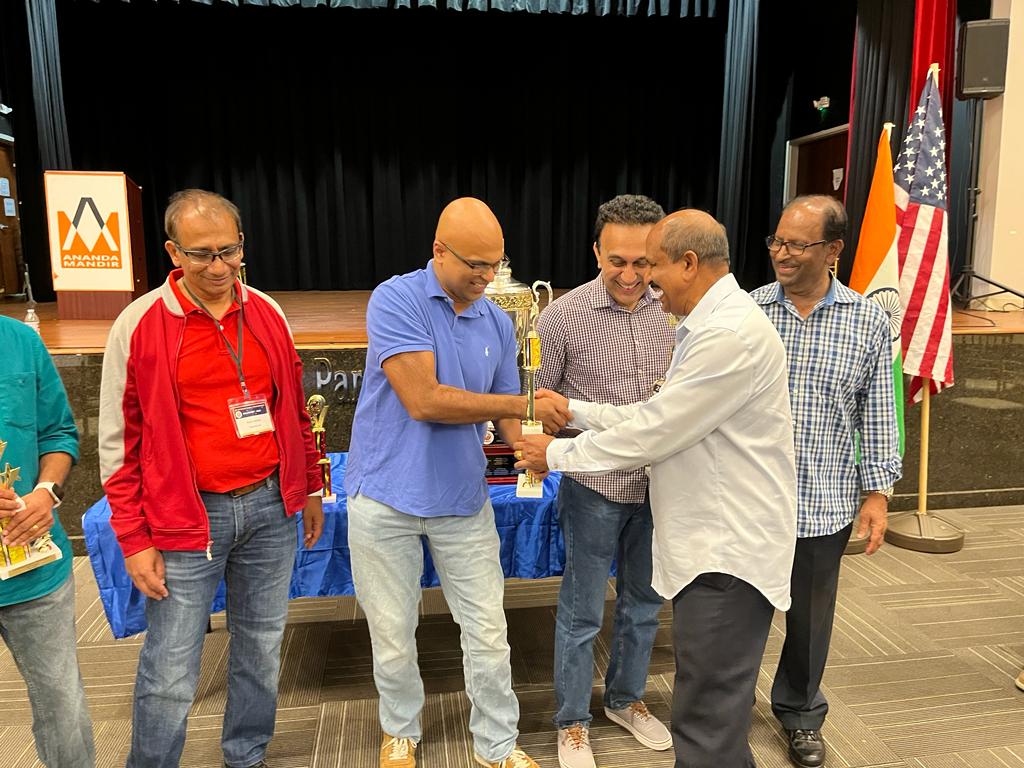
Immigration Advocacy Convention- L. I. F. E ‘19 Launched By FOMAA

By Anil Augustine

FOMAA has initiated in highlighting, advocating and educating the Indian American community members on the perspectives & challenges licit, legit & documented Employment Based (EB) immigrants are faced with insane Green Card backlog of 150+ years of wait time due to the Country Cap birth origin nationality quota system.

FOMAA together in partnership with IL immigration Forum (IIF) and Chicago Cosmopolitan Club has made a very bold statement enabling brotherhood to the otherwise unorganized orphans/strangers the deserving immigrant “Aliens” in the apathy of the insane Employment Based (EB) GC backlog.

This bipartisan initiative was well attended by elected officials of both Rep. & Dem parties, is of much significance.

Republican State Chief Mr. Tim Schneider, Honorable Representative Tom Morrison of District 54 together with Mr. Nimesh Jani, City Council member attended the convention. Honorable Congressman Mr. Raja Krishnamoorthy, Mr. Matt Flamm, together with Ms. Laddi Singh, area leaders represented the Democratic Party at the event.

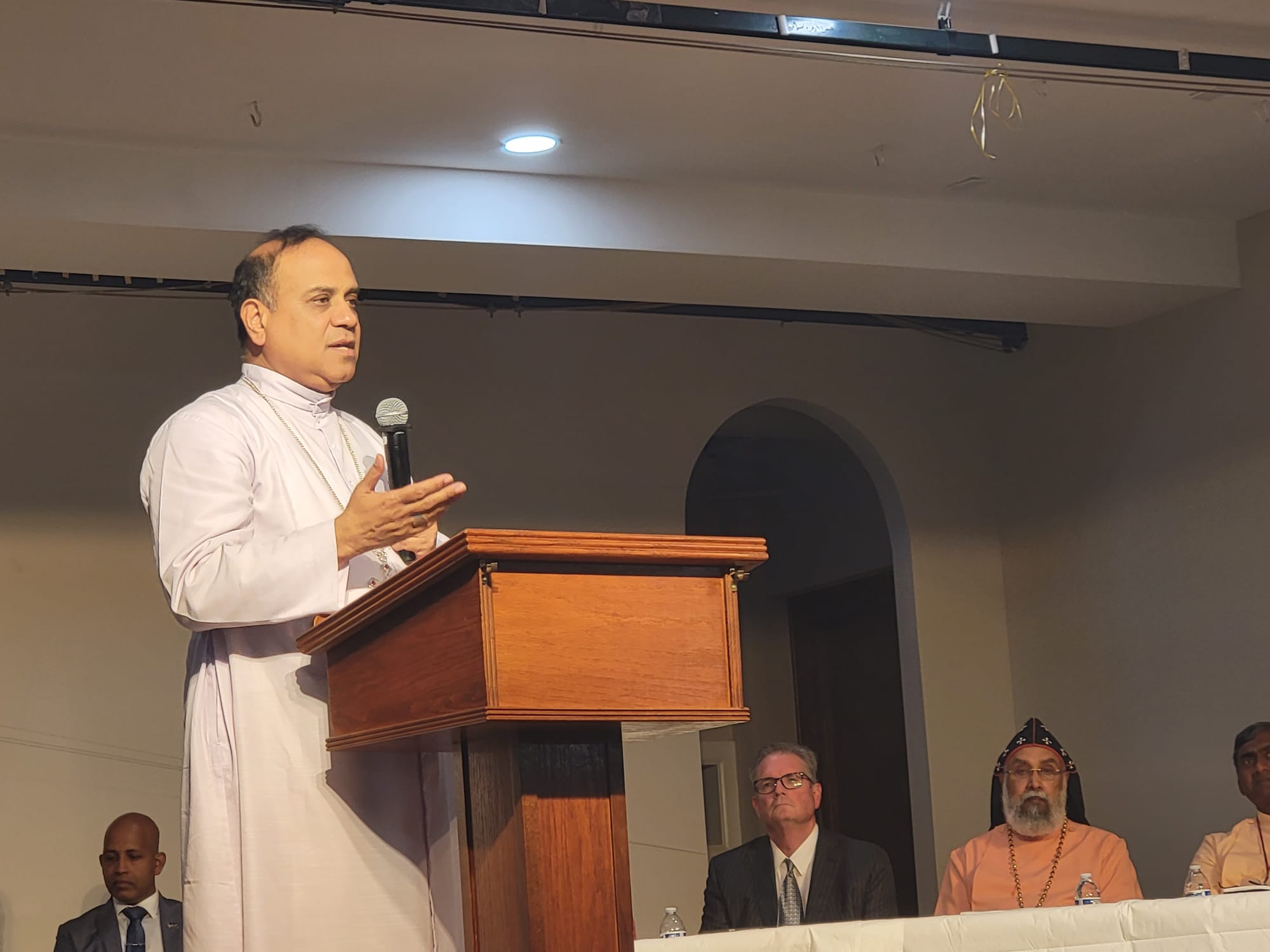
Dr. Sam Pitroda, the absolute icon of immigrant success in America was the chief guest and enlightened the participants with his eloquent thoughts. It was double sweetened for attendees that a surprise birthday celebration was organized by FOMAA as it was Dr. Sam Pitroda’s birthday.

Dr. Pitroda, assertively reminded the audience how India historically hosted the Mughals, the British, the Portuguese, the Iranian Zoroastrians while they were fleeing persecution, the Polish when they escaped Nazi persecution, currently the Tibetans & the Bangla Rohingiyas making the First Nation in the world  be a true “Melting pot”. The diversity that India is blessed with is the true factor that helped India to produce the best educated talent pool the global economic powerhouses could tap into. Dr. Pitroda encouraged everyone to involve actively in the political process that, unless without participation no changes can be expected in our favor; however desperate & genuine be our cause!

Hon. Rep. Raja Krishnamoorthy, as well stressed upon the fact that a community that participate/vote, only will be counted & reckoned. This was in a way an appeal to the community from the Hon. Congressman urging all community members the importance of exercising their votes during the upcoming elections.

State Republican Chief Mr. Tom Schneider, highlighted Pr. Trump’s policies favoring licit & legit immigration. Rep. Morrison, being an educator by profession underlined the alarming shortage of skilled STEM professionals in USA & promised to represent our cause to the party higher ups.

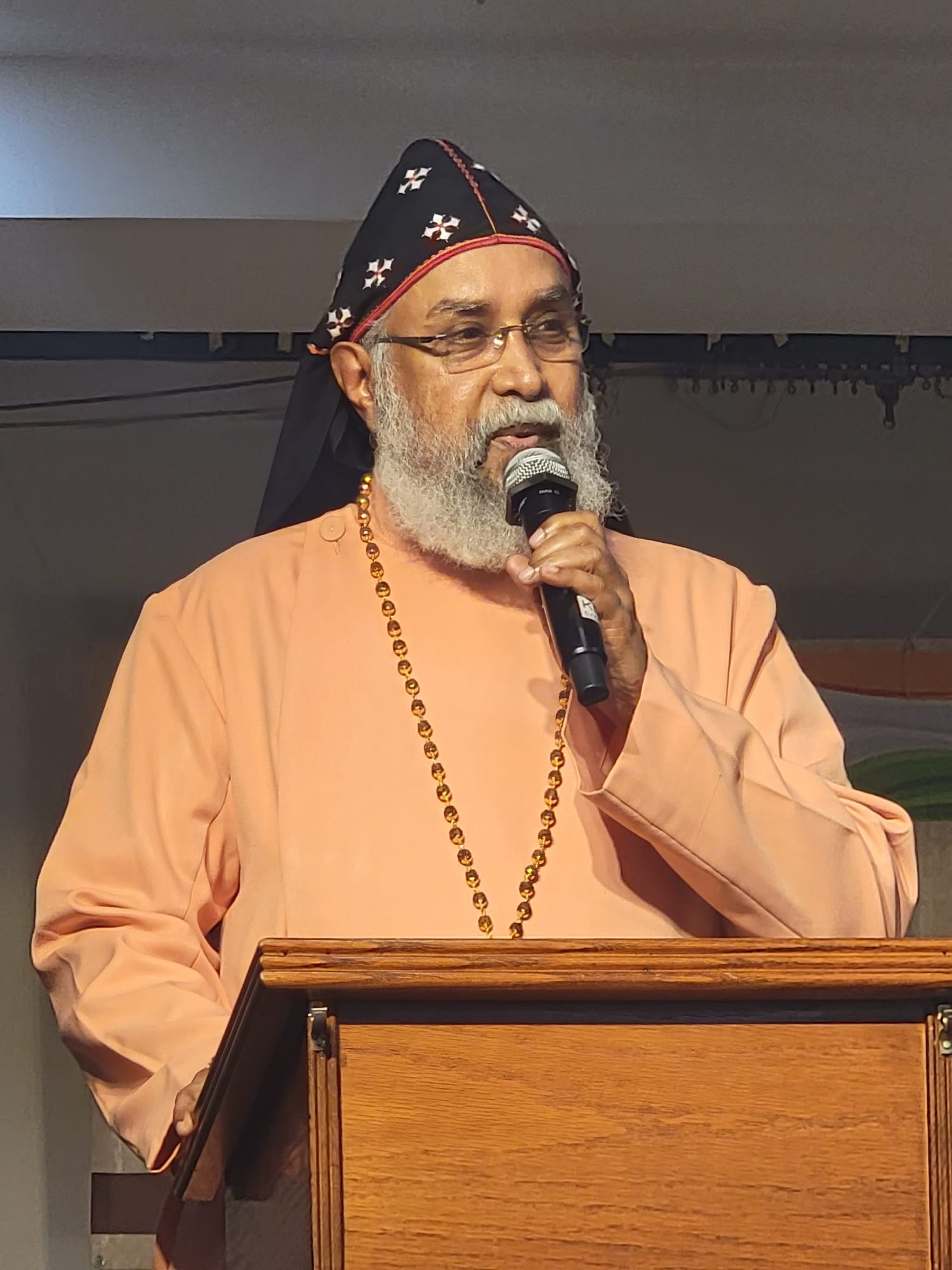
The convention was well attended by citizens of Indian diaspora from across the Nation. FOMAA oficials Mr. Jose Abraham, on his welcome note narrated the vision & commitment to persuade favoring this genuine cause. This well organized event was chaired by Mr. Subash George Chemanthara, and coordinated by Mr. Vishak Cherian of —— State.

This exceptional, much needy stem put forward by FOMAA is greatly appreciated and will be a benchmark initiative to be followed by all other community organizations in social relevance. For more information please visit: www.fomaa.org

FBI Releases 2018 Hate Crimes Report: Hate in the U.S. is getting deadlier

The Federal Bureau of Investigation (FBI) released its annual hate crimes report for 2018 early this morning. The report documented 7,120 hate incidents in 2018, down slightly from 7,175 in 2017. Despite the minor decrease, hate violence was more deadly and violent than it has been since the surge of violence against communities after the September 11th attacks in 2001.
Major findings of the report: 
·         2018 was the deadliest and most violent year for hate since 2001. There were 24 hate crime related deaths and 3,099 violent crime offenses in 2018. 
·         Hate crimes towards Sikhs in the U.S. TRIPLED from 20 incidents in 2017 to 60 incidents in 2018. 
·         There were 82 Anti-Arab hate crimes recorded in 2018 –  the second-highest total since the FBI added an anti-Arab category in 2015.
·         There were 188 anti-Muslim hate crimes recorded, down slightly from last year but the fifth-highest total on record.
·         There were 14 anti-Hindu hate crimes recorded in 2018 – down from 15 in 2017.
·         Of the known offenders, over 50% identified as white​ 
Data collection and underreporting of hate violence remains a significant problem. The Federal Bureau of Justice Statistics reports an average of 250,000 hate crimes every year in the U.S. That’s 35 times more than what the FBI documented in 2018. Only 13% of the over 16,000 participating law enforcement agencies reported any hate crimes in their jurisdictions. Disturbingly, the murders of Khalid Jabara, Srinivas Kuchibhotla, and Heather Heyer in 2016 and 2017, like so many other hate crimes, have not been included in official FBI statistics. The vast majority of crimes are going unreported.
And as we saw in 2017, white supremacy continues to be a primary motivation behind hate violence in the US. In both 2017 and 2018, over 50% of known offenders of reported hate crimes identified as white.
Of the over 500 incidents of hate violence targeting South Asians, Muslims, Sikhs, Hindus, Middle Eastern, and Arab Americans that SAALT has documented since November 2016, at least 80% have been motivated by anti-Muslim sentiment. In SAALT’s 2018 report “Communities on Fire,” one in every five perpetrators of hate violence referenced President Trump, a Trump administration policy, or Trump campaign slogan.
White supremacist violence, fanned by the flames of racist rhetoric and policies at the federal level like the Muslim Ban and family separation, continues to devastate Black and brown communities. Anti-Black hate crimes accounted for more than 25% of violent hate crimes reported in 2018 and the majority of incidents motivated by race. 
The current Administration continues to promote rather than address the root causes of this violence.
Comprehensive data collection is a critical component of documenting the problem, but acknowledging and actively combating white supremacy is the most important step to ensuring this violence doesn’t continue to wreak havoc on people’s lives.

Gandhi Alone is the ‘Father of India’

The ‘Howdy Modi’ event in Houston was an eye catcher for more reasons than one. While Modi was saying ‘All is Well’ in India, thousands of protestors outside were showing the real mirror to state of affairs in India. At the same time Donald Trump, US president, while on one hand due to face the process of impeachment, on the other he was trying to promote his electoral prospects in the next US elections.

As is his wont he does flatter visiting dignitaries, for achieving goals of his diplomacy. He went on to praise Modi to the sky; as a great leader; saying, “I remember India before was very torn. There was a lot of dissension; fighting and he (Modi) brought it all together. Like a father would. Maybe he is the ‘father of India’.”

Right within US there are many views about Modi. The last time the similar debate cropped up was just before Indian General Elections of 2019. On the eve of the elections US premier magazine Time came out with a cover story “Modi: the Divider in Chief’. Of course in another article in the same issue of the magazine he was presented as the one who is central to the process of economic reforms in India. What we see here in India and what the lead article of Time magazine presented was on the dot, the divisive role of Modi.

The observation here has been that Modi’s coming to power has strengthened the divisive forces, the forces who want Hindu nation. It is precisely these forces who have gone on rampage to unleash their agenda around Cow-Beef, the communal divisions have been deepened and identity issues have come to the fore like never before.

The minorities are being alienated and dalits-Adivasis are being marginalized. Even language wise talk has been floated to make Hindi as national language. The identity issues, which create emotive atmosphere and divide the people are to the fore. While Trump is talking in one tone, the earlier hopeful in previous Presidential elections in America, Bernie Sanders in a tweet hinted that Trump is emboldening the authoritarian leaders like Modi, the leaders who are presiding over religious persecution, repression and brutality against minorities.

Till few years ago Modi himself spoke very divisive language. Now this job has been passed down to his associates. Yogi Adityanath’s anti Muslim utterances abound. Anantkrishna Hegde like many of his ilk have been openly been talking of Hindu nation. To add to the list Sadhvi Pragya Singh Thakur, the accused in Malegaon blast, out on bail, has been praising Gandhi’s killer Godse among other things. Lately the way Article 370 has been abrogated the alienation of people of Kashmir is going up.

In a way Time magazine’s cover story did capture the state of things prevalent here. Trump is no scholar of history, ignorant of the fact as to why India regards Mahatma Gandhi as the ‘father of the nation’.

Trump’s considerations are driven by his political contingency of gradually shifting America’s closeness to India. The reason for US favoring Pakistan in yesteryears was the compulsion of cold war era. Later it kept siding with Pakistan as US designs of controlling oil wealth of West Asia were its prime motive and Pakistan was made a part of American designs in West Asia.

Now with emergence of China as a major power, and China being close to Pakistan, US gradually want to become close to India. These may be some of the factors due to which Trump is making such utterances. But that’s not about all. US is also keeping its Pakistan relationship on some scale and very shrewdly Trump did say that Modi had made aggressive remarks in Houston rally. He seems to be buttering his bread from both the sides at present.

Many a reaction to Trump’s formulations showed his hollowness. Gandhi’s grandson Tushar, tweeted that whether Trump will like to replace George Washington as one of the founding fathers of America?

What Trump has stated has pained those for whom Gandhi is the ‘father of the nation’. Any way the followers of Modi ideology do not regard Gandhi as the father of the nation. Their argument is that India the Hindu nation; is there from times immemorial and so how can Gandhi be its father. Gandhi being father of the nation also relates to the concept of nationalism.

All those who were part of ‘India as a nation in the making’ see Gandhi as the central uniting figure. During freedom movement in the anti colonial movement, it was Gandhi who played the role of uniting the country which was scattered along the lines of religion, region, caste and language. The communalists like the followers of Muslim League saw Gandhi as a Hindu leader and Hindu communalists saw Gandhi as the appeaser of Muslims.

Through the very profound and complex process, India emerged as a Nation with the principles of Liberty, Equality and Fraternity. Surely the likes of Bhagat Singh, Ambedkar, Nehru and Patel played great role in making of the modern India. The process had multiple components, anti colonialism being the core where the likes of Bhagat Singh inspired the idea and Gandhi led the greatest ever mass movement, the movement directed against British Empire.

It is due to this that Subhashchandra Bose on July 6 1944, in broadcast from Singapore Radio, sought blessings of Gandhi, addressing him as Father of Nation. Sarojini Naidu on April 6, 1947, on the eve of Independence, addressed Gandhi as Rashtrapita (Father of the Nation). So where do we go from here, the Hindu nationalist followers are going euphoric about what Trump said and all those whole identify with India’s struggle for Independence and uphold democratic values are in anguish due to this statement from US President. Trump’s superficial observation is neither sound in history of India nor knowing of what is happening in India, it’s a mere diplomatic ploy to please the visiting leader.

U.S. lawmakers take a step against India on Kashmir – Senate panel adds appeal to end the “humanitarian crisis” in Kashmir in its report.

In what could become the first step towards legislative action by American lawmakers against India on the situation in Jammu and Kashmir, the United States Senate Committee on Foreign Relations has added an appeal to end what it calls a “humanitarian crisis” in Kashmir in its report ahead of the annual Foreign Appropriations Act for 2020.

The amendment was proposed by Senator Chris Van Hollen, who visited Delhi this week as a part of a congressional delegation that discussed the Kashmir situation as well as India-U.S. bilateral relations, trade ties and defence purchases with key officials.

According to the report, which was submitted to the Senate by Lindsey Graham, senior Senator and key Republican leader known for his close ties to President Donald Trump, the committee on Appropriations “notes with concern the current humanitarian crisis in Kashmir and calls on the Government of India to: fully restore telecommunications and Internet services; lift its lockdown and curfew; and release individuals detained pursuant to the Government’s revocation of Article 370 of the Indian constitution.”

What makes the report as well as the tough language on Kashmir more startling is that the document was submitted on September 26, while Prime Minister Narendra Modi was still in the US, and came just a few days after his joint address at the ‘Howdy, Modi!’ event in Houston with Mr. Trump, as well as their bilateral meeting in New York.

“This amendment, which was accepted unanimously by the bipartisan committee, is a strong expression of concern by the Senate about the situation in Kashmir and sends the signal that we are closely monitoring the human rights situation there, and would like to see the Government of India take those concerns seriously,” Mr. Van Hollen told The Hindu here, adding that he had “hoped to share his concerns privately” with Prime Minister Modi, but had not been able to meet him.

Van Hollen had met with External Affairs Minister S. Jaishankar in Washington last week and Senator Bob Menendez, also a part of the delegation, met with Commerce and Industries Minister Piyush Goyal this week in Delhi. Both Senators have made public statements in the last two months on the Kashmir situation.

While it is unclear whether their concerns over Kashmir elicited any responses from the government, The Hindu has learnt that Senator Van Hollen was rebuffed when requested permission to visit Srinagar in an effort to assess the situation on the ground.

When asked, MEA officials said the Ministry of Home Affairs handled such requests. No diplomat or foreign journalist has yet been given clearance to visit Kashmir since the government’s decision on Article 370 on August 5.

Speaking at the World Economic Forum’s India Economic Summit in Delhi on Friday, Mr. Jaishankar said many key decision-makers in the US had been “misinformed by their media” and that he had spent considerable efforts in the past few weeks to clear misconceptions on the government’s decision to drop the “temporary” Article 370.

At U.N. Climate Summit, Few Commitments and U.S. Silence

The United Nations Climate Action Summit on Monday, September 24th  was meant to highlight concrete promises by presidents, prime ministers and corporate executives to wean the global economy from fossil fuels to avoid the worst effects of global warming.

But despite the protests in the streets, China on Monday made no new promises to take stronger climate action. The United States, having vowed to pull out of the Paris Agreement, the pact among nations to jointly fight climate change, said nothing at all. A host of countries made only incremental promises.

The contrast between the slow pace of action and the urgency of the problem was underscored by the Swedish climate activist Greta Thunberg, 16, who excoriated world leaders for their “business as usual” approach. “The eyes of all future generations are upon you,” she said, her voice quavering with rage. “If you choose to fail us, I say we will never forgive you.”

There were some concrete measures. By the end of the day, 65 countries had announced efforts to achieve net-zero emissions by 2050, several asset fund managers said they would aim to get to a net-zero portfolio of investments by the same year, and dozens of businesses said they would aim to abide by the Paris Agreement targets.

The summit comes at a time when the latest science shows that the world is getting hotter faster and the dangers of global warming are increasingly clear, with more intense hurricanes, longer droughts and heat records being broken. It was an opportunity to show that the world’s most powerful countries could step up. Advocates and diplomats who have been following climate talks for years said they were disappointed.

Andrew Steer, head of the World Resources Institute and a former World Bank official, said most of the major economies fell “woefully short” of expectations. “Their lack of ambition stands in sharp contrast with the growing demand for action around the world,” he said.

The United States did not request a speaking slot at the summit, but President Trump unexpectedly dropped into the General Assembly hall with Vice President Mike Pence in the late morning. Michael R. Bloomberg, the former New York City mayor who is now a United Nations special envoy for climate, welcomed Mr. Trump’s presence and addressed the president directly by saying, “Hopefully our discussions here will be useful for you when you formulate climate policy.”

That was followed by laughter and applause. It signaled a sharp contrast from just a few years ago, when the United States was credited with pushing other countries, including China, to take climate change seriously. The United States has said it intends to withdraw from the 2015 Paris climate accord. It is not on track to meet its voluntary pledges under the agreement in any case. And the Trump administration has rolled back a host of environmental regulations that were meant to curb greenhouse gas emissions from automobile tailpipescoal plants and oil and gas wells.

As for China, it did not signal its readiness to issue stronger, swifter targets to transition away from fossil fuels, as many had hoped. Wang Yi, a special representative for President Xi Jinping, noted that his country was keeping the promises it made under the 2015 Paris Agreement and that “certain countries” — a clear reference to the United States — were not.  “China will faithfully fulfill its obligations,” Mr. Wang said.

China’s decision to not signal higher ambition reflects, in part, concerns about its own slowing economy against the backdrop of conflicts with the United States on trade. It also reflected Beijing’s reluctance to take stronger climate action in the absence of similar moves from richer countries. The European Union has not signaled its intention to cut emissions faster either, and the United States is nowhere on track to meet its original commitments under the Paris accord.

President Emmanuel Macron of France also had a message on trade for the United States, telling the assembly, “I don’t want to see new trade negotiations with countries who are running counter to the Paris Agreement.”

The statement could create a new stumbling block in talks between the United States and the European Union for a free-trade agreement. Those negotiations are already complicated by deep differences over agricultural policy and threats by Mr. Trump to impose tariffs on automobile parts from Europe if the talks fail to make progress.

Prime Minister Narendra Modi of India said his country would increase its share of renewable energy by 2022, without making any promises to reduce its dependence on coal. Chancellor Angela Merkel of Germany promoted a new plan worth $60 billion over 10 years to speed a transition to clean power.

Russia announced that it would ratify the Paris Agreement, but nothing more about how to cut emissions from its sprawling state-owned petroleum industry.

The summit unfolded against the backdrop of new data that showed the quickening pace of warming.  The world is getting hotter faster, the World Meteorological Organization concluded in its latest report Sunday, with the five-year period between 2014 and 2019 the warmest on record. Emissions of carbon dioxide, a major contributor to global warming when it is pumped into the atmosphere, are at record highs. The seas are rising rapidly. The average global temperature is 1.1 degrees Celsius higher than what it was in the mid-19th century, and at the current pace, average global temperatures will be 3 degrees Celsius higher by the end of this century.

“I will not be there, but my granddaughters will, and your grandchildren, too,” Mr. Guterres said in his opening remarks. “I refuse to be an accomplice in the destruction of their one and only home.”

Mr. Guterres’s most direct call went to those countries that use money from their taxpayers to subsidize fossil fuel projects that, as he put it, “boost hurricanes, spread tropical diseases and heighten conflict.”

At the U.N., It Was the Day of Populist Strongmen

UNITED NATIONS, Sep 25 2019 (IPS) – The United Nations is an institution which promotes multilateralism and preaches some of the basic tenets of multiparty democracy and liberalism, including the rule of law, universal human rights, free speech, civil liberties, the rights of refugees and freedom of the press.

But, paradoxically, the first four speakers during the opening day, September 24, of the 74th session of the U.N. General Assembly—Brazil’s Jair Bolsonaro, U.S. president Donald Trump, Egypt’s President Abdel Fattah al-Sisi and Turkish President Recep Tayyip Erdogan —represented the very anti-thesis of what the world body stands for.

They have been best described either as rightwing nationalists, populist strongmen or authoritarian leaders—who, like Al-Sisi, presides over a repressive regime.

Martin S. Edwards, Associate Professor and Chair, School of Diplomacy and International Relations at Seton Hall University, told IPS, “I watched these speeches with students from several of these countries.  To be sure, the rhetoric can scare you.”

But these students were not scared, because of two things, he pointed out.

First, they know history. Just as President Trump spoke of national renewal, there is also a reformist tradition in the US as in other countries that practices a politics based on inclusion and not fear. These traditions haven’t gone away, and they will return, he said.

Second, they know facts.

“The U.N. is tremendously popular across the globe, and they know that we can no more deny the necessity for international cooperation than we can deny the existence of gravity,” said Edwards, who is also director of the Center for U.N. and Global Governance Studies.

So, many called today—the opening day of the General Assembly sessions–“the day of populist strong men”. But their time won’t last, he predicted.

And it’s interesting to juxtapose their speeches with student activist Greta Thurnberg’s on the climate change crisis on Monday.

Secretary-General Antonio Guterres is banking on the optimists, and the rest of the week will be about their loud reply to today’s early speeches, Edwards said.

Abby Maxman, President of Oxfam America, was quick to point out that President Trump, once again, led with a tired, nationalistic foreign policy of fear and blame, “seeking to discredit and undermine the multilateral institutions and the international cooperation that is so critical to promoting our shared prosperity and security”.

She said that Trump restated his foreign policy’s central false premise: that necessary efforts to build a better, safer world are somehow a threat to Americans.

He pointed fingers at others for some of the biggest challenges, like the crises in Yemen and Syria, but took no responsibility for his administration’s role in fuelling them, and failed to commit to do his part to stop the violence and save lives.

“The challenges we are all facing – growing inequality, influx of forced migration, the climate crisis — are the same for families and countries around the world. At a time when all of us are worried about the future, we must work together to build and renew international cooperation – not tear it down.

“But as usual, President Trump’s rhetoric falsely pits Americans’ love of country and passion for our planet and all its people against our interests. It’s not a choice we have to make. We can, and must, choose both.”

Amnesty International came down heavily both on Bolsonaro and Al-Sisi, singling out Bolsonaro’s dangerous rhetoric at the General Assembly as a “blow to human rights”.

Jurema Werneck, executive director of Amnesty International Brazil, expressed concern over Bolsonaro’s statement about confronting the media and the work of the national and international press.

She said these are fundamental to the right to freedom of expression, due to their role in denouncing human rights violations and addressing other political, environmental, social and economic problems.

“Without freedom of expression, the promotion and protection of human rights would be in grave danger. The government must also respect the right of civil society to monitor, demand accountability and take action to promote and protect the rights of all people,” Werneck added.

Meanwhile, Amnesty International also called on world leaders to confront Egypt’s Al- Sisi and “utterly condemn the crackdown he has waged to counter the outbreak of protests in recent days”.

Amnesty said it has documented how the Egyptian security forces have carried out sweeping arrests of protesters, rounded up journalists, human rights lawyers, activists, protesters and political figures in a bid to silence critics and deter further protests from taking place.

The government has also added the BBC and Alhurra news to the list of 513 other websites already blocked in Egypt and disrupted online messaging applications to thwart further protests.

“The government of President Abdel Fattah al-Sisi is clearly shaken to its core by the outbreak of protests and has launched a full-throttle clampdown to crush demonstrations and intimidate activists, journalists and others into silence,” said Najia Bounaim, North Africa Campaigns Director at Amnesty International.

“The world must not stand silently by as President al-Sisi tramples all over Egyptians’ rights to peaceful protest and freedom of expression. Instead of escalating this repressive backlash, the Egyptian authorities must immediately release all those detained for peacefully exercising their rights to freedom of expression and assembly and allow further protests on Friday to go ahead.”

Amnesty International said it has documented the arrests of at least 59 people from five cities across Egypt during protests that took place on the nights of Sept. 20 and 21.

Local human rights organisations have reported hundreds of arrests all over Egypt. The Egyptian Center for Economic and Social Rights reported that 964 individuals have been arrested in relation to the protests between September 19 and 24.

In New York, President Al-Sisi responded to questions from the media claiming that the protests were instigated by “political Islam.”

However, Amnesty International said it found that, in fact, the protesters came from an extremely diverse range of age, socioeconomic, gender and religious backgrounds, including non-political backgrounds. All those detained faced the same “terrorism”- related charges.

In its 2018 World Report, Human Rights watch was strongly critical of the authoritarian tendencies of the Turkish government. An April 2017 referendum, which voters approved by a slim margin, introduced constitutional amendments switching Turkey to a presidential system of governance, the most significant change to its political institutions in decades, said HRW.

The referendum took place under a state of emergency imposed after the July 15, 2016 attempted military coup, and in an environment of heavy media censorship, with many journalists and parliamentarians from the pro-Kurdish opposition in jail.

The new presidential system, which consolidates the incumbent’s hold on power, is a setback for human rights and the rule of law. It lacks sufficient checks and balances against abuse of executive power, greatly diminishing the powers of parliament, and consolidating presidential control over most judicial appointments. The presidential system will come fully into force following elections in 2019, according to the report.

Trump likely to end birthright citizenship

President Donald Trump offered a dramatic, if legally dubious, promise in a new interview to unilaterally end birthright citizenship, ratcheting up his hardline immigration rhetoric with a week to go before critical midterm elections.
Trump’s vow to end the right to citizenship for the children of non-citizens and unauthorized immigrants born on US soil came in an interview with Axios released Tuesday. Such a step would be regarded as an affront to the US Constitution, which was amended 150 years ago to include the words: “All persons born or naturalized in the United States and subject to the jurisdiction thereof, are citizens of the United States.”
Trump did not say when he would sign the order, and some of his past promises to use executive action have gone unfulfilled. But whether the President follows through on his threat or not, the issue joins a string of actions intended to thrust the matter of immigration into the front of voters’ minds as they head to polls next week.
“We’re looking at that very seriously,” Trump told reporters when leaving the White House for the US state of Kentucky, the Xinhua news agency reported.
“Birthright citizenship, where you have a baby on our land – walk over the border, have a baby, congratulations, the baby’s now a US citizen,” said the President. “It’s, frankly, ridiculous.”
Trump promised ending the birthright citizenship during his 2016 presidential campaign and once revived the idea last year, according to a report of The Hill.
Earlier Wednesday, acting Homeland Security Secretary Kevin McAleenan unveiled new policies which will allow the government to detain families crossing the US-Mexico border longer than before. If the new rule survives court challenges, the policy change could permit authorities to detain families through the duration of their immigration proceedings.
The US federal government has sought various ways to curb illegal and legal immigration since Trump was sworn in January 2017. (IANS)

What Americans really think about mass shootings and gun legislation

The recent spate of mass shootings has propelled gun safety to the center of public concern, and the share of Americans demanding swift action has increased substantially. But discussion of this issue has been pervaded by myths about what the American people want, and why, and these misperceptions have made an inherently divisive debate even more difficult to resolve. Fortunately, recent survey research helps us clarify this murky issue. In sum: Most Americans are dissatisfied with the status quo and want to do something about it. Although they are divided as to the causes of gun violence and the ability of legislation to reduce it, they come together on a number of options for addressing it. But they don’t expect Congress to act, no matter how urgent the need.
Here, in greater detail, are eight facts about the state of public sentiment on this life-and-death issue.
Fact 1: The perceived threat of mass shootings by American citizens now dwarfs the threat of attacks by Islamist terrorists. 60 percent fear the former more than the latter; only 17 percent disagree. This holds true for Democrats and Republicans, liberals and conservatives, men and women, whites with and without a college degree, urban, suburban, and rural residents, and (by a margin of 53 percent to 23 percent) gun owners. But despite the urgency of this threat, only 15 percent of Americans, and fewer than one-third of Republicans, believe that the Trump administration has made the country safer from mass shootings (Fox).
Fact 2: When it comes to the causes of gun violence, the people are all over the map. Roughly equal majorities identify deficiencies in the mental health system and easy access to guns, especially assault-style weapons, as prime factors. Substantial minorities finger media coverage, bigotry of all sorts, and inadequate parenting. As expected, Democrats are substantially more likely than Republicans to cite factors such as access to guns, anti-immigrant sentiments, and the rise of white nationalism, while Republicans are more likely than Democrats to cite inadequate parenting and violent video games. The one exception: majorities of both Democrats and Republicans identify inadequate services for mentally ill individuals displaying violent tendencies as a contributor to acts of mass violence.
Fact 3: Surveys conducted during the past four months have shown strong public support for a range of measures to regulate the sale and possession of firearms.
Fact 4: When the issue is posed more generally and thematically, however, the results are less clear. For example, when the POLITICO/Morning Consult poll asked respondents which was more important, protecting the right of Americans to own guns or limiting gun ownership, respondents were evenly divided, with 44 percent for each option. The NBC/WSJ survey found that 45 percent of Americans were more concerned that the federal government would go too far in restricting gun ownership, while 50 percent were more concerned that the government wouldn’t go far enough. When Fox posed an even broader question, “Would you rather live in a country where people can own guns or where guns are banned,” 57 percent chose the former, which might be termed the “American” option, and only 34 percent the latter, the “European” option. These results reflect deep partisan divisions along the expected lines.
 
Fact 5: Despite these divisions, there are legislative proposals that could unify Americans. Ninety-two percent of Democrats favor criminal background checks on all gun buyers; so do 89 percent of Republicans. Eighty-eight percent of Democrats and 75 percent of Republicans support red flag laws (Fox). Ninety-two percent of Democrats would require individuals to obtain a license before purchasing a gun; 65 percent of Republicans agree (Quinnipiac).
Fact 6: While support for “stricter” gun laws has risen from its low of a decade ago, it remains below where it stood in the mid-1990s, the last time the federal government enacted such laws. In June of 1995, for example, just 35 percent of Americans were more concerned that the federal government would go too far, 10 points below today’s level, while 58 percent were more concerned that the government wouldn’t do enough, 8 points above the most recent reading (NBC/WSJ).
 
At the same time, the number of Americans who say it is more important to control gun ownership has steadily fallen over time while the number of Americans who believe it is more important to protect the right of Americans to own guns has increased.
 
Fact 7: Despite the widespread impression that Republicans care more about this issue than do Democrats, recent survey research shows that this is no longer true (if it ever was). When Gallup asked respondents whether they would only vote for candidates who shared their views on guns, 23 percent of Republicans and 25 percent of Democrats responded affirmatively. In 1999, 18 percent of Democrats compared to just 9 percent of Republicans said that they would only support such a candidate.
There is a divergence between partisan identification and ideology, however. Two decades ago, by a margin of 19 percent to 14 percent, liberals were more likely than conservatives to vote only for candidates who shared their views on guns. By 2017, this had reversed, with 32 percent of conservatives but only 23 percent of liberals requiring agreement as a condition of their support.
Fact 8+: Although substantial numbers of Americans believe that federal legislation would make a difference, they are dubious (if not downright cynical) that Congress will enact it. For example, Fox found that 42 percent of Americans believe the federal government can do “a great deal” to reduce gun violence, but the same percentage regard it as “not at all” likely that Congress will do so anytime soon.
The efficacy of legislation is contested across party lines, however. Almost two-thirds of Democrats believe that federal action would make a big difference, compared to just 21 percent of Republicans. This makes Republicans’ willingness to support a range of legislative measures all the more noteworthy. It appears that the felt need to go beyond the disturbing status quo is counteracting their skepticism that government action can improve the situation.

The Indian rupee is falling fast– and there are both winners and losers

The Indian rupee is near its weakest level against the dollar this year. And the fall has been sharper in the last three weeks. One of the biggest reasons for the dollar getting stronger is Donald Trump’s trade war against China. Traders around the world are on the edge wondering how the negotiations between Washington and Beijing may pan out, and in the mean time, they are betting on the greenback that is considered to be the safest global currency.

For the Indian rupee, it’s a double whammy– both global risks and a local economic slowdown are weighing it down. In fact, it took the Indian currency took 18 days to give up all the gains made in 42 sessions before that. Such a sharp fall, in such a quick time, only signals that traders are preparing to beat the rupee down further in the coming days. The Indian rupee’s record low is near 74 against the dollar, and current it is trading at about 71.24.

The USDINR fell sharply for 42 sessions from 13 May to July 11. It recouped all its losses in 18 sessions from July 12 to Aug 13. A bullish $ results in “imported inflation” higher corporate interest outgo on forex loans among other pressures.#Trading #TechnicalAnalysis

Aside from the global risk aversion, the weakness in rupee has many factors at play but most important among them is the market’s perception of the strength of the Indian economy. The Reserve Bank of India cut its forecast for India’s GDP growth in the current financial year to 6.9% from 7% earlier but many experts believe that the slowdown may be much worse than what the data suggests.

All crucial areas from employment to consumer demand, industrial growth to inflation, car sales to airline traffic, exports to credit growth, reflect a fragile economy with limited prospects of a quick recovery. The rupee is taking the fall as traders digest the flow of macro economic data, and the bleak future that they point towards.

The weakness in the rupee against the dollar may be further setback for some firms while for a few others it may be the much-needed cushion.

A weaker rupee will lend some competitiveness to India’s ailing exporters because it makes products cheaper for the buyer in dollar terms. However, it does not hold true for the entire economy.

Donald Trump’s administration in dramatic immigration crackdown that could ban green cards being given to anyone on food stamps or Medicaid for a year

The Trump administration is cracking down on green cards for immigrants who’ve spent more than a year on food stamps, Medicaid or other public benefits designated for low-income residents.
Ken Cuccinelli, the acting director of U.S. Citizenship and Immigration Services, said Monday that beginning Oct. 15 any ‘individual who receives one or more designated public benefits for more than 12 months in the aggregate within any 36 month period’ will not be eligible for a green card. 
Individuals who take two public benefits will see that time cut in half, he explained during a briefing at the White House. 
‘Our rule generally prevents aliens who are likely to become a public charge from coming to the United States or remaining here and getting a green card,’ he stated. Public benefits are defined in the rule as state, local and federal income-based assistance and some non-cash benefits. That includes Supplemental Security Income (SSI), Supplemental Nutrition Assistance Program (SNAP), Temporary Assistance to Needy Families (TANF), and most forms of Medicaid. 
It does not include benefits for children and pregnant women like the National School Lunch Program or The Special Supplemental Nutrition Program for Women, Infants, and Children (WIC), Cuccinelli said.
Medical assistance, disaster relief, homeless shelters and Head Start are not part of the rule. 
The rule will take effect on Oct. 15 and Cuccinelli said that career officials processing forms will not consider certain non-cash benefits that migrants received prior to that date.
Age, health, family status, assets, resources, financial status, education and skills will all be assessed in the application process, he said.
‘No one factor alone will decide an applicant’s case,’ he said of the green cards.
Additionally, migrants that do not meet the qualifications will have the option to adjust their status to that of a Legal Permanent Resident (LPR) through the purchase of a public charge bond that the government plans to sell for a minimum of $8,100 a person, and possibly more, depending on the individual’s circumstances.
Cuccinelli insisted that the new rule will ‘help promote immigrant success’ and ‘self-sufficiency’ of immigrants seeking to become Americans.
It’s that same ‘hard-working spirit’ that’s made the U.S. a beacon, he claimed.
Refugees and asylums seekers will not not be affected, nor will human and sex trafficking victims. An exemption for members of the military and their spouses will also be made.  
The administration first signaled that it would seek to adjust the legal definition of a ‘public charge’ in September 2018 to make the standards for citizenship more rigorous than they had been.   
‘Congress has never defined the charge public charge in the law,’ Cuccinelli said Monday. ‘Well that is what changes today with this rule.’ 
He announced, ‘Through the public charge rule, President Trump’s administration is reinforcing the ideals of self-sufficiency and personal responsibility. Ensuring that immigrants are able to support themselves and becoming successful in America.’ 
Essentially, U.S. officials are seeking to isolate immigrants they suspect will be a burden to taxpayers by taking citizenship and the legal rights that come with it off the table for needy migrants. 
Cuccinelli said that the rule update will merely ensure that existing law is ‘meaningfully enforced’ and puts into effect the authority that Congress has already given the administration.  
A White House fact sheet revealed that the administration also plans to use the new rule to keep migrants from ever stepping foot in the country, if the administration decides they’re too risky, based on the updated guidance.
‘Aliens will be barred from entering the United States if they are found likely to become public charges,’ it says.
‘Aliens in the United States who are found likely to become public charges will also be barred from adjusting their immigration status.’
It claimed that non-citizens are abusing welfare benefits intended for poor Americans and taking advantage of the nation’s generosity.   
The White House said that that 58 percent of all households that fall into this category are using at least one welfare program and half have at least one person on Medicaid.
Donald Trump has long sought to recast the number of migrants who are allowed to enter country through familial ties via a process called chain migration, where one family member living in America sponsors another, and another, and another.
The process creating a chain of people who might not have the kinds of workplace skills that a growing and industrialized economy warrants. 
He also wants to do away with the diversity visa lottery system, that picks applicants for approval at random. 
They’re heavily vetted by the State Department before they’re approved for residency. The president has claimed for years, incorrectly, that countries are sending over degenerates.
‘The people that are sent to our country are not the people that we want,’ Trump said earlier this year. ‘They come in through the lottery, they come in through chain migration.’

Kashyap Patel Appointed Senior Counsel for Counterterrorism

Indian-American attorney Kashyap ‘Kash’ Pramod Patel, 38, the former Senior Counsel for Counterterrorism at the House Select Committee on Intelligence and key aide to then chairman Rep. David Nunes, when the Republicans were in the majority, has been appointed senior director of Counterterrorism Directorate of the National Security Council housed in the White House.

But the White House has declined to comment and refused to confirm the appointment of Patel, an avowed Trump acolyte, first reported by The Daily Beast, which also reported early last year along with the New York Times — before the Democrats took over the House — that Patel was the primary author of the controversial memo and the key “drafter and pusher of the memo,” released earlier by Nunes, of alleged bias by the Justice Department and the FBI against President Trump and pushing back against and attempting to discredit the FBI’s investigations of Trump’s collusion with Russia.

When the GOP ceded authority to the Democrats following their rout in the 2018 mid-term elections and Rep. Adam Schiff took over the helm of the Intelligence Committee, Patel left Capitol Hill and joined the NSC’s Directorate of International Organizations and Alliances, and according to the Beast, he has now been promoted to head its counterterrorism bureau.

In its report, the Beast said that while “the vast majority of Hill staffers stay studiously out of the news, Patel drew national attention in early 2018, when Nunes oversaw the production and release of the memo on surveillance of Trump campaign advisor Carter Page,” which enraged DOJ and FBI officials, who said that they had no say in its creation and that it unfairly characterized standard intelligence-gathering practices.

But at the time, as the Beast said, “It was a watershed moment for the right’s critics of the (Special Counsel Robert) Mueller probe and of senior DOJ leadership.”

During his time on the Hill working for Nunes, Patel also sparred with Acting Attorney General Rod Rosenstein who at the time was supervising the Russia probe as then Attorney General Jeff Sessions had recused himself from the Russia probe.

Fox News at the time reported that in e-mails Patel wrote, Rosenstein had threatened to subpoena the committee’s emails and records, and had issued “direct threats” to Patel, in an effort “to keep these people quiet, to keep the American people from hearing the truth.” But the issue faded when Rosenstein denied under oath that he threatened committee staff.

The Beast said in its report last month that “the alums of the Russia saga have, mostly, moved on. Rosenstein stepped down from the DOJ and returned to private life. Nunes lost his post as chairman when Democrats flipped the House. Mueller, after marathon Congressional testimony, returned to civilian life. And now Patel has moved from countering the Deep State to counterterrorism.”

But at the time Patel was being credited with writing this controversial “Kash Memo,” senior Congressional sources pushed back on the reports in the Daily Beast and the New York Times that he was the primary author of the controversial memo.

Patel, was born and raised in Garden City, New York to parents with Gurajati roots who immigrated from East Africa — who came to the U.S. by way of Canada in 1970 — and is an alumnus of the University of Richmond (Class of 2002), and according to his Facebook page claims that he earned a certificate in international law from the University College London Faculty of Laws and graduated from Pace University’s law school in 2005, and then spent  part of his career in the Miami area as a federal public defender in Florida before taking a job at the Justice Department in 2014.

After uncertainties in US over work visas, Indian techies look at Canada for Permanent Residency

Trump administration’s increased scrutiny of the H-1B visa program has forced Indian citizens to prefer Canada over the United States for permanent residency. There is growing uncertainty in the United States over the future of Indian techies because of the Trump administration’s focus on giving preference to locals for jobs. In fact, the current administration wants to replace the existing Green Cards system with the proposed Build America visa.

In 2018, more than 39,500 Indians opted for permanent residency in Canada. The country’s express entry program has been quite a success in attracting highly skilled foreign workers, especially India’s IT professionals.

Newly released statistics highlight that Canada granted permanent residency to over 92,000 new residents in 2018. In the previous year, Canada had only 65,500 permanent residents, out of which 26,300 were from India. The number of Indian citizens to be awarded permanent residency has increased by 51% from 2017. China secured the second rank in 2017 but slipped to the third in 2018. Meanwhile, Nigeria holds the second rank in acquiring permanent residency in 2018.

The Immigration, Refugees, and Citizenship Canada report states, “The top countries of citizenship based on the people admitted to Canada generally mirrors those of invited candidates. Nearly half of all people admitted in 2018 had Indian citizenship.” The Justin Trudeau-led government has created ample amount of opportunities for permanent entry residents.

Canada’s express entry program is similar to the US’s green card system. With the increasing scrutiny in obtaining the H-1B visa, skilled workers are moving towards Canada. The US visa system is suffering through delays, denials of visa extensions, green card backlogs and the proposed plan to revoke the work authorisation of H-1B spouses.

The Global Talent Stream (GTS) has helped Canada become a preferred destination for Indian techies. GTS is a merit-based work visa process. Canadian companies are increasingly using GTS to bring expats with STEM background within two weeks. The program has helped in increasing the flow of Indian employees to Canada.

The express entry program draws are held periodically. The most recent one was conducted on June 21. Canada’s multi-year immigration plan has a target to welcome 3.30 lakh immigrants in 2019, and 3.40 lakh in 2020.

Biden leads 2020 Democrats by 5 points, followed by Warren, Harris

Joe Biden leads the 2020 Democratic presidential primary race, according to the first NBC News/Wall Street Journal poll of the contest.

The former vice president draws the support of 26% of voters nationally who plan to vote in 2020 Democratic nominating contests, the survey released Thursday found. Sen. Elizabeth Warren, D-Mass., trails him at 19%.

Sens. Kamala Harris, D-Calif., and Bernie Sanders, I-Vt., each get 13% of support, according to the poll. South Bend Mayor Pete Buttigieg rounds out the top five contenders at 7%. Former Rep. Beto O’Rourke and entrepreneur Andrew Yang both garner 2% of support, and no other candidate in the field of about two dozen draws more than 1%.

The survey largely squares with what recent polls have found about the contenders in the race to challenge President Donald Trump next year. While Biden jumped out to a more substantial lead in early polls, surveys suggest a tighter contest after the first Democratic debate last month introduced more voters to the field.

Much can change before Democratic voters start choosing their nominee. The first-in-the-nation Iowa caucus sits about seven months away.

Only 12% of respondents to the NBC/WSJ poll say they definitely made up their minds about who they will support next year. Asked about their second choices for president, 14% of respondents chose Harris. She was followed by Warren at 13% and Sanders at 12%. Meanwhile, 10% of respondents picked Biden as their second choice, and 8% chose Buttigieg.

The former vice president comfortably leads the field among African-American Democratic primary voters, according to the NBC/WSJ poll. He garners 46% of support, trailed distantly by Harris at 17%. Among non-white primary voters, Biden draws 33% of support, followed by Harris at 16%, Sanders at 15% and Warren at 14%.

Biden leads among primary voters who consider themselves moderate or conservative. Warren has an edge over Sanders among liberal respondents.

Do voters want big or small changes?

One core issue that will define the Democratic primary is whether voters want sweeping overhauls or incremental change. For example, Sanders and Warren have backed a single-payer “Medicare for All” system and massive student debt forgiveness. Biden and others have cautioned against Medicare for All or widespread debt cancellation, calling the plans too expensive.

More than half, or 54%, of Democratic primary voters said they want a candidate who “proposes larger scale policies that cost more and might be harder to pass into law, but could bring major change” on issues such as health care, climate change, college affordability and economic opportunity. Meanwhile, 41% responded that they prefer a candidate who “proposes smaller scale policies that cost less a Among all registered voters, 44% support a single-payer health care system, versus 49% who oppose it.

Harris, one of three black candidates in the field, created the debate’s most discussed moment when she targeted Biden’s record on race and his stance on school busing policy. She told a story about getting bused to school in a newly integrated California school as a child.

The poll also questioned voters about whether they back a candidate based more on ideology or their ability to deny Trump a second term in the White House. Among Democrats primary voters, 51% said they want a candidate who comes close to their views on issues. Meanwhile, 45% responded that they want a candidate with the best chance to defeat the president.

Out of those who consider beating Trump most important, 34% choose Biden, followed by Warren at 21% and Harris at 16%. Among respondents who say they prefer to agree on issues, Biden and Warren are tied at 18%, while Harris garners 17% of support.

The survey was taken after the first Democratic debate in Miami, which appeared to reflect well on Harris and Warren. Nearly half — 47% — of Democratic primary voters who watched at least some of the debates or paid close attention to news coverage of them said Harris most impressed them. About a third responded that Warren impressed them most.

Yogesh Surendranath awarded Presidential Early Career Award for Scientists and Engineers

Yogesh (Yogi) Surendranath, an Associate Professor of Chemistry at Paul M. Cook Career Development at the Massachusetts Institute of Technology, has been nominated for the Presidential Early Career Award for Scientists and Engineers (PECASE) by the Department of Defense for the year 2019.

President Trump announced the recipients of the Presidential Early Career Award for Scientists and Engineers (PECASE) earlier this month. Indian-Americans dominated the list from all across the country.

The Surendranath Lab is focused on addressing global challenges in the areas of chemical catalysis, energy storage and utilization, and environmental stewardship.

PECASE is the highest honor bestowed by the United States Government to outstanding scientists and engineers who are beginning their independent research careers and who show exceptional promise for leadership in science and technology.

Established in 1996, the PECASE acknowledges the contributions scientists and engineers have made to the advancement of science, technology, education, and mathematics (STEM) education and to community service as demonstrated through scientific leadership, public education, and community outreach. The White House Office of Science and Technology Policy coordinates the PECASE with participating departments and agencies.

Yogesh (Yogi) Surendranath holds dual bachelor’s degrees in chemistry and physics from the University of Virginia and a PhD in inorganic chemistry from MIT.His research group aims to use renewable electricity to rearrange chemical bonds by controlling interfacial reactivity at the molecular level. Professor Surendranath has authored over 50 publications and is the recipient of young investigator awards from the NSF, DOE, Air Force, and Toyota. He is also a Sloan Foundation Fellow and Cottrell Scholar.

One in nine people on the planet lack access to safe drinking water and three in nine lack access to adequate sanitation leading to more than 3.5 million deaths each year. Water quality and sanitation can be significantly improved in resource-constrained locations such as rural India by developing distributed technologies for generating hydrogen peroxide, a potent clean oxidant that is ideal for water purification, waste water treatment, and broad-spectrum sanitation. The Surendranath Group is developing a new portable technology that uses solar or wind electricity to generating hydrogen peroxide from water and air. The Group is actively collaborating with Prof. Alan Hatton (MIT Chemical Engineering) to advance the technology to the prototype stage on an aggressive timeline.

US denies capping H-1B visa quota

Earlier this month, reports had suggested that the US was looking to curb the number of H-1B visa recipients from India as a tit-for-tat response for the country’s data localisation efforts, which were hurting North American tech giants like Visa and MasterCard.

However, during his ongoing three-day visit to the country, US secretary of state Mike Pompeo and the Indian government confirmed that there were no such plans, India Today reported on June 26.

“The United States’ global leadership in technology has been made possible, in part, by its ability to attract the most talented workers from around the world,” India’s IT trade association Nasscom said in a statement on June 20, when the headlines about restricting H-1B visa allocations first floated. “If US policy makes it more difficult to hire advanced tech workers, it will only weaken the US companies that depend on them to help fill their skills gaps, put jobs at risk, creating pressure to send technology services abroad.”

Filling the skills gap

The US bureau of labor statistics predicts that in 2020 there will be 1.4 million more software development jobs in the country than applicants who can fill them.

By 2030, the US could lose out on $162 billion-worth (Rs 11 lakh crore) of revenues annually in the tech sector alone unless it finds more high-tech workers, a 2018 study by management consulting firm Korn Ferry found. Meanwhile, India could become the next tech leader since the country is poised to have a surplus of over a million high-skilled tech workers by 2030.

Already, a slew of unfavourable tweaks to the work-visa programme by the Donald Trump administration has led to Indian IT giants like Infosys and Wipro pulling back on exporting talent. Still, Indian nationals accounted for majority of the visas—over three- Donald Trump hits out at ‘unacceptable’ India tariffsquarters—in the last lottery. And it’s American consulting and tech behemoths such as eloitte and IBM which account for most of the H-1B population.

The US government has informed India that it is considering capping H-1B visas to countries that force foreign firms to store data locally, Reuters reported on Wednesday night.

The proposal is expected to further worsen economic ties between Washington and New Delhi, which have been affected by a recent row over trade tariffs. The news also comes days ahead of a visit by US Secretary of State Mike Pompeo to New Delhi on June 24. Pompeo will be the first senior US official to visit India after the Narendra Modi dispensation returned to power after elections.

The H-1B visa programme allows companies to bring skilled personnel from overseas to work in their facilities in the US under an yearly quota. Approximately 85,000 H-1B visas are granted each year, on which there is no country-specific limit; as many as 70 per cent of these visas are issued to Indians.

The Reuters report claimed two “senior” Indian government officials were briefed a week ago about the US plan to cap the number of H-1B visas issued to Indians “at between 10 per cent and 15 per cent” of the annual quota.

Donald Trump hits out at ‘unacceptable’ India tariffs

US President Donald Trump has called new Indian tariffs on US products “unacceptable” and demanded that they be withdrawn. India imposed retaliatory tariffs on 28 US products earlier in June, after the US announced it was withdrawing India’s preferential trade treatment.

Mr Trump’s criticism came a day after the two sides had downplayed tensions.

He is due to meet Mr Modi on the sidelines of the G20 summit, which begins on 28 June in Osaka, Japan.

Shortly before leaving for Japan, the US president told reporters on the White House lawn that he would be meeting leaders from different countries, “many of whom have been taking advantage of the United States – but not anymore”.

Trump’s tweet appeared to contradict a joint statement made by India’s External Affairs Minister S Jaishankar and visiting US Secretary of State Mike Pompeo on Wednesday.

It said that “even great friends had differences,” in what was seen as an attempt to downplay tensions.

US-India bilateral trade was worth $142bn (£111bn) in 2018, a sevenfold increase since 2001, according to US figures

But $5.6bn worth of Indian exports – previously duty-free in the US – will be hit since the country lost preferential treatment under America’s Generalized System of Preferences (GSP) – a scheme that allows some goods to enter the US duty-free.

Trade tensions have been simmering between the two countries. Last year, India retaliated against US tariff hikes on aluminium and steel by raising its own import duties on a range of goods.

Mr Trump has also threatened to impose sanctions if India purchases oil from Iran and goes ahead with plans to buy Russian S-400 anti-aircraft missiles.

India to hit back US with retaliatory tariffs

In what could potentially aggravate trade tensions between India and the US, New Delhi has decided to impose long-pending retaliatory tariffs on 29 US products. Washington had withdrawn duty-free benefits for Indian exports under its Generalized System of Preferences (GSP) effective June 5.
“The duty hikes will come into effect in normal course as the notification to postpone the hikes will expire on Saturday night. We don’t see any reason for escalation as the duty hikes are against the tariff hikes by the US on steel and aluminum products, and not because the US withdrew duty-free benefits to Indian exporters,” said a government official with direct knowledge of the matter, requesting anonymity.
According to the current notification, the retaliatory tariffs will come into effect beginning June 16. India had repeatedly postponed the imposition of retaliatory tariffs of $235 million on import of US goods worth $1.4 billion since they were first announced on June 20, 2018. Key items imported by India from the US include almond and fresh apples worth $645 million and $165 million, respectively.
Biswajit Dhar, professor of economics at Jawaharlal Nehru University, said the escalation in trade tensions between the two countries would have happened in any case. “Trump wants market access in India and he will not stop at the withdrawal of GSP benefits. But I am happy that India has responded, since it was giving a wrong signal about India’s decision-making process. Now, both sides can sit down and talk like equal partners,” he added.
India’s move comes ahead of a meeting between US President Donald Trump and Prime Minister Narendra Modi on the sidelines of a G20 summit on June 28-29 in Osaka, Japan. Trump has often termed India a “tariff king” and repeatedly pointed to the 50% duty that India imposes on imports of Harley-Davidson motorcycles.
US secretary of state Mike Pompeo is scheduled to visit New Delhi on June 25-26, on his way to the G20 Summit, to hold bilateral discussions with his Indian counterpart, external affairs minister S Jaishankar.
Speaking at the 44th annual meeting of the US-India Business Council in Washington DC on Wednesday, Pompeo said they may discuss “tough topics”, including the recent GSP programme decision. “We remain open to dialogue, and hope that our friends in India will drop their trade barriers and trust in the competitiveness of their own companies, their own businesses, their own people, and private sector companies,” Pompeo said.
The trade ministry’s move, which was cleared by the external affairs ministry, comes a day after a senior Trump administration official raised “serious concerns” about India’s planned acquisition of Russian S-400 missile defence systems.
Last week, commerce and industry minister Piyush Goyal said India accepts the decision of the US to withdraw GSP benefits to its exporters “gracefully”, and will work towards making the exports competitive.
Briefing reporters after a meeting with exporters and state government representatives, Goyal said the withdrawal of GSP is not a matter of life and death for all exporters. “India is now evolving and moving out of the crutches that we thought we needed to export. India is no more an underdeveloped or least developed country that we will look at that kind of support. We believe we can be export-competitive at our own strength or at the strength of our own comparative advantage.”
In March, the US had announced its decision to withdraw the preferential duty benefits to India after talks between the two sides broke down on “disproportionate” demands by Washington.
However, the US had deferred the withdrawal of the GSP because the Indian general elections were underway. This had raised hopes that the two sides may re-engage to try and resolve their differences after the Modi government took charge. On June 1, though, the US president surprised everybody by issuing the presidential proclamation and withdrawing GSP benefits given to India, effective June 5.

9,000 Indians caught entering the US illegally in 2018

The US Customs and Border Patrol (CBP) reported last week that about 9,000 Indians were caught entering the US illegally last year, a dramatic increase from the 3,162 in 2017.
The CBP’s statement comes after a 7 yr old girl’s body was discovered near the Lukeville and Quitobaquito Springs in the Organ Pipe Cactus National Monument biosphere reserve, a forbidding landscape in the dry and arid Arizona state.
The discovery of the body of a seven-year-old Indian girl in a treacherous desert area in the state of Arizona has put the spotlight on rising illegal immigrants from India trying to cross into the US through Mexico.
The CBP said the girl died while she and four others, including an Indian woman and her eight-year-old daughter, were dropped off near the Mexico-US border by “human smugglers who ordered the group to cross (into the US) in the dangerous and austere location”.
A temperature of 42 degrees Celsius was recorded on Thursday in that area. The CBP said that on Thursday its agents had encountered two Indian women who told them that three others in the group had become separated from them and a search was started for them. The body was found during the search and recovered by the local sheriff’s department.
Later that day, the agents found footprints indicating the other two, the mother and daughter, had crossed back into Mexico and authorities there began to look for them. However, the two returned to the US side of the border and surrendered to CPB agents and were hospitalized.
Meanwhile, the Indian Consulate General in San Francisco is trying to help the victim’s family. A consul, Sumati Rao, told IANS in an e-mailed statement on Friday: “The Consulate is deeply distressed with the sad loss of a young life. We are in touch with the CBP officials on the situation. We have also reached out to the family and offered assistance.”
None of them has been identified and officials did not disclose if the dead child was related to any of the others in the group. In 2018, about 260 people reportedly died while crossing illegally from Mexico, most of them due to the harsh environment with long stretches of desert along the border.
President Donald Trump’s administration has been trying to contain an upsurge of illegal immigration mostly by Central Americans on the Mexican border. Last month, the CPB detained 144,200 illegal immigrants, the most for a single month in 13 years.
In a growing trend, many of those trying to illegally enter the US are bringing along children in hopes that they would get lenient treatment and early release from detention while their case – usually an appeal for asylum – is processed.
Human smugglers, known locally as “coyotes”, often leave illegal immigrants in desert or other inhospitable environments or keep them hostages to demand more payments or traffic them. Vowing to fight the coyotes, Trump said in February: “My administration has made the fight against human trafficking one of our highest priorities.”

“Illegal to deny work permit to Spouses of H-1B visa holders”

Four spouses of H-1B visa holding workers who are facing undue delays in getting their H-4 visa extension and work authorisation applications renewed have sued the Trump administration.  A petition filed on June 6 in a US district court points out that the intentional processing delay by the United States and Citizenship Immigration Services (USCIS), which adjudicates visa applications and extensions, has placed the plaintiffs (who filed the petition) and numerous other H-4 and H-4 EAD applicants in danger of losing their jobs, medical insurance (provided by the employer), and driver’s licences. The delay has strained the finances of the applicants and their families, and adversely impacted their employers, says the petition, demanding timely disposal of these applications.
Spouses of H-1B visa holders who are working in the US get a dependent (H-4) visa, the duration of which is coterminus with the tenure granted to the principal visa holder.  The H-4 visa itself does not enable the spouse to work or be self-employed. Only those spouses where the principal H-1B worker is on track for a green card (permanent residency) can obtain an employment authorization document (EAD), which is the work permit.
USCIS taking up to 8.5 months to process H-4 visa applications
The EAD also enables the spouse to obtain a social security number and thus operate a bank account or obtain a driver’s license. Emily Neumann, partner at immigration law firm Reddy & Neumann (the firm representing the plaintiffs), told TOI: “We have argued that it takes USCIS adjudicators an average of merely 24 minutes to process Form I-539 (application to extend non-immigration status) and 12 minutes to process Form I-765 (application for employment authorization), yet it takes USCIS up to 8.5 months to adjudicate these applications according to current processing times.”
Both the H-4 extension and H-4 EAD are immigrant benefits that the US Congress expects the USCIS to complete within 30 days. The petition filed in the court (a copy of which is with TOI) explains that unlike H-1B, which allows the visa holder to work for a certain grace period while the extension is pending approval, no such rule exists for H-4 EAD holders. This creates a significant need for the applications to be dealt with in a timely and expeditious manner.
An H-4 EAD application cannot be approved without a valid H-4. As of May 2019, USCIS processing times for an H-4 application were as long as eight and a half months. Processing times for H-4 EAD is approximately 5 months currently, the petition adds.
“In many cases, while the H-1B extensions have been granted, the H-4 spouses continue to wait, losing out on jobs, medical insurance, and driver’s licences because they did not receive their EADs in time,” adds Neumann.
“The Trump administration has expressed its intention to revoke the EAD program. Meanwhile, it appears that the administration is building invisible blocks by delaying processing of our applications,” says an individual who is currently waiting for her H-4 extension and EAD renewal.
It is reminding me of camel who sought permission for small portion in tent to protect its neck from outside cold and ultimately kicked off the owner of tent from tent all together.Revocations of H-1B Visas Rise in New Front Against Immigration Comtrix Solutions Inc., a Virginia-based health care staffing company, got approval to bring in skilled foreign workers on H-1B visas for several clients in October 2018, six months after it applied.
But by that time, the original clients had moved on because they couldn’t wait that long for workers whose appearance wasn’t even guaranteed. When the government caught wind of the change, it accused Comtrix of lying about where the workers would be placed and revoked the H-1B petitions on the grounds of fraud.
Immigration attorneys say such revocations, along with denying extensions of H-1Bs that used to be granted routinely, are the latest in a series of steps by U.S. Citizenship and Immigration Services to crack down on the specialty occupation visa heavily used by tech companies. In April, employers submitted 201,011 petitions for 85,000 H-1B visas available starting in October.
“There’s no question that there are cases, H-1B petitions, that have been approvable for the last 20 years that aren’t approvable today,” said H. Ronald Klasko of Klasko Immigration Law Partners in Philadelphia. “The law hasn’t changed, just their standards.”
There are no publicly available records on how often H-1Bs are revoked.  But “revocations are now starting to be as common as denials,” which shot up to a total of 15.5% of all petitions decided in fiscal year 2018 from 7.4 percent the prior year, said Bradley Banias of Barnwell Whaley Patterson & Helms in Charleston, S.C.
The USCIS’ implementation of President Donald Trump‘s Buy American and Hire American executive order, released in April 2017, has resulted in a high level of H-1B scrutiny, with longer processing times and more denials for businesses, especially the information technology consulting industry. The industry has been flagged in the past for displacing U.S.-born tech workers.
Jonathan Wasden of Economic Immigration Support Services in Reston, Va., who’s filed a lawsuit on Comtrix’s behalf, accused USCIS of targeting staffing companies.
“They’re trying to prohibit the consulting industry from using the H-1B,” said Wasden, who recently joined the immigration firm Reddy & Newman as counsel for litigation. “It’s no accident that the delays” in H-1B processing last year “were really targeted toward the consulting industry,” he said.
The authority to revoke H-1B petitions comes from the Department of Homeland Security regulations, agency spokesman Philip Smith said.
He said the USCIS may send a notice of intent to revoke if the worker is no longer working for the petitioning employer in the capacity listed in the original petition; there was fraud, misrepresentation, or the facts originally presented weren’t true; the employer violated the terms and conditions of the approved petition or the law; or the approval violated the regulations or “involved gross error.”
Separately, the agency said it “does not believe that recent policy changes have led to a purported increase in H-1B revocations.”
“H-1B revocations are based on 8 CFR 214.2(h)(11), and that regulatory provision, including the interpretation of that provision, remains unchanged,” an agency official said. “There are no pending policy changes for H-1B revocations.”
Immigration lawyers, however, point to two causes of the crackdown: an October 2017 USCIS memo overturning a George W. Bush administration policy that said adjudicators deciding H-1B extension applications generally should defer to decisions on the prior applications; and a February 2018 policy requiring employers that place their H-1B workers at third-party sites to provide additional documentation over and above what other employers must submit.
The 2018 policy requires employers to list every contract and work site the H-1B worker will be working on for the duration of the visa, a requirement that Banias and Wasden are suing over.
“They get away with it if no one challenges it in court,” Klasko said of the revocations. A challenge to the practice, as opposed to a lawsuit over a one-time revocation, “could be a good case to litigate,” he said.
Klasko, who heads an American Immigration Lawyers Association task force devoted to litigating business immigration issues, said he and others on the task force are considering whether to file such a broad challenge.
“They can’t just revoke” an H-1B because the current administration wouldn’t have approved a petition approved by a prior administration, he said. Rather, revocation requires that there was “clear error” in the original approval, he said.
Revocation creates an additional headache over and above delays and denials: the need to “get that person out of the country quickly” to avoid penalties for being in the U.S. unlawfully, Banias said. H-1B workers have 30 days to exit the U.S. after receiving a revocation notice.
It also means that, rather than simply reapplying for another H-1B visa, the worker’s application has to go through the H-1B lottery a second time, and may not get selected, he said.

US Lawmakers take pre-emptive step to save H-4 work authorization

Two Congresswomen from California have re-introduced legislation May 29, to protect the much-treasured work authorization for spouses on H-4 Visas, which affect mostly women from India. But even as the Trump administration has warned it is moving toward revoking the privilege, a leading attorney who was behind drafting the Obama-era rule, says the right to work is not going anywhere fast.

Representatives Anna G. Eshoo and Zoe Lofgren, both Democrats, reintroduced the “H-4 Employment Protection Act,” in a renewed bid to prevent the Trump Administration from revoking an Obama-era rule that extends work authorization to certain spouses of H-1B visa holders, including thousands of immigrants in Silicon Valley. Indian spouses, mostly women, were the largest beneficiaries of the H-4EAD.

Currently, the H-4 EAD removal proposal is with the Office of Management and Budget which is reviewing it, and during which time stakeholders are allowed to meet with OMB. The publi comment period will begin after the proposal has been approved by OMB, and published in the Federal Register.

The introduction of such a legislation comes days after the Department of Homeland Security (DHS) said that it would publish this month the long-promised regulation that would prevent the work authorisation to spouses on H-4 visas. H-4 visas are issued to the spouses of H-1B visa holders, a significantly large number of whom are high-skilled professionals from India.

This week, the Trump administration announced plans to overturn current the DHS regulations that allow certain H-4 dependent spouses of H-1B visa holders who are stuck in green card backlogs to obtain employment authorisation, pursue their own professional goals and contribute to the US economy, said the lawmakers Anna G Eshoo and Zoe Lofgren.

Many H-4 visa holders are highly skilled professionals, and the DHS previously extended eligibility for employment authorisation to them recognising the economic burdens of families of many H-1B workers, particularly those who live in high cost areas like Silicon Valley on a single income as they await green card approvals, they said.

Since the rule was implemented, over 100,000 workers, mainly women, have received employment authorization, and the H-4 Employment Protection Act prohibits the Trump administration from revoking this important rule. “H-4 visa holders deserve a chance to contribute to their local economies and provide for their families,” Eshoo said.

“This is a matter of economic fairness and this legislation ensures it will continue,” she added. H-4 visa holders had obtained work permits under a special order issued by the previous Obama administration. Indian-Americans were a major beneficiary of this provision.

More than one lakh H-4 visa holders have been beneficiary of this rule. “While the Trump administration sits on its hands and does nothing, American citizens in-waiting are stuck in line for their number to come up,” Lofgren said.

“Nobody benefits from this system, least of all the American economy, when H-1B dependent spouses are prohibited from working. Many of these are accomplished and qualified individuals whose skills we’ll lose to other countries unless the Administration finds a more sensible approach to immigration,” she said.

Since the work authorization rule was implemented in 2015, according to various estimates, around 70,000 to 100,000 workers, mainly high-skilled women from India, have received employment authorization.

According to Doug Rand, founder of boundless.com, an firm that says its mission is to help immigrants “navigate the immigration system more confidently, rapidly, and affordably”, the demise of H4-EAD, is not on the near horizon. Rand was Assistant Director for Entrepreneurship, in the Obama White House Office of Science & Technology Policy, and played a key role in drafting the H-4EAD rule.

Doug Rand, co-founder and president of Boundless Immigration, and former Assistant Director for Entrepreneurship in President Obama’s White House Office of Science & Technology Policy. (Photo: LinkedIn)

“It’s important to understand that the administration hasn’t even officially started the process of eliminating work permits for H-4 visa holders,” Rand told News India Times in an email response to a query. Rand was one of the principal drafters of the Obama-era rule that created the EAD.

“The first step, a “proposed rule,” is expected within the next few months, typically followed by a two-month period for public comments,” Rand said. “Then USCIS must process all of these comments (which will probably number in the tens of thousands), formulate a response, and publish a “final rule.” Only then will H-4 work permit applications and extensions be prohibited going forward.”

According to Rand, “This whole process, start to finish, will probably take 6 months at the very least, and usually takes over 12 months.” He predicts there will “almost certainly” be lawsuits seeking to freeze the USCIS final rule while the litigation makes its way through the courts.

“Therefore it’s safe to conclude that (a) nobody with a current work permit is going to lose it until it expires, (b) any prohibition of new H-4 work permit applications and extensions is probably at least 6 months away, and (c) there’s a reasonable chance that the courts will preserve H-4 EADs in the long run.”

The H.R. 1044, Fairness for High-Skilled Immigrants Act, if passed, would cut the decades of wait times for skilled immigrants who are stuck in the green card backlog by eliminating the caps.

Bill 1044, which has 297 co-sponsors as of now and has been referred to the Subcommittee on Immigration and Citizenship, increases the per-country cap on family-based immigrant visas from 7% of the total number of such visas available that year to 15%, and eliminates the 7% cap for employment-based immigrant visas, apart from other stipulations.

Meanwhile, on the H-4EAD protection bill, Eshoo and Lofgren pointed to the rationale for the work authorization, noting that it  recognized the economic burdens  that families of many H-1B workers, particularly those who live in high cost areas like Silicon Valley on a single income, while in the green-card pipeline.

“H-4 visa holders deserve a chance to contribute to their local economies and provide for their families,” Rep. Eshoo is quoted saying in a May 29 press release. “This is a matter of economic fairness and this legislation ensures it will continue.”

US ends special trade treatment for India amid tariff dispute

President Trump seems to be standing firm on his decision to impose tariffs on goods imported into America despite an increasing number of threats and retaliatory taxes on US products.

“We’re the bank that everyone wants to steal from and plunder,” he told reporters at the White House.

India and the United States have had a historic strategic partnership, but on the economic front, President Trump seems to have adopted a different attitude. On Monday, he justified hiking tariffs on imports into the US by pointing out that India had up to a 100% tariffs on American products.

India had been the largest beneficiary of a scheme that allows some goods to enter the US duty-free. However that status will end on Wednesday, Mr Trump said.

In March he announced that it would be revoked because India had failed to provide adequate access to its markets, but Mr Trump gave no date. On Friday he said: “It is appropriate to terminate India’s designation as a beneficiary developing country.”

India had said the move would have a “minimal economic impact”, but it comes at a time lower growth and record unemployment in the country.

Until now, preferential trade treatment for India under the Generalized System of Preferences (GSP) programme allowed $5.6bn (£4.3bn) worth of exports to enter the US duty free.

The move is the latest push by the Trump administration to redress what it considers to be unfair trading relationships with other countries.

Last month the US ended Turkey’s preferential status under the scheme.

Trump has also imposed tariffs on steel and aluminium imports from countries around the world. Last year, India retaliated against those tariff hikesby raising import duties on a range of goods.

Separately, the US is involved in an escalating trade war with China, and recently threatened tariffs on Mexican goods over illegal migration.

How Narendra Modi Seduced India With Envy and Hate The prime minister has won re-election on a tide of violence, fake news and resentment.

Before dawn on Feb. 26, Narendra Modi, the Hindu nationalist prime minister of India, ordered an aerial attack on the country’s nuclear-armed neighbor, Pakistan. There were thick clouds that morning over the border. But Mr. Modi claimed earlier this month, during his successful campaign for re-election, that he had overruled advisers who worried about them. He is ignorant of science, he admitted, but nevertheless trusted his “raw wisdom,” which told him that the cloud cover would prevent Pakistani radar from detecting Indian fighter jets.

Over five years of Mr. Modi’s rule, India has suffered variously from his raw wisdom, most gratuitously in November 2016, when his government abruptly withdrew nearly 90 percent of currency notes from circulation. From devastating the Indian economy to risking nuclear Armageddon in South Asia, Mr. Modi has confirmed that the leader of the world’s largest democracy is dangerously incompetent. During this spring’s campaign, he also clarified that he is an unreconstructed ethnic-religious supremacist, with fear and loathing as his main political means.

Indian girls, wearing masks depicting Prime Minister Narendra Modi, in support of the ban on old high denomination currency in 2016.CreditJaipal Singh/European Pressphoto Agency

India under Mr. Modi’s rule has been marked by continuous explosions of violence in both virtual and real worlds. As pro-Modi television anchors hunted for “anti-nationals” and troll armies rampaged through social media, threatening women with rape, lynch mobs slaughtered Muslims and low-caste Hindus. Hindu supremacists have captured or infiltrated institutions from the military and the judiciary to the news media and universities, while dissenting scholars and journalists have found themselves exposed to the risk of assassination and arbitrary detention. Stridently advancing bogus claims that ancient Hindus invented genetic engineering and airplanes, Mr. Modi and his Hindu nationalist supporters seemed to plunge an entire country into a moronic inferno. Last month the Indian army’s official twitter account excitedly broadcast its discovery of the Yeti’s footprints.

Yet in the election that began last month, voters chose overwhelmingly to prolong this nightmare. The sources of Mr. Modi’s impregnable charisma seem more mysterious when you consider that he failed completely to realize his central promises of the 2014 election: jobs and national security. He presided over an enormous rise in unemployment and a spike in militancy in India-ruled Kashmir. His much-sensationalized punitive assault on Pakistan in February damaged nothing more than a few trees across the border, while killing seven Indian civilians in an instance of friendly fire.

Modi has infused India’s public sphere with a riotously popular loathing of the country’s old urban elites.

Mr. Modi did indeed benefit electorally this time from his garishly advertised schemes to provide toilets, bank accounts, cheap loans, housing, electricity and cooking-gas cylinders to some of the poorest Indians. Lavish donations from India’s biggest companies allowed his party to outspend all others on its re-election campaign. A corporate-owned media fervently built up Mr. Modi as India’s savior, and opposition parties are right to suggest that the Election Commission, once one of India’s few unimpeachable bodies, was also shamelessly partisan.

None of these factors, however, can explain the spell Modi has cast on an overwhelmingly young Indian population. “Now and then,” Lionel Trilling once wrote, “it is possible to observe the moral life in process of revising itself.” Mr. Modi has created that process in India by drastically refashioning, with the help of technology, how many Indians see themselves and their world, and by infusing India’s public sphere with a riotously popular loathing of the country’s old urban elites.

Rived by caste as well as class divisions, and dominated in Bollywood as well as politics by dynasties, India is a grotesquely unequal society. Its constitution, and much political rhetoric, upholds the notion that all individuals are equal and possess the same right to education and job opportunities; but the everyday experience of most Indians testify to appalling violations of this principle. A great majority of Indians, forced to inhabit the vast gap between a glossy democratic ideal and a squalid undemocratic reality, have long stored up deep feelings of injury, weakness, inferiority, degradation, inadequacy and envy; these stem from defeats or humiliation suffered at the hands of those of higher status than themselves in a rigid hierarchy.

I both witnessed and experienced these explosive tensions in the late 1980s, when I was a student at a dead-end provincial university, one of many there confronting a near-impossible task: not only sustained academic excellence, but also a wrenching cultural and psychological makeover in the image of the self-assured, English-speaking metropolitan. One common object of our ressentiment — an impotent mix of envy and hatred — was Rajiv Gandhi, the deceased father of main opposition leader Rahul Gandhi, whom Mr. Modi indecorously but cunningly chose to denounce in his election campaign. An airline pilot who became prime minister largely because his mother and grandfather had held the same post, and who allegedly received kickbacks from a Swedish arms manufacturer into Swiss bank accounts, Mr. Gandhi appeared to perfectly embody a pseudo-socialist elite that claimed to supervise post-colonial India’s attempt to catch up with the modern West but that in reality single-mindedly pursued its own interests.

There seemed no possibility of dialogue with a metropolitan ruling class of such Godlike aloofness, which had cruelly stranded us in history while itself moving serenely toward convergence with the prosperous West. This sense of abandonment became more wounding as India began in the 1990s to embrace global capitalism together with a quasi-American ethic of individualism amid a colossal population shift from rural to urban areas. Satellite television and the internet spawned previously inconceivable fantasies of private wealth and consumption, even as inequality, corruption and nepotism grew and India’s social hierarchies appeared as entrenched as ever.

No politician, however, sought to exploit the long dormant rage against India’s self-perpetuating post-colonial rulers, or to channel the boiling frustration over blocked social mobility, until Mr. Modi emerged from political disgrace in the early 2010s with his rhetoric of meritocracy and lusty assaults on hereditary privilege.

India’s former Anglophone establishment and Western governments had stigmatized Mr. Modi for his suspected role — ranging from malign indifference to complicity and direct supervision — in the murder of hundreds of Muslims in his home state of Gujarat in 2002. But Mr. Modi, backed by some of India’s richest people, managed to return to the political mainstream, and, ahead of the 2014 election, he mesmerized aspiring Indians with a flamboyant narrative about his hardscrabble past, and their glorious future. From the beginning, he was careful to present himself to his primary audience of stragglers as one of them: a self-made individual who had to overcome hurdles thrown in his way by an arrogant and venal elite that indulged treasonous Muslims while pouring contempt on salt-of-the-earth Hindus like himself. Boasting of his 56-inch chest, he promised to transform India into an international superpower and to reinsert Hindus into the grand march of history.

Since 2014, Mr. Modi’s near-novelistic ability to create irresistible fictions has been steadily enhanced by India’s troll-dominated social media as well as cravenly sycophantic newspapers and television channels. India’s online population doubled in the five years of Mr. Modi’s rule. With cheap smartphones in the hands of the poorest of Indians, a large part of the world’s population was exposed to fake news on Facebook, Twitter, YouTube and WhatsApp. Indeed, Mr. Modi received one of his biggest electoral boosts from false accounts claiming that his airstrikes exterminated hundreds of Pakistanis, and that he frightened Pakistan into returning the Indian pilot it had captured.

Mr. Modi is preternaturally alert to the fact that the smartphone’s screen is pulling hundreds of millions of Indians, who have barely emerged from illiteracy, into a wonderland of fantasy and myth. An early adopter of Twitter, like Donald Trump, he performs unceasingly for the camera, often dressed in outlandish costumes. After decades of Western-educated and emotionally constricted Indian leaders, Mr. Modi uninhibitedly participates — whether speaking tearfully of his poverty-stricken past or boasting of his bromance with Barack Obama — in digital media’s quasi-egalitarian culture of exhibitionism.

Brexit brings down Prime Minister Theresa May

British PM Theresa May has confirmed the inevitable: She will step down soon. After a series of setbacks, which saw the House of Commons (equivalent of Lok Sabha) vote down her Brexit proposals multiple times as well as vote to take more control of the process, the question for months was when than if. May has answered that: June 7.

The ruling Conservative Party will have to choose a new leader to take over. A frontrunner is former foreign secretary Boris Johnson. If that does happen, the burden of steering Britain out of the EU will fall on his shoulders, and some would see that apt as Johnson was one of the strongest voices against EU ahead of the 2016 referendum that voted for Brexit.

In April, the 28-member European Union had given UK an extension of six months to thrash out Brexit. The new deadline thus is October 31. Which means the British Parliament will have time until then to vote on a Withdrawal Agreement that would lay down the terms on customs, trade, and civilian movement between EU and Britain post the exit. Or the new PM will have to go back to talks with the EU for a new agreement and then vote on it. As long as there is no second referendum — highly unlikely — Britain is exiting EU. How and when, that’s unanswered.

Looking back over the 34 months Theresa May spent as Britain’s Prime Minister, it’s hard to pick a low point.

Was it the Conservative Party conference in October 2017 when she couldn’t stop coughing, a protestor hijacked her big speech and the lettering behind her peeled off the wall?

Was it the day President Donald Trump announced his arrival to the U.K. with a newspaper interview in which he poured scorn on her Brexit plan, just a few hours before they were due for a joint press conference?

Was it the time she arrived in Brussels for a high stakes meeting with German Chancellor Angela Merkel, only to momentarily find herself trapped inside her car while the world’s media looked on?

It’s tempting to think May was chosen to succeed Cameron as Prime Minister as the unity candidate — the experienced cabinet minister whose past fence-sitting on Brexit meant she could unite her divided party. But May won the contest because her rivals self-immolated in a frenzy of backstabbing and electioneering. Her victory came because she was the last person standing, not necessarily the best.

She began her premiership still attempting to straddle the divide in the Conservative Party, with so much caution that she won herself the nickname “Theresa Maybe.” But she soon sided with the hardliners agitating for a harder Brexit, egged on by the frenzied editors of Britain’s mass-market tabloids.

With the Labour Party seemingly in decline under far-left leader Jeremy Corbyn, May was persuaded by her advisors to capitalize on the moment and call an election that would not just expand the Conservative majority, but also give her government a mandate for a clean break with the E.U. The Daily Mail exhorted her in a screaming front-page headline to “CRUSH THE SABOTEURS.”

But the vote turned out to be an act of self-sabotage. The electorate defied the polls and gave Corbyn’s Labour Party more support — though not enough to form a government. Instead, a weakened Conservative Party had to partner with the socially conservative Democratic Unionist Party (DUP) of Northern Ireland to govern as a minority.

As negotiations with the E.U. leadership continued, it became evident that the balance of power laid with the 27 nations united against the U.K. May was forced to bend to reality, and hammer out a hard compromise that all parties could settle on. But the U.K. parliament could not agree on a majority for anything related to Brexit, least of all the status of Northern Ireland — the key sticking point in the talks.

H-1B visa: Government says work ban for H-4 spouses coming this month Analyst says the prohibition likely won’t come till summer

After a series of delays, the federal government is now saying it will this month publish a long-promised rule to strip spouses of H-1B visa holders of their right to work. The news came via an update to the federal government’s “unified agenda.” The page dedicated to the planned work-ban has been changed to provide a new time-frame for the draft rule to be published, saying it will happen this month.

The prohibition would affect wives and husbands of H-1B visa holders on track for a green card. University of Tennessee researchers have estimated that 93 percent of the approximately 100,000 spouses, who are on the H-4 visa, are women from India.

In February, the U.S. Department of Homeland Security pushed the rule into its final stages, sending it to the Office of Management and Budget for review. Under the rule-making process, the budget office can recommend changes, before kicking the proposed rule back to Homeland Security.

However, reports suggest the rule is still awaiting approval from the White House’s Office of Information and Regulatory Affairs, which is part of the budget office, said Migration Policy Institute analyst Sarah Pierce.

Get breaking H-1B and other news and alerts with our free mobile app. Get it from the Apple app store or the Google Play store. According to the law, the information and regulatory affairs office has until June 20 to review the rule, Pierce said.

“Should it approve it, the rule could be published shortly thereafter,” Pierce said. “Assuming it gets approved, I do think we will see the published proposed rule this summer, but it does seem unlikely that we’ll see it in May, as the unified agenda seems to imply.”

Publication of the draft rule in the federal register is expected to trigger a public-comment period. Public comment periods for new federal rules typically last 30 to 60 days, but can extend to 180 days or more.

Under certain circumstances, rules can be finalized without a comment period, but Citizenship and Immigration director L. Francis Cissna said in a Sept. 6 letter to the Internet Association — which represents major tech firms such as Facebook and Google — that “the public will be given an opportunity to provide feedback during a notice and comment period on any revisions to regulations that DHS determines are appropriate, including revisions relating to the H-4 Rule.”

Homeland Security, on the unified agenda page dedicated to the work-ban plan, has said that some U.S. workers would benefit from the prohibition “by having a better chance at obtaining jobs that some of the population of the H-4 workers currently hold.”

A number of Bay Area residents on the H-4 have told this news organization that if they can’t work, they will likely leave the U.S. with their families.

Lawsuits seeking to block implementation of the rule are expected, according to Doug Rand, co-founder of Boundless Immigration — a technology company helping families with immigration — and a former White House official under Obama who helped implement the H-4 work authorization.

The administration of President Donald Trump, under his “Buy American and Hire American” executive order, has taken aim at the controversial H-1B visa, increasing the rate of visa denials and demands for more evidence that workers and jobs qualify for the visa. Silicon Valley tech firms rely heavily on the H-1B, and push for an increase to the annual 85,000 cap on new visas, arguing that they use the visa program to secure the world’s top talent. Critics point to reported abuses by outsourcing companies, and contend that the H-1B is used to supplant American workers with cheaper foreign labor.

US Congress passes bipartisan retirement bill—here’s what it would mean for you if it becomes law

The House of Representatives passed the Secure Act, a bill backed by both Republicans and Democrats that aims to improve the nation’s retirement system.

If it passes the Senate, it will be sent to President Trump’s desk. “The Trump administration hasn’t taken a formal position on the bill, but lobbyists who support it say they expect the president to sign it into law,” the Wall Street Journal reports.

The changes would be the most significant to retirement plans since 2006, when the Pension Protection Act made it easier for companies to automatically enroll their employees in 401(k) plans.

Here are some of the provisions included in the Secure Act:

Repeal the maximum age for traditional IRA contributions, which is currently 70½

Increase the required minimum distribution age for retirement accounts to 72 (up from 70½)

Allow long-term part-time workers to participate in 401(k) plans

Allow more annuities to be offered in 401(k) plans

Parents can withdraw up to $5,000 from retirement accounts penalty-free within a year of birth or adoption for qualified expenses

Parents can withdraw up to $10,000 from 529 plans to repay student loans

What the bill is addressing

“This is a stepping stone to try to solve that looming retirement crisis, ” Chad Parks, founder and CEO of Ubiquity Retirement + Savings, tells CNBC Make It.

Many Americans are not prepared for their golden years: Just 36% of non-retired adults think that their retirement saving is on track, the Federal Reserve found in its annual study on household well-being. And 25% of Americans have no retirement savings or pension.

Part of the problem is that many workers don’t have access to 401(k) plans, says Parks: “The reality is that almost half of all working Americans don’t have the ability to save for their retirement at their job. That’s primarily because small businesses are hesitant or intimidated by offering either a 401(k) or some sort of payroll-deduct IRA program. ”

A goal of the Secure Act is “to incentivize businesses to put [plans] in place,” Parks explains.

One of the ways it’s doing that is by making it easier for small businesses to band together to offer 401(k) plans.

“Companies that have no commonality could all join the same plan,” Amy Oullette, director of retirement services at Betterment, tells CNBC Make It. This could potentially give small businesses access to lower cost plans with better investment options and lower administrative fees.

What the bill could mean for you

By making it easier and cheaper for small businesses to offer 401(k) plans, if the bill becomes law, “millions more people, hypothetically, should have access to the ability to save at work,” says Parks.

The bill would also allow more part-time workers to participate in 401(k) plans. Currently, employers generally can exclude people who work less than 1,000 hours per year from its defined contribution plan. But with the new bill, “any employee who has worked for you for at least three years and at least 500 hours a year is now able to participate in your retirement plan,” says Parks.

This is key, says Parks, because investing in a 401(k) is “the most effective way to get people to save for retirement.”

It’s a particularly effective savings vehicle for a few reasons:

It offers significant tax advantages. Contributions are made pre-tax so, the more you put in, the more you reduce your taxable income.

The money is automatically taken from your paycheck before you have the chance to spend it. That makes it a painless way to save for the future. The idea is that, over time, your money will grow and compound until you can start withdrawing it at age 59½. If you withdraw before then, you usually have to pay a penalty.

Often, companies offer a 401(k) match, which is essentially free money. Employers will match whatever contribution you put towards your 401(k) up to a certain amount. For example, if you choose to put four percent of your salary into your account, your employer will put that same amount in as well, in effect doubling your contribution.

The Senate still has to pass the bill and then the president would have to sign it into law. Still, when it comes to changes in the retirement system, “this is truly the biggest thing we’ve seen in many years,” says Oullette.

GOP Rep calls for Trump’s impeachment

A Michigan Republican and member of the House Freedom Caucus accused President Trump of “impeachable conduct” in a break with his party. Rep. Justin Amash (R-Mich.) tweeted Saturday that the president’s actions to potentially obstruct the now-shuttered special counsel investigation warrant impeachment by the House. He also accused Attorney General William Barr of “deliberately misrepresenting” Robert Mueller‘s report of the investigation’s findings.

“Here are my principal conclusions: 1. Attorney General Barr has deliberately misrepresented Mueller’s report. 2. President Trump has engaged in impeachable conduct. 3. Partisanship has eroded our system of checks and balances. 4. Few members of Congress have read the report,” Amash wrote Saturday afternoon.

“Mueller’s report reveals that President Trump engaged in specific actions and a pattern of behavior that meet the threshold for impeachment,” the Michigan Republican continued. “Mueller’s report identifies multiple examples of conduct satisfying all the elements of obstruction of justice, and undoubtedly any person who is not the president of the United States would be indicted based on such evidence.”

In other tweets, Amash accused Barr of “sleight-of-hand” to obscure the findings of Mueller’s report in his own summary released to Congress earlier this year. “In comparing Barr’s principal conclusions, congressional testimony, and other statements to Mueller’s report, it is clear that Barr intended to mislead the public about Special Counsel Robert Mueller’s analysis and findings,” Amash wrote.

Amash has been a frequent critic of Trump. He has previously said he will not rule out running for the Libertarian Party nomination for president next year.

Amash also co-sponsored a resolution to block Trump’s emergency declaration earlier this year.

“Barr’s misrepresentations are significant but often subtle, frequently taking the form of sleight-of-hand qualifications or logical fallacies, which he hopes people will not notice.”

Kamala Harris invokes Indian heritage to Trump’s immigration plan

In response to US President Donald Trump announced his “merit based” immigration proposal, Democrat Senator Kamala Harris invoked her unique background as a presidential candidate — being the daughter of an Indian immigrant.

“I found the announcement today to be shortsighted,” CNN quoted Harris as saying on Thursday before an Asian American audience in Las Vegas.

On the plan’s intention to award immigrants certain points based on education or skills, Harris said: “We cannot allow people to start parsing and pointing fingers and creating hierarchies among immigrants.

“The beauty of the tradition of our country has been to say, when you walk through the door, you are equal. We spoke those words in 1776, ‘we are all equal’ and should be treated that way. Not, oh well, if you come from this place, you might only have a certain number of points, and if you come from that place you might have a different number of points.”

Asians have historically immigrated as family units, Harris added.

“It is, and has always been, about family. And that was completely overlooked, and I would suggest, denied, in the way the policy was outlined today.”

At the event hosted by an Asian American group, One APIA Nevada, Harris dove into her barrier-breaking election to the US Senate as the first South Asian to serve in the body’s history. She acknowledged her presidential run as a biracial woman helping to shatter notions about being black, Asian and a woman.

In her campaign stump speech, Harris always includes stories about how her mother, Shyamala Gopalan, impacted every aspect of her life. And while she has spoken about visits to India during her book tour, Harris on the trail has leaned far more into the African American identity her mother raised her to embrace.

An audience member asked Harris if she would consider wearing a traditional Indian saree to her inauguration.

“Let’s first win,” Harris responded. “My mother raised us with a very strong appreciation for our cultural background and pride. Celebrations that we all participate in regardless of how our last name is spelled. It’s the beauty of who we are as a nation.” (IANS)

Indian-Americans train for grassroots GOP electioneering

On the occasion of Asian American Heritage Month, the Republican National Committee held training sessions in Michigan and Ohio for activists of Indian and other Asian heritage.

“We continue to see great enthusiasm on the ground as Asian Pacific American (APA) communities prepare to re-elect President Trump as well as Republicans up and down the ticket in 2020, especially in Michigan and Ohio,” said a press release from the RNC. The meeting was held at the Twin Dragon Buffet & Grill in Cincinnati.

Ohio State Representative Niraj Antani, was at the Cincinnati training session, as was U.S. Rep. Steve Chabot.  In Michigan, State Sen. Jim Runestad and State Rep. Kathy Crawford joined the group in Lansing.

State Rep. Antani told News India Times, “The Republican Party is going to great lengths to recognize what Indian-Americans, South Asians, and other Asians have contributed to this country.”

As the only Asian American in the Ohio House of Representatives, Antani said on Facebook, “I was excited to join Congressman Steve Chabot & Republican National Committee director of Asian Pacific American Engagement Adi Sathi today in celebration of Asian Pacific American Heritage Month!.”

Sathi, a South Asian-American was appointed to his current position in November 2017. Sathi main role in this position is to train volunteers and activists to become RNC field staffers.

He also serves as chief-of-staff at Young Republican National Federation, Inc. From 2015 to 2017, Sathi was the elected Vice Chair of Coalitions of the Michigan Republican Party.

In a tweet, Sathi said more than 70 people attended the “@GOP Asian Pacific American Heritage Month Celebration & @realDonaldTrump Victory Leadership Initiative (TVLI) training” with Antani and Chabot. “The APA community in Cincinnati is excited for 2020!” Sathi added. Formerly, as an Asian Pacific Institute for Congressional Studies Legislative Fellow, Sathi served in the office of Utah Sen. Orrin Hatch.

India-US Trade War

Any retaliatory tariff by India in response to the United States’ planned withdrawal of some trade privileges will not be “appropriate” under WTO rules, U.S. Commerce Secretary Wilbur Ross warned on Tuesday.
The comments, made to broadcaster CNBC-TV18 during a trip to India’s capital, come as trade ties between the United States and China worsen. The United States is India’s second-biggest trade partner after China.
Indian officials have raised the prospect of higher import duties on more than 20 U.S. goods if President Donald Trump presses ahead with a plan announced in March to end the Generalized System of Preferences (GSP) for India.
India is the biggest beneficiary of the GSP, which allows preferential duty-free imports of up to $5.6 billion from the South Asian nation.
“Any time a government makes a decision adverse to another one, you will have to anticipate there could be consequences,” Ross said. “We don’t believe under the WTO rules that retaliation by India would be appropriate.”
He added that India’s new rules on e-commerce, which bar companies from selling products via firms in which they have an equity interest, and data localisation have been discriminatory for U.S. firms such as Walmart Inc and Mastercard Inc.
“So the American companies are showing very good will and a very cooperative attitude towards ‘Make in India’ and the other programmes,” he said, referring to a manufacturing push by Indian Prime Minister Narendra Modi.
“But there’s a limit to how far the discriminatory behaviour can go. And our job is to try to get a level, more level playing field.”
Earlier, Ross told a business conference that localisation rules and price caps on medical devices imported from the United States were barriers to trade but that New Delhi was committed to tackling them after general elections.
“We applaud India’s commitment to addressing some of these barriers once the government is re-formed, probably starting in the month of June,” Ross said.
“Our role is to eliminate barriers to U.S. companies operating here, including data localisation restrictions that actually weaken data security and increase the cost of doing business.”
India’s 39-day general election ends on May 19, and votes will be counted four days later.
Ross met his Indian counterpart Suresh Prabhu on Monday, after which New Delhi said the two countries would engage regularly to resolve outstanding trade issues.
Last year, global payments companies such as Mastercard, Visa and American Express unsuccessfully lobbied India to relax central bank rules requiring all payment data on domestic transactions to be stored locally.
“As President Trump has said, trade relationships should be based, and must be based, on fairness and reciprocity,” Ross added. “But currently, U.S. businesses face significant market access barriers in India.”

TIME’s List of 100 ‘Most Influential People’ 2019 Released

Indian-American comedian and actor Hasan Minhaj has been named in Time magazine’s 2019 list of 100 most influential people in the world. Also named in the coveted list are lawyers Arundhati Katju and Menaka Guruswamy, Reliance Industries chairman Mukesh Ambani and Pakistan Prime Minister Imran Khan.

In Minhaj’s profile for Time, The Daily Show” host Trevor Noah writes about the first time the two met in 2014. It was on the sets of the Comedy Central show “The Daily Show with Jon Stewart.”

“We were both fresh-faced kids trying to find our voice in the fast-paced world of late-night television,” Noah writes. “Fast-forward five years later, Hasan is still as fresh-faced as ever, but his voice booms across screens around the world, thanks to his groundbreaking Netflix show ‘Patriot Act with Hasan Minhaj’.”

Noah goes on to say that “after hosting the White House Correspondents’ Dinner and releasing his stand-up special ‘Hasan Minhaj: Homecoming King’ in 2017, the opportunity for a late-night show of his own wasn’t just obvious, it was necessary. We’ve needed Hasan’s voice since Donald Trump came down that golden escalator and turned immigrants and Muslims into his targets.

He continues: “See, Hasan is a first-generation, Indian-American Muslim. But Hasan also loves the NBA, struggles with a “crippling” sneaker habit and speaks fluent hip-hop. ‘Patriot Act’ is the manifestation of Hasan’s whip-smart commentary, charisma and sincerity. It’s also a consistent reminder that Hasan is America. And America is Hasan.”

On his six-month-old 32-episode Netflix show, Minhaj, 33, has been taking on socially relevant topics including the Indian elections, student loan debt crisis, Amazon’s plan for world domination and immigration enforcement in the Trump era.

But the episode that got the most attention was his takedown of Mohammad bin Salman, which Netflix pulled from the Saudi Arabian market at its government’s request. “The Patriot Act” is also nominated for a Peabody Award in the entertainment category.

Also featured in among Pioneers are Katju and Guruswamy, who led the fight for equal rights for the LGBTQ community in India and were lead lawyers representing the petitioners seeking to decriminalise homosexual activity between consenting adults, which was punishable by up to 10 years in jail according to Section 377 of the Indian Penal Code. Along with being a Supreme Court of India judge, Guruswamy is the B.R. Ambedkar Research Scholar and Lecturer at Columbia Law School.

The “two amazing public-interest litigators,” were honored by Priyanka Chopra, who writes: “Armed with a well-planned strategy that went beyond their well-researched legal arguments, Arundhati and Menaka became beacons of hope for the Indian LGBTQ+ community. Their perseverance and commitment led an entire community to a historic win by humanizing their struggles and giving them the freedom to love.”

Chopra says Arundhati and Menaka have helped take a giant step for LGBTQ+ rights in the world’s largest democracy. In their committed fight for justice, they have shown us that we as a society must continue to make progress, even after laws are changed, and that we must make an effort to understand, accept and love. It is who we are as people.”

Ambani, who’s listed among Titans is the richest Indian. This year, he retained the top spot in the Forbes annual list of 100 richest Indian tycoons, According to Forbes, his wealth increased to $38 billion from $22.7 billion last year. Writing his profile, Anand Mahindra, chairman of business conglomerate the Mahindra Group says “Ambani’s father Dhirubhai was a visionary in Indian business, whose Reliance Industries conglomerate pioneered ways of targeting global scale,: adding, “But Ambani’s vision is now even more ambitious than that of the father whose blessings he unfailingly invokes at the launch of each initiative.”

Mahindra says the scale of Reliance Jio mobile-data network, which has already connected over 280 million people in India with low-cost 4G “is impressive by any standard. But what is truly jaw-dropping is the way it will allow Reliance to potentially dominate a staggering array of new businesses.”

Pakistan Prime Minister is listed among leaders like President Donald Trump and New Zealand Prime Minister Jacinda Ardern. Journalist Ahmed Rashid says “Pakistan is at a critical crossroads, and the man in charge is the closest it has to a rock star.” Khan captained the team that won the 1992 Cricket World Cup, built a cancer hospital in Lahore, then a university for kids who could never have dreamed of attending one.

Khan, who Rashid says entered politics 20 years ago, is now “Prime Minister of an impoverished nation that cannot pay its bills and is dependent on handouts from rich neighbors like China and the Arab Gulf states.” Rashid says that despite all the criticism, Khan “still generates the broadest hope among young and old that he can turn Pakistan around, and help make South Asia an ocean of peace rather than a state of permanent conflict.”

Rachana Desai Martin Appointed as Chief Operating Officer of Democratic National Committee

The Democratic National Committee announced that it has appointed Rachana Desai Martin as the Chief Operating Officer. The CEO of the Democratic National Committee is Seema Nanda.
Rachna has been promoted to Chief Operating Officer, a role she has been filling on an interim basis. She will oversee the DNC’s operational and administrative infrastructure.
Previously, Rachana served as the Director of Voter Protection and Civic Engagement, where she oversaw the Party’s national voter protection efforts. She brings a wealth of experience from both government service and a variety of campaigns, including multiple roles inside the Obama administration and led the voter protection efforts in Nevada for Hillary Clinton’s 2016 campaign.
“As we head into one of the most important elections of our lifetime, we are building a world class team in order to beat Donald Trump and elect Democrats up and down the ballot,” said DNC Chair Tom Perez. “Waikinya, Rachana, and Reyna bring a wealth of knowledge to the party and we are lucky to have them on our team. Their work will be felt far outside the building as we continue to strengthen our party and build on the victories from the last two years.”
Added DNC CEO Nanda: “Our rich diversity of background and experience is what has made the new DNC a political force in electing Democrats up and down the ticket in every corner of the country. These three phenomenal women embody our core ideals and will bring new energy to our leadership team as we continue to lay the groundwork to take back the Senate and the White House in 2020.

Diane Gujarati re-nominated by Trump for Federal Judgeship

US President Donald Trump has re-nominated an Indian American prosecutor, Diane Gujarati, to be a federal judge. The White House announced on Monday that Trump was again sending her nomination to the Senate for confirmation as a judge of the federal court for Eastern New York that has jurisdiction over parts of New York City and Long Island.
She was first nominated by President Barack Obama in 2016. Trump re-nominated her last year and both times the full Senate didn’t act on the nomination, even though the Senate Judicial Committee had unanimously approved it.
Gujarati is now the deputy chief of the criminal division of the federal prosecutor’s office for Southern New York that has jurisdiction over Manhattan.
Her father, Damodar Gujarati, is an economics professor at West Point, US Military Academy, that trains officers. Her mother, Ruth Pincus Gujarati, taught social studies at a New York City high school.
After graduating in law from Yale University, Diane worked as law clerk to a federal appeals court judge and at a top law firm, Davis Polk & Wardwell, before joining the prosecutor’s office.
She has the backing of both Democratic senators from New York, Chuck Schumer and Kirsten Gillibrand, as well as Trump. But her nomination was one of hundreds backlogged in the Senate, although in her case it was not on ideological grounds.
Last month, the Senate approved appointment of Neomi Rao as a judge of the District of Columbia Court of Appeals, considered the most important after the Supreme Court. She replaced Brett Kavanaugh, who was elevated to the Supreme Court. Considered a conservative jurist, her nomination split the Senate along party lines. (IANS)

NGOs Blast US for Undermining Criminal Court

As it paves a destructive path against international institutions and multilateralism, the Trump administration is slowly but steadily undermining the United Nations and its affiliated agencies.

The US has already withdrawn both from the Human Rights Council in Geneva and the UN Educational, Scientific and Cultural Organization (UNESCO) in Paris while, at the same time, it has either cut off, or drastically reduced, funding for the UN Population Fund (UNFPA), the UN Relief and Works Agency (UNRWA) and for UN peacekeeping operations (by a hefty $500 million).
The most recent attack has been directed at the International Criminal Court (ICC) in the Hague which was planning to investigate war crimes committed in Afghanistan, focusing both on the Taliban and US soldiers.
The US action to revoke the visa of Fatou Bensouda, Chief Prosecutor of the ICC, has not only triggered protests from academics and from human rights and civil society organizations (CSOs) but also left several lingering questions unanswered.
When the United Nations decided to locate its secretariat in the city of New York, the United States, as host nation, signed a “headquarters agreement” back in 1947 ensuring diplomatic immunity to foreign diplomats and pledging to facilitate the day-to-day activities of the world body– without any hindrance.
So, is the revocation of the visa a violation of the 1947 US- UN headquarters agreement? Or has the US a right to impose proposed sanctions on ICC judges when it is not even a member of the ICC?
And is the revocation of the visa the shape of things to come, with political leaders from countries such as Iran, Venezuela and Cuba– blacklisted by the Trump administration– being refused admission when they are due in New York next September for the annual General Assembly sessions?
The protests against the US decision have come from several CSOs, including the American Civil Liberties Union (ACLU), the International Commission of Jurists (ICJ), the International Service for Human Rights (ISHR) and the World Federalist Movement- Institute for Global Policy (WFM/IGP).
The letter from the three non-governmental organizations (NGOs) states “the purpose of the visa restrictions is to block and deter legitimate criminal investigation into serious crimes under international law”.
“Not only might they have a chilling effect on ICC personnel and others advocating for accountability, but they will set a dangerous precedent with serious implications on the overall fight for impunity, especially the right of victims and their legal representatives to seek justice and reparations without fear of retaliation.”
Dr. Tawanda Hondora, Executive Director of WFM-IGP, told IPS the Trump administration has been consistent in its reckless application of retrogressive policies that undermine a rules-based international order.
He said its policies are seriously damaging the post-WWII system of international law and practice, and have exponentially increased the risk of armed conflict in a world in which many more states now possess weapons of mass destruction.
“The revocation by the US of Fatou Bensouda’s visa violates Article IV of the UN-US headquarters agreement”.
There is no question that the US is applying its immigration laws with the objective of improperly influencing the ICC Prosecutor’s investigations into crimes committed by all parties to the conflict in Afghanistan, he argued.
“It is wholly unacceptable that this administration is using Bensouda’s personal situation to coerce her to breach her mandate under the Rome Statute and to the UN Security Council,” he declared.
Dr Martin S. Edwards, Associate Professor of Diplomacy and International Relations at Seton Hall University in the US, told IPS both civil society and other countries are right to be critical here.
“I would hope that this is solely intended to make life difficult for Bensouda and not part of a more general trend of denying visas for General Assembly visits”.
However, said Dr Edwards, there is little about this administration and its mix of insecurity and unwarranted bluster that should surprise anyone.
“I would think that this could lead to similar attempts to deny visas for General Assembly visits” He pointed out that the Venezuelan President Nicolas Maduro could be a natural target here as an extension of diplomatic efforts to isolate him.
It would be ironic that a President that frames his accomplishment as a reassertion of American power would be afraid of what he would say from the podium, said Dr Edwards.
But the hallmark of this US Presidency has been a singular focus on controlling perceptions and information, rather than confidently relying on our diplomatic prowess to produce results.
Historically, the US has grumbled about leaders coming to New York (denying Arafat was legally easier than a Head of State), but one can imagine this White House pushing the envelope here, since it’s perfect “red meat” for the President’s base, he added.
The legal basis for doing this is incredibly thin, based on a false reading of Section 6 of the Headquarters Agreement, which grants leaders a right to access to the UN, and the US would surely lose in arbitration, Dr Edwards noted.
Briefing reporters on March 15, US Secretary of State Mike Pompeo said since 1998, the United States has declined to join the ICC because of its broad, unaccountable prosecutorial powers and the threat it poses to American national sovereignty.
“We are determined to protect the American and allied military and civilian personnel from living in fear of unjust prosecution for actions taken to defend our great nation. We feared that the court could eventually pursue politically motivated prosecutions of Americans, and our fears were warranted,” he declared.
Dr Palitha Kohona, a former Chief of the UN Treaty Section, told IPS the US is not only, not a party to the Statute of the ICC, but it also inserted Article 98 of the Statute during its negotiations excluding US nationals from its jurisdiction.
Subsequently, the US formally advised the UN Secretary-General that it will not ratify the Statute thereby exempting it from any obligations arising from signature.
Thus, the US has emphatically signalled its position with regard to the Statute of the ICC. Therefore, denying a visa to the prosecutor only underlines its consistent opposition to the Statute, said Dr Kohona a former Permanent Representative of Sri Lanka to the United Nations.
While one could raise one’s eye brows about the US action, said Dr Kohona, one is reminded again that we still live in a world where the powerful dictate the terms and modify the rules to suit their convenience, despite the dreams of those idealists who had hoped to create a world governed by a transparent and predictable framework of rules equally applicable to all.
“Unfortunately, the rules, especially those relating to human rights and humanitarian affairs, tend to be applied with vigour only to the weak and the meek and not to the powerful. This is the reality of the world that we inhabit,” he noted.
Dr Edwards of Seton Hall University said: “As for the ICC, Bensouda is caught between a need to investigate non-African cases to signal her independence, but picking the biggest fight imaginable in the process”.
This does fit a general US pattern of using ICC as a tool against other countries while exempting itself from investigation in the process, so in one sense it is not surprising.
“The bigger danger for the ICC is that this might set a precedent for other countries to try to tamper with its work in similar ways moving forward,” he declared.
Dr Hondora of WFM-IGP called on the United Kingdom and France – members states to UN Security Council (UNSC) and the Rome Statute – to initiate a debate in the UNSC regarding the lawfulness and propriety of the US decision to revoke Bensouda’s visa in the peculiar circumstances of this case.
He said WFM-IGP calls on the UN General Assembly to object to the revocation of Bensouda’s US visa as it sets a precedence that will see representatives of governments and international bodies that different US administrations object to being personally targeted with punitive personal US sanctions with the intention of prejudicing how they discharge their roles and responsibilities under key treaties.
WFM-IGP also calls on the General Assembly to seek an Advisory Opinion from the International Court of Justice regarding the lawfulness – under the US-UN Hosting Agreement – of the US decision revoking Bensouda’s visa to the US in retaliation to a decision taken by the Office of the Prosecutor to investigate allegations of war crimes and crimes against humanity committed in Afghanistan.
(The writer can be contacted at thalifdeen@ips.org)

H-1B pays for US College scholarships & trainings, says new study

The US grants 65,000 cap-subjected H-1B work visas to foreign workers hired abroad every year and 20,000 to foreigners in US institutions of higher education.

The H-1B visa program for high-skilled foreigners, which has been subjected to prohibitive scrutiny by the Trump administration, has earned the US $4.9 billion in employer-paid fees since 1999, which paid for more than 90,000 college scholarships and training, according to a new study.

These collections are from the $1,500 processing fee that the government charges employers for every new H-1B or a renewal, the National Foundation for American Policy, a non-partisan think tank, says in the report, and adds that the total rises to $7 billion, by adding $500 in anti-fraud fees.

The US grants 65,000 cap-subjected H-1B work visas to foreign workers hired abroad every year and 20,000 to foreigners in US institutions of higher education. More than 70% of these visas have gone to Indians, hired by US companies such as Google and Facebook, and Indian firms such as TCS and Infosys.

The application process for 2020, which comes with changes, started on Monday and will typically end in a few days given the demand. More than 190,000 applications were received by the US Citizenship and Immigration Services, the agency that runs the programme, in 2018 (for 2019), and 199,000 in 2017.

“Few people realize that fees for each new H-1B visa holder fund scholarships and job training for Americans,” said Stuart Anderson, a former immigration services official and executive director of the think tank that released its report on Monday.

The report argued that the role of employer-paid H-1B fees has received scant or no attention in the policy debate around immigration so far. “People on all sides of the immigration debate agree that it is beneficial to train and educate more Americans in STEM fields, yet policymakers rarely note that every company-sponsored H-1B petition provides money for training and STEM education,” it said.

This side of the H-1B visas has indeed received no attention. The focus has been on American workers displaced by outsourcing. And the Trump administration has initiated a series of measures to check abuse and fraud of the programme in line with its “Buy American, Hire American” policies.

Since 1999, H-1B fees paid by employers have been used to educate and train Americans in technology-related fields. And based on data obtained from the National Science Foundation, the US department of labour and the USCIS, the report said approximately 87,890 college students enrolled in mathematics, engineering and computer science courses were granted scholarships ranging from one to four years and of up $10,000 a year.

Money from the collections also funded training of more than 1.5 million school students and teachers in STEM-related fields, and an estimated $2.5 billion of the total collections was used by the department of labor to train US workers.

“The H-1B fees have benefited American students and encouraged through teaching and financial support many individuals to enter science and engineering fields,” said the report.

Rep. Pramila Jayapal gives tearful speech about non-binary loved one

At an Equality Act hearing in the House Judiciary Committee, Rep. Pramila Jayapal made the deeply personal revelation. Three hours into Tuesday’s House Judiciary Committee hearing about the Equality Act, a bill that would add LGBTQ people to federal nondiscrimination laws, Rep. Pramila Jayapal, D-Wash., shared a tearful story about her child coming out of the closet.

“My beautiful, now 22-year-old child told me last year that they were gender nonconforming,” she said. “The only thought I wake up with every day is: My child is free. My child is free to be who they are, and in that freedom comes a responsibility for us as legislators to protect that freedom.”

Before Jayapal’s heartfelt comments, several GOP lawmakers and Republican-invited witnesses shared concerns about the Equality Act. One witness, Julia Beck, a self-described radical feminist and vocal opponent of transgender rights, testified that women’s sports could be irrevocably changed by the bill because men might pretend to be transgender women in order to win competitions.

Rep. Matt Gaetz, R-Fla., even posed an outlandish hypothetical, asking what would happen if President Donald Trump were to declare himself “the first female president.” He then asked, “Who would celebrate that?”

 “As I listened to some of you today, I was struck by this push to presume that these provisions would somehow be manipulated or used by people in ways that would hurt existing sex protections,” Jayapal said at the beginning of her almost four-minute speech. “It occurred to me that we are talking about fear versus love; we are talking about fear versus freedom.”

She then continued to discuss the “heavy burden of conflict” her child had carried before coming out as nonbinary and how, by bracing their gender identity, has allowed them to flourish.

“My child is finally free to be who they are,” Jayapal tweeted after the hearing. “With that freedom comes a responsibility, for us as legislators, to legislate with love and not fear.” Vedant Patel, a spokesperson for Jayapal, confirmed that Tuesday’s hearing was the first time the lawmaker shared this personal family story.

Mainstream media must boycott Trump

“I Have A Running War With The Media.” During a visit to CIA headquarters, President Donald Trump said he has “a running war with the media” and called reporters “among the most dishonest human beings on earth.”

President Donald Trump and his administration are engaged in an unprecedented war on the press, which began during his presidential campaign and continued into the transition period. Trump and his administration’s continued attacks on the press pose a distinct threat to our First Amendment freedoms, and we as journalists, who are the guardians of people’s freedom, are concerned about Trump’s rhetoric and its consequences on the freedom of the press and the safety of the lives of the media personnel at all.

The New York Times noted that Trump “unleash[ed] a remarkably bitter attack on the news media, falsely accusing journalists of both inventing a rift between him and intelligence agencies and deliberately understating the size of his inauguration crowd.” Trump accused the media of lying and claimed, “I think they’re going to pay a big price.”

The then Press Secretary Sean Spicer falsely claimed that the Media “Engaged In Deliberately False Reporting” on inauguration crowd size. In his first official statement from the White House press briefing room on January 21, 2017, White House press secretary Sean Spicer claimed that “some members of the media were engaged in deliberately false reporting.” He also falsely claimed that media reported “inaccurate numbers involving crowd size” at the inauguration and falsely claimed, “This was the largest audience to ever witness an inauguration — period.” Spicer added, “We’re going to hold the press accountable.”

The war with the media started the day Donald Trump was inaugurated as the President of the great nation, the United States. When inaccurate stories from the right wing media about accuracies around Trump’s claim that he would won the popular vote by millions if only the “illegal immigrants” were stopped from voting, Trump falsely claimed that the author of a Pew report on voter registration inaccuracies provided evidence of voter fraud. When Pew fact-checked the president, saying that the Pew Research said “they found no evidence of voter fraud,” Trump claimed the Pew author was “groveling again” and added “I always talk about the reporters that grovel when they write something that you want to hear but not necessarily millions of people want to hear, or have to hear.”

The New York Times reported that Stephen Bannon, Trump’s chief strategist, attacked the entire mainstream media as “the opposition party” in an interview. Bannon lambasted the media’s “humiliating defeat” in incorrectly predicting Trump would lose the election and demanded that media should “keep its mouth shut and just listen for a while.”

On Fox & Friends, Kelly Conway, a chief media strategist at the Trump White House, suggested that “it’s dangerous to the democracy and for those around the world watching what we do and how this president is covered in his early days” for the press to call out Trump’s lies. Conway was suggesting that the American media close their eyes and ears to the lies of Trump day and in day out.

That poses me to the nest question. How many lies has Trump said since his inauguration? The Washington Post wrote recently;  “Two years after taking the oath of office, President Trump has made 8,158 false or misleading claims, according to The Fact Checker’s database that analyzes, categorizes and tracks every suspect statement uttered by the president. That includes an astonishing 6,000-plus such claims in the president’s second year. Put another way: The president averaged nearly 5.9 false or misleading claims a day in his first year in office. But he hit nearly 16.5 a day in his second year, almost triple the pace.”

The leading daily reported that in the first 100 days, the president made 492 unsupported claims. He managed to top that number just in the first three weeks of 2019. In October, as he was barnstorming the country in advance of the midterm elections, he made more than 1,200 false or misleading claims.

That brings us to our next question: How many times Trump has called the media and their reporting as “fake news?” President Donald Trump often dismisses news stories or media outlets that he doesn’t like as “fake news.” How often? A database of his public remarks contains 320 references in his first year in office to “fake news.” There are times, when he has labeled accurate news reporting as “fake news” or spread false information himself, while at the same time accusing the media of being “fake” or “dishonest.”

Recently, Trump even took credit for inventing the term. “Look, the media is fake,” Trump said in an interview with conservative pundit and former Arkansas Gov. Mike Huckabee. “The media is — really, the word, I think one of the greatest of all terms I’ve come up with — is fake. I guess other people have used it perhaps over the years, but I’ve never noticed it.”

On his first full day in office, Trump visited the CIA and said of journalists: “They are among the most dishonest human beings on Earth. And they sort of made it sound like I had a feud with the intelligence community. And I just want to let you know, the reason you’re the number-one stop is exactly the opposite — exactly.”

Since the beginning of 2017, President Trump has invoked the phrase “fake news” hundreds of separate occasions. Virtually every instance has been in response to critical news coverage of himself.

Trump has used it when he felt he wasn’t getting enough credit for positive actions, such as helping Puerto Rico recover from Hurricane Maria. “We have done a great job with the almost impossible situation in Puerto Rico. Outside of the Fake News or politically motivated ingrates,” he said on Twitter.

He’s used the term after news channels simply reported what he said, such as his comments about white supremacists in Charlottesville, Va. “The only people giving a platform to these hate groups is the media itself, and the fake news,” Trump said at a campaign-style rally in Phoenix.

And he’s used the term repeated when news organizations have covered basic facts about the government’s own investigations into Russia’s influence on the 2016 election. “It is the same Fake News Media that said there is ‘no path to victory for Trump’ that is now pushing the phony Russia story. A total scam!” Trump said on Twitter.

Most often, PolitiFact found, his targets have been CNN, and NBC (19 mentions), followed by the New York Times and the Washington Post . It has been found that only one news outlet that had been singled out for praise during his discussions of fake news: Fox News.

Trump is particularly quick to label coverage “fake news” when the reports have unnamed sources, and unnamed sources seem to make Trump the most irate.

In tweet on August 5th, 2018, Trum wrote: “The Fake News hates me saying that they are the Enemy of the People only because they know it’s TRUE. I am providing a great service by explaining this to the American People. They purposely cause great division & distrust. They can also cause War! They are very dangerous & sick!”

There have been calls for the media to boycott Trump. When a sitting President does not want to trust the media, calling it fake, just because the media is reporting accurately and showing to the world his blatant lies, why should a responsible media report on someone, who calls truth as “fake.”

In recent calls for boycott of Trump have been intensifying. Critiques of such calls can’t imagine being able to do their jobs without sitting in a White House Press Room and watching Sarah Huckabee Sanders act put out that people don’t like being lied to for an hour. “The White House is a lousy source of information about itself, but it is also the best available source,” New Yorker writer Masha Gessen argued. “It would mean walking away from politics altogether, which, for journalists, would be an abdication of responsibility.”

Reporters could stage a group protest. But that would make them look like they’re at war with the president, just as he always says they are. Or they could do nothing and effectively “submit to his authority to determine who gets to hold him accountable,” as the former Republican presidential strategist Steve Schmidt put it.

However, the fact remains, the White House press briefings exist not to share any valuable  information, but to share disinformation. Sanders rarely tells the truth, and when she does, it’s either accidental or mundane information with no real news value. Trump himself lies even more, and often just for the hell of it — perhaps to make the point that he can lie about obvious things and still not lose power.

Anita Dunn, a Democratic strategist and former White House adviser to Mr. Obama, saya: “That puts them in the middle of the story. The more they personalize this, the more it becomes a fight between the press and the president, as opposed to the press doing its job,” she added. “When they are covering the story, as opposed to being the story, they’re on firmer ground.”

It’s time to boycott a President who is anti- truth, anti-press, anti-civility, ant-diversity, anti-inclusiveness, anti-immigration, anti-scientific research; anti-ecology; anti-justice sytem…..The hateful rhetoric spewed forth from Donald Trump gets too much free airtime by the mainstream media. That needs to stop. He must be starved of free publicity and his rhetoric and false claims need to be ignored by the mainstream media and the general public.

FY 2020 H-1B Filing Season Starts With Changes

U.S. Citizenship and Immigration Services (USCIS) has announced the start of the fiscal year (FY) 2020 H-1B cap season, start dates for premium processing of cap-subject H-1B petitions, and the launch of its new H-1B data hub, while reminding petitioners of its new H-1B cap selection process.

These new efforts underscore the agency’s commitment to supporting President Trump’s Buy American and Hire American executive order designed to protect U.S. workers.

“USCIS continually strives to improve the administration of the H-1B program and make it work better for employers, our agency, and U.S. workers,” said USCIS Director L. Francis Cissna. “We are also committed to fulfilling the president’s Buy American and Hire American executive order, one of the principal goals of which is to protect the interests of U.S. workers in the administration of our immigration system, in part by promoting the proper functioning of the H-1B visa program. Our new H-1B data hub will make information more accessible to the public, and the new selection process will help make the system more meritorious and better protect the wages of U.S. workers. Additionally, our two-phased approach to premium processing will make the process more effective and efficient for employers and USCIS.”

Start of FY 2020 Cap Season

USCIS will begin accepting H-1B petitions subject to the FY 2020 cap on April 1, 2019, and will reject any FY 2020 cap-subject H‑1B petitions filed before April 1. H-1B petitioners must follow all statutory and regulatory requirements as they prepare petitions to avoid delays in processing and possible requests for evidence. Form M-735, Optional Checklist for Form I-129 H-1B Filings, provides detailed information on how to complete and submit an FY 2020 H-1B petition.

Premium Processing for FY 2020 Cap-Subject Petitions

Premium processing will be offered in a two-phased approach during the FY 2020 cap season so USCIS can best manage the premium processing requests without fully suspending it as in previous years. The first phase will include FY 2020 cap-subject H-1B petitions requesting a change of status and the second phase will include all other FY 2020 cap-subject petitions.

Starting April 1, FY 2020 cap-subject H-1B petitioners requesting a change of status on their Form I-129, Petition for a Nonimmigrant Worker, may request premium processing by concurrently filing Form I-907, Request for Premium Processing Service. However, to prioritize data entry for cap-subject H-1B petitions, USCIS will not begin premium processing for these petitions immediately. USCIS will begin premium processing for these petitions no later than May 20, 2019, and will notify the public before premium processing begins for these petitions.

If a petitioner does not file Form I-907 concurrently with an FY 2020 H-1B cap-subject petition requesting a change of status, the petitioner must wait until premium processing begins to submit Form I-907. Until premium processing begins for these petitions, USCIS will reject any Form I-907 that is not filed concurrently with a cap-subject Form I-129. Petitioners must appropriately select response “b” for Item 4 in Part 2 of Form I-129 to be eligible to concurrently file Form I-907.

Premium processing for all other FY 2020 cap-subject H-1B petitions will not begin until at least June 2019. Cap-subject petitioners not requesting a change of status may not submit their premium processing request concurrently with their H-1B petition. These petitioners will be eligible to upgrade to premium processing by filing Form I-907 once premium processing begins for this group. USCIS will notify the public with a confirmed date for premium processing for cap-subject petitioners not requesting a change of status.

At this time, premium processing for H-1B petitions that are exempt from the cap, such as extension of stay requests, remains available.

New H-1B Data Hub

USCIS is also announcing the new H-1B Employer Data Hub that will be available on uscis.gov on April 1. The data hub is part of USCIS’ continued effort to increase the transparency of the H-1B program by allowing the public to search for H-1B petitioners by fiscal year, NAICS industry code, company name, city, state, or zip code. This will give the public the ability to calculate approval and denial rates and to review which employers are using the H-1B program.

New H-1B Cap Selection Process

In January, the Department of Homeland Security announced a final rule amending regulations governing cap-subject H-1B petitions, including those that may be eligible for the advanced degree exemption. The final rule reverses the order by which USCIS selects H-1B petitions under the H-1B regular cap and the advanced degree exemption, which will be in effect for the FY 2020 cap season. This simple change increases the chances that more of these visas will be granted to those with an advanced degree from a U.S. institution of higher education.

The H-1B program allows companies in the United States to temporarily employ foreign workers in occupations that require the application of a body of highly specialized knowledge and a bachelor’s degree or higher in the specific specialty, or its equivalent. Congress has set a cap of 65,000 H-1B visas per fiscal year. An advanced degree exemption from the H-1B cap is available for 20,000 beneficiaries who have earned a U.S. master’s degree or higher from a U.S. institution of higher education. The agency will monitor the number of petitions received and notify the public when the H-1B numerical allocations have been met.

For more information on the H-1B cap, and to subscribe to H-1B cap season email updates, visit the H-1B FY 2020 Cap Season page. For current Form I-129 processing times, visit the Check Case Processing Times page.

Visa Denials by USA Increased in 2018

The new policies and procedures by Trump administration has led to denials of Visa to the United States in the past year. A new analysis by a policy research group that scrupulously tracks immigration related issues and trade has said that there has been a large increase in the visa refusals by the U.S. State Department in fiscal year 2018, thanks to the “extreme vetting” and “public charge” changes imposed by the Trump administration, having a major impact.

The National Foundation for American Policy (NFAP), based in Arlington, Va., using new data released by the State Department, said that it found “implementing ‘extreme vetting’ for visas and new ‘public charge’ eligibility requirements is increasing the number of immigrants and applicants for temporary visas denied entry to the United States.”

The NFAP noted that between FY 2016 and FY 2018 the number of temporary visas issued declined 1,353,465 or 13 percent. NFAP pointed out that the number of immigrants issued visas declined from 559,536 in FY 2017 to 533,557 in FY 2018, a decline of 5 percent, and between FY 2016 and FY 2018 the number immigrants issued visas declined 14 percent.

In comparing data for Fiscal Year 2017 to Fiscal Year 2018, the NFAP found ineligibility findings used by the State Department to refuse visa applicants increased 39 percent for immigrants and 5 percent for nonimmigrants–individuals seeking temporary visas– between FY 2017 and FY 2018.

“The trend continued in FY 2018, with F visas for Indians declining 4 percent or 2,058 visas, from FY 2017 to FY 2018,” it said. The approval rate of H-1B visas has dropped from 96 percent in 2015 to 85 percent in 2018 in new data released by U.S. Citizenship and Immigration Services, and now there’s now a clearer picture as to why.

It said the number of temporary visas issued declined 7 percent from FY 2017 to FY 2018, while the number of immigrant (permanent resident) visas issued declined 5 percent, and predicted that “immigrant and temporary visas could continue to decline in FY 2019 and FY 2020 due to restrictive policies from the Trump administration.”

“The State Department data show a similar trend for immigrants seeking permanent residence, primarily family-based immigrants, since employment-based immigrants typically gain permanent residence (a green card) while adjusting from a temporary status (such as H-1B) inside the United States,” the policy group said.

That presidential memorandum stated, “I direct the Secretary of State, the Attorney General, the Secretary of Homeland Security . . . to rigorously enforce all existing grounds of inadmissibility and to ensure subsequent compliance with related laws after admission.”

The NFAP report also said that “the decline in international students from India has been significant,” pointing out that “the number of F student visas issued to India fell by 20,013 or 31 percent between FY 2016 and FY 2018.”

Immigrants with specialized skills say they are being denied visas or encountering lengthy delays because the U.S. government is increasingly asking for evidence that the job they’re seeking is visa-worthy, according to an Associated Press report on the data. The Trump administration has said it wants to crack down on work visas issued under the controversial program.

Government requests for evidence, which delay the visa process, have increased overall to 60 percent since 2015. Just three years ago, they were at 35 percent — a number considered high at the time.

Sarah Pierce, a policy analyst for Washington, D.C.-based Migration Policy Institute, said the data shows how effective the Trump administration’s efforts are in limiting applications from foreign consulting companies. Her institute supports immigration programs.

Approved petitions of H-1B visas for foreign consulting companies saw a “pretty significant” decrease between 2017 and 2018, according to Pierce. “It does look like the administration is hitting them, and that is their intention,” she said.

Trump set to become $100 billion man as US trade gap surges

If the trends of the past year and economists’ expectations hold true, trade data to be released Wednesday will show the US’s deficit in goods and services with the world topped $600 billion in 2018. That means Trump’s presidency will have seen the US trade shortfall — the main metric by which his judges countries to be winning or losing — grow by more than $100 billion.

Put another way, by Trump’s own benchmark the US is 20 percent worse off than it was at the end of 2016, just before he took office. Economists don’t like to dwell too much on the US trade balance. It is, by and large, an accounting measure that often moves in directions inverse to the health of the economy.

The US trade deficit’s biggest contraction on record came in 2009 when it shrank by more than $300 billion in a single year as a result of the recession then under way — and the resulting collapse in US demand for imported goods. (As a result largely of that slump the US’s goods and services deficit with the world contracted by more than $200 billion over President Barack Obama’s eight years in office.)

“This is a major reason why economists say, ‘You really don’t want this as your scorecard,’’’ said Phil Levy, a former senior economist for trade with President George W. Bush’s Council of Economic Advisers. “It’s not an accident. When things are booming we consume more imports.’’

Despite the name, trade deficits tend to have less to do with trade policy than broader macroeconomic policy. The main long-term driver of persistent trade deficits since 1975 has been the gap between the US’s low savings rate and its attractiveness as an investment destination, fueled partly by the dollar’s role as the world’s reserve currency. That in turn leads to a stronger dollar, which in itself helps increase the trade deficit by lowering the real cost of imports and increasing the local-currency cost of American goods in overseas markets.

In the first 11 months of 2018 the US deficit in goods and services with the world increased $52 billion, or about 10 percent, from the same period in 2017. If that pattern holds in the December data released Wednesday — and economists surveyed by Bloomberg predict it will — the deficit will have widened to about $610 billion in 2018. In 2016 it was $502 billion.

The immediate drivers of the surge in the trade deficit under Trump have been the fiscal expansion resulting from the tax cuts he pushed through Congress and the stronger dollar that resulted, partly from the juiced economy that expansion helped create.

Over Two Third Americans Think Trump has Committed Crimes

As many as 6% of U.S. voters say they believe Donald Trump did something illegal before he was elected president, while 24 percent believe he did not, according to a Quinnipiac University poll released Tuesday, February 5th, 2019.

Sixty-five percent of independents and 89 percent of Democrats said they believe Trump committed crimes before taking office. But only a minority of Republicans surveyed agree: 33 percent, compared with 48 percent who said they do not believe Trump committed crimes before being elected.

Voters are roughly split on the question of whether Trump has done anything illegal as president, with 43 percent saying he has and 45 percent indicating he has not.

Trump’s credibility doesn’t fare well when compared with that of Michael Cohen, his former lawyer, who is set to begin a three-year prison term in May after pleading guilty to lying to Congress about deals he pursued on behalf of Trump.

Asked “who do you believe more: President Trump or Michael Cohen,” voters line up solidly behind the president’s former fixer, with 50 percent saying Cohen and just 35 percent giving Trump the benefit of the doubt.

Cohen has admitted paying hush money to two women — porn actress Stormy Daniels and former Playboy model Karen McDougal — during the 2016 presidential campaign for their silence regarding alleged extramarital affairs with Trump. He has described this as a violation of campaign finance laws with which Trump was complicit.

Forty percent of voters surveyed said hush money payments to hide negative stories during a presidential campaign was both unethical and a crime. Just 21 percent of those polled said such payments were not ethical but did not rise to the level of a crime.

Democratic Party gains support across US suburbs and rural areas

When Democrats took 40 congressional districts from Republicans in the 2018 election, the House of Representatives experienced what many considered to be a blue wave. What does this shift mean for the 2020 presidential election? To get a better sense of this, the following analysis examines the 2018 House votes distributed across the nation’s more than 3,100 counties. This provides a more fine-grained geographic assessment of how the 2018 House support for Democrats compared with votes in the 2016 presidential election.

From this perspective, the Democratic wave is all encompassing: 83 percent of the voting population lived in counties where support for Democrats has improved since 2016. This increased Democratic support was not confined to traditional Democratic base counties. It occurred in suburbs, smaller metropolitan and rural counties, and most noticeably, in counties with concentrations of older, native-born and white residents without college degrees. Moreover, at the state level, enough states flipped from Republican majorities in the 2016 presidential election to Democratic majorities in the 2018 House elections to project a 2020 Democratic Electoral College win.

83 percent of the voting population lived in counties where support for Democrats has improved since 2016

This analysis employs recently released county-based tabulations of the 2018 House of Representatives election voting results, along with results from the 2016 presidential elections. It examines changes in “Democratic minus Republican (D-R) voting margins” between these two elections at the county level in order to determine where and by how much Democratic support has shifted over this two year period. (Note: the D-R margin is defined as the percent voting Democratic minus percent voting Republican among the all Democratic and Republican voters in the area. Positive values represent a Democratic advantage. Negative values indicate a Republican advantage.)

More than four-fifths of 2018 voters reside in counties with rising Democratic support

The nationwide D-R margin favored Democrats in both the 2016 presidential election (as Hillary Clinton won the popular vote over Donald Trump) and the combined national 2018 House of Representatives vote, with the Democratic advantage increasing between the former and latter election from 2.1 to 8.6 percent.

Of course, 2018 Democratic and Republican vote advantages differ across counties, as shown in Map 1.  While Republican House votes exceeded Democratic votes in more of the nation’s counties, Democratic counties tended to be larger in size, often in major urban areas. Thus, 60 percent of the nation’s voters lived in Democratic-led counties, compared with 40 percent of voters residing in counties where Republicans held the advantage.

More importantly, in a vast majority of counties—even in those won by Republicans in 2018—more voters favored Democrats in 2018 than in 2016. This can be seen in Map 2, which depicts changes in D-R margins between the 2016 presidential election and the 2018 House race. In a majority of counties (2,445 of 3,111)—irrespective of whether the final 2018 vote favored Republican or Democratic candidates—there was a positive D-R margin shift between 2016 and 2018 (meaning either a greater Democratic advantage or a smaller Republican advantage).

At one extreme are counties in the New England states—Vermont, New Hampshire, Massachusetts, Connecticut, and Rhode Island—which voted Democratic in 2018 (shown in Map 1). Most of those counties also showed strong 2016-2018 gains in their D-R margins (shown in Map 2). At the other extreme are counties in Nebraska and Oklahoma which voted heavily Republican in 2018. As Map 2 indicates, most of the counties in those two states showed a greater D-R margin (meaning reduced Republican margin) between 2016 and 2018.

When viewed in terms of the numbers of voters residing in counties, Figure 2 indicates that 83 percent of all voters resided in counties that increased their D-R margins between 2016 and 2018—including 26 percent that increased their D-R margins by more than 10, and 57 percent that increased their margins by 0 to 9.

Increased 2018 Democratic support occurred in suburbs, small metros, and rural areas.

Democrats have long done well in large urban core counties, while Republicans tend to be more popular in suburbs, small metropolitan areas, and rural communities. Using an urban typology developed by the Brookings Metropolitan Policy Program [2], Figure 3 shows that this characterization is valid for the 2016 presidential election, but less so for 2018 House election.

In both elections, urban core counties in large metropolitan areas exhibited strong positive D-R margins, while small metropolitan and outside metropolitan area counties showed negative (Republican favorable) D-R margins. Yet there was a shift between the 2016 and 2018 elections for suburban counties in large metropolitan areas from a negative to a positive D-R margin. Also, the D-R margin became more positive in large urban cores and less negative for counties outside large cores and suburbs.

As for the nation as a whole, most voters in each category resided in counties where D-R margins became more positive or less negative between the 2016 and 2018 elections (see Figure 4). This is especially notable for large suburbs, where 87 percent of voters resided in counties with increased D-R margins. For residents in both small metropolitan areas and outside metropolitan areas, that percentage was 81 percent.

Additionally, more than a quarter of suburban or small metro voters resided in counties where the D-R margin rose by more than 10. For example, in Hays County in suburban Austin, the D-R margin increased from -1 in the 2016 presidential election to +13 in the 2018 House election. Among voters residing outside metros, 37 percent resided in counties where the D-R margin rose by more than 10. While most of these heavily rural counties voted Republican in the 2018, the decline in that Republican advantage was fairly pervasive.

Counties with “Republican” attributes showed greatest 2018 Democratic voting margin gains.

How demographically distinct are the counties that registered the greatest increases in Democratic support (or reductions in Republican support)? To assess this, it is useful to look at attributes of residents in counties that showed a sharp rise in D-R margins.

The 2016 election exit poll results made plain the attributes that differentiated Republican (Trump) voters from Democratic (Clinton) voters. While Trump voters were more commonly categorized as being whites without college degrees, older persons and native-born Americans, Clinton voters were more strongly associated as being racial minorities, persons below age 45, and foreign-born Americans.

Table 1 examines the population attributes of U.S. counties with the objective of understanding how those with the highest 2016-2018 gains in D-R margins (gains greater than 10) differ from all counties with these attributes. It makes this comparison separately for counties that voted Democratic and those that voted Republican in 2018 because, as discussed earlier, both groups exhibited increased D-R margins (or reductions in their negative D-R margins).

Counties with increased D-R margins tend to have “Republican leaning” attributes, when compared with all counties: greater shares of non-college whites and persons over age 45, and smaller shares of minorities and persons who are foreign born. This occurs among both Democratic-voting and Republican-voting counties, and suggests that there was a shift toward Democratic support in counties that helped elect Donald Trump in 2016.

2018 Democratic margins increased in states key to the 2020 election

The victorious party in the 2020 presidential election will rely on the Electoral College rather than the popular vote. A comparison of 2018 House voting results with those of the 2016 presidential election makes plain that the there is ample opportunity for a 2020 Democratic win. Map 3 depicts states where Democrats and Republicans won the cumulative state level House votes.

It differs from the results of the 2016 presidential map wherein the Republican candidate (Trump) won more than 270 Electoral College votes, based on winning support from states such as Iowa, Wisconsin, Michigan, Pennsylvania, and Arizona. As shown in Map 3, all of those states registered Democratic advantages in their 2018 House elections. If those results hold for the 2020 election, the Democratic candidate would receive 293 electoral votes—enough to win the presidency. Moreover, in all but two states, 2018 House D-R margins showed more positive or less negative values than those for the 2016 presidential race—both in “red” Republican states and in “blue” Democratic states (download Table A). In Texas, for example, the 2016 presidential election D-R margin of -9.4 was reduced to just -3.5 in 2018.

Trump won more than 270 Electoral College votes, based on winning support from states such as Iowa, Wisconsin, Michigan, Pennsylvania, and Arizona. All of those states registered Democratic advantages in their 2018 House elections.

What does this mean for 2020?

To be sure, these 2016 to 2018 D-R margin comparisons are suggestive at best. That is, comparisons of voting margins from the 2016 presidential elections with those for the 2018 House election—at the county and state levels—conflate support for two national candidates in the former election with that of a myriad of candidates in the latter. Still, many have argued that the 2018 House elections were a referendum on President Trump. If this is the case, then the broad shifts toward greater Democratic support—spilling over into a vast majority of Trump-won counties—could be ripe for harvesting by the right Democratic challenger to Trump in 2020.

U.S. to end work permits for spouses of H-1B visa holders

The spouses of certain U.S. visa holders granted permission to work under an Obama-era rule are now one step closer to seeing that authorization removed. The proposed regulation was officially delivered to the Office of Management and Budget for review last Wednesday, according to a government database, which means the Department of Homeland Security has finished its work on the policy. Changes to the visa program were first discussed in 2017, according to a U.S. Citizenship and Immigration Services spokesperson.

The rule change would strip employment authorization from the spouses of H-1B visa recipients who are on track for green cards to work in the United States. The H-1B program attracts foreign specialized workers — many of them from India and China — to come to the U.S. for employment.

“The news really is this rule is finally moving forward as a proposal in a formal way,” said William Stock, an immigration lawyer from Philadelphia and past president of the American Immigration Lawyers Association.

USCIS spokesperson Jessica Collins said in a statement to NBC News that the agency continues to review all employment-based visa programs, including employment authorization documents for H-4 visas.

“No decision about the regulation concerning the employment eligibility of certain H-4 spouses is final until the rule-making process is complete,” she said.

Stock said that once the Office of Management and Budget completes its review, the regulation could be sent back to the Department of Homeland Security, or it could be cleared for publication in the Federal Register as a proposed rule.

After that, there’s typically a 30-to-90 day public comment, with 60 days being normal, he said. The comments are reviewed and a final rule is made.

According to the USCIS, there have been close to 91,000 initial approved applications for H-4 work authorization since the original 2015 rule was created by the Obama administration.

Proponents have argued that the rule helps alleviate financial pressures of H-1B families that would otherwise have to manage on a single income, a move that can help retain overseas talent in the U.S.

But it has also drawn criticism, including from Save Jobs USA, a group comprised of laid-off computer workers in California who claim their jobs were filled by programmers from India on H-1B visas.

Save Jobs USA filed a federal lawsuit in 2015 to block the H-4 rule after it was announced. That case has been pending before the U.S. Court of Appeals for the District of Columbia Circuit.

“There’s a court deadline, which may be why they’re pushing this forward,” Stock said of the Trump administration’s proposed rule change

AAPI thanks US Administration & Lawmakers for support of India, condemning terrorist attack on Indian Jawans in Kashmir

(Chicago, IL. — Feb 25th, 2019) “American Association of Physicians of Indian origin (AAPI), wants to express our sincere appreciation and gratitude to the United States Administration, the Lawmakers and the public, who have overwhelmingly expressed their deep concerns of the ongoing terrorist activities, particularly the most recent heinous terrorist attack on CRPF personnel in Kashmir today,” said Dr. Naresh Parikh, President of AAPI in a statement here.
A Jaish-e-Mohammed terrorist rammed an explosive-laden vehicle into the bus they were travelling in. At least 40 Central Reserve Police Force (CRPF) Jawans were killed and dozens of others injured in a blast in Jammu and Kashmir on Thursday, February 14th. The blast was triggered by militants who had targetted vehicles carrying the CRPF Jawans in the north Indian state of Jammu & Kashmir.
Dr. Suresh Reddy, President-Elect of AAPI, said, “Attack on the CRPF personnel in Kashmir is despicable. We at AAPI strongly condemn this dastardly attack. Sacrifices of our brave security personnel shall not go in vain. We strongly urge all members of the international community to support India’s efforts to root out terrorism.”
Almost all major countries from all the continents, including the European, African, Asian and Australian countries have strongly condemned the attack.  “The United States condemns in the strongest terms the heinous terrorist attack by a Pakistan-based terrorist group that killed over 40 Indian paramilitary forces and wounded at least 44 others,” the White House said. Expressing “deep condolences” to the victims’ families, the Indian government, and the Indian people for the loss of life, the White House hauled up Pakistan.
“The United States calls on Pakistan to end immediately the support and safe haven provided to all terrorist groups operating on its soil, whose only goal is to sow chaos, violence, and terror in the region. This attack only strengthens our resolve to bolster counterterrorism cooperation and coordination between the United States and India,” the Trump administration asserted.
The House Foreign Affairs Committee (@HouseForeign) tweeted the response of its Chairman Rep. Eliot Engel, D-NY, saying, “I strongly condemn the terrorist attack in India’s Jammu and Kashmir state today and send my condolences to the families of the victims. Countries must not allow terrorist groups like Jaish-e-Mohammed to operate with impunity. #kashmirterrorattack.” Numerous other members of Congress from both parties, took to social media expressing unequivocal condemnation. Democratic Party leader Chuck Schumer, Sen. John Cornyn, Republican co-chair of the Senate India Caucus, Sen. Mark Warner, D-Virginia, co-chair of the Senate India Caucus, and Rep. Tulsi Gabbard, the first Hindu woman to be in the U.S. Congress, were among the dozens of others who have condemned the deadliest terror attack by a radical Islamist terrorist group.
“This latest attack by Jaish-e-Mohammed is sadly another example of how Pakistan’s intelligence services continue to sponsor terrorist incursions into India,” said Dr. Ajeet Kothari, Chair, Board of Trustees. “While it’s heartening to see that a wide swath of the international community is unequivocally condemning the attack, such statements of solidarity must be backed up by actions which help bring to an end the ability of such terrorist groups to kill with impunity and destabilize the region.”
“My thoughts are with the families of the victims of heinous terrorist attacks in Jammu and Kashmir last week. I send my deepest condolences to the soldiers injured and killed in this senseless attack, to their families, and to India,” said Dr. Sudhakar Jonnalagadda, Vice-President of AAPI, said.
“Want to express our sincere gratitude for the outpouring of the support from across the world at this hour of deep sadness,” Dr. Anupama Gotimukula, Secretary of AAPI said. “This incident has undoubtedly strengthened our resolve.  The Indian nation owes the deep condolence and sympathies to the families of the fallen soldiers as we sincerely appreciate and recognize how greatly indebted, we are for the unstinting and ultimate sacrifice that they made for India and its people.”
Dr. Anjana Samadder, Treasurer of AAPI, said, “AAPI members from across the nation salute martyred soldiers and we all stand united with families of martyrs. We pray for speedy recovery of the injured. Terrorists will be given unforgettable lesson for their heinous act.”
While thanking the members of India’s armed forces who brave hostile conditions on the Indo-Pak borrder, protecting the nation from acts of terrorism and enemy attacks, Dr. Parikh said, “The sacrifices of our brave security personnel shall not go in vain. The entire AAPI family is united with them and their families in this hour of need. I want to convey our deepest condolences to the families of our martyrs.” While describing terrorism to be a cancer in the society, Dr. Parikh called on the international community to come together, to make collective efforts to root it out.
Dr. Parikh praised the US government for calling on “Pakistan to end immediately the support and safe haven provided to all terrorist groups operating on its soil, whose only goal is to sow chaos, violence and terror in the region. This attack only strengthens our resolve to bolster counter-terrorism cooperation and coordination between the US and India.” For More Details, Please Visit: http://www.aapiusa.org

16 States Sue to Stop Trump’s Use of Emergency Powers to Build Border Wall

A coalition of 16 states, including California and New York, on Monday, February 18th challenged President Trump in court over his plan to use emergency powers to spend billions of dollars on his border wall.

The lawsuit is part of a constitutional confrontation that Mr. Trump set off on Friday when he declared that he would spend billions of dollars more on border barriers than Congress had granted him. The clash raises questions over congressional control of spending, the scope of emergency powers granted to the president, and how far the courts are willing to go to settle such a dispute.

The suit, filed in Federal District Court in San Francisco, argues that the president does not have the power to divert funds for constructing a wall along the Mexican border because it is Congress that controls spending.

Xavier Becerra, the attorney general of California, said in an interview that the president himself had undercut his argument that there was an emergency on the border. “Probably the best evidence is the president’s own words,” he said, referring to Mr. Trump’s speech on Feb. 15 announcing his plan: “I didn’t need to do this, but I’d rather do it much faster.”

The lawsuit, California et al. v. Trump et al., says that the plaintiff states are going to court to protect their residents, natural resources and economic interests. “Contrary to the will of Congress, the president has used the pretext of a manufactured ‘crisis’ of unlawful immigration to declare a national emergency and redirect federal dollars appropriated for drug interdiction, military construction and law enforcement initiatives toward building a wall on the United States-Mexico border,” the lawsuit says.

Congress is on its own separate track to challenge the president’s declaration. The House of Representatives, now controlled by Democrats, may take a two-prong approach when it returns from a recess. One would be to bring a lawsuit of its own.

Lawmakers could also vote to override the declaration that an emergency exists, but it is doubtful that Congress has the votes to override Mr. Trump’s certain veto, leaving the courts a more likely venue.

Joining California and New York are Colorado, Connecticut, Delaware, Hawaii, Illinois, Maine, Maryland, Michigan, Minnesota, Nevada, New Jersey, New Mexico, Oregon and Virginia. All have Democratic governors but one — Maryland, whose attorney general is a Democrat — and most have legislatures controlled by Democrats.

The dispute stems from steps Mr. Trump said he would take after lawmakers granted him only $1.375 billion for new border barriers, legislation he signed last week to avoid another government shutdown.

Mr. Trump asserted the power to tap three additional pots of money on his own: $600 million from a Treasury Department asset forfeiture fund for law enforcement priorities; about $2.5 billion from a military antidrug account, most of which would first be siphoned from other military programs the Pentagon has yet to identify; and $3.6 billion in military construction funds he said he could redirect by invoking an emergency-powers statute.

Presidents have invoked emergency-powers statutes nearly five dozen times since Congress enacted the National Emergencies Act of 1976, but never before has one been used to make an end-run around Congress after it rejected funding for a particular policy.

But as the debate over Mr. Trump’s action shifts to courtrooms, legal experts warned that its fate may turn less on such high constitutional principle and more on complex legal issues — from whether plaintiffs can establish that the case is properly before the courts, to how to interpret several statutes.

“Even though Trump’s political maneuver to get around an uncooperative Congress looks like it stretches the Constitution, the questions presented in court will raise ordinary and complicated issues of administrative law,” said Peter M. Shane, an Ohio State University law professor and co-author of a separation-of-powers casebook.

Many critics have challenged whether an emergency truly exists on the Southern border that a wall would solve, pointing to government data showing that the number of people crossing illegally has dropped significantly over the past generation and that most drugs are smuggled through ports of entry.

The president has argued, without proof, that the emergency declaration is warranted because the migrants “invading” the United States across the Mexico border have caused epidemics of crime and drug use.

Legal specialists expected the Justice Department to urge a court not to consider facts about the border or Mr. Trump’s words, but rather to defer to the president’s decision. The courts have a long history of being reluctant to substitute their own judgment for the president’s about a security threat.

US backs India’s right to launch strikes against terrorist havens in Pakistan

Strong condemnation by the Trump administration and U.S. lawmakers from both sides of the aisle of the horrific terrorist attack in Kashmir that killed at least over forty Indian military police, was fast and furious, with senior administration and Congressional sources also disclosing that the U.S. has essentially given India the green light to carry out surgical strikes against terrorist safe havens in Pakistan, particularly the bases of the Jaish-e-Mohammed and Lakshar-e-Tayiba terrorist groups that exclusively target India, reports here say.

As per reports, the U.S. indicating to India that it would have no qualms against New Delhi going after these groups — including those on the U.S.’s Foreign Terrorist Organization (FTO) list — was indeed a far cry from earlier times when Washington would call for restraint when tensions between India and Pakistan would exacerbate in the wake of terrorist attacks by Pakistan-based, armed militant groups. JEM has claimed responsibility for the latest attack, the worst in more than three decades.

The sources also pointed out that the Pulwama attack had taken place hardly a week after the chief of the U.S. Central Command Gen. Joseph Votel informed the Senate Armed Services Committee that militants continuing to operate out of Pakistani territory undermines regional stability and exacerbates tensions with India.

U.S. National Security Advisor John Bolton spoke to his Indian counterpart promising support to bring those responsible for a deadly car bombing in disputed Kashmir to justice, the Indian Foreign Ministry said on Saturday.

Pakistan-based militant group, Jaish-e-Mohammad, has claimed responsibility for the attack on a military convoy in which 44 paramilitary police were killed, raising tensions with India.

Bolton told Ajit Doval in a telephone conversation that the United States supported India’s right to self-defense against cross-border terrorism, the Indian Foreign Ministry said in a statement.

India has demanded Pakistan act against the Jaish. Pakistan had condemned the attack but denied any complicity.

“The two NSAs vowed to work together to ensure that Pakistan cease to be a safe haven for JeM and terrorist groups that target India, the U.S. and others in the region,” the ministry said. “They resolved to hold Pakistan to account for its obligations under U.N. resolutions.”

Does Anyone Win in a US-China Trade War?

A looming 1 March deadline to prevent another round of escalating tariffs between the United States and China is more fraught than typical trade disputes. If that wasn’t already clear to observers, U.S. President Donald Trump made it abundantly so during his State of the Union address on 5 February.

Trump said any trade deal with China “must include real, structural change to end unfair trade practices, reduce our chronic trade deficit and protect American jobs.”

It remains to be seen how palatable such changes might be to China’s government following two days of talks in Washington, D.C., on 30-31 January between U.S. and Chinese negotiators. Those talks reportedly produced little progress, though China did end the talks with “soybean diplomacy” — a promise to buy an additional 5 million metric tons of U.S. soybeans.

On the other hand, China has already signaled its intention to retaliate with new tariffs once the 90-day trade truce between the two countries negotiated by Trump and China President Xi Jinping expires on 2 March, if the U.S. moves ahead with stated plans for a massive round of tariff increases on Chinese imports.

The stakes are high as United States Trade Representative Robert Lighthizer and Treasury Secretary Steven Mnuchin traveled to China in mid-February to continue talks.

To help understand the underlying issues of the trade dispute and what could happen to the two nations’ economies if a trade war escalates, Dr. Ha Jiming, economist and former vice chairman and chief investment strategist at Goldman Sachs in China, recently spoke to the University of Virginia Darden School of Business chapter of the Adam Smith Society. He focused on what would happen when the tariffs were raised and which countries could advance as a result of the conflict.

ECONOMIC IMPACTS: THE VICIOUS CYLE OF TARIFFS

The Office of the United States Trade Representative (USTR) has promised a tariff rate increase from 10 percent to 25 percent on $200 billion worth of Chinese products on 2 March, which comes in addition to a 25 percent tariff already placed on $50 billion of goods such as vehicles and semiconductors last summer. The U.S. government said it would impose the tariffs as part of its “continuing response to China’s theft of American intellectual property and forced transfer of American technology,” and to reduce its trade deficit with China and bring jobs back from overseas.

Ha predicted a 25 percent tariff would lead to an overall 0.1 percent decrease in China’s gross domestic product (GDP) growth. While this would cause some problems for the world’s economy, Ha said, he predicted a more negative outcome if the tariffs encouraged China to retaliate with additional tariffs — perhaps up to a 1 percent decline in China’s GDP. When the USTR announced the tariff increase on the $200 billion of Chinese products in September, China quickly announced it would raise tariffs on $60 billion of U.S. goods, once the new U.S. tariffs were enacted.

If the trade war deepens, Ha said the Chinese government could depreciate its currency and the U.S. dollar would become stronger, making the exports of U.S. goods more expensive, which could neutralize the U.S. goal to close the trade gap. Changes in the value of the currencies of the world’s two largest economies could potentially exert significant  pressure on both the Chinese and U.S. stock markets. Darden Professor Robert F. Bruner predicted a similar potential for a currency-driven shock in a recent Darden Ideas to Action article on threats to the U.S. economy.

Ha said China and the U.S. will likely try to limit dependence on the other, in the event of a full-blown trade war. The World Trade Organization indicates that the U.S. is the largest importer, having imported physical goods totaling $2.4 trillion in 2017 compared to $1.8 trillion for China. But what is the U.S. importing and who are the major contributors?

Ha cited data from the UN Comtrade international statistics database from 2016, which indicate the top products imported to the U.S. were electrical equipment, mechanical equipment, furniture, clothing, toys, cars and accessories, plastics, and footwear. China is a leading exporter in all of those categories except cars and accessories, Ha said.

While Trump has said his intent with the tariffs is to relocate industries back to the U.S., Ha said he was not so sure the measures would result in that outcome. Ha believes there could be a relocation of the supply chain, but industries would likely relocate to another export leader such as Mexico.

SURVEYING THE LANDSCAPE FOR CLUES AND VULNERABILITY

Professor Dennis Yang, academic director of Darden’s Asia Initiative, has conducted research into the U.S.-China trade relationship, including current and potential impacts of the ongoing trade dispute. He identified several factors that shed light on the consequences of the tariffs and on areas in which each nation has leverage in negotiations:

Amid the ongoing trade negotiations, there has been significant weakening of the Chinese economy with lowered GDP growth and increasing corporate borrowings. The 6.4 percent year-over-year growth rate in China in the fourth quarter of 2018 was the lowest since the global financial crisis. For the full year, China’s economy only expanded 6.6 percent, the slowest pace since 1990.

Adverse global macroeconomic conditions have begun to influence corporate earnings in the U.S., affecting a wide range of industries.

Apple and many of its suppliers recently cut sales forecasts, citing weak China demand and the uncertainty surrounding trade talks between Washington and Beijing. Deteriorating macroeconomic conditions, particularly in China, also impacted companies like heavy equipment producer Caterpillar and NVIDIA, where consumer demand for gaming graphics processing units slowed.

Based on research by Chinese University of Hong Kong economics professor Sheng Liugang and GF Securities senior economist Zhao Hongyan, with summaries published in the Financial Times, foreign-owned firms in China will bear much of the tariff burden. If the U.S. imposes its planned 25 percent tariffs on 2 March, 47 percent of the burden will be borne by Chinese private companies, while 32 percent of the burden will be  borne by foreign companies, including many U.S. companies operating in China.

WHICH ISSUES ARE KEY TO A DEAL?

After analyzing the vulnerabilities of each economy and potential economic implications of a trade war escalation following 2 March, Yang predicted several core issues must be resolved for a successful U.S.-China trade deal to be reached.

“On the surface, the central issue of the negotiation is the trade gap,” Yang said. “But the real core of the issue is intellectual rights protection, China’s state-sponsored industrial policies, and fairness and competition in technological advancement.”

The arrest in Canada and attempted U.S. extradition of Huawei CFO Meng Wanzhou highlights the issue. Yang said the arrest was seemingly independent of the trade negotiations, but both aim at resolving issues related to intellectual property and future strategic competition in tech.

Regarding the trade gap, China’s offer to buy more U.S. soybeans provides the basis for a trade deal, but Yang said the more important issue is what agreements can be made on structural reforms.

“It is hard to imagine China can change its industrial policies,” Yang said. “In addition, implementation of certain agreements would be obscure and difficult.”

There is still hope that a trade war between the U.S. and China will not occur, but Ha said he suspects things will get worse before they get better. He believes the two countries are culturally very different and their trade associations have kept their relationship intact. When asked if he thought there was a possibility of military conflict, Ha said it was not a topic to which he could speak, but that global disputes over the South China Sea did not make him optimistic.

About Dennis. T. Yang:

Yang is an expert on China — its labor markets, financial systems and phenomenal growth, which have made it an economic contender. His broader research expertise includes economic development and growth, comparative economic systems, as well as labor and demographic economics in the context of emerging markets. A native of China, Yang has co-edited three books on economic reforms in China and served on the editorial boards of China Economic Review, Comparative Economic Studies, Journal of Demographic Economicsand Pacific Economic Review.

His wide-ranging research covers household behavior, education, savings and investment, wage structure, population policies, trade and labor markets, income distribution, analysis of famines, economic structural transformation and long-term growth.

He has consulted with international organizations such as the World Bank and Hong Kong Monetary Authority, as well as leading businesses such as The Conference Board and McKinsey. He is president of the Association for Comparative Economic Studies, and he was recently elected by the Ministry of Education in China to the Chang Jiang Chair Professorship.

The University of Virginia Darden School of Business delivers the world’s best business education experience to prepare entrepreneurial, global and responsible leaders through its MBA, Ph.D. and Executive Education programs. Darden’s top-ranked faculty is renowned for teaching excellence and advances practical business knowledge through research. Darden was established in 1955 at the University of Virginia, a top public university founded by Thomas Jefferson in 1819 in Charlottesville, Virginia.

Climate Change Still Seen as the Top Global Threat, but Cyberattacks a Rising Concern Worries about ISIS and North Korea persist, as fears about American power grow

The Intergovernmental Panel on Climate Change released a report last year expressing serious concerns about the possible impacts of climate change, both in the near and distant future. Broadly speaking, people around the world agree that climate change poses a severe risk to their countries, according to a 26-nation survey conducted in the spring of 2018. In 13 of these countries, people name climate change as the top international threat.

But global warming is just one of many concerns. Terrorism, specifically from the Islamic extremist group known as ISIS, and cyberattacks are also seen by many as major security threats. In eight of the countries surveyed, including Russia, France, Indonesia and Nigeria, ISIS is seen as the top threat. In four nations, including Japan and the United States, people see cyberattacks from other countries as their top international concern. One country, Poland, names Russia’s power and influence as its top threat, but few elsewhere say Russia is a major concern.

Climate change is seen by more countries as a top international threat, but many people also name ISIS and cyberattacks as their top security concern

Fewer still rate the condition of the global economy as their top international concern, although it remains a pertinent issue in many countries, especially in places where ratings for the national economy are overwhelmingly negative, such as Greece and Brazil.

And while a median of less than half across the nations in the survey say the influence of the U.S. is a major threat to their countries, more people now say it is a threat than in 2013 and 2017. Indeed, in 10 countries, roughly half or more now claim that American power is a major threat to their nation – including 64% who say this in Mexico, where ratings for the U.S. have turned sharply negative since the election of President Donald Trump.

At the bottom of the threats list is China’s power and influence, although roughly half or more in South Korea, Japan, the Philippines, Australia and the U.S. name China as a major threat.

These are among the findings of a Pew Research Center survey conducted among 27,612 respondents in 26 countries from May 14 to Aug. 12, 2018.

Changing threats in a changing world

There have been substantial changes over time on many of the eight international threats asked about in the 2018 survey. For example, in 2013, well before the Paris climate agreement was signed, a median of 56% across 23 countries surveyed said global climate change was a major threat to their country. That climbed to 63% in 2017, and in 2018 it stands at 67%.

Since 2013, worries about the climate threat have increased significantly in 13 of the countries where data are available. The biggest increases have been in France (up 29 percentage points) and Mexico (up 28 points), but there have been double-digit rises in the U.S., UK, Germany, Spain, Kenya, Canada, South Africa and Poland as well.

In 2013, a little less than half across the countries surveyed said North Korea’s nuclear program was a major threat (47%). But in 2018, a median of 55% name the issue as a major threat. Worries about the nuclear threat have risen substantially in many countries over the past five years, especially in the countries surveyed across Africa and Latin America.

There has also been a substantial jump in those who see cyberattacks from other countries as a top threat. In 2018, a median of 61% across the countries see cyberthreats as a serious concern, up from 54% who said this in 2017.

In the past few years there have been multiple headline-grabbing cybersecurity breaches in places as varied as the U.S.Japan and South Africa. Since 2017, there have been double-digit rises in those saying cyberattacks from other countries are a major threat to their country in Tunisia (up 25 percentage points), the Netherlands (+15 points), Greece (+12), Sweden (+11) and Canada (+10).

Meanwhile, there has been a decrease since 2017 in the number of countries that see ISIS as the top security threat. Substantial double-digit declines among those saying ISIS is a major threat occurred over the past year in Israel (down 16 points), Spain (-13), the U.S. (-12), Greece (-10) and Japan (-10).

Views on the global economy and China as major threats have remained roughly the same since 2017. The largest change in sentiment among the global threats tracked are for those who see U.S. power and influence as a major threat to their countries. In 2013, only a quarter across 22 nations saw American power as a major threat to their country, but that jumped substantially to 38% in 2017, the year after Trump was elected president, and to 45% in 2018.

In fact, in 18 of the 22 countries surveyed in both 2013, when Barack Obama was the U.S. president, and 2018, there has been a statistically significant increase in those who name the U.S. as a major threat. This includes increases of 30 percentage points in Germany, 29 points in France and 26 points in Brazil and Mexico.

There is also a strong connection between seeing America as a threat and lack of confidence in U.S. President Donald Trump. In 17 of the countries surveyed, people who have little or no confidence in the U.S. president are more likely than those who do have confidence in Trump to name U.S. power and influence as a top threat. This difference is most acute among America’s traditional allies, such as Canada, the UK and Australia, where overall views of the U.S. and its president have plummeted in recent years.

In Europe and North America, many name climate change as top threat, but ISIS and cybersecurity are also pressing issues. Across the 10 European countries surveyed, climate change and ISIS are clearly seen as major international threats, although a median of about half or more also name cyberattacks and North Korea’s nuclear program as top concerns.

Russia’s power and influence is seen as a major threat by a median of four-in-ten across the continent, about the same share that sees U.S. power and influence as a threat (median of 37%). Meanwhile, only 35% see the condition of the global economy as a major threat, as European countries have mostly recovered from the Great Recession and subsequent euro crisis. A median of 31% see China as a major threat.

In terms of individual nations surveyed within Europe, majorities in every country name climate change and ISIS as major threats to their countries. However, six of these countries offer climate change as the top concern, while only two name ISIS. In the Netherlands, more people say cyberattacks from other countries is the top threat, while in Poland, more say Russia’s power and influence is their major international concern.

And while few across Europe say the condition of the global economy is a major threat to their country, 88% in Greece do. Despite some rising concerns about American power and influence, no more than half in any European country say U.S. power is a major threat, although nearly half hold this view in France (49%), Germany (49%) and Greece (48%).

Since 2013, there has been a significant increase in the share naming climate change a major threat in seven of the European countries surveyed in both years. This includes a 29-percentage-point increase in France, an 18-point increase in the UK, 17 points in Spain and 15 points in Germany.

There are some notable differences between American and Canadian views about the top threats facing their countries. Americans are chiefly concerned about cyberattacks, although majorities also see ISIS (62%), climate change (59%) and North Korea’s nuclear program (58%) as major threats. Since 2017, worries about ISIS are down 12 percentage points among Americans.

By contrast, more Canadians say global climate change is a major threat to their country than say the same about cyberattacks (57%) or ISIS (54%). Cybersecurity has grown as a concern in Canada since 2017, when fewer than half (47%) said it was a major threat.

Russians are relatively untroubled by cyberattacks from other countries (only 36% say it is a major threat) but are concerned about ISIS (62% major threat). Generally, Russians are among the least concerned about all the various threats tested in the survey relative to other countries.

Across the five Asia-Pacific countries surveyed, cyberattacks, climate change and ISIS are all mentioned as top concerns by at least one country. In Japan, it is cyberattacks, while in South Korea and Australia, it is climate change. ISIS is named as the top threat in the Philippines and Indonesia, nations where Islamic extremist violence has occurred frequently over the past 15 years.

Asia-Pacific publics also express concern about North Korea’s nuclear program and China’s power and influence. In South Korea, more rate China’s power as a major threat (82%) than the DPRK’s nuclear program (67%). Since 2013, concern about North Korea has fallen substantially in South Korea, from 82% in 2013 to 67% in 2018. Over that time, perceptions of China as a threat have grown in four of the nations surveyed in the region, particularly in Australia (up 20 points) and Indonesia (up 16).

Ashwin Machanavajjhala warns of the dangers of smart tech in the home

Speaking at a science conference in Washington, former government data adviser Professor Ashwin Machanavajjhala warned of the dangers of smart tech in the home, according to the Mirror. ‘Smart meters can tell you whether an individual is at home and what appliances are used,’ he said.

‘Smart light bulbs and WiFi access points can reveal occupancy. Social relationships between building occupants can be inferred by analysing sensor logs. ‘Smart TVs and voice assistants can pick up living room chatter, some of which may be shared with third parties.’

Professor Machanavajjhala said he refuses to have a smart speaker in his home for fear of privacy violations and grey areas over who your data is shared with.

‘I’m waiting for privacy protections to come in. We need to know what is being collected about us, whether or not we have anything to hide.’

‘Once data is on the cloud users lose control over it. There is little transparency about who it is shared with.’

Sean Parker, Facebook’s first president, said last week that there is ‘no limit’ to how Amazon is storing and listening to private conversations, adding that these recordings ‘could potentially be used against you in a court of law or for other purposes.’

Amazon came under scrutiny last year when an Echo device recorded a family’s conversation and sent the audio file to a person in their contact list.

When contacted by the family, Amazon said it takes privacy ‘very seriously,’ but downplayed the incident as an ‘extremely rare occurrence.’

Meanwhile a report by UK lawmakers have accused Facebook of ‘intentionally and knowingly’ violating data privacy and competition laws.

The UK Digital, Culture, Media and Sport Committee said that companies like Facebook should not be allowed to behave like ‘digital gangsters’ in the online world.

A spokeperson for Amazon told MailOnline: ‘At Amazon customer trust is of the utmost importance, and we take privacy seriously.

‘By default, Echo devices are designed to only capture audio after it detects the wake word. Only after the wake word is detected does audio get streamed to the cloud, and the stream closes immediately after Alexa processes a customer request.

‘No audio is stored or saved on the device. Customers can also review and delete voice recordings in the Alexa App or by visiting amazon.co.uk/privacy.’

MailOnline has also contacted Google and Apple for comment but neither have replied.

WHAT QUESTIONS WON’T ALEXA ANSWER FOR CHILDREN?

Amazon has released a child-friendly feature for its Alexa smart assistant called FreeTime.

Once activated, the device will answer questions on sensitive topics differently to palm-off curious children.

Alexa changes its answers to questions poised by all members of the household once the feature is turned on, regardless of age.

ALEXA, WHERE DO BABIES COME FROM?

Regular: ‘Babies are made through the process of reproduction.’

Child version: ‘People make people, but how they’re made would be a better question for a grown-up.’

ALEXA, WHAT HAPPENS WHEN YOU DIE?

Regular: ‘Sorry, I’m not sure.’

Child version: ‘That’s a hard question to answer. If you’re wondering about this, you should ask someone in your family, a teacher, or a friend who you know and trust.’

ALEXA, IS SANTA CLAUS REAL?

Regular: ‘Santa makes a lot of people ho-ho-hopeful for a happy holiday, and I definitely believe in that.’

Child version: ‘Just check if the cookies you set out for him are gone Christmas morning.’

ALEXA, WHAT IS MARIJUANA?

Regular: ‘Marijuana is usually defined as a strong-smelling plant whose dried leaves can be smoked for a pleasant effect or pain reduction or, alternatively, the most commonly used illicit drug; considered a soft drug, it consists of the dried leaves of the hemp plant; smoked or chewed for euphoric effect.’

Child version: ‘I am not able to answer that.’

ALEXA, WHO IS STORMY DANIELS?

Regular: ‘Stormy Daniels is an adult film actress from Baton Rouge, Louisiana.’

Child version: ‘Sorry, I don’t know that.’

ALEXA, WHY DO I HAVE TO GO TO SCHOOL?

Regular: ‘Hmmm, I don’t know that one.’

Child version: Same answer.

ALEXA, PLEASE TELL ME WHO THE PRESIDENT IS.

Regular: ‘The United States’ president is Donald Trump.’

Child version: ‘The United States’ president is Donald Trump. By the way, thanks for asking so nicely.’

Neomi Rao, nominated to succeed Brett M. Kavanaugh, quizzed on “date rape” at hearing

Senators in both parties pressed Neomi Rao — President Trump’s nominee to replace Brett M. Kavanaugh on the federal appeals court in Washington — about her past controversial writings, including about victims of date rape.

Rao, an advocate for broad presidential power, spent more than a decade as a law professor before she joined the Trump administration in 2017 as the White House’s regulatory czar.

Trump tapped Rao in November to succeed Kavanaugh, who served a dozen years on the U.S. Court of Appeals for the District of Columbia Circuit before his elevation to the Supreme Court. Her nomination comes as Trump has installed a record number of appeals court judges across the country — more than any other president two years into a term. The Judiciary Committee’s new chairman, Sen. Lindsey O. Graham (R-S.C.), is moving quickly to confirm additional judges.

Rao, 45, faces opposition from civil rights groups and Democratic senators concerned about her work to roll back government regulations and about provocative columns she wrote as a college student.

She also encountered resistance last week from Republican Sen. Joni Ernst (Iowa), who recently disclosed that she had been sexually assaulted while in college. Rao’s writings from the 1990s on date rape “do give me pause,” Ernst said during the Senate Judiciary Committee hearing.

The senator said she is concerned about the message Rao’s columns send to young women “about who is to blame” and has not decided whether to back Rao’s nomination. “I really want to know more,” Ernst said in an interview.

Rao told senators that she cringes “at some of the language I used” in columns she wrote as an undergraduate at Yale. “I like to think I’ve matured as a thinker, writer and a person,” she said. And Rao emphasized that “nobody should blame the victim.”

But questions about Rao’s early writing, rather than the court’s docket, dominated the discussion Tuesday. In a 1994 column, Rao wrote: “It has always seemed self-evident to me that even if I drank a lot, I would still be responsible for my actions. A man who rapes a drunk girl should be prosecuted. At the same time, a good way to avoid a potential date rape is to stay reasonably sober.”

Rao said at the hearing that her suggestion about women and alcohol was meant as a “common-sense observation” about “actions women can take to be less likely to become victims.”

Rao was rated “well qualified” by the American Bar Association this week, and Republican senators defended her record. Sen. Ted Cruz (R-Tex.) noted that she was unequivocal in the 1990s — and now — that anyone who commits a crime of violence should be prosecuted. Her suggestion that college students avoid excessive drinking, he said, is good advice, and he intends to give it to his own children.

More than a dozen people, mostly young women, lined up outside the committee room Tuesday wearing black T-shirts with quotes from Rao’s column on date rape and the message #RejectRao.

The D.C. Circuit is often referred to as the nation’s second-highest court because it reviews high-profile cases involving government regulations and separation-of-powers issues, and because it has been something of a pipeline to the Supreme Court. Four current justices previously served on the D.C. Circuit.

In recent years, the appeals court has ruled on cases involving gun-control laws, the Trump administration’s restrictions on transgender troops and the use of military commissions to prosecute terrorism suspects.

Trump sees Kamala Harris as most credible opponent for US President “Kamala Harris, Call-Out Star: The toughest progressive we’ve seen in a long time,” David Brooks

President Trump has called Indian-American Senator Kamala Harris, the Democratic Senator from California, the most credible candidate for President among the slew of Democrats rearing to face off against him in 2020. Asked in a New York Times interview on Feb. 1, who he thought was the “toughest” Democratic candidate so far, the President responded, “I would say, the best opening so far would be Kamala Harris. I would say, in terms of the opening act, I would say, would be her.”

What stood out about her, he indicated, was the announcement she made in Oakland, California Jan. 27, where a estimated crowd of more than 20,000 people came to cheer on her candidacy. “A better crowd — better crowd, better enthusiasm. Some of the others were very flat,” the  President said, about that “opening act.” He criticized Sen. Elizabeth Warren, who he contended, had “been hurt very badly with the Pocahontas trap.” Over the year, President Trump has referred to Sen. Warren as Pocahontas, based on her claims she had some Native American ancestry.

Meanwhile, David Brooks, the Right Leaning NY Times Columnist, has described Kamala Harris as: “The more you learn about Kamala Harris, the more formidable she appears. She is an amazing amalgam of different elements — highly educated elite meritocrat, Oakland street fighter, crusading, rough-elbow prosecutor, canny machine pol and telegenic rhetorical brawler. She is also probably the toughest and most hard-nosed progressive on the scene right now.”

“Democratic primary voters may decide that if they are going to take on Donald Trump, they’re going to want the roughest, most confrontational gladiator they can get. After they see how, well, direct she can be, they may decide that person is Kamala Harris,” Brooks opined.

In her memoir, “The Truths We Hold,” she describes her political campaigns as a series of hard-fought battles against tough foes. She ran for San Francisco district attorney against her former boss, whose nickname was Kayo (pronounced “K.O.”), for all the people he knocked out. But she beat him.

Some Republicans see Harris as the more moderate candidate in what they claim is a increasingly left-leaning Democratic Party. Harris record as a District Attorney and then Attorney General in California, has opened her criminal justice record for examination.

Harris’ website also uses similar terminology – “Tough Principled Fearless” to describe her. On her website kamalaharris.org, she dwells on her African American  ancestry, noting that she was the second African American in history to be elected to the U.S. Senate and the first African Amerivan and first woman to serve as Attorney General of the state of California. Though her mother was Indian, there is no mention of the fact, that she is the first Indian-American to be a District Attorney in California, the first to be AG of that state, and later the first Indian-American ever to be elected to the Senate.

“To beat Trump, I suspect Democrats will want unity,” David Brooks wrote in his column in the NYT. “They won’t want somebody who essentially runs against the Democratic establishment (Bernie Sanders); they’ll want somebody who embodies it (Harris). They’ll want somebody who seems able to pulverize Trump in a debate (Harris).”

State of the Union 2019: How Americans see major national issues

President Donald Trump’s State of the Union speech, after weeks of delay, amid a debate between Trump and congressional Democrats over border security and expanding the border wall – one that recently led to the longest federal government shutdown in history.

As per Pew Research, here’s a look at public opinion on important issues facing the country, drawn from Pew Research Center’s recent surveys.

  1. The U.S.-Mexico border wall. A majority of Americans continue to oppose substantially expanding the wall along the U.S.-Mexico border. Republican support for the wall is at a record high and Democratic support is at a new low.
  2. Immigration. A majority of Americans say they are not too or not at all confident in Trump’s ability to make wise decisions about immigration policy. Still, around half of U.S. adults say immigration should be a top priority for Trump and Congress this year.
  3. Partisan cooperation. Most Americans said in a November survey that they’d like to see cooperation between Trump and Congress. Yet more recently, seven-in-ten Democrats say Democratic leaders should stand up to Trump on certain issues, even if less gets done in Washington; Republicans are more divided on whether or not Trump should stand up to Democrats and risk disappointing his supporters. Americans are deeply pessimistic about chances that partisan cooperation will improve in the coming year.
  4. Mueller investigation. A majority of Americans say they are confident that special counsel Robert Mueller is conducting a fair investigation into Russian involvement in the 2016 election. There is less public confidence in Trump on the issue. Views of the investigation and Trump’s handling of the matter remain deeply divided by party.
  5. Tariffs and trade. Americans’ views of recent tariffs between the United States and some of its trading partners tilt more negative than positive, according to a summer 2018 survey. About half of Americans are confident in Trump’s ability to negotiate favorable trade agreements with other countries.
  6. The economy. Strengthening the economy continues to rank as a top issue for the public overall, as well as for majorities in both parties. About half of Americans are at least somewhat confident in Trump’s ability to make good decisions about economic policy.
  7. Foreign policy. A majority of Americans say terrorism should be a top priority this year, though this differs greatly by party. Looking at foreign conflicts, the U.S. public is divided over withdrawing U.S. troops from Syria, and many do not think Trump has a clear plan for dealing with the situation there.
  8. Climate change. Democrats are much more likely than Republicans to say protecting the environment and global climate change should be top priorities for the president and Congress this year.
  9. Health care. About seven-in-ten Americans say reducing health care costs should be a top policy priority, including majorities in both parties.
  10. Race relations. This year, 46% of Americans say addressing race relations should be a top priority for Trump and Congress. This includes a majority of Democrats but only a third of Republicans.
  11. Gender issues. Registered voters who supported Democratic candidates in 2018 were much more likely than those supporting Republicans to say sexism is a very big problem in the country, according to a fall 2018 survey. This party divide was wider than the gender gap in views of whether sexism is a serious problem. There are also party gaps in views of gender and leadership, according to a separate survey.

As Treaties Collapse, Can We Still Prevent a Nuclear Arms Race?

The United States last week officially announced it is walking away from the Intermediate Range Nuclear Forces (INF) Treaty, an agreement made between the USA and the Soviet Union in 1987 to eliminate a whole class of nuclear weapons that had been deployed in Europe and had put the continent on a trip-wire to nuclear war.

This follows US withdrawal from the Joint Comprehensive Plan of Action (JCPOA), an agreement which currently prevents Iran from building or acquiring nuclear weapons.

Meanwhile the START treaty, which limits the number of US and Russian strategic nuclear weapons, is set to expire soon, with no renewal in sight.

The Trump administration said that it was suspending one of the last major nuclear arms control treaties with Russia, following five years of heated conversations over accusations by the United States that Moscow is violating the Reagan-era agreement.

The decision has the potential to incite a new arms race — not only with Russia, but also with China, which was never a signatory to the 1987 Intermediate-Range Nuclear Forces Treaty, widely known as the I.N.F.

It also comes as the United States has begun building its first long-range nuclear weapons since 1991, a move that other nations are citing to justify their own nuclear modernization efforts.

Taken together, the two moves appear to signal the end of more than a half-century of traditional nuclear arms control, in which the key agreements were negotiated in Washington and Moscow.

Russia and the USA appear to be intentionally reversing the arms control agendas of the early post-Cold War era, and are instead enhancing and expanding their nuclear arsenals. Other nuclear-armed states are following close behind.

This goes against public opinion, which is overwhelmingly opposed to a nuclear arms race, and to nuclear sabre rattling and threats, whether open or veiled, from Presidents Putin and Trump. Despite this, it’s extremely difficult for civil society to directly influence Russian or US nuclear policy.

That points to a deficit of democracy in both countries. It also points up the need for direct actions parliaments, cities and citizens can take to stop the assault on arms control treaties and prevent a new nuclear arms race.

To that end, mayors, parliamentarians and representatives of civil society organizations from 40 countries – mostly Europe and North America, including the mayors of 18 US cities– sent a joint appeal to Presidents Trump and Putin, calling on them to preserve the INF Treaty and resolve nuclear-weapons and security related conflicts through dialogue rather than through military provocation.

Will it change their minds? Not likely. But the appeal was also sent to the leaders of US congressional and Russian parliamentary committees in charge of armed forces (defense) and foreign relations.

It calls on them to refuse to authorize or allocate funding for nuclear weapons systems which the INF Treaty bans, for example ground-based intermediate range nuclear missiles, or weapons systems which could provide similar capability and be similarly destabilizing, such as air or sea launched nuclear-armed cruise missiles.

This could be the key to preserving the arms control measures of the INF Treaty even if it collapses. If the relevant committees refuse to authorize funds for these nuclear weapons systems, it makes it next to impossible for them to be developed.

The appeal also outlines a commitment by the endorsing mayors and parliamentarians to build support from cities and parliaments in nuclear-armed and allied States (which includes NATO countries) for nuclear risk reduction measures such as “no first use” policies.

Resolutions reflecting these calls have already been introduced in the US Senate and House of Representatives, for example the Prevention of Arms Race Act of 2018 (S.3667), and the No First-Use Act introduced last week by Senator Elizabeth Warren and Congressman Adam Smith, Chair of the House Armed Services Committee.

Similar resolutions have been adopted by the California State Assembly and at least three US cities, and more are pending in eight other US state assemblies.

This power-from-below approach – taking concerted action on nuclear risk-reduction and disarmament in federal, state and city legislatures – is just beginning.

It’s analogous to actions by over 700 U.S. governors and mayors who committed to implementing the Paris climate accord, despite the Trump administration withdrawing from it. In both cases, state and municipal officials have power to influence the global outcome.

In the US, action on nuclear disarmament by city governments is being advanced by the U.S. section of Mayors for Peace, a global network of over 7,000 cities, and the U.S. Conference of Mayors (USCM), a network of over 1400 major U.S. cities.

It has repeatedly urged Washington to show leadership in preventing nuclear war. For example, in June 2018 USCM unanimously adopted a resolution submitted by Frank Cownie, Mayor of Des Moines, Iowa and vice president of Mayors for Peace, with 25 co-sponsors, calling on the U.S. administration and congress to reduce nuclear tension with Russia, reaffirm the INF, adopt “no first use” and redirect nuclear weapons funding to meet human needs and protect the environment.

In Europe, cooperation between parliaments to advance nuclear risk-reduction, arms control and disarmament measures are advancing through the Parliamentary Assembly of the Organisation for Security and Cooperation in Europe (OSCE PA).

The parliaments of all European countries are part of it, along with the US, Canada, Russia and all former Soviet countries. A vital forum for dialogue between legislators from Russia and the West, the OSCE PA has succeeded in building consensus to support nuclear risk reduction including “no first use.”

Parliamentarians/legislators, cities and civil society activists can also slow the nuclear arms race by working to cut nuclear weapons budgets and to end investments in the nuclear weapons industry.

Corporations that make nuclear weapons and their delivery systems have a vested interest in stoking the nuclear arms race, so they lobby governments accordingly.

But parliaments, state governments and cities can influence their behavior by divesting from them, analogous to the way some major cities are divesting from fossil fuel companies to fight climate change.

So far only a handful of cities and non-nuclear governments have divested from nuclear manufacturers, but in 2017 the United Nations adopted a Treaty on the Prohibition of Nuclear Weapons which could lead to a wider global divestment movement.

So, it may not be all up to Trump and Putin. There are powerful levers parliaments, cities and civil society can use to stop the unraveling of the arms control regime and prevent an arms race, and increasingly, they will use them.

As U.S. President Dwight Eisenhower said, “People want peace so much that one of these days governments had better get out of the way and let them have it.”

After Fake University Bust, Indian Embassy opens hotline for students detained by US authorities

As many as 129 Indians are among the 130 foreign students arrested for enrolling at a fake university allegedly to remain in the US. The university in Detroit’s Farmington Hills was part of an undercover operation by the Department of Homeland Security (DHS) designed to expose immigration fraud, according to federal prosecutors who announced charges in the case. The arrest of such a large number of students has created panic among the Indian students.

Officials said all of them face deportation, besides being put under detention. A number of students have been put under some kind of house arrest with tracking device on their ankle, that prohibits them from moving out of a designated area in their neighbourhood.

As part of its investigations, early this week, the ICE arrested eight recruiters on criminal charges. From their names it appears that all of them are either Indian nationals or Indian-Americans. “These suspects aided hundreds of foreign nationals to remain in the United States illegally by helping to portray them as students, which they most certainly were not. HSI remains vigilant to ensure the integrity of US immigration laws and will continue to investigate this and other transnational crimes,” said Special Agent Charge Francis. According to the ICE, in 2017, as many as 249,763 Indian students were enrolled in the various American universities. Students from China topped the list with 481,106 in 2017.

On its website, the University of Farmington advertised an innovative STEM curriculum that would prepare students to compete in the global economy, and flexible class schedules that would allow them to enroll without disrupting their careers. The Michigan-based school touted the number of languages spoken by its president (four) and the number of classes taught by teaching assistants (zero.) Photos of the campus showed students lounging around with books on a grassy quad, or engaged in rapt conversation in its brightly-lit modern library. Tuition was relatively reasonable – $8,500 a year for undergraduates and $11,000 a year for graduate students.

“Located in the heart of the automotive and advanced manufacturing center of Southeast Michigan, the University of Farmington provides students from throughout the world a unique educational experience,” the site informed prospective applicants.

But there were no classes taking place at the university, which employed no instructors or professors. In court filings that were unsealed Wednesday, federal prosecutors revealed that the school’s employees were actually undercover agents working for U.S. Immigration and Customs Enforcement. The fake university had been set up in 2015 as part of an elaborate sting operation aimed at ensnaring foreign nationals who had initially come to the United States on student visas. Its “campus” consisted of a small office in a corporate park in the northwestern Detroit suburb of Farmington Hills, Michigan, with no quad or library in sight.

The phony university was “being used by foreign citizens as a ‘pay to play’ scheme,” prosecutors allege. After forking over thousands of dollars, students would provide immigration authorities with evidence that they were enrolled in a full-time educational program. They could then continue to live and work in the United States under a student visa. But since the University of Farmington didn’t actually exist, they didn’t have the hassle of writing papers, taking tests or showing up to class.

Students knew that the scheme was illegal, “and that discretion should be used when discussing the program with others,” prosecutors wrote in their indictment, which was filed Jan. 15 in the U.S. District Court for the Eastern District of Michigan.

According to the Detroit News, which first reported on the undercover operation, dozens of University of Farmington students were arrested on immigration violations on Wednesday as part of a massive nationwide sweep, and are now potentially facing deportation. In addition, eight people who allegedly worked as “recruiters” for the school and collectively helped at least 600 students to remain in the country under false pretenses now face federal conspiracy charges.

The Department of Homeland Security’s list of certified schools where international students can enroll includes the University of Farmington. And the school made some pretense of being a legitimate institution. Before Wednesday night, when the school’s Facebook and Twitter accounts were abruptly deleted, posts on social media notified students about school cancellations due to an ice storm, and advertised an upcoming admissions fair. It had a Latin motto – “Scientia et Labor,” meaning “Knowledge and Work” – and a handful of positive online reviews from people claiming to be satisfied alumni.

But no one enrolled at the university was making progress toward a degree, the indictment said. The “unique educational experience” promoted on the school’s website apparently consisted of not going to school at all.

There were some clues that not everything was aboveboard. The school’s website never said how many enrolled students it had, though it claimed that they came from all 50 states and 47 countries. It didn’t name the university’s president or the year when the school was founded. As the Detroit News’s Robert Snell noted on Twitter, a photo showing a diverse group of students deep in concentration came from Shutterstock. The university claimed to be accredited by the Accrediting Commission of Career Schools and Colleges, but did not appear in an online directory of accredited institutions on the organization’s website.

According to prosecutors, students were well aware that the school was a fraud. They allegedly chose to enroll anyway because doing so would allow them to remain in the country on F-1 nonimmigrant visas, which allow foreign citizens to temporarily reside in the United States while studying accredited academic institutions.

Khaalid Walls, a spokesman for ICE in Detroit, told local news station WXYZ that the students had entered the United States legally on F-1 visas after being accepted to legitimate schools, and had later transferred to the University of Farmington.

The federal indictments name eight people in eight states who allegedly worked as recruiters for the school. All have been arrested and charged with conspiracy to commit visa fraud and harboring aliens for profit. They face a maximum sentence of five years in prison.

The eight recruiters allegedly helped create fraudulent records, including transcripts, that students could give to immigration authorities. Authorities contend that they collectively accepted more than $250,000 in kickbacks for their work, not realizing that the payments were actually coming from undercover agents who worked for Homeland Security Investigations, a division of ICE.

“We are all aware that international students can be a valuable asset to our country, but as this case shows, the well-intended international student visa program can also be exploited and abused,” Matthew Schneider, the U.S. Attorney for the Eastern District of Michigan, said in a statement emailed to media outlets on Wednesday.

This isn’t the first time that the feds have set up a fake university with the goal of rooting out visa fraud. Calling “pay to stay” a national security threat, officials announced in April 2016 that they had charged 21 people with recruiting international students who paid to enroll at the made-up University of Northern New Jersey so that they could get student visas. More than a dozen students who partook in the scheme later told the New York Times that they felt they had been deceived by the government.

Many of the students who enrolled at the University of Farmington appear to be Indian nationals who belong to the Telugu ethnic group. The American Telugu Association said in a Wednesday  statement that “scores of Telugu students nationwide” had been arrested in early-morning raids, and that the organization was attempting to provide them with legal guidance.

As the News noted, the undercover investigation seems to have ramped up one month after President Trump took office. While the fake university was set up in 2015, it wasn’t until February 2017 that HSI agents began posing as university officials, the indictment said. The undercover operation, nicknamed “Paper Chase,” continued until earlier this month.

The Indian embassy has appointed a nodal officer to handle and coordinate all issues related to helping Indian students affected by the busting of the “pay-and-stay” racket run by a group of Indians that has put some 600 students under trouble.

The Indian embassy in the US has opened a 24/7 hotline to assist 129 Indian students arrested by the American authorities in the “pay-and-stay” university visa scam, officials have said. The two numbers – 202-322-1190 and 202-340-2590 – would be manned by senior embassy officials round the clock, officials said on Friday. The arrested students, their friends and family members can contact the embassy at cons3.washington@mea.gov.in.

From Fake News to Enemy of the People: An Anatomy of Trump’s Tweets

NEW YORK, Jan 31 2019 (IPS) – Since announcing his candidacy in the 2016 presidential elections to the end of his second year in office, U.S. President Donald Trump has sent 1,339 tweets about the media that were critical, insinuating, condemning, or threatening.

In lieu of formal appearances as president, Trump has tweeted over 5,400 times to his more than 55.8 million followers; over 11 percent of these insulted or criticized journalists and outlets, or condemned and denigrated the news media as a whole.

To better monitor this negative rhetoric, CPJ’s North America program created a database to track tweets in which Trump mentioned the mediaindividual journalistsnews outlets, or journalistic sources in a negative tone.

The president’s tweets can have an impact and consequences for the press both at home and abroad. His rhetoric has given cover to autocratic regimes: world leaders from Cambodia to the Philippines have echoed terms like “fake news” in the midst of crackdowns on press freedom.

And the rhetoric has sometimes resulted in harassment of individual journalists in the U.S., where CPJ is aware of several journalists who say they were harassed or threatened online after being singled out on Twitter by Trump.

CPJ’s database of tweets can be viewed here and our methodology can be found here. CPJ found that the focus of the tweets has shifted dramatically. During the campaign, Trump frequently called out specific journalists by name or Twitter handle, accounting for over a third of his negative tweets about the press during that period.

This trend declined in the months leading up to the election and, since taking office, his focus shifted instead to the media as a whole, accounting for 63 percent of his tweets about the press in the first two years of his presidency, compared with 23 percent as a candidate.

The overall number and rate of Trump’s tweeting has also decreased since he took office. However, those targeted at the press constitute a larger percentage of his total tweets during his presidency.

Nine percent of all original tweets during his candidacy contained negative rhetoric about the press, compared with 11 percent in his first two years in office.

His rhetoric–increasingly targeting swaths of the press–appears to be escalating, first from the introduction of “fake news” to “opposition party” and his use of “enemy of the people.”

The term “fake news” did not appear in Trump’s tweets until after he was elected. It was used for the first time in December 2016. It came into more frequent use in January 2017, in reference first to leaked reports on Russian hacking and then to reports on his inauguration and approval ratings.

Overall, in each of the first two years in office the term was used in over half his negative tweets about the press. Trump’s use of the term “enemy of the people” was first used on February 17, 2017, one day after the Trump campaign team distributed a survey urging supporters to “do your part to fight back against the media’s attacks and deceptions.”

Trump uses his tweets to respond and react to critical coverage or investigative reporting. The months where tweets critical of the press accounted for the highest percentage of all original tweets posted were:

  • January 2017 (15 percent): In response to reports on the Intelligence Community Assessment’s confirmation of Russian hacking.
    • February 2017 (19 percent): In response to reports about his election win, emerging news about Russian hacking, and leakers.
    • March 2017 (17 percent): In response to reports about infighting within the Trump administration, the leak of part of his tax returns, and Russian hacking.
    • October 2017 (15 percent): In response to reports on hurricane relief in Puerto Rico, Rex Tillerson allegedly threatening to resign, and a perceived lack of positive economic coverage.
    • December 2017 (16 percent): In response to focusing on reporting on collusion with Russia, the Republican tax reform, and reviews of Trump’s first year in office).

Trump insulted individual journalists via Twitter 280 times as a candidate. CPJ has documented cases of several journalists who said after being targeted by him on Twitter they were harassed or doxxed.

During the first two years of his presidency, Trump has cited specific journalists 48 times. Notable exceptions to this sharp decline took place in January and September 2018, when Trump tweeted about Michael Wolff and Bob Woodward when their books on the president and his administration were released.

The database showed that the outlets targeted the most–either directly or through tweets about their journalists–were the New York Times and CNN, with Fox News coming in third. During the Republican primaries, Fox was a frequent target, cited in 148 tweets.

Of these, Fox broadcaster Megyn Kelly was the primary target in nearly half, cited in 64 tweets, after the first Republican presidential debate in 2016, where she questioned Trump about the derogatory language he uses against women.

In the weeks following the debate, Trump tweeted negative comments about Kelly, including insulting her both personally and professionally. Trump also targeted other conservative-leaning outlets during this period, including The BlazeThe Weekly StandardRedState, and the National Review.

Trump has also used Twitter to accuse the press of falsifying anonymous sources. Trump tweeted about “phony,” “nonexistent,” or “made up” sources on five occasions during his candidacy, all of which were posted in the three months between winning the Republican primary and the election.

This number doubled to 11 instances in his first year in office and then again to 27 in his second year as his administration was plagued with leaks and the investigation being led by Robert Mueller.

In the wake of the Annapolis shooting in June, CPJ, press freedom advocates, and media outlets called on Trump to moderate his rhetoric. However, five days after the shooting Trump called the “Fake News” the “Opposition party,” and 17 days after, he tweeted that “much of our news media is indeed the enemy of the people.”

The moniker “enemy of the people” appeared in only four tweets during his first year in office. In his second year, the number was 21, nearly all after Annapolis.

US switches to new H-1B system that favors foreigners in American colleges

The US announced that starting April 1, it will switch to a new system for processing H-1B petitions that will give priority to foreign workers with advanced degrees from an American institution of higher education, over those hired abroad, in India, China and other countries.

The new system will also introduce electronic registration of petitions, which, however, will be suspended for the upcoming H-1B 2020 season that will typically kick off from April 1.

The United States has announced that starting April 1, it will switch to a new system for processing H-1B petitions that will give priority to foreign workers with advanced degrees from an American institution of higher education, over those hired abroad, in India, China and other countries.

The new system will also introduce electronic registration of petitions, which, however, will be suspended for the upcoming H-1B 2020 season that will typically kick off from April 1.

The switch in the selection process is expected to increase the number of beneficiaries with advanced degrees from US institutions by an estimated 16% (or 5,340 workers). It is in line with President Donald Trump’s repeated assertions in support of merit-based immigration.

Francis Cissna, director of the US Citizenship and Immigration Services (USCIS), which runs the H-1B visa programme, gave a nod to Trump in a statement announcing the new rule and said, “US employers seeking to employ foreign workers with an American masters or higher degree will have a greater chance of selection in the H-1B lottery in years of excess demand for new H-1B visas.”

Trump had himself signalled the new rule in a tweet earlier this month in which he had said “changes are soon coming which will bring both simplicity and certainty to your stay, including a potential path to citizenship”. And, he had added, “We want to encourage talented and highly skilled people to pursue career options in the US.”

The US grants 65,000 visas to foreigner workers hired abroad for speciality professions sponsored by American employers every year under a congressionally mandated cap. Another 20,000 visas are granted to foreigners with advanced degree from US colleges and universities.

More than 70% of the total visas go to Indian beneficiaries hired by both US companies such as Amazon, Microsoft and Google, and US arms of Indian outsourcing giants such as Infosys, TCS and Wipro.

78% Americans support high-skilled immigrants to US: Survey

A new survey shows that majority of Americans support high-skilled immigration contrary to a perception that high-skilled immigrants are displacing Americans as argued by the Trump administration to overhaul the H-1B programme, a major route for foreign professionals.

A new survey shows that majority of Americans support high-skilled immigration contrary to a perception that high-skilled immigrants are displacing Americans as argued by the Trump administration to overhaul the H-1B programme, a major route for foreign professionals.

Roughly eight in ten adult Americans — 78% — support encouraging highly skilled people to immigrate and work in the US, a report by Pew based on a survey of 12 countries said on Tuesday.

The support was around the same as in other advanced countries, but lower than in Sweden (88%) , the United Kingdom (85%), Canada (84%), Germany (81%) and Australia (79%).

The finding for the United States runs contrary to negative perception of the H-1B visa programme, which is a major route for high-skilled immigrants, among critics who say it has been misused to displace Americans with cheaper workers provided by outsourcing companies.

Supporters of the programme have argued it helps American companies make up for the shortage of locally available hands.

Siding with the critics, the Trump administration is in the midst of overhauling the system by raising the bar to qualify as highly skilled, and tightening rules for entry of foreigners in US schools and colleges, which industry sources say, have made the process cumbersome, unpredictable and expensive.

Asked about this gap between the opposition and public support, Pew senior researcher Phillip Connor, who also co-authored the report, said, “Those in the US who have more education are more likely to support the immigration of highly skilled people. Similarly, those in the US with a higher income are more likely to support the immigration of highly skilled people.”

Thousands of foreign professionals enter the US workforce every year through optional practical training (OPT) for students and H-1B. A large number of them stay on, if sponsored, by their employers to join the queue for citizenship, going first through acquiring permanent residency (Green Card).

There is a long waiting period for Indian applicants for Green Card, with one estimate putting over 100 years, because of backlog that piles up higher every year, because of a system that places a country-cap, a limit on the number of Green Cards given to people from any one country. And efforts are on to find a solution, legislatively, as the debate continues on the advantages and disadvantages of high skilled immigration.

Donald Trump nominates three Indian-Americans to key administration post

U.S. President Donald Trump has nominated three Indian-Americans to key administration positions, as per the latest list of senior nominations sent by the White House to the Senate.

Rita Baranwal has been nominated for the post of Assistant Secretary of Energy (Nuclear Energy), Aditya Bamzai for Member of the Privacy and Civil Liberties Oversight Board, and Bimal Patel as the Assistant Secretary of Treasury.

The intent to nominate Ms. Baranwal, Mr. Bamzai and Mr. Patel was announced by Mr. Trump earlier, but the nomination was sent to the Senate last week. So far, Mr. Trump has nominated or appointed more than three dozen Indian Americans in key positions.

Nikki Haley, the first Cabinet-ranking Indian-American and Raj Shah, the first Indian-American deputy Press Secretary have left the Trump administration. Ms. Baranwal holds the post of Director, Gateway for Accelerated Innovation in Nuclear (GAIN) initiative.

If confirmed by the Senate, as Assistant Secretary of Energy Ms. Baranwal will be heading the powerful Office of Nuclear Energy. She will also be responsible for the department’s nuclear technology research and the development and management of the department’s nuclear technology infrastructure.

Ms. Baranwal previously, she served as director of the Technology Development and Application at Westinghouse and was a manager in Materials Technology at Bechtel Bettis, where she led research and development in nuclear fuel materials for U.S. naval reactors.

A Yale graduate, Mr. Bamzai teaches and writes about civil procedure, administrative law, federal courts, national security law and computer crime. He has earlier served as a law clerk to Justice Antonin Scalia of the U.S. Supreme Court and to Judge Jeffrey Sutton of the U.S. Court of Appeals for the Sixth Circuit.

Before entering the academy, Mr. Bamzai served as an attorney-adviser in the Office of legal counsel of the U.S. Department of Justice, and as an appellate attorney in both private practice and for the National Security Division of the justice department.

Patel currently serves as deputy assistant secretary of the Treasury for the Financial Stability Oversight Council. Prior to joining the United States Department of the Treasury, Mr. Patel was a partner and head of the Financial Advisory and Regulation practice in Washington, DC, office of O’Melveny & Myers LLP, the White House said.

Mr. Patel previously served as senior advisor to Director Jeremiah O Norton on the Board of Directors of the Federal Deposit Insurance Corporation. He also served as an adjunct associate professor at Stanford University, teaching an undergraduate course on banking regulation.

Climate Change’s Giant Impact on the Economy: 4 Key Issues

Many of the big economic questions in coming decades will come down to just how extreme the weather will be, and how to value the future versus the present. By now, it’s clear that climate change poses environmental risks beyond anything seen in the modern age. But we’re only starting to come to grips with the potential economic effects.

Using increasingly sophisticated modeling, researchers are calculating how each tenth of a degree of global warming is likely to play out in economic terms. Their projections carry large bands of uncertainty, because of the vagaries of human behavior and the remaining questions about how quickly the planet will respond to the buildup of greenhouse gases.

A government report in November raised the prospect that a warmer planet could mean a big hit to G.D.P. in the coming decades.

of the world’s most influential economists called for a tax on carbon emissions in the United States, saying climate change demands “immediate national action.” The last four people to lead the Federal Reserve, 15 former leaders of the White House Council of Economic Advisers, and 27 Nobel laureates signed a letter endorsing a gradually rising carbon tax whose proceeds would be distributed to consumers as “carbon dividends.”

The Trump administration has long rejected prescriptions like a carbon tax. But policy debates aside, many of the central economic questions of the decades ahead are, at their core, going to be climate questions. These are some of the big ones.

How permanent will the costs be?

When we think about the economic damage from a hotter planet, it’s important to remember that not all costs are equivalent, even when the dollar values are similar. There is a big difference between costs that are high but manageable versus those that might come with catastrophic events like food shortages and mass refugee crises.

The farmland’s yield decline is a permanent loss of the economy’s productive capacity — society is that much poorer, for the indefinite future. It’s worse than what happens in a typical economic downturn. Usually when factories sit idle during a recession, there is a reasonable expectation that they will start cranking again once the economy returns to health.

The road rebuilding might be expensive, but at least that money is going to pay people and businesses to do their work. The cost for society over all is that the resources that go to rebuilding the road are not available for something else that might be more valuable. That’s a setback, but it’s not a permanent reduction in economic potential like the less fertile farmland. And in a recession, it might even be a net positive, under the same logic that fiscal stimulus can be beneficial in a downturn.

By contrast, new investment in the power grid could yield long-term benefits in energy efficiency and greater reliability.

There’s some parallel with military spending. In the 1950s and ’60s, during the Cold War, the United States spent more than 10 percent of G.D.P. on national defense (it’s now below 4 percent).

Most of that spending crowded out other forms of economic activity; many houses and cars and washing machines weren’t made because of the resources that instead went to making tanks, bombs and fighter jets. But some of that spending also created long-term benefits for society, like the innovations that led to the internet and to reliable commercial jet aircraft travel.

Certain types of efforts to reduce carbon emissions or adapt to climate impacts are likely to generate similar benefits, says Nicholas Stern, chair of the Grantham Research Institute on

Climate Change and the Environment at the London School of Economics.

“You couldn’t provide sea defenses at large scale without very heavy investment, but it’s not investment of the kind that you get from the things that breed technological progress,” Mr. Stern said. “The defensive adaptations don’t carry anything like the dynamism that comes from different ways of doing things.”

There is more fertile ground in areas like transportation and infrastructure, he said. Electric cars, instead of those with internal combustion engines, would mean less air pollution in cities, for example.

How should we value the future compared with the present?

Seeking a baseline to devise environmental regulations, the Obama administration set out to calculate a “social cost of carbon,” the amount of harm each new ton of carbon emissions will cause in decades ahead.

At the core of the project were sophisticated efforts to model how a hotter earth will affect thousands of different places. That’s necessary because a low-lying region that already has many hot days a year is likely to face bigger problems, sooner, than a higher-altitude location that currently has a temperate climate.

Michael Greenstone, who is now director of the Becker Friedman Institute at the University of Chicago and of the Energy Policy Institute there, as well as a contributor to The Upshot, was part of those efforts.

“We’ve divided the world into 25,000 regions and married that with very precise geographic predictions on how the local climate will change,” Mr. Greenstone said. “Just having the raw computing power to be able to analyze this at a more disaggregated level is a big part of it.”

But even once you have an estimate of the cost of a hotter climate in future decades, some seemingly small assumptions can drastically alter the social cost of carbon today.

Finance uses something called the discount rate to compare future value with present value. What would the promise of a $1,000 payment 10 years from now be worth to you today? Certainly something less than $1,000 — but how much less would depend on what rate you use.

Likewise, the cost of carbon emissions varies greatly depending on how you value the well-being of people in future decades — many not born yet, and who may benefit from technologies and wealth we cannot imagine — versus our well-being today.

The magic of compounding means that the exact rate matters a great deal when looking at things far in the future. It’s essentially the inverse of observing that a $1,000 investment that compounds at 3 percent a year will be worth about $4,400 in 50 years, whereas one that grows 7 percent per year will be worth more than $29,000.

In the Obama administration’s analysis, using a 5 percent discount rate — which would put comparatively little weight on the well-being of future generations — would imply a social cost of $12 (in 2007 dollars) for emitting one metric ton of carbon dioxide. A metric ton is about what would be released as a car burns 113 gallons of gasoline. A 2.5 percent rate would imply a cost of $62, which adds up to hundreds of billions of dollars a year in society-wide costs at recent rates of emissions.

The Obama administration settled on a 3 percent discount rate that put the social cost of carbon at $42 per metric ton. The Trump administration has subsequently revised that estimate to between one dollar and seven dollars.

That sharp decrease was achieved in part by measuring only the future economic costs to the United States, not factoring in the rest of the world. And the Trump administration analyzed a discount rate of up to 7 percent — a rate at which even costs far into the future become trivial.

Mr. Greenstone favors substantially lower discount rates, based on evidence that financial markets also place high value on investments that protect against risk.

Understood this way, spending today to reduce carbon emissions tomorrow is like insurance against some of the most costly effects of a hotter planet — and part of the debate is over how much that insurance is really worth, given that the biggest benefits are far in the future.

Fires devastated Paradise, Calif., in November. Climate change increases the odds of such wildfires in the state.CreditNoah Berger/Associated Press

Will US Defense Secretary James Mattis’ departure affect Indo-US relations?

US secretary of defense James Mattis, a towering American icon and unparalleled supporter of ties with India, resigned on Thursday, day after the Trump administration abruptly announced the withdrawal of American troops from Syria, and told the president in a resignation letter he deserved someone at the Pentagon “whose views are better aligned with yours”.

Mattis has been the most enthusiastic and influential supporter of ties with India in the Trump administration, according to several Indian and US officials who spoke to Hindustan Times off the record over the past many months.

“His departure is a loss, we lost a champion,” said an Indian official.  “This is through and through a Greek tragedy,” wrote Ashley Tellis, an Asia expert with think tank Carnegie, in an email response to a request for comments. “His departure is a big loss for the country: He was a towering center of sanity and the source of reassurance for America’s friends and allies. With him goes the last great champion of strong US-India ties in this administration.”

Mattis, like many other Trump aides and advisers, had opposed the pullout and tried one last time to persuade the president to reverse his decision at a meeting at the White House in the afternoon. But he failed, as the president was not only in no mood to relent but had dug in and was punching back even at close allies who were opposing him on the pullout.

Mattis had emerged as the strongest supporter of relations with India, specially after he urged lawmakers at a congressional hearing to amend a US law to grant India a waiver from sanctions targeting buyers of significant volumes of Russian military hardware.

The lawmakers agreed and changed the law — Countering America’s Adversaries Through Sanctions Act, better known by acronyms CAATSA — but a decision is still awaited. Not for Secretary Mattis though. It was settled issue for him. “We’ll sort out all those issues here today, and in the days ahead,” he told reporters during defense minister Nirmala Sitharaman’s visit recently and added, later, “We’ll work everything out, trust me.”

Later that day, Secretary Mattis hosted Minister Sitharaman at Smithsonian’s Freer Gallery of Asian Art for dinner that officials said was marked by personal touches from him that bore “testimony to his belief” in the relationship.

It was on Mattis’s watch that the Pacific Command of the US military was rechristened Indo-Pacific Command in a nod to growing ties with India and an acknowledgement of the increasing significance of India on the world stage and in America’s world view, with China as a shared challenge.

Benjamin Schwartz, a former Pentagon official who dealt with ties with India, cautioned, however, against overestimating the impact of Mattis’s exit on ties with India. “Mattis was a strong backer for sure, but the geopolitics of Asia incline most US officials responsible for national security to see India as an important partner,” he wrote in an email response.

“One core belief I have always held is that our strength as a nation is inextricably linked to the strength of our unique and comprehensive system of alliances and partnerships,” Mattis wrote in a letter addressed to Trump. “Because you have the right to have a Secretary of Defense whose views are better aligned with yours on these and other subjects, I believe it is right for me to step down from my position.” That’s a resignation, and over differences.

H1-B Visa regulations bring ‘good news’ for Indian students

The US should select the “very best” among the applicants under the H-1B visas, the Trump administration told lawmakers Thursday, asserting that it was determined to ensure that the temporary work permits, most sought by Indian IT companies, do not harm domestic workers.

The H1B visa, popular among Indian IT companies and professionals, is a non-immigrant visa that allows US companies to employ foreign workers in speciality occupations that require theoretical or technical expertise.

The technology companies depend on it to hire tens of thousands of employees each year from countries like India and China.

Perhaps no other visa category has received as much attention in recent years as the H-1B, as reports of abuse of the program have caused outrage among the public, Homeland Secretary Kirstjen Nielsen told members of the powerful Senate Judiciary Committee during a Congressional hearing.

“No qualified hardworking American should be forced to train their H-1B replacement, and then let go,” she said.

“The number of H-1B petitions routinely exceeds the statutory cap, and among that pool of petitions, we should endeavour to select the very best for the privilege of coming to the United States for work,” Nielsen said.

The Department of Homeland Security seeks to ensure that American workers are not pushed aside for the promise of cheaper, foreign labour, and the employers, recruiters or any of their agents do not exploit foreign workers, she said.

The Trump administration has stepped up its measures to detect employment-based visa fraud and abuse, but certain nonimmigrant visa programs need reform in order to protect American workers better, she said.

“While current law only requires it for certain employers, which are few in number and can easily meet the wage and degree exemption, all employers should be required to certify that they have made a good faith effort to recruit US workers before filing an H-1B petition, and have offered jobs to qualified and available American applicants,” Nielsen said.

Although current law prohibits some H-1B employers from displacing US workers, there are loopholes that must close, she told the members of the Senate Judiciary Committee.

“We have to make sure the H-1B programme does not harm American workers who may be as qualified and willing to do jobs that foreign workers are imported to fill,” she said.

As per US President Donald Trump’s ‘Buy American, Hire American Executive Order, the Department of Homeland Security is reviewing current guidance and regulation for opportunities to protect American workers while also providing good faith employers the opportunity to recruit H-1B workers where needed.

“This balance is consistent with the statute and President Trump’s priorities. We also seek to work with Congress to make legislative changes that would provide more protections to the United States workforce,” Nielsen said.

Reprisal Killings of Journalists Surged This Year

Reprisal killings of journalists because of their work nearly doubled in 2018, bringing the total number of journalists killed on the job to the highest point in three years, a press advocacy group reported on Wednesday.

The October killing of the Washington Post columnist Jamal Khashoggi by a Saudi hit squad in Turkey may have been the most prominent case, but journalists were targeted for death all over the world this year — including in the United States, where a gunman killed five people in a Maryland newsroom.

At least 53 journalists were killed worldwide, according to a database compiled by the Committee to Protect Journalists, a New York-based organization that keeps detailed records of deaths and imprisonments in the news profession.

Of those journalists, the database showed that at least 34 had been killed because of their work, compared with 18 in 2017. The database covered killings between Jan. 1 and Dec. 14.

More journalists were killed than in any year since 2015, when the total was 73, the database showed. At least 50 journalists were killed in 2016 and 47 in 2017.

The Committee to Protect Journalists monitors three categories of journalist deaths on the job: reprisal killings, deaths in combat or crossfire, and deaths on other hazardous assignments, such as riots.

The latest findings reinforced what press advocates have described as an increasingly dangerous and repressive climate for journalists nearly everywhere.

The deadliest country for journalists in 2018 was Afghanistan, where 13 were killed. That is the most in any year for Afghanistan since the Committee to Protect Journalists began keeping detailed track of journalist deaths globally in 1992.

The findings were released a week after the group issued an annual tally of jailed journalists that showed at least 250 were behind bars in 2018 for the third consecutive year. The group said the jailings reflected an authoritarian response to critical news coverage that represented “the new normal.”

The increase in killings this year after two years of decline, combined with the data on jailings, amounts to “a profound global crisis in press freedom,” the Committee to Protect Journalists said in a statement.

The group blamed the crisis partly on what it called a “lack of international leadership on journalists’ rights and safety,” pointing to the killing of Mr. Khashoggi as a prime example.

Mr. Khashoggi, a Saudi who lived in self-imposed exile in the United States, was a prominent critic of Saudi Arabia’s crown prince, Mohammed bin Salman, the de facto leader of the kingdom, who has little or no tolerance for dissent.

The Central Intelligence Agency has concluded that the crown prince directed the Saudi operatives who killed and dismembered Mr. Khashoggi at the Saudi consulate in Istanbul. But the victim’s most ardent defender, President Recep Tayyip Erdogan of Turkey, is no supporter of a free press — his government has imprisoned more journalists than any other.

And while the United States historically has been a strong defender of press freedom, President Trump has not only disputed the C.I.A.’s conclusions blaming Prince Mohammed but has suggested that America’s strategic alliance with Saudi Arabia takes priority regardless.

“Essentially, Trump signaled that countries that do enough business with the United States are free to murder journalists without consequence,” the Committee to Protect Journalists said.

Press advocates have repeatedly criticized Mr. Trump for his denunciations of coverage he does not like as “fake news” and for his description of news organizations as the “enemy of the people.” A number of prominent news executives, including from The New York Times, have said that the president’s words put the physical safety of journalists at risk.

(Courtesy: The New York Times)

Climate Negotiators Reach an Overtime Deal to Keep Paris Pact Alive

Diplomats from nearly 200 countries reached a deal on Saturday, December 15th, 2018  to keep the Paris climate agreement alive by adopting a detailed set of rules to implement the pact. The deal, struck after an all-night bargaining session, will ultimately require every country in the world to follow a uniform set of standards for measuring their planet-warming emissions and tracking their climate policies. And it calls on countries to step up their plans to cut emissions ahead of another round of talks in 2020.

It also calls on richer countries to be clearer about the aid they intend to offer to help poorer nations install more clean energy or build resilience against natural disasters. And it builds a process in which countries that are struggling to meet their emissions goals can get help in getting back on track.

The United States agreed to the deal despite President Trump’s vow to abandon the Paris Agreement. Diplomats and climate change activists said they hoped that fact would make it easier for the administration to change its mind and stay in the Paris Agreement, or for a future president to embrace the accord once again. The United States cannot formally withdraw from the agreement until late 2020.

Observers said United States negotiators worked constructively behind the scenes with China on transparency rules. The two countries had long been at odds because China had insisted on different reporting rules for developing countries, while the United States favoured consistent emissions-accounting rules and wanted all countries to be subject to the same outside scrutiny.

“The U.S. got a clear methodology to make sure that China and India are meeting their targets,” said Jake Schmidt, international policy director at the Natural Resources Defense Council. “That creates the level playing field they have been asking for.”

Many of the attendees at this year’s United Nations climate talks — known as COP24, shorthand for their formal name — expressed disappointment at what they saw as half measures to deal with a mounting climate crisis. Greenhouse gas emissions are still rising around the world, and millions of people are facing increased risks from severe droughts, floods and wildfires.

But supporters of the deal reached Saturday said that they hoped the new rules would help build a virtuous cycle of trust and cooperation among countries, at a time when global politics seems increasingly fractured.

“Particularly given the broader geopolitical context, this is a pretty solid outcome,” said Elliot Diringer, executive vice president of the Center for Climate and Energy Solutions. “It delivers what we need to get the Paris Agreement off the ground.’’

Most delegates at the talks had wanted to formally endorse a major report issued in October by the United Nations scientific panel on climate change, which said that fossil-fuel emissions would have to fall roughly in half within 12 years to avoid severe climate disruptions.

But the United States and three other big oil producers — Saudi Arabia, Kuwait and Russia — tried to weaken the statement’s language, enraging delegates from some of the most at-risk nations. By Friday, negotiators had crafted compromise language that expressed “appreciation and gratitude” for the report.

Then, on Friday, Brazil’s delegation held up the talks all through the night because it was fiercely opposed to proposed changes in rules around carbon trading markets. Negotiators eventually agreed to table the issue until next year.

With a diplomatic framework still alive and rules of the road in place, analysts said it was now up to individual countries to come back before the 2020 talks with concrete pledges to cut emissions more deeply. A few countries, including Chile, Vietnam and Norway, have already said they will start that review process.

When world leaders signed the Paris agreement in 2015, they said they would try to limit the rise in global temperatures to roughly 1.5 degrees Celsius, or 2.7 degrees Fahrenheit, above preindustrial levels to avoid climate-related disasters like widespread food shortages and mass coral die-offs.

But with global fossil-fuel emissions still rising each year, the planet is now quite likely to cross that temperature threshold within 35 years.

“The real test is what happens when countries go home,” said Alden Meyer, director of policy and strategy at the Union of Concerned Scientists. “All the decision text in the world doesn’t cut a molecule of carbon. You need action on the ground.” In some countries, political obstacles to climate action are mounting.

Some experts at the talks argued that the march of cheaper, cleaner energy technologies would do far more to break the deadlock around climate policy than any complicated treaties could.

“Look at countries like China and India that are going ahead with renewables for their own reasons,” said Saleemul Huq, director of Bangladesh’s International Center for Climate Change and Development. “That’s what we need: for countries to move in that direction because it makes sense to them, not because they signed up for an agreement and they’re supposed to.”

 “Of course it’s important to have these rules, but a lot of the real action is happening by entrepreneurs; it’s happening by business people; it’s happening by the finance sector; by the money flowing; it’s happening at the city and state level,” said Catherine McKenna, Canada’s environment minister. “Climate change is a complicated problem,” she said, “and it’s not going to be solved by national governments alone.”

Indian Ambassador Navtej Sarna given warm farewell

Indian Ambassador to the United States Navtej Sarna was given a warm send off on December 13th, as diplomats from both the countries praised the Trump administration and the state of bilateral relations. Sarna, who took over as Ambassador November 2016, ends an illustrious 38-year foreign service career with his posting in Washington.

In an extraordinary move and to showcase the strength of the ties that bind the two countries, the farewell was hosted by the State Department at Blair House, opposite the White House, a residence reserved for heads of state during visits to this country.

Principal Deputy Assistant Secretary of State for South and Central Asia, Alice Wells told the gathering President Trump calls India a “true friend,” and pointed to the two years during which the “Indo-Pacific” region was renamed, And Secretary of State Mike Pompeo “has characterized the U.S.-India bilateral relationship as one deeply bound by our shared values,” Wells is quoted saying in news reports, at the event attended by top White House and State Department officials.

Both Wells and Sarna dwelt on the accomplishments of the past two years, the highlight of which was the state visit of Prime Minister Narendra Modi; as well as the inauguration of the new 2+2 Dialogue on security and strategic priorities

“Under your leadership in our countries have negotiated and finalized a landmark communications compatibility and security agreement, which makes our military cooperation more profound and advanced. We have also taken significant steps to build on India’s status as a US major defence partner, including elevating India to strategic trade authorization, tier one status,” Wells is quoted saying in a Financial Express news report. She also praised Sarna for engaging the 3-million strong Indian-American community in the U.S., to strengthen relations.

Sarna noted that the “personal chemistry” between Modi and President Donald Trump “were so strong” and “so, so evident,” resulting in the joint statement which would set the chart for bilateral relations in coming months

“We have found a huge amount of understanding for our political space, for our strategic autonomy, for the needs of our economy, for our role, for our taking into account our art history and our regional position vis a vis several other countries,” Sarna is quoted saying, adding that the two countries had found ways to serve their own national interests and still grow the relationship.

Social media affects all in unique ways

A generation ago, the likes of Walter Cronkite, Peter Jennings and Diane Sawyer were the heroes of television news in the United States. Now the biggest stars are arguably Sean Hannity and Rachel Maddow. Notice the difference? Cronkite, Jennings and Sawyer reported the news. Hannity and Maddow talk about the news, and occasionally make it. But you never doubt how they feel about it.
Evening newscasts on ABC, CBS and NBC gave straightforward accounts of the day’s events, and morning shows told you what happened while you slept. Newspapers flourished, with sections clearly marked for news and editorial pages for opinion. The one cable network, in its infancy, followed the play-it-straight rules of the big broadcasters. There was no Internet, no social media feed, no smartphone with headlines flashing.
Today, many newspapers are diminished. People are as likely to find articles through links on social media posted by friends and celebrities. Three TV news channels, two with firmly established points of view, air an endless loop of politically laced talk. There’s no easy escape from a 24-hour-a-day news culture.
The internet’s emergence has made the media far more democratic — for good and ill. There are many more voices to hear. Exposure to different content and ideas on social media and TV affects each and every one of us differently. It helps every one of us form ideas, change our attitudes, beliefs and actions in so unique ways.
There are some positive aspects to social media. It’s important to remember that teens are hardwired for socialization, and social media makes socializing easy and immediate. Teens who struggle with social skills, social anxiety, or who don’t have easy access to face-to-face socializing with other teens might benefit from connecting with other teens through social media.
A recent study found that individual-based social networking is said to have grown at the expense of more traditional personal relationships. The research found this in some instances, but more commonly found social media being used to actually reinforce traditional groups, such as family, castes, and tribes, and to repair the ruptures created by migration and mobility.
Having been connected to social media also helps change our broader views on the world and the happenings. According to a study by Pew Research Center, 14% of the people surveyed stated that they have changed their views about a political or social issue in the past year because of something they saw on social media.
Certain groups, particularly young men, are more likely than others to say they’ve modified their views because of social media. Around three-in-ten men ages 18 to 29 (29%) say their views on a political or social issue changed in the past year due to social media. This is roughly twice the share saying this among all Americans and more than double the shares among men and women ages 30 and older (12% and 11%, respectively).
There are also differences by race and ethnicity, according to the new survey. Around one-in-five black (19%) and Hispanic (22%) Americans say their views changed due to social media, compared with 11% of whites.
In 2016, the Center asked social media users whether they had “ever modified” their views about a political or social issue because of something they saw on social media. Two-in-ten said yes and 79% said no, with more Democrats and Democratic leaners than Republicans and Republican leaners saying they had modified views.
Although most people have not changed their views on a political or social issue in the past year because of social media, those who have also tend to place a high level of personal importance on social media as a tool for personal political engagement and activism.
Just over half whose views changed (56%) say social media is personally important in providing a venue to express their political opinions, compared with a third of social media users who have not changed a view in the past year (33%).
While Americans who haven’t changed their views put less personal importance in social media, majorities see these platforms as helping give a voice to underrepresented groups; highlighting important issues that might otherwise go unnoticed; or helping hold powerful people accountable for their actions.
As President Donald Trump rewrites the rules of engagement to knock the media off stride, he’s found a receptive audience among his supporters for complaints about “fake news” and journalists who are “enemies of the people.”
 “We don’t have a communications and public sphere that can discern between fact and opinion, between serious journalists and phonies,” says Stephen J.A. Ward, author of 10 books on the media, including the upcoming “Ethical Journalism in a Populist Age.”
In an ideal world, Ward says, people would have an opportunity to learn media literacy. And he’d have fewer uneasy cocktail party encounters after he meets someone new and announces that he’s an expert in journalism ethics. “After they laugh, they talk about some person spouting off on Fox or something,” he says. He has to explain: That may be some people’s idea of journalism, but it’s not news reporting.

3 NRIs on Florida Governor-elect Ron DeSantis’ Transition Advisory Team

Prominent entrepreneur Danny Gaekwad and former Florida Department of Transportation secretary Ananth Prasad are among three Indian Americans named by Governor-elect Ron DeSantis to his Transition Advisory Committee on the Economy. The third Indian American on the committee is Kumar Allady, founder of the engineering and IT services firm Radise International.

“I am very pleased to be part of the committee,” said Gaekwad, founder & CEO of the Ocala, FL, -based NDS USA and Danny G Hospitality Management. “I thank the governor-elect for this great trust he has placed in me. I am confident that under his leadership, Florida will continue to be an economic engine of the nation.”

Other members of the transition committee include former House Speaker Allan Bense, JAX Chamber president Daniel Davis, Tampa Bay Buccaneers COO Brian Ford, JAXPORT CEO Eric Green, and Gulf Power executive and retired U.S. Navy Capt. Keith Hoskins, among others.

Gaekwad, an Ocala resident, an influential campaign contributor and Republican fundraiser, was named to the Board of Trustees of the University of Central Florida by Gov. Rick Scott earlier this year.

He is an executive board member of Visit Florida, the official tourism marketing corporation of the state, and a member of the board of director of the Florida Chamber of Commerce, a 100-year-old trade body that promotes a business friendly climate and jobs creations in the state.

Prasad, a 22-year Florida Department of Transportation veteran, served as its secretary from April 2011 to January 2015. He is scheduled to assume charge as the president of the Florida Transportation Builders’ Association early next year.

DeSantis will be sworn in as governor of Florida in January, after he won a hard-fought campaign based on his sterling biography and embrace of Trumpian populism. His victory signals the endurance of Donald Trump’s Republican party in the nation’s most populous swing state, dealing a punishing blow to liberals who were fired up around a potential rebuke of their state’s support of the president almost exactly two years ago. But it was not so.

DeSantis said Trump’s support made all the difference in his defeat of Tallahassee Mayor Andrew Gillum, who was hoping to be Florida’s first black governor and the first Democrat elected governor since 1994. “I’d like to thank our president for standing by me, for standing by me when it wasn’t necessarily the smart thing,” DeSantis said after the vote count gave him the edge. “Mr. President, I look forward to working with you to advance Florida’s priorities.”

‘Time to back PM Modi on trying to maintain peace’: US in message to Pak

In a sign of growing collaboration and partnership between India and the US, the US Defense Secretary Jim Mattis has said it is time for everyone to support the efforts of the UN, Prime Minister Narendra Modi and all those who are trying to maintain peace in South Asia.

In a strong message to Pakistan, US Defense Secretary Jim Mattis has said it is time for everyone to support the efforts of the UN, Prime Minister Narendra Modi and all those who are trying to maintain peace in South Asia. Pakistan must take on a substantive role in peace talks with the Taliban if the war in neighbouring Afghanistan is to be ended, he said.

Mattis was responding to a question from reporters about the letter written by President Donald Trump to Pakistan prime minister Imran Khan, seeking his support in the peace process in Afghanistan. In his letter, Trump has made it clear that Pakistan’s full support over the issue “is fundamental” to building an enduring US-Pakistan partnership.

“We’re looking for every responsible nation to support peace in the sub-continent and across this war in Afghanistan that’s gone on now for 40 years,” he told reporters at the Pentagon on Monday as he welcomed Union Defence Minister Nirmala Sitharaman for talks.

“It’s time for everyone to get on board, support the United Nations; support Prime Minister Modi’s, (Afghan) President (Ashraf) Ghani and all those who are trying to maintain peace and make for a better world here,” Mattis said. “We are on that track. It is diplomatically led as it should be, and we’ll do our best to protect the Afghan people,” he added.

Indian Defense Minister Nirmala Sitharaman was on an official visit to the United States  from 2-7 December 2018, at the invitation of US Secretary of Defence James N. Mattis.

In Washington DC on Monday, she had a meeting with Secretary Mattis, who also hosted a dinner in her honor. Prior to the meeting, on her arrival at the Pentagon, she was received by Secretary Mattis and was accorded the Armed Forces Enhanced Honours Cordon welcome.

During their meeting, discussions were held on the growing partnership between India and US in the defence sphere. Views were also exchanged on a broad range of bilateral and international issues of mutual interest. The Ministers reviewed ongoing initiatives to further strengthen bilateral defence cooperation, as a key pillar of the strategic partnership between India and USA.

Both sides agreed to further strengthen bilateral defence cooperation, building on the discussions and outcomes of the 2 plus 2 Dialogue held in September 2018. The Indian Minister highlighted the steps taken by Government of India to promote defence sector manufacturing, under Prime Minister Modi’s “Make in India” flag-ship programme.

Earlier in the day, RM visited the U.S. Department of State, where she signed condolence book for former U.S. President George H.W. Bush. She also paid respects at the ‘Tomb of the Unknown Soldier’ by placing a wreath at the Arlington National Cemetery Memorial.

Following her engagements in Washington DC, Sitharaman will be visiting Reno on 4 December, where she will hold interactions with select leaders of Indian community in the US. Later, she will visit San Francisco where she would address a roundtable meeting at Stanford. She will also visit the Defence Innovation Unit [DiU] of the US Department of Defence and interact with start-ups and venture capitalists associated with this Unit.

From 5-7 December, Sitharaman will visit Honolulu, which is the headquarters of the US Pacific Command (PACOM), recently renamed as INDO-PACOM. During the visit, she will hold meetings with Commander of INDO-PACOM, Admiral Philip S. Davidson. She will also visit Joint Base Pearl Harbour Hickam, where she would board a US Guided Missile Destroyer and will be briefed on INDO-PACOM activities.

NRIs to be impacted by Trump’s proposed ‘public charge’ rule

President Donald Trump’s proposed “public charge” rule will disproportionately impact the Indian and Bangladeshi communities, especially children, elderly, poor, those with limited English proficiency and those suffering from medical conditions/disabilities, from establishing legal permanent residency in the United States.

The Trump administration has published its proposed changes to the public charge rule, which would penalize immigrants seeking permanent status for using certain public benefits. The draft rule is undoubtedly serious: It discriminates against families, has accelerated a “chilling effect” already hindering program enrollment, and marks the next step in the president’s ongoing immigrant crackdown.

Officials of the Asian American Federation, at a press conference with the New York City’s Mayor’s Office of Immigrant Affairs and Human Resources Administration, on November 30th, in New York City, shared their concerns about the impact of the new policy by Trump.

The proposed rule will also restrict legal immigration from Asia, along with hurting those who are already living in the US and wish to adjust their status to permanent residency. The public charge rule will have a major impact on South Asian immigrant communities, as more than 10 percent of all green card applicants are from South Asia, as of the years 2016, officials said.

Officials pointed out that nearly 472,000 or 10% of the approximately five million South Asians in the US live in poverty. Among South Asian Americans, Pakistanis (15.8%), Nepali (23.9%), Bangladeshis (24.2%), and Bhutanese (33.3%) had the highest poverty rates. Bangladeshi and Nepali communities have the lowest median household incomes out of all Asian American groups, earning $49,800 and $43,500, respectively.

Nearly 61% of non-citizen Bangladeshi families receive public benefits for at least one of the four federal programs including TANF, SSI, SNAP, and Medicaid/CHIP; and 48% of non-citizen Pakistani families and 11% of non-citizen Indian families also receive public benefits.

On a citywide basis, the de Blasio Administration preliminary analysis has found that, if enacted, the proposal could result in an annual loss of $235 million in Supplemental Nutrition Assistance Program (SNAP, or “food stamps”), Cash Assistance, and Supplemental Security Income and the state supplement (SSI/SSP), if just 20% of the approximately 274,000 non-citizen New Yorkers currently receiving these benefits were to withdraw from participation.

It would also lead to an additional loss of $185 million in related economic activity, if the same group of New Yorkers were to withdraw from receiving these three named benefits.

The officials urged communities to note the fact that the proposed rule is not in effect and still has to go through a public process and public comments are being accepted for the Federal Register Notice up until Monday, December 10.

“Unique comments are highly recommended and must be submitted in English. We encourage those who need help translating their stories into English to reach out to their local community organizations. It’s important to tell individualized stories and arguments for how this affects you, your loved ones, and your community,” they said.

“This proposed rule from the Trump Administration is a direct attack on our City’s core values and the lifelines that millions of hard-working New Yorkers rely upon every day. We will not stand for it. We at DSS remain committed to connecting all New Yorkers in need to the benefits for which they are eligible, ensuring they can put food on the table and make ends meet, no matter where they’ve come from,” Department of Social Services Commissioner Steven Banks, said, in the press release.

A press release listed these websites, to help in writing comments before submission:

https://www.nyic.org/fight-changes-public-charge/

https://www1.nyc.gov/site/immigrants/help/legal-services/public-charge.page

https://aapiprogressiveaction.salsalabs.org/publiccharge-individual/index.html

Merit-Based Rule for More Effective and Efficient H-1B Visa Program

The Department of Homeland Security (DHS) has announced a notice of proposed rulemaking that would require petitioners seeking to file H-1B cap-subject petitions to first electronically register with U.S. Citizenship and Immigration Services (USCIS) during a designated registration period. Under the proposed rule, USCIS would also reverse the order by which USCIS selects H-1B petitions under the H-1B cap and the advanced degree exemption, likely increasing the number of beneficiaries with a master’s or higher degree from a U.S. institution of higher education to be selected for an H-1B cap number, and introducing a more meritorious selection of beneficiaries.

The H-1B program allows companies in the United States to temporarily employ foreign workers in specialty occupations that require the theoretical and practical application of a body of highly specialized knowledge and a bachelors or higher degree in the specific specialty, or its equivalent. When USCIS receives more than enough petitions to reach the congressionally mandated H-1B cap, a computer-generated random selection process, or lottery, is used to select the petitions that are counted towards the number of petitions projected as needed to reach the cap.

The proposed rule includes a provision that would enable USCIS to temporarily suspend the registration process during any fiscal year in which USCIS may experience technical challenges with the H-1B registration process and/or the new electronic system. The proposed temporary suspension provision would also allow USCIS to up-front delay the implementation of the H-1B registration process past the fiscal year (FY) 2020 cap season, if necessary to complete all requisite user testing and vetting of the new H-1B registration system and process. While USCIS has been actively working to develop and test the electronic registration system, if the rule is finalized as proposed, but there is insufficient time to implement the registration system for the FY 2020 cap selection process, USCIS would likely suspend the registration requirement for the FY 2020 cap season.

Currently, in years when the H-1B cap and the advanced degree exemption are both reached within the first five days that H-1B cap petitions may be filed, the advanced degree exemption is selected prior to the H-1B cap. The proposed rule would reverse the selection order and count all registrations or petitions towards the number projected as needed to reach the H-1B cap first. Once a sufficient number of registrations or petitions have been selected for the H-1B cap, USCIS would then select registrations or petitions towards the advanced degree exemption. This proposed change would increase the chances that beneficiaries with a master’s or higher degree from a U.S. institution of higher education would be selected under the H-1B cap and that H-1B visas would be awarded to the most-skilled and highest-paid beneficiaries. Importantly, the proposed process would result in an estimated increase of up to 16 percent (or 5,340 workers) in the number of selected H-1B beneficiaries with a master’s degree or higher from a U.S. institution of higher education.

USCIS expects that shifting to electronic registration would reduce overall costs for petitioners and create a more efficient and cost-effective H-1B cap petition process for USCIS. The proposed rule would help alleviate massive administrative burdens on USCIS since the agency would no longer need to physically receive and handle hundreds of thousands of H-1B petitions and supporting documentation before conducting the cap selection process. This would help reduce wait times for cap selection notifications. The proposed rule also limits the filing of H-1B cap-subject petitions to the beneficiary named on the original selected registration, which would protect the integrity of this registration system.

On April 18, 2017, President Trump issued the Buy American and Hire American Executive Order, instructing DHS to “propose new rules and issue new guidance, to supersede or revise previous rules and guidance if appropriate, to protect the interests of U.S. workers in the administration of our immigration system.” The EO specifically mentioned the H-1B program and directed DHS and other agencies to “suggest reforms to help ensure that H-1B visas are awarded to the most-skilled or highest-paid petition beneficiaries.”

Additional information on the proposed rule is available in the Federal Register. Public comments may be submitted starting Monday, December 3, when the proposed rule publishes in the Federal Register, and must be received on or before January 2, 2019.

New Report finds increase in hate crimes against Indian Americans

A new report on hate crime statistics released by the FBI Nov. 13 reveals a disturbing surge of hate crimes against the Indian American community, particularly Muslims and Sikhs.

The report compiled data from more than 16,149 participating law enforcement agencies across the country, who used the Uniform Crime Report, which – as of 2016 – includes data specifically about the number of hate crimes against Sikhs, Hindus, and Buddhists. Though the number of hate crime incidents increased in 2017, the number of reporting agencies also increased by more than 1,000, noted the FBI in the release of the report.

Participating law enforcement agencies reported 7,175 hate crimes to UCR in 2017, up from 6,121 in 2016, about a 17 percent increase. The largest number of incidents involved race, ancestry, and ethnicity, in which African Americans were overwhelmingly the victims, with 2,358 reported offenses and 2,458 victims. A total of 152 anti-Asian hate crimes were reported in this category.

Incidents related to religion constituted the second highest number of reported hate crimes, with 1564 incidents and 1,749 victims. Jewish people were overwhelmingly the targets; more than 1,000 Jews were victimized for their religious beliefs. Muslims were the second-largest number of victims: 325, from 273 incidents.

Also a total of 495 hate crimes were reported to the FBI in 2017, of those, 260 were linked to bias based on race or ethnicity and 180 involved people or locations targeted because of religion, the Record reports.

According to a South Asian Americans Leading Together (SAALT) press release, this is an alarming upward trend in hate crimes, especially against Indian Americans of Sikh origin and Arab Americans, and it has now consistently surpassed the spike immediately after the attacks of September 11, 2001.

On another note, the overall number of hate crimes targeting Muslim Americans has decreased by 11 percent however, the 2017 total of 273 anti-Muslim hate crimes continues to be a historically high number, the press release adds.

Since November 2016, SAALT’s data on incidents of hate violence aimed at South Asian, Muslim, Sikh, Hindu, Middle Eastern and Arab Americans show that more than 80 percent of the documented incidents are motivated by anti-Muslim sentiment, though the underreporting of hate crimes by local law enforcement agencies to the FBI remains to be a major problem, according to ProPublica’s “Documenting Hate” project.

Although, the FBI itself does not regularly submit the hate crimes it investigates to its own database, such as the failure to include Srinivas Kuchibhotla’s 2017 murder in Olathe, Kansas at the hands of a white supremacist by the name of Adam Purinton, who was convicted on a federal hate crimes charge earlier this year.

There is also a lack of political will on the part of the Department of Justice to collect this critical data combined with this administration’s flawed approach to understanding and addressing hate crimes makes us all less safe and places a burden of data collection on communities, the SAALT press release states.

In addition, the Trump administration’s continued refusal to acknowledge the growing problem of white supremacy ignores the primary motivation behind the violence targeting these communities as the 2017 FBI data shows that of the more than 6,000 hate crimes where the race of the offender was reported, more than 50 percent of the perpetrators were identified as white.

Kevin Thomas elected to New York Senate

“I want to be a good role model to the emerging Indian-Americans who want to make a difference in their communities.”

Democrats dominated New York state Senate races last week, ending up winning as many as six of the chamber’s nine seats on Long Island while decimating the Republican’s historic control of the region – known as the “Long Island Nine.” One of the more unexpected results was attorney Kevin Thomas’ narrow victory over state Sen. Kemp Hannon.

Democrat Kevin Thomas has become the first Indian American to be elected to the New York Senate, from New York’s 6th district. Thomas is an attorney and an appointee of the U.S. Commission on Civil Rights to the New York State Advisory Committee.

“It’s a huge burden on my shoulders right now because since I’m the first,” the newly elected Indian American told the media. “I have to be a good role model to the younger generation that I’m hoping will come out and run for office from the community. Parents usually kind of push their kids into going into math, science and the legal profession. They don’t tell them go into a political career where I’m hoping with my election that’s going to change. I want to be a good role model to the emerging Indian-Americans who want to make a difference in their communities.”

Thomas’ top priorities, according to his campaign website, are education; women’s rights – as he supports the Reproductive Health Act and the Comprehensive Contraception Coverage Act, healthcare – in which he supports the Safe Staffing for Hospitals Act as well as the NY Health Act; fighting the opioid crisis; taxes; infrastructure; protecting the working class with the passing the Public Works Definition Act and Protecting the Prevailing Wage; gun control; immigration; protecting environment; civil rights and consumer protection.

On his campaign website, Thomas explains his reasoning and approach to solving issues as a Senator. Some of the issues he emphasizes on are ongoing while others have been brought up again and again through recent events such as immigration, gun control, the opioid epidemic and healthcare.

As to the reasons for his unexpected victory, he had this to say: “there were of course a number of reasons for it. One is the current political climate with Trump in office. And second, we as a state needed to be more progressive and I believe the voters in District 6 really believed that they needed change because my opponent never stepped foot in communities in the Democratic base, like in Hempstead and in Uniondale. He never touched foot there and they lost connection with him. And this is what happens when you’re comfortable being somewhere for 42 years, you forget who your constituents are.”

This is what he had to say about immigration: “As an Indian American who first emigrated to the United States as a 10-year-old, I believe every American immigrant should have the same opportunities I had. Under the current federal administration, it has never been more important to protect the rights of immigrants and ensure that all New Yorkers can pursue the promise of the American dream.”

He added: “For me, this is personal and as a State Senator, I will fight to pass the NY Liberty Act, which would protect our community from the repressive immigration enforcement and prevent cooperation between our state agencies and ICE, as well as pass the NY Dream Act, which would allow every New Yorker to get a quality college education, regardless of citizenship status.”

With the recent shootings that occurred in Pennsylvania and California, Thomas said that he is going to “support a bump-stock ban, which would prevent ordinary guns from being transformed into weapons capable of mass murder,” as well as the “passage of the Red Flag Law, which would allow police and family to petition state courts to remove firearms from persons who present a danger to others or themselves.”

He also plans to strengthen the SAFE Act, which is New York’s landmark gun control legislation that requires universal background checks, imposes tougher assault weapon bans and creates a statewide ammunitions registry. Thomas also mentions how he is concerned about the opioid epidemic in the country as “the number of opioid deaths in Long Island has skyrocketed.” He currently lives in Levittown with his wife, Rincy, who is a pharmacist, and their dog, Sirius.

Hate Crimes Increase for the Third Consecutive Year, F.B.I. Reports

Hate crime reports increased 17 percent last year from 2016, the F.B.I. said on Tuesday, rising for the third consecutive year as heated racial rhetoric and actions have come to dominate the news.

Of the more than 7,100 hate crimes reported last year, nearly three out of five were motivated by race and ethnicity, according to the annual report. Religion and sexual orientation were the other two primary motivators.

In addition to the tense political climate, the increase also points to a growing awareness among various law enforcement agencies of the importance of identifying and reporting hate crimes to the F.B.I.

Reporting hate crimes to the F.B.I. is currently voluntary. Last year, roughly a thousand more agencies submitted data than those that did the previous year.

Hate crimes remain vastly underreported. Only 12.6 percent of the agencies in the F.B.I. report indicated that hate crimes had occurred in their jurisdictions in 2017. Agencies as large as the Miami and Las Vegas Metropolitan Police Departments reported zero.

“I wouldn’t feel too confident in those numbers,” said Sim J. Singh, the senior advocacy manager for the Sikh Coalition, a civil rights organization. Data shows that hate crime victims often do not trust that reporting will help them.

There are agencies taking steps to enhance law enforcement reporting. Will Johnson, the chief of police in Arlington, Tex., and a vice president of the International Association of Chiefs of Police, said that some departments lack the proper training for identifying and reporting hate crimes. Last year, the chiefs’ association passed a resolution encouraging law enforcement agencies to collect, analyze and report on hate crimes.

“More importantly than anything else is the effective conversation and heightened awareness in communities that this is important and that government institutions are prepared to respond effectively to crimes that victimize broadly across our communities,” Chief Johnson said.

The F.B.I. said it planned to train law enforcement officers next year on how to do a better job of identifying and reporting bias-motivated incidents. The Justice Department has also launched a new website on hate crimes.

“This report is a call to action — and we will heed that call,” Matthew Whitaker, the acting attorney general, said in a statement. “The Department of Justice’s top priority is to reduce violent crime in America, and hate crimes are violent crimes. They are also despicable violations of our core values as Americans.”

Much of the country’s political discourse in recent years has been fueled by deep racial divisions. Controversies have ignited this week over a photo of high school students flashing what appears to be a Nazi salute, and a joke by Cindy Hyde-Smith, a white United States senator from Mississippi who ran against Mike Espy, who is black. Ms. Hyde-Smith said that she would attend a public hanging if a supporter asked her to.

The offenses in hate crimes vary in severity from murder to vandalism. A spate of seemingly racially motivated incidents grabbed headlines last year, including a white man’s fatal stabbing of two men who were protecting a woman wearing a hijab in Portland, Ore., and the killing of a white anti-racism protester in Charlottesville, Va., by a white supremacist who plowed into a crowd with a car.

Black people accounted for nearly half of hate crime victims last year, according to the F.B.I. report. Of those targeted based on religion, 58 percent were Jewish. Last month in Kentucky, a white man accused of fatally shooting two black people at a supermarket had tried to enter a predominantly black church before the killing; in Pittsburgh, a white man charged with killing 11 worshipers at a synagogue had taken to social media to accuse a Jewish organization that helps to resettle migrants of bringing “invaders” to “kill our people.”

“For the N.A.A.C.P., we began to see this during the presidential election in 2015,” said Derrick Johnson, the president of the organization. “The level of tribalism that was being fueled by presidential candidates, the acceptance of intolerance that has been condoned by President Trump and many others across the country has simply emboldened individuals to be more open and notorious with their racial hatred.”

2400 Indians lodged in US jails for illegally crossing border

As many as 2,400 Indians are languishing in various American jails for illegally crossing the US border to seek asylum in the country, according to the latest figures. These detainees, a significant number of whom are from Punjab, are seeking asylum, claiming that they “experienced violence or persecution” in India.

As many as 2,382 Indians are lodged in 86 jails in the US, according to the information obtained by North American Punjabi Association (NAPA) through Freedom of Information Act. According to figures as of October 10, a total of 377 Indian nationals are detained at California’s Adelanto Immigration and Customs Enforcement (ICE) Processing Center, 269 at Imperial Regional Adult Detention Facility, 245 at the Federal Correctional Institution Victorville, and 115 at Washington State’s Tacoma ICE Processing Center.

“Most of the detainees at the federal facilities are asking for asylum claiming that they ‘experienced violence or persecution’ in their home country,” NAPA president Satnam S Chahal told PTI.

“This is a matter of serious concern that thousands of Indians, with an overwhelming majority of them being from Punjab, are languishing in jails in the US,” he said.

Chahal who has been working in the field for past several years alleged that there is a nexus of human traffickers and officials in Punjab, who encourage a young Punjabis to leave their homes to illegally enter the US and charge Rs 35-50 lakhs from each individual.

Human trafficking is a criminal act which affects the global community and consequently Punjabis are too victims of this episode, he said.

“The Punjabi enthusiasm to migrate to affluent countries in search of greener pastures has given the traffickers to exploit them,” Chahal said.

“Failure to reach their promised destination leads to deportation, exploitation, indebtedness, imprisonment and even death,” he rued.

The NAPA urged the Punjab government to strictly enforce human trafficking laws that have been passed by the State Assembly in recent years.

The Trump administration has introduced a number controversial policies in line with its hardline stance on immigration.

Last week, the administration decided to restrict the entry of illegal migrants who cross the southern border with Mexico to seek asylum in the US.

Neomi Rao interviewed by Trump to replace Kavanaugh in D.C. Appeals Court

President Donald Trump has interviewed Neomi Rao, administrator of the Office of Information and Regulatory Affairs, as a potential candidate to replace Supreme Court Justice Brett Kavanaugh on the federal appeals court bench in Washington, D.C., according to a media report.

Rao, 44, currently heads up the Office of Information and Regulatory Affairs within the Office of Management and Budget at the White House. She was confirmed to OIRA by the Senate on July 10, 2017. The New York Times reported that OIRA – a somewhat obscure agency created by former President Jimmy Carter’s administration to approve government data collections and determine whether agencies have sufficiently addressed problems during rule-making – is at the heart of Trump’s politically-charged agenda to overhaul government regulations.

If Rao, who had once clerked for Supreme Court Justice Clarence Thomas, is nominated to the D. C. Appeals court and confirmed by the Senate, she would join another Indian-American judge, Srikanth Srinivasan, in the same court.

Srinivasan, an appointee of President Barack Obama, was confirmed by the Senate in a 97-0 vote in 2013 and was widely reported to be a leading candidate for the Supreme Court if Hillary Clinton had won the presidency and a vacancy had occurred.

Rao’s current job also required Senate confirmation and she was confirmed by a vote of 54-41 in July 2017, with opposition coming from the Democrats. They had warned that Rao was being appointed to carry out Trump’s plans to eliminate more than 75 percent of the regulations instituted during the Obama administration under the guise of spurring economic growth.

Trump’s meeting with Rao was first reported by the online news site Axios. The DC Circuit Court is often referred to as the most powerful court in the nation, second only to the U.S. Supreme Court, because of its proximity to federal agencies.

Axios reported that – post interview – sources briefed on the meeting said Trump was not impressed by Rao. However, she may still be appointed to the court, as Trump has stated his intent to nominate a minority woman to fill the role, and a potential “feeder” to the Supreme Court. A source told Axios that Trump is reconsidering his initial impression of Rao.

“Rao’s advantages: She’s well respected at the OMB, knows regulatory law back to front, has the advantage of already being Senate-confirmed and is well-liked by several key Democratic senators,” opined the publication.

The Washington Times reported that former White House counsel Don McGahn recommended Rao to Trump for the open DC circuit court seat. The White House has declined to comment on the report, but an official told India Abroad “it is only to be expected that the president will be speaking to qualified people to fill this position now that there’s a vacancy on the D.C. court bench after the Senate confirmation of Judge Kavanaugh — now Supreme Court Justice Kavanaugh.” The official had no further comment when asked specifically if Rao had been among potential candidates.

Axios, quoting unnamed sources, reported that Trump was interested in Rao so he could appoint a minority woman to Kavanaugh’s old job. But it added that while once source said Rao did not leave Trump with a good first impression, another said the president had not ruled her out.

Much of the reviews of the executive branch regulations, including that of the OIRA, is also a task the D.C. Circuit often addresses. As a nominee, Rao could expect some questioning by Democrats in the Senate Judiciary Committee. But if the Republicans hold the Senate in the mid-terms, her confirmation — like that of any other nominee — would be a formality.

As OIRA administrator, Rao is based in the White House. The agency is a statutory part of the Office of Management and Budget, which falls within the executive office of the president. Its mandate includes reviewing regulations from federal agencies and has the authority to reject rules that do not fall in line with the president’s goals as well as doing away with regulations already in place.

At George Mason University in Fairfax, Virginia, Rao founded and directed the Center for the Study of the Administrative State, created with pursuing the critical study of the constitutional and legal foundations of the administrative state. She was also a professor at the Antonin Scalia Law School and focused her research and teaching on constitutional and administrative law.

Rao has served in all three branches of the government. During the Bush administration, she was associate counsel to the president and then worked as counsel for nominations and constitutional law to Senate Judiciary Committee, followed by a clerkship with Thomas and Judge J. Harvie Wilkinson of the U.S. Court of Appeals for the 4th Circuit.

Rao is the founding director of the Center for the Study of the Administrative State at George Mason University’s Antonin Scalia Law School. In an op-ed for The Washington Post last year, as the Senate was considering Rao’s confirmation to OIRA, GMU law professor Jonathan Adler termed Rao “a well-respected administrative law expert” who was a “superlative pick” for the post.

Adler noted that Rao has clerked for Supreme Court Justice Clarence Thomas, has served in the Bush administration, and as a staffer on the Senate Judiciary Committee, effectively serving in all three branches of the federal government.

Rao is the daughter of Zerin Rao and Jehangir Narioshang Rao, both Parsi physicians from India; she was raised in Bloomfield Hills, Michigan, and graduated from Yale. Rao then attended the University of Chicago Law School. She is married to attorney Alan Lefkowitz and has two children.

India sends U.S. its 2nd largest number of foreign students

Despite restrictions on visitors to the US by the Trump administration, foreign students seeking higher education continue to rise. India is the second largest source country of foreign students in the United States after China, according to a new official report.

The biannual report on international student trends, released Oct. 28 by the Student and Exchange Visitor Information System (SEVIS) of the U.S. Immigration and Customs Enforcement, said that India was the second largest source country of foreign students in 2017, with 249,763 students from the country studying in American universities. China sent 481,106 students.

The total number of students from India and China studying in the U.S. was out of a total of over 1.5 million international students studying in various educational institutions in the U.S. in 2017.

“Forty-nine percent of the F and M student population in the United States hailed from either China (377,070 students) or India (211,703 students), and interest continues to grow,” the report said.

“Over the reporting period, both China and India saw proportional growth between 1 and 2 percent, with China sending 6,305 more students and India sending 2,356 more students. It is this level of participation from China and India that makes Asia far and away the most popular continent of origin. In fact, 77 percent of all international students in the United States call Asia home,” the report noted.

China and India together accounted for nearly half of the foreign students in America, followed by three other Asian countries — South Korea (95,701), Saudi Arabia (72,358) and Japan (41,862) — in the top five. Other countries in the top 10 are Canada, Vietnam, Brazil, Taiwan and Mexico.

Despite being second in the overall standing, India topped the list of students with STEM OPT authorization.

While India topped the list of STEM OPT authorization with 50,507 students, China came in second with 21,705 students. They were followed by South Korea (1,670), Taiwan (1,360), and Iran (1,161).

Science, Technology, Engineering and Mathematics (STEM) Optional Practical Training (OPT) program is a 24-month extension of OPT for qualifying students with STEM degrees.

The biannual report, however, said the total number of SEVIS records for active F and M students decreased by 0.5 percent, from 1,208,039 in March 2017 to 1,201,829 in March 2018. The J-1 exchange visitor population increased by 4 percent from 201,408 exchange visitors in March 2017 to 209,568 visitors in March 2018.

Of the four major regions within the continental United States, the Northeast and South hosted the largest number of F and M students and were the only two regions to experience growth over the reporting year. The Northeast welcomed 2 percent more F and M students, while the international student population in the South grew by less than a percentage point.

Why we American immigrants should vote – By Dr. Mathew Joys and Anil Augustine

It’s so relieving that in the US there are only two political parties with real federal representation, although independent candidacy is a sure possibility in the North American electoral system. Not that we are ignoring the existence of other political thought streams; however they all are limited to State representations as of now.
The limited choice of electoral selection ideology has its merits and demerits.
When compared to the election process back home in India where there are so many national/federal political parties, comparatively the American election process is very simple. At large these days it is a process of choosing between the lesser evil, it appears!
It’s well said that in the US presidential election, the Ohio or the Florida states gets the final say, courtesy to the interesting “electoral college” voting system of The USA.   Although the 2018 ongoing election is a midterm election, it is of considerable impact. The results of this year’s elections will be enormously important – not just in shaping the future of Donald Trump’s presidency, but in shaping the American political landscape for a great many years to come. There is so much at stake for both the political isles.
Our diaspora is infamously considered to be of less representation and participation in the domestic political process. However there certainly is hope as we are seeing people of Indian origin as candidates being blessed with increased success recently. Republican Governors Nikki Nimrata Haley and Bobby Piyush Jindal as well Democrats Pramila Jaypal and Raja Krishnamurthy Members of the U.S House of Representatives are among the prominent representatives of Indian origin, who successfully achieved political offices in The USA.
With the otherwise default insecurities of an immigrant social mindset, our diaspora generally but unfortunately ignores our voting power. We ignorantly assume that “It doesn’t count for us who ever happens to be in political office” as we are busy and focused earning for our daily bread and footing the bills. In fact, only when in need of a political connection/representation do we realize the precious value of participation in the domestic voting process.
As America has a very well documented electoral process, it is very easy for any politicians to find out our voting history. They may not be able to find whom we have voted directly, but certainly can make out whether you/me have voted in the past.
Our friend. K. P. George, who has been on the county School board and is currently contesting for the position of County Judge in Fort Bend, Houston, TX passionately shared his experience and reason to stand for the public office.
KPG said, as a businessman he was very much involved in society; however, there were times he experienced that he was not treated fairly. He could find out the reason that US politicians are of the knowledge/assumption that we Indians do not go and vote, then what is the point of helping us at the peril of incurring the displeasure of participating folks/herd.  Unless we as a community exercise our vote it is impossible to quantify the political impact and value of our community. He says it doesn’t matter whom you are voting for, but what matters and will make an impact is the registration of your vote. When we happen to go to a Senator’s or Councilman’s office after speaking with you they will ask for a day’s time to respond to our need, the one thing their office certainly look into is into your voting history, for sure.
On a personal note, our 2nd generation children might feel that they are American enough in the inside comforts of their respective homes, however the reality is such that we are neither white enough before the Caucasians nor black enough for the African Americans and not wheatish enough for Latinos either. Hence unless we and our children get out and vote, our community will not be counted in the political system either! It is estimated that there are about 3 million Indians in US, and many have US citizenship. But how many really intend to vote nor interested in the national politics remain a vague situation.
On a large picture, at a time when federal programs such as Social Security that will impact Health programs such as Medicaid, Medicare and the other retirement financial benefits and its uncertainties of future funding, as well issues such as immigration, National debt or Federal deficit is at its alarming status, not participating in the election process is the worst injustice one can injure oneself with as a citizen of this nation.
Especially when 35 out of the 100 in the Federal Senate seats, all 435 of the House of Representatives and 36 out of 50 State governors’ seats are out for grabs, the 2018 midterms is of very much importance!
Further selection of 71 Supreme Court Justices, 6070 State legislature seats, Mayors of about 25 major cities such as Phoenix, AZ, San Francisco, CA and Austin, TX too are facing elections this current midterm elections denotes the importance of this peculiar voting occasion.
Health insurance certainly is one of the major issues bothering Americans. The unsuccessful attempt by the 2017 senate to repeal The Affordable care act (better known as Obama Care) is a burning issue for the current administration. It is essential to prevent the denial of healthcare for senior citizens reasoning the excuse of preexisting condition.
With respect to Social security, reports are alarmingly disclosing that by 2034 the reserves are going to be exhausted and thereby benefits are to be reduced by 20%. It’s hopefully assumed that provided republicans are successful to attain majority in the Senate, the Social Security program benefits that is directly influenced by the Cost of living index shall be improved upon.
As well it is essential that the medicine formulation prices are alarmingly increasing than the inflation rate in the country and is to be kept in check. The announcements of President Trump promising to deploy price cuts through the Medicare is enabling a bit ease is a hopeful perspective.
It’s essential that more measures are to be ensured towards Cyber security. Concerns are more to the volatility of exploiting the Senior citizens in these regards. The need of having more effective programs nationally favoring the aged is a real alarming concern of the times. The ideas of Medicare vouchers and Medicaid block grants are blamed to be of helping the big healthcare Corporates to benefit.
Increased allegations of inequality and racial discrimination are the visible signs of the times. Problems of opium drugs and marijuana abuse is on the increase. The slow but steady increase in utility prices of Gas and Electricity too are not good signs of a promising economy for sure.
We hope the newly elected representatives from the November 2018 elections will responsibly act upon these very worries of our people. Hence voicing our concern through responsible representation of our causes through voting is the correct thing to do.
(Dr. Mathew Joys and Anil Augustine are US based journalists.)

Suspicious package sent to Sen. Kamala Harris discovered

A suspicious package addressed to California Senator Kamala Harris was intercepted Friday morning in Sacramento, Senator Harris’s office confirmed to CBS13. The package is similar to 13 others addressed to other elected officials and political figures this week.

Sen. Kamala Harris’ office said Oct. 26 that authorities in Sacramento, California, are investigating a suspicious package mailed to her.  The office of the Indian American U.S. senator says the package was similar to those that have been sent to other prominent Democrats.

The senator’s office says it was informed that the package was identified at a Sacramento mail facility. The FBI responded to the facility in a South Sacramento neighborhood that’s been blocked off by caution tape.

News of the package comes as authorities arrested a Florida man suspected of sending more than 10 mail bombs in recent days. Harris is a Democrat serving her first term in the U.S. Senate.

“Our understanding is a trained postal employee identified the package at a Sacramento mail facility and reported it to the authorities,” a statement from Sen. Harris’ office read. A heavy law enforcement presence, including FBI, US Postal Inspector, postal police, and the sheriff’s department personnel was visible at the facility throughout the morning. Firefighters from Sacramento Metro Fire Department also responded to the report. CNN first reported the incident.

FBI special agents have arrested Cesar Altieri Sayoc, 56, in connection with the packages. Federal officials say these were “improvised explosive devices” made with PVC pipe, clocks, batteries, wiring, and explosive material. None of the bombs detonated.

The Sacramento Sheriff’s office says the package addressed to Harris resembled the other suspicious packages sent this week. A postal employee at a Sacramento mail facility identified the package and reported it to authorities. No one was injured.

Justice Department officials revealed that a latent fingerprint found on one package helped them identify their suspect as Sayoc, 56, of Aventura, Florida. The criminal complaint charges Sayoc with illegally mailing explosives, illegally transporting explosives across state lines, making threats against former presidents, assaulting federal officers and threatening interstate commerce.

Court records show Sayoc, an amateur body builder with social media accounts that denigrate Democrats and praise Trump, has a history of arrests for theft, illegal steroids possession and a 2002 charge of making a bomb threat.

The development came amid a nationwide manhunt for the person responsible for at least 13 explosive devices addressed to prominent Democrats including former President Barack Obama, former Vice President Joe Biden and Hillary Clinton. The case continued widening Oct. 26 even as Sayoc was detained.

In Washington, Attorney General Jeff Sessions cautioned that Sayoc had only been charged, not convicted. But he said, “Let this be a lesson to anyone regardless of their political beliefs that we will bring the full force of law against anyone who attempts to use threats, intimidation and outright violence to further an agenda. We will find you, we will prosecute you to the fullest extent of the law.”

In Florida, law enforcement officers were seen on television examining a white van, its windows covered with an assortment of stickers, outside the Plantation auto parts store. Authorities covered the vehicle with a blue tarp and took it away on the back of a flatbed truck.

The stickers included images of Trump, American flags and what appeared to be logos of the Republican National Committee and CNN, though the writing surrounding those images was unclear.

Trump, while calling to take strict actions against political violence, complained that “this ‘bomb’ stuff” was taking attention away from the upcoming election and said critics were wrongly blaming him and his heated rhetoric.

Law enforcement officials said they had intercepted a dozen packages in states across the country. None had exploded, and it wasn’t immediately clear if they were intended to cause physical harm or simply sow fear and anxiety.

Earlier in the day, authorities said suspicious packages addressed to New Jersey Sen. Cory Booker and former National Intelligence Director James Clapper — both similar to those containing pipe bombs sent to other prominent critics of Trump— had been intercepted.

Investigators believe the mailings were staggered. The U.S. Postal Service searched their facilities 48 hours ago and the most recent packages didn’t turn up. Officials don’t think they were sitting in the system without being spotted. They were working to determine for sure. The officials spoke to The Associated Press on condition of anonymity to discuss an ongoing investigation.

Online court records show that Sayoc in 2002 was arrested and served a year of probation for a felony charge of threatening to throw or place a bomb. No further details were available about the case.

Most of those targeted were past or present U.S. officials, but one was sent to actor Robert De Niro and billionaire George Soros. The bombs have been sent across the country – from New York, Delaware and Washington, D.C., to Florida and California, where Rep. Maxine Waters was targeted. They bore the return address of Florida Rep. Debbie Wasserman Schultz, the former chairwoman of the Democratic National Committee.

The common thread among the bomb targets was obvious: their critical words for Trump and his frequent, harsher criticism in return.

US IT organization sues USCIS for violating H-1B visa policies

ITServe Alliance, a non-profit trade association of over a thousand companies in the IT service sector has sued the United States Citizenship and Immigration services (USCIS) for granting H-1B applicants with visas valid for less than three years.

The lawsuit petition filed by ITServe Alliance claims that there were cases in which the USCIS issued H-1B visas valid for periods shorter than three years. According to the US immigration policies, H-1B visas are granted to applicants for 3-year periods, unless required less by the sponsoring employer.

ITServe Alliance points out in its indictment that USCIS does not hold the authority to act against the US laws by shortening the duration of visas issued.

The Dallas, Texas-based ITServe Alliance, comprised primarily of Indian Americans, noted in its lawsuit that prior to the advent of the Trump administration, USCIS could process H-1B applications – selected via a lottery each year and capped at 85,000 – within six to eight months.

However, the organization stated that in the last 18 months, USCIS is taking eight months or longer, with a greatly-increased number of Requests For Evidence which lengthen the already-lengthy process. “The processing was so slow that many employees lost the work authorization status and had to stop working,” noted ITServe Alliance.

In the case of H-1B extensions, USCIS approved some for very short periods – as low as one day – so that employers had to reapply and file new fees of several thousand dollars, claimed ITServe Alliance. Extensions previously were standardly approved for up to three years.

In many cases, approval notices have been sent after the H-1B work permit has expired and the worker has returned back to the home country, claimed the plaintiffs.

“Like every employer in the IT industry, ITServe members have difficulty hiring enough U.S. workers to meet the demand. Our members seek H-1B visas to fill the gap between the supply and demand for IT professionals in these specialized fields,” ITServe Alliance president Gopi Kandukuri said in a court filing.

These changes seem vindictive to ITServe members who have hired H-1B visa-holders, he said. The cumbersome process has made employers less willing to hire H-1B workers since it is unclear when they can begin work and how long their extension will last.

“Much of our workforce is constantly under a pending request for (an) extension and could at any moment be forced to leave this country after performing the same job for years,” said Kandukuri.

“The delays, and expenses created by Defendant’s policies are compounded by the fact that it has recently changed how it adjudicates and determines what is a ‘specialty occupation’,” stated ITServe Alliance. The Trump administration last year knocked out several types of work in its list of specialty occupations.

In July, ITServe had filed another lawsuit against USCIS against the Trump administration’s decision to restrict foreign workers to operate only from their employer’s premises and not on third-party sites.

Neil Chatterjee to Chair Federal Energy Regulatory Commission

The Federal Energy Regulatory Commission, which oversees the country’s power grid and other energy issues from natural gas to oil drilling, has a new chairman: Neil Chatterjee, 40, who was nominated last year to the board of FERC by President Donald Trump. Chatterjee is to replace Kevin McIntyre who resigned citing health reasons.

A former aide to Senate Majority Leader Mitch McConnell, Neil Chatterjee, led FERC for four months last year before McIntyre became chairman in December. He is the second Indian American to be tapped by Trump for a major regulatory position with a controversial mission.

The other is Ajit Pai, current chairman of the Federal Communications Commission, who spearheaded the administration’s drive to end net neutrality, a policy that prevents internet service providers from giving special treatment to preferred web companies.

Two Republicans and two Democrats serve on the commission and its chairman is always from the party that holds the White House. Chatterjee’s new role puts him in the driver’s seat in deciding multi-billiondollar energy projects, which will still require approval by the Senate Energy Committee, chaired by Sen. Lisa Murkowski (R-Alaska).

FERC is also responsible for overseeing electricity markets and ensuring just and reasonable rates, approving applications for infrastructure projects, and playing a role in cyber security and the defenses of the country’s energy facilities.

Among the issues he will likely deal with are Trump’s plans to allow the construction of the Keystone pipeline to carry crude oil from Canada to Texas, which was stopped by former President Barack Obama, and several gas pipeline projects.

As energy policy advisor to McConnell, Chatterjee serves as his liaison to the Senate Committee on Energy and Natural Resources, the Committee on Environment and Public Works and the Committee on Agriculture, Forestry and Nutrition. Over the years, according to his bio, he has played an integral role in the passage of major highway and farm policy and he has been a leader in the energy policy space shepherding efforts to combat cumbersome regulation and most recently working to lift the decades old ban on U.S. crude oil exports.

Prior to serving with McConnell, Chatterjee worked as a Principal in Government Relations for the National Rural Electric Cooperative Association and as an aide to House Republican Conference chairwoman Deborah Pryce of Ohio. He began his career in Washington with the House Committee on Ways and Means.

Chatterjee was recently named one of the 25 Most Influential People on Capitol Hill by Congressional Quarterly and has also been named a top energy staffer to watch by National Journal and Energy and Environment Daily. He is a graduate of St. Lawrence University and the University of Cincinnati College of Law.

Chatterjee holds the influential position of energy policy advisor to Senate Majority Leader Mitch McConnell and helped shape energy legislation.  His work backed the senator’s campaign against regulations to restrict use of coal for electricity generation. A lawyer by training, Chatterjee started as an intern with the House Works and Means Committee. Between his stints on Congressional staff, he has been a lobbyist for the National Rural Electric Cooperative Association.

Chatterjee, 40, grew up in Lexington, Kentucky, where his parents worked in cancer research. He is married with two sons and a daughter.

A FAKE NEWS DATABASE – By CRISTIANO LIMA and ANDREW BRIZ

The “fake news” phenomenon has gone global, but the full extent of its reach remains largely a mystery. To shed light on the spread of disinformation in U.S. politics, we’re fielding, collecting and verifying instances of “fake news.” Use this database to check whether items you’ve read online are real or to get a sense of the breadth of political disinformation out there.

What is “fake news,” really?

Popularized by President Donald Trump, the term “fake news” has become ubiquitous in political discourse as an insult or to dismiss certain information. POLITICO, however, is focused on intentional disinformation – false political content created explicitly to deceive or misinform.

Collect, debunk and chronicle: By both crowd-sourcing information and scouring the internet ourselves, POLITICO will identify potential pieces of disinformation, which will be vetted by our staff. If the items fit our parameters for fakes, we will report on our findings.

How you can help: Send us any reports, websites or social media posts that you suspect may be disseminating disinformation. These reports flagged by users, along with those identified by POLITICO staffers, will be vetted and, if deemed appropriate, added and categorized into our public database of disinformation. https://www.politico.com/interactives/2018/is-this-true/about/

Justice Brett Kavanaugh and Supreme Court of India Sabarimala rulings

At the outset, one may wonder what Brett Kavanaugh appointment to the U.S. Supreme Court has anything to do with the recent rulings by India’s Supreme Court allowing women between ages of 10 and 50 entries into the Sabarimala temple. It may not have a direct linkage concerning geography or jurisprudence. However, it speaks volume on how the underlying principles involved in these dramas could evoke these spectacles of emotions of raw anger in countries that are separated by Oceans.

As we all have learned throughout the history, elections have its consequences, and President Trump has indeed followed through his pledge of appointing judges to the courts that he termed as ‘strict constructionists.’ The judicial philosophy of the conservatives in this country is that courts should not make laws but to uphold the constitution and laws of the land and interpret them. On the contrary, liberals and progressives love an activist court that creates laws especially in the social arena that may have a transformational impact on the society.

Mark Levin, a conservative author makes a good case for a strict constructionist in his book titled “Liberty and Tyranny’. He has defended the importance of original intent when interpreting or adjudicating the constitution. Levin appeared to have made a genuine effort in illustrating the fine points in the ongoing debate between the strict constructionists and those who want the Constitution to be a “living, breathing evolving” document.

Alexander Hamilton, in Federalist 78, stated that judges have a duty to “guard the Constitution and rights of individuals,” and above all, to be impartial. He was known to have argued that in cases where laws and statutes clash with the Constitution, it is the constitution that must prevail and the Supreme Court has to side with the Constitution.

Liberals and many moderates sincerely believe that the Court’s swing to the right might jeopardize decades of landmark gains on issues from abortion to affirmative action and same-sex marriage. To some legal experts, the addition of Justice Kavanaugh to the Supreme Court could have profound consequences on issues ranging from Women’s reproductive health to LGBT rights.

In today’s high-octane environment, it has become increasingly difficult to reconcile these differing points of view. However, to an independent observer, the Supreme Court relies greatly on precedent that is a principle or rule established in a previous legal case that becomes a basis or reasons for future decisions. Therefore, the Court may yet find it difficult in overturning many of those landmark decisions that have long become the laws of the land.

While the Kavanaugh Saga was unfolding in Washington, the Supreme Court of India has made some historical rulings that may have upended some traditional beliefs and customs. According to a new ruling led by the Chief Justice Dipak Misra, women of all ages will be allowed to enter India’s Sabarimala Temple, one of Hinduism’s holiest sites, overturning a centuries-old ban.

The five-member constitutional bench struck down the religious ban on women aged 10 to 50 from entering the temple, ruling it to be discriminatory and arguing that women should be able to pray at the place of their choice. “It is the constitutional morality that is supreme. Prohibition can’t be regarded as an essential component of religion” said the Judge’s ruling. Sabarimala temple is thought to be 800 years old and is considered spiritual home of Lord Ayyappa.

This issue is very complex and multi-layered, however, touches the very core of faith and tradition. That is the reason why this verdict has invoked so much anger and resentment pitting one community against another often inflaming the communal passion waiting to be exploited by the political parties and their narrow interests. For a democratic country that has Secularism written on its preamble of the constitution, India should accord autonomy to religious orders and religious groupings and prevent state interference. It is a matter of pure faith, and the State has a responsibility to stay neutral unless it violates the fundamental rights or causes injury to its citizenry.

If we carefully examine, a severe crisis was created when the Supreme Court took up this issue, and its subsequent ruling has indeed challenged an age-old tradition. Although it is embarrassing to argue about the merit of this tradition in these modern days, the purity of women in their menstrual years, it was a dormant issue for so long that people paid only scant attention. The question then is should the court give rulings on issues that have profound social implications as well as a transformational impact on society?

In a democratic process, it is the people through their representatives in the Legislature who make laws mostly reflecting the will of the majority. That is often done with debating the merit of the legislation with utmost scrutiny from all opposing sides. If the country has followed such a course, we could have avoided this tragic turn of events unfolding before our eyes today.  As much as we value the Supreme Court as a vanguard to protect our rights, it would have been prudent to leave these sensitive issues of faith and tradition to the legislatures rather than to the judiciary.

Many Indian Americans, who abhor several of the progressive decisions of India’s Supreme Court in the last few weeks often overturning their beloved traditions, beliefs, and customs, may need to reconsider their stand on an activist court. They generally cheer on legislating from the bench in the U.S. by activist judges and have long enjoyed common ground with progressive forces opposing the appointment of Judges whose philosophy of judicial restraint that is similar to that of Justice Kavanaugh.

As the adage goes, ‘we cannot have the cake and eat it too’! It is time to take a consistent stand in opposing legislating from the bench that often fails to take into account the sentiment of the local people whose tradition, faith and religious practices they hold dear to their heart and supporting the strict constructionist view of the constitution and laws of the land. We have long learned from history that it is judicious to have limited interventions in these matters by the courts given the inexorable relationship in India between religion and public life.

(Writer is a former Chief Technology Officer of the United Nations)

‘A nuclear war would be a catastrophe of unimaginable proportions’

With Trump administration trying to pull out of the Nuclear Treaty it signed with Russia decades ago, Archbishop Bernardito Auza, Apostolic Nuncio, Permanent Observer of the Holy See to the United Nations, on October 22, 2018, has warned of the “catastrophe of unimaginable proportions” that would be produced by nuclear war, even on a limited scale. His remarks came during the Seventy-third Session of the United Nations General Assembly First Committee Thematic discussions: Nuclear disarmament, in New York.
The Archbishop’s Full Statement is given below:
Mr. Chair,
A nuclear war would be a catastrophe of unimaginable proportions. Even a limited nuclear weapons use would kill untold numbers of people, cause tremendous environmental damage and famine. The Secretary-General of the United Nations recently warned: “We are one mechanical, electronic or human error away from a catastrophe that could eradicate entire cities from the map.”[1] My Delegation thus believes that the continued existence of over 14,000 nuclear weapons held by a handful of countries is one of the greatest moral challenges of our time.
The Catholic Church’s opposition to nuclear weapons has a long history. In 1943, two and a half years prior to the Trinity test in 1945, Pope Pius XII (1939-1958), alerted to the discovery of nuclear fission, voiced deep concern regarding the violent use of nuclear energy. Since then, the Holy See has been warning of the increasing dangers to humanity posed by nuclear weapons. In his 1963 Encyclical Letter Peace on Earth, a few months after the October Crisis of 1962, Pope St. John XXIII called for the banning of nuclear weapons. Subsequent Popes have consistently called for the abolition of these evil instruments of warfare that create both a false sense of security and foster distrust and disharmony.
In a landmark document in 1965, the Catholic Church declared: “The [nuclear] arms race is an utterly treacherous trap for humanity and one that injures the poor to an intolerable degree.”[2] Today, the maintenance of nuclear weapons continues to siphon off immense resources that could be devoted, inter alia, to the implementation and achievement of the Sustainable Development Goals, especially the eradication of extreme poverty and hunger.
During the Cold War, the Holy See gave limited acquiescence to the military strategy of nuclear deterrence on the strict condition that it would lead to disarmament measures. In recent years and especially in our days, however, the major powers have instead persisted in their reliance on nuclear deterrence and begun the modernization of their nuclear arsenals.
Pope Francis has made clear that this nuclear escalation is morally unacceptable: “Nuclear deterrence and the threat of mutually assured destruction cannot be the basis for an ethics of fraternity and peaceful coexistence.”[3] Speaking at an international symposium in 2017, the Pope voiced grave concern over the catastrophic humanitarian and environmental effects of nuclear weapons use and noted the risk of an accidental detonation as a result of error of any kind, and said, “the threat of their use, as well as their very possession, is to be firmly condemned.”[4]
Unfortunately, the Nuclear-Weapon States have not fully respected their legal obligation, under the Non-Proliferation Treaty (NPT), to pursue in good faith negotiations towards the elimination of nuclear weapons. More than two decades ago, the International Court of Justice unanimously ruled that negotiations for nuclear disarmament must not only be pursued but concluded. The NPT will soon be fifty years old, and no comprehensive negotiations for nuclear disarmament have ever taken place. The reductions in numbers from Cold War highs are important steps in the direction of the complete elimination of nuclear weapons, but they should not be cited to mask the modernization of nuclear weapons that some Nuclear-Weapons States are undertaking.
Expressing great concern at the catastrophic humanitarian and environmental consequences of nuclear weapon use, a significant number of non-nuclear States and civil society groups joined efforts, under the auspices of the United Nations, to produce the Treaty on the Prohibition of Nuclear Weapons, adopted at the UN Headquarters on 7 July 2017. The Treaty prohibits the use, threat of use, development, testing, production, manufacturing, and possession of nuclear weapons. Though some States have argued that it is a distraction from the NPT, this historic Treaty could be, on the contrary, a major step towards the elimination of all nuclear weapons.
The Holy See was one of the first States to sign and ratify the Treaty. It will enter into force when ratified by fifty States. My Delegation strongly encourages all Governments of States who adopted the Treaty to sign and ratify it.
Today, with so many informed analysts warning against the extreme dangers posed to the world by the moves away from further progress in nuclear disarmament, and the vigorous condemnation of their possession by Pope Francis, the time for action is not only ripe but pressing. We need a worldwide dialogue, including both the nuclear and non-nuclear States and the burgeoning organizations that make up the civil society, “to ensure that nuclear weapons are banned once and for all to the benefit of our common home.”[5]
Thank you, Mr. Chair.

Trump’s International Ratings Remain Low, Especially Among Key Allies

By Richard WikeBruce StokesJacob PoushterLaura SilverJanell Fetterolf and Kat Devlin

America’s global image plummeted following the election of President Donald Trump, amid widespread opposition to his administration’s policies and a widely shared lack of confidence in his leadership. Now, as the second anniversary of Trump’s election approaches, a new 25-nation Pew Research Center survey finds that Trump’s international image remains poor, while ratings for the United States are much lower than during Barack Obama’s presidency.

The poll also finds that international publics express significant concerns about America’s role in world affairs. Large majorities say the U.S. doesn’t take into account the interests of countries like theirs when making foreign policy decisions. Many believe the U.S. is doing less to help solve major global challenges than it used to. And there are signs that American soft power is waning as well, including the fact that, while the U.S. maintains its reputation for respecting individual liberty, fewer believe this than a decade ago.

Even though America’s image has declined since Trump’s election, on balance the U.S. still receives positive marks – across the 25 nations polled, a median of 50% have a favorable opinion of the U.S., while 43% offer an unfavorable rating. However, a median of only 27% say they have confidence in President Trump to do the right thing in world affairs; 70% lack confidence in him.

Frustrations with the U.S. in the Trump era are particularly common among some of America’s closest allies and partners. In Germany, where just 10% have confidence in Trump, three-in-four people say the U.S. is doing less these days to address global problems, and the share of the public who believe the U.S. respects personal freedoms is down 35 percentage points since 2008. In France, only 9% have confidence in Trump, while 81% think the U.S. doesn’t consider the interests of countries like France when making foreign policy decisions.

Critical views are also widespread among America’s closest neighbors. Only 25% of Canadians rate Trump positively, more than six-in-ten (63%) say the U.S. is doing less than in the past to address global problems, and 82% think the U.S. ignores Canada’s interests when making policy. Meanwhile, Trump’s lowest ratings on the survey are found in Mexico, where just 6% express confidence in his leadership.

One exception to this pattern is Israel. After a year in which the Trump administration generated international controversy by moving the U.S. Embassy from Tel Aviv to Jerusalem, his positive rating jumped to 69%, up from 56% in 2017.

Around the world, publics are divided about the direction of American power: Across the 25 nations surveyed, a median of 31% say the U.S. plays a more important role in the world today than it did ten years ago; 25% say it plays a less important role; and 35% believe the U.S. is as important as it was a decade ago.

In contrast, views about Chinese power are clear: A median of 70% say China’s role on the world stage has grown over the past 10 years. Still, by a slim margin, more people name the U.S. as the world’s leading economic power (a median of 39% say the U.S., 34% say China).

And despite the unease many feel about the U.S. at the moment, the idea of a U.S.-led world order is still attractive to most. When asked which would be better for the world, having China or the U.S. as the top global power, people in nearly every country tend to select the U.S., and this is particularly common among some of China’s Asia-Pacific neighbors, such as Japan, the Philippines, South Korea and Australia.

These are among the major findings from a new Pew Research Center survey conducted among 26,112 respondents in 25 countries from May 20 to Aug. 12, 2018. Chapters 3, 4 and 5 use additional data from a Pew Research Center survey of 1,500 U.S. adults conducted from May 14 to June 15, 2018.

U.S. receives some of its most negative ratings in Europe

Although perceptions of the U.S. are on balance positive, they vary considerably among the nations surveyed. Ten of the 25 countries in this year’s survey are European Union member states, and across these EU nations a median of just 43% offer a favorable opinion of the U.S. Meanwhile, majorities in four of the five Asia-Pacific nations polled give the U.S. a positive rating, including 83% in the Philippines, one of the highest ratings in the survey. The U.S. also gets high marks in South Korea, where 80% have a positive view of the U.S. and confidence in President Trump has increased over the past year from 17% to 44%.

As has largely been the case since Pew Research Center’s first Global Attitudes survey in 2002, attitudes toward the U.S. in sub-Saharan Africa are largely positive, with Kenyans, Nigerians and South Africans expressing mostly favorable opinions in this year’s poll. The three Latin American nations polled offer differing views about the U.S., with Brazilians voicing mostly favorable reviews, while Argentines and Mexicans are mostly negative. And the two Middle Eastern nations in the study – Israel and Tunisia – offer strikingly different assessments.

The country giving the U.S. its lowest rating in the survey, and the place where the biggest drop in U.S. favorability has taken place over the past year, is Russia. Just 26% of Russians have a favorable opinion of the U.S., compared with 41% in 2017. A 55% majority of Russians say relations have gotten worse in the past year, and the share of the public with a positive view of Trump has dropped from 53% to 19%.

Good reviews for Merkel and Macron, poor marks for Xi, Putin, Trump

The survey examined attitudes toward five world leaders, and overall Donald Trump receives the most negative ratings among the five. A median of 70% across the 25 nations polled lack confidence in the American leader. Russian President Vladimir Putin and Chinese President Xi Jinping also receive mostly negative reviews.

In contrast, opinions about German Chancellor Angela Merkel and French President Emmanuel Macron are generally positive. Both leaders are mostly popular in the EU, although there are regional divides within Europe, with Merkel and Macron receiving favorable ratings in the Northern European nations surveyed and less stellar reviews in Eastern and Southern Europe.

European attitudes toward Trump are strikingly negative, especially when compared with the ratings his predecessor received while in office. Looking at four European nations Pew Research Center has surveyed consistently since 2003 reveals a clear pattern regarding perceptions of American presidents. George W. Bush, whose foreign policies were broadly unpopular in Europe, got low ratings during his presidency, while the opposite was true for Barack Obama, who enjoyed strong approval in these four nations during his time in office. Following the 2016 election, confidence in the president plunged, with Trump’s ratings resembling what Bush received near the end of his second term (although Trump’s numbers are up slightly in the United Kingdom this year).

In several European nations, Trump receives higher ratings from supporters of right-wing populist parties. For example, among people in the UK who have a favorable view of the United Kingdom Independence Party (UKIP), 53% express confidence in Trump, compared with only 21% among those with an unfavorable view of UKIP. Similar divides exist among supporters and detractors of right-wing populist parties in Sweden, France, Italy, the Netherlands and Germany. However, it is worth noting that, other than in the UK, there is no European country in which more than half of right-wing populist party supporters say they have confidence in Trump.

Few think the U.S. takes their interests into account

A common criticism about American foreign policy over the past decade and a half has been that the U.S. only looks after its own interests in world affairs, ignoring the interests of other nations. As Pew Research Center surveys showed, this belief was especially prevalent during George W. Bush’s presidency, when many around the world thought the U.S. was pursuing unilateralist, and unpopular, policies. Strong opposition to the Iraq War and other elements of Bush’s foreign policy led to rising complaints about the U.S. acting alone and ignoring the interests and concerns of other nations.

Opinions shifted following Barack Obama’s election, with more people saying the U.S. considers their country’s interest, although even during the Obama years the prevailing global sentiment was that the U.S. doesn’t necessarily consider other countries. Now, the Trump presidency has brought an increase in the number of people in many nations saying the U.S. essentially doesn’t listen to countries like theirs when making foreign policy.

This pattern is especially pronounced among some of America’s top allies and partners. For instance, while the share of the French public who believe the U.S. considers their national interest has not been very high at any point over the past decade and a half, it reached a low point near the end of Bush’s second term (11% in 2007), rose somewhat during Obama’s presidency (35% in 2013) and has declined once more under Trump. Today, just 18% in France say the U.S. considers the interests of countries like theirs when making policy.

Fewer, especially in Europe, say U.S. respects individual liberty

America’s reputation as a defender of individual liberty has generally been strong in Pew Research Center surveys since we first started asking about it in 2008. The prevailing view among the publics surveyed has typically been that the U.S. government respects the personal liberties of its people, and that is true again in this year’s poll. However, this opinion has become less common over time, and the decline has been particularly sharp among key U.S. partners in Europe, North America and Asia.

The decline began during the Obama administration following revelations about the National Security Agency’s electronic eavesdropping on communications around the world, and it has continued during the first two years of the Trump presidency. The drop is especially prominent in Western Europe, where the share of the public saying Washington respects personal freedom has declined sharply since 2013.

The same pattern is found among several other U.S. allies as well, including Canada, where the percentage saying the U.S. respects individual freedom has dropped from 75% to 38% since 2013, and Australia, where it has gone from 72% to 45%.

China seen as a rising power

Respondents to the survey were read a list of seven major nations, and for each one, were asked whether they think it is playing a more important, less important, or as important of a role in the world compared with 10 years ago. Among the seven countries tested, China stands apart: A median of 70% across the nations polled say Beijing plays a more important role today than a decade ago. Half or more in 23 of 25 countries express this view.

Many also say this about Russia. A median of 41% believe Moscow’s role on the world stage has grown over the past decade, and majorities hold this view in Greece, Israel, Tunisia and Russia itself. Overall, people are split on whether Germany’s role is greater than it was 10 years ago or about the same, but many in Europe see Germany’s role as more influential. On the other hand, Europeans are particularly likely to think the UK is less important now.

There is no real consensus in views of America’s prominence in world affairs. A median of 35% believe it is as important as it was 10 years ago, while 31% say it is more important and 25% say less. Japan is the only country with a majority saying that Washington plays a less important role. Meanwhile, Israelis, Nigerians and Kenyans are particularly likely to think the U.S. is more important than it used to be.

Most still want U.S., not China, as top power

In addition to being asked about whether major powers are rising, falling or staying about the same, respondents were asked the following question about whether they would prefer the U.S. or China to be the top global power: “Thinking about the future, if you had to choose, which of the following scenarios would be better for the world: the U.S. is the world’s leading power or China is the world’s leading power?” Results show that the U.S. is overwhelmingly the top choice.

The U.S. is named more often than China in every country surveyed except three: Argentina, Tunisia and Russia, although in many nations significant numbers volunteer that it would be good for the world if both or neither were the leading power.

Some of America’s allies in Asia and elsewhere are particularly likely to prefer a future in which the U.S. is the top global power. Two-thirds or more hold this opinion in Japan, the Philippines, Sweden, South Korea, Australia, Canada, the Netherlands, Poland and the UK.

Brett Kavanaugh hears cases after being sworn in as US Supreme Court justice

Brett Kavanaugh was sworn in Saturday as US Supreme Court justice following the closest Senate confirmation vote in more than a century, marking a major win for President Donald Trump’s drive to move the country’s political institutions to the right.

The Senate voted 50-48 to approve Kavanaugh as protesters rallied across the country against a nominee who has been plagued by allegations of sexual misconduct as a young man and had questions raised over his candor and partisan rhetoric.

The prolonged nomination battle has roiled American politics and passions — the vote was disrupted on several occasions by angry protests from the gallery — but handed Trump one of the biggest victories of his presidency.

It drew the line under a bruising nomination process defined by harrowing testimony from a woman who says Kavanaugh tried to rape her when they were teenagers — and by his fiery rebuttal.

The two-vote margin of victory made it the closest Supreme Court confirmation vote since 1881 — and by far the most contentious since Clarence Thomas in 1991.

As Chief Justice John Roberts swore in Kavanaugh during a private Supreme Court ceremony, protesters demonstrated loudly outside, at one point rushing the steps of the court and banging on its ornate bronze doors while some sat on a Lady Justice statue.

The confirmation means Trump has succeeded in having his two picks seated on the court — tilting it decidedly to the right in a major coup for the Republican leader less than halfway through his term.

During an evening rally in Topeka, Kansas, Trump was greeted by prolonged cheers on what he called a “truly historic night.”

“I stand before you today on the heels of a tremendous victory for our nation, our people and our beloved Constitution,” he told supporters after signing Kavanaugh’s commission aboard Air Force One.

A separate, public swearing-in ceremony is planned for 7:00 pm (2300 GMT) Monday in the White House’s East Room.

Senate Majority Leader Mitch McConnell, who has railed against Kavanaugh’s critics, said he was “proud” of his colleagues while Vice President Mike Pence, who presided in the Senate during the vote, called it a “historic day for our country.”

It reflects a high water mark of the Trump presidency: Republican control of the White House, the Senate, the House of Representatives and the judiciary’s top court.

But the Kavanaugh spectacle, fueled by extraordinary accusations and counter-claims in nationally televised hearings, and tense battles over an 11th-hour FBI investigation to address the assault allegations, has inflamed political passions.

‘Shame!’

Hours before the vote, scores of protesters broke through barricades and staged a raucous sit-in protest on the US Capitol steps.

As protesters chanted “Shame!” and “November is coming!” police took several dozen demonstrators down the steps and put them in plastic flex-cuffs.

With tensions simmering, Pence got an earful from activists who booed and chanted “Vote them out!” as he walked to his motorcade.

Kavanaugh’s confirmation process has laid bare the partisan gridlock on Capitol Hill and the political polarization of America just a month before midterm elections.

“You don’t hand matches to an arsonist, and you don’t give power to an angry left-wing mob. That’s what they have become. The democrats have become too extreme and too dangerous to govern,” Trump said.

“Republicans are the party of law and order and justice. And we really have become even more so than ever before the party of opportunity and wealth.”

Democratic senators, who had battled hard to block the 53-year-old judge, insisted the caustic battle over Kavanaugh would galvanize Democrats at the polls.

“It is a sad day, but the recourse will have to be on election day,” Democratic Senator Amy Klobuchar told reporters.

Kavanaugh’s confirmation had already been all but sealed Friday, when he won the support of key Senate Republican Susan Collins and conservative Democrat Joe Manchin.

‘Presumption of innocence’

The choice of Kavanaugh to replace retired justice Anthony Kennedy was controversial from the start — but the initial focus was solely on the conservative views held by the married father of two.

His ascent to the Supreme Court was thrown into doubt last week after university research psychologist Christine Blasey Ford testified that he had sexually assaulted her at a Washington area gathering in the early 1980s.

The brutal hearing sparked a supplemental FBI dive into Kavanaugh’s background and a weeklong delay of the Senate vote.

While many Republicans said they were satisfied with the FBI probe, Democrats and Blasey Ford’s lawyers called the investigation insufficient.

‘Praying for the country’

Kavanaugh’s nomination seals a conservative majority on the nine-seat high court, possibly for decades to come.

Hundreds of protesters were arrested on Capitol Hill this week — including several dozen in the hours leading to the final vote.

Authorities took the rare step of putting up low metal fencing around the Capitol, keeping the public some distance from the building. But protesters overran the barricades and defiantly claimed the Capitol steps.

After the confirmation, activists gathered in their hundreds on the steps of the Supreme Court, chanting slogans and banging on its closed front doors.

Senator Lisa Murkowski, the only Republican to oppose Kavanaugh, said it was time for the Senate — and Americans — to “heal” after such a divisive few weeks.

She acknowledged the anguish of the protesters who interrupted the historic Senate vote, telling reporters afterward that “I was closing my eyes and praying. Praying for them, praying for us and praying for the country.”

2018 Midterm Voters: Issues and Political Values – Huge partisan divides on health care, immigration, U.S. global role

Supporters of Republican and Democratic candidates in the upcoming congressional election are deeply divided over the government’s role in ensuring health care, the fairness of the nation’s economic system and views of racial equality in the United States.

And these disagreements extend to how the U.S. should approach allies and whether or not other countries “often take advantage of the United States.”

The latest national survey by Pew Research Center, conducted Sept. 18-24 among 1,754 adults, including 1,439 registered voters, finds wide differences in the views of Republican and Democratic voters across 13 different issues and policy areas, though the size of the partisan gaps vary.

An overwhelming majority of registered voters who support Democratic candidates for Congress this November (85%) say that it is the responsibility of the federal government to make sure all Americans have health care coverage. In contrast, only a quarter of Republican voters (24%) say this is the government’s responsibility, while nearly three times as many (73%) say it is not. (For more on Americans’ views of the government’s role in providing health care, see “Most continue to say health care coverage is government’s responsibility”.)

The partisan gaps on many of these values and issues are in line with those seen in previous Pew Research Center reports, including in last year’s major report on trends in the public’s political values. That study found that the partisan gaps across a number of political values – especially on race and immigration – have widened over the past decade. In the new survey, 85% of Democratic voters say the country needs to continue to make changes to give blacks equal rights with whites, compared with 29% of Republican voters.

There also are significant gaps on views of whether abortion should be legal, the factors that make people rich and poor and the fairness of the U.S. economic system.

Two specific Trump-era policies – increased tariffs between the U.S. and its trading partners, and the 2017 tax bill – are viewed much more positively by GOP voters than by Democratic voters. Overall views of the tax law remain largely unchanged from early this year: In the new survey, 78% of voters who support the GOP candidate in their district approve of the tax law, compared with just 11% of Democrats.

And the partisan differences are about as wide in views of the Trump administration’s decision to increase tariffs on imported goods from a number of countries. Nearly three-quarters of GOP voters (72%) say increased tariffs will be good for the United States, about five times the share of Democratic voters who support higher tariffs (14%).

Looking at voters’ priorities for immigration policy, there is some common ground among partisans. When asked whether the policy priority should be “creating a way for immigrants already here illegally to become citizens if they meet certain requirements,” or “better border security and stronger enforcement of our immigration laws” – or whether both should be given equal priority – nearly half of Republican voters (48%) and about as many Democratic voters (45%) say both should be given equal priority.

Still, far more Democratic voters (49%) than Republican voters (11%) say the priority should be on creating a way for those in the U.S. illegally to become citizens if they meet certain conditions. By contrast, far more Republican voters (39%) than Democratic voters (5%) say the focus should be on better border security and enforcement.

(For more on how voters view the importance of immigration, health care, taxes, trade and other issues, see “Voter Enthusiasm at Record High in Nationalized Midterm Environment.”)

Shifting priorities for dealing with illegal immigration

Since 2016, the share of adults in the general public who say border security should take priority over creating a way for those in the country illegally to become citizens has decreased. Two years ago, about a quarter (24%) said stronger law enforcement should be the priority for dealing with illegal immigration. Today, about two-in-ten (19%) say this.

During that same period, the share who prioritize creating a pathway for illegal immigrants to gain citizenship has increased modestly – from 29% in 2016 to 33%.

A plurality (46%) continue to say that both of these should be given equal priority.

Today, significantly more Republicans say both border security and legal pathway should be given equal priority (48%) than say the priority should be border security (38%), a shift from recent years.

About half of Democrats and Democratic leaners (51%) now say creating a way for immigrants who are currently here illegally to become citizens should be prioritized – the largest share saying this since the question was first asked in August 2010; 43% say border security and a pathway to citizenship should be given equal priority. Just 5% say border security should take the higher priority.

There are large demographic differences within the general public on priorities in dealing with illegal immigration.

Women are much more likely to prioritize a legal pathway to citizenship than men (40% to 27%).

Though a plurality of whites say both should be equally prioritized, whites (23%) are far more likely than blacks (6%) and Hispanics (9%) to say better border security should take priority.

About half of Hispanics (47%) say a pathway for legal citizenship should be the priority, while 43% say both should be equally prioritized. Among blacks, 53% say both should be equal priorities, while 37% say the priority should be creating a way for those in the country illegally to become citizens.

Republicans are more likely than Democrats to prioritize stronger law enforcement, while Democrats are more likely to prioritize a path to citizenship for those currently in the U.S. illegally.

Americans’ views of relationships with other nations

A majority of Americans (55%) continue to say that the U.S. should take into account the interests of its allies in foreign policy, even if it means making compromises with them. Fewer say the U.S. should follow its own national interests, even when its allies strongly disagree (38%).

Since 2017, the public has become slightly less likely to say compromising with allies is preferable (59% then, 55% now). This downtick is also more in line with opinions measured in years prior to 2017.

As was true a year ago, Republican and Democratic views differ. Currently, a 38-percentage-point gap separates partisans on whether the U.S. should take into account the interests of allies – one of the largest partisan gaps measured in the past 15 years.

On balance, more adults say that other countries often take unfair advantage of the U.S. (51%) than say that other countries treat the U.S. about as fairly as we treat them (42%). In the 1990s, Americans were much more likely to view other countries’ treatment of the U.S. as unfair than they are today.

When the question was last asked nearly two decades ago, 70% said that other countries take advantage of the U.S. while just 24% said that other countries treat the U.S. with mutual fairness.

These changes are largely attributable to a shift in views among Democrats and Democratic leaners. In 1999, about two-thirds of Democrats (68%) said other countries often take unfair advantage of the U.S.; just 28% say that today. By comparison, 80% of Republicans now say that other countries take unfair advantage (up from 73% in September 1999). As a result, today there is a wide divide between Republicans and Democrats in these views, when there had been little partisan difference in the 1990s.

Among both parties, there are ideological divisions in these views. Conservative Republicans are more likely than moderate and liberal Republicans to say there is unfair treatment (85% to 67%, respectively). Liberal Democrats are more likely than conservative or moderate Democrats to say other countries treat the U.S. fairly (75% vs. 57%).

Opinions on tariffs, tax bill little changed

Overall, the public continues to say that increased tariffs between the U.S. and its trading partners – first imposed by the Trump administration earlier this year – will be bad for the country.

In July, roughly half of the public said they thought increased tariffs would be bad for the U.S. Today, a similar share also says this (53%).

Partisans continue to hold opposing views on this policy; 70% of Republicans say they think tariffs will be good for the U.S. Conversely, nearly eight-in-ten Democrats (79%) say they will be bad for the U.S.

Nine months after passage of the Tax Cuts and Jobs Act, views of the sweeping tax law are little changed. More say they disapprove (46%) rather than approve (36%) of the law; about two-in-ten adults (18%) do not offer an opinion either way.

Americans with family incomes of $75,000 or continue to more offer more positive views of the law than those with lower incomes. Among Americans with annual family incomes of less than $75,000, the balance of opinion is negative (48% disapprove, 31% approve), while views of those with higher incomes are more divided (49% approve, 41% disapprove).

Partisan views of the bill are also similar to those measured just after its passage: 72% of Republicans and Republican-leaning independents say they approve of the tax legislation, compared with just 12% of Democrats and Democratic leaners.

Republicans are somewhat divided along ideological lines. A 79% majority of conservative Republicans say they approve of the bill, while a narrower majority (61%) of moderate or liberal Republicans say the same. Among Democrats, there are no significant differences in these views by ideology.

India’s Supreme Court ends ban on entry of women into Kerala’s Sabarimala temple

Ending a centuries-old ban on the entry of women of menstruating age into the Sabarimala temple in Kerala, the Supreme Court said on Friday that exclusion on the basis of biological and physiological features was unconstitutional and discriminatory because it denied women the right to be treated as equals.

A Constitution Bench led by Chief Justice of India (CJI) Dipak Misra in a 4:1 verdict held that restrictions on the entry of women in religious places for physiological reasons lowered her dignity. CJI Misra, justices RF Nariman, AM Khanwilkar and DY Chandrachud ruled against the restriction, declining to accept it as an essential practice of a denominated religious group and said it was a form of untouchability.

“The dualism that persists in religion by glorifying and venerating women as goddesses on one hand and by imposing rigorous sanctions on the other hand in matters of devotion has to be abandoned. Such a dualistic approach and an entrenched mindset results in indignity to women and degradation of their status,” said the judgment by CJI Misra,who wrote for justice Khanwilkar and himself.

The dissenting judge, justice Indu Malhotra, warned against judicial review of religious faith and belief and insisted on the need for balance between two rights – equality and the freedom to profess one’s religion. “Notions of rationality cannot be invoked in matters of religion by courts,” she said.

The majority judgment struck down as unconstitutional Rule 3(b) of the Kerala Hindu Places of Public Worship (Authorisation of Entry) Rules, 1965 framed in exercise of the powers conferred by Section 4 of the Kerala Hindu Places of Public Worship (Authorisation of Entry) Act, 1965 .

The top court overruled the Kerala high court’s 1991 judgment upholding the restriction on the entry of women between the age of 10 and 50. The HC had accepted the contention that the ‘Naisthik Brahmachari’ nature of the presiding deity, Lord Ayappa, was enough to impose this restriction .

“Prejudice against women based on notions of impurity and pollution associated with menstruation is a symbol of exclusion. The social exclusion of women, based on menstrual status, is but a form of untouchability which is an anathema to constitutional values,” justice Chandrachud noted . “The issue for entry in a temple is not so much about the right of menstruating women to practice their right to freedom of religion, as about freedom from societal oppression,” he said.

The Centre welcomed the judgment. “I welcome the Supreme Court order to allow women of all ages to enter Sabarimala temple. Hindu religion is inclusive. God is equal to all, it’s wrong to discriminate,” said women and child development minister Maneka Gandhi. But privately, BJP leaders said they were troubled by the judgment and that the court should have been more careful in deciding on matters of faith. They also argued that now that the Sabarimala issue is decided, the same yardstick should be applied to issues of other faiths.

The Congress also praised the verdict and said religious beliefs and laws should evolve with society. “There can be no discrimination to worship on the basis of gender or otherwise. A welcome and progressive move towards gender equality by Supreme Court in Sabrimala,” Congress leader Randeep Singh Surjewala tweeted.

The Kerala government called the verdict historic. “The government and Travancore Devasom Board (TDB) will make all arrangements to implement it. We will ensure smooth pilgrimage to women,” said state temple affairs minister Kadakampally Surendran.

“Now women can choose if they want to go or not. Earlier it was imposed on them in the name of religion,” said Rekha Sharma, the head of the National Commission for Women.

But the supreme priest of the Sabarimala temple, Rajeevaru Kandarau, said the verdict was “really disappointing”. “It was part of the temple’s age-old custom. It is really painful for me to dilute it. But since the court ruled it we have to go by it,” he said. The judgment came on a bunch of petitions filed by non-government organisations and individuals. It was an exclusionary practice leading to a classification that lacked constitutional objective, the court was told.

The temple board justified the tradition and attributed it to the manifestation of the deity, who is believed to be a celibate. Senior advocate Raju Ramachandran, who was asked to assist the top court, supported the petitioners. Misra and Khanwilkar condemned societal attitudes centered around patriarchal mindset and remarked , “Faith and religion do not countenance discrimination but religious practices are sometimes seen as perpetuating patriarchy thereby negating the basic tenets of faith and of gender equality and rights.”

The temple board’s argument that devotees of Ayappa constituted a religious denomination was also turned down. “There is no identified group called Ayyappans. Every Hindu devotee can go to the temple. Devotees of Lord Ayyappa are just Hindus and do not constitute a separate religious denomination,” the CJI’s verdict read. “Patriarchy in religion cannot be permitted to trump over the element of pure devotion borne out of faith and the freedom to practise and profess one‟s religion. The subversion and repression of women under the garb of biological or physiological factors cannot be given the seal of legitimacy,” it said.

For justice Chandrachud, exclusion on the ground of menstrual status of a woman was tantamount to untouchability that applied to systemic humiliation, exclusion and subjugation faced by women, besides in relation to lower castes. “To treat women as children of a lesser god is to blink at the Constitution itself,” he said. The fundamental right to profess religion was equally entitled to all persons, including women, held justice Nariman. He said the right claimed by thanthris who justified prohibition integral to their faith must yield to the right of women who cannot be denied the right to worship at any temple of their choice.

Rejecting the contention that the rules were due to the celibate character of the deity, justice Chandrachud said “the assumption in such a claim is that a deviation from the celibacy and austerity observed by the followers would be caused by the presence of women. Such a claim cannot be sustained as a constitutionally sustainable argument.”

Sundar Pichai visits Congress to combat charges of bias against conservatives

Google chief executive Sundar Pichai paid a rare visit to Washington on Friday to defend the search giant against allegations that it silences conservatives online, part of an effort to defuse political tensions between the company and Congress ahead of a hearing later this year.

At a gathering with a dozen Republicans, House GOP Leader Kevin McCarthy of California stressed to Pichai that party lawmakers are concerned about “what’s going on with transparency and the power of social media today,” particularly given the fact that Google processes 90 percent of the world’s searches.

Google long has denied that it censors conservatives. Pichai explained during the roughly hour-long private meeting how the company sets up its teams and codes its algorithms to prevent bias, according to a person who attended the meeting but spoke on condition of anonymity.

Pichai’s trip to Capitol Hill comes in anticipation of his appearance at a hearing later this fall, where lawmakers stressed they would press him not only on charges of censorship but other issues facing the company — including the privacy protections it affords users and its ambitions to relaunch its search engine in heavily censored China.

Exiting the meeting, Pichai described it as “constructive and informative,” adding in a statement that Google is “committed to continuing an active dialogue with members from both sides of the aisle, working proactively with Congress on a variety of issues, explaining how our products help millions of American consumers and businesses, and answering questions as they arise.”

Pichai’s personal outreach – the beginning of more to come – caps off a bruising month for Google in the nation’s capital. It’s been dogged by a series of recent mishaps in the way it presents search results, which Trump has claimed are “rigged” against him. Fears about the tech industry’s size and power also dominated a meeting this week between the Justice Department and state attorneys general, where some officials expressed an openness in investigating Google and its tech industry peers on privacy and antitrust grounds.

Others in Washington question whether Google and the rest of the tech industry are prepared to stop foreign governments, like Russia, from spreading propaganda online ahead of the 2018 election. Yet Google infuriated lawmakers when it opted against sending Pichai or Larry Page, the chief executive of parent-company Alphabet, to testify at a Senate hearing in September on the matter. Instead, lawmakers left an empty chair at the witness table to reflect Google’s absence and pilloried the company anyway on a range of issues.

In a sign that some Democrats and Republicans remain miffed at Google, GOP Sen. Richard Burr of North Carolina and Democratic Sen. Mark Warner of Virginia – the leaders of the panel that had asked Google to testify – declined to meet with Pichai this week, according to two people familiar with the matter who were not authorized to speak on the record. Burr’s office declined to comment; a spokesperson for Warner confirmed the matter.

Instead, Pichai huddled beginning Thursday with lawmakers like House Democratic Leader Nancy Pelosi of California and Democratic Sen. Brian Schatz of Hawaii, spokespeople confirmed. Schatz used the opportunity to press Google on its privacy practices, his aide said, as he and other lawmakers continue to weigh whether they should pass new regulations restricting the way tech giants collect and monetize users’ data.

At Friday’s meeting, Rep. Bob Goodlatte, R-Va., the chairman of the House Judiciary Committee, said he and his peers had “served notice” to Pichai to expect questions on everything from “antitrust issues” to allegations of conservative bias. The date of the hearing in front of the panel has not been announced.

“There’s a lot of interest in their algorithm, how those algorithms work, how those algorithms are supervised,” Goodlatte said.

Some Republicans also pressed Pichai on Google’s ambitions in China, though Pichai stressed that Google is far from a final decision on whether to launch a censored version of its search engine there, according to Goodlatte.

Later, Pichai was expected to shuttle over to the White House for a meeting with Larry Kudlow, the president’s top economic adviser, according to three people familiar with his schedule but not authorized to discuss it publicly. Previously, Kudlow had signaled an openness to regulating Google search results in response to allegations of anti-conservative bias.

New Rule by DHS, denies Green Cards to U.S. Residents receiving Federal Aid

The Trump administration on Saturday, September 22nd, has proposed a rule that immigrants who are in the United States legally, as well as those wanting to come to the country, may be denied visas or green cards if they have ever used public assistance.

Current U.S. immigration laws limit those who are likely to be dependent on financial aid. That ruling, known as a “public charge,” began in the 1800s as a way to deny immigrants entry to the United States if they were likely to become a drain on the economy.

The proposed policy, for the first time, also increases the financial levels applicants must meet in order to be eligible for a green card. Currently, sponsors of applicants must show that they meet 125 percent of the Federal Poverty Level. But the proposed rule could set this income threshold as high as 250 percent of the Federal Poverty Guidelines, about $52,000 annually for a couple with one child.

Department of Homeland Security Secretary Kirstjen Nielsen said the department is welcoming public comment on the proposal.

“This proposed rule will implement a law passed by Congress intended to promote immigrant self-sufficiency and protect finite resources by ensuring that they are not likely to become burdens on American taxpayers,” Nielsen said in a statement.

Manju Kulkarni, executive director of the Asian Pacific Policy and Planning Council, told the media that the proposed measure would significantly impact the Indian American community. “The rule forces families to choose between a path toward permanent residency and citizenship and the receipt of public benefits. It essentially punishes immigrants seeking to feed their children or seek necessary health care,” said Kulkarni, a veteran immigrant rights advocate.

“This newest iteration of public charge by the Trump administration is cruel and inhumane and follows a long line of policies — in just 18 months — that separate families and vilify immigrants. It’s time that Indian Americans, U.S. citizens and immigrants, stand up with other immigrant communities to fight these unjust and un-American policies,” stated Kulkarni.

Marielena Hincapie of the National Immigration Law Center said how a person contributes to their community, not the contents of their wallet, should be what matters the most.

“This proposed rule does the opposite, and makes clear that the Trump administration continues to prioritize money over family unity by ensuring that only the wealthiest can afford to build a future in this country,” Hincapie said.

Suman Raghunathan, executive director of South Asian Americans Leading Together, said in a press statement: “This Administration chooses to punish immigrant families over and over again. This policy is about who this Administration considers a desirable immigrant. It is designed to instill fear in immigrant communities of color and relegate non-citizens and their families to second-class status,” she stated.

The Migration Policy Institute, which used immigration data culled from the years 2014 to 2016, said India was the top country of origin for legal non-citizens, with about 550,000 currently residing in the U.S. Two-thirds of Indian Americans who received their green cards during that period did so through family-based migration.

The Asian & Pacific Islander American Health Forum noted that the proposed rule would unfairly impact children. “We are concerned that the proposed rule change will have far-reaching consequences and discourage immigrants and their families from participating in public programs such as some forms of Medicaid, Medicare Part D, the Supplemental Nutrition Assistance Program and housing assistance, even if they are eligible, by threatening their immigration status if they use such programs,” noted the organization in a press statement. “These changes are meant to punish immigrants whom the Trump Administration believes are not deserving to stay in the United States.”

About 137,000 – 25 percent – had incomes below 250 percent of federal poverty guidelines, and would potentially have been denied green cards if the proposed new guidelines were in place. The proposed rule was expected to be entered into the Federal Register Sept. 24, and will be open for public comment for 60 days.

The announcement from DHS codified the types of benefits that could be considered for denying a visa application under the public charge rule. These include:

Supplemental Security Income (SSI)

Temporary Assistance for Needy Families (TANF), commonly known as “welfare”

State and local cash assistance, sometimes called “General Assistance”

Medicaid or other programs supporting long-term institutionalized care, such as in a nursing home or mental health institution

Supplemental Nutrition Assistance Program (SNAP), commonly known as “Food Stamps”

Section 8 housing and rental assistance

Nonemergency Medicaid benefits (with other exclusions for children and the disabled)

Healthcare subsidies through Medicare Part D

Federal housing subsidies

Voter Enthusiasm in USA at Record High in Nationalized Midterm Environment – Top voting issues: Supreme Court, health care, economy

With less than six weeks to go before the elections for Congress, voter enthusiasm is at its highest level during any midterm in more than two decades. And a record share of registered voters – 72% – say the issue of which party controls Congress will be a factor in their vote.

Opinions about Donald Trump also continue to be an important consideration for voters. A 60% majority views their midterm vote as an expression of opposition or support toward Trump – with far more saying their midterm vote will be “against” Trump (37%) than “for” him (23%).

The new national survey by Pew Research Center, conducted among 1,754 adults, including 1,439 registered voters, finds that the Democrats have several advantages at this point in the campaign.

First, Democrats hold a 10-percentage point lead over the Republicans in the generic ballot. About half of registered voters (52%) say if the election were today, they would vote for the Democrat in their district or lean toward the Democratic candidate; 42% say they would support the Republican or lean Republican. In June, the Democrats’ lead in the generic ballot was five percentage points (48% Democratic, 43% Republican).

Second, while voter enthusiasm is relatively high among voters in both parties, it is somewhat higher among voters who favor the Democratic over the Republican candidate. Overall, 61% of all registered voters say they are more enthusiastic about voting than in past congressional elections, higher than at any point during midterms in the past two decades, including at later points in those elections.

Two-thirds of Democratic voters (67%) say they are more enthusiastic than usual about voting, compared with 59% of Republican voters. The share of Democratic voters who express greater enthusiasm about voting is substantially higher than at comparable points in three prior midterms, while enthusiasm among GOP voters is slightly higher than in September 2014 (52%) and about the same level as in October 2010 (57%).

Third, more Americans view the Democratic Party than the Republican Party as more concerned with people’s needs, more honest and ethical and more willing to work with leaders from the other party.

In the past, the Democratic Party has often held advantages on these traits, but in January 2017, shortly before Trump’s inauguration, the GOP ran nearly even with the Democrats on honesty and ethics and concern for “people like me.”

As in the past, neither party has an edge on better managing the government (43% say the Democratic Party, 40% the Republican Party). More people continue to regard the Republican than the Democratic Party as “more extreme in its positions” (48% Republican Party, 39% Democratic Party).

In terms of issues, the Democratic Party continues to hold a wide advantage over the Republican Party on dealing with health care (51% to 35%) and modest leads on foreign policy and immigration. While the two parties run about even on dealing with the economy (41% Democratic Party, 40% Republican Party), that represents a change since June, when the GOP held a significant, 9-point edge on handling the economy.

Top issues for voters: Supreme Court, health care, economy

The survey, conducted amid allegations of sexual misconduct by Brett Kavanaugh, Trump’s nominee for the Supreme Court, finds that large majorities of voters in both parties view Supreme Court appointments as a “very important” voting issue.

Overall, 76% of registered voters – including 81% who support the Democratic candidate and 72% who favor the Republican candidate – say appointments to the court will be very important to their vote this fall. Among all voters, Supreme Court appointments rank with health care (75%) and the economy (74%) among the top voting issues.

While health care and the economy typically rank among the top issues for voters, there is no trend to past midterms on the importance of court appointments.

However, more voters view Supreme Court appointments as a very important issue today than did so in June 2016, during the presidential election. At that time, 65% of voters (70% of Republicans and 62% of Democrats) said court appointments were very important.

There are sizable partisan gaps over the importance of a number issues. As in the past, Democratic voters (82%) are far more likely than Republicans (38%) to say the environment will be very important.

The gap is about as large over the importance of the treatment of racial and ethnic minorities and the treatment of gay, lesbian and transgender people. Democratic voters are about twice as likely as Republican voters to consider the treatment of racial and ethnic minorities as a very important voting issue (85% vs. 43%). And while two-thirds of Democrats (66%) view the treatment of gay, lesbian and transgender people as very important, just 24% of Republicans do so – the lowest share of Republicans citing any of the 16 issues as very important.

Democrats also are more likely than Republicans to view health care, Medicare and abortion as very important voting issues. More Republicans than Democrats rate the economy, terrorism, the federal budget deficit and taxes as very important.

Comparable shares of voters in both parties rate several issues as very important. For example, 71% of voters who favor the Republican candidate in their district and 69% who support the Democrat say gun policy will be very important. There also are not significant partisan differences on the importance of drug addiction and trade policy.

Looking ahead: Concerns about too little – or too much – oversight of the Trump administration

Voters remain concerned that no matter which party prevails in the midterms, they will not strike the right balance in overseeing the Trump administration. But unlike three months ago, more voters are concerned about what the GOP may fail to do if they retain control of Congress than what the Democrats might do if they gain control of Congress.

Currently, 64% of voters say if the Republicans keep control of Congress, they are very or somewhat concerned that the GOP will not focus enough on oversight of the administration. A smaller majority (55%) expresses concern that if the Democrats take control of Congress, they will focus too much on investigating the Trump administration. In June, identical shares of voters (58% each) had concerns over both possible scenarios.

These opinions remain deeply divided along partisan lines, but Democrats are increasingly likely to express a great deal of concern that, if Republicans prevail, they will fail to do enough oversight of the Trump administration. Three-quarters of Democratic voters say they are very concerned about this, up from 65% three months ago.

By contrast, only about half of Republican voters (52%) say they are very concerned that if Democrats win control of Congress, they will focus too much on investigating the Trump administration. That is lower than the share of Republican voters (58%) expressing a high level of concern over Democratic overreach in June.

Bimal Patel nominated to US Treasury Job

Bimal Patel, a former leading financial regulatory partner at O’Melveny & Myers, is the Trump administration’s nominee for a top supervisory post at the U.S. Treasury Department.

The White House Sept. 13 announced that President Donald Trump has nominated Bimal Patel for a post in the Treasury for Financial Institutions.The position, which requires U.S. Senate confirmation, coordinates the department’s efforts on legislation and regulation that affect financial institutions and securities markets.

Since May 2017, Patel has served as the deputy assistant secretary of the Treasury for the Financial Stability Oversight Council. He joined the Treasury from O’Melveny’s Washington office, where he headed the financial advisory and regulation practice.

At O’Melveny, Patel had been regulatory counsel on merger transactions and fund investments, and he represented financial industry clients in class action litigation over credit discrimination statutes.

Some of his clients included Deutsche Bank Securities, Credit Suisse, Morgan Stanley, U.S. Bancorp, BB&T Corp., Alibaba Group Holding, Chain Bridge Partners, Fannie Mae and the Competitive Enterprise Institute, according to a financial disclosure on file at the U.S. Office of Government Ethics. Patel in 2017 reported about $666,000 in partner share at the firm. O’Melveny this year told The American Lawyer that revenue per lawyer in 2017 remained relatively flat at $1.2 million, while profits per partner saw an increase to $2.01 million.

Patel would succeed Christopher Campbell, who was confirmed in August 2017 to the post but left the Treasury in recent weeks. Campbell formerly was majority staff director on the Senate Finance Committee.

Campbell’s final financial disclosure report at the Treasury—called a “termination” report, which is filed when an official leaves an agency—shows he became a member of the board of directors at West Corp. and Coinstar. The companies are both owned by the private equity firm Apollo Global Management. West Corp., based in Omaha, Nebraska, provides voice and data services globally.

“Taming the Sun:” Varun Sivaram leads efforts to cleaner, greener, innovative technology

Solar energy could one day supply most of the world’s energy needs, but its current upsurge is in danger of ebbing, increasing the risk of catastrophic climate change. While solar energy is currently the world’s cheapest and fastest-growing power source, if its growth falters, “few clean energy alternatives to fossil fuels are on track to compensate,” argues Varun Sivaram in Taming the Sun: Innovations to Harness Solar Energy and Power the Planet (MIT Press).

Solar energy, once a niche application for a limited market, has become the cheapest and fastest-growing power source on earth. What’s more, its potential is nearly limitless—every hour the sun beams down more energy than the world uses in a year.

But in Taming the Sun, energy expert Varun Sivaram warns that the world is not yet equipped to harness erratic sunshine to meet most of its energy needs. And if solar’s current surge peters out, prospects for replacing fossil fuels and averting catastrophic climate change will dim.

His book details, how solar could spark a clean-energy transition through transformative innovation—creative financing, revolutionary technologies, and flexible energy systems.

Innovation can brighten those prospects, Sivaram explains, drawing on firsthand experience and original research spanning science, business, and government. Financial innovation is already enticing deep-pocketed investors to fund solar projects around the world, from the sunniest deserts to the poorest villages. Technological innovation could replace today’s solar panels with coatings as cheap as paint and employ artificial photosynthesis to store intermittent sunshine as convenient fuels. And systemic innovation could add flexibility to the world’s power grids and other energy systems so they can dependably channel the sun’s unreliable energy.

Unleashing all this innovation will require visionary public policy: funding researchers developing next-generation solar technologies, refashioning energy systems and economic markets, and putting together a diverse clean energy portfolio. Although solar can’t power the planet by itself, it can be the centerpiece of a global clean energy revolution.

The Economist wrote of the book: “The book is not gloomy. It lays out the history, promise, and pitfalls of solar technology with an easy-going lack of wonkishness. But it offers a sobering message that may be as prescient—and as readable—as Robert Shiller’s Irrational Exuberance was before the dotcom and housing crises of the 2000s.”

“Fueling solar’s continued rise will take three kinds of innovation: financial innovation to recruit massive levels of investment in deploying solar energy; technological innovation to harness the sun’s energy more cheaply and store it to use around the clock; and systemic innovation to redesign systems like the power grid to handle the surges and slumps of solar energy.”

Sivaram calls on U.S. policymakers to once again lead on energy innovation. Under President Barack Obama, the United States spearheaded a commitment by all major global economies to double funding for energy research and development (R&D). But the Donald J. Trump administration has backtracked on that pledge, which would have increased federal energy R&D funding from $6.4 to $12.8 billion, and instead proposed a $2.5 billion funding cut. China, on the other hand, has committed to surpassing U.S. funding levels by the end of the decade.

Sivaram leads the energy and climate program at the Council on Foreign Relations, is an adjunct professor at Georgetown University teaching “clean energy innovation” and is the strategic adviser to New York Governor Andrew Cuomo’s office. Previously, he advised Hillary Clinton’s campaign on energy policy, worked at McKinsey & Co. and with two solar start-ups. A Rhodes scholar, Sivaram completed his Ph.D. at Oxford University and is on the advisory boards for Stanford’s energy and environment institutes.

Visitors, Students from India to USA Overstay Visas: Report

Every year, hundreds of thousands of visitors to the US overstay their visas, some of them indefinitely. One out of every 100 visitors from India, and almost two out of every 100 international students from India overstayed their U.S. visa during the 2017 fiscal year, according to a report issued Aug. 9 by the Department of Homeland Security.

The number of “overstays” is almost two times as large. By the end of fiscal 2017, there were about 600,000 people suspected to still be in the US after their permission to stay had expired, according to a new report from the Department of Homeland Security (DHS). That year, the US Border Patrol apprehended a little more than 310,000 immigrants trying to enter the US.

The visitors and student to the US who overstay their visas are a large chunk of illegal immigration that is seldom mentioned by Donald Trump, who has mostly focused on people who enter the country between ports of entry, not through airports.

India and China had the largest numbers of visitors to the U.S. during the last fiscal year: India had more than one million total, while more than 4.5 million Chinese residents visited or graduated in the U.S.

According to DHS statistics, 1,078,809 visitors from India arrived in the U.S. last year on B1 or B2 visitors’ visas. Of those, 1,708 stayed for a while after their visa expired, but eventually left the U.S.

An estimated 12,498 visitors overstayed and are believed to still reside in the U.S., in undocumented status. India is the fastest-growing home country for undocumented U.S. residents: an estimated 500,000 – one out of every six – Indian nationals currently reside in the U.S. without requisite immigration papers, according to earlier DHS data, and the Migration Policy Institute.

Approximately 127,435 students from India graduated and finished their optional practical training, and were expected to return to the home country. Of those, 1,567 stayed for a while but eventually left, while 2,833 remained in the country, accruing unlawful presence, about 3.5 percent.

DHS identifies individuals as possible overstays if there are no records of a departure or change in status prior to the end of their authorized admission period; such persons are identified as “in country overstays” while those who leave some time after their visa expires are termed “out of country” overstays.

Those who do overstay but eventually leave face a penalty of not being able to return to the U.S., for varying periods of time ranging from three to 10 years. Those who remain in the country and do not leave face possible detention and deportation proceedings.

These 7 Products May Cost You More After Trump Escalated His Trade War With China

President Trump’s controversial trade war with China is heating up. That means consumers may soon have to pay more for goods ranging from furniture to electronics to food and clothing.

It started on Monday, when the Trump administration announced new tariffs of 10% on $200 billion worth of Chinese goods that will go into effect on Sept. 24 and climb to 25% by Jan. 1. The latest round of tariffs means that nearly half of all Chinese imports into the U.S. will soon face levies.

Beijing retaliated on Tuesday with tariffs on $60 billion of U.S. goods, prompting Trump to up the ante yet again, renewing a threat to slap taxes on another $267 billion of Chinese products. Including an initial $50 billion round of tariffs that went into effect over the summer, Trump has enacted or threatened to tax more than $500 billion worth of Chinese goods.

“That’s going to hit the pocketbook of every American family in 2019,” says David French, senior vice-president for government relations at the National Retail Federation, a trade group.

The latest round of levies includes all but 300 items originally proposed by the Office of the U.S. Trade Representative before it held a public comment period over the summer.

Some politically sensitive products were able to dodge the new tariff. Apple gadgets, whose prices are widely followed by the tech press were left off the list, as were goods like bicycle helmets and child safety seats.

Here are the products that will cost you more:

  1. Home Décor and Appliances

Tariffs will hit numerous home appliances, including refrigerators, vacuum cleaners and cooking appliances like plate warmers. Home decor such as lamps and lighting parts as well as wooden furniture, including baby cribs, have also been targeted. Overall prices for furniture are likely to increase 2% to 4%, according to a NRF report, as manufactures eat part of the new tax and pass part on to consumers.

  1. Electronics

While some popular Apple devices were spared, other telecommunications and computer equipment were targeted, including so-called connected devices like modems, internet routers, and smart speakers. A recent Consumer Technology Association study estimated that tariffs on circuit board assemblies and connected devices could result in price increases of as much as 6%, costing overall American shoppers up to $3.2 billion extra each year.

  1. Clothing

Certain types of hats, as well as furs, and many popular clothing fabrics fall under the Office of the U.S. Trade Representative’s Sept. 18 list. Given the already tight profit margins on low-end clothing, this could be one of the first product categories to see price increases, says Simon Lester, associate director of the Center for Trade Policy Studies at the CATO Institute.

  1. Travel Goods

Products like backpacks, luggage, wallets, phone cases, handbags, and similar items are included and could see prices increase by 5% to 10%, according to the NRF report.

  1. Food & Beverages

Fruits, nuts, grains, flours, vegetables, and other products like soy sauce, will all face new taxes. The tariffs could notably increase prices for seafood, since they already have low margins. Seafood company Chicken of the Sea “cannot absorb the costs of tariffs and must pass them on to consumers,” Chief Executiv Auto parts

  1. Auto & Parts

The new tariffs target more than 100 different auto parts, according to the Detroit Free Press. “Raising the prices of vehicles is a real concern,” Republican Michigan Gov. Rick Snyder told the media.

  1. Paper, Personal Care Products, and Just About Everything Else

Personal care and beauty products (make-up, shampoo) are also on the list. Other assorted items – dog leashes, calculators, sporting goods, paper, and pet products are all covered in the latest round of tariffs too.

UN Expects More Upheavals as Trump’s Foreign Policy Runs Wild

The unpredictable Donald Trump, described by some as a human wrecking ball, will be walking down his own path of self-inflicted destruction when he visits the United Nations next week.

The volatile American president’s unorthodox and reckless foreign policy has already reverberated throughout the United Nations: a $300 million reduction in funding to the UN Relief Works Agency (UNRWA) aiding Palestinians and a $69 million cut in funding, since last year, for the UN Population Agency (UNFPA), advancing reproductive health.

And there is widespread speculation that the United States will also initiate a General Assembly resolution later this year to reduce its assessed contributions to the world body – currently at 22 percent of the annual budget.

But that resolution may be adopted by the 193-member General Assembly if the US resorts to strong-arm tactics — as US Ambassador Nikki Haley once threatened to “take down names” and cut American aid to countries that voted for a resolution condemning US recognition of Jerusalem as the new Israeli capital.

Making his second visit to the United Nations on September 25 to address the 73rd session of the General Assembly and later to preside over a Security Council meeting, Trump is known to hold the UN in contempt ever since he called for the renegotiation of the 2015 Climate Change agreement which has been signed by 195 countries and ratified by 180.

In May, Trump also withdrew from the 2015 Iranian nuclear deal – the Joint Comprehensive Plan of Action (JCPOA)– while all other signatories, including France, UK, Russia and China, (four of the five permanent members of the Security Council), plus Germany and the European Union (EU), refused to follow his destructive path.

And he once denounced the UN as just another “social club” – a remark made through sheer ignorance than a well-thought-out diplomatic pronouncement.

The world body is expecting more upheavals from an erratic political leader who has kept the international community guessing – not excluding the United Nations.

Norman Solomon, Executive Director of the Washington-based Institute for Public Accuracy, told IPS: “The world is too large, too diverse and too wondrous to have the foremost world body held hostage by the United States government. Trump’s jingoistic arrogance has dragged powerful discourse to new lows at the United Nations”.

The madness of Donald Trump, he pointed out, is shocking on a daily basis, but his administration is an extreme manifestation of what the UN has all too often tolerated in previous times, in more “moderate” forms from Washington.

“The time has come — the time is overdue — for the United Nations to clearly distinguish its operational missions from destructive agendas of the U.S. government,” said Solomon, Co-Founder and Coordinator of the online activist group RootsAction.org, which has 1.4 million active online members.

Meanwhile, as part of his contempt for the international trading system, Trump has threatened to withdraw from the World Trade Organization (WTO) in Geneva as he continues to break trade agreements and impose unilateral tariffs.

Still, he has his adherents out there in Washington DC.

Stephen Moore, a senior fellow at the Heritage Foundation, has proposed that Trump should receive the 2018 Nobel Prize in Economics, since the much-coveted Nobel Peace Prize is far beyond his reach.

Writing in Investor’s Business Daily last week, Moore said Trump’s economic achievements have been overshadowed by reports regarding his erratic and “dangerous” behavior.

As his foreign policy runs wild, Trump also broke political ranks with the rest of the world when he decided to unilaterally recognize Jerusalem as Israel’s capital in open violation of a Security Council resolution calling for the warring parties to decide on the future of the disputed city.

Trump triggered a global backlash last year when he singled out Haiti and African nations as “shithole countries” eliciting protests from the 55-member African Union (AU).

Trump has also come under fire for his insulting statements that “all Haitians have AIDS” and Nigerians who visit the US “would never go back to their huts.”

But running notoriously true to form, he has reversed himself again and again — and denied making any of these statements, despite credible evidence.

Mouin Rabbani, Senior Fellow at the Institute for Palestine Studies in Washington DC told IPS that speculating on what issues President Trump will address at the United Nations, and how he will conduct himself, is a difficult task.

“Virtually the only thing that can be said with certainty is that he will once again put on a display of breathtaking vulgarity, will spew falsehoods with abandon (in many cases, it must be said, without having a clue that he is doing so), and will for these reasons be celebrated for unprecedented acts of heroism by his American and Israeli supporters,” he added

If Trump sticks to the script drafted by his handlers, which he may or may not do, the United States is expected to focus on its attempts to isolate Iran, he noted.

“It’s an interesting choice, given that the JCPOA is an international treaty that has been ratified by the UN Security Council, that Iran has repeatedly been judged to be in compliance with its JCPOA obligations, and that the United States in unilaterally renouncing its obligations under this treaty stands in open, willful violation of both international law and its obligations to the world body,” he pointed out.

Last week National Security Adviser John Bolton told the Federalist Society in Washington DC the Trump administration will push hard against any investigations by the International Criminal Court (ICC) of US citizens (read: American soldiers accused of war crimes in Afghanistan) or allies (read: Israel accused of war crimes by the Palestinians) from “unjust prosecution by an illegitimate court.”

Meanwhile, Haley has already held out a threat on US funding for the UN when she said “We will remember it (the voting against the US) when we are called upon once again to make the world’s largest contribution (22 percent of the regular budget) to the United Nations”.

Solomon told IPS the U.S. government’s contempt for international law, humanitarian priorities and the United Nations as an institution has reached new overt heights during the Trump presidency.

“The destructive arrogance of Washington’s current policies, represented at the UN by Ambassador Nikki Haley, must be condemned and opposed.”

But governments should do more than directly push back against the dangerous militarism and implicit racism of the current U.S. administration. Members of the UN should also assess — and fundamentally change — the trajectory of the world body’s subservience to the U.S. government and its long-term consequences he noted.

During the last few decades, while several different individuals have been in the White House, the U.S. government has engaged in de facto bribery, blackmail and other devious methods to manipulate member states — sometimes using very heavy-handed tactics to induce members of the Security Council to endorse or at least not oppose the USA’s aggressive military actions and ongoing wars, said Solomon.

Most permanent and rotating members of the Security Council have too often served as silent partners, rubber stamps or outright complicit assistants to the U.S. government’s flagrant, destabilizing and deadly violations of international law.

Yet the undue efforts to go along with Washington’s policies during the last several decades have disfigured the noble ideals of the United Nations — all too often twisting them into rationalizations for enabling the United States to claim the UN’s acquiescence, he declared.

Rabbani told IPS “Perhaps more interesting than Trump’s ramblings at the General Assembly will be his presiding over a session of the UNSC, over which the US holds the presidency this month.”

Watching Trump preside over a UN Security Council session, which includes an obligation to respect its procedures etc. will be a sight to behold. It’s entirely possible that he will open the session with an offer to remodel the building on the basis of one of his special discounts, and request that his fellow UNSC members adopt a resolution to dismiss Special Counsel Robert Mueller, said Rabbani.

If he does stick to script, and insists on pursuing the Iran agenda, one can think of a number of UNSC members that will provide pointed responses to the US position, and these may include US allies as well.

There appears to be a growing realisation that the US agenda is not limited to individual objectives such as the destruction of the JCPOA or ensuring permanent Israeli supremacy over the Palestinian people, but rather has a core objective the dismantling of international institutions, particularly those concerned with international law, and replacing these with naked power, primarily US and Israeli, as the arbiter of international affairs.

This agenda, he said, also helps further explain recent funding decisions taken by Washington vis-a-vis UN institutions such as UNRWA, though there are clear ideological factors at play as well.

“If Trump does come in for serious criticism at the UN, and particularly the UNSC, we should expect Washington to take further measures to seek to marginalise, de-fund, and render impotent the world body and its various agencies.”

“What we recently witnessed with respect to UNRWA and the ICC may prove to be just a precursor to what is coming,” warned Rabbani. The writer can be contacted at thalifdeen@ips.org

U.N. Chief Warns of a Dangerous Tipping Point on Climate Change

Warning of the risks of “runaway” global warming, the United Nations secretary general, António Guterres, on Monday called on global leaders to rein in climate change faster.

“If we do not change course by 2020, we risk missing the point where we can avoid runaway climate change,” Mr. Guterres said at United Nations headquarters in New York.

“Climate change is the defining issue of our time, and we are at a defining moment,” he said. “Scientists have been telling us for decades. Over and over again. Far too many leaders have refused to listen.”

His remarks came with countries around the world far short of meeting the goals they set for themselves under the 2015 Paris accord to reduce the emissions that have warmed the planet over the last century. The next round of climate negotiations is scheduled for this year in Poland.

One of the big tests at those talks, which start Dec. 3 in Katowice, will be whether countries, especially industrialized countries that produce a large share of global emissions, will set higher targets for reducing their emissions.

“The time has come for our leaders to show they care about the people whose fate they hold in their hands,” Mr. Guterres said, without taking questions from reporters. “We need to rapidly shift away from our dependence on fossil fuels.”

 Guterres’s speech came days before a high-level climate meeting in San Francisco, spearheaded by Gov. Jerry Brown of California, meant to demonstrate what businesses and local leaders have done to tackle climate change.

The United Nations chief seems to be taking a page from Mr. Brown’s playbook. He, too, is looking beyond national leaders to make a difference. He has invited heads of industry and city government leaders to his September 2019 climate change forum in an apparent effort to increase pressure on national governments.

The Paris Agreement aims to keep temperatures from rising more than 2 degrees Celsius from preindustrial levels in order to avoid what scientists call the most catastrophic impacts of climate change.

But few countries are even close to meeting the targets they set under the Paris pact. And an assessment by the United Nations found that country targets so far would achieve only one-third of the global target.

Mr. Guterres sought to make the case that a shift away from fossil fuels like oil and coal would create jobs and bolster economies. Rebutting critics who argue that such a shift would be costly, he called that idea “hogwash.”

He cited the steps private companies are taking to wean themselves away from polluting fossil fuels — including a hat tip to the insurance company Allianz, which has promised to stop insuring coal fired power plants — though he said such actions are plainly insufficient.

“These are all important strides,” Mr. Guterres said. “But they are not enough. The transition to a cleaner, greener future needs to speed up.”

He warned that governments were not meeting their Paris Agreement commitments and goaded world leaders to step up.

“What we still lack, even after the Paris Agreement, is leadership and the ambition to do what is needed,” he said.

Mr. Guterres did not mention any countries or any heads of state by name. But looming large over his remarks was the leader of world’s most powerful country: President Trump, who has dismissed climate science, rolled back environmental regulations and vowed to pull the United States out of the Paris climate accord.

Amazon joins Apple in climb to $1 trillion market value

Apple and Amazon are as different from each other as apples and oranges. Apple is a tech company that is also a trendy consumer brand. Its computers and devices have often been must-have gadgets, and customers are willing to pay far more for their products than cheaper alternatives.

On the other hand, Amazon is where people go when they want to get a product more cheaply, more easily, or more quickly. Since the iPhone first went on sale in 2007, Apple shares have soared by 1,100% and have jumped almost a third in the past year.

As for Amazon, the internet retail giant has seen a steady, yet speedy rise in its share price, with its market value jumping from $600bn to $700bn in just 16 days. In contrast, the same feat took Apple 622 days. Amazon.com Inc. shares rose as much as 1.9%, pushing the company briefly beyond a market value of $1 trillion, a milestone Apple Inc. reached last month.

It’s a historic accomplishment for Chief Executive Officer Jeff Bezos, who founded the company in his Seattle garage in 1994 as a small online book seller. Now Bezos is the world’s wealthiest person, running a diversified global enterprise with more than $200 billion in annual sales and more than 575,000 employees.

While Amazon has come a long way from its humble beginnings, things moved fast particularly in the past few years. The shares have more than tripled since 2015, reaching a high of $2,050.50 Tuesday. After crossing the $1 trillion mark, Amazon’s valuation slipped to $988.8 billion at 12:27 p.m. in New York. Tech competitors Alphabet Inc. and Microsoft Corp. are closing in on the mark, too.

Apple and Amazon aren’t the first trillion-dollar corporations. Energy company PetroChina Co. briefly crossed that valuation in late 2007 but slumped quickly as oil prices collapsed in the financial crisis. Still, the online retailer is among the most feared and menacing competitors across a broad swathe of industries. Just a hint of Amazon’s potential interest in a new business can send stocks tumbling.

Moving well beyond books, Bezos re-imagined the retail experience, seeing early on how the internet could connect shoppers with a selection of goods far larger than they’d find on shelves in nearby stores. He expanded the business from books to music and movies, then added toys and electronics.

In 2001, Amazon launched an online marketplace, looking to expand inventory more quickly by inviting independent merchants onto the site and charging them a commission on each sale. The marketplace now accounts for more than half of all goods sold on the site, and many of the merchants pay Amazon additional fees for warehouse storage, packing and delivery.

This also lets Amazon offer a tremendous inventory without having to buy anything, a key competitive edge over retail competitors like Walmart Inc., which is now building its own marketplace.

Bezos again displayed his forward-looking prowess in 2006 with the launch of cloud-computing division Amazon Web Services. Just like shoppers shifted spending from stores to websites, businesses are now changing their technology operations.

Rather than buying and maintaining their own servers, they rent computer power and data storage from centralized data centers run by Amazon and pay for it depending on how much they use like an electric bill. Cloud computing gives businesses greater flexibility to experiment since they can dial up computing power when they need it and scale back when they don’t, converting long-term investments like building their own data centers into a variable cost that’s easier to manage. Amazon now leads the cloud-computing market and Amazon Web Services provides more than half the company’s profit.

“This day would have either never come or not happened so soon were it not for the company’s cloud computing efforts, which have been a godsend for the company’s profitability and, ultimately, its share price,” said Tom Forte, an analyst at DA Davidson & Co. “The fact that its fastest growing business is also its most profitable is why we are celebrating this landmark achievement today. Were Amazon a money losing e-commerce company we would not be here today.”

It took investors a while to fully appreciate Bezos’ long-term strategies. The stock has surged in recent years, largely based on bets he made more than a decade ago.

“If everything you do needs to work on a three-year time horizon, then you’re competing against a lot of people,” Bezos told Wired magazine in 2011. “But if you’re willing to invest on a seven-year time horizon, you’re now competing against a fraction of those people, because very few companies are willing to do that.”

There were concerns that Amazon was a “nonprofit” because Bezos invested so heavily in growth there were often money-losing quarters or results with razor-thin margins. The failed Fire smartphone in 2014 was perhaps the company’s biggest flop. But Amazon came roaring back later that year with its Echo voice-activated speaker and Alexa digital assistant — a surprise runaway hit that lets users dim lights, stream music and order pizza via voice commands.

The biggest contributor to Amazon’s success is the Prime membership, launched in 2005. Bezos borrowed a page from discount warehouse shopping clubs and offered cheaper shipping rates to customers paying an annual membership fee that is now $119 in the U.S. Membership converts the occasional online shopper into an Amazon devotee eager to get their money’s worth on shipping. And Amazon keeps adding more perks, like video streaming, online photo storage and most recently discounts at Whole Foods Market, which Amazon acquired last year for $13.7 billion to jump-start its grocery business.

Amazon now has more than 100 million Prime members, which it uses to lure more inventory to its web store, where competition among merchants keeps prices low. Its annual Prime Day sale, sometimes called Christmas in July, generates tremendous publicity and helps attract new members seeking discounts. The latest offshoot of all the customers and products is a fast-growing and profitable advertising business.

For all of its strengths, there are a limited number of foreseeable threats to Amazon’s unstoppable march: Antitrust concern percolating in the U.S., and a proven strategy to replicate its U.S. success abroad. Amazon’s reputation as a job-creation machine has helped keep U.S. politicians in check so far. A public-bidding process to be home to Amazon’s second headquarters has only further motivated policy makers to be nice. And investors now mostly shrug off Twitter broadsides from the company’s highest-profile critic, U.S. President Donald Trump.

The Guardian view on Modi’s mistakes: the high costs of India’s demonetisation

India’s prime minister ought to own up to the mistakes of his own policies which have cost lives, jobs and growth. If he doesn’t then voters will get a chance to do so in elections – and they should take it

Well now we know. Narendra Modi, the prime minister of the world’s biggest democracy, popped the expanding balloon of the Indian economy with a mistaken policy implemented at high speed in a bungling manner. It might be expected that the office-bearer be held accountable for this monumental mistake. Not a chance. Mr Modi is determined not to concede the folly of demonetisation, which cost 100 lives, at least 1.5m jobs and left 150 million people without pay for weeks.

Mr Modi has no one else to blame. It was he who, in November 2016, when Donald Trump’s election transfixed the world, announced that all 500- and 1,000-rupee notes would be withdrawn immediately from circulation. At a stroke the Indian prime minister rendered 86% of currency worthlessoutside a bank branch. Old notes would have to be exchanged for limited supplies of new currency. This was a populist measure carried out in the name of the poor, who had been convinced by Mr Modi’s lurid tales of purging the country of black-economy millionaires and their piles of illicit cash.

Yet as data from India’s central bank shows, almost 99.3% worth of currency notes that were in circulation have come back into the banking system. Corruptly acquired fortunes in India are not kept in cash at home. “Black money”, acquired through shady means, had, as economists explained at the time, been converted to shares, gold and real estate long ago. There was also no direct fiscal gain from demonetisation through an increase in the central bank surpluses. Mr Modi’s government has been reduced to boasting that the fact that almost all the cash was returned revealed how efficiently the government can collect money. This is, one columnist wrote, “like throwing yourself off a building while praising how hard the ground is”.

Mr Modi claims to be a religious man. That perhaps explains why his belief in this wrong-headed policy has never wavered. He had promised that “if any fault is found … I am willing to suffer any punishment”. Plenty of faults have been found, but Mr Modi is not interested in accepting them. Instead, he wants to let the arguments die – which might explain why the Indian parliamentary finance committee can’t seem to publish a report into the demonetisation debacle. Or he changes the subject, which is bizarre given that the government came into power saying it would focus on the economy. Or the prime minister warns critics about how the state can be unleashed on dissent, which is what the recent absurd arrests of human rights activists appear to be about.

Democracy’s conceit is that governments are accountable while in power. Mr Modi exposes this as hollow: he ducks arguments rather than faces them. True, India’s economic credibility has been dented – an important consideration given how portfolio flows are debauching emerging market currencies. The underlying angst about corruption is now being tapped by Mr Modi’s political opponents, who may make him pay for the high costs of demonetisation. Three large Indian states – all ruled by the country’s ruling Bharatiya Janata party – will go to polls later this year.

The opposition Congress party looks set to sweep all three. There were reports Mr Modi wanted to defer these polls so that they take place simultaneously with next year’s general election. Such blatant politicking has rightly been ruled out. Rather than be humble and admit his shortcomings, he persists with excessive self-confidence. His hubris may mean his party meets its electoral nemesis. Voters ought to take the opportunity to punish Mr Modi for his mistakes if he won’t own them.

Indian visa applicants hit with most denials, report says

The Donald Trump administration’s crackdown on work visas is hitting Indians disproportionately hard. Now, a report from the National Foundation for American Policy has found that in 2017, Indian applicants for H-1B visas were hit by more denials and demands for proof of eligibility to work than applicants from other nations.

Between July and September 2017, the US denied H-1B visas to 23.6% of Indian applicants, up from 16.6% in the three preceding months, according to the latest data released by the National Foundation for American Policy (NFAP), a non-profit, non-partisan organization dedicated to public policy research.

The H-1B visa is normally given to highly skilled workers is specialized jobs and is usually obtained by employers however; it has now become an immigration debate in the Trump era, claiming that they are taking jobs away from Americans.

Many Silicon Valley technology companies have lobbied for an expansion of the annual 85,000 cap on new visas, arguing that companies need to be able to bring in the world’s top talent, according to the Mercury News. After obtaining an H-1B visa, one can apply for a green card but due to extensive backlog they tend to extend their visas instead.

Stellar Software Network, a staffing and outsourcing company has filed a lawsuit against the federal government alleging that U.S. Citizenship and Immigration illegally denied Kartik Krishnamurthy, an Indian man, his H-1B visa.

According to a Mercury News report, the denial comes in wake of the U.S. crackdown on the H-1B visa and called the denial of Krishnamurthy’s visa “arbitrary and capricious.”  Krishnamurthy worked at Stellar on the H-1B visa for about seven years until the end of May, according to the lawsuit.

The issue started in August 2017 when a request for Krishnamurthy’s visa extension was put in and was denied due to the H-1B crackdown that arose from President Donald Trump’s “Buy American and Hire American” executive order.

Also, applications for Indian workers were more frequently subjected to the “requests for evidence,” according to the report by the National Foundation for American Policy.

Workers from India, comprising by far the largest number of H-1B workers in the U.S., have been impacted adversely by the “Buy American, Hire American” executive order signed in April 2017 by President Donald Trump.

The NFAP study noted that in the fourth quarter of 2017 alone as many as 14,932 applicants from India were denied visas,out of a total of 20,514 applicants. The report, published in July, said that H-1B denials and Requests for Evidence (RFEs) increased significantly in the fourth quarter and that trends most likely will continue in 2018. The report is based on data obtained from U.S. Citizenship and Immigration Services (USCIS).

“The increase in denials and RFEs of even the most highly-skilled applicants seeking permission to work in America indicates the Trump administration is interested in less immigration, not ‘merit-based’ immigration,” the report said.

Between 2001 and 2015, an estimated 1.8 million H-1B visas were reportedly awarded to skilled foreign workers. Half went to Indians followed by workers from China. China, however, accounted for 9.4 percent of total H-1B visa applications in the 2017 fiscal year compared to India’s 76 percent, according to a TechCrunch.com report.

The NFAP report said that the Trump administration has implemented no policies to facilitate the hiring of high-skilled foreign nationals. “Instead, U.S. Citizenship and Immigration Services has enacted a series of policies to make it more difficult for even the most highly-educated scientists and engineers to work in the United States.”

The climate of increasing restrictions grew forH-1B visa holders and their spouses, who had been allowed by the Obama administration to work in the U.S. legally. India’s major IT outsourcing companies started changing their business models in the U.S. by relying less on H1-B visa holders and building up their domestic workforces in the United States.

That changed business model partly explains why five of the seven top Indian-based companies saw declines in FY 2017 from FY 2016, including Infosys, Wipro and HCL America.

Only TCS, with an increase of 13 percent, and Tech Mahindra, which increased by 42 percent, had more H-1B petitions for initial employment approved in FY 2017 than the previous fiscal year, an earlier NFAP report said.

The report published in April noted that the top seven Indian-based companies received only 8,468 approved H-1B petitions for initial employment in FY 2017, a decline of 43 percent for these companies since FY 2015.

An earlier NFAP report said, “H-1B temporary visas are important as they are typically the only practical way a high-skilled foreign national working abroad or an international student educated in the United States can work long-term in America.”

Top CEOs raise concern about changes made by Donald Trump in H1-B policies

The Trump administration’s “inconsistent” immigration policies, including on the H1-B visa for professionals, could “disrupt” operations of American firms and inflict “substantial harm” on their competitiveness, CEOs from top US companies have warned.

In a letter to US Homeland Security Secretary Kirstjen Nielsen, members of the Business Roundtable, including Apple CEO Tim Cook, Chairman and CEO of PepsiCo Indra Nooyi, President and CEO of Mastercard Ajay Banga and Chairman and CEO of Cisco Systems Chuck Robbins said that confusion around US immigration policy “creates anxiety for employees who follow the law.”

The Business Roundtable, an association of chief executive officers of America’s leading companies, told Nielsen yesterday that “inconsistent government action and uncertainty undermines economic growth and American competitiveness.”

Due to a shortage of green cards for workers, many employees find themselves stuck in an immigration process lasting more than a decade, they said.

To avoid unnecessary costs and complications for American businesses, the US government should not change the rules in the middle of the process, the CEOs said, pointing out to the several policy memoranda over the past year by the US Citizenship and Immigration Services (USCIS) has issued that has resulted in “arbitrary and inconsistent adjudications”.

“Companies now do not know whether a work visa petition that was approved last month will be approved when the company submits the identical application to extend the employee’s status,” they said.

In particular, the CEOs said they are worried about changes to the review process for H-1B visas for high-skilled workers, expected changes to the rules for spouses of H-1B employees and planned changes to certain deportation rules.

The H-1B visa is a non-immigrant visa that allows US companies to employ foreign workers in speciality occupations that require theoretical or technical expertise. The technology companies depend on it to hire tens of thousands of employees each year from countries like India and China.

Employees who qualify for H-1B jobs often hold degrees in science, tech, engineering or math, and are highly sought after by employers, the CEOs said.

The Roundtable members said that a confusing immigration system in the US which threatens to split their families apart, could encourage them to seek employment in a different country. That would put the American economy at a disadvantage.

They also noted that in many cases, the US Labor Department has determined that “no qualified US workers are available to do that person’s job.”

President Donald Trump has said that some IT companies were abusing the US work visas to deny jobs to American workers.

“As the federal government undertakes its legitimate review of immigration rules, it must avoid making changes that disrupt the lives of thousands of law-abiding and skilled employees, and that inflict substantial harm on US competitiveness,” the CEOs noted.

The Business Roundtable will continue to work with Congress to reduce the Green Card backlog, they said.

In the interim, inconsistent immigration policies are unfair and discourage talented and highly skilled individuals from pursuing career opportunities in the United States, they said.

The reality is that few will move their family and settle in a new country if, at any time and without notice, the government can force their immediate departure–often without explanation.

“At a time when the number of job vacancies are reaching historic highs due to labour shortages, now is not the time restrict access to talent,” the CEOs said.

The group has called for increasing the number of H-1B visas and letting people with advanced STEM degrees from American universities qualify for a green card immediately.

Meanwhile, the US Citizenship and Immigration Services said in a statement the “administration has been relentlessly pursuing necessary immigration reforms that move towards a merit-based system.”

“USCIS is committed to reforming employment based immigrant and non-immigrant immigration programs so they benefit the American people to the greatest extent possible,” CNN quoted spokesperson Michael Bars as saying.

As our media environment blurs, confusion often reigns

A generation ago, the likes of Walter Cronkite, Peter Jennings and Diane Sawyer were the heroes of television news. Now the biggest stars are arguably Sean Hannity and Rachel Maddow.

Notice the difference? Cronkite, Jennings and Sawyer reported the news. Hannity and Maddow talk about the news, and occasionally make it. But you never doubt how they feel about it.

In a chaotic media landscape, with traditional guideposts stripped away by technology and new business models, the old lines between journalism and commentary are growing ever fuzzier. As President Donald Trump rewrites the rules of engagement to knock the media off stride, he’s found a receptive audience among his supporters for complaints about “fake news” and journalists who are “enemies of the people.”

In such a climate, is it any wonder people seem to be having a hard time distinguishing facts from points of view, and sometimes from outright fiction? It’s a conclusion that is driving anger at the news media as a whole. On Thursday, it produced a coordinated effort by a collection of the nation’s newspapers to hit back at perceptions that they are somehow unpatriotic.

“We don’t have a communications and public sphere that can discern between fact and opinion, between serious journalists and phonies,” says Stephen J.A. Ward, author of 10 books on the media, including the upcoming “Ethical Journalism in a Populist Age.”

Not long ago — think back 30 years — the news business had a certain order to it.

Evening newscasts on ABC, CBS and NBC gave straightforward accounts of the day’s events, and morning shows told you what happened while you slept. Newspapers flourished, with sections clearly marked for news and editorial pages for opinion. The one cable network, in its infancy, followed the play-it-straight rules of the big broadcasters. There was no Internet, no social media feed, no smartphone with headlines flashing.

Today, many newspapers are diminished. People are as likely to find articles through links on social media posted by friends and celebrities. Three TV news channels, two with firmly established points of view, air an endless loop of politically laced talk. There’s no easy escape from a 24-hour-a-day news culture.

The internet’s emergence has made the media far more democratic — for good and ill. There are many more voices to hear. But the loudest ones frequently get the most attention. n“No one can control the flow of information across social media and the internet media,” says George Campbell, a 53-year-old business consultant from Chicago. “This has led to a confusion about fact vs. fake. But mostly, it has resulted in a cash cow for conspiracy makers.”

Let’s not neglect the memorable journalism that the Trump era has produced all across the country. Many newspapers are far from “failing,” as Trump often claims about the scoop-hungry shops at The New York Times and The Washington Post. The number of digital subscribers to the Times has jumped from below 1 million in 2015 to more than 2.4 million now.

The cable networks have turned politics into prime-time entertainment, and it’s been both great for business and polarizing: Fox News Channel (from the right) and MSNBC (from the left) are frequently the most-watched cable networks in the country.

For many years, those network executives did a delicate dance. The stations were news during the day, opinion at night. But with the opinion shows so successful — shouting what you believe tends to “pop” more than facts — it has become harder to suppress those identities. Even when different sides are given, the hours are filled with opinionated people giving their takes.

A recent White House briefing illustrates how the Trump administration has plucked examples from the endless talk feed in its campaign against the media. When press secretary Sarah Sanders rebuffed CNN reporter Jim Acosta’s attempt to have her renounce Trump’s attacks on the press, she noted that she’s been attacked personally by “the media” more than once, including by CNN.

Both of Sanders’ references had nothing to do with news reporting, and a lot to do with expressions of opinion. One of them, for example, came from an MSNBC appearance by Jennifer Rubin, a Washington Post columnist paid specifically to give her take on things.

But that kind of distinction blurs when it’s decoupled from the newspaper columns and appears in the wild of social media feeds. “I don’t blame the public for being confused,” said Kathleen Hall Jamieson, communications professor and director of the Annenberg Public Policy Center at the University of Pennsylvania.

In a heated news environment, journalists are left to find descriptions for things they haven’t seen before. CNN’s Anderson Cooper called Trump’s performance in a joint news conference with Russia’s Vladimir Putin “disgraceful” after both leaders left a Helsinki stage this summer. For Cooper, it was a moment of truth-telling. For the president’s supporters, it was a brash embrace of bias.

Social Media’s impact on People’s ability/inability to separate what is factual from what is opinion

The Pew Research Center conducted an experiment earlier this year. It presented more than 5,000 adults with five statements of fact and five opinions and asked them to identify which was which. Only 26 percent of respondents correctly identified the five facts, and 35 percent identified the five opinions as such.

The survey suggested that people are in different realities. For instance, 63 percent of Republicans correctly said the statement “Barack Obama was born in the United States” was a fact. Meanwhile, 37 percent of Democrats incorrectly identified the statement “increasing the federal minimum wage to $15 an hour is essential for the health of the U.S. economy” as fact, not opinion.

“Overall, Americans have some ability to separate what is factual from what is opinion,” says Amy Mitchell, Pew’s director of journalism research. “But the gaps across population groups raise caution, especially given all we know about news consumers’ tendency to feel worn out by the amount of news there is these days, and to dip briefly into and out of news rather than engage deeply with it.”

Can the Media Stand Up to Assaults On Reporting?

A contributing factor to confusion is the way news articles often lose their context when spread on Twitter feeds and other social media, Jamieson said. Opinion and news stories live in the same space, sometimes clearly marked, sometimes not.

One Facebook feed, for example, linked to a Los Angeles Times article with the headline, “In a strikingly ignorant tweet, Trump gets almost everything about California wildfires wrong” and gave no indication that it was an opinion piece.

For many people, the editors and news producers who were once media gatekeepers have been replaced by opinionated uncles and old high-school classmates who spend all their time online. Russian trolls harnessed the power of these changes in news consumption before most people realized what was happening. “The truth,” Ward says, “is no match for emotional untruths.”

News organizations have never been particularly good at either working together or telling the public what it is that they do. The first collective effort by journalists to fight back against Trump’s attacks came this week, when a Boston Globe editor organized newspapers across the country to editorialize against them. That collection promptly was assessed by some as playing into Trump’s hands by suggesting collusion on the part of “mainstream media.”

In an ideal world, Ward says, people would have an opportunity to learn media literacy. And he’d have fewer uneasy cocktail party encounters after he meets someone new and announces that he’s an expert in journalism ethics.

“After they laugh, they talk about some person spouting off on Fox or something,” he says. He has to explain: That may be some people’s idea of journalism, but it’s not news reporting.

Prominent cartoonist Satish Acharya quit Mail Today as the editor decided to drop his cartoon on Modi and China. Acharya rose to prominence as a cartoonist for Midday tabloid and enjoys a wide reach among the masses and even politicians. On Sunday, he said in a Facebook post, that has since gone viral, that the editor chose to carry a photo instead of his cartoon titled ‘Claws!’, which showed China’s red dragon talons spreading across South Asia while Modi stands listlessly.

In 2015, Acharya was featured as one among 24 thinkers named by Forbes India as the best India-based intellectuals who are well regarded outside India. His cartoon on the Charlie Hebdo attack was carried by many popular international media houses.

In an interview with Sabrang India, Acharya spoke about the current trend of attacks on journalists, freedom of expression and the BJP IT Cell.

“I don’t know if the editor was influenced by the BJP IT Cell where people monitor the media but I have seen a pattern in editors rejecting cartoons pertaining to cows, lynching, Modi, Amit Shah and more,” he said.

He also said that when he made similar cartoons on the UPA government, something on this scale never happened. “I made many cartoons on the UPA regime when they were in power and something on this scale never happened. The amount of abuse I have received online is nowhere close to some criticism I used to receive back then. Maybe it is because Congress did not have an IT Cell. The attacks are very organised on social media. They pick someone and target them relentlessly. I have blocked so many abusers and reported countless others on Facebook and Twitter, but they come back with different names and id. When you’re living under surveillance state, you’re being watched all the time,” he said.

The Government of India today informed the Supreme Court that it has withdrawn plans for setting up a Social Media Communications Hub. This comes just weeks after the SC had raised concerns about monitoring online data terming the proposal akin to creating a ‘surveillance state’. The apex court had issued a notice to the GOI on a plea by TMC legislator Mahua Moitra.

-+=