US Stock Market Hits Its First Record Since The Pandemic Started

The S&P 500 (SPX) closed at an all-time high on Tuesday, August 18th  for the first time since the Covid-19 pandemic hit the United States. The index, which is the broadest measure of Wall Street, had been hovering in record territory for days but repeatedly fell short of reaching the milestone. But Tuesday was finally the day. It close up 0.2%, the first record since February 19.

The record is a big deal, because it means it only took Wall Street five months to go from the most recent trough — after the pandemic selloff in March — to a new peak. This would make the Covid bear market the shortest in history, at just 1.1 months, said S&P Dow Jones Indices’ Howard Silverblatt. Stocks fell into a bear market during the spring selloff.

“It’s hard to believe, but the 2020 bear market is officially over,” wrote UBS Global Wealth Management’s Americas CIO Solita Marcelli in a note to clients.  The market climbed higher on a combination of unprecedented fiscal and monetary stimulus in response to the pandemic, as well as hopes for a swift economic rebound.

“This is bittersweet news for some investors, who had hoped for another opportunity to buy more stocks on another market decline. On the bright side, this new bull market still offers opportunities for investors,” Marcelli said.

Although large-cap US stocks have been climbing higher over the summer, smaller American companies, as well as international stocks have more room to run. By other definitions, a new bull market is only achieved after a 20% rally that doesn’t get undercut within six months. This would be the case next month unless the market witnesses a dramatic selloff.

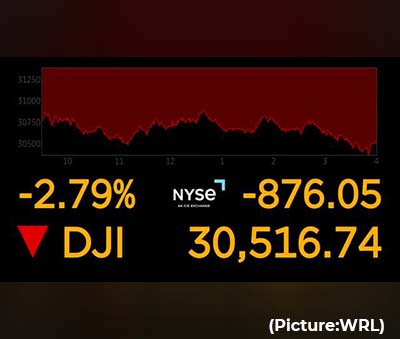
“Many continue to wonder why stocks are at new highs with 10% unemployment and nearly a million people filing for initial unemployment claims. The truth is economic data is backward looking and stocks are looking ahead to a much brighter future,” said Ryan Detrick, Chief Investment Strategist for LPL Financial in emailed comments. The Nasdaq Composite (COMP) also finished at a record high on Tuesday, up 0.7%, although it only had to exceed Monday’s peak to accomplish that. The Dow (INDU) was the odd index out, closing the day lower, dragged down by losses in the energy and financial sectors. It ended down 0.2%, or 67 points. The index remains 6% below its peak.

Will Tata Group Acquire Air India on January 1st, 2021?

After several years of heavy financial losses and complaints of poor quality services by passengers, AIR INDIA, the national carrier is likely to return to its original owners, the Tata Group of Companies. Tata Group, who has been in the aviation sector for a long time, has expressed a keen interest in taking over Air India for quite some time now. 

As per reports, the deadline for the final submission of the bids for Air India is August 31 and as of now, Tata Group seems to be the only interested party. If Tata’s bid is deemed acceptable after the deadline, the 90 day handover period shall begin and end between November 30 to December 31, 2020. The Tata group has already begun due diligence and is likely to put in a formal bid soon, close to the deadline.  Air India Express, a low-cost subsidiary of the airline and the Air India’s real estate assets; a part of the airline will also be on sale. 

Tata sons holds a 51% stake in AirAsia India. Tata Group also has a joint venture in the airline business by the name Vistara.  Thereafter, if the Tata bid is deemed accepted, the 90 day period for handover shall commence and end by November 30 or at the most, by December 31. So, one possible scenario is for Tata to take control of Air India by January 1, 2021.

While the other bidders are not known yet, globally, airlines are under severe stress due to the Covid-19 pandemic and resultant disruption on air travel and tourism. Tata is widely believed to emerge as the sole bidder for Air India and the salt to software conglomerate is likely to place a bid before August 31, the last date for bids for Air India, which the government has repeatedly said it will not be extended. According to reports, the Tata group has already begun due diligence and is likely to put in a formal bid soon.

On the ensuing structure for the airline business, there is speculation that Tata is planning to merge its existing stake in AirAsia with Air India into a single entity. Air India has been passing through a critical financial condition from much before the Covid-19 onslaught. The crippling effect of the pandemic, especially in the aviation sector, has further brought its finances to a precarious position. Recently, its pilots and other employees are on the warpath as Air India has laid off employees and started a Leave Without Pay (LWP) scheme.

From Tata Airlines and Air India to Vistara and AirAsia India, the Tata group has been an important part of the growing aviation sector in India. From Tata Air Lines and the long-since nationalised Air India to strategic joint ventures with AirAsia Berhad and Singapore Airlines (SIA) for AirAsia India and Vistara, respectively, Tata has been present in the aviation sector. The two joint venture airlines operate independently with their respective business models – low-cost (AirAsia) and full-service (Vistara). Air-India began operating in 1932 as Tata Airlines, named after J. R. D. Tata, its founder. The line carried mail and passengers between the Indian cities of Ahmadabad, Bombay, Bellary, and Madras, and Karachi, Pakistan. Within a few years Tata Airlines’ routes included the Indian cities of Trivandrum, Delhi, Colombo (in Sri Lanka), Lahore, and other locations in between.

In 1946, at the conclusion of World War II, the airline became a public company and was renamed Air-India Limited. In just two years, with the government having a 49 percent share in the company, the airline was flying further outside of India, with regular flights to Cairo, Geneva, and London. The line’s name changed again to reflect its new scope of operations, becoming Air-India International Limited. Now, after several decades, the ownership is likely to return to the Tata Group, who had started the airline, now known as AIR INDIA.

Indian Ambassador Taranjit Singh Sandhu Discusses Trade With Wisconsin Governor

Ambassador of India to the United States, Taranjit Singh Sandhu, and Wisconsin Governor Tony Evers today held a virtual meeting and discussed trade and investment as well as people-to-people relations between Wisconsin and India.

Both discussed strategies to tap the potential in the agriculture, infrastructure, and manufacturing sectors common to India and Wisconsin that would lead to win-win outcomes for both. The Ambassador briefed the Governor about the initiatives India has taken in healthcare and education and discussed collaboration in these sectors.

India and Wisconsin share a robust trade and investment relationship. The total trade between India and Wisconsin is over US $1 billion. Many Indian companies in the IT, engineering services, medical equipment, and manufacturing sectors have invested in Wisconsin.

These companies have invested close to $185 million in Wisconsin, creating over 2,460 jobs in the state. They also add value to local economies and communities through their Corporate Social Responsibility initiatives. Similarly, Wisconsin-based companies in the automobile, electrical equipment, financial services, and technology sectors have established a strong presence in India. They include Harley Davidson, Rockwell Automation Inc., ManPower Group, etc.

The Indian community has a vibrant presence in Wisconsin, which is also an important destination for Indian students. Close to 1,500 Indian students are studying in educational institutions in Wisconsin.

India has a strong education connection with Wisconsin. The tradition of Indian studies started on the University of Wisconsin campus in the mid-1880s when a Professorship of Sanskrit was established.

Renowned biochemist Dr. Hargobind Khorana received his Nobel Prize in 1968 for research he conducted at the University of Wisconsin-Madison, where he was on faculty.

The Ambassador underscored the need to revive and strengthen the university-to-university linkages between India and the U.S., including in the fields of R&D and bio-health.

Ambassador Sandhu and Governor Evers agreed to further strengthen the multifaceted engagement between India and the state of Wisconsin.

The iPhone 12 feature that could help convince millions of people to upgrade their phones

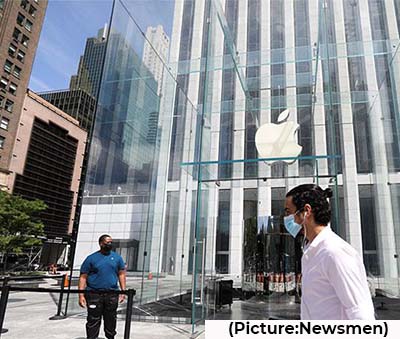
Apple has long been expected to debut a batch of 5G-enabled iPhones this fall. Now it appears all of the company’s new phone releases this year may be able to connect to the next generation of super-fast wireless networks, according to Wedbush analyst Dan Ives.

That’s a significant milestone that could help convince millions of people to upgrade their smartphones. 5G could make the iPhone 12 a must-have product.

“We previously were [expecting] 4 models with a mix of 4G/5G for the iPhone 12 unveil, however now based on supply chain checks we are expecting ONLY 5G models for the Fall launch,” Ives wrote in an investor note Sunday evening.

Apple did not respond to a request for comment on this story.

Sponsor content by CNN Underscored

Face masks that support a good cause

Face masks have become our new normal, and with these masks, you can make sure you’re doing even more good than usual.

Although the projection is not a certainty, it would be a smart move for Apple (AAPL), driving big demand for the new iPhones as the company continues its march toward a $2 trillion market cap.

In recent years, consumers have been waiting longer between smartphone upgrades — a trend that could be exacerbated by the economic crisis sparked by the coronavirus pandemic. The biggest risk to new device sales is if “high unemployment and wage deflation continues,” according to Synovus Trust Company Senior Portfolio Manager Daniel Morgan.

But analysts largely expect the 5G iPhone to generate a “super cycle” of consumers buying new devices. Ives said he estimates roughly 350 million of the total 950 million iPhones on the market could be upgraded within the next year to 18 months. 

“We believe iPhone 12 represents the most significant product cycle for (Apple CEO Tim) Cook & Co. since iPhone 6 in 2014 and will be another defining chapter in the Apple growth story looking ahead despite a softer consumer spending environment,” Ives said, adding that he believes many on Wall Street are “underestimating the massive pent-up demand around this super cycle for Apple.”

Apple’s strong earnings in the June quarter indicate it could withstand the pressures of the economic crisis, Morgan said.  And Ives predicts a lower priced, next generation 4G model will hit the market early next year, which would be a potential opportunity to reel in consumers unable or unwilling to shell out for a 5G phone.

Making a 5G-connected iPhone could improve the consumer experience for Apple’s digital services, like Apple TV+. Though iPhones have long been Apple’s biggest sales driver, the company is increasingly reliant on services to diversify its sales: Overall services revenue hit a record $13.2 billion in the June quarter, boosted by the pandemic-fueled shift in habits.

Apple is somewhat late to the 5G phone game. The 5G iPhone will join a growing slate of phones on the market built to connect to the next generation network, including models from Motorola (MSI), Samsung (SSNLF), Huawei, LG and others.

Samsung, one of Apple’s fiercest smartphone competitors, in January boasted that it held more than half of the global market share for 5G phones. And last week, Samsung unveiled its latest flagship smartphone, the Galaxy Note 20, which comes with 5G capability and an ecosystem of interconnected gadgets.

“But with Apple, it’s such a loyal ecosystem,” Morgan said, which means its customers have likely been holding out for Apple’s 5G offering.

Adoption of 5G phones is likely to accelerate as the rollout of the new network expands — consumers need a 5G-enabled phone to connect to the new network and take advantage of its benefits — and more features are built on top of it.

T-Mobile (TMUS) and AT&T (T) have both announced their 5G networks are available nationwide in the United States and Verizon (VZ) continues to build out high-speed 5G capabilities in cities throughout the country. China, a key market for iPhones, has also invested heavily in its 5G networks.

Ives said he expects Apple will release US and non-US versions of the 5G iPhone. He predicts the US version will able to connect to the fastest 5G networks — built with “mmWave” spectrum — “after some technology wrinkles appear to have been ironed out by Apple and its suppliers, which is a clear positive heading into this pivotal launch.”

He also predicts the new iPhones will go on sale in October. Apple last month said that while new iPhones typically go on sale in September, this year the company expects supply “to be available a few weeks later” because of the pandemic.

2020 Indiaspora Recognizes 58 Executives of Indian Heritage Leading Global Corporations

Indiaspora, a nonprofit organization of global Indian diaspora leaders from various backgrounds and professions, released their inaugural list honoring executives of the Indian diaspora who are leading the largest global corporations in 2020. Drawing from the latest editions of Fortune and Forbes U.S. and global lists, the Indiaspora Business Leaders List includes 58 executives serving at the helm of their respective companies as Chief Executive Officer, President, or Chairman of the Board. Under their leadership, these companies collectively employ more than 3.6 million worldwide and account for a combined USD $1 trillion in revenue and $4 trillion in market capitalization. Headquartered across 11 different countries including the U.S., Canada, England, and Singapore, these companies have delivered annualized returns of 23 percent during the tenure of these executives, outperforming the S&P 500 by 10 percent. “This inaugural list shares so many shining examples of the quintessential immigrant story,” said Indiaspora Board member Rajan Navani, Vice Chairman and Managing Director of Jetline Group of Companies. “Hardworking, enterprising, and innovative, these executives have achieved the highest success in their respective fields, often drawing on their Indian heritage to help guide and ground them along the way. No doubt they will inspire generations to come.” The list includes immigrants from India as well as professionals born in countries such as Uganda, Ethiopia, England, and the U.S. “I’m amazed to see how far we’ve come in terms of representation in business,” said Raj Gupta, former CEO of Fortune 300 company Rohm and Haas, and one of the first executives of the Indian diaspora to join the ranks of corporate leadership along with pioneers such as Indra Nooyi of PepsiCo and Dinesh Paliwal of Harman International. “There used to be only a handful of us leading corporations. Now that we are reaching prominence, I am eager to see how the next generation leaves its own legacy.” Mr. Gupta, an Indiaspora member, serves as Chairman of two companies on the Business Leaders List, Aptiv and Avantor.

Agents for Change and Inclusion

“It is gratifying to see the growing impact of individuals from the Indian community on business on a global scale,” said Indiaspora Board Member Arun Kumar, Chairman and CEO at KPMG India, who also served as Assistant Secretary of Commerce in the Obama administration. “I have had the opportunity to work with several of the individuals on our 2020 Business Leaders List in a professional and personal capacity, and can attest to their dynamism as leaders not only of their companies, but also for the larger diaspora community. In addition, many of them bring a remarkable sensitivity to issues relating to social change.” Many of these diaspora executives have led their companies in advancing social change by addressing racial injustice, climate and sustainability justice, and the disproportionate effects of COVID-19 through policy and financial commitments. For example: · Tech industry leader Sundar Pichai, CEO of Alphabet, has announced new goals for racial equity, including improving leadership representation of underrepresented groups at Google, and an “economic opportunity package” for the Black community. · Many of the leaders’ companies have created or contributed funds in response to COVID-19, with monetary and humanitarian aid totaling more than $400 million. · More than a dozen leaders have aligned their companies’ business practices to meet United Nations Sustainable Development Goals and are members of the UN Global Compact. “It’s inspiring to see so many leaders of Indian heritage playing a significant role in business and in society,” said Ajay Banga, President and CEO of Mastercard. “Our culture and our values are a common starting point. But it’s what we do with the opportunities presented to us that make a difference. When we lean into our diverse experiences to deal with challenges like the pandemic or racial injustice, we can have an even greater impact on the lives of those around us.” The Indiaspora Business Leaders List also calls attention to the presence of a glass ceiling that women, including Indian women, still face. Out of 1,000 companies represented on the Fortune 500 list, only 61 have women CEOs; the Indiaspora List has a marginally higher percentage of women, yet includes only five women out of the 58 leaders. “It’s an honor to join so many outstanding leaders on this year’s Indiaspora Business Leaders list, each of whom is making a meaningful impact within their industry,” said Reshma Kewalramani, M.D., CEO and President of Vertex Pharmaceuticals. “As a physician and CEO dedicated to creating transformative medicines that improve the lives of people with serious diseases, I believe deeply in the critical role a diverse and inclusive culture plays in being able to achieve that mission at Vertex. We are committed to developing the next generation of leaders from all backgrounds, and I look forward to some of those names showing up on this list and others like it in the years to come.”

About the Indiaspora Business Leaders List

The following lists were used to identify honorees: Fortune 500 (which features 1,000 companies), Forbes Global 2000, Fortune Global 500 and the Forbes Largest Private U.S. Companies.

2020 Indiaspora Business Leaders List
Rank First Name Last Name Company Title Revenue (B)
1 Sundar Pichai Alphabet Chief Executive Officer $166.30
2 Satya Nadella Microsoft Chief Executive Officer $138.60
3 Arvind Krishna IBM Chief Executive Officer $76.50
4 Lakshmi Mittal ArcelorMittal CEO, Chairman $70.50
5 Raj Subramaniam FedEx President, CEO $69.70
6 Vivek Sankaran Albertsons President, CEO $62.46
7 Vasant Narasimhan Novartis Chief Executive Officer $48.60
8 Punit Renjen Deloitte Global Chief Executive Officer $46.20
9 Bharat Masrani TD Bank CEO, Group President $44.80
10 Mike Mohan Best Buy President, CEO $43.60
11 Bob Patel LyondellBasell Industries Chief Executive Officer $37.40
12 Rajeev Suri Nokia Chief Executive Officer $25.80
13 Revathi Advaithi Flex Chief Executive Officer $25.00
14 Sunny Verghese Olam International Group Chief Executive Officer $24.20
15 Prem Watsa Fairfax Financial Chief Executive Officer $20.70
16 Sanjay Mehrotra Micron Technology CEO, President $19.60
17 Saum Sutaria Tenet Healthcare President, CEO $18.50
18 Ajay Banga Mastercard CEO, Chairman-elect, President $17.00
19 Ivan Menezes Diageo Chief Executive Officer $16.80
20 Laxman Narasimhan Reckitt Benckiser Group Chief Executive Officer $16.40
21 Sonia Syngal Gap Inc. Chief Executive Officer $16.40
22 Siva Sivaram Western Digital President $16.10
23 Kevin Lobo Stryker Chief Executive Officer $15.00
24 Piyush Gupta DBS Group Chief Executive Officer $14.50
25 Raj Gupta Aptiv Chairman of the Board $14.40
25 Raj Gupta Avantor Chairman of the Board $6.04
26 Bob Pragada Jacobs Engineering Co-President, CEO $13.00
27 Shantanu Narayen Adobe Chairman, CEO, & President $11.60
28 Rajiv Malik Mylan President $11.50
29 Aloke Lohia Indorama Ventures Group Chief Executive Officer $11.40
30 Sri Prakash Lohia Indorama Ventures Chairman of the Board $11.40
31 Niraj Shah Wayfair Co-Chairman, President & CEO $9.10
32 Ravi Saligram Newell Brands CEO, President $8.90
33 Milind Pant Amway Chief Executive Officer $8.40
34 George Kurian NetApp President, CEO $5.60
35 Steve Sanghi Microchip Technology CEO, Chairman $5.30
36 Sumit Singh Chewy Chief Executive Officer $4.80
37 Reshma Kewalramani Vertex Pharmaceuticals Chief Executive Officer $4.80
38 Rahul Kanwar SS&C Technologies Holdings President, CEO $4.70
39 Gary Bhojwani CNO Financial Group Chief Executive Officer $3.90
40 Sandeep Biswas Newcrest Mining Chief Executive Officer $3.80
41 Samir Kapuria NortonLifeLock President $3.70
42 Sean Aggarwal Lyft Chairman of the Board $3.62
43 Francis deSouza Illumina CEO, President $3.60
44 Aneel Bhusri Workday Chief Executive Officer $3.60
45 Rajiv Prasad Hyster-Yale Group CEO, President $3.29*
46 Rakesh Sachdev Regal Beloit Director, Chairman of the Board $3.24
47 Dinesh Lathi Tailored Brands CEO, President $3.00
48 Aman Bhutani GoDaddy Chief Executive Officer $2.99
49 Prahlad Singh PerkinElmer CEO, President $2.88
50 Anant Bhalla American Equity Investment CEO, President $2.60
51 Jayshree Ullal Arista Networks CEO, President $2.40
52 Anirudh Devgan Cadence Design President $2.40
53 Nikesh Arora Palo Alto Networks CEO, Chairman $2.27
54 Sundaram Nagarajan Nordson CEO, President $2.25
55 Sharmistha Dubey Match Group Chief Executive Officer $2.10
56 Naren Gursahaney ServiceMaster Chairman of the Board, Interim CEO $2.08
57 Sumit Roy Realty Income CEO, President $1.50
58 Ajei Gopal Ansys CEO, President $1.50
 Note: Raj Gupta appears twice on this list as the Chairman of two different companies.
* This is the revenue for Hyster-Yale Materials Handling, Inc. Hyster-Yale Group is HYMH’s operating company

Ankur Vaidya Appointed FIA-NY NJ CT Chairman

The Federation of Indian Association of NY, NJ, CT (FIA-Tri-state), held its first internal meeting at its offices in Spotswood, N.J., since the COVID-19 pandemic,  and after losing the Chairman of the Board, Ramesh Patel. The meeting was called by FIA President Anil Bansal, in concurrence with the majority of the Board of Trustees and was held under the supervision of independent counsels.
Attendees included President of FIA, Anil Bansal, Secretary Parveen Bansal, and 14 out of the 16 current Board members.
Ankur Vaidya Appointed FIA-NY NJ CT ChairmanThe primary purpose of the meeting was to address the inter-organizational review and brainstorm ways to point the organization in the right trajectory towards serving the community in these testing times.
Members of the Board also conducted an inter-board shuffling, selecting a new body to fill the vacuum left by the Chairman Ramesh Pate’s demise.
Padma Shri Dr. Sudhir S. Parikh, a long time FIA veteran, and Padma Shri H. R. Shah, were chosen as senior advisors. Both Parikh and Shah will  take the role of nurturing, overseeing and advising the newly appointed Chairman, Ankur Vaidya, the youngest member of the Board and the youngest to be chosen as its chairman.
Vaidya is joined by Bipin Patel, as vice chairman and Jayesh Patel as the general secretary.  The current Board also consists of distinguished community stalwarts including Rambhai Gadhavi, Chandrakant Trivedi, Prabir Roy, Dr. Parvin Pandhi, Andy Bhatia, Srujal Parikh, Anand Patel, Dipak Patel and Kanubhai Chauhan. Longtime veteran community leader, Albert Jasani, of Royal Alberts Palace, was chosen as the Unifying-Unity Trustee of the group, along with Yash Paul Soi as Emeritus Vice Chairman for FIA’s Golden Jubilee Year.

Wealth Of US Billionaires Rose By $565 Billion During Pandemic

The past three months have been financially painful for many Americans — but not for billionaires.  However, US billionaires have become $565 billion richer since March 18, according to a report published last week by the Institute for Policy Studies, a progressive think tank.

Total wealth for billionaires now stands at $3.5 trillion, up 19% from the low point near the beginning of the pandemic, the report said. Amazon (AMZN) boss Jeff Bezos alone is worth $36.2 billion more than he was on March 18.

Since that day, nearly 43 million Americans have filed for initial unemployment benefits. Lower-income workers, especially in travel and service-sector jobs, have been hit particularly hard by the health crisis.

With the anxiety and distress you may be feeling, wearing clothes that are in any way uncomfortable is simply not an option.

The numbers put an exclamation point on the deep divide between haves and have-nots that is helping to fuel unrest across the United States. Wealth inequality is likely to get even worse because of this crisis, experts say.

The acceleration of wealth for the richest Americans is being driven by the remarkable recovery of the stock market, which has skyrocketed in large part because of unprecedented action from the Federal Reserve.

“The stock market taking off — and decoupling from the real economy — is exacerbating inequality,” said Kristina Hooper, chief global market strategist at Invesco.

Despite the turmoil on the streets of US cities and a record 43 million Americans filing for unemployment benefits, the Nasdaq is on the cusp of hitting record highs — an astonishing feat that underscores how quickly Wall Street has rebounded.

The Fed’s emergency response, including slashing interest rates to zero and promising to buy unlimited amounts of bonds, was designed to make risky assets like stocks look more attractive. Investors have essentially been forced to gamble on equities — and Big Tech in particular is benefiting from that.

Large tech companies aren’t just surviving during the pandemic — many of them are thriving. The crisis has made Amazon, for instance, even more essential than it already was. Amazon shares have spiked 47% from their mid-March lows.

Facebook (FB) also swiftly recovered to record highs. The net worth of Mark Zuckerberg, the company’s co-founder and CEO, has climbed $30.1 billion since March 18, the IPS report found.

The report calculated billionaire wealth using data provided by the Forbes Global Billionaires List, a real-time assessment of net worth. March 18 is used as the starting date because that is the date tied to the 2020 Forbes Global Billionaire survey. It also roughly matches up with when US states and the federal government began imposing health restrictions.

Other tech power players have also amassed more wealth over the past three months. The net worth of Tesla (TSLA) boss Elon Musk, Google founders Sergey Brin and Larry Page and former Microsoft (MSFT) CEO Steve Ballmer have all climbed by $13 billion or more apiece since March 18, the report found.

Unemployment could soon hit nearly 20%

Meanwhile, the United States has been gripped by mass unemployment caused by social distancing requirements imposed to fight the pandemic.

Economists expect Friday’s jobs report to show the United States lost another 8 million jobs in May, lifting the pandemic tally to 28.5 million — three times the number of jobs lost during the Great Recession. The unemployment rate is expected to climb to nearly 20%, higher than it’s been since the Great Depression.

“Surging billionaire wealth juxtaposed with the suffering and plight of millions undermines the social solidarity required for us to recover together in the years ahead,” Chuck Collins, co-author of the IPI report, said in a statement.

Of course, millions of average Americans are also benefiting from the V-shaped recovery in the stock market. The rebound has lifted the value of investment portfolios, pension funds and retirement accounts. Even just betting on a vanilla fund that tracks the S&P 500 would have given investors a tidy return of nearly 40% since the March 23 lows.

About 52% of families owned stocks directly or indirectly through retirement plans like 401(k)s, according to 2016 stats from the Federal Reserve.

Yet a surging stock market helps the rich more than the rest of the country. That’s because the top 10% of households owned 84% of all stocks in 2016, according to NYU professor Edward Wolff.

These trends help explain the unrest that has gripped the United States. Although the initial catalyst was police brutality, the protests and riots are taking place in a nation divided across racial and economic lines. And those fault lines appear to be growing during the pandemic.

“You’ve got a combustible concoction of lost income and inequality,” said Joe Brusuelas, chief economist at RSM International.

Telework may save U.S. jobs in COVID-19 downturn, especially among college graduates

By Rakesh Kochhar and Jeffrey S. Passel

The option to perform a job remotely – to telework – may prove to be a financial lifeline for many workers during the COVID-19 downturn, which has shut down large segments of the U.S. economy and caused about 30 million American workers to file unemployment insurance claims since the middle of March 2020.

During the early stages of the outbreak’s economic fallout, 90% of the decrease in employment – or 2.6 million of the total loss of 2.9 million between February and March – arose from positions that could not be teleworked, according to a new Pew Research Center analysis of federal government data.

While many workers could no longer wait tables or give haircuts, others – especially those with college degrees – could go online and continue to teach, deliver sermons or trade stocks.

This pattern in jobs lost may change as the economic crisis deepens and spreads across broader swaths of the economy. The Congressional Budget Office projects that the number of employed workers will decrease by nearly 27 million in the coming months, nine times the loss from February to March. Also, signs have emerged that the jobs of many white-collar workers are increasingly at risk. It is possible that being able to work remotely will offer less protection as the COVID-19 downturn nears its trough.

In February, before the economic impact of the coronavirus outbreak truly took hold, 40% of American workers, or 63 million, were employed in occupations that potentially could be performed remotely, such as computer programmers, economists and human resource managers. Jobs that could not be performed remotely accounted for 60% of U.S. employment, or 95 million workers. These include jobs such as dentists, carpenters, machinists and other occupations that typically involve interactions with people, working outdoors or handling machinery or equipment, according to a classification system recently developed by researchers at the University of Chicago and adapted for this analysis by Pew Research Center.

Workers’ education level is a key determinant of whether they hold jobs that may be teleworked. In February, 62% of workers with a bachelor’s degree or more education had jobs that could be performed remotely. That is nearly double the share among workers who had completed some college education (33%), including an associate degree, and almost triple the share among high school graduates who did not go to college (22%). Few workers who did not graduate from high school (9%) had the option to telework.

Women were notably more likely than men to have the opportunity to telework, 46% vs. 35%. In part, this is because employed women have higher levels of education – 42% had at least a bachelor’s degree in February, compared with 37% of employed men. But it is also because women were more concentrated in occupations that could be done remotely. For instance, 23% of employed women held jobs in education and administrative support, compared with only 7% of employed men.

Among racial and ethnic groups, 48% of Asian workers and 44% of white workers could potentially telework, compared with 34% of black workers and 26% of Hispanic workers. Differences in education levels are again a factor. In February, about two-thirds (66%) of Asian workers had a bachelor’s degree or higher, compared with 44% of white, 33% of black and 21% of Hispanic workers.

Even so, Hispanic workers across all education levels have somewhat less of an opportunity than U.S. workers overall. In February, 55% of Hispanic workers with a college degree could telework, compared with 62% of all college graduate workers. Differences in occupations also contribute to the telework gap. In February, 18% of Hispanic workers were in either construction or production jobs, compared with 10% of workers overall. Conversely, only 24% of Hispanic workers held management, professional and related jobs, compared with 42% of U.S. workers overall.

Among all the nation’s workers, immigrants lag the U.S. born in the potential to telework. While 31% of foreign-born workers could do their jobs remotely in February, 42% of U.S.-born workers could do the same. This gap is largely driven by the large number of Hispanic immigrant workers, who make up 46% of all foreign-born workers. Of 12.2 million Hispanic immigrant workers in February, only 18% held jobs in which teleworking was feasible, compared with 31% of all immigrant workers. In a coronavirus-driven economic climate, education plays a key role in the endangered job prospects of Hispanic immigrants. Only 18% of Hispanic immigrant workers had a bachelor’s degree or more.

While the ability to work remotely is no guarantee of continued employment, it has become a realistic option for many workers in the internet age. Some 73% of American adults reported having broadband access at home in 2019, and 25% of workers did work at home at least occasionally in 2017-18. The share who work from home may increase for good as workplaces adapt to the post-COVID-19 environment.

There is evidence that teleworking is currently more prevalent than before the COVID-19 outbreak. In a Pew Research Center survey conducted in late March 2020, 40% of adults ages 18 to 64 reported they had worked from home as a result of the coronavirus outbreak. This is the same as the share of American workers who, in this analysis, are estimated to hold jobs that could be teleworked. The potential for the labor market to dampen job losses by turning to telework may already be stretched to capacity. And for some – especially black, Hispanic and lower-income workers – the ability to telework may be affected by access to broadband at home.

Workers who could telework were generally less likely to lose their jobs

As noted, job losses in the early stages of the COVID-19 outbreak have been concentrated among workers unable to telework. From February to March, U.S. employment decreased by 2.9 million, a loss of 1.8%. This was driven almost entirely by employment falling by 2.6 million (‑2.7%) in jobs that could not be teleworked. Employment in occupations that could be teleworked was essentially unchanged, edging down by 300,000 (‑0.5%).

The safety net offered by jobs that could be teleworked held for most groups of workers. Among women, for example, employment decreased by 3.6% in occupations that could not be teleworked, compared with a decrease of 0.4% in occupations that could be teleworked. Men had a similar experience, except that their losses in jobs that could not be teleworked (‑2.0%) were less than for women.

But employment outcomes varied notably by race and ethnicity. Black workers who could telework saw their employment decrease more sharply (‑4.3%) than black workers who could not telework (‑1.4%). The reasons for this are not clear. One contributing factor may be that the sizable losses for black workers in sales and related occupations, health care and technical jobs were partially offset by gains in architecture and engineering, as well as construction and extraction.

Hispanic workers without the possibility of teleworking saw some of the sharpest decreases in employment (‑5.0%) from February to March. This is traceable to the outcomes for foreign-born Hispanic workers, whose employment fell by 7.5% in these occupations, compared with a loss of 2.4% among U.S.-born Hispanic workers. Meanwhile, the overall employment of Hispanic workers in jobs that could be teleworked increased 3.7%. This reflects the experience of U.S.-born Hispanic workers, whose employment rose by 5.3% in jobs amenable to teleworking.

The favorable outcomes for U.S.-born Hispanic workers relative to foreign-born Hispanic workers and other groups largely reflects a demographic reality. Recent growth in the U.S. working-age population is almost entirely due to growth in the U.S.-born Hispanic working-age population. From March 2019 to March 2020, the U.S. working-age population increased by 1.2 million. Over this period, the growth in the U.S.-born Hispanic working-age population was 1.5 million. As a result, U.S.-born Hispanic workers also accounted for much of the employment growth in the U.S.

Like most other groups, workers at all levels of education appear to have experienced greater losses in employment if they could not telework. But the differences are not always statistically significant. The employment of workers with a college degree was essentially unchanged whether they could work remotely or not. Workers with a high school diploma experienced sizable losses in employment, whether they could telework or not. Foreign-born workers – with Hispanic workers alone accounting for 46% of the immigrant workforce – saw sharper losses than U.S.-born workers, especially in jobs that could not be teleworked.

The US economy has erased nearly all the job gains since the Great Recession

  • The Labor Department reported that the number of Americans applying for state unemployment benefits totaled 5.245 million last week.
  • Combined with the prior three jobless claims reports, the number of Americans who’ve filed for unemployment over the last four weeks is 22.025 million.
  • That number is just below the 22.442 million jobs added to payrolls since November 2009, when the U.S. economy began to add jobs back after the recession.

It took only four weeks for the U.S. economy to wipe out nearly all the job gains in the last 11 years. The coronavirus and the forced closure of business throughout the country again fueled the number of Americans applying for state unemployment benefits, which last week totaled 5.245 million, the Labor Department reported.

Combined with the three prior jobless claims reports, the number of Americans who have filed for unemployment over the previous four weeks is 22.025 million. That number is just below the 22.442 million jobs added to nonfarm payrolls since November 2009, when the U.S. economy began to add jobs back to the economy after the Great Recession. Only 417,000 more U.S. workers need to file for unemployment benefits to erase all nonfarm gains since 2009, a figure likely to be easily surpassed this week.

The rapid nature of the job losses will be unprecedented, wiping out more than a decade’s worth of job gains in five weeks. We’ll find out for sure next Thursday when the national claims for this week are reported.

“While today’s jobless numbers are down on last week, they still mean that all the job gains since the financial crisis have been erased,” wrote Seema Shah, chief strategist at Principal Global Investors. “What’s more, with many workers, including those in the gig economy, not included in these numbers, labor market pains may be even worse than these numbers suggest.”

“Concerns for the second half of the year may be underestimated,” she added. “Although governments are looking to lift lockdowns, the re-opening of economies will be only gradual, compounding financial strains for businesses and households, suppressing demand and suggesting a slower economic recovery.”

The latest nonfarm report showed payrolls plunged by 701,000 in March, marking the first decline since 2010 and the worst fall since March 2009. The unemployment rate jumped nearly a full percentage point to 4.4% from 3.5%.

Sunil Shah tops as businessman & community activist

Chicago IL: A front ranking Indian community activist, Sunil Shah, has a good number of achievements to his credit over the past few years but his friends and community members at large could point out to two singular commendable mile stones  in his cheered career – his association and a steady  climb up in career with New York Life, easily among the biggest insurance companies in the world,  and very healthy successful married life.

Sunil Shah had announced celebrating both these milestones in his event rich life this month, but the spread of Corona -19 virus torpedoes the plan requested by friends and well-wishers.  He stands determined with huge support from all quarters and announced hosting   the event in coming June. Graduating from Mumbai he came to USA in June 1990 and wading his way through early turbulence in new environment he felt that he is well suited to be   on his own and plunged into insurance field. His intuition proved right and his business acumen helped him climb up the success ladder slowly. Sunil Shah, a Registered Representative NY LIFE Securities LLC and Financial Services Professional has completed 24 successful years with New York Life Insurance Company from the Greater Chicago General Office.

Sunil Shah tops as businessman & community activistHe is also life and qualifying member of Million Dollar Round Table. He has received several times National Quality Award, National Sales Achievement Award and Life Star Award. Besides, he has served as a board director with New York Life Insurance Company in Downers Grove, IL.

Sunil Shah’s success in business is equally marched by his contribution to the society around him. His work as a community leader is highly appreciated and acknowledged.  He is the Founder President of Federation of Indian Associations, an umbrella organization  of Indian associations.  Not  only that he founded this body  but he has been successfully nurturing it by hosting number of community  oriented  act cities  that  would include  India Day celebrations,  Health Care camps, Holi Festivities and show casing Indian culture at the Bull Games

He is a Lifetime member and Ambassador of, Asian American Hotel Owners Association and also of Schaumburg Business Association. He is also Lifetime member of the Jain Society of Metropolitan Chicago, Gujarati Samaj of Chicago and Gujarati cultural Association. He tried his hand in politics too and was a Mayoral candidate 2019 for the Village of Schaumburg.

Residing in Schaumburg, a Chicago suburb for the past  last 20 years with his wife Rita Shah and two son’s Sahaj and Swapnil, he and his family members have  passion  helping the people around and  needy in the community at large . He can be reached at 847-309-4462 and / or by email at sashah.nyl@hotmail.com

Record 16.8 Million People Have Sought U.S. Jobless Aid Since Coronavirus Outbreak Began

With a startling 6.6 million people seeking unemployment benefits last week, the United States has reached a grim landmark: More than one in 10 workers have lost their jobs in just the past three weeks to the coronavirus outbreak.

The figures collectively constitute the largest and fastest string of job losses in records dating to 1948. By contrast, during the Great Recession it took 44 weeks — roughly 10 months — for unemployment claims to go as high as they now have in less than a month.

The damage to job markets is extending across the world. The equivalent of 195 million full-time jobs could be lost in the second quarter to business shutdowns caused by the viral outbreak, according to the United Nations’ labor organization. It estimates that global unemployment will rise by 25 million this year. And that doesn’t even count workers on reduced hours and pay. Lockdown measures are affecting nearly 2.7 billion workers — about 81 percent of the global workforce — the agency said.

Around half a billion people could sink into poverty as a result of the economic fallout from the coronavirus unless richer countries act to help developing nations, Oxfam, a leading aid organization, warned Thursday.

In the United States, the job market is quickly unraveling as businesses have shut down across the country. All told, in the past three weeks, 16.8 million Americans have filed for unemployment aid. The surge of jobless claims has overwhelmed state unemployment offices around the country. And still more job cuts are expected.

More than 20 million people may lose jobs this month. The unemployment rate could hit 15% when the April employment report is released in early May.

 “The carnage in the American labor market continued unabated,” said Joseph Brusuelas, chief economist for RSM, a tax advisory firm.

The viral outbreak is believed to have erased nearly one-third of the U.S. economy’s output in the current quarter. Forty-eight states have closed non-essential businesses.

A nation of normally free-spending shoppers and travelers is mainly hunkered down at home, bringing entire gears of the economy to a near-halt. Non-grocery retail business plunged 97% in the last week of March compared with a year earlier, according to Morgan Stanley. The number of airline passengers screened by the Transportation Security Administration has plunged 95% from a year ago. U.S. hotel revenue has tumbled 80%.

Applications for unemployment benefits are a rough proxy for layoffs because only people who have lost a job through no fault of their own are eligible.

The wave of layoffs may be cresting in some states even while still surging in others. Last week, applications for jobless aid declined in 19 states. In California, they dropped nearly 13% to 925,000 — still a shockingly high figure. In Pennsylvania, they dropped by nearly one-third to 284,000. That’s still more than the entire nation experienced just four weeks ago.

By contrast, in Georgia, which issued shutdown orders later than most other states, filings for unemployment claims nearly tripled last week to 388,000. In Arkansas, they more than doubled. In Arizona, they jumped by nearly 50%.

On Thursday, the Federal Reserve intensified its efforts to bolster the economy with a series of lending programs that could inject up to $2.3 trillion into the economy. Chairman Jerome Powell said that the economy’s strength before the viral outbreak means it could rebound quickly in the second half of the year.

“There is every reason to believe that the economic rebound, when it comes, will be robust,” Powell said.

In many European countries, government programs are keeping people on payrolls, though typically with fewer hours and lower pay. In France, 5.8 million people — about a quarter of the private sector workforce — are now on a “partial unemployment” plan: With government help, they receive part of their wages while temporarily laid off or while working shorter hours.

32 Million Livelihoods at Risk, Indian Economy Will Shrink 20 Percent if Lockdown Continues to Mid-May

If the India lockdown continues till mid-May along with moderate relaxation after the end of 21-day lockdown on April 14, it could put 32 million livelihoods at risk and swell non-performing loans by seven percentage points, resulting in the economy contracting sharply by around 20 per cent in the first quarter of fiscal year 2021, with –2 to –3 percent growth for fiscal year 2021, a new report warned April 10.

According to the report by leading management consulting firm McKinsey and Company, the cost of stabilizing and protecting households, companies and lenders could exceed Rs 10 lakh crore, or more than 5 per cent of GDP in such a scenario.

The report, titled ‘Getting ahead of coronavirus: Saving lives and livelihoods in India,’ said that restarting supply chains and normalizing production and consumption can take three–four months if the lockdown goes till mid-May as the virus lingers on.

If the lockdown continues for additional two–three weeks in Q2 and Q4 FY 2021 because of virus resurgence, it could mean an even deeper economic contraction of around 8 to 10 per cent for fiscal year 2021.

“This could occur if the virus flares up a few times over the rest of the year, necessitating more lock-downs, causing even greater reluctance among migrants to resume work, and ensuring a much slower rate of recovery,” the report suggested.

To understand probable economic outcomes and possible interventions related to COVID-19, McKinsey spoke with some 600 business leaders, economists, financial-market analysts and policy makers.

According to the findings, in case the lockdown period is extended till mid-May, the potential economic loss in India would vary by sector, with current-quarter output drops that are large in sectors such as aviation and lower in sectors such as IT-enabled services and pharmaceuticals.

“Current-quarter consumption could drop by more than 30 percent in discretionary categories, such as clothing and furnishings, and by up to 10 per cent in areas such as food and utilities,” said the report.

Strained debt- service-coverage ratios would be anticipated in the travel, transport, and logistics, textiles, power and hotel and entertainment sectors.

There could be solvency risk within the Indian financial system, as almost 25 percent of MSME and small- and medium-size-enterprise loans could slip into default, compared with 6 percent in the corporate sector (although the rate could be much higher in aviation, textiles, power and construction) and 3 percent in the retail segment (mainly in personal loans for self-employed workers and small businesses).

“Liquidity risk would also need urgent attention as payments begin freezing in the corporate and SME supply chains. Attention will need to be given to the liquidity needs of banks and non-banks with stretched liquidity-coverage ratios to ensure depositor confidence,’ the report mentioned.

Given the magnitude of potential unemployment, business failure and financial-system risk, a comprehensive package of fiscal and monetary interventions may need to be planned.

“Consideration could be given to an income-support program in which the government both pays for a share of the payroll for the 60 million informal contractual and permanent workers linked to companies and provides direct income support for the 135 million informal workers who are not on any form of company payroll,’ the report further suggested.

Since last week, the Health Ministry has observed a staggering rise daily in the number of confirmed coronavirus cases across the country — nearly 500-plus cases daily with a few exceptions where the number has gone below 400 cases — a pattern which indicates a worrying trend after solid implementation of the nationwide lockdown and sealing of hotspots.

On April 10, the number of confirmed cases has risen to 6,412, an addition of 669 cases in a day.

Punjab and Odisha have already extended lockdown till May 1 and April 30, respectively.

According to the report, countries that are experiencing COVID-19 have adopted different approaches to slow the spread of the virus.

Some have tested extensively, carried out contact tracing, limited travel and large gatherings, encouraged physical distancing, and quarantined citizens.

Others have implemented full lock-downs in cities with high infection rates and partial lock-downs in other regions, with strict protocols in place to prevent infections.

“The pace and scale of opening up from lockdown for India may depend on the availability of the crucial testing capabilities that will be required to get a better handle on the spread of the virus, granular data and technology to track and trace infections, and the build-up of health care facilities to treat patients (such as hospital beds by district),” said the report.

Since there is a very real possibility of the virus lingering on through the year, a micro-targeting approach could help decelerate its spread while keeping livelihoods going.

“It is imperative that society preserve both lives and livelihoods. To do so, India can consider a concerted set of fiscal, monetary, and structural measures and explore ways to return from the lockdown that reflect its situation and respect that most important of tenets: the sanctity of human life,” the report noted.

With Mukesh Ambani at the Top, India Now Has 101 Billionaires

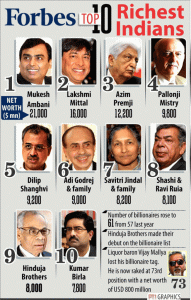
With Mukesh Ambani at the top, India now has 101 billionaires, according to new data released by Forbes magazine. According to the 34th annual world’s billionaires list, in which Forbes ranks the wealthiest individuals globally, there are 2,095 billionaires on the 2020 ranking, down from 2,153 in 2019.

The total combined net worth of this year’s billionaires is $8 trillion, down from $8.7 trillion in 2020. 267 people dropped off this year’s list and a record 1,062 individuals have seen a drop in their fortunes, both reflective of the turbulent markets and the coronavirus pandemic.

Approximately 70% of the list is made up of self-made billionaires. India’s Mukesh Ambani is ranked #21 richest in the world with $36.8 billion.

Forbes released its 34th annual world’s billionaires list, which ranks the wealthiest individuals globally. Approximately 70% of the list is made up of self-made billionaires. India’s Mukesh Ambani is ranked #21 richest in the world with $36.8 billion.

Amid the COVID-19 outbreak, some of the world’s wealthiest are serving as agents of change and taking action to reinvent their businesses to aid in the global response to the coronavirus outbreak, Forbes said in a statement.

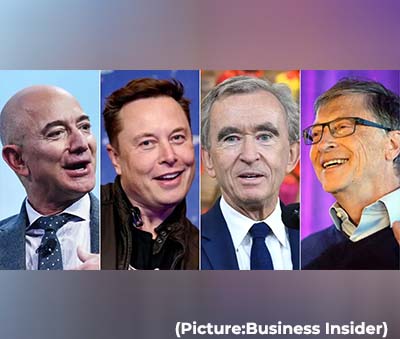
Billionaires like tech tycoon Bill Gates; Eric Yuan, CEO of Zoom; Bernard Arnault, CEO of LVMH, Brian Chesky, CEO of Airbnb; Dallas Mavericks owner Mark Cuban and a host of others are using their financial resources to help combat the health crisis and boost the economy.

There are 2,095 billionaires on the 2020 ranking, down from 2,153 in 2019. The total combined net worth of this year’s billionaires is $8 trillion, down from $8.7 trillion in 2020. 267 people dropped off this year’s list and a record 1,062 individuals have seen a drop in their fortunes, both reflective of the turbulent markets and the coronavirus pandemic.

“The world’s richest are not immune to the devastating impact of the coronavirus,” said Kerry A. Dolan, Assistant Managing Editor of Wealth, Forbes. “The drop in the number of billionaires this year reflects the economic impact the pandemic is already having.”

To view the full list, visit www.forbes.com/billionaires.

Centi-billionaire Jeff Bezos maintains the top spot on this year’s ranking, for the third consecutive year, despite his net worth plunging by $18 billion. The Amazon CEO is valued at $113 billion, down from $131 billion last year. The decrease in his net worth is primarily due to his recent divorce.

Bill Gates remains in the No. 2 position with a fortune of $98 billion, up $1.5 billion from last year. Bernard Arnault of LVMH moves up on this year’s ranking and debuts in the top three, as the third-wealthiest person in the world, after Warren Buffett’s fortune fell by $15 billion. Buffett (No. 4) is valued at $67.5 billion, down from $82.5 from last year.

Rounding out the top five is Larry Ellison, founder, chairman and Chief Technology Officer of Oracle Corporation. While the software executive moves up on the ranking, his fortune is down $3.5 billion this year, to $59 billion.

There are 178 billionaires who made this list for the first time. Eric Yuan, CEO of Zoom, debuts on the list as Zoom gains mass popularity while many companies are shifting to a remote workforce.

The richest newcomer is Julia Koch, who inherited a 42% stake in Koch Industries from her late husband, David, who died last year. Her $38.2 billion fortune puts her at No. 18 on the ranking, tied with her brother-in-law, Charles Koch. Julia’s inheritance makes her the third richest woman in the world, after Walmart’s Alice Walton and L’Oréal’s Francoise Bettencourt Meyers. Another notable newcomer: MacKenzie Bezos, ex-wife of Jeff Bezos, who lands at No. 22 on the list with a total net worth of $36 billion.

Approximately 70% of the list is made up of self-made billionaires. Those 1,457 listers are people who have built a company or established a fortune on their own. There are a total of 241 women on the 2020 list, including seven who share their fortunes with their husband, child or sibling.

Regionally, Asia-Pacific boasts the most billionaires, with 778, followed by the United States with 614 and Europe with 511. By country, the U.S. leads with the greatest number of billionaires, with 614 (up from 607 last year), followed by China with 389 (up from 324 last year); Germany with 107 (down from 114), India with 102 (down from 106) and Russia with 99 (up from 98).

President Trump’s net worth has plunged $1 billion in less than a month. As of March 1, Forbes valued President Donald Trump’s net worth at $3.1 billion. The markets took a turn and reporters went back to work to approximate how much the coronavirus affected the president’s fortune. Trump’s newly estimated fortune is now $2.1 billion, bringing him to No. 1001 on this year’s ranking, down from No. 715 last year.

“For the first time in our 103 years, the Forbes editorial team, sheltering-at-home around the world, produced this magazine remotely,” said Randall Lane, Chief Content Officer, Forbes. “It’s now a piece of history, and an instant classic, featuring five consecutive covers—the faces of business leaders who are using the coronavirus crisis to reinvent themselves, their companies or the world.”

Methodology

The Forbes Billionaires list is a snapshot in time of wealth using stock prices and exchange rates from March 18, 2020. Forbes lists individuals rather than multi-generational families who share large fortunes, though we include wealth belonging to a billionaire’s spouse and children if that person is the founder of the fortune. In some cases, siblings and couples are listed together if the ownership breakdown among them isn’t clear, however they still must be worth on average a minimum of $1 billion apiece to make the cut.

Here are India’s 101 billionaires as ranked globally by Forbes:

# 21: Mukesh Ambani: $36.8 billion

#78: Radhakrishnan Damani: $13.8 billion

#103: Shiv Nadar: $11.9 billion

#129: Uday Kotak: $10.4 billion

#155: Gautam Adani: $8.9 billion

#157: Sunil Mittal & Family: $8.8 billion

#165: Cyrus Poonawalaa: $8.2 billion

#185: Kumar Birla: $7.6 billion

#196: Lakshmi Mittal: $7.4 billion

#253: Azim Premji: $6.1 billion

#253: Dilip Sanghvi: $6.1 billion

#268: Benu Gopal Banyur: $5.9 billion

#320: Kuldip Singh & Gurbachan Singh Dhingra: $5.1 billion

#320: Nusli Walia: $5.1 billion

#349 Savitri Jindal & Family: $4.8 billion

#426: Bajaj Brothers: $4.2 billion

#484: Rahul Bajaj: $3.8 billion

#494: Kushal Pal Singh: $3.7 billion

#538: Hasmukh Chudgar: $3.5 billion

#538: Muralidivi & Family: $3.5 billion

#538: M.A. Yusuff Ali: $3.5 billion

#565 Kapil & Rahul Bhatia: $3.4 billion

#565: Mahendra Choski & Family: $3.4 billion

#590: Vikram Lal: $3.3 billion

#648: Anil Agarwal & Family: $3.1 billion

#648: Karsanbhai Patel: $3.1 billion

#648: Abhay Vakil & Family: $3.1 billion

#712: Pankaj Patel: $2.9 billion

#764: Chandru Raheja: $2.7 billion

$804: Kiran Mazumdar-Shaw: $2.6 billion

#804: Pawan Munjal & Family: $2.6 billion

#836: Ravi Pillai: $2.5 billion

#908: Vivek Chand Burman: $2.3 billion

#908: Ravi Jaipuria: $2.3 billion

#945: Micky Jagtiani: $2.2 billion

$945: Shashi & Ravi Raia: $2.2 billion

#945: Arvind Tiku: $2.2 billion

#1001: Vinod & Anil Raigupta: $2.1 billion

#1063: Madhukar Parekh: $2 billion

#1135: Smita Crishna-Godrej: $.9 billion

#1135: Jamshyd Godrej: $1.9 billion

#1135: Nadir Godrej: $1.9 billion

#1135: Rakesh Jhunjhunwala: $1.9 billion

#1135: N.R. Narayana Murthy: $1.9 billion

#1135: Rishad Naoroji: $1.9 billion

#1196: Anand Burman: $1.8 billion

#1196: Senapathy Gopalkrishnan: $1.8 billion

#1196: Mangal Prabhat Lodha: $1.8 billion

#1196: Vikas Oberoi: $1.8 billion

#1196: Byju Raveendran: $1.8 billion

#1196: Leena Tewari: $1.8 billion

#1267: Baba Kalyani: $1.7 billion

#1267: Samir Mehta: $1.7 billion

#1267: Sudhir Mehta: $1.7 billion

#1267: Ajay Piramal: $1.7 billion

#1267: Mahendra Prasad: $1.7 billion

#1335: Kalanithi Maran: $1.6 billion

#1335: Harsh Mariwala: $1.6 billion

#1335: P.P. Reddy: $1.6 billion

#1335: P.V. Krishna Reddy: $1.6 billion

#1335: Jitendra Vurwani: $1.6 billion

#1415: Harindarpal Banga: $1.5 billion

#1415: Abhay Firodia: $1.5 billion

#1415: Harsh Hoenka: $1.5 billion

#1415: Ranjani Pai: $1.5 billion

#1415: G. Rajendran: $1.5 billion

#1513: Sanjiv Goenka: $1.4 billion

#1513: Nandan Nilekani: $1.4 billion

#1513: Ajay Prakash: $1.4 billion

#1513: Nandrkumar Parekh: $1.4 billion

#1513: P.V. Rampal Reddy: $1.4 billion

#1613: Rajendra Agarwal: $1.3 billion

#1613: Banwarilal Bawri: $1.3 billion

#1613: Girdharlal Bawri: $1.3 billion

#1613: Amit Burman: $1.3 billion

#1613: Niranjan Hiranandani: $1.3 billion

#1613: Kishore Mariwala: $1.3 billion

#1613: Lachhman Das Mittal: $1.3 billion

#1613: Subhash Runwal: $1.3 billion

#613: Sunny Varkey: $1.3 billion

#1613: Shamsheer Vayalil: $1.3 billion

#1730: Sachin Bansal: $1.2 billion

#1730: Sanjeev Bikhchandani: $1.2 billion

#1739: K. Dinesh: $1.2 billion

#1730: T.S.Kalyanaraman: $1.2 billion

#1739: Hemandra Kthari: $1.2 billion

#1730: Anand Mahendra: $1.2 billion

#1739: Sushil Kumar Pareek: $1.2billion

#1730: Bhadresh Shah: $1.2 billion

#1730: Basudeo Singh: $1.2 billion

#1730: Salil Singhal: $1.2 billion

#1730: Radha Vembu: $1.2 billion

#1851: Archana Balakrishna: $1.1 billion

#1851: Bimy Bansal: $1.1 billion

#1851 Sandeep Engineer: $1.1 billion

#1851: Mofatraj Munot: $1.1 billion

#1851L Arvind Poddar: $1.1 billion

#1851: S.D. Shibulal: $1.1 billion

#1990: Achal Bakeri: $1 billion.

Falling Oil demand and historically low prizes lead to deal to cut oil production

Oil prices dropped on Friday as traders feared that an Opec deal to slash global supplies by 10% would not offset a historic drop in demand due to the coronavirus outbreak.

The price of Brent crude fell nearly 2.5% to $31.82 per barrel on Friday last week, despite news that the oil cartel and allies – known as Opec+ – had reached a deal that would end a price war between Saudi Arabia and Russia that threatened to flood the market with more oil than the world could use.

Mexico initially cast some doubt over Opec’s plans, after apparently refusing to sign up to its share of cuts, which would have been 400,000 barrels per day (bpd). The country instead offered to cut 100,000 bpd.

The country signaled on Friday that the US may be willing to make further cuts to its production in order to allow Mexico to make less stringent reductions. Mexican president Andrés Manuel López Obrador said that US president Donald Trump had agreed to help out by cutting additional US output.

Major oil-producing nations collectively called the OPEC+, including Saudi Arabia and Russia, finally came to terms and agreed to cut oil production by 10 million barrels a day — equivalent to 10% of global oil supply — in May and June. Mexico had held out on the agreement on Thursday, but an intervention by the US resolved the standoff.

Crude oil prices have fallen by over 50% since the turn of the year, straining the economy of oil-producing countries and those invested in them. That was largely due to the coronavirus crisis in China and a standoff between Russia and Saudi Arabia — the former walked out of a planned production cut, triggering a price war. Then the pandemic spread around the world, sinking the demand for oil, even as Russia and Saudi Arabia were pushing cheap oil into the market. But now, pushed by the US, also a major oil producer, an agreement has been reached.

The agreement between OPEC and partner countries aims to cut 10 million barrels per day until July, then 8 million barrels per day through the end of the year, and 6 million a day for 16 months beginning in 2021, reports Associated Press. Mexican President Andres Manuel Lopez Obrador said he had agreed with US President Donald Trump that the US will compensate what Mexico cannot add to the proposed cuts.

How to get your US stimulus check from the US Government?

The IRS and the Treasury Department say Americans will start receiving their economic impact checks in the next three weeks. The payments are part of the $2.2 trillion rescue package signed into law last week by President Donald Trump aimed at combating the economic ravages of the coronavirus outbreak.

As part of the economic stimulus bill, hundreds of billions of dollars are being earmarked for one-time economic impact payments, or “stimulus checks” to most American households. While the size of the stimulus payments has been widely reported, there are some key details that are still unclear — such as how you’ll actually get your payment, what happens if you haven’t filed a tax return recently, and what if your information has changed.

While this is still a fluid situation and there are some important details the IRS and Treasury haven’t quite figured out yet (to be fair, the bill passed just a few days ago), the IRS recently issued their most up-to-date guidance yet. With that in mind, here are five things about the stimulus check that you need to know.

Most people don’t need to do anything to get the money. But some — including senior citizens and low-income people who might not traditionally file tax returns — do need to take action. People behind on filing their taxes might also want to get caught up.

The IRS and Treasury have provided more details on how to ensure you get paid. Here are the basics:

WHO IS ELIGIBLE FOR THE PAYMENTS?

Anyone earning up to $75,000 in adjusted gross income and who has a Social Security number will receive a $1,200 payment. That means married couples filing joint returns will receive the full payment — $2,400 — if their adjusted gross income, which what you report on your taxes, is under $150,000.

The payment steadily declines for those who make more. Those earning more than $99,000, or $198,000 for joint filers, are not eligible. The thresholds are slightly different for those who file as a head of household.

Parents will also receive $500 for each qualifying child. So, a family of four could get as much as $3,400.

WHAT DO I HAVE TO DO TO GET THE CHECK?

For most people, nothing. If you’ve already filed your 2019 tax return, which is now due on July 15, the IRS will use it to determine your eligibility. If you have not filed a 2019 tax return yet, your eligibility will be based on your 2018 return.

The money will be directly deposited in your bank account if the government has that information from your tax return. If you haven’t filed your 2019 taxes, the government will use information from your 2018 taxes to calculate your payment and determine where to send it. It can use your Social Security benefit statement as well.

I DON’T USUALLY HAVE TO FILE TAXES. DO I STILL GET A PAYMENT?

Yes. People who are not required to file a tax return — such as low-income tax payers, some senior citizens, Social Security recipients, some veterans and people with disabilities — will need to file a very simplified tax return to receive the economic impact payment. It provides the government basic details including a person’s filing status, number of dependents and direct-deposit bank information.

I HAVEN’T FILED MY 2018 OR 2019 TAXES. WILL I STILL GET A PAYMENT?

Yes, but the IRS urges anyone required to file a tax return and has not yet done so for those years to file as soon as possible in order to receive an economic impact payment. Taxpayers should include their direct-deposit banking information on the return if they want it deposited in their account.

I DIDN’T USE DIRECT DEPOSIT ON MY TAXES, WHAT CAN I DO?

The government will default to sending you the check by mail if you did not use direct deposit.

However, IRS and Treasury say that they will develop an online portal in the coming weeks for individuals to provide their banking information so that they can receive the payments immediately instead of in the mail. It has not yet set a deadline for updating that information.

WHERE DO I DO THIS?

The IRS says the Treasury is planning to develop a web-based portal for taxpayers to provide their bank account information for stimulus payments. The goal is to get the money in your hands as soon as reasonably possible, and the quickest way to do that is to allow everyone to use direct deposit if they so choose. We don’t know yet if there will be an option to choose a paper check.The IRS and Treasury say the website irs.gov/coronavirus will soon provide information about the check, including how people can file a simple 2019 tax return.

I NEED MORE TIME TO FILE MY TAX RETURNS. HOW LONG DO I HAVE TO GET THE PAYMENT?

The IRS says people concerned about visiting a tax professional or local community organization in person to get help with a tax return should not worry. The economic impact payments will be available throughout the rest of 2020.

Treasury Secretary Steven Mnuchin announced Thursday that many Americans reeling from the financial impacts caused by the coronavirus outbreak can expect to see their one-time stimulus checks of up to $1,200 show up in their bank accounts in about two weeks. For those without direct deposit, Mnuchin promised checks would go out quickly in a matter of “weeks.”

The announcement followed a memo sent out by House Democrats that warned some Americans could have to wait up to 20 weeks – or five months – before they receive their checks.

 The first payments are expected go out within three weeks to those for whom the Internal Revenue Service already has direct deposit information on file. Mnuchin said at a White House coronavirus briefing that payments would go out within two weeks to people whose direct deposit details are on file with the government, echoing comments he made after passage of the $2.2 trillion stimulus bill that payments would not go out until mid-April.  He added that a web portal would be established for people to supply their details and that checks would be sent to anyone else, but did not specify a timeline.  “I am assuring the American public, they need the money now.”

How to get into ‘working mode’ while at home

If you are struggling to get into the working mode as you stay at home due to the lockdown, some simple tips like maintaining a routine and dressing up in a way as if you were in office may help you increase productivity, suggests a new report.

“Maintain daily routines as when working regularly — get up at the same time, take a shower, dress-up, get breakfast and than start working at the same time you normally do at the office,” according to the “Work From Home Best Practices” shared by Bain & Company, one of the world’s leading strategy and management consultancies.

Another key point to keep in mind is that you should leave private life outside the room where you work. If you want to check private messages, take a break and do it in your private space.

Taking break, in fact, is quite important to make your work from home effective, according to Bain & Company.

“Reward yourself and give yourself breaks “breaks are critical to recharge batteries, they can be small (e.g., 5 minutes of checking social media) or longer (e.g., full 45 min lunch break),” it said.

At the same time, it is important not to engage in any household tasks/ chores while on worktime.

To get the maximum out of you time, structure your day along key tasks/ objectives to achieve and keep track of what has to be done during the day (and week and month) and clearly decide when to do.

Instead of using the whole apartment for work, use one particular room and avoid having meals in front of the workstation.

“If you have a partner also working from home find clear rules for who can use the workplace at which time and where calls can be made from without ‘distracting’ each other,” the company said, adding that getting the right infrastructure and having good connectivity are key to having fruitful working hours at home. (IANS)

The dollar is on a tear. Here’s why that’s troubling

Even though the novel coronavirus has the United States essentially in lockdown mode, the American dollar continues to be viewed as the world’s safest and most stable currency.

The value of the greenback is surging, up more than 7% against a basket of other currencies — such as the euro, British pound and Swiss franc — since hitting the lowest point of 2020 on March 9.

But this strong demand from other countries around the world has created a liquidity crunch — essentially a dollar shortage. There are worries that this could further disrupt global financial markets.

“This collapse in global activity leaves a lot of people with US dollar liabilities to finance, and not enough dollars coming in to do it,” said Kit Juckes, a strategist at Societe Generale, in a report.

“It doesn’t matter that they don’t owe these dollars to Americans…what matters is that they need dollars and need them now,” Juckes added.

That appears to be the main rationale behind moves from the Federal Reserve to roll out new dollar loans (known as swap lines) with five major central banks on Sunday and an expansion of the program with nine other central banks on Thursday.

The Fed announced further plans Friday to step up the frequency of dollar swaps with The Bank of Canada, the Bank of England, the Bank of Japan, the European Central Bank and the Swiss National Bank.

The arrangements will now be daily — as opposed to just weekly — starting Monday and will last until at least the end of April.

“Any stress in wholesale funding markets is getting noticed, and anything done to address it matters. Expanding the swap lines to more countries could continue to improve currency funding constraints,” said Lauren Goodwin, economist and multi-asset portfolio strategist at New York Life Investments, in a report.

The resurgent dollar may create another big problem for giant US multinational companies that are already staring to struggle from lower demand abroad as a result of the COVID-19 pandemic.

A strong dollar makes US exports more expensive — and therefore less competitive — than foreign made goods.

Benefits to a strong dollar as well

Still, the demand for the dollar is also a good psychological sign.

It shows that investors around the globe are still in confident in America’s status is the world’s leading economy and the dollar as a reserve currency for the world.

“The dollar is rallying because it is a safe haven currency. And that has some benefits,” said Brent Schutte, chief investment strategist at Northwestern Mutual Wealth Management Company.

With that in mind, Schutte said investors should not worry about what the dollar will do to corporate profits. A stronger dollar also makes imported goods cheaper for American consumers.

“The US is still the number one economic power on the planet. There is a reason that the dollar and Treasury bonds are considered the healthiest in the world. This is unavoidable and in the long run it is not harmful,” said Ric Edelman, founder of Edelman Financial Engines, a company that provides advice for 401(k) plans.

Still, some experts question if the dollar can rally much further from these levels.

It might be time for the dollar to give back some of its gains — especially as other countries begin to realize that they need to prop up their own currencies.

“The main risk for the dollar is G7 currency intervention. With the rise in the greenback driving many currencies to multi-year lows, central banks from Brazil to Norway have rushed to prevent further losses,” said Kathy Lien, managing director of FX strategy at BK Asset Management, in a report.

“There’s a very good chance that coordinated action on a global scale will be next. If they come into the market, it will be to sell dollars, not buy them,” Lien added.

U.S. economy deteriorating faster than anticipated as 80 million Americans are forced to stay at home

Economic decline will be sharper and more painful than during the 2008 financial crisis

The U.S. economy is deteriorating more quickly than was expected just days ago as extraordinary measures designed to curb the coronavirus keep 84 million Americans penned in their homes and cause the near-total shutdown of most businesses.

In a single 24-hour period, governors of three of the largest states — California, New York and Illinois — ordered residents to stay home except to buy food and medicine, while the governor of Pennsylvania ordered the closure of nonessential businesses. Across the globe, health officials are struggling to cope with the growing number of patients, with the World Health Organization noting that while it required three months to reach 100,000 cases, it took only 12 days to hit another 100,000.

The resulting economic meltdown, which is sending several million workers streaming into the unemployment line, is outpacing the federal government’s efforts to respond. As the Senate on Friday raced to complete work on a financial rescue package, the White House and key lawmakers were dramatically expanding its scope, pushing the legislation far beyond the original $1 trillion price tag.

With each day, an unprecedented stoppage gathers force as restaurants, movie theaters, sports arenas and offices close to shield themselves from the disease. Already, it is clear that the initial economic decline will be sharper and more painful than during the 2008 financial crisis.

Next week, the Labor Department will likely report that roughly 3 million Americans have filed first-time claims for unemployment assistance, more than four times the record high set in the depths of the 1982 recession, according to Bank of America Merrill Lynch. That is just the start of a surge that could send the jobless rate spiking to 20 percent from today’s 3.5 percent, a JPMorgan Chase economist told clients on a conference call Friday.

Estimates of the pandemic’s overall cost are staggering. Bridgewater Associates, a hedge fund manager, says the economy will shrink over the next three months at an annual rate of 30 percent. Goldman Sachs pegs the drop at 24 percent. JPMorgan Chase says 14 percent.

“We are looking at something quite grave,” said economist Janet L. Yellen, the former Federal Reserve chair. “If businesses suffer such serious losses and are forced to fire workers and have their firms go into bankruptcy, it may not be easy to pull out of that.”

As layoffs skyrocket, the holes in America’s safety net are becoming apparent

Little more than seven months before the presidential election, President Trump already is looking past the crisis and promising a swift recovery. “We’re going to be a rocket ship as soon as this thing gets solved,” he said Thursday. “… We think it’s going to come back really fast.”

Most economists expect the economy to begin climbing out of its deep hole in the second half of this year. But those forecasts depend upon the pandemic being brought under control and the United States and other governments enacting policies that prevent lasting harm to factories and financial arteries. Even if all that happens, the economy will be smaller at the end of this year than it was at the beginning, according to Bridgewater, Goldman and JPMorgan.

The truth is no one knows what will happen months from now. No one on Wall Street or in Washington has any experience dealing with the kind of complex threat that has suddenly materialized to upend American life — a global health scare that is strangling the economy and disrupting financial markets.

Americans are very likely to get $1,200 checks. Here’s what you need to know.

Individual workers and their families — many only recently recovered from the economic cataclysm of 2008 and 2009 — are already feeling the effects. The unexpected economic shock has put millions of Americans living on the precipice of ruin. In a Fed survey last year, 39 percent of Americans said they would be unable to handle an unexpected $400 expense.

Lyndsy Hartmann knew something was wrong last weekend when she went to her job at a spa company in Charlottesville. Hartmann, 34, normally handles 150 calls a day from people interested in booking spa treatments and massages. But on Saturday and Sunday, she received a total of six.

IAPC Board of Directors for 2020-21 Announced

INDO AMERICAN PRESS CLUB, Inc. (IAPC) has announced the  Board of Directors for the year 2020-21. Dr. Joseph .M.  Chalil will serve and lead IAPC, the largest ethnic Indian American media forum, formed in 2013 to provide a common platform and to be the voice for media personnel of Indian origin, and to help shape the world to be world that is fair, just and equitable for the all today and future generations.

IAPC DIRECTOR BOARD (2)Dr. Mathew Joys is the Vice Chairman and Mathewkutty Easow is the Board Secretary. Other members of the Board of Directors include: Kamlesh Mehta, Ajay Ghosh, Parveen Chopra, Dr. P.V Baiju, Thomas Mathew(Anil), Ginsmon P Zacharia, Korason Varghese, Mini Nair and Thampanoor Mohan.

Prof. Joseph M. Chalil, MD, MBA, FACHE, Cofounder and Publisher of The Universal News Network, www.theunn.com, has been selected to be the Chairman, Board of Directors of Indo-American Press Club (IAPC), for a two year term, leading the organization to newer heights. Dr. Chalil, an author of several scientific and research papers in international publications, is the Chairman of Healthcare Advisory Board and an Adjunct Professor at H. Wayne Huizenga College of Business and Entrepreneurship, Nova Southeastern University in Florida and is a member of the Dr. Kiran C. Patel College of Allopathic Medicine (NSU MD) Executive Leadership Council, in Florida.

Dr. Chalil holds several US Patents, and is an expert in US Healthcare policy and a strong advocate for patient centered care.A recipient of the prestigious AAPI National Presidential Awards in 2015 and 2013 AAPI New York President’s Award, Dr. Chalil was recognized and honored with the 2013 Outstanding 50 Asian Americans in Business Award. After completing his studies in India, Dr. Chalil immigrated to the United States, and had his higher studies in Medicine at the University of Medicine and Dentistry of New Jersey, Davenport University, and JJM Medical College.

 Dr. Mathew Joys is a founding member of IAPC and a well- known journalist and columnist. His career began in India at the Finance department of the Indian Government and extended his abilities to be the Rotract/Rotary club Director and National General Secretary of Employees federation (NTC) in India. He is also a Creative author and authored many books including the ‘Oh My Beloved’ an interpretation of the Song of Songs in the Bible,  and ‘ American Aadukal’ (the Goats of America) are the few. He is the Executive Editor for the JAIHINDVARTHA Newspaper from NY and Associate Editor for Express Herald and editorial board member for the NERKAZHCHA Weekly from Houston.

Kamlesh Mehta is a Long Island based media entrepreneur, senior Rotarian, community leader, businessman and philanthropist. Hailing from a prominent Jain family in Rajasthan, he started his diamond trading business in Bombay in 1985  before migrating to New York in 1986 to set up an expansive business of rare  gemstones and diamonds. He delved into the media business in 2008, founding The South Asian Times, an award winning leading weekly newspaper for the community. Ventures of his Forsythe Media group include The Asian Era, a lifestyle magazine.

In January 2010, Mehta was appointed to the Nassau County administration to the prestigious position of Director of Business and Economic Development, where he served for over five years.

In September 2009 Mr Mehta became the Charter President of the Rotary Club of Hicksville South. He rose in the international organization to serve as Governor of RI District 7255 in the year 2015-16.

Parveen Chopra is a journalist serving the community for three decades. He is the editor of the New York based The South Asian Times weekly newspaper, and “One World Under God’ interfaith journal. With postgraduate degree in mass communication from Punjab University in Chandigarh, he has worked for India Today magazine and founded a spiritual magazine called Life Positive from New Delhi. He is a trained teacher of Transcendental Meditation and yoga.

Ajay Ghosh, the Chief Editor of Universal News Network, came to the United States to pursue his higher studies in Journalism in 1997 and graduated with a Master’s Degree in Journalism from the School of Journalism at Marquette University, Milwaukee, WI. Having a Master’s Degree in Social Work, he worked as a freelance writer on social issues for numerous publications in Delhi and had worked as the Chief Editor of The Voice Delhi.

In the United States, starting as a reporter for India Post, he worked as the New York Bureau Chief of Indian Reporter and World News and had worked as the New York Bureau Chief of India Tribune, a weekly newspaper, published from Chicago. Ajay had served as the Executive Editor of NRI Today and was the North American Bureau Chief of The Indian Express, North American Editions. Ajay serves as the Media Consultant of American Association of Physicians of Indian Origin (AAPI). In December 2019, he was part of a nearly 200 member expedition to Antarctica, the 7th Continent on Earth.

In addition, Ajay taught Social Work Seminar and guided students at the Graduate School of Social Work, Fordham University in New York City from 2006 to 2016. He was an Adjunct Professor at Bridgeport University. At present, he works as a Psychiatric Social Worker at Yale New Haven Hospital and serves as a Social Worker at Hartford Health At Home. Ajay had served as the founder President of Indo-American Press Club in 2014. In 2015, Ajay was honored with Excellence in Reporting Award by American Association of Physicians of Indian Origin. Ajay received the Excellence Award in 2018 from NAMAM, a North American Community organization that fosters collaboration and education among members of the Indian American community.

 Mathewkutty Easow is a well known Media personality and an experienced Columnist in the Indian American community. He is currently serving as the Vice-chairman for the “JaiHindVartha” USA edition. Mathewkutty is the bureau chief of the Global Reporter New York. He has written on many recognized topics to the Indian community to bring out the truth in a world of information. Prior to immigrating to USA, he had served in the Govt. of India, Central Excise & Customs Department.

Dr. P.V. Baiju comes from the profession of professors and columnists. He has brought out the many avenues of Canadian Indians’ struggles to the world in a profound way. His media work in Canada was recognized as the Organon for Canadian Indians. His regular column “akkare ikkare” in JAIHINDVARTHA detailing the issues of Indo Canadian community is well received worldwide. He works as Assistant Professor in the School of Social Work  at the MacCowen University, Alberta Canada.

Thomas Mathew (Anil) is a well- known photo Journalist in the USA and one of the founding members of the IAPC organization, served in the National Committee and as its National  Treasurer.

Ginsmon P Zacharia is the Founding Chairman of IAPC. He is also the MD of the Global Reporter channel and contributed many relevant topics to the generation. He is the CEO and Publisher of Asian Era and  Aksharam magazines. He worked at the management team for “The South Asian Times” and he was the Bureau Chief  for DEEPIKA in EUROPE for 16 years,  which was the GRAND entry to his  journey in the media industry.

Ginsmon produced the BLOCKBUSTER Reality show on Jaihind TV while crisscrossing the nation and broadcast it in 250 episodes. This program allowed many singers to bring out their talents to the Mainstream. In 2018, he was awared with the prestigious Achievement Award in Journalism by The Kerala Center in New York.

Karson Varghese is a Columnist and Editor of Jai Hind News. He has shown his proven media skills while working as the general secretary at IAPC and P R O of the Y’s Men international . His LIVE media one on one interviews have touched many lives, streamed through “Valkkannadi” segments of the Kalavedi.

Mini Nair is a well-known media personality in India and North America. She is one of the founding members of IAPC and earlier served on the National Executive Committee. She has profound experience  in digital and visual media and  has worked with many recognized TV channels such as Doordarshan, India Vision, Surya TV, Asia Net, and Kairali TV. She is specialized in conducting Talk shows, Live programs, Scripting, and has anchored more than 2500 episodes during the last 25 Years. She has a Degree in Law and Diploma in Journalism from the University of Kerala.  Mini was the president of the IAPC Atlanta chapter in 2019 and earlier served as its Advisory Board Member.

Thampanoor Mohan comes from the print, digital and visual media background and has served for the last 45 years in India and North America.  In India He has been a leading coordinator in the publications of ‘Rural Information Bureau’ . He is a well known photographer, writer and philanthropist among Indian community. He was instrumental in telecasting Malayalam Programs for the first time from North America through Kairali TV.  His strong dedication to the community is demonstrated being one of the founding organizers for KCABC and Vancouver  Malayali Samajam. His contributions in establishing IAPC and its Chapters in Canada are enormous. He is the Regional Director of JaihindVartha Canadian edition, he has been the Media Coordinator  for the Namasthe Canada program sponsored by the Consulate General of India, Vancouver,BC.  He is the producer of “Canadian Connections”. He is now serving as the National Coordinator for Global Reporter channel.

Indo American Press Club (IAPC) is the fast growing syndicate of print, visual, online, and electronic media journalists and other media related professionals of Indian origin working in the United States, Canada, and Europe. IAPC is committed to enhance the working conditions of our journalists, exchanging ideas and offering educational and training opportunities to our members, aspiring young journalists and media professionals around the globe; and also by honoring media people for their excellence, and for bringing in positive changes through their dedicated service among the community. Today IAPC envisages its vision through collective efforts and advocacy activities through its 12 Chapters across the US and Canada, in the larger public sphere. For more information, please visit: https://indoamericanpressclub.com/

AAHOA Advocates for Indian American hoteliers facing devastation seek urgent Congressional help

The Asian American Hotel Owners Association (AAHOA)–the largest hotel association in the world—in a call to arms to its nearly 20,000 members, who own almost one in every two hotels in the U.S. with more than $30 billion in property assets and hundreds of thousands of employees, has called on its members to prevail on the U.S. Congress to address their challenges in the wake of the Covid-19 pandemic that has devastated their industry.

In a form letter that urged every member to sign on to and send off to their respective Member of Congress and Senators, AAHOA said that “the Coronavirus pandemic is inflicting significant financial strains upon hoteliers across the country” and that “now more than ever, Congress must protect those affected most by the coronavirus.”
It said that “AAHOA is working around the clock to ensure that our lawmakers in Washington, D.C. and state capitals hear America’s hotel owners’ concerns loud and clear.”
The suggested form letter said, “I am a small business owner and a constituent who lives in your district. I am also a member of AAHOA, which represents nearly 20,000 members nationwide, who own nearly 50 percent of all hotels in the United States, and employ nearly 600,000 workers accounting for over $10 billion in annual payroll.”
“As small business owners, our members consistently contribute to the economy through tourism, real estate development, job creation and community investment,” it said, and continued, “The hotel industry is in severe distress and we need your help now!”
The letter said, “As the coronavirus has spread, it has rightfully led to event cancellations and travel restrictions out of concerns for health and safety. As a result, we have seen a dramatic drop-off in guests in every hotel across the country.”
The letter noted, “While we prepare for downturns and unexpected circumstances each year, no business can ever be prepared for a national economic catastrophe like this. The hardest-hit people during this time are our employees and America’s small businesses.”
“Because we have no guests to serve, rooms to clean, shuttles to drive, or meals to prepare, our staff do not have work and I do not have the capital necessary to pay them. Employees’ hours are limited and jobs have unfortunately already been lost. We literally cannot pay our employees and we cannot meet our mortgages. I am terrified that within weeks, I will be forced to close my hotel.”
Thus, it urged their “support of the ideas below in the next stimulus package to help the hotel industry survive this crisis.”
AAHOA’s asks of Congress to allocate $100 billion for the creation of a Hospitality Workforce Relief Fund – create grants to businesses so hoteliers can retain and rehire employees.
It said, “The outlook for the spring and summer travel season is bleak as cancellations pile up. The fund would help employers make payroll, slow rising unemployment, and help keep employees on employer-provided health insurance, lessening the impact on the Unemployment Insurance program.”
It also asks Congress to allocate $50 billion for flexibility in lending and in this regard, “Facilitate forbearance of principal and interest payments on debt during this health crisis, and make federal funds available to owners to cover debt.”
It said, “Small business hotel owners that are facing severe economic circumstances who are able to have debt canceled should not be required to pay taxes on this Cancellation of Debt (COD) income.”
The letter also called for “Access to small business loans” and this included providing hotel owners with zero interest, unsecured loans and loan guarantees from SBA, capping loan sizes at $10 million and allowing forbearance for the first 12 months.”
The letter also requested Congress to ensure hotel owners have immediate access to capital to make their payroll and mortgage payments. “Congress should establish a voluntary liquidity facility program to provide zero-interest loans or loan guarantees to hotel owners. We need the lending process to work much faster in order to provide meaningful help to our businesses,” it said.
Another ask was for Congress to support regulatory flexibility for lenders, which meant the lawmakers support to Eliminate Troubled Debt Restructuring (TDR) status for businesses affected by the COVID-19 crisis that pursue workout arrangement with affected business borrowers or to create a separate designation for COVID-19 related loans.”
It pointed out that “a TDR designation remains throughout the life of the loan. A declaration at this point will discourage lenders from finding adequately flexible workout arrangements with lodging industry borrowers.”
The form letter also called for the elimination of administrative burdens for SBA disaster loans, and complained that The Economic Injury Disaster Loans (EIDL) program is not working.
It said, “The EIDL process requires state governors to request assistance before business owners can apply. Hoteliers need capital now. Although the funds exist, it will take at minimum 4-6 weeks before any hotel owner sees any relief to help make payroll — by then, layoffs will occur and doors may close.”
Meanwhile, in lauding the signing of the Families First Coronavirus Response Act into law by President Donald Trump on Mar. 19, AAHOA said, “The bill will provide many American workers affected by COVID-19 with paid sick leave, boost food assistance, unemployment insurance, and federal Medicaid funding, and provide free testing for coronavirus for those who need it.”
It predicted that “the passage of this bill will provide much-needed relief to working Americans affected by this pandemic. It also includes important tax credits for small businesses to help offset some of the costs. This bill is a good step towards where we need to be as a country and as an industry.”
A proposed Travel Workforce Stabilization Fund emerged from a meeting March 18 between President Trump and hospitality and travel industry CEOs. The proposal calls for $250 billion to be split between a travel and employment grants account and a travel business stabilization account. These would provide hoteliers and other travel-dependent businesses with emergency liquidity in the face of a sharp decline in occupancy rates and overall travel.
AAHOA said that “the Travel Workforce Stabilization Fund is exactly the type of aggressive and direct action needed to stave off the complete economic collapse of not just the hospitality industry, but the broader travel industry and the elimination of millions of jobs. It could help tens of thousands of small businesses keep the lights on and keep their employees on staff.”
The CARES Act Is Signed into Law
Today, President Donald Trump signed the bipartisan CARES Act into law. The CARES Act provides small businesses with immediate liquidity, which will address the need for capital used to make payroll and cover operating expenses. AAHOA applauds Congressional leadership for expediting this critical relief package. The passage of the CARES Act provides AAHOA an opportunity for further conversations with the Trump administration and Congressional leadership regarding the necessary assistance small businesses need to weather this national pandemic.
Read the Statement

What this means for you: We are expecting additional relief packages in the coming weeks as our government responds to the economic crisis sparked by COVID-19, and AAHOA is dedicated to advocating on behalf of America’s hoteliers throughout the duration of this legislative process.

New Resource: The Small Business Owner’s Guide to the CARES Act
The programs and initiatives in the CARES Act that was just passed by Congress are intended to assist business owners with whatever needs they have right now. When implemented, there will be many new resources available for small businesses, as well as certain non- profits and other employers. This guide provides information about the major programs and initiatives that will soon be available from the Small Business Administration (SBA) to address these needs, as well as some additional tax provisions that are outside the scope of SBA.
Download the Resource
More than 3,000 Hoteliers Educated with AAHOA’s COVID-19 Webcast Series
AAHOA created a series of COVID-19 webcasts that will keep you informed and help determine next steps for your business. With more than 3,000 hoteliers educated to date, AAHOA is proud to make these webcasts available to the entire industry, so please share them with your employees, business partners, and others in your network. Here’s what some attendees have said:
  • “This was very helpful. In these difficult times, I cannot express how grateful our company is to the team at AAHOA and the experts they bring in.”
  • “This was one of the best presentations I have seen. The information was great and presented very well. I am very glad I took the time to be here.”
  • “Way to be on top of this crisis. AAHOA provides top speakers. Thanks for all you do.”
Webcasts by Category
Leadership
Finance
Franchise
Revenue Management
Insurance & Taxes
Marketing
Operations
Legal
Advocacy
HR
What this means for you: AAHOA is averaging more than one webcast a day to help hotel owners amid this crisis. And our work isn’t done! Stay tuned for the latest webcasts to be released in the coming days. What’s different about AAHOA’s resources is that they’re created specifically for hotel owners.

Impact of Coronavirus on Economy

The long-anticipated – and feared – moment when Covid-19 would infect the markets arrived with a bang. Despite efforts by central banks and a less-than soothing address from President Trump, markets the world over went into free-fall as the coronavirus extended into more than 80 countries, sending infections and deaths surging.

With comparisons to Black Monday of 1987 and the great crash of 2008 circled on policymakers’ jotters, the New York Fed said it would inject a record $1 trillion into American money markets by purchasing Treasury securities across a range of maturities.

That is quantitative easing on a scale and with a speed never seen before, wrote David Goldman. The Fed is trying to stop a financial avalanche that threatens to bury risk assets and throw the world into a deep recession.

It was enough for US stock prices, which had fallen by almost 10% at their lowest, to recover a good deal of their lost ground by the end of the week.

For a gauge of the impact on the broader economy, look no further than US Treasuries.

Prices of the benchmark debt climbed to their highest levels since 2009, as investors continued to flee risk assets, writes by David Goldman. The market, though, highlights how the dollar can no longer be considered the haven asset it has been for decades.

Even as the world tries to grapple with COVID-19 — and is miserably falling short — it may not be the last such pandemic to engulf the planet, going by the recent outbreaks of viral infections.

The United Nations has warned that the global economy faces “a US$2 trillion hit” in a “doomsday scenario” after the WHO declared a worldwide pandemic. As the Covid-19 disease spreads across the planet and the battle switches from China to Europe and the US, concerns are growing that global growth will be wiped out as consumer demand evaporates, Gordon Watts reports.

Rate cuts: Such restrictions are bound to cause a drop in economic activity. The world economy was already strained by the Chinese lockdown. To cope, countries are proposing various forms of stimulus. In the US, the Trump administration could introduce a payroll tax cut to put more cash in people’s hands. The US Federal Reserve, which last week cut benchmark interest rate to boost lending activities, said it will inject $1.5 trillion into bond markets. The UK has slashed the interest rates and revived a programme to support lending to small and medium-scale businesses. Tax breaks and cheaper loans were also introduced in Germany. Australia said it will spend $11.42 billion to avoid a recession.

Fund for healthcare: Then there are the funds to support the overburdened healthcare system. Italy has launched a $28 billion package, while the European Commission has earmarked a similar figure. Iran, which is reeling under the US sanctions, took a rare step of seeking financial assistance from the International Monetary Fund (IMF). The IMF has not lent Iran money since 1962 — that is, never since the Islamic Revolution.

Oil Prices Collapse

Oil prices slipped as low as $30 per barrel this week as the new coronavirus, COVID-19, led to shuttered factories and Saudi Arabia and Russia ramping up oil production.

The future of oil prices will shape how the world recovers from the coronavirus outbreak and the fate of regional and national economies, not to mention how the world responds, or doesn’t, to the urgent threat of climate change.

As the world, and the markets, struggle to assess the impact of the collapse in oil prices, here are answers to six key questions:

There are two reasons for the oil-price collapse. First, coronavirus has reduced economic activity, from factories shuttering in China to international air travel declining dramatically. That decline in economic activity, in turn, leads to reduced demand for oil, the energy source that largely powers the global economy.

Usually, a collapse in oil companies leads oil producers, particularly OPEC, the cartel that accounts for 40% of the world’s oil production, to slow down their production to try to raise prices. But last week a meeting of OPEC members plus Russia fell apart after Russia refused to agree to slow production. Instead, Saudi Arabia and Russia, the world’s second and third-largest producers of crude oil, respectively, announced that they would increase their production, further reducing prices. Goldman Sachs suggested that prices could hit $20 per barrel if the price war continues.

Aren’t Russia and Saudi Arabia hurting themselves by deflating oil prices?

In the short term, keeping oil prices low definitely harms Russia and Saudi Arabia. Both countries produce oil relatively cheaply, but depend on making a big profit selling it to fuel their economies. The International Monetary Fund estimated that in 2020 oil would need to be priced at $78.30 per barrel for Saudi Arabia to balance its budget. Russia’s breakeven budget point is said to be in the $40-range.

But there are bigger long-term strategic interests at play. For one, leaders of both countries clearly view their oppositional objectives as worthy priorities. Saudi Arabia needs much higher oil prices in the medium to long-term, and is willing to take the hit to force Russia to the table.

Despite the dust up, both parties share an even bigger foe: U.S. shale oil producers. These producers, centered largely in West Texas and New Mexico, have boomed since the advent of fracking, which has allowed them to reach vast new oil reserves. Consequently, the U.S. has catapulted to become the world’s largest producer of crude oil. By lowering oil prices, Russia and Saudi Arabia will disrupt the American industry and likely force some companies into bankruptcy.

What does this mean for the U.S. domestic oil and gas industry?

This price war poses a dire threat to the U.S. oil and gas industry, particularly the companies drilling in the West Texas region known as the Permian Basin. The industry was already strained by low profits and difficultly accessing capital. If the price war continues, many small producers will likely go bankrupt while bigger players scale back operations. Shares in many big oil and gas companies like Occidental Petroleum and Continental Resources, for instance, fell by more than 50% this week. This will inevitably lead to lost jobs across the region. “Anybody that’s been on the edge is probably going to go into distress pretty quickly,” says Deborah Byers, says U.S. oil & gas leader at consulting firm EY.

Industry representatives, including the American Petroleum Institute (API), the industry’s powerful trade group, insist they don’t want government assistance to make it through the tough times. But a report in the Washington Post suggested that the Trump Administration is considering providing aid to the industry.

Will this stimulate the economy?

Typically, low oil prices stimulate the economy because the fossil fuel remains essential: oil fuels factories and transportation and even serves as the feedstock for a vast array of products. President Trump tweeted as much on Monday.

Feeling Recognized at Work May Reduce the Risk of Burnout

Differing ‘Forms and Sources’ of Recognition Relate to Burnout Symptoms

Newswise — PHILADELPHIA, PA — Professional recognition at work from both supervisors and coworkers may be associated with a lower risk of burnout in employees, suggests a study in the March Journal of Occupational and Environmental Medicine.

Dr. Daniela Renger of Kiel University, Germany, and colleagues performed a pair of studies to investigate the role of recognition at work as a protective factor against burnout. Characterized by emotional exhaustion, depersonalization, and decreased personal accomplishment, burnout is a common problem with a major impact on employees as well as organizations.

In the first study, 328 employees received a questionnaire addressing professional recognition and burnout. Employees reporting higher levels of recognition from both supervisors and coworkers had lower symptoms of burnout, including exhaustion and depersonalization.

The second study included 220 employees evaluated on a more detailed questionnaire, addressing three specific forms of recognition: esteem, respect, and care. The results confirmed the importance of recognition by supervisors and coworkers.

In addition, certain forms of support were related to specific burnout symptoms. Symptoms of exhaustion were lessened for employees reporting higher levels of “equality-based respect” by both coworkers and supervisors, while higher levels of respect by coworkers and care from supervisors were associated with lower symptoms of depersonalization. Esteem from coworkers and supervisors was exclusively related to feelings of personal accomplishment, after adjustment for other factors.

Previous studies have reported that support, especially from supervisors, protects against burnout. The new study is the first to focus on different forms and sources of social recognition on employees’ symptoms of burnout.

“[O]ur findings suggest that organizational policies should systematically address the different forms that recognition at work can take (esteem, respect, and care) and the sources from which it can originate (coworkers and supervisors) as a key factor in protecting against burnout,” Dr. Renger and colleagues conclude. They discuss implications for companies interested in designing general and targeted interventions against burnout.

Mukesh Ambani Named World’s Ninth Richest

Reliance Industries Ltd (RIL) chief Mukesh Ambani is the ninth richest person in the world along with Steve Ballmer of Microsoft and Larry Page of Google, each having a net worth of $67 billion, according to the Hurun Global Rich List 2020.

Ambani, 62, maintained a place in the top 10 for the second time after a $13 billion or 24 per cent surge in his wealth to $67bn.

“The only Asian in the Top 10, Ambani’s wealth increased mainly on the back of a good performance in his telecom business,” the Hurun Rich List said.

Ambani is restructuring Reliance Industries to facilitate the planned strategic investments in group businesses – Reliance Jio, Reliance Retail, refining and petrochemicals. The conglomerate aims to be a zero net debt company in 18 months and is in discussion to sell 20 per cent oil-to-chemicals business to Saudi Aramco, at an enterprise value of $75 billion. RIL became the first Indian company to hit the milestone of achieving Rs 10 lakh crore market capitalisation.

Amazon CEO Jeff Bezos retains the top spot in the Hurun Global Rich List 2020 with $140 billion, down $7 billion, mainly due to the world’s largest divorce settlement with former wife MacKenzie Bezos, who makes the list in her own right with $44 billion.

Amazon is one of four companies, whose valuations have hit $1 trillion, the others being Microsoft, Apple and Google. Bezos bought a $165 million home, setting a new record for Los Angeles. In February, he pledged $10 billion to help fight climate change.

Bill Gates, dropped down to third place on the Hurun Global Rich List 2020, with $106 billion, despite growing his wealth $10 billion or 10 per cent. Last month, Gates announced a $100 million commitment to fight coronavirus which has triggered a global health emergency.

Over the past two decades, the Bill and Melinda Gates Foundation has given out more than $50 billion to global health and education. (IANS)

Google Assistant’s Text-to-Speech Feature Goes Live on Android

Back at CES, Google teased a new feature that allows the Google Assistant to read web pages aloud in more than 42 languages with just a simple voice command. Now Google’s Read It feature is finally ready to roll out.

In addition to being a big boon for accessibility or people trying to learn a new language, the Google Assistant’s Read It feature also boasts new, more natural-sounding speech technology with more expressive intonation, rhythm, and inflection. The goal for the GA team was to not only create a helpful tool, but to also make something that would make listening to text from news stories or recipes more enjoyable.

To activate Read It while browsing an article on an Android phone simply say “Hey Google, read it,” or “OK Google, read this page.” From there, the Google Assistant will begin reading the article aloud while also highlighting words as they are spoken in real-time and auto-scrolling down the page as needed. Users will also be able to choose between multiple voices and customize the Google Assistant’s speaking pace to best suit their needs.

For those that want to hear a story in another language, there will also be a translation menu in the Google Assistant so you can quickly switch to the language you want, with options including Spanish, Korean, Hindi and more.

On the back end, the Google Assistant doesn’t require websites to have any additional code or functionality for Read It to work. However, for developers who want to make things a bit easier, it’s possible to enable apps to read text aloud to users using Actions on Google. And for devs who would prefer to block the Google Assistant’s text-to-speech feature, they can add the nopagereadaloug tag to their webpage.

Unfortunately, there’s no word on when Read It will be available on iOS, Chrome OS, or even Chrome on the desktop, but for Android users, the Google Assistant’s new text-to-speech powers are slated to roll out live worldwide today.

Arvind Krishna is Elected as CEO of IBM

International Business Machines Corp., better known as IBM, has announced that Indian American Arvind Krishna has been elected by the company’s board of directors as the successor to Virginia Rometty, who is stepping down from her post as chief executive officer. The IBM Board of Directors elected Krishna as company CEO and member of the Board of Directors effective April 6.
Krishna will be succeeding Virginia Rometty, who described Krishna as the “right CEO for the next era at IBM” and “well-positioned” to lead the company into the cloud and cognitive era. Krishna, who is currently IBM senior vice president for Cloud and Cognitive Software and was a principal architect of the company’s acquisition of Red Hat.
 “I am thrilled and humbled to be elected as the next chief executive officer of IBM and appreciate the confidence that Ginni and the board have placed in me,” said Krishna in a statement. “IBM has such talented people and technology that we can bring together to help our clients solve their toughest problems,” he said.
“I am looking forward to working with IBMers, Red Hatters and clients around the world at this unique time of fast-paced change in the IT industry. We have great opportunities ahead to help our clients advance the transformation of their business while also remaining the global leader in the trusted stewardship of technology,” Krishna said.
Rometty said Krishna is a “brilliant technologist who has played a significant role in developing our key technologies such as artificial intelligence, cloud, quantum computing and blockchain. He is also a superb operational leader, able to win today while building the business of tomorrow.”
She said Krishna has grown IBM’s Cloud and Cognitive Software business and led the largest acquisition in the company’s history. Krishna was a “principal architect” of the company’s acquisition of Red Hat.
“Through his multiple experiences running businesses in IBM, Arvind has built an outstanding track record of bold transformations and proven business results, and is an authentic, values-driven leader.”
Krishna, 57, is IBM senior vice president for Cloud and Cognitive Software, where he leads the IBM business unit that provides the cloud and data platform on which IBM’s clients build the future.
His current responsibilities also include the IBM Cloud, IBM Security and Cognitive Applications business, and IBM Research. Previously, he was general manager of IBM’s Systems and Technology Group’s development and manufacturing organization, his bio notes.
Prior to that he built and led many of IBM’s data-related businesses. He has an undergraduate degree from the Indian Institute of Technology, Kanpur, and a doctorate in electrical engineering from the University of Illinois at Urbana-Champaign. He joined IBM in 1990.
Krishna’s appointment as head of the global IT giant adds to the growing list of Indian-origin executives at the helm of some of the biggest multinational companies. Krishna joins the club that includes Microsoft CEO Satya Nadella, Google and Alphabet CEO Sundar Pichai, MasterCard CEO Ajay Banga, PepsiCo’s former CEO Indra Nooyi and Adobe CEO Shantanu Narayen.

Satya Nadella To Visit India As Trump Arrives For Summit With Modi

With Microsoft CEO Satya Nadella all set to visit India next week — around the same time US President Donald Trump is making his first official visit to this part of the world — the software giant is looking forward to further consolidate its position in the country.
At a time when the Indian government is focused on digital transformation across sectors and modernise its IT infrastructure, Microsoft may take Nadella’s visit as an opportunity to showcase how it can help government achieve its goals across Cloud, Artificial Intelligence (AI) and Machine Learning (ML), smart cities, industrial automation and robotics etc.
“Government engagement is a major focus for Microsoft top management in India for the past two decades, and all the more now with expanding digital plans and also rising nationalist resistance to global digital and tech companies,” leading tech policy and media consultant Prasanto K. Roy told IANS. Prime Minister Narendra Modi has on several occasions stressed on the importance of leveraging emerging technologies like AI and ML to solve India’s critical problems.
The National Crime Records Bureau of the Ministry of Home Affairs, for example, is inviting bids from tech companies to build hardware and software infrastructure that can help the country fight crime with automated facial recognition system.
“It goes without saying that India is an important, and I must add, crucial market for global technology companies, including Microsoft,” Prabhu Ram, Head-Industry Intelligence Group (IIG), CyberMedia Research (CMR).
“Microsoft’s biggest R&D centre outside of the US is based in India, and it has made recent moves to further tap into the engineering talent pool available in India through its new R&D hub. This, in turn, will enable Microsoft to maintain its technology leadership,” Ram said.
Microsoft launched its India operations in 1990 and for the past 30 years the company has played a major role in digital transformation of the country. On Monday, it announced the launch of its third India Development Centre (IDC) in Noida, after opening two such premier engineering and innovation hubs in Bengaluru and Hyderabad.
“I foresee a further impetus to Microsoft’s digital transformation efforts in India with its cloud and emerging tech stack offerings, including AI,” Ram said. While Microsoft is yet to reveal Nadella’s forthcoming itinerary, the Hyderabad-born Microsoft CEO is expected to have key engagements in Delhi, Bengaluru and Mumbai.
The company is organizing ‘Future Decoded Summits’ in Mumbai and Bengaluru, respectively. At the summits, Nadella will share his vision for the future of technology and how Indian organizations can lead in an era of digital transformation.
The events would also see addresses by industry stalwarts and Microsoft executives, including Jean Philippe Courtois, EVP and President, Global Sales-Marketing and Operations. Whether we will see Trump and Nadella sharing the space together is still under the wraps. (IANS)

Three simple steps to trade the NFP news

Trading the Non-farm payroll data might be the most difficult task in the Forex market. But those who have extensive skills are making a decent profit by taking advantage of the NFP data. So, what is NFP? This is nothing but the data which reflects the number of jobs that has been added to the U.S economy. When more jobs are added, you can expect a strong rally in the U.S dollar index. On the contrary, when the NFP data fails to meet the expectations, the mighty U.S dollar trades significantly lower against the major currency pairs.
So, can we trade the NFP like the elite traders in Hong Kong? Well, the answer greatly depends on your skills and trading environment. Today we are going to give you three simple tips that can help you trade the NFP data with a high level of accuracy. Follow these rules and you can trade the most dangerous news in the Forex market.

Find the critical support and resistance level

Trading the news doesn’t mean you will not be dealing with the critical support and resistance level. Most of the time the market surge higher to test the critical support and resistance on the event of NFP news. Those who are skilled wait cautiously or set pending orders at those critical levels to make a profit from this market. But setting up the pending orders at those levels is a very critical task. Unless you learn to trade this market with proper discipline, it will be really hard to make big profits. At the initial stage, try to use the manual execution process as it greatly improves your success rate. However, manual execution of the trade requires strong confidence as the market remains extremely volatile. A few seconds delay in the trade execution process can result in a big loss.

Trade with the best broker

You must trade with the best broker to trade such high impact news. The navie traders are always using the low-end trading platform and experiencing heavy slippage on the event of such major news. On the contrary, the elite traders use the SaxoTraderPro trading platform to ensure quality executions of the trade. You won’t have to face any heavy slippage or experience widespread. Some of you might not be aware the spread becomes wide on such events. Unless you learn to deal with the dynamic spread efficiently, you are not going to make any profit. Most of the time the trades will result in small profit big loss. To avoid such a situation you can choose to trade the market with brokers like Saxo Capital Markets since they always ensure a premium environment for the retail clients.

Reduce the risk at trading

When you trade the major news like NFP, you must reduce the risk of trading. Taking too much risk to trade the NFP data and pushing yourself to the aggressive method is a very big mistake. Though you will be trading a volatile market, you need to remain calm. The trade execution process greatly depends on the trader’s mentality and risk exposure. Since the movement will be high, you should limit the risk to 1% to protect your trading capital. Forget the fact, trading is more like dealing with a falling knife. Do you think the skilled people are afraid of catching a falling knife? They have always taken preventive measures since they can deal with the worst-case scenario. Just like this, you should trade the major news with preventive measures.

Conclusion

Trading NFP will become easier if you follow the rules mentioned in this article. Never break the rules of money management if you want to become a skilled news trader. Stop focusing on short term gains and trade the news with managed risk. And never lose confidence when you start trading the NFP news.

AAPI Spring Governing Body Meet Held On Long Island, NY – Dr. Sajani Shah, a second generation physician of Indian Origin elected as Chair of BOT, AAPI for 2020-21

(Long Island, NY: February 10, 2020) “I am excited to announce that Dr. Sajani Shah, a second generation physician of Indian Origin, and the first ever from the Young Physicians Section, has been elected as the Chair of BOT, AAPI for the year 2020-21,” Dr. Suresh Reddy, President of AAPI announced here. “I am so proud that this historic milestone by AAPI has occurred during my Presidency,” the young and dynamic President of AAPI declared here.
Dr. Sajani Shah was elected Chair of Board of Trustees, AAPI during the AAPI Spring Governing Body Meeting held on Saturday, February 8th, 2020. Organized by the AAPI-QLI Chapter, the GB Meeting was conducted smoothly with informative reports & healthy discussions.
AAPI Spring Governing Body Meet Held On Long Island, NY - Dr. Sajani Shah, a second generation physician of Indian Origin elected as Chair of BOT, AAPI for 2020-21Attended by over 150 AAPI Members and leaders of AAPI from across the country, was led by the Executive Team led by AAPI President, Dr. Suresh Reddy and was coordinated by Dr. Ravi Kolli, in his capacity as the Secretary of AAPI.  Dr. Aravind Goyal, a veteran AAPI leader served as the Speaker for the GB Meeting, ensuring a smooth flow of agenda.
During his inaugural address, Dr. Reddy gave an overview of accomplishments under his leadership of AAPI in the past 200 days. “As I look back to the past 200 days since we assumed office, leading American Association of Physicians of Indian Origin (AAPI), representing over 100,000 enthusiastic and cohesive group of Physicians and Fellows of Indian Origin, I am extremely happy to state that we have accomplished several and are on way to fulfill our promises and commitment to take AAPI to the next level,”
AAPI Spring Governing Body Meet Held On Long Island, NY - Dr. Sajani Shah, a second generation physician of Indian Origin elected as Chair of BOT, AAPI for 2020-21
“In my inaugural address, I had promised to align all the energies to make AAPI an enormous force, committing to take the more than three decades old organization to the new heights and bring all the AAPI Chapters, Regions, Members of the Executive Committee and Board of Trustees to work cohesively and unitedly for the success of AAPI and the realization of its noble mission, bringing in increased dignity, decency, professionalism and eliteness into the organization, and thus elevate the already existing stand,” Dr. Reddy reminded AAPI members.
Dr. Reddy highlighted the historic Global Health Care Summit held in Hyderabad, Continuing Medical Education, active involvement/participation of Young Physicians, Three highly successful voyages to Antarctica, Obesity Awareness campaign in India, Argentina and in the US, Share a Blanket program, Leadership Summit in Washington, DC, several new initiatives in India in collaboration with the government of India, MCI, local NGOs, Tata Trust and Apollo Hospital, and the continued collaboration and efforts to coordinate and unify the many AAPI Chapters as some of the highlights of the AAPI’s 200 Days Under Dr. Reddy and Team.
AAPI Spring Governing Body Meet Held On Long Island, NY - Dr. Sajani Shah, a second generation physician of Indian Origin elected as Chair of BOT, AAPI for 2020-21In her remarks, Dr. Seema Arora, current Chair of AAPI’s BOT said, “Congratulations to President Dr. Suresh Reddy for another successful event of the year and completion of very productive 200 days. It has been a great journey working together with the active contribution from Board of Trustees towards achieving the mission and goals of the organization, ensuring financial stability as well as maintaining peace and harmony which is the foundation for prosperity of any institution. I look forward to an even better rest of the term setting strong foundation for years to come!”
AAPI Spring Governing Body Meet Held On Long Island, NY - Dr. Sajani Shah, a second generation physician of Indian Origin elected as Chair of BOT, AAPI for 2020-21“Early Bird Registration for the historic 38th Annual Convention and Scientific Assembly by the American Association of Physicians of Indian Origin (AAPI) to be held from June 24th to 28th, 2020 at the famous Donald E Stephens Convention Center in Chicago has begun, offering discounted registration rates for the AAPI delegates,” Dr. Sudhakar Jonnalagadda, President-Elect of AAPI, announced.
“For the AAPI members who had attended the AAPI Spring GBM, a discount of $100 towards the Registration fee,” Dr. Ravi Kolli, Secretary of AAPI announced. “Also they will have $100 waived towards registration for the Cruise On Michigan Lake planned for the inaugural day of the AAPI Convention.”
Dr. Anupama Gotimukula, Vice President of AAPI thanked AAPI-QLI leaders Dr. Raj Bhayani, Dr. Ajay Lodha, Dr. Himanshu Pandya, Dr. Jagdish Gupta, Dr. Krishan Kumar, Dr. Sunil Mehra, Dr. Shashi Shah, and the rest of the very efficient and dedicated QLI team for organizing this awesome event.
AAPI Spring Governing Body Meet Held On Long Island, NY - Dr. Sajani Shah, a second generation physician of Indian Origin elected as Chair of BOT, AAPI for 2020-21AAPI Spring Governing Body Meet Held On Long Island, NY - Dr. Sajani Shah, a second generation physician of Indian Origin elected as Chair of BOT, AAPI for 2020-21Dr. Rajendra Bhayani, President of AAPI-QLI, said, “Thank you all for the love and friendship which you have shown to all of us at AAPI-QLI by giving us the opportunity to be the host and welcome you all on Long Island, New York.”
A Health Book compiled by Dr. Chander Kapasi, Chair of the AAPI Charitable Foundation was
released. The fabulous Evening Gala and Valentine’s Day Party, organized by AAPI-QLI was attended by over 400 AAPI members and their families. The gala was enjoyable and the food was extraordinary with exceptional hospitality of the local Chapter.
Towards making AAPI financially strong, Dr. Reddy urged members to contribute towards AAPI Endowment Fund. Dr. Ravi Kolli presented a check for $10,000 while the President of the St. Louis Chapter of AAPI, Dr. Raghuveer Kura along with Dr. Amit Chakrabarty, BOT Vice Chair donated a check for $10,000. AAPI-QLI expressed their intent to contribute towards the AAPI Endowment Fund in the future.

Dr. Sajani Shah, a second generation physician of Indian Origin elected as Chair of BOT, AAPI for 2020-21 - AAPI Spring Governing Body Meet Held On Long Island, NYDr. Sajani Shah, the new chair of BOT, AAPI, is a surgeon from Boston, MA who specializes in minimally invasive Bariatric Surgery. She earned her executive MBA from Massachusetts Institute of Technology. Currently, she is serving as the Chief of Minimally Invasive Bariatric/Surgery and is the Medical Director of Weight and Wellness, Obesity Treatment Program in New England. Dr. Shah is an Assistant Professor of Surgery at Tufts University School of Medicine. She was also a President of IMANE, a subchapter of AAPI. She has been serving as a member of BOT, AAPI since 2018. For more information about AAPI and the upcoming convention, please visit www.appiusa.org

Indian CEOs Lead Big US Companies

IBM tapped Arvind Krishna as its next CEO last week. And this week WeWork confirmed it hired Sandeep Mathrani as its new chief executive.  They join a growing number of global CEOs of Indian origin, according to social media, news reports and online searching (incidentally, Google is run by an Indian).

Here’s a list of Indian American CEOs:

Shantanu Narayen, Adobe

Sundar Pichai, Alphabet, the parent company of Google

Satya Narayana Nadella, Microsoft

Rajeev Suri, Nokia

Punit Renjen, Deloitte

Vasant “Vas” Narasimhan, Novartis

Ajaypal “Ajay” Singh Banga, Mastercard

Ivan Manuel Menezes, Diageo

Niraj S. Shah, Wayfair

Sanjay Mehrotra, Micron

George Kurian, NetApp

Nikesh Arora, Palo Alto Networks

Dinesh C. Paliwal, Harman International Industries

A disclaimer that this is hardly complete or exhaustive. Some are the children of Indian immigrants.

To be sure, there is a risk of reading into one group’s success as a case of Indian exceptionalism, which I truly do not believe. Rather, a series of external factors have contributed to the rise of the Indian CEO, which says more about the state of corporate America, a globalized workplace, technological disruption and the leaders who might prevail.

”It’s not a not a surprise that we’re seeing Indians rise in corporate ranks,” says Richard Herman, coauthor of a book on migrants to the U.S., Immigrant, Inc. ”Of all the immigrant groups coming in today, Indians are head-and-shoulders above others, and this is partly because of their English language skills and also the advanced education that many of them are bringing to the U.S.”

Nooyi, says Herman, is part of a growing trend where U.S. companies are being created, or led, by foreign-born individuals who bring in something special. Herman cites new research from Brigham Young University showing American workers innovate and solve problems faster when working with a ”socially distinct newcomer,” meaning, a person from another culture.

Despite these personal success stories the number of immigrants who are leading corporate America, Indian or otherwise, is still a tiny fraction. But, says Herman, ”look at where the data was ten years ago and maybe it was zero or one [Indian then].”

Her0 Zero airplane concept promises greener travel

Streamlined and elegant, with two long wings situated at the rear, this looks like a gas-guzzling super jet built for criss-crossing the planet with scant regard for environmental impact.

In fact, it’s the design for electric passenger airplane that strives for efficiency, sustainability and glamor. The concept aircraft is the work of New-York based designer Joe Doucet, who was inspired by his frequent business travel short-haul flights to produce something capable of making the journey without producing typical aviation engine emissions.

Doucet’s design, the Her0 Zero Emissions Airplane uses electric-powered propellers located at its rear to provide the thrust, while sweeping wings that end in large, upturned winglets, provide the lift.

Her0 is one of several electric jet concepts that have premiered in recent years, as the aviation industry grapples with how to continue to grow while also trying to reduce its environmental impact.

This Her0 blueprint, Doucet tells CNN Travel, has both practical and aesthetic purpose. Propellers, he says, are reliable and efficient. The trade off is a slightly longer flight time — about 20% — but the designer reckons this wouldn’t be an issue on short or medium haul flights.

As for the swept-back wing design, this is to ensures the airplane’s well balanced — most of the weight will be in the back of the aircraft, as that’s where the battery will be situated.

Aesthetically speaking, Doucet says he wanted the plane to look “somewhat futuristic” but also be an attractive travel option for fliers.

“If you can make this something that is desirable, something that makes people question why it’s not there, you have a better chance of forcing the hand of industry to respond to consumer demand,” he says.

In December 2019, the first fully commercial electric plane completed a test flight in Canada. As well as new designs — such as Airbus’ dramatic “bird of prey” concept airplane — some aviation companies are also looking into ways of converting existing aircraft into electric, or hybrid-electric vehicles, to minimize environmental impact of short-haul flights.

UK-based Cranfield Aerospace Solution has set itself a mission to convert a nine-seat Britten-Norman airplane into the UK’s first all-electric powered aircraft.

Doucet describes himself as a “designer, entrepreneur, inventor and creative director” — but he’s not an aeronautical engineer, and this his first foray into the world of aviation.

The designer says he drew upon his years of frequent flying in an attempt to find a solution to an issue that he’d been considering for some time. “I really follow problems where they take me, and try to address the solutions elegantly,” he says.

Her0, Doucet acknowledges, may never see the light of day. But the designer’s sole goal is to open up a conversation, if interest around his design encourages progress towards electric planes, he’ll count it as a success. As it is, he’s already been approached from aviation engineers, suggesting improvements and discussing potential collaboration.

Arvind Krishna is IBM’s chief executive officer

IBM has appointed Arvind Krishna as its chief executive officer. The 57-year-old, who graduated in 1985 from the Indian Institute of Technology, Kanpur, holds a PhD in electrical engineering from the University of Illinois at Urbana-Champaign. He joined IBM in 1990 and has served in several roles at the New York-based company, including as director of research and the head of the cloud and cognitive software unit.
Krishna orchestrated the landmark deal with open source technology firm Red Hat in 2019—IBM’s biggest purchase in its 109-year history.
IBM’s outgoing head, Virginia “Ginny” Rometty, described Krishna as the “right CEO for the next era at IBM” and someone who was “well-positioned” to lead the company into the cloud and cognitive era.
“Through his multiple experiences running businesses in IBM, Arvind has built an outstanding track record of bold transformations and proven business results and is an authentic values-driven leader. He is well-positioned to lead IBM and its clients into the cloud and cognitive era,” she said in a statement.
Rometty’s eight-year-term was marred by struggles to rebuild IBM in the era of cloud computing. The announcement marked a long-overdue change in leadership, judging by the market’s response. IBM’s stock rallied 4% after hours. Krishna will take over on April 6. Rometty, 62, will then retire but serve as the board’s executive chairman.
The ongoing shuffle shows IBM is looking for more tech strength in its leadership positions. Days before Krishna’s appointment, Jim Whitehurst, CEO of Red Hat, was named IBM’s new president. “This new team, Arvind and Jim, bring more of an in-depth tech-savviness to the top, which is necessary in this rapidly changing technology industry,” Arvind Ramnani, an analyst at KeyBanc Capital Markets, the media.
Krishna’s the latest addition to the list of Indian-origin CEOs helming big American companies. This includes Microsoft’s Satya Nadella, Alphabet’s Sundar Pichai, Shantanu Narayen of Adobe, and non-tech firm CEO, Ajay Banga of MasterCard.

AAHOA Attends White House Summit on Human Trafficking Prevention

WASHINGTON, D.C., Jan. 31 – Today, President Trump and Senior Administration officials, including Vice President Pence, Attorney General Barr, and Senior Advisor Ivanka Trump, hosted a summit commemorating the 20th anniversary of the passage of the Trafficking Victims Prevention Act. AAHOA joined representatives of the lodging industry, trafficking survivors, advocacy organizations, law enforcement leaders, and state and federal officials to highlight the scourge of human trafficking on our society and the importance of fighting this heinous crime. At the conclusion of the event, President Trump signed an executive order committing more resources in the fight against human trafficking.

AAHOA President & CEO Cecil Staton issued the following statement regarding the White House summit:

“AAHOA is grateful for the President’s efforts to combat human trafficking. The opportunity to call together so many prominent advocates, experts, and community leaders for this summit is a testament to our nation’s collective campaign to end this horrific crime. For many years, AAHOA has advocated, educated, and trained thousands of hoteliers and employees on how to assist victims, identify signs of trafficking, and report incidents to appropriate officials. We have engaged not only with members of our association, but with elected officials at the local, state, and federal levels to raise awareness of trafficking in our communities.”

In partnership with other members of the hotel industry and anti-trafficking organizations, AAHOA is committed to ending human trafficking so guests, communities, and the nation can be free from this despicable crime. We are committed to continuing these efforts.

AAHOA is the largest hotel owners association in the world. The over 19,500 AAHOA members own almost one in every two hotels in the United States. With billions of dollars in property assets and hundreds of thousands of employees, AAHOA members are core economic contributors in virtually every community. AAHOA is a proud defender of free enterprise and the foremost current-day example of realizing the American dream.

The approaching debt wave around world

The first of these happened in the early 1980s. After a decade of low borrowing costs, which enabled governments to expand their balance sheets considerably, interest rates began to rise, making debt-service increasingly unsustainable. Mexico fell first, informing the United States government and the International Monetary Fund in 1982 that it could no longer repay. This had a domino effect, with 16 Latin American countries and 11 least-developed countries outside the region ultimately rescheduling their debts.

In the 1990s, interest rates were again low, and global debt surged once more. The crash came in 1997, when fast-growing but financially vulnerable East Asian economies—including Indonesia, Malaysia, South Korea, and Thailand—experienced sharp growth slowdowns and plummeting exchange rates. The effects reverberated worldwide.

The World Bank has just warned us that a fourth debt wave could dwarf the first three.

But it is not only emerging economies that are vulnerable to such crashes, as America’s 2008 subprime mortgage crisis proved. By the time people figured out what “subprime” meant, the U.S. investment bank Lehman Brothers had collapsed, triggering the most severe crisis and recession since the Great Depression.

The World Bank has just warned us that a fourth debt wave could dwarf the first three. Emerging economies, which have amassed a record debt-to-GDP ratio of 170 percent, are particularly vulnerable. As in the previous cases, the debt wave has been facilitated by low interest rates. There is reason for alarm once interest rates begin to rise and premia inevitably spike.

The mechanics of such crises are not well understood. But a 1998 paper by Stephen Morris and Hyun Song Shin on the mysterious origins of currency crises, and how they are transmitted to other economies, shows that a financial tsunami can make landfall far from its source.

How the source of financial trouble can vanish, leaving others stranded, was illustrated in the delightful short story “Rnam Krttva” by the celebrated twentieth-century Indian writer Shibram Chakraborty. In the story—which I translated into English and included in my book “An Economist’s Miscellany”—the desperate Shibram asks an old school friend, Harsha, to lend him 500 rupees ($7) on a Wednesday, to be repaid the following Saturday.

But Shibram squanders the money, so on Saturday, he has little choice but to ask another school friend, Gobar, for a loan of 500 rupees, to be repaid the next Wednesday. He uses the money to repay Harsha. But when Wednesday rolls around, he has no way of repaying Gobar. So, reminding Harsha of his excellent repayment record, he borrows from him again.

It is not too late for countries to build seawalls to protect against debt tsunamis.

This becomes a routine, with Shibram repeatedly borrowing from one friend to repay the other. Then Shibram runs into both Harsha and Gobar one day at a crosswalk. After a moment of anxiety, he has an idea: Every Wednesday, he suggests, Harsha should give Gobar 500 rupees, and every Saturday, Gobar should give the same amount to Harsha. Shibram assures his former school friends that this will save him a lot of time and change nothing for them, and he vanishes into Kolkata’s milling crowds.

So who are the likely Harshas and Gobars in today’s debt wave? According to the World Bank, they could be any country with domestic vulnerabilities, a stretched fiscal balance sheet, and a heavily indebted population.

There are several countries that fit this description and run the risk of being the conduit that carries the fourth debt wave to the world economy. Among advanced economies, the United Kingdom is an obvious candidate. In 2019, the U.K. narrowly avoided a recession, with a growth rate a shade above zero—the weakest growth in a non-recession period since 1945. The country is also about to undertake Brexit. Conservatives in Britain have promised that a “tidal wave” of business investment will follow. This is unlikely: if there is a tidal wave, it will probably be one of debt instead.

Among emerging economies, India is especially vulnerable. In the 1980s, India’s economy was fairly sheltered, so the debt wave back then had little impact. At the time of the East Asian crisis in 1997, India had just begun to open up, and it experienced some slowdown in growth. By the time of the debt wave in 2008, the country had become globally integrated and was severely affected. But its economy was strong and growing at nearly 10 percent annually, and it recovered within a year.

Today, India’s economy is facing one of its deepest crises in the last 30 years, with growth slowing sharply, unemployment at a 45-year high, close to zero export growth over the last six years, and per capita consumption in the agricultural sector decreasing over the last five years. Add to this a deeply polarized political environment and it is little wonder that investor confidence is rapidly declining.

It is not too late for countries to build seawalls to protect against debt tsunamis. While India’s political problems will take time to solve, the Union budget—to be presented on February 1—is an opportunity for preemptive action. The fiscal deficit needs to be controlled in the medium term, but the government would be wise to adopt expansionary fiscal policy now, with money channeled into shoring up infrastructure and investment. Managed properly, this can boost demand without increasing inflationary pressures, and strengthen the economy in order to withstand a debt wave. The country’s leaders must seize this opportunity. The alternative is to adopt the brace position.

George Soros commits $1 billion to fund a network of universities around the world to fight authoritarian regimes and climate change

George Soros, the billionaire investor-turned-philanthropist, said that he was committing $1 billion to fund “the most important project of his life”, a network of universities around the world to fight authoritarian regimes and climate change and help educate and promote “personal autonomy”.

Soros criticized Prime Minister Modi for creating a “Hindu nationalist state,” calling his government the “biggest and most frightening setback” to the survival of open societies worldwide while also mentioning the Citizenship Act and the shutdown of Kashmir.

In a speech at the World Economic Forum at Davos on January 23, Soros noted what he called the rise of right-wing authoritarian governments across the world which is the great enemy of open society.

The motivation for the commitment, as per him: “It has become easier to influence events than to understand what is going on… outcomes are unlikely to correspond to people’s expectations… this has caused widespread disappointment… that populist politicians have exploited for their own purposes.” “The tide turned against open societies after the crash of 2008 because it constituted a failure of international cooperation. This in turn led to the rise of nationalism, the great enemy of open society.”

“Nationalism, far from being reversed, made further headway. The biggest and most frightening setback occurred in India where a democratically elected Narendra Modi is creating a Hindu nationalist state, imposing punitive measures on Kashmir, a semi-autonomous Muslim region, and threatening to deprive millions of Muslims of their citizenship.”

According to him, “President Trump is a con man and the ultimate narcissist who wants the world to revolve around him. When his fantasy of becoming president came true, his narcissism developed a pathological dimension.” “Xi Jinping has abolished a carefully developed system of collective leadership and became a dictator as soon as he gained sufficient strength to do so.”

Noting that the strongest powers, the U.S., China and Russia, remained in the hands of would-be or actual dictators, he said the ranks of authoritarian rulers continued to grow by the end of the year. “The biggest and most frightening setback occurred in India where a democratically elected Narendra Modi is creating a Hindu nationalist state, imposing punitive measures on Kashmir, a semi-autonomous Muslim region, and threatening to deprive millions of Muslims of their citizenship,” Soros said.

This year WEF’s is holding the 50th anniversary of the event in the Swiss Alps and its theme is “Stakeholders for a Cohesive and Sustainable World.” The annual economic gathering ran from January 21 until January 24.

Soros said from an open society point of view, the situation in the world, including in the U.S. and China and other parts, is quite grim, adding that while it would be easy to give in to despair, that would be a mistake.

“There are also grounds to hope for the survival of open societies. They have their weaknesses, but so do repressive regimes. The greatest shortcoming of dictatorships is that when they are successful, they don’t know when or how to stop being repressive. They lack the checks and balances that give democracies a degree of stability. As a result, the oppressed revolt. We see this happening today all around the world,” Soros said.

“It is certainly legitimate for a large investor like George Soros to comment on both India’s politics and economics because they are related. If politics creates unrest and poses a challenge to law and order, then investments are at risk. I do not believe we are at that point right now, but our Hindutva politics are certainly a distraction,” Gurcharan Das, author and former CEO of Proctor and Gamble India, was quoted as saying in The Print.

Soros, who made his billions as a one of the greatest speculators in the financial markets and then running a hedge fund that gave market-beating returns, now uses his fortune to fund education, health, human rights and democracy projects across the world, including India. He has also been a critic of the Chinese government, the US President and big tech companies like Facebook and Google.

Sundar Pichai says AI will be more profound change than fire

Sundar Pichai, Google’s chief executive officer has left no doubt about how important he thinks artificial intelligence will be to humanity. “AI is one of the most profound things we’re working on as humanity. It’s more profound than fire or electricity,” Alphabet Inc. CEO Sundar Pichai said in an interview at the World Economic Forum in Davos, Switzerland on Wednesday.

Alphabet, which owns Google, has had to grapple with its role in the development of AI, including managing employee revolts against its work on the technology for the U.S. government. In 2018, a group of influential software engineers successfully delayed the development of a security feature that would’ve helped the company win military contracts.

Google has issued a set of AI principles that prohibit weapons work, but doesn’t rule out selling to the military. It has also pledged not to renew its Project Maven contract, which involves using artificial intelligence to analyze drone footage.

Pichai, who’s led Google since 2015, took control of Alphabet after founders Larry Page and Sergey Brin stepped down from day-to-day involvement last month.

“AI is no different from the climate,” Pichai said. “You can’t get safety by having one country or a set of countries working on it. You need a global framework.”

Current frameworks to regulate the technology in the U.S. and Europe are a “great start,” and countries will have to work together on international agreements, similar to the Paris climate accord, to ensure it’s developed responsibly, Pichai said.

Technology such as facial recognition can be used for good, such as finding missing people, or have “negative consequences,” such as mass surveillance, he said.

Keith Enright, Google’s chief privacy officer, also spoke about the potential of artificial intelligence and machine learning to continue developing new technologies and services using a minimum amount of customer data.

“We’re right now really focused on doing more with less data,” Enright said at a data-protection conference in Brussels on Wednesday. “This is counter-intuitive to a lot of people, because the popular narrative is that companies like ours are trying to amass as much data as possible.”

Holding on to data that isn’t delivering value for users is “a risk,” he said.

Powerful new European Union rules took effect across in May, giving privacy watchdogs the power to fine companies as much as 4% of annual global sales for serious violations. Google has come under scrutiny many times in Europe, with one probe in France resulting in a 50 million euro ($55 million) fine under the new law.

Pichai had also stopped by Brussels on his way to Davos, giving a rare public speech, where he called on regulators to coordinate their approaches to artificial intelligence. The European Union is set to unveil new rules AI developers in “high risk sectors,” such as health care and transportation, according to an early draft obtained by Bloomberg.

Gold prices surge to a record high

Gold was one of the few investments heading higher Monday as worries about the coronavirus outbreak led to a steep market slide. Gold is now up more than 20% in the past year, and trading near $1,600 an ounce, its highest level since 2013. Other precious metals, such as silver and platinum, have rallied too. Meanwhile, the Dow was down nearly 350 points in midday trading.

Some experts wonder if gold could top $2,000 in the not-too-distant future. Gold last hit an all-time high of just above $1,900 in 2011 in the midst of the European debt crisis.

Gold and gold miners often do well during times when investors are afraid.

Case in point: miner Newmont (NEM) was one of the few stocks in the S&P 500 that was trading higher Monday. In fact, gold stocks have been a good investment for some time. The VanEck Vectors Gold Miners ETF (GDX) is up nearly 40% in the past year.

The CNN Business Fear & Greed Index, which looks at seven measures of market sentiment, has plunged in the past week and is now not far from showing levels of fear. The index was in Extreme Greed territory just a week ago.

“There are a lot of things that could go wrong for the stock market and the economic impact of a China slowdown from the coronavirus could be felt globally,” said David Beahm, president and CEO of Blanchard & Company.

But gold had been doing well even before most people had ever heard of the coronavirus. Why?

Three interest rate cuts by the Federal Reserve last year helped to weaken the US dollar. That’s made gold more attractive than the greenback and other paper currencies, especially since rates are negative in parts of Europe and Japan.

Gold isn’t the only commodity that has benefited from worries about a slumping dollar and low interest rates. Silver, platinum and palladium prices have all soared as well in the past year.

This rally makes perfect sense given that interest rates are so low and the dollar is weakening. So how much exposure should a long-term investor have to precious metals in a retirement portfolio?

“A 5% to 10% allocation in gold and gold stocks makes sense,” says Ralph Aldis, a portfolio manager with US Global Investors. “This is the nascent start of a gold rally.”

Aldis said gold should continue to climb — and not just because average investors are growing nervous and seeking it out as a safe haven. Even big global central banks are starting to hoard gold as if they were Scrooge McDuck.

]According to figures from the World Gold Council, central bank gold purchases rose 12% in the first three quarters of 2019 from the same period in 2018. Central banks added 547.5 metric tons of gold on a net basis.

Investors are nervous about a litany of factors beyond coronavirus fears, Aldis said. Loose monetary policy around the world is creating an unhealthy environment for stocks — especially since corporate profits steadily dropped last year.

“The Fed and other central banks have been pouring money into the market. With money flow driving stocks instead of earnings, that makes people more jittery,” Aldis said.

Blanchard’s Beahm added that worries about more tension in the Middle East haven’t gone away either.

He noted that the broader stock market could become increasingly volatile this year due to jitters about the 2020 presidential election. Beahm argues that investors should have between 10% and 15% of their portfolio in metals.

“This year will be another one of double digit percentage growth for gold. It could hit new all-time highs and top $2,000 — if not this year then sometime soon on the horizon,” Beahm said.

depend on federal assistance.

The Supreme Court issued an order Monday, Jan 27th allowing the Trump administration to begin enforcing new limits on immigrants who are considered likely to become overly dependent on government benefit programs.

The court voted 5-4. Justices Ruth Bader Ginsburg, Stephen Breyer, Sonia Sotomayor and Elena Kagan said they would have left a lower court ruling in place that blocked enforcement while a legal challenge works its way through the courts.

The Department of Homeland Security announced in August that it would expand the definition of “public charge,” to be applied to people whose immigration to the United States could be denied because of a concern that they would primarily depend on the government for their income.

In the past, that was largely based on an assessment that an immigrant would be dependent upon cash benefits. But the Trump administration proposed to broaden the definition to include noncash benefits, such as Medicaid, supplemental nutrition and federal housing assistance.

Anyone who would be likely to require that broader range of help for more than 12 months in any three-year period would be swept into the expanded definition.

But in response to a lawsuit filed by New York, Connecticut, Vermont, New York City and immigrant aid groups, a federal judge in New York imposed a nationwide injunction, blocking the government from enforcing the broader rule. Congress never meant to consider the kind of time limit the government proposed, the judge said, and the test has always been whether an immigrant would become primarily dependent on cash benefits.

The government has long had authority to block immigrants who were likely to become public charges, but the term has never been formally defined. The DHS proposed to fill that void, adding noncash benefits and such factors as age, financial resources, employment history, education and health.

The acting deputy secretary of the DHS, Ken Cuccinelli, said the proposed rules would reinforce “the ideals of self-sufficiency and personal responsibility, ensuring that immigrants are able to support themselves and become successful here in America.”

Two federal appeals courts — the 9th Circuit in the West and the 4th Circuit in the Mid-Atlantic — declined to block the new rule. They noted that the law allows designating someone as inadmissible if “in the opinion of” the secretary of Homeland Security, that person would be “likely at any time to become a public charge,” which the courts said gives the government broad authority.

The Trump administration urged the Supreme Court to lift the nationwide injunction imposed by the New York trial judge, given that two appeals courts have come to the opposite conclusion. Justices Neil Gorsuch and Clarence Thomas said Monday that district court judges have been issuing nationwide injunctions much more often.

They called on their colleagues to review the practice, which they said has spread “chaos for the litigants, the government, the courts, and all those affected by these conflicting decisions.”

But the challengers of the public charge rule urged the justices to keep the stay in place.

They said lifting it now, while the legal battle is still being waged, “would inject confusion and uncertainty” to the immigration system and could deter millions of noncitizens from applying for public benefits.

Satya Nadella Criticizes CAA by Modi Government

As Microsoft Corporation CEO Satya Nadella’s statement voicing concern over the contentious Citizenship Amendment Act went viral, netizens took to social media platforms to ask whether people will boycott Microsoft and Windows next.

“As retaliation to @satyanadella’s statement on CAA, millions of Indians #BoycottWindows, there have been reports of people removing all windows from their houses,” a user said.

“If you thought Microsoft’s CEO would be in favour of keeping people out, you obviously haven’t used the Windows Firewall,” another user said.

“Western media reported that Microsoft CEO Satya Nadella criticised CAA & said that It’s sad & bad. But what Satya Nadella really said was altogether different. He said every country will and should define its borders, protect national security and set immigration policy accordingly,” read another post.

A user commented: “Yes, he is very confused in his statement. Must be the Indian leftist academics in the US who have confused him by misinformation. Plz study the CAA before you comment! We respect you as CEO and you must not make comments to malign India.”

Talking to editors in Manhattan, Nadella who hails from Hyderabad and became the Microsoft CEO in 2014, said he would like immigrants to come and set up startups in India and whatever is happening in India on this new legislation is just bad.

“I think what is happening is sad…It’s just bad…I would love to see a Bangladeshi immigrant who comes to India and creates the next unicorn in India or become the next CEO of Infosys,” tweeted Ben Smith, editor-in-chief of buzzfeednews.com, quoting Nadella when he asked the Microsoft CEO about the CAA at the meeting.

Jeff Bezos on Visit to India, Pays Respects To “Someone Who Truly Changed World”

Amazon CEO Jeff Bezos visited the memorial to Mahatma Gandhi in Delhi after he landed in India on Tuesday. He posted a video where he is seen in a white kurta and an orange half-jacket, carrying a colourful wreath of flowers on the lawns of the memorial at Raj Ghat near central Delhi.

After placing the flowers, he folds his hands to pray before walking away. “Just landed in India and spent a beautiful afternoon paying my respects to someone who truly changed the world. “Live as if you were to die tomorrow. Learn as if you were to live forever.” – Mahatma Gandhi,” Mr Bezos tweeted. He also posted the video along with the same message on Instagram.

The e-tailer giant’s chief executive’s visit to India comes at a time when the country’s anti-trust body Competition Commission of India said it is looking into alleged unfair practices by Amazon and Walmart’s Flipkart.

Jeff Bezos promised a new billion-dollar investment in India, just two days after authorities launched an anti-trust investigation into the e-commerce giant. A three-day visit by Bezos, whose worth has been estimated at more than $110 billion, sparked protests in New Delhi and other cities by traders who accuse Amazon and its main U.S.-owned rival Flipkart of killing off India’s army of street traders.

Bezos, who has spent heavily to make his company an e-commerce titan in the world’s second most-populous nation, sought to head off critics by promising one billion dollars to digitize small and medium-sized Indian businesses.

“We will use our global footprint to export $10 billion worth of ‘Make in India’ products across the world by 2025,” he said, referring to Prime Minister Narendra Modi’s campaign to boost national production. Bezos highlighted India’s growing importance, saying “the 21st century will be the Indian century” and that the US-India alliance will be the most important.

Amazon and Flipkart — founded in India but taken over by Walmart in 2018 for $16 billion — face increasing scrutiny and resentment despite their popularity among customers.

Bezos’ India visit comes at a time when the e-commerce player is facing an anti-trust investigation on multiple counts, including deep discounts and exclusive tie-up with preferred sellers, in India. It had faced similar investigations in the EU and the US.

Amazon has committed $5.5 billion in India investments, while Walmart in 2018 pumped in $16 billion to buy a majority stake in Flipkart, its biggest deal.

A complaint by the Delhi Vyapar Mahasangh, whose members include thousands of traders dealing in smartphones and related accessories, have accused the e-tailers of anti-competitive practices like preferential listing, exclusive tie-ups and private labels. The traders have said they will hold a massive protest during Mr Bezos’ visit to India.

Media reports said Bezos has sought a meeting with Modi, but neither the government nor Amazon would confirm if talks would be held. Agarwal highlighted special deals with mobile phone makers under which they are sold online, often at discount, before they reach high street shops.

He said 55,000 of the 100,000 small traders who have gone out of business in the past six months — when Amazon and Flipkart have fought a merciless price cutting war — were mobile phone sellers. About 50 traders held a rally in Delhi chanting “Jeff Bezos — Go Back!”

Increasing Debt Drowns World

The world’s already huge debt load smashed the record for the highest debt-to-GDP ratio before 2019 was even over. In fact, it broke that record in the first nine months of last year. Global debt, which comprises borrowings from households, governments and companies, grew by $9 trillion to nearly $253 trillion during that period, according to the Institute of International Finance.

That puts the global debt-to-GDP ratio at 322%, narrowly surpassing 2016 as the highest level on record. More than half of this enormous number was accumulated in developed markets, such as the United States and Europe, bringing their debt-to-GDP ratio to 383% overall.

In a complex multi-cloud world, VMware delivers solutions that help streamline and simplify cloud management, reduce cost, and boost agility. Here’s how they do it.

There are plenty of culprits. Countries like New Zealand, Switzerland and Norway all have rising household debt levels, while the government debt-to-GDP ratios in the United States and Australia are at all-time highs. In emerging markets, debt levels are lower, for a total of $72 trillion, but they have risen faster in recent years, according to the IIF.

China’s ratio of debt to GDP, for example, is approaching 310%, the highest level in the developing world. Investors have long kept a skeptical eye on the highly-leveraged country. Following a push for Chinese companies to reduce their borrowing in 2017 and 2018, debt levels rose again last year, the IIF said in its Global Debt Monitor report.

Such massive worldwide debt is a real risk for the global economy, especially because the IIF expects levels to rise even further in 2020.

“Spurred by low interest rates and loose financial conditions, we estimate that total global debt will exceed $257 trillion” in the first quarter of 2020, the IIF said.

The Federal Reserve lowered interest rates three times last year, and the European Central Bank’s benchmark rate is still at its post-financial crisis lows.

Despite favorable borrowing conditions, the refinancing risk is massive. A total of more than $19 trillion of syndicated loans and bonds will mature in 2020. It’s unlikely that all of these will be refinanced or repaid.

Another issue that the report brings up is the financing needs for urgent climate change action.

The United Nations’ Sustainable Development Goals require $42 trillion of infrastructure investments by 2030, but “countries with limited borrowing capacity could face severe challenges in meeting development finance needs,” the IIF said.

America’s CFOs Are Warning Of A Recession

Recession fears are again on the rise, with the vast majority of chief financial officers bracing for an economic downturn in 2020—and historical data shows that trends of declining optimism among America’s financial executives can sometimes be a harbinger for looming market sell-offs.

Recession fears are back in full force: 97% of CFOs said that an economic downturn has already begun or will begin in 2020—up from 88% who said the same thing last year, according to Deloitte’s latest CFO Signals Survey.

Many on Wall Street primarily use CFO sentiment as an indicator of the business environment, but deteriorating forecasts can sometimes help warn of looming market downturns, historical data shows.

Going into 2019, for example, just 28% of CFOs said they expected the North American economy to improve—half the number it was a year earlier, in 2018. That statistic fell to 24% in the following quarter, right before the S&P 500 dropped almost 7% in May and again by nearly 6% from mid-July to August.

Business optimism also notably declined before the big December 2018 market sell-off, when the S&P 500 shed over 9%: Over two thirds of CFOs warned that the U.S. market was overvalued, and a metric of their forward-looking optimism hit a two-year low.

Before the market lost almost 10% in the third quarter of 2015, some CFO growth expectations hit their lowest levels in five years, reflecting rising concern ahead of the sell-off. The S&P 500 also fell by 5% in the first month of 2016—in Deloitte’s prior outlooks, CFO optimism had been steadily on the decline.

Going further back, CFO sentiment was also relatively accurate in warning of the 2008 financial crisis: According to Duke’s CFO Global Business Outlook, optimism had plunged to a record low by September 2017—with pessimistic CFOs outnumbering optimists by around four to one.

What to watch for: It’s important to remember that CFO sentiment, which helps give insight into business and consumer spending, is primarily an indicator of economic activity—rather than stock market behavior.

Crucial quote: “While as a stand-alone they don’t offer much insight, it’s most helpful to look at these surveys hand-in-hand with hard economic data,” says Mark Freeman, chief investment officer at Socorro Asset Management. “What really matters is the extent to which sentiment potentially translates into CFO behavior—that has earnings implications, and that does matter to the market from a fundamental standpoint.”

Tangent: Nearly two thirds of CFOs surveyed by Deloitte said that U.S. economic performance beyond 2020 will “depend substantially” on the outcome of the elections, while trade policy remains CFOs’ “most worrisome external risk.” Respondents also cited falling expectations for two key measures of the economy: Consumer sentiment, which has largely held steady so far, and business spending, expectations for which hit a three-year low. More than 80% of CFOs also said they had already taken at least one defensive action to mitigate against a potential downturn, as evidenced by their growing focus on cost reduction and returning cash.

Ambassador Harsh Vardhan Shringla Appointed India’s Foreign Secretary

Harsh Vardhan Shringla, India’s Ambassador to the United States, has been appointed as India’s next Foreign Secretary. Shringla will take charge on January 29, 2020, after incumbent Vijay Keshav Gokhale’s two-year term ends the previous day.

“I look forward to performing my duties to the best of my abilities under the guidance of our leadership,” Shringla was quoted as saying, of his new appointment, by the Hindu.

Shringla assumed charge as Indian Ambassador to the United States on January 9, 2019 as the youngest Ambassador of India to the United States. He received a rousing welcome at the Congressional Reception hosted by the Senate India Caucus and Congressional Caucus on India which was attended by an unprecedented 67 Members of the US Congress, including Senators.

A highlight of Shringla’s tenure in the US was his planning and organization of the hugely popular “Howdy Modi” event in Texas, that saw President Donald Trump and Prime Minister Narendra Modi address a rally together.

An Indian Foreign Service officer of the 1984 batch, who topped the civil services exam that year, Shringla has held several important positions in his diplomatic career spanning 35 years. He has served as India’s High Commissioner to Bangladesh and Thailand, apart from serving in France, India’s Permanent Mission to the United Nations in the US, Vietnam, Israel and South Africa.

Shringla has worked closely with India’s Minister for External Affairs S. Jaishankar when he was Foreign Secretary (2015-2018), and Jaishankar is understood to have strongly endorsed his appointment to the top job in the Foreign Service, reported The Hindu.

In particular, Shringla’s handling of India’s neighborhood will be valued in his new assignment, given recent tensions with Bangladesh over the CAA-NRC controversy, China’s new inroads in Nepal and other South Asian countries, as well as continuing tensions with Pakistan, which have practically derailed the SAARC process, the report said.

“He is a highly respected professional with a proven track-record of competence and performance, both at headquarters and in sensitive assignments abroad,” former Ambassador to China Ashok Kantha told the Hindu.

Shringla completed his undergraduate education at St. Stephen’s College, Delhi University after being schooled at Mayo College, Ajmer. He worked in the Indian corporate sector prior to joining the Indian Foreign Service.

Shringla went on his first ambassadorial assignment to Thailand and served for two years from January 2014 to January 2016. He has the distinction of being the youngest Indian Ambassador to Thailand, according to Wikipedia.

Shringla served with distinction as High Commissioner of India to Bangladesh from January 2016 to January 2019. During his time in Bangladesh, the bilateral relation between India and Bangladesh witnessed huge strides towards a multi-faceted bilateral relationship. He played a pivotal role in the successful visit of Prime Minister of Bangladesh, Sheikh Hasina, to India in April, 2017, adding a new chapter to strengthening bilateral relationship, which Indian Prime Minister Narendra Modi described as heralding of a ‘Sonali Adhyay’ or a ‘Golden Era’ in the bilateral ties.

One of the major landmarks of Shringla’s career was the Land Boundary Agreement with Bangladesh for which he worked as a Joint Secretary during the UPA era. He also lobbied for the bill in Parliament and briefed MPs personally to build consensus, reports said.

Shringla has actively engaged with US think-tanks where he has spoken, participated in round-table discussions and given keynote speeches on various topics related to India-US relations and on other topics of mutual interests to both countries, according to Wikipedia. In April of this year, Shringla addressed the Carnegie Endowment for International Peace, where he emphasized upon the need to preserve a global order based on international rules that all can adhere to.

In a panel discussion in California, at the Bay Area Council Pacific Summit on Economic Prosperity in the Century of the Pacific, on June 21, 2019, Shringla spoke at length about the business opportunities in the “rising India” and urged the Governor to lead a business delegation to India as well as open a trade office in India.

Addressing a sizable gathering of students and teachers at the Harvard Kennedy School on December 8, 2019, Shringla stated that the chariot of the Indian economy was moving forward and all the conditions for India to become a superpower in the 21st century were present. He added that India took 60 years to become a trillion-dollar-economy and another 12 years to become a 2 trillion dollar economy, 5 years from 2014 to 2019 to become a 3 trillion dollar economy, and it aims to become a 5 trillion dollar economy by 2025.

A Historic Year For The Stock Market

The market boomed in 2019, with major indexes hitting numerous record highs as stocks posted their best annual return in six years, thanks to the U.S. economy’s moderate expansion holding steady and renewed trade optimism on Wall Street.

On the last of day of trading in 2019, the session capped off a strong year for the stock market: In 2019, the S&P 500 rose by 29%, the Nasdaq by 35% and the Dow Jones Industrial Average by 22%. Both the S&P 500 and Nasdaq posted their biggest one-year gains since 2013, while the Dow’s performance was its best since 2017.

As stocks continued to rise, Wall Street put recession fears on the back-burner, especially as the U.S. economy’s moderate pace of expansion held steady. Solid consumer spending, a robust labor market and an apparent recovery in the housing market have all been good indicators in this regard.

Another huge reason for the market’s renewed optimism in 2019 was the signing of several new trade deals toward the end of the year, including a revised North American trade agreement to replace NAFTA and, after months of on-again, off-again negotiations, the long-awaited phase one trade deal with China.

U.S. and Chinese negotiators agreed upon a phase one deal in October, before both sides officially confirmed terms of the deal in December. As it stands, the phase one agreement is expected to be signed in the first week of 2020, as both sides work to finalize the legal and translation process.

The de-escalation of trade tensions with China was also a boost for the global economy, as tariffs from the last year and a half of the trade war have weighed heavily on international trade volumes.

What’s more, Wall Street is at ease knowing that the Federal Reserve is now on hold, after signalling that it has no plans to cut interest rates in 2020 and will remain on the sidelines unless inflation flares up.

What to watch for: Going into 2020, the market is optimistic that economic growth can continue, especially with diminishing tariff pressures and the Federal Reserve now on hold. Recession fears have been dampened for now, with stocks expected to continue their rise next year—but at a more modest pace, according to strategists polled by Reuters. The market should be boosted by more stable global economic growth, accommodative central bank policies and a recovery in corporate earnings, not to mention defusing trade tensions with China.

Mukesh Ambani: Asia’s richest man takes on retail giant Amazon

Mukesh Ambani’s Reliance Industries said it had been inviting people to sign up to its grocery delivery service. The company is aiming to use its massive mobile phone customer base as a springboard for the business.

The new e-commerce venture could become a major challenger to India’s existing online retail giants. Two subsidiaries of Mr Ambani’s business empire, Reliance Retail and Reliance Jio, said they had soft-launched the venture, called JioMart.

JioMart says it offers “free and express delivery” for a list of grocery goods, which currently numbers some 50,000 items.

Unlike its rivals, JioMart will connect local stores to customers via an app rather than providing and delivering the goods itself.

India’s online grocery market is in its infancy – currently estimated to be worth around $870m a year, with just 0.15% of the population using such services. However, analysts predict the sector could see annual sales of around $14.5bn by 2023.

Grocery delivery has long been tipped as the next frontier in the battle for business in India. A staggering number of internet and smartphone users – plus an unorganised grocery delivery sector – make it a promising market for app-based services.

Some of the world’s largest and best-known technology companies, including Walmart and Amazon, are hoping to cash in too.

This should be a cakewalk for Reliance – it already has hundreds of millions of subscribers to its telecoms network, and operates its own grocery stores as well as retail stores for international brands.

Plus it has the advantage of being an Indian company. Amazon and Walmart have been held back from expanding in this space by government laws aimed at protecting domestic business.

There are Indian competitors operating in the market already – Big Basket and Grofers are the most well-known. But they’ve had to put the brakes on expanding or tweak their business models to meet the challenges of operating in India, such as poor infrastructure, unreliable mobile networks and strict labour laws.

Reliance has a reputation for disrupting markets it starts businesses in, be it power, oil, retail or telecoms. Its foray into e-commerce is unlikely to be any different.

India’s e-commerce market is currently dominated by Amazon and Flipkart, which is owned by Walmart . Both companies suffered a setback last year when the Indian government introduced new laws that restrict foreign-owned online retailers from selling goods from their own subsidiaries . This helped give Indian companies, which are not affected by the new rules, an edge over their foreign rivals.

Ambani, who is the chairman of Reliance Industries, has an estimated fortune of more than $60bn (£45bn). The group’s core business is oil refining but it also has major investments in other sectors including retail and telecoms.

Reliance Retail owns grocery stores in India, runs outlets for global brands, including Hugo Boss and Burberry, and in 2019 bought the British toy shop Hamleys . Reliance Jio is India’s second-largest telecom operator, with more than 360 million subscribers.

World’s Richest Gain $1.2 Trillion in 2019 as Jeff Bezos Retains Crown

The leveraging of a giant social-media presence, a catchy tune about a family of sharks and a burgeoning collection of junkyards are just a few of the curious ways that helped make 2019 a fertile year for fortunes to blossom around the world.

Kylie Jenner became the youngest self-made billionaire this year after her company, Kylie Cosmetics, signed an exclusive partnership with Ulta Beauty Inc. She then sold a 51% stake for $600 million.

It has been almost two months since the Washington Nationals captured their first World Series championship, but people around the world are still singing along to the baseball team’s adopted rallying cry: “Baby Shark, doo-doo doo-doo doo-doo.” The Korean family that helped popularize the viral earworm are now worth about $125 million.

Even car wrecks proved to be a treasure trove. Willis Johnson, the gold-chain-wearing Oklahoma native who founded Copart Inc., has amassed a $1.9 billion fortune by building a network of junkyards to sell data. The emergence of atypical fortunes underscores just how much money the uber-rich accumulated in 2019.

And the richer they were at the start of the year, the richer they got. The world’s 500 wealthiest people tracked by the Bloomberg Billionaires Index added $1.2 trillion, boosting their collective net worth 25% to $5.9 trillion.

Such gains are sure to add fuel to the already heated debate about widening wealth and income inequality. In the U.S., the richest 0.1% control a bigger share of the pie than at any time since 1929, prompting some politicians to call for a radical restructuring of the economy.

“The hoarding of wealth by the few is coming at the cost of peoples’ lives,” Representative Alexandria Ocasio-Cortez, a self-described democratic socialist, said in a Dec. 12 tweet as the U.K. began to vote.

Still, the defeat of Britain’s socialist opposition leader Jeremy Corbyn, whose campaign included attacks on billionaires and calls to “rewrite the rules of our economy,” gave an added boost to mega-fortunes.

Leading the 2019 gains was France’s Bernard Arnault, who added $36.5 billion as he rose on the Bloomberg index to become the world’s third-richest person and one of three centibillionaires — those with a net worth of at least $100 billion. In all, just 52 people on the ranking saw their fortunes decline on the year.

Amazon.com Inc.’s Jeff Bezos was down almost $9 billion, but that drop is because of his divorce settlement with MacKenzie Bezos. The e-commerce titan is still ending the year as the world’s richest person after Amazon shares jumped on Thursday. The company reported a ‘record breaking’ holiday season with billions of items shipped and “tens of millions” of Amazon devices like the Echo Dot sold.

Here’s what the year looked like for the 0.001%:

2019 Winners

The 172 American billionaires on the Bloomberg ranking added $500 billion, with Facebook Inc.’s Mark Zuckerberg up $27.3 billion and Microsoft Corp. co-founder Bill Gates rose $22.7 billion.

Representation from China continued to grow, with the nation’s contingent rising to 54, second only to the U.S. He Xiangjian, founder of China’s biggest air-conditioner exporter, was the standout performer as his wealth surged 79% to $23.3 billion.

Russia’s richest added $51 billion, a collective increase of 21%, as emerging-market assets from currencies to stocks and bonds rebounded in 2019 after posting big losses a year earlier.

2019 Declines

Rupert Murdoch’s personal fortune dropped by about $10 billion after proceeds from Walt Disney Co.’s purchase of Fox assets were distributed to his six children, making them billionaires in their own right.

Interactive Brokers Group Inc.’s Thomas Peterffy saw his wealth slump by $2.1 billion as investors weighed a reshaped competitive landscape for brokerage businesses after rival Charles Schwab Corp. eliminated commissions and agreed to buy TD Ameritrade Holding Corp.

WeWork’s Adam Neumann saw his fortune implode — at least on paper — as the struggling office-sharing company’s valuation dropped to $8 billion in October from an estimated $47 billion at the start of the year. Still, SoftBank Group Corp.’s rescue package left Neumann’s status as a billionaire intact.

New Billionaires

White Claw, the “hard seltzer” that was the hit of the summer among millennials, helped boost Anthony von Mandl’s net worth to $3.6 billion.

Mastering the art of fast-food deliveries proved rewarding for Jitse Groen, whose soaring Takeaway.com NV lifted his wealth to $1.5 billion.

The popularity of soy milk gave eight members of Hong Kong’s Lo family a combined $1.5 billion.

Despite the widespread gains, plenty of the world’s richest people may be happy to wave farewell to 2019. The year included messy details of the Bezos divorce and the Jeffrey Epstein saga, which enveloped a who’s who of financiers and entrepreneurs, after the convicted pedophile arrested in July by federal agents after stepping off his private jet at Teterboro Airport in New Jersey.

Through it all, their bank balances remained robust, as a record bull market got a December kick with an easing of trade tensions between the U.S. and China, a resolution to Britain’s political stalemate and a blowout U.S. jobs report.

GOPIO-CT HOSTS YOUTH AND YOUNG PROFESSIONALS ANNUAL MEETING

Indian American High School students from Southern Connecticut joined young professionals at a networking luncheon event in Stamford on December 24th. Organized by the Global Organization of People of Indian Origin-Connecticut Chapter (GOPIO-CT) at the Hampton Inn and Suites in Stamford,it was a house full event. GOPIO-CT has been organizing this event for the last twelve years. The program brings together an opportunity for the high school students to interact with college students and young professionals.
The program was put together by Dr. Beena Ramachandran, a teacher at Greenwich High School and who also teaches at University Connecticut Stamford Campus. The networking event started with greetings from GOPIO-CT youth leader Vedant Gannu followed by a formal welcome by GOPIO-CT’s newly elected President Ashok Nichani. The keynote address was delivered by Mrs. Rama Ramachandran, Chief Technology Officer at Black Diamond Capital, a $12 billion financial services firm in Greenwich, CT.  At Black Diamond, Rama is responsible for all Technology initiatives.
GOPIO-CT HOSTS YOUTH AND YOUNG PROFESSIONALS ANNUAL MEETING
Speakers and panelists at the seminar session organized GOPIO-CT at the Youth and
Young Professionals Interactive Session. From l. to r. GOPIO-CT President Ashok Nichani, Curren
Iyer, Serena Iyer, Rama Ramachandran, Anand Chavan, Nami Kaur and organizer and Moderator
Beena Ramachandran

Rama has over 25+ years of experience in the Financial Services Industry and has authored several books on computer science.  He has also spoken at several industry conferences and been on panels.  He teaches Math and Statistics for the MBA Program at Uconn Stamford.

As the keynote speaker, Mr. Ramachandran gave the audience an overview of the world of finance and how technology permeates every aspect of it. He provided insights into what companies look for when choosing candidates for jobs in finance.  He also gave tips on how to network and what resources to use. Finally, he laid out 7 life skills that students need to learn and master in college – chief among them being time management, teamwork and collaboration.
The first panelist was Anand Chavan, Founder and CEO of GuardX, a profitable company running for 4 years.  Mr. Chavan has 18+ years of industry experience in multiple software development, technology leadership, strategist role with Amaranth, UBS, Citi, Credit Suisse, JP Morgan & Bear Stearns.
Mr. Chavan described his career trajectory and how he ended up being an entrepreneur.  He stressed that one should find what one is good at and stick with it.  He finished by saying that the coming years are the best for someone deciding to start a company with a good idea.
The second panelist was Ms. Nami Kaur, a former Analyst Relations Manager at IBM in Marketing and Public Relations.  She currently volunteers for GOPIO international and Children’s Hope in India.
Ms. Kaur explained how, over the years, she has reinvented herself by going back to school several times and updating her skills and education. She stressed on the importance of contributing back to society as a way of moving forward in life.
A third panelist, Ms. Serena Iyer, a Sr. Manager in Strategy & Operations at Dreamworks Animation, recounted her life-path and how she ended up at Dreamworks after Goldman Sachs & an MBA from Harvard Business School. Some of the advice Serena gave to students were: Be good to everybody – above and below you in the company.  You never know when you will need them.  She also said you should form a good support group of friends so you can lean on them during times of stress.
The last panelist, Mr. Curren Iyer, is a Multi-Solution Consultant at Adobe who graduated from Harvard College.  Mr. Iyer said students get hired because of their skill set and not because they went to a good school.
GOPIO-CT HOSTS YOUTH AND YOUNG PROFESSIONALS ANNUAL MEETING
Some of the participants with speakers and GOPIO-CT officials after the Youth and Young
Professionals Interactive Session

“Also, if you don’t get into your dream school during your undergrad years you can always try again for your Masters degree,” Cuirren added.

The program ended with GOPIO-CT Advisor and Trustee Dr. Thomas Abraham calling on youth and young professionals to get involved in various activities including volunteering at the soup kitchen with GOPIO-CT sponsors seven times in a year and other social service activities. Lunch was served after the seminar and panel discussion where the participants had opportunity to network. GOPIO-CT plans more such program for the youth and young professionals.
Over the last 13 years, GOPIO-CT, a chapter of GOPIO International has become an active and dynamic organization hosting interactive sessions with policy makers and academicians, community events, youth mentoring and networking workshops, and working with other area organizations to help create a better future. GOPIO-CT – Global Organization of People of Indian Origin – serves as a non-partisan, secular, civic and community service organization – promoting awareness of Indian culture, customs and contributions of PIOs through community programs, forums, events and youth activities. It seeks to strengthen partnerships and create an ongoing dialogue with local communities.

Anil Bansal Elected President of FIA of NJ NJ CT

The annual general body meeting of the Federation of Indian Associations (Tri-State) was held on Tuesday December 17th, 2019 at TV Asia Auditorium, Edison, NJ. The Agenda includes the overall performance and activities of FIA during the year 2019 including various reporting as well as to announce the election results and elect the new executive committee for the year 2020.
 
Alok Kumar, 2019 President along with his executive committee commended the support he was bestowed by the committee, sponsors, and supporters to make 2019 a remarkable year for FIA.  Kumar announced the 28-community focused and community assisting programs and events held under his Presidency and how it had an impact as much on him as it did for the community.  Kumar also thanked BJANA, who played a pivotal role in strengthening his resolve to deliver a stellar year for FIA and for the community. Kumar welcomed the President-Elect Anil Bansal who will take oath in the upcoming Republic day festivities AKA Dance Pe Chance which FIA is set to hold on Saturday, 25th Jan 2020. The colorful event is a cultural dance competition held annually for the past 36 years that provides a platform for the new generation of Americans of Indian origin to showcase their cultural talent.  The event has seen approx. 18000 children participation over the 3 decades and counting; This year there will be a bigger venue,  the War Memorial Theater in Trenton NJ.
 
Anil Bansal Elected President of FIA of NJ NJ CTFIA’s Election Committee comprising of Election Chair Jayesh Patel along with Trustees Dipak Patel and Yash Paul Soi collectively announced the election results For FIA NY NJ CT for the fiscal year 2020 It is  Anil Bansal-President – Himanshu Bhatia-Executive Vice President – Saurin Parikh – Vice President – Praveen Bansal – General Secretary – Mardavi Patel – Joint Secretary – Amit Ringasia – Treasurer and Immediate Past President Alok Kumar will continue to be part of the executive team. 
 
Incoming President Anil Bansal, a founder and Executive Chairman of Indus American Bank is an active and distinguished community leader, an active philanthropist thru his Bansal Charitable Foundation which provides financial support to a multitude of non-profits in the USA and a very successful entrepreneur with real estate holdings across the USA.  Bansal also holds a significant portfolio of investments in the IT industry including having had investments in the F&B and hospitality industry.  Bansal has been an integral part of the diaspora and FIA serving in various roles and after a two-year hiatus to spend time with his grandchildren, has now returned to serve the community again by holding the top spot in the soon to be 50 years old FIA. Bansal a graduate from IIT Kanpur India holds multiple residences with his primary residence being in NJ. Bansal in his role as the FIA President will be supported by his wife Kumud and two married and well-settled children. Bansal expressed his gratitude and assured the crowd in attendance that FIA will span uncharted altitudes with the milestone year under his leadership and will include a jamboree of festivities while continuing the active role of service to the diaspora.
 
Ramesh Patel, Chairman of BOT congratulated the 2019 FIA team for a wonderful parade and praised FIA’s significant social activities performed that positively impacted the Indian community during the past year and welcomed the incoming 2020 committee who will carry the responsibility of the community engagements initiatives and festivities which comes with significant time and resource consumption.
 
FIA is the oldest and largest nonprofit grassroots umbrella organization comprising of diversified Indian Associations and serves as the mouthpiece of the Indian diaspora while engaging in initiatives and activates to promote the culture and objectives of the diaspora along with tackling community issues.
 
Contact: info@fianynjct.org OR visit www.fianynjct.org 

Monisha Ghosh Appointed Chief Technology Officer of Federal Communications Commission

Monisha Ghosh has been appointed Chief Technology Officer of Federal Communications Commission. The announcement was made by FCC Chairman Ajit Pai.
Ghosh will advise Pai and the agency on technology and engineering issues, and will work closely with the FCC’s Office of Engineering and Technology.
“As the FCC moves aggressively to advance American leadership in 5G, Dr. Ghosh’s deep technical knowledge of wireless technologies will be invaluable,” said Chairman Pai. “Dr. Ghosh has both conducted and overseen research into cutting-edge wireless issues in academia and industry. Her expertise is also broad, ranging from the Internet of Things, medical telemetry, and broadcast standards. And it bears noting that this is an historic appointment: I am proud that Dr. Ghosh will be the FCC’s first female CTO, and hope her example inspires young women everywhere to consider careers in STEM fields. I’m grateful to her for serving in this important position at this important time.”
The FCC’s chief technology officer serves as the senior technology expert in the agency. Dr. Ghosh will be housed in the Office of Engineering and Technology. She replaces Dr. Eric Burger, who has been serving at the White House Office of Science and Technology Policy since October. Dr. Ghosh will start work at the FCC on January 13.
Dr. Ghosh has been serving as a rotating Program Director at the National Science Foundation since September 2017, in the Computer and Network System Division within the Directorate of Computer and Information Science and Engineering, where she manages the core wireless research portfolio as well as special programs such as Machine Learning for Wireless Networking Systems ((MLWiNS). She is also a Research Professor at the University of Chicago, where she conducts research on wireless technologies for the Internet of Things, 5G cellular, next generation Wi-Fi systems, and spectrum coexistence. Prior to joining the University of Chicago in September 2015, she worked at Interdigital, Philips Research and Bell Laboratories, on various wireless systems, such as the HDTV broadcast standard, cable standardization and cognitive radio for the TV White Spaces. She has been an active contributor to many industry standards.

US election, global slowdown to dominate 2020

The year 2020 will be dominated by the American election and a global slowdown, says The Economist, adding that the most visible effects of the slowdown so far have been declining business confidence, global manufacturing slump and tepid inflation.

“Two of the world’s great cultures are butting heads. On one side is USA, Britain, Canada, Australia and new Zealand. On the other side is China. This battle is about two different types of societies trying to get along,” said “The World in 2020” report.

Trump’s tariff war with China is the biggest risk to the American economy over the next 12 months.

“China and America, the two largest economies will account for 40 per cent of the global GDP of $90 trillion,” it added.

According to the report, the global slowdown is a supply side slowdown since it has been primarily caused by the tariff war between USA and China.

“There is further global uncertainty in 2020 because of new global officials taking over the world – Christian Lagarde at the ECB, Kritalina at IMF and Andrew Bailey at the bank of England,” the report noted.

In a recession, employee costs get cut first.

In the last two recessions in America, wage bill was cut by 6 per cent.

“If this had not happened, profits would have been 24 per cent lower today. This flexibility is the hallmark of American capitalism,” said the report.

The report also touched upon other relevant issues that currently affect humanity.

“Across the world, two types of identity driven movements are increasingly clashing and feeding off each other. On the one hand you have separatist groups who want to break away and then there is the assertive and outraged nationalism,” it added.

Thanks to digital medium and yearly notes, many CEOS are signaling their position on politics and key issues.
“Business CEOs are motivated by idealism, vanity and calculated self interest. CEO activism has so far been cost free,” said the report.

Indra Nooyi Inducted into Smithsonian’s Portrait Gallery

At a gala ceremony on Nov. 17, graced by the likes of former First Lady Michelle Obama, and erstwhile First Lady, U.S. Senator, Secretary of State and the first woman presidential candidate Hillary Clinton, which was emceed by Gayle King — a chief anchor for CBS News and co-host of its flagship morning program “CBS This Morning” — Indra Nooyi, 64, the former chairperson and chief executive officer of PepsiCo — the world’s second largest beverages company —became the first Indian- American to be inducted into the Smithsonian National Portrait Gallery.

Unveiling Nooyi’s portrait was Alberto Ibarguen, president and CEO of the John S. and James L. Knight Foundation. Nooyi, in her remarks during the induction ceremony said, “To be an immigrant, a South Asian immigrant of color, a woman to be included in the Portrait Gallery… it really says that we are the country where people look for the people who make a positive impact and celebrate them.

“It doesn’t matter what your background, color, creed, ethnicity is. As long as you’ve made a positive impact to the country, we are going to celebrate you — actually memorialize — which I thought was even more spectacular,” she said.

She told the assembled media that “I feel very grateful to be making a home here in this country because this portrait gallery is an accolade which I’ve never dreamed of. And it’s heartwarming to see this.”

Nooyi was among five luminaries, including Amazon founder and CEO and the owner of The Washington Post Jeff Bezos, and members of the iconic musical group, Earth, Wind & Fire, whose portraits were unveiled at this prestigious gallery that was constituted by an act of Congress in 1962, to “tell the story of America by portraying the people who have made significant contributions to the history, development, and culture of the people of the U.S.”

“The Portrait of a Nation Prize celebrates and honors exemplary achievements in the worlds of science, performing arts, business, fashion and media,” Kim Sajet, director of the National Portrait Gallery said, and added, that “the Portrait Gallery is focused on bringing together people of different backgrounds and disciplines who have impacted American history and culture.”

Of Nooyi, Sajet said, “She has really broken all sorts of glass ceilings,” and pointed out that “She was the first female CEO of PepsiCo.”

The Chennai-born Nooyi, the 2006 India Abroad Person of the Year, who stepped down from PepsiCo on Oct. 3, 2018, when she ascended to become this beverages conglomerate’s first-ever female CEO, joined only a handful of women as leaders of Fortune 500 companies.

She was named by Forbes as one of the world’s 100 most powerful women and during her 12-year tenure, she not only established initiatives to meet the changing demands of consumers, increased the company’s net revenue more than 80 percent, and saw share price nearly double; she also led efforts — such as Women With Purpose and Spark A Future — to empower millions of women and girls through education, entrepreneurship, and employment opportunities.

Besides Nooyi and Bezos,the biennial event, which raises funds for the museum’s exhibitions endowment and brings together some of the nation’s most prominent and respected voices also unveiled the portraits of Frances Arnold, scientist, engineer and Nobel Laureate; Lin-Manuel Miranda, award-winning composer, lyricist, actor and creator of the Tony Award-winning musicals In The Heights and Hamilton: An American Musical; Anna Wintour, artistic director of Condé Nast and editor-in-chief of Vogue; and the award-winning Earth, Wind & Fire band (Maurice White [posthumously], Philip Bailey, Verdine White, Ralph Johnson).

Nooyi said that her portrait, drawn in oils on canvas by artist Jon Friedman — and could easily pass off for a photograph — was something she watched Friedman paint in different stages.

According to Nooyi, “I think the big difference in my portrait is that they asked me a question, what’s meaningful for you — a picture of my parents, picture of my husband and kids, a picture of a PepsiCo annual report or a Yale hat.” She said that since “all these are major factors in my life, it’s in a way an unusual portrait because I have all that behind me, which most portraits don’t have.”

Nooyi acknowledged, “It is a pretty special day today — special because I’ve just begun to understand the value of the portrait gallery. I didn’t know a portrait gallery existed because I had never been to one. So, I came to visit this gallery about a year ago when they informed me about this. I was simply blown away by the fact that such a gallery existed, that portrait is a way to tell the story of the country and all the people who contributed to it. It tells a beautiful story.

“It’s not just a picture, it tells a story. If you go downstairs to the portrait gallery, there’s a room that is now showcasing the women’s suffragette movement. It’s a fantastic story of how the whole thing evolved,” she said. Nooyi said being featured in this gallery, as a woman, as an immigrant and as a person of color “sends a message to the people that the U.S. is a great country to make your future in.”

Nooyi also said she hoped that her induction into this gallery would not be perceived as just a message for women, “but a message for all business people that whether you are Indian- American or any other American or just American American—that as long as you conduct business with high integrity, as long as you make a positive change in society of significance, you will be perceived well in history, we will think about you positively.”

Satya Nadella tops Fortune’s Businessperson of the Year 2019 list

Microsoft’s India-born Chief Executive Officer Satya Nadella has occupied the top spot in Fortune’s Businessperson of the Year 2019 list, an annual compilation that also includes Mastercard CEO Ajay Banga and Arista head Jayshree Ullal.

Fortune’s annual Businessperson of the Year list features 20 business leaders “who tackled audacious goals, overcame impossible odds, found creative solutions”. The list is topped by Nadella, who has been at the helm of the technology giant since 2014.

“In a year dominated by political chaos and bluster, it was a rare brand of steady — even quiet — leadership that won the day in the business world. And no one epitomises that brand of obsessively results-driven, team-based leadership more than our new No. 1 Businessperson of the Year,” Fortune said.

Banga is ranked 8th, while Ullal comes in at the 18th spot in the list for which Fortune looked at 10 financial factors ranging from total return to shareholders to return on capital. Both Banga and Ullal are of Indian-origin.

Fortune said Nadella, a computer scientist, was “neither a founder like Bill Gates, nor a big-personality sales leader like his predecessor, Steve Ballmer when he was named the “surprise choice” to lead the Microsoft in 2014. “He’d never worked in finance, another training ground for CEOs. And his stature on the global stage was non-existent. What’s more, having joined Microsoft in 1992, he was thoroughly steeped in a dog-eat-dog Microsoft culture that had contributed to the company’s stagnation,” Fortune said.

Today, Nadella “wears the gaps in his resume as comfortably as the jeans and blazers that are his corporate uniform”, it said. “Key to his leadership style is a willingness to delegate,” particularly to three members of his management team — president Brad Smith, who runs policy and legal affairs; Microsoft’s chief financial officer Amy Hood and chief people officer Kathleen Hogan.

“I am wired to be fairly confident in myself and to let others shine,” Fortune quotes Nadella as saying. “CEOs can only do what they do if they have an amazing team. I am blessed to have that.” On Banga, Fortune said, “Thanks in part to Banga’s vision”, Mastercard has emerged as a “poster child” for how legacy players in financial services can embrace and adapt to a rapidly evolving environment.

“In turn, the company has become a darling of the markets this year, with its stock climbing more than 40 per cent in 2019.” Fortune said Banga, who is a Sikh, has also been an outspoken proponent of workforce diversity. “For any company, or even for society, to succeed, we have to acknowledge that diversity is a key component in strength. We have to surround ourselves with people who don’t look the same and have had different experiences,” Fortune quoted Banga as saying.

In recognition of his achievements and advocacy, Banga was awarded the prestigious Ellis Island Medal of Honour last year. The award is presented annually to US citizens who have distinguished themselves within their own ethnic groups while exemplifying the values of the American way of life. Fortune said since arriving from giant rival Cisco in 2008, Ullal has turned Arista into a specialised market leader in Ethernet switches and open-source cloud software.

In 2018, its operating margin reached 31.5 per cent, eclipsing Cisco’s 28 per cent. “It’s impressive stuff from Ullal, an Indian-American born in London and raised in New Delhi,” Fortune said, adding that despite an “underwhelming” fiscal performance, analysts “remain confident that Ullal has the track record and prowess to continue steering Arista to new heights”.

The list also includes CEO of Perth-based Fortescue Metals Group Elizabeth Gaines on the second spot, Puma CEO Bjorn Gulden ranked 5th, JPMorgan Chase CEO Jamie Dimon (10), Accenture CEO Julie Sweet (15) and Alibaba CEO Daniel Zhang (16).

Bill Gates is the richest person in the world

Bill Gates has surpassed Amazon (AMZN) CEO Jeff Bezos to reclaim the distinction of richest person in the world, with a net worth of $110 billion, according to the Bloomberg Billionaires Index.

It’s the first time, the co-founder of Microsoft (MSFT) has held the top spot in over two years. He briefly topped Bezos last month after Amazon reported that its profit for the three months ending in September fell nearly 28% from a year earlier. But Gates’ time at the top was short-lived.

He has regained the lead because Microsoft (MSFT) shares are up nearly 48% this year, which helped boost the value of his stake in the company. In October, Microsoft beat out Amazon for a $10 billion cloud-computing contract with the Pentagon, adding some additional drama to the Gates/Bezos wealth race.

Bezos, who this year paid out a significant portion of his Amazon stake in his divorce from his wife of 25 years MacKenzie Bezos, now sits at second with a net worth of $108.7 billion.

Gates recently commented on his wealth in response to a wealth tax proposed by some Democratic political candidates, including Sen. Elizabeth Warren.

He said he’s paid more than $10 billion in taxes already and it would be fine with him to up that to $20 billion. However, having to pay $100 billion would prompt him to start “to do a little math about what I have left over.”

Jackson Height Merchant Association Celebrates Grand Diwali Mela – at Kalpana Chawla Way

NEW YORK (TIP): In an unending stream of Diwali Melas in New York, Jackson Heights Merchants’ Association held its 25th Diwali Mela on Sunday, the 13th October. On a pleasant Sunday afternoon, the Mela attracted large crowds though they may have been very satisfied for vendors  selling wares and food items as compared to earlier years.

The Mela, as usual, had a fair presence of officials that included the Consul Brooklyn Borough President Eric Adams, Councilmember Daniel Dromm, Assemblywoman Catalina Cruiz, Former Deputy Comptroller of Nassau County Dilip Chauhan, District Manager of Community Board 3 Giovanna A. Reid.

Representatives of business organizations, including the Bangladesh Merchants’ Association were also present. Then there were the honorees that included Brooklyn Borough President Eric L. Adams, Former Deputy Comptroller Dilip Chauhan  was honored by President of Jackson Height Merchant Association President Kamal Kumar for their outstanding contribution to South Asian Community of New York.

Brooklyn Borough President Eric Adam has honored President  Kamal Kumar, Chairman Amar Singh, Community Activist Sherry Dutta, While presenting Citation to the honorees Borough President Eric Adam emphasize commitment and great work by Jackson Height Merchant Association for not only Diwali Mela but for number of other activities,  Grand Sponsors of Diwali Mela were Patel Brothers, Air India, TD Bank, HAB Bank , Mark Home Care, Shan and Metro Plus.

Dr. Ram Raju, Indian Americans Awarded 2019 Catalyst For Change Awards

Ram Raju MD, MBA, FACHE, Senior Vice President and Community Health Investment Officer of Northwell Health who evaluates the needs of Northwell Hospital’s most-vulnerable communities and helps the health system eliminate health disparities, was among those hon ored by The Coalition for Asian American Children and Families (CACF) at its 3rd Annual Catalyst for Change Awards Gala, celebrating CACF’s empowerment of Asian Pacific American (APA) children and families and to honor those who are a force for positive change in the APA community.

Other honorees included Jason DaSilva, Film Director, Producer, Writer, and President of AXS Lab and founder of AXS Map, a website and accessibility database to find disability friendly places around the world; Eva Noblezada, Tony Nominated Actress, Theater and Film; ; and Project by Project, which is an innovative philanthropic nonprofit that empowers the Asian American community, accepted by Liliana Chen, Co-Founder.

Ram Raju MD, MBA, FACHE, Senior Vice President and Community Health Investment Officer of Northwell Health, said “I am proud to receive CACF’s Catalyst for Change Awards. For over 30 years, CACF has advocated for the most marginalized of our Asian American community. They understand the importance of working with government and other systems to ensure that children and families receive the services they need in a language they understand. As a medical professional and administrator, I believe everyone should have access to quality healthcare regardless of their language, their socioeconomic status and their history. It is important for health care systems to partner with groups like CACF to ensure we build strong connections to communities and work together to address health disparities.”

“Project by Project has built a network of community-minded professionals who care about social issues and building an empowered Asian America. It is an honor to be recognized by CACF — an organization relentlessly fighting for the Asian American community for over 30 years! This award will energize our passion to make a positive difference” said Liliana Chen, Co-Founder of Project by Project.

The Gala united more than 350 community advocates and professionals across industries. The evening event was held at the Edison Ballroom in midtown Manhattan, and raised funds to benefit CACF’s leadership training programs and policy advocacy campaigns. CACF is the nation’s only pan-Asian children and families’ advocacy organization bringing together community-based organizations, as well as youth and parents, to fight for equity and to fight against racism and discrimination towards APA communities. CACF listens, trains, unites and fights to build an APA community too powerful to ignore. Jenny Low, Director, Community Engagement Division, New York City Council, Office of Speaker Corey Johnson presented CACF with a citation commending CACF’s work and dedication to New York’s APA community.

“CACF is incredibly thankful to our generous event sponsors and donors whose support allows us to be an independent and strong voice for those most marginalized in the Asian Pacific American (APA) community. We are honored to share tonight with Jason DaSilva, Eva Noblezada, Dr. Ram Raju and Project by Project and are truly moved by their persistent and incredible contributions towards furthering social justice and equity for APA communities.” said Anita Gundanna, Co-Executive Director, Coalition for Asian American Children and Families.

“I am truly honoured to be recognized by CACF. My most important mission in life has been to give voice to the unheard. CACF and I have been working closely to gather meaningful data about Asian Americans with disabilities, which could help improve their stations in life. I am grateful to CACF for their continued efforts to serve the Asian American community.” said Jason DaSilva, founder and CEO of AXS Lab.

\“Over 70% of Asian Pacific American (APA) New Yorkers are foreign-born, and over one in four APAs struggle in poverty. Our communities face multiple challenges accessing services to support their health, education, and well-being. CACF advocates for equity and opportunity for marginalized APAs and we are grateful to share tonight with our allies, partners, and friends who graciously and generously support our work.” said Vanessa Leung, Co-Executive Director, Coalition for Asian American Children and Families.

“I am deeply honored to be awarded as a Catalyst for Change by CACF. In my career I’ve been lucky enough to portray such strong women whose stories revolve around humanity and truth. Little Eva never saw herself represented by roles that dealt with survivorship, identity and a struggle for rights. And these are present challenges that immigrant communities face today. So I am humbled to be recognized by CACF- an organization that for over three decades has helped build a voice to advocate for the largely immigrant Asian American community in NYC. It means the world to me. And I can stand here in confidence knowing that powerful organizations like this are here to lift up such incredibly diverse communities that I am so lucky to be a part of. Thank you,” said Eva Noblezada, Tony Nominated Actress, Theater and Film.

The emcees for the evening were Ernabel Demillo, Reporter/Host of 7-time Emmy nominated show “Asian American Life” and Contributing Reporter for “Arts in the City” and “Science and U” on CUNY-TV; and Alan Muraoka, Actor/Director of Sesame Street. A live auction and a pledge auction was led by auctioneer Charles Antin took place after the awards ceremony.

Event sponsors of CACF’s 2019 Catalyst for Change Awards Gala included Northwell Health, Edward Pauly and Barbara Turvett, Blossom, Frensco Building Products, Main Street Radiology, Muskasey Frenchman & Sklaroff LLP, and The Poses Family Foundation.

India added 1,300 start-ups in 2019, including 7 unicorns

India added over 1,300 start-ups, including 7 unicorns in 2019, making the country the third biggest start-up ecosystem in the world behind China and the US, according to a new report from industry body National Association of Software and Services Companies (Nasscom).

The total funding received by start-ups in 2019 stood at $4.4 billion, said the report, adding that total investment in the start-up ecosystem increased by 16 per cent year-on-year in 2019.

The cumulative valuation of the start-ups has now crossed $55 billion. The addition of 7 new unicorns in 2019 has brought up their overall number to 24, according to the report titled “India’s Tech Start-up Ecosystem”.

These 7 unicorns are Pune-based software company Icertis, Bengaluru-based Ola Electric, Delhi-based logistic courier service provider Delhivery, Gurugram-based cargo service Rivigo, Pune-based data protection and management-as-a service Druva, Mumbai-based fantasy sports platform Dream11 and Bengaluru-based online grocery store BigBasket.

The Indian start-up ecosystem has the potential to grow four times by 2025, it added.

“There are multiple levers propelling this remarkable growth of the ecosystem that are bolstering the Indian start-ups as well as creating an environment conducive for continued innovation,” said Nasscom president Debjani Ghosh.

“What stands out most starkly in this report is how various elements of the ecosystem are coming together in symphony to give rise to an orchestra of innovation – right from government support, evolution of the investor landscape, increase in participation from the corporates, growth of national digital infrastructure, to incredible global exposure,” she said.

The report showed that during 2014-2019, an estimated 8,900 to 9,300 start-ups were born, with their overall base growing at 12-15 per cent year-over-year.

While Bengaluru, Delhi-NCR, and Mumbai are home to 55-58 per cent start-ups in India, Jaipur, Ahmedabad, Kolkata and Kochi are the emerging start-up hubs in the country, said the report that Nasscom brought out in collaboration with global management and strategy consulting firm Zinnov. (IANS)

3 Indian-Origin CEOs Among “Best-Performing CEOs in the World” By Harvard Business Review

The Harvard Business Review has named three Indian-origin CEOs in the top 10 of its 2019 list of the ‘Best-Performing CEOs in the World’, with Adobe’s Shantanu Narayen placed 6th, Mastercard’s Ajay Banga seventh and Microsoft’s Satya Nadella ninth. Topping the global 100 list was Nvidia’s Jensen Huang.

Since 2015, HBR has ranked global CEOs on parameters including financial performance and environmental, social, and governance (ESG) ratings. Last year’s top performer was Pablo Isla of the Spanish retailer Inditex, but since he moved from CEO to chairman he wasn’t considered for the list this year, said HBR.

The aforementioned three aren’t the only Indian-origin CEO on the list of 100. Giving them company, albeit at a distance, was DBS Bank’s Piyush Gupta. Google’s Sundar Pichai, however, did not find a place in the list, as was the case last year.

Nationality-wise, however, the list was dominated by Americans, with 37 of the top 100 from the US. The top 10 had four non-American CEOs, however — Francois-Henri Pinault (France) of Kering in third, Ignacio Galan (Spain) of Iberdrola in fifth, Johan Thijs (Belgium) of KBC eighth and Bernard Arnaut (France) of LVMH 10th. Narayen, Banga and Nadella are US citizens, and Gupta is Singaporean.

The 2019 list is once again dominated by men, with only 4 women in the top 100, a marginal increase from last year’s 3. HBR said it is the “result not of the performance of female CEOs but of how few women serve in the role — a phenomenon we, too, find regrettable”.

Of the top 10 CEOs, 6 are from the tech industry; 17 in top 100. Add communication industry into the mix, it becomes 26 CEOs from tech-related industries in the top 100. Masayoshi Son of Softbank is ranked 96, a lowly rank for his stature. There were 4 CEOs from Greater China in the top 100 — Alfred Chan (28) of Hong Kong and China Gas, George Kwok Lung Hongchoy (50) of Link REIT, Ma Huateng (63) of Tencent, and Sheng Yue Gui (88) of Geely Automobile. Also, the good old real estate industry had 6 representatives.

IAPC’s 6th Annual International Media Conference 2019 Held In Houston, TX

By Anil Augustine, Atlanta, GA; Dr. Mathew Joys, Las Vegas, NV


The 6th annual International Media Conference 2019, an annual gathering of the media professionals from across the world, hosted by The Indo American Press Club, as well as the IAPC Houston and Dallas Chapters, and coordinated by the national IAPC leadership, was held at  The Double Tree Hilton at Greenway Plaza, Houston, TX from October 11th to 14th, 2019.

About 500 patrons from North America participated in this professional development and networking event. Eminent personalities belonging the media, film, socio-political fraternities of global fame and prominence led the seminars, workshops and training sessions at this premier event of the Indo-American Diaspora.  Delegates deliberated on the role of Media, especially while facing the vast challenges of effective reporting and communicating objectively.

Ms. Shani Prabhakaran  from Malayala Manorama; Ms. Dhanya Rajendran, Chief
Editor of NewsMint; Ms. Shreekala M.S. from Mathrubhoomi, Dr. Arun
Kumar from 24X7TV; Mr. A.J. Philp, Freelance Journalist based in New Delhi; Saji Dominic from Reporter Channel; Anupama Venkitesh, News Director of Global Reporter;
and, Mr. Saneesh Elayadathu of News18, along with dominant visual media
colleagues and panelists of the diaspora led the deliberations.

Adv. Jayashankar, a renowned environmental activist & Legal expert Adv. Harish Vasudevan, Noted Bolly star and gender activist Ms. Reema Kallingal were among others who made their perspectives heard at the conclave.

The Media Conference was inaugurated with the traditional lamp-lighting ceremony by IAPC Founding Chairman Mr. Ginsmon Zacharia, Director Mr. Kamlesh C Mehta, Secretary Mathewkutty Easo, Director Board Secretary Dr. Mathew Joys, IMC Convener Mr. James Koodal, along with Fort Bent County Judge. Mr. K.P. George and Court Judge
Ms. Julie Mathew, Esq.

In his opening remarks, Ginsmon Zachariah, Founding Chairman of the IAPC said, “IAPC basks on the now almost a yearly tradition of successfully anchored International Media Conference being this was the 6th annual meet, the esteemed platform has organized in the major Cities of The North America. Esteemed and renowned media dignitaries of India, Canada and the North
Americas attend this annual event and deliberate on relevant themes for the ethnic Indian American media personnel.”

IAPC has envisioned for itself, a significant role in recognizing and nurturing the true potential of journalists and media professionals in the United States and Canada, while collaborating with media fraternity across the globe, Dr. Mathew Joys of Las Vagas, Secretary of the Director of Board, IAPC, said.

In his inaugural address, Judge. K.P. George lauded IAPC for not restricting their reach within Indian diaspora but effectively and assertively reaching-out contributing to the adapted homeland was distinctly noticed. Ms. Julie Mathew, Esq, stressed that free-media-speech is the hallmark of social justice and democracy, without which no democratic Nation could possibly sustain.

His Excellency Surendra Adhana, Deputy Consul General of India in Houston, while lauding the efforts and contributions of IAPC,m called upon the members to work towards enhancing the Indo-US relationship.

On the inaugural day, four seminars were conducted on the first day of the Media Conference. The first being on the topic “Privacy in the Digital Age,” which was organized by Dr. Mathew Joys of Las Vagas, NA and Anil Augustine from Atlanta, GA.

Led by Adv. Jayashankar, Ms. Shani Prabhakaran, Mr. A.J.Philip, Ms. Dhanya Rajendran,  Ms. Reema Kallingal and Adv. Shyam Kuruvilla, the seminar was a wakeup call to all who assumed that it’s only the duty of the State to protect its citizens; rather it’s the sole duty of the
individuals themselves to behave responsibly and prudently in lives on-the-web as well, protecting themselves thereby protecting the Nation!

The panel discussion on “Opportunities for Indo-American Professionals in Mainstream US Media” was moderated by  Roy Thomas and the facilitator was James Kureekattil. The noted Emmy Award winner Mr. Jobin Panicker of ABC News, Dr. Chandra Mittal of Houston  Mr. Kamlesh Mehta of South Asian Times, Mr. Frixmon Michael of Dallas, Mr. Harish Namboothiri  were the panel participants.

The Session on topic “How to protect & secure the diaspora wealth back home  in India.” was led by Mr. Biju Chacko of New York and Dr. Byju Thomas of Canada. The panelists included, Adv. Harish Vasudevan, Mr. Saji Dominic, Dr. Arun Kumar, Mr. Jacob Easo, and  Mr. Ginsmon Zacharia, New York.

The Panel on “How to counter Cyber Crimes” was moderated by Mr. Suresh Ramakrishnan of Nerkazhcha Newspaper and was facilitated by Mr. Santosh Abraham of Philadelphia chapter of IAPC. Ms. M.S. Shashikala, Dr. Arunkumar, Mr. Saneesh Elayadathu, Adv. Jayashankar, and Adv. Harish Vasudevan contributed to alively discussion on the topic

The theme for the final day of the IMC 2019, led by the professional guests, was “Change is Inevitable!” Panel discussions on “Change – perspectives on socio-cultural-political perspectives” was led by eminent media dignitaries of the Indian Diaspora and prominent media professionals from India, who made their thoughts heard and noticed vide their active participation at the 8 seminars conducted across the conclave.

Ms. Rima Kallingal, renowned Cine artist and social-change-activist agent assertively countered a question from the audience ridiculing the picturization of “Child birth” scene towards exploiting the mean commercial prospects of it was effectively counter-argued by placing the question – “If audience have no problems/complaints watching the evil-rape, why not the sacred-life-giving-inviting occasion of delivery?” was a true social eye opener!

As well the thought of relevance by debate panelist Ms. Dhanya Rajendran, of NewsMint – “Why worry, about a matter of which we women have no worry about!” And they both together, did not hesitate to assert the point “To watch a child-birth scene in real-life one gotta be ” ‘HuMaN’ enough!” noticeably were the thought provoking feminine perspectives honoring the womanhood’s selfless vocation!

Captioned “Partiality and political bias in professional reporting.” was the topic of another panel by renowned representatives of diaspora media  Dr. Arun Kumar, of 24 X 7 News channel, Mr. Saneesh P. Elayaduthu, of  of News18, noted independent journalist Mr. Saji P. Dominic and political observer, dominant secular panelist  & debater Adv. Jayashankar, graced the discussions. All participants were congenial in admitting the fact that impartiality is the one thing that doesn’t exist in contemporary media profession and the essential factor that economically sustain the industry is the vested corporate partiality and affinity to political thought streams of the respective media houses. The candid expressions of the panel participants were much appreciated by the audience.

“The significance of the Presence and Influence of Women professionals in Media” another panel discussion anchored by the leading senior journalist Ms. M.S. Shreekala of Mathrubhoomi Daily, Ms. Shani Prabhakaran of Manorama News, Ms. Anupama Venkatesh, News Director of Global Reporter USA, Ms. Dhanya Rajendran of NewsMint, New Delhi, and Mr. Saneesh Elayadath, of News18, participated jovially.

What transpired between the audience and panelist was well educating from a gender specific perspective. Ms. Dhanya,  Ms. Anupama, Ms. Shaani, and Ms. Sreekala, gracefully expressed the challenges as women they faced in reporting unbiased, truthful deliverance of their profession as feminine reporters. Mr. Saneesh Elayadath, admitted on to the fact that male media professionals are edged with the gender social advantage men are having courtesy to the naive bias society credit men with by default, unknowingly!

“Survival at the times of Social Media” was moderated by Dr. Arun Kumar, of 24 X 7, Adv. Harish Vasudevan, Mr. Seshadri Kumar of Fort Bend Independent, Houston and Mr. Joseph Ponnoli, Digital Security Analyst Houston were the panelists. At a time when every individual is equipped with the Tech-resources and potential to become a Reporter; conventional media counterparts are helplessly forced to adapt to the new norms of citizen journalism, depending on Social media itself, is the contemporary reality traditional reporting has come in terms-with. This essential reality of accepting to “change” was the distinguished realization the Conclave equipped the participants with.

The post-lunch session was on professional development  on “Corporatization of Media profession.” The popular blogger “Ballatha Pahayan” Shri. Vinod Narayan, and Shmt.  Dhanya Rajendran, Chief Editor of NewsMint,  co-anchored the session. Shri. Saneesh Elayadathu, of News18, and noted independent journalist Mr. Saji P. Dominic, joined the panel discussing the thoughts and facts in perspective eminently.

“Protecting the wealth and properties of the Diaspora back home,” a discussion by panelists – Ms. Shreekala M.S., of Mathrubhumi,  renowned secular activist Adv. Jayashankar, renowned environmental activist & HC practicing legal expert Adv. Harish Vasudevan, and Mr. Easo Jacob an American resident, was quite informative. The controversial riverbank development in Cochin – The Maradu flats construction was the highlighted issue. The panelists very assertively put across the precautions diaspora members are expected to ensure while investing in real estate properties, back home.

“The women in Indian Cinema” anchored by  Shmt. Shani Prabhakaran, Shmt. Reema Kallingal, Shmt. Dhanya Rajendran, and Shri. Saneesh Elayadathu, discussed about the contemporary circumstances denoting the relevance and essentiality of initiatives such that of Women Collective in Cinema (WCC) and “MeToo” was well narrated and debated. The perspectives notebaly ignited heated arguments and assertive statements between and among audience as well the panelists.

The panel discussion on “Governmental interference and impact in Indian & American PRESS freedom” led by Adv. Jayashankar, Dr. Arunkumar, Shri. Hari Namboothiri, and  Shri. Joseph Punnooli, focused on Media as a profession and press as a responsibility was always challenged to be controlled by the ones in power, is a reality of all the times. Information/Data being the “new oil” this intangible resource is of absolute value to all stakeholders of the perspective – legit media professionals as well Govt. admins alike. Advocate Jayashankar was candid in asserting the contribution of the professional morality, courageous journalists upheld during the challenging years of American civil war, the historical Indian political emergency and the contemporary global self-centered Nationalistic political crisis media professionals are faced-up with.

IAPC true to its tradition, recognized eminent Media Personnel and Community leaders for their achievements and contributions. Mr. Naveen Shaw CPA was awarded the prestigious Karmashreshta Puraskar for the first time, recognizing his business success and support to Indo American Press Club. Mr. Thomas Mottackal was recognized with the Entrepreneur of the year Award and Ms. Annie Koloth, of NJ was recognized with “The Woman of the year 2019 Award.”

IAPC’s Sathkarma Award for humanitarian and Charitable services was presented to

Mr. Manoj Barot, Head of Global Narayan Seva SANSTHAN USA for Promoting and expansion of SEVA activities of NSS in USA, UK, AFRICA, HongKong, Thailand, Australia, Singapore, Canada. Mr. Jobin Panickar of ABC /WFAA TV Channel was recognized for Media Excellence Visual. Mr. Seshadri Kumar of Fort Bend Independent and India Herald was recognized for Media Excellence in Print Media.

Mr. Saju Kannampally, Chicago is the pioneer in Online streaming of events instantly all over the world for more than 10 years through his KTV, and he was recognized with Media Excellence Online.

Mr. George Mannickarottu, Houston is active legend in social and Malayalam Literacy activities or more than four decades. His enormous work on compiling the History of Malayalam Literature in America, and his nine other books on various topics enabled him to be recognized for the SahithyaPrathibha puraskaram.

Along with these Community Awards the following awards were also presented to eminent personalities: Attorney Thomas Daniel (Professional Excellence Award), Krishna Vavilala

(Community Services Award), Sam Abraham (Business Success Award), Ramesh Lulla (Business Success Award), and, Thomas Koshy,  Voice of Asia news weekly (Publishing Excellence).

For the new generation, IAPC has initiated an Essay Competition, while a Photography Contest was held for adult members of IAPC. The winners were recognized for their skills and excellence at the Media Conclave.

The music extravaganza presented by the world renowned “Singing Priest” Rev Dr. Poovathinkal was well appreciated by the audience. An evening of cultural extravaganza performed by eminent film artist Ms. Divya Unni and students from Dr. Shrikala’s dance school in Houston, TX, themed “The Nature” were much appreciated by one and all.

The Houston community was well attended and represented by community leaders and chapter members of IAPC Houston Chapter. The 6th IMC of IAPC concluded with an ever prominent professional/vocational node of the importance of having to adhere, uphold and practice the cornerstone principles of the media profession – Obligation to report the truth, Loyalty to citizens, Guardianship of the essence in democracy, ethics, values and morality of the journalistic profession!

The Indo-American Press Club seeks to foster closer bonds and cooperation among an extensive network of journalists across the nation, who are committed to professionalism and have the well-being of the larger society.

The Indo-American Press Club founded in 2013, consists of a cohesive and vibrant group of journalists, media professionals and freelancers working or associating with print, broadcast and online media outlets in North America. With hundreds of members in dozens of local Chapters across North America, IAPC has come to be an effective and credible platform for Indian American journalists and media professionals to associate and network with a sense of belonging. For more details, please visit: https://www.indoamericanpressclub.com/

Top Indian-American Business Executives and Entrepreneurs to Speak at First National Threads Conference on Nov. 1-3 in Woburn, MA

BOSTON (October 21, 2019) — Top Indian American business executives and entrepreneurs will be featured speakers at the Threads 2019 Conference, announced the World Hindu Council of America, a national cultural organization dedicated to raising awareness, serving the community and cultivating Hindu values.

The Threads Conference, which will be held Nov. 1-3, at Hilton Woburn Hotel in Woburn, MA, is the first of its kind, with a mission to tell the story of Hindu-Americans and their contribution to American business, society, technology, education and health, among other areas.

During the 3-day conference, there will be panel discussions on a number of topics, including arts and aesthetics, Industry and Commerce, Public Service and Advocacy, Holistic Living, Technology and Entrepreneurship, Medicine and Biotechnology, and Science of Consciousness, among other topics.

Here is the list of key business executive and entrepreneur speakers:

Dr. Mukesh Aghi: President & CEO, US India Strategic Partnership Forum

Dr. Mukesh Aghi is the President and Chief Executive Officer of USISPF. Dr. Aghi has extensive experience working with business and government leaders in the U.S. and India to promote trade and strengthen ties between the two countries. He also currently serves as a trustee at Claremont Graduate University.

Previously, Dr. Aghi served as Chief Executive and Member of the Board at L&T Infotech where he expanded the business on a global level. During his time at Steria, Inc. (India), Dr. Aghi served as Chairman and CEO of the Asia-Pacific region. Additionally, Dr. Aghi was the founding CEO of Universitas 21 Global, the world’s largest consortium of research-led universities and global leader in providing post-graduate online education. He was also the President of IBM India for IBM Corporation, and spent time working with Ariba, Inc. and JD Edwards & Co.

Dr. Aghi holds several degrees, including an advanced management diploma from Harvard Business School, a Ph.D. in international relations from Claremont Graduate University, an MBA in international marketing from Andrews University, and a BA in business administration from the Middle East College, Beirut, Lebanon.

As a fluent speaker in many international languages, Dr. Aghi was recognized by Esquire Magazine as a Global Leader and has won many awards over the course of his professional career, including the J. R. D. Tata Leadership Award. In his free time, Dr. Aghi is a major marathon and mountaineering enthusiast. He has competed in over 27 international marathons and climbed some of the highest peaks in North America and Europe.

Dr. Udit Batra, CEO, MilliporeSigma

Udit Batra is Chief Executive Officer of MilliporeSigma, the $6 billion life science business of Germany-based Merck KGaA, and a member of its Executive Board. Mr. Batra is the first American to hold this position in the company’s 350-year history.

In addition to leading MilliporeSigma, Mr. Batra has Board responsibility for the company’s global Business Technology function. On Nov. 15, he will be honored with 2019 New England Choice Awards as Business Person of the Year at Westin Hotel in Waltham, MA.

Born in New Delhi, India, Mr. Batra is an accomplished executive who has dedicated his career to improving health for people globally. After he became CEO in 2014, he and his MilliporeSigma team developed and executed a growth strategy that included the 2015 acquisition of chemicals and technology giant Sigma-Aldrich. Mr. Batra architected and led this merger — the largest acquisition in the history of Merck KGaA, and one of the largest ever in the life science industry. Today, Mr. Batra continues to lead the business through a strategic transformation that has made MilliporeSigma a top-three player in the industry and an employer of choice in many regions where it operates around the world.

Mukesh Chatter: General Partner, NeoNet Capital LLC

Mukesh Chatter is a successful high-tech entrepreneur and current co-manager of investment firm NeoNet Capital. In 1999, Chatter sold his Nextabit Networks for $900 million to Lucent Technologies. He had founded Nextabit in 1996. He also founded NeoSaej Corp. and Axiowave Networks Inc.

Chatter has more than 20 years of experience in the architecture, design and development of networking equipment and supercomputers and has several patents associated with this work.

Jit Saxena: Founder, Netezza

Jit Saxena has a long and successful career of entrepreneurship and business leadership in growing new global industries.

As founder, chairman, and CEO of Netezza, the leading provider of data analytics and monitoring appliances, Saxena led its initial public offering and its acquisition by IBM for $1.7 billion in 2010. Saxena also founded and led Applix, a leader in analytical CRM software, which he took public in 1994.

Dr. Amar Sawhney: Chairman, Ocular Therapeutix

Dr. Amar Sawhney is one of the foremost innovators and entrepreneurs in medical technology. He currently serves as the Chairman of Ocular Therapeutix, Inc. and of Instylla, Inc. Previously, he served as Chairman of Augmenix, Inc., which was acquired by Boston Scientific in September 2018 for $600 million. Prior to that, Mr. Sawhney founded Confluent Surgical (acquired by Covidien), Focal Inc. (acquired by Genzyme), and Access Closure, Inc. (acquired by Cardinal Health). His innovations are the subject of over 120 issued and pending patents in biomaterials and bio-surgery.

In addition to being an innovator and entrepreneur, Mr. Sawhney has also created a platform to support other entrepreneurs.  He and his partner, Fred Khosravi, have founded Incept LLC, whose vision is to serve as an “enabler” of healthcare entrepreneurs.  Incept counts among its companies, Embolic Protection, Endo-Tex, and Sadra Medical (all acquired by Boston Scientific), Access Closure, Inc., Hotspur, Inc. (acquired by Teleflex), Ostial LLC, and Imperative Care in California, Axtria and MarketRx (acquired by Cognizant) in New Jersey, Maya Medical (acquired by Covidien), Augmenix, and Ocular Therapeutix, in Massachusetts, and Neurolutions in St. Louis.

Ram Sudireddy: Co-founder, President & CEO, Bento

Ram Sudireddy is a serial entrepreneur with many successful launches to his name in the tech and health industry. His latest venture, Bento was founded in 2017 by with serial entrepreneur Saty Mahajan in response to the numerous and widely varied issues in the dental benefits market. Recognizing that dental insurance isn’t really insurance, but rather an employer benefit, they built a platform using leading edge technology that solves issues for employers and dentists alike.

Bento uses a direct reimbursement model that manages everything from appointment to payment, and more importantly, cuts out burdensome insurance companies that get in the way of patient care.

For more information and to register, visit www.threads2019.org or contact info@threads2019.org.

About World Hindu Council of America

World Hindu Council of America is an independent, nonprofit, tax exempt 501(c)(3) and volunteer-based charitable (socio-cultural-spiritual) organization serving the needs of Hindu community in the United States. World Hindu Council of America was founded on October 19, 1970 and incorporated in the state of New York on May 16, 1974 to address social, educational, cultural, intellectual and spiritual needs of the Hindu society in the US and to network with other Hindu organizations with humanitarian causes worldwide. According to World Hindu Council of America, Hindus are those who believe in, practice, or respect the spiritual and religious principles having origins in Bharat (India), which includes Jains, Buddhists, Sikhs and people, worldwide, of various religious sects within the Hindu ethos. World Hindu Council of America can be contacted at the following address: World Hindu Council of America, PO Box 2009, Natick, MA 01760.

National Indian Grocery Chain Patel Brothers Attracts Thousands to Grand Opening in Niles

Chicago IL: What started as a small family business and an unrelenting desire to bring ethnic Indian food to the masses has transformed into the largest Indian grocery store chain in the United States.   The line of customers who wrapped around the Patel Brothers storefront at the Indian grocer’s newest location at 9555 North Milwaukee Ave. Niles, IL 60714 on grand opening day proved it.

 Nearly ten months after announcing plans to open a new store at Golf Road and Milwaukee Avenue in Niles, Patel Brothers cut the ribbon on the company’s new ethnic grocery store location on Thursday, October 3, 2019 at 11:00 am opening the store to the public for the first time.

 According to Asian Media USA, over 1,200 people flooded to the 28,000 square foot the Skokie-based Indian grocery store.  Founded in 1974, Patel Brothers operates more than 50 stores nationwide and sells lines of frozen and prepackaged Indian foods.

 The store’s inauguration commenced with a spiritual ceremony held by priests from BAPS Shri Swaminarayan temple located in Bartlett, Illinois. Two temple priests conducted the prayers at the store’s back door in accordance with the sect’s religious tenants that prevent priests from direct contact with the general public, specifically women.

 Mafat Patel, co-founder of the grocery store chain told Suresh Bodiwala Chairman of Asian Media that he credits the hard work and talent of the third generation of Patel family leaders in advancing the business and building the Indian grocery empire. “All the hard work from first generation paid off, when we start business, we were very small,” “Now, I am just helping them. Second and Third generation are doing a great job,” Patel said, overwhelmed by the response to the store opening and surrounded by three generations of family members that have helped to grow business and hundreds of customers.

 The third-generation grocery store food chain was initially started by the Tulsibhai Patel, a hardworking yet uneducated Indian businessman with a passion for his family and Indian values.

 “We have nothing but gratitude,” said Swetal Patel, vice president and company spokesperson who is Mafat Patel’s younger son. “With many choices out there for the consumer, they still have such loyalty. We are all so thankful.”

 The Mayor of Niles, Andrew Przybylo accompanied Mafat Patel in cutting the ribbon as shoppers eagerly waited to enter the new store.  “We are truly a diverse community. We celebrate all cultures,” said Przybylo.

 Patel Brothers stores offer everything from an on-site bakery and hot food items, a collection of exotic Indian vegetables found exclusively at their stores, massive variety Indian grains and frozen food items, to carefully curated selection of adjacent shops catering to the Indian community.

 The Indian grocer has been fast to adjust to the needs of modern-day Indian families. “The bakery has really helped families now,” said Swetal Patel. “One of the staples in every Indian and Pakistani home is fresh bread at dinner time. But it’s also the most tedious thing to do, to constantly make bread every day. Now you can come here and get bread anywhere from $1 to $1.49 for three to five pieces, and it’s made fresh. Not daily, but every three to five minutes. You can see here they’re just churning out fresh bread.”

 Rakesh Patel, Mafat’s elder son, who has mastered the art of putting the grocer’s retail locations together, said, “This is how Indian grocery shopping should be. With plenty of room to move around comfortably,” adding that the new store is outfitted with an additional 12,000 square feet of space for storage on the second floor and a rear parking lot made with permeable pavement to reduce stormwater runoff.

 The new store location is a prime retail site formerly occupied by big-box retailer Toys R Us. The site will now house six storefronts adjacent to the grocery store, including restaurants, shops, and a halal butcher shop all curated by Patel’s elder son.

 “We know it’s a strong retail corner. Niles has a very ethnic and diverse offering, and this will only continue to add to those offerings, which will only help our very diverse population,” said Niles Economic Development Coordinator Ross Klicker.

 The new store is expected to bring significant tax revenues from food sales to the Village of Niles. The village imposes a 2.5 percent sales tax on all businesses selling food, and the boost from tax revenue to the village from the new store is yet to be fully realized.

 “This is a great use for the village. We’re very confident it’s going to be an outstanding location. It’ll be very successful for all parties involved,” Klicker said.

 Regular store hours start Monday from 10 a.m. to 8 p.m every day. Patel Brothers also operate four other stores in Illinois with locations in Schaumburg, Hanover Park, West Rogers Park, and Naperville, their largest location.

Mahatma Gandhi’s 150th Birth Anniversary celebrated by Delhi Committee of the Chicago Sister Cities in partnership with World Business Chicago

Chicago, IL:  Today, Mayor Lori Lightfoot issued a Proclamation declaring October 2, 2019 Mahatma Gandhi Day in the City of Chicago, at an event hosted by the Delhi Committee of the Chicago Sister Cities in partnership with World Business Chicago.  The luncheon was held in honor of Mahatma Gandhi’s 150th Birth Anniversary.  Smita N. Shah, Chairman of the Delhi Committee, introduced honored guests, United States Senator Richard J. Durbin and Chicago Mayor Lori E. Lightfoot.  Also present were four Consul Generals from India, Sudhakar Dalela, Consul General of South Africa Phumzile Mazibuko, Consul General of the United Kingdom John Saville, and Honorary Consul General of Nepal, Marvin Brustin.  Other notable guests were Niranjan S. Shah, Vijay Dave, Maarten de Jeu, Babu Patel, Keerthi Kumar Ravoori, and Nick Patel.
“Chicago has a unique history with India, from the Parliament of World Religions in 1893, when Swami Vivekananda came and spoke of the universal unity of religion,” said Smita Shah, chairman of the Delhi Committee. “It is fitting that Chicago is among the first to recognize Mahatma Gandhi’s 150th birth Anniversary.”
“Chicago and the Delhi Committee is one of the first to have an annual Mahatma Gandhi celebration,” commented Andrea Zopp, former Deputy Mayor and CEO of World Business Chicago. “This is unique, and we are honored to do it.” 
“The Delhi Committee of Chicago Sister Cities promotes cultural, social and economic exchange between the citizens of Chicago and the citizens of India,” said Smita N. Shah.  “We honor Gandhi today, because it is such a significant example of the value of global exchanges.”
Senator Durbin explained how Mahatma Gandhi “was inspired by American philosopher Henry David Thoreau, in the concept of civil disobedience.  In return, he inspired many world leaders, including Nelson Mandela and Martin Luther King,” said Senator Durbin.  “We can all have an impact on improving lives by working together.”
Senator Durbin also spoke of the importance of immigrants in this country.  “Immigrants in this country have made a tremendous contribution,” Senator Durbin noted. “This Senator believes in immigration.  This Senator stands by the communities of the City of Chicago.”
Delhi Chairman Smita Shah, in introducing Mayor Lightfoot, noted that “Gandhi’s fight for independence included a desire to fight poverty, create social economic opportunity for citizens and to ensure the preservation of human dignity,”
Mayor Lightfoot gave a moving and impassioned speech about Mahatma Gandhi and his contributions, and how we all can learn from him.  “Poverty is the worst form of violence,” she quoted Gandhiji.  “We must do better for all of our communities.  We must do better for our immigrant communities.”
Smita N. Shah noted, “I see Mayor Lightfoot in that same fight for human dignity for all.  Mayor Lightfoot reminds our community and the citizens of this City that strength and conviction belongs to everyone, and that we need to do well for each member of our city.  That we cannot be successful unless each neighborhood and community has an opportunity for education and economic opportunity.”
“This is about human dignity,” said Mayor Lightfoot. “We are going to give all people, in every community, especially the neediest and including the immigrant community, their dignity.”
Excerpts from Proclamation:
“Whereas October 2, 2019 marks the occasion of the 150th anniversary of the birth of Mahatma Gandhi; and “Whereas, Gandhi is revered the world over for his nonviolent philosophy of passive resistance and as an advocate for all people, including the poor and disenfranchised, championing the causes of education, economic opportunity, and equality amongst all; and “Whereas Gandhi is often named among the 20th century’s most important figures…
“Whereas, founded in 2014 by the Delhi Committee of Chicago Sister Cities International, under the leadership of Smita Shah, the Annual Legacy of Mahatma Gandhi Luncheon honors Gandhi’s lasting contributions and inspires us all to follow the example left by him: 
 “Now, Therefore, I, Lori e. Lightfoot, mayor of the city of Chicago, do hereby proclaim October 2, 2019 to be Mahatma Gandhi Day in Chicago, in recognition of the important legacy of Mahatma Gandhi.”

Asian Indian Chamber Of Commerce Celebrates 25th Anniversary

The Asian Indian Chamber of Commerce (AICC) celebrated its 25th Anniversary with Achievement Awards and a Gala Dinner held Sept. 20, at the Westin Hotel at Forrestal Village in Princeton, NJ.

President Priti Pandya Patel praised all the members, sponsors, past presidents and boards of directors, current and past in her speech. She pledged to continue making more positive changes during her term working to increase membership and seek participation from all businesses to work together, build relationships and grow with each other.

One of the founders of AICC, Paul Rajan, Esq., addressed the gala via with his video message, speaking of the history and founding of the organization. “It looks like only yesterday some of us were toiling with the idea of creating a new organization to pull together in my office in Iselin NJ and started brainstorming what needed to be done,” he recalled. He pointed to the “complete vacuum” in representing the interests of the Indian-American business community, so the AICC came about to benefit the business professionals, high tech companies, pharmaceutical enterprises, retail and wholesale entrepreneurs, importers and exporters of Asian Indian origin and/or background. Rajan recalled the intense discussions that were held to make the organization a reality, adding, “We must not forget ‘None of us is as strong as all of us’,”.

At the Achievement Awards and Gala Dinner, well-known Canadian singer/songwriter Raghav, along with additional musicians and dancers, including Cube Dance, Ribbon Dance, and Bollywood Dances, performed.

Past President Anil Bansal also addressed the Gala with his welcome message. New Jersey Governor Phil Murphy, who is traveling abroad, sent his representative Rajpal Bath with his personal letter, congratulating the AICC on its 25th Anniversary Gala and included a proclamation.

The Mayor of Princeton, NJ, Liz Lempert, sent her video message and proclamation; Mayor of Plainsboro Township Peter Cantu, , Mayor of Franklin Township Phillip Kramer, and Thomas Lankey, Mayor of Edison, NJ, also sent their messages of praise for AICC.

Mayor, Sadaf Jaffar from Montgomery Township, attended the gala as a special guest.

On this occasion AICC presented awards to the following awardees:

Excellence in Government Awards were given to: Gurbir Grewal, Attorney General of New Jersey, Upendra Chivukula, Commissioner of the NJ Board of Public Utilities, and Ravinder Bhalla, Mayor of Hoboken. Lifetime Achievement Award was given to: Padma Shri Dr. HR Shah, TV Asia. Citizen’s Award went to Navneet Bhalla, Executive Director of Manavi. Excellence in Medicine & Law Award was gven to Padma Shri Dr. Sudhir Parikh, Center for Asthma & Allergy and Sheela Murthy, Murthy Law Firm. Outstanding Achievement in Hospitality and Business went to Hasu Shah, Hersha Group, Shoham Amin, Excel Group, and Komal Arora, Arora Hospitality Group. Outstanding Achievement in Entertainment was given to Falu Shah, Grammy Nominated Artist. Community Service Awards were bestowed on: Thoman M. Coughlin, CEO and President BCB Indus American Bank; Sejal Dave Sharma, Director of Business Development, RWJ; Munmeet K. Singh, United Healthcare; and, Richard Satyavan, AARP.

The Asian Indian Chamber of Commerce evolved to meet the need for entrepreneurial leadership in the Asian Indian business community. It organizes and supports business expos, nonprofit cultural events, symposiums, and humanitarian causes. Based in NJ, the Chamber has memberships all over the country and has sent delegations to India.

ITServe Gears Up for its Annual Synergy Conference to be held in Chicago, IL

Over 1500 CXOs from 1200+ companies will come together at America’s biggest IT conference

Chicago IL: ITServe Alliance is gearing up for the 5th edition of its annual flagship conference – Synergy 2019. In a precursor to the conference, the alliance hosted a pre-conference event on September 18th, 2019 at the Clubhouse – Schaumburg, IL. The two-day, high-octane Synergy conference will be held on October 17th and 18th at Renaissance Schaumburg Convention Center Hotel in Schaumburg, IL.

The pre-conference event saw over 150 members along with the National Leadership Team participate in the planning and discussions as a run up to the much-awaited annual conference that is touted to be North America’s biggest IT conference.

ITServe’s Synergy Conference is an information-rich event which provides business owners, entrepreneurs, and executives with strategies, solutions and insights that address the unique needs of the IT Solutions & Services industry.

This year, Synergy 2019 will unlock a bundle of knowledge with valuable sessions from successful business leaders and eminent speakers; promote entrepreneurship with its Start-up Cube, an innovation capsule where multiple entrepreneurs with ideas and products will pitch their offerings to a panel of business leaders and investors; and provide a unique platform to businesses to showcase their offerings at the Synergy Solutions Partner Hub at the conference.

The conference will also host many lawmakers and government officials as part of its high-value panels. This will include a CTO/CIO panel where leading technologists will discuss and debate the latest technological revolutions and how they impact our lives and businesses.  An Immigration Panel will throw light on the ongoing changes in the immigration landscape and how business can work around these changes.

As with every year, Synergy 2019 will see some exciting knowledge sessions and keynote addresses by renowned speakers on topics ranging across the spectrum of business and life skills. 15-year-old Canadian author, AI Expert, TED & Keynote speaker and Honorary IBM Cloud Advisor, Tanmay Bakshi and Business Development expert Karl Graf are few names to look forward to among many other eminent speakers. Those who want to participate in this conference can register at: www.ITServeSynergy.org

ITServe Alliance is the largest association of Information Technology Solutions & Services organizations in the US, representing over 1,200 member companies. The Alliance is the voice of all prestigious IT companies functioning with similar interests across the United States. Through the years, ITServe has evolved as a capable and respected platform to collaborate and initiate measures in the direction of protecting common interests and ensuring collective success of its member companies. Since its inception in 2010, ITServe Alliance has served to strengthen the knowledge, skills, and value of its members across the nation through its 16 country-wide Regional Chapters.

ITServe’s mission is to serve as the voice of the industry, educate its members on best practices, and protect the US economy by providing US businesses with cost-effective alternatives to outsourcing and off-shoring. In the recent past, ITServe Alliance has been vocal on and filed various lawsuits against the arbitrary and unfair immigration policies of USCIS for H-1B Visa, students on OPT as well as protecting the rights of H4-EAD.

Mr. Vinod Babu Uppu is the current National President of ITServe Alliance. Other notable office bearers include: Vinoz Chanamolu (Secretary), Shashidhar Devireddy (Synergy Chair) and Ajay Sunkara (Synergy Director).

For further information, contact Deepali Khadakban at PRMedia@itserve.org

For latest updates on the happenings at Synergy 2019, follow our social media channels.

Facebook: https://www.facebook.com/ITServeAlliance/

LinkedIn: https://www.linkedin.com/company/ITServeAlliance/

Twitter: https://twitter.com/ITServeorg

Florida and Florida Real Estate – Part II: Tax Benefits of Living, Working, Doing Business, and Owning Real Estate in Florida

By Chacko Zachariah

(Licensed Real Estate Broker and Realtor, Fabulous Homes, Inc., 954-491-7600, CZachariah2000@Yahoo.com)

Florida offers several Tax Savings and Benefits for Living, Working, Doing Business, and Owning Real Estate in Florida. Florida does not have any State or Local Personal Income taxes nor any Intangible Personal Property Taxes on most items. Florida offers the standard Homestead Exemption and additional Homestead Exemptions based on specific eligibility requirements. It puts an Annual Cap on the Assessed Value of your Homestead Property and allows Portability of the Accumulated Assessment Savings from one Homestead Property to the Next. Florida has a Cap on the Maximum Tax that you have to pay when buying a Yacht or Vessel (for example; even if you buy a US $100 Million Yacht in Florida, the Maximum Sales Tax you have to pay is capped at just US $18,000; instead of the usual sales tax of US $ 6 to 7 Million!). C corporations are the only types of businesses that pay Florida’s state income tax, while other types of corporations and sole proprietorship pay no Florida income tax irrespective of how big they are. In addition, Florida offers numerous Tax Incentives and Tax Credits for Businesses starting, expanding, or relocating to Florida.

(A) No State or Local Personal Income Taxes

Florida is the one of the very few states in USA that has No State or Local Personal Income Taxes. With the new US Tax Laws enacted in 2017, most people in the USA are encountering double taxation, while Florida is the one of the very few states in the USA where you can escape all or some of the double taxation and save money and thus avoid some of the adverse effects from the restrictions placed on the SALT (Sales And Local Tax) deduction. SALT tax includes the State and Local (City) Income Taxes, Intangible Personal Property Taxes, the Local Sales Taxes, and the Real Property Taxes. Thus, with these new restrictions placed on the SALT deduction, most people are now taxed twice on the same earned income. (The famous Boston Tea Party during our Independence struggle almost 250 years ago was on “Taxation Without Representation”.)

It should be of great interest to know that by allowing taxpayers the ability to deduct state and local taxes (SALT), taxpayers avoided double taxation and ended up with more net income. Further, deduction for property taxes along with the full deduction of mortgage interest always provided a strong incentive for individual home ownership which also led to increase in personal wealth and the standard of living. This created a boom in the home building, development, and construction industries, and stimulated real estate, mortgage, finance, other related businesses throughout the U S. This led to a stronger U S economy and brought about a faster and stronger growth of the U S GDP. These were the reasons for the enactment of these laws several decades ago allowing such deductions and had been used by taxpayers for generations for great benefits. However, several Presidents and Congresses, starting in the early 1980s, had been slowly chipping away and ripping off the taxpayers by lowering the amounts of deductions they could take on these items and using the additional taxes collected as a result to subsidize and benefit their favorite special interest groups and use it as additional welfare programs for big businesses.

Since Florida is the only state that also offers that combination of beautiful coastlines, beaches, weather, and island resort style living along with tremendous savings from not having to pay any individual state or local income and other taxes, a healthy and rapid migration to Florida of the well to do and the wealthy has begun to materialize in the last couple of years. They have been buying fabulous properties at bargain prices and are setting up permanent residences and businesses in Florida.

(B) The Homestead Exemption

The Homestead Exemption is a legal principle enacted in various states in USA to protect a homeowner’s primary (permanent) residence (the homesteaded property) from certain types of creditors. In Florida, January 1st of each year is the date on which permanent residency is determined.

The Florida Constitution also provides additional tax-saving exemptions for the homestead property on the first and third $25,000 of the assessed value of an owner-occupied residence. However, that third $25,000 exemption applies only to the non-schools portion of an homestead property’s assessed value.

Further, Florida law allows several other additional Property Tax Exemptions and Reductions for the homestead property owner depending on eligibility. They include:

$500 Disability Exemption
$500 Disability Exemption for Blind Persons
$500 Exemption for Widowed Persons
Additional Exemption for Low-Income Seniors
Full Exemption for Low-Income Seniors who have lived in their home for at least 25 years.
Exemption for Deployed Military Personnel
$5,000 Veteran’s Disability Exemption
Additional Exemption for Combat-Wounded Florida Disabled Veterans
Full Exemption for Veteran’s Service-Connected Total and Permanent Disability
Full Exemption for Totally and Permanently Disabled Persons
Full Exemption for Totally and Permanently Disabled First Responders
Surviving Spouse of Military Veteran or First Responder
Historic Property Exemption for property on the National or Florida Registers of Historic Properties
“Granny Flat” Exemption – Taxpayers who build additions onto an existing Homestead or perform extensive renovations to an existing Homestead to provide living quarters for a parent or grandparent may be entitled to a special exemption equal to the amount of the new construction (up to 20% of the homestead value).

(C) “Save Our Homes” (SOH) Amendment

Further, in Florida, pursuant to the 1992 SOH Amendment to the Florida Constitution, the assessed value of your Homestead property can increase by no more than 3% (three percent) above the previous year’s assessed value or the consumer price index, whichever is less. The Florida Department of Revenue certifies the annual percentage amount for each year. This law capped the maximum the assessed value of your homestead property can increase from year to year. This was a great help to the homeowners.

(D) Save Our Homes Portability Amendment (SOH Portability)

Prior to 2008, even if you had homestead on your property and the assessed value of your Homestead property only increased by no more than 3% above the previous year’s assessed value or the consumer price index, whichever was less, when you sold that property and either ‘up-sized’ or ‘downsized’ to a new home in value, you ended up having to pay higher property taxes on your new home compared to what you had been paying on your previous home, even if it was worth much less than your previous home. This is because: (a) you lost all the “Save Our Homes Savings” that you had accumulated over the years (savings on your home’s assessed value) by owning your previous homesteaded property in Florida, and (b) the assessed value of the your new home is its market value and in most cases is the purchase price you paid for it.

Many homeowners who wanted to ‘up-size’ or ‘downsize’ to a new home for some reason or another were shocked to find that because the property tax on their new home in many cases was much higher than what they had been paying on their previous homesteaded property they would be unable to move and this made their situation untenable.

In order to alleviate this situation and help homeowners, the “Portability of Save Our HomesAmendment to the Florida Constitution was passed in 2008 to allow eligible homesteaded homeowners to move the accumulated savings on the home’s assessed value from one homesteaded property to another. As a result, Homesteaded homeowners are now allowed to move their Save Our Homes (SOH) benefit up to a maximum of $500,000 from one homesteaded property to another in Florida.

The new law allows that Portability may be used an unlimited number of times and may be used for moves to anywhere within Florida. Portability does not require you to sell your previous home, but merely that you can no longer claim it anywhere as your primary (permanent) residence.

Portability applies to both ‘up-sizing’ and ‘downsizing’ in value of the new property. If the new homestead has a higher just value than the previous one, the accumulated benefit can be transferred; if the new homestead has a lower just value, the amount of benefit transferred will be reduced. The local County Property Appraiser provides these figures for each homestead property in its jurisdiction by calculating it based upon specified formulas mandated by the State Law.

To be eligible to move these SOH Portability savings to a new primary residence, the new homestead must be established within two tax years of the “abandonment” of homestead at the previously homesteaded property. Owners of homesteaded properties sold (or “abandoned as homestead”) are eligible to move their SOH savings to a newly purchased property so long as the owner obtains homestead on the new property within the strict period allowed by law.

Therefore, if you purchase another home as your primary Florida residence and want to obtain Homestead Exemption for that property and if you held a Homestead Exemption on a previous property within the previous two (2) tax-years anywhere in Florida, you must also submit a Portability application with your Homestead application. The Portability application transfers any tax savings you have earned on your previous homesteaded primary residence to the new eligible primary residence, but it does NOT transfer your Homestead Exemption from one property to another. You MUST first apply for a Homestead Exemption in order to be eligible for Portability. Thus, you must submit an application for Homestead Exemption for your new primary residence and also an application for SOH Portability.

(E) Maximum Sales and Use Tax on Boats and Vessels in Florida

Florida residents used to buy expensive Yachts and register them in foreign countries; in the Islands off the coast of Florida and other countries around the world which offered several tax havens and other benefits. In order to encourage large Yacht manufacturing and sales in Florida, to support the Boating and Marine Industries and to bring in more revenues to the state and local governments, the Florida Legislature changed the laws pertaining to selling, owning, and registering Boats and Vessels in Florida in 2010. As a result, the maximum that can be taxed when purchasing a boat or vessel and registering it in Florida is capped at US $18,000!

This $18,000 total includes all sales and use taxes, plus any discretionary sales surtax. This is to encourage purchasing, registering, and using yachts in Florida year round. Thus for example, you can now buy a US $100 Million Yacht in Florida and or register it in Florida and the maximum you get taxed is US $18,000! After that all you have to pay is the nominal annual boat registration license tag renewal fees. For more information and detailed instructions on this maximum tax, please see Florida Department of Revenue’s Tax Information Publication (TIP) 10A01-07 issued on June 22, 2010.

Incidentally, the world famous Fort Lauderdale International Boat Show is celebrating its 60th year this year and will be held from October 30 – November 3, 2019. Similar Boat Shows are held in Miami and Palm Beach and other major coastal towns in Florida every year. Thousands of Yacht manufacturers and dealers from around the world exhibit at these shows and hundreds of thousands of visitors from the U S and abroad come to theses shows. These shows generate billions of dollars worth of business for the boating industry as numerous boats and related equipment are sold, billions for hotels, restaurants, and tourism, and billions of dollars in tax revenues for the state and local governments each year. Further, the visitors to these shows also engage in numerous real estate transactions throughout the regions where these boat shows are held, thus also benefiting the real estate and construction businesses.

(F) Intangible Personal Property Tax

Florida repealed the Intangible Personal Property Tax on most items on January 1, 2007. Therefore, there are NO Intangible Personal Property Taxes on items such as stocks, bonds, mutual funds, money market funds, unsecured notes, certificates of deposits, patents, copyrights, life insurance, partnership interests, etc. There remains intangible personal property tax only on two items: mortgage deeds and leases of government owned properties to nongovernmental entities. This is another benefit to living in Florida. For more information, see the Florida Department of Revenue’s Tax Information Publication, TIP 07C02-01, Dated: January 2, 2007.

Before the repeal of the Florida Intangible Personal Property Tax, individuals possessing intangible property above a certain limit had to file the Florida Intangible Personal Property Tax forms and pay the taxes every year. Now you don’t have to file them anymore.

(G) Florida is a Business Friendly State

Individuals are not the only ones who benefit from Florida’s tax structure. Businesses in Florida pay less taxes than in many other states in the USA. C corporations are the only ones that pay Florida’s state income tax, while other types of corporations as well as sole proprietorships pay no Florida income tax irrespective of how big a business they are.

The State of Florida and its Counties and Cities encourage businesses to operate, relocate, expand, or open branches and divisions in Florida and offer several Tax Incentives and Tax Credits to medium and large businesses to relocate to Florida, set up operations, and create jobs. There are several categories of these incentives and tax breaks and some of them last for several years. Florida tries its best to promote itself as a business friendly state.

Further, in the past three decades Florida has become the gateway for banking, finance, and trade, and other businesses to the Caribbean, Central America, and South America. Therefore, several U S and foreign companies have set up their South American headquarters in Florida for conducting their businesses in various countries in the Caribbean, Central America, and South America while utilizing Florida’s business friendly climate.

Florida’s population has now grown to 22 Million, thus offering a large customer base. When you combine that with its spectacular coastlines and beaches, beautiful weather, vibrant cosmopolitan culture, availability of all the amenities at your finger tips, along with the low taxes and tax breaks for doing business, it sure makes it a great place to set up a new business, expand, or relocate one.

As you can see, Florida is the only state in the USA that also offers that combination of beautiful beaches, coastlines, weather, and resort style living, while also offering all the amenities that you can think of as well as all these tax savings that you obtain from owning Florida Real Estate or doing Business. These show what a beautiful, vibrant, and enchanting place Florida is to live, work, and play as well as a great place to set up a new business or relocate one. Residential properties along Florida’s coastal regions sell for anywhere from the US $300,000s to $100 Million.

Next in Part III of this series on ”Florida and Florida Real Estate” will be a brief explanation of Florida’s Economy and its Real Estate.

Chacko Zachariah, has been a Licensed Real Estate Broker and Realtor with Fabulous Homes, Inc., in Florida, selling Luxury Homes, Condominiums, Commercial, and Industrial Properties for over the past 30 years. He can be reached at 954-491-7600 or CZachariah2000@Yahoo.com

First Ever US-India Leaders Summit Addresses Healthcare Challenges, Boosting Growth Through Trade and Strengthening Security & Partnership Between India and United States

AAPI Partners and Leads Healthcare Debate At US – India Leaders Summit In Washington, DC

(Washington, D.C: September 20, 2019) International Leaders Summit, a US-based think tank, organized and hosted the inaugural US-India Leaders Summit in partnership with The American Association of Physicians of Indian Origin, Biocon Biologics, Sanford Saunders Enterprises, TiE DC, a chapter of The Indus Entrepreneurs, and Kam Global Strategies, to advance public policies which strengthen the two nations’ ties on the economic, healthcare, trade and security fronts at The National Press Club in Washington, D.C., on September 18, 2019.

The summit’s agenda included panel discussions on critical topics, such as addressing barriers to trade and investments and how a bold US-India trade agreement can boost economic growth for America’s population of 330 million and India’s 1.3 billion citizens.

Addressed by Ambassador Amit Kumar, Deputy Chief of Mission, Embassy of India in Washington, DC, the Summit was attended by US lawmakers, policy makers, media leaders, corporate and healthcare industry leaders, and leaders of global financial institutions, who debated on ways to make healthcare affordable, accessible, and high quality. Natasha Srdoc and Joel Anand Samy, co-founders, International Leaders Summit, along with Dr. Sampat Shivangi, Chair of the AAPI Legislative Committee, coordinated the efforts for the success of the Summit.

Keynote speakers at the summit included Dr. Christiane Hamacher, CEO of Biocon Biologics, a global biopharmaceutical company; Congressmen Michael Bost, Michael Guest and Mike Kelly; Former Congressmen Scott Taylor and Tom Garrett; Stephen Renna, chief banking officer, EXIM; Virginia’s State Senator Richard H. Black; Beth Saunders, president, Sanford Saunders Enterprises LLC; Dr. Smita Siddhanti, president, TiE Washington, DC; Dr. Derek Scissors, resident scholar, American Enterprise Institute; Joseph Brodecki, principal partner, Washington, D.C.-based Bernstein Global Wealth Management Group, and Dr. Suresh Reddy, among other distinguished leaders.

Led by Dr. Suresh Reddy, President of AAPI, the entire leadership of AAPI was present at the day long Summit, leading the discussions on ways to make healthcare delivery affordable, accessible and efficient, discussing policies addressing America’s skyrocketing healthcare costs, trade and security threats impacting both nations with a combined population of 1.6 billion people.

Joel Anand Samy, in his welcome address, set the tone for a more engaging relationship between the two nations. “Four million Indian Americans investing in America’s economy in the areas of education, technology and real estate, and providing patient care, are a natural bridge to building stronger economic, healthcare, and trade partnerships which benefit both the U.S. and India, This win-win concept is a 21st century strategic opportunity to reform the healthcare sector, create jobs and augment economic growth for both nations with a combined population of 1.6 billion people.”

In addition to focus on healthcare, the summit examined the state of the US-India trade, economic reforms and security challenges impacting both nations. “We look forward to the high-level timely discussions with distinguished leaders and decision-makers at the inaugural US-India Leaders Summit focusing on advancing principled ideas and solutions,” said Natasha Srdoc, in her opening remarks.

Dr. Sampat Shivangi, Legislative Committee Chairman, American Association of Physicians of Indian Origin, said, “We are here to highlight the important trade relations between the two greatest democracies in the world, which are closer to our hearts. The economy of the US, which is the top, and that of India, which is the 5th largest economy in the world, are thriving, and that we want them both to grow more and become the best allies in every field. We want India to be different from China, with whom US is in a bitter Trade War. Everyone is looking forward to the Summit between Trump and Modi and their unprecedented and historic joint appearance before a record 50,000 people in Houston this weekend. And our hope is that some very important Trade Treaties are likely to be signed between the two great leaders of the world.”

Ambassador Amit Kumar pointed out to the growing relationship between the two nations. U.S. goods and services trade with India totaled an estimated $142.1 billion in 2018.  The trade talks leading to a potential deal signed next week by President Trump and PM Modi can begin the process of creating a level-playing field and the expansion of trade. A bold 21st century US-India trade deal has the potential to transform both America and India.

India is today the 5th largest economy in the world and many Indian Companies continue to invest in the US economy, he said. “Our presence here is a reflection of the convergence of the strong and growing bilateral relationship between the two greatest democracies in the world.  Both the nations engage in almost all areas of cooperation, terrorism, energy, trade, technology, defense, information exchange, IT, healthcare, pharma sectors, investments and collaboration, naval, air force exercises, reflecting the growing trust and friendship between the tow nations. Several Governors and lawmakers visit India for greater collaboration. It’s the defining partnership of the 21st century. The U.S.-India relationship is anchored by shared strategic interests. Trump’s presence at the Houston rally is a “recognition of the importance of the Indian diaspora in the U.S. and definitely a recognition of Prime Minister Modi as a global leader, he said.

Congressman Michael Guest (R-MS) recognized that India is a growing international power. “We need to work together to enhance more areas of collaboration, where India can contribute in areas where US needs India’s participation. I am excited about trade opportunities between the nations.

Congressman Michael Bost (R-IL) a keynote speaker, said, his state has the largest export economy in Mid-West, with $855 Million goods exported to India alone, while $1.63 Billion imported from India. Expansion of trade is beneficial to both the nations. He advocated for Immigration Reform and removing the cap on per country quota. He said, it’s extremely important to have good trade policies based on the basis of values of the two great nations.

At the panel discussion on healthcare policy, Dr. Suresh Reddy stated that the United States has the best quality healthcare in the world. Accessibility of high quality care is the best in the US. He pointed to access to stroke treatment, which is not available anywhere in the world. Dr. Reddy, said, “Nowhere in the world is Medicare and Medicaid that makes healthcare accessible to millions as it is being done in the United States. He pointed out how without money and insurance, millions of people are denied life-saving medical treatment, while in the United states, they get the treatment first and financial ability is addressed after the patient is given the treatment that saved one’s life. According to him, the problems faced by the healthcare sector include, high cost, abuse of services, insurance and defensive medicine.

Dr. Sampat Shivangi reminded the delegates of the concerted efforts with several US senators, on the need to pass the Bill 260 in Senate, which was introduced and is awaiting acceptance by the Senate members. He said, the US House has overwhelmingly passed an immigration Bill which places them apart from the H1B category, enabling them to get Visas to work without the limitations of H1B.

Dr. Seema Arora, Chairwoman of AAPI’s BOT, said, “Market based system improves opportunities and risks. Business models that we have today work towards cost cutting and downsizing, which affect quality, affordability and accessibility.” Dr. Sudhakar Jonnalagadda, President-Elect of AAPI, highlighted the role of government in 10 areas in improving health care quality and safety in the United States. Dr. Ravi Kolli, Secretary of AAPI, advocated for increase in Med school and Resident slots to go up, while working on the scope of Tele Medicine  and encouraging of alternate practiceners to make healthcare holistic and affordable to all.

Dr. Udaya Shivangi spoke about the ways to lowering the cost of medications. She pointed out that many pharma companies are overcharging customers for new drugs while not using the cheaper drugs that already in the market. Dr. Radhu Aggarwal urged for the “need to control the cost of drugs. Lower the malpractice insurance,” he said.  Dr. Anil Yallpagadda advocated for popularizing Telemedicine, which can be a crucial solution to rural needs. Among others who were part of the discussion included Dr. Raghu Lolabhattu, Dr. Raj Bhayani and several other AAPI leaders.

Christiane Hamacher said, “Access and affordability are the two pivotal points around which health economics revolves. Biocon Biologics can be an enabling partner for the US to address the grave threat of spiraling healthcare costs for chronic diseases like cancer and diabetes by expanding access to high quality, yet affordable, biosimilars. We have enabled patients across many countries to effectively manage their diabetes at a fraction of the price they pay for originator drugs.”

Stephen Renna, chief banking officer, EXIM, keynote address, shared about the concerted efforts of US administration to enhance trade with India through Advocacy Center and EXIM Bank, whose mission is to enhance US exports by helping US companiess to help communicate and advocate for them with foreign governments. EXIM Bank provides guarantee to US companies who want to borrow money from international banks to do business abroad. He said, while the US seeks and wants India to be a strong partner in trade, it’s challenging to do business sin India due to crippling delays, bureaucracy red-tapism, and lack of transparency. US needs the help of Diaspora to smoothen trade relations.

A Panel Discussion moderated by Natasha Srdoc, asked why many Americans travel to Mexico or Canada to buy cheap drugs. The panel deliberated on how the process of making cheaper and quality medicines is a huge challenge in the US and how Biosimilars is working to make medications affordable to people across the world. Panelists discussed about reducing the barriers in allowing importing of pharma products which will make drugs market more competitive and more affordable.

The Panel on, Future of Public Policy Impacting America and India: The Economy, Trade, Investments and Technology, moderated by Derek Scissors, Resident Fellow at American Enterprise Institute, said, the key is the working of the Indian economy. There is a need for people having clear ownership of land and the staff can be hired and fired as per need, which are challenges in India. Governments tends to protect workers and does not allow new workers to be hired, which is a hindrance to the growth of the economy.

Smita Siddhanti, president, TiE DC, said, “America needs India to replace China and both are working towards enhancing trade partnership. India is more liberalizing than many other nations opening up manufacturing sector with Modi government’s “Made in India” policy.  The role of TIE is making this collaboration happen, she said, and pointed out how TiE has grown over the years across the US and India as a model for enterprising.

Politician from New Zeland, said, until recently NZ was one of the worst performing, but now it is one of the best. “Ideal for Trade Agreement is Zero Restrictions on trade, abolishing all restrictions. US economy is the most dynamic because, US made policy that is capital incentive.” He advocated India open up and reduce restrictions?

Richard Black discussed on the current Role of US in Afghanistan. “Is the US negotiating with the right Taliban because there may be more than one Taliban. US needs to talk. Realistic expectations need to be created in our allies. Obama left a vacuum in Iraq, which is now filled by Iran led forces. He was critical of the lack of understanding of the underpinnings and dynamics of local traditions and cultures, before intervening in foreign countries.

Praising both the nations for the values-based foreign policy, he said, India is the perfect partner for US to do business with. “If Modi is trying to make India a Hindu Nation,  that is the worst ever could happen to India,” he cautioned.

Joseph Brodecki stressed the importance of Synergy, and the need for Indo-Jewish Partnership. He said, “The ties between India and Israel are based on shared values and contributions. It comes from the ancient histories where Jews never faced anti-Jewish sentiments. We share common values, education, family and hard work. India and Israel both have democratic traditions. Both pride in free speech, free press and free democracy. Growing relationship between the two is good for the American Jews and Indian Americans. Both work together in technology, energy, healthcare, joint ventures between companies from both on Cyber Security and weapons system. We have concerns about rising intolerance towards minorities.

Tom Garrett, Former Congressman praised India to be so insightful. India is firmly committed to working with countries to stabilize the region. The outcome or the impact of wars is enormous. Political, economic and prestige and world standing. ISIS is a direct outcome of Iraq invasion. We are purging Christianity from the birth place of Christ.

In his concluding remarks, Dr. Shivangi said, “Today’s event is the culmination of many months of preparation and planning by Joel Anand Samy, co-founder and president, International Leaders Summit and Natasha Srdoc, MBA, co-founder and CEO, International Leaders Summit, Dr. Suresh Reddy, the Dynamic Leader of AAPI, who rendered whole hearted support, and a host of other key players.”

International Leaders Summit, a US-based think tank, is dedicated to presenting principled public policies and pro-growth solutions based on the foundational rule of law which protects life, liberty and private property. The independent think tank leads a coalition of principled leaders within America and in partnering countries to strengthen the rule of law, advance economic freedom, address healthcare reforms, expand free and fair trade and to secure peace through strength. The Summit builds upon high-level events and meetings in Europe, the Middle East and United States with events hosted at the European Parliament in Brussels, Washington, DC, Jerusalem, London, Ljubljana, Prague and Warsaw.

The purpose of convening the Summit was to fill a void in the strategic policy discussions of strengthening US-India ties on strategic fronts with America and India’s real stakeholders — representing the key communities such as the Indian American leadership belonging to the healthcare and business arena and joined by leaders in government and the think tank network.   It is a top-down and bottom-up approach engaging the grassroots of engaged networks.

AAPI Leaders Lead Healthcare Debate US-India Leaders’ Summit

US-India Leaders Summit Discusses America’s Healthcare Challenges and Solutions, Trade and Security Issues Impacting Both Nations

(Washington, D.C.  – September 19th, 2019): The growing influence of physicians of Indian heritage is evident, as increasingly physicians of Indian origin hold critical positions in the healthcare, academic, research and administrative positions across the nation. With their hard work, dedication, compassion, and skills, they have carved an enviable niche in the American medical community. AAPI’s role has come to be recognized as vital among members and among lawmakers.

In this context, and as the nation continues its debate on reforming of the Healthcare system in the nation, AAPI has taken on itself yet another role and be a vital part of policy making. Led by Dr. Suresh Reddy, President of American Association of Physicians of Indian Origin (AAPI) led the discussions on ways to make healthcare delivery affordable, accessible and efficient at the first ever US-India Leaders’ Summit at The National Press Club in Washington, DC on September 18, 2019.

The entire leadership of AAPI was present at the day long Summit by US-based International Leaders Summit at the US-India Leaders Summit to discuss policies addressing America’s skyrocketing healthcare costs, trade and security threats impacting both nations with a combined population of 1.6 billion people.

AAPI Leaders Lead Healthcare Debate US-India Leaders’ SummitInternational Leaders Summit’s partners included Biocon Biologics, a subsidiary of Biocon Ltd, American Association of Physicians of Indian Origin representing 80,000 Indian American physicians and TiE DC, a chapter of The Indus Entrepreneurs.

Addressed by Ambassador Amit Kumar, Deputy Chief of Mission, Embassy of India in Washington, DC, the Summit was attended by US lawmakers, policy makers, media leaders, corporate and healthcare industry leaders, and leaders of global financial institutions, who debated on ways to make healthcare affordable, accessible, and high quality.

Dr. Suresh Reddy stated that the United States has the best quality healthcare in the world. Accessibility of high quality care is the best in the US. He pointed to access to stroke treatment, which is not available anywhere in the world. Dr. Reddy, said, “Nowhere in the world is Medicare and Medicaid that makes healthcare accessible to millions as it is being done in the United States. He pointed out how without money and insurance, millions of people are denied life saving medical treatment, while in the United states, they get the treatment first and financial ability is addressed after the patient is given the treatment. According to him, the problems faces by healthcare sector include, high cost, abuse of services, insurance and defensive medicine.

Dr. Seema Arora, Chair of AAPI’s BOT, said, “Market based system improves opportunities and risks. Business models that we have today work towards cost cutting and downsizing, which affect quality, affordability and accessibility.” She said, in order to offer comprehensive healthcare, there is a need to integrate both the government and private partnership.

AAPI Leaders Lead Healthcare Debate US-India Leaders’ SummitDr. Sudhakar Jonnalagadda, President-Elect of AAPI, highlighted the role of government in 10 areas in improving health care quality and safety in the United States. He pointed to examples of proposed federal actions to reduce medical errors and enhance patient safety are provided to illustrate 10 general roles: (1) the regulation of the purchase of health care, (2) the regulation of provision of health care, (3) ensure access to quality care for vulnerable populations, (4) the regulation of health care markets, (5) supporting research and acquisition of new knowledge, (6) development and evaluation of health technologies and practices, (7) monitoring health care quality, (8) informing health care decision makers, (9) development of the health care workforce, and (10) providing framework and venues to convene stakeholders from across the health care industry.

Dr. Ravi Kolli, Secretary of AAPI, referred to the issues of: Shortage of MDs, growing aging population; chronic healthcare problems; and reimbursement of primary care. He advocated for increase in medical school and residency slots to go up, while working on the scope of Telemedicine  and encouraging of alternate practiceners to make healthcare holistic and affordbale to all.

Dr. Sampat Shivangi, Chair of the AAPI Legislative Committee, drew the attention of the delgates abot the H1B Visas for Physicians. He reminded the delegates of the concerted efforts with several US senators, on the need to pass the Bill 260 in Senate, which was introduced and is awaiting acceptance by the Senate members. He said, the US House has overwhelmingly passed an immigration Bill which places them apart from the H1B category, enabling them to get visas to work without the limitations of H1B.

Dr. Udaya Shivangi spoke about the ways to lowering the cost of medications. While recognizing that the cost of healthcare is complex and that medications are most expensive in the US, she pointed out that many pharma companies are overcharging customers for new drugs while not using the cheaper drugs that are already in the market.

Dr. Radhu Aggarwal spoke about the challenges to expect when a patient goes to see a doctor. Unexpected expenses for medical cost have destroyed familes. Merger of hospital has provided limited access and has raised the cost of healthcare. ”We need to control the cost of drugs. Lower the malpractice insurance,” he said.

Dr. Anil Yallpagadda advocated for popularizing Telemedicine, which can be a crucial solution to rural needs. Many rural hospitals are bankrupt and people are missing the treatment they badly need. He said.

Among others who were part of the discussion included Dr. Raghu Lolabhattu, Dr. Raj Bhayani and several other AAPI leaders.  Joel Anand Samy, co-founder and president, International Leaders Summit, in his welcome address, set the tone for a more engaging relationship between the two nations.

Dr. Sampat Shivangi, Legislative Committee Chairman, American Association of Physicians of Indian Origin, said, “Today’s event is the culmination of many months of preparation and planning by Joel Anand Samy, co-founder and president, International Leaders Summit and Natasha Srdoc, MBA, co-founder and CEO, International Leaders Summit, Dr. Suresh Reddy, the Dynamic Leader of AAPI, who rendered whole hearted support, and a host of other key players.”

IAPC to Honor Dr. Chaithanya from Australia with Global Entrepreneur Award at 6th International Media Conference in Houston, TX

Houston, TX:  The Indo American Press Club (IAPC) will honor Dr. Chaithanya from Australia, Founder of Skin Lab & Beauty clinics, co-founder Director of AMTAN MEDICAL, which owns eight Medical Centers across Queensland, Australia, with the Global Entrepreneur Award at 6th International Media Conference in Houston, TX.

Dr. Chaitanya, known as Dr. Tanya around the world will receive the award in the presence of several leaders of media, fine arts, businesses, and socio-political world, when they come together during the 6th annual International Media Conference planned to be held at Hilton Double Tree Hotel, Greenway Plaza in Houston, TX from October 11th to 14th, 2019.

The annual gathering of the media professionals hosted by Indo American Press Club, titled International Media Conference 2019, will be hosted by the IAPC Houston and Dallas Chapters, and coordinated by the national IAPC leadership.

Eminent personalities belonging the media, film, socio-political fraternities of global fame and prominence will attend this premier event of the Indo-American diaspora. About 500 patrons from the North Americas are expected to participate in this esteemed professional development and networking event.

Recognizing individuals who have touched the diaspora on a positive note has been a distinct tradition at IAPC. In addition to Dr. Tanya, several others Awardees will be recognized in the domains of Business Management, Woman entrepreneur, Visual Media, Print Media, Online Media and Malayalam literature excellence.

The Media Conference held over the weekend with over 500 delegates and guests will have insightful seminars, discussions, debates, roundtable conferences, business forums, youth forum, photo and essay contests, and entertainment programs.

A Doctor by profession, Doctorpreneur by perseverance and cosmetic brand Innovator by passion, Dr.  Chaithanya was born in Kerala, India, as the great granddaughter of O. Chandu Menon, the author of first Malayalam novel, ‘Indulekha’.

Young Chaitanya mastered Indian classical dance forms such as Bharathanatyam, Mohiniyattam, Kuchipudi and Kadhakali, she had won the hearts of many for her passion for dance and music at a very young age. Talented and adorable, with beauty and hard work, Chaithanya had acted in over 20 Malayalam movies as a child artist and has made a lasting impact on the viewers around the world. The Government of Kerala bestowed on her the Best Child Artist Award.

After completing MBBS Degree from Calicut Medical College, she went to England to do her masters Degree in Medicine. Later on, Dr. Chaitanya immigrated to Australia and started off as a general practitioner on the Gold Coast, and there she came to be popularly known as Tanya.

Today she is the Co-founder Director of AMTAN MEDICAL which owns eight medical centers across Queensland. She is the Founder Director of Skin Lab & Beauty clinics and the Founder of Australian Skin Lab. With years of research in enhancing beauty products, Dr. Tanya innovated cosmetic brands and skincare devices like NuSonic exfoliating device, NuBrush hair device and NuDerm Moisturising Mist under the brand name, Dr. Tanya.

A Member of Queensland Management Committee of Australia India Business Council, Dr. Tanya was ranked 18th among the Top 100 Young Entrepreneurs by Business News Australia in 2018.

Being the Founder Chairperson of O. Chandu Menon Foundation. Dr. Tanya has recreated the enigma by spearheading the 130th year celebrations of ‘Indulekha’ in Kerala. The Foundation has held several literary and cultural programs commemorating the 130th year. She resurrected the bygone legacy of ‘Indulekha’, the first novel in Malayalam, by conceiving, producing and performing in a multimedia dance theater in 2018.  Dr Tanya is settled in Gold Coast with husband Dr Ameer and two boys.

The Indo-American Press Club founded in 2013, consists of a cohesive and vibrant group of journalists, media professionals and freelancers working or associating with print, broadcast and online media outlets in North America. With hundreds of members in dozens of local Chapters across North America, IAPC has come to be an effective and credible platform for Indian American journalists and media professionals to associate and network with a sense of belonging.

IAPC has envisioned for itself, a significant role in recognizing and nurturing the true potential of journalists and media professionals in the United States and Canada, while collaborating with media fraternity across the globe.

The Indo-American Press Club seeks to foster closer bonds and cooperation among an extensive network of journalists across the nation, who are committed to professionalism and have the well-being of the larger society, For more details, please visit: https://www.indoamericanpressclub.com/

Infosys opens center in Arizona, to hire 1,000 techies

Global software major Infosys has opened a technology centre at Phoenix in Arizona, US, to accelerate innovation for its American enterprises. “We will hire 1,000 American techies over four years to work at the centre in the southwestern state for the local enterprises,” said the city-based IT behemoth in a statement, here last week.
Arizona Governor Doug Ducey inaugurated the centre in the presence of state officials, company executives, employees and representatives of a few enterprises.
The centre, housed at the Arizona State University (ASU), will focus on autonomous technologies, Internet of Things (IOT), full-stack engineering, data science and cyber security.
“Our investment in the centre will attract local and global talent. Hiring is underway to recruit around 500 techies by 2020 and reduce the IT skills gap in the state,” it said.
Infosys Chief Executive Salil Parikh said the Arizona centre, the company’s sixth of its kind in the US since 2017, was set up to help local enterprises go for digital transformation at the earliest.
“The centre allows us to collaborate with our clients across the country in an agile manner,” said Parekh.
The centre will also leverage and empower the workforce to bridge the skill gap in the market and accelerate the digital agenda of its clients.
“Our focus will be on harnessing, modelling and scaling a new model for workforce development in the US, where the private sector has a key role to implement it (model) or learning and on-the-job training,” said company’s president Ravi Kumar.
The centre boasts of living labs, showcasing prototypes in virtual reality, augmented reality and robotic technologies and will help foster co-creation, training and collaboration.
Lauding Infosys for foraying into the state, Ducey said its presence reinforced Arizona’s reputation as a tech hub and one of the best places to relocate and expand.
The centre will allow the company to develop cross-functional solutions to pressing business challenges in machine learning, artificial intelligence, user experience and advanced digital technologies, such as big data and cloud.
As part of its commitment to workforce development and bridging the STEM (Science, Technology, Engineering and Mathematics) skill gap in the US, the $11 billion outsourcing firm also announced a partnership with InStride to allow its employees complete degree programmes and education courses through ASU.
“Infosys’ commitment to Arizona and learning speaks of the strength of talent in our community. We welcome it as a partner that will boost our competitiveness in the global economy,” said ASU president Michael Crow. (IANS)

Sasha Ahuja appointed Commissioner of Gender Equity agency in New York City

An Indian American, Sasha Ahuja, is among six new Commissioners to the Commission on Gender Equity (CGE), an agency tasked with supporting New York City agencies in dismantling institutional barriers for women, girls, transgender and gender non-binary New Yorkers.

The list of new appointees announced by Mayor Bill de Blasio includes strong leaders across a variety of diverse fields including healthcare, law, and nonprofit. The new Commissioners will work with CGE and the current Commissioners as partners and ambassadors for CGE’s work and the broader gender equity efforts of the de Blasio Administration. The newly appointed Commissioners are:

  • Sasha Ahuja, Chief of Staff at Girls for Gender Equity and Chair of New York City’s Equal Employment Practices Commission
  • Ivelyse Andino, CEO, Radical Health
  • Sherry Hakimi, Executive Director, genEquality
  • Chanel Porchia-Albert, Founder, Ancient Song Doula Services
  • Ellyn Toscano, Senior Director for Programming, Partnerships and Community Engagement, NYU in Brooklyn
  • Dr. Jillian Weiss, Special Counsel, Outten & Golden

“New York City is committed to using every tool we have to create a truly equal city for all New Yorkers, no matter their gender,” said de Blasio. “These new members bring invaluable expertise to the Commission and will continue our work in the fight for gender equity.”

“We are excited to welcome this dynamic group of leaders to the Commission on Gender Equity. Their passion, commitment and wealth of experience will contribute significant vigor to ending systemic inequality in our city. I look forward to working with our new Commissioners to create a safer, more inclusive, and economically fair city for all New Yorkers,” said First Lady Chirlane McCray, Co-Chair of the Commission on Gender Equity, in a statement.

Established in June 2015, CGE works to effectively address issues of inequity and discrimination facing women, girls, transgender, and gender non-binary individuals regardless of their ability, age, ethnicity/race, faith, gender expression, immigrant status, sexual orientation, and socioeconomic status. CGE works with various city agencies to help progress the Mayor’s goal of reducing gender-based inequity, by advancing a safer, more inclusive and economically mobile city for all New Yorkers.

“New York City’s mandate to promote gender equity – especially through a racial justice lens – could not be more urgent. I am eager to use my role as a Commissioner on New York City’s Commission on Gender Equity to ensure that folks most directly impacted by systemic inequity in our city have a seat at the decision making table to influence policy that impacts their lives,” said Ahuja, in a statement.

Ahuja is a community organizer who has worked to lead advocacy efforts and campaigns rooted in racial and gender equity. She got her start in the movement for social justice almost 15 years ago at the New York Taxi Workers Alliance.

Since then, she has built her career facilitating community-driven policy change in government, in the labor movement and at local and national progressive organizations. Sasha served as Deputy Director of the Policy Division at the New York City Council under former New York City Council Speaker Melissa Mark-Viverito where she helped New York City respond to a national call to action to invest in cis and Trans girls of color. At the Speaker’s office, she designed and executed the New York City Young Women’s Initiative (YWI), a participatory policymaking process to lift up young women and girls of color, engaging +200 advocates, senior officials across City agencies and the Mayor’s Office.

Ahuja currently serves as Chief of Staff at Girls for Gender Equity, a Brooklyn-based organization that led the New York City Young Women’s Initiative and has served as a hub for the movement to end gender-based violence, centering girls of color. In July 2019, she was also appointed to Chair New York City’s Equal Employment Practices Commission. Sasha is an Adjunct Instructor of Social Policy at several schools of Social Work across New York City. She holds a BA from the Macaulay Honors College at Hunter College and a MS in Social Work from Columbia University.

Gopio-Ct Hosts New Students From Uconn Business School

GOPIO-CT organized a program of welcoming new Indian students at the Univ. of Connecticut, School of Business from its Stamford campus with a networking dinner on Friday, Sept. 13th at the Hampton Inn and Suites in Stamford. While it was networking event for the students and the Indian American community, it also served as an interactive session with a high-profile panel of Indian American Corporate Achievers from Facebook, Amazon and Vice Media as well as three other entrepreneurs and businessmen.
The program started with a welcome by GOPIO International Chairman Dr. Thomas Abraham and greetings from Ms. Laurissa Berk, UConn’s Associate Director for Risk Management Programs at UConn School of Business. The panelists included Joseph Simon, Chief Technology Officer at Vice Media; Shailesh Naik, President of Charles Manganaro Consulting Engineers; Bhavna Juneja, Senior President of IT Services (Stamford, CT); Terrence Moduthagam, Manager Strategy Partnership at Amazon; Anand Chavan, CEO of GuardX, Inc. and Gaurav Venkateswar, Client Solutions Manager at Facebook. The panel session was moderated by Viresh Sharma, President, Laser Systems, Inc.
The students asked the panelists several questions including marketing themselves to get a job, branding, how to reach out the right person within Corporate America, trends in the job market and difficulty of getting jobs after study completion with a practical training visa.
“It was highly successful program with larger interaction by the new students with the panelists,” said Dr. Abraham. Abraham also told the students that when he came to the country in the 1970s, there was a system of a host family to the foreign students since here was not much communication for the students back home. With advent of new communication with WhatsUp and other social media, the host family concept is already gone. Abraham told the students that the community is the host family for the students. The program was concluded by GOPIO-CT Secretary Prasad Chintalapudi, Vice President of Panzer Solutions.

Florida and Florida Real Estate Part I – Benefits of Buying Real Estate in Florida

By Chacko Zachariah,

(Mr. Chacko Zachariah is a Licensed Real Estate Broker and Realtor, Fabulous Homes, Inc., 954-491-7600, CZachariah2000@Yahoo.com)

Florida means “full of flowers”, and it was named in honor of Spain’s Easter celebration known as “Pascua Florida,” or “Feast of Flowers” by the Spanish conqueror and explorer, Juan Ponce de Leon. On April 2, 1513, during Easter week (Passion week), which in Spanish is “Pascua Florida” or “La Pascua de la Florida” (in English “Flowery Easter”; as Easter is celebrated in spring and flowers are in bloom), he discovered the Florida peninsula, claimed it for Spain and named it “La Florida”, even though various American Indian Tribes had been living here for centuries.

La Florida (Spanish Florida) included the present State of Florida plus large parts of several of the southeastern states of the United States and remained a Spanish Colony as part of the Captaincy General of Cuba under the Spanish Empire for a period of over 200 years. Spanish settlers started settling in La Florida, introduced Christianity to La Florida, converted some of the native Americans to Christianity, and thus Spain became the first country to establish Christianity in North America.

The city of Saint Augustine in northeast Florida was the capital of La Florida for over 200 years and is the oldest European settlement in North America. After the British and French colonization of America, Spain lost most of the northern parts of La Florida.  Spain eventually sold what remained of La Florida to the United States, which later became its 27th State, the State of Florida, in 1845. Presently, Florida is referred to as the ‘Sunshine State’ for its year round sunshine, great weather, beautiful beaches, and landscape.

Florida is a peninsula surrounded on three sides by water – the Atlantic Ocean on the east, the Straits of Florida on the south, and the Gulf of Mexico on the west, with beautiful beaches all around the coast making it truly a paradise. Thus it is surrounded by beautiful beaches on three sides for you to enjoy. Additionally, there are numerous bodies of water in the interior, including several lakes, canals, bays, and rivers, and some of these canals and rivers connect to the Atlantic Ocean or the Gulf of Mexico at various inlets along the coasts.

This combination makes it a recreational paradise for Swimming, Boating, Yachting, Fishing, Vacationing, Relaxing, as well as for Sporting events and living here yearround.  Its climate and beauty is akin to that of Kerala, except that Kerala has mountains while the only mountains you come across in Florida are a couple of ‘waste mountains’ created  from waste dumps. (Kerala is India’s southwestern coastal state and is considered one of the most exotic places on earth. Kerala has Arabian Sea to its west, the Indian Ocean to its south, and mountains called the Western Ghats to its east.) Then there is the Everglades running along the middle of Southern Florida and ending at the Florida Bay. Everglades is a natural wetlands ecosystem which happens to be a very unique ecosystem in the world where numerous species of plants and animals have been coexisting in harmony for thousands of years.

Florida is indeed one of the most beautiful and exotic places that God created; it is a land of milk and honey.

Tax Benefits of Living, Working, Doing Business, and Owning Real Estate in Florida

Florida is the one of the very few states in USA that has NO State or Local Income Taxes. Further, with the new US Tax laws enacted in 2017, most people in the USA are encountering double taxation, while Florida is the one of the very few states in the USA where you can escape all or some of the double taxation and save money and thus avoid some of the adverse effects from the restrictions placed on the SALT (Sales And Local Tax) deduction. SALT tax includes the State and Local (City) Income Taxes, the Local Sales Taxes, and the Real Property Taxes. Thus, with these new restrictions placed on the SALT deduction, most people are now taxed TWICE on the same EARNED income.  (The famous Boston Tea Party during our Independence struggle almost 250 years ago was on “Taxation Without Representation”.)

Further, Florida offers property owners several other great tax benefits through Homestead Exemptions, Portability Law Provisions, “Save Our Homes” Laws, etc., some of which are available only in Florida.

This has set off a migration to Florida of the well to do and the wealthy who are snatching up fabulous properties at bargain prices as they can now save large amounts in taxes since they don’t have to pay any state or local income taxes, obtain tax savings from Homestead Exemptions, Portability Law Provisions, “Save Our Homes” Laws, etc.

As you can see Florida is the only state in the USA that also offers that combination of beautiful beaches, coastlines, weather, and resort style living, while also offering all the amenities that you can think of as well as all these tax savings that you obtain from owning Florida Real Estate.

Florida’s Economy and its Real Estate

Along these coasts of Florida’s beautiful waterways line fabulous residential and commercial properties – spectacular homes, condominiums, apartments, hotels, restaurants, shopping centers, office buildings, mixed use properties, etc., and you will also find innumerable numbers of boats, yachts, and marinas lined up along the banks and coasts of these waterways.  By night fall, several of these coastal areas light up like Paris, the city of lights.

Even though, tourism had been one of the main engines that drove Florida’s economy in the past, it is now very diversified with significant contributions from recreational and entertainment facilities, agriculture, farming, ranching, cruises, shipping, construction, banking and finance, world renowned education, healthcare, science, and research establishments, manufacturing, military bases, world renowned art, antique, auto, boat, design, and home shows, air and sea shows, conventions, and so forth.

Florida used to be just a seasonal tourist and retirement place, but that had been changing rapidly in the past four decades and is now an year-round destination. People have been migrating to Florida in large numbers for its beautiful beaches and weather, spectacular waterways, status as a “no state and local income tax” state, thriving year round trade and commerce, jobs, access to world class universities, colleges and healthcare facilities, the availability of spectacular residences, hotels, restaurants, existence of myriad of cultures and cuisines, access to travel to anywhere in the world by air, sea, and land.

Further, in the past three decades Florida has become the gateway to the Caribbean, Central America, and South America for banking, finance, trade, and other businesses. As a result, several US and European Companies have set up their Southern Headquarters in South Florida for conducting their businesses in various countries in the Caribbean, Central America, and South America.  Further, many countries in the Caribbean, Central America, and South America have set up their Consulates in South Florida.

With the availability and accessibility to almost everything through the web for the past several years, people now live, work, and play here in Florida year round while conducting most businesses. This has accelerated the migration of the wealthy and the well to do to Florida.  Florida’s population has now grown to over 22 Million

Cosmopolitan Character of Florida and its Influence on its Economy, Culture, and Vibrancy.

Florida has a very diverse population of people from all over the world. As stated above, Florida used to be a Spanish Colony. Several areas of Florida have become cosmopolitan as they have significant numbers of people from all over the world and from different backgrounds and cultures living in harmony and making it a better place to live. Of these areas, Southeast Florida is the most cosmopolitan.

Southeast Florida consists of the three major metropolitan areas of Miami, Fort Lauderdale, and Palm Beach, which are three adjacent coastal cities, with Fort Lauderdale sandwiched between Miami to the south and Palm Beach to its north.

Southeast Florida, is akin to the French Riviera, but it is a much better and cheaper place to live as you have access to all your needs year-round from world class facilities. Cost of living is much cheaper and prices for most things, especially Real Estate, is only a fraction of what you have to pay in other similar places around the world. In addition, you enjoy the safety, security, and stability of being part of the USA while living on a peninsula.

Southeast Florida is a multi-cultural melting pot made possible by a very diverse population coming together from various cultural and racial backgrounds and ethnicities from several parts of the world and making it their home while cultivating and enjoying different traditions, practices, ideas, beliefs, and religions, and speaking several languages. Sprinkled throughout the area are numerous restaurants and shops offering a myriad of cuisines and foods from various parts of the world, shops offering variety of arts and crafts, clothes and wares, as well as art galleries and museums showcasing art from around the world..

Throughout the year there are numerous lively multi-ethnic festivals, shows, celebrations, and parades, music and concerts all showing the vibrancy of the presence of different cultures from around the world which provide great vibrancy to the area while making Florida a great place to live, work, and play. You also get to enjoy great nightlife, watch amateur and professional sports, you name it, it is here. In a nut shell it is a vibrant cosmopolitan environment and region.

These show what a beautiful and vibrant place Florida is to live and work. Residential properties along Florida’s coastal regions sell for anywhere from the US $300,000s to 100 Million Dollars. Coming up in this series of articles we will elaborate on these and other topics in relation to real estate.

Next in Part II of this series on ”Florida and Florida Real Estate” will be a brief explanation of the Tax Savings and Benefits of owning Florida Real Estate: the SALT tax, Homestead Exemption, Portability Law Provisions, “Save Our Homes” Laws, and other Tax Benefits for owning Residential and Commercial Properties in Florida.

Chacko Zachariah, has been a Licensed Real Estate Broker and Realtor with Fabulous Homes, Inc., in Florida selling Luxury Homes, Condominiums, Commercial, and Industrial Properties for over the past 30 years.  He can be reached at 954-491-7600 or CZachariah2000@Yahoo.com .

Modi keynote speaker at Bloomberg Global Business Forum

Prime Minister Narendra Modi will deliver the keynote address at the 3rd Bloomberg Global Business Forum, which will feature several top global political and business leaders, on September 25 during his visit to New York.
After his address, Modi will participate in a conversation with entrepreneur and climate change activist Michael Bloomberg.
The forum on the theme “Restoring Global Stability” will focus on “aligning governments and businesses on combating the greatest current threat to global prosperity — the rise of economic and environmental instability,” according to the organizers.
“Meeting big challenges requires governments and businesses to work together, especially at a time when tensions and temperatures are both rising around the world,” said Bloomberg, who is the United Nations Special Envoy for Climate Action, and WHO Global Ambassador for Non-communicable Diseases.
Listed as participants in the forum are titans from the business and political world, including former US President Bill Clinton; Christine Lagarde, incoming President of the European Central Bank and former head of the International Monetary Fund; New Zealand Prime Minister Jacinda Arden; Bank of England Governor Mark Carney; and CEOs Bob Iger of Walt Disney, David Solomon of Goldman Sachs, Jamie Dimon of JPMorgan Chase, Michael Corbet of Citibank, Tidjane Thiam of Credit Suisse and Dara Khosrowshahi of Uber.
Mahindra Group is one of the partners of the forum. Bloomberg, a former Mayor of New York, is also the founder of Bloomberg financial information company and a philanthropic foundation. Former British Prime Minister Theresa May was the keynote speaker at last year’s forum.

Gates Foundation criticized over award to Indian PM Modi

A petition with nearly 100,000 signatures calls on Bill and Melinda Gates Foundation to rescind its decision. A decision by the Bill and Melinda Gates Foundation to honor Prime Minister Narendra Modi for his campaign to improve sanitation in India has come under fire from activists and members of the civil society.

The award comes in recognition of the Hindu nationalist leader’s Swachh Bharat Abhiyaan (Clean India Mission) program under which millions of toilets have been built across India, where open defecation is a major problem.

petition circulated by a group of South Asian American academics, lawyers and activists has called on the Gates Foundation, known to be philanthropic, to rescind its decision, citing human rights violations committed under the Modi rule.

“While we understand the award was given for [Modi’s sanitation initiative], it nevertheless seems inconsistent to give a humanitarian award to a man whose nickname is the ‘Butcher of Gujarat’,” the statement said.

Modi has been accused of inciting and condoning the 2002 Gujarat riots, in which more than a thousand Muslims were killed during his time as chief minister of the western state. However, Indian courts have cleared him of complicity in modern India’s worst anti-Muslim violence.

As a result of the Gujarat violence, the US government – under its International Religious Freedom Act – denied Modi a visa in 2005. The ban remained in place until 2014, the year he was elected as India’s prime minister.

The petition, which at the time of publication had garnered more than 95,000 signatures, said the award “could not have come at a more awkward time”, pointing to the current crackdown in Indian-administered Kashmir and a citizenship exercise that has excluded nearly two million people in the northeastern state of Assam.

Modi’s Hindu nationalist government has been accused by the critics of pursuing exclusionary policies against the minorities in India as part of its far-right agenda.

Last month, India stripped Kashmir of its special status and imposed a crippling security lockdown in the Muslim-majority region, which has entered its second month. “In Kashmir, more than 800,000 Indian armed forces have kept eight million Kashmiris detained in their own homes without phones or internet services for the last month,” the petition said.

“Since the Bharatiya Janata Party [BJP] came to power in 2014, the use of organised mobs and militias have undermined the rule of law so frequently that the Indian Supreme Court warned that these ‘horrendous acts of moboracy cannot be permitted to inundate the law of the land’.

In a statement to Al Jazeera, the Gates Foundation stood by its decision to honour Modi “for the progress India is making in improving sanitation” as part of its drive in achieving the UN Sustainable Development Goals.

“Sanitation is a key factor in improving the health and wellbeing of millions of people, especially women and children,” the foundation said. “Before the Swachh Bharat mission, over 500 million people in India did not have access to safe sanitation, and now, the majority do,” the statement continued, adding that the mission can serve as a model for other countries struggling with poor sanitation.

Yet critics have slammed the foundation’s rationale, arguing that hygiene and cleanliness cannot compensate for rights abuses. “Modi’s sanitation campaign has no doubt benefitted people, but how can access to a clean toilet outweigh the violence and persecution they may face in the rest of their lives?” an opinion editorial in The Washington Post asked. “If the Gates Foundation really wants to amplify sanitation efforts in India, it should give the award to community workers instead of a far-right nationalist.”

Are stocks being sold like it was in 2007

The leaders of Corporate America are cashing in their chips as doubts grow about the sustainability of the longest bull market in American history.  Corporate insiders have sold an average of $600 million of stock per day in August, according to TrimTabs Investment Research, which tracks stock market liquidity.
August is on track to be the fifth month of the year in which insider selling tops $10 billion. The only other times that has happened was 2006 and 2007, the period before the last bear market in stocks, TrimTabs said.
Investors often view insider buying and selling — transactions performed by top executives, leading shareholders and directors — as a signal of confidence. Even though the stock market is much larger than it was in 2007, so the $10 billion mark may not mean as much now as it did then, the acceleration of insiders heading for the exits could indicate concern about the challenges ahead, especially as the US-China trade war threatens to set off a recession.
“It signals a lack of confidence,” said Winston Chua, an analyst at TrimTabs. “When insiders sell, it’s a sign they believe valuations are high and it’s a good time to be outside the market.”
Recession fears have ignited a burst of market volatility over the past year, punctuated by the worst December since the Great Depression. Although the S&P 500 remains up 14% in 2019, markets have tumbled in August as the trade war escalated. The Dow dropped 623 points, or 2.4%, on Friday. It regained about a third of those losses Monday.
Heavy insider selling is often considered an ominous signal about a given company because execs presumably have a better idea about where the stock is going than the average investor. The thinking is that if they thought the stock was going straight up, they wouldn’t leave cash on the table by selling.
But Nicholas Colas, co-founder of DataTrek Research, noted insider selling is not always a helpful indicator at a high level. Rather than reflecting a lack of confidence, he said, the selling may simply be the result of insiders bracing for leaner compensation.
“Most managers get paid on earnings growth. If they anticipate bonuses will be slower, they will sell stock to make up the gap,” Colas said. “It’s one more sign that managements know this will be a tough year for growing earnings.”
Other executives may sell stock to diversify their holdings or to raise money to pay taxes. To avoid tripping insider trading rules or spooking shareholders, some executives schedule periodic stock sales.
Still, the TrimTabs report makes it clear that insiders are selling more than they have at any other point during the bull market, which began in March 2009.
Last week alone, top executives from Salesforce (CRM), Slack (WORK), Chipotle (CMG), Visa (V) and Home Depot (HD) all sold shares, according to OpenInsider, a site that tracks insider stock sales.
Buybacks, another sign of confidence, have also slowed, albeit from extremely elevated levels.  US companies announced $2 billion of buybacks per day during earnings season, according to TrimTabs. That’s the weakest pace in two years.
Completed buybacks by S&P 500 companies declined 13% during the second quarter to $165.7 billion, according to S&P Dow Jones Indices. However, buybacks remain above the pace of 2017, the final year before the Republican tax law that created a huge windfall for companies.

Dr. Sangita Rangala using artistic talent to raise funds for hospital

An Indian-American physician who is also an accomplished classical dancer, is performing at an event to raise funds for the healthcare facility where she works.
Dr. Sangita Rangala, medical director of the Edward Hospital Care Center, is partnering with the Edward Foundation and Anand Dance to produce “Sacred,” a live Indian dance event that will benefit the Care Center which provides medical examinations, evidence collection and related referral services for sexually abused children and special needs adults.
“Sacred” will feature an original work of Indian classical dance and music created to honor survivors of child abuse, which will be performed Sept. 8, at Pfeiffer Hall on the campus of North Central College, in Naperville, Illinois, according to a press release from the Care Center.
The best of us forget our innate value sometimes,” Dr. Rangala is quoted saying in the press release, adding, “Children who have been mistreated and misused – they tend to forget even more. They start to believe there is no value, that there’s nothing inside. If we can shine a light for them, wake them up and help them see what we see – that they are true heroes, shining lights that inspire the rest of us, bright souls, worthy of respect, deserving of dignity, undeniably perfect. If we can help them to consider that idea, then there’s no stopping them.”
Dr. Rangala has headed the institution since 2001 and has been on 24-hour call for most of the past 18 of the 29 years that the Care Center has been in existence.
Established in 1990, the Care Center serves a nine-county area, as well as the FBI, military bases and Department of Homeland Security.
In addition to being an Emergency Medicine specialist, Dr. Rangala is a dancer and choreographer in the Kuchipudi and Odissi styles of Indian classical dance, trained by renowned gurus Dr. Vempati Chinna Satyam and Kelucharan Mohapatra.
Featuring original choreography and a live orchestra, “Sacred” seeks to bring together the Indian-American community, art lovers, healthcare professionals, law enforcement, social service agencies and all in Chicagoland who care about children’s welfare and protection, the press release said.
“So many Indo-Americans, like me, care deeply about children and work in health care and social services,” says Dr. Rangala. “I want to use Indian classical dance, my art form, to help unite everyone in this community who cares about preventing and overcoming sexual abuse.”
The recent passage of House Bill 5245 requires Illinois hospitals to provide sexual abuse examinations or have a referral agreement with an area provider.
Since most hospitals don’t provide these types of examinations for children, Care Center patient volumes are expected to increase, which means more of the Center’s nurses will need Sexual Abuse Nurse Examiners (SANE) training, the press release said.
Proceeds from “Sacred” will offset educational costs for nurses to achieve SANE certification and fund patient care expenses for children seen at the Care Center.
In the past year, the Care Center treated nearly 160 patients from multiple counties including Cook, DuPage, Grundy, Kane, Kendall, McLean and Will. Entities and individuals referring children include Illinois Dept. of Children & Family Services, local police departments, FBI, Homeland Security, social service agencies, parents, friends, schools, military bases, healthcare professionals, hospital emergency departments and Children’s Advocacy Centers.
For more information, to purchase tickets to or become a sponsor of the event, visit www.EEHealth.org/Sacred or call (630) 527-3954.

AIR INDIA FLIES OVER NORTH POLE CREATES HISTORY ON AUGUST 15

New Delhi: Air India’s Delhi-San Francisco non-stop service on August 15, India’s 73rd Independence Day, created history at 12.27 am — it became the first Indian commercial flight to fly over the Polar region, according to a newsitem in The Hindu BusinessLine.
The flight did its bit to save the environment and also ensured that the journey between the two cities becomes shorter. Air India flight 173 flew with a full complement of passengers.
“Planning for the flight was a challenge. A number of issues had to be addressed, including solar activity in the polar region and magnetic interference in communication, to name just two,” says Amitabh Singh, Director-Operations, Air India, who was involved in planning the flight.
All passengers flying on AI 173 on the August 15 flight were given a certificate that recorded the feat — that the passengers travelled on board the Boeing 777-200 Long Range aircraft marking the commencement of Air India’s commercial flights over the North Pole.
Asked why the Polar route is so important, Capt Digvijay Singh, who operated the August 15 departure, says the time saved will range from five minutes to 75 minutes. “We have taken an average of 20 minutes for every Polar flight which, on the Boeing 777, means about 2,500 kg of fuel saving and about 7,500 kg of carbon emission reduction. Passengers benefit because the flight time is shorter. The airline benefits because the fuel cost is lower and the environment benefits because carbon emissions come down,” adds Singh. Currently the flight covers the distance in 15 hours and 45 minutes.
Passengers following the flight path on their television screens could see the aircraft flying close to the North. The cabin crew also made an announcement on the public address system.
The opening of the Polar route will help Air India’s operations to all the five cities in the US that it flies to — New York, Newark, Chicago, San Francisco and Washington DC.
Potentially, the opening of the Polar route could lead to Air India no longer operating the ‘around the world’ flight that it currently plies to reach San Francisco. The Delhi-San Francisco route was launched in 2015.

Israel winery uses Indian music to improve quality

An organic winery perched on a hill surrounded by holm oaks and olive trees in Israell’s biblical region of Galilee produces innovative wines whilst spiritual Indian music play which allegedly improves the quality.
For the Jonatan Koren winery, music is a key element of the production process with winemaker Koren convinced that it has a knock-on positive effect on the wine.
“We put spiritual music on, like Indian mantra, Tibetan mantra, Peruvian and Brazilian spiritual music, a little bit of Arabic classical music, Hebrew old fashioned music,” the winemaker told Efe news.
“We believe that wine is art and we are spiritual people in the end and music is part of it,” the winemaker told Efe as he swirls the wine around that has macerated in dozens of wooden barrels exposed all year round to the sound of music, a method that is also used some wineries in Italy or South Africa.
He is convinced that some musical styles generate frequencies that help the molecules of the water contained in the wine to be more symmetrical, an effect that causes a chain of chemical connections within the product that makes it much better, the expert continued.
“Music opens people, it opens the soul and opens the heart and it is the same with the wine,” Koren added.
“It reflects the wine, it reflects the molecules of the water and in the end, it makes the wine much better. That’s the reason we put music on.”
The Israeli winemaker has allegedly proven this theory with several experiments.
In one of them he subjected a wine that contained a virus to “music therapy”, and the germ “disappeared by 80 per cent”.
In another case, he submitted a wine of the same harvest to a quality test. After 10 years applying the same method and producing entirely organic wines, Koren turns-over 40,000 bottles annually, sells them in the local market, focuses on an alternative audience and has a large part of his vineyards in Galilee, a region in that alongside the occupied territory of Golan Heights, harbours 41 per cent of Israeli vineyards.
Galilee, where the Christian tradition states that Jesus Christ turned water into wine, “is ideal for wine production”.
Its northern side is especially suitable with a height of between 600 and 900 meters above sea level, its abundant rains and cold winter temperatures, wine expert Ronny Ohayon told Efe.
Flanked by its valleys and mountainous geography, it has a land “deep, with a lot of clay”, and “a dry climate with low humidity” that has attracted dozens of wineries and has turned the region into the area where wine of the highest quality in the country is produced, Ohayon said.
Compared to European countries such as France, Italy or Spain, where wine production is steeped in historical tradition, the Israeli wine industry is young.
Its beginnings date back to the 1980s and 90s when several farmers started from scratch and launched their wineries.
Average wine consumption in Israel remains one of the lowest in the world but the sector has boomed in the last few decades with 20 per cent of its production exported abroad.
The local industry sold more than 42 million bottles during 2018, and in its entirety, this market generates profits of more than 500 million euros annually.

Four persons of Indian-origin among Asia 21 Young Leaders

Megha Rajagopalan, a 2018 Human Rights Press Awardee and an international correspondent for BuzzFeed News, Suhani Jalota, Founder & CEO, Myna Mahila Foundation, and Nikhil Pahwa, Founder & Editor, MediaNama, and Rhea Singhal, from Canada, Founder & CEO, Ecoware, are among the 2019 Class of Asia 21 Young Leaders, selected by Asia Society.

The 13th class join an unparalleled network of accomplished individuals under the age of 40 from across the Asia Pacific region, representing the private, public, and nonprofit sectors. Made up of 39 visionary leaders from 31 countries, this year’s class includes activists, artists, educators, journalists, scientists, and social entrepreneurs.

The 2019 class will meet on November 15-17 in San Francisco and Silicon Valley, at the annual Asia 21 Young Leaders Summit. The summit – the first to be held in the United States – will carry the theme “Technology & Humanity: Roadmaps for the Future.” Since the first Asia 21 summit, held in Seoul in 2006, the initiative has connected people from the region and facilitated collaborations in tackling the common challenges of the 21st century, according to a press release.

Other awardees include Esra’a Al Shafei, who founded a network of online platforms to represent marginalized communities in Bahrain; Van Ngoc Ta, chief lawyer at a Vietnamese charity that rescues children in crisis and the first-ever recipient of Thomson Reuters Foundation’s “Trust Women Anti-Trafficking Hero Award”; Maryam Al-Subaiey, a women’s rights advocate from Qatar, who develops local talents in the creative industry and recently became the first female jockey to participate in the Emir’s Cup; and Farhad Wajdi, who helped build a school in a refugee camp in Pakistan at the age of 14 and later founded a non-profit rganization that challenges gender inequality in Afghanistan.

Also in this year’s class are entrepreneurs and innovators such as Bing Chen, Co-Founder and Chairman of Gold House Foundation and one of the original architects of YouTube; Rhea Singhal, from Canada, who introduced a fully compostable alternative to plastic and created the first and largest sustainable packaging company in India; Nat Ware, a Rhodes Scholar dubbed a “father of social impact economics”, who started an organization in Australia that provides affordable consulting services by utilizing university students; and Shahab Shabibi, an Iranian based in the Philippines, who provides financial and management support to new enterprisers and was on Forbes magazine’s recent list of Asia’s most influential entrepreneurs under the age of 30.

“This group of next-gen leaders are re-imagining and reshaping the relationship between Asia and the world,” said Asia Society President and CEO Josette Sheeran, in a statement. “Asia 21 builds a unique, global network to connect this group of change-makers and channels their innovation, energy and vision into a platform to elevate and amplify these future leaders as they take on some of the toughest and most meaningful challenges in the world today.”

Asia 21 alumni now number roughly 1,000, many of whom will return for the 2019 Summit in November. The agenda will include cutting-edge discussions and events that will showcase the best of the Bay Area: technology, history, education, and food & culture. Highlights will include a fireside chat with the first female Dean of the College of Engineering at UC Berkeley, Tsu-Jae King Liu, a behind-the-scenes tour of the Computer History Museum, entrepreneurship workshops at Draper University, and visits and discussions with innovative leaders and tech companies in Northern California.

Asia 21 alumni include Foreign Policy managing editor Ravi Agrawal; SCB ABACUS CEO Sutapa Amornvivat; One Earth Designs co-founder and CEO Catlin Powers; former captain of the Pakistan national women’s cricket team Sana Mir; Senior Counsel at the Supreme Court of India Menaka Guruswamy; former Deputy Governor of Jakarta Sandiaga Uno; Global Head of ESG at Manulife Asset Management Emily Chew; former Philippines Senator Paolo Benigno “Bam” Aquino IV; Los Angeles Mayor Eric Garcetti; Moby Group Chairman Saad Mohseni; Rockefeller Foundation President Rajiv Shah; Bank of America Merrill Lynch Global Head of Equity Distribution Managing Director Soofian Zuberi; and President of Afghanistan Women’s Chamber of Commerce and Industry Manizha Wafeq.

Anusha Venkatraman appointed New York City Chief Service Officer

Mayor Bill de Blasio announced on August 12 Anusha Venkataraman as the new New York City Chief Service Officer. Venkataraman will assume the role effective October 9th. “Anusha is a dynamic leader with the skills and grassroots experience necessary to further the great work of NYC Service citywide,” said de Blasio, in a statement. “With her at the helm, we’ll be able to inspire more New Yorkers than ever before to get involved and help build a fairer city for all.”

Venkataraman brings extensive programmatic experience to NYC Service. She is currently a Senior Advisor in the NYC Office of the Deputy Mayor for Housing and Economic Development, and prior to her role at City Hall she worked at the NYC Department of Housing Preservation & Development as Senior Director of Neighborhood Planning & Preservation, and as Director of the Green Light District with the community organization El Puente in Brooklyn.

Venkataraman is a graduate of Pratt Institute with a master’s in City and Regional Planning and has a bachelor’s from Brown University in International Relations.

“I am thrilled for the opportunity to lead NYC Service,” said Venkataraman. “I began my career as an Americorps *VISTA member, awakening a devotion to civic engagement and a deep respect for the nonprofit organizations and volunteers that are the backbone of our communities. I am excited to continue the strong work of NYC Service, and find new ways to advance equity and leverage the incredible human capital of New York City to address our greatest challenges.”

“I am grateful to Mayor de Blasio for the opportunity to have served as Chief Service Officer,” said Patricia Eng. “It has been an honor to serve the City that I have called home my entire life, contributing to the City’s efforts to inspire and activate lifelong civic engagement as a core component of thriving, interconnected communities. I am proud of NYC Service’s work to honor and celebrate the full diversity of what volunteerism and service look like in each of New York City’s communities.”

Eng will step down from her role as NYC Chief Service Officer on August 29th to become the President and CEO of Asian Americans/Pacific Islanders in Philanthropy (AAPIP). Starting August 29th, NYC Service Chief of Staff, Dabash Negash, will serve as Interim Chief Service Officer prior to Anusha Venkataraman starting this new role.

“I am very pleased that Mayor de Blasio has appointed Anusha Venkataraman to lead NYC Service,” said Congress Member Nydia Velázquez. “Anusha is exactly the type of grassroots leader we need in leadership in government and I am excited to support her efforts to deepen civic engagement and volunteerism across New York City.”

“Anusha Venkataraman is an inspired choice to lead NYC Service,” said Council Member Antonio Reynoso. “I have worked closely with Anusha for years and have been impressed by her exceptional integrity, unwavering dedication to social justice, and commitment to empowering marginalized communities. I look forward to partnering with her as NYC Chief Service Officer.”

“Anusha Venkataraman is a superb choice to be the NYC Chief Service Officer,” said Frances Lucerna, co-founder and executive director of El Puente. “During her years leading El Puente’s Green Light District, a strategic plan to sustain, grow, green and celebrate Williamsburg’s Southside community, she demonstrated herself to be an expert organizer committed to empowering New Yorkers on issues relating to the arts, environmental justice, housing, and open space.”

“Anusha Venkatamaran is an outstanding appointment. I have known Anusha as a student, colleague, and friend for over a decade. She brings a combination of creativity and commitment, coupled with a unique understanding of the social, economic, cultural and environmental issues facing the city and its neighborhoods. Her ability to navigate community, city government and the private sector, I believe makes her an innovative and refreshing choice for this important position. Kudos to the Mayor on this excellent appointment,” said Ronald Shiffman, Professor Emeritus, Pratt Graduate Center for Planning and the Environment.

NYC Service, a division of the Mayor’s Office, builds partnerships to deepen and expand civic engagement through volunteerism and service programs, creating sustainable change for our city’s greatest needs. Its vision is to unite New Yorkers in service to advance lifelong civic engagement for a more equitable and inclusive city.

Dr. Zachariah Zachariah Appointed to the Florida Board of Medicine

Tallahassee, Fla. — Governor Ron DeSantis has announced the appointments of Dr. Zachariah Zachariah, Dr. Scott Ackerman and Dr. David Diamond to the Florida Board of Medicine. These appointments are subject to confirmation by the Florida Senate.

Zachariah, of Fort Lauderdale, is a cardiologist and internal medicine doctor. He is the Medical Director at UHealth Cardiology, Fort Lauderdale and a member of the clinical faculty at the University of Miami. He also is the President of Fort Lauderdale Heart Institute in Fort Lauderdale, Florida. He serves on the Florida Board of Governors of the State University system.

He has been practicing interventional Cardiology at Holy Cross Hospital since 1976 and as its Director of Cardiovascular services till 2010. He serves on the executive committee of the Board of Trustees of Nova Southeastern University, a member of the Council of 100 and as a member of the National Board of ExcelinED in action.

He had served on the Florida Board of Governors of the State University system from 2003 to 2010 and as its chairman of the Trustee Committee. He has also served on the National Heart, Lung and Blood Institute at the National Institutes of Health and as a member of the U.S. delegation to the World Health Organization in Geneva, Switzerland. He also served as Chairman of the Florida Board of Medicine from 1990-1992, 2000-2001 and 2013-2014. He also served as a member of the President’s advisory commission on Asian Americans and Pacific Islanders appointed by President George W. Bush in 2001.

Dr. Zachariah is board-certified in internal medicine and cardiology and specializes in cardiology, cardiac catheterization, and interventional cardiology and has performed more than 30,000 heart catheterizations and interventional procedures in Broward County. He has also co-authored several scientific papers, and participated in various clinical trials.

He received his medical degree from the Armed Forces Medical College in India, and then completed his residency at St. Joseph’s Hospital and Medical Center in Paterson, New Jersey. He also completed a fellowship in interventional cardiology at the Cleveland Clinic Educational Foundation in Cleveland, Ohio.

Among the awards he has received include the Ellis Island American Legend Award, the Child Advocate of the Year Award, Father of the Year Award, Spirit of Life Award from City of Hope, the Golden Heart Award from the American Heart Association, Freedom Foundation Medal of Honor from the Freedom Foundation at Valley Forge, and Ellis Island Medal of Honor, Sister Innocent Hughes Award for his contribution to health and science by Holy Cross Hospital. In the past, 3 Florida Governors and the Cabinet have declared “Zachariah P. Zachariah Day” in Florida 5 times.

Kashyap Patel Appointed Senior Counsel for Counterterrorism

Indian-American attorney Kashyap ‘Kash’ Pramod Patel, 38, the former Senior Counsel for Counterterrorism at the House Select Committee on Intelligence and key aide to then chairman Rep. David Nunes, when the Republicans were in the majority, has been appointed senior director of Counterterrorism Directorate of the National Security Council housed in the White House.

But the White House has declined to comment and refused to confirm the appointment of Patel, an avowed Trump acolyte, first reported by The Daily Beast, which also reported early last year along with the New York Times — before the Democrats took over the House — that Patel was the primary author of the controversial memo and the key “drafter and pusher of the memo,” released earlier by Nunes, of alleged bias by the Justice Department and the FBI against President Trump and pushing back against and attempting to discredit the FBI’s investigations of Trump’s collusion with Russia.

When the GOP ceded authority to the Democrats following their rout in the 2018 mid-term elections and Rep. Adam Schiff took over the helm of the Intelligence Committee, Patel left Capitol Hill and joined the NSC’s Directorate of International Organizations and Alliances, and according to the Beast, he has now been promoted to head its counterterrorism bureau.

In its report, the Beast said that while “the vast majority of Hill staffers stay studiously out of the news, Patel drew national attention in early 2018, when Nunes oversaw the production and release of the memo on surveillance of Trump campaign advisor Carter Page,” which enraged DOJ and FBI officials, who said that they had no say in its creation and that it unfairly characterized standard intelligence-gathering practices.

But at the time, as the Beast said, “It was a watershed moment for the right’s critics of the (Special Counsel Robert) Mueller probe and of senior DOJ leadership.”

During his time on the Hill working for Nunes, Patel also sparred with Acting Attorney General Rod Rosenstein who at the time was supervising the Russia probe as then Attorney General Jeff Sessions had recused himself from the Russia probe.

Fox News at the time reported that in e-mails Patel wrote, Rosenstein had threatened to subpoena the committee’s emails and records, and had issued “direct threats” to Patel, in an effort “to keep these people quiet, to keep the American people from hearing the truth.” But the issue faded when Rosenstein denied under oath that he threatened committee staff.

The Beast said in its report last month that “the alums of the Russia saga have, mostly, moved on. Rosenstein stepped down from the DOJ and returned to private life. Nunes lost his post as chairman when Democrats flipped the House. Mueller, after marathon Congressional testimony, returned to civilian life. And now Patel has moved from countering the Deep State to counterterrorism.”

But at the time Patel was being credited with writing this controversial “Kash Memo,” senior Congressional sources pushed back on the reports in the Daily Beast and the New York Times that he was the primary author of the controversial memo.

Patel, was born and raised in Garden City, New York to parents with Gurajati roots who immigrated from East Africa — who came to the U.S. by way of Canada in 1970 — and is an alumnus of the University of Richmond (Class of 2002), and according to his Facebook page claims that he earned a certificate in international law from the University College London Faculty of Laws and graduated from Pace University’s law school in 2005, and then spent  part of his career in the Miami area as a federal public defender in Florida before taking a job at the Justice Department in 2014.

Priya Aiyar Appointed Senior Vice President and General Counsel at American Airlines

Priya Aiyar, an Indian-American has been chosen as the Senior Vice President and General Counsel at American Airlines. Priya Aiyar, a former Obama administration official, was named senior vp and general counsel at American Airlines, the company announced Aug. 5, 2019.  Priya Aiyar, a former Obama administration official, succeeds Paul Jones, who retired from American earlier this year.

“We are thrilled to welcome Priya to American Airlines,” American’s Executive Vice President of Corporate Affairs Steve Johnson is quoted saying in a press release Aug. 5. “Priya is an outstanding lawyer and an extraordinary intellect, and her strategic perspective, integrity, energy, unique experience, passion for the law, and demonstrated ability to build and inspire teams make her the perfect person to lead our legal strategy and team over the coming years,” Johnson added.

Aiyar, a graduate of Yale Law School, with degrees from Oxford University and Harvard, worked in senior positions at several U.S. government agencies. She was Legal Advisor to the Chairman at the Federal Communications, Deputy Chief Counsel at the National Commission on the BP Deepwater Horizon OIl Spill and Offshore Drilling; Deputy General Counsel for Environment and Nuclear Programs at the Department of Energy, and worked from 2013 to 2017 at the U.S. Treasury, first as Deputy General Counsel and then as Acting General Counsel.

In her role at American, Aiyar will lead the Legal Affairs team and its legal strategies, a press release from the airline said. This includes the company’s corporate governance, securities and corporate finance, business and commercial, litigation, competition and antitrust, compliance, privacy, environmental, employment, and intellectual property legal issues and work.

Aiyar joins American from Willkie Farr & Gallagher LLP, where she has been a partner, and brings more than 18 years of government and private sector experience, American noted in the press release.

She began her legal career as a clerk to Judge Merrick Garland of the U.S. Court of Appeals for the D.C. Circuit and to Justice Stephen Breyer of the U.S. Supreme Court.

American Airlines is among the top carriers in the country with 6,800 daily flights to more than 365 destinations in 61 countries, employs 130,000 staff globally and serves some 200 million customers the company said. The airline was recently named a Five Star Global Airline by the Airline Passenger Experience Association and Airline of the Year by Air Transport World.

Gold hits life-time high of Rs 38,070 per 10 gram

Gold prices last week surpassed the Rs 38,000 per 10 gram mark for the first time ever, amid heightened trade tension between US and China and marked slowdown in global economic activity.

Gold has seen a sharp surge in demand as a safe haven asset, ever since the US Federal Reserve’s statement that the first rate cut since 2008 was not the beginning of a rate cut cycle.

At the Multi-Commodity Exchange (MCX), the October contract of gold was trading at Rs 37,956 per 10 gram before it hit a life time high of Rs 38,070.

Prices of the precious metal surged after the US last week announced fresh tariffs on Chinese products. Later, China decided not to buy US agricultural products as a response to this escalation.

On Wednesday, the Reserve Bank of India’s Monetary Policy Committee (MPC) lowered the economy’s projection of real GDP growth to 6.9 per cent for 2019-20 from 7 per cent earlier.

The downward adjustment in the GDP growth projection, RBI Governor Shaktikanta Das, said was warranted by various high frequency indicators pointing to weakening of both domestic and external demand conditions .(IANS)

178 Trained at AAPI GHS Resuscitation Workshop in Hyderabad

Dr. Vemuri S. Murthy, a well-known resuscitation educator and trainer, a veteran US and international volunteer of the American Heart Association (AHA) for more than three decades, in coordination with Dr. Anupama Gotimukula, Vice President of AAPI, led the workshop on Resuscitation, on July 22nd at the Nizams Institute of Medicine in Hyderabad during the 13th edition of the annual Global Healthcare Summit organized by the American Association of Physicians of Indian Origin (AAPI), USA.

Attended by 178, including 123 Medical Students, 27 Consultants, 22 Nurses and 6 Laerdal Representatives, the seven hours long workshop provided Training on ways enhance the outcomes after sudden cardiac arrests ongoing community hands-only CPR training and AED awareness. Dr. Murthy said, “The AAPI Resuscitation Workshop 2019 was designed, incorporating the basic and advanced Resuscitation Science (Post-Cardiac Arrest) information including global 2018 updates. The workshop focused on Indian resuscitation projects to enhance outcomes after sudden cardiac arrests.”

According to Dr. Anupama Gotimukula, the workshop was an effective way “to share information about recent global advances in Adult and Pediatric Resuscitation; and, to share information about the role of simulation technology in resuscitation training, including a simulation session.”

Describing the 7 hour program with Indo-US Faculty as a great success,

Dr. Murthy, Chair, AAPI GHS Resuscitation Workshop 2019, thanked “AAPI President Dr.Suresh Reddy, the Executive Committee and Board for their support and help. My special thanks to the Director of NIMS, Dr. K. Manohar and the Indian coordinator, Dr. Ashima Sharma and the staff @ NIMS for their hard work and support contributing to the success of the workshop!”

With more than 1.2 billion people, India is estimated to account for 60 per cent of patients with heart diseases. According to the World Health Organization, heart related disorders kills almost 20 million people annually, and they are exceptionally prevalent in the sub-Indian continent.  Half of all heart attacks in this population occur under the age of 50 years and 25 percent under the age of 40. It is estimated that India is estimated to have over 1.6 million strokes per year, resulting in disabilities on one third of them. Although there is some level of awareness regarding smoking, dietary habits and diabetes, somehow there is no massive intervention on a national level either by the government or by the physicians.

While coronary artery disease (CAD) tends to occur earlier in life and in a higher percentage of the population in Asian Indians than in other ethnic groups, it has been found that American Southeast Asian Indians typically develop a heart attack 10 years earlier than other populations. Studies also have found that heart disease among Indians is more severe, diffuse, and more likely to be multi-vessel compared to whites despite their younger age, smoking less, and lower rates of hypertension.

India has one of the highest accident rates leading to trauma and head injury. AAPI, in collaboration with leading healthcare institutions in India and the Indian Ministry of Health has embarked on a long-term project to create awareness on the need to prevent, treat, and provide special care and rehab services to those involved in accidents.

“In this context, AAPI’s initiative to educate and prevent deaths by accidents and chronic heart problems is very significant,” says Dr. Sanku Rao Chief Advisor of the GHS 2019. To be presented by leading global healthcare leaders and professionals, the day-long Advanced Resuscitation (Post-Cardiac Arrest) Workshop in collaboration with The Chicago Medical Society will be held at the Nizam’s Institute of Medical Sciences, Hyderabad, Telangana, India on July 22, 2019, Dr. Rao adds.

Dr. Dwarkanatha Reddy, Convener of says, “AAPI has been in the forefront in addressing the accidental deaths, by collaborating with the American University of Antigua (AUA) College of Medicine, and the American Heart Association, with  workshop/training (EMTC) trainings to hundreds of first responders, including police, para-medical professional at every  GHS in recent years.”

The trainings are aimed at decreasing the number of deaths, especially from road accidents by enabling the first responders to provide life support to victims of accidents. The training, which includes CPI and other medical services are being provided by professional trainers from the US and is being offered to personnel from Police, Traffic Police, and other healthcare professionals from the state.

Dr. Vemuri S. Murthy, MD, MS, FAHA, FICS, Department of Emergency Medicine at the University of Illinois, Chicago, Illinois, USA, and a team including, Dr. Radhika Chimata, Dr. Srinivas Ramaka, Dr. Anupama Gotimukula, and Dr. K. Manohar will be the lead speakers.

Dr. Anupama Gotimukula, MD, is a Faculty Co-Chair, Pediatric Anesthesiologist, is based in San Antonio, Texas. She currently serves as the Secretary, AAPI & Member, AAPI Global CPR Ad-Hoc Committee. Dr. Ashima Sharma, MD, DA, is the Coordinator at Nizam’s Institute of Medical Sciences, and serves as the Head, Department of Emergency Medicine, Nizam’sInstitute of Medical Sciences, Hyderabad, Telangana, India.

Dr. Murthy says, “The AAPI Resuscitation Workshop 2019 is designed, incorporating the basic and advanced Resuscitation Science (Post-Cardiac Arrest) information including global 2018 updates. The workshop focuses on Indian resuscitation projects to enhance outcomes after sudden cardiac arrests.”

According to Dr. Anupama Gotimukula, the workshop will be an effective way “To share information about recent global advances in Adult and Pediatric Resuscitation; and, to share information about the role of simulation technology in resuscitation training (includes a simulation session).”

AAPI Lauds Indian Pharma Companies for Providing Medications at Affordable Cost to Patients Globally

Healthcare industry in the United States and around the world is rapidly changing, leading to many describing the healthcare environment as dynamic, complex, and highly uncertain. The manner in which the health care environment is perceived and characterized is important for several reasons.

The American Association of Physicians of Indian Origin (AAPI), continuing with the past traditions on the successful experiences has stated that AAPI supports the FDA Commissioner Scott Gottlieb’s Initiatives as pronounced in his statement on February 22nd, urging globally uniform standards utilized for quality control monitoring, including for overseas generic drug manufacturers.

“Advances in technology and material science are enabling new opportunities to transform health and mobility through innovations in medical products. The FDA is committed to adopting pathways that allow patients efficient access to these safe and effective products,” Dr. Gottlieb said.

The Indian pharma companies have established their strong presence in the global pharma landscape that was dominated by the multinational pharma companies predominantly based out of Europe and USA.

According to Dr. Suresh Reddy, President of AAPI, “With the changing trends and statistics in healthcare, both in India and US, we are refocusing our mission and vision, AAPI would like to make a positive meaningful impact on the healthcare delivery system both in the US and in India.”

“AAPI thus supports large research-based Indian companies that manufacture generic drugs and applauds their major role in providing medications at more affordable cost to patients globally, including in the United States,” said Dr. Ravi Jahagirdar, Past President of AAPI.  The national and international presence and impact of the Indian Pharmaceutical industry with its  progressive vision has included its role in cost containment resulting in affordability, involvement in biosimilars, specialty drugs and gene therapy, which is an ambitious plan to expand the impact of Indian pharmaceutical companies across the globe,  while seeking to make quality medicine affordable and available to billions of people all over the world.

Indian Pharmaceutical companies and their subsidiaries have established strong presence in US during the past few years with higher ANDA approvals. The loss of patent exclusivity and cost cutting measures adopted by several nations pushed the demand for generic segment. Indian pharma companies enhanced their investments in research and development (R&D) and successfully received higher approvals from US FDA during last decade. Out of total 5,350 ANDA approvals between 2009 to 2018, Indian companies have secured 34.4% of these approvals and received total 1,842 ANDA final approvals.  Further, out of total 1,310 tentative approvals, Indian companies grab 500 tentative approvals from US FDA which worked out to over 38.2%.

India is home to the second highest number of US FDA approved facilities. The Pharma industry in India has posted a robust, double-digit growth over the last few years. The industry was worth USD 36.7 billion in 2017 and is projected to grow to USD 55 billion by 2020. India is now among the top five pharmaceutical emerging markets of the world.

Byju Raveendran is India’s newest billionaire

India has crowned its latest billionaire, a 37-year-old former teacher from a small village in Kerala. Byju Raveendran received the coveted title this month after his seven-year-old education app Byju’s raked in $150 million in its latest funding round.

The deal gives Raveendran’s eponymous business a valuation of $5.7 billion, sending his own personal wealth over the billion-dollar threshold. Raveendran holds a 21% stake in the education technology company, which is backed by investors including the Qatar Investment Authority, Tencent and Mark Zuckerberg.

The entrepreneur’s feat sees him become one of India’s youngest billionaires, joining the country’s recent wave of newly-minted millennial unicorn founders such as Flipkart’s Binny Bansal and Sachin Bansal.

It’s some achievement, especially given Raveendran’s humble beginnings.

The son of math and physics teachers, Raveendran grew up in the village of Azhikode in South India before going on to university. But, once working as an engineer, he discovered his own knack for teaching and helping friends with their entrance exams to engineering and management schools in his spare time.

Word quickly spread of Raveendran’s top-rated teaching abilities, and he began filling out stadiums and receiving nationwide requests from students eager to learn his techniques.

So, in 2011, alongside fellow twenty-something co-founder Divya Gokulnath, he founded Byju’s — The Learning App, an online education platform for children aged five to 16. Built around interactive videos, games and quizzes, the platform helps students with everyday classes as well as exam preparation.

In the seven years since, Raveendran’s young start-up — which has 35 million users in India, 2.5 million of whom pay an annual fee of $145 to $290 — has become the world’s most valuable ed-tech company, according to the company’s website. The Bengaluru-based company became profitable in March.

The new billionaire now has his sights set on global expansion, targeting the U.S. and the U.K. following a recent partnership with Walt Disney Co.

Raveendran, who has said he wants to do for education what Disney did for entertainment, said the collaboration will help children learn with the help of their favorite characters by featuring them in their interactive content.

“Kids everywhere relate to Disney’s Simba or Moana, who grip kids’ attention before we take them through the loop of learning,” CEO Raveendran told Bloomberg recently.

“We are customizing Disney Byju’s to the American and British school curriculum,” Raveendran said. “The characters have universal appeal.”

India receives $64.37 billion foreign investment in FY19, $286 billion in 5 years

Riding the foreign direct investment policy liberalisation and reforms in the last financial year, the country received $64.37 billion FDI in 2018-19.

According to a report by Department for Promotion of Industry and Internal Trade (DPIIT), it was up from $60.97 billion received in FY18.

“The country registered the highest FDI inflow of $64.37 billion during 2018-19. FDI worth $286 billion has been received in last five years,” DPIIT said in its annual report 2018-19.

“FDI brings in resources, the latest technology and best practices to push economic growth on to a higher trajectory,” it said. The central government has been carrying out FDI “liberalisation and simplification”.

The DPIIT, set up in 1995, was reconstituted in 2000 with the merger of the Department of Industrial Development. Earlier, DPIIT was earlier called Department of Industrial Policy & Promotion and was renamed DPIIT in January 2019. (IANS)

CEO Forum At AAPI Global Health Summit 2019 in Hyderabad Deliberates on Healthcare Delivery

(Hyderabad, India: July 24th, 2019) Healthcare industry in the United States and around the world is rapidly changing, leading to many describing the healthcare environment as dynamic, complex, and highly uncertain. The manner in which the health care environment is perceived and characterized is important for several reasons.
In this context, continuing with the past traditions on the successful experiences of the past twelve years of Global Health Summits, the largest ethnic medical organization in the United States, The American Association of Physicians of Indian Origin (AAPI) organized the next edition of the powerful HealthCare CEO Forum on July 22nd at the Taj Krishna in Hyderbad during the 13th annual Global Healthcare Summit 2019.
Dr. Suresh Reddy, President of AAPI, welcomed the delegates and industry leaders to this exclusive Forum. “With the changing trends and statistics in healthcare, both in India and US, we are refocusing our mission and vision, AAPI would like to make a positive meaningful impact on the healthcare delivery system both in the US and in India,” Dr. Reddy said. The CEO Forum focuses on the changing trends in the healthcare sector and how they impact the providers, hospitals and corporations as well as the patients, by offering insights into managing efficiently the growing costs in the delivery of healthcare services, he added.
CEO Forum At AAPI Global Health Summit  2019 in Hyderabad Deliberates on Healthcare DeliveryAttended by senior leaders from the healthcare industry, a number of challenges were addressed by multiple renowned speakers from the healthcare field., deliberating on the healthcare delivery system both in the US and in India,  with a focus on “challenges of Global contemporary relevance, and harness the vast reservoir of intellect and experience in this group to help provide solutions and direction,” stated Dr. Ravi Jahagirdar, Past President of AAPI, who had chaired The Forum, and has ensured the continuity of this Forum, that is now a signature event at the Summit. Dr. Gurava Reddy was the Host Co-Chair of the CEO Forum.
Sudarshan Jain, the Secretary General of the Indian Pharmaceutical Alliance of over 40 Indian Pharmaceuticals, in his address, highlighted the national and international presence and impact of the Indian Pharmaceutical industry. Her referred to the progressive vision outlined all the way to 2030, which includes their role in cost containment resulting in affordability, involvement in biosimilars, specialty drugs and gene therapy, and an ambitious plan to expand the impact of Indian pharmaceutical companies across the globe,  while seeking to make quality medicine affordable and available to billions of people all over the world.
Sangita Reddy, Joint MD of Apollo group of hospitals and incoming Chairman of FICCI shared her passion for the care of the masses, using technology to reach out. Her conviction in using the Internet for patient management was substantiated by a MOU signed between Apollo Hospitals and AAPI for Telemedicine for Second Opinions.  Dr. Anupam Sibel, the Apollo Chief of their Medical Group also outlined the multiple ways they have enhanced access to healthcare.
Ms. Suchitra Ella, Joint MD of Bharat Biotech, recounted how her passion for India resulted in an entrepreneurial company for vaccine productions, that has global presence now. She outlined the challenges to her success, and how these were overcome.
Dr. Mani Srinivasan, the current Chief Medical Officer of U.S. personnel in India, showcased the contributions of AAPI physicians on the Indian landscape. Dr. Nusrat Deen brought her expertise in Clinical Research, and Dr. Azaz Ahmed shared his vision to place India in high international standing for quality care. Mr. Hitesh Dahiya from the Council of Healthcare and Pharma represented a not for profit medical think tank, with a global imprint, and their ambitions.
A new dimension was added by the participation of Dr. Pratibha Shah from AYUSH on Ayurveda’s continued large national presence in patient care and in research, and their leadership role in Aayushman Bharat – the largest Governmental program in healthcare being undertaken under the stewardship of the PM Shri Narendra Modi and the Union Minister of Health, Dr.Harsh Vardhan.  “AYUSHMAN BHARAT” – is a brainchild of the Honorable Prime Minister of India, Shri Narendra Modi, whose vision is to provide quality healthcare to India’s Billion people – a project that is being watched intently across the Globe for emulation.
Sponsors to AAPI by CEOs, including Mr. Jawahar Shah of Mind Technologies (who gave a glimpse on Homeopathy), as well as Mr. Naishad Desai of Britacel, and Mr. Prasad Jagatap 0f Sangli, were some of the others participants who addressed the Forum.  A brief expose of aspirations of young Physicians by Drs. Kushal Hippalgaonkar and Adarsh Reddy was revealing.
A group discussion followed on the topics above, with a white paper to be produced in the near future. The meeting then concluded with a vote of thanks by Dr. Gurava Reddy. For more information on Global Health Summit, please visit www.aapiusa.org

GOPIO-CT To Honor Six Indian American Achievers At Its 13th Annual Awards Banquet In Stamford

The Global Organization of People of Indian Origin (GOPIO)-Connecticut Chapter will honor outstanding achievers of the Indian American community in Connecticut and those provide service to the community or the society at large at its Annual Awards Banquet on Saturday, July 27th at the Stamford Marriott Hotel, Stamford, CT starting at 6 p.m. Six Indian Americans are honored for their achievements in profession and service to the nation.

Chief Guest at the banquet is Indian Consul General Sandeep Chakravorty. Other honored guests include US Senator Richard Blumenthal, Norwalk Mayor Harry Rillings; New Canaan First Selectman Kevin Moynihan; CT State Senators Carlo Leone and Tony Hwang and CT State Representatives Dr. Prasad Srinivasan and Raghib Allie-Brennan.

The Global Organization of People of Indian Origin (GOPIO)-Connecticut Chapter will honor outstanding achievers of the Indian American community in Connecticut and those provide service to the community or the society at large at its Annual Awards Banquet on Saturday, July 27th at the Stamford Marriott Hotel, Stamford, CT starting at 6 p.m. Six Indian Americans are honored for their achievements in profession and service to the nation.   Chief Guest at the banquet is Indian Consul General Sandeep Chakravorty. Other honored guests include US Senator Richard Blumenthal, Norwalk Mayor Harry Rillings; New Canaan First Selectman Kevin Moynihan; CT State Senators Carlo Leone and Tony Hwang and CT State Representatives Dr. Prasad Srinivasan and Raghib Allie-Brennan.  The 2019 awardees are: Connecticut State Representative Raghib Allie-Brennan for achievement in Political involvement; Dr. Ravi Dhar is George Rogers Clark Professor of Management and Marketing, Yale School of Management and Professor of Psychology at Yale University for Business Management; Dr. Sathya Motupally, Chief Operating Officer (COO), Doosan Fuel Cell America for Engineering; Dr. D.R. Nagaraj, Principal Research Fellow at Cytec Solvay for Applied Sciences and Dinyar Wadia, Principal of Wadia Associates for Architecture. In addition, GOPIO-CT President’s Award for a young professional will be presented to Dr. Asha Kapoor Shah, Associate Hospital Epidemiologist and Associate Director of Infectious Diseases at Stamford Hospital. Rep. Raghib Allie-Brennan – Achievement in Political Involvement Community advocate and former Congressional advisor Raghib Allie-Brennan is the State Representative of Connecticut’s 2nd Assembly District which includes the towns of Bethel, Danbury, Redding, and Newtown. His father immigrated to Queens, NY from Guyana and Raghib was raised in Bethel. As a former Congressional adviser in the U.S. House of Representatives, Mr. Allie-Brennan developed policy knowledge on energy and environmental issues, emergency response, foreign policy and civil rights. He had drafted environmental protection legislation that received bipartisan support, served as a lead staffer in efforts to secure Low Income Home Energy Assistance Program (LIHEAP) funding, and has testified before the U.S. Commission on Civil Rights regarding environmental justice issue. Raghib graduated from Marymount Manhattan College with a Bachelor’s in International Studies.    Dr. Ravi Dhar – Achievement in Business Management   Dr. Dhar is George Rogers Clark Professor of Management and Marketing, Yale School of Management; Professor of Psychology in the Department of Psychology, Yale University; Director, Center for Customer Insights. Professor Dhar has been involved in pioneering work in understanding the different factors that influence how consumers think and decide. Ravi has published more than 70 articles and serves on the editorial boards of several of the leading marketing journals. A consultant to dozens of Fortune 100 companies, the American Marketing Association has ranked Professor Dhar as the second most productive scholar publishing in premier journals from 2009 to 2016. His research and teaching has been honored with various awards including the Distinguished Scientific Contribution Award of the Society for Consumer Psychology, the Distinguished Alumnus Award from the Indian Institute of Management, and the Yale School of Management Alumni Association Teaching Award.   Dr. Sathya Motupally – Achievement in Engineering     Dr. Motupally is Chief Operating Officer (COO), Doosan Fuel Cell America reporting to the Chief Executive Officer and handles Research and Engineering, Manufacturing, Operations, Service and Installation, striving for seamless integration across the organization to deliver world-class clean energy solutions to customers. Dr. Motupally has over 17 years of experience in multiple Fortune 50 companies. Prior to Doosan, Dr. Motupally was Head of R&D at UTC Power, a division of United Technologies Corporation and at the Gillette Company. Dr. Motupally has a Ph.D. in Chemical Engineering from the University of South Carolina and DuPont Central R&D and an MBA from Carnegie Mellon University. Dr. Motupally has authored over 50 papers and patents in the areas of materials, electrochemical engineering and mathematical modeling. He and his team have won numerous international awards for their ground-breaking work in commercializing fuel cells and has been recognized with many awards.   Dr. D.R. Nagaraj – Achievement in Applied Sciences   Dr. Nagaraj is Principal Research Fellow at Cytec Solvay. He started his career at American Cyanamid in 1979 after his doctorate from Columbia University, and held various positions in Cyanamid/Cytec over the years, but never far from science, research, and education which are his passions. Nag has degrees in both chemistry and metallurgy. He has over 100 journal publications and over 30 patents. Nag has been a part-time educator throughout his career. He is an Adjunct professor at Columbia University, and was a visiting professor for 5 years at JKMRC of University of Queensland, Brisbane. Nag was elected into the National Academy of Engineering in 2006 and inducted into the International Mining Technology Hall of Fame in 2016. Nag is a Distinguished Member of SME.   Dr. Asha Kapoor Shah – President’s Award for Young Professional for Achievement in Medicine     Dr. Shah is a Board Certified Infectious Diseases specialist and has been with Stamford Hospital and the Medical Group for 7 years. She did her Internal Medicine training at the University of Pennsylvania followed by an Infectious Diseases fellowship at Columbia University Medical Center. She received her Masters of Epidemiology at Columbia University Mailman School of Health. She is currently the Associate Hospital Epidemiologist and Associate Director of Infectious Diseases at Stamford Hospital. She has been a member of the Alpha Omega Alpha Medical Honor Society since 2007 and received the Rookie of the Year Award from the Stamford Hospital Department of Internal Medicine during her first year as an attending.  She has been a co-author for a few invited poster presentations at national medical conferences on topics ranging from HIV prevention, C. dificile reduction, and Aspergillosis. She is an active member on numerous committees in the hospital and is also involved in teaching the medical house staff.   Dinyar Wadia – Achievement in Architecture     Dinyar is Principal of Wadia Associates, an architectural firm in New Canaan, CT. Dinyar developed his love of architecture and unerring eye for distinction as a child growing up in Bombay (Mumbai) with the infrastructure of magnificent public buildings erected by the British during their colonization of India. After a bachelor’s degree at the MS University of Baroda, Dinyar and his wife Gool came to the US in 1968 and Dinyar enrolled for a graduate degree at the School of Architecture, Columbia University. After graduating as a William Kinney Fellow, he then went to work for one of his professors, Victor Christ-Janer, at his architectural firm in New Canaan, CT, beginning his career in the modern vernacular. However, Dinyar found himself drawn to the beauty and charm of the traditional buildings in New Canaan and the surrounding towns of Fairfield County. Determined to heed his passion, he decided to strike out on his own in 1975 to design traditionally inspired homes. Over the past 30 years, he has demonstrated a remarkable versatility and adaptability that has solidified his position as the areas’ leading classical architect. With holistic approach to design. Dinyar has been recognized with numerous architectural and landscape.  Commenting on the award selection, GOPIO-CT President Anita Bhat said, “We select the awardees, who have made an impact in our society and/or those who provide outstanding service.” GOPIO International Founder President Dr. Thomas Abraham and Chairman of GOPIO-CT Awards Committee said, “These awardees are role models for our new generations and GOPIO-CT has a done great job in building up a good image of India and Indian Americans in Connecticut.”  Over the last 13 years, GOPIO-CT, a chapter of GOPIO International has become an active and dynamic organization hosting interactive sessions with policy makers and academicians, community events, youth mentoring and networking workshops, and working with other area organizations to help create a better future. GOPIO-CT serves as a non-partisan, secular, civic and community service organization – promoting awareness of Indian culture, customs and contributions of PIOs through community programs, forums, events and youth activities. It seeks to strengthen partnerships and create an ongoing dialogue with local communities. The awardees will be honored at GOPIO-CT’s 13th Annual Awards Banquet on Saturday, July 27th at the Stamford Marriott Hotel in Stamford. CT. The program includes dignitaries, entertainment and Bollywood DJ. For reservation or to buy tickets, call Anita Bhat 203-524-2935 or send an e-mail to abnewyork71@gmail.com.The 2019 awardees are: Connecticut State Representative Raghib Allie-Brennan for achievement in Political involvement; Dr. Ravi Dhar is George Rogers Clark Professor of Management and Marketing, Yale School of Management and Professor of Psychology at Yale University for Business Management; Dr. Sathya Motupally, Chief Operating Officer (COO), Doosan Fuel Cell America for Engineering; Dr. D.R. Nagaraj, Principal Research Fellow at Cytec Solvay for Applied Sciences and Dinyar Wadia, Principal of Wadia Associates for Architecture. In addition, GOPIO-CT President’s Award for a young professional will be presented to Dr. Asha Kapoor Shah, Associate Hospital Epidemiologist and Associate Director of Infectious Diseases at Stamford Hospital.

Rep. Raghib Allie-Brennan – Achievement in Political Involvement

Community advocate and former Congressional advisor Raghib Allie-Brennan is the State Representative of Connecticut’s 2nd Assembly District which includes the towns of Bethel, Danbury, Redding, and Newtown. His father immigrated to Queens, NY from Guyana and Raghib was raised in Bethel. As a former Congressional adviser in the U.S. House of Representatives, Mr. Allie-Brennan developed policy knowledge on energy and environmental issues, emergency response, foreign policy and civil rights. He had drafted environmental protection legislation that received bipartisan support, served as a lead staffer in efforts to secure Low Income Home Energy Assistance Program (LIHEAP) funding, and has testified before the U.S. Commission on Civil Rights regarding environmental justice issue. Raghib graduated from Marymount Manhattan College with a Bachelor’s in International Studies.

Dr. Ravi Dhar – Achievement in Business Management

Dr. Dhar is George Rogers Clark Professor of Management and Marketing, Yale School of Management; Professor of Psychology in the Department of Psychology, Yale University; Director, Center for Customer Insights. Professor Dhar has been involved in pioneering work in understanding the different factors that influence how consumers think and decide. Ravi has published more than 70 articles and serves on the editorial boards of several of the leading marketing journals. A consultant to dozens of Fortune 100 companies, the American Marketing Association has ranked Professor Dhar as the second most productive scholar publishing in premier journals from 2009 to 2016. His research and teaching has been honored with various awards including the Distinguished Scientific Contribution Award of the Society for Consumer Psychology, the Distinguished Alumnus Award from the Indian Institute of Management, and the Yale School of Management Alumni Association Teaching Award.

Dr. Sathya Motupally – Achievement in Engineering

Dr. Motupally is Chief Operating Officer (COO), Doosan Fuel Cell America reporting to the Chief Executive Officer and handles Research and Engineering, Manufacturing, Operations, Service and Installation, striving for seamless integration across the organization to deliver world-class clean energy solutions to customers. Dr. Motupally has over 17 years of experience in multiple Fortune 50 companies. Prior to Doosan, Dr. Motupally was Head of R&D at UTC Power, a division of United Technologies Corporation and at the Gillette Company. Dr. Motupally has a Ph.D. in Chemical Engineering from the University of South Carolina and DuPont Central R&D and an MBA from Carnegie Mellon University. Dr. Motupally has authored over 50 papers and patents in the areas of materials, electrochemical engineering and mathematical modeling. He and his team have won numerous international awards for their ground-breaking work in commercializing fuel cells and has been recognized with many awards.

Dr. D.R. Nagaraj – Achievement in Applied Sciences

Dr. Nagaraj is Principal Research Fellow at Cytec Solvay. He started his career at American Cyanamid in 1979 after his doctorate from Columbia University, and held various positions in Cyanamid/Cytec over the years, but never far from science, research, and education which are his passions. Nag has degrees in both chemistry and metallurgy. He has over 100 journal publications and over 30 patents. Nag has been a part-time educator throughout his career. He is an Adjunct professor at Columbia University, and was a visiting professor for 5 years at JKMRC of University of Queensland, Brisbane. Nag was elected into the National Academy of Engineering in 2006 and inducted into the International Mining Technology Hall of Fame in 2016. Nag is a Distinguished Member of SME.

Dr. Asha Kapoor Shah – President’s Award for Young Professional for Achievement in Medicine

Dr. Shah is a Board Certified Infectious Diseases specialist and has been with Stamford Hospital and the Medical Group for 7 years. She did her Internal Medicine training at the University of Pennsylvania followed by an Infectious Diseases fellowship at Columbia University Medical Center. She received her Masters of Epidemiology at Columbia University Mailman School of Health. She is currently the Associate Hospital Epidemiologist and Associate Director of Infectious Diseases at Stamford Hospital. She has been a member of the Alpha Omega Alpha Medical Honor Society since 2007 and received the Rookie of the Year Award from the Stamford Hospital Department of Internal Medicine during her first year as an attending.  She has been a co-author for a few invited poster presentations at national medical conferences on topics ranging from HIV prevention, C. dificile reduction, and Aspergillosis. She is an active member on numerous committees in the hospital and is also involved in teaching the medical house staff.

Dinyar Wadia – Achievement in Architecture

Dinyar is Principal of Wadia Associates, an architectural firm in New Canaan, CT. Dinyar developed his love of architecture and unerring eye for distinction as a child growing up in Bombay (Mumbai) with the infrastructure of magnificent public buildings erected by the British during their colonization of India. After a bachelor’s degree at the MS University of Baroda, Dinyar and his wife Gool came to the US in 1968 and Dinyar enrolled for a graduate degree at the School of Architecture, Columbia University. After graduating as a William Kinney Fellow, he then went to work for one of his professors, Victor Christ-Janer, at his architectural firm in New Canaan, CT, beginning his career in the modern vernacular. However, Dinyar found himself drawn to the beauty and charm of the traditional buildings in New Canaan and the surrounding towns of Fairfield County. Determined to heed his passion, he decided to strike out on his own in 1975 to design traditionally inspired homes. Over the past 30 years, he has demonstrated a remarkable versatility and adaptability that has solidified his position as the areas’ leading classical architect. With holistic approach to design. Dinyar has been recognized with numerous architectural and landscape.

 Commenting on the award selection, GOPIO-CT President Anita Bhat said, “We select the awardees, who have made an impact in our society and/or those who provide outstanding service.” GOPIO International Founder President Dr. Thomas Abraham and Chairman of GOPIO-CT Awards Committee said, “These awardees are role models for our new generations and GOPIO-CT has a done great job in building up a good image of India and Indian Americans in Connecticut.”

Over the last 13 years, GOPIO-CT, a chapter of GOPIO International has become an active and dynamic organization hosting interactive sessions with policy makers and academicians, community events, youth mentoring and networking workshops, and working with other area organizations to help create a better future. GOPIO-CT serves as a non-partisan, secular, civic and community service organization – promoting awareness of Indian culture, customs and contributions of PIOs through community programs, forums, events and youth activities. It seeks to strengthen partnerships and create an ongoing dialogue with local communities.

The awardees will be honored at GOPIO-CT’s 13th Annual Awards Banquet on Saturday, July 27th at the Stamford Marriott Hotel in Stamford. CT. The program includes dignitaries, entertainment and Bollywood DJ. For reservation or to buy tickets, call Anita Bhat 203-524-2935 or send an e-mail to abnewyork71@gmail.com.

Sahib Khan appointed senior vice president of operations by APPLE

Sahib Khan, a 24-year, an Apple veteran, has been named to the company’s executive team as senior vice president of Operations. According to a company press release, the India-born Khan who joined Apple in 1995 has played an important role in delivering each of Apple’s innovative products to market, leading key product operations and supply chain functions. He continues to report to Jeff Williams, Apple’s chief operating officer.

In his new role, Khan will be in charge of Apple’s global supply chain, “ensuring product quality and overseeing planning, procurement, manufacturing, logistics and product fulfillment functions, as well as Apple’s supplier responsibility programs that protect and educate workers at production facilities around the world.”

“Sabih leads our Ops team with heart,” the press release quoted CEO Tim Cook, as saying. “He and his entire worldwide team are committed to delivering unmatched experiences to our customers, treating workers everywhere with dignity and respect, and protecting the environment for future generations.”

The Operations team is responsible for driving scale across the global supply chain and accelerating manufacturing innovation, including developing and scaling a new aluminum alloy that enables the use of 100 percent recycled aluminum in MacBook Air and Mac mini enclosures without compromising quality. The team also supports Apple’s environmental initiatives by partnering with suppliers to propel green manufacturing, helping conserve resources and protect the planet.

Before joining Apple’s procurement group in 1995, Khan worked as an applications development engineer and key account technical leader at GE Plastics. He earned bachelor’s degrees in Economics and Mechanical Engineering from Tufts University and a master’s degree in Mechanical Engineering from Rensselaer Polytechnic Institute (RPI).

India Today reported that Khan hails from Moradabad in Uttar Pradesh, and was born in 1966.Quoting Hindi news channel Aaj Tak, the India Today report said that Khan studied up to the fifth grade in India before his family shifted to Singapore from where he completed his schooling. The report also noted Khan’s love for Hindi songs and Parle-G biscuits.

Bloomberg, in an August 2018 report on people who help Cook run Apple, called Khan Chief Operating Officer Jeff Williams’ “wingman,” and said that Khan, who “Khan runs day-to-day manufacturing of the iPhone, as well as other devices,” has inherited “more responsibility for global supply chain operations that churn out hundreds of millions of devices per year—tasks once handled by Williams.”

AAHOA Chairwoman Panwala, Interim President & CEO Humphrey Help Launch 2019 ALIS Summer Update

At the 2019 ALIS Summer Update held this week in Los Angeles, Calif. and Chicago, Ill., AAHOA Chairwoman Jagruti Panwala and Interim President and CEO Rachel Humphrey touted the partnership between ALIS and AAHOA and the benefits the ALIS conferences provide to the hotel industry.

On Tuesday, July 9, at the Embassy Suites LAX North in Los Angeles, AAHOA Chairwoman Jagruti Panwala participated on a panel, “A View from the Top.” In her closing remarks to the conference, she lauded AAHOA’s and ALIS’s collaborative efforts in connecting industry leaders to discuss ideas for the future of hospitality.

“ALIS offers an important opportunity for our industry to discuss the issues affecting hospitality and the road ahead. AAHOA is grateful to work with Jeff Higley and his team to co-host the ALIS Summer Update for the third year in a row,” said Panwala.

On Thursday, July 11, at the Hiltons at McCormick Place in Chicago, AAHOA Interim President and CEO Rachel Humphrey moderated the panel “View from the Boardroom” and delivered closing remarks.

“We are grateful for the chance to bring AAHOA and ALIS together to create these informative sessions and the networking opportunities that strengthen our industry. I always enjoy attending the ALIS and the ALIS Law conferences because of all the forward-looking and constructive conversations they foster about hospitality and its future. We have a chance to hear from some of the industry’s sharpest minds, and I hope attendees found the topics discussed here to be insightful and informative,” said Humphrey.

The 2019 ALIS Summer Update concludes this month with two more events held in Washington, D.C. on July 23, and in Boston, Mass. on July 25.

AAHOA is the largest hotel owners association in the world. The over 18,500 AAHOA members own almost one in every two hotels in the United States. With billions of dollars in property assets and hundreds of thousands of employees, AAHOA members are core economic contributors in virtually every community. AAHOA is a proud defender of free enterprise and the foremost current-day example of realizing the American dream.

For more information, visit https://www.burba.com/alissummerupdate

Donald Trump hits out at ‘unacceptable’ India tariffs

US President Donald Trump has called new Indian tariffs on US products “unacceptable” and demanded that they be withdrawn. India imposed retaliatory tariffs on 28 US products earlier in June, after the US announced it was withdrawing India’s preferential trade treatment.

Mr Trump’s criticism came a day after the two sides had downplayed tensions.

He is due to meet Mr Modi on the sidelines of the G20 summit, which begins on 28 June in Osaka, Japan.

Shortly before leaving for Japan, the US president told reporters on the White House lawn that he would be meeting leaders from different countries, “many of whom have been taking advantage of the United States – but not anymore”.

Trump’s tweet appeared to contradict a joint statement made by India’s External Affairs Minister S Jaishankar and visiting US Secretary of State Mike Pompeo on Wednesday.

It said that “even great friends had differences,” in what was seen as an attempt to downplay tensions.

US-India bilateral trade was worth $142bn (£111bn) in 2018, a sevenfold increase since 2001, according to US figures

But $5.6bn worth of Indian exports – previously duty-free in the US – will be hit since the country lost preferential treatment under America’s Generalized System of Preferences (GSP) – a scheme that allows some goods to enter the US duty-free.

Trade tensions have been simmering between the two countries. Last year, India retaliated against US tariff hikes on aluminium and steel by raising its own import duties on a range of goods.

Mr Trump has also threatened to impose sanctions if India purchases oil from Iran and goes ahead with plans to buy Russian S-400 anti-aircraft missiles.

South Asian origin among 11 charged in credit card scheme

Several individuals of South Asian origin are among eleven people charged with alleged credit card fraud, according to the Office of the U.S. Attorney for the Eastern District of New York.

A posting on the website of the U.S. Attorney’s Office for the Eastern District of New York.

Five complaints were unsealed June 26, in federal court in Brooklyn charging 11 defendants,  who prosecutors say, carried out an alleged  scheme to defraud banks by using fake, or “synthetic,” identities to obtain credit cards, and making approximately $3 million in charges that were never repaid to the issuing financial institutions, according to U.S. Attorney Richard P. Donoghue and other officials, who made the announcement in a June 27, press release from his office. Three of the defendants were also charged with money laundering conspiracy, designed to conceal the source of the proceeds of their scheme.

Nine defendants were arrested June 26.  Eight defendants made their initial appearances before United States Magistrate Judge Lois Bloom and were released on bond.  One defendant was scheduled to appear June 27, before Magistrate Judge Bloom.  Two defendants are not in custody, according to the press release.

Defendants, all of whom are from New York, include Bahader Thiara, 42, of Queens Village, N.Y.; Hafeez Ali, 54, of Fort Hamilton, Brooklyn; Mohammad Akhtar, 43, Flushing, N.Y.; Nadezhda Epshteyn, 44, Rockaway Park, N.Y.; Cyrus Shroff, 45, also of Rockaway Park, N.Y.; Anis Khan, 32, Sheepshead Bay, N.Y.; Daljeet Singh, 46, College Point, N.Y. (also known as “Akhtar Iqbal”; Zainoelbaks Karimbux, 50, Bellerose, N.Y.; and Gursimardeep Singh Rai, 34, Bronx, N.Y., are  charged with access device fraud.  Bahader Thiara, Perminder Thiara, 40, Queens Village, N.Y.; and Shaila Khondkar, 48, Jamaica, N.Y., are also charged with money laundering conspiracy.

The charges are allegations, and the defendants are presumed innocent unless and until convicted. If convicted, the defendants charged with access device fraud face up to 10 years’ in prison, and up to 20 years for money laundering conspiracy.

The documents filed in court allege that between January 2013 and December 2017, the defendants  used synthetic identities created by using various types of personal identification information (names, dates of birth and Social Security numbers) from different individuals to create a fake identity and obtain credit cards from financial institutions.  The court filings go on to allege that the accused then used those cards for expenditures that they had no intention to repay, including mortgages on three residential properties in Queens, New York.

Prosecutors allege that the defendants also used shell companies to record hundreds of thousands of dollars on those credit cards, and then received payment for the alleged sham transactions from financial institutions and credit card processors.

The government’s case is being handled by the Office’s General Crimes Section.  Assistant United States Attorneys Temidayo Aganga-Williams and David Lizmi are in charge of the prosecution.  Assistant United States Attorney Tanisha Payne of the Office’s Civil Division is handling forfeiture matters.

China promises to simplify regulations after Modi address India-China trade imbalance with Xi Jinping

China has simplified some regulations related to import of certain goods from India to address the trade imbalance as President Xi Jinping last week told Prime Minister Narendra Modi here that he will be taking further such steps.
Indian Foreign Secretary Vijay Gokhale told at a media briefing after Modi and Xi held talks, laying the ground for the Chinese President’s substantive visit to India later this year. Modi invited Xi for an “informal Summit” in India this year. Xi accepted the invitation and said he looks forward to the visit to strengthen the relationship.
Modi and Xi agreed that the two countries have a historic opportunity to look forward to a number of issues, address a number of problems and to take India-China relations to a new level, the Foreign Secretary said.
Describing the meeting as “relatively brief” but “substantive in content”, he said there was “some discussion on trade” in the context of trade imbalance, which is in favor of China.
The Foreign Secretary said China has simplified some regulations on goods like non-basmati rice and sugar, as a result of which there will be a “significant uptake” in Indian exports to China.
The Chinese President told the Prime Minister that these are “initial steps” and that he would be taking further steps to address the trade imbalance, Gokhale said. “Both sides agreed that, in some manner we have to, in the next few months, see how we can achieve a significant breakthrough in the discussions between the two sides,” he added.
Modi and Xi also had a brief discussion on the boundary question and they asked the Special Representatives of the two countries, who were present in the meeting, to expedite the process of finding a “fair, reasonable and mutually-acceptable” solution to the issue.
It was also noted at the meeting that 2020 will mark the 70th year of establishment of diplomatic relations between India and China. In this context, the Prime Minister said it should be marked in a befitting manner.
It was decided that the two countries will organize 70 important events jointly — 35 in each country – and Foreign Ministers were tasked to discuss mechanism for the same.
“This is the beginning of a series of interactions the two leaders (Modi and Xi) will have,” Gokhale said, adding that they will “meet and greet” at the G-20 Summit, then at the BRICS Summit before the “informal summit” in India. (IANS)

Laxman Narasimhan named new CEO of Reckitt Benckiser

British consumer goods major Reckitt Benckiser (RB) on Wednesday announced the appointment of PepsiCo executive Laxman Narasimhan as its Chief Executive Officer (CEO).
Narasimhan will succeed Rakesh Kapoor in the role. Kapoor will end an eight-year stint at the the top of RB that also saw a cyberattack, manufacturing glitches and other woes gripping the company, ending the consumer products giant’s run as an investor favourite.
Narasimhan is currently PepsiCo’s global Chief Commercial Officer responsible for the cola giants’ integrated long-term growth strategy. He will join the Reckitt Benckiser as the CEO-designate and be appointed to the Board as an Executive Director effective July 16, 2019 and will become the Group CEO with effect from September 1, 2019, the company said in a statement.
Narasimhan has been a member of the PepsiCo executive committee for the last four years, reporting to the Chairman and Chief Executive. He leads strategy, global category groups, global R&D and is implementing an advanced digital capability across the PepsiCo business.
In his new role at RB, Narasimhan will serve as group CEO, while also directly leading the health business unit. His initial priorities will be to focus on delivering outperformance, especially in the health business unit, and to drive RB 2.0. Prior to his stint at PepsiCo, Narasimhan served as a Director for McKinsey & Company.
Narasimhan is a mechanical engineering graduate from the College of Engineering, University of Pune. He also has masters degrees in German and International Studies from the Lauder Institute in University of Pennsylvania and is an MBA in Finance from the Wharton School in University of Pennsylvania.
Apart from three Indian languages and English, Narasimhan speaks fluent German and conversational Spanish. He is a trustee of the Brookings Institution, a member of the Council on Foreign Relations, and was previously an advisory board member of the Jay H. Baker Retailing Centre at the Wharton School, University of Pennsylvania.
As CEO of the RB group, Narasimhan will receive a salary of 950,000 pound. He will receive a pension allowance of 10 per cent of salary in line with the wider RB workforce in the UK, and other benefits in line with RB policy, including shares in the company. He will be eligible to participate in the company’s existing annual bonus plan with a target of 120 per cent of salary.

3 Indian-origin executives on Forbes list of America’s richest self-made women

Three Indian-origin women have been named by Forbes among America’s 80 richest self-made women, the “ceiling crashers” and “overachievers” blazing their own trails as they create new businesses and amass fortunes. President and CEO of computer networking firm Arista Networks Jayshree Ullal, cofounder of IT consulting and outsourcing firm Syntel Neerja Sethi and CTO and cofounder of streaming data technology company Confluent Neha Narkhede are in the Forbes list of ‘America’s Richest Self-Made Women 2019’.
The list has been topped by Diane Hendricks, who chairs ABC Supply, one of the largest wholesale distributors of roofing, siding and windows in America. The 72-year old has a net worth of USD 7 billion.
Ullal, who has been ranked 18th in the list, has a net worth of USD 1.4 billion. The 58-year old owns about 5 per cent of Arista’s stock. “Born in London and raised in India, she is now one of America’s wealthiest female executives,” Forbes said. Sethi, ranked 23rd, cofounded Syntel with her husband Bharat Desai in 1980 in their apartment in Troy, Michigan with an initial investment of just USD 2,000. Her current net worth is one billion dollars. French IT firm Atos SE bought Syntel for USD 3.4 billion in October 2018 and Sethi, 64, got an estimated USD 510 million for her stake.
Narkhede is ranked 60th on the list with a networth of USD 360 million. Confluent, which is currently valued at USD 2.5 billion, counts Goldman Sachs, Netflix and Uber as customers. As a LinkedIn software engineer, Narkhede, 34, helped develop Apache Kafka to handle the networking site’s huge influx of data and in 2014, she and two LinkedIn colleagues founded Confluent to build tools for companies using Apache Kafka, which became open source in 2011, Forbes said.
The list also includes media mogul Oprah Winfrey ranked 10, Facebook’s Chief Operating Officer (12), reality TV star Kylie Jenner (23), fashion designer Tory Burch (29), pop stars Rihanna (37) and Madonna (39), singer Beyonce (51), author Danielle Steel (56), TV show Ellen DeGeneres (63) and tennis star Serena Williams on the 80th spot.
Forbes said more women are creating new businesses and amassing fortunes than ever before, leading it to expand its ranking of the nation’s wealthiest self-made women to 80 ceiling crashers, one third more than a year ago.
“Each of these overachievers has blazed her own trail,” it said. List members range in age from 21 to 92, and are worth a combined USD 81.3 billion. The minimum net worth to make Forbes’ fifth annual ranking of these women is USD 225 million. A record 25 are billionaires, one more than last year. Nearly half, or 38, live in California, followed by New York with 9. Nineteen were born outside of the US, in countries spanning Burma to Barbados. PTI YAS NSA

Microsoft launches AI labs with 10 colleges in India

Software giant Microsoft on Thursday launched Artificial Intelligence (AI)-enabled digital labs in collaboration with 10 higher educational institutions in India.
The programme, ‘Intelligent Cloud Hub’, covers institutes including BITS Pilani, SRM Institute of Science and Technology and Trident Academy of Technology among others.
“With the right technology infrastructure, curriculum and training, we can empower today’s students to build the India of tomorrow,” said Anant Maheshwari, President, Microsoft India.
As part of the three-year programme, Microsoft would support the selected institutions with best-in-class infrastructure, curriculum and content, access to Cloud, AI services as well as developer support.
In addition, the company would also facilitate setting up of core AI infrastructure and Internet of Things (IoT) hub along with providing access to a wide range of Azure AI services like Microsoft Cognitive Services, Azure Machine Learning (ML) and Bot Services.
Training programmes designed for faculty would include workshops on Cloud computing, data sciences, AI and IoT.
According to a recent Microsoft and International Data Corporation (IDC) Asia-Pacific study, the lack of skills, resources and continuous learning programmes have emerged as top challenges faced by Indian organisations in adopting AI to accelerate their businesses. (IANS)

US ends special trade treatment for India amid tariff dispute

President Trump seems to be standing firm on his decision to impose tariffs on goods imported into America despite an increasing number of threats and retaliatory taxes on US products.

“We’re the bank that everyone wants to steal from and plunder,” he told reporters at the White House.

India and the United States have had a historic strategic partnership, but on the economic front, President Trump seems to have adopted a different attitude. On Monday, he justified hiking tariffs on imports into the US by pointing out that India had up to a 100% tariffs on American products.

India had been the largest beneficiary of a scheme that allows some goods to enter the US duty-free. However that status will end on Wednesday, Mr Trump said.

In March he announced that it would be revoked because India had failed to provide adequate access to its markets, but Mr Trump gave no date. On Friday he said: “It is appropriate to terminate India’s designation as a beneficiary developing country.”

India had said the move would have a “minimal economic impact”, but it comes at a time lower growth and record unemployment in the country.

Until now, preferential trade treatment for India under the Generalized System of Preferences (GSP) programme allowed $5.6bn (£4.3bn) worth of exports to enter the US duty free.

The move is the latest push by the Trump administration to redress what it considers to be unfair trading relationships with other countries.

Last month the US ended Turkey’s preferential status under the scheme.

Trump has also imposed tariffs on steel and aluminium imports from countries around the world. Last year, India retaliated against those tariff hikesby raising import duties on a range of goods.

Separately, the US is involved in an escalating trade war with China, and recently threatened tariffs on Mexican goods over illegal migration.

Business Sector Congratulates Modi, Warns of Economic Challenges

As the Narendra Modi-led National Democratic Alliance (NDA) looks set for a second term with leads in 340 seats so far, India Inc rushed in with congratulatory messages for the Prime Minister and also listed the challenges the new government will face along with necessary steps to be taken.

Sandip Somany, President of FICCI said continuity and stability at the Centre would enhance chances of more economic reforms along with an increasingly stabilising Goods and Services Tax (GST), Insolvency and Bankruptcy Code (IBC) and the Real Estate (Regulation and Development) Act.

“There is an urgent need to bring investments on track and boost consumption to better GDP growth from the current around 7 per cent level, which will help in generating more jobs and take care of the rural distress,” Somany said.

The next government will have to quickly plan for a robust reform agenda that would not only enhance consumer spending, but will also create conditions for higher private sector investments and exports, he added.

ASSOCHAM President B.K. Goenka said, “A strong and stable government would bring in more foreign investment even as the domestic firms are witnessing renewed confidence. We are in for a virtuous cycle where consumption and investment drive each other. With inflation expected to stay benign, and growth set to move higher with the help of lower interest rates, we would soon be in a sweet spot.”

Mining and metals major Vedanta Resources’ Chairman Anil Agarwal exuded confidence over the Prime Minister’s leadership and said that the new government will continue with the reforms agenda.

“A strong and stable government with a fresh mandate will be well placed to give the reforms agenda an urgent push to provide the much-needed impetus to investor confidence especially given the current state of the world economy,” said Sunil Bharti Mittal, Chairman, Bharti Enterprises.

Ajay Singh, the Chairman of budget airline SpiceJet, also the person who coined the phrase “Abki Baar Modi Sarkaar” said: “I extend my heartiest congratulations to our Prime Minister Narendra Modi on his stupendous victory.”

Noting that the country’s aviation sector has witnessed “remarkable growth” in the last five years, he said: “We hope that our government will address the structural challenges facing the sector urgently.”

There were also words of caution for the upcoming government considering the global and domestic economic situation.

Deepthi Mathew, economist at Geojit Financial Services said that the economy currently is “much weaker” than what it was in 2014.

“Rural distress and slowing investment in the country are two major issues that need to be addressed in an urgent manner. The developments in the global economy are also not favourable, especially with regard to the rising crude oil prices. The low crude oil prices benefited NDA-I in a bigger way,” Mathew said.

Sanjay Chamria, Vice Chairman and MD, Magma Fincorp said that the government’s primary move in the financial sector should be to address the lack of money movement at banks and accelerate the flow of money in the system. (IANS)

US Congress passes bipartisan retirement bill—here’s what it would mean for you if it becomes law

The House of Representatives passed the Secure Act, a bill backed by both Republicans and Democrats that aims to improve the nation’s retirement system.

If it passes the Senate, it will be sent to President Trump’s desk. “The Trump administration hasn’t taken a formal position on the bill, but lobbyists who support it say they expect the president to sign it into law,” the Wall Street Journal reports.

The changes would be the most significant to retirement plans since 2006, when the Pension Protection Act made it easier for companies to automatically enroll their employees in 401(k) plans.

Here are some of the provisions included in the Secure Act:

Repeal the maximum age for traditional IRA contributions, which is currently 70½

Increase the required minimum distribution age for retirement accounts to 72 (up from 70½)

Allow long-term part-time workers to participate in 401(k) plans

Allow more annuities to be offered in 401(k) plans

Parents can withdraw up to $5,000 from retirement accounts penalty-free within a year of birth or adoption for qualified expenses

Parents can withdraw up to $10,000 from 529 plans to repay student loans

What the bill is addressing

“This is a stepping stone to try to solve that looming retirement crisis, ” Chad Parks, founder and CEO of Ubiquity Retirement + Savings, tells CNBC Make It.

Many Americans are not prepared for their golden years: Just 36% of non-retired adults think that their retirement saving is on track, the Federal Reserve found in its annual study on household well-being. And 25% of Americans have no retirement savings or pension.

Part of the problem is that many workers don’t have access to 401(k) plans, says Parks: “The reality is that almost half of all working Americans don’t have the ability to save for their retirement at their job. That’s primarily because small businesses are hesitant or intimidated by offering either a 401(k) or some sort of payroll-deduct IRA program. ”

A goal of the Secure Act is “to incentivize businesses to put [plans] in place,” Parks explains.

One of the ways it’s doing that is by making it easier for small businesses to band together to offer 401(k) plans.

“Companies that have no commonality could all join the same plan,” Amy Oullette, director of retirement services at Betterment, tells CNBC Make It. This could potentially give small businesses access to lower cost plans with better investment options and lower administrative fees.

What the bill could mean for you

By making it easier and cheaper for small businesses to offer 401(k) plans, if the bill becomes law, “millions more people, hypothetically, should have access to the ability to save at work,” says Parks.

The bill would also allow more part-time workers to participate in 401(k) plans. Currently, employers generally can exclude people who work less than 1,000 hours per year from its defined contribution plan. But with the new bill, “any employee who has worked for you for at least three years and at least 500 hours a year is now able to participate in your retirement plan,” says Parks.

This is key, says Parks, because investing in a 401(k) is “the most effective way to get people to save for retirement.”

It’s a particularly effective savings vehicle for a few reasons:

It offers significant tax advantages. Contributions are made pre-tax so, the more you put in, the more you reduce your taxable income.

The money is automatically taken from your paycheck before you have the chance to spend it. That makes it a painless way to save for the future. The idea is that, over time, your money will grow and compound until you can start withdrawing it at age 59½. If you withdraw before then, you usually have to pay a penalty.

Often, companies offer a 401(k) match, which is essentially free money. Employers will match whatever contribution you put towards your 401(k) up to a certain amount. For example, if you choose to put four percent of your salary into your account, your employer will put that same amount in as well, in effect doubling your contribution.

The Senate still has to pass the bill and then the president would have to sign it into law. Still, when it comes to changes in the retirement system, “this is truly the biggest thing we’ve seen in many years,” says Oullette.

Jagruti Panwala: Chairwoman of AAHOA, World’s Largest Hotel Owners Association

Pennsylvania hotelier Jagruti Panwala is the new chairwoman of AAHOA, the world’s largest hotel owners association. Panwala became chair during the association’s 2019 Convention and Trade Show which was held at the San Diego Convention Center. Panwala is the first woman to lead the association in its thirty-year history.

“I am humbled and honored to serve the more than 18,500 hoteliers of AAHOA as Chairwoman. As an association, our success is a collective effort, and we will continue to build on AAHOA’s thirty years of industry leadership. We are at the strongest point in our association’s history. I am confident that we will continue to grow by inviting more hoteliers into the fold, expanding our vast educational offerings, and bringing industry partners and hoteliers together.”

Over the next year, Panwala said she will focus on bolstering AAHOA’s advocacy efforts at the state and local level, building out the association’s political action committee, and encouraging more hoteliers to seek leadership roles within AAHOA and the hospitality industry. “We must speak with a collective voice against those who seek to harm the foundations upon which our industry is built. America’s hoteliers face significant challenges. Short-term rentals are seeking special laws, such as secret tax agreements, that fly in the face of free enterprise. Unscrupulous lawyers intent on exploiting small business owners continue to abuse the ADA by filing frivolous lawsuits against hoteliers. We will fight for a level playing field with short-term rentals and work with a diverse coalition of hoteliers and disability rights advocates to address drive-by lawsuits. AAHOA will continue to advocate for smarter laws and regulations that benefit hoteliers, guests, and our communities.”

In her inaugural address to AAHOA members, Panwala thanked AAHOA’s founders, past chairs, and members for their decades of dedicated work. “You are responsible for all that AAHOA is today and will become in the future.”

Chairwoman Panwala joined AAHOA in 2001 and served on the AAHOA Board of Directors as Female Director Eastern Division. AAHOA members elected her as Secretary in 2016. She is the President & CEO of Wealth Protection Strategies. Panwala is an AAHOA Certified Hotel Owner (CHO). She is a graduate of East Stroudsburg University of Pennsylvania and holds a degree in economics and finance.

“We are fortunate to have our new Chairwoman, Jagruti Panwala, leading the way as AAHOA enters its fourth decade as the voice of America’s hotel owners,” said AAHOA Interim President and CEO Rachel Humphrey. “Her success in the hospitality and financial services industries is a testament to the determination and relentless pursuit of excellence with which she approaches her work. From testifying before Congress to collaborating with brand executives and industry partners, Jagruti’s knowledge of the hospitality industry and understanding of hoteliers’ needs will serve our association well.

AAHOA Announces 2018 Award Winners

Acting White House Chief of Staff Mick Mulvaney addressed America’s hoteliers on Saturday, April 27, during the closing night of the 2019 AAHOA Convention and Trade Show. In his remarks, Mulvaney touted his longtime relationship with the association and its members, the effectiveness of AAHOA’s advocacy efforts, and the strength of the American economy. Mulvaney’s relationship with AAHOA dates to his time in the South Carolina state legislature and as a restaurant franchisee. Mulvaney is a 2017 recipient of AAHOA’s “Friend of the Hotelier Award,” the association’s top advocacy honor.

“America’s hoteliers were honored to welcome our good friend Mr. Mulvaney to highlight the celebration of AAHOA’s thirtieth anniversary at our 2019 Convention,” said AAHOA Interim President and CEO Rachel Humphrey.

The celebration of achievement and excellence was a common theme as AAHOA reflected on its thirtieth anniversary during the 2019 AAHOA Convention and Trade Show in San Diego, Calif. On Friday, April 26, the association honored hoteliers for their contributions to the hospitality industry, and representatives from RLH Corporation announced the 2019 winner of the Bright Innovations Award. Winners received their awards on the main stage during the general session. The winners are:

AAHOA Award of Excellence: Jan Gautam
Outstanding Woman Hotelier of the Year: Deepa Patel
Outstanding Young Professional Hotelier of the Year: Ankit Panchal
IAHA Independent Hotel of the Year: Lexen Hotel North Hollywood
Outreach Award for Philanthropy: Bhupen Amin
Political Forum Award for Advocacy: Arti Patel
RLH Corporation 2019 Bright Innovations Award: Roshan Patel

“Every year, we honor hoteliers who go above and beyond in their contributions to the hospitality industry,” said Immediate Past Chairman Hitesh (HP) Patel. “It is incumbent upon us to recognize the excellence in our midst, and I cannot think of a better stage on which to do so than in front of thousands of AAHOA members at Convention.”

Earlier in the session, Outreach Award for Philanthropy winner Bhupen Amin addressed the general session about giving back to one’s community and the multitude of ways, big and small, that a hotelier can make a difference through charitable efforts.

“We have an amazing membership that is constantly raising the bar for what success and distinction as a hotelier means. I congratulate all our award winners and look forward to seeing how they influence our industry and shape expectations for innovation and achievement,” said Interim President and CEO Rachel Humphrey.

“As a franchisee and tireless advocate of small businesses, Mr. Mulvaney understands firsthand the challenges and opportunities facing America’s hoteliers. We are fortunate to have such a strong champion for regulatory relief and tax reform in the White House,” said AAHOA Chairwoman Jagruti Panwala.

 AAHOA is the largest hotel owners’ association in the world. The nearly 18,500 AAHOA members own almost one in every two hotels in the United States. With billions of dollars in property assets and hundreds of thousands of employees, AAHOA members are core economic contributors in virtually every community. AAHOA is a proud defender of free enterprise and the foremost current-day example of realizing the American dream.

-+=