Friends of MP – NY/NJ Picnic 2018 held

By Jitendra Muchhal

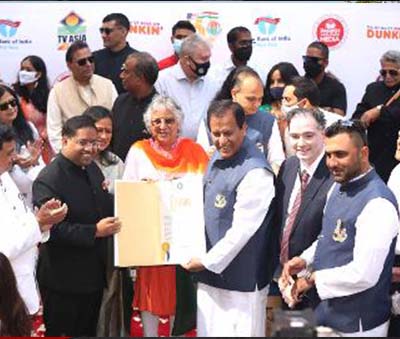
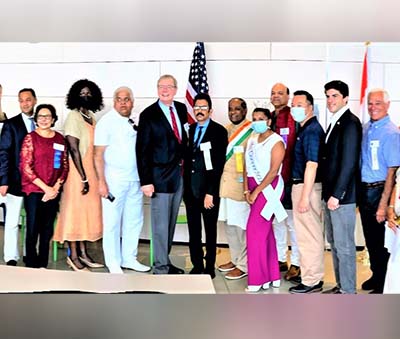
With around 300 attendees, and sunny perfect weather, the Friends of MP – NY/NJ Picnic 2018  was a grand success. The 4th Annual Picnic in succession, was enjoyed by all. The main attractions this time were Indore Kaa Rajwada, Acche Lal Paanwala, Bhutte Kaa Kees, Chana Jor Garam and MP’s Treasure Hunt.

Deputy Counsel General of India in New York Shri Shatrughna Sinha and noted Community Leader Shri Sunil Nayak and Shri Anwar Feroz attended the Picnic.

Madhya Pradesh CM Shri Shivraj Singhji Chouhan congratulated on the successful gathering .

“It is a delight to witness the spirit of brotherhood of @FriendsofMP members of the New York Tri-state area at their 4th annual picnic. I congratulate each of you for being able to hold on to your roots & share your love for MP through such initiatives, even in a foreign land,” he said in a message.

More pictures are available at: https://drive.google.com/drive/folders/1PTdwlA8xdMfgMVzRA8gy-U8_JeurwKXI?usp=sharing

Sundar Pichai honored at Pratham’s Bay Area Gala that raises $1.2 Million

During a glamorous gala, attended by many of Silicon Valley’s Indian American glitterati, raised $1.2 million, and was reportedly ahead of the event that the chapter was well on its way to meet its $2 million fundraising goal for the year.

Google CEO Sundar Pichai  was the chief guest the annual gala held at the Palo Alto Hills Country Club Sept. 29 during  Pratham USA’s annual San Francisco Bay Area gala.

In his address at the gala, after receiving Pratham’s Corporate Leadership Award, the Indian American leader said, “While most children in rural India attend schools, they are not proficient in math and reading,” said Pichai. “Access to knowledge is the key to opportunity,” he said, adding: “My parents made sure I had a good education.”

Despite the 2009 Right to Education Act, which guarantees every child in India access to education, more than 100 million are illiterate, noted Pratham’s CEO Rukmini Banerji, a former economist who – with Pratham founder Madhav Chavan – has developed many of the organization’s unique teaching methods. Banerji noted onstage that a decade ago, only 11 million of India’s children had reached 8th grade. Today, 22 million kids reach the 8th grade and the majority continue their studies beyond that level, she said.

The Pratham approach is unique: kids at Pratham’s schools are grouped by proficiency, rather than grade level, which means no child falls behind. Pratham’s reading program teaches most children to read in 30 to 60 days. In an interview with India-West on the sidelines of the gala, Banerji noted with pride that by age 18, 80 percent of Pratham’s alumni are still enrolled in some form of education.

Pratham is India’s largest education-focused NGO; it has impacted more than eight million low-income children through its reading and learning program and vocational training modules. Pratham also runs the annual ASER survey — with funding from Google’s philanthropic arm — a massive undertaking which records reading and math abilities for children in 600,000 Indian villages.

In a live feed from India during the gala, Pratham students displayed projects they had worked on using the Pra-Digi tablets. One boy displayed a solar bicycle he had made using instructions from a Google search, and parts he bought from Amazon. Another showed a money-printing machine he had built to print Rs. 10 notes. A young woman displayed her knowledge of magnets and opposing forces from knowledge she had gained on the internet. Heartwarmingly, the group sang the Woody Guthrie classic: “This Land is Your Land.”

PRATHAM CHICAGO GALA BRINGS MOMENTUM TO INDIA’S LEARNING CRISIS

Chicago, IL, October 16, 2018 – On Saturday, October 6, 2018, close to 350 prominent business leaders, dignitaries and members of the local Indian-American community gathered in downtown Chicago for the annual Pratham gala. Held at the elegant Venue SIX10, with its panoramic views of the city and Lake Michigan, the event raised $350,000 for Pratham’s transformative educational programs.

In his keynote speech, Steven D. Levitt, William B. Ogden Distinguished Service Professor of Economics at the University of Chicago and co-author of Freakonomics, made his admiration of Pratham clear: “I get asked to do roughly 100 events like this a year and this is the only one I accepted.” With wit and wisdom, Levitt recounted his own attempts at making a difference in the world: “When you see how incredibly ineffective I’ve been over and over and over, by comparison, you might begin to appreciate more what Pratham has been able to do in that amount of time.” Levitt emphasized that “it is the hardest thing in the world to actually make change” and urged the audience to support Pratham in its mission to do so.

Guests were also visibly moved by the words of Pranali Kaurati, a remarkable graduate of Pratham’s bedside assistance training program, who has overcome great adversity in her young life. “The three-month Pratham training period was one of the best experiences of my life,” she explained. “My dream is to help people who can’t help themselves. I was one of them a few years ago, and now thanks to Pratham and my job, I get to look after patients and assist them with their needs, and this provides me with an incredible amount of satisfaction and happiness.”

Chicago teens Vinayaka Amin, Avanti Parkhe and Vikas Reddy, who had spent two weeks in India as part of Pratham USA’s youth leaders program, spoke about their visit. “This experience had such a profound impact on us,” said Reddy on behalf of the group.

“We hope to continue our involvement with Pratham for many years to come.”

The evening also included a live auction as well as a performance by singer/songwriter Subhi, who wowed the audience with her original blend of jazz and South Asian music.

Chapter president Joher Akolawala was thrilled with the evening’s turnout, a reflection of the overall momentum of the chapter: “We have nearly tripled our volunteer membership and net contributions over the last five years at the Chicago chapter, and the credit goes to the committed and generous Chicago community.”

First-time attendees Rattan Khosa, CEO and founder of AMSYSCO, Inc and Mafat Patel, co-founder of Patel Brothers, were among the many notable faces that graced the event hosted by gala co-chairs Alwar Narayanan and Sandeep Rao.

Sponsors included Vinakom Inc., GE, Allstate Insurance Company, McKinsey & Company, Mondelēz International, Infosys, Accenture, Microsoft, Ernst & Young LLP, Mars Wrigley Confectionery, Luxfer PLC, Opera Solutions, United Airlines, and Diageo.

Harvard racial admissions trial begins

The case alleging of discrimination of students of Asian origin by a group that claims Harvard’s admissions office discriminates against Asian applicants in order to boost other racial groups, seen as a referendum on affirmative action hiring practices, opened in a Boston federal district court on October 15th.

The case has been brought by a group from the Washington DC area called Students For Fair Admissions, which ultimately wants courts to rule that race-based decisions in education are a civil rights violation.

Harvard is one of the top-rated and most selective universities in the US, admitting about 1,600 freshman students out of 42,000 applicants each year. Harvard disputes the claim and says race is only one small factor in their secretive student selections process.

The lawsuit claims that the elite university unfairly weighs race when considering an applicant, forcing Asian-Americans to meet a higher bar in order to be accepted. They claim Harvard uses a quota system or a system of “racial balancing” – practices that are illegal under federal law – to limit the number of Asian students on campus in an effort to maintain space for other racial groups. The plaintiffs say that if race was not considered, and if admissions were only based on grades alone, twice as many Asian pupils would be admitted because they perform well academically.

Before the trial, groups of protesters took the streets in the city, either opposing or supporting an admissions policy that includes race as a factor. The case is expected to shed light on admissions practices at universities. Courts have previously allowed universities to examine race as a factor in order to promote diversity on campus, a practice known as affirmative action, or “reverse discrimination”.

Some unexpected revelations could also come out of the trial, such as how the university considers the children of alumni or donors, or the applications of other pupils who are not admitted through the typical process.

Harvard says they use a “holistic” strategy to evaluate students, and that race is only one minor consideration. The institution points out that its population of Asians students has been growing, and now stands at 23% of the student body. Harvard University Dean Rakesh Khurana told WBUR that it takes more than just good grades to be chosen.

“We’re looking for people who are genuinely curious. Not just those who do well on exams but actually want to lean and have an integrative capacity,” he said.

Other Ivy league schools and the American Civil Liberties Union (ACLU) are supporting Harvard in the case. In an amicus brief – a court filing supporting Harvard – the ACLU argued that “a whole-person, race-conscious admissions process furthers a university’s academic freedom to assemble a diverse student body”.

The Students For Fair Admissions group was formed by conservative activist Edward Blum – who opposes affirmative action, ie the proactive effort to include minorities that have been historically marginalised due to discrimination.

The Justice Department has also launched a probe into whether Yale University discriminates against Asians – something which it denies. The trial is expected to last two to three weeks. But regardless of the outcome, the loser is expected to appeal the verdict to the US Supreme Court.

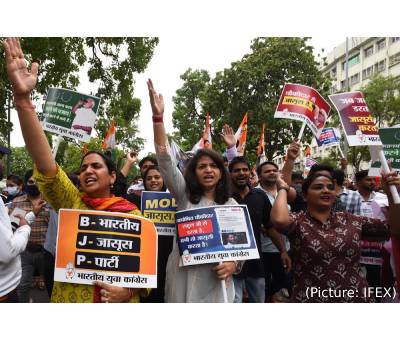
Indian Overseas Congress, USA Protests in New York against BJP Govt’s Involvement in Rafale Loot

Indian Overseas Congress, USA staged a protest in Richmond Hill, New York on September 30th to highlight the corruption by the Modi Government in the purchase of Rafale jets in the biggest defence scam in history. This protest also expressed grave discontent amongst NRIs who are of the opinion that Hindustan Aeronautical Limited should have been the building partner of the Dassault Aviation rather than Modi’s handpicked friend Anil Ambani who stands to gain 30,000 Crores Rupees in this scam at the expense of the tax-paying public.

Dr. Amee Yajnik, member of the Rajya Sabha while addressing the crowd, expressed grave discontentment with lack of transparency and accountability in this whole affair. “While our farmers are suffering and many of them are on the verge of despair, the Modi Government’s focus is only to increase the coffers of their crony capitalist friends. The money that is supposed to be used for economic and social development is stolen from the people of India” Dr. Yajnik added.

‘Corrupt role played by the Minister of Defense, Nirmala Sitaraman is also of great concern to us, and we are also concerned that she has converted the ministry of defense into a puppet institution which dancing to the tunes of crony capitalists without any concern being shown to the defense establishment of the country along with national security” said Mr. Mohinder Singh Gilzian, President of the Indian Overseas Congress, USA. “The secrecy by which Modi has dealt with this deal tantamount to organized loot, and we are asking for the resignation of the Prime Minister and the Defence Minister’,  Mr. Gilzian added.

George Abraham, Vice-Chairman of IOC, urged the Diaspora to become cognizant of the growing number of scandals plaguing the Modi regime and the secrecy with which Rafale Deal has been conceptualized. United Progressive Alliance first conceptualized the deal in the year 2012 when Government of India had agreed with Dassault Aviation, France to purchase a total of 126 Rafale fighter jet aircraft. This agreement was clinched with a cost of Rs. 526 for each aircraft.

Initial 18 aircrafts were to be purchased on an immediate fly-away condition, and remaining 108 were agreed to bse manufactured in India. Aircraft which were to be manufactured in India were agreed to be manufactured in association with Hindustan Aeronautics Limited under the transfer of technology agreement. However, altering the terms of the contract to benefit the Ambanis may result in the lost employment opportunities which could have benefited the unemployed youth of Karnataka.

Crowd held placards and chanted that “Modi is corrupt – Stop Deception and Corruption”, “End all Corruption – Down with BJP and Crony Capitalism”, “IOC condemns Corruption”, “Rafale, biggest Defense scam”, and “Vigilance should investigate Modi” .

Ravi Chopra, the chairman of the Finance Committee, John Joseph, Vice-President, Mr. Satish Sharma, Chairman of Punjab Chapter, Mr. Charan Singh, President of Haryana Chapter, Mrs. Shalu Chopra, chairperson of the Women’s forum also spoke. Mr. Devendra Vora of the Maharashtra Chapter honored the Chief Guest Dr. Yajnik with a Shawl.

Rep. Pramila Jayapal initiates efforts to establish new liberal think tank

Congresswoman Pramila Jayapal, D-Washington, has been credited with the efforts to in setting  up a new liberal think tank for policy development and outreach to voters. She is on the board of the Congressional Progressive Caucus Center (CPCC), announced Oct. 10, which describes itself as “an outside entity” aimed at leveraging the power of the existing Congressional Progressive Caucus (CPC).

“The Center will be the bridge that links the CPC with progressive stakeholders and will provide cutting edge policy analysis and message guidance to the broader progressive community to help drive progressive ideas and reforms into the public debate,” says the website.

Currently, there is another major liberal think tank, Center for American Progress, set up by former Obama supporters and advisors and headed by an Indian-American, Neera Tanden,.

“This is a critical piece that I think has been missing,” Rep. Jayapal was quoted saying in a news report from Rollcall.com, adding, “The goal here is to leverage the power of the progressive movement to enact strong progressive legislation and really build our movement for change across the country.”

Jayapal listed a string of issues that the CPCC will work on, among them, “Medicare for all, protecting women’s health, developing a demilitarized foreign policy, making college without debt a reality, making sure that we are fostering and advancing workplace democracy and collective bargaining rights, humane immigration reform, gender equality, addressing climate change,” Rollcall reported.

“By working with outside partners – advocacy groups, labor unions, and think tanks – we will provide resources outlining the interests of the American people,” the organization says on its website. It has put out an ad to recruit an Executive Director for the Center.

“The CPCC will convene different progressive stakeholders to advance cutting-edge, independent policy analysis and most importantly, work to realize the enactment of progressive policies – which are overwhelmingly supported by the American people,” the organization says on its website.

Last month, she along with others introduced a bill making college tuition free. The College for All Act now in Congress aims to change that, making tuition for a four-year college free for students whose parents make less than $125,000 a year, and free for anyone attending a two-year community college.

India elected to UN Human Rights Council for 3 years, gets highest number of votes – India received 188 votes, the highest polled by any of the 18 countries elected so far

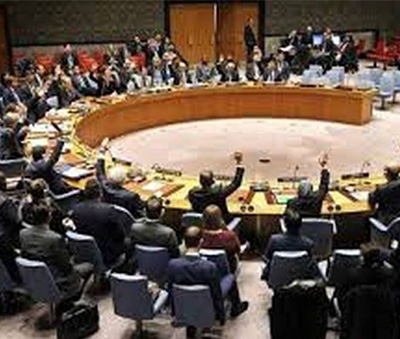
India was elected with the highest number of votes by the General Assembly to the influential Human Rights Council on Friday with a pledge to combat intolerance. India received 188 votes, the highest polled by any of the 18 countries elected in the voting. This is the fifth time India is elected to the Geneva-based Council, the main body of the UN charged with promoting and monitoring human rights.

India’s presence on the Council will be important because the previous UN High Commissioner for Human Rights Zeid Raad Al Hussein asked the body to facilitate an international commission of inquiry into allegations of human rights violation in Kashmir.

His successor Michelle Bachelet and Secretary-General Antonio Guterres have backed Zeid’s recommendation, which Pakistan – a member of the Council – is campaigning for. So far, no other country has backed Zeid’s call for the investigation.

Bangladesh, which is at the frontlines of dealing with the Rohingya crisis, was also elected with 178 votes to the Council to fill one of the five vacancies for three year terms from the Asia-Pacific region.

The regional group endorsed five countries, which matched the number of seats open for election this year, and they were the only countries on the ballot. The other regional candidates were Bahrain, Fiji and the Philippines. Thirteen other countries representing the other four regions were also elected to the Council.

In January India will join China and Nepal, besides Pakistan, which were elected to the 47-member Council in previous years to serve three-year terms. When it nominated itself for the Council, India showcased its position as “the world’s largest democracy (and) India’s secular polity.”

It pledged that it will continue to support international efforts to combat racism, racial discrimination, xenophobia and related intolerance. In the nomination pledge, India also presented a broader approach to human rights, emphasising climate justice, health and poverty alleviation.

India was among the first batch of 47 countries elected to the Council in 2006 soon after it was set up and received an initial one-year term instead of three to facilitate a rotating roster of vacancies each year. It was again elected in 2007, 2011 and 2014 to three-year-terms.

Countries can be elected for only two consecutive terms and India took a year’s break when its term ended in 2017. Elections were held by secret ballot in the 193-member General Assembly on Friday, although the number of candidates for all the five regions matched the vacancies making it a formality.

On the 47-member Council the seats are allocated based on “equitable regional distribution” giving the Asia-Pacific region a total of 13 seats, with some coming up for election every year. The African region also has 13 seats, while East European region has six, West European and others seven, and Latin American and Caribbean eight.

The United States withdrew from the Council earlier this year after its Permanent Representative Nikki Haley questioned its legitimacy because of the presence of several dictatorial regimes violating human rights on it.

Infosys, TCS sued in U.S. for underpaying employees, hiring practices

Indian tech giants Tata Consultancy Services and Infosys have been sued in the U.S., over wage discrimination and unfair hiring practices, media reports here stated. These cases in US Courts  follow an earlier lawsuit filed Aug. 15 against TCS and HCL Technologies, which alleged that the Indian multinational giants unfairly favored Indian Americans in its hiring practices.

A lawsuit against TCS filed in August by three U.S. citizens, who allege that the company prefers to bring in Indian H-1B workers even when there are trained U.S. citizens who could fill the positions. The lawsuit in the District Court of New Jersey alleged that TCS also discriminates when it hires locally, disproportionately favoring Indian Americans and South Asian Americans.

In the lawsuit, the plaintiffs alleged that Surya Kant, TCS’ president for North America, and Narasimhan Srinivasan, vice president and head of human resources, devised and implemented a nationwide ‘leadership directive’ to utilize TCS’s visa-ready South Asian employees to the ‘maximum extent’ when filling U.S. positions.”

Anuj Kapoor, a former employee on a CVS project in Rhode Island, filed the suit against Infosys in June, alleging the company made him work more than 1,000 hours of overtime without pay. The company responded in August, stating that the employee was an ‘hourly’ worker on an H1-B visa even though Infosys had listed him as a salaried employee in an application with the Department of Labor, a potential reason for its Wage and Hour Division to look into the case.

Anuj Kapoor alleged that Infosys threatened to send him back to India if he persisted with his wage claim. Kapoor said in his lawsuit that he worked more than 1,000 hours of overtime for which he was not paid. His attorney Thomas Enright told the Providence Journal that the Bangalore-based company has a pattern of ill-treating H-1B workers and foreign-born employees. “Foreign-born workers will consider themselves lucky to be working in the United States,” Enright said, adding, “It’s difficult to get people in that position to step forward.”

Infosys denied Kapoor’s allegations in its response to the lawsuit, saying it had paid the hourly worker the “complete, correct and proper” wages he was due.

According to the lawsuit, Kapoor worked at CVS for 40 hours a week, five days a week. Infosys, however, would require employees to participate in mandatory conference calls and trainings with team members in India after midnight or in the early-morning hours, the suit says.

Kapoor alleged that two managers instructed him not to submit for overtime on his timecard, despite forcing him to work extra hours. One often remarked that the reason a company such as CVS contracted with Infosys was that no American worker would agree to employment that required them to work overtime without compensation, and that Infosys hoped to replace CVS’s primary software vendor, according to the suit.

In 2013, Infosys agreed to pay $34 million to settle a case with the U.S. Justice Department to end an investigation into the widespread practice by Indian firms of flying workers to client sites in the United States on temporary visas, according to Reuters. Infosys agreed in the settlement that it committed civil violations of U.S. employment law, but was not required to admit and did not admit widespread further wrongdoing, according to the news agency.

Indian IT companies have faced lawsuits from employees before. WiproNSE -0.28 % was sued by an employee for unpaid overtime. However, the current regulatory environment in the US makes lawsuits and complaints raise concerns. “As long as companies have followed the applicable laws and terms of the labor condition application (LCA) for H-1B workers, they will have no problem but would, of course, have to incur expenses to defend the cases in court. Further, even if there is even a slight grey area about the issue then it could be more complicated,” said Poorvi Chothani, managing partner at immigration law firm LawQuest.

Media baron Raghav Bahl’s home and Quint office raided by India’s IT officials

New Delhi: The Quint and Network 18 Founder Raghav Bahl’s home and office in Noida were raided last week by Income Tax officials. “Income Tax officers on Thursday, 11 October, entered the office of Quintillion Media Pvt Ltd in Noida, which runs the website The Quint and is owned by Raghav Bahl. According to the I-T officer leading the team, they were conducting a “search” on one floor of the office, and a “survey” on the other,” reported Quint.

The Editor’s Guild of India, in a tweet, asked the Income Tax Department to “not exercise powers in a way that could be seen as an intimidation of the government’s critics”.

Raghav Bahl, in a statement to the Editor’s Guild, said: “I have a matter of great concern to share with the Guild. While I was in Mumbai this morning, dozens of IT officials descended on my residence and The Quint’s office in Noida for a survey.”

Stating that he was heading back to Delhi, Mr Bahl stressed, “We are a fully tax compliant entity, and will provide all access to all appropriate financial documents.”

His mother and wife were confined to their house. A report said that the I-T officers at the residence of Raghav Bahl and Ritu Kapur are also attempting to clone data from Ms Kapur’s gadgets.

“He said he had spoken to the officer on his premises and requested him, strongly, to not try and pick up or see any mail or document that was likely to contain very serious or sensitive journalistic material. “If they do that, then we shall seek extremely strong recourse. I do hope the EG (Editor’s Guild) will back us on this, and thereby set a precedent for any such exercise that may happen on any other journalistic entity in the future. They should also not misuse their smartphones to take unauthorised copies of this material,” reported NDTV

Expressing concern over the raids, the Editors Guild of India, in a statement, said, “While the tax administration is within its rights to make inquiries in compliance with the relevant laws, it should not exercise those powers in a way that could be seen as intimidation of the government’s critics. The Guild believes that motivated income tax searches and surveys will seriously undermine media freedom and the government should desist from such attempts.”

GM’s new 39-year-old CFO Dhivya Suryadevara is making history

Indian-American, Dhivya Suryadevara has successfully entered the predominantly male bastion of the auto industry by being appointed as the Chief Financial Officer of American automaker, General Motors (GM).

Suryadevara who has been with GM since 2005, has been responsible for corporate financial planning, investor relations and special projects. She played an integral role in the divestiture of its European arm, Opel and the acquisition of the self-driving vehicle startup, Cruise. Recently, she also helped to secure a $2.25 billion investment in GM Cruise by Japanese tech giant SoftBank Group Corp.

She has Bachelor’s and Master’s degrees in Commerce from the University of Madras, Chennai and an MBA from Harvard University. Before joining GM, she worked at UBS and PricewaterhouseCoopers.

Suryadevara has quickly climbed GM’s ladder since she began working there 14 years ago, and her appointment as CFO is significant: She is the first female CFO in the automaker’s 110-year history and makes GM one of only two Fortune 500 companies that have both a female CEO and CFO. Hershey, led by CEO Michele Buck and CFO Patricia Little, is the other company holding that distinction.

GM CEO Mary Barra, who has made significant strides to increase female leadership in the company, says Suryadevara is ready.

“Dhivya’s experience and leadership in several key roles throughout our financial operations positions her well to build on the strong business results we’ve delivered over the last several years,” Barra said.

Although Suryadevara never imagined going into the automotive industry, she told Real Simple that she’s always enjoyed anything “challenging and complicated.”

That was the theme of her upbringing in Chennai, India. After her father passed away when Suryadevara was young, all parenting duties fell onto her mother.

“My mom had to raise three children on her own, which is difficult to do anywhere, let alone in India,” she said. “She wanted to make sure there were no corners cut when it came to our education and to prove that we could have the same resources as a two-parent household.”

Her mother’s high expectations stayed with Suryadevara as she completed her bachelor’s and master’s degree in commerce at the University of Madras. When she was 22, Suryadevara traveled to the U.S. for the first time to attend Harvard Business School, where she got an MBA.

Gita Gopinath appointed Chief Economist at IMF

The International Monetary Fund has appointed Gita Gopinath as economic counsellor and director of the IMF’s Research Department on October 1st. Managing Director Christine Lagarde made the announcement, the fund said in a news release.

Gopinath, currently the John Zwaanstra professor of international studies and economics at Harvard University, will succeed Maurice Obstfeld, who announced in July that he would retire at the end of 2018.

“Gita is one of the world’s outstanding economists, with impeccable academic credentials, a proven track record of intellectual leadership, and extensive international experience,” Ms. Lagarde said. “All this makes her exceptionally well-placed to lead our Research Department at this important juncture. I am delighted to name such a talented figure as our Chief Economist.”

Ms. Gopinath is co-editor of the American Economic Review and co-director of the International Finance and Macroeconomics Program at the National Bureau of Economic Research (NBER). She is co-editor of the current Handbook of International Economics with Former IMF Economic Counsellor Kenneth Rogoff. She has authored some 40 research articles on exchange rates, trade and investment, international financial crises, monetary policy, debt, and emerging market crises.

Gopinath was born and grew up in India. She is a U.S citizen and an Overseas Citizen of India. She received her Ph.D. in economics from Princeton University in 2001 after earning a B.A. from the University of Delhi and M.A. degrees from both the Delhi School of Economics and University of Washington. She joined the University of Chicago in 2001 as an Assistant Professor before moving to Harvard in 2005. She became a tenured Professor there in 2010.

Ankita Mirchandani named ‘Working Mother of the Year’

Working Mother magazine has named Ankita Mirchandani as the 2018 Working Mother of the Year. Mirchandani of Chicago is the senior manager of operational transaction advisory services at Ernst & Young LLP. The Indian American executive is also the mother to 2-year-old Amara, the publication said.

At the outset of her career, Mirchandani spent a good amount of time away from home serving clients around the country, Working Mother wrote.

In 2016, before her maternity leave, she started discussing with her practice lead and mentor, Mitch Berlin, about how she could successfully continue her client-serving role as a new mom, given her extensive travel, it said.

Returning from maternity leave, Mirchandani and her mentor piloted a program, now known as NEST, designed to strengthen Transaction Advisory Services’ client delivery model.

It challenged where and how work gets done by exploring client-serving opportunities that can be done at the EY U.S. office with limited presence at a client site, the report said.

This program enables employees to focus on niche offerings and continue their career trajectory in client-facing roles while limiting the need for typical Monday-to-Thursday travel.

What was originally conceived as a solution for retaining high-performing working mothers has now been expanded to all employees, both male and female, who need the additional flexibility, it added.

The program, under Mirchandani’s leadership, has grown from three to 25 people in the last two years with plans to expand more, and it now has a global presence with hubs in New York City, Chicago, San Francisco, London and India, Working Mother said. “Ankita continues to challenge norms and think beyond just working parents to promote flexibility for all,” Ernst & Young said in a statement.

Kerala Bags Nine National Tourism Awards

On World Tourism Day God’s Own Country received nine National Tourism Awards for the year 2016-17. Kerala Tourism won the Hall of Fame awards for Excellence in Publishing in Foreign Language and the Responsible Tourism Project, Wayanad, for being the Most Responsible Tourism Project/Initiative.

Kerala Tourism also grabbed four awards including the Best Tourism Film (Live Inspired) and second prize in the category of ‘Best State/Union Territory- Comprehensive Development of Tourism in Rest of India.’

Private stakeholders received five more awards that include the Best Domestic Tour Operator promoting tourism products of the Rest of India, Best Incredible India Bed and Breakfast Establishment and Best Stand alone Convention Centre.

Munnar-based Rose Gardens Homestay got the Best Incredible India Bed and Breakfast Establishment, Somatheeram Research Institute and Ayurveda Hospital Pvt. Ltd., Kovalam, was adjudged the Best Wellness Centre, while the Adlux International Convention and Exhibition Centre, Kochi, got the award for Best Stand Alone Convention Centre.
Intersight Tours & Travels Pvt. Ltd got the best domestic tour operator promoting and selling tourism products of Rest of India (category 1) and the Kochi-based Concord Exotic Voyages Pvt. Ltd., won the first prize in Inbound Tour Operator/Travel Agent (category II). Bala Kiran IAS, Director, Kerala Tourism received the awards for the official entries.

Mr. Alphons Kannanthanam, Minister of State for Tourism said: “13 out of 14 districts in Kerala were affected by floods a month ago and today every destination is open for tourists in the State. Kerala is back in action and ready to receive people. Kerala needs your support to get back into its action.”

Rupee fall has surprising new reason

The rupee, which has fallen for six straight months in the longest stretch since 2002, is seen sliding to Rs. 75 per dollar by year-end, according to median of 10 analysts surveyed by Bloomberg.

The worst run of rupee losses in 16 years is set to extend. Only this time, the declines might not be triggered by oil but by the surprise move by India’s central bank to hold rates despite the currency’s free fall.

The rupee, which has fallen for six straight months in the longest stretch since 2002, is seen sliding to 75 per dollar by year-end, according to median of 10 analysts surveyed by Bloomberg. The December-end estimate has inched up from 69 at the start of September.

Reserve Bank of India governor Urjit Patel’s comments Friday that the rupee’s drop is moderate in comparison to emerging market peers and that the central bank doesn’t have any target in mind unnerved investors who were expecting the authority to boost its defence of Asia’s worst-performing major currency.

“Governor Patel has effectively left the rupee out in the cold and insinuated that it is not his job to determine the appropriate level for the currency,” said Charlie Lay, an analyst at Commerzbank AG in Singapore. “RBI has seemingly opened the floodgates for further rupee weakness.”

The rupee fell past the 74 to a dollar mark for the first time soon after the RBI’s decision, and analysts, whose year-end estimates have been obliterated by the meltdown, cut their targets further. Skandinaviska Enskilda Banken AB said the rupee could test 75 in the near term while ING Bank NV said the bank’s recent downgrade to 75 wasn’t enough.

The currency rose 0.2 percent to 74.2275 at 10:22 a.m. in Mumbai, rebounding from a record low of 74.3950 touched on Tuesday.

To be sure, the RBI has for long maintained that it steps in only to curb undue volatility and doesn’t target any currency level. That stance places the authority behind counterparts in Indonesia and the Philippines, which have been actively supporting their currencies, Madhavi Arora, an economist at Edelweiss Securities Ltd., wrote in a note Tuesday.

“We expect the weakness to persist, with the rupee heading toward 75-plus levels against the dollar, unless some additional assertive policy steps come through,” she said.

Shashi Tharoor’s new book on Narendra Modi is not just ‘floccinaucinihilipilification’

My new book, THE PARADOXICAL PRIME MINISTER, is more than just a 400-page exercise in floccinaucinihilipilification, Congress leader Shashi Tharoor said in a Twitter post that had everybody reaching for the dictionary.

Congress leader Shashi Tharoor on Wednesday once again introduced Twitterati and the literati to a difficult, near unpronounceable word, describing his new book on Prime Minister Narendra Modi as “more than just a 400-page exercise in floccinaucinihilipilification”. According to the Oxford dictionary, the word is a noun and means “the action or habit of estimating something as worthless”.

Discussing the usage of the word, the dictionary adds, “Floccinaucinihilipilification is one of a number of very long words that occur very rarely in genuine use.” “My new book, THE PARADOXICAL PRIME MINISTER, is more than just a 400-page exercise in floccinaucinihilipilification. Pre-order it to find out why!” Tharoor said in a Twitter post that had everybody reaching for the dictionary.

The book itself was relegated to the background as the word got Twitterati talking.

“I get a feeling of floccinaucinihilipilification when I don’t know the meaning of floccinaucinihilipilification,” tweeted one of Tharoor’s followers.

“What my English teachers taught was a lie. Won’t order it as I cannot take out the dictionary everytime,” said another person in reply to Tharoor’s tweet.

The book is currently available for pre-order on Amazon.

According to the description of the book on Amazon, “Shashi Tharoor has stitched together a compelling portrait of this paradoxical figure (Narendra Modi). Never before has there been such a superbly written and devastatingly accurate account of the most controversial prime minister India has ever had.”

Tharoor’s love for the language and propensity for little heard and little used words is well known.

In May 2017, the MP from Thiruvananthapuram and author of 17 books got netizens talking when he described the coverage of the death of his wife Sunanda Pushkar by a news channel as an “Exasperating farrago of distortions, misrepresentations and outright lies being broadcast by an unprincipled showman masquerading as a journalist”.

In December last year, he used the word ‘rodomontade’, meaning boastful or inflated talk or behaviour. “I choose my words because they are the best ones for the idea I want to convey, not the most obscure or rodomontade ones!” he tweeted. And in February this year, he introduced ‘troglodytes’ to the Twitter world in a response to Vinay Katiyar’s comment on the Taj Mahal.

“We can’t let these troglodytes destroy our country & everything beautiful in it,” he tweeted.

IOM Releases Global Migration Indicators Report 2018

By International Organization for Migration

BERLIN, Oct 12 2018 (IOM) – Prepared by IOM’s Global Migration Data Analysis Centre (GMDAC), the Global Migration Indicators Report 2018 summarizes key global migration trends based on the latest statistics, showcasing 21 indicators across 17 migration topics.

The report is based on statistics from a variety of sources, which can be easily accessed through IOM’s Global Migration Data Portal.

The report compiles the most up-to-date statistics on topics including labour migration, refugees, international students, remittances, migrant smuggling, migration governance and many others, enabling policy-makers and the public alike to have an overview of the scale and dynamics of migration around the world.

Moreover, the report is the first to link the global migration governance agenda with a discussion of migration data. The topics chosen are of particular relevance to the Global Compact for Safe, Orderly and Regular Migration (GCM) and the Sustainable Development Goals (SDGs). The report discusses the state of play of data for each topic and suggests ways to improve this.

“While the GCM and the SDGs provide important frameworks to improve how we govern migration, more accurate and reliable data across migration topics is needed to take advantage of this opportunity. This report provides an overview of what we know and do not know about global migration trends,” said Frank Laczko, Director of IOM’s Global Migration Data Analysis Centre (GMDAC).

“The international community has taken steps to strengthen collection and management of migration data, but more needs to be done. A solid evidence base is key to inform national policies on migration and will be needed more than ever in light of the Global Compact for Safe, Orderly and Regular Migration,” said Antonio Vitorino, the new Director General of the International Organization for Migration.

DG Vitorino visited Berlin on Thursday (11/10), where he met with the German Chancellor, Angela Merkel and other government representatives.

Mr. Vitorino took office as Director General of IOM on 1 October 2018.

For more information and figures, download the Global Migration Indicators 2018 here: https://publications.iom.int/system/files/pdf/global_migration_indicators_2018.pdf

Facebook says hackers accessed personal data of 29 million users

Facebook had originally said up to 50 million accounts were affected in a cyberattack that exploited a trio of software flaws to steal “access tokens” that enable people to automatically log back into the social network.

Facebook Inc said on Friday attackers stole names and contact details of 29 million users in the mass security breach disclosed by the social media network late last month.

The breach, Facebook’s worst ever, has exacerbated concerns among users, lawmakers and investors that the company is not doing enough to safeguard data, particularly in the wake of the Cambridge Analytica data scandal.

Still, hackers neither accessed personal messages nor financial data and did not use Facebook logins to access other websites, all of which would have been a cause for greater concern. Facebook originally had said in late September hackers stole digital log-in codes to take over nearly 50 million user accounts.

On Friday, the company revealed that stolen data on 14 million users included birth dates, employers, education and lists of friends. For 15 million users, it was restricted to just name and contact details.

All of those could help a fraudster pose as Facebook, the employer or a friend. They could then craft a more sophisticated email aimed at tricking users into providing login information on a fake page or into clicking on an attachment that would infect their computers.

Facebook said it will send customised messages in the coming days to affected users to explain what information the attackers accessed and how they can protect themselves, including from suspicious emails, text messages or calls.

A company executive said on a conference call that Facebook will not provide country-by-country breakdowns of the affected users. The hackers used an automated program to move from account to account and harvest the data quickly.

“We’re cooperating with the FBI, which is actively investigating and asked us not to discuss who may be behind this attack,” Facebook said on a blog post https://newsroom.fb.com/news/2018/10/update-on-security-issue.

The social network in late September did not confirm if information had actually been stolen.

“There’s not much more that Facebook can do,” said Michael Pachter, an analyst with Wedbush Securities. “The stolen data is likely to be used by the hackers, so this problem is likely to persist for quite some time.”

Facebook’s latest vulnerability has existed since July 2017, but the company first identified it in mid-September after spotting a fairly large increase in use of its “view as” feature. It determined that it was an attack on Sept. 25.

“Within two days, we closed the vulnerability, stopped the attack and secured people’s accounts by restoring the access tokens for people who were potentially exposed,” Facebook said.

The “view as” feature allows users to check their privacy settings by giving them a glimpse of what their profile looks like to others. But a trio of errors in Facebook’s software enabled someone accessing the feature to post and browse from Facebook accounts of other users.

Facebook did not rule out the possibility of smaller-scale attacks and said it would continue to investigate.

Facebook shares fell 2.6 percent after the breach was announced last month and they were down 0.5 percent following the updated disclosures on Friday.

4 Indian Films to Screen at 21st Annual United Nations Association Film Festival

Four Indian films with South Asian themes will be featured at the 21st Annual United Nations Association Film Festival at the Aquarius Theater here beginning Oct. 18.

“Street Workers United,” an eight-minute U.S.-India co-production screening Oct. 21 focuses on India’s street vendors and rickshaw drivers. For years they’ve lived and worked without legal protections and without access to financial services, and have been subject to harassment by the police, the mafia, and others, according to a press release. NIDAN is working to change all that by organizing them to stand up for their own rights.

On the same night, “The True Cost,” an India-Bangladesh-Italy co-production lasting 93 minutes, is a story about the clothes we wear, the people who make them, and the impact the industry is having on our world. The price of clothing has been decreasing for decades, while the human and environmental costs have grown dramatically, said the release.

“Love Sick,” a 74-minute film from India screening Oct. 24, asks the question, “How in India, a culture obsessed with marriage but where AIDS is an unspeakable disease, can one find love and companionship if you’re HIV-positive?”

On Oct. 25, the 55-minute long “Raghu Rai” from India is an unframed portrait of Magnum photographer Raghu Rai and his 50-year-long journey capturing the stories of India as told through the eyes of his own rebel daughter. Together, they embark on a journey to Kashmir.

During opening night, sponsored by iTalico, Palo Alto Mayor Liz Kniss will deliver opening remarks with all invited filmmakers present.

The Aquarius Theatre is located at 430 Emerson Street in downtown Palo Alto. For more information about the 21st UNAFF please visit www.unaff.org.

Trump’s International Ratings Remain Low, Especially Among Key Allies

By Richard WikeBruce StokesJacob PoushterLaura SilverJanell Fetterolf and Kat Devlin

America’s global image plummeted following the election of President Donald Trump, amid widespread opposition to his administration’s policies and a widely shared lack of confidence in his leadership. Now, as the second anniversary of Trump’s election approaches, a new 25-nation Pew Research Center survey finds that Trump’s international image remains poor, while ratings for the United States are much lower than during Barack Obama’s presidency.

The poll also finds that international publics express significant concerns about America’s role in world affairs. Large majorities say the U.S. doesn’t take into account the interests of countries like theirs when making foreign policy decisions. Many believe the U.S. is doing less to help solve major global challenges than it used to. And there are signs that American soft power is waning as well, including the fact that, while the U.S. maintains its reputation for respecting individual liberty, fewer believe this than a decade ago.

Even though America’s image has declined since Trump’s election, on balance the U.S. still receives positive marks – across the 25 nations polled, a median of 50% have a favorable opinion of the U.S., while 43% offer an unfavorable rating. However, a median of only 27% say they have confidence in President Trump to do the right thing in world affairs; 70% lack confidence in him.

Frustrations with the U.S. in the Trump era are particularly common among some of America’s closest allies and partners. In Germany, where just 10% have confidence in Trump, three-in-four people say the U.S. is doing less these days to address global problems, and the share of the public who believe the U.S. respects personal freedoms is down 35 percentage points since 2008. In France, only 9% have confidence in Trump, while 81% think the U.S. doesn’t consider the interests of countries like France when making foreign policy decisions.

Critical views are also widespread among America’s closest neighbors. Only 25% of Canadians rate Trump positively, more than six-in-ten (63%) say the U.S. is doing less than in the past to address global problems, and 82% think the U.S. ignores Canada’s interests when making policy. Meanwhile, Trump’s lowest ratings on the survey are found in Mexico, where just 6% express confidence in his leadership.

One exception to this pattern is Israel. After a year in which the Trump administration generated international controversy by moving the U.S. Embassy from Tel Aviv to Jerusalem, his positive rating jumped to 69%, up from 56% in 2017.

Around the world, publics are divided about the direction of American power: Across the 25 nations surveyed, a median of 31% say the U.S. plays a more important role in the world today than it did ten years ago; 25% say it plays a less important role; and 35% believe the U.S. is as important as it was a decade ago.

In contrast, views about Chinese power are clear: A median of 70% say China’s role on the world stage has grown over the past 10 years. Still, by a slim margin, more people name the U.S. as the world’s leading economic power (a median of 39% say the U.S., 34% say China).

And despite the unease many feel about the U.S. at the moment, the idea of a U.S.-led world order is still attractive to most. When asked which would be better for the world, having China or the U.S. as the top global power, people in nearly every country tend to select the U.S., and this is particularly common among some of China’s Asia-Pacific neighbors, such as Japan, the Philippines, South Korea and Australia.

These are among the major findings from a new Pew Research Center survey conducted among 26,112 respondents in 25 countries from May 20 to Aug. 12, 2018. Chapters 3, 4 and 5 use additional data from a Pew Research Center survey of 1,500 U.S. adults conducted from May 14 to June 15, 2018.

U.S. receives some of its most negative ratings in Europe

Although perceptions of the U.S. are on balance positive, they vary considerably among the nations surveyed. Ten of the 25 countries in this year’s survey are European Union member states, and across these EU nations a median of just 43% offer a favorable opinion of the U.S. Meanwhile, majorities in four of the five Asia-Pacific nations polled give the U.S. a positive rating, including 83% in the Philippines, one of the highest ratings in the survey. The U.S. also gets high marks in South Korea, where 80% have a positive view of the U.S. and confidence in President Trump has increased over the past year from 17% to 44%.

As has largely been the case since Pew Research Center’s first Global Attitudes survey in 2002, attitudes toward the U.S. in sub-Saharan Africa are largely positive, with Kenyans, Nigerians and South Africans expressing mostly favorable opinions in this year’s poll. The three Latin American nations polled offer differing views about the U.S., with Brazilians voicing mostly favorable reviews, while Argentines and Mexicans are mostly negative. And the two Middle Eastern nations in the study – Israel and Tunisia – offer strikingly different assessments.

The country giving the U.S. its lowest rating in the survey, and the place where the biggest drop in U.S. favorability has taken place over the past year, is Russia. Just 26% of Russians have a favorable opinion of the U.S., compared with 41% in 2017. A 55% majority of Russians say relations have gotten worse in the past year, and the share of the public with a positive view of Trump has dropped from 53% to 19%.

Good reviews for Merkel and Macron, poor marks for Xi, Putin, Trump

The survey examined attitudes toward five world leaders, and overall Donald Trump receives the most negative ratings among the five. A median of 70% across the 25 nations polled lack confidence in the American leader. Russian President Vladimir Putin and Chinese President Xi Jinping also receive mostly negative reviews.

In contrast, opinions about German Chancellor Angela Merkel and French President Emmanuel Macron are generally positive. Both leaders are mostly popular in the EU, although there are regional divides within Europe, with Merkel and Macron receiving favorable ratings in the Northern European nations surveyed and less stellar reviews in Eastern and Southern Europe.

European attitudes toward Trump are strikingly negative, especially when compared with the ratings his predecessor received while in office. Looking at four European nations Pew Research Center has surveyed consistently since 2003 reveals a clear pattern regarding perceptions of American presidents. George W. Bush, whose foreign policies were broadly unpopular in Europe, got low ratings during his presidency, while the opposite was true for Barack Obama, who enjoyed strong approval in these four nations during his time in office. Following the 2016 election, confidence in the president plunged, with Trump’s ratings resembling what Bush received near the end of his second term (although Trump’s numbers are up slightly in the United Kingdom this year).

In several European nations, Trump receives higher ratings from supporters of right-wing populist parties. For example, among people in the UK who have a favorable view of the United Kingdom Independence Party (UKIP), 53% express confidence in Trump, compared with only 21% among those with an unfavorable view of UKIP. Similar divides exist among supporters and detractors of right-wing populist parties in Sweden, France, Italy, the Netherlands and Germany. However, it is worth noting that, other than in the UK, there is no European country in which more than half of right-wing populist party supporters say they have confidence in Trump.

Few think the U.S. takes their interests into account

A common criticism about American foreign policy over the past decade and a half has been that the U.S. only looks after its own interests in world affairs, ignoring the interests of other nations. As Pew Research Center surveys showed, this belief was especially prevalent during George W. Bush’s presidency, when many around the world thought the U.S. was pursuing unilateralist, and unpopular, policies. Strong opposition to the Iraq War and other elements of Bush’s foreign policy led to rising complaints about the U.S. acting alone and ignoring the interests and concerns of other nations.

Opinions shifted following Barack Obama’s election, with more people saying the U.S. considers their country’s interest, although even during the Obama years the prevailing global sentiment was that the U.S. doesn’t necessarily consider other countries. Now, the Trump presidency has brought an increase in the number of people in many nations saying the U.S. essentially doesn’t listen to countries like theirs when making foreign policy.

This pattern is especially pronounced among some of America’s top allies and partners. For instance, while the share of the French public who believe the U.S. considers their national interest has not been very high at any point over the past decade and a half, it reached a low point near the end of Bush’s second term (11% in 2007), rose somewhat during Obama’s presidency (35% in 2013) and has declined once more under Trump. Today, just 18% in France say the U.S. considers the interests of countries like theirs when making policy.

Fewer, especially in Europe, say U.S. respects individual liberty

America’s reputation as a defender of individual liberty has generally been strong in Pew Research Center surveys since we first started asking about it in 2008. The prevailing view among the publics surveyed has typically been that the U.S. government respects the personal liberties of its people, and that is true again in this year’s poll. However, this opinion has become less common over time, and the decline has been particularly sharp among key U.S. partners in Europe, North America and Asia.

The decline began during the Obama administration following revelations about the National Security Agency’s electronic eavesdropping on communications around the world, and it has continued during the first two years of the Trump presidency. The drop is especially prominent in Western Europe, where the share of the public saying Washington respects personal freedom has declined sharply since 2013.

The same pattern is found among several other U.S. allies as well, including Canada, where the percentage saying the U.S. respects individual freedom has dropped from 75% to 38% since 2013, and Australia, where it has gone from 72% to 45%.

China seen as a rising power

Respondents to the survey were read a list of seven major nations, and for each one, were asked whether they think it is playing a more important, less important, or as important of a role in the world compared with 10 years ago. Among the seven countries tested, China stands apart: A median of 70% across the nations polled say Beijing plays a more important role today than a decade ago. Half or more in 23 of 25 countries express this view.

Many also say this about Russia. A median of 41% believe Moscow’s role on the world stage has grown over the past decade, and majorities hold this view in Greece, Israel, Tunisia and Russia itself. Overall, people are split on whether Germany’s role is greater than it was 10 years ago or about the same, but many in Europe see Germany’s role as more influential. On the other hand, Europeans are particularly likely to think the UK is less important now.

There is no real consensus in views of America’s prominence in world affairs. A median of 35% believe it is as important as it was 10 years ago, while 31% say it is more important and 25% say less. Japan is the only country with a majority saying that Washington plays a less important role. Meanwhile, Israelis, Nigerians and Kenyans are particularly likely to think the U.S. is more important than it used to be.

Most still want U.S., not China, as top power

In addition to being asked about whether major powers are rising, falling or staying about the same, respondents were asked the following question about whether they would prefer the U.S. or China to be the top global power: “Thinking about the future, if you had to choose, which of the following scenarios would be better for the world: the U.S. is the world’s leading power or China is the world’s leading power?” Results show that the U.S. is overwhelmingly the top choice.

The U.S. is named more often than China in every country surveyed except three: Argentina, Tunisia and Russia, although in many nations significant numbers volunteer that it would be good for the world if both or neither were the leading power.

Some of America’s allies in Asia and elsewhere are particularly likely to prefer a future in which the U.S. is the top global power. Two-thirds or more hold this opinion in Japan, the Philippines, Sweden, South Korea, Australia, Canada, the Netherlands, Poland and the UK.

Nikki Haley, US Ambassador to United nations, resigns

United States ambassador to the United Nations, Nikki R. Haley, said on October 9, 2018 that she would resign at the end of the year, marking a high-profile departure of one of the few women in the president’s cabinet.

Ms. Haley, a former governor of South Carolina, had been an early and frequent critic of Mr. Trump; when he named her to the United Nations job weeks after his election in November 2016, the appointment was seen as an olive branch. As ambassador, Ms. Haley has been an outspoken and often forceful envoy — someone whom foreign diplomats looked to for guidance from an administration known for haphazard and inconsistent policy positions.

“It was a blessing to go into the U.N. with body armor every day and defend America,” Ms. Haley, seated next to Mr. Trump in the Oval Office, told reporters. “I’ll never truly step aside from fighting for our country. But I will tell you that I think it’s time.”

“I think you have to be selfless enough to know when you step aside and allow someone else to do the job,” she added.

White House staffers were caught off guard by the announcement, which Ms. Haley and Mr. Trump had kept closely under wraps. But the president said Ms. Haley had informed him roughly six months ago that she wanted to take a break after finishing two years with the administration. He said he hoped Ms. Haley would return in a different role, and would name her successor within the next two or three weeks.

“She’s done a fantastic job and we’ve done a fantastic job together,” Mr. Trump said. “We’re all happy for you in one way, but we hate to lose you.”

Ms. Haley, the first cabinet-level United Nations ambassador for a Republican administration since the end of the Cold War, quickly made clear she saw the position as a steppingstone to a higher political office — a possibility that Mr. Trump may have resented.She became a far more visible face of American foreign policy than her first boss at the State Department, former Secretary of State Rex W. Tillerson. Mike Pompeo, Mr. Tillerson’s replacement, has recently reasserted the secretary of state’s traditional role.

Time magazine celebrated Ms. Haley’s ascendance by putting her on a cover as one of the women who are “changing the world.”

But Ms. Haley, who has long been seen as a potential presidential candidate, said on Tuesday she had no intention of running for president in 2020, as has been speculated. Instead, she said, she plans to campaign for Mr. Trump’s re-election.

Stepping away now could be a logical end point if Ms. Haley wants to preserve her own political future. But in the short term, people familiar with her thinking said that she is likely to work in the private sector and make some money.

For the moment, few Republican strategists believe that Ms. Haley is inclined to challenge Mr. Trump in 2020. But those who know her believe that she is likely to run, whether in 2024, or even in 2020 — should the president not run again.

”An open presidential race is a better chance to show off her incredible political skills, rather than some quixotic primary effort,” said Matt Moore, who was the Republican Party chair in South Carolina when Ms. Haley was governor there.

The daughter of immigrants from India, Ms. Haley favored free markets and global trade and earned international attention when she was governor for speaking out against the Confederate battle flag in the aftermath of the 2015 massacre at a black church in Charleston. During Mr. Trump’s presidential campaign, she sharply criticized his demeanor and warned what it might mean for American diplomacy — even suggesting that his tendency to lash out at critics could cause a world war.

As ambassador, Ms. Haley acknowledged her policy disagreements with the president in an op-ed in the Washington Post last month when she criticized an anonymous senior administration official who penned an opinion piece in The New York Times, describing a chaotic administration in which many of the president’s aides disagreed with their boss.

Possible successors include Dina Powell, a former deputy national security adviser to the president, and Richard A. Grenell. Mr. Grenell, the American ambassador to Germany, served as spokesman for John R. Bolton, the national security adviser, when he was ambassador to the United Nation under former President George W. Bush.

IAPC hosts 5th international media conference in Atlanta

Atlanta, Georgia: The Fifth annual International Media Conference,  organized by the Indo-American Press Club (IAPC) at the Atlanta Airport Marriott Hotel, Georgia,  held from October 6th to 8th, 2018, featured seminars, workshops, entertainment, and panel discussions led by experts in various fields, and was attended by prominent leaders from the media world, business, and entertainment industry.

The Government of Kerala was in the process of revamping the flood relief program to make it more transparent, Kerala state Assembly Speaker P. Sreeramakrishnan, who was the chief guest, while speaking at the closing ceremony of the International Media Conference on Sunday night,told the delegates.

IAPC Chairman Dr. Babu Stephen assured that people of Indian origin were totally committed to helping the government of Kerala in its flood relief efforts. Ginsmon Zacharia, former chairman of IAPC, said that the organization represents and provides a forum for media professionals, including video editors, camera operators, photographers, and anchors. The closing ceremony commenced with the opening remarks by Vineetha Nair, Vice Chairperson, IAPC.

The IAPC Excellence Awards for the year 2018 were presented by Sreeramakrishnan to Dr. Jay N Sampat (Humanitarian Activities), P.P. Cherian (Media), Sunny Mattamana (Community Service), Rajan Cheeran (Arts & Media),  Thangamani Aravindan (Community Service). Veteran Atlanta journalist Mahadev Desai was specially recognized for his contributions to the media world.

IAPC Merit Scholarships were distributed to 30 outstanding students of Indian origin by Gracy Stephen, President of Stephen Foundation and Sarosh P. Abraham, Secretary of St. Maryʼs Educational and Cultural Society and Queen Maryʼs Educational Society. Prizes were also distrib‐ uted to the winners of the essay and photography competitions.
Attorney Onkar Sharma made a presentation on US Visas for foreign media-persons.

A session on changing Indian tax laws was con‐ ducted by Abu T. Mathew, Advocate, Kerala High Court, Ginsmon Zacharia and Attorney Morley J. Nair. Womenʼs Forum panelists were Patti Tripathi, E.M. Radha, Sangeeta Dua, and Roopsi Narula.
Noted cine artiste Sudheer Karamana presided the entertain‐ ment programs presented by the young talent from Atlanta.

Dr. Thomas Mathew Joys, Saji Dominic, James Koodal, George Kottarathil, Morley J. Nair, Korason Varghese, and Sudheer Karamana spoke at the writersʼ seminar. The seminar ʻContemporary Politics and the New Mediaʼ was presented by pro‐ fessors of Georgia State University, George and Salli Vargis, and facilitated by Anil Augustine.
A creative writing workshop for young children was conducted by The Young Leaders Academy (TYLA), coordinated by Anil Augustine.

The seminar ʻEthical Standards in Malayalam News Media – Past and Presentʼ, moderated by Innocent Ulahannan, featured G. Sekharan Nair, R. Ajith Kumar, Saji Dominic, Lalu Joseph, V.S. Rajesh, and P.M. Manoj.

Dr. Thomas Mathew Joys was honored for his outstanding con‐ tribution to IAPC since its incep‐ tion. George Kottarathil, John K. George, and Suresh Thomas were recognized for participating in all IAPC conferences. As were Atlanta chapter hosts of the event.

Community leaders Madhavan B. Nair, President of FOKANA, and Paul Karukappillil, former President of FOKANA, felicitated IAPC for its work in the media world. The closing ceremony was emceed by Biju Chacko, Mini Nair, Andrew Gins, and Kalyani Nair, culminating in a ghazal presenta‐ tion by Ali Bhai and Neera.

The Indo-American Press Club was formed in 2013 with lofty ideal of providing a common platform to journalists of Indian origin living in the United States, while fostering closer bonds and cooperation among an extensive network of journalists across the nation, who are committed to professionalism and have the well-being of the larger society, For more details, please visit: https://www.indoamericanpressclub.com/

Shri Ram Nath Kovind, President of India, to inaugurate AAPI’s 12th GHS on December 28th, at Taj Palace, in Mumbai

New York, NY: October 5th, 2018: “I am very pleased to announce that Shri Ram Nath Kovind, President of India, has kindly accepted our invitation, and will inaugurate AAPI’s 12th Global Healthcare Summit on December 28th in Mumbai,” Dr. Naresh Parikh, President of American Association of Physicians of Indian Origin (AAPI), declared here today.

The groundbreaking Global Healthcare Summit (GHS) organized by AAPI in collaboration with the Government of India and GAPIO along with participation from some of the world’s most well-known physicians, and industry leaders, will be held from December 28th at the Taj Palace and from December 28 to 30th, 2018 at the Trident Hotel, Nariman Point, Mumbai, India.

Describing that for the very first time in the history of AAPI, a sitting Indian President will be at the Global Healthcare Summit, Dr. Parikh lauded the efforts of the Organizing Committee for their hard work. “AAPI appreciates the hard work of Dr. Raj Bhayani and Dr. Bharat Barai to make this possible and adding this landmark to the glorious history of AAPI along with planning and team work of GHS Organizing Committee Chair Dr. Ravi Jahagirdar and Mr. Anwar Feroz Siddiqi.”

The 14th President of the Republic India, Shri Ram Nath Kovind served as Governor of Bihar from 2015 to 2017. He was a Member of the Indian Parliament, Rajya Sabha from 1994 to 2006. On 25 July 2017, he took the oath as the 14th President of India. The 71 year old Ram Nath Kovind has attained some high profile assortment in the govt, as well as economics.

With the objective of enabling people in India to access high quality, affordable, and cost-effective world class health services, the Global Healthcare Summit, will provide a platform for planning for new initiatives and strengthening the past programs and actions.

The GHS offers a unique forum for the physicians of Indian origin to come together, sharing best practices, their knowledge and expertise in their respective medical fields with their fellow physicians from around the world, and to learn from one another.

AAPI in conjunction with several leading trauma specialists has developed the first set of guidelines for managing TBI (Traumatic Brain Injury). As a part of this initiative AAPI will collaborate with Maharashtra Government to organize CPR and BLS training for approximately 500 police workers from Dec 20 to Dec 22 in collaboration with the American University of Antigua and Hinduja Hospital. By launching this campaign there will be immediate and positive impact and help prevent fatalities due to road accidents.

In addition to 12 hours of Continuing Education, GHS features two signature Forums, including, Women’s Leadership Forum under the joint chairmanship between Dr. Asha Parikh and Mrs Amruta Fadnavis.  The  CEOs Forum will focus on two very high priority areas for Government of India, one on global impact of Indian pharmaceutical products in providing cost effective medicines globally and secondly, the successful implementation of Ayushman Bharat the visionary and aspirational goal of providing healthcare to more than 500 million people of India. This session will bring together over 30 leading CEO’s, Hospital and Academicians and Government leaders according to the architect of this forum, Mr. Anwar Feroz Siddiqi.

More than 100 opinion leaders and expert speakers across the globe will present cutting edge scientific sessions findings related to clinical practice in cardiology, diabetes, allergy, immunology, oncology, gastroenterology, liver diseases and others, by speakers drawn from major centers of excellence, institutions and professional associations. This GHS will also feature the continuation of AYUSH and role of integrative medicine, an area that is being championed by Dr. Ajay Lodha.

In addition a major Focus will be on Elimination of TB , another ambitious project where AAPI along with several key partners has launched a major campaign and program is already being implemented in 10 major centers, says Dr. Manoj Jain, Chair AAPI TB elimination program. The signing of a historic MOU between AAPI and USAID in April 2018 was the spring board.

For relaxation and entertainment, there will be a kaleidoscope of cultural presentations of Western India, featuring well known artists. Being held in Mumbai, one cannot be surprised to have special appearance by top stars from the Bollywood world.

Providing a forum for innovative opportunities for learning, networking and giving back to our motherland that have now enabled us to plan ahead and prepare for an outstanding event that will have over 300 very prominent and talented physicians and surgeons from abroad, in addition to the hundreds of physicians from India, who are very passionate about serving their homeland, mother India.

 “With the changing trends and statistics in healthcare, both in India and US, we are refocusing our mission and vision of GHS 2018, and AAPI would like to make a positive meaningful impact on the healthcare in India,” Dr. Parikh says. “In our quest to fulfill the mission of AAPI, we are proud to share best practices and experiences from leading experts in the world and develop actionable plans for launching demonstration projects that enable access to affordable and quality healthcare for all people.”

“With such a striking agenda, this 2018 Global Health Summit in Mumbai promises to be one of the best ever. Register ASAP – to get the better rooms and locations. There will be NO AAPI CANCELLATION CHARGES until November 1st, 2018 – just in case you may have to change plans afterwards. To help accomplish this mission, join us at the GHS 2018 in Mumbai.” For more information on Global Health Summit 2018, please visit:  https://aapisummit.org/www.aapiusa.org

Caption for the picture; AAPI Delegates with the President of India in New Delhi last month.

(From Left To Right) Dr. Ravi Jahagirdar,  Chairman of AAPI’s GHS in Mumbai, Dr. Raj Bhayani, Co-Chair of AAPI’s GHS in Mumbai, Shri Ram Nath Kovind, President of India, Dr. Naresh Parikh, President of American Association of Physicians of Indian Origin (AAPI), and Mr. Anwar Feroz Siddiqi, Strategic Advisor of AAPI

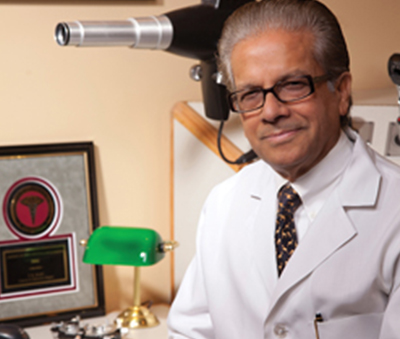
AAPI to collaborate with Dr. V.K. Raju and Eye Foundation of America (EFA) to provide vision care to millions in India

“American Association of Physicians of Indian Origin (AAPI) is excited to join in and collaborate with the over decades of service to humanity by Dr. V.K. Raju and Eye Foundation of America (EFA) to provide vision care to millions in India,” declared Dr. Naresh Parikh, President of AAPI, who has been in the forefront, identifying noble projects by Physicians of Indian Origin in India and working with them and coordinating their efforts to maximize the many services they provide across India.

AAPI has been instrumental in establishing and coordinating  several projects and programs across India and established many charitable clinics, serving hundreds of thousands of people in several states. AAPI has been doing Global Healthcare Summit for over a decade in India and is known for its commitment to give back to India, their motherland. “The collaboration with Dr. Raju and the Foundation will help mobilize the resources at AAPI’s disposal in strengthening the efforts of Dr. Raju,” adds Dr. Parikh.

For the past four decades, Dr. Raju and the EFA have been actively and tirelessly on a crusade to eliminate avoidable blindness in areas plagued by poverty and poor access to medical care. The EFA’s mission is to eliminate avoidable blindness under the guiding principles of service, teaching, and research.

AAPI to collaborate with Dr. V.K. Raju and Eye Foundation of America (EFA) to provide vision care to millions in IndiaThe realization of Dr. Raju’s vision, the EFA, has a reach that currently extends to 30+ developing countries and the USA. The EFA has served approximately 2.5 million patients and performed 340,000+ vision-saving surgeries, with 30,000+ surgeries performed on children alone.

The over 40 years of noble work bringing vision to millions in India started unexpectedly for Dr. Raju. While living in London, Dr. V.K. Raju traveled home to India on vacation, where a farmer asked him to examine his eyes. Dr. Raju complied, but without any instruments. In 1977, Dr. Raju returned to rural India with personnel and equipment, and offered his first eye camp near his hometown in 1977. This was the inception of the Foundation’s work, beginning with the West Virginia Ophthalmology Foundation. The West Virginia Ophthalmology Foundation subsequently became the EFA in 1992.

 “I feel so incredibly thankful for my personal and professional gifts, and I make great efforts to share those gifts with those in need of my services,” says Dr. Raju, and he generously gives freely of his own time, money, and medical expertise to help the less fortunate for the past several decades.

This is accomplished through eye camps and brick-and-mortar hospitals in developing countries, training of medical personnel to serve the needy, and educating the population at large on preventative eye care and healthy lifestyle choices. With adequate education, patients are empowered to take charge of their lives and their own health and prevent further deleterious consequences of their poor lifestyle choices, while sharing this knowledge with their friends and families.

The public is educated on eye care and injury prevention, and local teachers are taught how to screen for early eye problems in children. Patients, their families, and the greater community benefit from preventative medical care, free procedures, and access to education.

When education and preventative measures are insufficient, medical and surgical interventions are performed. With the aim of permanently providing world-class state-of-the art services to populations with poor access to health care, the EFA helped to build 2 hospitals in rural India: the Srikiran Eye Institute and the Goutami Eye Institute.

AAPI to collaborate with Dr. V.K. Raju and Eye Foundation of America (EFA) to provide vision care to millions in IndiaThe Goutami Institute has a wing dedicated exclusively to children, and the EFA has future plans to build a service and research eye hospital in India where no child will be denied treatment and children from around the world can come to receive services. Dr. Raju and the EFA are also committed to finding new cures for age-old eye disease in children.

The Institute has provided service to more than 400,000 patients and 50,000 surgeries have been performed. It has become an autonomous institution, and Raju has raised over $6 million to establish and fund the two facilities. “You can never be tired of giving back,” he says. “But to have real success, your intentions should be pure. It is a spiritual act.”

Since its inception, the EFA has facilitated 600+ physician exchanges and trained 200+ ophthalmologists, equipping these medical practitioners with the tools to join the global fight against blindness. The EFA not only trains medical practitioners to join the global fight against blindness through exchange programs, but also provides workshops and training opportunities for medical students and physicians.

Born and raised in Rajahmundry, Andhra Pradesh, India, Dr. Raju earned his medical degree from Andhra University and completed an ophthalmology residency and fellowship at the Royal Eye Group of Hospitals in London, England. He is board certified in ophthalmology and is a Fellow of the Royal College of Surgeons and the American College of Surgeons. He has resided in Morgantown, WV since 1976, where he is currently a Clinical Professor of Ophthalmology at West Virginia University (WVU), the Section Chief of the Ophthalmology Department at Monongalia General Hospital, practices at Regional Eye Associates, and is the Founder and Medical Director of the EFA, a registered non-profit organization.

Dr. Raju has received many honors and awards, including 26 distinguished awards and 17 gold medals. In Dr. Raju’s adopted home state of West Virginia, he was awarded both the Lions Club International (Morgantown) Jarrett Award and the WVU International Service Award in 1995. Morgantown Rotary International presented Dr. Raju with an award for community service in 2000. He also received the Martin Luther King Jr. Achievement Award from WVU in 2008.

AAPI to collaborate with Dr. V.K. Raju and Eye Foundation of America (EFA) to provide vision care to millions in IndiaThe American Academy of Ophthalmology (AAO) has awarded Dr. Raju 4 times for his teaching and research contributions, including the Outstanding Humanitarian Award in 2002 as Dr. Raju had donated more than $1 million dollars of his own money that went into building hospitals in India, teaching, and providing services to needy patients.

Dr. Raju received a Lifetime Achievement Award from The Association of Asian Indians in Ophthalmology in the same year and received the Free to Achieve Award from the Maryland chapter of the American Association of Physicians of Indian Origin (AAPI) for his philanthropy.

AAPI awarded Dr. Raju with their prestigious Distinguished Community Service Award in 2007 for his service, patient care, teaching, research, and professional and community involvement. In 2011, he received a Senior Achievement Award from the AAO. He has received awards from Lions International and Rotary International. For his humanitarian work, the American Medical Association Foundation acknowledged him with the prestigious Dr. Nathan Davis International Award for Excellence in Medicine in 2013. For the past 2 39 years, Dr. Raju has expanded his humanitarian efforts in African countries and joined the Carter Center’s Ambassador Program 2 years ago. President Barack Obama presented Dr. Raju with the 2016 President’s Lifetime Achievement Award. He was recently inducted into the University of Toledo Global Medical Missions Hall of Fame Class of 2017.

Dr. Raju’s international awards date back to the 1970s, when he received 2 separate awards for service for the blind: Lions (India) and Jaycees (Vijayawada, India). He received several gold medals, including the AP (India) Gold Medal for Contributions to Advance Ophthalmology in 2001 and the Dr. Hardia Gold Medal for Best Paper on Refractive Surgery for the All Indian Ophthalmology Society in 2002. He received the Vaidya Ratna in 2002, as well as an achievement award from the House of Lords, London, and the Mahatma Gandhi Pravasi Samman Award for Achievement in Medicine in 2014. He was also recognized as one of the Leading Physicians of the World by the International Association of Ophthalmologists in 2014. Dr. Raju was an invited guest of honor at GITAM University and the All Indian Ophthalmology Society Meeting in 2012.

Dr. Raju, who has travelled to more than 30 countries to help people with defective vision, says, he not only sees hundreds of patients in a day, but also teaches other eye doctors. He feels that most of his trips are enjoyable working vacations, particularly in India. “With each visit, I get my insights improved,” he says. “It is like I am getting a gift. Sometimes trips like this feel better than a holiday.”

“As I had said, the farmer I met long ago is the beginning of this work. Maybe so many friends getting involved in the Foundation’s work may be my greatest motivation,” says Dr. Raju. “Confidence is that which compels you to do the thing you think you cannot do, but you continue to do it. Many friends gave me the confidence to keep going. Many close friends were peripherally involved with the Foundation initially, but as the work of the Foundation continued, so did their involvement. This gave me incredible confidence.”

Recalling how a friend of Dr. Raju had told him that after 20+ years of foundation work, “Raju, I believed in your character. That’s why I’m very much part of it,” Dr. Raju says, “I was reminded of Abraham Lincoln’s quote, “Reputation and character are two different things. Reputation is your shadow and character is the real you.” He states, “People from distance know your reputation, but only close friends know your character. This kind of involvement from close friends  maybe one of the biggest motivators for continuing the work of the Foundation.”

“Over these years, I read volumes of books by Nani Palkivala, Mortimer Adler, and some Telugu poets. This also must have motivated me. Finally, I will add this- my mother used to say, “Whatever you do, you keep on doing more and more of it.”

Doctors in America have too many comforts, he comments. “There may be some emptiness in many of us, there is also an intellectual poverty,” he says. “Some of this can be relieved by voluntary service. We have so much potential to help others — and in doing so, we may be helping ourselves much more than others.”

With all of Dr. Raju’s momentous achievements, he has also ensured that his life’s work and vision are self-sustaining. Dr. Raju has passed on his knowledge, plans, and vision to the future leaders of this movement: Dr. Leela Raju, Dr. Raju’s daughter and fellow ophthalmologist, is the EFA’s Secretary and Coordinator for Education and actively participates in its mission. Her father’s humanity and passion stimulates whatever she undertakes, Leela says. “This is not a job for him; it has never been a job,” she says. “He does his work with passion and he enjoys it. His enthusiasm and passion are infectious.”

He believes in and practices Ayurveda, an ancient Indian health care philosophy that emphasizes a holistic approach in which prevention is stressed to help lessen the need for treatment. “Eating right and exercising are the most important preventative measures according to Ayurveda,” says Dr. Raju. “The word ‘doctor’, in Latin, means teacher. A doctor’s primary responsibility is educating the patient,” he continues.  In West Virginia, Dr. Raju accepts patients that do not have medical insurance and performs surgical procedures that are not covered by insurance.

India and Ghana are actively engaged in avoidable blindness elimination projects with cooperation from their governments. More than 11,560 children received vision screenings in Ghana schools; eye glasses and follow-up care were provided when necessary, Dr. Raju describes with a sense of satisfaction and pride.

Dr. Raju hopes that the AAPI joining and collaborating with successful projects such as the Eye Foundation of America’s children’s project will provide continuity of care and the mission of AAPI will be realized, benefitting millions who need eyecare.

Praising Dr. Naresh Parikh for his great vision and for seeking collaboration with several individual projects across India by numerous Physicians of Indian Origin, Dr. Raju says, “I dream to do a well-planned mega fundraiser by AAPI for a WORLD WITHOUT CHILDHOOD BLINDNESS.” According to Dr. Raju, the first project will be implemented in India. We will reach 100, 000 children in remote villages of India in the next 12 to 18 months.” Dr. Raju says, “EFA and Goutami Eye Institute have the infrastructure to accomplish this, which could be a model project.”

Dr. Raju’s charisma and vision inspire the EFA’s trainees return to their native countries to prevent and/or alleviate blindness in the field.  The execution of his vision, affordable and accessible healthcare, has provided innumerable individuals with the invaluable gift of sight. In children, this gift results in 75 years of a full and productive life. These children, who would be considered a burden to society, are then able to contribute to their families and to society. Never too tired to give his best for preventing, caring, and sustaining the vision for the visually impaired, Dr. Raju says, “Our work is only just beginning.”

For more information on AAPI and the EFA, please visit www.aapiusa.org and www.eyefoundationofamerica.org.

Scientists Lay Out Paths to Solve Climate Change

Climate scientists have understood for decades that unchecked, man-made global warming will wreak havoc on human civilization. The challenge has only grown more urgent as the scientific understanding expands and the world begins to feel the impacts.

Now, a landmark U.N. report offers both a glimmer of hope and a giant warning. Scientists and policymakers have the knowhow to address climate change and stave off some of the worst effects of the phenomenon, but political leaders are nowhere close to fully undertaking any of these steps, the report shows.

Scientists on the Nobel Prize-winning Intergovernmental Panel on Climate Change (IPCC) point to a global temperature rise of 1.5°C as a threshold the planet cannot cross without seeing the worst effects of climate change. Yet according to the U.N. organization’s latest report, temperatures have already risen 1°C as a result of human activity, and the planet could pass the 1.5°C threshold as early as 2030 if greenhouse gas emissions continue at the current rate.

“We need a plan to save us,” Mary Robinson, a former U.N. Special Envoy on Climate Change and a previous president of Ireland, tells TIME. “We have a short window of time and a huge responsibility.”

To keep temperatures from rising more than 1.5°C, humans need to shift the trajectory of carbon dioxide emissions so that we either stop emitting by around 2050, or pull more carbon out of the atmosphere than we release. That’s a tall order given the extent to which we rely on fossil fuels to power our vehicles, homes and factories.

As daunting as the task may sound, the IPCC report hints at good news: scientists already have the technical wherewithal to limit temperature rise to the target 1.5°C.

“Limiting warming to 1.5° is not impossible, but will require unprecedented transitions in all aspects of society,” Hoesung Lee, chair of the IPCC, said at a press conference in Seoul Monday. “Every bit of warming matters.”

Among other things, the list of solutions includes energy efficiency, electrifying transport and pulling carbon dioxide out of the atmosphere by reforesting regions and using carbon capture technology. The rapid deployment of renewable energy will also play a key role. To keep temperatures at the target, renewable energy will need to provide at least 70% of global electricity in 2050, while coal use will essentially need to disappear.

Some of these changes are already in motion. Renewable energy sources like wind and solar power have expanded rapidly in recent years largely as a result of market forces. That growth is expected to continue in the coming decades as the price of renewable energy technologies continues to fall.

But the change isn’t coming fast enough. Reaching the target will require government action, including support for research and development, and modification of the way markets work to account for the negative effects of burning fossil fuels.

“The energy transition we need now for climate purposes needs to move much faster,” says Adnan Amin, who heads the International Renewable Energy Agency (IRENA). “We need policy mechanisms.”

The IPCC report is intended to help spur those policies. Negotiators brokering the 2015 Paris Agreement included the 1.5°C marker as an “ideal target” following a push from developing countries that feared their nations may be lost if temperature rise exceeds that level. The IPCC was asked to study the feasibility of the 1.5°C threshold and how it might be achieved.

(Courtesy: TIME.COM)

Fighting against sexual violence gets them Nobel Prize for Peace

The Nobel Peace Prize for 2018 has been awarded to Congolese gynaecologist Dr. Denis Mukwege and Yazidi human rights activist Nadia Murad for their efforts to end the use of sexual violence as a weapon of war and armed conflict.

“Denis Mukwege is the helper who has devoted his life to defending victims of wartime sexual violence. Fellow laureate Nadia Murad is the witness who tells of the abuses perpetrated against herself and others,” the official handle of Nobel Prize tweeted on Friday.

Dr. Denis Mukwege has spent large parts of his adult life helping the victims of sexual violence in the Democratic Republic of Congo. Dr. Mukwege and his staff have treated thousands of patients who have fallen victim to such assaults.

Ms Murad is one of an estimated 3,000 Yazidi girls and women who were victims of rape and other abuses by the Islamic State. “She has shown uncommon courage in recounting her own sufferings and speaking up on behalf of other victims,” the Norwegian Nobel Committee said.

The panel had received nominations for 216 individuals and 115 organisations. But only a few dozen of them are known, since the committee keeps the list of nominations secret for 50 years, although some candidates are revealed by their nominators.

Among those put forward this year are Syrian civilian aid group White Helmets, Russia’s Novaya Gazeta newspaper, whistle-blower Edward Snowden and the U.N. High Commissioner for Refugees.

The winner last year was the International Campaign to Abolish Nuclear Weapons.

The 2018 prize is worth 9 million Swedish kronor ($1.01 million). Past winners who came under criticism include former U.S. President Barack Obama, who won in 2009 after less than a year in office, and Myanmar leader Aung San Suu Kyi.

Economists win Nobel for work on climate and growth

This year’s Nobel prize for economics has been awarded to William Nordhaus and Paul Romer for their work on sustainable growth.

The US economists’ research focuses on how climate change and technology have affected the economy.

The Royal Swedish Academy of Sciences said they had addressed “some of our time’s most… pressing questions” on how to achieve sustainable growth.

The duo will receive nine million Swedish krona (£841,000).

Prof Nordhaus, of Yale University, was the first person to create a model that described the interplay between the economy and the climate, the academy said.

Prof Romer, of New York University’s Stern School of Business, has shown how economic forces govern the willingness of firms to produce new ideas and innovations.

“Their findings have significantly broadened the scope of economic analysis by constructing models that explain how the market economy interacts with nature and knowledge,” the academy said in statement.

Prof Romer courted controversy earlier this year when he stepped down as the World Bank’s chief economist after just 15 months in the job.

He had claimed that Chile’s rankings in a closely watched “Doing Business” report may have been manipulated for political reasons under socialist president Michelle Bachelet.

What these two prize winners have in common is that their research examined the unintended side effects from economic activity and how they affect growth in the long term.

In the work of William Nordhaus these spill-overs are the negative consequences of climate change, which have been highlighted once again by scientists in the new report from the United Nations Intergovernmental Panel on Climate Change.

He developed an integrated method for looking at economic activity, and its environmental consequences and for evaluating responses to it, such as carbon taxes, an approach he has advocated.

Paul Romer has focussed on the positive side-effects of technological change. He argued that innovators often don’t get all the benefit of what they do, so market economies left to their own devices tend not generate enough new ideas.

Addressing this shortfall, he suggests, requires for well-designed government action to stimulate more innovation, such as subsides for research and development.

Commenting on the prize, Prof Romer told reporters: “I think… many people think that protecting he environment will be so costly and so hard that they just want to ignore [this].

“[But] we can absolutely make substantial progress protecting the environment and do it without giving up the chance to sustain growth.”

The Nobel economics prize – technically known as the Sveriges Riksbank Prize – was created by the Swedish central bank “in memory of Alfred Nobel” and first awarded in 1969.

That is unlike the other prizes which were created in the philanthropist’s last will and testament, and first awarded in 1901.

Last year, US economist Richard Thaler, author of the best seller Nudge, won for his work in behavioural economics.

In 2016 it went to British-born American economist Oliver Hart and Finn Bengt Holmstrom for their work on “contract theory” – the study of how people develop legal agreements in situations with uncertain conditions.

Since it was first awarded in 1969, Americans have dominated the awards. Only one woman has won the economics prize since 1969, Elinor Ostrom in 2009.

Brett Kavanaugh hears cases after being sworn in as US Supreme Court justice

Brett Kavanaugh was sworn in Saturday as US Supreme Court justice following the closest Senate confirmation vote in more than a century, marking a major win for President Donald Trump’s drive to move the country’s political institutions to the right.

The Senate voted 50-48 to approve Kavanaugh as protesters rallied across the country against a nominee who has been plagued by allegations of sexual misconduct as a young man and had questions raised over his candor and partisan rhetoric.

The prolonged nomination battle has roiled American politics and passions — the vote was disrupted on several occasions by angry protests from the gallery — but handed Trump one of the biggest victories of his presidency.

It drew the line under a bruising nomination process defined by harrowing testimony from a woman who says Kavanaugh tried to rape her when they were teenagers — and by his fiery rebuttal.

The two-vote margin of victory made it the closest Supreme Court confirmation vote since 1881 — and by far the most contentious since Clarence Thomas in 1991.

As Chief Justice John Roberts swore in Kavanaugh during a private Supreme Court ceremony, protesters demonstrated loudly outside, at one point rushing the steps of the court and banging on its ornate bronze doors while some sat on a Lady Justice statue.

The confirmation means Trump has succeeded in having his two picks seated on the court — tilting it decidedly to the right in a major coup for the Republican leader less than halfway through his term.

During an evening rally in Topeka, Kansas, Trump was greeted by prolonged cheers on what he called a “truly historic night.”

“I stand before you today on the heels of a tremendous victory for our nation, our people and our beloved Constitution,” he told supporters after signing Kavanaugh’s commission aboard Air Force One.

A separate, public swearing-in ceremony is planned for 7:00 pm (2300 GMT) Monday in the White House’s East Room.

Senate Majority Leader Mitch McConnell, who has railed against Kavanaugh’s critics, said he was “proud” of his colleagues while Vice President Mike Pence, who presided in the Senate during the vote, called it a “historic day for our country.”

It reflects a high water mark of the Trump presidency: Republican control of the White House, the Senate, the House of Representatives and the judiciary’s top court.

But the Kavanaugh spectacle, fueled by extraordinary accusations and counter-claims in nationally televised hearings, and tense battles over an 11th-hour FBI investigation to address the assault allegations, has inflamed political passions.

‘Shame!’

Hours before the vote, scores of protesters broke through barricades and staged a raucous sit-in protest on the US Capitol steps.

As protesters chanted “Shame!” and “November is coming!” police took several dozen demonstrators down the steps and put them in plastic flex-cuffs.

With tensions simmering, Pence got an earful from activists who booed and chanted “Vote them out!” as he walked to his motorcade.

Kavanaugh’s confirmation process has laid bare the partisan gridlock on Capitol Hill and the political polarization of America just a month before midterm elections.

“You don’t hand matches to an arsonist, and you don’t give power to an angry left-wing mob. That’s what they have become. The democrats have become too extreme and too dangerous to govern,” Trump said.

“Republicans are the party of law and order and justice. And we really have become even more so than ever before the party of opportunity and wealth.”

Democratic senators, who had battled hard to block the 53-year-old judge, insisted the caustic battle over Kavanaugh would galvanize Democrats at the polls.

“It is a sad day, but the recourse will have to be on election day,” Democratic Senator Amy Klobuchar told reporters.

Kavanaugh’s confirmation had already been all but sealed Friday, when he won the support of key Senate Republican Susan Collins and conservative Democrat Joe Manchin.

‘Presumption of innocence’

The choice of Kavanaugh to replace retired justice Anthony Kennedy was controversial from the start — but the initial focus was solely on the conservative views held by the married father of two.

His ascent to the Supreme Court was thrown into doubt last week after university research psychologist Christine Blasey Ford testified that he had sexually assaulted her at a Washington area gathering in the early 1980s.

The brutal hearing sparked a supplemental FBI dive into Kavanaugh’s background and a weeklong delay of the Senate vote.

While many Republicans said they were satisfied with the FBI probe, Democrats and Blasey Ford’s lawyers called the investigation insufficient.

‘Praying for the country’

Kavanaugh’s nomination seals a conservative majority on the nine-seat high court, possibly for decades to come.

Hundreds of protesters were arrested on Capitol Hill this week — including several dozen in the hours leading to the final vote.

Authorities took the rare step of putting up low metal fencing around the Capitol, keeping the public some distance from the building. But protesters overran the barricades and defiantly claimed the Capitol steps.

After the confirmation, activists gathered in their hundreds on the steps of the Supreme Court, chanting slogans and banging on its closed front doors.

Senator Lisa Murkowski, the only Republican to oppose Kavanaugh, said it was time for the Senate — and Americans — to “heal” after such a divisive few weeks.

She acknowledged the anguish of the protesters who interrupted the historic Senate vote, telling reporters afterward that “I was closing my eyes and praying. Praying for them, praying for us and praying for the country.”

Sadhvi Rithambara visited Newtown High School in Connecticut

Shradha Sahani, a 2016 graduate from the University of Maryland was looking to spend her summer volunteering before starting her PhD program. She spent weeks researching different organizations around the world but one name jumped out at her -Vatsalya Gram. The institution’s unique concept of creating families by grouping abandoned children with destitute women, providing housing, food supplies and other necessities to live as a unit piqued her interest. Shradha’s cousin Shaanti accompanied her to Vatsalya Gram where the girls spent two weeks in service or sewa. It was “a life changing experience” for both.

Vatsalya Gram which means a Village of Maternal Love is a sprawling, 50 acre foundation in Vrindavan, two hours from New Delhi. It was started under the Param Shakti Peeth Trust by Sadhvi Ritambhara when she found an abandoned baby on the front steps of the ashram where she was staying. The Gram houses three schools, a hospital for the poor, a prosthetic center and a dairy and vegetable farm. Several families live on its premises. Each family has 5 children, a mother, an aunt and a grandmother all biologically unrelated. The children receive a mother’s love and care while the women find refuge and a purpose in life.

When the Superintendent of Newtown High School, Dr. Eradi learned about Shradha’s experience at Vatsalya Gram and its innovative configuration of families, he was intrigued enough to extend an invitation to Sadhvi Ritambhara or Didi Maa as she is affectionately called, to visit the school. Months later, Reena Sahani, Shradha’s mother picked Didi Maa from the airport and says she was “struck by the love and compassion she radiated.”

Didi Maa met school officials who gave her a tour of the school. When Dr. Eradi asked Didi Maa if she would like the school to raise funds for her foundation, her response was characteristically parental. She told him her countrymen could support her institution financially but she wanted her children to have “what the children here have… exposure, aspirations, confidence and opportunities.”  The answer made a powerful impression on school authorities and prompted them to work on a possible collaboration.

Since this wasn’t a regular student program, four teachers from Newtown High School visited Vatsalya Gram in September 2017 to explore the possibility of a long term association. Highly impressed, they decided to institute a program where Newtown High School students would come to Vatsalya Gram and interact with students there.

Several meetings and presentations later, it all fell in place. A remarkable administrator and head of Biology Susan McConnell and Reena accompanied seven children to Vatsalya Gram in April 2018.

The core purpose of the visit was a cultural exchange between Newtown High School and the children of Vatsalyagram, with a targeted project theme – Success is self-defined!

After touching down in New Delhi, a chartered bus took the group to Vatsalya Gram where they were welcomed by the residents with both curiosity and warmth. The seven children were each assigned a family to stay with.

The premises has 3 schools.  Samvid is a private English medium CBSE accredited school which was attended by the Vatsalya Gram children, Vishistam – a special needs school and KBRM – a Hindi medium school. The Newtown children attended all three schools, participated in the classes, held discussions, exchanged viewpoints, shared chores, recited mantras, ate vegetarian meals, and bonded like they’d known each other for years.

The impact of this 10 day interface in the Vatsalya Gram children was rewarding: the positive reinforcement and interaction sparked ambition, dreams and goals. Children who were initially hesitant began to verbalize their aspirations and voice their opinions. “Success is self-defined” was clearly being imbibed.

It was an equally transformative experience for the Newtown children. The visit fostered an appreciation of family, nurturing relationships, compassionate love, willingness to do something for others based on non-expectation, and the recognition that one doesn’t have to be born into a family to create a family.

To everyone’s surprise, there was no language barrier and as Didi Maa put it “pyar ki koi bhasha nahi hoti” – love has no language. There was perfect communication even with the resident women who were not all conversant with English.

It was a tearful farewell on both sides when the time came to leave.  The children vowed to keep in touch through WhatsApp which they still do.

Three months later, it was a full circle moment for Newtown High School. Didi Maa was welcomed for the second time at the Newtown Municipal Center by school and city officials and members of the community. As a measure of their affection, the seven children and Susan came dressed in saris and salwar suits – her parting gift to them.

In her address, Didi Maa spoke about Vatsalya Gram and her vision for the children. She paralleled the role of a woman to a central pivot, as she is a “lullaby (lorie) for a child and a walking stick for a grandmother.” She urged action instead of fault finding and in a beautiful reference to Shradha and Shaanti, the first two girls to visit Vatsalya Gram: she remarked that “jo cheez Shradha se shuru hui hai, woh shaanti hee layegee” (what is started with faith will always bring peace.)

Highlighting the cross cultural collaboration between Newtown and Vatsalya Gram, she added that this purab aur paschim ka mel (East meeting the West), would be an enriching experience for both sides.

Every one of the 7 children also shared their experiences and it distilled down to one line: “Our lives have changed forever.”

Youth at World Hindu Conference take initiatives on politics, media, education, and entrepreneurship

The Hindu Youth Conference, held as part of the World Hindu Congress 2018 in Chicago, was attended by nearly 300 young Hindus from across five different continents With the theme “Rise, Organize, Lead, Emerge,” the conference focused on the pivotal role the up-and-coming generation of Hindus can play in the fields of media, politics, activism and entrepreneurship where Hindus are traditionally underrepresented.

One of the important issues that was explored was, “Strengthening Hindu Identity.”  As speaker Murali Magesan of New Zealand put it, “We see the vast achievements of Hindu society and would expect that people would identify as Hindu very proudly.  But, it’s not happening… so we must ask, ‘why?”

As the conference would elaborate, “not knowing” how to represent Hindu dharma has led to voices outside the community speaking for our traditions and in the process misrepresenting them at times.  The goal before the current generation of young Hindus is to build a positive, modern vision of Hindu identity and present this vision confidently in all walks of life.  The conference took this mission as a motivating call to action and developed several key projects that would address this goal.  Speakers emphasized individual action as a requisite for the change envisaged by the Congress.  As National Hindu Students Forum President Drishti Mae of the UK noted, “If not you, then who?”

While the first session of the Hindu Youth Conference stated this central challenge and presented the personal journeys of three young Hindu leaders in tackling it, other sessions explored the unique contributions Hindu dharma can make to several fields and the need for Hindus to speak out in these sectors.  The final session was a workshop to build structured plans to pursue the opportunities afforded by each specialized area.

Attendees heard from Gopal Patel of the Bhumi Project, an environmental activist, who explained his method of working with other communities in international bodies like the United Nations in communicating the inherent earth-caring ethic present in Hindu dharma.   Nihar Sashittal, a community activist in the California textbook case, spoke about strategies to force change in the public space.  A presentation by Nikki Avalokitesvari of Bali underlined the relevance of Hindu knowledge in the modern context citing Chanakya’s theories in global defense.  A project workshopped from this session was a Global Mentorship Program that will help young Hindu women achieve their goals in various walks of life by giving them access to accomplished female mentors in those fields.

Delegates also heard from young entrepreneurs on the role Hindu dharma played in shaping their business strategies and vision for the economy.  Aditya Mishra of ZenPrivex spoke about blockchain as both a popular business model and an organizing principle that has many dharmic qualities, while Shobhit Mathur of Vision India Foundation presented his vision for a Hindu economy. Nisha Holla of Biomoneta Research spoke about how the innovation that pervades Hindu culture, such as in Panini’s grammar, can be translated to entrepreneurship.  They underlined the growing need for more young Hindus to be job creators in order to support the economic needs of the global community while staying true to the tenets of Hindu dharma.  The organizing team has put into place the Young Hindu Business Network, a forum that brings young Hindu entrepreneurs together to network and share business know-how.

Since the focus of the Hindu Youth Conference was on re-owning the narrative of Hindu identity, an entire session was devoted to discussing media platforms, the very places where these narratives are created and disseminated.  The session was kicked off by Vinay Singhal, founder and CEO of WittyFeed, one of the fastest growing Internet media and viral content companies in the world.  Filmmaker Aditya Patwardhan spoke about how dharmic ideas—like classical music and cosmology—appeal to Western audiences and form the motifs of his films. Karolina Goswami shared examples of how she has personally fact-checked and corrected the record on what Hindu dharma stands for through her YouTube channel India in Details.

A panel discussion took the question of Hindu identity into the arena of politics and Hindu human rights.  While Mayuri Parmar of Conservative Friends of India in the UK and Himanshu Gulati, a Norwegian MP, affirmed the need to stand for your values as a Hindu in public life and to champion those values in service of the broader society, Devika Sital of Global Human Rights Defense addressed the need to publicly address the abuse of the human rights of Hindus in Bangladesh and Pakistan.  Sital will head the Hindu Human Rights Taskforce, a dedicated team of volunteers that aims to leverage youth power in social media to publicize the plight of localized Hindu communities and seek justice for them.  Mayuri Parmar led a workshop on how young Hindus can better engage at the level of local politics. She also plans to run a Global Mentorship Program for those interested in careers in public service that will allow these young Hindus to shadow politicians and learn the skills needed for the job firsthand.

The youth delegates that came to Chicago left inspired, and ready to tackle the mission thrown up by the Hindu Youth Conference.  The positive mood and active engagement of the young delegates is indeed strong evidence of a vibrant future for Hindu society worldwide.

(The article is written by Parth Parihar, national president of Hindu Students Council and a graduate student at Princeton University.  He was the co-coordinator of the Hindu Youth Conference.)

2018 Midterm Voters: Issues and Political Values – Huge partisan divides on health care, immigration, U.S. global role

Supporters of Republican and Democratic candidates in the upcoming congressional election are deeply divided over the government’s role in ensuring health care, the fairness of the nation’s economic system and views of racial equality in the United States.

And these disagreements extend to how the U.S. should approach allies and whether or not other countries “often take advantage of the United States.”

The latest national survey by Pew Research Center, conducted Sept. 18-24 among 1,754 adults, including 1,439 registered voters, finds wide differences in the views of Republican and Democratic voters across 13 different issues and policy areas, though the size of the partisan gaps vary.

An overwhelming majority of registered voters who support Democratic candidates for Congress this November (85%) say that it is the responsibility of the federal government to make sure all Americans have health care coverage. In contrast, only a quarter of Republican voters (24%) say this is the government’s responsibility, while nearly three times as many (73%) say it is not. (For more on Americans’ views of the government’s role in providing health care, see “Most continue to say health care coverage is government’s responsibility”.)

The partisan gaps on many of these values and issues are in line with those seen in previous Pew Research Center reports, including in last year’s major report on trends in the public’s political values. That study found that the partisan gaps across a number of political values – especially on race and immigration – have widened over the past decade. In the new survey, 85% of Democratic voters say the country needs to continue to make changes to give blacks equal rights with whites, compared with 29% of Republican voters.

There also are significant gaps on views of whether abortion should be legal, the factors that make people rich and poor and the fairness of the U.S. economic system.

Two specific Trump-era policies – increased tariffs between the U.S. and its trading partners, and the 2017 tax bill – are viewed much more positively by GOP voters than by Democratic voters. Overall views of the tax law remain largely unchanged from early this year: In the new survey, 78% of voters who support the GOP candidate in their district approve of the tax law, compared with just 11% of Democrats.

And the partisan differences are about as wide in views of the Trump administration’s decision to increase tariffs on imported goods from a number of countries. Nearly three-quarters of GOP voters (72%) say increased tariffs will be good for the United States, about five times the share of Democratic voters who support higher tariffs (14%).

Looking at voters’ priorities for immigration policy, there is some common ground among partisans. When asked whether the policy priority should be “creating a way for immigrants already here illegally to become citizens if they meet certain requirements,” or “better border security and stronger enforcement of our immigration laws” – or whether both should be given equal priority – nearly half of Republican voters (48%) and about as many Democratic voters (45%) say both should be given equal priority.

Still, far more Democratic voters (49%) than Republican voters (11%) say the priority should be on creating a way for those in the U.S. illegally to become citizens if they meet certain conditions. By contrast, far more Republican voters (39%) than Democratic voters (5%) say the focus should be on better border security and enforcement.

(For more on how voters view the importance of immigration, health care, taxes, trade and other issues, see “Voter Enthusiasm at Record High in Nationalized Midterm Environment.”)

Shifting priorities for dealing with illegal immigration

Since 2016, the share of adults in the general public who say border security should take priority over creating a way for those in the country illegally to become citizens has decreased. Two years ago, about a quarter (24%) said stronger law enforcement should be the priority for dealing with illegal immigration. Today, about two-in-ten (19%) say this.

During that same period, the share who prioritize creating a pathway for illegal immigrants to gain citizenship has increased modestly – from 29% in 2016 to 33%.

A plurality (46%) continue to say that both of these should be given equal priority.

Today, significantly more Republicans say both border security and legal pathway should be given equal priority (48%) than say the priority should be border security (38%), a shift from recent years.

About half of Democrats and Democratic leaners (51%) now say creating a way for immigrants who are currently here illegally to become citizens should be prioritized – the largest share saying this since the question was first asked in August 2010; 43% say border security and a pathway to citizenship should be given equal priority. Just 5% say border security should take the higher priority.

There are large demographic differences within the general public on priorities in dealing with illegal immigration.

Women are much more likely to prioritize a legal pathway to citizenship than men (40% to 27%).

Though a plurality of whites say both should be equally prioritized, whites (23%) are far more likely than blacks (6%) and Hispanics (9%) to say better border security should take priority.

About half of Hispanics (47%) say a pathway for legal citizenship should be the priority, while 43% say both should be equally prioritized. Among blacks, 53% say both should be equal priorities, while 37% say the priority should be creating a way for those in the country illegally to become citizens.

Republicans are more likely than Democrats to prioritize stronger law enforcement, while Democrats are more likely to prioritize a path to citizenship for those currently in the U.S. illegally.

Americans’ views of relationships with other nations

A majority of Americans (55%) continue to say that the U.S. should take into account the interests of its allies in foreign policy, even if it means making compromises with them. Fewer say the U.S. should follow its own national interests, even when its allies strongly disagree (38%).

Since 2017, the public has become slightly less likely to say compromising with allies is preferable (59% then, 55% now). This downtick is also more in line with opinions measured in years prior to 2017.

As was true a year ago, Republican and Democratic views differ. Currently, a 38-percentage-point gap separates partisans on whether the U.S. should take into account the interests of allies – one of the largest partisan gaps measured in the past 15 years.

On balance, more adults say that other countries often take unfair advantage of the U.S. (51%) than say that other countries treat the U.S. about as fairly as we treat them (42%). In the 1990s, Americans were much more likely to view other countries’ treatment of the U.S. as unfair than they are today.

When the question was last asked nearly two decades ago, 70% said that other countries take advantage of the U.S. while just 24% said that other countries treat the U.S. with mutual fairness.

These changes are largely attributable to a shift in views among Democrats and Democratic leaners. In 1999, about two-thirds of Democrats (68%) said other countries often take unfair advantage of the U.S.; just 28% say that today. By comparison, 80% of Republicans now say that other countries take unfair advantage (up from 73% in September 1999). As a result, today there is a wide divide between Republicans and Democrats in these views, when there had been little partisan difference in the 1990s.

Among both parties, there are ideological divisions in these views. Conservative Republicans are more likely than moderate and liberal Republicans to say there is unfair treatment (85% to 67%, respectively). Liberal Democrats are more likely than conservative or moderate Democrats to say other countries treat the U.S. fairly (75% vs. 57%).

Opinions on tariffs, tax bill little changed

Overall, the public continues to say that increased tariffs between the U.S. and its trading partners – first imposed by the Trump administration earlier this year – will be bad for the country.

In July, roughly half of the public said they thought increased tariffs would be bad for the U.S. Today, a similar share also says this (53%).

Partisans continue to hold opposing views on this policy; 70% of Republicans say they think tariffs will be good for the U.S. Conversely, nearly eight-in-ten Democrats (79%) say they will be bad for the U.S.

Nine months after passage of the Tax Cuts and Jobs Act, views of the sweeping tax law are little changed. More say they disapprove (46%) rather than approve (36%) of the law; about two-in-ten adults (18%) do not offer an opinion either way.

Americans with family incomes of $75,000 or continue to more offer more positive views of the law than those with lower incomes. Among Americans with annual family incomes of less than $75,000, the balance of opinion is negative (48% disapprove, 31% approve), while views of those with higher incomes are more divided (49% approve, 41% disapprove).

Partisan views of the bill are also similar to those measured just after its passage: 72% of Republicans and Republican-leaning independents say they approve of the tax legislation, compared with just 12% of Democrats and Democratic leaners.

Republicans are somewhat divided along ideological lines. A 79% majority of conservative Republicans say they approve of the bill, while a narrower majority (61%) of moderate or liberal Republicans say the same. Among Democrats, there are no significant differences in these views by ideology.

India joins G-4 countries in call to UNSC reform

India and other G-4 countries have reaffirmed the need for an early reform of the UN Security Council, including the expansion of both the permanent and non-permanent categories of membership, to enhance the world body’s legitimacy, effectiveness, and representation.

The current composition of the Security Council does not reflect the changed global realities and a reform was essential to address today’s complex challenges, they said in a statement adopted at the end of their meeting in New York on the margins of the UN General Assembly.

The meeting held in New York on the sidelines of the UN General Assembly on Tuesday, September 25th, hosted by External Affairs Minister Sushma Swaraj, was attended by Brazil Foreign Minister Aloysio Nunes Ferreira, German Foreign minister Heiko Maas, and Japanese Foreign Minister Taro Kono.

Hours after U.S President Donald Trump pilloried multilateralism in this address to the United Nations General Assembly (UNGA), the meeting called by India declared: “The G-4 Ministers reaffirmed their commitment to multilateralism. G-4 Ministers stressed that adapting the United Nations to the contemporary needs of the 21st century necessarily required reforming the Security Council.”

Given the American disinterest in the UN and other multilateral bodies, China, one of the five permanent members of the UNSC, has slowed down the move to expand the body, according to diplomats tracking the process. The U.S. has no active opposition to the demand of these four countries to be included as permanent members of the UNSC, but the Trump administration has taken a benign approach to the reform.

In his speech, Trump attacked the UN Human Rights Council and the International Criminal Court. “America is governed by Americans. We reject the ideology of globalism, and we embrace the doctrine of patriotism,” Trump said in the speech that made sweeping accusations against multilateral institutions.

G-4 ministers noted that despite an overwhelming majority of UN member states supporting Security Council reform, the negotiations launched in 2009 have not produced substantive progress over the 10 years. “The G-4 Ministers emphasized the need to revitalize process of the Security Council reform, and they tasked their respective officials to consider the way forward to advance the reform,” the statement said.

While there is no active American support for reform Trump’s call for other countries to step up and share the responsibility of managing the UN might support the reform, even in the face of active Chinese opposition, according to an official. Germany and Japan contribute one fifth of the UN budget while the four countries together have one fifth of the world population. The ministers agreed that the “current composition of the UNSC does not reflect the changed global realities and they stressed that Security Council reform is essential to address today’s complex challenges.” They “reiterated their commitment to work to strengthen the functioning of the UN and the global multilateral order as well as their support for each other’s candidatures,” the statement said.

They reiterated their commitment to working with other countries to realise the shared vision of the overwhelming majority supporting the initiation of text-based negotiations in a democratic and transparent manner. In this regard, the ministers recalled the rules and procedures of the General Assembly and reiterated that the world body takes its decisions in a spirit of compromise and through the methods laid out in the UN Charter.

The Ministers emphasized that the G-4 would intensify dialogue with other member states, especially like-minded countries and groups, to achieve meaningful progress in the upcoming Inter-Governmental Negotiations (IGN) session.

Prime Minister Narendra Modi, Cochin Airport Among UN Environment Program’s Champions of Earth Award Recipients

The United Nations Environmental Program announced on September 26th that Indian Prime Minister Narendra Modi and India-based airport Cochin International Airport are among the recipients of the UN’s Champions of the Earth Award.

Prime Minister Narendra Modi is among the six world leaders who been awarded with the UN’s highest environmental honor, Champions of the Earth Award at the United Nations this week. Modi has been recognized for his leadership of the International Solar Alliance and pledge to eliminate single use plastic in India by 2022. Cochin International Airport in the southern Indian state of Kerala has been awarded for Entrepreneurial Vision.

“This years’ laureates are recognized for a combination of bold, innovative and tireless efforts to tackle some of the most urgent environmental issues of our times,” the UN Environment Program said.

The Champions of the Earth Awards, the UN’s highest environmental honor, honored six outstanding environmental changemakers, recognized for their achievements in categories including Policy Leadership, Entrepreneurial Vision, Science and Innovation, Inspiration and Action, and Lifetime Achievement.

French President Emmanuel Macron and Modi have been jointly recognized in the Policy Leadership category for their pioneering work in championing the International Solar Alliance and promoting new areas of levels of cooperation on environmental action, including Macron’s work on the Global Pact for the Environment and Modi’s unprecedented pledge to eliminate all single-use plastic in India by 2022.

Cochin International Airport has also been honored this year with the award for Entrepreneurial Vision, for its leadership in the use of sustainable energy. “Cochin is showing the world that our ever-expanding network of global movement doesn’t have to harm the environment. As the pace of society continues to increase, the world’s first fully solar-powered airport is proof positive that green business is good business,” UNEP said.

The other winners of the 2018 Champions of the Earth Awards are Joan Carling, recognized with the lifetime achievement award for her work as one of the world’s most prominent defenders of environmental and indigenous rights. Carling has been at the forefront of the conflict for land and the environment for more than 20 years.

Beyond Meat and Impossible Foods are jointly recognized in the Science and Innovation category, for their revolutionary development of a popular, plant-based alternative to beef, and for their efforts to educate consumers about environmentally conscious alternatives.

China’s Zhejiang’s Green Rural Revival Program is awarded for Inspiration and Action for the transformation of a once heavily polluted area of rivers and streams in East China.

“In a world of uncertainty, this is certain: We will not solve the extraordinary challenges our world faces today without extraordinary talent, new thinking and bold ideas,” said Head of UN Environment Erik Solheim. “The Champions of the Earth Award and Young Champions of the Earth Prize recognize those not afraid to chart unknown waters or be the voice of the voiceless. These people are changing our world today for a better tomorrow.”

The awards will be presented during the Champions of the Earth Gala in New York City, on the sidelines of the 73rd UN General Assembly. The gala, hosted by actor and environmental activist Alec Baldwin and model, actress, producer and UN Environment Goodwill Ambassador Dia Mirza, will bring together a cross section of world leaders and influencers to celebrate momentum for change in defense of our one planet.

The Champions of the Earth award is the UN’s highest environmental recognition celebrating exceptional figures from the public and private sectors and from civil society, whose actions have had a transformative positive impact on the environment. Past laureates include: Afroz Shah, who led the world’s largest beach cleanup (2016), Rwandan President Paul Kagame (2016), former US Vice-President Al Gore (2007), Ocean Cleanup CEO Boyan Slat (2014), scientist-explorer Bertrand Piccard, and developer of Google Earth Brian McClendon (2013).

Cochin International Airport will take home the award for Entrepreneurial Vision, for its leadership in the use of sustainable energy. Cochin is showing the world that our ever-expanding network of global movement doesn’t have to harm the environment. As the pace of society continues to increase, the world’s first fully solar-powered airport is proof positive that green business is good business, the release said.

The biggest and busiest airport of Kerala state in India, and the fourth busiest airport in India in terms of international traffic, Cochin International Airport became the world’s first fully solar powered airport in 2015 – a project pioneered by managing director Vattavayalil Joseph Kurian.

“In a world of uncertainty, this is certain: We will not solve the extraordinary challenges our world faces today without extraordinary talent, new thinking and bold ideas,” said the head of UN Environment, Erik Solheim. “The Champions of the Earth Award and Young Champions of the Earth Prize recognize those not afraid to chart unknown waters or be the voice of the voiceless. These people are changing our world today for a better tomorrow.”

Prime Minister Narendra Modi Sept. 27 expressed his gratitude to the global community for conferring upon him the UN award, and dedicated it to the countrymen and the country’s tradition of coexisting with nature.

“I would like to express my gratitude to the global community for conferring this honor upon me. This honor is not meant for an individual, but rather for the great Indian tradition, through which for centuries, we have been taught values like co-existing with nature,” Modi said in a video message. He said he was delighted that “the human race has begun to accept the importance of nature.”

Drs. Kiran & Pallavi Patel among top NRIs donors giving $1.2 billion to U.S. higher education institutions

Drs. Kiran & Pallavi Patel top the list of nearly 50 Indian-Americans who have donated a total of more than $1.2 billion to various colleges and universities as a way of giving back to higher education since the year 2000, according to a study conducted by Indiaspora, a nonprofit organization which says its mission is to transform the success of the community into meaningful impact worldwide.

According to a press release, Indiaspora has created the Monitor of University Giving, which it says is a “living database” to keep track of donations given to universities and other higher education programs by Indian Americans.

Fifty different donors made the 68 donations that were analyzed for the study, the first in a series conducted by Indiaspora, a nonprofit organization that aims to transform the success of Indian Americans into meaningful impact worldwide. The study showed that about 47 percent of the donations are from repeat donors who had also given $1 million or more to either the same or a different university or college.

The goal of this database is to illustrate how Indian-Americans are giving back to higher education in their adopted homeland. However, it only keeps track of donations amounting of $1 million or more, which it says would could cause an under-reporting of the results.

Some of the other prominent among those who have donated to the cause of education are: Sumir Chadha, Desh Deshpande, Kris Gopalkrishnan, Raj Gupta, Deepak Raj, Anand Rajaraman, and Sanjay Swani.

The largest-ever donation by an Indian American to a U.S educational institution was made by Pallavi and Kiran Patel, a $225 million donation in 2017 to Nova Southeastern University in Florida to build a new medical school in Clearwater.

The Patels followed in the footsteps of Chandrika and Ranjan Tandon, who in 2015 gave $100 million to New York University’s engineering school. “The imagination and inventiveness of the students and faculty as they worked together on real world problems; the cutting-edge work being done both within the school and collaboratively across schools in such diverse areas like the arts, medicine, education, incubators; the entrepreneurial spirit that pervades the place — all this inspired us so,” said Chandrika Tandon, as quoted in the Indiaspora report.

Dubai businessman Rajen Kilachand is also one of the largest donors to a U.S. educational institution. In 2017, Kilachand made a $115 million gift to Boston University’s Science and Engineering Schools.

The Indiaspora report also noted donations made by Indian Americans to universities that were not their alma maters. Rangaswami cited the $61 million donation of Ram Shriram, an early backer of Google, to create the Shriram Center for Bioengineering & Chemical Engineering at Stanford University. Shriram attended the University of Madras and Loyola College.

Similarly, Kris Gopalakrishnan, a co-founder of Infosys, graduated from IIT Madras, but has donated $1.8 million to Carnegie Mellon University to conduct research on brain function, Alzheimer’s, and Parkinson’s Disease.

His donation also funds research in disciplines such as machine learning and imaging technology to attempt to address important questions concerning neuro-degeneration and the aging process, according to the Indiaspora report.

Nearly half of the donations are by individuals who donated more than once, “indicating how passionately Indian Americans feel towards giving back to American institutions of higher education, in many but not all cases, their alma maters,” Indiaspora says.

According to the study, a total of 37 different colleges received these donations and while private universities received more than one donation, public universities received $5 for every $2 donated to them.

The five universities which received the most donations were University of California, Los Angeles, Harvard University, Boston University, the University of Chicago and the University of Pennsylvania.

“While Indian Americans continue to donate time and money towards causes in India, our community also believes that charity begins at home. Indian Americans are acutely aware of the vital role played by American Institutions of Higher Education in their professional success stories, and many of us consider it a moral obligation to give back and pay it forward for the next generation of Americans,” M.R. Rangaswami, founder of Indiaspora, is quoted saying in the press release.

Business schools received the largest share of gifts – 23.5 percent – followed by medicine – 20.6 percent – and South Asian studies – 17.6 percent. Surprisingly, donations to support engineering schools received slightly less than 12 percent of donations; computer science and technology schools received negligible sums.

Gifts to support schools of humanities were also negligible – 1.5 percent. One notable donation for this field was businessman Anand Mahindra’s $10 million donation in 2011 to found the Mahindra Humanities Center at Harvard. Mahindra received his MBA at Harvard in 1981.

GOPIO meets with India’s External Affairs Minister Sushma Swaraj in New York

A delegation from GOPIO, the Global Organization of People of Indian Origin (www.gopio.net and gopio.com), met with India’s External Affairs Minister Sushma Swaraj on September 23rd in New York and discussed several Indian Diaspora issues and avenues of cooperation. The delegation was headed by GOPIO International Chairman Dr. Thomas Abraham. Other members included GOPIO Intl Vice President Ram Gadhavi, Secretary Dr. Rajeev Mehta, GOPIO Intl. Coordinators-at-Large Lal Motwani and Dr. Asha Samant, GOPIO Chapter Validation Committee Chair Dinesh Mittal, GOPIO-CT President Anita Bhat, GOPIO Gold Life Member and Chairman of Parikh Worldwide Media Dr. Sudhir Parikh and TV Asia News Anchor Rohit Vyas. Indian Consul General Sandeep Chakravorty also joined the meeting.

Dr. Abraham spoke on the upcoming PBD. GOPIO will participate in PBD 2019 in Varanasi and it will organize its own convention prior to PBD.  conjunction with PBD. Minister Sushma Swaraj will be the Chief Guest at the Valedictory Session of the Convention on January 20th, 2019 in Varanasi.

Dr. Sudhir Parikh said that GOPIO chapters, Indian community groups as well as Indian community media will promote New India in all countries outside India. MEA and Indian mission will provide necessary media tools for the same.

GOPIO Chairman Abraham emphasized the need for the Indian mission to work closely with the GOPIO chapters and other Indian community groups whenever issues come up affecting Indian’s image in various countries.

GOPIO Secretary Dr. Rajeev Mehta and Dr. Asha Samant brought up the legal issues facing NRIs/PIOs and issues of abandoned wives and cheated husbands and how MEA and community can be pro-active. Dr. Mehta said that the number of legal cases are increasing and NRIs/IOs can’t always travel back and forth to fight the cases for a longer period of time. Minister Swaraj acknowledged the issue and said that there is big backlog of cases in all courts. In the case of NRI spousal issue, Minister Swaraj said that the MEA has been working on this issue through its missions and suggested the community could also play a role.

GOPIO Vice President Ram Gadhavi suggested to make the voting for NRIs in India easier to which Minister Swaraj replied that the Election Commission is coming up with proxy voting soon. Gadhavi also brought up another issue to make visa forms easier and in major Indian languages for which Minister Swaraj replied that the passport forms are in different languages, but there is practical difficulty to have visa forms in different languages. She also suggested that GOOIO makes suggestions and work with MEA Secretary in charge of Passport and Visa to make the via form easier.

Dr. Abraham informed Minister Swaraj that GOPIO Academic Council is joining hands with Gujarat University for an academic conference titled “A Recent Perspective on India-Diaspora Bond” on January 15th and 16th. Minister Swaraj suggested GOPIO to reach out Ministry of Human Resources.

GOPIO complimented for coming up with Know India Program (KIP) tailored to students and young professionals of North America, Europe and other developed countries during the Summer suggested to announce it several months before the commencement of the program so as to get enough candidates to sign up. Minister agreed and instructed the Consul General Sandeep Chakravorty to do so.

Dr. Abraham and GOPIO Chapter Review committee Chair Dinesh Mittal, who is also an IT professional, suggested that India must leapfrog into next generation technologies using resources from the NRI community so as to become a leader in the new emerging technologies. Minister said that the Ministry of External Affairs (MEA) has been bringing experts on various technologies to the panel discussion on new technologies.  She further suggested that GOPIO’s Science and Technology could provide recommendation to new technologies to be considered and experts in the same. The meeting lasted about 40 minutes.

“It was a very fruitful meeting and part of our continuing dialogue with India during the Annual UN General Assembly Meeting,” said Dr. Thomas Abraham, Chairman of GOPIO. “We bring up issues affecting the Indian community worldwide and we did that this time as well,” he added.

GOPIO is a non-partisan, not-for-profit, secular organization. GOPIO’s volunteers are committed to enhancing cooperation and communication between NRIs/PIOs, building bonds, friendships, alliances, and the camaraderie of citizens and colleagues alike.  GOPIO volunteers believe that when they help network the global Indian community, they facilitate making tomorrow a better world for the Indian Diaspora.

Sushma Swaraj calls for end to conflicts during UN address

India’s External Affairs Minister Sushma Swaraj has called on world leaders at a peace summit at the UN General Assembly to work to end “conflicts, terror and hateful ideologies that are transcending borders”.

In her address on Monday last week, Swaraj named no country or entity but the call against terror has been a continuing and pressing theme for India at the global forum, as the world’s third-most affected country.

She had a busy week at the UN, as she arrived to join the General Assembly debate, holding nine bilateral meetings with counterparts from across the world, including Australia, Spain and Nepal.

“Our world is still beset with conflicts, terror and hateful ideologies that are transcending borders and impacting our lives,” Swaraj said at the Nelson Mandela Peace Summit on Monday. “No one should be allowed to support terror or its perpetration.”

India has been at the forefront at the UN to call for an end to terrorism, and especially to prevent member nations from supporting terror and terrorist organizations as a tool of foreign policy. Joined by the US, Britain and France, India has been trying in recent years to persuade a committee appointed by the UN Security Council to designate Masood Azhar, the head of Pakistan-based Jaish-e-Mohammed (JeM), as a global terrorist to prevent him travelling abroad and to force member nations to freeze his assets and deny him access to weapons.

Batting for Pakistan, where elements support and fund the JeM, China has repeatedly blocked these efforts.

“Our collective survival as a global family requires that the wisdom of pioneering leaders such as Mandela should remain as our moral compass,” Swaraj said at the summit. “We, Indians, consider Madiba (Mandela’s clan name used as a sign of respect) to be one of our own. We are proud to call him a Bharat Ratna — a Jewel of India.”

Among Swaraj’s bilateral meetings was one with foreign minister Marise Payne of Australia, a member of the Quadrilateral security dialogue. The Quad is a group of four nations with the US and Japan that is committed to a free and open Indo-Pacific region.

“Strategic partnership gaining momentum!” external affairs ministry spokesperson Raveesh Kumar tweeted about the meeting. “Continuing our frequent engagement at the highest level.”

Sushma Swaraj says India ready to take lead on climate action

The themes at the United Nations General Assembly have been varied, but what’s been the main theme at the U.N. General Assembly this year? It’s multilateralism – whether to work closely together or go it alone as nations. In speech after speech pretty much everyone has been talking about it.

While the US has been pushing to end globalism, India has declared that as a firm believer in multilateralism, it was ready to take the lead on climate action. “The world needs a roadmap for finance and technology to achieve the goals set out in the Convention and its Paris Agreement in everyone’s collective interest,” External Affairs Minister Sushma Swaraj said at a high-level meeting on climate change here on Wednesday.

As an example of India’s leadership, she cited the International Solar Alliance (ISA). Already 68 countries have signed on to the program launched with France that aims to mobilize technology and finance to lower unit costs, she said.

India looks forward to welcoming Secretary-General Antonio Guterres to the first General Assembly of the ISA next week in New Delhi, she said. “Our commitment to combat climate change is rooted in our ethos, which considers Earth as Mother.”

Explaining India’s heritage, Sushma Swaraj said that ancient Indian tradition conceives the cosmos to comprise five basic elements, the panchbhutas, which are space, air, water, earth, and fire. “Trouble begins when the equilibrium (among them) is disturbed. From atmosphere to oceans our actions are leading us to unchartered territories with possibly disastrous consequences.”

For its part to fight climate change, she said India has set a target of generating 175 gigawatts of solar and wind energy by 2022 and has installed over 300 million LED bulbs saving $2 billion and 4 GW of electricity.

India is planning to reduce emission intensity of our GDP by 25 per cent over the 2005 levels by 2020 and by 33-35 per cent by 2030, she added.

At the meeting convened by Guterres on the sidelines of the General Assembly session, Sushma Swaraj was seated next to Chinese Foreign Minister Wang Yi and they were seen engaged in informal chats.

Teen Shreya Ramachandran wins 2018 Gloria Barron Prize for Environment

Shreya Ramachandran, 14, of California, has been chosen to receive The Gloria Barron Prize for Young Heroes 2018, an award that celebrates inspiring, public-spirited young people from across the U.S. and Canada. Ramachandran is the founder of The Grey Water Project.

Established in 2001 by author T. A. Barron, the Barron Prize annually honors 25 outstanding young leaders ages 8 to 18 who have made a significant positive difference to people and the environment. Fifteen top winners each receive $10,000 to support their service work or higher education.

Shreya Ramachandran founded the non-profit Grey Water Project to promote the safe reuse of grey water, along with water conservation, as a way to address drought. Her outreach includes curriculum for elementary students and a partnership with the United Nations’ Global Wastewater Initiative. The Grey Water Project, a non-profit that promotes the safe reuse of grey water and water conservation, as a way to address drought.

Shreya works tirelessly to educate others about grey water – the gently used water from household sinks, showers, and laundry – and to remove the stigma that it is unclean and unusable, the Barron Prize said.

She has learned the California Plumbing Code and conducts seminars to show others how easy it is to build “laundry to lawn” grey water systems using organic detergents such as soap nuts. Soap nuts are a natural berry shell that release soap when placed in water. They are cost effective as a laundry detergent and are readily available around the world, it added.

Ramachandran began her work with painstaking research on the environmental safety of soap nut grey water, concluding after three years that it doesn’t harm soil, plants, or aquatic life. She is now collaborating with several California water agencies to promote grey water reuse, the organization said.

She has earned numerous awards for her work, including the President’s Environmental Youth Award, and was invited to partner with the United Nations’ Global Wastewater Initiative, it added.

She is currently developing a grey water curriculum for elementary students to teach water conservation and the idea that small actions can make a huge difference. “I’ve learned that even though I am young, I can make a positive impact in my community,” said the teen. “If I want to change something, I have to go out and make that difference instead of waiting for someone to do it for me.”

Since its inception, the Barron Prize has honored nearly 450 young heroes and has won the support of Girl Scouts of the USA, Jane Goodall’s Roots & Shoots, and the National Youth Leadership Council, among other organizations.  The Barron Prize welcomes applications from young people residing in the U.S. and Canada.  The online application system for 2019 opens January 7th and the deadline for entries is April 15th.   For more information, please visit www.barronprize.org.

In addition, T. A. Barron is running a year-long #SparkGoodness social media campaign to recognize everyday acts of goodness. Through October, anyone sharing their good deeds and acts of positivity at www.sparkgoodness.com is eligible to win one of several monthly prizes. At the end of 2018, a Grand Prize winner will be selected from all the winning entries throughout the year.

IISc Bengaluru tops India in global list of best institutes

No Indian institution figures in the top 250 of the Times Higher Education’s (THE) world university rankings 2019, though the Indian Institute of Science, Bengaluru, has retained its position as the highest-ranked centre in the country, while the Indian Institute of Technology-Indore has risen to the highest position behind it.

The rankings, released on Wednesday last week, show Oxford continues to hold the first place, Cambridge second, and Stanford third. The Massachusetts Institute of Technology rose one place to number four.

There was some good news for India: number of Indian institutions in the rankings increased from 42 last year to 49, making it the fifth best-represented nation. India is the most-represented country in the table when those in the top 200 are excluded.

The India group in the ranking was again led by the Indian Institute of Science, which retained its position in the 251-300 band. But IIT-Indore became India’s second highest-ranked university – and a global top 400 institution – with its strong score for research volume and research impact.

It overtook the Indian Institute of Technology-Bombay, which slipped from the 351-400 band to the 401-500 band.

Pradeep Mathur, director of IIT-Indore, told THE: “Our efforts in making research the focus of the institute is now reflected in the form of citations and other impact metrics of research. We continue to make research the focus of all our programmes which is why you see even our undergraduate students are active participants of research projects and collaborations within India and internationally too.”

Amrita Vishwa Vidyapeetham (headquartered in Tamil Nadu) saw a rise, from the 801-1000 band to the 601-800 band this year, with a particular improvement in its citation impact (research influence) score.

However, while some institutions gained this year, the majority of India’s universities remained static or declined, struggling amid increased global competition, according to the global list.

Indian Catholics Celebrate Unity Of Worship, Culture in Philly

Indian Catholic Heritage Day is an annual tradition at St. Thomas Syro-Malabar Catholic Church on Welsh Road in Northeast Philadelphia. It is a celebration for all Catholics from India, whether they are Syro-Malabar, Syro-Malankara, Knanaya or Roman Catholic, and it traces back to the foundation of the Indian American Catholic Association 40 years ago.

What made the celebration on Saturday, Sept. 15 extra special this year was the presence of Archbishop Christophe Pierre, the papal nuncio to the United States, who was the principal celebrant of the Mass. It was the first time ever, according to the organizers, that a papal nuncio has visited an Indian Catholic Church in Philadelphia.

The archbishop was joined on the altar by Archbishop Matthew Mar Moolakkatt of Kottayma, India, Bishop Jacob Mar Angadiath of the Syro-Malabar Diocese of Chicago, Bishop Philipose Mar Stephanos of the Syro Malankara Diocese of the USA and Canada, Auxiliary Bishop John McIntyre of the Philadelphia Archdiocese and clergy from half a dozen or so Indian Catholic churches.

Although most Syro-Malabar and Syro-Malankara Churches are in full communion with the Holy See, that is only so in recent centuries. They trace their Christian lineage by tradition to visits to India by the Apostles St. Thomas and St. Bartholomew. Others were of the Knanaya community, a Northern India subgroup, also Catholic.

St. Thomas Church itself is unassuming on the exterior but quite beautifully decorated inside. Perhaps one difference from a Roman Catholic church is that while there is a large crucifix to the side of the altar, there is none on or behind it. Pride of place on the wall of the apse is given to a large image of the Risen Christ.

As is the custom, the service was preceded by a grand procession with men and boys in Western Sunday best, but ladies and girls in beautiful multicolored saris, with ceremonial umbrellas as an accent.

A traditional procession to St. Thomas Church before the Mass included all the faithful. (Courtesy: Sarah Webb, CatholicPhilly.com)

During his homily, Archbishop Pierre told his congregation, “You are united here in America. Great sacrifices were made; you make them out of love for your family. That sacrifice is the way of love. If we do not have love for our neighbor, what kind of sacrifice is that?

“Today the world needs witnesses. The church is counting on your faithful witness and your generous love. True discipleship involves attentiveness to our neighbor.”

Among the congregation were some of the founding members of the Indian Catholic Heritage Association, among them Dr. James Kurichi.

“It is important to bring the people together from all over, that is why we started (the association), as a way to celebrate our Indian heritage,” he said.

Molly Rajan didn’t have to travel far for the celebration. “This is my parish,” she said. “There are so many diverse people, but we are all one.”

Father Johnykutty Puleessery, the chancellor of the Syro-Malabar Diocese of Chicago, said, “This shows the unity of the Catholic Church; we celebrate our differences but we all believe the same.”

Bishop McIntyre, representing the Philadelphia Archdiocese, said, “It’s wonderful to see how this community has grown and to have this right here in Philadelphia.”

Also representing the archdiocese was Matt Davis, director of the Office for Pastoral Care of Migrants and Refugees. It was his fourth or fifth time to attend the event, and he called it “one of my favorite celebrations in my job. I love the Mass, the talks, the food. It is all very wonderful,” Davis said.

As a further inter-ethnic and ecumenical note, the choir for the Mass had a decided diversity with the addition of choir members from Assumption B.V.M. Parish, Feasterville, and their selections included a Latin favorite, “Ave Maria.” You don’t have to be Roman Catholic to love it.

India’s Supreme Court ends ban on entry of women into Kerala’s Sabarimala temple

Ending a centuries-old ban on the entry of women of menstruating age into the Sabarimala temple in Kerala, the Supreme Court said on Friday that exclusion on the basis of biological and physiological features was unconstitutional and discriminatory because it denied women the right to be treated as equals.

A Constitution Bench led by Chief Justice of India (CJI) Dipak Misra in a 4:1 verdict held that restrictions on the entry of women in religious places for physiological reasons lowered her dignity. CJI Misra, justices RF Nariman, AM Khanwilkar and DY Chandrachud ruled against the restriction, declining to accept it as an essential practice of a denominated religious group and said it was a form of untouchability.

“The dualism that persists in religion by glorifying and venerating women as goddesses on one hand and by imposing rigorous sanctions on the other hand in matters of devotion has to be abandoned. Such a dualistic approach and an entrenched mindset results in indignity to women and degradation of their status,” said the judgment by CJI Misra,who wrote for justice Khanwilkar and himself.

The dissenting judge, justice Indu Malhotra, warned against judicial review of religious faith and belief and insisted on the need for balance between two rights – equality and the freedom to profess one’s religion. “Notions of rationality cannot be invoked in matters of religion by courts,” she said.

The majority judgment struck down as unconstitutional Rule 3(b) of the Kerala Hindu Places of Public Worship (Authorisation of Entry) Rules, 1965 framed in exercise of the powers conferred by Section 4 of the Kerala Hindu Places of Public Worship (Authorisation of Entry) Act, 1965 .

The top court overruled the Kerala high court’s 1991 judgment upholding the restriction on the entry of women between the age of 10 and 50. The HC had accepted the contention that the ‘Naisthik Brahmachari’ nature of the presiding deity, Lord Ayappa, was enough to impose this restriction .

“Prejudice against women based on notions of impurity and pollution associated with menstruation is a symbol of exclusion. The social exclusion of women, based on menstrual status, is but a form of untouchability which is an anathema to constitutional values,” justice Chandrachud noted . “The issue for entry in a temple is not so much about the right of menstruating women to practice their right to freedom of religion, as about freedom from societal oppression,” he said.

The Centre welcomed the judgment. “I welcome the Supreme Court order to allow women of all ages to enter Sabarimala temple. Hindu religion is inclusive. God is equal to all, it’s wrong to discriminate,” said women and child development minister Maneka Gandhi. But privately, BJP leaders said they were troubled by the judgment and that the court should have been more careful in deciding on matters of faith. They also argued that now that the Sabarimala issue is decided, the same yardstick should be applied to issues of other faiths.

The Congress also praised the verdict and said religious beliefs and laws should evolve with society. “There can be no discrimination to worship on the basis of gender or otherwise. A welcome and progressive move towards gender equality by Supreme Court in Sabrimala,” Congress leader Randeep Singh Surjewala tweeted.

The Kerala government called the verdict historic. “The government and Travancore Devasom Board (TDB) will make all arrangements to implement it. We will ensure smooth pilgrimage to women,” said state temple affairs minister Kadakampally Surendran.

“Now women can choose if they want to go or not. Earlier it was imposed on them in the name of religion,” said Rekha Sharma, the head of the National Commission for Women.

But the supreme priest of the Sabarimala temple, Rajeevaru Kandarau, said the verdict was “really disappointing”. “It was part of the temple’s age-old custom. It is really painful for me to dilute it. But since the court ruled it we have to go by it,” he said. The judgment came on a bunch of petitions filed by non-government organisations and individuals. It was an exclusionary practice leading to a classification that lacked constitutional objective, the court was told.

The temple board justified the tradition and attributed it to the manifestation of the deity, who is believed to be a celibate. Senior advocate Raju Ramachandran, who was asked to assist the top court, supported the petitioners. Misra and Khanwilkar condemned societal attitudes centered around patriarchal mindset and remarked , “Faith and religion do not countenance discrimination but religious practices are sometimes seen as perpetuating patriarchy thereby negating the basic tenets of faith and of gender equality and rights.”

The temple board’s argument that devotees of Ayappa constituted a religious denomination was also turned down. “There is no identified group called Ayyappans. Every Hindu devotee can go to the temple. Devotees of Lord Ayyappa are just Hindus and do not constitute a separate religious denomination,” the CJI’s verdict read. “Patriarchy in religion cannot be permitted to trump over the element of pure devotion borne out of faith and the freedom to practise and profess one‟s religion. The subversion and repression of women under the garb of biological or physiological factors cannot be given the seal of legitimacy,” it said.

For justice Chandrachud, exclusion on the ground of menstrual status of a woman was tantamount to untouchability that applied to systemic humiliation, exclusion and subjugation faced by women, besides in relation to lower castes. “To treat women as children of a lesser god is to blink at the Constitution itself,” he said. The fundamental right to profess religion was equally entitled to all persons, including women, held justice Nariman. He said the right claimed by thanthris who justified prohibition integral to their faith must yield to the right of women who cannot be denied the right to worship at any temple of their choice.

Rejecting the contention that the rules were due to the celibate character of the deity, justice Chandrachud said “the assumption in such a claim is that a deviation from the celibacy and austerity observed by the followers would be caused by the presence of women. Such a claim cannot be sustained as a constitutionally sustainable argument.”

Facebook says 50 million users affected by security breach

Almost 50 million Facebook accounts were affected by a major cyber security breach, the social networking company said on Friday. Facebook said it has already fixed the vulnerability and informed law enforcement.

The company said it had discovered a loophole in the “View As” feature which allowed cyber criminals to gain control of the affected accounts. “View As” is a popular Facebook feature that allows users to see what their profiles look like to others. As a precaution, Facebook has temporarily disabled the feature.

“On the afternoon of Tuesday, September 25, our engineering team discovered a security issue affecting almost 50 million accounts. We’re taking this incredibly seriously and wanted to let everyone know what’s happened and the immediate action we’ve taken to protect people’s security,” said Guy Rosen, VP of Product Management at Facebook, in a blog post.

Facebook says attackers exploited a “vulnerability” in Facebook’s code that impacted “View As”, a feature that lets people see what their own profile looks like to someone else. This allowed them to steal Facebook access tokens which they could then use to take over people’s accounts.”

Access tokens are similar to digital keys that allows users to stay logged into Facebook in the background and don’t need them to re-enter their password every time they launch the application on their phone or use it on a browser.

“This attack exploited the complex interaction of multiple issues in our code. It stemmed from a change we made to our video uploading feature in July 2017, which impacted “View As.” The attackers not only needed to find this vulnerability and use it to get an access token, they then had to pivot from that account to others to steal more tokens,” Facebook added.

Saket Modi, CEO and co-founder at Lucideus cyber security firm, explains that hackers were able to fool Facebook servers to believe they were the authorised users of the target’s account, thus giving the attackers full control and access of the affected account.

“Facebook would have a log of the number of user profiles this feature was used to access, whose tokens they have reset (or the previous session has expired) as per their statement. However, we don’t know for how long the vulnerability existed, who the hacker(s) were and the extent of damage that might have been caused in terms of stealing not only one’s profile data(which was in the case of Cambridge Analytica) but in this case potentially, the personal messages, every picture (even the ones hidden from friends/public), chats on messenger among others,” he added.

Sophos Principal Research Scientist at Chester Wisniewski said, “In something as big and complicated as Facebook, there are bound to be bugs. The theft of these authorization tokens is certainly a problem, but not nearly as big of a risk to user’s privacy as other data breaches we have heard about or even Cambridge Analytica for that matter. As with any social media platform, users should assume their information may be made public, through hacking or simply through accidental oversharing. This is why sensitive information should never be shared through these platforms. For now, logging out and back in is all that is necessary. The truly concerned should use this as a reminder and an opportunity to review all of their security and privacy settings on Facebook and all other social media platforms they share personal information with.”

What should users do?

Facebook says users don’t need to reset their passwords as they will reset token accounts in the background if it finds more accounts affected by the breach.

“People’s privacy and security is incredibly important, and we’re sorry this happened. It’s why we’ve taken immediate action to secure these accounts and let users know what happened. There’s no need for anyone to change their passwords. But people who are having trouble logging back into Facebook — for example because they’ve forgotten their password — should visit our Help Center,” said Facebook.

One of the measures that Facebook users can take right now is to log out of all sessions (if using multiple devices) and log in again. Or they can simply reset your passwords right now and add two-step verification.

Users may also revisit the privacy settings of their recent posts and photos as Facebook has disabled the “View As” feature.

Sundar Pichai visits Congress to combat charges of bias against conservatives

Google chief executive Sundar Pichai paid a rare visit to Washington on Friday to defend the search giant against allegations that it silences conservatives online, part of an effort to defuse political tensions between the company and Congress ahead of a hearing later this year.

At a gathering with a dozen Republicans, House GOP Leader Kevin McCarthy of California stressed to Pichai that party lawmakers are concerned about “what’s going on with transparency and the power of social media today,” particularly given the fact that Google processes 90 percent of the world’s searches.

Google long has denied that it censors conservatives. Pichai explained during the roughly hour-long private meeting how the company sets up its teams and codes its algorithms to prevent bias, according to a person who attended the meeting but spoke on condition of anonymity.

Pichai’s trip to Capitol Hill comes in anticipation of his appearance at a hearing later this fall, where lawmakers stressed they would press him not only on charges of censorship but other issues facing the company — including the privacy protections it affords users and its ambitions to relaunch its search engine in heavily censored China.

Exiting the meeting, Pichai described it as “constructive and informative,” adding in a statement that Google is “committed to continuing an active dialogue with members from both sides of the aisle, working proactively with Congress on a variety of issues, explaining how our products help millions of American consumers and businesses, and answering questions as they arise.”

Pichai’s personal outreach – the beginning of more to come – caps off a bruising month for Google in the nation’s capital. It’s been dogged by a series of recent mishaps in the way it presents search results, which Trump has claimed are “rigged” against him. Fears about the tech industry’s size and power also dominated a meeting this week between the Justice Department and state attorneys general, where some officials expressed an openness in investigating Google and its tech industry peers on privacy and antitrust grounds.

Others in Washington question whether Google and the rest of the tech industry are prepared to stop foreign governments, like Russia, from spreading propaganda online ahead of the 2018 election. Yet Google infuriated lawmakers when it opted against sending Pichai or Larry Page, the chief executive of parent-company Alphabet, to testify at a Senate hearing in September on the matter. Instead, lawmakers left an empty chair at the witness table to reflect Google’s absence and pilloried the company anyway on a range of issues.

In a sign that some Democrats and Republicans remain miffed at Google, GOP Sen. Richard Burr of North Carolina and Democratic Sen. Mark Warner of Virginia – the leaders of the panel that had asked Google to testify – declined to meet with Pichai this week, according to two people familiar with the matter who were not authorized to speak on the record. Burr’s office declined to comment; a spokesperson for Warner confirmed the matter.

Instead, Pichai huddled beginning Thursday with lawmakers like House Democratic Leader Nancy Pelosi of California and Democratic Sen. Brian Schatz of Hawaii, spokespeople confirmed. Schatz used the opportunity to press Google on its privacy practices, his aide said, as he and other lawmakers continue to weigh whether they should pass new regulations restricting the way tech giants collect and monetize users’ data.

At Friday’s meeting, Rep. Bob Goodlatte, R-Va., the chairman of the House Judiciary Committee, said he and his peers had “served notice” to Pichai to expect questions on everything from “antitrust issues” to allegations of conservative bias. The date of the hearing in front of the panel has not been announced.

“There’s a lot of interest in their algorithm, how those algorithms work, how those algorithms are supervised,” Goodlatte said.

Some Republicans also pressed Pichai on Google’s ambitions in China, though Pichai stressed that Google is far from a final decision on whether to launch a censored version of its search engine there, according to Goodlatte.

Later, Pichai was expected to shuttle over to the White House for a meeting with Larry Kudlow, the president’s top economic adviser, according to three people familiar with his schedule but not authorized to discuss it publicly. Previously, Kudlow had signaled an openness to regulating Google search results in response to allegations of anti-conservative bias.

New Rule by DHS, denies Green Cards to U.S. Residents receiving Federal Aid

The Trump administration on Saturday, September 22nd, has proposed a rule that immigrants who are in the United States legally, as well as those wanting to come to the country, may be denied visas or green cards if they have ever used public assistance.

Current U.S. immigration laws limit those who are likely to be dependent on financial aid. That ruling, known as a “public charge,” began in the 1800s as a way to deny immigrants entry to the United States if they were likely to become a drain on the economy.

The proposed policy, for the first time, also increases the financial levels applicants must meet in order to be eligible for a green card. Currently, sponsors of applicants must show that they meet 125 percent of the Federal Poverty Level. But the proposed rule could set this income threshold as high as 250 percent of the Federal Poverty Guidelines, about $52,000 annually for a couple with one child.

Department of Homeland Security Secretary Kirstjen Nielsen said the department is welcoming public comment on the proposal.

“This proposed rule will implement a law passed by Congress intended to promote immigrant self-sufficiency and protect finite resources by ensuring that they are not likely to become burdens on American taxpayers,” Nielsen said in a statement.

Manju Kulkarni, executive director of the Asian Pacific Policy and Planning Council, told the media that the proposed measure would significantly impact the Indian American community. “The rule forces families to choose between a path toward permanent residency and citizenship and the receipt of public benefits. It essentially punishes immigrants seeking to feed their children or seek necessary health care,” said Kulkarni, a veteran immigrant rights advocate.

“This newest iteration of public charge by the Trump administration is cruel and inhumane and follows a long line of policies — in just 18 months — that separate families and vilify immigrants. It’s time that Indian Americans, U.S. citizens and immigrants, stand up with other immigrant communities to fight these unjust and un-American policies,” stated Kulkarni.

Marielena Hincapie of the National Immigration Law Center said how a person contributes to their community, not the contents of their wallet, should be what matters the most.

“This proposed rule does the opposite, and makes clear that the Trump administration continues to prioritize money over family unity by ensuring that only the wealthiest can afford to build a future in this country,” Hincapie said.

Suman Raghunathan, executive director of South Asian Americans Leading Together, said in a press statement: “This Administration chooses to punish immigrant families over and over again. This policy is about who this Administration considers a desirable immigrant. It is designed to instill fear in immigrant communities of color and relegate non-citizens and their families to second-class status,” she stated.

The Migration Policy Institute, which used immigration data culled from the years 2014 to 2016, said India was the top country of origin for legal non-citizens, with about 550,000 currently residing in the U.S. Two-thirds of Indian Americans who received their green cards during that period did so through family-based migration.

The Asian & Pacific Islander American Health Forum noted that the proposed rule would unfairly impact children. “We are concerned that the proposed rule change will have far-reaching consequences and discourage immigrants and their families from participating in public programs such as some forms of Medicaid, Medicare Part D, the Supplemental Nutrition Assistance Program and housing assistance, even if they are eligible, by threatening their immigration status if they use such programs,” noted the organization in a press statement. “These changes are meant to punish immigrants whom the Trump Administration believes are not deserving to stay in the United States.”

About 137,000 – 25 percent – had incomes below 250 percent of federal poverty guidelines, and would potentially have been denied green cards if the proposed new guidelines were in place. The proposed rule was expected to be entered into the Federal Register Sept. 24, and will be open for public comment for 60 days.

The announcement from DHS codified the types of benefits that could be considered for denying a visa application under the public charge rule. These include:

Supplemental Security Income (SSI)

Temporary Assistance for Needy Families (TANF), commonly known as “welfare”

State and local cash assistance, sometimes called “General Assistance”

Medicaid or other programs supporting long-term institutionalized care, such as in a nursing home or mental health institution

Supplemental Nutrition Assistance Program (SNAP), commonly known as “Food Stamps”

Section 8 housing and rental assistance

Nonemergency Medicaid benefits (with other exclusions for children and the disabled)

Healthcare subsidies through Medicare Part D

Federal housing subsidies

Half the world is now middle class or wealthier

Something of enormous global significance is happening almost without notice. For the first time since agriculture-based civilization began 10,000 years ago, the majority of humankind is no longer poor or vulnerable to falling into poverty. By our calculations, as of this month, just over 50 percent of the world’s population, or some 3.8 billion people, live in households with enough discretionary expenditure to be considered “middle class” or “rich.” About the same number of people are living in households that are poor or vulnerable to poverty. So September 2018 marks a global tipping point. After this, for the first time ever, the poor and vulnerable will no longer be a majority in the world. Barring some unfortunate global economic setback, this marks the start of a new era of a middle-class majority.

We make these claims based on a classification of households into those in extreme poverty (households spending below $1.90 per person per day) and those in the middle class (households spending $11-110 per day per person in 2011 purchasing power parity, or PPP). Two other groups round out our classification: vulnerable households fall between those in poverty and the middle class; and those who are at the top of the distribution who are classified as “rich.”

Our “middle class” classification was first developed in 2010 and has been used by many researchers. While acknowledging that the middle class does not have a precise definition that can be globally applied, the threshold we use in this work has the following characteristics: those in the middle class have some discretionary income that can be used to buy consumer durables like motorcycles, refrigerators, or washing machines. They can afford to go to movies or indulge in other forms of entertainment. They may take vacations. And they are reasonably confident that they and their family can weather an economic shock—like illness or a spell of unemployment—without falling back into extreme poverty.

By classifying all households in the world into one of these four groups, using income and expenditure surveys from 188 countries, we are able to derive measures of the global distribution of income. Our social enterprise World Data Lab—the maker of World Poverty Clock—has refined these estimates and created a new interactive data model to estimate all income brackets for almost every country for every point in time until 2030 by combining demographic and economic data.

A lot has been written about the world’s progress in reducing the number of people living in extreme poverty, as highlighted in the recent Goalkeepers report put out by the Bill and Melinda Gates Foundation. We believe that another story relates to the rapid emergence of the global middle class. This middle class story is probably bigger in terms of the number of people affected. In the world today, about one person escapes extreme poverty every second; but five people a second are entering the middle class. The rich are growing too, but at a far smaller rate (1 person every 2 seconds).

Why does it matter that a middle-class tipping point has been reached and that the middle class is the most rapidly growing segment of the global income distribution? Because the middle class drive demand in the global economy and because the middle class are far more demanding of their governments.

Consider the structure of global economic demand. Private household consumption accounts for about half of global demand (the other half is evenly split between investment and government consumption). Two-thirds of household consumption comes from the middle class. The rich spend more per person, but are too few in number to drive the global economy. The poor and vulnerable are numerous, but have too little income to spend. For most businesses, the sweet spot to target is the middle class. This has long been true in individual advanced economies; it is now true on a global scale.

Targeting the global middle class is not easy. The middle class like differentiated products, and their tastes will vary from country to country. The new middle class is predominantly Asian—almost nine in 10 of the next billion middle-class consumers will be Asian—but they are spread out in China, India, and South and South East Asia. It’s no accident that the latest Hollywood hit is Crazy Rich Asians or that Asian multinationals are emerging that have built a domestic brand and now look to compete abroad.

The middle class is already the largest segment of demand in the global economy. What makes it interesting for business is that it is also the most rapidly growing segment, projected to reach some 4 billion people by end 2020 and 5.3 billion people by 2030. Compared to today, the middle class in 2030 will have 1.7 billion more people, while the vulnerable group will have 900 million fewer people. Trends for the poor and the rich and more modest, at -150 million people and +100 million, respectively.

By our calculations, the middle-class markets in China and India in 2030 will account for $14.1 trillion and $12.3 trillion, respectively, comparable in size to a U.S. middle-class market at that time of $15.9 trillion.

In most countries, there is a clear relationship between the fate of the middle class and the happiness of the population. According to the Gallup World Poll, new entrants into the middle class are noticeably happier than those stuck in poverty or in vulnerable households. Conversely, individuals in countries where the middle class is shrinking report greater degrees of personal stress. The middle class also puts pressure on governments to perform better. They look to their governments to provide affordable housing, education, and universal health care. They rely on public safety nets to help them in sickness, unemployment or old age. But they resist efforts of governments to impose taxes to pay the bills. This complicates the politics of middle-class societies, so they range from autocratic to liberal democracies. Many advanced and middle-income countries today are struggling to find a set of politics that can satisfy a broad middle-class majority. The tipping point in the world today offers opportunities for business but complications for policymakers.

Global Health NOW Exclusive: Michael R. Bloomberg Q&A: Millions Don’t Have to Die from NCDs

Source Newsroom: Johns Hopkins Bloomberg School of Public Health

Newswise — To the government leaders gathered in New York today for the third UN high-level meeting on noncommunicable diseases, Michael R. Bloomberg brings a positive message: The 41 million annual deaths from NCDs are largely preventable.

What’s needed to save millions of lives is political will.

Bloomberg, who is to be reappointed today to a second term as WHO’s Global Ambassador for Noncommunicable Diseases, backed effective strategies against NCDs as a 3-term mayor of New York City—leading to a 3-year increase in life expectancy for residents during his tenure. And as a philanthropist, Bloomberg has supported efforts to reduce the effects of tobacco, sugar-sweetened beverages, trans fats and other threats to health. (Bloomberg is a benefactor of the Johns Hopkins Bloomberg School of Public Health, which publishes Global Health NOW.)

In an exclusive Q&A with Global Health NOW conducted via email, Bloomberg shares his advice to national leaders at today’s UN high-level meeting, examples of best-buy interventions against NCDs, the value of solid data in allocating resources, and the under-appreciated power of cities to improve global health.

“Many of the most effective measures to fight NCDs don’t require a lot of money,” Bloomberg says. “They do require political will—and that’s something that today’s meeting at the UN can help to build.”

What will be your takeaway message today to the UN high-level meeting on NCDs?

We’re facing an epidemic—but we can do something about it. Noncommunicable diseases are largely preventable, and we know what works. National governments can save an awful lot of lives by putting the right measures in place, and their leadership can set an example for others.

What has most encouraged you and most discouraged you in the global fight against NCDs?

The progress we’ve made fighting tobacco use is very encouraging, because it is the number one agent of preventable death. Since 2007, Bloomberg Philanthropies has committed nearly $1 billion to combat tobacco use. When we started out, around 40 countries had at least one high-quality tobacco control policy in place. Today, 121 countries do. Over that period, global sales of cigarettes began falling for the first time since the beginning of the tobacco industry. Tobacco control measures adopted in the last 10 years will have saved nearly 35 million lives.

It’s also encouraging to see an increasing number of cities and countries pass taxes on sugary drinks. Obesity is a growing problem that will take an enormous toll on public health and the economy unless we act.

It’s disappointing that more countries and cities aren’t taking action yet—but we can’t let that discourage us.

Namrata Singh Gujral Wins ‘Best Director’ Award at DCSAFF

Indian American filmmaker Namrata Singh Gujral’s work on her latest film, “5 Weddings,” fetched her the ‘Best Director’ award at the seventh annual Washington, DC South Asian Film Festival 2018, which was held Sept. 7-9 at Montgomery College in Rockville, Maryland.

Gujral’s film 5 Weddings, which highlights the challenges faced by the transgender community in India, known as “hijras,” was the festival’s closing night film. Nearly three-dozen independent feature, short and documentary films were screened at the three-day festival which ended on September 9.

The festival was held in partnership with Montgomery College and Women in Film and Television (WIFT). About three dozen independent feature, short and documentary films were screened at the festival, which named “Life of Pi” actor Suraj Sharma the ‘International Rising Star Actor.’

Indian actor Inaamul Haq won the ‘Best Actor’ award for his film, “Nakkash,” while Kalyanee Mulay won the ‘Best Actress’ award for “Nude.” “T for Taj Mahal” was declared the ‘Best Film,’ and Danish Renzu, a native of Kashmir and an alumnus of UCLA, was named the ‘Rising Star Director.’

Film producer Boney Kapoor received the ‘Lifetime Achievement’ award at the festival, which was presented by DC South Asian Arts Council Inc., in partnership with Montgomery College and Women in Film and Television.

“5 Weddings”  stars actors Rajkummar Rao and Nargis Fakhri. In the film, an Indian American journalist, played by Fakhri, travels to India to cover the colorful vibrancy of Indian weddings. Once there, she begins to explore the lives of Hijras, a sect of transgender dancers who have been an integral part of Indian weddings for centuries.

A conflict arises when she decides to delve more into the life of a Hijra but her government designated liaison officer (Rao) is told to put a stop to her endeavor.

The film is set to release Oct. 26. Gujral, who has battled both breast and blood cancer, is also the creator of the “1 a Minute” initiative, a celebrity-packed documentary about cancer. Also an actress, Gujral has appeared in films like “Kaante” and “Americanizing Shelley.”

“5 Weddings” also stars Academy Award nominee Candy Clark, Golden Globe nominee Bo Derek and Dutch American actor Anneliese Van der Pol.

Adultery no longer a criminal offence in India

India’s top court has ruled adultery is no longer a crime, striking down a 158-year-old colonial-era law which it said treated women as male property. Previously any man who had sex with a married woman, without the permission of her husband, had committed a crime.

A petitioner had challenged the law saying it was arbitrary and discriminated against men and women. It is not clear how many men have been prosecuted under the law – there is no data available.

This is the second colonial-era law struck down by India’s Supreme Court this month – it also overturned a 157-year-old law which effectively criminalised gay sex in India.

While reading out the judgement on adultery, Chief Justice Dipak Misra said that while it could be grounds for civil issues like divorce, “it cannot be a criminal offence”.

Last August, Joseph Shine, a 41-year-old Indian businessman living in Italy, petitioned the Supreme Court to strike down the law. He argued that it discriminated against men by only holding them liable for extra-marital relationships, while treating women like objects.

“Married women are not a special case for the purpose of prosecution for adultery. They are not in any way situated differently than men,” his petition said. The law, Shine said, also “indirectly discriminates against women by holding an erroneous presumption that women are the property of men”.

In his 45-page petition, Shine liberally quotes from American poet Ralph Waldo Emerson, women rights activist Mary Wollstonecraft and former UN Secretary General Kofi Annan on gender equality and the rights of women.

However, India’s ruling BJP government had opposed the petition, insisting that adultery should remain a criminal offence.

“Diluting adultery laws will impact the sanctity of marriages. Making adultery legal will hurt marriage bonds,” a government counsel told the court, adding that “Indian ethos gives paramount importance to the institution and sanctity of marriage”.

What did the adultery law say?

The law dictated that the woman could not be punished as an abettor. Instead, the man was considered to be a seducer. It also did not allow women to file a complaint against an adulterous husband. A man accused of adultery could be sent to a prison for a maximum of five years, made to pay a fine, or both.

And although there is no information on actual convictions under the law, Kaleeswaram Raj, a lawyer for the petitioner, said the adultery law was “often misused” by husbands during matrimonial disputes such as divorce, or civil cases relating to wives receiving maintenance.

“Men would often file criminal complaints against suspected or imagined men who they would allege were having affairs with their wives. These charges could never be proved, but ended up smearing the reputations of their estranged or divorced partners,” he told the BBC.

Interestingly, Indian folklore and epics are full of stories about extra-marital love. Most love poems in Sanskrit, according to scholar J Moussaief Masson, are “about illicit love”.

But Manusmriti, an ancient Hindu text, says: “If men persist in seeking intimate contact with other men’s wives, the king should brand them with punishments that inspire terror and banish them”.

What did the judges say?

All five Supreme Court judges hearing the case said the law was archaic, arbitrary and unconstitutional. “Husband is not the master of wife. Women should be treated with equality along with men,” Chief Justice Misra said.

Judge Rohinton Nariman said that “ancient notions of man being perpetrator and woman being victim no longer hold good”.

Justice DY Chandrachud said the law “perpetuates subordinate status of women, denies dignity, sexual autonomy, is based on gender stereotypes”.

He said the law sought to “control sexuality of woman (and) hits the autonomy and dignity of woman”.

Critics have called the law “staggeringly sexist”, “‘crudely anti-woman’“, and “‘violative of the right to equality’“.

“The legal system should not regulate whom one sleeps with,” wrote Rashmi Kalia, who teaches law.

The main concern, according to the respected journal Economic and Political Weekly, is “not whether the expectations of fidelity in a marriage are right or wrong, or whether adultery denotes sexual freedom.”

“It is whether the state can and should monitor a relationship between adults that is too complex, sensitive and individual for it to be capable of doing in a just manner,” the journal wrote in a recent editorial.

Adultery is considered illegal in 21 American states, including New York, although surveys show that while most Americans disapprove of adultery, they don’t think of it as a crime.

“The criminal statutes remain in force for largely symbolic reasons, and there isn’t enough enforcement risk for anyone to incur the political costs of repealing them,” Deborah Rhode, a professor of law at Stanford University and the author of Adultery: Infidelity and the Law told the BBC.

Adultery is prohibited in Sharia or Islamic Law, so it is a criminal offence in Islamic countries such as Iran, Saudi Arabia, Afghanistan, Pakistan, Bangladesh and Somalia.

Taiwan punishes adultery by up to a year in prison and it is also deemed a crime in Indonesia. In fact, Indonesia is drafting laws that prohibit all consensual sex outside the institution of marriage.

In 2015, South Korea’s Supreme Court struck down a similar law where a man could be sent to prison for two years or less for adultery. The court said the law violated self-determination and privacy.

More than 60 countries around the world had done away with laws that made adultery a crime, according to Indian lawyer Kaleeswaram Raj.

In the UK, adultery is not a criminal offence and like many other countries, one of the main reasons given for divorce.

Couples cannot use adultery as a ground for divorce if they lived together as a couple for six months after the infidelity was known about.

Have there been previous challenges to the law?

In 1954, the law was first challenged by a petitioner asking why women cannot be punished for the offence, and that such “exemption was discriminatory”.

The Supreme Court rejected the plea.

Since then, the top court has rejected similar pleas, including the constitutional validity of the law, at least twice – 1985 and 1988.

“The stability of marriage is not an ideal to be scorned,” a judge said in 1985.

A married woman had approached the court, demanding the right to file a complaint of adultery against her husband’s unmarried lover. The court, rather patronisingly, described the plea as a “crusade by a woman against a woman”.

It said the law was about punishing the “outsider” who “breaks into the matrimonial home” and “violates its sanctity”.

Two different panels on law reforms in 1971 and 2003 recommended that women should also be prosecuted for the offence.

“The society abhors marital infidelity. Therefore there is no good reason for not meting out similar treatment to the wife who has sexual intercourse with a married man,” the 2003 panel, led by a judge, said.

In 2011, the top court, hearing another plea, said the law was facing criticism for “showing a strong gender bias, it makes the position of a married woman almost as a property of her husband”.

Voter Enthusiasm in USA at Record High in Nationalized Midterm Environment – Top voting issues: Supreme Court, health care, economy

With less than six weeks to go before the elections for Congress, voter enthusiasm is at its highest level during any midterm in more than two decades. And a record share of registered voters – 72% – say the issue of which party controls Congress will be a factor in their vote.

Opinions about Donald Trump also continue to be an important consideration for voters. A 60% majority views their midterm vote as an expression of opposition or support toward Trump – with far more saying their midterm vote will be “against” Trump (37%) than “for” him (23%).

The new national survey by Pew Research Center, conducted among 1,754 adults, including 1,439 registered voters, finds that the Democrats have several advantages at this point in the campaign.

First, Democrats hold a 10-percentage point lead over the Republicans in the generic ballot. About half of registered voters (52%) say if the election were today, they would vote for the Democrat in their district or lean toward the Democratic candidate; 42% say they would support the Republican or lean Republican. In June, the Democrats’ lead in the generic ballot was five percentage points (48% Democratic, 43% Republican).

Second, while voter enthusiasm is relatively high among voters in both parties, it is somewhat higher among voters who favor the Democratic over the Republican candidate. Overall, 61% of all registered voters say they are more enthusiastic about voting than in past congressional elections, higher than at any point during midterms in the past two decades, including at later points in those elections.

Two-thirds of Democratic voters (67%) say they are more enthusiastic than usual about voting, compared with 59% of Republican voters. The share of Democratic voters who express greater enthusiasm about voting is substantially higher than at comparable points in three prior midterms, while enthusiasm among GOP voters is slightly higher than in September 2014 (52%) and about the same level as in October 2010 (57%).

Third, more Americans view the Democratic Party than the Republican Party as more concerned with people’s needs, more honest and ethical and more willing to work with leaders from the other party.

In the past, the Democratic Party has often held advantages on these traits, but in January 2017, shortly before Trump’s inauguration, the GOP ran nearly even with the Democrats on honesty and ethics and concern for “people like me.”

As in the past, neither party has an edge on better managing the government (43% say the Democratic Party, 40% the Republican Party). More people continue to regard the Republican than the Democratic Party as “more extreme in its positions” (48% Republican Party, 39% Democratic Party).

In terms of issues, the Democratic Party continues to hold a wide advantage over the Republican Party on dealing with health care (51% to 35%) and modest leads on foreign policy and immigration. While the two parties run about even on dealing with the economy (41% Democratic Party, 40% Republican Party), that represents a change since June, when the GOP held a significant, 9-point edge on handling the economy.

Top issues for voters: Supreme Court, health care, economy

The survey, conducted amid allegations of sexual misconduct by Brett Kavanaugh, Trump’s nominee for the Supreme Court, finds that large majorities of voters in both parties view Supreme Court appointments as a “very important” voting issue.

Overall, 76% of registered voters – including 81% who support the Democratic candidate and 72% who favor the Republican candidate – say appointments to the court will be very important to their vote this fall. Among all voters, Supreme Court appointments rank with health care (75%) and the economy (74%) among the top voting issues.

While health care and the economy typically rank among the top issues for voters, there is no trend to past midterms on the importance of court appointments.

However, more voters view Supreme Court appointments as a very important issue today than did so in June 2016, during the presidential election. At that time, 65% of voters (70% of Republicans and 62% of Democrats) said court appointments were very important.

There are sizable partisan gaps over the importance of a number issues. As in the past, Democratic voters (82%) are far more likely than Republicans (38%) to say the environment will be very important.

The gap is about as large over the importance of the treatment of racial and ethnic minorities and the treatment of gay, lesbian and transgender people. Democratic voters are about twice as likely as Republican voters to consider the treatment of racial and ethnic minorities as a very important voting issue (85% vs. 43%). And while two-thirds of Democrats (66%) view the treatment of gay, lesbian and transgender people as very important, just 24% of Republicans do so – the lowest share of Republicans citing any of the 16 issues as very important.

Democrats also are more likely than Republicans to view health care, Medicare and abortion as very important voting issues. More Republicans than Democrats rate the economy, terrorism, the federal budget deficit and taxes as very important.

Comparable shares of voters in both parties rate several issues as very important. For example, 71% of voters who favor the Republican candidate in their district and 69% who support the Democrat say gun policy will be very important. There also are not significant partisan differences on the importance of drug addiction and trade policy.

Looking ahead: Concerns about too little – or too much – oversight of the Trump administration

Voters remain concerned that no matter which party prevails in the midterms, they will not strike the right balance in overseeing the Trump administration. But unlike three months ago, more voters are concerned about what the GOP may fail to do if they retain control of Congress than what the Democrats might do if they gain control of Congress.

Currently, 64% of voters say if the Republicans keep control of Congress, they are very or somewhat concerned that the GOP will not focus enough on oversight of the administration. A smaller majority (55%) expresses concern that if the Democrats take control of Congress, they will focus too much on investigating the Trump administration. In June, identical shares of voters (58% each) had concerns over both possible scenarios.

These opinions remain deeply divided along partisan lines, but Democrats are increasingly likely to express a great deal of concern that, if Republicans prevail, they will fail to do enough oversight of the Trump administration. Three-quarters of Democratic voters say they are very concerned about this, up from 65% three months ago.

By contrast, only about half of Republican voters (52%) say they are very concerned that if Democrats win control of Congress, they will focus too much on investigating the Trump administration. That is lower than the share of Republican voters (58%) expressing a high level of concern over Democratic overreach in June.

India’s most influential Hindu nationalist group is going on a charm offensive

(Courtesy: The Washington Post)

The strident Hindu nationalist organization that helped propel Prime Minister Narendra Modi to power is attempting a makeover to soften its image ahead of next year’s national elections.

The Rashtriya Swayamsevak Sangh, or RSS, held an unprecedented three-day event this week in the heart of New Delhi, where its leader explained its views to critics and adherents alike.

Founded in 1925, the RSS is the backbone of the Hindu nationalist movement and the progenitor of India’s current ruling party, the Bharatiya Janata Party. Prime Minister Narendra Modi spent most of his career as an RSS organizer. The group is known for its dislike of publicity and its influence at the highest levels of India’s government.

In three consecutive lectures this week, Mohan Bhagwat, the leader of the RSS, attempted to counter criticism that he heads a chauvinistic and divisive organization — and instead said his group supported a vision of India that encompasses religious minorities as well as RSS critics.

“We believe in an India which includes everyone and does not exclude anybody,” Bhagwat said. “For the sake of uniting society, no one is a stranger to us, not even those who are opposed to us.”

The event is part of a continuing campaign by the RSS to move from the fringes of public debate in India toward the mainstream. Among the audience in the cavernous conference hall were not only RSS members but diplomats, journalists and activists skeptical of the RSS.

The unusual outreach event came as the RSS has faced increasing criticism from India’s opposition parties. Rahul Gandhi, the leader of the Indian National Congress, last month likened the RSS to Egypt’s Muslim Brotherhood, saying the RSS was trying “to change the nature of India” and “wants to capture its institutions.”

Under the Modi government, dozens of people — mostly Muslims — have been assaulted and sometimes killedby self-styled “cow protection” squads seeking to punish people who harm cattle. Members of groups affiliated with the RSS have also boasted of their ability to attack Muslims with impunity and claimed Muslims who marry Hindus are engaging in “love jihad.”

Bhagwat sought to distance the RSS from such incidents. Vigilante violence is a crime and should be punished, he said. He also claimed that the RSS vision of a “Hindu rashtra” — a Hindu nation — does not exclude Muslims.

“The day it is said that Muslims are unwanted here, the concept of Hindutva [Hindu-ness] will cease to exist,” Bhagwat said.

The RSS operates chapters across India where its male members meet in parks and participate in daily quasi-military drills. (They used to wear a uniform of khaki shorts and white shirts, but have since allowed members to wear pants.)

In 1948, the Indian government briefly banned the RSS after a former member assassinated India’s revered independence leader Mahatma Gandhi. It currently has dozens of affiliated groups operating under its umbrella, including a women’s wing, a labor union and a farmer’s union. Its members have worked to elect BJP candidates across the country.

A senior RSS official said on the sidelines of the first-of-its-kind event in Delhi that the aim was to deliver an “undiluted and unpolluted” version of the organization’s views to its growing membership.

“This has got nothing to do with the opposition,” said Manmohan Vaidya, a joint general secretary of the RSS. “We have a message and a view and we wanted to communicate it directly.”

The outward goal is to “portray the RSS as a more benign organization,” said Walter Andersen, a political scientist at Johns Hopkins University and the co-author of a recently released book on the group, which he says has about 2 million members.

The RSS is slowly changing some of the fundamental elements of its rhetoric, said Badri Narayan, a professor at the University of Allahabad who has studied the group’s long effort to expand its reach. “We have to see how much they are going to implement these new ideas in action,” he added.

Saba Naqvi, the author of a book on India’s ruling Hindu nationalists, said she was struck by the effort even if she found some of the content hypocritical or inaccurate. “Many of us would say, ‘Okay, they’re lying,’ but that’s not the point,” she said. “The point is they’re coming out and saying something and they don’t do that.”

Other critics noted that Bhagwat continued to expound a vision in which everyone born in India is considered Hindu by virtue of certain shared “eternal values” — regardless of whether they practice another faith or identify themselves differently.

“When a bully tells you that I want to make you my own, one needs to [be] on guard,” wrote Apoorvanand, a professor at Delhi University who uses only one name, in the Print. “One way of integrating the other is to devour it … this is the not-so-hidden message from the chief of the RSS.”

On the last day of the event, Bhagwat acknowledged that his statements would be met with skepticism.

“You need not believe all that I have said during the last three days,” he said. “But I believe firmly that once you understand the [RSS], you will want to be a part of it.”

U.N. General Assembly Kicks Off With Strong Words and Ambitious Goals

UNITED NATIONS, Sep 25 2018 (IPS) – In honour of Nobel Peace Laureate Nelson Mandela’s legacy, nations from around the world convened to adopt a declaration recommitting to goals of building a just, peaceful, and fair world.
At the Nelson Mandela Peace Summit, aptly held in the year of the former South African leader’s 100th birthday, world leaders reflected on global peace and acknowledged that the international community is off-track as human rights continues to be under attack globally.
“The United Nations finds itself at a time where it would be well-served to revisit and reconnect to the vision of its founders, as well as to take direction from Madiba’s “servant leadership” and courage,” said Mandela’s widow, and co-founder of the Elders, Graça Machel. The Elders, a grouping of independent global leaders workers for world peace and human rights, was founded by Machel and Mandela in 2007.
Secretary-general Antonio Guterres echoed similar sentiments in his opening remarks, stating: “Nelson Mandela was one of humanity’s great leaders….today, with human rights under growing pressure around the world, we would be well served by reflecting on the example of this outstanding man.”
Imprisoned in South Africa for almost 30 years for his anti-apartheid activism, Mandela, also known by his clan name Madiba, has been revered as a symbol of peace, democracy, and human rights worldwide.
In his inaugural address to the U.N. General Assembly in 1994 after becoming the country’s first black president, Mandela noted that the great challenge to the U.N. is to answer the question of “what it is that we can and must do to ensure that democracy, peace, and prosperity prevail everywhere.”
It is these goals along with his qualities of “humility, forgiveness, and compassion” that the political declaration adopted during the Summit aims to uphold.
However, talk along of such principles is not enough, said Amnesty International’s Secretary-General Kumi Naidoo.
“These are words that get repeated time and time again without the political will, urgency, determination, and courage to make them a reality, to make them really count. But we must make them count. Not tomorrow, but right now,” he said to world leaders.
“Without action, without strong and principled leadership, I fear for them. I fear for all of us,” Naidoo continued.
Both Machel and Naidoo urged the international community to not turn away from violence and suffering around the world including in Myanmar.
“Our collective consciousness must reject the lethargy that has made us accustomed to death and violence as if wars are legitimate and somehow impossible to terminate,” Machel said.
Recently, a U.N.-fact finding mission, which reported on gross human rights violations committed against the Rohingya people including mass killings, sexual slavery, and torture, has called for the country’s military leaders to be investigated and protected for genocide and crimes against humanity by the International Criminal Court (ICC).
While the ICC has launched a preliminary investigation and the U.N. was granted access to a select number of Rohingya refugees, Myanmar’s army chief General Min Aung Hlaing warned against foreign interference ahead of the General Assembly.
Since violence reignited in the country’s Rakhine State in August 2017, more than 700,000 Rohingya fled to neighbouring Bangladesh.
Still some remain within the country without the freedom to move or access basic services such as health care.
Naidoo warned the international community “not to adjust to the Rohingya population living in an open-air prison under a system of apartheid.”
This year’s U.N. General Assembly president Maria Fernanda Espinosa Garces of Ecuador said that while Mandela represents “a light of hope,” there are still concerns about collective action to resolve some of the world’s most pressing issues.
“Drifting away from multilateralism means jeopardising the future of our species and our planet. The world needs a social contract based on shared responsibility, and the only forum that we have to achieve this global compact is the United Nations,” she said.
Others were a little more direct about who has turned away from such multilateralism.
“Great statesmen tend to build bridges instead of walls,” said Iranian president Hassan Rouhani, taking a swipe at U.S. president Trump who pulled the country of the Iran nuclear deal and has continued his campaign to build a wall along the Mexico border.
Trump, who will be making his second appearance at the General Assembly, is expected to renew his commitment to the “America First” approach.
Naidoo made similar comments in relation to the U.S. president in his remarks on urging action on climate change.
“To the one leader who still denies climate change: we insist you start putting yourself on the right side of history,” he told attendees.
Trump, however, was not present to hear the leaders’ input as he instead attended a high-level event on counter narcotics.
Guterres highlighted the need to “face the forces that threaten us with the wisdom, courage and fortitude that Nelson Mandela embodied” so that people everywhere can enjoy peace and prosperity.
Machel urged against partisan politics and the preservation of ego, saying “enough is enough.”
“History will judge you should you stagnate too long in inaction. Humankind will hold you accountable should you allow suffering to continue on your watch,” she said.
“It is in your hands to make a better world for all who live in it,” Machel concluded with Mandela’s words.
The Food and Agriculture Organisation of the U.N. awarded Machel an honorary membership of its Nobel Peace Laureates Alliance for Food Security and Peace in recognition of her late husband’s struggle for freedom and peace.
“It is an honour for us to have her as a member of the Alliance. In a world where hunger continues to increase due to conflicts, her advocacy for peace will be very important,” FAO director general José Graziano da Silva said.
In addition to honouring the centenary of the birth of Nelson Mandela, the Summit also marks the 70th Anniversary of the Declaration of Human Rights and the 20th Anniversary of the Rome Statute which established the ICC.

“I love India, give my regards to my friend PM Narendra Modi:” Donald Trump greets Sushma Swaraj

United States President Donald Trump on Monday, September 24, 2018 exchanged pleasantries with External Affairs Minister Sushma Swaraj and asked her to “give regards” from his end to Prime Minister Narendra Modi.

Both Trump and Swaraj interacted during a high-level event on counter-narcotics hosted by the US President at the United Nations on Monday. As Trump left the podium at the conclusion of the event, US Ambassador to the UN Nikki Haley warmly hugged Swaraj and introduced her to the president.

When Swaraj told the US president that she has brought greetings from Prime Minister Narendra Modi, Trump responded, “I love India, give my regards to my friend PM Modi,” Indian diplomatic sources told PTI.  Swaraj attended the Global Call to Action on the World Drug Problem chaired by Trump as the high-level week of the 73rd Session of the UN General Assembly began here.

The India-US cooperation is poised to enter a new phase with the United States of America having moved India up into tier-1 of the “Strategic Trade Authorisation” for unlicensed export of sensitive Defence items to India. This is generally reserved for western countries and key allies. Exception for India is, without doubt, a strong political statement by the US and India’s recognition as its major strategic and Defense partner. Clearly, new dynamics are emerging in our bilateral relations. Recent approval by the US for supply of armed Sea Guardian drones to India — which were hitherto sold only to NATO countries — also needs to be seen in that light.

India and the US are the leading democracies in the world. If one traces the evolution of relationship between the two countries at the people’s level, which is important given our democratic traditions, one finds growing resonance and positivity. Almost everyone in India admires the great values of liberty, enterprise and freedom in the US and aspires to send his children there to study and work. There is also considerable goodwill in the US towards India; according to the gallop poll last year, 74 per cent people in the US are favorably disposed towards India.

Ties between the countries too remain somewhat awkward, marked by periods of intense engagement with the promise of elevating relations to a new height – the Trump administration’s National Security Strategy called India a “leading global power”, not the “regional power” it was under President Barack Obama.

More recently, there has been a marked uptick in economic frictions, with Trump’s sharp rhetoric and protectionist measures, including tariffs on steel and aluminium, that have added to a long list of differences over market access and intellectual property rights.

There is also the threat of “secondary sanctions” that could curtail India’s ability to buy oil from Iran, its third largest supplier, and weapons such as the S-400 air defence systems from Russia, a long-time and trusted supplier of military hardware (though there is understanding of India’s concerns on this).

Michael Kugelman, a South Asia expert with Wilson Center, said, “Despite the tensions of recent days, the relationship will be fine. There’s plenty of goodwill and trust to see it through the bumps in the road.”

MISS/Mrs./Teen INDIA CONNECTICUT 2018 held : “Crowns aren’t made of rhinestones. They are made of discipline, determination, and a hard to find alloy called courage.”

These are the qualities that the women of Connecticut displayed on Saturday, Sept 15th in Cromwell, CT at the Miss India Connecticut 2018 Pageant. The pageant, directed by Sumathi Narayanan, featured three categories: Miss, Teen, and Mrs. A total of 23 contestants participated in the pageant and confidently portrayed Indian culture, unique talents, and American pride with grace and elegance. The pageant was not just about outer beauty, but also valued inner beauty, intelligence, and ambition of the young women of Connecticut.

Miss India Connecticut is associated and part of IFC, a pioneer in organizing Indian pageants and fashion shows in USA, and aptly called the ‘Mother of all Indian Pageants in USA.’ The event started with an opening dance choreographed by P&P Dance Crew of CT, in which all the contestants performed energetic and graceful introductory dances alongside the reigning Miss India CT 2017 and 1stRunner Up of Miss India USA 2017, Prachi Shah.

MISS/Mrs./Teen INDIA CONNECTICUT 2018 held : “Crowns aren’t made of rhinestones. They are made of discipline, determination, and a hard to find alloy called courage.”The opening dance was then followed by the ethnic wear round, where each contestant proudly displayed their Indian culture. Next was the talent round, in which contestants displayed their talent through dance and musical performances, acting, martial arts, crafts, and even magic shows! The contestants then gave their introduction in the evening gown round. Lastly, the finalists amazed everyone with their wits in the question and answer round.

The judges of the pageant were accomplished patrons of the arts. The judges’ panel included: Tirthankar Das, a filmmaker and music composer from New Jersey; Sankar Gangaikondan, a singer and musician; Shaila Verma, Artistic Director of Shaila School of Dance in Massachusetts; Dr. Kavita Pattani, Mrs India USA 2017; and Namita Dodwadkar, Mrs India USA 2014 and Mrs India Worldwide 2016.

Finally, the crowning moment arrived! Various subtitles were given in each category, including Miss/Teen/Mrs. Social Media – Radhika Rathore, Athulya Narayanan, Debashree Rupalin. Miss/Teen/Mrs. Congeniality – Radhika Rathore, Nikitha Kikanamada, Mamatha Puttaswamy. Miss/Teen. Talent – Alka Marala, Athulya Narayanan. Miss/Teen/Mrs. Photogenic – Alka Marala, Dhruvi Patel, Nidhi Sinha and Miss/Teen/Mrs. Viewer’s Choice – Alka Marala, Archita Mundrathi, Mamatha Puttaswamy.

The winners will also be going forward to compete at the national level pageant hosted by Mr. Dharmatma Saran, Chairman of IFC, for the title of Miss/Teen/Mrs. India USA!

AAHOA hosts Legislative Day on The Hill

At the annual 2018 Legislative Action Summit hosted by the Asian American Hotel Owners Association (AAHOA) and the American Hotel & Lodging Association (AHLA), on September 12th – 13th on Capitol Hill, the nearly 400 delegates highlighted the lodging industry’s strength and unity, a press releases issued by both the groups said.

At the annual event, The AHLA and AAHOA members urged lawmakers to make permanent the tax cuts in the Tax Cuts and Jobs Act, “policies that encourage international travel and tourism to the United States, and new protections for consumers from online hotel booking scams,” the press release said.

“As Congress confronts the many challenges facing our country, hoteliers are united in advocating for our employees, our businesses and our industry. AAHOA is pleased to once again join with AHLA for our Legislative Action Summit,” AAHOA president Chip Rogers said.

AAHOA members talked to lawmakers about tax reform, stopping online booking scams, increasing international travel to the United States and enhancing the hospitality workforce, Rogers said.

The hotel industry supports nearly 8 million American jobs, puts $600 billion into the U.S. economy annually and contributes $170 billion in federal, state and local taxes. And rightfully so, the hoteliers during the meeting with their lawmakers on Capitol Hill, discussed ways to boost tourism and cut taxes.

 “The hotel industry is one where the American Dream is alive and well, and we are excited to bring that story of opportunity and success to Capitol Hill,” said AHLA president and CEO Katherine Lugar.

“As part of an industry that supports 8 million jobs across the U.S., hoteliers are focused on providing the training and support to help our employees move up the ladder of opportunity, and build a strong workforce to sustain our industry. Hotels are an integral part of the communities of every congressional district across the country, and we look forward to working together with our nation’s lawmakers so that they understand what makes us unique as an industry, and the policies that will help us continue to grow and thrive.”

Summit participants heard from key leaders in Washington who offered their insights on the political climate and congressional landscape, including U.S. Department of Labor Secretary Alexander Acosta; Sen. Mike Rounds (R-S.D.); Reps. Henry Cuellar (D-Texas), Rodney Davis (R-Ill.), and Scott Peters (D-Calif.); Phil Lovas, deputy assistant secretary of the National Travel and Tourism Office of the U.S. Department of Commerce; and David Wasserman, U.S. editor and senior election analyst with the Cook Political Report.

The Asia Society launches Season of India with Gala

The Asia Society kicked off its “Season of India,” with the opening of the exhibition “The Progressive Revolution: Modern Art for a New India,”  on September 14th at at Manhattan’s Pierre New York hotel.

Embroidered saris swept the floors, precious stones glittered in the candlelight, and the color scheme—red, pink, and orange, with yellow orchids splashed here, purple orchids erupting there—brought to mind every picture-book daydream of the subcontinent.

The gala raised more than $1.3 million. Superstars streamed into the pre-dinner cocktail party, including Farida Khelfa, the brand ambassador of Schiaparelli; Susan Gutfreund, the society swan turned interior decorator; the Dowager Duchess of Marlborough, herself of Indian desceThe Asia Society launches Season of India with Galant; and fashion designer Bibhu Mohapatra.

“The cultural richness of India is overwhelming,” said His Highness Prince Tikka Raja Shatrujit Singh ji of Kapurthalathe affable royal, a luxury-goods advisor who would be the maharajah of Kapurthala if that realm still existed. “Every village has a historic site that deserves attention. Perhaps an event like this should be taken around the United States, anywhere that successful Indian immigrants are living, like Palo Alto, for instance. I think we could convince them to give back.”

The evening’s theme honored the opening of “The Progressive Revolution: Modern Art for a New India,” an Asia Society exhibition of more than 80 works of art by a group of Mumbai modern artists that sprang into prominence after India won its independence from the United Kingdom in 1947.

The exhibition showcases works by members of India’s Progressive Artists’ Group and examines their founding ideology, exploring ways in which artists from different social, cultural, and religious backgrounds found common cause in the wake of India’s independence.

Just over seven decades after the declaration of India’s independence in 1947 and the emergence of a modern art movement in India, Asia Society presents a landmark exhibition of works by members of the Progressive Artists’ Group, which formed in Bombay, now Mumbai, in the aftermath of independence. The Progressive Revolution: Modern Art for a New India will examine the founding ideology of the Progressives and explore the ways in which artists from different social, cultural, and religious backgrounds found common cause at a time of massive political and social upheaval.

Though the group disbanded in 1956, the movement continued to animate and give visual expression to India’s modern identity, with many of the group’s artists creating their most iconic works after this period. Works in the exhibition — primarily oil paintings­ from the 1940s to 1960s — underscore how these artists gave visual form to the idea of India as secular, heterogeneous, international, and united. Like their counterparts in the West, India’s modern masters mined multiple sources of inspiration while forging their own distinctive styles. Their consideration of the ways in which a new secular republic could emerge from a rich, multi-religious tradition continues to be relevant today.

The exhibition comprises important works from the Group’s core founders—K. H. Ara, S. K. Bakre, H. A. Gade, M. F. Husain, S. H. Raza, and F. N. Souza — as well as later members and those closely affiliated with the movement: V. S. Gaitonde, Krishen Khanna, Ram Kumar, Tyeb Mehta, Akbar Padamsee, and Mohan Samant.

The exhibition is organized by guest curator Dr. Zehra Jumabhoy, Associate Lecturer, The Courtauld Institute of Art, London, and Boon Hui Tan, Director of Asia Society Museum. An illustrated catalogue featuring essays by leading scholars of Indian art and modern history will accompany the exhibition.

The Asia Society will also host a series of programs and special events on arts, culture, business, and policy focusing on India. The show, supported in part by the State Bank of India, opened on September 14 and runs through January 20, 2019.

Bimal Patel nominated to US Treasury Job

Bimal Patel, a former leading financial regulatory partner at O’Melveny & Myers, is the Trump administration’s nominee for a top supervisory post at the U.S. Treasury Department.

The White House Sept. 13 announced that President Donald Trump has nominated Bimal Patel for a post in the Treasury for Financial Institutions.The position, which requires U.S. Senate confirmation, coordinates the department’s efforts on legislation and regulation that affect financial institutions and securities markets.

Since May 2017, Patel has served as the deputy assistant secretary of the Treasury for the Financial Stability Oversight Council. He joined the Treasury from O’Melveny’s Washington office, where he headed the financial advisory and regulation practice.

At O’Melveny, Patel had been regulatory counsel on merger transactions and fund investments, and he represented financial industry clients in class action litigation over credit discrimination statutes.

Some of his clients included Deutsche Bank Securities, Credit Suisse, Morgan Stanley, U.S. Bancorp, BB&T Corp., Alibaba Group Holding, Chain Bridge Partners, Fannie Mae and the Competitive Enterprise Institute, according to a financial disclosure on file at the U.S. Office of Government Ethics. Patel in 2017 reported about $666,000 in partner share at the firm. O’Melveny this year told The American Lawyer that revenue per lawyer in 2017 remained relatively flat at $1.2 million, while profits per partner saw an increase to $2.01 million.

Patel would succeed Christopher Campbell, who was confirmed in August 2017 to the post but left the Treasury in recent weeks. Campbell formerly was majority staff director on the Senate Finance Committee.

Campbell’s final financial disclosure report at the Treasury—called a “termination” report, which is filed when an official leaves an agency—shows he became a member of the board of directors at West Corp. and Coinstar. The companies are both owned by the private equity firm Apollo Global Management. West Corp., based in Omaha, Nebraska, provides voice and data services globally.

America is richer than ever but most Americans aren’t

Americans are richer than ever. The stock market closed at a record high on Thursday. Filings for unemployment benefits just fell to a 48-year low. Consumer confidence is soaring. The poverty rate is extending a three-year slide, A Washington Post story stated last week.

The income disparity between the classes is growing, as advances by upper-income households outpace those of the middle and lower tiers. Earnings by the typical American household remain mired around where they were before the recession. Wages are inching up, despite a tight labor market, and inflation is all but wiping out those gains.

It’s a tale of two economies. The strength reflected in the headline numbers remains the GOP’s best defense against a midterm wipeout. But lurking just beneath them are reminders that the recovery remains patchy, and its gains have been unevenly distributed, The daily published from the nation’s capital, reported.

Bank of America Merrill Lynch points out that, like income, wealth in the United States is held by a declining percentage of the population. In 1992, 54% of all financial wealth was held by the top 10% of earners; today 63% is. The latest numbers from Gallup show that just 52% of Americans own stocks — the lowest percentage on record — down from 65% in 2007.

According to Market Watch, average annual earnings for people in their prime working years (ages 25 to 54) increased 30.2% after inflation between 1979 and 2016, based on an analysis of data from the Bureau of Labor Statistics by the Economic Policy Institute, a nonprofit think tank that advocates for low-to-moderate income Americans. For the most part, however, that growth isn’t a reflection of higher hourly wages — instead it’s an indication that people are working more hours, researchers found.

For the bottom fifth of earners, an increase in wages only accounted for 25% of annual earnings growth, compared with 88% of earnings growth for the top fifth, or richest, earners.

Altogether, prime-age adults worked 7.8% more hours per year in 2016 than they did in 1979. But workers in the bottom fifth in terms of annual earnings upped their hours by 24.3% over that time span, compared with just a 3.6% uptick among top earners. People in the middle-class in terms of wages increased their hours by 9.4%.

The high-flying stock market, combined with a steady recovery in home prices during the last several years, has pushed total household net worth in the United States to about $95 trillion — nearly $30 trillion more than before the last recession began in 2007. As a percentage of disposable income, household net worth just hit a new peak, which means that wealth in the United States relative to the size of the population is now at the highest level on record. We’re rich!

“Taming the Sun:” Varun Sivaram leads efforts to cleaner, greener, innovative technology

Solar energy could one day supply most of the world’s energy needs, but its current upsurge is in danger of ebbing, increasing the risk of catastrophic climate change. While solar energy is currently the world’s cheapest and fastest-growing power source, if its growth falters, “few clean energy alternatives to fossil fuels are on track to compensate,” argues Varun Sivaram in Taming the Sun: Innovations to Harness Solar Energy and Power the Planet (MIT Press).

Solar energy, once a niche application for a limited market, has become the cheapest and fastest-growing power source on earth. What’s more, its potential is nearly limitless—every hour the sun beams down more energy than the world uses in a year.

But in Taming the Sun, energy expert Varun Sivaram warns that the world is not yet equipped to harness erratic sunshine to meet most of its energy needs. And if solar’s current surge peters out, prospects for replacing fossil fuels and averting catastrophic climate change will dim.

His book details, how solar could spark a clean-energy transition through transformative innovation—creative financing, revolutionary technologies, and flexible energy systems.

Innovation can brighten those prospects, Sivaram explains, drawing on firsthand experience and original research spanning science, business, and government. Financial innovation is already enticing deep-pocketed investors to fund solar projects around the world, from the sunniest deserts to the poorest villages. Technological innovation could replace today’s solar panels with coatings as cheap as paint and employ artificial photosynthesis to store intermittent sunshine as convenient fuels. And systemic innovation could add flexibility to the world’s power grids and other energy systems so they can dependably channel the sun’s unreliable energy.

Unleashing all this innovation will require visionary public policy: funding researchers developing next-generation solar technologies, refashioning energy systems and economic markets, and putting together a diverse clean energy portfolio. Although solar can’t power the planet by itself, it can be the centerpiece of a global clean energy revolution.

The Economist wrote of the book: “The book is not gloomy. It lays out the history, promise, and pitfalls of solar technology with an easy-going lack of wonkishness. But it offers a sobering message that may be as prescient—and as readable—as Robert Shiller’s Irrational Exuberance was before the dotcom and housing crises of the 2000s.”

“Fueling solar’s continued rise will take three kinds of innovation: financial innovation to recruit massive levels of investment in deploying solar energy; technological innovation to harness the sun’s energy more cheaply and store it to use around the clock; and systemic innovation to redesign systems like the power grid to handle the surges and slumps of solar energy.”

Sivaram calls on U.S. policymakers to once again lead on energy innovation. Under President Barack Obama, the United States spearheaded a commitment by all major global economies to double funding for energy research and development (R&D). But the Donald J. Trump administration has backtracked on that pledge, which would have increased federal energy R&D funding from $6.4 to $12.8 billion, and instead proposed a $2.5 billion funding cut. China, on the other hand, has committed to surpassing U.S. funding levels by the end of the decade.

Sivaram leads the energy and climate program at the Council on Foreign Relations, is an adjunct professor at Georgetown University teaching “clean energy innovation” and is the strategic adviser to New York Governor Andrew Cuomo’s office. Previously, he advised Hillary Clinton’s campaign on energy policy, worked at McKinsey & Co. and with two solar start-ups. A Rhodes scholar, Sivaram completed his Ph.D. at Oxford University and is on the advisory boards for Stanford’s energy and environment institutes.

Visitors, Students from India to USA Overstay Visas: Report

Every year, hundreds of thousands of visitors to the US overstay their visas, some of them indefinitely. One out of every 100 visitors from India, and almost two out of every 100 international students from India overstayed their U.S. visa during the 2017 fiscal year, according to a report issued Aug. 9 by the Department of Homeland Security.

The number of “overstays” is almost two times as large. By the end of fiscal 2017, there were about 600,000 people suspected to still be in the US after their permission to stay had expired, according to a new report from the Department of Homeland Security (DHS). That year, the US Border Patrol apprehended a little more than 310,000 immigrants trying to enter the US.

The visitors and student to the US who overstay their visas are a large chunk of illegal immigration that is seldom mentioned by Donald Trump, who has mostly focused on people who enter the country between ports of entry, not through airports.

India and China had the largest numbers of visitors to the U.S. during the last fiscal year: India had more than one million total, while more than 4.5 million Chinese residents visited or graduated in the U.S.

According to DHS statistics, 1,078,809 visitors from India arrived in the U.S. last year on B1 or B2 visitors’ visas. Of those, 1,708 stayed for a while after their visa expired, but eventually left the U.S.

An estimated 12,498 visitors overstayed and are believed to still reside in the U.S., in undocumented status. India is the fastest-growing home country for undocumented U.S. residents: an estimated 500,000 – one out of every six – Indian nationals currently reside in the U.S. without requisite immigration papers, according to earlier DHS data, and the Migration Policy Institute.

Approximately 127,435 students from India graduated and finished their optional practical training, and were expected to return to the home country. Of those, 1,567 stayed for a while but eventually left, while 2,833 remained in the country, accruing unlawful presence, about 3.5 percent.

DHS identifies individuals as possible overstays if there are no records of a departure or change in status prior to the end of their authorized admission period; such persons are identified as “in country overstays” while those who leave some time after their visa expires are termed “out of country” overstays.

Those who do overstay but eventually leave face a penalty of not being able to return to the U.S., for varying periods of time ranging from three to 10 years. Those who remain in the country and do not leave face possible detention and deportation proceedings.

Amazon Launches Hindi Website, App For Indian Customers

Amazon.com Inc., has rolled out Hindi language support for its Android app and website users as the e-commerce giant aims to become the No. 1 player in the huge untapped Indian e-commerce market.

Although only 10 percent of India’s huge population of 1.3 billion people know English, most of the e-commerce services, including Flipkart, Snapdeal, Paytm Mall, are only offered in English. Amazon aims to break this language barrier for Hindi-only speaking internet users and tap the huge e-commerce potential.

Amazon is the second largest e-commerce company in India, a market worth $33 billion. Morgan Stanley expects India’s e-commerce market to grow to $200 billion in a decade.

“The next 100 million customers will have to be in the vernacular language,” said Kishore Thota, director of customer experience and marketing for Amazon India.

The company has about 150 million registered users in the country. Flipkart, along with its subsidiaries Myntra and Jabong, is ahead of Amazon in India’s online retail market.

Amazon says that its research found that eight out of 10 Indian customers preferred to shop in a language other than English. “The level of trust increases when they see something in their own language,” Thota said in an interview at Amazon’s India headquarters in Bangalore, NY Times report.

Amazon also plans provide support for more local Indian languages, including Bengali, Tamil and Telugu, and will also extend the services to other mobile platforms as well.

The site is a bid to make deeper inroads into India’s fast-growing e-commerce market, stepping up its battle with Walmart’s Flipkart unit, Reuters reported.

“What we believe is, Amazon.in in Hindi is a critical step to actually address the next 100 million customers,” Manish Tiwary, vice president of category management at Amazon India, told reporters at a news conference, the report said.

Amazon is looking to win over the next 100 million customers in the country, its India head Amit Agarwal told Reuters in April. The country’s e-commerce market is tipped to grow to $200 billion in a decade, according to Morgan Stanley, it said.

Flipkart, along with its fashion units Myntra and Jabong, is slightly ahead of Amazon in India’s online retail, according to Forrester estimates, the report added.

Amazon also has plans to support more local Indian languages on its shopping app and mobile website and will also extend the service to mobile platforms beyond Android, said Kishore Thota, Amazon India’s head of customer experience and marketing, without giving a timeline, it said.

Sivic launched to kill petition sites and change the way we resolve issues

The Sivic App was launched on August 30th 2018 at the Peninsula Hotel Chicago attended by an august gathering of diplomats, leaders, entrepreneurs, politicians, doctors and eminent members of the Indian-American diaspora including Chief Guest Consul General of India Neeta Bhushan.

 “The App that Kills Petitions” Sivic is a platform that addresses civic engagement and a disruptive alternative to a petition site. The technology allows people to instantaneously address issues or policies that matter to them with the relevant influencers- that consist of politicians and organizations. Over the years it has become prominent that the incumbent social media platforms have not been able to address civic engagement despite having the social structure and reach.

Instead petition sites have risen with an attempt to resolve civic engagement but offers a complicated & lengthy process to complete. It also does not provide any insight onto directly communicating with their influencers. People are still finding hard to contact their local US representatives and senators. Hence, the biggest obstacle for a common person to use a petition site is the lengthy plan required, from writing the description of your reasons, to then researching the appropriate influencers and lastly that it will not take effect until a threshold for a certain number of endorsement is reached.

Sivic is designed to solve this problem by providing an instantaneous and effective alternative. It offers an intuitive web app where you simply need to write a headline, select an issue category, tag an influencer whom we recommend based on your issue and location and lastly edit an auto-written script that’s created to best address your needs. We’ve simplified to clicking send to a matter of 3 minutes.

President, Faateh Sayeed, says “While many aspects of our lives have advanced and got simplified with technology, I believe our ‘civic lives’ are yet to reach a technological threshold. More and more people are now exploring newer opportunities to engage with the decision makers and connect with them actively. The interest of politics among the American people has surged. Now more than ever, we are interested in learning about our leaders and their vision. We need to factor the growing political consciousness of the masses and make an attempt to increase civic engagement in the country.”

CEO, Dilraj Rahal, added “Sivic is a product, a function, a platform that is made by the people and for the people. Our main purpose is not to empower people, as I strongly believe that as Americans we are already empowered, we are powerful because we care of all social issues and have been vocal about it. All we need is a platform that puts everyone at equal, one that would enable the common person to address an issue in an instantaneous and effective way.”

Create a movement and join the platform for impact, sign up at: www.sivic.app

Primary Links to Include:  Sivic YouTube Video: https://youtu.be/paVpjFY3PxE

Secondary Links: Sivic Facebook: https://www.facebook.com/sivicinc/ ;  Sivic Instagram: ig.com/sivicapp

77.5% of people of Indian origin had a bachelor’s degree or higher in 2016

Education levels have generally risen since 1980 among the largest U.S. immigrant-origin populations. More than three-in-four immigrants ages 25 and older from India (77.5%) had a bachelor’s degree or higher in 2016 – the highest share of any top origin country – up from 66.1% in 1980.

Overall, the estimated 44 million immigrants in the United States are better educated than ever, due in part to rising levels of schooling in many of the countries they came from and an influx of high-skilled workers to the U.S. in recent years, especially from Asia, a Prew Study found recently.

In 2016, 17.2% of immigrants ages 25 and older had a bachelor’s degree and another 12.8% had attained a postgraduate degree, according to a Pew Research Center analysis of U.S. Census Bureau data. Both shares are up since 1980, when 7.0% held a bachelor’s degree and another 8.7% held a postgraduate degree.

Compared with the U.S.-born population, immigrants are about as likely to hold bachelor’s and postgraduate degrees, though this varies by country of origin. In 2016, 30.0% of immigrants ages 25 and older had a bachelor’s degree or higher, compared with 31.6% of the U.S. born.

The educational attainment of U.S. immigrants has improved in recent decades for a variety of reasons. Each year, thousands of immigrants temporarily work in the U.S. under the federal government’s H-1B visa and Optional Practical Training programs, the two largest sources of new temporary high-skilled immigrant workers. Each requires some level of college education. More broadly, education levels have increased in many parts of the world as nations have invested in their educational systems. One result is that global literacy rates among people ages 15 and older have increased from 56% in 1980 to 85% in 2014.

It remains to be seen how changes to H-1B visa application reviews enacted in 2018 – and any other possible changes to the nation’s immigration system – will shape the U.S. immigrant population in the future.

Changes in the origins of U.S. immigrants in recent years have also contributed to the increased share with a college education. In recent years, Asia has surpassed Latin America as the largest source of newly arrived U.S. immigrants, in large part because immigration from India and China has increased steadily while immigration from Mexico has declined sharply. This follows one of the largest mass migrations in modern U.S history, during which more immigrants came to the U.S. from Mexico than any other country in the world. Overall, 11.6 million Mexican immigrants and 11.7 million South and East Asia immigrants lived in the U.S. in 2016.

More than half of immigrants from South and East Asian countries (52.1%) had a bachelor’s degree or more in 2016, which is in part explained by Asian countries being the largest source of foreign college graduates who stay to work in the United States.

Asian immigrants also make up a majority of H-1B visa holders and foreign students. Latin American immigrants, by contrast, tend to have lower levels of education. The vast majority of Mexican immigrants (81.2%) and Central American immigrants (74.6%) had a high school degree or less, the lowest educational attainment level of any origin region.

Immigrants from Korea, which is second to India, have had the biggest increase in educational attainment among those ages 25 and older. The share of Korean immigrants with a bachelor’s degree jumped from 34.4% in 1980 to 53.6% in 2016, a 19-percentage-point increase.

By contrast, the share of Mexican immigrants with a bachelor’s degree or higher has increased by only a few percentage points since 1980, reaching 6.2% in 2016. However, the share of Mexican immigrants ages 25 and older with a high school degree has more than doubled, from 11.4% in 1980 to 25.2% in 2016.

Today, the U.S. has more immigrants than any other nation in the world. About 13.5% of the U.S. population was foreign born in 2016. This share has been on the rise since 1970, when it was at a historic low of 4.8%, but it remains below the record of 14.8%, reached more than a century ago in 1890.

Indian Government to merge Bank of Baroda, Vijaya Bank, Dena Bank

India’s public sector lender Dena Bank reportedly has said, its board has approved the government proposal to merge the bank with Bank of Baroda (BoB) and Vijaya Bank. This is the first of the three state-run banks to approve their proposed amalgamation after it was announced by the government.
 
On September 10th, the government of India had proposed the merger of the three state-owned banks. The merged entity, comprising two relatively stronger banks and a weak one, will be the third-largest lender in India, after State Bank of India and HDFC Bank Ltd, with total business of ₹14.82 trillion.
A senior Dena Bank executive, who didn’t wish to be named, said the board meeting was the first step. The board’s decision will be forwarded to the government. “The investment bankers will be appointed only after the board meetings of the other banks take place,” said the executive.
Directors of Dena Bank also discussed the broad contours of setting up a steering committee and different coordination committees to work out the bank merger, said another senior bank official.
The committee is expected to be formed within 10 days after the respective boards of Vijaya Bank and Bank of Baroda approve the merger plan. The committee could call for bids from investment banks and look at selecting a banker to chalk out the merger strategy, the official added.
“We are pleased to inform you that the board of directors of the bank, at their meeting held on 24 September 2018, has considered and decided to recommend the amalgamation of our bank with Bank of Baroda and Vijaya Bank, in line with the department of financial services, ministry of finance, Government of India proposal, dated 17 September, 2018,” Dena Bank said in a filing to the exchanges.
The bank management had sent a letter to employees on 18 September, telling them that the merger is a confidence-building measure taken by the government of India, considering the financial position of the bank. Dena Bank’s capital adequacy ratio stood at 10.6% and its gross bad loans comprised 22.7% of its total assets as on 30 June. The Reserve Bank of India (RBI) had subsequently asked it to stop issuing new loans.
The Dena Bank management had also said in its letter that in the current state, where the banking industry is fragmented with 21 public sector banks, having limited differentiation, coupled with sub-optimal scale of operations and unhealthy competition, “consolidation is inevitable”.
“We would also like to state that Denaites should not have any apprehension on the amalgamation, since no employee will face any adverse service conditions,” said the letter signed by executive directors Rajesh Kumar Yaduvanshi and Ramesh S. Singh. Mint has seen a copy of the letter.

These 7 Products May Cost You More After Trump Escalated His Trade War With China

President Trump’s controversial trade war with China is heating up. That means consumers may soon have to pay more for goods ranging from furniture to electronics to food and clothing.

It started on Monday, when the Trump administration announced new tariffs of 10% on $200 billion worth of Chinese goods that will go into effect on Sept. 24 and climb to 25% by Jan. 1. The latest round of tariffs means that nearly half of all Chinese imports into the U.S. will soon face levies.

Beijing retaliated on Tuesday with tariffs on $60 billion of U.S. goods, prompting Trump to up the ante yet again, renewing a threat to slap taxes on another $267 billion of Chinese products. Including an initial $50 billion round of tariffs that went into effect over the summer, Trump has enacted or threatened to tax more than $500 billion worth of Chinese goods.

“That’s going to hit the pocketbook of every American family in 2019,” says David French, senior vice-president for government relations at the National Retail Federation, a trade group.

The latest round of levies includes all but 300 items originally proposed by the Office of the U.S. Trade Representative before it held a public comment period over the summer.

Some politically sensitive products were able to dodge the new tariff. Apple gadgets, whose prices are widely followed by the tech press were left off the list, as were goods like bicycle helmets and child safety seats.

Here are the products that will cost you more:

  1. Home Décor and Appliances

Tariffs will hit numerous home appliances, including refrigerators, vacuum cleaners and cooking appliances like plate warmers. Home decor such as lamps and lighting parts as well as wooden furniture, including baby cribs, have also been targeted. Overall prices for furniture are likely to increase 2% to 4%, according to a NRF report, as manufactures eat part of the new tax and pass part on to consumers.

  1. Electronics

While some popular Apple devices were spared, other telecommunications and computer equipment were targeted, including so-called connected devices like modems, internet routers, and smart speakers. A recent Consumer Technology Association study estimated that tariffs on circuit board assemblies and connected devices could result in price increases of as much as 6%, costing overall American shoppers up to $3.2 billion extra each year.

  1. Clothing

Certain types of hats, as well as furs, and many popular clothing fabrics fall under the Office of the U.S. Trade Representative’s Sept. 18 list. Given the already tight profit margins on low-end clothing, this could be one of the first product categories to see price increases, says Simon Lester, associate director of the Center for Trade Policy Studies at the CATO Institute.

  1. Travel Goods

Products like backpacks, luggage, wallets, phone cases, handbags, and similar items are included and could see prices increase by 5% to 10%, according to the NRF report.

  1. Food & Beverages

Fruits, nuts, grains, flours, vegetables, and other products like soy sauce, will all face new taxes. The tariffs could notably increase prices for seafood, since they already have low margins. Seafood company Chicken of the Sea “cannot absorb the costs of tariffs and must pass them on to consumers,” Chief Executiv Auto parts

  1. Auto & Parts

The new tariffs target more than 100 different auto parts, according to the Detroit Free Press. “Raising the prices of vehicles is a real concern,” Republican Michigan Gov. Rick Snyder told the media.

  1. Paper, Personal Care Products, and Just About Everything Else

Personal care and beauty products (make-up, shampoo) are also on the list. Other assorted items – dog leashes, calculators, sporting goods, paper, and pet products are all covered in the latest round of tariffs too.

‘Sikhs in America’ episode aired on CNN wins an Emmy Award

CNN network’s acclaimed show “United Shades of America” has won yet another Emmy Award-this time for its episode “Sikhs in America” which was aired in May earlier this year.

Show’s editor Bryan Eber took home the Emmy for Outstanding Picture Editing for an Unstructured Reality Program at the Creative Arts Emmys held in Los Angeles, Calif., Sept. 8.

“United Shades of America” follows comedian and political provocateur Bell as he explores communities across the U.S. to understand the unique challenges they face. In the episode, Bell visited Yuba City, Calif., saying, “I’m hoping to find out more about the most misunderstood religion in America.”

Emmy Ward or an Emmy is an American award that recognizes excellence in the television industry, and is the equivalent of an Academy Award for film or a Tony for theater and the Grammy for music.

Throughout the episode, Bell interviews Harpreet Singh, co-founder of the Sikh Coalition; Sikh Coalition Social Justice Fellow Winty Singh; Yuba City’s Indian American Mayor Preet Didbal; Karandeep Bains, Yuba City farmer and community leader; lawyer and filmmaker Valarie Kaur; Lt. Colonel Kamaljeet Singh Kalsi; actor/designer Waris Ahluwalia; and Harpreet Singh’s son, Dilzafer Singh.

After the win, Kaur tweeted: “Our episode Sikhs in America on #UnitedShadesofAmerica w @wkamaubell won an EMMY! It was the 1st time the nation saw Sikhs tell our own stories, in our own voices, & now it has received the highest honor in the industry! Why this win is a little beacon: http://valariekaur.com/2018/09/watch-sikhs-in-america-more-resources/…”

The show opens with the host walking around the streets of America showing random people a picture of a Sikh man in a striking yellow turban on his mobile phone, asking them if they could identify his religion.

While most of them fail, one of them thinks the man in the picture is a Muslim, with the host establishing that indeed “very little is known about the Sikh religion.” So Mr Bell sets out to clear the “misunderstanding.”

The episode came about after Harpreet Singh reached out to Bell on Twitter. “The Sikhs as a community have had their fair share of hate so I thought this would be an excellent venue for people to learn more about the Sikhs and the issues we face in America,” Singh said at the beginning of his interview. “Sikhism is a religion of love, and this love requires sacrifice for others, especially for the oppressed, the marginalized, the downtrodden, for example, we had Sikhs showing up in war-torn Syria, providing humanitarian aid… in Haiti during the earthquake. There has never been an instance when Sikhs have not opened their gurudwaras during calamities like Katrina.”

When asked to describe Sikhism, Didbal, the first female Sikh mayor in America, said: “I may not look like a typical Sikh woman, but I’m 100 percent Sikh. Under God, we are all equal, that’s how Sikhism is. We are all created equal, men and women, it doesn’t matter. I say, ‘We need to walk the talk.’”

Netflix’s Rajneeshee documentary ‘Wild Wild Country’ wins an Emmy Award

“Wild Wild Country” a Netflix documentary on Bhagwan Shree Rajneesh and his followers in Oregon, has won in the outstanding documentary or nonfiction series category.The six-part “Wild Wild Country,” whose executive producers include Mark Duplass and Jay Duplass, even inspired a “Saturday Night Live” parody.

The show, based on the spiritual guru who attracted thousands of followers to his ashrama headquartered in Wasco County, Oregon, from 1981 to 1985, won the award for ‘Outstanding Documentary or Nonfiction Series.’

“Wild Wild Country” shows how when, one fine day in 1981, disciples of Rajneesh, dressed in red and carrying their leader’s portrait, descend on the small town of Antelope, making the locals very uneasy.

The story, full of unbelievable twists, further showcases how a 64,000-acre utopia called Rajneeshpuram was built, which housed a hospital, schools, restaurants, a shopping mall, and an airport.

The arrival of the Bhagwan Shree Rajneesh and his followers in Oregon may have been traumatic and outrageous where locals were concerned, but “Wild Wild Country,” the Netflix documentary that revisits the saga, just won an Emmy award.

Longtime Oregonians have their own memories of everything that happened in the early 1980s when the Bhagwan, Ma Anand Sheela, and the rest descended on Wasco County, taking over the town of Antelope, and setting up the Rajneeshpuram compound.

For those who weren’t living here, the story seems so bizarre it’s hard to believe, which is part of the reason why “Wild Wild Country” caused such a stir when it began streaming on Netflix, in March.

Filmmakers Chapman Way and Maclain Way, who had already made an Oregon-set documentary with their entertaining history of the Portland Mavericks, “The Battered Bastards of Baseball,” used archival news footage and reports (notably from the Oregonian, which covered the Rajneeshee story extensively) to tell the strange-but-true tale of crime, would-be assassination plots, land-use battles, and more.

The brothers also filmed new interviews with Ma Anand Sheela — who changed her name to Sheela Birnstiel and moved to Switzerland after she got out of prison — true believer Swami Prem Niren (aka Philip J. Toelkes), some some Antelope-area residents and former Oregonian reporter Les Zaitz. An edited replay of the two-night Creative Arts Emmy Awards ceremonies aired at 8 p.m. Saturday, Sept. 15 on FXX.

UN Expects More Upheavals as Trump’s Foreign Policy Runs Wild

The unpredictable Donald Trump, described by some as a human wrecking ball, will be walking down his own path of self-inflicted destruction when he visits the United Nations next week.

The volatile American president’s unorthodox and reckless foreign policy has already reverberated throughout the United Nations: a $300 million reduction in funding to the UN Relief Works Agency (UNRWA) aiding Palestinians and a $69 million cut in funding, since last year, for the UN Population Agency (UNFPA), advancing reproductive health.

And there is widespread speculation that the United States will also initiate a General Assembly resolution later this year to reduce its assessed contributions to the world body – currently at 22 percent of the annual budget.

But that resolution may be adopted by the 193-member General Assembly if the US resorts to strong-arm tactics — as US Ambassador Nikki Haley once threatened to “take down names” and cut American aid to countries that voted for a resolution condemning US recognition of Jerusalem as the new Israeli capital.

Making his second visit to the United Nations on September 25 to address the 73rd session of the General Assembly and later to preside over a Security Council meeting, Trump is known to hold the UN in contempt ever since he called for the renegotiation of the 2015 Climate Change agreement which has been signed by 195 countries and ratified by 180.

In May, Trump also withdrew from the 2015 Iranian nuclear deal – the Joint Comprehensive Plan of Action (JCPOA)– while all other signatories, including France, UK, Russia and China, (four of the five permanent members of the Security Council), plus Germany and the European Union (EU), refused to follow his destructive path.

And he once denounced the UN as just another “social club” – a remark made through sheer ignorance than a well-thought-out diplomatic pronouncement.

The world body is expecting more upheavals from an erratic political leader who has kept the international community guessing – not excluding the United Nations.

Norman Solomon, Executive Director of the Washington-based Institute for Public Accuracy, told IPS: “The world is too large, too diverse and too wondrous to have the foremost world body held hostage by the United States government. Trump’s jingoistic arrogance has dragged powerful discourse to new lows at the United Nations”.

The madness of Donald Trump, he pointed out, is shocking on a daily basis, but his administration is an extreme manifestation of what the UN has all too often tolerated in previous times, in more “moderate” forms from Washington.

“The time has come — the time is overdue — for the United Nations to clearly distinguish its operational missions from destructive agendas of the U.S. government,” said Solomon, Co-Founder and Coordinator of the online activist group RootsAction.org, which has 1.4 million active online members.

Meanwhile, as part of his contempt for the international trading system, Trump has threatened to withdraw from the World Trade Organization (WTO) in Geneva as he continues to break trade agreements and impose unilateral tariffs.

Still, he has his adherents out there in Washington DC.

Stephen Moore, a senior fellow at the Heritage Foundation, has proposed that Trump should receive the 2018 Nobel Prize in Economics, since the much-coveted Nobel Peace Prize is far beyond his reach.

Writing in Investor’s Business Daily last week, Moore said Trump’s economic achievements have been overshadowed by reports regarding his erratic and “dangerous” behavior.

As his foreign policy runs wild, Trump also broke political ranks with the rest of the world when he decided to unilaterally recognize Jerusalem as Israel’s capital in open violation of a Security Council resolution calling for the warring parties to decide on the future of the disputed city.

Trump triggered a global backlash last year when he singled out Haiti and African nations as “shithole countries” eliciting protests from the 55-member African Union (AU).

Trump has also come under fire for his insulting statements that “all Haitians have AIDS” and Nigerians who visit the US “would never go back to their huts.”

But running notoriously true to form, he has reversed himself again and again — and denied making any of these statements, despite credible evidence.

Mouin Rabbani, Senior Fellow at the Institute for Palestine Studies in Washington DC told IPS that speculating on what issues President Trump will address at the United Nations, and how he will conduct himself, is a difficult task.

“Virtually the only thing that can be said with certainty is that he will once again put on a display of breathtaking vulgarity, will spew falsehoods with abandon (in many cases, it must be said, without having a clue that he is doing so), and will for these reasons be celebrated for unprecedented acts of heroism by his American and Israeli supporters,” he added

If Trump sticks to the script drafted by his handlers, which he may or may not do, the United States is expected to focus on its attempts to isolate Iran, he noted.

“It’s an interesting choice, given that the JCPOA is an international treaty that has been ratified by the UN Security Council, that Iran has repeatedly been judged to be in compliance with its JCPOA obligations, and that the United States in unilaterally renouncing its obligations under this treaty stands in open, willful violation of both international law and its obligations to the world body,” he pointed out.

Last week National Security Adviser John Bolton told the Federalist Society in Washington DC the Trump administration will push hard against any investigations by the International Criminal Court (ICC) of US citizens (read: American soldiers accused of war crimes in Afghanistan) or allies (read: Israel accused of war crimes by the Palestinians) from “unjust prosecution by an illegitimate court.”

Meanwhile, Haley has already held out a threat on US funding for the UN when she said “We will remember it (the voting against the US) when we are called upon once again to make the world’s largest contribution (22 percent of the regular budget) to the United Nations”.

Solomon told IPS the U.S. government’s contempt for international law, humanitarian priorities and the United Nations as an institution has reached new overt heights during the Trump presidency.

“The destructive arrogance of Washington’s current policies, represented at the UN by Ambassador Nikki Haley, must be condemned and opposed.”

But governments should do more than directly push back against the dangerous militarism and implicit racism of the current U.S. administration. Members of the UN should also assess — and fundamentally change — the trajectory of the world body’s subservience to the U.S. government and its long-term consequences he noted.

During the last few decades, while several different individuals have been in the White House, the U.S. government has engaged in de facto bribery, blackmail and other devious methods to manipulate member states — sometimes using very heavy-handed tactics to induce members of the Security Council to endorse or at least not oppose the USA’s aggressive military actions and ongoing wars, said Solomon.

Most permanent and rotating members of the Security Council have too often served as silent partners, rubber stamps or outright complicit assistants to the U.S. government’s flagrant, destabilizing and deadly violations of international law.

Yet the undue efforts to go along with Washington’s policies during the last several decades have disfigured the noble ideals of the United Nations — all too often twisting them into rationalizations for enabling the United States to claim the UN’s acquiescence, he declared.

Rabbani told IPS “Perhaps more interesting than Trump’s ramblings at the General Assembly will be his presiding over a session of the UNSC, over which the US holds the presidency this month.”

Watching Trump preside over a UN Security Council session, which includes an obligation to respect its procedures etc. will be a sight to behold. It’s entirely possible that he will open the session with an offer to remodel the building on the basis of one of his special discounts, and request that his fellow UNSC members adopt a resolution to dismiss Special Counsel Robert Mueller, said Rabbani.

If he does stick to script, and insists on pursuing the Iran agenda, one can think of a number of UNSC members that will provide pointed responses to the US position, and these may include US allies as well.

There appears to be a growing realisation that the US agenda is not limited to individual objectives such as the destruction of the JCPOA or ensuring permanent Israeli supremacy over the Palestinian people, but rather has a core objective the dismantling of international institutions, particularly those concerned with international law, and replacing these with naked power, primarily US and Israeli, as the arbiter of international affairs.

This agenda, he said, also helps further explain recent funding decisions taken by Washington vis-a-vis UN institutions such as UNRWA, though there are clear ideological factors at play as well.

“If Trump does come in for serious criticism at the UN, and particularly the UNSC, we should expect Washington to take further measures to seek to marginalise, de-fund, and render impotent the world body and its various agencies.”

“What we recently witnessed with respect to UNRWA and the ICC may prove to be just a precursor to what is coming,” warned Rabbani. The writer can be contacted at thalifdeen@ips.org

Hindus are fourth-largest population in US

Fueled by immigration, America’s Hindu population has reached 2.23 million, an increase of about one million or 85.8 percent since 2007, making Hinduism the fourth-largest faith, according to estimates based on wide-ranging study of religions in the nation.

The proportion of Hindus in the US population rose from 0.4 percent in 2007 to 0.7 percent last year, according to the Pew Research Center’s “Religious Landscape Study” published on Tuesday last week.

The study only gave the percentage shares of Hindus in the population, rather than numbers, but calculations by IANS using the population proportions in the report and census projections showed that the number of Hindus rose from 1.2 million in 2007 out of a total US population of 301.2 million that year to 2.23 million in 2014 in a population of 318.88 million. This amounts to an increase of 1.03 million or 85.8 percent in the Hindu population during the seven-year period.

Pew said that it may have underestimated the size of the Hindu population.

An earlier report from Pew on the future of world religions in April said that by 2050, Hindus would make up 1.2 percent of the US population and number 4.78 million. This would make the US Hindu population the fifth largest in the world.

Looking at the socio-economic profile of Hindus, the new Pew report released Tuesday said they had the highest education and income levels of all religious groups in the US: 36 percent of the Hindus said their annual family income exceeded $100,000, compared with 19 percent of the overall population. And 77 percent of Hindus have a bachelor’s degree compared to 27 percent of all adults and 48 percent of the Hindus have a post-graduate degree.

Even as some American Christian organisations push for proselytisation in India, their share of the US population fell by 7.8 percent during the seven-year period, from 78.4 percent in 2007 to 70.6 percent last year, the Pew study said. That works out to about 11 million fewer Christians.

Hindus are fourth-largest population in USHowever, “Christians remain by far the largest religious group in the United States, but the Christian share of the population has declined markedly,” the report said.

Underlying the change, there was a marked increase in the number of people who say they have “no particular religion,” the study reported. About 23 percent of American adults fell into this category, up seven percent from the 16 percent in 2007. Included in this broad category are atheists who make up 3.1 percent of the total US population and agnostics, four percent.

Compared to Christianity, the others are miniscule despite the increases. The second largest religion is Judaism, which accounts for 1.9 percent of the population, with an increase of 0.2 percent, the study found. It is followed by Islam with a 0.9 percent share of the population, up by 0.5 percent. Buddhism ties for the fourth place with Hinduism at 0.7 percent.

The US census does not ask questions about religion. The Pew Research Center, an independent Washington-based organisation, surveyed more than 35,000 people across the US to fill this gap and arrive at the statistics.

The rising trend of Hinduism in the US contrasts with that in India. The Pew report released in April said that the share of Hindus in the Indian population was expected to decline by 2.8 percent, from 79.5 percent in 2010 to 76.7 percent in 2050 even though their numbers were projected to grow to almost 1.3 billion by that year in a total Indian population of nearly 1.7 billion.

The new report Tuesday on the religions in the US said that most of the increase in the Hindu population came through immigration and not conversions: 87 percent are immigrants and nine percent are the children of immigrants, the report said. Only 10 percent of the Hindus are converts, with Catholics and unaffiliated each accounting for 3 percent.

Hindus are least likely to convert to other religions, according to the report: Of all the America adults who said they were raised as Hindus, 80 percent continued to adhere to Hinduism. Of those born Hindu, who did not any longer identify themselves as Hindus, 18 percent said they had no religious affiliation (a category that includes atheists and agnostics), and only one percent joined Christian Protestant sects.

Rajan Zed, the Nevada-based president of the Universal Society of Hinduism, attributed the high retention rate of Hinduism to “the focus on inner search, exploring the vast wisdom of scriptures and making spirituality more attractive to youth and children.”

Referring to the social and economic attributes of Hindus reported in the Pew study, told IANS, “The Hindu community in America is continuing with the traditional values of hard work, higher morals, stress on education, and sanctity of marriage amidst so many distractions.”

These are the highlights of the Hindu community profile in the report:

* Hindus have the lowest divorce rate of only 5 percent.

* Hindus are least likely to marry outside their religion: 91 percent have a spouse or partner who is a fellow Hindu.

* The median age of Hindu adults is 33 years.

* Five percent of San Francisco’s population is Hindu and three percent of New York City’s.

* Most Hindus live in the West (38 percent) and the Northeast (33 percent).

An anomaly in the report is that 62 percent of Hindus are men and 38 percent women, a difference of 24 percent, which may be due to the pattern
of immigration.

Apple Unveils Bigger iPhones at Higher Prices, and a Heart-Tracking Watch

Apple has long had a playbook for iPhones, its most important product: Keep rolling out bigger, faster and more expensive models. On Wednesday, September 12th, it repeated that strategy by introducing another round of iPhones that are — you guessed it — bigger, faster and more expensive.

According to The New York Times, the model with a 6.5-inch screen, the iPhone XS Max, is Apple’s biggest iPhone ever and will start at $1,100. (And, yes, its name is a mouthful.) Last year when Apple debuted its iPhone X, the starting price was $1,000.

More notable, perhaps, was how much Apple is now evolving its smart watch into a clearly health-related device. The company showed off a new Apple Watch with an electronic heart sensor approved by the Food and Drug Administration. That could lead to new implications for health care — and prove to be a major selling point for a device that has played second fiddle to the iPhone.

Apple on Wednesday unveiled the iPhone XS, a premium model with a 5.8-inch screen, and the iPhone XS Max, with a 6.5-inch screen, its biggest-ever smartphone. The company also showed the iPhone XR, an entry-level model with a 6.1-inch screen.

The XS models are generally sped-up versions of last year’s iPhone X. Apple emphasized the phones’ advanced processor, durable glass and so-called Super Retina OLED display with a wide color gamut.

The iPhone XR will come in white, black, red, blue and yellow, and is just as fast as the XS models. It has a single-lens camera, unlike the XS models, which have dual-lens camera systems. And it uses LCD, a less expensive screen technology than the OLED used for the XS, and the casing is made of aluminum, unlike the stainless steel that the premium phones are composed of.

It’s obvious why Apple and other phone makers like Samsung keep enlarging their phones: Phones with bigger screens are selling well. When presented with the choice between a small phone and a bigger one, most people will go with the latter. That’s similar to how just about everyone wants a big-screen TV.

But for mobile phones, there are trade-offs. For one, the larger phones are more difficult to use with one hand. With last year’s 5.8-inch iPhone X, it was difficult to reach your thumb across the screen to type a keystroke or hit a button inside an app.

The larger screens raise an important question about design. Will Apple do much in the near future to improve one-handed use?

When Apple’s screen sizes started growing with the iPhone 6 in 2014, the company released a software shortcut, called Reachability, through which users can tap the home button twice to lower the top of the screen and make it easier to reach buttons up there. That feature still exists for the new iPhones, but the lack of a home button makes it more difficult to use — instead of double tapping the home button, now you swipe down from the bottom of the screen.

Bigger, faster and pricier. Where have we heard that before?

As Apple has made its phones larger and faster, it is also charging more for them. The company said the new iPhones would start at $750, $1,000 and $1,100. The starting prices last year were $700, $800 and $1,000.

It’s a tried-and-true strategy for the company to milk a product line that has saturated the market; Apple said Wednesday that it had shipped nearly two billion iPhones and iPads.

Unit sales of the iPhone were about flat in the latest quarter compared with a year earlier, but iPhone revenue rose 20 percent, to $29.9 billion. Something else that rose 20 percent? The average selling price of the iPhone.

By going bigger, Apple is trying to grow not just by raising prices but also by getting customers to use their devices even more. Research shows people with larger smartphones use them more, particularly to watch movies and play games.

That’s good for Apple. A central part of its strategy is to get existing iPhone owners to pay for more services on their phones, like Netflix and HBO. For each subscription bought via its App Store, Apple takes a 30 percent cut for the first year and 15 percent for each subsequent year. That bet seems to be working: Apple’s services revenue rose 31 percent to $9.55 billion in the latest quarter.

The iPhone is old enough now that figuring out what to call the new versions each year has become tricky. Last year, on the device’s 10th anniversary, Apple skipped the iPhone 9 and went straight to the iPhone X. (But it pronounced the model “ten” and not “X.”)

That X has now created an awkward situation for Apple. The company has typically appended an S to the name of the second iteration of each generation of phones, like the iPhone 5S, 6S and so on.

But this year, that meant calling it the iPhone XS. Never mind that XS is the abbreviation for extra small — not an adjective Apple wants for its $1,000 phones — but say “XS” out loud. In the age of smartphone addiction and devices that cost as much as some refrigerators, “iPhone Excess” may not be great for branding.

Instead, the new iPhone XS is pronounced “iPhone 10S,” or as the audience at the Apple event quickly realized, “iPhone Tennis.” Add the new iPhone XS Max to the mix and you’ve got “iPhone Tennis Match.”

Apple Watch becomes more of a health device

Apple introduced the Apple Watch Series 4, which it has designed to be more of a health aid. It’s the first redesign of the company’s smart watch since it was introduced in 2015. The new watch is slightly thinner, but the black frame around the screen — what is known as the bezel — has been removed to create a larger display area.

Significantly, Apple said the new watch had a faster processor and better health and motion sensors. For instance, the watch can detect when a wearer has fallen down, a leading cause of injuries. If you have fallen, the watch is designed to prompt you to alert emergency services; if it detects no motion by the wearer after a minute, it calls automatically. The watch can also perform a electrocardiogram, alerting you to worrisome heart rhythms.

Apple said that the new watch would be the first over-the-counter ECG device offered to consumers and that it had been approved by the Food and Drug Administration. (Apple may want to check its claim of being first, as other companies said they had been ahead of it with the agency in this regard.)

The device’s new health features are sure to increase Apple’s dominance of the smart watch category — and they underscore the company’s focus. When the watch was first released, critics and consumers were confused about its utility. Over time, Apple has refined the device to focus on its health and fitness capabilities. Now the narrative is clear: Get this watch, if you want to live.

The Apple Watch will be available in several colors and band styles; watchbands from older models will work on the new model. The Watch starts at $399. It will begin shipping on Sept. 21.

The new Apple Watch ushers Apple into the realm of selling bona fide medical devices, complete with a shout-out from the F.D.A.

“The F.D.A. worked closely with the company as they developed and tested these software products, which may help millions of users identify health concerns more quickly,” Dr. Scott Gottlieb, the F.D.A. commissioner, said in a statement.

Apple’s formal entrance into medical devices brings heft to the idea of tracking health with consumer wearables. Until now, they were largely limited to the casual counting of steps or watching heart rates climb at the gym. At Wednesday’s event, Apple featured remarks from Dr. Ivor Benjamin, the president of the American Heart Association, who described the ability of wearable devices to measure heart rhythms as “game-changing, especially when evaluating atrial fibrillation — an irregular and often rapid heart rate that can increase a person’s risk of stroke, heart failure and other heart-related complications.”

Even Vic Gundotra, the chief executive of AliveCor, which sells a wearable device with similar heart-testing capabilities, said Apple’s decision to enter the market would make consumers’ use of electrocardiograms take off.

The F.D.A. warned that the Apple Watch was not meant as a substitute for traditional diagnosis, and it said the device was not intended for people under 22 or those with a diagnosis of atrial fibrillation.

The readings may not always be helpful, and doctors are advised not to use electrocardiograms as a screening tool for someone without symptoms, said Dr. Rita Redberg, a cardiologist at the University of California, San Francisco. “People are going to start looking at their watch as if something is wrong,” she said.

2,500 Hindu delegates attend the 2nd World Hindu Congress

It was a time for connecting and reflection for the 2500 Hindu delegates who had gathered at Hotel Westin in Chicago for the 2nd World Hindu Congress from 7-9 September. The mega initiative, a brainchild of IITian Swami Vigyananand, assessed ways to raise the visibility of Hindus on the world stage and work on challenges facing the community globally. Hindus from 60 countries were present with sizable delegations from Bharat and the US.

The event had a historical significance as it commemorated the 125th anniversary of Swami Vivekananda’s iconic address at the World Parliament of Religions in Chicago.

Against the backdrop of a life like statue of Swami Vivekananda, RSS Chief Dr. Mohan Bhagwat and keynote at the inaugural event addressed the congress on the core theme drawn from the Mahabharat, “Think collectively, Act Valiantly.”

He highlighted the need for Hindus to work together and said “We have stopped our descent and are contemplating how to ascend. Our universal values, now called Hindu values, lead to the welfare of the individual, the society, nature and the environment. It is the duty of Hindus to remind the world, the universal values from time to time.”

Stressing the need for unity, Bhagwat said if a lion is alone, wild dogs can invade and destroy the lion. We must not forget that.”

“We want to make the world better. We have no aspiration of dominance. Our influence is not a result of conquest or colonization,” he noted.

Chair SP Kothari, said he and many speakers attending the conference received calls and petitions from organizations and individuals to withdraw from the Congress on the ground WHC or some of its organizers are “socially and religiously divisive.” “I urge them to listen to my talk and reflect on whether it is tainted with hate. I have chosen to disregard those petitions as originating from a lack of complete understanding of the World Hindu Congress.”

Coordinator Dr. Abhaya Asthana stated that WHC is not an event, it is a community movement.  It seeks to encourage Hindus around the world to ascend to the highest levels of excellence. This Congress was important so we “may graduate from individual success to collective success.”

Award winning actor Anupam Kher said “Hinduism is a way of life and one becomes a Hindu by living like one. Tolerance was the centerpiece of Vivekananda’s message. My roots are steeped in Hinduism… As a Hindu, it pains me deeply to see how ignorance and half knowledge are trying to destroy one of the oldest, world’s most peaceful religion.”

Vice Chair, Raju Reddy, urged Hindus worldwide to become more visible as positive change makers in their respective countries they call home, wherever they may be today. He added, Hindus as a community should become economically more prosperous and be viewed as an economic powerhouse. Our immense soft power of Hindu teachings, Vedic knowledge and thought will be limited in its acceptance and reach without the accompanying economic power.

India’s Vice President Venkaiah Naidu, keynote for the concluding session, renewed Swami Vivekananda’s message and elaborated on some of the essential elements of Hinduism namely the breadth of its vision in treating the world as one family, tolerance and acceptance of plurality, and unity in diversity. True nationalism is in the preservation of India’s invaluable heritage, he said.

Swami Poornatmananda of Bharat Seva Ashram, Chinmaya Mission Spiritual Head Swami Swaroopananda, Swami Paramatmananda, secretary general of Hindu Dharma Acharya Sabha, Satguru Dalip Singh of Namdari, Madhu Pandit Dasa, chairperson of Akshaya Patra Foundation, ISKCON, Bangalore were some of the spiritual leaders who spoke at the event. Messages by Prime Minister Narendra Modi, his Holiness the Dalai Lama and Art of Living Guru Sri Sri Ravi Shanker, BAPS Spiritual Guru Mahant Swami Maharaj were played via video.

Congressman Raja Krishnamoorthi, (D-IL) said “Some of my friends and constituents were very concerned about my presence here today…I decided I had to be here because I wanted to reaffirm the highest and only form of Hinduism that I’ve ever known and been taught…namely one that welcomes all people, embraces all people, accepts all people regardless of their faith including all my constituents.”

Lt. Governor of Illinois Evelyn Sanguinetti, Congressman Bill Foster, Congressman Bruce Fraser were also present. Other eminent dignitaries who spoke were Vice-president of the Republic of Suriname Ashwin Adhin, entrepreneur and Grammy nominated artist Chandrika Tandon, renowned classical dancer Sonal Mansingh, author Amish Tripathi of the Shiva Trilogy and Mohandas Pai chairperson of Board of Manipal Global.

Four organizations were recognized for their outstanding contributions to spreading Hindu philosophy. BAPS was honored for their architecturally beautiful temples, Chinmaya Mission for explaining the essence of the Gita, Geeta Press, Gorakhpur for making sacred Hindu literature accessible, and ISKCON for spreading the message of Gita.

Seven conferences and three plenary sessions over the course of three days highlighted issues facing Hindus. The Political Conference suggested the need for a permanent secretariat in the US or UK for the cause of Hindu rights around the globe, asserting a strong political voice especially in countries like the Caribbean, Fiji and the African countries, and developing young political leaders.

Other parallel sessions were on youth, media, economy, women, education, and Hindu organizations. To create awareness about atrocities committed against Hindus around the world, speak out against biased portrayals of Hindus, freeing temples from government control, making writing contemporary and relevant to the present generation, finding new ways to open trade, skill development, an Angel Investor group for women entrepreneurs and a global Hindu Women Business directory, a strategy for developing scholarship in religious studies were some of the recommendations of the conferences.

Prominent Houstonian, Col. Raj Bhalla said “Being a Sikh, 87 years old, I always had a personal belief that Sikhs are part of Hindus. The World Hindu Congress further enlightened me and strengthened my conviction. My earnest desire is, in India, Sanskrit should be taught to children at a very young age so they learn about Vedic, Spiritual and Scientific knowledge that Hindus gave to the world 5000 years ago – a rightful matter of pride.”

The third World Hindu Conference will be held in Bangkok, Thailand, from Nov. 4 to 6, 2022. The theme will be “Victory of dharma, not adharma.”

Protests Mar World Hindu Congress (Courtesy: India Abroad)

A group of people raising anti-RSS and anti-VHP slogans inside the Westin Lombard Yorktown Center sought to disrupt the 2nd World Hindu Congress Sept.7-9 Congress in Chicago last week but the organizers said it caused “nothing more” than a momentary interruption of the proceedings.

Rashtriya Swayamsevak Sangh chief Mohan Bhagwat, and  India’s Vice President Venkaiah Naidu were among those who had come to address the delegatesas the Conference was said to be a commemoration of Swami Vivekananda’s speech at the Parliament of World Religions 125 years ago.

Bhagwat addressed the Congress in English on September 7, elaborating on the theme drawn from the Mahabharat, “Think collectively, Act Valiantly.”

Meanwhile, posters on the walls of the venue denounced interfaith marriages as “love jihad” and other themes of the RSS-VHP combine. One poster questioned actor Sharmila Tagore’s marriage to Mansoor Ali Khan Pataudi in 1969 and whether their son Saif Ali Khan will force his wife, Kareena Kapoor to convert to Islam. The posters were mounted under the heading “Interfaith Marriages: Silent Holocaust of Hindus,” The Wire news website reported.

A few hours later in the afternoon after his morning speech, protests erupted inside the conference room when about half a dozen young people, most of them identified as women belonging to Chicago South Asians For Justice, allegedly intruded the venue and raised slogans such as “RSS turn around, we don’t want you in town” and “Stop Hindu fascism” before they were stopped and ejected.

The protesters from CSAJ said they were subjected to violence as they were ejected. “We spoke up in a peaceful protest at the end of the plenary session and as soon as we became vocal, people in the audience began to approach us like a mob and violently pushed out of the conference venue,” one of the protesters who did not want to be identified for fear of reprisal, told India Abroad. “Even when we were taken into custody by police, they continue to physically and verbally assault us and one of us was spat upon in the face.”

In response to a question, the CSAJ member said the protest sought to focus attention to the rise of fascist and ultra-nationalist movements around the world, including in India where groups like the RSS and Bharatiya Janata Party, its political wing, are engaged in promoting the idea of supremacy of the Hindutvawadis at the expense of the Muslims and other minority folks in India. “We see that as a part of a broader global movement of rightwing nationalism and fascism in India and the U.S. and state legitimization of fascist culture,” she told this correspondent.

Two protesters were arrested and charged with trespass and disorderly conduct. One conference attendee, Caravan daily said, was charged with battery. They were all released later on after being held briefly.

India’s Hindu newspaper said in a report that a group of attendees tried to assault the protesters. “We should have bashed them up,” senior leader and former BJP lawmaker Vijay Jolly, who was present in the melee, was heard shouting, the report said.

The CSAJ, a coalition resisting the rise of global fascism in the United States, India, and worldwide, denounced the violence against its members as an attempt to mainstream Hindu fascism in the United States.

In fewer than 10 years since a 2008 Pew Survey on the subject, 38 percent of the marriages of U.S.-born Hindus, Jains and Sikhs have been with people of Abrahamic faiths, meaning Christians, Jews and Muslims, according to experts.

Sunita Viswanath, co-founder of New York-based Sadhana: Coalition of Progressive Hindus, said that the World Hindu Congress was not a celebration of Hinduism but rather a promotion and celebration of Hindutva, or Hindu nationalism. “We in Sadhana embrace a Hinduism that is grounded in love and the notion of ekatva (oneness of us all),” Viswanath told India Abroad.

“Hindutva is a violent and extremist ideology that discriminates on the basis of religion and caste and seeks to transform India from a secular democracy to a Hindu nation. Sadhana calls on all Hindus of conscience to join us and take a stand against Hindutva: this is not a time to be neutral,” she said.

In a statement CSAJ decried the WHC as an international body that aims to promote Hindu supremacy in India and across the globe, masking itself as a non-violent moderate organization that is “simply interested” in promoting Hindu values. Alleging that WHC intentionally obscures its militant, religious fundamentalist principles and ties online, it said during the conference, WHC speakers reiterated their disturbing political philosophy, which includes “militarist and eugenist” overtones and messages of intolerance. “More than anything, their brutal actions in response to our peaceful dissent demonstrate how dangerous they truly are,” the statement said.

Ricken Patel, CEO of Avaaz said this was “an appeal and not a protest.” The ad featured a picture of Vivekananda and a quote from his Chicago speech: “Sectarianism, bigotry, and fanaticism have long possessed this beautiful earth… but their time is come.”

Rep. Raja Krishnamoorthi (D-Ill.), attended the conclave, despite being urged by anti-World Hindu Congress activists to dissociate himself. He said he decided to express his mind at the conclave and to reaffirm his faith in Hinduism that welcomes all people, embraces all people, and accepts all people, regardless of their faith – including all his constituents. “I reject all other forms. In short, I reaffirm the teachings of Swami Vivekananda,” Krishnamoorthi said in his address.

Chicago alderman Ameya Pawar condemned the violence that took place, saying that “bigoted” RSS has no place in a discussion about Hinduism. “I’m disgusted that peaceful protestors at the @WHCongress were pushed, kicked, and spat on. The behavior of some attendees confirms that Hindu Nationalists and the bigoted RSS have no place in a discussion about Hinduism. We are better than this,” Pawar tweeted.

Declaring himself as a “proud Hindu” and the first Indian-American elected to Chicago City Council, he said he was extremely disappointed and ashamed the Hindu Congress would invite speakers and organizations that promote discrimination, Islamophobia, and Hindu nationalism. “This is not who we are.”

Devesh Kapur Named Director-Asia Programs at Johns Hopkins International Studies School

The Johns Hopkins University School of Advanced International Studies (SAIS) has appointed Dr. Devesh Kapur as Starr Foundation Professor of South Asian Studies and Director of Asia Programs.

“It is my pleasure to welcome Dr. Devesh Kapur to the school’s faculty,” said Dean Vali Nasr. “We will benefit immensely from his extensive scholarship in the study of India and South Asian politics, and his pioneering research on how local-global linkages affect political and economic change in development countries. We look forward to Dr. Kapur’s leadership in deepening the school’s expertise on Asia and expanding the cross-disciplinary nature of Asia Studies at Johns Hopkins SAIS,” said Nasr.

Kapur is the author of Diaspora, Democracy and Development: The Impact of International Migration from India on India (Princeton University Press), which earned him a 2012 Distinguished Book Award of the International Studies Association and The Other One Percent: Indians in America (with Sanjoy Chakravorty and Nirvikar Singh) for which he received a Choice Outstanding Title of 2017.

Before joining Johns Hopkins SAIS, Devesh was a professor of Political Science and Director of the Center for the Advanced Study of India, holding the Madan Lal Sobti Chair for the Study of Contemporary India at the University of Pennsylvania. Prior to his tenure at Penn, he was Associate Professor of Government at the University of Texas at Austin, and the Frederick Danziger Associate Professor of Government at Harvard. Kapur received the Joseph R. Levenson Teaching Prize, awarded to the best junior faculty at Harvard College and Outstanding Teaching in Political Science by the American Political Science Association, in 2005. Devesh holds a doctorate from the Woodrow Wilson School at Princeton, a master’s degree from the University of Minnesota, and a bachelor’s from the Indian Institute of Technology at Varanasi.

Tharoor, a politician, diplomat & author launches 2 Books at DIAC Literary Event

(Dallas, TX – September 11, 2018) Dallas Indian Arts Collective (DIAC), in partnership with Teamwork Arts, proudly presents a Fireside Chat with Indian politician, diplomat and author, Dr. Shashi Tharoor, on Tuesday, September 18, 2018, from 6:30 to 8 p.m. at Center Stage, located at 111 Oak Lawn Avenue in the Design District. The conversation will be moderated by Sanjoy Roy, founder and producer of the world-renowned Jaipur Literature Festival.

Tickets are $50 and are available at www.diactexas.org. Both Tharoor & Roy will be available for one-on-one media interviews, upon request, from 5 to 6 p.m. Media RSVP toJitin@JingoMedia.com or 512.773.6679.

In a profound re-examination of Hinduism, one of the world’s oldest and greatest religious traditions, India’s leading public intellectual, Shashi Tharoor, lays out Hinduism’s origins and its key philosophical concepts, major texts and everyday Hindu beliefs and practices, from worship to pilgrimage to caste.

Tharoor is unsparing in his criticism of extremism and unequivocal in his belief that what makes India a distinctive nation with a unique culture will be imperiled if Hindu “fundamentalists”— the proponents of “Hindutva,” or politicized Hinduism—seize the high ground. In his view, it is precisely because Hindus form the majority that India has survived as a plural, secular democracy. A book that will be read and debated now and in the future, Why I Am a Hindu, written in Tharoor’s captivating prose, is a revelatory and original contribution to our understanding of the role of religion in society and politics.

PRAISE FOR WHY I AM A HINDU (available for pre-sale at the event):
“Shashi Tharoor is the most charming and persuasive writer in India. His new book is a brave and characteristically articulate attempt to save a great and wonderfully elusive religion from the certainties of the fundamentalists and the politicization of the bigots.”—William Dalrymple

“[O]ne of India’s most articulate liberals and a leading voice of those who reject the aggressively fundamentalist strains of Hindu nationalism.” —Victor Mallett, Financial Times. “A profound book on one of the world’s oldest and greatest religions.”—Hindustan Times

In the eighteenth century, India’s share of the world economy was as large as Europe’s. By 1947, after two centuries of British rule, it had decreased six-fold. Beyond conquest and deception, the Empire blew rebels from cannon, massacred unarmed protesters, entrenched institutionalized racism, and caused millions to die from starvation.

British imperialism justified itself as enlightened despotism for the benefit of the governed, but Shashi Tharoor takes on and demolishes this position, demonstrating how every supposed imperial “gift”— from the railways to the rule of law—was designed in Britain’s interests alone. He goes on to show how Britain’s Industrial Revolution was founded on India’s deindustrialization, and the destruction of its textile industry. In this bold and incisive reassessment of colonialism, Tharoor exposes to devastating effect the inglorious reality of Britain’s stained Indian legacy.

PRAISE FOR INGLORIOUS EMPIRE (available for sale at the event):
“Rare indeed is it to come across history that is so readable and so persuasive.”Amitav Ghosh

“Tharoor’s impassioned polemic slices straight to the heart of the darkness that drives all empires. Forceful, persuasive and blunt, he demolishes Raj nostalgia,

laying bare the grim, and high, cost of the British Empire for its former subjects. An essential read.”— Nilanjana Roy, Financial Times

“His writing is a delight and he seldom misses his target … Tharoor should be applauded for tackling an impossibly contentious subject … he deserves to be read. Indians are not the only ones who need reminding that empire has a lot to answer for.”—Literary Review

U.N. Chief Warns of a Dangerous Tipping Point on Climate Change

Warning of the risks of “runaway” global warming, the United Nations secretary general, António Guterres, on Monday called on global leaders to rein in climate change faster.

“If we do not change course by 2020, we risk missing the point where we can avoid runaway climate change,” Mr. Guterres said at United Nations headquarters in New York.

“Climate change is the defining issue of our time, and we are at a defining moment,” he said. “Scientists have been telling us for decades. Over and over again. Far too many leaders have refused to listen.”

His remarks came with countries around the world far short of meeting the goals they set for themselves under the 2015 Paris accord to reduce the emissions that have warmed the planet over the last century. The next round of climate negotiations is scheduled for this year in Poland.

One of the big tests at those talks, which start Dec. 3 in Katowice, will be whether countries, especially industrialized countries that produce a large share of global emissions, will set higher targets for reducing their emissions.

“The time has come for our leaders to show they care about the people whose fate they hold in their hands,” Mr. Guterres said, without taking questions from reporters. “We need to rapidly shift away from our dependence on fossil fuels.”

 Guterres’s speech came days before a high-level climate meeting in San Francisco, spearheaded by Gov. Jerry Brown of California, meant to demonstrate what businesses and local leaders have done to tackle climate change.

The United Nations chief seems to be taking a page from Mr. Brown’s playbook. He, too, is looking beyond national leaders to make a difference. He has invited heads of industry and city government leaders to his September 2019 climate change forum in an apparent effort to increase pressure on national governments.

The Paris Agreement aims to keep temperatures from rising more than 2 degrees Celsius from preindustrial levels in order to avoid what scientists call the most catastrophic impacts of climate change.

But few countries are even close to meeting the targets they set under the Paris pact. And an assessment by the United Nations found that country targets so far would achieve only one-third of the global target.

Mr. Guterres sought to make the case that a shift away from fossil fuels like oil and coal would create jobs and bolster economies. Rebutting critics who argue that such a shift would be costly, he called that idea “hogwash.”

He cited the steps private companies are taking to wean themselves away from polluting fossil fuels — including a hat tip to the insurance company Allianz, which has promised to stop insuring coal fired power plants — though he said such actions are plainly insufficient.

“These are all important strides,” Mr. Guterres said. “But they are not enough. The transition to a cleaner, greener future needs to speed up.”

He warned that governments were not meeting their Paris Agreement commitments and goaded world leaders to step up.

“What we still lack, even after the Paris Agreement, is leadership and the ambition to do what is needed,” he said.

Mr. Guterres did not mention any countries or any heads of state by name. But looming large over his remarks was the leader of world’s most powerful country: President Trump, who has dismissed climate science, rolled back environmental regulations and vowed to pull the United States out of the Paris climate accord.

Rep. Krishnamoorthi introduces Bill to give H-1B visa workers job flexibility, reduce Green Card backlog

Indian-American Congressman Raja Krishnamoorthi has introduced legislation in the House of Representatives which gives H-1B workers the flexibility to switch jobs and reduce the Green Card backlog by expanding education-based exemptions from per-country caps for H-1B holders.

According to a PTI report, Krishnamoorthi and Republican lawmaker Mike Coffman, introduced the HR 6794, or the “Immigration Innovation Act of 2018” in the House of Representatives on September 13 and if passed by the Congress and signed into law by the President, the bill would reform and streamline the H-1B high-skilled worker visa program while increasing investment in American Science, Technology, Engineering, and Mathematics (STEM) Education for students in K-12, post-secondary or college programs.

According to Krishnamoorthi and Coffman, the bill will: Propose to ban employers from hiring H-1B holders to replace American workers while increasing funding for STEM education at the K-12, post-secondary and university levels.

All fees collected for H-1B visas and conditional Green Cards will go to state-administered funds to promote domestic STEM education and worker training including financial aid and research initiatives, which will expand investments in advanced training for the domestic workforce, ultimately reducing the demand for foreign workers while helping the American economy grow.

Remove the existing annual exemption cap on H-1B visas for holders of American master’s degrees or higher, which is currently exempting 20,000 per year, for individuals who are sponsored for a Green Card while narrowing education-based cap exemption to those with American PhDs.

Creates lottery prioritization for cap-subject petitions in the order of: American master’s degree or higher, foreign PhDs, and the American STEM bachelor’s degrees while establishing a grace period to allow H-1B visa holders to change jobs without losing their legal status to permit mobility under qualifying circumstances.

Subjects employers who have more than five H-1B employees to a penalty for each employee who worked less than 25 percent of the first work-authorization year and prohibits employers from hiring an H-1B visa worker to replace an American worker while also providing work authorization for spouses and dependent children of H-1B visa workers at the prevailing wage.

Proposes to eliminate per-country limit for employment based green cards and adjusts per-country caps for family-based green cards along with enabling the reassignment of unused visas from previous years.

Creates new conditional Green Card category to allow American employers to sponsor university-educated foreign professionals through a separate path from H-1B and requires employers to attest that no American worker has been displaced for the Green Card holder, undertaking recruitment efforts to fill the position with an American worker and offer prevailing wage not less than $100,000 per year.

The bill exempts spouses and children of employment-based green card holders, holders of American STEM master’s degrees or higher and individuals with extraordinary skill in arts and sciences from caps.

The bill also enables F-1 student visa holders to seek permanent resident status while they are still a student or during their Optional Practical Training.

Sewa International sets up Hotline to help Hurricane Florence victims

As Hurricane Florence has hit the East Coast of the United States, Sewa International, an Indian American nonprofit with extensive experience in disaster rescue, and relief and rehabilitation, has set up a hot-line – (413) 648-SEWA (7392) – to assist Indian Americans, and U.S. residents in general, in advance of Hurricane Florence approaching the East Coast.

Much before Hurricane Florence made landfall on Thursday, September 13th, the governors of North Carolina, South Carolina, and Virginia had issued mandatory evacuation orders affecting more than one million residents in the coastal areas. The Carolinas have not seen a category 3 hurricane in 22 years.

The three affected states have a large Indian American population, some of whom would be facing their first major hurricane ever, according to press release.

Sewa International’s director of Disaster Relief, Swadesh Katoch, said: “Stores have already run out of essential supplies like water, bread, and bananas. Generators, storm radios, and sand bags are also difficult to find. Most gas stations in the coastal areas are running out of gas, and those who still have gas are jacking up the price.”

Katoch said that last year’s response to Hurricanes Harvey and Maria taught his team how to better respond to future events. He is rolling out a full disaster preparedness plan – including a remote operations center, teams on the ground in all major cities, and lining up logistics to haul in supplies after the storm, if needed.

Kiran Krishna, chapter president of Sewa Raleigh, and Venugopal Reddy, chapter president of Sewa Charlotte, are networking with government officials to keep the Indian American community informed and prepared.

Sewa International has been using social media to post regular alerts and updates about the hurricane. Local Sewa teams in the Carolinas, Virginia, and Maryland are working with local temples and Indian organizations to keep the community together and be prepared to help each other. Sewa teams in Atlanta and Boston are organizing to host evacuees, the release said.

“We are especially concerned about the vulnerable population, such as people who are home-bound, sick, or have very young children. We are circulating WhatsApp messages with helpful information on how to prepare and tide over Hurricane Florence and its aftermath. While our hot-line number is available all the time, the best way to stay updated with us is to like our Facebook page – Sewa International,” said Prof. Sreenath, president of Sewa International.

“We are urging people in the optional evacuation areas to not wait for the last minute. If you think you may have to evacuate, leave now,” said Krishna.

Sewa International has helped in 23 disasters in the U.S. and abroad. Last year during Hurricane Harvey, its volunteers helped rescue nearly 700 people, and have served thousands of affected families since then.

Sewa raised $2 million for Harvey recovery, the release said, including a grant of $400,000 from the Houston Mayor’s fund, and a $500,000 grant from the American Red Cross. Sewa continues to rebuild houses and provide case management to affected families more than one year after Hurricane Harvey struck Texas, it added.

Gurtej Sandhu has more Patents than Thomas Edison

Indian American scientist Gurtej Sandhu, of Boise, Idaho, has racked up 1,299 U.S. patents by the latest count. The seventh-most of anyone. In the world. In all time.

Sandhu, who was born in London to parents from India, studied electrical engineering in India before coming to the United States to pursue a doctorate in physics at the University of North Carolina at Chapel Hill.

Sandhu was interested in integrated circuits — electronic circuits formed on a small piece of semiconducting material. As his graduate study neared its end in 1989, his technical skills were in demand. He weighed two job offers. One came from Texas Instruments, then the top American computer-memory maker. The other came from Micron Technology, an 11-year-old upstart in Boise struggling against government-subsidized memory-chip makers in Japan and other countries, the Idaho Statesman reported.

“Micron, which was No. 18 on the list of (memory) companies, their vision was to be No. 1 in the world,” he said in the report.

Though weary Micron would fail in its quest, a professor encouraged him, saying Sandhu would be put in a box at Texas Instruments because you lack experience, but at Micron he would have freedom to solve all kinds of engineering problems, the report said.

So, he joined Micron. In Boise, he worked to sustain something called Moore’s Law. In 1965, Intel cofounder Gordon Moore observed that the number of transistors on a unit of area in an integrated circuit was doubling every year. Sandhu found ways to cram more memory cells onto chips and make them more efficient. He racked up patent after patent, the publication said.

Micron would own those patents, but Sandhu would receive credit for them and share $1,000 bonuses (now $2,000) for each one, according to the report.

Moore’s Law was a trend, not a law of physics. As memory cells on chips kept shrinking, engineers reached the point where they could no longer fit more zeroes and ones onto flat chips, it said.

The Indian American engineer began to focus on stacking layers of two-dimensional memory chips atop one another. Stacking, still a work in progress, demands new processes to make it effective and affordable, it said.

As Micron has fostered closer ties with Boise State University, Sandhu has played a key role. For 15 years, he has mentored engineering majors and faculty alike, it added.

When Sandhu arrived in Idaho, Micron made most of its chips in fabrication plants, or fabs, on its Boise campus. As the 1990s passed into the 2000s, time began to pass those fabs by. Micron closed the last of them in 2009. A company that employed 12,000 people in Boise a decade earlier had fewer than 5,000 left, according to the report.

Under successive CEOs, the Boise campus has shifted from a manufacturing center to a research hub. Once a big employer of mostly manufacturing workers, Micron in Boise today is a smaller employer of highly paid engineers and scientists, roughly half of whom Sandhu said come from abroad, it noted.

The Boise campus still has fabs, but they’re for research and development; only a few of their cutting-edge chips are sold to customers.

Sandhu said being an immigrant in Boise comes with challenges. American-born citizens sometimes think he’s Arab. He once asked a group of students to guess where he was from; one said Japan. The U.S. is more insular than other nations, he said in the report.

After 9/11, a woman in Boise saw him driving his black SUV, wearing his turban, a symbol of his faith. She called the police. Nothing came of the call, Sandhu said. In some countries, he said, such a report may have led to intimidation or extortion, it said.

“The reality is there is no place in the world, no society, where a minority does not feel uncomfortable,” he told the publication. “But I’ll tell you: Today, the best place for any minority to live in any society is the United States. … In terms of basic fairness, still, there’s nothing matching this country.”

Two-thirds of the 20 makers of dynamic random-access memory in 1995 are now out of the business, and just three — Micron and its bigger Korean rivals Samsung and SK Hynix — account for 95 percent of the global DRAM market, the report said.

Sandhu sees that as cause for celebration. He notes that Micron’s past competitors were usually government-subsidized, while Micron was not, the publication said.

With the rise of artificial intelligence, self-driving vehicles, large-scale data processing and the Internet of Things, the world’s memory needs will only grow, the report said.

For Sandhu, that means more patents, it added.  “A few years ago I passed Edison, right? So people started making noise,” he told the publication. “That’s my reward. Sitting in Boise, Idaho, and working for Micron, and everybody in the world is using your patent, using things you came up with.”

Documentary on Kailash Satyarthi on YouTube

American video-sharing website YouTube has acquired the award-winning documentary on the work of Nobel laureate Kailash Satyarthi and will bring the Indian activist’s sustained efforts to end child labor to a global audience.

The Price of Free, directed by Derek Doneen and produced by American film and television personality Davis Guggenheim, follows Satyarthi and his team through secret raids and missions to rescue children.

Co-produced and co-financed by film company Participant Media and Concordia Studio, the 90-minute YouTube original feature length documentary will debut on YouTube channel SoulPancake, the digital division of Participant Media, on November 27.

The film had premiered at the 2018 Sundance Film Festival, where it won the US Documentary Grand Jury Prize. It seeks to raise awareness on child labour and through the mission of Satyarthi and his team, build a better future for children across the world, according to a statement by YouTube. The Price of Free presents an opportunity to amplify the voice of Kailash Satyarthi, a tireless global activist, and to accelerate the reach and impact of his efforts to end child labour, it said.

The 90-minute feature-length documentary, “The Price of Free” (formerly titled, “Kailash”), which is a suspenseful yet intimate look at Satyarthi’s groundbreaking struggle to liberate every child possible, will debut on YouTube Nov. 27.

From director Derek Doneen and producer Davis Guggenheim (“An Inconvenient Truth,” “He Named Me Malala”), the film follows Satyarthi and his team of leaders around the world through gripping secret raids and quests for missing children.

The film depicts how Satyarthi, who as a young man promised himself that he would end child slavery in his lifetime, left a lucrative career as an electrical engineer and started Bachpan Bachao Andolan (Save the Childhood Movement) to rescue children from the shackles of slavery.

In the decades since, he has rescued more than 87,000 children and built a global movement including one of the largest civil society movements, the Global March Against Child Labor that demanded an international law on the worst forms of child labor, and the 100 Million Campaign, a youth-driven call to action ensuring every child in the world is free, safe and educated, said a press release.

“The Price of Free” presents an opportunity to amplify the voice of the tireless global activist, and to accelerate the reach and impact of his efforts to end child labor.

“This film shows the real scourge of child trafficking, child labor, slavery and exploitation that is ruining the childhood of millions and ruthlessly crushing their dreams,” Satyarthi said in a statement. “It shares stories of the most marginalized and vulnerable children that I have been fighting for all my life and will continue to. I call on everyone to watch this film and work with us in creating a world where all children are free, healthy, safe and educated – a world where every child is free to be a child. For, if any child is not free then none of us are free.”

“We are incredibly inspired by the heroic work Kailash Satyarthi and his team do every day,” said Susanne Daniels, global head of original content at YouTube. “One of YouTube’s missions is to give everyone a voice – and so we are proud to feature such an important and educational documentary that not only gives these young children a voice, but supports Kailash’s mission in giving them the childhood they rightly deserve.”

Dhanush’s Debut Hollywood Film to Open First Edition of Bay Area South Asian Film Festival

Tamil superstar Dhanush’s first Hollywood film, “The Extraordinary Journey of the Fakir,” is set to open the inaugural edition of the Bay Area South Asian Film Festival Sept. 21. The film also stars Barkhad Abdi, Erin Moriarty, Seema Biswas, Laurent Lafitte, Abel Jafri and Uma Tharman.

The film is based on French writer Romain Puertolas’ 2014 bestselling novel of the same name which was translated in over 35 languages. The novel describes the death of a hustler’s mother leading him from Mumbai on an extraordinary voyage in search of his estranged father. He finds love in a Swedish furniture store in Paris, and danger with Somalian migrants in England in what ultimately becomes an unexpected journey of self-discovery. Dhanush plays the protagonist.

Dhanush began shooting for the film earlier this year in May in Mumbai. The first schedule kicked off in Mumbai and the film was then majorly shot in four countries, in India, Brussels, Paris and Rome. It explores the journey of a fakir who tricks people into believing that he has special powers. Dhanush will play the role of that fakir named Ajatashatru Oghash Rathod.

The festival, which runs through Sept. 23, on its lineup, has feature films, short films, documentaries, small screen productions, theater, music, and any other medium storytellers choose to present their creative work.

Director Anup Singh’s “Song of the Scorpions,” starring Irrfan Khan, Waheeda Rehman and Golshifteh Farahani, will be screened Sept. 22 at 6:45 p.m. The same day, director Vandana Kataria’s “Noblemen,” starring Kunal Kapoor and Ali Haji, will be screened at 11 a.m.

BASAFF’s mission, it stated in a press release, is to bring together all visual and performing art forms and audience from South Asia and those interested in South Asia. The festival provides a platform for innovative films, bringing the best and established filmmakers and also independent, unique, emerging voices.

BASAFF comes together with one of the leading theater production houses of the San Francisco Bay Area, Enacte Arts, to showcase the premiere presentation of their latest production, “Queen.” Directed by Vinita Sud Belani, the performance will be staged at the Visual and Performing Arts Center at De Anza College in Cupertino, Calif., Sept. 28 at 8 p.m. and Sept. 29 at 2:00 p.m. and 6 p.m. This is at a different venue from the film screenings, which will be held at the Schultz Cultural Arts Hall in Palo Alto, and the Mountain View Center for the Performing Arts in Mountain View, Calif.

The opening night performance, “Kaleidoscope – A Journey through India,” blends traditional folk music with popular Bollywood songs and dance by Xpressions’ artistic director Srividya Eashwar. The performance will feature a special dance tribute to Sridevi. The closing night performance features a classical dance performance by Samhara.

While this will be Dhanush’s Hollywood debut, he has been doing ample work back home as well. He has wrapped up the shooting of Vetrimaaran’s gangster trilogy Vada Chennai, which will hit the theatres this year as well.

He will also be seen in Gautham’s romantic thriller Enai Noki Paayum Thotta and Balaji Mohan’s gangster comedy Maari 2. On the production front, he will bankroll Pa Ranjith’s gangster drama Kaala, starring his father-in-law Rajinkanth.

Netflix Global documentary series on single South Asian men and women

A new Netflix Global documentary series is offering a select group of single South Asian men and women the chance to find their perfect match by working with India’s most elite matchmaker.

The series will follow upwardly mobile millennials in North America and India as they search for their perfect partner.  If selected, they will have the opportunity to work with the top desi matchmaker in the world, who will present them with curated matches from her extensive database of global clientele.  All services will be free of charge to selected candidates.

Those who are single and serious about getting married and want the opportunity to work with one of the world’s top matchmakers should send an email to: MatchmakingProject2018@gmail.com
More info:  https://matchmakingproject.wixsite.com/2018

INIFD shows 2nd edition of “Vibrant India” at New York Film Festival

NEW YORK – ‘Vibrant India’ celebrated a second season at the New York Fashion Week, on Friday, September 7. The designers, all students from the Inter National Institute of Fashion Design (INIFD) in India, showcased their creations, which included mostly western outfits. A traditional Indian bride and groom outfit kicked off the show. The show was powered by Art Hearts and took place at Pier 59 Studios.

The students from the INIFD’s various locations showcased mainly western wear collections but there were also traditional pieces thrown in. The show began with a traditional Indian men’s and women’s wedding ensemble and other looks included a floral printed gown and rainbow striped dress that celebrated India’s recent decision to legalize homosexuality in the country. There were 14 outfits in total.

Prominent guests included the Consul General of India in New York, Sandeep Chakravorty and his wife Tanuja Chakravorty. Consul General Chakravorty, speaking at the meet, praised the designers and was happy to see their designs showcased during the New York Fashion Week.

“I think whatever I say will not match the incredible beauty we just saw right now,” Ambassador Chakraborty reportedly said. “I didn’t find a signature in the collection and that is because every collection was made by a different designer who is a student of the organization in India, which brings together the diversity, color and vibrancy of India,” Chakraborty said.

Chakravorty also mentioned that the event showcased the vibrancy of Indian design and that the world should see it as an example of the country’s diversity and heritage. He also stated that it was an example of shared values between India and the US.

There were a few outfits that were intriguing – like a floral patterned dress with a very low back; a rainbow colored dress with blue beads on the side – in time for legalization of LGBT rights in India; a pink dress with blue butterflies, and a pink skirt with ruffles on it.

The rest of the 14 outfits, however, just looked out of place. The golden flake eyebrows displayed by models didn’t help the overall look of the creations either.

“The U.S. is the world’s oldest democracy and India is the world’s largest democracy and I think we share an alliance, a passion and values for the future. When you deal with India, you deal with the future because 70 percent of India’s population is below the age of 30, so you are dealing with a young nation. Thus, India has to succeed somehow and what better success can we have than on the ramp of fashion,” Chakravorty added.

INIFD is the largest network of design Institutes in the world and they have many centers all across India and in 11 other countries. It is the only Indian student body to successfully showcase for five consecutive seasons at ‘India Day’ during London Fashion Week.

ENTRY INDIA Guide Launched in New York – Manufacturers of Products and Investors including Non-Resident Indians gather in New York City for the Launch of Entry India’s Guide

Entry India LLC in association Consulate General of India, New York and GOPIO International Chamber of Commerce (GICC), launched its Guide ‘ENTRY INDIA’ on September 5th at the Indian Consulate in New York. Over 100 businesses, investors and trade professionals participated in the event which also hosted a panel discussion on ‘Doing Business in India’.

At the start of the event, Dr. Thomas Abraham, Chairman of GOPIO international (the largest association of PIOs and NRIs across the globe) provided opening remarks and noted Entry India’s commitment to position India as a business and investment destination of choice among US based manufacturers and investors.

Dr. Abraham said, “Entry India’s guide [ENTRY INDIA] is indeed a first-of-its-kind publication ever to be introduced with such practical resources necessary for successfully launching new products and ideas in the Indian market”. He further said, “With the 5 panelists soon to talk on topics related to doing business in India, the insights available here offers tips and insights into creating business success in India.”

 Devi Prasad Misra, Consul Trade at the Consulate General of India NY, in his keynote address said, “With India’s GDP growth in the proximity of 7.5%, ENTRY INDIA guide is very timely for the businesses looking at India for their business expansion.”

Entry India’s Senior Partner, Navin Pathak, also the Managing Editor of the ENTRY INDIA guide, talking about the business opportunities in India called India ‘The Galapagos of the Modern World’. He said,

“People, especially college students, are ready to take risks with their ideas, ready to partner for new possibilities”. Adding further to the value proposition that the guide offers, he said, “It is the timely access to the reliable resources that yields business success in India and that is the purpose of the guide.”  The printed copies of the guide will be made available through many business associations whereas the online version of the guide is available for download from Entry India’s portal, http://entryindia.com/India_Business_and_Travel_Guide. The guide will soon be available on mobile app.

 Navin, from his first-hand experience, also touched upon how he found a partner in India, Baldeep S. Kwatra, and personally invested in and launched DRIKU – a mobile app for getting qualified drivers-on-demand – in Delhi, India. Dr. Mahendra Pratap, Senior Partner at Entry India LLC, shared about the technological strength of the DRIKU App – an Indian product – and how it will soon be launched in U.S.

Further, in support to Entry India’s goal of connecting US businesses and NRIs with opportunities in India, Navin shared about two other initiatives by Entry India:
1) Business Projects: Here, a US based manufacturer, for example, who is looking for distributors in India, can post about its product/s on Entry India’s portal which has over 35,000 comments by distributors, investors presenting their interest.
2) Internship Projects – ‘Apprentice’: Here, foreign companies especially owned by NRIs (Non-Resident Indians), who wants to give back to India, can submit projects on Entry India’s portal for students in Indian colleges.

The event concluded with the captivating panel discussion, ‘Doing Business in India’, which focused on topics related to selling US manufactured products in India, bringing Indian brands to the US market, role of Invest India’s team in assisting companies that want to manufacture their products in India and the ways in which Non-Resident Indians (NRIs) can benefit from India’s growth story. Panelists included Devi Prasad Misra (Consul Trade at Consulate General of India NY), Gaurav Verma (COO, USISPF), Ali Hirji (Senior Vice President, Citibank), Melissa Hill (Senior International Trade Specialist, U.S. Department of Commerce) and Prakash Shah (CEO, First Growth Mortgage and Realty Group).

 The next Doing Business in India event will be hosted in the city of Edison, New Jersey in the month of November 2018. Dates and Venue will soon be announced on Entry India’s portal.

 Entry India is a New Jersey, USA based LLC founded in 2006 with the purpose of connecting small businesses world-wide to opportunities in India. Entry India helps you prepare with all aspects of doing business with India before, during, and after your India initiative.

Entry India is well-positioned to provide its clients the real business value, that is created through:
– Our knowledge of India business, cultural and socio-economic environment, and strong collaboration with local service providers.
– Entry India’s team which consists of both US and India based experienced R&D Staff, Entrepreneurs and Strategic Partners (including Industry Associations) who have experience in expanding business in India.

Nearly 40% of female suicides occur in India – Study indicates early marriage, male violence and patriarchal culture are to blame

Nearly two in every five women in the world who kill themselves are Indian, according to a Lancet study published this week that says the country’s suicides rates constitute a public health crisis.

The rate of Indian women who die by suicide has fallen since 1990, but not as fast as elsewhere in the world, and now represents 36.6% of global female suicide deaths, the report in the UK medical journal found.

Indian women who died by suicide were more likely to be married, to be from more developed states and, by a large margin, aged below 35.

“It shows girls in India are in serious trouble,” said Poonam Muttreja, the executive director of the Population Foundation of India, a public health group.

She and other specialists blamed the trend on early marriage – one-fifth of Indian women still marry before the age of 15 – along with male violence against women and other symptoms of a deeply entrenched patriarchal culture.

The suicide rate among Indian women was three times higher than what might be predicted for a country with similar geography and socio-economic indicators, the researchers said.

“Our social norms are very regressive,” Muttreja said. “In the village, a girl is called her father’s daughter, then she is her husband’s wife, and when she has a son, she is her son’s mother.”

Muttreja said research carried out by her organisation had shown that 62% of surveyed women believed it was legitimate for their husbands to beat them.

The researchers speculated the link between suicide and marriage was due to the burdens of youth motherhood, the low social status afforded to wives in some households, the lack of financial independence and exposure to domestic violence.

“The disproportionately high suicide deaths in India are a public health crisis,” the authors, who are mostly affiliated with Indian public health research groups, said.

Around one in four men in the world who die by suicide are Indian, roughly the same proportion as in 1990, the study said.

Suicide was also the leading cause of death for young people of both genders but was worse for women.

The study noted that suicide had recently been decriminalised, so there was a possibility the true rate could be even higher but hidden by families and doctors for fear of stigma or police interference.

In the US, the National Suicide Prevention Hotline is 1-800-273-8255. In the UK, the Samaritans can be contacted on 116 123. In Australia, the crisis support service Lifeline is on 13 11 14. Hotlines

Befrienders India – National Association
c/o Sneha, 11 Park View Road
R.A.Puram
600 028
Chennai
Website: befriendersindia.org

Centres

Lifeline Foundation
17/1A Alipore Road
Sarat Bose Road
700 027
KOLKATA
Hotline: +91 33 2474 4704
Hotline: +91 33 2474 5886
Hotline: 2474 5255
Website: education.vsnl.com/n4h/

AASRA
A-4, Tanwar View, CHS,
Plot NO – 43, Sector 7
Koparkhairane
400 701
NAVI MUMBAI
Contact by: Face to Face   – Phone   – Letter:
Hotline: +91 22 2754 6669
Hours:
Mon, Tues, Wed, Thurs, Fri, Sat, Sun: 09:00 – 21:00

MAITREYI
255 Thyagumudali Street
605001
PONDICHERRY
Contact by: Face to Face   – Phone   – Letter:
Hotline: +91-413-339999
Hours:
Mon, Tues, Wed, Thurs, Fri, Sat, Sun: 14:00 – 20:00

ROSHNI
1-8-303/48/21 Kalavathy Nivas,
Sindhi Colony
S.P. Road
500003 A.P.
SECUNDERABAD
Contact by: Face to Face   – Phone   – Letter:
Hotline: +91 40 7904646
E-mail Helpline: help@roshnihyd.org
Hours:
Mon, Tues, Wed, Thurs, Fri, Sat: 11:00 – 21:00

Saath
B12 Nilamber Complex
H.L. Commerce College Road
Navrangpura
380 006
AHMEDABAD
Hotline: +91 79 2630 5544
Hotline: +91 79 2630 0222

SNEHA
11 Park View Road
(Near Chennai Kaliappa Hospital)
R.A. Puram
600 028
Chennai
Contact by: Face to Face   – Phone   – Letter:
Hotline: +91 (0) 44 2464 0050
Website: snehaindia.org
E-mail Helpline: help@snehaindia.org
24 Hour service:

The Samaritans Sahara
Sir J-J. Road
Byculla Bridge
400 008
MUMBAI
Contact by: Face to Face   – Phone   – Letter:   – E-mail:
Hotline: +91-22-2307 3451
Website: mumbainet.com/health/samarita.htm
Hours:
Mon, Tues, Wed, Thurs, Fri: 15:00 – 21:00
Sat, Sun: 10:00 – 21:00

Sumaitri
1 Bhagwandas Lane
Aradhana Hostel Complex
Basement
110 001
NEW DELHI
Contact by: Face to Face   – Phone   – Letter:
Hotline: 2338 9090
Website: sumaitri.org
Hours:
Mon, Tues, Wed, Thurs, Fri: 14:00 – 22:00
Sat, Sun: 10:00 – 22:00

MAITHRI – Cochin
Ashirbhavan Road
Kacheripady
Ernakulam Kochi
682 018
Kochi
KERALA
Contact by: Face to Face   – Phone   – Letter:
Hotline: +91 239 6272
Website: maithrikochi.org
E-mail Helpline: maithrikochi@yahoo.co.in
Hours: Mon, Tues, Wed, Thurs, Fri, Sat, Sun: 10:00 – 20:00

After dissent within Administration, Trump calls it treason

An anonymous senior Trump administration official assailed President Donald Trump’s “amorality” and reckless decision-making in a New York Times op-ed published on  September 5th and said he or she is part of a “resistance” working to thwart Trump’s worst impulses.

“The dilemma — which (Trump) does not fully grasp — is that many of the senior officials in his own administration are working diligently from within to frustrate parts of his agenda and his worst inclinations,” the Times piece reads. “I would know. I am one of them.”

The Times said disclosing the name of the official, who is known to the publication, would jeopardize the official’s job, and that publishing the piece anonymously was the only way to deliver an important perspective to readers. Major newspapers almost never publish unnamed op-ed pieces. At The New York Times, it is very rare, but not entirely unprecedented.

The op-ed amplified the sense of paranoia inside the West Wing and resurrected the feeling that the White House is under assault from within, as per reports. Trump administration officials, struggling to mount a defense to Woodward’s tell-all book, were stunned when the op-ed was published Wednesday afternoon, left guessing and quietly pointing fingers at other officials as they tried to figure out who wrote it, even texting reporters possible guesses.

Speculation rose that it could be someone in the vice president’s office given the op-ed’s inclusion of the word “lodestar” and several speeches Mike Pence gave using the unusual term.

Pence’s deputy chief of staff and communications director Jarrod Agen denied that Pence or anyone from their office authored the New York Times op-ed.

The op-ed came on the heels of reports based on a damning book about Trump’s presidency by veteran journalist Bob Woodward and amplified the sense that top advisers to the President have serious concerns about his conduct in office and leadership abilities. And it is likely to compound Trump’s sense of paranoia that he is surrounded by advisers who may be duplicitous and untrustworthy.

Trump quickly lashed out, dismissing the op-ed as “really a disgrace” and “gutless” and assailing the author and The New York Times for publishing the anonymous opinion piece. “We have somebody in what I call the failing New York Times that’s talking about he’s part of the resistance inside the Trump administration,” Trump said. “This is what we have to deal with. And you know the dishonest media … But it’s really a disgrace.”

He then pivoted to his accomplishments, claiming that “nobody has done what this administration has done in terms of getting things passed and getting things through.”

Trump later tweeted a pointed and unsubstantiated attack on the Times, questioning if the author of the op-ed exists. If the author does exist, the organization should publicly identify the individual, Trump said.

“Does the so-called ‘Senior Administration Official’ really exist, or is it just the Failing New York Times with another phony source?” Trump tweeted. “If the GUTLESS anonymous person does indeed exist, the Times must, for National Security purposes, turn him/her over to government at once!”

The op-ed offers a firsthand account that corroborates key themes of Woodward’s book: that some of the President’s top advisers have a dim view of the commander in chief and are quietly working to thwart Trump’s most reckless and impulsive decisions from becoming a reality.

The author writes the resistance inside the Trump administration is not the same “resistance” of the left against the President and said they and like-minded colleagues working to thwart some of Trump’s actions “want the administration to succeed … But we believe our first duty is to this country, and the president continues to act in a manner that is detrimental to the health of our republic.”

“That is why many Trump appointees have vowed to do what we can to preserve our democratic institutions while thwarting Mr. Trump’s more misguided impulses until he is out of office.”

The result, the official writes, has been a “two-track presidency” in which Trump’s own worldview — uttered both in public and private — diverges from some key actions taken by the administration, like those involving additional sanctions against Russia.

A dramatic alternative to the quiet effort to thwart some of Trump’s more concerning actions was, however, considered, the official said: invoking the 25th Amendment.

The official alleges there were “early whispers within” Trump’s Cabinet of invoking the 25th Amendment, which would require a majority of Cabinet officials to declare to Congress they believe the President is “unable to discharge the powers and duties of his office.” Explaining the “resistance” effort, the senior administration official offers a damning portrait of Trump’s character and leadership ability.

The author argues the “root of the problem is the President’s amorality” and assails Trump’s “reckless decisions,” “erratic behavior” and what the official describes as the President’s “impetuous, adversarial, petty and ineffective” leadership style.

“The root of the problem is the President’s amorality. Anyone who works with him knows he is not moored to any discernible first principles that guide his decision making,” the official writes. “Although he was elected as a Republican, the President shows little affinity for ideals long espoused by conservatives: free minds, free markets and free people.” Trump officials react

It’s impossible to know in the moment when a presidency begins to dissolve. But after a devastating 48 hours, it’s already clear that Donald Trump’s will never be the same. These statements and those behind this “resistance movement” warn that the President of the United States is not only unfit to be the most powerful man in the world, but is a venal mix of ignorance and ego, pettiness, malignancy and recklessness that is putting the republic and the world itself at risk.

Pompeo and Mattis hail strong partnership between Indian and USA at New Delhi meet

The US Secretary of State Mike Pompeo and Defense Secretary Jim Mattis praised the deepening ties between the world’s two largest democracies after their first joint meeting with their Indian counterparts in New Delhi, after The United States and India signed a major military communications agreement Thursday, September 6th,  highlighting the growing partnership between the two nations as they seek to manage a rising China.

The agreement, which had been under discussion for more than a decade, will allow India to receive military-grade communications equipment from the United States and permit the exchange of real-time encrypted information on platforms used by the Indian and U.S. armed forces.

Pompeo and Mattis were in India for their first joint meeting with their Indian counterparts, a conclave aimed at showcasing areas of agreement between the world’s two largest democracies — while downplaying areas of tension.

The relationship between the United States and India has entered “a new era,” Pompeo said, adding that Thursday’s meeting was “symbolic of our increasingly close partnership.”

At a grand strategic level, both the United States and India are eager to develop closer ties. Each views the other as a useful partner in checking China’s ambitions in Asia and as an ally in counterterrorism efforts. Sales of U.S. military equipment to India have increased considerably over the past decade, and the United States is now India’s second-largest arms supplier.

The Communications Compatibility and Security Agreement, signed Thursday by Mattis and his Indian counterpart, is a type of foundational accord that the United States uses as a framework for military cooperation with other countries. Washington has such agreements with fewer than 30 nations, Reuters news agency reported.

India had hesitated to conclude the agreement partly out of worries about the United States getting access to Indian military communications.

“If the Indian establishment is willing to move forward with politically tricky but operationally meaningful agreements, I take that as a good sign,” said Joshua White, who served as a senior adviser on South Asian affairs at the National Security Council under the Obama administration.

Indeed, India’s defense minister, Nirmala Sitharaman, sounded ebullient about the prospects for further collaboration. Defense cooperation “has emerged as the most significant dimension of our strategic partnership and a key driver of our overall bilateral relationship,” she said Thursday. The momentum in that arena has “imbued a tremendous positive energy” to U.S.-India relations, she said.

But in realms apart from defense, the relationship has progressed more haltingly. India is one of many targets in President Trump’s crusade to reduce the U.S. trade deficit, and the two countries have imposed tit-for-tat tariffs. The Trump administration is pushing India to increase its imports of U.S. goods and to drastically reduce its purchases of Iranian oil or face sanctions.

Thursday’s meeting was supposed to be held in Washington but was postponed twice by the Trump administration. Pompeo struck a conciliatory tone about the areas of friction between the two countries in remarks to reporters after a half-day of meetings in New Delhi.

Many countries, including India, “are in a place where it takes them a little bit of time to unwind” oil imports from Iran, he said. “We’ll work with them, I’m sure, to find an outcome that makes sense.” The Trump administration has withdrawn from a 2015 nuclear agreement with Iran and is reimposing nuclear-related sanctions that were lifted as part of the deal.

Pompeo also said the United States would work with India on another area of concern — India’s upcoming purchase of a Russian missile and air-defense system known as the S-400. The purchase will violate sanctions instituted by Congress on arms purchases from Russia, but lawmakers have allowed the possibility of a presidential waiver.

World Hindu Congress in Chicago calls for unity

With a backdrop of a life-size statue of Swami Vivekananda, to the traditional clarion sound of the conch, the second World Hindu Conference attended by 2,500 Hindus from 60 countries had a resounding start on Friday, September 7th at the Westin Lombard York Town Center in Chicago.

With luminaries from spiritual, educational, business, and political walks of life among the invited speakers, the message of Hindus coming together for the common good, with a sense of unity, reverberated the grand hall even as Swami Vivekananda’s historic speech to the World Parliament of Religions did 125 years ago at the nearby Art Institute of Chicago.

Convening September 7-9 at The Westin Hotel in the Yorktown Shopping Center, Lombard, IL, the 2018 WHC is celebrating the 125th anniversary of Swami Vivekananda’s Parliament of Religions speech in Chicago in 1893. Upon completion of WHC deliberations, the Honorable M. Venkaiah Naidu, Vice President of the Republic of India, will participate in a special ceremony to commemorate the 125th anniversary of Swamiji’s Chicago speech. “The 2018 World Hindu Congress will be a landmark event,” said WHC Coordinator.

Dr. Mohan Bhagwat, chief of the Rashtriya Swayamsevak Sangh from India, addressed the congress on the theme drawn from the Mahabharat, “Think collectively, Act Valiantly.”

Bhagwat highlighted the need for such an action now and how Hindus should work together.

World Hindu Congress in Chicago calls for unity“Our universal values now called Hindu values lead to the welfare of the individual, the society, the nature and the environment. It is the duty of Hindus to remind the world, the universal values from time to time. This duty of dharma to human beings should be performed till the world exists and thus, Hindu dharma will also exist till the world exists. Hindus know the basic values, but have forgotten to practice them.” Stressing the need for unity, Bhagwat said if a lion is alone, wild dogs can invade and destroy the lion. We must not forget that. We want to make the world better. We have no aspiration of dominance. Our influence is not a result of conquest or colonization.”

In this context, he alluded to the war and politics in the Hindu epic Mahabharat, and said politics cannot be conducted like a meditation session, and it should be politics. “To work together, we have to accept the consensus. We are in a position to work together,” Bhagwat said.

The congress recognized four organizations for their outstanding contributions to spreading Hindu philosophy. The Bochasanwasi Aksharpurshottam Swaminrayan Sanstha (BAPS) was honored for its extreme visual idealism around the world as it built architecturally beautiful mandirs.  Chinmaya Mission for explaining the essence of the Gita, Geeta Press, Gorakhpur for making sacred Hindu literature easily accessible, and the International Society for Krishna Consciousness for spreading the message of Gita were also honored.

SP Kothari, chair of WHC, said he and many speakers attending the conference received calls and petitions from organizations and individuals to withdraw from the Congress on the ground WHC or some of its organizers are “socially and religiously divisive.” “I categorically reject this supposition,” Kothari said. Kothari said he welcomed diversity and evolution of thought and believed that two areas will benefit from reform. Women have not fared well and this is a universal problem. There is a large chasm and women’s talents haven’t been harnessed. Focus on education is the other area requiring reform.

The three goals of WHC are “enlighten, reform and advance.” WHC brings enlightenment throughout the world about the Hindu community through spirituality, harmony and inclusiveness, he said. Hindus must reform and be in the forefront in eliminating social and economic inequality, foster cooperation among those with ideas and resources, and view commerce as a means to furthering Hindu dharma for a better tomorrow.

Vice-president of Republic of Suriname Ashwin Adhin in his address said “We, as Hindus, never forsake our mission. Hindus have always been the missionaries of renunciation and service.”

Words like peace, harmony and spirituality do not appeal to ordinary people easily and they have to be framed in right perspective terms so that they get established in people’s mind, Adhin said.

“Much change is needed and we need action,” Adhin said and recalled Swami Vivekananda’s stirring call, “Arise, awake and stop not till the goal is reached.”

Stating that it was a big achievement for a poor Kashmiri Hindu boy to be speaking at the event, award winning actor Anupam Kher saluted “our country India…a place that has been home to all cultures, religions and faiths.  Hinduism is a way of life, he added, and one becomes a Hindu by living like one. Tolerance was the centerpiece of Vivekananda’s message. “My roots are steeped in Hinduism. I draw inspiration from Swami Vivekananda to shine a light on all of us gathered here and beyond. As a Hindu, it pains me deeply to see how ignorance and half knowledge are trying to destroy one of the oldest, world’s most peaceful religion,” the Bollywood actor told the audience.

Vice Chair Raju Reddy described the congress as an extraordinary opportunity to shape the dialogue about Hindus going forward and change the perceptions of Hindus as very positive change makers wherever they may be in the world.

Conference host Dr. Shamkant Sheth spoke of the two years of hard work that went into bringing together the WHC and of the opportunity to connect, inspire and learn to strengthen the global Hindu community in these productive 3 days of discussion.

Addressing the “confluence of Hindu leadership who have come to connect, share ideas, inspire one another and impact the common good” WHC coordinator Dr. Abhaya Asthana stated that “we have gathered to reaffirm the same message of diversity, cooperation and universal acceptance” uttered by Swami Vivekananda 125 years ago.

WHC, he stated is not an event, it is a community movement.  It seeks to encourage Hindus around the world to ascend to the highest levels of excellence. This Congress, he stated, was important so we “may graduate from individual success to collective success.”

No To Forum for Hate Mongers! – Indian American Groups Protest Hindu Nationalist ‘World Hindu Congress’ in Chicago

The Coalition for the Defense of the Constitution and Democracy (CDCD) unequivocally condemns the brazen attempt by the Vishwa Hindu Parishad of America (VHPA, World Hindu Council of America), Hindu Swayamsevak Sangh (HSS, Hindu Volunteer Corps) and others to provide a platform in the USA for individuals and organizations engaged in fomenting and carrying out acts of genocidal violence against minorities, intellectuals, and human rights and civil liberties activists in India. The above organizations have organized the so-called ‘World Hindu Congress’ in Chicago from September 7-9, 2018, where they have invited speakers who have taken public positions, made statements, and / or engaged in actions that are fascistic, misogynist, Islamophobic, anti-Dalit, pro-casteist, and homophobic.

The main organizers of this conference are, not surprisingly, organizational affiliates of the Hindu supremacist Rashtriya Swayamsevak Sangh (the RSS, or National Volunteer Corps) – the parent organization of the increasingly repressive Hindu Nationalist ruling party in India – the Bharatiya Janata Party (Indian People’s Party) in India and close affiliate of the Vishwa Hindu Parishad in India – an organization with innumerable smaller affiliates that is routinely linked to the rising numbers of lynchings of Muslims and Dalits in India, and more recently with plotting terror, with a UK Guardian Op-ed calling India ‘Republic of Fear’, and noted writer Pankaj Mishra speaking about the BJP’s ‘hybrid methods of repression’.

The theme driving this event is a so-called “Hindu resurgence,” – a term that hides behind a benign multicultural mask for celebrating Hindu culture but which conveniently seeks to mask the violent politics of the RSS and its affiliates. For, the ‘culture’ being celebrated at the WHC is shaped by the fascistic and supremacist vision of the RSS, an organization modeled along fascist Italian organizations such as the Ballila and Avanguardisti and centered on the total abrogation of all democratic rights and norms of governance. Over the last 4 years of the Hindu nationalist Narendra Modi government, there has been a sharp spike in violence against minorities, with many atrocities directly committed by members of the RSS family of organizations including the ruling BJP, with full impunity. The victims of the violence of this ‘Hindu resurgence’ – known by its more popular name in India and abroad as ‘Hindutva’ – are Muslims, Dalits, Hindus from oppressed caste groups, Christians, secularists, rationalists , human rights and civil liberty activists, and any opponents or critics of the current political regime.

It therefore is shocking that the two top leaders of the RSS – Mohan Bhagwat and Dattatreya Hosabale are to lead plenary sessions at the WHC, while a host of other major players in the broader family of RSS organizations are participants in various roles. Some examples of speakers listed under the “Education Conference” include Sankrant Sanu who routinely calls the media ‘presstitutes’ and debunks Islamophobia, and Rajeev Malhotra, a U.S. based entrepreneur and supporter of the RSS who publicly tweeted a few weeks ago that donors for flood-ravaged Kerala state in India should only aid Hindus and not Muslims and Christians.

Among those included as speakers in the “Media Conference” section are the editors of the mouthpieces of the RSS (“Organiser”) and the BJP (“Panchjanya”). Others such as Suresh Chavhanke, who heads the right-wing Sudarshan TV station has a life-long association with the RSS, and has previously been arrested for ‘promoting enmity,’ and is also accused of rape.

In addition, prominent figures from the film industry who have publicly embraced the politics of the RSS and BJP such as Vivek Agnihotri and Anupam Kher, who not too long ago were actively inciting mob and state violence against students in Jadavpur University and Jawaharlal Nehru University, publicly labelling government critics and human rights activists as ‘anti-nationalists’ and ‘Maoists’, and Shefali Vaidya a prominent Modi supporter who is associated with the notorious rightwing blog “The Frustrated Indian.” The organizers of the WHC have left little doubt that they view the event as a platform for their Hindu supremacist movement.

Another prominent inspiration for Hindutva and the World Hindu Congress, Ajay Singh Bisht (“Yogi Adityanath”), was initially invited to speak at the WHC, but for unknown reasons is no longer listed as a speaker. He is the chief executive of India’s most populous state and has overseen a reign of mob violence by his own party members attacking Muslim and Dalit communities. He has cases pending against him for incitement and violence, and has been the subject of a recent Supreme Court query directed to courts in UP asking why he hasn’t been prosecuted for his crimes. Indeed, the Indian Supreme Court itself, given the rise in mob violence including lynchings and the impunity seemingly granted by the Indian government, warned that India is becoming a ‘mobocracy.’

By masking their anti-democratic political agenda of Hindutva behind the garb of celebrating ‘Hindu culture,’ the organizers of the WHC seek to avoid critical scrutiny from the U.S. public. Freely deploying symbols from the Hindu tradition, they seek to convince Americans that their event is about Hinduism. However, many self-identified Hindus would disagree. They would argue that Hindutva is NOT Hinduism. The ruthless persecution of religious minorities, the bold defense of some of the most horrid practices of discrimination and violence against Dalits, and the revanchist anti-woman dispensation of the Hindutva movement, should all give cause for concern among a US public accustomed to viewing such events through the lens of multicultural citizenship.

The WHC is a Hindutva event – built entirely on Hindu supremacist notions and fascistic organizations – whose purpose is to shore up chances for the BJP in the impending 2019 general elections. It is incumbent upon all of us to educate ourselves about the violent ideology of Hindutva, and in particular on members of the press to expose the World Hindu Congress for what it is – a brazen attempt to provide a global platform for Hindutva leaders to aid in the persecution and further oppression of religious minorities, Dalits, public intellectuals, and human rights and civil liberty activists in India.

Aishwarya Rai Bachchan Receives Meryl Streep Award For Excellence

Actress Aishwarya Rai Bachchan was honored with the inaugural Meryl Streep Award for Excellence at the first Women in Film and Television (WIFT) India Awards. The Miss World 1994, received the award on Saturday at the Hyatt Regency in Washington, DC along with her daughter, Aaradhya and her mother Vrinda Rai.

The 44-year-old actress documented different facets from the ceremony on her Instagram account, from pictures of her collecting the award with Aaradhya, to sharing some loved-up BTS moments. For the special day Aishwarya opted for a dreamy embellished black outfit and she looked absolutely stunning, Aaradhya on the other hand looked cute as a button in a pink gown.

WIFT India said that Aishwarya was chosen to receive the award for showcasing a ‘distinction in her craft and for expanding the role of women within the entertainment industry.’

Apart from Aishwarya, filmmaker Zoya Akhtar also received the Wyler Award for Excellence in Direction, and “Dhadak” star Janhvi Kapoor will receive the WIFT Emerald Award. “The Wyler Award is so surreal for me as I grew up in Bombay (Mumbai), got a video player in the eighties and one of the first films I ever saw on it was Ben-Hur,” Akhtar said.

Aishwarya thanked her fans in a post and wrote: “A heartfelt thank you to all my well-wishers from India and all around the world, for being my Inspiration and strength. God bless and all my love too.” WIFT has been established to honor the best female talent in Bollywood and Hollywood.

Aneesh Chaganty, 26, is the latest worldwide sensation

Aneesh Chaganty is no stranger to unconventional storytelling. The 26-yr-old Asian filmmaker has taken the global box office by storm. Before he got his dream job making commercials for Google and before his first feature film took home the top audience award at Sundance, there was “Nug.”

“I cannot believe…” Chaganty said by phone during a day of press for “Searching,” his directorial debut. “I want to tell every one of my high school friends when I made that: ‘Who would’ve thought I would be talking about ‘Nug’ now?’”

The 5-minute short film – his first short film ever shown publicly – tells the story of a gun entirely in reverse. It took home his high school film festival’s award for Best Short Film (he still has the award on his desk) and the 11-year-old video currently sits at less than 2,000 views on YouTube. But while Chaganty admits the details of the plot are confusing, for “Nug” to exist as part of his origin as a filmmaker makes sense.

Indo-American filmmaker Aneesh Chaganty, whose roots are in Hyderabad. Chaganty worked for a couple of years at Google before gravitating to full-time filmmaking.

His stunning directorial debut, “Searching”, is set in the cyber universe where a distraught father attempts to locate his missing daughter.

Interestingly, Chaganty, who grew up on a staple diet of Bollywood and Hollywood films, pitched “Searching” to the studios as an eight-minute short film. The producers suggested Chaganty turn it into a full-length feature film. The director initially declined the offer, arguing that he didn’t want to stretch a good idea beyond a point.

However, Chaganty did finally make “Searching” as a feature film. Released on August 24, the film, made on a shoestring budget with Korean star John Cho in the lead, has already established Chaganty as a filmmaker to reckon with. The ultimate compliment for this small-budgeted blockbuster came from the “Crazy Rich Asians” crew when they booked an entire theatre to watch the film.

The young filmmaker names Manoj Night Shyamalan as his main influence. No doubt Chaganty’s thriller-noire approach to cinema makes him the new “Night” among Indo-American filmmakers. I fervently hope Chaganty’s career doesn’t follow Shyamalan’s trajectory.

The California native, who credits his love for film to his parents, first gained attention in 2014 with the ambitious short film “Seeds.” The video, which was shot entirely on Google Glass and contains no dialogue, chronicles one man’s journey to deliver an envelope containing life-changing news across the globe.

Vanita Gupta questions DOJ’s stand in lawsuit against Harvard

A coalition of civil rights and Asian-American advocacy organizations, led by the former head of the Department of Justice’s Office of Civil Rights, Vanita Gupta, have slammed the amicus brief filed by the department in support of the lawsuit filed by Asian-American students and parents against Harvard’s race-conscious admissions policy.

Harvard is being sued by a group calling itself Students for Fair Admissions which is working to have the school dismantle its race-conscious admissions policy, which it said discriminates against Asian-American students.

The Justice Department on Aug. 30 in its amicus brief, said that Harvard has “failed to demonstrate that it does not discriminate on the basis of race,” siding with the Asian-American students, including some Indian-Americans suing the Ivy League school’s race-based admissions policy as discriminatory. The brief said, “Harvard is engaging in outright racial balancing.”

Last year, the DOJ opened a Title VI investigation into Harvard’s admissions process, based upon a complaint filed by several Asian-American organizations that also included some Indian-American organizations, arguing that admissions should be based strictly on merit.

Some reports have suggested that if Harvard and other institutions that have a race-conscious admissions policy eliminate these policies, the Asian-American student population would rise to as much as 40 percent for a population of approximately 6 percent in the U.S. while the African-American and Hispanic-American students admitted could drop drastically with the African American students admissions being reduced to less than 2 percent.

“Despite a lot of these programs, blacks and Hispanics are underrepresented in colleges and universities today even more so than they were in 1980,” Gupta said.

The Supreme Court has upheld use of race as a factor in college admissions as recently as 2016.

“The Justice Department’s investigation is unprecedented,” Vanita Gupta, who had led the Justice Department’s Civil Rights Division under President Obama, had said in 2017. She is now president and CEO of The Leadership Conference on Civil and Human Rights. “The Justice Department has never been a party in these cases directly investigating an institution.”

Gupta has filed an amicus brief opposing Harvard’s motion for summary judgment in the case. Gupta’s filing argues that the Justice Department, under Jeff Sessions, “opposes constitutionally sound strategies that colleges and universities are using to expand educational opportunity for students of all backgrounds.”  The Justice Department recently filed a statement of interest in the lawsuit which has called Harvard’s affirmative action policy discriminatory against Asian-Americans.

Gupta called justice officials’ action one more example of “the administration’s contempt for efforts to build a more inclusive, just society. It is now backing Edward Blum’s longstanding political agenda to undermine diversity in education and opportunity for millions of young people.”

Blum, a financial adviser considered the leading force behind Students for Fair Admissions, had filed the lawsuit charging Harvard with discrimination against Asian-Americans in its admissions practices. Gupta said that Sessions’ recent action shows his department “has once again abdicated its responsibility to enforce the law and protect the civil rights of all people in America.”

Sessions’ office, however, stands by its filing. “The Department of Justice has the responsibility to protect the civil rights of the American people. This case is significant because the admissions policies at our colleges and universities are important and must be conducted lawfully,” Sessions said in a press release. The DOJ press release said that “Harvard admits that it uses race to decide whether to admit certain applicants to the college. Under Supreme Court precedent, Harvard must demonstrate that its use of race does not result in illegal discrimination.” The department said that Harvard has failed to do so and plaintiffs should be allowed to proceed to a trial.

“No American should be denied admission to school because of their race,” said Sessions. “As a recipient of taxpayer dollars, Harvard has a responsibility to conduct its admissions policy without racial discrimination by using meaningful admissions criteria that meet lawful requirements.”

“The Justice Department clearly seems to be trying to tee up another case for the Supreme Court. It looks like right now that they are looking for a sympathetic, attractive group of plaintiffs — here it’s Asian-Americans students who’ve been denied admission at Harvard — and to try to drive a wedge among communities of color by kind of pitting Asian-Americans against African-American and Hispanic students,” Gupta had said.

National Council of Asian Pacific Americans (NCAPA) agreed with Gupta. Asian American Legal Defense and Education Fund, which also represents over two dozen Asian-American groups, joined by some senior education faculty at leading universities, for its part, filed an amicus brief in support of Harvard’s race-conscious admissions policy.

Madhulika Sikka hired to create flagship podcast at Washington Post

The Washington Post has hired award-winning journalist and veteran audio storyteller Madhulika Sikka as an executive producer on The Post’s audio team. Sikka will hire a team and oversee the creation of a new flagship podcast set to launch later this year.

Madhulika Sikka, who begins her new assignment Sept. 10, is also a former senior producer of Ted Koppel’s “Nightline” on ABC News and most recently served as public editor at PBS. The podcast is expected to launch later this year.

 “The Post is making a major investment in audio following the tremendous success of podcasts like “Can He Do That?” and “Presidential,” said Emilio Garcia-Ruiz, managing editor at The Washington Post. “Madhulika brings to this role incredible news judgment and deep knowledge about the medium, positioning her to develop a show that aligns with The Post’s commitment to high-quality journalism and innovation.”

Sikka joins The Post from PBS where she served as Public Editor. Previously, Sikka was Executive Editor at NPR News where she worked for nine years and also served as the executive producer of “Morning Edition,” the most listened-to radio news broadcast in the country. Prior to that she was a television producer at ABC News for 13 years including senior producer at Nightline with Ted Koppel.

She is a recipient of multiple awards for her journalism including Emmys, duPonts, Peabodys, as well as from NABJ, SAJA, the RTNDA and the RTCA. She is also a writer and author of the book A Breast Cancer Alphabet. Sikka holds an undergraduate degree from the University of London and a master’s of philosophy in Economics and Politics of Development from Cambridge University (U.K.).

The Post’s managing editor Emilio Garcia-Ruiz, said that the paper “is making a major investment in audio following the tremendous success of podcasts like ‘Can He Do That?’ and ‘Presidential.’ “ He said “Madhulika brings to this role incredible news judgment and deep knowledge about the medium, positioning her to develop a show that aligns with the Post’s commitment to high-quality journalism and innovation.”

During her time with “Morning Edition,” Sikka was “credited with revitalizing the show and making it more relevant and lively,” said the press release. “She was then promoted to run the NPR newsroom as executive editor, where she helped integrate audio and digital and led cross-newsroom coverage, including the Peabody Award-winning coverage of the Ebola crisis,” said the press release. Sikka told India Abroad she was looking forward to the new challenge to “create something from scratch.” Earlier, in a Facebook post she noted that while it had been quite some time since she’d been in a daily newsroom, if she was going to work in one “The Washington Post seems like a good one!”

Shruti Naik, Priyanka Sharma win 2018 Blavatnik Regional Awards for Young Scientists

Shruti Naik, an Indian American scientist, who works as an Assistant Professor in the New York University School of Medicine, has been chosen to receive the prestigious 2018 Blavatnik Regional Awards for Young Scientists.

Another Indian American researcher, Priyanka Sharma, a postdoctoral researcher at Stony Brook University, received honorable mention in the “Chemistry” category. She was recognized for her pioneering work on the low-cost conversion of untreated biomass to carboxycellulose nanofibers, which have applications in biomedicine and water purification.

Instituted by the Blavatnik Family Foundation and the New York Academy of Sciences, the awards support outstanding postdoctoral researchers in New York, New Jersey and Connecticut.

Naik was nominated in the Life Sciences category for demonstrating that skin stem cells retain a “memory” of previous inflammatory experiences, allowing for a more robust and rapid response to subsequent injury, according to a press release.

Since skin tissue is sustained by pools of long-living epithelial stem cells, Naik discovered that the exposure of these stem cells to noxious stimuli can induce an inflammatory “memory” that alters stem cells’ genetic landscape and makes them respond more quickly and robustly to a subsequent insult.

According to a press release, Naik has also found that exposure to inflammation increases the accessibility of the cell’s DNA in regions that are associated with stress responses and in turn, these “poised” stem cells more quickly trigger inflammatory gene expression after a second injury. This discovery may help the development of better treatment for a variety of skin conditions in the future.

According to a press release, 125 nominated researchers competed for the total 9 awards at stake this year. The winners and finalists will be honored at the New York Academy of Sciences’ annual gala in New York on November 5, 2018. The winners will be awarded $30,000 and finalists will be awarded $10,000.

“These outstanding, early-career scientists are highly innovative and inspirational,” said Len Blavatnik, founder and chairman of Access Industries and the Blavatnik Family Foundation, and member of the President’s Council of the New York Academy of Sciences. “We are proud of their contributions to science and excited to observe how their current and future discoveries will make the world a better place.”

Ellis Rubinstein, president and CEO of the Academy and chair of the Awards’ Scientific Advisory Council, said: “The New York Metropolitan area’s scientific eco-system is a melting pot of scientific ideas and research disciplines. This year’s winners and finalists have taken risks, stepped ‘outside of the box’ of their traditional fields, and drawn from methods and applications beyond their strict disciplines, forging new ideas in the process. Their research and dedication is promising for the future of our world.”

The Blavatnik Family Foundation, founded by industrialist and philanthropist Len Blavatnik, supports educational, scientific, cultural, and charitable institutions in the United States and other parts of the world.

The New York Academy of Sciences, a 200-year-old nonprofit, advances scientific research, education, and policy.

Amazon joins Apple in climb to $1 trillion market value

Apple and Amazon are as different from each other as apples and oranges. Apple is a tech company that is also a trendy consumer brand. Its computers and devices have often been must-have gadgets, and customers are willing to pay far more for their products than cheaper alternatives.

On the other hand, Amazon is where people go when they want to get a product more cheaply, more easily, or more quickly. Since the iPhone first went on sale in 2007, Apple shares have soared by 1,100% and have jumped almost a third in the past year.

As for Amazon, the internet retail giant has seen a steady, yet speedy rise in its share price, with its market value jumping from $600bn to $700bn in just 16 days. In contrast, the same feat took Apple 622 days. Amazon.com Inc. shares rose as much as 1.9%, pushing the company briefly beyond a market value of $1 trillion, a milestone Apple Inc. reached last month.

It’s a historic accomplishment for Chief Executive Officer Jeff Bezos, who founded the company in his Seattle garage in 1994 as a small online book seller. Now Bezos is the world’s wealthiest person, running a diversified global enterprise with more than $200 billion in annual sales and more than 575,000 employees.

While Amazon has come a long way from its humble beginnings, things moved fast particularly in the past few years. The shares have more than tripled since 2015, reaching a high of $2,050.50 Tuesday. After crossing the $1 trillion mark, Amazon’s valuation slipped to $988.8 billion at 12:27 p.m. in New York. Tech competitors Alphabet Inc. and Microsoft Corp. are closing in on the mark, too.

Apple and Amazon aren’t the first trillion-dollar corporations. Energy company PetroChina Co. briefly crossed that valuation in late 2007 but slumped quickly as oil prices collapsed in the financial crisis. Still, the online retailer is among the most feared and menacing competitors across a broad swathe of industries. Just a hint of Amazon’s potential interest in a new business can send stocks tumbling.

Moving well beyond books, Bezos re-imagined the retail experience, seeing early on how the internet could connect shoppers with a selection of goods far larger than they’d find on shelves in nearby stores. He expanded the business from books to music and movies, then added toys and electronics.

In 2001, Amazon launched an online marketplace, looking to expand inventory more quickly by inviting independent merchants onto the site and charging them a commission on each sale. The marketplace now accounts for more than half of all goods sold on the site, and many of the merchants pay Amazon additional fees for warehouse storage, packing and delivery.

This also lets Amazon offer a tremendous inventory without having to buy anything, a key competitive edge over retail competitors like Walmart Inc., which is now building its own marketplace.

Bezos again displayed his forward-looking prowess in 2006 with the launch of cloud-computing division Amazon Web Services. Just like shoppers shifted spending from stores to websites, businesses are now changing their technology operations.

Rather than buying and maintaining their own servers, they rent computer power and data storage from centralized data centers run by Amazon and pay for it depending on how much they use like an electric bill. Cloud computing gives businesses greater flexibility to experiment since they can dial up computing power when they need it and scale back when they don’t, converting long-term investments like building their own data centers into a variable cost that’s easier to manage. Amazon now leads the cloud-computing market and Amazon Web Services provides more than half the company’s profit.

“This day would have either never come or not happened so soon were it not for the company’s cloud computing efforts, which have been a godsend for the company’s profitability and, ultimately, its share price,” said Tom Forte, an analyst at DA Davidson & Co. “The fact that its fastest growing business is also its most profitable is why we are celebrating this landmark achievement today. Were Amazon a money losing e-commerce company we would not be here today.”

It took investors a while to fully appreciate Bezos’ long-term strategies. The stock has surged in recent years, largely based on bets he made more than a decade ago.

“If everything you do needs to work on a three-year time horizon, then you’re competing against a lot of people,” Bezos told Wired magazine in 2011. “But if you’re willing to invest on a seven-year time horizon, you’re now competing against a fraction of those people, because very few companies are willing to do that.”

There were concerns that Amazon was a “nonprofit” because Bezos invested so heavily in growth there were often money-losing quarters or results with razor-thin margins. The failed Fire smartphone in 2014 was perhaps the company’s biggest flop. But Amazon came roaring back later that year with its Echo voice-activated speaker and Alexa digital assistant — a surprise runaway hit that lets users dim lights, stream music and order pizza via voice commands.

The biggest contributor to Amazon’s success is the Prime membership, launched in 2005. Bezos borrowed a page from discount warehouse shopping clubs and offered cheaper shipping rates to customers paying an annual membership fee that is now $119 in the U.S. Membership converts the occasional online shopper into an Amazon devotee eager to get their money’s worth on shipping. And Amazon keeps adding more perks, like video streaming, online photo storage and most recently discounts at Whole Foods Market, which Amazon acquired last year for $13.7 billion to jump-start its grocery business.

Amazon now has more than 100 million Prime members, which it uses to lure more inventory to its web store, where competition among merchants keeps prices low. Its annual Prime Day sale, sometimes called Christmas in July, generates tremendous publicity and helps attract new members seeking discounts. The latest offshoot of all the customers and products is a fast-growing and profitable advertising business.

For all of its strengths, there are a limited number of foreseeable threats to Amazon’s unstoppable march: Antitrust concern percolating in the U.S., and a proven strategy to replicate its U.S. success abroad. Amazon’s reputation as a job-creation machine has helped keep U.S. politicians in check so far. A public-bidding process to be home to Amazon’s second headquarters has only further motivated policy makers to be nice. And investors now mostly shrug off Twitter broadsides from the company’s highest-profile critic, U.S. President Donald Trump.

Rupee continues to fall as India crude import bill jumps 76%

The Indian rupee continues to fall sharply against the dollar in recent days, despite gains by other Asian peers, as investors worried about the pace of its fall and a lack of strong intervention by the central bank.

The rupee is Asia’s worst-performing currency this year, sliding 11% and setting a string of record lows. On September 5th, it dropped past 72 a dollar, reaching a record 72.1050. The pace of the decline has analysts scrambling to revise forecasts, with Mizuho changing its year-end estimate to 70.50 from an earlier prediction of 68.80.

Amid a rise in global crude oil prices, geopolitical uncertainty and a decline in the rupee, fuel prices across the country have witnessed a sharp spike over the last one month. Brent, the benchmark of half the world’s oil including India’s, has jumped by more than 70% from a low set in the middle of last year. The commodity is trading at $77.45 per barrel, a whisker below a three-year high of $80.50 reached in May.

Rising oil prices will probably see India’s current-account deficit widen to 2.6% of gross domestic product this financial year, from 1.5% a year earlier, according to Australia and New Zealand Banking Group Ltd.

Brent crude trading at around $78 per barrel and the rupee trading below 71 to a dollar are a growing concern for the economy, affecting the country’s import bill and the current account deficit. A look at the fast-changing external environment and its impact on the domestic consumer and the Indian economy:

India’s currency had its worst month in three years in August as crude rallied on speculation sanctions on Iran will shrink global supplies. The crude import bill for the world’s fastest-growing oil user surged 76% in July from a year earlier to $10.2 billion. That pushed up the trade deficit to $18 billion, the most in five years.

“Dollar demand for crude heading into Iran sanctions is not helping with rupee pressures,” said Vishnu Varathan, head of economics and strategy at Mizuho Bank Ltd. in Singapore. “Demand for dollars is large, lumpy, and has been on an upward trend given the confluence of rising oil prices and actual demand pick-up for oil.”

Weakness in the rupee has fueled speculation the Reserve Bank of India may revisit a policy employed in 2013 of opening a foreign-exchange swap window to meet the entire daily dollar requirements of the nation’s oil-marketing companies.

The RBI using this route will immediately remove about $600 million a day of demand from the foreign-exchange market, according to a note from Kotak Mahindra Bank. It will help reduce currency volatility but also push down reserves, it said.

For now, state-owned refiners Indian Oil Corp., Bharat Petroleum Corp. and Hindustan Oil Corp. aren’t worried about central bank interference. The RBI hasn’t asked them to defer or stagger their dollar purchases for oil payments, an Indian Oil official familiar with the matter said last month.

India Development and Relief Fund Founded by Vinod Prakash

Vinod Prakash has distinct memories of delivering flyers during the freedom movement in India. He was only 9 years old but vividly recalls that the flyers were printed in a concealed room by his brother. In the same breath, he reveals how his sister-in-law (Bhabhi) along with his mother, 3 unmarried sisters and brother offered Satyagraha (peaceful protest) against the British government.

This is the kind of personal history the Founder of India Development and Relief Fund (IDRF) Vinod Prakash, now 85, comes from. It would have a tremendous influence in shaping his character, sense of idealism and the life changing decisions he took from quitting a prestigious job at the World Bank, rushing relief measures to a quake hit area or refusing to pay a bribe to a government official.

The youngest of nine siblings, Vinod was born in Meerut, a city northeast of New Delhi. He belonged to a lower middle class business family that ran a publishing house and owned the Prakash Educational Store selling books and stationery.

Vinod’s wife and partner in every social service endeavor, Sarla was born in Bihar Sharif, and is the 7th among 8 siblings. A topper right through, Sarla did her Bachelors from Kanya Gurukul Mahavidyalaya in Dehradun and then joined the DAV College in Kanpur for a Masters in Political Science. While in college, she agreed to meet Vinod at her brother’s request. The two met over a cup of tea at the Kanpur railway station. She liked his “simplicity,” while he appreciated her zest for knowledge.

A brilliant student, Vinod completed his Bachelors in Science and Masters in Mathematics at a local college in Meerut after which he headed to the Indian Statistical Institute (ISI) in Kolkata. He joined the Government of India’s Perspective Development Planning program which attracted several global experts from countries such as Australia, UK and the US. Vinod worked with all of them and they would good humoredly refer to him as “a walking Encyclopedia.”

Seeing his potential, they offered Vinod a Fellowship in their countries but he opted for the Ford Foundation Fellowship at MIT. In 1960, he and Sarla left for Boston where Sarla joined Boston University for a Masters in Mass Communication and Vinod pursued his Fellowship at MIT.

The couple returned to Delhi for a brief period where Vinod served as Joint Director of Monopolies and Enquiry Commission – an unusually high position for one so young. However they had to return to the US for treatment for their son who was diagnosed with cerebral palsy. Vinod secured a Graduate Scholarship at MIT and the family moved back to the US.

He then joined the World Bank and was also heading the India Relief Fund (IRF) for a decade. When the Fund’s purpose was served, Vinod approached the World Bank Executive for India – M. Narasimham and explained that he would like to use IRF to provide relief assistance. Given Vinod’s integrity, capability and sincerity, a special provision was made and from 1977-1987 Vinod took charge of the Fund. The organization swung into action with relief measures when the Morvi Dam collapsed in 1979 and the Bhopal Gas tragedy struck in 1984.

In 1988, almost 20 years later, Vinod retired from the World Bank only to begin working fulltime for IDRF – his nonprofit.

In 1993, when Latur in Maharashtra was crumbling under a 6.2 Richter scale earthquake, IDRF moved swiftly, raised $303,000 with the help of Houstonian Vijay Pallod, and volunteers landed in Latur to provide relief measures.

Sarla, likewise, shared her husband’s idealism. A school for deaf children in Kolkata moved her so much that she asked every friend to contribute $100 dollars. She also invited friends for a $25 sit down luncheon, served different Indian cuisines and raised $1000 dollars for many years. Vinod had jokingly told her he would match whatever she raised. She held him to his word and in her way demonstrated how even a homemaker can support a cause.

IDRF’s emphasis has always been “Putting power, not charity in the hands of the underprivileged.” Vinod’s experience as a developmental economist had taught him that people must be provided with skills to make them self-reliant versus giving handouts. Over time, the organization expanded its focus to 6 key areas: women empowerment, education, health, eco-friendly development, improving governance in urban and rural areas and relief and rehabilitation.

A tax exempt 501 (c) 3 public charity, IDRF’s transparency, accountability and financial health won it a coveted Platinum rating from America’s largest non-profit data resource GuideStar and a four out of four star rating from Charity Navigator for five consecutive years.

IDRF’s efficient use of resources helped the organization rush relief and rehabilitation measures to every major Indian disaster since 1991. When the earthquake struck in Gujarat in January 2001, Vinod describes the donations as “falling from the sky.” In the 1999 tragic Kargil war, the organization presented a check of Rs.51 lakhs to Prime Minister Atal Bihari Vajpayee. They raised $100,000 to aid victims of flooding in Uttarakhand and equipped temporary shelters with beds, mattresses, cooking utensils and solar lanterns.

Over the years, IDRF, in cooperation with local NGOs and partners, built 2500 toilets, focused on education of impoverished tribal girls from the north east, created access to medical services for 50,000 people in the remote villages of Assam and IDRF’s medical van played a key role in improving the lives of the tribal people and in diverting youth from Naxalism to social work.

IDRF also helped construct 127 check dams/ponds and 147 wells putting an end to the daily long trek for water. IDRF helped start the Savitri Soni Vidya Mandir Inter College in Meerut, UP with two teachers and two classrooms under a thatched roof. Today, the school has changed the educational landscape of the region and draws children from 30 adjoining villages.

Since 1988, IDRF has sent over $34 million to India, Nepal and Sri Lanka – and helped thousands of donors give back to their homeland.

This generosity and empathy is imbibed in the family.  Vinod and Sarla’s elder son, Sanjay and to-be-daughter-in-law Renu donated all their wedding gifts to Seva Bharati, a residential school for tribal boys in the outskirts of Delhi. Vinod’s younger son Gautam followed suit when he got married. By the time Sarla’s 60th birthday and Vinod’s 75th birthday came around, their friends knew what to expect! All gifts went to NGO’s in India through IDRF.

In 2010, personal tragedy struck when an undiagnosed infection and a doctor’s negligence cost Vinod his vision. Today, he wistfully says he misses seeing the smiles on the faces of his grandchildren and visiting NGOs in India but reflects that the tragedy invigorated his purpose of a life of service.

Vinod and Sarla live in Maryland and their efforts continue to empower Indians in the remotest and poorest regions of India.  Visit www.idrf.org for more information or call 301-704-0032

7 Indians charged in BPO scam in USA

As many as 15 people, including seven Indians, and five India-based call centers have been indicted in a multimillion-dollar scam that defrauded over 2,000 U.S. citizens, resulting in over $5.5 million in losses, the Department of Justice said on Friday.

The scam involved call center operators who impersonated officials from the Internal Revenue Service (IRS) or individuals offering payday loans while calling potential victims, using information obtained from data brokers and other sources, U.S. Attorney Byung J. Pak said.

Later, they threatened the victims with arrest, imprisonment, or fines for failing to pay taxes or penalties to the government, the Justice Department said in a statement.

Seven individuals were arrested on Thursday in the U.S. Seven co-conspirators and five call-centers based in Ahmedabad were also charged for their alleged involvement.

Network of centers.

The indictment alleged that the accused were involved in a sophisticated scheme organised between 2012 and 2016 by co-conspirators in India, including a network of call centres in Ahmedabad. “IRS and payday loan phone schemes seek to profit by exploiting U.S. citizens, including the most vulnerable members of our community,” Mr. Pak said.

The operators would threaten potential victims with arrest, imprisonment, or fines if they did not pay taxes or penalties to the government, the indictment said. If the victims agreed to pay, the call centres would turn to a network of U.S.-based co-conspirators to liquidate and launder the extorted funds. The indicted call centres are Excellent Solutions BPO, ADN Infotech Pvt. Ltd, Infoace BPO Solutions Pvt. Ltd, Adore Infosource, Inc and Zurik BPO Services Pvt. Ltd.

India decriminalizes homosexuality

Celebrations have erupted in India after the supreme court unanimously ruled to decriminalise homosexual sex in a landmark judgment for gay rights. A five-judge bench at the country’s highest court ruled that a 160-year-old law banning sex “against the order of nature” amounted to discrimination on the basis of sexual orientation and was unconstitutional.

The judgment, after 24 years of legal challenges, triggered elation among LBGT Indians and their allies across the country and plans for all-night parties in nightclubs in major cities.

In Mumbai, people marched carrying a giant rainbow banner; in Bangalore they draped themselves in the LBGT flag and let off scores of balloons. In Delhi’s luxury Lalit hotel, run by one of the activists who fought Thursday’s case, and home to one of the city’s furtively gay-friendly nightclubs, staff danced in the lobby.

“Criminalising carnal intercourse under section 377 Indian penal code is irrational, indefensible and manifestly arbitrary,” said the chief justice, Dipak Misra, in his decision, announced last weekout

Misra’s was one of four written judgments agreeing to scrap the ban. The rulings quoted Lord Alfred Douglas (“The love that dare not speak its name”), Leonard Cohen (“From the ashes of the gay/ democracy is coming”), William Shakespeare (“What’s in a name? That which we call a rose by any other name would smell as sweet”) and the German philosopher Johann Wolfgang von Goethe (“I am what I am, so take me as I am”).

Misra said: “Social exclusion, identity seclusion and isolation from the social mainstream are still the stark realities faced by individuals today, and it is only when each and every individual is liberated from the shackles of such bondage … that we can call ourselves a truly free society.”

Another judge on the bench, Indu Malhotra, said: “History owes an apology to members of the community for the delay in ensuring their rights.”

The judges accepted estimates that up to 8% of India’s population – 104 million people – might be LGBT, one of the largest Tsuch populations in the world. The announcement of the decision drew loud cheers from a crowd gathered on a lawn outside the supreme court.

“Today is a historic day,” said Anand Grover, one of the lawyers who led the case. “The future is for everybody to be included, to realise their fundamental rights of equality, privacy, dignity et cetera. That is what the court has stated and given directions that this be made available and known to everybody.”

The decision appears to mark the end of a fraught path to legalising homosexuality in modern India. Cases filed in 1994 and 2001 bounced back and forth for years between courts reluctant to rule on the issue. The Delhi high court ruled against the ban in 2009 but was that overturned four years later by the supreme court.

Critics of the law say that although prosecutions under section 377 are rare, it was frequently used to blackmail gay and lesbian Indians and contributed to their marginalisation, while also inhibiting efforts to fight diseases such as HIV/Aids. One LGBT group, the Humsafar Trust, said its crisis response team in Mumbai had attended to 18 cases in the past two years of gay men who were being blackmailed by the police or by people threatening to report them to authorities.

It said it had received at least 52 reports of LGBT people experiencing harassment or discrimination in the workplace who were unable to report it because of the ban on homosexuality.

Lawyers working to overturn the supreme court’s 2013 decision had a breakthrough last year. “What changed everything was last year’s privacy judgment,” said Gautam Bhatia, a Delhi-based lawyer and legal scholar. “In August 2017 the supreme court held there was a fundamental right to privacy, and as part of that, five judges said the 2013 decision was wrong. “It was unprecedented. The judges commented on a completely unconnected case to say it was wrong. But once they said it, with the imprimatur of a full bench behind it, section 377 was gone, implicitly if not formally.”

Swami Agnivesh, a Hindu cleric who supported the abolition of section 377, said the Vedas, the scriptures that undergird many Hindu beliefs, contained nothing that barred same-sex relationships.

“According to the Vedas, all human beings constitute one family, irrespective of what country they belong to or their skin colour,” he said outside the supreme court. “If two adults decide to have according to their sexual orientation, to have a relationship in private, why should anyone have an objection?”

Cheated by the Maharashtra legal system, Harssh Madhok launches his campaign for justice

Harssh Madhok is a Manhattan based businessman and investor who has begun a mission to raise awareness of the injustices in India’s business practices. His journey began when his business fell prey to bureaucratic forces despite his best intentions to invest in India’s economy and help it flourish. Rather than give up, Madhok took action.

Multiple media outlets, community leaders, and local activists gathered on September 6th to hear Madhok.  Madhok shared his painful experience which he has shared prior with his friends and family repeatedly since his return to the United States. This was his first time sharing this in a public setting. In 2017, Mr. Madhok opened a state of the art Volkswagen showroom in Thane, Mumbai with the vision of opening 100 more over the next ten years creating over 20,000 jobs.

A vision inspired by Prime Minister Modi’s initiative, “Make In India”, urging Non-Resident Indians to invest in India. In his case, this pursuit turned ugly quickly as his business was illegally hijacked and he was denied access to his leased space.  Even worse, when he tried to seek justice and investigate the matter he was met with threats from his landlord, the police department, and local officials. His frustration reached the ceiling when he got no response or acknowledgement after repeated attempts to contact CM Fadnavis office.

Fighting threats and constant pushback, Madhok returned to the United States and after consideration has decided to stand up and fight for his rights.   Nonprofit Organizations and media outlets such as Asian Indian Chamber Of Commerce, Society & Diplomatic Review, Federation of India Associations (FIA), TV Asia, were at the event. Community leaders resonated with Madhok’s message that the Indian diaspora at large here cannot play bystanders and allow this injustice to occur. It has unfortunately become commonplace to allow corrupt officials to abuse the broken legal system while making our overseas diaspora their prey. Madhok is committed to further this movement and to stand up to push back and injustice he has faced. He is appealing to his community to stand behind him in ensuring justice prevails.

To learn more, please contact CommunityAppeal@gmail.com and visit http://www.nriinternet.com/A_Z/M/Harssh-Madhok/index.htm

South Asians among Asia Society’s Class of 2018

Asia Society has announced the 2018 Class Members of its Asia 21 Young Leaders Program, an unparalleled network of accomplished young professionals from across the Asia Pacific region, representing the new generation of leaders in government, business, arts, media, and the nonprofit sector.

The new class adds to a dynamic pool of more than 900 influential professionals under the age of 40 (at the time of selection) from 40 nations who are engaged in thought leadership, dialogue, friendship, and meaningful collaborations for positive impact on both local and global

Rashna Imam, Managing Partner of Akhtar Imam & Associates is from Bangladesh, says, “Leadership is fueled by a passionate vision. I have chosen the arena of law to realize mine. But visionary dreams cannot be realized without courage and integrity.”

Rashna Imam is an advocate of the Supreme Court of Bangladesh. Growing up in Bangladesh, she experienced first-hand the myriad issues that plague developing nations. While pursuing a successful career in law, she learned how the right legal frameworks can have a tremendous impact in ameliorating those issues. She now devotes most of her time and energy to public interest work.

Prior to her shift in focus, she gained significant expertise in company and commercial Law as a corporate associate at Baker and McKenzie’s London office, where she had the opportunity to represent global giants like Arcelor Mittal and Schneider Electric. In Bangladesh, she advised clients like Visa Worldwide, Phillip Van Heusen, British American Tobacco, Phillip Morris International, and Ernst & Young. Imam has been ranked as a leading lawyer in Chambers and Partners, Asia-Pacific 2018. She obtained a First Class LLB (honors) degree from the University of Buckingham in the U.K. and the prestigious bachelor of civil law degree from the University of Oxford

Ravi Kumar, Founder of Code for Nepal says, “Traditionally, we consider leaders as those who lead from the top …. I have realized that to enable every team member to contribute fully, a leader has to empower and support them in their analysis and decision making.”

Ravi Kumar is the founder of Code for Nepal, a non-profit working to increase digital literacy and the use of open data in Nepal. Via the nonprofit, he is opening up Nepal’s data to make it more accessible and understandable and has launched scholarship programs to help youth and women in Nepal become digitally savvy. Currently, he is leading a digital strategy team at the World Bank’s Governance Global Practice that supports 700 staff in 90 countries. He is also helping to build capacity for evidence-based policymaking in Nepal through a World Bank project. In 2009, he co-founded Grassroot Movement in Nepal, a non-profit that has rebuilt 30 schools. He serves on Buena Vista University’s President’s Advisory Council.

Kumar has been named in Forbes 30 Under 30’s list of social entrepreneurs in Asia. He holds a master’s from Columbia University and a bachelor’s degree from Buena Vista University.

Pradip Pariyar, Executive Chairperson of Samata Foundation is from Nepal. He says, “Leadership for me is to serve marginalized people around the world, create a positive impact in their lives, and create opportunities for them to build their leadership to change the society.”

Pradip Pariyar is the executive chairperson at SAMATA Foundation, which conducts policy research and advocates for the rights of the Dalits, the most marginalized community in Nepal, in order to end caste-based discrimination. As the elected president of the Association of Youth Organizations Nepal (AYON), he worked closely with government of Nepal to initiate a youth-responsive budget.

He was a member of the government task force that developed Youth Vision 2025, a 10-year governmental national youth development policy plan. He has trained thousands of youths in leadership, peacebuilding, and conflict-sensitive journalism across Asia and Africa. He founded the Nepal Youth Forum to focus on policy advocacy, awareness, and youth empowerment. In 2011, Pariyar was selected as a youth fellow by the International Monetary Fund and the World Bank.

Pariyar serves as the chairperson of the Nepal Policy Center, a youth-led think tank. In 2015, he received the Youth Leadership Award from the Nepali Government’s Ministry of Youth and Sports for his decade-long contribution to youth leadership development across Nepal. He studied at Tribhuvan University.

Roshan Paul, Co-Founder and CEO of Amani Institute, India, says, “Leadership is not the charismatic visionary leading the pack, but the guide who helps the stragglers keep up. In that sense, everyone can be a leader … stepping up, and showing up even when you don’t want to, is the key to leadership.”

Roshan Paul is co-founder and CEO of Amani Institute, a new model of higher education that helps people build impactful careers. In just five years, Amani has become a $1 million financially sustainable nonprofit with offices in Kenya, Brazil, and India. Prior to Amani, he worked with Ashoka for 10 years.

He is a member of the World Economic Forum Global Future Council on Behavioral Science. He has lectured at over 40 universities globally, including Harvard, Georgetown, and Johns Hopkins. He gave the commencement speech at the University of San Diego in 2015 and a TEDx talk at TEDxAmsterdamEd and TEDx Bangalore Salon. His writing has been published in Forbes, Stanford Social Innovation Review, MIT’s innovations journal, and more. He has also written two books: Such a Lot of World, a novel, and Your Work Begins at No, a collection of essays on social impact education.

Paul holds a master’s in public policy from the Harvard Kennedy School, a bachelor’s from Davidson College, and a certificate in creative leadership as a founding participant of THNK: The Amsterdam School for Creative Leadership.

Roopam Sharma, FRSA at Research Scientist and Innovator Eyeluminati is from India. He says,

“Leadership to me is applying practical, innovative, and sustainable approaches to benefit society in general, with an emphasis on those who belong to the bottom billion of the socio-economic pyramid … and helping people live a better life.”

Roopam Sharma, FRSA is an Indian scientist and innovator, creating social impact through disruptive technological inventions to solve perennial problems. He is best known for his work on Manovue, the world’s first intelligent personal assistance system for the visually impaired. Manovue combines vision intelligence and the internet of things in the form of an inexpensive wearable device, delivering a technology that replaces Braille and empowering more than 94 percent of visually impaired people.

Sharma is the youngest person ever to be recognized as one of the top innovators under 35 by MIT Technology Review (2016) and was awarded the Gifted Citizen Prize in 2016, an international prize that honors the best social entrepreneur with an ability to benefit 10 million people over the next six years. He recently received the National Youth Award, the highest youth honor in the country given by the president of India for his contribution to the field of national development and social service through research and innovation. He earned a bachelor’s of technology in computer science

Anam Zakaria, an Independent Oral Historian, Researcher, Author & Cultural Facilitator in
Pakistan, says, “I want people around me to be able to freely share their ideas and empower them to execute those ideas without fear of failing. Because this is how they will learn. This is how I learned and is what brought me where I am.”

Anam Zakaria is an independent oral historian, researcher, author, and cultural facilitator. She previously led The Citizens Archive of Pakistan’s (CAP) Oral History program, conducting hundreds of oral histories with Partition survivors and religious minorities. She frequently writes on issues of conflict and peace in South Asia for various news outlets and peacebuilding platforms.

Her first book, The Footprints of Partition: Narratives of Four Generations of Pakistanis and Indians (2015) won the KLF-German Peace Prize 2017. Her second book, Between the Great Divide: A Journey into Pakistan-administered Kashmir (2018), employs oral histories to explore the human impact of Kashmir conflict. She also served as director of Exchange for Change at CAP, connecting thousands of schoolchildren in India, Pakistan, and the U.S. through letters, postcards, and a physical exchange. She continues this line of work as an independent cultural facilitator and is currently connecting children in India and Pakistan through virtual exchanges with the goal of inclusive dialogue, tolerance, and peacebuilding.

Zakaria has a degree in international development from McGill University and a certification in psychotherapy and counseling with a special interest in trauma and healing in conflict zones.

Namgay Zam is an Independent Multimedia Journalist and Activist from Bhutan, says, “Leadership is empathetic service guided by the belief that all humans are inherently good and deserve a fair chance at a decent and fulfilled life.”

Namgay Zam is an independent multimedia journalist, a media and communications trainer, and an activist. She was the producer and host of Bhutan’s first and only mental health show: Mind Over Matter Bhutan. She has been a journalist for the last 10 years, beginning her career with the country’s first national youth radio station, then moving to the national broadcaster as a producer, news editor, and anchor in English. She is also the only Bhutanese journalist to have covered the World Cup. As an activist, Zam works for social justice, gender equity, and mental well-being.

She often works pro bono with several NGOs that align with her activist learnings. Zam also works closely with the Bhutan Network for Empowering Women to push for more women leadership, and with Bhutanese youth to help them find and build drug-free creative spaces in Bhutan. One such project is called “Gokab,” which is now the country’s biggest street-dance competition.

Zam was a Humphrey Fellow at the Walter Cronkite School of Journalism and Mass Communication at Arizona State University. She has a bachelor’s degree from the Lady Shriram College for Women, Delhi University.

Junior Sikh Coalition Kicks-off Another Year!

The Sikh Coalition is proud to announce the new Junior Sikh Coalition (JSC) class for the 2018-2019 year. As the tri-state youth leadership program enters its’ seventh year, we welcome 20 new youth leaders who will join three remaining members from the class of 2017.

Last month, the Sikh Coalition kicked-off the JSC program with a series of social justice trainings and workshops hosted by Sikh Coalition staff and guest presenters. The week-long boot camp was designed to strengthen leadership skills, introduce Sikh civil rights issues, and develop project focus areas for the upcoming year. Following the intensive leadership training, JSC members attended Camp Chardi Kala to conduct anti-bullying workshops, build sangat (community) with other Sikh youth and develop their personal connection to Sikhi.

“Like their predecessors, this new class of youth leaders is bright, inspiring and driven to make a lasting change in their communities,” said Community Development Manager Harleen Kaur. “Given this program’s legacy and impact, we are proud to continue this youth empowerment initiative with so many promising and devoted new members.”

This upcoming year, JSC is interested in doing more to destigmatize mental health issues, combat sexism, address Sikh representation in mainstream media, and empower other Sikh youth to embrace their unique identities. These new project areas will happen as the youth leaders continue their anti-bullying work by hosting workshops with Sikh youth in the tri-state area.

“I am very excited to be part of this year’s Junior Sikh Coalition class,” said Manisha Kaur, a JSC member from Queens, NY. “Through this program, I have found my sangat and I look forward to honing my leadership skills, finding my voice, and continuing to build community for myself and others.”

Since its inception in 2012, the JSC program has trained nearly 60 youth community leaders who have educated over 1,300 students on bullying prevention and Sikh awareness. Click here to learn more about the impact of the Junior Sikh Coalition program. If you would like to help financially support the Junior Sikh Coalition’s weekly meetings and trainings, please click here to donate. If you would like to get in touch about potential opportunities with the Junior Sikh Coalition, please email jsc@sikhcoalition.org.

The Guardian view on Modi’s mistakes: the high costs of India’s demonetisation

India’s prime minister ought to own up to the mistakes of his own policies which have cost lives, jobs and growth. If he doesn’t then voters will get a chance to do so in elections – and they should take it

Well now we know. Narendra Modi, the prime minister of the world’s biggest democracy, popped the expanding balloon of the Indian economy with a mistaken policy implemented at high speed in a bungling manner. It might be expected that the office-bearer be held accountable for this monumental mistake. Not a chance. Mr Modi is determined not to concede the folly of demonetisation, which cost 100 lives, at least 1.5m jobs and left 150 million people without pay for weeks.

Mr Modi has no one else to blame. It was he who, in November 2016, when Donald Trump’s election transfixed the world, announced that all 500- and 1,000-rupee notes would be withdrawn immediately from circulation. At a stroke the Indian prime minister rendered 86% of currency worthlessoutside a bank branch. Old notes would have to be exchanged for limited supplies of new currency. This was a populist measure carried out in the name of the poor, who had been convinced by Mr Modi’s lurid tales of purging the country of black-economy millionaires and their piles of illicit cash.

Yet as data from India’s central bank shows, almost 99.3% worth of currency notes that were in circulation have come back into the banking system. Corruptly acquired fortunes in India are not kept in cash at home. “Black money”, acquired through shady means, had, as economists explained at the time, been converted to shares, gold and real estate long ago. There was also no direct fiscal gain from demonetisation through an increase in the central bank surpluses. Mr Modi’s government has been reduced to boasting that the fact that almost all the cash was returned revealed how efficiently the government can collect money. This is, one columnist wrote, “like throwing yourself off a building while praising how hard the ground is”.

Mr Modi claims to be a religious man. That perhaps explains why his belief in this wrong-headed policy has never wavered. He had promised that “if any fault is found … I am willing to suffer any punishment”. Plenty of faults have been found, but Mr Modi is not interested in accepting them. Instead, he wants to let the arguments die – which might explain why the Indian parliamentary finance committee can’t seem to publish a report into the demonetisation debacle. Or he changes the subject, which is bizarre given that the government came into power saying it would focus on the economy. Or the prime minister warns critics about how the state can be unleashed on dissent, which is what the recent absurd arrests of human rights activists appear to be about.

Democracy’s conceit is that governments are accountable while in power. Mr Modi exposes this as hollow: he ducks arguments rather than faces them. True, India’s economic credibility has been dented – an important consideration given how portfolio flows are debauching emerging market currencies. The underlying angst about corruption is now being tapped by Mr Modi’s political opponents, who may make him pay for the high costs of demonetisation. Three large Indian states – all ruled by the country’s ruling Bharatiya Janata party – will go to polls later this year.

The opposition Congress party looks set to sweep all three. There were reports Mr Modi wanted to defer these polls so that they take place simultaneously with next year’s general election. Such blatant politicking has rightly been ruled out. Rather than be humble and admit his shortcomings, he persists with excessive self-confidence. His hubris may mean his party meets its electoral nemesis. Voters ought to take the opportunity to punish Mr Modi for his mistakes if he won’t own them.

The Mughal queen who became a feminist icon

Empress Nur Jahan was the most powerful woman in 17th Century India. She played an unprecedented role in running the vast Mughal empire. Historian Ruby Lal explains why the history of her leadership is important to understand today.

She was named Mihr un-Nisa at birth and was later named Nur Jahan (light of the world) by her husband, the Mughal emperor, Jahangir. She was born only a few decades after Queen Elizabeth I, yet she ruled a territory far more diverse than that of her British counterpart.

The Mughals ruled much of the Indian subcontinent for more than 300 years after they came to power early in the 16th century. It was one of India’s biggest and most powerful dynasties. Many of its emperors and royal women, including Nur Jahan, were patrons of art, music and architecture – they built grand cities and majestic forts, mosques and tombs.

And as the dynast’s only woman ruler, Nur Jahan is omnipresent in the folklore of India, Pakistan and Bangladesh. Stories about her abound in the homes, and near monuments, in Agra in northern Indian and Lahore in northern Pakistan – two major cities in the Mughal era, especially during her reign. Older men and women, tour guides and history aficionados tell stories of how Nur and Jahangir met and fell in love; of how she saved a village tormented by a man-eating tiger – she shot it deadwith a musket from her perch on top of an elephant.

Though people have heard stories about her romance and, infrequently, of her bravery, little is known about her dynamic world, political acumen and powerful ambitions. She was a fascinating woman who came to rule an empire against extraordinary odds.

She was a poet, an expert hunter and an innovative architect. Her design for her parents’ tomb in Agra later inspired the construction of the Taj Mahal. A remarkable leader in a male-dominated world, Nur didn’t come from royalty. Yet she ascended from the emperor’s harem to great heights as an astute politician and the favorite wife of Jahangir, ruling the vast Mughal empire as a co-sovereign.

There is a lot to be said about her upbringing, the supportive network of men and women by her side, the special relationship she enjoyed with Jahangir, her ambition, and her land and its people. The plural, rich and tolerant culture of Al-Hind – the land beyond the river Indus, as the Arabs and Persians called northern India then – allowed different sensibilities, religions and traditions to coexist.

Nur was born in 1577 near Kandahar (in present-day Afghanistan) to eminent Persian nobles who had left their home in Iran amid increasing intolerance under the Safavid dynasty to seek refuge in the more liberal Mughal empire.

Raised in a blend of traditions from her parents’ birthplace and their adopted homeland, Nur first married a Mughal government official and former military officer in 1594. She moved with him to Bengal, a rich province in eastern India, and gave birth to her only child.

When her husband was suspected of participating in a plot against Jahangir, the emperor ordered the governor of Bengal to bring him to his royal court in Agra. But Nur’s husband was killed in a battle with the governor’s men.

The widowed Nur was given refuge in Jahangir’s harem, where other women gradually started to trust and admire her. She married Jahangir in 1611, becoming his 20th and final wife.

Though few women were mentioned in official court records at the time, Jahangir’s memoirs from 1614 onward confirm his special relationship with Nur. And he painted an admiring portrait of her – as a sensitive companion, a superb caregiver, an accomplished adviser, a skilled hunter, a diplomat and an art lover.

Many historians believe that Jahangir was an ailing drunkard who no longer had the stamina or focus to rule, and that is why he gave up the control of his kingdom to Nur. But that is not entirely true.

Yes, the emperor was a drunkard and he smoked opium. Yes, he was deeply in love with his wife. But that’s not why Nur became a ruler to be reckoned with. In fact, Nur and Jahangir complemented each other, and the emperor never felt uncomfortable with his wife’s burgeoning influence as co-sovereign.

Soon after their marriage, she issued her first royal order to protect the land rights of an employee. Her signature in the order read, Nur Jahan Padshah Begum, which translates as Nur Jahan, the Lady Emperor. It was a sign of sovereignty and an indication that her power was growing.

In 1617, gold and silver coins, which bore her name opposite that of Jahangir, started circulating. Court chroniclers, foreign diplomats, tradesmen and visitors soon started to note her unique status.

One courtier described an incident where she surprised many by appearing in the imperial balcony, which was reserved for men only. This was not her only act of defiance.

Be it hunting, issuing imperial orders and coins, designing public buildings, taking measures to support poor women or champion the disadvantaged, Nur lived a life that was unusual among women at the time.

She also led an army to save the emperor when he was taken captive – a daring act which ensured that her name was etched indelibly in public imagination, and in history.

(Historian Ruby Lal teaches at Emory University and is the author, most recently of Empress: The Astonishing Reign of Nur Jahan, published by WW Norton in US; and Penguin India, in India.)

-+=