A new anti-ageing pill could see humans live upto 150 years for the price of coffee

The science behind the new technique involves the molecule Nicotinamide Adenine Dinucleotide (NAD), which is believed to be capable of generating energy in the human body.

Creaking knees, wrinkles, and a step closer to death every day – age is no friend of the human body. Even if not reversed, an extraordinary new anti-ageing technique promises to slow down the process – it can see humans live to 150-years-old and allow them to regrow their organs by 2020.

Harvard Professor David Sinclair and researchers from the University of New South Wales developed a new process to slow down ageing. The technique, which involves reprogramming cells, can not only allow people to regenerate their organs but also allow paralysis sufferers to move again, with human trials due within two years.

It was found in the same research that the lifespan of mice could be increased by ten percent by giving them a vitamin B derivative pill. In what is both good news and groundbreaking, it also observed that the pill led to a reduction in age-related hair loss.

The science behind the new technique involves the molecule Nicotinamide Adenine Dinucleotide (NAD), which is believed to be capable of generating energy in the human body. The chemical is already used as a supplement for treating Parkinson’s disease and fighting jet lag.

Professor Sinclair, who is using his own molecule to reduce the ageing process, said that his biological age has reduced by 24 years after taking the pill. His father, 79, has taken to adventure sports such as white water rafting and backpacking after he started using the molecule a year-and-a-half back. In case you are not convinced of this age-defying miracle yet, his sister-in-law gained her fertility back after taking the treatment, despite having started to transition into menopause in her 40s, according to Professor Sinclair.

Regarding the availability of the pill to the general public and its cost, it is expected to be available to the public within five years and cost the same each day as a cup of coffee.

However, Dr. Sinclair warned people not to try to reverse the aging process before the research paper has been published or peer-reviewed.

160 Days of Cricket on Hotstar kicks off with Unimoni Asia Cup – The best of cricket and Indian entertainment at $99.99 a year Asia Cup Highlight: India Versus Pakistan Match on September 19

(New York, NY – September 7, 2018) 160 Days of Cricket on Hotstar starts with the Unimoni Asia Cup, which will feature some of the most prominent cricketing nations in the world. The tournament will begin with Bangladesh taking on Sri Lanka in Dubai on September 15. Participants include India, Pakistan, Sri Lanka, Bangladesh, Afghanistan and Hong Kong.

Defending champion India will face arch rival Pakistan on September 19 in the marquee matchup of group play. India and Pakistan will be joined by Hong Kong in Group A, while Sri Lanka, Bangladesh and Afghanistan compete in Group B. The top two teams from each group will qualify for the Super 4, and the tournament final will follow on September 28 in Dubai. Hotstar, the exclusive and official digital streaming partner for Unimoni Asia Cup, will live stream all the matches for the duration of the tournament.

To keep the momentum going, Hotstar has 160 days of cricket over the next year. Tournaments to look forward to include the Paytm India vs. West Indies Series in October, followed by the ICC Women’s World T20 in November, the Paytm India vs. Australia Series in February 2019, the VIVO IPL in April 2019 and, finally, the ICC Cricket World Cup in May 2019.

“Hotstar has just completed its first year in the United States, and the response from the Diaspora has been phenomenal,” said Ipsita Dasgupta, President of Hotstar International and Strategy at Star India. “As we embark on our second year, we have a comprehensive cricket calendar for fans and enthusiasts in the U.S., who have come to expect this level of engaging and premium programming from our platform.”

To supplement its cricket calendar, Hotstar has introduced an attractive, annual subscription for $99.99, which will give consumers complete access to the cricket calendar and entertainment library throughout the year. For monthly subscribers, an entertainment pack is now $9.99 a month, and a sports + entertainment pack is $19.99 a month.

Hotstar, India’s largest premium streaming platform for Indian TV shows, movies and live sports, is now also available in the U.S. and Canada.

A subsidiary of Star India and 21st Century Fox, Hotstar was launched in India in 2015 and became the fastest app to reach a million downloads. The platform offers a bouquet of rich and diverse content encompassing the latest movies, popular TV shows, documentaries and live sports. By delivering premium, on-demand content across devices and in multiple languages, Hotstar ensures South Asians across the world are never too far from their favorite entertainment.

Hotstar can be accessed through us.hotstar.comca.hotstar.com or via iOS AppStore, Google Playstore, Roku, Chromecast, Amazon Fire, and Android TV.

Making of the ICC Cricket World Cup Trophy – Design

The ICC Cricket World Cup Trophy Tour, driven by Nissan, had a stopover in New York City, at the 40/40 Club, on September 5th, where the glittering trophy was unveiled for a select audience. The hosts of the evening, Willow TV, presented two of the biggest cricketing super stars of the yesteryears, Brian Lara and Clive Lloyd, as special guests.

“There is plenty that goes into the making of the ICC Cricket World Cup trophy. For most of the stakeholders of the game, the one feature that stands out is, naturally, its design,” the organizers said. “The trophy requires a lot – can’t stress this enough – of planning,” added Steven Ottewill, the Trophy Director, and Zoe Clarke, its Design Manager.

“To be involved with the Cricket World Cup, to help bring the piece to fruition, is a real privilege for a manufacturer, a British manufacturer as well,” says Ottewill. “The piece weighs about 11 kilos. Its height is 650mm tall. The base is a hardwood base – with any concept trophy, we have to render, draw to scale. We either draw freehand or pen work. That’s the starting point.”

It’s not just a matter of drawing it out. There are a lot of calculations behind it. “It’s a lot of responsibility,” says Clarke. “You need to be artistic, and try to produce a nice, organic looking design. But then you need to also have the math behind to work out how it’s being made, and to the drawings.”

The founder and CEO of Willow TV, Vijay Srinivasan, during the course of an interactive panel discussion, outlined the channel’s ambitious plans for coverage of the next year’s World Cup in England, which is expected to penetrate as high as three million households in the US, bygoi g linear on all available TV platforms, apart from digital and hand-held devices. “We expect to reach at least two million homes, and as much as three million,” said Srinivasan, adding that all games of the next year’s World Cup, including the warmup games, would be telecast live on Willow TV.

The road trip to showcase the trophy started its journey from the International Cricket Council headquarters in Dubai on August 27. Travelling across five continents, 21 countries and over 60 cities, the “most connected Trophy Tour ever” will allow fans around the world to get up close to the coveted prize that will be lifted at Lord’s Cricket Ground on July 14, 2019, stated the ICC.

During the 9-month journey, the Trophy Tour will travel not only to countries taking part in the tournament, but for the first time ever will go beyond traditional cricket heartlands and connect with fans in a further 11 countries where cricket is growing, including Nepal and Germany.

Willow TV founder and CEO Vijay Srinivasan speaking at the meet, in New York City.

Asked if he has any coaching aspirations in the IPL, after he was not able to play in the tournament, in the past, he said: “It all depends. It’s a franchise. It’s not something that I’m going to beat myself over. I have survived so many years. The IPL is something I appreciate. There are a lot of able coaches in all the franchises. I personally feel I have to shop my skills before I even consider it. Because if I do consider it, I do want to make sure that if I come in, I’ll make a difference.” Lara predicted India and England to be top contenders for next year’s World Cup. “I like what India brings to the table,” he said.

Harvard illegally discriminated against Asian-Americans

Harvard University’s admissions policy has illegally discriminated Asian-American applicants, the United States Department of Justice stated last week. In a statement issued, the Justice Department said Harvard’s admission process “significantly disadvantages” Asian-American students compared to other racial groups.

“No American should be denied admission to school because of their race,” Attorney General Jeff Sessions said in a statement. “As a recipient of taxpayer dollars, Harvard has a responsibility to conduct its admissions policy without racial discrimination by using meaningful admissions criteria that meet lawful requirements.”

A group, Students for Fair Admissions, filed a lawsuit in 2014 claiming that Harvard uses “racial balancing” as part of its admissions formula and that the practice is illegal. Harvard has challenged those claims, saying the group is misinterpreting data it released about how it selects students.

Students for Fair Admission said in a June court filing, Asian-Americans would account for more than 43 percent of the students admitted to Harvard, rather than the 18.7 percent.

In its court filings, Harvard accuses the group of painting “a dangerously inaccurate” picture of its admissions process, saying it also considers personal essays and teacher recommendations.

“Harvard College does not discriminate against applications from any group in its admissions process,” the universitysaid in a statement, vowing to “vigorously defend the right of Harvard and other universities to seek the education benefits that come from a class that is diverse on multiple dimensions.”

Justice Department lawyers said the group has presented “compelling evidence” that Harvard’s factoring of race into admitting students does discriminate against Asian-Americans. Furthermore, they argue that Harvard agrees not to discriminate on the basis of race as a condition of receiving millions of dollars in annual taxpayer funding.

Furthermore, the Justice Department said the government has a vested interested in the case because Harvard receives millions of dollars in taxpayer funding on the condition it won’t discriminate based on ethnicity.

Harvard uses a “personal rating” that includes subjective factors including “likability” and whether someone is a “good person” with “human qualities,” according to court documents. The school has admitted that, on average, it has ranked Asian-American applications lower on these qualities, the Justice Department charges in its court filing.

The Justice Department lawyers said Harvard has not provided any meaningful criteria to explain how it weighs race against the other factors in a application, a requirement under Supreme Court of the United States precedent.

In June, both sides filed motions for summary judgment, seeking to head off a potential trial scheduled for October in a Massachusetts federal court. The Justice Department’s motion asks the court to deny Harvard’s motion for summary judgement.

The American Civil Liberties Union said Thursday it will be filing a brief in support of Harvard, accusing the Justice Department of seeking to dismantle “progress in racial equity.”

“While the DOJ’s brief does not challenge Supreme Court precedent granting universities the right to freely select their own student body … the Trump administration has advocated for ‘race blind’ policies, which Harvard and virtually all other universities have found are demonstrably insufficient to achieve meaningful diversity, given the reality of historic and continuing racial discrimination in this country,” the ACLU said in a statement.

Bharat Vatwani and Sonam Wangchuk receive Magsaysay awards

Two Indian nationals, Bharat Vatwani and Sonam Wangchuk, on Friday, August 31st, were given the Ramon Magsaysay award, popularly known as Asia’s Nobel Prize.

At a ceremony in Manila, Cambodian activist Youk Chhang, Filipino Howard Dee, Vietnam’s Vo Thi Hoang Yen and East Timore’s Maria de Lourdes Martins Cruz were also honored for their work.

“All are unafraid to take on large causes. All have refused to give up despite meagre resources, daunting adversity and strong opposition,” Carmencita Abella, president of the Ramon Magsaysay Award Foundation said, Efe reported.

Vatwani has dedicated his life for rescuing mentally ill people from the streets of India – who number around 400,000 according to estimates – and providing them with shelter and treatment through his Shraddha Rehabilitaion Foundation.

Since 1988, Vatwani has helped around 7,000 mental patients, reuniting many of them with their families.

Wangchuk has been recognised for “his uniquely systematic, collaborative and community-driven reform of learning systems in remote northern India, thus improving the life opportunities of Ladakhi youth, and his constructive engagement of all sectors in local society to harness science and culture creatively for economic progress, thus setting an example for minority peoples in the world”.

Chhang survived the large-scale violence and oppression of the Khmer Rouge regime in Cambodia and returned to his country after living in exile to head the Documentation Center, which has gathered evidence about the regime’s crimes against humanity.

The institution has collected and digitized around a million documents since 1995 from around 23,000 forced-labour camps, where around two million people were killed, and recorded the testimonies of around 10,000 victims and aggressors.

Dee, the former Philippine ambassador to the Vatican and Malta, as well as a former negotiator with the communist rebels, was honoured for working for peace through sustainable development and poverty reduction in areas affected by armed conflict.

Dee founded the Assisi Development Foundation in 1975 along with Jesuit priest Francisco Araneta and the organization has carried out more than 4,100 projects benefiting around 10.5 million Filipinos.

Martins Cruz established the Secular Institute of Brothers and Sisters in Christ, which takes care of the poorest sections of the society in East Timor with projects in health, education and agriculture, while Vietnam’s Vo Thi Hoang Yen has dedicated herself to improving the quality of life of people with disabilities.

Techies Who Raised $1.5 Million for Kerala Flood Relief From Social Media, Invited By Kerala CM

Three Indian Americans from Chicago, Illinois have raised a remarkable $1.5 million in five days to aid the over one million victims of the devastating floods in Kerala, which have claimed 400 lives.

Arun Nellamattom, Ajomon Poothurail, and Abin Kulathilkarottu – all natives of the flood-ravaged state – created a Facebook fundraising page on August 15, Kerala Flood Relief Fund from USA: https://bit.ly/2BCqAeJ. Within five days, they were able to raise $1.3 Million and transferred the amount to the Chief Minister’s Disaster Relief Fund.

On seeing Indian Americans’ warm response to the campaign, Kerala CM’s office approached Arun Nellamattom and Ajomon Poothurail to continue the fundraising effort. As of Aug. 23, the site had raised $1.5 million, from 30,000 donations, ranging in amounts from $20 to over $250. All donations are being channeled through the Care and Share Foundation, a 501 (c) 3-approved charity, which allows donors to receive a tax credit.

Techies Who Raised $1.5 Million for Kerala Flood Relief From Social Media, Invited By Kerala CMNow, Chief Minister Pinarayi Vijayan has personally invited Arun Nellamattom and Ajomon Poothurail to visit Kerala and receive gratitude in person. Receiving news of the amount donated by them, a letter came to them from M Sivasankar IAS, secretary to Kerala Chief Minister, inviting Arun and Ajomon to a meeting with the CM.

“It is my pleasure to invite you to come down to Kerala and meet the Hon. Chief Minister and receive our State’s gratitude in person,” the letter says. It adds: “During your visit to Kerala, we would like to arrange an interaction session with you for our start-up community to share your experience.” The letter further makes note of the fundraiser campaign being closed on Facebook, and prompts them to keep it open since ‘the need of resources for rebuilding the state is very high’.

The social activists note that more than $4 billion will be needed to rehabilitate the state known as “God’s Own Country.” Vijayan has invited all three to visit the state and receive gratitude in person.

“We have made history! We did not have any barriers such as political, religious, or anything that apart human in this campaign. We all are able to reaffirm the trust in humanity. This would not have happen without each and every one of you,” wrote Abraham Kulathilkarottu, who is also affiliated with the campaign.

There are numerous local organizations that are raising funds to support the state of Kerala that has been devastated by the fury of the floods. Another Indian American NGO, Sewa International, has raised over $10,000 for the flood relief operations in the state, with the aim of raising $100,000 overall. Sewa International, which led Indian American efforts during Hurricane Harvey in Houston last year, will channel funds through its India partner, Deseeya Seva Bharati Keralam, it said. Over 5,000 volunteers are creating food packets and cooking kits and opening free kitchens and medical camps, according to Quint. Several U.S-based Malayalee organizations have repurposed planned Onam celebrations into fundraisers for flood relief.

Currently, donations for the Kerala flood relief amount to nearly INR 800 crore. The state is planning to seek INR 3000 crore loan from the World Bank for rebuilding the infrastructure and rehabilitating the homeless. More than $4 billion is required to restore Kerala to what it was before the floods occurred.

Evidently, Kerala tourism suffered a huge setback in the wake of the floods. With the infrastructure in shambles at popular tourist places including Munnar and Alappuzha, the state tourism industry has incurred a whopping loss of INR 2100 crore. An estimated INR 100 crore is required to repair the tourism properties owned and managed by Kerala government. Many planned trips to Kerala for vacations in August and September have been canceled or postponed.

Arun Nella, who co-founded a startup apart from running other businesses in Chicago, got the idea, speaking to a group of friends. “The support given by five of them is what made the fundraiser happen,” says Arun, over a call. Joining him in the fundraiser was Ajomon, another businessman based in Chicago.

Arun reveals that the fundraiser had to be closed because it was started as a personal fundraiser and he had to check the taxes and other formalities.  “Fundraiser campaign on Facebook is fairly new. It is allowed in select countries and Facebook lets it happen through crowd-funding. It assigns a team to work with us. And many people reached out to contribute; I reckon at least 30,000 people. Mostly from the US – the fundraiser itself is called Kerala Flood Relief Fund from USA,” Arun says.

The contributions mostly came from US Malayalis, but there were also NRIs from other parts of the country and even a small number of foreigners donating for the cause.

Arun had personally invited 200 people but through the campaign more than 1 lakh invitations went out. When he closed the campaign on Monday, there were a lot of people reaching out to him, saying they too want to contribute and to reopen it.

“I have an advisor called Dr Narendrakumar, who called from New York and asked me if we could reopen the campaign. I said we would need a good reason for it like a letter from the CM’s office. And the next morning there came this letter. By then the team from Facebook too said we could reopen it since it was going so well,” Arun adds.

His own place in Kottayam too had been slightly affected by the floods, but luckily Arun’s immediate family was not at home. “My parents are with me on a holiday now. My wife and kids too are here. I should mention family support because I have been fully engaged in this work the past few days and they were very understanding.”

Ajomon too hails from Kottayam. “Initially, when the fundraiser was started, we were not sure how people would view it. Would they think it is a scam? It seemed a better idea if it didn’t go in one person’s name,” Arun says. That’s when Ajomon joined.

Since it is now clear the funds are being raised to help a state recover from a disaster, the money won’t be taxed and even the fee FB takes to run such a campaign has been waived. “We hope to come to Kerala next week, as soon as everything is clear, and pass on the amount directly to the CM,” Arun says. Both the techies took a flight to Kerala from Chicago O’Hare International Airport on August 27.

Dr. Sampat S. Shivangi Joins International Leaders Summit’s Executive Advisory Board

The International Leaders Summit’s leadership groups including the executive committees of The Jerusalem Leaders Summit and the India-US Institute welcome Dr. Sampat S. Shivangi, a leading American conservative, dedicated physician and philanthropist to the independent think tank dedicated to advancing principled solutions.

“We are honored to welcome Dr. Sampat S. Shivangi to the think tank’s Executive Advisory Board,” said Natasha Srdoc, co-founder of the International Leaders Summit. “We welcome Dr. Shivangi’s leadership in the organization’s continued growth and its strategic work within America and through its allies India, Israel, and other trusted partners. Dr. Shivangi brings his unique experiences in addressing the vital public policy issues of the day which impact America and the world.”

In a statement issued here, Dr. Sampat S. Shivangi, America’s leading conservative, leader in the healthcare arena and philanthropist, said, “I am much grateful for the opportunity to advance International Leaders Summit’s mission and vision, a great organization that Natasha Srdoc and Joel Anand Samy co-founded in 2004. It has been an amazing task to assemble such stalwarts including America’s 75th Attorney General Hon. Edwin Meese III, cabinet members, ambassadors, US members of Congress and members of the European Parliament to strengthen the rule of law, advance economic freedom and secure peace through strength.

Dr. Sampat S. Shivangi Joins International Leaders Summit's Executive Advisory Board“I look forward to working with the great team they have put together, to provide and create better understanding in international relations with elected leaders and other major international organizations in India, US, UK and Israel. I had a wonderful opportunity to be a goodwill Ambassador to Israel few years ago and interact with the Israeli government and the community leaders of Israel, which was memorable experience. It is an honor to have great relations with the present Indian Leadership. Once again thank you for the opportunity to serve the world at large through the International Leaders Summit as a member of the Executive Advisory Board,” he added.

Dr. Sampat S. Shivangi is a conservative life long member of the Republican party and hails from the strong Republican state of Mississippi. Dr. Shivangi is the National President of the Indian American Forum for Political Education, one the oldest Indian American associations. For the last three decades, he has advocated for bills in the US congress on behalf of India through his close relationships with US Senators and members of Congress.

He is the founding member of the Republican Indian Council and of Republican Indian National Council which aims to work to help and assist in promoting President Donald J. Trump’s agenda and supporting his strategic initiatives. Dr. Shivangi has worked enthusiastically in promoting the India Civil Nuclear Treaty and the US-India defense treaty that was passed in the US Congress.

Dr. Shivangi has held high offices in USA including as an advisor to US Health & Human Services appointed by the President George W. Bush, a member of the Mississippi State Board of Health by Governor Haley Barbour, then a Chair of the State Board of Mental Health, now by Governor Phil Bryant.

For his significant contributions to strengthening India-US relations, Dr. Shivangi was honored with India’s highest civilian award by the President of India, with the Pravasi Bharathiya Sanman award in 2017. Dr. Shivangi was also honored with Ellis Island Medal of Honor in New York in 2008.

His many philanthropic activities include serving with the Blind Foundation of MS, Diabetic, Cancer and Heart Associations of America. Dr. Shivangi has number of philanthropic work in India including primary & middle schools, Cuturral Center, IMA Centers that he opened. He brought the first-ever US Congressional grant to AAPI to study Diabetes Mellitus among Indian Americans.

“It has been an honor to work with Dr. Sampat S. Shivangi over the span of the last decade through partnering organizations including the American Association of Physicians of Indian Origin (AAPI) in strengthening the US-India partnership and engaging Indian Americans on the public policy front,” said Joel Anand Samy, co-founder, International Leaders Summit. “Dr. Shivangi’s commitment to advancing America’s first principles, his distinguished career as a physician, and a leader at the state and national levels has made a profound difference in the lives of many. We look forward to working with Dr. Shivangi in his new capacity as an Executive Advisory Board Member of ILS in advancing principled policies in America and strengthening the US-India ties on the healthcare, economic and security fronts.”

The International Leaders Summit’s Executive Advisory Board includes distinguished members such as the Honorable Edwin Meese, III, America’s 75th Attorney General, Honorable Maurice McTigue, QSO, New Zealand’s former cabinet minister and Ambassador to Canada, Honorable Mart Laar, former prime minister, Estonia, Honorable Dr. Shanti Gandhi, former state representative of the Kansas Legislature and retired cardiovascular surgeon and other key leaders.

The International Leaders Summit is an independent think tank dedicated to strengthening the rule of law, advancing economic reforms, committed to expanding trade and presenting new security strategies for the 21st century. In light of the challenges and opportunities, the founding leadership members of the ILS conference platform have expanded its efforts and created a unique network of reform leaders and proponents of the rule of law in addressing the market economy, free and fair trade, peace through strength and strengthening America’s ties with India, Israel, Britain and other sovereign rule of law nations. It holds Summit events in America, Britain, continental Europe, India and Israel with the strategic Jerusalem Leaders Summit.

Air India to connect Mumbai with New York

India’s national carrier Air India will start flight services to New York from Mumbai, besides resuming services to Frankfurt, which it discontinued in 2010, from winters this year.

At present, the government-run airline flies to New York, Washington, San Francisco from New Delhi; Chicago from Hyderabad through New Delhi and to Newark from Mumbai.

Among European cities, Air India flies directly to destinations such as Stockholm, Madrid, Vienna, Paris, London, Rome, Birmingham and Milan.

“Air India is set to spread its wings further in the US and European skies from the coming winters. As part of this, it will launch flight services for the first time to New York from Mumbai and restart operations to Frankfurt in Germany,” a source said.

These two new flights are expected to be launched from October, the source added.

When contacted, an Air India spokesperson confirmed the proposed roll out of the two new international flights from winters.

“The two new flights are a part of our winter schedule. We have all regulatory approvals in place for the Frankfurt flight and the same for JFK services are being processed,” the spokesperson said.

The winter schedule of airlines in the country starts from the last Sunday of October and remains in force till the last week of March, after which, the summer schedule comes into effect. Air India is the only domestic carrier which flies to destinations in the US directly.

According to the source, the Mumbai-Frankfurt flight will be four-times-a-week service and be operated by the airline’s flagship jetliner Boeing 787-800, while the Mumbai- New York will be three-times per week service with Boeing 777-300ER.

Following the launch of the two services, Air India will be offering a total of 36 weekly flights to the US cities from New Delhi, Mumbai and Hyderabad, the source added.

Currently, it operates nine flights per week to San Francisco, seven times a week to Chicago, Newark and JFK and three weekly services to Washington.

“Ekal” Targeting $10 Million with Dazzling Galas

After last year’s phenomenal success of magnificent fund-raising gala – ‘Future of India’ –  “Ekal Vidyalaya Foundation (EVF)”, this year, is launching the most ambitious plan to host three Galas, at three strategic locations in USA. In sold-out Yr.2017 Gala at majestic art-deco ‘Cipriani-Wall Street” banquet hall, ‘Ekal’ raised $2 Million for its Literacy, Healthcare and Integral-Development projects for rural India. It was Ekal’s first ever attempt at gathering generous individuals for its nation-building cause. According to EVF-USA President, Suresh Iyer, this unprecedented show of support from philanthropists brought the year-end tally of donations to $8 Million.

Every year, Ekal’s hosts over 50 fund-raising events in major metropolitan centers across USA, by bringing famous ‘Bollywood Artistes’ for concerts. Earlier this year, Ekal had invited two groups of talented performers for this purpose. One group was headed by Kathak dancers Aditi Bhagwat & Kunal Tavri and another group was headed by Kaushik & Pranita Deshpande. They each were the star-attractions in 23 and 30 concert-events, respectively. The response to these concerts was so overwhelming that the events were sold-out at most of the places in advance. Over the years, Ekal’s progress has been consistently exponential. Now with three forthcoming Ekal galas planned for high net-worth supporters, Ramesh Shah, the Chairman of EVF-USA has no doubt that Ekal in 2018, is going to hit $10 Million magical mark for the first time.

As of now, Ekal has 72,000 schools under its wings, grooming 1.92 Million children annually – more than half of which are girls. Hon. PM Modi, in his clarion call to eradicate illiteracy from every small corner of the nation, wants Ekal to establish 100,000 schools by year Yr. 2022 – 75th anniversary of India’s independence. The primary objective of glittering galas is not only to raised funds for this task of national concern, but also, to encourage every sphere, every strata of Indian diaspora to invest itself in India’s future. Three eagerly-awaited galas, are all taking place in October – Houston, TX on October 6; Bethesda MD on October 12 and in New York City NY on October 13. For details of venue, tickets and sponsorship kindly tap into <http://www.nycgala.ekal.org/> OR <www.ekal.org>. The distinguished speaker at all three galas will be Media Moghul Dr Subhash Chandra (Chairman, Essel Gr of Companies that includes ZEE-TV). In addition, at NYC gala iconic former CEO of Pepsi and Apple, John Sculley, is going to grace the evening as a Chief guest speaker. This NYC gathering will also be entertained by ‘Indian Idol’ competition winner – ‘Sreeramchandra’. In Houston, along with Dr Subhash Chandra, another highlight of the evening is going to be renowned motivational speaker, Shiv Khera.

As the largest grass-root educational movement undertaken by Indians and NRIs, Ekal is socially conscientious, wherever it operates. Last year during ‘Hurricane Harvey’, Ekal volunteers not only worked along side ‘Sewa International’ in rescue and rehabilitation efforts in Houston region but also raised money for the victims. As the catastrophic destruction is currently unfolding in Kerala due to torrential rain and floods, ‘Ekal-India’ is actively involved there too with “Sewa Bharati”. Bajrang Bagra, CEO of ‘Ekal-India’ says,” the whole Ekal movement is all about giving dignity and self-esteem to rural-tribal folks of India”.

Kavita Ramdas Head of Women’s Rights Program at Open Society Foundations

The Open Society Foundations has announced the appointment of Kavita N. Ramdas as director of the Women’s Rights Program, effective September 25. 
Ramdas is a globally recognized advocate for gender equity and justice, speaking often on the role civil society and philanthropy play in raising the visibility and voice of women and girls. Ramdas begins her new role with a deep, global knowledge of women’s rights philanthropy, having served as president and CEO of one of the world’s leading foundations for gender equality, Global Fund for Women, from 1996 to 2010. Kavita currently serves as the strategy advisor at MADRE, a global women’s rights organization that works to support women on the frontlines of war and disaster. She founded and leads KNR Sisters, a consulting venture for social justice movements and philanthropy.
Kavita Ramdas Head of Women’s Rights Program at Open Society Foundations“The work of our Women’s Rights Program is more important than ever, especially in the face of an unprecedented wave of antiwomen, antichoice attacks by nationalist and populist governments,” said Patrick Gaspard, president of the Open Society Foundations. “We are thrilled to have a visionary leader like Kavita N. Ramdas join our team during this catalytic moment, when women are advancing alternatives toward more open societies. I am confident she will bring an inexhaustible energy and conviction to a program that has already had success expanding health, economic inclusion, and building transformative movements around the world.”
Ramdas previously served as a strategic advisor to Ford Foundation President Darren Walker; directed Ford’s India office; oversaw Ford’s Sri Lanka and Nepal offices; and had a tenure at the John D. and Catherine T. MacArthur Foundation, working on antipoverty programs. Ramdas also brings to Open Society Foundations an extensive expertise in working with boards, including at the Rockefeller Brothers Fund and Women’s Link Worldwide.
“I am excited to join with the new leadership at the Open Society Foundations and the board and staff of the Women’s Rights Program to take this work to the next level,” said Ramdas. “Open and democratic societies are simply unachievable when half the population is structurally excluded from full and equal participation in most nations across the world. I see the current global crisis of increased intolerance, illiberalism, and authoritarianism as deeply linked to patriarchy and misogyny; and I believe that fighting for a more democratic future will inherently require us to fight for a more feminist future.”
Ramdas obtained a master’s degree in public affairs, with a focus on international development, from Princeton University’s Woodrow Wilson School of Public and International Affairs. She also has a BA in politics and international relations from Mount Holyoke College. While at Stanford University, she started the Program on Social Entrepreneurship at the Center for Democracy, Development and Rule of Law in the Freeman Spogli Institute for International Affairs. 
With her appointment as director, former Haitian prime minister and Women’s Rights Program board member Michèle Pierre-Louis takes over as board chair. Pierre-Louis also worked with the Open Society Foundations to establish the Fondation Connaissance et Liberte, which she directed for 13 years.
The Women’s Rights Program advances open and free societies by investing in women’s movements and organizations to ensure that girls, women, and gender nonconforming people have power, voice, and influence in all societies. The program works across the Open Society Foundations to support women’s leadership in fueling and sustaining a wide range of social movements—from labor rights, environmental justice, and land rights to peace-building, sexual and reproductive rights, and public health.

A Journey From a Nepali Village to the Upper Ranks of UNICEF

Kul Gautam’s memoir is everything which one hopes for from a good biography. There are difficulties all along the way, obstacles and challenges overcome and a vision pursued with extraordinary persistence in spite of everything.

There are successes and triumphs, many of real significance. And there are lessons to be learned, albeit presented with self-deprecating gentleness and modesty.

Kul Gautam’s story has all of this and much more, set in a journey from a poor village in one of the world’s poorest countries to operating at the highest level, negotiating with government leaders at World Summits of the United Nations.

Collaborating with Kul in my role as Deputy Executive Director of UNICEF, from 1982-1995, was not only rewarding professionally, it cemented a friendship that has endured to the present.

Kul’s early life and teenage years are eye-opening for those of us born in middle-class comfort in the richer parts of the world. Kul had to break free from the constraints of his Nepali village in order to train as a priest – which itself involved travelling miles away to India, the first five days on foot.

There, seemingly established in Sanskrit and religious studies, his intellectual potential for more serious education was spotted and he left for secondary school back in Nepal. With good fortune, the teachers at his progressive public school helped him build an impressive academic record and he was offered a full scholarship at Dartmouth College in the United States.

But when all now seemed straightforward, bureaucracy intervened and he had to spend nearly two further teenage years trying to persuade the authorities in Nepal to give him a passport and let him accept the scholarship. These efforts alone are a study in how to overcome the rules of well entrenched bureaucracy, requiring skill as well as extraordinary persistence.

After graduation, Kul has had an extraordinary and fulfilling international career – in Latin America, Africa and Asia – working in UNICEF for children at various levels of leadership. Starting near the bottom, he ended up as an Assistant Secretary-General of the United Nations.

Initially, Kul found himself in Cambodia, conflict ridden and with a government about to collapse, which it soon did, with Kul evacuated in a diplomatic plane full of embassy staff. But while in Cambodia, Kul’s youthful idealism and openness to new thinking never lost him, though perhaps one must add for better or worse.

It was there, newly wed, that Kul remarked to his wife Binata, that “he would not mind being kidnapped by the Khmer Rouge”, as this would give him the chance to learn more about them and their thinking. Scarce wonder that Binata, living outside Nepal for the first time, was occasionally scared by her eccentric husband.

Kul also shows how the most successful interventions for children – and development – are often achieved by seizing new opportunities, breaking new ground, rather than by cautious step by step progression along previously negotiated tracks.

Those who know little of the practical operations of the UN will find Kul’s descriptions of UNICEF in action to be fascinating and revealing – in Indonesia, Laos, Haiti and afterwards overseeing UNICEF’s work in Latin America as a whole.  Those with knowledge of UNICEF and other international agencies will be pleased to recognize the names of many colleagues they have known.

Others will enjoy Kul’s insightful, often amusing stories of his encounters with celebrities and leaders of all stripes and foibles.  Important lessons emerge from all these accounts, especially those showing how quiet diplomacy and empathy with the situation and culture of the nationals with whom UNICEF worked could often ease initial suspicions and find solutions even with difficult bureaucrats.

Kul also shows how the most successful interventions for children – and development – are often achieved by seizing new opportunities, breaking new ground, rather than by cautious step by step progression along previously negotiated tracks.

Nor are they usually the result of individuals acting alone, but almost always as part of a group or team working together, often acting within an individual country but backed up by regional and international action and support.

The pioneering features emerge most dramatically when Kul is based in UNICEF headquarters New York, where – like me – he worked hand in hand with Jim Grant, UNICEF’s visionary Executive Director and legendary leader.

Many readers will be aware of the MDGs and the SDGs, the Millennium Development Goals and their current sequel, the Sustainable Development Goals, agreed at summit meetings in the United Nations in 2000 and 2015.

Kul documents from first-hand involvement the little-known origins of these global goals, in the late 1980s when UNICEF organized the 1990 World Summit for Children, the first truly global summit ever convened on any topic, as Kul makes clear. Kul’s responsibilities included drafting the document setting out these goals for the 1990s and helping to gain their acceptance, itself a story with many twists and turns.

The summit set the priorities for much action for children worldwide and especially for UNICEF over the 1990s which, in turn, laid the foundations for the broader goals of the new millennium. Kul was then made responsible for drafting the key documents for assessing progress made towards these children’s goals and for drafting and negotiating new goals linked to the MDGs.

On all this, Kul provides detailed descriptions of the skilful efforts needed to bridge gaps and produce an agreed document. He lays bare a process often hidden from the public at large, even members of NGOs and others participating on the edges of such negotiations.

Careful readers will not only understand better the often-tortuous interactions involved, but how Kul was able to preserve most if not quite all of Jim Grant’s original vision for children in the final set of commitments. Gaining global consensus around such an ambitious and far-ranging agenda for change was an unprecedented achievement.

The most influential parts of Kul’s long and distinguished career have been of international service, working in UNICEF, but later in other organizations of the United Nations and in non-government organizations like RESULTS and OXFAM. Kul’s clear and vivid prose illuminates in fascinating detail what happened following his departure from UNICEF, often bringing out further lessons.

This remarkable story of Kul Gautam’s journey from village to the heights of the international action for children and humanity is one of extraordinary success, achieved through talent, intelligence, hard work, persistence, comradeship and much help along the way.

In the early years, support from family, friends and teachers made all the difference; in the later years, working in UNICEF with strong colleagues, great support and outstanding leadership brought out the best in him. It is a story of endless fascination and inspiration.

Kul’s story continues to inspire on every page, with vision pursued, challenges faced and opportunities grasped, all with insight and skill to make positive improvements in the lives of children. It is a story told with quiet modesty and self-deprecation, traits that are all too rare in leaders and that I have always appreciated in Kul.

If so much vision and energy can emerge in one person from one village in Nepal, it leaves one wondering what might be possible if the vison, talent and energy hidden in many other corners of the world could be released.

From 1982-2000, Sir Richard Jolly was Assistant Secretary-General of the UN, serving first as Deputy Executive Director of UNICEF and later as Coordinator of UNDP’s Human Development Report. He was also co-director of the UN Intellectual History Project.

Anita Malik wins Democratic primary in Arizona, will face David Schweikert in November

Anita Malik was declared winner in the Primary for the 6th Congressional District race on Friday, August 31st after her narrow lead over Heather Ross continued to grow and the number of uncounted votes kept shrinking.

Malik’s victory in the Scottsdale-based district represents a minor upset over Heather Ross, who had the backing of several labor unions and high-profile congressional endorsements. Malik now faces four-term Republican incumbent David Schweikert in November.

“Arizonans deserve someone who will work hard to represent them and build a stronger future for our community, our state and our country,” Malik said in a statement Friday night. “As the daughter of immigrants — people who believed in the promise of America — I want to help everyone have that opportunity to build a better life for themselves and their families.”

Ross said, “Although I am disappointed in the result of this primary, I thank all of my supporters from the bottom of my heart. For the first time, we had a competitive Democratic primary and gave the people of (the 6th District) something to vote for.”

Democrats have higher hopes in the traditionally red district this year, partly because Schweikert is under an ethics investigation over allegations of misspending and other issues.

Malik works in technology and communications and embraced a relatively liberal policy agenda on worker benefits, job creation and inequality. She supports transitioning to a single-payer health-care system, paid parental leave, guaranteed paid sick leave and adjusting the federal minimum wage with inflation. The current federal minimum wage, $7.25 an hour, hasn’t been adjusted since 2009.

Malik favors raising the income limit that is taxed to help fund Social Security as a way to shore up that program’s finances. She also wants to incentivize more private employers to match contributions to employee-retirement programs.

The House Ethics Committee decided to open that investigation after a review by the House Office of Congressional Ethics, an independent body that refers cases only when it has already found substantial evidence of a violation. Schweikert maintains the investigation is rooted in an accounting problem that has since been resolved. His longtime chief of staff quit last month, effectively ending the investigation into his actions.

The northeast Valley district runs from Cave Creek and Carefree south to the Salt River Reservation near Tempe. It stretches from Deer Valley east to Fort McDowell and includes Scottsdale and Paradise Valley.

USCIS Modifies Unlawful Presence Policy for Foreign Students, Exchange Workers

Foreign national students and exchange workers have been given a little breathing room in a new policy memo. It provides a grace period while they apply for reinstatement if they have fallen out of status and overstayed their visa.

The memo from U.S. Citizenship and Immigration Services (USCIS) clarifies that students and exchange visitors who hold F, J and M visas and have violated the terms of their status will not accrue “unlawful presence” while their applications are pending if they file for reinstatement in a timely manner.

The memo amends an earlier policy guidance proposing changes in how the agency calculates unlawful presence for students and exchange visitors. Unlawful presence refers to someone being in the United States without proper authorization and can include instances where the person has remained in the U.S. after their duration of status has expired or entered the country illegally.

As of Aug. 9, when the policy took effect, F, J and M visa holders who violate the terms of their status will be considered unlawfully present the day after the violation occurs. Violations that occurred before Aug. 9 will begin to accrue unlawful presence from that date. Previously, unlawful presence was triggered only when USCIS formally processed a visa overstay or a judge issued a deportation order.

The consequences of unlawful presence are significant, said Justin Storch, manager of agency liaison at the Council for Global Immigration, an affiliate of the Society for Human Resource Management.

In May, after USCIS issued the draft proposal, Doug Rand, former assistant director for entrepreneurship in the Obama White House who helped implement policies that affect foreign students, told India-West: “This is a pretty dramatic change that could affect more than 1.5 million people per year.”

“We should be welcoming the best and brightest — if our country loses its luster, we will lose out on this extraordinary competitive advantage,” stated Rand, the co-founder of Boundless, a technology company that helps families navigate the immigration process. “There are ways to deter the relatively small percentage of students who deliberately and unambiguously overstay their visas, however, without creating major uncertainty for the vast majority who are trying in good faith to play by the rules,” said Rand.

Indian visa applicants hit with most denials, report says

The Donald Trump administration’s crackdown on work visas is hitting Indians disproportionately hard. Now, a report from the National Foundation for American Policy has found that in 2017, Indian applicants for H-1B visas were hit by more denials and demands for proof of eligibility to work than applicants from other nations.

Between July and September 2017, the US denied H-1B visas to 23.6% of Indian applicants, up from 16.6% in the three preceding months, according to the latest data released by the National Foundation for American Policy (NFAP), a non-profit, non-partisan organization dedicated to public policy research.

The H-1B visa is normally given to highly skilled workers is specialized jobs and is usually obtained by employers however; it has now become an immigration debate in the Trump era, claiming that they are taking jobs away from Americans.

Many Silicon Valley technology companies have lobbied for an expansion of the annual 85,000 cap on new visas, arguing that companies need to be able to bring in the world’s top talent, according to the Mercury News. After obtaining an H-1B visa, one can apply for a green card but due to extensive backlog they tend to extend their visas instead.

Stellar Software Network, a staffing and outsourcing company has filed a lawsuit against the federal government alleging that U.S. Citizenship and Immigration illegally denied Kartik Krishnamurthy, an Indian man, his H-1B visa.

According to a Mercury News report, the denial comes in wake of the U.S. crackdown on the H-1B visa and called the denial of Krishnamurthy’s visa “arbitrary and capricious.”  Krishnamurthy worked at Stellar on the H-1B visa for about seven years until the end of May, according to the lawsuit.

The issue started in August 2017 when a request for Krishnamurthy’s visa extension was put in and was denied due to the H-1B crackdown that arose from President Donald Trump’s “Buy American and Hire American” executive order.

Also, applications for Indian workers were more frequently subjected to the “requests for evidence,” according to the report by the National Foundation for American Policy.

Workers from India, comprising by far the largest number of H-1B workers in the U.S., have been impacted adversely by the “Buy American, Hire American” executive order signed in April 2017 by President Donald Trump.

The NFAP study noted that in the fourth quarter of 2017 alone as many as 14,932 applicants from India were denied visas,out of a total of 20,514 applicants. The report, published in July, said that H-1B denials and Requests for Evidence (RFEs) increased significantly in the fourth quarter and that trends most likely will continue in 2018. The report is based on data obtained from U.S. Citizenship and Immigration Services (USCIS).

“The increase in denials and RFEs of even the most highly-skilled applicants seeking permission to work in America indicates the Trump administration is interested in less immigration, not ‘merit-based’ immigration,” the report said.

Between 2001 and 2015, an estimated 1.8 million H-1B visas were reportedly awarded to skilled foreign workers. Half went to Indians followed by workers from China. China, however, accounted for 9.4 percent of total H-1B visa applications in the 2017 fiscal year compared to India’s 76 percent, according to a TechCrunch.com report.

The NFAP report said that the Trump administration has implemented no policies to facilitate the hiring of high-skilled foreign nationals. “Instead, U.S. Citizenship and Immigration Services has enacted a series of policies to make it more difficult for even the most highly-educated scientists and engineers to work in the United States.”

The climate of increasing restrictions grew forH-1B visa holders and their spouses, who had been allowed by the Obama administration to work in the U.S. legally. India’s major IT outsourcing companies started changing their business models in the U.S. by relying less on H1-B visa holders and building up their domestic workforces in the United States.

That changed business model partly explains why five of the seven top Indian-based companies saw declines in FY 2017 from FY 2016, including Infosys, Wipro and HCL America.

Only TCS, with an increase of 13 percent, and Tech Mahindra, which increased by 42 percent, had more H-1B petitions for initial employment approved in FY 2017 than the previous fiscal year, an earlier NFAP report said.

The report published in April noted that the top seven Indian-based companies received only 8,468 approved H-1B petitions for initial employment in FY 2017, a decline of 43 percent for these companies since FY 2015.

An earlier NFAP report said, “H-1B temporary visas are important as they are typically the only practical way a high-skilled foreign national working abroad or an international student educated in the United States can work long-term in America.”

Kirthi Bellamkonda and fellow student at Yale launch Health Care Innovation Hub

Origami Innovations, a non-profit health care innovation hub, founded by Indian American Kirthi Bellamkonda and Matt Erlendson, both students at Yale University’s School of Medicine, seeks to empower “students and community members to imagine, design, and co-create tangible, disruptive, and purpose-driven solutions to pressing issues,” according to its website. Like the art form itself, Origami Innovations transforms ideas at reiterates to improve upon them.

In 2016, Yale School of Medicine (YSM) students Matt Erlendson and Kirthi Bellamkonda began collaborating on a concept that became Origami Innovations in 2018. Origami seeks to empower “students and community members to imagine, design, and co-create tangible, disruptive, and purpose-driven solutions to pressing issues,” according to its website.

Part of what led Erlendson and Bellamkonda to create Origami was the belief—based partially on Erlendson’s experience in leadership roles with Stanford Medicine X, a Stanford University healthcare innovation hub—that entrepreneurial ecosystems thrive when top-down university resources work in tandem with ground-up peer-to-peer organizations.

Erlendson and Bellamkonda believe that when faced with a question or challenge, there are many ways to address it. Bellamkonda explains that “Origami draws inspiration from initiatives at Stanford, Harvard, Johns Hopkins, and other peer institutions using human-centered design-thinking, and looks to shape those concepts and grow them to best fit the needs of New Haven, especially in uniting problem-solving efforts by patients, family members, caregivers, and interdisciplinary teams.”

Also central to Origami is the idea of “yes, and even better if.” This approach, as the Origami website explains, allows all involved to “take an idea to extremes, explore opposites, question assumptions, and encourage rapid fire acquisition of data from diverse perspectives. Potential problems are opportunities for brainstorming not for shutting down–by the end of an ideation session, solutions often present themselves.”

Erlendson and Bellamkonda think design-thinking adds an important, distinctive, approach to health care. “Investment in staff and provider engagement through problem-solving and internal innovation in health systems is associated with reductions in burnout,” according to Bellamkonda.

Origami’s Patient-Partnership-Program (led by YSM student Lina Vadlamani) is based on the premise that design-thinking can have a significant positive impact in this “external” space.  The 10-week course pairs interdisciplinary students and health care providers with patients and family members to co-create solutions for better management of chronic disease.

According to Erlendson, “this program aims to elevate the patient voice and support an equal partnership between patients and providers in health innovation.” Erlendson hopes that this program “can help individual patients and also provide insights into scalable solutions that may benefit the broader community.”

In December 2017, Origami organized a team, sponsored by HealthVentures, a start-up founded by two Yale School of Management (SOM) alumni, that used the Origami design-thinking approach in a US Department of Health and Human Services Code-a-thon focused on finding data-driven solutions to address the opioid crisis. The Origami-organized team was one of three winning teams, out of more than 50 entrants.

The day before the Code-a-thon, Erlendson, Bellamkonda, Vadlamani, Lan Duan (a Yale School of Public Health student), and Valentine Quadrat (a Yale SOM student), participated in a Stanford Medicine X interdisciplinary design workshop on the opioid epidemic. This session enabled them to gain valuable insights from stakeholders in attendance, such as family members, first responders, health care providers, and individuals in recovery.

“There are wonderful top-down resources available to students at Yale that are doing incredible work, such as TSAI City, the Center for Biomedical Innovation and Technology (CBIT), the Center for Engineering Innovation & Design (CEID), and Innovate Health Yale. Origami hopes to contribute to the existing innovation pipeline and engage the broader New Haven community,” Erlendson is quoted saying in a press release.

“Origami draws inspiration from initiatives at Stanford, Harvard, Johns Hopkins, and other peer institutions using human-centered design-thinking, and looks to shape those concepts and grow them to best fit the needs of New Haven, especially in uniting problem-solving efforts by patients, family members, caregivers, and interdisciplinary teams.” Bellamkonda added. Both students are thinking about the future of healthcare and how they can change certain things about it.

Rajesh Tampi named Chair of Psychiatry and Behavioral Health at Ohio’s Cleveland Clinic

An Indian-American Associate Clinical Professor of Psychiatry at Yale who graduated from University of Kerala, Yale University Rajesh Tampi, has been named Chair of the Department of Psychiatry and Behavioral Health at Cleveland Clinic Akron General in Akron, Ohio.

Tampi will also serve as Section Head of Geriatric Psychiatry for the Department of Psychiatry and Psychology at Cleveland Clinic. His research interests focus on the management of psychiatric disorders in late life, neurodegenerative disorders, ethical and legal issues in geriatric psychiatry, and integrated geriatric psychiatry care.

Tampi, who completed his Geriatric Psychiatry Fellowship at Yale School of Medicine, has received three Outstanding Teaching Attending Awards and the Chairman’s Award for outstanding teaching, research, and clinical work from the Yale Department of Psychiatry, the press release said. After graduating from the University of Kerala, Tampi trained in psychiatry at the University of Leeds, England, and at the University of Vermont in the U.S.

Tampi is also a Professor of Psychiatry at Case Western Reserve University School of Medicine, where he received “Teacher of the Year” awards in the Department of Psychiatry in 2015, 2016, and 2018.

He is a Distinguished Fellow of the American Psychiatric Association (APA), and President of the International Medical Graduates Caucus at the APA. He is President-elect of the American Association for Geriatric Psychiatry.

The Indian-origin professor has published more than 100 times on various topics in psychiatry and geriatric psychiatry, and is editor of six on psychiatry. He also serves on the editorial board of five international journals in psychiatry and as a peer reviewer for 34 journals, the Yale press release said.

SIAEA Organizes Annual Hudson River Networking Cruise

The Society of Indo-American Engineers and Architects (SIAEA) held its Annual Hudson River Networking Cruise aboard the World Yacht Duchess Cruise Liner on July 14th, 2018. The Honorable Devi Prasad Misra, Consul for Trade, Commerce and Education, Indian Consulate, New York, was honored by SIAEA President Shailesh Naik.

The World Yacht crew warmly welcomed the attendees as they boarded the luxurious ship. Guests had the chance to network with one another while appetizers were served and drinks were provided from an open bar. Jagdish Mistry, Cruise Chairman, kicked off the event by welcoming all attendees, thanking the sponsors for their donations and introducing SIAEA President Shailesh Naik who outlined the organization’s future goals, past accomplishments and upcoming events.

President Naik then introduced the featured guest, the Honorable Devi Prasad Misra, who spoke about the importance of engagement in professional organizations.  Plaques were presented to longtime supporters, sponsors, dignitaries and to the guest of honor by President Naik, Immediate Past President Vikrant Sampat, and Executive Committee Members. President Elect Ketan Shah closed the presentations and speeches with a vote of thanks to all. An amazing spread of Indian food was served by one of the best Indian Restaurants, Moghul Caterers. As the delicious food and deserts were quickly disappearing, many of the guests took to the dance floor. Others conversed as they enjoyed the beautiful views of the New York City Skyline as the Cruise made its way along the Hudson River.

SIAEA provides a platform for professional development and collaboration for its members who comprise of professional engineers and architects of Indian Origin, collectively representing the public as well as private sectors in consulting and construction related services.  Information on SIAEA’s professional seminars and networking events is posted online at www.SIAEANY.org and members are kept updated via emails.

IALI celebrates India’s 72nd Independence Day

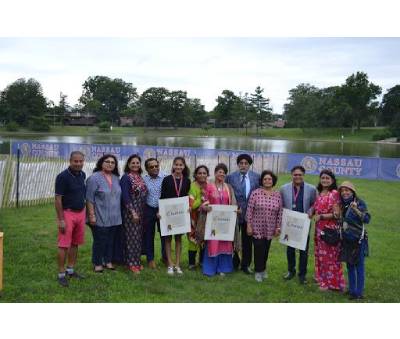
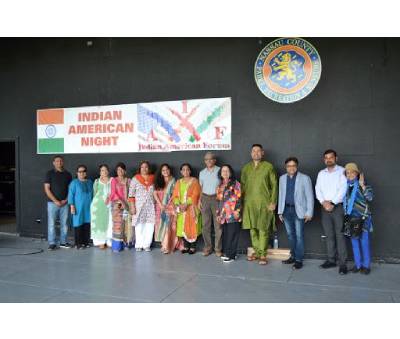
The India Association of Long Island (IALI) celebrated India’s 72nd Independence Day on Aug. 15, at Theodore Roosevelt Executive & Legislative Building in Mineola, Long Island, New York.

Among those who attended were Nassau County Executive Laura Curran and Deputy Director of Minority Affairs Farrah Mozawalla along with Satnam S. Parhar, Dr. Bhavani Srinivasan, Jaya Bahadkar, Sunita Manjrekar, Tina Kundalia and Priyansh Raval. IALI also invited members of 25 other Indian American organizations.

The celebration was attended by more than 300 guests and five individuals were honored including Veer Mukhi, Haseena Mooppan, Prof. Indrajit Saluja, Matthew P. George and IALI Past President Dr. Jagan Pahuja.

The program began with dinner followed by the flag hoisting ceremony, the singing of the American National Anthem and the Indian National Anthem, a lamp lighting ceremony and speeches by County Executive Laura Curran and IALI President Gunjan Rastogi.

It all concluded with a cultural show where Jyoti Gupta and Amita Karwal sang “Ae Mere Vatan Ke Logon.”

Sankara Eye Foundation Benefit Concerts held: Shankar Mahadevan, Ehsaan Noorani and Loy Mendonsa, Farhan Akhtar enthrall audiences

Shankar Mahadevan, Ehsaan Noorani and Loy Mendonsa, and the multi-talented Bollywood actor/singer Farhan Akhtar, enthralled audiences during Sankara Eye Foundation’s fundraising concerts on August 24th in San Jose, CA, and on August 25th in Pasadena, CA.

The popular Bollywood stars performed to a live orchestra in front of the capacity crowds comprising largely of Indian American fans, patrons and volunteers, giving a taste of soul-stirring romantic songs and foot-tapping dance numbers.

Sankara Eye Foundation Benefit Concerts held: Shankar Mahadevan, Ehsaan Noorani and Loy Mendonsa, Farhan Akhtar enthrall audiencesFarhan, the son of famed poet/lyricist Javed Akhtar, also set the mood with some poetry recital. His occasional narration of anecdotes from his life had the audience in splits. The night was filled with melodic samples, many of which received encore requests from the audience.

Murali Krishnamurthy, founder and executive chairman of SEF, acknowledged on stage that an event of this magnitude would not have been possible without the unflinching support of the sponsors, and expressed his sincere gratitude to them. He presented the progress of the organization to the attendees and announced that three hospitals in India have now become self-sufficient and two more are close to becoming self-sufficient.

SEF, which is working towards eradicating curable blindness in India for the past 20 years, currently has nine super-specialty hospitals and is working on three new hospitals: in Hyderabad, Indore and Mumbai. (Read earlier India-West story here: https://bit.ly/2wp9bQT)

The organization provides free eye care for those unable to afford it, with the rural poor accounting for 80 percent (approximately 150,000 people per year) of the surgeries performed at Sankara Eyecare Institutes in India. Over 1.75 million people have received the gift of vision so far. SEF hopes to increase that number to 1.77 million this year.

SEF has earned a coveted four-star rating from Charity Navigator for its fiscal management practices and commitment to transparency. Mahadevan, Noorani and Mendonsa have been longtime supporters of the organization and are passionate about using the arts to both entertain the audience and to highlight the cause. Mahadevan even visited one of the hospitals in India some time ago.

“You support the cause, you believe in the cause, you are ready to do concerts with an organization like Sankara Eye Foundation, but till you go and visit their hospital and see the changes that come about in the patients’ lives, that’s when it totally changes you,” the renowned singer/composer told at a press meet at the Hilton Hotel in San Jose. “When you visit the hospitals and see young, old, children, poor people…from every economic strata, the difference that Sankara Eye Foundation is making in people’s lives, but you’ll only understand when you visit.”

Founded in 1998, the mission of the Sankara Eye Foundation, USA (SEF, USA) is to realize the goal of eradicating curable blindness in India. We initiate and drive community eye care activities in India by working with eye care organizations such as Sankara Eye Foundation, India which runs Sankara Eye Hospitals across India.. SEF USA has increased the number of specialty eye care hospitals from 1 in 1998 to 9 by 2017. The number of free eye surgeries is performed at an annual rate of 160,000 as of 2017. The goal is to perform 500,000 free eye surgeries per year. SEF has performed over 1.66 million free eye surgeries as of Nov 30, 2017.

World Hindu Congress in Chicago: A message of unity anew, 125 years after Vivekananda’s speech

A century-and-a-quarter after Swami Vivekananda’s rousing speech to the World Parliament of Religions here in 1893, the World Hindu Congress has declared its objective to re-connect the 1.1 billion Hindus worldwide with their common heritage and their spiritual link to people of all other denominations.

For three days, beginning September 7, about 2,300 delegates will converge at the Westin Hotel in Lombard, a Chicago suburb, to deliberate, introspect and draw out a plan of action in keeping with the World Hindu Congress conference motto derived from Chapter 37 of the Hindu epic Mahabharata — Sumantrite Suvikrante (Think Collectively, Act Valiantly) and from the Rig Veda: Sam Gacchadhvam Sam Vadadhvam (Stay Together, Express Together).

The Westin Hotel is some 32 km from the Art Institute of Chicago, where Vivekananda’s bust commemorates the spot he spoke from.

Many religious leaders are scheduled to attend the Hindu Congress conference. A video message from the Dalai Lama, who had to drop out due to frail health, will be screened. Speakers in the various events include professor Ved Nanda of the University of Denver; Lord Jitesh Gadhia, the youngest Briton of Indian origin in the House of Lords; Swati Dandekar, a former legislator from Iowa; Congressman Raja Krishnmoorthi; Columbia professor Arvind Panagariya, a former economic advisor to the Indian government; and the actor, Anupam Kher.

The overwhelming majority of the 2,300 delegates — 1,300 — are from North America, with other delegates coming from 60 countries.

For Indian immigrants, much has changed in Chicago since 1893. Over a century ago, Vivekananda spent a night shivering in a railway yard before a Good Samaritan took him in. He cut an exotic figure in his flowing robes, with passersby pulling at his saffron turban as he walked on the streets.

At the parliament, Americans heard a Hindu monk speak on behalf of his religion for the first time. Today, Chicago and its suburbs have more than a dozen expansive Hindu temples. Discourses by the likes of Sadhguru Jaggi Vasudev attract packed audiences.

The faith’s underlying message, in 1893 and 2018, is unity and tolerance. In his now famous speech, Vivekananda, who is regarded by many as more of a social reformer than a religious leader, spoke of the fact that India has sheltered “the remnants of the Israelites who came to South India seeking refugee from Roman tyranny, and remnants of the grand Zoroastrian nation”.

Another common message, then and now, is of dharma-righteousness for its own sake. Following his speech, an American journalist commented: “Vivekananda’s address before the parliament was broad as the heavens above us, embracing the best in all religions, as the ultimate universal religion — charity to all mankind, good works for the love of God, not for fear of punishment or hope of reward.”

The Hindu Congress conference, in the estimation of the organisers, has almost similar ambitions, an indication that Hinduism’s core message is timeless and unchanging.

“There will be no spiritual discourses,” conference convener Abhaya Asthana said in an interview. “The aim is to use the essence of Hindu philosophy, dharma, to inform how we come together (in the diaspora) as men, women and youth — in politics, education and commerce.”

Asthana noted that despite the fact that Hindus have done well individually in North America, they do not have collective clout, a deficiency that the conference will deliberate on. “We are almost there in the social media, but we need more impact in politics, commerce and technology,” he said.

Do Hindus, especially those in alien lands, need to take a long hard look at Hinduism? This is a question that hangs uneasily in the air when Indian Americans talk of current events in India.

But Asthana is sanguine. “We do not have to redefine dharma. The philosophy is sound, the principles are sound. Ahinsa (non-violence) is ingrained. All we need to do is to live our lives rooted in the philosophy of service and tolerance.

“We want to connect all Hindus worldwide as well as reach out to all others for the happiness of all living creatures,” Asthana said.
The pervasive, although often unspoken, apprehension, that religion is the great divider of modern times, has persisted since the first World Parliament of Religions in 1893.

The solution, as propounded by various speakers at the parliament, then, was an all-embracing universalism that envisioned a coming together of the great religions of the world.

Racism, xenophobia and intolerance were unaddressed issues when Vivekananda spoke in Chicago.

Poor immigrants from southern Europe, including many Jews fleeing Russia, had arrived in the United States at the time. Nativist feelings inspired laws designed to limit the entry of immigrants. The Chinese Exclusion Act was passed in 1882 and the Immigration Restriction League in 1894.

The parliament chairman, Presbyterian minister John Henry Barrows, noted the scepticism: “Many felt that religion was an element of perpetual discord, which should not be thrust in amid the magnificent harmonies of a fraternal assembly of nations. On the other hand, it was felt that the tendencies of modern civilisation were toward unity.” The one word that tolled like a bell through the halls of the parliament was “universalism”.

Vivekananda, in his address to the final session of the parliament, elaborated on the theme: “My thanks to this enlightened audience for their uniform kindness to me and for their appreciation of every thought that tends to smooth the friction of religions. A few jarring notes were heard from time to time in this harmony. My special thanks to them, for they have, by their striking contrast, made general harmony the sweeter.”

Despite the passing of a century, participants at the World Hindu Congress conference may well find the tools to overcome the impediments in the path of righteousness unchanged.

In addition to unity and tolerance, dharma inspires us to “stand up for justice”, said Ashtana, scientist at the Nokia Bell Labs, who works on Artificial Intelligence and neural networks, offering another quote from the Mahabharat — Yato Dharmastato Jayaha (Whence Dharma, Thence Victory).

(Ashok Easwaran is an American journalist of Indian origin. He has reported from North America for over two decades. The views expressed are personal.He can be contacted at ashok3185@yahoo.com)

— This commentary first appeared August 28 in Indo Asian News Service

A New Study Says Any Amount of Drinking Is Bad for You. Here’s What Experts Say

A new study concludes there’s no amount of alcohol consumption that’s safe for overall health — a finding that’s likely to surprise moderate drinkers, and that has left some experts unconvinced.

For years, public health officials have said that, while no one should pick up drinking in search of better health, moderate drinking (defined as up to a drink per day for women and up to two per day for men) probably won’t hurt anyone who already imbibes, and may even confer some benefits. This standard is written into the Dietary Guidelines for Americans and is supported by organizations including the American Heart Association and the American Cancer Society.

But the new paper, published Thursday in The Lancet, calls that long-held conclusion into question.

“The evidence is adding up that no amount of drinking is safe,” says study co-author Emmanuela Gakidou, a professor of global health and health metrics sciences at the University of Washington. “I don’t think we’re going out on a limb to say anything that the data do not support.”

The new research was based on a review of nearly 700 existing studies on global drinking prevalence and nearly 600 studies on alcohol and health, and found that alcohol was the seventh leading risk factor for premature death in 2016, contributing to 2.8 million deaths worldwide. That number is equivalent to 2.2% of all female deaths and 6.8% of all male deaths that year, according to the study.

The health risks likely only increase the more you drink, the study found. Compared to non-drinkers, people who had one alcoholic beverage per day had a 0.5% higher risk of developing one of 23 alcohol-related health problems, including cancer, road injuries and tuberculosis, in a given year, the study says. At that level, the absolute increase is small, equaling only four additional deaths per 100,000 people per year, according to the study. But those who had two drinks per day had a risk 7% higher than non-drinkers. At five drinks per day, the risk was 37% higher, the study says.

Gakidou’s paper did show some modest cardiovascular benefits associated with moderate drinking, particularly among women, but she says that effect is overshadowed by the numerous ways alcohol can threaten health. When you consider risks like breast cancer and road traffic injuries, she says, “the protective effect goes away, even at low doses.”

Other experts have recently come to similar conclusions. In May, for example, the World Cancer Research Fund released a report saying that, at least in terms of cancer prevention, “it’s best not to drink alcohol.” The U.K. government made a similar recommendation in 2016.

Meanwhile, some studies have questioned the long-standing idea that moderate drinking is good for heart health. That’s in part because some older studies didn’t account for the fact that many people who don’t drink abstain either because they had addiction issues in the past, or have other health problems that force them to stay away from alcohol. Including these individuals in the general non-drinking population may have skewed research results to make teetotalers as a whole group look unhealthier than they actually are, some studies have suggested.

Walter Willett, a professor of nutrition and epidemiology at the Harvard T.H. Chan School of Public Health, questions the conclusion that the cons of drinking always outweigh the pros. While there’s “no question” that heavy drinking is harmful, he says that plenty of data supports links between moderate drinking and lower total mortality and a decreased risk of heart disease — which, he says, are far more relevant concerns for most Americans than something like tuberculosis, which the Lancet paper identifies as a leading alcohol-related disease worldwide. Tuberculosis is very rare in the U.S.

“Our decisions about drinking in the United States shouldn’t be influenced by what alcohol does to tuberculosis,” Willett says. “When you throw together everything in one big pot and draw conclusions for the whole world, it’s just misleading.”

Willett does acknowledge that even moderate drinking comes with tradeoffs. A drink a day may decrease a woman’s risk of heart disease but increase her risk of breast cancer. For a young, healthy woman who is unlikely to die of heart disease, those risks might outweigh the benefits. But that’s a decision that woman would have to make with her doctor, Willett says — and it’s unlikely the entire population would or should come to the same conclusion.

“I think they went too far in this paper,” Willett says. “There are risks and benefits, and I think it’s important to have the best information about all of those and come to some personal decisions, and engage one’s health care provider in that process as well.”

Gakidou, on the other hand, says her paper’s recommendation is valid precisely because individual health decisions are so variable.

“We don’t have the information for specific individuals…we’re making overall recommendations at the population level,” she says. “If you’re running a health system in a country, it’s better overall for the population of your country to not drink at all than to drink a little bit.”

Dariush Mozaffarian, dean of the Friedman School of Nutrition Science and Policy at Tufts University, agrees with that assessment. It’s clear, he says, that drinking comes with health risks, and far less clear that it comes with any benefits. So while some moderate drinkers might never experience health problems from drinking, “if you look at all the risks and all the benefits of alcohol, it’s probably net harmful, on average, for the whole population,” he says.

While that conclusion may seem stark to people who have come to feel virtuous about their nightly glass of wine, Mozaffarian says it’s actually not so different from current medical advice.

“I think this is actually consistent with every organization’s recommendation that, overall, no one should start drinking to prevent heart disease or diabetes,” Mozaffarian says. “No organization has ever recommended to drink alcohol. The recommendation has been that if you drink — and that’s the key caveat — don’t drink more than moderately.”

INDRA NOOYI chosen for 2018 Asia Game Changer Awards

Indra Nooyi has been chosen to receive the Asia Society announced this year’s recipients of the Asia Game Changer Awards on August 23, 2018, which recognize those making a transformative and positive difference for the future of Asia and the world. Asia Society is proud to partner with Citi to honor these extraordinary individuals and groups, continuing a tradition begun with the inauguration of the Asia Game Changer Awards five years ago.

The honorees this year include Thai rescuers who saved a squad of teenage soccer players trapped in a flooded cave, a team of Afghan girls who successfully competed in a U.S. technology competition, a record-breaking star runner from a small village in Nepal, and a group of Japanese volunteers working to secure the damaged Fukushima nuclear power plant following a tsunami. Indra Nooyi, the remarkable president and CEO of PepsiCo, will receive the Game Changer of the Year Award. Honorees are nominated and selected by members of Asia Society’s global network.

Indra Nooyi is chairman and chief executive officer of PepsiCo. PepsiCo products are enjoyed by consumers more than one billion times a day in more than 200 countries and territories around the world and generated more than $63 billion in net revenue in 2017. With a product portfolio that includes a wide range of enjoyable foods and beverages such as Frito-Lay, Gatorade, Pepsi-Cola, Quaker, and Tropicana, PepsiCo generates more than $1 billion in estimated annual retail sales in 22 brands.

Mrs. Nooyi is the chief architect of Performance with Purpose, PepsiCo’s pledge to do what’s right for the business by being responsive to the needs of the world around us. As part of Performance with Purpose, PepsiCo is focusing on delivering sustained growth by making healthier and more nutritious products, limiting our environmental footprint and protecting the planet, and empowering our associates and people in the communities we serve.

Mrs. Nooyi was named President and CEO on October 1, 2006, and assumed the role of chairman on May 2, 2007. She has directed the company’s global strategy for more than a decade and led its restructuring, including the divestiture of its restaurants into the successful YUM! Brands, Inc. She also led the acquisition of Tropicana and the merger with Quaker Oats that brought the vital Quaker and Gatorade businesses to PepsiCo, the merger with PepsiCo’s anchor bottlers, and the acquisition of Wimm-Bill-Dann, the largest international acquisition in PepsiCo’s history.

Prior to becoming CEO, Mrs. Nooyi served as president and chief financial officer beginning in 2001, when she was also named to PepsiCo’s board of directors. In this position, she was responsible for PepsiCo’s corporate functions, including finance, strategy, business process optimization, corporate platforms and innovation, procurement, investor relations and information technology. Between February 2000 and April 2001, Mrs. Nooyi was senior vice president and chief financial officer of PepsiCo. Mrs. Nooyi also served as PepsiCo’s senior vice president, corporate strategy and development from 1996 until 2000, and as PepsiCo’s senior vice president, strategic planning from 1994 until 1996.

Before joining PepsiCo in 1994, Mrs. Nooyi spent four years as senior vice president of strategy and strategic marketing for Asea Brown Boveri, a Zurich-based industrials company. She was part of the top management team responsible for the company’s U.S. business as well as its worldwide industrial businesses, representing about $10 billion of ABB’s $30 billion in global sales.

Between 1986 and 1990, Mrs. Nooyi worked for Motorola, where she was vice president and director of corporate strategy and planning, having joined the company as the business development executive responsible for its automotive and industrial electronic group. Prior to Motorola, she spent six years directing international corporate strategy projects at The Boston Consulting Group. Her clients ranged from textiles and consumer goods companies to retailers and specialty chemicals producers. Mrs. Nooyi began her career in India, where she held product manager positions at Johnson & Johnson and Mettur Beardsell, Ltd., a textile firm.

In addition to being a member of the PepsiCo Board of Directors, Mrs. Nooyi serves as a member of the boards of Schlumberger Limited, The Consumer Goods Forum, Catalyst, Lincoln Center for the Performing Arts and Tsinghua University. She is also a member of the Foundation Board of the World Economic Forum and the American Academy of Arts & Sciences.

She holds a B.S. from Madras Christian College, an M.B.A. from the Indian Institute of Management in Calcutta, and a Master of Public and Private Management from Yale University. Mrs. Nooyi is married and has two daughters.

5th Indo American Press Club International Media to be held in Atlanta

Atlanta, GA – Preparations are in full swing for the fifth International Media Conference (IMC) by the Indo American Press Club (IAPC) at Atlanta Airport Marriott Hotel from October 5th to 7th, 2018, Dr. Babu Stephen, Chairman of IAPC announced here last week at the kick-off meeting held in Atlanta.

 “Several national level leaders of different political parties and eminent media persons from India will be attending the event,” he said.  “We are expecting a total of 30 to 40 persons from India, 25 of whom have already confirmed.  Further discussions are in progress in this regard,” Dr. Stephen said.  He welcomed the whole-hearted support of the members of IAPC’s Atlanta chapter to make the Conference a great success.

The Conference will include several workshops and seminars headed by eminent Indian politicians as well as journalists from the print and audio-visual media.  “We expect this year’s event will attract more participants than the previous years,” Dr. Stephen said.

Various Committees have been formed under the leadership of accomplished community leaders and other experts for the seamless conduct of the Conference.  The committees are chaired by Babu Stephen (Finance), Mini Nair (Entertainment and Food Committees), Ginsmon Zachariah (Award), Sabu Kurian (Medical), George Kottarathil (Competition), Morley J. Nair (Publicity & Media), Lukose Tharian (Transportation), Jomy George (Reception & Registration and Youth Committess), Vineetha Nair (Program), Roopsi Narula (Women’s), Prasad Philipose (Stage), Thomas Mathew Joys (Souvenir), and Sunil J. Koozhambala (Educational Award),

 IAPC, formed in 2013 with the objective of bringing together the U.S. media-persons of Indian origin, has been conducting annual conferences in different U.S. cities for the last four years.   The previous events were attended by eminent Indian personalities from the fields of government, media, and literature.  IAPC currently has eight local chapters in US and Canada.

John McCain, War Hero, Senator, Presidential Contender, Dies at 81

John S. McCain, the proud naval aviator who climbed from depths of despair as a prisoner of war in Vietnam to pinnacles of power as a Republican congressman and senator from Arizona and a two-time contender for the presidency, died on Saturday at his home in Arizona. He was 81.

According to a statement from his office, Mr. McCain died at 4:28 p.m. local time. He had suffered from a malignant brain tumor, called a glioblastoma, for which he had been treated periodically with radiation and chemotherapy since its discovery in 2017.

Despite his grave condition, he soon made a dramatic appearance in the Senate to cast a thumbs-down vote against his party’s drive to repeal the Affordable Care Act. But while he was unable to be in the Senate for a vote on the Republican tax bill in December, his endorsement was crucial, though not decisive, in the Trump administration’s lone legislative triumph of the year.

A son and grandson of four-star admirals who were his larger-than-life heroes, Mr. McCain carried his renowned name into battle and into political fights for more than a half-century. It was an odyssey driven by raw ambition, the conservative instincts of a shrewd military man, a rebelliousness evident since childhood and a temper that sometimes bordered on explosiveness.

Nowhere were those traits more manifest than in Vietnam, where he was stripped of all but his character. He boiled over in foul curses at his captors. Because his father was the commander of all American forces in the Pacific during most of his five and a half years of captivity, Mr. McCain, a Navy lieutenant commander, became the most famous prisoner of the war, a victim of horrendous torture and a tool of enemy propagandists.

Shot down over Hanoi, suffering broken arms and a shattered leg, he was subjected to solitary confinement for two years and beaten frequently. Often he was suspended by ropes lashing his arms behind him. He attempted suicide twice. His weight fell to 105 pounds. He rejected early release to keep his honor and to avoid an enemy propaganda coup or risk demoralizing his fellow prisoners.

He finally cracked under torture and signed a “confession.” No one believed it, although he felt the burden of betraying his country. To millions of Americans, Mr. McCain was the embodiment of courage: a war hero who came home on crutches, psychologically scarred and broken in body, but not in spirit. He underwent long medical treatments and rehabilitation, but was left permanently disabled, unable to raise his arms over his head. Someone had to comb his hair.

Warren Buffett is investing in Paytm, his first Indian company

Warren Buffett is gearing up to invest in India’s top mobile payments firm. The renowned investor’s company, Berkshire Hathaway (BRKA), is set to pick up a stake in Paytm, a source familiar with the deal told CNNMoney on Monday.

The two companies have been discussing for several months an investment of about 25 billion rupees ($360 million) that would value Paytm at around $10 billion, the source said, adding that the deal could be announced as soon as this week.

Paytm declined to comment, while Berkshire Hathaway did not immediately respond to a request for comment outside regular business hours.

Buffett’s first investment in an Indian company will see him enter a fast-growing market where some of Silicon Valley’s top players are already looking to make a mark.

Google (GOOGL) launched its mobile payments app Tez in India last year, and WhatsApp, the mobile messenger owned by Facebook (FB), is testing a similar service.

“There is a lot of traction,” said DD Mishra, a research director at Gartner. “This market is going to be very competitive, and you need deeper pockets to survive for a long time,” he added.

Indians love to do business in cash, and most transactions in the country are still conducted in rupee notes and coins.

But Prime Minister Narendra Modi’s shock decision to ban 86% of India’s cash in November 2016 gave a big boost to online wallets such as Paytm, which signed up around 10 million new users within a month.

It is the market leader in mobile payments, with more than 300 million users, and has also started an online retail platform called Paytm Mall to take on Amazon (AMZN) and Flipkart, which was bought by Walmart (WMT) earlier this year.

India’s large young population with growing disposable incomes make it a hugely promising market for mobile payments and online shopping, said Kenny Liew, an analyst at research firm Fitch Solutions.

“This will be translated into more spending, leading to increased volumes of e-commerce sales and payments for Paytm to capture,” Liew added.

Buffett has spoken previously about his bullishness on India, saying in an interview with a local TV channel last year that the country had “incredible” potential as a market.

“If you tell me a wonderful company in India that might be available for sale, I’ll be there tomorrow,” he said.

An investment by the Oracle of Omaha, as he is popularly known, will make people sit up and take notice. Berkshire Hathaway will join Chinese tech giant Alibaba (BABA) and Japanese conglomerate SoftBank (SFTBF) as big name investors in Paytm.

“Given that Buffett is a fundamental investor and most of his investments last at least a decade, it is an unambiguous signal that Paytm would be relevant over such a long time horizon,” said Vaidyanathan Krishnamurthy, a professor of finance at the Indian School of Business.

“The fact that he is investing in an Indian tech company is a big moment for all Indian tech startups.”

Sen. Tim Kaine acknowledges Indian-Americans’ emerging influence in D.C.

(From Reports by Aziz Haniffa at India Abroad)

The clout and influence of the Indian diaspora is evident in the nation’s capital, as evidenced by so many Indian-American groups in the metropolitan area, said Sen. Tim Kaine (D.-Va.). The former vice presidential candidate made his remarks at the India Independence Day celebrations on Aug. 19, which drew more than 300 to the Falls Church Marriott Fairview Park.

“This is an important community and that’s why you have so many officials who are here because we value so much the Indian American community in Virginia and nationally,” he said. “When I was governor and I had assembled my entire cabinet, a newspaper in India pointed out to me that three of my cabinet members were Indian-American, and I wasn’t even aware of it. They were in my cabinet because they were so fantastic. Many of you know and remember the team that I assembled and you see that in a bipartisan way across the Commonwealth.”

Kaine said it was the linkages between both countries – sharing common values, diversity and pluralism – that makes it imperative that this relationship has always been celebrated in the U.S.

Kaine, the ranking Democrat on both the Senate Armed Services and Foreign Relations Committees, recalled a 2015 visit he made to India as member of both committees to the Mazagon Docks in Mumbai. The Mazagon Dock Shipbuilders Limited, is India’s prime shipyard and is where the country’s warships and submarines are manufactured for the Indian Navy.

He said that he and the congressional delegation wanted to see India’s shipbuilding industry because his own state of Virginia is central in U.S. shipbuilding. “I’ll never forget the pride of India’s shipbuilders showing off the Mazagon Docks,” he said. He said upon his return to the U.S. he spoke to the secretary of the Navy telling him Indian naval officials needed to come visit U.S. shipbuilders in Newport News, Virginia and on the Gulf Coast.

Kaine said the Pentagon insisted “we don’t like to take people from foreign nations to our shipyards because of concerns about security and secrecy.” He said he pointed out that “our Indian colleagues and the Indian military does more joint exercises with the United States military than they do with any other nation in the world, and they were so proud and so welcoming to show us their shipbuilding industry, and so the least we can do is have that same relationship with them.”

Within a year, the Pentagon hosted a delegation of India’s key naval officials, he said. They visited Virginia’s shipyards and many others, he said, where some of the most sophisticated U.S. warships and submarines were being assembled. “This is just the tip of the iceberg of the cooperation that we can do together,” he said. “We are now so connected, and that’s what tonight is all about.”

Indian Ambassador to the U.S. Navtej Sarna, in a message to the gathering, noted: “India’s relationship with the United States is substantive and wide-ranging and is set to grow further in strategic and economic spheres. The contribution of the Indian-American community to this relationship has been critical.” Sarna and other embassy officials who had been slated to attend the event were not present as the government of India observed a weeklong period of mourning after the death of former Indian Prime Minister Atal Bihari Vajpayee.

Raj Shah was honored with a Distinguished Service Award at India’s 72nd birthday celebration hosted by a coalition of Indian-American organizations under the aegis of the National Council of Asian American Associations. The gathering of about 300 attendees was held at the Falls Church Marriott Fairview Park and also celebrated Shah’s work for what the keynote speaker called “a commitment to our nation.”

A Mosque and a Church Join Hands to Organize Free Health Fair

Naperville: August 24, 2018: The Islamic Center of Naperville and Community United Methodist Church will jointly host a Free Health Fair on September 8th, 2018 (Saturday) from 10:00 AM to 3:00 PM at 2844 W OGDEN AVE, Naperville, IL 60540.

The objective of this initiative is to serve humanity, bridge the gap with bonds of love, care, and compassion, and offer a safer and healthier community.  Individuals 16 years of age or older are welcome at the Free Health Fair regardless of faith, religion, or race.

Physicians, dentists, and nursing students at the Free Health Fair will be screening for blood pressure, blood sugar, oral cancer, and other ailments. They will also provide counseling on health-related issues, including weight management and nutrition. Additional arrangements have also been made for vision tests, mini massages, flu shots, etc.

“Despite being in a country that has so much to offer, there are people within our community and surrounding neighborhoods who are in dire need of adequate and appropriate health care. They are deprived of this basic necessity due to multiple reasons, unable to have access to affordable care being the most common,” stated Dr. Atif Fakhruddin of ICN Free Clinic.

In addition, free health classes by eminent physicians, dentists, dietitians, and physical therapists will be held on topics such as Advances in Orthopedic Education, Healthy Eating, Living with High Blood Pressure, General Fitness, Preventing Heart Disease, Balance & Fall Prevention, Dental Hygiene, Managing Diabetes with Healthy Diet, and Life Affected by Diabetes.

“We recognize the same health needs and are happy to work with ICN on the Free Health Fair,” said Pat Shanower, speaking for Community United Methodist Church.  “There will be something for everyone that day, whether it is a flu shot, a screening, or learning how best to prevent serious diseases. We want everyone to feel welcome.”

Nima Kulkarni wins Primary: Set to Win Kentucky House Seat

Indian American Nima Kulkarni is almost all set to win the Kentucky state House District 40 seat after winning the Democratic primary over three other candidates, including incumbent Dennis Horlander. The candidate, who has the backing of organizations such as the Indian American Impact Fund is expected to win the seat if she receives more votes than Republican Joshua Neubert this November.

Kulkarni is an immigration attorney, advocate and founder of the New Americans Initiative, a nonprofit dedicated to educating and informing the local community about immigration related issues.

When she was 6, her family immigrated from India to Louisville to ensure her brother could get the special education that was not available in India.

She went on to receive bachelor’s and M.B.A. degrees from the University of Louisville and then her law degree from the University of D.C. David A. Clarke School of Law.

The owner of the Indus Law Firm which specializes in immigration, employment and business law, Kulkarni in 2013 was honored by Business First in its 40 Under 40 list.

She serves on the board of the Community Foundation of Louisville, Louisville Public Media, the Indian Professional Council of Kentucky and the Beaded Treasures Project, which empowers refugee and underprivileged women in Louisville.

She is also a member of Greater Louisville Outstanding Women, the Rotary Club of Louisville, and serves as county ambassador for the Greater Louisville International Professionals.

Kulkarni’s platform is five-fold. Among the issues she is campaigning to address if elected include standing with labor and work for a living wage for all, supporting new and innovative ways to stimulate the state’s economy while ensuring public employee pensions, supporting equality and fair immigration policies, supporting a strong education system to give students the skills necessary for success in their careers, and supporting expanded and comprehensive healthcare for all, according to her website, www.votenima.com.

Thus far, the Indian American candidate’s voice has been heard. In the May 22 primary, Kulkarni received 1,642 of the 3,524 votes, or 46.59 percent. The incumbent Horlander was closer to last place than he was to first, while finishing second with 25.37 percent. The other candidates – Logan Gatti and Kelly Gibson – finished third and fourth, respectively, with 15.35 percent and 12.68 percent.

If Kulkarni wins the general election over Neubert, she would be the first Indian American to not only run, but win, state office in the history of Kentucky politics.

Veteran Indian journalist Kuldip Nayar dead

Veteran journalist, author and human rights activist Kuldip Nayar died at a hospital in New Delhi, his family said on Thursday last week. He was 95. Nayar breathed his last at the Escorts Hospital at 12.30 a.m. The cremation were held on Thursday afternoon.

Born on August 14, 1923, in Sialkot (Pakistan), Nayar was among the country’s first syndicated columnists and wrote several books.

He was appointed High Commissioner to the UK in 1990 and nominated to the Rajya Sabha in 1997.

Nayar started his journalistic career with the Urdu daily “Anjam” in 1948. He worked in the Press Information Bureau as a Press Officer to then Home Ministers Govind Ballabh Pant and Lal Bahadur Shastri.

He was the editor and General Manager of United News of India (UNI) and also the editor of The Statesman. He also worked with the Indian Express, The Times, The Spectator and the Evening Star.

He was also the author of 15 books including “Beyond the Lines”, “India after Nehru” and “Emergency Retold”.

Senior journalist H.K. Dua, who knew Nayar for 54 years, described him as a “good friend”, a “great journalist” and said his death was a loss to the profession.

“Till the last, he was working. At the age of 94, he kept his interest alive in the news world. He was a great chaser of news and broke many stories in his life. He knew much more of what was happening behind the news than many other journalists and got lots of inside information. Essentially, he remained a thorough journalist,” Dua told IANS.

He said Nayar also made efforts for peace between India and Pakistan and organised candle-light demonstrations.

Meanwhile, Prime Minister Narendra Modi and President Ram Nath Kovind were among the leaders who condoled Nayar’s death.

Modi termed him an intellectual giant and recalled his role as a staunch opponent of the Emergency. “Kuldip Nayar was an intellectual giant of our times. Frank and fearless in his views, his work spanned across many decades. His strong stand against the Emergency, public service and commitment to a better India will always be remembered. Saddened by his demise. My condolences,” Modi said in a tweet.

Kovind described him as a determined champion of democracy. “Sad to hear of the passing of Kuldip Nayar, veteran editor and writer, diplomat and parliamentarian, and a determined champion of democracy during the Emergency. His readers will miss him. Condolences to his family and associates,” he said in a tweet.

Finance Minister Arun Jaitley said Nayar will be best remembered for his struggle against the Emergency. “Saddened by the death of the veteran Journalist Sh. Kuldip Nayar. His contribution to the cause of free speech is unparalleled. He is credited with breaking some of the most exclusive news stories. Will be best remembered for his struggle against the Emergency,” Jaitley said.

Congress communications incharge Randeep Singh Surjewala also expressed his condolences and described Nayar as a role model for his profession.

“My deepest condolences on the passing away of veteran journalist, political commentator and human rights activist, Sh. Kuldip Nayar ji. A role model for many in his profession and beyond, his demise ends an era of journalism of courage, ethics and values, Surjewala said.

Top CEOs raise concern about changes made by Donald Trump in H1-B policies

The Trump administration’s “inconsistent” immigration policies, including on the H1-B visa for professionals, could “disrupt” operations of American firms and inflict “substantial harm” on their competitiveness, CEOs from top US companies have warned.

In a letter to US Homeland Security Secretary Kirstjen Nielsen, members of the Business Roundtable, including Apple CEO Tim Cook, Chairman and CEO of PepsiCo Indra Nooyi, President and CEO of Mastercard Ajay Banga and Chairman and CEO of Cisco Systems Chuck Robbins said that confusion around US immigration policy “creates anxiety for employees who follow the law.”

The Business Roundtable, an association of chief executive officers of America’s leading companies, told Nielsen yesterday that “inconsistent government action and uncertainty undermines economic growth and American competitiveness.”

Due to a shortage of green cards for workers, many employees find themselves stuck in an immigration process lasting more than a decade, they said.

To avoid unnecessary costs and complications for American businesses, the US government should not change the rules in the middle of the process, the CEOs said, pointing out to the several policy memoranda over the past year by the US Citizenship and Immigration Services (USCIS) has issued that has resulted in “arbitrary and inconsistent adjudications”.

“Companies now do not know whether a work visa petition that was approved last month will be approved when the company submits the identical application to extend the employee’s status,” they said.

In particular, the CEOs said they are worried about changes to the review process for H-1B visas for high-skilled workers, expected changes to the rules for spouses of H-1B employees and planned changes to certain deportation rules.

The H-1B visa is a non-immigrant visa that allows US companies to employ foreign workers in speciality occupations that require theoretical or technical expertise. The technology companies depend on it to hire tens of thousands of employees each year from countries like India and China.

Employees who qualify for H-1B jobs often hold degrees in science, tech, engineering or math, and are highly sought after by employers, the CEOs said.

The Roundtable members said that a confusing immigration system in the US which threatens to split their families apart, could encourage them to seek employment in a different country. That would put the American economy at a disadvantage.

They also noted that in many cases, the US Labor Department has determined that “no qualified US workers are available to do that person’s job.”

President Donald Trump has said that some IT companies were abusing the US work visas to deny jobs to American workers.

“As the federal government undertakes its legitimate review of immigration rules, it must avoid making changes that disrupt the lives of thousands of law-abiding and skilled employees, and that inflict substantial harm on US competitiveness,” the CEOs noted.

The Business Roundtable will continue to work with Congress to reduce the Green Card backlog, they said.

In the interim, inconsistent immigration policies are unfair and discourage talented and highly skilled individuals from pursuing career opportunities in the United States, they said.

The reality is that few will move their family and settle in a new country if, at any time and without notice, the government can force their immediate departure–often without explanation.

“At a time when the number of job vacancies are reaching historic highs due to labour shortages, now is not the time restrict access to talent,” the CEOs said.

The group has called for increasing the number of H-1B visas and letting people with advanced STEM degrees from American universities qualify for a green card immediately.

Meanwhile, the US Citizenship and Immigration Services said in a statement the “administration has been relentlessly pursuing necessary immigration reforms that move towards a merit-based system.”

“USCIS is committed to reforming employment based immigrant and non-immigrant immigration programs so they benefit the American people to the greatest extent possible,” CNN quoted spokesperson Michael Bars as saying.

Redmond Fashion Week held

Redmond was able to host its inaugural Redmond Fashion Week (RFW) on August 05, 2018! With major support from Experience Redmond, Suley Era, and Ravishing women, RFW launched this historical event at the Seattle Marriott Redmond which is located at the heart of Redmond Town Center.

This event was graced with the presence of many brilliant designers both local and international, each one showcasing their art on stage with over 60 models and a multicultural array of splendor. The representation of global culture was easily spotted on the runway as designers presented clothes from across multiple continents. We were proud to host designers such as Lisa Mensonides, Vibhuti Malhotra, Joy Sircar McMillen, Joy Egbejimba, Vartika Mittal Garg, Chany Venturini, Parul Mathur Nag, Ritu Goyal Mongia, & Gustavo Apiti.

Attended by hundreds of guests as RFW unfold into reality and became a very successful event by great networks & connections to bring communities together . This event truly lifted Redmond onto the global arena of diverse and multicultural fashion! Flying in from across the US, Africa, India, Italy, and Canada, guests were greeted warmly as they joined in the celebrations as they also had the chance to connect with other audience members. Some such members included Tankia Padhey from the City of Redmond, Aisha Qadri from OneRedmond, Sony TV Celebrity actor Jagjit Athwal and many other exceptional movers and shakers including models, hair artists, make-up artists, photographers, videographers, sponsors, volunteers, and a lively DJ.

Rohit Verma was another designer who brought a celebrity show alongside his designs from Bollywood. Sophisticated and creative apparel exploded on the stage as Verma paid tribute to women of substance by hosting Ms. Wheelchair, Ms. Tourism World Priyanka Shah, Miss India USA Shree Saini, Ms. World Meghan Buelt, and many more community leaders as his runway models of choice. This was a perfect addition to RFW because this event was founded by Ravishing Women and API Chaya which are two major nonprofits that seek to inspire, encourage, and protect women. It was a perfect celebration of women empowerment!

RFW proudly received substantial media coverage across the platforms including on television, social media, newspapers, and broadcast on radio stations. With such strong support, RFW has created a platform that will bridge gaps in city culture and promote a sense of global citizenship using fashion as a tool. Finally with a fashion week of its own, Redmond will stand alongside Seattle and Bellevue as a fashion industry hotspot in the coming years.

To further the message of diverse fashion, RFW also hosted the inaugural Mr. Asia North America contest. The winners are as follows:

Mr. Asia North America 2018: Sooraj Nagpal working as IT Manager in Microsoft,

Mr. Asia Washington 2018: Adi Naidu

Mr. Asia Seattle 2018: Adarsh Kumar

Mr Teen Asia North America 2018: Ishaan Sandhu

Mr. Pre-Teen Asia North America 2018: Aryan Boparai

Mr. Pre-Teen Asia Washington 2018: Mahad Vakil

Mr. Personality Asia North America 2018: Zuhair A Hussain

Mr. Gentleman Asia North America 2018: Ashish Bhatia

Mr. Best Smile Asia North America 2018: Saravjeet Yadav

Mr. Photogenic Asia North America 2018: Karan Daftary

Mr. People’s choice Asia North America 2018: Fiqqy A. Randolph

Mr. Director’s Choice Asia North America 2018: Chaitanya Nalla

TV Channel links:

www.facebook.com/2037059633219783/videos/236111467240122/?modal=admin_todo_tour

www.facebook.com/2037059633219783/videos/306625586777453/?modal=admin_todo_tour

More Pictures:

https://www.facebook.com/media/set/?set=a.2067858593473220&type=1&l=d8bd81674c

Anupam Kher in Texas to celebrate Janmastami

Bollywood actor Anupam Kher treated Houstonians to the entire array of his onscreen avatars – serious, comic, patriotic, profound, candid, strong  and yet vulnerable in his address at the  28th Janmashtami celebrations held at George Brown Convention Center on 25 April  Considered one of the finest actors in Bollywood with a soon-to-be-seen debut in Hollywood, the actor who was the Chief Guest of the evening, lived up to every bit of his reputation and spoke for a full hour only broken by applause and appreciative laughter.

The well attended event which brings all the communities of Houston under one roof to celebrate Lord Krishna’s birth, honors outstanding achievements by members of the community and has a lively session of dandiya to round up the evening is organized by the Hindus of Greater Houston.

Kher, who arrived on the dot, took seconds to connect with the gathering. With self- deprecating humor, he explained why he came to the event in a formal suit and tie. The kurta he had ordered was three sizes too big! After taking off his jacket and tie and looking visibly more comfortable, he launched into a one hour “conversation” with the gathering using his brilliant storytelling skills, snippets of poetry, anecdotes and rich wit to deliver his serious message – that “failure is an event, not a person.”

This invaluable lesson was driven home when his parents and grandfather celebrated his academic failures instead of putting him down. Raised in a family that was poor in monetary terms but rich in affection and encouragement, he stated that life’s experiences are the best teachers and his many “encounters with failure” took away the fear of failure.

He advised the parents in the gathering to teach their children to be strong, to have the “hunger” to succeed, and challenge them without overprotecting them from the realities of life. He added that India’s Prime Minister Narendra Modi has the same “hunger” to take the country forward which is why he has always espoused the Prime Minister’s cause.

While dispensing some inspirational advice for the youth he said “Mera gyan meri zindagi ke anubhavo se juda hai. (My wisdom comes from life’s experiences). Judging from the audience’s reaction to his speech, the message of learning from our failures and “living life” clearly touched a chord.

When the applause died down, prominent industrialist Jugal Malani draped a shawl around Anupam Kher while Sushma Pallod tied a rakhi to him to mark Raksha Bandhan. In a gesture that was touching, Anupam Kher reciprocated by giving her the traditional offering of money a brother gives his sister.

Sanjay Jajoo served as a lively Emcee while HGH President Partha Krishnaswamy appealed for funds for Kerala flood relief. Sewa International has collected $250,000 from generous Houstonians for relief work.

Two Houstonians were recognized with the Lifetime Achievement Award – CEO of Star Pipes Ramesh Bhutada and Beth Kulkarni.  Well-known philanthropist, Ramesh Bhutada who has served the community unstintingly with his time, effort and resources stated that he was humbled to receive the award and reiterated Anupam Kher’s words on encouraging and “recognizing our children for trying.” In her acceptance speech, Beth, who has served many area organizations in leadership and advisory roles, hoped that the award would inspire other Hindus to serve the community in any way they can. The Akhil Chopra Unsung Heroes Award was presented to Richa Dixit, Manish Khatri and Nisha Bhatia.

Other highlights of the celebrations included the children’s costume contest where little children dressed as little Krishnas and Radhas, a cultural dance segment, food, apparel and organization booths. A 25 feet in diameter vibrant Rangoli by Sangita Bhutada with the theme of “makhan chor” welcomed visitors to the center.

First time attendee and IMAGH Secretary Saeed Pathan said that the Janmashtami celebrations and the atmosphere brought back wonderful childhood memories of the festival in India.

Members of the Young Hindus of Greater Houston (YHGH) also contributed substantially to the smooth execution of the event. YHGH President Raj Salhotra stated “The 2018 Janmashtami celebration showcased Houston’s wonderful tradition of diversity. It was wonderful to witness the outpouring of support from Houston’s youth. We are excited to work with youth from across the city to build an organization that represents Hindus from all backgrounds.”

AAHOA and BEST Expand Partnership to Combat Human Trafficking

AAHOA, the largest hotel owners association in the world, and Businesses Ending Slavery and Trafficking (BEST) announced an expanded partnership in an effort to educate and enlist more hoteliers, state lodging associations, and hospitality industry partners in the fight against human trafficking. The expanded partnership includes a co-branded anti-trafficking online training for AAHOA members and certification for those who complete the training. The trainings will be available in English and Spanish for group or individual training, and there is free training for managers. AAHOA’s and BEST’s partnership is also expanded to include promotion of the training through AAHOA’s vast network of state lodging associations and industry partners. AAHOA and BEST announced the expanded partnership at AAHOA’s annual Northwest Region Charity Golf Tournament.

AAHOA Chairman Hitesh (HP) Patel said, “With over 18,000 members who own one out of every two hotels in the United States and employ over 600,000 people, AAHOA is proud to build on our partnership with BEST to train more of our industry in how to identify and combat human trafficking. It can be difficult to identify trafficking, whether it is commercial sex trafficking or labor trafficking, because each situation is different. With the proper training, hoteliers and their employees can save lives, protect their guests, their reputations, and their businesses.”

Human trafficking is a crime that impacts some of the most vulnerable members of our communities, including American children as well as documented and undocumented immigrants who are coerced into prostitution or forced into work situations that they cannot leave. Hotel staff are often the eyes and ears of the community. They are well-placed to recognize the crime and help vulnerable people to escape exploitation, keeping our communities safe from this type of crime.

 “Hoteliers are one of the first lines of defense against human trafficking,” said AAHOA President and CEO Chip Rogers. “Employees who know how to identify the signs of trafficking and are trained to respond appropriately can help keep criminal enterprises out of their communities and, more importantly, help trafficking victims. That’s why AAHOA’s partnership with BEST is so important – together, we can empower hoteliers and their employees to be the difference in stopping trafficking situations.”

“This is a significant development for BEST and AAHOA,” said Executive Director of BEST Mar Brettmann, PhD. “With an increased awareness of human trafficking and its effects on victims and communities, more businesses are stepping up to help combat this exploitation. Hoteliers are playing a vital role in preventing this crime. By promoting anti-trafficking training throughout the industry, we can ensure that traffickers and people who buy exploited people cannot use hotels to commit their heinous crimes.”

BEST is a Seattle-based nonprofit that helps employers understand how they can stop human trafficking by consulting on best practices, providing employee trainings, and developing model policies for businesses. AAHOA and BEST have partnered together to educate the hotel industry since 2014. In 2016, AAHOA sponsored BEST to create industry-specific training that is available online at http://training.bestalliance.org.

AAHOA is the largest hotel owners association in the world. The nearly 18,000 AAHOA members own almost one in every two hotels in the United States. With billions of dollars in property assets and hundreds of thousands of employees, AAHOA members are core economic contributors in virtually every community. AAHOA is a proud defender of free enterprise and the foremost current-day example of realizing the American dream.

World Hindu Congress in Chicago

In a little over a week from now, the windy city of Chicago will welcome some of the most influential global voices for the 2nd World Hindu Congress (WHC) – a three day conference from Sept. 7-9, to connect, confer and deliberate how Hindus around the world can raise their profile, find their voice and create a consequential positive impact on the world stage.

The globally focused event will draw 250 thought leaders and 2200 delegates from over 50 countries. A brainchild of IITian Swami Vigyananand, the landmark event is considered the “largest gathering of Hindu leaders to date.” Registrations were closed two months ago due to the phenomenal response.

His Holiness the Dalai Lama will give a message in the inaugural session. The three day event will feature Plenary and Valedictory sessions and seven parallel conferences on Economy, Education, Media, Women participation, Hindu organizations, Youth and Politics. The end goal is to understand the challenges facing Hindus globally and collaborate on possible solutions.

Economic Conference: C- Suite business leaders, economists, successful entrepreneurs, and innovators will come together to inspire and encourage greater wealth creation and wealth surplus – the only way, as Program Coordinator Mukesh Aghi puts it, to empower people and overcome problems such as poverty, malnutrition and illiteracy.

Eminent speakers like CEO Emerson Electric Ed Monser, CMO FedEx Raj Subramaniam, VP Walmart Dan Bryant and Columbia University Professor Arvind Panagariya, will hold forth on India’s economic trajectory, business potential in India and entrepreneurship.

Sessions will also showcase top tier corporate leaders and encourage interaction with them to ignite ideas, innovation and knowledge growth. Delegates can discuss policy and trade issues and how these can be resolved by the business community.

Youth Conference: Strengthening Hindu identity, encouraging young Hindu entrepreneurship, addressing professions where Hindus are underrepresented, changing media narratives about Hindu Dharma and Hindu Human Rights and Political Representation are the five core issues that will form the crux of the Youth conference.

Coordinators Parth Parihar and Amruta Houde believe this conference has tremendous opportunities for global engagement between young Hindus and the opportunity to reflect on the perspectives of renowned Hindus around the world, perspectives that people “would not normally have access to.”  Prominent speakers include Trinidad Archery champion Prashaanta Singh, Member of Parliament of Norway Himanshu Gulati, founder and CEO of 3one4Capital Siddarth Pai and founder and CEO of Biomenta Research Nisha Holla.

Womens’ Conference: “Increasing the Role of Women in Hindu Resurgence and Renaissance” is the stated goal of this conference. Inspiring case studies, the Role of Women in Shaping Society, Entrepreneurship and Micro Savings, Breaking the Glass Ceiling, Value based Education and Policy Making, Redefining the Role of Hindu Women, Socio Cultural issues and Contemporary Challenges are some of the topics that will take center stage.

Accelerating the conversation are prominent women speakers like Chandrika Tandon, Dr. Anuradha Gokhale, Dr. Meena Chandavarkar, Dr. Vindya Vasini, Prof. Madhu Kishwar, Ms. Alaka Inamdhar, Dr. Uma Vaidya, and Padmshri Shital Mahajan.

Coordinators Manju Tiwari and Rama Rathna anticipate that the conference will broaden the network of Hindu women across the globe and help start a dialogue about the way forward.

Political Conference: The Political Conference will provide a connecting platform for the global Hindu diaspora that is politically active and allow political aspirants among the younger generation to interface with seniors leaders and in the process find mentors. Panelists will spearhead discussions on: Reasserting a strong Hindu Political Voice, Expanding and Cultivating Political Leadership, Collective Strategies to Address Adverse and Complex Political Environments, Strategy for Protecting Hindu Human Rights and Empowering the Next Generation of Political Leaders. Notable panelists include Vice President of Suriname Ashwin Adhin, National Federation Party of Fiji member Biman Prasad and Member National Assembly SA Santosh Kalyan.

Media Conference: The power of the pen will be discussed by journalists, bloggers, authors, media executives and faculty. Various aspects of the media landscape from print to social media’s unprecedented reach, accurate presentation about Hindus, media analysis, its responsibilities and technology will also be highlighted. According to Coordinators Vikas Deshpande and Sushil Pandit, this is vital as the “Hindu community gets branded because of how we are portrayed in the media either intentionally or unintentionally.”  Key speakers include noted actor Anupam Kher, Editor, Columnist, Anchor Rohit Sardana, Founder of Shaktitva Project Neha Srivastava and writer and columnist Sunanda Vashisht.

Educational conference: Organized by the Hindu Education Board and Coordinator Nachiketa Tiwari, the fundamental goal is to bring together educationists, academicians, publishers, students and policy makers to discuss the challenges and opportunities in the field of education including access to quality, innovative, affordable education, the academic study of Hindu Dharma, society and dharmic values based education. Speakers include USCD Neuroscientist Vilayanur Ramachandran, Chancellor VIT University G. Viswanathan, Swami Mitrananda from Chinmaya University and Ram Subramanian from IIT Mumbai.

Hindu Organizational Conference: Conducted by the Hindu Organizations, Temples and Associations (HOTA) Forum, the goal, according to Coordinators Guna Magesan, Ami Patel and Sanjay Tripathi, is to bring together a vast array of Hindu organizations, temples, associations, and institutions serving Hindu societies to share best practices, experiences, and forge a strong, united and organized Hindu society for the benefit of humanity in general, and Hindu society in particular.

Prominent speakers include Bharat Seva Ashram Sangh President Swami Purnatmananda, Art of Living Foundation Head Sri Sri Ravi Shankar, Chinmaya Mission Worldwide Head Swami Swaroopananda and All World Gayatri Pariwar Head Dr. Pranav Pandya.

Poster Presentations: A new element is the Hindu GPS (Global Poster Session) which will display over 55 Poster Presentations during the conference. The posters, Coordinators Dr. Jai Bansal and Dr. Chandra Reddy explain,  will feature inspirational stories, Hindu organizations, ancient connections between India and other Asian societies and social service opportunities in India and in the communities we live in. These can be viewed by the delegates between sessions along with an opportunity to interact on a one on one level with the presenters for additional information.

To learn more about the 2018 World Hindu Congress, visit http://whc.2018worldhinducongress.org

Kerala floods: NASA’s before and after satellite images show scale of devastation

With the Kerala floods making news across the globe, US space agency NASA has released “before and after” photographs depicting the extent to which the natural calamity has affected the landscape of the southern state.

While the “before” image was taken by the Landsat 8 satellite’s operational land imager on February 6, the “after” one was clicked by the multispectral instrument on the European Space Agency’s Sentinel-2 satellite last Wednesday. The changes in the scenario, as expected, is stark.

The second image shows several rivers through the region spilled over their banks, and water from the Karuvannur river running through 40 villages to wash away a 2.2-km stretch of land connecting two national highways. It also gives a glimpse of the Periyar river, which breached its banks — displacing thousands in the process.

The images have been rendered in false-color, making flood water appear dark blue. Vegetation is depicted in bright green.

The space agency had earlier released satellite measurements of Kerala rainfall to demonstrate the crucial role played by the Western Ghats in triggering the climatic developments over south Karnataka and Kerala. “Although the extreme Himalayan topography is much more well-known, the Western Ghats is a contributing factor to the heavy rains along the southwest coast of India,” a statement from the Goddard Space Flight Centre read.

NASA researchers have also maintained that opening the dams in a systematic manner would have contained the deluge that caused largescale loss to life and property in Kerala.

While the death toll in the second spell of monsoon since August 8 has crossed 300, as many as 4,62,456 displaced people continue to languish in 1,435 camps across the state. Chief minister Pinarayi Vijayan recently estimated the financial loss incurred by Kerala in the whereabouts of Rs 20,000 crore.

Urovant Sciences Licenses Novel Gene Therapy for Overactive Bladder

Urovant Sciences, a clinical-stage biopharmaceutical company focused on developing therapies for urologic conditions, today announced it has licensed a novel investigational gene therapy for patients with overactive bladder (OAB) symptoms who have failed oral pharmacologic therapy.

Urovant has licensed global rights for the development and commercialization of hMaxi-K from Ion Channel Innovations. There are no currently available FDA-approved gene therapy treatments for overactive bladder.

hMaxi-K has been evaluated in two Phase 1 studies in OAB patients including a small, double-blind, placebo-controlled Phase 1b clinical trial as an intravesical injection in women with overactive bladder symptoms. Ion Channel Innovations completed the Phase 1b study in 2017 and found hMaxi-K to be generally well tolerated. Clinical results of the trial, which included a limited number of patients (n=13), indicated dose-dependent improvements in urinary urgency and frequency, achieving statistical significance (p<0.05) in the high dose cohort.

“We are pleased to add the gene therapy hMaxi-K to our clinical development portfolio. We are eager to study the potential of hMaxi-K as an alternative therapy for OAB patients who are not getting adequate relief from other therapies,” said Keith A. Katkin, President and Chief Executive Officer of Urovant. “Urovant also has access to gene therapy expertise through the Roivant family of companies.”

Urovant plans to meet with the FDA and initiate a Phase 2 clinical study in 2019 to investigate hMaxi-K as a novel treatment for OAB patients who have not responded to other pharmacological therapies.

Earlier this year, Urovant initiated a Phase 3 clinical trial program for vibegron, an investigational oral β3-adrenergic agonist being studied as a second-line treatment in adults with symptoms of OAB. Urovant expects to report top-line results for its Phase 3 trial of vibegron next year.

Overactive bladder is a clinical condition characterized by the sudden urge to urinate, with or without accidental urinary leakage, and usually with increased frequency. The exact cause is unknown, making this a difficult condition to treat. In the United States, more than 30 million people over the age of 40 suffer from the bothersome symptoms of OAB1, which can lead to depression and anxiety and have a negative impact on quality of life.2

Urovant is a clinical-stage biopharmaceutical company focused on developing and commercializing innovative therapies for urologic conditions. Urovant’s lead product candidate, vibegron, is a potent and selective β3-adrenergic agonist being developed for an oral, once-daily treatment for overactive bladder with symptoms of urge urinary incontinence, urgency, and urinary frequency. Urovant has licensed global rights, excluding Japan and certain Asian territories, for the development and commercialization of vibegron. Urovant intends to develop treatments for additional urologic diseases. For more information, please visit urovant.com.

This press release contains forward-looking statements, including statements regarding Urovant’s plans to advance the clinical development of hMaxi-K and vibegron. Forward-looking statements are subject to risks and uncertainties that could cause actual results to differ materially and reported results should not be considered as an indication of future performance. These risks and uncertainties include, but are not limited to, risks associated with: the success, cost and timing of Urovant’s product development activities, including the timing of the initiation and completion of clinical trials and the timing of expected regulatory filings; the clinical utility and potential attributes and benefits of hMaxi-K and vibegron, including reliance on collaboration partners and the ability to procure additional sources of financing; and our intellectual property position including the ability to identify and in-license or acquire third-party patents and licenses, and associated costs. hMaxi-K and vibegron are investigational and have not been approved by the U.S. Food and Drug Administration.

These forward-looking statements are based on information available to Urovant as of the date of this press release and speak only as of the date of this release. Urovant disclaims any obligation to update these forward-looking statements, except as may be required by law.

1 in 3 Americans have less than $5,000 saved for retirement—here’s why so many people can’t save

The vast majority of Americans, 78 percent, say they’re “extremely” or “somewhat” concerned about not having enough money for retirement, according to Northwestern Mutual’s 2018 Planning & Progress Study.

And for good reason: A shocking 21 percent of Americans have nothing at all saved for the future, and another 10 percent have less than $5,000 tucked away, the study finds.

That means about a third of Americans have only a few thousand dollars, or less, put away for their golden years.

Of course, some people are more prepared: A quarter report having $200,000 or more stashed away, while 16 percent have between $75,000 and $199,999. But overall, Northwestern Mutual found that Americans with retirement savings have an average of $84,821 saved, which is far from enough. Experts typically recommend trying to accumulate at least $1 million.

Meanwhile, a new survey from Bankrate finds that 13 percent of Americans are saving less for retirement than they were last year and offers insight into why much of the population is lagging behind. The most popular response survey participants gave for why they didn’t put more away in the past year was a drop, or no change, in income.

“That’s consistent with federal data that show real wages have barely budged in decades,” Bankrate reports. According to the Pew Research Center, the average paycheck has the same purchasing power it did 40 years ago.

Day-to-day costs continue to soar, and salaries don’t go as far as they once did to cover the necessities, author and executive director of the Economic Hardship Reporting Project Alissa Quart tells CNBC Make It. That makes it more difficult to set aside money for the future.

Still, the longer you put off planning for your golden years, the farther behind you’ll fall.

The good news is there are ways to make progress without feeling cash-strapped or committing to any drastic lifestyle changes. Here are three effective strategies:

  1. Start ASAP. The sooner you begin putting your money to work, the less you’ll have to save each month to reach your goals, thanks to the power of compound interest.

If you start at age 23, for instance, you only have to save about $14 a day to be a millionaire by age 67. That’s assuming a 6 percent average annual investment return. If you start at age 35, on the other hand, you’d have to set aside $30 a day to reach seven-figure status by age 67.

  1. Automate. If you automate your retirement savings — meaning, you have a portion of your paycheck sent directly to a retirement account, such as a 401(k), Roth IRA or traditional IRA — you’ll never even see the money you’re setting aside and will learn to live without it.

Ideally, you’ll want to work your way up to setting aside at least 10 percent of your pretax income, but if you’re only comfortable with setting aside 1 percent, start there!

Check online to see if you can set up “auto-increase,” which allows you to choose the percentage you want to raise your contributions by and how often. This way, you won’t forget to up your contributions or talk yourself out of setting aside a larger chunk when the time comes.

If you can’t find the feature online, call your retirement plan provider to find out what’s possible.

  1. Bank any surplus money. Whenever you come across any extra cash — a bonus, birthday check or small windfall — rather than blowing it on a new pair of shoes or a vacation, send at least a chunk of it straight to savings. To resist the temptation to spend any surplus money, deposit it right away, so you never even see it.

India seeks Russia’s help in new bid to enter Nuclear Suppliers Group

Foreign secretary Vijay Gokhale visited Russia last week to follow up on Prime Minister Narendra Modi and President Vladimir Putin’s informal summit in May and to lobby for India’s Nuclear Suppliers Group (NSG) membership.

NSG is an elite club of countries that deals with the trade in nuclear technology and fissile materials. India is making a renewed bid for getting NSG membership. It expects Moscow to help India get it.

The 48-member NSG works on the principle of consensus for admitting new members. India has not signed the Non Proliferation Treaty (NPT) for an entry into the group.

But New Delhi has maintained it has impeccable non-proliferation credentials that had enabled the country to get a waiver from the grouping to operationalise the India-US nuclear deal and get into nuclear commerce.

There was no Indian statement on Gokhale’s visit on August 24. But Russians said deputy foreign minister Sergey Ryabkov held consultations with him in Moscow.

“The officials discussed the main multilateral export control regimes, including the Nuclear Suppliers Group, cooperation in the framework of BRICS and other topical issues of mutual interest on the international agenda,’’ a Russian statement said.

The NSG is the only major export control regime India is not part of.

India became a part of the Australia Group in January 2018, the Missile Technology Control Regime in June 2016 and the Wassenaar Arrangement in December 2017.

Putin is expected to meet Modi in October for their annual summit. India is expected to take up the NSG membership with the US again during the two plus two dialogue between foreign and defence ministers of the two countries on September 6.

“The issue of getting NSG membership is an important issue for the government. Becoming member of the export control regimes remained the Modi government’s key foreign policy priority,” said an official. “We are now part of three out three export control regimes. That says a lot about India’s non-proliferation track record as well.”

Experts said the improvement in India-China ties could change Beijing’s stance against India’s NSG membership.

“There has been a perceptible change in the bilateral ties after Modi’s meeting with President Xi Jinping in Wuhan on April 27 and 28. So if China withdraws its objection, India could be a member of NSG,” said former foreign secretary Lalit Mansingh.

Sushma Swaraj likely to meet her Pakistani counterpart in UN next month, says report

A meeting between external affairs minister Sushma Swaraj and her new Pakistani counterpart Shah Mehmood Qureshi is “possible” in the US on the sidelines of the annual UN General Assembly session next month, a media report said on Monday.

This could be the first ministerial-level bilateral meeting since Prime Minister Imran Khan became Pakistan’s 22nd prime minister on August 18.

“Such a meeting (between Swaraj and Qureshi) is possible but no decision (has been taken) yet,” Dawn news quoted a senior Pakistani diplomat in the US as saying.

The external affairs ministry has not announced any such meeting between Swaraj and Qureshi.

In a letter to Khan, Prime Minister Narendra Modi had expressed India’s resolve to build good neighbourly relations between the two countries.

In July, Modi had telephoned Khan and congratulated him on his party’s victory in the general elections and expressed hope that both countries will work to open a new chapter in bilateral ties.

The 73rd United Nations General Assembly opens on September 18 in New York.

Swaraj will address the annual high-level UNGA session on September 29, according to the provisional list of speakers released by the UN.

Pakistan is reluctant to confirm its agenda for the UNGA meeting as it is still undecided who will represent the country at the world body, the report said.

Media reports in Islamabad has indicated that Khan may skip the UNGA as part of his efforts to cut down on government expenses. However, several Pakistani diplomats and political commentators have urged him to reconsider his decision.

Pakistani officials feel the prime minister Khan’s presence in New York will add a new dimension to an India-Pakistan meeting, even though he will not participate in minister-level talks, the report said.

Dawn news, quoting diplomatic sources in Washington, said Islamabad would like to see how productive this meeting could be, particularly because India has already said that it is not ready to resume bilateral or formal talks with Pakistan.

They point out that this week, India strongly rejected a suggestion that in his letter to Khan, Prime Minister Modi had expressed interest on resuming talks.

The Indian reaction forced Pakistan to clarify that the suggestion was a media interpretation of the letter and Foreign Minister Qureshi, in his comments on Modi’s letter, never said that “the Indian Prime Minister had made an offer of a dialogue”, the report said.

Last week, a key US official said America welcomes Khan’s statement emphasising the importance of peace on both sides of Pakistan’s borders.

Rupee dives to new closing low against US dollar

The Indian rupee on Monday retreated sharply to hit a record ..

Shy, intelligent student with ‘big handwriting’: IIT professors remember Google CEO Sundar Pichai

It was late one night in 2013 when professor Sanat Kumar Roy was woken up by the shrill ringing of his phone. A journalist from the US wanted to know something about a person he insisted was a former student of his. “It was only after some enquiries that I realised that the person he was referring to as Sundar Pichai, then a senior vice-president in Google, was ex-student Pichai Sundarajan,” says the retired IIT Kharagpur professor, with a laugh.

That’s how IIT Kharagpur remembers one of their most famous alumni – Sundar Pichai, current Google CEO – who graduated from the premier institute’s metallurgical engineering department in 1993, 25 years ago. The list of toppers that hangs on one of the walls in the department, bears his name as the topper of his batch. Indranil Manna, who had been Pichai’s B.Tech thesis guide, still has a copy of his work.

Both professors remember Pichai as “shy, quiet, but extremely intelligent” in class. “He was not diffident, just very focussed, Whenever he was asked something, he was never found wanting. He was always willing to participate in various student activities, especially within the department,” says Manna.

Manna also remembers his “big handwriting”. “If you ask me today whether I had known then that he would be the Google CEO one day, I will say a leader for sure, a thinking man… He was bright, had a star in his eyes,” says Manna.

Manna was in contact with Pichai till he finished his masters from Stanford. “I had expected him to go in for a PhD …” He adds: “If I remember right, he didn’t have beard while he was here. But that apart, he hasn’t changed much.” Over the years, Manna lost touch with Pichai. His next conversation with Pichai was after he had become the Google CEO. “I met another former student, a batchmate of Pichai’s and was enquiring about him and he encouraged me to write to him and assured me he would reply. I was at IIT Kanpur at the time and the students were also keen to have him on the campus for some event. Pichai did reply to my mail, but did not say anything about visiting the campus,” says Manna with a laugh.

Manna was not at IIT Kharagpur when Pichai visited the campus last year. But boarders of Nehru Hall of Residence – the hostel where Pichai had lived as a student – remember the visit well, as do most of those present on campus at the time.

“None of us could interact with him because there was a big crowd surrounding him. But we stood on the stairs and watched him go to his old room,” says third-year civil engineering student Pinaki Mishra. Dulal Kumar Chandra, the librarian at the hostel library, remembers both the visit and Pichai as a student. “As a student, he was always busy with books. You could see that he was intelligent, a good student. When he visited the campus last year, he came to the hostel library too and was happy at the way its been maintained,” says Chandra. From the owner of a store within the hostel to the person who mans the cycle stand there, last year’s visit has refreshed everyone’s memories about the “quiet and well-behaved” former student .

P Simalu, a former member of the mess staff, who retired a few months back, has a treasured memento from that visit hanging on his drawing room wall — a photo with the Google CEO. “He smiled when he saw me and hugged me. I couldn’t understand what he said. He is Tamil and I am Telugu. As a student he knew some Hindi, but I think he has forgotten it now,” he says. “He was a nice boy. He was vegetarian and like food a little sour. He was happy when we served dosa or some other south Indian dish at the mess. He didn’t like things like chana curry too much,” he says with a chuckle.

Neither the professors, nor any of the staff though, remember Pichai’s romance with fellow student Anjali (now his wife), which the Google CEO revealed during his visit last year. But that would be characteristic of the relationship the shy student had with his professors. “Maybe his friends knew,” says Manna, with a smile.The current occupant of Pichai’s old hostel room, Aditya Buridi, says he texted his friends to tell them when it was allotted to him. “They asked me for a treat,” he says with a laugh. The corridors outside have received a fresh coat of whitewash since Pichai’s visit last year. Some of the paint covers the room number painted on the door frame – 309 – in front of which Pichai had so happily posed for photos.

In Ireland, Pope Francis begs forgiveness for the betrayal felt by victims of Church abuse

In the first major address of his apostolic visit to Ireland, Pope Francis on August 25, 2018, acknowledged the harm caused by the abuse of young people by members of the Church, including bishops, priests, and all others.

“I am very conscious of the circumstances of our most vulnerable brothers and sisters – I think especially of those women who in the past have endured particularly difficult situations,” the Pope said. “With regard to the most vulnerable, I cannot fail to acknowledge the grave scandal caused in Ireland by the abuse of young people by members of the Church charged with responsibility for their protection and education…Each child is, in fact, a precious gift of God, to be cherished, encouraged to develop his or her gifts, and guided to spiritual maturity and human flourishing.

“The failure of ecclesiastical authorities – bishops, religious superiors, priests and others – adequately to address these repellent crimes has rightly given rise to outrage and remains a source of pain and shame for the Catholic community. I myself share those sentiments.”

The Holy Father’s remarks came in an address to Irish authorities and the diplomatic corps in Dublin. His visit is to commemorate the occasion of the 2018 World Meeting of Families.

The Pope stressed the importance of families and the need to support them. He pointed to the World Meeting as a way to reaffirm commitment to families and celebrate their rich contribution to life, calling the family a “God-given vocation in society”.

“The Meeting is not only an opportunity for families to reaffirm their commitment to loving fidelity, mutual assistance, and reverence for God’s gift of life in all its forms, but also to testify to the unique role played by the family in the education of its members and the development of a sound and flourishing social fabric,” Francis continued. “Families are the glue of society; their welfare cannot be taken for granted, but must be promoted and protected by every appropriate means.”

The Holy Father stressed the bonds of humanity that unite all people, noting the need to apply unity and solidarity to avoid conflict and to protect the weakest and vulnerable.  He noted the “special resonance” this has in Ireland, where there existed “the long conflict that separated brothers and sisters of a single family”.

“Twenty years ago, the international community followed attentively the events in Northern Ireland that led to the signing of the Good Friday Agreement.,” the Pope recalled. “The Irish government, in union with the political, religious and civil leaders of Northern Ireland and the British government, and with the support of other world leaders, created a dynamic context for the peaceful settlement of a conflict that had caused untold pain on both sides.

“Today as in the past, the men and women who live in this country strive to enrich the life of the nation with the wisdom born of their faith. Even in Ireland’s darkest hours, they found in that faith a source of the courage and commitment needed to forge a future of freedom and dignity, justice and solidarity. The Christian message has been an integral part of that experience and has shaped the language, thought and culture of people on this island.”

Pope Francis on Sunday asked for forgiveness for the “scandal and betrayal” felt by victims of sexual exploitation by Catholic clergy as he continued his tour of Ireland where years of abuse scandals have shattered the Church’s former dominance.

On the first papal visit to Ireland in almost four decades, Francis privately met with eight victims of clerical, religious and institutional abuse on Saturday and said he would seek a greater commitment to eliminating this “scourge”.

But pressure on the pope over the issue increased on Sunday when a former top Vatican official accused Francis of having known of allegations of sex abuse by a prominent US cardinal for five years before accepting his resignation last month.

“None of us can fail to be moved by the stories of young people who suffered abuse, were robbed of their innocence and left scarred,” Francis told a crowd of tens of thousands at the Knock shrine in the west of Ireland on Sunday morning.

“This open wound challenges us to be firm and decisive in the pursuit of truth and justice. I beg forgiveness for these sins and for the scandal and betrayal felt by so many others in God’s family,” he said, to applause from the crowd.

Years of sexual abuse scandals have shattered the credibility of the Church which four decades ago dominated Irish society. In the past three years, Irish voters have approved abortion and gay marriage in referendums, defying its wishes.

The dwindling influence of the Catholic Church has been demonstrated by crowds far smaller than those that met Pope John Paul II during the last Papal visit in 1979, when more than three-quarters of Ireland’s population turned out.

Francis, facing sexual abuse crises in several countries, wrote an unprecedented letter to all Catholics last week asking each one of them to help root out “this culture of death” and vowing there would be no more cover ups.

Some of those who turned out on a misty morning in Knock, where a group of locals in 1879 said they saw an apparition of the Virgin Mary, said Francis should be given a chance to deal with the abuse issues that have rocked the Church for decades.

“People have to give this man a chance, he’s trying his best,” said Carmel Lane, who travelled from County Longford in the Irish midlands to attend the Mass.

Vatican officials on Sunday declined immediate comment on an 11-page letter given to conservative Roman Catholic media outlets in which Archbishop Carlo Maria Vigano said he had told Francis in 2013 that Cardinal Theodore McCarrick had faced extensive accusations of sexually abusing lower-ranking seminarians and priests.

McCarrick became the first Cardinal in living memory to resign his position in the Church leadership after a review concluded that allegations he had sexually abused a 16-year-old boy were credible.

McCarrick has said that he had “absolutely no recollection” of the alleged abuse of the teenager 50 years ago but has not commented on the other allegations.

One survivor of clerical abuse who met the pope on Saturday, Paul Redmond, said strong language used by Francis at the meeting gave him hope that something might be shifting in the Catholic Church.

“There’s been a lot of false dawns, there’s been a lot of empty promises and a lot of talk but maybe, maybe this is the time something, something substantial will actually happen in the Church,” Redmond told Reuters.

But others who took part in sporadic protests around Dublin on Saturday were not convinced.

“I don’t think he should come and expect us to pay for his visit when there are people today in Ireland who are so damaged and need so much help that they can’t function because of all the abuse,” said Lisa, 30, who declined to give her family name, as she waited with other protesters for the Popemobile to pass. “He shouldn’t have come.”

Fiji, Rising Sea Levels Threaten Main Island – Archbishop Warns “Our Island is Disappearing’

Parts of Fiji’s main island are on course to disappear because of rising sea levels, according to the country’s archbishop, who warns it is now “a matter of survival” to help people affected by climate change.

Describing an ecological crisis threatening to engulf Viti Levu, Fiji’s largest island, Archbishop Peter Loy Chong of Suva, described widespread environmental destruction – with trees cut down and rivers polluted.

Speaking in an interview with Catholic charity Aid to the Church in Need, he said: “We can see it with our own eyes – the ocean levels are increasing each year, so the island [of Viti Levu] is disappearing.”

Regarding the island’s population, estimated at 600,000, he highlighted the need for action to relocate people away from the rising sea waters.

“It is about our homes. Many of them will be underwater in 50 years’ time.”

Referring to the rising tides, he said: “It’s not just a random event. On the contrary, in the coming years, people living in 34 coastal villages in Fiji face upheavals that will force them to relocate their homes, due to the rise in sea level.”

The archbishop added: “Pacific Islanders are suffering from the impacts of climate change. Climate change is a matter of survival.”

Archbishop Chong went on to highlight the impact of damage done to the environment.

He said: “Our islands are being devastated, our rivers polluted, our trees cut down. The result is that the fish are disappearing from our shores.”

The archbishop said that, in response to the ecological crisis, his priorities were “a question of respect for God and his creation and alleviating the pain of those who suffer”.

Highlighting the impact of climate change, he said: “How am I going to tell my people that they have to learn to live with this?”

He added: “My people are weeping. Who will dry their tears?”

Archbishop Chong explained that authorities have scheduled entire village populations to be moved from along the coast to areas inland, including hills and mountain regions.

He said: “Fiji’s government has identified these villages as susceptible to the effects of the changes in the next five to 10 years.

“One village in the province of Bua has already been relocated to Yadua and there are plans to move the village of Tavea soon.”

The archbishop’s comments come after the third anniversary of Pope Francis’ encyclical, Laudato Si, which addresses climate change issues and calls for an “ecological conversion”.

The archbishop was speaking after attending a conference in Rome related to the anniversary of the encyclical.

Archbishop Chong said: “Ecological conversion doesn’t happen in isolation. The conversion also has to be something internal in the heart of each individual.”

He added: “Creation is a gift but at the same time [it is] a responsibility that God has given us to take care of.”

Aid to the Church in Need is supporting the Church’s work in Fiji, including support for the Nazareth Prayer Centre in Suva Archdiocese.

Shared Humanity our Only Hope Against Hatred

“If we have no peace, it is because we have forgotten that we belong to each other.”   This profound statement was made by the late Nobel Peace Prize winner Mother Teresa, who was born on this day, August 26, 1910. An icon of love, tolerance, generosity and tremendous integrity and spirituality.

Recently, Archbishop Charles Chaput wrote in America’s National Catholic Register: “The reason the church names anger as one of the ‘seven deadly sins’ is because it’s simultaneously so poisonous, so delicious and so addictive. Anger congeals quite comfortably into hatred.”

Where ideas used to take years – and sometimes centuries – to spread around the globe, they now do so in seconds, thanks to the new communication technologies. While this is a force for good in countless ways, it has also facilitated and strengthened the rise of movements that are based on hatred rooted not in nation or state identity, but in extremist ideologies based on rancorous opposition to a particular faith or race, sexual orientation or to liberal democracy in general.

Across the world, politics of division and rhetoric of intolerance are targeting gender, racial, ethnic, linguistic and religious minorities, and migrants and refugees. From anti-Semitism to attacks on hijab-wearing women, racism to sexual assault, we are witnessing what words of fear and loathing can do, and the damaging consequences.

If we need proof that it often takes surprisingly what seems like simple gestures to reduce the levels of polarising animus in society, we only need to look at how the ‘handshake’ between President Uhuru Kenyatta and opposition leader Honourable Raila Odinga has brought political reconciliation to levels that nobody would have predicted.

From just under a year ago, when political partisanship gridlocked this country and seemed destined to polarize Kenyans, we are now witnessing an important and urgent discourse on vital issues such as the fight against corruption.

These are hopeful signs; this is a demonstration of true leadership.  One must not, however, underestimate the challenge of combating hatred. If hatred is an epidemic, then we need to treat it as such and plan to contain and reverse it.

So, what is the antidote to the rise of chauvinism, xenophobia, racism, bigotry and misogyny?

The human spirit is strong, and never stronger than when joining forces for justice. Around the world hatred has been met with purposeful love, and with actions engineered to counter the hatred. From the Women’s March in the United States to demonstrations against discrimination in many European countries, people have joined hands to fight hatred and discrimination.

First, incendiary speeches driving bigotry against any group based on religion, race, gender or sexuality must be reined in.

Second, citizens standing up against hate must continue to use and expand all available avenues to engage with others across the world who share their concerns and bolster their ability to affect change.

Third, meaningful change often comes from the bottom up, thus citizens must be educated on how they can change their leadership by voting with their conscience –in national, state, municipal and civic body elections.

Fourth, it is the duty of elected officials to reflect the will of the electorate. They must therefore support their citizens with actions and not merely words in the pursuit of social justice.

Fifth, the voices of moral and thought leaders from around the world who espouse tolerance must be amplified. The lessons of acceptance and mutual respect and equality must be heard, especially by the young, because if we teach them that it is unacceptable to hate and that it is their responsibility to speak up or stop hatred from spreading, we have the odds in favour of justice prevailing in the future.

To Kenya’s advantage, the growth of social media as an established influential platform used ubiquitously by the youth could be a persuasive avenue for mobilising them against all forms of intolerance.

There is a chance to change the world here – to counter hatred with love, anger with joy, and bigotry with acceptance – but it requires the deliberate coming together of concerned people around the world. It requires the understanding that, despite our different realities, we have common hopes for ourselves and for our children, as well as common destinies.

The UN Secretary General, Mr. Antonio Guterres has said, “Diversity enriches us.  But if we want diversity to be a success, we need to invest in social cohesion.”

Despite the forces of pessimism that have at times painted a picture of gloom, I am convinced that Kenya can harness the reality of a shared humanity, that they can overcome the fraying forces and bridge the chasms that nurture intolerance. And serve as a beacon of hope for the world. That would be a real tribute to the memory of Mother Teresa.

Vajpayee, 93, former Indian PM, is laid to rest in New Delhi

Former Prime Minister Atal Bihari Vajpayee, whose politics of moderation in a hardline party propelled the BJP to power for the first time in the 1990s, died on Thursday after long illness.

The 93-year-old leader, who had faded from public life for more than a decade following health complications and was admitted to AIIMS with urinary tract infection on June 11, breathed his last at 5.05 p.m., the hospital said in a statement.

“It is with profound grief that we inform about the sad demise of former Prime Minister Atal Bihari Vajpayee. “Unfortunately, his condition deteriorated over the last 36 hours and he was put on life support system. Despite the best of efforts, we have lost him today,” the statement said.

Vajpayee, a diabetic, was undergoing treatment at All India Institute of Medical Sciences (AIIMS). He was said to be stable for the last nine weeks but his health suffered a setback on last week and finally he succumbed. That things were getting worse could be gleaned from the fact that Prime Minister Narendra Modi made two visits to AIIMS in the last two days.

Vajpayee, 93, former Indian PM, is laid to rest in New DelhiRich tributes poured from across the political spectrum for Vajpayee who had the reputation of having no enemies in politics. Modi described the passing away of Vajpayee as “the end of an era” and every Indian and the BJP worker would continue to be guided by his vision.

President Ram Nath Kovind said Vajpayee was a “true Indian statesman”. “His leadership, foresight, maturity and eloquence put him in a league of his own.” Congress President Rahul Gandhi said Vajpayee was loved and respected by millions. “Today, India lost a great son.”

Earlier, as news of deterioration of his health spread, national leaders, including Vice President M. Venkaiah Naidu, BJP brass — party President Amit Shah, veterans L.K. Advani and Murli Manohar Joshi, and Home Minister Rajnath Singh, cabinet ministers, chief ministers and opposition leaders Rahul Gandhi and Mamata Banerjee visited the hospital during the day.

The body was taken to Vajpayee’s house on Krishna Menon Marg in Lutyen’s Delhi for the public to pay last respects to the departed leader. The former Prime Minister, whose birthday on December 25 is celebrated as Good Governance Day, was honored with the Bharat Ratna in 2014 at his home.

Vajpayee, whose more than six-year term was marked by peace initiative with Pakistan and the 1998 Pokhran nuclear test that invited US sanctions, was a bachelor and leaves behind a foster family.

Though his long-time associate L.K. Advani, credited for the rise of the BJP from the last 1980s on the Ayodhya temple issue with his hardline politics, it was Vajpayee’s moderate stance that took the party close to power. He was the Prime Minister for 13 days in mid-1996 at the head of the first short-lived BJP government. He was forced to resign ahead of the confidence vote as he failed to muster the numbers.

However, Vajpayee again became the Prime Minister in March 1998 with improved numbers and new allies like the TDP, the AIADMK, the National Conference and the Samta Party. But his government fell 13 months later on the floor of the Lok Sabha losing by one vote in the confidence motion after AIADMK headed by the late J.Jayalalithaa withdrew support to the BJP.

The BJP government headed by Vajpayee returned to power in 1999 and completed almost its full term till 2004 when the party lost in the polls called earlier than scheduled.

Vajpayee was known for his lavish praise of Indira Gandhi as Durga on India’s victory over Pakistan in the 1971 war of Bangladesh independence.

Vajpayee had a long association with the RSS and the Bhartiya Jana Sangh which merged to form the Janata Party in the post Emergency period when he was jailed along with numerous opposition leaders. And in 1980, he, Advani, Joshi and other leaders founded the BJP of which he was the first President.

He had a flair for foreign policy issues and the then Prime Minister Narasimha Rao chose him to lead an Indian delegation to the UN Human Rights conference to counter Pakistan’s campaign for Kashmir.

Imran Khan sworn in as Pakistan’s 22nd Prime Minister

Imran Khan, cricketer-turned-politician and Pakistan Tehreek-e-Insaf (PTI) chief — took oath as Pakistan’s 22nd Prime Minister on Saturday, August 18, 2018. He was administered the oath by President Mamnoon Hussain at a simple ceremony held at the Aiwan-e-Sadr (the President House) in Islamabad. “I will bear true faith and allegiance to Pakistan,” Khan read from the oath, standing next to the President.

The ceremony, which was scheduled to begin at 9:30am, started 40-minute late. It commenced with the national anthem, followed by recitation of verses from the Holy Quran. Khan arrived at the President House in a black sherwani from his Banigala residence. He was seen little nervous while taking the oath as he faced difficulties in pronouncing some Urdu words.

The PTI chief along nith his wife Bushra Imran greeted various guests and proceeded to the Prime Minister’s Office where he was presented the guard of honour. Several high-profile guests including caretaker Prime Minister Nasirul Mulk, National Assembly Speaker Asad Qaiser, Army Chief Gen Qamar Javed Bajwa, Air Chief Marshal Mujahid Anwar Khan and Naval Chief Admiral Zafar Mahmood Abbasi were present at the ceremony.

Others who were in attendance to witness Khan’s formal ascension to the top ministerial job in the country include — PTI leaders, former Indian cricket star Navjot Singh Sidhu, cricketer-turned-commentator Rameez Raja, legendary paceman Wasim Akram, newly-elected Punjab Assembly Speaker Chaudhry Pervez Elahi, singers Salman Ahmed and Abrarul Haq, actor Javaid Sheikh and former National Assembly speaker Dr Fehmida Mirza.

Khan defeated his only rival and Pakistan Muslim League-Nawaz chief Shahbaz Sharif in a one-sided election for the top post in the National Assembly. Of the total National Assembly members, 176 voted in favour of Khan, while his opponent, Shahbaz received 96 votes. Hence, making the way clear for the PTI chief to become the new PM.

The election in the 15th National Assembly was held on July 25 and results were declared the next day in which Khan’s PTI emerged as the largest party securing 116 seats. Opposition parties Pakistan Muslim League (PML-N) and Pakistan People’s Party (PPP) won 64 and 43 seats respectively. However, Khan did not have the majority to form the government as a total of 172 votes were needed for that in the 342-member lower house of Parliament.

In his first address to parliament, Khan had vowed to act against those who looted Pakistan. “I promise my nation today that we will bring the tabdeeli (change) that this nation was starving for,” Khan said yesterday after winning the election. We have to hold strict accountability in this country; the people who looted this country, I promise that I will work against them. The money that was laundered, I will bring it back – the money that should have gone towards health, education, and water, went into people’s pockets,” Khan had said.

Kerala battles worst flood in 100 years, massive rescue operations underway

Kerala is grappling with the worst monsoon in a century caused by incessant rains for the last three weeks. As huge swathes of the state became submerged, flood gates of 33 out of 39 dams across the state have been opened, resulting in wide spread flooding, causing nearly 200 deaths, hundreds of thousands of people stranded and are waiting for rescue. Tens of thousands of people starving without food or drinkable water. Loss of property, homes and businesses are in Billions. Having lost everything they ever owned, tens of thousands of families see their present and the future as being bleak.

Kerala battles worst flood in 100 years, massive rescue operations underwayAccording to the Chief Minister’s office, at present, the death toll stands at 186. 10 out of 14 districts have been severely affected with over 20,000 houses damaged and 10,000 kms of roads destroyed. 15 bridges have collapsed and 211 landslides have occurred. Over 1,01,000 people have been moved to over 300 relief camps. The loss due to flooding is worth a whopping Rs 8,316 crores. The Kerala government had asked for an immediate relief worth Rs 1,920 crores.

Prime Minister Narendra Modi has announced an urgent relief of Rs 500 crore for relief and rescue operations in Kerala. On Saturday, he held a high-level meeting to review the flood situation, following which he also conducted an aerial survey of the flood-affected areas. At least 324 people have died due to rain and floods in this monsoon season.

Chief Minister Pinarayi Vijayan on Friday said more than 2.23 lakh people are currently in more than 1,500 relief camps set up in different locations. However, thousands are still stranded and supply of essential commodities has been hit hard. Kerala is facing its worst floods in almost 100 years. The central government has instructed army, navy, air force, ITBP, BSF, SSB, Coast Guard and NDRF to send additional teams to Kerala and assist the state government. The Kochi airport has been shut down till August 26 as flood water continues to increase in Kerala.

As the state battles one of its worst natural calamities, which has already claimed the lives of over 300 people, WhatsApp groups have a major role to play in relief and rescue efforts. There are fake and unverified messages doing the rounds which are promptly being referred by journalists and rescue personnel to the authorities.

But what has been affirmative are the large number of groups on WhatsApp, coordinating relief and rescue operations, whose work rules over the impact of fake news. Many of these groups are led by responsible and socially-aware citizens who act as admins, segregated into districts and further classified on the basis of what objective it has been created to serve. So there are separate groups for food supplies in Ernakulam, specific groups for supplies like blankets, mats and sanitary napkins, specific groups for medicines, some for transportation of relief and others strictly for relief efforts.

The 18th Asiad kicks off to dazzling display of lights and fireworks

The Asian Games was declared open by Indonesia’s President Joko Widodo late on Saturday August 18, 2018 during a colorful opening ceremony in Jakarta dominated by the joint march of North and South Korea.

The 18th Asiad kicks off to dazzling display of lights and fireworksIndonesia put up a dazzling display of colors during the Opening Ceremony of the 2018 Asian Games. The loudest cheers were reserved for the contingent of hosts Indonesia while the united Korean contingent also drew a lot of noise.

The Indian flag was held by Neeraj Chopra as 804-member strong Indian contingent. After the march of the countries, Via Vallen performed the theme song Meraih Bintang. Indonesian President Joko Widodo then declared the Games open. The ceremony then featured renowned Indonesian singers, such as Anggun, who is internationally recognised, Raisa, Tulus, Edo Kondologit, Putri Ayu, Fatin, GAC and Kamasean.

A burst of fireworks followed the announcement, marking the start of the two-week tournament to be held in Jakarta and Palembang in Sumatra. The ceremony stage — with features of 120-metre length, 30-metre width and 26-metre height — showcased a towering mountain as its background, accompanied by plants and flowers unique to Indonesia.

Commonwealth Games gold medallist Neeraj Chopra was India’s flag-bearer in the opening ceremony. The Indian sports ministry had cleared an 804-member Indian contingent, including 572 athletes, for the Asian Games. The sporting extravaganza will see around 10,000 athletes from 45 countries compete in 58 games.

Indian Embassy celebrates India’s Independence Day

Indian Embassy celebrates India’s Independence Day

India’s 72nd Independence Day was celebrated at the Embassy Residence in Washington D.C. with a flag-hoisting ceremony followed by the singing of the Indian National Anthem.

Thereafter, Ambassador Navtej Sarna read out President Ram Nath Khovind’s address to the nation and handed out prizes to the children who participated in singing of patriotic songs and speech competition on the topic “India of My Dreams.”

Sarna then addressed the guests and read out the Indian president’s address to the nation. He also handed out prizes to the Indian American children who participated in the singing of patriotic songs and a speech competition on the topic, “India of My Dreams,” organized by the Embassy as part of the India@70 celebrations.

Following the prizes, a brief cultural program involving a rendition of patriotic songs by school children was also organized to mark the occasion.

Consulate General of India in New York celebrates India’s Independence Day

The Consulate General of India in New York celebrated the 72nd Independence Day of India with a flag hoisting ceremony at the Consulate on Aug. 15. Consul General Sandeep Chakravorty did the honor of hoisting the flag.

The ceremony was attended by more than 200 people, including prominent members of the Indian-American community and local dignitaries including Rep. Grace Meng (D-N.Y.), Assemb David Weprin (D-Hollis), Assemb. Raj Mukherji (D-Jersey City), New Jersey State Sen. Vin Gopal and Bollywood actor Anupam Kher.

A short cultural program was held by Bhartiya Vidya Bhavan, which included singing of patriotic songs and poetry recitation. The ceremony was followed by the playing of the Indian National Anthem after which Consul General Chakravorty read out the President Ram Nath Khovind’s Address to the Nation which was delivered on the eve of Independence Day in India.

At the initiative of local Indian community organizations, prominent locations throughout the state were illuminated with the colors of the Indian flag — the Empire State Building in Manhattan and Niagara Falls and the Peace Bridge in upstate New York.

This year, on the occasion of India’s Independence Day, Indian Council for Cultural Relations (ICCR) sponsored a seven-member group consisting of acclaimed Kathak dancers — Sandip Mallick a dance group with Anuj Mishra and group —during the flag-hoisting ceremony.

A short cultural program was held by Bhartiya Vidya Bhavan and included the singing of patriotic songs and poetry recitations.

GOPIO-CT celebrates India Day

GOPIO-CT celebrates India DayIndians everywhere commemorate the country’s independence from British rule, a long, non-violent struggle headed by Mahatma Gandhi, on August 15th. In Stamford, CT, Mayor David Martin hosted the 72nd Indian Independence celebration at the Stamford Government Center. The Connecticut Chapter of the Global Organization of People of Indian Origin (GOPIO-CT) organized the event on Sunday, August 12th.  Indian Consul Jaideep Chola, who is also the Head of Chancery, was the chief guest who delivered the Independence Day message emphasizing the importance of India’s independence and its adoption of democracy.

“While your adopted land is the oldest and most powerful democracy in the world, India too has the distinction of having the largest democracy with diversities like religion, caste, creed, region and language and this day is celebrated by every Indian in all parts of India,” Said Chola.

GOPIO-CT celebrates India DayChola said that India in a short span achieved distinction of competing with the most powerful economies in the world and recently, India has overtaken France as the sixth largest economy in the world.

“We have seen a fascinating transformation that has taken place in India – U.S. relations in the last several decades with deepening of our relationship based on our shared values of democracy, universal human rights, tolerance and pluralism, equal opportunities for all citizens and rule of law, and our bilateral relations have now developed into a Global Strategic Partnership” Chola continued. The U.S. has been our foremost partner, not only in trade and investment, but also in technology, knowledge and development.

GOPIO-CT celebrates India DayThe program began with the singing of a patriotic song, followed by a welcome address given by GOPIO-CT President Anita Bhat who gave an account of what GOPIO-CT is doing for the community and the local society. Program Coordinator Shelly Nichani introduced and thanked Mayor Martin for hosting the event. Mayor Martin spoke on the diversity of the City of Stamford and said it enriched the whole city.

Congressman Jim Himes compared the American Independence to India’s Independence, the difference being India got its independence by non-violent methods.

Cultural programs depicting the rich culture of India were performed by children of Indian origin representing the vibrant culture of India.

India’s Independence Day celebrated in Texas

More than 700 Indian Americans gathered at Mahatma Gandhi Memorial Plaza in Irving, Texas to celebrate India’s 72nd Independence Day on Aug. 15, where Dr. Prasad Thotakura, MGMNT Chairman hoisted the Indian flag in the midst of thundering applause of cheering crowds.

Among those who attended were Vice-Consul Ashok Kumar from the Consulate General of India in Houston, Irving City Mayor Rick Stopfer, Sunnyvale City Mayor Saji George, Coppell City Councilmember Biju Mathew and former Director of Irving City Parks and Recreation Ray Cerda.

“We pay rich tribute to all freedom fighters and national leaders like Mahatma Gandhi, Subhash Chandra Bose, Chandra Sekhar Azad, Bhagat Singh, Lala Lajpat Rai, Jawahar Lal Nehru, Sardar Vallabhbhai Patel and many more who surrendered and sacrificed everything in attaining independence from British rule,” Thotakura said at the gathering.

“We all need to realize that hatred, bigotry, outrage, racism will create an enormous gap among the mankind. Only patience, alliance, tolerance and coherence will bring all people together,” he added.

Rao Kalvala, MGMNT Secretary, said that over the last 70 years, a lot of progress has been made in India and Indians all over the world must unite to progress it further.

Mayor Stopfer expressed that he is very proud and delighted to have many Indian Americans live in Irving City and appreciated all their great contributions for the betterment of the city.

“Irving City always welcomes many immigrants and city officials are always there to help and build a strong relationship with the Indian American community,” Stopfer said.

Sunnyvale City Mayor George said that 242 years back United States declared its Independence and when you compare that to India, you realize how young its democracy is yet it is the world’s largest democracy.

“India got its independence through nonviolence and civilian disobedience, and we are all proud to celebrate India’s Independence Day in the land of the U.S.,” he said.

Kamal Kaushal, MGMNT Co-chair, stated that it was very joyful to see a huge crowd near Father of the Nation, Mahatma Gandhi’s memorial to celebrate India’s Independence Day.

Bharat Anand appointed as Harvard’s vice provost for advances in learning

Harvard’s efforts to leverage technology to create more effective teaching tools, strategies, and resources will have a new leader this fall, with the appointment of Harvard Business School Professor Bharat Anand as the University’s new vice provost for advances in learning (VPAL).
Anand, the Henry R. Byers Professor of Business Administration, will take over in October from Peter Bol, the Charles H. Carswell Professor of East Asian Languages, who has held the post since its launch five years ago. Bol, a scholar of Chinese history, plans to return to teaching and research.
Since 2013, Anand has been the faculty chair of HBX, the Harvard Business School digital learning initiative that he helped to create. Anand said that he is looking forward to the challenge and opportunities of his University-wide role.
“Harvard has been a hotbed of innovations in pedagogy and learning during the last few years,” he said. “It’s a good time to take stock of what we’ve learned from these various projects and how this might inform our future efforts, while also recognizing that we are still probably in the early stages of imagining and shaping what the future of higher education will eventually look like. I’m looking forward to working with the many colleagues across the University who care deeply about these questions, and seeing how I can help with those efforts.”
In announcing the appointment, Provost Alan Garber cited Anand’s experience with HBX and said that he has been among the most dedicated contributors to the University’s efforts to explore innovations in learning.
“He is a distinguished scholar of organizational strategy and digital change, and he is an accomplished teacher, having twice received the HBS Faculty Award for Teaching Excellence,” Garber said in his statement. “Over the years that I have known Bharat, I have been continually impressed by his leadership and strategic insight, his ability to innovate and collaborate, and his deep analytic skills.”
According to Bol, Anand was instrumental in establishing HBX as a model for excellence in online business education, and was also helpful to Bol during his own years as vice provost.
“Bharat Anand has been an invaluable adviser during my term as VPAL,” Bol said. “I know of no one who has a better understanding of the opportunities and challenges of open-access online learning. His book ‘The Content Trap’ is the most important I have read in the field. He had great success in establishing HBX as the very best platform for online business education.”
The office of the vice provost for advances in learning was established in 2013 to oversee initiatives such as HarvardX, the University’s online learning platform. HarvardX is Harvard’s contribution to the edX collaboration, in which more than 100 universities, nonprofits, corporations, and international organizations provide free online courses to students around the world. Today, edX offers 1,900 courses that reach 14 million learners.
The vice provost for advances in learning also oversees the Harvard Initiative for Learning and Teaching (HILT), whose aim is to catalyze innovation and excellence in learning and teaching, in part by offering grants and programming to support efforts by individual faculty members, programs, centers, and other University affiliates.
In addition, VPAL has a research function, performed by the Advances in Learning Research Group, which explores how students learn and examines data from online platforms. A fourth major VPAL component is DART, or Digital Assets for Reuse in Teaching, a tool that enables instructors to search all existing audio and video resources on HarvardX for possible reuse in other classes.
Anand said that the University’s various efforts to leverage technology to improve education have already been impressive, particularly in reaching and engaging learners far beyond campus. He also highlighted three areas of priority going forward — amplifying and supporting existing efforts while continuing to innovate; second, exploring how these projects across the University can not only achieve their own specific goals, but also support those of other initiatives; and third, examining how these advances can be extended and applied to the on-campus residential educational experience.

Real Voting Data Shows Rahul Gandhi Closing In On PM Modi!

The unthinkable is now being predicted. Prime Minister Modi could be on a treacherous wicket in 2019. The Lokniti-CSDS-ABP Mood of the Nation Survey published a fortnight back, threw up a faint prospect of the ruling party’s defeat. A few of its top-line findings are astonishingly contrarian.

Modi’s government is about as unpopular right now as the UPA was in July 2013, nine months before its electoral debacle in 2014 – “nearly half (47 percent) of the total 15,859 respondents are of the opinion that the Modi government does not merit another opportunity”.

While minorities like Muslims, Christians, and Sikhs are overwhelmingly against the government, the majority Hindu community is virtually split down the middle over its support/opposition.

Over the last 12 months, “BJP’s popularity is down seven percentage points… if this declining trend continues then the ruling party may well dip below the 30 percent mark in the next few months”

Congress could “net about one in four votes (25 percent) nationally”; and the erstwhile UPA would secure 31 percent of the votes across the country.

Remember, this does not include the Congress’s new-found allies, which are Mayawati’s Bahujan Samaj Party, Akhilesh Yadav’s Samajwadi Party, and HD Deve Gowda’s Janata Dal (Secular), which could add another 11 percentage points to the ‘new UPA’s’ tally.

One conclusion, however improbable, seems equally inescapable: if the above numbers pan out, Prime Minister Narendra Modi is staring at a defeat in 2019.

Here, then, are the contours of our ‘real-world sample’. After the Gujarat Assembly Elections in December 2017, we’ve had ten parliamentary and 21 assembly by-elections, spread over 15 states, in which over 1.25 crore people have actually cast their votes for nearly 19 political parties.

While the following may still be erroneous or turn out to be exaggerated, they certainly enjoy a stronger ring of truth after the by-elections’ polling data:

Prime Minister Modi is now only marginally ahead of Rahul Gandhi in voter support; his 17 percentage points lead has fallen to only 10 percentage points.

An equal 43 percent like both Modi and Rahul; and since fewer people dislike Rahul, his ‘net likeability’ is actually better than Modi’s.

Rahul has also managed to convince nearly 30 percent of his ‘naysayers’ into becoming ‘supporters’; conversely, Modi has converted 35 percent of his earlier supporters into opponents.

Rahul’s biggest gains have come among middle-aged and elderly voters (those with a higher propensity to go out and vote); Modi’s fall is sharpest among middle and lower class voters.

Confirming the above trend, Congress is recovering quicker in towns and small cities; and beginning to show early traction in big cities.

Shockingly, over 60 percent feel that Modi’s government is corrupt; over 50 percent have heard about Nirav Modi’s scam, and two-thirds of them are dissatisfied with the actions taken, or not taken.

Congress has staged a remarkable recovery amongst Dalits and Adivasis, nosing ahead of the BJP by 1-2 percentage points.

Farmers are deserting Modi at an alarming rate—a fall of 12 percentage points over one year—and the bulk of these gains are accruing to the non-Congress regional parties.

Except for the North, Modi has lost support everywhere, most sharply in South, West and Central India.

The Goods and Services Tax is becoming an albatross around Modi’s neck, its unpopularity getting worse, from 24 percent to 40 percent (January to May).

And this one is impossible to fathom: there isn’t a single issue on which the Modi government is rated positively now!

Dita Bhargava loses in CT Primary; Harry Arora, Josh Kaul Advance to General in Uncontested Races

In the Primaries held on August 14th, in the state treasurer’s race, Democrat Shawn Wooden, endorsed by the party, defeated a formidable challenge from Dita Bhargava, a hedge fund portfolio manager from Greenwich.

In Connecticut, Mudita Bhargava was seeking the Democratic nomination for the state treasurer’s seat. In a two-candidate race, Shawn Wooden received 113,994 votes for 57 percent of the vote, ousting Bhargava, who received 86,940 votes for 43 percent, from the race. “Thank you so much to all of my supporters. You have given me the necessary strength to run this campaign,” Bhargava tweeted.

 “I’m thrilled that Democrats across the state nominated me to run in November, recognizing my experience with public pension plans and commitment to working people,” Wooden said. “The state has a real choice with the Democratic team nominated tonight, and it will be a stark contrast to the Republicans.”

Wooden, 49, is expected to face Republican Thad Gray, who claimed victory over challenger Sen. Art Linares in a GOP primary for treasurer Tuesday.  The winner will replace longtime Treasurer Denise Nappier, who chose not to run for re-election. The primary race was a battle over every dollar, with each candidate focusing of different elements of their fiscal prowess to win over voters.

Primary elections were held in Connecticut, Minnesota, Wisconsin and Vermont with little activity from Indian Americans, though the candidates who were running in contested races were unsuccessful.

Meanwhile, in Connecticut’s 4th Congressional District, Harry Arora, an Indian American running as a Republican, advanced after running uncontested. He will face Democratic incumbent Jim Himes in the general election.

In Wisconsin, Josh Kaul is seeking to become the state’s attorney general. Kaul, a Democrat, ran uncontested in his race and will challenge, along with Terry Larson, the Republican incumbent Brad Schimel to win the seat.

Meanwhile, in Vermont, Jasdeep Pannu was seeking the GOP nomination for a U.S. Senate seat held by Democrat Bernie Sanders. In the four-candidate race, Brooke Paige held the slightest of edges over Lawrence Zupan – 39.6 percent to 37.8 percent – while Pannu received 18.3 percent of the vote. At time of press, roughly 97 percent of the precincts had reported.

Indian Bishop decries mob violence

THE entire political class is to blame for the “polarization and radicalization” of India that has spawned mob violence, the Moderator of the Good Shepherd Church of India, the Rt Rev. Joseph D’Souza, said this week.

After dozens of lynchings in recent months, people of all religions needed to join in countering the “mobocracy” he said.

The Telegraph reports that, in the past six months, 31 people have been killed across ten states, in most cases after being accused of kidnapping children in viral posts on Whatsapp and Facebook. Among them was Mohammad Azam Usmanseb, 32, an IT technician beaten to death by a mob of 200 last month.

Last month, the Chief Justice of India, Dipak Misra, condemned “horrendous acts of mobocracy” and urged the government to take action to combat lynchings and stop the spread of internet rumours that fuelled the violence.

“The people involved in mob violence believe that they have their own people in power, and the police don’t act when they should act,” Bishop d’Souza said on Tuesday.

Dalits, Muslims, churches, and Hindu leaders had all been targeted, he said.

“You cannot say directly that Modi and his government is involved in this, because no sane government can back this. But, you can trace it to the radicalisation of groups along very radical interpretations of Hinduism, which most Hindus do not subscribe to. So there are many moderate Hindus now fighting this. . .

“The political class as a whole, in my opinion, not just the BJP, is to be blamed for the polarisation and radicalisation of Indian society along caste and religious lines. In an attempt to get votes during an election they appeal to the narrow identities of people and their insecurities.”

The All India Christian Council — of which he is President — was leading efforts to find “fraternal partners between religious communities across the world to address these issues”. This would entail work to “challenge the lies that are being spread”, from claims that Christians were involved in forced conversions to the “demonisation” of Muslims, accused of being “terrorists and anti-national”, to reports that Dalits seeking rights were “Maoists”.

Social media was a “huge problem”, he confirmed. India had 600 million mobile-phone users, and “probably the largest Whatsapp community in the world. . . It’s a very effective tool now if you want to galvanise your friends and colleagues.” It had been used, he reported, to recruit the perpetrators of the rape and murder of an eight-year-old Kashmiri girl.

As President of the Dignity Freedom Network (formerly the Dalit Freedom Network), Bishop d’Souza said that the situation of Dalits was “both hopeful and also very challenging”. He highlighted the affirmative-action benefits granted to Dalits, and the success of the Network’s 104 centres and schools, currently educating 27,000 children. Seventy per cent of the 2300 graduates had entered higher education, and one young woman had secured a doctorate in pharmacology.

But Dalit and tribal women remained the primary victims of the country’s sex trade, and gender-selective abortions and female foeticide had resulted in the loss of almost 20 million girls.

“The mindset of Indians towards women is going to take some time to change across the caste system,” he said. “A woman is a burden while a male child is a blessing. . . We are combating that . . . across faith lines.”

The caste system “poisons all of society”, and as Dalits began to assert themselves, violence had been unleashed, he said. He cited the case of Rohith Chakravarti Vemula, a PhD student at the University of Hyderabad who committed suicide in 2016. He was a member of the Ambedkar Students’ Association, which fights for the rights of Dalit students.

“The societal mindset of caste has permeated all of the religions including Christianity, it is shameful to say, in the South where there is so much of caste in the Church,” he said.

Born into a middle-class Christian family, he had been “blind” to their cause, growing up. But after marrying a Christian woman from a tribal background, and witnessing the caste protests of the 1990s, he had “had to wake up”.

“Now, of course, it completely dominates me,” he said. “I don’t think you can really do the full gospel if you ignore the issue of justice and righteousness and reconciliation.”

As our media environment blurs, confusion often reigns

A generation ago, the likes of Walter Cronkite, Peter Jennings and Diane Sawyer were the heroes of television news. Now the biggest stars are arguably Sean Hannity and Rachel Maddow.

Notice the difference? Cronkite, Jennings and Sawyer reported the news. Hannity and Maddow talk about the news, and occasionally make it. But you never doubt how they feel about it.

In a chaotic media landscape, with traditional guideposts stripped away by technology and new business models, the old lines between journalism and commentary are growing ever fuzzier. As President Donald Trump rewrites the rules of engagement to knock the media off stride, he’s found a receptive audience among his supporters for complaints about “fake news” and journalists who are “enemies of the people.”

In such a climate, is it any wonder people seem to be having a hard time distinguishing facts from points of view, and sometimes from outright fiction? It’s a conclusion that is driving anger at the news media as a whole. On Thursday, it produced a coordinated effort by a collection of the nation’s newspapers to hit back at perceptions that they are somehow unpatriotic.

“We don’t have a communications and public sphere that can discern between fact and opinion, between serious journalists and phonies,” says Stephen J.A. Ward, author of 10 books on the media, including the upcoming “Ethical Journalism in a Populist Age.”

Not long ago — think back 30 years — the news business had a certain order to it.

Evening newscasts on ABC, CBS and NBC gave straightforward accounts of the day’s events, and morning shows told you what happened while you slept. Newspapers flourished, with sections clearly marked for news and editorial pages for opinion. The one cable network, in its infancy, followed the play-it-straight rules of the big broadcasters. There was no Internet, no social media feed, no smartphone with headlines flashing.

Today, many newspapers are diminished. People are as likely to find articles through links on social media posted by friends and celebrities. Three TV news channels, two with firmly established points of view, air an endless loop of politically laced talk. There’s no easy escape from a 24-hour-a-day news culture.

The internet’s emergence has made the media far more democratic — for good and ill. There are many more voices to hear. But the loudest ones frequently get the most attention. n“No one can control the flow of information across social media and the internet media,” says George Campbell, a 53-year-old business consultant from Chicago. “This has led to a confusion about fact vs. fake. But mostly, it has resulted in a cash cow for conspiracy makers.”

Let’s not neglect the memorable journalism that the Trump era has produced all across the country. Many newspapers are far from “failing,” as Trump often claims about the scoop-hungry shops at The New York Times and The Washington Post. The number of digital subscribers to the Times has jumped from below 1 million in 2015 to more than 2.4 million now.

The cable networks have turned politics into prime-time entertainment, and it’s been both great for business and polarizing: Fox News Channel (from the right) and MSNBC (from the left) are frequently the most-watched cable networks in the country.

For many years, those network executives did a delicate dance. The stations were news during the day, opinion at night. But with the opinion shows so successful — shouting what you believe tends to “pop” more than facts — it has become harder to suppress those identities. Even when different sides are given, the hours are filled with opinionated people giving their takes.

A recent White House briefing illustrates how the Trump administration has plucked examples from the endless talk feed in its campaign against the media. When press secretary Sarah Sanders rebuffed CNN reporter Jim Acosta’s attempt to have her renounce Trump’s attacks on the press, she noted that she’s been attacked personally by “the media” more than once, including by CNN.

Both of Sanders’ references had nothing to do with news reporting, and a lot to do with expressions of opinion. One of them, for example, came from an MSNBC appearance by Jennifer Rubin, a Washington Post columnist paid specifically to give her take on things.

But that kind of distinction blurs when it’s decoupled from the newspaper columns and appears in the wild of social media feeds. “I don’t blame the public for being confused,” said Kathleen Hall Jamieson, communications professor and director of the Annenberg Public Policy Center at the University of Pennsylvania.

In a heated news environment, journalists are left to find descriptions for things they haven’t seen before. CNN’s Anderson Cooper called Trump’s performance in a joint news conference with Russia’s Vladimir Putin “disgraceful” after both leaders left a Helsinki stage this summer. For Cooper, it was a moment of truth-telling. For the president’s supporters, it was a brash embrace of bias.

Social Media’s impact on People’s ability/inability to separate what is factual from what is opinion

The Pew Research Center conducted an experiment earlier this year. It presented more than 5,000 adults with five statements of fact and five opinions and asked them to identify which was which. Only 26 percent of respondents correctly identified the five facts, and 35 percent identified the five opinions as such.

The survey suggested that people are in different realities. For instance, 63 percent of Republicans correctly said the statement “Barack Obama was born in the United States” was a fact. Meanwhile, 37 percent of Democrats incorrectly identified the statement “increasing the federal minimum wage to $15 an hour is essential for the health of the U.S. economy” as fact, not opinion.

“Overall, Americans have some ability to separate what is factual from what is opinion,” says Amy Mitchell, Pew’s director of journalism research. “But the gaps across population groups raise caution, especially given all we know about news consumers’ tendency to feel worn out by the amount of news there is these days, and to dip briefly into and out of news rather than engage deeply with it.”

Can the Media Stand Up to Assaults On Reporting?

A contributing factor to confusion is the way news articles often lose their context when spread on Twitter feeds and other social media, Jamieson said. Opinion and news stories live in the same space, sometimes clearly marked, sometimes not.

One Facebook feed, for example, linked to a Los Angeles Times article with the headline, “In a strikingly ignorant tweet, Trump gets almost everything about California wildfires wrong” and gave no indication that it was an opinion piece.

For many people, the editors and news producers who were once media gatekeepers have been replaced by opinionated uncles and old high-school classmates who spend all their time online. Russian trolls harnessed the power of these changes in news consumption before most people realized what was happening. “The truth,” Ward says, “is no match for emotional untruths.”

News organizations have never been particularly good at either working together or telling the public what it is that they do. The first collective effort by journalists to fight back against Trump’s attacks came this week, when a Boston Globe editor organized newspapers across the country to editorialize against them. That collection promptly was assessed by some as playing into Trump’s hands by suggesting collusion on the part of “mainstream media.”

In an ideal world, Ward says, people would have an opportunity to learn media literacy. And he’d have fewer uneasy cocktail party encounters after he meets someone new and announces that he’s an expert in journalism ethics.

“After they laugh, they talk about some person spouting off on Fox or something,” he says. He has to explain: That may be some people’s idea of journalism, but it’s not news reporting.

Prominent cartoonist Satish Acharya quit Mail Today as the editor decided to drop his cartoon on Modi and China. Acharya rose to prominence as a cartoonist for Midday tabloid and enjoys a wide reach among the masses and even politicians. On Sunday, he said in a Facebook post, that has since gone viral, that the editor chose to carry a photo instead of his cartoon titled ‘Claws!’, which showed China’s red dragon talons spreading across South Asia while Modi stands listlessly.

In 2015, Acharya was featured as one among 24 thinkers named by Forbes India as the best India-based intellectuals who are well regarded outside India. His cartoon on the Charlie Hebdo attack was carried by many popular international media houses.

In an interview with Sabrang India, Acharya spoke about the current trend of attacks on journalists, freedom of expression and the BJP IT Cell.

“I don’t know if the editor was influenced by the BJP IT Cell where people monitor the media but I have seen a pattern in editors rejecting cartoons pertaining to cows, lynching, Modi, Amit Shah and more,” he said.

He also said that when he made similar cartoons on the UPA government, something on this scale never happened. “I made many cartoons on the UPA regime when they were in power and something on this scale never happened. The amount of abuse I have received online is nowhere close to some criticism I used to receive back then. Maybe it is because Congress did not have an IT Cell. The attacks are very organised on social media. They pick someone and target them relentlessly. I have blocked so many abusers and reported countless others on Facebook and Twitter, but they come back with different names and id. When you’re living under surveillance state, you’re being watched all the time,” he said.

The Government of India today informed the Supreme Court that it has withdrawn plans for setting up a Social Media Communications Hub. This comes just weeks after the SC had raised concerns about monitoring online data terming the proposal akin to creating a ‘surveillance state’. The apex court had issued a notice to the GOI on a plea by TMC legislator Mahua Moitra.

Boston Globe receives threat after anti-Trump editorial

The Boston Globe today received a threatening telephone call that is being taken seriously by local and federal authorities, according to an email sent by a facilities manager to other tenants at the newspaper’s headquarters.

Big picture: The Boston Globe today published an editorial pushing back against President Trump’s claims that some in the media are an “enemy of the people,” and also helped coordinate similar editorials in 300 other papers.

The Boston Globe, which was sold to the the Failing New York Times for 1.3 BILLION DOLLARS (plus 800 million dollars in losses & investment), or 2.1 BILLION DOLLARS, was then sold by the Times for 1 DOLLAR. Now the Globe is in COLLUSION with other papers on free press. PROVE IT!

Here is part of the building manager’s email, which was sent just before noon today: “Earlier today a tenant in the building, the Boston Globe, received several threats via phone call. Based on this threat the local and federal authorities have recommended some additional security measures for the property. For the remainder of the day you will see uniformed Boston Police officers in the lobby and around the property. There are very few specifics, but the threat was specific to later this afternoon.”

A Boston Police Department spokesman confirmed that it increased patrols around the Globe building, but said to call the FBI about any possible threat. The FBI declined comment, citing Department of Justice policy.

A spokeswoman for the Globe provided the following statement: “We are taking the advice of local and federal authorities who have recommended some additional security measures. The alarming turn of the president’s rhetoric — the specific labeling of the press as an ‘enemy of the American people’ and the opposition party — does cause us concern about media outlets and the stories we have heard around the country. Journalistic outlets have had threats throughout time but it’s the president’s rhetoric that gives us the most concern.”

U.S. Bishops’ Conference to Involve Laity, Experts, and the Vatican in Resolve to Address “Moral Catastrophe”

Cardinal Daniel N. DiNardo of Galveston-Houston, President of the United States Conference of Catholic Bishops (USCCB), has issued the following statement after a series of meetings with members of the USCCB’s Executive Committee and other bishops. The following statement includes three goals and three principles, along with initial steps of a plan that will involve laity, experts, and the Vatican. A more developed plan will be presented to the full body of bishops at their general assembly meeting in Baltimore in November.

Cardinal DiNardo’s full statement follows:

“Brothers and Sisters in Christ: Two weeks ago, I shared with you my sadness, anger, and shame over the recent revelations concerning Archbishop Theodore McCarrick. Those sentiments continue and are deepened in light of the Pennsylvania Grand Jury report. We are faced with a spiritual crisis that requires not only spiritual conversion, but practical changes to avoid repeating the sins and failures of the past that are so evident in the recent report. Earlier this week, the USCCB Executive Committee met again and established an outline of these necessary changes.

The Executive Committee has established three goals: (1) an investigation into the questions surrounding Archbishop McCarrick; (2) an opening of new and confidential channels for reporting complaints against bishops; and (3) advocacy for more effective resolution of future complaints. These goals will be pursued according to three criteria: proper independence, sufficient authority, and substantial leadership by laity.

We have already begun to develop a concrete plan for accomplishing these goals, relying upon consultation with experts, laity, and clergy, as well as the Vatican. We will present this plan to the full body of bishops in our November meeting.  In addition, I will travel to Rome to present these goals and criteria to the Holy See, and to urge further concrete steps based on them.

The overarching goal in all of this is stronger protections against predators in the Church and anyone who would conceal them, protections that will hold bishops to the highest standards of transparency and accountability.

Allow me to briefly elaborate on the goals and criteria that we have identified.

The first goal is a full investigation of questions surrounding Archbishop McCarrick. These answers are necessary to prevent a recurrence, and so help to protect minors, seminarians, and others who are vulnerable in the future. We will therefore invite the Vatican to conduct an Apostolic Visitation to address these questions, in concert with a group of predominantly lay people identified for their expertise by members of the National Review Board and empowered to act.

The second goal is to make reporting of abuse and misconduct by bishops easier. Our 2002 “Statement of Episcopal Commitment” does not make clear what avenue victims themselves should follow in reporting abuse or other sexual misconduct by bishops. We need to update this document.  We also need to develop and widely promote reliable third-party reporting mechanisms. Such tools already exist in many dioceses and in the public sector and we are already examining specific options.

The third goal is to advocate for better procedures to resolve complaints against bishops. For example, the canonical procedures that follow a complaint will be studied with an eye toward concrete proposals to make them more prompt, fair, and transparent and to specify what constraints may be imposed on bishops at each stage of that process.

We will pursue these goals according to three criteria.

The first criterion is genuine independence. Any mechanism for addressing any complaint against a bishop must be free from bias or undue influence by a bishop. Our structures must preclude bishops from deterring complaints against them, from hampering their investigation, or from skewing their resolution.

The second criterion relates to authority in the Church. Because only the Pope has authority to discipline or remove bishops, we will assure that our measures will both respect that authority and protect the vulnerable from the abuse of ecclesial power.

Our third criterion is substantial involvement of the laity. Lay people bring expertise in areas of investigation, law enforcement, psychology, and other relevant disciplines, and their presence reinforces our commitment to the first criterion of independence.

Finally, I apologize and humbly ask your forgiveness for what my brother bishops and I have done and failed to do. Whatever the details may turn out to be regarding Archbishop McCarrick or the many abuses in Pennsylvania (or anywhere else), we already know that one root cause is the failure of episcopal leadership. The result was that scores of beloved children of God were abandoned to face an abuse of power alone. This is a moral catastrophe. It is also part of this catastrophe that so many faithful priests who are pursuing holiness and serving with integrity are tainted by this failure.

We firmly resolve, with the help of God’s grace, never to repeat it. I have no illusions about the degree to which trust in the bishops has been damaged by these past sins and failures. It will take work to rebuild that trust. What I have outlined here is only the beginning; other steps will follow. I will keep you informed of our progress toward these goals.

Let me ask you to hold us to all of these resolutions. Let me also ask you to pray for us, that we will take this time to reflect, repent, and recommit ourselves to holiness of life and to conform our lives even more to Christ, the Good Shepherd.”

Baahubali: Before The Beginning NETFLIX ANNOUNCES PREQUEL TO THE BLOCKBUSTER BAAHUBALI FRANCHISE

Netflix Inc., the world’s leading internet entertainment service, today announced a new Netflix original series based on the global blockbuster franchise, Baahubali. The two season order, Baahubali: Before the Beginning, will be a prequel to Baahubali: the Beginning and Baahubali: the Conclusion (both of which are currently available on Netflix to audiences around the world). Baahubali: the Conclusiongrossed US$ 270 million at the global gross box office (including US$ 20 million at the US box office), and is the the highest grossing film franchise from India.

Season one of the series will comprise nine episodes and is based on Anand Neelakantan’s book, The Rise of Sivagami. This (prequel) series captures Queen Sivagami’s journey from a rebellious and vengeful girl to a wise and unequalled queen. Power, politics and intrigue find themselves juxtaposed against the rise of Mahishmati – from being a city-state to an empire. This is the rich backdrop and drama where the Baahubali franchise is set. The series promises to build on the incredible narrative style of the franchise – including its high production values, spectacular visuals and connective-epic story-telling.

Netflix has partnered with the ace team behind the Baahubali universe, including Arka Media Works and SS Rajamouli. Deva Katta and Praveen Sataru will together direct the series.

SS Rajamouli, Director said, “The World of Baahubali is extensive and immersive with strong characters and larger than life kingdoms. The films Baahubali -The Beginning and The Conclusion, are from one story set in this world and more dramatic stories were broadly conceived while building the Universe. The Baahubali Series, a prequel to the films, is one such story. I am very excited that this is being adapted as a Netflix Original Series. With Netflix as our partner, we have the opportunity to create a rich and riveting series and take this quintessential Indian epic to the world, which is very gratifying to me as a story-teller.”

Prasad Devineni, Producer, Arka Media Works, said “We have been working for over a year now in developing this story, a prequel to the films as an Netflix original series. We are happy to be partnering with Netflix to produce this amazing story. This partnership gives us the reach and the creative freedom to bring to life the full potential of the series in all its grandeur and exceed the high expectations set by both our films.”

Erik Barmack, VP, International Originals, Netflix, said, “Baahubali is a world-class franchise that epitomizes the power of compelling stories that resonate globally. We are excited to work with some of the world’s most talented writers and producers on one of India’s most beloved stories. The series is a tremendous opportunity for us to give audiences more of the universe that they have come to love, and welcome millions more into the global Baahubali fandom.”

“Netflix is the world’s leading internet entertainment service with 130 million memberships in over 190 countries enjoying TV series, documentaries and feature films across a wide variety of genres and languages. Members can watch as much as they want, anytime, anywhere, on any internet-connected screen. Members can play, pause and resume watching, all without commercials or commitments.”

14% of Americans have changed their mind about an issue because of something they saw on social media

For most Americans, exposure to different content and ideas on social media has notcaused them to change their opinions. But a small share of the public – 14% – say they have changed their views about a political or social issue in the past year because of something they saw on social media, according to a Pew Research Center survey of U.S. adults conducted May 29-June 11.

Although it’s unclear what issues people changed their views about, within the past year a variety of social and political issues – from the #MeToo movement to #BlackLivesMatter and #MAGA – have been discussed on social media.

Certain groups, particularly young men, are more likely than others to say they’ve modified their views because of social media. Around three-in-ten men ages 18 to 29 (29%) say their views on a political or social issue changed in the past year due to social media. This is roughly twice the share saying this among all Americans and more than double the shares among men and women ages 30 and older (12% and 11%, respectively).

14% of Americans have changed their mind about an issue because of something they saw on social mediaThere are also differences by race and ethnicity, according to the new survey. Around one-in-five black (19%) and Hispanic (22%) Americans say their views changed due to social media, compared with 11% of whites.

Social media prompted views to change more among Democrats and Democratic-leaning independents (17%) than among Republicans and Republican leaners (9%). Within these party groups, there are also some differences by gender, at least among Democrats. Men who are Democrats or lean Democratic (21%) are more likely than their female counterparts (14%) to say they’ve changed their minds. However, equal shares of Republican and Republican-leaning men and women say the same (9% each).

Previous survey work with slightly different question wording showed similar overall partisan differences. In 2016, the Center asked social media users whether they had “ever modified” their views about a political or social issue because of something they saw on social media. Two-in-ten said yes and 79% said no, with more Democrats and Democratic leaners than Republicans and Republican leaners saying they had modified views.

Although most people have not changed their views on a political or social issue in the past year because of social media, those who have also tend to place a high level of personal importance on social media as a tool for personal political engagement and activism. Among all social media users, people who changed their views on an issue are much more likely than those who didn’t to say such sites are important when it comes to getting involved with political or social issues important to them (63% vs. 35%) or finding others who share their views about important issues (67% vs. 38%). Just over half whose views changed (56%) say social media is personally important in providing a venue to express their political opinions, compared with a third of social media users who have not changed a view in the past year (33%).

While Americans who haven’t changed their views put less personal importance in social media, majorities see these platforms as helping give a voice to underrepresented groups; highlighting important issues that might otherwise go unnoticed; or helping hold powerful people accountable for their actions. Those who have changed a view thanks to social media are somewhat more likely to agree that these statements describe social media well. At the same time, majorities in both camps also agree that social media distracts people from issues that are truly important or makes people think they are making a difference when they really aren’t.

For most U.S. workers, real wages have barely budged in decades

On the face of it, these should be heady times for American workers. U.S. unemployment is as low as it’s been in nearly two decades (3.9% as of July) and the nation’s private-sector employers have been adding jobs for 101 straight months – 19.5 million since the Great Recession-related cuts finally abated in early 2010, and 1.5 million just since the beginning of the year.

But despite the strong labor market, wage growth has lagged economists’ expectations. In fact, despite some ups and downs over the past several decades, today’s real average wage (that is, the wage after accounting for inflation) has about the same purchasing power it did 40 years ago. And what wage gains there have been have mostly flowed to the highest-paid tier of workers.

The disconnect between the job market and workers’ paychecks has fueled much of the recent activism in states and cities around raising minimum wages, and it also has become a factor in at least some of this year’s congressional campaigns.

Average hourly earnings for non-management private-sector workers in July were $22.65, up 3 cents from June and 2.7% above the average wage from a year earlier, according to data from the federal Bureau of Labor Statistics. That’s in line with average wage growth over the past five years: Year-over-year growth has mostly ranged between 2% and 3% since the beginning of 2013. But in the years just before the 2007-08 financial collapse, average hourly earnings often increased by around 4% year-over-year. And during the high-inflation years of the 1970s and early 1980s, average wages commonly jumped 7%, 8% or even 9% year-over-year.

After adjusting for inflation, however, today’s average hourly wage has just about the same purchasing power it did in 1978, following a long slide in the 1980s and early 1990s and bumpy, inconsistent growth since then. In fact, in real terms average hourly earnings peaked more than 45 years ago: The $4.03-an-hour rate recorded in January 1973 had the same purchasing power that $23.68 would today.

A similar measure – the “usual weekly earnings” of employed, full-time wage and salary workers – tells much the same story, albeit over a shorter time period. In seasonally adjusted current dollars, median usual weekly earnings rose from $232 in the first quarter of 1979 (when the data series began) to $879 in the second quarter of this year, which might sound like a lot. But in real, inflation-adjusted terms, the median has barely budged over that period: That $232 in 1979 had the same purchasing power as $840 in today’s dollars.

Meanwhile, wage gains have gone largely to the highest earners. Since 2000, usual weekly wages have risen 3% (in real terms) among workers in the lowest tenth of the earnings distribution and 4.3% among the lowest quarter. But among people in the top tenth of the distribution, real wages have risen a cumulative 15.7%, to $2,112 a week – nearly five times the usual weekly earnings of the bottom tenth ($426).

Cash money isn’t the only way workers are compensated, of course – health insurance, retirement-account contributions, tuition reimbursement, transit subsidies and other benefits all can be part of the package. But wages and salaries are the biggest (about 70%, according to the Bureau of Labor Statistics) and most visible component of employee compensation.

Wage stagnation has been a subject of much economic analysis and commentary, though perhaps predictably there’s little agreement about what’s causing it (or, indeed, whether the BLS data adequately capture what’s going on). One theory is that rising benefit costs – particularly employer-provided health insurance – may be constraining employers’ ability or willingness to raise cash wages. According to BLS-generated compensation cost indices, total benefit costs for all civilian workers have risen an inflation-adjusted 22.5% since 2001 (when the data series began), versus 5.3% for wage and salary costs.

Other factors that have been suggested include the continuing decline of labor unions; lagging educational attainmentrelative to other countries; noncompete clauses and other restrictions on job-switching; a large pool of potential workers who are outside the formally defined labor force, neither employed nor seeking work; and broad employment declines in manufacturing and production sectors and a consequent shift toward job growth in low-wage industries.

Sluggish and uneven wage growth has been cited as a key factor behind widening income inequality in the United States. A recent Pew Research Center report, based on an analysis of household income data from the Census Bureau, found that in 2016 Americans in the top tenth of the income distribution earned 8.7 times as much as Americans in the bottom tenth ($109,578 versus $12,523). In 1970, when the analysis period began, the top tenth earned 6.9 times as much as the bottom tenth ($63,512 versus $9,212).

USCIS updates student visa regulations

After considering the feedback received during a 30-day public comment period that ended on June 11, the U.S. Citizenship and Immigration Services (USCIS), has published a revised final policy memorandum related to unlawful presence in the country.

Under the revised final policy memorandum, effective Aug. 9, 2018, immigrants on the student (F visa), exchange visitor (J visa) or vocational student (M visa), who have overstayed their visas will have their accrual of unlawful presence suspended while their application is pending, according to a press release.

On May 10, USCIS posted a policy memorandum changing the way the agency calculates unlawful presence for those who were in non-immigrant status as the revised final memorandum supersedes the previous one and describes the rules for counting the unlawful presence of immigrants on F and M visas with timely-filed or approved reinstatement applications, as well as for immigrants on J visas who were reinstated by the Department of State.

“As a result of public engagement and stakeholder feedback, USCIS has adjusted the unlawful presence policy to address a concern raised in the public’s comments, ultimately improving how we implement the unlawful presence ground of inadmissibility as a whole and reducing the number of overstays in these visa categories,” Director L. Francis Cissna, is quoted saying in a press release.

“USCIS remains dedicated to protecting the integrity of our nation’s immigration system and ensuring the faithful execution of our laws. People who overstay or violate the terms of their visas should not remain in the United States. Foreign students who are no longer properly enrolled in school are violating the terms of their student visa and should be held accountable,” he added.

Also, on Aug. 7, the Department of Homeland Security announced the release of the FY 2017 Entry/Exit Overstay Report in which the estimated total overstay rates were lower in FY 2017 for immigrants on the F and J visas, however, those categories still have significantly higher overstay rates than other visa categories.

For purposes of counting unlawful presence, a timely reinstatement application for F or M status is one where the student has not been out of status for more than five months at the time of filing.

Under the revised final policy memorandum, the accrual of unlawful presence is suspended when the F or M non-immigrant files a reinstatement application within the five month window and while the application is pending with USCIS.

If the reinstatement application is denied, the accrual of unlawful presence resumes on the day after the denial.

It is incumbent on the non-immigrant to voluntarily leave the United States to avoid accruing more unlawful presence that could result in later inadmissibility under section 212(a)(9) of the Immigration and Nationality Act and whether or not the application for reinstatement is timely-filed, an F, J, or M non-immigrant whose application for reinstatement is ultimately approved will generally not accrue unlawful presence while out of status.

The Department of State administers the J-1 exchange visitor program, to include reinstatement requests and if they approve the reinstatement application of a J non-immigrant, then the individual will generally not accrue unlawful presence from the time the J non-immigrant fell out of status from the time he or she was reinstated.

In addition, the revised final policy memorandum corrects references to the Board of Immigration Appeals issuing orders of removal in the first instance.

Vishwaroopam 2: Kamal Haasan, the actor, loses out to the politician

Kamal Haasan is clearly committed to his new, parallel career in politics. As we sat down to Vishwaroopam 2, though, we were excited to see Haasan the actor, returning in the role of an undercover agent who fights terror and prejudice with equal force. Sadly, we got a lot of Haasan, the politician, and too little of Wisam Ahmad Kashmiri, his character.

The good news is, Vishwaroopam 2 is an interesting subversion of the spy thriller — no heavy-duty stunts, fancy gadgets, or decorative female sidekick. The bad news? Unlike Vishwaroopam, an edge-of-the-seat thriller, the sequel feels like political propaganda.

There are dialogues that underline that as a politician, Kamal will not stand for corruption or terrorism. He addresses a corrupt official at one point, “If only statesmen had done their job well and maintained a cordial relationship with other countries, we would not have to deal with terrorism today.”

That is not the only ‘political’ statement. As he reprises his role as Wisam Ahmed Kashmiri in the sequel, he also has to deal with prejudice at workplace because of his religion. So, Kamal delivers his political ideology in a dialogue that goes ‘musalmaan hona paap nahi hai’.

The women in the film are accepted for who they are, no questions asked. Andrea as Ashmita is a trained agent and the audience is just expected to accept her. To her credit, the one stunt sequence in which she does feature is superlative. It is a well balanced track that is treated as an agent in the film and not a ‘female’ agent that needs to be either sidelined in the favour of male lead or given gratuitous scenes.

Pooja Kumar plays Wisam’s wife Nirupama, a nuclear oncologist, who cheated on him in the first part but is now gradually falling in love with her husband. While the progression of their relationship is entertaining, Pooja does get melodramatic in the end, which is a jarring note.

Waheeda Rahman as Kamal’s mother in the film is a joy to watch, especially when he is reminiscing about the past. Wisam remembers what his mother was like before she got Alzheimer’s and they are perhaps some of the best scenes from the film. For instance, when he closes his eyes to see himself as a child learning dance from his mother seems to be a nod to Hey Ram song Nee Partha Paarvai.

Rahul Bose’s terrorist Omar also returns to Vishwaroopam 2. The two have an interaction which stands out for its intensity. The play of emotions on the face of Rahul as he realizes that his family was rescued shows how extremism and violence have taken over his whole being.

Despite these moments, Vishwaroopam 2 cannot stand up in front of its fantastic first iteration. Even in terms of narrative and character development, there isn’t much left to do in this universe. There are no secrets to be revealed and no intrigue left to be unraveled. All that Kamal and his team can do is understand the equations of its lead characters closely and that hardly makes for a thrilling film.

The action set pieces also suffer in comparison to Vishwaroopam. If that film had the thrilling sow motion fight sequence, this time Kamal takes upon himself to have close quarter combats over and over again. Brutal and violent, the fights get tiring after a while.

That, however, is not the biggest problem of Vishwaroopam. That indubitably is Kamal directing the film as a director and not filmmaker. We can see the savvy politician Kamal is doing great onscreen. Wisam, unfortunately, is lost in the back ground.

GOPIO-CT celebrates India Day

Indians everywhere commemorate the country’s independence from British rule, a long, non-violent struggle headed by Mahatma Gandhi, on August 15th. In Stamford, CT, Mayor David Martin hosted the 72nd Indian Independence celebration at the Stamford Government Center. The Connecticut Chapter of the Global Organization of People of Indian Origin (GOPIO-CT) organized the event on Sunday, August 12th.  Indian Consul Jaideep Chola, who is also the Head of Chancery, was the chief guest who delivered the Independence Day message emphasizing the importance of India’s independence and its adoption of democracy.

 “While your adopted land is the oldest and most powerful democracy in the world, India too has the distinction of having the largest democracy with diversities like religion, caste, creed, region and language and this day is celebrated by every Indian in all parts of India,” Said Chola.

Chola said that India in a short span achieved distinction of competing with the most powerful economies in the world and recently, India has overtaken France as the sixth largest economy in the world.

“We have seen a fascinating transformation that has taken place in India – U.S. relations in the last several decades with deepening of our relationship based on our shared values of democracy, universal human rights, tolerance and pluralism, equal opportunities for all citizens and rule of law, and our bilateral relations have now developed into a Global Strategic Partnership” Chola continued. The U.S. has been our foremost partner, not only in trade and investment, but also in technology, knowledge and development.

The program began with the singing of a patriotic song, followed by a welcome address given by GOPIO-CT President Anita Bhat who gave an account of what GOPIO-CT is doing for the community and the local society. Program Coordinator Shelly Nichani introduced and thanked Mayor Martin for hosting the event. Mayor Martin spoke on the diversity of the City of Stamford and said it enriched the whole city.

Congressman Jim Himes compared the American Independence to India’s Independence, the difference being India got its independence by non-violent methods.

Cultural programs depicting the rich culture of India were performed by children of Indian origin representing the vibrant culture of India.

Obamas Hire Priya Swaminathan for New Netflix Production Company

Barack and Michelle Obama hire Priya Swaminathan, a seasoned entertainment executive with a background in documentaries and social activism, to work at the Los Angeles-based Netflix production company. She will team with the Obamas on developing new Hollywood projects, according to The Hollywood Reporter.

Swaminathan is the former director of development at Annapurna Pictures. She produced and co-directed Very Young Girls, a 2007 documentary on New York’s teenage prostitutes that aired on Showtime. She formerly worked for Dickhouse Productions. Swaminathan has served as an industry advisor for the Sundance Institute’s FilmTwo Initiative to encourage minority filmmakers. She’s also been recently involved in the Time’s Up Initiative.

Obamas Hire Priya Swaminathan for New Netflix Production CompanyIn May, Netflix announced that it signed the Obamas to a multiple-year deal to produce films and TV series.

The Obamas will produce a diverse mix of content, including the potential for scripted series, unscripted series, docu-series, documentaries and features. The Obamas have established Higher Ground Productions as the entity under which they will produce content for Netflix.

“One of the simple joys of our time in public service was getting to meet so many fascinating people from all walks of life, and to help them share their experiences with a wider audience,” said President Obama. “That’s why Michelle and I are so excited to partner with Netflix – we hope to cultivate and curate the talented, inspiring, creative voices who are able to promote greater empathy and understanding between peoples, and help them share their stories with the entire world.”

“Barack and I have always believed in the power of storytelling to inspire us, to make us think differently about the world around us, and to help us open our minds and hearts to others,” said the former first lady.

Swaminathan, a filmmaker and the former director of development at Annapurna Pictures, produced and co-directed “Very Young Girls,” a 2007 documentary on New York’s teenage prostitutes that aired on Showtime, and she formerly worked for Dickhouse Productions, according to The Hollywood Reporter. She also worked as an industry advisor for the Sundance Institute’s FilmTwo Initiative, which focuses on encouraging minority filmmakers. A social activist, she’s been closely associated with the Time’s Up Initiative, among others.

As a producer, Swaminathan has worked on a few documentaries like “The Wild and Wonderful Whites of West Virginia.” Her resume also includes working as a 3D artist on Bollywood films like “My Name is Khan” and “De Dana Dan.”

Rani Mukerji, Manoj Bajpayee, ‘Sanju’ Win at IFFM Awards

Manoj Bajpayee, Rani Mukerji and Sanju were winners at the Indian Film Festival of Melbourne 2018. Rajkumar Hirani’s Sanju walked away with the Best Film honour the Westpac IFFM Awards night whereas Manoj Bajpayee won the Best Actor for his yet-to-release Gali Guleiyan. On the other hand, Rani Mukerji was named Best Actress for her performance in Hichki.

Rani, who impressed everyone with her performance in Hichki, walked away with two honours at the IFFM as she was also bestowed an Excellence In Cinema award. Veteran actress Simi Garewal, looking elegant as ever in her trademark pristine white, gave away the honour to Rani, who has been a part of the film industry for over two decades.

Rani Mukerji, Manoj Bajpayee, ‘Sanju’ Win at IFFM AwardsOverwhelmed by the honour, Rani thanked her fans world over for loving her and her work through the years. Hirani won the Best Director for Sanju, a biopic on the life of Bollywood actor Sanjay Dutt, while the IFFM Vanguard Award went to actor Ranbir Kapoor for his “breakthrough performance” in bringing alive Sanjay’s tumultuous life journey on-screen. The director said that he is happy with the recognition for the movie and is excited about showcasing the movie at La Trobe University here, with Sanju co-writer Abhijat Joshi and actor Vicky Kaushal.

Vicky won the supporting actor honour for his well-deserved performance as Kamli in Sanju, and Richa Chadha won it too as she won the jury’s heart with her power-packed role as a brothel owner in Love Sonia. The jury members for the fest, launched by Mitu Bhowmick Lange, comprised Simi Garewal, Sue Maslin, Jill Bilcock, Nikkhil Advani and Geoffrey Wright. Wright, known for the Russell Crowe-starrer Romper Stomper, said that he was mighty impressed by the variety that Indian cinema currently has on offer. He said he feels that “perhaps it has gone from recreation to being serious cinema”.

India’s colourful and diverse culture was very much a part of the awards celebration as there were the beats of the dhol, performers dressed in traditional Indian classical attires, Odissi dance, Bhangra and more. Composers Sachin-Jigar added the chutzpah with some of their Bollywood tracks. The inclusion-themed ninth edition of the gala gave a Diversity Award to Freida Pinto, who shot to fame and prominence first with her role in Oscar-winning drama Slumdog Millionaire. In her upcoming film Love Sonia, Freida is seen in a never-seen-before avatar.

H-1Bs and H-4 Dependents to be deported if Immigration Status Expires During Renewal Process

A policy memo issued by U.S. Citizenship and Immigration Services subjects H-1B workers and their dependents to deportation proceedings if they fall out of status while their application for renewal is being processed.

USCIS issued the memo — ‘Updated Guidance for the Referral of Cases and Issuance of Notices to Appear (NTAs) in Cases Involving Inadmissible and Deportable Aliens’ — on June 28. A month later, the agency postponed the implementation of the directive, stating that operational guidance was pending; therefore, the directive would be implemented once operational guidance was issued.

A second memo, issued July 13 by USCIS, states that the agency can outright issue a ‘Notice of Intent to Deny’ a petition or renewal without first issuing a Request for Evidence, per the current norm. That policy is slated to take effect this year on Sept. 11. The second memo — ‘Issuance of Certain RFEs and NOIDs; Revisions to Adjudicator’s Field Manual’ — clarifies a 2013 policy memo and states that a NOID can be issued without a request for evidence if the adjudicator determines there is little evidence to support the initial application.

Newark, Calif., immigration attorney Kalpana Peddibhotla told India-West it was unclear how the July 13 memo would be interpreted and implemented, and suggested that the effect of the two memos was an intentional strategy by the Trump administration to create a climate of fear.

“There is a chilling effect which may or may not be intentional, or for that matter warranted, with the release of these immigration memos,” said the Indian American lawyer.

In a July 13 press statement announcing the second memo, USCIS director L. Francis Cissna said: “For too long, our immigration system has been bogged down with frivolous or meritless claims that slow down processing for everyone, including legitimate petitioners. Through this long overdue policy change, USCIS is restoring full discretion to our immigration officers to deny incomplete and ineligible applications and petitions submitted for immigration benefits.”

“Doing so will discourage frivolous filings and skeletal applications used to game the system, ensure our resources are not wasted, and ultimately improve our agency’s ability to efficiently and fairly adjudicate requests for immigration benefits in full accordance with our laws,” said Cissna.

The July 13 directive is applicable to all immigration-related petitions, except the Deferred Action for Childhood Arrivals program, which was terminated last year but has been kept alive with injunctions issued by district courts in San Francisco and New York.

Stuart Anderson, executive director of the National Foundation for American Policy, told India-West that a dramatic increase in the number of Requests for Evidence for H-1B renewals has led to longer waits for application processing, leading to a larger number of highly-skilled foreign workers and their H-4 dependents who could lose their immigration status.

Anderson noted that USCIS has received a lot of push-back since the June 28 directive was issued; the agency may decide to add a grace period, he said.

Anderson noted that the Trump administration could not terminate the H-1B visa program outright — only Congress can do so — but could, in a back-handed manner, reduce the number of people eligible for the program, and, moreover, discourage highly-skilled foreign workers from applying.

“H-1B workers represent a very low number of employees relative to the overall workforce,” said Anderson, noting that the program only allows 85,000 applications to be accepted per year into a labor pool of more than 160 million employees.

He emphasized that a cap of 85,000 H-1B visas issued per year was far too low, and added that increasing the cap would allow American corporations to create jobs and invest in the U.S. rather than abroad.

NFAP released a report July 25 highlighting the dramatic increase in denials of H-1B applications. The proportion of H-1B petitions denied for foreign-born professionals increased by 41 percent from the 3rd to the 4th quarter of FY 2017, rising from a denial rate of almost 16 percent in the 3rd quarter to 22.4 percent in the 4th quarter.

The report also highlighted the dramatic increase in Requests For Evidence: the RFE rate was approximately 69 percent in the 4th quarter compared to 23 percent in the 3rd quarter of FY 2017.

Anupam Kher leads parade Oak Tree Road parade in New Jersey

An estimated 42,000 people attended the 14th annual India Day Parade hosted by the Indian Business Association (IBA) on Aug. 12 in Edison, New Jersey.

Veteran Bollywood actor Anupam Kher was the grand marshal for the parade. Kher was joined by TV Journalist Richa Anirudh as well as Bollywood actors Niharica Raizada and Prachi Tehlan, along with elected officials and candidates from across New Jersey including Congressman Frank Pallone, Middlesex County Freeholders, Senators Vin Gopal, Patrick Diegnan and Sam Thompson, and many more.

The parade, which made its way along Oak Tree Road, beginning in Edison and ending in Iselin, included 18 floats, a marching band, and a number of walking groups.

Anupam Kher leads parade Oak Tree Road parade in New JerseyElected officials and candidates from across New Jersey including Rep. Frank Pallone (D-N.J), State Senators Vin Gopal, Patrick Diegnan, and Sam Thompson participated as well as elected officials from Hudson, Passaic, Essex, Bergen, Middlesex and Monmouth counties and Middlesex County freeholders. A cultural program followed the parade at the review stand in Iselin.

“This whole event was spectacular,” Kher said. “It is great to see India’s culture, history, and tradition is alive and well across the ocean.”

Edison Mayor Thomas Lankey, Woodbridge Mayor John McCormac, Edison Council President Ajay Patil, Edison Councilman Michael Lombardi spoke at the event, as did the president of the IBA Dhiren Amin and the group’s chairman Chandrakant Patel.

Edison Mayor Thomas Lankey was effusive in his praise of the parade and IBA. “The IBA’s great. The organization gets businesses involved, but they do more than that, they also get the community involved” he said.

Edison Council President Ajay Patil said, “Every year the parade gets larger and draws more people to Edison. We are lucky to have the IBA organize such a wonderful event.”

“The IBA does so much good for this town. All the IBA members that I know and have met are wonderful,” Edison Councilman Michael Lombardi added. “This group organizes the best events. Bharat Mata Ki Jai,” said Woodbridge Mayor John McCormac.

“We were graced with beautiful weather, a wonderful Grand Marshall, and the support of over 100 community based organizations. I also want to thank all of our sponsors, especially ShopRite, the title sponsor of the event,” said Dhiren Amin, President of IBA. Over 300 volunteers worked tirelessly to put the event together.

Long Island/Queens India Day Parade celebrates independence

Hundreds of marchers, many dressed in the orange, green and white colors of India’s tricolor flag, will stream down Hillside Avenue in Queens on Saturday, Aug. 11, in the third annual India Day Parade organized by The Floral Park – Bellerose Indian Merchants Association.

Several floats, scores of local performing groups and even a trio of Bollywood stars are expected to join the parade stepping off at 2 p.m. just across the city line in Floral Park, Queens. The parade, held annually on the weekend before India Independence Day’s official commemoration on Aug. 15, ends at Padavan-Preller Complex Field in Bellerose, Queens.

The parade “is bringing everyone together on one day to celebrate India’s Independence,” says Hemant Shah of Floral Park, executive vice president of parade sponsor the Floral Park-Bellerose Indian Merchants Association, which represents 100 Hillside Avenue businesses.

Though rain was in the forecast, it did not dampen the spirit of the participants from the more than 25 organizations including the NYPD horse mounted police, NYPD Desi Ground units, Fire Truck with Fire Marshalls Color Guard, Veterans Color Guard, the American marching band and much more.

The parade started at the corner of 263rd Street and Hillside Avenue, proceeding towards 236th Street and ended in Padavan – Preller field.

The event featured a Pledge of Allegiance by Supreme Court Judge, the singing of the American and Indian National Anthems as well as speeches by Lieutenant Governor Kathy Hochul along with other elected officials and dignitaries.

Speeches were also given by the executive committee of the Floral Park – Bellerose Indian Merchants Association including Chairman Subhash Kapadia, President Kirpall Singh, Executive Vice President Hemant Shah and Vice President Koshy.

“It is a celebration of freedom and a moment of pride,” says Bina Sabapathy of Plainview, a member of the India Association of Long Island. “We are celebrating the day in 1947 when we won our freedom after 200 years of British rule,” Sabapathy explained.

India at 72

Celebrating India’s 72nd Independence Day gives us an opportunity to reflect on where India is today. There are many achievements the 1.2 Billion people of India are so proud of. Seventy two years ago, when India achieved freedom from the colonial British Rule, India’s thousands of years of growth was at a stand still. Freedom with it also brought division of the nation in the name of Religion, mistrust, war, crimes, poverty, and fear.
Today, India is the world’s largest democracy, one of its most diverse societies, and the economy with growth potential that could rival China’s. The International Monetary Fund (IMF) believes the $2.6 trillion economy of India is an elephant that is starting to run. Its latest report on India not only reaffirms that the country is “again one of the world’s fastest-growing economies” – accounting for about 15 percent of global growth – but also that India it could be what China previously was for the world economy.
“Real GDP growth is estimated to have bottomed out after the dual shocks of demonetization and disruptions from GST implementation. Growth was 6.7 per cent in 2017/18 and is projected to increase to 7.3 per cent in 2018/19,” said the IMF in its 2018 assessment of the Indian economy.
Seven decades after independence, the miracle of Indian democracy continues to shine like a beacon of hope for those who cherish freedom with its foundations in basic human values. The democratic consciousness of independent India is a reflection of the legacy of our struggle for independence from colonial rule.
Some three decades ago an eminent sociologist called Indian democracy “a secular miracle of the modern world and a model for other developing countries.” On the global stage, India has gained a lot of significance. Decisions are carried out taking India into consideration. Indian companies are going global and competing with other MNCs on equal grounds. Indians shine around the world, making their mark all across and in almost every field.
India is a plural society of immense diversity with different social, religious, cultural and linguistic expressions. It has almost as many ethnic groups as the entire African continent. The Indian Constitution recognizes 22 languages and India is home to over a hundred dialects. The value of currency units is written in 17 different scripts. Adherents of all major religions of the world are present in our citizen body. Religious minorities constitute 19.4 percent of our people.
However, as political and social scientists say, India, in the midst of rapid growth and advancements in almost every field, continues to remain one of the poorest and unequal, with hundreds of millions mired in deep poverty and limited by a rigid caste system that constrains social mobility. The Narendra Modi-led government’s turn to Hindu nationalism has sharpened sectarian tensions and raised questions over the rule of law, dividing the nation on the basis of religion.
We have been facing communalism and regionalism, destroying the social fabric of our tolerant Indian society. Corruption is always a perennial problem with us. Illiteracy and health issues, though being attended to, are still matters which need be dealt more efficiently.
 
India needs to be a more just and inclusive society, where people of all faiths, caste, and sections of society enjoy and experience equal opportunity to flourish, to grow, and achieve their individual dreams. A strict and just government with fair politics is needed. The political parties are not elected for their adherence to certain castes or creeds, but because they respect and serve the entire population and work towards the greater good of the nation as a whole. This can be possible only if more and more responsible people come out together, working towards strengthening the democracy and the pluralistic nature of the Indian society. More youngsters and people with broader vision for the nation need to join politics and commit to serve the nation. Then only can we proudly say that “Yes! India has developed.”

Statement of IIT Bombay Students Against Invitation of Narendra Modi in Convocation

As IIT Bombay students, we are proud that this institution has now stepped in its Diamond Jubilee year and has occupied a prominent place among the other well-known institutes of learning in this world. However, invitation of Mr. Narendra Modi, the prime minister of India, as a guest of honour in the convocation of this year, has raised some concerns among several students which we would like to share with the larger body of students, academicians and people in general. We would like to question the contribution of the ruling government, whose head is PM Narendra Modi, in higher education and in other vital social issues affecting the social harmony and fundamental rights of a substantial section of the Indian population. Visit of politicians and ministers is not new for academic institutions, but, the motive behind this is also a matter of concern. whereas nobody would be stopping the Prime minister from entering the campus, or delivering his speech,  there are questions, which we would like to raise here. There are the issues which affect even the privileged students in IITs as well as the other students from more neglected institutions . Such issues should at least be raised, if not addressed by the authorities.Let us begin with the question of poor public expenditure in higher education.
Expenditure of the Indian government in education is abysmally low, and it is almost negligible in higher education, compared to many other countries. Budgetary expenditure in higher education is in a steep decline for the last few years as more and more private universities are coming up and public universities are compelled to hike their fees, leading a large number of students to difficulties and forcing many out of higher education.
Public Expenditure in Higher Education in India
Kundu,P. 2017: Education Budget lacks imagination, Economic and Political Weekly. Vol. LII. No.27
This ever declining public expenditure in education, is making us question the higher education policy of the ruling government, and naturally we wonder, whether Mr. Modi  wants higher education for all, or whether he is promoting the Brahmanical idea of education only for a few people, belonging to upper caste and upper class backgrounds. Even out of this limited education budget, the share of the IIT’s alone is more than half. Academia in social sciences is facing acute shortage of funds. We fear, scraping of Non-NET fellowship in central universities or scraping of GOI-PMS scholarship (for SC, ST and OBC students) in TISS,are just the beginning. Further fee hike and scraping of scholarships are expected if the present system is allowed to continue. Of course, the worst sufferers would be the underprivileged students coming from non-upper caste backgrounds. Already the General Financial Rules (GFR) of the MHRD and UGC are about to be implemented in the central universities, and if these rules are implemented, a substantial expenditure of the central universities has to be raised from the fees paid by the students.This will automatically lead to fee hike. Is it wrong for us to question, what happens to the state universities? Is it wrong to think this to be an attack on the entire academic community of the country in general? Incidentally IIT Bombay has already complied with GFR and recently a massive fee hike was announced. This is true in every other institutions despite how privileged they are. Shouldn’t we ask here what happens to the students who are not able to meet this increased financial burden of higher education without economic assistance from the state?  Why shouldn’t we ask that this abysmally low budget in public education be raised immediately, and education be made inclusive?
The next set of concerns obviously arises with the HECI Bill (Higher Education Committee of India Bill), which is proposed to replace the University Grants Commission (UGC),  the main body regulating funds given to the institutes of higher education. Since the power to control funds will remain with the MHRD under the new act and HECI will have the power to punish or even shut down any institution which will not meet its guidelines,as researchers and students we suspect this to be an attack on the autonomy of the universities. Also without grants, the universities are expected to repay the ‘loans’ they have taken from the MHRD, which will automatically lead to further hike in fees, making the higher education spaces exclusionary for students. Already specialized centres like Centres for Study of Social Exclusion or Centres for Women studies, which deal with social exclusion and raise criticisms are dissolved in universities like JNU and TISS. HECI can regulate this to a far greater extent and totally curb the autonomies of the universities in selecting which courses they are willing to offer. Will it be wrong for us to question the prime minister  why his government is hell bent on destroying the educational institutions of this country? Will it be wrong for us to ask, why the government is scared of higher education and freedom of teachers and students in selecting what they want to study?
The next very important concern is that of employment. Despite our privileged status as students of IIT Bombay, we are indeed concerned about the falling rate of employment across the country. The government has managed to create very little number of jobs over the last few years.The employment generation speed faced a six-year low in 2015 as only 135,000 new jobs were created compared to 421,000 jobs in 2014 and 419,000 in 2013, as per a quarterly industrial survey conducted by the Labour Bureau under the Labour Ministry.Jobs in the IT sector have dwindled to 1.5 lakh annual recruitments from over 3 lakh recruitments in previous years. After a survey conducted by job site Naukri.com, the report said, “The overall job market saw an 11 percent fall in new jobs, with IT-software industry most hit. IT-Software industry was hit the most with a 24 percent decline in hiring in April as compared to April 2016.” Besides,as per Labour bureau figures, India added just 1.35 lakh jobs in eight labour-intensive sectors in 2015, compared to 9.3 lakh jobs that were created in 2011. Whereas recruitment in government sector is almost negligible and employment in other sectors are falling, we are rightfully concerned about the validity of the entire ‘Make in India’ narrative and how much it actually guarantees. Without presence of any reservation for SC/ ST or OBC candidates in the private sector, more than 50 % of the Indian population with higher education, are likely to be pushed out of the job market as well.  The prime minister is expected to answer for this exclusion in the employment sector.
As researchers and students, we believe that academia is not something disconnected from the society. We condemn all the hate crimes happening across the country in name of religion, caste, ethnicity and race. Somehow, the ruling government has found out a way to defend or be silent about most of such occurring. As we write this, we condemn the rape and murder women across the country, particularly of those, who were targeted because of their Dalit, tribal or Muslim identities. We question how the perpetrators of such heinous crime could get all solidarity from the ruling party. We condemn all the atrocities committed on Dalits and Muslims over the last few years in the name of religion and aggressive upper caste pride. We question how beef becomes so important an issue that living human being could be killed for it, and the murderer would get perfect impunity from the state. We question how the government could so easily decide who is a citizen and who is not on basis of their religious identities. But finally we would like to question Mr. Modi’s silence on all these issues. As a prime minister, we demand that he takes a positive stand and condemn all the hate crimes committed and supported by his party members.
Students of IIT Bombay

Yoga and its health benefits

One might think of it as a class where you learn to twist your body but multiple gurus from Paramahansa Yogananda to Baba Ramdev, the yoga tycoon of the contemporary age, who have had a contribution in publicising Yoga in India and the world have popularised it as an ancient philosophy, much more than a mere physical activity and something which needs to be understood in order to fully benefit from it.

In December 2014, United Nations General Assembly (UNGA) adopted an India-led resolution recognising that “yoga provides a holistic approach to health and well-being” and declared June 21 as International Day of Yoga.

Yoga and its health benefitsSince the time when Yoga gained prominence, the market has been inundated with books on Hatha Yoga, Kundalini Yoga, Ashtanga Yoga and Bikram Yoga which are certainly among the most popular types.

A recently launched read written by Madan Kataria endorses something called Laughter Yoga, which is slowly making its way to the ashrams, gyms and fitness centres. Kataria in his book, “Laughter Yoga”, published by Penguin, speaks of various ways of practicing Yoga with an abundance of laughter. “…I credit laughter yoga with giving me the ability to walk through this dark valley to the light and happiness on the other side,” he writes.

He says that laughter triggers the release of a cocktail of chemicals and hormones that are extremely beneficial and crucial to good health.

Theories and researches confirm that humour plays for people in situations such as dealing with misfortune, making sense of rule violations, and bonding with others, we propose that underlying each of these theories are the physiological benefits of laughter.

“We draw on findings from empirical studies on laughter to demonstrate that these physiological benefits occur regardless of the theory that is used to explain the humour function.

Yoga and its health benefitsFindings from these studies have important implications for nurse practitioners working in hospice settings, long-term care facilities, nursing homes, and hospitals,” says research done at the National Center for Biotechnology Information (NCBI) at Bethesda, Maryland.

Another new book in the market, “Yoga Shakti” by Shailaja Menon, is a like a catalogue of various yoga exercises presented on glossy pages alongside pictures demonstrating them. Published by Niyogi, the book costs Rs 495 and consists of 179 pages.

Menon, in the book, critiques the notion that yoga is a class where you learn to twist your body into different asanas.

Using personal experiences, she explains the origins of the philosophy and recommends daily exercises to help introduce beginners to it.

When we experience major trauma, the instinctive reaction is to shrink, Menon in her book writes, to the contrary the invitation of life and yoga is to keep expanding to keep evolving.

Signs of happy, healthy relationship

Dating looks different now than it did in the age before Tinder and flirting via Instagram, Facebook and Twitter DMs. But the signs of a healthy relationship are still the same. It’s still about respect, admiration, communication… and learning when to put down your mobile phone. With this in mind, here are a few of the most important ways you can tell that you’re in a healthy relationship.
You and your partner are comfortable in silence
One of the surest signs that you’re in a healthy place with your partner? Comfortable silence. Being able to read a book (or, yes, scroll through Instagram) while your partner plays video games — and not feel pressured to make conversation — is invaluable.
Signs of happy, healthy relationshipYou don’t stress about your partner’s use of social media
According to Glamour, “Three things happy couples don’t do: They don’t carry on flirtatious Facebook conversations, they think twice before adding a friend who could cause friction in their relationship (such as an ex), and they don’t ‘like’ photos of attractive strangers or that friend who uses Instagram as her personal bikini portfolio.”
Social media is just a fact of life these days, and odds are, your partner will have an ex or two in their Facebook friend list. They may even like their photos from time to time. But the way they interact with people online shouldn’t make you insecure about your relationship. If it does, it could be a sign of a deeper problem.
You take each other’s careers seriously
Balancing job ambitions as a couple can be difficult. Both partners in a relationship should be supportive of each other’s career goals, even if it is occasionally inconvenient. It’s a red flag if your loved one is unsupportive whenever you work late or go on a work trip or outing.
You know each other’s mobile phone passwords — but don’t feel the need to snoop
Cell phones and computers create the unique opportunity to find out a ton of information about your partner — their search habits, who they chat with all day, whether they still text their clingy ex who can’t seem to get the picture — simply by logging on. If you could access your partner’s devices when they’re not around but don’t, it shows that you trust them.
You respect each other’s family and friends
That isn’t to say that if your partner doesn’t fit into your existing friend group seamlessly that you need to ditch them. But they should treat the other people in your life kindly and respect your desire to spend time with your family and friends (sometimes without them tagging along).
You don’t worry about what they’re up to when you’re not around
This goes along with the whole ‘trust’ thing we mentioned earlier. If you trust your partner, you probably feel confident that they aren’t upto something fishy, without your knowledge, when you’re out of town, or doing something else considered inappropriate within the confines of your relationship.
Even your fights aren’t so bad
Believe it or not, there is a right way to argue. As a relationship expert told Huffington Post, “A good relationship is one where the two of you fight fair. In other words, you don’t curse, scream, talk down to each other or dismiss each other.” We’re a big fan of the ‘never go to bed angry’ (if you can help it) relationship philosophy.
You respect each other
Most of the items on this list boil down to one thing — respect. If you and your partner respect one another, your fights will be fair, you won’t worry that they sending sleazy DMs to others on Instagram, you will make every decision — from what to eat for dinner to whether or not to relocate — as a team. We know it might be a little too much. But it’s the truth.

Prakshi Fine Jewelry unveiled as part of its ‘Art Nouveau’ collection

Jewellery crafted for the modern-day bride dazzled all and sundry at the FDCI India Couture Week (ICW) 2018 in India last month. Unveiled by Prakshi Fine Jewelry as part of its collection ‘Art Nouveau’, the ornaments complemented the shimmering ensembles showcased by Shane and Falguni Peacock at the event. The designer duo’s outfits were set in shades of gold, silver, dust rose, and cream, giving a whole new dimension to Indian bridal wear.
Prakshi Fine Jewelry unveiled as part of its ‘Art Nouveau’ collectionShowstopper Kareena Kapoor Khan rocked the runway in a gold A-line lehenga with a matching full-sleeved choli and a dupatta with feathery flourishes. Adding glamour to her look was jewellery from Prakshi Sharma’s Art Nouveau collection.
Among the adornments that feature in the range are diamond chokers, ear sliders, dramatic stackable rings, pendants, and bracelets. All of these are a fine blend of elegance and glamour, making them must-haves for every bride-to-be.
Speaking on the occasion, Prakshi Sharma, Creative Head and Designer, Prakshi Fine Jewelry, said, “We are delighted to have joined hands with India Couture Week this year. We attempted to exhibit the modern era of contemporary jewels from the atelier of Prakshi Fine Jewelry. This bold and beautiful collection is an ideal choice to set the tone for every bridal occasion.”
Also, Falguni Shane Peacock’s new collection featured a medley between the queen of the French capital and the grand palace of Junagarh – Rajasthan’s cultural jewel.  As the kaleidoscopic carousel illuminated with light, it casted a shadow on the fluttering peacock across the hall gliding with other wild and exotic beings at the carnival assembled inside the Juna Mahal. In the honour of the Parisian queen who was enamored by the ingenious display of colour and magnanimity. Every detail accumulates into translating a visionary saga of love. From transcribing the innumerable structures of the architectural gem on ensembles to varnishing them with ethereal stones, feathers and crystals, it reflected the true essence of the 13th century wonder.
Prakshi Fine Jewelry unveiled as part of its ‘Art Nouveau’ collectionFashion and technology have always inherited traits from the other while creating innovating products individually. For our couture collection we’re portraying the cotemporary bride, who is unconventional and avant-garde. Styling our state-of-the-art pieces with the Apple watch, is a fashion-forward move to blend tech with couture seamlessly. While the apple watch is redefining the functionalities of a gadget, when paired with a couture gown, it looks sleek and exquisite. This is a one-of-a-kind revelation, which is being showcased on the runway for the first time, making this collaboration a path breaking one.
Making of a collection is a strenuous process that involves a number of ordeals.  While, the initial stage is all about research and design, a gadget like i-pad with pencil eases the task. Having an on-the-go tech piece for research and putting down creative ideas and designs, worked as a time saving asset for us in the development of the line.

Rupee fall: Why India’s struggle for dollars will continue

The question being asked these is “why is the rupee falling against the dollar”. The answer is very simple. The demand for American dollars was more than that of the Indian rupee leading to the rupee rapidly losing value against the dollar.
This situation is likely to continue in the days to come with the demand for dollars in India being more than their supply. And this will have a huge impact on the dollar-rupee exchange rate, which almost crossed 70 rupees to a dollar in recent weeks.
Rupee-rout-on-the-Indian-currencys-slideCollapse of Indian rupee to a lifetime low of 69.10 against the U.S. dollar will not give an extra edge to domestic exporters, but provide a level-playing field in global market, FIEO said.
The US dollar has appreciated against almost all the major currencies of the world in this year so far. The Dollar Index, which measures the greenback’s strength against major currencies of the world has appreciated over 3% this year to 95.25 level, compared to 92.25 level at the beginning of this year.
Concerns of a trade-war like situation between the US and other major economies such as China and the European Union also kept sentiments weak across markets. Foreign investors have been net sellers of Indian equities and debts this year so far putting pressure on the rupee.
India being a net importer of crude oil, rising crude oil price is not good for the country. Analysts believe this will increase India’s trade gap with other countries and deplete the country’s forex reserves resulting in further weakness in rupee.
A study showed that after currency depreciation people are grappling with inflated prices of the commodities which they use in their day to day life and the change in their spending and savings trends, a falling rupee will pinch students who are planning to go abroad or are presently studying outside India.
Federation of Indian Export Organizations (FIEO) director general Ajay Sahai said that the development will not provide any additional support to exporters as currencies of other emerging economies, including China, too are depreciating. “It will provide a level playing field to our exporters. It will not provide the much needed support as India is not singled out,” he said.
India’s exports grew 20.18% to $28.86 billion in May — the highest in six months — even though trade deficit widened to a four- month high of $14.62 billion. The rupee had touched a lifetime low of 69.10 against the U.S. dollar as rising crude oil prices deepened concerns about India’s current account deficit and inflation dynamics.

Secret to Happiness: Stop Trying to be Happy

The Declaration of Independence guaranteed Americans the right to pursue happiness, and we haven’t stopped looking for it since. But despite the college coursesresearch labs and countless self-help books dedicated to that search, only 33% of Americans actually said they were happy in a 2017 surveyA new research may help explain why: We’re trying too hard.
The research, published in the journal Emotion, found that overemphasizing happiness can make people more likely to obsess over failure and negative emotions when they inevitably do happen, bringing them more stress in the long run.
“Happiness is a good thing, but setting it up as something to be achieved tends to fail,” explains co-author Brock Bastian, a social psychologist at the University of Melbourne School of Psychological Sciences in Australia, in an email to TIME. “Our work shows that it changes how people respond to their negative emotions and experiences, leading them to feel worse about these and to ruminate on them more.”
“When people place a great deal of pressure on themselves to feel happy, or think that others around them do, they are more likely to see their negative emotions and experiences as signals of failure,” Bastian says. “This will only drive more unhappiness.”
Bastian says the study isn’t a condemnation of trying to be happy; rather, it underscores the importance of knowing and accepting that feeling unhappy sometimes is just as normal and healthy.
“The danger of feeling that we should avoid our negative experiences is that we respond to them badly when they do arise,” Bastian says. “We have evolved to experience a complex array of emotional states, and about half of these are unpleasant. This is not to say they are less valuable, or that having them detracts from our quality of life.”
In fact, recent research has suggested that experiencing negative emotions can ultimately boost happiness, and another new study finds that stressful or unpleasant situations may help people process bad news. Bastian also adds that failure can be invaluable for learning and growth.
“Failure is critical to innovation, learning and progress,” he says. “Every successful organization knows that failure is part of the road to success, so we need to know how to respond well to failure.” Doing so will likely take a culture change. A society that embraces messy emotions and experiences, Bastian says, is one that is poised for better mental health.

Visit Asia’s Cleanest village, Mawlynnong, Meghalaya

In eastern Indian state, Meghalaya, a remote village, Mawlynnong, has made headlines around the world. In this village, tidying up is a ritual that everyone – from tiny toddlers to toothless grannies – takes very seriously. This small, 600-odd person town in the Meghalaya region is renowned as the cleanest village in India.
 
Mawlynnong was first declared the cleanest village in Asia in 2003 and the cleanest in India in 2005 by Discover India magazine. More recently, Prime Minister Narendra Modi acknowledged Mawlynnong as the cleanest village in Meghalaya and a model for the rest of the county in a 2015. 
 
This claim to fame stuck, and the village has become a regional legend and source of pride. Walk in, and all the typical rubbish is mysteriously, miraculously absent. So how do you get a community to become a model of cleanliness and sanitation in a country where this has long been a problem? The answer, it seems, is to start them young.
 
There’s normal daily cleaning for children and adults, then extra on Saturdays when the village leader assigns out “social work” to be completed for the good of the town. Eleven-year-old Deity Bakordor starts her day around 6:30 am. Her chore, shared with all the village kids, is the beautification of the town. Teasel brooms in hand, the children storm the streets, sweeping up dead leaves and garbage before school. The children are also responsible for emptying the rubbish bins – which are surprisingly pretty, hand-woven, cone-shaped baskets scattered throughout town – and separating organic waste from burnable trash. Leaves and other biodegradable waste are buried (and eventually used as fertilizer); everything else is driven far from the village and burned. There are also dedicated town gardeners who maintain riots of public plants and flowers that line the footpaths, making a walk here incredibly pleasant.
 
The villagers are of the Khasi people, a traditionally matrilineal society. Perhaps, with women in dominant roles in society, keeping the home and environment orderly also takes on a greater role, Adhikari and I speculated. “We are Christians from more than 100 years back, and cleaning is learned from our elders,” said housewife Sara Kharrymba. “We pass on these skills, from me to my children, from them to their children.” In other words, this isn’t habit, it’s a long-time tradition. Kharrymba’s own day begins by cleaning their entire compound, she said.

Nothing from Nothing: The Invention of ZERO

The invention of zero was a hugely significant mathematical development, one that is fundamental to calculus, which has made physics, engineering and much of modern technology possible.
The invention of the zero was a hugely significant mathematical development, one that is fundamental to calculus, which made physics, engineering and much of modern technology possible. But what was it about Indian culture that gave rise to this creation that’s so important to modern India – and the modern world?
The mathematical zero – ‘shunya’ in Sanskrit – may have arisen from Shunyata, the Buddhist doctrine of emptying one’s mind. Buddhist and Hindu religions that have origin in India embrace the concept of nothingness as part of their teachings. Dr Peter Gobets, secretary of the Netherlands-based ZerOrigIndia Foundation, or the Zero Project, which researches the origins of the zero digit, noted in an article on the invention of zero that “Mathematical zero (‘shunya’ in Sanskrit) may have arisen from the contemporaneous philosophy of emptiness or Shunyata [a Buddhist doctrine of emptying one’s mind from impressions and thoughts]”.
In addition, the nation has long had a fascination with sophisticated mathematics. Early Indian mathematicians were obsessed with giant numbers, counting well into the trillions when the Ancient Greeks stopped at about 10,000. They even had different types of infinity.
Mariellen Ward of the BBC writes, the earliest known example of zero written as a digit can be found in the temple inside an 8th century Gwalior Fort in India.  Indians, unlike people from many other cultures, were already philosophically open to the concept of nothingness. Systems such as yoga were developed to encourage meditation and the emptying of the mind, while both the Buddhist and Hindu religions embrace the concept of nothingness as part of their teachings.
Although Gwalior has long been thought to be the site of the first occurrence of the zero written as a circle, an ancient Indian scroll called the Bhakshali manuscript, which shows a placeholder dot symbol, was recently carbon dated to the 3rd or 4rd Centuries. It is now considered the earliest recorded occurrence of zero.
Marcus du Sautoy, professor of mathematics at the University of Oxford, is quoted on the university’s website as saying, “[T]he creation of zero as a number in its own right, which evolved from the placeholder dot symbol found in the Bakhshali manuscript, was one of the greatest breakthroughs in the history of mathematics. We now know that it was as early as the 3rd Century that mathematicians in India planted the seed of the idea that would later become so fundamental to the modern world. The findings show how vibrant mathematics have been in the Indian sub-continent for centuries.”
But equally interesting are the reasons as to why the zero wasn’t developed elsewhere. One theory is that some cultures had a negative view of the concept of nothingness. For example, there was a time in the early days of Christianity in Europe when religious leaders banned the use of zero because they felt that, since God is in everything, a symbol that represented nothing must be satanic.
So maybe there is something to these connected ideas, to the spiritual wisdom of India that gave rise to meditation and the invention of zero. There’s another connected idea, too, which has had a profound effect on the modern world.
The concept of zero is essential to a system that’s at the basis of modern computing: binary numbers. The concept of zero is essential to binary numbers, the system at the basis of modern computing. Bengaluru may even overtake Silicon Valley, with predictions suggesting it could become the single largest IT hub on Earth by 2020, with two million IT professionals, six million indirect IT jobs and $80 billion in IT exports.  It’s binary numbers that make this possible.
Modern-day digital computers operate on the principle of two possible states, ‘on’ and ‘off’. The ‘on’ state is assigned the value ‘1’, while the ‘off’ state is assigned the value ‘0’. Or, zero.
“It is perhaps not surprising that binary number system was also invented in India, in the 2nd or 3rd Centuries BCE by a musicologist named Pingala, although this use was for prosody,” said Subhash Kak, historian of science and astronomy and Regents Professor at Oklahoma State University. And yet all of this started in India… from nothing.

Shah Rukh Khan’s daughter Suhana Khan to make her big Bollywood debut

Shah Rukh Khan’s daughter Suhana Khan is the star kid whose Bollywood entry is the most talked about and anticipated. Shah Rukh Khan’s lovely daughter was recently in news for making it to the cover of the fashion magazine, Vogue, and now reports claim that Bollywood filmmakers are in competition to launch her. From Sanjay Leela Bhansali to Karan Johar, there is a list of makers keen to launch the 18-year-old.
With the confidence, poise and charming persona, Shah Rukh Khan’s daughter Suhana Khan is slowly but definitely inching her way to the glamour world. It was just recently that we saw the young girl become the talk of the town for her sizzling photo shoot with a magazine and now grapevine is already abuzz with talks of her impending Bollywood debut.

Bollywood Hungama said in a report quoting a source close to Shah Rukh, “Karan Johar is too obvious a name to do the needful. I think Shah Rukh Khan and Gauri are looking at some other names. As far as I know, almost every major filmmaker in Mumbai from Sanjay Leela Bhansali to Sujoy Ghosh has shown an interest in launching Suhana. She is a natural-born actress. Shabana Azmi saw her in a play and immediately recognised an accomplished actress in the debutante,” the source added.
If reports are anything to go by, Suhana already has top Bollywood directors gunning to launch her in their films. According to reports, although SRK’s close friend and filmmaker Karan Johar is too obvious a choice for the superstar, he and wife Gauri Khan are also considering some other names from Bollywood. Apparently, Sanjay Leela Bhansali and Sujoy Ghosh have shown keen in interest in launching Suhana in Bollywood through their films. Well, only time will tell which director will turn mentor for the teenager in her debut film.
Away from all the hubbub, Suhana is enjoying her vacation in Venice like there is no tomorrow. From sitting in gondola with her friend as she enjoyed the view to visiting piercing shops and having coffee at a hep bar, Suhana is just like any other teenager. She loves posing and the video is all about her. She is startled by the pigeons that took off suddenly and was also seen riding a cart in a supermarket like a kid. However, in all of it, we cannot miss that she is a star in the making.

Kumarakom – A Happiness Pill by RT Mission

(From Kerala Tourism Department)

It’s the little things that always matter and Kumarakom waits with its little things to bring a million moments of joy, fun and bliss to your life.

Responsible Tourism started in Kumarakom in the year 2007 and currently it is one of the major destinations of RT in all terms. In 2005, the Government of Kerala declared Kumarakom as a Special Tourism Zone.

This green paradise broadened by the Vembanad Lake and the stretches of lush paddy fields allures tourists and locals alike with its haunting beauty. RT Mission took this heaven into a new level of excellence with the implementation of brilliant projects, awareness programmes and trainings.

Kumarakom - A Happiness Pill by RT MissionBy focusing on an overall development of Kumarakom, RT Mission joined hands with the locals and tourists in chorus. The Mission supported farmers, artisans, craftsmen and other skilled and unskilled labourers of the place to earn a better livelihood by being a part of tourism activities.

Currently RT Mission offers two Village Life Experience packages – A Day with Farmers and Beyond Backwaters – that explore the traditional professions like screw pine and coconut leaf weaving, fishing, coir making, toddy tapping, handicrafts and broomstick making and so forth.

A series of awareness programmes and trainings were conducted in the destination to spread the ideologies of RT Mission among the native populace and to make them an inseparable part of its implementation.

The awards Kumarakom won as a Responsible Tourism destination prove that the projects and programmes of RT Mission were truly successful.

In 2017, Kumarakom RT received the WTM Highly Commended Award and in 2008-09 and 2015-16 won the National Tourism award in Best Responsible Tourism initiative. It also received the UNWTO Ulysses Award for Innovation in Public Policy and Governance category and the PATA Gold Award for Corporate Social Responsibility category and PATA Grand Award for environment category. Thereby it became a model for Responsible Tourism around the world.

One visiting Kerala should definitely drop by the calm and composed villages of Kumarakom to witness its transformation from a usual tourist spot to one of the foremost RT destinations of Kerala by following the footsteps of sustainable development and green protocol.

Visit Kumarakom. Take your journey to Kerala to new heights!

Income Inequality is most rising among Indian Americans: Pew Center

Indian Americans enjoy the highest levels of income among various Asian ethnic groups in the U.S., but wide economic disparities exist within the community, noted the Pew Research Center in a report released last month.
The report, titled “Income Inequality in the U.S. Is Rising Most Rapidly Among Asians,” surveyed income levels of several Asian American ethnicities and found that Asians at the top 10 percent of incomes earned 10.7 times more than those at the bottom 10 percent.
The Pew report is one of a few such papers that disaggregate data for various Asian American communities. “Today, income inequality in the U.S. is greatest among Asians. From 1970 to 2016, the gap in the standard of living between Asians near the top and the bottom of the income ladder nearly doubled, and the distribution of income among Asians transformed from being one of the most equal to being the most unequal among America’s major racial and ethnic groups,” noted the authors of the study, Rakesh Kocchar, associate director of research at Pew Research Center; and Anthony Cilluffo, research assistant at the Pew Center.
Within the Indian American community, median household incomes vary widely, noted the National Coalition for Asian Pacific American Community Development, in its response to the report’s findings. For example, the organization noted, the median household income in San Jose, Calif., is $157,036 – where incomes are driven by the tech community – compared to $51,060 in Yuba City, Calif., where agriculture is the driver of the local economy. Education levels are also lower in Yuba City, said the organization, noting that Indian American residents of Yuba City come largely from a previous wave of migration, whereas Indian Americans in San Jose represent a new wave of migrants chosen largely for their technical skills.
Almost four million people of Indian origin live in the U.S., with a median household income of $100,000, noted the survey. About 7.5 percent of the community lives at or below the federal poverty level, defined as $30,750 for a family of four in 2017.
Sri Lankan Americans, with population numbers of about 60,000, have median household incomes at $74,000 with about nine percent of the community living in poverty.
More than half a million Pakistani Americans currently reside in the U.S., with a median household income of $66,000; 15.5 percent live in poverty, according to the report. Around 188,000 Bangladeshi Americans have a median household income of $49,800; almost one-quarter live at or below the federal poverty level. Similarly, Nepali Americans, who have a median household income of $43,900, also have almost a quarter of their community living in poverty.
Burmese Americans have the highest level of poverty among Asian Americans, with one out of three living at or below the federal poverty line. The median household income is $36,000, according to the Pew report. About 72 percent of Indian Americans hold bachelor’s degrees or higher, compared with just nine percent of people from Bhutan.
Seema Agnani, executive director of the nonprofit National CAPACD, said in a press statement: “The Pew Research Center’s report draws attention to the stark economic inequality in the AAPI population. The success of some of us has contributed to the marginalization of many of us.”
“We must challenge the dominant assumptions of our success, and we need to build solidarity within the AAPI community. We need to encourage the idea that successful AAPIs have a social responsibility to learn about, support, and lift up lower-income AAPIs who are unduly set back by the success of their community members,” said Agnani.
“Wealth that is dangerously inequitable is not sustainable and, thus, we all have a shared interest and benefit in lifting AAPIs living in poverty out of the margins,” she said.
The full report can be found on the Pew Research Center’s website.

Facebook Loses $120 Billion On A Single Day’s Stock Plunge, Shattering Faith in Tech Companies’ Invincibility

It had become an article of investor faith on Wall Street and in Silicon Valley: Quarter after quarter, year after year, the world’s biggest technology companies would keep raking in new users and ever-higher revenue. And with that, their share prices would continue to march upward, sloughing off any stumbles.
Last month, that myth was shattered. And investors responded by hammering the stock of Facebook, one of the world’s most valuable companies. Shares of the social media giant fell 19 percent, wiping out roughly $120 billion of shareholder wealth, among the largest one-day destruction of market value that a company has ever suffered.
Investors dumped Facebook shares after the company reported disappointing second-quarter earnings, in which the company warned of a sharp slowdown in sales growth in coming quarters along with rising spending on security and privacy enhancements.
The sudden drop also amounted to a test of the giant, technology-focused stocks that have carried the market for much of the year. Before Facebook’s tumble, more than half the returns in the Standard & Poor’s 500-stock index this year had been provided by just a handful of technology-related stocks, said Savita Subramanian, an equity strategist at Bank of America Merrill Lynch.
Facebook Loses $120 Billion On  A Single Day's Stock Plunge, Shattering Faith in Tech Companies’ InvincibilityIn recent years, investors — from individual traders to the world’s largest hedge funds — have snapped up shares in these companies, which include Facebook, Amazon, Apple and Google’s parent company, Alphabet. These tech giants were viewed as having nearly unassailable revenue streams that could deliver profit growth regardless of economic conditions.
As a result, their share prices soared. This year alone Apple is up some 15 percent; Alphabet has gained more than 20 percent; Amazon has surged more than 50 percent; and Netflix is up nearly 90 percent.
Facebook’s stumble suggests that some of these stocks — as well as the broader market — could be particularly vulnerable if their financial results don’t live up to investor expectations.
Until Thursday, Facebook was enjoying enormous gains. The stock was up more than 23 percent for the year, before it reported earnings after Wednesday’s close. By Thursday afternoon, all of its gains for the year had vanished.
It was the details of Facebook’s report that seemed to spook investors. The company’s quarterly revenue fell slightly short of meeting the expectations of Wall Street analysts. And executives warned that the company would invest heavily in privacy and security, and that revenue growth would most likely slow in coming quarters.
Still, Facebook’s sharp drop seems to have had a limited effect on the broader market, which has shown signs of gaining traction in recent weeks as companies largely reported strong second-quarter earnings.
It’s quite possible that Facebook’s shares could recover and continue to climb. In March, the company’s handling of user data in the Cambridge Analytica scandal contributed to a backlash against the size and reach of the biggest tech businesses and raised concerns that regulators may soon crack down on these firms. Shares of Facebook fell 17 percent in the days after news broke. By May, the company had erased those losses.
Still, the sheer size of Facebook’s fall on Thursday became a focus for investors. The decline in Facebook’s market value was roughly equivalent to the entire value of some of the country’s best-known companies, including McDonald’s, Nike and the industrial conglomerate 3M.
There are few examples of single-day losses so large. In September 2000, as the tech stock boom turned to bust, the chip maker Intel warned that its sales could slow, sending its stock price down by more than 20 percent. The rout knocked $91 billion off its market value in a day. Adjusted for inflation, that loss would be more than $130 billion in 2018 dollars, greater than the value Facebook lost on a single day last month. But given the vast market value of today’s tech giants, and the fact that 20 percent declines in share prices are not unheard-of, the size of the losses shouldn’t be surprising.

Apple is now a $1 trillion company

Apple has become the first US company with a market cap of over $1 trillion. This follows a jump in its stock after reporting strong Q3 earnings that saw the iPhone maker surpass both its own projections and analysts’ estimates, while also making a strong forecast for its upcoming Q4 earnings.
Apple hit the $1 trillion mark early morning on August 2nd when its stock crossed $207.05 per share at 11:48am ET (the stock has since dropped back down slightly). Given the volatile nature of the market, however, it’s possible Apple may not stay a $1 trillion company for very long, or it could bounce back and forth over the $1 trillion mark in the coming days. It technically also isn’t the first to hit $1 trillion, either — PetroChina briefly reached $1 trillion back in 2007, although the stock soon fell below that mark.
Apple is now a $1 trillion company“Apple’s $1 trillion cap is equal to about 5 percent of the total gross domestic product of the United States in 2018,” said David Kass, professor of finance at the University of Maryland. “That puts this company in perspective.”
Apple closed Thursday above the $1 trillion mark, finishing the day up 2.92 percent at a share price of $207.39. The price gave the stock a market value of $1,001,678,000,000 — or $1.002 trillion rounded up
 
But for all intents and purposes, Apple is the first US-based (and, for now, the only) trillion-dollar company on the market. It likely won’t be there alone for long, though: Amazon is also on the verge of hitting the $1 trillion mark after its own positive Q3 results.
Of course, all of this is an arbitrary milestone based on humans’ general tendency to put more weight on nice-looking round numbers as some kind of goal. There’s really no practical difference between Apple’s worth of $999 billion and $1 trillion since it’s still an almost impossibly wealthy and influential company beyond the comprehension of individual people.
Apple is among the most widely held stocks in the world. It makes more money and pays its owners — the shareholders — more than any other public enterprise on the planet.
Because of its size and value, the health of Apple ripples through the U.S. economy and its markets. It pays dividends to tens of millions of investors who own Apple stock directly or indirectly, from pension funds to individuals.
“It’s probably the most popular equity investment anywhere,” Kass said, “and as it reaches new heights, it is taking consumers, investors and others along with it.”
If you invested $10,000 in Apple when it first sold publicly traded stock at its initial public offering price of $22 in December 1980, it would now be worth around $6.3 million, including reinvested dividends.

Trump’s Attacks on Media Violate Basic Norms of Press Freedom, Human Rights Experts say

U.S. President Donald Trump’s repeated attacks on the free press are strategic, designed to undermine confidence in reporting and raise doubts about verifiable facts.
The President has labelled the media as being the “enemy of the American people” “very dishonest” or “fake news,” and accused the press of “distorting democracy” or spreading “conspiracy theories and blind hatred”.

These attacks run counter to the country’s obligations to respect press freedom and international human rights law. We are especially concerned that these attacks increase the risk of journalists being targeted with violence.
Over the course of his presidency, Trump and others within his administration, have sought to undermine reporting that had uncovered waste, fraud, abuse, potential illegal conduct, and disinformation.
Trump’s Attacks on Media Violate Basic Norms of Press Freedom, Human Rights Experts sayEach time the President calls the media ‘the enemy of the people’ or fails to allow questions from reporters from disfavored outlets, he suggests nefarious motivations or animus. But he has failed to show even once that specific reporting has been driven by any untoward motivations.
It is critical that the U.S. administration promote the role of a vibrant press and counter rampant disinformation. To this end, we urge President Trump not only to stop using his platform to denigrate the media but to condemn these attacks, including threats directed at the press at his own rallies.
The attack on the media goes beyond President Trump’s language. We also urge his entire administration, including the Department of Justice, to avoid pursuing legal cases against journalists in an effort to identify confidential sources, an effort that undermines the independence of the media and the ability of the public to have access to information.
We urge the Government to stop pursuing whistle-blowers through the tool of the Espionage Act, which provides no basis for a person to make an argument about the public interest of such information.
We stand with the independent media in the United States, a community of journalists and publishers and broadcasters long among the strongest examples of professional journalism worldwide. We especially urge the press to continue, where it does so, its efforts to hold all public officials accountable.
We encourage all media to act in solidarity against the efforts of President Trump to favor some outlets over others. Two years of attacks on the press could have long term negative implications for the public’s trust in media and public institutions. Two years is two years too much, and we strongly urge that President Trump and his administration and his supporters end these attacks.
(David Kaye is the Special Rapporteur on Freedom of Expression for the United Nations and Edison Lanza is Special Rapporteur for the Inter-American Commission on Human Rights.)

Is your smartphone spying on you?

Some popular smartphone apps may be secretly taking screenshots of your activity and sending them to third parties, a study has found.  This is particularly disturbing because these screenshots – and videos of your activity on the screen – could include usernames, passwords, credit card numbers, and other important personal information, researchers said.
The researchers said this is particularly disturbing because these screenshots—and videos of your activity on the screen—could include usernames, passwords, credit card numbers, and other important personal information.
“We found that thousands of popular apps have the ability to record your screen and anything you type,” said David Choffnes, one of two computer science professors who supervised the study. “That includes your username and password, because it can record the characters you type before they turn into those little black dots.”
The study, which was conducted largely by two students—undergraduate Elleen Pan and doctoral candidate Jingjing Ren—was designed to investigate a persistent urban legend that phones are secretly recording our conversations and then selling that information to companies so they can pepper you with targeted advertisements.
While the researchers found no evidence of recorded conversations, they discovered activity that could be even more dangerous. “We knew we were looking for a needle in a haystack, and we were surprised to find several needles,” said Choffnes.
What they found is that some companies were sending screenshots and videos of user phone activities to third parties. Although these privacy breaches appeared to be benign, they emphasised how easily a phone’s privacy window could be exploited for profit.
“This opening will almost certainly be used for malicious purposes,” said Christo Wilson, a professor at Northeastern. “It’s simple to install and collect this information. And what’s most disturbing is that this occurs with no notification to or permission by users,” said Wilson.
“In the case we caught, the information sent to a third party was zip codes, but it could just as easily have been credit card numbers,” he said.
The researchers analyzed over 17,000 of the most popular apps on the Android operating system, using an automated test program written by the students.
Although the study was conducted on Android phones, researchers said there is no reason to believe that other phone operating systems would be less vulnerable. In all, 9,000 of the 17,000 apps had the potential to take screenshots. “In one case, the app took video of the screen activity and sent that information to a third party,” said Wilson.
That app was GoPuff, a fast-food delivery service, which sent the screenshots to Appsee, a data analytics firm for mobile devices. All this was done without the awareness of app users.
Researchers emphasized that neither company appeared to have any nefarious intent. They said that web developers commonly use this type of information to debug their apps and improve the user experience.
However, that does not mean a malicious company could not use this privacy window to steal personal information for profit.
“That has the potential to be much worse than having the camera taking pictures of the ceiling or the microphone recording pointless conversations. There is no easy way to close this privacy opening,” said.

Balancing Trade Wars

A global trade war has broken out. The United States fired the first salvo and there has been retaliation by the European Union, Canada, China and even India. Tariffs on certain imported goods have been increased in a tit-for-tat reaction.

Analysts see it as a limited war in the understanding that Donald Trump is all for “free-trade”. But this view denies the fact that a tectonic shift is taking place in the world. It is a war for ascendency to global leadership; a contest between the US and China.
China is heaving its might on the world. President Xi Jinping’s Belt and Road Initiative is an open call for its global influence. In July 2017, China launched the ambitious plan to invest in the technology of the future—artificial intelligence.
There are dark (unconfirmed) whispers about how it is going about acquiring many new-age technologies by rolling over western companies operating in vast markets.
The last century belonged to the US and Europe with Russia as the communist outlier. China became mighty all because of the emergence of the free trade regime in the world. Just some 35-odd years ago, it was behind the iron curtain.
But then the World Trade Organization (WTO) was born in January 1995. China’s trade boomed. It took over the world’s manufacturing jobs. India, too, found its place by servicing outsourced businesses like telemarketing. “Shanghaied” and “Bangalored” entered the lexicon—as jobs (and pollution) moved continents. This way, globalization fulfilled its purpose to usher in a new era of world prosperity. Or so, we thought.
Instead, globalization has made the world more complicated and convoluted. In early 1990s, when the discussions on the General Agreement on Tariffs and Trade (GATT) were at its peak, there was a clear North-South divide.
The then-developed world pushed for opening up of trade. It wanted markets and protection through rules on “fair” trade and intellectual property. The then developing world was worried what the free trade regime would do to its nascent and weak industrial economies.
More importantly, there were fears of what these new open trade rules would do to its farmers, who would have to compete with the disproportionately subsidised farmers of the developed world.
In 1999 tensions flared up at the WTO ministerial meet in Seattle. By this time, reality of globalisation had dawned and so it was citizens of the rich world who protested for labour rights, worried about outsourcing of their jobs and environmental abuses.
But these violent protests were crushed. The next decade was lost in the financial crisis. The new winners told the old losers that “all was well”.
Today Trump has joined the ranks of the Leftist Seattle protesters, while India and China are the new defenders of free trade. The latter in fact want more, much more of it.
But again, is it so straightforward? All these arrangements are built on the refusal to acknowledge the crisis of employment. The first phase of globalisation led to some displacement of labour and this is what Trump is griping about.
But the fact is that this phase of globalisation has only meant war between the old elite (middle-classes in the world of trade and consumerism) and the new elite. It has not been long enough or deep enough to destroy the foundations of the livelihoods of the vast majority of the poor engaged in farming. But it is getting there.
But this is where the real impact of globalisation will be felt. Global agricultural trade remains distorted and deeply contentious. The trade agreements targeted basics like procurement of foodgrains by governments to withstand scarcity and the offer of minimum support price to farmers.
Right now, the Indian government is making the right noises that it will stand by its farmers. But we will not be able to balance this highly imbalanced trade regime if we don’t recognise that employment is the real crisis.
It is time that this round of trade war should be on the need for livelihood opportunities. Global trade talks must discuss employment not just industry. It must value labour and not goods.
This is what is at the core of the insecurity in the world. It is not about trade or finance. It is about the biggest losers: us, the people and the planet. The link to the original article follows:
https://www.downtoearth.org.in/

Is Micro-Cheating Ruining Your Relationship

Infidelity is everywhere. Studies have shown that around 23% of married men and 12% of married women have at some point had sex with someone other than their spouse. But while something like extramarital sex is easy to define, the general concept of cheating is far more nuanced.

A 2015 study, which was published in the Journal of Sexual and Marital Therapy and based on interviews with seven U.K. couples counselors, found that just about anything, from sexting to lying to intercourse, could be considered cheating — or not — depending on a person’s perspective. In the end, the authors concluded that the study “demonstrates the existence of multiple, conflicting definitions of infidelity.”

Further complicating the issue is the latest relationship buzzword: micro-cheating. And there’s a good chance many of us have encountered micro-cheating in our own love lives, By Jamie Ducharme in TIME writes.

Micro-cheating refers to “a set of behaviors that flirts with the line between faithfulness and unfaithfulness,” says Maryland-based couples therapist Lindsey Hoskins. But much like full-blown infidelity, Hoskins says it’s near-impossible to concretely define micro-cheating because “the line is in different places for different people in different relationships.”
Virtually anything, from Tinder swiping for fun to flirting with a cute stranger, could be considered micro-cheating, depending on someone’s values and relationship priorities. But Hoskins says some of the most common transgressions she sees include frequent text or social media communication with a possible flame, regularly talking with an ex-partner and growing too friendly with a co-worker.

At their core, micro-cheating behaviors might not be cause for concern; it’s only when they start to cross a line — either emotionally or physically — that trouble arises. After all, humans are programmed to be on the lookout for potential mates, says Jayson Dibble, an associate professor of communication at Hope College. “It’s hard for me to condemn noticing attractive others,” he says. “That’s just human nature.”

Many times, Dibble says, flirting with someone outside your relationship is harmless, and is more about getting a quick ego boost or dopamine hit than it is about truly being interested in that person. “Research confirms time and time again that even when people are having sex, they’ll fantasize about someone other than their partner,” Dibble adds. “That can be healthy, too, because it keeps you moving. It keeps you virile, it keeps the flames going so you can bring that to your partner.”

Dibble’s research even suggests that people in relationships who keep and communicate with “back-burners” — that is, potential future romantic or sexual partners — might not be compromising their relationships by doing so. He co-authored a 2014 study, published in Computers in Human Behavior, that found no measurable decrease in relationship investment or commitment among romantically involved people who also communicated with back-burners.

But micro-cheating can be a slippery slope, Dibble says. What may start as a harmless text conversation or office friendship can morph into something more, intentionally or not. If outside interactions are starting to take time or mental and emotional energy away from your actual relationship, that’s a sign they might be more serious.

The caveat to Dibble’s study — and to all micro-cheating behaviors — is that your partner might not look so kindly on your actions. Keeping a back-burner (at the office, online or anywhere else) may not decrease your own commitment, but it can certainly make your partner uncomfortable.

Hoskins says that distinction is important. “You can feel differently about it, but it’s a problem for your relationship if it’s a problem for your partner,” she says. “By virtue of having agreed to be in that relationship, you’ve agreed to be sensitive and aware and pay attention to things that bother the other person.”

Proactive communication is key, Hoskins says. Couples should ideally discuss relationship boundaries before they become an issue, which can help prevent fights and resentment from bubbling up later. And that likely means having regular conversations about what’s okay and what’s not, Hoskins says.

“It’s a really good and healthy conversation to have early on in a relationship, but it’s almost impossible to have the conversation once and say, ‘Great, we covered all the bases and we never need to worry about talking about that ever again,’” Hoskins says. “Ideas change. New things come up. It’s an evolution.”

The way you talk about these issues matters, too. If you feel that your partner is doing something wrong, you’ll likely have a more productive conversation by not aggressively confronting them, Hoskins says. “Defensiveness is caused by feeling attacked, so the person who is worried needs to come into the conversation really being conscientious to not attack,” she suggests. If you’re the one accused of micro-cheating, be honest about your behavior, make an effort to listen objectively to your partner’s concerns and consider how you can be more thoughtful in the future.

Finally, Hoskins recommends analyzing why the micro-cheating happened in the first place, and working together to fix whatever may be lacking in your partnership. “Say, ‘Okay, what exactly is it that was appealing about that? What was the feeling you were getting from the behavior or interaction?’” she suggests. “‘If that’s an unmet need in our relationship, can we focus on that? Can we focus on adding that kind of dynamic into our relationship?’”

Climate change will hit living standards of 600 million Indians

Unchecked climate change will dent India’s GDP by 2.8 per cent and depress the living standards of nearly half the population by 2050, with people living in the severe “hotspot” districts of central India, particularly Vidarbha, staring at the prospect of an over 10 per cent dip in economic consumption.

These are the findings of a first-of-its-kind World Bank study that quantifies the economic impacts of rising temperatures and changes in rainfall in different parts of the country due to global warming.

The study, South Asia’s Hotspots, released on Thursday, projects a 2 per cent fall in the country’s GDP — in terms of per capita consumption expenditures — even if the 2015 Paris Agreement goals of containing global warming to 2 degrees C is achieved.

A 2.8 per cent drop in GDP, as projected in the business-as-usual scenario, will cost India $1.1 trillion by 2050. The loss in the severe hotspot districts, with an average 9.8 per cent drop in consumption, will amount to over $400 billion, the study says. What is a climate hotspot?
It’s a location where gradual changes in average temperature and rainfall patterns will have negative impacts on living standards in future

The report finds that inland regions are at far higher risk of economic losses due to rising temperatures than coastal or hilly areas, with the maximum impact likely to be felt in central and north India. Among states, Chhattisgarh and Madhya Pradesh are projected to witness over 9 per cent dip in living standards by 2050 in the “carbon-intensive” or business-as-usual scenario.

The Vidarbha region, a ground-zero of farm distress in the country, is projected to be in the centre of climate-related misery as well. Seven of the 10 major “hotspot” districts mentioned in the report, are in Vidarbha. In each of these districts, unchecked climate change could led to over 11 per cent dip in living standards by 2050.

“Temperature rise is a slow-moving disaster that’s not talked about much,” said economist Muthukumara Mani, the lead author of the study. “A lot of focus of climate change studies is on extreme events so people tend to ignore these gradual changes happening for the last 50-60 years.”

The effects of temperature rise could be substantial, with implications for agricultural productivity, health, migration and other factors, says the report. By 2050, annual average temperatures in India are estimated to increase 1-2 degrees C under the climate-sensitive scenario (where action is taken to curb emissions) and 1.5-3 degrees C under the carbon-intensive scenario. The study analysed climate data in combination with household surveys to arrive at how changes in average weather are likely to affect living standards. It found that nearly 600 million people in India today live at places that will become moderate or severe hotspots by 2050 under the unchecked climate-change scenario.

“Our methodology has been extensively peer-reviewed, both inside and outside the World Bank. We are very confident of the robustness of the analysis,” Mani said.
The study has drawn up hotspot maps of India, 2050, based on both the carbon-intensive and climate-sensitive scenarios. The carbon-intensive scenario shows far more severe hotspots, places likely to see an over 8 per cent dip in living standards, underlining the huge economic losses India stands to avoid if the world takes action on GHGs.
“Our work points the way for policymakers. They can choose to invest in areas that are more impacted by warming and make best use of their resources for climate change,” explained Mani.

Indra Nooyi ends 12-year run as Pepsi’s first female CEO

Indra Nooyi is stepping down as chief executive officer of food and beverage giant PepsiCo Inc., handing the reins to a top lieutenant in a transition that will draw attention to the dearth of prominent female CEOs in corporate America.
Nooyi, 62, will leave the role in October and remain chairman until early 2019. Ramon Laguarta, 54, who has been a candidate to take over since a promotion last year to president, will be just the sixth CEO in the 53-year history of the company.
Nooyi, who is from India, is the first foreign-born CEO of Pepsi and the first woman to lead the chips-and-soda behemoth, whose revenue topped $63 billion last year. Her departure thins the ranks of female CEOs running S&P 500 companies and comes at a time when Pepsi’s North American beverage unit is stagnating amid a general decline in soda consumption. In 24 years at Pepsi, including 12 as chief executive, she has helped the Frito-Lay unit grow in a challenging industry and added healthier drinks and snacks to a portfolio that includes Cheetos and Mountain Dew.
Indra Nooyi ends 12-year run as Pepsi’s first female CEONooyi attended graduate school at Yale University and joined Purchase, New York-based Pepsi in 1994 as head of corporate strategy, rising to the CEO job in 2006. At the time only a handful of women ran major U.S. companies, and there are still fewer than 30 female CEOs in the S&P Nooyi faced down activist investor Nelson Peltz, repelling a bid to break up the company, and has guided Pepsi through a tricky stretch as shifts in how U.S. consumers eat and shop have bedeviled the largest food and beverage companies in the world.
“Indra’s legacy is that she’s figured out in a difficult environment that she could run a great company and drive great results and do good at the same time, while having long-lasting impact as a leader and global icon,” said Blair Effron, co-founder of Centerview Partners, an investment bank and advisory firm that’s worked with a range of consumer giants including Pepsi.
As she ponders her next chapter, Nooyi said she’ll possibly take a vacation, in addition to watching the New York Yankees baseball team, and, she quipped, “listen to some music, take a walk in the woods.” She hasn’t thought through potential next steps, but at a time when global progress on promoting more women to CEO positions appears to have stalled, she plans to help develop more talent to ensure that women are represented in the top ranks of corporate America.
“I think people like me, after we leave privileged CEO jobs, I don’t think we can go silent,” she said. “We have to keep fighting the good fight to develop women, to mentor them, to support them, so that we can get more highly qualified women — and there’s plenty of them — into the boardroom, into C suites and into the ultimate CEO job. My job is in fact just beginning once I leave PepsiCo because I can do things now that I was constrained to do when I was CEO of the company.”
Like many CEOs in a divisive political era, Nooyi has found herself a part of political discussions. She described herself at a conference as a supporter of Hillary Clinton in the 2016 election but congratulated Donald Trump for his victory and was part of his short-lived business advisory council.
During an era when a businessman occupies the White House and corporate leaders including Mark Cuban and Howard Schultz are mentioned as potential presidential candidates, Nooyi said she doesn’t see a future for herself in politics.
“I think there are business leaders who like politics and there are business leaders who’d be lousy at politics,” she said. “I happen to be in the second group, and so I just want to make sure that whatever I can do behind the scenes to help any cause, I will — that makes sense for me. But politics no, not for me.”
“I’ve had a wonderful time being CEO, but at some point you sit back and say, look, it’s a responsible move to effect an orderly transition and to have somebody else take over the leadership of this company,” she said in an interview. “Being a CEO requires strong legs and I feel like I ran two legs of a relay race and I want somebody else with nice strong legs and sharp eyes to come and lead this company.”

Kamal Haasan to be Grand Marshal at India Day Parade in New York City

Renowned actor Kamal Haasan, who has recently jumped into politics, will be the Grand Marshal for the 38th India Day Parade, sponsored by the Federation of Indian Associations (FIA-NY/NJ/CT).

The parade will be held on Sunday, August 19, at 12 noon, in New York City, starting at the corner of 38th Street and Madison Avenue, to commemorate the 72nd Independence Day of India.

Kamal Haasan to be Grand Marshal at India Day Parade in New York City 2Haasan’s daughter, actress Shruti Haasan, will be the Guest of Honor along with West Indian cricketer Sir Vivian Richards, singers Shibani Kashyap and Mikey Singh.

Bollywood singer Kailash Kher will be the Chief Guest and Chintu Patel, chairman of Amneal Pharmaceuticals, will be the Community Grand Marshal.

The theme of this year’s parade is “Vasudhaiva Kutumbakam”, which literally translates to “the world is one family.”

At a curtain raiser event which was held at the Consulate General of India in New York on June 28, president of FIA-NY/NJ/CT, Srujal Parikh had said, “with keeping our theme in mind, we thank UNISEF USA, who will be joining us in this year’s parade to support the Indian American diaspora, community and the world’s children. The FIA team is working very hard to make this the best year ever.”

Kher, Kashyap and Singh will also perform at the cultural program which will be held between 24thand 26th Streets on Madison Avenue. Over 150,000 people are expected to attend this year’s parade, Parikh said. The parade will feature 35 floats and 30 marching contingents as well as dance performances such as Bihu and Lavani showcasing India’s regional diversity, he said.

The all-day celebration also includes food stalls, cultural events and floats by various Indian organizations based in the U.S. In the previous years, actors Arjun Rampal, Abhishek Bachchan, “Baahubali’ actors Rana Daggubati and Tamannaah Bhatia, Sunny Deol and Raveena Tandon have attended the parade.

‘India is at a crucial crossroads’; Sam Pitroda appeals NRIs for help

“India is at a crucial crossroads and unless NRIs come forward in preserving truth, trust, inclusion, and non-violence, India’s democracy could be in jeopardy,” Said Mr. Sam Pitroda, Chairman of the Overseas Congress Department of All India Congress Committee.

Pitroda was inaugurating the National Conference of the Indian Overseas Congress that was held at the Crowne Plaza Hotel in New York. “A climate of fear is gripping the nation and lies are constantly propagated for political ends”  Pitroda added citing the case against National Herald newspaper. “Congress believes in the bottom-up development, not top-down approach followed by the current government that benefits a few”.  Pointing to the upcoming parliamentary elections in 2019, he urged the delegates who have gathered there to collaborate and work together in unity so that Congress party can restore the democratic values that have been the hallmark of the nation for the last 7 decades.

Dr. Surinder Malhotra, who has served as the President of INOC, USA for a number of years and a member of the governing Board of IOC appealed to the gathering for an end to groupism and division and to move forward. Mr. George Abraham, the Vice-Chair of the IOC detailed various threats to democracy in India and asked the meeting to be pro-active in dealing with critical issues. “Constitution is out there to protect us; however, if we don’t protect the constitution, it will not protect us either” Abraham added.

Mohinder Singh, Gilzian, President of the INOC, USA lauded the Congress party for its enormous contribution to India that made it a prosperous economy and detailed some of his plans to grow the Overseas Congress in the USA. He promised to increase the membership of the organization and bring in more young people to the fold primarily by reaching out to the large pool of Indian students at the Universities. He has also promised to conduct charitable programs on behalf of the organization and to send volunteers to the upcoming elections in India. In addition, he expressed optimism that a ‘Congress Bhavan’  can be built as headquarters for IOC in the not so distant future.

Himanshu Vyas, newly appointed Secretary to the Overseas Congress Department of AICC spoke about building strong Overseas Congress Chapters around the globe and asked the participants to communicate with him for any extra help from his Delhi office.

Madhu Yaskhi, former Member of Parliament and AICC Secretary Spoke about the challenges to Indian democracy and pointed out, in particular, the corruption at the highest levels citing the Rafael Jet purchasing case. He urged NRIs to get involved and bring about a change that is essential for the survival of India’s democracy.

Shudh Prakash Singh, President of INOC (I) introduced several members of INOC (I) to the audience. Mr. Harbachan Singh, Secretary-General of the INOC, USA and Rajender Dichpally, General Secretary of INOC (I), Mr. Kamalpreet Singh Dhaliwal, President of IOC, United Kingdom and Dr. Dayan Naik also addressed the conference. Manoj Shinde presented an integrated IT plan for the organization and asked members to provide him with the content.

Tavishi Alagh, the Media Coordinator for Overseas Congress Department of AICC, screened several videos at the conference showing the history the Congress Party and fortitude of the past leaders of the freedom struggle along with Mr. Rahul Gandhi’s vision for a more inclusive India.

In the ensuing discussions, delegates from all Chapters spoke about the vision and missions of the organization and stressed the issue of unity as a pre-requisite to moving forward in achieving set goals. T. J. Gill, Malini Shah, John Joseph, Gurmit Singh Gill, Charan Singh, Phuman Singh, Ravi Chopra, Thomas T. Oommen, Satish Sharma, R. Jayachandran, Zinda Singh, Kulbir Singh Prempur Sarpanch, Sarvjit Singh, Prasad Kambapathy, Devendra Vora, Girish Vaidya, Ajay Singh Lakhan, Santok Singh, Paul Sihota, Rana Gill, Jaya Sundaram, Ram Gadula, Harkesh Thakur, Oommen Koshy, Chandu Patel, Santhosh Nair, Rajesh Allahdad, Thomas Mathew, Krishan Arora, Leela Maret, Sawaran Singh, Vishak Cherian, Paul Paramby, Ramesh Chandra, Nikhil G. Reddy, Saji Karimpannuur, Rajan Padavathil, Mr. Sravanth Poreddy, Krishna Chaithanya and Anil Patel, Dr. Mohammed Jameel, Dr. Enu Karuvathu, Joy Thomas, Saji Abraham, Madhu Erugu, Raj Boda, Rajeev Mohanan also participated in the discussions. Delegates from various States including New York, New Jersey, Maryland, Virginia, Connecticut, Illinois, California, Indiana, Texas, Minnesota, Washington, Florida, Pennsylvania, Massachusetts, Michigan and Ontario (Canada) were present at the meeting.

A copy of the constitution was presented to the meeting by Mr. Harbachan Singh who is the main architect behind that effort. The document was referred to Sanjay Dubey Esq to resolve various legal questions concerning that within the next two weeks. The meeting also appointed committee Chairpersons for Finance, Membership, Youth group, Women’s group, IT group, Social Media etc. and a detailed list will be published soon.

Turnout in this year’s U.S. House primaries is up, especially on the Democratic side

Americans appear to be more engaged with this year’s midterm elections than they typically are. Not only do about half of registered voters report being more enthusiastic than usual about voting, up from 40% in 2014, but turnout has surged in the 31 states that already have held their congressional primaries – particularly among Democrats.

In those states, nearly 13.6 million people – or 10.1% of registered voters – have voted in Democratic primaries for the U.S. House of Representatives, according to a Pew Research Center analysis of state election returns. By this point in the 2014 midterm election cycle, fewer than 7.4 million people – or 6% of registered voters – had cast ballots in Democratic House primaries.

The total number of votes cast in Democratic House primaries so far this year is 84% higher than the total for the equivalent point in 2014. One reason: There have been a lot more contested primaries, which tend to attract more voters.

Republican turnout in House primaries also has increased, from a combined 8.6 million votes at this point in 2014 (7% of registered voters) to 10.7 million (7.9%) so far this year. But the increase is much smaller (24%) than on the Democratic side, and the total number of votes cast in Democratic House primaries is considerably higher. Overall turnout in U.S. Senate and gubernatorial primaries also is above 2014 levels.

In general, voter turnout falls in midterm elections relative to presidential election years, and primaries nearly always draw fewer voters than general elections. So even if the surge seen so far this year continues, final turnout rates for this year’s primaries likely will be low in absolute terms, even if they exceed 2014 levels. And based on past experience, partisan disparities in primary turnout don’t necessarily predict individual general-election outcomes.

Our analysis is based on official vote totals and voter registration figures from the states that have held primaries so far this year. (The next batch is in early August, making July an opportune time for a spot-check.) We included all valid votes for candidates, including write-in votes when reported, but excluded blank votes and other spoiled or void ballots. For comparability, we also excluded runoffs and special elections from the analysis.

The primaries held so far cover 308 House seats, which means there were potentially 616 contested Republican and Democratic primaries. In most cases, however, there’s only one candidate for the nomination (or, sometimes, none at all), so the actual number of primaries with at least two choices on the ballot is a lot smaller.

So far this year, 340 House primaries have been contested by at least two candidates, versus 251 in 2014. Most of that increase has been on the Democratic side, with 81 more contested Democratic House primaries this year (203) than in 2014 (122). By contrast, there have been only eight more contested Republican House primaries so far this year (137) than at this point in 2014 (129).

To date, more than 9.9 million people have voted in contested Democratic House primaries, more than twice as many as had voted in such races at this point in 2014 (fewer than 4.3 million). Turnout in contested Republican House primaries has risen too, but again less so than in the Democratic races: an increase of about 1.2 million votes between 2014 (5.7 million) and this year (just under 7 million).

The rules governing primaries can (and do) vary considerably from state to state, which can make it tricky to compare turnout across time, between states and among different offices.

Several states, such as Virginia, don’t hold primaries in uncontested races; some rely on party conventions to pick nominees, with primary elections as a backstop. In some states, parties limit their primaries to registered members; in other states, especially those that don’t register voters by party, primaries are open to anyone. California uses a “top two” system in which all candidates for a given office run in a single primary; the two gaining the most votes, regardless of party label, advance to the general election in November. This year, Maine used a “ranked choice” system in its primaries, in which voters ranked candidates in order of preference.

More often than you might think, one or the other major party might not even nominate someone for a particular office, depressing turnout while effectively ceding the general election to its main rival (and, in some cases, a batch of minor parties and write-in candidates). On the other hand, turnout in an uncontested race could be boosted by the presence of a different, contested race on the same ballot.

Turnout also has been higher in this year’s gubernatorial and Senate primaries, though the increases have been similar for both parties. (We analyzed those contests separately, even if they were on the same ballot as the House races, since some people may have voted in one or the other race but not all of them.) So far this year, around 16.8 million people have voted in 17 states’ regular Senate primaries, or 20.8% of those states’ registered voters. By this point in 2014, 9.7 million people had voted in 19 Senate primaries.

Direct comparisons are easier in the 36 states that are choosing governors this year, because the same states did so four years ago. So far, total turnout in the 20 states that have held gubernatorial primaries is 22.7 million (24.8% of these states’ registered voters), up from 14.9 million (18.4%) in 2014. (To be fair, there were no gubernatorial primaries in South Carolina four years ago, as both the Republican and Democratic nominees faced no competition, but that wouldn’t come close to explaining the gap: Only 608,451 people voted in this year’s gubernatorial primaries, both of which were contested.) A likelier reason is that there were a lot more incumbent governors running for re-election four years ago. Only four of the 20 gubernatorial contests held by this point in 2014 were open seats, compared with 12 this year.

Income Inequality is most rising among Indian: Pew Center

Indian Americans enjoy the highest levels of income among various Asian ethnic groups in the U.S., but wide economic disparities exist within the community, noted the Pew Research Center in a report released July 12.

The report, titled “Income Inequality in the U.S. Is Rising Most Rapidly Among Asians,” surveyed income levels of several Asian American ethnicities and found that Asians at the top 10 percent of incomes earned 10.7 times more than those at the bottom 10 percent.

The Pew report is one of a few such papers that disaggregate data for various Asian American communities. “Today, income inequality in the U.S. is greatest among Asians. From 1970 to 2016, the gap in the standard of living between Asians near the top and the bottom of the income ladder nearly doubled, and the distribution of income among Asians transformed from being one of the most equal to being the most unequal among America’s major racial and ethnic groups,” noted the authors of the study, Rakesh Kocchar, associate director of research at Pew Research Center; and Anthony Cilluffo, research assistant at the Pew Center.

Within the Indian American community, median household incomes vary widely, noted the National Coalition for Asian Pacific American Community Development, in its response to the report’s findings. For example, the organization noted, the median household income in San Jose, Calif., is $157,036 – where incomes are driven by the tech community – compared to $51,060 in Yuba City, Calif., where agriculture is the driver of the local economy. Education levels are also lower in Yuba City, said the organization, noting that Indian American residents of Yuba City come largely from a previous wave of migration, whereas Indian Americans in San Jose represent a new wave of migrants chosen largely for their technical skills.

Almost four million people of Indian origin live in the U.S., with a median household income of $100,000, noted the survey. About 7.5 percent of the community lives at or below the federal poverty level, defined as $30,750 for a family of four in 2017.

Sri Lankan Americans, with population numbers of about 60,000, have median household incomes at $74,000 with about nine percent of the community living in poverty.

More than half a million Pakistani Americans currently reside in the U.S., with a median household income of $66,000; 15.5 percent live in poverty, according to the report. Around 188,000 Bangladeshi Americans have a median household income of $49,800; almost one-quarter live at or below the federal poverty level. Similarly, Nepali Americans, who have a median household income of $43,900, also have almost a quarter of their community living in poverty.

Burmese Americans have the highest level of poverty among Asian Americans, with one out of three living at or below the federal poverty line. The median household income is $36,000, according to the Pew report. About 72 percent of Indian Americans hold bachelor’s degrees or higher, compared with just nine percent of people from Bhutan.

Seema Agnani, executive director of the nonprofit National CAPACD, said in a press statement: “The Pew Research Center’s report draws attention to the stark economic inequality in the AAPI population. The success of some of us has contributed to the marginalization of many of us.”

“We must challenge the dominant assumptions of our success, and we need to build solidarity within the AAPI community. We need to encourage the idea that successful AAPIs have a social responsibility to learn about, support, and lift up lower-income AAPIs who are unduly set back by the success of their community members,” said Agnani.

“Wealth that is dangerously inequitable is not sustainable and, thus, we all have a shared interest and benefit in lifting AAPIs living in poverty out of the margins,” she said.

The full report can be found on the Pew Research Center’s website.

Bharat Vatwani gets Magsaysay award

A Mumbai-based doctor, who set up a rehabilitation foundation to rescue mentally-ill persons living on the streets, along with a widely known Ladakhi engineer and education reformist, are among the six personalities named for this year’s Ramon Magsaysay Award.

Bharat Vatwani, who has been recognised for “his tremendous courage and healing compassion in embracing India’s mentally-afflicted destitute”, started an informal operation of bringing mentally-ill street persons to their private clinic for treatment.

Vatwani established Shraddha Rehabilitation Foundation in 1988, aimed at rescuing mentally-ill persons living on the streets; providing free shelter, food, and psychiatric treatment; and reuniting them with their families.

“Their rescue work has been aided by the police, social workers, and referrals. Shraddha’s free custodial care and treatment ranges from personal hygiene, medical check-ups, psychiatric treatment, to appropriate medication — all done in the open, healing environment of the Karjat facility,” the board of trustees noted in a statement.

Sonam Wangchuk, who inspired actor Aamir Khan’s character in “Three Idiots”, has been recognised for “his uniquely systematic, collaborative and community-driven reform of learning systems in remote northern India, thus improving the life opportunities of

Ladakhi youth, and his constructive engagement of all sectors in local society to harness science and culture creatively for economic progress, thus setting an example for minority peoples in the world”.

Wangchuk was a 19-year-old engineering student at the National Institute of Technology in Srinagar when he went into tutoring to finance his schooling and help woefully unprepared students pass the national college matriculation exams.

In 1988, after earning his engineering degree, Wangchuk founded Students’ Education and Cultural Movement of Ladakh (SECMOL) and started coaching Ladakhi students, 95 per cent of whom used to fail the government exams. In 1994, with Wangchuk in the lead, “Operation New Hope” (ONH) was launched to expand and consolidate the partnership-driven educational reform programme.

“Taking a life of its own, to date ONH has trained 700 teachers, 1,000 VEC leaders, and dramatically increased the success rate of students in matriculation exams from just 5 per cent in 1996 to 75 per cent by 2015,” the board of trustees said in a statement.

The other recipients of the annual honour include Cambodia’s Youk Chhang, who has been honoured for “preserving historical memory for healing and justice”; Maria de Lourdes Martins Cruz from East Timor for “building a caring society brick by brick”; Howard Dee of Philippines for “Championing the human face of peace, justice and economic growth”; and Vietnam’s Vo Thi Hoang Yen for “Claiming opportunities for the differently abled”.

The Ramon Magsaysay Award, recognised as Asia’s premier prize, is now in its 60th year of “honouring greatness of spirit and transformative leadership in selfless service to the peoples of Asia”.

Since its inception, over 330 individuals and organisations have joined the distinguished community of Ramon Magsaysay awardees.

The prestigious award is given to persons — regardless of race, nationality, creed or gender — who address issues of human development in Asia with courage and creativity, and in doing so have made contributions which have transformed their societies for the better.

Deepika Padukone’s Wax Figure to Be Unveiled at Madame Tussauds London, Delhi

Actress Deepika Padukone will be joining the world’s biggest superstars at Madame Tussauds, with wax figures in London and Delhi.

The first figure will be launched in London in early 2019, while the Delhi figure will follow a few months later to draw more attention to tourists and fans of the actress, a statement said.

Padukone, the daughter of sports personality Prakash Padukone, made her Bollywood foray with “Om Shanti Om,” beginning a journey that has seen her experience a whole lot of success. Known for her savvy style and versatility seen via films as diverse as “Piku” and “Padmaavat,” Padukone has also done a Hollywood film, “xXx: Return of Xander Cage.”

The team of Madame Tussauds expert artists met Padukone in London for the all-important sitting for her figures, where they took over 200 specific measurements, as well as photographs to create an authentic likeness.

“The sitting with the team of experts was a special experience and I look forward to the incredible figure at the attraction,” the actress said in a statement. “Deepika is an extremely talented actress that Bollywood has seen over the years. Her fan following is huge and is growing across the world. Her beauty has won the hearts of millions across the nation and worldwide,” said Anshul Jain, general manager and director at Merlin Entertainments India Pvt Ltd. “We are thrilled to announce her figure at the Delhi attraction. We are certain that our guests will love to see her wax figure.”

Akshay Kumar Is World’s 7th Highest-Paid Actor

Akshay Kumar (for the third successive year) has made it to Forbes’ ‘World’s 100 Highest-Paid Entertainers’, and ranks 7th in The World’s Highest-Paid Actors 2018 list, while in the overall Entertainers’ list he is in a tie with Scarlett Johansson, securing the 76th spot with earnings of Rs 270 crore ($40.5 million) this year.

Akshay Kumar may not be a household name in the U.S., but the Indian actor banked $32.5 million in the last year–more than Mark Wahlberg, Dwayne ‘The Rock’ Johnson and Johnny Depp. At 48, he is one of Bollywood’s biggest stars and one of the highest-paid actors in the world, ranking 9th on our annual list.

In the first truly global ranking to examine international actor paychecks, Kumar was one of five Indian leading men to join the list. Fellow Bollywood bigwigs Amitabh Bachchan and Salman Khan ranked at No. 7 with $33.5 million, while Shah Rukh Khan hauled $26 million (No. 18) ahead of Ranbir Kapoor’s $15 million (No. 30).

More than many others, Kumar has a busy filming schedule to thank for his millions as he works on an average of four movies a year. Bollywood’s demand for architectured abs and beefy biceps in its action heroes–no Dad Bods allowed–means Kumar’s exercise regimen remains strict.

Kareena Kapoor Khan has reportedly patched up after some differences with Shah Rukh Khan, and will star opposite him in “Salute,” besides in Karan Johar’s next with Akshay Kumar.

Valentina Corti is cast with Nawazuddin Siddiqui in Tannishtha Chaterjee’s directorial debut, with the actor posting a joint photograph from Rome (where he shot for the film) with the words, “Yeh ladki mere rom rom mein hai (This girl is in every part of me)” as a play on the city’s name.

Disha Patani has sprained both her knees while rehearsing for “Bharat” – she plays a trapeze artiste in the film, and has been advised to avoid too much physical activity and is undergoing physiotherapy currently to recover.

Attorney J. Nicholas Ranjan Nominated for U.S. District Judge Seat in Western Pennsylvania

The White House July 24 announced that J. Nicholas Ranjan has been nominated to be the U.S. District Judge for the Western District of Pennsylvania. Nicholas Ranjan is an equity partner in the Pittsburgh office of K&L Gates LLP. On July 13, 2018, Republican President Donald Trump nominated Ranjan to a seat on the United States District Court for the Western District of Pennsylvania

The nomination, made in response to Kim R. Gibson retiring, was officially sent to the Senate, a White House news release said. His practice focuses on a variety of complex litigation and arbitration including class action defense and energy litigation, appeals, compliance counseling and internal investigations.

The Indian American attorney practices anjan’s practice focuses on a variety of complex litigation and arbitration (including class action defense and energy litigation), appeals, compliance counseling, and internal investigations. His practice is across a number of different industries, such as the energy, commercial real estate, financial services, higher education, innovation, internet marketing, insurance, consumer, pharmaceutical, and transportation industries.

He has been selected by Chambers USA as one of the top commercial litigators in Pennsylvania multiple times, with clients commending his “creative approach and responsiveness.” He has been selected as a fellow with The Litigation Counsel of America, which is an invitation-only trial lawyer honorary, representing less than one-half of one percent of American lawyers. He serves as a 2017 fellow with the Leadership Council on Legal Diversity. He also serves as a member of the U.S. Chamber of Commerce Litigation Center (state litigation advisory committee), advising the Chamber of Commerce on appellate amicus involvement throughout the country.

Mr. Ranjan is the pro bono coordinator for the firm’s Pittsburgh office. During his time in this position, the Allegheny County Bar Association awarded the firm the pro bono law firm of the year award. He also is the chairman of the Pittsburgh office’s diversity committee and is a member of the K&L Gates global diversity committee. He is active in leading diversity initiatives within the firm and in the community. For these efforts, he was a recipient of the Leadership Excellence Award, awarded by the Pittsburgh Leadership Conference.

Ranjan’s complex litigation experience is varied, across a number of different industries and before a number of state and federal courts. One area of his focus is on class action defense, where he has had experience litigating a variety of consumer, health-care, statutory, government-enforcement “tag along,” oil and gas, product liability, and employment-related class actions. He has handled class certification proceedings and has negotiated complex classwide settlements.

He has counseled clients on cybersecurity and telecommunications class action liabilities and risks, including those associated with cyber data breaches and those associated with text messaging and junk faxes under the TCPA. He has represented private equity clients in conducting due diligence associated with class action liabilities. He has also advised clients and published articles on the use of arbitration/class waiver agreements as a means to reduce class-action liability.

In addition to his class-action experience, Ranjan has served as lead counsel in complex commercial disputes, ranging from commercial real estate (including retail lease, construction, and injunction matters), financial services (including FCRA, FDCPA, and investment management), false advertising, intellectual property, catastrophic injury, trade secret, pharmaceutical, corporate raiding, transportation/3PL, insurance coverage, ERISA, internet-marketing, and Title IX-related litigation.

Ranjan is also qualified to act as an arbitrator for the American Arbitration Association, and is qualified to serve individually and on panels concerning commercial disputes, oil and gas disputes, and consumer disputes, among other matters. Additionally, Ranjan has an active domestic arbitration practice. Within the last five years, Mr. Ranjan has been lead counsel for claimants and respondents in over fifteen AAA, common law, and free form arbitrations. In many of these cases, Mr. Ranjan initially compelled the matter from court to arbitration. Six of these cases were taken to a full award.

Ranjan also has an active pro bono practice, representing prisoners, criminal defendants, and religious entities in free speech, religious liberties, civil rights, criminal, and habeas cases, both at the trial level and on appeal. Several of these cases have garnered local and national media attention.

Within the energy sector, Mr. Ranjan’s experience includes representing natural-gas operators, pipeline companies, non-operating interest owners, and drilling and completions companies in royalty calculation and class action matters, lease disputes, joint-venture disputes, surface-use disputes, seismic-testing disputes, pooling/unitization disputes, wastewater disputes, tax disputes, injunction proceedings, nuisance matters, insurance coverage matters, and other land-use litigation.

Ranjan has also represented energy and industrial clients in multiple crisis management events, having advised clients on on-site response and investigatory efforts, insurance and cost recovery, and litigation management.

Ranjan has represented clients in appeals before five different federal appellate courts, and has briefed, argued, or consulted on numerous appeals in federal and state appellate courts, including in the Pennsylvania, Ohio, California, and West Virginia supreme courts. He has been commended by the Third Circuit on several occasions in written opinions for his appellate advocacy, and in one case, the Third Circuit appointed him to serve individually as an amicus curiae to assist the court. He also previously served by appointment to the Second Circuit’s pro bono panel.

Ranjan is a member of the U.S. Chamber of Commerce Litigation Center (state litigation advisory committee), advising the Chamber of Commerce on appellate amicus involvement throughout the country, and has served as counsel of record for the Chamber in the California and Ohio Supreme Courts, as well.

Ranjan has also given presentations with a number of other appellate practitioners and judges, providing advice on effective appellate advocacy and oral argument strategy. And, since 2010, he has been one of the authors of the Pennsylvania Bar Institute’s Third Circuit treatise. Ranjan also frequently provides advice to K&L Gates’ trial teams across the country in formulating post-trial motion and appellate strategy.

PM Modi talks trade at BRICS Summit, meets Xi on sidelines

Prime Minister Narendra Modi on Thursday reaffirmed India’s commitment to multilateralism, international trade and a rules-based world order as he participated in the BRICS (Brazil, Russia, India, China, South Africa) summit in South Africa.

Modi, who arrived in Johannesburg on the last leg of his Africa tour, presented the country statement of India at the BRICS leaders’ closed session.

“At the session with fellow BRICS leaders, I shared my thoughts on various global issues, the importance of technology, skill development and how effective multilateral cooperation creates a better world,” Modi tweeted. He also met Chinese President Xi Jinping, who earlier urged fellow leaders of the BRICS emerging economies to “reject protectionism outright”.

Modi along Xi, Russian President Vladimir Putin, Brazilian President Michel Temer and South African President Cyril Ramaphosa posed for a group photograph on the second day of their meeting. The leaders reiterated their resolve to fight terrorism, but the names of terrorist organisations including the Pakistan-based ones were missing from the joint declaration.

The Xiamen Declaration of the last BRICS summit, which was celebrated last year as a victory for Indian diplomacy, had named Pakistan-based terror groups such as the Lashkar-e-Taiba and Jaish-e-Mohammed.

“We condemn terrorism in all its forms and manifestations wherever committed and by whomsoever. We urge concerted efforts to counter terrorism under the UN auspices on a firm international legal basis and express our conviction that a comprehensive approach is necessary to ensure an effective fight against terrorism,” the joint statement said. “We recall the responsibility of all States to prevent financing of terrorist networks and terrorist actions from their territories.”

In his address, PM Modi said India wants to work with the nations on the Fourth Industrial Revolution (4IR) and called for sharing among them the best practices and policies in the area. The 4IR is the fourth major industrial era since the Industrial Revolution of the 18th century. Modi said technological innovations can help enhance service delivery and productivity levels. “High-skilled but temporary work will be the new face of employment. There will be radical changes in industrial production, design, and manufacturing,” he said.

In his address, Xi called for a concerted effort by global institutions such as the United Nations, the G7 and the World Trade Organization to fight unilateralism and protectionism. Xi also called for dialogue to settle disputes on global trade, underlining remarks he made at the opening day, urging a rejection of unilateralism in the wake of tariff threats by US President Donald Trump. Trump’s warnings have given the BRICS nations fresh impetus to enhance trade cooperation, and their leaders found a collective voice championing global trade at the summit.

Bharat Desai and Neeraj Sethi founded Syntel to be acquired by Atos S.E. for $3.57 Billion

Syntel Inc., a global provider of integrated information technology and knowledge process services, July 22 announced that it has entered into a definitive merger agreement with Atos S.E. The owner of a couple of IT Services Company, Syntel has sold their company. Bharat Desai and his wife Neeraj Sethi sold it to French IT major Atos for $3.4 bn in an all-cash deal.

As part of the agreement, Atos will acquire all of Syntel’s outstanding shares at $41 per share in an all-cash transaction valued at approximately $3.57 billion, including Syntel’s net debt, Syntel said in a news release.  The transaction was unanimously approved by the full Board of Directors of Syntel based on the unanimous recommendation of a Special Committee of the Board, it said.

Syntel declared, “it has entered into a definitive merger agreement with Atos S.E. under which Atos will acquire all outstanding shares of Syntel for $41.00 per share in an all-cash transaction valued at approximately $3.57 billion, including Syntel’s net debt. The deal was unanimously approved by the full Board of Directors of Syntel based on the unanimous recommendation of a Special Committee of the Board.”

“This is a very exciting development for Syntel. The Syntel board is committed to maximizing shareholder value and believes that the agreement with Atos achieves that objective and delivers a win-win proposition to our customers and employees,” Syntel co-chair Bharat Desai said in a statement. “Our focus at Syntel is to help customers transform and succeed in the digital economy. Since its founding, our ‘Customer for Life’ ethos has guided our investments in high-impact, domain-led services and intellectual property,” the Indian American entrepreneur said.

“I am grateful for the trust and confidence of our customers and the passion, commitment and innovative spirit of our employees.” Desai added. “Together they have enabled Syntel to achieve great heights. I am confident that this combination will deliver significant value to all stakeholders.”

Completion of this transaction is subject to regulatory approvals, approval of Syntel’s shareholders and other customary closing conditions. The deal is expected to close later this year.

Earlier this month, Neerja Sethi made Forbes’2018 “America’s Richest Self-Made Women” list. Sethi, the vice president of Syntel, co-founded the company with her husband Bharat Desai in 1980 in their Troy, Mich., apartment.

The 63-year-old executive who resides in Fisher Island, Fla., has a net worth of $1 billion. She started out with an initial investment of a mere $2,000 which resulted in first-year sales of $30,000.

In 2017, Syntel, which now employs roughly 23,000 individuals globally – 80 percent of whom are in India – made $924 million in revenues. (See India-West story here.)

And earlier this year, Bharat Desai was named among the ‘2018 World’s Billionaires’ by Forbes. He made the list at No. 1,999 with his $1.1 billion net worth.

-+=