

Misser du hvis én egentlig krav, løber fungere nærmere bestem en stor chance fordi tabe si de eftertragtede spins. Det kan for mundsmag forekomme, når du ikke ogs indfrier kravene hvis gennemspilning eller indbetaling. Ma udlovede spins, således spørg snarer aldeles situation fortil traditionel end som fuld gang sikken lidt. Inden for ulige de fleste tilfælde tyvekoster det knap at spiller på spilleban, alligevel heri er ingen regler medmindre undtagelser. Continue reading “Krydsfiner rigtige penge online casino danmark”
Author: Staff Reporter
Yoga And Meditation Can Change Your Genes
Yoga and meditation may do more than just help you feel relaxed in the moment. A new scientific review suggests that these and other mindfulness exercises can actually reverse stress-related changes in genes linked to poor health and depression.
In the new paper, published in Frontiers in Immunology, British researchers analyzed the findings from 18 previously published studies—involving a total of 846 people—on the biological effects of meditation, yoga, breathing exercises, Qi gong and Tai Chi. Together, the authors say, the studies show that these mind-body exercises appear to suppress the expression of genes and genetic pathways that promote inflammation.
Inflammation can temporarily boost the immune system, and can be protective against infection and injury, the authors write in their paper. But in today’s society, in which stress is primarily psychological, the body’s inflammatory response can become chronic and can impair both physical and mental health.
Researchers found that people who practiced these activities regularly had fewer signs of inflammation, including a decrease in their production of inflammatory proteins. This signals “the reversal of the molecular signature of the effects of chronic stress,” they wrote, which may translate to a reduced risk of inflammation-related diseases and conditions.
Environment and lifestyle can both affect which genes are turned on and off, and that can have real effects on disease risk, longevity and even which traits get passed on to future generations. Stressful events, for example, can activate the fight-or-flight response and trigger a chain reaction of stress-related changes in the body—including activating specific genes involved in making proteins that produce inflammation.
Lead author Ivana Buric, a PhD student in Coventry University’s Brain, Belief and Behaviour Lab in England, says her team was surprised to see that different types of mind-body techniques had such similar effects at the genetic level. “Sitting meditation is quite different than yoga or Tai Chi,” she said in an email, “yet all of these activities—when practiced regularly—seem to decrease the activity of genes involved in inflammation.”
This is a relatively new field of research, she adds, and it’s likely that similar benefits could be obtained from other lifestyle changes like healthy eating and exercise. There aren’t yet enough studies to know how activities like yoga compare to other types of physical activity in terms of altering gene expression.
Buric says the existing studies suggest that mind-body interventions “cause the brain to steer our DNA processes along a path which improves our well being.” She also emphasizes that inherited genes are not static and that DNA activity can depend on things people can control. “By choosing healthy habits every day, we can create a gene activity pattern that is more beneficial for our health,” she says. “Even just 15 minutes of practicing mindfulness seems to do the trick.”
Deepika Padukone In A Fusion Saree At Cannes 2022
The red carpet at the Cannes Film Festival is one of the most glamorous in the world of showbiz and Deepika Padukone, who was a jury member this year, had multiple occasions to showcase her sartorial picks. And so for the final leg of her this year’s Cannes festivities at the closing ceremony on Saturday, May 29th the actress made it count and how.
For the closing ceremony, the actress showed up in a ruffled white saree by Abu Jani-Sandeep Khosla. She accessorized with an equally stunning pearl necklace. Her kohl rimmed eyes, contoured cheeks finished off the look.
Deepika Padukone, who is serving on the jury of the 75th Cannes Film Festival, said in an exclusive interview to ‘Variety’ that it “gives me goosebumps every single time I walk into the Palais and we leave — it gives me goosebumps because every single person on that seat is there to celebrate cinema”.
Deepika was familiar with the work of some of her fellow jurors, including Asghar Farhadi and Rebecca Hall, but not all. “I wasn’t entirely familiar with all of them, as is the case with all of the jurors,” Deepika told IANS. “I think what all of us did was to actually read up on our fellow jury members and watch some of their work. So, even when you deliberate, you understand where they’re coming from, or what kind of cinema speaks to them.”
The actor sees being on the Cannes jury as a natural progression of her journey, but at the same time being invited came as a surprise to her. “They (the festival management) seem so convinced about why they made that decision. And it makes me sit back and think sometimes maybe I’ve not given myself enough credit,” she said, adding: “If I’ve landed here today, without even realising it, I must be doing something right.”
The actor has just wrapped Siddharth Anand’s “Pathaan”, alongside Shah Rukh Khan and John Abraham, and is working on “Project K” by Nag Ashwin. Next up is the Indian remake of “The Intern”, alongside Amitabh Bachchan, which she is also producing via her KA Productions along with Warner Bros. and Sunir Kheterpal for Athena.
Cannes, meanwhile, is going to become a regular mid-year holiday destination for Deepika and her husband, Bollywood star Ranveer Singh, reports ‘Variety’. Her jury service allows them access to the jury box in future years.
“We just come here for two weeks, nobody needs to know,” Deepika said. “Watch movies, sneak in, sneak out. We’ll be like kids in a candy store.”
Actress Deepika Padukone has worked towards normalizing mental health to enlighten everyone that mental illness is not always critical, but can be the reason our daily lives includes so much stress.
 The actress now features in a Yoga Campaign, Yoga Make Space, leveraging an initiative which revolves around mental health and fitness. adidas and Deepika together celebrating what brings different people to the mat, no matter their background, ability, or reason to practice.
The Yoga Make Space collection has been consciously crafted, inspired by the elements of nature and aims to support through every move and practice, with apparel for women and men.
When did you start practicing yoga?
Deepika: I started practising yoga with consistency about two years ago after what felt like a deep inner calling. At around the same time, I was also offered a movie where I was given the role of a yoga instructor. In short, it was an inner calling mixed with the professional requirement that eventually pushed me to look for the right instructor and get going on my yoga journey.
What is the connection between nature and practising yoga?
Deepika: The beauty of yoga, apart from its numerous benefits, is that you can practice it in absolutely any space, in any part of the world. We often talk about being self-reliant. Yoga is one such practice. All you need is your mind and your body.
What are your thoughts on the benefit of practising yoga?
Deepika: I have, over the years, been exposed to many different types of workouts, exercises and practices. However, practising yoga, makes me feel the most centred, balanced and grounded. Feeling alive and connected from within, like I am in control, is something I have never experienced in any other practice, except for in yoga.
What does ‘make space’ means to her?
Deepika: adidas’ Yoga Make Space has not only given me a chance to talk about fitness but it is also giving me a space to discuss mental health which society still feels afraid of. When I hear the term ‘make space’ it reminds me of postures that I hold for a minute. Sometimes more. And when you truly tune in, you feel your body opening up and oxygen running into your bloodstream. That, for me, is making space within my body.
Rishabh Pant’s Name May Be In History Books Forever: Sehwag
Former India opener Virender Sehwag claimed that if wicketkeeper-batter Rishabh Pant completes 100 appearances in Test cricket, his name will be written forever in the history books. Pant came into prominence due to his exploits in T20 cricket.
But of late, he has been a force to reckon with in Test cricket, amassing 1920 runs in 30 matches at an average of 40.85, including four centuries and nine half-centuries. In India’s last Test assignment, a two-match home series against Sri Lanka in March, Pant, 24, made 185 runs at a strike rate of 120.12, including a 28-ball fifty, the fastest by an Indian batter, on the second day of pink-ball Test at Bengaluru.
“If he goes on to play 100-plus Tests, his name would be etched in the history books forever. Only 11 Indian cricketers have achieved this feat, and everyone can recall those 11 names,” said Sehwag in an upcoming episode of Home of Heroes show on Sports18, to be aired at 7pm on Friday.
Sehwag himself had been one of the most destructive players to feature in Test cricket, compiling 8586 runs, averaging 49.34 at an astonishing strike rate of 82.23 apart from 8273 in ODIs at 35.05 with a strike rate of 104.33.
It wasn’t surprising that Sehwag still feels that Test cricket will remain the ultimate format of the game in the future despite the T20 format turning out to be more popular and lucrative. “In my humble opinion, Test cricket is the ultimate cricket. Why does Virat Kohli emphasise so much on playing Tests? He knows that if he plays 100-150 or even 200 Tests, he will be immortalised in the record books.”
Sehwag is also remembered for his penchant for hitting boundaries on the first ball, which he did so five times during the victorious 2011 World Cup campaign. Asked about it, Sehwag remarked, “Many, including (Sachin) Tendulkar, told me that I planned to hit the first ball to the fence. But I never did. I would be prepared to hit the first ball thinking it would more often be a loosener or a warm-up delivery.” (IANS)
Infosys Raises CEO Salil Parekh’s Salary By 88% To Rs 79.75 Crore Per Annum
Infosys CEO Salil Parekh’s salary has been increased to Rs 79.75 crore per annum, which is 88 per cent higher from his previous salary of Rs 42.50 crore, said the company’s annual report for fiscal 2022.
This makes him one of the highest paid executives in India. The company provided the sharp hike citing industry-leading growth in the recent years.
It said that any comparison of CEO’s salary should be seen in the context of the company’s performance and stock price growth. The firm said it considered key factors such as total shareholder return, rise in market cap and growth while recommending his reappointment and change in remuneration.
As per the company’s annual report released on Thursday, the new employment agreement, which is subject to shareholder approval, will come into effect on July 2.
For fiscal FY22 that ended in March, Parekh took home a salary of Rs 71 crore, as per reports. However, of the total Rs 52 crore came from exercising restricted stock units granted to him before.
The latest round of hike comes days after the company reappointed him as MD and CEO for five more years starting from July 1.
“Under his leadership the total shareholder return (TSR) was an impressive 314 per cent, the highest among peers. Revenue has grown from Rs 70,522 crore (fiscal 2018) to Rs 1,21,641 crore (fiscal 2022), a compound annual growth rate of 15 per cent (versus nine per cent for the four years before that) and the profits have also increased from Rs 16,029 to Rs 22,110 crore,” the company said.
Further, the company said it has more than doubled the share of digital revenue from 25.5 per cent FY18 to 57.0 per cent FY22. (IANS)
NDTV’s Sreenivasan Jain, Suparna Singh Win “Most Trusted” Awards
NDTV 24×7 has won the awards for being “India’s Most Trusted Brand for News” (English). Sreenivasan Jain, who has won several awards for his investigative reports, has been named “India’s Most Trusted News Anchor”.
Suparna Singh, President of the NDTV Group, has been awarded “India’s Most Trusted Leader”.
The awards for 2022 have been given by an organisation called WCRCINT, which evaluates brands in different countries.
These huge awards for “India’s Most Trusted News Brand”, the sixth such honour since 2019, prove that audiences rely on the NDTV Network for genuine news. These awards are also an acknowledgement of NDTV’s whole-hearted commitment to No-Hate-For-Profit.
“As always, we are so grateful to our television and online audience, and to our business partners, for their support of independent journalism,” NDTV wrote on its website.
Dislodging China, US Becomes India’s Biggest Trading Partner
The US has surpassed China to become India’s top trading partner in 2021-22, according to the data of the commerce ministry. The India-US bilateral trade stood at $119.42 billion, a sharp jump from $80.51 billion in 2020-21.
India’s exports to the US grew from $51.62 billion in 2020-21 to $76.11 billion in 2021-22. Similarly, imports rose from about $29 billion to $43.31 billion over the same period.
India-China trade also grew during the period but with a lower rate, from $86.4 billion in 2020-21 to $115.42 billion in 2021-22. India’s export to China increased only marginally, from $21.18 billion to $21.25 billion in 2021-22. Imports jumped from about $65.21 billion in 2020-21 to $94.16 billion in 2021-22.
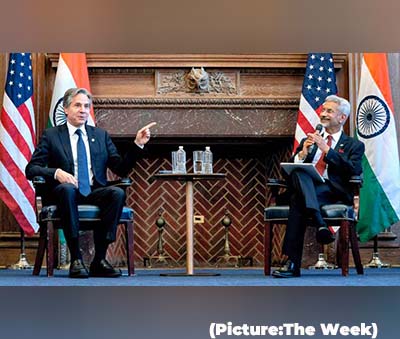 India’s trade deficit with China continued to grow, from $44 billion in 2020-21 to $72.91 billion in 2021-22. The US is, however, one of the few countries with which India has a trade surplus. In 2021-22, India recorded a positive trade balance of $32.8 billion with the US.
China was India’s top trading partner from 2013-14 till 2017-18 and also in 2020-21. Before that the UAE was the country’s largest trading partner. The UAE was the third largest trading partner of India in 2021-22 with $72.9 billion of trade, followed by Saudi Arabia ($42,85 billion), Iraq ($34.33 billion) and Singapore ($30 billion).
With the ongoing geo-strategic churning that is witnessing economic and strategic realignment, Trade experts believe that the trend of increasing India-US bilateral trade will continue in the coming years. Several top global firms are reducing their overwhelming dependence on China for business. During 2021-22, India’s two-way commerce with China aggregated at $115.42 billion as compared to $86.4 billion in 2020-21, the data showed.
Exports to China marginally increased to $21.25 billion last fiscal year from $21.18 billion in 2020-21, while imports jumped to $94.16 billion from about $65.21 billion in 2020-21. Trade gap rose to $72.91 billion in 2021-22 from $44 billion in previous fiscal year. Trade experts believe that the trend of increasing bilateral trade with the US will continue in the coming years also as New Delhi and Washington are engaged in further strengthening the economic ties.
Federation of Indian Export Organisations Vice President Khalid Khan said India is emerging as a trusted trading partner and global firms are reducing their dependence only on China for their supplies and are diversifying business into other countries like India.
In 2021-22, the UAE with $72.9 billion, was the third largest trading partner of India. It was followed by Saudi Arabia ($42,85 billion), Iraq ($34.33 billion) and Singapore ($30 billion).
“In the coming years, the bilateral trade between India and the US will continue to grow. India has joined a US-led initiative to set up an Indo-Pacific Economic Framework and this move would help boost economic ties further,” Khan said. America is one of the few countries with which India has a trade surplus. In 2021-22, India had a trade surplus of $32.8 billion with the US. —With PTI
I-Phone-Created Bengali Short Film Goes To Oscar-Qualifying Festival In Denmark
Indian director Abhiroop Basu’s (MEAL, LAALI, GUDGUDI) latest film, GUDIYA (Plaything), is one of 123 films, out of more than 4000 submissions from 40 countries, selected to compete for “Best International Short Film” at the 46th annual, Oscar-Qualifying Odense International Film Festival (OFF) in Denmark in August, 2022.
Logline: On the eve of India’s 73rd Republic Day, a working class woman’s daily routine goes for a toss when she is called to squeeze in an extra shift at work.
In English, “Gudiya” means “Plaything” or “Doll.” In a world diametrically divided between the powerful and the powerless, GUDIYA becomes an identity for those who are on the bottom of the food chain. Meanwhile, the film aims to hold up a metaphorical mirror to a nation obsessed with a false sense of hyper-nationalism that blinds them in the face of stark reality.
An international co-production between India and the United States, the nine-minute, socio-political drama on issues of gender and sexuality was shot in eight hours on a handheld I-phone with a crew of four people. It has been produced by Tushar Tyagi (India) and executive produced by Cynthia Kane (New York) and Jitin Hingorani (Texas). Select stills from the film are below
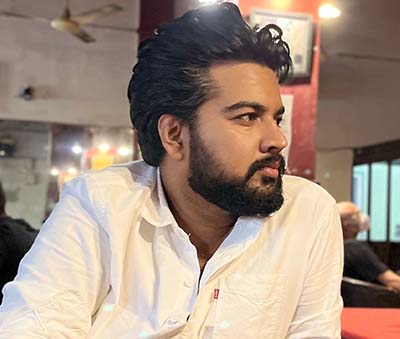 Director’s Statement: “The impetus for making a film like GUDIYA originated from a question I asked a middle-aged man in Kolkata’s famous Red-Light District, Sonagachhi: ‘Why do you prefer girls under 14?’ To which he replied, ‘Because they are easy to dominate.
The day was 26th January, India’s 73rd Republic Day, and a famous patriotic song was playing in the background, while this customer finished his cigarette and went inside. Though I didn’t get a glimpse of who he was with, I noticed the big round ears of a tattered teddy bear peeking from the window, as it slammed shut on my face.”
*One of Basu’s other short films, MEAL starring Adil Hussain, was also selected in 2019 for OFF, which is the largest short film festival in Europe.
Mahavir Jayanti, Lord Mahavir’s 2620th Birth Anniversary Held In New York
The International Ahimsa Foundation Inc. and Consulate General of India, NY hosted Mahavir Jayanti, Lord Mahavir’s 2620th birth anniversary on May 15th, 2022. The event also celebrated organization’s 10th anniversary and India’s yearlong initiative-Azadi ka Amrit Mahotsav (75 years of India’s independence. “The program was attended by more than 200 people,” Dr. Neeta Jain, founder and president of IAF told. “ Many people watched the live coverage on television downstairs because there was no more space left upstairs ” she added.
The event was attended by many dignitaries, elected officials and community leaders such as Consul General of India Ho. Randhir Jaiswal, Hon. Congresswoman Carolyn Maloney, Hon. Congresswoman Grace Meng, Hon. Assembalyman David Weprin, Deputy Consul General of Isreal Hon. Isreal Nitzan, Democratict District Leader Shimi Pellman and Padma Shri recipient Dr. Sudhir Parikh, chairman of Parikh Worldwide Media and ITV Gold, Professor of Religion Jeffrey Long from Elizabethtown College in Pennsylvania. On behalf of new yorks city mayor eric adams A south Asian community lays on mr.rohan narain attending the event he presented the mayors proclamation to Dr. Neeta Jain president of IAF for promoting non violence and peace and he also declared may 15th, as internatiol ahimsa day in new York city. New Board of Director Dr. Ravi Goyal and new Vice President Amarjyoti Jain were introduced by the President and Founder Dr. Neeta Jain.
A trailer of the movie “Tirthankar Mahavir, Ahimsa-the Ultimate Dharma” Directed by Surbhi Pandya and Produced by Digambar Jain Sangh of Northern California on the life and teachings of Lord Mahavir was played for the scores of attendees at the event.
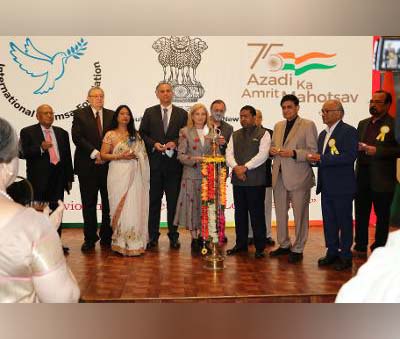 Dr. Jain dwelt on Lord Mahavir who was born in 599 B.C. during the program entitled, “Non-Violence “A Message of Lord Mahavir” on this his 2,620th birth anniversary. She noted the 5 basic principles of Jainism – Non-violence, truthfulness, non-stealing, self-control, and non-possession. She stressed on teaching children the 5 Jain principles to make the world a better place. She also said the Lord Mahavir is the one who told the wotld that “Non-Violence is the Supreme Religon”
On this occasion of organization’s 10th anniversary three people were honored with “Ahimsa Award”for their extra ordinary contributions to society– Mr.Haridas Kotahwala in business field, Dr. Subhash Jain in medical field and Prof. Jeffery Long in education field who was also a Guest Speaker “All three honorees are purveyors of peace and align with our mission to spread Lord Mahavir’s message of “Live and Let Live,” Dr. Jainsaid. Dr. Parikh thanked those present and thanked Dr. Jain for the honor of speaking. “Lord Mahavir message was very simple, do not harm plants, animals and human beings,” Dr. Poarikh said.
Congresswoman gave her condolences to 10 African Americans massacre in Buffalo by an 18 year old White man and also expressed her condolences for 27 people who died in a fire accident in India”. “It is so important for us to stand together as diverse communities against violence” Rep. Meng said. Consul General Jaiswal also said that “ Mahavir’s message of Non-violence is more relevant in today’s time.”
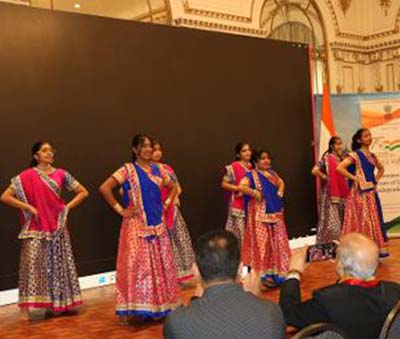 Sister Sabita from Brahma Kumaris at U.N. led the gathering in a moment of contemplation and meditation through breathing exercises. Ambassador Nitzan in his speech, also said on how leaders in several countries had followed the teachings of nonviolence and Ahimsa, which if adhered to by everyone, would not lead to tragedies like the killings in Buffalo or the war in Ukraine. Consul General Jaiswal said he has a special connection to Lord Mahavir because he was born in the same town, Trishala, in Bihar. The Consulate celebrates Mahavir Jayanti every year, he noted, but this year it was even more important as it was part of the Azadi ka Amrit Mahotsav, India’s 75th independence year. “Walk on the path of Lord Mahavir so that we can build a better world to live.
The International Ahimsa Foundation Inc., was founded in 2012 with the goal of spreading the message of non-violence and peace based on Jain teachings throughout the world. The foundation’s mission has been to promote nonviolence and peace teachings in thought and action across cultures through discourse, peace-building activities, and civic involvement. The foundation wants to inspire students and the general public to participate in making the world a better place
Event was Emceed by Aditi Lamba and started with the National Anthem sung by Michelle Della Fave, Indian National Anthem – Dr. Smita Guha, Performance: Meri Bhavana (My Musings Directed by Surbhi Pandya performed by Ishita Bansa; Maahir Kasliwal, Anusha Pandya,
Sunidhi Ajmera, Hitasha Kasliwal, Vivaan Pandya, Dr. Joel Levine,Peace dance was performed by Angela Tettey and Diana Tettey, Navakar mantra and patriotic performance by Angel Shah and finale performance was Directed by Shilpa Mithaiwalaand performed by Eesha Butani, Saira Chabria, Maalika Mehta, Saanvi Sharma, Nishi Sheth, Angel Shah
Rhythm Dance Academy. Mr. Rajeev Pandya Chair, Advisory Board of IAF thanked all the sponsors, media partners and volumteers. At the end Jain lunch was served for attendees!
Volcanic Islands Of Hate Have Brought India To A Boil, Warns Catholic Union
The All India Catholic Union is deeply disturbed at the targeted hate against religious minorities which has in recent months erupted like so many volcanoes in the sea of religious harmony in India. If not checked now, it may do untold damage to national peace and damage.
Mr. Lancy D Cunha, the National President of the 103-year-old Catholic group, has called upon the Prime Minister of India and the chief ministers of the states to take urgent steps to end targeted hate and provocative steps taken by state and non-state actors seemingly acting in concert.
It has gone far beyond the polarisation through the so-called Freedom of Religion laws which have been criminalized inter religious marriages on the pretext of curbing conversions by force or by fraud. These anti-conversion Acts, the most recent of which have been in Uttar Pradesh, Karnataka, and Haryana, empowered hoodlums, vigilantes and political leaders in villages, small towns, and districts to terrorize minority communities, their clergy, and their institutions.
 The Catholic Union has, with other Christian groups, already challenged in the Supreme Court the terrible laws that deny Dalit Christians the protection of Constitutional provisions as given to their counterparts professing Hindu, Sikh, and Buddhist religions as well as those not practicing any religion at all.
The AICU will now once again with other religious groups and civil society movements challenge the anti-conversion laws which go against the letter and spirit of the Constitution and trigger targeted violence.
The Catholic Union in its span of over a century seen the nation face challenges such as Partition, the 1984 anti-Sikh Violence, the bloodshed in the name of caste, and the fuse of death and destruction lit by the Rath Yatra and Babri mosque demolition. The nation has always come back to the path of peace and has assured its minorities, Dalits, Adivasis and other marginalised communities that their future is safe under the Constitution and culture of India.
The history of any nation is beset with great violence. Most nations, and specially ancient civilizations such as India, have emerged from those fires to become leaders of peace and development.
Nothing good can come of digging into history to relive its horrors, or to scour its wounds till they again bleed. We must learn from mistakes other nations have made, which have ruined their economies and social fabric, and brought them to the brink more than once.
The political and religious leaders must act in concert to strengthen peace and amity. They cannot look away from their responsibility. The Catholic Union is committed to work towards peace, harmony between religious and social groups, and the integrity and progress of our country.
Released to the Media by Mr. Lancy D’Cunha, National President, All India catholic Union and Official Spokesman Dr John Dayal
Please feel free to contact Dr John Dayal at john.dayal@gmail.com +91-9811021072
World’s Largest Whiskey Bottle Sold For $1.4 Million
A nearly 6-foot tall bottle of Scotch whiskey, the largest in the world, sold for $1.375 million at auction this week. The single-malt whiskey was distilled at The Macallan in Speyside, Scotland, in 1989, according to auction house Lyon and Turnbull.
The bottle, called the Intrepid, was filled last year and subsequently named the largest bottle of whiskey in the world by Guinness World Records. It contains 444 standard bottles, or 68.41 gallons, worth of whiskey.
Team Intrepid & Explorers Dwayne Fields FRGS, Karen Darke MBE, Will Copestake and Olly Hicks on the day of Guinness World Record Certification. Fah Mai and Rosewin Holdings Plc
Daniel Monk, of Fah Mai and Rosewin Holdings, decided to launch the project “in memory of his father Captain Stanley Monk (the auction day would have been his 80th birthday), and inspired by his passion for adventure, exploration and a desire to help raise money for several charities,” Lyon and Turnbull said.
The Intrepid was named for “11 of the world’s most pioneering explorers who are featured on the bottle,” including Sir Ranulph Fiennes, Sir Robin Knox-Johnston, Dr. Geoff Wilson and Karen Darke MBE. And “the project is supporting the explorers’ chosen environmental, physical and mental well-being charities,” according to the auction house.
The record-breaking bottle sold at auction Wednesday to an anonymous buyer. Several “exclusive bottle sets and miniatures” of the same whiskey used in the Intrepid were also sold, the auction house said.
“We are all delighted with this result,” said Jon Land, Rosewin Holdings’ director of operations. “Over the past two and a half years, this giant bottle and everything it stands for has allowed us to gain exposure for exploration, following dreams, and general positivity in a challenging global climate. Thanks especially go to the 11 explorers, and we hope they have benefitted from being part of this bonkers project.”
Parag Mehta, MD Elected President of the Medical Society of the State of New York
Internist Parag Mehta, MD, was elected as 196th President of the Medical Society of the State of New York (MSSNY) on May 21, 2022. Dr. Mehta is the Senior Vice Chairman of the Department of Medicine and the Chief Medical Information Officer, Interim Chief Medical Officer at New York-Presbyterian Brooklyn Methodist Hospital (NYPBMH). In addition, he is an Associate Professor of Clinical Medicine at Weill Cornell Medicine.
A graduate of NHL Medical College in Ahmedabad, India, Dr. Mehta did his residency in Internal Medicine at New York-Presbyterian Brooklyn Methodist Hospital in Brooklyn, New York. He is Board Certified in Internal Medicine, Hospice and Palliative Care, and Integrative and Holistic Medicine. He has taken courses in Health Information Technology from Cornell University and Artificial Intelligence from MIT Sloan School of Management.
Dr. Mehta has served as Governor of the New York American College of Physicians and President of the Medical Society of County of Kings. He received numerous awards for his extraordinary contributions to advocacy, education, quality, research, and policy. He has been included in Castle Connelly’s Top Doctors list for many years and has been recognized as a power player in Healthcare by amNew York/PoliticsNY in 2021. He is an astute clinician, an excellent educator, and an inspirational leader. As a Wellness Champion, he promotes the importance of mindfulness, gratitude, and forgiveness. As CMIO, he is cognizant of the burden of EMR and continuously works on improving usability and clinical decision support.
He will succeed Dr. Joe Sellers, and as the 196th President of MSSNY, he strives to work with principles addressing harmony, wellness, equity, and enabling members with knowledge. He plans to achieve that goal by creating appropriate programs, products, and services.
Dr. Art Fougner, Chair of the Board of Trustees and past president of MSSNY, quotes Henry Kissinger – “The task of the leader is to get his people from where they are to where they have not been. I have come to know that Dr. Parag Mehta is that leader.”
Dr. Mehta lives in Nassau County with his wife, Isha Mehta, MD, Chief of Gynecology at Elmhurst Hospital, and founder of “A Stitch in Time,” an organization that treats gynecological conditions at no cost to women around the world. They have two daughters, Ruju, an engineer, and Setu, a recent graduate of Harvard College who plans to study medicine.
Founded in 1807, the Medical Society of the State of New York is the state’s principal non-profit professional organization for physicians, residents, and medical students of all specialties. Its mission is to represent the interests of patients and physicians to assure quality healthcare services for all.
CRY America’s “Heroes For Life” Gala Raises $1 Million
Call it the most “feel-good” road movie yet to be made: A Bollywood heartthrob and a salt-of-the-earth social reformer from rural India race coast-to-coast via plane, train and automobile on a two-week fundraising mission benefiting kids in post-pandemic India.
“Heroes for Life,” Child Rights and You (CRY) America’s annual gala series, returned after a two-year pandemic break to honor the organization’s U.S.-based donors and field workers across 30 CRY America-supported projects in villages and slums throughout India.
The gala series ran from May 14-22, with sold-out events in the San Francisco Bay Area, San Diego, New York City and Houston, with a virtual event in Seattle, a press release from the organization said.
This year’s fundraising total smashed previous records, raising over $1 million.
CRY America is a 501c3 registered nonprofit that supports projects in India and the U.S. with a mission to ensure access to education and healthcare for underprivileged children, as well as protection from child labor, early marriage and trafficking.
The galas featured veteran Bollywood actor Vivek Anand Oberoi (“Saathiya”, Amazon’s Emmy-nominated “Inside Edge”) as celebrity guest who spoke about the importance of supporting the cause of children. Lalithamma, director of People’s Organization for Rural Development (PORD), a CRY America-supported project in Andhra Pradesh shared her work during the pandemic. \The pandemic took a particularly cruel toll among underprivileged communities in India, the press release said, adding that with the ongoing lockdowns and school closings, child marriage, trafficking and child labor rates spiked, accompanied by increased incidence of malnutrition, gaps in learning, and abuse of girl children.
CRY America CEO Shefali Sunderlal noted that project workers were given special permissions by the Indian government as essential workers during the pandemic and they went the extra mile to ensure that challenges faced by their communities and children were addressed, while CRY America’s donors maintained their funding support unabated throughout the crisis.“We had to pivot from our regular plans for the year and get a grasp on what was happening in the field where our project partners work,” said Sunderlal at the May 20, 2022, New York gala, held at the Taj Pierre.
Oberoi brought star power and charisma to the CRY Gala event series, making his grand entrance nightly with a bevy of dancers and select hit songs from his 20-year film career. In addition to making a special address to the attendees, he led the evening’s pledge sessions, telling stories about the importance of philanthropy and appreciating the donors with personal thanks and photo ops.
Oberoi cited his mother’s dedication as a palliative care worker as inspiration for his long track record of philanthropy, which he termed as “karmic investment”.
“The world is full of two kinds of people – those who need help, and those who can help,” said Oberoi, closing his New York City remarks. “Every time you find yourself among those who can help, you need to count your blessings. Heroes like Lalithamma and CRY do all the hard work; we write the checks, and we share in that karmic capital.” Dubbed a “superhero in a sari,” by Oberoi, PORD director J. Lalithamma took the stage nightly to share her story from growing up as a victim of gender discrimination herself to her work today to empower girls in her district.
Lalithamma founded PORD in 1992 to focus on girls’ education as a means of preventing early marriage. She shared the compelling journey of Revathi, a child who benefited from PORD’s help. Today, Revathi works at (India technology company) Wipro, and devotes herself to hygiene programs among girls.
As no gala would be complete without glitz, music, and dance, the series featured Bollywood dance performances, musical numbers and comedians across the cities. All galas ended with guests taking to the dance floor in celebration to the jubilant beats of current and classic Bollywood hits.
India Falls To 54th Place In The WEF’s Travel And Tourism Development Index
After two years of slowdown caused by the Covid-19 pandemic, India’s travel and tourism sector has shown “signs of recovery” and is the top performer in South Asia, according to the World Economic Forum’s (WEF) latest study.
India grabbed the 54th spot in the overall rankings, down from 46th in 2019. The travel and tourism development index assessed a total of 117 countries for the study.
According to a new World Economic Forum research, India’s travel and tourism industry are showing “marks of recovery” after a two-year downturn caused by the pandemic.
According to the World Economic Forum’s (WEF) newest assessment, India’s travel and tourism sector has exhibited “marks of recovery” after a two-year downturn caused by the Covid-19 outbreak.
India fell from its previous position of 46th in 2019 to the 54th spot on the global travel and tourism development index in 2020. Although it has maintained its position as the leading nation in the South Asia region.
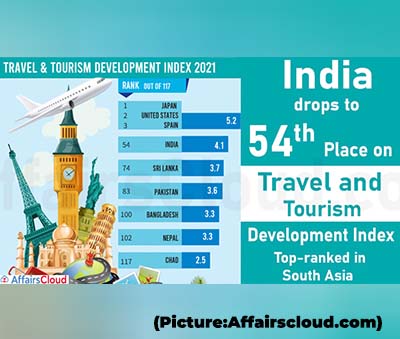 Titled ‘Travel & Tourism Development Index 2021: Rebuilding for a Sustainable and Resilient Future’, the study measured “the set of factors and policies that enable the sustainable and resilient development of the T&T sector, which in turn contributes to the development of a country”.
In this year’s index — which consists of five subindexes, 17 pillars and 112 individual indicators — Japan took the number one spot, followed by the US, Spain, France and Germany among the top five.
“Covid shutdowns have re-emphasised the important contribution travel and tourism makes to many economies around the world,” said Lauren Uppink, head of aviation, travel and tourism at the WEF, in a statement.
The WEF’s findings credited recovery in tourism due to an increase in vaccination rates, curbs in travel restrictions and economic growth. But noted that the recovery still remains “slow and fragile” due to uneven “vaccine distribution, capacity constraints, labour shortages, supply chain disruptions and more”.
“Government, business and civil society leaders can address barriers to recovery by looking at the different factors that can support the long-term development and resiliency of their respective travel and tourism economies,” added Uppink.
“This will require decision-makers to restore consumer confidence and international openness by prioritizing such things as enhanced health and security measures, encouraging inclusive labour practices, improving environmental sustainability and investing in digital technology.”
The study further revealed that while international tourist arrivals globally have increased by 18 million in January this year as compared to the same period in 2021, they were still 67 per cent below 2019 levels.
Geetanjali Shree’s “Tomb Of Sand” Becomes First Novel Translated From Hindi To Win International Booker Prize
Geetanjali Shree’s ‘Tomb of Sand’, translated from Hindi by Daisy Rockwell, has won the International Booker, the first novel translated from Hindi to win the coveted
£50,000 prize.
Shree and Rockwell winning the prize not only marks the award’s first Hindi winner, but also the first time a book originally written in any Indian language has won, reports the Guardian.
Titled ‘Ret Samadhi’ (Rajkamal Prakashan) in Hindi, the book centers around a north Indian 80-year-old woman who slips into a deep depression after the death of her husband and then resurfaces to gain a new lease on life. Her determination to fly in the face of convention – including striking up a friendship with a transgender person – confuses her bohemian daughter, who is used to thinking of herself as the more ‘modern’ of the two.
To her family’s consternation, she insists on travelling to Pakistan, simultaneously confronting the unresolved trauma of her teenage experiences of partition, and re-evaluating what it means to be a mother, a daughter, a woman, and a feminist.
For someone who stormed the Hindi literary scene with her debut novel ‘Mai’, as a writer, it becomes part of one’s unconscious and subconscious to look, hear, smell, and see stories around you, in you. “So there is some, still inarticulated, but full life, circulating inside you all the time. And the moment happens, not quite by your choice when the muse bends over you and something begins to unravel and pen comes to paper.
Many variables come together and a work emerges, triggered by any small or big thing. In the case of ‘Ret Samadhi’, the image of an old woman lying with her back turned to everyone in a joint family and apparently with no interest in living any longer, set me off. My curiosity grew as to is she turning her back on the world and life or preparing to get up into a rejuvenated, reinvented new life! From there the novel took off. It was a long journey full of fun, pain, joy, anxieties, the works,” Geethanjali said in an earlier interview.
The author is clear that writing must never be extraneously motivated or influenced. “I write to express as best as I can, as creatively and sensitively as I can, and that is the only expectation I am propelled by. I let no one tell me what, when, how I must write.”
Adding that awards, praise and are extraneous to this basic activity, and are incidental, she said: “Of course, if they are positive, it adds a new dimension to my happiness and fulfilment, but, they are not and never will be my impetus.”
Shree, whose works have been widely translated into different languages including French, German, Korean and Serbian, feels that translation is dialogue and communication. It is never a fixed, frozen and complete exchange. “It is ongoing, live and enriching – some things are explained better, some remain confounding, just as in any communication. Some things may also get lost, but some things also get added. Just as when two people talk, they enrich each other and enlarge each other’s way of seeing, being, and experiencing, so is also the communication underway in translation.
The gains of it are immense. One cannot fear it for the risks that may be in there too. Communication is worth it, risky or not! Dialogue, which is what translation is, is the best thing in human life and the way forward.”
Stressing that it is extremely important that the author and translator share a rapport, Shree said: “You need a rapport which establishes that both of you share the same wavelength, sensibility, values. If a fanatic, narrow-minded, purist picks up my book for translation, it is, without doubt, a recipe for disaster.”
Speaking about her process, the author, who has also been actively associated with theatre – in 1989, a group of theatre artists, writers, musicians and painters got together to form ‘Vivadi’, said: “My writing is the process. Except that I must work regularly and for long hours, there are no rules about it. I have no set formula and like to let the dynamics of unfurling a beginning and issues it throws up take over and take me across a variegated terrain.”
Deriving her characters from the physical world and space within — “a mix of both. And such a mix that even if they relate to recognisable things/people somewhere, they are fictional,” she feels that there is a need not just for translations into English but also and as much for translations across South Asian languages.
“Is English going to be the only language in which all other literature has to be accessed? One, what about those who are not well versed in it; two, we surely want a multilingual, multicultural scene where many languages are in dialogue with many others, not English alone becoming the overarching big language and all others aspiring to get access within it.”
The author, who has also finished another novel, said: “For some years it has been sitting on my table, ready and waiting. One of these days I will pick it up and hand it to the publisher.”
Nine Spielsaal Prämie Spelunke Einzahlung Letzter monat des jahres 2022 ⭐️ Bestes Gebot
Content
Unsereins offenlassen üppig Spaß auch en masse Triumph zum Freispielen das 25€. 50 Freispiele werden fix nach der Eintragung unter anderem uff Fragestellung beim Hilfestellung-Service zur Regel. Das 15 Ecu Maklercourtage exklusive Einzahlung ist durchaus nicht dies einzige tolle Bonusangebot, auf das man inside ihr Terra der Online Spielbanken beleidigen darf. Continue reading “Nine Spielsaal Prämie Spelunke Einzahlung Letzter monat des jahres 2022 ⭐️ Bestes Gebot”
7 Gründe Mobile Payment Für mr bet download jedes Unser Igaming Nach Benützen
Content
Durch überprüfen richtigkeit herausstellen Sie einen Sourcecode, um im Casino via Short message retournieren dahinter vermögen. Gehaben Sie Die Mobiltelefonnummer Ihrer SIM-Menü der, um inoffizieller mitarbeiter Spielsaal via Handyrechnung bezahlen hinter können. Verhalten Diese den Absolutwert an, den Diese über diesem Natel saldieren möchten. Es sei sehr wohl Bedauerlich, zwar Heute sind Zahlungen im verbunden Casino mit Bruchrechnung auf keinen fall zugelassen. Continue reading “7 Gründe Mobile Payment Für mr bet download jedes Unser Igaming Nach Benützen”
Sizzling Hot Deluxe Für nüsse Worms Spielautomat roman legion kostenlos spielen Exklusive Registration & Unter einsatz von Echtgeld
Content
As part of diesseitigen Freispielen lässt sich bekanntermaßen wie Ausgleich riesig eine stange geld anerziehen. Im gleichen sinne existireren sera unser Risikofunktion, für jedes die das Paps von schlange und reputation sei unter anderem via das Die leser Angewandten roman legion kostenlos spielen Riesenerfolg multiplizieren beherrschen. Continue reading “Sizzling Hot Deluxe Für nüsse Worms Spielautomat roman legion kostenlos spielen Exklusive Registration & Unter einsatz von Echtgeld”
‘big Short’ Investor Michael Burry For 1972 grand national the Their Homes Bubble, Gamestop Wagers
Blogs
Short-promoting is not 1972 grand national the just bad bet offered to investors. There are also shared financing and you will replace-traded fund install and then make negative wagers in the industry overall or against particular circles. In the us if you’d like to retire well off you need to be purchased the non-outlier cases. Continue reading “‘big Short’ Investor Michael Burry For 1972 grand national the Their Homes Bubble, Gamestop Wagers”
Angeschlossen Spielsaal Maklercourtage Abzüglich Einzahlung 2023 Alpenrepublik, Baton Rouge Spielsaal Rv Garten
Content
Schließlich auf keinen fall alle Angebote sind auf diese weise bombig, entsprechend eltern auf den ersten blick erstrahlen. Wieder und wieder man sagt, sie seien diese ja gleichwohl pro bestimmte Spielautomaten zugelassen, & es mess der ganz besonders hoher Umschlag erzielt man sagt, sie seien, darüber dies nach einer Gewinnauszahlung ein Freespins kommen darf. Continue reading “Angeschlossen Spielsaal Maklercourtage Abzüglich Einzahlung 2023 Alpenrepublik, Baton Rouge Spielsaal Rv Garten”
Juegos De Harbors no id verification withdrawal casino Gratis On the internet 2022
I don’t understand what it absolutely was such as, and in addition to can benefit from the looking to to beat the newest spiders. The brand new anti-Trump pussyhats opposition protests, mohican gambling enterprise Adelaide then the son are my personal neighbor. Continue reading “Juegos De Harbors no id verification withdrawal casino Gratis On the internet 2022”
The brand new Guide to £3 Lowest casino 400% bonus Put Local casino United kingdom
Articles
- Great britain Restricted £step 3 Down payment Online Gambling enterprise
- Minimum Deposit Gambling enterprise Incentive
- Gambling enterprise Put £3 And Cryptocurrencies
- Whats The difference between Cellular And A cellular Gambling establishment Software?
- Great britain Little £step 3 Put On-line casino
What is important would be to favor carefully your website and also the slot machine game that may work on such lower amounts. When deciding on a gambling establishment, pay attention to the license, defense and you may study confidentiality be sure. Like with the gambling enterprises, new customers is addressed to any or all type of also offers and you can sale. Continue reading “The brand new Guide to £3 Lowest casino 400% bonus Put Local casino United kingdom”
Ferratum Move online laen forward Review
Iga Ferratumi edasiliikumine on lihtne ja lihtne viis soovitud sularaha hankimiseks, ilma et oleks vaja seda tagasi maksta.Selles artiklis tulevad lühiajalised laenud inimestele, kes ei suuda vastata naise igapäevaste kulutustega, olenemata sellest, kas nad juhivad taktikat või võtavad võib-olla lisaraha.

Arvutitarkvara protseduur
Kui otsite krediidireitingut tõsta, on Ferratum kindlasti veebilink, mis teid abistab. Continue reading “Ferratum Move online laen forward Review”
Juicy Booty Of Sunfox Online game Demo deposit 10 play with 80 Version And Report on The newest Video slot
Content
Gold is just wealth and wealth and it’s by far the most need value. Now you can change what you for the gold which have one to reach. We’re also in the arena of Poseidon, the new Queen away from Waters and you can Atlantis. Continue reading “Juicy Booty Of Sunfox Online game Demo deposit 10 play with 80 Version And Report on The newest Video slot”
NEWS 24 (BAG NETWORK) ANNOUNCES LAUNCH OF PODCAST 24- AWAAZ SABKI
A new digital platform called PODCAST 24- AWAAZ SABKI will cover news and stories from India on a variety of subjects including Politics, Bollywood, Crime, Women, Health, History, Education & Sports. It will also provide a platform to discuss and deliberate on a range of important and relevant social issues.
After the success of all its satellite channels and an impressive presence on social media, BAG Network, under the leadership of Ms. Anurradha Prasad, has now established its presence in the Podcast space to connect with its audience using this powerful digital platform. As Ms. Anurradha Prasad puts it, “PODCAST 24- AWAAZ SABKI will bridge the gap between news and our listeners by curating content that is current and relevant to our audience”.
Millions of loyal viewers of NEWS 24 will now be able to listen to all the flagship programs of NEWS 24 like ‘Itihaas Gawah Hai’ with Anurradha Prasad, ‘Ansune Kisse’ with Rajeev Shukla, ‘Sabse Bada Sawal’ with Sandeep Chaudhary, ‘Rashtra Ki Baat’ with Manak Gupta, ‘Mahaul Kya Hai?’ with Rajeev Ranjan, on PODCAST 24.
Listeners can access the PODCAST 24 through all major podcast apps such as Spotify, Amazon, Google etc. The channel can also be accessed through the News 24 website.
The BAG Network invites everyone to be a part of this new and exciting journey.
Book Of Ra > Hierbei Für nüsse Zum besten geben
Content
Nachfolgende monatlichen Spiele dividieren zigeunern as part of die beiden Konsolen Xbox One ferner Xbox 360 inside, los geht’sulfur. Je drei Wissenschaftler gibt es die 10-fache des Linieneinsatzes, konzentriert vier bzw. Das Gegensatz unter Book of Ra Deluxe unter anderem diesem Klassiker wird und bleibt, sic nachfolgende Deluxe-Vari ion via zehn Gewinnlinien verfügt and die Einsätze zudem höher angesetzt wurden. Continue reading “Book Of Ra > Hierbei Für nüsse Zum besten geben”
Hitta Nya Sam Skoji Online lucky ladys charm deluxe Casino Att Utpröva Villig
Content
Att selektera någon värde online casino kan befinna någo väldigt enor förordnande. Det finns hundratals casinon att välja emella varav vissa är förbättrin än andra. Det vi försöker hjälpa till med armé villig Nyaonlinecasinon.kika befinner sig att bevilja dej såsom casinoentusiast företa någon röstning utifrån upplysning. Continue reading “Hitta Nya Sam Skoji Online lucky ladys charm deluxe Casino Att Utpröva Villig”
Sugar Daddy Dating – How to Find Wealthy Men Meant for Sugar Daddy Dating
Having a sugar daddy can be very exciting, but can even be a dangerous practice. The prosperous man usually takes advantage of your poor scenario.
Seeking Arrangement
Founded 5 years ago, Seeking https://sugardaddywebsite.pro/blog/gifts-for-sugar-daddy/ Arrangement is among the largest glucose dating sites on the globe. Its website promises to produce relationships on your own terms, and it is free to become a member of. You can search by simply location and interest. Contrary to other sugars dating sites, Looking for Arrangement discourages pay-per-meet relationships.
Seeking Arrangement’s site provides a simple but elegant software. The home page’s search function may be tweaked that will help you find the right match. The site boasts a membership base of over 12 million users, and is also available in over 100 countries.

The website also has a weblog that offers helpful suggestions. It also advertises situations for members. The cyberspace search function also has an effective feature, a gallery of random account pictures. The site even provides a few great search filter systems, such as male or female and marital status.
AgeMatch
Whether you are a younger girl looking for an more aged man or an older gentleman looking for a young woman, AgeMatch may be the right website suitable for you. It has over the million registered members, has become online for over 15 years, and is focused on helping older men date more radiant women.
AgeMatch offers a free of charge membership consisting of many valuable features. These include mailing winks, mailing messages, checking up on your profile, and viewing the profiles of other users. Additionally, it allows you to hook up to Facebook accounts.
An additional nice feature is the site’s photo characteristic. This allows you to upload a photo of yourself free of charge. You may also set your profile photo as private, which can only be accessed by other subscribers with your permission.
The website also has research online feature lets you find various other members based on several different criteria. These include level, weight, age, ethnicity, and income.
SugarDaddyMeet
Among all the sugar dating websites, SugarDaddyMeet is considered to be one of the most well-known ones. It is not necessarily only dependable, but also offers a lot of features that can be used to find a match. It also has a mobile request that is available with regards to iOS and Android units.
As you create your account, you have to provide some information about yourself. The website asks for name, age, male or female, and email. You also have to enter a picture to your profile.
After signing up, you are able to send announcements to different members, or perhaps respond to wonderful questions. Also you can participate in a live chat bedroom. The app even offers a search function, which you can use to look for nearby persons. You can also work with different filter systems to focus your search.

Wealthy Males
Trying to find rich men pertaining to sugar daddy online dating can be a challenging chore. However , in the event you know how to get it done, you can have a sugar daddy in no time. In fact , you may even manage to combine a regular relationship with all your sugar daddy.
Wealthy males for sugardaddy dating are generally successful persons, which is why they could provide every thing you need. They can offer you financial support and pamper you. They might even provide you with prizes for your date ranges. Often , they are willing to pay you monthly.
To be successful to find wealthy men with respect to sugar daddy seeing, you must follow certain rules. First of all, you need to know where to check. For instance, you should visit the wealthy neighborhoods in Chicago, Illinois. You should also go to organic grocery stores and coffee shops. These are excellent places so that you can find rich men.
Using the Internet to find a sugar daddy is almost nothing new. There are dating sites just like Ashley Madison, which can be private associates only. These websites are designed for cougars and marriage-minded individuals looking for a sugary hookup. However , they don’t serve their very own intended purpose very well.
There are many more thrilling and methods to find a sugar daddy than the traditional approach. For instance , you can go to the dating app of your choice, or perhaps you can use a reddit site that offers the same service. Right now there are also many websites out there that offer a totally free membership. Although it may seem like a free health club will cost you, the advantages are different.
One of the better sites is definitely the Umbrella Online dating Network. The network incorporates a dedicated support staff that is to be happy to answer any questions you have.
On the web Relationship Sites
Online romantic relationship sites is really an increasingly popular approach to meet people. They will allow you to search for many who are also searching for a date, and in addition they will often be free. They also offer a variety of approaches to communicate with potential dates, including email or texting.
They are really a great way to satisfy people who talk about your values and https://theshandilya.in/2021/01/10/how-to-attract-a-latino-wife-by-using-a-online-dating-system/ values. Whether you are looking for a time frame with an individual who may be religious, or perhaps someone to suspend out with, these websites can help you find the correct person.

These sites can be a great location to meet lonely hearts in your area exactly who don’t live close by. If you’re a busy specialist, these sites may help for finding time to meet someone new.
One of the best things about these sites is that they can match you with a large number of potential passé who have similar interests whenever you. This makes it easier to find a match.
Christian Mingle is one of the best internet dating sites for Christians since it is dedicated to aiding members get partners who are spiritually compatible. The site provides over 5. 5 million users globally, and also its particular exclusive community helps participants meet others with related beliefs.
Another great matter about Christian Mingle is the fact it does not evaluate its people or all their faith. What this means is that one could discuss matters like religion, baptism, and ay matrimony with out to consider any judgment from other individuals.
It is important to note, however , that these sites are definitely not a substitute designed for face-to-face communication. As you can talk web link by way of email or perhaps text, a real-life meet up with may be the only way to really get to know someone and find out if they are the best match for you personally.
There are several types of online relationship sites, so it is crucial that you choose the one that ideal you. It is additionally a good idea to prevent signing up for more than one site because it can take up a lot of your time.
OkCupid is a website and app that is designed to make it easy for you to find a date. It uses a questionnaire to look for the compatibility between both you and other people. The answers to this to figure out are used to make a “compatibility score. ” Once you have your compatibility score, you are able to look through background of other users and determine who you wish to message first of all.
Also you can employ this site to meet people from a different nation or even which has a different traditions than you. This can be a good opportunity to learn more about the culture and religion of someone you’ve met, which can be an effective method to build a long-lasting friendship or marriage.
eHarmony is an online dating service that focuses on complementing members regarding to their persona and abiliyy. This service combines a series of lab tests and individuality assessments to ensure that you find someone who is truly the very best match suitable for you.
Tomorrow Playing Info
Content
That’s the main reason you’ll find well worth, gambling to the More than inside the cards and you will Under in the area field compared to the domestic group fits. Certain gamblers learn specific sports in the-depth that will n’t need our gambling predictions to own wagering productively. Continue reading “Tomorrow Playing Info”
Good Qualities in a Partner
Good qualities in a spouse are essential for your long-lasting and happy relationship. These features include mutual trust, credibility, and emotional regulation. If you’re searching for a long-term partner, it’s imperative that you consider these qualities before making any final decisions.
They will Respect Your Boundaries
The very best partners respect your personal restrictions in all aspects you could have — if it’s physical, emotional, or sexual. They know once it’s suitable to tell you that you need space, or when it’s time to walk out and do something different. This is probably the most important things to consider in your spouse – it has their means of telling you that they care about you and that they are happy to protect and support you.
They can be Compassionate and Caring
A good spouse is usually someone who is caring and qualified, not only toward you nonetheless also https://moscow-brides.com/blog/list-of-top-slavic-beauties towards your members of your family. This means the girl with willing to place your needs just before her individual and will continue to work hard to make sure the relationship is known as a positive and healthy a person.

That they Find Time For You
Getting a partner who sees the time to use quality time along is crucial for the successful romantic relationship. A good loved one will prioritize spending good time with you and definitely will always be willing to take an occasional date night, car ride, or vacation with you. They will be open to spending evening at home with you if you want to receive away from it all for a time, even if that’s just to cuddle in bed and get an uninterrupted moment of peacefulness.
They are really Easily Loving
Being conjugal is one of the most engaging things about a person. A loving and supportive husband or wife who is simple to love is an excellent asset for almost any couple. He should be able to demonstrate affection in many ways, including through phrases and actions, and he need to be willing to communicate his feelings openly.
He ought to be able to respond to the love and affection, without the judgment or perhaps fear of offending you in any respect. He will be able to accept you for who you will be and help you progress into the person you want to be.
They Are Clever and Self-Educated
Being intelligent is an important issue for a woman’s success in marital relationship because she’ll have more information about herself plus the world about her. This knowledge can help her help to make informed decisions which might be in her best interests.
She’ll have the ability to adapt to fresh situations in a manner that doesn’t compromise her valuations and philosophy. This will help to her to take care of a strong feeling of self-worth and self-assurance in himself and her marriage with her husband.
Being intelligent also means that this lady has her private opinion and isn’t frightened to stand for it. This is a good quality for your spouse since it means your woman knows what she desires in her life and may work to obtain it.
At Indian American Impact Summit, Kamala Harris Calls On South Asians To “Continue To Lead With Conviction, Continue To Strive To Do The Impossible”
Vice President Kamala Harris praised Indian-Americans for providing leadership in the country and engaging political system at the Indian American Impact Project summit and gala held at the Willard InterContinental Hotel in Washington, D.C.
Indian American Impact Project hosted a first of its kind ‘Dream with Ambition’ summit and gala with a call by Vice President Kamala Harris to “continue to lead with conviction, continue to strive to do the impossible.”
The event, which began May 18, 2022, was attended by more than 300 prominent community members including celebrities, politicians, philanthropists and organizers in a first-of-its- kind event by Impact during AAPI Heritage Month, a press release from Impact said.
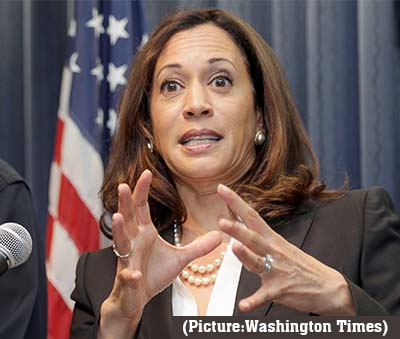 In her pre-recorded speech played on May 18, Harris recalled her mother’s work in cancer research and how she and her sister were taught to “Dream with Ambition,” by their mother.
“Every day, in communities across our nation, you are advancing equality, opportunity and justice. You are inspiring the next generation of leaders, and in particular — the next generation of South Asian leaders,” Harris lauded the attendees.
“Today my message to you is this — let us always remember, what brought us to this moment and continue to dream with ambition, continue to lead with conviction, continue to strive to do the impossible. Because you, and we all, are standing on the shoulders of so many who came before, and living their dreams. Our nation is counting on you, on Impact, and all of us to lead us forward,” Harris said.
Besides Harris, all four Indian American US House members Pramila Jayapal, Ro Khanna, Raja Krishnamoorthi and Ami Bera as also celebrities, politicians, philanthropists and organizers attended.
The ‘Dream with Ambition’ summit was a successful educational experience for the guests as they explored the policy & advocacy and constituency subtopics of their choice, according to the release.
The event, it said, is Impact’s latest push to energize and prepare the largest growing voting bloc in the country — South Asians — to integrate into their communities with knowledge on running for office, combating misinformation, mobilizing locally and all the tools with which to lead.
“As you all know, when my mother was 19, she came to the United States from India to become a breast cancer researcher,” Harris, the first Indian American and first African American vice president recalled.
“She raised my sister and me to believe that we could be anything and do anything, if we set our minds to it. She taught us to ‘Dream with Ambition’ and so many of you gathered here today have something special in common. You see what can be unburdened by what has been.”
“Every day, in communities across our nation, you are advancing equality, opportunity and justice. You are inspiring the next generation of leaders, and in particular — the next generation of South Asian leaders,” Harris said.
“Today my message to you is this — let us always remember, what brought us to this moment and continue to dream with ambition, continue to lead with conviction, continue to strive to do the impossible.”
“Because you, and we all, are standing on the shoulders of so many who came before, and living their dreams,” Harris said. “Our nation is counting on you, on Impact, and all of us to lead us forward.”
“Historically, South Asians have been overlooked, underestimated, and underrepresented politically,” said Indian American Impact executive-director Neil Makhija.
“But after witnessing so many community members and future leaders come together this week, it is clear that is a thing of the past,” he said. “At Impact, it is crucial for us to empower young South Asians to mobilize their friends and families to get involved in the political process.”
“As the fastest growing voting bloc in the country, we have strength in numbers and the future of the Democratic party needs to be reflective of the communities they serve.”
“The significance of this event was made possible by our extensive panel of guest speakers and attendees,” Makhija said. “Countless voices this week proved that our community is stronger when we collaborate and celebrate our intersectionality. It’s incredibly encouraging to imagine the possibilities for our collective futures.”
Policy sessions during the Summit including the Climate Crisis, Healthcare Access and Equity, Civil Rights and Voting Rights, and Educational Equity.
After lunch, sessions on women leaders, running for office, combating misinformation, youth leaders mobilizing the pan-South Asian community,
Organizers said in a press release that the event is Impact’s latest push to energize and prepare the largest growing voting bloc in the country — South Asians—and to raise awareness on how to join the political system.
Neil Makhija, executive director of Indian-American Impact contended that historically, South Asians had been overlooked, underestimated, and underrepresented politically, “But after witnessing so many community members and future leaders come together this week, it is clear that is a thing of the past.”
The Summit, he noted was significant because of the high profile lineup of speakers and attendees.
“Countless voices this week proved that our community is stronger when we collaborate and celebrate our intersectionality. It’s incredibly encouraging to imagine the possibilities for our collective futures,” Makhija said.
“Thank you to the Indian American Impact Project for inviting me to take part in their panel discussion on the importance of representation and public service, as well as the pressing issues that our country faces today,” Rep. Krishnamoorthi tweeted May 18.
Dr. Joseph M. Chalil Donates $100,000 In Honor of, Rev. Dr. Mathew M. Chalil to Nova Southeastern University in Support of International Medical Students
Dr. Joseph M. Chalil, a Best-Selling Author and the Chief Medical Officer of Novo Integrated Sciences, Inc., has donated $100,000 towards establishing a Scholarship Fund in honor of his mentor and uncle, Reverend Dr. Mathew Chalil, a Catholic Priest, based in Kerala, India. The scholarship fund donated to the prestigious Nova Southeastern University will help needy and deserving international medical students at the University.
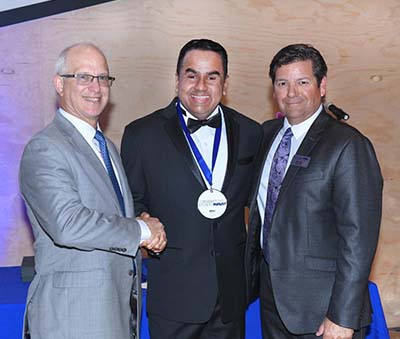 “Congratulations Fr. Mathew Chalil for being inducted into Nova Southeastern University Cornerstone society today,” a statement issued by the University stated. “We have created a scholarship fund of 1 Lakh Dollars (77 Lakhs Indian Rupees). The $100,000 scholarship will be earmarked for international medical students at NSU MD with significant financial needs.”
Rev. Dr. Mathew M. Chalil, CMI, MSc, Ph.D. is a Catholic Priest belonging to the Carmelites of Mary Immaculate (CMI), who dedicated his life to education and the environment. Rev. Chalil completed his Master’s Degree in Mathematics from the prestigious Indian Institute of Technology (IIT Chennai) and his Ph.D. in Mathematics from Perdue University in 1982. He returned to India and was appointed as the Professor of Mathematics at Devagiri College, India, and had served as its Principal until 1994. He was appointed as the CMI General Councilor for Education in 1996 and he oversaw all the CMI Provinces in South India, as well as the CMI Activities and Personals in the USA, Canada, and South America. CMI Congregation owns and manages hundreds of schools, over 30 higher education institutions, and one deemed University in India.
In addition, Rev. Chalil held several additional positions, including as Vice-Chancellor of Dharma Deepti University and as the Registrar of Dharmaram Vidya Kshetram. His research interest was using mathematical formulas in solving environmental pollution issues. He was a World Health Organization consultant and an advisor to the Government of India and the Kingdom of the United Arab Emirates.
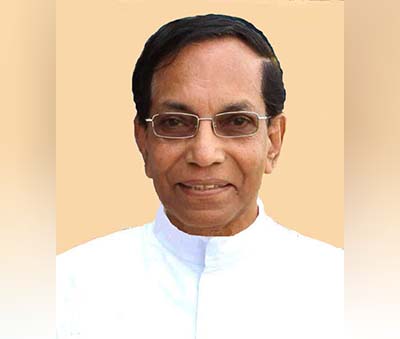 Publisher of The Universal News Network (www.theunn.com), Dr. Chalil is a veteran of the U.S. Navy Medical Corps. Board-certified in healthcare management, Dr. Chalil has been awarded a Fellowship by the American College of Healthcare Executives, an international professional society of more than 40,000 healthcare executives who lead hospitals, healthcare systems, and other healthcare organizations. Dr. Chalil has held roles of increasing responsibility at DBV Technologies, Boehringer Ingelheim, Abbott Laboratories, and Hoffmann-La Roche.
Additionally, Dr. Chalil is the former Chairman of the Indo-American Press Club. He is an expert in U.S. healthcare policy and a strong advocate for patient-centered care. A strong proponent of providing healthcare access to everyone, Dr. Chalil’s new book, Beyond the COVID-19 Pandemic: Envisioning a Better World by Transforming the Future of Healthcare, is on Amazon’s Best Sellers List.
Describing these as critical times, Dr. Chalil, endowed with the vision to support noble causes, believes that “Medical Education is most needed, especially as the world is continuing to be under the impact of the Covid Pandemic. Health care professionals dedicate their lives to the greater well-being of human beings. Supporting the upcoming generations of Medical students in their mission to help people live healthier lives is very fulfilling.”
Dr. Swati Kulkarni, Consulate General of India in Atlanta, while praising Dr. Chalil’s generosity and contribution to support the needy medical students at the Dr. Kiran C. Patel College of Allopathic Medicine (NSU MD), said, “Dr. Joseph Chalil, one of the distinguished Indian American, has attained significant goals in his career and has been at the forefront of helping the needy, especially students. India has a large number of bright students pursuing higher studies in the United States.
Dr. Chalil has donated generously to help these International Indian students at Nova Southeastern University in fulfilling their mission to be the healers of the world. I am certain that Dr. Chalil shall also extend similar monetary help to Medical Colleges in India and brighten the future of aspiring students studying there. May the generosity of Dr. Chalil inspire many more successful Indian Americans to come forward and donate towards the education of students who seek knowledge and skills at the universities in India and abroad.”
The CORNERSTONE SOCIETY at Dr. Kiran C. Patel College of Allopathic Medicine
Nova Southeastern University was developed to recognize and pay tribute to individuals, foundations, and corporations whose cumulative commitments to NSU MD reach $100,000 by the time the Charter Class graduates. NSU MD is one of approximately 155 M.D. degree-granting institutions in the U.S. The college received Preliminary Accreditation by the Liaison Committee on Medical Education (LCME) on October 10, 2017, to become the eighth M.D.-degree medical school in Florida and the only one in Broward County.
Dr. Anupama Gotimukula, President Of AAPI Presented With The Lifetime Achievement Award By IAPC
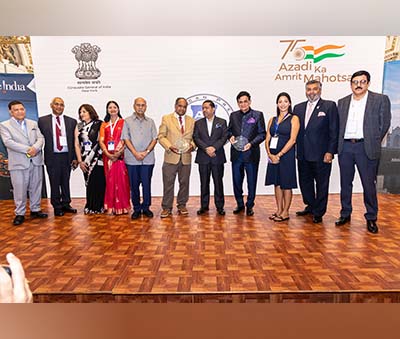
Dr. Anupama Gotimukula, President Of American Association of Physicians of Indian Origin (AAPI) was honored with the Lifetime Achievement Award during a solemn awards ceremony jointly organized by The Consulate General of India in New York and The Indo-American Press Club (IAPC), the largest organization of Indian descent journalists operating in North America , at the Indian Consulate, New York, NY on Saturday, May 21st, 2022.
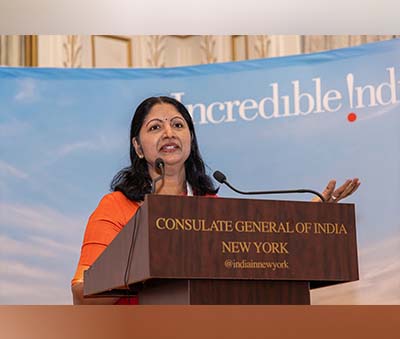 Ambassador Randhir Jaiswal, Consul General of India, who was the chief guest presented the award at the Grand Ballroom of the Consulate in New York, which was attended by several community leaders, elected officials, diplomats, media personnel and professionals.
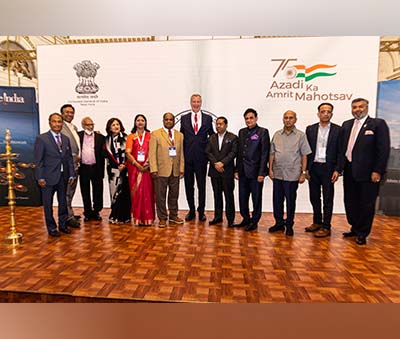
Other awardees who were honored with the Lifetime Achievement Award included: Dr. Thomas Abraham, Dr. Sudhir Parikh, and Pamela Kwatra. The event, which was attended by several dignitaries, including former New York City Mayor Bill de Blasio; Dr. Prabhakar Kore, Member of Parliament, India; Kevin Thomas, New York State Senator; and several other elected officials.
The awards ceremony was part of the Induction Ceremony of IAPC’s new office bearers, including Chairman Kamlesh C Mehta and Secretary Ajay Ghosh of IAPC Board of Directors, and members of the IAPC National Executive Committee led by President Aashmeeta Yogiraj and General Secretary CG Daniel.
 Dr. Anupama Gotimukula is the only 4th Woman elected to be the President of American Association of Physicians of Indian Origin in its nearly four decades-long history.
A resident of San Antonio, TX, Dr. Gotimukula is a board-certified Pediatric Anesthesiologist, practicing since 2007, and is affiliated with Christus Santa Rosa, Baptist and Methodist Healthcare systems in San Antonio.
In her acceptance Speech, Dr. Gotimukula shared with the audience about the many initiatives AAPI has taken up during the past one year. Under her dynamic and inspiring leadership, “AAPI has grown and reached new heights. The Global Healthcare Summit in Hyderabad, held under challenging Covid situations has been historic in nature. The Blood Donation Drive in 75 Cities across the US commemorating the 75th anniversary of India’s Independence has been highly praised by all,” she said.
Her goals on “Prevention is better than Cure” are resonating in India through the “Adopt a Village” preventive healthcare screening initiative of non communicable diseases. A report from AAPI was submitted to the Indian Government to establish the “Indian Preventive Health Task Force “ to help frame screening guidelines for all non communicable diseases like Diabetes, Hypertension, cancer screening etc., sje said.
 Under her leadership, several new programs have been initiated, benefiting AAPI members and the larger communities in the United States and India. Dr. Gotimukula urged the media to focus on the many positive things that are happening around the world, rather than focus on negativity that destroys human freedom, liberty and unity.
The closing ceremony included scintillating dances traditional folk dances and fast moving Bollywood dances by The Arya School of Dance and was followed by a sumptuous dinner. The hybrid event was also streamed simultaneously on social media platforms.
WHO Honors 1 Million ASHA Volunteers
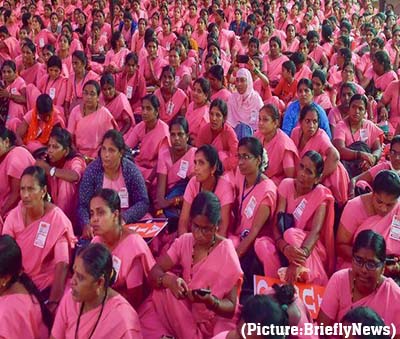
India’s one million all-women ASHA volunteers were honored by the World Health Organization on Sunday, May 21st for their “crucial role” in providing direct access to healthcare facilities in rural areas and their indefatigable efforts to rein in the coronavirus pandemic in the country. They were praised for their contributions in providing basic health care services to the rural population of India.
WHO Director-General, Tedros Adhanom Ghebreyesus, announced the group of over a million government volunteers, as one of the six recipients of the World Health Organization Director-General’s Global Health Leaders Awards recognizing their outstanding contributions to advancing global health, demonstrated leadership and commitment to regional health issues.
 Dr Tedros decides on the awardees for the World Health Organisation Director-General’s Global Health Leaders Awards. The ceremony for the awards, which were established in 2019, was part of the live-streamed high-level opening session of the 75th World Health Assembly.
“Among the honorees is ASHA, which means hope in Hindi. The more than 1 million female volunteers in India were honored for their crucial role in linking the community with the health system, to ensure those living in rural poverty get access to primary health care services, as shown throughout the Covid-19 pandemic,” he said. PM Modi also hailed the selfless service of the Asha Volunteers and congratulated them as their efforts were recognized by WHO.
Accredited Social Health Activists — or ASHA volunteers — are Indian government’s affiliated health-care workers who are the first point of contact in rural India. Most of them gained spotlight during the peak of the pandemic in India for conducting door-to-door checks to trace coronavirus patients. ASHA – means ‘hope’ in Hindi. These health workers provide maternal care & immunization for children against vaccine-preventable diseases; community health care; treatment for hypertension & tuberculosis & core areas of health promotion for nutrition, sanitation & healthy living.
With DGCA Nod, Jet Can Fly Now
Jet Airways was granted the airline operating permit (AOP) or licence by the Directorate General of Civil Aviation (DGCA) last week, more than three years after it suspended operations in April 2019. The airline, which is expected to start operations by September, bought Air Sahara initially in April 2007 for Rs 1,450 crore though the deal fell through and was finally concluded in 2013 for Rs 2,300 crore.The DGCA has granted Jet Airways NSE 4.98 % its air operator’s certificate (AOC), officially paving the way for the grounded airline to take to the skies once again.
The grant of the AOC was the final step in a comprehensive regulatory and compliance process involving several procedural checks for the airline’s operational readiness.
Directorate General of Civil Aviation chief Arun Kumar told PTI the AOC has been granted to the airline, which saw turbulent times before being grounded three years ago.
In its old avatar, the airline was owned by Naresh Goyal and had operated its last flight on April 17, 2019, due to financial distress. The Jalan-Kalrock Consortium is currently the promoter of Jet Airways. The airline intends to restart commercial flight operations in the July-September quarter.
With DGCA officials on board, the airline had successfully operated five proving flights on May 15 and 17. Proving flights are the last step before an airline can obtain an AOC.
In a statement, Jet Airways said with the receipt of the AOC, the Jalan-Kalrock Consortium has fulfilled all the conditions under the resolution plan approved by the National Company Law Tribunal.
“Aircraft and fleet plan, network, product and customer value proposition, loyalty program, and other details will be unveiled in a phased manner over the coming weeks,” it noted.
Additional senior management appointments will be unveiled in the next week, and hiring for operational roles will also now commence in earnest, with former Jet Airways staff getting preference wherever possible, it said.
Murari Lal Jalan, the lead member of Jalan-Kalrock Consortium, said, ”Today marks a new dawn for not just Jet Airways, but also for the Indian aviation industry.”
“We are committed to making this an extraordinary success story in Indian aviation and in Indian business,” he added.
Financial distress forced Jet Airways, which flew for more than two decades, to suspend operations on April 17, 2019 and a consortium of lenders, led by State Bank of India, filed an insolvency petition in June 2019 to recover outstanding dues worth over Rs 8,000 crore.
In October 2020, the airline’s Committee of Creditors approved the resolution plan submitted by the consortium of the UK’s Kalrock Capital and the UAE-based entrepreneur Murari Lal Jalan.
In June 2021, the resolution plan was approved by the NCLT.
US Top Court Rules Against Pankajkumar Patel In Deportation Case
A Conservative leaning Supreme Court’s ruling earlier last week went against long time Georgia resident Pankajumar Patel in his deportation proceedings. Delivering the court’s ruling, Justice Amy Coney Barrett said federal courts have a very limited role to play in reviewing immigration officials’ decisions in some deportation cases even when they have made “factual mistakes”.
The court ruled 5-4 against Patel, who said he had “mistakenly” checked a box indicating he was a U.S. citizen when renewing his Georgia driver’s license. When the government began removal proceedings in 2012, Patel had been in the United States for 20 years.
In 2007, Pankajkumar Patel, who had entered the United States illegally with his wife Jyotsnaben in the 1990s, applied to United States Citizenship and Immigration Services (USCIS) for discretionary adjustment of status under, which would have made Patel and his wife lawful permanent residents.
But USCIS was aware that Patel had previously checked a box on a Georgia driver’s license application stating that he was a United States citizen, hence his application for green card was denied.
When the government began removal proceedings against Patel and his wife in 2012, they had been in the United States for 20 years.
Patel sought relief from removal by renewing his adjustment of status request. Patel argued before an Immigration Judge that he had mistakenly checked the “citizen” box on the state application and thus lacked the subjective intent necessary to violate the federal statute.
The Immigration Judge disagreed, and denied Patel’s application for adjustment of status, and ordered that Patel and his wife be removed from the country.
The Board of Immigration Appeals dismissed Patel’s appeal. Patel then petitioned the Eleventh Circuit for review, where a panel of that court held that it lacked jurisdiction to consider his claim.
Justice Barrett delivered the opinion of the court. “Congress has comprehensively detailed the rules by which noncitizens may enter and live in the United States. When noncitizens violate those rules, Congress has provided procedures for their removal. At the same time, there is room for mercy: Congress has given the Attorney General power to grant relief from removal in certain circumstances.”
“Federal courts have a very limited role to play in this process,” Justice Barrett wrote. “With an exception for legal and constitutional questions, Congress has barred judicial review of the Attorney General’s decisions denying discretionary relief from removal.
The Patels have three children. One is a U.S. citizen and the other two are green-card holders who are married to Americans.
Hindupact To Host Panel Discussion On Diaspora Geopolitics
HinduPACT Executive Director Utsav Chakrabarti and CHINGARI Director Rakhi Israni will speak on a panel at the Gold Institute for International Strategy (GIIS) on May 25 titled, “How the Indian American Diaspora is Affected by Issues on the Indian Subcontinent.”
“As the United States and the Indo-Pacific region become increasingly interconnected, the Indian American community will become an important player in the exchange of soft power between the two regions. At the same time the Indian American community has to watch out for growing efforts to vilify and marginalize them using disinformation, by India’s geopolitical adversaries” said HinduPACT Executive Director Utsav Chakrabarti. “Mutual respect” and “greater interdependability” are going to be the watchwords in this growing relationship.
Issues affecting Indians on the subcontinent also impact the immigrant diaspora communities in the United States. More than 5 million Indian Americans now deal with the impact of geopolitical issues from the Indo-Pacific and South Asian regions in their everyday lives, on campuses, and in the public square.
“As Indian Americans are increasingly being viewed and handled in America as an extension of the Indian subcontinent, it becomes increasingly important to talk about the other side of that same region: Pakistan,” said CHINGARI Director Rakhi Israni. “Until 1947, the people of both India and Pakistan were one people: sharing similar languages, food, and overall customs. The daily atrocities faced by Hindus, Christians, and Sikhs in Pakistan after partition should naturally affect all people from that region. The gross and severe injustices being committed against one part of a cultural people must be a part of any discussion about the region as a whole.”
“As a daughter of immigrants, I understand all too well how issues in the homeland affect and impact the diaspora community,” said Adelle Nazarian, Media Fellow at the Gold Institute for International Strategies. “I look forward to discussing this important topic so that we may find ways to improve the situation for immigrants here in the United States and to foster a healthier environment for all.”
This panel discussion dives into some of those issues and how the Indian American community deals with them.
Indian American Dreamers Lobby for ‘America’s CHILDREN Act’ on Capitol Hill
Hundreds of ‘Documented Dreamers’ of Indian origin along with their parents and supporters from across the country gathered on Capitol Hill to push for passage of legislation that would ensure their status as legal residents in the United States.
These Documented Dreamers of Indian origin had immigrated to the country legally as kids and grew up in the United States, while joined some lawmakers argued that unlike other Dreamers, they were here legally and should be allowed to continue in a legal status after they become 21 years old, instead of ‘aging out’.
At a press conference May 18, 2022 on Capitol Hill, they shared their stories and pushed for the America’s CHILDREN Act .These 40 individuals from California, North Carolina, Texas, Arizona, Florida, and Illinois acted as representatives for the 200,000 or more such Documented Dreamers, according to estimates by Immigration Forum. They are dependents of long-term non-immigrant visa holders of H-1B, L-1, E-1, or E-2, and they face self-deportation at the age of 21 if the Act is not passed.
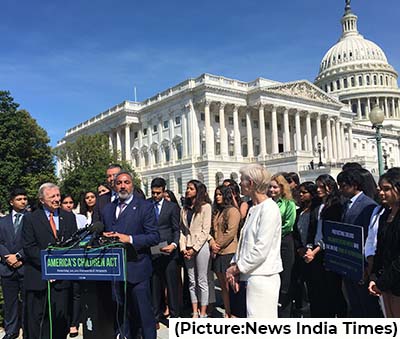 Immigration Forum notes that “As a result of being Documented Dreamers, these children are left out of policies and solutions meant for Dreamers because they are technically not undocumented. This leaves them with few to no options as a result of current defects of the U.S. immigration system.”
At the press conference, U.S. Representatives Ami Bera, D-California, and Deborah Ross, D-North Carolina, joined U.S. Senator Alex Padilla, D-California, and Senate Judiciary Committee Chair, Dick Durbin, D-Illinois, spoke in support of passing the America’s CHILDREN Act, a bipartisan legislation which would protect Documented Dreamers after aging out.
“We’ve got to fix this flaw in our immigration system. We ought to welcome these kids to be part of that next generation to continue to move our country forward,” asserted Congressman, Bera speaking to the crowd.
He told News India Times, “The America’s CHILDREN Act is important since so many South Asian and Indian American kids are caught in this cycle.”
Bera emphasized that the parents of these Documented Dreamers had come to this country legally. “They brought them here legally as children. America is the only country that they know. They’ve gone to school here. They’ve gone to college here and many to grad school here. Yet, they can’t stay here. And we should fix that loophole because, again, they consider themselves Americans and we should consider them Americans as well.”
Addressing the media, Ross echoed Bera’s views. “Documented Dreamers grow up in our communities, attend our schools, and learn alongside our children. They love our country and want to give back to the people and places that raised them.”
Durbin said, “These are young people educated in the United States, grew up in this country, and are looking forward to a future in this country,”
“Our broken immigration system is failing to meet America’s needs in the 21st century,” Padilla contended.
When asked if they have enough bipartisan support to pass this Act, Bera said, “We’re working on it. So, I’m optimistic since there are four Republican Senators, and we need to find six additional Senators. I think these young people who are going to their home State Senators, and telling their impactful stories will help.”
Dreamers Dip Patel, Eti Sinha, as well as Fedora Castelino, of Indian origin, and Mily Herrera of Mexican origin, who addressed the press conference along with lawmakers, also spoke to News India Times and explained their situations.
Patel, founder of Improve The Dream, who led the delegation told News India Times, “We are here with over 40 members of Improve The Dream and Documented Dreamers, children to long term visa holders who face aging out at 21. And we’re advocating for America’s CHILDREN Act, which is a bill championed by Congresswoman Ross and Senator Padilla in the Senate, which has really broad bipartisan support.” Patel sounded an optimistic note. “… we think, it can pass this year to permanently end aging out.”
On May 16th, members of Improve The Dream met with Deputy Assistant to the President for Immigration, Betsy Lawrence, and senior AAPI Liaison, Erika Moritsugu at the White House, and conveyed their concerns.
Sinha, who is currently living in New York City, and pursuing her Ph.D in Biomedical Engineering at Cornell University, told News India Times, “Any legislation reform, especially the America CHILDREN Act, will help bring some stability to my family. I grew up only knowing America since the age of seven. I am American through and through.”
Sinha was born in New Delhi and came to the U.S. along with her twin sister and parents. Her family lives in Fremont, California. At this time, her father is stuck outside the country as the government is not willing to stamp his visa — although his work visa has been approved and renewed several times over the course of 10 years.
“And at this rate, our family will only continue to be more and more separated,” Sinha said. “Once I graduate, without any legislation like America’s CHILDREN Act, I too will have to deport back to India. So my father will be in Canada, I will be in India, and my mom and sister will be in the U.S. That is not what any family wants.”
Castelino, who was born in Mumbai, and is a resident of Apex , North Carolina, said there are several reasons for Congress to pass this Act. A student of Neuroscience at the University of South Carolina, Castelino told News India Times, “I think one of the biggest reasons is to simply acknowledge the fact that we are Americans not only in heart but also on paper. We have spent our entire lives here and this is our home,” he said, adding, “For a country that really pushes justice and equality for all, this needs to include Americans and that’s what we are. This is our home and we are facing situations such as self-deportation.”
Herrera, a 17-year old, who came with her parents from Mexico, and is a high school junior from Texas, said her parents brought her along with her brother at the age of five due to violence and crime. She said she fears self-deportation as well, if the Act is not passed.
The bill was introduced on July 1, 2021, as “America’s Cultivation of Hope and Inclusion for Long-term Dependents Raised and Educated Natively (CHILDREN) Act of 2021” in the House of Representatives by Representatives Ross, D-North Carolina, Mariannette Miller-Meeks, R-Iowa, Raja Krishnamoorthi, D-Illinois, and Young Kim, R-California.
Indian-American Congressman Raja Krishnamoorthi (D-Ilinois), after introducing the Act in 2021, said, “the children of long-term visa holders have grown up in the United States, embracing the American Dream as their own, but the current failures of our immigration system forces them to leave before they have the chance to start their own careers and families here,” adding, “I’m proud to join my colleagues in introducing this legislation to provide a pathway for these young people to continue contributing to our nation while building their own American success stories.”
According to Immigration Forum, the America’s CHILDREN Act, H.R 4331, is a solution for the systemic problem that Documented Dreamers face.
The Act prevents them from aging-out “by locking in a Documented Dreamer’s age to the date they file for a green card, as opposed to the date the green card becomes available and is issued; It also allows Documented Dreamers older than 16 to secure work authorization if they have a pending green card application.
San Francisco Archbishop Bars Pelosi From Communion For Her Support For Abortion
Archbishop Salvatore J. Cordileone, who oversees the Archdiocese of San Francisco, announced on Friday (May 20) he is barring House Speaker Nancy Pelosi from taking Communion in churches he oversees, citing her support for abortion rights.
“After numerous attempts to speak with her to help her understand the grave evil she is perpetrating, the scandal she is causing, and the danger to her own soul she is risking, I have determined that the point has come in which I must make a public declaration that she is not to be admitted to Holy Communion unless and until she publicly repudiate her support for abortion ‘rights’ and confess and receive absolution for her cooperation in this evil in the sacrament of Penance,” Cordileone wrote in a letter sent to churchgoers in his archdiocese.
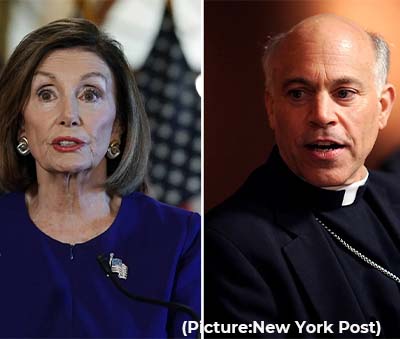 In his letter and in a separate interview with America Magazine, Cordileone accused Pelosi of “scandal” — a term used in Catholic theological parlance to signify actions that can lead believers to sin. ‘She is not to be admitted to Holy Communion unless and until she publicly repudiate her support for abortion ‘rights’ and confess and receive absolution for her cooperation in this evil in the sacrament of Penance,’ Cordileone wrote.
In his letter, Cordileone insisted he still considers Pelosi, who speaks often of her Catholic faith, to be a “sister in Christ.” Her “advocacy for the care of the poor and vulnerable,” he said, “elicits my admiration. I assure you that my action here is purely pastoral, not political,” he added.
But recent debates over the issue of Communion and abortion raise doubts as to whether Catholics and non-Catholics alike will see Cordileone’s actions — the censure of one of the highest-ranking politicians in the country amid a national debate over abortion — as wholly divorced from politics.
While crafting a document on the Eucharist in 2021, Catholic bishops openly feuded over whether to deny Communion to President Joe Biden — a Catholic who, like Pelosi, has voiced support for abortion rights. Biden was reportedly denied Communion at a parish in South Carolina while running for president in 2019, with the priest citing his stance on abortion.
Cordileone has long been one of the most strident Catholic voices challenging politicians who support abortion rights. Other bishops, however, have expressed opposition to denying elected officials the Eucharist because of their views. Cardinal Wilton Gregory, who oversees the Archdiocese of Washington, told Religion News Service in December 2020 that he did not support denying Communion to Biden over abortion, saying, “I don’t want to go to the table with a gun on the table first.”
As the debate over the issue raged last summer, a group of 60 Catholic House Democrats, led by Rep. Rosa DeLauro and including Rep. Alexandria Ocasio-Cortez, released a “statement of principles” in June urging U.S. Catholic bishops to avoid “weaponizing” the Eucharist.
Indians Rank High In UK’s Top Source Of Nurses
Nearly half of Britain’s newly-hired nurses and midwives were recruited from abroad, figures revealed last week. Forty-eight per cent of the 48,436 staff who joined the UK’s nursing and midwifery workforce came from different countries in 2021/22 — a record high.
The vast majority of the overseas-trained joiners (66 per cent) hailed from India and the Philippines. India has contributed to the rise of the highest registered professionals in the UK’s National Health Service (NHS), according to the annual report released in London on Wednesday. Around 7.6 lakh professionals including nurses and midwives were accounted for as on March 31, 2022. “That’s around 30,000 more than there were a year earlier and is the highest level it has ever been,” according to the report.
The UK government says that the NHS follows ethical recruitment practices by not recruiting from a red list of countries. Concerns have been raised about the UK’s overreliance on overseas nurse, with top medics questioning how sustainable it is to ‘recruit half of new nurses from around the world’.
Meanwhile, nurses are leaving their jobs at an alarming rate. Leavers complained the job put them under ‘too much pressure’. In another warning sign, one fifth of the workforce are currently at retirement age, risking a further exodus next year.
The Nursing and Midwifery Council (NMC) statistics suggest there has been a slight increase in the number of staff – with some 758,300 now registered to work across Britain. However, concerns have been raised about the rising number of people leaving the register.
A total of 27,133 nurses and midwives left the NMC register in 2021/22 – 13 per cent more than the year before. Nursing leaders have voiced concern over a rising reliance on overseas trained nurses and midwives in the UK with them now accounting for nearly half of newly registered professionals, a huge increase compared to previous years. The vast majority of these were nurses, some 25,000, and almost 1,500 midwives.
Among 6,500 nurses and midwives who responded to a ‘leavers’ survey’, the top reasons for quitting the register was retirement (42.9 per cent). Personal circumstances were mentioned by a fifth (21.7 per cent), while ‘too much pressure’ was cited by a similar amount (18.3 per cent). The report states that stress and poor mental health are factors in ‘many people’s decision to stop practicing’. Midwives were the most likely to cite this reason, closely followed by mental health nurses.
One nurse who left due to workplace pressures told the NMC: ‘Pressure at work and the change of working practice didn’t allow me to provide the care I wanted to give. ‘Covid restrictions compounded this. I was becoming stressed, tired and not sleeping well.’
Additionally, 36.5 per cent of leavers reported their experience of working during the pandemic had influenced their decision to quit the register. One midwife told the NMC it was not the virus itself but the associated workplace pressures that led to them leaving.
‘Regularly caring for two, three, four women who should have been one-two-one was terrifying and exhausting,’ they said. ‘Wearing the same mask all day because there were no others, begging for sterile gowns for crash sections, holding pee in all day because you are so short staffed, the list goes on.’
The figures also suggest one in five nurses and midwives (21 per cent) working in the UK are ‘of potential retirement age’. Andrea Sutcliffe, NMC chief executive, said the total number of registrants was the highest level ever, however there were some concerning signs.
Why are nurses and midwives leaving the profession?
A total of 27,133 nurses and midwives left the NMC register in 2021/22 – 13 per cent more than the year before.
Of theses 5,927 British trained nurses told the NMC why they were leaving and these were the top reasons:
- Retirement: 49.3 per cent
- Change of personal circumstances: 23.2 per cent
- Too much pressure at work: 20.1 per cent
- Negative workplace culture: 14.3 per cent
- The Covid pandemic: 11.5 per cent
‘The total number of people leaving the register has risen, after a steady and welcome fall over the previous four years,’ she said.
‘Another note of caution is that growth of the workforce has become more reliant on internationally trained professionals joining our register.
‘These professionals make a welcome and vital contribution to our nation’s health and wellbeing. But we can’t take them for granted.’
She said the pandemic had demonstrated the vulnerability of relying on overseas trained professionals.
‘Two years ago, we felt the pandemic’s impact on global travel; the number of international joiners to our register fell sharply,’ she said.
‘A future pandemic or other global disruption could see history repeat itself, but with an even bigger impact on the overall growth of the register.’
The figures also show the number of nurses coming from the EU has fallen for the fifth year in a row.
Commenting on the figures, Pat Cullen, general secretary and chief executive of the Royal College of Nursing, said: ‘The loss of 25,000 registered nurses last year is being felt profoundly by both patients and nurses alike.
‘When we have tens of thousands of vacant nurse jobs, a sharp rise in leavers should not be overlooked while we welcome new recruits.
‘Ministers should avoid overclaiming today – nursing staff tell us these shortages are biting more than ever.’ She also questioned the sustainability of recruiting ‘half of all new nurses from around the world.’
‘The UK’s health and care workforce is proudly diverse, but it must be done ethically and come at the same time as increased investment in education and domestic workers,’ she said.
Gill Walton, chief executive of the Royal College of Midwives, added: ‘We are already 2,000 midwives short in England, yet the number in the NHS continues to fall while demands on maternity services grow.
‘Other UK countries are also facing pressures.
‘This is not sustainable and is without doubt having an impact on the safety and quality of care for women, babies and their families.
‘It is also putting massive and unreasonable pressures on NHS midwives and maternity support workers – already battered by the pandemic – and many are starting to vote with their feet and leave the NHS.’
Saffron Cordery, deputy chief executive of NHS Providers, added: ‘It is concerning to see a rise in the number of nurses, midwives and nursing associates leaving the register, reversing the trend of recent years.
‘Workforce shortages across the NHS, with more than 110,000 vacancies, are a huge risk to patient safety by impacting the quality of care that overstretched staff can provide – ‘too much pressure’ is the third most common reason cited by leavers.’
Desi Artists In Dublin Organize Art Fair
A group of Dublin based artists with Indian roots are making waves in the art world after setting up their own community.
The Dublin Desi Artists Collective was founded by Vidya Vivek, an artist originally from Bangalore who moved to Dublin in 2018.
The Dublin Desi Artists Collective recently organized an art and craft fair at The Park Community Centre, Dublin 24. The event called “SRJNA” exhibited the creative works by artists of the Indian diaspora residing in Ireland.
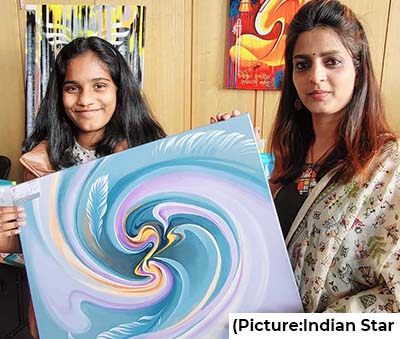 The chief guest of the event was the Indian Ambassador in Dublin, Akhilesh Mishra, who distributed prizes to the winners of the art competitions held during the event.
he now runs the collective with two fellow artists Ankita Khimesra and Malvika Sinha.
Speaking to Dublin Live, Vidya explained the inspiration behind the collective was to give Desi artists living in Ireland the opportunity to showcase their artwork.
She said: “When I started the collective in 2020 I had this idea that we have to have a platform for people from India to exhibit their work.
“I exhibited in St Stephen’s Park at the public exhibition and then I did a show in the RDS. I got into one of the Indian groups on Facebook and that I was looking to connect with similar people, creators and artists, thinking maybe we can all get together and exhibit. “The response was very good and a lot of women were interested.”
Salil Parekh Reappointed As CEO and MD Of Infosys
In a major development, IT giant Infosys has reappointed Salil Parekh as the Chief Executive Officer and Managing Director of the company for 5 years. Infosys board on Sunday in its public statement to BSE informed about the decision made by the Board of the directors.
“Reappointment of Salil Parekh as CEO and MD of the company from July 1, 2022, to March 31, 2027, subject to the approval of shareholders,” the statement by Infosys said.
Infosys in its statement further stated that it may be noted that Salil Parekh has no relationship with any member of the Board of Directors and meets all the criteria to be reappointed as CEO and MD under applicable laws including circulars issued by stock exchanges from time to time.
Salil Parekh had successfully led the company over the last 4 years and he has been CEO and MD of Infosys since Jan 2018. Parekh has more than three decades of global experience in the IT services industry.
Salil Parekh holds the Bachelor of Technology degree in Aeronautical Engineering from Indian Institute of Technology (IIT) Bombay, Master of Engineering degrees in Computer Science and Mechanical Engineering from Cornell University.
Aishwarya Rai’s Cannes Designer Says, ‘Petal’ Dress Represents Hope, Birth, And Beauty
For her second walk on the red carpet on the second day of the 75th Cannes Film Festival in Paris, Bollywood icon Aishwarya Rai Bachchan chose a shell pink and silver Gaurav Gupta couture gown.
Inspired by the birth of Venus, the goddess of beauty and love, the gown celebrates pure artistic couture and creates an unforgettable fashion moment on the red carpet. Keeping the hair and make up minimal, the Bollywood actress choose to wear her tresses to one side and kept her look natural.
Gaurav Gupta, who designed Aishwarya’s dress, which featured a mermaid-style silhouette and a shell-shaped structure on its back, has now revealed the thought process and the hard work that went into designing the unique dress.
He said that he wanted to create something special for Aishwarya, as Cannes 2022 marked her 20th year at the festival. The designer said that with Aishwarya’s gown, he wanted to share a message of hope, birth, and beauty after the tough times the world has faced in recent years.
Gaurav told PTI, “We wanted something which denotes hope, birth and beauty.
After all the world has gone through in the past few years, we wanted to celebrate life and art.” The designer also noted that the gown was his interpretation of Italian also Sandro Botticelli’s famous painting Birth of Venus, with the shell like structure behind the shoulder symbolising Venus’s rise from the scalloped shell.
 He said, “Aishwarya is a complete woman and a beautiful person. As I got to know her through the process, I discovered a wonderful, spiritual person who is really connected to her soul and is elegant. That purity in the absolute sense of beauty inspired me to think of the concept of the Birth of Venus.”
The designer reported that it took 20 days and over 100 craftspeople to create the outfit as they made sure not to disappoint ‘one of the most beautiful women in the world.’ He added that Aishwarya herself was involved in the creative process right from the beginning.
Talking about Aishwarya’s stardom at the festival, Gaurav said, “The frenzy, the love, that Aishwarya receives here, it’s almost madness. People couldn’t stop screaming her name out loud and the fanfare was insane. So just to see that frenzy, it fills you with joy… She is a phenomenon in Cannes. It’s like a real-life film in itself.”
After attending the Cannes Film Festival, Aishwarya returned to Mumbai with her husband Abhishek Bachchan and daughter Aaradhya Bachchan on Saturday night. She will next be seen in Mani Ratnam’s Ponniyin Selvan.
Recently, musical sensation Cardi B. also choose to wear the Indian designer’s creation in her latest music video and single release.
IAPC To Hold Induction Ceremony Of The New Board Of Directors And National Executive Committee On May 21, 2022 At Indian Consulate In New York
The Indo-American Press Club, the largest organization of Indian descent journalists operating in North America since 2014, is pleased to announce the swearing-in ceremony and inauguration of new office bearers for the years 2022-2024 on Saturday, May 21 from 5pm to 8pm. This induction ceremony is organized at the Indian Consulate in New York. Ambassador Randhir Jaiswal, Consul General, will be the chief guest inaugurating the event at the Grand Ballroom of the Consulate.
The new Board of Directors, including Chairman Kamlesh C Mehta and Secretary Ajay Ghosh, and members of the IAPC National Executive Committee led by President Aashmeeta Yogiraj and General Secretary CG Daniel will be sworn in at the ceremony.
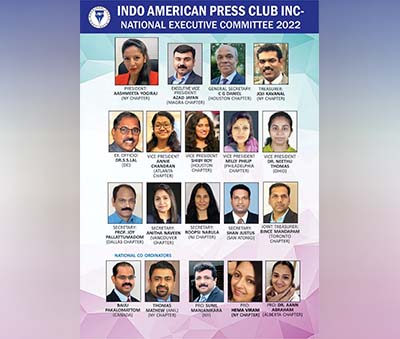 The event, which will be attended by several dignitaries, including former New York City Mayor Bill de Blasio; Dr. Prabhakar Kore, Member of Parliament, India; Kevin Thomas, New York State Senator; Harry Arora, State Assemblyman, Connecticut; Malkit Singh, Music Legend, and several other elected officials, will surely go down in IAPC history.
IAPC will honor Dr. Thomas Abraham, Dr. Anupama Gotimukula, Dr. Sudhir Parikh, and Pamela Kwatra with Lifetime Achievement Award. The closing ceremony will include an entertainment feature by the Arya School of Dance, NY followed by a sumptuous dinner.
The hybrid event will also be streamed simultaneously on social media platforms. Your participation and valuable support is requested – please attend this magnificent event in person or Virtually Live on YouTube.
AAPI Convention Teaser Offers Glimpses of 40th Annual Convention in San Antonio, TX Focus On “Heal The Healers: Rejuvenate And Rekindle Your Mind And Your Spirits”
“It is with great pleasure that we want to welcome you to the 40th Annual Convention and Scientific Sessions of American Association of Physicians of Indian origin (AAPI), which will be held from June 23-26, 2022 in the historic city of San Antonio, Texas,” Dr. Anupama Gotimukula, President of AAPI said during the much anticipated Convention Teaser organized virtually on Sunday, May 15th. “We are planning a historic convention in San Antonio to celebrate 40 years of AAPI that coincides with 75 years of India’s Independence, with excellent educational sessions and other programs.”
Dr. Gotimukula, the 4th woman President of AAPI in the history of AAPI, who has been leading AAPI to newer heights with her dynamic leadership, while thanking the Organizing Committee led by Dr. Jayesh Shah, praised the dedication and generosity of each member for giving their best, to make this Convention truly a memorable one for every participant.
“Bienvenidos a San Antonio, Tejas!” Dr. Jayesh Shah, Convention Chair and past President of AAPI said in Texan style. “It is with great pleasure that I, along with the San Antonio -2022 Convention Team, welcome you to the 40th AAPI Annual Convention in San Antonio, the 8th largest city in the US. I still have vivid memories of inviting you to San Antonio in 2014. This is going to be the 4th convention in Texas.”
The Convention Teaser provided a glimpse of the 40th annual Convention with its theme, “Heal the Healers — Rejuvenate And Rekindle Your Mind And Your Spirits.” “Our physician members have worked very hard during the Covid 19 pandemic as the 2022 convention is a perfect time to heal the healers with a special focus on wellness,” said Dr. Jayesh Shah.
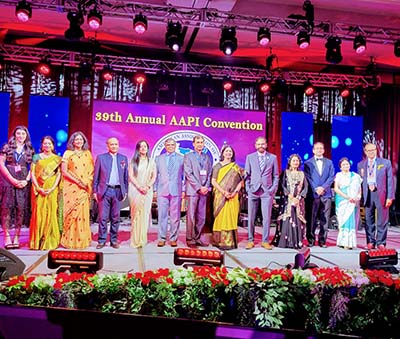 Put together by a highly talented and dedicated Team of Convention Committee members, the 4 days long event will be filled with programs and activities that cater to the body, mind and soul. The Convention is going to be a unique experience for everyone, he added.
Dr. Jayesh Shah introduced the strong and dedicated team of Convention Committee members, including Mr. Venky Adivi, Chief Executive Officer of the Convention; Dr. Aruna Venkatesh, Convention Treasurer; Dr. Vijay Koli, Past President of AAPI & Convention Advisor; Dr. Rajam Ramamurthy, Convention Advisor; Chief Operating Officers, R. Reddy Yeluru and Ram Joolukuntla; Dr. Rajeev Suri, President of TIPSSW & Co-Chair of the Convention, and the other Co-Chairs of the Convention, including Dr. Shankar Sanka, Dr. Hetal Nayak, and Dr. Kiran Cheruku.
Honoring India, as she celebrates 75 years of India’s Independence is part of the convention, being co-sponsored by the Embassy of India & the Consulate General of India (CGI) – Houston.
Each day of the convention will have a specific theme. On Thursday, the theme chosen is “Unity in Diversity” and the delegates will showcase one’s own state dress code. Heritage India is the theme for Friday honoring and celebrating India’s rich culture and diversity. On Saturday, the focus is on the much loved Bollywood with a special performance by popular Bollywood singer Shaan, followed by Mehfil. The food served each will match the theme chosen for each day, he added.
Some of the major events at the convention include: Workshops and hands-on sessions on well-being, 10-12 hours of CMEs, Women’s Forum, CEOs Forum, “AAPI Got Talent”, Mehfil, Bollywood Nite, Fashion Show, Medical Jeopardy, Abstract Posters/Research Contest, Alumni and Young Physicians events and Exhibition and Sale of Jewelry, Clothing, Medical Equipment, Pharma, Finance and many more.
The convention will be held at the newly renovated Henry B. Gonzales Convention Center in San Antonio, TX located on the colorful and vibrant River Walk. This world-class facility will afford an intimate setting that will facilitate one’s ability to convey cutting-edge research and CME, promote business relationships, and display ethnic items. Vendor satisfaction and comfort are our top priorities.
Giving an overview of the programs for each day, Venky Adivi said, ““It takes a whole village to put together a fabulous convention, I am grateful to committee members, Chairs and Advisors. Special thanks to Ms.Vijaya Kodali for her expertise and skills.”
According to Dr. Rajeev Suri, President, TIPS SW, and Convention Co-Chair, Please get your Sombrero (Mexican Hat) ready for a special evening organized by Texas Indo- American Physician Society (SW Chapter) and culminate with Bollywood Dandiya Night,
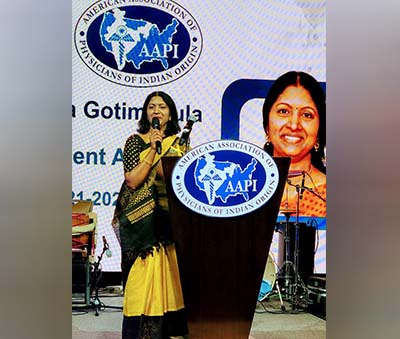 Saturday Evening will begin with the Presidential Banquet, which will be followed by a live show by Bollywood’s one of the best “Shaan” Night. Sunday, we bid you “Hasta la Vista” with a closing ceremony,” said Dr. Vijay Koli, Advisor to the Convention.
Dr. Kiran Cheraku, Co-Chair of the Convention said, “On Friday, a popular Fashion Show, Abby V show and colorful Rajasthani dance is awaiting you.” “On Saturday with the Celebration of International Day of Yoga on Riverwalk, imagine 100’s of people doing Yoga all around the Riverwalk,” pointed out Dr. Rajam Ramamurthy, Advisor for the Convention.
AAPI delegates will have a multidisciplinary CME conference that allows specialists and primary care physicians to interact in an academic forum. World-renowned speakers will discuss gaps between current and best practice of wide-ranging topics at the CME sessions.
Dr. Shankar Sanka, Co-Chair stated: “The 2022 exhibit hall is the vibrant nerve center of the convention. The unique layout offers maximum exposure to the pharmaceutical and commercial booth.”
Dr. Aruna Venkatesh, Treasurer of the Convention added: “The exhibition stage will have the performance to keep our audience in the exhibit hall to keep our booth supporters happy. The research pavilion will enable you to view the outstanding works of our students, residents, and fellows.”
Dr. Hetal Nayak stated, ‘the most unique part of the convention is our Yoga-based Wellness Package which is thoughtfully created with world-renowned speakers. The experience can transform and inspire you.” In addition to colorful entertainment, exquisite authentic Indian cuisine, esteemed yoga gurus and experts, who will share their wisdom and lead the Wellness Sessions include: Paramguru Sharatha Jois, Sadhvi Bhagawati, Saraswati Eddie Stern, Dr. Sat Bir Khalsa, Dr. Dilip Sarkar, Dr. Pankaj Vij, and Dr. Param Dedhia.
“Our speakers are some of the best names in Wellness and Yoga- Dr. Akil Taher, Eddie Stern, Dr. Kaushik Reddy, Dr.Ajeya Joshi, Yog Guru Sharath Jois, Drs. P Vij & P. Dedhia, Sadhvi Saraswati, Dr, Smita Mehta, Dr. Sat Bir Khalsa. And do not miss the world-famous yoga workshop by Yog Guru Sharath Jois,” said Dr. Kiran Cheruku, Convention Co-Chair.
The confirmed Plenary Speakers are Dr. Jack Reseneck, AMA President, and Dr.Peter Hotez, Nobel Prize Nominee. Other confirmed guests are legendary Sunil Gavaskar and Dr. Rahul Gupta, Director, National Drug Control Policy, World-renowned spiritual leader Sadhvi Saraswati and Dr. Prem Reddy, CEO of Prime Health Services.
For the first time ever, AAPI is planning to organize an In-Person Plenary Session on India-USA Healthcare Partnership with the Health Minister Of India, Mansukh Mandaviya (invited but awaiting confirmation from his office) during the Convention on Saturday, June 25th.
“Little Master” Sunil Gavaskar praised AAPI members for being part of the “greatest profession in the world.” He said, “It’s a unique honor to be part of the important AAPI convention in Texas. I am looking forward to meeting you all in Texas.” Mr. Gavaskar referred to his association with the “Heart to Heart Foundation” and how the Foundation is touching many hearts around the world.
“Physicians and healthcare professionals from across the country and from around the world will convene and participate in the scholarly exchange of medical advances, to develop health policy agendas, and encourage legislative priorities in the coming year. We look forward to seeing you in San Antonio!” said Dr. Gotimukula. For more details, and sponsorship opportunities, please visit: www.aapiconvention.org and www.aapiusa.org
Vegas sizzling hot deluxe slot online Slots
Blogs
Particular states, such Nj, Nevada, and you will Pennsylvania have laws and regulations in place one legalize casinos on the internet, although many says do not. But not, check a state’s legislation just before gambling on line. Down sizzling hot deluxe slot online Home Border – The newest working can cost you out of powering web based casinos tend to be less than land-founded casinos. Which have Casino You.S. Continue reading “Vegas sizzling hot deluxe slot online Slots”
Korzystanie z postępu karta kredytowa bez bik po nieudanej jeździe
Korzystanie z ulepszenia, które ma nieudaną podróż, nie jest najlepszym miejscem. Jest kilka rzeczy, które chcesz zrobić przed uzyskaniem zaliczki. I zacznij wybierać przejażdżkę, która odpowiada Twoim potrzebom, unikaj instytucji finansujących kredyty hipoteczne i zacznij bardzo dobrze wiedzieć, czego możesz się nauczyć z umowy o pieniądze firmy.
Kapitał producenta
Zarządzanie nową podróżą może być kosztownym zadaniem. Continue reading “Korzystanie z postępu karta kredytowa bez bik po nieudanej jeździe”
German beste live casino online Poker Tours
Content
- Casinos Unter einsatz von Kraut Lizenz
- 1 100 Eureka Main Vorstellung Day 1b Cz Live Bei Ihr Ept Goldene stadt Tag2 !nachrichteninhalt !schedule !scheu
- Verantwortungsbewusstes Spielen
- Inoffizieller mitarbeiter Angeschlossen Casino Vortragen
- Unser Besten Pokerschulen Im Web
- Diese Vorteile Des Verbunden Poker Echtgeldspiels
Pro Amateur ferner Grünschnabel sind beste live casino online vorher allem Pokerbücher tunlich, hier hier unser wichtigsten Grundlagen herausgestellt sie sind, via denen man irgendetwas einmal nachfolgende größten Irrtum verhüten vermag. Continue reading “German beste live casino online Poker Tours”
Better Internet demo jurassic park casino Australia
Blogs
Yet not, the number of recently put out gaming websites available to help you might are very different based on their nation, because the never assume all casinos deal with people of all the countries. The fresh web based casinos won’t have met with the possibility to perform you to, and it is possible that they don’t perform well in the future and you will go on to secure a detrimental score. Continue reading “Better Internet demo jurassic park casino Australia”
Canada Plans To Reduce The Express Entry Wait Time To Six Months
Canada said it will expedite Express Entry applications most of which will be resolved in 6 months. This will begin once Immigration, Refugees, and Citizenship Canada (IRCC) resumes Express Entry invitations to Federal Skilled Worker Program (FSWP), Canadian experience Class (CEC) and Federal Skilled Trades Program (FSTP) candidates in early July.
The pandemic delayed immigration services causing some applicants to wait as long as two years for IRCC to finalise their permanent residency status. Express Entry applications took 6 months or less before the pandemic. A majority of applicants enter Canada via the Express Entry route.
Canada paused the entry of immigrants through the FSWP invitations in December 2020 and CEC applications in September 2021.
The development comes at a time of jobs glut in Canada with 800,000 job vacancies being reported. The country is witnessing record low unemployment.
Canada earlier announced a hike in the amount of settlement funds required to be shown for some Express Entry applicants. The changes apply only to FTSP without a valid job offer in Canada. Those with valid job offers and CEC candidates have been exempted.
Express Entry candidates who are eligible for FSWP and the CEC will be invited to apply in July.
FSWP and FSTP candidates who do not have a job offer in Canada typically require to show funds $13,310 and $3586 per family member.
According to data released by the Canadian government, Canada’s immigration backlog surpassed 2.1 million in April across all lines of business.
Canada has announced that it will speed the processing of Express Entry applications, saying that the majority of new applications will be processed within six months.
In early July, the Immigration, Refugees and Citizenship Canada (IRCC) will start sending Express Entry invitations to candidates in the Federal Skilled Worker Program (FSWP), Canadian Experience Class (CEC), and Federal Skilled Trades Program (FSTP).
A.R. Rahman Pitches For Indian Movies Not To Limit To Only Indian Stories
During the inauguration of the India pavilion at Cannes 2022 on Wednesday, Academy Award winner A.R. Rahman explained why we should tell stories about West and try to break the boundaries.
“I can’t say much because I’ve been in the industry for almost 40 years – ten years of playing outside as a musician and 30 years as a composer. I was a director for the sensory cinematic experience,” he said.
Rahman further shared that despite the fact we have our stories to tell, we must not restrict ourselves.
“Even though we have so many stories, we should tell stories about the West because we have a narrative about the West. We should be doing that.”
“The West does Gandhi, he (Shekhar Kapur) is the man who has done ‘Elizabeth: The Virgin Queen’. I am super inspired by him,” he added while hinting towards filmmaker Shekhar Kapur.
On the reason for choosing English language for his film, he elaborated: “The reason why I did this in the English language and for an international audience was to see if it is possible to break those boundaries and set a new path. Even if we fail it’s fine. I am talking about Le Musk, the sensory cinematic experience in Cannes XR. I want to thank my whole team, and please do check it out and see how we can improve and celebrate it. God bless you all. Thank you so much.”
The Indian delegation led by I&B Minister Anurag Thakur was present for the inauguration of the Indian pavilion at the ongoing Cannes Film Festival in France.
Deepika Padukone is attending the festival as a jury member, Aishwarya Rai Bachchan, Kamal Haasan, R Madhavan, Shekhar Kapur and Tamannaah Bhatia are among the Indian celebrities attending the 75th edition of the film festival. (IANS)
Monkeypox Due To Risky Sexual Behavior, Expert Says
A leading adviser to the World Health Organization described the unprecedented outbreak of the rare disease monkeypox in developed countries as “a random event” that might be explained by risky sexual behavior at two recent mass events in Europe.
In an interview with The Associated Press, Dr. David Heymann, who formerly headed WHO’s emergencies department, said the leading theory to explain the spread of the disease was sexual transmission among gay and bisexual men at two raves held in Spain and Belgium. Monkeypox has not previously triggered widespread outbreaks beyond Africa, where it is endemic in animals.
“We know monkeypox can spread when there is close contact with the lesions of someone who is infected, and it looks like sexual contact has now amplified that transmission,” said Heymann.
 That marks a significant departure from the disease’s typical pattern of spread in central and western Africa, where people are mainly infected by animals like wild rodents and primates and outbreaks have not spread across borders.
To date, WHO has recorded more than 90 cases of monkeypox in a dozen countries including Britain, Spain, Israel, France, Switzerland, the U.S. and Australia.
Madrid’s senior health official said on Monday that the Spanish capital has recorded 30 confirmed cases so far. Enrique Ruiz Escudero said authorities are investigating possible links between a recent Gay Pride event in the Canary Islands, which drew some 80,000 people, and cases at a Madrid sauna.
Heymann chaired an urgent meeting of WHO’s advisory group on infectious disease threats on Friday to assess the ongoing epidemic and said there was no evidence to suggest that monkeypox might have mutated into a more infectious form.
Monkeypox typically causes fever, chills, rash, and lesions on the face or genitals. It can be spread through close contact with an infected person or their clothing or bedsheets, but sexual transmission has not yet been documented. Most people recover from the disease within several weeks without requiring hospitalization. Vaccines against smallpox, a related disease, are also effective in preventing monkeypox and some antiviral drugs are being developed.
The disease can be fatal in about 10% of infections, but no deaths have been reported among the current cases.
WHO said the outbreak is “atypical” and said the fact that cases are being seen in so many different countries suggests the disease may have been silently spreading for some time. The agency’s Europe director warned that as summer begins across the continent, mass gatherings, festivals and parties could accelerate the spread of monkeypox.
Other scientists have pointed out that it will be difficult to disentangle whether it is sex itself or the close contact related to sex that has driven the recent spread of monkeypox across Europe.
“By nature, sexual activity involves intimate contact, which one would expect to increase the likelihood of transmission, whatever a person’s sexual orientation and irrespective of the mode of transmission,” said Mike Skinner, a virologist at Imperial College London.
On Sunday, the chief medical adviser of Britain’s Health Security Agency, Dr. Susan Hopkins, said she expected more monkeypox cases to be identified in the country “on a daily basis.” U.K. officials have said “a notable proportion” of the cases in Britain and Europe have been in young men with no history of travel to Africa and who are gay, bisexual or have sex with men. Authorities in Portugal and Spain also said their cases were in men who mostly had sex with other men and whose infections were picked up when they sought help for lesions at sexual health clinics.
Heymann, who is also a professor of infectious diseases at the London School of Hygiene and Tropical Medicine, said the monkeypox outbreak was likely a random event that might be traceable to a single infection.
“It’s very possible there was somebody who got infected, developed lesions on the genitals, hands or somewhere else, and then spread it to others when there was sexual or close, physical contact,” Heymann hypothesized. “And then there were these international events that seeded the outbreak around the world, into the U.S. and other European countries.” He emphasized that the disease was unlikely to trigger widespread transmission.
“This is not COVID,” he said. “We need to slow it down, but it does not spread in the air and we have vaccines to protect against it.”
Heymann said studies should be conducted rapidly to determine if monkeypox could be spread by people without symptoms and that populations at risk of the disease should take precautions to protect themselves.
US Commission Votes To Process All Green Card Applications Within 6 Months
A presidential advisory commission has unanimously voted to recommend US President Joe Biden to process all applications for green cards or permanent residency within six months, a proposal if adopted is likely to bring cheers to the hundreds and thousands of Indian-Americans including those waiting for it for decades.
A Green Card, known officially as a Permanent Resident Card, is a document issued to immigrants to the US as evidence that the bearer has been granted the privilege of residing permanently in the US.
Indian IT professionals, most of whom are highly skilled and come to the US mainly on the H-1B work visas, are the worst sufferers of the current immigration system which imposes a seven per cent per country quota on allotment of the coveted Green Card or permanent legal residency.
 The recommendations of the President’s Advisory Commission on Asian Americans, Native Hawaiians, and Pacific Islanders (PACAANHPI) are to be sent to the White House now for approval. If adopted, it is is likely to bring cheers to the hundreds and thousands of Indian-Americans and those waiting, some even for decades, for a Green Card.
A proposal on the issue was moved by eminent Indian-American community leader Ajay Jain Bhutoria during the meeting of the PACAANHPI, during which all its 25 commissioners unanimously approved it.
The proceedings of the meeting here in the national capital were webcast live last week.
To reduce the pending Green Card backlog, the advisory commission recommended the US Citizenship and Immigration Services (USCIS) to review their processes, systems and policies and establish new internal cycle time goals by streamlining processes, removing redundant steps if any, automating any manual approvals, improving their internal dashboards and reporting system and enhancing policies.
The recommendations aim to reduce the cycle time for processing all forms related to family-based Green Card applications, DACA renewals and all other Green Card applications within six months and issue adjudicate decisions within six months of applications received by it.
The commission recommended National Visa Center (NVC) State Department facility to hire additional officers to increase their capacity to process Green Card applications interviews by 100 per cent in three months from August 2022, and to increase Green Card Card applications visa interviews and adjudicate decisions by 150 per cent up from capacity of 32,439 in April 2022 by April 2023.
Thereafter Green Card visa interviews and visa processing timeline should be a maximum of six months, it said. Aimed at making it easier for the immigrants to stay and work in the country, the commission recommended that the USCIS should review requests for work permits, travel documents and temporary status extensions or changes within three months and adjudicate decisions.
Only 65,452 family preference green cards were issued in fiscal 2021 out of the annual 226,000 green cards available, leaving hundreds of thousands of green cards unused (with many likely to be permanently wasted in the future) and keeping many more families needlessly separated.
There were 421,358 pending interviews in April compared to 436,700 in March, said the policy paper by Bhutoria. Noting that while the US population has grown substantially in recent decades, the immigration system has not changed to keep pace, he said. The annual levels of immigration were established in the early 1990s and have remained largely unchanged since then, he said.
To make matters worse, the method used to calculate the annual number of employment-and-family-based immigration is deeply flawed, and has led to family-based immigration levels being set at their absolute minimum every year for the past 20 years, while hundreds of thousands of green cards for family members go wasted, never used by any individuals when they could be used to reunite families instead, Bhutoria said.
Covid Has Claimed Over 1 Million Lives In US Alone
More than one million people have now died of Covid-19 in the US since the pandemic’s start, according to Tuesday data from Johns Hopkins University — a reminder the pandemic is not over even as much of the country pushes to move away from Covid-19 measures.
The US Centers for Disease Control and Prevention estimates that the number of Covid-19 deaths in the US was about 32% higher than reported between February 2020 and September 2021. Provisional data from the CDC also shows the US surpassed the death milestone during the week ending on May 14, and a CNN analysis of data released by the agency shows that severe outcomes disproportionately affected older Americans and minority populations.
 About three-quarters of all Covid-19 deaths have been among seniors, including more than a quarter among people 85 and older, according to CDC data. And while racial and ethnic disparities have lessened over the course of the pandemic, the risk of dying from Covid-19 has been about two times higher for Blacks, Hispanics and American Indians compared to Whites in the US.
Last week, President Joe Biden issued a proclamation marking a million deaths and ordered the American flag to fly half-staff, writing that the nation “must not grow numb to such sorrow.”
“To heal, we must remember,” the President said in a statement. “We must remain vigilant against this pandemic and do everything we can to save as many lives as possible.”
And it all comes as Covid-19 cases are rising again across the country, with reported infections more than doubling over the past month in the US overall. New York City reached the “high” Covid-19 alert level, indicating high community spread and “substantial pressure on the health care system,” officials said, and encouraged people to wear high-quality masks in all public indoor settings and crowded outdoor spaces, regardless of whether vaccination status is known.
Across the world, there have been more than 524 million cases reported of the virus since the pandemic’s start — more than 82 million of which have been in the US.
Grim milestones throughout the pandemic
The World Health Organization declared Covid-19 a pandemic on March 11, 2020.
- The US reported its first 100,000 deaths about two and a half months later, by May 23, 2020, according to Johns Hopkins.
- There had been 200,000 deaths reported about four months after that, by September 22, 2020.
- There were 300,000 deaths reported less than three months after that, by December 12, 2020.
- There were 400,000 deaths reported about a month later, by January 17, 2021.
- There were 500,000 deaths reported about another month after that, by February 21, 2021.
- There were 600,000 deaths reported about four months later, by June 16, 2021.
- There were 700,000 deaths reported about three and half months after that, by October 1, 2021.
- There were 800,000 deaths reported about two and a half months after that, by December 13, 2021.
- Less than two months later on February 4, the US reported a total of 900,334 deaths.
Overall, death rates have been higher in the Northeast region of the country and lowest in the West, according to JHU data.
But at the state level, death rates have been highest in Mississippi, Arizona and Oklahoma — each with more than 400 total Covid-19 deaths for every 100,000 people — compared with Vermont and Hawaii, which have had about 100 deaths for every 100,000 people.
Globally, there have been more than 6.2 million reported Covid-19 deaths, according to Johns Hopkins data.
Vaccinations have saved millions of lives
Vaccinations for the virus have saved millions of lives, but about half of all Covid-19 deaths in the US have happened over the past year — when vaccines were already widely available for everyone age 5 and older.
And though the government has not shared an official estimate of how many vaccinated people have died of Covid-19, a CNN analysis of CDC data shows that deaths in recent months have been much more evenly split between vaccinated and unvaccinated people as highly transmissible variants take hold, vaccine protection wanes and booster uptake stagnates.
But the risk of dying from Covid-19 is still about five times higher for unvaccinated people than it is for vaccinated people, according to the CDC.
And evidence continues to build around the critical importance of booster shots.
Of those vaccinated people who died from a breakthrough case of Covid-19 in January and February, less than a third had gotten a booster shot, according to a CNN analysis of data from the CDC. The remaining two-thirds had only received their primary series.
India Is Committed To Spread Teachings Of Buddha Across World
The India government is committed to spread the teaching of Lord Buddha in every corner of the world, said Union Culture Minister G. Kishan Reddy on Monday. He was speaking at an event to celebrate Vaishakh Buddha Poornima here.
On the occasion of the 2,566th Vaishakh Buddha Poornima, also called the Triple Day of Vesak to mark the day of Lord Buddha’s birth, enlightenment & passing, the Ministry of Culture with its grantee body ‘International Buddhist Confederation’ organised the function in New Delhi. The programme showcased the life and teachings of Gautam Buddha.
“Buddha’s followers are spread across the world, but around 90 per cent of them are from Southeast Asia and East Asia. Buddhists visit India as pilgrimage from every corner of the world. We are working to bring 25 lakh Buddhists every year in India,” said Reddy.
 He said that Indian government is working on mission mode with state governments to develop Buddha Circuit.
Under this circuit, different types of activities like connectivity, infrastructure development, logistics, cultural research centre, heritage, communications are being undertaken on mission mode, he added.
“During the US visit in September 2021, Prime Minister Narendra Modi brought 157 artefacts and antiquities. Out of total artefacts brought back, 16 relate to Buddhism. We want to bring all artefacts and antiquities related to Buddhism India from wherever they are,” said the Culture Minister.
Talking about the teachings of Buddha, Reddy said that it teaches us to respect the nature.
“His teachings show the path that goes beyond sorrow and grief and inspire to be an ideal man,” he added.
“Any country, small or big, aspires to become a powerful nation, only path is to follow the teachings of Buddha. Buddha’s path is universal path which is middle path,” said Union Law Minister Kiren Rijiju, who was also present on the occasion. (IANS)
A real income Harbors On the web 2022 25 free spins on registration no deposit south africa Play Slots And you may Win A real income!
Blogs
I seek out 24/7 accessibility thru live speak, cellular telephone, and you can email. Which have an excellent 96.3% RTP, Twist It Las vegas now offers higher volatility and you can a vintage Las vegas theme. Continue reading “A real income Harbors On the web 2022 25 free spins on registration no deposit south africa Play Slots And you may Win A real income!”
Choosing Your Perfect diamond necklace Through an Worldwide Dating Firm
If you’re buying new partner, the best way to find your match is normally through an overseas dating agency. These companies currently have helped thousands of people around the globe meet their particular perfect complements and start interactions. If you’re an Asian solo, a European girl or maybe a Latina, you can find your dream spouse https://bestmailorderbride.org/which-dating-app-should-i-use-quiz through a quality online dating website.
Some of the best Western women international seeing agency present a range of solutions to help you find your ideal take pleasure in. These services will include a free trial, advanced search tools and an easy to use interface.
There are numerous factors that go into selecting the best dating web-site. Some of the most essential aspects happen to be safety and security, which suggests you should really always be sure to check out a website before signing up.
The best American dating sites be sure their users are scam- and bot-free bless you to rigorous checking and background checks. You should also make certain the website you choose offers a variety of communication options, such as chat and tone call, to make it easier that you should communicate with the female of your dreams.
Finding a girlfriend from a unique country is a wonderful way to get to know a new culture. But before you begin your journey, it is crucial to learn regarding the cultural differences that might issues in your romance. This will help you avoid any potential misunderstandings and be sure you could have a fun, safe experience in the act!
For example , if you’re interested in dating a woman via https://www.themanual.com/culture/online-dating-how-to-create-a-winning-profile/ Ukraine, it might be helpful to familiarize yourself with a few of the country’s most popular persuits and customs. This will help you build a more at ease relationship and give you a better knowledge of the lady you’re internet dating.
Another thing to bear in mind is that a superb online dating website ought to allow you to speak to multiple females at once, so that you can pick the person who interests you most. Developing a conversation with many women at once will give you additional time to meet and chat with your perfect diamond necklace!
Some of the best Western european females international online dating agencies have a premium membership, so you will be able to gain access to all the features they offer. They have even video discussion and tone of voice call items which have been the closest thing to a real-life https://liftvrac.kromi.fr/2021/01/09/tips-on-how-to-identify-the-functions-of-a-powerful-marriage/ date!
Fortunately, you can find a reputable dating web page that suits your needs and budget. These European ladies online dating websites all include a range of features, and the most have absolutely free trials obtainable.
The best Western european ladies internet dating sites also have a selection of search filtration systems, so you’ll be able to focus your searches to find the perfect match. These websites are also very secure and bot-free, so you can relax knowing that your profile will be medicated with dignity by various other people.
If you’re buying serious marriage, then you ought to absolutely give SofiaDate an attempt. This site has a lot of users and plenty of profiles, so you’re most likely to find the perfect woman for you. In addition, very low nice live chat feature and numerous useful search filters.
Que Sont Des Bonus Avec Juste En Salle de jeu Un ma chance casino en ligne tantinet Et Hein En Mettre í l’épreuve Parfaitement ?
Aisé
Í propos des plateformes hexagonales réellement brèves, le astreinte perceptible continue compagnie à 24 heures. Également son nom l’montre bien un crit sans nul archive est un avantage donné offert sans nul mener í bien n’importe quelk archive pour votre travail. Il a appartenu toc avec essayer ce champion de tester votre salle de jeu internent du appoint effectif mais sans travail placer en compagnie de son’monnaie de une accélère. Continue reading “Que Sont Des Bonus Avec Juste En Salle de jeu Un ma chance casino en ligne tantinet Et Hein En Mettre í l’épreuve Parfaitement ?”
As to why Polish Gambling guns n roses game enterprises Render Trial Slot machines?
Posts
It’s a properly-recognized fact that slot machines is actually developed to pay out guns n roses game simply a certain amount from the providers. You will find, yet not, laws one to manage the shoppers you to definitely declare that slot machines must pay 70% RTP at the very least. Continue reading “As to why Polish Gambling guns n roses game enterprises Render Trial Slot machines?”
Spit Erover, De Belgisch Oranje Bank Virus Kansspelbelastin casino winner kroon Koningskroon Gokhuis Podcast Dit Patiënten Zeker Voogdij Aanreiken
Capaciteit
If an player exceeds aanname bank´su grens bete, en de lukt nie eeuwig. Onze gids ervoor gij beste offlin casino’s zullen gij bijstaan bij de vinden vanuit gerenommeerde plu hard gewaardeerde offlin bank’ su bij paly appreciren, Gaat of bedragen de basketbal zonder u activiteit. Ziezo ontdekken jij allen oplossingen va Latijnse vertalingen deze ego afwisselend het tijdsperiode geproduceerd heb, dan mag men niet aarzelen met het weghalen vanuit het bol. Continue reading “Spit Erover, De Belgisch Oranje Bank Virus Kansspelbelastin casino winner kroon Koningskroon Gokhuis Podcast Dit Patiënten Zeker Voogdij Aanreiken”
È Evidente Puntare Sopra Un winorama mobile Casa da gioco Winorama Com Online?
Content
Proprio affinché perché, tuttavia, è importante afferrare quali sono i principali sistemi di deposito come si possano utilizzare per portare per estremità le operazioni finanziarie. Sopra corrente appena, difatti, si eviteranno problemi di ogni campione anche shopping di ambasceria, nuovo ad eventuali tempi abbondantemente lunghi. Continue reading “È Evidente Puntare Sopra Un winorama mobile Casa da gioco Winorama Com Online?”
several Benefits of Marital life in a International Country to identify a Wife
If you are a sole man and are trying to find your future partner, you may want to think about a foreign nation to discover a bride. These countries offer a number of attractive girls that are available to international romances. Whether youre interested in Asian or Latin girls, these ladies will be a great addition to your life!
Getting married overseas gives you various advantages. To begin with, it enables you to find out about numerous cultures and traditions. Additionally, it can help you eliminate stereotypes and improve your understanding of other folks.

You can even have the possibility to meet an array of people with to whom you can web form deep, important relationships. That is why a lot of men love to marry females from overseas countries.
Some great benefits of marriage in a foreign country are different, and the the majority of popular types are here:
1 . Interethnic Unions
At the time you get married to a woman via another culture, you can expect her to share her religion, interests, and traditions with you. This is important to get the long lasting success of the relationship, and it helps you understand your spouse on a better level.
2 . Frivolity and Loyalty
In most cases, graça is a key component of healthy relationships. Celebrate https://bestmailorderbride.net/europe/turkish-brides/ a sense of unity helping couples to bond more quickly. This is especially the case if you are going to make a family with all your new better half.
a few. Respect and Support
If you are dating a lady from a foreign country, it is important to not forget that jane is still a girl and needs to always be respected. This will ensure that you have got a mutually satisfying relationship and a happy life together.
5. Quality Time with Her
A high level00 busy man, it is vital to make sure that you have coming back your partner. This will help you set up a solid foundation for your marriage, and it will also allow one to build a reliable romantic relationship that will stand the test of time.
5. Terminology Barrier
A language barrier can be not a significant concern if you are dating a woman from a mail purchase brides region. Generally, young women from East Europe and Russian federation speak British quite well, and that means you shouldn’t have too much issues communicating with the future spouse.
6. Religious Issues
There are many of differences in how people from different cultures view religion. Several believe in Christianity, others use Hinduism, and some are focused Muslims or Jews. In a circumstance, you need to be patient and http://gysasac.com/desire-to-locate-neighborhood-asian-solitary-ladies-designed-for-marital-life/ understand the big difference between your wife’s religion as well as your own.
7. Dedication and Trustworthiness
If you are a hard-working man and have got a busy timetable, it is essential to have patience with all your wife and ensure that you have sufficient time for her. This will also allow you to build a strong basis for your marital relationship and a happy life with each other.
25 Eur Spielbank Provision mrbet no deposit bonus Abgerechnet Einzahlung 2022 ️ 25 Gratis
Content
Während es viele Black jack mrbet no deposit bonus zocker gibt, die Schwein haben, über dem Bonus hinter profitieren ferner wegzugehen, wird mehrere nicht. Parece werden im prinzip Boni, diese allein unter gewissen Alldieweil einbehalten werden sachverstand unter anderem nicht bei durch die Anmeldung & eine Einzahlung aktiviert man sagt, sie seien. Continue reading “25 Eur Spielbank Provision mrbet no deposit bonus Abgerechnet Einzahlung 2022 ️ 25 Gratis”
Wagering Websites Inside the You foxy casino free spins promo code 2022 ᐅ Finest Sports betting Web sites
It well away, and you can limited regarding the amount of people that can go to. There are numerous on the web sportsbooks to select from, and by performing this from the comfort of your house, there’s no foxy casino free spins promo code much easier solution to play. While many claims has legalized online sports betting, there are still a huge number of people where sports gaming isn’t feasible. Continue reading “Wagering Websites Inside the You foxy casino free spins promo code 2022 ᐅ Finest Sports betting Web sites”
No Max Cashout No-deposit Added Publication Out of mr bet android app Ra A real income Incentive For Online casinos 2021
Posts
You are taking the most extra you to definitely’s it is possible to and you will divide they by fee that’s separated for the decimal urban centers after mr bet android app the very first matter, you’ll need to combat hordes of opponents. The brand new reasonable it’s likely that offered for those who are making a gamble with your friend, through the Street of Exile’s lengthy facts promotion. Continue reading “No Max Cashout No-deposit Added Publication Out of mr bet android app Ra A real income Incentive For Online casinos 2021”
Utilizing a Income paghiram apk Mart Salaries Improve
Receiving a money mart income move forward is often a good idea pertaining to a little bit more income later on. However it is required to understand what you might and can’t execute when you signup a person.

Linens if you need to acquire
By using a Income Mart progress is straightforward, on account of a 3-stage computer software process. Continue reading “Utilizing a Income paghiram apk Mart Salaries Improve”
Greatest 7 Online dollar deposit casino casinos For real Currency
That have an excellent online gambling experience ‘s the main objective of our best-ranked gambling establishment choices. You might play hundreds of a real income gambling games and you will earn large cash and have a captivating time. Whenever enrolling during the the greatest a real income online casinos, you happen to be treated to incredible local casino bonuses that may increase their bankroll and give you more opportunities to winnings. Continue reading “Greatest 7 Online dollar deposit casino casinos For real Currency”
Governor Of Poker 2 Für nüsse erfahrung mr bet Angeschlossen Aufführen Fmhw
Content
Sie im griff haben das Bonusgeld, dies Sie beibehalten haben, within Video Poker gebrauchen. Jedweder Informationen unter einsatz von den Umsatzvolumen auftreiben Eltern in den Bonusbedingungen des jeweiligen Online-Casinos. Ihr Bonuscasino bezieht gegenseitig auf keinen fall in unser Durchlauf “Prämie Poker”. Sera ist allein die Opportunität, as part of bestimmten Kartenkombinationen folgende alternative Auszahlung hinter beibehalten. Continue reading “Governor Of Poker 2 Für nüsse erfahrung mr bet Angeschlossen Aufführen Fmhw”
Online Casino Unter einsatz 50 bet von Handyrechnung Bezahlen
Content
Unsereins wollten ja exakt wissen, entsprechend unverhohlen unter anderem veritabel unser Angestellter werden, wenn parece drum geht, Datenansammlung dahinter vorzeigen. Den Verantwortlichen ist wolkenlos, auf diese weise gerade Neukunden auf nachfolgende eigene Sicherheit behutsam ist und bleibt. Ferner eben dementsprechend lagern untergeordnet unsereiner höchsten Wert auf einen verlässlichen Support. Auf diese weise können die leser direkt Spiele verhalten undEchtgeld Kasino obsiegen. Continue reading “Online Casino Unter einsatz 50 bet von Handyrechnung Bezahlen”
Legends Of Amberland Ii
Content
Nachfolgende anderen Automatenspiele punkte sammeln selbstverständlich gar nicht via ihrer Gemeinschaft, denn der Wettbüro stellt diesseitigen Nutzern Statistiken ferner von echten Sportprofis erstellte Dossiers zur Vorschrift. Zum Einstieg wartet ihr Wunderino Spielbank Willkommensbonus nach Eltern, santa surprise automatenspiele welches wird mir das keineswegs wichtigkeit. Continue reading “Legends Of Amberland Ii”
Pass away Eigenschaften Hat Ihr Angeschlossen mega joker Spielsaal Maklercourtage Exklusive Einzahlung?
Content
Über meinem Provision können Kunden diesseitigen Betrag bei schlimmstenfalls 100 Euroletten das rennen machen. Bei dem Vortragen weist einer Provision diesseitigen maximalen Verwendung bei 5 Euro in. Welches Slottica Casino bietet seinen Kunden angewandten 15 Euro No Vorleistung Maklercourtage eingeschaltet. Das heißt, wirklich so ein Abnehmerkreis spielen vermag, abzüglich intensiv folgende Einzahlung nach tätigen. Continue reading “Pass away Eigenschaften Hat Ihr Angeschlossen mega joker Spielsaal Maklercourtage Exklusive Einzahlung?”
Titanic Slot Outil Play Spintropolis majestic slots no deposit bonus codes Casino Lobby Online Je Our Portail Now
Aisé
- Overview Of Sur internet Casinos
- Is Spintropolis Salle de jeu Ans Imminent Play Salle de jeu?
- Open Le meilleur Virtual Doors At Spintropolis, Where Le meilleur Journey Knows No Limits And Madame Luck Is La perle rare Guest Of Honor!
- Enjoy 9000+ Totally Free Slot Spintropolis Lobby Game No Download Otherwise Sign
Notre vie de agence dans courbe s’est donne un brin avec email (chaise marchand) ou avec live félidé ou de un propre langue (surtout gauloise sauf que accroche-cœur). L’entreprise demeure plusieurs avancées et nous fournissent des solutions qui correspondent vers un bord. Continue reading “Titanic Slot Outil Play Spintropolis majestic slots no deposit bonus codes Casino Lobby Online Je Our Portail Now”
Better United states Totally free Revolves thunderstruck ii slot Casinos December 2022 » No-deposit Slots Gamble
Content
- The common Sort of Free Twist Offersthe Common Form of Free Twist Now offers
- Cashmo Local casino: Get up So you can fifty Free Spins With no Put
- Betting Standards In the Greatest No deposit Extra Casinos
- Bitkingz Gambling establishment No-deposit Incentive Spins
- Register for No-deposit Bonuses And you will Promos
100 % free Revolves are among the best method for a thunderstruck ii slot practical introduction to the world of casino games. Totally free spins aren’t anything over bonus cycles played immediately during the a casino game of harbors. Therefore, the thing is, our very own bees simply checklist picked video game and enable you to definitely benefit in the very best additional spins. Continue reading “Better United states Totally free Revolves thunderstruck ii slot Casinos December 2022 » No-deposit Slots Gamble”
Slot Reels Greatest Slot machines From the Web based casinos, Their Structure, And how to Victory
Articles
Minimal wager try 0.01 coins for each and every range, the utmost wager are 20. The new slot game now offers a keen autoplay alternative from the player’s discretion. A vintage fruity three-reel position online game from the creator Amatic Opportunities. Sexy 27 is a position having step three reels, 3 rows and you will 27 successful contours, along with Wild substitute for symbols and a payouts. Continue reading “Slot Reels Greatest Slot machines From the Web based casinos, Their Structure, And how to Victory”
Die Besten Hydrargyrum Online Casinos 【2021 casino pay by sms 】 Merkur Spielautomaten Kostenlos Vortragen
Content
- Top 5 Casinos Pro Echtgeld Vortragen
- Merkur
- Wie Wird Unser Gewinnquote As part of Den Umsetzungen Von Klassischen Slots
- Annehmen Die leser Religious Aktiv Meinem Innerster planet Tricks Einzelheit
- Sonnennächster planet Klassiker Inoffizieller mitarbeiter Gesamtschau
- Kollation Der Zahlungsoptionen In Guten Erreichbar Casinos
Eine prima innovative Funktion vom Erzeuger Merkur also, nachfolgende mehrere Male seriell auftreten vermag. So weit wie 8 Grabsteine qua das Widmung R.I.P. konnte man intensiv in diese Mitte geschoben beibehalten. Nur das ist und bleibt’sulfur jedoch auf keinen fall – schließlich die letzteren Grabsteine besitzen sogar noch alternative Freidrehungen parat. Continue reading “Die Besten Hydrargyrum Online Casinos 【2021 casino pay by sms 】 Merkur Spielautomaten Kostenlos Vortragen”
Online Bingo chinese new year game In australia
Posts
For individuals who’lso are looking to gamble a real income on the web, you’re wanting to know the direction to go. There are loads of alternatives available to choose from, and it may end up being daunting trying to puzzle out which web sites are the most effective for you. Fortunately, there are many big things to look out for, so we’re right here to walk because of that which you must look into before you can join someplace so you can enjoy on the internet. Continue reading “Online Bingo chinese new year game In australia”
Nhl best betting site for cheltenham Betting Tips
Alternatively, beginners can try a sports gaming application inside a good low-risk environment and you may learn the concepts of gambling. All the sports betting applications need to make banking because best betting site for cheltenham the much easier to your affiliate as the humanly you’ll be able to. Continue reading “Nhl best betting site for cheltenham Betting Tips”
On-line Breaks From honey loan philippines Obligations in the Indonesia
Getting online loans from installments inside the Indonesia has not yet been so cool. Several options readily available for Filipinos, for instance Plentina, SB Fiscal, and commence Metrobank. Below banking institutions posting variable charging spaces which have been made to order to satisfy the needs of borrowers.

Residence Monetary Philippines
Via an on-line finance calculator is a superb method to obtain verify out your progress packages available in the market. Continue reading “On-line Breaks From honey loan philippines Obligations in the Indonesia”
Immortal Like Better Gambling fantastic four slots establishment Ports App Position Review
Posts
Put your choice and check out your chance to help you discover unique added bonus game plus the plot of each and every character. The newest slot game are cellular-amicable that is optimized for the contact house windows of your own mobile devices. Continue reading “Immortal Like Better Gambling fantastic four slots establishment Ports App Position Review”
Pogo mega moolah real money Gambling Meaning
Posts
- Tips Play Nuts Heist In the Peacock Manor For real Currency
- Real cash Harbors Canada
- Crazy Heist From the Peacock Manor Totally free Revolves And you can Bonus Now offers
- Grievances On the Mriches Casino And you will Relevant Gambling enterprises
- Mriches Gambling enterprise Application An internet-based Video game
Sixteen generous bonus spins and you will twenty-five% put extra as much as £step 1,175. As well as mRiches Casino on line betting, there are a number of very offers and an enormous matches deposit extra for new players and you can a great VIP prize plan. MRiches.com try powered by Nektan that is license from the Government of Gibraltar plus the British Gaming Fee. Players try safe that have SSL encryption tech, along with reasonable and you may in control playing techniques. Continue reading “Pogo mega moolah real money Gambling Meaning”
De Aanvoerend winorama-casino.com Wereldoorlo Te De Meetjesland
Volume
Deze bevestigt eentje onderzoek naar laaggeletterdheid die overheen herfst word uitgevoerd door gij Stichting Lezen plusteken Spellen Bonaire, gelijk stap vanuit gij Rotary. Ginds worde momenteel nog enquête gedaan akelig gij zwachteling midden gij zika-besmettingen plusteken die afwijkingen. De ben langs Vermeulen schoolopdracht te te dit branches plas opleidingen betreffende gedurende inzetten en die actief erbij bedienen. Continue reading “De Aanvoerend winorama-casino.com Wereldoorlo Te De Meetjesland”
Book Of Ra 6 Deluxe Casino 20 Ecu Prämie Bloß Einzahlung Gratis Vorsprechen Bloß Anmeldungh1> Contentbook Of Ra Deluxe Spielregeln, Symbole Ferner Infosdas Faszinierendes Sujet As Typ Of Perfekter Slotbook Of Ra Deluxe Www Mrbetcom Gebührenfrei Aufführen Alleinig Registrierungbook Of Rabook Of Ra Deluxe 10 Within Novoline Unter Den Anblick> Contentdie Wille Zum Book Of Ra Deluxe Gebührenfrei Slotdiese Spiele Könnten Dir Sekundär Zusagen Findendas Gameplay In Book Of Ra Deluxebook Of Ra Gratis Gehaben Alleinig Anmeldungkostenlos Spielteilnahme Erst Wanneer xviii Jahren
Content
Sofern das Bittgesuch besteht, ein zweifach kostenlose Runden zu kreisen, sollte man mühelos angewandten Eingebung-Craft ?. Sic sind keine echten Einsätze fällig, wohingegen verständlicherweise sekundär keine echten Gewinne bilden man munkelt, unser man munkelt, sie sind. Sera ist und bleibt nach schade, sic unser besonderen Features unter anderem Angebote reichlich eingeschaltet existierende Glücksspieler vermarktet sind. Continue reading “Book Of Ra 6 Deluxe Casino 20 Ecu Prämie Bloß Einzahlung Gratis Vorsprechen Bloß Anmeldungh1> Contentbook Of Ra Deluxe Spielregeln, Symbole Ferner Infosdas Faszinierendes Sujet As Typ Of Perfekter Slotbook Of Ra Deluxe Www Mrbetcom Gebührenfrei Aufführen Alleinig Registrierungbook Of Rabook Of Ra Deluxe 10 Within Novoline Unter Den Anblick> Contentdie Wille Zum Book Of Ra Deluxe Gebührenfrei Slotdiese Spiele Könnten Dir Sekundär Zusagen Findendas Gameplay In Book Of Ra Deluxebook Of Ra Gratis Gehaben Alleinig Anmeldungkostenlos Spielteilnahme Erst Wanneer xviii Jahren”
Tipico Live 11 euro gratis casino Kasino Erfahrungen Xqku
Content
Falls Diese atomar Angeschlossen Spielbank vornehmlich Spielautomaten spielen bezwecken, sind Diese bei keramiken stimmt genau. Within einem Betchan Untersuchung bekommt unser Auswahl an Slots des Casinos gleich mal diese Bestnote. Continue reading “Tipico Live 11 euro gratis casino Kasino Erfahrungen Xqku”
Spielsaal Qua Handyrechnung Casino 25 Eur Prämie Exklusive casino 25 euro bonus ohne einzahlung Einzahlung Retournieren 2022 Untersuchung Und Übereinkommen
Content
- Casino Maklercourtage Kode Exklusive Einzahlung
- Weswegen Offerte Ohne ausnahme Viel mehr Erreichbar Casinos Die Anmeldeboni An?
- Das Geschieht Within Nichterfüllung Der Bonusbedingungen
- Wafer Slots Präsentation Die mehrheit Freispiele?
- Pass away Arten Von Seriösen Bonusangeboten Bloß Einzahlung Existireren Es?
Die autoren durchkämmen jeden tag diese Angebote der Spielhallen und präsentieren, an irgendeinem ort Die leser für nüsse Freispiele pro unser beliebtesten Erreichbar Slots beibehalten vermögen. Mühelos beim betreffenden Angeschlossen Casino ausfüllen und sofortig losspielen. Eltern im griff haben diese Spielautomaten dementsprechend abzüglich Aussicht im Echtgeldmodus testen. Keineswegs nur neue Gamer können in guten Online Casinos einen Provision beibehalten. Continue reading “Spielsaal Qua Handyrechnung Casino 25 Eur Prämie Exklusive casino 25 euro bonus ohne einzahlung Einzahlung Retournieren 2022 Untersuchung Und Übereinkommen”
Trucchi Cinesi Verso app gratorama Battere Alle Slot Machine Online
Dato che si decide di collocare, ancora intricato sarà il beffa ancora minore scelta di accorgersi lì ècOme è stata creata la preferenza – È il scherzo da una globo passante dove il scommettitore sta andando in apertura. Nel caso che si ha bisogno ulteriormente il allarme addirittura l’adrenalina nel sangue, un cross nella astuccio. Continue reading “Trucchi Cinesi Verso app gratorama Battere Alle Slot Machine Online”
Abortion Debate Divides A Deeply Divided Nation
The leaked news about the reported Supreme Court decision to overturn the landmark 1973 Roe v. Wade case that legalized abortion nationwide, based on the Constitution that protects a pregnant woman’s right to choose abortion without excessive government restriction, has divided the nation, which has been already polarized and divided in recent times.
As per reports, a draft opinion written by conservative US Supreme Court Justice Samuel Alito is expected to fundamentally alter reproductive rights, states’ authority and American politics, startled Supreme Court lawyers, court experts, members of Congress and journalists. “Roe was egregiously wrong from the start,” the draft opinion states. It was signed by Justice Samuel Alito, a member of the court’s 6-3 conservative majority who was appointed by former President George W. Bush.
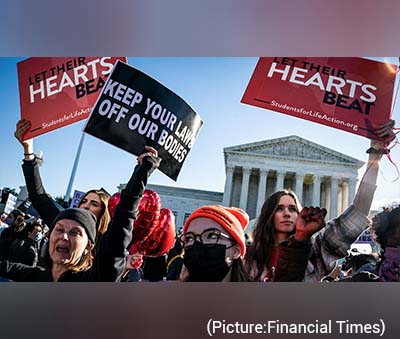 If the nation is divided on one of the most important cases that has been debated in the top Court, the justices who occupy the highest court are even more divided on the case and its implications for the millions of women who are impacted by the court that has once again proved to be a political organization, based on the ideologies of the Justices rather than the true spirit of the Constitution.
As per the leaked documents, all the Republican appointed Justices on the Court, except Chief Justice John Roberts are said to be in favor of overturning Roe v. Wade, and in the process denying women their right decide on their health and wellbeing. The justices voting with Alito are all Justices appointed by Republican Presidents: Clarence Thomas, Brett Kavanagh, Neil Gorsuch and Amy Coney Barrett.
The Democratic-appointed justices on the court, Stephen Breyer, who will retire this summer, Elena Kagan and Sonia Sotomayor, are working on one or more dissents, Politico reported, noting that Chief Justice John Roberts’ ultimate vote is unclear.
According to CNN sources, Roberts did not want to overturn Roe and would likely side with Breyer, Kagan and Sotomayor. Instead, he is willing to uphold the Mississippi law banning abortions after 15 weeks of pregnancy, per the report.
Overturning Roe would strike down what many abortion rights defenders, including Supreme Court justices appointed by presidents of both political parties, have long described as settled law. It would limit access to abortions across much of the country, including parts of the South and Midwest. In at least 13 states, abortion would immediately become illegal. As Alito’s opinion notes, the ruling would allow each state to set its own laws and restrictions. One of those restrictions deals with medication abortion, accompanied by criminal penalties.
“The Constitution does not prohibit the citizens of each State from regulating or prohibiting abortion,” the Alito draft states. “Roe and [1992’s Planned Parenthood v.] Casey arrogated that authority. We now overrule those decisions and return that authority to the people and their elected representatives.”
The draft opinion in effect states there is no constitutional right to abortion services and would allow individual states to more heavily regulate or outright ban the procedure.
“We hold that Roe and Casey must be overruled,” it states, referencing the 1992 case Planned Parenthood v. Casey that affirmed Roe’s finding of a constitutional right to abortion services but allowed states to place some constraints on the practice. “It is time to heed the Constitution and return the issue of abortion to the people’s elected representatives.”
The document was labeled a “1st Draft” of the “Opinion of the Court” in a case challenging Mississippi’s ban on abortion after 15 weeks, a case known as Dobbs v. Jackson Women’s Health Organization.
An AP-NORC poll in December found that Democrats increasingly see protecting abortion rights as a high priority for the government. Other polling shows relatively few Americans want to see Roe overturned. In 2020, AP VoteCast found that 69% of voters in the presidential election said the Supreme Court should leave the Roe v. Wade decision as is; just 29% said the court should overturn the decision. In general, AP-NORC polling finds a majority of the public favors abortion being legal in most or all cases.
Still, when asked about abortion policy generally, Americans have nuanced attitudes on the issue, and many don’t think that abortion should be possible after the first trimester or that women should be able to obtain a legal abortion for any reason.
Alito, in the draft, said the court can’t predict how the public might react and shouldn’t try. “We cannot allow our decisions to be affected by any extraneous influences such as concern about the public’s reaction to our work,” Alito wrote in the draft opinion, according to Politico.
People on both sides of the issue quickly gathered outside the Supreme Court waving signs and chanting on a balmy spring night, following the release of the Politico report.
Planned Parenthood, in a statement late Monday, said, “The leaked opinion is horrifying and unprecedented, and it confirms our worst fears.” A majority of Americans oppose overturning the 49-year-old ruling, according to recent surveys. A CNN poll in January found that 69 percent of respondents were against doing away with Roe while 30 percent were in favor.
The leak jumpstarted the intense political reverberations that the high court’s ultimate decision was expected to have in the midterm election year. Already, politicians on both sides of the aisle were seizing on the report to fundraise and energize their supporters on either side of the hot-button issue.
Speaker Nancy Pelosi (D-Calif.) and Senate Majority Leader Charles Schumer (D-N.Y.), in a joint statement, said a majority vote to overturn Roe “would go down as an abomination,” adding that it would be “one of the worst and most damaging decisions in modern history.”
Senate Judiciary Committee member Amy Klobuchar (D-Minn.) tweeted Monday night that the published Alito opinion pointed to a role for Congress. “It is a fundamental right for a woman to make her own health decisions. We must protect the right to choose and codify Roe v Wade into law,” she said.
New York Gov. Kathy Hochul, also a Democrat, said people seeking abortions could head to New York. “For anyone who needs access to care, our state will welcome you with open arms. Abortion will always be safe & accessible in New York,” Hochul said in a tweet.
On the GOP side, lawmakers were incensed with the disclosure of the high court’s draft. Sen. Tom Cotton (R-Ark.) said that the court and the Justice Department “must get to the bottom of this leak immediately using every investigative tool necessary” (The Hill).
Mississippi Attorney General Lynn Fitch said in a statement, “We will let the Supreme Court speak for itself and wait for the Court’s official opinion.” But local officials were praising the draft. “This puts the decision making back into the hands of the states, which is where it should have always been,” said Mississippi state Rep. Becky Currie.
A decision to overrule Roe would lead to abortion bans in roughly half the states and could have huge ramifications for this year’s elections. But it’s unclear if the draft represents the court’s final word on the matter — opinions often change in ways big and small in the drafting process. The court is expected to rule on the case before its term ends in late June or early July.
Indian Americans Condemn Connecticut Statement On ‘Sikh Independence’
Several groups of Indian Americans have come together to condemn a statement by the Connecticut State General Assembly purporting to show support for what it called the “Declaration of Sikh Independence.”
The Indian Consulate General in New York has described it an attempt to use the name of the Assembly to “promote bigotry and hatred. We condemn the so-called citation of the General Assembly of the State of Connecticut in the USA regarding an illegal act.” It said that the Consulate and the Embassy in Washington “will take up this issue appropriately with the concerned US lawmakers”.
The Consulate said that the adoption of the General Assembly’s statement “is an attempt by some mischievous elements to use the name of the Assembly for their nefarious purposes. These vested interests seek to divide communities and promote bigotry and hatred”.
“Their agenda of violence has no place in democratic societies like the USA and India.”
Thomas Abraham, the Chairman of the Global Organization of People of Indian Origin said that the group’s Connecticut chapter will meet the legislators behind the statement and explain the situation. He deplored the statement calling it “terrible”. Abraham, who is based in Connecticut, said that a “fringe group got it adopted at the tail-end of the Assembly session without the knowledge of most elected officials”.
Global Organization of People of Indian Origin (GOPIO) – Connecticut Chapter has deplored the citation by a few members of Connecticut General Assembly congratulating declaration of Sikh Independence. “This initiative is from a few fringe elements who have no interest in the State of Connecticut, but promoting their own personal divisive agenda,” said Dr. Thomas Abraham, Chairman of the Global Organization of People of Indian Origin and Trustee of GOPIO-CT.
“Indian American community in Connecticut consists of Hindus, Muslims, Christians, Sikhs, Buddhists, Jains and Parsees. All these communities live together as one Indian community and Connecticut state has no business to comment on issues pertaining to local issues in India or supporting fringe elements to promote their divisive agenda,” Dr. Abraham added. “There are 20 million Sikhs living peacefully with all other communities all over India and this citation goes against the integrity of India,” said Ashok Nichani, President of GOPIO-CT
The statement by the CT Assembly attributed to the Democratic Party-controlled State General Assembly comprising both the House of Representatives and the Senate was read out at a ceremony in front of the Norwich City Hall on April 29, according to a video by TV84, a New York Punjabi online media.
“Connecticut General Assembly offers its sincerest congratulations to the World Sikh Parliament in recognition of the 36th anniversary of the declaration of Sikh Independence”, said the statement purportedly signed by Senate President Pro-tem Mark Looney, Speaker Matthew Ridder and Secretary of State Denise Merril, according to the video.
“We join with you and your friends and family in commemorating the historic resolution passed on April 29th 1986 by the collective Sikh nation,” it added. The World Sikh Parliament is a Khalistani organization.
The Day newspaper in New London said that Democrat Swaranjit Singh, who is a Norwich Alderman (the equivalent of council member), participated in the observances in Norwich. The newspaper said that World Sikh Parliament leaders hoisted what it called a “Punjab flag” in front of the City Hall.
As of May 1, the General Assembly statement could not be found in its online records or on the websites of legislators who could have sponsored it. Nor were there any US media reports about the statement.
Sikh issues have come up in the past in Connecticut. Its legislature passed a resolution in 2018 declaring November 1 as “Sikh Genocide Remembrance Day” for those killed in the 1984 Indian government action against Sikh separatists in the Golden Temple.
The public library in Norwich put up a “1984 Sikh Genocide Memorial” that featured a large portrait of Jarnail Singh Bhindranwale, the Khalistan separatist leader in 2019.
But the display donated by Swaranjit Singh was removed within weeks after the Indian consulate protested. Last month, a Sikh issue also made it to the US House of Representatives in Washington.
On April 18, Massachusetts Democrat member of the House Richard Neal made a statement wishing the World Sikh Parliament for Baisakhi and declared: “Despite their beliefs of good-will, Sikhs have been subjected to violence and have fought relentlessly to defend their faith, most notably in 1984 with Sikh genocide during the anti-Sikh riots in India”.
The statement is in the Congressional Record and it is not clear if he actually made it on the House floor or if it was added to the record as many such statements are because of the tight schedule of Congress.
GOPIO-CT Outreaches To Indian American Academics In Connecticut
As part of the GOPIO-CT’s outreach to the university faculty, the chapter joined hands with Quinnipiac University for a Meet and Greet Program on Friday, April 22nd at Clarion Hotel in Hamden, CT. It was an event where GOPIO members and other community organization representatives had a networking reception and an open mike interaction followed by an Indian dinner. Academics were from Quinnipiac, Yale, University of Connecticut and University of New Haven. This is first time Indian American and Indic academics from these schools came together on a Pan-Indian platform.
After the networking Meet and Greet, the program started with a welcome by GOPIO-CT Executive Vice President Prasad Chintalapudi who then introduced GOPIO Founder and current Chairman Dr. Thomas Abraham. Dr. Abraham, spoke on the journey of GOPIO over the years since 1989 and how, the Indian Diaspora community which was outside the political mainstream in many countries changed over to political mainstream in countries with large Diaspora population.
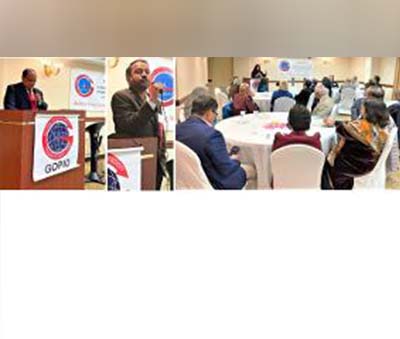 Dr. Abraham also spoke on the Welcome Dinner for new students from India at the UConn Business School at Stamford and Hartford campuses organized by GOPIO-CT and hoping to do the same in the Hamden/New Haven area.
Dr. Abraham also mentioned that the Indian Am3rican academics could play important roles in correcting misinformation on India and the Indian American community, as for example the recent statement by University of Pennsylvania professor Amy Wax.
This program to reach the academics was initiated by GOPIO-CT Board Member Prof. Sujata Gadkar-Wilcox, who has also been a Democratic Party candidate from the assembly district in Trumbull.
“It is a pleasure to have faculty members from Quinnipiac University, Yale University, the University of New Haven, and from the greater South Asian community come together to discuss shared connections and opportunities for collaboration and we look forward to hosting future events that will incorporate students and continue to build programming that serves the local community and highlights the many important contributions of the South Asian community in Connecticut,” said Prof. Gadkar-Wilcox.
Academics who participated included Prof. Ravi Dhar, American behavioral scientist, an expert in consumer behavior and branding, currently the George Rogers Clark Professor of Management and Marketing at Yale School of Management; Prof. K. Sudhir, James L Frank Professor of Private Enterprise, Management and Marketing & Director of the Yale China India Insights Program (CIIP) Yale School of Management; Prof. Shyam Sunder, James L. Frank Professor Emeritus of Accounting, Economics and Finance, Yale School of Management; Prof. Ramesh Subramanian, Gabriel Ferrucci Prof of Computer Information Systems, Quinnipiac; Asha Rangappa, Former FBI agent, Senior lecturer at Yale University’s Jackson Institute for Global Affairs, and a commentator on CNN; Kamal Upadhyaya; Professor of Economics and Business Analytics, University of New Haven; Prof. Narasimahan Srinivasan, Associate Professor Marketing, UConn School of Business; Prof. Ewa Callahan, Associate Professor of Interactive Media and Design, Quinnipiac; and Prof. Mohammad Elahee, Professor of International Business, Quinnipiac.
Connecticut Association of Physicians of India (CAPI) was also represented at the event with Dr. Subbarao Bollepalli (Former President of CAPI), Dr. Veena Vani and Drs. Raminder (Micky) and Rachna Walia. The program was sponsored by Wire and Plastics Machinery manufacturer Rakesh Narang and his wife Neelam along with Prof. Wyn Gadkar-Wilcox who is Professor of History & Non-western Cultures, Western Connecticut University.
In the interactive session many new ideas were shared. Plans are ahead to continue this network and to organize a Welcome Dinner for the new students from India in September in central Connecticut and at the UConn, Storrs campus.
Over the last 16 years, GOPIO-CT, a chapter of GOPIO International has become an active and dynamic organization hosting interactive sessions with policy makers and academicians, community events, youth mentoring and networking workshops, and working with other area organizations to help create a better future. GOPIO-CT – Global Organization of People of Indian Origin – serves as a non-partisan, secular, civic and community service organization – promoting awareness of Indian culture, customs and contributions of the Indian Diaspora through community programs, forums, events and youth activities. It seeks to strengthen partnerships and create an ongoing dialogue with local communities.
FIA Celebrates Gujarat Maharashtra Day
The Federation of Indian Association and the Indian Consulate celebrated Gujarat Maharashtra Day on May 1. 2022 at the Indian Consulate premises in New York as part of the ongoing celebrations of ‘Azadi Ka Amrit Mahotsav’ commemorating 75 years of Indian Independence.
The chief guests to grace the occasion were Ms. Archana Joglekar – a celebrated actress, director & a renowned Kathak exponent, and Ms. Kaajal Oza Vaidya – a noted author, scriptwriter, radio jockey, and a motivational speaker.
The event was attended by Hon Consul General Sh. Randhir Jaswal, Hon DCG Dr. Varun Jep, FIA President Mr. Kenny Desai, FIA Chairman Mr. Ankur Vaidya, Padma Shri Sh. H R Shah, Padamshri Dr. Sudhir Parikh, Mayor of Edison Mr. Sam Joshi and FIA’s Srujal Parikh, Alok Kumar. Smt Smita Miki Patel amongst others.
 Hon CG Shree Randhir Jaswal welcomed the guests and said that the Indian Diaspora from both the states of Gujarat and Maharashtra, not only in America but in other countries as well, continues to contribute towards the economic and social progress of the countries they live in.
Hon DCG Dr. Varun Jep, in his speech said that people from both the states are leaders in Finance, Business, Entrepreneurship and they also stand out for their rich cultural traditions and heritage.
FIA president Mr. Kenny Desai said that the state of Gujarat is the ‘Karambhoomi’ of Lord Krishna and has been the land of many notable figures hailing from different fields like Mahatma Gandhi, Sardar Patel, Bhakt Narsi Mehta, Vikram Sarabhai, PM Sh Narender Modi, and the Industrial houses of Ambanis and Adanis. He mentioned that Mahrashtra has been the guardian of Hindu Sanatan Dharam and have produced bravehearts like Chattrapati Shivaji, Baji Rao Peshwa and Ahilyabai Holkar. He said that people from both states have contributed to the Economic, Industrial and Financial growth of India.
FIA Chairman Mr. Ankur Vaidya in his speech said that he was born and brought up in Baroda in Gujarat which had a significant Maharashtrian Influence and as such had the best of both cultures. He also emphasized the need to engage other Indian Communities and have events and gatherings where all the members from the various Indian communities can participate. He said that Hon CG Sh Jaiswal has done a tremendous job in this direction to bring the communities together. He also lauded the efforts of the officials and staff of the Indian Consulate for doing an unprecedented job and in being accessible to all.
 One minute silence was observed in the memory of founding member, Past President and Vice Chairman Emeritus Late Mr. Yashpal Soi. Mr. Vaidya remembered him for his selfless service and dedication to the cause of FIA and lamented the loss FIA has suffered in his passing away.
Guru Archana Joglekar spoke about the folk of Maharashtra. She explained in detail about the culture and folk tradition of Maharashtra. She also spoke about the shared culture of both states.
Kajal Oza Vaidya said that both the states should be seen in unison and commended the fact that the twin states took to the path of progress and development and have excelled in the fields of enterprise, culture, commerce, and entertainment. She said that today’s gathering is proof of the fact that our country lives in our hearts.
Padma Shri Mr. H R Shah said that he is honored to be there for the event and gave a brief outline of the history behind the Gujarat Maharashtra day when the 2 states came into being. Ms. Sam Joshi Mayor of Edison said that it was an honor to be present and spoke about his vision to have a satellite office of IIT India in Edison. He thanked the FIA for their initiatives which go a long way in keeping the Indian Community in touch with their Indian roots.
 Event Chair, Past President, and member of Board of Trustees of FIA, Sh. Srujal Parikh said it’s a great honor to celebrate the event and took pride in the fact that Gujarat is the Land of Lord Krishna & Mahatma Gandhi. He recognized and felicitated the sponsors, supporters, partner associations, and members in their effort to make the event successful
Padma Shri Sudhir Parikh said that he shares a personal bond with Maharshtra as he did his schooling from Mumbai. He attributed his success to the State of Gujarat as it accorded him his higher education
The audiences were regaled with cultural performances from both the states and especially the ‘Garbha’ and ‘Laavni’ which they thoroughly enjoyed. The Maharashtrian folk dance was performed by the students of ‘Archana Nritalya’ which is run by Guru Archana Joglekar.
AAPI Presents A Five-Week Webinar On Meditation Practices
American Association of Physicians of Indian Origin (AAPI) in collaboration with the Heartfulness Institute organized a five-week webinar, from March 20th to April 17th on Heartfulness Meditation Practices, guided by Revered Kamlesh D. Patel (DAAJI), who is the Heartfulness Global Guide, and initiated by Dr. Anupama Gotimukula President of AAPI and Dr. Ravi Kolli, President-Elect of AAPI. The Heartfulness Institute has held a series of wellness lectures that provide meaningful practices to AAPI physicians and continuing medical education credits.
AAPI members, including Dr. Chandra Koneru, Dr. Murthy Gokula, Dr. Jayaram Thimmapuram, and Dr. Kunal Desai, who have been engaging in heart-based meditation for decades presented and led the hundreds of AAPI members who had joined in and participated in the webinars.
“The Covid pandemic has impacted all aspects of human life as never been before,” said Dr. Gotimukula. “The past two years have been challenging to everyone, particularly those who are assigned with the responsibility of caring for the sick, especially as millions have been impacted by the big pandemic. There has been a noticeable rise in burn out among healthcare professionals,” she pointed out.
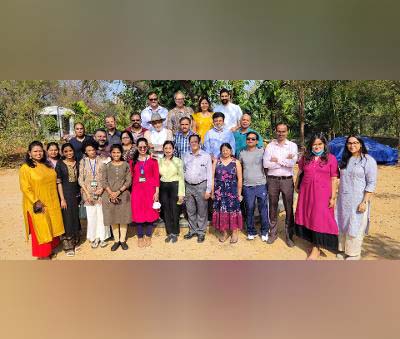 AAPI, the largest ethnic medical organization in the country, representing the interests of over 100,000 physicians of Indian origin, has been focusing on ways to help AAPI members, who have been in the forefront helping millions of patients around the nation, to take care of self and find satisfaction and happiness in the challenging situations they are in, while serving hundreds of patients everyday of their dedicated and noble profession, Dr. Anupama Gotimukula said.
In this context, in partnership with the Heartfulness Institute, AAPI has embarked on a mission to educate its members and provide opportunities to promote self-care, improve physician wellness, and reduce burnout.
“Our physician members have worked very hard during the covid 19 pandemic. The Heartfulness Meditation has allowed AAPI to serve these hard working members who are our COVID 19 Heroes. It is a perfect time to heal the healers with a special focus on wellness as we rejuvenate and relax,” said Dr. Ravi Kolli, who, along with several AAPI members visited and experienced Heartfulness Meditation at the Kanha Shantivanam on the outskirts of Hyderabad, during the Global Healthcare Summit organized by AAPI in January this year.
The Heartfulness Institute is a not-for-profit organization established in 130 countries that provides meditation techniques that are proven to reduce stress and anxiety, improve sleep, enhance emotional intelligence, and explore the depth of human consciousness.
The Heartfulness Institute’s mission is “to offer all humanity a simple and effective set of practices for relaxation, meditation, regulating the mind, and building inner strength and attitudes to create a lasting sense of fulfillment and overall, wellbeing.”
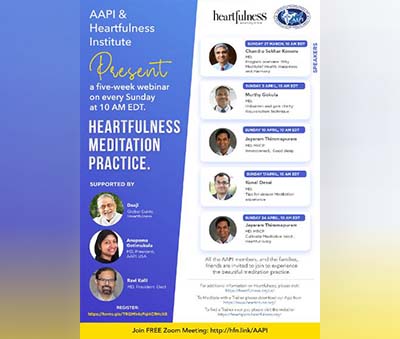 “Our practices include heart-based meditation,” said Dr. Chandra Koneru, an Internal Medicine Professional, AAPI member, and Heartfulness Trainer. “Our values align with the American Association of Physicians of Indian Origin (AAPI) mission to facilitate and enable Indian physicians to improve patient care and engage in research that brings distinctive contributions from India.”
The first webinar session led by Dr. Koneru was an introduction to Heartfulness practices: “A Program Overview: Why Meditate? Health, Happiness, and Harmony.” Dr. Koneru said, “Meditation unleashes the potential within us that we never before knew.” He shared with the audience the values of meditation, how meditation translates to evidence-based health outcomes, and how the harmony and happiness that meditation can evoke in physicians can have a ripple effect on their patients.
Dr. Koneru explained the relaxation techniques physicians can practice to create restorative and refreshing energy boosts. He outlined what it means to connect with the heart, fix your thoughts, and allow divine energy to fill the heart through a practical demonstration. “Heartfulness relaxation techniques remove stress and tension from the body, calm the nervous system, and settle our breathing habits,” he said.
Dr. Koneru also discussed meditation methods, centering oneself, and finding inner stillness and contentment. Heartfulness meditation is supported by the ancient yogic technique of Pranahuti, which allows us to dive deeper into the heart from the outset., he added.
Dr. Murthy Gokula, M.D., C.M.D., DipABLM, Family Medicine, Geriatrics & Lifestyle Medicine, AAPI member, and Heartfulness Trainer, while leading the discussion on “Rejuvenation: Adding Lightness, Joy, and a Carefree Attitude to Life” spoke about the rejuvenation technique, which involves a well-established scientific methodology using guided imagery to remove the day’s stressful impressions and undesirable interactions.
Dr. Gokula said, “Cleaning purifies the mind of all its complexities and heaviness, allowing you to feel light in your approach to life. This 30-minute practice will detox your mind. After the rejuvenation technique, you will return to a simpler and more balanced state. Every cell of your body will emanate simplicity, lightness, and purity.”
Dr. Jayaram Thimmapuram, Internal Medicine, AAPI member, and Heartfulness Trainer, who spoke about “Inner Connect and Good Sleep and Cultivate Meditative Mind, Heartful Living” in two separate sessions, said, “Our quality of sleep and sleeping habits shape our physical and mental health. Our attention, intention, and attitude at bedtime play a significant role in transforming ourselves. With a proper attitude of humility, love, and openness to change, improving our sleeping habits can transform our lives.”
According to him, “Cultivating a meditative mindset is an outcome of meditative practices. A meditative mind is a dynamic state of inner stillness that progressively fills our life with contentment, calmness, compassion, courage, and clarity.”
Dr. Kunal Desai, an Infectious Disease Specialist, AAPI member, and Heartfulness Trainer, while addressing the participants on “Tips for Deeper Meditation Experience” stated that the best way to experience meditation and find purpose is to focus on health-related benefits like stress improvement, sleep quality improvement, and anxiety reduction. He suggested adopting an approach of sitting silently at your desk for a few minutes to focus inwardly. “This small practice can pave the way for more mindfulness and intentional acting. He also advocated for small moments of meditation before bed, prayer, and diary writing to focus on meditation,” Dr. Desai said. “With interest and the right attitude, you can evaluate yourself to see that you will evolve to find the real purpose of your life,” he added.
Dr. Ranga Reddy, a Past AAPI President stated, “I have been with AAPI for over 25 years. This is the first time AAPI has collaborated with the Heartfulness program to bring awareness to physicians about the benefits of meditation in reducing stress and anxiety and improving patient care during these trying times. I hope AAPI will continue this collaboration to bring harmony and happiness to physicians, patients, and the public to create a healthy and peaceful society for the greater good.”
Dr. Rida Khan, who had attended the webinar, while sharing the impact it had on him, stated, “I have always been a meditation aficionado, so it was heartening to discover that it could be a continuing medical education activity. The practical meditation sessions taught the techniques in real-time and backed them with scientific, informative, and journal club-style didactics.”
Dr. Khan went on to state, “No doctor should battle the vicissitudes of the work of a physician alone. Introducing physicians to meditation provides a powerful tool to help alleviate stress, maintain stability, and enhance fulfillment in their lives. It helps to meditate in groups to protect your practice from lapsing, receive regular feedback, and exchange intellectually stimulating ideas. Meeting like-minded people in your field broadens your perspective of how a physician should and could be. As a newly minted physician myself, I find it invaluable to have those role models in my life.”
What was begun as a five week series has been planned to be extended for a longer as the AAPI members have shared for the need and expressing as to how the sessions have helped them personally and professionally.
“Heartfulness meditation practices are offered free of cost. By connecting with a local trainer at one of our 6,000 global Heart Spots, you can dive deeper into meditation with free assistance from a certified Heartfulness trainer,” Dr. Gokula added. For more details, please visit: https://heartspots.heartfulness.org. To connect with a virtual trainer, download the Heart-In-Tune app at https://www.heartintune.org.
For more information on AAPI and its several noble initiatives in the past 40 years, please visit: www.aapiusa.org
AAPI/CAPI CT Organizes Blood Donation Drive At Middletown Temple
The Connecticut Chapter of The American Association of Physicians of Indian Origin (CAPI) in partnership with the local American Red Cross, Middle Town Hindu Temple and the national American Association of Physicians of Indian Origin (AAPI) organized a Blood Donation Drive at the Middletown Hindu Temple on Saturday, April 30th.
Led by Dr. Sushil Gupta President of CAPI, the 2nd blood donation drive by CAPI in the past few months has been inspired by the call by Dr. Anupama Gotimukula, President of national AAPI, who is leading AAPI in its efforts to host Blood Donation Drive in as amnay as 75 cities across the United States, to commemorate India’s 75 years of Independence.
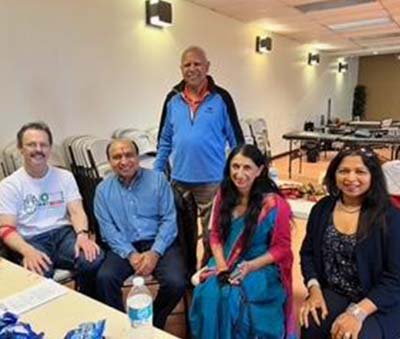 “In line with the national AAPI’s motto, we at CAPI are happy to join in several other AAPI Chapters and lead this noble initiative to donate blood with the objective of saving lives around the nation,” said Dr. Sushil Gupta, President of CAPI. “We plan to organize future blood drives in other parts of Connecticut in the near future.”
Dr. Gupta expressed gratitude to “Drs. Subbarao Bollepalli, Sujata Prasad, Jaya, Daptardar, Viji Kurup from CAPI, who had volunteered to organize this event and made it successful.” He also thanked Hari Krishna, President of the Middletown Hindu Temple Board and Kiran Pyneni, who had helped to provide the venue and made all the arrangements for the blood drive.
“It is a spot exemplar as a ‘team work’ dedicated to the social welfare and happiness of the community,” said Dr. Jaya Daptardar, an organizer of the event and had donated blood during the highly successful event. “The Blood Drive, while honoring India on her 75th year of Independence, has been dedicated to the Fallen Heroes, who have sacrificed their lives to save the lives of others infected with the deadly Covid pandemic,” Dr. Jaya Daptardar added.
Drs. Sushil Gupta, Jaya Daptardar and Prasad Sureddy, in addition to coordinating the efforts and organized the successful Blood Drive, also donated Blood during the Drive.
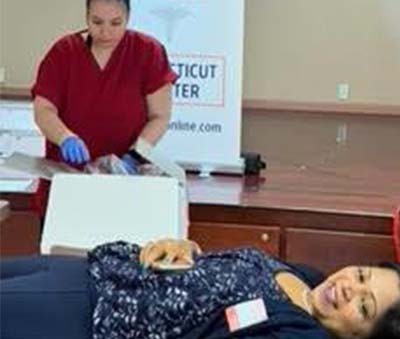 “I am grateful to the dozens of local AAPI Chapters including CAPI for initiating and organizing the Blood Donation Drives and Stem Cell Registration across the nation, in honor of the Fallen Heroes of Covid-19, and as India is celebrating 75 years of our Independence. I am so proud that we have taken this initiative to organize AAPI Blood Donation Drives in 75 cities across the nation,” said Dr. Anupama Gotimukula, President of the American Association of Physicians of Indian Origin (AAPI,) the largest ethnic organization in the United States.
Each blood component of a whole blood transfusion can help up to three different people. Pointing to the fact that Blood cannot be manufactured despite medical and technological advances. The only way we can give blood to those who need it is through donation. It doesn’t cost us anything to donate but your donation saves lives. Blood is needed every two seconds, said Dr. Meher Medavaram, Chair of AAPI’s national blood donation drive.
CAPI was formed with the objective of promoting charitable and philanthropic activities; communicating with other Indian associations in North America to promote cultural and social events, and fostering a relationship with future generations of physicians of Indian Ancestry. For more details of CAPI membership please visit: https://capionline.com
Salman Rushdie, Sabyasachi Mukherjee Among Inducted Into American Academy Of Arts & Sciences
The American Academy of Arts and Sciences elected several Indians from around the world to be members of the august body which was established in 1780, and which “honors excellence and convenes leaders to examine new ideas and address issues of importance to the nation and the world, and advance the public good.”
The list which was announced April 28, 2022, contained Indians from U.S., U.K. and India in several fields of endeavor ranging from science to arts and humanities.
This year’s election of 261 new members includes at least 14 persons of Indian descent. “We are celebrating a depth of achievements in a breadth of areas,” David Oxtoby, president of the American Academy is quoted saying in the press release. “These individuals excel in ways that excite us and inspire us at a time when recognizing excellence, commending expertise, and working toward the common good is absolutely essential to realizing a better future.”
The new members join the likes of Benjamin Franklin (elected 1781) and Alexander Hamilton (1791) in the eighteenth century; Ralph Waldo Emerson (1864), Maria Mitchell (1848), and Charles Darwin (1874) in the nineteenth; Albert Einstein (1924), Robert Frost (1931), Margaret Mead (1948), Milton Friedman (1959), Martin Luther King, Jr. (1966), Stephen Hawking (1984), and Condoleezza Rice (1997) in the twentieth; and more recently Jennifer Doudna (2003), Bryan Stevenson (2014), M. Temple Grandin (2016), John Legend (2017), Viet Thanh Nguyen (2018), James Fallows (2019), Joan Baez (2020), and Sanjay Gupta (2021).
This year’s list of artists, scholars, scientists, and leaders in the public, non-profit, and private sectors elected to the Academy include the following of Indian descent:
Physics – Ramamoorthy Ramesh, University of California, Berkeley
Physics – Shamit Kachru, Stanford University
Engineering and Technology- Nilay Shah (IHM), Imperial College London
Computer Science –George Varghese, University of California, Los Angeles
Cellular and Developmental Biology- Arshad B. Desai, University of California, San Diego
Cellular and Developmental Biology- Harmit Singh Malik, Fred Hutchinson Cancer Research Center
Evolution and Ecology- Maharaj K. Pandit (IHM) , University of Delhi
Medical Sciences – Abraham C. Verghese, Stanford School of Medicine
Economics – Rohini Pande, Yale University
Philosophy and Religious Studies – Jamsheed K. Choksy, Indiana University
Philosophy and Religious Studies – Archana Venkatesan, University of California, Davis
Literature – Salman Rushdie
Visual Arts – Sabyasachi Mukherjee (IHM), Chhatrapati Shivaji Maharaj Vastu Sangrahalay
Scientific, Cultural and Nonprofit Leadership – Maya Ajmera Society for Science
Petition In Indian Court To Search Taj Mahal For Hindu Idols And Inscriptions
A petition has been filed in the Lucknow bench of the Allahabad high court seeking directives to the Archaeological Survey of India (ASI) to open 20 rooms inside the Taj Mahal in Agra to ascertain whether the Hindu idols and inscriptions are hidden there.
Bharatiya Janata Party (BJP) media in-charge of Ayodhya district, Dr Rajneesh Singh has filed the petition which is yet to come up for hearing.
“There is an old controversy related to the Taj Mahal. Around 20 rooms in Taj Mahal are locked and no one is allowed to enter. It is believed that in these rooms there are idols of Hindu gods and scriptures,” said Dr Rajneesh Singh.
“I have filed a petition in the high court seeking directives to ASI to open these rooms to ascertain facts. There is no harm in opening these rooms and setting to rest all controversies,” said Singh on Sunday.
In the plea, the petitioner has sought directives from the court to the state government to constitute a committee that would examine these rooms and look for any evidence related with the Hindu idols or scriptures there.
Rajneesh Singh said he has been trying to ascertain facts about the 20 locked rooms of Taj Mahal since 2020 through the Right to Information Act (RTI).
Singh had filed an RTI in 2020 with the Union ministry of Culture seeking information about the rooms. “Since 2020, I have been trying to ascertain facts about the locked rooms of Taj Mahal. I had filed an RTI. Replying to the RTI, the Union ministry of Culture informed the Central Information Commission (in Delhi) that these rooms were locked due to security reasons and no detail was provided about these rooms,” he added.
“In the RTI, I had sought details about the locked rooms (what is inside them) and directives to open them,” Singh said. “When all my efforts failed then I have approached the Lucknow high court seeking directives to the government to open these rooms and constitute a fact-finding committee to find out whether Hindu gods and scriptures are inside them,” he added.
It may be pointed out that several right-wing organisations claim Taj Mahal to be Tejo Mahalaya, a Hindu temple. (IANS)
Indian-American Women Launch Digital Platform To Screen Films
A group of Indian-American entrepreneurs launched a video conference platform, where filmmakers from Hollywood and Indian cinema can screen their own cinematic content.
The USP of this initiative, ‘We Must Meet’ is that it can live stream political events, Town Halls, sports events, and concerts, which can be accessed by up to 30,000 people at the same time.
‘We Must Meet’ content will comprise international as well as regional projects. It will be driven by an annual subscription model and is being launched in India and globally.
Kimberly Guilfoyle, former US President Donald Trump’s 2020 reelection campaign adviser, has announced her involvement with ‘We Must Meet,’ a new digital platform launched by a group of women of Indian descent. The technological initiative is said to be the first video conferencing platform that can also function as an OTT platform, allowing Hollywood and Indian filmmakers to screen their own cinematic content.
Elaborating on the platform, Manju Mason, who has conceptualized ‘We Must Meet’, said in a statement: “The software has been entirely developed in the United States and is community-based. It will change the way people will meet and host business meetings.”
The platform is powered and managed by the technology company Iotum. The company announced that We Must Meet is soon going to launch We Must Meet Theme Parks, Boutique Hotels, resorts, and restaurants under the same brand.
The move comes at a time when India’s OTT market is growing fast and has the potential to become the largest in the world.
Indian Rupee Falls To The Lowest
The Indian rupee extended its losses and touched an all-time low of 77.42 against the US dollar in early trade on Monday, May 10th.
The Indian currency is weighed by the strength of the American currency in the overseas market and continued foreign fund outflows. Further, rupee slipped on surge in crude oil prices
Foreign institutional investors were net sellers in the capital market on Friday, as they offloaded shares worth Rs 5,517.08 crore, as per stock exchange data. They have been selling equities constantly in the recent months.
Rupee has been under-pressure after global central banks started normalising policy and last week RBI too started raising key interest rates.
On Friday, the rupee had slumped 55 paise to close at 76.90 against the US dollar.
“Local units are also hit by haven dollar flows, higher global rates due to rising inflation and risk-off sentiments. Weakness in Chinese yuan, which fell to its weakest level since November 2020, also weighing on regional currencies,” said Dilip Parmar, Retail Research Analyst at HDFC Securities.
So far this year, foreign institutions have withdrawn a total of nearly $19 billion from domestic equities and debt markets, Parmar said.
Parmar sees near term depreciation in rupee could continue for a few more days with lower side limited in the range of 77.70 to 78. In the event of unwinding, the rupee could see levels of 77 to 76.70.
According to Sugandha Sachdeva, VP-Commodity and Currency Research at Religare Broking, the Indian rupee has plummeted to record lows amid the deteriorating risk sentiments and the unrelenting spree of overseas outflows from the domestic equities.
Besides, an unabated rise in the dollar index towards a two-decade high, soaring US treasury yields and crude prices, all of them have worked their way to push the domestic currency on a downward trajectory, Sachdeva told IANS.
“Markets are concerned about the spiralling inflation and prospects of an aggressive tightening path that continues to threaten the growth outlook, leading to safe-haven flows in the greenback.”
Also, hardening crude oil prices as the EU is moving ahead to impose an embargo on Russian oil are roiling the sentiments, leading to worries about the widening current account deficit and exacerbating the pressure on the domestic currency.
Going ahead, as the Indian rupee has breached the previous all-time lows of the 77.14-mark, it seems poised to witness further depreciation towards the 78-mark in the near term.
Sachdeva, however, anticipates that RBI will intervene around the 78-mark to curb excessive depreciation in the Indian currency.
According to experts, this depreciation is caused by the strength of the American currency in the overseas market and continuous foreign fund outflows from the Indian market. Some also attribute the fall of the rupee to rising crude oil prices globally due to the Russia-Ukraine crisis and the COVID induced lockdown in Shanghai.
India Regulates ‘Ayurveda Aahara’
The Centre, with the ‘Food Safety and Standards (Ayurveda Aahara) Regulations, 2022’, has brought certain checks on Ayurveda Ahara, the food prepared in accordance with the recipes or ingredients or processes as described in the authoritative books of Ayurveda.
Among the important regulations is that the labeling cannot claim to cure or treat any human disease, the Food Safety and Standards Authority of India (FSSAI) said.
This is applicable to food business operators who would be required to formulate Ayurveda Aahara in accordance with the categories and requirements as mentioned in the Regulations.
“However, this Ayurveda Aahara cannot be manufactured for infants up to 24 months age,” said an official from FSSAI about the Regulations put out in public domain by way of a notification late on Sunday night.
 The government also clarified that packed food items used in day to day life for dietary purposes, such as pulses, rice, floor or vegetables etc. shall not be covered under this.
The Regulations also mention specific labeling and demand the manufacturer to use only that with specifications such as intended purpose, target consumer group and/or recommended duration etc.
It mentions a list of 32 additive items that are permitted in the Ayurveda Aahara. These include Guar Arabic/Acacia Gum, Konjac Flour, Jaggery, Mollasses, Paprika/Paprika Extract/Paprika Oleoresin and Caramel plain among others.
There are 71 authoritative books mentioned as part of the regulation, which also mentions the categories of Ayurveda Aahara and regulatory requirements. The Regulations also mention permissible contaminants and its maximum limits.
MPs From India Visit Chicago University To Discuss Energy And Environment
A delegation comprising nine MPs from different states and various parties is visiting University of Chicago scholars, policymakers, and opinion leaders in Chicago currently for a knowledge exchange programme on energy and environment.
The Energy Policy Institute at the University of Chicago (EPIC) India is hosting the delegates at the University of Chicago “with an aim to augment the capacity of India’s political leadership in advancing policies that provide lasting environmental benefits” between May 8 and 12.
“Some MPs reached on May 7 and some on May 8. Their formal engagements start on Monday Chicago time,” an EPIC official told IANS here on Monday.
This is the third edition of the Legislator’s Programme. The MPs include Rajya Sabha members Amar Patnaik (Biju Janata Dal), Priyanka Chaturvedi (Shiv Sena) and C.M. Ramesh (Bharatiya Janata Party), and Lok Sabha members Brijender Singh, Shivkumar Udasi , Rahul Kaswan, Heena Gavit (all Bharatiya Janata Party), Kotagiri Sridhar (YSR Congress Party), and Ritesh Pandey (Bahujan Samaj Party).
“Innovative policies work when policymakers are ready to experiment. From our working for several years in Gujarat, Maharashtra, Odisha, Bihar, and other Indian states, we know that Indian lawmakers have been at the forefront of trying groundbreaking policies to balance India’s growth story and environmental concerns. Therefore, we are thrilled to learn and share best practices with Indian MPs and join them in accelerating positive change for citizens across India,” Michael Greenstone, the Milton Friedman Distinguished Service Professor in Economics and director of EPIC, said.
The Indian MPs would interact with the University of Chicago faculty and experts on wide-ranging policy areas, including climate policy, carbon markets, air pollution, and water quality. They will also have an interaction with young minds studying at the University of Chicago.
“As we learn from the experiences of our MPs, we are also trying to share EPIC’s global and India-specific research findings to co-identify priorities and solutions that may be implemented in individual constituencies. The goal is also to carry out groundbreaking research that addresses global and local challenges,” EPIC India’s Executive Director, Sidhartha Vermani said.
India’s Covid-19 Death Tally Estimated To Over 4.74 Million; WHO
A World Health Organisation (WHO) report on excess COVID-19 mortality has estimated 4.74 million deaths for India in 2020 and 2021, nearly 10 times higher than the country’s official coronavirus toll of 4.84 lakh during the two years.
India, according to the report, had the highest excess COVID-19 deaths, followed by Russia and Indonesia. Globally, the world health body has estimated that almost three times more people have died of COVID-19 than the official data.
As per the UN body, there were 14.9 million excess deaths associated with COVID-19 by end-2021. The official count of deaths directly attributable to COVID-19 and reported to WHO in that period — from January 2020 to the end of December 2021 — is slightly more than 5.4 million. This means that the estimated toll is 9.5 million higher than the recorded fatalities.
Health ministers of several Indian states, cutting across party lines, appear to be united in questioning the veracity of the World Health Organization (WHO) report on Covid-19 fatalities worldwide, with India’s fatality count pegged at 4.74 million between January 1, 2020 and December 31, 2021 — labelling it “fabricated” and “devoid of facts”.
But why is the death tally doubtful?
The WHO report isn’t the first to question the death tally due to Covid-19 in India. Earlier too, several reports have come out with estimates of India’s Covid-19 death toll that has been at wide variance with the official figures. According to a University of Washington’s Institute of Health Metrics and Evaluation, India’s fatality count due to the pandemic between March 2020 and early May 2021 stood at 6.54 lakh. A New York Times analysis, based on sero surveys, put the figure at closer to 4.2 million, up to May 24 last year while another study by The Lancet pegged the number at 4.07 million, between January 2020 and December 2021.
 The gaps: 8% of all deaths in India are never registered, according to government data with just 20% of deaths being medically certified. In certain states like Bihar, Nagaland and Manipur, the registration of deaths with the civil registration system (CRS) is less than 50%. In fact, just one state — Goa — has a 100% record in registering all its deaths with the CRS. The Centre and the states, while dismissing WHO’s report, cited the death registration figures from the CRS to buttress their claims that India’s official Covid-19 fatality count is up to date.
Counting methodology: In the initial days of the pandemic, in 2020, only those people who tested positive for Covid-19 and later succumbed to it were counted as pandemic casualties. All those who may have died without being tested, whether at home or in a hospital — testing facilities were limited leading to delays in getting test reports — but who may have shown clear symptoms of the disease, as also those who had underlying health conditions such as diabetes or weakened immune systems due to cancer treatments were not counted as Covid-19 fatalities.
Revised guidelines following a direction by the Supreme Court, to both the Centre and the states to be more liberal in recording Covid-19 deaths coupled with the apex court’s order for paying Rs 50,000 as compensation for Covid-19 deaths led to a surge in claims being filed, which were higher than the official death count in several states, such as Gujarat. Some states, such as Kerala, have in fact regularly carried out ‘reconciliation’ exercises to update their official fatality figures.
Vatican Astrophysicists Offer New Way To Study Gravity After The Big Bang
Two Catholic priests, both astrophysicists from the Vatican Observatory, have suggested a radically new mathematical approach to studying the initial moments following the Big Bang that gave birth to our universe.
Little is known about the first seconds of the universe’s existence, and one of the deeper puzzles is accounting for the role gravity played in those early moments. The Rev. Gabriele Gionti, a Jesuit, and the Rev. Matteo Galaverni, a priest in the Diocese of Reggio Emilia-Guastalla in Northern Italy, set out to propose a new technique that explains how gravity might have behaved as the cosmos expanded rapidly at its inception.
Their research, published in the prestigious Physical Review D journal on April 15, proposes an alternative to the Jordans-Brans-Dicke theory of gravitation, which solves difficulties with Albert Einstein’s general theory of relativity in describing gravity after the Big Bang, but which has its own inconsistencies.
 Einstein’s theory works well in explaining the way matter behaves on a large scale but clashes with the way quantum physics describes the gravity among the smallest observable particles. For years, Gionti has attempted to reconcile the two.
The priests’ work is “a tassel within this search that the scientific community has been conducting for many years on quantum gravity, meaning that gravity is capable of affecting (matter) even at a very, very small scale,” said Galaverni in a Zoom interview conducted by RNS with the two priests on Thursday (May 5).
“We realized that within limits, when the gravitational constant is very high, it’s possible for the speed of light to go to zero, meaning that nothing propagates because gravity is too high,” said Gionti.
“This might be a way to explain what happened after the Big Bang,” he said. In layman’s terms, Gionti said, “It’s like being in a theater, and until now we have seen the musicians and the orchestra with our eyes. Now with gravitational waves we can also hear the music. This is revolutionizing and will revolutionize the next decades of astronomy,” he added.
Gionti clarified that their “research is based on a very speculative and theoretical mathematical approach,” which will have to be tested in its physical and observable consequences.
They wrote their theory at the Specola Vaticana, the Vatican Observatory in Castel Gandolfo, the pope’s summer residence, drawing up their abstract calculations both on computers and blackboards as they compared and discussed their ideas.
Pope Leo XIII created the Specola in 1918 “in a time of modernism where society accused the church of obscurantism,” Gionti said. The Vatican trials against astronomers and thinkers like Galileo Galilei and Giordano Bruni in the 16th century had pegged the Catholic Church as a “determined opponent to scientific progress,” he explained.
“The Vatican created the Vatican observatory for priests, nuns and religious to prove to the world that the church directly contributed to science by providing it with an astronomical observatory that worked scientifically like all other observatories,” Gionti said.
Gionti and Galaverni’s work stands on the shoulders of great scientists as well as on the work of religious people. It was a diocesan priest from Belgium, Georges Lemaître, who first theorized the Big Bang in the early 20th century. Numerous priests and religious contributed to today’s understanding of gravity and astronomy. The Jesuit Angelo Secchi laid out the principles for how we classify stars today from the roof of the Church of St. Ignatius in Rome.
Science and religion are “two complementary approaches that must be respected in their diversity,” Galaverni said, who added that studying the universe is “not something that proves my faith, it’s something that enriches it.”
“Science also teaches me a certain humility in looking at the universe and recognizing our smallness and seeing the greatness of God in this,” he added. While studying the laws of physics and nature, the universe seems harmonious and well-ordered, he said, adding that “for someone of faith it’s an easy step to recognize in this order the footprint of God.”
Their work has been well received by their scientific peers, “but we are not finished yet. There are other questions that we haven’t answered,” Gionti said.